SB 1161: Administrative regulations: economic impact analysis and standardized regulatory impact assessments: State Air Resources Board.
- Session Year: 2025-2026
- House: Senate
- Latest Version Date: 2026-04-09
Current Status:
In Progress
(2026-05-14: May 14 hearing: Held in committee and under submission.)
Introduced
In Committee
Awaiting First Chamber Vote
Passed First Chamber
In Committee
Awaiting Second Chamber Vote
Passed Second Chamber
Enacted
What does this bill do?
The bill requires the State Air Resources Board to include in its economic impact assessment or standardized regulatory analysis a showing of how a proposed regulation’s costs, benefits, and overall effects would be distributed across income levels and disadvantaged communities. The analysis must report impacts for people under 138% of the federal poverty level, people below the inflation‑adjusted California median income, people under and over $100,000 a year, and disadvantaged communities, and must begin with a short, plain‑language summary that notes likely effects on energy, gas, and utility prices.
The summary is provided by generative AI which can make mistakes. For original language, please view the details in the table below.
Existing law designates the State Air Resources Board as the state agency responsible for the preparation of the state implementation plan required by the federal Clean Air Act, and requires the state board to adopt standards, rules, and regulations that are consistent with the state goal of providing a decent home and suitable living environment for every Californian.
Existing law, the Administrative Procedure Act, governs, among other things, the procedures for the adoption, amendment, or repeal of regulations by state agencies. Existing law requires a state agency proposing to adopt, amend, or repeal administrative regulations to assess the potential for adverse economic impact on California business enterprises and individuals, as provided. Existing law provides that a regulation or an order of repeal of a regulation becomes effective on a quarterly basis, as prescribed, except in specified instances. a regulation that is not a major regulation, as defined, to prepare an economic impact assessment, as provided. Existing law requires a state agency that is proposing to adopt, amend, or repeal a major regulation to prepare a standardized regulatory impact analysis, as provided.
This bill would require the State Air Resources Board proposing to adopt, amend, or repeal a regulation to prepare an economic impact assessment that assesses whether and to what extent it will affect low- and middle-income California households and disadvantage communities, as specified. The bill would require the State Air Resources Board, at least 6 months before the adoption, amendment, or repeal of the regulation goes into effect, to transmit to the Legislature this economic impact assessment. The bill would require the appropriate policy committees of the Legislature to hold a joint public hearing on the adoption, amendment, or repeal of a regulation, upon receiving the economic impact assessment, if the adoption, amendment, or repeal of the regulation would raise costs, as specified, and provide that the adoption, amendment, or repeal of the regulation does not go into effect until the joint public hearing is held.This bill would require the State Air Resources Board proposing to adopt, amend, or repeal a regulation to include in either the economic impact assessment, or the standardized regulatory impact assessment, a distributional analysis of the costs, benefits, and net impacts on personal income across income levels and an informative digest, as provided.
Existing law designates the State Air Resources Board as the state agency responsible for the preparation of the state implementation plan required by the federal Clean Air Act, and requires the state board to adopt standards, rules, and regulations that are consistent with the state goal of providing a decent home and suitable living environment for every Californian.
Existing law, the Administrative Procedure Act, governs, among other things, the procedures for the adoption, amendment, or repeal of regulations by state agencies. Existing law requires a state agency proposing to adopt, amend, or repeal administrative regulations to assess the potential for adverse economic impact on California business enterprises and individuals, as provided. Existing law provides that a regulation or an order of repeal of a regulation becomes effective on a quarterly basis, as prescribed, except in specified instances.
This bill would require the State Air Resources Board proposing to adopt, amend, or repeal a regulation to prepare an economic impact assessment that assesses whether and to what extent it will affect low- and middle-income California households and disadvantage communities, as specified. The bill would require the State Air Resources Board, at least 6 months before the adoption, amendment, or repeal of the regulation goes into effect, to transmit to the Legislature this economic impact assessment. The bill would require the appropriate policy committees of the Legislature to hold a joint public hearing on the adoption, amendment, or repeal of a regulation, upon receiving the economic impact assessment, if the adoption, amendment, or repeal of the regulation would raise costs, as specified, and provide that the adoption, amendment, or repeal of the regulation does not go into effect until the joint public hearing is held.
The Legislature finds and declares all of the following:
(a)The State Air Resources Board is currently required to conduct an economic impact assessment on regulations which affect the economy. This assessment does not evaluate the impacts on California households.
(b)The State Air Resources Boards regulations are projected to raise the cost of essential commodities, including, but not limited to, gasoline, diesel, vehicles, services, necessary household consumables, and energy.
(c)The State Air Resources Boards regulations impose costs that can disproportionately affect lower income households, workers, and small businesses.
(d)While environmental benefits are critical, this act ensures that lawmakers and the public have a clearer understanding of how these new regulations may affect those in these communities.
(e)This act would not limit the State Air Resources Boards authority, rather it would establish a straightforward reporting requirement that allows the Legislature to better understand the impacts these regulations have on California families and lower income communities.SEC. 2.Section 11346.3 of the Government Code is amended to read:11346.3.(a)A state agency proposing to adopt, amend, or repeal any administrative regulation shall assess the potential for adverse economic impact on California business enterprises and individuals, avoiding the imposition of unnecessary or unreasonable regulations or reporting, recordkeeping, or compliance requirements. For purposes of this subdivision, assessing the potential for adverse economic impact shall require agencies, when proposing to adopt, amend, or repeal a regulation, to adhere to the following requirements, to the extent that these requirements do not conflict with other state or federal laws:
(1)The proposed adoption, amendment, or repeal of a regulation shall be based on adequate information concerning the need for, and consequences of, proposed governmental action.
(2)The state agency, before submitting a proposal to adopt, amend, or repeal a regulation to the office, shall consider the proposals impact on business, with consideration of industries affected including the ability of California businesses to compete with businesses in other states. For purposes of evaluating the impact on the ability of California businesses to compete with businesses in other states, an agency shall consider, but not be limited to, information supplied by interested parties.
(3)An economic impact assessment prepared pursuant to this subdivision for a proposed regulation that is not a major regulation or that is a major regulation proposed before November 1, 2013, shall be prepared in accordance with subdivision (b), and shall be included in the initial statement of reasons as required by Section 11346.2. An economic assessment prepared pursuant to this subdivision for a major regulation proposed on or after November 1, 2013, shall be prepared in accordance with subdivision (c), and shall be included in the initial statement of reasons as required by Section 11346.2.
(b)(1)A state agency proposing to adopt, amend, or repeal a regulation that is not a major regulation or that is a major regulation proposed before November 1, 2013, shall prepare an economic impact assessment that assesses whether and to what extent it will affect the following:
(A)The creation or elimination of jobs within the state.
(B)The creation of new businesses or the elimination of existing businesses within the state.
(C)The expansion of businesses currently doing business within the state.
(D)The benefits of the regulation to the health and welfare of California residents, worker safety, and the states environment.
(2)This subdivision does not apply to the University of California, the college named in Section 92200 of the Education Code, or the Fair Political Practices Commission.
(3)Information required from a state agency for the purpose of completing the assessment may come from existing state publications.
(4)(A)For purposes of conducting the economic impact assessment pursuant to this subdivision, a state agency may use the consolidated definition of small business in subparagraph (B) in order to determine the number of small businesses within the economy, a specific industry sector, or geographic region. The state agency shall clearly identify the use of the consolidated small business definition in its rulemaking package.
(B)For the exclusive purpose of undertaking the economic impact assessment, a small business means a business that is all of the following:
(i)Independently owned and operated.
(ii)Not dominant in its field of operation.
(iii)Has fewer than 100 employees.
(C)Subparagraph (A) shall not apply to a regulation adopted by the Department of Insurance that applies to an insurance company.
(c)(1)Each state agency proposing to adopt, amend, or repeal a major regulation on or after November 1, 2013, shall prepare a standardized regulatory impact analysis in the manner prescribed by the Department of Finance pursuant to Section 11346.36. The standardized regulatory impact analysis shall address all of the following:
(A)The creation or elimination of jobs within the state.
(B)The creation of new businesses or the elimination of existing businesses within the state.
(C)The competitive advantages or disadvantages for businesses currently doing business within the state.
(D)The increase or decrease of investment in the state.
(E)The incentives for innovation in products, materials, or processes.
(F)The benefits of the regulations, including, but not limited to, benefits to the health, safety, and welfare of California residents, worker safety, and the states environment and quality of life, among any other benefits identified by the agency.
(2)This subdivision shall not apply to the University of California, the college named in Section 92200 of the Education Code, or the Fair Political Practices Commission.
(3)Information required from state agencies for the purpose of completing the analysis may be derived from existing state, federal, or academic publications.
(d)(1)The State Air Resources Board proposing to adopt, amend, or repeal a regulation shall prepare an economic impact assessment that assesses whether and to what extent it will affect low- and middle-income California households and disadvantaged communities that includes direct and indirect impacts on family budgets.(2)The economic analysis pursuant to paragraph (1) shall be brief and clear so that it could be understood by the general public on how the regulation impacts low- and middle-income households and disadvantaged communities.(3)(A)At least six months before the adoption, amendment, or repeal of the regulation goes into effect, the State Air Resources Board shall transmit to the Legislature the economic impact assessment described in paragraph (1). The assessment to be submitted pursuant to this subdivision shall be submitted in compliance with Section 9795.(B)Upon receiving a report from the State Air Resources Board pursuant to subparagraph (A), if based on the report, the regulation would raise costs on low- and middle-income California households and disadvantaged communities higher than the consumer price index, the appropriate policy committees of the Legislature shall hold a joint public hearing on the regulation.(C)Notwithstanding Section 11343.4, until the joint public hearing pursuant to subparagraph (B) is held, the adoption, amendment, or repeal of the regulation shall not go into effect.(d)The State Air Resources Board proposing to adopt, amend, or repeal a regulation shall include the following in either the economic impact assessment pursuant to paragraph (1) of subdivision (b) or the standardized regulatory impact assessment pursuant to paragraph (1) of subdivision (c):
(1)A distributional analysis of the costs, benefits, and net impacts on personal income across income levels, including impacts on the following communities:
(A)Individuals making below 138 percent of the federal poverty level.
(B)Individuals making below the inflation-adjusted California median income, as reported by the Department of Finance.
(C)Individuals making below hundred thousand dollars ($100,000) annually.
(D)Individuals making above hundred thousand dollars ($100,000).
(E)Individuals in disadvantaged communities.
(2)An informative digest at the beginning of the economic impact assessment in the manner provided in paragraph (3) of subdivision (a) of Section 11346.5, so that the economic impacts of the proposed regulation on different income levels and disadvantaged communities can be understood by the general public. The board shall include a summary of the distributional analysis pursuant to paragraph (1) and must consider including the impact of the proposed, amended, or repealed regulation on energy, gas, and utility prices.
(e)Any administrative regulation adopted on or after January 1, 1993, that requires a report shall not apply to businesses, unless the state agency adopting the regulation makes a finding that it is necessary for the health, safety, or welfare of the people of the state that the regulation apply to businesses.
(f)Analyses conducted pursuant to this section are intended to provide agencies and the public with tools to determine whether the regulatory proposal is an efficient and effective means of implementing the policy decisions enacted in statute or by other provisions of law in the least burdensome manner. Regulatory impact analyses shall inform the agencies and the public of the economic consequences of regulatory choices, not reassess statutory policy. The baseline for the regulatory analysis shall be the most cost-effective set of regulatory measures that are equally effective in achieving the purpose of the regulation in a manner that ensures full compliance with the authorizing statute or other law being implemented or made specific by the proposed regulation.
(g)Each state agency proposing to adopt, amend, or repeal a major regulation on or after November 1, 2013, and that has prepared a standardized regulatory impact analysis pursuant to subdivision (c), shall submit that analysis to the Department of Finance upon completion. The department shall comment, within 30 days of receiving that analysis, on the extent to which the analysis adheres to the regulations adopted pursuant to Section 11346.36. Upon receiving the comments from the department, the agency may update its analysis to reflect any comments received from the department and shall summarize the comments and the response of the agency along with a statement of the results of the updated analysis for the statement required by paragraph (10) of subdivision (a) of Section 11346.5.
The Legislature finds and declares all of the following:
(a)The State Air Resources Board is currently required to conduct an economic impact assessment on regulations which affect the economy. This assessment does not evaluate the impacts on California households.
(b)The State Air Resources Boards regulations are projected to raise the cost of essential commodities, including, but not limited to, gasoline, diesel, vehicles, services, necessary household consumables, and energy.
(c)The State Air Resources Boards regulations impose costs that can disproportionately affect lower income households, workers, and small businesses.
(d)While environmental benefits are critical, this act ensures that lawmakers and the public have a clearer understanding of how these new regulations may affect those in these communities.
(e)This act would not limit the State Air Resources Boards authority, rather it would establish a straightforward reporting requirement that allows the Legislature to better understand the impacts these regulations have on California families and lower income communities.
SEC. 2.Section 11346.3 of the Government Code is amended to read:11346.3.(a)A state agency proposing to adopt, amend, or repeal any administrative regulation shall assess the potential for adverse economic impact on California business enterprises and individuals, avoiding the imposition of unnecessary or unreasonable regulations or reporting, recordkeeping, or compliance requirements. For purposes of this subdivision, assessing the potential for adverse economic impact shall require agencies, when proposing to adopt, amend, or repeal a regulation, to adhere to the following requirements, to the extent that these requirements do not conflict with other state or federal laws:
(1)The proposed adoption, amendment, or repeal of a regulation shall be based on adequate information concerning the need for, and consequences of, proposed governmental action.
(2)The state agency, before submitting a proposal to adopt, amend, or repeal a regulation to the office, shall consider the proposals impact on business, with consideration of industries affected including the ability of California businesses to compete with businesses in other states. For purposes of evaluating the impact on the ability of California businesses to compete with businesses in other states, an agency shall consider, but not be limited to, information supplied by interested parties.
(3)An economic impact assessment prepared pursuant to this subdivision for a proposed regulation that is not a major regulation or that is a major regulation proposed before November 1, 2013, shall be prepared in accordance with subdivision (b), and shall be included in the initial statement of reasons as required by Section 11346.2. An economic assessment prepared pursuant to this subdivision for a major regulation proposed on or after November 1, 2013, shall be prepared in accordance with subdivision (c), and shall be included in the initial statement of reasons as required by Section 11346.2.
(b)(1)A state agency proposing to adopt, amend, or repeal a regulation that is not a major regulation or that is a major regulation proposed before November 1, 2013, shall prepare an economic impact assessment that assesses whether and to what extent it will affect the following:
(A)The creation or elimination of jobs within the state.
(B)The creation of new businesses or the elimination of existing businesses within the state.
(C)The expansion of businesses currently doing business within the state.
(D)The benefits of the regulation to the health and welfare of California residents, worker safety, and the states environment.
(2)This subdivision does not apply to the University of California, the college named in Section 92200 of the Education Code, or the Fair Political Practices Commission.
(3)Information required from a state agency for the purpose of completing the assessment may come from existing state publications.
(4)(A)For purposes of conducting the economic impact assessment pursuant to this subdivision, a state agency may use the consolidated definition of small business in subparagraph (B) in order to determine the number of small businesses within the economy, a specific industry sector, or geographic region. The state agency shall clearly identify the use of the consolidated small business definition in its rulemaking package.
(B)For the exclusive purpose of undertaking the economic impact assessment, a small business means a business that is all of the following:
(i)Independently owned and operated.
(ii)Not dominant in its field of operation.
(iii)Has fewer than 100 employees.
(C)Subparagraph (A) shall not apply to a regulation adopted by the Department of Insurance that applies to an insurance company.
(c)(1)Each state agency proposing to adopt, amend, or repeal a major regulation on or after November 1, 2013, shall prepare a standardized regulatory impact analysis in the manner prescribed by the Department of Finance pursuant to Section 11346.36. The standardized regulatory impact analysis shall address all of the following:
(A)The creation or elimination of jobs within the state.
(B)The creation of new businesses or the elimination of existing businesses within the state.
(C)The competitive advantages or disadvantages for businesses currently doing business within the state.
(D)The increase or decrease of investment in the state.
(E)The incentives for innovation in products, materials, or processes.
(F)The benefits of the regulations, including, but not limited to, benefits to the health, safety, and welfare of California residents, worker safety, and the states environment and quality of life, among any other benefits identified by the agency.
(2)This subdivision shall not apply to the University of California, the college named in Section 92200 of the Education Code, or the Fair Political Practices Commission.
(3)Information required from state agencies for the purpose of completing the analysis may be derived from existing state, federal, or academic publications.
(d)(1)The State Air Resources Board proposing to adopt, amend, or repeal a regulation shall prepare an economic impact assessment that assesses whether and to what extent it will affect low- and middle-income California households and disadvantaged communities that includes direct and indirect impacts on family budgets.
(2)The economic analysis pursuant to paragraph (1) shall be brief and clear so that it could be understood by the general public on how the regulation impacts low- and middle-income households and disadvantaged communities.
(3)(A)At least six months before the adoption, amendment, or repeal of the regulation goes into effect, the State Air Resources Board shall transmit to the Legislature the economic impact assessment described in paragraph (1). The assessment to be submitted pursuant to this subdivision shall be submitted in compliance with Section 9795.
(B)Upon receiving a report from the State Air Resources Board pursuant to subparagraph (A), if based on the report, the regulation would raise costs on low- and middle-income California households and disadvantaged communities higher than the consumer price index, the appropriate policy committees of the Legislature shall hold a joint public hearing on the regulation.
(C)Notwithstanding Section 11343.4, until the joint public hearing pursuant to subparagraph (B) is held, the adoption, amendment, or repeal of the regulation shall not go into effect.
(d)(e)Any administrative regulation adopted on or after January 1, 1993, that requires a report shall not apply to businesses, unless the state agency adopting the regulation makes a finding that it is necessary for the health, safety, or welfare of the people of the state that the regulation apply to businesses.
(e)(f)Analyses conducted pursuant to this section are intended to provide agencies and the public with tools to determine whether the regulatory proposal is an efficient and effective means of implementing the policy decisions enacted in statute or by other provisions of law in the least burdensome manner. Regulatory impact analyses shall inform the agencies and the public of the economic consequences of regulatory choices, not reassess statutory policy. The baseline for the regulatory analysis shall be the most cost-effective set of regulatory measures that are equally effective in achieving the purpose of the regulation in a manner that ensures full compliance with the authorizing statute or other law being implemented or made specific by the proposed regulation.
(f)(g)Each state agency proposing to adopt, amend, or repeal a major regulation on or after November 1, 2013, and that has prepared a standardized regulatory impact analysis pursuant to subdivision (c), shall submit that analysis to the Department of Finance upon completion. The department shall comment, within 30 days of receiving that analysis, on the extent to which the analysis adheres to the regulations adopted pursuant to Section 11346.36. Upon receiving the comments from the department, the agency may update its analysis to reflect any comments received from the department and shall summarize the comments and the response of the agency along with a statement of the results of the updated analysis for the statement required by paragraph (10) of subdivision (a) of Section 11346.5.
|
Date
|
Status
|
|---|---|
| May 14, 2026 | May 14 hearing: Held in committee and under submission. |
| May 8, 2026 | Set for hearing May 14. |
| Apr 20, 2026 | April 20 hearing: Placed on APPR. suspense file. |
| Apr 14, 2026 | Set for hearing April 20. |
| Apr 9, 2026 | Read second time and amended. Re-referred to Com. on APPR. |
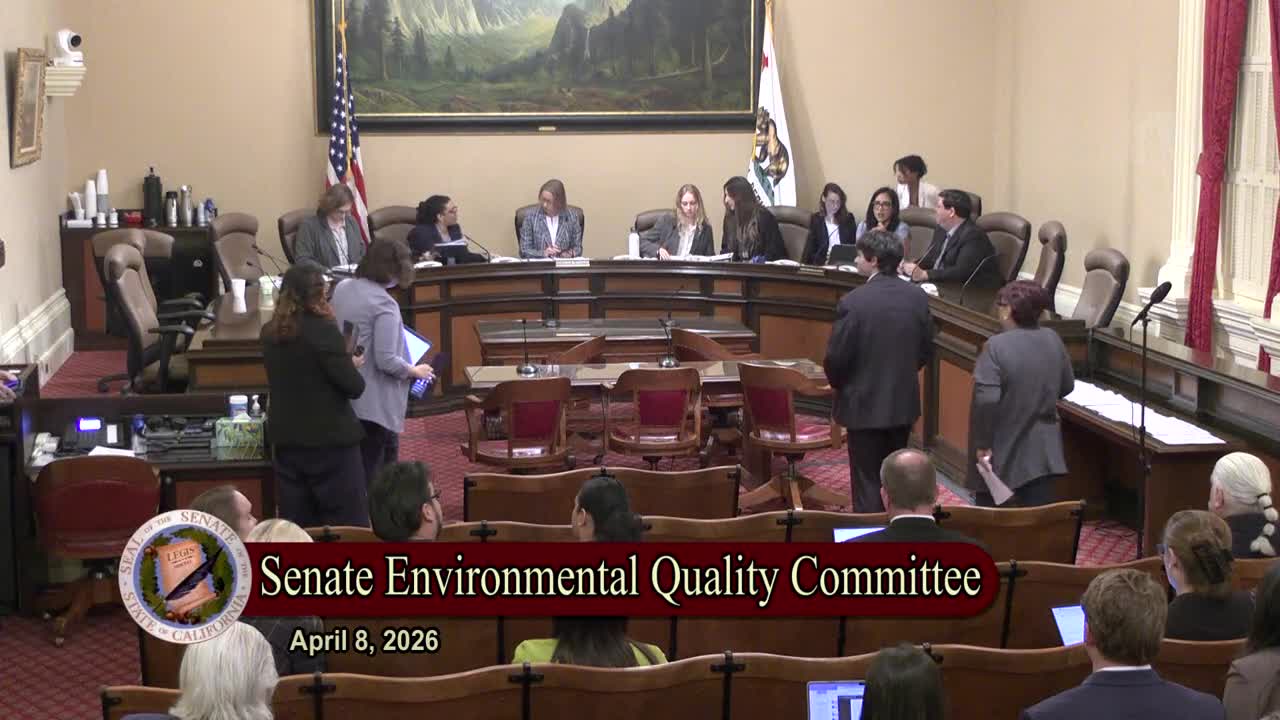
| Apr 8, 2026 | From committee: Do pass as amended and re-refer to Com. on APPR. (Ayes 6. Noes 0. Page 3792.) (April 8). |
| Apr 8, 2026 | From committee: Do pass as amended and re-refer to Com. on APPR. (Ayes 6. Noes 0.) (April 8). |
| Mar 10, 2026 | Set for hearing April 8. |
| Feb 26, 2026 | Referred to Com. on E.Q. |
| Feb 19, 2026 | From printer. May be acted upon on or after March 21. |
| Feb 18, 2026 | Introduced. Read first time. To Com. on RLS. for assignment. To print. |
|
Date
|
Description
|
Location
|
Votes
|
|
|---|---|---|---|---|
| Apr 20, 2026 | Placed on suspense file | Senate Standing Committee on Appropriations |
Passed |
|
| Apr 8, 2026 | Do pass as amended, but first amend, and re-refer to the Committee on [Appropriations] | Senate Standing Committee on Environmental Quality |
Passed |
This list shows positions taken on this bill by organizations on the date displayed, which is linked to the original source.
Positions by individuals are not included.
|
Organization
|
Position
|
Date
|
|---|---|---|
| California Apartment Association | ** Support | |
| California Council For Environmental & Economic Balance (Cceeb) | ** Support | |
| Western States Petroleum Association | ** Support |
SENATE COMMITTEE ON
Senator Sabrina Cervantes, Chair
2025 - 2026 Regular Session
SB 1161 (Valladares) - Administrative regulations: economic impact analysis and standardized regulatory impact assessments: State Air Resources Board
Version: | Policy Vote: |
Urgency: | Mandate: |
Hearing Date: | Consultant: |
Bill Summary:
This bill would require the State Air Resources Board (CARB), when proposing to adopt, amend, or repeal a regulation, to include in either the economic impact assessment, or the standardized regulatory impact assessment, a distributional analysis of the costs, benefits, and net impacts on personal income across income levels and an informative digest, as provided.
Fiscal Impact:
- Unknown but likely significant ongoing costs, estimated by CARB to likely be over $3.75 million annually for staff and contract costs to conduct the additional analysis as required by this bill as a part of each rulemaking.
Background:
CARB is subject to the same SRIA requirements as any other agency. Calculating the cost impacts of climate policy on businesses and individuals is no easy task. Not only does climate policy have a direct impact on costs through compliance costs, but there are indirect costs and benefits from the climate crisis itself. How much does one degree of warming competitively disadvantage California businesses compared to those in colder regions? How much does one degree of warming avoided decrease health costs? Despite this challenge, CARB conducts a robust socioeconomic impact analysis that includes considering how, “the effects of the regulation are distributed, for example, by industry, income, race, sex, or geography” (Title 1 of California Code of Regulations (CCR) § 2003).
As a specific example, CARB’s SRIA for 2024 amendments on Cap and Trade included all of the required analysis in GOV § 11346.3(c). Additionally, this SRIA included additional analysis on the benefits and direct costs to typical businesses, small businesses, and individuals. The estimate of direct costs to individuals assumes that businesses regulated under Cap-and-Invest (known then as Cap-and-Trade) would fully pass compliance costs onto consumers through the pricing of consumer goods. CARB estimated this cost as $90 per capita annually. Taking into account the $80 of benefits from the Greenhouse Gas Reduction Fund (GGRF), utilities revenue, and health savings, Cap-and-Invest was estimated to cost the average individual $10 per year. The 2024 SRIA also considered personal income and found negligible impact on individual income from Cap-and-Invest.
Proposed Law:
This bill would require CARB, when proposing to adopt, amend, or repeal a regulation, to include in either the economic impact assessment, or the standardized regulatory impact assessment, a distributional analysis of the costs, benefits, and net impacts on personal income across income levels and an informative digest, as provided.
Require CARB, when proposing to adopt, amend, or repeal a regulation, shall include the following in either the economic impact assessment pursuant to paragraph (1) of subdivision (b) or the standardized regulatory impact assessment pursuant to paragraph (1) of subdivision (c):
- A distributional analysis of the costs, benefits, and net impacts on personal income across income levels, including impacts on the following communities:
- Individuals making below 138 percent of the federal poverty level.
- Individuals making below the inflation-adjusted California median income, as reported by the Department of Finance.
- Individuals making below hundred thousand dollars ($100,000) annually.
- Individuals making above hundred thousand dollars ($100,000).
- Individuals in disadvantaged communities.
- An informative digest at the beginning of the economic impact assessment in the manner provided in paragraph (3) of subdivision (a) of Section 11346.5, so that the economic impacts of the proposed regulation on different income levels and disadvantaged communities can be understood by the general public. The board shall include a summary of the distributional analysis pursuant to paragraph (1) and must consider including the impact of the proposed, amended, or repealed regulation on energy, gas, and utility prices.
Related Legislation:
SB 1123 (Weiner, 2026) would require a SRIA to include “offsetting benefits, impacts, or savings that might result directly or indirectly” from the proposed, major regulation.
SB 885 (Strickland, 2026) would require the legislature to enact statute authorizing a state agency to adopt a major regulation.
SB 981 (Neillo, 2026) would require CARB to estimate the cost-of-living impacts of major regulations.
SB 1239 (Jones, 2026) would require CARB to release a supplemental SRIA if the proposed regulation undergoes material changes after the initial SRIA but before adoption.
SB 415 (Durazo, 2023) would require local air districts to perform an assessment of the socioeconomic impacts of the proposed regulations on households whose annual income is less than $100,000.
SB 474 (Niello, 2025) would revoke CARB’s rulemaking authority.
AB 1232 (Avila Farias, 2025) would require an analysis of cost-of-living impacts in the economic analyses done for non-major and major proposed regulation.
-- END --
SENATE COMMITTEE ON ENVIRONMENTAL QUALITY
Senator Blakespear, Chair
2025 - 2026 Regular
Bill No: SB 1161
Author: | Valladares | ||
Version: | 2/18/2026 | Hearing Date: | 4/8/2026 |
Urgency: | No | Fiscal: | Yes |
Consultant: | Alyssa Poletti | ||
SUBJECT: Administrative regulations: economic impact analysis: State Air Resources Board
DIGEST: This bill requires the California Air Resources Board (CARB) to release an additional economic impact assessment on costs to low- and middle-income families and disadvantaged communities for all proposed regulations. This bill would also require a joint hearing by the Legislature for any proposed regulation with cost increases beyond inflation before the regulation can be adopted.
ANALYSIS:
Existing law:
- Establishes the California Air Resources Board (CARB) as the air pollution control agency in California and requires CARB, among other things, to control emissions from a wide array of mobile sources and coordinate, encourage, and review the efforts of all levels of government as they affect air quality. (Health and Safety Code (HSC) § 39500 et seq.)
- Establishes requirements for state agency rulemaking procedures and standards through the Administrative Procedures Act of 1945 (Government Code (GOV) § 11340 et seq.) including the following:
- An informative digest in plain English in the notice of proposed adoption, amendment, or repeal of regulation, including the following:
- A concise and clear summary of existing laws and regulations;
- If the proposed regulation differs substantially from an existing, comparable federal regulation or statute;
- A policy statement overview explaining the broad objective of the regulation and specific, anticipated benefits such as the protection of public health and safety, worker safety, or the environment, the prevention of discrimination, the promotion of fairness or social equity, and the increase in openness and transparency in business and government, etc.; and
- An evaluation of whether the proposed regulation is inconsistent or incompatible with existing state regulations. (GOV § 11346.5(a)(3)).
- An updated informative digest with the Final Statement of Reasons (FSOR) (GOV § 11346.9(b)).
- An informative digest in plain English in the notice of proposed adoption, amendment, or repeal of regulation, including the following:
- Requires agencies to assess the economic impact of proposed regulations, including:
- The creation or elimination of jobs within the state;
- The creation or elimination of businesses within the state;
- The expansion of existing businesses within the state; and
- The benefits to the health and welfare of California residents, worker safety, and the environment (GOV § 11346.3(b)).
- Defines major regulation as a regulation that will have an economic impact greater than $50 million to California individuals or businesses (GOV §§ 11342.548).
- Requires agencies to prepare a Standardized Regulatory Impact Analysis (SRIA) for proposed major regulation which :
- Must be submitted to the Department of Finance (DOF) for comments, and
- Must include the following analysis in addition to GOV § 11346.3(b):
- The competitive advantages or disadvantages for businesses within the state;
- The increase or decrease of investment in the state;
- The incentives for innovation in products, materials, or processes; and
- The benefits to quality of life of California residents, among any other benefits identified by the agency (GOV § 11346.3(c)).
- Requires CARB, through AB 32 (Nunez, Chapter 488, Statutes of 2006), to adopt greenhouse gas emission limits and emission reduction measures that achieve the following:
- Minimize costs and maximize benefits to Californians;
- Not disproportionately impact low-income communities; and
- Consider the societal benefits of reduced air pollution, diversification of energy sources, and other benefits (HSC § 38562(a)).
- Minimize costs and maximize benefits to Californians;
- Not disproportionately impact low-income communities; and
- Consider the societal benefits of reduced air pollution, diversification of energy sources, and other benefits (HSC § 38562(a)).
This bill:
- Makes several findings, including that:
- CARB regulations
- Are subject to an economic impact assessment that does not include the impact on California households;
- Are projected to raise the cost of essential commodities; and
- Impose costs which disproportionately impact low income households, workers, and small businesses;
- Environmental benefits are critical; and
- This bill would ensure lawmakers and the public have a clearer understanding of the economic impact of CARB regulation without limiting CARB’s authority.
- CARB regulations
- Requires CARB to prepare an economic impact assessment that assesses whether and to what extent the adopted, amended, or repealed regulation would affect the direct and indirect costs on the following:
- Low- and middle-income California households; and
- Disadvantaged communities.
- Requires that the economic analysis shall be brief, clear, and understood by the general public.
- Requires that CARB submits the economic impact assessment to the Legislature six months before the adoption, amendment, or repeal of the regulation.
- Requires the Legislature to hold a joint hearing on the proposed regulation if the economic impact assessment projects cost impacts higher than the consumer price index.
- Precludes the proposed regulation from going into effect until after the joint hearing is held.
Background
- Administrative Procedures Act. Enacted in 1946 under the pressure of increasing government administration responsibilities, the APA provided a framework for California’s present system of regulatory rulemaking. SB 1161 amends Chapter 3.5: Administrative Regulations and Rulemaking, Article 5: Public Participation: Procedure for Adoption of Regulations (GOV § 11340 et seq.). The procedures detailed in this code section, including the length of public comment and public hearing periods and required agency assessments, apply to every state agency. The APA generally applies equally to all agencies, but there are some notable exceptions:
- AB 1706 (Eng, Chapter 771, Statutes of 2012) stipulates that CARB, the California Environmental Protection Agency (CalEPA), the California Energy Resources Conservation and Development Commission (CEC), and the Department of Motor Vehicles must consider how vehicle weight regulations impact vehicle manufacturers (GOV § 11343.3).
- AB 410 (Swanson, Chapter 495, Statutes of 2011) places additional requirements on rulemaking pertaining to disability access for agencies which engage with disability regulation, such as the Department of Housing, the Department of Healthcare Services, and the California Building Standards Commission (GOV § 11346.6).
In short, the APA typically applies to all state agencies, and narrower requirements (such as those pertaining to disability access and vehicle weights) name multiple agencies which engage in rulemaking within that issue area.
- Climate Calculus: CARB’s SRIA history. CARB is subject to the same SRIA requirements as any other agency. Calculating the cost impacts of climate policy on businesses and individuals is no easy task. Not only does climate policy have a direct impact on costs through compliance costs, but there are indirect costs and benefits from the climate crisis itself. How much does one degree of warming competitively disadvantage California businesses compared to those in colder regions? How much does one degree of warming avoided decrease health costs? Despite this challenge, CARB conducts a robust socioeconomic impact analysis that includes considering how, “the effects of the regulation are distributed, for example, by industry, income, race, sex, or geography” (Title 1 of California Code of Regulations (CCR) § 2003).
As a specific example, CARB’s SRIA for 2024 amendments on Cap and Trade included all of the required analysis in GOV § 11346.3(c). Additionally, this SRIA included additional analysis on the benefits and direct costs to typical businesses, small businesses, and individuals. The estimate of direct costs to individuals assumes that businesses regulated under Cap-and-Invest (known then as Cap-and-Trade) would fully pass compliance costs onto consumers through the pricing of consumer goods. CARB estimated this cost as $90 per capita annually. Taking into account the $80 of benefits from the Greenhouse Gas Reduction Fund (GGRF), utilities revenue, and health savings, Cap-and-Invest was estimated to cost the average individual $10 per year. The 2024 SRIA also considered personal income and found negligible impact on individual income from Cap-and-Invest.
- What is Cost-Benefit Analysis? Thoughtful policymaking is ultimately a balancing of trade-offs: who will be better off, who will be worse off, and when considered in totality, do those effects merit the proposed action? “Cost-benefit analysis” is a more formalized method for assessing the economic efficiency of proposed public policies through the systematic prediction of social costs and social benefits. In theory, comprehensively valuing effects and aggregating across all members of society yields the net social benefits of the policy. In practice, this is often easier said than done.
Despite the best efforts of economists and policymakers, these costs and benefits are typically not objective truths. In an April 2022 interview with David Roberts of the climate podcast Volts, Elizabeth Popp Berman, a professor of Organizational Studies and Sociology at the University of Michigan and the author of Thinking Like an Economist: How Efficiency Replaced Equality in U.S. Public Policy, summarized the issue thusly:
“Cost-benefit analysis sounds straightforward: you're tallying up the costs and tallying up the benefits and comparing the difference between the two. But the devil is in the details, and there's no simple way to account for costs or benefits. Any decisions that you make are going to involve many assumptions about who's being affected and what the costs of those effects are.
“It creates a bigger opportunity for people who have a stake in the game to try to ensure that their preferred methods of calculating costs and benefits are going to be the ones that are taken into account. Historically, it's often been industry interests that have had a lot of money and a lot invested in making sure that costs are very apparent and are being counted as expansively as possible.
“That can be one way that a cost-benefit analysis that's intended to be neutral can in effect tilt the playing field toward the people who have the most resources to devote to ensuring that the costs are counted and the benefits are not.”
- Challenges to Distributional Analysis. Cost-Benefit Analysis (CBA) is an effective tool to evaluate proposed regulations, but it does not capture all impacts of proposed regulations. CBA is insensitive to distributional effects. For example, the CBA for a regulation that costs and benefits everyone the same amount will look the same as a CBA in which all benefits are given to one group and all the costs are born to another, as long as the net costs are the same. Distributional analysis considers the different impacts proposed regulations have on different subgroups, such as different income levels or different geographies. Distributional analysis has the potential to provide a more holistic view of the impacts of proposed regulations. However, like CBA, distributional analysis is not free from assumptions and biases.
The Biden Administration attempted to require distributional analysis in federal regulation, requiring “a separate description of … how both the benefits and costs are distributed among sub-populations of particular concern … so that decision-makers can properly consider them along with the effects on economic efficiency”[1]. However, federal agencies struggled to implement distributional analysis meaningfully in the rulemaking process, due in part to a lack of data and sufficient guidance. Choices, such as which subgroups to consider, largely impact the final analysis and can affirm existing biases. Additionally, how should agencies ultimately decide on a regulation once this analysis is complete? With a CBA, one simply picks the regulation with the least costs and highest benefits. With a distributional analysis, the option which minimizes harm and maximizes benefits will be different for each subgroup. Therefore, an agency must be able to choose which groups, which costs, and which benefits to prioritize over others. Distributional analysis, with sufficient guidance and data, can greatly aid in equitable decision making, but care must be taken in how the analysis is approached.
Comments
- Purpose of Bill. According to the author, “California’s Air Resources Board (CARB) regulates air quality and greenhouse gas emissions in ways that affect the cost of gasoline, diesel, vehicles, energy, and other essential goods. These cost increases fall hardest on low- and middle-income households. Yet before CARB regulations take effect, the Legislature receives no plain-language, household-level cost disclosure.
“SB 1161 closes this gap. It requires CARB to prepare a concise, plain-language economic impact assessment identifying direct and indirect costs on low- and middle-income households and disadvantaged communities, and to transmit that assessment to the Legislature at least six months before any regulation takes effect. If the assessment shows costs would exceed the Consumer Price Index, the relevant legislative policy committees must hold a joint public hearing before the regulation becomes operative. SB 1161 does not limit CARB’s regulatory authority or environmental mission. It establishes a straightforward accountability mechanism so lawmakers and the public understand what CARB regulations will cost California families before they go into effect.”
- Legislative review creating regulatory delays. SB 1161 requires the legislature to hold a joint hearing on any regulatory action from CARB when the economic impact analysis or SRIA estimates a cost increase exceeding the Consumer Price Index (CPI). The CPI is a lagging measurement released by the Bureau of Labor Statistics (BLS). BLS calculates the CPI every month using price changes on consumer goods from the previous month. Therefore, it is impossible to compare future cost increases from regulation to a CPI which has not yet been calculated.
More importantly, the legislative review required by SB 1161 is incompatible with the APA. The APA places specific public comment periods (45 days) and deadlines for rulemaking. Rulemaking that occurs when the Legislature is not in session would not only be delayed several months but would be forced to miss key deadlines. Even during the legislative session, potentially-redundant review of regulations would compete for limited legislative resources including staff time and hearing space.
It is the Legislature’s prerogative to exercise oversight authority of regulatory agencies. No further statutory authority is required to hold hearings whenever a policy committee deems necessary. Although existing law does not create an additional procedural hurdle before adopting regulations, it does enable the Legislature to review and engage with regulatory agencies. Given the Legislature’s existing authorities and the added bureaucracy of requiring hearings for every regulation, the committee may wish to consider striking 11346.3(d)(3).
- The Plain Language Summary. SB 1116 requires a “brief and clear” economic analysis that can be “understood by the general public.” However, the economic analysis required by SB 1161 is inherently technical. SB 1161 calls for a distributional analysis over income levels and geographies for any impact on “family budgets.” A distributive analysis which meaningfully captures how a regulation impacts several different subgroups is intrinsically, analytically complex.
That being said, there is certainly value in ensuring the public is informed about pending regulations. This is why the APA already requires a separate informative digest and updated informative digest in the notice of proposed regulation and the Final Statement of Reasons. Rather than requiring the entire economic analysis be written in plain English, the committee may wish to consider amending 11346.3(d)(2) to require an informative digest to be prepared alongside the economic impact analysis or SRIA. This will enable one document to provide the necessary technical assessment, and another document to serve as a generally-understandable summary, rather than a single report which may struggle to fulfill both roles. - A Tale of Two Crises: Climate and Affordability. Both the climate crisis and the affordability crisis have real and detrimental impacts on Californians. Therin lies a difficult question: how does one weigh the cost of the climate crisis with the impact on everyday costs to California residents?
It is important to note that costs due to the transition to clean energy and decarbonization are not the only, nor the largest, contributor to the affordability crisis. There are several contributors to the affordability crisis including: lagging wages in the face of high inflation,[2] a lack of affordable housing,[3],[4] and a disrupted supply chain.[5] If climate mitigation is not the primary contributor to the affordability crisis, can it still exacerbate it? Yes. There is no doubt a cost to climate mitigation. Public dollars are spent to incentivize green energy projects. Both CARB and independent researchers have estimated that the Low Carbon Fuel Standard (LCFS) costs consumers approximately 8 to 20 cents per gallon.[6],[7]
Additionally, the costs and benefits of climate mitigation are not felt evenly. Many of the costs of climate policies are regressive, such as the gas tax. Increases to gas prices impacts those who drive the furthest, cannot afford electric vehicles, and those who pay a higher portion of their income to transportation costs – predominantly working-class individuals. Contrastingly, benefits from mitigating climate change are hugely progressive. Working class Californians are far more likely to live in highly polluted regions (near the oil and gas industry or by highways) or be exposed to extreme heat (through work in agriculture or being unable to afford air conditioning).[8],[9],[10] Combatting climate change largely benefits those currently experiencing the worst of air pollution and extreme heat, especially communities which are dependent upon fossil fuels. Distributional analysis can be a great tool for lawmakers and regulators who want to create climate policy which offsets regressive costs and maximizes progressive benefits.
- The Path to Equitable Climate Policy. While cost-benefit analysis can tell us if a regulation provides the highest return on tax dollars spent, distributional analysis on climate regulation can tell us whether or not we are furthering an equitable transition.
At its core, SB 1161 is asking for a distributional analysis over income and geographies. This is a laudable effort, and such an analysis could further environmental justice goals by informing the Board on whether a regulation benefits those most in need while minimizing costs to vulnerable populations. In fact, CARB has performed a distributional analysis previously. As part of the comprehensive Scoping Plan Update process, last completed in December of 2022, CARB considered the income impacts by California household income group in 2035 and 2045 under the modeled scenario.[11] The Scoping Plan Update found:
“While in 2035... total income for households that make less than $100,000 per year is estimated to decline by $4.1 billion dollars, and the total income for households that make more than $100,000 per year will increase by $3.5 billion under the Scoping Plan Scenario. ... Because more than 60% of households in the race/ethnicity categories of Hispanic, Black alone, Native Hawaiian (HI) or Pacific Islander, American Indian or Alaskan Native, Other, and Two or More make less than $100,000 per year, these populations generally are likely to experience reduced income.”
Simply put, under the proposed scenario to achieve the state’s climate goals, the rich get richer, and the poor get poorer. In response to the 2022 Scoping Plan distributional analysis, lawmakers could make informed decisions on policies meant to offset regressive costs such as utilizing the Greenhouse Gas Reduction Fund.
However, more recent SRIAs from CARB (such as the 2024 Cap-and-Trade Amendments SRIA) do not include the same breakdown of costs and benefits at different income levels. While the Legislature should provide the technical experts at CARB reasonable discretion, elected officials deserve the information to make rational and equitable policy decisions. The distributional analysis in the 2022 Scoping Plan is an example of the necessary information that lawmakers need. Lawmakers should encourage the Board to continue providing distributional analysis.
SB 1161 could be a step forward on equitable climate policy. However, while the bill language alludes to a distributional analysis, it does not specifically call for one. In specific, the bill language requests “an economic impact assessment that assesses whether and to what extent it will affect low- and middle- income California households and disadvantaged communities that includes direct and indirect impacts on family budgets.” In contrast to the distributional analysis done in the 2022 Scoping Plan (which looked at impacts to household income), “impacts on family budgets” may refer to a more granular analysis on transportation, food, and housing costs. CARB has not previously done such an analysis; therefore, SB 1161’s new economic impact assessment requirements could be unclear and potentially burdensome.
Additionally, SB 1161 seeks to compare the impacts on family budgets to the CPI to determine whether a joint hearing should take place. Unfortunately, not only is the CPI a lagging measurement (meaning, it evaluates past data) and thus incomparable to future economic monitoring, but economic modelling is by no means a crystal ball. It is a tall, if not impossible, order to implement an economic model which predicts the magnitude and timing of price increases on specific consumer goods with enough precision to be compared to the CPI.
The author’s intent is to help CARB, the Legislature, and everyday Californians make better-informed decisions with more robust analysis. The committee may wish to advance this goal while minimizing unclear mandates and procedural hurdles. Therefore, a distributional analysis is a more feasible method to determine disparate impacts on households, while maintaining the intent of SB 1161. The committee may wish to consider amending 11346.3(d)(1) and (2) to strike “family budgets” and require distributional analysis across income levels and disadvantaged communities.
- Committee Amendments. Staff recommends the committee adopt the amendments bolded in comments 2, 3, and 5 above and additional technical amendments to the findings and declarations.
Related/Prior Legislation
SB 1123 (Weiner, 2026) would require a SRIA to include “offsetting benefits, impacts, or savings that might result directly or indirectly” from the proposed, major regulation. This bill was referred to the Governmental Organization Committee.
SB 885 (Strickland, 2026) would require the legislature to enact statute authorizing a state agency to adopt a major regulation. This bill was referred to the Governmental Organization Committee.
SB 981 (Neillo, 2026) would require CARB to estimate the cost-of-living impacts of major regulations. This bill failed passage in the Environmental Quality Committee on March 18th, 2026.
SB 1239 (Jones, 2026) would require CARB to release a supplemental SRIA if the proposed regulation undergoes material changes after the initial SRIA but before adoption. This bill has been referred to this committee.
SB 415 (Durazo, 2023) would require local air districts to perform an assessment of the socioeconomic impacts of the proposed regulations on households whose annual income is less than $100,000. This bill was held on suspense.
SB 474 (Niello, 2025) would revoke CARB’s rulemaking authority. This bill died in the Environmental Quality Committee.
AB 1232 (Avila Farias, 2025) would require an analysis of cost-of-living impacts in the economic analyses done for non-major and major proposed regulation. This bill was held on suspense.
SOURCE:
Author
SUPPORT:
California Apartment Association
California Council for Environmental & Economic Balance (CCEEB)
Western States Petroleum Association
OPPOSITION:
None received
-- END --
https://equitablegrowth.org/proposed-update-to-federal-cost-benefit-analysis-guidelines-correctly-focuses-on-accounting-for-inequality-in-regulations/ ↑
Goldman, D. (2025) The No. 1 cause of America’s affordability problem just got worse, CNN. https://www.cnn.com/2025/12/16/economy/affordability-wage-growth-inflation ↑
California Budget and Policy Center (2019) California’s Housing Affordability Crisis. https://calbudgetcenter.org/resources/californias-housing-affordability-crisis/ ↑
Christopher, B. & Tobias, M. (2024) Californians: Here’s why your housing costs are so high, CalMatters. https://calmatters.org/explainers/california-housing-costs-explainer/ ↑
Obando, S. (2025) 5 years after COVID hit, contractors still wait for prices to come down, Construction Dive. https://www.constructiondive.com/news/covid-impact-construction-prices-materials/742087/ ↑
CARB (2024) Myth vs. Fact: Low Carbon Fuel Standard (LCFS). https://ww2.arb.ca.gov/our-work/programs/low-carbon-fuel-standard/lcfs-faq-and-factsheets ↑
Cullenward, D. (2025) Tracking Gasoline Price Impacts in California: Part 1, Kleinman Center for Energy Policy. https://kleinmanenergy.upenn.edu/commentary/blog/tracking-gasoline-price-impacts-in-california-part-1/ ↑
Gross, L. (2024) California Slashed Harmful Vehicle Emissions, but People of Color and Overburdened Communities Continue to Breathe the Worst Air, Inside Climate News. https://insideclimatenews.org/news/11092024/california-vehicle-emissions-exposure-disparity/ ↑
Velarde-Reyes, A & Momin, A. (2024) More extreme heat + more people = danger in these California cities. ‘Will it get as hot as Death Valley?’, CalMatters. https://calmatters.org/environment/climate-change/2024/09/california-extreme-heat-population-growth-inland-communities/ ↑
Kuang, J. (2024) Californians say they were fired for leaving their jobs in sweltering heat. Is the state on their side?, CalMatters. https://calmatters.org/california-divide/2024/08/california-farmworkers-heat-illness/ ↑
CARB (2022) Final 2022 Scoping Plan Update and Appendices.
https://ww2.arb.ca.gov/our-work/programs/ab-32-climate-change-scoping-plan/2022-scoping-plan-documents ↑
Discussed in Hearing
 7MIN