SB 1195: Tied-house exceptions: advertising: Counties of Los Angeles, San Bernardino, and San Diego.
- Session Year: 2025-2026
- House: Senate
- Latest Version Date: 2026-09-14
Current Status:
Passed
(2026-09-14: Chaptered by Secretary of State. Chapter 229, Statutes of 2026.)
Introduced
In Committee
Awaiting First Chamber Vote
Passed First Chamber
In Committee
Awaiting Second Chamber Vote
Passed Second Chamber
Enacted
What does this bill do?
The bill expands where beer, wine, and spirits makers and their agents may buy advertising space or time from owners, managers, or major tenants of many large venues to now include additional facilities in Los Angeles, San Bernardino, and San Diego counties. It also forbids venue retailers from soliciting, and suppliers from agreeing to, contracts that require prioritizing, promoting, or excluding specific alcoholic beverage brands, and makes violations subject to criminal penalties and possible license revocation.
The summary is provided by generative AI which can make mistakes. For original language, please view the details in the table below.
Existing law, the Alcoholic Beverage Control Act, which is administered by the Department of Alcoholic Beverage Control, regulates the application, issuance, and suspension of alcoholic beverage licenses. Existing law, known as tied-house restrictions, generally prohibits specified licensees, or their officers, directors, or agents, from giving or lending money or a thing of value to a person operating, owning, or maintaining any on-sale premises where alcoholic beverages are sold. In this regard, existing law specifically prohibits paying a retailer for advertising. Existing law creates a variety of exceptions to this prohibition, including permitting specified licensees to purchase advertising space and time from, or on behalf of, an on-sale retail licensee that is an owner, manager, agent or assignee of the owner, or major tenant of certain venues, subject to specified conditions. Existing law requires the purchase of advertising space or time, in this context, to be conducted pursuant to a written contract. In this context, existing law makes certain acts of coercion crimes, including when an on-sale licensee coerces other specified licensees to purchase advertising space or time.
This bill would expand the above-described exception to tied-house restrictions that allows for the purchase of advertising by applying it to various facilities that are located in the Counties of Los Angeles, San Bernardino, and San Diego, as specified. By expanding the definition of a crime, this bill would impose a state-mandated local program. The bill would prohibit an on-sale licensee from soliciting a beer manufacturer, holder of a winegrowers license, a rectifier, a craft distiller, a distilled spirits manufacturer, or distilled spirits manufacturers agent to enter into an agreement, as specified, that, among other things, includes a provision requiring, among other things, the prioritization of the sale or promotion of a specific alcoholic beverage product or brand. The bill would also prohibit a beer manufacturer, holder of a winegrowers license, a rectifier, a craft distiller, a distilled spirits manufacturer, or distilled spirits manufacturers agent from entering into a contract or agreement, as specified, that requires the on-sale retail licensee to, among other things, prioritize the sale or promotion of a specific alcoholic beverage product or brand.
This bill would make legislative findings and declarations as to the necessity of a special statute for the Counties of Los Angeles, San Bernardino, and San Diego.
The California Constitution requires the state to reimburse local agencies and school districts for certain costs mandated by the state. Statutory provisions establish procedures for making that reimbursement.
This bill would provide that no reimbursement is required by this act for a specified reason.
Existing law, the Alcoholic Beverage Control Act, which is administered by the Department of Alcoholic Beverage Control, regulates the application, issuance, and suspension of alcoholic beverage licenses. Existing law, known as tied-house restrictions, generally prohibits specified licensees, or their officers, directors, or agents, from giving or lending money or a thing of value to a person operating, owning, or maintaining any on-sale premises where alcoholic beverages are sold. In this regard, existing law specifically prohibits paying a retailer for advertising. Existing law creates a variety of exceptions to this prohibition, including permitting specified licensees to purchase advertising space and time from, or on behalf of, an on-sale retail licensee that is an owner, manager, agent or assignee of the owner, or major tenant of certain venues, subject to specified conditions. Existing law requires the purchase of advertising space or time, in this context, to be conducted pursuant to a written contract. In this context, existing law makes certain acts of coercion crimes, including when an on-sale licensee coerces other specified licensees to purchase advertising space or time.
This bill would expand the above-described exception to tied-house restrictions that allows for the purchase of advertising by applying it to various facilities that are located in the Counties of Los Angeles, San Bernardino, and San Diego, as specified. By expanding the definition of a crime, this bill would impose a state-mandated local program.
This bill would make legislative findings and declarations as to the necessity of a special statute for the Counties of Los Angeles, San Bernardino, and San Diego.
The California Constitution requires the state to reimburse local agencies and school districts for certain costs mandated by the state. Statutory provisions establish procedures for making that reimbursement.
This bill would provide that no reimbursement is required by this act for a specified reason.
The Horse Racing Law establishes the California Horse Racing Board and requires the board, among other things, to maintain a general office for the transaction of its business in the City of Sacramento, to maintain a public record of every vote at the general office, and to post the record of its vote on its internet website.This bill would require the board to post the record of its vote on its internet website no later than the close of business of the 2nd business day after the meeting at which the vote was taken.The Horse Racing Law establishes the California Horse Racing Board and requires the board, among other things, to maintain a general office for the transaction of its business in the City of Sacramento, to maintain a public record of every vote at the general office, and to post the record of its vote on its internet website.
This bill would require the board to post the record of its vote on its internet website no later than the close of business of the 2nd business day after the meeting at which the vote was taken.
(a)Notwithstanding any other provision of this chapter, a beer manufacturer, the holder of a winegrowers license, a rectifier, a craft distiller, a distilled spirits manufacturer, or distilled spirits manufacturers agent may purchase advertising space and time from, or on behalf of, an on-sale retail licensee subject to all of the following conditions:
(1)The on-sale licensee is the owner, manager, agent of the owner, assignee of the owners advertising rights, or the major tenant of the owner of any of the following:
(A)An outdoor stadium or a fully enclosed arena with a fixed seating capacity in excess of 10,000 seats located in the County of Sacramento or the County of Alameda.
(B)(i)A fully enclosed arena with a fixed seating capacity in excess of 18,000 seats located in the County of Los Angeles.
(ii)An outdoor stadium of at least 70,000 seats located in the County of Los Angeles operated by a joint powers authority.
(C)An outdoor stadium or fully enclosed arena with a fixed seating capacity in excess of 8,500 seats located in the County of Kern.
(D)An exposition park of not less than 50 acres that includes an outdoor stadium with a fixed seating capacity in excess of 8,000 seats and a fully enclosed arena with an attendance capacity in excess of 4,500 people, located in the County of San Bernardino.
(E)An outdoor stadium with a fixed seating capacity in excess of 10,000 seats located in the County of Yolo.
(F)An outdoor stadium and a fully enclosed arena with fixed seating capacities in excess of 10,000 seats located in the County of Fresno.
(G)An athletic and entertainment complex of not less than 50 acres that includes within its boundaries an outdoor stadium with a fixed seating capacity of at least 8,000 seats and a second outdoor stadium with a fixed seating capacity of at least 3,500 seats located in the County of Riverside.
(H)An outdoor stadium with a fixed seating capacity in excess of 1,500 seats located in the County of Tulare.
(I)A motorsports entertainment complex of not less than 50 acres that includes within its boundaries an outdoor speedway with a fixed seating capacity of at least 25,000 seats, located in the County of San Bernardino.
(J)An exposition park, owned or operated by a bona fide nonprofit organization, of not less than 400 acres with facilities including a grandstand with a seating capacity of at least 8,000 people, at least one exhibition hall greater than 100,000 square feet, and at least four exhibition halls, each greater than 30,000 square feet, located in the City of Pomona or the City of La Verne in the County of Los Angeles.
(K)An outdoor soccer stadium with a fixed seating capacity of at least 25,000 seats, an outdoor tennis stadium with a fixed seating capacity of at least 7,000 seats, an outdoor track and field facility with a fixed seating capacity of at least 7,000 seats, and an indoor velodrome with a fixed seating capacity of at least 2,000 seats, all located within a sports and athletic complex built before January 1, 2005, in the City of Carson in the County of Los Angeles.
(L)An outdoor professional sports facility with a fixed seating capacity of at least 4,200 seats located in the County of San Joaquin.
(M)A fully enclosed arena with a fixed seating capacity in excess of 13,000 seats located in the City of Inglewood.
(N)(i)An outdoor stadium with a fixed seating capacity of at least 68,000 seats located in the City of Santa Clara.
(ii)A beer manufacturer, the holder of a winegrowers license, a rectifier, a craft distiller, a distilled spirits manufacturer, or distilled spirits manufacturers agent may purchase advertising space and time from, or on behalf of, a major tenant of an outdoor stadium described in clause (i), provided the major tenant does not hold a retail license, and the advertising may include the placement of advertising in an on-sale licensed premises operated at the outdoor stadium.
(O)A complex of not more than 50 acres located on the campus of, and owned by, California State University, Sonoma dedicated to presenting live artistic, musical, sports, food, beverage, culinary, lifestyle, or other cultural and entertainment events and performances with venues that include a concert hall with a seating capacity of approximately 1,500 seats, a second concert hall with a seating capacity of up to 300 seats, an outdoor area with a seating capacity of up to 5,000 seats, and a further outdoor area with a seating capacity of up to 10,000 seats. With respect to this complex, advertising space and time may also be purchased from or on behalf of the owner of the complex, a long-term tenant or licensee of the venue, whether or not the owner, long-term tenant, or licensee holds an on-sale license.
(P)A fairgrounds with a horse racetrack and equestrian and sports facilities located in the County of San Diego.
(Q)(i)A stadium with a fixed seating capacity of at least 70,000 seats located in the City of Inglewood and a performance venue with a seating capacity of at least 5,000 seats adjacent to the stadium. Advertising authorized by this clause may be placed in areas within the retail, entertainment, commercial, and mixed-use development which includes the stadium and performance venue, provided that the advertising shall not be placed on or in, or otherwise promote, any permanently licensed retail premises other than the stadium or performance venue.
(ii)A fully enclosed arena with a seating capacity of at least 18,000 seats located in the City of Inglewood. Advertising authorized by this clause may be placed on or in the fully enclosed arena and within the perimeter of the main entry area immediately adjacent to the arena, which includes an open plaza and band shell, provided that the advertising shall not be placed on or in, or otherwise promote, any permanently licensed retail premises other than the fully enclosed arena or a permanently licensed retail premises located within the main entry area that is wholly owned by and operated by or for the owner of the arena.
(R)An outdoor stadium with a fixed seating capacity of at least 40,000 seats located in the City and County of San Francisco.
(S)An indoor arena with a fixed seating capacity of at least 13,000 seats located in the City and County of San Francisco.
(T)An outdoor stadium with a fixed seating capacity in excess of 20,000 seats located in the City of Los Angeles.
(U)An outdoor stadium with a fixed seating capacity of at least 43,000 seats located in the City of San Diego.
(V)An outdoor professional sports stadium with a fixed seating capacity of at least 3,000 seats located in the City of San Jose.
(W)An outdoor professional sports stadium with a fixed seating capacity of at least 15,000 seats located in the City of San Jose.
(X)A fully enclosed arena with a fixed seating capacity in excess of 4,000 seats located in the City of San Jose.
(Y)A fully enclosed arena with a fixed seating capacity in excess of 10,000 seats located in the County of Riverside.
(Z)Any of the following facilities that are situated on the campus of California State University, San Diego (SDSU), including the SDSU Mission Valley site, located in the County of San Diego.
(i)An outdoor multipurpose stadium with a fixed seating capacity of at least 30,000 seats.
(ii)A fully enclosed arena with a fixed seating capacity in excess of 10,000 seats.
(iii)An outdoor baseball stadium with a fixed seating capacity of at least 1,800 seats.
(iv)An outdoor softball stadium with a fixed seating capacity of at least 300 seats.
(v)An open-air amphitheater with a fixed seating capacity of at least 4,000 seats.
(AA)Any of the following facilities that are situated on the campus of California Polytechnic State University, San Luis Obispo, located in the County of San Luis Obispo:
(i)An outdoor stadium with a fixed seating capacity of at least 11,000 seats.
(ii)A fully enclosed arena with a fixed seating capacity of at least 3,000 seats.
(iii)An outdoor stadium with a fixed seating capacity of at least 3,000 seats.
(iv)An outdoor stadium with a fixed seating capacity of at least 800 seats.
(v)An indoor performing arts venue with two concert halls and a theater with a combined fixed seating capacity of at least 1,800 seats.
(AB)Any of the following facilities that are situated on the campus of California State University, Fresno, located in the County of Fresno:
(i)An outdoor stadium with a fixed seating capacity of at least 40,000 seats.
(ii)An outdoor stadium with a fixed seating capacity of at least 5,000 seats.
(iii)An outdoor stadium with a fixed seating capacity of at least 2,400 seats.
(iv)An outdoor stadium with a fixed seating capacity of at least 2,000 seats.
(AC)Any of the following facilities that are situated on the campus of California State University, Sacramento, located in the County of Sacramento:
(i)An outdoor stadium with a fixed seating capacity of at least 20,000 seats.
(ii)A fully enclosed arena with a fixed seating capacity of at least 1,000 seats.
(iii)An outdoor stadium with a fixed seating capacity of at least 1,200 seats.
(iv)An outdoor stadium with a fixed seating capacity of at least 800 seats.
(v)An outdoor stadium with a fixed seating capacity of at least 1,000 seats.
(AD)An outdoor stadium with a fixed seating capacity of at least 6,000 seats that is situated on the campus of California State University, Monterey Bay, located in the County of Monterey.
(AE)Any of the following facilities that are situated on the campus of California State University, Fullerton, located in the County of Orange:
(i)A fully enclosed arena with a fixed seating capacity of at least 4,000 seats.
(ii)An outdoor stadium with a fixed seating capacity of at least 3,500 seats.
(iii)An outdoor stadium with a fixed seating capacity of at least 1,000 seats.
(iv)An outdoor stadium with a fixed seating capacity of at least 10,000 seats.
(AF)Any of the following facilities that are situated on the campus of California State University, San Jose, located in the County of Santa Clara:
(i)An outdoor stadium with a fixed seating capacity of at least 17,000 seats.
(ii)A fully enclosed arena with a fixed seating capacity of at least 5,000 seats.
(AG)Any of the following facilities that are situated on the campus of California State University, Northridge, located in the County of Los Angeles:
(i)An indoor performing arts center with a fixed seating capacity of at least 1,700 seats.
(ii)A fully enclosed arena with a fixed seating capacity of at least 2,000 seats.
(AH)Any of the following facilities that are situated on the campus of St. Marys College of California, located in the County of Contra Costa:
(i)A fully enclosed arena with a fixed seating capacity in excess of 3,500 seats located in the Town of Moraga.
(ii)An outdoor stadium with a fixed seating capacity of at least 5,500 seats located in the Town of Moraga.
(iii)An outdoor stadium with a fixed seating capacity of at least 650 seats located in the Town of Moraga.
(AI)A fully enclosed arena with a fixed seating capacity in excess of 5,000 seats located in the City of Oceanside.
(AJ)An indoor convention center complex and arena that is at least 390,000 square feet and used for conventions, trade shows, concerts, and sporting events located in the City of Long Beach in the County of Los Angeles.
(AK)An outdoor amphitheater, which is at least 9,500 seats, that is used for live performances and owned by the City of Long Beach located in the City of Long Beach in the County of Los Angeles.
(AL)An indoor arena with at least 15,000 seats that is used for concerts, sporting events, and other shows located in the Midway District neighborhood of the City of San Diego in the County of San Diego.
(AM)An arena with at least 10,000 seats that is used for concerts, other shows, and sporting competitions, including an ice hockey league and soccer league located in the City of Ontario in the County of San Bernardino.
(2)The outdoor stadium or fully enclosed arena described in paragraph (1) is not owned by a community college district.
(3)The advertising space or time is purchased only in connection with the events to be held on the premises of the exposition park, stadium, or arena owned by the on-sale licensee. With respect to an exposition park as described in subparagraph (J) of paragraph (1) that includes at least one hotel, the advertising space or time shall not be displayed on or in any hotel located in the exposition park, or purchased in connection with the operation of any hotel located in the exposition park. With respect to the complex described in subparagraph (O) of paragraph (1), the advertising space or time shall be purchased only in connection with live artistic, musical, sports, food, beverage, culinary, lifestyle, or other cultural and entertainment events and performances to be held on the premises of the complex. With respect to a fully enclosed arena described in subparagraph (X) of paragraph (1), advertising space or time shall be purchased only for interior advertising in connection with events conducted within the arena.
(4)The on-sale licensee serves other brands of beer distributed by a competing beer wholesaler in addition to the brand manufactured or marketed by the beer manufacturer, other brands of wine distributed by a competing wine wholesaler in addition to the brand produced by the winegrower, and other brands of distilled spirits distributed by a competing distilled spirits wholesaler in addition to the brand manufactured or marketed by the rectifier, the craft distiller, the distilled spirits manufacturer, or the distilled spirits manufacturers agent that purchased the advertising space or time.
(b)Any purchase of advertising space or time pursuant to subdivision (a) shall be conducted pursuant to a written contract entered into by the beer manufacturer, the holder of the winegrowers license, the rectifier, the craft distiller, the distilled spirits manufacturer, or the distilled spirits manufacturers agent and any of the following:
(1)The on-sale licensee.
(2)With respect to clause (ii) of subparagraph (N) of paragraph (1) of subdivision (a), the major tenant of the outdoor stadium.
(3)With respect to subparagraphs (O), (Q), (R), (T), (Y), (Z), (AA), (AB), (AC), (AD), (AE), (AF), (AG), (AH), and (AI) of paragraph (1) of subdivision (a), the owner, a long-term tenant of the complex, or licensee of the complex, whether or not the owner, long-term tenant, or licensee holds an on-sale license.
(c)Any beer manufacturer or holder of a winegrowers license, any rectifier, any craft distiller, any distilled spirits manufacturer, or any distilled spirits manufacturers agent who, through coercion or other illegal means, induces, directly or indirectly, a holder of a wholesalers license to fulfill all or part of those contractual obligations entered into pursuant to subdivision (a) or (b) shall be guilty of a misdemeanor and shall be punished by imprisonment in the county jail not exceeding six months, or by a fine in an amount equal to the entire value of the advertising space, time, or costs involved in the contract, whichever is greater, plus ten thousand dollars ($10,000), or by both imprisonment and fine. The person shall also be subject to license revocation pursuant to Section 24200.
(d)Any on-sale retail licensee, as described in subdivision (a), who, directly or indirectly, solicits or coerces a holder of a wholesalers license to solicit a beer manufacturer, a holder of a winegrowers license, a rectifier, a craft distiller, a distilled spirits manufacturer, or a distilled spirits manufacturers agent to purchase advertising space or time pursuant to subdivision (a) or (b) shall be guilty of a misdemeanor and shall be punished by imprisonment in the county jail not exceeding six months, or by a fine in an amount equal to the entire value of the advertising space or time involved in the contract, whichever is greater, plus ten thousand dollars ($10,000), or by both imprisonment and fine. The person shall also be subject to license revocation pursuant to Section 24200.
(e)An on-sale licensee specified in this section shall not solicit a beer manufacturer, holder of a winegrowers license, a rectifier, a craft distiller, a distilled spirits manufacturer, or distilled spirits manufacturers agent to enter into an agreement otherwise authorized by this section for the purpose of, or that includes a provision requiring, directly or indirectly, the purchase, sale, or prioritization of the sale or promotion of a specific alcoholic beverage product or brand, or to displace, remove, or exclude a competing alcoholic beverage product or brand.
(f)A beer manufacturer, holder of a winegrowers license, a rectifier, a craft distiller, a distilled spirits manufacturer, or distilled spirits manufacturers agent shall not enter into a contract or agreement authorized by this section that requires, directly or indirectly, that the on-sale retail licensee purchase, sell, or prioritize the sale or promotion of a specific alcoholic beverage product or brand, or to displace, remove, or exclude a competing alcoholic beverage product or brand.
(g)For the purposes of this section, beer manufacturer includes any holder of a beer manufacturers license, any holder of an out-of-state beer manufacturers certificate, or any holder of a beer and wine importers general license.
(h)The Legislature finds that it is necessary and proper to require a separation among manufacturing interests, wholesale interests, and retail interests in the production and distribution of alcoholic beverages in order to prevent suppliers from dominating local markets through vertical integration and to prevent excessive sales of alcoholic beverages produced by overly aggressive marketing techniques. The Legislature further finds that the exceptions established by this section to the general prohibition against tied interests shall be limited to their express terms so as not to undermine the general prohibition and intends that this section be construed accordingly.
SEC. 2.The Legislature finds and declares that a special statute is necessary and that a general statute cannot be made applicable within the meaning of Section 16 of Article IV of the California Constitution because of the unique conditions found at the locations described in this bill.
SEC. 3.No reimbursement is required by this act pursuant to Section 6 of Article XIIIB of the California Constitution because the only costs that may be incurred by a local agency or school district will be incurred because this act creates a new crime or infraction, eliminates a crime or infraction, or changes the penalty for a crime or infraction, within the meaning of Section 17556 of the Government Code, or changes the definition of a crime within the meaning of Section 6 of Article XIIIB of the California Constitution.
(a)Notwithstanding any other provision of this chapter, a beer manufacturer, the holder of a winegrowers license, a rectifier, a craft distiller, a distilled spirits manufacturer, or distilled spirits manufacturers agent may purchase advertising space and time from, or on behalf of, an on-sale retail licensee subject to all of the following conditions:
(1)The on-sale licensee is the owner, manager, agent of the owner, assignee of the owners advertising rights, or the major tenant of the owner of any of the following:
(A)An outdoor stadium or a fully enclosed arena with a fixed seating capacity in excess of 10,000 seats located in the County of Sacramento or the County of Alameda.
(B)(i)A fully enclosed arena with a fixed seating capacity in excess of 18,000 seats located in the County of Los Angeles.
(ii)An outdoor stadium of at least 70,000 seats located in the County of Los Angeles operated by a joint powers authority.
(C)An outdoor stadium or fully enclosed arena with a fixed seating capacity in excess of 8,500 seats located in the County of Kern.
(D)An exposition park of not less than 50 acres that includes an outdoor stadium with a fixed seating capacity in excess of 8,000 seats and a fully enclosed arena with an attendance capacity in excess of 4,500 people, located in the County of San Bernardino.
(E)An outdoor stadium with a fixed seating capacity in excess of 10,000 seats located in the County of Yolo.
(F)An outdoor stadium and a fully enclosed arena with fixed seating capacities in excess of 10,000 seats located in the County of Fresno.
(G)An athletic and entertainment complex of not less than 50 acres that includes within its boundaries an outdoor stadium with a fixed seating capacity of at least 8,000 seats and a second outdoor stadium with a fixed seating capacity of at least 3,500 seats located in the County of Riverside.
(H)An outdoor stadium with a fixed seating capacity in excess of 1,500 seats located in the County of Tulare.
(I)A motorsports entertainment complex of not less than 50 acres that includes within its boundaries an outdoor speedway with a fixed seating capacity of at least 25,000 seats, located in the County of San Bernardino.
(J)An exposition park, owned or operated by a bona fide nonprofit organization, of not less than 400 acres with facilities including a grandstand with a seating capacity of at least 8,000 people, at least one exhibition hall greater than 100,000 square feet, and at least four exhibition halls, each greater than 30,000 square feet, located in the City of Pomona or the City of La Verne in the County of Los Angeles.
(K)An outdoor soccer stadium with a fixed seating capacity of at least 25,000 seats, an outdoor tennis stadium with a fixed seating capacity of at least 7,000 seats, an outdoor track and field facility with a fixed seating capacity of at least 7,000 seats, and an indoor velodrome with a fixed seating capacity of at least 2,000 seats, all located within a sports and athletic complex built before January 1, 2005, in the City of Carson in the County of Los Angeles.
(L)An outdoor professional sports facility with a fixed seating capacity of at least 4,200 seats located in the County of San Joaquin.
(M)A fully enclosed arena with a fixed seating capacity in excess of 13,000 seats located in the City of Inglewood.
(N)(i)An outdoor stadium with a fixed seating capacity of at least 68,000 seats located in the City of Santa Clara.
(ii)A beer manufacturer, the holder of a winegrowers license, a rectifier, a craft distiller, a distilled spirits manufacturer, or distilled spirits manufacturers agent may purchase advertising space and time from, or on behalf of, a major tenant of an outdoor stadium described in clause (i), provided the major tenant does not hold a retail license, and the advertising may include the placement of advertising in an on-sale licensed premises operated at the outdoor stadium.
(O)A complex of not more than 50 acres located on the campus of, and owned by, California State University, Sonoma dedicated to presenting live artistic, musical, sports, food, beverage, culinary, lifestyle, or other cultural and entertainment events and performances with venues that include a concert hall with a seating capacity of approximately 1,500 seats, a second concert hall with a seating capacity of up to 300 seats, an outdoor area with a seating capacity of up to 5,000 seats, and a further outdoor area with a seating capacity of up to 10,000 seats. With respect to this complex, advertising space and time may also be purchased from or on behalf of the owner of the complex, a long-term tenant or licensee of the venue, whether or not the owner, long-term tenant, or licensee holds an on-sale license.
(P)A fairgrounds with a horse racetrack and equestrian and sports facilities located in the County of San Diego.
(Q)(i)A stadium with a fixed seating capacity of at least 70,000 seats located in the City of Inglewood and a performance venue with a seating capacity of at least 5,000 seats adjacent to the stadium. Advertising authorized by this clause may be placed in areas within the retail, entertainment, commercial, and mixed-use development which includes the stadium and performance venue, provided that the advertising shall not be placed on or in, or otherwise promote, any permanently licensed retail premises other than the stadium or performance venue.
(ii)A fully enclosed arena with a seating capacity of at least 18,000 seats located in the City of Inglewood. Advertising authorized by this clause may be placed on or in the fully enclosed arena and within the perimeter of the main entry area immediately adjacent to the arena, which includes an open plaza and band shell, provided that the advertising shall not be placed on or in, or otherwise promote, any permanently licensed retail premises other than the fully enclosed arena or a permanently licensed retail premises located within the main entry area that is wholly owned by and operated by or for the owner of the arena.
(R)An outdoor stadium with a fixed seating capacity of at least 40,000 seats located in the City and County of San Francisco.
(S)An indoor arena with a fixed seating capacity of at least 13,000 seats located in the City and County of San Francisco.
(T)An outdoor stadium with a fixed seating capacity in excess of 20,000 seats located in the City of Los Angeles.
(U)An outdoor stadium with a fixed seating capacity of at least 43,000 seats located in the City of San Diego.
(V)An outdoor professional sports stadium with a fixed seating capacity of at least 3,000 seats located in the City of San Jose.
(W)An outdoor professional sports stadium with a fixed seating capacity of at least 15,000 seats located in the City of San Jose.
(X)A fully enclosed arena with a fixed seating capacity in excess of 4,000 seats located in the City of San Jose.
(Y)A fully enclosed arena with a fixed seating capacity in excess of 10,000 seats located in the County of Riverside.
(Z)Any of the following facilities that are situated on the campus of California State University, San Diego (SDSU), including the SDSU Mission Valley site, located in the County of San Diego.
(i)An outdoor multipurpose stadium with a fixed seating capacity of at least 30,000 seats.
(ii)A fully enclosed arena with a fixed seating capacity in excess of 10,000 seats.
(iii)An outdoor baseball stadium with a fixed seating capacity of at least 1,800 seats.
(iv)An outdoor softball stadium with a fixed seating capacity of at least 300 seats.
(v)An open-air amphitheater with a fixed seating capacity of at least 4,000 seats.
(AA)Any of the following facilities that are situated on the campus of California Polytechnic State University, San Luis Obispo, located in the County of San Luis Obispo:
(i)An outdoor stadium with a fixed seating capacity of at least 11,000 seats.
(ii)A fully enclosed arena with a fixed seating capacity of at least 3,000 seats.
(iii)An outdoor stadium with a fixed seating capacity of at least 3,000 seats.
(iv)An outdoor stadium with a fixed seating capacity of at least 800 seats.
(v)An indoor performing arts venue with two concert halls and a theater with a combined fixed seating capacity of at least 1,800 seats.
(AB)Any of the following facilities that are situated on the campus of California State University, Fresno, located in the County of Fresno:
(i)An outdoor stadium with a fixed seating capacity of at least 40,000 seats.
(ii)An outdoor stadium with a fixed seating capacity of at least 5,000 seats.
(iii)An outdoor stadium with a fixed seating capacity of at least 2,400 seats.
(iv)An outdoor stadium with a fixed seating capacity of at least 2,000 seats.
(AC)Any of the following facilities that are situated on the campus of California State University, Sacramento, located in the County of Sacramento:
(i)An outdoor stadium with a fixed seating capacity of at least 20,000 seats.
(ii)A fully enclosed arena with a fixed seating capacity of at least 1,000 seats.
(iii)An outdoor stadium with a fixed seating capacity of at least 1,200 seats.
(iv)An outdoor stadium with a fixed seating capacity of at least 800 seats.
(v)An outdoor stadium with a fixed seating capacity of at least 1,000 seats.
(AD)An outdoor stadium with a fixed seating capacity of at least 6,000 seats that is situated on the campus of California State University, Monterey Bay, located in the County of Monterey.
(AE)Any of the following facilities that are situated on the campus of California State University, Fullerton, located in the County of Orange:
(i)A fully enclosed arena with a fixed seating capacity of at least 4,000 seats.
(ii)An outdoor stadium with a fixed seating capacity of at least 3,500 seats.
(iii)An outdoor stadium with a fixed seating capacity of at least 1,000 seats.
(iv)An outdoor stadium with a fixed seating capacity of at least 10,000 seats.
(AF)Any of the following facilities that are situated on the campus of California State University, San Jose, located in the County of Santa Clara:
(i)An outdoor stadium with a fixed seating capacity of at least 17,000 seats.
(ii)A fully enclosed arena with a fixed seating capacity of at least 5,000 seats.
(AG)Any of the following facilities that are situated on the campus of California State University, Northridge, located in the County of Los Angeles:
(i)An indoor performing arts center with a fixed seating capacity of at least 1,700 seats.
(ii)A fully enclosed arena with a fixed seating capacity of at least 2,000 seats.
(AH)Any of the following facilities that are situated on the campus of St. Marys College of California, located in the County of Contra Costa:
(i)A fully enclosed arena with a fixed seating capacity in excess of 3,500 seats located in the Town of Moraga.
(ii)An outdoor stadium with a fixed seating capacity of at least 5,500 seats located in the Town of Moraga.
(iii)An outdoor stadium with a fixed seating capacity of at least 650 seats located in the Town of Moraga.
(AI)A fully enclosed arena with a fixed seating capacity in excess of 5,000 seats located in the City of Oceanside.
(AJ)An indoor convention center complex and arena that is at least 390,000 square feet and used for conventions, trade shows, concerts, and sporting events located in the City of Long Beach in the County of Los Angeles.
(AK)An outdoor amphitheater, which is at least 9,500 square feet, seats, that is used for live performances and owned by the City of Long Beach located in the City of Long Beach in the County of Los Angeles.
(AL)An indoor arena with at least 15,000 seats that is used for concerts, sporting events, and other shows located in the Midway District neighborhood of the City of San Diego in the County of San Diego.
(AM)An arena with at least 10,000 seats that is used for concerts, other shows, and sporting competitions, including an ice hockey league and soccer league located in the City of Ontario in the County of San Bernardino.
(2)The outdoor stadium or fully enclosed arena described in paragraph (1) is not owned by a community college district.
(3)The advertising space or time is purchased only in connection with the events to be held on the premises of the exposition park, stadium, or arena owned by the on-sale licensee. With respect to an exposition park as described in subparagraph (J) of paragraph (1) that includes at least one hotel, the advertising space or time shall not be displayed on or in any hotel located in the exposition park, or purchased in connection with the operation of any hotel located in the exposition park. With respect to the complex described in subparagraph (O) of paragraph (1), the advertising space or time shall be purchased only in connection with live artistic, musical, sports, food, beverage, culinary, lifestyle, or other cultural and entertainment events and performances to be held on the premises of the complex. With respect to a fully enclosed arena described in subparagraph (X) of paragraph (1), advertising space or time shall be purchased only for interior advertising in connection with events conducted within the arena.
(4)The on-sale licensee serves other brands of beer distributed by a competing beer wholesaler in addition to the brand manufactured or marketed by the beer manufacturer, other brands of wine distributed by a competing wine wholesaler in addition to the brand produced by the winegrower, and other brands of distilled spirits distributed by a competing distilled spirits wholesaler in addition to the brand manufactured or marketed by the rectifier, the craft distiller, the distilled spirits manufacturer, or the distilled spirits manufacturers agent that purchased the advertising space or time.
(b)Any purchase of advertising space or time pursuant to subdivision (a) shall be conducted pursuant to a written contract entered into by the beer manufacturer, the holder of the winegrowers license, the rectifier, the craft distiller, the distilled spirits manufacturer, or the distilled spirits manufacturers agent and any of the following:
(1)The on-sale licensee.
(2)With respect to clause (ii) of subparagraph (N) of paragraph (1) of subdivision (a), the major tenant of the outdoor stadium.
(3)With respect to subparagraphs (O), (Q), (R), (T), (Y), (Z), (AA), (AB), (AC), (AD), (AE), (AF), (AG), (AH), and (AI) of paragraph (1) of subdivision (a), the owner, a long-term tenant of the complex, or licensee of the complex, whether or not the owner, long-term tenant, or licensee holds an on-sale license.
(c)Any beer manufacturer or holder of a winegrowers license, any rectifier, any craft distiller, any distilled spirits manufacturer, or any distilled spirits manufacturers agent who, through coercion or other illegal means, induces, directly or indirectly, a holder of a wholesalers license to fulfill all or part of those contractual obligations entered into pursuant to subdivision (a) or (b) shall be guilty of a misdemeanor and shall be punished by imprisonment in the county jail not exceeding six months, or by a fine in an amount equal to the entire value of the advertising space, time, or costs involved in the contract, whichever is greater, plus ten thousand dollars ($10,000), or by both imprisonment and fine. The person shall also be subject to license revocation pursuant to Section 24200.
(d)Any on-sale retail licensee, as described in subdivision (a), who, directly or indirectly, solicits or coerces a holder of a wholesalers license to solicit a beer manufacturer, a holder of a winegrowers license, a rectifier, a craft distiller, a distilled spirits manufacturer, or a distilled spirits manufacturers agent to purchase advertising space or time pursuant to subdivision (a) or (b) shall be guilty of a misdemeanor and shall be punished by imprisonment in the county jail not exceeding six months, or by a fine in an amount equal to the entire value of the advertising space or time involved in the contract, whichever is greater, plus ten thousand dollars ($10,000), or by both imprisonment and fine. The person shall also be subject to license revocation pursuant to Section 24200.
(e)An on-sale licensee specified in this section shall not solicit a beer manufacturer, holder of a winegrowers license, a rectifier, a craft distiller, a distilled spirits manufacturer, or distilled spirits manufacturers agent to enter into an agreement otherwise authorized by this section for the purpose of, or that includes a provision requiring, directly or indirectly, the purchase, sale, or prioritization of the sale or promotion of a specific alcoholic beverage product or brand, or to displace, remove, or exclude a competing alcoholic beverage product or brand.
(f)A beer manufacturer, holder of a winegrowers license, a rectifier, a craft distiller, a distilled spirits manufacturer, or distilled spirits manufacturers agent shall not enter into a contract or agreement authorized by this section that requires, directly or indirectly, that the on-sale retail licensee purchase, sell, or prioritize the sale or promotion of a specific alcoholic beverage product or brand, or to displace, remove, or exclude a competing alcoholic beverage product or brand.
(g)For the purposes of this section, beer manufacturer includes any holder of a beer manufacturers license, any holder of an out-of-state beer manufacturers certificate, or any holder of a beer and wine importers general license.
(h)The Legislature finds that it is necessary and proper to require a separation among manufacturing interests, wholesale interests, and retail interests in the production and distribution of alcoholic beverages in order to prevent suppliers from dominating local markets through vertical integration and to prevent excessive sales of alcoholic beverages produced by overly aggressive marketing techniques. The Legislature further finds that the exceptions established by this section to the general prohibition against tied interests shall be limited to their express terms so as not to undermine the general prohibition and intends that this section be construed accordingly.
SEC. 2.The Legislature finds and declares that a special statute is necessary and that a general statute cannot be made applicable within the meaning of Section 16 of Article IV of the California Constitution because of the unique conditions found at the locations described in this bill.
SEC. 3.No reimbursement is required by this act pursuant to Section 6 of Article XIIIB of the California Constitution because the only costs that may be incurred by a local agency or school district will be incurred because this act creates a new crime or infraction, eliminates a crime or infraction, or changes the penalty for a crime or infraction, within the meaning of Section 17556 of the Government Code, or changes the definition of a crime within the meaning of Section 6 of Article XIIIB of the California Constitution.
(a)Notwithstanding any other provision of this chapter, a beer manufacturer, the holder of a winegrowers license, a rectifier, a craft distiller, a distilled spirits manufacturer, or distilled spirits manufacturers agent may purchase advertising space and time from, or on behalf of, an on-sale retail licensee subject to all of the following conditions:
(1)The on-sale licensee is the owner, manager, agent of the owner, assignee of the owners advertising rights, or the major tenant of the owner of any of the following:
(A)An outdoor stadium or a fully enclosed arena with a fixed seating capacity in excess of 10,000 seats located in the County of Sacramento or the County of Alameda.
(B)(i)A fully enclosed arena with a fixed seating capacity in excess of 18,000 seats located in the County of Los Angeles.
(ii)An outdoor stadium of at least 70,000 seats located in the County of Los Angeles operated by a joint powers authority.
(C)An outdoor stadium or fully enclosed arena with a fixed seating capacity in excess of 8,500 seats located in the County of Kern.
(D)An exposition park of not less than 50 acres that includes an outdoor stadium with a fixed seating capacity in excess of 8,000 seats and a fully enclosed arena with an attendance capacity in excess of 4,500 people, located in the County of San Bernardino.
(E)An outdoor stadium with a fixed seating capacity in excess of 10,000 seats located in the County of Yolo.
(F)An outdoor stadium and a fully enclosed arena with fixed seating capacities in excess of 10,000 seats located in the County of Fresno.
(G)An athletic and entertainment complex of not less than 50 acres that includes within its boundaries an outdoor stadium with a fixed seating capacity of at least 8,000 seats and a second outdoor stadium with a fixed seating capacity of at least 3,500 seats located in the County of Riverside.
(H)An outdoor stadium with a fixed seating capacity in excess of 1,500 seats located in the County of Tulare.
(I)A motorsports entertainment complex of not less than 50 acres that includes within its boundaries an outdoor speedway with a fixed seating capacity of at least 25,000 seats, located in the County of San Bernardino.
(J)An exposition park, owned or operated by a bona fide nonprofit organization, of not less than 400 acres with facilities including a grandstand with a seating capacity of at least 8,000 people, at least one exhibition hall greater than 100,000 square feet, and at least four exhibition halls, each greater than 30,000 square feet, located in the City of Pomona or the City of La Verne in the County of Los Angeles.
(K)An outdoor soccer stadium with a fixed seating capacity of at least 25,000 seats, an outdoor tennis stadium with a fixed seating capacity of at least 7,000 seats, an outdoor track and field facility with a fixed seating capacity of at least 7,000 seats, and an indoor velodrome with a fixed seating capacity of at least 2,000 seats, all located within a sports and athletic complex built before January 1, 2005, in the City of Carson in the County of Los Angeles.
(L)An outdoor professional sports facility with a fixed seating capacity of at least 4,200 seats located in the County of San Joaquin.
(M)A fully enclosed arena with a fixed seating capacity in excess of 13,000 seats located in the City of Inglewood.
(N)(i)An outdoor stadium with a fixed seating capacity of at least 68,000 seats located in the City of Santa Clara.
(ii)A beer manufacturer, the holder of a winegrowers license, a rectifier, a craft distiller, a distilled spirits manufacturer, or distilled spirits manufacturers agent may purchase advertising space and time from, or on behalf of, a major tenant of an outdoor stadium described in clause (i), provided the major tenant does not hold a retail license, and the advertising may include the placement of advertising in an on-sale licensed premises operated at the outdoor stadium.
(O)A complex of not more than 50 acres located on the campus of, and owned by, California State University, Sonoma dedicated to presenting live artistic, musical, sports, food, beverage, culinary, lifestyle, or other cultural and entertainment events and performances with venues that include a concert hall with a seating capacity of approximately 1,500 seats, a second concert hall with a seating capacity of up to 300 seats, an outdoor area with a seating capacity of up to 5,000 seats, and a further outdoor area with a seating capacity of up to 10,000 seats. With respect to this complex, advertising space and time may also be purchased from or on behalf of the owner of the complex, a long-term tenant or licensee of the venue, whether or not the owner, long-term tenant, or licensee holds an on-sale license.
(P)A fairgrounds with a horse racetrack and equestrian and sports facilities located in the County of San Diego.
(Q)(i)A stadium with a fixed seating capacity of at least 70,000 seats located in the City of Inglewood and a performance venue with a seating capacity of at least 5,000 seats adjacent to the stadium. Advertising authorized by this clause may be placed in areas within the retail, entertainment, commercial, and mixed-use development which includes the stadium and performance venue, provided that the advertising shall not be placed on or in, or otherwise promote, any permanently licensed retail premises other than the stadium or performance venue.
(ii)A fully enclosed arena with a seating capacity of at least 18,000 seats located in the City of Inglewood. Advertising authorized by this clause may be placed on or in the fully enclosed arena and within the perimeter of the main entry area immediately adjacent to the arena, which includes an open plaza and band shell, provided that the advertising shall not be placed on or in, or otherwise promote, any permanently licensed retail premises other than the fully enclosed arena or a permanently licensed retail premises located within the main entry area that is wholly owned by and operated by or for the owner of the arena.
(R)An outdoor stadium with a fixed seating capacity of at least 40,000 seats located in the City and County of San Francisco.
(S)An indoor arena with a fixed seating capacity of at least 13,000 seats located in the City and County of San Francisco.
(T)An outdoor stadium with a fixed seating capacity in excess of 20,000 seats located in the City of Los Angeles.
(U)An outdoor stadium with a fixed seating capacity of at least 43,000 seats located in the City of San Diego.
(V)An outdoor professional sports stadium with a fixed seating capacity of at least 3,000 seats located in the City of San Jose.
(W)An outdoor professional sports stadium with a fixed seating capacity of at least 15,000 seats located in the City of San Jose.
(X)A fully enclosed arena with a fixed seating capacity in excess of 4,000 seats located in the City of San Jose.
(Y)A fully enclosed arena with a fixed seating capacity in excess of 10,000 seats located in the County of Riverside.
(Z)Any of the following facilities that are situated on the campus of California State University, San Diego (SDSU), including the SDSU Mission Valley site, located in the County of San Diego.
(i)An outdoor multipurpose stadium with a fixed seating capacity of at least 30,000 seats.
(ii)A fully enclosed arena with a fixed seating capacity in excess of 10,000 seats.
(iii)An outdoor baseball stadium with a fixed seating capacity of at least 1,800 seats.
(iv)An outdoor softball stadium with a fixed seating capacity of at least 300 seats.
(v)An open-air amphitheater with a fixed seating capacity of at least 4,000 seats.
(AA)Any of the following facilities that are situated on the campus of California Polytechnic State University, San Luis Obispo, located in the County of San Luis Obispo:
(i)An outdoor stadium with a fixed seating capacity of at least 11,000 seats.
(ii)A fully enclosed arena with a fixed seating capacity of at least 3,000 seats.
(iii)An outdoor stadium with a fixed seating capacity of at least 3,000 seats.
(iv)An outdoor stadium with a fixed seating capacity of at least 800 seats.
(v)An indoor performing arts venue with two concert halls and a theater with a combined fixed seating capacity of at least 1,800 seats.
(AB)Any of the following facilities that are situated on the campus of California State University, Fresno, located in the County of Fresno:
(i)An outdoor stadium with a fixed seating capacity of at least 40,000 seats.
(ii)An outdoor stadium with a fixed seating capacity of at least 5,000 seats.
(iii)An outdoor stadium with a fixed seating capacity of at least 2,400 seats.
(iv)An outdoor stadium with a fixed seating capacity of at least 2,000 seats.
(AC)Any of the following facilities that are situated on the campus of California State University, Sacramento, located in the County of Sacramento:
(i)An outdoor stadium with a fixed seating capacity of at least 20,000 seats.
(ii)A fully enclosed arena with a fixed seating capacity of at least 1,000 seats.
(iii)An outdoor stadium with a fixed seating capacity of at least 1,200 seats.
(iv)An outdoor stadium with a fixed seating capacity of at least 800 seats.
(v)An outdoor stadium with a fixed seating capacity of at least 1,000 seats.
(AD)An outdoor stadium with a fixed seating capacity of at least 6,000 seats that is situated on the campus of California State University, Monterey Bay, located in the County of Monterey.
(AE)Any of the following facilities that are situated on the campus of California State University, Fullerton, located in the County of Orange:
(i)A fully enclosed arena with a fixed seating capacity of at least 4,000 seats.
(ii)An outdoor stadium with a fixed seating capacity of at least 3,500 seats.
(iii)An outdoor stadium with a fixed seating capacity of at least 1,000 seats.
(iv)An outdoor stadium with a fixed seating capacity of at least 10,000 seats.
(AF)Any of the following facilities that are situated on the campus of California State University, San Jose, located in the County of Santa Clara:
(i)An outdoor stadium with a fixed seating capacity of at least 17,000 seats.
(ii)A fully enclosed arena with a fixed seating capacity of at least 5,000 seats.
(AG)Any of the following facilities that are situated on the campus of California State University, Northridge, located in the County of Los Angeles:
(i)An indoor performing arts center with a fixed seating capacity of at least 1,700 seats.
(ii)A fully enclosed arena with a fixed seating capacity of at least 2,000 seats.
(AH)Any of the following facilities that are situated on the campus of St. Marys College of California, located in the County of Contra Costa:
(i)A fully enclosed arena with a fixed seating capacity in excess of 3,500 seats located in the Town of Moraga.
(ii)An outdoor stadium with a fixed seating capacity of at least 5,500 seats located in the Town of Moraga.
(iii)An outdoor stadium with a fixed seating capacity of at least 650 seats located in the Town of Moraga.
(AI)A fully enclosed arena with a fixed seating capacity in excess of 5,000 seats located in the City of Oceanside.
(AJ)An indoor convention center complex and arena that is 400,000 at least 390,000 square feet and used for conventions, trade shows, concerts, and sporting events located in the City of Long Beach in the County of Los Angeles.
(AK)An outdoor amphitheater, which is 10,000 to 12,000 at least 9,500 square feet, to be that is used for live performances and owned by the City of Long Beach located in the City of Long Beach in the County of Los Angeles.
(AL)An outdoor stadium and hangar with 5,300 seats and used for soccer with club seats, suites, and a beer garden located in the City of Lancaster in the County of Los Angeles.(AM)(AL)An indoor arena with 16,000 at least 15,000 seats and that is used for concerts, sporting events, and other shows located in the Midway District neighborhood of the City of San Diego in the County of San Diego.
(AN)(AM)An arena with 11,000 at least 10,000 seats and that is used for concerts, other shows, and sporting competitions, including an ice hockey league and soccer league located in the City of Ontario in the County of San Bernardino.
(2)The outdoor stadium or fully enclosed arena described in paragraph (1) is not owned by a community college district.
(3)The advertising space or time is purchased only in connection with the events to be held on the premises of the exposition park, stadium, or arena owned by the on-sale licensee. With respect to an exposition park as described in subparagraph (J) of paragraph (1) that includes at least one hotel, the advertising space or time shall not be displayed on or in any hotel located in the exposition park, or purchased in connection with the operation of any hotel located in the exposition park. With respect to the complex described in subparagraph (O) of paragraph (1), the advertising space or time shall be purchased only in connection with live artistic, musical, sports, food, beverage, culinary, lifestyle, or other cultural and entertainment events and performances to be held on the premises of the complex. With respect to a fully enclosed arena described in subparagraph (X) of paragraph (1), advertising space or time shall be purchased only for interior advertising in connection with events conducted within the arena.
(4)The on-sale licensee serves other brands of beer distributed by a competing beer wholesaler in addition to the brand manufactured or marketed by the beer manufacturer, other brands of wine distributed by a competing wine wholesaler in addition to the brand produced by the winegrower, and other brands of distilled spirits distributed by a competing distilled spirits wholesaler in addition to the brand manufactured or marketed by the rectifier, the craft distiller, the distilled spirits manufacturer, or the distilled spirits manufacturers agent that purchased the advertising space or time.
(b)Any purchase of advertising space or time pursuant to subdivision (a) shall be conducted pursuant to a written contract entered into by the beer manufacturer, the holder of the winegrowers license, the rectifier, the craft distiller, the distilled spirits manufacturer, or the distilled spirits manufacturers agent and any of the following:
(1)The on-sale licensee.
(2)With respect to clause (ii) of subparagraph (N) of paragraph (1) of subdivision (a), the major tenant of the outdoor stadium.
(3)With respect to subparagraphs (O), (Q), (R), (T), (Y), (Z), (AA), (AB), (AC), (AD), (AE), (AF), (AG), (AH), and (AI) of paragraph (1) of subdivision (a), the owner, a long-term tenant of the complex, or licensee of the complex, whether or not the owner, long-term tenant, or licensee holds an on-sale license.
(c)Any beer manufacturer or holder of a winegrowers license, any rectifier, any craft distiller, any distilled spirits manufacturer, or any distilled spirits manufacturers agent who, through coercion or other illegal means, induces, directly or indirectly, a holder of a wholesalers license to fulfill all or part of those contractual obligations entered into pursuant to subdivision (a) or (b) shall be guilty of a misdemeanor and shall be punished by imprisonment in the county jail not exceeding six months, or by a fine in an amount equal to the entire value of the advertising space, time, or costs involved in the contract, whichever is greater, plus ten thousand dollars ($10,000), or by both imprisonment and fine. The person shall also be subject to license revocation pursuant to Section 24200.
(d)Any on-sale retail licensee, as described in subdivision (a), who, directly or indirectly, solicits or coerces a holder of a wholesalers license to solicit a beer manufacturer, a holder of a winegrowers license, a rectifier, a craft distiller, a distilled spirits manufacturer, or a distilled spirits manufacturers agent to purchase advertising space or time pursuant to subdivision (a) or (b) shall be guilty of a misdemeanor and shall be punished by imprisonment in the county jail not exceeding six months, or by a fine in an amount equal to the entire value of the advertising space or time involved in the contract, whichever is greater, plus ten thousand dollars ($10,000), or by both imprisonment and fine. The person shall also be subject to license revocation pursuant to Section 24200.
(e)An on-sale licensee specified in this section shall not solicit a beer manufacturer, holder of a winegrowers license, a rectifier, a craft distiller, a distilled spirits manufacturer, or distilled spirits manufacturers agent to enter into an agreement otherwise authorized by this section for the purpose of, or that includes a provision requiring, directly or indirectly, the purchase, sale, or prioritization of the sale or promotion of a specific alcoholic beverage product or brand, or to displace, remove, or exclude a competing alcoholic beverage product or brand.
(f)A beer manufacturer, holder of a winegrowers license, a rectifier, a craft distiller, a distilled spirits manufacturer, or distilled spirits manufacturers agent shall not enter into a contract or agreement authorized by this section that requires, directly or indirectly, that the on-sale retail licensee purchase, sell, or prioritize the sale or promotion of a specific alcoholic beverage product or brand, or to displace, remove, or exclude a competing alcoholic beverage product or brand.
(g)For the purposes of this section, beer manufacturer includes any holder of a beer manufacturers license, any holder of an out-of-state beer manufacturers certificate, or any holder of a beer and wine importers general license.
(h)The Legislature finds that it is necessary and proper to require a separation among manufacturing interests, wholesale interests, and retail interests in the production and distribution of alcoholic beverages in order to prevent suppliers from dominating local markets through vertical integration and to prevent excessive sales of alcoholic beverages produced by overly aggressive marketing techniques. The Legislature further finds that the exceptions established by this section to the general prohibition against tied interests shall be limited to their express terms so as not to undermine the general prohibition and intends that this section be construed accordingly.
SEC. 2.The Legislature finds and declares that a special statute is necessary and that a general statute cannot be made applicable within the meaning of Section 16 of Article IV of the California Constitution because of the unique conditions found at the locations described in this bill.
SEC. 3.No reimbursement is required by this act pursuant to Section 6 of Article XIIIB of the California Constitution because the only costs that may be incurred by a local agency or school district will be incurred because this act creates a new crime or infraction, eliminates a crime or infraction, or changes the penalty for a crime or infraction, within the meaning of Section 17556 of the Government Code, or changes the definition of a crime within the meaning of Section 6 of Article XIIIB of the California Constitution.
(a)Notwithstanding any other provision of this chapter, a beer manufacturer, the holder of a winegrowers license, a rectifier, a craft distiller, a distilled spirits manufacturer, or distilled spirits manufacturers agent may purchase advertising space and time from, or on behalf of, an on-sale retail licensee subject to all of the following conditions:
(1)The on-sale licensee is the owner, manager, agent of the owner, assignee of the owners advertising rights, or the major tenant of the owner of any of the following:
(A)An outdoor stadium or a fully enclosed arena with a fixed seating capacity in excess of 10,000 seats located in the County of Sacramento or the County of Alameda.
(B)(i)A fully enclosed arena with a fixed seating capacity in excess of 18,000 seats located in the County of Los Angeles.
(ii)An outdoor stadium of at least 70,000 seats located in the County of Los Angeles operated by a joint powers authority.
(C)An outdoor stadium or fully enclosed arena with a fixed seating capacity in excess of 8,500 seats located in the County of Kern.
(D)An exposition park of not less than 50 acres that includes an outdoor stadium with a fixed seating capacity in excess of 8,000 seats and a fully enclosed arena with an attendance capacity in excess of 4,500 people, located in the County of San Bernardino.
(E)An outdoor stadium with a fixed seating capacity in excess of 10,000 seats located in the County of Yolo.
(F)An outdoor stadium and a fully enclosed arena with fixed seating capacities in excess of 10,000 seats located in the County of Fresno.
(G)An athletic and entertainment complex of not less than 50 acres that includes within its boundaries an outdoor stadium with a fixed seating capacity of at least 8,000 seats and a second outdoor stadium with a fixed seating capacity of at least 3,500 seats located in the County of Riverside.
(H)An outdoor stadium with a fixed seating capacity in excess of 1,500 seats located in the County of Tulare.
(I)A motorsports entertainment complex of not less than 50 acres that includes within its boundaries an outdoor speedway with a fixed seating capacity of at least 25,000 seats, located in the County of San Bernardino.
(J)An exposition park, owned or operated by a bona fide nonprofit organization, of not less than 400 acres with facilities including a grandstand with a seating capacity of at least 8,000 people, at least one exhibition hall greater than 100,000 square feet, and at least four exhibition halls, each greater than 30,000 square feet, located in the City of Pomona or the City of La Verne in the County of Los Angeles.
(K)An outdoor soccer stadium with a fixed seating capacity of at least 25,000 seats, an outdoor tennis stadium with a fixed seating capacity of at least 7,000 seats, an outdoor track and field facility with a fixed seating capacity of at least 7,000 seats, and an indoor velodrome with a fixed seating capacity of at least 2,000 seats, all located within a sports and athletic complex built before January 1, 2005, in the City of Carson in the County of Los Angeles.
(L)An outdoor professional sports facility with a fixed seating capacity of at least 4,200 seats located in the County of San Joaquin.
(M)A fully enclosed arena with a fixed seating capacity in excess of 13,000 seats located in the City of Inglewood.
(N)(i)An outdoor stadium with a fixed seating capacity of at least 68,000 seats located in the City of Santa Clara.
(ii)A beer manufacturer, the holder of a winegrowers license, a rectifier, a craft distiller, a distilled spirits manufacturer, or distilled spirits manufacturers agent may purchase advertising space and time from, or on behalf of, a major tenant of an outdoor stadium described in clause (i), provided the major tenant does not hold a retail license, and the advertising may include the placement of advertising in an on-sale licensed premises operated at the outdoor stadium.
(O)A complex of not more than 50 acres located on the campus of, and owned by, California State University, Sonoma dedicated to presenting live artistic, musical, sports, food, beverage, culinary, lifestyle, or other cultural and entertainment events and performances with venues that include a concert hall with a seating capacity of approximately 1,500 seats, a second concert hall with a seating capacity of up to 300 seats, an outdoor area with a seating capacity of up to 5,000 seats, and a further outdoor area with a seating capacity of up to 10,000 seats. With respect to this complex, advertising space and time may also be purchased from or on behalf of the owner of the complex, a long-term tenant or licensee of the venue, whether or not the owner, long-term tenant, or licensee holds an on-sale license.
(P)A fairgrounds with a horse racetrack and equestrian and sports facilities located in the County of San Diego.
(Q)(i)A stadium with a fixed seating capacity of at least 70,000 seats located in the City of Inglewood and a performance venue with a seating capacity of at least 5,000 seats adjacent to the stadium. Advertising authorized by this clause may be placed in areas within the retail, entertainment, commercial, and mixed-use development which includes the stadium and performance venue, provided that the advertising shall not be placed on or in, or otherwise promote, any permanently licensed retail premises other than the stadium or performance venue.
(ii)A fully enclosed arena with a seating capacity of at least 18,000 seats located in the City of Inglewood. Advertising authorized by this clause may be placed on or in the fully enclosed arena and within the perimeter of the main entry area immediately adjacent to the arena, which includes an open plaza and band shell, provided that the advertising shall not be placed on or in, or otherwise promote, any permanently licensed retail premises other than the fully enclosed arena or a permanently licensed retail premises located within the main entry area that is wholly owned by and operated by or for the owner of the arena.
(R)An outdoor stadium with a fixed seating capacity of at least 40,000 seats located in the City and County of San Francisco.
(S)An indoor arena with a fixed seating capacity of at least 13,000 seats located in the City and County of San Francisco.
(T)An outdoor stadium with a fixed seating capacity in excess of 20,000 seats located in the City of Los Angeles.
(U)An outdoor stadium with a fixed seating capacity of at least 43,000 seats located in the City of San Diego.
(V)An outdoor professional sports stadium with a fixed seating capacity of at least 3,000 seats located in the City of San Jose.
(W)An outdoor professional sports stadium with a fixed seating capacity of at least 15,000 seats located in the City of San Jose.
(X)A fully enclosed arena with a fixed seating capacity in excess of 4,000 seats located in the City of San Jose.
(Y)A fully enclosed arena with a fixed seating capacity in excess of 10,000 seats located in the County of Riverside.
(Z)Any of the following facilities that are situated on the campus of California State University, San Diego (SDSU), including the SDSU Mission Valley site, located in the County of San Diego.
(i)An outdoor multipurpose stadium with a fixed seating capacity of at least 30,000 seats.
(ii)A fully enclosed arena with a fixed seating capacity in excess of 10,000 seats.
(iii)An outdoor baseball stadium with a fixed seating capacity of at least 1,800 seats.
(iv)An outdoor softball stadium with a fixed seating capacity of at least 300 seats.
(v)An open-air amphitheater with a fixed seating capacity of at least 4,000 seats.
(AA)Any of the following facilities that are situated on the campus of California Polytechnic State University, San Luis Obispo, located in the County of San Luis Obispo:
(i)An outdoor stadium with a fixed seating capacity of at least 11,000 seats.
(ii)A fully enclosed arena with a fixed seating capacity of at least 3,000 seats.
(iii)An outdoor stadium with a fixed seating capacity of at least 3,000 seats.
(iv)An outdoor stadium with a fixed seating capacity of at least 800 seats.
(v)An indoor performing arts venue with two concert halls and a theater with a combined fixed seating capacity of at least 1,800 seats.
(AB)Any of the following facilities that are situated on the campus of California State University, Fresno, located in the County of Fresno:
(i)An outdoor stadium with a fixed seating capacity of at least 40,000 seats.
(ii)An outdoor stadium with a fixed seating capacity of at least 5,000 seats.
(iii)An outdoor stadium with a fixed seating capacity of at least 2,400 seats.
(iv)An outdoor stadium with a fixed seating capacity of at least 2,000 seats.
(AC)Any of the following facilities that are situated on the campus of California State University, Sacramento, located in the County of Sacramento:
(i)An outdoor stadium with a fixed seating capacity of at least 20,000 seats.
(ii)A fully enclosed arena with a fixed seating capacity of at least 1,000 seats.
(iii)An outdoor stadium with a fixed seating capacity of at least 1,200 seats.
(iv)An outdoor stadium with a fixed seating capacity of at least 800 seats.
(v)An outdoor stadium with a fixed seating capacity of at least 1,000 seats.
(AD)An outdoor stadium with a fixed seating capacity of at least 6,000 seats that is situated on the campus of California State University, Monterey Bay, located in the County of Monterey.
(AE)Any of the following facilities that are situated on the campus of California State University, Fullerton, located in the County of Orange:
(i)A fully enclosed arena with a fixed seating capacity of at least 4,000 seats.
(ii)An outdoor stadium with a fixed seating capacity of at least 3,500 seats.
(iii)An outdoor stadium with a fixed seating capacity of at least 1,000 seats.
(iv)An outdoor stadium with a fixed seating capacity of at least 10,000 seats.
(AF)Any of the following facilities that are situated on the campus of California State University, San Jose, located in the County of Santa Clara:
(i)An outdoor stadium with a fixed seating capacity of at least 17,000 seats.
(ii)A fully enclosed arena with a fixed seating capacity of at least 5,000 seats.
(AG)Any of the following facilities that are situated on the campus of California State University, Northridge, located in the County of Los Angeles:
(i)An indoor performing arts center with a fixed seating capacity of at least 1,700 seats.
(ii)A fully enclosed arena with a fixed seating capacity of at least 2,000 seats.
(AH)Any of the following facilities that are situated on the campus of St. Marys College of California, located in the County of Contra Costa:
(i)A fully enclosed arena with a fixed seating capacity in excess of 3,500 seats located in the Town of Moraga.
(ii)An outdoor stadium with a fixed seating capacity of at least 5,500 seats located in the Town of Moraga.
(iii)An outdoor stadium with a fixed seating capacity of at least 650 seats located in the Town of Moraga.
(AI)A fully enclosed arena with a fixed seating capacity in excess of 5,000 seats located in the City of Oceanside.
(AJ)An indoor convention center complex and arena that is 400,000 square feet and used for conventions, trade shows, concerts, and sporting events located in the City of Long Beach in the County of Los Angeles.
(AK) An outdoor amphitheater, which is 10,000 to 12,000 square feet, to be used for live performances and owned by the City of Long Beach located in the City of Long Beach in the County of Los Angeles.
(AL)An outdoor stadium and hangar with 5,300 seats and used for soccer with club seats, suites, and a beer garden located in the City of Lancaster in the County of Los Angeles.
(AM)An indoor arena with 16,000 seats and used for concerts, sporting events, and other shows located in the Midway District neighborhood of the City of San Diego in the County of San Diego.
(AN)An arena with 11,000 seats and used for concerts, other shows, and sporting competitions, including an ice hockey league and soccer league located in the City of Ontario in the County of San Bernardino.
(2)The outdoor stadium or fully enclosed arena described in paragraph (1) is not owned by a community college district.
(3)The advertising space or time is purchased only in connection with the events to be held on the premises of the exposition park, stadium, or arena owned by the on-sale licensee. With respect to an exposition park as described in subparagraph (J) of paragraph (1) that includes at least one hotel, the advertising space or time shall not be displayed on or in any hotel located in the exposition park, or purchased in connection with the operation of any hotel located in the exposition park. With respect to the complex described in subparagraph (O) of paragraph (1), the advertising space or time shall be purchased only in connection with live artistic, musical, sports, food, beverage, culinary, lifestyle, or other cultural and entertainment events and performances to be held on the premises of the complex. With respect to a fully enclosed arena described in subparagraph (X) of paragraph (1), advertising space or time shall be purchased only for interior advertising in connection with events conducted within the arena.
(4)The on-sale licensee serves other brands of beer distributed by a competing beer wholesaler in addition to the brand manufactured or marketed by the beer manufacturer, other brands of wine distributed by a competing wine wholesaler in addition to the brand produced by the winegrower, and other brands of distilled spirits distributed by a competing distilled spirits wholesaler in addition to the brand manufactured or marketed by the rectifier, the craft distiller, the distilled spirits manufacturer, or the distilled spirits manufacturers agent that purchased the advertising space or time.
(b)Any purchase of advertising space or time pursuant to subdivision (a) shall be conducted pursuant to a written contract entered into by the beer manufacturer, the holder of the winegrowers license, the rectifier, the craft distiller, the distilled spirits manufacturer, or the distilled spirits manufacturers agent and any of the following:
(1)The on-sale licensee.
(2)With respect to clause (ii) of subparagraph (N) of paragraph (1) of subdivision (a), the major tenant of the outdoor stadium.
(3)With respect to subparagraphs (O), (Q), (R), (T), (Y), (Z), (AA), (AB), (AC), (AD), (AE), (AF), (AG), (AH), and (AI) of paragraph (1) of subdivision (a), the owner, a long-term tenant of the complex, or licensee of the complex, whether or not the owner, long-term tenant, or licensee holds an on-sale license.
(c)Any beer manufacturer or holder of a winegrowers license, any rectifier, any craft distiller, any distilled spirits manufacturer, or any distilled spirits manufacturers agent who, through coercion or other illegal means, induces, directly or indirectly, a holder of a wholesalers license to fulfill all or part of those contractual obligations entered into pursuant to subdivision (a) or (b) shall be guilty of a misdemeanor and shall be punished by imprisonment in the county jail not exceeding six months, or by a fine in an amount equal to the entire value of the advertising space, time, or costs involved in the contract, whichever is greater, plus ten thousand dollars ($10,000), or by both imprisonment and fine. The person shall also be subject to license revocation pursuant to Section 24200.
(d)Any on-sale retail licensee, as described in subdivision (a), who, directly or indirectly, solicits or coerces a holder of a wholesalers license to solicit a beer manufacturer, a holder of a winegrowers license, a rectifier, a craft distiller, a distilled spirits manufacturer, or a distilled spirits manufacturers agent to purchase advertising space or time pursuant to subdivision (a) or (b) shall be guilty of a misdemeanor and shall be punished by imprisonment in the county jail not exceeding six months, or by a fine in an amount equal to the entire value of the advertising space or time involved in the contract, whichever is greater, plus ten thousand dollars ($10,000), or by both imprisonment and fine. The person shall also be subject to license revocation pursuant to Section 24200.
(e)An on-sale licensee specified in this section shall not solicit a beer manufacturer, holder of a winegrowers license, a rectifier, a craft distiller, a distilled spirits manufacturer, or distilled spirits manufacturers agent to enter into an agreement otherwise authorized by this section for the purpose of, or that includes a provision requiring, directly or indirectly, the purchase, sale, or prioritization of the sale or promotion of a specific alcoholic beverage product or brand, or to displace, remove, or exclude a competing alcoholic beverage product or brand.
(f)A beer manufacturer, holder of a winegrowers license, a rectifier, a craft distiller, a distilled spirits manufacturer, or distilled spirits manufacturers agent shall not enter into a contract or agreement authorized by this section that requires, directly or indirectly, that the on-sale retail licensee purchase, sell, or prioritize the sale or promotion of a specific alcoholic beverage product or brand, or to displace, remove, or exclude a competing alcoholic beverage product or brand.
(e)(g)For the purposes of this section, beer manufacturer includes any holder of a beer manufacturers license, any holder of an out-of-state beer manufacturers certificate, or any holder of a beer and wine importers general license.
(f)(h)The Legislature finds that it is necessary and proper to require a separation among manufacturing interests, wholesale interests, and retail interests in the production and distribution of alcoholic beverages in order to prevent suppliers from dominating local markets through vertical integration and to prevent excessive sales of alcoholic beverages produced by overly aggressive marketing techniques. The Legislature further finds that the exceptions established by this section to the general prohibition against tied interests shall be limited to their express terms so as not to undermine the general prohibition and intends that this section be construed accordingly.
SEC. 2.The Legislature finds and declares that a special statute is necessary and that a general statute cannot be made applicable within the meaning of Section 16 of Article IV of the California Constitution because of the unique conditions found at the locations described in this bill.
SEC. 3.No reimbursement is required by this act pursuant to Section 6 of Article XIIIB of the California Constitution because the only costs that may be incurred by a local agency or school district will be incurred because this act creates a new crime or infraction, eliminates a crime or infraction, or changes the penalty for a crime or infraction, within the meaning of Section 17556 of the Government Code, or changes the definition of a crime within the meaning of Section 6 of Article XIIIB of the California Constitution.
(a)Notwithstanding any other provision of this chapter, a beer manufacturer, the holder of a winegrowers license, a rectifier, a craft distiller, a distilled spirits manufacturer, or distilled spirits manufacturers agent may purchase advertising space and time from, or on behalf of, an on-sale retail licensee subject to all of the following conditions:
(1)The on-sale licensee is the owner, manager, agent of the owner, assignee of the owners advertising rights, or the major tenant of the owner of any of the following:
(A)An outdoor stadium or a fully enclosed arena with a fixed seating capacity in excess of 10,000 seats located in the County of Sacramento or the County of Alameda.
(B)(i)A fully enclosed arena with a fixed seating capacity in excess of 18,000 seats located in the County of Los Angeles.
(ii)An outdoor stadium of at least 70,000 seats located in the County of Los Angeles operated by a joint powers authority.
(C)An outdoor stadium or fully enclosed arena with a fixed seating capacity in excess of 8,500 seats located in the County of Kern.
(D)An exposition park of not less than 50 acres that includes an outdoor stadium with a fixed seating capacity in excess of 8,000 seats and a fully enclosed arena with an attendance capacity in excess of 4,500 people, located in the County of San Bernardino.
(E)An outdoor stadium with a fixed seating capacity in excess of 10,000 seats located in the County of Yolo.
(F)An outdoor stadium and a fully enclosed arena with fixed seating capacities in excess of 10,000 seats located in the County of Fresno.
(G)An athletic and entertainment complex of not less than 50 acres that includes within its boundaries an outdoor stadium with a fixed seating capacity of at least 8,000 seats and a second outdoor stadium with a fixed seating capacity of at least 3,500 seats located in the County of Riverside.
(H)An outdoor stadium with a fixed seating capacity in excess of 1,500 seats located in the County of Tulare.
(I)A motorsports entertainment complex of not less than 50 acres that includes within its boundaries an outdoor speedway with a fixed seating capacity of at least 25,000 seats, located in the County of San Bernardino.
(J)An exposition park, owned or operated by a bona fide nonprofit organization, of not less than 400 acres with facilities including a grandstand with a seating capacity of at least 8,000 people, at least one exhibition hall greater than 100,000 square feet, and at least four exhibition halls, each greater than 30,000 square feet, located in the City of Pomona or the City of La Verne in the County of Los Angeles.
(K)An outdoor soccer stadium with a fixed seating capacity of at least 25,000 seats, an outdoor tennis stadium with a fixed seating capacity of at least 7,000 seats, an outdoor track and field facility with a fixed seating capacity of at least 7,000 seats, and an indoor velodrome with a fixed seating capacity of at least 2,000 seats, all located within a sports and athletic complex built before January 1, 2005, in the City of Carson in the County of Los Angeles.
(L)An outdoor professional sports facility with a fixed seating capacity of at least 4,200 seats located in the County of San Joaquin.
(M)A fully enclosed arena with a fixed seating capacity in excess of 13,000 seats located in the City of Inglewood.
(N)(i)An outdoor stadium with a fixed seating capacity of at least 68,000 seats located in the City of Santa Clara.
(ii)A beer manufacturer, the holder of a winegrowers license, a rectifier, a craft distiller, a distilled spirits manufacturer, or distilled spirits manufacturers agent may purchase advertising space and time from, or on behalf of, a major tenant of an outdoor stadium described in clause (i), provided the major tenant does not hold a retail license, and the advertising may include the placement of advertising in an on-sale licensed premises operated at the outdoor stadium.
(O)A complex of not more than 50 acres located on the campus of, and owned by, Sonoma State University California State University, Sonoma dedicated to presenting live artistic, musical, sports, food, beverage, culinary, lifestyle, or other cultural and entertainment events and performances with venues that include a concert hall with a seating capacity of approximately 1,500 seats, a second concert hall with a seating capacity of up to 300 seats, an outdoor area with a seating capacity of up to 5,000 seats, and a further outdoor area with a seating capacity of up to 10,000 seats. With respect to this complex, advertising space and time may also be purchased from or on behalf of the owner of the complex, a long-term tenant or licensee of the venue, whether or not the owner, long-term tenant, or licensee holds an on-sale license.
(P)A fairgrounds with a horse racetrack and equestrian and sports facilities located in the County of San Diego.
(Q)(i)A stadium with a fixed seating capacity of at least 70,000 seats located in the City of Inglewood and a performance venue with a seating capacity of at least 5,000 seats adjacent to the stadium. Advertising authorized by this clause may be placed in areas within the retail, entertainment, commercial, and mixed-use development which includes the stadium and performance venue, provided that the advertising shall not be placed on or in, or otherwise promote, any permanently licensed retail premises other than the stadium or performance venue.
(ii)A fully enclosed arena with a seating capacity of at least 18,000 seats located in the City of Inglewood. Advertising authorized by this clause may be placed on or in the fully enclosed arena and within the perimeter of the main entry area immediately adjacent to the arena, which includes an open plaza and band shell, provided that the advertising shall not be placed on or in, or otherwise promote, any permanently licensed retail premises other than the fully enclosed arena or a permanently licensed retail premises located within the main entry area that is wholly owned by and operated by or for the owner of the arena.
(R)An outdoor stadium with a fixed seating capacity of at least 40,000 seats located in the City and County of San Francisco.
(S)An indoor arena with a fixed seating capacity of at least 13,000 seats located in the City and County of San Francisco.
(T)An outdoor stadium with a fixed seating capacity in excess of 20,000 seats located in the City of Los Angeles.
(U)An outdoor stadium with a fixed seating capacity of at least 43,000 seats located in the City of San Diego.
(V)An outdoor professional sports stadium with a fixed seating capacity of at least 3,000 seats located in the City of San Jose.
(W)An outdoor professional sports stadium with a fixed seating capacity of at least 15,000 seats located in the City of San Jose.
(X)A fully enclosed arena with a fixed seating capacity in excess of 4,000 seats located in the City of San Jose.
(Y)A fully enclosed arena with a fixed seating capacity in excess of 10,000 seats located in the County of Riverside.
(Z)Any of the following facilities that are situated on the campus of San Diego State University California State University, San Diego (SDSU), including the SDSU Mission Valley site, located in the County of San Diego.
(i)An outdoor multipurpose stadium with a fixed seating capacity of at least 30,000 seats.
(ii)A fully enclosed arena with a fixed seating capacity in excess of 10,000 seats.
(iii)An outdoor baseball stadium with a fixed seating capacity of at least 1,800 seats.
(iv)An outdoor softball stadium with a fixed seating capacity of at least 300 seats.
(v)An open-air amphitheater with a fixed seating capacity of at least 4,000 seats.
(AA)Any of the following facilities that are situated on the campus of California Polytechnic State University, San Luis Obispo, located in the County of San Luis Obispo:
(i)An outdoor stadium with a fixed seating capacity of at least 11,000 seats.
(ii)A fully enclosed arena with a fixed seating capacity of at least 3,000 seats.
(iii)An outdoor stadium with a fixed seating capacity of at least 3,000 seats.
(iv)An outdoor stadium with a fixed seating capacity of at least 800 seats.
(v)An indoor performing arts venue with two concert halls and a theater with a combined fixed seating capacity of at least 1,800 seats.
(AB)Any of the following facilities that are situated on the campus of California State University, Fresno, located in the County of Fresno:
(i)An outdoor stadium with a fixed seating capacity of at least 40,000 seats.
(ii)An outdoor stadium with a fixed seating capacity of at least 5,000 seats.
(iii)An outdoor stadium with a fixed seating capacity of at least 2,400 seats.
(iv)An outdoor stadium with a fixed seating capacity of at least 2,000 seats.
(AC)Any of the following facilities that are situated on the campus of California State University, Sacramento, located in the County of Sacramento:
(i)An outdoor stadium with a fixed seating capacity of at least 20,000 seats.
(ii)A fully enclosed arena with a fixed seating capacity of at least 1,000 seats.
(iii)An outdoor stadium with a fixed seating capacity of at least 1,200 seats.
(iv)An outdoor stadium with a fixed seating capacity of at least 800 seats.
(v)An outdoor stadium with a fixed seating capacity of at least 1,000 seats.
(AD)An outdoor stadium with a fixed seating capacity of at least 6,000 seats that is situated on the campus of California State University, Monterey Bay, located in the County of Monterey.
(AE)Any of the following facilities that are situated on the campus of California State University, Fullerton, located in the County of Orange:
(i)A fully enclosed arena with a fixed seating capacity of at least 4,000 seats.
(ii)An outdoor stadium with a fixed seating capacity of at least 3,500 seats.
(iii)An outdoor stadium with a fixed seating capacity of at least 1,000 seats.
(iv)An outdoor stadium with a fixed seating capacity of at least 10,000 seats.
(AF)Any of the following facilities that are situated on the campus of San Jose State University, California State University, San Jose, located in the County of Santa Clara:
(i)An outdoor stadium with a fixed seating capacity of at least 17,000 seats.
(ii)A fully enclosed arena with a fixed seating capacity of at least 5,000 seats.
(AG)Any of the following facilities that are situated on the campus of California State University, Northridge, located in the County of Los Angeles:
(i)An indoor performing arts center with a fixed seating capacity of at least 1,700 seats.
(ii)A fully enclosed arena with a fixed seating capacity of at least 2,000 seats.
(AH)Any of the following facilities that are situated on the campus of St. Marys College of California, located in the County of Contra Costa:
(i)A fully enclosed arena with a fixed seating capacity in excess of 3,500 seats located in the Town of Moraga.
(ii)An outdoor stadium with a fixed seating capacity of at least 5,500 seats located in the Town of Moraga.
(iii)An outdoor stadium with a fixed seating capacity of at least 650 seats located in the Town of Moraga.
(AI)A fully enclosed arena with a fixed seating capacity in excess of 5,000 seats located in the City of Oceanside.
(AJ)An indoor convention center complex and arena that is 400,000 square feet and used for conventions, trade shows, concerts, and sporting events located in the City of Long Beach in the County of Los Angeles.
(AK) An outdoor amphitheater, which is 10,000 to 12,000 square feet, to be used for live performances and owned by the City of Long Beach located in the City of Long Beach in the County of Los Angeles.
(AL)An indoor convention center that is 225,000 square feet and used for conventions, trade shows, and meeting space located in the City of Ontario in the County of San Bernardino.(AM)An outdoor ballpark and sports complex with 6,000 seats, to be used for a minor league baseball affiliate of the Los Angeles Dodgers and to include other fields and courts, an aquatics center, and retail and dining areas located in the City of Ontario in the County of San Bernardino.(AN)An indoor theater with 500 seats and used for live music, entertainment, educational programs, and community events located in the City of Fontana in the County of San Bernardino. (AO)(AL)An outdoor stadium and hangar with 5,300 seats and used for soccer with club seats, suites, and a beer garden located in the City of Lancaster in the County of Los Angeles.
(AP)An indoor theater with 1,000 seats and used for live music and performing arts located in the City of Ontario in the County of San Bernardino.(AQ)An open-air amphitheater with 5,900 seats and used for live performances located within the County of Los Angeles.(AR)A 75-acre horse show complex with indoor and outdoor horse show and event areas and facilities, a horse boarding building, and indoor and outdoor meeting spaces, including a 675-square-foot house, a ballroom and garden for up to 1,000 guests, a room and courtyard for up to 300 guests, a 45,000-square-foot equidome with permanent seating for 3,500, another room accommodating up to 250 guests for banquets or 800 in theater seating, a cafe and saloon for small reception and dining for up to 100 guests, a five-acre cricket field, and commercial conditions that is owned by the City of Los Angeles and located within the County of Los Angeles. (AS)(AM)An indoor arena with 16,000 seats and used for concerts, sporting events, and other shows located in the Midway District neighborhood of the City of San Diego in the County of San Diego.
(AT)(AN)An arena with 11,000 seats and used for concerts, other shows, and sporting competitions, including an ice hockey league and soccer league located in the City of Ontario in the County of San Bernardino.
(2)The outdoor stadium or fully enclosed arena described in paragraph (1) is not owned by a community college district.
(3)The advertising space or time is purchased only in connection with the events to be held on the premises of the exposition park, stadium, or arena owned by the on-sale licensee. With respect to an exposition park as described in subparagraph (J) of paragraph (1) that includes at least one hotel, the advertising space or time shall not be displayed on or in any hotel located in the exposition park, or purchased in connection with the operation of any hotel located in the exposition park. With respect to the complex described in subparagraph (O) of paragraph (1), the advertising space or time shall be purchased only in connection with live artistic, musical, sports, food, beverage, culinary, lifestyle, or other cultural and entertainment events and performances to be held on the premises of the complex. With respect to a fully enclosed arena described in subparagraph (X) of paragraph (1), advertising space or time shall be purchased only for interior advertising in connection with events conducted within the arena.
(4)The on-sale licensee serves other brands of beer distributed by a competing beer wholesaler in addition to the brand manufactured or marketed by the beer manufacturer, other brands of wine distributed by a competing wine wholesaler in addition to the brand produced by the winegrower, and other brands of distilled spirits distributed by a competing distilled spirits wholesaler in addition to the brand manufactured or marketed by the rectifier, the craft distiller, the distilled spirits manufacturer, or the distilled spirits manufacturers agent that purchased the advertising space or time.
(b)Any purchase of advertising space or time pursuant to subdivision (a) shall be conducted pursuant to a written contract entered into by the beer manufacturer, the holder of the winegrowers license, the rectifier, the craft distiller, the distilled spirits manufacturer, or the distilled spirits manufacturers agent and any of the following:
(1)The on-sale licensee.
(2)With respect to clause (ii) of subparagraph (N) of paragraph (1) of subdivision (a), the major tenant of the outdoor stadium.
(3)With respect to subparagraphs (O), (Q), (R), (T), (Y), (Z), (AA), (AB), (AC), (AD), (AE), (AF), (AG), (AH), and (AI) of paragraph (1) of subdivision (a), the owner, a long-term tenant of the complex, or licensee of the complex, whether or not the owner, long-term tenant, or licensee holds an on-sale license.
(c)Any beer manufacturer or holder of a winegrowers license, any rectifier, any craft distiller, any distilled spirits manufacturer, or any distilled spirits manufacturers agent who, through coercion or other illegal means, induces, directly or indirectly, a holder of a wholesalers license to fulfill all or part of those contractual obligations entered into pursuant to subdivision (a) or (b) shall be guilty of a misdemeanor and shall be punished by imprisonment in the county jail not exceeding six months, or by a fine in an amount equal to the entire value of the advertising space, time, or costs involved in the contract, whichever is greater, plus ten thousand dollars ($10,000), or by both imprisonment and fine. The person shall also be subject to license revocation pursuant to Section 24200.
(d)Any on-sale retail licensee, as described in subdivision (a), who, directly or indirectly, solicits or coerces a holder of a wholesalers license to solicit a beer manufacturer, a holder of a winegrowers license, a rectifier, a craft distiller, a distilled spirits manufacturer, or a distilled spirits manufacturers agent to purchase advertising space or time pursuant to subdivision (a) or (b) shall be guilty of a misdemeanor and shall be punished by imprisonment in the county jail not exceeding six months, or by a fine in an amount equal to the entire value of the advertising space or time involved in the contract, whichever is greater, plus ten thousand dollars ($10,000), or by both imprisonment and fine. The person shall also be subject to license revocation pursuant to Section 24200.
(e)For the purposes of this section, beer manufacturer includes any holder of a beer manufacturers license, any holder of an out-of-state beer manufacturers certificate, or any holder of a beer and wine importers general license.
(f)The Legislature finds that it is necessary and proper to require a separation among manufacturing interests, wholesale interests, and retail interests in the production and distribution of alcoholic beverages in order to prevent suppliers from dominating local markets through vertical integration and to prevent excessive sales of alcoholic beverages produced by overly aggressive marketing techniques. The Legislature further finds that the exceptions established by this section to the general prohibition against tied interests shall be limited to their express terms so as not to undermine the general prohibition and intends that this section be construed accordingly.
SEC. 2.The Legislature finds and declares that a special statute is necessary and that a general statute cannot be made applicable within the meaning of Section 16 of Article IV of the California Constitution because of the unique conditions found at the locations described in this bill.
SEC. 3.No reimbursement is required by this act pursuant to Section 6 of Article XIIIB of the California Constitution because the only costs that may be incurred by a local agency or school district will be incurred because this act creates a new crime or infraction, eliminates a crime or infraction, or changes the penalty for a crime or infraction, within the meaning of Section 17556 of the Government Code, or changes the definition of a crime within the meaning of Section 6 of Article XIIIB of the California Constitution.
(a)Notwithstanding any other provision of this chapter, a beer manufacturer, the holder of a winegrowers license, a rectifier, a craft distiller, a distilled spirits manufacturer, or distilled spirits manufacturers agent may purchase advertising space and time from, or on behalf of, an on-sale retail licensee subject to all of the following conditions:
(1)The on-sale licensee is the owner, manager, agent of the owner, assignee of the owners advertising rights, or the major tenant of the owner of any of the following:
(A)An outdoor stadium or a fully enclosed arena with a fixed seating capacity in excess of 10,000 seats located in the County of Sacramento or the County of Alameda.
(B)(i)A fully enclosed arena with a fixed seating capacity in excess of 18,000 seats located in the County of Los Angeles.
(ii)An outdoor stadium of at least 70,000 seats located in the County of Los Angeles operated by a joint powers authority.
(C)An outdoor stadium or fully enclosed arena with a fixed seating capacity in excess of 8,500 seats located in the County of Kern.
(D)An exposition park of not less than 50 acres that includes an outdoor stadium with a fixed seating capacity in excess of 8,000 seats and a fully enclosed arena with an attendance capacity in excess of 4,500 people, located in the County of San Bernardino.
(E)An outdoor stadium with a fixed seating capacity in excess of 10,000 seats located in the County of Yolo.
(F)An outdoor stadium and a fully enclosed arena with fixed seating capacities in excess of 10,000 seats located in the County of Fresno.
(G)An athletic and entertainment complex of not less than 50 acres that includes within its boundaries an outdoor stadium with a fixed seating capacity of at least 8,000 seats and a second outdoor stadium with a fixed seating capacity of at least 3,500 seats located in the County of Riverside.
(H)An outdoor stadium with a fixed seating capacity in excess of 1,500 seats located in the County of Tulare.
(I)A motorsports entertainment complex of not less than 50 acres that includes within its boundaries an outdoor speedway with a fixed seating capacity of at least 25,000 seats, located in the County of San Bernardino.
(J)An exposition park, owned or operated by a bona fide nonprofit organization, of not less than 400 acres with facilities including a grandstand with a seating capacity of at least 8,000 people, at least one exhibition hall greater than 100,000 square feet, and at least four exhibition halls, each greater than 30,000 square feet, located in the City of Pomona or the City of La Verne in the County of Los Angeles.
(K)An outdoor soccer stadium with a fixed seating capacity of at least 25,000 seats, an outdoor tennis stadium with a fixed seating capacity of at least 7,000 seats, an outdoor track and field facility with a fixed seating capacity of at least 7,000 seats, and an indoor velodrome with a fixed seating capacity of at least 2,000 seats, all located within a sports and athletic complex built before January 1, 2005, in the City of Carson in the County of Los Angeles.
(L)An outdoor professional sports facility with a fixed seating capacity of at least 4,200 seats located in the County of San Joaquin.
(M)A fully enclosed arena with a fixed seating capacity in excess of 13,000 seats located in the City of Inglewood.
(N)(i)An outdoor stadium with a fixed seating capacity of at least 68,000 seats located in the City of Santa Clara.
(ii)A beer manufacturer, the holder of a winegrowers license, a rectifier, a craft distiller, a distilled spirits manufacturer, or distilled spirits manufacturers agent may purchase advertising space and time from, or on behalf of, a major tenant of an outdoor stadium described in clause (i), provided the major tenant does not hold a retail license, and the advertising may include the placement of advertising in an on-sale licensed premises operated at the outdoor stadium.
(O)A complex of not more than 50 acres located on the campus of, and owned by, Sonoma State University dedicated to presenting live artistic, musical, sports, food, beverage, culinary, lifestyle, or other cultural and entertainment events and performances with venues that include a concert hall with a seating capacity of approximately 1,500 seats, a second concert hall with a seating capacity of up to 300 seats, an outdoor area with a seating capacity of up to 5,000 seats, and a further outdoor area with a seating capacity of up to 10,000 seats. With respect to this complex, advertising space and time may also be purchased from or on behalf of the owner of the complex, a long-term tenant or licensee of the venue, whether or not the owner, long-term tenant, or licensee holds an on-sale license.
(P)A fairgrounds with a horse racetrack and equestrian and sports facilities located in the County of San Diego.
(Q)(i)A stadium with a fixed seating capacity of at least 70,000 seats located in the City of Inglewood and a performance venue with a seating capacity of at least 5,000 seats adjacent to the stadium. Advertising authorized by this clause may be placed in areas within the retail, entertainment, commercial, and mixed-use development which includes the stadium and performance venue, provided that the advertising shall not be placed on or in, or otherwise promote, any permanently licensed retail premises other than the stadium or performance venue.
(ii)A fully enclosed arena with a seating capacity of at least 18,000 seats located in the City of Inglewood. Advertising authorized by this clause may be placed on or in the fully enclosed arena and within the perimeter of the main entry area immediately adjacent to the arena, which includes an open plaza and band shell, provided that the advertising shall not be placed on or in, or otherwise promote, any permanently licensed retail premises other than the fully enclosed arena or a permanently licensed retail premises located within the main entry area that is wholly owned by and operated by or for the owner of the arena.
(R)An outdoor stadium with a fixed seating capacity of at least 40,000 seats located in the City and County of San Francisco.
(S)An indoor arena with a fixed seating capacity of at least 13,000 seats located in the City and County of San Francisco.
(T)An outdoor stadium with a fixed seating capacity in excess of 20,000 seats located in the City of Los Angeles.
(U)An outdoor stadium with a fixed seating capacity of at least 43,000 seats located in the City of San Diego.
(V)An outdoor professional sports stadium with a fixed seating capacity of at least 3,000 seats located in the City of San Jose.
(W)An outdoor professional sports stadium with a fixed seating capacity of at least 15,000 seats located in the City of San Jose.
(X)A fully enclosed arena with a fixed seating capacity in excess of 4,000 seats located in the City of San Jose.
(Y)A fully enclosed arena with a fixed seating capacity in excess of 10,000 seats located in the County of Riverside.
(Z)Any of the following facilities that are situated on the campus of San Diego State University (SDSU), including the SDSU Mission Valley site, located in the County of San Diego.
(i)An outdoor multipurpose stadium with a fixed seating capacity of at least 30,000 seats.
(ii)A fully enclosed arena with a fixed seating capacity in excess of 10,000 seats.
(iii)An outdoor baseball stadium with a fixed seating capacity of at least 1,800 seats.
(iv)An outdoor softball stadium with a fixed seating capacity of at least 300 seats.
(v)An open-air amphitheater with a fixed seating capacity of at least 4,000 seats.
(AA)Any of the following facilities that are situated on the campus of California Polytechnic State University, San Luis Obispo, located in the County of San Luis Obispo:
(i)An outdoor stadium with a fixed seating capacity of at least 11,000 seats.
(ii)A fully enclosed arena with a fixed seating capacity of at least 3,000 seats.
(iii)An outdoor stadium with a fixed seating capacity of at least 3,000 seats.
(iv)An outdoor stadium with a fixed seating capacity of at least 800 seats.
(v)An indoor performing arts venue with two concert halls and a theater with a combined fixed seating capacity of at least 1,800 seats.
(AB)Any of the following facilities that are situated on the campus of California State University, Fresno, located in the County of Fresno:
(i)An outdoor stadium with a fixed seating capacity of at least 40,000 seats.
(ii)An outdoor stadium with a fixed seating capacity of at least 5,000 seats.
(iii)An outdoor stadium with a fixed seating capacity of at least 2,400 seats.
(iv)An outdoor stadium with a fixed seating capacity of at least 2,000 seats.
(AC)Any of the following facilities that are situated on the campus of California State University, Sacramento, located in the County of Sacramento:
(i)An outdoor stadium with a fixed seating capacity of at least 20,000 seats.
(ii)A fully enclosed arena with a fixed seating capacity of at least 1,000 seats.
(iii)An outdoor stadium with a fixed seating capacity of at least 1,200 seats.
(iv)An outdoor stadium with a fixed seating capacity of at least 800 seats.
(v)An outdoor stadium with a fixed seating capacity of at least 1,000 seats.
(AD)An outdoor stadium with a fixed seating capacity of at least 6,000 seats that is situated on the campus of California State University, Monterey Bay, located in the County of Monterey.
(AE)Any of the following facilities that are situated on the campus of California State University, Fullerton, located in the County of Orange:
(i)A fully enclosed arena with a fixed seating capacity of at least 4,000 seats.
(ii)An outdoor stadium with a fixed seating capacity of at least 3,500 seats.
(iii)An outdoor stadium with a fixed seating capacity of at least 1,000 seats.
(iv)An outdoor stadium with a fixed seating capacity of at least 10,000 seats.
(AF)Any of the following facilities that are situated on the campus of San Jose State University, located in the County of Santa Clara:
(i)An outdoor stadium with a fixed seating capacity of at least 17,000 seats.
(ii)A fully enclosed arena with a fixed seating capacity of at least 5,000 seats.
(AG)Any of the following facilities that are situated on the campus of California State University, Northridge, located in the County of Los Angeles:
(i)An indoor performing arts center with a fixed seating capacity of at least 1,700 seats.
(ii)A fully enclosed arena with a fixed seating capacity of at least 2,000 seats.
(AH)Any of the following facilities that are situated on the campus of St. Marys College of California, located in the County of Contra Costa:
(i)A fully enclosed arena with a fixed seating capacity in excess of 3,500 seats located in the Town of Moraga.
(ii)An outdoor stadium with a fixed seating capacity of at least 5,500 seats located in the Town of Moraga.
(iii)An outdoor stadium with a fixed seating capacity of at least 650 seats located in the Town of Moraga.
(AI)A fully enclosed arena with a fixed seating capacity in excess of 5,000 seats located in the City of Oceanside.
(AJ)An indoor convention center complex and arena that is 400,000 square feet and used for conventions, trade shows, concerts, and sporting events located in the City of Long Beach in the County of Los Angeles.
(AK)An outdoor amphitheater, which is 10,000 to 12,000 square feet, to be used for live performances and owned by the City of Long Beach located in the City of Long Beach in the County of Los Angeles.
(AL)An indoor convention center that is 225,000 square feet and used for conventions, trade shows, and meeting space located in the City of Ontario in the County of San Bernardino.
(AM)An outdoor ballpark and sports complex with 6,000 seats, to be used for a minor league baseball affiliate of the Los Angeles Dodgers and to include other fields and courts, an aquatics center, and retail and dining areas located in the City of Ontario in the County of San Bernardino.
(AN)An indoor theater with 500 seats and used for live music, entertainment, educational programs, and community events located in the City of Fontana in the County of San Bernardino.
(AO)An outdoor stadium and hangar with 5,300 seats and used for soccer with club seats, suites, and a beer garden located in the City of Lancaster in the County of Los Angeles.
(AP)An indoor theater with 1,000 seats and used for live music and performing arts located in the City of Ontario in the County of San Bernardino.
(AQ)An open-air amphitheater with 5,900 seats and used for live performances located within the County of Los Angeles.
(AR)A 75-acre horse show complex with indoor and outdoor horse show and event areas and facilities, a horse boarding building, and indoor and outdoor meeting spaces, including a 675-square-foot house, a ballroom and garden for up to 1,000 guests, a room and courtyard for up to 300 guests, a 45,000-square-foot equidome with permanent seating for 3,500, another room accommodating up to 250 guests for banquets or 800 in theater seating, a cafe and saloon for small reception and dining for up to 100 guests, a five-acre cricket field, and commercial conditions that is owned by the City of Los Angeles and located within the County of Los Angeles.
(AS)An indoor arena with 16,000 seats and used for concerts, sporting events, and other shows located in the Midway District neighborhood of the City of San Diego in the County of San Diego.
(AT)An arena with 11,000 seats and used for concerts, other shows, and sporting competitions, including an ice hockey league and soccer league located in the City of Ontario in the County of San Bernardino.
(2)The outdoor stadium or fully enclosed arena described in paragraph (1) is not owned by a community college district.
(3)The advertising space or time is purchased only in connection with the events to be held on the premises of the exposition park, stadium, or arena owned by the on-sale licensee. With respect to an exposition park as described in subparagraph (J) of paragraph (1) that includes at least one hotel, the advertising space or time shall not be displayed on or in any hotel located in the exposition park, or purchased in connection with the operation of any hotel located in the exposition park. With respect to the complex described in subparagraph (O) of paragraph (1), the advertising space or time shall be purchased only in connection with live artistic, musical, sports, food, beverage, culinary, lifestyle, or other cultural and entertainment events and performances to be held on the premises of the complex. With respect to a fully enclosed arena described in subparagraph (X) of paragraph (1), advertising space or time shall be purchased only for interior advertising in connection with events conducted within the arena.
(4)The on-sale licensee serves other brands of beer distributed by a competing beer wholesaler in addition to the brand manufactured or marketed by the beer manufacturer, other brands of wine distributed by a competing wine wholesaler in addition to the brand produced by the winegrower, and other brands of distilled spirits distributed by a competing distilled spirits wholesaler in addition to the brand manufactured or marketed by the rectifier, the craft distiller, the distilled spirits manufacturer, or the distilled spirits manufacturers agent that purchased the advertising space or time.
(b)Any purchase of advertising space or time pursuant to subdivision (a) shall be conducted pursuant to a written contract entered into by the beer manufacturer, the holder of the winegrowers license, the rectifier, the craft distiller, the distilled spirits manufacturer, or the distilled spirits manufacturers agent and any of the following:
(1)The on-sale licensee.
(2)With respect to clause (ii) of subparagraph (N) of paragraph (1) of subdivision (a), the major tenant of the outdoor stadium.
(3)With respect to subparagraphs (O), (Q), (R), (T), (Y), (Z), (AA), (AB), (AC), (AD), (AE), (AF), (AG), (AH), and (AI) of paragraph (1) of subdivision (a), the owner, a long-term tenant of the complex, or licensee of the complex, whether or not the owner, long-term tenant, or licensee holds an on-sale license.
(c)Any beer manufacturer or holder of a winegrowers license, any rectifier, any craft distiller, any distilled spirits manufacturer, or any distilled spirits manufacturers agent who, through coercion or other illegal means, induces, directly or indirectly, a holder of a wholesalers license to fulfill all or part of those contractual obligations entered into pursuant to subdivision (a) or (b) shall be guilty of a misdemeanor and shall be punished by imprisonment in the county jail not exceeding six months, or by a fine in an amount equal to the entire value of the advertising space, time, or costs involved in the contract, whichever is greater, plus ten thousand dollars ($10,000), or by both imprisonment and fine. The person shall also be subject to license revocation pursuant to Section 24200.
(d)Any on-sale retail licensee, as described in subdivision (a), who, directly or indirectly, solicits or coerces a holder of a wholesalers license to solicit a beer manufacturer, a holder of a winegrowers license, a rectifier, a craft distiller, a distilled spirits manufacturer, or a distilled spirits manufacturers agent to purchase advertising space or time pursuant to subdivision (a) or (b) shall be guilty of a misdemeanor and shall be punished by imprisonment in the county jail not exceeding six months, or by a fine in an amount equal to the entire value of the advertising space or time involved in the contract, whichever is greater, plus ten thousand dollars ($10,000), or by both imprisonment and fine. The person shall also be subject to license revocation pursuant to Section 24200.
(e)For the purposes of this section, beer manufacturer includes any holder of a beer manufacturers license, any holder of an out-of-state beer manufacturers certificate, or any holder of a beer and wine importers general license.
(f)The Legislature finds that it is necessary and proper to require a separation among manufacturing interests, wholesale interests, and retail interests in the production and distribution of alcoholic beverages in order to prevent suppliers from dominating local markets through vertical integration and to prevent excessive sales of alcoholic beverages produced by overly aggressive marketing techniques. The Legislature further finds that the exceptions established by this section to the general prohibition against tied interests shall be limited to their express terms so as not to undermine the general prohibition and intends that this section be construed accordingly.
SEC. 2.The Legislature finds and declares that a special statute is necessary and that a general statute cannot be made applicable within the meaning of Section 16 of Article IV of the California Constitution because of the unique conditions found at the locations described in this bill.
SEC. 3.No reimbursement is required by this act pursuant to Section 6 of Article XIIIB of the California Constitution because the only costs that may be incurred by a local agency or school district will be incurred because this act creates a new crime or infraction, eliminates a crime or infraction, or changes the penalty for a crime or infraction, within the meaning of Section 17556 of the Government Code, or changes the definition of a crime within the meaning of Section 6 of Article XIIIB of the California Constitution.
SECTION 1.Section 19431 of the Business and Professions Code is amended to read:19431.(a)The board shall establish and maintain a general office for the transaction of its business in the City of Sacramento. The board may establish any branch office for the transaction of its business at a place to be determined by it, and may hold meetings at any other place within the state when the interests of the public may be better served.(b)A public record of every vote shall be maintained at the boards general office and posted on the boards internet website no later than the close of business of the second business day after the meeting at which the vote was taken.(c)At least four members of the board shall concur in the taking of any official action or in the exercise of any of the boards duties, powers, or functions.(a)The board shall establish and maintain a general office for the transaction of its business in the City of Sacramento. The board may establish any branch office for the transaction of its business at a place to be determined by it, and may hold meetings at any other place within the state when the interests of the public may be better served.
(b)A public record of every vote shall be maintained at the boards general office and posted on the boards internet website. website no later than the close of business of the second business day after the meeting at which the vote was taken.
(c)At least four members of the board shall concur in the taking of any official action or in the exercise of any of the boards duties, powers, or functions.
|
Date
|
Status
|
|---|---|
| Sep 14, 2026 | Chaptered by Secretary of State. Chapter 229, Statutes of 2026. |
| Sep 14, 2026 | Approved by the Governor. |
| Sep 3, 2026 | Enrolled and presented to the Governor at 3 p.m. |
| Aug 27, 2026 | Assembly amendments concurred in. (Ayes 40. Noes 0. Page 6027.) Ordered to engrossing and enrolling. |
| Aug 27, 2026 | Assembly amendments concurred in. (Ayes 39. Noes 0.) Ordered to engrossing and enrolling. |
| Aug 26, 2026 | In Senate. Concurrence in Assembly amendments pending. |
| Aug 26, 2026 | Read third time. Passed. (Ayes 77. Noes 0. Page 6616.) Ordered to the Senate. |
| Aug 26, 2026 | Read third time. Passed. Ordered to the Senate. |
| Aug 21, 2026 | Read third time and amended. |
| Aug 21, 2026 | Assembly Rule 69(b)(1) suspended. |
| Aug 21, 2026 | Assembly Rule 69(b)(1) suspended. (Ayes 55. Noes 17. Page 6296.) |
| Aug 21, 2026 | Ordered to third reading. |
| Aug 20, 2026 | Read third time and amended. |
| Aug 20, 2026 | Ordered to third reading. |
| Aug 6, 2026 | Read second time. Ordered to third reading. |
| Aug 5, 2026 | From committee: Do pass. (Ayes 15. Noes 0.) (August 5). |
| Jun 30, 2026 | Read second time and amended. Re-referred to Com. on APPR. |
| Jun 29, 2026 | From committee: Do pass as amended and re-refer to Com. on APPR. (Ayes 20. Noes 0.) (June 24). |
| Jun 17, 2026 | From committee with author's amendments. Read second time and amended. Re-referred to Com. on G.O. |
| May 18, 2026 | Referred to Com. on G.O. |
| May 4, 2026 | In Assembly. Read first time. Held at Desk. |
| May 4, 2026 | Reconsideration granted. (Ayes 40. Noes 0. Page 4132.) |
| May 4, 2026 | Read third time. Passed. (Ayes 40. Noes 0.) Ordered to the Assembly. |
| May 4, 2026 | Read third time. Passed. (Ayes 40. Noes 0. Page 4132.) Ordered to the Assembly. |
| May 4, 2026 | Read third time. Passed. (Ayes 38. Noes 0.) Ordered to the Assembly. |
| May 4, 2026 | Read third time. Passed. (Ayes 38. Noes 0. Page 4133.) Ordered to the Assembly. |
| May 4, 2026 | Motion to reconsider made by Senator Rubio. |
| May 4, 2026 | Reconsideration granted. (Ayes 40. Noes 0.) |
| Apr 28, 2026 | Read second time. Ordered to third reading. |
| Apr 27, 2026 | From committee: Be ordered to second reading pursuant to Senate Rule 28.8. |
| Apr 17, 2026 | Set for hearing April 27. |
| Apr 14, 2026 | From committee: Do pass and re-refer to Com. on APPR. with recommendation: To consent calendar. (Ayes 15. Noes 0.) (April 14). Re-referred to Com. on APPR. |
| Apr 14, 2026 | From committee: Do pass and re-refer to Com. on APPR. with recommendation: To consent calendar. (Ayes 15. Noes 0. Page 3866.) (April 14). Re-referred to Com. on APPR. |
| Apr 13, 2026 | Set for hearing April 14. |
| Apr 6, 2026 | From committee with author's amendments. Read second time and amended. Re-referred to Com. on G.O. |
| Mar 4, 2026 | Referred to Com. on G.O. |
| Feb 20, 2026 | From printer. May be acted upon on or after March 22. |
| Feb 19, 2026 | Introduced. Read first time. To Com. on RLS. for assignment. To print. |
|
Date
|
Description
|
Location
|
Votes
|
|
|---|---|---|---|---|
| Aug 27, 2026 | Unfinished Business SB1195 Rubio Concurrence | Senate Floor |
Passed |
|
| Aug 26, 2026 | SB 1195 Rubio Senate Third Reading By Blanca Rubio | Assembly Floor |
Passed |
|
| Aug 5, 2026 | Do pass. | Assembly Standing Committee on Appropriations |
Passed |
|
| Jun 24, 2026 | Do pass as amended and be re-referred to the Committee on [Appropriations] | Assembly Standing Committee on Governmental Organization |
Passed |
|
| May 4, 2026 | Senate 3rd Reading SB1195 Rubio | Senate Floor |
Passed |
|
| May 4, 2026 | Senate 3rd Reading SB1195 Rubio Reconsider | Senate Floor |
Passed |
|
| May 4, 2026 | Senate 3rd Reading SB1195 Rubio | Senate Floor |
Passed |
|
| Apr 14, 2026 | Do pass, but first be re-referred to the Committee on [Appropriations] with the recommendation: To Consent Calendar | Senate Standing Committee on Governmental Organization |
Passed |
This list shows positions taken on this bill by organizations on the date displayed, which is linked to the original source.
Positions by individuals are not included.
|
Organization
|
Position
|
Date
|
|---|---|---|
| Alcohol Justice | ** Against | |
| California Alcohol Policy Alliance | ** Against | |
| California Council on Alcohol Problems | ** Against | |
| California Craft Brewers Association | ** Against | |
| California Travel Association | ** Support | |
| City Of Ontario | ** Support | |
| Greater Stockton Chamber of Commerce | ** Support | |
| ONT Field | ** Support | |
| Ontario Convention Center | ** Support | |
| Toyota Arena | ** Support |
SENATE RULES COMMITTEE Office of Senate Floor Analyses (916) 651-4171 | SB 1195 |
UNFINISHED BUSINESS
Bill No: SB 1195
Author: Rubio (D)
Amended: 8/21/26
Vote: 21
SENATE GOVERNMENTAL ORG. COMMITTEE: 15-0, 4/14/26
AYES: Rubio, Alvarado-Gil, Archuleta, Ashby, Blakespear, Cervantes, Choi, Dahle, Hurtado, Ochoa Bogh, Padilla, Richardson, Smallwood-Cuevas, Wahab, Weber Pierson
SENATE APPROPRIATIONS COMMITTEE: Senate Rule 28.8
SENATE FLOOR: 40-0, 5/4/26
AYES: Allen, Alvarado-Gil, Archuleta, Arreguín, Ashby, Becker, Blakespear, Cabaldon, Caballero, Cervantes, Choi, Cortese, Dahle, Durazo, Gonzalez, Grayson, Grove, Hurtado, Jones, Laird, Limón, McGuire, McNerney, Menjivar, Niello, Ochoa Bogh, Padilla, Pérez, Reyes, Richardson, Rubio, Seyarto, Smallwood-Cuevas, Stern, Strickland, Umberg, Valladares, Wahab, Weber Pierson, Wiener
ASSEMBLY FLOOR: Passed, 8/26/26
SUBJECT: Tied-house exceptions: advertising: Counties of Los Angeles, San Bernardino, and San Diego
SOURCE: Author
DIGEST:
This bill authorizes specified alcoholic beverage licensees to purchase advertising space and time from, or on behalf of, an on-sale licensee that is the owner, manager, or major tenant at four specified facilities in southern California, as specified.
Assembly Amendments
reduce the number of covered facilities from 11 to four and clarify that an on-sale licensee is prohibited from soliciting specified licensees to enter into an agreement that containing a provision that requires the prioritization of the sale or promotion of a specific alcoholic beverage product or brand.
ANALYSIS:
Existing law:
- Establishes the Department of Alcoholic Beverage Control (ABC) and grants it exclusive authority to administer the provisions of the ABC Act in accordance with laws enacted by the Legislature. This involves licensing individuals and businesses associated with the manufacture, importation, and sale of alcoholic beverages and the collection of license fees for this purpose.
- Separates the alcoholic beverage industry into three component parts, or tiers, of the manufacturer (including breweries, wineries, and distilleries), wholesaler, and retailer (both on-sale and off-sale). This is referred to as the “tied-house” law or “three-tier” system. Generally, other than exceptions granted by the Legislature, the holder of one type of license is not permitted to do business as another type of licensee within the “three-tier” system.
- Prohibits, in general, a manufacturer, winegrower, manufacturer's agent, rectifier, distiller, bottler, importer, or wholesaler, or any officer, director or agent of any such person from owning, directly or indirectly, any interest in any on-sale license.
- Prohibits, in general, a manufacturer, winegrower, distiller, bottler, or wholesaler, among other licensees, or agents of these licensees, from paying a retailer for advertising.
- Provides a variety of exceptions from the advertising prohibition, including permitting specified licensees to purchase advertising space and time from, or on behalf of, an on-sale retail licensee that is an owner, manager, or major tenant of certain stadiums, parks, entertainment complexes, and arenas, subject to specified conditions.
This bill:
- Authorizes a beer manufacturer, the holder of a winegrower’s license, a rectifier, a craft distiller, a distilled spirits manufacturer’s agency to purchase advertising space and time from, or on behalf of, an on-sale retail licensee subject to various conditions at the following locations:
- An indoor convention center complex and arena that is at least 390,000 square feet and used for conventions, trade shows, concerts, and sporting events located in the City of Long Beach in the County of Los Angeles (Long Beach Convention Center Complex).
- An outdoor amphitheater, which is at least 9.500 seats, that is used for live performances and owned by the City of Long Beach in the County of Los Angeles (Long Beach Bowl Amphitheater).
- An indoor arena with at least 15,000 seats that is used for concerts, sporting events, and other shows located in Midway District neighborhoods of the City of San Diego in the County of San Diego (Pechanga Arena).
- An arena with at least 10,000 seats that is used for concerts, other shows, and sporting competitions, including ice hockey league and soccer league located in the City of Ontario in the County of San Bernardino (Toyota Arena).
- Prohibits an on-sale licensee from soliciting specified licensees to enter into an agreement, that, among other things, includes a provision requiring the prioritization of the sale or promotion of a specific alcoholic beverage product or brand.
- Makes legislative findings and declarations as to the necessity of a special statute, as specified.
Background
Author Statement. According to the author’s office, “currently, the Legislature has recognized that certain venues, such as stadiums, arenas, and entertainment complexes operate under unique business models that rely on sponsorship and advertising partnerships to support operations and events. For that reason, California law already includes numerous statutory exceptions allowing specified venues to enter into these types of arrangements. SB 1195 continues that well-established approach by authorizing alcoholic beverage licensees to purchase advertising space and time from, or on behalf of, an on-sale licensee that is the owner, manager, or major tenant at specified facilities in Los Angeles, San Bernardino, and San Diego.”
Further, “this bill does not create a new policy concept. Rather, it extends an existing and familiar exception to additional venues that are similarly situated to many others already granted this authority under state law. SB 1195 promotes consistency, fairness, and economic opportunity for these facilities while preserving the core protections of California’s Tied-House laws. This bill will grant additional opportunities for local economic development in SD 22 as well as other key locations across the state.”
Tied-House Laws. Tied-house laws generally prohibit suppliers and retailers from sharing common owners and legally restrict alcohol beverage suppliers’ ability to gain control over retailers through indirect means. The original policy rationale for this body of law was to: (1) promote the state’s interest in an orderly market; (2) prohibit the vertical integration and dominance by a single producer in the marketplace; (3) prohibit commercial bribery and to protect the public from predatory marketing practices; and (4) discourage and/or prevent the intemperate use of alcoholic beverages.
These provisions prohibit a manufacturer from paying for advertising space at any facility where the facility is licensed to sell alcoholic beverages. Over the years, numerous exceptions to this prohibition have been added to a number of stadiums, parks, entertainment complexes, and arenas. Some examples are Levi’s Stadium in Santa Clara, Oakland Coliseum in Oakland, Honda Center in Anaheim, Kern County Arena in Bakersfield, the National Orange Show Events Center in San Bernardino, Auto Club Speedway, (formerly California Speedway) in Fontana, Grizzly Stadium in Fresno, Sutter Health Park in West Sacramento, SAP Center in San Jose, Dignity Health in Carson, and numerous other venues.
Current Safeguards. Tied-house advertising exception bills – such as this bill – generally include a consistent set of safeguards designed to prevent alcohol manufacturers and wholesalers from exerting undue influence over retailers. These bills typically limit any exception to narrowly defined, venue-specific, such as stadiums, arenas, or fairgrounds. A core safeguard is that any permitted advertising must be tied directly to events occurring at the venue, rather than general promotion of the retailer, and is frequently restricted to certain types of events like sports or entertainment. Placement of restrictions are also common ensuring that advertising does not appear inside unrelated licensed premises – such as bars or restaurants within a larger complex – and is instead confined to approved areas like the venue itself.
In addition, these bills usually require that retailers continue to offer competing brands, preventing exclusive arrangements that could distort market competition. Advertising agreements must be conducted in accordance with written contracts, promoting transparency and enabling regulatory oversight. Anti-coercion provisions are another key feature, making clear that retailers cannot require or pressure suppliers to purchase advertising, with violations subject to criminal penalties. Overall, these safeguards reflect an effort to allow for modern advertising practices while maintaining the core protections of California’s tied-house laws.
Related/Prior Legislation
SB 392 (Bradford, Chapter 604, Statutes of 2023) authorizes specified licensees to purchase advertising space and time from, or on behalf of, an on-sale licensee that is the owner, manager, or major tenant of a fully enclosed arena with a seating capacity of at least 18,000 seats located in the City of Inglewood (Intuit Dome), as specified.
AB 840 (Addis, Chapter 346, Statutes of 2023) authorizes specified licensees to purchase advertising space and time from, or on behalf of, an on-sale licensee that is the owner, manager, or major tenants at various facilities that are situated on California State University campuses located in the Counties of San Luis Obispo, Fresno, Monterey, Orange, Santa Clara, and Los Angeles, as specified.
FISCAL EFFECT: Appropriation: No Fiscal Com.: Yes Local: Yes
According to the Senate Appropriations Committee, minor and absorbable costs to ABC for related enforcement.
This committee sees a wide array of bills that propose to modify the scope of alcohol laws. Taken together, these proposals could lead to significant new costs and future budget requests. In this case, however, similar tied-house exceptions previously granted to other venues have not resulted in significant workload for ABC.
SUPPORT: (Verified 8/24/26)
California Travel Association
City of Ontario
Greater Stockton Chamber of Commerce
Ontario Convention Center
ONT Field
Toyota Arena
OPPOSITION: (Verified 8/24/26)
Alcohol Justice
California Alcohol Policy Alliance
California Craft Brewers Association
California Council on Alcohol Problems
ARGUMENTS IN SUPPORT: According to the City of Ontario, “this measure is especially important for the City of Ontario. The city is home to a growing cluster of regional destinations, including a large-scale arena, convention center, and newly developed minor league ballpark. These venues collectively serve hundreds of thousands of visitors each year and play a central role in driving tourism, economic activity, and job creation throughout the Inland Empire. However, current restrictions limit their ability to fully participate in sponsorship markets that are commonly available to comparable facilities elsewhere in the state. By modernizing these restrictions in a limited and thoughtful way, SB 1195 will support local economic development, enhance regional entertainment infrastructure, and provide Ontario’s publicly supported venues with tools already available to their counterparts across California.”
ARGUMENTS IN OPPOSITION: According to Alcohol Justice, “knowing how vulnerable young Californians are to the most cynical of advertising strategies, efforts to prop up venues by selling alcohol ads are essentially auctioning off kids’ lifelong health outcomes. In light of that, and the outsized alcohol harm currently threatening the state, there needs to be a moratorium on ad hoc exemptions, including the ones sought in this bill. In fact, it would provide extensive benefits were the ones already granted to be, cautiously and with advanced warning for the operators affected, reversed.”
Prepared by: Felipe Lopez / G.O. / (916) 651-1530
8/26/26 15:33:49
**** END ****
SENATE THIRD READING
STR Bill Id:SB 1195
Author:(Rubio)
As Amended Ver:August 20, 2026
Majority vote
SUMMARY
This bill would authorize designated alcoholic beverage licensees (including beer manufacturer, winegrower, rectifier, craft distiller, distilled spirits manufacturer or their agent) to purchase advertising space and time from, or on behalf of, an on-sale retail licensee that is the owner, manager, or major tenant at four designated facilities that are located in the Counties of Los Angeles, San Bernardino, and San Diego, subject to specified conditions.
Major Provisions
- Authorizes a beer manufacturer, the holder of a winegrower′s license, a rectifier, a craft distiller, a distilled spirits manufacturer, or distilled spirits manufacturer′s agent may purchase advertising space and time from, or on behalf of, an on-sale retail licensee, subject to various conditions at the following locations:
- An indoor convention center complex and arena that is at least 390,000 square feet and used for conventions, trade shows, concerts, and sporting events located in the City of Long Beach in the County of Los Angeles (Long Beach Convention Center Complex).
- An outdoor amphitheater, which is at least 9.500 square feet, that is used for live performances and owned by the City of Long Beach in the County of Los Angeles (Long Beach Bowl Amphitheater).
- An indoor arena with at least 15,000 seats that is used for concerts, sporting events, and other shows located in Midway District neighborhoods of the City of San Diego in the County of San Diego (Pechanga Arena).
- An arena with at least 10,000 seats that is used for concerts, other shows, and sporting competitions, including ice hockey league and soccer league located in the City of Ontario in the County of San Bernardino (Toyota Arena).
- Prohibits an on-sale licensee from soliciting specified ABC licensees to enter into an agreement, as specified, that, among other things, includes a provision requiring, among other things, the prioritization of the sale or promotion of a specific alcoholic beverage product or brand.
- Prohibits specified ABC licensees from entering into a contract or agreement, as specified, that requires the on-sale retail licensee to, among other things, prioritize the sale or promotion of a specific alcoholic beverage product or brand.
COMMENTS
Background.
Tied-house laws. State and federal laws generally prohibit certain relationships among those who
produce, distribute, and sell alcoholic beverages. The term ″Tied-house″ is derived from a
common practice in England whereby a bar or public house was ″tied″—by ownership,
contractual obligations, or other influences—to a specific manufacturer. In some instances, that
model encouraged intemperance in alcohol consumption. This was because retailers would offer
manufacturers generous favors, such as expensive business meals and gifts. In order to recoup
these costs, aggressive product promotion was needed. Manufacturers sometimes used their
influence to force tied houses to sell their products and exclude products from other
manufacturers.
As a result, after the repeal of prohibition in 1933, California′s current ″three-tier″ system was introduced. This body of law was initially created to: a) promote the state′s interest in an orderly market; b) prohibit vertical integration and dominance by a single producer in the market place; c) stop commercial bribery and safeguard the public from predatory marketing techniques; d) discourage and/or prevent intemperate drinking. These provisions prohibit a manufacturer from paying for advertising space at any facility where the facility is licensed to sell alcoholic
beverages.
Over the years, several exceptions to this prohibition have been added to a number of stadiums,
parks, entertainment complexes, and arenas. Some examples are Levi′s Stadium in Santa Clara,
Oakland Coliseum in Oakland, Arrowhead Pond Arena in Anaheim, Kern County Arena in
Bakersfield, the National Orange Show Events Center in San Bernardino, Auto Club Speedway,
(formerly California Speedway) in Fontana, Grizzly Stadium in Fresno, Raley Field in West
Sacramento, HP Pavilion in San Jose, StubHub Center (formerly the Home Depot Center) in
Carson, and many other venues.
This bill would similarly provide a Tied-house exemption to the following venues in the state:
- Long Beach Convention Center Complex. The Long Beach Convention Center Complex is a large, city-owned convention and entertainment indoor complex that is used for conventions, trade shows, concerts and sporting events. The anchor venue, the Long Beach Arena, has seating capacity of approximately 13,000 to 14,500 depending on configuration.
- Long Beach Bowl Amphitheater. Set to open on June 6, 2026, the Long Beach Bowl Amphitheater is a new 11,000 to 12,000-seat waterfront venue near the Queen Mary. It will primarily be used for concerts and performances.
- Pechanga Arena. Located in San Digo County, Pechanga Arena is an indoor arena in San Diego, California. Opened in 1966, it is an example of New Formalism architecture and has been designated by the City of San Diego as a historic resource. The arena has been home to numerous athletic teams in various sports. It is the home of the San Diego Gulls of the American Hockey League and the San Diego Seals of the National Lacrosse League.
- Toyota Arena. Located in Ontario, the Toyota Arena is a modern multi-purpose arena with a capacity of about 11,000 seats. It is the current home to the Ontario Reign of the American Hockey League and the Empire Strykers of the Major Arena Soccer League.
Current safeguards. Tied-house advertising exception bills – such as this bill – generally include a consistent set of safeguards designed to prevent alcohol manufacturers and wholesalers from exerting undue influence over retailers. These measures typically limit any exception to narrowly defined, venue-specific, such as stadiums, arenas, or fairgrounds. A core safeguard is that any permitted advertising must be tied directly to events occurring at the venue, rather than general promotion of the retailer, and is frequently restricted to certain types of events like sports or entertainment. Placement of restrictions are also common ensuring that advertising does not appear inside unrelated licensed premises – such as bars or restaurants within a larger complex – and is instead confined to approved areas like the venue itself.
In addition, these bills usually require that retailers continue to offer competing brands, preventing exclusive arrangements that could distort market competition. Advertising agreements must be conducted in accordance with written contracts, promoting transparency and enabling regulatory oversight. Anti-coercion provisions are another key feature, making clear that retailers cannot require or pressure suppliers to purchase advertising, with violations subject to criminal penalties. Overall, these safeguards reflect an effort to allow for modern advertising practices while maintaining the core protections of California′s tied-house laws.
According to the Author
According to the author, this bill ″currently, the Legislature has recognized that certain venues, such as stadiums, arenas, and entertainment complexes operate under unique business models that rely on sponsorship and advertising partnerships to support operations and events. For that reason, California law already includes numerous statutory exceptions allowing specified venues to enter into these types of arrangements. This bill continues that well-established approach by authorizing alcoholic beverage licensees to purchase advertising space and time from, or on behalf of, an on-sale licensee that is the owner, manager, or major tenant at specified facilities in Los Angeles, San Bernardino, and San Diego.″
Arguments in Support
This bill is supported by individual venues, regional entities, and the California Travel Association, the latter of which argues this bill would allow ″more venues to generate additional revenue streams and put them on equal footing with other venues across the state to help attract a wider variety of sporting events, concerts, and festivals that will serve their communities.″
Arguments in Opposition
This bill is opposed by groups concerned about increased consumption of alcohol, with Alcohol Justice arguing, ″Knowing how vulnerable young Californians are to the most cynical of advertising strategies, efforts to prop up venues by selling alcohol ads are essentially auctioning off kids′ lifelong health outcomes.″
FISCAL COMMENTS
According to the Assembly Committee on Appropriations, ″Minor and absorbable costs to ABC for related enforcement. This committee sees a wide array of bills that propose to modify the scope of alcohol laws. Taken together, these proposals could lead to significant new costs and future budget requests. In this case, however, similar tied-house exceptions previously granted to other venues have not resulted in significant workload for ABC.″
VOTES
SENATE FLOOR: 40-0-0
YES: Allen, Alvarado-Gil, Archuleta, Arreguín, Ashby, Becker, Blakespear, Cabaldon, Caballero, Cervantes, Choi, Cortese, Dahle, Durazo, Gonzalez, Grayson, Grove, Hurtado, Jones, Laird, Limón, McGuire, McNerney, Menjivar, Niello, Ochoa Bogh, Padilla, Pérez, Reyes, Richardson, Rubio, Seyarto, Smallwood-Cuevas, Stern, Strickland, Umberg, Valladares, Wahab, Weber Pierson, Wiener
ASM GOVERNMENTAL ORGANIZATION: 20-0-2
YES: Blanca Rubio, Davies, Alvarez, Bryan, Carrillo, Chen, Dixon, Fong, Gabriel, Gipson, Macedo, Nguyen, Pacheco, Ramos, Michelle Rodriguez, Solache, Soria, Ta, Valencia, Wallis
ABS, ABST OR NV: Berman, McKinnor
ASM APPROPRIATIONS: 15-0-0
YES: Wicks, Hoover, Arambula, Calderon, Caloza, Dixon, Fong, Mark González, Krell, Pacheco, Pellerin, Sharp-Collins, Solache, Ta, Tangipa
SENATE FLOOR: 40-0-0
YES: Allen, Alvarado-Gil, Archuleta, Arreguín, Ashby, Becker, Blakespear, Cabaldon, Caballero, Cervantes, Choi, Cortese, Dahle, Durazo, Gonzalez, Grayson, Grove, Hurtado, Jones, Laird, Limón, McGuire, McNerney, Menjivar, Niello, Ochoa Bogh, Padilla, Pérez, Reyes, Richardson, Rubio, Seyarto, Smallwood-Cuevas, Stern, Strickland, Umberg, Valladares, Wahab, Weber Pierson, Wiener
SENATE FLOOR: 38-0-2
YES: Allen, Alvarado-Gil, Archuleta, Arreguín, Ashby, Becker, Blakespear, Cabaldon, Caballero, Cervantes, Choi, Cortese, Dahle, Durazo, Gonzalez, Grayson, Grove, Hurtado, Jones, Laird, Limón, McGuire, McNerney, Menjivar, Niello, Padilla, Pérez, Reyes, Richardson, Rubio, Smallwood-Cuevas, Stern, Strickland, Umberg, Valladares, Wahab, Weber Pierson, Wiener
ABS, ABST OR NV: Ochoa Bogh, Seyarto
UPDATED
VERSION: August 20, 2026
CONSULTANT: Eric Johnson / G.O. / (916) 319-2531 FN: 0003945
SENATE THIRD READING
STR Bill Id:SB 1195
Author:(Rubio)
As Amended Ver:August 21, 2026
Majority vote
SUMMARY
This bill would authorize designated alcoholic beverage licensees (including beer manufacturer, winegrower, rectifier, craft distiller, distilled spirits manufacturer or their agent) to purchase advertising space and time from, or on behalf of, an on-sale retail licensee that is the owner, manager, or major tenant at four designated facilities that are located in the Counties of Los Angeles, San Bernardino, and San Diego, subject to specified conditions.
Major Provisions
- Authorizes a beer manufacturer, the holder of a winegrower′s license, a rectifier, a craft distiller, a distilled spirits manufacturer, or distilled spirits manufacturer′s agent may purchase advertising space and time from, or on behalf of, an on-sale retail licensee, subject to various conditions at the following locations:
- An indoor convention center complex and arena that is at least 390,000 square feet and used for conventions, trade shows, concerts, and sporting events located in the City of Long Beach in the County of Los Angeles (Long Beach Convention Center Complex).
- An outdoor amphitheater, which is at least 9.500 seats, that is used for live performances and owned by the City of Long Beach in the County of Los Angeles (Long Beach Bowl Amphitheater).
- An indoor arena with at least 15,000 seats that is used for concerts, sporting events, and other shows located in Midway District neighborhoods of the City of San Diego in the County of San Diego (Pechanga Arena).
- An arena with at least 10,000 seats that is used for concerts, other shows, and sporting competitions, including ice hockey league and soccer league located in the City of Ontario in the County of San Bernardino (Toyota Arena).
- Prohibits an on-sale licensee from soliciting specified ABC licensees to enter into an agreement, as specified, that, among other things, includes a provision requiring, among other things, the prioritization of the sale or promotion of a specific alcoholic beverage product or brand.
- Prohibits specified ABC licensees from entering into a contract or agreement, as specified, that requires the on-sale retail licensee to, among other things, prioritize the sale or promotion of a specific alcoholic beverage product or brand.
COMMENTS
Background.
Tied-house laws. State and federal laws generally prohibit certain relationships among those who produce, distribute, and sell alcoholic beverages. The term ″Tied-house″ is derived from a common practice in England whereby a bar or public house was ″tied″—by ownership, contractual obligations, or other influences—to a specific manufacturer. In some instances, that model encouraged intemperance in alcohol consumption. This was because retailers would offer manufacturers generous favors, such as expensive business meals and gifts. In order to recoup these costs, aggressive product promotion was needed. Manufacturers sometimes used their influence to force tied houses to sell their products and exclude products from other manufacturers.
As a result, after the repeal of prohibition in 1933, California′s current ″three-tier″ system was introduced. This body of law was initially created to: a) promote the state′s interest in an orderly market; b) prohibit vertical integration and dominance by a single producer in the market place; c) stop commercial bribery and safeguard the public from predatory marketing techniques; d) discourage and/or prevent intemperate drinking. These provisions prohibit a manufacturer from paying for advertising space at any facility where the facility is licensed to sell alcoholic
beverages.
Over the years, several exceptions to this prohibition have been added to a number of stadiums, parks, entertainment complexes, and arenas. Some examples are Levi′s Stadium in Santa Clara, Oakland Coliseum in Oakland, Arrowhead Pond Arena in Anaheim, Kern County Arena in Bakersfield, the National Orange Show Events Center in San Bernardino, Auto Club Speedway, (formerly California Speedway) in Fontana, Grizzly Stadium in Fresno, Raley Field in West Sacramento, HP Pavilion in San Jose, StubHub Center (formerly the Home Depot Center) in Carson, and many other venues.
This bill would similarly provide a Tied-house exemption to the following venues in the state:
- Long Beach Convention Center Complex. The Long Beach Convention Center Complex is a large, city-owned convention and entertainment indoor complex that is used for conventions, trade shows, concerts and sporting events. The anchor venue, the Long Beach Arena, has seating capacity of approximately 13,000 to 14,500 depending on configuration.
- Long Beach Bowl Amphitheater. Set to open on June 6, 2026, the Long Beach Bowl Amphitheater is a new 11,000 to 12,000-seat waterfront venue near the Queen Mary. It will primarily be used for concerts and performances.
- Pechanga Arena. Located in San Digo County, Pechanga Arena is an indoor arena in San Diego, California. Opened in 1966, it is an example of New Formalism architecture and has been designated by the City of San Diego as a historic resource. The arena has been home to numerous athletic teams in various sports. It is the home of the San Diego Gulls of the American Hockey League and the San Diego Seals of the National Lacrosse League.
- Toyota Arena. Located in Ontario, the Toyota Arena is a modern multi-purpose arena with a capacity of about 11,000 seats. It is the current home to the Ontario Reign of the American Hockey League and the Empire Strykers of the Major Arena Soccer League.
Current safeguards. Tied-house advertising exception bills – such as this bill – generally include a consistent set of safeguards designed to prevent alcohol manufacturers and wholesalers from exerting undue influence over retailers. These measures typically limit any exception to narrowly defined, venue-specific, such as stadiums, arenas, or fairgrounds. A core safeguard is that any permitted advertising must be tied directly to events occurring at the venue, rather than general promotion of the retailer, and is frequently restricted to certain types of events like sports or entertainment. Placement of restrictions are also common ensuring that advertising does not appear inside unrelated licensed premises – such as bars or restaurants within a larger complex – and is instead confined to approved areas like the venue itself.
In addition, these bills usually require that retailers continue to offer competing brands, preventing exclusive arrangements that could distort market competition. Advertising agreements must be conducted in accordance with written contracts, promoting transparency and enabling regulatory oversight. Anti-coercion provisions are another key feature, making clear that retailers cannot require or pressure suppliers to purchase advertising, with violations subject to criminal penalties. Overall, these safeguards reflect an effort to allow for modern advertising practices while maintaining the core protections of California′s tied-house laws.
According to the Author
According to the author, this bill ″currently, the Legislature has recognized that certain venues, such as stadiums, arenas, and entertainment complexes operate under unique business models that rely on sponsorship and advertising partnerships to support operations and events. For that reason, California law already includes numerous statutory exceptions allowing specified venues to enter into these types of arrangements. This bill continues that well-established approach by authorizing alcoholic beverage licensees to purchase advertising space and time from, or on behalf of, an on-sale licensee that is the owner, manager, or major tenant at specified facilities in Los Angeles, San Bernardino, and San Diego.″
Arguments in Support
This bill is supported by individual venues, regional entities, and the California Travel Association, the latter of which argues this bill would allow ″more venues to generate additional revenue streams and put them on equal footing with other venues across the state to help attract a wider variety of sporting events, concerts, and festivals that will serve their communities.″
Arguments in Opposition
This bill is opposed by groups concerned about increased consumption of alcohol, with Alcohol Justice arguing, ″Knowing how vulnerable young Californians are to the most cynical of advertising strategies, efforts to prop up venues by selling alcohol ads are essentially auctioning off kids′ lifelong health outcomes.″
FISCAL COMMENTS
According to the Assembly Committee on Appropriations analysis, "Minor and absorbable costs to ABC for related enforcement. This committee sees a wide array of bills that propose to modify the scope of alcohol laws. Taken together, these proposals could lead to significant new costs and future budget requests. In this case, however, similar tied-house exceptions previously granted to other venues have not resulted in significant workload for ABC."
VOTES
SENATE FLOOR: 40-0-0
YES: Allen, Alvarado-Gil, Archuleta, Arreguín, Ashby, Becker, Blakespear, Cabaldon, Caballero, Cervantes, Choi, Cortese, Dahle, Durazo, Gonzalez, Grayson, Grove, Hurtado, Jones, Laird, Limón, McGuire, McNerney, Menjivar, Niello, Ochoa Bogh, Padilla, Pérez, Reyes, Richardson, Rubio, Seyarto, Smallwood-Cuevas, Stern, Strickland, Umberg, Valladares, Wahab, Weber Pierson, Wiener
ASM GOVERNMENTAL ORGANIZATION: 20-0-2
YES: Blanca Rubio, Davies, Alvarez, Bryan, Carrillo, Chen, Dixon, Fong, Gabriel, Gipson, Macedo, Nguyen, Pacheco, Ramos, Michelle Rodriguez, Solache, Soria, Ta, Valencia, Wallis
ABS, ABST OR NV: Berman, McKinnor
ASM APPROPRIATIONS: 15-0-0
YES: Wicks, Hoover, Arambula, Calderon, Caloza, Dixon, Fong, Mark González, Krell, Pacheco, Pellerin, Sharp-Collins, Solache, Ta, Tangipa
SENATE FLOOR: 40-0-0
YES: Allen, Alvarado-Gil, Archuleta, Arreguín, Ashby, Becker, Blakespear, Cabaldon, Caballero, Cervantes, Choi, Cortese, Dahle, Durazo, Gonzalez, Grayson, Grove, Hurtado, Jones, Laird, Limón, McGuire, McNerney, Menjivar, Niello, Ochoa Bogh, Padilla, Pérez, Reyes, Richardson, Rubio, Seyarto, Smallwood-Cuevas, Stern, Strickland, Umberg, Valladares, Wahab, Weber Pierson, Wiener
SENATE FLOOR: 38-0-2
YES: Allen, Alvarado-Gil, Archuleta, Arreguín, Ashby, Becker, Blakespear, Cabaldon, Caballero, Cervantes, Choi, Cortese, Dahle, Durazo, Gonzalez, Grayson, Grove, Hurtado, Jones, Laird, Limón, McGuire, McNerney, Menjivar, Niello, Padilla, Pérez, Reyes, Richardson, Rubio, Smallwood-Cuevas, Stern, Strickland, Umberg, Valladares, Wahab, Weber Pierson, Wiener
ABS, ABST OR NV: Ochoa Bogh, Seyarto
UPDATED
VERSION: August 21, 2026
CONSULTANT: Eric Johnson / G.O. / (916) 319-2531 FN: 0004010
SENATE THIRD READING
STR Bill Id:SB 1195
Author:(Rubio)
As Amended Ver:June 30, 2026
Majority vote
SUMMARY
This bill would authorize designated alcoholic beverage licensees (including beer manufacturer, winegrower, rectifier, craft distiller, distilled spirits manufacturer or their agent) to purchase advertising space and time from, or on behalf of, an on-sale retail licensee that is the owner, manager, or major tenant at five designated facilities that are located in the Counties of Los Angeles, San Bernardino, and San Diego, subject to specified conditions.
Major Provisions
- Authorizes a beer manufacturer, the holder of a winegrower's license, a rectifier, a craft distiller, a distilled spirits manufacturer, or distilled spirits manufacturer’s agent may purchase advertising space and time from, or on behalf of, an on-sale retail licensee, subject to various conditions at the following locations:
- An indoor convention center complex and arena that is 400,000 square feet and used for conventions, trade shows, concerts, and sporting events located in the City of Long Beach in the County of Los Angeles (Long Beach Convention Center Complex).
- An outdoor amphitheater, which is 10,000 to 12,000 square feet, to be used for live performances and owned by the City of Long Beach in the County of Los Angeles (Long Beach Bowl Amphitheater).
- An outdoor stadium and hangar with 5,300 seats and used for soccer with club seats, suites, and a beer garden located in the City of Lancaster in the County of Los Angeles (Lancaster Municipal Stadium).
- An indoor arena with 16,000 seats and used for concerts, sporting events, and other shows located in Midway District neighborhoods of the City of San Diego in the County of San Diego (Pechanga Arena).
- An arena with 11,000 seats and used for concerts, other shows, and sporting competitions, including ice hockey league and soccer league located in the City of Ontario in the County of San Bernardino (Toyota Arena).
- Prohibits an on-sale licensee from soliciting specified ABC licensees to enter into an agreement, as specified, that, among other things, includes a provision requiring, among other things, the prioritization of the sale or promotion of a specific alcoholic beverage product or brand.
- Prohibits specified ABC licensees from entering into a contract or agreement, as specified, that requires the on-sale retail licensee to, among other things, prioritize the sale or promotion of a specific alcoholic beverage product or brand.
COMMENTS
Background.
Tied-house laws. State and federal laws generally prohibit certain relationships among those who
produce, distribute, and sell alcoholic beverages. The term "Tied-house" is derived from a
common practice in England whereby a bar or public house was “tied”—by ownership,
contractual obligations, or other influences—to a specific manufacturer. In some instances, that
model encouraged intemperance in alcohol consumption. This was because retailers would offer
manufacturers generous favors, such as expensive business meals and gifts. In order to recoup
these costs, aggressive product promotion was needed. Manufacturers sometimes used their
influence to force tied houses to sell their products and exclude products from other
manufacturers.
As a result, after the repeal of prohibition in 1933, California's current "three-tier" system was introduced. This body of law was initially created to: a) promote the state’s interest in an orderly market; b) prohibit vertical integration and dominance by a single producer in the market place; c) stop commercial bribery and safeguard the public from predatory marketing techniques; d) discourage and/or prevent intemperate drinking. These provisions prohibit a manufacturer from paying for advertising space at any facility where the facility is licensed to sell alcoholic
beverages.
Over the years, several exceptions to this prohibition have been added to a number of stadiums,
parks, entertainment complexes, and arenas. Some examples are Levi's Stadium in Santa Clara,
Oakland Coliseum in Oakland, Arrowhead Pond Arena in Anaheim, Kern County Arena in
Bakersfield, the National Orange Show Events Center in San Bernardino, Auto Club Speedway,
(formerly California Speedway) in Fontana, Grizzly Stadium in Fresno, Raley Field in West
Sacramento, HP Pavilion in San Jose, StubHub Center (formerly the Home Depot Center) in
Carson, and many other venues.
This bill would similarly provide a Tied-house exemption to the following venues in the state:
- Long Beach Convention Center Complex. The Long Beach Convention Center Complex is a large, city-owned convention and entertainment indoor complex that is used for conventions, trade shows, concerts and sporting events. The anchor venue, the Long Beach Arena, has seating capacity of approximately 13,000 to 14,500 depending on configuration.
- Long Beach Bowl Amphitheater. Set to open on June 6, 2026, the Long Beach Bowl Amphitheater is a new 11,000 to 12,000-seat waterfront venue near the Queen Mary. It will primarily be used for concerts and performances.
- Lancaster Municipal Stadium. Located in Los Angeles County and also known as "the Hangar," the Lancaster Municipal Stadium is a minor league-style baseball stadium. It has hosted teams like the Lancaster JetHawks and is currently the home to a lower-division soccer club.
- Pechanga Arena. Located in San Digo County, Pechanga Arena is an indoor arena in San Diego, California. Opened in 1966, it is an example of New Formalism architecture and has been designated by the City of San Diego as a historic resource. The arena has been home to numerous athletic teams in various sports. It is the home of the San Diego Gulls of the American Hockey League and the San Diego Seals of the National Lacrosse League.
- Toyota Arena. Located in Ontario, the Toyota Arena is a modern multi-purpose arena with a capacity of about 11,000 seats. It is the current home to the Ontario Reign of the American Hockey League and the Empire Strykers of the Major Arena Soccer League.
Current safeguards. Tied-house advertising exception bills – such as this bill – generally include a consistent set of safeguards designed to prevent alcohol manufacturers and wholesalers from exerting undue influence over retailers. These measures typically limit any exception to narrowly defined, venue-specific, such as stadiums, arenas, or fairgrounds. A core safeguard is that any permitted advertising must be tied directly to events occurring at the venue, rather than general promotion of the retailer, and is frequently restricted to certain types of events like sports or entertainment. Placement of restrictions are also common ensuring that advertising does not appear inside unrelated licensed premises – such as bars or restaurants within a larger complex – and is instead confined to approved areas like the venue itself.
In addition, these bills usually require that retailers continue to offer competing brands, preventing exclusive arrangements that could distort market competition. Advertising agreements must be conducted in accordance with written contracts, promoting transparency and enabling regulatory oversight. Anti-coercion provisions are another key feature, making clear that retailers cannot require or pressure suppliers to purchase advertising, with violations subject to criminal penalties. Overall, these safeguards reflect an effort to allow for modern advertising practices while maintaining the core protections of California's tied-house laws.
According to the Author
According to the author, this bill "currently, the Legislature has recognized that certain venues, such as stadiums, arenas, and entertainment complexes operate under unique business models that rely on sponsorship and advertising partnerships to support operations and events. For that reason, California law already includes numerous statutory exceptions allowing specified venues to enter into these types of arrangements. This bill continues that well-established approach by authorizing alcoholic beverage licensees to purchase advertising space and time from, or on behalf of, an on-sale licensee that is the owner, manager, or major tenant at specified facilities in Los Angeles, San Bernardino, and San Diego."
Arguments in Support
This bill is supported by individual venues, regional entities, and the California Travel Association, the latter of which argues this bill would allow "more venues to generate additional revenue streams and put them on equal footing with other venues across the state to help attract a wider variety of sporting events, concerts, and festivals that will serve their communities."
Arguments in Opposition
This bill is opposed by groups concerned about increased consumption of alcohol, with Alcohol Justice arguing, "Knowing how vulnerable young Californians are to the most cynical of advertising strategies, efforts to prop up venues by selling alcohol ads are essentially auctioning off kids’ lifelong health outcomes."
FISCAL COMMENTS
According to the Assembly Committee on Appropriations, "Minor and absorbable costs to ABC for related enforcement. This committee sees a wide array of bills that propose to modify the scope of alcohol laws. Taken together, these proposals could lead to significant new costs and future budget requests. In this case, however, similar tied-house exceptions previously granted to other venues have not resulted in significant workload for ABC."
VOTES
SENATE FLOOR: 40-0-0
YES: Allen, Alvarado-Gil, Archuleta, Arreguín, Ashby, Becker, Blakespear, Cabaldon, Caballero, Cervantes, Choi, Cortese, Dahle, Durazo, Gonzalez, Grayson, Grove, Hurtado, Jones, Laird, Limón, McGuire, McNerney, Menjivar, Niello, Ochoa Bogh, Padilla, Pérez, Reyes, Richardson, Rubio, Seyarto, Smallwood-Cuevas, Stern, Strickland, Umberg, Valladares, Wahab, Weber Pierson, Wiener
ASM GOVERNMENTAL ORGANIZATION: 20-0-2
YES: Blanca Rubio, Davies, Alvarez, Bryan, Carrillo, Chen, Dixon, Fong, Gabriel, Gipson, Macedo, Nguyen, Pacheco, Ramos, Michelle Rodriguez, Solache, Soria, Ta, Valencia, Wallis
ABS, ABST OR NV: Berman, McKinnor
ASM APPROPRIATIONS: 15-0-0
YES: Wicks, Hoover, Arambula, Calderon, Caloza, Dixon, Fong, Mark González, Krell, Pacheco, Pellerin, Sharp-Collins, Solache, Ta, Tangipa
SENATE FLOOR: 40-0-0
YES: Allen, Alvarado-Gil, Archuleta, Arreguín, Ashby, Becker, Blakespear, Cabaldon, Caballero, Cervantes, Choi, Cortese, Dahle, Durazo, Gonzalez, Grayson, Grove, Hurtado, Jones, Laird, Limón, McGuire, McNerney, Menjivar, Niello, Ochoa Bogh, Padilla, Pérez, Reyes, Richardson, Rubio, Seyarto, Smallwood-Cuevas, Stern, Strickland, Umberg, Valladares, Wahab, Weber Pierson, Wiener
SENATE FLOOR: 38-0-2
YES: Allen, Alvarado-Gil, Archuleta, Arreguín, Ashby, Becker, Blakespear, Cabaldon, Caballero, Cervantes, Choi, Cortese, Dahle, Durazo, Gonzalez, Grayson, Grove, Hurtado, Jones, Laird, Limón, McGuire, McNerney, Menjivar, Niello, Padilla, Pérez, Reyes, Richardson, Rubio, Smallwood-Cuevas, Stern, Strickland, Umberg, Valladares, Wahab, Weber Pierson, Wiener
ABS, ABST OR NV: Ochoa Bogh, Seyarto
UPDATED
VERSION: June 30, 2026
CONSULTANT: Eric Johnson / G.O. / (916) 319-2531 FN: 0003393
Date of Hearing: August 5, 2026
ASSEMBLY COMMITTEE ON APPROPRIATIONS
Buffy Wicks, Chair
SBPCA Bill Id:SB 1195
Author:(Rubio) – As Amended Ver:June 30, 2026
Policy Committee: | Governmental Organization | Vote: | 20 - 0 |
|
| ||
|
|
Urgency: No State Mandated Local Program: Yes Reimbursable: No
SUMMARY:
This bill extends to five specific venues across Southern California an existing tied-house exception that allows certain licensees regulated by the Department of Alcoholic Beverage Control (ABC) to purchase advertising space and time from an on-sale retail licensee.
As a condition of the exception, this bill also prohibits a licensee from soliciting or entering into a contract or agreement that prioritizes the sale or promotion of a specific alcoholic beverage product or brand.
FISCAL EFFECT:
Minor and absorbable costs to ABC for related enforcement.
This committee sees a wide array of bills that propose to modify the scope of alcohol laws. Taken together, these proposals could lead to significant new costs and future budget requests. In this case, however, similar tied-house exceptions previously granted to other venues have not resulted in significant workload for ABC.
COMMENTS:
- Purpose. The author contends that “the Legislature has recognized that certain venues, such as stadiums, arenas, and entertainment complexes operate under unique business models that rely on sponsorship and advertising partnerships to support operations and events.” According to the author, this bill continues the “well-established approach” of such arrangements between ABC licensees at specified facilities in Los Angeles, San Bernardino, and San Diego.
- Background. Tied-house Law. California’s tied-house law prevents the vertical integration of the alcohol industry by keeping the manufacturer, wholesaler, and retailer separated. Generally, unless otherwise authorized, one type of license holder is not permitted to do business as another type of licensee, and licensees are prohibited from directly or indirectly giving away anything of value, such as free goods, services, or advertising, in connection with the sale or distribution of an alcoholic beverage.
Another Exception. Over the years, numerous exceptions to this tied-house prohibition have been added for arenas and stadiums, such as those for Chase Stadium and Petco Park, allowing sponsorship deals with alcohol manufacturers and distributors. Current exceptions also exist for numerous facilities serving or on the premises of California’s colleges, such as the Los Angeles Memorial Coliseum (home to USC football) and over a dozen facilities across the California State University system, and entertainment attractions such as a mixed-use district in Orange County and a wave basin facility in Kings County. This bill adds to the exception another five venues: (a) Long Beach Convention Center Complex, (b) Long Beach Bowl Amphitheater, (c) Lancaster Municipal Stadium, (d) Pechanga Arena, and (e) Toyota Arena. This bill also adds more control language around the exception guarding against pay-to-play arrangements and coercive practices by explicitly prohibiting licensee agreements that prioritize the sale or promotion of a specific brand or product.
- Support and Opposition. This bill is supported by individual venues, regional entities, and the California Travel Association, the latter of which argues this bill would allow “more venues to generate additional revenue streams and put them on equal footing with other venues across the state to help attract a wider variety of sporting events, concerts, and festivals that will serve their communities.”
This bill is opposed by groups concerned about increased consumption of alcohol, with Alcohol Justice arguing, “Knowing how vulnerable young Californians are to the most cynical of advertising strategies, efforts to prop up venues by selling alcohol ads are essentially auctioning off kids’ lifelong health outcomes.”
Analysis Prepared by: Irene Ho / APPR. / (916) 319-2081
Date of Hearing: June 24, 2026
ASSEMBLY COMMITTEE ON GOVERNMENTAL ORGANIZATION
Blanca Rubio, Chair
SBPCA Bill Id:SB 1195
Author:(Rubio) – As Amended Ver:June 17, 2026
SENATE VOTE: 38-0
SUBJECT: Tied-house exceptions: advertising: Counties of Los Angeles, San Bernardino, and San Diego
SUMMARY: This bill would authorize designated alcoholic beverage licensees (including beer manufacturer, winegrower, rectifier, craft distiller, distilled spirits manufacturer or their agent) to purchase advertising space and time from, or on behalf of, an on-sale retail licensee that is the owner, manager, or major tenant at 5 designated facilities that are located in the Counties of Los Angeles, San Bernardino, and San Diego, subject to specified conditions. Specifically, this bill:
1) Authorizes a beer manufacturer, the holder of a winegrower’s license, a rectifier, a craft distiller, a distilled spirits manufacturer, or distilled spirits manufacturer’s agent may purchase advertising space and time from, or on behalf of, an on-sale retail licensee, subject to various conditions at the following locations:
- An indoor convention center complex and arena that is 400,000 square feet and used for conventions, trade shows, concerts, and sporting events located in the City of Long Beach in the County of Los Angeles (Long Beach Convention Center Complex).
- An outdoor amphitheater, which is 10,000 to 12,000 square feet, to be used for live performances and owned by the City of Long Beach in the County of Los Angeles (Long Beach Bowl Amphitheater).
- An outdoor stadium and hangar with 5,300 seats and used for soccer with club seats, suites, and a beer garden located in the City of Lancaster in the County of Los Angeles (Lancaster Municipal Stadium).
- An indoor arena with 16,000 seats and used for concerts, sporting events, and other shows located in Midway District neighborhoods of the City of San Diego in the County of San Diego (Pechanga Arena).
- An arena with 11,000 seats and used for concerts, other shows, and sporting competitions, including ice hockey league and soccer league located in the City of Ontario in the County of San Bernardino (Toyota Arena).
2) Makes various technical and clarifying changes.
3) Makes various legislative findings and declarations.
EXISTING LAW:
1) Establishes the Department of Alcoholic Beverage Control (ABC) and grants it exclusive authority to administer the provisions of the ABC Act in accordance with laws enacted by the Legislature. This involves licensing individuals and businesses associated with the manufacture, importation, and sale of alcoholic beverages and the collection of license fees for this purpose.
2) Separates the alcoholic beverage industry into three component parts, or tiers, (referred to as the “tied-house” law or “three-tier” system), of manufacturer (including breweries, wineries and distilleries), wholesaler, and retailer (both on-sale and off-sale). The original policy rationale for this body of law was to: (a) promote the state’s interest in an orderly market; (b) prohibit the vertical integration and dominance by a single producer in the marketplace; (c) prohibit commercial bribery and to protect the public from predatory marketing practices; and, (d) discourage and/or prevent the intemperate use of alcoholic beverages. Generally, other than exceptions granted by the Legislature, the holder of one type of license is not permitted to do business as another type of licensee within the three-tier system.
3) Prohibits, in general, a manufacturer, winegrower, manufacturer's agent, rectifier, distiller, bottler, importer, or wholesaler, or any officer, director or agent of any such person from owning, directly or indirectly, any interest in any on-sale license.
4) Prohibits, in general, a manufacturer, winegrower, distiller, bottler, or wholesaler, among other licensees, or agents of these licensees, from paying a retailer for advertising.
5) Provides a variety of exceptions from the advertising prohibition, including permitting specified licensees to purchase advertising space and time from, or on behalf of, an on-sale retail
licensee that is an owner, manager, or major tenant of certain stadiums, parks, entertainment
complexes, and arenas, subject to specified conditions.
6) Authorizes specified licensees to purchase advertising space and time from, or on behalf of, an
on-sale licensee that is the owner, manager, or major tenant at specified facilities, such as
outdoor stadiums, with prescribed fixed seating capacities, which are situated on the campus of
San Diego State University (SDSU), including the SDSU Mission Valley site, located in San
Diego County, as defined. (California Business and Professions Code § 25503.6)
7) Authorizes specified alcoholic beverage licensees to purchase advertising space and time
from, or on behalf of, an on-sale licensee that is the owner, manager, or major tenant at various
facilities situated on California State University (CSU) campuses and three facilities located at
St. Mary's College of California, as specified.
FISCAL EFFECT: This bill is keyed fiscal by Legislative Counsel.
COMMENTS:
Purpose of the bill. According to the author, this bill “currently, the Legislature has recognized that certain venues, such as stadiums, arenas, and entertainment complexes operate under unique business models that rely on sponsorship and advertising partnerships to support operations and events. For that reason, California law already includes numerous statutory exceptions allowing specified venues to enter into these types of arrangements. This bill continues that well-established approach by authorizing alcoholic beverage licensees to purchase advertising space and time from, or on behalf of, an on-sale licensee that is the owner, manager, or major tenant at specified facilities in Los Angeles, San Bernardino, and San Diego.”
Background.
Tied-house laws. State and federal laws generally prohibit certain relationships among those who
produce, distribute, and sell alcoholic beverages. The term “Tied-house” is derived from a
common practice in England whereby a bar or public house was “tied”—by ownership,
contractual obligations, or other influences—to a specific manufacturer. In some instances, that
model encouraged intemperance in alcohol consumption. This was because retailers would offer
manufacturers generous favors, such as expensive business meals and gifts. In order to recoup
these costs, aggressive product promotion was needed. Manufacturers sometimes used their
influence to force tied houses to sell their products and exclude products from other
manufacturers.
As a result, after the repeal of prohibition in 1933, California’s current “three-tier” system was introduced. This body of law was initially created to: a) promote the state’s interest in an orderly market; b) prohibit vertical integration and dominance by a single producer in the market place; c) stop commercial bribery and safeguard the public from predatory marketing techniques; d) discourage and/or prevent intemperate drinking. These provisions prohibit a manufacturer from paying for advertising space at any facility where the facility is licensed to sell alcoholic
beverages.
Over the years, several exceptions to this prohibition have been added to a number of stadiums,
parks, entertainment complexes, and arenas. Some examples are Levi’s Stadium in Santa Clara,
Oakland Coliseum in Oakland, Arrowhead Pond Arena in Anaheim, Kern County Arena in
Bakersfield, the National Orange Show Events Center in San Bernardino, Auto Club Speedway,
(formerly California Speedway) in Fontana, Grizzly Stadium in Fresno, Raley Field in West
Sacramento, HP Pavilion in San Jose, StubHub Center (formerly the Home Depot Center) in
Carson, and many other venues.
This bill would similarly provide a Tied-house exemption to the following venues in the state:
- Long Beach Convention Center Complex. The Long Beach Convention Center Complex is a large, city-owned convention and entertainment indoor complex that is used for conventions, trade shows, concerts and sporting events. The anchor venue, the Long Beach Arena, has seating capacity of approximately 13,000 to 14,500 depending on configuration.
- Long Beach Bowl Amphitheater. Set to open on June 6, 2026, the Long Beach Bowl Amphitheater is a new 11,000 to 12,000-seat waterfront venue near the Queen Mary. It will primarily be used for concerts and performances.
- Lancaster Municipal Stadium. Located in Los Angeles County and also known as “the Hangar,” the Lancaster Municipal Stadium is a minor league-style baseball stadium. It has hosted teams like the Lancaster JetHawks and is currently the home to a lower-division soccer club.
- Pechanga Arena. Located in San Digo County, Pechanga Arena is an indoor arena in San Diego, California. Opened in 1966, it is an example of New Formalism architecture and has been designated by the City of San Diego as a historic resource. The arena has been home to numerous athletic teams in various sports. It is the home of the San Diego Gulls of the American Hockey League and the San Diego Seals of the National Lacrosse League.
- Toyota Arena. Located in Ontario, the Toyota Arena is a modern multi-purpose arena with a capacity of about 11,000 seats. It is the current home to the Ontario Reign of the American Hockey League and the Empire Strykers of the Major Arena Soccer League.
Current safeguards. Tied-house advertising exception bills – such as this bill – generally include a consistent set of safeguards designed to prevent alcohol manufacturers and wholesalers from exerting undue influence over retailers. These measures typically limit any exception to narrowly defined, venue-specific, such as stadiums, arenas, or fairgrounds. A core safeguard is that any permitted advertising must be tied directly to events occurring at the venue, rather than general promotion of the retailer, and is frequently restricted to certain types of events like sports or entertainment. Placement of restrictions are also common ensuring that advertising does not appear inside unrelated licensed premises – such as bars or restaurants within a larger complex – and is instead confined to approved areas like the venue itself.
In addition, these bills usually require that retailers continue to offer competing brands, preventing exclusive arrangements that could distort market competition. Advertising agreements must be conducted in accordance with written contracts, promoting transparency and enabling regulatory oversight. Anti-coercion provisions are another key feature, making clear that retailers cannot require or pressure suppliers to purchase advertising, with violations subject to criminal penalties. Overall, these safeguards reflect an effort to allow for modern advertising practices while maintaining the core protections of California’s tied-house laws.
In support. The City of Ontario writes, “SB 1195 provides a practical and targeted update to longstanding tied-house laws by allowing alcohol manufacturers to purchase advertising and sponsorship opportunities at qualifying venues under clearly defined conditions. As outlined in the bill, these exceptions have already been extended to numerous major venues across California, reflecting a well-established policy framework that supports modern entertainment economies while maintaining appropriate safeguards. Local operators have made clear that expanding access to sponsorship agreements, particularly with alcohol manufacturers, would provide a critical, flexible revenue stream to support ongoing operations, event programming, and long-term financial sustainability. Aligning Ontario’s venues with existing statutory exceptions will help ensure they remain competitive and able to attract high-quality events and
partnerships.”
Supporters of this bill note that SB 1195 does not alter the fundamental safeguards of California’s tied-house laws. All advertising arrangements would remain subject to existing requirements, including written agreements and prohibitions against coercive practices, preserving the state’s interest in maintaining a fair and orderly marketplace. By modernizing these restrictions in a limited and targeted manner, this bill would support local economic development, strengthen regional entertainment infrastructure, and provide designated venues with an advertising tool already available to other entertainment venues throughout California.
In opposition. Alcohol Justice, “knowing how vulnerable young Californians are to the most cynical of advertising strategies, efforts to prop up venues by selling alcohol ads are essentially auctioning off kids’ lifelong health outcomes. In light of that, and the outsized alcohol harm currently threatening the state, there needs to be a moratorium on ad hoc exemptions, including the ones sought in this bill. In fact, it would provide extensive benefits were the ones already granted to be, cautiously and with advanced warning for the operators affected, reversed.”
Oppose, unless amended. The California Craft Brewers Association writes, “this bill would undermine decades of public policy designed to protect and maintain an orderly marketplace and prevent anti-competitive conduct in the alcoholic beverage sector. We respectfully oppose this bill unless it is amended to: 1) include explicit safeguards against pay-to-play or quid pro quo arrangements at venues eligible for the advertising exceptions created by this measure; and 2) ensure that any venues granted exceptions under the bill are consistent with established public policy.”
Policy consideration. The author should consider a committee amendment addressing the general prohibition on payments of money or the giving of a thing of value from a supplier to a retailer, in order to further guard against pay-to-play arrangements and coercive practices in licensed venues that may benefit from the tied-house exception created under this measure The adopted committee amendment would declare the following:
1 ) No on-sale licensee specified in this section may solicit any beer manufacturer, holder of a winegrower’s license, a rectifier, a craft distiller, a distilled spirits manufacturer, or distilled spirits manufacturer’s agent to enter into any agreement otherwise authorized by this section for the purpose of, or that includes any provision requiring, directly or indirectly, the purchase or sale or prioritization of the sale or promotion of any specific alcoholic beverage product or brand, or to displace, remove, or exclude any competing alcoholic beverage product or brand.
2) No beer manufacturer, holder of a winegrower’s license, a rectifier, a craft distiller, a distilled spirits manufacturer, or distilled spirits manufacturer’s agent shall enter into any contract or agreement authorized by this section that requires, directly or indirectly, that the on-sale retail licensee purchase or sell or to prioritize the sale or promotion of any specific alcoholic beverage product or brand, or to displace, remove, or exclude any competing alcoholic beverage product or brand.
Prior Legislation. AB 3069 (Davies), Chapter 429, Statutes of 2024. Authorized alcohol manufacturers (including beer manufacturers, winegrowers, rectifiers, craft distillers, distilled spirits manufacturers or their agents) to purchase advertising space and time from, or on behalf of, an on-sale retail licensee that is the owner or operator of a fully enclosed arena with a fixed seating capacity in excess of 5,000 seats located in the City of Oceanside.
SB 392 (Bradford), Chapter 604, Statutes of 2023. Authorized specified licensees to purchase advertising space and time from, or on behalf of, an on-sale licensee that is the owner, manager, or major tenant of a fully enclosed arena with a seating capacity of at least 18,000 seats located in the City of Inglewood (Intuit Dome), as specified.
AB 840 (Addis), Chapter 346, Statutes of 2023. Authorized specified licensees to purchase advertising space and time from, or on behalf of, an on-sale licensee that is the owner, manager, or major tenants at various facilities that are situated on California State University campuses located in the Counties of San Luis Obispo, Fresno, Monterey, Orange, Santa Clara, and Los Angeles, as specified.
AB 1294 (Boerner), Chapter 471, Statutes of 2023. Established a tied-house exception that authorizes specified alcohol manufacturers to purchase advertising space and time from, or on behalf of, a company that owns a facility that includes a wave basin located in Kings County in connection with activities conducted on the premises of a permanent retail licensee located at the wave basin facility. Advertising and sponsorships authorized by this bill must comply with specified requirements.
SB 1280 (Hueso), Chapter 304, Statutes of 2022. Allowed specified licensees to purchase advertising space and time from, or on behalf of, an on-sale licensee that is the owner, manager, or major tenant at specified facilities on the campus of San Diego State University (SDSU).
AB 98 (Kalra), Chapter 267, Statutes of 2022. Authorized specified licensees to purchase advertising space and time from, or on behalf of, an on-sale licensee that is the owner, manager, or major tenant at a fully enclosed arena with a fixed capacity in excess of 4,000 seats located in the City of San Jose (Tech CU Arena).
AB 1323 (Haney), Chapter 271, Statutes of 2022. Allowed specified licensees to purchase advertising space and time from, or on behalf of, an on-sale licensee that is the owner, manager, or major tenant of an on-sale retail licensed premises configured with theatrical seating of at least 1,600 seats but no more than 2,400 seats in the city and County of San Francisco (Curran
Theatre), as specified.
AB 1330 (Mayes), Chapter 272, Statutes of 2022. Authorized specified licensees to purchase advertising space and time from, or on behalf of, an on-sale licensee that is the owner, manager, or major tenant at a fully enclosed arena with a fixed capacity in excess of 10,000 seats located in the County of Riverside (Acrisure Arena).
SB 386 (Umberg), Chapter 309, Statutes of 2021. Authorized specified alcohol licensees to sponsor events promoted by, and to purchase advertising space and time from, or on behalf, an on-sale licensee that is the owner, operator agent of the operator, or sole assignee or the operator’s advertising rights of a mixed-use district located in the County of Orange (ocV!BE),
as specified.
AB 2000 (Kalra), Chapter 483, Statutes of 2018. Extended an existing exception in the Act pertaining to the general prohibition against advertising arrangements between retail, wholesale,
and manufacturer licensees to include an outdoor professional sports stadium with a fixed seating capacity of at least 3,000 seats located in the City of San Jose (San Jose Municipal Stadium –
minor league baseball San Jose Giants), and an outdoor professional sports stadium with a fixed
seating capacity of at least 15,000 seats located in the City of San Jose (Avaya Stadium – San
Jose Earthquakes).
AB 2146 (Gloria), Chapter 487, Statutes of 2018. Extended an existing exception in the Act pertaining to the general prohibition against advertising arrangements between retail, wholesale, and manufacturer licensees to include an outdoor stadium with a fixed seating capacity of at least 43,000 seats located in the City of San Diego (Petco Park – San Diego Padres).
REGISTERED SUPPORT / OPPOSITION:
Support
California Travel Association (CALTRAVEL)
Greater Stockton Chamber of Commerce
City of Ontario
Oppose
Alcohol Justice
California Alcohol Policy Alliance
California Council on Alcohol Problems (CCAP)
Oppose Unless Amended
California Craft Brewers Association
Analysis Prepared by: Eric Johnson / G.O. / (916) 319-2531
SENATE RULES COMMITTEE Office of Senate Floor Analyses (916) 651-4171 | SB 1195 |
THIRD READING
Bill No: SB 1195
Author: Rubio (D)
Amended: 4/6/26
Vote: 21
SENATE GOVERNMENTAL ORG. COMMITTEE: 15-0, 4/14/26
AYES: Rubio, Alvarado-Gil, Archuleta, Ashby, Blakespear, Cervantes, Choi, Dahle, Hurtado, Ochoa Bogh, Padilla, Richardson, Smallwood-Cuevas, Wahab, Weber Pierson
SENATE APPROPRIATIONS COMMITTEE: Senate Rule 28.8
SUBJECT: Tied-house exceptions: advertising: Counties of Los Angeles, San Bernardino, and San Diego
SOURCE: Author
DIGEST: This bill authorizes specified alcoholic beverage licensees to purchase advertising space and time from, or on behalf of, an on-sale licensee that is the owner, manager, or major tenant at 11 specified facilities in southern California, as specified.
ANALYSIS:
Existing law:
- Establishes the Department of Alcoholic Beverage Control (ABC) and grants it exclusive authority to administer the provisions of the ABC Act in accordance with laws enacted by the Legislature. This involves licensing individuals and businesses associated with the manufacture, importation, and sale of alcoholic beverages and the collection of license fees for this purpose.
- Separates the alcoholic beverage industry into three component parts, or tiers, of the manufacturer (including breweries, wineries, and distilleries), wholesaler, and retailer (both on-sale and off-sale). This is referred to as the “tied-house” law or “three-tier” system. Generally, other than exceptions granted by the Legislature, the holder of one type of license is not permitted to do business as another type of licensee within the “three-tier” system.
- Prohibits, in general, a manufacturer, winegrower, manufacturer's agent, rectifier, distiller, bottler, importer, or wholesaler, or any officer, director or agent of any such person from owning, directly or indirectly, any interest in any on-sale license.
- Prohibits, in general, a manufacturer, winegrower, distiller, bottler, or wholesaler, among other licensees, or agents of these licensees, from paying a retailer for advertising.
- Provides a variety of exceptions from the advertising prohibition, including permitting specified licensees to purchase advertising space and time from, or on behalf of, an on-sale retail licensee that is an owner, manager, or major tenant of certain stadiums, parks, entertainment complexes, and arenas, subject to specified conditions.
This bill:
- Authorizes a beer manufacturer, the holder of a winegrower’s license, a rectifier, a craft distiller, a distilled spirits manufacturer’s agency to purchase advertising space and time from, or on behalf of, an on-sale retail licensee subject to various conditions at 11 specified locations.
- Makes legislative findings and declarations as to the necessity of a special statute, as specified.
Background
Author Statement. According to the author’s office, “currently, the Legislature has recognized that certain venues, such as stadiums, arenas, and entertainment complexes operate under unique business models that rely on sponsorship and advertising partnerships to support operations and events. For that reason, California law already includes numerous statutory exceptions allowing specified venues to enter into these types of arrangements. SB 1195 continues that well-established approach by authorizing alcoholic beverage licensees to purchase advertising space and time from, or on behalf of, an on-sale licensee that is the owner, manager, or major tenant at specified facilities in Los Angeles, San Bernardino, and San Diego.”
Further, “this bill does not create a new policy concept. Rather, it extends an existing and familiar exception to additional venues that are similarly situated to many others already granted this authority under state law. SB 1195 promotes consistency, fairness, and economic opportunity for these facilities while preserving the core protections of California’s Tied-House laws. This bill will grant additional opportunities for local economic development in SD 22 as well as other key locations across the state.”
Tied-House Laws. Tied-house laws generally prohibit suppliers and retailers from sharing common owners and legally restrict alcohol beverage suppliers’ ability to gain control over retailers through indirect means. The original policy rationale for this body of law was to: (1) promote the state’s interest in an orderly market; (2) prohibit the vertical integration and dominance by a single producer in the marketplace; (3) prohibit commercial bribery and to protect the public from predatory marketing practices; and (4) discourage and/or prevent the intemperate use of alcoholic beverages.
These provisions prohibit a manufacturer from paying for advertising space at any facility where the facility is licensed to sell alcoholic beverages. Over the years, numerous exceptions to this prohibition have been added to a number of stadiums, parks, entertainment complexes, and arenas. Some examples are Levi’s Stadium in Santa Clara, Oakland Coliseum in Oakland, Honda Center in Anaheim, Kern County Arena in Bakersfield, the National Orange Show Events Center in San Bernardino, Auto Club Speedway, (formerly California Speedway) in Fontana, Grizzly Stadium in Fresno, Sutter Health Park in West Sacramento, SAP Center in San Jose, Dignity Health in Carson, and numerous other venues.
Current Safeguards. Tied-house advertising exception bills – such as this bill – generally include a consistent set of safeguards designed to prevent alcohol manufacturers and wholesalers from exerting undue influence over retailers. These bills typically limit any exception to narrowly defined, venue-specific, such as stadiums, arenas, or fairgrounds. A core safeguard is that any permitted advertising must be tied directly to events occurring at the venue, rather than general promotion of the retailer, and is frequently restricted to certain types of events like sports or entertainment. Placement of restrictions are also common ensuring that advertising does not appear inside unrelated licensed premises – such as bars or restaurants within a larger complex – and is instead confined to approved areas like the venue itself.
In addition, these bills usually require that retailers continue to offer competing brands, preventing exclusive arrangements that could distort market competition. Advertising agreements must be conducted in accordance with written contracts, promoting transparency and enabling regulatory oversight. Anti-coercion provisions are another key feature, making clear that retailers cannot require or pressure suppliers to purchase advertising, with violations subject to criminal penalties. Overall, these safeguards reflect an effort to allow for modern advertising practices while maintaining the core protections of California’s tied-house laws.
Related/Prior Legislation
SB 392 (Bradford, Chapter 604, Statutes of 2023) authorizes specified licensees to purchase advertising space and time from, or on behalf of, an on-sale licensee that is the owner, manager, or major tenant of a fully enclosed arena with a seating capacity of at least 18,000 seats located in the City of Inglewood (Intuit Dome), as specified.
AB 840 (Addis, Chapter 346, Statutes of 2023) authorizes specified licensees to purchase advertising space and time from, or on behalf of, an on-sale licensee that is the owner, manager, or major tenants at various facilities that are situated on California State University campuses located in the Counties of San Luis Obispo, Fresno, Monterey, Orange, Santa Clara, and Los Angeles, as specified.
FISCAL EFFECT: Appropriation: No Fiscal Com.: Yes Local: Yes
According to the Senate Appropriations Committee, staff notes that the Department of ABC’s activities are funded by regulatory and license fees and generally the department does not receive support from the General Fund. New legislative mandates, although modest in scope, may in totality create new cost pressures and impact the department’s operating costs and future budget requests.
SUPPORT: (Verified 4/27/26)
California Travel Association
City of Ontario
Ontario Convention Center
ONT Field
Toyota Arena
OPPOSITION: (Verified 4/27/26)
Alcohol Justice
California Alcohol Policy Alliance
California Craft Brewers Association
California Council on Alcohol Problems
ARGUMENTS IN SUPPORT: According to the City of Ontario, “this measure is especially important for the City of Ontario. The city is home to a growing cluster of regional destinations, including a large-scale arena, convention center, and newly developed minor league ballpark. These venues collectively serve hundreds of thousands of visitors each year and play a central role in driving tourism, economic activity, and job creation throughout the Inland Empire. However, current restrictions limit their ability to fully participate in sponsorship markets that are commonly available to comparable facilities elsewhere in the state. By modernizing these restrictions in a limited and thoughtful way, SB 1195 will support local economic development, enhance regional entertainment infrastructure, and provide Ontario’s publicly supported venues with tools already available to their counterparts across California.”
ARGUMENTS IN OPPOSITION: According to Alcohol Justice, “knowing how vulnerable young Californians are to the most cynical of advertising strategies, efforts to prop up venues by selling alcohol ads are essentially auctioning off kids’ lifelong health outcomes. In light of that, and the outsized alcohol harm currently threatening the state, there needs to be a moratorium on ad hoc exemptions, including the ones sought in this bill. In fact, it would provide extensive benefits were the ones already granted to be, cautiously and with advanced warning for the operators affected, reversed.”
Prepared by: Felipe Lopez / G.O. / (916) 651-1530
4/28/26 16:33:37
**** END ****
SENATE COMMITTEE ON GOVERNMENTAL ORGANIZATION
Senator Susan Rubio
Chair
2025 - 2026 Regular
Bill No: Hearing Date: 4/14/2026
Author: | |||
Version: | Amended | ||
Urgency: | Fiscal: | ||
Consultant: | Felipe Lopez | ||
SUBJECT:
DIGEST: This bill authorizes specified alcoholic beverage licensees to purchase advertising space and time from, or on behalf of, an on-sale licensee that is the owner, manager, or major tenant at 11 specified facilities in southern California, as specified.
ANALYSIS:
Existing law:
- Establishes the Department of Alcoholic Beverage Control (ABC) and grants it exclusive authority to administer the provisions of the ABC Act in accordance with laws enacted by the Legislature. This involves licensing individuals and businesses associated with the manufacture, importation, and sale of alcoholic beverages and the collection of license fees for this purpose.
- Separates the alcoholic beverage industry into three component parts, or tiers, of the manufacturer (including breweries, wineries, and distilleries), wholesaler, and retailer (both on-sale and off-sale). This is referred to as the “tied-house” law or “three-tier” system. Generally, other than exceptions granted by the Legislature, the holder of one type of license is not permitted to do business as another type of licensee within the “three-tier” system.
- Prohibits, in general, a manufacturer, winegrower, manufacturer's agent, rectifier, distiller, bottler, importer, or wholesaler, or any officer, director or agent of any such person from owning, directly or indirectly, any interest in any on-sale license.
- Prohibits, in general, a manufacturer, winegrower, distiller, bottler, or wholesaler, among other licensees, or agents of these licensees, from paying a retailer for advertising.
- Provides a variety of exceptions from the advertising prohibition, including permitting specified licensees to purchase advertising space and time from, or on behalf of, an on-sale retail licensee that is an owner, manager, or major tenant of certain stadiums, parks, entertainment complexes, and arenas, subject to specified conditions.
This bill:
- Authorizes a beer manufacturer, the holder of a winegrower’s license, a rectifier, a craft distiller, a distilled spirits manufacturer’s agency to purchase advertising space and time from, or on behalf of, an on-sale retail licensee subject to various conditions at the following locations:
- An indoor convention center complex and arena that is 400,000 square feet and used for conventions, trade shows, concerts, and sporting events located in the City of Long Beach in the County of Los Angeles (Long Beach Convention Center Complex).
- An outdoor amphitheater, which is 10,000 to 12,000 square feet, to be used for live performances and owned by the City of Long Beach in the County of Los Angeles (Long Beach Bowl Amphitheater).
- An indoor convention center that is 225,000 square feet and used for conventions, trade shows, and meeting space located in the City of Ontario in the County of San Bernardino (Ontario Convention Center).
- An outdoor ballpark and sports complex with 6,000 seats, to be used for a minor league baseball affiliate of the Los Angeles Doggers and to include other fields and courts, an aquatics center, and retail and dining areas located in the City of Ontario in the County of San Bernardino (Ontario Ballpark).
- An indoor theater with 500 seats and used for live music, entertainment, educational programs, and community events located in the City of Fontana in the County of San Bernardino (Stage Red Theatre).
- An outdoor stadium and hangar with 5,300 seats and used for soccer with club seats, suites, and a beer garden located in the City of Lancaster in the County of Los Angeles (Lancaster Municipal Stadium).
- An indoor theater with 1,000 seats and used for live music and performing arts located in the City of Ontario in the County of San Bernardino (Granada Theatre).
- An open-air amphitheater with 5,900 seats and used for live performances located within the County of Los Angeles (Greek Theatre).
- A 75-acre horse show complex with indoor and outdoor horse show and event areas and facilities owned by the City of Los Angeles and located within the County of Los Angeles (Los Angeles Equestrian Center).
- An indoor arena with 16,000 seats and used for concerts, sporting events, and other shows located in Midway District neighborhoods of the City of San Diego in the County of San Diego (Pechanga Arena).
- An arena with 11,000 seats and used for concerts, other shows, and sporting competitions, including ice hockey league and soccer league located in the City of Ontario in the County of San Bernardino (Toyota Arena).
- Makes legislative findings and declarations as to the necessity of a special statute, as specified.
- Makes various technical and clarifying changes.
Background
Author Statement. According to the author’s office, “currently, the Legislature has recognized that certain venues, such as stadiums, arenas, and entertainment complexes operate under unique business models that rely on sponsorship and advertising partnerships to support operations and events. For that reason, California law already includes numerous statutory exceptions allowing specified venues to enter into these types of arrangements. SB 1195 continues that well-established approach by authorizing alcoholic beverage licensees to purchase advertising space and time from, or on behalf of, an on-sale licensee that is the owner, manager, or major tenant at specified facilities in Los Angeles, San Bernardino, and San Diego.”
Further, “this bill does not create a new policy concept. Rather, it extends an existing and familiar exception to additional venues that are similarly situated to many others already granted this authority under state law. SB 1195 promotes consistency, fairness, and economic opportunity for these facilities while preserving the core protections of California’s Tied-House laws. This bill will grant additional opportunities for local economic development in SD 22 as well as other key locations across the state.”
Tied-House Laws. Tied-house laws generally prohibit suppliers and retailers from sharing common owners and legally restrict alcohol beverage suppliers’ ability to gain control over retailers through indirect means. The original policy rationale for this body of law was to: (1) promote the state’s interest in an orderly market; (2) prohibit the vertical integration and dominance by a single producer in the marketplace; (3) prohibit commercial bribery and to protect the public from predatory marketing practices; and (4) discourage and/or prevent the intemperate use of alcoholic beverages.
These provisions prohibit a manufacturer from paying for advertising space at any facility where the facility is licensed to sell alcoholic beverages. Over the years, numerous exceptions to this prohibition have been added to a number of stadiums, parks, entertainment complexes, and arenas. Some examples are Levi’s Stadium in Santa Clara, Oakland Coliseum in Oakland, Honda Center in Anaheim, Kern County Arena in Bakersfield, the National Orange Show Events Center in San Bernardino, Auto Club Speedway, (formerly California Speedway) in Fontana, Grizzly Stadium in Fresno, Sutter Health Park in West Sacramento, SAP Center in San Jose, Dignity Health in Carson, and numerous other venues.
This bill will similarly provide exceptions to this prohibition to the following venues:
- Long Beach Convention Center Complex. The Long Beach Convention Center Complex is a large, city-owned convention and entertainment indoor complex that is used for conventions, trade shows, concerts and sporting events. The anchor venue, the Long Beach Arena, has seating capacity of approximately 13,000 to 14,500 depending on configuration.
- Long Beach Bowl Amphitheater. Set to open on June 6, 2026, the Long Beach Bowl Amphitheater is a new 11,000 to 12,000-seat waterfront venue near the Queen Mary. It will primarily be used for concerts and performances.
- Ontario Convention Center. The Ontario Convention Center is a city-owned 225,000 square feet, indoor facility that is primarily used for trade shows and meetings. It has a flexible, non-fixed seating capacity depending on the layout of the specific event.
- Ontario Ballpark. Set to open in April 2026, the Ontario Ballpark is a minor league baseball stadium. The 6,000-seat stadium, will be the home of the Ontario Tower Buzzers, the Single-A affiliate of the Los Angeles Dodgers.
- Stage Red Theatre. Located in San Bernardino County, the Stage Red Theatre, is an indoor small performing arts venue focused on live theater productions.
- Lancaster Municipal Stadium. Located in Los Angeles County and also known as “the Hangar,” the Lancaster Municipal Stadium is a minor league-style baseball stadium. It has hosted teams like the Lancaster JetHawks and is currently the home to a lower-division soccer club.
- Granada Theatre. Located in Ontario California, the Granada Theatre is an indoor 1,000-seat venue that is primarily used for performances and events.
- Greek Theatre. Located in Los Angeles County, the Greek Theatre is an open-air amphitheater, used for live performances in Griffith Park. The seating capacity is generally in the low thousands or below.
- Los Angeles Equestrian Center. Located in Los Angeles County, the Los Angeles Equestrian Center is a specialized equestrian facility used for horse shows and events. Its main arena seats about 3,5000 people and is located in Griffith Park.
- Pechanga Arena. Located in San Digo County, Pechanga Arena is a multi-purpose arena that is used for concerts, sporting events and other shows.
- Toyota Arena. Located in Ontario, the Toyota Arena is a modern multi-purpose arena with a capacity of about 11,000 seats. It is the current home to the Ontario Reign of the American Hockey League and the Empire Strykers of the Major Arena Soccer League.
Current Safeguards. Tied-house advertising exception bills – such as this bill – generally include a consistent set of safeguards designed to prevent alcohol manufacturers and wholesalers from exerting undue influence over retailers. These bills typically limit any exception to narrowly defined, venue-specific, such as stadiums, arenas, or fairgrounds. A core safeguard is that any permitted advertising must be tied directly to events occurring at the venue, rather than general promotion of the retailer, and is frequently restricted to certain types of events like sports or entertainment. Placement of restrictions are also common ensuring that advertising does not appear inside unrelated licensed premises – such as bars or restaurants within a larger complex – and is instead confined to approved areas like the venue itself.
In addition, these bills usually require that retailers continue to offer competing brands, preventing exclusive arrangements that could distort market competition. Advertising agreements must be conducted in accordance with written contracts, promoting transparency and enabling regulatory oversight. Anti-coercion provisions are another key feature, making clear that retailers cannot require or pressure suppliers to purchase advertising, with violations subject to criminal penalties. Overall, these safeguards reflect an effort to allow for modern advertising practices while maintaining the core protections of California’s tied-house laws.
Prior/Related Legislation
SB 392 (Bradford, Chapter 604, Statutes of 2023) authorizes specified licensees to purchase advertising space and time from, or on behalf of, an on-sale licensee that is the owner, manager, or major tenant of a fully enclosed arena with a seating capacity of at least 18,000 seats located in the City of Inglewood (Intuit Dome), as specified.
AB 840 (Addis, Chapter 346, Statutes of 2023) authorizes specified licensees to purchase advertising space and time from, or on behalf of, an on-sale licensee that is the owner, manager, or major tenants at various facilities that are situated on California State University campuses located in the Counties of San Luis Obispo, Fresno, Monterey, Orange, Santa Clara, and Los Angeles, as specified.
SB 1280 (Hueso, Chapter 304, Statutes of 2022) authorizes specified licensees to purchase advertising space and time from, or on behalf of, an on-sale licensee that is the owner, manager, or major tenant at specified facilities on the campus of San Diego State University.
AB 98 (Kalra, Chapter 267, Statutes of 2022) authorizes specified licensees to purchase advertising space and time from, or on behalf of, an on-sale licensee that is the owner, manager, or major tenant of a fully enclosed arena with a fixed capacity in excess of 4,000 seats located in the City of San Jose (Tech CU Arena).
AB 1323 (Haney, Chapter 271, Statutes of 2022) authorizes specified licensees to purchase advertising space and time from, or on behalf of, an on-sale licensee that is the owner, manager, or major tenant of an on-sale retail licensed premises configured with theatrical seating of at least 1,600 seats but no more than 2,400 seats in the City and County of San Francisco (Curran Theater), as specified.
AB 1330 (Mayes, Chapter 272, Statutes 2022) authorizes specified licensees to purchase advertising space and time from, or on behalf of, an on-sale licensee that is the owner, manager, or major tenant at a fully enclosed arena with a fixed capacity in excess of 10,000 seats located in the County of Riverside (Acrisure Arena).
SB 386 (Umberg, Chapter 309, Statutes of 2021) authorizes specified alcohol licensees to sponsor events promoted by, and to purchase advertising space and time from, or on behalf, an on-sale licensee that is the owner, operator agent of the operator, or sole assignee or the operator’s advertising rights of a mixed-use district located in the County of Orange (ocV!BE), as specified.
AB 3139 (Gray, Chapter 175, Statutes of 2020) among other things, extended a current tied-house exception to the Orpheum and Golden Gate Theater in the City and County of San Francisco.
AB 2000 (Kalra, Chapter 483, Statutes of 2018) extended an existing exception in the ABC Act pertaining to the general prohibition against advertising arrangements between retail, wholesale, and manufacturer licensees to include an outdoor professional sports stadium with a fixed seating capacity of at least 3,000 seats located in the City of San Jose (San Jose Municipal Stadium – minor league baseball San Jose Giants), and an outdoor professional sports stadium with a fixed seating capacity of at least 15,000 seats located in the City of San Jose (Avaya Stadium – San Jose Earthquakes).
AB 2146 (Gloria, Chapter 487, Statutes of 2018) extended an existing exception in the ABC Act pertaining to the general prohibition against advertising arrangements between retail, wholesale, and manufacturer licensees to include an outdoor stadium with a fixed seating capacity of at least 43,000 seats located in the City of San Diego (Petco Park – San Diego Padres).
SB 664 (Dodd, Chapter 486, Statutes of 2017) extended an existing exception in the ABC Act pertaining to the general prohibition against advertising arrangements between retail, wholesale, and manufacturer licensees to include an outdoor stadium (AT&T Park – the home of the San Francisco Giants) and an indoor arena (Chase Center – the home of the Golden State Warriors) with specified seating capacities located in the City and County of San Francisco.
AB 1724 (Jones-Sawyer, Chapter 478, Statutes of 2017), among other things, extended an existing exception in the ABC Act pertaining to the general prohibition against advertising arrangements between retail, wholesale, and manufacturer licensees to include a specified outdoor stadium located in the City of Los Angeles (Banc of California Stadium, the future home of the Los Angeles Football Club).
SB 582 (Bradford, Chapter 672, Statutes of 2017) allows beer manufacturers, winegrowers, distilled spirits rectifiers, distilled spirits manufacturers, or distilled spirits manufacturer’s agents to purchase advertising space and time from, or on behalf of, on-sale retail licensees at a specified stadium (The Los Angeles Stadium at Hollywood Park) and performance venue located in the City of Inglewood.
SB 1105 (Mendoza, 2016), among other things, would have authorized the Department of ABC to issue a general on-sale license for a sports entertainment facility bona fide public eating place that would allow the licensee to sell beer, wine, and distilled spirits at retail for consumption on the premises in a sports entertainment facility, as defined. (Never heard in the Assembly Governmental Organization Committee)
AB 1971 (Cooper, 2016) would have created a stand-alone tied-house exception in the ABC Act to allow holders of manufacturer licenses, as specified, to purchase advertising from retail licensees at outdoor stadiums and indoor arenas, subject to specified conditions. (Died on the Senate Inactive File)
AB 2096 (Low, 2016) would have added leased premises to a specified condition in law that allows designated licensees to purchase advertising space or time from, or on behalf of, an on-sale retail licensee in connection with events which are held on the premises of an exposition park, stadium, or arena owned by the on-sale licensee. (Never heard in the Assembly Governmental Organization Committee)
AB 866 (E. Garcia, 2016) would have extended an existing tied-house exception in the ABC Act pertaining to the general prohibition against advertising arrangements between retail, wholesale and manufacturer licensees to include outdoor stadiums with specified seating capacities located in the Cities of Inglewood and San Diego. (Died on the Senate Inactive File)
AB 527 (Dodd, Chapter 517, Statutes of 2015) created a new tied-house exception in the ABC Act that authorizes certain alcoholic beverage licensees to sponsor a limited number of events promoted by or to purchase advertising space and time from, or on behalf of, a live entertainment marketing company that conducts live artistic, musical, sports, food, beverage, culinary, or other cultural entertainment events at venues located solely in the County of Napa, under specified conditions.
SB 557 (Hall, Chapter 420, Statutes of 2015) extended an existing tied-house exception pertaining to the general prohibition against advertising arrangements between retail, wholesale and manufacturer licensees to include a fairgrounds with a horse racetrack and equestrian and sports facilities located in San Diego County.
SB 462 (Wolk, Chapter 315, Statutes of 2015), among other things, extended an existing tied-house exception pertaining to the general prohibition against advertising arrangements between retail, wholesale and manufacturer licensees to include a specified entertainment complex, known as the Green Music Center, located on the campus of Sonoma State University.
FISCAL EFFECT: Appropriation: Fiscal Com.: Local:
SUPPORT:
City of Ontario
Ontario Convention Center
ONT Field
Toyota Arena
OPPOSITION:
None received
ARGUMENTS IN SUPPORT: According to the City of Ontario, “this measure is especially important for the City of Ontario. The city is home to a growing cluster of regional destinations, including a large-scale arena, convention center, and newly developed minor league ballpark. These venues collectively serve hundreds of thousands of visitors each year and play a central role in driving tourism, economic activity, and job creation throughout the Inland Empire. However, current restrictions limit their ability to fully participate in sponsorship markets that are commonly available to comparable facilities elsewhere in the state. By modernizing these restrictions in a limited and thoughtful way, SB 1195 will support local economic development, enhance regional entertainment infrastructure, and provide Ontario’s publicly supported venues with tools already available to their counterparts across California.”
Discussed in Hearing
 38SEC
Senate Floor
 1MIN
Assembly Floor
 4MIN
Assembly Standing Committee on Governmental Organization
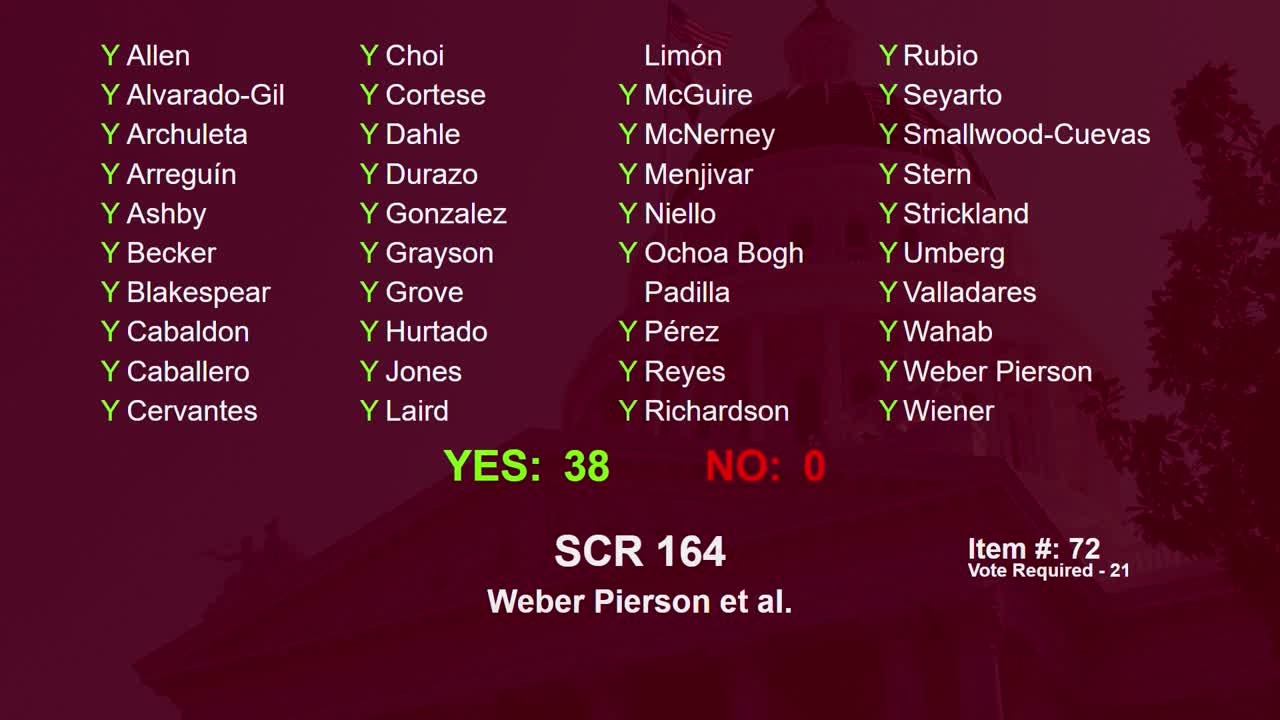 1MIN
Senate Floor
Bill Author

Bill Co-Author(s):