SB 1325: CalFood Program.
- Session Year: 2025-2026
- House: Senate
- Latest Version Date: 2026-04-27
Current Status:
In Progress
(2026-05-14: May 14 hearing: Held in committee and under submission.)
Introduced
In Committee
Awaiting First Chamber Vote
Passed First Chamber
In Committee
Awaiting Second Chamber Vote
Passed Second Chamber
Enacted
What does this bill do?
The bill lets the state's CalFood program provide food and funding to Feeding America member food banks based in California that are located in counties with more than 3,000,000 people and that are not part of the federal Emergency Food Assistance Program. To qualify, those food banks must follow the same federal and state rules as other CalFood partners, show they serve households not reached by federal-program food banks, and spend all CalFood funding on food purchases.
The summary is provided by generative AI which can make mistakes. For original language, please view the details in the table below.
Existing law establishes the CalFood Program, administered by the State Department of Social Services, and requires the CalFood Program to provide food and funding for the provision of emergency food to food banks established pursuant to the federal Emergency Food Assistance Program whose ongoing primary function is to facilitate the distribution of food to low-income households, as specified.
This bill would additionally require the CalFood Program to provide food and funding for the provision of emergency food to food banks that are members of the nonprofit organization Feeding America that are based in California or members of the California Association of Food Banks, as specified. California, located in a county with a population of over 3,000,000 people, and are not established pursuant to the federal Emergency Food Assistance Program, if they meet specified requirements.
Existing law establishes the CalFood Program, administered by the State Department of Social Services, and requires the CalFood Program to provide food and funding for the provision of emergency food to food banks established pursuant to the federal Emergency Food Assistance Program whose ongoing primary function is to facilitate the distribution of food to low-income households, as specified.
This bill would additionally require the CalFood Program to provide food and funding for the provision of emergency food to food banks that are members of the nonprofit organization Feeding America that are based in California or members of the California Association of Food Banks, as specified.
Existing law provides for financial and food assistance benefits to needy Californians, including, among other programs, the California Work Opportunity and Responsibility to Kids (CalWORKs) program and CalFresh, under which each county provides for financial and food assistance benefits to qualified individuals who meet specified eligibility criteria. Existing law, administered by the State Department of Social Services, provides for the establishment of a statewide electronic benefits transfer (EBT) system for the purpose of providing those financial and food assistance benefits. Existing law allows an interested collective group or association of produce sellers that is Food and Nutrition Service-authorized and in a flea market, farmers market, or certified farmers market to initiate and operate an EBT acceptance system in the market, as specified, and makes related findings and declarations. Under existing law, an individual seller may operate their own individual EBT acceptance activity as part of that sellers personal business customer transaction offering.This bill would make technical, nonsubstantive changes to those provisions.Existing law provides for financial and food assistance benefits to needy Californians, including, among other programs, the California Work Opportunity and Responsibility to Kids (CalWORKs) program and CalFresh, under which each county provides for financial and food assistance benefits to qualified individuals who meet specified eligibility criteria. Existing law, administered by the State Department of Social Services, provides for the establishment of a statewide electronic benefits transfer (EBT) system for the purpose of providing those financial and food assistance benefits. Existing law allows an interested collective group or association of produce sellers that is Food and Nutrition Service-authorized and in a flea market, farmers market, or certified farmers market to initiate and operate an EBT acceptance system in the market, as specified, and makes related findings and declarations. Under existing law, an individual seller may operate their own individual EBT acceptance activity as part of that sellers personal business customer transaction offering.
This bill would make technical, nonsubstantive changes to those provisions.
(a)(1)The State Emergency Food Assistance Program, which is administered by the State Department of Social Services, shall be renamed as the CalFood Program. The CalFood Program shall provide food and funding for the provision of emergency food to all both of the following food banks whose ongoing primary function is to facilitate the distribution of food to low-income households:
(A)Food banks established pursuant to the federal Emergency Food Assistance Program (7 C.F.R. Parts 250 and 251).
(B)Food banks that are members of the nonprofit organization Feeding America that are based in California. California, located in a county with a population of over 3,000,000 people, and are not established pursuant to the federal Emergency Food Assistance Program (7 C.F.R. Parts 250 and 251), if they meet all of the following requirements:
(C)Food banks that are members of the California Association of Food Banks.(i)The food bank shall comply with the federal and state eligibility determination, food ordering procedures, storage and warehousing practices, inventory controls, approval of distribution sites, reporting and recordkeeping requirements, and civil rights laws and regulations required of the food banks described in subparagraph (A).
(ii)The food bank shall provide evidence that there are households within the county it serves that are not served by a food bank described in subparagraph (A) under the CalFood Program, but that are instead served by the food bank within its current network.
(iii)The food bank shall use 100 percent of the funding received under the CalFood Program for food purchases.
(2)Any federal funding received for the CalFood Program may be provided to a food bank described in subparagraphs (B) and (C) subparagraph (B) of paragraph (1) only to the extent permitted under federal law.
(b)(1)The CalFood Account is hereby established in the Emergency Food for Families Voluntary Tax Contribution Fund established pursuant to Section 18852 of the Revenue and Taxation Code, and may receive federal funds and voluntary donations or contributions.
(2)Notwithstanding Section 18853 of the Revenue and Taxation Code, the following shall apply:
(A)(i)All moneys received by the CalFood Account shall, upon appropriation by the Legislature, be allocated to the State Department of Social Services for allocation to the CalFood Program and, excluding those contributions made pursuant to Section 18851 of the Revenue and Taxation Code and funds received through Parts 250 and 251 of Title 7 of the Code of Federal Regulations, shall be used for the purchase, storage, and transportation of food grown or produced in California.
(ii)The percentage of storage and transportation expenditures compared to the CalFood Program funds annual budget may be increased from their levels in the 202122 fiscal year after a determination by the department in consultation with food bank stakeholders to reflect the true costs to acquire, store, and distribute foods purchased through the CalFood Program. The department shall report to the Joint Legislative Budget Committee on any changes to the rate and the supporting methodology.
(B)Notwithstanding subparagraph (A), funds received by the CalFood Account shall, upon appropriation by the Legislature, be allocated to the State Department of Social Services for allocation to the CalFood Program as described in subparagraph (A), and shall, in part, be used to pay for the departments administrative costs associated with the administration of the CalFood Program.
(c)(1)The Public Higher Education Pantry Assistance Program Account is hereby established in the Emergency Food for Families Voluntary Tax Contribution Fund established pursuant to Section 18852 of the Revenue and Taxation Code.
(2)Notwithstanding Section 18853 of the Revenue and Taxation Code, funds in the Public Higher Education Pantry Assistance Program Account shall, upon appropriation by the Legislature, be allocated to the State Department of Social Services for allocation to food banks established pursuant to Parts 250 and 251 of Title 7 of the Code of Federal Regulations that meet both of the following criteria:
(A)The primary function of the food bank is the distribution of food to low-income households.
(B)The food bank has identified specific costs associated with supporting on-campus pantry and hunger relief efforts serving low-income students.
(a)(1)The State Emergency Food Assistance Program, which is administered by the State Department of Social Services, shall be renamed as the CalFood Program. The CalFood Program shall provide food and funding for the provision of emergency food to food banks established pursuant to the federal Emergency Food Assistance Program (7 C.F.R. Parts 250 and 251) all of the following food banks whose ongoing primary function is to facilitate the distribution of food to low-income households. households:
(A)Food banks established pursuant to the federal Emergency Food Assistance Program (7 C.F.R. Parts 250 and 251).
(B)Food banks that are members of the nonprofit organization Feeding America that are based in California.
(C)Food banks that are members of the California Association of Food Banks.
(2)Any federal funding received for the CalFood Program may be provided to a food bank described in subparagraphs (B) and (C) of paragraph (1) only to the extent permitted under federal law.
(b)(1)The CalFood Account is hereby established in the Emergency Food for Families Voluntary Tax Contribution Fund established pursuant to Section 18852 of the Revenue and Taxation Code, and may receive federal funds and voluntary donations or contributions.
(2)Notwithstanding Section 18853 of the Revenue and Taxation Code, the following shall apply:
(A)(i)All moneys received by the CalFood Account shall, upon appropriation by the Legislature, be allocated to the State Department of Social Services for allocation to the CalFood Program and, excluding those contributions made pursuant to Section 18851 of the Revenue and Taxation Code and funds received through Parts 250 and 251 of Title 7 of the Code of Federal Regulations, shall be used for the purchase, storage, and transportation of food grown or produced in California.
(ii)The percentage of storage and transportation expenditures compared to the CalFood Program funds annual budget may be increased from their levels in the 202122 fiscal year after a determination by the department in consultation with food bank stakeholders to reflect the true costs to acquire, store, and distribute foods purchased through the CalFood Program. The department shall report to the Joint Legislative Budget Committee on any changes to the rate and the supporting methodology.
(B)Notwithstanding subparagraph (A), funds received by the CalFood Account shall, upon appropriation by the Legislature, be allocated to the State Department of Social Services for allocation to the CalFood Program as described in subparagraph (A), and shall, in part, be used to pay for the departments administrative costs associated with the administration of the CalFood Program.
(c)(1)The Public Higher Education Pantry Assistance Program Account is hereby established in the Emergency Food for Families Voluntary Tax Contribution Fund established pursuant to Section 18852 of the Revenue and Taxation Code.
(2)Notwithstanding Section 18853 of the Revenue and Taxation Code, funds in the Public Higher Education Pantry Assistance Program Account shall, upon appropriation by the Legislature, be allocated to the State Department of Social Services for allocation to food banks established pursuant to Parts 250 and 251 of Title 7 of the Code of Federal Regulations that meet both of the following criteria:
(A)The primary function of the food bank is the distribution of food to low-income households.
(B)The food bank has identified specific costs associated with supporting on-campus pantry and hunger relief efforts serving low-income students.
SECTION 1.Section 10072.1 of the Welfare and Institutions Code is amended to read:10072.1.(a)The Legislature finds and declares that flea markets, farmers markets, and certified farmers markets are important sources of low-cost produce for Californians in need of food assistance.(b)(1)An interested collective group or association of produce sellers that is Food and Nutrition Service (FNS)-authorized and actively participating in produce sales in a market described in subdivision (a) may initiate and operate an electronic benefit transfer (EBT) acceptance system on behalf of its members, to the extent and manner allowed by federal law and regulation. The market operator shall allow and accommodate the FNS-authorized group or association in a reasonable manner that aids in the creation, implementation, and operation of its EBT acceptance system. The allowance and accommodation by the market operator mandated by this section is limited solely to the activity of the operation of the EBT acceptance system by the group or association. No other activities are authorized without the express permission of the market operator.(2)This subdivision does not apply to a market described in subdivision (a) that currently or subsequently operates an EBT acceptance system.(c)Nothing in this section or any other provision of law prohibits an individually FNS-authorized produce seller in a market described in subdivision (a) from operating their own individual EBT acceptance activity as part of that sellers personal business customer transaction offering.(d)This section does not require a market described in subdivision (a) to itself create, operate, or maintain an EBT acceptance system on behalf of its produce sellers.(a)The Legislature finds and declares that flea markets, farmers markets, and certified farmers markets are important sources of low-cost produce for Californians in need of food assistance.
(b)(1)An interested collective group or association of produce sellers that is Food and Nutrition Service (FNS) authorized (FNS)-authorized and actively participating in produce sales in a market described in subdivision (a) may initiate and operate an electronic benefit transfer (EBT) acceptance system on behalf of its members, to the extent and manner allowed by federal law and regulation. The market operator shall allow and accommodate the FNS-authorized group or association in a reasonable manner that aids in the creation, implementation, and operation of its EBT acceptance system. The allowance and accommodation by the market operator mandated by this section is limited solely to the activity of the operation of the EBT acceptance system by the group or association. No other activities are authorized without the express permission of the market operator.
(2)This subdivision shall does not apply to a market described in subdivision (a) that currently or subsequently operates an EBT acceptance system.
(c)Nothing in this section or any other provision of law shall prohibit prohibits an individually FNS-authorized produce seller in a market described in subdivision (a) from operating his or her their own individual EBT acceptance activity as part of that sellers personal business customer transaction offering.
(d)Nothing in this section shall be interpreted to This section does not require a market described in subdivision (a) to itself create, operate, or maintain an EBT acceptance system on behalf of its produce sellers.
|
Date
|
Status
|
|---|---|
| May 14, 2026 | May 14 hearing: Held in committee and under submission. |
| May 8, 2026 | Set for hearing May 14. |
| May 4, 2026 | May 4 hearing: Placed on APPR. suspense file. |
| Apr 28, 2026 | Set for hearing May 4. |
| Apr 27, 2026 | Read second time and amended. Re-referred to Com. on APPR. |
| Apr 23, 2026 | From committee: Do pass as amended and re-refer to Com. on APPR. (Ayes 3. Noes 0. Page 3955.) (April 20). |
| Apr 23, 2026 | From committee: Do pass as amended and re-refer to Com. on APPR. (Ayes 3. Noes 0.) (April 20). |
| Apr 9, 2026 | Set for hearing April 20. |
| Apr 8, 2026 | Re-referred to Com. on HUMAN S. |
| Mar 25, 2026 | From committee with author's amendments. Read second time and amended. Re-referred to Com. on RLS. |
| Mar 4, 2026 | Referred to Com. on RLS. |
| Feb 23, 2026 | From printer. May be acted upon on or after March 23. |
| Feb 23, 2026 | Read first time. |
| Feb 20, 2026 | Introduced. To Com. on RLS. for assignment. To print. |
|
Date
|
Description
|
Location
|
Votes
|
|
|---|---|---|---|---|
| May 4, 2026 | Placed on suspense file | Senate Standing Committee on Appropriations |
Passed |
|
| Apr 20, 2026 | Do pass as amended, but first amend, and re-refer to the Committee on [Appropriations] | Senate Standing Committee on Human Services |
Passed |
This list shows positions taken on this bill by organizations on the date displayed, which is linked to the original source.
Positions by individuals are not included.
|
Organization
|
Position
|
Date
|
|---|---|---|
| California Association Of Food Banks | ** Against | |
| California Catholic Conference | ** Support | |
| Feeding San Diego | ** Support |
SENATE COMMITTEE ON
Senator Sabrina Cervantes, Chair
2025 - 2026 Regular Session
SB 1325 (Jones) - CalFood Program
Version: | Policy Vote: |
Urgency: | Mandate: |
Hearing Date: | Consultant: |
Bill Summary:
SB 1325 would expand the criteria determining which entities are eligible to receive funding under the CalFood program.
Fiscal Impact:
- Unknown ongoing General Fund costs, potentially hundreds of thousands, for the California Department of Social Services (CDSS) for state administration.
- Unknown General Fund cost pressures to increase funding for the CalFood program.
Background:
The Emergency Food Assistance Program (TEFAP) is a federal program that distributes foods purchased by United States Department of Agriculture to needy individuals and households. States choose which eligible recipient agencies will distribute TEFAP foods and require those agencies to abide by TEFAP federal and state regulations. There are 49 eligible recipient agencies designated as TEFAP providers in California that serve a network of food pantries, soup kitchens and other emergency food providers in all 58 counties.
California’s CalFood program, administered by the CDSS, provides state funding for the purchase, storage, and transportation of food grown or produced in California. Current law requires the CalFood program to provide food and funding for the provision of emergency food to food banks established pursuant to the federal TEFAP. The CalFood program allocates funding to California’s network of TEFAP providers. The 2025 Budget Act included $80 million General Fund for the CalFood program. The Governor’s proposed budget for 2026-27 includes only $8 million General Fund for the CalFood program.
Proposed Law:
SB 1325 would additionally require the CalFood program to provide food and funding to food banks that are members of the nonprofit organization Feeding America that are based in California, located in a county with a population of over 3,000,000 people, and are not established pursuant to the federal TEFAP, if they meet all of the following requirements:
- The food bank must comply with the federal and state eligibility determination, food ordering procedures, storage and warehousing practices, inventory controls, approval of distribution sites, reporting and recordkeeping requirements, and civil rights laws and regulations required of the food banks established pursuant to the federal TEFAP.
- The food bank must provide evidence that there are households within the county it serves that are not served by a food bank established pursuant to the federal TEFAP under the CalFood Program, but that are instead served by the food bank within its current network.
- The food bank must use 100 percent of the funding received under the CalFood Program for food purchases.
-- END --
SENATE COMMITTEE ON HUMAN SERVICES
Senator Becker, Chair
2025 - 2026 Regular
Bill No: | SB 1325 | ||
Author: | Jones | ||
Version: | March 25, 2026 | Hearing Date: | April 20, 2026 |
Urgency: | No | Fiscal: | Yes |
Consultant: | Naima Ford Antal | ||
Subject: CalFood Program
SUMMARY
This bill expands the types of food banks the California Department of Social Services (CDSS) must provide food and funding to through the CalFood program.
ABSTRACT
Existing Law:
- Establishes The Emergency Food Assistance Program (TEFAP) which supplies states with food commodities to provide nutrition assistance to those in need. (7 United States Code [USC] 7501)
- Requires TEFAP food and funding to be allocated among states according to a formula that accounts for poverty and unemployment levels within each state. Specifically, 60 percent of each state's allocation must be based on the number of people with incomes below the poverty level within the state and 40 percent be equal to the percentage of the nation's unemployed persons within the state. (7 USC 7515)
- Declares that every human being has the right to access sufficient affordable and healthy food. (Welfare and Institutions Code [WIC] 18700(a)(1))
- Renames the State Emergency Food Assistance Program to be the CalFood program. Requires the program to provide food and funding for the provision of emergency food to food banks established pursuant to TEFAP whose ongoing primary function is to facilitate the distribution of food to low-income households. (WIC 18995)
This Bill:
- Requires CDSS to distribute CalFood food and funding to all the following food banks:
- Food banks established pursuant to the federal Emergency Food Assistance Program.
- Food banks that are members of the nonprofit organization Feeding America that are based in California.
- Food banks that are members of the California Association of Food Banks.
- Requires federal funds received by the CalFood program to be distributed to Feeding America and California Association of Food Bank associated food banks only as permitted by federal law.
FISCAL IMPACT
This bill has not yet been analyzed by a fiscal committee.
BACKGROUND AND DISCUSSION
Purpose of the Bill:
According to the author, “The CalFood program was established in 2011 to enable California food banks to provide millions of meals to those who need them most and to do so by purchasing only California-grown foods, a win-win for both food banks and farmers. The funding provides for the purchase, storage and transportation of that California grown food. At the program's inception, the decision was made to allow only TEFAP food banks to participate, putting other food banks that serve disparate populations at a severe disadvantage. Despite having in place the same kinds of reporting, oversight and administrative requirements as TEFAP food banks, non-TEFAP food banks – and their recipient clients – are left out.
“In 2022, a similar program – the California Food Bank Capacity Program – had its criteria updated to include Feeding America affiliates and members of the California Association of Food Banks. The intent of both programs is to provide funding to the hunger relief organizations that are working every day to provide nutritious food to the one in eight Californians struggling with hunger. This bill will update the CalFood eligibility language to match the California Food Bank Capacity Program – a commonsense change that would increase access to food for struggling families in California.
“In San Diego alone, the Feeding America affiliate – Feeding San Diego – supplements the work of the local TFAP food bank by providing meals through 76 school pantries county-wide – this without CalFood funding but rather through a budget made up almost entirely of private donations. They additionally have 55 schools on their school pantry waitlist which could be served with the addition of CalFood Funding.”
Food Insecurity in California
Food insecurity is a statewide problem that affects people from all backgrounds. While California is the greatest food-producing state in the country, 22% of households and 27% of households with children faced food insecurity in 2024, according to the California Association of Food Banks. Food insecurity disproportionally affects certain communities. According to the same California Association of Food Banks study, 35% of Black households and 31% of Latino households reported food insecurity in September 2024.[1] According to the Public Policy Institute of California, “Black and Latino households (18%) and households with children (17%) are more likely to experience food insecurity compared to white and Asian American households (7%) and households without children (11%).”[2]
Because of limited financial resources, those who are food insecure sometimes use cost cutting measures to stretch budgets that are harmful to their health, such as: forgoing the foods needed for special medical diets; purchasing a low-cost diet that relies on foods that are energy-dense but nutrient-poor; diluting or rationing infant formula; and making trade-offs between food and other basic necessities, like housing, utilities, and transportation. Moreover, the impacts of childhood hunger are well known. Children who live in households experiencing food insecurity are at higher risk of health, academic, behavioral, and emotional problems than those who are not.
Food Banks
Food banks are a significant part of California’s food security safety net. Unlike food pantries or soup kitchens that provide food directly to people, food banks are federally defined as organizations that store and provide food or other edible commodities to food pantries and other direct assistance organizations. It is estimated that 10 percent of Californians are supplementing their food costs with free food from an organization that is supplied by a food bank. There are many food banks throughout California that distribute free food to food pantries, community and senior centers that serve hot food, student pantries on college campuses and other organizations that provide free food to those who need it. California food banks receive funding and food from the United States Department of Agriculture through programs like the Emergency Food Assistance Program and private donations, but some also received funding from the state through the CalFood program.
The Emergency Food Assistance Program (TEFAP)
TEFAP is a federal program created in 1981 to distribute foods purchased by United States Department of Agriculture through the Commodity Credit Corporation to needy individuals and households. The Commodity Credit Corporation acquires surplus food commodities from American farmers to prevent wasted food. As the inventory grew, distributing that food through TEFAP allowed the food to go to good use while supporting agricultural markets. When the inventories were nearly depleted in 1988, Congress passed the Hunger Prevention Act of 1988 which authorized funds for the purchase of food for TEFAP. The federal government has continued funding the program allowing food banks throughout the country to have an additional source of food to distribute beyond private donations. States receive food according to a formula that is based 60% on the number of people in the state with incomes below the poverty level and 40% on the number of unemployed people in the state. The administrative costs of the program are split 50% federal funding and 50% state funds.
States choose which entities will distribute TEFAP foods, which they call eligible recipient agencies, and require those agencies to abide by TEFAP federal and state regulations. Most of California’s eligible recipient agencies are food banks. According to CDSS, each eligible recipient agency must receive a compliance review at least every four years which includes oversight of “eligibility determinations, food ordering procedures, storage and warehousing practices, inventory controls, approval of distribution sites, reporting and recordkeeping requirements, and civil rights.”[3] CDSS also reviews their monthly inventory reports. Eligible recipient agencies are also required to have signed agreements with subcontractors who distribute food that includes a commitment to abide by the same food safety, training and recordkeeping requirements. There are 49 eligible recipient agencies designated as TEFAP providers in California that serve a network of 2,400 food pantries, soup kitchens and other emergency food providers in all 58 counties. Nineteen TEFAP providers are Feeding America members and 39 are California Association of Food Bank members. Meaning most TEFAP providers in California are members of the California Association of Food Banks, Feeding America or both.
CalFood
CalFood was created in 2011 authorizing state funds to support the purchase, storage, transportation and operational costs of providing food grown and produced in California to food banks. Specifically, the CalFood program allocates funding to California’s network of TEFAP providers. Originally funding was $8 million per year but when the COVID- 19 pandemic disrupted the economy, the state significantly increased CalFood funding to an average of $62.7 million per year. According to the California Association of Food Banks, California's food banks are already serving more than 6 million people each month, up from the nearly 4.5 million people they served during the height of the COVID-19 pandemic.
The program is operated by CDSS who distributes CalFood funding and oversees how food banks use the funding. California’s 49 TEFAP providers are also the distributors of CalFood resources. CDSS decided to use these food banks to distribute CalFood due to their established distribution network and preexisting oversight requirements. Food and funding are distributed to the food banks according to a formula similar to the federal formula based 60% on a county’s poverty rate and 40% on the unemployment rate to maintain equity in distribution.
This bill would require CalFood food and funding to also be distributed to food banks that are members of the California Association of Food Banks or Feeding America but are not TEFAP providers.
Food Bank Capacity Grant Program
The Food Bank Capacity Program was created in 2022 to help food banks expand their infrastructure to better serve their communities. Specifically, the one- time grants were provided for capital investments that support the collection, storage, distribution, and other systems to provide food to those in need. Food banks requested the funding after an audit showed that COVID- 19 and the prevalence of natural disasters greatly increased the use of food banks. The grants are available to TEFAP providers, Commodity Supplemental Food Program providers, members of the California Association of Food Banks, and members of Feeding America that are located in California. The program ends June 30, 2026. This bill would expand the CalFood program to include similar categories of food banks.
Related/Prior Legislation:
SB 187 (Committee on Budget and Fiscal Review, Chapter 50, Statutes of 2022) allowed the percentage of CalFood funding a food bank spent on storage and transportation to be increased from their levels in the 2021-22 fiscal year after a determination by CDSS in consultation with food bank stakeholders to reflect the true costs to acquire, store, and distribute foods purchased through the CalFood Program.
AB 1577 (Eggman, Chapter 400, Statutes of 2016) renamed the State Emergency Food Assistance Program as the CalFood program and renamed the State Emergency Food Assistance Program Account as the CalFood Account.
COMMENTS
SB 1325 would expand the number of food banks currently receiving funding and food from the CalFood program. The CalFood program supplements the annual budgets of food banks and also provides a way for the state to distribute food quickly during emergencies. These emergencies include the $80 million general fund allocation made in 2025 during the federal government shutdown. Food banks are seeing increased need and low-income Californian’s rely on these organizations to have fair and efficient systems that get quality food to where it is needed the most. This is possible through a network of warehouses, transportation systems, and food pantries that are managed by the food banks. These activities are often funded by a mix of federal, state and private funds that fluctuate from year to year. Not all food banks have the same capacity, network, or accountability requirements due to the communities they serve and the funding receive. TEFAP approved food banks were chosen based on federal and state approved criteria that ensure complete and equitable distribution across the state, making their networks most reliable distribution method when needs are the highest. The author may want to consider the impact of adding food banks with different accountability standards and networks to the CalFood system. Specifically, the author should address how CDSS can ensure that adding food banks will not decrease the safety, efficiency, and equity of the CalFood program.
Proposed Amendments: The committee proposes amendments to narrow the types of food banks that can receive CalFood funding and food to food banks that are designated as a TEFAP food bank or meets certain requirements.
SECTION 1. Section 18995 of the Welfare and Institutions Code is amended to read:
18995. (a) (1) The State Emergency Food Assistance Program, which is administered by the State Department of Social Services, shall be renamed as the “CalFood Program.” The CalFood Program shall provide food and funding for the provision of emergency food to food banks established pursuant to the federal Emergency Food Assistance Program (7 C.F.R. Parts 250 and 251). all of the following and food banks whose ongoing primary function is to facilitate the distribution of food to low-income households, that meet the following requirements:
(A) Food banks established pursuant to the federal Emergency Food Assistance Program (7 C.F.R. Parts 250 and 251).
(B) (A) Food banks that are members of the nonprofit organization Feeding America that are based in California and located in a county with a population of over 3 million, that are not currently established pursuant to the federal Emergency Food Assistance Program, if they meet the following qualifications:
- The food bank must comply with the federal and state eligibility determination, food ordering procedure, storage and warehousing practices, inventory controls, approval of distribution sites, reporting and recordkeeping requirements, and civil rights laws and regulations required of the federal Emergency Food Assistance Program approved food banks.
- The food bank must provide evidence that there are households within the county served that are not served by the federal Emergency Food Assistance Program approved food bank of that county with CalFood, that the food bank serves within its current network.
- The food bank must use 100 percent of the CalFood funding received for food purchases.
(C) Food banks that are members of the California Association of Food Banks.
(2) Any federal funding received for the CalFood Program may be provided to a food bank described in subparagraphs (A) (B) and (C) of paragraph (1) only to the extent permitted under federal law.
SUPPORT/OPPOSITION
Arguments in Support:
According to Feeding San Diego, “As federal hunger relief resources decrease and cost of living continues to increase in California, hunger relief organizations are turning to state resources to supplement their food purchases. [The] addition of Feeding America-affiliated foodbanks to the CalFood program does not increase funding requirements for the program… the California Foodbank Capacity Building and Climate Resiliency Program, originally slated to apply only to the TEFAP foodbanks, were revised to include Feeding America-affiliated foodbanks. The results were that more food was distributed throughout the state at a time of heightened demand. Optimization of these funds increases efficiency resulting in more food getting into distribution. A great example of this is our school pantry program, currently involving 76 schools throughout San Diego County with another 62 on a waitlist. CalFood funding for food purchase would allow unrestricted private funds to be diverted to assist in lowering the number on that waitlist to participate in this successful and very much needed program to reduce hunger amongst students of all ages.”
Arguments in Opposition:
According to the California Association of Food Banks, “continuing to use the TEFAP program’s established oversight mechanisms is the least administratively burdensome way for the state to maintain effective oversight of the annual funding allocated to CalFood… Each dollar spent on CalFood results in approximately 5 meals under the current structure… SB 1325 will reduce that efficiency by increasing the number of food banks CalFood is split between, without increasing the number of people served. Dividing the same amount of money among more food banks means less economical food procurement and duplicative administrative and infrastructure costs. SB 1325 could result in multiple food banks serving the same county that was previously served by one or two food banks; the result would be less actual food distributed to those in need and more spending on food bank logistics… SB 1325 is a broad, statewide upheaval of a program with a proven track record and could result in the unintended consequences we raise in this letter, all for an issue best solved with local solutions.”
POSITIONS
Support:
Feeding San Diego (Sponsor)
California Catholic Conference
Oppose:
California Association of Food Banks
-- END --
www.cafoodbanks.org/food-insecurity-data/ ↑
Thorman, T.; Malagon P. California’s Nutrition Safety Net. Public Policy Institute of California. May, 2025. www.ppic.org/publication/californias-nutrition-safety-net ↑
CDSS The Emergency Food Assistance Program Federal Fiscal Year 2025 State Plan. www.cdss.ca.gov/Portals/9/TEFAP/FFY%202025%20CDSS%20TEFAP%20State%20Plan.pdf ↑
Discussed in Hearing
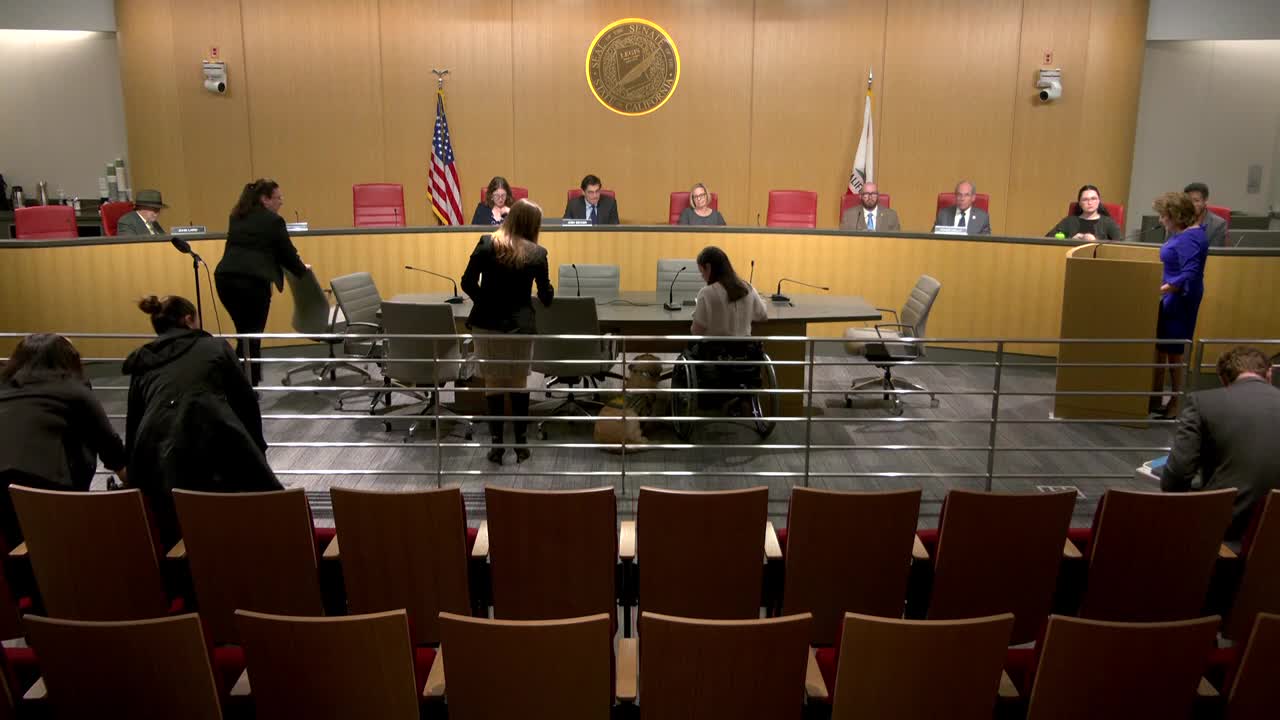 27MIN
Senate Standing Committee on Human Services
Bill Author

Bill Co-Author(s):