SB 1354: The military: defense of the state.
- Session Year: 2025-2026
- House: Senate
- Latest Version Date: 2026-09-19
Current Status:
Passed
(2026-09-19: Chaptered by Secretary of State. Chapter 329, Statutes of 2026.)
Introduced
In Committee
Awaiting First Chamber Vote
Passed First Chamber
In Committee
Awaiting Second Chamber Vote
Passed Second Chamber
Enacted
Existing federal law establishes the militia of the United States, specifies who is eligible to be a part of the militia, divides the militia into the organized and unorganized militia, and defines the organized militia as the National Guard and the Naval Militia. Existing federal law authorizes the President of the United States to call units of the National Guard of any state into federal service if certain criteria are met. Existing federal law, the Emergency Management Assistance Compact, authorizes member states to provide for mutual assistance between the states in managing a disaster that is declared by the governor of the affected state.
Existing law establishes within state government a Military Department that includes, among other things, the office of the Adjutant General, the California National Guard, and the State Guard. Under existing law, the militia of the state is comprised of the California National Guard, the State Guard, the Naval Militia, and the unorganized militia. Existing law makes the Governor, by virtue of holding their office, the commander in chief of the militia of the state.
This bill would prohibit military personnel of another state, territory, or district from entering, or causing something to enter, the state to perform military duty or law enforcement functions for another state without the permission of the Governor, except as specified.
Existing federal law establishes the militia of the United States, specifies who is eligible to be a part of the militia, divides the militia into the organized and unorganized militia, and defines the organized militia as the National Guard and the Naval Militia. Existing federal law authorizes the President of the United States to call units of the National Guard of any state into federal service if certain criteria are met. Existing federal law, the Emergency Management Assistance Compact, authorizes member states to provide for mutual assistance between the states in managing a disaster that is declared by the governor of the affected state.
Existing law establishes within state government a Military Department that includes, among other things, the office of the Adjutant General, the California National Guard, and the State Guard. Under existing law, the militia of the state is comprised of the California National Guard, the State Guard, the Naval Militia, and the unorganized militia. Existing law makes the Governor, by virtue of holding their office, the commander in chief of the militia of the state.
This bill would make it a crime for prohibit military personnel of another state, territory, or district to enter, or cause from entering, or causing something to enter, the state to perform military duty or law enforcement functions without the permission of the Governor, except as specified. The bill would make a violation of that prohibition punishable by a fine not exceeding $10,000, imprisonment, as specified, or by both that fine and imprisonment. By creating a new crime, the bill would impose a state-mandated local program.
The California Constitution requires the state to reimburse local agencies and school districts for certain costs mandated by the state. Statutory provisions establish procedures for making that reimbursement.This bill would provide that no reimbursement is required by this act for a specified reason.Existing federal law establishes the militia of the United States, specifies who is eligible to be a part of the militia, divides the militia into the organized and unorganized militia, and defines the organized militia as the National Guard and the Naval Militia. Existing federal law authorizes the President of the United States to call units of the National Guard of any state into federal service if certain criteria are met. Existing federal law, the Emergency Management Assistance Compact, authorizes member states to provide for mutual assistance between the states in managing a disaster that is declared by the governor of the affected state.
Existing law establishes within state government a Military Department that includes, among other things, the office of the Adjutant General, the California National Guard, and the State Guard. Under existing law, the militia of the state is comprised of the California National Guard, the State Guard, the Naval Militia, and the unorganized militia. Existing law makes the Governor, by virtue of holding their office, the commander in chief of the militia of the state.
This bill would make it a crime for military personnel of another state, territory, or district to enter, or cause something to enter, the state to perform military duty or law enforcement functions without the permission of the Governor, except as specified. The bill would make a violation of that prohibition punishable by a fine not exceeding $10,000, imprisonment, as specified, or by both that fine and imprisonment. By creating a new crime, the bill would impose a state-mandated local program.
The California Constitution requires the state to reimburse local agencies and school districts for certain costs mandated by the state. Statutory provisions establish procedures for making that reimbursement.
This bill would provide that no reimbursement is required by this act for a specified reason.
Existing law establishes the renewable energy resources program to increase the amount of electricity generated from eligible renewable energy resources. Existing law defines various terms for purposes of the program.This bill would make nonsubstantive changes to those definitions.Existing law establishes the renewable energy resources program to increase the amount of electricity generated from eligible renewable energy resources. Existing law defines various terms for purposes of the program.
This bill would make nonsubstantive changes to those definitions.
(a)Military personnel of another state, territory, or district shall not enter, or cause something to enter, the state to perform military duty or law enforcement functions for another state without the permission of the Governor.
(b)This section does not apply to any of the following:
(1)Military personnel of another state, territory, or district who have been called into active federal service under Title 10 of the United States Code and who are acting under the authority of the President of the United States or the United States Secretary of Defense.
(2)A military compact entered into between one or more states prior to January 1, 2027.
(3)An educational course or training exercise involving military personnel of another state, territory, or district taking place in California.
(c)The Governor may delegate the authority to grant permission to enter the state, as described in subdivision (a), to the Adjutant General.
(a)Military personnel of another state, territory, or district shall not enter, or cause something to enter, the state to perform military duty or law enforcement functions for another state without the permission of the Governor.
(b)This section does not apply to military any of the following:
(1)Military personnel of another state, territory, or district who have been called into active federal service under Title 10 of the United States Code and who are acting under the authority of the President of the United States or the United States Secretary of Defense.
(2)A military compact entered into between one or more states prior to January 1, 2027.
(3)An educational course or training exercise involving military personnel of another state, territory, or district taking place in California.
(c)The Governor may delegate the authority to grant permission to enter the state, as described in subdivision (a), to the Adjutant General.
(a)Military personnel of another state, territory, or district shall not enter, or cause something to enter, the state to perform military duty or law enforcement functions for another state without the permission of the Governor.
(b)This section does not apply to military personnel of another state, territory, or district who have been called into active federal service under Title 10 of the United States Code and who are acting under the authority of the President of the United States or the United States Secretary of Defense.
(c)The Governor may delegate the authority to grant permission to enter the state, as described in subdivision (a), to the Adjutant General.
(a)Military personnel of another state, territory, or district shall not enter, or cause something to enter, the state to perform military duty or law enforcement functions without the permission of the Governor.
(b)A violation of subdivision (a) shall be punished by a fine not exceeding ten thousand dollars ($10,000), imprisonment in the county jail not exceeding one year, or imprisonment pursuant to subdivision (h) of Section 1170 of the Penal Code, or by both that fine and imprisonment.(c)(b)This section does not apply to military personnel of another state, territory, or district who have been called into active federal service under Title 10 of the United States Code and who are acting under the authority of the President of the United States or the United States Secretary of Defense.
(d)(c)The Governor may delegate the authority to grant permission to enter the state, as described in subdivision (a), to the Adjutant General.
SEC. 2.No reimbursement is required by this act pursuant to Section 6 of Article XIIIB of the California Constitution because the only costs that may be incurred by a local agency or school district will be incurred because this act creates a new crime or infraction, eliminates a crime or infraction, or changes the penalty for a crime or infraction, within the meaning of Section 17556 of the Government Code, or changes the definition of a crime within the meaning of Section 6 of Article XIIIB of the California Constitution.(a)Military personnel of another state, territory, or district shall not enter, or cause something to enter, the state to perform military duty or law enforcement functions without the permission of the Governor.
(b)A violation of subdivision (a) shall be punished by a fine not exceeding ten thousand dollars ($10,000), imprisonment in the county jail not exceeding one year, or imprisonment pursuant to subdivision (h) of Section 1170 of the Penal Code, or by both that fine and imprisonment.
(c)This section does not apply to military personnel of another state, territory, or district who have been called into active federal service under Title 10 of the United States Code and who are acting under the authority of the President of the United States or the United States Secretary of Defense.
(d)The Governor may delegate the authority to grant permission to enter the state, as described in subdivision (a), to the Adjutant General.
SEC. 2.No reimbursement is required by this act pursuant to Section 6 of Article XIIIB of the California Constitution because the only costs that may be incurred by a local agency or school district will be incurred because this act creates a new crime or infraction, eliminates a crime or infraction, or changes the penalty for a crime or infraction, within the meaning of Section 17556 of the Government Code, or changes the definition of a crime within the meaning of Section 6 of Article XIIIB of the California Constitution.
SECTION 1.Section 25741 of the Public Resources Code is amended to read:25741.As used in this chapter, all of the following definitions apply:(a)Renewable electrical generation facility means a facility that meets all of the following criteria:(1)The facility uses biomass, solar thermal, photovoltaic, wind, geothermal, fuel cells or linear generators using fuels described in this paragraph that otherwise meet the requirements of this subdivision, small hydroelectric generation of 30 megawatts or less, digester gas, municipal solid waste conversion, landfill gas, ocean wave, ocean thermal, or tidal current, and additions or enhancements to the facility using that technology.(2)The facility satisfies one of the following requirements:(A)The facility is located in the state or near the border of the state with the first point of connection to the transmission network of a balancing authority area primarily located within the state. For purposes of this subparagraph, balancing authority area has the same meaning as defined in Section 399.12 of the Public Utilities Code.(B)The facility has its first point of interconnection to the transmission network outside the state, within the Western Electricity Coordinating Council (WECC) service area, and satisfies all of the following requirements:(i)It commences initial commercial operation after January 1, 2005.(ii)It will not cause or contribute to a violation of a California environmental quality standard or requirement.(iii)It participates in the accounting system to verify compliance with the renewables portfolio standard established by the commission pursuant to subdivision (b) of Section 399.25 of the Public Utilities Code.(C)The facility meets the requirements of clauses (ii) and (iii) of subparagraph (B), but does not meet the requirements of clause (i) of subparagraph (B) because it commenced initial operation before January 1, 2005, if the facility satisfies either of the following requirements:(i)The electricity is from incremental generation resulting from expansion or repowering of the facility.(ii)Electricity generated by the facility was procured by a retail seller or local publicly owned electric utility as of January 1, 2010.(3)If the facility is outside the United States, it is developed and operated in a manner that is as protective of the environment as a similar facility located in the state.(4)If eligibility of the facility is based on the use of landfill gas, digester gas, or another renewable fuel delivered to the facility through a common carrier pipeline, the transaction for the procurement of that fuel, including the source of the fuel and delivery method, satisfies the requirements of Section 399.12.6 of the Public Utilities Code and is verified pursuant to the accounting system established by the commission pursuant to Section 399.25 of the Public Utilities Code, or a comparable system, as determined by the commission.(b)Municipal solid waste conversion means a technology that uses a noncombustion thermal process to convert solid waste to a clean-burning fuel for the purpose of generating electricity, and that meets all of the following criteria:(1)The technology does not use air or oxygen in the conversion process, except ambient air to maintain temperature control.(2)The technology produces no discharges of air contaminants or emissions, including greenhouse gases as defined in Section 38505 of the Health and Safety Code.(3)The technology produces no discharges to surface or groundwaters of the state.(4)The technology produces no hazardous wastes.(5)To the maximum extent feasible, the technology removes all recyclable materials and marketable green waste compostable materials from the solid waste stream before the conversion process and the owner or operator of the facility certifies that those materials will be recycled or composted.(6)The facility at which the technology is used is in compliance with all applicable laws, regulations, and ordinances.(7)The technology meets any other conditions established by the commission.(8)The facility certifies that any local agency sending solid waste to the facility diverted at least 30 percent of all solid waste it collects through solid waste reduction, recycling, and composting. For purposes of this paragraph, local agency means any city, county, or special district, or subdivision thereof, that is authorized to provide solid waste handling services.(c)Renewable energy public goods charge means that portion of the nonbypassable system benefits charge required to be collected to fund renewable energy pursuant to the Reliable Electric Service Investments Act (Article 15 (commencing with Section 399) of Chapter 2.3 of Part 1 of Division 1 of the Public Utilities Code).(d)Report means the report entitled Investing in Renewable Electricity Generation in California (June 2001, Publication Number P500-00-022) submitted to the Governor and the Legislature by the commission.(e)Retail seller has the same meaning as defined in Section 399.12 of the Public Utilities Code.As used in this chapter, all of the following definitions apply:
(a)Renewable electrical generation facility means a facility that meets all of the following criteria:
(1)The facility uses biomass, solar thermal, photovoltaic, wind, geothermal, fuel cells or linear generators using fuels described in this paragraph that otherwise meet the requirements of this subdivision, small hydroelectric generation of 30 megawatts or less, digester gas, municipal solid waste conversion, landfill gas, ocean wave, ocean thermal, or tidal current, and any additions or enhancements to the facility using that technology.
(2)The facility satisfies one of the following requirements:
(A)The facility is located in the state or near the border of the state with the first point of connection to the transmission network of a balancing authority area primarily located within the state. For purposes of this subparagraph, balancing authority area has the same meaning as defined in Section 399.12 of the Public Utilities Code.
(B)The facility has its first point of interconnection to the transmission network outside the state, within the Western Electricity Coordinating Council (WECC) service area, and satisfies all of the following requirements:
(i)It commences initial commercial operation after January 1, 2005.
(ii)It will not cause or contribute to any a violation of a California environmental quality standard or requirement.
(iii)It participates in the accounting system to verify compliance with the renewables portfolio standard established by the commission pursuant to subdivision (b) of Section 399.25 of the Public Utilities Code.
(C)The facility meets the requirements of clauses (ii) and (iii) of subparagraph (B), but does not meet the requirements of clause (i) of subparagraph (B) because it commenced initial operation before January 1, 2005, if the facility satisfies either of the following requirements:
(i)The electricity is from incremental generation resulting from expansion or repowering of the facility.
(ii)Electricity generated by the facility was procured by a retail seller or local publicly owned electric utility as of January 1, 2010.
(3)If the facility is outside the United States, it is developed and operated in a manner that is as protective of the environment as a similar facility located in the state.
(4)If eligibility of the facility is based on the use of landfill gas, digester gas, or another renewable fuel delivered to the facility through a common carrier pipeline, the transaction for the procurement of that fuel, including the source of the fuel and delivery method, satisfies the requirements of Section 399.12.6 of the Public Utilities Code and is verified pursuant to the accounting system established by the commission pursuant to Section 399.25 of the Public Utilities Code, or a comparable system, as determined by the commission.
(b)Municipal solid waste conversion means a technology that uses a noncombustion thermal process to convert solid waste to a clean-burning fuel for the purpose of generating electricity, and that meets all of the following criteria:
(1)The technology does not use air or oxygen in the conversion process, except ambient air to maintain temperature control.
(2)The technology produces no discharges of air contaminants or emissions, including greenhouse gases as defined in Section 38505 of the Health and Safety Code.
(3)The technology produces no discharges to surface or groundwaters of the state.
(4)The technology produces no hazardous wastes.
(5)To the maximum extent feasible, the technology removes all recyclable materials and marketable green waste compostable materials from the solid waste stream before the conversion process and the owner or operator of the facility certifies that those materials will be recycled or composted.
(6)The facility at which the technology is used is in compliance with all applicable laws, regulations, and ordinances.
(7)The technology meets any other conditions established by the commission.
(8)The facility certifies that any local agency sending solid waste to the facility diverted at least 30 percent of all solid waste it collects through solid waste reduction, recycling, and composting. For purposes of this paragraph, local agency means any city, county, or special district, or subdivision thereof, that is authorized to provide solid waste handling services.
(c)Renewable energy public goods charge means that portion of the nonbypassable system benefits charge required to be collected to fund renewable energy pursuant to the Reliable Electric Service Investments Act (Article 15 (commencing with Section 399) of Chapter 2.3 of Part 1 of Division 1 of the Public Utilities Code).
(d)Report means the report entitled Investing in Renewable Electricity Generation in California (June 2001, Publication Number P500-00-022) submitted to the Governor and the Legislature by the commission.
(e)Retail seller means a retail seller has the same meaning as defined in Section 399.12 of the Public Utilities Code.
|
Date
|
Status
|
|---|---|
| Sep 19, 2026 | Chaptered by Secretary of State. Chapter 329, Statutes of 2026. |
| Sep 19, 2026 | Approved by the Governor. |
| Aug 28, 2026 | Enrolled and presented to the Governor at 4 p.m. |
| Aug 24, 2026 | Assembly amendments concurred in. (Ayes 30. Noes 10.) Ordered to engrossing and enrolling. |
| Aug 24, 2026 | Assembly amendments concurred in. (Ayes 30. Noes 10. Page 5685.) Ordered to engrossing and enrolling. |
| Aug 24, 2026 | Assembly amendments concurred in. (Ayes 29. Noes 9.) Ordered to engrossing and enrolling. |
| Aug 19, 2026 | In Senate. Concurrence in Assembly amendments pending. |
| Aug 19, 2026 | Read third time. Passed. (Ayes 71. Noes 4. Page 6272.) Ordered to the Senate. |
| Aug 19, 2026 | Read third time. Passed. Ordered to the Senate. |
| Aug 6, 2026 | Ordered to third reading. |
| Aug 6, 2026 | From consent calendar on motion of Assembly Member Macedo. |
| Jul 2, 2026 | Read second time. Ordered to consent calendar. |
| Jul 1, 2026 | From committee: Do pass. Ordered to consent calendar. (Ayes 9. Noes 0.) (June 30). |
| Jun 24, 2026 | From committee with author's amendments. Read second time and amended. Re-referred to Com. on PUB. S. |
| Jun 18, 2026 | Read second time and amended. Re-referred to Com. on PUB. S. |
| Jun 17, 2026 | From committee: Do pass as amended and re-refer to Com. on PUB. S. (Ayes 6. Noes 0.) (June 16). |
| Jun 4, 2026 | Referred to Coms. on M. & V.A. and PUB. S. |
| May 27, 2026 | In Assembly. Read first time. Held at Desk. |
| May 27, 2026 | Read third time. Passed. (Ayes 29. Noes 9.) Ordered to the Assembly. |
| May 27, 2026 | Read third time. Passed. (Ayes 30. Noes 9.) Ordered to the Assembly. |
| May 27, 2026 | Read third time. Passed. (Ayes 30. Noes 9. Page 4480.) Ordered to the Assembly. |
| Apr 29, 2026 | Read second time. Ordered to third reading. |
| Apr 28, 2026 | Withdrawn from committee. |
| Apr 28, 2026 | Ordered to second reading. |
| Apr 23, 2026 | Read second time and amended. Re-referred to Com. on APPR. |
| Apr 22, 2026 | From committee: Do pass as amended and re-refer to Com. on APPR. (Ayes 5. Noes 1.) (April 21). |
| Apr 22, 2026 | From committee: Do pass as amended and re-refer to Com. on APPR. (Ayes 5. Noes 1. Page 3984.) (April 21). |
| Apr 20, 2026 | From committee: Do pass and re-refer to Com. on PUB. S. (Ayes 3. Noes 1.) (April 20). Re-referred to Com. on PUB. S. |
| Apr 20, 2026 | From committee: Do pass and re-refer to Com. on PUB. S. (Ayes 3. Noes 1. Page 3956.) (April 20). Re-referred to Com. on PUB. S. |
| Apr 14, 2026 | Set for hearing April 21 in PUB. S. pending receipt. |
| Apr 13, 2026 | Set for hearing April 20. |
| Apr 8, 2026 | Withdrawn from committee. |
| Apr 8, 2026 | Re-referred to Coms. on PUB. S. and M. & V.A. |
| Apr 8, 2026 | Re-referred to Coms. on M. & V.A. and PUB. S. |
| Mar 25, 2026 | From committee with author's amendments. Read second time and amended. Re-referred to Com. on RLS. |
| Mar 4, 2026 | Referred to Com. on RLS. |
| Feb 23, 2026 | From printer. May be acted upon on or after March 23. |
| Feb 23, 2026 | Read first time. |
| Feb 20, 2026 | Introduced. To Com. on RLS. for assignment. To print. |
|
Date
|
Description
|
Location
|
Votes
|
|
|---|---|---|---|---|
| Aug 24, 2026 | Unfinished Business SB1354 Archuleta et al. Concurrence | Senate Floor |
Passed |
|
| Aug 19, 2026 | SB 1354 Archuleta Senate Third Reading By Schiavo | Assembly Floor |
Passed |
|
| Jun 30, 2026 | Do pass. To Consent Calendar. | Assembly Standing Committee on Public Safety |
Passed |
|
| Jun 16, 2026 | Do pass as amended and be re-referred to the Committee on [Public Safety] | Assembly Standing Committee on Military and Veterans Affairs |
Passed |
|
| May 27, 2026 | Senate 3rd Reading SB1354 Archuleta | Senate Floor |
Passed |
|
| Apr 21, 2026 | Do pass as amended, but first amend, and re-refer to the Committee on [Appropriations] | Senate Standing Committee on Public Safety |
Passed |
|
| Apr 20, 2026 | Do pass, but first be re-referred to the Committee on [Public Safety] | Senate Standing Committee on Military and Veterans Affairs |
Passed |
This list shows positions taken on this bill by organizations on the date displayed, which is linked to the original source.
Positions by individuals are not included.
|
Organization
|
Position
|
Date
|
|---|---|---|
| California Public Defenders Association | ** Support |
SENATE RULES COMMITTEE Office of Senate Floor Analyses (916) 651-4171 | SB 1354 |
UNFINISHED BUSINESS
Bill No: SB 1354
Author: Archuleta (D), et al.
Amended: 6/24/26
Vote: 21
SENATE MILITARY & VETERANS COMMITTEE: 3-1, 4/20/26
AYES: Archuleta, McNerney, Umberg
NOES: Grove
NO VOTE RECORDED: Menjivar
SENATE PUBLIC SAFETY COMMITTEE: 5-1, 4/21/26
AYES: Arreguín, Caballero, Cortese, Pérez, Wiener
NOES: Seyarto
SENATE FLOOR: 30-9, 5/27/26
AYES: Allen, Archuleta, Arreguín, Ashby, Becker, Blakespear, Cabaldon, Caballero, Cervantes, Cortese, Durazo, Gonzalez, Grayson, Hurtado, Laird, Limón, McGuire, McNerney, Menjivar, Padilla, Pérez, Reyes, Richardson, Rubio, Smallwood-Cuevas, Stern, Umberg, Wahab, Weber Pierson, Wiener
NOES: Alvarado-Gil, Choi, Grove, Jones, Niello, Ochoa Bogh, Seyarto, Strickland, Valladares
NO VOTE RECORDED: Dahle
ASSEMBLY FLOOR: 71-4, 8/19/26 - See last page for vote
SUBJECT: The military: defense of the state
SOURCE: Author
DIGEST:
This bill 1) prohibits military personnel of another state, territory, or district from entering, or causing something to enter, California to perform military duty or law enforcement functions for another state without the permission of the Governor; 2) exempts personnel acting under federal Title 10 authority, specified military compacts entered into before January 1, 2027, and educational courses or training exercises involving out-of-state military personnel taking place in California; and 3) allows the Governor to delegate approval authority to the Adjutant General.
Assembly Amendments
The Assembly amendments narrow the bill by specifying that the prohibition applies to out-of-state military personnel entering California to perform military duty or law enforcement functions for another state. The amendments also exempt military compacts entered into between one or more states before January 1, 2027, and educational courses or training exercises involving out-of-state military personnel taking place in California.
ANALYSIS:
Existing law:
- Establishes the militia of the United States and divides it into organized and unorganized militia, with the organized militia consisting of the National Guard and Naval Militia. Existing federal law also authorizes the President to call National Guard units into federal service under specified circumstances (Title 10 United States Code (U.S.C.) §§ 246, 12406).
- Authorizes mutual assistance among member states through the Emergency Management Assistance Compact (EMAC) in managing a disaster declared by the governor of the affected state (Government (Gov.) Code §§ 179, 179.5).
- Establishes within California state government the Military Department, including the office of the Adjutant General, the California National Guard, and the State Guard. Existing law also provides that the Governor is commander in chief of the militia of the state (Military (Mil.) & Veterans (Vet.) Code §§ 51, 120, 140).
This bill:
- Prohibits military personnel of another state, territory, or district from entering, or causing something to enter, California to perform military duty or law enforcement functions for another state without the permission of the Governor.
- Exempts military personnel of another state, territory, or district who have been called into active federal service under Title 10 of the United States Code and are acting under the authority of the President of the United States or the United States Secretary of Defense.
- Exempts a military compact entered into between one or more states prior to January 1, 2027.
- Exempts an educational course or training exercise involving military personnel of another state, territory, or district taking place in California.
- Authorizes the Governor to delegate the authority to grant permission to enter the state to the Adjutant General.
Background
Under existing California law, the state’s Military Department consists of the office of the Adjutant General, who serves as the senior military officer of the state and administers the Military Department, together with the California National Guard and the State Guard, while the Governor serves as commander in chief of the state militia. Federal law also permits interstate mutual aid through the Emergency Management Assistance Compact (EMAC), which allows assistance among member states when the governor of an affected state declares an emergency.
The National Guard occupies a unique legal position because it can operate under both state and federal authority, and the source of that authority determines who exercises command and control. When National Guard members are activated on state active duty, they remain under the command of the governor and carry out state missions, such as emergency response or other in-state operations. When they serve under Title 32 of the United States Code, they also generally remain under the governor’s command, even though the service may be federally authorized and funded. By contrast, when Guard members are called into Title 10 federal active duty, they are placed in federal service and no longer operate under state command. This distinction matters in domestic operations because it determines whether military personnel are acting under state or federal authority.
California law does not currently contain a clear statutory requirement that military forces from another state obtain the Governor’s permission before entering California to perform military duty or law enforcement functions for another state. That issue has received greater attention in light of recent disputes over the use of military personnel in domestic operations, including the Title 10 activation of National Guard personnel in Los Angeles in June 2025 and resulting litigation concerning federal authority, state control, and the permissible role of troops in civilian settings. Several other states, including Maryland, Texas, Kansas, Oklahoma, Idaho, North Dakota, and Washington, have enacted laws addressing the entry of outside military forces into their states.
Comments
According to the author: “The Title 10 activation of National Guard personnel across the country this past summer drew attention to state and federal authorities governing the use of National Guard in domestic situations. While Governors do not have command and control over their National Guards or other Military Forces in a Title 10 (Federal Active Duty) status, they do retain command and control over their National Guards in the traditional Title 32 Status and for state emergency activations. This legislation protects state sovereignty by ensuring that military personnel from other states only enter California for appropriate missions and training. Other states’ military forces should not be used to enforce federal law in California unless activated under the correct federal authority.”
FISCAL EFFECT: Appropriation: No Fiscal Com.: No Local: No
SUPPORT: (Verified 8/19/26)
California Public Defenders Association
OPPOSITION: (Verified 8/19/26)
None received
ASSEMBLY FLOOR: 71-4, 8/19/26
AYES: Addis, Aguiar-Curry, Ahrens, Alanis, Alvarez, Arambula, Ávila Farías, Bains, Bauer-Kahan, Bennett, Berman, Boerner, Bonta, Bryan, Calderon, Caloza, Carrillo, Castillo, Chen, Connolly, Davies, DeMaio, Dixon, Elhawary, Flora, Fong, Gabriel, Garcia, Gipson, Mark González, Hadwick, Haney, Harabedian, Hart, Irwin, Jackson, Kalra, Krell, Lackey, Lee, Lowenthal, McKinnor, Muratsuchi, Nguyen, Ortega, Pacheco, Papan, Patel, Pellerin, Petrie-Norris, Quirk-Silva, Ramos, Ransom, Celeste Rodriguez, Michelle Rodriguez, Rogers, Sanchez, Schiavo, Schultz, Sharp-Collins, Solache, Soria, Stefani, Ta, Valencia, Wallis, Ward, Wicks, Wilson, Zbur, Rivas
NOES: Ellis, Johnson, Macedo, Tangipa
NO VOTE RECORDED: Jeff Gonzalez, Hoover, Patterson, Blanca Rubio
Prepared by: Diego Nelson / M.&V.A. / (916) 651-1503
8/19/26 15:22:07
**** END ****
SENATE THIRD READING
STR Bill Id:SB 1354
Author:(Archuleta)
As Amended Ver:June 24, 2026
Majority vote
SUMMARY
Prohibits military personnel of another state, territory, or district from entering, or causing something to enter, California to perform military duty or law enforcement functions without the permission of the Governor. Exempts personnel acting under federal Title 10 authority, allows the Governor to delegate approval authority to The Adjutant General (TAG), and makes a violation punishable by a fine of up to $10,000, imprisonment, or both. Excludes from this prohibition, military personnel called into active federal service under Title 10 of the U.S. Code, a military compact, as specified, and an educational course or training exercise taking place in California.
Major Provisions
>
COMMENTS
- California Military Department. In California, the Military Department is led by TAG, who is the top military official in the state and oversees both the California National Guard and the State Guard. The Governor acts as the Commander in Chief of the state′s militia. California law currently lacks a clear requirement for military forces from other states to seek permission from the Governor before entering the state for military or law enforcement duties. This topic has gained more visibility recently due to ongoing debates surrounding the deployment of military personnel in domestic settings. A notable example is the activation of National Guard troops under Title 10 in Los Angeles in June 2025, which has led to litigation concerning federal authority, state oversight, and the appropriate role of military forces in civilian situations. Various states, including Maryland, Texas, Kansas, Oklahoma, Idaho, North Dakota, and Washington, have passed similar legislation, and Oregon has also introduced related bills.
- Emergency Management Assistance Compact (EMAC). Federal law supports cooperation between states during emergencies through EMAC. When a governor declares an emergency, they can quickly ask for help from other participating states. EMAC, approved by Congress in 1996, allows for assistance with different types of crises, from natural disasters to terrorism. When a state′s resources run low, other states, including National Guard units, can provide the necessary support. In times of national emergencies, EMAC helps governors find and use the resources they need to respond effectively. EMAC strictly operates on the principle of mutual aid, requiring a formal request for assistance and consent from the host state′s governor to activate. California plays a vital role in the national network that includes all 50 states and territories such as Guam, Puerto Rico, and the U.S. Virgin Islands. To access state funds and activate EMAC, the Governor of California must officially declare an emergency or disaster. The coordination of EMAC for the state is managed by the California Governor′s Office of Emergency Services. EMAC establishes a solid, legally binding agreement that addresses cross-border liability, ensures that credentials and certifications are recognized, and leverages federal grant dollars.
- National Guard Deployment. The National Guard serves as a backup for the U.S. Armed Forces and can also help state governors during civil unrest, natural disasters, or health emergencies and allows the National Guard to operate in what′s called “Title 32 status.” This is one of three ways Guard members can serve. In “State Active-Duty status,” they work on missions defined by the state, following state command, and using state resources. When in "Title 10 status," the Guard is on federal duty, meaning they follow federal command and are funded by the federal government. Title 32 status is a middle ground; the Guard stays under state control while being able to carry out federal tasks, funded federally and receiving federal benefits. Importantly, because they are under state command in Title 32 status, they are not considered federalized and can take part in civilian law enforcement activities provided those actions are authorized under state law. However, in the summer of 2020, the Trump Administration used this authority in a new way by bringing in unfederalized, out-of-state Guard troops into Washington, D.C. to respond to protests, against the public objections of D.C.′s Mayor.
Domestic deployment of the military should be a last resort. American law generally discourages military involvement with civilians unless there′s an emergency. Using the military domestically can also create problems for the troops. While sometimes necessary, these operations pull resources and focus away from the military′s main job of ensuring national security. Many service members are against military involvement in law enforcement, as they joined the armed forces to serve and protect, not to police their communities. This sentiment is important, especially during a time when the military faces challenges in recruitment and retention. The National Guard is a professional force and faces these challenges. Although it still plays its traditional role in supporting local communities during crises, it has become more involved with the overall U.S. military in the last 30 years. Guard personnel are more likely to be trained in law enforcement than their active-duty counterparts, but many Guard units are frontline combat units trained and equipped to fight overseas, with comparatively little experience or training in responding to civil unrest.
- Subsequent National Guard Deployments. Beyond deploying a state′s national guard to support federal operations within its own territorial boundaries, the President has on many occasions invoked specific federal law authorizing him to federalize National Guard units from one state and deploy them into another, often over the explicit objections of the target state′s governor. For instance, in September 2025, President Trump deployed 400 federalized members of the Texas and California National Guards to protect a federal building in Oregon, a move that was immediately challenged in federal court by both Oregon and California. Within days, a judge of the United States District Court for the District of Oregon issued a sweeping order barring the President, from deploying any National Guard forces – whether from California, Texas, or any other state or the District of Columbia – into Oregon. The day this order was issued, the Secretary of Defense invoked the same federal authority used in Oregon to federalize 300 members of the Illinois National Guard over the objection of that state′s governor, as well as another 400 Texas National Guard soldiers for the purpose of deploying these troops into Chicago in support of Immigration and Customs Enforcement (ICE) operations. Once again, a federal court enjoined the deployment, ruling that the President improperly invoked his authority to press the National Guard into federal services under certain conditions.
According to the Author
The Title 10 activation of National Guard personnel across the country this past summer drew attention to state and federal authorities governing the use of National Guard in domestic situations. While Governors do not have command and control over their National Guards or other Military Forces in a Title 10 (Federal Active Duty) status, they do retain command and control over their National Guards in the traditional Title 32 Status and for state emergency activations. This bill protects state sovereignty by ensuring that military personnel from other states only enter California for appropriate missions and training. Other states′ military forces should not be used to enforce federal law in California unless activated under the correct federal authority.
This bill would prohibit military personnel from another state, territory, or district from entering California to perform military duty or law enforcement functions unless they have permission from the Governor, or from TAG if the Governor delegates that authority. This bill would not apply to personnel serving in federal active-duty status under Title 10 of the U.S. Code.
Arguments in Support
According to the California Public Defenders Association, this bill would make it a crime for military personnel from another state, territory, or district to enter California to perform military or law enforcement functions without permission of the Governor. Public defenders have long witnessed how unauthorized and overly aggressive law enforcement actions—particularly those involving militarized tactics and racial profiling—inflict deep and lasting harm on our clients and communities. This bill is a critical safeguard affirming that California will not tolerate unlawful or uncoordinated incursions by outside state or federal forces that threaten our residents′ constitutional rights, safety, and peace of mind.
This bill′s clear prohibition on out-of-state, unapproved military activity reinforces the Governor′s constitutional authority as Commander in Chief of the state militia and ensures California retains control over any armed or law enforcement operations conducted within its borders. This bill helps prevent the misuse of military power in civilian contexts by ICE, especially against communities that already experience disproportionate policing and surveillance. By establishing meaningful penalties for violations, this bill sends a firm message that Californians value accountability, transparency, and respect for state sovereignty. It aligns with our state′s longstanding commitment to due process, equal protection, and community safety built on trust not intimidation.
Arguments in Opposition
None on file.
FISCAL COMMENTS
None.
VOTES
SENATE FLOOR: 30-9-1
YES: Allen, Archuleta, Arreguín, Ashby, Becker, Blakespear, Cabaldon, Caballero, Cervantes, Cortese, Durazo, Gonzalez, Grayson, Hurtado, Laird, Limón, McGuire, McNerney, Menjivar, Padilla, Pérez, Reyes, Richardson, Rubio, Smallwood-Cuevas, Stern, Umberg, Wahab, Weber Pierson, Wiener
NO: Alvarado-Gil, Choi, Grove, Jones, Niello, Ochoa Bogh, Seyarto, Strickland, Valladares
ABS, ABST OR NV: Dahle
ASM MILITARY AND VETERANS AFFAIRS: 6-0-2
YES: Schiavo, Ramos, Carrillo, Irwin, Boerner, Valencia
ABS, ABST OR NV: Jeff Gonzalez, Davies
ASM PUBLIC SAFETY: 9-0-0
YES: Schultz, Alanis, Mark González, Haney, Harabedian, Lackey, Nguyen, Ramos, Sharp-Collins
UPDATED
VERSION: June 24, 2026
CONSULTANT: Patty Patten / M. & V.A. / (916) 319-3550 FN: 0003365
Date of Hearing: June 30, 2026
Counsel: Dustin Weber
ASSEMBLY COMMITTEE ON PUBLIC SAFETY
Nick Schultz, Chair
SBPCA Bill Id:SB 1354
Author:(Archuleta) – As Amended Ver:June 24, 2026
SUMMARY: Prohibits military personnel of another state, territory, or district from entering, or causing something to enter, the state to perform military duty or law enforcement functions without the permission of the Governor, except as specified. Specifically, this bill:
- States that military personnel of another state, territory, or district shall not enter, or cause something to enter, the state to perform military duty or law enforcement functions without the permission of the Governor.
- Authorizes the Governor to delegate authority to grant permission to enter the state, as described, to the Adjutant General.
- Specifies that this law does not apply to military personnel of another state, territory, or district who have been called into active federal service and who are acting under the authority of the President of the United States or the United States Secretary of Defense.
EXISTING FEDERAL LAW:
- Establishes the conditions under which state militia forces are organized, trained, equipped and funded by the federal government, and authorizing their activation for specified federal missions while remaining under state command. (32 U.S.C. § 101 et. seq.)
- Authorizes the federal government to activate state militia forces for specified federal missions and subsuming these forces under federal control. (10 U.S.C. § 10001 et. seq.)
- Provides that whenever the President of the United States is unable with the regular forces to execute the laws of the United States, the President may call into federal service members and units of the National Guard of any State in such numbers as they consider necessary to execute those. (10 U.S.C. § 12406.)
EXISTING STATE LAW:
- Provides that the Governor is commander in chief of a militia that shall be provided by statute, and may call it forth to execute the law. (Cal. Const., art. V, § 7.)
- Ratifies California’s participation in the Interstate Civil Defense and Disaster Compact for the purpose of providing mutual aid among the states in meeting any emergency or disaster from enemy attack or other cause, as specified. (Gov. Code, §§ 177-178.5)
- Ratifies California’s participation in the Emergency Management Assistance Compact, the purpose of which is to provide for mutual assistance between the states entering into this compact in managing any emergency or disaster that is duly declared by the governor of the affected state, whether arising from natural disaster, technological hazard, manmade disaster, civil emergency aspects of resource shortages, community disorders, insurgency, or enemy attack. (Gov. Code, §§ 179-179.9.)
- Provides that any regularly employed law enforcement officer of the Oregon State Police, the Nevada Department of Motor Vehicles and Public Safety, or the Arizona Department of Public Safety is a peace officer in this state if several specified conditions are met, including that the adjoining state employing the officer confers similar rights and authority upon a member of the California Highway Patrol who renders assistance within that state. (Pen. Code, § 830.39.)
- States that the Uniform Code of Military Justice (UCMJ) (Chapter 47 (commencing with Section 801) of Title 10 of the United States Code) and the rules and regulations adopted thereunder, together with the Manual for Courts-Martial, United States, are hereby adopted as a part of this code and shall govern and be applicable, except as otherwise provided in this code or in the California Manual for Courts-Martial or other regulations adopted by the Governor or the Adjutant General, to the active militia, including the California National Guard. (Mil. & Vets. Code, § 102.)
- Provides that the militia of the State consists of the National Guard, State Guard and the Naval Militia – which constitute the active militia – and the unorganized militia, which consists of all persons liable to service in the militia, but not members of the National Guard, State Guard and the Naval Militia. (Mil. & Vets. Code, §§ 120-121.)
- Provides that the Governor of the State, by virtue of his office, is the Commander in Chief of the Militia of the State. (Mil. & Vets. Code, § 140.)
- Specifies that the staff of the Governor consists of the Adjutant General and such aides as the Governor designates from the personnel of the National Guard and Naval Militia to serve during his incumbency, as specified. (Mil. & Vets. Code, § 141.)
- Provides that the Governor may order the active militia or any portion of it to perform military duty of every description, including necessary administrative duties, in this state or any other state or territory, as specified. (Mil. & Vets. Code, § 142.)
- Provides that the Governor may call into active service any portion of the active militia as may be necessary, and if the number available be insufficient, the Governor may call into active service any portion of the unorganized militia as may be necessary, in any of the following events:
- In case of war, insurrection, rebellion, invasion, tumult, riot, breach of the peace, public calamity or catastrophe, as specified.
- Upon call or requisition of the President of the United States.
- Upon call of any United States marshal in California, or upon call of any officer of the United States Army commanding an army, as specified, or upon call of any officer of the United States Air Force commanding an air force, as specified.
- Upon call of the chief executive officer of any city or city and county, or of any justice of the Supreme Court, or of any judge of the superior court, or of any sheriff, setting forth that there is an unlawful or riotous assembly with intent to commit a felony, or to offer violence to person or property, or to resist the laws of the State of California or the United States or that there has occurred a public calamity or catastrophe requiring aid to the civil authorities.
- Upon call of the sheriff setting forth that the civil power of the county is not sufficient to enable the sheriff to execute process delivered to them. (Mil. & Vets. Code, § 146.)
- States that the Governor shall direct the Adjutant General to make rules and regulations in conformity with this code, as specified, which shall conform as nearly as practicable to those governing the United States Army, United States Air Force, and United States Navy. The rules and regulations shall have the same force and effect as the provisions of this code. (Mil. & Vets. Code, § 148.)
- Establishes that a finding by the Governor that it is impracticable to conform rules and regulations to those governing the United States Army, United States Air Force, or United States Navy shall be conclusive and the rules and regulations shall have force and effect over inconsistent rules, regulations, directives, manuals, or practices governing any of the Armed Forces of the United States. (Mil. & Vets. Code, § 148.)
- Provides that the Adjutant General is the chief of staff to the Governor, subordinate only to the Governor and is the commander of all state military forces. (Mil. & Vets. Code, § 160.)
- States that the Adjutant General shall perform such duties as are prescribed in this code and such additional duties consistent with the regulations and customs of the United States Army, United States Air Force, and the United States Navy as may be prescribed by the Governor. He shall issue all orders in the name of the Governor. (Mil. & Vets. Code, § 163.)
- Defines “state of war emergency” as “the condition that exists immediately, with or without a proclamation thereof by the Governor, whenever this state or nation is attacked by an enemy of the United States, or upon receipt by the state of a warning from the federal government indicating that an enemy attack is probable or imminent.” (Gov. Code, § 8558, subd. (a).)
FISCAL EFFECT: Unknown
COMMENTS:
- Sponsor: Author-sponsored
- Author's Statement: According to the author, “The Title 10 activation of National Guard personnel across the country this past summer drew attention to state and federal authorities governing the use of National Guard in domestic situations. While Governors do not have command and control over their National Guards or other Military Forces in a Title 10 (Federal Active Duty) status, they do retain command and control over their National Guards in the traditional Title 32 Status and for state emergency activations. This legislation protects state sovereignty by ensuring that military personnel from other states only enter California for appropriate missions and training. Other states’ military forces should not be used to enforce federal law in California unless activated under the correct federal authority.”
- Effect of the Bill: Under existing federal law, members of a state’s National Guard receive orders under one of two legal frameworks: Title 32 or Title 10 of the United States Code. The official website of the Uniform Code of Military Justice describes the distinction between these types of orders as follows:
Title 10 orders are issued under the authority of the president and involve federal active-duty military service. This means that when a National Guard member is activated under Title 10 U.S.C., they are directed by the president to report for federal active-duty military service. These orders typically involve overseas mobilizations and have a focus on national defense. On the other hand, Title 32 orders are authorized by a state’s governor and involve active duty under state control, with pay and benefits provided by the federal government. Activation under Title 32 U.S.C. means that the National Guard member performs active duty under state control but receives pay and benefits from the federal government. These orders are often used for natural disasters and state-level missions.[1]
Outside of these federal frameworks, members of the National guard may be ordered to active duty by the governor of their state. California law authorizes the Governor, who is designated the Commander in Chief of the militia of the state, to “order the active militia or any portion of it to perform military duty of every description, including necessary administrative duties.” (Mil. & Vets. Code, §§ 140, 142.)
This bill expressly prohibits military personnel of another state, territory, or district from entering, or causing something to enter, the State of California to perform military duty or law enforcement functions without the permission of the Governor. This prohibition, however, does not apply to such military personnel who have been activated under Title 10 and are acting under the authority of the President or the Secretary of Defense. SB 1354 permits the Governor to delegate authority to grant permission to enter the state to the Adjutant General.
Other states already have similar provisions addressing this issue. Indeed, at least seven other states (Texas, Kansas, Maryland, Oklahoma, Idaho, North Dakota, and Washington) have enacted such laws, all of which are substantially similar to SB 1354.[2]
Recent amendments taken by the author would include language stating that 1) military compacts entered into between one or more states prior to January 1, 2027, and 2) an educational course or training exercise involving military personnel of another state, territory, or district taking place in California would not apply to the limits prescribed in SB 1354. These amendments help clarify how situations like training, education, and interstate assistance deployments would be handled should this bill become law.
- Background: SB 1354 is similar to recent laws enacted in other states that require governors to approve the entry of outside military forces for military duty. The author’s stated intent of this bill is to prohibit military personnel from other states or territories, when not federalized under Title 10, from entering California for military or law enforcement purposes without explicit approval from the Governor.
While this bill prohibits out-of-state military personnel from performing “military duty” or “law enforcement functions,” it does not define these terms. There are definitions elsewhere in code and statute, however, that could provide guidance. In one area of the code, California law defines “active military duty” as “full-time military duty status in the active uniformed service of the United States, including members of the National Guard and the State Reserve on active duty orders pursuant to [specified laws].” (Educ. Code, § 48300, subd. (a).) “Military service” is also defined in California statute “as to a member of the militia, full-time active state service or full-time active federal service. As to a person who is not a member of the militia, ‘military service’ means full-time active duty for a period in excess of seven days in any 14-day period.” (Mil. & Vets Code, § 400, subd. (c).)
No definition of “law enforcement function(s)” appears codified in California or even federal statute.
- California Military Department
In California, the Military Department is led by The Adjutant General (TAG), who is the top military official in the state and oversees both the California National Guard and the State Guard. (Mil. & Vets Code, § 160.) The Governor acts as the Commander in Chief of the state’s militia. (Cal. Const., art. V, § 7.) According to the author, California law currently lacks a clear requirement for military forces from other states to seek permission from the Governor before entering the state for military or law enforcement duties. This topic has gained some attention recently due to ongoing debates surrounding the deployment of military personnel in domestic settings. A notable example, among others cited below, was the activation of National Guard troops under Title 10 in Los Angeles in June 2025, which led to litigation concerning federal authority, state oversight, and the appropriate role of military forces in civilian situations.[3]
- National Guard Deployments
The National Guard serves as a backup for the U.S. Armed Forces and can also help state governors during civil unrest, natural disasters, or health emergencies.[4] This dual status nature of the National Guard operates in what's called “Title 32 status,” which is a long-standing source of federal authority that “facilitates a range of important domestic National Guard missions.” (32 U.S.C. § 502 (f).)[5] This is one of three ways National Guard members can serve.[6] In “State Active-Duty status,” they work on missions driven by the state, following state command, and using state resources.[7] When in Title 10 status, the Guard is on federal duty, meaning they follow federal command and are funded by the federal government.[8] Title 32 status is something of a middle ground. They remain under state control while being able to carry out federal tasks, funded federally and receiving federal benefits.[9] Importantly, because they are under state command in Title 32 status, they are not considered federalized and can take part in civilian law enforcement activities provided those actions are authorized under state law.[10]
Beyond deploying a state’s national guard to support federal operations within its own territorial boundaries, the President has on many occasions invoked specific federal law authorizing him to federalize National Guard units from one state and deploy them into another, often over the explicit objections of the target state’s governor.[11] Since his return to office in 2025, President Trump has taken extraordinary steps with Guard personnel to domestically enforce his large-scale anti-immigration agenda, including the domestic deployment of Army National Guard troops to protect federal personnel and property. President Trump cited contested sources of federal authority and ultimately deployed a total of 4,000 California National Guard troops to Los Angeles, which at times appeared less concerned with restoring order and instead geared toward fueling a cycle of confrontation and seeking support for a narrative that the city was engulfed in chaos.[12] After another legal dispute between the State of California and the Trump Administration, in December 2025, the federal government ultimately withdrew its legal effort to block a lower court order permanently ending the federalization of the California National Guard.[13]
In September 2025, the President deployed 400 federalized members of the Texas and California National Guards to protect a federal building in Oregon, a move that was immediately challenged in federal court by both Oregon and California. Within days of the President deploying National Guard troops to Oregon, the United States District Court for the District of Oregon issued an order enjoining the President from deploying any National Guard forces, whether from California, Texas, or any other state or the District of Columbia, into Oregon. (State of Oregon et al v. Trump et al (Oct. 5, 2025) Case No: 3:25-cv-1756-IM.)
The U.S. Supreme Court recently heard the Executive Branch’s application for a stay but denied overturning part of the lower courts’ holding that granted a temporary restraining order (TRO) in favor of the State of Illinois that prevented the President from federalizing National Guard troops. (Trump v. Illinois (2025) 146 S.Ct. 432; see also Illinois v. Trump (7th Cir. 2025) 155 F.4th 929, State v. Trump (N.D. Ill. Oct. 10, 2025) 2025 U.S. Dist. LEXIS 201113.) In its opinion denying the federal government’s application for a stay, the Court addressed the meaning of the term “regular forces” as it is used in section 12406(3) of Title 10 of the United States Code. (Trump v. Illinois (2025) 146 S.Ct. 432.) This is the portion of federal law the President invoked in both the Oregon and Illinois cases and which allows the President to federalize the National Guard when they are “unable with the regular forces to execute the laws of the United States.” (Ibid; see also 10 U.S.C. § 12406(3).) In a 6-3 decision, the Court wrote:
The term “regular forces” in §12406(3) likely refers to the regular forces of the United States military. This interpretation means that to call the Guard into active federal service under §12406(3), the President must be “unable” with the regular military “to execute the laws of the United States.” Because the statute requires an assessment of the military’s ability to execute the laws, it likely applies only where the military could legally execute the laws. Such circumstances are exceptional: Under the Posse Comitatus Act, the military is prohibited from “execut[ing] the laws” “except in cases and under circumstances expressly authorized by the Constitution or Act of Congress.” 18 U. S. C. § 1385. So before the President can federalize the Guard under §12406(3), he likely must have statutory or constitutional authority to execute the laws with the regular military and must be “unable” with those forces to perform that function. (Trump v. Illinois (2025) 146 S.Ct. 432.)
Importantly, the Court did not fully decide these issues on the merits but rather declined to grant the President’s request to enjoin the TRO issued by the lower court. SB 1354 would clarify some arguably ambiguous areas of law, but conflicts almost certainly will continue over the bounds of executive authority under federal and state law.
- Argument in Support: According to the California Public Defenders Association, “SB 1354 would make it a crime for military personnel from another state, territory, or district to enter California to perform military or law enforcement functions without the express permission of the Governor.
“As public defenders, we have long witnessed how unauthorized and overly aggressive law enforcement actions—particularly those involving militarized tactics and racial profiling—inflict deep and lasting harm on our clients and communities. SB 1354 is a critical safeguard affirming that California will not tolerate unlawful or uncoordinated incursions by outside state or federal forces that threaten our residents’ constitutional rights, safety, and peace of mind.
“The bill’s clear prohibition on out-of-state, unapproved military activity reinforces the Governor’s constitutional authority as Commander in Chief of the state militia and ensures California retains control over any armed or law enforcement operations conducted within its borders. This measure helps prevent the misuse of military power in civilian contexts by the Immigration and Customs Enforcement —especially against communities that already experience disproportionate policing and surveillance.
“By establishing meaningful penalties for violations, SB 1354 sends a firm message that Californians value accountability, transparency, and respect for state sovereignty. It aligns with our state’s longstanding commitment to due process, equal protection, and community safety built on trust rather than intimidation.”
- Argument in Opposition: None submitted.
- Related Legislation: None.
- Prior Legislation:
- SB 1097 (Laird), Chapter 129, Statutes of 2024, exempted officers or enlisted persons of the State Guard from any posse comitatus or jury duty service while on active military orders.
- SB 193 (Committee on Veterans Affairs), Chapter 533, Statutes of 2015, deleted outdated references to executive orders and statutes creating the Manual for Courts-Martial and the UCMJ, updated specified references, and provided that the provisions apply except as otherwise provided in the California Manual for Courts-Martial or other regulations adopted by the Governor or the Adjutant General.
- SB 807 (Correa), Chapter 355, Statutes of 2012, specified that the state active duty force consists of service members in active state service when ordered by the Governor; and revised conditions for state active duty for service members, as provided, and authorized the Adjutant General to promulgate regulations in conformity with these provisions.
- AB 2579 (S. Runner), Chapter 358, Statutes of 2006, updated California military law in the area of punishments available for state courts-martial to make them more consistent with comparable provisions in federal military law.
- SB 1025 (Craven), Chapter 90, Statutes of 1989, adopted the federal UCMJ and Manual for Courts-Martial for the State of California’s application to its active militia, including the California National Guard.
REGISTERED SUPPORT / OPPOSITION:
Support
California Public Defenders Association
Opposition
None submitted.
Analysis Prepared by: Dustin Weber / PUB. S. / (916) 319-3744
“Title 10 vs Title 32 Orders – What is the Difference?” Uniform Code of Military Justice. <https://ucmj.us/title-10-vs-title-32-orders-what-is-the-difference/> [as of June 23, 2026]. ↑
Governor Bob Ferguson signs bill restricting armed forces from entering Washington (Apr. 21, 2025) Office of Washington Governor Bob Ferguson <https://governor.wa.gov/news/2025/governor-bob-ferguson-signs-bill-restricting-armed-forces-entering-washington>; Blocking Unauthorized Militias from Entering WA (Mar. 10, 2025) Office of Wash. Rep. Sharlett Mena (D-Tacoma) <https://housedemocrats.wa.gov/mena/2025/03/10/blocking-unauthorized-militias-from-entering-wa-passes-house/> [as of June 23, 2026]. ↑
Office of the Governor, Trump’s illegal National Guard deployment in Los Angeles cost taxpayers $120 million (Sep. 4, 2025) <https://www.gov.ca.gov/2025/09/04/trumps-illegal-national-guard-deployment-in-los-angeles-cost-taxpayers-120-million/> [as of June 23, 2026]. ↑
What Does the U.S. National Guard Do? (Jan. 29, 2026) Council on Foreign Relations <https://www.cfr.org/backgrounders/what-does-us-national-guard-do> [as of June 23, 2026]. ↑
Nunn, The President’s Power to Call Out the National Guard Is Not a Blank Check (Nov. 18, 2024) Brennan Center for Justice <https://www.brennancenter.org/our-work/analysis-opinion/presidents-power-call-out-national-guard-not-blank-check> [as of June 23, 2026]. ↑
Ibid. ↑
Ibid. ↑
Ibid. ↑
Ibid. ↑
Ibid. ↑
See ibid. ↑
Pager, Trump Jumps at the Chance for a Confrontation in California Over Immigration (June 8, 2025) N.Y. Times <https://www.nytimes.com/2025/06/08/us/politics/trump-california-immigration.html> [as of June 23, 2026]. ↑
Attorney General Bonta Marks Major Litigation Victory as Trump Administration Backs Away from Its Efforts to Federalize and Deploy California National Guard (Dec. 31, 2025) Office of Attorney General Rob Bonta. <https://oag.ca.gov/news/press-releases/attorney-general-bonta-marks-major-litigation-victory-trump-administration-backs> [as of June 23, 2026]. ↑
Date of Hearing: June 16, 2026
ASSEMBLY COMMITTEE ON MILITARY AND VETERANS AFFAIRS
Pilar Schiavo, Chair
SBPCA Bill Id:SB 1354
Author:(Archuleta) – As Amended Ver:April 23, 2026
SENATE VOTE: 30-9
SUBJECT: The military: defense of the state.
SUMMARY: Prohibits military personnel of another state, territory, or district from entering, or causing something to enter, California to perform military duty or law enforcement functions without the permission of the Governor. Exempts personnel acting under federal Title 10 authority, allows the Governor to delegate approval authority to The Adjutant General (TAG), and makes a violation punishable by a fine of up to $10,000, imprisonment, or both. Specifically, this bill:
- Prohibits military personnel of another state, territory, or district from entering, or causing something to enter, California to perform military duty or law enforcement functions without the permission of the Governor.
- Provides that a violation is punishable by a fine not exceeding $10,000, imprisonment in county jail not exceeding one year, or both.
- Exempts military personnel who have been called into active federal service under Title 10 of the United States Code (U.S.C.) and who are acting under the authority of the President of the United States or the United States Secretary of Defense.
- Authorizes the Governor to delegate the authority to grant permission for military personnel of another state, territory, or district to enter California to TAG.
EXISTING FEDERAL LAW:
- Establishes the conditions under which state militia forces are organized, trained, equipped, and funded by the federal government, and authorizing their activation for specified federal missions while remaining under state command. (32 U.S.C. §§ 101 et. seq.)
- Authorizes National Guard members to be ordered to perform full-time, active duty for training, operational activities, or missions. Allows the National Guard to conduct operations at the request of the President or Secretary of Defense and provides Governors with the authority to either accept or refuse a federal request. Specifies that when National Guard operations are conducted at the request of federal officials, the troops are federally funded but remain under the command of their Governor and TAG. (32 U.S.C. § 502(f))
- Authorizes the federal government to activate state militia forces for specified federal missions and subsuming these forces under federal control. (10 U.S.C. §§ 10001 et. seq.)
- Grants the President of the United States the authority to call members and units of the National Guard of any state into active federal service if the President is unable with the regular military forces to execute the laws of the United States. Allows the President to federalize the National Guard without a governor's consent. (10 U.S.C. § 12406.)
- Prohibits the use of the federal military, specifically any part of the Army, the Navy, the Marine Corps, the Air Force, or the Space Force, to execute domestic civilian laws under penalty of a fine or imprisoned not more than two years, or both. Note: this is known as The Posse Comitatus Act of 1878. (18 U.S.C. § 1385)
EXISTING STATE LAW:
- Establishes the Governor of California as the Commander in Chief of the State Militia and grants the Governor the constitutional authority to call forth the militia to execute the laws of the state. (California Constitution, Article V, § 7)
- Ratifies California’s participation in the Interstate Civil Defense and Disaster Compact for the purpose of providing mutual aid among the states in meeting any emergency or disaster from enemy attack or other cause, as specified. (Government Code (GOV), §§ 177-178.5)
- Ratifies California’s participation in the Emergency Management Assistance Compact (EMAC), for the purpose to provide for mutual assistance between the participating member states in managing any emergency or disaster that is duly declared by the governor of the affected state, whether arising from natural disaster, technological hazard, manmade disaster, civil emergency aspects of resource shortages, community disorders, insurgency, or enemy attack. (GOV §§ 179-179.9)
- Defines “state of war emergency” as “the condition that exists immediately, with or without a proclamation thereof by the Governor, whenever this state or nation is attacked by an enemy of the United States, or upon receipt by the state of a warning from the federal government indicating that an enemy attack is probable or imminent.” (GOV § 8558, subd. (a))
- Provides that any regularly employed law enforcement officer of the Oregon State Police, the Nevada Department of Motor Vehicles and Public Safety, or the Arizona Department of Public Safety is a peace officer in this state if several specified conditions are met, including that the adjoining state employing the officer confers similar rights and authority upon a member of the California Highway Patrol who renders assistance within that state. (Penal Code § 830.39)
- Establishes the active militia of the State consisting of the National Guard, State Guard, and the Naval Militia. Specifies that the unorganized militia comprises of all individuals who are eligible for service in the active militia but are not part of the National Guard, State Guard, or Naval Militia. (Military & Veterans Code (MVC) §§ 120-121)
- Provides that the Governor of the State, by virtue of his office, is the Commander in Chief of the Militia of the State. (MVC § 140)
- Specifies that the staff of the Governor includes TAG and various aides chosen from the National Guard and Naval Militia for the duration of the Governor's term. Authorizes the Governor to appoint, among these personal aides, five aides-de-camp, each with the rank of lieutenant colonel, and one naval aide with the rank of commander. Considers these appointments to be official commissions for the aides-de-camp. (MVC § 141)
- Authorizes the Governor to order the active militia or any portion of it to perform military duty of every description, including necessary administrative duties, in this state or any other state or territory, as specified. (MVC § 142)
- Authorizes the Governor to call into active service any portion of the active militia as may be necessary, and if the number available is insufficient, allows the Governor to call into active service any portion of the unorganized militia as deemed necessary, in any of the following events:
- In case of war, insurrection, rebellion, invasion, tumult, riot, breach of the peace, public calamity or catastrophe, as specified;
- Upon call or requisition of the President of the United States;
- Upon call of any United States marshal in California, or upon call of any officer of the United States Army commanding an army, as specified, or upon call of any officer of the United States Air Force commanding an air force, as specified;
- Upon call of the chief executive officer of any city or city and county, or of any justice of the Supreme Court, or of any judge of the superior court, or of any sheriff, setting forth that there is an unlawful or riotous assembly with intent to commit a felony, or to offer violence to person or property, or to resist the laws of the State of California or the United States or that there has occurred a public calamity or catastrophe requiring aid to the civil authorities; or,
- Upon call of the sheriff setting forth that the civil power of the county is not sufficient to enable the sheriff to execute process delivered to them. (MVC § 146)
- Specifies TAG is the chief of staff to the Governor, subordinate only to the Governor and is the commander of all state military forces. (MVC § 160)
FISCAL EFFECT: None.
COMMENTS:
- PURPOSE OF THIS BILL. According to the author, the Title 10 activation of National Guard personnel across the country this past summer drew attention to state and federal authorities governing the use of National Guard in domestic situations. While Governors do not have command and control over their National Guards or other Military Forces in a Title 10 (Federal Active Duty) status, they do retain command and control over their National Guards in the traditional Title 32 Status and for state emergency activations. This bill protects state sovereignty by ensuring that military personnel from other states only enter California for appropriate missions and training. Other states’ military forces should not be used to enforce federal law in California unless activated under the correct federal authority.
This bill would prohibit military personnel from another state, territory, or district from entering California to perform military duty or law enforcement functions unless they have permission from the Governor, or from TAG if the Governor delegates that authority. This bill would not apply to personnel serving in federal active-duty status under Title 10 of the United States Code. - BACKGROUND.
- California Military Department. In California, the Military Department is led by TAG, who is the top military official in the state and oversees both the California National Guard and the State Guard. The Governor acts as the Commander in Chief of the state's militia. California law currently lacks a clear requirement for military forces from other states to seek permission from the Governor before entering the state for military or law enforcement duties. This topic has gained more visibility recently due to ongoing debates surrounding the deployment of military personnel in domestic settings. A notable example is the activation of National Guard troops under Title 10 in Los Angeles in June 2025, which has led to litigation concerning federal authority, state oversight, and the appropriate role of military forces in civilian situations. Various states, including Maryland, Texas, Kansas, Oklahoma, Idaho, North Dakota, and Washington, have passed similar legislation, and Oregon has also introduced related bills.
- EMAC. Federal law supports cooperation between states during emergencies through EMAC. When a governor declares an emergency, they can quickly ask for help from other participating states. EMAC, approved by Congress in 1996, allows for assistance with different types of crises, from natural disasters to terrorism. When a state’s resources run low, other states, including National Guard units, can provide the necessary support. In times of national emergencies, EMAC helps governors find and use the resources they need to respond effectively. EMAC strictly operates on the principle of mutual aid, requiring a formal request for assistance and consent from the host state's governor to activate. California plays a vital role in the national network that includes all 50 states and territories such as Guam, Puerto Rico, and the U.S. Virgin Islands. To access state funds and activate EMAC, the Governor of California must officially declare an emergency or disaster. The coordination of EMAC for the state is managed by the California Governor's Office of Emergency Services. EMAC establishes a solid, legally binding agreement that addresses cross-border liability, ensures that credentials and certifications are recognized, and leverages federal grant dollars.
- National Guard Deployment. The National Guard serves as a backup for the U.S. Armed Forces and can also help state governors during civil unrest, natural disasters, or health emergencies and allows the National Guard to operate in what's called “Title 32 status.” This is one of three ways Guard members can serve. In “State Active-Duty status,” they work on missions defined by the state, following state command, and using state resources. When in "Title 10 status," the Guard is on federal duty, meaning they follow federal command and are funded by the federal government. Title 32 status is a middle ground; the Guard stays under state control while being able to carry out federal tasks, funded federally and receiving federal benefits. Importantly, because they are under state command in Title 32 status, they are not considered federalized and can take part in civilian law enforcement activities provided those actions are authorized under state law. However, in the summer of 2020, the Trump Administration used this authority in a new way by bringing in unfederalized, out-of-state Guard troops into Washington, D.C. to respond to protests, against the public objections of D.C.’s Mayor.
Domestic deployment of the military should be a last resort. American law generally discourages military involvement with civilians unless there's an emergency. Using the military domestically can also create problems for the troops. While sometimes necessary, these operations pull resources and focus away from the military's main job of ensuring national security. Many service members are against military involvement in law enforcement, as they joined the armed forces to serve and protect, not to police their communities. This sentiment is important, especially during a time when the military faces challenges in recruitment and retention. The National Guard is a professional force and faces these challenges. Although it still plays its traditional role in supporting local communities during crises, it has become more involved with the overall U.S. military in the last 30 years. Guard personnel are more likely to be trained in law enforcement than their active-duty counterparts, but many Guard units are frontline combat units trained and equipped to fight overseas, with comparatively little experience or training in responding to civil unrest. - Subsequent National Guard Deployments. Beyond deploying a state’s national guard to support federal operations within its own territorial boundaries, the President has on many occasions invoked specific federal law authorizing him to federalize National Guard units from one state and deploy them into another, often over the explicit objections of the target state’s governor. For instance, in September 2025, President Trump deployed 400 federalized members of the Texas and California National Guards to protect a federal building in Oregon, a move that was immediately challenged in federal court by both Oregon and California. Within days, a judge of the United States District Court for the District of Oregon issued a sweeping order barring the President, from deploying any National Guard forces – whether from California, Texas, or any other state or the District of Columbia – into Oregon. The day this order was issued, the Secretary of Defense invoked the same federal authority used in Oregon to federalize 300 members of the Illinois National Guard over the objection of that state’s governor, as well as another 400 Texas National Guard soldiers for the purposes of deploying these troops into Chicago in support of Immigration and Customs Enforcement (ICE) operations. Once again, a federal court enjoined the deployment, ruling that the President improperly invoked his authority to press the National Guard into federal services under certain conditions.
- SUPPORT. According to the California Public Defenders Association, this bill would make it a crime for military personnel from another state, territory, or district to enter California to perform military or law enforcement functions without permission of the Governor. Public defenders have long witnessed how unauthorized and overly aggressive law enforcement actions—particularly those involving militarized tactics and racial profiling—inflict deep and lasting harm on our clients and communities. This bill is a critical safeguard affirming that California will not tolerate unlawful or uncoordinated incursions by outside state or federal forces that threaten our residents’ constitutional rights, safety, and peace of mind.
This bill’s clear prohibition on out-of-state, unapproved military activity reinforces the Governor’s constitutional authority as Commander in Chief of the state militia and ensures California retains control over any armed or law enforcement operations conducted within its borders. This bill helps prevent the misuse of military power in civilian contexts by ICE, especially against communities that already experience disproportionate policing and surveillance. By establishing meaningful penalties for violations, this bill sends a firm message that Californians value accountability, transparency, and respect for state sovereignty. It aligns with our state’s longstanding commitment to due process, equal protection, and community safety built on trust not intimidation. - POLICY CONCERNS. This bill is similar to recent laws enacted in other states that require governors to approve the entry of outside military forces for military duty. The author points out that California lacks a clear law preventing outside military personnel from entering the state to perform military functions without the Governor’s approval. The author’s stated intent of this bill is to prohibit military personnel from other states or territories, when not federalized under Title 10, from entering California for military or law enforcement purposes without explicit approval from the Governor. While this bill prohibits out-of-state military personnel from performing “military duty” or “law enforcement functions,” it does not define these terms. It also does not clarify how permission would work in situations like training, military schools, or interstate assistance deployments.
The author submitted amendments to this bill to specify the prohibition on “law enforcement functions” are “for another state”. Specifically:
Military personnel of another state, territory, or district shall not enter, or cause something to enter, the state to perform military duty or law enforcement functions for another state without the permission of the Governor.
- DOUBLE REFERRAL. This bill is double referred; upon passage in this committee, this bill will be referred to the Assembly Committee on Public Safety.
REGISTERED SUPPORT / OPPOSITION:
Support
California Public Defenders Association
Opposition
None on file.
Analysis Prepared by: Patty Patten / M. & V.A. / (916) 319-3550
SENATE RULES COMMITTEE Office of Senate Floor Analyses (916) 651-4171 | SB 1354 |
THIRD READING
Bill No: SB 1354
Author: Archuleta (D)
Amended: 4/23/26
Vote: 21
SENATE MILITARY & VETERANS COMMITTEE: 3-1, 4/20/26
AYES: Archuleta, McNerney, Umberg
NOES: Grove
NO VOTE RECORDED: Menjivar
SENATE PUBLIC SAFETY COMMITTEE: 5-1, 4/21/26
AYES: Arreguín, Caballero, Cortese, Pérez, Wiener
NOES: Seyarto
SUBJECT: The military: defense of the state
SOURCE: Author
DIGEST:
This bill prohibits military personnel of another state, territory, or district from entering, or causing something to enter, California to perform military duty or law enforcement functions without the permission of the Governor. The bill exempts personnel acting under federal Title 10 authority and allows the Governor to delegate approval authority to the Adjutant General.
ANALYSIS:
Existing law:
- Establishes the militia of the United States and divides it into organized and unorganized militia, with the organized militia consisting of the National Guard and Naval Militia. Existing federal law also authorizes the President to call National Guard units into federal service under specified circumstances (10 United States Code (U.S.C.) §§ 246, 12406).
- Authorizes mutual assistance among member states through the Emergency Management Assistance Compact (EMAC) in managing a disaster declared by the governor of the affected state (Government (Gov.) Code §§ 179, 179.5).
- Establishes within California state government the Military Department, including the office of the Adjutant General, the California National Guard, and the State Guard. Existing law also provides that the Governor is commander in chief of the militia of the state (Military & Veterans Code §§ 51, 120, 140).
This bill:
- Prohibits military personnel of another state, territory, or district from entering, or causing something to enter, California to perform military duty or law enforcement functions without the permission of the Governor.
- Exempts military personnel who have been called into active federal service under Title 10 of the United States Code and who are acting under the authority of the President of the United States or the United States Secretary of Defense.
- Authorizes the Governor to delegate the authority to grant permission to the Adjutant General.
Background
Under existing California law, the state’s Military Department consists of the office of the Adjutant General, who serves as the senior military officer of the state and administers the Military Department, together with the California National Guard and the State Guard, while the Governor serves as commander in chief of the state militia. Federal law also permits interstate mutual aid through the EMAC, which allows military assistance among member states when the governor of an affected state declares an emergency.
The National Guard occupies a unique legal position because it can operate under both state and federal authority, and the source of that authority determines who exercises command and control. When National Guard members are activated on state active duty, they remain under the command of the governor and carry out state missions, such as emergency response or other in-state operations. When they serve under Title 32 of the United States Code, they also generally remain under the governor’s command, even though the service is federally authorized and funded in certain circumstances. By contrast, when Guard members are called into Title 10 federal active duty, they are placed in federal service and no longer operate under state command. This distinction matters in domestic operations because it determines whether military personnel are acting under state authority or federal authority.
California law does not currently contain a clear statutory requirement that military forces from another state obtain the Governor’s permission before entering California to perform military duty or law enforcement functions. That issue has received greater attention in light of recent disputes over the use of military personnel in domestic operations, including the Title 10 activation of National Guard personnel in Los Angeles in June 2025 and the resulting litigation over federal authority, state control, and the permissible role of troops in civilian settings. Several other states, including Maryland, Texas, Kansas, Oklahoma, Idaho, North Dakota, and Washington, have enacted similar laws, and related legislation has also been introduced in Oregon.
Comment
According to the author: “The Title 10 activation of National Guard personnel across the country this past summer drew attention to state and federal authorities governing the use of National Guard in domestic situations. While Governors do not have command and control over their National Guards or other Military Forces in a Title 10 (Federal Active Duty) status, they do retain command and control over their National Guards in the traditional Title 32 Status and for state emergency activations. This legislation protects state sovereignty by ensuring that military personnel from other states only enter California for appropriate missions and training. Other states’ military forces should not be used to enforce federal law in California unless activated under the correct federal authority.”
FISCAL EFFECT: Appropriation: No Fiscal Com.: No Local: No
SUPPORT: (Verified 4/13/26)
California Public Defenders Association
OPPOSITION: (Verified 4/13/26)
None received
ARGUMENTS IN SUPPORT: According to the California Public Defenders: “SB 1354 would make it a crime for military personnel from another state, territory, or district to enter California to perform military or law enforcement functions without the express permission of the Governor. As public defenders, we have long witnessed how unauthorized and overly aggressive law enforcement actions—particularly those involving militarized tactics and racial profiling—inflict deep and lasting harm on our clients and communities. SB 1354 is a critical safeguard affirming that California will not tolerate unlawful or uncoordinated incursions by outside state or federal forces that threaten our residents’ constitutional rights, safety, and peace of mind.
The bill’s clear prohibition on out-of-state, unapproved military activity reinforces the Governor’s constitutional authority as Commander in Chief of the state militia and ensures California retains control over any armed or law enforcement operations conducted within its borders. This measure helps prevent the misuse of military power in civilian contexts by the Immigration and Customs Enforcement —especially against communities that already experience disproportionate policing and surveillance.
By establishing meaningful penalties for violations, SB 1354 sends a firm message that Californians value accountability, transparency, and respect for state sovereignty. It aligns with our state’s longstanding commitment to due process, equal protection, and community safety built on trust rather than intimidation.”
Prepared by: Diego Nelson / M.&V.A. / (916) 651-1503
4/29/26 16:22:17
**** END ****
SENATE COMMITTEE ON PUBLIC SAFETY
Senator Jesse Arreguín, Chair
2025 - 2026 Regular
Bill No: SB 1354 Hearing Date: April 21, 2026
Author: | Archuleta | ||
Version: | March 25, 2026 | ||
Urgency: | No | Fiscal: | Yes |
Consultant: | AB | ||
Subject: The military: defense of the state
HISTORY
Source: Author
Prior Legislation: None
Support: California Public Defenders Association
Opposition: None known
PURPOSE
The purpose of this bill is to make it a wobbler for military personnel of another state, territory or district to enter, or cause something to enter, the state to perform military duty or law enforcement functions without the permission of the Governor.
Existing federal law establishes the conditions under which state militia forces are organized, trained, equipped and funded by the federal government, and authorizing their activation for specified federal missions while remaining under state command. (32 U.S.C. §§ 101 et. seq.)
Existing federal law authorizes the federal government to activate state militia forces for specified federal missions and subsuming these forces under federal control. (10 U.S.C. §§ 10001 et. seq.)
Existing federal law provides that whenever the President of the United States is unable with the regular forces to execute the laws of the United States, the President may call into federal service members and units of the National Guard of any State in such numbers as they consider necessary to execute those. (10 U.S.C. § 12406.)
Existing law provides that the Governor is commander in chief of a militia that shall be provided by statute, and may call it forth to execute the law. (Cal. Const., art. V, § 7.)
Existing law ratifies California’s participation in the Interstate Civil Defense and Disaster Compact for the purpose of providing mutual aid among the states in meeting any emergency or disaster from enemy attack or other cause, as specified. (Gov. Code, §§ 177-178.5)
Existing law ratifies California’s participation in the Emergency Management Assistance Compact, the purpose of which is to provide for mutual assistance between the states entering into this compact in managing any emergency or disaster that is duly declared by the governor of the affected state, whether arising from natural disaster, technological hazard, manmade disaster, civil emergency aspects of resource shortages, community disorders, insurgency, or enemy attack. (Gov. Code, §§ 179-179.9
Existing law defines “state of war emergency” as “the condition that exists immediately, with or without a proclamation thereof by the Governor, whenever this state or nation is attacked by an enemy of the United States, or upon receipt by the state of a warning from the federal government indicating that an enemy attack is probable or imminent.” (Gov. Code, § 8558, subd. (a).)
Existing law provides that any regularly employed law enforcement officer of the Oregon State Police, the Nevada Department of Motor Vehicles and Public Safety, or the Arizona Department of Public Safety is a peace officer in this state if several specified conditions are met, including that the adjoining state employing the officer confers similar rights and authority upon a member of the California Highway Patrol who renders assistance within that state. (Pen. Code, § 830.39.)
Existing law provides that the militia of the State consists of the National Guard, State Guard and the Naval Militia – which constitute the active militia – and the unorganized militia, which consists of all persons liable to service in the militia, but not members of the National Guard, State Guard and the Naval Militia. (Mil. & Vets. Code, §§ 120-121.)
Existing law provides that the Governor of the State, by virtue of his office, is the Commander in Chief of the Militia of the State. (Mil. & Vets. Code, § 140.)
Existing law specifies that the staff of the Governor consists of the Adjutant General and such aides as the Governor designates from the personnel of the National Guard and Naval Militia to serve during his incumbency, as specified. (Mil. & Vets. Code, § 141.)
Existing law provides that the Governor may order the active militia or any portion of it to perform military duty of every description, including necessary administrative duties, in this state or any other state or territory, as specified. (Mil. & Vets. Code, § 142.)
Existing law provides that the Governor may call into active service any portion of the active militia as may be necessary, and if the number available be insufficient, the Governor may call into active service any portion of the unorganized militia as may be necessary, in any of the following events:
- In case of war, insurrection, rebellion, invasion, tumult, riot, breach of the peace, public calamity or catastrophe, as specified.
- Upon call or requisition of the President of the United States.
- Upon call of any United States marshal in California, or upon call of any officer of the United States Army commanding an army, as specified, or upon call of any officer of the United States Air Force commanding an air force, as specified.
- Upon call of the chief executive officer of any city or city and county, or of any justice of the Supreme Court, or of any judge of the superior court, or of any sheriff, setting forth that there is an unlawful or riotous assembly with intent to commit a felony, or to offer violence to person or property, or to resist the laws of the State of California or the United States or that there has occurred a public calamity or catastrophe requiring aid to the civil authorities.
- Upon call of the sheriff setting forth that the civil power of the county is not sufficient to enable the sheriff to execute process delivered to them. (Mil. & Vets. Code, § 146.)
Existing law provides that the Adjutant General is the chief of staff to the Governor, subordinate only to the Governor and is the commander of all state military forces. (Mil. & Vets. Code, § 160.)
This bill prohibits military personnel of another state, territory, or district from entering, or causing something to enter, the state to perform military duty or law enforcement functions without the permission of the Governor.
This bill specifies that a violation of the above prohibition shall be punished by a fine of up to $10,000, imprisonment in county jail not exceeding a year, or imprisonment pursuant to the realigned felony statute, or by both that fine and imprisonment.
This bill specifies that it does not apply to military personnel of another state, territory, or district who have been called into active federal service under Title 10 of the United States Code and who are acting under the authority of the President of the United States or the United States Secretary of Defense.
This bill provides that the Governor may delegate authority to grant permission to enter the state, as described above, to the Adjutant General.
COMMENTS
- Need For This Bill
According to the author:
The Title 10 activation of National Guard personnel across the country this past summer drew attention to state and federal authorities governing the use of National Guard in domestic situations. While Governors do not have command and control over their National Guards or other Military Forces in a Title 10 (Federal Active Duty) status, they do retain command and control over their National Guards in the traditional Title 32 Status and for state emergency activations. This legislation protects state sovereignty by ensuring that military personnel from other states only enter California for appropriate missions and training. Other states’ military forces should not be used to enforce federal law in California unless activated under the correct federal authority.
- Recent National Guard Deployments
Since his return to office in 2025, President Trump has taken extraordinary steps toward effectuating his large-scale anti-immigration agenda, including the domestic deployment of Army National Guard troops to protect federal personnel and property. One of the first of such deployments occurred on June 7, 2025, when 2,000 members of the California National Guard, later joined by 700 United States Marines, were deployed to Los Angeles to secure federal buildings in the wake of protests against Immigration and Customs Enforcement (ICE) operations. Bypassing the authority of Governor Newsom, President Trump ultimately deployed a total of 4,000 California National Guard troops to Los Angeles, which, given the relatively low levels of violence and unrest, appeared less concerned with restoring order and primarily geared toward fueling a cycle of confrontation and lending credence to a narrative that the city was engulfed in chaos.[1] After a tense legal dispute between the State of California and the Trump Administration, in December 2025, the federal government ultimately withdrew its legal effort to block a lower court order permanently ending the federalization of the California National Guard.[2]
Beyond deploying a state’s national guard to support federal operations within its own territorial boundaries, President Trump has on many occasions invoked specific federal law authorizing him to federalize National Guard units from one state and deploy them into another, often over the explicit objections of the target state’s governor.[3] For instance, in September 2025, the President deployed 400 federalized members of the Texas and California National Guards to protect a federal building in Oregon, a move that was immediately challenged in federal court by both Oregon and California. Within days, a judge of the United States District Court for the District of Oregon issued a sweeping order enjoining the President from deploying any National Guard forces – whether from California, Texas, or any other state or the District of Columbia – into Oregon.[4] The day this order was issued, Secretary of Defense Pete Hegseth invoked the same federal authority used in Oregon to federalize 300 members of the Illinois National Guard over the objection of that state’s governor, as well as another 400 Texas National Guard soldiers for the purposes of deploying these troops into Chicago in support of immigration operations. Once again, a federal court enjoined the deployment, ruling that the President improperly invoked his authority to press the National Guard into federal services under certain conditions.[5]
Ultimately, the U.S. Supreme Court granted certiorari in the Illinois case, where it addressed the meaning of the term “regular forces” as it is used in section 12406(3) of Title 10 of the United States Code, the law that the President invoked in both the Oregon and Illinois cases and which allows the President to federalize the National Guard when they are “unable with the regular forces to execute the laws of the United States.” In a 6-3 decision, the Court concluded that:
The term “regular forces” in §12406(3) likely refers to the regular forces of the United States military. This interpretation means that to call the Guard into active federal service under §12406(3), the President must be “unable” with the regular military “to execute the laws of the United States.” Because the statute requires an assessment of the military’s ability to execute the laws, it likely applies only where the military could legally execute the laws. Such circumstances are exceptional: Under the Posse Comitatus Act, the military is prohibited from “execut[ing] the laws” “except in cases and under circumstances expressly authorized by the Constitution or Act of Congress.” 18 U. S. C. §1385. So before the President can federalize the Guard under §12406(3), he likely must have statutory or constitutional authority to execute the laws with the regular military and must be “unable” with those forces to perform that function.[6]
- Effect of This Bill
Under existing federal law, members of a state’s National Guard receive orders under one of two legal frameworks: Title 32 or Title 10 of the United States Code. The official website of the Uniform Code of Military Justice describes the distinction between these types of orders as follows:
Title 10 orders are issued under the authority of the president and involve federal active-duty military service. This means that when a National Guard member is activated under Title 10 U.S.C., they are directed by the president to report for federal active-duty military service. These orders typically involve overseas mobilizations and have a focus on national defense. On the other hand, Title 32 orders are authorized by a state’s governor and involve active duty under state control, with pay and benefits provided by the federal government. Activation under Title 32 U.S.C. means that the National Guard member performs active duty under state control but receives pay and benefits from the federal government. These orders are often used for natural disasters and state-level missions.[7]
Outside of these federal frameworks, members of the National guard may be ordered to active duty solely by the governor of their state for State Active Duty, which typically occurs in response to state-level disasters or emergencies, and may involve Guard members acting in a law enforcement capacity. California law authorizes the Governor – who is designated the Commander in Chief of the militia of the state – to “order the active militia or any portion of it to perform military duty of every description, including necessary administrative duties.”[8]
This bill expressly prohibits military personnel of another state, territory, or district from entering, or causing something to enter, the State of California to perform military duty or law enforcement functions without the permission of the Governor. However, this prohibition does not apply to such military personnel who have been activated under Title 10 and are acting under the authority of the President or the Secretary of Defense. A violation of the prohibition is a wobbler, punishable by a fine of up to $10,000, or by imprisonment in county for up to a year or pursuant to the realigned felony statute, or by both the fine and imprisonment. Finally, the bill permits the Governor to delegate authority to grant permission to enter the state to the Adjutant General.
According to the author, this bill is necessary because “California has no clear law prohibiting outside military personnel from entering the state without the Governor’s explicit permission” while “numerous other states already have similar provisions addressing this issue.” Indeed, at least seven other states (Texas, Kansas, Maryland, Oklahoma, Idaho, North Dakota, and Washington) have enacted such laws, all of which are nearly identical, with slight variations. Washington’s statute is a fair representation of the operative language in these statutes:
No armed military force from another state, territory, or district is permitted to enter the state of Washington for the purpose of doing military duty therein, without the permission of the governor, unless such force has been called into active service of the United States, and is acting under authority of the president of the United States.[9]
Present in none of these laws is a criminal penalty for the proscribed conduct like the one included in this bill. Indeed, it is unclear how, as a practical matter, such a criminal penalty would be enforced: if the New York Army National Guard, for instance, was ordered to perform military duty in California, would local law enforcement be required to arrest and book Guard members as they entered the state? Relatedly, is such a penalty appropriate when National Guard members in such a situation would just be following orders? The author and Committee may wish to consider the broader ramifications of such a criminal penalty and whether it is even necessary given the language of other state laws enacting similar prohibitions.
- Argument in Support
According to the California Public Defenders:
SB 1354 would make it a crime for military personnel from another state, territory, or district to enter California to perform military or law enforcement functions without the express permission of the Governor. As public defenders, we have long witnessed how unauthorized and overly aggressive law enforcement actions—particularly those involving militarized tactics and racial profiling—inflict deep and lasting harm on our clients and communities. SB 1354 is a critical safeguard affirming that California will not tolerate unlawful or uncoordinated incursions by outside state or federal forces that threaten our residents’ constitutional rights, safety, and peace of mind.
The bill’s clear prohibition on out-of-state, unapproved military activity reinforces the Governor’s constitutional authority as Commander in Chief of the state militia and ensures California retains control over any armed or law enforcement operations conducted within its borders. This measure helps prevent the misuse of military power in civilian contexts by the Immigration and Customs Enforcement —especially against communities that already experience disproportionate policing and surveillance.
By establishing meaningful penalties for violations, SB 1354 sends a firm message that Californians value accountability, transparency, and respect for state sovereignty. It aligns with our state’s longstanding commitment to due process, equal protection, and community safety built on trust rather than intimidation.
-- END --
“Trump Jumps at the Chance for a Confrontation in California Over Immigration.” New York Times. 8 June 2025. https://www.nytimes.com/2025/06/08/us/politics/trump-california-immigration.html ↑
“Attorney General Bonta Marks Major Litigation Victory as Trump Administration Backs Away from Its Efforts to Federalize and Deploy California National Guard.” Office of Attorney General Rob Bonta. 31 December 2025. https://oag.ca.gov/news/press-releases/attorney-general-bonta-marks-major-litigation-victory-trump-administration-backs ↑
10 U.S.C. § 12406 authorizes the President to call members of the national guard into federal service to repel invasions, suppress rebellions, or to enforce federal laws when regular forces are insufficient. However, it is well established that generally, “National Guard members serve solely as members of the State militia under the command of a state Governor.” Stirling v. Minasian, 955 F.3d 795, 799 (9th Cir. 2020) ↑
State of Oregon et al v. Trump et al, Case No: 3:25-cv-1756-IM, filed 5 October 2025. https://www.doj.state.or.us/wp-content/uploads/2025/10/TempRestrainingOrder.pdf ↑
“Chicago judge temporarily blocks National Guard deployment in Illinois.” JURISTnews. 10 October 2025. https://www.jurist.org/news/2025/10/chicago-judge-temporarily-blocks-national-guard-deployment-in-illinois/ ↑
Donald J. Trump, President of the United States, et al v. Illinois, et. al (2025) 607 U.S. ____. ↑
“Title 10 vs Title 32 Orders – What is the Difference?” Uniform Code of Military Justice. https://ucmj.us/title-10-vs-title-32-orders-what-is-the-difference/ ↑
Mil. & Vets. Code, §§ 140, 142. ↑
RCW § 38.08.110, https://app.leg.wa.gov/RCW/default.aspx?cite=38.08.110 ↑
SENATE COMMITTEE ON MILITARY AND VETERANS AFFAIRS
Senator Bob Archuleta, Chair
2025 - 2026 Regular
Bill No: SB 1354 Hearing Date: 4/20/26
Author: | Archuleta | ||
Version: | 3/25/26 | ||
Urgency: | No | Fiscal: | Yes |
Consultant: | Diego Nelson | ||
Subject: The military: defense of the state.
DESCRIPTION
Summary:
This bill prohibits military personnel of another state, territory, or district from entering, or causing something to enter, California to perform military duty or law enforcement functions without the permission of the Governor. The bill exempts personnel acting under federal Title 10 authority, allows the Governor to delegate approval authority to the Adjutant General, and makes a violation punishable by a fine of up to $10,000, imprisonment, or both.
Existing law:
- Establishes the militia of the United States and divides it into organized and unorganized militia, with the organized militia consisting of the National Guard and Naval Militia. Existing federal law also authorizes the President to call National Guard units into federal service under specified circumstances (10 U.S.C. §§ 246, 12406).
- Authorizes mutual assistance among member states through the Emergency Management Assistance Compact (EMAC) in managing a disaster declared by the governor of the affected state (Gov. Code §§ 179, 179.5).
- Establishes within California state government the Military Department, including the office of the Adjutant General, the California National Guard, and the State Guard. Existing law also provides that the Governor is commander in chief of the militia of the state (Mil. & Vet. Code §§ 51, 120, 140).
This bill:
- Prohibits military personnel of another state, territory, or district from entering, or causing something to enter, California to perform military duty or law enforcement functions without the permission of the Governor.
- Provides that a violation is punishable by a fine not exceeding $10,000, imprisonment in county jail not exceeding one year.
- Exempts military personnel who have been called into active federal service under Title 10 of the United States Code and who are acting under the authority of the President of the United States or the United States Secretary of Defense.
- Authorizes the Governor to delegate the authority to grant permission to the Adjutant General.
BACKGROUND
Under existing California law, the state’s Military Department consists of the office of the Adjutant General, who serves as the senior military officer of the state and administers the Military Department, together with the California National Guard and the State Guard, while the Governor serves as commander in chief of the state militia. Federal law also permits interstate mutual aid through the Emergency Management Assistance Compact (EMAC), which allows military assistance among member states when the governor of an affected state declares an emergency.
The National Guard occupies a unique legal position because it can operate under both state and federal authority, and the source of that authority determines who exercises command and control. When National Guard members are activated on state active duty, they remain under the command of the governor and carry out state missions, such as emergency response or other in-state operations. When they serve under Title 32 of the United States Code, they also generally remain under the governor’s command, even though the service is federally authorized and funded in certain circumstances. By contrast, when Guard members are called into Title 10 federal active duty, they are placed in federal service and no longer operate under state command. This distinction matters in domestic operations because it determines whether military personnel are acting under state authority or federal authority.
California law does not currently contain a clear statutory requirement that military forces from another state obtain the Governor’s permission before entering California to perform military duty or law enforcement functions. That issue has received greater attention in light of recent disputes over the use of military personnel in domestic operations, including the Title 10 activation of National Guard personnel in Los Angeles in June 2025 and the resulting litigation over federal authority, state control, and the permissible role of troops in civilian settings. Several other states, including Maryland, Texas, Kansas, Oklahoma, Idaho, North Dakota, and Washington, have enacted similar laws, and related legislation has also been introduced in Oregon.
COMMENT
According to the author: “The Title 10 activation of National Guard personnel across the country this past summer drew attention to state and federal authorities governing the use of National Guard in domestic situations. While Governors do not have command and control over their National Guards or other Military Forces in a Title 10 (Federal Active Duty) status, they do retain command and control over their National Guards in the traditional Title 32 Status and for state emergency activations. This legislation protects state sovereignty by ensuring that military personnel from other states only enter California for appropriate missions and training. Other states’ military forces should not be used to enforce federal law in California unless activated under the correct federal authority.”
SB 1354 would require state approval before certain out-of-state military forces may operate in California. Specifically, the bill would prohibit military personnel from another state, territory, or district from entering California to perform military duty or law enforcement functions unless they have permission from the Governor, or from the Adjutant General if the Governor delegates that authority. The bill would not apply to personnel serving in federal active-duty status under Title 10 of the United States Code.
The measure draws a clearer line between military personnel operating under state authority and those operating under federal authority. This distinction received heightened attention this past summer, when National Guard troops were deployed in Los Angeles in connection with protests over federal immigration raids, becoming the subject of litigation over federal authority and state control. This bill would make clear that out-of-state military forces acting under state status could not enter California for military duty or law enforcement functions without state approval, while personnel serving under Title 10 federal authority would remain outside the bill’s scope.
SB 1354 reflects an approach that several other states have already taken. Texas, Kansas, Maryland, Oklahoma, Idaho, North Dakota, and Washington have enacted laws requiring gubernatorial approval before outside military forces may enter the state for military duty, and Oregon has considered similar legislation. In that sense, this bill could clarify California law in areas where questions of military status, command authority, and state consent may overlap.
At the same time, the bill leaves several implementation questions unresolved. It prohibits out-of-state military personnel from entering California to perform “military duty” or “law enforcement functions,” but it does not define those terms. The bill also does not expressly address how the permission requirement would apply in contexts such as training, military schools, or interstate mutual aid deployments under EMAC. Because a violation would be punishable as a crime, the Legislature may also wish to consider whether the bill should specify how permission is to be granted, documented, and verified in practice.
POSITIONS
Sponsor: Author.
Support: California Public Defenders Association
Oppose: None
-- END --
Discussed in Hearing
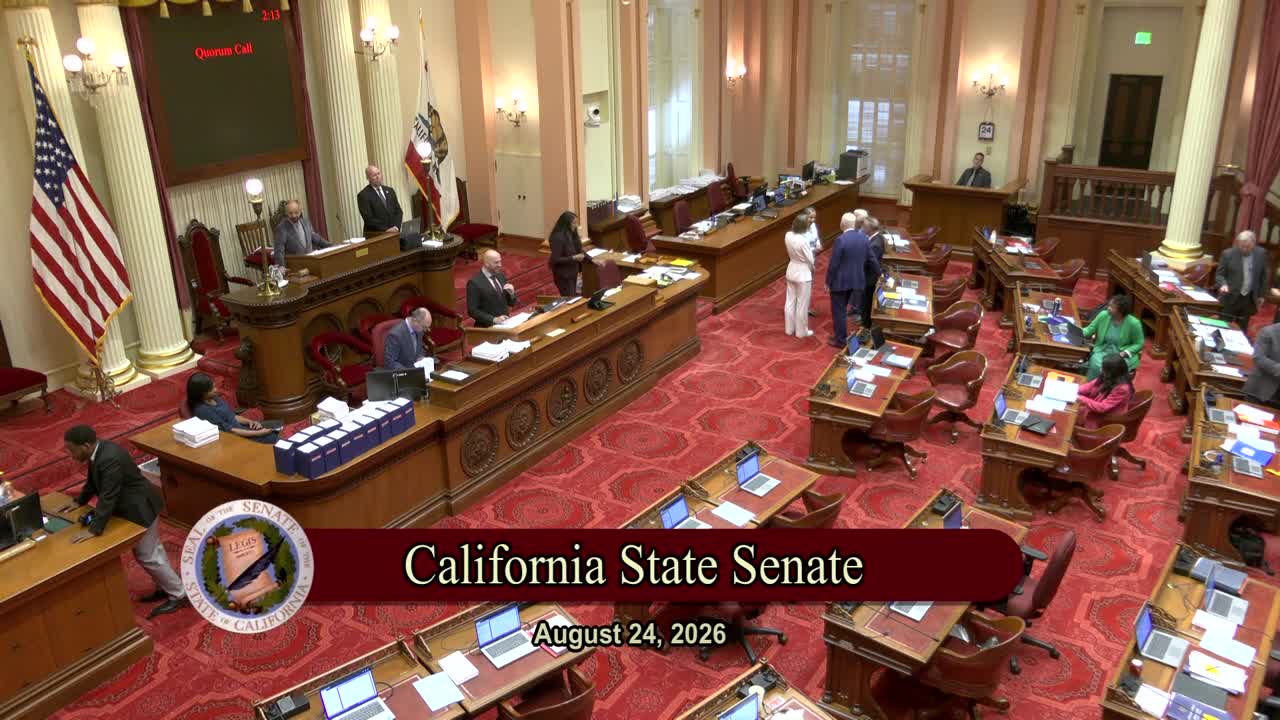 2MIN
Senate Floor
 2MIN
Assembly Floor
 9MIN
Assembly Standing Committee on Military and Veterans Affairs
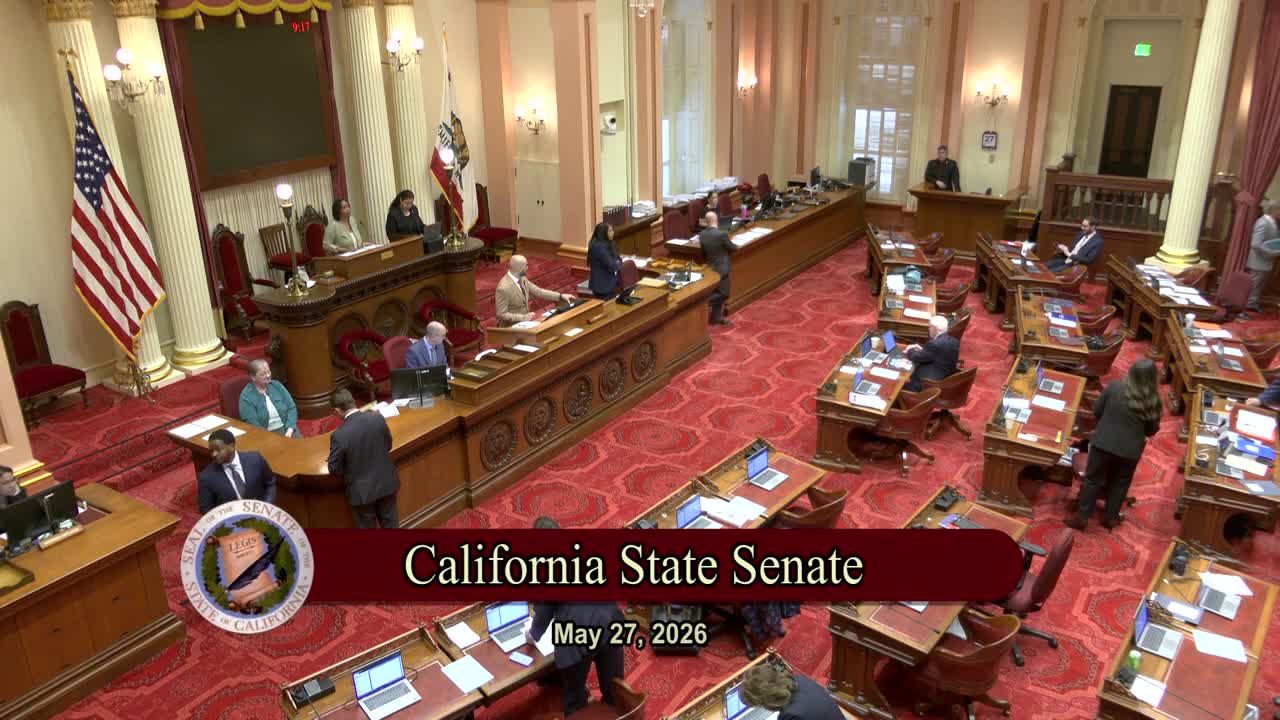 5MIN
Senate Floor
 7MIN
Senate Standing Committee on Public Safety
 6MIN
Senate Standing Committee on Military and Veterans Affairs
Bill Author

Bill Co-Author(s):
