SB 1363: Barbering and cosmetology.
- Session Year: 2025-2026
- House: Senate
- Latest Version Date: 2026-09-14
Current Status:
Passed
(2026-09-14: Chaptered by Secretary of State. Chapter 233, Statutes of 2026.)
Introduced
In Committee
Awaiting First Chamber Vote
Passed First Chamber
In Committee
Awaiting Second Chamber Vote
Passed Second Chamber
Enacted
(1)Existing law, the Barbering and Cosmetology Act, establishes the State Board of Barbering and Cosmetology until January 1, 2027, to license and regulate barbering, cosmetology, electrology, esthetics, hairstyling, and manicuring. Existing law requires a person, firm, or corporation operating an establishment where licensed activity occurs to obtain a license from the board for that establishment. Existing law requires an establishment to at all times be in the charge of a person licensed pursuant to the act, except an apprentice.
This bill would extend the provisions relating to the establishment of the board to January 1, 2031. The bill would also require a partnership or limited liability company that desires to operate an establishment where licensed activity occurs to apply to obtain a license for that establishment. For any corporation or limited liability company operating such an establishment, the bill would require the organization to be registered and in good standing with the Secretary of State, and would provide for the suspension of any license from the board for a corporation or limited liability company that is not in good standing with the Secretary of State. The bill would require the board to license any federally recognized tribe, as defined, that applies for licensure and is otherwise compliant with the requirements of the Barbering and Cosmetology Act, and would exempt a federally recognized tribe from requirements relating to registration and good standing with the Secretary of State. The bill would also require an establishment to be in the charge of a person licensed pursuant to the act as a barber, cosmetologist, electrologist, esthetician, hairstylist, manicurist, or establishment at all times during which barbering, cosmetology, electrology, esthetics, hairstyling services, or manicuring are being performed in the establishment.
(2)Existing law makes it a crime for a person, firm, or corporation to engage in specified regulated activity without a valid unexpired license issued by the board.
This bill would expand this provision to include partnerships and limited liability companies engaged in regulated activity. By expanding the operation of a crime, this bill would impose a state-mandated local program.
(3)Existing law requires the board to admit to examination for a license as a cosmetologist any person who satisfies specified application requirements, including completion of a course in cosmetology from a school approved by the board.
This bill would also require the applicant to provide official transcripts as evidence of completion of that course.
(4)Existing law provides for licensed apprenticeships to engage in learning or acquiring a knowledge of barbering, cosmetology, skin care, nail care, or electrology in a licensed establishment under the supervision of a licensee approved by the board. Existing law requires an apprenticeship training program to be conducted in compliance with the Shelley-Maloney Apprentice Labor Standards Act of 1939 according to apprenticeship standards approved by the Administrator of Apprenticeship.
This bill would instead require the training program to be conducted in compliance with the Shelley-Maloney Apprentice Labor Standards Act of 1939 according to apprenticeship standards approved by the Chief of the Division of Apprenticeship Standards. The bill would require an apprenticeship program sponsor, as defined, to obtain approval from the board to administer an apprenticeship program in barbering, cosmetology, or electrology. The bill would require an applicant seeking approval from the board to submit an application and fee and to comply with specified requirements, including submitting a copy of the agreement between the apprenticeship program sponsor and a local educational agency to the board.
This bill, among other requirements, would require an apprenticeship program sponsor to first be approved by the Division of Apprenticeship Standards. The bill would authorize the board to revoke, suspend, or deny approval of an apprenticeship program sponsor for specified acts, including unprofessional conduct. The bill would prohibit an apprenticeship training program from charging fees for an individual to participate in an apprenticeship program other than the actual cost of textbooks and minimum equipment.
This bill would authorize the board to approve a person licensed as a barber, cosmetologist, or electrologist to provide on-the-job training to an apprentice who agrees to specified requirements, including being present at all times that the apprentice is providing services. The bill would also authorize the board to approve an establishment to employ a person licensed as a barber, cosmetologist, or electrologist to provide on-the-job training to an apprentice if the establishment agrees to satisfy specified conditions, including paying the apprentice an hourly wage in accordance with the apprenticeship agreement. The bill would require the establishment and the trainer to certify that they have no outstanding fines and no pending or past disciplinary actions. By expanding the crime of perjury, this bill would impose a state-mandated local program.
This bill would require that an apprentice submit to the board a copy of the apprentice agreement entered into between the approved program sponsor and the apprentice, and would require the apprentice to be employed by the owner of a licensed establishment and registered as an apprentice with the Division of Apprenticeship Standards. The bill would make the failure to comply with the laws relating to apprenticeships by a trainer, establishment owner, or apprenticeship sponsor grounds for disciplinary action, citation and fines, and prohibition from hiring future apprentices.
(5)Existing law provides for the approval of schools by the board and requires the board to determine by regulation the required subjects of instruction to be completed in all approved courses provided by board-approved schools. Existing law requires, among other things, a board-approved school in cosmetology, barbering, or electrology to have a minimum number of bona fide, full-time students of the proposed school, as specified.
This bill would require a school in cosmetology, barbering, or electrology to be approved by the board before operating. The bill would also eliminate the requirements that a school in cosmetology, barbering, or electrology have a specified minimum number of bona fide, full-time students.
(6)Existing law authorizes the board to assess administrative fines for a violation of the act or a violation of any rules and regulations adopted by the board pursuant to the act. Existing law requires the board to establish by regulation a board-offered remedial education program, in lieu of a first offense of a health and safety violation, and authorizes the board to impose a fee to cover the reasonable regulatory cost of administering the program.
This bill would require the board to require the completion of the course within a specified period of time established by regulation. The bill would require the board to impose the penalty that would have otherwise been imposed for the violation if the course is not completed within the required time period.
(7)The California Constitution requires the state to reimburse local agencies and school districts for certain costs mandated by the state. Statutory provisions establish procedures for making that reimbursement.
This bill would provide that no reimbursement is required by this act for a specified reason.
(1)Existing law, the Barbering and Cosmetology Act, establishes the State Board of Barbering and Cosmetology until January 1, 2027, to license and regulate barbering, cosmetology, electrology, esthetics, hairstyling, and manicuring. Existing law requires a person, firm, or corporation operating an establishment where licensed activity occurs to obtain a license from the board for that establishment. Existing law requires an establishment to at all times be in the charge of a person licensed pursuant to the act, except an apprentice.
This bill would extend the provisions relating to the establishment of the board to January 1, 2031. The bill would also require a partnership or limited liability company that desires to operate an establishment where licensed activity occurs to apply to obtain a license for that establishment. For any corporation or limited liability company operating such an establishment, the bill would require the organization to be registered and in good standing with the Secretary of State, and would provide for the suspension of any license from the board for a corporation or limited liability company that is not in good standing with the Secretary of State. The bill would require the board to license any federally recognized tribe, as defined, that applies for licensure and is otherwise compliant with the requirements of a licensee, and would exempt a federally recognized tribe from requirements relating to registration and good standing with the Secretary of State. The bill would also require an establishment to be in the charge of a person licensed pursuant to the act as a barber, cosmetologist, electrologist, esthetician, hairstylist, manicurist, or establishment at all times during which barbering, cosmetology, electrology, esthetics, hairstyling services, or manicuring are being performed in the establishment.
(2)Existing law makes it a crime for a person, firm, or corporation to engage in specified regulated activity without a valid unexpired license issued by the board.
This bill would expand this provision to include partnerships and limited liability companies engaged in regulated activity. By expanding the operation of a crime, this bill would impose a state-mandated local program.
(3)Existing law requires the board to admit to examination for a license as a cosmetologist any person who satisfies specified application requirements, including completion of a course in cosmetology from a school approved by the board.
This bill would also require the applicant to provide official transcripts as evidence of completion of that course.
(3)(4)Existing law provides for licensed apprenticeships to engage in learning or acquiring a knowledge of barbering, cosmetology, skin care, nail care, or electrology in a licensed establishment under the supervision of a licensee approved by the board. Existing law requires an apprenticeship training program to be conducted in compliance with the Shelley-Maloney Apprentice Labor Standards Act of 1939 according to apprenticeship standards approved by the Administrator of Apprenticeship.
This bill would instead require the training program to be conducted in compliance with the Shelley-Maloney Apprentice Labor Standards Act of 1939 according to apprenticeship standards approved by the Chief of the Division of Apprenticeship Standards. The bill would require an apprenticeship program sponsor, as defined, to obtain approval from the board to administer an apprenticeship program in barbering, cosmetology, or electrology. The bill would require an applicant seeking approval from the board to submit an application and fee and to comply with specified requirements, including submitting a copy of the agreement between the apprenticeship program sponsor and a local educational agency to the board.
This bill, among other requirements, would require an apprenticeship program sponsor to first be approved by the Division of Apprenticeship Standards. The bill would authorize the board to revoke, suspend, or deny approval of an apprenticeship program sponsor for specified acts, including unprofessional conduct. The bill would prohibit an apprenticeship training program from charging fees for an individual to participate in an apprenticeship program other than the actual cost of textbooks and minimum equipment.
This bill would authorize the board to approve a person licensed as a barber, cosmetologist, or electrologist to provide on-the-job training to an apprentice who agrees to specified requirements, including being present at all times that the apprentice is providing services. The bill would also authorize the board to approve an establishment to employ a person licensed as a barber, cosmetologist, or electrologist to provide on-the-job training to an apprentice if the establishment agrees to satisfy specified conditions, including paying the apprentice an hourly wage in accordance with the apprenticeship agreement. The bill would require the establishment and the trainer to certify that they have no outstanding fines and no pending or past disciplinary actions. By expanding the crime of perjury, this bill would impose a state-mandated local program.
This bill would require that an apprentice submit to the board a copy of the apprentice agreement entered into between the approved program sponsor and the apprentice, and would require the apprentice to be employed by the owner of a licensed establishment and registered as an apprentice with the Division of Apprenticeship Standards. The bill would make the failure to comply with the laws relating to apprenticeships by a trainer, establishment owner, or apprenticeship sponsor grounds for disciplinary action, citation and fines, and prohibition from hiring future apprentices.
(5)Existing law provides for the approval of schools by the board and requires the board to determine by regulation the required subjects of instruction to be completed in all approved courses provided by board-approved schools. Existing law requires, among other things, a board-approved school in cosmetology, barbering, or electrology to have a minimum number of bona fide, full-time students of the proposed school, as specified.
This bill would require a school in cosmetology, barbering, or electrology to be approved by the board before operating. The bill would also eliminate the requirements that a school in cosmetology, barbering, or electrology have a specified minimum number of bona fide, full-time students.
(6)Existing law authorizes the board to assess administrative fines for a violation of the act or a violation of any rules and regulations adopted by the board pursuant to the act. Existing law requires the board to establish by regulation a board-offered remedial education program, in lieu of a first offense of a health and safety violation, and authorizes the board to impose a fee to cover the reasonable regulatory cost of administering the program.
This bill would require the board to require the completion of the course within a specified period of time established by regulation. The bill would require the board to impose the penalty that would have otherwise been imposed for the violation if the course is not completed within the required time period.
(4)(7)The California Constitution requires the state to reimburse local agencies and school districts for certain costs mandated by the state. Statutory provisions establish procedures for making that reimbursement.
This bill would provide that no reimbursement is required by this act for a specified reason.
(1)Existing law, the Barbering and Cosmetology Act, establishes the State Board of Barbering and Cosmetology until January 1, 2027, to license and regulate barbering, cosmetology, electrology, esthetics, hairstyling, and manicuring. Existing law requires a person, firm, or corporation operating an establishment where licensed activity occurs to obtain a license from the board for that establishment. Existing law requires an establishment to at all times be in the charge of a person licensed pursuant to the act, except an apprentice.
This bill would extend the provisions relating to the establishment of the board to January 1, 2031. The bill would also require a partnership or limited liability company that desires to operate an establishment where licensed activity occurs to apply to obtain a license for that establishment. For any corporation or limited liability company operating such an establishment, the bill would require the organization to be registered and in good standing with the Secretary of State, and would provide for the suspension of any license from the board for a corporation or limited liability company that is not in good standing with the Secretary of State. The bill would require the board to license any federally recognized tribe, as defined, that applies for licensure and is otherwise compliant with the requirements of a licensee, and would exempt a federally recognized tribe from requirements relating to registration and good standing with the Secretary of State. The bill would also require an establishment to be in the charge of a person licensed pursuant to the act as a barber, cosmetologist, electrologist, esthetician, hairstylist, manicurist, or establishment at all times during which barbering, cosmetology, electrology, esthetics, hairstyling services, or manicuring are being performed in the establishment.
(2)Existing law makes it a crime for a person, firm, or corporation to engage in specified regulated activity without a valid unexpired license issued by the board.
This bill would expand this provision to include partnerships and limited liability companies engaged in regulated activity. By expanding the operation of a crime, this bill would impose a state-mandated local program.
(3)Existing law provides for licensed apprenticeships to engage in learning or acquiring a knowledge of barbering, cosmetology, skin care, nail care, or electrology in a licensed establishment under the supervision of a licensee approved by the board. Existing law requires an apprenticeship training program to be conducted in compliance with the Shelley-Maloney Apprentice Labor Standards Act of 1939, as specified. 1939 according to apprenticeship standards approved by the Administrator of Apprenticeship.
This bill would instead require the training program to be conducted in compliance with the Shelley-Maloney Apprentice Labor Standards Act of 1939 according to apprenticeship standards approved by the Chief of the Division of Apprenticeship Standards. The bill would require an apprenticeship program sponsor, as defined, to obtain approval from the board to administer an apprenticeship program in barbering, cosmetology, or electrology. The bill would require an applicant seeking approval from the board to submit an application and fee and to comply with specified requirements, including submitting a copy of the agreement between the apprenticeship program sponsor and a local educational agency to the board.
This bill, among other requirements, would require an apprenticeship program sponsor to first be approved by the Division of Apprenticeship Standards. The bill would authorize the board to revoke, suspend, or deny approval of an apprenticeship program sponsor for specified acts, including unprofessional conduct. The bill would prohibit an apprenticeship training program from charging fees for an individual to participate in an apprenticeship program other than the actual cost of textbooks and minimum equipment.
This bill would authorize the board to approve a person licensed as a barber, cosmetologist, or electrologist to provide on-the-job training to an apprentice who agrees to specified requirements, including being present at all times that the apprentice is providing services. The bill would also authorize the board to approve an establishment to employ a person licensed as a barber, cosmetologist, or electrologist to provide on-the-job training to an apprentice if the establishment agrees to satisfy specified conditions, including paying the apprentice an hourly wage in accordance with the apprenticeship agreement. The bill would require the establishment and the trainer to certify that they have no outstanding fines and no pending or past disciplinary actions. By expanding the crime of perjury, this bill would impose a state-mandated local program.
This bill would require that an apprentice submit to the board a copy of the apprentice agreement entered into between the approved program sponsor and the apprentice, and would require the apprentice to be employed by the owner of a licensed establishment. establishment and registered as an apprentice with the Division of Apprenticeship Standards. The bill would make the failure to comply with the laws relating to apprenticeships by a trainer, establishment owner, or apprenticeship sponsor grounds for disciplinary action, citation and fines, and prohibition from hiring future apprentices.
(4)The California Constitution requires the state to reimburse local agencies and school districts for certain costs mandated by the state. Statutory provisions establish procedures for making that reimbursement.
This bill would provide that no reimbursement is required by this act for a specified reason.
(1)Existing law, the Barbering and Cosmetology Act, establishes the State Board of Barbering and Cosmetology until January 1, 2027, to license and regulate barbering, cosmetology, electrology, esthetics, hairstyling, and manicuring. Existing law requires a person, firm, or corporation operating an establishment where licensed activity occurs to obtain a license from the board for that establishment. Existing law requires an establishment to at all times be in the charge of a person licensed pursuant to the act, except an apprentice.
This bill would extend the provisions relating to the establishment of the board to January 1, 2031. The bill would also require a partnership or limited liability company that desires to operate an establishment where licensed activity occurs to apply to obtain a license for that establishment. For any corporation or limited liability company operating such an establishment, the bill would require the organization to be registered and in good standing with the Secretary of State, and would provide for the suspension of any license from the board for a corporation or limited liability company that is not in good standing with the Secretary of State. The bill would require the board to license any federally recognized tribe, as defined, that applies for licensure and is otherwise compliant with the requirements of a licensee, and would exempt a federally recognized tribe from requirements relating to registration and good standing with the Secretary of State. The bill would also require an establishment to be in the charge of a person licensed pursuant to the act as a barber, cosmetologist, electrologist, esthetician, hairstylist, manicurist, or establishment at all times during which barbering, cosmetology, electrology, esthetics, hairstyling services, or manicuring are being performed in the establishment.
(2)Existing law makes it a crime for a person, firm, or corporation to engage in specified regulated activity without a valid unexpired license issued by the board.
This bill would expand this provision to include partnerships and limited liability companies engaged in regulated activity. By expanding the operation of a crime, this bill would impose a state-mandated local program.
(3)Existing law provides for licensed apprenticeships to engage in learning or acquiring a knowledge of barbering, cosmetology, skin care, nail care, or electrology in a licensed establishment under the supervision of a licensee approved by the board. Existing law requires an apprenticeship training program to be conducted in compliance with the Shelley-Maloney Apprentice Labor Standards Act of 1939, as specified.
This bill would require an apprenticeship program sponsor, as defined, to obtain approval from the board to administer an apprenticeship program in barbering, cosmetology, or electrology. The bill would require an applicant seeking approval from the board to submit an application and fee and to comply with specified requirements, including submitting a copy of the agreement between the apprenticeship program sponsor and a local educational agency to the board.
This bill, among other requirements, would require an apprenticeship program sponsor to first be approved by the Division of Apprenticeship Standards. The bill would authorize the board to revoke, suspend, or deny approval of an apprenticeship program sponsor for specified acts, including unprofessional conduct. The bill would prohibit an apprenticeship training program from charging fees for an individual to participate in an apprenticeship program other than the actual cost of textbooks and minimum equipment.
This bill would authorize the board to approve a person licensed as a barber, cosmetologist, or electrologist to provide on-the-job training to an apprentice who agrees to specified requirements, including being present at all times that the apprentice is providing services. The bill would also authorize the board to approve an establishment to employ a person licensed as a barber, cosmetologist, or electrologist to provide on-the-job training to an apprentice if the establishment agrees to satisfy specified conditions, including paying the apprentice an hourly wage in accordance with the apprenticeship agreement. The bill would require the establishment and the trainer to certify that they have no outstanding fines and no pending or past disciplinary actions. By expanding the crime of perjury, this bill would impose a state-mandated local program.
This bill would require that an apprentice submit to the board a copy of the apprentice agreement entered into between the approved program sponsor and the apprentice, and would require the apprentice to be employed by the owner of a licensed establishment. The bill would make the failure to comply with the laws relating to apprenticeships by a trainer or establishment owner trainer, establishment owner, or apprenticeship sponsor grounds for disciplinary action, citation and fines, and prohibition from hiring future apprentices.
(4)The California Constitution requires the state to reimburse local agencies and school districts for certain costs mandated by the state. Statutory provisions establish procedures for making that reimbursement.
This bill would provide that no reimbursement is required by this act for a specified reason.
(1)Existing law, the Barbering and Cosmetology Act, establishes the State Board of Barbering and Cosmetology until January 1, 2027, to license and regulate barbering, cosmetology, electrology, esthetics, hairstyling, and manicuring. Existing law requires a person, firm, or corporation operating an establishment where licensed activity occurs to also be licensed by the board. obtain a license from the board for that establishment. Existing law requires an establishment to at all times be in the charge of a person licensed pursuant to the act, except an apprentice.
This bill would instead extend the provisions relating to the establishment of the board to January 1, 2031. The bill would also require a partnership or limited liability company that desires to operate an establishment where licensed activity occurs to apply to obtain a license for that establishment. For any corporation or limited liability company operating such an establishment, the bill would require the organization to be registered and in good standing with the Secretary of State, and would provide for the suspension of any license from the board for a corporation or limited liability company that is not in good standing with the Secretary of State. The bill would require the board to license any federally recognized tribe, as defined, that applies for licensure and is otherwise compliant with the requirements of a licensee, and would exempt a federally recognized tribe from requirements relating to registration and good standing with the Secretary of State. The bill would also require an establishment to be in the charge of a person licensed pursuant to the act as a barber, cosmetologist, electrologist, esthetician, hairstylist, manicurist, or establishment at all times during which barbering, cosmetology, electrology, esthetics, hairstyling services, or manicuring are being performed in the establishment.
(2)Existing law makes it a crime for a person, firm, or corporation to engage in specified regulated activity without a valid unexpired license issued by the board.
This bill would expand this provision to include partnerships and limited liability companies engaged in regulated activity. By expanding the operation of a crime, this bill would impose a state-mandated local program.
(3)Existing law provides for licensed apprenticeships to engage in learning or acquiring a knowledge of barbering, cosmetology, skin care, nail care, or electrology in a licensed establishment under the supervision of a licensee approved by the board.
This bill would require that an apprentice submit to the board a copy of the apprentice agreement entered into between the approved program sponsor and the apprentice, and would require the apprentice to be employed by the owner of a licensed establishment. The bill would make the failure to comply with the laws relating to apprenticeships by a trainer or establishment owner grounds for disciplinary action, citation and fines, and prohibition from hiring future apprentices.
(4)The California Constitution requires the state to reimburse local agencies and school districts for certain costs mandated by the state. Statutory provisions establish procedures for making that reimbursement.
This bill would provide that no reimbursement is required by this act for a specified reason.
Existing law, the Barbering and Cosmetology Act, establishes the State Board of Barbering and Cosmetology to license and regulate barbering, cosmetology, electrology, esthetics, hairstyling, and manicuring. Existing law requires an establishment where licensed activity occurs to also be licensed by the board. Existing law requires an establishment to at all times be in charge of a person licensed pursuant to the act, except an apprentice.
This bill would instead require an establishment to be in charge of a person licensed pursuant to the act as a barber, cosmetologist, electrologist, esthetician, hairstylist, manicurist, or establishment at all times during which barbering, cosmetology, electrology, esthetics, hairstyling services, or manicuring are being performed in the establishment.
(a)Notwithstanding Article 8 (commencing with Section 9148) of Chapter 1.5 of Part 1 of Division 2 of Title 2 of the Government Code, there is in the Department of Consumer Affairs the State Board of Barbering and Cosmetology in which the administration of this chapter is vested.
(b)(1)The board shall consist of 13 members. Seven members shall be public members, and six members shall represent the professions.
(2)The Governor shall appoint five of the public members and the six professional members. The six professional members shall be comprised as follows:
(A)A cosmetologist.
(B)A barber.
(C)An esthetician.
(D)An electrologist.
(E)A manicurist.
(F)An establishment owner.
(3)The Senate Committee on Rules and the Speaker of the Assembly shall each appoint one public member.
(4)Members of the board shall be appointed for a term of four years, except that of the members appointed by the Governor, two of the public members and two of the professions members shall be appointed for an initial term of two years. No board member may serve longer than two consecutive terms.
(5)Each member of the board shall receive a per diem pursuant to Section 103.
(c)The board may appoint an executive officer who is exempt from civil service. The executive officer shall exercise the powers and perform the duties delegated by the board and vested in the executive officer by this chapter. The appointment of the executive officer is subject to the approval of the director. In the event that a newly authorized board replaces an existing or previous bureau, the director may appoint an interim executive officer for the board who shall serve temporarily until the new board appoints a permanent executive officer.
(d)The executive officer shall provide examiners, inspectors, and other personnel necessary to carry out the provisions of this chapter.
(e)This section shall remain in effect only until January 1, 2031, and as of that date is repealed. Notwithstanding any other law, the repeal of this section renders the board subject to review by the appropriate policy committees of the Legislature.
SEC. 2.Section 7315.5 is added to the Business and Professions Code, to read:7315.5.(a)As used in this chapter, the following definitions apply:
(1)Federally recognized tribe means a tribe located in this state and included on the list published in the Federal Register pursuant to the Federally Recognized Indian Tribe List Act of 1994 (25 U.S.C. Sec. 5131) and includes an entity controlled by and established for the benefit of one or more tribes.
(2)Participating tribe means a federally recognized tribe that formally applies for licensure from the board pursuant to subdivision (b).
(b)The board shall license a federally recognized tribe that applies for licensure and is otherwise compliant with this chapter for the purpose of engaging in a business regulated by this chapter.
(c)Nothing in this chapter is intended to infringe upon or diminish the existing rights, privileges, and immunities of federally recognized tribes as set forth in federal, state, or tribal law, or the jurisdiction of those participating tribes.
(d)Nothing in this chapter, whether express or implied, shall confer upon the board or director any rights or authority to regulate any activity within the jurisdiction of a participating tribe.
(e)Any requirement to register with the Secretary of State, maintain good standing with the Secretary of State, provide a corporate number issued by the Secretary of State, or any other associated requirement shall not apply to a participating tribe.
SEC. 3.Section 7317 of the Business and Professions Code is amended to read:7317.Except as provided in this article, it is unlawful for any person, firm, partnership, limited liability company, or corporation to engage in barbering, cosmetology, or electrolysis for compensation without a valid, unexpired license issued by the board, unless the person is participating in an externship program from an approved school, or in an establishment or mobile unit other than one licensed by the board, or conduct or operate an establishment, or any other place of business in which barbering, cosmetology, or electrolysis is practiced unless licensed under this chapter. Persons licensed under this chapter shall limit their practice and services rendered to the public to only those areas for which they are licensed. Any violation of this section is subject to an administrative fine and may be subject to a misdemeanor.
SEC. 4.Section 7321 of the Business and Professions Code is amended to read:7321.The board shall admit to examination for a license as a cosmetologist to practice cosmetology any person who has made application to the board in proper form, paid the fee required by this chapter, and is qualified as follows:
(a)Is not less than 17 years of age.
(b)Has completed the 10th grade in the public schools of this state or its equivalent.
(c)Is not subject to denial pursuant to Section 480.
(d)Has done any of the following:
(1)Completed a course in cosmetology from a school approved by the board and provided evidence of completion by providing official transcripts.
(2)Practiced cosmetology as defined in this chapter outside of this state for a period of time equivalent to the study and training of a qualified person who has completed a course in cosmetology from a school the curriculum of which complied with requirements adopted by the board. Each three months of practice shall be deemed the equivalent of 100 hours of training for qualification under paragraph (1) of this subdivision.
(3)Holds a license as a barber in this state and has completed a cosmetology crossover course in a school approved by the board.
(4)Completed a barbering course in a school approved by the board and has completed a cosmetology crossover course in a school approved by the board.
(5)Completed the apprenticeship program in cosmetology specified in Article 4 (commencing with Section 7332).
SEC. 5.Section 7332 of the Business and Professions Code is amended to read:7332.(a)An apprentice is any person who is employed by the owner of a licensed establishment and is licensed by the board to engage in learning or acquiring a knowledge of barbering, cosmetology, skin care, nail care, or electrology in a licensed establishment under the supervision of a licensee approved by the board and is registered as an apprentice with the Division of Apprenticeship Standards.
(b)For purposes of this section, under the supervision of a licensee means that the apprentice shall be supervised at all times by a licensee approved by the board while performing services in a licensed establishment. At no time shall an apprentice be the only individual working in the establishment. An apprentice that is not being supervised by a licensee, that has been approved by the board to supervise an apprentice, shall be deemed to be practicing unlicensed under this chapter.
SEC. 6.Section 7332.1 is added to the Business and Professions Code, to read:7332.1.(a)Any joint apprenticeship committee, unilateral management committee, or labor apprenticeship committee, or an individual employer that wants to administer an apprenticeship in barbering, cosmetology, or electrology shall be known as an apprenticeship program sponsor.
(b)An applicant seeking board approval as an apprenticeship program sponsor to administer an apprenticeship in barbering, cosmetology, or electrology shall do all of the following:
(1)Submit an application and fee to the board. The application for apprenticeship approval shall be signed by the individual employer or, if the program sponsor is not an individual, by a responsible officer of the organization.
(2)Submit proof that the program sponsor is approved by the Division of Apprenticeship Standards by providing a full copy of the apprenticeship program standards approved by the division to the board.
(3)Submit a detailed outline of the proposed training program that demonstrates compliance with the apprenticeship regulations adopted in accordance with this article. The outline shall, at a minimum, include a training plan for both on-the-job training and classroom instruction.
(4)Submit a copy of the agreement between the program sponsor and a local educational agency. The agreement shall include all of the following:
(A)A list of all locations at which the local education agency has approved the applicant to deliver related and supplemental instruction. For each listed location the agreement shall include all of the following:
(i)The establishments name and physical address.
(ii)The establishments internet website, if available.
(iii)The name, email address, and telephone number of the lead contact person.
(B)A timely agreement date showing that the agreement is current.
(C)The expiration date if the agreement has one.
(D)A statement that the barbering and cosmetology apprenticeship program and any provider of related and supplemental instruction do not charge tuition and comply with Sections 48053 and 76350 of the Education Code.
(5)Submit a copy of the agreement between the program sponsor and the apprentice, hereafter known as the apprenticeship agreement. The apprenticeship agreement shall comply with the Shelley-Maloney Apprentice Labor Standards Act of 1939 (Chapter 4 (commencing with Section 3070) of Division 3 of the Labor Code) and regulations adopted pursuant thereto.
(6)Any changes to the list of locations provided pursuant to subparagraph (A) of paragraph (4) shall be reported to the board within 10 days of notification to the local educational agency of intent to add or delete a location.
(7)Each applicant, if an individual, or each officer, director, partner, or committee member shall not have committed acts or crimes which are grounds for denial of licensure pursuant to Section 480.
(c)An apprenticeship program sponsor shall notify the board within 10 days of any changes to the information filed with the board in accordance with subdivision (b) for board approval and shall submit a new application for program sponsor approval.
(d)Board approval of a program sponsor shall expire after two years unless renewed by submission of a renewal application and fee.
SEC. 7.Section 7332.2 is added to the Business and Professions Code, to read:7332.2.(a)An apprentice program sponsor shall be approved by the Division of Apprenticeship Standards before being approved by the board.
(b)Notwithstanding any other law, the board may revoke, suspend, or deny approval of a program sponsor in a proceeding that shall be conducted in accordance with Chapter 5 (commencing with Section 11500) of Part 1 of Division 3 of Title 2 of the Government Code, when an owner or employee of the program sponsor has engaged in any of the following acts:
(1)Unprofessional conduct, including, but not limited to, any of the following:
(A)Incompetence or gross negligence.
(B)Repeated similar negligent acts.
(C)Conviction of any crime substantially related to the qualifications, functions, or duties of the owner of an apprenticeship program sponsor, in which case, the records of conviction or a certified copy thereof shall be conclusive evidence of the conviction.
(D)Advertising by means of knowingly false or deceptive statements.
(2)Failure to comply with the requirements of this chapter or the Shelley-Maloney Apprentice Labor Standards Act of 1939 (Chapter 4 (commencing with Section 3070) of Division 3 of the Labor Code).
(3)Repeated failure to comply with the rules adopted by the board for the regulation of board-approved apprentice program sponsors.
(4)The making of any false statement as to a material matter in any oath or affidavit that is required by this chapter.
(5)Repeated failure to provide information pertinent to the processing of apprentice license applications or examination applications for apprentices previously in the apprenticeship program.
(6)Any action or conduct that would have warranted the denial of a license.
SEC. 8.Section 7333 of the Business and Professions Code is amended to read:7333.(a)The apprentice training program shall be conducted in compliance with the Shelley-Maloney Apprentice Labor Standards Act of 1939 (Chapter 4 (commencing with Section 3070) of Division 3 of the Labor Code), according to apprenticeship standards approved by the Chief of the Division of Apprenticeship Standards. A copy of the act shall be maintained on file with the board.
(b)There shall be no fees charged for an individual to participate in the apprentice program other than the actual cost of textbooks and minimum equipment.
(c)An approved program sponsor shall not franchise, sponsor, or loan their approval. All enrollment with an apprentice shall only be between the approved program sponsor and the apprentice.
(d)An approved program sponsor shall verify that the establishment where on-the-job training is being completed obtains workers compensation insurance, provides all services that are within the scope of practice of the licensed profession, and ensures that the apprentice is paid according to the apprenticeship agreement.
(e)An approved program sponsor shall not enter into any financial contract with an apprentice for any reason other than an employment contract if the employer is also the approved program sponsor.
(f)An apprentice shall not be paid by commission, be required to rent a station within the establishment, or act as an independent contractor.
(g)A violation of this section shall be considered egregious for the purposes of Section 7407.1.
SEC. 9.Section 7334 of the Business and Professions Code is amended to read:7334.(a)The board may license as an apprentice in barbering, cosmetology, skin care, or nail care any person who has made application to the board upon the proper form, has paid the fee required by this chapter, and who is qualified as follows:
(1)Is over 16 years of age.
(2)Has completed the 10th grade in the public schools of this state or its equivalent.
(3)Is not subject to denial pursuant to Section 480.
(4)Has submitted evidence acceptable to the board that any training the apprentice is required by law to obtain shall be conducted in a licensed establishment and under the supervision of a licensee approved by the board.
(5)Has submitted a copy of the apprentice agreement that was entered into between the approved program sponsor and the apprentice.
(b)The board may license as an apprentice in electrolysis any person who has made application to the board upon the proper form, has paid the fee required by this chapter, and who is qualified as follows:
(1)Is not less than 17 years of age.
(2)Has completed the 12th grade or an accredited senior high school course of study in schools of this state or its equivalent.
(3)Is not subject to denial pursuant to Section 480.
(4)Has submitted evidence acceptable to the board that any training the apprentice is required by law to obtain shall be conducted in a licensed establishment and under the supervision of a licensee approved by the board.
(5)Has submitted a copy of the apprentice agreement that was entered into between the approved program sponsor and the apprentice.
(c)All persons making application as an apprentice in barbering shall also complete preapprentice training that is administered by the board for the length of time established by the board in a facility approved by the board prior to serving the general public.
(d)All persons making application as an apprentice in cosmetology, skin care, nail care, or electrology shall also complete minimum preapprentice training administered by the board for the length of time established by the board in a facility approved by the board prior to serving the general public.
(e)Apprentices may only perform services on the general public for which they have received technical training.
(f)Apprentices shall be required to obtain at least the minimum hours of technical instruction and minimum number of practical operations for each subject as specified in board regulations for courses taught in schools approved by the board, in accordance with Sections 3074 and 3078 of the Labor Code.
SEC. 10.Section 7334.1 is added to the Business and Professions Code, to read:7334.1.(a)The board may approve a person licensed as a barber, cosmetologist, or electrologist to provide on-the-job training to an apprentice who agrees to do all of the following:
(1)Be present at all times that the apprentice is providing services.
(2)Follow the approved apprentice program sponsors on-the-job training plan.
(3)Maintain accurate records to document the training provided to the apprentice and make those records available upon request by the board.
(b)A trainer shall certify they have no outstanding fines and no pending or past disciplinary actions.
(c)Failure to agree to comply with this section shall result in a trainers board approval being denied, and failure to comply may result in a trainers board approval being withdrawn, suspended, or revoked.
SEC. 11.Section 7334.2 is added to the Business and Professions Code, to read:7334.2.(a)The board may approve an establishment to employ a person licensed as a barber, cosmetologist, or electrologist to provide on-the-job training to an apprentice who agrees to ensure all of the following:
(1)The apprentice is in the establishment and in the presence of their assigned trainer at all times that the apprentice is providing services.
(2)The trainer maintains accurate records to document the training provided to the apprentice and makes those records available upon request by the board.
(3)The establishment possesses workers compensation insurance for the entire duration that the apprentice is employed.
(4)The establishment pays the apprentice an hourly wage in accordance with the apprentice agreement. An apprentice shall not rent a booth, be classified as an independent contractor, have wages paid by commission, or be paid by the service.
(b)The establishment shall certify it has no outstanding fines and no pending or past disciplinary actions.
(c)Failure to agree to comply with this section shall result in an establishments board approval to employ apprentice trainers being denied. Failure to comply with this section may result in the establishments board approval to employ apprentice trainers being withdrawn, suspended, or revoked.
SEC. 12.Section 7334.5 is added to the Business and Professions Code, to read:7334.5.Failure to comply with this chapter and all laws and regulations applicable to apprenticeships by the trainer, establishment owner, or apprenticeship program sponsor is grounds for disciplinary action, citation and fines, and prohibition from hiring future apprentices.
SEC. 13.Section 7347 of the Business and Professions Code is amended to read:7347.(a)Any person, firm, partnership, limited liability company, or corporation desiring to operate an establishment shall make an application to the board for a license accompanied by the fee prescribed by this chapter. The application shall be required whether the person, firm, partnership, limited liability company, or corporation is operating a new establishment or obtaining ownership of an existing establishment. The application shall include a signed acknowledgment that the applicant understands that establishments are responsible for compliance with any applicable labor laws of the state and that the applicant understands the informational materials on basic labor laws, as specified in Section 7314.3, the applicant is provided by the board with the application. Every electronic application to renew a license shall include a signed acknowledgment that the renewal applicant understands that establishments are responsible for compliance with any applicable labor laws of the state and that the applicant understands the informational materials on basic labor laws, as specified in Section 7314.3, that the renewal applicant is provided by the board with the renewal application. If the applicant is obtaining ownership of an existing establishment, the board may establish the fee in an amount less than the fee prescribed by this chapter. The applicant, if an individual, or each officer, director, and partner, if the applicant is other than an individual, shall not have committed acts or crimes which are grounds for denial of licensure in effect at the time the new application is submitted pursuant to Section 480. A license issued pursuant to this section shall authorize the operation of the establishment only at the location for which the license is issued. Operation of the establishment at any other location shall be unlawful unless a license for the new location has been obtained upon compliance with this section, applicable to the issuance of a license in the first instance.
(b)Failure of an establishment licensed to do business as a corporation or limited liability company in this state to be registered and in good standing with the Secretary of State after notice from the board shall result in the automatic suspension of the license by operation of law. The board shall notify the licensee in writing of its failure to be registered and in good standing with the Secretary of State and that the licensee shall be suspended 30 days from the date of the notice if the licensee does not provide proof satisfactory to the board that it is properly registered and in good standing with the Secretary of State. Reinstatement may be made at any time following the suspension by providing proof satisfactory to the board that the license is properly registered and in good standing.
SEC. 14.Section 7348 of the Business and Professions Code is amended to read:7348.An establishment shall be in the charge of a person licensed pursuant to this chapter as a barber, cosmetologist, electrologist, esthetician, hairstylist, manicurist, or establishment at all times during which barbering, cosmetology, electrology, esthetics, hairstyling services, or manicuring are being performed in the establishment.
SEC. 15.Section 7362 of the Business and Professions Code is amended to read:7362.A school of cosmetology, barbering, or electrology shall not operate without first being approved by the board.
(a)A school approved by the board is one that is first approved by the board and subsequently approved by the Bureau for Private Postsecondary Education or is a public school in this state, and provides a course of instruction approved by the board. However, notwithstanding any other law, both the board and the Bureau for Private Postsecondary Education may simultaneously process a schools application for approval.
(b)Notwithstanding any other law, the board may revoke, suspend, or deny approval of a school, in a proceeding that shall be conducted in accordance with Chapter 5 (commencing with Section 11500) of Part 1 of Division 3 of Title 2 of the Government Code, when an owner or employee of the school has engaged in any of the acts specified in paragraphs (1) to (8), inclusive.
(1)Unprofessional conduct which includes, but is not limited to, any of the following:
(A)Incompetence or gross negligence, including repeated failure to comply with generally accepted standards for the practice of barbering, cosmetology, or electrology, or disregard for the health and safety of patrons.
(B)Repeated similar negligent acts.
(C)Conviction of any crime substantially related to the qualifications, functions, or duties of the owner of an approved school, in which case, the records of conviction or a certified copy thereof shall be conclusive evidence of the conviction.
(2)Repeated failure to comply with the rules governing health and safety adopted by the board and approved by the State Department of Public Health, for the regulation of board-approved schools.
(3)Repeated failure to comply with the rules adopted by the board for the regulation of board-approved schools.
(4)Continued practice by a person knowingly having an infectious or contagious disease.
(5)Habitual drunkenness, or habitual use of, or addiction to the use of, any controlled substance.
(6)Obtaining or attempting to obtain practice in any occupation licensed and regulated under this chapter, or money, or compensation in any form, by fraudulent misrepresentation.
(7)Refusal to permit or interference with an inspection authorized under this chapter.
(8)Any action or conduct that would have warranted the denial of a school approval.
SEC. 16.Section 7362.1 of the Business and Professions Code is amended to read:7362.1.A school of cosmetology approved by the board shall also meet all of the following:
(a)Possess the equipment and floor space necessary for comprehensive instruction of 25 cosmetology students or the number of students enrolled in the course, whichever is greater.
(b)Maintain a course of practical training and technical instruction for the full cosmetology course as specified in this chapter and in board regulations. A course of instruction in any branch of cosmetology shall be taught in a school of cosmetology.
SEC. 17.Section 7362.2 of the Business and Professions Code is amended to read:7362.2.A school of barbering approved by the board shall also do all of the following:
(a)Possess the equipment and floor space necessary for comprehensive instruction of 15 barber students or the number of students enrolled in the course, whichever is greater.
(b)Maintain a course of practical training and technical instruction for the full barbering course as specified in this chapter and in board regulations.
SEC. 18.Section 7362.3 of the Business and Professions Code is amended to read:7362.3.A school of electrology approved by the board shall also do all of the following:
(a)Possess the equipment and floor space necessary for comprehensive instruction of five electrology students or the number of students enrolled in the course, whichever is greater.
(b)Maintain a course of practical training and technical instruction for the full electrology course as specified in this chapter and in board regulations.
SEC. 19.Section 7407.1 of the Business and Professions Code is amended to read:7407.1.(a)The board shall determine by regulation when a fine shall be assessed to both the holder of the establishment license and the individual licensee for the same violation. The board shall also determine by regulation when a fine shall be assessed to only the holder of the establishment license or to only an individual licensee for the same violation. In making these determinations, the board shall consider the egregiousness of the violation of the health and safety regulations and whether the violation is a repeated violation by licensees within the same establishment.
(b)(1)The board shall establish by regulation a board-approved remedial education program, and shall require completion of the program within a specified timeframe in lieu of imposing a fine for a first offense of a health and safety violation. The board shall establish the specified timeframe for completion of the program by regulation. If the program is not completed within the allotted time, the board shall impose the penalty that would have otherwise been imposed for the violation.
(2)The board, or its designee, may impose a fee to cover the reasonable regulatory cost of administering the program described in paragraph (1).
SEC. 20.No reimbursement is required by this act pursuant to Section 6 of Article XIIIB of the California Constitution because the only costs that may be incurred by a local agency or school district will be incurred because this act creates a new crime or infraction, eliminates a crime or infraction, or changes the penalty for a crime or infraction, within the meaning of Section 17556 of the Government Code, or changes the definition of a crime within the meaning of Section 6 of Article XIIIB of the California Constitution.
(a)Notwithstanding Article 8 (commencing with Section 9148) of Chapter 1.5 of Part 1 of Division 2 of Title 2 of the Government Code, there is in the Department of Consumer Affairs the State Board of Barbering and Cosmetology in which the administration of this chapter is vested.
(b)(1)The board shall consist of 13 members. Seven members shall be public members, and six members shall represent the professions.
(2)The Governor shall appoint five of the public members and the six professional members. The six professional members shall be comprised as follows:
(A)A cosmetologist.
(B)A barber.
(C)An esthetician.
(D)An electrologist.
(E)A manicurist.
(F)An establishment owner.
(3)The Senate Committee on Rules and the Speaker of the Assembly shall each appoint one public member.
(4)Members of the board shall be appointed for a term of four years, except that of the members appointed by the Governor, two of the public members and two of the professions members shall be appointed for an initial term of two years. No board member may serve longer than two consecutive terms.
(5)Each member of the board shall receive a per diem pursuant to Section 103.
(c)The board may appoint an executive officer who is exempt from civil service. The executive officer shall exercise the powers and perform the duties delegated by the board and vested in the executive officer by this chapter. The appointment of the executive officer is subject to the approval of the director. In the event that a newly authorized board replaces an existing or previous bureau, the director may appoint an interim executive officer for the board who shall serve temporarily until the new board appoints a permanent executive officer.
(d)The executive officer shall provide examiners, inspectors, and other personnel necessary to carry out the provisions of this chapter.
(e)This section shall remain in effect only until January 1, 2031, and as of that date is repealed. Notwithstanding any other law, the repeal of this section renders the board subject to review by the appropriate policy committees of the Legislature.
SEC. 2.Section 7315.5 is added to the Business and Professions Code, to read:7315.5.(a)As used in this chapter, the following definitions apply:
(1)Federally recognized tribe means a tribe located in this state and included on the list published in the Federal Register pursuant to the Federally Recognized Indian Tribe List Act of 1994 (25 U.S.C. Sec. 5131) and includes an entity controlled by and established for the benefit of one or more tribes.
(2)Participating tribe means a federally recognized tribe that formally applies for licensure from the board pursuant to subdivision (b).
(b)The board shall license a federally recognized tribe that applies for licensure and is otherwise compliant with this chapter for the purpose of engaging in a business regulated by this chapter.
(c)Nothing in this chapter is intended to infringe upon or diminish the existing rights, privileges, and immunities of federally recognized tribes as set forth in federal, state, or tribal law, or the jurisdiction of those participating tribes.
(d)Nothing in this chapter, whether express or implied, shall confer upon the board or director any rights or authority to regulate any activity within the jurisdiction of a participating tribe.
(e)Any requirement to register with the Secretary of State, maintain good standing with the Secretary of State, provide a corporate number issued by the Secretary of State, or any other associated requirement shall not apply to a participating tribe.
SEC. 3.Section 7317 of the Business and Professions Code is amended to read:7317.Except as provided in this article, it is unlawful for any person, firm, partnership, limited liability company, or corporation to engage in barbering, cosmetology, or electrolysis for compensation without a valid, unexpired license issued by the board, unless the person is participating in an externship program from an approved school, or in an establishment or mobile unit other than one licensed by the board, or conduct or operate an establishment, or any other place of business in which barbering, cosmetology, or electrolysis is practiced unless licensed under this chapter. Persons licensed under this chapter shall limit their practice and services rendered to the public to only those areas for which they are licensed. Any violation of this section is subject to an administrative fine and may be subject to a misdemeanor.
SEC. 4.Section 7321 of the Business and Professions Code is amended to read:7321.The board shall admit to examination for a license as a cosmetologist to practice cosmetology any person who has made application to the board in proper form, paid the fee required by this chapter, and is qualified as follows:
(a)Is not less than 17 years of age.
(b)Has completed the 10th grade in the public schools of this state or its equivalent.
(c)Is not subject to denial pursuant to Section 480.
(d)Has done any of the following:
(1)Completed a course in cosmetology from a school approved by the board. board and provided evidence of completion by providing official transcripts.
(2)Practiced cosmetology as defined in this chapter outside of this state for a period of time equivalent to the study and training of a qualified person who has completed a course in cosmetology from a school the curriculum of which complied with requirements adopted by the board. Each three months of practice shall be deemed the equivalent of 100 hours of training for qualification under paragraph (1) of this subdivision.
(3)Holds a license as a barber in this state and has completed a cosmetology crossover course in a school approved by the board.
(4)Completed a barbering course in a school approved by the board and has completed a cosmetology crossover course in a school approved by the board.
(5)Completed the apprenticeship program in cosmetology specified in Article 4 (commencing with Section 7332).
SEC. 4.SEC. 5.Section 7332 of the Business and Professions Code is amended to read:7332.(a)An apprentice is any person who is employed by the owner of a licensed establishment and is licensed by the board to engage in learning or acquiring a knowledge of barbering, cosmetology, skin care, nail care, or electrology in a licensed establishment under the supervision of a licensee approved by the board and is registered as an apprentice with the Division of Apprenticeship Standards.
(b)For purposes of this section, under the supervision of a licensee means that the apprentice shall be supervised at all times by a licensee approved by the board while performing services in a licensed establishment. At no time shall an apprentice be the only individual working in the establishment. An apprentice that is not being supervised by a licensee, that has been approved by the board to supervise an apprentice, shall be deemed to be practicing unlicensed under this chapter.
SEC. 5.SEC. 6.Section 7332.1 is added to the Business and Professions Code, to read:7332.1.(a)Any joint apprenticeship committee, unilateral management committee, or labor apprenticeship committee, or an individual employer that wants to administer an apprenticeship in barbering, cosmetology, or electrology shall be known as an apprenticeship program sponsor.
(b)An applicant seeking board approval as an apprenticeship program sponsor to administer an apprenticeship in barbering, cosmetology, or electrology shall do all of the following:
(1)Submit an application and fee to the board. The application for apprenticeship approval shall be signed by the individual employer or, if the program sponsor is not an individual, by a responsible officer of the organization.
(2)Submit proof that the program sponsor is approved by the Division of Apprenticeship Standards by providing a full copy of the apprenticeship program standards approved by the division to the board.
(3)Submit a detailed outline of the proposed training program that demonstrates compliance with the apprenticeship regulations adopted in accordance with this article. The outline shall, at a minimum, include a training plan for both on-the-job training and classroom instruction.
(4)Submit a copy of the agreement between the program sponsor and a local educational agency. Each program sponsor shall have an agreement with only one local educational agency and the local educational agency shall be within the same geographical area as the program sponsor. agency. The agreement shall include all of the following:
(A)A list of all locations at which the local education agency has approved the applicant to deliver related and supplemental instruction. For each listed location the agreement shall include all of the following:
(i)The establishments name and physical address.
(ii)The establishments internet website, if available.
(iii)The name, email address, and telephone number of the lead contact person.
(B)A timely agreement date showing that the agreement is current.
(C)The expiration date if the agreement has one.
(D)A statement that the barbering and cosmetology apprenticeship program and any provider of related and supplemental instruction do not charge tuition and comply with Sections 48053 and 76350 of the Education Code.
(5)Submit a copy of the agreement between the program sponsor and the apprentice, hereafter known as the apprenticeship agreement. The apprenticeship agreement shall comply with the Shelley-Maloney Apprentice Labor Standards Act of 1939 (Chapter 4 (commencing with Section 3070) of Division 3 of the Labor Code) and regulations adopted pursuant thereto.
(6)Provide a list of locations that have been approved by the local educational agency for the delivery of related training. Any changes to this list the list of locations provided pursuant to subparagraph (A) of paragraph (4) shall be reported to the board within 10 days of notification to the local educational agency of intent to add or delete a location.
(7)Each applicant, if an individual, or each officer, director, partner, or committee member shall not have committed acts or crimes which are grounds for denial of licensure pursuant to Section 480.
(c)An apprenticeship program sponsor shall notify the board within 10 days of any changes to the information filed with the board in accordance with subdivision (b) for board approval and shall submit a new application for program sponsor approval.
(d)Board approval of a program sponsor shall expire after two years unless renewed by submission of a renewal application and fee.
SEC. 6.SEC. 7.Section 7332.2 is added to the Business and Professions Code, to read:7332.2.(a)An apprentice program sponsor shall be approved by the Division of Apprenticeship Standards before being approved by the board.
(b)Notwithstanding any other law, the board may revoke, suspend, or deny approval of a program sponsor in a proceeding that shall be conducted in accordance with Chapter 5 (commencing with Section 11500) of Part 1 of Division 3 of Title 2 of the Government Code, when an owner or employee of the program sponsor has engaged in any of the following acts:
(1)Unprofessional conduct, including, but not limited to, any of the following:
(A)Incompetence or gross negligence.
(B)Repeated similar negligent acts.
(C)Conviction of any crime substantially related to the qualifications, functions, or duties of the owner of an apprenticeship program sponsor, in which case, the records of conviction or a certified copy thereof shall be conclusive evidence of the conviction.
(D)Advertising by means of knowingly false or deceptive statements.
(2)Failure to comply with the requirements of this chapter or the Shelley-Maloney Apprentice Labor Standards Act of 1939 (Chapter 4 (commencing with Section 3070) of Division 3 of the Labor Code).
(3)Repeated failure to comply with the rules adopted by the board for the regulation of board-approved apprentice program sponsors.
(4)The making of any false statement as to a material matter in any oath or affidavit that is required by this chapter.
(5)Repeated failure to provide information pertinent to the processing of apprentice license applications or examination applications for apprentices previously in the apprenticeship program.
(6)Any action or conduct that would have warranted the denial of a license.
SEC. 7.SEC. 8.Section 7333 of the Business and Professions Code is amended to read:7333.(a)The apprentice training program shall be conducted in compliance with the Shelley-Maloney Apprentice Labor Standards Act of 1939 (Chapter 4 (commencing with Section 3070) of Division 3 of the Labor Code), according to apprenticeship standards approved by the Chief of the Division of Apprenticeship Standards. A copy of the act shall be maintained on file with the board.
(b)There shall be no fees charged for an individual to participate in the apprentice program other than the actual cost of textbooks and minimum equipment.
(c)An approved program sponsor shall not franchise, sponsor, or loan their approval. All enrollment with an apprentice shall only be between the approved program sponsor and the apprentice.
(d)An approved program sponsor shall verify that the establishment where on-the-job training is being completed obtains workers compensation insurance, provides all services that are within the scope of practice of the licensed profession, and ensures that the apprentice is paid according to the apprenticeship agreement.
(e)An approved program sponsor shall not enter into any financial contract with an apprentice for any reason. reason other than an employment contract if the employer is also the approved program sponsor.
(f)An apprentice shall not be paid by commission, be required to rent a station within the establishment, or act as an independent contractor.
(g)A violation of this section shall be considered egregious for the purposes of Section 7407.1.
SEC. 8.SEC. 9.Section 7334 of the Business and Professions Code is amended to read:7334.(a)The board may license as an apprentice in barbering, cosmetology, skin care, or nail care any person who has made application to the board upon the proper form, has paid the fee required by this chapter, and who is qualified as follows:
(1)Is over 16 years of age.
(2)Has completed the 10th grade in the public schools of this state or its equivalent.
(3)Is not subject to denial pursuant to Section 480.
(4)Has submitted evidence acceptable to the board that any training the apprentice is required by law to obtain shall be conducted in a licensed establishment and under the supervision of a licensee approved by the board.
(5)Has submitted a copy of the apprentice agreement that was entered into between the approved program sponsor and the apprentice.
(b)The board may license as an apprentice in electrolysis any person who has made application to the board upon the proper form, has paid the fee required by this chapter, and who is qualified as follows:
(1)Is not less than 17 years of age.
(2)Has completed the 12th grade or an accredited senior high school course of study in schools of this state or its equivalent.
(3)Is not subject to denial pursuant to Section 480.
(4)Has submitted evidence acceptable to the board that any training the apprentice is required by law to obtain shall be conducted in a licensed establishment and under the supervision of a licensee approved by the board.
(5)Has submitted a copy of the apprentice agreement that was entered into between the approved program sponsor and the apprentice.
(c)All persons making application as an apprentice in barbering shall also complete preapprentice training that is administered by the board for the length of time established by the board in a facility approved by the board prior to serving the general public.
(d)All persons making application as an apprentice in cosmetology, skin care, nail care, or electrology shall also complete minimum preapprentice training administered by the board for the length of time established by the board in a facility approved by the board prior to serving the general public.
(e)Apprentices may only perform services on the general public for which they have received technical training.
(f)Apprentices shall be required to obtain at least the minimum hours of technical instruction and minimum number of practical operations for each subject as specified in board regulations for courses taught in schools approved by the board, in accordance with Sections 3074 and 3078 of the Labor Code.
SEC. 9.SEC. 10.Section 7334.1 is added to the Business and Professions Code, to read:7334.1.(a)The board may approve a person licensed as a barber, cosmetologist, or electrologist to provide on-the-job training to an apprentice who agrees to do all of the following:
(1)Be present at all times that the apprentice is providing services.
(2)Follow the approved apprentice program sponsors on-the-job training plan.
(3)Maintain accurate records to document the training provided to the apprentice and make those records available upon request by the board.
(b)A trainer shall certify they have no outstanding fines and no pending or past disciplinary actions.
(c)Failure to agree to comply with this section shall result in a trainers board approval being denied, and failure to comply may result in a trainers board approval being withdrawn, suspended, or revoked.
SEC. 10.SEC. 11.Section 7334.2 is added to the Business and Professions Code, to read:7334.2.(a)The board may approve an establishment to employ a person licensed as a barber, cosmetologist, or electrologist to provide on-the-job training to an apprentice who agrees to ensure all of the following:
(1)The apprentice is in the establishment and in the presence of their assigned trainer at all times that the apprentice is providing services.
(2)The trainer maintains accurate records to document the training provided to the apprentice and makes those records available upon request by the board.
(3)The establishment possesses workers compensation insurance for the entire duration that the apprentice is employed.
(4)The establishment pays the apprentice an hourly wage in accordance with the apprentice agreement. An apprentice shall not rent a booth, be classified as an independent contractor, have wages paid by commission, or be paid by the service.
(b)The establishment shall certify it has no outstanding fines and no pending or past disciplinary actions.
(c)Failure to agree to comply with this section shall result in an establishments board approval to employ apprentice trainers being denied. Failure to comply with this section may result in the establishments board approval to employ apprentice trainers being withdrawn, suspended, or revoked.
SEC. 11.SEC. 12.Section 7334.5 is added to the Business and Professions Code, to read:7334.5.Failure to comply with this chapter and all laws and regulations applicable to apprenticeships by the trainer, establishment owner, or apprenticeship program sponsor is grounds for disciplinary action, citation and fines, and prohibition from hiring future apprentices.
SEC. 12.SEC. 13.Section 7347 of the Business and Professions Code is amended to read:7347.(a)Any person, firm, partnership, limited liability company, or corporation desiring to operate an establishment shall make an application to the board for a license accompanied by the fee prescribed by this chapter. The application shall be required whether the person, firm, partnership, limited liability company, or corporation is operating a new establishment or obtaining ownership of an existing establishment. The application shall include a signed acknowledgment that the applicant understands that establishments are responsible for compliance with any applicable labor laws of the state and that the applicant understands the informational materials on basic labor laws, as specified in Section 7314.3, the applicant is provided by the board with the application. Every electronic application to renew a license shall include a signed acknowledgment that the renewal applicant understands that establishments are responsible for compliance with any applicable labor laws of the state and that the applicant understands the informational materials on basic labor laws, as specified in Section 7314.3, that the renewal applicant is provided by the board with the renewal application. If the applicant is obtaining ownership of an existing establishment, the board may establish the fee in an amount less than the fee prescribed by this chapter. The applicant, if an individual, or each officer, director, and partner, if the applicant is other than an individual, shall not have committed acts or crimes which are grounds for denial of licensure in effect at the time the new application is submitted pursuant to Section 480. A license issued pursuant to this section shall authorize the operation of the establishment only at the location for which the license is issued. Operation of the establishment at any other location shall be unlawful unless a license for the new location has been obtained upon compliance with this section, applicable to the issuance of a license in the first instance.
(b)Failure of an establishment licensed to do business as a corporation or limited liability company in this state to be registered and in good standing with the Secretary of State after notice from the board shall result in the automatic suspension of the license by operation of law. The board shall notify the licensee in writing of its failure to be registered and in good standing with the Secretary of State and that the licensee shall be suspended 30 days from the date of the notice if the licensee does not provide proof satisfactory to the board that it is properly registered and in good standing with the Secretary of State. Reinstatement may be made at any time following the suspension by providing proof satisfactory to the board that the license is properly registered and in good standing.
SEC. 13.SEC. 14.Section 7348 of the Business and Professions Code is amended to read:7348.An establishment shall be in the charge of a person licensed pursuant to this chapter as a barber, cosmetologist, electrologist, esthetician, hairstylist, manicurist, or establishment at all times during which barbering, cosmetology, electrology, esthetics, hairstyling services, or manicuring are being performed in the establishment.
SEC. 15.Section 7362 of the Business and Professions Code is amended to read:7362.(a)A school of cosmetology, barbering, or electrology shall not operate without first being approved by the board.
(a)A school approved by the board is one that is first approved by the board and subsequently approved by the Bureau for Private Postsecondary Education or is a public school in this state, and provides a course of instruction approved by the board. However, notwithstanding any other law, both the board and the Bureau for Private Postsecondary Education may simultaneously process a schools application for approval.
(b)Notwithstanding any other law, the board may revoke, suspend, or deny approval of a school, in a proceeding that shall be conducted in accordance with Chapter 5 (commencing with Section 11500) of Part 1 of Division 3 of Title 2 of the Government Code, when an owner or employee of the school has engaged in any of the acts specified in paragraphs (1) to (8), inclusive.
(1)Unprofessional conduct which includes, but is not limited to, any of the following:
(A)Incompetence or gross negligence, including repeated failure to comply with generally accepted standards for the practice of barbering, cosmetology, or electrology, or disregard for the health and safety of patrons.
(B)Repeated similar negligent acts.
(C)Conviction of any crime substantially related to the qualifications, functions, or duties of the owner of an approved school, in which case, the records of conviction or a certified copy thereof shall be conclusive evidence of the conviction.
(2)Repeated failure to comply with the rules governing health and safety adopted by the board and approved by the State Department of Public Health, for the regulation of board-approved schools.
(3)Repeated failure to comply with the rules adopted by the board for the regulation of board-approved schools.
(4)Continued practice by a person knowingly having an infectious or contagious disease.
(5)Habitual drunkenness, or habitual use of, or addiction to the use of, any controlled substance.
(6)Obtaining or attempting to obtain practice in any occupation licensed and regulated under this chapter, or money, or compensation in any form, by fraudulent misrepresentation.
(7)Refusal to permit or interference with an inspection authorized under this chapter.
(8)Any action or conduct that would have warranted the denial of a school approval.
SEC. 16.Section 7362.1 of the Business and Professions Code is amended to read:7362.1.A school of cosmetology approved by the board shall also meet all of the following:
(a)Possess the equipment and floor space necessary for comprehensive instruction of 25 cosmetology students or the number of students enrolled in the course, whichever is greater.
(b)Have entered on the roll of a proposed school of cosmetology at least 25 bona fide, full-time students for the cosmetology course. For purposes of this section, a bona fide, full-time student is a person who has been entered on the roll of a proposed school of cosmetology and has committed to attend a full course in cosmetology.(c)(b)Maintain a course of practical training and technical instruction for the full cosmetology course as specified in this chapter and in board regulations. A course of instruction in any branch of cosmetology shall be taught in a school of cosmetology.
SEC. 17.Section 7362.2 of the Business and Professions Code is amended to read:7362.2.A school of barbering approved by the board shall also do all of the following:
(a)Possess the equipment and floor space necessary for comprehensive instruction of 15 barber students or the number of students enrolled in the course, whichever is greater.
(b)Have entered on the roll of a proposed school of barbering at least 15 bona fide, full-time students for the barbering course. For purposes of this section, a bona fide, full-time student is a person who has been entered on the roll of a proposed school of barbering and has committed to attend a full course in barbering.(c)(b)Maintain a course of practical training and technical instruction for the full barbering course as specified in this chapter and in board regulations.
SEC. 18.Section 7362.3 of the Business and Professions Code is amended to read:7362.3.A school of electrology approved by the board shall also do all of the following:
(a)Possess the equipment and floor space necessary for comprehensive instruction of five electrology students or the number of students enrolled in the course, whichever is greater.
(b)Have entered on the roll of a proposed school of electrology at least five bona fide, full-time students for the electrology course. For purposes of this section, a bona fide, full-time student is a person who has been entered on the roll of a proposed school of electrology and has committed to attend a full course in electrology.(c)(b)Maintain a course of practical training and technical instruction for the full electrology course as specified in this chapter and in board regulations.
SEC. 14.SEC. 19.Section 7407.1 of the Business and Professions Code is amended to read:7407.1.(a)The board shall determine by regulation when a fine shall be assessed to both the holder of the establishment license and the individual licensee for the same violation. The board shall also determine by regulation when a fine shall be assessed to only the holder of the establishment license or to only an individual licensee for the same violation. In making these determinations, the board shall consider the egregiousness of the violation of the health and safety regulations and whether the violation is a repeated violation by licensees within the same establishment.
(b)(1)The board shall establish by regulation a board-approved remedial education program, and shall require completion of the program within a specified timeframe in lieu of imposing a fine for a first offense of a health and safety violation. The board shall establish the specified timeframe for completion of the program by regulation. If the program is not completed within the allotted time, the board shall impose the penalty that would have otherwise been imposed for the violation.
(2)The board board, or its designee, may impose a fee to cover the reasonable regulatory cost of administering the program described in paragraph (1).
SEC. 15.SEC. 20.No reimbursement is required by this act pursuant to Section 6 of Article XIIIB of the California Constitution because the only costs that may be incurred by a local agency or school district will be incurred because this act creates a new crime or infraction, eliminates a crime or infraction, or changes the penalty for a crime or infraction, within the meaning of Section 17556 of the Government Code, or changes the definition of a crime within the meaning of Section 6 of Article XIIIB of the California Constitution.
(a)Notwithstanding Article 8 (commencing with Section 9148) of Chapter 1.5 of Part 1 of Division 2 of Title 2 of the Government Code, there is in the Department of Consumer Affairs the State Board of Barbering and Cosmetology in which the administration of this chapter is vested.
(b)(1)The board shall consist of 13 members. Seven members shall be public members, and six members shall represent the professions.
(2)The Governor shall appoint five of the public members and the six professional members. The six professional members shall be comprised as follows:
(A)A cosmetologist.
(B)A barber.
(C)An esthetician.
(D)An electrologist.
(E)A manicurist.
(F)An establishment owner.
(3)The Senate Committee on Rules and the Speaker of the Assembly shall each appoint one public member.
(4)Members of the board shall be appointed for a term of four years, except that of the members appointed by the Governor, two of the public members and two of the professions members shall be appointed for an initial term of two years. No board member may serve longer than two consecutive terms.
(5)Each member of the board shall receive a per diem pursuant to Section 103.
(c)The board may appoint an executive officer who is exempt from civil service. The executive officer shall exercise the powers and perform the duties delegated by the board and vested in the executive officer by this chapter. The appointment of the executive officer is subject to the approval of the director. In the event that a newly authorized board replaces an existing or previous bureau, the director may appoint an interim executive officer for the board who shall serve temporarily until the new board appoints a permanent executive officer.
(d)The executive officer shall provide examiners, inspectors, and other personnel necessary to carry out the provisions of this chapter.
(e)This section shall remain in effect only until January 1, 2031, and as of that date is repealed. Notwithstanding any other law, the repeal of this section renders the board subject to review by the appropriate policy committees of the Legislature.
SEC. 2.Section 7315.5 is added to the Business and Professions Code, to read:7315.5.(a)As used in this chapter, the following definitions apply:
(1)Federally recognized tribe means a tribe located in this state and included on the list published in the Federal Register pursuant to the Federally Recognized Indian Tribe List Act of 1994 (25 U.S.C. Sec. 5131) and includes an entity controlled by and established for the benefit of one or more tribes.
(2)Participating tribe means a federally recognized tribe that formally applies for licensure from the board pursuant to subdivision (b).
(b)The board shall license a federally recognized tribe that applies for licensure and is otherwise compliant with this chapter for the purpose of engaging in a business regulated by this chapter.
(c)Nothing in this chapter is intended to infringe upon or diminish the existing rights, privileges, and immunities of federally recognized tribes as set forth in federal, state, or tribal law, or the jurisdiction of those participating tribes.
(d)Nothing in this chapter, whether express or implied, shall confer upon the board or director any rights or authority to regulate any activity within the jurisdiction of a participating tribe.
(e)Any requirement to register with the Secretary of State, maintain good standing with the Secretary of State, provide a corporate number issued by the Secretary of State, or any other associated requirement shall not apply to a participating tribe.
SEC. 3.Section 7317 of the Business and Professions Code is amended to read:7317.Except as provided in this article, it is unlawful for any person, firm, partnership, limited liability company, or corporation to engage in barbering, cosmetology, or electrolysis for compensation without a valid, unexpired license issued by the board, unless the person is participating in an externship program from an approved school, or in an establishment or mobile unit other than one licensed by the board, or conduct or operate an establishment, or any other place of business in which barbering, cosmetology, or electrolysis is practiced unless licensed under this chapter. Persons licensed under this chapter shall limit their practice and services rendered to the public to only those areas for which they are licensed. Any violation of this section is subject to an administrative fine and may be subject to a misdemeanor.
SEC. 4.Section 7332 of the Business and Professions Code is amended to read:7332.(a)An apprentice is any person who is employed by the owner of a licensed establishment and is licensed by the board to engage in learning or acquiring a knowledge of barbering, cosmetology, skin care, nail care, or electrology in a licensed establishment under the supervision of a licensee approved by the board. board and is registered as an apprentice with the Division of Apprenticeship Standards.
(b)For purposes of this section, under the supervision of a licensee means that the apprentice shall be supervised at all times by a licensee approved by the board while performing services in a licensed establishment. At no time shall an apprentice be the only individual working in the establishment. An apprentice that is not being supervised by a licensee, that has been approved by the board to supervise an apprentice, shall be deemed to be practicing unlicensed under this chapter.
SEC. 5.Section 7332.1 is added to the Business and Professions Code, to read:7332.1.(a)Any joint apprenticeship committee, unilateral management committee, or labor apprenticeship committee, or an individual employer that wants to administer an apprenticeship in barbering, cosmetology, or electrology shall be known as an apprenticeship program sponsor.
(b)An applicant seeking board approval as an apprenticeship program sponsor to administer an apprenticeship in barbering, cosmetology, or electrology shall do all of the following:
(1)Submit an application and fee to the board. The application for apprenticeship approval shall be signed by the individual employer or, if the program sponsor is not an individual, by a responsible officer of the organization.
(2)Submit proof that the program sponsor is approved by the Division of Apprenticeship Standards by providing a full copy of the apprenticeship program standards approved by the division to the board.
(3)Submit a detailed outline of the proposed training program that demonstrates compliance with the apprenticeship regulations adopted in accordance with this article. The outline shall, at a minimum, include a training plan for both on-the-job training and classroom instruction.
(4)Submit a copy of the agreement between the program sponsor and a local educational agency. Each program sponsor shall have an agreement with only one local educational agency and the local educational agency shall be within the same geographical area as the program sponsor.
(5)Submit a copy of the agreement between the program sponsor and the apprentice, hereafter known as the apprenticeship agreement. The apprenticeship agreement shall comply with the Shelley-Maloney Apprentice Labor Standards Act of 1939 (Chapter 4 (commencing with Section 3070) of Division 3 of the Labor Code) and regulations adopted pursuant thereto.
(6)Provide a list of locations that have been approved by the local educational agency for the delivery of related training. Any changes to this list shall be reported to the board within 10 days of notification to the local educational agency of intent to add or delete a location.
(7)Each applicant, if an individual, or each officer, director, partner, or committee member shall not have committed acts or crimes which are grounds for denial of licensure pursuant to Section 480.
(c)An apprenticeship program sponsor shall notify the board within 10 days of any changes to the information filed with the board in accordance with subdivision (b) for board approval and shall submit a new application for program sponsor approval.
(d)Board approval of a program sponsor shall expire after two years unless renewed by submission of a renewal application and fee.
SEC. 6.Section 7332.2 is added to the Business and Professions Code, to read:7332.2.(a)An apprentice program sponsor shall be approved by the Division of Apprenticeship Standards before being approved by the board.
(b)Notwithstanding any other law, the board may revoke, suspend, or deny approval of a program sponsor in a proceeding that shall be conducted in accordance with Chapter 5 (commencing with Section 11500) of Part 1 of Division 3 of Title 2 of the Government Code, when an owner or employee of the program sponsor has engaged in any of the following acts:
(1)Unprofessional conduct, including, but not limited to, any of the following:
(A)Incompetence or gross negligence.
(B)Repeated similar negligent acts.
(C)Conviction of any crime substantially related to the qualifications, functions, or duties of the owner of an apprenticeship program sponsor, in which case, the records of conviction or a certified copy thereof shall be conclusive evidence of the conviction.
(D)Advertising by means of knowingly false or deceptive statements.
(2)Failure to comply with the requirements of this chapter or the Shelley-Maloney Apprentice Labor Standards Act of 1939 (Chapter 4 (commencing with Section 3070) of Division 3 of the Labor Code).
(3)Repeated failure to comply with the rules adopted by the board for the regulation of board-approved apprentice program sponsors.
(4)The making of any false statement as to a material matter in any oath or affidavit that is required by this chapter.
(5)Repeated failure to provide information pertinent to the processing of apprentice license applications or examination applications for apprentices previously in the apprenticeship program.
(6)Any action or conduct that would have warranted the denial of a license.
SEC. 7.Section 7333 of the Business and Professions Code is amended to read:7333.(a)The apprentice training program shall be conducted in compliance with the Shelley-Maloney Apprentice Labor Standards Act of 1939 (Chapter 4 (commencing with Section 3070) of Division 3 of the Labor Code), according to apprenticeship standards approved by the administrator of apprenticeship. Chief of the Division of Apprenticeship Standards. A copy of the act shall be maintained on file with the board.
(b)The apprentice training program shall be conducted in compliance with the Shelley-Maloney Apprentice Labor Standards Act of 1939, Chapter 4 (commencing with Section 3070) of Division 3 of the Labor Code, according to apprenticeship standards approved by the administrator of apprenticeship. A copy of the act shall be maintained on file with the board. (c)(b)There shall be no fees charged for an individual to participate in the apprentice program other than the actual cost of textbooks and minimum equipment.
(d)(c)An approved program sponsor shall not franchise, sponsor, or loan their approval. All enrollment with an apprentice shall only be between the approved program sponsor and the apprentice.
(e)(d)An approved program sponsor shall verify that the establishment where on-the-job training is being completed obtains workers compensation insurance, provides all services that are within the scope of practice of the licensed profession, and ensures that the apprentice is paid according to the apprenticeship agreement.
(f)(e)An approved program sponsor shall not enter into any financial contract with an apprentice for any reason.
(g)(f)An apprentice shall not be paid by commission, be required to rent a station within the establishment, or act as an independent contractor.
(h)(g)A violation of this section shall be considered egregious for the purposes of Section 7407.1.
SEC. 8.Section 7334 of the Business and Professions Code is amended to read:7334.(a)The board may license as an apprentice in barbering, cosmetology, skin care, or nail care any person who has made application to the board upon the proper form, has paid the fee required by this chapter, and who is qualified as follows:
(1)Is over 16 years of age.
(2)Has completed the 10th grade in the public schools of this state or its equivalent.
(3)Is not subject to denial pursuant to Section 480.
(4)Has submitted evidence acceptable to the board that any training the apprentice is required by law to obtain shall be conducted in a licensed establishment and under the supervision of a licensee approved by the board.
(5)Has submitted a copy of the apprentice agreement that was entered into between the approved program sponsor and the apprentice.
(b)The board may license as an apprentice in electrolysis any person who has made application to the board upon the proper form, has paid the fee required by this chapter, and who is qualified as follows:
(1)Is not less than 17 years of age.
(2)Has completed the 12th grade or an accredited senior high school course of study in schools of this state or its equivalent.
(3)Is not subject to denial pursuant to Section 480.
(4)Has submitted evidence acceptable to the board that any training the apprentice is required by law to obtain shall be conducted in a licensed establishment and under the supervision of a licensee approved by the board.
(5)Has submitted a copy of the apprentice agreement that was entered into between the approved program sponsor and the apprentice.
(c)All persons making application as an apprentice in barbering shall also complete preapprentice training that is administered by the board for the length of time established by the board in a facility approved by the board prior to serving the general public.
(d)All persons making application as an apprentice in cosmetology, skin care, nail care, or electrology shall also complete minimum preapprentice training administered by the board for the length of time established by the board in a facility approved by the board prior to serving the general public.
(e)Apprentices may only perform services on the general public for which they have received technical training.
(f)Apprentices shall be required to obtain at least the minimum hours of technical instruction and minimum number of practical operations for each subject as specified in board regulations for courses taught in schools approved by the board, in accordance with Sections 3074 and 3078 of the Labor Code.
SEC. 9.Section 7334.1 is added to the Business and Professions Code, to read:7334.1.(a)The board may approve a person licensed as a barber, cosmetologist, or electrologist to provide on-the-job training to an apprentice who agrees to do all of the following:
(1)Be present at all times that the apprentice is providing services.
(2)Follow the approved apprentice program sponsors on-the-job training plan.
(3)Maintain accurate records to document the training provided to the apprentice and make those records available upon request by the board.
(b)A trainer shall certify they have no outstanding fines and no pending or past disciplinary actions.
(c)Failure to agree to comply with this section shall result in a trainers board approval being denied, and failure to comply may result in a trainers board approval being withdrawn, suspended, or revoked.
SEC. 10.Section 7334.2 is added to the Business and Professions Code, to read:7334.2.(a)The board may approve an establishment to employ a person licensed as a barber, cosmetologist, or electrologist to provide on-the-job training to an apprentice who agrees to ensure all of the following:
(1)The apprentice is in the establishment and in the presence of their assigned trainer at all times that the apprentice is providing services.
(2)The trainer maintains accurate records to document the training provided to the apprentice and makes those records available upon request by the board.
(3)The establishment possesses workers compensation insurance for the entire duration that the apprentice is employed.
(4)The establishment pays the apprentice an hourly wage in accordance with the apprentice agreement. An apprentice shall not rent a booth, be classified as an independent contractor, have wages paid by commission, or be paid by the service.
(b)The establishment shall certify it has no outstanding fines and no pending or past disciplinary actions.
(c)Failure to agree to comply with this section shall result in an establishments board approval to employ apprentice trainers being denied. Failure to comply with this section may result in the establishments board approval to employ apprentice trainers being withdrawn, suspended, or revoked.
SEC. 11.Section 7334.5 is added to the Business and Professions Code, to read:7334.5.Failure to comply with this chapter and all laws and regulations applicable to apprenticeships by the trainer, establishment owner, or apprenticeship program sponsor is grounds for disciplinary action, citation and fines, and prohibition from hiring future apprentices.
SEC. 12.Section 7347 of the Business and Professions Code is amended to read:7347.(a)Any person, firm, partnership, limited liability company, or corporation desiring to operate an establishment shall make an application to the board for a license accompanied by the fee prescribed by this chapter. The application shall be required whether the person, firm, partnership, limited liability company, or corporation is operating a new establishment or obtaining ownership of an existing establishment. The application shall include a signed acknowledgment that the applicant understands that establishments are responsible for compliance with any applicable labor laws of the state and that the applicant understands the informational materials on basic labor laws, as specified in Section 7314.3, the applicant is provided by the board with the application. Every electronic application to renew a license shall include a signed acknowledgment that the renewal applicant understands that establishments are responsible for compliance with any applicable labor laws of the state and that the applicant understands the informational materials on basic labor laws, as specified in Section 7314.3, that the renewal applicant is provided by the board with the renewal application. If the applicant is obtaining ownership of an existing establishment, the board may establish the fee in an amount less than the fee prescribed by this chapter. The applicant, if an individual, or each officer, director, and partner, if the applicant is other than an individual, shall not have committed acts or crimes which are grounds for denial of licensure in effect at the time the new application is submitted pursuant to Section 480. A license issued pursuant to this section shall authorize the operation of the establishment only at the location for which the license is issued. Operation of the establishment at any other location shall be unlawful unless a license for the new location has been obtained upon compliance with this section, applicable to the issuance of a license in the first instance.
(b)Failure of an establishment licensed to do business as a corporation or limited liability company in this state to be registered and in good standing with the Secretary of State after notice from the board shall result in the automatic suspension of the license by operation of law. The board shall notify the licensee in writing of its failure to be registered and in good standing with the Secretary of State and that the licensee shall be suspended 30 days from the date of the notice if the licensee does not provide proof satisfactory to the board that it is properly registered and in good standing with the Secretary of State. Reinstatement may be made at any time following the suspension by providing proof satisfactory to the board that the license is properly registered and in good standing.
SEC. 13.Section 7348 of the Business and Professions Code is amended to read:7348.An establishment shall be in the charge of a person licensed pursuant to this chapter as a barber, cosmetologist, electrologist, esthetician, hairstylist, manicurist, or establishment at all times during which barbering, cosmetology, electrology, esthetics, hairstyling services, or manicuring are being performed in the establishment.
SEC. 14.Section 7407.1 of the Business and Professions Code is amended to read:7407.1.(a)The board shall determine by regulation when a fine shall be assessed to both the holder of the establishment license and the individual licensee for the same violation. The board shall also determine by regulation when a fine shall be assessed to only the holder of the establishment license or to only an individual licensee for the same violation. In making these determinations, the board shall consider the egregiousness of the violation of the health and safety regulations and whether the violation is a repeated violation by licensees within the same establishment.
(b)(1)The board shall establish by regulation a board-approved remedial education program, in lieu of a first offense of a health and safety violation.
(2)The board may impose a fee to cover the reasonable regulatory cost of administering the program described in paragraph (1).
SEC. 15.No reimbursement is required by this act pursuant to Section 6 of Article XIIIB of the California Constitution because the only costs that may be incurred by a local agency or school district will be incurred because this act creates a new crime or infraction, eliminates a crime or infraction, or changes the penalty for a crime or infraction, within the meaning of Section 17556 of the Government Code, or changes the definition of a crime within the meaning of Section 6 of Article XIIIB of the California Constitution.
(a)Notwithstanding Article 8 (commencing with Section 9148) of Chapter 1.5 of Part 1 of Division 2 of Title 2 of the Government Code, there is in the Department of Consumer Affairs the State Board of Barbering and Cosmetology in which the administration of this chapter is vested.
(b)(1)The board shall consist of 13 members. Seven members shall be public members, and six members shall represent the professions.
(2)The Governor shall appoint five of the public members and the six professional members. The six professional members shall be comprised as follows:
(A)A cosmetologist.
(B)A barber.
(C)An esthetician.
(D)An electrologist.
(E)A manicurist.
(F)An establishment owner.
(3)The Senate Committee on Rules and the Speaker of the Assembly shall each appoint one public member.
(4)Members of the board shall be appointed for a term of four years, except that of the members appointed by the Governor, two of the public members and two of the professions members shall be appointed for an initial term of two years. No board member may serve longer than two consecutive terms.
(5)Each member of the board shall receive a per diem pursuant to Section 103.
(c)The board may appoint an executive officer who is exempt from civil service. The executive officer shall exercise the powers and perform the duties delegated by the board and vested in the executive officer by this chapter. The appointment of the executive officer is subject to the approval of the director. In the event that a newly authorized board replaces an existing or previous bureau, the director may appoint an interim executive officer for the board who shall serve temporarily until the new board appoints a permanent executive officer.
(d)The executive officer shall provide examiners, inspectors, and other personnel necessary to carry out the provisions of this chapter.
(e)This section shall remain in effect only until January 1, 2031, and as of that date is repealed. Notwithstanding any other law, the repeal of this section renders the board subject to review by the appropriate policy committees of the Legislature.
SEC. 2.Section 7315.5 is added to the Business and Professions Code, to read:7315.5.(a)As used in this chapter, the following definitions apply:
(1)Federally recognized tribe means a tribe located in this state and included on the list published in the Federal Register pursuant to the Federally Recognized Indian Tribe List Act of 1994 (25 U.S.C. Sec. 5131) and includes an entity controlled by and established for the benefit of one or more tribes.
(2)Participating tribe means a federally recognized tribe that formally applies for licensure from the board pursuant to subdivision (b).
(b)The board shall license a federally recognized tribe that applies for licensure and is otherwise compliant with this chapter for the purpose of engaging in a business regulated by this chapter.
(c)Nothing in this chapter is intended to infringe upon or diminish the existing rights, privileges, and immunities of federally recognized tribes as set forth in federal, state, or tribal law, or the jurisdiction of those participating tribes.
(d)Nothing in this chapter, whether express or implied, shall confer upon the board or director any rights or authority to regulate any activity within the jurisdiction of a participating tribe.
(e)Any requirement to register with the Secretary of State, maintain good standing with the Secretary of State, provide a corporate number issued by the Secretary of State, or any other associated requirement shall not apply to a participating tribe.
SEC. 3.Section 7317 of the Business and Professions Code is amended to read:7317.Except as provided in this article, it is unlawful for any person, firm, partnership, limited liability company, or corporation to engage in barbering, cosmetology, or electrolysis for compensation without a valid, unexpired license issued by the board, unless the person is participating in an externship program from an approved school, or in an establishment or mobile unit other than one licensed by the board, or conduct or operate an establishment, or any other place of business in which barbering, cosmetology, or electrolysis is practiced unless licensed under this chapter. Persons licensed under this chapter shall limit their practice and services rendered to the public to only those areas for which they are licensed. Any violation of this section is subject to an administrative fine and may be subject to a misdemeanor.
SEC. 4.Section 7332 of the Business and Professions Code is amended to read:7332.(a)An apprentice is any person who is employed by the owner of a licensed establishment and is licensed by the board to engage in learning or acquiring a knowledge of barbering, cosmetology, skin care, nail care, or electrology in a licensed establishment under the supervision of a licensee approved by the board.
(b)For purposes of this section, under the supervision of a licensee means that the apprentice shall be supervised at all times by a licensee approved by the board while performing services in a licensed establishment. At no time shall an apprentice be the only individual working in the establishment. An apprentice that is not being supervised by a licensee, that has been approved by the board to supervise an apprentice, shall be deemed to be practicing unlicensed under this chapter.
SEC. 5.Section 7332.1 is added to the Business and Professions Code, to read:7332.1.(a)Any joint apprenticeship committee, unilateral management committee, or labor apprenticeship committee, or an individual employer that wants to administer an apprenticeship in barbering, cosmetology, or electrology shall be known as an apprenticeship program sponsor.
(b)An applicant seeking board approval as an apprenticeship program sponsor to administer an apprenticeship in barbering, cosmetology, or electrology shall do all of the following:
(1)Submit an application and fee to the board. The application for apprenticeship approval shall be signed by the individual employer or, if the program sponsor is not an individual, by a responsible officer of the organization.
(2)Submit proof that the program sponsor is approved by the Division of Apprenticeship Standards by providing a full copy of the apprenticeship program standards approved by the division to the board.
(3)Submit a detailed outline of the proposed training program that demonstrates compliance with the apprenticeship regulations adopted in accordance with this article. The outline shall, at a minimum, include a training plan for both on-the-job training and classroom instruction.
(4)Submit a copy of the agreement between the program sponsor and a local educational agency. Each program sponsor shall have an agreement with only one local educational agency and the local educational agency shall be within the same geographical area as the program sponsor.
(5)Submit a copy of the agreement between the program sponsor and the apprentice, hereafter known as the apprenticeship agreement. The apprenticeship agreement shall comply with the Shelley-Maloney Apprentice Labor Standards Act of 1939 (Chapter 4 (commencing with Section 3070) of Division 3 of the Labor Code) and regulations adopted pursuant thereto.
(6)Provide a list of locations that have been approved by the local educational agency for the delivery of related training. Any changes to this list shall be reported to the board within 10 days of notification to the local educational agency of intent to add or delete a location.
(7)Each applicant, if an individual, or each officer, director, partner, or committee member shall not have committed acts or crimes which are grounds for denial of licensure pursuant to Section 480.
(c)An apprenticeship program sponsor shall notify the board within 10 days of any changes to the information filed with the board in accordance with subdivision (b) for board approval and shall submit a new application for program sponsor approval.
(d)Board approval of a program sponsor shall expire after two years unless renewed by submission of a renewal application and fee.
SEC. 6.Section 7332.2 is added to the Business and Professions Code, to read:7332.2.(a)An apprentice program sponsor shall be approved by the Division of Apprenticeship Standards before being approved by the board.
(b)Notwithstanding any other law, the board may revoke, suspend, or deny approval of a program sponsor in a proceeding that shall be conducted in accordance with Chapter 5 (commencing with Section 11500) of Part 1 of Division 3 of Title 2 of the Government Code, when an owner or employee of the program sponsor has engaged in any of the following acts:
(1)Unprofessional conduct, including, but not limited to, any of the following:
(A)Incompetence or gross negligence.
(B)Repeated similar negligent acts.
(C)Conviction of any crime substantially related to the qualifications, functions, or duties of the owner of an apprenticeship program sponsor, in which case, the records of conviction or a certified copy thereof shall be conclusive evidence of the conviction.
(D)Advertising by means of knowingly false or deceptive statements.
(2)Failure to comply with the requirements of this chapter or the Shelley-Maloney Apprentice Labor Standards Act of 1939 (Chapter 4 (commencing with Section 3070) of Division 3 of the Labor Code).
(3)Repeated failure to comply with the rules adopted by the board for the regulation of board-approved apprentice program sponsors.
(4)The making of any false statement as to a material matter in any oath or affidavit that is required by this chapter.
(5)Repeated failure to provide information pertinent to the processing of apprentice license applications or examination applications for apprentices previously in the apprenticeship program.
(6)Any action or conduct that would have warranted the denial of a license.
SEC. 7.Section 7333 of the Business and Professions Code is amended to read:7333.(a)The apprentice training program shall be conducted in compliance with the Shelley-Maloney Apprentice Labor Standards Act of 1939, Chapter 1939 (Chapter 4 (commencing with Section 3070) of Division 3 of the Labor Code, Code), according to apprenticeship standards approved by the administrator of apprenticeship. A copy of the act shall be maintained on file with the board.
(b)The apprentice training program shall be conducted in compliance with the Shelley-Maloney Apprentice Labor Standards Act of 1939, Chapter 4 (commencing with Section 3070) of Division 3 of the Labor Code, according to apprenticeship standards approved by the administrator of apprenticeship. A copy of the act shall be maintained on file with the board.
(c)There shall be no fees charged for an individual to participate in the apprentice program other than the actual cost of textbooks and minimum equipment.
(d)An approved program sponsor shall not franchise, sponsor, or loan their approval. All enrollment with an apprentice shall only be between the approved program sponsor and the apprentice.
(e)An approved program sponsor shall verify that the establishment where on-the-job training is being completed obtains workers compensation insurance, provides all services that are within the scope of practice of the licensed profession, and ensures that the apprentice is paid according to the apprenticeship agreement.
(f)An approved program sponsor shall not enter into any financial contract with an apprentice for any reason.
(g)An apprentice shall not be paid by commission, be required to rent a station within the establishment, or act as an independent contractor.
(h)A violation of this section shall be considered egregious for the purposes of Section 7407.1.
SEC. 5.SEC. 8.Section 7334 of the Business and Professions Code is amended to read:7334.(a)The board may license as an apprentice in barbering, cosmetology, skin care, or nail care any person who has made application to the board upon the proper form, has paid the fee required by this chapter, and who is qualified as follows:
(1)Is over 16 years of age.
(2)Has completed the 10th grade in the public schools of this state or its equivalent.
(3)Is not subject to denial pursuant to Section 480.
(4)Has submitted evidence acceptable to the board that any training the apprentice is required by law to obtain shall be conducted in a licensed establishment and under the supervision of a licensee approved by the board.
(5)Has submitted a copy of the apprentice agreement that was entered into between the approved program sponsor and the apprentice.
(b)The board may license as an apprentice in electrolysis any person who has made application to the board upon the proper form, has paid the fee required by this chapter, and who is qualified as follows:
(1)Is not less than 17 years of age.
(2)Has completed the 12th grade or an accredited senior high school course of study in schools of this state or its equivalent.
(3)Is not subject to denial pursuant to Section 480.
(4)Has submitted evidence acceptable to the board that any training the apprentice is required by law to obtain shall be conducted in a licensed establishment and under the supervision of a licensee approved by the board.
(5)Has submitted a copy of the apprentice agreement that was entered into between the approved program sponsor and the apprentice.
(c)All persons making application as an apprentice in barbering shall also complete preapprentice training that is administered by the board for the length of time established by the board in a facility approved by the board prior to serving the general public.
(d)All persons making application as an apprentice in cosmetology, skin care, nail care, or electrology shall also complete minimum preapprentice training administered by the board for the length of time established by the board in a facility approved by the board prior to serving the general public.
(e)Apprentices may only perform services on the general public for which they have received technical training.
(f)Apprentices shall be required to obtain at least the minimum hours of technical instruction and minimum number of practical operations for each subject as specified in board regulations for courses taught in schools approved by the board, in accordance with Sections 3074 and 3078 of the Labor Code.
SEC. 9.Section 7334.1 is added to the Business and Professions Code, to read:7334.1.(a)The board may approve a person licensed as a barber, cosmetologist, or electrologist to provide on-the-job training to an apprentice who agrees to do all of the following:
(1)Be present at all times that the apprentice is providing services.
(2)Follow the approved apprentice program sponsors on-the-job training plan.
(3)Maintain accurate records to document the training provided to the apprentice and make those records available upon request by the board.
(b)A trainer shall certify they have no outstanding fines and no pending or past disciplinary actions.
(c)Failure to agree to comply with this section shall result in a trainers board approval being denied, and failure to comply may result in a trainers board approval being withdrawn, suspended, or revoked.
SEC. 10.Section 7334.2 is added to the Business and Professions Code, to read:7334.2.(a)The board may approve an establishment to employ a person licensed as a barber, cosmetologist, or electrologist to provide on-the-job training to an apprentice who agrees to ensure all of the following:
(1)The apprentice is in the establishment and in the presence of their assigned trainer at all times that the apprentice is providing services.
(2)The trainer maintains accurate records to document the training provided to the apprentice and makes those records available upon request by the board.
(3)The establishment possesses workers compensation insurance for the entire duration that the apprentice is employed.
(4)The establishment pays the apprentice an hourly wage in accordance with the apprentice agreement. An apprentice shall not rent a booth, be classified as an independent contractor, have wages paid by commission, or be paid by the service.
(b)The establishment shall certify it has no outstanding fines and no pending or past disciplinary actions.
(c)Failure to agree to comply with this section shall result in an establishments board approval to employ apprentice trainers being denied. Failure to comply with this section may result in the establishments board approval to employ apprentice trainers being withdrawn, suspended, or revoked.
SEC. 6.SEC. 11.Section 7334.5 is added to the Business and Professions Code, to read:7334.5.Failure to comply with this chapter and all laws and regulations applicable to apprenticeships by the trainer or the establishment owner trainer, establishment owner, or apprenticeship program sponsor is grounds for disciplinary action, citation and fines, and prohibition from hiring future apprentices.
SEC. 7.SEC. 12.Section 7347 of the Business and Professions Code is amended to read:7347.(a)Any person, firm, partnership, limited liability company, or corporation desiring to operate an establishment shall make an application to the board for a license accompanied by the fee prescribed by this chapter. The application shall be required whether the person, firm, partnership, limited liability company, or corporation is operating a new establishment or obtaining ownership of an existing establishment. The application shall include a signed acknowledgment that the applicant understands that establishments are responsible for compliance with any applicable labor laws of the state and that the applicant understands the informational materials on basic labor laws, as specified in Section 7314.3, the applicant is provided by the board with the application. Every electronic application to renew a license shall include a signed acknowledgment that the renewal applicant understands that establishments are responsible for compliance with any applicable labor laws of the state and that the applicant understands the informational materials on basic labor laws, as specified in Section 7314.3, that the renewal applicant is provided by the board with the renewal application. If the applicant is obtaining ownership of an existing establishment, the board may establish the fee in an amount less than the fee prescribed by this chapter. The applicant, if an individual, or each officer, director, and partner, if the applicant is other than an individual, shall not have committed acts or crimes which are grounds for denial of licensure in effect at the time the new application is submitted pursuant to Section 480. A license issued pursuant to this section shall authorize the operation of the establishment only at the location for which the license is issued. Operation of the establishment at any other location shall be unlawful unless a license for the new location has been obtained upon compliance with this section, applicable to the issuance of a license in the first instance.
(b)Failure of an establishment licensed to do business as a corporation or limited liability company in this state to be registered and in good standing with the Secretary of State after notice from the board shall result in the automatic suspension of the license by operation of law. The board shall notify the licensee in writing of its failure to be registered and in good standing with the Secretary of State and that the licensee shall be suspended 30 days from the date of the notice if the licensee does not provide proof satisfactory to the board that it is properly registered and in good standing with the Secretary of State. Reinstatement may be made at any time following the suspension by providing proof satisfactory to the board that the license is properly registered and in good standing.
SEC. 8.SEC. 13.Section 7348 of the Business and Professions Code is amended to read:7348.An establishment shall be in the charge of a person licensed pursuant to this chapter as a barber, cosmetologist, electrologist, esthetician, hairstylist, manicurist, or establishment at all times during which barbering, cosmetology, electrology, esthetics, hairstyling services, or manicuring are being performed in the establishment.
SEC. 9.SEC. 14.Section 7407.1 of the Business and Professions Code is amended to read:7407.1.(a)The board shall determine by regulation when a fine shall be assessed to both the holder of the establishment license and the individual licensee for the same violation. The board shall also determine by regulation when a fine shall be assessed to only the holder of the establishment license or to only an individual licensee for the same violation. In making these determinations, the board shall consider the egregiousness of the violation of the health and safety regulations and whether the violation is a repeated violation by licensees within the same establishment.
(b)(1)The board shall establish by regulation a board-approved remedial education program, in lieu of a first offense of a health and safety violation.
(2)The board may impose a fee to cover the reasonable regulatory cost of administering the program described in paragraph (1).
SEC. 10.SEC. 15.No reimbursement is required by this act pursuant to Section 6 of Article XIIIB of the California Constitution because the only costs that may be incurred by a local agency or school district will be incurred because this act creates a new crime or infraction, eliminates a crime or infraction, or changes the penalty for a crime or infraction, within the meaning of Section 17556 of the Government Code, or changes the definition of a crime within the meaning of Section 6 of Article XIIIB of the California Constitution.
(a)Notwithstanding Article 8 (commencing with Section 9148) of Chapter 1.5 of Part 1 of Division 2 of Title 2 of the Government Code, there is in the Department of Consumer Affairs the State Board of Barbering and Cosmetology in which the administration of this chapter is vested.
(b)(1)The board shall consist of 13 members. Seven members shall be public members, and six members shall represent the professions.
(2)The Governor shall appoint five of the public members and the six professional members. The six professional members shall be comprised as follows:
(A)A cosmetologist.
(B)A barber.
(C)An esthetician.
(D)An electrologist.
(E)A manicurist.
(F)An establishment owner.
(3)The Senate Committee on Rules and the Speaker of the Assembly shall each appoint one public member.
(4)Members of the board shall be appointed for a term of four years, except that of the members appointed by the Governor, two of the public members and two of the professions members shall be appointed for an initial term of two years. No board member may serve longer than two consecutive terms.
(5)Each member of the board shall receive a per diem pursuant to Section 103.
(c)The board may appoint an executive officer who is exempt from civil service. The executive officer shall exercise the powers and perform the duties delegated by the board and vested in the executive officer by this chapter. The appointment of the executive officer is subject to the approval of the director. In the event that a newly authorized board replaces an existing or previous bureau, the director may appoint an interim executive officer for the board who shall serve temporarily until the new board appoints a permanent executive officer.
(d)The executive officer shall provide examiners, inspectors, and other personnel necessary to carry out the provisions of this chapter.
(e)This section shall remain in effect only until January 1, 2027, 2031, and as of that date is repealed. Notwithstanding any other law, the repeal of this section renders the board subject to review by the appropriate policy committees of the Legislature.
SEC. 2.Section 7315.5 is added to the Business and Professions Code, to read:7315.5.(a)As used in this chapter, the following definitions apply:
(1)Federally recognized tribe means a tribe located in this state and included on the list published in the Federal Register pursuant to the Federally Recognized Indian Tribe List Act of 1994 (25 U.S.C. Sec. 5131) and includes an entity controlled by and established for the benefit of one or more tribes.
(2)Participating tribe means a federally recognized tribe that formally applies for licensure from the board pursuant to subdivision (b).
(b)The board shall license a federally recognized tribe that applies for licensure and is otherwise compliant with this chapter for the purpose of engaging in a business regulated by this chapter.
(c)Nothing in this chapter is intended to infringe upon or diminish the existing rights, privileges, and immunities of federally recognized tribes as set forth in federal, state, or tribal law, or the jurisdiction of those participating tribes.
(d)Nothing in this chapter, whether express or implied, shall confer upon the board or director any rights or authority to regulate any activity within the jurisdiction of a participating tribe.
(e)Any requirement to register with the Secretary of State, maintain good standing with the Secretary of State, provide a corporate number issued by the Secretary of State, or any other associated requirement shall not apply to a participating tribe.
SEC. 3.Section 7317 of the Business and Professions Code is amended to read:7317.Except as provided in this article, it is unlawful for any person, firm, partnership, limited liability company, or corporation to engage in barbering, cosmetology, or electrolysis for compensation without a valid, unexpired license issued by the board, unless the person is participating in an externship program from an approved school, or in an establishment or mobile unit other than one licensed by the board, or conduct or operate an establishment, or any other place of business in which barbering, cosmetology, or electrolysis is practiced unless licensed under this chapter. Persons licensed under this chapter shall limit their practice and services rendered to the public to only those areas for which they are licensed. Any violation of this section is subject to an administrative fine and may be subject to a misdemeanor.
SEC. 4.Section 7332 of the Business and Professions Code is amended to read:7332.(a)An apprentice is any person who is employed by the owner of a licensed establishment and is licensed by the board to engage in learning or acquiring a knowledge of barbering, cosmetology, skin care, nail care, or electrology, electrology in a licensed establishment under the supervision of a licensee approved by the board.
(b)For purposes of this section, under the supervision of a licensee means that the apprentice shall be supervised at all times by a licensee approved by the board while performing services in a licensed establishment. At no time shall an apprentice be the only individual working in the establishment. An apprentice that is not being supervised by a licensee, that has been approved by the board to supervise an apprentice, shall be deemed to be practicing unlicensed under this chapter.
SEC. 5.Section 7334 of the Business and Professions Code is amended to read:7334.(a)The board may license as an apprentice in barbering, cosmetology, skin care, or nail care any person who has made application to the board upon the proper form, has paid the fee required by this chapter, and who is qualified as follows:
(1)Is over 16 years of age.
(2)Has completed the 10th grade in the public schools of this state or its equivalent.
(3)Is not subject to denial pursuant to Section 480.
(4)Has submitted evidence acceptable to the board that any training the apprentice is required by law to obtain shall be conducted in a licensed establishment and under the supervision of a licensee approved by the board.
(5)Has submitted a copy of the apprentice agreement that was entered into between the approved program sponsor and the apprentice.
(b)The board may license as an apprentice in electrolysis any person who has made application to the board upon the proper form, has paid the fee required by this chapter, and who is qualified as follows:
(1)Is not less than 17 years of age.
(2)Has completed the 12th grade or an accredited senior high school course of study in schools of this state or its equivalent.
(3)Is not subject to denial pursuant to Section 480.
(4)Has submitted evidence acceptable to the board that any training the apprentice is required by law to obtain shall be conducted in a licensed establishment and under the supervision of a licensee approved by the board.
(5)Has submitted a copy of the apprentice agreement that was entered into between the approved program sponsor and the apprentice.
(c)All persons making application as an apprentice in barbering shall also complete preapprentice training that is administered by the board for the length of time established by the board in a facility approved by the board prior to serving the general public.
(d)All persons making application as an apprentice in cosmetology, skin care, nail care, or electrology shall also complete minimum preapprentice training administered by the board for the length of time established by the board in a facility approved by the board prior to serving the general public.
(e)Apprentices may only perform services on the general public for which they have received technical training.
(f)Apprentices shall be required to obtain at least the minimum hours of technical instruction and minimum number of practical operations for each subject as specified in board regulations for courses taught in schools approved by the board, in accordance with Sections 3074 and 3078 of the Labor Code.
SEC. 6.Section 7334.5 is added to the Business and Professions Code, to read:7334.5.Failure to comply with this chapter and all laws and regulations applicable to apprenticeships by the trainer or the establishment owner is grounds for disciplinary action, citation and fines, and prohibition from hiring future apprentices.
SEC. 7.Section 7347 of the Business and Professions Code is amended to read:7347.(a)Any person, firm, partnership, limited liability company, or corporation desiring to operate an establishment shall make an application to the board for a license accompanied by the fee prescribed by this chapter. The application shall be required whether the person, firm, partnership, limited liability company, or corporation is operating a new establishment or obtaining ownership of an existing establishment. The application shall include a signed acknowledgment that the applicant understands that establishments are responsible for compliance with any applicable labor laws of the state and that the applicant understands the informational materials on basic labor laws, as specified in Section 7314.3, the applicant is provided by the board with the application. Every electronic application to renew a license shall include a signed acknowledgment that the renewal applicant understands that establishments are responsible for compliance with any applicable labor laws of the state and that the applicant understands the informational materials on basic labor laws, as specified in Section 7314.3, that the renewal applicant is provided by the board with the renewal application. If the applicant is obtaining ownership of an existing establishment, the board may establish the fee in an amount less than the fee prescribed by this chapter. The applicant, if an individual, or each officer, director, and partner, if the applicant is other than an individual, shall not have committed acts or crimes which are grounds for denial of licensure in effect at the time the new application is submitted pursuant to Section 480. A license issued pursuant to this section shall authorize the operation of the establishment only at the location for which the license is issued. Operation of the establishment at any other location shall be unlawful unless a license for the new location has been obtained upon compliance with this section, applicable to the issuance of a license in the first instance.
(b)The amendments made to this section by the act adding this subdivision shall become operative on July 1, 2017. Failure of an establishment licensed to do business as a corporation or limited liability company in this state to be registered and in good standing with the Secretary of State after notice from the board shall result in the automatic suspension of the license by operation of law. The board shall notify the licensee in writing of its failure to be registered and in good standing with the Secretary of State and that the licensee shall be suspended 30 days from the date of the notice if the licensee does not provide proof satisfactory to the board that it is properly registered and in good standing with the Secretary of State. Reinstatement may be made at any time following the suspension by providing proof satisfactory to the board that the license is properly registered and in good standing.
SECTION 1.SEC. 8.Section 7348 of the Business and Professions Code is amended to read:7348.An establishment shall be in the charge of a person licensed pursuant to this chapter as a barber, cosmetologist, electrologist, esthetician, hairstylist, manicurist, or establishment at all times during which barbering, cosmetology, electrology, esthetics, hairstyling services, or manicuring are being performed in the establishment.
SEC. 9.Section 7407.1 of the Business and Professions Code is amended to read:7407.1.(a)The board shall determine by regulation when a fine shall be assessed to both the holder of the establishment license and the individual licensee for the same violation. The board shall also determine by regulation when a fine shall be assessed to only the holder of the establishment license or to only an individual licensee for the same violation. In making these determinations, the board shall consider the egregiousness of the violation of the health and safety regulations and whether the violation is a repeated violation by licensees within the same establishment.
(b)(1)The board shall establish by regulation a board-offered board-approved remedial education program, in lieu of a first offense of a health and safety violation.
(2)The board may impose a fee to cover the reasonable regulatory cost of administering the program described in paragraph (1).
SEC. 10.No reimbursement is required by this act pursuant to Section 6 of Article XIIIB of the California Constitution because the only costs that may be incurred by a local agency or school district will be incurred because this act creates a new crime or infraction, eliminates a crime or infraction, or changes the penalty for a crime or infraction, within the meaning of Section 17556 of the Government Code, or changes the definition of a crime within the meaning of Section 6 of Article XIIIB of the California Constitution.
An establishment shall at all times be in the charge of a person licensed pursuant to this chapter except an apprentice. as a barber, cosmetologist, electrologist, esthetician, hairstylist, manicurist, or establishment at all times during which barbering, cosmetology, electrology, esthetics, hairstyling services, or manicuring are being performed in the establishment.
|
Date
|
Status
|
|---|---|
| Sep 14, 2026 | Chaptered by Secretary of State. Chapter 233, Statutes of 2026. |
| Sep 14, 2026 | Approved by the Governor. |
| Aug 31, 2026 | Enrolled and presented to the Governor at 6 p.m. |
| Aug 27, 2026 | Assembly amendments concurred in. (Ayes 40. Noes 0. Page 5987.) Ordered to engrossing and enrolling. |
| Aug 27, 2026 | Assembly amendments concurred in. (Ayes 39. Noes 0.) Ordered to engrossing and enrolling. |
| Aug 26, 2026 | Ordered to special consent calendar. |
| Aug 24, 2026 | In Senate. Concurrence in Assembly amendments pending. |
| Aug 24, 2026 | Read third time. Passed. (Ayes 76. Noes 0. Page 6395.) Ordered to the Senate. |
| Aug 24, 2026 | Read third time. Passed. Ordered to the Senate. |
| Aug 17, 2026 | Read third time and amended. |
| Aug 17, 2026 | Ordered to third reading. |
| Aug 13, 2026 | Read second time. Ordered to third reading. |
| Aug 13, 2026 | From committee: Do pass. (Ayes 14. Noes 0.) (August 13). |
| Aug 13, 2026 | Assembly Rule 63 suspended. |
| Aug 5, 2026 | August 5 set for first hearing. Placed on suspense file. |
| Jul 1, 2026 | Read second time and amended. Re-referred to Com. on APPR. |
| Jun 30, 2026 | From committee: Do pass as amended and re-refer to Com. on APPR. (Ayes 17. Noes 0.) (June 30). |
| Jun 1, 2026 | Referred to Com. on B. & P. |
| May 22, 2026 | In Assembly. Read first time. Held at Desk. |
| May 22, 2026 | Read third time. Passed. (Ayes 33. Noes 0.) Ordered to the Assembly. |
| May 22, 2026 | Read third time. Passed. (Ayes 33. Noes 0. Page 4421.) Ordered to the Assembly. |
| May 20, 2026 | Ordered to special consent calendar. |
| May 14, 2026 | Read second time. Ordered to third reading. |
| May 14, 2026 | From committee: Do pass. (Ayes 7. Noes 0.) (May 14). |
| May 14, 2026 | From committee: Do pass. (Ayes 7. Noes 0. Page 4274.) (May 14). |
| May 12, 2026 | Set for hearing May 14. |
| May 11, 2026 | May 11 hearing: Placed on APPR. suspense file. |
| May 4, 2026 | Set for hearing May 11. |
| Apr 29, 2026 | Read second time and amended. Re-referred to Com. on APPR. |
| Apr 28, 2026 | From committee: Do pass as amended and re-refer to Com. on APPR. (Ayes 10. Noes 0.) (April 20). |
| Apr 28, 2026 | From committee: Do pass as amended and re-refer to Com. on APPR. (Ayes 10. Noes 0. Page 3954.) (April 20). |
| Apr 15, 2026 | Set for hearing April 20. |
| Apr 15, 2026 | From committee with author's amendments. Read second time and amended. Re-referred to Com. on B. P. & E.D. |
| Mar 4, 2026 | Referred to Com. on B. P. & E.D. |
| Feb 23, 2026 | Read first time. |
| Feb 23, 2026 | From printer. May be acted upon on or after March 23. |
| Feb 20, 2026 | Introduced. To Com. on RLS. for assignment. To print. |
|
Date
|
Description
|
Location
|
Votes
|
|
|---|---|---|---|---|
| Aug 27, 2026 | Special Consent SB1363 Wahab | Senate Floor |
Passed |
|
| Aug 24, 2026 | SB 1363 Wahab Senate Third Reading By Berman | Assembly Floor |
Passed |
|
| Aug 13, 2026 | Do pass. | Assembly Standing Committee on Appropriations |
Passed |
|
| Jun 30, 2026 | Do pass as amended and be re-referred to the Committee on [Appropriations] | Assembly Standing Committee on Business and Professions |
Passed |
|
| May 22, 2026 | Special Consent SB1363 Wahab | Senate Floor |
Passed |
|
| May 14, 2026 | Do pass | Senate Standing Committee on Appropriations |
Passed |
|
| May 11, 2026 | Placed on suspense file | Senate Standing Committee on Appropriations |
Passed |
|
| Apr 20, 2026 | Do pass as amended, but first amend, and re-refer to the Committee on [Appropriations] | Senate Standing Committee on Business, Professions and Economic Development |
Passed |
This list shows positions taken on this bill by organizations on the date displayed, which is linked to the original source.
Positions by individuals are not included.
|
Organization
|
Position
|
Date
|
|---|---|---|
| ** Against | ||
| Board of Barbering and Cosmetology | ** Support |
SENATE RULES COMMITTEE Office of Senate Floor Analyses (916) 651-4171 | SB 1363 |
UNFINISHED BUSINESS
Bill No: SB 1363
Author: Wahab (D)
Amended: 8/17/26
Vote: 21
SENATE BUS., PROF. & ECON. DEV. COMMITTEE: 10-0, 4/20/26
AYES: Wahab, Choi, Archuleta, Caballero, Grayson, Menjivar, Niello, Smallwood-Cuevas, Strickland, Umberg
NO VOTE RECORDED: Arreguín
SENATE APPROPRIATIONS COMMITTEE: 7-0, 5/14/26
AYES: Cervantes, Seyarto, Cabaldon, Dahle, Grayson, Richardson, Wahab
SENATE FLOOR: 33-0, 5/22/26
AYES: Archuleta, Arreguín, Ashby, Blakespear, Cabaldon, Caballero, Cervantes, Choi, Cortese, Dahle, Durazo, Gonzalez, Grayson, Grove, Jones, Laird, Limón, McGuire, McNerney, Menjivar, Ochoa Bogh, Pérez, Reyes, Richardson, Rubio, Seyarto, Smallwood-Cuevas, Strickland, Umberg, Valladares, Wahab, Weber Pierson, Wiener
NO VOTE RECORDED: Allen, Alvarado-Gil, Becker, Hurtado, Niello, Padilla, Stern
ASSEMBLY FLOOR: Passed, 8/24/26
SUBJECT: Barbering and cosmetology
SOURCE: Author
DIGEST:
This bill makes technical changes, statutory improvements, and policy reforms to the Barbering and Cosmetology Act (Act) in response to issues raised during the Legislature’s sunset review of the Board of Barbering and Cosmetology (Board or BBC), including changes to the apprenticeship program, authority to issue establishment licenses to partnerships and limited liability companies, and extends the Board’s sunset date by four years to January 1, 2031.
Assembly Amendments
make various updates to facilitate implementation; specify that a cosmetology student may provide transcripts as evidence of completion of a course in cosmetology; clarify information that shall be included on a copy of an agreement between an apprentice program sponsor and local education agency; clarify that the remedial education program that is imposed in lieu of a first offense is in lieu of the fine for the first offense; and make other technical and conforming amendments.
ANALYSIS:
Existing law:
- Establishes the Act to regulate and license cosmetologists, barbers, estheticians, electrologists, manicurists, and establishments. (Business and Professions Code (BPC) §§ 7301-7315)
- Establishes the Board within the Department of Consumer Affairs (Department or DCA) to administer the Act through January 1, 2027. (BPC § 7303)
- Requires a Board apprenticeship program to be conducted in compliance with the Shelley-Maloney Apprentice Labor Standards Act of 1939 according to apprenticeship standards approved by the administrator of apprenticeship. (BPC § 7333)
- Authorizes the Board to license an apprentice in barbering, cosmetology, skin care, or nail care, or electrolysis, any person who has made application to the Board upon the proper form, has paid the required fee, and who meets the license qualifications, as specified. (BPC § 7334(a)(1), (b))
- Authorizes any person, firm, or corporation desiring to operate an establishment to make an application to the Board for a license. (BPC § 7347)
- Requires the Board to establish by regulation a schedule of administrative fines for violations that directly impact consumer safety. (BPC § 7407)
- Requires the Board to establish by regulation a board-offered remedial education program, in lieu of a first offense of a health and safety violation. (7407.1(b)(1))
This bill:
- Extends the Board’s authority to administer the Act through January 1, 2031.
- Specifies that it is unlawful for a partnership or limited liability company (LLC) to engage in the Board’s regulated professions without a valid unexpired license issued by the Board.
- Specify that a cosmetology student may provide transcripts as evidence of completion of a course in cosmetology.
- Clarifies that an apprentice must be employed by the owner of a license establishment.
- Defines who shall be known as an apprenticeship program sponsor, states the license types for which an apprenticeship program sponsor may administer an apprenticeship, and establishes applications requirements to be approved by the Board to administer an apprenticeship.
- Requires an apprentice program sponsor to be approved by the Division of Apprenticeship Standards before being approved by the Board.
- Establishes acts that are cause for revocation, suspension, or denial of Board approval to administer an apprenticeship.
- Establishes violations that shall be considered egregious for the purpose of issuing citations and fines, including charging fees to participate in an apprenticeship, franchising approval status, improper wage payment practices, and other serious violations.
- Requires an applicant for an apprenticeship in barbering, cosmetology, skin care, nail care, or electrolysis to submit a copy of the apprentice agreement that was entered into between the approved program sponsor and the apprentice to the Board for approval.
- Establishes responsibilities that must be met by a Board approved apprentice trainer to maintain that approval.
- Establishes responsibilities that must be met by an establishment that is approved by the Board to employ apprentice trainers to maintain that approval.
- Provides that failure to comply with the Act and all laws and regulations applicable to apprenticeships by a trainer or the establishment owner is grounds for disciplinary action, citation and fines, and prohibition from hiring future apprentices.
- Authorizes a partnership and LLC desiring to operate an establishment to make an application to the board for a license.
- Specifies that failure of an establishment licensed to do business as a corporation or LLC state to be registered and in good standing with the Secretary of State after notice from the board shall result in the automatic suspension of the license by operation of law and creates a pathway to reinstate the license after providing proof of good standing with the Secretary of State to the Board.
- Defines "federally recognized tribe," and “participating tribe,” for purposes of licensing under the Act.
- Exempts tribes that apply for a license from remaining in good standing with the Secretary of State if the tribe's business is chartered under tribal or federal law.
- Specifies that the Act does not infringe upon or diminish existing rights of federally recognized tribes as set forth in federal, state, or tribal law.
- Declares that the state shall not regulate any activity within the jurisdiction of a federally recognized tribe.
- Requires an establishment to be under the charge of a person licensed as a barber, cosmetologist, electrologist, esthetician, hairstylist, manicurist, or establishment at all times during which barbering, cosmetology, electrology, esthetics, hairstyling services, or manicuring are being performed in the establishment.
- Clarifies that the remedial education program to be established by regulation in lieu of a first offense health and safety violation is a Board-approved program.
Background
Oversight Hearings and Sunset Review of the Board of Barbering and Cosmetology. The Board is responsible for licensing and regulating barbers, cosmetologists, estheticians, electrologists, manicurists, apprentices, hairstylists, and establishments through its authority vested in the Act. Each profession has its own scope of practice with some overlap in areas. Title protection is provided for the use of the terms “cosmetologist” and “barber” (BPC §§ 7320.3, 7320.4). The Act also regulates the specialty branches within the practice of cosmetology, including skin and nail care.
In March 2026, the Senate Business, Professions and Economic Development Committee and the Assembly Committee on Business and Professions (Committees) began their comprehensive sunset review oversight of ten regulatory entities including the CBNM. The Committees conducted three oversight hearings. This bill and the accompanying sunset bills are intended to implement legislative changes as recommended by staff of the Committees, and which are reflected in the Background Papers prepared by Committee staff for each agency and program reviewed this year.
Clean up and revision of BBC business requirements. The Board has historically issued establishment licenses to LLCs, but current statute is not clear if this business structure is allowed under the Act. SB 323 (Vargas, Chapter 419, Statutes of 2012) enacted the California Revised Uniform Limited Liability Company Act, which allows a business that is required to be licensed under the BPC to form as an LLC so long as the practice act specifically authorizes its licensees to form as an LLC (Corporations Code (CORP) § 17701.04 (b)). However, the Act does not authorize an establishment to form as an LLC.
Prior to the revisions to the limited liability company requirements, the Beverly-Killea Limited Liability Company Act prohibited domestic and foreign LLCs from rendering professional services in California. Professional services were defined as “any type of professional services which may be lawfully rendered only pursuant to a license, certification, or registration authorized by the Business and Professions Code, the Chiropractic Act, or the Osteopathic Act.”
In 2004, Attorney General (AG) Opinion No. 04-103 concluded that, “A business that provides services requiring a license, certification, or registration pursuant to the BPC may conduct its activities as a limited liability company if the services rendered require only a nonprofessional, occupational license.” Following the AG opinion, numerous DCA boards and bureaus that issued occupational licenses began issuing licenses to LLCs, including the BBC.
However, now that the question of whether “professional services” are being rendered is no longer a trigger and specific authority must be granted by the practice act regardless, DCA programs have systematically requested authority to issue licenses to LLCs through amendments to their practice acts, most recently, the Home Furnishings and Thermal Insulation Act and Household Movers Act by SB 814 (Roth, Chapter 508, Statutes of 2023).
Separately, many of the programs within DCA that issue licenses to corporations require the corporation to provide some form of information to demonstrate the corporation is in good standing with the SOS, whether it’s the SOS identification number, the statement of information, or a copy of the articles of incorporation as a condition precedent to licensure. Additionally, most of these programs automatically suspend a license when a licensee fails to remain in good standing with the SOS. It is unclear why the Board’s corporations do not follow suit. This bill amends the Act to authorize the Board to continue issuing licenses to LLCs and partnerships. This bill also establishes that failure of an establishment licensed as a corporation or limited liability company to be registered and in good standing with the SOS shall result in automatic license suspension; creates a mechanism to reinstate a suspended license; authorizes the Board to issue an establishment license to federally recognized tribes; and exempts those tribes from meeting the SOS registration requirement when their business is chartered under tribal or federal law.
Apprenticeships. The Board offers apprenticeships as an alternative pathway to licensure outside the traditional classroom education and training, which can be cost prohibitive for many students. The Legislature has evaluated multiple issues stemming from the apprenticeship program over previous sunset reviews, such as the quality of training received, the low examination pass rates of apprentices, and whether apprentices should be paid for their services while learning. The number of apprenticeship programs has increased significantly in the past number of years. A contributing factor is thought to be that apprenticeship programs do not have to be approved as schools and therefore, are not required to undergo the Bureau for Private Post-Secondary Education approval process.
LAB § 3075.1 states the position of the Legislature as a matter of a practical form of training when it serves public interest, “It is the public policy of this state to encourage the utilization of apprenticeship as a form of on-the-job training, when such training is cost-effective in developing skills needed to perform public services.” However, the Board has concerns about the current state of apprenticeships and the barriers that they are currently presenting.
The Board issued a Report on the Status of the Apprenticeship Program, which identifies several areas of concern, which demonstrate opportunities for improvement to the current apprentice program. The Board submitted multiple legislative requests to implement significant reforms to the apprenticeship program focused on enhancing enforcement to improve the learning experience for apprentices, decrease costs to apprentices, increase the likelihood of successful outcomes, and increase compliance with the Act and Labor Code. This bill makes significant reforms to the Board’s apprenticeship program by requiring trainers and apprenticeship program sponsors to apply for approval, establishing responsibilities for trainers and establishments, and authorizing the Board to take disciplinary action or cite and fine when appropriate. These amendments provide guardrails that are intended to protect apprentices from exploitation, improve outcomes, and increase compliance with the Act and the Labor Code.
Continued regulation by the Board. As an organization, the Board functions well, meets performance metrics used to evaluate regulatory agency effectiveness, and lacks many of the structural problems that other boards face, such as issues regarding fiscal solvency. This bill extends Board operations by four years to January 1, 2031.
FISCAL EFFECT: Appropriation: No Fiscal Com.: Yes Local: Yes
Ongoing annual costs of approximately $22 million (Barbering and Cosmetology Contingent Fund) to support 93 positions for the continued operation of the Board’s licensing and enforcement activities beyond the January 1, 2027, sunset date. This fund is fully self-supporting with fee revenue. The Board anticipates ongoing, absorbable annual costs of approximately $130,000 (special fund). These costs include $85,000 to administer the Remedial Education Program and track enrollment, completion, and compliance, and $45,000 related to Attorney General usage. The Board will be able to initiate and process revocations involving high-level enforcement support, including investigation and case prep, Attorney General handling, and post-hearing compliance. The Board anticipates additional absorbable costs related to regulatory updates which the Board cannot yet quantify. The Board estimates ongoing revenue of $8,000 (special fund) from a new license type, “Apprenticeship Program Sponsor.” The Board indicates the fee amount for the new license type has not been identified but estimates a fee of $250 and anticipates receiving 32 applications. Renewal will occur every two years. The Department of Consumer Affair’s Office of Information Services estimates one-time, absorbable costs of $70,000 to build a new “apprenticeship program sponsor” license type for the Board.
SUPPORT: (Verified 8/24/26)
Board of Barbering and Cosmetology
OPPOSITION: (Verified 8/24/26)
None received
Prepared by: Yeaphana La Marr / B., P. & E.D. /
8/24/26 17:23:55
**** END ****
SENATE THIRD READING
STR Bill Id:SB 1363
Author:(Wahab)
As Amended Ver:August 17, 2026
Majority vote
SUMMARY
Extends the sunset date for the Board of Barbering and Cosmetology (Board) until January 1, 2031 and makes additional technical changes, statutory improvements, and policy reforms in response to issues raised during the Board's sunset review oversight process.
Major Provisions
- Extends the Board's sunset date until January 1, 2031.
- Requires the Board to license a federally recognized tribe that applies for licensure and is otherwise compliant with the Barbering and Cosmetology Act for the purpose of engaging in a regulated barbering or cosmetology business.
- Specifies that it is unlawful for a partnership or limited liability company (LLC) to engage in barbering, cosmetology, or electrolysis for compensation without a license.
- Subjects an establishment licensed to do business as a corporation or LLC that fails to be registered and in good standing with the Secretary of State after notice from the Board to automatic suspension of its license.
- Clarifies that an establishment must at all times be in the charge of a licensed person when licensed servings are being performed in the establishment.
- Provides that an apprentice is a person who both holds a license and is employed by the owner of a licensed establishment.
- Establishes a framework for the Board to approve apprenticeship program sponsors.
- Requires a joint apprenticeship committee, unilateral management committee, or labor apprenticeship committee, or an individual employer seeking approval as an apprenticeship program sponsor to submit specified information to the Board, including the following:
- An application and fee.
- Proof that the program sponsor is approved by the Division of Apprenticeship Standards.
- A detailed outline of the proposed training program that demonstrates compliance with the apprenticeship regulations adopted by the Board, including a training plan for both on-the-job training and classroom instruction.
- A copy of the agreement between the program sponsor and a local educational agency.
- A copy of the agreement between the program sponsor and the apprentice in compliance with the Shelley-Maloney Apprentice Labor Standards Act of 1939.
- A list of locations that have been approved by the local educational agency for the delivery of related training; any changes to this list must be reported within 10 days of notification to the local educational agency of intent to add or delete a location.
- Each applicant, if an individual, or each officer, director, partner, or committee member shall not have committed acts or crimes which are grounds for denial of licensure.
- Provides that Board approval of a program sponsor shall expire after two years unless renewed by submission of a renewal application and fee.
- Authorizes the Board to revoke, suspend, or deny approval of a program sponsor in accordance with the Administrative Procedure Act for specified misconduct.
- Prohibits an apprentice training program from charging fees to participants other than the actual cost of textbooks and minimum equipment and prohibits an approved program sponsor from franchising, sponsoring, or loaning their approval.
- Requires an approved program sponsor to verify that the establishment where on-the-job training is being completed obtains workers' compensation insurance, provides all services that are within the scope of practice of the licensed profession, and ensures that the apprentice is paid according to the apprenticeship agreement.
- Prohibits an approved program sponsor from entering into any financial contract with an apprentice for any reason.
- Prohibits an apprentice from being paid by commission, being required to rent a station within the establishment, or acting as an independent contractor.
- Requires applicants for an apprentice license to submit a copy of the apprentice agreement that was entered into between the approved program sponsor and the apprentice.
- Authorizes the Board to approve a person licensed as a barber, cosmetologist, or electrologist to provide on-the-job training to an apprentice who agrees to do all of the following:
- Be present at all times that the apprentice is providing services.
- Follow the approved apprentice program sponsor's on-the-job training plan.
- Maintain accurate records to document the training provided to the apprentice and make those records available upon request by the board.
- Requires a trainer to certify they have no outstanding fines and no pending or past disciplinary actions.
- Authorizes the Board to approve an establishment to employ a person licensed as a barber, cosmetologist, or electrologist to provide on-the-job training to an apprentice who agrees to ensure all of the following:
- The apprentice is in the establishment and in the presence of their assigned trainer at all times.
- The trainer maintains accurate records to document the training provided to the apprentice and makes those records available upon request by the board.
- The establishment possesses workers' compensation insurance for the entire duration that the apprentice is employed.
- The establishment pays the apprentice an hourly wage in accordance with the apprentice agreement. An apprentice shall not rent a booth, be classified as an independent contractor, have wages paid by commission, or be paid by the service.
- Provides that failure to comply with the Barbering and Cosmetology Act and all laws and regulations applicable to apprenticeships by a trainer, establishment owner, or apprenticeship program sponsor is grounds for disciplinary action, citation and fines, and prohibition from hiring future apprentices.
- Prohibits a school of cosmetology, barbering, or electrology from operating without first being approved by the Board.
COMMENTS
Sunset review. In order to ensure that California's myriad professional oversight entities are meeting the state's public protection priorities, authorizing statutes for these regulatory bodies are subject to statutory dates of repeal, at which point the entity "sunsets" unless the date is extended by the Legislature. The sunset process provides for a regular forum for discussion around the successes and challenges of various programs and the consideration of proposed changes to laws governing the regulation of professionals. Currently, the sunset review process applies to approximately three dozen different boards, bureaus, and commissions housed within the Department of Consumer Affairs (DCA), as well as the Department of Real Estate and three nongovernmental nonprofit councils.
On a schedule averaging every four years, each entity is required to present a report to the Legislature's policy committees, which in return prepare a comprehensive background paper on the efficacy and efficiency of their licensing and enforcement programs. Both the Administration and regulated professional stakeholders actively engage in this process. Legislation is then subsequently introduced extending the repeal date for the entity along with any reforms identified during the sunset review process.
Board of Barbering and Cosmetology. The Board is responsible for licensing and regulating barbers, cosmetologists, hairstylists, estheticians, electrologists, manicurists, apprentices, and establishments. The Board is one of the largest licensing boards in the country, with over 550,000 licensees. The Board annually issues approximately 275,000 initial and renewal licenses. The Board regulates the practices of six professions and issues individual licenses to the following:
- Cosmetologists – All chemical services, cut and style the hair, skin care, and nail care.
- Barbers – All chemical services, cut and style the hair, and shaving.
- Electrologists – Permanent hair removal using electrolysis.
- Estheticians – Skin care including treatments, superficial peels, dermaplaning, etc., as well as waxing and lash services.
- Manicurists – Nail care, including manicures and pedicures, artificial nails, and paraffin wax treatments for hands and feet.
- Hairstylists – Hair services that do not include any chemical services.
In additional to individual professional licenses, the Board also issues establishment licenses, mobile unit license, and personal service permits.
The Board is currently comprised of 13 members with seven public and six professional members. The Senate Committee on Rules and the Speaker of the Assembly each appoint one public member. The other 11 members (five public and six professional members) are appointed by the Governor. The professional members must represent the licenses issued by the Board – a cosmetologist, barber, esthetician, electrologist, manicurist, and an establishment owner. Board members may not serve more than two consecutive terms. Each year, BBC elects a president and vice president, who each serve a one-year term, and can serve for a total of two years.
The Board's Enforcement Program receives and investigates complaints from the public and various entities to determine if there has been a violation of the Act and its regulations, and if warranted, takes formal disciplinary action. Complaints involving allegations of health and safety violations are evaluated using a combination of desk investigations and field inspections. However, the more egregious cases, including allegations of consumer harm, may result in formal disciplinary action (including probation, suspension, or revocation) against the licensee.
Issues Raised during Sunset Review. The background paper for Board's sunset review oversight hearing contained a total of 14 issues and recommendations, each of which is eligible to result in statutory changes enacted through Board's sunset bill.
Clean Up and Revision of Board Business Requirements. Issue #3 in the sunset background paper for the Board considered whether the Board should be authorized to issue licenses to LLCs and require Secretary of State (SOS) registration for its establishment applicants. The Board has historically issued establishment licenses to LLCs, but current statute is not clear if this business structure is allowed under the Barbering and Cosmetology Act. SB 323 (Vargas) Chapter 419, Statutes of 2012 enacted the California Revised Uniform Limited Liability Company Act, which allows a business that is required to be licensed under the Business and Professions Code to form as an LLC so long as the practice act specifically authorizes its licensees to form as an LLC. However, the Act does not authorize an establishment to form as an LLC.
Prior to the revisions to the LLC requirements, the Beverly-Killea Limited Liability Company Act prohibited domestic and foreign LLCs from rendering professional services in California. Professional services were defined as "any type of professional services which may be lawfully rendered only pursuant to a license, certification, or registration authorized by the Business and Professions Code, the Chiropractic Act, or the Osteopathic Act." In 2004, Attorney General Opinion No. 04-103 concluded that: "A business that provides services requiring a license, certification, or registration pursuant to the Business and Professions Code may conduct its activities as a limited liability company if the services rendered require only a nonprofessional, occupational license."
Following the Attorney General opinion, numerous DCA boards and bureaus that issued occupational licenses began issuing licenses to LLCs, including the Board. However, now that the question of whether "professional services" are being rendered is no longer a trigger and specific authority must be granted by the practice act, DCA programs have systematically requested authority to issue licenses to LLCs through amendments to their practice acts, most recently, the Home Furnishings and Thermal Insulation Act and Household Movers Act by SB 814 (Roth) Chapter 508, Statutes of 2023.
Separately, the Board issues licenses to corporations, but does not require the corporations to be in good standing with the SOS, provide its SOS identification number, or provide information about the Chief Executive Officer, Secretary, Chief Financial Officer, or any other corporate officer who will be active in the establishment being licensed.
The Corporations Code authorizes one or more natural persons, partnerships, associations or corporations, domestic or foreign, to form a corporation by executing and filing articles of incorporation with the SOS, at which time, the corporate existence begins unless expressly provided by law or in the articles of incorporation. The corporation must meet additional requirements, such as: choosing a name that is distinguishable and not misleading to the public, as determined by the SOS; including minimum information in the articles of incorporation; and set forth the number of directors of the corporation; among other requirements. Additionally, within 90 days of filing the articles of incorporation and every 24 months thereafter, the corporation must file a statement of information or be subject to suspension.
Many programs within the DCA that issue licenses to corporations require some form of information to demonstrate the corporation is in good standing with the SOS, whether it's the SOS identification number, the statement of information, or a copy of the articles of incorporation as a condition precedent to licensure. Additionally, most of these programs automatically suspend a license when a licensee fails to remain in good standing with the SOS. Examples of other practice acts that require SOS registration for their corporations are locksmiths, alarm companies, contractors, repossessors, proprietary security services, private security services, automotive repair, electronic and appliance repair, and registered dispensing ophthalmic businesses. It is unclear why the Board's corporations do not follow suit.
The sunset background paper requested that the Board advise the Committees whether establishment licensees should demonstrate good standing with the SOS as a condition of licensure. The sunset background paper further proposed that the Committees may wish to implement this requirement along with explicit authority to license establishments formed as LLCs. This bill would effectuate those proposals.
Apprenticeships. Issue #10 in the sunset background paper for the Board discussed the important issue of apprenticeships and suggested that the Board be given authority to take disciplinary action when an apprenticeship program does not comply with Division of Apprenticeship Standards (DAS) rules and regulations. The Board currently offers apprenticeships as an alternative pathway toward licensure outside the traditional classroom education and training, which can be cost prohibitive for many students. The Legislature has evaluated multiple issues stemming from the apprenticeship program over previous sunset reviews, such as the quality of training received, the low examination pass rates of apprentices, and whether apprentices should be paid for their services while learning.
As noted in the Committees' previous background paper, the number of apprenticeship programs has increased significantly in the past number of years. A contributing factor is thought to be that apprenticeship programs do not have to be approved as schools and therefore, are not required to undergo the Bureau for Private Postsecondary Education's approval process. Instead, apprenticeships are approved by the DAS and must comply with the Shelley-Maloney Apprentice Labor Standards Act of 1939. Additionally, the program sponsor must be approved by the Board. Those seeking approval as an apprenticeship program sponsor must submit:
- A written request for Board approval of its apprenticeship program and identifies the subject matter of the apprenticeship;
- Proof that the program sponsor is approved by the California Apprenticeship Council to offer the apprenticeship;
- A detailed outline of the proposed training program which demonstrates compliance with the apprenticeship regulations contained in this article; and
- A copy of the agreement between the program sponsor and the apprentice.
An apprentice commits to working a minimum of 32 hours and no more than 42 ½ hours per week of on-the-job training (OJT) hours and must complete a minimum of 3,200 OJT hours over a two-year period. The individual also completes related supplemental instruction (RSI) classes, a minimum of 220 hours over a two-year period. An individual interested in becoming an apprentice contacts a program sponsor who charges a fee or fees that usually cover the individual's kit, textbooks, and any related supplemental classes taken at a school, in addition to other administrative fees for adding or changing trainers, transferring to a different establishment, or extending the term of the apprenticeship.
Apprentices complete a 39-hour pre-apprentice training class with the program sponsor which focuses on basic sanitation and health and safety laws. Upon completion, the individual finds a trainer and establishment, both Board-licensed in good standing with no disciplinary actions in the prior two years. The individual also registers as an apprentice with DAS. Apprentices are paid at least minimum wage and cannot work for commission or rent a station in the establishment they are registered to work in. The training establishment obtains workers compensation for the individual. After completing at least 21 months of the apprenticeship program, the required OJT and RSI hours, the individual applies to take the same exam as individuals who completed the traditional school pathway.
The sunset background paper for the Board noted several ongoing issues associated with apprenticeships, including tuition and fee violations, low pass rates for Spanish speakers, and a failure to meet on-the-job training requirements. The Barbering and Cosmetology Act requires an apprentice to learn or acquiring knowledge under the supervision of a licensee approved by the Board and defines "under the supervision of a licensee" as "the apprentice shall be supervised at all times by a licensee approved by the board while performing services in a licensed establishment. At no time shall an apprentice be the only individual working in the establishment." Yet, Board staff find that apprentices are not receiving training and instead, are being used as a full-time employee and left alone to provide services, which the Act specifies is unlicensed activity.
Although there are supervision requirements, there are no requirements for the supervisor other than holding a valid license in good standing without any outstanding fines. The Board's report to the Committees suggested the trainer often does not understand they are agreeing to provide training and simply sign off to bring the apprentice on board. Consequently, Board staff are finding there are no on-the-job training logs as required, on-the-job training logs are being pre-filled out, or they are being completed at the end of the program as opposed to throughout the program.
In response to these issues, the Board submitted multiple legislative requests to implement significant reforms to the apprenticeship program focused on enhancing enforcement to improve the learning experience for apprentices, decrease costs to apprentices, increase the likelihood of successful outcomes, and increase compliance with the Barbering and Cosmetology Act and Labor Code. The sunset background paper recommended that the Board should work with the Committees to identify workable solutions to apprenticeship issues negatively impacting outcomes. The sunset background paper further proposed that the Committees may wish to implement reforms to the apprenticeship program in order to establish standards that define apprenticeship responsibilities, guardrails to protect apprentices from exploitation, and ensure proper training, while providing the Board with enforcement capability. This bill contains those reforms.
Technical Changes. Issue #13 in the sunset background paper for the Board suggested that there may be instances where nonsubstantive and technical changes to the Barbering and Cosmetology Act are needed to correct deficiencies or other inconsistencies in the law. This bill would enact a number of minor and noncontroversial changes relating to the Board and its licensing program. It would additionally clarify the ability of a tribe to apply for a license from the Board and the level of regulation that the Board may engage in over a tribal licensee.
Continued Regulation by the Board. Issue #14 in the sunset background paper for the Board considered whether the licensing and regulation of individuals providing beautification services and beautification services establishments be continued and be regulated by the current Board membership. The sunset background paper recommended that the Board should be continued, to be reviewed again on a future date to be determined. This bill would extend the Board's sunset date by four years.
According to the Author
"This bill extends the sunset date for the Board and enacts technical changes, statutory improvements, and policy reforms in response to issues raised during the Board's sunset review oversight process."
Arguments in Support
The Board of Barbering and Cosmetology supports this bill, writing: "The Board appreciates the thoughtful work that has gone into developing this bill and the collaborative approach taken throughout the process."
Arguments in Opposition
There is no opposition on file.
FISCAL COMMENTS
According to the Assembly Committee on Appropriations, ongoing annual costs of approximately $22 million to support 93 positions for the continued operation of the Board's licensing and enforcement activities beyond the January 1, 2027, sunset date, which is fully self-supporting with fee revenue; the Board anticipates ongoing, absorbable annual costs of approximately $130,000, including $85,000 to administer the Remedial Education Program and track enrollment, completion, and compliance, and $45,000 related to Attorney General usage; ongoing revenue of $8,000 from a new license type; the Department of Consumer Affair's Office of Information Services estimates one-time, absorbable costs of $70,000 to build a new "apprenticeship program sponsor" license type for the Board.
VOTES
SENATE FLOOR: 33-0-7
YES: Archuleta, Arreguín, Ashby, Blakespear, Cabaldon, Caballero, Cervantes, Choi, Cortese, Dahle, Durazo, Gonzalez, Grayson, Grove, Jones, Laird, Limón, McGuire, McNerney, Menjivar, Ochoa Bogh, Pérez, Reyes, Richardson, Rubio, Seyarto, Smallwood-Cuevas, Strickland, Umberg, Valladares, Wahab, Weber Pierson, Wiener
ABS, ABST OR NV: Allen, Alvarado-Gil, Becker, Hurtado, Niello, Padilla, Stern
ASM BUSINESS AND PROFESSIONS: 17-0-2
YES: Berman, Johnson, Addis, Ahrens, Alanis, Bauer-Kahan, Chen, Elhawary, Hadwick, Haney, Hart, Irwin, Jackson, Lowenthal, Macedo, Nguyen, Pellerin
ABS, ABST OR NV: Bains, Caloza
ASM APPROPRIATIONS: 14-0-1
YES: Wicks, Hoover, Arambula, Calderon, Caloza, Dixon, Fong, Mark González, Krell, Pacheco, Pellerin, Sharp-Collins, Solache, Tangipa
ABS, ABST OR NV: Ta
UPDATED
VERSION: August 17, 2026
CONSULTANT: Robert Sumner / B. & P. / (916) 319-3301 FN: 0003663
SENATE THIRD READING
STR Bill Id:SB 1363
Author:(Wahab)
As Amended Ver:July 1, 2026
Majority vote
SUMMARY
Extends the sunset date for the Board of Barbering and Cosmetology (Board) until January 1, 2031 and makes additional technical changes, statutory improvements, and policy reforms in response to issues raised during the Board's sunset review oversight process.
Major Provisions
- Extends the Board's sunset date until January 1, 2031.
- Requires the Board to license a federally recognized tribe that applies for licensure and is otherwise compliant with the Barbering and Cosmetology Act for the purpose of engaging in a regulated barbering or cosmetology business.
- Specifies that it is unlawful for a partnership or limited liability company (LLC) to engage in barbering, cosmetology, or electrolysis for compensation without a license.
- Subjects an establishment licensed to do business as a corporation or LLC that fails to be registered and in good standing with the Secretary of State after notice from the Board to automatic suspension of its license.
- Clarifies that an establishment must at all times be in the charge of a licensed person when licensed servings are being performed in the establishment.
- Provides that an apprentice is a person who both holds a license and is employed by the owner of a licensed establishment.
- Establishes a framework for the Board to approve apprenticeship program sponsors.
- Requires a joint apprenticeship committee, unilateral management committee, or labor apprenticeship committee, or an individual employer seeking approval as an apprenticeship program sponsor to submit specified information to the Board, including the following:
- An application and fee.
- Proof that the program sponsor is approved by the Division of Apprenticeship Standards.
- A detailed outline of the proposed training program that demonstrates compliance with the apprenticeship regulations adopted by the Board, including a training plan for both on-the-job training and classroom instruction.
- A copy of the agreement between the program sponsor and a local educational agency.
- A copy of the agreement between the program sponsor and the apprentice in compliance with the Shelley-Maloney Apprentice Labor Standards Act of 1939.
- A list of locations that have been approved by the local educational agency for the delivery of related training; any changes to this list must be reported within 10 days of notification to the local educational agency of intent to add or delete a location.
- Each applicant, if an individual, or each officer, director, partner, or committee member shall not have committed acts or crimes which are grounds for denial of licensure.
- Provides that Board approval of a program sponsor shall expire after two years unless renewed by submission of a renewal application and fee.
- Authorizes the Board to revoke, suspend, or deny approval of a program sponsor in accordance with the Administrative Procedure Act for specified misconduct.
- Prohibits an apprentice training program from charging fees to participants other than the actual cost of textbooks and minimum equipment and prohibits an approved program sponsor from franchising, sponsoring, or loaning their approval.
- Requires an approved program sponsor to verify that the establishment where on-the-job training is being completed obtains workers’ compensation insurance, provides all services that are within the scope of practice of the licensed profession, and ensures that the apprentice is paid according to the apprenticeship agreement.
- Prohibits an approved program sponsor from entering into any financial contract with an apprentice for any reason.
- Prohibits an apprentice from being paid by commission, being required to rent a station within the establishment, or acting as an independent contractor.
- Requires applicants for an apprentice license to submit a copy of the apprentice agreement that was entered into between the approved program sponsor and the apprentice.
- Authorizes the Board to approve a person licensed as a barber, cosmetologist, or electrologist to provide on-the-job training to an apprentice who agrees to do all of the following:
- Be present at all times that the apprentice is providing services.
- Follow the approved apprentice program sponsor’s on-the-job training plan.
- Maintain accurate records to document the training provided to the apprentice and make those records available upon request by the board.
- Requires a trainer to certify they have no outstanding fines and no pending or past disciplinary actions.
- Authorizes the Board to approve an establishment to employ a person licensed as a barber, cosmetologist, or electrologist to provide on-the-job training to an apprentice who agrees to ensure all of the following:
- The apprentice is in the establishment and in the presence of their assigned trainer at all times.
- The trainer maintains accurate records to document the training provided to the apprentice and makes those records available upon request by the board.
- The establishment possesses workers’ compensation insurance for the entire duration that the apprentice is employed.
- The establishment pays the apprentice an hourly wage in accordance with the apprentice agreement. An apprentice shall not rent a booth, be classified as an independent contractor, have wages paid by commission, or be paid by the service.
- Provides that failure to comply with the Barbering and Cosmetology Act and all laws and regulations applicable to apprenticeships by a trainer, establishment owner, or apprenticeship program sponsor is grounds for disciplinary action, citation and fines, and prohibition from hiring future apprentices.
COMMENTS
Sunset review. In order to ensure that California's myriad professional oversight entities are meeting the state’s public protection priorities, authorizing statutes for these regulatory bodies are subject to statutory dates of repeal, at which point the entity "sunsets" unless the date is extended by the Legislature. The sunset process provides for a regular forum for discussion around the successes and challenges of various programs and the consideration of proposed changes to laws governing the regulation of professionals. Currently, the sunset review process applies to approximately three dozen different boards, bureaus, and commissions housed within the DCA, as well as the Department of Real Estate and three nongovernmental nonprofit councils.
On a schedule averaging every four years, each entity is required to present a report to the Legislature's policy committees, which in return prepare a comprehensive background paper on the efficacy and efficiency of their licensing and enforcement programs. Both the Administration and regulated professional stakeholders actively engage in this process. Legislation is then subsequently introduced extending the repeal date for the entity along with any reforms identified during the sunset review process.
Board of Barbering and Cosmetology. The Board is responsible for licensing and regulating barbers, cosmetologists, hairstylists, estheticians, electrologists, manicurists, apprentices, and establishments. The Board is one of the largest licensing boards in the country, with over 550,000 licensees. The Board annually issues approximately 275,000 initial and renewal licenses. The Board regulates the practices of six professions and issues individual licenses to the following:
- Cosmetologists – All chemical services, cut and style the hair, skin care, and nail care.
- Barbers – All chemical services, cut and style the hair, and shaving.
- Electrologists – Permanent hair removal using electrolysis.
- Estheticians – Skin care including treatments, superficial peels, dermaplaning, etc., as well as waxing and lash services.
- Manicurists – Nail care, including manicures and pedicures, artificial nails, and paraffin wax treatments for hands and feet.
- Hairstylists – Hair services that do not include any chemical services.
In additional to individual professional licenses, the Board also issues establishment licenses, mobile unit license, and personal service permits.
The Board is currently comprised of 13 members with seven public and six professional members. The Senate Committee on Rules and the Speaker of the Assembly each appoint one public member. The other 11 members (five public and six professional members) are appointed by the Governor. The professional members must represent the licenses issued by the Board – a cosmetologist, barber, esthetician, electrologist, manicurist, and an establishment owner. Board members may not serve more than two consecutive terms. Each year, BBC elects a president and vice president, who each serve a one-year term, and can serve for a total of two years.
The Board’s Enforcement Program receives and investigates complaints from the public and various entities to determine if there has been a violation of the Act and its regulations, and if warranted, takes formal disciplinary action. Complaints involving allegations of health and safety violations are evaluated using a combination of desk investigations and field inspections. However, the more egregious cases, including allegations of consumer harm, may result in formal disciplinary action (including probation, suspension, or revocation) against the licensee.
Issues Raised during Sunset Review. The background paper for Board's sunset review oversight hearing contained a total of 14 issues and recommendations, each of which is eligible to result in statutory changes enacted through Board’s sunset bill.
Clean Up and Revision of Board Business Requirements. Issue #3 in the sunset background paper for the Board considered whether the Board should be authorized to issue licenses to limited liability company (LLCs) and require Secretary of State (SOS) registration for its establishment applicants. The Board has historically issued establishment licenses to LLCs, but current statute is not clear if this business structure is allowed under the Barbering and Cosmetology Act. SB 323 (Vargas) Chapter 419, Statutes of 2021 enacted the California Revised Uniform Limited Liability Company Act, which allows a business that is required to be licensed under the Business and Professions Code to form as an LLC so long as the practice act specifically authorizes its licensees to form as an LLC. However, the Act does not authorize an establishment to form as an LLC.
Prior to the revisions to the LLC requirements, the Beverly-Killea Limited Liability Company Act prohibited domestic and foreign LLCs from rendering professional services in California. Professional services were defined as "any type of professional services which may be lawfully rendered only pursuant to a license, certification, or registration authorized by the Business and Professions Code, the Chiropractic Act, or the Osteopathic Act." In 2004, Attorney General Opinion No. 04-103 concluded that: “A business that provides services requiring a license, certification, or registration pursuant to the Business and Professions Code may conduct its activities as a limited liability company if the services rendered require only a nonprofessional, occupational license.”
Following the Attorney General opinion, numerous DCA boards and bureaus that issued occupational licenses began issuing licenses to LLCs, including the Board. However, now that the question of whether "professional services" are being rendered is no longer a trigger and specific authority must be granted by the practice act, DCA programs have systematically requested authority to issue licenses to LLCs through amendments to their practice acts, most recently, the Home Furnishings and Thermal Insulation Act and Household Movers Act by SB 814 (Roth) Chapter 508, Statutes of 2023.
Separately, the Board issues licenses to corporations, but does not require the corporations to be in good standing with the SOS, provide its SOS identification number, or provide information about the Chief Executive Officer, Secretary, Chief Financial Officer, or any other corporate officer who will be active in the establishment being licensed.
The Corporations Code authorizes one or more natural persons, partnerships, associations or corporations, domestic or foreign, to form a corporation by executing and filing articles of incorporation with the SOS, at which time, the corporate existence begins unless expressly provided by law or in the articles of incorporation. The corporation must meet additional requirements, such as: choosing a name that is distinguishable and not misleading to the public, as determined by the SOS; including minimum information in the articles of incorporation; and set forth the number of directors of the corporation; among other requirements. Additionally, within 90 days of filing the articles of incorporation and every 24 months thereafter, the corporation must file a statement of information or be subject to suspension.
Many programs within the DCA that issue licenses to corporations require some form of information to demonstrate the corporation is in good standing with the SOS, whether it’s the SOS identification number, the statement of information, or a copy of the articles of incorporation as a condition precedent to licensure. Additionally, most of these programs automatically suspend a license when a licensee fails to remain in good standing with the SOS. Examples of other practice acts that require SOS registration for their corporations are locksmiths, alarm companies, contractors, repossessors, proprietary security services, private security services, automotive repair, electronic and appliance repair, and registered dispensing ophthalmic businesses. It is unclear why the Board’s corporations do not follow suit.
The sunset background paper requested that the Board advise the Committees whether establishment licensees should demonstrate good standing with the SOS as a condition of licensure. The sunset background paper further proposed that the Committees may wish to implement this requirement along with explicit authority to license establishments formed as LLCs. This bill would effectuate those proposals.
Apprenticeships. Issue #10 in the sunset background paper for the Board discussed the important issue of apprenticeships and suggested that the Board be given authority to take disciplinary action when an apprenticeship program does not comply with Division of Apprenticeship Standards (DAS) rules and regulations. The Board currently offers apprenticeships as an alternative pathway toward licensure outside the traditional classroom education and training, which can be cost prohibitive for many students. The Legislature has evaluated multiple issues stemming from the apprenticeship program over previous sunset reviews, such as the quality of training received, the low examination pass rates of apprentices, and whether apprentices should be paid for their services while learning.
As noted in the Committees' previous background paper, the number of apprenticeship programs has increased significantly in the past number of years. A contributing factor is thought to be that apprenticeship programs do not have to be approved as schools and therefore, are not required to undergo the Bureau for Private Postsecondary Education's approval process. Instead, apprenticeships are approved by the DAS and must comply with the Shelley-Maloney Apprentice Labor Standards Act of 1939. Additionally, the program sponsor must be approved by the Board. Those seeking approval as an apprenticeship program sponsor must submit:
- A written request for Board approval of its apprenticeship program and identifies the subject matter of the apprenticeship;
- Proof that the program sponsor is approved by the California Apprenticeship Council to offer the apprenticeship;
- A detailed outline of the proposed training program which demonstrates compliance with the apprenticeship regulations contained in this article; and
- A copy of the agreement between the program sponsor and the apprentice.
An apprentice commits to working a minimum of 32 hours and no more than 42 ½ hours per week of on-the-job training (OJT) hours and must complete a minimum of 3,200 OJT hours over a 2-year period. The individual also completes related supplemental instruction (RSI) classes, a minimum of 220 hours over a two-year period. An individual interested in becoming an apprentice contacts a program sponsor who charges a fee or fees that usually cover the individual’s kit, textbooks, and any related supplemental classes taken at a school, in addition to other administrative fees for adding or changing trainers, transferring to a different establishment, or extending the term of the apprenticeship.
Apprentices complete a 39-hour pre-apprentice training class with the program sponsor which focuses on basic sanitation and health and safety laws. Upon completion, the individual finds a trainer and establishment, both Board-licensed in good standing with no disciplinary actions in the prior two years. The individual also registers as an apprentice with DAS. Apprentices are paid at least minimum wage and cannot work for commission or rent a station in the establishment they are registered to work in. The training establishment obtains workers compensation for the individual. After completing at least 21 months of the apprenticeship program, the required OJT and RSI hours, the individual applies to take the same exam as individuals who completed the traditional school pathway.
The sunset background paper for the Board noted several ongoing issues associated with apprenticeships, including tuition and fee violations, low pass rates for Spanish speakers, and a failure to meet on-the-job training requirements. The Barbering and Cosmetology Act requires an apprentice to learn or acquiring knowledge under the supervision of a licensee approved by the Board and defines "under the supervision of a licensee" as "the apprentice shall be supervised at all times by a licensee approved by the board while performing services in a licensed establishment. At no time shall an apprentice be the only individual working in the establishment." Yet, Board staff find that apprentices are not receiving training and instead, are being used as a full-time employee and left alone to provide services, which the Act specifies is unlicensed activity.
Although there are supervision requirements, there are no requirements for the supervisor other than holding a valid license in good standing without any outstanding fines. The Board’s report to the Committees suggested the trainer often does not understand they are agreeing to provide training and simply sign off to bring the apprentice on board. Consequently, Board staff are finding there are no on-the-job training logs as required, on-the-job training logs are being pre-filled out, or they are being completed at the end of the program as opposed to throughout the program.
In response to these issues, the Board submitted multiple legislative requests to implement significant reforms to the apprenticeship program focused on enhancing enforcement to improve the learning experience for apprentices, decrease costs to apprentices, increase the likelihood of successful outcomes, and increase compliance with the Barbering and Cosmetology Act and Labor Code. The sunset background paper recommended that the Board should work with the Committees to identify workable solutions to apprenticeship issues negatively impacting outcomes. The sunset background paper further proposed that the Committees may wish to implement reforms to the apprenticeship program in order to establish standards that define apprenticeship responsibilities, guardrails to protect apprentices from exploitation, and ensure proper training, while providing the Board with enforcement capability. This bill contains those reforms.
Technical Changes. Issue #13 in the sunset background paper for the Board suggested that there may be instances where nonsubstantive and technical changes to the Barbering and Cosmetology Act are needed to correct deficiencies or other inconsistencies in the law. This bill would enact a number of minor and noncontroversial changes relating to the Board and its licensing program. It would additionally clarify the ability of a tribe to apply for a license from the Board and the level of regulation that the Board may engage in over a tribal licensee.
Continued Regulation by the Board. Issue #14 in the sunset background paper for the Board considered whether the licensing and regulation of individuals providing beautification services and beautification services establishments be continued and be regulated by the current Board membership. The sunset background paper recommended that the Board should be continued, to be reviewed again on a future date to be determined. This bill would extend the Board’s sunset date by four years.
According to the Author
"This bill extends the sunset date for the Board and enacts technical changes, statutory improvements, and policy reforms in response to issues raised during the Board’s sunset review oversight process."
Arguments in Support
The Board of Barbering and Cosmetology supports this bill, writing: "The Board appreciates the thoughtful work that has gone into developing this bill and the collaborative approach taken throughout the process."
Arguments in Opposition
There is no opposition on file.
FISCAL COMMENTS
According to the Assembly Committee on Appropriations, ongoing annual costs of approximately $22 million to support 93 positions for the continued operation of the Board’s licensing and enforcement activities beyond the January 1, 2027, sunset date, which is fully self-supporting with fee revenue; the Board anticipates ongoing, absorbable annual costs of approximately $130,000, including $85,000 to administer the Remedial Education Program and track enrollment, completion, and compliance, and $45,000 related to Attorney General usage; ongoing revenue of $8,000 from a new license type; the Department of Consumer Affair's Office of Information Services estimates one-time, absorbable costs of $70,000 to build a new "apprenticeship program sponsor" license type for the Board.
VOTES
SENATE FLOOR: 33-0-7
YES: Archuleta, Arreguín, Ashby, Blakespear, Cabaldon, Caballero, Cervantes, Choi, Cortese, Dahle, Durazo, Gonzalez, Grayson, Grove, Jones, Laird, Limón, McGuire, McNerney, Menjivar, Ochoa Bogh, Pérez, Reyes, Richardson, Rubio, Seyarto, Smallwood-Cuevas, Strickland, Umberg, Valladares, Wahab, Weber Pierson, Wiener
ABS, ABST OR NV: Allen, Alvarado-Gil, Becker, Hurtado, Niello, Padilla, Stern
ASM BUSINESS AND PROFESSIONS: 17-0-2
YES: Berman, Johnson, Addis, Ahrens, Alanis, Bauer-Kahan, Chen, Elhawary, Hadwick, Haney, Hart, Irwin, Jackson, Lowenthal, Macedo, Nguyen, Pellerin
ABS, ABST OR NV: Bains, Caloza
ASM APPROPRIATIONS: 14-0-1
YES: Wicks, Hoover, Arambula, Calderon, Caloza, Dixon, Fong, Mark González, Krell, Pacheco, Pellerin, Sharp-Collins, Solache, Tangipa
ABS, ABST OR NV: Ta
UPDATED
VERSION: July 1, 2026
CONSULTANT: Robert Sumner / B. & P. / (916) 319-3301 FN: 0003572
Date of Hearing: August 5, 2026
ASSEMBLY COMMITTEE ON APPROPRIATIONS
Buffy Wicks, Chair
SBPCA Bill Id:SB 1363
Author:(Wahab) – As Amended Ver:July 1, 2026
Policy Committee: | Business and Professions | Vote: | 17 - 0 |
|
| ||
|
|
Urgency: No State Mandated Local Program: Yes Reimbursable: No
SUMMARY:
This bill extends the sunset date on the Board of Barbering and Cosmetology (Board), within the Department of Consumer Affairs (DCA), until January 1, 2031, and makes additional changes in response to issues raised during the Board’s sunset review oversight process.
Among major provisions, this bill:
- Extends the sunset on the Board’s authority to administer the Barbering and Cosmetology Act (Act) by four years from January 1, 2027, to January 1, 2031.
- Requires the Board to license a federally recognized tribe that applies for licensure and is otherwise compliant with the Act for the purpose of engaging in a regulated barbering or cosmetology business.
- Specifies it is unlawful for a partnership or limited liability company (LLC) to engage in barbering, cosmetology, or electrolysis for compensation without a valid license.
- Subjects an establishment licensed to do business as a corporation or LLC that fails to be registered and in good standing with the Secretary of State after notice from the Board to automatic suspension of its license.
- Clarifies an establishment must at all times be in the charge of a licensed person when licensed services are being performed in the establishment.
- Clarifies an apprentice must be employed by the owner of a licensed establishment and be licensed by the Board to engage in learning or acquiring a knowledge of barbering or cosmetology, as specified.
- Establishes a framework for the Board to approve apprenticeship program sponsors.
- Provides that failure to comply with the Act and all laws and regulations applicable to apprenticeships by a trainer, establishment owner, or apprenticeship program sponsor is grounds for disciplinary action, citation and fines, and prohibition from hiring future apprentices.
- States that the remedial education program to be established by regulation in lieu of a first offense health and safety violation is a Board-approved program.
FISCAL EFFECT:
- Ongoing annual costs of approximately $22 million (Barbering and Cosmetology Contingent Fund) to support 93 positions for the continued operation of the Board’s licensing and enforcement activities beyond the January 1, 2027, sunset date. This fund is fully self-supporting with fee revenue.
- The Board anticipates ongoing, absorbable annual costs of approximately $130,000 (special fund). These costs include $85,000 to administer the Remedial Education Program and track enrollment, completion, and compliance, and $45,000 related to Attorney General usage. The Board will be able to initiate and process revocations involving high-level enforcement support, including investigation and case prep, Attorney General handling, and post-hearing compliance. The Board anticipates additional absorbable costs related to regulatory updates which the Board cannot yet quantify.
- The Board estimates ongoing revenue of $8,000 (special fund) from a new license type, “Apprenticeship Program Sponsor.” The Board indicates the fee amount for the new license type has not been identified but estimates a fee of $250 and anticipates receiving 32 applications. Renewal will occur every two years.
- The Department of Consumer Affair’s Office of Information Services estimates one-time, absorbable costs of $70,000 to build a new “apprenticeship program sponsor” license type for the Board.
COMMENTS:
- Purpose. This bill is the sunset review vehicle for the Board of Barbering and Cosmetology, authored by the chair of the Senate Committee on Business, Professions, and Economic Development. The bill extends the sunset date for the Board and enacts technical changes, statutory improvements, and policy reforms in response to issues raised earlier this year during the Board’s joint legislative sunset review oversight process.
- Background. Existing law establishes the Board until January 1, 2027, and tasks the Board with administering the Barbering and Cosmetology Act, regulating specified practices through the licensure of barbers, cosmetologists, electrologists, manicurists, estheticians, hairstylists, and establishments. The Board is one of the largest boards in the country, with over 550,000 licensees. The Board annually issues approximately 275,000 initial and renewal licenses. Each profession has its own scope of practice, entry-level requirements and professional settings, with some overlap.
The committee background paper for the Board’s sunset review oversight hearing contained issues and recommendations regarding the cleanup and revision of Board business requirements, reforms to the apprenticeship program, and other technical issues, which are reflected in this bill.
- Related Legislation. This bill is one of 10 sunset extension bills being considered as part of this year’s Legislative sunset review process of professional boards and bureaus under DCA. Four others are pending in this committee, including SB 1302 – Registered Nursing, SB 1303 – Naturopathic Medicine, SB 1304 – Respiratory Care, and SB 1358 – Speech-Language Pathologists and Audiologists and Hearing Aid Dispensers. The remaining five are Assembly bills and are pending in the Senate.
- Prior Legislation. SB 803 (Roth), Chapter 648, Statutes of 2021, extended the operation of the Board and, among other things, reduced the required number of hours for courses in barbering and cosmetology to 1,000 hours and established a hairstylist license.
Analysis Prepared by: Jennifer Swenson / APPR. / (916) 319-2081
Date of Hearing: June 30, 2026
ASSEMBLY COMMITTEE ON BUSINESS AND PROFESSIONS
Marc Berman, Chair
SBPCA Bill Id:SB 1363
Author:(Wahab) – As Amended Ver:April 29, 2026
SENATE VOTE: 33-0
SUBJECT: Barbering and cosmetology
SUMMARY: Extends the sunset date for the Board of Barbering and Cosmetology (Board) until January 1, 2031 and makes additional technical changes, statutory improvements, and policy reforms in response to issues raised during the Board’s sunset review oversight process.
EXISTING LAW:
- Establishes the Board within the Department of Consumer Affairs (DCA) to license and regulate barbers, cosmetologists, hairstylists, electrologists, estheticians, and manicurists pursuant to the Barbering and Cosmetology Act, subject to repeal on January 1, 2027. (Business and Professions Code (BPC) §§ 7301 et seq.)
- Provides that protection of the public shall be the highest priority for the Board in exercising its licensing, regulatory, and disciplinary functions. (BPC § 7303.1)
- Requires the Board to engage in specified activities, including the making of rules and regulations, the development and administration of examinations, and the issuance of licenses. (BPC § 7312)
- Provides that the Board shall maintain a program of random and targeted inspections of establishments to ensure compliance with applicable laws relating to the public health and safety and the conduct and operation of establishments. (BPC § 7313)
- Requires the Board to establish a Health and Safety Advisory Committee to provide the board with advice and recommendations on specified issues, including how to ensure licensees are aware of basic labor laws. (BPC § 7314.3)
- Prohibits any person, form, or corporation from engaging in barbering, cosmetology, or electrolysis for compensation without a valid, unexpired license issued by the Board. (BPC § 7317)
- Defines “apprentice” as any person licensed by the Board to engage in learning or acquiring a knowledge of barbering, cosmetology, skin care, nail care, or electrology in a licensed establishment under the supervision of a licensee approved by the Board. (BPC § 7332)
- Authorizes the Board to license apprentices in barbering, cosmetology, skin care, or nail care to individuals who meet specified requirements. (BPC § 7334)
- Provides that the examination of applicants for a license under the Board shall include written tests to determine the applicant’s skill in, and knowledge of, the practice of the occupation for which a license is sought. (BPC § 7338)
- Authorizes the Board to assess administrative fines for the violation of the Barbering and Cosmetology Act or any rules and regulations adopted by the Board. (BPC § 7406)
- Requires the Board to determine by regulation when a fine shall be assessed to both the holder of the establishment license and the individual licensee for the same violation. (BPC § 7407.1)
THIS BILL:
- Extends the Board’s sunset date until January 1, 2031.
- Requires the Board to license a federally recognized tribe that applies for licensure and is otherwise compliant with the Barbering and Cosmetology Act for the purpose of engaging in a regulated barbering or cosmetology business.
- Specifies that it is unlawful for a partnership or limited liability company (LLC) to engage in barbering, cosmetology, or electrolysis for compensation without a license.
- Subjects an establishment licensed to do business as a corporation or LLC that fails to be registered and in good standing with the Secretary of State after notice from the Board to automatic suspension of its license.
- Clarifies that an establishment must at all times be in the charge of a licensed person when licensed servings are being performed in the establishment.
- Provides that an apprentice is a person who both holds a license and is employed by the owner of a licensed establishment.
- Establishes a framework for the Board to approve apprenticeship program sponsors.
- Requires a joint apprenticeship committee, unilateral management committee, or labor apprenticeship committee, or an individual employer seeking approval as an apprenticeship program sponsor to submit specified information to the Board, including the following:
- An application and fee.
- Proof that the program sponsor is approved by the Division of Apprenticeship Standards.
- A detailed outline of the proposed training program that demonstrates compliance with the apprenticeship regulations adopted by the Board, including a training plan for both on-the-job training and classroom instruction.
- A copy of the agreement between the program sponsor and a local educational agency.
- A copy of the agreement between the program sponsor and the apprentice in compliance with the Shelley-Maloney Apprentice Labor Standards Act of 1939.
- A list of locations that have been approved by the local educational agency for the delivery of related training; any changes to this list must be reported within 10 days of notification to the local educational agency of intent to add or delete a location.
- Each applicant, if an individual, or each officer, director, partner, or committee member shall not have committed acts or crimes which are grounds for denial of licensure.
- Provides that Board approval of a program sponsor shall expire after two years unless renewed by submission of a renewal application and fee.
- Authorizes the Board to revoke, suspend, or deny approval of a program sponsor in accordance with the Administrative Procedure Act for specified misconduct.
- Prohibits an apprentice training program from charging fees to participants other than the actual cost of textbooks and minimum equipment and prohibits an approved program sponsor from franchising, sponsoring, or loaning their approval.
- Requires an approved program sponsor to verify that the establishment where on-the-job training is being completed obtains workers’ compensation insurance, provides all services that are within the scope of practice of the licensed profession, and ensures that the apprentice is paid according to the apprenticeship agreement.
- Prohibits an approved program sponsor from entering into any financial contract with an apprentice for any reason.
- Prohibits an apprentice from being paid by commission, being required to rent a station within the establishment, or acting as an independent contractor.
- Requires applicants for an apprentice license to submit a copy of the apprentice agreement that was entered into between the approved program sponsor and the apprentice.
- Authorizes the Board to approve a person licensed as a barber, cosmetologist, or electrologist to provide on-the-job training to an apprentice who agrees to do all of the following:
- Be present at all times that the apprentice is providing services.
- Follow the approved apprentice program sponsor’s on-the-job training plan.
- Maintain accurate records to document the training provided to the apprentice and make those records available upon request by the board.
- Requires a trainer to certify they have no outstanding fines and no pending or past disciplinary actions.
- Authorizes the Board to approve an establishment to employ a person licensed as a barber, cosmetologist, or electrologist to provide on-the-job training to an apprentice who agrees to ensure all of the following:
- The apprentice is in the establishment and in the presence of their assigned trainer at all
- The trainer maintains accurate records to document the training provided to the apprentice and makes those records available upon request by the board.
- The establishment possesses workers’ compensation insurance for the entire duration that the apprentice is employed.
- The establishment pays the apprentice an hourly wage in accordance with the apprentice agreement. An apprentice shall not rent a booth, be classified as an independent contractor, have wages paid by commission, or be paid by the service.
- Provides that failure to comply with the Barbering and Cosmetology Act and all laws and regulations applicable to apprenticeships by a trainer, establishment owner, or apprenticeship program sponsor is grounds for disciplinary action, citation and fines, and prohibition from hiring future apprentices.
FISCAL EFFECT: According to the Senate Committee on Appropriations, the continued operation of the Board represents the continuation of approximately $22 million annually to support the continued operation of the Board’s licensing and enforcement activities; additional ongoing, absorbable costs of approximately $85,000 to administer the Remedial Education Program and track enrollment, completion, and compliance.
COMMENTS:
Purpose. This bill is the sunset review vehicle for the Board of Barbering and Cosmetology, authored by the Chair of the Senate Committee on Business, Professions, and Economic Development. The bill extends the sunset date for the Board and enacts technical changes, statutory improvements, and policy reforms in response to issues raised during the Board’s sunset review oversight process.
Background.
Sunset review. In order to ensure that California’s myriad professional oversight entities are meeting the state’s public protection priorities, authorizing statutes for these regulatory bodies are subject to statutory dates of repeal, at which point the entity “sunsets” unless the date is extended by the Legislature. The sunset process provides for a regular forum for discussion around the successes and challenges of various programs and the consideration of proposed changes to laws governing the regulation of professionals. Currently, the sunset review process applies to approximately three dozen different boards, bureaus, and commissions housed within the DCA, as well as the Department of Real Estate and three nongovernmental nonprofit councils.
On a schedule averaging every four years, each entity is required to present a report to the Legislature’s policy committees, which in return prepare a comprehensive background paper on the efficacy and efficiency of their licensing and enforcement programs. Both the Administration and regulated professional stakeholders actively engage in this process. Legislation is then subsequently introduced extending the repeal date for the entity along with any reforms identified during the sunset review process.
Board of Barbering and Cosmetology. The Board is responsible for licensing and regulating barbers, cosmetologists, hairstylists, estheticians, electrologists, manicurists, apprentices, and establishments. The Board is one of the largest licensing boards in the country, with over 550,000 licensees. The Board annually issues approximately 275,000 initial and renewal licenses. The Board regulates the practices of six professions and issues individual licenses to the following:
- Cosmetologists – All chemical services, cut and style the hair, skin care, and nail care.
- Barbers – All chemical services, cut and style the hair, and shaving.
- Electrologists – Permanent hair removal using electrolysis.
- Estheticians – Skin care including treatments, superficial peels, dermaplaning, etc., as well as waxing and lash services.
- Manicurists – Nail care, including manicures and pedicures, artificial nails, and paraffin wax treatments for hands and feet.
- Hairstylists – Hair services that do not include any chemical services.
In additional to individual professional licenses, the Board also issues establishment licenses, mobile unit license, and personal service permits.
The Board is currently comprised of 13 members with seven public and six professional members. The Senate Committee on Rules and the Speaker of the Assembly each appoint one public member. The other 11 members (five public and six professional members) are appointed by the Governor. The professional members must represent the licenses issued by BBC – a cosmetologist, barber, esthetician, electrologist, manicurist, and an establishment owner. Board members may not serve more than two consecutive terms. Each year, BBC elects a president and vice president, who each serve a one-year term, and can serve for a total of two years.
The Board’s Enforcement Program receives and investigates complaints from the public and various entities to determine if there has been a violation of the Act and its regulations, and if warranted, takes formal disciplinary action. Complaints involving allegations of health and safety violations are evaluated using a combination of desk investigations and field inspections. However, the more egregious cases, including allegations of consumer harm, may result in formal disciplinary action (including probation, suspension, or revocation) against the licensee.
Issues Raised during Sunset Review. The background paper for Board’s sunset review oversight hearing contained a total of 14 issues and recommendations, each of which is eligible to result in statutory changes enacted through Board’s sunset bill.[1]
Clean Up and Revision of Board Business Requirements. Issue #3 in the sunset background paper for the Board considered whether the Board should be authorized to issue licenses to LLCs and require Secretary of State (SOS) registration for its establishment applicants. The Board has historically issued establishment licenses to LLCs, but current statute is not clear if this business structure is allowed under the Barbering and Cosmetology Act. SB 323 (Vargas) in 2012 enacted the California Revised Uniform Limited Liability Company Act, which allows a business that is required to be licensed under the Business and Professions Code to form as an LLC so long as the practice act specifically authorizes its licensees to form as an LLC. However, the Act does not authorize an establishment to form as an LLC.
Prior to the revisions to the LLC requirements, the Beverly-Killea Limited Liability Company Act prohibited domestic and foreign LLCs from rendering professional services in California. Professional services were defined as “any type of professional services which may be lawfully rendered only pursuant to a license, certification, or registration authorized by the Business and Professions Code, the Chiropractic Act, or the Osteopathic Act.” In 2004, Attorney General Opinion No. 04-103 concluded that: “A business that provides services requiring a license, certification, or registration pursuant to the Business and Professions Code may conduct its activities as a limited liability company if the services rendered require only a nonprofessional, occupational license.”
Following the Attorney General opinion, numerous DCA boards and bureaus that issued occupational licenses began issuing licenses to LLCs, including the Board. However, now that the question of whether “professional services” are being rendered is no longer a trigger and specific authority must be granted by the practice act, DCA programs have systematically requested authority to issue licenses to LLCs through amendments to their practice acts, most recently, the Home Furnishings and Thermal Insulation Act and Household Movers Act by SB 814 (Roth, Chapter 508, Statutes of 2023).
Separately, the Board issues licenses to corporations, but does not require the corporations to be in good standing with the SOS, provide its SOS identification number, or provide information about the Chief Executive Officer, Secretary, Chief Financial Officer, or any other corporate officer who will be active in the establishment being licensed.
The Corporations Code authorizes one or more natural persons, partnerships, associations or corporations, domestic or foreign, to form a corporation by executing and filing articles of incorporation with the SOS, at which time, the corporate existence begins unless expressly provided by law or in the articles of incorporation. The corporation must meet additional requirements, such as: choosing a name that is distinguishable and not misleading to the public, as determined by the SOS; including minimum information in the articles of incorporation; and set forth the number of directors of the corporation; among other requirements. Additionally, within 90 days of filing the articles of incorporation and every 24 months thereafter, the corporation must file a statement of information or be subject to suspension.
Many programs within the DCA that issue licenses to corporations require some form of information to demonstrate the corporation is in good standing with the SOS, whether it’s the SOS identification number, the statement of information, or a copy of the articles of incorporation as a condition precedent to licensure. Additionally, most of these programs automatically suspend a license when a licensee fails to remain in good standing with the SOS. Examples of other practice acts that require SOS registration for their corporations are locksmiths, alarm companies, contractors, repossessors, proprietary security services, private security services, automotive repair, electronic and appliance repair, and registered dispensing ophthalmic businesses. It is unclear why the Board’s corporations do not follow suit.
The sunset background paper requested that the Board advise the Committees whether establishment licensees should demonstrate good standing with the SOS as a condition of licensure. The sunset background paper further proposed that the Committees may wish to implement this requirement along with explicit authority to license establishments formed as LLCs. This bill would effectuate those proposals.
Apprenticeships. Issue #10 in the sunset background paper for the Board discussed the important issue of apprenticeships and suggested that the Board be given authority to take disciplinary action when an apprenticeship program does not comply with Division of Apprenticeship Standards (DAS) rules and regulations. The Board currently offers apprenticeships as an alternative pathway toward licensure outside the traditional classroom education and training, which can be cost prohibitive for many students. The Legislature has evaluated multiple issues stemming from the apprenticeship program over previous sunset reviews, such as the quality of training received, the low examination pass rates of apprentices, and whether apprentices should be paid for their services while learning.
As noted in the Committees’ previous background paper, the number of apprenticeship programs has increased significantly in the past number of years. A contributing factor is thought to be that apprenticeship programs do not have to be approved as schools and therefore, are not required to undergo the Bureau for Private Postsecondary Education’s approval process. Instead, apprenticeships are approved by the DAS and must comply with the Shelley-Maloney Apprentice Labor Standards Act of 1939. Additionally, the program sponsor must be approved by the Board. Those seeking approval as an apprenticeship program sponsor must submit:
- A written request for Board approval of its apprenticeship program and identifies the subject matter of the apprenticeship;
- Proof that the program sponsor is approved by the California Apprenticeship Council to offer the apprenticeship;
- A detailed outline of the proposed training program which demonstrates compliance with the apprenticeship regulations contained in this article; and
- A copy of the agreement between the program sponsor and the apprentice.
An apprentice commits to working a minimum of 32 hours and no more than 42 ½ hours per week of on-the-job training (OJT) hours and must complete a minimum of 3,200 OJT hours over a 2-year period. The individual also completes related supplemental instruction (RSI) classes, a minimum of 220 hours over a two-year period. An individual interested in becoming an apprentice contacts a program sponsor who charges a fee or fees that usually cover the individual’s kit, textbooks, and any related supplemental classes taken at a school, in addition to other administrative fees for adding or changing trainers, transferring to a different establishment, or extending the term of the apprenticeship.
Apprentices complete a 39-hour pre-apprentice training class with the program sponsor which focuses on basic sanitation and health and safety laws. Upon completion, the individual finds a trainer and establishment, both Board-licensed in good standing with no disciplinary actions in the prior two years. The individual also registers as an apprentice with DAS. Apprentices are paid at least minimum wage and cannot work for commission or rent a station in the establishment they are registered to work in. The training establishment obtains workers compensation for the individual. After completing at least 21 months of the apprenticeship program, the required OJT and RSI hours, the individual applies to take the same exam as individuals who completed the traditional school pathway.
The sunset background paper for the Board noted several ongoing issues associated with apprenticeships, including tuition and fee violations, low pass rates for Spanish speakers, and a failure to meet on-the-job training requirements. The Barbering and Cosmetology Act requires an apprentice to learn or acquiring knowledge under the supervision of a licensee approved by the Board and defines “under the supervision of a licensee” as “the apprentice shall be supervised at all times by a licensee approved by the board while performing services in a licensed establishment. At no time shall an apprentice be the only individual working in the establishment.” Yet, Board staff find that apprentices are not receiving training and instead, are being used as a full-time employee and left alone to provide services, which the Act specifies is unlicensed activity.
Although there are supervision requirements, there are no requirements for the supervisor other than holding a valid license in good standing without any outstanding fines. The Board’s report to the Committees suggested the trainer often does not understand they are agreeing to provide training and simply sign off to bring the apprentice on board. Consequently, Board staff are finding there are no on-the-job training logs as required, on-the-job training logs are being pre-filled out, or they are being completed at the end of the program as opposed to throughout the program.
In response to these issues, the Board submitted multiple legislative requests to implement significant reforms to the apprenticeship program focused on enhancing enforcement to improve the learning experience for apprentices, decrease costs to apprentices, increase the likelihood of successful outcomes, and increase compliance with the Barbering and Cosmetology Act and Labor Code. The sunset background paper recommended that the Board should work with the Committees to identify workable solutions to apprenticeship issues negatively impacting outcomes. The sunset background paper further proposed that the Committees may wish to implement reforms to the apprenticeship program in order to establish standards that define apprenticeship responsibilities, guardrails to protect apprentices from exploitation, and ensure proper training, while providing the Board with enforcement capability. This bill contains those reforms.
Technical Changes. Issue #13 in the sunset background paper for the Board suggested that there may be instances where nonsubstantive and technical changes to the Barbering and Cosmetology Act are needed to correct deficiencies or other inconsistencies in the law. This bill would enact a number of minor and noncontroversial changes relating to the Board and its licensing program. It would additionally clarify the ability of a tribe to apply for a license from the Board and the level of regulation that the Board may engage in over a tribal licensee.
Continued Regulation by the Board. Issue #14 in the sunset background paper for the Board considered whether the licensing and regulation of individuals providing beautification services and beautification services establishments be continued and be regulated by the current Board membership. The sunset background paper recommended that the Board should be continued, to be reviewed again on a future date to be determined. This bill would extend the Board’s sunset date by four years.
Current Related Legislation. AB 2771 (Committee on Business and Professions) is the sunset review vehicle for the California Board of Private Postsecondary Education. This bill is currently pending in the Senate Business, Professions & Economic Development Committee.
AB 2772 (Committee on Business and Professions) is the sunset review vehicle for the California Council for Interior Design Certification. This bill is currently pending in the Senate Business, Professions & Economic Development Committee.
AB 2773 (Committee on Business and Professions) is the sunset review vehicle for the California Board of Occupational Therapy. This bill is currently pending in the Senate Business, Professions & Economic Development Committee.
AB 2774 (Committee on Business and Professions) is the sunset review vehicle for the Physical Therapy Board of California. This bill is currently pending in the Senate Business, Professions & Economic Development Committee.
AB 2775 (Committee on Business and Professions) is the sunset review vehicle for the State Board of Chiropractic Examiners. This bill is currently pending in the Senate Business, Professions & Economic Development Committee.
SB 1302 (Wahab) is the sunset review vehicle for the California Board of Registered Nursing. This bill is currently pending in this committee.
SB 1303 (Wahab) is the sunset review vehicle for the California Board of Naturopathic Medicine. This bill is currently pending in this committee.
SB 1304 (Wahab) is the sunset review vehicle for the California Respiratory Care Board. This bill is currently pending in this committee.
SB 1368 (Wahab) is the sunset review vehicle for the California Speech-Language Pathology & Audiology & Hearing Aid Dispensers Board. This bill is currently pending in this committee.
Prior Related Legislation. SB 803 (Roth, Chapter 648, Statutes of 2021) extended the operation of the BBC and, among other things, reduced the required number of hours for courses in barbering and cosmetology to 1,000 hours and established a hairstylist license.
ARGUMENTS IN SUPPORT:
The Board of Barbering and Cosmetology supports this bill, writing: “The Board appreciates the thoughtful work that has gone into developing this bill and the collaborative approach taken throughout the process.”
ARGUMENTS IN OPPOSITION:
There is no opposition on file.
As previously discussed, this bill would amend the Barbering and Cosmetology Act to establish additional oversight mechanisms and requirements for apprenticeship programs. The California Labor and Workforce Development Agency has offered technical amendments to ensure that provisions in the Barbering and Cosmetology Act align with language in the Labor Code. The author has agreed to accept these technical amendments.
AMENDMENTS:
To incorporate technical amendments to provisions of the bill related to apprenticeship programs, amend Sections 4 and 7 of the bill as follows:
Section 7332. (a) An apprentice is any person who is employed by the owner of a licensed establishment and is licensed by the board to engage in learning or acquiring a knowledge of barbering, cosmetology, skin care, nail care, or electrology in a licensed establishment under the supervision of a licensee approved by the board and is registered as an apprentice with the Division of Apprenticeship Standards.
…
Section 7333. (a) The apprentice training program shall be conducted in compliance with the Shelley-Maloney Apprentice Labor Standards Act of 1939 (Chapter 4 (commencing with Section 3070) of Division 3 of the Labor Code), according to apprenticeship standards approved by the administrator of apprenticeship Chief of the Division of Apprenticeship Standards. A copy of the act shall be maintained on file with the board.
(b) The apprentice training program shall be conducted in compliance with the Shelley-Maloney Apprentice Labor Standards Act of 1939, Chapter 4 (commencing with Section 3070) of Division 3 of the Labor Code, according to apprenticeship standards approved by the administrator of apprenticeship. A copy of the act shall be maintained on file with the board.
…
REGISTERED SUPPORT:
Board of Barbering and Cosmetology
REGISTERED OPPOSITION:
None on file
Analysis Prepared by: Robert Sumner / B. & P. / (916) 319-3301
https://abp.assembly.ca.gov/media/1274 ↑
SENATE RULES COMMITTEE Office of Senate Floor Analyses (916) 651-4171 | SB 1363 |
THIRD READING
Bill No: SB 1363
Author: Wahab (D)
Amended: 4/29/26
Vote: 21
SENATE BUS., PROF. & ECON. DEV. COMMITTEE: 10-0, 4/20/26
AYES: Wahab, Choi, Archuleta, Caballero, Grayson, Menjivar, Niello, Smallwood-Cuevas, Strickland, Umberg
NO VOTE RECORDED: Arreguín
SENATE APPROPRIATIONS COMMITTEE: 7-0, 5/14/26
AYES: Cervantes, Seyarto, Cabaldon, Dahle, Grayson, Richardson, Wahab
SUBJECT: Barbering and cosmetology
SOURCE: Author
DIGEST:
This bill makes technical changes, statutory improvements, and policy reforms to the Barbering and Cosmetology Act (Act) in response to issues raised during the Legislature’s sunset review of the Board of Barbering and Cosmetology (Board or BBC), including changes to the apprenticeship program, authority to issue establishment licenses to partnerships and limited liability companies, and extends the Board’s sunset date by four years to January 1, 2031.
ANALYSIS:
Existing law:
- Establishes the Act to regulate and license cosmetologists, barbers, estheticians, electrologists, manicurists, and establishments. (Business and Professions Code (BPC) §§ 7301-7315)
- Establishes the Board within the Department of Consumer Affairs (Department or DCA) to administer the Act through January 1, 2027. (BPC § 7303)
- Requires a Board apprenticeship program to be conducted in compliance with the Shelley-Maloney Apprentice Labor Standards Act of 1939 according to apprenticeship standards approved by the administrator of apprenticeship. (BPC § 7333)
- Authorizes the Board to license an apprentice in barbering, cosmetology, skin care, or nail care, or electrolysis, any person who has made application to the Board upon the proper form, has paid the required fee, and who meets the license qualifications, as specified. (BPC § 7334(a)(1), (b))
- Authorizes any person, firm, or corporation desiring to operate an establishment to make an application to the Board for a license. (BPC § 7347)
- Requires the Board to establish by regulation a schedule of administrative fines for violations that directly impact consumer safety. (BPC § 7407)
- Requires the Board to establish by regulation a board-offered remedial education program, in lieu of a first offense of a health and safety violation. (7407.1(b)(1))
This bill:
- Extends the Board’s authority to administer the Act through January 1, 2031.
- Specifies that it is unlawful for a partnership or limited liability company (LLC) to engage in the Board’s regulated professions without a valid unexpired license issued by the Board.
- Clarifies that an apprentice must be employed by the owner of a license establishment.
- Defines who shall be known as an apprenticeship program sponsor, states the license types for which an apprenticeship program sponsor may administer an apprenticeship, and establishes applications requirements to be approved by the Board to administer an apprenticeship.
- Requires an apprentice program sponsor to be approved by the Division of Apprenticeship Standards before being approved by the Board.
- Establishes acts that are cause for revocation, suspension, or denial of Board approval to administer an apprenticeship.
- Establishes violations that shall be considered egregious for the purpose of issuing citations and fines, including charging fees to participate in an apprenticeship, franchising approval status, improper wage payment practices, and other serious violations.
- Requires an applicant for an apprenticeship in barbering, cosmetology, skin care, nail care, or electrolysis to submit a copy of the apprentice agreement that was entered into between the approved program sponsor and the apprentice to the Board for approval.
- Establishes responsibilities that must be met by a Board approved apprentice trainer to maintain that approval.
- Establishes responsibilities that must be met by an establishment that is approved by the Board to employ apprentice trainers to maintain that approval.
- Provides that failure to comply with the Act and all laws and regulations applicable to apprenticeships by a trainer or the establishment owner is grounds for disciplinary action, citation and fines, and prohibition from hiring future apprentices.
- Authorizes a partnership and LLC desiring to operate an establishment to make an application to the board for a license.
- Specifies that failure of an establishment licensed to do business as a corporation or LLC state to be registered and in good standing with the Secretary of State after notice from the board shall result in the automatic suspension of the license by operation of law and creates a pathway to reinstate the license after providing proof of good standing with the Secretary of State to the Board.
- Defines "federally recognized tribe," and “participating tribe,” for purposes of licensing under the Act.
- Exempts tribes that apply for a license from remaining in good standing with the Secretary of State if the tribe's business is chartered under tribal or federal law.
- Specifies that the Act does not infringe upon or diminish existing rights of federally recognized tribes as set forth in federal, state, or tribal law.
- Declares that the state shall not regulate any activity within the jurisdiction of a federally recognized tribe.
- Requires an establishment to be under the charge of a person licensed as a barber, cosmetologist, electrologist, esthetician, hairstylist, manicurist, or establishment at all times during which barbering, cosmetology, electrology, esthetics, hairstyling services, or manicuring are being performed in the establishment.
- Clarifies that the remedial education program to be established by regulation in lieu of a first offense health and safety violation is a Board-approved program.
Background
Oversight Hearings and Sunset Review of the Board of Barbering and Cosmetology. The Board is responsible for licensing and regulating barbers, cosmetologists, estheticians, electrologists, manicurists, apprentices, hairstylists, and establishments through its authority vested in the Act. Each profession has its own scope of practice with some overlap in areas. Title protection is provided for the use of the terms “cosmetologist” and “barber” (BPC §§ 7320.3, 7320.4). The Act also regulates the specialty branches within the practice of cosmetology, including skin and nail care.
In March 2026, the Senate Business, Professions and Economic Development Committee and the Assembly Committee on Business and Professions (Committees) began their comprehensive sunset review oversight of ten regulatory entities including the CBNM. The Committees conducted three oversight hearings. This bill and the accompanying sunset bills are intended to implement legislative changes as recommended by staff of the Committees, and which are reflected in the Background Papers prepared by Committee staff for each agency and program reviewed this year.
Clean up and revision of BBC business requirements. The Board has historically issued establishment licenses to LLCs, but current statute is not clear if this business structure is allowed under the Act. SB 323 (Vargas, Chapter 419, Statutes of 2012) enacted the California Revised Uniform Limited Liability Company Act, which allows a business that is required to be licensed under the BPC to form as an LLC so long as the practice act specifically authorizes its licensees to form as an LLC (Corporations Code (CORP) § 17701.04 (b)). However, the Act does not authorize an establishment to form as an LLC.
Prior to the revisions to the limited liability company requirements, the Beverly-Killea Limited Liability Company Act prohibited domestic and foreign LLCs from rendering professional services in California. Professional services were defined as “any type of professional services which may be lawfully rendered only pursuant to a license, certification, or registration authorized by the Business and Professions Code, the Chiropractic Act, or the Osteopathic Act.”
In 2004, Attorney General Opinion No. 04-103 concluded that, “A business that provides services requiring a license, certification, or registration pursuant to the BPC may conduct its activities as a limited liability company if the services rendered require only a nonprofessional, occupational license.” Following the AG opinion, numerous DCA boards and bureaus that issued occupational licenses began issuing licenses to LLCs, including the BBC.
However, now that the question of whether “professional services” are being rendered is no longer a trigger and specific authority must be granted by the
practice act regardless, DCA programs have systematically requested authority to issue licenses to LLCs through amendments to their practice acts, most recently, the Home Furnishings and Thermal Insulation Act and Household Movers Act by SB 814 (Roth, Chapter 508, Statutes of 2023).
Separately, many of the programs within DCA that issue licenses to corporations require the corporation to provide some form of information to demonstrate the corporation is in good standing with the SOS, whether it’s the SOS identification number, the statement of information, or a copy of the articles of incorporation as a condition precedent to licensure. Additionally, most of these programs automatically suspend a license when a licensee fails to remain in good standing with the SOS. It is unclear why the Board’s corporations do not follow suit. This bill amends the Act to authorize the Board to continue issuing licenses to LLCs and partnerships. This bill also establishes that failure of an establishment licensed as a corporation or limited liability company to be registered and in good standing with the SOS shall result in automatic license suspension; creates a mechanism to reinstate a suspended license; authorizes the Board to issue an establishment license to federally recognized tribes; and exempts those tribes from meeting the SOS registration requirement when their business is chartered under tribal or federal law.
Apprenticeships. The Board offers apprenticeships as an alternative pathway to licensure outside the traditional classroom education and training, which can be cost prohibitive for many students. The Legislature has evaluated multiple issues stemming from the apprenticeship program over previous sunset reviews, such as the quality of training received, the low examination pass rates of apprentices, and whether apprentices should be paid for their services while learning. The number of apprenticeship programs has increased significantly in the past number of years. A contributing factor is thought to be that apprenticeship programs do not have to be approved as schools and therefore, are not required to undergo the Bureau for Private Post-Secondary Education approval process.
Labor Code Section 3075.1 states the position of the Legislature as a matter of a practical form of training when it serves public interest, “It is the public policy of this state to encourage the utilization of apprenticeship as a form of on-the-job training, when such training is cost-effective in developing skills needed to perform public services.” However, the Board has concerns about the current state of apprenticeships and the barriers that they are currently presenting.
The Board issued a Report on the Status of the Apprenticeship Program, which identifies several areas of concern, which demonstrate opportunities for improvement to the current apprentice program. The Board submitted multiple legislative requests to implement significant reforms to the apprenticeship program focused on enhancing enforcement to improve the learning experience for apprentices, decrease costs to apprentices, increase the likelihood of successful outcomes, and increase compliance with the Act and Labor Code. This bill makes significant reforms to the Board’s apprenticeship program by requiring trainers and apprenticeship program sponsors to apply for approval, establishing responsibilities for trainers and establishments, and authorizing the Board to take disciplinary action or cite and fine when appropriate. These amendments provide guardrails that are intended to protect apprentices from exploitation, improve outcomes, and increase compliance with the Act and the Labor Code.
Continued regulation by the Board. As an organization, the Board functions well, meets performance metrics used to evaluate regulatory agency effectiveness, and lacks many of the structural problems that other boards face, such as issues regarding fiscal solvency. This bill extends Board operations by four years to January 1, 2031.
FISCAL EFFECT: Appropriation: No Fiscal Com.: Yes Local: Yes
According to the Senate Committee on Appropriations, “The 2026-27 Governor’s Budget provides approximately $22.07 million (Barbering and Cosmetology Contingent Fund) and 93.2 positions to support the continued operation of the BBC’s licensing and enforcement activities
BBC anticipates ongoing, absorbable costs of approximately $85,000 to administer the Remedial Education Program and track enrollment, completion, and compliance. Any associated regulatory workload is unknown but expected to be absorbable.
The Department of Consumer Affair’s Office of Information Services reports one-time, absorbable costs of $7,000 for necessary IT system updates.”
SUPPORT: (Verified 5/15/26)
None received
OPPOSITION: (Verified 5/15/26)
None received
Prepared by: Yeaphana La Marr / B., P. & E.D. /
5/16/26 11:17:46
**** END ****
SENATE COMMITTEE ON
Senator Sabrina Cervantes, Chair
2025 - 2026 Regular Session
SB 1363 (Wahab) - Barbering and cosmetology
Version: | Policy Vote: |
Urgency: | Mandate: |
Hearing Date: | Consultant: |
Bill Summary:
SB 1363 is the sunset bill for the Board of Barbering and Cosmetology (BBC) and is intended to make changes recommended during the joint sunset review of the board.
Fiscal Impact:
The 2026-27 Governor’s Budget provides approximately $22.07 million (Barbering and Cosmetology Contingent Fund) and 93.2 positions to support the continued operation of the BBC’s licensing and enforcement activities
BBC anticipates ongoing, absorbable costs of approximately $85,000 to administer the Remedial Education Program and track enrollment, completion, and compliance. Any associated regulatory workload is unknown but expected to be absorbable.
The Department of Consumer Affair’s Office of Information Services reports one-time, absorbable costs of $7,000 for necessary IT system updates.
Background:
In March 2026, the Senate Business, Professions and Economic Development Committee and the Assembly Committee on Business and Professions (Committees) began their comprehensive sunset review oversight of 10 regulatory entities, including BBC. The Committees conducted three oversight hearings. This bill and the accompanying sunset bills are intended to implement legislative changes as recommended by staff of the Committees, and which are reflected in the Background Papers prepared by Committee staff for each agency and program reviewed this year.
Proposed Law:
- Extends the board’s authority to administer the Barbering and Cosmetology Act (Act) through January 1, 2031.
- Defines "federally recognized tribe," and “participating tribe,” for purposes of licensing under the Act.
- Specifies that the Act does not infringe upon or diminish existing rights of federally recognized tribes as set forth in federal, state, or tribal law.
- Declares that the state shall not regulate any activity within the jurisdiction of a federally recognized tribe.
- Exempts tribes that apply for a license from remaining in good standing with the Secretary of State if the tribe's business is chartered under tribal or federal law.
- Specifies that it is unlawful for a partnership or limited liability company (LLC) to engage in the board’s regulated professions without a valid unexpired license issued by the board.
- Clarifies that an apprentice must be employed by the owner of a license establishment and be licensed by the board to engage in learning or acquiring a knowledge of barbering or cosmetology, as specified.
- Requires an applicant for an apprenticeship in barbering, cosmetology, skin care, nail care, or electrolysis to submit a copy of the apprentice agreement that was entered into between the approved program sponsor and the apprentice to the Board for approval.
- Establishes a process for apprenticeship program sponsors, as defined, to administer apprenticeship programs in barbering, cosmetology, or electrology.
- Provides approval requirements for apprenticeship program sponsors.
- Provides acts that constitute unprofessional conduct by apprenticeship program sponsors.
- Expands upon minimum required conduct that an apprenticeship program must exercise to be in compliance with the Act.
- Requires apprentice trainers to meet performance requirements.
- Requires licensed establishments to certify they understand laws pertaining to apprenticeships and have not outstanding fines or pending past disciplinary actions.
- Provides that failure to comply with the Act and all laws and regulations applicable to apprenticeships by a trainer or the establishment owner is grounds for disciplinary action, citation and fines, and prohibition from hiring future apprentices.
- Authorizes a partnership and LLC desiring to operate an establishment to make an application to the board for a license.
- Specifies that failure of an establishment licensed to do business as a corporation or LLC state to be registered and in good standing with the Secretary of State (SOS) after notice from the board shall result in the automatic suspension of the license by operation of law and creates a pathway to reinstate the license after providing proof of good standing with the SOS to the BBC.
- Requires an establishment to be in the charge of a person licensed as a barber, cosmetologist, electrologist, esthetician, hairstylist, manicurist, or establishment at all times during which barbering, cosmetology, electrology, esthetics, hairstyling services, or manicuring are being performed in the establishment.
- Clarifies that the remedial education program to be established by regulation in lieu of a first offense health and safety violation is a BBC-approved program
- Makes other technical and conforming changes.
Related Legislation:
SB 1302 (Wahab, 2026) is the Board of Registered Nursing sunset bill. SB 1302 is pending in this committee.
SB 1303 (Wahab, 2026) is the California Board of Naturopathic Medicine sunset bill. SB 1303 is pending in this committee.
SB 1304 (Wahab, 2026) is the Board of Respiratory Care sunset bill. SB 1304 is pending in this committee.
SB 1368 (Wahab, 2026) is the Speech-Language Pathologists and Audiologists and Hearing Aid Dispensers Board sunset bill. SB 1368 is pending in this committee.
AB 2771 (Committee on Business and Professions, 2026) is the Bureau for Private Postsecondary Education sunset bill. AB 2771 is pending in the Assembly Appropriations Committee.
AB 2772 (Committee on Business and Professions, 2026) is the California Council for Interior Design Certification sunset bill. AB 2772 is pending in the Assembly Appropriations Committee.
AB 2773 (Committee on Business and Professions, 2026) is the California Board of Occupational Therapy sunset bill. AB 2773 is pending in the Assembly Appropriations Committee.
AB 2774 (Committee on Business and Professions, 2026) is the Physical Therapy Board of California sunset bill. AB 2774 is pending in the Assembly Appropriations Committee.
AB 2775 (Committee on Business and Professions, 2026) is the State Board of Chiropractic Examiners sunset bill. AB 2775 is pending in the Assembly Appropriations Committee.
-- END --
SENATE COMMITTEE ON
BUSINESS, PROFESSIONS AND ECONOMIC DEVELOPMENT
Senator Dr. Aisha Wahab, Chair
2025 - 2026 Regular
Bill No: Hearing Date: April 20, 2026
Author: | |||
Version: |
| ||
Urgency: | Fiscal: | ||
Consultant: | |||
Subject:
SUMMARY:
Makes technical changes, statutory improvements, and policy reforms to the Barbering and Cosmetology Act in response to issues raised during the Legislature’s sunset review of the Board of Barbering and Cosmetology (Board or BBC), including changes to the apprenticeship program, authority to issue establishment licenses to partnerships and limited liability companies, and extends the Board’s sunset date by four years to January 1, 2031.
Existing law:
- Establishes the Barbering and Cosmetology Act (Act) to regulate and license cosmetologists, barbers, estheticians, electrologists, manicurists, and establishments. (Business and Professions Code (BPC) §§ 7301-7315)
- Establishes the Board of Barbering and Cosmetology (Board or BBC) within the Department of Consumer Affairs (Department or DCA) to administer the Act through January 1, 2027. (BPC § 7303)
- Prohibits any person, firm, or corporation from engaging in barbering, cosmetology, or electrolysis for compensation without a valid, unexpired license issued by the board, unless specified conditions are met. (BPC § 7317)
- Defines “apprentice” as “any person who is licensed by the board to engage in learning or acquiring a knowledge of barbering, cosmetology, skin care, nail care, or electrology, in a licensed establishment under the supervision of a licensee approved by the board.” (BPC § 7332(a))
- Authorizes the Board to license an apprentice in barbering, cosmetology, skin care, or nail care, any person who has made application to the board upon the proper form, has paid the fee required by this chapter, and who is qualified as follows:
- Is over 16 years of age.
- Has completed the 10th grade in the public schools of this state or its equivalent.
- Is not subject to denial pursuant to BPC § 480.
- Has submitted evidence acceptable to the board that any training the apprentice is required by law to obtain shall be conducted in a licensed establishment and under the supervision of a licensee approved by the board. (BPC § 7334(a)(1))
- Authorizes the Board to license an apprentice in electrolysis any person who has made application to the board upon the proper form, has paid the fee required by this chapter, and who is qualified as follows:
- Is not less than 17 years of age.
- Has completed the 12th grade or an accredited senior high school course of study in schools of this state or its equivalent.
- Is not subject to denial pursuant to Section 480.
- Has submitted evidence acceptable to the board that any training the apprentice is required by law to obtain shall be conducted in a licensed establishment and under the supervision of a licensee approved by the board.(BPC § 7334(b))
- Authorizes any person, firm, or corporation desiring to operate an establishment to make an application to the board for a license. (BPC § 7347)
- Requires an establishment to be in the charge of a person licensed pursuant to the Act, except an apprentice, at all times. (BPC § 7348)
- Requires the board to establish by regulation a schedule of administrative fines for violations of this chapter that directly impact consumer safety. (BPC § 7407)
- Requires the Board to establish by regulation a board-offered remedial education program, in lieu of a first offense of a health and safety violation. (7407.1(b)(1))
This bill:
- Extends the Board’s authority to administer the Act through January 1, 2031.
- Specifies that it is unlawful for a partnership or limited liability company (LLC) to engage in the Board’s regulated professions without a valid unexpired license issued by the Board.
- Clarifies that an apprentice must be employed by the owner of a license establishment.
- Requires an applicant for an apprenticeship in barbering, cosmetology, skin care, nail care, or electrolysis to submit a copy of the apprentice agreement that was entered into between the approved program sponsor and the apprentice to the Board for approval.
- Provides that failure to comply with the Act and all laws and regulations applicable to apprenticeships by a trainer or the establishment owner is grounds for disciplinary action, citation and fines, and prohibition from hiring future apprentices.
- Authorizes a partnership and LLC desiring to operate an establishment to make an application to the board for a license.
- Specifies that failure of an establishment licensed to do business as a corporation or LLC state to be registered and in good standing with the Secretary of State after notice from the board shall result in the automatic suspension of the license by operation of law and creates a pathway to reinstate the license after providing proof of good standing with the Secretary of State to the Board.
- Defines "federally recognized tribe," and “participating tribe,” for purposes of licensing under the Act.
- Exempts tribes that apply for a license from remaining in good standing with the Secretary of State if the tribe's business is chartered under tribal or federal law.
- Specifies that the Act does not infringe upon or diminish existing rights of federally recognized tribes as set forth in federal, state, or tribal law.
- Declares that the state shall not regulate any activity within the jurisdiction of a federally recognized tribe.
- Requires an establishment to be in the charge of a person licensed as a barber, cosmetologist, electrologist, esthetician, hairstylist, manicurist, or establishment at all times during which barbering, cosmetology, electrology, esthetics, hairstyling services, or manicuring are being performed in the establishment.
- Clarifies that the remedial education program to be established by regulation in lieu of a first offense health and safety violation is a Board-approved program.
FISCAL EFFECT:
Unknown. This bill is keyed fiscal by Legislative Counsel.
COMMENTS:
- Purpose. This bill makes various technical updates and revisions along with policy changes to enhance operations and efficiencies at the BBC stemming from the Board’s participation in the Committee’s 2026 sunset review process. This bill is one of five sunset bills sponsored by the Author. According to the Author, “this bill is necessary to make changes to the BBC to improve oversight of the regulated professions under its jurisdiction.”
- Oversight Hearings and Sunset Review of Licensing Boards and Programs. In March 2026, the Senate Business, Professions and Economic Development Committee and the Assembly Committee on Business and Professions (Committees) began their comprehensive sunset review oversight of ten regulatory entities, including BBC. The Committees conducted three oversight hearings. This bill and the accompanying sunset bills are intended to implement legislative changes as recommended by staff of the Committees, and which are reflected in the Background Papers prepared by Committee staff for each agency and program reviewed this year.
- Background on BBC. The Board is responsible for licensing and regulating barbers, cosmetologists, estheticians, electrologists, manicurists, apprentices, hairstylists, and establishments through its authority vested in the Act. Each profession has its own scope of practice with some overlap in areas. Title protection is provided for the use of the terms “cosmetologist” and “barber” (BPC §§ 7320.3, 7320.4). The Act also regulates the specialty branches within the practice of cosmetology, including skin and nail care.
The Act provides exemptions for: those involved in the health care field who, within their own scope of practice, may perform particular procedures which would constitute the practice of barbering or cosmetology; commissioned officers in the military service, or their attendants, when engaged in the actual performance of their official duties; persons employed in the movie, television, theatrical, or radio business; persons selling or demonstrating certain products; and those who provide services while incarcerated under specified conditions (BPC § 7319). BBC is one of the largest boards in the country, with over 550,000 licensees. The Board annually issues approximately 275,000 initial and renewal licenses.
Applicants must submit a proof of training document to demonstrate completion of required technical and practical instruction, which varies depending on the scope of the license. In addition to each license individual training requirements, all require students to take: 1) one hundred hours instruction in health and safety, which includes hazardous substances, chemical safety, safety data sheets, protection from hazardous chemicals, preventing chemical injuries, health and safety laws and regulations, and preventing communicable diseases and 2) one hundred hours in disinfection and sanitation, which includes disinfection procedures to protect the health and safety of consumers as well as the technician and proper disinfection procedures for equipment used in establishments.
Alternatively, BPC § 7332 provides authority for an apprenticeship pathway to licensure. An apprentice is licensed to participate in a training program authorized by BPC § 7332 to engage in learning or acquiring a knowledge of their chosen profession in a licensed establishment under the supervision of a licensee approved by the Board. The apprenticeship program must also be approved by the Division of Apprenticeship Standards (DAS) and allows the trainee, an apprentice, to earn a wage while studying to become a cosmetologist, barber, esthetician, manicurist, or electrologist under the guidance and supervision of a trainer in an establishment licensed by Board.
- Sunset Review Oversight of the Board. The BBC was last reviewed as part of the sunset review program in 2021. Following are select issues pertaining to the Board, along with background information concerning the particular issue. As the Committees, the BBC, and stakeholders continue to discuss statutory changes necessary to improve operations at the BBC, following are issues that may be addressed through legislation or continued discussion, as raised during the Sunset Review Oversight Hearing of the Board, and those contained in the staff background paper:
a) Clean up and revision of BBC business requirements.
Background: The Board has historically issued establishment licenses to LLCs, but current statute is not clear if this business structure is allowed under the Act. SB 323 (Vargas, Ch. 419, 2012) enacted the California Revised Uniform Limited Liability Company Act, which allows a business that is required to be licensed under the Business and Professions Code to form as an LLC so long as the practice act specifically authorizes its licensees to form as an LLC (Corporations Code (CORP) § 17701.04 (b)). However, the Act does not authorize an establishment to form as an LLC.
Prior to the revisions to the limited liability company requirements, the Beverly-Killea Limited Liability Company Act prohibited domestic and foreign LLCs from rendering professional services in California. Professional services were defined as “any type of professional services which may be lawfully rendered only pursuant to a license, certification, or registration authorized by the Business and Professions Code, the Chiropractic Act, or the Osteopathic Act.”
In 2004, Attorney General Opinion No. 04-103 concluded that, “A business that provides services requiring a license, certification, or registration pursuant to the Business and Professions Code may conduct its activities as a limited liability company if the services rendered require only a nonprofessional, occupational license.”
Following the AG opinion, numerous DCA boards and bureaus that issued occupational licenses began issuing licenses to LLCs, including the BBC. However, now that the question of whether “professional services” are being rendered is no longer a trigger and specific authority must be granted by the
practice act, DCA programs have systematically requested authority to issue licenses to LLCs through amendments to their practice acts, most recently, the Home Furnishings and Thermal Insulation Act and Household Movers Act by SB 814 (Roth, Chapter 508, Statutes of 2023).
Many of the programs within DCA that issue licenses to corporations require the corporation to provide some form of information to demonstrate the corporation is in good standing with the SOS, whether it’s the SOS identification number, the statement of information, or a copy of the articles of incorporation as a condition precedent to licensure. Additionally, most of these programs automatically suspend a license when a licensee fails to remain in good standing with the SOS. It is unclear why the Board’s corporations do not follow suit.
Recommendations and Statutory Amendments: The Board should advise the Committees whether establishment licensees should demonstrate good standing with the Secretary of State as a condition of licensure. The Committees may wish to implement this requirement. The Committees may wish to implement explicit authority to license establishments formed as limited liability companies.
To address a) above, this bill proposes to amend the Act to include authority that allows the Board to continue issuing licenses to LLCs and partnerships. This bill also proposes to establish that failure of an establishment licensed as a corporation or limited liability company to be registered and in good standing with the Secretary of State (SOS) shall result in automatic license suspension; creates a mechanism to reinstate a suspended license; exempts tribes from meeting the SOS requirement; and defines “federally recognized tribe” and “participating tribe” for the purposes of the exemption from the requirement proposed by this bill. Additionally, Author’s amendments propose to authorize a participating tribe to be licensed as an establishment.
b) Combined licenses.
Background: The Board states that there is increased demand from applicants who wish to hold multiple licenses. The most frequently found dual license is among those who hold manicuring and esthetic licenses. The Board also reports increased demand from individuals seeking to hold a barber and a cosmetology license. To obtain both licenses, an individual must re-enroll in an approved school and complete additional hours and apply and pass the examination.
The Board proposed establishing combined license types as a way to allow an individual to attend one course of study, take and pay for only one examination, and maintain only one license. Other states are offering combined licenses include Alabama and Texas, which have a manicuring/esthetic license; Iowa and Utah, which have a cosmetology/barber license; and Florida, which offers a specialist registration that combines skin care and nail care.
Recommendations: The Board should inform the Committees of any other potential combinations or specialties that may be in demand by its licensees, if any. The Board should discuss the effects of adding new licenses and examinations on workload, lost revenue to combined licenses, the cost of examination development and administration, and additional relevant implementation details.
c) Licensure by endorsement.
Background: Unlike many programs within the Department, the Board has a straightforward procedure for a licensee from one state to become licensed in California. BPC § 7331 authorizes the Board to issue a license to an individual who holds a valid license in another state, submits a completed application and fees, and submits proof of a license in another state that is in good standing and not revoked, suspended, or otherwise restricted. BBC’s website notes that applicants for this process need to contact the entity that issued them a license, request a certification of that license to be sent directly to Board, and specifies that licensure documentation needs to come directly from the state the individual was originally licensed in.
The prior sunset legislation, SB 803 (Roth, Chapter 648, Statutes of 2021) streamlined the process, which previously required the license to have been active for three of the last five years, during which the applicant was not subject to discipline or a criminal conviction. Since that change in policy in 2021, the Board has seen a significant increase in state-to-state license transfers.
The Board reports instances where an individual who has not completed education or training obtains a license in another state and transfers their license to California. The Board has been working with multiple states on addressing fraud in the industry and through this process, became aware of individuals who submit fraudulent records to obtain a license in another state then uses that license to obtain a California license under BPC § 7331. The Board believes these individuals’ intent is to circumvent taking the minimal competency examination. The Board suggests that the Act should be updated to provide the Board authority to require applicants for licensure from another state, who possess a license, to provide evidence of having passed a licensing examination from another U.S. state or territory.
Recommendations: The Board should inform the Committees about the actual fraud in license transfer, including the number of cases found and actions taken by the Board. The Board should advise the Committees of whether alternatives exist that would provide a defense against fraudulent license transfer.
d) Criminal background checks.
Background: Prior criminal history of BBC applicants and individuals in the beautification services industry has not been an area of focus, given the opportunities for jobs upon reentry that the industry provides. In 2006, AB 861 (Bass, Chapter 411) authorized the Board to issue a probationary license to applicants who may otherwise have been denied, subject to terms and conditions deemed appropriate by the Board, including participation in a rehabilitation program.
Subsequent to AB 861, AB 2138 (Chiu, Chapter 995, Statutes of 2017) reformed licensing decisions Department-wide by limiting the discretion provided to all entities within DCA applicable to criminal history as the basis for license denial, suspension, or revocation. AB 2138 specified these actions may only be taken if the applicant or licensee was convicted of a crime substantially related to the qualifications, functions or duties for which the individual is seeking licensure or is licensed, the conviction had to be within seven years of the date of application, and the applicant had to be given an opportunity to show evidence of rehabilitation, among other requirements (BPC § 480). Each of these provisions is broader in scope and more accommodating to applicants with convictions than provisions implemented specifically for the Board.
Typically, DCA programs require an applicant to furnish to the agency a full set of fingerprints for purposes of conducting criminal history record checks. The licensing entities may obtain and receive criminal history information from the Department of Justice and the United States Federal Bureau of Investigation for the purpose ensuring substantially related criteria is not cause for denial prior to
licensure. Programs also receive subsequent arrest records to ensure licensees have not been convicted of a substantially related crime after being issued a license for the purpose of license maintenance.
Thirty-one programs within DCA are authorized to require fingerprints for these purposes (BPC § 144). However, the Act is one of seven practice acts within the DCA that does not require fingerprinting for its licensees. Instead, BPC § 480(f) authorizes BBC to require applicants for licensure to disclose criminal conviction history on an application for licensure. Essentially, BBC applicants are trusted to disclose their criminal histories.
During the sunset reporting period, the Board denied 15 applications based on criminal history that was self-disclosed and determined to be substantially related to the qualifications, functions, or duties of the profession, pursuant to BPC § 480. Considering the size of the Board’s applicant pool, the Board’s and CDCR’s programs specifically designed to help inmates obtain a Board license, and the self-disclosure on the Board application, it is untenable to expect that
the 15 individuals capture all who have been convicted of substantially related crimes out of 1,222,638 original applications and renewals received by the Board over the past four fiscal years.
Recommendations: The Board should inform the Committees if allowing applicants to self-disclose under penalty of perjury is in the best interest of consumer protection and whether fingerprinting and criminal background check requirements would enhance the Board’s ability to protect consumers. The Board should also discuss any negative impacts that may be realized by requiring background checks of its applicants and whether it would prove to be a barrier to entry in the workforce. If so, would those barriers be offset by rehabilitation criteria and conviction aging limits enacted under AB 2138?
e) Apprenticeships.
Background: The Board offers apprenticeships as an alternative pathway toward licensure outside the traditional classroom education and training, which can be cost prohibitive for many students. The Legislature has evaluated multiple issues stemming from the apprenticeship program over previous sunset reviews, such as the quality of training received, the low examination pass rates of apprentices, and whether apprentices should be paid for their services while learning.
The number of apprenticeship programs has increased significantly in the past number of years. A contributing factor is thought to be that apprenticeship programs do not have to be approved as schools and therefore, are not required to undergo the Bureau for Private Post-Secondary Education approval process.
LAB § 3075.1 states the position of the Legislature as a matter of a practical form of training when it serves public interest, “It is the public policy of this state to encourage the utilization of apprenticeship as a form of on-the-job training, when such training is cost-effective in developing skills needed to perform public services.” However, the Board has concerns about the current state of apprenticeships and the barriers that they are currently presenting.
The Board issued a Report on the Status of the Apprenticeship Program, which identifies several areas of concern, specifically:
- Tuition and Fees
- Low Passage Rates (Especially Spanish Pass Rates)
- Training Facilities/Academies
- On the Job Training Concerns
- Funding
- Wages and Workers Compensation
- Lack of Enforcement
- Overall Success of the Program
- Board Dedicated Resources
The above issues are examples that demonstrate opportunities for improvement to the current apprentice program for each of the areas of concern as identified by the Board and its staff. The Board submitted multiple legislative requests to implement significant reforms to the apprenticeship program focused on enhancing enforcement to improve the learning experience for apprentices, decrease costs to apprentices, increase the likelihood of successful outcomes, and increase compliance with the Act and Labor Code.
Recommendations and Statutory Amendments: The Board should work with the Committees to identify workable solutions to apprenticeship issues negatively impacting outcomes. The Committees may wish to implement reforms to the apprenticeship program in order to establish standards that define apprenticeship responsibilities, guardrails to protect apprentices from exploitation, and ensure proper training, while providing the Board with enforcement capability.
To address e) above, this bill proposes to clarify that an apprentice must be employed by the owner of a license establishment; require an applicant for an apprenticeship in barbering, cosmetology, skin care, nail care, or electrolysis to submit a copy of the apprentice agreement that was entered into between the approved program sponsor and the apprentice to the Board for approval; and provide that failure to comply with the Act and all laws and regulations that are applicable to apprenticeships by a trainer or the establishment owner is grounds for disciplinary action, citation and fines, and prohibition from hiring future apprentices.
f) Technical changes.
Background: There may be instances where non-substantive and technical changes to the Act are needed to correct deficiencies or other inconsistencies in the law. Because of numerous statutory changes and implementation delays, code sections can become confusing, contain provisions that are no longer applicable, make references to outdated report requirements, and cross-reference code sections that are no longer relevant. The Board’s sunset review is an appropriate time to review, recommend, and make necessary statutory changes.
Recommendations and Statutory Amendments: The Committees may wish to amend the Act to include technical clarifications.
To address f), this bill makes several non-substantive, technical changes to improve Board operations and clarify the Act.
g) Continued regulation by the Board.
Background: As an organization, the Board functions well, meets performance metrics used to evaluate regulatory agency effectiveness, and lacks many of the structural problems that other boards face, such as issues regarding fiscal solvency. The Board has longstanding complications with defining enforcement authority when other regulatory agencies also have jurisdiction, such as school approvals and apprenticeships.
The Board continued, largely unchanged, for decades, then went through extensive reforms during its previous sunset, all of which were implemented without significant issue. Meanwhile, industry continues to evolve and grow, especially with the proliferation of social media and med/spas. The Board is not able to begin to reconcile its mandatory curriculum and scope of practice framework to sync to the constant developments in this space yet every day, Californians enroll in school and start the myriad necessary steps required to gain entry in the field and to enjoy economic opportunity available to appearance professionals. The vast majority of BBC licensees are women. Huge numbers of licensees are minorities. Immigrants have a pathway to prosperity and viable career options as beautification services professionals. Licensing implies that members of the public who receive services from an individual face serious harm if that individual has not met certain requirements necessary for that license. Barriers to employment are real, and in the case of beautification services professionals in California, the risk to consumers and harm to the public does not appear to justify maintaining status quo.
Recommendations and Statutory Amendments: BBC should be continued, to be reviewed again on a future date to be determined; however, the Committees should strongly consider modifications to the Act to enhance the Board’s enforcement capability, modify apprenticeship requirements, and continue to reduce barriers to entry into the professions regulated by the Board.
To address g), this bill proposes extending the sunset date of the Board by four years to January 1, 2031.
- Proposed Author’s Amendments. The Author proposes amendments to authorize the Board to issue an establishment license to a federally recognized tribe. Other amendments propose to implement apprenticeship program reforms, including: defining approval requirements for apprenticeship program sponsors; defining acts that constitute unprofessional conduct by apprenticeship program sponsors; expanding upon minimum required conduct that an apprenticeship program must exercise to be in compliance with the Act; requiring apprentice trainers to meet performance requirements; and requiring licensed establishments to certify they understand laws pertaining to apprenticeships and have no outstanding fines or pending or past disciplinary actions.
SUPPORT AND OPPOSITION:
Support:
None received
Opposition:
None received
-- END --
Discussed in Hearing
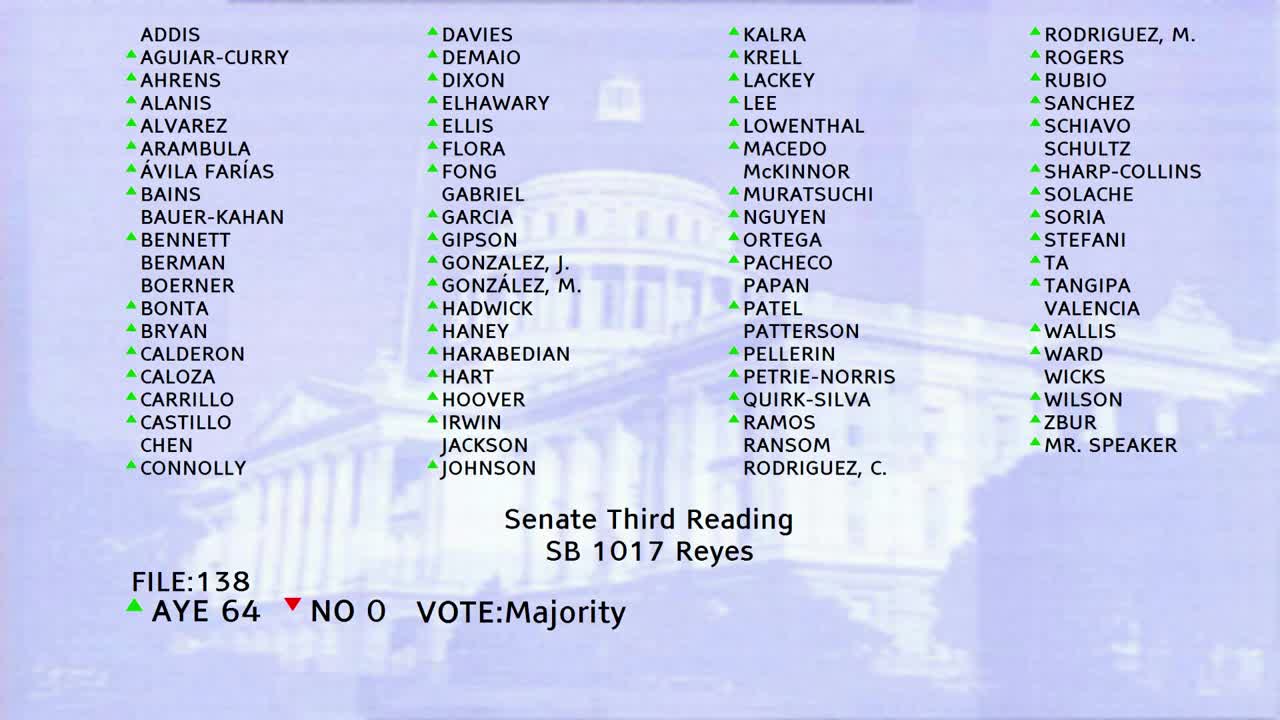 51SEC
Assembly Floor
 1MIN
Assembly Standing Committee on Business and Professions
 2MIN
Senate Standing Committee on Business, Professions and Economic Development
Bill Author

Bill Co-Author(s):