SB 1367: Planning and zoning: detention facilities.
- Session Year: 2025-2026
- House: Senate
- Latest Version Date: 2026-09-29
Current Status:
Passed
(2026-09-29: Chaptered by Secretary of State. Chapter 758, Statutes of 2026.)
Introduced
In Committee
Awaiting First Chamber Vote
Passed First Chamber
In Committee
Awaiting Second Chamber Vote
Passed Second Chamber
Enacted
What does this bill do?
This bill prohibits cities and counties from approving new land uses that would allow construction of a detention facility or from approving changes that convert an existing building into one. A “detention facility” is defined as any temporary or permanent structure run by a private company for a government to temporarily hold people charged with crimes or detained for civil or administrative reasons.
The summary is provided by generative AI which can make mistakes. For original language, please view the details in the table below.
Existing law authorizes the legislative body of any county or city to adopt ordinances that, among other things, regulate the use of buildings, structures, and land as between industry, business, residences, open space, including agriculture, recreation, enjoyment of scenic beauty, use of natural resources, and other purposes.
This bill would prohibit a city or county from approving new land uses in a manner that authorize construction of a detention facility or changes of use that permit use of an existing building as a detention facility, as defined for purposes of these provisions. By adding to the duties of local officials, this bill would impose a state-mandated local program.
The bill would include findings that changes proposed by this bill address a matter of statewide concern rather than a municipal affair and, therefore, apply to all cities, including charter cities.
The California Constitution requires the state to reimburse local agencies and school districts for certain costs mandated by the state. Statutory provisions establish procedures for making that reimbursement.
This bill would provide that no reimbursement is required by this act for a specified reason.
Existing law authorizes the legislative body of any county or city to adopt ordinances that, among other things, regulate the use of buildings, structures, and land as between industry, business, residences, open space, including agriculture, recreation, enjoyment of scenic beauty, use of natural resources, and other purposes.
This bill would prohibit a city or county from approving new land uses in a manner that authorize construction of a detention facility or changes of use that permit use of an existing building as a detention facility, as defined for purposes of these provisions. The bill would also require every city or county to adopt or amend a zoning ordinance to regulate detention facilities as a separate institutional land use classification, including by, among other things, prohibiting detention facilities from being a principally permitted use in any zoning district. The bill would make related findings and declarations. By adding to the duties of local officials, this bill would impose a state-mandated local program.
The bill would include findings that changes proposed by this bill address a matter of statewide concern rather than a municipal affair and, therefore, apply to all cities, including charter cities.
The California Constitution requires the state to reimburse local agencies and school districts for certain costs mandated by the state. Statutory provisions establish procedures for making that reimbursement.
This bill would provide that no reimbursement is required by this act for a specified reason.
Existing law authorizes the legislative body of any county or city to adopt ordinances that, among other things, regulate the use of buildings, structures, and land as between industry, business, residences, open space, including agriculture, recreation, enjoyment of scenic beauty, use of natural resources, and other purposes.
This bill would prohibit a city or county from approving new land uses in a manner that authorize construction of a detention facility or changes of use that permit use of an existing building as a detention facility, as defined for purposes of these provisions. By adding to the duties of local officials, this bill would impose a state-mandated local program.
The bill would include findings that changes proposed by this bill address a matter of statewide concern rather than a municipal affair and, therefore, apply to all cities, including charter cities.
The California Constitution requires the state to reimburse local agencies and school districts for certain costs mandated by the state. Statutory provisions establish procedures for making that reimbursement.
This bill would provide that no reimbursement is required by this act for a specified reason.
Existing law authorizes the legislative body of any county or city to adopt ordinances that, among other things, regulate the use of buildings, structures, and land as between industry, business, residences, open space, including agriculture, recreation, enjoyment of scenic beauty, use of natural resources, and other purposes.
This bill would prohibit a city or county from approving new land uses in a manner that authorize construction of a detention facility or changes of use that permit use of an existing building as a detention facility, as defined for purposes of these provisions. By adding to the duties of local officials, this bill would impose a state-mandated local program.
The bill would include findings that changes proposed by this bill address a matter of statewide concern rather than a municipal affair and, therefore, apply to all cities, including charter cities.
The California Constitution requires the state to reimburse local agencies and school districts for certain costs mandated by the state. Statutory provisions establish procedures for making that reimbursement.
This bill would provide that no reimbursement is required by this act for a specified reason.
Existing law creates the California Tahoe Regional Planning Agency as a separate legal entity and as a political subdivision of the state, and prescribes the membership, functions, and duties of the governing body of the agency, as specified.This bill would make nonsubstantive changes in those provisions prescribing the membership of the governing body of the agency.Existing law creates the California Tahoe Regional Planning Agency as a separate legal entity and as a political subdivision of the state, and prescribes the membership, functions, and duties of the governing body of the agency, as specified.
This bill would make nonsubstantive changes in those provisions prescribing the membership of the governing body of the agency.
The Legislature finds and declares all of the following:
(a)The Constitution of the State of California reserves to the state broad police powers in order to protect the public health, safety, and welfare of all of the people of California. The regulation of land use, planning, and development is among the states most fundamental and longstanding exercises of those powers.
(b)Pursuant to the Planning and Zoning Law (Title 7 (commencing with Section 65000) of the Government Code), the Legislature has established a comprehensive statewide framework governing the orderly development of land, the compatibility of adjacent land uses, and the protection of public infrastructure and community resources.
(c)Land uses that involve the custodial confinement of persons present unique planning and land use considerations because of their operational characteristics, intensity of use, and demands on local transportation networks, public utilities, emergency response services, water and waste infrastructure, and compatibility with surrounding land uses.
(d)This act is intended to solely regulate land use and development through the exercise of the states police power and does not regulate criminal law, civil or administrative enforcement, or the detention authority of any governmental entity.
(e)Nothing in this act shall be construed to regulate or interfere with the authority of the United States or any other governmental entity to enforce applicable law or to determine whether an individual can be detained or not. This act only governs land use approvals, zoning classifications, and development standards applicable to property within the State of California.
(f)The statewide regulation of detention facilities as a land use classification serves legitimate planning objectives of statewide concern, independent of the government occupant or the legal status of any person detained within those facilities.
SEC. 2.Section 65850.05 is added to the Government Code, to read:65850.05.(a)For purposes of this section, detention facility means any structure, whether temporary or permanent, operated by a private entity on behalf of a governmental entity for the temporary holding of persons charged with a criminal offense or detained for civil or administrative purposes.
(b)Notwithstanding any other law, a city or county shall not approve either of the following:
(1)A new land use in a manner that authorizes construction of a detention facility.
(2)A change of use that permits use of an existing building as a detention facility.
SEC. 3.The provisions of this act are severable. If any provision of this act or its application is held invalid, that invalidity shall not affect other provisions or applications that can be given effect without the invalid provision or application.
SEC. 4.The Legislature finds and declares that protecting California residents from the negative impacts of private detention centers is a matter of statewide concern and is not a municipal affair as that term is used in Section 5 of Article XI of the California Constitution. Therefore, Section 2 of this act adding Section 65850.05 to the Government Code applies to all cities, including charter cities.
SEC. 5.No reimbursement is required by this act pursuant to Section 6 of Article XIIIB of the California Constitution because a local agency or school district has the authority to levy service charges, fees, or assessments sufficient to pay for the program or level of service mandated by this act, within the meaning of Section 17556 of the Government Code.
The Legislature finds and declares all of the following:
(a)The Constitution of the State of California reserves to the state broad police powers in order to protect the public health, safety, and welfare of all of the people of California. The regulation of land use, planning, and development is among the states most fundamental and longstanding exercises of those powers.
(b)Pursuant to the Planning and Zoning Law (Title 7 (commencing with Section 65000) of the Government Code), the Legislature has established a comprehensive statewide framework governing the orderly development of land, the compatibility of adjacent land uses, and the protection of public infrastructure and community resources.
(c)Land uses that involve the custodial confinement of persons present unique planning and land use considerations because of their operational characteristics, intensity of use, and demands on local transportation networks, public utilities, emergency response services, water and waste infrastructure, and compatibility with surrounding land uses.
(d)The establishment, conversion, or expansion of detention facilities are likely to affect local and regional traffic patterns, emergency medical response, fire protection, law enforcement resources, utility capacity, environmental quality, noise, air quality, and other matters that are traditionally reviewed through state and local land use planning.(e)Detention facilities of all kinds constitute a unique category of institutional land use for purposes of statewide planning and zoning regulation and that statewide standards are necessary to govern siting and expansion in a way that promotes orderly development, efficient infrastructure planning, environmental protection, and the public health, safety, and welfare of all in California.(f)(d)This act is intended to solely regulate land use and development through the exercise of the states police power and does not regulate criminal law, civil or administrative enforcement, or the detention authority of any governmental entity.
(g)(e)Nothing in this act shall be construed to regulate or interfere with the authority of the United States or any other governmental entity to enforce applicable law or to determine whether an individual can be detained or not. This act only governs land use approvals, zoning classifications, and development standards applicable to property within the State of California.
(h)(f)The statewide regulation of detention facilities as a land use classification serves legitimate planning objectives of statewide concern, independent of the government occupant or the legal status of any person detained within those facilities.
SEC. 2.Section 65850.05 is added to the Government Code, to read:65850.05.(a)For purposes of this section, detention facility means any structure, whether temporary or permanent, operated by a private entity on behalf of a governmental entity for the temporary holding of persons charged with a criminal offense or detained for civil or administrative purposes.
(b)Notwithstanding any other law, a city or county shall not approve either of the following:
(1)A new land use in a manner that authorizes construction of a detention facility.
(2)A change of use that permits use of an existing building as a detention facility.
(c)On or before July 1, 2027, every city or county shall adopt or amend a zoning ordinance to regulate detention facilities as a separate institutional land use classification consistent with this subdivision.(1)A detention facility shall not be a principally permitted use in any zoning district.(2)Notwithstanding subdivision (b), a detention facility may be considered only pursuant to a discretionary conditional use permit expressly authorized by the jurisdictions zoning ordinance.(3)Prior to approving any entitlement for a detention facility, the reviewing authority shall conduct at least one duly noticed public hearing.(4)A city or county may adopt development standards that are more restrictive than those required by this subdivision.SEC. 3.The provisions of this act are severable. If any provision of this act or its application is held invalid, that invalidity shall not affect other provisions or applications that can be given effect without the invalid provision or application.
SEC. 4.The Legislature finds and declares that protecting California residents from the negative impacts of private detention centers is a matter of statewide concern and is not a municipal affair as that term is used in Section 5 of Article XI of the California Constitution. Therefore, Section 2 of this act adding Section 65850.05 to the Government Code applies to all cities, including charter cities.
SEC. 5.No reimbursement is required by this act pursuant to Section 6 of Article XIIIB of the California Constitution because a local agency or school district has the authority to levy service charges, fees, or assessments sufficient to pay for the program or level of service mandated by this act, within the meaning of Section 17556 of the Government Code.
The Legislature finds and declares all of the following:
(a)The Constitution of the State of California reserves to the state broad police powers in order to protect the public health, safety, and welfare of all of the people of California. The regulation of land use, planning, and development is among the states most fundamental and longstanding exercises of those powers.
(b)Pursuant to the Planning and Zoning Law (Title 7 (commencing with Section 65000) of the Government Code), the Legislature has established a comprehensive statewide framework governing the orderly development of land, the compatibility of adjacent land uses, and the protection of public infrastructure and community resources.
(c)Land uses that involve the custodial confinement of persons present unique planning and land use considerations because of their operational characteristics, intensity of use, and demands on local transportation networks, public utilities, emergency response services, water and waste infrastructure, and compatibility with surrounding land uses.
(d)The establishment, conversion, or expansion of detention facilities are likely to affect local and regional traffic patterns, emergency medical response, fire protection, law enforcement resources, utility capacity, environmental quality, noise, air quality, and other matters that are traditionally reviewed through state and local land use planning.
(e)Detention facilities of all kinds constitute a unique category of institutional land use for purposes of statewide planning and zoning regulation and that statewide standards are necessary to govern siting and expansion in a way that promotes orderly development, efficient infrastructure planning, environmental protection, and the public health, safety, and welfare of all in California.
(f)This act is intended to solely regulate land use and development through the exercise of the states police power and does not regulate criminal law, civil or administrative enforcement, or the detention authority of any governmental entity.
(g)Nothing in this act shall be construed to regulate or interfere with the authority of the United States or any other governmental entity to enforce applicable law or to determine whether an individual can be detained or not. This act only governs land use approvals, zoning classifications, and development standards applicable to property within the State of California.
(h)The statewide regulation of detention facilities as a land use classification serves legitimate planning objectives of statewide concern, independent of the government occupant or the legal status of any person detained within those facilities.
SECTION 1.SEC. 2.Section 65850.05 is added to the Government Code, to read:65850.05.(a)For purposes of this section, detention facility means any structure, whether temporary or permanent, operated by a private entity on behalf of a governmental entity for the temporary holding of persons charged with a criminal offense or detained for civil or administrative purposes.
(b)Notwithstanding any other law, a city or county shall not approve either of the following:
(1)A new land use in a manner that authorizes construction of a detention facility.
(2)A change of use that permits use of an existing building as a detention facility.
(c)On or before July 1, 2027, every city or county shall adopt or amend a zoning ordinance to regulate detention facilities as a separate institutional land use classification consistent with this subdivision.
(1)A detention facility shall not be a principally permitted use in any zoning district.
(2)Notwithstanding subdivision (b), a detention facility may be considered only pursuant to a discretionary conditional use permit expressly authorized by the jurisdictions zoning ordinance.
(3)Prior to approving any entitlement for a detention facility, the reviewing authority shall conduct at least one duly noticed public hearing.
(4)A city or county may adopt development standards that are more restrictive than those required by this subdivision.
SEC. 2.SEC. 3.The provisions of this act are severable. If any provision of this act or its application is held invalid, that invalidity shall not affect other provisions or applications that can be given effect without the invalid provision or application.
SEC. 3.SEC. 4.The Legislature finds and declares that protecting California residents from the negative impacts of private detention centers is a matter of statewide concern and is not a municipal affair as that term is used in Section 5 of Article XI of the California Constitution. Therefore, Section 1 2 of this act adding Section 65850.05 to the Government Code applies to all cities, including charter cities.
SEC. 4.SEC. 5.No reimbursement is required by this act pursuant to Section 6 of Article XIIIB of the California Constitution because a local agency or school district has the authority to levy service charges, fees, or assessments sufficient to pay for the program or level of service mandated by this act, within the meaning of Section 17556 of the Government Code.
(a)For purposes of this section, detention facility means any structure, whether temporary or permanent, operated by, or by a private entity on behalf of, of a governmental entity for the temporary holding of persons charged with a criminal offense. offense or detained for civil or administrative purposes.
(b)Notwithstanding any other law, a city or county shall not approve either of the following:
(1)A new land use in a manner that authorizes construction of a detention facility.
(2)A change of use that permits use of an existing building as a detention facility.
SEC. 2.The provisions of this act are severable. If any provision of this act or its application is held invalid, that invalidity shall not affect other provisions or applications that can be given effect without the invalid provision or application.
SEC. 2.SEC. 3.The Legislature finds and declares that protecting California residents from the negative impacts of private detention centers is a matter of statewide concern and is not a municipal affair as that term is used in Section 5 of Article XI of the California Constitution. Therefore, Section 1 of this act adding Section 65850.05 to the Government Code applies to all cities, including charter cities.
SEC. 3.SEC. 4.No reimbursement is required by this act pursuant to Section 6 of Article XIIIB of the California Constitution because a local agency or school district has the authority to levy service charges, fees, or assessments sufficient to pay for the program or level of service mandated by this act, within the meaning of Section 17556 of the Government Code.
REVISIONS: HeadingLine 2.(a)For purposes of this section, detention facility means any structure, whether temporary or permanent, operated by, or on behalf of, a governmental entity for the temporary holding of persons charged with a criminal offense.
(b)Notwithstanding any other law, a city or county shall not approve either of the following:
(1)A new land use in a manner that authorizes construction of a detention facility.
(2)A change of use that permits use of an existing building as a detention facility.
SEC. 2.The Legislature finds and declares that protecting California residents from the negative impacts of private detention centers is a matter of statewide concern and is not a municipal affair as that term is used in Section 5 of Article XI of the California Constitution. Therefore, Section 1 of this act adding Section 65850.05 to the Government Code applies to all cities, including charter cities.
SEC. 3.No reimbursement is required by this act pursuant to Section 6 of Article XIIIB of the California Constitution because a local agency or school district has the authority to levy service charges, fees, or assessments sufficient to pay for the program or level of service mandated by this act, within the meaning of Section 17556 of the Government Code.
SECTION 1.Section 67041 of the Government Code is amended to read:67041.The governing body of the agency shall consist of the following members:(a)One member appointed by the Board of Supervisors of the Counties of El Dorado and Placer, and one member appointed by the City Council of the City of South Lake Tahoe. Each of the members of the governing body shall be a member of the city council or county board of supervisors they represent and, in the case of a supervisor, shall be a resident of a county supervisorial district lying wholly or partly within the region.(b)Two members appointed by the Governor subject to Senate confirmation, who shall not be residents of the basin and shall represent the public at large. One of those members shall be chosen from among residents of the 10 southernmost counties in the state and one from among the residents of the remaining counties.(c)One member appointed by the six other members appointed pursuant to this section. The member so appointed shall serve as the permanent chairman of the agency and shall serve at the pleasure of the other members. If that membership becomes vacant and the vacancy is not filled by the other members within 30 days, the vacancy shall be filled by appointment of the Governor.(d)The Secretary of the Natural Resources Agency or the secretarys designee.The governing body of the agency shall be constituted as follows: consist of the following members:
(a)One member appointed by the Board of Supervisors of the Counties of El Dorado and Placer, and one member appointed by the City Council of the City of South Lake Tahoe. Each of the members of the governing board body shall be a member of the city council, council or county board of supervisors he represents, they represent and, in the case of a supervisor supervisor, shall be a resident of a county supervisorial district lying wholly or partly within the region.
(b)Two members appointed by the Governor of California subject to Senate confirmation, who shall not be residents of the basin and shall represent the public at large. One of such those members shall be chosen from among residents of the 10 southernmost counties in the state and one from among the residents of the remaining counties.
(c)One member appointed by the six other members appointed pursuant to this section. The member so appointed shall serve as the permanent chairman of the agency and shall serve at the pleasure of the other members. In the event such If that membership becomes vacant and the vacancy is not filled by the other members within 30 days, the vacancy shall be filled by appointment of the Governor.
(d)The Secretary of the California Natural Resources Agency or his the secretarys designee.
|
Date
|
Status
|
|---|---|
| Sep 29, 2026 | Chaptered by Secretary of State. Chapter 758, Statutes of 2026. |
| Sep 29, 2026 | Approved by the Governor. |
| Sep 8, 2026 | Enrolled and presented to the Governor at 4 p.m. |
| Aug 30, 2026 | Assembly amendments concurred in. (Ayes 29. Noes 10.) Ordered to engrossing and enrolling. |
| Aug 30, 2026 | In Senate. Concurrence in Assembly amendments pending. |
| Aug 30, 2026 | Read third time. Passed. (Ayes 60. Noes 19. Page 6859.) Ordered to the Senate. |
| Aug 30, 2026 | Read third time. Passed. Ordered to the Senate. |
| Aug 27, 2026 | From committee: Do pass. (Ayes 8. Noes 2.) (August 27). |
| Aug 27, 2026 | Read second time. Ordered to third reading. |
| Aug 25, 2026 | From committee with author's amendments. Read second time and amended. Re-referred to Com. on L. GOV. |
| Aug 25, 2026 | Joint Rule 62(a) suspended. |
| Aug 24, 2026 | Re-referred to Com. on L. GOV. pursuant to Assembly Rule 77.2. |
| Aug 21, 2026 | Read third time and amended. |
| Aug 21, 2026 | Ordered to third reading. |
| Aug 21, 2026 | Assembly Rule 69(b)(1) suspended. (Ayes 55. Noes 17. Page 6296.) |
| Aug 21, 2026 | Assembly Rule 69(b)(1) suspended. |
| Aug 6, 2026 | Read second time. Ordered to third reading. |
| Aug 5, 2026 | Coauthors revised. |
| Aug 5, 2026 | From committee: Do pass. (Ayes 11. Noes 4.) (August 5). |
| Jul 2, 2026 | From committee: Do pass and re-refer to Com. on APPR. (Ayes 8. Noes 2.) (July 1). Re-referred to Com. on APPR. |
| Jun 17, 2026 | June 17 set for first hearing canceled at the request of author. |
| Jun 1, 2026 | Referred to Com. on L. GOV. |
| May 26, 2026 | In Assembly. Read first time. Held at Desk. |
| May 26, 2026 | Read third time. Passed. (Ayes 29. Noes 8.) Ordered to the Assembly. |
| May 26, 2026 | Read third time. Passed. (Ayes 29. Noes 8. Page 4441.) Ordered to the Assembly. |
| May 5, 2026 | Read second time. Ordered to third reading. |
| May 4, 2026 | From committee: Be ordered to second reading pursuant to Senate Rule 28.8. |
| Apr 24, 2026 | Set for hearing May 4. |
| Apr 22, 2026 | From committee: Do pass and re-refer to Com. on APPR. (Ayes 5. Noes 2.) (April 22). Re-referred to Com. on APPR. |
| Apr 22, 2026 | From committee: Do pass and re-refer to Com. on APPR. (Ayes 5. Noes 2. Page 4015.) (April 22). Re-referred to Com. on APPR. |
| Apr 16, 2026 | From committee with author's amendments. Read second time and amended. Re-referred to Com. on L. GOV. |
| Apr 9, 2026 | Set for hearing April 22. |
| Apr 8, 2026 | Re-referred to Com. on L. GOV. |
| Mar 25, 2026 | From committee with author's amendments. Read second time and amended. Re-referred to Com. on RLS. |
| Mar 4, 2026 | Referred to Com. on RLS. |
| Feb 23, 2026 | Read first time. |
| Feb 23, 2026 | From printer. May be acted upon on or after March 23. |
| Feb 20, 2026 | Introduced. To Com. on RLS. for assignment. To print. |
|
Date
|
Description
|
Location
|
Votes
|
|
|---|---|---|---|---|
| Aug 30, 2026 | SB 1367 Cervantes Senate Third Reading By Kalra | Assembly Floor |
Passed |
|
| Aug 30, 2026 | Unfinished Business SB1367 Cervantes et al. Concurrence | Senate Floor |
Passed |
|
| Aug 27, 2026 | Do pass. | Assembly Standing Committee on Local Government |
Passed |
|
| Aug 5, 2026 | Do pass. | Assembly Standing Committee on Appropriations |
Passed |
|
| Jul 1, 2026 | Do pass and be re-referred to the Committee on [Appropriations] | Assembly Standing Committee on Local Government |
Passed |
|
| May 26, 2026 | Senate 3rd Reading SB1367 Cervantes | Senate Floor |
Passed |
|
| Apr 22, 2026 | Do pass, but first be re-referred to the Committee on [Appropriations] | Senate Standing Committee on Local Government |
Passed |
This list shows positions taken on this bill by organizations on the date displayed, which is linked to the original source.
Positions by individuals are not included.
|
Organization
|
Position
|
Date
|
|---|---|---|
| Aclu California Action | ** Support | |
| CCIJ | ** Support | |
| Freedom for Immigrants | ** Support | |
| Immigrant Defenders Law Center | ** Support | |
| Inland Coalition for Immigrant Justice | ** Support | |
| Inland Empire Cultura Collective | ** Support | |
| Inland Empire Immigrant Youth Collective | ** Support | |
| Inland Valley Alliance for Environmental Justice | ** Support | |
| National Ecumenical Forum for Filipino Concerns - Inland Empire | ** Support | |
| Pangea Legal Services | ** Support | |
| Riverside County Sheriff's Office | ** Against | |
| San Bernardino Community Service Center, Inc. | ** Support | |
| Services, Immigrant Rights and Education Network (SIREN) | ** Support | |
| Sierra Club | ** Support | |
| The Immigrant Legal Resource Center | ** Support |
SENATE RULES COMMITTEE Office of Senate Floor Analyses (916) 651-4171 | SB 1367 |
UNFINISHED BUSINESS
Bill No: SB 1367
Author: Cervantes (D), et al.
Amended: 8/25/26
Vote: 21
SENATE LOCAL GOVERNMENT COMMITTEE: 5-2, 4/22/26
AYES: Durazo, Arreguín, Ashby, Cervantes, Laird
NOES: Choi, Seyarto
SENATE APPROPRIATIONS COMMITTEE: Senate Rule 28.8
SENATE FLOOR: 29-8, 5/26/26
AYES: Allen, Archuleta, Arreguín, Ashby, Becker, Blakespear, Cabaldon, Caballero, Cervantes, Cortese, Durazo, Grayson, Hurtado, Laird, Limón, McGuire, McNerney, Menjivar, Padilla, Pérez, Reyes, Richardson, Rubio, Smallwood-Cuevas, Stern, Umberg, Wahab, Weber Pierson, Wiener
NOES: Alvarado-Gil, Choi, Grove, Jones, Ochoa Bogh, Seyarto, Strickland, Valladares
NO VOTE RECORDED: Dahle, Gonzalez, Niello
ASSEMBLY FLOOR: Passed, 8/30/26
SUBJECT: Planning and zoning: detention facilities
SOURCE: Author
DIGEST:
This bill prohibits cities and counties from approving new private detention facilities.
Assembly Amendments
add findings and declarations.
ANALYSIS:
Existing law:
- Allows, under the California Constitution, cities and counties to “make and enforce within its limits, all local, police, sanitary and other ordinances and regulations not in conflict with general laws.”
- Requires every county and city to adopt a general plan that sets out planned uses for all of the area covered by the plan. A general plan must include seven mandatory elements: land use, circulation, housing, conservation, open space, noise, and safety. The general plan must also either include an eighth element on environmental justice, or incorporate environmental justice concerns throughout the other elements.
- Requires cities’ and counties’ major land use decisions—including most zoning ordinances and other aspects of development permitting—to be consistent with their general plans.
- Requires any private detention facility operator to comply with, and adhere to, the detention standards of care and confinement agreed upon in the facility’s contract for operations, and allows individuals to sue if a private detention facility violates the requirement to comply with detention standards of care and confinement (AB 3228 (Bonta, Chapter 190, Statutes of 2020)).
- Requires a private detention facility operator to comply with, and adhere to, all local and state public health orders and occupational safety and health regulations (AB 263 (Arambula, Chapter 294, Statutes of 2021)).
- Authorizes a county or city health officer to investigate a private detention facility (SB 1132 (Durazo, Chapter 183, Statutes of 2024)).
This bill:
- Prohibits, notwithstanding any other law, a city, including a charter city, or county from approving either:
- A new land use in a manner that authorizes construction of a detention facility; or
- A change of use that permits use of an existing building as a detention facility.
- Defines detention facility to mean any structure, whether temporary or permanent, operated by a private entity on behalf of a governmental entity for the temporary holding of persons charged with a criminal offense or detained for civil or administrative purposes.
- Contains a severability clause.
- Includes findings and declarations to support its purposes.
Comments
- Purpose of this bill. According to the author, “SB 1367 will prohibit cities and counties from approving new land uses that would allow the construction of detention facilities or permit the conversion of existing buildings into such facilities. The goal of SB 1367 is to protect California residents from the rapid expansion of private detention facilities, particularly those not designed for long-term human habitation.
“Facilities that are unsuitable for holding people, whether for short or long periods, can strain local infrastructure and pose serious risks to the well-being of detainees. Many of these facilities lack essential features such as proper ventilation, temperature control, sewage and waste management systems, and adequate access to clean water, among other critical deficiencies. These systems of detention which have existed for generations fundamentally transform into something even more sinister and more prone to abuse.”
- Law of the land. “The Constitution’s Supremacy Clause generally immunizes the Federal Government from state laws that [1] directly regulate or [2] discriminate against it.”[1] However, generally applicable laws may apply to the federal government, so long as those laws do not discriminate against or directly regulate it.[2] Determining whether a particular law discriminates against or directly regulates the federal government is nuanced. For example, courts have found that laws that merely increase the cost or difficulty of federal operations are not necessarily direct regulations, and a state has greater ability to regulate a contractor of the federal government than to regulate the government itself. In GEO Group v. Inslee, the Ninth Circuit Court of Appeals upheld a Washington State law regulating health and safety at private detention facilities. The Court noted that Washington’s law does not “require [Immigration and Customs Enforcement] to entirely transform its approach to detention in the state or else abandon its facilities.”[3]
SB 1367 enters this legal landscape. This bill prohibits cities and counties from approving new land uses or changes of use for private detention facilities holding individuals for civil or criminal matters. Because immigration violations are generally civil offenses, this bill could restrict new construction of, or expansion of, privately-owned facilities that detain immigrants on behalf of the federal government. Currently, the federal government contracts with seven private detention facilities operating in California in four counties—San Bernardino County, Kern County, San Diego County, and Imperial County.
There is reason to believe that SB 1367 may withstand judicial scrutiny. First, SB 1367 treats all private entities operating detention facilities in California uniformly, regardless of whether they are used to detain individuals on behalf of local, state, and federal governments. Second, SB 1367 also avoids direct regulation of the federal government, in contrast to previous legislative efforts. In GEO Group v. Newsom, the Ninth Circuit struck down AB 32 (Bonta, 2019) because it directly prohibited the operation of private detention facilities statewide.[4] SB 1367, conversely, does not prohibit operation of detention facilities; this bill only restricts local government actions to approve new land uses or changes of use. Those facilities that are currently in operation in the state could continue in existence, and the federal government can continue to contract with those facilities. Additionally, SB 1367 regulates local land-use approvals, an area historically controlled by state and local governments. Courts apply a presumption against preempting a state law when a state regulates an area of historic state power.[5] Ultimately, the courts may decide if SB 1367 applies to private detention facilities used for immigration purposes.
FISCAL EFFECT: Appropriation: No Fiscal Com.: Yes Local: Yes
According to the Assembly Appropriations Committee:
- No state costs. Potential one-time costs to cities and counties of an unknown but likely minor amount to revise policies and procedures to prohibit new or changed land uses that allow for a new private detention facility. These costs, if any, are not reimbursable by the state because local agencies have general authority to charge and adjust planning and permitting fees to cover these activities.
SUPPORT: (Verified 8/29/26)
ACLU California Action
Freedom for Immigrants
Immigrant Defenders Law Center
Inland Coalition for Immigrant Justice
Inland Empire Cultura Collective
Inland Empire Immigrant Youth Collective
Inland Valley Alliance for Environmental Justice
National Ecumenical Forum for Filipino Concerns - Inland Empire
Pangea Legal Services
San Bernardino Community Service Center, INC.
Services, Immigrant Rights and Education Network (SIREN)
Sierra Club
The Immigrant Legal Resource Center
OPPOSITION: (Verified 8/29/26)
Riverside County Sheriff's Office
Prepared by: Anton Favorini-Csorba / L. GOV. / (916) 651-4119
8/30/26 15:58:23
**** END ****
SENATE THIRD READING
STR Bill Id:SB 1367
Author:(Cervantes)
As Amended Ver:August 25, 2026
Majority vote
SUMMARY
Prohibits cities and counties from approving new private detention facilities or changes of use that permit use of an existing building as a detention facility.
Major Provisions
- Makes findings and declarations relating to the regulation of land use, including finding and declaring that the regulation of detention facilities as a land use classification serves legitimate planning objectives of statewide concern, independent of the government occupant or the legal status of any person detained within those facilities.
- Defines "detention facility" to mean any structure, whether temporary or permanent, operated by a private entity on behalf of a governmental entity for the temporary holding of persons charged with a criminal offense or detained for civil or administrative purposes.
- Prohibits, notwithstanding any other law, a city or county from approving either of the following:
- A new land use in a manner that authorizes construction of a detention facility.
- A change of use that permits use of an existing building as a detention facility.
- Provides that the provisions of the bill are severable. If any provision of this bill or its application is held invalid, that invalidity shall not affect other provisions or applications that can be given effect without the invalid provision or application.
- Finds and declares that protecting California residents from the negative impacts of private detention centers is a matter of statewide concern and is not a municipal affair as that term is used in Section 5 of Article XI of the California Constitution. Therefore, this bill applies to all cities, including charter cities.
- Provides that no reimbursement is required by the bill pursuant to Section 6 of Article XIII B of the California Constitution because a local agency or school district has the authority to levy service charges, fees, or assessments sufficient to pay for the program or level of service mandated by this bill, within the meaning of Section 17556 of the Government Code.
COMMENTS
- Background. The California Constitution allows cities and counties to "make and enforce within its limits, all local, police, sanitary and other ordinances and regulations not in conflict with general laws." It is from this fundamental power (commonly called the police power) that cities and counties derive their authority to regulate behavior to preserve the health, safety, and welfare of the public—including land use authority.
- Planning and Zoning Law. State law provides additional powers and duties for cities and counties regarding land use. The Planning and Zoning Law requires every county and city to adopt a general plan that sets out planned uses for all of the areas covered by the plan. A general plan must include seven mandatory elements: land use, circulation, housing, conservation, open space, noise, and safety. The general plan must also either include an eighth element on environmental justice or incorporate environmental justice concerns throughout the other elements (SB 1000, Levya, 2016).
Cities' and counties' major land use decisions—including most zoning ordinances and other aspects of development permitting—must be consistent with their general plans. The Planning and Zoning Law also establishes a planning agency in each city and county, which may be a separate planning commission, administrative body, or the legislative body of the city or county itself. Cities and counties must provide a path to appeal a decision to the planning commission and/or the city council or county board of supervisors.
Local governments use their police power to enact zoning ordinances that shape development, including by designating the particular uses that are allowed within the community, distance between various kinds of uses, the physical form of buildings in the community, and others. These ordinances can also include conditions on development to address community or environmental impacts, or other particular site-specific considerations.
Local governments have broad authority to define the specific approval processes needed to satisfy these considerations. Most new land uses require "discretionary" approvals from local governments, such as a conditional use permit or a change in zoning laws. This process requires hearings by the local planning commission and public notice and may require additional approvals.
- Previous Legislation on Private Detention Facilities in California. The Legislature has enacted several laws in recent years related to the conditions of private detention facilities, including:
- AB 32 (Bonta), Chapter 739, Statutes of 2019, prohibited the California Department of Corrections and Rehabilitation (CDCR) from entering into or renewing contracts with private for-profit prisons after January 1, 2020, and eliminated their use by January 1, 2028. Also prohibited the operation of a private detention facility within the state, except as specified
- AB 3228 (Bonta), Chapter 190, Statutes of 2020, required private detention facilities to comply with the detention standards of care and confinement agreed upon in the facility's contract for operations. AB 3228 also established a civil cause of action against private detention facilities that violate the requirement to comply with the detention standards of care and confinement.
- AB 263 (Arambula), Chapter 294, Statutes of 2021, required a private detention facility operator to comply with, and adhere to, all local and state public health orders and occupational safety and health regulations.
- SB 1132 (Durazo), Chapter 183, Statutes of 2024, authorized a county or city health officer to investigate the health and sanitary conditions of a private detention facility. This is in addition to a health officer's authority to investigate a county jail, a publicly operated detention facility in the county, and a private work furlough facility.
- Prison Closures and Private Prison Contract Exits. Since 2009, California has acted to close serval prisons, ended operation in all out-of-state facilities, and exited all for-profit contract prisons. According to the CDCR the state ended its contract with out-of-state facilities by June 2019 to reduce the state's reliance on out-of-state and private prisons. Since 2019, CDCR reports that it has exited all for-profit contract prisons and public-private contract facilities to phase out private prisons in California.
California outlined plans to close two prisons and multiple under-capacity conservation fire camps in the 2021 budget. In 2024, as outlined in the 2022-23 budget, CDCR closed Chuckawalla Valley State Prison, ceased operations of the California City Correction Facility under lease with CoreCivic, and deactivated some facilities within six prisons. As part of the 2025–26 State Budget, CDCR and the California Correctional Health Care Services will close the California Rehabilitation Center by fall of 2026.
According to the Author
"SB 1367 will prohibit cities and counties from approving new land uses that would allow the construction of detention facilities or permit the conversion of existing buildings into such facilities. The goal of SB 1367 is to protect California residents from the rapid expansion of private detention facilities, particularly those not designed for long-term human habitation.
"Facilities that are unsuitable for holding people, whether for short or long periods, can strain local infrastructure and pose serious risks to the well-being of detainees. Many of these facilities lack essential features such as proper ventilation, temperature control, sewage and waste management systems, and adequate access to clean water, among other critical deficiencies. These systems of detention which have existed for generations fundamentally transform into something even more sinister and more prone to abuse."
Arguments in Support
ACLU California Action writes in support of this bill, "SB 1367 would prohibit cities and countries from approving new land for the construction of detention facilities and prohibit changing existing buildings into detention facilities. These facilities have proven to be unnecessary and extremely harmful, even deadly environments, to those individuals who are detained. These facilities are a clear violation of human rights. Abuse runs rampant as detainees lack access to proper medical care, must endure unsanitary conditions, and even face retaliation when advocating for themselves. Since 2021, [ACLU], CCIJ, and other local partners have filed multiple complaints with the OCRCL on behalf of detained people, documenting mistreatment of people detained at Mesa Verde Detention Facility and Golden State Annex in Kern County. In many circumstances, these complaints are met with a resistance to reform from ICE. While ICE also argues that these detention facilities are necessary to ensure detainees aren't fleeing and present for their proceedings, the data indicates otherwise. In fact, out of the detainees who obtained lawyers, 96 percent of them attend all of their court hearings.
"Immigration detention is not safe. The ACLU continues to see the system as unnecessary and a clear human rights violation. The system must be dismantled, and SB 1367 is a step in the right direction."
Arguments in Opposition
The Riverside County Sheriff's Office writes in opposition, "SB 1367 undermines local control over public safety infrastructure. Riverside Conty is one of the largest geographic counties in California, with unique operational demands drive by population growth, regional geography, and custody needs. Decisions regarding the placement, expansion, or modification of detention facilities require direct coordination with local law enforcement, county planning authorities, and community stakeholders. Removing the county's ability to approve or adapt facilities based on local conditions will hinder the Sheriff's Office's ability to safely and effectively manage its custodial responsibilities."
FISCAL COMMENTS
According to the Assembly Appropriations Committee:
"No state costs. Potential one-time costs to cities and counties of an unknown but likely minor amount to revise policies and procedures to prohibit new or changed land uses that allow for a new private detention facility. These costs, if any, are not reimbursable by the state because local agencies have general authority to charge and adjust planning and permitting fees to cover these activities."
VOTES
SENATE FLOOR: 29-8-3
YES: Allen, Archuleta, Arreguín, Ashby, Becker, Blakespear, Cabaldon, Caballero, Cervantes, Cortese, Durazo, Grayson, Hurtado, Laird, Limón, McGuire, McNerney, Menjivar, Padilla, Pérez, Reyes, Richardson, Rubio, Smallwood-Cuevas, Stern, Umberg, Wahab, Weber Pierson, Wiener
NO: Alvarado-Gil, Choi, Grove, Jones, Ochoa Bogh, Seyarto, Strickland, Valladares
ABS, ABST OR NV: Dahle, Gonzalez, Niello
ASM LOCAL GOVERNMENT: 8-2-0
YES: Carrillo, Pacheco, Ramos, Ransom, Blanca Rubio, Stefani, Ward, Wilson
NO: Ta, Johnson
ASM APPROPRIATIONS: 11-4-0
YES: Wicks, Arambula, Calderon, Caloza, Fong, Mark González, Krell, Pacheco, Pellerin, Sharp-Collins, Solache
NO: Hoover, Dixon, Ta, Tangipa
ASM LOCAL GOVERNMENT: 8-2-0
YES: Carrillo, Pacheco, Ramos, Ransom, Blanca Rubio, Stefani, Ward, Wilson
NO: Ta, Johnson
UPDATED
VERSION: August 25, 2026
CONSULTANT: Linda Rios / L. GOV. / (916) 319-3958 FN: 0004352
Date of Hearing: August 27, 2026
ASSEMBLY COMMITTEE ON LOCAL GOVERNMENT
Juan Carrillo, Chair
SBPCA Bill Id:SB 1367
Author:(Cervantes) – As Amended Ver:August 25, 2026
SENATE VOTE: 29-8
SUBJECT: Planning and zoning: detention facilities
SUMMARY: Prohibits cities and counties from approving new private detention facilities or changes of use that permit use of an existing building as a detention facility. Specifically, this bill:
- Makes findings and declarations relating to the regulation of land use, including finding and declaring that the regulation of detention facilities as a land use classification serves legitimate planning objectives of statewide concern, independent of the government occupant or the legal status of any person detained within those facilities.
- Defines "detention facility" to mean any structure, whether temporary or permanent, operated by a private entity on behalf of a governmental entity for the temporary holding of persons charged with a criminal offense or detained for civil or administrative purposes.
- Prohibits, notwithstanding any other law, a city or county from approving either of the following:
- A new land use in a manner that authorizes construction of a detention facility.
- A change of use that permits use of an existing building as a detention facility.
- Provides that the provisions of the bill are severable. If any provision of this bill or its application is held invalid, that invalidity shall not affect other provisions or applications that can be given effect without the invalid provision or application.
- Finds and declares that protecting California residents from the negative impacts of private detention centers is a matter of statewide concern and is not a municipal affair as that term is used in Section 5 of Article XI of the California Constitution. Therefore, this bill applies to all cities, including charter cities.
- Provides that no reimbursement is required by the bill pursuant to Section 6 of Article XIII B of the California Constitution because a local agency or school district has the authority to levy service charges, fees, or assessments sufficient to pay for the program or level of service mandated by this bill, within the meaning of Section 17556 of the Government Code.
FISCAL EFFECT: According to the Assembly Appropriations Committee:
"No state costs. Potential one-time costs to cities and counties of an unknown but likely minor amount to revise policies and procedures to prohibit new or changed land uses that allow for a new private detention facility. These costs, if any, are not reimbursable by the state because local agencies have general authority to charge and adjust planning and permitting fees to cover these activities."
COMMENTS:
- Bill Summary. This bill prohibits, notwithstanding any other law, a city or county from approving either:
- A new land use in a manner that authorizes construction of a detention facility.
- A change of use that permits use of an existing building as a detention facility.
The bill defines detention facility to mean any structure, whether temporary or permanent, operated by a private entity on behalf of a governmental entity for the temporary holding of persons charged with a criminal offense or detained for civil or administrative purposes. This bill also contains a severability clause and applies to all cities, including charter cities.
- Author’s Statement. According to the author, "SB 1367 will prohibit cities and counties from approving new land uses that would allow the construction of detention facilities or permit the conversion of existing buildings into such facilities. The goal of SB 1367 is to protect California residents from the rapid expansion of private detention facilities, particularly those not designed for long-term human habitation.
"Facilities that are unsuitable for holding people, whether for short or long periods, can strain local infrastructure and pose serious risks to the well-being of detainees. Many of these facilities lack essential features such as proper ventilation, temperature control, sewage and waste management systems, and adequate access to clean water, among other critical deficiencies. These systems of detention which have existed for generations fundamentally transform into something even more sinister and more prone to abuse."
- Background. The California Constitution allows cities and counties to "make and enforce within its limits, all local, police, sanitary and other ordinances and regulations not in conflict with general laws." It is from this fundamental power (commonly called the police power) that cities and counties derive their authority to regulate behavior to preserve the health, safety, and welfare of the public—including land use authority.
- Planning and Zoning Law. State law provides additional powers and duties for cities and counties regarding land use. The Planning and Zoning Law requires every county and city to adopt a general plan that sets out planned uses for all of the areas covered by the plan. A general plan must include seven mandatory elements: land use, circulation, housing, conservation, open space, noise, and safety. The general plan must also either include an eighth element on environmental justice or incorporate environmental justice concerns throughout the other elements (SB 1000, Levya, 2016).
Cities' and counties' major land use decisions—including most zoning ordinances and other aspects of development permitting—must be consistent with their general plans. The Planning and Zoning Law also establishes a planning agency in each city and county, which may be a separate planning commission, administrative body, or the legislative body of the city or county itself. Cities and counties must provide a path to appeal a decision to the planning commission and/or the city council or county board of supervisors.
Local governments use their police power to enact zoning ordinances that shape development, including by designating the particular uses that are allowed within the community, distance between various kinds of uses, the physical form of buildings in the community, and others. These ordinances can also include conditions on development to address community or environmental impacts, or other particular site-specific considerations.
Local governments have broad authority to define the specific approval processes needed to satisfy these considerations. Most new land uses require "discretionary" approvals from local governments, such as a conditional use permit or a change in zoning laws. This process requires hearings by the local planning commission and public notice and may require additional approvals.
- Previous Legislation on Private Detention Facilities in California. The Legislature has enacted several laws in recent years related to the conditions of private detention facilities, including:
- AB 32 (Bonta), Chapter 739, Statutes of 2019, prohibited the California Department of Corrections and Rehabilitation (CDCR) from entering into or renewing contracts with private for-profit prisons after January 1, 2020, and eliminated their use by January 1, 2028. Also prohibited the operation of a private detention facility within the state, except as specified
- AB 3228 (Bonta), Chapter 190, Statutes of 2020, required private detention facilities to comply with the detention standards of care and confinement agreed upon in the facility's contract for operations. AB 3228 also established a civil cause of action against private detention facilities that violate the requirement to comply with the detention standards of care and confinement.
- AB 263 (Arambula), Chapter 294, Statutes of 2021, required a private detention facility operator to comply with, and adhere to, all local and state public health orders and occupational safety and health regulations.
- SB 1132 (Durazo), Chapter 183, Statutes of 2024, authorized a county or city health officer to investigate the health and sanitary conditions of a private detention facility. This is in addition to a health officer's authority to investigate a county jail, a publicly operated detention facility in the county, and a private work furlough facility.
- Prison Closures and Private Prison Contract Exits. Since 2009, California has acted to close serval prisons, ended operation in all out-of-state facilities, and exited all for-profit contract prisons. According to the CDCR the state ended its contract with out-of-state facilities by June 2019 to reduce the state's reliance on out-of-state and private prisons. Since 2019, CDCR reports that it has exited all for-profit contract prisons and public-private contract facilities to phase out private prisons in California.
California outlined plans to close two prisons and multiple under-capacity conservation fire camps in the 2021 budget. In 2024, as outlined in the 2022-23 budget, CDCR closed Chuckawalla Valley State Prison, ceased operations of the California City Correction Facility under lease with CoreCivic, and deactivated some facilities within six prisons. As part of the 2025–26 State Budget, CDCR and the California Correctional Health Care Services will close the California Rehabilitation Center by fall of 2026.
- Arguments in Support. ACLU California Action writes in support of this bill, "SB 1367 would prohibit cities and countries from approving new land for the construction of detention facilities and prohibit changing existing buildings into detention facilities. These facilities have proven to be unnecessary and extremely harmful, even deadly environments, to those individuals who are detained. These facilities are a clear violation of human rights. Abuse runs rampant as detainees lack access to proper medical care, must endure unsanitary conditions, and even face retaliation when advocating for themselves. Since 2021, [ACLU], CCIJ, and other local partners have filed multiple complaints with the OCRCL on behalf of detained people, documenting mistreatment of people detained at Mesa Verde Detention Facility and Golden State Annex in Kern County. In many circumstances, these complaints are met with a resistance to reform from ICE. While ICE also argues that these detention facilities are necessary to ensure detainees aren’t fleeing and present for their proceedings, the data indicates otherwise. In fact, out of the detainees who obtained lawyers, 96 percent of them attend all of their court hearings.
“Immigration detention is not safe. The ACLU continues to see the system as unnecessary and a clear human rights violation. The system must be dismantled, and SB 1367 is a step in the right direction."
- Arguments in Opposition. The Riverside County Sheriff's Office writes in opposition, "SB 1367 undermines local control over public safety infrastructure. Riverside Conty is one of the largest geographic counties in California, with unique operational demands drive by population growth, regional geography, and custody needs. Decisions regarding the placement, expansion, or modification of detention facilities require direct coordination with local law enforcement, county planning authorities, and community stakeholders. Removing the county's ability to approve or adapt facilities based on local conditions will hinder the Sheriff's Office's ability to safely and effectively manage its custodial responsibilities."
REGISTERED SUPPORT / OPPOSITION:
Support
ACLU California Action
Freedom for Immigrants
Immigrant Defenders Law Center
Inland Coalition for Immigrant Justice
Inland Empire Cultura Collective
Inland Empire Immigrant Youth Collective
Inland Valley Alliance for Environmental Justice
National Ecumenical Forum for Filipino Concerns - Inland Empire
Pangea Legal Services
San Bernardino Community Service Center, INC.
Services, Immigrant Rights and Education Network (SIREN)
Sierra Club
The Immigrant Legal Resource Center
Opposition
Riverside County Sheriff's Office
Analysis Prepared by: Linda Rios / L. GOV. / (916) 319-3958
SENATE THIRD READING
STR Bill Id:SB 1367
Author:(Cervantes)
As Amended Ver:August 21, 2026
Majority vote
SUMMARY
Prohibits cities and counties from approving new private detention facilities or changes of use that permit use of an existing building as a detention facility. Requires, on or before July 1, 2027, cities and counties to adopt and amend a zoning ordinance to regulate detention facilities, as specified.
Major Provisions
- Makes finding and declarations relating to the regulation of land use, including finding and declaring that regulation of detention facilities as a land use classification serves legitimate planning objective of statewide concern, independent of the government occupant or the legal status of any person detained within those facilities.
- Defines "detention facility" to mean any structure, whether temporary or permanent, operated by a private entity on behalf of a governmental entity for the temporary holding of persons charged with a criminal offense or detained for civil or administrative purposes.
- Prohibits, notwithstanding any other law, a city or county from approving either of the following:
- A new land use in a manner that authorizes construction of a detention facility.
- A change of use that permits use of an existing building as a detention facility.
- Requires, on or before July 1, 2027, cities and counties to adopt or amend a zoning ordinance to regulate detention facilities as a separate institutional land use classification consistent with the following:
- Prohibits a detention facility from being a principally permitted use in any zoning district.
- Provides, notwithstanding 3), that a detention facility may only be considered pursuant to a discretionary conditional use permit expressly authorized by the jurisdiction’s zoning ordinance.
- Requires the reviewing authority to conduct at least one duly noticed public hearing prior to approving any entitlement for a detention facility.
- Provides that the provisions of the bill are severable. If any provision of this bill or its application is held invalid, that invalidity shall not affect other provisions or applications that can be given effect without the invalid provision or application.
- Finds and declares that protecting California residents from the negative impacts of private detention centers is a matter of statewide concern and is not a municipal affair as that term is used in Section 5 of Article XI of the California Constitution. Therefore, this bill applies to all cities, including charter cities.
- Provides that no reimbursement is required by the bill pursuant to Section 6 of Article XIII B of the California Constitution because a local agency or school district has the authority to levy service charges, fees, or assessments sufficient to pay for the program or level of service mandated by this bill, within the meaning of Section 17556 of the Government Code.
COMMENTS
- Background. The California Constitution allows cities and counties to "make and enforce within its limits, all local, police, sanitary and other ordinances and regulations not in conflict with general laws." It is from this fundamental power (commonly called the police power) that cities and counties derive their authority to regulate behavior to preserve the health, safety, and welfare of the public—including land use authority.
- Planning and Zoning Law. State law provides additional powers and duties for cities and counties regarding land use. The Planning and Zoning Law requires every county and city to adopt a general plan that sets out planned uses for all of the areas covered by the plan. A general plan must include seven mandatory elements: land use, circulation, housing, conservation, open space, noise, and safety. The general plan must also either include an eighth element on environmental justice, or incorporate environmental justice concerns throughout the other elements (SB 1000, Levya, 2016).
Cities' and counties' major land use decisions—including most zoning ordinances and other aspects of development permitting—must be consistent with their general plans. The Planning and Zoning Law also establishes a planning agency in each city and county, which may be a separate planning commission, administrative body, or the legislative body of the city or county itself. Cities and counties must provide a path to appeal a decision to the planning commission and/or the city council or county board of supervisors.
Local governments use their police power to enact zoning ordinances that shape development, including by designating the particular uses that are allowed within the community, distance between various kinds of uses, the physical form of buildings in the community, and others. These ordinances can also include conditions on development to address community or environmental impacts, or other particular site-specific considerations.
Local governments have broad authority to define the specific approval processes needed to satisfy these considerations. Most new land uses require "discretionary" approvals from local governments, such as a conditional use permit or a change in zoning laws. This process requires hearings by the local planning commission and public notice and may require additional approvals.
- Previous Legislation on Private Detention Facilities in California. The Legislature has enacted several laws in recent years related to the conditions of private detention facilities, including:
- AB 32 (Bonta), Chapter 739, Statutes of 2019, prohibited the California Department of Corrections and Rehabilitation (CDCR) from entering into or renewing contracts with private for-profit prisons after January 1, 2020, and eliminated their use by January 1, 2028. Also prohibited the operation of a private detention facility within the state, except as specified
- AB 3228 (Bonta), Chapter 190, Statutes of 2020, required private detention facilities to comply with the detention standards of care and confinement agreed upon in the facility's contract for operations. AB 3228 also established a civil cause of action against private detention facilities that violate the requirement to comply with the detention standards of care and confinement.
- AB 263 (Arambula), Chapter 294, Statutes of 2021, required a private detention facility operator to comply with, and adhere to, all local and state public health orders and occupational safety and health regulations.
- SB 1132 (Durazo), Chapter 183, Statutes of 2024, authorized a county or city health officer to investigate the health and sanitary conditions of a private detention facility. This is in addition to a health officer's authority to investigate a county jail, a publicly operated detention facility in the county, and a private work furlough facility.
- Prison Closures and Private Prison Contract Exits. Since 2009, California has acted to close serval prisons, ended operation in all out-of-state facilities, and exited all for-profit contract prisons. According to the CDCR the state ended its contract with out-of-state facilities by June 2019 to reduce the state's reliance on out-of-state and private prisons. Since 2019, CDCR reports that it has exited all for-profit contract prisons and public-private contract facilities to phase out private prisons in California.
California outlined plans to close two prisons and multiple under-capacity conservation fire camps in the 2021 budget. In 2024, as outlined in the 2022-23 budget, CDCR closed Chuckawalla Valley State Prison, ceased operations of the California City Correction Facility under lease with CoreCivic, and deactivated some facilities within six prisons. As part of the 2025–26 State Budget, CDCR and the California Correctional Health Care Services will close the California Rehabilitation Center by fall of 2026.
According to the Author
"SB 1367 will prohibit cities and counties from approving new land uses that would allow the construction of detention facilities or permit the conversion of existing buildings into such facilities. The goal of SB 1367 is to protect California residents from the rapid expansion of private detention facilities, particularly those not designed for long-term human habitation.
"Facilities that are unsuitable for holding people, whether for short or long periods, can strain local infrastructure and pose serious risks to the well-being of detainees. Many of these facilities lack essential features such as proper ventilation, temperature control, sewage and waste management systems, and adequate access to clean water, among other critical deficiencies. These systems of detention which have existed for generations fundamentally transform into something even more sinister and more prone to abuse."
Arguments in Support
ACLU California Action writes in support of this bill, "SB 1367 would prohibit cities and countries from approving new land for the construction of detention facilities and prohibit changing existing buildings into detention facilities. These facilities have proven to be unnecessary and extremely harmful, even deadly environments, to those individuals who are detained. These facilities are a clear violation of human rights. Abuse runs rampant as detainees lack access to proper medical care, must endure unsanitary conditions, and even face retaliation when advocating for themselves. Since 2021, the ACLU of Northern California ("ACLU"), CCIJ, and other local partners have filed multiple complaints with the OCRCL on behalf of detained people, documenting mistreatment of people detained at Mesa Verde Detention Facility and Golden State Annex in Kern County. In many circumstances, these complaints are met with a resistance to reform from ICE. While ICE also argues that these detention facilities are necessary to ensure detainees aren’t fleeing and present for their proceedings, the data indicates otherwise. In fact, out of the detainees who obtained lawyers, 96 percent of them attend all of their court hearings. "Immigration detention is not safe. The ACLU continues to see the system as unnecessary and a clear human rights violation. The system must be dismantled, and SB 1367 is a step in the right direction."
Arguments in Opposition
The Riverside County Sheriff's Office writes in opposition, "SB 1367 undermines local control over public safety infrastructure. Riverside Conty is one of the largest geographic counties in California, with unique operational demands drive by population growth, regional geography, and custody needs. Decisions regarding the placement, expansion, or modification of detention facilities require direct coordination with local law enforcement, county planning authorities, and community stakeholders. Removing the county's ability to approve or adapt facilities based on local conditions will hinder the Sheriff's Office's ability to safely and effectively manage its custodial responsibilities."
FISCAL COMMENTS
According to the Assembly Appropriations Committee:
"No state costs. Potential one-time costs to cities and counties of an unknown but likely minor amount to revise policies and procedures to prohibit new or changed land uses that allow for a new private detention facility. These costs, if any, are not reimbursable by the state because local agencies have general authority to charge and adjust planning and permitting fees to cover these activities."
VOTES
SENATE FLOOR: 29-8-3
YES: Allen, Archuleta, Arreguín, Ashby, Becker, Blakespear, Cabaldon, Caballero, Cervantes, Cortese, Durazo, Grayson, Hurtado, Laird, Limón, McGuire, McNerney, Menjivar, Padilla, Pérez, Reyes, Richardson, Rubio, Smallwood-Cuevas, Stern, Umberg, Wahab, Weber Pierson, Wiener
NO: Alvarado-Gil, Choi, Grove, Jones, Ochoa Bogh, Seyarto, Strickland, Valladares
ABS, ABST OR NV: Dahle, Gonzalez, Niello
ASM LOCAL GOVERNMENT: 8-2-0
YES: Carrillo, Pacheco, Ramos, Ransom, Blanca Rubio, Stefani, Ward, Wilson
NO: Ta, Johnson
ASM APPROPRIATIONS: 11-4-0
YES: Wicks, Arambula, Calderon, Caloza, Fong, Mark González, Krell, Pacheco, Pellerin, Sharp-Collins, Solache
NO: Hoover, Dixon, Ta, Tangipa
UPDATED
VERSION: August 21, 2026
CONSULTANT: Linda Rios / L. GOV. / (916) 319-3958 FN: 0003997
SENATE THIRD READING
STR Bill Id:SB 1367
Author:(Cervantes)
As Amended Ver:April 16, 2026
Majority vote
SUMMARY
Prohibits cities and counties from approving new private detention facilities or changes of use that permit use of an existing building as a detention facility.
Major Provisions
- Defines "detention facility" to mean any structure, whether temporary or permanent, operated by a private entity on behalf of a governmental entity for the temporary holding of persons charged with a criminal offense or detained for civil or administrative purposes.
- Prohibits, notwithstanding any other law, a city or county from approving either of the following:
- A new land use in a manner that authorizes construction of a detention facility.
- A change of use that permits use of an existing building as a detention facility.
- Provides that the provisions of the bill are severable. If any provision of this bill or its application is held invalid, that invalidity shall not affect other provisions or applications that can be given effect without the invalid provision or application.
- Finds and declares that protecting California residents from the negative impacts of private detention centers is a matter of statewide concern and is not a municipal affair as that term is used in Section 5 of Article XI of the California Constitution. Therefore, this bill applies to all cities, including charter cities.
- Provides that no reimbursement is required by the bill pursuant to Section 6 of Article XIII B of the California Constitution because a local agency or school district has the authority to levy service charges, fees, or assessments sufficient to pay for the program or level of service mandated by this bill, within the meaning of Section 17556 of the Government Code.
COMMENTS
- Background. The California Constitution allows cities and counties to "make and enforce within its limits, all local, police, sanitary and other ordinances and regulations not in conflict with general laws." It is from this fundamental power (commonly called the police power) that cities and counties derive their authority to regulate behavior to preserve the health, safety, and welfare of the public—including land use authority.
- Planning and Zoning Law. State law provides additional powers and duties for cities and counties regarding land use. The Planning and Zoning Law requires every county and city to adopt a general plan that sets out planned uses for all of the areas covered by the plan. A general plan must include seven mandatory elements: land use, circulation, housing, conservation, open space, noise, and safety. The general plan must also either include an eighth element on environmental justice, or incorporate environmental justice concerns throughout the other elements (SB 1000, Levya, 2016).
Cities' and counties' major land use decisions—including most zoning ordinances and other aspects of development permitting—must be consistent with their general plans. The Planning and Zoning Law also establishes a planning agency in each city and county, which may be a separate planning commission, administrative body, or the legislative body of the city or county itself. Cities and counties must provide a path to appeal a decision to the planning commission and/or the city council or county board of supervisors.
Local governments use their police power to enact zoning ordinances that shape development, including by designating the particular uses that are allowed within the community, distance between various kinds of uses, the physical form of buildings in the community, and others. These ordinances can also include conditions on development to address community or environmental impacts, or other particular site-specific considerations.
Local governments have broad authority to define the specific approval processes needed to satisfy these considerations. Most new land uses require "discretionary" approvals from local governments, such as a conditional use permit or a change in zoning laws. This process requires hearings by the local planning commission and public notice and may require additional approvals.
- Previous Legislation on Private Detention Facilities in California. The Legislature has enacted several laws in recent years related to the conditions of private detention facilities, including:
- AB 32 (Bonta), Chapter 739, Statutes of 2019, prohibited the California Department of Corrections and Rehabilitation (CDCR) from entering into or renewing contracts with private for-profit prisons after January 1, 2020, and eliminated their use by January 1, 2028. Also prohibited the operation of a private detention facility within the state, except as specified
- AB 3228 (Bonta), Chapter 190, Statutes of 2020, required private detention facilities to comply with the detention standards of care and confinement agreed upon in the facility's contract for operations. AB 3228 also established a civil cause of action against private detention facilities that violate the requirement to comply with the detention standards of care and confinement.
- AB 263 (Arambula), Chapter 294, Statutes of 2021, required a private detention facility operator to comply with, and adhere to, all local and state public health orders and occupational safety and health regulations.
- SB 1132 (Durazo), Chapter 183, Statutes of 2024, authorized a county or city health officer to investigate the health and sanitary conditions of a private detention facility. This is in addition to a health officer's authority to investigate a county jail, a publicly operated detention facility in the county, and a private work furlough facility.
- Prison Closures and Private Prison Contract Exits. Since 2009, California has acted to close serval prisons, ended operation in all out-of-state facilities, and exited all for-profit contract prisons. According to the CDCR the state ended its contract with out-of-state facilities by June 2019 to reduce the state's reliance on out-of-state and private prisons. Since 2019, CDCR reports that it has exited all for-profit contract prisons and public-private contract facilities to phase out private prisons in California.
California outlined plans to close two prisons and multiple under-capacity conservation fire camps in the 2021 budget. In 2024, as outlined in the 2022-23 budget, CDCR closed Chuckawalla Valley State Prison, ceased operations of the California City Correction Facility under lease with CoreCivic, and deactivated some facilities within six prisons. As part of the 2025–26 State Budget, CDCR and the California Correctional Health Care Services will close the California Rehabilitation Center by fall of 2026.
According to the Author
"SB 1367 will prohibit cities and counties from approving new land uses that would allow the construction of detention facilities or permit the conversion of existing buildings into such facilities. The goal of SB 1367 is to protect California residents from the rapid expansion of private detention facilities, particularly those not designed for long-term human habitation.
"Facilities that are unsuitable for holding people, whether for short or long periods, can strain local infrastructure and pose serious risks to the well-being of detainees. Many of these facilities lack essential features such as proper ventilation, temperature control, sewage and waste management systems, and adequate access to clean water, among other critical deficiencies. These systems of detention which have existed for generations fundamentally transform into something even more sinister and more prone to abuse."
Arguments in Support
ACLU California Action writes in support of this bill, "SB 1367 would prohibit cities and countries from approving new land for the construction of detention facilities and prohibit changing existing buildings into detention facilities. These facilities have proven to be unnecessary and extremely harmful, even deadly environments, to those individuals who are detained. These facilities are a clear violation of human rights. Abuse runs rampant as detainees lack access to proper medical care, must endure unsanitary conditions, and even face retaliation when advocating for themselves. Since 2021, the ACLU of Northern California ("ACLU"), CCIJ, and other local partners have filed multiple complaints with the OCRCL on behalf of detained people, documenting mistreatment of people detained at Mesa Verde Detention Facility and Golden State Annex in Kern County. In many circumstances, these complaints are met with a resistance to reform from ICE. While ICE also argues that these detention facilities are necessary to ensure detainees aren’t fleeing and present for their proceedings, the data indicates otherwise. In fact, out of the detainees who obtained lawyers, 96 percent of them attend all of their court hearings. "Immigration detention is not safe. The ACLU continues to see the system as unnecessary and a clear human rights violation. The system must be dismantled, and SB 1367 is a step in the right direction."
Arguments in Opposition
The Riverside County Sheriff's Office writes in opposition, "SB 1367 undermines local control over public safety infrastructure. Riverside Conty is one of the largest geographic counties in California, with unique operational demands drive by population growth, regional geography, and custody needs. Decisions regarding the placement, expansion, or modification of detention facilities require direct coordination with local law enforcement, county planning authorities, and community stakeholders. Removing the county's ability to approve or adapt facilities based on local conditions will hinder the Sheriff's Office's ability to safely and effectively manage its custodial responsibilities."
FISCAL COMMENTS
According to the Assembly Appropriations Committee:
"No state costs. Potential one-time costs to cities and counties of an unknown but likely minor amount to revise policies and procedures to prohibit new or changed land uses that allow for a new private detention facility. These costs, if any, are not reimbursable by the state because local agencies have general authority to charge and adjust planning and permitting fees to cover these activities."
VOTES
SENATE FLOOR: 29-8-3
YES: Allen, Archuleta, Arreguín, Ashby, Becker, Blakespear, Cabaldon, Caballero, Cervantes, Cortese, Durazo, Grayson, Hurtado, Laird, Limón, McGuire, McNerney, Menjivar, Padilla, Pérez, Reyes, Richardson, Rubio, Smallwood-Cuevas, Stern, Umberg, Wahab, Weber Pierson, Wiener
NO: Alvarado-Gil, Choi, Grove, Jones, Ochoa Bogh, Seyarto, Strickland, Valladares
ABS, ABST OR NV: Dahle, Gonzalez, Niello
ASM LOCAL GOVERNMENT: 8-2-0
YES: Carrillo, Pacheco, Ramos, Ransom, Blanca Rubio, Stefani, Ward, Wilson
NO: Ta, Johnson
ASM APPROPRIATIONS: 11-4-0
YES: Wicks, Arambula, Calderon, Caloza, Fong, Mark González, Krell, Pacheco, Pellerin, Sharp-Collins, Solache
NO: Hoover, Dixon, Ta, Tangipa
UPDATED
VERSION: April 16, 2026
CONSULTANT: Linda Rios / L. GOV. / (916) 319-3958 FN: 0003372
Date of Hearing: August 5, 2026
ASSEMBLY COMMITTEE ON APPROPRIATIONS
Buffy Wicks, Chair
SBPCA Bill Id:SB 1367
Author:(Cervantes) – As Amended Ver:April 16, 2026
Policy Committee: | Local Government | Vote: | 8 - 2 |
|
| ||
|
|
Urgency: No State Mandated Local Program: Yes Reimbursable: No
SUMMARY:
This bill prohibits a city, including a charter city, or a county from approving a new land use that authorizes construction of a detention facility or a change of use that allows use of an existing building as a detention facility.
The bill defines “detention facility” as any structure, whether temporary or permanent, operated by a private entity on behalf of a governmental entity for the temporary holding of persons charged with a criminal offense or detained for civil or administrative purposes.
FISCAL EFFECT:
No state costs. Potential one-time costs to cities and counties of an unknown but likely minor amount to revise policies and procedures to prohibit new or changed land uses that allow for a new private detention facility. These costs, if any, are not reimbursable by the state because local agencies have general authority to charge and adjust planning and permitting fees to cover these activities.
COMMENTS:
- Purpose. According to the author:
The goal of [this bill] is to protect California residents from the rapid expansion of private detention facilities, particularly those not designed for long-term human habitation. Facilities that are unsuitable for holding people, whether for short or long periods, can strain local infrastructure and pose serious risks to the well-being of detainees.
- Background. The Planning and Zoning Law requires every county and city to adopt a general plan that sets out planned uses for the area covered by the plan. Cities and counties’ major land use decisions, including most zoning ordinances and other aspects of development permitting, must be consistent with their general plans. Local governments enact zoning ordinances that, among other things, designate the particular uses allowed within the community. These ordinances may also include conditions on development to address community or environmental impacts, or other particular site-specific considerations. Local governments have broad authority to define the specific approval processes needed to satisfy these considerations. Most new land uses require “discretionary” approvals from local governments, such as a conditional use permit or a change in zoning laws.
This bill prohibits cities and counties from approving new land uses that allow the construction of detention facilities or permit the conversion of existing buildings into such facilities. The bill defines “detention facility” to include the temporary holding of persons detained for civil or administrative purposes. Because immigration violations are generally civil offenses, this bill restricts new construction or expansion of privately-owned facilities that detain immigrants on behalf of the federal government.
Currently, the federal government contracts with seven private detention facilities operating in California in the counties of San Bernardino, Kern, San Diego, and Imperial. This bill does not prohibit operation of detention facilities. Rather, the bill restricts local government actions to approve new land uses or changes of use that allow for new private detention facilities. Facilities currently in operation in the state may continue in existence, and the federal government may continue to contract with those facilities.
- Arguments in Support. This bill is supported by the ACLU California Action as well as the Inland Coalition for Immigrant Justice, Freedom for Immigrants, and other immigrant rights groups who collectively assert:
The urgency of [this bill] is underscored by the well-documented, inhumane conditions that persist across the immigration detention system. According to Detention Watch Network, more than 68,000 people are currently detained in ICE custody, driven by rapid expansion of detention infrastructure. This growth has directly worsened conditions inside facilities, where advocates and detained individuals consistently report overcrowding, medical neglect, lack of adequate food, and unsafe living conditions.
ICE increasingly relies on private contractors. The Trump administration has spent over $500 million in new contracts with warehouses across the country. Beyond warehouse-style facilities, immigration detention has increasingly expanded onto a wide range of privately owned properties across California and the United States. Federal contracts with for-profit prison corporations have enabled the use of former prisons, county jails under private management, rural compounds, and even retrofitted commercial or industrial sites for immigration detention purposes.
[This bill] closes a dangerous loophole that allows ICE and its contractors to repurpose private lands and facilities for detention. In regions where warehouse development is rapidly expanding—this bill is essential to prevent the further entrenchment of a detention system that has already caused profound harm in communities where detention centers are located.
- Arguments in Opposition. This bill is opposed by the Riverside County Sheriff’s Office who asserts:
[This bill] undermines local control over public safety infrastructure. Riverside Conty is one of the largest geographic counties in California, with unique operational demands drive by population growth, regional geography, and custody needs. Decisions regarding the placement, expansion, or modification of detention facilities require direct coordination with local law enforcement, county planning authorities, and community stakeholders. Removing the county’s ability to approve or adapt facilities based on local conditions will hinder the Sheriff’s Office’s ability to safely and effectively manage its custodial responsibilities.
Analysis Prepared by: Jennifer Swenson / APPR. / (916) 319-2081
Date of Hearing: July 1, 2026
ASSEMBLY COMMITTEE ON LOCAL GOVERNMENT
Juan Carrillo, Chair
SBPCA Bill Id:SB 1367
Author:(Cervantes) – As Amended Ver:April 16, 2026
SENATE VOTE: 29-8
SUBJECT: Planning and zoning: detention facilities
SUMMARY: Prohibits cities and counties from approving new private detention facilities or changes of use that permit use of an existing building as a detention facility. Specifically, this bill:
- Defines “detention facility” to mean any structure, whether temporary or permanent, operated by a private entity on behalf of a governmental entity for the temporary holding of persons charged with a criminal offense or detained for civil or administrative purposes.
- Prohibits, notwithstanding any other law, a city or county from approving either of the following:
- A new land use in a manner that authorizes construction of a detention facility.
- A change of use that permits use of an existing building as a detention facility.
- Provides that the provisions of the bill are severable. If any provision of this bill or its application is held invalid, that invalidity shall not affect other provisions or applications that can be given effect without the invalid provision or application.
- Finds and declares that protecting California residents from the negative impacts of private detention centers is a matter of statewide concern and is not a municipal affair as that term is used in Section 5 of Article XI of the California Constitution. Therefore this bill applies to all cities, including charter cities.
- Provides that no reimbursement is required by the bill pursuant to Section 6 of Article XIII B of the California Constitution because a local agency or school district has the authority to levy service charges, fees, or assessments sufficient to pay for the program or level of service mandated by this bill, within the meaning of Section 17556 of the Government Code.
FISCAL EFFECT: According to the Senate Appropriations Committee, pursuant to Senate Rule 28.8, negligible state costs.
COMMENTS:
- Bill Summary. This bill prohibits, notwithstanding any other law, a city or county from approving either:
- A new land use in a manner that authorizes construction of a detention facility.
- A change of use that permits use of an existing building as a detention facility.
The bill defines detention facility to mean any structure, whether temporary or permanent, operated by a private entity on behalf of a governmental entity for the temporary holding of persons charged with a criminal offense or detained for civil or administrative purposes. This bill also contains a severability clause and applies to all cities, including charter cities.
This bill is author sponsored.
- Author’s Statement. “SB 1367 will prohibit cities and counties from approving new land uses that would allow the construction of detention facilities or permit the conversion of existing buildings into such facilities. The goal of SB 1367 is to protect California residents from the rapid expansion of private detention facilities, particularly those not designed for long-term human habitation.
“Facilities that are unsuitable for holding people, whether for short or long periods, can strain local infrastructure and pose serious risks to the well-being of detainees. Many of these facilities lack essential features such as proper ventilation, temperature control, sewage and waste management systems, and adequate access to clean water, among other critical deficiencies. These systems of detention which have existed for generations fundamentally transform into something even more sinister and more prone to abuse.” - Background. The California Constitution allows cities and counties to “make and enforce within its limits, all local, police, sanitary and other ordinances and regulations not in conflict with general laws.” It is from this fundamental power (commonly called the police power) that cities and counties derive their authority to regulate behavior to preserve the health, safety, and welfare of the public—including land use authority.
- Planning and Zoning Law. State law provides additional powers and duties for cities and counties regarding land use. The Planning and Zoning Law requires every county and city to adopt a general plan that sets out planned uses for all of the areas covered by the plan. A general plan must include seven mandatory elements: land use, circulation, housing, conservation, open space, noise, and safety. The general plan must also either include an eighth element on environmental justice, or incorporate environmental justice concerns throughout the other elements (SB 1000, Levya, 2016).
Cities’ and counties’ major land use decisions—including most zoning ordinances and other aspects of development permitting—must be consistent with their general plans. The Planning and Zoning Law also establishes a planning agency in each city and county, which may be a separate planning commission, administrative body, or the legislative body of the city or county itself. Cities and counties must provide a path to appeal a decision to the planning commission and/or the city council or county board of supervisors.
Local governments use their police power to enact zoning ordinances that shape development, including by designating the particular uses that are allowed within the community, distance between various kinds of uses, the physical form of buildings in the community, and others. These ordinances can also include conditions on development to address community or environmental impacts, or other particular site-specific considerations.
Local governments have broad authority to define the specific approval processes needed to satisfy these considerations. Most new land uses require “discretionary” approvals from local governments, such as a conditional use permit or a change in zoning laws. This process requires hearings by the local planning commission and public notice and may require additional approvals. - Previous Legislation on Private Detention Facilities in California. The Legislature has enacted several laws in recent years related to the conditions of private detention facilities, including:
- AB 32 (Bonta), Chapter 739, Statutes of 2019, prohibited the California Department of Corrections and Rehabilitation (CDCR) from entering into or renewing contracts with private for-profit prisons after January 1, 2020, and eliminated their use by January 1, 2028. Also prohibited the operation of a private detention facility within the state, except as specified
- AB 3228 (Bonta), Chapter 190, Statutes of 2020, required private detention facilities to comply with the detention standards of care and confinement agreed upon in the facility's contract for operations. AB 3228 also established a civil cause of action against private detention facilities that violate the requirement to comply with the detention standards of care and confinement.
- AB 263 (Arambula), Chapter 294, Statutes of 2021, required a private detention facility operator to comply with, and adhere to, all local and state public health orders and occupational safety and health regulations.
- SB 1132 (Durazo), Chapter 183, Statutes of 2024, authorized a county or city health officer to investigate the health and sanitary conditions of a private detention facility. This is in addition to a health officer’s authority to investigate a county jail, a publicly operated detention facility in the county, and a private work furlough facility.
- Prison Closures and Private Prison Contract Exits. Since 2009, California has acted to close serval prisons, ended operation in all out-of-state facilities, and exited all for-profit contract prisons. According to the CDCR the state ended its contract with out-of-state facilities by June 2019 to reduce the state’s reliance on out-of-state and private prisons. Since 2019, CDCR reports that it has exited all for-profit contract prisons and public-private contract facilities to phase out private prisons in California.
California outlined plans to close two prisons and multiple under-capacity conservation fire camps in the 2021 budget. In 2024, as outlined in the 2022-23 budget, CDCR closed Chuckawalla Valley State Prison, ceased operations of the California City Correction Facility under lease with CoreCivic, and deactivated some facilities within six prisons. As part of the 2025–26 State Budget, CDCR and the California Correctional Health Care Services will close the California Rehabilitation Center by fall of 2026.
- Arguments in Support. The Inland Coalition for Immigrant Justice writes in support, “There are documented cases of deaths in custody linked to medical neglect, widespread use of solitary confinement that amounts to psychological torture, and allegations of forced or coerced labor where detained people are paid as little as $1 a day to clean the very facilities confining them. In some facilities, whistleblowers and survivors have exposed patterns of sexual abuse, invasive searches, and retaliation against those who file complaints. These are not isolated incidents—they are the predictable outcome of a detention system built on profit, secrecy, and the use of private land to shield abuse from public accountability.
“Private prisons in any form have no place in California because they turn human confinement into a business model—one that depends on cutting costs at the expense of people’s health, safety, and dignity. California has a responsibility to ensure that its land use policies are not used to facilitate human rights abuses. SB 1367 builds on the state’s leadership in limiting detention expansion and moves us closer to a future rooted in dignity, safety, and accountability.”
- Arguments in Opposition. The Riverside County Sheriff’s Office writes, “SB 1367 would prohibit Riverside County from approving land uses, developments, or modifications that would authorize the construction or operation of a detention facility, including changes of use that would allow an existing structure to serve that purpose. In effect the bill remove local authority over critical land use decisions and centralizes that authority at the state level. This approach raises several significant concerns…
“… SB 1367 shifts decision-making authority to the State while simultaneously disclaiming any obligation to reimburse local agencies for resulting costs. The California Constitution generally requires reimbursement when the State imposes a mandate on local governments. This bill attempts to avoid that obligation by removing the County from the approval process altogether. However, the operation burden of housing incarcerated individuals, ensuring safety, and meeting constitutional standards remains with local agencies. The result is a misalignment of authority and responsibility, where the State controls key decision but local agencies remain accountable for outcomes without corresponding resources.”
REGISTERED SUPPORT / OPPOSITION:
Support
ACLU California Action
Freedom for Immigrants
Inland Coalition for Immigrant Justice
Inland Empire Cultura Collective
Inland Valley Alliance for Environmental Justice
Pangea Legal Services
San Bernardino Community Service Center, INC.
Opposition
Riverside County Sheriff’s Office
Analysis Prepared by: Linda Rios / L. GOV. / (916) 319-3958
SENATE RULES COMMITTEE Office of Senate Floor Analyses (916) 651-4171 | SB 1367 |
THIRD READING
Bill No: SB 1367
Author: Cervantes (D)
Amended: 4/16/26
Vote: 21
SENATE LOCAL GOVERNMENT COMMITTEE: 5-2, 4/22/26
AYES: Durazo, Arreguín, Ashby, Cervantes, Laird
NOES: Choi, Seyarto
SENATE APPROPRIATIONS COMMITTEE: Senate Rule 28.8
SUBJECT: Planning and zoning: detention facilities
SOURCE: Author
DIGEST:
This bill prohibits cities and counties from approving new private detention facilities.
ANALYSIS:
Existing law:
- Allows, under the California Constitution, cities and counties to “make and enforce within its limits, all local, police, sanitary and other ordinances and regulations not in conflict with general laws.”
- Requires every county and city to adopt a general plan that sets out planned uses for all of the area covered by the plan. A general plan must include seven mandatory elements: land use, circulation, housing, conservation, open space, noise, and safety. The general plan must also either include an eighth element on environmental justice, or incorporate environmental justice concerns throughout the other elements.
- Requires cities’ and counties’ major land use decisions—including most zoning ordinances and other aspects of development permitting—to be consistent with their general plans.
- Requires any private detention facility operator to comply with, and adhere to, the detention standards of care and confinement agreed upon in the facility’s contract for operations, and allows individuals to sue if a private detention facility violates the requirement to comply with detention standards of care and confinement (AB 3228 (Bonta, Chapter 190, Statutes of 2020)).
- Requires a private detention facility operator to comply with, and adhere to, all local and state public health orders and occupational safety and health regulations (AB 263 (Arambula, Chapter 294, Statutes of 2021)).
- Authorizes a county or city health officer to investigate a private detention facility (SB 1132 (Durazo, Chapter 183, Statutes of 2024)).
This bill:
- Prohibits, notwithstanding any other law, a city, including a charter city, or county from approving either:
- A new land use in a manner that authorizes construction of a detention facility; or
- A change of use that permits use of an existing building as a detention facility.
- Defines detention facility to mean any structure, whether temporary or permanent, operated by a private entity on behalf of a governmental entity for the temporary holding of persons charged with a criminal offense or detained for civil or administrative purposes.
- Contains a severability clause.
Comments
- Purpose of this bill. According to the author, “SB 1367 will prohibit cities and counties from approving new land uses that would allow the construction of detention facilities or permit the conversion of existing buildings into such facilities. The goal of SB 1367 is to protect California residents from the rapid expansion of private detention facilities, particularly those not designed for long-term human habitation.
“Facilities that are unsuitable for holding people, whether for short or long periods, can strain local infrastructure and pose serious risks to the well-being of detainees. Many of these facilities lack essential features such as proper ventilation, temperature control, sewage and waste management systems, and adequate access to clean water, among other critical deficiencies. These systems of detention which have existed for generations fundamentally transform into something even more sinister and more prone to abuse.”
- Law of the land. “The Constitution’s Supremacy Clause generally immunizes the Federal Government from state laws that [1] directly regulate or [2] discriminate against it.”[1] However, generally applicable laws may apply to the federal government, so long as those laws do not discriminate against or directly regulate it.[2] Determining whether a particular law discriminates against or directly regulates the federal government is nuanced. For example, courts have found that laws that merely increase the cost or difficulty of federal operations are not necessarily direct regulations, and a state has greater ability to regulate a contractor of the federal government than to regulate the government itself. In GEO Group v. Inslee, the Ninth Circuit Court of Appeals upheld a Washington State law regulating health and safety at private detention facilities. The Court noted that Washington’s law does not “require [Immigration and Customs Enforcement] to entirely transform its approach to detention in the state or else abandon its facilities.”[3]
SB 1367 enters this legal landscape. This bill prohibits cities and counties from approving new land uses or changes of use for private detention facilities holding individuals for civil or criminal matters. Because immigration violations are generally civil offenses, this bill could restrict new construction of, or expansion of, privately-owned facilities that detain immigrants on behalf of the federal government. Currently, the federal government contracts with seven private detention facilities operating in California in four counties—San Bernardino County, Kern County, San Diego County, and Imperial County.
There is reason to believe that SB 1367 may withstand judicial scrutiny. First, SB 1367 treats all private entities operating detention facilities in California uniformly, regardless of whether they are used to detain individuals on behalf of local, state, and federal governments. Second, SB 1367 also avoids direct regulation of the federal government, in contrast to previous legislative efforts. In GEO Group v. Newsom, the Ninth Circuit struck down AB 32 (Bonta, 2019) because it directly prohibited the operation of private detention facilities statewide.[4] SB 1367, conversely, does not prohibit operation of detention facilities; this bill only restricts local government actions to approve new land uses or changes of use. Those facilities that are currently in operation in the state could continue in existence, and the federal government can continue to contract with those facilities. Additionally, SB 1367 regulates local land-use approvals, an area historically controlled by state and local governments. Courts apply a presumption against preempting a state law when a state regulates an area of historic state power.[5] Ultimately, the courts may decide if SB 1367 applies to private detention facilities used for immigration purposes.
FISCAL EFFECT: Appropriation: No Fiscal Com.: Yes Local: Yes
SUPPORT: (Verified 5/6/26)
ACLU California Action
Freedom for Immigrants
Inland Coalition for Immigrant Justice
Inland Empire Cultura Collective
Inland Valley Alliance for Environmental Justice
Pangea Legal Services
San Bernardino Community Service Center, INC.
OPPOSITION: (Verified 5/6/26)
Riverside County Sheriff's Office
Prepared by: Anton Favorini-Csorba / L. GOV. / (916) 651-4119
5/6/26 13:50:33
**** END ****
SENATE COMMITTEE ON LOCAL GOVERNMENT
Senator María Elena Durazo, Chair
2025 - 2026 Regular
Bill No: | SB 1367 | Hearing Date: | 4/22/26 |
Author: | Cervantes | Fiscal: | Yes |
Version: | 4/16/26 | Consultant: | Favorini-Csorba |
Planning and zoning: detention facilities
Prohibits cities and counties from approving new private detention facilities.
Background
The California Constitution allows cities and counties to “make and enforce within its limits, all local, police, sanitary and other ordinances and regulations not in conflict with general laws.” It is from this fundamental power (commonly called the police power) that cities and counties derive their authority to regulate behavior to preserve the health, safety, and welfare of the public—including land use authority.
Planning and Zoning Law. State law provides additional powers and duties for cities and counties regarding land use. The Planning and Zoning Law requires every county and city to adopt a general plan that sets out planned uses for all of the area covered by the plan. A general plan must include seven mandatory elements: land use, circulation, housing, conservation, open space, noise, and safety. The general plan must also either include an eighth element on environmental justice, or incorporate environmental justice concerns throughout the other elements (SB 1000, Levya, 2016).
Cities’ and counties’ major land use decisions—including most zoning ordinances and other aspects of development permitting—must be consistent with their general plans. The Planning and Zoning Law also establishes a planning agency in each city and county, which may be a separate planning commission, administrative body, or the legislative body of the city or county itself. Cities and counties must provide a path to appeal a decision to the planning commission and/or the city council or county board of supervisors.
Local governments use their police power to enact zoning ordinances that shape development, including by designating the particular uses that are allowed within the community, distance between various kinds of uses, the physical form of buildings in the community, and others. These ordinances can also include conditions on development to address community or environmental impacts, or other particular site-specific considerations.
Local governments have broad authority to define the specific approval processes needed to satisfy these considerations. Most new land uses require “discretionary” approvals from local governments, such as a conditional use permit or a change in zoning laws. This process requires hearings by the local planning commission and public notice and may require additional approvals.
Private detention facilities in California. The Legislature has enacted several laws in recent years related to the conditions of private detention facilities. AB 3228 (Bonta, 2020) requires any private detention facility operator to comply with, and adhere to, the detention standards of care and confinement agreed upon in the facility’s contract for operations, and allows individuals to sue if a private detention facility violates the requirement to comply with detention standards of care and confinement. AB 263 (Arambula, 2021) requires a private detention facility operator to comply with, and adhere to, all local and state public health orders and occupational safety and health regulations. Finally, SB 1132 (Durazo, 2024) authorizes a county or city health officer to investigate a private detention facility.
The author wants to limit the ability of private entities to construct detention centers in California.
Proposed Law
Senate Bill 1367 prohibits, notwithstanding any other law, a city or county from approving either:
- A new land use in a manner that authorizes construction of a detention facility; or
- A change of use that permits use of an existing building as a detention facility.
The bill defines detention facility to mean any structure, whether temporary or permanent, operated by a private entity on behalf of a governmental entity for the temporary holding of persons charged with a criminal offense or detained for civil or administrative purposes.
SB 1367 contains a severability clause.
Comments
1. Purpose of the bill. According to the author, “SB 1367 will prohibit cities and counties from approving new land uses that would allow the construction of detention facilities or permit the conversion of existing buildings into such facilities. The goal of SB 1367 is to protect California residents from the rapid expansion of private detention facilities, particularly those not designed for long-term human habitation.
“Facilities that are unsuitable for holding people, whether for short or long periods, can strain local infrastructure and pose serious risks to the well-being of detainees. Many of these facilities lack essential features such as proper ventilation, temperature control, sewage and waste management systems, and adequate access to clean water, among other critical deficiencies. These systems of detention which have existed for generations fundamentally transform into something even more sinister and more prone to abuse.”
2. Local control. State law generally lets cities and counties determine what kinds of uses to allow within their jurisdiction, and to specify the conditions that must be met in order for new uses to be approved. SB 1367 constrains their discretion by prohibiting cities and counties from approving new detention facilities that private entities may want to build, or changes in use for existing privately-owned structures to be used as detention facilities.
3. Law of the land. “The Constitution’s Supremacy Clause generally immunizes the Federal Government from state laws that [1] directly regulate or [2] discriminate against it.”[1] However, generally applicable laws may apply to the federal government, so long as those laws do not discriminate against or directly regulate it.[2] Determining whether a particular law discriminates against or directly regulates the federal government is nuanced. For example, courts have found that laws that merely increase the cost or difficulty of federal operations are not necessarily direct regulations, and a state has greater ability to regulate a contractor of the federal government than to regulate the government itself. In GEO Group v. Inslee, the Ninth Circuit Court of Appeals upheld a Washington State law regulating health and safety at private detention facilities. The Court noted that Washington’s law does not “require [Immigration and Customs Enforcement] to entirely transform its approach to detention in the state or else abandon its facilities.”[3]
SB 1367 enters this legal landscape. The bill prohibits cities and counties from approving new land uses or changes of use for private detention facilities holding individuals for civil or criminal matters. Because immigration violations are generally civil offenses, this bill could restrict new construction of, or expansion of, privately-owned facilities that detain immigrants on behalf of the federal government. Currently, the federal government contracts with seven private detention facilities operating in California in four counties—San Bernardino County, Kern County, San Diego County, and Imperial County.
There is reason to believe that SB 1367 may withstand judicial scrutiny. First, SB 1367 treats all private entities operating detention facilities in California uniformly, regardless of whether they are used to detain individuals on behalf of local, state, and federal governments. Second, SB 1367 also avoids direct regulation of the federal government, in contrast to previous legislative efforts. In GEO Group v. Newsom, the Ninth Circuit struck down AB 32 (Bonta, 2019) because it directly prohibited the operation of private detention facilities statewide.[4] SB 1367, conversely, does not prohibit operation of detention facilities; the bill only restricts local government actions to approve new land uses or changes of use. Those facilities that are currently in operation in the state could continue in existence, and the federal government can continue to contract with those facilities. Additionally, SB 1367 regulates local land-use approvals, an area historically controlled by state and local governments. Courts apply a presumption against preempting a state law when a state regulates an area of historic state power.[5] Ultimately, the courts may decide if SB 1367 applies to private detention facilities used for immigration purposes.
4. Mandate. The California Constitution requires the state to reimburse local governments for the costs of new or expanded state mandated local programs. Because SB 1367 adds to the duties of local officials, Legislative Counsel says the bill imposes a new state mandate. SB 1367 disclaims the state’s responsibility for providing reimbursement by citing local governments’ authority to charge for the costs of implementing the bill’s provisions.
5. Charter city. The California Constitution allows cities that adopt charters to control their own “municipal affairs.” In all other matters, charter cities must follow the general, statewide laws. Because the Constitution doesn't define “municipal affairs,” the courts determine whether a topic is a municipal affair or whether it’s an issue of statewide concern. SB 1367 says that its statutory provisions apply to charter cities. To support this assertion, the bill includes a legislative finding that protecting California residents from the negative impacts of private detention centers is a matter of statewide concern.
Support and Opposition
(4/17/2026)
Support: ACLU California Action
Opposition: Riverside County Sheriff's Office
-- END --
Discussed in Hearing
 1MIN
Assembly Floor
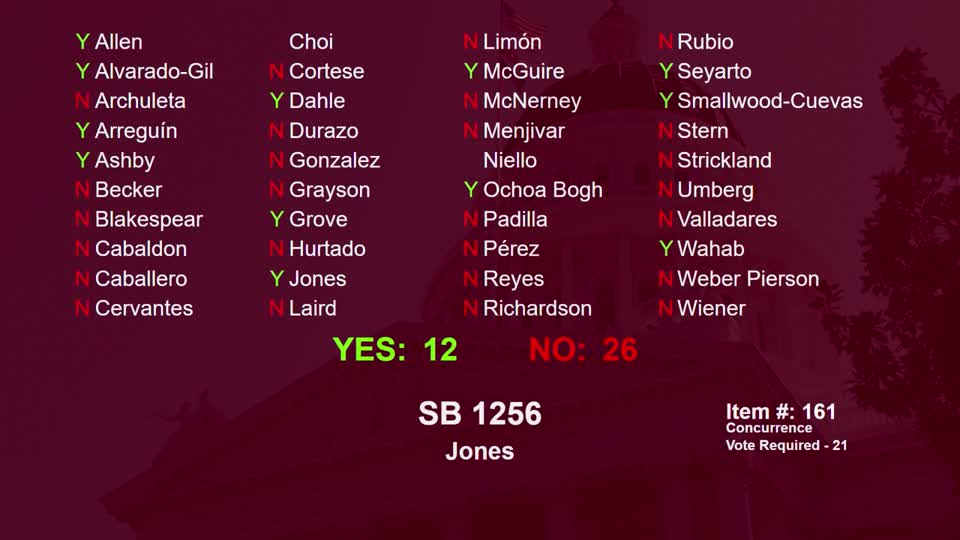 1MIN
Senate Floor
 2MIN
Assembly Standing Committee on Local Government
 2MIN
Assembly Standing Committee on Appropriations
 8MIN
Assembly Standing Committee on Local Government
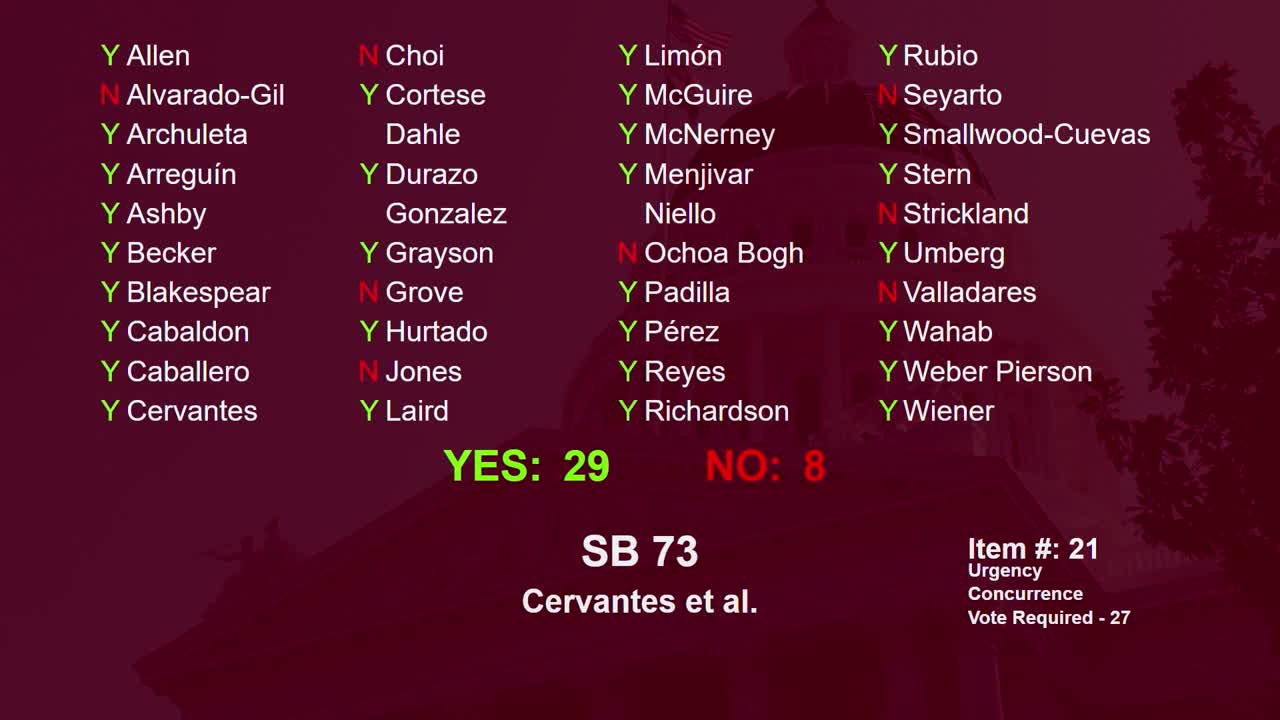 5MIN
Senate Floor
 7MIN
Senate Standing Committee on Local Government
Bill Author

Bill Co-Author(s):