SB 347: Annual tax: partnerships and LLCs.
- Session Year: 2025-2026
- House: Senate
- Latest Version Date: 2026-01-15
Current Status:
Failed
(2026-02-02: Returned to Secretary of Senate pursuant to Joint Rule 56.)
Introduced
In Committee
Awaiting First Chamber Vote
Passed First Chamber
In Committee
Awaiting Second Chamber Vote
Passed Second Chamber
Enacted
What does this bill do?
The bill sets the annual minimum tax for limited partnerships, limited liability partnerships, and limited liability companies doing business in California at $600 for tax years beginning on or after January 1, 2026 and before January 1, 2031. It also requires the Franchise Tax Board to report annually to the Legislature starting April 1, 2028 on how many partnerships and LLCs are affected and adds extra information and performance measures for bills that create new tax breaks.
The summary is provided by generative AI which can make mistakes. For original language, please view the details in the table below.
Existing law imposes an annual minimum franchise tax of $800, except as provided, on every corporation incorporated in this state, qualified to transact intrastate business in this state, or doing business in this state, and an annual tax in an amount equal to the minimum franchise tax on every limited partnership, limited liability partnership, and limited liability company doing business in this state, as specified.
This bill, for taxable years beginning on or after January 1, 2026, and before January 1, 2031, would reduce the annual tax on every limited partnership, limited liability partnership, and limited liability company to $200. $600.
Existing law requires any bill authorizing a new tax expenditure to contain, among other things, specific goals, purposes, and objectives that the tax expenditure will achieve, detailed performance indicators, and data collection requirements.
This bill also would include additional information required for any bill authorizing a new tax expenditure.
This bill would take effect immediately as a tax levy.
Existing law imposes an annual minimum franchise tax of $800, except as provided, on every corporation incorporated in this state, qualified to transact intrastate business in this state, or doing business in this state, and an annual tax in an amount equal to the minimum franchise tax on every limited partnership, limited liability partnership, and limited liability company doing business in this state, as specified.
This bill, for taxable years beginning on or after January 1, 2025, 2026, and before January 1, 2030, 2031, would reduce the annual tax on every limited partnership, limited liability partnership, and limited liability company to $80. $200.
Existing law requires any bill authorizing a new tax expenditure to contain, among other things, specific goals, purposes, and objectives that the tax expenditure will achieve, detailed performance indicators, and data collection requirements.
This bill also would include additional information required for any bill authorizing a new tax expenditure.
This bill would take effect immediately as a tax levy.
Existing law imposes an annual minimum franchise tax of $800, except as provided, on every corporation incorporated in this state, qualified to transact intrastate business in this state, or doing business in this state, and an annual tax in an amount equal to the minimum franchise tax on every limited partnership, limited liability partnership, and limited liability company doing business in this state, as specified.
This bill, for taxable years beginning on or after January 1, 2025, and before January 1, 2030, would reduce the minimum franchise tax, as provided, based on the gross receipts during the taxable year of the corporation, but would continue to impose the current amount of the annual tax on corporations described above whose gross receipts exceed $15,000,000 and on every limited partnership, limited liability partnership, and limited liability company doing business in this state. The bill would require the Franchise Tax Board to submit an annual report to the Legislature regarding the reduction of the minimum franchise tax, as provided. annual tax on every limited partnership, limited liability partnership, and limited liability company to $80.
Existing law requires any bill authorizing a new tax expenditure to contain, among other things, specific goals, purposes, and objectives that the tax expenditure will achieve, detailed performance indicators, and data collection requirements.
This bill also would include additional information required for any bill authorizing a new tax expenditure.
This bill would take effect immediately as a tax levy.
Existing law imposes an annual minimum franchise tax of $800, except as provided, on every corporation incorporated in this state, qualified to transact intrastate business in this state, or doing business in this state, and an annual tax in an amount equal to the minimum franchise tax on every limited partnership, limited liability partnership, and limited liability company doing business in this state, as specified.
This bill, for taxable years beginning on or after January 1, 2025, would reduce the minimum franchise tax, as provided, based on the gross receipts during the taxable year of the corporation, but would continue to impose the current amount of the annual tax on corporations described above whose gross receipts exceed $15,000,000 and on every limited partnership, limited liability partnership, and limited liability company doing business in this state. The bill would require the Franchise Tax Board to submit an annual report to the Legislature regarding the reduction of the minimum franchise tax, as provided.
This bill would take effect immediately as a tax levy.
The Corporation Tax Law imposes a tax upon every corporation doing business in this state according to, or measured by, the corporations net income, except as provided, and is administered by the Franchise Tax Board. Under that law, a reference to regulations of the Franchise Tax Board or similar reference authorizes the Franchise Tax Board to make rules and regulations with regard to the provisions within which the reference is made, as specified.This bill would make nonsubstantive changes to that provision.The Corporation Tax Law imposes a tax upon every corporation doing business in this state according to, or measured by, the corporations net income, except as provided, and is administered by the Franchise Tax Board. Under that law, a reference to regulations of the Franchise Tax Board or similar reference authorizes the Franchise Tax Board to make rules and regulations with regard to the provisions within which the reference is made, as specified.
This bill would make nonsubstantive changes to that provision.
(a)Except as provided in subdivision (f), for each taxable year beginning on or after January 1, 1997, every limited partnership doing business in this state (as defined by Section 23101) and required to file a return under Section 18633 shall pay annually to this state a tax for the privilege of doing business in this state in an amount equal to the applicable amount specified in subdivision (d) of Section 23153.
(b)(1)In addition to any limited partnership that is doing business in this state and therefore is subject to the tax imposed by subdivision (a), for each taxable year beginning on or after January 1, 1997, every limited partnership that has executed, acknowledged, and filed a certificate of limited partnership with the Secretary of State pursuant to Section 15621 or 15902.01 of the Corporations Code, and every foreign limited partnership that has registered with the Secretary of State pursuant to Section 15692 or 15909.01 of the Corporations Code, shall pay annually the tax prescribed in subdivision (a). The tax shall be paid for each taxable year, or part thereof, until a certificate of cancellation is filed on behalf of the limited partnership with the office of the Secretary of State pursuant to Section 15623, 15696, 15902.03, or 15909.07 of the Corporations Code.
(2)If a taxpayer files a return with the Franchise Tax Board that is designated its final return, that board shall notify the taxpayer that the tax imposed by this chapter is due annually until a certificate of cancellation is filed with the Secretary of State pursuant to Section 15623, 15696, 15902.03, or 15909.07 of the Corporations Code.
(c)The tax imposed by this chapter shall be due and payable on the date the return is required to be filed under former Section 18432 or 18633.
(d)For purposes of this section, limited partnership means any partnership formed by two or more persons under the laws of this state or any other jurisdiction and having one or more general partners and one or more limited partners.
(e)Notwithstanding subdivision (b), any limited partnership that ceased doing business prior to January 1, 1997, filed a final return with the Franchise Tax Board for a taxable year ending before January 1, 1997, and filed a certificate of dissolution with the Secretary of State pursuant to Section 15623 of the Corporations Code prior to January 1, 1997, shall not be subject to the tax imposed by this chapter for any period following the date the certificate of dissolution was filed with the Secretary of State, but only if the limited partnership files a certificate of cancellation with the Secretary of State pursuant to Section 15623 of the Corporations Code. In the case where a notice of proposed deficiency assessment of tax or a notice of tax due (whichever is applicable) is mailed after January 1, 2001, the first sentence of this subdivision shall not apply unless the certificate of cancellation is filed with the Secretary of State not later than 60 days after the date of the mailing of the notice.
(f)For each taxable year beginning on or after January 1, 2026, and before January 1, 2031, every limited partnership doing business in this state and required to file a return under Section 18633 shall, instead of the amount specified in subdivision (a), pay an annual tax to this state in the amount of two six hundred dollars ($200). ($600).
SEC. 2.Section 17941 of the Revenue and Taxation Code is amended to read:17941.(a)Except as provided in subdivision (g), for each taxable year beginning on or after January 1, 1997, a limited liability company doing business in this state (as defined in Section 23101) shall pay annually to this state a tax for the privilege of doing business in this state in an amount equal to the applicable amount specified in subdivision (d) of Section 23153.
(b)(1)In addition to any limited liability company that is doing business in this state and is therefore subject to the tax imposed by subdivision (a), for each taxable year beginning on or after January 1, 1997, a limited liability company shall pay annually the tax prescribed in subdivision (a) if articles of organization have been accepted, or a certificate of registration has been issued, by the office of the Secretary of State. The tax shall be paid for each taxable year, or part thereof, until a certificate of cancellation of registration or of articles of organization is filed on behalf of the limited liability company with the office of the Secretary of State.
(2)If a taxpayer files a return with the Franchise Tax Board that is designated as its final return, the Franchise Tax Board shall notify the taxpayer that the annual tax shall continue to be due annually until a certificate of dissolution is filed with the Secretary of State pursuant to Section 17707.08 of the Corporations Code or a certificate of cancellation is filed with the Secretary of State pursuant to Section 17708.06 of the Corporations Code.
(c)The tax assessed under this section shall be due and payable on or before the 15th day of the fourth month of the taxable year.
(d)For purposes of this section, limited liability company means an organization, other than a limited liability company that is exempt from the tax and fees imposed under this chapter pursuant to Section 23701h or Section 23701x, that is formed by one or more persons under the law of this state, any other country, or any other state, as a limited liability company and that is not taxable as a corporation for California tax purposes.
(e)Notwithstanding anything in this section to the contrary, if the office of the Secretary of State files a certificate of cancellation pursuant to Section 17707.02 of the Corporations Code for any limited liability company, then paragraph (1) of subdivision (f) of Section 23153 shall apply to that limited liability company as if the limited liability company were properly treated as a corporation for that limited purpose only, and paragraph (2) of subdivision (f) of Section 23153 shall not apply. Nothing in this subdivision entitles a limited liability company to receive a reimbursement for any annual taxes or fees already paid.
(f)(1)Notwithstanding any provision of this section to the contrary, a limited liability company that is a small business solely owned by a deployed member of the United States Armed Forces shall not be subject to the tax imposed under this section for any taxable year the owner is deployed and the limited liability company operates at a loss or ceases operation.
(2)The Franchise Tax Board may promulgate regulations as necessary or appropriate to carry out the purposes of this subdivision, including a definition for ceases operation.
(3)For the purposes of this subdivision, all of the following definitions apply:
(A)Deployed means being called to active duty or active service during a period when a Presidential Executive order specifies that the United States is engaged in combat or homeland defense. Deployed does not include either of the following:
(i)Temporary duty for the sole purpose of training or processing.
(ii)A permanent change of station.
(B)Operates at a loss means a limited liability companys expenses exceed its receipts.
(C)Small business means a limited liability company with total income from all sources derived from, or attributable to, the state of two hundred fifty thousand dollars ($250,000) or less.
(4)This subdivision shall become inoperative for taxable years beginning on or after January 1, 2025.
(g)For each taxable year beginning on or after January 1, 2026, and before January 1, 2031, every limited liability company doing business in this state shall, instead of the amount specified in subdivision (a), pay an annual tax to this state in the amount of two six hundred dollars ($200). ($600).
SEC. 3.Section 17948 of the Revenue and Taxation Code is amended to read:17948.(a)Except as provided in subdivision (e), for each taxable year beginning on or after January 1, 1997, every limited liability partnership doing business in this state (as defined in Section 23101) and required to file a return under Section 18633 shall pay annually to the Franchise Tax Board a tax for the privilege of doing business in this state in an amount equal to the applicable amount specified in subdivision (d) of Section 23153.
(b)In addition to any limited liability partnership that is doing business in this state and therefore is subject to the tax imposed by subdivision (a), for each taxable year beginning on or after January 1, 1997, every registered limited liability partnership that has registered with the Secretary of State pursuant to Section 16953 of the Corporations Code and every foreign limited liability partnership that has registered with the Secretary of State pursuant to Section 16959 of the Corporations Code shall pay annually the tax prescribed in subdivision (a). The tax shall be paid for each taxable year, or part thereof, until any of the following occurs:
(1)A notice of cessation is filed with the Secretary of State pursuant to subdivision (b) of Section 16954 or 16960 of the Corporations Code.
(2)A foreign limited liability partnership withdraws its registration pursuant to subdivision (a) of Section 16960 of the Corporations Code.
(3)The registered limited liability partnership or foreign limited liability partnership has been dissolved and finally wound up.
(c)The tax assessed under this section shall be due and payable on the date the return is required to be filed under Section 18633.
(d)If a taxpayer files a return with the Franchise Tax Board that is designated as its final return, the Franchise Tax Board shall notify the taxpayer that the annual tax shall continue to be due annually until a certificate of cancellation is filed with the Secretary of State pursuant to Section 16954 or 16960 of the Corporations Code.
(e)For each taxable year beginning on or after January 1, 2026, and before January 1, 2031, every limited liability partnership doing business in this state and required to file a return under Section 18633 shall, instead of the amount specified in subdivision (a), pay an annual tax to this state in the amount of two six hundred dollars ($200). ($600).
SEC. 4.(a)It is the intent of the Legislature to apply the requirements of Section 41 of the Revenue and Taxation Code to this act.
(b)With respect to Sections 17935, 17941, and 17948 of the Revenue and Taxation Code, as amended by this act, the Legislature finds and declares as follows:
(1)The goal of this act is to make Californias business environment more competitive for California partnerships and limited liability companies.
(2)The performance indicator for the Legislature to use in determining whether the act achieves its goal shall be the number of partnerships and limited liability companies that are affected by the act.
(c)(1)On or before April 1, 2028, and annually thereafter, the Franchise Tax Board shall submit a report to the Legislature, in compliance with Section 9795 of the Government Code, on the performance of partnerships and limited liability companies in the state using the data in paragraph (2) of subdivision (b).
(2)The disclosure requirements of this subdivision shall be treated as an exception to Section 19542 of the Revenue and Taxation Code.
SEC. 5.This act provides for a tax levy within the meaning of Article IV of the California Constitution and shall go into immediate effect.
(a)Except as provided in subdivision (f), for each taxable year beginning on or after January 1, 1997, every limited partnership doing business in this state (as defined by Section 23101) and required to file a return under Section 18633 shall pay annually to this state a tax for the privilege of doing business in this state in an amount equal to the applicable amount specified in subdivision (d) of Section 23153.
(b)(1)In addition to any limited partnership that is doing business in this state and therefore is subject to the tax imposed by subdivision (a), for each taxable year beginning on or after January 1, 1997, every limited partnership that has executed, acknowledged, and filed a certificate of limited partnership with the Secretary of State pursuant to Section 15621 or 15902.01 of the Corporations Code, and every foreign limited partnership that has registered with the Secretary of State pursuant to Section 15692 or 15909.01 of the Corporations Code, shall pay annually the tax prescribed in subdivision (a). The tax shall be paid for each taxable year, or part thereof, until a certificate of cancellation is filed on behalf of the limited partnership with the office of the Secretary of State pursuant to Section 15623, 15696, 15902.03, or 15909.07 of the Corporations Code.
(2)If a taxpayer files a return with the Franchise Tax Board that is designated its final return, that board shall notify the taxpayer that the tax imposed by this chapter is due annually until a certificate of cancellation is filed with the Secretary of State pursuant to Section 15623, 15696, 15902.03, or 15909.07 of the Corporations Code.
(c)The tax imposed by this chapter shall be due and payable on the date the return is required to be filed under former Section 18432 or 18633.
(d)For purposes of this section, limited partnership means any partnership formed by two or more persons under the laws of this state or any other jurisdiction and having one or more general partners and one or more limited partners.
(e)Notwithstanding subdivision (b), any limited partnership that ceased doing business prior to January 1, 1997, filed a final return with the Franchise Tax Board for a taxable year ending before January 1, 1997, and filed a certificate of dissolution with the Secretary of State pursuant to Section 15623 of the Corporations Code prior to January 1, 1997, shall not be subject to the tax imposed by this chapter for any period following the date the certificate of dissolution was filed with the Secretary of State, but only if the limited partnership files a certificate of cancellation with the Secretary of State pursuant to Section 15623 of the Corporations Code. In the case where a notice of proposed deficiency assessment of tax or a notice of tax due (whichever is applicable) is mailed after January 1, 2001, the first sentence of this subdivision shall not apply unless the certificate of cancellation is filed with the Secretary of State not later than 60 days after the date of the mailing of the notice.
(f)For each taxable year beginning on or after January 1, 2025, 2026, and before January 1, 2030, 2031, every limited partnership doing business in this state and required to file a return under Section 18633 shall, instead of the amount specified in subdivision (a), pay an annual tax to this state in the amount of $80. two hundred dollars ($200).
SEC. 2.Section 17941 of the Revenue and Taxation Code is amended to read:17941.(a)Except as provided in subdivision (g), for each taxable year beginning on or after January 1, 1997, a limited liability company doing business in this state (as defined in Section 23101) shall pay annually to this state a tax for the privilege of doing business in this state in an amount equal to the applicable amount specified in subdivision (d) of Section 23153.
(b)(1)In addition to any limited liability company that is doing business in this state and is therefore subject to the tax imposed by subdivision (a), for each taxable year beginning on or after January 1, 1997, a limited liability company shall pay annually the tax prescribed in subdivision (a) if articles of organization have been accepted, or a certificate of registration has been issued, by the office of the Secretary of State. The tax shall be paid for each taxable year, or part thereof, until a certificate of cancellation of registration or of articles of organization is filed on behalf of the limited liability company with the office of the Secretary of State.
(2)If a taxpayer files a return with the Franchise Tax Board that is designated as its final return, the Franchise Tax Board shall notify the taxpayer that the annual tax shall continue to be due annually until a certificate of dissolution is filed with the Secretary of State pursuant to Section 17707.08 of the Corporations Code or a certificate of cancellation is filed with the Secretary of State pursuant to Section 17708.06 of the Corporations Code.
(c)The tax assessed under this section shall be due and payable on or before the 15th day of the fourth month of the taxable year.
(d)For purposes of this section, limited liability company means an organization, other than a limited liability company that is exempt from the tax and fees imposed under this chapter pursuant to Section 23701h or Section 23701x, that is formed by one or more persons under the law of this state, any other country, or any other state, as a limited liability company and that is not taxable as a corporation for California tax purposes.
(e)Notwithstanding anything in this section to the contrary, if the office of the Secretary of State files a certificate of cancellation pursuant to Section 17707.02 of the Corporations Code for any limited liability company, then paragraph (1) of subdivision (f) of Section 23153 shall apply to that limited liability company as if the limited liability company were properly treated as a corporation for that limited purpose only, and paragraph (2) of subdivision (f) of Section 23153 shall not apply. Nothing in this subdivision entitles a limited liability company to receive a reimbursement for any annual taxes or fees already paid.
(f)(1)Notwithstanding any provision of this section to the contrary, a limited liability company that is a small business solely owned by a deployed member of the United States Armed Forces shall not be subject to the tax imposed under this section for any taxable year the owner is deployed and the limited liability company operates at a loss or ceases operation.
(2)The Franchise Tax Board may promulgate regulations as necessary or appropriate to carry out the purposes of this subdivision, including a definition for ceases operation.
(3)For the purposes of this subdivision, all of the following definitions apply:
(A)Deployed means being called to active duty or active service during a period when a Presidential Executive order specifies that the United States is engaged in combat or homeland defense. Deployed does not include either of the following:
(i)Temporary duty for the sole purpose of training or processing.
(ii)A permanent change of station.
(B)Operates at a loss means a limited liability companys expenses exceed its receipts.
(C)Small business means a limited liability company with total income from all sources derived from, or attributable to, the state of two hundred fifty thousand dollars ($250,000) or less.
(4)This subdivision shall become inoperative for taxable years beginning on or after January 1, 2025.
(g)For each taxable year beginning on or after January 1, 2025, 2026, and before January 1, 2030, 2031, every limited liability company doing business in this state shall, instead of the amount specified in subdivision (a), pay an annual tax to this state in the amount of eighty dollars ($80). two hundred dollars ($200).
SEC. 3.Section 17948 of the Revenue and Taxation Code is amended to read:17948.(a)Except as provided in subdivision (e), for each taxable year beginning on or after January 1, 1997, every limited liability partnership doing business in this state (as defined in Section 23101) and required to file a return under Section 18633 shall pay annually to the Franchise Tax Board a tax for the privilege of doing business in this state in an amount equal to the applicable amount specified in subdivision (d) of Section 23153.
(b)In addition to any limited liability partnership that is doing business in this state and therefore is subject to the tax imposed by subdivision (a), for each taxable year beginning on or after January 1, 1997, every registered limited liability partnership that has registered with the Secretary of State pursuant to Section 16953 of the Corporations Code and every foreign limited liability partnership that has registered with the Secretary of State pursuant to Section 16959 of the Corporations Code shall pay annually the tax prescribed in subdivision (a). The tax shall be paid for each taxable year, or part thereof, until any of the following occurs:
(1)A notice of cessation is filed with the Secretary of State pursuant to subdivision (b) of Section 16954 or 16960 of the Corporations Code.
(2)A foreign limited liability partnership withdraws its registration pursuant to subdivision (a) of Section 16960 of the Corporations Code.
(3)The registered limited liability partnership or foreign limited liability partnership has been dissolved and finally wound up.
(c)The tax assessed under this section shall be due and payable on the date the return is required to be filed under Section 18633.
(d)If a taxpayer files a return with the Franchise Tax Board that is designated as its final return, the Franchise Tax Board shall notify the taxpayer that the annual tax shall continue to be due annually until a certificate of cancellation is filed with the Secretary of State pursuant to Section 16954 or 16960 of the Corporations Code.
(e)For each taxable year beginning on or after January 1, 2025, 2026, and before January 1, 2030, 2031, every limited liability partnership doing business in this state and required to file a return under Section 18633 shall, instead of the amount specified in subdivision (a), pay an annual tax to this state in the amount of eighty dollars ($80). two hundred dollars ($200).
SEC. 4.(a)It is the intent of the Legislature to apply the requirements of Section 41 of the Revenue and Taxation Code to this act.
(b)With respect to Sections 17935, 17941, and 17948 of the Revenue and Taxation Code, as amended by this act, the Legislature finds and declares as follows:
(1)The goal of this act is to reduce costs make Californias business environment more competitive for California partnerships and limited liability companies.
(2)The performance indicator for the Legislature to use in determining whether the act achieves its goal shall be the number of partnerships and limited liability companies that are affected by the act.
(c)(1)On or before December 1, 2026, April 1, 2028, and annually thereafter, the Franchise Tax Board shall submit a report to the Legislature, in compliance with Section 9795 of the Government Code, on the performance of partnerships and limited liability companies in the state using the data in paragraph (2). (2) of subdivision (b).
(2)The disclosure requirements of this subdivision shall be treated as an exception to Section 19542 of the Revenue and Taxation Code.
SEC. 5.This act provides for a tax levy within the meaning of Article IV of the California Constitution and shall go into immediate effect.
(a)For Except as provided in subdivision (f), for each taxable year beginning on or after January 1, 1997, every limited partnership doing business in this state (as defined by Section 23101) and required to file a return under Section 18633 shall pay annually to this state a tax for the privilege of doing business in this state in an amount equal to the applicable amount specified in subparagraph (A) of paragraph (1) of subdivision (d) of Section 23153.
(b)(1)In addition to any limited partnership that is doing business in this state and therefore is subject to the tax imposed by subdivision (a), for each taxable year beginning on or after January 1, 1997, every limited partnership that has executed, acknowledged, and filed a certificate of limited partnership with the Secretary of State pursuant to Section 15621 or 15902.01 of the Corporations Code, and every foreign limited partnership that has registered with the Secretary of State pursuant to Section 15692 or 15909.01 of the Corporations Code, shall pay annually the tax prescribed in subdivision (a). The tax shall be paid for each taxable year, or part thereof, until a certificate of cancellation is filed on behalf of the limited partnership with the office of the Secretary of State pursuant to Section 15623, 15696, 15902.03, or 15909.07 of the Corporations Code.
(2)If a taxpayer files a return with the Franchise Tax Board that is designated its final return, that board shall notify the taxpayer that the tax imposed by this chapter is due annually until a certificate of cancellation is filed with the Secretary of State pursuant to Section 15623, 15696, 15902.03, or 15909.07 of the Corporations Code.
(c)The tax imposed by this chapter shall be due and payable on the date the return is required to be filed under former Section 18432 or 18633.
(d)For purposes of this section, limited partnership means any partnership formed by two or more persons under the laws of this state or any other jurisdiction and having one or more general partners and one or more limited partners.
(e)Notwithstanding subdivision (b), any limited partnership that ceased doing business prior to January 1, 1997, filed a final return with the Franchise Tax Board for a taxable year ending before January 1, 1997, and filed a certificate of dissolution with the Secretary of State pursuant to Section 15623 of the Corporations Code prior to January 1, 1997, shall not be subject to the tax imposed by this chapter for any period following the date the certificate of dissolution was filed with the Secretary of State, but only if the limited partnership files a certificate of cancellation with the Secretary of State pursuant to Section 15623 of the Corporations Code. In the case where a notice of proposed deficiency assessment of tax or a notice of tax due (whichever is applicable) is mailed after January 1, 2001, the first sentence of this subdivision shall not apply unless the certificate of cancellation is filed with the Secretary of State not later than 60 days after the date of the mailing of the notice.
(f)For each taxable year beginning on or after January 1, 2025, and before January 1, 2030, every limited partnership doing business in this state and required to file a return under Section 18633 shall, instead of the amount specified in subdivision (a), pay an annual tax to this state in the amount of $80.
SEC. 2.Section 17941 of the Revenue and Taxation Code is amended to read:17941.(a)For Except as provided in subdivision (g), for each taxable year beginning on or after January 1, 1997, a limited liability company doing business in this state (as defined in Section 23101) shall pay annually to this state a tax for the privilege of doing business in this state in an amount equal to the applicable amount specified in subparagraph (A) of paragraph (1) of subdivision (d) of Section 23153.
(b)(1)In addition to any limited liability company that is doing business in this state and is therefore subject to the tax imposed by subdivision (a), for each taxable year beginning on or after January 1, 1997, a limited liability company shall pay annually the tax prescribed in subdivision (a) if articles of organization have been accepted, or a certificate of registration has been issued, by the office of the Secretary of State. The tax shall be paid for each taxable year, or part thereof, until a certificate of cancellation of registration or of articles of organization is filed on behalf of the limited liability company with the office of the Secretary of State.
(2)If a taxpayer files a return with the Franchise Tax Board that is designated as its final return, the Franchise Tax Board shall notify the taxpayer that the annual tax shall continue to be due annually until a certificate of dissolution is filed with the Secretary of State pursuant to Section 17707.08 of the Corporations Code or a certificate of cancellation is filed with the Secretary of State pursuant to Section 17708.06 of the Corporations Code.
(c)The tax assessed under this section shall be due and payable on or before the 15th day of the fourth month of the taxable year.
(d)For purposes of this section, limited liability company means an organization, other than a limited liability company that is exempt from the tax and fees imposed under this chapter pursuant to Section 23701h or Section 23701x, that is formed by one or more persons under the law of this state, any other country, or any other state, as a limited liability company and that is not taxable as a corporation for California tax purposes.
(e)Notwithstanding anything in this section to the contrary, if the office of the Secretary of State files a certificate of cancellation pursuant to Section 17707.02 of the Corporations Code for any limited liability company, then paragraph (1) of subdivision (f) of Section 23153 shall apply to that limited liability company as if the limited liability company were properly treated as a corporation for that limited purpose only, and paragraph (2) of subdivision (f) of Section 23153 shall not apply. Nothing in this subdivision entitles a limited liability company to receive a reimbursement for any annual taxes or fees already paid.
(f)(1)Notwithstanding any provision of this section to the contrary, a limited liability company that is a small business solely owned by a deployed member of the United States Armed Forces shall not be subject to the tax imposed under this section for any taxable year the owner is deployed and the limited liability company operates at a loss or ceases operation.
(2)The Franchise Tax Board may promulgate regulations as necessary or appropriate to carry out the purposes of this subdivision, including a definition for ceases operation.
(3)For the purposes of this subdivision, all of the following definitions apply:
(A)Deployed means being called to active duty or active service during a period when a Presidential Executive order specifies that the United States is engaged in combat or homeland defense. Deployed does not include either of the following:
(i)Temporary duty for the sole purpose of training or processing.
(ii)A permanent change of station.
(B)Operates at a loss means a limited liability companys expenses exceed its receipts.
(C)Small business means a limited liability company with total income from all sources derived from, or attributable to, the state of two hundred fifty thousand dollars ($250,000) or less.
(4)This subdivision shall become inoperative for taxable years beginning on or after January 1, 2025.
(g)For each taxable year beginning on or after January 1, 2025, and before January 1, 2030, every limited liability company doing business in this state shall, instead of the amount specified in subdivision (a), pay an annual tax to this state in the amount of eighty dollars ($80).
SEC. 3.Section 17948 of the Revenue and Taxation Code is amended to read:17948.(a)For Except as provided in subdivision (e), for each taxable year beginning on or after January 1, 1997, every limited liability partnership doing business in this state (as defined in Section 23101) and required to file a return under Section 18633 shall pay annually to the Franchise Tax Board a tax for the privilege of doing business in this state in an amount equal to the applicable amount specified in subparagraph (A) of paragraph (1) of subdivision (d) of Section 23153.
(b)In addition to any limited liability partnership that is doing business in this state and therefore is subject to the tax imposed by subdivision (a), for each taxable year beginning on or after January 1, 1997, every registered limited liability partnership that has registered with the Secretary of State pursuant to Section 16953 of the Corporations Code and every foreign limited liability partnership that has registered with the Secretary of State pursuant to Section 16959 of the Corporations Code shall pay annually the tax prescribed in subdivision (a). The tax shall be paid for each taxable year, or part thereof, until any of the following occurs:
(1)A notice of cessation is filed with the Secretary of State pursuant to subdivision (b) of Section 16954 or 16960 of the Corporations Code.
(2)A foreign limited liability partnership withdraws its registration pursuant to subdivision (a) of Section 16960 of the Corporations Code.
(3)The registered limited liability partnership or foreign limited liability partnership has been dissolved and finally wound up.
(c)The tax assessed under this section shall be due and payable on the date the return is required to be filed under Section 18633.
(d)If a taxpayer files a return with the Franchise Tax Board that is designated as its final return, the Franchise Tax Board shall notify the taxpayer that the annual tax shall continue to be due annually until a certificate of cancellation is filed with the Secretary of State pursuant to Section 16954 or 16960 of the Corporations Code.
(e)For each taxable year beginning on or after January 1, 2025, and before January 1, 2030, every limited liability partnership doing business in this state and required to file a return under Section 18633 shall, instead of the amount specified in subdivision (a), pay an annual tax to this state in the amount of eighty dollars ($80).
SEC. 4.Section 23153 of the Revenue and Taxation Code is amended to read:23153.(a)Every corporation described in subdivision (b) shall be subject to the minimum franchise tax specified in subdivision (d) from the earlier of the date of incorporation, qualification, or commencing to do business within this state, until the effective date of dissolution or withdrawal as provided in Section 23331 or, if later, the date the corporation ceases to do business within the limits of this state.(b)Unless expressly exempted by this part or the California Constitution, subdivision (a) shall apply to each of the following:(1)Every corporation that is incorporated under the laws of this state.(2)Every corporation that is qualified to transact intrastate business in this state pursuant to Chapter 21 (commencing with Section 2100) of Division 1 of Title 1 of the Corporations Code.(3)Every corporation that is doing business in this state.(c)The following entities are not subject to the minimum franchise tax specified in this section:(1)Credit unions.(2)Nonprofit cooperative associations organized pursuant to Chapter 1 (commencing with Section 54001) of Division 20 of the Food and Agricultural Code that have been issued the certificate of the board of supervisors prepared pursuant to Section 54042 of the Food and Agricultural Code. The association shall be exempt from the minimum franchise tax for five consecutive taxable years, commencing with the first taxable year for which the certificate is issued pursuant to subdivision (b) of Section 54042 of the Food and Agricultural Code. This paragraph only applies to nonprofit cooperative associations organized on or after January 1, 1994.(d)(1)Except as provided in paragraph (2), paragraph (1) of subdivision (f) of Section 23151, paragraph (1) of subdivision (f) of Section 23181, and paragraph (1) of subdivision (c) of Section 23183, corporations subject to the minimum franchise tax shall pay annually to the state a minimum franchise tax of:(A)Except as provided in subparagraph (B), eight hundred dollars ($800).(B)For taxable years beginning on or after January 1, 2025:(i)If the corporation has gross receipts during the taxable year that are less than two million five hundred thousand dollars ($2,500,000), two hundred dollars ($200).(ii)If the corporation has gross receipts during the taxable year that are equal to or greater than two million five hundred thousand dollars ($2,500,000) and less than seven million five hundred thousand dollars ($7,500,000), four hundred dollars ($400).(iii)If the corporation has gross receipts during the taxable year that are equal to or greater than seven million five hundred thousand dollars ($7,500,000) and less than fifteen million dollars ($15,000,000), six hundred dollars ($600).(iv)If the corporation has gross receipts during the taxable year that are equal to or greater than fifteen million dollars ($15,000,000), eight hundred dollars ($800).(2)The minimum franchise tax shall be twenty-five dollars ($25) for each of the following:(A)A corporation formed under the laws of this state whose principal business when formed was gold mining, which is inactive and has not done business within the limits of the state since 1950.(B)A corporation formed under the laws of this state whose principal business when formed was quicksilver mining, which is inactive and has not done business within the limits of the state since 1971, or has been inactive for a period of 24 consecutive months or more.(3)For purposes of paragraph (2), a corporation shall not be considered to have done business if it engages in business other than mining.(e)Notwithstanding subdivision (a), for taxable years beginning on or after January 1, 1999, and before January 1, 2000, every qualified new corporation shall pay annually to the state a minimum franchise tax of five hundred dollars ($500) for the second taxable year. This subdivision shall apply to any corporation that is a qualified new corporation and is incorporated on or after January 1, 1999, and before January 1, 2000.(1)The determination of the gross receipts of a corporation, for purposes of this subdivision, shall be made by including the gross receipts of each member of the commonly controlled group, as defined in Section 25105, of which the corporation is a member.(2)Gross receipts, less returns and allowances reportable to this state, means the sum of the gross receipts from the production of business income, as defined in subdivision (a) of Section 25120, and the gross receipts from the production of nonbusiness income, as defined in subdivision (d) of Section 25120.(3)Qualified new corporation means a corporation that is incorporated under the laws of this state or has qualified to transact intrastate business in this state, that begins business operations at or after the time of its incorporation and that reasonably estimates that it will have gross receipts, less returns and allowances, reportable to this state for the taxable year of one million dollars ($1,000,000) or less. Qualified new corporation does not include any corporation that began business operations as a sole proprietorship, a partnership, or any other form of business entity prior to its incorporation. This subdivision shall not apply to any corporation that reorganizes solely for the purpose of reducing its minimum franchise tax.(4)This subdivision shall not apply to limited partnerships, as defined in Section 17935, limited liability companies, as defined in Section 17941, limited liability partnerships, as described in Section 17948, charitable organizations, as described in Section 23703, regulated investment companies, as defined in Section 851 of the Internal Revenue Code, real estate investment trusts, as defined in Section 856 of the Internal Revenue Code, real estate mortgage investment conduits, as defined in Section 860D of the Internal Revenue Code, qualified Subchapter S subsidiaries, as defined in Section 1361(b)(3) of the Internal Revenue Code, or to the formation of any subsidiary corporation, to the extent applicable.(5)For any taxable year beginning on or after January 1, 1999, and before January 1, 2000, if a corporation has qualified to pay five hundred dollars ($500) for the second taxable year under this subdivision, but in its second taxable year, the corporations gross receipts, as determined under paragraphs (1) and (2), exceed one million dollars ($1,000,000), an additional tax in the amount equal to three hundred dollars ($300) for the second taxable year shall be due and payable by the corporation on the due date of its return, without regard to extension, for that year.(f)(1)Notwithstanding subdivision (a), every corporation that incorporates or qualifies to do business in this state on or after January 1, 2000, shall not be subject to the minimum franchise tax for its first taxable year.(2)This subdivision shall not apply to limited partnerships, as defined in Section 17935, limited liability companies, as defined in Section 17941, limited liability partnerships, as described in Section 17948, charitable organizations, as described in Section 23703, regulated investment companies, as defined in Section 851 of the Internal Revenue Code, real estate investment trusts, as defined in Section 856 of the Internal Revenue Code, real estate mortgage investment conduits, as defined in Section 860D of the Internal Revenue Code, and qualified Subchapter S subsidiaries, as defined in Section 1361(b)(3) of the Internal Revenue Code, to the extent applicable.(3)This subdivision shall not apply to any corporation that reorganizes solely for the purpose of avoiding payment of its minimum franchise tax.(g)Notwithstanding subdivision (a), a domestic corporation, as defined in Section 167 of the Corporations Code, that files a certificate of dissolution in the office of the Secretary of State pursuant to subdivision (b) of Section 1905 of the Corporations Code, prior to its amendment by the act amending this subdivision, and that does not thereafter do business shall not be subject to the minimum franchise tax for taxable years beginning on or after the date of that filing.(h)The minimum franchise tax imposed by paragraph (1) of subdivision (d) shall not be increased by the Legislature by more than 10 percent during any calendar year.(i)(1)Notwithstanding subdivision (a), a corporation that is a small business solely owned by a deployed member of the United States Armed Forces shall not be subject to the minimum franchise tax for any taxable year the owner is deployed and the corporation operates at a loss or ceases operation.(2)The Franchise Tax Board may promulgate regulations as necessary or appropriate to carry out the purposes of this subdivision, including a definition for ceases operation.(3)For the purposes of this subdivision, all of the following definitions apply:(A)Deployed means being called to active duty or active service during a period when a Presidential Executive order specifies that the United States is engaged in combat or homeland defense. Deployed does not include either of the following:(i)Temporary duty for the sole purpose of training or processing.(ii)A permanent change of station.(B)Operates at a loss means negative net income as defined in Section 24341.(C)Small business means a corporation with total income from all sources derived from, or attributable to, the state of two hundred fifty thousand dollars ($250,000) or less.(4)This subdivision shall become inoperative for taxable years beginning on or after January 1, 2026.SEC. 5.SEC. 4.(a)It is the intent of the Legislature to apply the requirements of Section 41 of the Revenue and Taxation Code to this act.
(b)With respect to Section 23153 Sections 17935, 17941, and 17948 of the Revenue and Taxation Code, as amended by this act, the Legislature finds and declares as follows:
(1)The goal of this act is to reduce costs for California small businesses. Existing law imposes an annual minimum franchise tax of $800 on every corporation, which leaves many small businesses struggling to afford this tax. partnerships and limited liability companies.
(2)The performance indicator for the Legislature to use in determining whether the act achieves its goal shall be the number of small businesses partnerships and limited liability companies that are affected by the act.
(c)(1)On or before December 1, 2026, and annually thereafter, the Franchise Tax Board shall submit a report to the Legislature, in compliance with Section 9795 of the Government Code, on the performance of corporations that are small businesses partnerships and limited liability companies in the state using the data in paragraph (2).
(2)The disclosure requirements of this subdivision shall be treated as an exception to Section 19542 of the Revenue and Taxation Code.
SEC. 6.SEC. 5.This act provides for a tax levy within the meaning of Article IV of the California Constitution and shall go into immediate effect.
(a)Except as provided in subdivision (f), for For each taxable year beginning on or after January 1, 1997, every limited partnership doing business in this state (as defined by Section 23101) and required to file a return under Section 18633 shall pay annually to this state a tax for the privilege of doing business in this state in an amount equal to the applicable amount specified in subparagraph (A) of paragraph (1) of subdivision (d) of Section 23153.
(b)(1)In addition to any limited partnership that is doing business in this state and therefore is subject to the tax imposed by subdivision (a), for each taxable year beginning on or after January 1, 1997, every limited partnership that has executed, acknowledged, and filed a certificate of limited partnership with the Secretary of State pursuant to Section 15621 or 15902.01 of the Corporations Code, and every foreign limited partnership that has registered with the Secretary of State pursuant to Section 15692 or 15909.01 of the Corporations Code, shall pay annually the tax prescribed in subdivision (a). The tax shall be paid for each taxable year, or part thereof, until a certificate of cancellation is filed on behalf of the limited partnership with the office of the Secretary of State pursuant to Section 15623, 15696, 15902.03, or 15909.07 of the Corporations Code.
(2)If a taxpayer files a return with the Franchise Tax Board that is designated its final return, that board shall notify the taxpayer that the tax imposed by this chapter is due annually until a certificate of cancellation is filed with the Secretary of State pursuant to Section 15623, 15696, 15902.03, or 15909.07 of the Corporations Code.
(c)The tax imposed by this chapter shall be due and payable on the date the return is required to be filed under former Section 18432 or 18633.
(d)For purposes of this section, limited partnership means any partnership formed by two or more persons under the laws of this state or any other jurisdiction and having one or more general partners and one or more limited partners.
(e)Notwithstanding subdivision (b), any limited partnership that ceased doing business prior to January 1, 1997, filed a final return with the Franchise Tax Board for a taxable year ending before January 1, 1997, and filed a certificate of dissolution with the Secretary of State pursuant to Section 15623 of the Corporations Code prior to January 1, 1997, shall not be subject to the tax imposed by this chapter for any period following the date the certificate of dissolution was filed with the Secretary of State, but only if the limited partnership files a certificate of cancellation with the Secretary of State pursuant to Section 15623 of the Corporations Code. In the case where a notice of proposed deficiency assessment of tax or a notice of tax due (whichever is applicable) is mailed after January 1, 2001, the first sentence of this subdivision shall not apply unless the certificate of cancellation is filed with the Secretary of State not later than 60 days after the date of the mailing of the notice.
(f)(1)Every limited partnership doing business in this state as described in subdivision (a) that files a certificate of limited partnership or registers with the Secretary of the State pursuant to subdivision (b) on or after January 1, 2021, and before January 1, 2024, shall not be subject to the tax imposed under this section for its first taxable year.(2)This subdivision shall become operative only for a taxable year in which any budget measure appropriates one dollar ($1) or more to the Franchise Tax Board for the costs associated with administration of this subdivision.SEC. 2.Section 17941 of the Revenue and Taxation Code is amended to read:17941.(a)Except as provided in subdivision (g), for For each taxable year beginning on or after January 1, 1997, a limited liability company doing business in this state (as defined in Section 23101) shall pay annually to this state a tax for the privilege of doing business in this state in an amount equal to the applicable amount specified in subparagraph (A) of paragraph (1) of subdivision (d) of Section 23153 for the taxable year. 23153.
(b)(1)In addition to any limited liability company that is doing business in this state and is therefore subject to the tax imposed by subdivision (a), for each taxable year beginning on or after January 1, 1997, a limited liability company shall pay annually the tax prescribed in subdivision (a) if articles of organization have been accepted, or a certificate of registration has been issued, by the office of the Secretary of State. The tax shall be paid for each taxable year, or part thereof, until a certificate of cancellation of registration or of articles of organization is filed on behalf of the limited liability company with the office of the Secretary of State.
(2)If a taxpayer files a return with the Franchise Tax Board that is designated as its final return, the Franchise Tax Board shall notify the taxpayer that the annual tax shall continue to be due annually until a certificate of dissolution is filed with the Secretary of State pursuant to Section 17707.08 of the Corporations Code or a certificate of cancellation is filed with the Secretary of State pursuant to Section 17708.06 of the Corporations Code.
(c)The tax assessed under this section shall be due and payable on or before the 15th day of the fourth month of the taxable year.
(d)For purposes of this section, limited liability company means an organization, other than a limited liability company that is exempt from the tax and fees imposed under this chapter pursuant to Section 23701h or Section 23701x, that is formed by one or more persons under the law of this state, any other country, or any other state, as a limited liability company and that is not taxable as a corporation for California tax purposes.
(e)Notwithstanding anything in this section to the contrary, if the office of the Secretary of State files a certificate of cancellation pursuant to Section 17707.02 of the Corporations Code for any limited liability company, then paragraph (1) of subdivision (f) of Section 23153 shall apply to that limited liability company as if the limited liability company were properly treated as a corporation for that limited purpose only, and paragraph (2) of subdivision (f) of Section 23153 shall not apply. Nothing in this subdivision entitles a limited liability company to receive a reimbursement for any annual taxes or fees already paid.
(f)(1)Notwithstanding any provision of this section to the contrary, for taxable years beginning on or after January 1, 2020, a limited liability company that is a small business solely owned by a deployed member of the United States Armed Forces shall not be subject to the tax imposed under this section for any taxable year the owner is deployed and the limited liability company operates at a loss or ceases operation.
(2)The Franchise Tax Board may promulgate regulations as necessary or appropriate to carry out the purposes of this subdivision, including a definition for ceases operation.
(3)For the purposes of this subdivision, all of the following definitions apply:
(A)Deployed means being called to active duty or active service during a period when a Presidential Executive order specifies that the United States is engaged in combat or homeland defense. Deployed does not include either of the following:
(i)Temporary duty for the sole purpose of training or processing.
(ii)A permanent change of station.
(B)Operates at a loss means a limited liability companys expenses exceed its receipts.
(C)Small business means a limited liability company with total income from all sources derived from, or attributable to, the state of two hundred fifty thousand dollars ($250,000) or less.
(4)This subdivision shall become inoperative for taxable years beginning on or after January 1, 2030. 2025.
(g)(1)Every limited liability company doing business in this state as described in subdivision (a) that organizes or registers with the Secretary of the State pursuant to subdivision (b) on or after January 1, 2021, and before January 1, 2024, shall not be subject to the tax imposed under this section for its first taxable year.(2)This subdivision shall become operative only for a taxable year in which any budget measure appropriates one dollar ($1) or more to the Franchise Tax Board for the costs associated with administration of this subdivision.SEC. 3.Section 17948 of the Revenue and Taxation Code is amended to read:17948.(a)Except as provided in subdivision (e), for For each taxable year beginning on or after January 1, 1997, every limited liability partnership doing business in this state (as defined in Section 23101) and required to file a return under Section 18633 shall pay annually to the Franchise Tax Board a tax for the privilege of doing business in this state in an amount equal to the applicable amount specified in subparagraph (A) of paragraph (1) of subdivision (d) of Section 23153 for the taxable year. 23153.
(b)In addition to any limited liability partnership that is doing business in this state and therefore is subject to the tax imposed by subdivision (a), for each taxable year beginning on or after January 1, 1997, every registered limited liability partnership that has registered with the Secretary of State pursuant to Section 16953 of the Corporations Code and every foreign limited liability partnership that has registered with the Secretary of State pursuant to Section 16959 of the Corporations Code shall pay annually the tax prescribed in subdivision (a). The tax shall be paid for each taxable year, or part thereof, until any of the following occurs:
(1)A notice of cessation is filed with the Secretary of State pursuant to subdivision (b) of Section 16954 or 16960 of the Corporations Code.
(2)A foreign limited liability partnership withdraws its registration pursuant to subdivision (a) of Section 16960 of the Corporations Code.
(3)The registered limited liability partnership or foreign limited liability partnership has been dissolved and finally wound up.
(c)The tax assessed under this section shall be due and payable on the date the return is required to be filed under Section 18633.
(d)If a taxpayer files a return with the Franchise Tax Board that is designated as its final return, the Franchise Tax Board shall notify the taxpayer that the annual tax shall continue to be due annually until a certificate of cancellation is filed with the Secretary of State pursuant to Section 16954 or 16960 of the Corporations Code.
(e)(1)Every limited liability partnership doing business in this state as described in subdivision (a) that registers with the Secretary of the State pursuant to subdivision (b) on or after January 1, 2021, and before January 1, 2024, shall not be subject to the tax imposed under this section for its first taxable year.(2)This subdivision shall become operative only for a taxable year in which any budget measure appropriates one dollar ($1) or more to the Franchise Tax Board for the costs associated with administration of this subdivision.SEC. 4.Section 23153 of the Revenue and Taxation Code is amended to read:23153.(a)Every corporation described in subdivision (b) shall be subject to the minimum franchise tax specified in subdivision (d) from the earlier of the date of incorporation, qualification, or commencing to do business within this state, until the effective date of dissolution or withdrawal as provided in Section 23331 or, if later, the date the corporation ceases to do business within the limits of this state.
(b)Unless expressly exempted by this part or the California Constitution, subdivision (a) shall apply to each of the following:
(1)Every corporation that is incorporated under the laws of this state.
(2)Every corporation that is qualified to transact intrastate business in this state pursuant to Chapter 21 (commencing with Section 2100) of Division 1 of Title 1 of the Corporations Code.
(3)Every corporation that is doing business in this state.
(c)The following entities are not subject to the minimum franchise tax specified in this section:
(1)Credit unions.
(2)Nonprofit cooperative associations organized pursuant to Chapter 1 (commencing with Section 54001) of Division 20 of the Food and Agricultural Code that have been issued the certificate of the board of supervisors prepared pursuant to Section 54042 of the Food and Agricultural Code. The association shall be exempt from the minimum franchise tax for five consecutive taxable years, commencing with the first taxable year for which the certificate is issued pursuant to subdivision (b) of Section 54042 of the Food and Agricultural Code. This paragraph only applies to nonprofit cooperative associations organized on or after January 1, 1994.
(d)(1)Except as provided in paragraph (2), paragraph (1) of subdivision (f) of Section 23151, paragraph (1) of subdivision (f) of Section 23181, and paragraph (1) of subdivision (c) of Section 23183, corporations subject to the minimum franchise tax shall pay annually to the state a minimum franchise tax of eight hundred dollars ($800). of:
(A)Except as provided in subparagraph (B), eight hundred dollars ($800).
(B)For taxable years beginning on or after January 1, 2025:
(i)If the corporation has gross receipts during the taxable year that are less than two million five hundred thousand dollars ($2,500,000), two hundred dollars ($200).
(ii)If the corporation has gross receipts during the taxable year that are equal to or greater than two million five hundred thousand dollars ($2,500,000) and less than seven million five hundred thousand dollars ($7,500,000), four hundred dollars ($400).
(iii)If the corporation has gross receipts during the taxable year that are equal to or greater than seven million five hundred thousand dollars ($7,500,000) and less than fifteen million dollars ($15,000,000), six hundred dollars ($600).
(iv)If the corporation has gross receipts during the taxable year that are equal to or greater than fifteen million dollars ($15,000,000), eight hundred dollars ($800).
(2)The minimum franchise tax shall be twenty-five dollars ($25) for each of the following:
(A)A corporation formed under the laws of this state whose principal business when formed was gold mining, which is inactive and has not done business within the limits of the state since 1950.
(B)A corporation formed under the laws of this state whose principal business when formed was quicksilver mining, which is inactive and has not done business within the limits of the state since 1971, or has been inactive for a period of 24 consecutive months or more.
(3)For purposes of paragraph (2), a corporation shall not be considered to have done business if it engages in business other than mining.
(e)Notwithstanding subdivision (a), for taxable years beginning on or after January 1, 1999, and before January 1, 2000, every qualified new corporation shall pay annually to the state a minimum franchise tax of five hundred dollars ($500) for the second taxable year. This subdivision shall apply to any corporation that is a qualified new corporation and is incorporated on or after January 1, 1999, and before January 1, 2000.
(1)The determination of the gross receipts of a corporation, for purposes of this subdivision, shall be made by including the gross receipts of each member of the commonly controlled group, as defined in Section 25105, of which the corporation is a member.
(2)Gross receipts, less returns and allowances reportable to this state, means the sum of the gross receipts from the production of business income, as defined in subdivision (a) of Section 25120, and the gross receipts from the production of nonbusiness income, as defined in subdivision (d) of Section 25120.
(3)Qualified new corporation means a corporation that is incorporated under the laws of this state or has qualified to transact intrastate business in this state, that begins business operations at or after the time of its incorporation and that reasonably estimates that it will have gross receipts, less returns and allowances, reportable to this state for the taxable year of one million dollars ($1,000,000) or less. Qualified new corporation does not include any corporation that began business operations as a sole proprietorship, a partnership, or any other form of business entity prior to its incorporation. This subdivision shall not apply to any corporation that reorganizes solely for the purpose of reducing its minimum franchise tax.
(4)This subdivision shall not apply to limited partnerships, as defined in Section 17935, limited liability companies, as defined in Section 17941, limited liability partnerships, as described in Section 17948, charitable organizations, as described in Section 23703, regulated investment companies, as defined in Section 851 of the Internal Revenue Code, real estate investment trusts, as defined in Section 856 of the Internal Revenue Code, real estate mortgage investment conduits, as defined in Section 860D of the Internal Revenue Code, qualified Subchapter S subsidiaries, as defined in Section 1361(b)(3) of the Internal Revenue Code, or to the formation of any subsidiary corporation, to the extent applicable.
(5)For any taxable year beginning on or after January 1, 1999, and before January 1, 2000, if a corporation has qualified to pay five hundred dollars ($500) for the second taxable year under this subdivision, but in its second taxable year, the corporations gross receipts, as determined under paragraphs (1) and (2), exceed one million dollars ($1,000,000), an additional tax in the amount equal to three hundred dollars ($300) for the second taxable year shall be due and payable by the corporation on the due date of its return, without regard to extension, for that year.
(f)(1)Notwithstanding subdivision (a), every corporation that incorporates or qualifies to do business in this state on or after January 1, 2000, shall not be subject to the minimum franchise tax for its first taxable year.
(2)This subdivision shall not apply to limited partnerships, as defined in Section 17935, limited liability companies, as defined in Section 17941, limited liability partnerships, as described in Section 17948, charitable organizations, as described in Section 23703, regulated investment companies, as defined in Section 851 of the Internal Revenue Code, real estate investment trusts, as defined in Section 856 of the Internal Revenue Code, real estate mortgage investment conduits, as defined in Section 860D of the Internal Revenue Code, and qualified Subchapter S subsidiaries, as defined in Section 1361(b)(3) of the Internal Revenue Code, to the extent applicable.
(3)This subdivision shall not apply to any corporation that reorganizes solely for the purpose of avoiding payment of its minimum franchise tax.
(g)Notwithstanding subdivision (a), a domestic corporation, as defined in Section 167 of the Corporations Code, that files a certificate of dissolution in the office of the Secretary of State pursuant to subdivision (b) of Section 1905 of the Corporations Code, prior to its amendment by the act amending this subdivision, and that does not thereafter do business shall not be subject to the minimum franchise tax for taxable years beginning on or after the date of that filing.
(h)The minimum franchise tax imposed by paragraph (1) of subdivision (d) shall not be increased by the Legislature by more than 10 percent during any calendar year.
(i)(1)Notwithstanding subdivision (a), for taxable years beginning on or after January 1, 2020, a corporation that is a small business solely owned by a deployed member of the United States Armed Forces shall not be subject to the minimum franchise tax for any taxable year the owner is deployed and the corporation operates at a loss or ceases operation.
(2)The Franchise Tax Board may promulgate regulations as necessary or appropriate to carry out the purposes of this subdivision, including a definition for ceases operation.
(3)For the purposes of this subdivision, all of the following definitions apply:
(A)Deployed means being called to active duty or active service during a period when a Presidential Executive order specifies that the United States is engaged in combat or homeland defense. Deployed does not include either of the following:
(i)Temporary duty for the sole purpose of training or processing.
(ii)A permanent change of station.
(B)Operates at a loss means negative net income as defined in Section 24341.
(C)Small business means a corporation with total income from all sources derived from, or attributable to, the state of two hundred fifty thousand dollars ($250,000) or less.
(4)This subdivision shall become inoperative for taxable years beginning on or after January 1, 2030. 2026.
SEC. 5.(a)It is the intent of the Legislature to apply the requirements of Section 41 of the Revenue and Taxation Code to this act.
(b)With respect to Section 23153 of the Revenue and Taxation Code, as amended by this act, the Legislature finds and declares as follows:
(1)The goal of this act is to reduce costs for California small businesses. Existing law imposes an annual minimum franchise tax of $800 on every corporation, which leaves many small businesses struggling to afford this tax.
(2)The performance indicator for the Legislature to use in determining whether the act achieves its goal shall be the number of small businesses that are affected by the act.
(c)(1)On or before December 1, 2026, and annually thereafter, the Franchise Tax Board shall submit a report to the Legislature, in compliance with Section 9795 of the Government Code, on the performance of corporations that are small businesses in the state using the data in paragraph (2).
(2)The disclosure requirements of this subdivision shall be treated as an exception to Section 19542 of the Revenue and Taxation Code.
SEC. 6.This act provides for a tax levy within the meaning of Article IV of the California Constitution and shall go into immediate effect.
SECTION 1.Section 23004 of the Revenue and Taxation Code is amended to read:23004.Whenever this part refers to regulations of the Franchise Tax Board, or makes a similar reference, that reference authorizes the Franchise Tax Board to make rules and regulations as to the subject matter concerning which the reference is made.Whenever this part refers to regulations of the Franchise Tax Board, or makes a similar reference, the that reference authorizes the Franchise Tax Board to make rules and regulations as to the subject matter concerning which the reference is made.
|
Date
|
Status
|
|---|---|
| Feb 2, 2026 | Returned to Secretary of Senate pursuant to Joint Rule 56. |
| Jan 22, 2026 | January 22 hearing: Held in committee and under submission. |
| Jan 21, 2026 | Set for hearing January 22. |
| Jan 20, 2026 | January 20 hearing: Placed on APPR. suspense file. |
| Jan 15, 2026 | Set for hearing January 20. |
| Jan 15, 2026 | Read second time and amended. Re-referred to Com. on APPR. |
| Jan 14, 2026 | From committee: Do pass as amended and re-refer to Com. on APPR. (Ayes 5. Noes 0. Page 3225.) (January 14). |
| Jan 5, 2026 | From committee with author's amendments. Read second time and amended. Re-referred to Com. on REV. & TAX. |
| Dec 23, 2025 | Set for hearing January 14. |
| May 7, 2025 | May 14 set for first hearing canceled at the request of author. |
| May 7, 2025 | From committee with author's amendments. Read second time and amended. Re-referred to Com. on REV. & TAX. |
| Apr 4, 2025 | Set for hearing May 14. |
| Apr 2, 2025 | Re-referred to Com. on REV. & TAX. |
| Mar 26, 2025 | From committee with author's amendments. Read second time and amended. Re-referred to Com. on RLS. |
| Feb 19, 2025 | Referred to Com. on RLS. |
| Feb 13, 2025 | From printer. May be acted upon on or after March 15. |
| Feb 12, 2025 | Introduced. Read first time. To Com. on RLS. for assignment. To print. |
|
Date
|
Description
|
Location
|
Votes
|
|
|---|---|---|---|---|
| Jan 20, 2026 | Placed on suspense file | Senate Standing Committee on Appropriations |
Passed |
|
| Jan 14, 2026 | Do pass as amended, but first amend, and re-refer to the Committee on [Appropriations] | Senate Standing Committee on Revenue and Taxation |
Passed |
This list shows positions taken on this bill by organizations on the date displayed, which is linked to the original source.
Positions by individuals are not included.
SENATE COMMITTEE ON
Senator Anna Caballero, Chair
2025 - 2026 Regular Session
SB 347 (Choi) - Annual tax: partnerships and LLCs
Version: | Policy Vote: |
Urgency: | Mandate: |
Hearing Date: | Consultant: |
Bill Summary:
SB 347 would reduce the annual tax on partnerships and limited liability companies to $600.
Fiscal Impact:
The Franchise Tax Board (FTB) estimates that this bill would result in General Fund revenue losses of $390 million in 2026-27, $380 million in 2027-28, and $390 million in 2028-29. FTB’s administrative costs have yet to be identified.
Background:
State law imposes an annual franchise tax on corporations (C- Corporations and S-Corporations) for the privilege of doing business in California. The measured franchise tax rate is 8.84 percent for C Corps and 1.5 percent for S Corps, and it applies to corporations’ California apportioned net income; higher rates apply to financial corporations. State law also imposes a Minimum Franchise Tax (MFT) of $800 on all corporations, to be paid if their amount of measured franchise tax is below the calculated annual tax amount. The MFT ensures that business taxpayers who do not show a profit in a taxable year bear some of the cost of public services. Generally, C-Corps with a net income of less than $9,049.32 and S-Corps with a net income of less than $53,333.34 will pay the MFT, since their measured franchise tax would be less than $800.
The Legislature has enacted several general or specific exemptions from the MFT. Among other examples, credit unions are exempt from the MFT, and certain nonprofit cooperative associations are exempt for up to 5 years. Additionally, beginning January 1, 2000, newly incorporated or qualified C-Corporations (C-Corps) and S-Corporations (S-Corps) are not required to pay the minimum franchise tax in their first taxable year (AB 10, Correa, 1998). Additionally, corporations are exempt from the MFT if they did not conduct business in California during the tax year and their tax year was 15 days or fewer. This exemption does not apply to any corporation that reorganizes solely to avoid MFT payments.
Similar to C-Corporations and S-Corporations, current state law imposes an annual tax on pass-through entities such as Limited Liability Corporations (LLCs), Limited Partnerships (LPs), Limited Liability Partnerships (LLPs), and qualified Subchapter S subsidiaries (QSubs). Similar to the MFT, these entities are subject to an annual entity-level tax that operates as a minimum charge for the privilege of doing business and maintaining registration in California, set at $800. Individual sections of state law require each LLC, LP, and LLP to pay an annual tax, with the amount set by reference to the MFT amount for C-Corps. However, unlike corporations subject to the MFT, LLCs, LPs, LLPs, and QSubs are not currently granted a first-year exemption from the annual tax.
AB 85 (Committee on Budget, 2020) temporarily authorized a first-year exemption to the annual tax for partnerships and LLCs for tax years 2020 through 2023, resulting in an estimated annual General Fund revenue loss of $50 million. The Legislature did not renew the exemption upon its expiration.
Additionally, every LLC subject to the annual tax must also pay an annual fee based on the total income from all sources derived from or attributable to the State. The current LLC fee schedule is $900 if total income is more than $250,000 but less than $500,000; $2,500 if total income is more than $500,000 but less than $1 million; $6,000 if total income is more than $1 million but less than $5 million; and $11,790 if the total income exceeds $5 million.
Proposed Law:
This bill among other things would, for taxable years 2026 through 2030, reduce the annual tax on LLCs, LPs, and LLPs to $600.
Related Legislation:
- AB 91 (Valladares, 2021) would have reduced the annual tax for LPs, LLPs, and LLCs not classified as corporations, that are small businesses or microbusinesses, as defined, from $800 to $400 or $200, respectively. In addition, it would have reduced the MFT for corporations that are small businesses or microbusinesses, as defined, from $800 to $400 or $200, respectively. The bill was not heard by the Assembly Revenue and Taxation Committee.
- AB 632 (Ramos, 2021), similar to this bill, would have reduced the $800 minimum franchise tax for corporations, and, by reference, the annual tax for LPs, LLPs, or LLC’s not classified as corporations, based on gross receipts. The bill was not heard by the Assembly Revenue and Taxation Committee.
Staff Comments: FTB data indicate that 1.6 million LLCs not taxed as corporations, LLPs, and LPs would be impacted by the bill’s reduction in the annual tax.
-- END --
SENATE COMMITTEE ON REVENUE AND TAXATION
Senator Jerry McNerney, Chair
2025 - 2026 Regular
Bill No: | SB 347 | Hearing Date: | 1/14/26 |
Author: | Choi | Tax Levy: | Yes |
Version: | 1/5/26 | Fiscal: | Yes |
Consultant: | Summers | ||
Annual tax: partnerships and LLCs
Alters the annual tax on partnerships and limited liability companies to $200.
Background
Minimum Franchise Tax. State law imposes an annual franchise tax on corporations (C Corps and S Corps) for the privilege of doing business in California. The measured franchise tax rate is 8.84% for C Corps and 1.5% for S Corps, and it applies to corporations’ California apportioned net income, although higher rates apply to financial corporations. State law also imposes a Minimum Franchise Tax (MFT) of $800 on all corporations, which corporations must pay if their amount of measured franchise tax is below the annual tax amount. The MFT ensures that business taxpayers who do not show a profit in a taxable year bear some of the cost of public services. Generally, C-Corps with a net income of less than $9,049.32 and S-Corps with a net income of less than $53,333.34 will pay the MFT, since their measured franchise tax would be less than $800.
The Legislature has enacted several general or specific exemptions from the MFT. Credit unions are exempt from the MFT, and certain nonprofit cooperative associations are exempt for up to 5 years. Additionally, beginning January 1, 2000, newly incorporated or qualified C-Corporations and S-Corporations are not required to pay the minimum franchise tax in their first taxable year (AB 10, Correa, 1998). Additionally, corporations are exempt from the MFT if they did not conduct business in California during the tax year and their tax year was 15 days or fewer. This exemption does not apply to any corporation that reorganizes solely to avoid MFT payments.
The Legislature also exempts corporations and limited liability corporations (LLCs) solely owned by a deployed United States Armed Forces member from the MFT and the Annual Tax (AB 2671, Cook, 2010, extended by AB 308, Muratsuchi, 2019). To qualify for this exemption, the corporation or LLC had to be a small business, which is defined as having $250,000 or less in total apportioned state income. This exemption will expire January 1, 2030, unless extended.
Pass-Through Entities. S-corporations, LLCs, Limited Liability Partnerships (LLP), and Limited Partnerships (LP) are business entities set up to distribute net income generated from the business to their owners (called shareholders, members, or owners). The owners report the income on their personal income tax returns and pay appropriate tax. This “pass-through” is meant to limit or eliminate double taxation of the same income, which can occur with C-corporations, which pay an entity-level tax and whose owners pay tax on dividend income or capital gains from the sale of stock.
Annual Tax. Similar to C-Corps and S-Corps, state law imposes an annual tax on pass-through entities such as LLCs, Limited Partnerships (LPs), Limited Liability Partnerships (LLPs), and qualified Subchapter S subsidiaries (QSubs). Similar to the MFT, these entities are subject to an annual entity-level tax that operates as a minimum charge for the privilege of doing business/maintaining registration in California, set at $800. Individual sections of state law require each LLC, LP, and LLP to pay an annual tax, with the amount set by reference to the MFT amount for C-Corps. However, unlike corporations subject to the MFT, LLCs, LPs, LLPs, and QSubs are not currently granted a first-year exemption from the annual tax.
AB 85 (Committee on Budget, 2020) temporarily authorized a first-year exemption to the annual tax for partnerships and LLCs for tax years 2020 through 2023, estimated to result in a General Fund revenue loss of $50 million in the 2020-21 fiscal year (FY). The exemption expired after the 2023 taxable year, and the Legislature did not renew it. Like corporations, LLCs, LPs, and LLPs are not currently subject to the annual tax if they did not do business in California during the taxable year and the taxable year was 15 days or less.
LLC fee. Additionally, every LLC subject to the annual tax must also pay an annual fee based on the total income from all sources derived from or attributable to the state. The current LLC fee schedule is $900 if total income is more than $250,000 but less than $500,000; $2,500 if total income is more than $500,000 but less than $1 million; $6,000 if total income is more than $1 million but less than $5 million; and $11,790 if the total income is more than $5 million.
Seeking to make California’s business environment more competitive, the author wants to reduce the annual tax on LLCs, LPs, and LLPs.
Proposed Law
Senate Bill 347 amends the three sections of law requiring LLCs, LPs, and LLPs to reduce the $800 annual tax to $200. The bill applies to taxable years beginning on or after January 1, 2026, and before January 1, 2031. The measure also makes legislative findings and declarations to comply with Section 41 of the Revenue & Taxation Code.
State Revenue Impact
According to the Franchise Tax Board, this bill will result in a General Fund revenue loss of $1.2 billion in FY 2026-27, $ 1.1 billion in FY 2027-28, and $1.2 billion in FY 2028-29.
Comments
1. Purpose of the bill. According to the author, “Small businesses are the backbone of California’s economy. According to the California Office of the Small Business Advocate, our state is home to more than 4.3 million small businesses, which account for more than 7.6 million jobs. Millions of these businesses are registered as LLCs, LLPs, or LPs. Existing law imposes an annual tax of $800 on every business in the state, regardless of whether they are a small business with a handful of employees or a large business with hundreds of employees. California continues to compete with other states to attract new businesses and retain its existing businesses. By reducing the annual tax for limited liability companies and partnerships from $800 to $200, Senate Bill 347 would help California become a more competitive and business-friendly environment, while providing relief for millions of small businesses.”
2. Effective incentive? The 2020-21 Governor’s budget included a proposal to expand the first-year MFT exemption that applies to C-Corps to LLCs, LPs, and LLPs, the same entities that would pay a reduced minimum tax under SB 347. The Legislature subsequently enacted the proposal in AB 85. At the time, the Legislative Analyst’s Office (LAO) analysis of the Governor’s proposed expanded exemption noted that reducing the annual tax amount provides limited financial assistance relative to businesses’ overall costs, such as equipment, construction, salaries, and rent. LAO’s analysis further noted that according to U.S. Census data the growth rate of new business formations increased about 3% per year since 2007, and that despite the lack of an exemption, the number of LLCs had grown more quickly in recent years (about 7% per year since 2007, according to the Franchise Tax Board), suggesting that the lack of the first-year minimum franchise tax exemption did not significantly hinder the formation of new businesses. Using first-time registration data from the Secretary of State, the Franchise Tax Board’s October 2023 report on the expanded exemption data indicated that taxpayers qualifying as first-year LLCs, LPs, and LLPs increased by 3.8% from 2021 to 2022, which is substantially similar to the 3% growth rate for all new business formations cited in the LAO report.
3. The rationale. Like the MFT, the annual tax on LLCs, LPs, LLPs, and QSubs is a tax for the privilege of doing business in California. Regardless of whether a corporation, LLC, LP, LLP, or QSub generates income, the entity accrues benefits from the state. For example, one of the benefits corporations receive is the limitation of personal liability for all of the entity’s officers. In other words, if the business fails, the entity can discharge its debts, and its officers can avoid personal bankruptcy. The state imposes the MFT or annual tax of $800 in return for these benefits, among others. Regardless of the size of the business, the state incurs administrative burdens from the business’s activities, such as processing the entity’s tax returns. Whether the MFT or annual tax is $800 or $200, the state will still incur those administrative costs, even if the corporation is small.
4. Revenue loss. By reducing the annual tax to $200, SB 347 will result in the State General Fund receiving less revenue. As a result, the state will have to reduce spending on vital public services such as education and public safety or increase taxes to fund the annual tax reduction. The Committee may wish to consider whether SB 347 is worth the spending cuts and/or tax increases.
5. MFT and annual tax on QSubs remain the same. Reducing the annual tax on LLCs, LPs, and LLPs from $800 to $200 while leaving the QSub annual tax at $800 would create a $600-per-entity disparity, making QSub structures and corporations subject to the MFT comparatively more expensive to maintain in California.
6. California competitiveness. The author states that the purpose of this bill is to make California’s business environment more competitive for partnerships and limited liability companies. When a business is considering what jurisdiction to do business in, the state’s market size, workforce, and tax environment are often key considerations. California has been successful in fostering new businesses and retaining existing businesses, in part due to its unmatched market size, strong workforce, and competitive tax incentives. States with smaller market sizes and workforces often use lower taxes to increase their attractiveness to businesses. For example, Delaware has a $300 annual tax and Nevada has $350 annual fee. Reducing California’s annual tax to $200 is intended to directly compete for business that may find a lower annual tax a compelling reason to do business outside of California. However, will a difference of a few hundred dollars in minimum tax truly make or break a business? The committee may wish to consider whether reducing the California annual tax will meaningfully increase California’s business competitiveness.
7. Inflation. California’s MFT and annual tax were set at $800 in 1990 but have not increased since then. If the Legislature had indexed the MFT and annual tax to inflation, it would be set at $1,957.45 in 2025. In other words, the actual cost of the MFT and annual tax, in real dollars, has significantly decreased and is essentially 60% less than what it was in 1990. The Committee may wish to consider whether a further reduction is necessary.
8. Section 41. Section 41 of the Revenue and Taxation Code requires any bill enacting a new tax expenditure to contain, among other things, specific goals, purposes, and objectives that the tax expenditure will achieve and detailed performance indicators, along with data collection and reporting requirements (SB 1335, Leno, 2014). To satisfy these requirements, SB 347 states that its purpose is to make California’s business environment more competitive for partnerships and limited liability companies. The performance indicator for the Legislature to use in determining whether the act achieves its goal shall be the number of partnerships and limited liability companies that are affected by the act. The measure then directs the Franchise Tax Board to report to the Legislature regarding the performance indicator on or before April 1, 2028, and annually thereafter.
9. Committee amendments. To reduce the measure’s fiscal impact, the Committee may wish to consider amending SB 347 to revise the annual tax reduction from $800 to $600, instead of the bill’s current $200.
Support and Opposition
(1/13/26)
Support: None received.
Opposition: None received.
-- END --
SENATE COMMITTEE ON REVENUE AND TAXATION
Senator Jerry McNerney, Chair
2025 - 2026 Regular
Bill No: | SB 347 | Hearing Date: | 5/14/25 |
Author: | Choi | Tax Levy: | Yes |
Version: | 1/5/26 | Fiscal: | Yes |
Consultant: | Summers | ||
Minimum franchise tax
Alters the annual tax on partnerships and limited liability companies to $200.
Background
Minimum Franchise Tax. State law imposes an annual franchise tax on corporations (C Corps and S Corps) for the privilege of doing business in California. The measured franchise tax rate is 8.84% for C Corps and 1.5% for S Corps, and it applies to corporations’ California apportioned net income, although higher rates apply to financial corporations. State law also imposes a Minimum Franchise Tax (MFT) of $800 on all corporations, which corporations must pay if their amount of measured franchise tax is below the annual tax amount. The MFT ensures that business taxpayers who do not show a profit in a taxable year bear some of the cost of public services. Generally, C-Corps with a net income of less than $9,049.32 and S-Corps with a net income of less than $53,333.34 will pay the MFT, since their measured franchise tax would be less than $800.
The Legislature has enacted several general or specific exemptions from the MFT. Credit unions are exempt from the MFT, and certain nonprofit cooperative associations are exempt for up to 5 years. Additionally, beginning January 1, 2000, newly incorporated or qualified C-Corporations and S-Corporations are not required to pay the minimum franchise tax in their first taxable year (AB 10, Correa, 1998). Additionally, corporations are exempt from the MFT if they did not conduct business in California during the tax year and their tax year was 15 days or fewer. This exemption does not apply to any corporation that reorganizes solely to avoid MFT payments.
The Legislature also exempts corporations and limited liability corporations (LLCs) solely owned by a deployed United States Armed Forces member from the MFT and the Annual Tax (AB 2671, Cook, 2010, extended by AB 308, Muratsuchi, 2019). To qualify for this exemption, the corporation or LLC had to be a small business, which is defined as having $250,000 or less in total apportioned state income. This exemption will expire January 1, 2030, unless extended.
Pass-Through Entities. S-corporations, LLCs, Limited Liability Partnerships (LLP), and Limited Partnerships (LP) are business entities set up to distribute net income generated from the business to their owners (called shareholders, members, or owners). The owners report the income on their personal income tax returns and pay appropriate tax. This “pass-through” is meant to limit or eliminate double taxation of the same income, which can occur with C-corporations, which pay an entity-level tax and whose owners pay tax on dividend income or capital gains from the sale of stock.
Annual Tax. Similar to C-Corps and S-Corps, state law imposes an annual tax on pass-through entities such as LLCs, Limited Partnerships (LPs), Limited Liability Partnerships (LLPs), and qualified Subchapter S subsidiaries (QSubs). Similar to the MFT, these entities are subject to an annual entity-level tax that operates as a minimum charge for the privilege of doing business/maintaining registration in California, set at $800. Individual sections of state law require each LLC, LP, and LLP to pay an annual tax, with the amount set by reference to the MFT amount for C-Corps. However, unlike corporations subject to the MFT, LLCs, LPs, LLPs, and QSubs are not currently granted a first-year exemption from the annual tax.
AB 85 (Committee on Budget, 2020) temporarily authorized a first-year exemption to the annual tax for partnerships and LLCs for tax years 2020 through 2023, estimated to result in a General Fund revenue loss of $50 million in the 2020-21 fiscal year (FY). The exemption expired after the 2023 taxable year, and the Legislature did not renew it. Like corporations, LLCs, LPs, and LLPs are not currently subject to the annual tax if they did not do business in California during the taxable year and the taxable year was 15 days or less.
LLC fee. Additionally, every LLC subject to the annual tax must also pay an annual fee based on the total income from all sources derived from or attributable to the state. The current LLC fee schedule is $900 if total income is more than $250,000 but less than $500,000; $2,500 if total income is more than $500,000 but less than $1 million; $6,000 if total income is more than $1 million but less than $5 million; and $11,790 if the total income is more than $5 million.
Seeking to make California’s business environment more competitive, the author wants to reduce the annual tax on LLCs, LPs, and LLPs.
Proposed Law
Senate Bill 347 amends the three sections of law requiring LLCs, LPs, and LLPs to reduce the $800 annual tax to $200. The bill applies to taxable years beginning on or after January 1, 2026, and before January 1, 2031. The measure also makes legislative findings and declarations to comply with Section 41 of the Revenue & Taxation Code.
State Revenue Impact
According to the Franchise Tax Board, this bill will result in a General Fund revenue loss of $1.2 million in FY 2026-27, $ 1.1 million in FY 2027-28, and $1.2 million in FY 2028-29.
Comments
- Purpose of the bill. According to the author, “Small businesses are the backbone of California’s economy. According to the California Office of the Small Business Advocate, our state is home to more than 4.3 million small businesses, which account for more than 7.6 million jobs. Millions of these businesses are registered as LLCs, LLPs, or LPs. Existing law imposes an annual tax of $800 on every business in the state, regardless of whether they are a small business with a handful of employees or a large business with hundreds of employees. California continues to compete with other states to attract new businesses and retain its existing businesses. By reducing the annual tax for limited liability companies and partnerships from $800 to $200, Senate Bill 347 would help California become a more competitive and business-friendly environment, while providing relief for millions of small businesses.”
- Effective incentive? The 2020-21 Governor’s budget included a proposal to expand the first-year MFT exemption that applies to C-Corps to LLCs, LPs, and LLPs, the same entities that would pay a reduced minimum tax under SB 347. The Legislature subsequently enacted the proposal in AB 85. At the time, the Legislative Analyst’s Office (LAO) analysis of the Governor’s proposed expanded exemption noted that reducing the annual tax amount provides limited financial assistance relative to businesses’ overall costs, such as equipment, construction, salaries, and rent.[1] LAO’s analysis further noted that according to U.S. Census data the growth rate of new business formations increased about 3% per year since 2007, and that despite the lack of an exemption, the number of LLCs had grown more quickly in recent years (about 7% per year since 2007, according to the Franchise Tax Board), suggesting that the lack of the first-year minimum franchise tax exemption did not significantly hinder the formation of new businesses. Using first-time registration data from the Secretary of State, the Franchise Tax Board’s October 2023 report on the expanded exemption data indicated that taxpayers qualifying as first-year LLCs, LPs, and LLPs increased by 3.8% from 2021 to 2022, which is substantially similar to the 3% growth rate for all new business formations cited in the LAO report.[2]
3. The rationale. Like the MFT, the annual tax on LLCs, LPs, LLPs, and QSubs is a tax for the privilege of doing business in California. Regardless of whether a corporation, LLC, LP, LLP, or QSub generates income, the entity accrues benefits from the state. For example, one of the benefits corporations receive is the limitation of personal liability for all of the entity’s officers. In other words, if the business fails, the entity can discharge its debts, and its officers can avoid personal bankruptcy. The state imposes the MFT or annual tax of $800 in return for these benefits, among others. Regardless of the size of the business, the state incurs administrative burdens from the business’s activities, such as processing the entity’s tax returns. Whether the MFT or annual tax is $800 or $200, the state will still incur those administrative costs, even if the corporation is small.
4. Revenue loss. By reducing the annual tax to $200, SB 347 will result in the State General Fund receiving less revenue. As a result, the state will have to reduce spending on vital public services such as education and public safety or increase taxes to fund the annual tax reduction. The Committee may wish to consider whether SB 347 is worth the spending cuts and/or tax increases.
5. MFT and annual tax on QSubs remain the same. Reducing the annual tax on LLCs, LPs, and LLPs from $800 to $200 while leaving the QSub annual tax at $800 would create a $600-per-entity disparity, making QSub structures and corporations subject to the MFT comparatively more expensive to maintain in California.
6. California competitiveness. The author states that the purpose of this bill is to make California’s business environment more competitive for partnerships and limited liability companies. When a business is considering what jurisdiction to do business in, the state’s market size, workforce, and tax environment are often key considerations. California has been successful in fostering new businesses and retaining existing businesses, in part due to its unmatched market size, strong workforce, and competitive tax incentives. States with smaller market sizes and workforces often use lower taxes to increase their attractiveness to businesses. For example, Delaware has a $300 annual tax and Nevada has $350 annual fee. Reducing California’s annual tax to $200 is intended to directly compete for business that may find a lower annual tax a compelling reason to do business outside of California. However, will a difference of a few hundred dollars in minimum tax truly make or break a business? The committee may wish to consider whether reducing the California annual tax will meaningfully increase California’s business competitiveness.
7. Inflation. California’s MFT and annual tax were set at $800 in 1990 but have not increased since then. If the Legislature had indexed the MFT and annual tax to inflation, it would be set at $1,957.45 in 2025. In other words, the actual cost of the MFT and annual tax, in real dollars, has significantly decreased and is essentially 60% less than what it was in 1990. The Committee may wish to consider whether a further reduction is necessary.
8. Section 41. Section 41 of the Revenue and Taxation Code requires any bill enacting a new tax expenditure to contain, among other things, specific goals, purposes, and objectives that the tax expenditure will achieve and detailed performance indicators, along with data collection and reporting requirements (SB 1335, Leno, 2014). To satisfy these requirements, SB 347 states that its purpose is to make California’s business environment more competitive for partnerships and limited liability companies. The performance indicator for the Legislature to use in determining whether the act achieves its goal shall be the number of partnerships and limited liability companies that are affected by the act. The measure then directs the Franchise Tax Board to report to the Legislature regarding the performance indicator on or before April 1, 2028, and annually thereafter.
9. Committee amendments. To reduce the measure’s fiscal impact, the Committee may wish to consider amending SB 347 to revise the annual tax reduction from $800 to $600, instead of the bill’s current $200.
Support and Opposition
(1/8/26)
Support: None received.
Opposition: None received.
-- END --
Brian Weatherford. (2020, March 23). The 2020-21 Budget: Expanding the Minimum Franchise Tax Exemption. California Legislative Analyst’s Office. https://lao.ca.gov/reports/2020/4207/min-franchise-tax-exemption-032320.pdf ↑
Franchise Tax Board. (2023, October). Limited liability company, limited liability partnership, and limited partnership first year annual tax exemption. California Franchise Tax Board. https://www.ftb.ca.gov/about-ftb/data-reports-plans/Limited-Liability-Company-Limited-Liability-Partnership-and-Limited-Partnership-First-Year-AnnualTax-Exemption-October-2023.pdf ↑
Discussed in Hearing
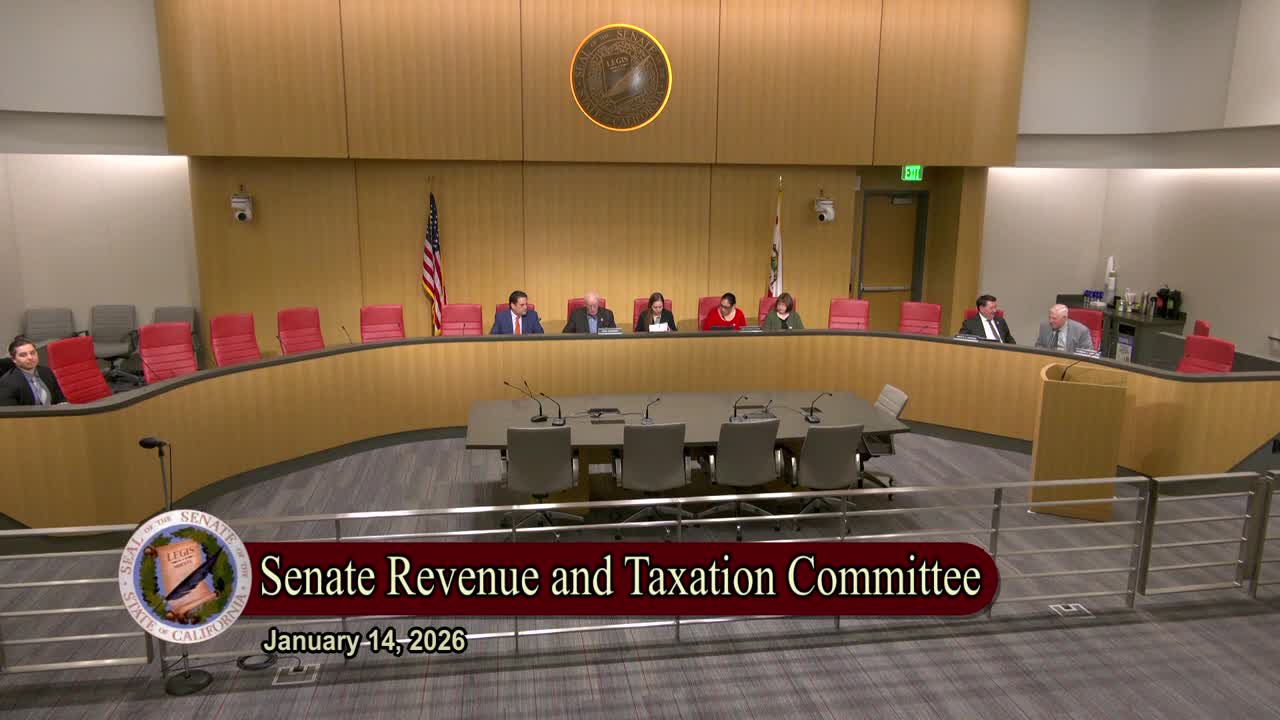 5MIN
Senate Standing Committee on Revenue and Taxation
Bill Author

Bill Co-Author(s):