SB 351: Health facilities.
- Session Year: 2025-2026
- House: Senate
- Latest Version Date: 2025-10-06
Current Status:
Passed
(2025-10-06: Chaptered by Secretary of State. Chapter 409, Statutes of 2025.)
Introduced
In Committee
Awaiting First Chamber Vote
Passed First Chamber
In Committee
Awaiting Second Chamber Vote
Passed Second Chamber
Enacted
What does this bill do?
This bill stops private equity firms and hedge funds that invest in or own physician or dental practices in California from interfering with doctors' or dentists' medical decisions or taking control of patient records, staffing, billing, referrals, or equipment choices. It also voids contract clauses that give investors those powers or that bar a provider from competing after leaving or from speaking about care quality, use of services, ethical problems, or the investors' revenue strategies, while still allowing certain sale-of-business noncompete agreements and protections for truly confidential business information. The Attorney General may seek court orders to stop violations and recover legal costs.
The summary is provided by generative AI which can make mistakes. For original language, please view the details in the table below.
Existing law generally regulates the licensing and operation of health facilities and other facilities providing health care in this state. Existing law, the Medical Practice Act, creates the Medical Board of California to license and regulate physicians and surgeons. Under existing law, the Dental Practice Act, the Dental Board of California licenses and regulates dentists.
Existing law, the Nonprofit Public Benefit Corporation Law, generally requires a nonprofit public benefit corporation to give written notice to the Attorney General before it sells, leases, conveys, exchanges, transfers, or disposes of its assets, except as specified. Existing law provides specific procedures for health facilities and additionally requires these facilities to obtain the consent of the Attorney General prior to entering into a specified agreement or transaction.
This bill would prohibit a private equity group or hedge fund, as defined, involved in any manner with a physician or dental practice doing business in this state from interfering with the professional judgment of physicians or dentists in making health care decisions and exercising power over specified actions, including, among other things, making decisions regarding coding and billing procedures for patient care services. The bill would prohibit a private equity group or hedge fund from entering into a contract or other agreement or arrangement with a physician or dental practice if the contract or other agreement or arrangement would enable the person or entity to engage in the prohibited actions described above and would make provisions of those contracts or other agreements that violate that prohibition void and unenforceable. The bill would prohibit and render void and unenforceable specified types of contracts between a physician or dental practice and a private equity group or hedge fund that include any clause barring any provider in that practice from competing with that practice in the event of a termination or resignation, or from disparaging, opining, or commenting on that practice in any manner as to any issues involving quality of care, utilization of care, ethical or professional challenges in the practice of medicine or dentistry, or revenue-increasing strategies employed by the private equity group or hedge fund, as specified. This bill would entitle the Attorney General to injunctive relief and attorneys fees and costs incurred in remedying violations of these provisions, as specified. The bill would make its provisions severable.
Existing law generally regulates the licensing and operation of health facilities and other facilities providing health care in this state. Existing law, the Medical Practice Act, creates the Medical Board of California to license and regulate physicians and surgeons. Under existing law, the Dental Practice Act, the Dental Board of California licenses and regulates dentists.
Existing law, the Nonprofit Public Benefit Corporation Law, generally requires a nonprofit public benefit corporation to give written notice to the Attorney General before it sells, leases, conveys, exchanges, transfers, or disposes of its assets, except as specified. Existing law provides specific procedures for health facilities and additionally requires these facilities to obtain the consent of the Attorney General prior to entering into a specified agreement or transaction.
This bill would prohibit a private equity group or hedge fund, as defined, involved in any manner with a physician or dental practice doing business in this state from interfering with the professional judgment of physicians or dentists in making health care decisions and exercising power over specified actions, including, among other things, making decisions regarding coding and billing procedures for patient care services. The bill would prohibit a private equity group or hedge fund from entering into an a contract or other agreement or arrangement with a physician or dental practice if the contract or other agreement or arrangement would enable the person or entity to engage in the prohibited actions described above and would make provisions of those agreements or arrangements contracts or other agreements void and unenforceable. The bill would prohibit and render void and unenforceable specified types of contracts between a physician or dental practice and a private equity group or hedge fund that include any clause barring any provider in that practice from competing with that practice in the event of a termination or resignation, or from disparaging, opining, or commenting on that practice in any manner as to any issues involving quality of care, utilization of care, ethical or professional challenges in the practice of medicine or dentistry, or revenue-increasing strategies employed by the private equity group or hedge fund, as specified. This bill would entitle the Attorney General to injunctive relief and attorneys fees and costs for the enforcement of these provisions, as specified. The bill would make its provisions severable.
Existing law generally regulates the licensing and operation of health facilities and other facilities providing health care in this state. Existing law, the Medical Practice Act, creates the Medical Board of California to license and regulate physicians and surgeons. Under existing law, the Dental Practice Act, the Dental Board of California licenses and regulates dentists.
Existing law, the Nonprofit Public Benefit Corporation Law, generally requires a nonprofit public benefit corporation to give written notice to the Attorney General before it sells, leases, conveys, exchanges, transfers, or disposes of its assets, except as specified. Existing law provides specific procedures for health facilities and additionally requires these facilities to obtain the consent of the Attorney General prior to entering into a specified agreement or transaction.
This bill would prohibit a private equity group or hedge fund, as defined, involved in any manner with a physician or dental practice doing business in this state from interfering with the professional judgment of physicians or dentists in making health care decisions and exercising power over specified actions, including, among other things, making decisions regarding coding and billing procedures for patient care services. The bill would prohibit a private equity group or hedge fund from entering into an agreement or arrangement with a physician or dental practice if the agreement or arrangement would enable the person or entity to engage in the prohibited actions described above. above and would make provisions of those agreements or arrangements void and unenforceable. The bill would prohibit and render void and unenforceable specified types of contracts between a physician or dental practice and a private equity group or hedge fund that explicitly or implicitly include any clause barring any provider in that practice from competing with that practice in the event of a termination or resignation, or from disparaging, opining, or commenting on that practice in any manner as to any issues involving quality of care, utilization of care, ethical or professional challenges in the practice of medicine or dentistry, or revenue-increasing strategies employed by the private equity group or hedge fund, as specified. This bill would entitle the Attorney General to injunctive relief and attorneys fees and costs for the enforcement of these provisions, as specified. The bill would make its provisions severable.
Existing law generally regulates the licensing and operation of health facilities and other facilities providing health care in this state. Existing law, the Medical Practice Act, creates the Medical Board of California to license and regulate physicians and surgeons. Under existing law, the Dental Practice Act, the Dental Board of California licenses and regulates dentists.
Existing law, the Nonprofit Public Benefit Corporation Law, generally requires a nonprofit public benefit corporation to give written notice to the Attorney General before it sells, leases, conveys, exchanges, transfers, or disposes of its assets, except as specified. Existing law provides specific procedures for health facilities and additionally requires these facilities to obtain the consent of the Attorney General prior to entering into a specified agreement or transaction.
This bill would prohibit a private equity group or hedge fund, as defined, involved in any manner with a physician or dental practice doing business in this state from interfering with the professional judgment of physicians or dentists in making health care decisions and exercising power over specified actions, including, among other things, making decisions regarding coding and billing procedures for patient care services. The bill would prohibit a private equity group or hedge fund from entering into an agreement or arrangement with a physician or dental practice if the agreement or arrangement would enable the person or entity to engage in the prohibited actions described above. The bill would render void and unenforceable specified types of contracts between a physician or dental practice and a private equity group or hedge fund that explicitly or implicitly include any clause barring any provider in that practice from competing with that practice in the event of a termination or resignation, or from disparaging, opining, or commenting on that practice in any manner as to any issues involving quality of care, utilization of care, ethical or professional challenges in the practice of medicine or dentistry, or revenue-increasing strategies employed by the private equity group or hedge fund, as specified. This bill would entitle the Attorney General to injunctive relief and attorneys fees and costs for the enforcement of these provisions, as specified. The bill would make its provisions severable.
Existing law generally regulates the licensing and operation of health facilities and other facilities providing health care in this state. Existing law, the Medical Practice Act, creates the Medical Board of California to license and regulate physicians and surgeons. Under existing law, the Dental Practice Act, the Dental Board of California licenses and regulates dentists.
Existing law, the Nonprofit Public Benefit Corporation Law, generally requires a nonprofit public benefit corporation to give written notice to the Attorney General before it sells, leases, conveys, exchanges, transfers, or disposes of its assets, except as specified. Existing law provides specific procedures for health facilities and additionally requires these facilities to obtain the consent of the Attorney General prior to entering into a specified agreement or transaction.
This bill would prohibit a private equity group or hedge fund, as defined, involved in any manner with a physician or dental practice doing business in this state from interfering with the professional judgment of physicians or dentists in making health care decisions and exercising power over specified actions, including, among other things, making decisions regarding coding and billing procedures for patient care services. The bill would prohibit a private equity group or hedge fund from entering into an agreement or arrangement with a physician or dental practice if the agreement or arrangement would enable the person or entity to engage in the prohibited actions described above. The bill would render void and unenforceable specified types of contracts between a physician or dental practice and a private equity group or hedge fund that explicitly or implicitly include any clause barring any provider in that practice from competing with that practice in the event of a termination or resignation, or from disparaging, opining, or commenting on that practice in any manner as to any issues involving quality of care, utilization of care, ethical or professional challenges in the practice of medicine or dentistry, or revenue-increasing strategies employed by the private equity group or hedge fund, as specified. This bill would entitle the Attorney General to injunctive relief and attorneys fees and costs for the enforcement of these provisions, as specified.
For purposes of this division, the following definitions shall apply:
(a)(1)Hedge fund means a pool of funds managed by investors for the purpose of earning a return on those funds, regardless of the strategies used to manage the funds. Hedge funds include, but are not limited to, a pool of funds managed or controlled by private limited partnerships.
(2)Hedge fund does not include:
(A)Natural persons or other entities that contribute, or promise to contribute, funds to the hedge fund, but otherwise do not participate in the management of the hedge fund or the funds assets, or in any change in control of the hedge fund or the funds assets.
(B)Entities that solely provide or manage debt financing secured in whole or in part by the assets of a health care facility, including, but not limited to, banks and credit unions, commercial real estate lenders, bond underwriters, and trustees.
(C)A hospital or a hospital system that owns one or more licensed hospitals, as defined in subdivision (a) or (b) of Section 1250; an affiliate, as defined in Section 150 of the Corporations Code, of a hospital or hospital system; or any entity managed or controlled by a hospital or hospital system.
(D)A public agency, as defined in Section 6500 of the Government Code, including, but not limited to, any of the following settings directly or indirectly owned, operated, managed, controlled by, or otherwise affiliated with, the public agency:
(i)A clinic, as defined in Section 1200.
(ii)An outpatient setting, as defined in Section 1248.
(iii)A health facility, as defined in Section 1250.
(iv)An ambulatory surgical center.
(b)(1)Private equity group means an investor or group of investors who primarily engage in the raising or returning of capital and who invests, develops, or disposes of specified assets.
(2)Private equity group does not include any of the following:
(A)Natural persons or other entities that contribute, or promise to contribute, funds to the private equity group, but otherwise do not participate in the management of the private equity group or the groups assets, or in any change in control of the private equity group or the groups assets.
(B)A hospital or a hospital system that owns one or more licensed hospitals, as defined in subdivision (a) or (b) of Section 1250; an affiliate, as defined in Section 150 of the Corporations Code, of a hospital or hospital system; or any entity managed or controlled by a hospital or hospital system.
(C)A public agency, as defined in Section 6500 of the Government Code, including, but not limited to, any of the following settings directly or indirectly owned, operated, managed, controlled by, or otherwise affiliated with, the public agency:
(i)A clinic, as defined in Section 1200.
(ii)An outpatient setting, as defined in Section 1248.
(iii)A health facility, as defined in Section 1250.
(iv)An ambulatory surgical center.
1191.(a)A private equity group or hedge fund involved in any manner with a physician or dental practice doing business in this state, including as an investor in that physician or dental practice or as an investor or owner of the assets of that practice, shall not do either of the following with respect to that practice:
(1)Interfere with the professional judgment of physicians or dentists in making health care decisions, including any of the following:
(A)Determining what diagnostic tests are appropriate for a particular condition.
(B)Determining the need for referrals to, or consultation with, another physician, dentist, or licensed health professional.
(C)Being responsible for the ultimate overall care of the patient, including treatment options available to the patient.
(D)Determining how many patients a physician or dentist shall see in a given period of time or how many hours a physician or dentist shall work.
(2)Exercise control over, or be delegated the power to do, any of the following:
(A)Owning or otherwise determining the content of patient medical records.
(B)Selecting, hiring, or firing physicians, dentists, allied health staff, and medical assistants based, in whole or in part, on clinical competency or proficiency.
(C)Setting the parameters under which a physician, dentist, or physician or dental practice shall enter into contractual relationships with third-party payers.
(D)Setting the clinical competency or proficiency parameters under which a physician or dentist shall enter into contractual relationships with other physicians or dentists for the delivery of care.
(E)Making decisions regarding the coding and billing of procedures for patient care services.
(F)Approving the selection of medical equipment and medical supplies for the physician or dental practice.
(b)The corporate form of that physician or dental practice as a sole proprietorship, a partnership, a foundation, or a corporate entity of any kind shall not affect the applicability of this section.
(c)(1)A private equity group or hedge fund, or an entity controlled directly, in whole or in part, by a private equity group or hedge fund, shall not enter into a contract or other agreement or arrangement with a physician or dental practice doing business in this state if the contract or other agreement or arrangement would enable the person or entity to interfere with the professional judgment of physicians or dentists in making health care decisions, as set forth in paragraph (1) of subdivision (a), or exercise control over or be delegated the powers set forth in paragraph (2) of subdivision (a).
(2)Any provision within a contract or other agreement that violates subdivision (a) is void, unenforceable, and against public policy.
(d)(1)Any contract involving the management of a physician or dental practice doing business in this state by, or the sale of real estate or other assets owned by a physician or dental practice doing business in this state to, a private equity group or hedge fund, or any entity controlled directly or indirectly, in whole or in part, by a private equity group or hedge fund, shall not include any clause barring any provider in that practice from doing either of the following:
(A)Competing with that practice in the event of a termination or resignation of that provider from that practice.
(B)Disparaging, opining, or commenting on that practice in any manner as to any issues involving quality of care, utilization of care, ethical or professional challenges in the practice of medicine or dentistry, or revenue-increasing strategies employed by the private equity group or hedge fund.
(2)Any provision of a contract that violates paragraph (1) is void, unenforceable, and against public policy.
(3)This subdivision shall not affect the validity of either of the following:
(A)An otherwise enforceable sale of business noncompete agreement. However, a contract described in this subdivision shall not operate as an employee noncompete agreement.
(B)An otherwise valid provision within a contract that prohibits the disclosure of material nonpublic information about the private equity group or hedge fund that is not generally available to the public, except to the extent that the provision seeks to either prohibit a disclosure of confidential information that is required by law, or to prohibit a disclosure described in subparagraph (B) of paragraph (1).
(e)The Attorney General shall be entitled to injunctive relief and other equitable remedies a court deems appropriate for enforcement of this section and shall be entitled to recover attorneys fees and costs incurred in remedying any violation of this section.
(f)This section is intended to ensure that clinical decisionmaking and treatment decisions are exclusively in the hands of licensed health care providers and to safeguard against nonlicensed individuals or entities, such as private equity groups and hedge funds, exerting influence or control over care delivery.
(g)This section does not narrow, abrogate, or otherwise lower the bar on the corporate practice of medicine or dentistry as set forth in the Business and Professions Code or the Corporations Code, or any other applicable state or federal law.
(h)This section does not prohibit an unlicensed person or entity from assisting, or consulting with, a physician or dental practice doing business in this state with respect to the decisions and activities described in paragraph (2) of subdivision (a), provided that the physician or dentist retains the ultimate responsibility for, or approval of, those decisions and activities.
1192.The provisions of this division are severable. If any provision of this division or its application is held invalid, that invalidity shall not affect other provisions or applications that can be given effect without the invalid provision or application.
For purposes of this division, the following definitions shall apply:
(a)(1)Hedge fund means a pool of funds managed by investors for the purpose of earning a return on those funds, regardless of the strategies used to manage the funds. Hedge funds include, but are not limited to, a pool of funds managed or controlled by private limited partnerships.
(2)Hedge fund does not include:
(A)Natural persons or other entities that contribute, or promise to contribute, funds to the hedge fund, but otherwise do not participate in the management of the hedge fund or the funds assets, or in any change in control of the hedge fund or the funds assets.
(B)Entities that solely provide or manage debt financing secured in whole or in part by the assets of a health care facility, including, but not limited to, banks and credit unions, commercial real estate lenders, bond underwriters, and trustees.
(C)A hospital or a hospital system that owns one or more licensed hospitals, as defined in subdivision (a) or (b) of Section 1250; an affiliate, as defined in Section 150 of the Corporations Code, of a hospital or hospital system; or any entity managed or controlled by a hospital or hospital system.
(D)A public agency, as defined in Section 6500 of the Government Code, including, but not limited to, any of the following settings directly or indirectly owned, operated, managed, controlled by, or otherwise affiliated with, the public agency:
(i)A clinic, as defined in Section 1200.
(ii)An outpatient setting, as defined in Section 1248.
(iii)A health facility, as defined in Section 1250.
(iv)An ambulatory surgical center.
(b)(1)Private equity group means an investor or group of investors who primarily engage in the raising or returning of capital and who invests, develops, or disposes of specified assets.
(2)Private equity group does not include any of the following:
(A)Natural persons or other entities that contribute, or promise to contribute, funds to the private equity group, but otherwise do not participate in the management of the private equity group or the groups assets, or in any change in control of the private equity group or the groups assets.
(B)A hospital or a hospital system that owns one or more licensed hospitals, as defined in subdivision (a) or (b) of Section 1250; an affiliate, as defined in Section 150 of the Corporations Code, of a hospital or hospital system; or any entity managed or controlled by a hospital or hospital system.
(C)A public agency, as defined in Section 6500 of the Government Code, including, but not limited to, any of the following settings directly or indirectly owned, operated, managed, controlled by, or otherwise affiliated with, the public agency:
(i)A clinic, as defined in Section 1200.
(ii)An outpatient setting, as defined in Section 1248.
(iii)A health facility, as defined in Section 1250.
(iv)An ambulatory surgical center.
1191.(a)A private equity group or hedge fund involved in any manner with a physician or dental practice doing business in this state, including as an investor in that physician or dental practice or as an investor or owner of the assets of that practice, shall not do either of the following with respect to that practice:
(1)Interfere with the professional judgment of physicians or dentists in making health care decisions, including any of the following:
(A)Determining what diagnostic tests are appropriate for a particular condition.
(B)Determining the need for referrals to, or consultation with, another physician, dentist, or licensed health professional.
(C)Being responsible for the ultimate overall care of the patient, including treatment options available to the patient.
(D)Determining how many patients a physician or dentist shall see in a given period of time or how many hours a physician or dentist shall work.
(2)Exercise control over, or be delegated the power to do, any of the following:
(A)Owning or otherwise determining the content of patient medical records.
(B)Selecting, hiring, or firing physicians, dentists, allied health staff, and medical assistants based, in whole or in part, on clinical competency or proficiency.
(C)Setting the parameters under which a physician, dentist, or physician or dental practice shall enter into contractual relationships with third-party payers.
(D)Setting the clinical competency or proficiency parameters under which a physician or dentist shall enter into contractual relationships with other physicians or dentists for the delivery of care.
(E)Making decisions regarding the coding and billing of procedures for patient care services.
(F)Approving the selection of medical equipment and medical supplies for the physician or dental practice.
(b)The corporate form of that physician or dental practice as a sole proprietorship, a partnership, a foundation, or a corporate entity of any kind shall not affect the applicability of this section.
(c)(1)A private equity group or hedge fund, or an entity controlled directly, in whole or in part, by a private equity group or hedge fund, shall not enter into an a contract or other agreement or arrangement with a physician or dental practice doing business in this state if the contract or other agreement or arrangement would enable the person or entity to interfere with the professional judgment of physicians or dentists in making health care decisions, as set forth in paragraph (1) of subdivision (a), or exercise control over or be delegated the powers set forth in paragraph (2) of subdivision (a). Any arrangement or agreement, or any provision therein,
(2)Any provision within a contract or other agreement that violates subdivision (a) is void, unenforceable, and against public policy.
(d)(1)Any contract involving the management of a physician or dental practice doing business in this state by, or the sale of real estate or other assets owned by a physician or dental practice doing business in this state to, a private equity group or hedge fund, or any entity controlled directly or indirectly, in whole or in part, by a private equity group or hedge fund, shall not include any clause barring any provider in that practice from doing either of the following:
(A)Competing with that practice in the event of a termination or resignation of that provider from that practice.
(B)Disparaging, opining, or commenting on that practice in any manner as to any issues involving quality of care, utilization of care, ethical or professional challenges in the practice of medicine or dentistry, or revenue-increasing strategies employed by the private equity group or hedge fund.
(2)Any provision of a contract that violates paragraph (1) is void, unenforceable, and against public policy.
(3)This subdivision shall not affect the validity of either of the following:
(A)An otherwise enforceable sale of business noncompete agreement. However, a contract described in this subdivision shall not operate as an employee noncompete agreement.
(B)An otherwise valid provision within a contract that prohibits the disclosure of material nonpublic information about the private equity group or hedge fund that is not generally available to the public, except to the extent that the provision seeks to either prohibit a disclosure of confidential information that is required by law, or to prohibit a disclosure described in subparagraph (B) of paragraph (1).
(e)The Attorney General shall be entitled to injunctive relief and other equitable remedies a court deems appropriate for enforcement of this section and shall be entitled to recover attorneys fees and costs incurred in remedying any violation of this section.
(f)This section is intended to ensure that clinical decisionmaking and treatment decisions are exclusively in the hands of licensed health care providers and to safeguard against nonlicensed individuals or entities, such as private equity groups and hedge funds, exerting influence or control over care delivery.
(g)This section does not narrow, abrogate, or otherwise lower the bar on the corporate practice of medicine or dentistry as set forth in the Business and Professions Code or the Corporations Code, or any other applicable state or federal law.
(h)This section does not prohibit an unlicensed person or entity from assisting, or consulting with, a physician or dental practice doing business in this state with respect to the decisions and activities described in paragraph (2) of subdivision (a), provided that the physician or dentist retains the ultimate responsibility for, or approval of, those decisions and activities.
1192.The provisions of this division are severable. If any provision of this division or its application is held invalid, that invalidity shall not affect other provisions or applications that can be given effect without the invalid provision or application.
For purposes of this division, the following definitions shall apply:
(a)(1)Hedge fund means a pool of funds managed by investors for the purpose of earning a return on those funds, regardless of the strategies used to manage the funds. Hedge funds include, but are not limited to, a pool of funds managed or controlled by private limited partnerships.
(2)Hedge fund does not include:
(A)Natural persons or other entities that contribute, or promise to contribute, funds to the hedge fund, but otherwise do not participate in the management of the hedge fund or the funds assets, or in any change in control of the hedge fund or the funds assets.
(B)Entities that solely provide or manage debt financing secured in whole or in part by the assets of a health care facility, including, but not limited to, banks and credit unions, commercial real estate lenders, bond underwriters, and trustees.
(C)A hospital or a hospital system that owns one or more licensed general acute care hospitals, as defined in subdivision (a) or (b) of Section 1250; an affiliate, as defined in Section 150 of the Corporations Code, of a hospital or hospital system; or any entity managed or controlled by a hospital or hospital system.
(D)A public agency, as defined in Section 6500 of the Government Code, including, but not limited to, any of the following settings directly or indirectly owned, operated, managed, controlled by, or otherwise affiliated with, the public agency:
(i)A clinic, as defined in Section 1200.
(ii)An outpatient setting, as defined in Section 1248.
(iii)A health facility, as defined in Section 1250.
(iv)An ambulatory surgical center.
(b)(1)Private equity group means an investor or group of investors who primarily engage in the raising or returning of capital and who invests, develops, or disposes of specified assets.
(2)Private equity group does not include either any of the following:
(A)Natural persons or other entities that contribute, or promise to contribute, funds to the private equity group, but otherwise do not participate in the management of the private equity group or the groups assets, or in any change in control of the private equity group or the groups assets.
(B)A hospital or a hospital system that owns one or more licensed general acute care hospitals, as defined in subdivision (a) or (b) of Section 1250; an affiliate, as defined in Section 150 of the Corporations Code, of a hospital or hospital system; or any entity managed or controlled by a hospital or hospital system.
(C)A public agency, as defined in Section 6500 of the Government Code, including, but not limited to, any of the following settings directly or indirectly owned, operated, managed, controlled by, or otherwise affiliated with, the public agency:
(i)A clinic, as defined in Section 1200.
(ii)An outpatient setting, as defined in Section 1248.
(iii)A health facility, as defined in Section 1250.
(iv)An ambulatory surgical center.
1191.(a)A private equity group or hedge fund involved in any manner with a physician or dental practice doing business in this state, including as an investor in that physician or dental practice or as an investor or owner of the assets of that practice, shall not do either of the following with respect to that practice:
(1)Interfere with the professional judgment of physicians or dentists in making health care decisions, including any of the following:
(A)Determining what diagnostic tests are appropriate for a particular condition.
(B)Determining the need for referrals to, or consultation with, another physician, dentist, or licensed health professional.
(C)Being responsible for the ultimate overall care of the patient, including treatment options available to the patient.
(D)Determining how many patients a physician or dentist shall see in a given period of time or how many hours a physician or dentist shall work.
(2)Exercise control over, or be delegated the power to do, any of the following:
(A)Owning or otherwise determining the content of patient medical records.
(B)Selecting, hiring, or firing physicians, dentists, allied health staff, and medical assistants based, in whole or in part, on clinical competency or proficiency.
(C)Setting the parameters under which a physician, dentist, or physician or dental practice shall enter into contractual relationships with third-party payers.
(D)Setting the clinical competency or proficiency parameters under which a physician or dentist shall enter into contractual relationships with other physicians or dentists for the delivery of care.
(E)Making decisions regarding the coding and billing of procedures for patient care services.
(F)Approving the selection of medical equipment and medical supplies for the physician or dental practice.
(b)The corporate form of that physician or dental practice as a sole proprietorship, a partnership, a foundation, or a corporate entity of any kind shall not affect the applicability of this section.
(c)A private equity group or hedge fund, or an entity controlled directly, in whole or in part, by a private equity group or hedge fund, shall not enter into an agreement or arrangement with a physician or dental practice doing business in this state if the agreement or arrangement would enable the person or entity to interfere with the professional judgment of physicians or dentists in making health care decisions, as set forth in paragraph (1) of subdivision (a), or exercise control over or be delegated the powers set forth in paragraph (2) of subdivision (a). Any arrangement or agreement, or any provision therein, that violates subdivision (a) is void, unenforceable, and against public policy.
(d)(1)Any contract involving the management of a physician or dental practice doing business in this state by, or the sale of real estate or other assets owned by a physician or dental practice doing business in this state to, a private equity group or hedge fund, or any entity controlled directly or indirectly, in whole or in part, by a private equity group or hedge fund, shall not explicitly or implicitly include any clause barring any provider in that practice from competing doing either of the following:
(A)Competing with that practice in the event of a termination or resignation of that provider from that practice, or from disparaging, opining, practice.
(B)Disparaging, opining, or commenting on that practice in any manner as to any issues involving quality of care, utilization of care, ethical or professional challenges in the practice of medicine or dentistry, or revenue-increasing strategies employed by the private equity group or hedge fund. Any such explicit or implicit contractual clauses are
(2)Any provision of a contract that violates paragraph (1) is void, unenforceable, and against public policy. This
(3)This subdivision shall not impact affect the validity of an either of the following:
(A)An otherwise enforceable sale of business noncompete agreement, but agreement. However, a contract described in this subdivision shall not operate as an employee noncompete agreement.
(B)An otherwise valid provision within a contract that prohibits the disclosure of material nonpublic information about the private equity group or hedge fund that is not generally available to the public, except to the extent that the provision seeks to either prohibit a disclosure of confidential information that is required by law, or to prohibit a disclosure described in subparagraph (B) of paragraph (1).
(e)The Attorney General shall be entitled to injunctive relief and other equitable remedies a court deems appropriate for enforcement of this section and shall be entitled to recover attorneys fees and costs incurred in remedying any violation of this section.
(f)This section is intended to ensure that clinical decisionmaking and treatment decisions are exclusively in the hands of licensed health care providers and to safeguard against nonlicensed individuals or entities, such as private equity groups and hedge funds, exerting influence or control over care delivery.
(g)This section does not narrow, abrogate, or otherwise lower the bar on the corporate practice of medicine or dentistry as set forth in the Business and Professions Code or the Corporations Code, or any other applicable state or federal law.
(h)This section does not prohibit an unlicensed person or entity from assisting, or consulting with, a physician or dental practice doing business in this state with respect to the decisions and activities described in paragraph (2) of subdivision (a), provided that the physician or dentist retains the ultimate responsibility for, or approval of, those decisions and activities.
1192.The provisions of this division are severable. If any provision of this division or its application is held invalid, that invalidity shall not affect other provisions or applications that can be given effect without the invalid provision or application.
For purposes of this division, the following definitions shall apply:
(a)(1)Hedge fund means a pool of funds managed by investors for the purpose of earning a return on those funds, regardless of the strategies used to manage the funds. Hedge funds include, but are not limited to, a pool of funds managed or controlled by private limited partnerships.
(2)Hedge fund does not include:
(A)Natural persons or other entities that contribute, or promise to contribute, funds to the hedge fund, but otherwise do not participate in the management of the hedge fund or the funds assets, or in any change in control of the hedge fund or the funds assets.
(B)Entities that solely provide or manage debt financing secured in whole or in part by the assets of a health care facility, including, but not limited to, banks and credit unions, commercial real estate lenders, bond underwriters, and trustees.
(C)A hospital or a hospital system that owns one or more licensed general acute care hospitals, as defined in subdivision (a) of Section 1250; an affiliate, as defined in Section 150 of the Corporations Code, of a hospital or hospital system; or any entity managed or controlled by a hospital or hospital system.
(b)(1)Private equity group means an investor or group of investors who primarily engage in the raising or returning of capital and who invests, develops, or disposes of specified assets.
(2)Private equity group does not include natural persons or other entities that contribute, or promise to contribute, funds to the private equity group, but otherwise do not participate in the management of the private equity group or the groups assets, or in any change in control of the private equity group or the groups assets. either of the following:
(A)Natural persons or other entities that contribute, or promise to contribute, funds to the private equity group, but otherwise do not participate in the management of the private equity group or the groups assets, or in any change in control of the private equity group or the groups assets.
(B)A hospital or a hospital system that owns one or more licensed general acute care hospitals, as defined in subdivision (a) of Section 1250; an affiliate, as defined in Section 150 of the Corporations Code, of a hospital or hospital system; or any entity managed or controlled by a hospital or hospital system.
1191.(a)A private equity group or hedge fund involved in any manner with a physician or dental practice doing business in this state, including as an investor in that physician or dental practice or as an investor or owner of the assets of that practice, shall not do either of the following with respect to that practice:
(1)Interfere with the professional judgment of physicians or dentists in making health care decisions, including any of the following:
(A)Determining what diagnostic tests are appropriate for a particular condition.
(B)Determining the need for referrals to, or consultation with, another physician, dentist, or licensed health professional.
(C)Being responsible for the ultimate overall care of the patient, including treatment options available to the patient.
(D)Determining how many patients a physician or dentist shall see in a given period of time or how many hours a physician or dentist shall work.
(2)Exercise control over, or be delegated the power to do, any of the following:
(A)Owning or otherwise determining the content of patient medical records.
(B)Selecting, hiring, or firing physicians, dentists, allied health staff, and medical assistants based, in whole or in part, on clinical competency or proficiency.
(C)Setting the parameters under which a physician, dentist, or physician or dental practice shall enter into contractual relationships with third-party payers.
(D)Setting the clinical competency or proficiency parameters under which a physician or dentist shall enter into contractual relationships with other physicians or dentists for the delivery of care.
(E)Making decisions regarding the coding and billing of procedures for patient care services.
(F)Approving the selection of medical equipment and medical supplies for the physician or dental practice.
(b)The corporate form of that physician or dental practice as a sole proprietorship, a partnership, a foundation, or a corporate entity of any kind shall not affect the applicability of this section.
(c)A private equity group or hedge fund, or an entity controlled directly, in whole or in part, by a private equity group or hedge fund, shall not enter into an agreement or arrangement with a physician or dental practice doing business in this state if the agreement or arrangement would enable the person or entity to interfere with the professional judgment of physicians or dentists in making health care decisions, as set forth in paragraph (1) of subdivision (a), or exercise control over or be delegated the powers set forth in paragraph (2) of subdivision (a).
(d)Any contract involving the management of a physician or dental practice doing business in this state by, or the sale of real estate or other assets owned by a physician or dental practice doing business in this state to, a private equity group or hedge fund, or any entity controlled directly or indirectly, in whole or in part, by a private equity group or hedge fund, shall not explicitly or implicitly include any clause barring any provider in that practice from competing with that practice in the event of a termination or resignation of that provider from that practice, or from disparaging, opining, or commenting on that practice in any manner as to any issues involving quality of care, utilization of care, ethical or professional challenges in the practice of medicine or dentistry, or revenue-increasing strategies employed by the private equity group or hedge fund. Any such explicit or implicit contractual clauses are void, unenforceable, and against public policy. This subdivision shall not impact the validity of an otherwise enforceable sale of business noncompete agreement, but a contract described in this subdivision shall not operate as an employee noncompete agreement.
(e)The Attorney General shall be entitled to injunctive relief and other equitable remedies a court deems appropriate for enforcement of this section and shall be entitled to recover attorneys fees and costs incurred in remedying any violation of this section.
(f)This section is intended to ensure that clinical decisionmaking and treatment decisions are exclusively in the hands of licensed health care providers and to safeguard against nonlicensed individuals or entities, such as private equity groups and hedge funds, exerting influence or control over care delivery.
(g)This section does not narrow, abrogate, or otherwise lower the bar on the corporate practice of medicine or dentistry as set forth in the Business and Professions Code or the Corporations Code, or any other applicable state or federal law.
(h)This section does not prohibit an unlicensed person or entity from assisting, or consulting with, a physician or dental practice doing business in this state with respect to the decisions and activities described in paragraph (2) of subdivision (a), provided that the physician or dentist retains the ultimate responsibility for, or approval of, those decisions and activities.
1192.The provisions of this division are severable. If any provision of this division or its application is held invalid, that invalidity shall not affect other provisions or applications that can be given effect without the invalid provision or application.
For purposes of this division, the following definitions shall apply:
(a)(1)Hedge fund means a pool of funds managed by investors for the purpose of earning a return on those funds, regardless of the strategies used to manage the funds. Hedge funds include, but are not limited to, a pool of funds managed or controlled by private limited partnerships.
(2)Hedge fund does not include:
(A)Natural persons or other entities that contribute, or promise to contribute, funds to the hedge fund, but otherwise do not participate in the management of the hedge fund or the funds assets, or in any change in control of the hedge fund or the funds assets.
(B)Entities that solely provide or manage debt financing secured in whole or in part by the assets of a health care facility, including, but not limited to, banks and credit unions, commercial real estate lenders, bond underwriters, and trustees.
(b)(1)Private equity group means an investor or group of investors who primarily engage in the raising or returning of capital and who invests, develops, or disposes of specified assets.
(2)Private equity group does not include natural persons or other entities that contribute, or promise to contribute, funds to the private equity group, but otherwise do not participate in the management of the private equity group or the groups assets, or in any change in control of the private equity group or the groups assets.
1191.(a)A private equity group or hedge fund involved in any manner with a physician or dental practice doing business in this state, including as an investor in that physician or dental practice or as an investor or owner of the assets of that practice, shall not do either of the following with respect to that practice:
(1)Interfere with the professional judgment of physicians or dentists in making health care decisions, including any of the following:
(A)Determining what diagnostic tests are appropriate for a particular condition.
(B)Determining the need for referrals to, or consultation with, another physician, dentist, or licensed health professional.
(C)Being responsible for the ultimate overall care of the patient, including treatment options available to the patient.
(D)Determining how many patients a physician or dentist shall see in a given period of time or how many hours a physician or dentist shall work.
(2)Exercise control over, or be delegated the power to do, any of the following:
(A)Owning or otherwise determining the content of patient medical records.
(B)Selecting, hiring, or firing physicians, dentists, allied health staff, and medical assistants based, in whole or in part, on clinical competency or proficiency.
(C)Setting the parameters under which a physician, dentist, or physician or dental practice shall enter into contractual relationships with third-party payers.
(D)Setting the parameters under which a physician or dentist shall enter into contractual relationships with other physicians or dentists for the delivery of care.
(E)Making decisions regarding coding and billing procedures for patient care services.
(F)Approving the selection of medical equipment and medical supplies for the physician or dental practice.
(b)The corporate form of that physician or dental practice as a sole proprietorship, a partnership, a foundation, or a corporate entity of any kind shall not affect the applicability of this section.
(c)A private equity group or hedge fund, or an entity controlled directly, in whole or in part, by a private equity group or hedge fund, shall not enter into an agreement or arrangement with a physician or dental practice doing business in this state if the agreement or arrangement would enable the person or entity to interfere with the professional judgment of physicians or dentists in making health care decisions, as set forth in paragraph (1) of subdivision (a), or exercise control over or be delegated the powers set forth in paragraph (2) of subdivision (a).
(d)Any contract involving the management of a physician or dental practice doing business in this state by, or the sale of real estate or other assets owned by a physician or dental practice doing business in this state to, a private equity group or hedge fund, or any entity controlled directly or indirectly, in whole or in part, by a private equity group or hedge fund, shall not explicitly or implicitly include any clause barring any provider in that practice from competing with that practice in the event of a termination or resignation of that provider from that practice, or from disparaging, opining, or commenting on that practice in any manner as to any issues involving quality of care, utilization of care, ethical or professional challenges in the practice of medicine or dentistry, or revenue-increasing strategies employed by the private equity group or hedge fund. Any such explicit or implicit contractual clauses are void, unenforceable, and against public policy. This subdivision shall not impact the validity of an otherwise enforceable sale of business noncompete agreement, but a contract described in this subdivision shall not operate as an employee noncompete agreement.
(e)The Attorney General shall be entitled to injunctive relief and other equitable remedies a court deems appropriate for enforcement of this section and shall be entitled to recover attorneys fees and costs incurred in remedying any violation of this section.
(f)This section is intended to ensure that clinical decisionmaking and treatment decisions are exclusively in the hands of licensed health care providers and to safeguard against nonlicensed individuals or entities, such as private equity groups and hedge funds, exerting influence or control over care delivery.
(g)This section does not narrow, abrogate, or otherwise lower the bar on the corporate practice of medicine or dentistry as set forth in the Business and Professions Code or the Corporations Code, or any other applicable state or federal law.
|
Date
|
Status
|
|---|---|
| Oct 6, 2025 | Chaptered by Secretary of State. Chapter 409, Statutes of 2025. |
| Oct 6, 2025 | Approved by the Governor. |
| Sep 23, 2025 | Enrolled and presented to the Governor at 2 p.m. |
| Sep 13, 2025 | Assembly amendments concurred in. (Ayes 32. Noes 3. Page 3023.) Ordered to engrossing and enrolling. |
| Sep 12, 2025 | In Senate. Concurrence in Assembly amendments pending. |
| Sep 12, 2025 | Read third time. Passed. (Ayes 80. Noes 0. Page 3407.) Ordered to the Senate. |
| Sep 8, 2025 | Joint Rule 61(a)(13) suspended. (Ayes 58. Noes 20. Page 2974.) |
| Sep 8, 2025 | (Ayes 54. Noes 20. Page 2973.) |
| Sep 8, 2025 | Action rescinded whereby bill was read third time, passed, and ordered to the Senate. |
| Sep 8, 2025 | Ordered to third reading. |
| Sep 8, 2025 | Read third time and amended. |
| Sep 3, 2025 | In Assembly. Held at Desk. |
| Sep 2, 2025 | Ordered to the Assembly. |
| Aug 29, 2025 | In Senate. Concurrence in Assembly amendments pending. |
| Aug 29, 2025 | Read third time. Passed. (Ayes 72. Noes 0. Page 2792.) Ordered to the Senate. |
| Aug 25, 2025 | Read third time and amended. |
| Aug 25, 2025 | Ordered to third reading. |
| Jul 17, 2025 | Read second time. Ordered to third reading. |
| Jul 16, 2025 | From committee: Do pass. (Ayes 13. Noes 0.) (July 16). |
| Jul 2, 2025 | From committee: Do pass and re-refer to Com. on APPR. (Ayes 12. Noes 0.) (July 1). Re-referred to Com. on APPR. |
| Jun 24, 2025 | From committee: Do pass and re-refer to Com. on JUD. (Ayes 16. Noes 0.) (June 24). Re-referred to Com. on JUD. |
| Jun 16, 2025 | From committee with author's amendments. Read second time and amended. Re-referred to Com. on B. & P. |
| Jun 5, 2025 | Referred to Coms. on B. & P. and JUD. |
| May 28, 2025 | In Assembly. Read first time. Held at Desk. |
| May 28, 2025 | Read third time. Passed. (Ayes 30. Noes 6. Page 1301.) Ordered to the Assembly. |
| May 23, 2025 | Read second time. Ordered to third reading. |
| May 23, 2025 | From committee: Do pass. (Ayes 5. Noes 1. Page 1197.) (May 23). |
| May 16, 2025 | Set for hearing May 23. |
| May 12, 2025 | May 12 hearing: Placed on APPR. suspense file. |
| May 2, 2025 | Set for hearing May 12. |
| Apr 30, 2025 | From committee: Do pass and re-refer to Com. on APPR. (Ayes 11. Noes 2. Page 939.) (April 29). Re-referred to Com. on APPR. |
| Apr 21, 2025 | From committee: Do pass and re-refer to Com. on JUD. (Ayes 9. Noes 1. Page 808.) (April 21). Re-referred to Com. on JUD. |
| Apr 8, 2025 | Set for hearing April 29 in JUD. pending receipt. |
| Mar 18, 2025 | Set for hearing April 21. |
| Feb 26, 2025 | Referred to Coms. on B. P. & E.D. and JUD. |
| Feb 13, 2025 | From printer. May be acted upon on or after March 15. |
| Feb 12, 2025 | Introduced. Read first time. To Com. on RLS. for assignment. To print. |
|
Date
|
Description
|
Location
|
Votes
|
|
|---|---|---|---|---|
| Sep 13, 2025 | Unfinished Business SB351 Cabaldon et al. Concurrence | Senate Floor |
Passed |
|
| Sep 12, 2025 | SB 351 Cabaldon Senate Third Reading By Patel | Assembly Floor |
Passed |
|
| Sep 12, 2025 | Unfinished Business SB351 Cabaldon et al. Concurrence | Senate Floor |
Passed |
|
| Aug 29, 2025 | SB 351 Cabaldon Senate Third Reading By Patel | Assembly Floor |
Passed |
|
| Jul 16, 2025 | Do pass. | Assembly Standing Committee on Appropriations |
Passed |
|
| Jul 1, 2025 | Do pass and be re-referred to the Committee on [Appropriations] | Assembly Standing Committee on Judiciary |
Passed |
|
| Jun 24, 2025 | Do pass and be re-referred to the Committee on [Judiciary] | Assembly Standing Committee on Business and Professions |
Passed |
|
| May 28, 2025 | Senate 3rd Reading SB351 Cabaldon | Senate Floor |
Passed |
|
| May 23, 2025 | Do pass | Senate Standing Committee on Appropriations |
Passed |
|
| May 12, 2025 | Placed on suspense file | Senate Standing Committee on Appropriations |
Passed |
|
| Apr 29, 2025 | Do pass, but first be re-referred to the Committee on [Appropriations] | Senate Standing Committee on Judiciary |
Passed |
|
| Apr 21, 2025 | Do pass, but first be re-referred to the Committee on [Judiciary] | Senate Standing Committee on Business, Professions and Economic Development |
Passed |
This list shows positions taken on this bill by organizations on the date displayed, which is linked to the original source.
Positions by individuals are not included.
|
Organization
|
Position
|
Date
|
|---|---|---|
| American Academy of Emergency Medicine | ** Support | |
| AMERICAN COLLEGE OF OBSTETRICIANS & GYNECOLOGISTS - DISTRICT IX | ** Support | |
| American Investment Council | ** Against | |
| American Investment Council (AIC) | ** Against | |
| Association Of California State Supervisors | ** Support | |
| Association of Dental Support Organizations | ** Against | |
| Attorney General Rob Bonta | ** Support | |
| California Association Of Orthodontists | ** Support | |
| California Chapter of the American College of Emergency Physicians | ** Support | |
| California Dental Association | ** Support | |
| California Dental Hygienists’ Association | ** Support | |
| California Independent Physician Practice Association | ** Support | |
| California Medical Association | ** Support | |
| California Optometric Association | ** Support | |
| California Orthopedic Association | ** Support | |
| California Physicians Alliance | ** Support | |
| California Podiatric Medical Association | ** Support | |
| California Public Employees' Retirement System | ** Support | |
| California Retired Teachers Association | ** Support | |
| California State Council of Service Employees International Union | ** Support | |
| California State Retirees | ** Support | |
| California) | ** Support | |
| CFT- a Union of Educators & Classified Professionals, Aft, Afl-cio | ** Support | |
| Children's Choice Dental Care | ** Against | |
| Children’s Choice Dental | ** Against | |
| Coalition for Patient-Centered Care | ** Support | |
| Private Equity Stakeholder Project | ** Support | |
| Retired Public Employees Association | ** Support | |
| san francisco marin medical society | ** Support |
SENATE RULES COMMITTEE Office of Senate Floor Analyses (916) 651-1520 Fax: (916) 327-4478 | SB 351 |
UNFINISHED BUSINESS
Bill No: SB 351
Author: Cabaldon (D), et al.
Amended: 9/8/25
Vote: 21
SENATE BUS., PROF. & ECON. DEV. COMMITTEE: 9-1, 4/21/25
AYES: Ashby, Archuleta, Arreguín, Grayson, Richardson, Smallwood-Cuevas, Strickland, Umberg, Weber Pierson
NOES: Niello
NO VOTE RECORDED: Choi
SENATE JUDICIARY COMMITTEE: 11-2, 4/29/25
AYES: Umberg, Allen, Arreguín, Ashby, Caballero, Durazo, Laird, Stern, Wahab, Weber Pierson, Wiener
NOES: Niello, Valladares
SENATE APPROPRIATIONS COMMITTEE: 5-1, 5/23/25
AYES: Caballero, Cabaldon, Grayson, Richardson, Wahab
NOES: Seyarto
NO VOTE RECORDED: Dahle
SENATE FLOOR: 30-6, 5/28/25
AYES: Allen, Archuleta, Arreguín, Ashby, Becker, Blakespear, Cabaldon, Caballero, Cervantes, Cortese, Dahle, Durazo, Gonzalez, Grayson, Hurtado, Laird, McGuire, McNerney, Menjivar, Padilla, Pérez, Richardson, Rubio, Smallwood-Cuevas, Stern, Strickland, Umberg, Wahab, Weber Pierson, Wiener
NOES: Grove, Jones, Niello, Ochoa Bogh, Seyarto, Valladares
NO VOTE RECORDED: Alvarado-Gil, Choi, Limón, Reyes
ASSEMBLY FLOOR: 80-0, 9/12/25 - See last page for vote
SUBJECT: Health facilities
SOURCE: Author
DIGEST:
This bill prohibits a private equity group or hedge fund involved in any manner with a physician or dental practice, including as an investor, from interfering with the professional judgment of physicians or dentists in making health care decisions and entitles the Attorney General (AG) to injunctive relief for violating these provisions.
Assembly Amendments of 8/25/25 clarify that a hospital or hospital system or entity managed or controlled by a hospital or hospital system and a public agency are not a hedge fund or private equity group; clarify that an unlicensed person or entity can assist or consult with a physician or dental practice doing business in the state if the physician or dentist retains the ultimate responsibility for approval of decisions and activities and; make various conforming changes and updates.
ANALYSIS:
Existing law:
- Authorizes specified clinics to employ dentists and dental assistants and charge for the professional services they render, and specifies that these clinics shall not be deemed to be practicing dentistry. Prohibits specified clinics from interfering with, controlling, or otherwise directing the professional judgment of a dentist or dental assistant lawfully acting within the their scope of practice but does not require dentists to constitute all or a percentage of the governing body of the clinic. (Business & Professions Code (BPC) § 1625.1)
- Provides that any person who practices or attempts to practice, or who advertises or holds themselves out as practicing, any system or mode of treating the sick or afflicted in this state, or who diagnoses, treats, operates for, or prescribes for any ailment, blemish, deformity, disease, disfigurement, disorder, injury, or other physical or mental condition of any person, without having at the time of so doing a valid, unrevoked, or unsuspended license is guilty of a public offense, punishable by a fine not exceeding $10,000, by imprisonment, by imprisonment in a county jail not exceeding one year, or by both the fine and either imprisonment. Specifies that any person who conspires with or aids or abets another to commit any of the above acts is guilty of a public offense, subject to the punishment described above. (BPC § 2052)
- States that corporations and other artificial legal entities shall have no professional rights, privileges, or powers. Provides that the Medical Board of California (MBC) may in its discretion, and under regulations adopted by it, grant approval for physicians to be employed on a salary basis by licensed charitable institutions, foundations, or clinics, if no charge for professional services rendered is made to patients by any such institution, foundation, or clinic. (BPC § 2400)
- Establishes protections against retaliation for health care practitioners who advocate for appropriate health care for their patients pursuant to Wickline v. State of California (192 Cal. App. 3d 1630).
- Under the Knox-Keene Health Care Service Plan Act of 1975, authorizes licensed health care service plans to employ or contract with health care professionals, including physicians, to deliver professional services, and requires health plans to demonstrate that medical decisions are rendered by qualified medical providers unhindered by fiscal and administrative management. Provides in regulation that the organization of a health plan must include separation of medical services from fiscal and administrative management. (Health and Safety Code §§ 1340 et seq.)
This bill:
- Prohibits a private equity group or hedge fund involved in any manner with a physician or dental practice doing business in this state, including as an investor in or as an investor or owner of the assets of that practice, from interfering with the professional judgment of physicians or dentists in making health care decisions, including a number of specified activities. Further prohibits a private equity group or hedge fund from exercising control over, or being delegated the power to engage in specified activities related to a physician or dental practice, including but not limited to selecting, hiring, or firing physicians, dentists, allied health staff, and medical assistants based, in whole or in part, on clinical competency or proficiency and approving the selection of medical equipment and medical supplies for the physician or dental practice.
- Prohibits any contract involving the management of a physician or dental practice doing business in this state from explicitly or implicitly including any clause barring any provider in that practice from competing with that practice in the event of a termination or resignation of that provider from that practice, or from disparaging, opining, or commenting on that practice in any manner as to any issues involving quality of care, utilization of care, ethical or professional challenges in the practice of medicine or dentistry, or revenue-increasing strategies employed by the private equity group or hedge fund.
- Entitles the AG to injunctive relief and other equitable remedies a court deems appropriate for enforcement of the provisions above and specifies the AG is entitled to recover attorney’s fees and costs incurred in remedying any violation of the provisions above.
- States that the provisions above are intended to ensure that clinical decision making and treatment decisions are exclusively in the hands of licensed health care providers and to safeguard against non-licensed individuals or entities, such as private equity groups and hedge funds, exerting influence or control over care delivery.
- Specifies that the provisions above do not narrow, abrogate, or otherwise lower the bar on the corporate practice of medicine or dentistry or any other applicable state or federal law.
Background
Moscone-Knox Act. In 1968, the California Legislature enacted the Moscone-Knox Professional Corporation Act (Moscone-Knox Act), which established the requirements for the practice of professional services in corporate form. Current law specifies which healing arts licensees may be shareholders, officers, directors or professional employees of professional corporations controlled, including by a differing profession so long as the sum of all shares owned by those licensed persons does not exceed 49% of the total number of shares of the professional corporation. Provisions of the Moscone-Knox Act requiring corporations to be owned by licensees are reflected in the various practice acts within the BPC that govern the licensure and regulation of a number of professions.
Ban on the Corporate Practice of Medicine (CPM). CPM is usually referred to in the context of a prohibition, banning hospitals from employing physicians. The ban on CPM evolved in the early 20th century when mining companies had to hire physicians directly to provide care for their employees in remote areas. However, problems arose when physicians’ loyalty to the mining companies conflicted with patients' needs. Eventually, physicians, courts, and legislatures prohibited CPM in an effort to preserve physicians’ autonomy and improve patient care.
Over the years, various state and federal statutes have weakened the CPM prohibition. According to a 2007 CRB report, “California’s CPM doctrine has been defined largely through lawsuits and Attorney General opinions over decades, and then riddled by HMO and other legislation; its power and meaning are now inconsistent…. Although some non-profit clinics may employ physicians, California applies the CPM doctrine to most other entities.... Teaching hospitals may employ physicians, but other hospitals, including most public and non-profit hospitals, may not employ physicians. Professional medical corporations are expressly permitted to engage in the practice of medicine, and may employ physicians.” California is one of only a small handful of states that adhere to some form of the ban. The American Medical Association, historically the driving force behind the CPM prohibition, no longer views physician employment as a violation of medical ethics and has removed the doctrine from its ethical code.
MBC’s website provides examples of some of the types of behaviors and subtle controls that the corporate practice doctrine is intended to prevent. MBC advises that various specified health care decisions should be made by a physician and would constitute the unlicensed practice of medicine if performed by an unlicensed person, including some of the activities a hedge fund or private equity group would be prohibited from engaging in under this bill.
Private equity in health care. According to a May 2024 California Health Care Foundation report, private equity investment into health care totaled about $83 billion nationally and $20 billion in California in 2021. While the majority of overall private equity dollars has been directed at biotechnology and pharmaceuticals in recent years, private equity acquisitions of health care service providers (such as clinics, hospitals, and nursing homes) make up a significant portion of all private equity health care deals. In California, acquisitions of providers totaled $4.31 billion dollars between 2019 and 2023, and represented roughly a third of all deals. Available data, while limited, show that private equity has gained a small but meaningful ownership foothold among certain kinds of providers. Private equity firms now own approximately 8% of all private hospitals in the U.S. and approximately 6% of private hospitals in California. Higher charges, which are often passed along to patients, have been documented in clinics, hospitals, and nursing homes. Twenty-seven studies reviewed found 12 with a harmful impact on quality of care, nine found a mixed impact, and three found a neutral impact. One rigorous study found that private equity acquisitions led to an 11% higher mortality rate during short-term nursing home stays.
Last year, AB 3129 (Wood of 2024) sought to require a private equity group or hedge fund to provide written notice to, and obtain the written consent of, the AG prior to a transaction with a health care facility except hospitals, provider group except dermatology, or, a provider if the private equity group or hedge fund has been involved in a transaction within the last seven years with a health care facility, provider group or provider. The bill also contained language that is almost identical to this bill related to prohibition on a private equity group or hedge fund from interfering with the professional judgment of practitioners in making health care decisions or exercising control over specified activities. AB 3129 was vetoed by the Governor.
Comments
The California Optometric Association requests that the Author amend this bill to include optometrists and optometric practices.
FISCAL EFFECT: Appropriation: No Fiscal Com.: Yes Local: No
According to the Assembly Committee on Appropriations, The Dental Board of California estimates this bill will result in 20 additional hours for investigations, at an absorbable cost of $17,000 per year; the Medical Board of California, Osteopathic Medical Board of California and The Department of Justice do not anticipate significant costs.
SUPPORT: (Verified 9/12/25)
California Medical Association (source)
American Academy of Emergency Medicine
American College of Obstetricians & Gynecologists - District Ix
Association of California State Supervisors
Attorney General Rob Bonta
California Association of Orthodontists
California Chapter of the American College of Emergency Physicians
California Dental Association
California Dental Hygienists’ Association
California Independent Physician Practice Association
California Orthopedic Association
California Physicians Alliance
California Podiatric Medical Association
California Public Employees' Retirement System
California Retired Teachers Association
California State Council of Service Employees International Union
California State Retirees
CFT- a Union of Educators & Classified Professionals, AFT, AFL-CIO
Coalition for Patient-Centered Care
Private Equity Stakeholder Project
Retired Public Employees Association
San Francisco Marin Medical Society
OPPOSITION: (Verified 9/12/25)
None received
ARGUMENTS IN SUPPORT: According to the California Medical Association (CMA), “This bill strengthens California’s Ban on the Corporate Practice of Medicine (Corporate Bar) by empowering the Attorney General to investigate and take action against private equity firms that unlawfully interfere in the patient-physician relationship. This bill will help ensure that medical decisions are made in the best interest of patients, not financial shareholders.” CMA states that “Given the increasing number of private equity acquisitions of medical practices, additional enforcement tools—such as those proposed in SB 351—are crucial for upholding the integrity of the Corporate Bar, deterring violations and protecting patients. Without adequate enforcement, private equity investments in healthcare could drive up costs for patients and erode consumer protections, as investors prioritize profits over patient well-being and quality care.” SEIU California makes similar comments in support.
Attorney General Rob Bonta writes that “This bill is an important safeguard against the growing involvement of private equity in our health care system.”
The California Chapter of the American College of Emergency Physicians says that SB 351 safeguards the long-standing principle that clinical decision-making and treatment decisions remain exclusively in the hands of licensed healthcare providers by allowing the Attorney General to take action against private equity groups that infringe on these choices.
According to the Coalition for Patient-Centered Care, “Our membership has observed that after a private equity firm takes over an independent physician group, the quality of care for patients goes down, the cost of care to public and private payors goes up, and employee working conditions worsen. We support SB 351 because we believe the bill appropriately ensures that doctors are able to deliver patient-centered, cos efficient care.”
The California Retired Teachers Association believes that “Private equity groups must not inhibit the ability of patients to receive medical services. This important measure would prohibit a private equity group or hedge fund that owns a physician or dental practice from interfering with the professional judgment of physicians or dentists in making health care decisions or patient care.”
According to the American College of Obstetricians and Gynecologists District IX (ACOG), “ACOG deeply values the ability of OB/GYN’s to practice medicine free from interference that prioritizes profit over patient care. Unfortunately, the recent trend of private equity (PE) investment in health care threatens this autonomy. These investments often prioritize financial performance metrics, creating pressure to reduce costs or increase revenue in ways that may undermine the quality of patient care.”
ASSEMBLY FLOOR: 80-0, 9/12/25
AYES: Addis, Aguiar-Curry, Ahrens, Alanis, Alvarez, Arambula, Ávila Farías, Bains, Bauer-Kahan, Bennett, Berman, Boerner, Bonta, Bryan, Calderon, Caloza, Carrillo, Castillo, Chen, Connolly, Davies, DeMaio, Dixon, Elhawary, Ellis, Flora, Fong, Gabriel, Gallagher, Garcia, Gipson, Jeff Gonzalez, Mark González, Hadwick, Haney, Harabedian, Hart, Hoover, Irwin, Jackson, Johnson, Kalra, Krell, Lackey, Lee, Lowenthal, Macedo, McKinnor, Muratsuchi, Nguyen, Ortega, Pacheco, Papan, Patel, Patterson, Pellerin, Petrie-Norris, Quirk-Silva, Ramos, Ransom, Celeste Rodriguez, Michelle Rodriguez, Rogers, Blanca Rubio, Sanchez, Schiavo, Schultz, Sharp-Collins, Solache, Soria, Stefani, Ta, Tangipa, Valencia, Wallis, Ward, Wicks, Wilson, Zbur, Rivas
Prepared by: Sarah Mason / B.P. & E.D. / (916) 651-4104
9/22/26 15:08:23
**** END ****
SENATE RULES COMMITTEE Office of Senate Floor Analyses (916) 651-1520 Fax: (916) 327-4478 | SB 351 |
UNFINISHED BUSINESS
Bill No: SB 351
Author: Cabaldon (D), et al.
Amended: 9/8/25
Vote: 21
SENATE BUS., PROF. & ECON. DEV. COMMITTEE: 9-1, 4/21/25
AYES: Ashby, Archuleta, Arreguín, Grayson, Richardson, Smallwood-Cuevas, Strickland, Umberg, Weber Pierson
NOES: Niello
NO VOTE RECORDED: Choi
SENATE JUDICIARY COMMITTEE: 11-2, 4/29/25
AYES: Umberg, Allen, Arreguín, Ashby, Caballero, Durazo, Laird, Stern, Wahab, Weber Pierson, Wiener
NOES: Niello, Valladares
SENATE APPROPRIATIONS COMMITTEE: 5-1, 5/23/25
AYES: Caballero, Cabaldon, Grayson, Richardson, Wahab
NOES: Seyarto
NO VOTE RECORDED: Dahle
SENATE FLOOR: 30-6, 5/28/25
AYES: Allen, Archuleta, Arreguín, Ashby, Becker, Blakespear, Cabaldon, Caballero, Cervantes, Cortese, Dahle, Durazo, Gonzalez, Grayson, Hurtado, Laird, McGuire, McNerney, Menjivar, Padilla, Pérez, Richardson, Rubio, Smallwood-Cuevas, Stern, Strickland, Umberg, Wahab, Weber Pierson, Wiener
NOES: Grove, Jones, Niello, Ochoa Bogh, Seyarto, Valladares
NO VOTE RECORDED: Alvarado-Gil, Choi, Limón, Reyes
ASSEMBLY FLOOR: 66-0, 9/12/25 – Roll call vote not available
SUBJECT: Health facilities
SOURCE: Author
DIGEST:
This bill prohibits a private equity group or hedge fund involved in any manner with a physician or dental practice, including as an investor, from interfering with the professional judgment of physicians or dentists in making health care decisions and entitles the Attorney General (AG) to injunctive relief for violating these provisions.
Assembly Amendments of 8/25/25 clarify that a hospital or hospital system or entity managed or controlled by a hospital or hospital system and a public agency are not a hedge fund or private equity group; clarify that an unlicensed person or entity can assist or consult with a physician or dental practice doing business in the state if the physician or dentist retains the ultimate responsibility for approval of decisions and activities and; make various conforming changes and updates.
ANALYSIS:
Existing law:
- Authorizes specified clinics to employ dentists and dental assistants and charge for the professional services they render, and specifies that these clinics shall not be deemed to be practicing dentistry. Prohibits specified clinics from interfering with, controlling, or otherwise directing the professional judgment of a dentist or dental assistant lawfully acting within the their scope of practice but does not require dentists to constitute all or a percentage of the governing body of the clinic. (Business & Professions Code (BPC) § 1625.1)
- Provides that any person who practices or attempts to practice, or who advertises or holds themselves out as practicing, any system or mode of treating the sick or afflicted in this state, or who diagnoses, treats, operates for, or prescribes for any ailment, blemish, deformity, disease, disfigurement, disorder, injury, or other physical or mental condition of any person, without having at the time of so doing a valid, unrevoked, or unsuspended license is guilty of a public offense, punishable by a fine not exceeding $10,000, by imprisonment, by imprisonment in a county jail not exceeding one year, or by both the fine and either imprisonment. Specifies that any person who conspires with or aids or abets another to commit any of the above acts is guilty of a public offense, subject to the punishment described above. (BPC § 2052)
- States that corporations and other artificial legal entities shall have no professional rights, privileges, or powers. Provides that the Medical Board of California (MBC) may in its discretion, and under regulations adopted by it, grant approval for physicians to be employed on a salary basis by licensed charitable institutions, foundations, or clinics, if no charge for professional services rendered is made to patients by any such institution, foundation, or clinic. (BPC § 2400)
- Establishes protections against retaliation for health care practitioners who advocate for appropriate health care for their patients pursuant to Wickline v. State of California (192 Cal. App. 3d 1630).
- Under the Knox-Keene Health Care Service Plan Act of 1975, authorizes licensed health care service plans to employ or contract with health care professionals, including physicians, to deliver professional services, and requires health plans to demonstrate that medical decisions are rendered by qualified medical providers unhindered by fiscal and administrative management. Provides in regulation that the organization of a health plan must include separation of medical services from fiscal and administrative management. (Health and Safety Code §§ 1340 et seq.)
This bill:
- Prohibits a private equity group or hedge fund involved in any manner with a physician or dental practice doing business in this state, including as an investor in or as an investor or owner of the assets of that practice, from interfering with the professional judgment of physicians or dentists in making health care decisions, including a number of specified activities. Further prohibits a private equity group or hedge fund from exercising control over, or being delegated the power to engage in specified activities related to a physician or dental practice, including but not limited to selecting, hiring, or firing physicians, dentists, allied health staff, and medical assistants based, in whole or in part, on clinical competency or proficiency and approving the selection of medical equipment and medical supplies for the physician or dental practice.
- Prohibits any contract involving the management of a physician or dental practice doing business in this state from explicitly or implicitly including any clause barring any provider in that practice from competing with that practice in the event of a termination or resignation of that provider from that practice, or from disparaging, opining, or commenting on that practice in any manner as to any issues involving quality of care, utilization of care, ethical or professional challenges in the practice of medicine or dentistry, or revenue-increasing strategies employed by the private equity group or hedge fund.
- Entitles the AG to injunctive relief and other equitable remedies a court deems appropriate for enforcement of the provisions above and specifies the AG is entitled to recover attorney’s fees and costs incurred in remedying any violation of the provisions above.
- States that the provisions above are intended to ensure that clinical decision making and treatment decisions are exclusively in the hands of licensed health care providers and to safeguard against non-licensed individuals or entities, such as private equity groups and hedge funds, exerting influence or control over care delivery.
- Specifies that the provisions above do not narrow, abrogate, or otherwise lower the bar on the corporate practice of medicine or dentistry or any other applicable state or federal law.
Background
Moscone-Knox Act. In 1968, the California Legislature enacted the Moscone-Knox Professional Corporation Act (Moscone-Knox Act), which established the requirements for the practice of professional services in corporate form. Current law specifies which healing arts licensees may be shareholders, officers, directors or professional employees of professional corporations controlled, including by a differing profession so long as the sum of all shares owned by those licensed persons does not exceed 49% of the total number of shares of the professional corporation. Provisions of the Moscone-Knox Act requiring corporations to be owned by licensees are reflected in the various practice acts within the BPC that govern the licensure and regulation of a number of professions.
Ban on the Corporate Practice of Medicine (CPM). CPM is usually referred to in the context of a prohibition, banning hospitals from employing physicians. The ban on CPM evolved in the early 20th century when mining companies had to hire physicians directly to provide care for their employees in remote areas. However, problems arose when physicians’ loyalty to the mining companies conflicted with patients' needs. Eventually, physicians, courts, and legislatures prohibited CPM in an effort to preserve physicians’ autonomy and improve patient care.
Over the years, various state and federal statutes have weakened the CPM prohibition. According to a 2007 CRB report, “California’s CPM doctrine has been defined largely through lawsuits and Attorney General opinions over decades, and then riddled by HMO and other legislation; its power and meaning are now inconsistent…. Although some non-profit clinics may employ physicians, California applies the CPM doctrine to most other entities.... Teaching hospitals may employ physicians, but other hospitals, including most public and non-profit hospitals, may not employ physicians. Professional medical corporations are expressly permitted to engage in the practice of medicine, and may employ physicians.” California is one of only a small handful of states that adhere to some form of the ban. The American Medical Association, historically the driving force behind the CPM prohibition, no longer views physician employment as a violation of medical ethics and has removed the doctrine from its ethical code.
MBC’s website provides examples of some of the types of behaviors and subtle controls that the corporate practice doctrine is intended to prevent. MBC advises that various specified health care decisions should be made by a physician and would constitute the unlicensed practice of medicine if performed by an unlicensed person, including some of the activities a hedge fund or private equity group would be prohibited from engaging in under this bill.
Private equity in health care. According to a May 2024 California Health Care Foundation report, private equity investment into health care totaled about $83 billion nationally and $20 billion in California in 2021. While the majority of overall private equity dollars has been directed at biotechnology and pharmaceuticals in recent years, private equity acquisitions of health care service providers (such as clinics, hospitals, and nursing homes) make up a significant portion of all private equity health care deals. In California, acquisitions of providers totaled $4.31 billion dollars between 2019 and 2023, and represented roughly a third of all deals. Available data, while limited, show that private equity has gained a small but meaningful ownership foothold among certain kinds of providers. Private equity firms now own approximately 8% of all private hospitals in the U.S. and approximately 6% of private hospitals in California. Higher charges, which are often passed along to patients, have been documented in clinics, hospitals, and nursing homes. Twenty-seven studies reviewed found 12 with a harmful impact on quality of care, nine found a mixed impact, and three found a neutral impact. One rigorous study found that private equity acquisitions led to an 11% higher mortality rate during short-term nursing home stays.
Last year, AB 3129 (Wood of 2024) sought to require a private equity group or hedge fund to provide written notice to, and obtain the written consent of, the AG prior to a transaction with a health care facility except hospitals, provider group except dermatology, or, a provider if the private equity group or hedge fund has been involved in a transaction within the last seven years with a health care facility, provider group or provider. The bill also contained language that is almost identical to this bill related to prohibition on a private equity group or hedge fund from interfering with the professional judgment of practitioners in making health care decisions or exercising control over specified activities. AB 3129 was vetoed by the Governor.
Comments
The California Optometric Association requests that the Author amend this bill to include optometrists and optometric practices.
FISCAL EFFECT: Appropriation: No Fiscal Com.: Yes Local: No
According to the Assembly Committee on Appropriations, The Dental Board of California estimates this bill will result in 20 additional hours for investigations, at an absorbable cost of $17,000 per year; the Medical Board of California, Osteopathic Medical Board of California and The Department of Justice do not anticipate significant costs.
SUPPORT: (Verified 9/12/25)
California Medical Association (source)
American Academy of Emergency Medicine
American College of Obstetricians & Gynecologists - District Ix
Association of California State Supervisors
Attorney General Rob Bonta
California Association of Orthodontists
California Chapter of the American College of Emergency Physicians
California Dental Association
California Dental Hygienists’ Association
California Independent Physician Practice Association
California Orthopedic Association
California Physicians Alliance
California Podiatric Medical Association
California Public Employees' Retirement System
California Retired Teachers Association
California State Council of Service Employees International Union
California State Retirees
CFT- a Union of Educators & Classified Professionals, AFT, AFL-CIO
Coalition for Patient-Centered Care
Private Equity Stakeholder Project
Retired Public Employees Association
San Francisco Marin Medical Society
OPPOSITION: (Verified 9/12/25)
None received
ARGUMENTS IN SUPPORT: According to the California Medical Association (CMA), “This bill strengthens California’s Ban on the Corporate Practice of Medicine (Corporate Bar) by empowering the Attorney General to investigate and take action against private equity firms that unlawfully interfere in the patient-physician relationship. This bill will help ensure that medical decisions are made in the best interest of patients, not financial shareholders.” CMA states that “Given the increasing number of private equity acquisitions of medical practices, additional enforcement tools—such as those proposed in SB 351—are crucial for upholding the integrity of the Corporate Bar, deterring violations and protecting patients. Without adequate enforcement, private equity investments in healthcare could drive up costs for patients and erode consumer protections, as investors prioritize profits over patient well-being and quality care.” SEIU California makes similar comments in support.
Attorney General Rob Bonta writes that “This bill is an important safeguard against the growing involvement of private equity in our health care system.”
The California Chapter of the American College of Emergency Physicians says that SB 351 safeguards the long-standing principle that clinical decision-making and treatment decisions remain exclusively in the hands of licensed healthcare providers by allowing the Attorney General to take action against private equity groups that infringe on these choices.
According to the Coalition for Patient-Centered Care, “Our membership has observed that after a private equity firm takes over an independent physician group, the quality of care for patients goes down, the cost of care to public and private payors goes up, and employee working conditions worsen. We support SB 351 because we believe the bill appropriately ensures that doctors are able to deliver patient-centered, cos efficient care.”
The California Retired Teachers Association believes that “Private equity groups must not inhibit the ability of patients to receive medical services. This important measure would prohibit a private equity group or hedge fund that owns a physician or dental practice from interfering with the professional judgment of physicians or dentists in making health care decisions or patient care.”
According to the American College of Obstetricians and Gynecologists District IX (ACOG), “ACOG deeply values the ability of OB/GYN’s to practice medicine free from interference that prioritizes profit over patient care. Unfortunately, the recent trend of private equity (PE) investment in health care threatens this autonomy. These investments often prioritize financial performance metrics, creating pressure to reduce costs or increase revenue in ways that may undermine the quality of patient care.”
Prepared by: Sarah Mason / B., P. & E.D. /
9/12/25 21:17:52
**** END ****
SENATE THIRD READING
STR Bill Id:SB 351
Author:(Cabaldon)
As Amended Ver:September 8, 2025
Majority vote
SUMMARY
Expressly prohibits private equity groups and hedge funds from interfering with the professional judgment of physicians or dentists in making health care decisions or exercising control or power over specified activities in violation of the existing bar on the corporate practice of medicine or dentistry, and subjects private equity groups and hedge funds to enforcement by the Attorney General for violations of those specific prohibitions.
Major Provisions
- Defines "hedge fund" as a pool of funds managed by investors for the purpose of earning a return on those funds, regardless of the strategies used to manage the funds, including, but not limited to, a pool of funds managed or controlled by private limited partnerships.
- Defines "private equity group" as an investor or group of investors who primarily engage in the raising or returning of capital and who invests, develops, or disposes of specified assets.
- Exempts the following from the definition of both "hedge fund" and "private equity group":
- Natural persons or other entities that contribute, or promise to contribute, funds to the hedge fund or private equity group, but otherwise do not participate in the management or in any change in control of the hedge fund or private equity group or its assets.
- A hospital or a hospital system that owns one or more licensed general acute care hospitals; an affiliate of a hospital or hospital system; or any entity managed or controlled by a hospital or hospital system.
- A public agency, including, but not limited to, a clinic, outpatient setting, health facility, or ambulatory surgical center directly or indirectly owned, operated, managed, controlled by, or otherwise affiliated with, the public agency.
- Additionally exempts from the definition of "hedge fund" entities that solely provide or manage debt financing secured in whole or in part by the assets of a health care facility.
- Prohibits a private equity group or hedge fund involved in any manner with a physician or dental practice doing business in California from interfering with the professional judgment of physicians or dentists in making health care decisions, including by doing any of the following:
- Determining what diagnostic tests are appropriate for a particular condition.
- Determining the need for referrals to, or consultation with, another physician, dentist, or licensed health professional.
- Being responsible for the ultimate overall care of the patient, including treatment options available to the patient.
- Determining how many patients a physician or dentist shall see in a given period of time or how many hours a physician or dentist shall work.
- Further prohibits a private equity group or hedge fund from exercising control over, or being delegated the power to do, any of the following:
- Owning or otherwise determining the content of patient medical records.
- Selecting, hiring, or firing physicians, dentists, allied health staff, and medical assistants based, in whole or in part, on clinical competency or proficiency.
- Setting the parameters under which a physician, dentist, or physician or dental practice shall enter into contractual relationships with third-party payers.
- Setting the clinical competency or proficiency parameters under which a physician or dentist shall enter into contractual relationships with other physicians or dentists for the delivery of care.
- Making decisions regarding the coding and billing of procedures for patient care services.
- Approving the selection of medical equipment and medical supplies for the practice.
- Prohibits a private equity group or hedge fund from entering into a contract or other agreement with a physician or dental practice if the agreement or arrangement would enable the person or entity to interfere with the professional judgment of physicians or dentists in making health care decisions or exercise control over or be delegated the powers set forth in the bill, and provides that any provision within a contract or other agreement is void, enforceable, and against public policy.
- Prohibits contracts between private equity or hedge funds and physician or dental practices from containing specified noncompete clauses or nondisparagement clauses, with an exception for certain material nonpublic information.
- Empowers the Attorney General to enforce the provisions of the bill.
COMMENTS
Corporate Practice of Medicine (CPOM) Doctrine. The CPOM doctrine broadly prohibits corporations from being licensed as health care professionals, directly employing health care professionals, or exercising control over the decision-making of licensed health care professionals in a manner that interferes with their independent professional judgment. The Medical Practice Act has long stated the following: "Corporations and other artificial legal entities shall have no professional rights, privileges, or powers." Frequently cited in combination with provisions of practice acts reserving professional services for persons in possession of a license, this language represents the most express statutory recognition of the CPOM doctrine. However, statute further provides for various exceptions to the doctrine to allow for corporations to render professional services, including through direct employment of licensed practitioners by medical schools, nonprofit research clinics, narcotic treatment programs, charitable pediatric hospitals, and critical access hospitals. Public entities are also exempt from the CPOM doctrine.
While the CPOM doctrine generally prohibits corporations from owning or controlling health care practices, the Legislature has established a framework to allow for the formation of professional corporations. Under the Moscone-Knox Professional Corporations Act, physicians, dentists, and other health care professionals may join together to form a corporation authorized to render professional services requiring a license. A majority of the professional corporation's shareholders must be licensed to provide the services rendered by the corporation.
A common architecture for health care practices involves a partnership between a professional corporations and management services organization (MSO). An MSO is a corporate entity that provides administrative and business support services to medical practices that are non-clinical in compliance with the CPOM doctrine. Services provided by an MSO may include billing, human resources, and office management. An MSO may enter into a management services agreement with a professional corporation to provide what is sometimes referred to as "back office" functions for the medical practice. Because an MSO is not engaged in the rendering of licensed professional services, it is not subject to the restrictions of the Moscone-Knox Professional Corporations Act and its shareholders and officers are not required to be licensees. As a result, MSOs may represent investment opportunities for private equity groups and hedge funds. Research anticipates that the value of the national MSO market will exceed $100 billion by 2030.
Enforcement of the CPOM Doctrine. Under current law, violations of the CPOM doctrine are generally enforceable as unlicensed practice by the appropriate licensing board for the respective profession. The Medical Board of California (MBC) is the primary entity responsible for taking action when a corporation is unlawfully involved in the practice of medicine by physicians and surgeons. The MBC has published guidance on its website to educate licensees on "the types of behaviors and subtle controls that the corporate practice doctrine is intended to prevent."
In 2024, Attorney General Rob Bonta sponsored Assembly Bill 3129 (Wood), authored by the Chair of the Assembly Committee on Health. In addition to language in the bill requiring a private equity group or hedge fund from obtaining the Attorney General's approval to enter into a transaction with a health care facility, provider, or provider group, AB 3129 would have codified the MBC's guidance regarding what types of decisions and activities by unlicensed persons or entities would be considered interference with professional judgment of physicians and dentists in making health care decisions or would constitute inappropriate control or over clinical practice. The bill would have expressly prohibited private equity groups or hedge funds from entering into an agreement or arrangement with a physician or dental practice in violation of these prohibitions, and would have further prohibited noncompete and nondisparagement clauses in contracts between those entities.
AB 3129 was passed by the Legislature, but was ultimately vetoed by Governor Gavin Newsom. Following the Governor's veto, the California Medical Association and the California Dental Association decided to sponsor this bill, which contains the language in the prior bill relating to prohibited decisions and activities by private equity groups and hedge funds involved in physician or dental practice. This language, which was previously approved by the Legislature and not referenced as a factor in the Governor's veto, continues to be lifted nearly verbatim from the MBC's guidance, with minor amendments clarifying the role that MSOs may play in physician or dental practice. As a result, the prohibitions provided in this bill may be viewed simply as codifications of existing applications of the CPOM doctrine.
While this bill would arguably not prohibit any acts not already proscribed under the CPOM doctrine, it would provide for additional enforcement against those acts when the perpetrator is a private equity group or hedge fund, as defined in the bill. Currently, violations of the CPOM doctrine in the practices of medicine and dentistry are primarily enforced as unlicensed practice by the MBC or the Dental Board of California. This bill would allow for the Attorney General to bring an action for injunctive relief and other equitable remedies deemed appropriate to enforce the bill, and to recover attorney's fees and costs incurred in that action.
According to the Author
"Private equity firms are gaining influence in our health care system, leading to rising costs and undermining the quality of care. As these firms acquire more medical practices, there is a growing need for stronger enforcement to protect patient care and ensure that decisions are made based on medical needs and patient care, not profit. If left unchecked, these acquisitions could erode existing protections, violate the Corporate Bar, and put financial interests above the well-being of Californians. In response, SB 351 empowers the Attorney General (AG) to hold private equity groups accountable for interfering with the practice of medicine. The bill strengthens California's ban on the corporate practice of medicine by allowing the AG to investigate and take action against private equity firms that unlawfully interfere in the patient-physician relationship. The goal is to restore trust in the health care system, ensuring that medical decisions are made in the best interest of patients, not financial shareholders."
Arguments in Support
Attorney General Rob Bonta supports this bill, writing that "SB 351 empowers the AG to hold private equity groups accountable for interfering with the Corporate Bar. The bill strengthens California's ban on the corporate practice of medicine by allowing the AG to investigate and take action against private equity firms that unlawfully interfere in the patient-physician relationship. The goal is to restore trust in the health care system, ensuring that medical decisions are made in the best interest of patients, not financial shareholders."
Arguments in Opposition
There is no opposition on file.
FISCAL COMMENTS
According to the Assembly Committee on Appropriations, the Dental Board of California estimates this bill will result in an absorbable cost of $17,000 per year; the MBC and the Osteopathic Medical Board of California anticipate no costs; and the Department of Justice anticipates no significant costs.
VOTES
SENATE FLOOR: 30-6-4
YES: Allen, Archuleta, Arreguín, Ashby, Becker, Blakespear, Cabaldon, Caballero, Cervantes, Cortese, Dahle, Durazo, Gonzalez, Grayson, Hurtado, Laird, McGuire, McNerney, Menjivar, Padilla, Pérez, Richardson, Rubio, Smallwood-Cuevas, Stern, Strickland, Umberg, Wahab, Weber Pierson, Wiener
NO: Grove, Jones, Niello, Ochoa Bogh, Seyarto, Valladares
ABS, ABST OR NV: Alvarado-Gil, Choi, Limón, Reyes
ASM BUSINESS AND PROFESSIONS: 16-0-2
YES: Berman, Flora, Ahrens, Alanis, Caloza, Chen, Elhawary, Hadwick, Haney, Irwin, Jackson, Krell, Lowenthal, Ellis, Nguyen, Pellerin
ABS, ABST OR NV: Bains, Bauer-Kahan
ASM JUDICIARY: 12-0-0
YES: Kalra, Dixon, Bauer-Kahan, Bryan, Connolly, Harabedian, Macedo, Pacheco, Papan, Sanchez, Stefani, Zbur
ASM APPROPRIATIONS: 13-0-2
YES: Wicks, Sanchez, Calderon, Caloza, Dixon, Elhawary, Fong, Mark González, Hart, Pacheco, Solache, Ta, Tangipa
ABS, ABST OR NV: Arambula, Pellerin
ASSEMBLY FLOOR: 72-0-7
YES: Addis, Aguiar-Curry, Ahrens, Alanis, Alvarez, Arambula, Ávila Farías, Bains, Bauer-Kahan, Bennett, Boerner, Bonta, Bryan, Calderon, Caloza, Carrillo, Castillo, Chen, Connolly, Davies, DeMaio, Dixon, Fong, Gabriel, Gallagher, Garcia, Gipson, Jeff Gonzalez, Mark González, Hadwick, Haney, Harabedian, Hart, Hoover, Irwin, Jackson, Kalra, Krell, Lackey, Lowenthal, Macedo, Muratsuchi, Nguyen, Ortega, Pacheco, Papan, Patel, Patterson, Pellerin, Petrie-Norris, Quirk-Silva, Ramos, Ransom, Celeste Rodriguez, Michelle Rodriguez, Rogers, Blanca Rubio, Sanchez, Schiavo, Schultz, Sharp-Collins, Solache, Soria, Stefani, Ta, Tangipa, Wallis, Ward, Wicks, Wilson, Zbur, Rivas
ABS, ABST OR NV: Berman, Elhawary, Ellis, Flora, Lee, McKinnor, Valencia
UPDATED
VERSION: September 8, 2025
CONSULTANT: Robert Sumner / B. & P. / (916) 319-3301 FN: 0001850
SENATE RULES COMMITTEE Office of Senate Floor Analyses (916) 651-1520 Fax: (916) 327-4478 | SB 351 |
UNFINISHED BUSINESS
Bill No: SB 351
Author: Cabaldon (D), et al.
Amended: 8/25/25 in Assembly
Vote: 21
SENATE BUS., PROF. & ECON. DEV. COMMITTEE: 9-1, 4/21/25
AYES: Ashby, Archuleta, Arreguín, Grayson, Richardson, Smallwood-Cuevas, Strickland, Umberg, Weber Pierson
NOES: Niello
NO VOTE RECORDED: Choi
SENATE JUDICIARY COMMITTEE: 11-2, 4/29/25
AYES: Umberg, Allen, Arreguín, Ashby, Caballero, Durazo, Laird, Stern, Wahab, Weber Pierson, Wiener
NOES: Niello, Valladares
SENATE APPROPRIATIONS COMMITTEE: 5-1, 5/23/25
AYES: Caballero, Cabaldon, Grayson, Richardson, Wahab
NOES: Seyarto
NO VOTE RECORDED: Dahle
SENATE FLOOR: 30-6, 5/28/25
AYES: Allen, Archuleta, Arreguín, Ashby, Becker, Blakespear, Cabaldon, Caballero, Cervantes, Cortese, Dahle, Durazo, Gonzalez, Grayson, Hurtado, Laird, McGuire, McNerney, Menjivar, Padilla, Pérez, Richardson, Rubio, Smallwood-Cuevas, Stern, Strickland, Umberg, Wahab, Weber Pierson, Wiener
NOES: Grove, Jones, Niello, Ochoa Bogh, Seyarto, Valladares
NO VOTE RECORDED: Alvarado-Gil, Choi, Limón, Reyes
ASSEMBLY FLOOR: 72-0, 8/29/25 - See last page for vote
SUBJECT: Health facilities
SOURCE: California Medical Association
DIGEST:
This bill prohibits a private equity group or hedge fund involved in any manner with a physician or dental practice, including as an investor, from interfering with the professional judgment of physicians or dentists in making health care decisions and entitles the Attorney General (AG) to injunctive relief for violating these provisions.
Assembly Amendments of 8/25/25 clarify that a hospital or hospital system or entity managed or controlled by a hospital or hospital system and a public agency are not a hedge fund or private equity group; clarify that an unlicensed person or entity can assist or consult with a physician or dental practice doing business in the state if the physician or dentist retains the ultimate responsibility for approval of decisions and activities and; make various conforming changes and updates.
ANALYSIS:
Existing law:
- Authorizes specified clinics to employ dentists and dental assistants and charge for the professional services they render, and specifies that these clinics shall not be deemed to be practicing dentistry. Prohibits specified clinics from interfering with, controlling, or otherwise directing the professional judgment of a dentist or dental assistant lawfully acting within the their scope of practice but does not require dentists to constitute all or a percentage of the governing body of the clinic. (Business & Professions Code (BPC) § 1625.1)
- Provides that any person who practices or attempts to practice, or who advertises or holds themselves out as practicing, any system or mode of treating the sick or afflicted in this state, or who diagnoses, treats, operates for, or prescribes for any ailment, blemish, deformity, disease, disfigurement, disorder, injury, or other physical or mental condition of any person, without having at the time of so doing a valid, unrevoked, or unsuspended license is guilty of a public offense, punishable by a fine not exceeding $10,000, by imprisonment, by imprisonment in a county jail not exceeding one year, or by both the fine and either imprisonment. Specifies that any person who conspires with or aids or abets another to commit any of the above acts is guilty of a public offense, subject to the punishment described above. (BPC § 2052)
- States that corporations and other artificial legal entities shall have no professional rights, privileges, or powers. Provides that the Medical Board of California (MBC) may in its discretion, and under regulations adopted by it, grant approval for physicians to be employed on a salary basis by licensed charitable institutions, foundations, or clinics, if no charge for professional services rendered is made to patients by any such institution, foundation, or clinic. (BPC § 2400)
- Establishes protections against retaliation for health care practitioners who advocate for appropriate health care for their patients pursuant to Wickline v. State of California (192 Cal. App. 3d 1630).
- Under the Knox-Keene Health Care Service Plan Act of 1975, authorizes licensed health care service plans to employ or contract with health care professionals, including physicians, to deliver professional services, and requires health plans to demonstrate that medical decisions are rendered by qualified medical providers unhindered by fiscal and administrative management. Provides in regulation that the organization of a health plan must include separation of medical services from fiscal and administrative management. (Health and Safety Code §§ 1340 et seq.)
This bill:
- Prohibits a private equity group or hedge fund involved in any manner with a physician or dental practice doing business in this state, including as an investor in or as an investor or owner of the assets of that practice, from interfering with the professional judgment of physicians or dentists in making health care decisions, including a number of specified activities. Further prohibits a private equity group or hedge fund from exercising control over, or being delegated the power to engage in specified activities related to a physician or dental practice, including but not limited to selecting, hiring, or firing physicians, dentists, allied health staff, and medical assistants based, in whole or in part, on clinical competency or proficiency and approving the selection of medical equipment and medical supplies for the physician or dental practice.
- Prohibits any contract involving the management of a physician or dental practice doing business in this state from explicitly or implicitly including any clause barring any provider in that practice from competing with that practice in the event of a termination or resignation of that provider from that practice, or from disparaging, opining, or commenting on that practice in any manner as to any issues involving quality of care, utilization of care, ethical or professional challenges in the practice of medicine or dentistry, or revenue-increasing strategies employed by the private equity group or hedge fund.
- Entitles the AG to injunctive relief and other equitable remedies a court deems appropriate for enforcement of the provisions above and specifies the AG is entitled to recover attorney’s fees and costs incurred in remedying any violation of the provisions above.
- States that the provisions above are intended to ensure that clinical decision making and treatment decisions are exclusively in the hands of licensed health care providers and to safeguard against non-licensed individuals or entities, such as private equity groups and hedge funds, exerting influence or control over care delivery.
- Specifies that the provisions above do not narrow, abrogate, or otherwise lower the bar on the corporate practice of medicine or dentistry or any other applicable state or federal law.
Background
Moscone-Knox Act. In 1968, the California Legislature enacted the Moscone-Knox Professional Corporation Act (Moscone-Knox Act), which established the requirements for the practice of professional services in corporate form. Current law specifies which healing arts licensees may be shareholders, officers, directors or professional employees of professional corporations controlled, including by a differing profession so long as the sum of all shares owned by those licensed persons does not exceed 49% of the total number of shares of the professional corporation. Provisions of the Moscone-Knox Act requiring corporations to be owned by licensees are reflected in the various practice acts within the BPC that govern the licensure and regulation of a number of professions.
Ban on the Corporate Practice of Medicine (CPM). CPM is usually referred to in the context of a prohibition, banning hospitals from employing physicians. The ban on CPM evolved in the early 20th century when mining companies had to hire physicians directly to provide care for their employees in remote areas. However, problems arose when physicians’ loyalty to the mining companies conflicted with patients' needs. Eventually, physicians, courts, and legislatures prohibited CPM in an effort to preserve physicians’ autonomy and improve patient care.
Over the years, various state and federal statutes have weakened the CPM prohibition. According to a 2007 CRB report, “California’s CPM doctrine has been defined largely through lawsuits and Attorney General opinions over decades, and then riddled by HMO and other legislation; its power and meaning are now inconsistent…. Although some non-profit clinics may employ physicians, California applies the CPM doctrine to most other entities.... Teaching hospitals may employ physicians, but other hospitals, including most public and non-profit hospitals, may not employ physicians. Professional medical corporations are expressly permitted to engage in the practice of medicine, and may employ physicians.” California is one of only a small handful of states that adhere to some form of the ban. The American Medical Association, historically the driving force behind the CPM prohibition, no longer views physician employment as a violation of medical ethics and has removed the doctrine from its ethical code.
MBC’s website provides examples of some of the types of behaviors and subtle controls that the corporate practice doctrine is intended to prevent. MBC advises that various specified health care decisions should be made by a physician and would constitute the unlicensed practice of medicine if performed by an unlicensed person, including some of the activities a hedge fund or private equity group would be prohibited from engaging in under this bill.
Private equity in health care. According to a May 2024 California Health Care Foundation report, private equity investment into health care totaled about $83 billion nationally and $20 billion in California in 2021. While the majority of overall private equity dollars has been directed at biotechnology and pharmaceuticals in recent years, private equity acquisitions of health care service providers (such as clinics, hospitals, and nursing homes) make up a significant portion of all private equity health care deals. In California, acquisitions of providers totaled $4.31 billion dollars between 2019 and 2023, and represented roughly a third of all deals. Available data, while limited, show that private equity has gained a small but meaningful ownership foothold among certain kinds of providers. Private equity firms now own approximately 8% of all private hospitals in the U.S. and approximately 6% of private hospitals in California. Higher charges, which are often passed along to patients, have been documented in clinics, hospitals, and nursing homes. Twenty-seven studies reviewed found 12 with a harmful impact on quality of care, nine found a mixed impact, and three found a neutral impact. One rigorous study found that private equity acquisitions led to an 11% higher mortality rate during short-term nursing home stays.
Last year, AB 3129 (Wood of 2024) sought to require a private equity group or hedge fund to provide written notice to, and obtain the written consent of, the AG prior to a transaction with a health care facility except hospitals, provider group except dermatology, or, a provider if the private equity group or hedge fund has been involved in a transaction within the last seven years with a health care facility, provider group or provider. The bill also contained language that is almost identical to this bill related to prohibition on a private equity group or hedge fund from interfering with the professional judgment of practitioners in making health care decisions or exercising control over specified activities. AB 3129 was vetoed by the Governor.
Comments
The California Optometric Association requests that the Author amend this bill to include optometrists and optometric practices.
FISCAL EFFECT: Appropriation: No Fiscal Com.: Yes Local: No
According to the Assembly Committee on Appropriations, The Dental Board of California estimates this bill will result in 20 additional hours for investigations, at an absorbable cost of $17,000 per year; the Medical Board of California, Osteopathic Medical Board of California and The Department of Justice do not anticipate significant costs.
SUPPORT: (Verified 8/29/25)
California Medical Association (source)
American Academy of Emergency Medicine
American College of Obstetricians & Gynecologists - District Ix
Association of California State Supervisors
Attorney General Rob Bonta
California Association of Orthodontists
California Chapter of the American College of Emergency Physicians
California Dental Association
California Dental Hygienists’ Association
California Independent Physician Practice Association
California Orthopedic Association
California Physicians Alliance
California Podiatric Medical Association
California Public Employees' Retirement System
California Retired Teachers Association
California State Council of Service Employees International Union
California State Retirees
CFT- a Union of Educators & Classified Professionals, AFT, AFL-CIO
Coalition for Patient-Centered Care
Private Equity Stakeholder Project
Retired Public Employees Association
San Francisco Marin Medical Society
OPPOSITION: (Verified 8/29/25)
None received
ARGUMENTS IN SUPPORT: According to the California Medical Association (CMA), “This bill strengthens California’s Ban on the Corporate Practice of Medicine (Corporate Bar) by empowering the Attorney General to investigate and take action against private equity firms that unlawfully interfere in the patient-physician relationship. This bill will help ensure that medical decisions are made in the best interest of patients, not financial shareholders.” CMA states that “Given the increasing number of private equity acquisitions of medical practices, additional enforcement tools—such as those proposed in SB 351—are crucial for upholding the integrity of the Corporate Bar, deterring violations and protecting patients. Without adequate enforcement, private equity investments in healthcare could drive up costs for patients and erode consumer protections, as investors prioritize profits over patient well-being and quality care.” SEIU California makes similar comments in support.
Attorney General Rob Bonta writes that “This bill is an important safeguard against the growing involvement of private equity in our health care system.”
The California Chapter of the American College of Emergency Physicians says that SB 351 safeguards the long-standing principle that clinical decision-making and treatment decisions remain exclusively in the hands of licensed healthcare providers by allowing the Attorney General to take action against private equity groups that infringe on these choices.
According to the Coalition for Patient-Centered Care, “Our membership has observed that after a private equity firm takes over an independent physician group, the quality of care for patients goes down, the cost of care to public and private payors goes up, and employee working conditions worsen. We support SB 351 because we believe the bill appropriately ensures that doctors are able to deliver patient-centered, cos efficient care.”
The California Retired Teachers Association believes that “Private equity groups must not inhibit the ability of patients to receive medical services. This important measure would prohibit a private equity group or hedge fund that owns a physician or dental practice from interfering with the professional judgment of physicians or dentists in making health care decisions or patient care.”
According to the American College of Obstetricians and Gynecologists District IX (ACOG), “ACOG deeply values the ability of OB/GYN’s to practice medicine free from interference that prioritizes profit over patient care. Unfortunately, the recent trend of private equity (PE) investment in health care threatens this autonomy. These investments often prioritize financial performance metrics, creating pressure to reduce costs or increase revenue in ways that may undermine the quality of patient care.”
ASSEMBLY FLOOR: 72-0, 8/29/25
AYES: Addis, Aguiar-Curry, Ahrens, Alanis, Alvarez, Arambula, Ávila Farías, Bains, Bauer-Kahan, Bennett, Boerner, Bonta, Bryan, Calderon, Caloza, Carrillo, Castillo, Chen, Connolly, Davies, DeMaio, Dixon, Fong, Gabriel, Gallagher, Garcia, Gipson, Jeff Gonzalez, Mark González, Hadwick, Haney, Harabedian, Hart, Hoover, Irwin, Jackson, Kalra, Krell, Lackey, Lowenthal, Macedo, Muratsuchi, Nguyen, Ortega, Pacheco, Papan, Patel, Patterson, Pellerin, Petrie-Norris, Quirk-Silva, Ramos, Ransom, Celeste Rodriguez, Michelle Rodriguez, Rogers, Blanca Rubio, Sanchez, Schiavo, Schultz, Sharp-Collins, Solache, Soria, Stefani, Ta, Tangipa, Wallis, Ward, Wicks, Wilson, Zbur, Rivas
NO VOTE RECORDED: Berman, Elhawary, Ellis, Flora, Lee, McKinnor, Valencia
Prepared by: Sarah Mason / B., P. & E.D. /
9/2/25 10:18:22
**** END ****
SENATE THIRD READING
STR Bill Id:SB 351
Author:(Cabaldon)
As Amended Ver:August 25, 2025
Majority vote
SUMMARY
Expressly prohibits private equity groups and hedge funds from interfering with the professional judgment of physicians or dentists in making health care decisions or exercising control or power over specified activities in violation of the existing bar on the corporate practice of medicine or dentistry, and subjects private equity groups and hedge funds to enforcement by the Attorney General for violations of those specific prohibitions.
Major Provisions
- Defines "hedge fund" as a pool of funds managed by investors for the purpose of earning a return on those funds, regardless of the strategies used to manage the funds, including, but not limited to, a pool of funds managed or controlled by private limited partnerships.
- Defines "private equity group" as an investor or group of investors who primarily engage in the raising or returning of capital and who invests, develops, or disposes of specified assets.
- Exempts the following from the definition of both "hedge fund" and "private equity group":
- Natural persons or other entities that contribute, or promise to contribute, funds to the hedge fund or private equity group, but otherwise do not participate in the management or in any change in control of the hedge fund or private equity group or its assets.
- A hospital or a hospital system that owns one or more licensed general acute care hospitals; an affiliate of a hospital or hospital system; or any entity managed or controlled by a hospital or hospital system.
- A public agency, including, but not limited to, a clinic, outpatient setting, health facility, or ambulatory surgical center directly or indirectly owned, operated, managed, controlled by, or otherwise affiliated with, the public agency.
- Additionally exempts from the definition of "hedge fund" entities that solely provide or manage debt financing secured in whole or in part by the assets of a health care facility.
- Prohibits a private equity group or hedge fund involved in any manner with a physician or dental practice doing business in California from interfering with the professional judgment of physicians or dentists in making health care decisions, including by doing any of the following:
- Determining what diagnostic tests are appropriate for a particular condition.
- Determining the need for referrals to, or consultation with, another physician, dentist, or licensed health professional.
- Being responsible for the ultimate overall care of the patient, including treatment options available to the patient.
- Determining how many patients a physician or dentist shall see in a given period of time or how many hours a physician or dentist shall work.
- Further prohibits a private equity group or hedge fund from exercising control over, or being delegated the power to do, any of the following:
- Owning or otherwise determining the content of patient medical records.
- Selecting, hiring, or firing physicians, dentists, allied health staff, and medical assistants based, in whole or in part, on clinical competency or proficiency.
- Setting the parameters under which a physician, dentist, or physician or dental practice shall enter into contractual relationships with third-party payers.
- Setting the clinical competency or proficiency parameters under which a physician or dentist shall enter into contractual relationships with other physicians or dentists for the delivery of care.
- Making decisions regarding the coding and billing of procedures for patient care services.
- Approving the selection of medical equipment and medical supplies for the practice.
- Prohibits a private equity group or hedge fund from entering into an agreement with a physician or dental practice if the agreement or arrangement would enable the person or entity to interfere with the professional judgment of physicians or dentists in making health care decisions or exercise control over or be delegated the powers set forth in the bill, and provides that such an agreement is void, enforceable, and against public policy.
- Prohibits contracts between private equity or hedge funds and physician or dental practices from containing specified noncompete clauses or nondisparagement clauses, with an exception for certain material nonpublic information.
- Empowers the Attorney General to enforce the provisions of the bill.
COMMENTS
Corporate Practice of Medicine (CPOM) Doctrine. The CPOM doctrine broadly prohibits corporations from being licensed as health care professionals, directly employing health care professionals, or exercising control over the decision-making of licensed health care professionals in a manner that interferes with their independent professional judgment. The Medical Practice Act has long stated the following: "Corporations and other artificial legal entities shall have no professional rights, privileges, or powers." Frequently cited in combination with provisions of practice acts reserving professional services for persons in possession of a license, this language represents the most express statutory recognition of the CPOM doctrine. However, statute further provides for various exceptions to the doctrine to allow for corporations to render professional services, including through direct employment of licensed practitioners by medical schools, nonprofit research clinics, narcotic treatment programs, charitable pediatric hospitals, and critical access hospitals. Public entities are also exempt from the CPOM doctrine.
While the CPOM doctrine generally prohibits corporations from owning or controlling health care practices, the Legislature has established a framework to allow for the formation of professional corporations. Under the Moscone-Knox Professional Corporations Act, physicians, dentists, and other health care professionals may join together to form a corporation authorized to render professional services requiring a license. A majority of the professional corporation's shareholders must be licensed to provide the services rendered by the corporation.
A common architecture for health care practices involves a partnership between a professional corporations and management services organization (MSO). An MSO is a corporate entity that provides administrative and business support services to medical practices that are non-clinical in compliance with the CPOM doctrine. Services provided by an MSO may include billing, human resources, and office management. An MSO may enter into a management services agreement with a professional corporation to provide what is sometimes referred to as "back office" functions for the medical practice. Because an MSO is not engaged in the rendering of licensed professional services, it is not subject to the restrictions of the Moscone-Knox Professional Corporations Act and its shareholders and officers are not required to be licensees. As a result, MSOs may represent investment opportunities for private equity groups and hedge funds. Research anticipates that the value of the national MSO market will exceed $100 billion by 2030.
Enforcement of the CPOM Doctrine. Under current law, violations of the CPOM doctrine are generally enforceable as unlicensed practice by the appropriate licensing board for the respective profession. The Medical Board of California (MBC) is the primary entity responsible for taking action when a corporation is unlawfully involved in the practice of medicine by physicians and surgeons. The MBC has published guidance on its website to educate licensees on "the types of behaviors and subtle controls that the corporate practice doctrine is intended to prevent."
In 2024, Attorney General Rob Bonta sponsored Assembly Bill 3129 (Wood), authored by the Chair of the Assembly Committee on Health. In addition to language in the bill requiring a private equity group or hedge fund from obtaining the Attorney General's approval to enter into a transaction with a health care facility, provider, or provider group, AB 3129 would have codified the MBC's guidance regarding what types of decisions and activities by unlicensed persons or entities would be considered interference with professional judgment of physicians and dentists in making health care decisions or would constitute inappropriate control or over clinical practice. The bill would have expressly prohibited private equity groups or hedge funds from entering into an agreement or arrangement with a physician or dental practice in violation of these prohibitions, and would have further prohibited noncompete and nondisparagement clauses in contracts between those entities.
AB 3129 was passed by the Legislature, but was ultimately vetoed by Governor Gavin Newsom. Following the Governor's veto, the California Medical Association and the California Dental Association decided to sponsor this bill, which contains the language in the prior bill relating to prohibited decisions and activities by private equity groups and hedge funds involved in physician or dental practice. This language, which was previously approved by the Legislature and not referenced as a factor in the Governor's veto, continues to be lifted nearly verbatim from the MBC's guidance, with minor amendments clarifying the role that MSOs may play in physician or dental practice. As a result, the prohibitions provided in this bill may be viewed simply as codifications of existing applications of the CPOM doctrine.
While this bill would arguably not prohibit any acts not already proscribed under the CPOM doctrine, it would provide for additional enforcement against those acts when the perpetrator is a private equity group or hedge fund, as defined in the bill. Currently, violations of the CPOM doctrine in the practices of medicine and dentistry are primarily enforced as unlicensed practice by the MBC or the Dental Board of California. This bill would allow for the Attorney General to bring an action for injunctive relief and other equitable remedies deemed appropriate to enforce the bill, and to recover attorney's fees and costs incurred in that action.
According to the Author
"Private equity firms are gaining influence in our health care system, leading to rising costs and undermining the quality of care. As these firms acquire more medical practices, there is a growing need for stronger enforcement to protect patient care and ensure that decisions are made based on medical needs and patient care, not profit. If left unchecked, these acquisitions could erode existing protections, violate the Corporate Bar, and put financial interests above the well-being of Californians. In response, SB 351 empowers the Attorney General (AG) to hold private equity groups accountable for interfering with the practice of medicine. The bill strengthens California's ban on the corporate practice of medicine by allowing the AG to investigate and take action against private equity firms that unlawfully interfere in the patient-physician relationship. The goal is to restore trust in the health care system, ensuring that medical decisions are made in the best interest of patients, not financial shareholders."
Arguments in Support
Attorney General Rob Bonta supports this bill, writing that "SB 351 empowers the AG to hold private equity groups accountable for interfering with the Corporate Bar. The bill strengthens California's ban on the corporate practice of medicine by allowing the AG to investigate and take action against private equity firms that unlawfully interfere in the patient-physician relationship. The goal is to restore trust in the health care system, ensuring that medical decisions are made in the best interest of patients, not financial shareholders."
Arguments in Opposition
Following recent amendments to the bill, there is no opposition on file.
FISCAL COMMENTS
According to the Assembly Committee on Appropriations, the Dental Board of California estimates this bill will result in an absorbable cost of $17,000 per year; the MBC and the Osteopathic Medical Board of California anticipate no costs; and the Department of Justice anticipates no significant costs.
VOTES
SENATE FLOOR: 30-6-4
YES: Allen, Archuleta, Arreguín, Ashby, Becker, Blakespear, Cabaldon, Caballero, Cervantes, Cortese, Dahle, Durazo, Gonzalez, Grayson, Hurtado, Laird, McGuire, McNerney, Menjivar, Padilla, Pérez, Richardson, Rubio, Smallwood-Cuevas, Stern, Strickland, Umberg, Wahab, Weber Pierson, Wiener
NO: Grove, Jones, Niello, Ochoa Bogh, Seyarto, Valladares
ABS, ABST OR NV: Alvarado-Gil, Choi, Limón, Reyes
ASM BUSINESS AND PROFESSIONS: 16-0-2
YES: Berman, Flora, Ahrens, Alanis, Caloza, Chen, Elhawary, Hadwick, Haney, Irwin, Jackson, Krell, Lowenthal, Ellis, Nguyen, Pellerin
ABS, ABST OR NV: Bains, Bauer-Kahan
ASM JUDICIARY: 12-0-0
YES: Kalra, Dixon, Bauer-Kahan, Bryan, Connolly, Harabedian, Macedo, Pacheco, Papan, Sanchez, Stefani, Zbur
ASM APPROPRIATIONS: 13-0-2
YES: Wicks, Sanchez, Calderon, Caloza, Dixon, Elhawary, Fong, Mark González, Hart, Pacheco, Solache, Ta, Tangipa
ABS, ABST OR NV: Arambula, Pellerin
UPDATED
VERSION: August 25, 2025
CONSULTANT: Robert Sumner / B. & P. / (916) 319-3301 FN: 0001231
SENATE THIRD READING
STR Bill Id:SB 351
Author:(Cabaldon)
As Amended Ver:June 16, 2025
Majority vote
SUMMARY
Expressly prohibits private equity groups and hedge funds from interfering with the professional judgment of physicians or dentists in making health care decisions or exercising control or power over specified activities in violation of the existing bar on the corporate practice of medicine or dentistry, and subjects private equity groups and hedge funds to enforcement by the Attorney General for violations of those specific prohibitions.
Major Provisions
- Defines "hedge fund" as a pool of funds managed by investors for the purpose of earning a return on those funds, regardless of the strategies used to manage the funds, including, but not limited to, a pool of funds managed or controlled by private limited partnerships.
- Defines "private equity group" as an investor or group of investors who primarily engage in the raising or returning of capital and who invests, develops, or disposes of specified assets.
- Exempts the following from the definition of both "hedge fund" and "private equity group":
- Natural persons or other entities that contribute, or promise to contribute, funds to the hedge fund or private equity group, but otherwise do not participate in the management or in any change in control of the hedge fund or private equity group or its assets.
- A hospital or a hospital system that owns one or more licensed general acute care hospitals; an affiliate of a hospital or hospital system; or any entity managed or controlled by a hospital or hospital system.
- A public agency, including, but not limited to, a clinic, outpatient setting, health facility, or ambulatory surgical center directly or indirectly owned, operated, managed, controlled by, or otherwise affiliated with, the public agency.
- Additionally exempts from the definition of "hedge fund" entities that solely provide or manage debt financing secured in whole or in part by the assets of a health care facility.
- Prohibits a private equity group or hedge fund involved in any manner with a physician or dental practice doing business in California from interfering with the professional judgment of physicians or dentists in making health care decisions, including by doing any of the following:
- Determining what diagnostic tests are appropriate for a particular condition.
- Determining the need for referrals to, or consultation with, another physician, dentist, or licensed health professional.
- Being responsible for the ultimate overall care of the patient, including treatment options available to the patient.
- Determining how many patients a physician or dentist shall see in a given period of time or how many hours a physician or dentist shall work.
- Further prohibits a private equity group or hedge fund from exercising control over, or being delegated the power to do, any of the following:
- Owning or otherwise determining the content of patient medical records.
- Selecting, hiring, or firing physicians, dentists, allied health staff, and medical assistants based, in whole or in part, on clinical competency or proficiency.
- Setting the parameters under which a physician, dentist, or physician or dental practice shall enter into contractual relationships with third-party payers.
- Setting the clinical competency or proficiency parameters under which a physician or dentist shall enter into contractual relationships with other physicians or dentists for the delivery of care.
- Making decisions regarding the coding and billing of procedures for patient care services.
- Approving the selection of medical equipment and medical supplies for the practice.
- Prohibits a private equity group or hedge fund from entering into an agreement with a physician or dental practice if the agreement or arrangement would enable the person or entity to interfere with the professional judgment of physicians or dentists in making health care decisions or exercise control over or be delegated the powers set forth in the bill, and provides that such an agreement is void, enforceable, and against public policy.
- Prohibits contracts between private equity or hedge funds and physician or dental practices from containing specified noncompete clauses or nondisparagement clauses, with an exception for certain material nonpublic information.
- Empowers the Attorney General to enforce the provisions of the bill.
COMMENTS
Corporate Practice of Medicine (CPOM) Doctrine. The CPOM doctrine broadly prohibits corporations from being licensed as health care professionals, directly employing health care professionals, or exercising control over the decision-making of licensed health care professionals in a manner that interferes with their independent professional judgment. The Medical Practice Act has long stated the following: "Corporations and other artificial legal entities shall have no professional rights, privileges, or powers." Frequently cited in combination with provisions of practice acts reserving professional services for persons in possession of a license, this language represents the most express statutory recognition of the CPOM doctrine. However, statute further provides for various exceptions to the doctrine to allow for corporations to render professional services, including through direct employment of licensed practitioners by medical schools, nonprofit research clinics, narcotic treatment programs, charitable pediatric hospitals, and critical access hospitals. Public entities are also exempt from the CPOM doctrine.
While the CPOM doctrine generally prohibits corporations from owning or controlling health care practices, the Legislature has established a framework to allow for the formation of professional corporations. Under the Moscone-Knox Professional Corporations Act, physicians, dentists, and other health care professionals may join together to form a corporation authorized to render professional services requiring a license. A majority of the professional corporation's shareholders must be licensed to provide the services rendered by the corporation.
A common architecture for health care practices involves a partnership between a professional corporations and management services organization (MSO). An MSO is a corporate entity that provides administrative and business support services to medical practices that are non-clinical in compliance with the CPOM doctrine. Services provided by an MSO may include billing, human resources, and office management. An MSO may enter into a management services agreement with a professional corporation to provide what is sometimes referred to as "back office" functions for the medical practice. Because an MSO is not engaged in the rendering of licensed professional services, it is not subject to the restrictions of the Moscone-Knox Professional Corporations Act and its shareholders and officers are not required to be licensees. As a result, MSOs may represent investment opportunities for private equity groups and hedge funds. Research anticipates that the value of the national MSO market will exceed $100 billion by 2030.
Enforcement of the CPOM Doctrine. Under current law, violations of the CPOM doctrine are generally enforceable as unlicensed practice by the appropriate licensing board for the respective profession. The Medical Board of California (MBC) is the primary entity responsible for taking action when a corporation is unlawfully involved in the practice of medicine by physicians and surgeons. The MBC has published guidance on its website to educate licensees on "the types of behaviors and subtle controls that the corporate practice doctrine is intended to prevent."
In 2024, Attorney General Rob Bonta sponsored Assembly Bill 3129 (Wood), authored by the Chair of the Assembly Committee on Health. In addition to language in the bill requiring a private equity group or hedge fund from obtaining the Attorney General's approval to enter into a transaction with a health care facility, provider, or provider group, AB 3129 would have codified the MBC's guidance regarding what types of decisions and activities by unlicensed persons or entities would be considered interference with professional judgment of physicians and dentists in making health care decisions or would constitute inappropriate control or over clinical practice. The bill would have expressly prohibited private equity groups or hedge funds from entering into an agreement or arrangement with a physician or dental practice in violation of these prohibitions, and would have further prohibited noncompete and nondisparagement clauses in contracts between those entities.
AB 3129 was passed by the Legislature, but was ultimately vetoed by Governor Gavin Newsom. Following the Governor's veto, the California Medical Association and the California Dental Association decided to sponsor this bill, which contains the language in the prior bill relating to prohibited decisions and activities by private equity groups and hedge funds involved in physician or dental practice. This language, which was previously approved by the Legislature and not referenced as a factor in the Governor's veto, continues to be lifted nearly verbatim from the MBC's guidance, with minor amendments clarifying the role that MSOs may play in physician or dental practice. As a result, the prohibitions provided in this bill may be viewed simply as codifications of existing applications of the CPOM doctrine.
While this bill would arguably not prohibit any acts not already proscribed under the CPOM doctrine, it would provide for additional enforcement against those acts when the perpetrator is a private equity group or hedge fund, as defined in the bill. Currently, violations of the CPOM doctrine in the practices of medicine and dentistry are primarily enforced as unlicensed practice by the MBC or the Dental Board of California. This bill would allow for the Attorney General to bring an action for injunctive relief and other equitable remedies deemed appropriate to enforce the bill, and to recover attorney's fees and costs incurred in that action.
According to the Author
"Private equity firms are gaining influence in our health care system, leading to rising costs and undermining the quality of care. As these firms acquire more medical practices, there is a growing need for stronger enforcement to protect patient care and ensure that decisions are made based on medical needs and patient care, not profit. If left unchecked, these acquisitions could erode existing protections, violate the Corporate Bar, and put financial interests above the well-being of Californians. In response, SB 351 empowers the Attorney General (AG) to hold private equity groups accountable for interfering with the practice of medicine. The bill strengthens California's ban on the corporate practice of medicine by allowing the AG to investigate and take action against private equity firms that unlawfully interfere in the patient-physician relationship. The goal is to restore trust in the health care system, ensuring that medical decisions are made in the best interest of patients, not financial shareholders."
Arguments in Support
Attorney General Rob Bonta supports this bill, writing that "SB 351 empowers the AG to hold private equity groups accountable for interfering with the Corporate Bar. The bill strengthens California's ban on the corporate practice of medicine by allowing the AG to investigate and take action against private equity firms that unlawfully interfere in the patient-physician relationship. The goal is to restore trust in the health care system, ensuring that medical decisions are made in the best interest of patients, not financial shareholders."
Arguments in Opposition
Following recent amendments to the bill, there is no opposition on file.
FISCAL COMMENTS
According to the Assembly Committee on Appropriations, the Dental Board of California estimates this bill will result in an absorbable cost of $17,000 per year; the MBC and the Osteopathic Medical Board of California anticipate no costs; and the Department of Justice anticipates no significant costs.
VOTES
SENATE FLOOR: 30-6-4
YES: Allen, Archuleta, Arreguín, Ashby, Becker, Blakespear, Cabaldon, Caballero, Cervantes, Cortese, Dahle, Durazo, Gonzalez, Grayson, Hurtado, Laird, McGuire, McNerney, Menjivar, Padilla, Pérez, Richardson, Rubio, Smallwood-Cuevas, Stern, Strickland, Umberg, Wahab, Weber Pierson, Wiener
NO: Grove, Jones, Niello, Ochoa Bogh, Seyarto, Valladares
ABS, ABST OR NV: Alvarado-Gil, Choi, Limón, Reyes
ASM BUSINESS AND PROFESSIONS: 16-0-2
YES: Berman, Flora, Ahrens, Alanis, Caloza, Chen, Elhawary, Hadwick, Haney, Irwin, Jackson, Krell, Lowenthal, Ellis, Nguyen, Pellerin
ABS, ABST OR NV: Bains, Bauer-Kahan
ASM JUDICIARY: 12-0-0
YES: Kalra, Dixon, Bauer-Kahan, Bryan, Connolly, Harabedian, Macedo, Pacheco, Papan, Sanchez, Stefani, Zbur
ASM APPROPRIATIONS: 13-0-2
YES: Wicks, Sanchez, Calderon, Caloza, Dixon, Elhawary, Fong, Mark González, Hart, Pacheco, Solache, Ta, Tangipa
ABS, ABST OR NV: Arambula, Pellerin
UPDATED
VERSION: June 16, 2025
CONSULTANT: Robert Sumner / B. & P. / (916) 319-3301 FN: 0001231
SENATE THIRD READING
STR Bill Id:SB 351
Author:(Cabaldon)
As Amended Ver:June 16, 2025
Majority vote
SUMMARY
Expressly prohibits private equity groups and hedge funds from interfering with the professional judgment of physicians or dentists in making health care decisions or exercising control or power over specified activities in violation of the existing bar on the corporate practice of medicine or dentistry, and subjects private equity groups and hedge funds to enforcement by the Attorney General for violations of those specific prohibitions.
Major Provisions
- Defines "hedge fund" as a pool of funds managed by investors for the purpose of earning a return on those funds, regardless of the strategies used to manage the funds, including, but not limited to, a pool of funds managed or controlled by private limited partnerships.
- Defines "private equity group" as an investor or group of investors who primarily engage in the raising or returning of capital and who invests, develops, or disposes of specified assets.
- Exempts the following from the definition of both "hedge fund" and "private equity group":
- Natural persons or other entities that contribute, or promise to contribute, funds to the hedge fund or private equity group, but otherwise do not participate in the management or in any change in control of the hedge fund or private equity group or its assets.
- A hospital or a hospital system that owns one or more licensed general acute care hospitals; an affiliate of a hospital or hospital system; or any entity managed or controlled by a hospital or hospital system.
- Additionally exempts from the definition of "hedge fund" entities that solely provide or manage debt financing secured in whole or in part by the assets of a health care facility.
- Prohibits a private equity group or hedge fund involved in any manner with a physician or dental practice doing business in California from interfering with the professional judgment of physicians or dentists in making health care decisions, including by doing any of the following:
- Determining what diagnostic tests are appropriate for a particular condition.
- Determining the need for referrals to, or consultation with, another physician, dentist, or licensed health professional.
- Being responsible for the ultimate overall care of the patient, including treatment options available to the patient.
- Determining how many patients a physician or dentist shall see in a given period of time or how many hours a physician or dentist shall work.
- Further prohibits a private equity group or hedge fund from exercising control over, or being delegated the power to do, any of the following:
- Owning or otherwise determining the content of patient medical records.
- Selecting, hiring, or firing physicians, dentists, allied health staff, and medical assistants based, in whole or in part, on clinical competency or proficiency.
- Setting the parameters under which a physician, dentist, or physician or dental practice shall enter into contractual relationships with third-party payers.
- Setting the clinical competency or proficiency parameters under which a physician or dentist shall enter into contractual relationships with other physicians or dentists for the delivery of care.
- Making decisions regarding the coding and billing of procedures for patient care services.
- Approving the selection of medical equipment and medical supplies for the practice.
- Prohibits a private equity group or hedge fund from entering into an agreement with a physician or dental practice if the agreement or arrangement would enable the person or entity to interfere with the professional judgment of physicians or dentists in making health care decisions or exercise control over or be delegated the powers set forth in the bill.
- Prohibits contracts between private equity or hedge funds and physician or dental practices from containing specified noncompete clauses or nondisparagement clauses.
- Empowers the Attorney General to enforce the provisions of the bill.
COMMENTS
Corporate Practice of Medicine (CPOM) Doctrine. The CPOM doctrine broadly prohibits corporations from being licensed as health care professionals, directly employing health care professionals, or exercising control over the decision-making of licensed health care professionals in a manner that interferes with their independent professional judgment. The Medical Practice Act has long stated the following: "Corporations and other artificial legal entities shall have no professional rights, privileges, or powers." Frequently cited in combination with provisions of practice acts reserving professional services for persons in possession of a license, this language represents the most express statutory recognition of the CPOM doctrine. However, statute further provides for various exceptions to the doctrine to allow for corporations to render professional services, including through direct employment of licensed practitioners by medical schools, nonprofit research clinics, narcotic treatment programs, charitable pediatric hospitals, and critical access hospitals. Public entities are also exempt from the CPOM doctrine.
While the CPOM doctrine generally prohibits corporations from owning or controlling health care practices, the Legislature has established a framework to allow for the formation of professional corporations. Under the Moscone-Knox Professional Corporations Act, physicians, dentists, and other health care professionals may join together to form a corporation authorized to render professional services requiring a license. A majority of the professional corporation's shareholders must be licensed to provide the services rendered by the corporation.
A common architecture for health care practices involves a partnership between a professional corporations and management services organization (MSO). An MSO is a corporate entity that provides administrative and business support services to medical practices that are non-clinical in compliance with the CPOM doctrine. Services provided by an MSO may include billing, human resources, and office management. An MSO may enter into a management services agreement with a professional corporation to provide what is sometimes referred to as "back office" functions for the medical practice. Because an MSO is not engaged in the rendering of licensed professional services, it is not subject to the restrictions of the Moscone-Knox Professional Corporations Act and its shareholders and officers are not required to be licensees. As a result, MSOs may represent investment opportunities for private equity groups and hedge funds. Research anticipates that the value of the national MSO market will exceed $100 billion by 2030.
Enforcement of the CPOM Doctrine. Under current law, violations of the CPOM doctrine are generally enforceable as unlicensed practice by the appropriate licensing board for the respective profession. The Medical Board of California (MBC) is the primary entity responsible for taking action when a corporation is unlawfully involved in the practice of medicine by physicians and surgeons. The MBC has published guidance on its website to educate licensees on "the types of behaviors and subtle controls that the corporate practice doctrine is intended to prevent."
In 2024, Attorney General Rob Bonta sponsored Assembly Bill 3129 (Wood) of 2024, authored by the Chair of the Assembly Committee on Health. In addition to language in the bill requiring a private equity group or hedge fund from obtaining the Attorney General's approval to enter into a transaction with a health care facility, provider, or provider group, AB 3129 would have codified the MBC's guidance regarding what types of decisions and activities by unlicensed persons or entities would be considered interference with professional judgment of physicians and dentists in making health care decisions or would constitute inappropriate control or over clinical practice. The bill would have expressly prohibited private equity groups or hedge funds from entering into an agreement or arrangement with a physician or dental practice in violation of these prohibitions, and would have further prohibited noncompete and nondisparagement clauses in contracts between those entities.
AB 3129 was passed by the Legislature, but was ultimately vetoed by Governor Gavin Newsom. Following the Governor's veto, the California Medical Association and the California Dental Association decided to sponsor this bill, which contains the language in the prior bill relating to prohibited decisions and activities by private equity groups and hedge funds involved in physician or dental practice. This language, which was previously approved by the Legislature and not referenced as a factor in the Governor's veto, continues to be lifted nearly verbatim from the MBC's guidance, with minor amendments clarifying the role that MSOs may play in physician or dental practice. As a result, the prohibitions provided in this bill may be viewed simply as codifications of existing applications of the CPOM doctrine.
While this bill would arguably not prohibit any acts not already proscribed under the CPOM doctrine, it would provide for additional enforcement against those acts when the perpetrator is a private equity group or hedge fund, as defined in the bill. Currently, violations of the CPOM doctrine in the practices of medicine and dentistry are primarily enforced as unlicensed practice by the MBC or the Dental Board of California. This bill would allow for the Attorney General to bring an action for injunctive relief and other equitable remedies deemed appropriate to enforce the bill, and to recover attorney's fees and costs incurred in that action.
According to the Author
"Private equity firms are gaining influence in our health care system, leading to rising costs and undermining the quality of care. As these firms acquire more medical practices, there is a growing need for stronger enforcement to protect patient care and ensure that decisions are made based on medical needs and patient care, not profit. If left unchecked, these acquisitions could erode existing protections, violate the Corporate Bar, and put financial interests above the well-being of Californians. In response, SB 351 empowers the Attorney General (AG) to hold private equity groups accountable for interfering with the practice of medicine. The bill strengthens California's ban on the corporate practice of medicine by allowing the AG to investigate and take action against private equity firms that unlawfully interfere in the patient-physician relationship. The goal is to restore trust in the health care system, ensuring that medical decisions are made in the best interest of patients, not financial shareholders."
Arguments in Support
Attorney General Rob Bonta supports this bill, writing that "SB 351 empowers the AG to hold private equity groups accountable for interfering with the Corporate Bar. The bill strengthens California's ban on the corporate practice of medicine by allowing the AG to investigate and take action against private equity firms that unlawfully interfere in the patient-physician relationship. The goal is to restore trust in the health care system, ensuring that medical decisions are made in the best interest of patients, not financial shareholders."
Arguments in Opposition
The American Investment Council (AIC) opposes this bill, writing: "[W]e request that the bill be amended to include a confidentiality carveout in Section 1191, subdivision (d). Specifically, the bill should clarify that physician practices may be subject to customary confidentiality provisions—so long as such provisions do not prevent disclosure when required by law, including through a court order or government investigation."
FISCAL COMMENTS
According to the Assembly Committee on Appropriations, the Dental Board of California estimates this bill will result in an absorbable cost of $17,000 per year; the MBC and the Osteopathic Medical Board of California anticipate no costs; and the Department of Justice anticipates no significant costs.
VOTES
SENATE FLOOR: 30-6-4
YES: Allen, Archuleta, Arreguín, Ashby, Becker, Blakespear, Cabaldon, Caballero, Cervantes, Cortese, Dahle, Durazo, Gonzalez, Grayson, Hurtado, Laird, McGuire, McNerney, Menjivar, Padilla, Pérez, Richardson, Rubio, Smallwood-Cuevas, Stern, Strickland, Umberg, Wahab, Weber Pierson, Wiener
NO: Grove, Jones, Niello, Ochoa Bogh, Seyarto, Valladares
ABS, ABST OR NV: Alvarado-Gil, Choi, Limón, Reyes
ASM BUSINESS AND PROFESSIONS: 16-0-2
YES: Berman, Flora, Ahrens, Alanis, Caloza, Chen, Elhawary, Hadwick, Haney, Irwin, Jackson, Krell, Lowenthal, Ellis, Nguyen, Pellerin
ABS, ABST OR NV: Bains, Bauer-Kahan
ASM JUDICIARY: 12-0-0
YES: Kalra, Dixon, Bauer-Kahan, Bryan, Connolly, Harabedian, Macedo, Pacheco, Papan, Sanchez, Stefani, Zbur
UPDATED
VERSION: June 16, 2025
CONSULTANT: Robert Sumner / B. & P. / (916) 319-3301 FN: 0001120
Date of Hearing: July 16, 2025
ASSEMBLY COMMITTEE ON APPROPRIATIONS
Buffy Wicks, Chair
SBPCA Bill Id:SB 351
Author:(Cabaldon) – As Amended Ver:June 16, 2025
Policy Committee: | Business and Professions | Vote: | 16 - 0 |
Judiciary | 12 - 0 | ||
|
|
Urgency: No State Mandated Local Program: No Reimbursable: No
SUMMARY:
This bill prohibits a private equity (PE) group or hedge fund (collectively, PE investor), as defined, from interfering with the professional judgment of physicians or dentists in making health care decisions and exercising power over specified actions, including coding and billing for patient care services. This bill also bans a contract between a physician or dental practice and a PE investor that includes noncompete clauses or nondisparagement clauses, as specified. The bill entitles the Attorney General (AG) to injunctive relief and enforcement costs.
Specifically, this bill:
- Defines “hedge fund” as a pool of funds managed by investors for the purpose of earning a return on those funds, regardless of the strategies used to manage the funds, including, but not limited to, a pool of funds managed or controlled by private limited partnerships.
- Defines “private equity group” as an investor or group of investors who primarily engages in the raising or returning of capital and invests, develops, or disposes of specified assets.
- Exempts from the definitions of “hedge fund” and “private equity group” the following:
- Natural persons or other entities that contribute, or promise to contribute, funds to the hedge fund or private equity group, but otherwise do not participate in the management or in any change in control of the hedge fund or private equity group or its assets.
- A hospital or a hospital system that owns one or more licensed general acute care hospitals; an affiliate of a hospital or hospital system; or any entity managed or controlled by a hospital or hospital system.
- Additionally exempts from the definition of “hedge fund” entities, including banks and credit unions, commercial real estate lenders, bond underwriters, and trustees, that solely provide or manage debt financing secured by the assets of a health care facility.
- Prohibits a PE investor involved with a physician or dental practice, including as an investor or owner of the assets of that practice, from the following:
- Interfering with the professional judgment of physicians or dentists in making health care decisions, including determining how many patients a physician or dentist sees in a given period or how many hours a physician or dentist will work.
- Exercising control over, or being delegated power over the following: patient medical records; employment decisions concerning physicians, dentists, allied health staff, and medical assistants; parameters for specified contractual relationships between a physician, dentist, or physician or dental practice and third-party payers; clinical competency or proficiency parameters for contractual relationships between physicians or dentists for the delivery of care; coding and billing of procedures for patient care services; and the selection of medical equipment and medical supplies, as specified.
- Provides that the corporate form of a physician or dental practice as a sole proprietorship, a partnership, a foundation, or a corporate entity of any kind does not affect the applicability of the prohibitions in this bill.
- Prohibits a PE investor, or an entity controlled directly, in whole or in part, by a PE investor, from entering into an agreement or arrangement with a physician or dental practice if the agreement or arrangement would enable the person or entity to interfere with the professional judgment of physicians or dentists as described in item 5, above.
- Prohibits contracts between PE investors and physician or dental practices from containing specified noncompete clauses or nondisparagement clauses.
- Empowers the AG to enforce the provisions of the bill by seeking and obtaining injunctive relief and other equitable remedies a court deems appropriate and entitles the AG to recover attorney’s fees and costs incurred in remedying any violation of the bill.
- Declares the intent of the bill is to ensure that clinical decisionmaking and treatment decisions are exclusively in the hands of licensed health care providers and to safeguard against nonlicensed individuals or entities, such as PE investors, exerting influence or control over care delivery.
- Clarifies that the bill does not prohibit an unlicensed person or entity from assisting, or consulting with, a physician or dental practice with respect to the decisions and activities described in the bill, provided that the physician or dentist retains the ultimate responsibility for, or approval of, those decisions and activities.
- Provides that the provisions of the bill are severable.
FISCAL EFFECT:
The Dental Board of California estimates this bill will result in 20 additional hours for investigations, at an absorbable cost of $17,000 per year.
The Medical Board of California (MBC) and the Osteopathic Medical Board of California anticipate no costs.
The Department of Justice anticipates no significant costs.
COMMENTS:
- Purpose. This bill is sponsored by the California Medical Association and the California Dental Association. According to the author:
Private equity firms are gaining influence in our health care system, leading to rising costs and undermining the quality of care. As these firms acquire more medical practices, there is a growing need for stronger enforcement to protect patient care and ensure that decisions are made based on medical needs and patient care, not profit. If left unchecked, these acquisitions could erode existing protections, violate the [ban on the Corporate Practice of Medicine], and put financial interests above the well-being of Californians. [This bill] empowers the [AG] to hold private equity groups accountable for interfering with the practice of medicine. The bill strengthens California’s ban on the corporate practice of medicine by allowing the AG to investigate and take action against private equity firms that unlawfully interfere in the patient-physician relationship. The goal is to restore trust in the health care system, ensuring that medical decisions are made in the best interest of patients, not financial shareholders.
- Background. Corporate Practice of Medicine (CPM) Doctrine. The CPM doctrine prohibits corporations from influencing medical decision making or acting as health care professionals, directly employing health care professionals, or exercising control over the decision-making of licensed health care professionals in a manner that interferes with their independent professional judgment. The CPM doctrine is largely established through case law and legal opinions by AGs interpreting the application of laws prohibiting the unlicensed practice of medicine and other healing arts and restricting licensure to natural persons. In addition, California’s Medical Practice Act states “Corporations and other artificial legal entities shall have no professional rights, privileges, or powers.”
Exceptions to the CPM Doctrine. The Medical Practice Act, other statutes, and case law provide numerous exceptions to the CPM doctrine to allow corporations to render professional services, including through direct employment of licensed practitioners. Under the Moscone-Knox Professional Corporations Act, physicians, dentists, and other health care professionals may join together to form a corporation authorized to render professional services.
PE in Health Care. According to a 2021 report by the Petris Center on Health Care Markets and Consumer Welfare, when a short-term profit-driven business model is applied to health care, there is an incentive to raise prices, cut costs, and pay out any revenue to private equity investors, which often leads to staffing shortages, failures to pay vendors, and increased costs for patients and employers. Instead of practicing medicine in the best interest of patients, physicians are directed by PE investors to meet patient quotas and push more profitable procedures.
Enforcement of the CPM Doctrine. The MBC provides guidance defining the types of business or management decisions and activities that only a licensed physician may make, and would therefore constitute the unlicensed practice of medicine if performed by an unlicensed person or a corporation. This bill adopts and codifies such MBC guidance. According to the Assembly Business and Professions Committee analysis, this bill arguably prohibits acts that are already proscribed under the CPM doctrine. Violations of the CPM doctrine are typically enforced by the MBC and other professional licensing boards. However, this bill provides for additional enforcement against those acts when the perpetrator is a PE investor. This bill allows the AG to bring an action for injunctive relief and other remedies deemed appropriate to enforce the bill, and to recover attorney’s fees and costs incurred in that action.
- Prior Legislation. AB 3129 (Wood), of the 2023-24 Legislative Session, would have authorized the AG to grant, deny, or impose conditions to a change of control or an acquisition between a PE investor and a healthcare facility or provider group, and would have reinforced the bar on CPM, including the interference of PE investors in the treatment of patients. AB 3129 was vetoed by Governor Newsom, who stated:
The Office of Health Care Affordability (OHCA) was established in 2022 to review and evaluate health care consolidation transactions through cost and market impact reviews (CMIR) of mergers, acquisitions, or corporate affiliations involving health plans, hospitals, physician organizations, pharmacy benefit managers, and other health care entities. OHCA analyzes transactions that may significantly impact market competition, meeting state spending targets, or affordability and will compile data about market consolidation. While OHCA itself cannot block a proposed transaction, it can coordinate with other state entities, including referring transactions for further review to the AG. This bill would exempt transactions involving [PE investors] that would be subject to review by the AG from OHCA's existing review.
I appreciate the author's continued efforts and partnership to increase oversight of California's health care system in an effort to ensure consumers receive affordable and quality health care. However, OHCA was created as the responsible state entity to review proposed health care transactions, and it would be more appropriate for the OHCA to oversee these consolidation issues as it is already doing much of this work.
Analysis Prepared by: Allegra Kim / APPR. / (916) 319-2081
Date of Hearing: July 1, 2025
ASSEMBLY COMMITTEE ON JUDICIARY
Ash Kalra, Chair
SBPCA Bill Id:SB 351
Author:(Cabaldon) – As Amended Ver:June 16, 2025
SENATE VOTE: 30-6
SUBJECT: HEALTH FACILITIES
KEY ISSUE: SHOULD PRIVATE EQUITY GROUPS AND HEDGE FUNDS BE PROHIBITED FROM ENGAGING IN SPECIFIC ACTIVITIES RELATED TO HEALTH CARE; SHOULD SUCH ENTITIES BE SUBJECT TO ENFORCEMENT BY THE ATTORNEY GENERAL FOR VIOLATIONS; AND SHOULD CERTAIN ANTI-COMPETITIVE TERMS BE PROHIBITED IN CONTRACTS BETWEEN THESE ENTITIES AND MEDICAL PROVIDERS?
SYNOPSIS
In response to concerns about the growing number of private equity acquisitions of medical practices in the state and how those businesses are intruding in the practice of medicine, this bill seeks to bolster the existing ban on the corporate practice of medicine. The Corporate Practice of Medicine (CPOM) doctrine broadly prohibits corporations from being licensed as health care professionals, directly employing health care professionals, or exercising control over the decision-making of licensed health care professionals in a manner that interferes with their independent professional judgment. According to the Assembly Committee on Business & Professions, which has primary jurisdiction over the bill and recently approved it by a vote of 16-0, the bill “would arguably not prohibit any acts not already proscribed under the CPOM doctrine[.]” But the bill seeks to enact new procedural mechanisms to enforce the CPOM prohibition. Relevant to the jurisdiction of this Committee, the bill provides for AG enforcement of its prohibitions and restricts the use of certain contractual provisions as a matter of public policy. It also prohibits contracts between private equity groups or hedge funds and health care providers from including certain non-competitive provisions (and makes those provisions unenforceable as a matter of public policy).
The bill includes some language that arguably should be clarified and amendments that the author may wish to consider as the bill moves forward. However, given the policy merits of the bill in print, no amendments will be taken in this Committee when it hears the bill. Many organizations representing medical care providers support the bill. The American Investment Council is opposed (unless amended) and proposes specific amendments that are discussed in the analysis. Other groups have concerns about the bill, but do not propose any specific amendments to address those concerns.
SUMMARY: Prohibits private equity groups and hedge funds from engaging in specific activities related to health care; subjects such entities to enforcement by the Attorney General for violations; prohibits certain anti-competitive provisions from being included in contracts with medical providers; and makes those provisions unenforceable. Specifically, this bill:
- Defines “hedge fund” as a pool of funds managed by investors for the purpose of earning a return on those funds, regardless of the strategies used to manage the funds, including, but not limited to, a pool of funds managed or controlled by private limited partnerships.
- Defines “private equity group” as an investor or group of investors who primarily engage in the raising or returning of capital and who invests, develops, or disposes of specified assets.
- Exempts the following from the definition of both “hedge fund” and “private equity group”:
- Natural persons or other entities that contribute, or promise to contribute, funds to the hedge fund or private equity group, but otherwise do not participate in the management or in any change in control of the hedge fund or private equity group or its assets.
- A hospital or a hospital system that owns one or more licensed general acute care hospitals; an affiliate of a hospital or hospital system; or any entity managed or controlled by a hospital or hospital system.
- Additionally exempts from the definition of “hedge fund” entities that solely provide or manage debt financing secured in whole or in part by the assets of a health care facility, including, but not limited to, banks and credit unions, commercial real estate lenders, bond underwriters, and trustees.
- Prohibits a private equity group or hedge fund involved in any manner with a physician or dental practice doing business in California, including as an investor in that physician or dental practice or as an investor or owner of the assets of that practice, from interfering with the professional judgment of physicians or dentists in making health care decisions, including by doing any of the following:
- Determining what diagnostic tests are appropriate for a particular condition.
- Determining the need for referrals to, or consultation with, another physician, dentist, or licensed health professional.
- Being responsible for the ultimate overall care of the patient, including treatment options available to the patient.
- Determining how many patients a physician or dentist shall see in a given period of time or how many hours a physician or dentist shall work.
- Further prohibits a private equity group or hedge fund from exercising control over, or being delegated the power to do, any of the following:
- Owning or otherwise determining the content of patient medical records.
- Selecting, hiring, or firing physicians, dentists, allied health staff, and medical assistants based, in whole or in part, on clinical competency or proficiency.
- Setting the parameters under which a physician, dentist, or physician or dental practice shall enter into contractual relationships with third-party payers.
- Setting the clinical competency or proficiency parameters under which a physician or dentist shall enter into contractual relationships with other physicians or dentists for the delivery of care.
- Making decisions regarding the coding and billing of procedures for patient care services.
- Approving the selection of medical equipment and medical supplies for the physician or dental practice.
- Provides that the corporate form of a physician or dental practice as a sole proprietorship, a partnership, a foundation, or a corporate entity of any kind shall not affect the applicability of the prohibitions in the bill.
- Prohibits a private equity group or hedge fund, or an entity controlled directly, in whole or in part, by a private equity group or hedge fund, from entering into an agreement or arrangement with a physician or dental practice doing business in California if the agreement or arrangement would enable the person or entity to interfere with the professional judgment of physicians or dentists in making health care decisions or exercise control over or be delegated the powers set forth in the bill.
- Prohibits contracts between private equity or hedge funds and physician or dental practices from containing specified noncompete clauses or nondisparagement clauses.
- Empowers the Attorney General to enforce the provisions of the bill by seeking and obtaining injunctive relief and other equitable remedies a court deems appropriate and entitles the Attorney General to recover attorney’s fees and costs incurred in remedying any violation of the bill.
- Declares that the intent of the statute enacted by the bill is to ensure that clinical decisionmaking and treatment decisions are exclusively in the hands of licensed health care providers and to safeguard against nonlicensed individuals or entities, such as private equity groups and hedge funds, exerting influence or control over care delivery.
- Clarifies that the language of the bill does not narrow, abrogate, or otherwise lower the bar on the corporate practice of medicine or dentistry under current law.
- Specifies that the bill does not prohibit an unlicensed person or entity from assisting, or consulting with, a physician or dental practice doing business in California with respect to the decisions and activities described in the bill, provided that the physician or dentist retains the ultimate responsibility for, or approval of, those decisions and activities.
- Provides that the provisions of the bill are severable and that if any provision or its application is held invalid, that invalidity shall not affect other provisions or applications that can be given effect without the invalid provision or application.
EXISTING LAW:
- Provides that subject to the powers and duties of the Governor, the Attorney General shall be the chief law officer of the State. It shall be the duty of the Attorney General to see that the laws of the State are uniformly and adequately enforced. (Cal. Const., art. V, Sec. 13.)
- Authorizes the California Department of Justice (DOJ) and the AG to bring civil and criminal legal actions against individuals and businesses acting in restraint of trade under the Cartwright Act, which is the state’s antitrust law prohibiting anti-competitive activity, mirroring the federal Sherman Antitrust Act and the Clayton Antitrust Act. (Business & Professions Code Section 16600 et seq. All further statutory references are to this code, unless otherwise indicated.)
- Establishes the Department of Consumer Affairs (DCA) within the Business, Consumer Services, and Housing Agency. (Section 100.)
- Establishes the Medical Board of California (MBC) within the DCA to license and regulate physicians and surgeons under the Medical Practice Act. (Section 2000 et seq.)
- Establishes the Osteopathic Medical Board of California (OMBC) within the DCA to license and regulate physicians and surgeons under the Osteopathic Act, who possess the same privileges as licensees regulated by the MBC. (Section 2450 et seq.)
- Provides that it is a criminal offense for any person to practice medicine or advertise themselves as practicing medicine within the scope of the Medical Practice Act without a valid license as a physician and surgeon. (Section 2052.)
- Authorizes the MBC to take action against all persons guilty of violating the Medical Practice Act. (Section 2220.)
- Establishes the Dental Board of California (DBC) within the DCA to license and regulate dentists and other dental professionals under the Dental Practice Act. (Section 1600 et seq.)
- Provides that it is unlawful for any person to engage in the practice of dentistry in the state without a valid license from the DBC. (Section 1626.)
- Provides that corporations and other artificial legal entities shall have no professional rights, privileges, or powers, which forms the statutory basis of the Corporate Practice of Medicine (CPOM) doctrine. (Section 2400.)
- Establishes the following exceptions to the CPOM doctrine:
- Allows for specified facilities to employ licensees and charge for professional services, while prohibiting those entities from interfering with, controlling, or otherwise directing professional judgment. (Section 2401.)
- Exempts professional corporations established under the Moscone-Knox Professional Corporation Act from the CPOM doctrine, wherein a majority of shareholders consist of persons licensed to provide the type of professional services rendered by the corporation. (Sections 2402 – 2417.5.)
- Authorizes dental corporations to render professional services in compliance with the Moscone-Knox Professional Corporation Act. (Section 1800 et seq.)
- Enacts the Moscone-Knox Professional Corporation Act, which authorizes the creation of professional corporations engaged in rendering professional services requiring a license. (Corporations Code Sections 13400 et seq.)
- Enacts the Knox-Keene Health Care Service Plan Act, which authorizes licensed health care service plans to employ or contract with physicians and surgeons and other licensed health care professionals to provide professional services, provided that the fiscal and administrative management of the health plan demonstrates that it does not hinder medical decisions rendered by licensed health care professionals. (Health and Safety Code Section 1340 et seq.)
FISCAL EFFECT: As currently in print this bill is keyed fiscal.
COMMENTS: In response to concerns about the growing number of private equity acquisitions of medical practices in the state and how those businesses are intruding in the practice of medicine, this bill seeks to bolster the existing ban on the corporate practice of medicine. According to the author:
Private equity firms are gaining influence in our health care system, leading to rising costs and undermining the quality of care. As these firms acquire more medical practices, there is a growing need for stronger enforcement to protect patient care and ensure that decisions are made based on medical needs and patient care, not profit. If left unchecked, these acquisitions could erode existing protections, violate the Corporate Bar, and put financial interests above the well-being of Californians.
The bill, co-sponsored by the California Medical Association and the California Dental Association, is primarily in the jurisdiction of the Assembly Committee on Business & Professions, which recently approved it by a vote of 16-0. According to that Committee’s analysis of this bill, the bill “would arguably not prohibit any acts not already proscribed under the CPOM doctrine[.]” Relevant to the jurisdiction of this Committee, the bill provides for AG enforcement of its prohibitions and restricts the use of certain contractual provisions as a matter of public policy. It also prohibits contracts between private equity groups or hedge funds and health care providers from including certain non-competitive provisions (and makes those provisions unenforceable as a matter of public policy).
Background - Corporate Practice of Medicine Doctrine. The Corporate Practice of Medicine (CPOM) doctrine broadly prohibits corporations from being licensed as health care professionals, directly employing health care professionals, or exercising control over the decision-making of licensed health care professionals in a manner that interferes with their independent professional judgment. The fundamental concept of the CPOM doctrine has long been recognized in California. In 1932, for example, the California Supreme Court ruled in Painless Parker v. Board of Dental Examiners that a dental office corporation was in violation of license requirements under the Dental Practice Act, with the following reasoning as to why only natural persons may be licensed to practice health care:
Dentistry is referred to in the Dental Act as a profession. The letter of the statute authorizes persons only to engage in the practice of dentistry. The underlying theory upon which the whole system of dental laws is framed is that the state’s licensee shall possess consciousness, learning, skill and good moral character, all of which are individual characteristics, and none of which is an attribute of an artificial entity. Surely the state, for the better regulation of the practice of dentistry, and as a means of preventing evasions of the law, and with the object of more readily fixing statutory responsibility, has the power to limit such practice to natural persons.
The California Supreme Court’s 1932 opinion additionally declared: “That a corporation may not engage in the practice of the law, medicine or dentistry is a settled question in this state.” (Painless Parker v. Board of Dental Examiners (1932) 216 Cal. 285.)
Subsequent court decisions have reaffirmed this holding. However, there has historically been minimal statutory law expressly governing the application and enforcement of the CPOM ban. Instead, the doctrine has largely been established through further caselaw and legal opinions by attorneys general interpreting the application of laws against CPOM and enforcement has been left to regulators.
The Medical Practice Act has long stated the following: “Corporations and other artificial legal entities shall have no professional rights, privileges, or powers.” Frequently cited in combination with provisions of practice acts reserving professional services for persons in possession of a license, this language represents the most express statutory recognition of the CPOM doctrine. However, statute further provides for various exceptions to the doctrine to allow for corporations to render professional services, including through direct employment of licensed practitioners.
For example, the Medical Practice Act authorizes the MBC to grant approval of the employment of licensees on a salary basis by licensed charitable institutions, foundations, or clinics that do not charge patients for services. Over time, legislation has been enacted to further allow for the following specified facilities to employ health care professionals under certain conditions:
- Public or nonprofit medical school clinics operated primarily for medical education;
- Nonprofit clinics that have been conducting medical research since prior to 1982;
- Narcotic treatment programs regulated by the Department of Health Care Services;
- Charitable hospitals that provide only pediatric subspecialty care;
- Federally certified critical access hospitals.
Additionally, the courts have ruled that the CPOM doctrine does not apply to agencies within the State of California or to counties, reasoning that the government is not a corporation. (Estate of Miller (1936) 5 Cal. 2d 588.) As a result, while not expressly authorized by statute, county hospitals may directly employ health care professionals, as can state agencies such as the Department of State Hospitals. The courts have similarly recognized that the University of California is exempt from the CPOM doctrine. (California Medical Association v. Regents of the University of California (2000) 79 Cal. App. 4th 542.)
Even in instances where the law allows for the direct employment of health care professionals, corporations are still generally prohibited from unduly influencing the judgment of licensees. Similar language is contained in the various CPOM exemptions within the Medical Practice Act to require that facilities “not interfere with, control, or otherwise direct a physician and surgeon’s professional judgment.” Statute enacted following the judicial decision in Wickline v. State of California further protects health care practitioners against retaliation for advocating for appropriate health care for their patients, including in an employment context.
Enforcement of the CPOM Doctrine. Under current law, violations of the CPOM doctrine are generally enforceable as unlicensed practice by the appropriate licensing board for the respective profession. The MBC is the primary entity responsible for taking action when a corporation is unlawfully involved in the practice of medicine by physicians and surgeons. The MBC has published guidance on its website to educate licensees on “the types of behaviors and subtle controls that the corporate practice doctrine is intended to prevent.” (See https://www.mbc.ca.gov/Licensing/Physicians-and-Surgeons/Practice-Information.)
As stated in the MBC’s guidance, the CPOM doctrine requires the following health care decisions to be made by a licensed physician and surgeon, and would therefore constitute the unlicensed practice of medicine if performed by an unlicensed person, including a corporation:
- Determining what diagnostic tests are appropriate for a particular condition;
- Determining the need for referrals to, or consultation with, another physician/specialist;
- Responsibility for the ultimate overall care of the patient, including treatment options available to the patient; and
- Determining how many patients a physician must see in a given period of time or how many hours a physician must work.
The MBC’s website further explains that the types of decisions and activities described in its guidance cannot be delegated to any unlicensed person, including to a management services organization (MSO). Per the MBC, a physician may consult with unlicensed persons or entities, such as MSOs, in making “business” or “management” decisions, but the physician must retain the ultimate responsibility for, or approval of, those decisions. Finally, the MBC’s guidelines outlines several types of medical practice ownership and operating structures that are prohibited under the CPOM doctrine, including MSOs “arranging for, advertising, or providing medical services rather than only providing administrative staff and services for a physician’s medical practice (non-physician exercising controls over a physician’s medical practice, even where physicians own and operate the business).”
Efforts to Increase Oversight of Private Equity in Health Care. In 2024, Attorney General Rob Bonta sponsored Assembly Bill 3129 (Wood), authored by the Chair of the Assembly Committee on Health. AB 3129 sought to authorize the Attorney General to grant, deny, or impose conditions to a change of control or an acquisition between a private equity group or hedge fund and a health care facility or provider group to ensure these transactions are in the public interest. AB 3129 would have required a private equity group or a hedge fund to provide written notice to, and obtain the written consent of, the Attorney General at least 90 days prior to a change of control or an acquisition between the private equity group or hedge fund and a health care facility or provider group with specified annual revenue. The structure proposed by the bill was similar to the existing process through which the Attorney General must approve certain nonprofit hospital sales and other transactions.
In addition to the language in the bill requiring a private equity group or hedge fund from obtaining the Attorney General’s approval to enter into a transaction with a health care facility, provider, or provider group, AB 3129 included provisions prohibiting a private equity group or hedge fund involved in any manner with a physician, psychiatric, or dental practice from engaging in certain acts in violation of the CPOM doctrine. Specifically, the bill would have codified the MBC’s guidance regarding what types of decisions and activities by unlicensed persons or entities would be considered interference with professional judgment of physicians and dentists in making health care decisions or would constitute inappropriate control over clinical practice. The bill would have expressly prohibited private equity groups or hedge funds from entering into an agreement or arrangement with a physician or dental practice in violation of these prohibitions, and would have further prohibited noncompete and nondisparagement clauses in contracts between those entities.
AB 3129 was approved by the Legislature. However, the bill was vetoed by Governor Gavin Newsom. The Governor’s stated opposition to AB 3129 appears to be specifically related to the provisions in the bill, requiring transactions between private equity groups or hedge funds and health care entities to seek and obtain Attorney General approval prior to completing such transactions. In his veto message for the bill, the Governor stated:
I appreciate the author’s continued efforts and partnership to increase oversight of California’s health care system in an effort to ensure consumers receive affordable and quality health care. However, [the Office of Health Care Affordability (OHCA)] was created as the responsible state entity to review proposed health care transactions, and it would be more appropriate for the OHCA to oversee these consolidation issues as it is already doing much of this work.
This bill, in response to concerns about the growing number of private equity acquisitions of medical practices in the state and the interference of businesses intruding in the practice of medicine, seeks to bolster the existing ban on the corporate practice of medicine. Relevant to the jurisdiction of this Committee, the bill provides for AG enforcement of its prohibitions and restricts the use of certain contractual provisions as a matter of public policy.
The bill authorizes the AG to seek injunctive relief and other equitable remedies a court deems appropriate for enforcement of the statutory prohibitions against the corporate practice of medicine that this bill would enact. The AG would be entitled to recover attorney’s fees and costs incurred in remedying any violation under the bill.
The bill has two provisions to restrict contracts between private equity groups or hedge funds and health care providers from including specific terms and conditions. First, it prohibits a private equity group or hedge fund, or an entity controlled directly, in whole or in part, by a private equity group or hedge fund, from entering into an agreement or arrangement with a physician or dental practice doing business in this state if the agreement or arrangement would enable the person or entity to interfere with the professional judgment of physicians or dentists in making health care decisions, or to exercise control over or be delegated the powers that are prohibited to be delegated by the bill. Considering that the bill makes these acts illegal, it is appropriate and reasonable that contracts cannot include terms and conditions that are illegal. But the bill does not specify what the effect of such terms are – if they happen to be included in a contract, either prior to the bill taking effect, or in violation of the bill after it takes effect.
As the bill moves forward, the author may wish to add language specifying that a contractual clause that violates this specific prohibition is “void, unenforceable, and against public policy.”
Second, the bill provides that any contract involving the management of a physician or dental practice doing business in this state by, or the sale of real estate or other assets owned by a physician or dental practice doing business in this state to, a private equity group or hedge fund, or any entity controlled directly or indirectly, in whole or in part, by a private equity group or hedge fund, shall not explicitly or implicitly include any clause barring any provider in that practice from either (1) competing with that practice in the event of a termination or resignation of that provider from that practice, or (2) disparaging, opining, or commenting on that practice in any manner as to any issues involving quality of care, utilization of care, ethical or professional challenges in the practice of medicine or dentistry, or revenue-increasing strategies employed by the private equity group or hedge fund. The bill provides that either of these prohibited clauses, whether “explicit or implicit” is “void, unenforceable, and against public policy.” Finally, the bill clarifies that these contractual restrictions “shall not impact the validity of an otherwise enforceable sale of business noncompete agreement, but a contract described in this subdivision shall not operate as an employee noncompete agreement.”
It seems odd to include, in a provision prohibiting specific terms in a contract, to refer to the terms being used in an “explicitly or implicitly.” Although that phrase is used in several sections of existing law, it is never used in the context of a contract or other writing. Basically contracts and other writings, by their nature and by definition, are explicit. They may be negotiated in a way that is coercive because of implicit threats or other conditions, but it is hard to imagine how a written contract could have an “implicitly” unlawful term within the contract.
Given that it is unclear what an “implicit” contract clause is, as the bill moves forward, the author may wish to either strike “explicitly or implicitly” from the bill, or define what “implicitly” means as it is applied to a written contract. Furthermore, the language of this provision uses very long sentences and arguably is more complicated and harder to understand than it could be.
“Concerns” about the bill and requests for amendments. The California Optometric Association would support the bill if it were amended to “include doctors of optometry within the bill's protections.” The Association of Dental Support Organizations (ADSO) is neutral on the bill, does not suggest any specific amendments, but writes the following:
[W]e remain concerned about the long-term implications of how these policies may restrict the modernization of dentistry. DSO’s plays a vital role in sustaining access to affordable, high-quality oral healthcare in California and DSOs provide access in many critical low-income communities where we are seeing massive budget cuts that further erodes already existing access to care.
Finally, as explained below, the American Investment Council (AIC) requests that the following specific disclaimer be added to the bill’s Section 1191, subdivision (d):
[N]othing in this section shall prohibit the inclusion or application of confidentiality restrictions in a contract in order to protect confidential business information, except where disclosure of such information is otherwise required by law.
The author may wish to consider adding language to this section of the bill, clarifying that the section does not invalidate “An otherwise valid provision within a contract that prohibits the disclosure of confidential information the disclosure of which is prohibited by law.”
REGISTERED SUPPORT / OPPOSITION:
Support
American Academy of Emergency Medicine
American College of Obstetricians & Gynecologists - District IX
Association of California State Supervisors
Attorney General Rob Bonta
California Association of Orthodontists
California Chapter of the American College of Emergency Physicians
California Dental Association
California Dental Hygienists’ Association
California Independent Physician Practice Association
California Medical Association (CMA)
California Optometric Association (if amended)
California Orthopedic Association
California Physicians Alliance
California Podiatric Medical Association
California Retired Teachers Association
California State Council of Service Employees International Union (SEIU California)
California State Retirees
Coalition for Patient-Centered Care
Private Equity Stakeholder Project
Retired Public Employees Association
San Francisco Marin Medical Society
Opposition
American Investment Council (unless amended)
Analysis Prepared by: Alison Merrilees / JUD. / (916) 319-2334
Date of Hearing: June 24, 2025
ASSEMBLY COMMITTEE ON BUSINESS AND PROFESSIONS
Marc Berman, Chair
SBPCA Bill Id:SB 351
Author:(Cabaldon) – As Amended Ver:June 16, 2025
NOTE: This bill is double referred and if passed by this Committee will be re-referred to the Assembly Committee on Judiciary.
SENATE VOTE: 30-6
SUBJECT: Health facilities
SUMMARY: Expressly prohibits private equity groups and hedge funds from interfering with the professional judgment of physicians or dentists in making health care decisions or exercising control or power over specified activities in violation of the existing bar on the corporate practice of medicine or dentistry, and subjects private equity groups and hedge funds to enforcement by the Attorney General for violations of those specific prohibitions.
EXISTING LAW:
- Establishes the Department of Consumer Affairs (DCA) within the Business, Consumer Services, and Housing Agency. (Business and Professions Code (BPC) § 100)
- Enumerates various regulatory boards, bureaus, committees, and commissions under the DCA’s jurisdiction, including healing arts boards under Division 2. (BPC § 101)
- Establishes the Medical Board of California (MBC) within the DCA to license and regulate physicians and surgeons under the Medical Practice Act. (BPC §§ 2000 et seq.)
- Establishes the Osteopathic Medical Board of California (OMBC) within the DCA to license and regulate physicians and surgeons under the Osteopathic Act, who possess the same privileges as licensees regulated by the MBC. (BPC §§ 2450 et seq.)
- Provides that provisions of the Medical Practice Act apply to the OMBC to the extent they are consistent with the Osteopathic Act, unless otherwise provided. (BPC § 2452)
- Provides that it is a criminal offense for any person to practice medicine or advertise themselves as practicing medicine within the scope of the Medical Practice Act without a valid license as a physician and surgeon. (BPC § 2052)
- Authorizes the MBC to take action against all persons guilty of violating the Medical Practice Act. (BPC § 2220)
- Establishes the Dental Board of California (DBC) within the DCA to license and regulate dentists and other dental professionals under the Dental Practice Act. (BPC §§ 1600 et seq.)
- Provides that it is unlawful for any person to engage in the practice of dentistry in the state without a valid license from the DBC. (BPC § 1626)
- Provides that corporations and other artificial legal entities shall have no professional rights, privileges, or powers, which forms the statutory basis of the Corporate Practice of Medicine (CPOM) doctrine. (BPC § 2400)
- Establishes exceptions to the CPOM doctrine allowing for specified facilities to employ licensees and charge for professional services, while prohibiting those entities from interfering with, controlling, or otherwise directing professional judgment. (BPC § 2401)
- Exempts professional corporations established under the Moscone-Knox Professional Corporation Act from the CPOM doctrine, wherein a majority of shareholders consist of persons licensed to provide the type of professional services rendered by the corporation. (BPC §§ 2402 – 2417.5)
- Authorizes dental corporations to render professional services in compliance with the Moscone-Knox Professional Corporation Act. (BPC § 1800 et seq.)
- Enacts the Moscone-Knox Professional Corporation Act, which authorizes the creation of professional corporations engaged in rendering professional services requiring a license. (Corporations Code §§ 13400 et seq.)
- Enacts the Knox-Keene Health Care Service Plan Act, which authorizes licensed health care service plans to employ or contract with physicians and surgeons and other licensed health care professionals to provide professional services, provided that the fiscal and administrative management of the health plan demonstrates that it does not hinder medical decisions rendered by licensed health care professionals. (Health and Safety Code §§ 1340 et seq.)
THIS BILL:
- Defines “hedge fund” as a pool of funds managed by investors for the purpose of earning a return on those funds, regardless of the strategies used to manage the funds, including, but not limited to, a pool of funds managed or controlled by private limited partnerships.
- Defines “private equity group” as an investor or group of investors who primarily engage in the raising or returning of capital and who invests, develops, or disposes of specified assets.
- Exempts the following from the definition of both “hedge fund” and “private equity group”:
- Natural persons or other entities that contribute, or promise to contribute, funds to the hedge fund or private equity group, but otherwise do not participate in the management or in any change in control of the hedge fund or private equity group or its assets.
- A hospital or a hospital system that owns one or more licensed general acute care hospitals; an affiliate of a hospital or hospital system; or any entity managed or controlled by a hospital or hospital system.
- Additionally exempts from the definition of “hedge fund” entities that solely provide or manage debt financing secured in whole or in part by the assets of a health care facility, including, but not limited to, banks and credit unions, commercial real estate lenders, bond underwriters, and trustees.
- Prohibits a private equity group or hedge fund involved in any manner with a physician or dental practice doing business in California, including as an investor in that physician or dental practice or as an investor or owner of the assets of that practice, from interfering with the professional judgment of physicians or dentists in making health care decisions, including by doing any of the following:
- Determining what diagnostic tests are appropriate for a particular condition.
- Determining the need for referrals to, or consultation with, another physician, dentist, or licensed health professional.
- Being responsible for the ultimate overall care of the patient, including treatment options available to the patient.
- Determining how many patients a physician or dentist shall see in a given period of time or how many hours a physician or dentist shall work.
- Further prohibits a private equity group or hedge fund from exercising control over, or being delegated the power to do, any of the following:
- Owning or otherwise determining the content of patient medical records.
- Selecting, hiring, or firing physicians, dentists, allied health staff, and medical assistants based, in whole or in part, on clinical competency or proficiency.
- Setting the parameters under which a physician, dentist, or physician or dental practice shall enter into contractual relationships with third-party payers.
- Setting the clinical competency or proficiency parameters under which a physician or dentist shall enter into contractual relationships with other physicians or dentists for the delivery of care.
- Making decisions regarding the coding and billing of procedures for patient care services.
- Approving the selection of medical equipment and medical supplies for the physician or dental practice.
- Provides that the corporate form of a physician or dental practice as a sole proprietorship, a partnership, a foundation, or a corporate entity of any kind shall not affect the applicability of the prohibitions in the bill.
- Prohibits a private equity group or hedge fund, or an entity controlled directly, in whole or in part, by a private equity group or hedge fund, from entering into an agreement or arrangement with a physician or dental practice doing business in California if the agreement or arrangement would enable the person or entity to interfere with the professional judgment of physicians or dentists in making health care decisions or exercise control over or be delegated the powers set forth in the bill.
- Prohibits contracts between private equity or hedge funds and physician or dental practices from containing specified noncompete clauses or nondisparagement clauses.
- Empowers the Attorney General to enforce the provisions of the bill by seeking and obtaining injunctive relief and other equitable remedies a court deems appropriate and entitles the Attorney General to recover attorney’s fees and costs incurred in remedying any violation of the bill.
- Declares that the intent of the statute enacted by the bill is to ensure that clinical decisionmaking and treatment decisions are exclusively in the hands of licensed health care providers and to safeguard against nonlicensed individuals or entities, such as private equity groups and hedge funds, exerting influence or control over care delivery.
- Clarifies that the language of the bill does not narrow, abrogate, or otherwise lower the bar on the corporate practice of medicine or dentistry under current law.
- Specifies that the bill does not prohibit an unlicensed person or entity from assisting, or consulting with, a physician or dental practice doing business in California with respect to the decisions and activities described in the bill, provided that the physician or dentist retains the ultimate responsibility for, or approval of, those decisions and activities.
- Provides that the provisions of the bill are severable and that if any provision or its application is held invalid, that invalidity shall not affect other provisions or applications that can be given effect without the invalid provision or application.
FISCAL EFFECT: According to the Senate Committee on Appropriations, unknown, potentially significant cost to the state funded trial court system; workload cost pressures to the Department of Justice and local prosecutors of an unknown but potentially significant amount; and approximately $17,000 annually to the DBC.
COMMENTS:
Purpose. This bill is co-sponsored by the California Medical Association and the California Dental Association. According to the author:
Private equity firms are gaining influence in our health care system, leading to rising costs and undermining the quality of care. As these firms acquire more medical practices, there is a growing need for stronger enforcement to protect patient care and ensure that decisions are made based on medical needs and patient care, not profit. If left unchecked, these acquisitions could erode existing protections, violate the Corporate Bar, and put financial interests above the well-being of Californians. In response, SB 351 empowers the Attorney General (AG) to hold private equity groups accountable for interfering with the practice of medicine. The bill strengthens California’s ban on the corporate practice of medicine by allowing the AG to investigate and take action against private equity firms that unlawfully interfere in the patient-physician relationship. The goal is to restore trust in the health care system, ensuring that medical decisions are made in the best interest of patients, not financial shareholders.
Background.
Corporate Practice of Medicine Doctrine. The CPOM doctrine broadly prohibits corporations from being licensed as health care professionals, directly employing health care professionals, or exercising control over the decision-making of licensed health care professionals in a manner that interferes with their independent professional judgment. The fundamental concept of the CPOM doctrine has long been recognized in California. In 1932, for example, the California Supreme Court ruled in Painless Parker v. Board of Dental Examiners that a dental office corporation was in violation of license requirements under the Dental Practice Act, with the following reasoning as to why only natural persons may be licensed to practice health care:
Dentistry is referred to in the Dental Act as a profession. The letter of the statute authorizes persons only to engage in the practice of dentistry. The underlying theory upon which the whole system of dental laws is framed is that the state’s licensee shall possess consciousness, learning, skill and good moral character, all of which are individual characteristics, and none of which is an attribute of an artificial entity. Surely the state, for the better regulation of the practice of dentistry, and as a means of preventing evasions of the law, and with the object of more readily fixing statutory responsibility, has the power to limit such practice to natural persons.
The California Supreme Court’s 1932 opinion additionally declared: “That a corporation may not engage in the practice of the law, medicine or dentistry is a settled question in this state.”[1] Subsequent court decisions, such as in People v. Pacific Health Corp., reaffirmed this holding. However, there has historically been minimal statutory law expressly governing the application of the CPOM ban. Instead, the doctrine has largely been established through further caselaw and legal opinions by attorneys general interpreting the application of laws prohibiting the unlicensed practice of medicine and other healing arts and restricting licensure to natural persons.
The Medical Practice Act has long stated the following: “Corporations and other artificial legal entities shall have no professional rights, privileges, or powers.” Frequently cited in combination with provisions of practice acts reserving professional services for persons in possession of a license, this language represents the most express statutory recognition of the CPOM doctrine. However, statute further provides for various exceptions to the doctrine to allow for corporations to render professional services, including through direct employment of licensed practitioners.
For example, the Medical Practice Act authorizes the MBC to grant approval of the employment of licensees on a salary basis by licensed charitable institutions, foundations, or clinics that do not charge patients for services. Over time, legislation has been enacted to further allow for the following specified facilities to employ health care professionals under certain conditions:
- Public or nonprofit medical school clinics operated primarily for medical education;
- Nonprofit clinics that have been conducting medical research since prior to 1982;
- Narcotic treatment programs regulated by the Department of Health Care Services;
- Charitable hospitals that provide only pediatric subspecialty care;
- Federally certified critical access hospitals.
Additionally, the courts have ruled that the CPOM doctrine does not apply to agencies within the State of California or to counties, reasoning that the government is not a corporation.[2] As a result, while not expressly authorized by statute, county hospitals may directly employ health care professionals, as can state agencies such as the Department of State Hospitals. The courts have similarly recognized that the University of California is exempt from the CPOM doctrine.[3]
Even in instances where the law allows for the direct employment of health care professionals, corporations are still generally prohibited from unduly influencing the judgment of licensees. Similar language is contained in the various CPOM exemptions within the Medical Practice Act to require that facilities “not interfere with, control, or otherwise direct a physician and surgeon’s professional judgment.” Statute enacted following the judicial decision in Wickline v. State of California further protects health care practitioners against retaliation for advocating for appropriate health care for their patients, including in an employment context.
Professional Corporations. While the CPOM doctrine generally prohibits corporations from owning or controlling health care practices, the Legislature has established a commonly utilized framework to allow for the formation of professional corporations. Under the Moscone-Knox Professional Corporations Act, physicians, dentists, and other health care professionals may join together to form a corporation authorized to render professional services requiring a license. A majority of the professional corporation’s shareholders must be licensed to provide the services rendered by the corporation. The Moscone-Knox Professional Corporations Act specifies which professionals may also be shareholders in a professional corporation, provided they remain a minority of the ownership. Current law authorizes professional corporations to be established to provide the respective services of physicians and surgeons, dentists, podiatrists, psychologists, speech-language pathologists, audiologists, nurses, marriage and family therapists, licensed clinical social workers, physician assistants, optometrists, chiropractors, acupuncturists, naturopathic doctors, professional clinical counselors, physical therapists, registered dental hygienists in alternative practice, licensed midwives, and occupational therapists.
Management Services Organizations. A common architecture for health care practices involves a partnership between a professional corporations and management services organization (MSO). An MSO is a corporate entity that provides administrative and business support services to medical practices that are non-clinical in compliance with the CPOM doctrine. Services provided by an MSO may include billing, human resources, and office management. An MSO may enter into a management services agreement with a professional corporation to provide what is sometimes referred to as “back office” functions for the medical practice.
Because an MSO is not engaged in the rendering of licensed professional services, it is not subject to the restrictions of the Moscone-Knox Professional Corporations Act and its shareholders and officers are not required to be licensees. As a result, MSOs may represent investment opportunities for private equity groups and hedge funds. Research anticipates that the value of the national MSO market will exceed $100 billion by 2030.[4]
Enforcement of the CPOM Doctrine. Under current law, violations of the CPOM doctrine are generally enforceable as unlicensed practice by the appropriate licensing board for the respective profession. The MBC is the primary entity responsible for taking action when a corporation is unlawfully involved in the practice of medicine by physicians and surgeons. The MBC has published guidance on its website to educate licensees on “the types of behaviors and subtle controls that the corporate practice doctrine is intended to prevent.”[5]
As stated in the MBC’s guidance, the CPOM doctrine requires the following health care decisions to be made by a licensed physician and surgeon, and would therefore constitute the unlicensed practice of medicine if performed by an unlicensed person, including a corporation:
- Determining what diagnostic tests are appropriate for a particular condition;
- Determining the need for referrals to, or consultation with, another physician/specialist;
- Responsibility for the ultimate overall care of the patient, including treatment options available to the patient; and
- Determining how many patients a physician must see in a given period of time or how many hours a physician must work.
The MBC’s guidance additionally describes the types of “business” or “management” decisions and activities that must be made by a licensed physician, not by an unlicensed person or entity:
- Ownership is an indicator of control of a patient's medical records, including determining the contents thereof, and should be retained by a California-licensed physician;
- Selection, hiring/firing (as it relates to clinical competency or proficiency) of physicians, allied health staff and medical assistants;
- Setting the parameters under which the physician will enter into contractual relationships with third-party payers;
- Decisions regarding coding and billing procedures for patient care services; and
- Approving of the selection of medical equipment and medical supplies for the medical practice.
The MBC’s website further explains that the types of decisions and activities described in its guidance cannot be delegated to any unlicensed person, including to an MSO. Per the MBC, a physician may consult with unlicensed persons or entities, such as MSOs, in making “business” or “management” decisions, but the physician must retain the ultimate responsibility for, or approval of, those decisions. Finally, the MBC’s guidelines outlines several types of medical practice ownership and operating structures that are prohibited under the CPOM doctrine, including MSOs “arranging for, advertising, or providing medical services rather than only providing administrative staff and services for a physician’s medical practice (non-physician exercising controls over a physician’s medical practice, even where physicians own and operate the business).”
As explained by the MBC, in cases where non-physicians act in violation of the CPOM doctrine, the physician may themselves be aiding and abetting the unlicensed practice of medicine.
Efforts to Increase Oversight of Private Equity in Health Care. In 2024, Attorney General Rob Bonta sponsored Assembly Bill 3129 (Wood), authored by the Chair of the Assembly Committee on Health. AB 3129 sought to authorize the Attorney General to grant, deny, or impose conditions to a change of control or an acquisition between a private equity group or hedge fund and a health care facility or provider group to ensure these transactions are in the public interest. AB 3129 would have required a private equity group or a hedge fund to provide written notice to, and obtain the written consent of, the Attorney General at least 90 days prior to a change of control or an acquisition between the private equity group or hedge fund and a health care facility or provider group with specified annual revenue. The structure proposed by the bill was similar to the existing process through which the Attorney General must approve certain nonprofit hospital sales and other transactions.
The committee analysis for AB 3129 cited reports that private equity has begun to play a role in the ongoing health care market concentration, including hospital and physician consolidation. According to a 2021 report by the Petris Center on Health Care Markets and Consumer Welfare, when a short-term profit-driven business model is applied to the health care system, there is an incentive to raise prices, cut costs, and pay out any revenue to private equity investors. As noted in the analysis for AB 3129, this often leads to staffing shortages, failures to pay vendors, and increased costs for patients and employers. As a result, instead of practicing medicine in the best interest of patients, physicians are directed to hit patient quotas and push more profitable procedures, leading to the closure or scaling back of health care services.
In addition to the language in the bill requiring a private equity group or hedge fund from obtaining the Attorney General’s approval to enter into a transaction with a health care facility, provider, or provider group, AB 3129 included provisions prohibiting a private equity group or hedge fund involved in any manner with a physician, psychiatric, or dental practice from engaging in certain acts in violation of the CPOM doctrine. Specifically, the bill would have codified the MBC’s guidance regarding what types of decisions and activities by unlicensed persons or entities would be considered interference with professional judgment of physicians and dentists in making health care decisions or would constitute inappropriate control or over clinical practice. The bill would have expressly prohibited private equity groups or hedge funds from entering into an agreement or arrangement with a physician or dental practice in violation of these prohibitions, and would have further prohibited noncompete and nondisparagement clauses in contracts between those entities.
AB 3129 was passed by the Legislature. However, the bill was ultimately vetoed by Governor Gavin Newsom. The Governor’s stated opposition to AB 3129 appears to be specifically related to the provisions in the bill requiring transactions between private equity groups or hedge funds and health care entities to seek and obtain the Attorney General’s approval. In his veto message for the bill, the Governor stated:
I appreciate the author’s continued efforts and partnership to increase oversight of California’s health care system in an effort to ensure consumers receive affordable and quality health care. However, [the Office of Health Care Affordability (OHCA)] was created as the responsible state entity to review proposed health care transactions, and it would be more appropriate for the OHCA to oversee these consolidation issues as it is already doing much of this work.
Following the Governor’s veto of AB 3129, the California Medical Association and the California Dental Association decided to sponsor the bill before this committee, which contains the language in the prior bill relating to prohibited decisions and activities by private equity groups and hedge funds involved in physician or dental practice. This language, which was previously approved by the Legislature and not referenced as a factor in the Governor’s veto, continues to be lifted nearly verbatim from the MBC’s guidance, with minor amendments clarifying the role that MSOs may play in physician or dental practice. As a result, the prohibitions provided in this bill may be viewed simply as codifications of existing applications of the CPOM doctrine.
While this bill would arguably not prohibit any acts not already proscribed under the CPOM doctrine, it would provide for additional enforcement against those acts when the perpetrator is a private equity group or hedge fund, as defined in the bill. Currently, violations of the CPOM doctrine in the practices of medicine and dentistry are primarily enforced as unlicensed practice by the MBC, the OMBC, or the DBC, as appropriate. This bill would maintain the enhanced role of the Attorney General, as originally proposed in AB 3129, by allowing for the Attorney General to bring an action for injunctive relief and other equitable remedies deemed appropriate to enforce the bill, and to recover attorney’s fees and costs incurred in that action. This bill additionally includes the language originally proposed in AB 3129 to prohibit noncompete and nondisparagement clauses in contracts between private equity groups or hedge funds and physician or dental practices. Both the Attorney General’s proposed enforcement authority and the provisions relating to contract terms will be further discussed and considered when this bill is heard in the Assembly Committee on Judiciary.
Prior Related Legislation. AB 3129 (Wood) of 2024 would have required a private equity group or hedge fund to provide written notice to and obtain the written consent of the Attorney General at least 90 days before specified transaction with a health care facility or provider group. This bill was vetoed by the Governor.
AB 242 (Wood), Chapter 641, Statutes of 2023 permanently authorized a federally certified critical access hospital to employ physicians as an exception to the CPOM doctrine.
AB 2024 (Wood), Chapter 496, Statutes of 2016 established the exception to the CPOM doctrine to allow federally certified critical access hospitals to employ physicians until January 1, 2024.
SB 1274 (Wolk), Chapter 793, Statutes of 2012 authorized a hospital that is owned and operated by a charitable organization and offers only pediatric subspecialty care to begin billing health carriers for physician services rendered, notwithstanding the CPOM doctrine.
AB 824 (Chesbro) of 2012 would have established a pilot project to permit certain rural hospitals to directly employ physicians and surgeons. This bill did not receive a hearing in the Assembly Committee on Health.
AB 648 (Chesbro) of 2009 would have established a demonstration project to permit rural hospitals whose service area includes a medically underserved or federally designated shortage area to directly employ physicians and surgeons. This bill failed passage in the Senate Committee on Business, Professions and Economic Development.
AB 646 (Swanson) of 2009 would have permitted health care districts and certain public hospitals, independent community nonprofit hospitals, and clinics, as specified, to directly employ physicians and surgeons. This bill failed passage in the Senate Committee on Business, Professions and Economic Development.
SB 726 (Ashburn) of 2009 would have revised and extended the MBC pilot project that allows qualified district hospitals to employ a physician, if the hospital does not interfere with, control, or otherwise direct the professional judgment of the physician. This bill failed passage in the Senate Committee on Business, Professions and Economic Development.
AB 1944 (Swanson) of 2008 would have allowed health care districts to employ a physician. This bill failed passage in the Senate Committee on Health.
SB 1294 (Ducheny) of 2008 would have expanded the pilot project enabling health care districts to directly employ physicians. This bill failed passage in the Assembly Committee on Appropriations.
SB 376 (Chesbro), Chapter 411, Statutes of 2003 authorized, until January 1, 2011, a hospital owned and operated by a health care district meeting specified criteria to employ a physician, and to charge for professional services rendered by the physician if the physician approves the charges.
SB 53 (Moscone), Chapter 1375, Statutes of 1968 enacted the Moscone-Knox Professional Corporation Act, which authorizes the creation of professional corporations engaged in rendering professional services requiring a license.
ARGUMENTS IN SUPPORT:
The California Dental Association (CDA) is a co-sponsor of this bill. According to the CDA: “This bill strengthens the existing ban on the corporate practice of dentistry and medicine by explicitly barring the specific ways private equity groups or hedge funds are influencing the clinical decisions of dentists and physicians. Under existing law, licensed dental professionals and dental corporations are subject to strict professional and ethical standards to ensure patient care remains in the hands of qualified practitioners. However, existing laws do not explicitly regulate the increasing involvement of private equity and hedge funds in dental practice. As a result, these entities can exert controls that allow corporate interests to influence clinical decision-making.”
Attorney General Rob Bonta supports this bill, writing that “SB 351 empowers the AG to hold private equity groups accountable for interfering with the Corporate Bar. The bill strengthens California’s ban on the corporate practice of medicine by allowing the AG to investigate and take action against private equity firms that unlawfully interfere in the patient-physician relationship. The goal is to restore trust in the health care system, ensuring that medical decisions are made in the best interest of patients, not financial shareholders.”
ARGUMENTS IN OPPOSITION:
There is no opposition on file.
REGISTERED SUPPORT:
California Dental Association (Co-Sponsor)
California Medical Association (Co-Sponsor)
American College of Obstetricians & Gynecologists - District IX
Association of California State Supervisors
Attorney General Rob Bonta
California Association of Orthodontists
California Chapter of the American College of Emergency Physicians
California Independent Physician Practice Association
California Orthopedic Association
California Physicians Alliance
California Podiatric Medical Association
California Retired Teachers Association
California State Retirees
Private Equity Stakeholder Project
Retired Public Employees Association
San Francisco Marin Medical Society
SEIU California
REGISTERED OPPOSITION:
None on file
Analysis Prepared by: Robert Sumner / B. & P. / (916) 319-3301
Painless Parker v. Board of Dental Examiners, 216 Cal. 285 (1932). ↑
Estate of Miller, 5 Cal. 2d 588 (1936). ↑
California Medical Association v. Regents of the University of California, 79 Cal. App. 4th 542 (2000). ↑
Management Service Organization Market Size, Share & Trends Analysis Report. Grand View Research, 2023. ↑
https://www.mbc.ca.gov/Licensing/Physicians-and-Surgeons/Practice-Information ↑
SENATE RULES COMMITTEE Office of Senate Floor Analyses (916) 651-1520 Fax: (916) 327-4478 | SB 351 |
THIRD READING
Bill No: SB 351
Author: Cabaldon (D)
Introduced: 2/12/25
Vote: 21
SENATE BUS., PROF. & ECON. DEV. COMMITTEE: 9-1, 4/21/25
AYES: Ashby, Archuleta, Arreguín, Grayson, Richardson, Smallwood-Cuevas, Strickland, Umberg, Weber Pierson
NOES: Niello
NO VOTE RECORDED: Choi
SENATE JUDICIARY COMMITTEE: 11-2, 4/29/25
AYES: Umberg, Allen, Arreguín, Ashby, Caballero, Durazo, Laird, Stern, Wahab, Weber Pierson, Wiener
NOES: Niello, Valladares
SENATE APPROPRIATIONS COMMITTEE: 5-1, 5/23/25
AYES: Caballero, Cabaldon, Grayson, Richardson, Wahab
NOES: Seyarto
NO VOTE RECORDED: Dahle
SUBJECT: Health facilities
SOURCE: California Medical Association
DIGEST:
This bill prohibits a private equity group or hedge fund involved in any manner with a physician or dental practice, including as an investor, from interfering with the professional judgment of physicians or dentists in making health care decisions and entitles the Attorney General (AG) to injunctive relief for violating these provisions.
ANALYSIS:
- Authorizes specified clinics to employ dentists and dental assistants and charge for the professional services they render, and specifies that these clinics shall not be deemed to be practicing dentistry. Prohibits specified clinics from interfering with, controlling, or otherwise directing the professional judgment of a dentist or dental assistant lawfully acting within the their scope of practice but does not require dentists to constitute all or a percentage of the governing body of the clinic. (Business & Professions Code (BPC) § 1625.1)
- Provides that any person who practices or attempts to practice, or who advertises or holds themselves out as practicing, any system or mode of treating the sick or afflicted in this state, or who diagnoses, treats, operates for, or prescribes for any ailment, blemish, deformity, disease, disfigurement, disorder, injury, or other physical or mental condition of any person, without having at the time of so doing a valid, unrevoked, or unsuspended license is guilty of a public offense, punishable by a fine not exceeding $10,000, by imprisonment, by imprisonment in a county jail not exceeding one year, or by both the fine and either imprisonment. Specifies that any person who conspires with or aids or abets another to commit any of the above acts is guilty of a public offense, subject to the punishment described above. (BPC § 2052)
- States that corporations and other artificial legal entities shall have no professional rights, privileges, or powers. Provides that the Medical Board of California (MBC) may in its discretion, and under regulations adopted by it, grant approval for physicians to be employed on a salary basis by licensed charitable institutions, foundations, or clinics, if no charge for professional services rendered is made to patients by any such institution, foundation, or clinic. (BPC § 2400)
- Establishes protections against retaliation for health care practitioners who advocate for appropriate health care for their patients pursuant to Wickline v. State of California (192 Cal. App. 3d 1630).
- Under the Knox-Keene Health Care Service Plan Act of 1975, authorizes licensed health care service plans to employ or contract with health care professionals, including physicians, to deliver professional services, and requires health plans to demonstrate that medical decisions are rendered by qualified medical providers unhindered by fiscal and administrative management. Provides in regulation that the organization of a health plan must include separation of medical services from fiscal and administrative management. (Health and Safety Code §§ 1340 et seq.)
This bill:
- Prohibits a private equity group or hedge fund involved in any manner with a physician or dental practice doing business in this state, including as an investor in or as an investor or owner of the assets of that practice, from interfering with the professional judgment of physicians or dentists in making health care decisions, including a number of specified activities. Further prohibits a private equity group or hedge fund from exercising control over, or being delegated the power to engage in specified activities related to a physician or dental practice, including but not limited to selecting, hiring, or firing physicians, dentists, allied health staff, and medical assistants based, in whole or in part, on clinical competency or proficiency and approving the selection of medical equipment and medical supplies for the physician or dental practice.
- Prohibits any contract involving the management of a physician or dental practice doing business in this state from explicitly or implicitly including any clause barring any provider in that practice from competing with that practice in the event of a termination or resignation of that provider from that practice, or from disparaging, opining, or commenting on that practice in any manner as to any issues involving quality of care, utilization of care, ethical or professional challenges in the practice of medicine or dentistry, or revenue-increasing strategies employed by the private equity group or hedge fund.
- Entitles the AG to injunctive relief and other equitable remedies a court deems appropriate for enforcement of the provisions above and specifies the AG is entitled to recover attorney’s fees and costs incurred in remedying any violation of the provisions above.
- States that the provisions above are intended to ensure that clinical decision making and treatment decisions are exclusively in the hands of licensed health care providers and to safeguard against non-licensed individuals or entities, such as private equity groups and hedge funds, exerting influence or control over care delivery.
- Specifies that the provisions above do not narrow, abrogate, or otherwise lower the bar on the corporate practice of medicine or dentistry or any other applicable state or federal law.
Background
Moscone-Knox Act. In 1968, the California Legislature enacted the Moscone-Knox Professional Corporation Act (Moscone-Knox Act), which established the requirements for the practice of professional services in corporate form. Current law specifies which healing arts licensees may be shareholders, officers, directors or professional employees of professional corporations controlled, including by a differing profession so long as the sum of all shares owned by those licensed persons does not exceed 49% of the total number of shares of the professional corporation. Provisions of the Moscone-Knox Act requiring corporations to be owned by licensees are reflected in the various practice acts within the BPC that govern the licensure and regulation of a number of professions.
Ban on the Corporate Practice of Medicine (CPM). CPM is usually referred to in the context of a prohibition, banning hospitals from employing physicians. The ban on CPM evolved in the early 20th century when mining companies had to hire physicians directly to provide care for their employees in remote areas. However, problems arose when physicians’ loyalty to the mining companies conflicted with patients' needs. Eventually, physicians, courts, and legislatures prohibited CPM in an effort to preserve physicians’ autonomy and improve patient care.
Over the years, various state and federal statutes have weakened the CPM prohibition. According to a 2007 CRB report, “California’s CPM doctrine has been defined largely through lawsuits and Attorney General opinions over decades, and then riddled by HMO and other legislation; its power and meaning are now inconsistent…. Although some non-profit clinics may employ physicians, California applies the CPM doctrine to most other entities.... Teaching hospitals may employ physicians, but other hospitals, including most public and non-profit hospitals, may not employ physicians. Professional medical corporations are expressly permitted to engage in the practice of medicine, and may employ physicians.” California is one of only a small handful of states that adhere to some form of the ban. The American Medical Association, historically the driving force behind the CPM prohibition, no longer views physician employment as a violation of medical ethics and has removed the doctrine from its ethical code.
MBC’s website provides examples of some of the types of behaviors and subtle controls that the corporate practice doctrine is intended to prevent. MBC advises that various specified health care decisions should be made by a physician and would constitute the unlicensed practice of medicine if performed by an unlicensed person, including some of the activities a hedge fund or private equity group would be prohibited from engaging in under this bill.
Private equity in health care. According to a May 2024 California Health Care Foundation report, private equity investment into health care totaled about $83 billion nationally and $20 billion in California in 2021. While the majority of overall private equity dollars has been directed at biotechnology and pharmaceuticals in recent years, private equity acquisitions of health care service providers (such as clinics, hospitals, and nursing homes) make up a significant portion of all private equity health care deals. In California, acquisitions of providers totaled $4.31 billion dollars between 2019 and 2023, and represented roughly a third of all deals. Available data, while limited, show that private equity has gained a small but meaningful ownership foothold among certain kinds of providers. Private equity firms now own approximately 8% of all private hospitals in the U.S. and approximately 6% of private hospitals in California. Higher charges, which are often passed along to patients, have been documented in clinics, hospitals, and nursing homes. Twenty-seven studies reviewed found 12 with a harmful impact on quality of care, nine found a mixed impact, and three found a neutral impact. One rigorous study found that private equity acquisitions led to an 11% higher mortality rate during short-term nursing home stays.
Last year, AB 3129 (Wood of 2024) sought to require a private equity group or hedge fund to provide written notice to, and obtain the written consent of, the AG prior to a transaction with a health care facility except hospitals, provider group except dermatology, or, a provider if the private equity group or hedge fund has been involved in a transaction within the last seven years with a health care facility, provider group or provider. The bill also contained language that is almost identical to this bill related to prohibition on a private equity group or hedge fund from interfering with the professional judgment of practitioners in making health care decisions or exercising control over specified activities. AB 3129 was vetoed by the Governor.
Comments
The California Optometric Association requests that the Author amend this bill to include optometrists and optometric practices.
FISCAL EFFECT: Appropriation: No Fiscal Com.: Yes Local: No
According to the Senate Committee on Appropriations, this bill will result in unknown, potentially significant cost to the state funded trial court system. By creating a new a private cause of action with statutory damages, this bill may lead to additional filings. Additionally, this bill will result in workload cost pressures to the Department of Justice and local prosecutors of an unknown but potentially significant amount. If state and local prosecutors file civil enforcement actions as authorized by this bill it will result in a significant workload increase. The Dental Board of California reports costs of approximately $17,000 annually to address additional enforcement workload and MBC and the Osteopathic Medical Board of California do not anticipate an increase in their relative investigation or enforcement workload. The Department of Justice does not anticipate a significant fiscal impact from this bill.
SUPPORT: (Verified 5/23/25)
California Medical Association (source)
American Academy of Emergency Medicine
American College of Obstetricians & Gynecologists - District Ix
Attorney General Rob Bonta
California Association of Orthodontists
California Chapter of the American College of Emergency Physicians
California Dental Association
California Independent Physician Practice Association
California Orthopedic Association
California Retired Teachers Association
California State Council of Service Employees International Union (SEIU
California)
California State Retirees
Coalition for Patient-centered Care
Private Equity Stakeholder Project
San Francisco Marin Medical Society
OPPOSITION: (Verified 5/23/25)
American Investment Council
Association of Dental Support Organizations
Children's Choice Dental Care
ARGUMENTS IN SUPPORT: According to the California Medical Association (CMA), “This bill strengthens California’s Ban on the Corporate Practice of Medicine (Corporate Bar) by empowering the Attorney General to investigate and take action against private equity firms that unlawfully interfere in the patient-physician relationship. This bill will help ensure that medical decisions are made in the best interest of patients, not financial shareholders.” CMA states that “Given the increasing number of private equity acquisitions of medical practices, additional enforcement tools—such as those proposed in SB 351—are crucial for upholding the integrity of the Corporate Bar, deterring violations and protecting patients. Without adequate enforcement, private equity investments in healthcare could drive up costs for patients and erode consumer protections, as investors prioritize profits over patient well-being and quality care.” SEIU California makes similar comments in support.
Attorney General Rob Bonta writes that “This bill is an important safeguard against the growing involvement of private equity in our health care system.”
The California Chapter of the American College of Emergency Physicians says that SB 351 safeguards the long-standing principle that clinical decision-making and treatment decisions remain exclusively in the hands of licensed healthcare providers by allowing the Attorney General to take action against private equity groups that infringe on these choices.
According to the Coalition for Patient-Centered Care, “Our membership has observed that after a private equity firm takes over an independent physician group, the quality of care for patients goes down, the cost of care to public and private payors goes up, and employee working conditions worsen. We support SB 351 because we believe the bill appropriately ensures that doctors are able to deliver patient-centered, cos efficient care.”
The California Retired Teachers Association believes that “Private equity groups must not inhibit the ability of patients to receive medical services. This important measure would prohibit a private equity group or hedge fund that owns a physician or dental practice from interfering with the professional judgment of physicians or dentists in making health care decisions or patient care.”
According to the American College of Obstetricians and Gynecologists District IX (ACOG), “ACOG deeply values the ability of OB/GYN’s to practice medicine free from interference that prioritizes profit over patient care. Unfortunately, the recent trend of private equity (PE) investment in health care threatens this autonomy. These investments often prioritize financial performance metrics, creating pressure to reduce costs or increase revenue in ways that may undermine the quality of patient care.”
ARGUMENTS IN OPPOSITION: According to Children’s Choice Dental Care, “We have been able to expand to 28 locations statewide, because we have been able to access capital from a private equity firm. We plan to open new clinics that are dedicated to providing quality dental care in underserved communities and ensuring that low-income Californians’ dental needs are met. However, SB 351 threatens our ability to raise additional capital from private equity. The enactment of SB 351 will send a strong message that private equity capital investment is no longer welcome in California. Children’s Choice Dental Care writes that language in the bill related to the prohibition on contracts that directly interfere with clinical judgment “lacks clarity regarding stakeholders' ability to influence practice operations without encroaching upon clinical decision-making…” and “creates uncertainty and could lead to overly broad interpretations that unnecessarily restrict investments and operational support within dental care settings.”
The American Investment Council (AIC), which notes that its “members include the world’s leading private investment firms that help grow businesses and are at the forefront of innovating and providing critical health care services. The private equity industry has a strong track record of investing in local medical and dental offices that help families and children across the state get access to essential services that improve their health. It is important that these positive partnerships continue to help local families easily access care.” According to AIC, it “is not opposed to prohibiting the corporate practice of medicine or the corporate practice of dentistry. The AIC is, however, opposed to any measure that focuses on ownership structures rather than health care outcomes.” AIC requests amendments to remove most provisions of the bill.
Prepared by: Sarah Mason / B., P. & E.D. /
5/25/25 16:15:08
**** END ****
SENATE COMMITTEE ON APPROPRIATIONS
Senator Anna Caballero, Chair
2025 - 2026 Regular Session
SB 351 (Cabaldon) - Health facilities
Version: February 12, 2025 | Policy Vote: B., P. & E.D. 9 - 1, JUD. 11 - 2 |
Urgency: No | Mandate: No |
Hearing Date: May 12, 2025 | Consultant: Janelle Miyashiro |
Bill Summary:
SB 351 prohibits a private equity group or hedge fund involved with a physician or dental practice in California from interfering with the professional judgement of physicians and dentists in making health care decisions and exercising power over specified actions. SB 351 also authorizes the Attorney General (AG) to seek injunctive relief and other equitable remedies a court deems appropriate for the enforcement of this bill.
Fiscal Impact:
- Unknown, potentially significant cost to the state funded trial court system (Trial Court Trust Fund, General Fund). By creating a new a private cause of action with statutory damages, this bill may lead to additional filings (see staff comments).
- Workload cost pressures (General Fund, local funds) to the Department of Justice (DOJ) and local prosecutors of an unknown but potentially significant amount. If state and local prosecutors file civil enforcement actions as authorized by this bill it will result in a significant workload increase.
- The Dental Board of California reports costs of approximately $17,000 annually to address additional enforcement workload (State Dentistry Fund).
- The Medical Board of California and the Osteopathic Medical Board of California do not anticipate an increase in their relative investigation or enforcement workload.
- The DOJ does not anticipate a significant fiscal impact from this bill.
Background:
Historically, the corporate practice of medicine ban sought to prevent a corporation from practicing medicine, including employing physicians, with the goal of ensuring that any medical decisions made by a physician are made with the health of the patient in mind and not the financial needs of the corporation or physician’s employer. The Medical Board provides guidance on its website and gives specific examples of some types of behaviors and controls that the corporate practice of medicine is designed to prevent and that, in the opinion of the Medical Board, are to be made solely by licensed physicians in their professional judgment. These behaviors and controls are identical to the ones the bill prohibits a private equity group or hedge fund from doing, exercising control over, or being delegated the power to do because they would interfere with the professional judgment of a physician or dentist. The only prohibited act not specifically included on the Medical Board’s guidance on its website is the prohibition on exercising control over setting, or being delegated the power to set, the parameters under which a physician or dentist shall enter into contractual relationships with other physicians or dentists for the delivery of care.
AB 3129 (Wood, 2024) attempted to address the issue of private equity and hedge fund investment in the health care system by requiring written notice to, and consent of, the AG prior to a transaction between a private equity group or hedge fund and certain health care facilities, provider groups, or providers. The bill would have also prohibited a private equity group or hedge fund involved in any manner with a physician, psychiatric, or dental practice doing business in this state, including as an investor, or as an investor or owner of the assets, from interfering with the professional judgment of physicians, psychiatrists, or dentists in making health care decisions. AB 3129 specified certain actions that would interfere with the professional judgment of those medical professionals and prohibited them exercising control over, or being delegated the power to do, certain activities. This provision in AB 3129 is almost identical to the provisions in this bill. AB 3129 was vetoed by Governor Newsom.
Proposed Law:
- Prohibits a private equity group or hedge fund involved with a physician or dental practice in California, as specified, from doing either of the following with respect to that practice:
- Interfering with the professional judgment of physicians or dentists in making health care decisions, including any of the following:
- Determining what diagnostic tests are appropriate for a particular condition.
- Determining the need for referrals to, or consultation with, another physician, dentist, or licensed health professional.
- Being responsible for the ultimate overall care of the patient, including treatment options available to the patient.
- Determining how many patients a physician or dentist shall see in a given period of time or how many hours a physician or dentist shall work.
- Exercising control over, or be delegated the power to do, any of the following:
- Owning or otherwise determining the content of patient medical records.
- Selecting, hiring, or firing physicians, dentists, allied health staff, and medical assistants based, in whole or in part, on clinical competency or proficiency.
- Setting the parameters under which a physician, dentist, or physician or dental practice shall enter into contractual relationships with third-party payers.
- Setting the parameters under which a physician or dentist shall enter into contractual relationships with other physicians or dentists for the delivery of care.
- Making decisions regarding coding and billing procedures for patient care services.
- Approving the selection of medical equipment and medical supplies for the physician or dental practice.
- Interfering with the professional judgment of physicians or dentists in making health care decisions, including any of the following:
- Specifies that the corporate form of that physician or dental practice as a sole proprietorship, a partnership, a foundation, or a corporate entity of any kind does not affect the applicability of this bill.
- Prohibits a private equity group or hedge fund, or an entity controlled wholly or in part by a private equity group or hedge fund, from entering into an agreement or arrangement with a physician or dental practice in California if the agreement or arrangement would enable the person or entity to interfere with physicians’ or dentists’ professional judgment in making health care decisions or to exercise power over specified actions.
- Authorizes the AG to seek injunctive relief and other equitable remedies a court deems appropriate to recover attorney’s fees and costs incurred for enforcement.
- Provides that this bill is intended to ensure that clinical decisionmaking and treatment decisions are exclusively in the hands of licensed health care providers and to safeguard against nonlicensed individuals or entities, such as private equity groups and hedge funds, exerting influence or control over care delivery.
- Specifies this bill does not narrow, abrogate, or otherwise lower the bar on the corporate practice of medicine or dentistry as set forth in the Business and Professions Code or the Corporations Code, or any other applicable state or federal law.
Staff Comments:
Creating new causes of action could lead to lengthier and more complex court proceedings with attendant workload and resource costs to the court. The fiscal impact of this bill to the courts will depend on many unknown factors, including the number of cases filed and the factors unique to each case. An eight-hour court day costs approximately $10,500 in staff in workload. If court days exceed 10, costs to the trial courts could reach hundreds of thousands of dollars. In 2023–24, over 4.8 million cases were filed statewide in the superior courts. Filings increased over the past year, driven mostly by misdemeanors and infractions, and civil limited cases. The increase in filings from the previous year is greater than 5% for civil limited and unlimited, appellate division appeals, juvenile delinquency, misdemeanors and infractions, and probate. While the courts are not funded on a workload basis, an increase in workload could result in delayed court services and would put pressure on the General Fund to fund additional staff and resources and to increase the amount appropriated to backfill for trial court operations. The Governor’s 2025-26 budget proposes a $40 million ongoing increase in discretionary funding from the General Fund to help pay for increased trial court operation costs beginning in 2025-26.
-- END --
Senator Thomas Umberg, Chair
2025-2026 Regular Session
Bill No: SB 351 (Author:Cabaldon)
Version: February 12, 2025
Hearing Date: April 29, 2025
Fiscal: Yes
Urgency: No
Consultant: AM
SUBJECT
Health facilities
DIGEST
This bill prohibits a private equity group or hedge fund, as defined, involved in any manner with a physician or dental practice doing business in this state from interfering with the professional judgment of physicians or dentists in making health care decisions and exercising power over specified actions, including, among other things, determining what diagnostic tests are appropriate for a particular condition. The bill authorizes the Attorney General (AG) to seek injunctive relief and other equitable remedies a court deems appropriate for enforcement of the bill, and provides that AG is entitled to recover attorney’s fees and costs incurred in remedying any such violation.
EXECUTIVE SUMMARY
The author and sponsors of the bill state this bill is needed to address the growing number of private equity acquisitions of medical practices in the state, which they argue leads to increased prices and worsening medical care for patients. The bill accomplishes this by strengthening the existing ban on the corporate practice of medicine and dentistry as it applies to private equity groups or hedge funds, and authorizing enforcement by the AG. The bill is sponsored by the California Medical Association and the California Dental Association. The bill is supported by Attorney General, Rob Bonta, numerous associations representing health care providers and patients, and SEIU California. The bill is opposed by the American Investment Council, Association of Dental Support Organizations, and Children’s Choice Dental. The bill passed the Senate Business and Professions Committee on a vote of 9 to 1.
PROPOSED CHANGES TO THE LAW
Existing law:
- Regulates the practice of dentistry under the Dental Practice Act and establishes the Dental Board of California (Dental Board) to license dentists. (Bus. & Prof. Code §§ 1600 et seq.)
- Specifies that a person practices dentistry if the person does any one or more of the following:
- advertises themselves or represents themselves to be a dentist;
- performs, or offers to perform, an operation or diagnosis of any kind, or treats diseases or lesions of the human teeth, alveolar process, gums, jaws, or associated structures, or corrects malposed positions thereof;
- in any way indicates that the person will perform by themselves or their agents or servants any operation upon the human teeth, alveolar process, gums, jaws, or associated structures, or in any way indicates that the person will construct, alter, repair, or sell any bridge, crown, denture, or other prosthetic appliance or orthodontic appliance;
- makes, or offers to make, an examination of, with the intent to perform or cause to be performed any operation on the human teeth, alveolar process, gums, jaws, or associated structures; and
- manages or conducts as manager, proprietor, conductor, lessor, or otherwise, a place where dental operations are performed, other than a facility owned or managed by a tax-exempt nonprofit corporation supported and maintained in whole or in substantial part by donations, bequests, gifts, grants, government funds, or contributions. (Bus. & Prof. Code §§ 1625 & 1625.2.)
- Authorizes specified clinics to employ dentists and dental assistants and charge for the professional services they render, and specifies that these clinics are not deemed to be practicing dentistry within the meaning of 2), above.
- Prohibits specified clinics from interfering with, controlling, or otherwise directing the professional judgment of a dentist or dental assistant lawfully acting within the their scope of practice, but does not require dentists to constitute all or a percentage of the governing body of the clinic. (Bus. & Prof. Code § 1625.1.)
- Defines a dental corporation as a corporation that is authorized to render professional services, as defined in the Moscone-Knox Professional Corporation Act, if the corporation, its shareholders, officers, directors, and employees rendering professional services who are dentists are in compliance with the Moscone-Knox Act, the Dental Practice Act, and other laws applicable to a dental corporation and the conduct of its affairs. Provides that a dental corporation is entitled to practice dentistry. (Bus. & Prof. Code § 1800.)
- Regulates the practice of medicine under the Medical Practice Act and establishes the Medical Board of California (Medical Board) and Osteopathic Medical Board of California for the licensure, regulation, and discipline of physicians and surgeons. (Bus. & Prof. Code §§ 2000 et seq.)
- Makes any person who practices or attempts to practice, or who advertises or holds themselves out as practicing, any system or mode of treating the sick or afflicted in this state, or who diagnoses, treats, operates for, or prescribes for any ailment, blemish, deformity, disease, disfigurement, disorder, injury, or other physical or mental condition of any person, without having at the time of so doing a valid, unrevoked, or unsuspended license guilty of a public offense, punishable by a fine not exceeding $10,000, by imprisonment, by imprisonment in a county jail not exceeding one year, or by both the fine and either imprisonment.
- Makes any person who conspires with or aids or abets another to commit any of the above acts guilty of a public offense, subject to the punishment described above. (Bus. & Prof. Code § 2052.)
- States that corporations and other artificial legal entities have no professional rights, privileges, or powers, which is generally referred to as the ban on the corporate practice of medicine.
- Provides that the Medical Board may, in its discretion and under regulations adopted by it, grant approval for physicians to be employed on a salary basis by licensed charitable institutions, foundations, or clinics, if no charge for professional services rendered is made to patients by any such institution, foundation, or clinic. (Bus. & Prof. Code § 2400.)
- Establishes certain exceptions to the ban on the corporate practice of medicine, thereby allowing certain types of facilities to employ physicians, including, among others, clinics operated primarily for the purpose of medical education by a public or private nonprofit university medical school, to charge for professional services rendered to teaching patients by licensed physicians who hold academic appointments on the faculty of the university, if the charges are approved by the physician in whose name the charges are made. (Bus. & Prof. Code § 2401.)
- Establishes protections against retaliation for health care practitioners who advocate for appropriate health care for their patients pursuant to Wickline v. State of California:[1]
- It is the public policy of the State of California that a health care practitioner be encouraged to advocate for appropriate health care for their patients. Provides that “to advocate for appropriate health care” means to appeal a payer’s decision to deny payment for a service pursuant to the reasonable grievance or appeal procedure established by a medical group, independent practice association, preferred provider organization, foundation, hospital medical staff and governing body, or payer, or to protest a decision, policy, or practice that the health care practitioner, consistent with that degree of learning and skill ordinarily possessed by reputable health care practitioners with the same license or certification and practicing according to the applicable legal standard of care, reasonably believes impairs the health care practitioner’s ability to provide appropriate health care to their patients.
- The application or rendering by any individual, partnership, corporation, or other organization of a decision to terminate an employment or other contractual relationship with or otherwise penalize a health care practitioner principally for advocating for appropriate health care consistent with that degree of learning and skill ordinarily possessed by reputable health care practitioners with the same license or certification and practicing according to the applicable legal standard of care violates the public policy of this state.
- This law is not to be construed to prohibit a payer from making a determination not to pay for a particular medical treatment or service, or the services of a type of health care practitioner, or to prohibit a medical group, independent practice association, preferred provider organization, foundation, hospital medical staff, hospital governing body, or payer from enforcing reasonable peer review or utilization review protocols or determining whether a health care practitioner has complied with those protocols. (Bus. & Prof. Code § 510.)
- Authorizes, under the Knox-Keene Health Care Service Plan Act of 1975 (Knox-Keene), licensed health care service plans to employ or contract with health care professionals, including physicians, to deliver professional services, and requires health plans to demonstrate that medical decisions are rendered by qualified medical providers unhindered by fiscal and administrative management. Provides in regulation that the organization of a health plan must include separation of medical services from fiscal and administrative management. (Health & Saf. Code §§ 1340 et seq.)
This bill:
- Prohibits a private equity group or hedge fund involved in any manner with a physician or dental practice doing business in this state, including as an investor in or as an investor or owner of the assets of that practice, from interfering with the professional judgment of physicians or dentists in making health care decisions, including any of the following:
- determining what diagnostic tests are appropriate for a particular condition;
- determining the need for referrals to, or consultation with, another physician, dentist, or licensed health professional;
- being responsible for the ultimate overall care of the patient, including treatment options available to the patient; and
- determining how many patients a physician or dentist shall see in a given period of time or how many hours a physician or dentist shall work.
- Prohibits a private equity group or hedge fund from exercising control over, or be delegated the power to do, any of the following:
- owning or otherwise determining the content of patient medical records;
- selecting, hiring, or firing physicians, dentists, allied health staff, and medical assistants based, in whole or in part, on clinical competency or proficiency;
- setting the parameters under which a physician, dentist, or physician or dental practice must enter into contractual relationships with third-party payers;
- setting the parameters under which a physician or dentist must enter into contractual relationships with other physicians or dentists for the delivery of care;
- making decisions regarding coding and billing procedures for patient care services; and
- approving the selection of medical equipment and medical supplies for the physician or dental practice.
- Specifies that the corporate form of that physician or dental practice as a sole proprietorship, a partnership, a foundation, or a corporate entity of any kind does not affect the applicability of this bill.
- Prohibits a private equity group or hedge fund, or an entity controlled directly, in whole or in part, by a private equity group or hedge fund from entering into an agreement or arrangement with a physician or dental practice doing business in this state if the agreement or arrangement would enable the person or entity to interfere with the professional judgment of physicians or dentists in making health care decisions as described in 1), above, or exercise control over or be delegated the powers set forth in 2), above.
- Prohibits any contract involving the management of a physician or dental practice doing business in this state by, or the sale of real estate or other assets owned by a physician or dental practice doing business in this state to, a private equity group or hedge fund, or any entity controlled directly or indirectly, in whole or in part, by a private equity group or hedge fund, from explicitly or implicitly including any clause barring any provider in that practice from competing with that practice in the event of a termination or resignation of that provider from that practice, or from disparaging, opining, or commenting on that practice in any manner as to any issues involving quality of care, utilization of care, ethical or professional challenges in the practice of medicine or dentistry, or revenue-increasing strategies employed by the private equity group or hedge fund.
- Any such explicit or implicit contractual clauses are void, unenforceable, and against public policy.
- This provision does not impact the validity of an otherwise enforceable sale of business noncompete agreement.
- A contract described in this 5), above, does not operate as an employee noncompete agreement.
- Authorizes the Attorney General (AG) to seek injunctive relief and other equitable remedies a court deems appropriate for enforcement of these provisions, and provides the AG is entitled to recover attorney’s fees and costs incurred in remedying any violation of these provisions.
- Provides that the bill is intended to ensure that clinical decisionmaking and treatment decisions are exclusively in the hands of licensed health care providers and to safeguard against nonlicensed individuals or entities, such as private equity groups and hedge funds, exerting influence or control over care delivery.
- This bill does not narrow, abrogate, or otherwise lower the bar on the corporate practice of medicine or dentistry as set forth in the Business and Professions Code or the Corporations Code, or any other applicable state or federal law.
- Defines various terms, including:
- “Hedge fund” means a pool of funds managed by investors for the purpose of earning a return on those funds, regardless of the strategies used to manage the funds. Hedge funds include, but are not limited to, a pool of funds managed or controlled by private limited partnerships.
- “Hedge fund” does not include:
- Natural persons or other entities that contribute, or promise to contribute, funds to the hedge fund, but otherwise do not participate in the management of the hedge fund or the fund’s assets, or in any change in control of the hedge fund or the fund’s assets.
- Entities that solely provide or manage debt financing secured in whole or in part by the assets of a health care facility, including, but not limited to, banks and credit unions, commercial real estate lenders, bond underwriters, and trustees.
- “Hedge fund” does not include:
- “Private equity group” means an investor or group of investors who primarily engage in the raising or returning of capital and who invests, develops, or disposes of specified assets.
- Private equity group” does not include natural persons or other entities that contribute, or promise to contribute, funds to the private equity group, but otherwise do not participate in the management of the private equity group or the group’s assets, or in any change in control of the private equity group or the group’s assets.
- “Hedge fund” means a pool of funds managed by investors for the purpose of earning a return on those funds, regardless of the strategies used to manage the funds. Hedge funds include, but are not limited to, a pool of funds managed or controlled by private limited partnerships.
COMMENTS
- Stated need for the bill
The author writes:
Private equity firms are gaining influence in our health care system, leading to rising costs and undermining the quality of care. As these firms acquire more medical practices, there is a growing need for stronger enforcement to protect patient care and ensure that decisions are made based on medical needs and patient care, not profit. If left unchecked, these acquisitions could erode existing protections, violate the Corporate Bar, and put financial interests above the well-being of Californians.
In response, SB 351 empowers the Attorney General (AG) to hold private equity groups accountable for interfering with the practice of medicine. The bill strengthens California’s ban on the corporate practice of medicine by allowing the AG to investigate and take action against private equity firms that unlawfully interfere in the patient-physician relationship. The goal is to restore trust in the health care system, ensuring that medical decisions are made in the best interest of patients, not financial shareholders.
- Background
- Ban on the corporate practice of medicine and dentistry
Historically, the corporate practice of medicine ban sought to prevent a corporation from practicing medicine, including employing physicians, with the goal of ensuring that any medical decisions made by a physician are made with the health of the patient in mind and not the financial needs of the corporation or physician’s employer.[2] The Medical Board provides guidance on its website and gives specific examples of some types of behaviors and controls that the corporate practice of medicine is designed to prevent and that, in the opinion of the Medical Board, are to be made solely by licensed physicians in their professional judgment.[3] These behaviors and controls are identical to the ones the bill prohibits a private equity group or hedge fund from doing, exercising control over, or being delegated the power to do because they would interfere with the professional judgment of a physician or dentist. The only prohibited act not specifically included on the Medical Board’s guidance on its website is the prohibition on exercising control over setting, or being delegated the power to set, the parameters under which a physician or dentist shall enter into contractual relationships with other physicians or dentists for the delivery of care. (see 1) and 2) under the This bill section, above.) Section 1625.1 of the Business Code is the statutory ban on the corporate practice of dentistry and is substantially similar to the ban on the corporate practice of medicine.
- AB 3129 (Wood, 2024)
AB 3129 attempted to address the issue of private equity and hedge fund investment in the health care system by requiring written notice to, and consent of, the AG prior to a transaction between a private equity group or hedge fund and certain health care facilities, provider groups, or providers. The bill also prohibited a private equity group or hedge fund involved in any manner with a physician, psychiatric, or dental practice doing business in this state, including as an investor, or as an investor or owner of the assets, from interfering with the professional judgment of physicians, psychiatrists, or dentists in making health care decisions. The bill specified certain actions that would interfere with the professional judgment of those medical professionals and prohibited them exercising control over, or being delegated the power to do, certain activities. This provision in AB 3129 is almost identical to the provisions in this bill. The main difference is this bill does not apply to psychiatrists. Additionally, the definitions in this bill for hedge fund and private equity group are identical to the definitions for those terms in AB 3129.
AB 3129 was vetoed by Governor Newsom writing: “I appreciate the author's continued efforts and partnership to increase oversight of California's health care system in an effort to ensure consumers receive affordable and quality health care. However, [the Office of Health Care Affordability] OHCA was created as the responsible state entity to review proposed health care transactions, and it would be more appropriate for the OHCA to oversee these consolidation issues as it is already doing much of this work.”
- The issues this bill seeks to address
A California Health Care Foundation report from 2024 noted that private equity investment into health care totaled about $83 billion nationally and $20 billion in California in 2021.[4] The majority of this investment was in pharmaceutical companies, but also included investments in health care service providers, health care technology, and biotech industries.[5] In California, “acquisitions of providers totaled $4.31 billion dollars between 2019 and 2023.”[6] The report concluded after reviewing several peer-reviewed studies that private equity acquisition of health care service providers has resulted in: higher prices, lower patient satisfaction, mixed changes in operating costs, mixed to worse clinical quality, and worse financial outcomes. A report by Private Equity Stakeholder Project titled Private Equity Descends on Rural Healthcare notes that private equity firms seek high returns on their investments, generally trying to double or triple the investment in a condensed time period, generally less than 10 years.[7] Typical ways this return on investment is achieved is through cutting operating costs or taking on new debt for the health facility, paying itself with the borrowed money, and then saddling the health facility with the debt and repayment of the loan.[8]
The bill seeks to address the growing number of private equity acquisitions of medical practices in the state. The author points to an article in the L.A. Times as evidence for why this bill is need. A doctor of one of Orange County’s largest pediatric practices partnered with a hedge fund during COVID-19, but ended up suing them for wrongful termination and defamation.[9] The article states that Doctor “Abelowitz said Pediatric Associates [the hedge fund investor] began making decisions that should have been left to medical staff and was responsible for a drop in both the number of support employees and the quality of their training. He and his attorneys allege patients’ vitals weren’t being properly recorded, and there were multiple cases when children were given the wrong vaccines.”[10]
The bill seeks to bolster the existing ban on the corporate practice of medicine by placing the Medical Board’s guidelines regarding behaviors and controls the ban is designed to prevent into statute. The bill expands enforcement of the corporate practice of medicine ban by authorizing the AG to seek injunctive relief and other equitable remedies a court deems appropriate for enforcement of the statutory prohibitions this bill would enact. The AG is entitled to recover attorney’s fees and costs incurred in remedying any violation under the bill. The bill also prohibits any contract involving the management of a physician or dental practice doing business in this state that explicit or implicitly includes a clause barring any provider in that practice from competing with that practice in the event of a termination or resignation of that provider from that practice. It also prohibits in such a contract a clause barring any provide in that practice from disparaging, opining, or commenting on that practice in any manner as to any issues involving quality of care, utilization of care, ethical or professional challenges in the practice of medicine or dentistry, or revenue-increasing strategies employed by the private equity group or hedge fund.
- Statements in support
The Attorney General, Rob Bonta, writes in support of the bill, stating:
Private equity firms are gaining influence in our health care system, leading to rising costs and undermining the quality of care. As these firms acquire more medical and dental practices, there is a growing need for stronger enforcement to protect patient care and ensure that decisions are made based on medical needs and patient care, not profit. If left unchecked, these acquisitions could erode existing protections, violate the Corporate Bar, and put financial interests above the well-being of Californians.
In response, SB 351 empowers the AG to hold private equity groups accountable for interfering with the Corporate Bar. The bill strengthens California’s ban on the corporate practice of medicine by allowing the AG to investigate and take action against private equity firms that unlawfully interfere in the patient-physician relationship. The goal is to restore trust in the health care system, ensuring that medical decisions are made in the best interest of patients, not financial shareholders.
The California Medical Association, one of the sponsors of the bill, writes:
This bill strengthens California’s Ban on the Corporate Practice of Medicine (Corporate Bar) by empowering the Attorney General to investigate and take action against private equity firms that unlawfully interfere in the patient-physician relationship. This bill will help ensure that medical decisions are made in the best interest of patients, not financial shareholders.
The Corporate Bar was established to protect patients from excessive healthcare costs and prevent the commercial exploitation that arises when clinical decisions are influenced by private equity investors seeking to maximize short-term profits. Under the Corporate Bar, non-physician entities, such as hospitals and other corporations, are prohibited from controlling healthcare decisions made by physicians when providing care to their patients. Existing law allows for enforcement of the Corporate Bar by the Medical Board of California, based on complaints related to unlawful interference in the patient-physician relationship.
Given the increasing number of private equity acquisitions of medical practices, additional enforcement tools—such as those proposed in SB 351—are crucial for upholding the integrity of the Corporate Bar, deterring violations and protecting patients. Without adequate enforcement, private equity investments in healthcare could drive up costs for patients and erode consumer protections, as investors prioritize profits over patient well-being and quality care.
- Statements in opposition
The American Investment Council writes in opposition, stating that the bill picks “winners and losers” by singling out private equity investment over any other type of investment and subjecting them to different enforcement then others who violate the ban on the corporate practice of medicine or dentistry. They note:
If passed, SB 351 will result in less capital being available to fund medical and dental services in California, and diminished access to care for patients throughout the state. More broadly, the enactment of SB 351 would send the wrong message to private equity investors. California has long been the top destination for private equity investment and innovation. The state ranks first in the country for attracting private equity investment dollars, averaging around $100 billion per year over the past 5 years. In 2024 alone, private equity invested $88.3 billion in California’s economy, many supporting medical technologies, life sciences and access to health care. Private equity is responsible for 1,621,000 direct jobs and another 4 million indirect jobs in the state. California is home to over 805 private equity firms that are responsible for some of the state’s most innovative and successful companies.
SB 351 implies that one of the state’s most important economic contributors is the “culprit” for many of the challenges faced by California’s physicians and dentists – an assertion that sends the wrong message to an industry that has played a critical role in expanding services and access. The likely result is a reduction in capital to fund innovation and access to health care, particularly for underserved communities.
Additionally they argue that the prohibitions in the bill, including those based on the guidelines from the Medical Board, are vague, imprecise, and unworkable. They also take issue with AG enforcement stating it creates a double standard, since only private equity would be subject to AG enforcement, and increases litigation risk and financial exposure potentially deterring beneficial investments.
SUPPORT
California Medical Association (sponsor)
California Dental Association (sponsor)
Attorney General Rob Bonta
American Academy of Emergency Medicine
American College of Obstetricians & Gynecologists - District IX
California Association of Orthodontists
California Chapter of the American College of Emergency Physicians
California Independent Physician Practice Association
California Orthopedic Association
California Podiatric Medical Association
California Retired Teachers Association
California State Council of Service Employees International Union (SEIU California)
California State Retirees
Coalition for Patient-Centered Care
Private Equity Stakeholder Project
1 Individual
OPPOSITION
American Investment Council
Association of Dental Support Organizations
Children’s Choice Dental
RELATED LEGISLATION
Pending Legislation: None known.
Prior Legislation:
AB 3129 (Wood, 2024), see Comment 2)b), above.
PRIOR VOTES:
Senate Business, Professions and Economic Development Committee (Ayes 9, Noes 1)
**************
Wickline v. State of California (1986) 192 Cal. App. 3d 1630. ↑
Cal. Res. Bur., The Corporate Practice of Medicine in a Changing Healthcare Environment (Apr. 2016) p. 2, available at https://www.library.ca.gov/wp-content/uploads/crb-reports/CRB_CPM_Final.pdf. ↑
Medical Bd. Of Cal., Corporate Practice of Medicine (2025), available at https://www.mbc.ca.gov/Licensing/Physicians-and-Surgeons/Practice-Information/. ↑
Christopher Cai, MD & Zirui Song, MD, PHD, Cal. Health Care Foundation, Private Equity in Health Care: Prevalence, Impact, and Policy Options For California and the US, (May 2024) p. 3, available at https://www.chcf.org/wp-content/uploads/2024/05/PrivateEquityPrevalenceImpactPolicy.pdf. ↑
Id. at 3 & 9. ↑
Ibid. ↑
Eileen O’Grady, et. al., Private Equity Descends on Rural Healthcare, Private Equity Stakeholder Project, (Jan. 2023), available at https://pestakeholder.org/wp-content/uploads/2023/02/PE_Rural_Health_Jan2023.pdf at 4. ↑
Ibid. ↑
Eric Licas, L.A. Times, Newport Beach pediatrician sues hedge fund he partnered with, alleges managers put profits before patients, (Aug. 2, 2024), available at https://www.latimes.com/socal/daily-pilot/news/story/2024-08-02/newport-beach-pediatrician-sues-hedge-fund-he-partnered-with-alleges-managers-put-profits-before-patients. ↑
Id. ↑
SENATE COMMITTEE ON
BUSINESS, PROFESSIONS AND ECONOMIC DEVELOPMENT
Senator Angelique Ashby, Chair
2025 - 2026 Regular
Bill No: SB 351 Hearing Date: April 21, 2025
Author: | Cabaldon | ||
Version: |
| ||
Urgency: | Fiscal: | ||
Consultant: | |||
Subject: Health facilities
SUMMARY:
Prohibits a private equity group or hedge fund involved in any manner with a physician or dental practice, including as an investor, from interfering with the professional judgment of physicians or dentists in making health care decisions and entitles the Attorney General (AG) to injunctive relief for violating these provisions.
NOTE: This measure is double-referred to the Senate Committee on Judiciary, second.
Existing law:
- The Dental Practice Act, specifies that a person practices dentistry within the meaning that law who does any one or more of the following:
- Advertises themselves or represents themselves to be a dentist.
- Performs, or offers to perform, an operation or diagnosis of any kind, or treats diseases or lesions of the human teeth, alveolar process, gums, jaws, or associated structures, or corrects malposed positions thereof.
- In any way indicates that the person will perform by themselves or their agents or servants any operation upon the human teeth, alveolar process, gums, jaws, or associated structures, or in any way indicates that the person will construct, alter, repair, or sell any bridge, crown, denture, or other prosthetic appliance or orthodontic appliance.
- Makes, or offers to make, an examination of, with the intent to perform or cause to be performed any operation on the human teeth, alveolar process, gums, jaws, or associated structures.
- Manages or conducts as manager, proprietor, conductor, lessor, or otherwise, a place where dental operations are performed, other than a facility owned or managed by a tax-exempt nonprofit corporation supported and maintained in whole or in substantial part by donations, bequests, gifts, grants, government funds, or contributions. (Business and Professions Code (BPC) §§ 1625, 1625.2)
- Authorizes specified clinics to employ dentists and dental assistants and charge for the professional services they render, and specifies that these clinics shall not be deemed to be practicing dentistry within the meaning of 1) above. Prohibits specified clinics from interfering with, controlling, or otherwise directing the professional judgment of a dentist or dental assistant lawfully acting within the their scope of practice but does not require dentists to constitute all or a percentage of the governing body of the clinic. (BPC § 1625.1)
- Defines a dental corporation as a corporation that is authorized to render professional services as defined in the Moscone-Knox Professional Corporation Act if the corporation, its shareholders, officers, directors, and employees rendering professional services who are dentists are in compliance with the Moscone-Knox Act, the Dental Practice Act, and other laws applicable to a dental corporation and the conduct of its affairs.Provides that a dental corporation is entitled to practice dentistry. (BPC § 1800)
- Provides that any person who practices or attempts to practice, or who advertises or holds themselves out as practicing, any system or mode of treating the sick or afflicted in this state, or who diagnoses, treats, operates for, or prescribes for any ailment, blemish, deformity, disease, disfigurement, disorder, injury, or other physical or mental condition of any person, without having at the time of so doing a valid, unrevoked, or unsuspended license is guilty of a public offense, punishable by a fine not exceeding $10,000, by imprisonment, by imprisonment in a county jail not exceeding one year, or by both the fine and either imprisonment. Specifies that any person who conspires with or aids or abets another to commit any of the above acts is guilty of a public offense, subject to the punishment described above. (BPC § 2052)
- States that corporations and other artificial legal entities shall have no professional rights, privileges, or powers. Provides that the Medical Board of California (MBC) may in its discretion, and under regulations adopted by it, grant approval for physicians to be employed on a salary basis by licensed charitable institutions, foundations, or clinics, if no charge for professional services rendered is made to patients by any such institution, foundation, or clinic. (BPC § 2400)
- Establishes exceptions to the ban on the corporate practice of medicine (CPM), thereby allowing certain types of facilities to employ physicians, including:
- Clinics operated primarily for the purpose of medical education by a public or private nonprofit university medical school, to charge for professional services rendered to teaching patients by licensed physicians who hold academic appointments on the faculty of the university, if the charges are approved by the physician in whose name the charges are made;
- Certain nonprofit clinics organized and operated exclusively for scientific and charitable purposes, that have been conducting research since before 1982, and that meet other specified requirements, to employ physicians and charge for professional services. Prohibits, however, these clinics from interfering with, controlling, or otherwise directing a physician’s professional judgment in a manner prohibited by the CPM prohibition or any other provision of law;
- A narcotic treatment program regulated by the Department of Alcohol and Drug Programs to employ physicians and charge for professional services rendered by those physicians. Prohibits, however, the narcotic clinic from interfering with, controlling, or otherwise directing a physician’s professional judgment in a manner that is prohibited by the CPM prohibition or any other provision of law; and,
- A hospital that is owned and operated by a licensed charitable organization that offers only pediatric subspecialty care, as specified.
- A federally certified critical access care hospital, as specified. (BPC § 2401)
- Establishes the following protections against retaliation for health care practitioners who advocate for appropriate health care for their patients pursuant to Wickline v. State of California (192 Cal. App. 3d 1630):
- It is the public policy of the State of California that a health care practitioner be encouraged to advocate for appropriate health care for his or her patients. For purposes of this section, “to advocate for appropriate health care” means to appeal a payer’s decision to deny payment for a service pursuant to the reasonable grievance or appeal procedure established by a medical group, independent practice association, preferred provider organization, foundation, hospital medical staff and governing body, or payer, or to protest a decision, policy, or practice that the health care practitioner, consistent with that degree of learning and skill ordinarily possessed by reputable health care practitioners with the same license or certification and practicing according to the applicable legal standard of care, reasonably believes impairs the health care practitioner’s ability to provide appropriate health care to his or her patients.
- The application and rendering by any individual, partnership, corporation, or other organization of a decision to terminate an employment or other contractual relationship with or otherwise penalize a health care practitioner principally for advocating for appropriate health care consistent with that degree of learning and skill ordinarily possessed by reputable health care practitioners with the same license or certification and practicing according to the applicable legal standard of care violates the public policy of this state.
- This law shall not be construed to prohibit a payer from making a determination not to pay for a particular medical treatment or service, or the services of a type of health care practitioner, or to prohibit a medical group, independent practice association, preferred provider organization, foundation, hospital medical staff, hospital governing body, or payer from enforcing reasonable peer review or utilization review protocols or determining whether a health care practitioner has complied with those protocols. (BPC § 510)
- Under the Knox-Keene Health Care Service Plan Act of 1975, authorizes licensed health care service plans to employ or contract with health care professionals, including physicians, to deliver professional services, and requires health plans to demonstrate that medical decisions are rendered by qualified medical providers unhindered by fiscal and administrative management. Provides in regulation that the organization of a health plan must include separation of medical services from fiscal and administrative management. (Health and Safety Code §§ 1340 et seq.)
This bill:
- Prohibits a private equity group or hedge fund involved in any manner with a physician or dental practice doing business in this state, including as an investor in or as an investor or owner of the assets of that practice, from interfering with the professional judgment of physicians or dentists in making health care decisions, including any of the following:
- Determining what diagnostic tests are appropriate for a particular condition.
- Determining the need for referrals to, or consultation with, another physician, dentist, or licensed health professional.
- Being responsible for the ultimate overall care of the patient, including treatment options available to the patient.
- Determining how many patients a physician or dentist shall see in a given period of time or how many hours a physician or dentist shall work.
- Further prohibits a private equity group or hedge fund from exercising control over, or being delegated the power to:
- Owning or otherwise determining the content of patient medical records.
- Selecting, hiring, or firing physicians, dentists, allied health staff, and medical assistants based, in whole or in part, on clinical competency or proficiency.
- Setting the parameters under which a physician, dentist, or physician or dental practice shall enter into contractual relationships with third-party payers.
- Setting the parameters under which a physician or dentist shall enter into contractual relationships with other physicians or dentists for the delivery of care.
- Making decisions regarding coding and billing procedures for patient care services.
- Approving the selection of medical equipment and medical supplies for the physician or dental practice.
- Further prohibits a private equity group or hedge fund, or an entity controlled directly, in whole or in part, by a private equity group or hedge fund, from entering into an agreement or arrangement with a physician or dental practice doing business in this state if the agreement or arrangement would enable the person or entity to interfere with the professional judgment of physicians or dentists in making health care decisions.
- Defines “Hedge fund” as a pool of funds managed by investors for the purpose of earning a return on those funds, regardless of the strategies used to manage the funds. Hedge funds include, but are not limited to, a pool of funds managed or controlled by private limited partnerships. Specifies that “Hedge fund” does not include natural persons or other entities that contribute, or promise to contribute, funds to the hedge fund, but otherwise do not participate in the management of the hedge fund or the fund’s assets, or in any change in control of the hedge fund or the fund’s assets, as well as entities that solely provide or manage debt financing secured in whole or in part by the assets of a health care facility, including, but not limited to, banks and credit unions, commercial real estate lenders, bond underwriters, and trustees.
- Defines “Private equity group” as an investor or group of investors who primarily engage in the raising or returning of capital and who invests, develops, or disposes of specified assets. Specifies that “Private equity group” does not include natural persons or other entities that contribute, or promise to contribute, funds to the private equity group, but otherwise do not participate in the management of the private equity group or the group’s assets, or in any change in control of the private equity group or the group’s assets.
- Prohibits any contract involving the management of a physician or dental practice doing business in this state from explicitly or implicitly including any clause barring any provider in that practice from competing with that practice in the event of a termination or resignation of that provider from that practice, or from disparaging, opining, or commenting on that practice in any manner as to any issues involving quality of care, utilization of care, ethical or professional challenges in the practice of medicine or dentistry, or revenue-increasing strategies employed by the private equity group or hedge fund. Any such explicit or implicit contractual clauses are void, unenforceable, and against public policy. This subdivision shall not impact the validity of an otherwise enforceable sale of business noncompete agreement, but a contract described in this subdivision shall not operate as an employee noncompete agreement.
- Entitles the Attorney General (AG) to injunctive relief and other equitable remedies a court deems appropriate for enforcement of the provisions above and specifies the AG is entitled to recover attorney’s fees and costs incurred in remedying any violation of the provisions above.
- States that the provisions above are intended to ensure that clinical decisionmaking and treatment decisions are exclusively in the hands of licensed health care providers and to safeguard against nonlicensed individuals or entities, such as private equity groups and hedge funds, exerting influence or control over care delivery.
- Specifies that the provisions above do not narrow, abrogate, or otherwise lower the bar on the corporate practice of medicine or dentistry or any other applicable state or federal law.
FISCAL EFFECT:
Unknown. This bill is keyed fiscal by Legislative Counsel.
COMMENTS:
- Purpose. The California Medical Association is the Sponsor of this bill. According to the Author, “Private equity firms are gaining influence in our health care system, leading to rising costs and undermining the quality of care. As these firms acquire more medical practices, there is a growing need for stronger enforcement to protect patient care and ensure that decisions are made based on medical needs and patient care, not profit. If left unchecked, these acquisitions could erode existing protections, violate the Corporate Bar, and put financial interests above the well-being of Californians.
In response, SB 351 empowers the Attorney General (AG) to hold private equity groups accountable for interfering with the practice of medicine. The bill strengthens California’s ban on the corporate practice of medicine by allowing the AG to investigate and take action against private equity firms that unlawfully interfere in the patient-physician relationship. The goal is to restore trust in the health care system, ensuring that medical decisions are made in the best interest of patients, not financial shareholders.”
The Author notes a Daily Pilot article from 2024, Newport Beach pediatrician sues hedge fund he partnered with, alleges managers put profits before patients which highlighted that “Since 2013, medical practices have increasingly become a target for acquisition by private equity firms, according to studies published by the American Medical Assn.’s open access medical journal, JAMA Network. Roughly 8% of private hospitals in the U.S., about 460, are currently owned by hedge funds, according to research by the Private Equity Stakeholder Project, a watchdog group monitoring hedge funds.” According to the article, the management company for a private equity firm that invested in a Southern California medical office “began making decisions that should have been left to medical staff and was responsible for a drop in both the number of support employees and the quality of their training. He and his attorneys allege patients’ vitals weren’t being properly recorded, and there were multiple cases when children were given the wrong vaccines.”
- Background. Prior to 1968, the common practice in California was that professional services could only be provided by those who were licensed and could not be rendered by a professional business organized as a corporation in the state. Discussions began in the early 1960's to allow the formation of professional corporations, for a limited number of regulated professions, in order to provide those individuals with some of the same benefits that general corporations received including, tax benefits, health plan benefits, and reduction of personal liability exposure. However, a major underlying concern for the proponents of continuing the prohibition against the corporate practice of licensed professions was that lay shareholders and directors may not be bound by the same ethical standards that professional licensees are, and instead may focus on financial gains rather than consumer protection and professional standards.
A professional corporation is an organization made up of individuals of the same trade or profession. In 1968, the California Legislature enacted the Moscone-Knox Professional Corporation Act (Moscone-Knox Act), which established the requirements for the practice of professional services in corporate form. When the Act was passed in 1968, some personal service professions already had the legal authority to form corporations. Physicians, attorneys and dentists were not included, and were authorized to establish professional corporations at that time. By 1973, the Act had extended corporate practice to chiropractors, physical therapists, psychologists, optometrists, accountants, and shorthand reporters.
However, as noted in historical information provided by the California Research Bureau (CRB), at the time of the Moscone-Knox Act, the Department of Finance opposed the legislation, because other professions would want similar authorization, as the Moscone-Knox Act provided an economic benefit that "allows physicians, lawyers, and dentists to reduce their taxes in a manner that self-employed persons and wage-earners cannot."
Current law specifies which healing arts licensees may be shareholders, officers, directors or professional employees of professional corporations controlled, including by a differing profession so long as the sum of all shares owned by those licensed persons does not exceed 49 percent of the total number of shares of the professional corporation. Corporations Code Section 13401.5 authorizes the formation of various healing arts professional corporations and establishes which healing arts licensees who are not of the same license type as the corporation may be shareholders, officers, and directors of that corporation. Any person licensed under the BPC, the Chiropractic Act, or the Osteopathic Act may be employed by these professional corporations. Thus, the services of professional corporations are not limited to the named profession. For example, a nursing corporation may have a director who is a chiropractor, a shareholder who is an acupuncturist, and employ an accountant, podiatrist, and a marriage and family therapist, none of which would traditionally be seen as providing the professional services of nursing. Current law authorizes a medical corporation to have a number of health licensees as officers, directors, and shareholders.
License holders in a variety of other health professions can also serve as shareholders. Provisions of the Moscone-Knox Act requiring corporations to be owned by licensees are reflected in the various practice acts within the BPC that govern the licensure and regulation of a number of professions.
Ban on the Corporate Practice of Medicine (CPM). CPM is usually referred to in the context of a prohibition, banning hospitals from employing physicians. The ban on CPM evolved in the early 20th century when mining companies had to hire physicians directly to provide care for their employees in remote areas. However, problems arose when physicians' loyalty to the mining companies conflicted with patients' needs. Eventually, physicians, courts, and legislatures prohibited CPM in an effort to preserve physicians’ autonomy and improve patient care.
Over the years, various state and federal statutes have weakened the CPM prohibition. According to a 2007 CRB report, “California’s CPM doctrine has been defined largely through lawsuits and Attorney General opinions over decades, and then riddled by HMO and other legislation; its power and meaning are now inconsistent…. Although some non-profit clinics may employ physicians, California applies the CPM doctrine to most other entities.... Teaching hospitals may employ physicians, but other hospitals, including most public and non-profit hospitals, may not employ physicians. Professional medical corporations are expressly permitted to engage in the practice of medicine, and may employ physicians.
A 2016 CRB report notes that since 2007, the provision of healthcare has undergone changes in California. With increasing numbers of insured patients stemming from the Affordable Care Act, the state anticipated significant growth in enrollment in Medi-Cal. As a result, more insured patients than ever are accessing healthcare services without a commensurate increase in healthcare practitioners. The report suggested assessing changing financial incentives; considering whether other methods of protecting physician autonomy are sufficient; increasing patient access to data about physician-hospital relationships and hospital metrics; determining whether the current alignment strategies used by physicians and hospitals are more costly than direct employment models; and collecting additional data to better understand the impact of CPM.
California is one of only a small handful of states that adhere to some form of the ban. The American Medical Association, historically the driving force behind the CPM prohibition, no longer views physician employment as a violation of medical ethics and has removed the doctrine from its ethical code.
MBC’s website provides examples of some of the types of behaviors and subtle controls that the corporate practice doctrine is intended to prevent. MBC advises that the following health care decisions should be made by a physician and would constitute the unlicensed practice of medicine if performed by an unlicensed person:
- Determining what diagnostic tests are appropriate for a particular condition;
- Determining the need for referrals to, or consultation with, another physician/specialist;
- Responsibility for the ultimate overall care of the patient, including treatment options available to the patient; and
- Determining how many patients a physician must see in a given period of time or how many hours a physician must work.
In addition, the following “business” or “management” decisions and activities, resulting in control over the physician's practice of medicine, should be made by a licensed California physician and not by an unlicensed person or entity:
- Ownership is an indicator of control of a patient's medical records, including determining the contents thereof, and should be retained by a California-licensed physician;
- Selection, hiring/firing (as it relates to clinical competency or proficiency) of physicians, allied health staff and medical assistants;
- Setting the parameters under which the physician will enter into contractual relationships with third-party payers;
- Decisions regarding coding and billing procedures for patient care services; and
- Approving of the selection of medical equipment and medical supplies for the medical practice.
MBC states that the types of decisions and activities described above cannot be delegated to an unlicensed person, including (for example) management service organizations. While a physician may consult with unlicensed persons in making the "business" or "management" decisions described above, the physician must retain the ultimate responsibility for, or approval of, those decisions.
The following types of medical practice ownership and operating structures also are prohibited:
- Non-physicians owning or operating a business that offers patient evaluation, diagnosis, care and/or treatment;
- Physician(s) operating a medical practice as a limited liability company, a limited liability partnership, or a general corporation;
- Management service organizations arranging for, advertising, or providing medical services rather than only providing administrative staff and services for a physician's medical practice (non-physician exercising controls over a physician's medical practice, even where physicians own and operate the business); and
- A physician acting as "medical director" when the physician does not own the practice.
In the examples above, non-physicians would be engaged in the unlicensed practice of medicine, and the physician may be aiding and abetting the unlicensed practice of medicine.
Private equity in health care. According to a May 2024 California Health Care Foundation report, private equity investment into health care totaled about $83 billion nationally and $20 billion in California in 2021. While the majority of overall private equity dollars has been directed at biotechnology and pharmaceuticals in recent years, private equity acquisitions of health care service providers (such as clinics, hospitals, and nursing homes) make up a significant portion of all private equity health care deals. In California, acquisitions of providers totaled $4.31 billion dollars between 2019 and 2023, and represented roughly a third of all deals. Available data, while limited, show that private equity has gained a small but meaningful ownership foothold among certain kinds of providers. Private equity firms now own approximately 8% of all private hospitals in the U.S. and approximately 6% of private hospitals in California. Key features of private equity in health care involve a three to seven year investment strategy, limited financial risk for the private equity firm at the financial peril of the acquired entity, roll-ups of multiple neighboring clinical entities to command higher prices, and minimal tax and regulatory liability for the firm. Peer reviewed studies found that private equity acquisition led to higher costs for patients or insurers, with some finding no difference. Higher charges, which are often passed along to patients, have been documented in clinics, hospitals, and nursing homes. Twenty-seven studies reviewed found 12 with a harmful impact on quality of care, nine found a mixed impact, and three found a neutral impact. One rigorous study found that private equity acquisitions led to an 11% higher mortality rate during short-term nursing home stays.
AB 3129. Last year, AB 3129 (Wood of 2024) sought to require a private equity group or hedge fund to provide written notice to, and obtain the written consent of, the AG prior to a transaction with a health care facility except hospitals, provider group except dermatology, or, a provider if the private equity group or hedge fund has been involved in a transaction within the last seven years with a health care facility, provider group or provider. The bill also contained language that is almost identical to this bill related to prohibition on a private equity group or hedge fund from interfering with the professional judgment of practitioners in making health care decisions or exercising control over specified activities. AB 3129 was vetoed by the Governor.
- Arguments in Support. According to the California Medical Association (CMA), “This bill strengthens California’s Ban on the Corporate Practice of Medicine (Corporate Bar) by empowering the Attorney General to investigate and take action against private equity firms that unlawfully interfere in the patient-physician relationship. This bill will help ensure that medical decisions are made in the best interest of patients, not financial shareholders.” CMA states that “Given the increasing number of private equity acquisitions of medical practices, additional enforcement tools—such as those proposed in SB 351—are crucial for upholding the integrity of the Corporate Bar, deterring violations and protecting patients. Without adequate enforcement, private equity investments in healthcare could drive up costs for patients and erode consumer protections, as investors prioritize profits over patient well-being and quality care.” SEIU California makes similar comments in support.
Attorney General Rob Bonta writes that “This bill is an important safeguard against the growing involvement of private equity in our health care system.”
The California Chapter of the American College of Emergency Physicians says that SB 351 safeguards the long-standing principle that clinical decision-making and treatment decisions remain exclusively in the hands of licensed healthcare providers by allowing the Attorney General to take action against private equity groups that infringe on these choices.
According to the Coalition for Patient-Centered Care (CPCC), “Our membership has observed that after a private equity firm takes over an independent physician group, the quality of care for patients goes down, the cost of care to public and private payors goes up, and employee working conditions worsen. We support SB 351 because we believe the bill appropriately ensures that doctors are able to deliver patient-centered, cos efficient care.”
The California Retired Teachers Association believes that “Private equity groups must not inhibit the ability of patients to receive medical services. This important measure would prohibit a private equity group or hedge fund that owns a physician or dental practice from interfering with the professional judgment of physicians or dentists in making health care decisions or patient care.”
According to the American College of Obstetricians and Gynecologists District IX (ACOG), “ACOG deeply values the ability of OB/GYN’s to practice medicine free from interference that prioritizes profit over patient care. Unfortunately, the recent trend of private equity (PE) investment in health care threatens this autonomy. These investments often prioritize financial performance metrics, creating pressure to reduce costs or increase revenue in ways that may undermine the quality of patient care.”
- Comments. The California Optometric Association requests that the bill include optometrists. “While SB 351 takes a critical step in safeguarding the integrity of physician and dental healthcare practices from the undue influence of private equity groups and hedge funds, it currently excludes optometrists. This omission leaves a vital sector of patient care vulnerable to corporate interference Optometry practices, like those of physicians and dentists, are increasingly subject to corporate acquisitions that prioritize financial interests over patient care. For optometry, this has resulted in limits on appointment intervals, the establishment of quotas, mandates on how optometric care is provided, and an environment where sales are prioritized over patient outcomes. Given the growing evidence of private equity acquisitions leading to financial instability and compromised patient care in health services, it is essential that optometric practices receive the same legal safeguards as other medical professions.
- Arguments in Opposition. According to Children’s Choice Dental Care, “We have been able to expand to 28 locations statewide, because we have been able to access capital from a private equity firm. We plan to open new clinics that are dedicated to providing quality dental care in underserved communities and ensuring that low-income Californians’ dental needs are met. However, SB 351 threatens our ability to raise additional capital from private equity. The enactment of SB 351 will send a strong message that private equity capital investment is no longer welcome in California. Children’s Choice Dental Care writes that language in the bill related to the prohibition on contracts that directly interfere with clinical judgment “lacks clarity regarding stakeholders' ability to influence practice operations without encroaching upon clinical decision-making…” and “creates uncertainty and could lead to overly broad interpretations that unnecessarily restrict investments and operational support within dental care settings.”
The American Investment Council (AIC), which notes that its “members include the world’s leading private investment firms that help grow businesses and are at the forefront of innovating and providing critical health care services. The private equity industry has a strong track record of investing in local medical and dental offices that help families and children across the state get access to essential services that improve their health. It is important that these positive partnerships continue to help local families easily access care.” According to AIC, it “is not opposed to prohibiting the corporate practice of medicine or the corporate practice of dentistry. The AIC is, however, opposed to any measure that focuses on ownership structures rather than health care outcomes.” AIC requests amendments to remove most provisions of the bill.
SUPPORT AND OPPOSITION:
Support:
California Medical Association (sponsor)
(American College of Obstetricians & Gynecologists - District IX
Attorney General Rob Bonta
California Association of Orthodontists
California Chapter of the American College of Emergency Physicians
California Dental Association
California Independent Physician Practice Association
California Orthopedic Association
California Retired Teachers Association
California State Council of Service Employees International Union (SEIU California)
Coalition for Patient-Centered Care
Opposition:
American Investment Council
Children's Choice Dental Care
-- END --
Discussed in Hearing
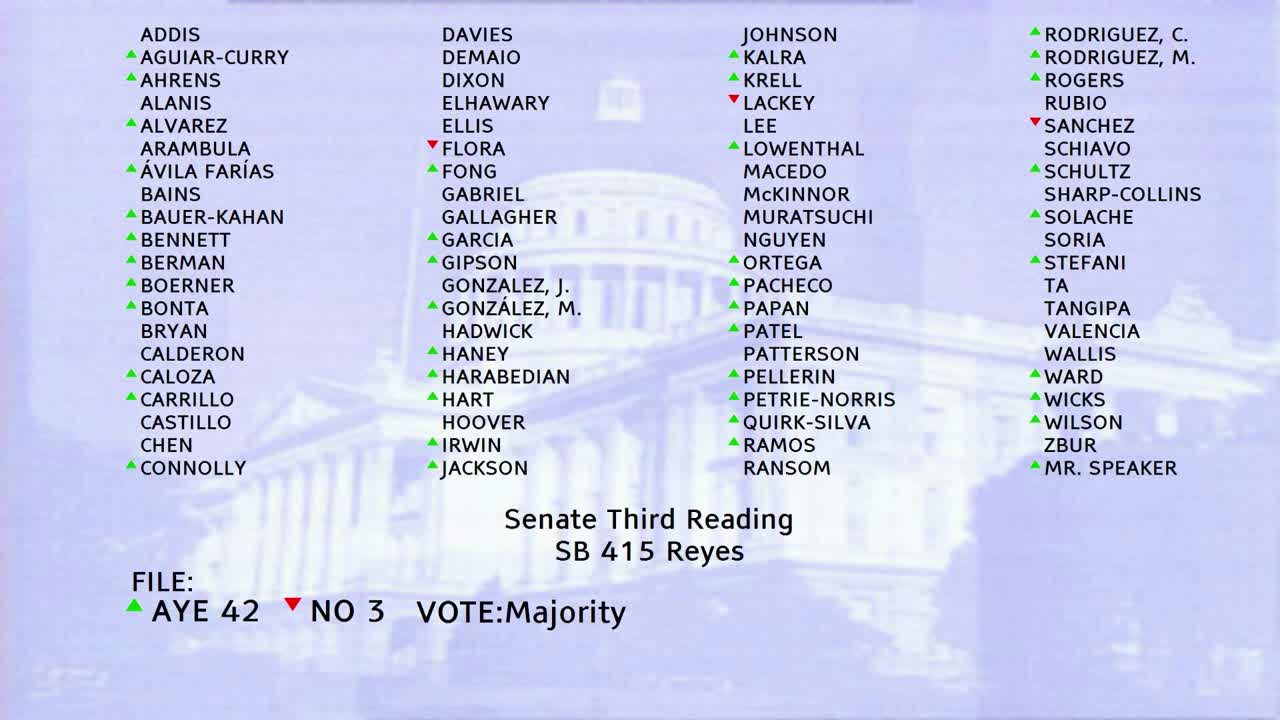 1MIN
Assembly Floor
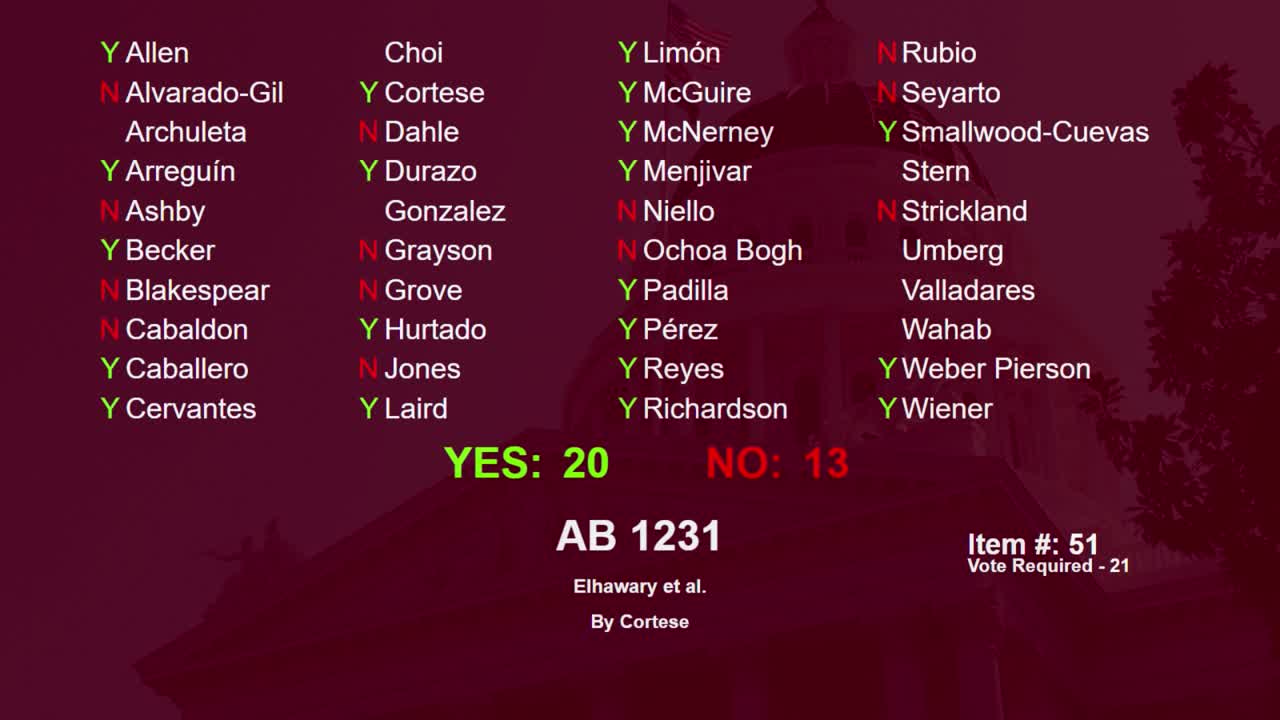 1MIN
Senate Floor
 2MIN
Assembly Floor
 5MIN
Assembly Standing Committee on Judiciary
 10MIN
Assembly Standing Committee on Business and Professions
 3MIN
Senate Floor
 18MIN
Senate Standing Committee on Judiciary
 19MIN
Senate Standing Committee on Business, Professions and Economic Development
Bill Author