SB 5: Enhanced infrastructure financing districts and community revitalization and investment areas: allocation of taxes: agricultural land exclusion.
- Session Year: 2025-2026
- House: Senate
- Latest Version Date: 2025-09-12
Current Status:
Failed
(2026-03-02: Veto sustained.)
Introduced
In Committee
Awaiting First Chamber Vote
Passed First Chamber
In Committee
Awaiting Second Chamber Vote
Passed Second Chamber
Enacted
What does this bill do?
This bill prevents enhanced infrastructure financing districts and community revitalization and investment authorities from taking property tax revenue from parcels enrolled in Williamson Act contracts (the state program that lowers property taxes to keep land in farming) or in farmland security zone contracts. If a parcel’s contract is canceled or not renewed, or the land is rezoned for non‑agricultural uses, the parcel still remains excluded from those tax allocations until the next equalized assessment roll, with the local agency able to choose which event to use.
The summary is provided by generative AI which can make mistakes. For original language, please view the details in the table below.
Existing law, the California Land Conservation Act of 1965, otherwise known as the Williamson Act, authorizes a city or county to enter into contracts with owners of agricultural land to preserve the land for agricultural use, as specified, in return for reduced property tax assessments. The act also authorizes a landowner of specified agricultural land to petition the city or county to cancel the Williamson Act contract in order to designate the land as a farmland security zone, whereby the land is eligible for a specified property tax valuation and taxed at a reduced rate for specified special taxes.
Existing law authorizes the legislative body of a city or a county to establish an enhanced infrastructure financing district, with a governing body referred to as the public financing authority, to finance public capital facilities or other specified projects of communitywide significance. Existing law requires the public financing authority to prepare and adopt a proposed infrastructure financing plan, as specified. Existing law authorizes the plan to require a certain portion of specified taxes levied upon property within the district to be allocated to the district each year, as specified.
Existing law authorizes certain local agencies to form a Community Revitalization and Investment Authority within a community revitalization and investment area to carry out a community revitalization plan in that area for specified purposes. Existing law authorizes the plan to require a certain portion of specified taxes levied upon property within the area to be allocated to the authority to finance improvements, as specified.
This bill would exclude the taxes levied upon a parcel of land enrolled in or subject to a Williamson Act contract or a farmland security zone contract, as specified, from the above-described allocations to the district or authority, as applicable.
This bill would incorporate additional changes to Section 53398.75 of the Government Code proposed by SB 516 to be operative only if this bill and SB 516 are enacted and this bill is enacted last.
Existing law, the California Land Conservation Act of 1965, otherwise known as the Williamson Act, authorizes a city or county to enter into contracts with owners of agricultural land to preserve the land for agricultural use, as specified, in return for reduced property tax assessments. The act also authorizes a landowner of specified agricultural land to petition the city or county to cancel the Williamson Act contract in order to designate the land as a farmland security zone, whereby the land is eligible for a specified property tax valuation and taxed at a reduced rate for specified special taxes.
Existing law authorizes the legislative body of a city or a county to establish an enhanced infrastructure financing district, with a governing body referred to as the public financing authority, to finance public capital facilities or other specified projects of communitywide significance. Existing law requires the public financing authority to prepare and adopt a proposed infrastructure financing plan, as specified. Existing law authorizes the plan to require a certain portion of specified taxes levied upon property within the district to be allocated to the district each year, as specified.
Existing law authorizes certain local agencies to form a Community Revitalization and Investment Authority within a community revitalization and investment area to carry out a community revitalization plan in that area for specified purposes. Existing law authorizes the plan to require a certain portion of specified taxes levied upon property within the area to be allocated to the authority to finance improvements, as specified.
This bill would exclude the taxes levied upon a parcel of land enrolled in or subject to a Williamson Act contract or a farmland security zone contract, as specified, from the above-described allocations to the district or authority, as applicable.
This bill would incorporate additional changes to Section 53398.75 of the Government Code proposed by SB 516 to be operative only if this bill and SB 516 are enacted and this bill is enacted last.
Existing law, the California Land Conservation Act of 1965, otherwise known as the Williamson Act, authorizes a city or county to enter into contracts with owners of agricultural land to preserve the land for agricultural use, as specified, in return for reduced property tax assessments. The act also authorizes a landowner of specified agricultural land to petition the city or county to cancel the Williamson Act contract in order to designate the land as a farmland security zone, whereby the land is eligible for a specified property tax valuation and taxed at a reduced rate for specified special taxes.
Existing law authorizes the legislative body of a city or a county to establish an enhanced infrastructure financing district, with a governing body referred to as the public financing authority, to finance public capital facilities or other specified projects of communitywide significance. Existing law requires the public financing authority to prepare and adopt a proposed infrastructure financing plan, as specified. Existing law authorizes the plan to require a certain portion of specified taxes levied upon property within the district to be allocated to the district each year, as specified.
Existing law authorizes certain local agencies to form a Community Revitalization and Investment Authority within a community revitalization and investment area to carry out a community revitalization plan in that area for specified purposes. Existing law authorizes the plan to require a certain portion of specified taxes levied upon property within the area to be allocated to the authority to finance improvements, as specified.
This bill would exclude the taxes levied upon a parcel of land enrolled in or subject to a Williamson Act contract or a farmland security zone contract, as specified, from the above-described allocations to the district or authority, as applicable.
Existing law, the California Land Conservation Act of 1965, otherwise known as the Williamson Act, authorizes a city or county to enter into contracts with owners of agricultural land to preserve the land for agricultural use, as specified, in return for reduced property tax assessments. The act also authorizes a landowner of specified agricultural land to petition the city or county to cancel the Williamson Act contract in order to designate the land as a farmland security zone, whereby the land is eligible for a specified property tax valuation and taxed at a reduced rate for specified special taxes.
Existing law authorizes the legislative body of a city or a county to establish an enhanced infrastructure financing district, with a governing body referred to as the public financing authority, to finance public capital facilities or other specified projects of communitywide significance. Existing law requires the public financing authority to prepare and adopt a proposed infrastructure financing plan, as specified. Existing law authorizes the plan to require a certain portion of specified taxes levied upon property within the district to be allocated to the district each year, as specified.
Existing law authorizes certain local agencies to form a Community Revitalization and Investment Authority within a community revitalization and investment area to carry out a community revitalization plan in that area for specified purposes. Existing law authorizes the plan to require a certain portion of specified taxes levied upon property within the area to be allocated to the authority to finance improvements, as specified.
This bill would exclude the taxes levied upon a parcel of land enrolled in or subject to a Williamson Act contract or a farmland security zone contract, as specified, from the above-described allocation allocations to the district. district or authority, as applicable.
Existing law, the California Land Conservation Act of 1965, otherwise known as the Williamson Act, authorizes a city or county to enter into contracts with owners of agricultural land to preserve the land for agricultural use, as specified, in return for reduced property tax assessments. The act also authorizes a landowner of specified agricultural land to petition the city or county to cancel the Williamson Act contract in order to designate the land as a farmland security zone, whereby the land is eligible for a specified property tax valuation and taxed at a reduced rate for specified special taxes.
Existing law authorizes the legislative body of a city or a county to establish an enhanced infrastructure financing district, with a governing body referred to as the public financing authority, to finance public capital facilities or other specified projects of communitywide significance. Existing law requires the public financing authority to prepare and adopt a proposed infrastructure financing plan, as specified. Existing law authorizes the plan to require a certain portion of specified taxes levied upon property within the district to be allocated to the district each year, as specified.
This bill would exclude the taxes levied upon a parcel of land enrolled in or subject to a Williamson Act contract or a farmland security zone contract, as specified, from the above-described allocation to the district.
(a)Any infrastructure financing plan may contain a provision that taxes, other than those specified in Section 53398.75.1, if any, levied upon taxable property in the area included within the enhanced infrastructure financing district each year by or for the benefit of the State of California, or any affected taxing entity after the effective date of the resolution adopted pursuant to Section 53398.69 to create the district, shall be divided, subject to the provisions of Section 53993, as follows:
(1)That portion of the taxes that would be produced by the rate upon which the tax is levied each year by or for each of the affected taxing entities upon the total sum of the assessed value of the taxable property in the district as shown upon the assessment roll used in connection with the taxation of the property by the affected taxing entity, last equalized prior to the effective date of the resolution adopted pursuant to Section 53398.69 to create the district, shall be allocated to, and when collected shall be paid to, the respective affected taxing entities as taxes by or for the affected taxing entities on all other property are paid.
(2)That portion of the levied taxes each year specified in the adopted infrastructure financing plan for the city or county and each affected taxing entity that has agreed to participate pursuant to Section 53398.68 in excess of the amount specified in paragraph (1) shall be allocated to, and when collected shall be paid into a special fund of, the district for all lawful purposes of the district. Unless and until the total assessed valuation of the taxable property in a district exceeds the total assessed value of the taxable property in the district as shown by the last equalized assessment roll referred to in paragraph (1), all of the taxes levied and collected upon the taxable property in the district shall be paid to the respective affected taxing entities. When the district ceases to exist pursuant to the adopted infrastructure financing plan, all moneys thereafter received from taxes upon the taxable property in the district shall be paid to the respective affected taxing entities as taxes on all other property are paid.
(b)Notwithstanding subdivision (a), where any district boundaries overlap with the boundaries of any former redevelopment project area, any debt or obligation of a district shall be subordinate to any and all enforceable obligations of the former redevelopment agency, as approved by the Oversight Board and the Department of Finance. For the purposes of this chapter, the division of taxes allocated to the district pursuant to subdivision (a) of this section or of subdivision (b) of Section 53396 shall not include any taxes required to be deposited by the county auditor-controller into the Redevelopment Property Tax Trust Fund created pursuant to subdivision (b) of Section 34170.5 of the Health and Safety Code.
(c)The legislative body of the city or county forming the district may choose to dedicate any portion of its net available revenue to the district through the financing plan described in Section 53398.63.
(d)For the purposes of this section, net available revenue means periodic distributions to the city or county from the Redevelopment Property Tax Trust Fund, created pursuant to Section 34170.5 of the Health and Safety Code, that are available to the city or county after all preexisting legal commitments and statutory obligations funded from that revenue are made pursuant to Part 1.85 (commencing with Section 34170) of Division 24 of the Health and Safety Code. Net available revenue shall not include any funds deposited by the county auditor-controller into the Redevelopment Property Tax Trust Fund or funds remaining in the Redevelopment Property Tax Trust Fund prior to distribution. Net available revenues shall not include any moneys payable to a school district that maintains kindergarten and grades 1 to 12, inclusive, community college district, county office of education, or to the Educational Revenue Augmentation Fund, pursuant to paragraph (4) of subdivision (a) of Section 34183 of the Health and Safety Code.
(e)(1)That portion of any ad valorem property tax revenue annually allocated to a city or county pursuant to Section 97.70 of the Revenue and Taxation Code that is specified in the adopted infrastructure financing plan for the city or county that has agreed to participate pursuant to Section 53398.68, and that corresponds to the increase in the assessed valuation of taxable property shall be allocated to, and, when collected, shall be apportioned to, a special fund of the district for all lawful purposes of the district.
(2)When the district ceases to exist pursuant to the adopted infrastructure financing plan, the revenues described in this subdivision shall be allocated to, and, when collected, shall be apportioned to, the respective city or county.
(f)This section shall not be construed to prevent a district from utilizing revenues from any of the following sources to support its activities provided that the applicable voter approval has been obtained, and the infrastructure financing plan has been approved pursuant to Section 53398.69:
(1)The Improvement Act of 1911 (Division 7 (commencing with Section 5000) of the Streets and Highways Code).
(2)The Municipal Improvement Act of 1913 (Division 12 (commencing with Section 10000) of the Streets and Highways Code).
(3)The Improvement Bond Act of 1915 (Division 10 (commencing with Section 8500) of the Streets and Highways Code).
(4)The Landscaping and Lighting Act of 1972 (Part 2 (commencing with Section 22500) of Division 15 of the Streets and Highways Code).
(5)The Vehicle Parking District Law of 1943 (Part 1 (commencing with Section 31500) of Division 18 of the Streets and Highways Code).
(6)The Parking District Law of 1951 (Part 4 (commencing with Section 35100) of Division 18 of the Streets and Highways Code).
(7)The Park and Playground Act of 1909 (Chapter 7 (commencing with Section 38000) of Part 2 of Division 3 of Title 4 of this code).
(8)The Mello-Roos Community Facilities Act of 1982 (Chapter 2.5 (commencing with Section 53311) of Part 1 of Division 2 of this title).
(9)The Benefit Assessment Act of 1982 (Chapter 6.4 (commencing with Section 54703) of Part 1 of Division 2 of this title).
(10)The so-called facilities benefit assessment levied by the charter city of San Diego or any substantially similar assessment levied for the same purpose by any other charter city pursuant to any ordinance or charter provision.
SEC. 1.5.Section 53398.75 of the Government Code is amended to read:53398.75.(a)Any infrastructure financing plan may contain a provision that taxes, other than those specified in Section 53398.75.1, if any, levied upon taxable property in the area included within the enhanced infrastructure financing district each year by or for the benefit of the State of California, or any affected taxing entity after the effective date of the resolution adopted pursuant to Section 53398.69 to create the district, shall be divided, subject to the provisions of Section 53993, as follows:
(1)That portion of the taxes that would be produced by the rate upon which the tax is levied each year by or for each of the affected taxing entities upon the total sum of the assessed value of the taxable property in the district as shown upon the assessment roll used in connection with the taxation of the property by the affected taxing entity, last equalized prior to the effective date of the resolution adopted pursuant to Section 53398.69 to create the district, shall be allocated to, and when collected shall be paid to, the respective affected taxing entities as taxes by or for the affected taxing entities on all other property are paid.
(2)That portion of the levied taxes each year specified in the adopted infrastructure financing plan for the city or county and each affected taxing entity that has agreed to participate pursuant to Section 53398.68 in excess of the amount specified in paragraph (1) shall be allocated to, and when collected shall be paid into a special fund of, the district for all lawful purposes of the district. Unless and until the total assessed valuation of the taxable property in a district exceeds the total assessed value of the taxable property in the district as shown by the last equalized assessment roll referred to in paragraph (1), all of the taxes levied and collected upon the taxable property in the district shall be paid to the respective affected taxing entities. When the district ceases to exist pursuant to the adopted infrastructure financing plan, all moneys thereafter received from taxes upon the taxable property in the district shall be paid to the respective affected taxing entities as taxes on all other property are paid.
(b)Notwithstanding subdivision (a), where any district boundaries overlap with the boundaries of any former redevelopment project area, any debt or obligation of a district shall be subordinate to any and all enforceable obligations of the former redevelopment agency, as approved by the Oversight Board and the Department of Finance. For the purposes of this chapter, the division of taxes allocated to the district pursuant to subdivision (a) of this section or of subdivision (b) of Section 53396 shall not include any taxes required to be deposited by the county auditor-controller into the Redevelopment Property Tax Trust Fund created pursuant to subdivision (b) of Section 34170.5 of the Health and Safety Code.
(c)The legislative body of the city or county forming the district may choose to dedicate any portion of its net available revenue to the district through the financing plan described in Section 53398.63.
(d)For the purposes of this section, net available revenue means periodic distributions to the city or county from the Redevelopment Property Tax Trust Fund, created pursuant to Section 34170.5 of the Health and Safety Code, that are available to the city or county after all preexisting legal commitments and statutory obligations funded from that revenue are made pursuant to Part 1.85 (commencing with Section 34170) of Division 24 of the Health and Safety Code. Net available revenue shall not include any funds deposited by the county auditor-controller into the Redevelopment Property Tax Trust Fund or funds remaining in the Redevelopment Property Tax Trust Fund prior to distribution. Net available revenues shall not include any moneys payable to a school district that maintains kindergarten and grades 1 to 12, inclusive, community college district, county office of education, or to the Educational Revenue Augmentation Fund, pursuant to paragraph (4) of subdivision (a) of Section 34183 of the Health and Safety Code.
(e)(1)That portion of any ad valorem property tax revenue annually allocated to a city or county pursuant to Section 97.70 of the Revenue and Taxation Code that is specified in the adopted infrastructure financing plan for the city or county that has agreed to participate pursuant to Section 53398.68, and that corresponds to the increase in the assessed valuation of taxable property shall be allocated to, and, when collected, shall be apportioned to, a special fund of the district for all lawful purposes of the district.
(2)When the district ceases to exist pursuant to the adopted infrastructure financing plan, the revenues described in this subdivision shall be allocated to, and, when collected, shall be apportioned to, the respective city or county.
(f)This section shall not be construed to prevent a district from utilizing revenues from any of the following sources to support its activities provided that the applicable voter approval has been obtained, and the infrastructure financing plan has been approved pursuant to Section 53398.69:
(1)The Improvement Act of 1911 (Division 7 (commencing with Section 5000) of the Streets and Highways Code).
(2)The Municipal Improvement Act of 1913 (Division 12 (commencing with Section 10000) of the Streets and Highways Code).
(3)The Improvement Bond Act of 1915 (Division 10 (commencing with Section 8500) of the Streets and Highways Code).
(4)The Landscaping and Lighting Act of 1972 (Part 2 (commencing with Section 22500) of Division 15 of the Streets and Highways Code).
(5)The Vehicle Parking District Law of 1943 (Part 1 (commencing with Section 31500) of Division 18 of the Streets and Highways Code).
(6)The Parking District Law of 1951 (Part 4 (commencing with Section 35100) of Division 18 of the Streets and Highways Code).
(7)The Park and Playground Act of 1909 (Chapter 7 (commencing with Section 38000) of Part 2 of Division 3 of Title 4 of this code).
(8)The Mello-Roos Community Facilities Act of 1982 (Chapter 2.5 (commencing with Section 53311) of Part 1 of Division 2 of this title).
(9)The Benefit Assessment Act of 1982 (Chapter 6.4 (commencing with Section 54703) of Part 1 of Division 2 of this title).
(10)The so-called facilities benefit assessment levied by the charter city of San Diego or any substantially similar assessment levied for the same purpose by any other charter city pursuant to any ordinance or charter provision.
(11)Any state funds.
SEC. 2.Section 53398.75.1 is added to the Government Code, to read:53398.75.1.Taxes authorized to be divided and allocated pursuant to Section 53398.75 shall not include taxes levied upon any of the following:
(a)A parcel of land enrolled in a Williamson Act contract.
(b)A parcel of land enrolled in a farmland security zone contract, pursuant to Article 7 (commencing with Section 51296) of Chapter 7.
(c)A parcel of land subject to a Williamson Act contract or a farmland security zone contract that has been canceled or nonrenewed, until the next equalized assessment roll made after either of the following, at the option of the local agency:
(1)Cancellation or nonrenewal of the Williamson Act contract or the farmland security zone contract.
(2)Rezoning of the parcel for residential, commercial, industrial, or other uses.
SEC. 3.Section 62005 of the Government Code is amended to read:62005.(a)(1)The plan adopted pursuant to Section 62004 may include a provision that taxes levied and collected upon taxable property in the area included within the territory each year by or for the benefit the taxing agencies that have adopted a resolution pursuant to subdivision (d), other than those specified in Section 62009, shall be divided, subject to the provisions of Section 53993, as follows:
(A)That portion of the taxes that would have been produced by the rate upon which the tax is levied each year by or for each of the consenting local agencies upon the total sum of the assessed value of the taxable property in the territory as shown upon the assessment roll used in connection with the taxation of the property by the consenting local agency, last equalized prior to the effective date of the certification of completion, and that portion of taxes by or for each school entity, shall be allocated to, and when collected shall be paid to, the respective consenting local agencies and school entities as taxes by or for the consenting local agencies and school entities on all property are paid.
(B)That portion of the levied taxes each year specified in the community revitalization plan adopted pursuant to Section 62004 for each consenting local agency that has agreed to participate pursuant a resolution adopted pursuant to subdivision (d), in excess of the amount specified in subparagraph (A), shall be allocated to, and when collected shall be paid into a special fund of the authority to finance the improvements specified in the community revitalization plan.
(2)A consenting local agency may advance funds to the authority. The authority shall use those advanced funds solely for the purposes specified in the community revitalization plan and shall repay the consenting local agency with revenue from the taxes received pursuant to this subdivision.
(b)For purposes of this section, the following definitions apply:
(1)Taxing agency means a local agency as defined by subdivision (a) of Section 95 of the Revenue and Taxation Code, and does not include any school entity as defined in subdivision (f) of Section 95 of the Revenue and Taxation Code.
(2)Consenting local agency means a local agency that has adopted a resolution of its governing body consenting to the community revitalization and investment plan.
(3)Territory means the land that is contained within the community revitalization plan.
(c)The provision for the receipt of tax increment funds shall become effective in the tax year that begins after the December 1 first following the adoption of the plan.
(d)At any time prior to or after adoption of the plan, any city, county, or special district, other than a school entity as defined in subdivision (n) of Section 95 of the Revenue and Taxation Code or a successor agency as defined in subdivision (j) of Section 34171, that receives ad valorem property taxes from property located within an area may adopt a resolution directing the county auditor-controller to allocate its share of tax increment funds within the area covered by the plan according to subdivision (a) to the authority. The resolution adopted pursuant to this subdivision may direct the county auditor-controller to allocate less than the full amount of the tax increment, establish a maximum amount of time in years that the allocation takes place, or limit the use of the funds by the authority for specific purposes or programs, provided that 25 percent of the amount of tax increment designated shall be allocated for affordable housing pursuant to Section 62100. A resolution adopted pursuant to this subdivision may be repealed and be of no further effect by giving the county auditor-controller 60 days notice; provided, however, that the county auditor-controller shall continue to allocate to the authority the taxing entitys share of ad valorem property taxes that have been pledged to the repayment of debt issued by the authority until the debt has been fully repaid. Prior to adopting a resolution pursuant to this subdivision, a city, county, or special district shall approve a memorandum of understanding with the authority governing the authoritys use of tax increment funds for administrative and overhead expenses pursuant to subdivision (g) of Section 62001.
(e)Upon adoption of a plan that includes a provision for the receipt of tax increment funds according to subdivision (a), the county auditor-controller shall allocate tax increment revenue to the authority as follows:
(1)If the authority was formed pursuant to subparagraph (A) of paragraph (1) of subdivision (b) of Section 62001, the authority shall be allocated each year specified in the plan that portion of the taxes levied for each city, county, city and county, and special district that has adopted a resolution pursuant to subdivision (d), in excess of the amount specified in paragraph (1) of subdivision (a).
(2)If the authority was formed pursuant to subparagraph (B) of paragraph (1) of subdivision (b) of Section 62001, the authority shall be allocated each year specified in the plan that portion of the taxes levied for each jurisdiction as provided in the joint powers agreement in excess of the amount specified in paragraph (1) of subdivision (a).
(f)If an area includes, in whole or in part, land formerly or currently designated as a part of a redevelopment project area, as defined in Section 33320.1 of the Health and Safety Code, any plan adopted pursuant to this part that includes a provision for the receipt of tax increment revenues according to subdivision (a) shall include a provision that tax increment amounts payable to an authority are subject and subordinate to any preexisting enforceable obligation as that term is defined by Section 34171 of the Health and Safety Code.
SEC. 4.Section 62009 is added to the Government Code, to read:62009.Taxes authorized to be divided and allocated pursuant to Section 62005 shall not include taxes levied upon any of the following:
(a)A parcel of land enrolled in a Williamson Act contract.
(b)A parcel of land enrolled in a farmland security zone contract, pursuant to Article 7 (commencing with Section 51296) of Chapter 7 of Part 1 of Division 1 of Title 5.
(c)A parcel of land subject to a Williamson Act contract or a farmland security zone contract that has been canceled or nonrenewed, until the next equalized assessment roll made after either of the following, at the option of the local agency:
(1)Cancellation or nonrenewal of the Williamson Act contract or the farmland security zone contract.
(2)Rezoning of the parcel for residential, commercial, industrial, or other uses.
SEC. 5.Section 1.5 of this bill incorporates amendments to Section 53398.75 of the Government Code proposed by both this bill and Senate Bill 516. That section of this bill shall only become operative if (1) both bills are enacted and become effective on or before January 1, 2026, (2) each bill amends Section 53398.75 of the Government Code, and (3) this bill is enacted after Senate Bill 516, in which case Section 1 of this bill shall not become operative.
(a)Any infrastructure financing plan may contain a provision that taxes, other than those specified in Section 53398.75.1, if any, levied upon taxable property in the area included within the enhanced infrastructure financing district each year by or for the benefit of the State of California, or any affected taxing entity after the effective date of the resolution adopted pursuant to Section 53398.69 to create the district, shall be divided, subject to the provisions of Section 53993, as follows:
(1)That portion of the taxes that would be produced by the rate upon which the tax is levied each year by or for each of the affected taxing entities upon the total sum of the assessed value of the taxable property in the district as shown upon the assessment roll used in connection with the taxation of the property by the affected taxing entity, last equalized prior to the effective date of the resolution adopted pursuant to Section 53398.69 to create the district, shall be allocated to, and when collected shall be paid to, the respective affected taxing entities as taxes by or for the affected taxing entities on all other property are paid.
(2)That portion of the levied taxes each year specified in the adopted infrastructure financing plan for the city or county and each affected taxing entity that has agreed to participate pursuant to Section 53398.68 in excess of the amount specified in paragraph (1) shall be allocated to, and when collected shall be paid into a special fund of, the district for all lawful purposes of the district. Unless and until the total assessed valuation of the taxable property in a district exceeds the total assessed value of the taxable property in the district as shown by the last equalized assessment roll referred to in paragraph (1), all of the taxes levied and collected upon the taxable property in the district shall be paid to the respective affected taxing entities. When the district ceases to exist pursuant to the adopted infrastructure financing plan, all moneys thereafter received from taxes upon the taxable property in the district shall be paid to the respective affected taxing entities as taxes on all other property are paid.
(b)Notwithstanding subdivision (a), where any district boundaries overlap with the boundaries of any former redevelopment project area, any debt or obligation of a district shall be subordinate to any and all enforceable obligations of the former redevelopment agency, as approved by the Oversight Board and the Department of Finance. For the purposes of this chapter, the division of taxes allocated to the district pursuant to subdivision (a) of this section or of subdivision (b) of Section 53396 shall not include any taxes required to be deposited by the county auditor-controller into the Redevelopment Property Tax Trust Fund created pursuant to subdivision (b) of Section 34170.5 of the Health and Safety Code.
(c)The legislative body of the city or county forming the district may choose to dedicate any portion of its net available revenue to the district through the financing plan described in Section 53398.63.
(d)For the purposes of this section, net available revenue means periodic distributions to the city or county from the Redevelopment Property Tax Trust Fund, created pursuant to Section 34170.5 of the Health and Safety Code, that are available to the city or county after all preexisting legal commitments and statutory obligations funded from that revenue are made pursuant to Part 1.85 (commencing with Section 34170) of Division 24 of the Health and Safety Code. Net available revenue shall not include any funds deposited by the county auditor-controller into the Redevelopment Property Tax Trust Fund or funds remaining in the Redevelopment Property Tax Trust Fund prior to distribution. Net available revenues shall not include any moneys payable to a school district that maintains kindergarten and grades 1 to 12, inclusive, community college district, county office of education, or to the Educational Revenue Augmentation Fund, pursuant to paragraph (4) of subdivision (a) of Section 34183 of the Health and Safety Code.
(e)(1)That portion of any ad valorem property tax revenue annually allocated to a city or county pursuant to Section 97.70 of the Revenue and Taxation Code that is specified in the adopted infrastructure financing plan for the city or county that has agreed to participate pursuant to Section 53398.68, and that corresponds to the increase in the assessed valuation of taxable property shall be allocated to, and, when collected, shall be apportioned to, a special fund of the district for all lawful purposes of the district.
(2)When the district ceases to exist pursuant to the adopted infrastructure financing plan, the revenues described in this subdivision shall be allocated to, and, when collected, shall be apportioned to, the respective city or county.
(f)This section shall not be construed to prevent a district from utilizing revenues from any of the following sources to support its activities provided that the applicable voter approval has been obtained, and the infrastructure financing plan has been approved pursuant to Section 53398.69:
(1)The Improvement Act of 1911 (Division 7 (commencing with Section 5000) of the Streets and Highways Code).
(2)The Municipal Improvement Act of 1913 (Division 12 (commencing with Section 10000) of the Streets and Highways Code).
(3)The Improvement Bond Act of 1915 (Division 10 (commencing with Section 8500) of the Streets and Highways Code).
(4)The Landscaping and Lighting Act of 1972 (Part 2 (commencing with Section 22500) of Division 15 of the Streets and Highways Code).
(5)The Vehicle Parking District Law of 1943 (Part 1 (commencing with Section 31500) of Division 18 of the Streets and Highways Code).
(6)The Parking District Law of 1951 (Part 4 (commencing with Section 35100) of Division 18 of the Streets and Highways Code).
(7)The Park and Playground Act of 1909 (Chapter 7 (commencing with Section 38000) of Part 2 of Division 3 of Title 4 of this code).
(8)The Mello-Roos Community Facilities Act of 1982 (Chapter 2.5 (commencing with Section 53311) of Part 1 of Division 2 of this title).
(9)The Benefit Assessment Act of 1982 (Chapter 6.4 (commencing with Section 54703) of Part 1 of Division 2 of this title).
(10)The so-called facilities benefit assessment levied by the charter city of San Diego or any substantially similar assessment levied for the same purpose by any other charter city pursuant to any ordinance or charter provision.
SEC. 1.5.Section 53398.75 of the Government Code is amended to read:53398.75.(a)Any infrastructure financing plan may contain a provision that taxes, other than those specified in Section 53398.75.1, if any, levied upon taxable property in the area included within the enhanced infrastructure financing district each year by or for the benefit of the State of California, or any affected taxing entity after the effective date of the resolution adopted pursuant to Section 53398.69 to create the district, shall be divided, subject to the provisions of Section 53993, as follows:
(1)That portion of the taxes that would be produced by the rate upon which the tax is levied each year by or for each of the affected taxing entities upon the total sum of the assessed value of the taxable property in the district as shown upon the assessment roll used in connection with the taxation of the property by the affected taxing entity, last equalized prior to the effective date of the resolution adopted pursuant to Section 53398.69 to create the district, shall be allocated to, and when collected shall be paid to, the respective affected taxing entities as taxes by or for the affected taxing entities on all other property are paid.
(2)That portion of the levied taxes each year specified in the adopted infrastructure financing plan for the city or county and each affected taxing entity that has agreed to participate pursuant to Section 53398.68 in excess of the amount specified in paragraph (1) shall be allocated to, and when collected shall be paid into a special fund of, the district for all lawful purposes of the district. Unless and until the total assessed valuation of the taxable property in a district exceeds the total assessed value of the taxable property in the district as shown by the last equalized assessment roll referred to in paragraph (1), all of the taxes levied and collected upon the taxable property in the district shall be paid to the respective affected taxing entities. When the district ceases to exist pursuant to the adopted infrastructure financing plan, all moneys thereafter received from taxes upon the taxable property in the district shall be paid to the respective affected taxing entities as taxes on all other property are paid.
(b)Notwithstanding subdivision (a), where any district boundaries overlap with the boundaries of any former redevelopment project area, any debt or obligation of a district shall be subordinate to any and all enforceable obligations of the former redevelopment agency, as approved by the Oversight Board and the Department of Finance. For the purposes of this chapter, the division of taxes allocated to the district pursuant to subdivision (a) of this section or of subdivision (b) of Section 53396 shall not include any taxes required to be deposited by the county auditor-controller into the Redevelopment Property Tax Trust Fund created pursuant to subdivision (b) of Section 34170.5 of the Health and Safety Code.
(c)The legislative body of the city or county forming the district may choose to dedicate any portion of its net available revenue to the district through the financing plan described in Section 53398.63.
(d)For the purposes of this section, net available revenue means periodic distributions to the city or county from the Redevelopment Property Tax Trust Fund, created pursuant to Section 34170.5 of the Health and Safety Code, that are available to the city or county after all preexisting legal commitments and statutory obligations funded from that revenue are made pursuant to Part 1.85 (commencing with Section 34170) of Division 24 of the Health and Safety Code. Net available revenue shall not include any funds deposited by the county auditor-controller into the Redevelopment Property Tax Trust Fund or funds remaining in the Redevelopment Property Tax Trust Fund prior to distribution. Net available revenues shall not include any moneys payable to a school district that maintains kindergarten and grades 1 to 12, inclusive, community college districts, district, county office of education, or to the Educational Revenue Augmentation Fund, pursuant to paragraph (4) of subdivision (a) of Section 34183 of the Health and Safety Code.
(e)(1)That portion of any ad valorem property tax revenue annually allocated to a city or county pursuant to Section 97.70 of the Revenue and Taxation Code that is specified in the adopted infrastructure financing plan for the city or county that has agreed to participate pursuant to Section 53398.68, and that corresponds to the increase in the assessed valuation of taxable property shall be allocated to, and, when collected, shall be apportioned to, a special fund of the district for all lawful purposes of the district.
(2)When the district ceases to exist pursuant to the adopted infrastructure financing plan, the revenues described in this subdivision shall be allocated to, and, when collected, shall be apportioned to, the respective city or county.
(f)This section shall not be construed to prevent a district from utilizing revenues from any of the following sources to support its activities provided that the applicable voter approval has been obtained, and the infrastructure financing plan has been approved pursuant to Section 53398.69:
(1)The Improvement Act of 1911 (Division 7 (commencing with Section 5000) of the Streets and Highways Code).
(2)The Municipal Improvement Act of 1913 (Division 12 (commencing with Section 10000) of the Streets and Highways Code).
(3)The Improvement Bond Act of 1915 (Division 10 (commencing with Section 8500) of the Streets and Highways Code).
(4)The Landscaping and Lighting Act of 1972 (Part 2 (commencing with Section 22500) of Division 15 of the Streets and Highways Code).
(5)The Vehicle Parking District Law of 1943 (Part 1 (commencing with Section 31500) of Division 18 of the Streets and Highways Code).
(6)The Parking District Law of 1951 (Part 4 (commencing with Section 35100) of Division 18 of the Streets and Highways Code).
(7)The Park and Playground Act of 1909 (Chapter 7 (commencing with Section 38000) of Part 2 of Division 3 of Title 4 of this code).
(8)The Mello-Roos Community Facilities Act of 1982 (Chapter 2.5 (commencing with Section 53311) of Part 1 of Division 2 of this title).
(9)The Benefit Assessment Act of 1982 (Chapter 6.4 (commencing with Section 54703) of Part 1 of Division 2 of this title).
(10)The so-called facilities benefit assessment levied by the charter city of San Diego or any substantially similar assessment levied for the same purpose by any other charter city pursuant to any ordinance or charter provision.
(11)Any state funds.
SEC. 2.Section 53398.75.1 is added to the Government Code, to read:53398.75.1.Taxes authorized to be divided and allocated pursuant to Section 53398.75 shall not include taxes levied upon any of the following:
(a)A parcel of land enrolled in a Williamson Act contract.
(b)A parcel of land enrolled in a farmland security zone contract, pursuant to Article 7 (commencing with Section 51296) of Chapter 7.
(c)A parcel of land subject to a Williamson Act contract or a farmland security zone contract that has been canceled or nonrenewed, until the next equalized assessment roll made after either of the following, at the option of the local agency:
(1)Cancellation or nonrenewal of the Williamson Act contract or the farmland security zone contract.
(2)Rezoning of the parcel for residential, commercial, industrial, or other uses.
SEC. 3.Section 62005 of the Government Code is amended to read:62005.(a)(1)The plan adopted pursuant to Section 62004 may include a provision that taxes levied and collected upon taxable property in the area included within the territory each year by or for the benefit the taxing agencies that have adopted a resolution pursuant to subdivision (d), other than those specified in Section 62009, shall be divided, subject to the provisions of Section 53993, as follows:
(A)That portion of the taxes that would have been produced by the rate upon which the tax is levied each year by or for each of the consenting local agencies upon the total sum of the assessed value of the taxable property in the territory as shown upon the assessment roll used in connection with the taxation of the property by the consenting local agency, last equalized prior to the effective date of the certification of completion, and that portion of taxes by or for each school entity, shall be allocated to, and when collected shall be paid to, the respective consenting local agencies and school entities as taxes by or for the consenting local agencies and school entities on all property are paid.
(B)That portion of the levied taxes each year specified in the community revitalization plan adopted pursuant to Section 62004 for each consenting local agency that has agreed to participate pursuant a resolution adopted pursuant to subdivision (d), in excess of the amount specified in subparagraph (A), shall be allocated to, and when collected shall be paid into a special fund of the authority to finance the improvements specified in the community revitalization plan.
(2)A consenting local agency may advance funds to the authority. The authority shall use those advanced funds solely for the purposes specified in the community revitalization plan and shall repay the consenting local agency with revenue from the taxes received pursuant to this subdivision.
(b)For purposes of this section, the following definitions apply:
(1)Taxing agency means a local agency as defined by subdivision (a) of Section 95 of the Revenue and Taxation Code, and does not include any school entity as defined in subdivision (f) of Section 95 of the Revenue and Taxation Code.
(2)Consenting local agency means a local agency that has adopted a resolution of its governing body consenting to the community revitalization and investment plan.
(3)Territory means the land that is contained within the community revitalization plan.
(c)The provision for the receipt of tax increment funds shall become effective in the tax year that begins after the December 1 first following the adoption of the plan.
(d)At any time prior to or after adoption of the plan, any city, county, or special district, other than a school entity as defined in subdivision (n) of Section 95 of the Revenue and Taxation Code or a successor agency as defined in subdivision (j) of Section 34171, that receives ad valorem property taxes from property located within an area may adopt a resolution directing the county auditor-controller to allocate its share of tax increment funds within the area covered by the plan according to subdivision (a) to the authority. The resolution adopted pursuant to this subdivision may direct the county auditor-controller to allocate less than the full amount of the tax increment, establish a maximum amount of time in years that the allocation takes place, or limit the use of the funds by the authority for specific purposes or programs, provided that 25 percent of the amount of tax increment designated shall be allocated for affordable housing pursuant to Section 62100. A resolution adopted pursuant to this subdivision may be repealed and be of no further effect by giving the county auditor-controller 60 days notice; provided, however, that the county auditor-controller shall continue to allocate to the authority the taxing entitys share of ad valorem property taxes that have been pledged to the repayment of debt issued by the authority until the debt has been fully repaid. Prior to adopting a resolution pursuant to this subdivision, a city, county, or special district shall approve a memorandum of understanding with the authority governing the authoritys use of tax increment funds for administrative and overhead expenses pursuant to subdivision (g) of Section 62001.
(e)Upon adoption of a plan that includes a provision for the receipt of tax increment funds according to subdivision (a), the county auditor-controller shall allocate tax increment revenue to the authority as follows:
(1)If the authority was formed pursuant to subparagraph (A) of paragraph (1) of subdivision (b) of Section 62001, the authority shall be allocated each year specified in the plan that portion of the taxes levied for each city, county, city and county, and special district that has adopted a resolution pursuant to subdivision (d), in excess of the amount specified in paragraph (1) of subdivision (a).
(2)If the authority was formed pursuant to subparagraph (B) of paragraph (1) of subdivision (b) of Section 62001, the authority shall be allocated each year specified in the plan that portion of the taxes levied for each jurisdiction as provided in the joint powers agreement in excess of the amount specified in paragraph (1) of subdivision (a).
(f)If an area includes, in whole or in part, land formerly or currently designated as a part of a redevelopment project area, as defined in Section 33320.1 of the Health and Safety Code, any plan adopted pursuant to this part that includes a provision for the receipt of tax increment revenues according to subdivision (a) shall include a provision that tax increment amounts payable to an authority are subject and subordinate to any preexisting enforceable obligation as that term is defined by Section 34171 of the Health and Safety Code.
SEC. 4.Section 62009 is added to the Government Code, to read:62009.Taxes authorized to be divided and allocated pursuant to Section 62005 shall not include taxes levied upon any of the following:
(a)A parcel of land enrolled in a Williamson Act contract.
(b)A parcel of land enrolled in a farmland security zone contract, pursuant to Article 7 (commencing with Section 51296) of Chapter 7 of Part 1 of Division 1 of Title 5.
(c)A parcel of land subject to a Williamson Act contract or a farmland security zone contract that has been canceled or nonrenewed, until the next equalized assessment roll made after either of the following, at the option of the local agency:
(1)Cancellation or nonrenewal of the Williamson Act contract or the farmland security zone contract.
(2)Rezoning of the parcel for residential, commercial, industrial, or other uses.
SEC. 5.Section 1.5 of this bill incorporates amendments to Section 53398.75 of the Government Code proposed by both this bill and Senate Bill 516. That section of this bill shall only become operative if (1) both bills are enacted and become effective on or before January 1, 2026, (2) each bill amends Section 53398.75 of the Government Code, and (3) this bill is enacted after Senate Bill 516, in which case Section 1 of this bill shall not become operative.
(a)Any infrastructure financing plan may contain a provision that taxes, other than those specified in Section 53398.75.1, if any, levied upon taxable property in the area included within the enhanced infrastructure financing district each year by or for the benefit of the State of California, or any affected taxing entity after the effective date of the resolution adopted pursuant to Section 53398.69 to create the district, shall be divided, subject to the provisions of Section 53993, as follows:
(1)That portion of the taxes that would be produced by the rate upon which the tax is levied each year by or for each of the affected taxing entities upon the total sum of the assessed value of the taxable property in the district as shown upon the assessment roll used in connection with the taxation of the property by the affected taxing entity, last equalized prior to the effective date of the resolution adopted pursuant to Section 53398.69 to create the district, shall be allocated to, and when collected shall be paid to, the respective affected taxing entities as taxes by or for the affected taxing entities on all other property are paid.
(2)That portion of the levied taxes each year specified in the adopted infrastructure financing plan for the city or county and each affected taxing entity that has agreed to participate pursuant to Section 53398.68 in excess of the amount specified in paragraph (1) shall be allocated to, and when collected shall be paid into a special fund of, the district for all lawful purposes of the district. Unless and until the total assessed valuation of the taxable property in a district exceeds the total assessed value of the taxable property in the district as shown by the last equalized assessment roll referred to in paragraph (1), all of the taxes levied and collected upon the taxable property in the district shall be paid to the respective affected taxing entities. When the district ceases to exist pursuant to the adopted infrastructure financing plan, all moneys thereafter received from taxes upon the taxable property in the district shall be paid to the respective affected taxing entities as taxes on all other property are paid.
(b)Notwithstanding subdivision (a), where any district boundaries overlap with the boundaries of any former redevelopment project area, any debt or obligation of a district shall be subordinate to any and all enforceable obligations of the former redevelopment agency, as approved by the Oversight Board and the Department of Finance. For the purposes of this chapter, the division of taxes allocated to the district pursuant to subdivision (a) of this section or of subdivision (b) of Section 53396 shall not include any taxes required to be deposited by the county auditor-controller into the Redevelopment Property Tax Trust Fund created pursuant to subdivision (b) of Section 34170.5 of the Health and Safety Code.
(c)The legislative body of the city or county forming the district may choose to dedicate any portion of its net available revenue to the district through the financing plan described in Section 53398.63.
(d)For the purposes of this section, net available revenue means periodic distributions to the city or county from the Redevelopment Property Tax Trust Fund, created pursuant to Section 34170.5 of the Health and Safety Code, that are available to the city or county after all preexisting legal commitments and statutory obligations funded from that revenue are made pursuant to Part 1.85 (commencing with Section 34170) of Division 24 of the Health and Safety Code. Net available revenue shall not include any funds deposited by the county auditor-controller into the Redevelopment Property Tax Trust Fund or funds remaining in the Redevelopment Property Tax Trust Fund prior to distribution. Net available revenues shall not include any moneys payable to a school district that maintains kindergarten and grades 1 to 12, inclusive, community college districts, district, county office of education, or to the Educational Revenue Augmentation Fund, pursuant to paragraph (4) of subdivision (a) of Section 34183 of the Health and Safety Code.
(e)(1)That portion of any ad valorem property tax revenue annually allocated to a city or county pursuant to Section 97.70 of the Revenue and Taxation Code that is specified in the adopted infrastructure financing plan for the city or county that has agreed to participate pursuant to Section 53398.68, and that corresponds to the increase in the assessed valuation of taxable property shall be allocated to, and, when collected, shall be apportioned to, a special fund of the district for all lawful purposes of the district.
(2)When the district ceases to exist pursuant to the adopted infrastructure financing plan, the revenues described in this subdivision shall be allocated to, and, when collected, shall be apportioned to, the respective city or county.
(f)This section shall not be construed to prevent a district from utilizing revenues from any of the following sources to support its activities provided that the applicable voter approval has been obtained, and the infrastructure financing plan has been approved pursuant to Section 53398.69:
(1)The Improvement Act of 1911 (Division 7 (commencing with Section 5000) of the Streets and Highways Code).
(2)The Municipal Improvement Act of 1913 (Division 12 (commencing with Section 10000) of the Streets and Highways Code).
(3)The Improvement Bond Act of 1915 (Division 10 (commencing with Section 8500) of the Streets and Highways Code).
(4)The Landscaping and Lighting Act of 1972 (Part 2 (commencing with Section 22500) of Division 15 of the Streets and Highways Code).
(5)The Vehicle Parking District Law of 1943 (Part 1 (commencing with Section 31500) of Division 18 of the Streets and Highways Code).
(6)The Parking District Law of 1951 (Part 4 (commencing with Section 35100) of Division 18 of the Streets and Highways Code).
(7)The Park and Playground Act of 1909 (Chapter 7 (commencing with Section 38000) of Part 2 of Division 3 of Title 4 of this code).
(8)The Mello-Roos Community Facilities Act of 1982 (Chapter 2.5 (commencing with Section 53311) of Part 1 of Division 2 of this title).
(9)The Benefit Assessment Act of 1982 (Chapter 6.4 (commencing with Section 54703) of Part 1 of Division 2 of this title).
(10)The so-called facilities benefit assessment levied by the charter city of San Diego or any substantially similar assessment levied for the same purpose by any other charter city pursuant to any ordinance or charter provision.
SEC. 2.Section 53398.75.1 is added to the Government Code, to read:53398.75.1.Taxes authorized to be divided and allocated pursuant to Section 53398.75 shall not include taxes levied upon any of the following:
(a)A parcel of land enrolled in a Williamson Act contract.
(b)A parcel of land enrolled in a farmland security zone contract, pursuant to Article 7 (commencing with Section 51296) of Chapter 7.
(c)A parcel of land subject to a Williamson Act contract or a farmland security zone contract that has been canceled or nonrenewed, until the next equalized assessment roll made after both either of the following: following, at the option of the local agency:
(1)Cancellation or nonrenewal of the Williamson Act contract or the farmland security zone contract.
(2)Rezoning of the parcel for residential, commercial, industrial, or other uses.
SEC. 3.Section 62005 of the Government Code is amended to read:62005.(a)(1)The plan adopted pursuant to Section 62004 may include a provision that taxes levied and collected upon taxable property in the area included within the territory each year by or for the benefit the taxing agencies that have adopted a resolution pursuant to subdivision (d), other than those specified in Section 62009, shall be divided, subject to the provisions of Section 53993, as follows:
(A)That portion of the taxes that would have been produced by the rate upon which the tax is levied each year by or for each of the consenting local agencies upon the total sum of the assessed value of the taxable property in the territory as shown upon the assessment roll used in connection with the taxation of the property by the consenting local agency, last equalized prior to the effective date of the certification of completion, and that portion of taxes by or for each school entity, shall be allocated to, and when collected shall be paid to, the respective consenting local agencies and school entities as taxes by or for the consenting local agencies and school entities on all property are paid.
(B)That portion of the levied taxes each year specified in the community revitalization plan adopted pursuant to Section 62004 for each consenting local agency that has agreed to participate pursuant a resolution adopted pursuant to subdivision (d), in excess of the amount specified in subparagraph (A), shall be allocated to, and when collected shall be paid into a special fund of the authority to finance the improvements specified in the community revitalization plan.
(2)A consenting local agency may advance funds to the authority. The authority shall use those advanced funds solely for the purposes specified in the community revitalization plan and shall repay the consenting local agency with revenue from the taxes received pursuant to this subdivision.
(b)For purposes of this section, the following definitions apply:
(1)Taxing agency means a local agency as defined by subdivision (a) of Section 95 of the Revenue and Taxation Code, and does not include any school entity as defined in subdivision (f) of Section 95 of the Revenue and Taxation Code.
(2)Consenting local agency means a local agency that has adopted a resolution of its governing body consenting to the community revitalization and investment plan.
(3)Territory means the land that is contained within the community revitalization plan.
(c)The provision for the receipt of tax increment funds shall become effective in the tax year that begins after the December 1 first following the adoption of the plan.
(d)At any time prior to or after adoption of the plan, any city, county, or special district, other than a school entity as defined in subdivision (n) of Section 95 of the Revenue and Taxation Code or a successor agency as defined in subdivision (j) of Section 34171, that receives ad valorem property taxes from property located within an area may adopt a resolution directing the county auditor-controller to allocate its share of tax increment funds within the area covered by the plan according to subdivision (a) to the authority. The resolution adopted pursuant to this subdivision may direct the county auditor-controller to allocate less than the full amount of the tax increment, establish a maximum amount of time in years that the allocation takes place, or limit the use of the funds by the authority for specific purposes or programs, provided that 25 percent of the amount of tax increment designated shall be allocated for affordable housing pursuant to Section 62100. A resolution adopted pursuant to this subdivision may be repealed and be of no further effect by giving the county auditor-controller 60 days notice; provided, however, that the county auditor-controller shall continue to allocate to the authority the taxing entitys share of ad valorem property taxes that have been pledged to the repayment of debt issued by the authority until the debt has been fully repaid. Prior to adopting a resolution pursuant to this subdivision, a city, county, or special district shall approve a memorandum of understanding with the authority governing the authoritys use of tax increment funds for administrative and overhead expenses pursuant to subdivision (g) of Section 62001.
(e)Upon adoption of a plan that includes a provision for the receipt of tax increment funds according to subdivision (a), the county auditor-controller shall allocate tax increment revenue to the authority as follows:
(1)If the authority was formed pursuant to subparagraph (A) of paragraph (1) of subdivision (b) of Section 62001, the authority shall be allocated each year specified in the plan that portion of the taxes levied for each city, county, city and county, and special district that has adopted a resolution pursuant to subdivision (d), in excess of the amount specified in paragraph (1) of subdivision (a).
(2)If the authority was formed pursuant to subparagraph (B) of paragraph (1) of subdivision (b) of Section 62001, the authority shall be allocated each year specified in the plan that portion of the taxes levied for each jurisdiction as provided in the joint powers agreement in excess of the amount specified in paragraph (1) of subdivision (a).
(f)If an area includes, in whole or in part, land formerly or currently designated as a part of a redevelopment project area, as defined in Section 33320.1 of the Health and Safety Code, any plan adopted pursuant to this part that includes a provision for the receipt of tax increment revenues according to subdivision (a) shall include a provision that tax increment amounts payable to an authority are subject and subordinate to any preexisting enforceable obligation as that term is defined by Section 34171 of the Health and Safety Code.
SEC. 4.Section 62009 is added to the Government Code, to read:62009.Taxes authorized to be divided and allocated pursuant to Section 62005 shall not include taxes levied upon any of the following:
(a)A parcel of land enrolled in a Williamson Act contract.
(b)A parcel of land enrolled in a farmland security zone contract, pursuant to Article 7 (commencing with Section 51296) of Chapter 7 of Part 1 of Division 1 of Title 5.
(c)A parcel of land subject to a Williamson Act contract or a farmland security zone contract that has been canceled or nonrenewed, until the next equalized assessment roll made after both either of the following: following, at the option of the local agency:
(1)Cancellation or nonrenewal of the Williamson Act contract or the farmland security zone contract.
(2)Rezoning of the parcel for residential, commercial, industrial, or other uses.
(a)Any infrastructure financing plan may contain a provision that taxes, other than those specified in Section 53398.75.1, if any, levied upon taxable property in the area included within the enhanced infrastructure financing district each year by or for the benefit of the State of California, or any affected taxing entity after the effective date of the resolution adopted pursuant to Section 53398.69 to create the district, shall be divided, subject to the provisions of Section 53993, as follows:
(1)That portion of the taxes that would be produced by the rate upon which the tax is levied each year by or for each of the affected taxing entities upon the total sum of the assessed value of the taxable property in the district as shown upon the assessment roll used in connection with the taxation of the property by the affected taxing entity, last equalized prior to the effective date of the resolution adopted pursuant to Section 53398.69 to create the district, shall be allocated to, and when collected shall be paid to, the respective affected taxing entities as taxes by or for the affected taxing entities on all other property are paid.
(2)That portion of the levied taxes each year specified in the adopted infrastructure financing plan for the city or county and each affected taxing entity that has agreed to participate pursuant to Section 53398.68 in excess of the amount specified in paragraph (1) shall be allocated to, and when collected shall be paid into a special fund of, the district for all lawful purposes of the district. Unless and until the total assessed valuation of the taxable property in a district exceeds the total assessed value of the taxable property in the district as shown by the last equalized assessment roll referred to in paragraph (1), all of the taxes levied and collected upon the taxable property in the district shall be paid to the respective affected taxing entities. When the district ceases to exist pursuant to the adopted infrastructure financing plan, all moneys thereafter received from taxes upon the taxable property in the district shall be paid to the respective affected taxing entities as taxes on all other property are paid.
(b)Notwithstanding subdivision (a), where any district boundaries overlap with the boundaries of any former redevelopment project area, any debt or obligation of a district shall be subordinate to any and all enforceable obligations of the former redevelopment agency, as approved by the Oversight Board and the Department of Finance. For the purposes of this chapter, the division of taxes allocated to the district pursuant to subdivision (a) of this section or of subdivision (b) of Section 53396 shall not include any taxes required to be deposited by the county auditor-controller into the Redevelopment Property Tax Trust Fund created pursuant to subdivision (b) of Section 34170.5 of the Health and Safety Code.
(c)The legislative body of the city or county forming the district may choose to dedicate any portion of its net available revenue to the district through the financing plan described in Section 53398.63.
(d)For the purposes of this section, net available revenue means periodic distributions to the city or county from the Redevelopment Property Tax Trust Fund, created pursuant to Section 34170.5 of the Health and Safety Code, that are available to the city or county after all preexisting legal commitments and statutory obligations funded from that revenue are made pursuant to Part 1.85 (commencing with Section 34170) of Division 24 of the Health and Safety Code. Net available revenue shall not include any funds deposited by the county auditor-controller into the Redevelopment Property Tax Trust Fund or funds remaining in the Redevelopment Property Tax Trust Fund prior to distribution. Net available revenues shall not include any moneys payable to a school district that maintains kindergarten and grades 1 to 12, inclusive, community college districts, county office of education, or to the Educational Revenue Augmentation Fund, pursuant to paragraph (4) of subdivision (a) of Section 34183 of the Health and Safety Code.
(e)(1)That portion of any ad valorem property tax revenue annually allocated to a city or county pursuant to Section 97.70 of the Revenue and Taxation Code that is specified in the adopted infrastructure financing plan for the city or county that has agreed to participate pursuant to Section 53398.68, and that corresponds to the increase in the assessed valuation of taxable property shall be allocated to, and, when collected, shall be apportioned to, a special fund of the district for all lawful purposes of the district.
(2)When the district ceases to exist pursuant to the adopted infrastructure financing plan, the revenues described in this subdivision shall be allocated to, and, when collected, shall be apportioned to, the respective city or county.
(f)This section shall not be construed to prevent a district from utilizing revenues from any of the following sources to support its activities provided that the applicable voter approval has been obtained, and the infrastructure financing plan has been approved pursuant to Section 53398.69:
(1)The Improvement Act of 1911 (Division 7 (commencing with Section 5000) of the Streets and Highways Code).
(2)The Municipal Improvement Act of 1913 (Division 12 (commencing with Section 10000) of the Streets and Highways Code).
(3)The Improvement Bond Act of 1915 (Division 10 (commencing with Section 8500) of the Streets and Highways Code).
(4)The Landscaping and Lighting Act of 1972 (Part 2 (commencing with Section 22500) of Division 15 of the Streets and Highways Code).
(5)The Vehicle Parking District Law of 1943 (Part 1 (commencing with Section 31500) of Division 18 of the Streets and Highways Code).
(6)The Parking District Law of 1951 (Part 4 (commencing with Section 35100) of Division 18 of the Streets and Highways Code).
(7)The Park and Playground Act of 1909 (Chapter 7 (commencing with Section 38000) of Part 2 of Division 3 of Title 4 of this code).
(8)The Mello-Roos Community Facilities Act of 1982 (Chapter 2.5 (commencing with Section 53311) of Part 1 of Division 2 of this title).
(9)The Benefit Assessment Act of 1982 (Chapter 6.4 (commencing with Section 54703) of Part 1 of Division 2 of this title).
(10)The so-called facilities benefit assessment levied by the charter city of San Diego or any substantially similar assessment levied for the same purpose by any other charter city pursuant to any ordinance or charter provision.
SEC. 2.Section 53396.1 is added to the Government Code, to read:53396.1.SEC. 2.Section 53398.75.1 is added to the Government Code, to read:53398.75.1.Taxes authorized to be divided and allocated pursuant to Section 53396 53398.75 shall not include taxes levied upon any of the following:
(a)A parcel of land enrolled in a Williamson Act contract.
(b)A parcel of land enrolled in a farmland security zone contract, pursuant to Article 7 (commencing with Section 51296) of Chapter 7.
(c)A parcel of land subject to a Williamson Act contract or a farmland security zone contract that has been canceled or nonrenewed, until the next equalized assessment roll made after both of the following:
(1)Cancellation or nonrenewal of the Williamson Act contract or the farmland security zone contract.
(2)Rezoning of the parcel for residential, commercial, industrial, or other uses.
SEC. 3.Section 62005 of the Government Code is amended to read:62005.(a)(1)The plan adopted pursuant to Section 62004 may include a provision that taxes levied and collected upon taxable property in the area included within the territory each year by or for the benefit the taxing agencies that have adopted a resolution pursuant to subdivision (d), other than those specified in Section 62009, shall be divided, subject to the provisions of Section 53993, as follows:
(A)That portion of the taxes that would have been produced by the rate upon which the tax is levied each year by or for each of the consenting local agencies upon the total sum of the assessed value of the taxable property in the territory as shown upon the assessment roll used in connection with the taxation of the property by the consenting local agency, last equalized prior to the effective date of the certification of completion, and that portion of taxes by or for each school entity, shall be allocated to, and when collected shall be paid to, the respective consenting local agencies and school entities as taxes by or for the consenting local agencies and school entities on all property are paid.
(B)That portion of the levied taxes each year specified in the community revitalization plan adopted pursuant to Section 62004 for each consenting local agency that has agreed to participate pursuant a resolution adopted pursuant to subdivision (d), in excess of the amount specified in subparagraph (A), shall be allocated to, and when collected shall be paid into a special fund of the authority to finance the improvements specified in the community revitalization plan.
(2)A consenting local agency may advance funds to the authority. The authority shall use those advanced funds solely for the purposes specified in the community revitalization plan and shall repay the consenting local agency with revenue from the taxes received pursuant to this subdivision.
(b)For purposes of this section, the following definitions apply:
(1)Taxing agency means a local agency as defined by subdivision (a) of Section 95 of the Revenue and Taxation Code, and does not include any school entity as defined in subdivision (f) of Section 95 of the Revenue and Taxation Code.
(2)Consenting local agency means a local agency that has adopted a resolution of its governing body consenting to the community revitalization and investment plan.
(3)Territory means the land that is contained within the community revitalization plan.
(c)The provision for the receipt of tax increment funds shall become effective in the tax year that begins after the December 1 first following the adoption of the plan.
(d)At any time prior to or after adoption of the plan, any city, county, or special district, other than a school entity as defined in subdivision (n) of Section 95 of the Revenue and Taxation Code or a successor agency as defined in subdivision (j) of Section 34171, that receives ad valorem property taxes from property located within an area may adopt a resolution directing the county auditor-controller to allocate its share of tax increment funds within the area covered by the plan according to subdivision (a) to the authority. The resolution adopted pursuant to this subdivision may direct the county auditor-controller to allocate less than the full amount of the tax increment, establish a maximum amount of time in years that the allocation takes place, or limit the use of the funds by the authority for specific purposes or programs, provided that 25 percent of the amount of tax increment designated shall be allocated for affordable housing pursuant to Section 62100. A resolution adopted pursuant to this subdivision may be repealed and be of no further effect by giving the county auditor-controller 60 days notice; provided, however, that the county auditor-controller shall continue to allocate to the authority the taxing entitys share of ad valorem property taxes that have been pledged to the repayment of debt issued by the authority until the debt has been fully repaid. Prior to adopting a resolution pursuant to this subdivision, a city, county, or special district shall approve a memorandum of understanding with the authority governing the authoritys use of tax increment funds for administrative and overhead expenses pursuant to subdivision (g) of Section 62001.
(e)Upon adoption of a plan that includes a provision for the receipt of tax increment funds according to subdivision (a), the county auditor-controller shall allocate tax increment revenue to the authority as follows:
(1)If the authority was formed pursuant to subparagraph (A) of paragraph (1) of subdivision (b) of Section 62001, the authority shall be allocated each year specified in the plan that portion of the taxes levied for each city, county, city and county, and special district that has adopted a resolution pursuant to subdivision (d), in excess of the amount specified in paragraph (1) of subdivision (a).
(2)If the authority was formed pursuant to subparagraph (B) of paragraph (1) of subdivision (b) of Section 62001, the authority shall be allocated each year specified in the plan that portion of the taxes levied for each jurisdiction as provided in the joint powers agreement in excess of the amount specified in paragraph (1) of subdivision (a).
(f)If an area includes, in whole or in part, land formerly or currently designated as a part of a redevelopment project area, as defined in Section 33320.1 of the Health and Safety Code, any plan adopted pursuant to this part that includes a provision for the receipt of tax increment revenues according to subdivision (a) shall include a provision that tax increment amounts payable to an authority are subject and subordinate to any preexisting enforceable obligation as that term is defined by Section 34171 of the Health and Safety Code.
SEC. 4.Section 62009 is added to the Government Code, to read:62009.Taxes authorized to be divided and allocated pursuant to Section 62005 shall not include taxes levied upon any of the following:
(a)A parcel of land enrolled in a Williamson Act contract.
(b)A parcel of land enrolled in a farmland security zone contract, pursuant to Article 7 (commencing with Section 51296) of Chapter 7 of Part 1 of Division 1 of Title 5.
(c)A parcel of land subject to a Williamson Act contract or a farmland security zone contract that has been canceled or nonrenewed, until the next equalized assessment roll made after both of the following:
(1)Cancellation or nonrenewal of the Williamson Act contract or the farmland security zone contract.
(2)Rezoning of the parcel for residential, commercial, industrial, or other uses.
Any infrastructure financing plan may contain a provision that taxes, taxes other than those specified in Section 53396.1, if any, levied upon taxable property in the area included within the infrastructure financing district each year by or for the benefit of the State of California, or any affected taxing entity after the effective date of the ordinance adopted pursuant to Section 53395.23 to create the district, shall be divided, subject to the provisions of Section 53993, as follows:
(a)That portion of the taxes which would be produced by the rate upon which the tax is levied each year by or for each of the affected taxing entities upon the total sum of the assessed value of the taxable property in the district as shown upon the assessment roll used in connection with the taxation of the property by the affected taxing entity, last equalized prior to the effective date of the ordinance adopted pursuant to Section 53395.23 to create the district, shall be allocated to, and when collected shall be paid to, the respective affected taxing entities as taxes by or for the affected taxing entities on all other property are paid.
(b)That portion of the levied taxes each year specified in the adopted infrastructure financing plan for the city or county and each affected taxing entity which has agreed to participate pursuant to Section 53395.19 in excess of the amount specified in subdivision (a) shall be allocated to, and when collected shall be paid into a special fund of, the district for all lawful purposes of the district. Unless and until the total assessed valuation of the taxable property in a district exceeds the total assessed value of the taxable property in the district as shown by the last equalized assessment roll referred to in subdivision (a), all of the taxes levied and collected upon the taxable property in the district shall be paid to the respective affected taxing entities. When the district ceases to exist pursuant to the adopted infrastructure financing plan, all moneys thereafter received from taxes upon the taxable property in the district shall be paid to the respective affected taxing entities as taxes on all other property are paid.
SEC. 2.Section 53396.1 is added to the Government Code, to read:53396.1.Taxes authorized to be divided and allocated pursuant to Section 53396 shall not include taxes levied upon any of the following:
(a)A parcel of land enrolled in a Williamson Act contract.
(b)A parcel of land enrolled in a farmland security zone contract, pursuant to Article 7 (commencing with Section 51296) of Chapter 7.
(c)A parcel of land subject to a Williamson Act contract or a farmland security zone contract that has been canceled or nonrenewed, until the next equalized assessment roll made after both of the following:
(1)Cancellation or nonrenewal of the Williamson Act contract or the farmland security zone contract.
(2)Rezoning of the parcel for residential, commercial, industrial, or other uses.
|
Date
|
Status
|
|---|---|
| Mar 2, 2026 | Veto sustained. |
| Mar 2, 2026 | Stricken from file. |
| Oct 6, 2025 | In Senate. Consideration of Governor's veto pending. |
| Oct 6, 2025 | Vetoed by the Governor. |
| Sep 16, 2025 | Enrolled and presented to the Governor at 3 p.m. |
| Sep 9, 2025 | Assembly amendments concurred in. (Ayes 33. Noes 6. Page 2707.) Ordered to engrossing and enrolling. |
| Sep 8, 2025 | In Senate. Concurrence in Assembly amendments pending. |
| Sep 8, 2025 | Read third time. Passed. (Ayes 67. Noes 2. Page 2979.) Ordered to the Senate. |
| Sep 2, 2025 | Read third time and amended. |
| Sep 2, 2025 | Ordered to third reading. |
| Aug 18, 2025 | Read second time. Ordered to third reading. |
| Jul 17, 2025 | From committee: Do pass. (Ayes 9. Noes 0.) (July 16). |
| Jul 7, 2025 | From committee with author's amendments. Read second time and amended. Re-referred to Com. on L. GOV. |
| Jun 9, 2025 | Referred to Com. on L. GOV. |
| Jun 3, 2025 | In Assembly. Read first time. Held at Desk. |
| Jun 2, 2025 | Read third time. Passed. (Ayes 32. Noes 5. Page 1385.) Ordered to the Assembly. |
| Apr 24, 2025 | Read second time and amended. Ordered to third reading. |
| Apr 23, 2025 | From committee: Do pass as amended. (Ayes 5. Noes 2. Page 871.) (April 23). |
| Mar 24, 2025 | Set for hearing April 23. |
| Jan 29, 2025 | Referred to Com. on L. GOV. |
| Dec 3, 2024 | From printer. May be acted upon on or after January 2. |
| Dec 2, 2024 | Introduced. Read first time. To Com. on RLS. for assignment. To print. |
|
Date
|
Description
|
Location
|
Votes
|
|
|---|---|---|---|---|
| Sep 9, 2025 | Unfinished Business SB5 Cabaldon Concurrence | Senate Floor |
Passed |
|
| Sep 8, 2025 | SB 5 Cabaldon Senate Third Reading By Wilson | Assembly Floor |
Passed |
|
| Jul 16, 2025 | Do pass. | Assembly Standing Committee on Local Government |
Passed |
|
| Jun 2, 2025 | Senate 3rd Reading SB5 Cabaldon | Senate Floor |
Passed |
|
| Apr 23, 2025 | Do pass as amended | Senate Standing Committee on Local Government |
Passed |
This list shows positions taken on this bill by organizations on the date displayed, which is linked to the original source.
Positions by individuals are not included.
|
Organization
|
Position
|
Date
|
|---|---|---|
| a coalition in opposition | ** Against | |
| African American Farmers of California | ** Support | |
| American Farmland Trust | ** Support | |
| Building Owners and Managers Association | ** Against | |
| California Building Industry Association | ** Against | |
| California Business Properties Association | ** Against | |
| California Chamber Of Commerce | ** Against | |
| California Citrus Mutual | ** Support | |
| California Farm Bureau Federation | ** Support | |
| California Fresh Fruit Association | ** Support | |
| California Rice Commission | ** Support | |
| California Rural Legal Assistance Foundation | ** Support | |
| California Walnut Commission | ** Support | |
| Center For Biological Diversity | ** Support | |
| Community Alliance With Family Farmers | ** Support | |
| Community Alliance With Family Farmers (1146217) | ** Support | |
| County of Solano | ** Support | |
| Greenbelt Alliance | ** Support | |
| Leadership Council for Justice and Accountability | ** Support | |
| Naiop California | ** Against | |
| Natural Resources Defense Council | ** Support | |
| Nisei Farmers League | ** Support | |
| Public Advocates | ** Support | |
| Public Interest Law Project | ** Support | |
| Solano County | ** Support | |
| Solano County Democratic Central Committee | ** Support | |
| Solano County Farm Bureau | ** Support | |
| Solano County Orderly Growth Committee | ** Support | |
| Solano Land Trust | ** Support | |
| western center on law & poverty | ** Support |
SENATE RULES COMMITTEE Office of Senate Floor Analyses (916) 651-1520 Fax: (916) 327-4478 | SB 5 |
VETO
Bill No: SB 5
Author: Cabaldon (D)
Enrolled: 9/12/25
Vote: 27
SENATE LOCAL GOVERNMENT COMMITTEE: 5-2, 4/23/25
AYES: Durazo, Arreguín, Cabaldon, Laird, Wiener
NOES: Choi, Seyarto
SENATE FLOOR: 33-6, 9/9/25
AYES: Allen, Archuleta, Arreguín, Ashby, Becker, Blakespear, Cabaldon, Caballero, Cervantes, Cortese, Dahle, Durazo, Gonzalez, Grayson, Hurtado, Laird, Limón, McGuire, McNerney, Menjivar, Niello, Ochoa Bogh, Padilla, Pérez, Reyes, Richardson, Rubio, Smallwood-Cuevas, Stern, Umberg, Wahab, Weber Pierson, Wiener
NOES: Alvarado-Gil, Choi, Grove, Jones, Seyarto, Strickland
NO VOTE RECORDED: Valladares
ASSEMBLY FLOOR: 67-2, 9/8/25 - See last page for vote
SUBJECT: Enhanced infrastructure financing districts and community revitalization and investment areas: allocation of taxes: agricultural land exclusion
SOURCE: Author
DIGEST:
This bill prohibits enhanced infrastructure financing districts (EIFDs) and community revitalization and investment authorities (CRIAs) from including taxes levied upon parcels enrolled in a Williamson Act or farmland security zone contract.
ANALYSIS:
Existing law:
- Authorizes local governments to create EIFDs and to use tax increment financing (TIF) to finance public capital facilities or other specified projects.
- Authorizes a local government to establish a CRIA to use property tax increment revenues to finance a community revitalization plan within a community revitalization area.
- Creates the Williamson Act, also known as the California Land Conservation Act of 1965, which authorizes cities and counties to enter into agricultural land preservation contracts with landowners who agree to restrict the use of their land for a minimum of 10 years in exchange for lower assessed valuations for property tax purposes.
- Creates Farmland Security Zones, which authorizes cities and counties to allow agricultural land preservation contracts with landowners who agree to restrict the use of their land for a minimum of 20 years in exchange for lower-assessed valuations for property tax purposes. The lowered assessed value, under Farmland Security Zones, is greater than under the Williamson Act.
- Provides three options for ending a Williamson Act contract:
- Either the landowner or local officials gives “notice of nonrenewal,” which stops the automatic annual renewals and allows the contract to run down over the next 10 years.
- Local officials can cancel a contract at the request of the landowner. To do so, local officials must make findings that cancellation is in the public interest and that cancellation is consistent with the purposes of the Williamson Act. The owner must pay a cancellation fee based on the “cancellation value” of the land.
- Local officials cancel a Williamson Act contract, but the landowner simultaneously puts an agricultural conservation easement or open space easement on other land of equal or greater value.
- Requires, generally, the county assessor to determine the cancellation valuation.
This bill:
- Prohibits EIFDs and CRIAs from including taxes levied upon parcels enrolled in a Williamson Act or farmland security zone contract.
- Provides that parcels subject to such a contract that has been canceled or nonrenewed cannot be included until the next equalized assessment roll made after cancellation or nonrenewal, or rezoning of that parcel.
Comments
Purpose of this bill. According to the author, “SB 5 ensures that developers cannot exploit the artificially low value of protected agricultural land through the tax increment financing of Enhanced Infrastructure Financing Districts (EIFDs). The use of EIFDs on lands under Williamson Act contracts undermines the intent of both programs by allowing private development interests to benefit from artificially reduced property tax assessments granted to preserve agricultural land. This bill would exclude taxes levied upon a parcel of land enrolled in or subject to a Williamson Act contract or a farmland security zone contract from the allocation to an EIFD. SB 5 requires an EIFD’s first assessment to follow the termination of a Williamson Act contract, preventing the misuse of public funds for private objectives.”
Gaming the system. Williamson Act contracts help preserve land for agricultural use. In exchange for limiting the uses of their land, the property owner pays lower property taxes based on its value for its agricultural use, not its Proposition 13 assessed value. Because the Williamson Act sets assessed values artificially low, an EIFD that covers parcels under Williamson Act contracts that are nonrenewed or cancelled gets more than if they were not under contract to begin with. Both EIFD formation and Williamson Act contract cancellation require action by local government: the taxing entities must agree to form the EIFD and the city or county that administers the Williamson Act contracts must approve the cancellation. A sympathetic local government might cooperate with a developer to establish an EIFD so the all property tax increment would flow to the EIFD, instead of flowing back to local governments for core programs and services. While this provides a dedicated revenue source for infrastructure projects, it may take away much needed resources for higher citywide or countywide priorities. A large-scale development, like California Forever, could use this to their advantage to finance infrastructure with public dollars instead of paying for it themselves. SB 5 ensures that Williamson Act parcels remain for agricultural use, not private development.
FISCAL EFFECT: Appropriation: No Fiscal Com.: No Local: No
SUPPORT: (Verified 10/9/25)
African American Farmers of California
American Farmland Trust
California Citrus Mutual
California Farm Bureau Federation
California Fresh Fruit Association
California Rice Commission
California Rural Legal Assistance Foundation
California Walnut Commission
Center for Biological Diversity
Community Aliance With Family Farmers
Community Alliance With Family Farmers (1146217)
County of Solano
Greenbelt Alliance
Leadership Council for Justice and Accountability
Natural Resources Defense Council
Nisei Farmers League
Pubic Interest Law Project
Public Advocates
Solano County Democratic Central Committee
Solano County Farm Bureau
Solano County Orderly Growth Committee
Solano Land Trust
Western Center on Law & Poverty
OPPOSITION: (Verified 10/9/25)
Building Owners and Managers Association
California Building Industry Association
California Business Properties Association
California Chamber of Commerce
Naiop California
GOVERNOR'S VETO MESSAGE:
To the Members of the California State Senate:
I am returning Senate Bill 5 without my signature.
This bill would prohibit enhanced infrastructure financing districts (EIFDs) from including taxes levied upon parcels enrolled in a Williamson Act or a farmland security zone contract from the allocation to an EIFD.
Under existing law, local jurisdictions have full authority to choose whether they wish to exclude Williamson Act lands from EIFD eligibility, or set conditions for their inclusion, without state intervention. As such, I am concerned that this bill inappropriately reduces the ability of local agencies to choose how and where to use the infrastructure development tools that are within their discretion.
For these reasons, I cannot sign this bill.
ASSEMBLY FLOOR: 67-2, 9/8/25
AYES: Addis, Aguiar-Curry, Ahrens, Alvarez, Arambula, Ávila Farías, Bains, Bauer-Kahan, Bennett, Berman, Boerner, Bonta, Bryan, Calderon, Caloza, Carrillo, Connolly, Davies, DeMaio, Elhawary, Fong, Gabriel, Gallagher, Garcia, Gipson, Jeff Gonzalez, Mark González, Hadwick, Haney, Harabedian, Hart, Hoover, Irwin, Jackson, Johnson, Kalra, Krell, Lee, Lowenthal, McKinnor, Muratsuchi, Ortega, Pacheco, Papan, Patel, Patterson, Pellerin, Petrie-Norris, Quirk-Silva, Ramos, Ransom, Celeste Rodriguez, Michelle Rodriguez, Rogers, Blanca Rubio, Schiavo, Schultz, Sharp-Collins, Solache, Soria, Stefani, Valencia, Wallis, Ward, Wicks, Wilson, Rivas
NOES: Dixon, Macedo
NO VOTE RECORDED: Alanis, Castillo, Chen, Ellis, Flora, Lackey, Nguyen, Sanchez, Ta, Tangipa, Zbur
Prepared by: Anton Favorini-Csorba / L. GOV. / (916) 651-4119
10/9/25 13:22:08
**** END ****
SENATE RULES COMMITTEE Office of Senate Floor Analyses (916) 651-1520 Fax: (916) 327-4478 | SB 5 |
UNFINISHED BUSINESS
Bill No: SB 5
Author: Cabaldon (D)
Amended: 9/2/25
Vote: 21
SENATE LOCAL GOVERNMENT COMMITTEE: 5-2, 4/23/25
AYES: Durazo, Arreguín, Cabaldon, Laird, Wiener
NOES: Choi, Seyarto
SENATE FLOOR: 32-5, 6/2/25
AYES: Allen, Archuleta, Arreguín, Ashby, Becker, Blakespear, Cabaldon, Caballero, Cervantes, Cortese, Dahle, Durazo, Gonzalez, Grayson, Jones, Laird, Limón, McGuire, McNerney, Menjivar, Niello, Ochoa Bogh, Padilla, Pérez, Richardson, Rubio, Smallwood-Cuevas, Stern, Umberg, Wahab, Weber Pierson, Wiener
NOES: Alvarado-Gil, Choi, Grove, Seyarto, Strickland
NO VOTE RECORDED: Hurtado, Reyes, Valladares
ASSEMBLY FLOOR: 67-2, 9/8/25 - See last page for vote
SUBJECT: Enhanced infrastructure financing districts and community revitalization and investment areas: allocation of taxes: agricultural land exclusion
SOURCE: Author
DIGEST:
This bill prohibits enhanced infrastructure financing districts (EIFDs) and community revitalization and investment authorities (CRIAs) from including taxes levied upon parcels enrolled in a Williamson Act or farmland security zone contract.
Assembly Amendments
make technical changes and address chaptering issues with SB 516 (Ashby).
ANALYSIS:
Existing law:
- Authorizes local governments to create EIFDs and to use tax increment financing (TIF) to finance public capital facilities or other specified projects.
- Authorizes a local government to establish a CRIA to use property tax increment revenues to finance a community revitalization plan within an community revitalization area.
- Creates the Williamson Act, also known as the California Land Conservation Act of 1965, which authorizes cities and counties to enter into agricultural land preservation contracts with landowners who agree to restrict the use of their land for a minimum of 10 years in exchange for lower assessed valuations for property tax purposes.
- Creates Farmland Security Zones, which authorizes cities and counties to allow agricultural land preservation contracts with landowners who agree to restrict the use of their land for a minimum of 20 years in exchange for lower-assessed valuations for property tax purposes. The lowered assessed value, under Farmland Security Zones, is greater than under the Williamson Act.
- Provides three options for ending a Williamson Act contract:
- Either the landowner or local officials gives “notice of nonrenewal,” which stops the automatic annual renewals and allows the contract to run down over the next 10 years.
- Local officials can cancel a contract at the request of the landowner. To do so, local officials must make findings that cancellation is in the public interest and that cancellation is consistent with the purposes of the Williamson Act. The owner must pay a cancellation fee based on the “cancellation value” of the land.
- Local officials cancel a Williamson Act contract, but the landowner simultaneously puts an agricultural conservation easement or open space easement on other land of equal or greater value.
- Requires, generally, the county assessor to determine the cancellation valuation.
This bill:
- Prohibits EIFDs and CRIAs from including taxes levied upon parcels enrolled in a Williamson Act or farmland security zone contract.
- Provides that parcels subject to such a contract that has been canceled or nonrenewed cannot be included until the next equalized assessment roll made after cancellation or nonrenewal, or rezoning of that parcel.
Comments
- Purpose of this bill. According to the author, “SB 5 ensures that developers cannot exploit the artificially low value of protected agricultural land through the tax increment financing of Enhanced Infrastructure Financing Districts (EIFDs). The use of EIFDs on lands under Williamson Act contracts undermines the intent of both programs by allowing private development interests to benefit from artificially reduced property tax assessments granted to preserve agricultural land. This bill would exclude taxes levied upon a parcel of land enrolled in or subject to a Williamson Act contract or a farmland security zone contract from the allocation to an EIFD. SB 5 requires an EIFD’s first assessment to follow the termination of a Williamson Act contract, preventing the misuse of public funds for private objectives.”
- Gaming the system. Williamson Act contracts help preserve land for agricultural use. In exchange for limiting the uses of their land, the property owner pays lower property taxes based on its value for its agricultural use, not its Proposition 13 assessed value. Because the Williamson Act sets assessed values artificially low, an EIFD that covers parcels under Williamson Act contracts that are nonrenewed or cancelled gets more than if they were not under contract to begin with. Both EIFD formation and Williamson Act contract cancellation require action by local government: the taxing entities must agree to form the EIFD and the city or county that administers the Williamson Act contracts must approve the cancellation. A sympathetic local government might cooperate with a developer to establish an EIFD so the all property tax increment would flow to the EIFD, instead of flowing back to local governments for core programs and services. While this provides a dedicated revenue source for infrastructure projects, it may take away much needed resources for higher citywide or countywide priorities. A large-scale development, like California Forever, could use this to their advantage to finance infrastructure with public dollars instead of paying for it themselves. SB 5 ensures that Williamson Act parcels remain for agricultural use, not private development.
FISCAL EFFECT: Appropriation: No Fiscal Com.: No Local: No
SUPPORT: (Verified 9/8/25)
African American Farmers of California
American Farmland Trust
California Citrus Mutual
California Farm Bureau Federation
California Fresh Fruit Association
California Rice Commission
California Rural Legal Assistance Foundation
California Walnut Commission
Center for Biological Diversity
Community Aliance With Family Farmers
Community Alliance With Family Farmers (1146217)
County of Solano
Greenbelt Alliance
Leadership Council for Justice and Accountability
Natural Resources Defense Council
Nisei Farmers League
Pubic Interest Law Project
Public Advocates
Solano County Democratic Central Committee
Solano County Farm Bureau
Solano County Orderly Growth Committee
Solano Land Trust
Western Center on Law & Poverty
OPPOSITION: (Verified 9/8/25)
Building Owners and Managers Association
California Building Industry Association
California Business Properties Association
California Chamber of Commerce
Ayes: Addis, Aguiar-Curry, Ahrens, Alvarez, Arambula, Ávila Farías, Bains, Bauer-Kahan, Bennett, Berman, Boerner, Bonta, Bryan, Calderon, Caloza, Carrillo, Connolly, Davies, DeMaio, Elhawary, Fong, Gabriel, Gallagher, Garcia, Gipson, Jeff Gonzalez, Mark González, Hadwick, Haney, Harabedian, Hart, Hoover, Irwin, Jackson, Johnson, Kalra, Krell, Lee, Lowenthal, McKinnor, Muratsuchi, Ortega, Pacheco, Papan, Patel, Patterson, Pellerin, Petrie-Norris, Quirk-Silva, Ramos, Ransom, Celeste Rodriguez, Michelle Rodriguez, Rogers, Blanca Rubio, Schiavo, Schultz, Sharp-Collins, Solache, Soria, Stefani, Valencia, Wallis, Ward, Wicks, Wilson, Rivas Noes: Dixon, Macedo No Vote Recorded: Alanis, Castillo, Chen, Ellis, Flora, Lackey, Nguyen, Sanchez, Ta, Tangipa, Zbur
Prepared by: Anton Favorini-Csorba / L. GOV. / (916) 651-4119
9/8/25 19:32:03
**** END ****
SENATE THIRD READING
STR Bill Id:SB 5
Author:(Cabaldon)
As Amended Ver:September 2, 2025
Majority vote
SUMMARY
Prohibits enhanced infrastructure financing districts (EIFDs) and community revitalization and investment authorities (CRIAs) from including property taxes collected from parcels enrolled in a Williamson Act (WA) or farmland security zone (FSZ) contract.
Major Provisions
- Specifies that property taxes authorized to be divided and allocated pursuant to EIFD and CRIA law shall not include taxes levied upon any of the following:
- A parcel of land enrolled in a WA contract.
- A parcel of land enrolled in a FSZ contract.
- A parcel of land subject to a WA contract or a FSZ contract that has been canceled or nonrenewed, until the next equalized assessment roll made after either of the following, at the option of the local agency:
- Cancellation or nonrenewal of the WA contract or the FSZ contract.
- Rezoning of the parcel for residential, commercial, industrial, or other uses.
- Contains chaptering language to avoid potential conflicts with SB 516 (Ashby).
COMMENTS
- Local Infrastructure Financing. Funding and financing local government infrastructure is a core responsibility for local governments. The ways in which local governments have addressed these responsibilities has changed over time. Until voters passed Proposition 13 in 1978, cities, counties, and special districts could generally set property tax rates on property within its jurisdiction without an aggregate cap. Local governments received property tax revenue resulting from the appropriate property tax rate fixed by the local governments, and could use that revenue to build infrastructure projects and meet other needs. If a local government wanted to pay to build infrastructure in an area it planned to develop, it could increase its property tax rates to pay for those projects. Local governments could also enact taxes by ordinance. Proposition 13 both limited the maximum amount of any ad valorem tax on real property at 1% of full cash value, and imposed voter approval requirements for local taxes. Despite the notable benefits to property owners, these changes hampered local governments' ability to address infrastructure needs related to new development.
- Redevelopment. Article XVI, Section 16 of the California Constitution authorizes the Legislature to provide for the formation of redevelopment agencies (RDAs) to eliminate blight in an area by means of a self-financing schedule that pays for the redevelopment project with tax increment derived from any increase in the assessed value of property within the redevelopment project area (or tax increment). Generally, property tax increment financing involves a local government forming a tax increment financing district to issue bonds and use the bond proceeds to pay project costs within the boundaries of a specified project area. To repay the bonds, the district captures increased property tax revenues that are generated when projects financed by the bonds increase assessed property values within the project area.
To calculate the increased property tax revenues captured by the district, the amount of property tax revenues received by any local government participating in the district is "frozen" at the amount it received from property within a project area prior to the project area's formation. In future years, as the project area's assessed valuation grows above the frozen base, the resulting additional property tax revenues — the so-called property tax "increment" revenues — flow to the tax increment financing district instead of other local governments. After the bonds have been fully repaid using the incremental property tax revenues, the district is dissolved, ending the diversion of tax increment revenues from participating local governments.
Prior to Proposition 13, very few RDAs existed; however, after its passage, RDAs became a source of funding for a variety of local infrastructure activities. Eventually, RDAs were required to set aside 20% of funding generated in a project area to increase the supply of low and moderate income housing in the project areas. At the time RDAs were dissolved, the Controller estimated that statewide, RDAs were obligated to spend $1 billion on affordable housing. At the time of dissolution, over 400 RDAs statewide were diverting 12% of property taxes, over $5.6 billion yearly.
In 2011, facing a severe budget shortfall, the Governor proposed eliminating RDAs in order to deliver more property taxes to other local agencies. Ultimately, the Legislature approved and the Governor signed two measures, ABX1 26 (Blumenfield), Chapter 5 and ABX1 27 (Blumenfield), Chapter 6 that together dissolved RDAs as they existed at the time and created a voluntary redevelopment program on a smaller scale. In response, the California Redevelopment Association (CRA) and the League of California Cities, along with other parties, filed suit challenging the two measures. The Supreme Court denied the petition for peremptory writ of mandate with respect to ABX1 26. However, the Court did grant CRA's petition with respect to ABX1 27. As a result, all RDAs were required to dissolve as of February 1, 2012.
After the Supreme Court's 2011 Matosantos decision dissolved all RDAs, legislators enacted several measures creating new tax increment financing tools to pay for local infrastructure and economic development. The Legislature authorized the creation of EIFDs [SB 628 (Beall), Chapter 785, Statutes of 2014] quickly followed by CRIAs [AB 2 (Alejo), Chapter 319, Statutes of 2015]. Similar to EIFDs, CRIAs use tax increment financing to fund infrastructure projects. CRIAs may currently only be formed in economically depressed areas.
- Williamson Act. The WA, administered by the California Department of Conservation (DOC), helps conserve agricultural and open space land by allowing private property owners to enter into voluntary contracts with counties and cities. These contracts enforceably restrict the land to agriculture, open space, and compatible uses.
In return for these voluntary contracts, county assessors reduce the value of WA contracted lands to reflect the value of their use as agriculture or open space, instead of the allowable assessment value pursuant to Proposition 13. WA contracts have a 10-year term and automatically renew each year, so that the term is always 10 years in the future.
In 1998, the Legislature created an option of establishing a FSZ, which offers landowners a greater property tax reduction for a minimum 20-year contract. The Revenue and Taxation Code sets out valuation procedures for land under WA and FSZ contracts, as well as for other lands where the use is enforceably restricted in various ways, including scenic restrictions, open space easements, restrictions for timber cultivation, and wildlife habitat contracts.
As of 2022, about 15.1 million acres of land across 52 counties were under WA contracts. According to DOC, participation in the program has been steady, hovering at about 16 million acres enrolled under contract statewide since the early 1980s. This number represents about one third of all privately held land in California, and about one half of the state's agricultural land. DOC estimates that individual landowners have saved anywhere from 20% to 75% in reduced property taxes each year, depending upon their circumstances. The DOC's WA Status Report of 2020-2021, its latest report, noted, "Concerns and questions continue to arise regarding cannabis, solar fields, use compatibility, breach of contract, and most recently, the Sustainable Groundwater Management Act (SGMA)… Most of these types of questions are best addressed at the local level."
- Getting out of a WA Contract. A landowner who wants to develop land restricted by a WA contract has three options: nonrenewal, cancellation, and rescission.
- Non-renewal. Under this process, either the landowner or local officials give "notice of nonrenewal," which stops the automatic annual renewals and allows the contract to run down over the next 10 years (20 years for FSZs).
- Cancellation. Local officials can cancel a contract at the request of the landowner. To do so, local officials must make findings that cancellation is in the public interest and that cancellation is consistent with the purposes of the WA. In addition, the landowner must pay a cancellation fee that is equal to 12.5% of the "cancellation valuation" of the property (25% in the case of FSZs).
Typically, the county assessor determines the cancellation valuation. However, a landowner and DOC can separately agree on a cancellation valuation for the land, which takes the place of the value identified by the county assessor. Local officials may approve or deny a cancellation once the cancellation value is determined.
- Rescission. A city or county, upon petition by a landowner, may enter into an agreement with a landowner to rescind a WA contract in order to simultaneously place other land under an agricultural conservation easement, provided that the Board of Supervisors or City Council makes certain findings, including that the proposed easement will make a beneficial contribution to the conservation of agricultural land in its area. The land proposed to be placed under an agricultural conservation easement must be of equal size or larger than the land under the WA that will be rescinded, and must be equally or more suitable for agricultural use than the land under the WA that will be rescinded.
In determining the suitability of the land for agricultural use, the city or county must consider the soil quality and water availability of the land, adjacent land uses, and any agricultural support infrastructure. The Secretary of Resources must approve the agreement and, in order to do so, must find that the parcel proposed for the new contract is expected to be used for, and is large enough and in an area to sustain, commercial agricultural production, among other things.
- Subvention Payments. Historically, the state made subvention payments to counties in order to make up for a portion of the resulting losses in local property tax revenue from WA and FSZ contracts, and other enforceable open space restriction programs. Specifically, state law requires the Secretary of Natural Resources to direct the Controller to pay eligible cities and counties, out of continuously appropriated funds, at the following annual rates for enforceably restricted land:
- Five dollars per acre for prime agricultural land that is subject to open space easement, WA or FSZ contract, or timber production easement.
- One dollar per acre for other land devoted to open-space uses of statewide significance.
- Eight dollars per acre for land under a FSZ contract that is within three miles of the boundaries of the sphere of influence of an incorporated city.
According to the Legislative Analyst's Office (LAO), the state annually appropriated around $35 million to $40 million each year from 1994 to 2008 for subvention payments to local governments. However, funding for subventions was suspended in Fiscal Year 2009-10 in response to budgetary pressures. A one-time appropriation of $10 million was made for Fiscal Year 2010-11, but no appropriations for subvention payments have been made since then. In the intervening years, only one county, Imperial, has exited the WA program.
According to the Author
"SB 5 ensures that developers cannot exploit the artificially low value of protected agricultural land through the tax increment financing of Enhanced Infrastructure Financing Districts (EIFDs) and Community Revitalization and Investment Areas (CRIAs). The use of EIFDs and CRIAs on lands under Williamson Act contracts undermines the intent of both programs by allowing private development interests to benefit from artificially reduced property tax assessments granted to preserve agricultural land.
"This bill would exclude taxes levied upon a parcel of land enrolled in or subject to a Williamson Act contract or a farmland security zone contract from the allocation to an EIFD or CRIA until the next equalized assessment roll made after both of the following: (1) The cancellation or nonrenewal of the contract; (2) and the rezoning of the parcel for non-agricultural use, preventing the misuse of public funds for private objectives."
Arguments in Support
According to Solano County, "While EIFDs and CRIAs are intended to promote economic development and revitalize local communities, the Williamson Act serves a different public purpose: protecting agricultural resources and preventing the premature conversion of valuable farmland by offering landowners reduced property tax assessments during the length of the contract period.
"Allowing an EIFD or CRIA to capture tax increments calculated using Williamson Act-reduced assessments results in an unintended double benefit. The EIFD or CRIA gains not only from future increases in property value, but also from the artificially low starting tax base meant as a public tradeoff to preserve agricultural resources.
"More money diverted to a tax increment financing district means less revenue goes to local agencies, effectively shifting more of the financial burden for services onto taxpayers. Instead of requiring private developments to contribute their fair share to the public infrastructure necessary for their projects, this mechanism further subsidizes EIFDs and CRIAs at public expense. Maintaining transparency and accountability in EIFDs and CRIAs requires preventing them from exploiting legal loopholes to secure unearned financial advantages.
"Using EIFDs and CRIAs on lands subject to Williamson Act contracts undermines the core purposes of both programs. It allows private development interests to benefit from property tax reductions specifically intended to preserve agricultural land. To the extent SB 5 intends to and will address that unearned benefit to private developers at the expense of the public, Solano County supports SB 5."
Arguments in Opposition
According to the California Building Industry Association and a coalition in opposition, "This bill addresses a problem that does not exist. There is no substantive evidence that the Williamson Act is currently being undermined or that its protections for agricultural and open-space lands are inadequate. In fact, the Act already imposes rigorous restrictions and includes local oversight to ensure land remains in agricultural use, unless formally and lawfully removed from contract.
"What SB 5 would do is restrict the discretion of democratically elected local governments in rural and agricultural areas from determining for themselves how they want to use their local tax increment financing authority. EIFDs were created as a flexible tool for local governments to finance projects without raising taxes including broadband, affordable housing, renewable energy, transportation networks, and modern water systems. By imposing a broad, one-size-fits-all ban across the state, SB 5 would eliminate one of the few remaining infrastructure financing and economic development mechanisms available to fund improvements in these areas.
"It is important to note that the decision as to if and how to use EIFD and CRIA funds can never be made by a private sector interest and can only be made by democratically elected local officials, and in the case of Williamson Act lands, only after complying with the rigorous rules for taking such properties out of agricultural use. At a time when regions across the state are struggling to finance critical infrastructure and economic development projects to meet our transportation, communication, climate and housing needs, there is no reason to tie the hands of local officials when reacting to the circumstances of their unique communities.
"Local governments already play a crucial role in decision-making for both EIFD formation and Williamson Act contract termination. A community, through a transparent and democratic process, should have the right to decide if and how to use EIFD funding to support the investments necessary to promote climate resilience, rural vitality, and equitable development. SB 5 takes that choice away without delivering meaningful environmental or fiscal protections in return."
FISCAL COMMENTS
None.
VOTES
SENATE FLOOR: 32-5-3
YES: Allen, Archuleta, Arreguín, Ashby, Becker, Blakespear, Cabaldon, Caballero, Cervantes, Cortese, Dahle, Durazo, Gonzalez, Grayson, Jones, Laird, Limón, McGuire, McNerney, Menjivar, Niello, Ochoa Bogh, Padilla, Pérez, Richardson, Rubio, Smallwood-Cuevas, Stern, Umberg, Wahab, Weber Pierson, Wiener
NO: Alvarado-Gil, Choi, Grove, Seyarto, Strickland
ABS, ABST OR NV: Hurtado, Reyes, Valladares
ASM LOCAL GOVERNMENT: 9-0-1
YES: Carrillo, Hoover, Pacheco, Ramos, Ransom, Blanca Rubio, Stefani, Ward, Wilson
ABS, ABST OR NV: Ta
UPDATED
VERSION: September 2, 2025
CONSULTANT: Jimmy MacDonald / L. GOV. / (916) 319-3958 FN: 0001502
SENATE THIRD READING
STR Bill Id:SB 5
Author:(Cabaldon)
As Amended Ver:July 7, 2025
Majority vote
SUMMARY
Prohibits enhanced infrastructure financing districts (EIFDs) and community revitalization and investment authorities (CRIAs) from including property taxes collected from parcels enrolled in a Williamson Act (WA) or farmland security zone (FSZ) contract.
Major Provisions
- Specifies that property taxes authorized to be divided and allocated pursuant to EIFD and CRIA law shall not include taxes levied upon any of the following:
- A parcel of land enrolled in a WA contract.
- A parcel of land enrolled in a FSZ contract.
- A parcel of land subject to a WA contract or a FSZ contract that has been canceled or nonrenewed, until the next equalized assessment roll made after either of the following, at the option of the local agency:
- Cancellation or nonrenewal of the WA contract or the FSZ contract.
- Rezoning of the parcel for residential, commercial, industrial, or other uses.
COMMENTS
- Local Infrastructure Financing. Funding and financing local government infrastructure is a core responsibility for local governments. The ways in which local governments have addressed these responsibilities has changed over time. Until voters passed Proposition 13 in 1978, cities, counties, and special districts could generally set property tax rates on property within its jurisdiction without an aggregate cap. Local governments received property tax revenue resulting from the appropriate property tax rate fixed by the local governments, and could use that revenue to build infrastructure projects and meet other needs. If a local government wanted to pay to build infrastructure in an area it planned to develop, it could increase its property tax rates to pay for those projects. Local governments could also enact taxes by ordinance. Proposition 13 both limited the maximum amount of any ad valorem tax on real property at 1% of full cash value, and imposed voter approval requirements for local taxes. Despite the notable benefits to property owners, these changes hampered local governments' ability to address infrastructure needs related to new development.
- Redevelopment. Article XVI, Section 16 of the California Constitution authorizes the Legislature to provide for the formation of redevelopment agencies (RDAs) to eliminate blight in an area by means of a self-financing schedule that pays for the redevelopment project with tax increment derived from any increase in the assessed value of property within the redevelopment project area (or tax increment). Generally, property tax increment financing involves a local government forming a tax increment financing district to issue bonds and use the bond proceeds to pay project costs within the boundaries of a specified project area. To repay the bonds, the district captures increased property tax revenues that are generated when projects financed by the bonds increase assessed property values within the project area.
To calculate the increased property tax revenues captured by the district, the amount of property tax revenues received by any local government participating in the district is "frozen" at the amount it received from property within a project area prior to the project area's formation. In future years, as the project area's assessed valuation grows above the frozen base, the resulting additional property tax revenues — the so-called property tax "increment" revenues — flow to the tax increment financing district instead of other local governments. After the bonds have been fully repaid using the incremental property tax revenues, the district is dissolved, ending the diversion of tax increment revenues from participating local governments.
Prior to Proposition 13, very few RDAs existed; however, after its passage, RDAs became a source of funding for a variety of local infrastructure activities. Eventually, RDAs were required to set aside 20% of funding generated in a project area to increase the supply of low and moderate income housing in the project areas. At the time RDAs were dissolved, the Controller estimated that statewide, RDAs were obligated to spend $1 billion on affordable housing. At the time of dissolution, over 400 RDAs statewide were diverting 12% of property taxes, over $5.6 billion yearly.
In 2011, facing a severe budget shortfall, the Governor proposed eliminating RDAs in order to deliver more property taxes to other local agencies. Ultimately, the Legislature approved and the Governor signed two measures, ABX1 26 (Blumenfield), Chapter 5 and ABX1 27 (Blumenfield), Chapter 6 that together dissolved RDAs as they existed at the time and created a voluntary redevelopment program on a smaller scale. In response, the California Redevelopment Association (CRA) and the League of California Cities, along with other parties, filed suit challenging the two measures. The Supreme Court denied the petition for peremptory writ of mandate with respect to ABX1 26. However, the Court did grant CRA's petition with respect to ABX1 27. As a result, all RDAs were required to dissolve as of February 1, 2012.
After the Supreme Court's 2011 Matosantos decision dissolved all RDAs, legislators enacted several measures creating new tax increment financing tools to pay for local infrastructure and economic development. The Legislature authorized the creation of EIFDs [SB 628 (Beall), Chapter 785, Statutes of 2014] quickly followed by CRIAs [AB 2 (Alejo), Chapter 319, Statutes of 2015]. Similar to EIFDs, CRIAs use tax increment financing to fund infrastructure projects. CRIAs may currently only be formed in economically depressed areas.
- Williamson Act. The WA, administered by the California Department of Conservation (DOC), helps conserve agricultural and open space land by allowing private property owners to enter into voluntary contracts with counties and cities. These contracts enforceably restrict the land to agriculture, open space, and compatible uses.
In return for these voluntary contracts, county assessors reduce the value of WA contracted lands to reflect the value of their use as agriculture or open space, instead of the allowable assessment value pursuant to Proposition 13. WA contracts have a 10-year term and automatically renew each year, so that the term is always 10 years in the future.
In 1998, the Legislature created an option of establishing a FSZ, which offers landowners a greater property tax reduction for a minimum 20-year contract. The Revenue and Taxation Code sets out valuation procedures for land under WA and FSZ contracts, as well as for other lands where the use is enforceably restricted in various ways, including scenic restrictions, open space easements, restrictions for timber cultivation, and wildlife habitat contracts.
As of 2022, about 15.1 million acres of land across 52 counties were under WA contracts. According to DOC, participation in the program has been steady, hovering at about 16 million acres enrolled under contract statewide since the early 1980s. This number represents about one third of all privately held land in California, and about one half of the state's agricultural land. DOC estimates that individual landowners have saved anywhere from 20% to 75% in reduced property taxes each year, depending upon their circumstances. The DOC's WA Status Report of 2020-2021, its latest report, noted, "Concerns and questions continue to arise regarding cannabis, solar fields, use compatibility, breach of contract, and most recently, the Sustainable Groundwater Management Act (SGMA)… Most of these types of questions are best addressed at the local level."
- Getting out of a WA Contract. A landowner who wants to develop land restricted by a WA contract has three options: nonrenewal, cancellation, and rescission.
- Non-renewal. Under this process, either the landowner or local officials give "notice of nonrenewal," which stops the automatic annual renewals and allows the contract to run down over the next 10 years (20 years for FSZs).
- Cancellation. Local officials can cancel a contract at the request of the landowner. To do so, local officials must make findings that cancellation is in the public interest and that cancellation is consistent with the purposes of the WA. In addition, the landowner must pay a cancellation fee that is equal to 12.5% of the "cancellation valuation" of the property (25% in the case of FSZs).
Typically, the county assessor determines the cancellation valuation. However, a landowner and DOC can separately agree on a cancellation valuation for the land, which takes the place of the value identified by the county assessor. Local officials may approve or deny a cancellation once the cancellation value is determined.
- Rescission. A city or county, upon petition by a landowner, may enter into an agreement with a landowner to rescind a WA contract in order to simultaneously place other land under an agricultural conservation easement, provided that the Board of Supervisors or City Council makes certain findings, including that the proposed easement will make a beneficial contribution to the conservation of agricultural land in its area. The land proposed to be placed under an agricultural conservation easement must be of equal size or larger than the land under the WA that will be rescinded, and must be equally or more suitable for agricultural use than the land under the WA that will be rescinded.
In determining the suitability of the land for agricultural use, the city or county must consider the soil quality and water availability of the land, adjacent land uses, and any agricultural support infrastructure. The Secretary of Resources must approve the agreement and, in order to do so, must find that the parcel proposed for the new contract is expected to be used for, and is large enough and in an area to sustain, commercial agricultural production, among other things.
- Subvention Payments. Historically, the state made subvention payments to counties in order to make up for a portion of the resulting losses in local property tax revenue from WA and FSZ contracts, and other enforceable open space restriction programs. Specifically, state law requires the Secretary of Natural Resources to direct the Controller to pay eligible cities and counties, out of continuously appropriated funds, at the following annual rates for enforceably restricted land:
- Five dollars per acre for prime agricultural land that is subject to open space easement, WA or FSZ contract, or timber production easement.
- One dollar per acre for other land devoted to open-space uses of statewide significance.
- Eight dollars per acre for land under a FSZ contract that is within three miles of the boundaries of the sphere of influence of an incorporated city.
According to the Legislative Analyst's Office (LAO), the state annually appropriated around $35 million to $40 million each year from 1994 to 2008 for subvention payments to local governments. However, funding for subventions was suspended in Fiscal Year 2009-10 in response to budgetary pressures. A one-time appropriation of $10 million was made for Fiscal Year 2010-11, but no appropriations for subvention payments have been made since then. In the intervening years, only one county, Imperial, has exited the WA program.
According to the Author
"SB 5 ensures that developers cannot exploit the artificially low value of protected agricultural land through the tax increment financing of Enhanced Infrastructure Financing Districts (EIFDs) and Community Revitalization and Investment Areas (CRIAs). The use of EIFDs and CRIAs on lands under Williamson Act contracts undermines the intent of both programs by allowing private development interests to benefit from artificially reduced property tax assessments granted to preserve agricultural land.
"This bill would exclude taxes levied upon a parcel of land enrolled in or subject to a Williamson Act contract or a farmland security zone contract from the allocation to an EIFD or CRIA until the next equalized assessment roll made after both of the following: (1) The cancellation or nonrenewal of the contract; (2) and the rezoning of the parcel for non-agricultural use, preventing the misuse of public funds for private objectives."
Arguments in Support
According to Solano County, "While EIFDs and CRIAs are intended to promote economic development and revitalize local communities, the Williamson Act serves a different public purpose: protecting agricultural resources and preventing the premature conversion of valuable farmland by offering landowners reduced property tax assessments during the length of the contract period.
"Allowing an EIFD or CRIA to capture tax increments calculated using Williamson Act-reduced assessments results in an unintended double benefit. The EIFD or CRIA gains not only from future increases in property value, but also from the artificially low starting tax base meant as a public tradeoff to preserve agricultural resources.
"More money diverted to a tax increment financing district means less revenue goes to local agencies, effectively shifting more of the financial burden for services onto taxpayers. Instead of requiring private developments to contribute their fair share to the public infrastructure necessary for their projects, this mechanism further subsidizes EIFDs and CRIAs at public expense. Maintaining transparency and accountability in EIFDs and CRIAs requires preventing them from exploiting legal loopholes to secure unearned financial advantages.
"Using EIFDs and CRIAs on lands subject to Williamson Act contracts undermines the core purposes of both programs. It allows private development interests to benefit from property tax reductions specifically intended to preserve agricultural land. To the extent SB 5 intends to and will address that unearned benefit to private developers at the expense of the public, Solano County supports SB 5."
Arguments in Opposition
According to the California Building Industry Association and a coalition in opposition, "This bill addresses a problem that does not exist. There is no substantive evidence that the Williamson Act is currently being undermined or that its protections for agricultural and open-space lands are inadequate. In fact, the Act already imposes rigorous restrictions and includes local oversight to ensure land remains in agricultural use, unless formally and lawfully removed from contract.
"What SB 5 would do is restrict the discretion of democratically elected local governments in rural and agricultural areas from determining for themselves how they want to use their local tax increment financing authority. EIFDs were created as a flexible tool for local governments to finance projects without raising taxes including broadband, affordable housing, renewable energy, transportation networks, and modern water systems. By imposing a broad, one-size-fits-all ban across the state, SB 5 would eliminate one of the few remaining infrastructure financing and economic development mechanisms available to fund improvements in these areas.
"It is important to note that the decision as to if and how to use EIFD and CRIA funds can never be made by a private sector interest and can only be made by democratically elected local officials, and in the case of Williamson Act lands, only after complying with the rigorous rules for taking such properties out of agricultural use. At a time when regions across the state are struggling to finance critical infrastructure and economic development projects to meet our transportation, communication, climate and housing needs, there is no reason to tie the hands of local officials when reacting to the circumstances of their unique communities.
"Local governments already play a crucial role in decision-making for both EIFD formation and Williamson Act contract termination. A community, through a transparent and democratic process, should have the right to decide if and how to use EIFD funding to support the investments necessary to promote climate resilience, rural vitality, and equitable development. SB 5 takes that choice away without delivering meaningful environmental or fiscal protections in return."
FISCAL COMMENTS
None.
VOTES
SENATE FLOOR: 32-5-3
YES: Allen, Archuleta, Arreguín, Ashby, Becker, Blakespear, Cabaldon, Caballero, Cervantes, Cortese, Dahle, Durazo, Gonzalez, Grayson, Jones, Laird, Limón, McGuire, McNerney, Menjivar, Niello, Ochoa Bogh, Padilla, Pérez, Richardson, Rubio, Smallwood-Cuevas, Stern, Umberg, Wahab, Weber Pierson, Wiener
NO: Alvarado-Gil, Choi, Grove, Seyarto, Strickland
ABS, ABST OR NV: Hurtado, Reyes, Valladares
ASM LOCAL GOVERNMENT: 9-0-1
YES: Carrillo, Hoover, Pacheco, Ramos, Ransom, Blanca Rubio, Stefani, Ward, Wilson
ABS, ABST OR NV: Ta
UPDATED
VERSION: July 7, 2025
CONSULTANT: Jimmy MacDonald / L. GOV. / (916) 319-3958 FN: 0001148
Date of Hearing: July 16, 2025
ASSEMBLY COMMITTEE ON LOCAL GOVERNMENT
Juan Carrillo, Chair
SBPCA Bill Id:SB 5
Author:(Cabaldon) – As Amended Ver:July 7, 2025
SENATE VOTE: 32-5
SUBJECT: Enhanced infrastructure financing districts and community revitalization and investment areas: allocation of taxes: agricultural land exclusion.
SUMMARY: Prohibits enhanced infrastructure financing districts (EIFDs) and community revitalization and investment authorities (CRIAs) from including property taxes collected from parcels enrolled in a Williamson Act (WA) or farmland security zone (FSZ) contract. Specifically, this bill:
- Specifies that property taxes authorized to be divided and allocated pursuant to EIFD and CRIA law shall not include taxes levied upon any of the following:
- A parcel of land enrolled in a WA contract.
- A parcel of land enrolled in a FSZ contract.
- A parcel of land subject to a WA contract or a FSZ contract that has been canceled or nonrenewed, until the next equalized assessment roll made after either of the following, at the option of the local agency:
- Cancellation or nonrenewal of the WA contract or the FSZ contract.
- Rezoning of the parcel for residential, commercial, industrial, or other uses.
- Makes conforming changes.
FISCAL EFFECT: None.
COMMENTS:
- Bill Summary and Author’s Statement. This bill prohibits EIFDs and CRIAs from including property taxes collected from parcels enrolled in a WA or FSZ contract. This bill is sponsored by the Author.
According to the Author, “SB 5 ensures that developers cannot exploit the artificially low value of protected agricultural land through the tax increment financing of Enhanced Infrastructure Financing Districts (EIFDs) and Community Revitalization and Investment Areas (CRIAs). The use of EIFDs and CRIAs on lands under Williamson Act contracts undermines the intent of both programs by allowing private development interests to benefit from artificially reduced property tax assessments granted to preserve agricultural land.
“This bill would exclude taxes levied upon a parcel of land enrolled in or subject to a Williamson Act contract or a farmland security zone contract from the allocation to an EIFD or CRIA until the next equalized assessment roll made after both of the following: (1) The cancellation or nonrenewal of the contract; (2) and the rezoning of the parcel for non-agricultural use, preventing the misuse of public funds for private objectives.”
- Local Infrastructure Financing. Funding and financing local government infrastructure is a core responsibility for local governments. The ways in which local governments have addressed these responsibilities has changed over time. Until voters passed Proposition 13 in 1978, cities, counties, and special districts could generally set property tax rates on property within its jurisdiction without an aggregate cap. Local governments received property tax revenue resulting from the appropriate property tax rate fixed by the local governments, and could use that revenue to build infrastructure projects and meet other needs. If a local government wanted to pay to build infrastructure in an area it planned to develop, it could increase its property tax rates to pay for those projects. Local governments could also enact taxes by ordinance. Proposition 13 both limited the maximum amount of any ad valorem tax on real property at 1% of full cash value, and imposed voter approval requirements for local taxes. Despite the notable benefits to property owners, these changes hampered local governments’ ability to address infrastructure needs related to new development.
- Redevelopment. Article XVI, Section 16 of the California Constitution authorizes the Legislature to provide for the formation of redevelopment agencies (RDAs) to eliminate blight in an area by means of a self-financing schedule that pays for the redevelopment project with tax increment derived from any increase in the assessed value of property within the redevelopment project area (or tax increment). Generally, property tax increment financing involves a local government forming a tax increment financing district to issue bonds and use the bond proceeds to pay project costs within the boundaries of a specified project area. To repay the bonds, the district captures increased property tax revenues that are generated when projects financed by the bonds increase assessed property values within the project area.
To calculate the increased property tax revenues captured by the district, the amount of property tax revenues received by any local government participating in the district is “frozen” at the amount it received from property within a project area prior to the project area’s formation. In future years, as the project area's assessed valuation grows above the frozen base, the resulting additional property tax revenues — the so-called property tax “increment” revenues — flow to the tax increment financing district instead of other local governments. After the bonds have been fully repaid using the incremental property tax revenues, the district is dissolved, ending the diversion of tax increment revenues from participating local governments.
Prior to Proposition 13, very few RDAs existed; however, after its passage, RDAs became a source of funding for a variety of local infrastructure activities. Eventually, RDAs were required to set aside 20% of funding generated in a project area to increase the supply of low and moderate income housing in the project areas. At the time RDAs were dissolved, the Controller estimated that statewide, RDAs were obligated to spend $1 billion on affordable housing. At the time of dissolution, over 400 RDAs statewide were diverting 12% of property taxes, over $5.6 billion yearly.
In 2011, facing a severe budget shortfall, the Governor proposed eliminating RDAs in order to deliver more property taxes to other local agencies. Ultimately, the Legislature approved and the Governor signed two measures, ABX1 26 (Blumenfield), Chapter 5 and ABX1 27 (Blumenfield), Chapter 6 that together dissolved RDAs as they existed at the time and created a voluntary redevelopment program on a smaller scale. In response, the California Redevelopment Association (CRA) and the League of California Cities, along with other parties, filed suit challenging the two measures. The Supreme Court denied the petition for peremptory writ of mandate with respect to ABX1 26. However, the Court did grant CRA's petition with respect to ABX1 27. As a result, all RDAs were required to dissolve as of February 1, 2012.
After the Supreme Court’s 2011 Matosantos decision dissolved all RDAs, legislators enacted several measures creating new tax increment financing tools to pay for local infrastructure and economic development. The Legislature authorized the creation of EIFDs [SB 628 (Beall), Chapter 785, Statutes of 2014] quickly followed by CRIAs [AB 2 (Alejo), Chapter 319, Statutes of 2015]. Similar to EIFDs, CRIAs use tax increment financing to fund infrastructure projects. CRIAs may currently only be formed in economically depressed areas.
- Williamson Act. The WA, administered by the California Department of Conservation (DOC), helps conserve agricultural and open space land by allowing private property owners to enter into voluntary contracts with counties and cities. These contracts enforceably restrict the land to agriculture, open space, and compatible uses.
In return for these voluntary contracts, county assessors reduce the value of WA contracted lands to reflect the value of their use as agriculture or open space, instead of the allowable assessment value pursuant to Proposition 13. WA contracts have a 10-year term and automatically renew each year, so that the term is always 10 years in the future.
In 1998, the Legislature created an option of establishing a FSZ, which offers landowners a greater property tax reduction for a minimum 20-year contract. The Revenue and Taxation Code sets out valuation procedures for land under WA and FSZ contracts, as well as for other lands where the use is enforceably restricted in various ways, including scenic restrictions, open space easements, restrictions for timber cultivation, and wildlife habitat contracts.
As of 2022, about 15.1 million acres of land across 52 counties were under WA contracts. According to DOC, participation in the program has been steady, hovering at about 16 million acres enrolled under contract statewide since the early 1980s. This number represents about one third of all privately held land in California, and about one half of the state’s agricultural land. DOC estimates that individual landowners have saved anywhere from 20% to 75% in reduced property taxes each year, depending upon their circumstances. The DOC’s WA Status Report of 2020-2021, its latest report, noted, “Concerns and questions continue to arise regarding cannabis, solar fields, use compatibility, breach of contract, and most recently, the Sustainable Groundwater Management Act (SGMA)… Most of these types of questions are best addressed at the local level.”
- Getting out of a WA Contract. A landowner who wants to develop land restricted by a WA contract has three options: nonrenewal, cancellation, and rescission.
- Non-renewal. Under this process, either the landowner or local officials give “notice of nonrenewal,” which stops the automatic annual renewals and allows the contract to run down over the next 10 years (20 years for FSZs).
- Cancellation. Local officials can cancel a contract at the request of the landowner. To do so, local officials must make findings that cancellation is in the public interest and that cancellation is consistent with the purposes of the WA. In addition, the landowner must pay a cancellation fee that is equal to 12.5% of the “cancellation valuation” of the property (25% in the case of FSZs).
Typically, the county assessor determines the cancellation valuation. However, a landowner and DOC can separately agree on a cancellation valuation for the land, which takes the place of the value identified by the county assessor. Local officials may approve or deny a cancellation once the cancellation value is determined.
- Rescission. A city or county, upon petition by a landowner, may enter into an agreement with a landowner to rescind a WA contract in order to simultaneously place other land under an agricultural conservation easement, provided that the Board of Supervisors or City Council makes certain findings, including that the proposed easement will make a beneficial contribution to the conservation of agricultural land in its area. The land proposed to be placed under an agricultural conservation easement must be of equal size or larger than the land under the WA that will be rescinded, and must be equally or more suitable for agricultural use than the land under the WA that will be rescinded.
In determining the suitability of the land for agricultural use, the city or county must consider the soil quality and water availability of the land, adjacent land uses, and any agricultural support infrastructure. The Secretary of Resources must approve the agreement and, in order to do so, must find that the parcel proposed for the new contract is expected to be used for, and is large enough and in an area to sustain, commercial agricultural production, among other things.
- Subvention Payments. Historically, the state made subvention payments to counties in order to make up for a portion of the resulting losses in local property tax revenue from WA and FSZ contracts, and other enforceable open space restriction programs. Specifically, state law requires the Secretary of Natural Resources to direct the Controller to pay eligible cities and counties, out of continuously appropriated funds, at the following annual rates for enforceably restricted land:
- Five dollars per acre for prime agricultural land that is subject to open space easement, WA or FSZ contract, or timber production easement.
- One dollar per acre for other land devoted to open-space uses of statewide significance.
- Eight dollars per acre for land under a FSZ contract that is within three miles of the boundaries of the sphere of influence of an incorporated city.
According to the Legislative Analyst’s Office (LAO), the state annually appropriated around $35 million to $40 million each year from 1994 to 2008 for subvention payments to local governments. However, funding for subventions was suspended in Fiscal Year 2009-10 in response to budgetary pressures. A one-time appropriation of $10 million was made for Fiscal Year 2010-11, but no appropriations for subvention payments have been made since then. In the intervening years, only one county, Imperial, has exited the WA program.
- Policy Consideration. WA contracts help preserve land for agricultural use or open space by placing a restriction on its use. In exchange, property owners pay lower property taxes based on its value for its agricultural or open space use, not its Proposition 13 assessed value. Because the WA sets assessed values artificially low, an EIFD that covers parcels restricted by the WA gets more property tax increment than they normally would when those WA contracts are eventually cancelled or nonrenewed. Dependent upon how many properties are restricted by a WA contract at the time of formation of the EIFD, more tax increment revenue would be captured by the EIFD instead of flowing back to local government for core programs and services. While this provides a dedicated revenue source for infrastructure projects, it may take away much needed resources for other citywide or countywide priorities. However, both EIFD formation and WA contract cancellation require approval by local government. The opponents raise concerns that this bill ultimately reduces the ability of local agencies to choose how and where to use these infrastructure development tools. The Committee may wish to consider if this bill strikes the right balance between preserving agriculture and open space and the local agency’s ability to invest in infrastructure using these tools.
- Related Legislation. AB 417 (Carrillo) makes numerous changes to EIFD law and CRIA law. AB 417 is currently on the Senate Floor.
SB 516 (Ashby) enacts the California Capital City Downtown Revitalization Act, which creates a new type of EIFD specific to Downtown Sacramento. SB 516 is currently pending in this committee.
SB 549 (Allen) removes the authority for a subset of enhanced infrastructure financing districts (EIFDs) to receive sales and use tax revenue and authorizes Los Angeles County to establish a Resilient Rebuilding Authority. SB 549 is currently pending in this committee.
SB 782 (Perez) creates a subcategory of climate resilience districts to finance disaster recovery efforts. SB 782 is currently pending in this committee.
- Arguments in Support. According to Solano County, “While EIFDs and CRIAs are intended to promote economic development and revitalize local communities, the Williamson Act serves a different public purpose: protecting agricultural resources and preventing the premature conversion of valuable farmland by offering landowners reduced property tax assessments during the length of the contract period.
“Allowing an EIFD or CRIA to capture tax increments calculated using Williamson Act-reduced assessments results in an unintended double benefit. The EIFD or CRIA gains not only from future increases in property value, but also from the artificially low starting tax base meant as a public tradeoff to preserve agricultural resources.
“More money diverted to a tax increment financing district means less revenue goes to local agencies, effectively shifting more of the financial burden for services onto taxpayers. Instead of requiring private developments to contribute their fair share to the public infrastructure necessary for their projects, this mechanism further subsidizes EIFDs and CRIAs at public expense. Maintaining transparency and accountability in EIFDs and CRIAs requires preventing them from exploiting legal loopholes to secure unearned financial advantages.
“Using EIFDs and CRIAs on lands subject to Williamson Act contracts undermines the core purposes of both programs. It allows private development interests to benefit from property tax reductions specifically intended to preserve agricultural land. To the extent SB 5 intends to and will address that unearned benefit to private developers at the expense of the public, Solano County supports SB 5.”
- Arguments in Opposition. According to the California Building Industry Association and a coalition in opposition, “This bill addresses a problem that does not exist. There is no substantive evidence that the Williamson Act is currently being undermined or that its protections for agricultural and open-space lands are inadequate. In fact, the Act already imposes rigorous restrictions and includes local oversight to ensure land remains in agricultural use, unless formally and lawfully removed from contract.
“What SB 5 would do is restrict the discretion of democratically elected local governments in rural and agricultural areas from determining for themselves how they want to use their local tax increment financing authority. EIFDs were created as a flexible tool for local governments to finance projects without raising taxes including broadband, affordable housing, renewable energy, transportation networks, and modern water systems. By imposing a broad, one-size-fits-all ban across the state, SB 5 would eliminate one of the few remaining infrastructure financing and economic development mechanisms available to fund improvements in these areas.
“It is important to note that the decision as to if and how to use EIFD and CRIA funds can never be made by a private sector interest and can only be made by democratically elected local officials, and in the case of Williamson Act lands, only after complying with the rigorous rules for taking such properties out of agricultural use. At a time when regions across the state are struggling to finance critical infrastructure and economic development projects to meet our transportation, communication, climate and housing needs, there is no reason to tie the hands of local officials when reacting to the circumstances of their unique communities.
“Local governments already play a crucial role in decision-making for both EIFD formation and Williamson Act contract termination. A community, through a transparent and democratic process, should have the right to decide if and how to use EIFD funding to support the investments necessary to promote climate resilience, rural vitality, and equitable development. SB 5 takes that choice away without delivering meaningful environmental or fiscal protections in return.”
REGISTERED SUPPORT / OPPOSITION:
Support
African American Farmers of California
American Farmland Trust
California Citrus Mutual
California Farm Bureau
California Fresh Fruit Association
California Rice Commission
California Rural Legal Assistance Foundation
California Walnut Commission
Center for Biological Diversity
Community Alliance with Family Farmers
Greenbelt Alliance
Leadership Council for Justice and Accountability
Natural Resources Defense Council
Nisei Farmers League
Public Advocates
Public Interest Law Project
Solano County
Solano County Democratic Central Committee
Solano County Farm Bureau
Solano County Orderly Growth Committee
Solano Land Trust
Opposition
Building Owners and Managers Association
California Building Industry Association
California Business Properties Association
California Chamber of Commerce
NAIOP California
Analysis Prepared by: Jimmy MacDonald / L. GOV. / (916) 319-3958
SENATE RULES COMMITTEE Office of Senate Floor Analyses (916) 651-1520 Fax: (916) 327-4478 | SB 5 |
THIRD READING
Bill No: SB 5
Author: Cabaldon (D)
Amended: 4/24/25
Vote: 21
SENATE LOCAL GOVERNMENT COMMITTEE: 5-2, 4/23/25
AYES: Durazo, Arreguín, Cabaldon, Laird, Wiener
NOES: Choi, Seyarto
SUBJECT: Enhanced infrastructure financing districts and community revitalization and investment areas: allocation of taxes: agricultural land exclusion
SOURCE: Author
DIGEST:
This bill prohibits enhanced infrastructure financing districts (EIFDs) and community revitalization and investment authorities (CRIAs) from including taxes levied upon parcels enrolled in a Williamson Act or farmland security zone contract.
ANALYSIS:
Existing law:
- Authorizes local governments to create EIFDs and to use tax increment financing to finance public capital facilities or other specified projects.
- Authorizes a local government to establish a CRIA to use property tax increment revenues to finance a community revitalization plan within a community revitalization area.
- Creates the Williamson Act, also known as the California Land Conservation Act of 1965, which authorizes cities and counties to enter into agricultural land preservation contracts with landowners who agree to restrict the use of their land for a minimum of 10 years in exchange for lower assessed valuations for property tax purposes.
- Creates Farmland Security Zones, which authorizes cities and counties to allow agricultural land preservation contracts with landowners who agree to restrict the use of their land for a minimum of 20 years in exchange for lower-assessed valuations for property tax purposes. The lowered assessed value, under Farmland Security Zones, is greater than under the Williamson Act.
- Provides three options for ending a Williamson Act contract:
- Either the landowner or local officials gives “notice of nonrenewal,” which stops the automatic annual renewals and allows the contract to run down over the next 10 years.
- Local officials can cancel a contract at the request of the landowner. To do so, local officials must make findings that cancellation is in the public interest and that cancellation is consistent with the purposes of the Williamson Act. The owner must pay a cancellation fee based on the “cancellation value” of the land.
- Local officials cancel a Williamson Act contract, but the landowner simultaneously puts an agricultural conservation easement or open space easement on other land of equal or greater value.
- Requires, generally, the county assessor to determine the cancellation valuation.
This bill:
- Prohibits EIFDs and CRIAs from including taxes levied upon parcels enrolled in a Williamson Act or farmland security zone contract.
- Provides that parcels subject to such a contract that has been canceled or nonrenewed cannot be included until the next equalized assessment roll made after cancellation or nonrenewal and rezoning of that parcel.
Comments
Purpose of the bill. According to the author, “SB 5 ensures that developers cannot exploit the artificially low value of protected agricultural land through the tax increment financing of Enhanced Infrastructure Financing Districts (EIFDs). The use of EIFDs on lands under Williamson Act contracts undermines the intent of both programs by allowing private development interests to benefit from artificially reduced property tax assessments granted to preserve agricultural land. This bill would exclude taxes levied upon a parcel of land enrolled in or subject to a Williamson Act contract or a farmland security zone contract from the allocation to an EIFD. SB 5 requires an EIFD’s first assessment to follow the termination of a Williamson Act contract, preventing the misuse of public funds for private objectives.”
Gaming the system. Williamson Act contracts help preserve land for agricultural use. In exchange for limiting the uses of their land, the property owner pays lower property taxes based on its value for its agricultural use, not its Proposition 13 assessed value. Because the Williamson Act sets assessed values artificially low, an EIFD that covers parcels under Williamson Act contracts that are nonrenewed or cancelled gets more than if they were not under contract to begin with. Both EIFD formation and Williamson Act contract cancellation require action by local government: the taxing entities must agree to form the EIFD and the city or county that administers the Williamson Act contracts must approve the cancellation. A sympathetic local government might cooperate with a developer to establish an EIFD so the all property tax increment would flow to the EIFD, instead of flowing back to local governments for core programs and services. While this provides a dedicated revenue source for infrastructure projects, it may take away much needed resources for higher citywide or countywide priorities. A large-scale development, like California Forever, could use this to their advantage to finance infrastructure with public dollars instead of paying for it themselves. SB 5 ensures that Williamson Act parcels remain for agricultural use, not private development.
FISCAL EFFECT: Appropriation: No Fiscal Com.: No Local: No
SUPPORT: (Verified 5/14/25)
California Farm Bureau Federation
Greenbelt Alliance
OPPOSITION: (Verified 5/14/25)
Building Owners and Managers Association of California
California Building Industry Association
California Business Properties Association
CalChamber
California Business Properties Association
NAIOP California
Prepared by: Jonathan Peterson / L. GOV. / (916) 651-4119
5/14/25 15:46:53
SENATE RULES COMMITTEE Office of Senate Floor Analyses (916) 651-1520 Fax: (916) 327-4478 | SB 5 |
THIRD READING
Bill No: SB 5
Author: Cabaldon (D)
Amended: 4/24/25
Vote: 21
SENATE LOCAL GOVERNMENT COMMITTEE: 5-2, 4/23/25
AYES: Durazo, Arreguín, Cabaldon, Laird, Wiener
NOES: Choi, Seyarto
SUBJECT: Enhanced infrastructure financing districts and community revitalization and investment areas: allocation of taxes: agricultural land exclusion
SOURCE: Author
DIGEST:
This bill prohibits enhanced infrastructure financing districts (EIFDs) and community revitalization and investment authorities (CRIAs) from including taxes levied upon parcels enrolled in a Williamson Act or farmland security zone contract.
ANALYSIS:
Existing law:
- Authorizes local governments to create EIFDs and to use tax increment financing to finance public capital facilities or other specified projects.
- Authorizes a local government to establish a CRIA to use property tax increment revenues to finance a community revitalization plan within a community revitalization area.
- Creates the Williamson Act, also known as the California Land Conservation Act of 1965, which authorizes cities and counties to enter into agricultural land preservation contracts with landowners who agree to restrict the use of their land for a minimum of 10 years in exchange for lower assessed valuations for property tax purposes.
- Creates Farmland Security Zones, which authorizes cities and counties to allow agricultural land preservation contracts with landowners who agree to restrict the use of their land for a minimum of 20 years in exchange for lower-assessed valuations for property tax purposes. The lowered assessed value, under Farmland Security Zones, is greater than under the Williamson Act.
- Provides three options for ending a Williamson Act contract:
- Either the landowner or local officials gives “notice of nonrenewal,” which stops the automatic annual renewals and allows the contract to run down over the next 10 years.
- Local officials can cancel a contract at the request of the landowner. To do so, local officials must make findings that cancellation is in the public interest and that cancellation is consistent with the purposes of the Williamson Act. The owner must pay a cancellation fee based on the “cancellation value” of the land.
- Local officials cancel a Williamson Act contract, but the landowner simultaneously puts an agricultural conservation easement or open space easement on other land of equal or greater value.
- Requires, generally, the county assessor to determine the cancellation valuation.
This bill:
- Prohibits EIFDs and CRIAs from including taxes levied upon parcels enrolled in a Williamson Act or farmland security zone contract.
- Provides that parcels subject to such a contract that has been canceled or nonrenewed cannot be included until the next equalized assessment roll made after cancellation or nonrenewal and rezoning of that parcel.
Comments
- Purpose of the bill. According to the author, “SB 5 ensures that developers cannot exploit the artificially low value of protected agricultural land through the tax increment financing of Enhanced Infrastructure Financing Districts (EIFDs). The use of EIFDs on lands under Williamson Act contracts undermines the intent of both programs by allowing private development interests to benefit from artificially reduced property tax assessments granted to preserve agricultural land. This bill would exclude taxes levied upon a parcel of land enrolled in or subject to a Williamson Act contract or a farmland security zone contract from the allocation to an EIFD. SB 5 requires an EIFD’s first assessment to follow the termination of a Williamson Act contract, preventing the misuse of public funds for private objectives.”
- Gaming the system. Williamson Act contracts help preserve land for agricultural use. In exchange for limiting the uses of their land, the property owner pays lower property taxes based on its value for its agricultural use, not its Proposition 13 assessed value. Because the Williamson Act sets assessed values artificially low, an EIFD that covers parcels under Williamson Act contracts that are nonrenewed or cancelled gets more than if they were not under contract to begin with. Both EIFD formation and Williamson Act contract cancellation require action by local government: the taxing entities must agree to form the EIFD and the city or county that administers the Williamson Act contracts must approve the cancellation. A sympathetic local government might cooperate with a developer to establish an EIFD so the all property tax increment would flow to the EIFD, instead of flowing back to local governments for core programs and services. While this provides a dedicated revenue source for infrastructure projects, it may take away much needed resources for higher citywide or countywide priorities. A large-scale development, like California Forever, could use this to their advantage to finance infrastructure with public dollars instead of paying for it themselves. SB 5 ensures that Williamson Act parcels remain for agricultural use, not private development.
FISCAL EFFECT: Appropriation: No Fiscal Com.: No Local: No
SUPPORT: (Verified 4/24/25)
Greenbelt Alliance
OPPOSITION: (Verified 4/24/25)
Prepared by: Jonathan Peterson / L. GOV. / (916) 651-4119
4/25/25 10:13:46
**** END ****
SENATE COMMITTEE ON LOCAL GOVERNMENT
Senator María Elena Durazo, Chair
2025 - 2026 Regular
Bill No: | SB 5 | Hearing Date: | 4/23/25 |
Author: | Cabaldon | Fiscal: | No |
Version: | 12/2/24 | Consultant: | Peterson |
Infrastructure financing districts: allocation of taxes: agricultural land exclusion
Prohibits infrastructure financing districts from including taxes levied upon parcels enrolled in a Williamson Act or farmland security zone contract.
Background
Enhanced Infrastructure Financing Districts. From the early 1950s until they were dissolved in 2011, California redevelopment agencies (RDAs) used property tax increment financing to pay for economic development projects in blighted areas pursuant to the provisions of the Community Redevelopment Law. Generally, property tax increment financing involves a local government forming a tax increment financing (TIF) district to issue bonds and use the bond proceeds to pay project costs within the boundaries of a specified project area. To repay the bonds, the district captures increased property tax revenues that are generated when projects financed by the bonds increase assessed property values within the project area. To calculate the increased property tax revenues captured by the district, the amount of property tax revenues received by any local agency participating in the district is “frozen” at the amount it received from property within a project area prior to the project area’s formation. In future years, as the project area’s assessed valuation grows above the frozen base, the resulting additional property tax revenues—the so-called property tax “increment” revenues—flows to the TIF district instead of other local agencies. After the bonds have been fully repaid using the incremental property tax revenues, the district is dissolved, ending the diversion of tax increment revenues from participating local agencies.
After RDAs were dissolved in 2011, local officials sought other ways to use TIF to raise the capital they need to fund public works projects. In response, the Legislature enacted SB 628 (Beall, 2014) to allow local officials to create Enhanced Infrastructure Financing Districts (EIFDs), which augment the tax increment financing powers available to local agencies under existing infrastructure financing district statutes. While the Legislature has created other similar financing tools, they have seldom, or never, been used.
EIFDs can finance public capital facilities or other specified projects of communitywide significance that provide significant benefits to the district or the surrounding community with an estimated useful life of 15 years or more. This includes projects that enable communities to adapt to the impacts of climate change, including, but not limited to, higher average temperatures, decreased air and water quality, the spread of infectious and vector-borne diseases, other public health impacts, extreme weather events, sea level rise, flooding, heat waves, wildfires, and drought (AB 733, Berman, 2017).
In addition to construction costs, EIFDs can finance: (1) planning and design work, (2) displacement of affordable housing residents, (3) defending the district against protests over their formation, and (4) the ongoing or capitalized costs to maintain the projects the district finances. The EIFD must not use bond proceeds to finance maintenance of any kind, and must not finance costs for ongoing operations or providing services.
Williamson Act. The California Land Conservation Act of 1965, also known as the Williamson Act, is a program administered by the California Department of Conservation (DOC) to conserve agricultural and open space land. The Williamson Act allows private property owners within “an agricultural preserve” to sign voluntary contracts with counties and cities that restrict their land to agriculture, open space, and compatible uses for the next 10 years. These agricultural preserves are areas where a county, or less often a city, wants to protect and promote agricultural uses. To establish an agricultural preserve, the board of supervisors (board) or city council must adopt a resolution that describes the area covered by the preserve.
Williamson Act contracts automatically renew each year, so that the term is always 10 years in the future. In return for these voluntary contracts, county assessors lower the value of Williamson Act contracted lands to reflect the value of their use as agriculture or open space instead of their market value under Proposition 13 (1978). In 1998, the Legislature created an option of establishing a Farmland Security Zone, which offers landowners a greater property tax reduction for a minimum 20-year contract (SB 1182, Costa). The Revenue and Taxation Code sets out valuation procedures for land under Williamson Act and Farmland Security Zone contracts, as well as for other lands whose use is enforceably restricted in various ways, including scenic restrictions, open space easements, restrictions for timber cultivation, and wildlife habitat contracts. The specific procedures vary, but the county assessor determines how much to lower property taxes based on how much value it expects the parcel to produce when used for its intended use.
A landowner who wants to develop land restricted by a Williamson Act contract has three options: nonrenewal, cancellation, or rescission. The normal way to end a Williamson Act contract is for either the landowner or local officials to give “notice of nonrenewal,” which stops the automatic annual renewals and allows the contract to run down over the next 10 years.
Alternatively, local officials can cancel a contract at the request of the landowner. To do so, local officials must make findings that cancellation is in the public interest and that cancellation is consistent with the purposes of the Williamson Act. In addition, the landowner must pay a cancellation fee that is equal to 12.5% of the “cancellation valuation” of the property, or 25% in the case of a farmland security contract. The board or city council first issues a notice of tentative cancellation, which becomes final after the landowner meets any conditions or contingencies of the cancellation and any fees are paid. If the landowner cannot meet the conditions, the board or city council must record a certificate of withdrawal of cancellation.
The third option is rescission. Rescission occurs when the county supervisors cancel a Williamson Act contract, but the landowner simultaneously puts an agricultural conservation easement or open space easement on other land of equal or greater value.
California Forever and the East Solano Plan. California Forever (CA Forever), a development group backed by a group of venture capitalists, has spent around $900 million to buy 62,000 acres of farmland in Solano County since 2017. Its goal is build a new community on these lands to attract an initial 50,000 residents, which could grow up to 400,000, doubling the county’s population.
To build out what the group calls its East Solano Plan, CA Forever submitted an initiative to voters in Solano County to approve the plan, but later withdrew the initiative to work with the Solano County Board of Supervisors on how best to proceed with the project. The East Solano plan includes proposals for various community benefits, including creation of specified numbers of jobs above average wages for the county, construction of a sports facility, expenditure on homebuyer assistance programs, a lagoon, and others. While CA Forever called these “guarantees,” they would have to negotiated with the county in a development agreement. In exchange, the initiative proposes to amend to the Solano County General Plan and County Code, which would:
- Authorize construction of a “New Community” on 17,500 acres in east Solano County. The initiative would designate the New Community as a Special Purpose Area – Specific Project Area, which means the type, location, and density of development in these areas is prescribed in a specific plan. This land is currently designated as agricultural or special purpose area;
- Condition going above 50,000 residents on satisfying the commitment to support a certain number of jobs;
- Provide the New Community with all municipal services, and is not required to obtain municipal services from existing service provider, and is not subject to municipal service area provisions of the general plan;
- Create the Travis Security Zone by doubling the size of the existing Travis Reserve Area, and allows this land to be used for more purposes, such as solar farms (if Air Force approves);
- Create the Rio Vista Parkland;
- Outline specific design standards for the New Community area;
- Require the county to review all projects in New Community ministerially, and require the county to review other planning documents within specified timelines; and
- Require the county to make efforts to expedite California Environmental Quality Act (CEQA) review.
There are questions surrounding the governance structure of the proposed new community, including whether it would be a new city, or be served by the county, perhaps through a county service area (CSA), or be served by one or more special districts. There have also been more recent discussions about incorporating shipbuilding in to the project. Also, discussions have taken place surrounding incorporation of some parcels that CA Forever owns into existing Solano County cities, Rio Vista and Suisun City.
While is unclear exactly how many parcels CA Forever owns that are under Williamson Act contracts, many of the parcels are used, or previously have been used, for agricultural purposes. The author wants to limit when Williamson Act parcels can be included in infrastructure financing districts.
Proposed Law
Senate Bill 5 prohibits infrastructure financing districts from including taxes levied upon parcels enrolled in a Williamson Act or farmland security zone contract. Parcels subject to such a contract that has been canceled or nonrenewed cannot be included until the next equalized assessment roll made after both:
- Cancellation or nonrenewal of the Williamson Act contract or the farmland security zone contract; and
- Rezoning of the parcel for residential, commercial, industrial, or other uses.
Comments
1. Purpose of the bill. According to the author, “SB 5 ensures that developers cannot exploit the artificially low value of protected agricultural land through the tax increment financing of Enhanced Infrastructure Financing Districts (EIFDs).
“The use of EIFDs on lands under Williamson Act contracts undermines the intent of both programs by allowing private development interests to benefit from artificially reduced property tax assessments granted to preserve agricultural land. This bill would exclude taxes levied upon a parcel of land enrolled in or subject to a Williamson Act contract or a farmland security zone contract from the allocation to an EIFD. SB 5 requires an EIFD’s first assessment to follow the termination of a Williamson Act contract, preventing the misuse of public funds for private objectives.”
2. Gaming the system. Williamson Act contracts help preserve land for agricultural use. In exchange for limiting the uses of their land, the property owner pays lower property taxes based on its value for its agricultural use, not its Prop. 13 assessed value. Because the Williamson Act sets assessed values artificially low, an EIFD that covers parcels under Williamson Act contracts that are nonrenewed or cancelled gets more than if they were not under contract to begin with. Both EIFD formation and Williamson Act contract cancellation require action by local government: the taxing entities must agree to form the EIFD and the city or county that administers the Williamson Act contracts must approve the cancellation. A sympathetic local government might cooperate with a developer to establish an EIFD so the all property tax increment would flow to the EIFD, instead of flowing back to local governments for core programs and services. While this provides a dedicated revenue source for infrastructure projects, it may take away much needed resources for higher citywide or countywide priorities. A large-scale development, like California Forever, could use this to their advantage to finance infrastructure with public dollars instead of paying for it themselves. SB 5 ensures that Williamson Act parcels remain for agricultural use, not private development.
3. Relic of the past? While the Williamson Act may have provided opportunities for farmers to continue using their land for agricultural uses in the past, whether it continues to serve its purpose has come under scrutiny. A Fresnoland investigation revealed that the Williamson Act, “…diverted almost a billion dollars earmarked for local schools, hospitals and roads to Westside mega-farms owned by out-of-state investors and Wall Street firms.”[1] The county board of supervisors announced they would look into whether it makes sense to continue the program because, “Since 2016, the annual costs of the Williamson Act in Fresno County have more than doubled to over $50 million, according to county tax records, running up to over $800 million in costs since the 1990s.”[2] They are currently facing a $15 million budget deficit. One of the biggest losers if Fresno County ended their program would be the $200 billion pension fund for the Royal Canadian Mounted Police, which receives an annual $1.6 million tax break. Other counties have already ended their Williamson Act programs: Imperial County ended theirs in 2010. This recent evidence may argue for a different solution: a closer look at the Williamson Act to prevent abuses.
4. Let’s be clear. SB 5 seeks to limit the types of parcels that can be included in an EIFD. However, the bill mistakenly addresses infrastructure financing districts, which are a different type of district not commonly used. There are also other types of TIF districts that could also benefit from SB 5’s provisions, most notably community revitalization and investment authorities. The Committee may wish to consider amending the bill to address parcels in EIFDs and CRIAs instead.
Support and Opposition
(4/18/2025)
Support: None Submitted
Opposition: None Submitted
-- END --
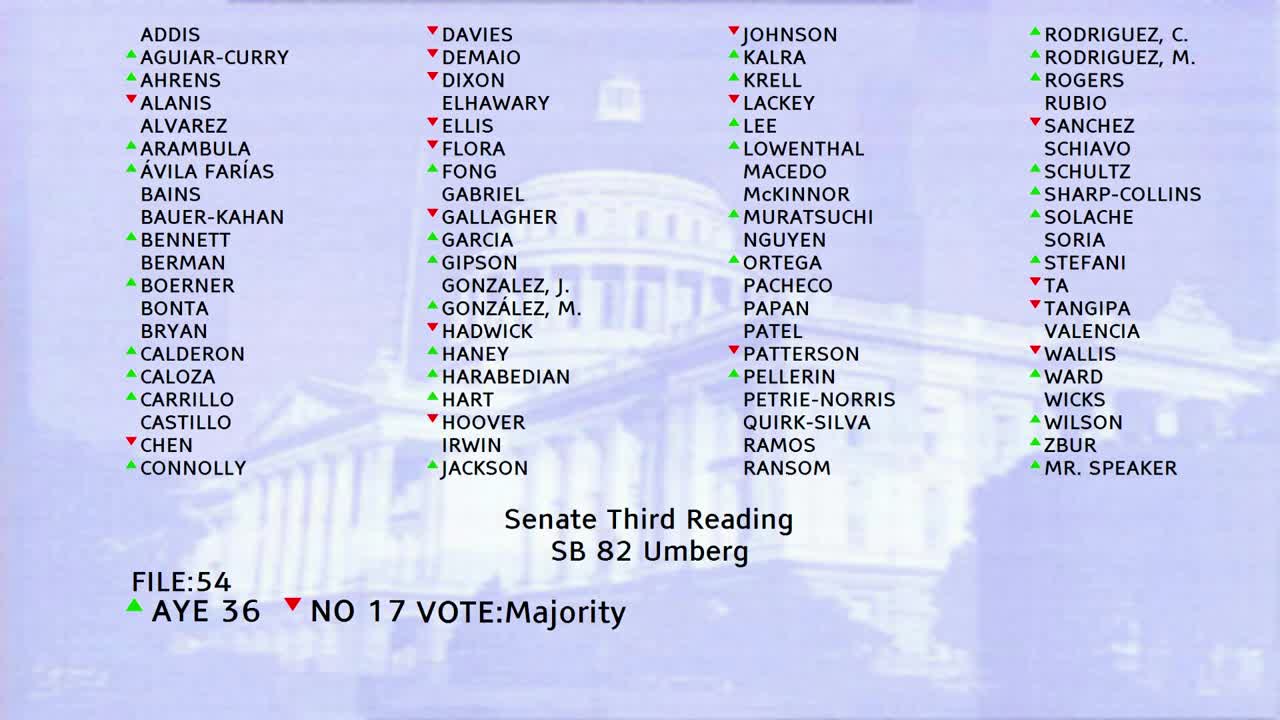
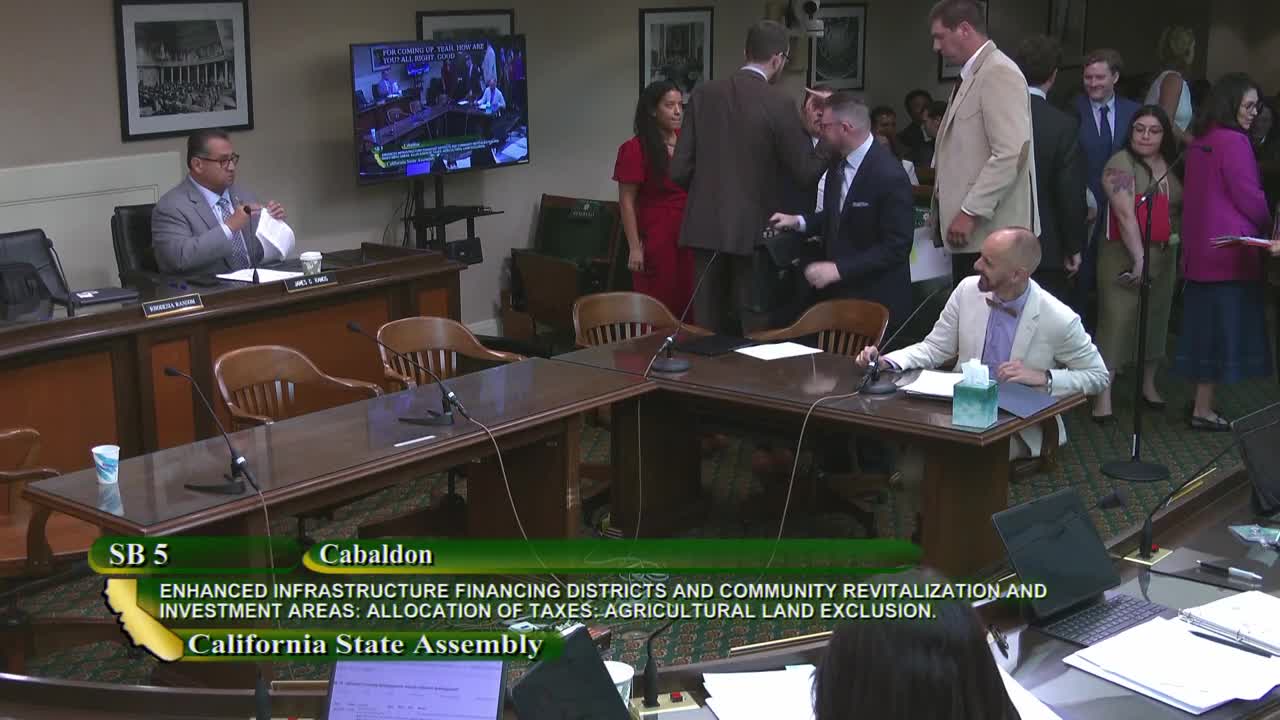

Bill Author

Bill Co-Author(s):