SB 549: Heritage schools: enrollment and notice.
- Session Year: 2025-2026
- House: Senate
- Latest Version Date: 2026-09-30
Current Status:
Passed
(2026-09-30: Chaptered by Secretary of State. Chapter 970, Statutes of 2026.)
Introduced
In Committee
Awaiting First Chamber Vote
Passed First Chamber
In Committee
Awaiting Second Chamber Vote
Passed Second Chamber
Enacted
Under existing law, a heritage school is a school that, among other things, offers education or academic tutoring, or both, in a world language and education on the culture, traditions, or history of a country other than the United States to children who are at least 4 years and 9 months of age and no older than 18 years of age and who attend a public or private full-time day school. Existing law exempts a heritage school from licensure by the State Department of Social Services as a child day care center, as specified.
This bill would expand the definition of heritage school to also include a school that provides services to children younger than 4 years and 9 months of age who are enrolled in kindergarten, including transitional kindergarten, or any of grades 1 to 12, inclusive.
Existing law requires a heritage school, upon a pupils enrollment in a heritage school, to provide a notice to the pupils parent or guardian stating that the heritage school is exempt from childcare licensure and that attendance at a heritage school does not satisfy Californias compulsory education requirements.
This bill would require a heritage school, upon a pupils enrollment in a heritage school, to also provide notice that the State Department of Education has no regulatory authority over heritage schools and does not monitor heritage school operations or instruction.
Under existing law, a heritage school is a school that, among other things, offers world language education or tutoring academic tutoring, or both, in a world language and cultural education relating to on the culture, traditions, or history of a country other than the United States to children who are at least 4 years and 9 months of age and no older than 18 years of age and who attend a public or private full-time day school. Existing law exempts a heritage school from licensure by the State Department of Social Services as a child day care center, as specified.
This bill would expand the definition of heritage school to also include a school that provides services to children younger than 4 years and 9 months of age who are enrolled in kindergarten, including transitional kindergarten, or any of grades 1 to 12, inclusive.
Existing law requires a heritage school, upon a pupils enrollment in a heritage school, to provide a notice to the pupils parent or guardian stating that the heritage school is exempt from childcare licensure and that attendance at a heritage school does not satisfy Californias compulsory education. education requirements.
This bill would require a heritage school, upon a pupils enrollment in a heritage school, to also provide notice that the State Department of Education has no regulatory authority over heritage schools and does not monitor heritage school operations or instruction.
Under existing law, a heritage school is a school that, among other things, offers world language education or tutoring and cultural education relating to a country other than the United States to children who are at least 4 years and 9 months of age and no older than 18 years of age and who attend a public or private full-time day school. Existing law exempts a heritage school from licensure by the State Department of Social Services as a child day care center, as specified.
This bill would expand the definition of heritage school to also include a school that provides services to children younger than 4 years and 9 months of age who are enrolled in kindergarten, including transitional kindergarten, or any of grades 1 to 12, inclusive.
Existing law requires a heritage school, upon a pupils enrollment in a heritage school, to provide a notice to the pupils parent or guardian stating that the heritage school is exempt from childcare licensure and that attendance at a heritage school does not satisfy Californias compulsory education.
This bill would require a heritage school, upon a pupils enrollment in a heritage school, to also provide notice that the State Department of Education has no regulatory authority over heritage schools and does not monitor heritage school operations or instruction.
(1)Existing law authorizes the legislative body of a city or a county, defined to include a city and county, to establish an enhanced infrastructure financing district to finance public capital facilities or other specified projects of communitywide significance, as provided. Existing law provides for the preparation of a proposed infrastructure financing plan, as provided, which takes effect upon adoption by the public financing authority of the district following a specified public hearing and protest procedure. Existing law authorizes the infrastructure financing plan to provide for the division of taxes levied on taxable property in the area included within the district, as specified, and authorizes the public financing authority to issue bonds by adopting a resolution containing specified provisions, including a determination of the amount of tax revenue available or estimated to be available for the payment of the principal of, and interest on, the bonds.Existing law, the Second Neighborhood Infill Finance and Transit Improvements Act, or NIFTI-2, authorizes a city, county, or city and county to adopt a resolution, at any time before or after the adoption of the infrastructure financing plan for an enhanced infrastructure financing district, to allocate tax revenues of that entity to the district, including revenues derived from local sales and use taxes imposed pursuant to the Bradley-Burns Uniform Local Sales and Use Tax Law or transactions and use taxes imposed in accordance with the Transactions and Use Tax Law, if certain conditions are met, including that the boundaries of the enhanced infrastructure financing district are coterminous with the city or county that established the district. This bill would revise NIFTI-2 to instead authorize, for resolutions adopted under that acts provisions on or after January 1, 2026, a city, county, or city and county to adopt a resolution, at any time before or after the adoption of the infrastructure financing plan for an enhanced infrastructure financing district, to allocate property tax revenues, and to remove the authorization for adoption of a resolution that allocates revenues derived from local sales and use taxes imposed pursuant to the Bradley-Burns Uniform Local Sales and Use Tax Law or transactions and use taxes. The bill would also repeal the condition that the boundaries of the enhanced infrastructure financing district are coterminous with the city or county that established the district.(2)Existing law authorizes certain local agencies to establish or form various planning and land use authorities for specified purposes, including, among others, infrastructure, affordable housing, and economic revitalization.This bill would authorize the County of Los Angeles to establish a Resilient Rebuilding Authority for the Los Angeles Wildfires to coordinate, accelerate, and streamline recovery in jurisdictions impacted by the January 2025 wildfires, and would authorize the county to empower the authority to engage in specified acts in order to support the rebuilding and protection of homes, businesses, utilities, and other public infrastructure, as provided.This bill would make legislative findings and declarations as to the necessity of a special statute for the County of Los Angeles.(1)Existing law authorizes the legislative body of a city or a county, defined to include a city and county, to establish an enhanced infrastructure financing district to finance public capital facilities or other specified projects of communitywide significance, as provided. Existing law provides for the preparation of a proposed infrastructure financing plan, as provided, which takes effect upon adoption by the public financing authority of the district following a specified public hearing and protest procedure. Existing law authorizes the infrastructure financing plan to provide for the division of taxes levied on taxable property in the area included within the district, as specified, and authorizes the public financing authority to issue bonds by adopting a resolution containing specified provisions, including a determination of the amount of tax revenue available or estimated to be available for the payment of the principal of, and interest on, the bonds.
Existing law, the Second Neighborhood Infill Finance and Transit Improvements Act, or NIFTI-2, authorizes a city, county, or city and county to adopt a resolution, at any time before or after the adoption of the infrastructure financing plan for an enhanced infrastructure financing district, to allocate tax revenues of that entity to the district, including revenues derived from local sales and use taxes imposed pursuant to the Bradley-Burns Uniform Local Sales and Use Tax Law or transactions and use taxes imposed in accordance with the Transactions and Use Tax Law, if certain conditions are met, including that the boundaries of the enhanced infrastructure financing district are coterminous with the city or county that established the district.
This bill would revise NIFTI-2 to instead authorize, for resolutions adopted under that acts provisions on or after January 1, 2026, a city, county, or city and county to adopt a resolution, at any time before or after the adoption of the infrastructure financing plan for an enhanced infrastructure financing district, to allocate property tax revenues, and to remove the authorization for adoption of a resolution that allocates revenues derived from local sales and use taxes imposed pursuant to the Bradley-Burns Uniform Local Sales and Use Tax Law or transactions and use taxes. The bill would also repeal the condition that the boundaries of the enhanced infrastructure financing district are coterminous with the city or county that established the district.
(2)Existing law authorizes certain local agencies to establish or form various planning and land use authorities for specified purposes, including, among others, infrastructure, affordable housing, and economic revitalization.
This bill would authorize the County of Los Angeles to establish a Resilient Rebuilding Authority for the Los Angeles Wildfires to coordinate, accelerate, and streamline recovery in jurisdictions impacted by the January 2025 wildfires, and would authorize the county to empower the authority to engage in specified acts in order to support the rebuilding and protection of homes, businesses, utilities, and other public infrastructure, as provided.
This bill would make legislative findings and declarations as to the necessity of a special statute for the County of Los Angeles.
Existing law authorizes the legislative body of a city or a county, defined to include a city and county, to establish an enhanced infrastructure financing district to finance public capital facilities or other specified projects of communitywide significance, as provided. Existing law provides for the preparation of a proposed infrastructure financing plan, as provided, which takes effect upon adoption by the public financing authority of the district following a specified public hearing and protest procedure. Existing law authorizes the infrastructure financing plan to provide for the division of taxes levied on taxable property in the area included within the district, as specified, and authorizes the public financing authority to issue bonds by adopting a resolution containing specified provisions, including a determination of the amount of tax revenue available or estimated to be available for the payment of the principal of, and interest on, the bonds.
Existing law, the Second Neighborhood Infill Finance and Transit Improvements Act, or NIFTI-2, authorizes a city, county, or city and county to adopt a resolution, at any time before or after the adoption of the infrastructure financing plan for an enhanced infrastructure financing district, to allocate tax revenues of that entity to the district, including revenues derived from local sales and use taxes imposed pursuant to the Bradley-Burns Uniform Local Sales and Use Tax Law or transactions and use taxes imposed in accordance with the Transactions and Use Tax Law, if certain conditions are met, including that the boundaries of the enhanced infrastructure financing district are coterminous with the city or county that established the district.
This bill would revise NIFTI-2 to instead authorize, for resolutions adopted under that acts provisions on or after January 1, 2026, a city, county, or city and county to adopt a resolution, at any time before or after the adoption of the infrastructure financing plan for an enhanced infrastructure financing district, to allocate property tax revenues, and to remove the authorization for adoption of a resolution that allocates revenues derived from local sales and use taxes imposed pursuant to the Bradley-Burns Uniform Local Sales and Use Tax Law or transactions and use taxes. The bill would also repeal the condition that the boundaries of the enhanced infrastructure financing district are coterminous with the city or county that established the district.
For purposes of this article, heritage school means a school that does all of the following:
(a)Only serves children 18 years of age or younger who attend a public or private full-time day school and who meet either of the following requirements:
(1)Are at least 4 years and 9 months of age.
(2)Are enrolled in kindergarten, including transitional kindergarten, or grades 1 to 12, inclusive.
(b)Specifies regular hours of operation.
(c)Offers education or academic tutoring, or both, in a world language.
(d)Offers education on the culture, traditions, or history of a country other than the United States.
(e)Offers culturally enriching activities, including, but not limited to, art, dancing, games, or singing, based on the culture or customs of a country other than the United States.
(f)Maintains membership in a state or national cultural or language association.
(g)Complies with relevant local government regulations, where applicable.
(h)Does not operate out of a residential home.
(i)Complies with the requirements of Section 33195 and maintains in its possession a copy of the registration form electronically filed with the Education Commissioner. The heritage school shall make this form available upon request, including to the State Department of Social Services, to verify exemption from childcare licensure.
SEC. 2.Section 33195.6 of the Education Code is amended to read:33195.6.(a)A director of a heritage school shall undergo at least 15 hours of health and safety training. The training shall include all of the following components:
(1)Pediatric first aid.
(2)Pediatric cardiopulmonary resuscitation (CPR).
(3)A preventive health practices course or courses that include instruction in the recognition, management, and prevention of infectious diseases, including immunizations, and prevention of childhood injuries.
(4)Training in pediatric first aid and CPR pursuant to paragraphs (1) and (2) shall be provided by a program approved by the American Red Cross, the American Heart Association, or the Emergency Medical Services Authority pursuant to Section 1797.191 of the Health and Safety Code.
(5)Training in preventive health practices pursuant to paragraph (3) shall be provided by a training program approved by the Emergency Medical Services Authority.
(6)In addition to the training programs specified in paragraphs (4) and (5), training programs or courses in pediatric first aid, pediatric CPR, and preventive health practices offered or approved by an accredited postsecondary educational institution are considered to be approved sources of training that may be used to satisfy the training requirements of paragraphs (1) to (3), inclusive.
(7)Persons who, prior to September 23, 2010, have completed a course or courses in preventive health practices as described in paragraph (3), and have a certificate of completion of a course or courses in preventive health practices, or certified copies of transcripts that identify the number of hours and the specific course or courses taken for training in preventive health practices, shall be deemed to have met the training requirement for preventive health practices pursuant to paragraph (3).
(b)All employees and volunteers of a heritage school shall be in good health, as verified by a health screening, including a test for tuberculosis, performed by, or under the supervision of, a licensed physician and surgeon.
(c)Pupils attending heritage schools shall have access to working sinks, toilets, and drinking water.
(d)A pupil attending a heritage school shall not have access to medication or cleaning supplies, except as otherwise provided by law.
(e)A heritage school, as defined in Section 33195.4, shall not be subject to licensure by the State Department of Social Services as a child day care center pursuant to Chapter 3.4 (commencing with Section 1596.70) or Chapter 3.5 (commencing with Section 1596.90) of Division 2 of the Health and Safety Code.
(f)Upon a pupils enrollment in a heritage school, the heritage school shall provide a notice to the pupils parent or guardian stating that the heritage school is exempt from childcare licensure, that attendance at a heritage school does not satisfy Californias compulsory education requirements pursuant to Section 48200, and that the department has no regulatory authority over heritage schools and does not monitor heritage school operations or instruction.
For purposes of this article, heritage school means a school that serves children who are at least 4 years and 9 months of age and no older than 18 years of age, who attend a public or private full-time day school, that does all of the following:
(a)Only serves children 18 years of age or younger who attend a public or private full-time day school and who meet either of the following requirements:
(1)Are at least 4 years and 9 months of age.
(2)Are enrolled in kindergarten, including transitional kindergarten, or grades 1 to 12, inclusive.
(a)(b)Specifies regular hours of operation.
(b)(c)Offers education or academic tutoring, or both, in a world language.
(c)(d)Offers education on the culture, traditions, or history of a country other than the United States.
(d)(e)Offers culturally enriching activities, including, but not limited to, art, dancing, games, or singing, based on the culture or customs of a country other than the United States.
(e)(f)Maintains membership in a state or national cultural or language association.
(f)(g)Complies with relevant local government regulations, where applicable.
(g)(h)Does not operate out of a residential home.
(h)(i)Complies with the requirements of Section 33195 and maintains in its possession a copy of the registration form electronically filed with the Education Commissioner. The heritage school shall make this form available upon request, including to the State Department of Social Services, to verify exemption from child care childcare licensure.
SEC. 2.Section 33195.6 of the Education Code is amended to read:33195.6.(a)A director of a heritage school shall undergo at least 15 hours of health and safety training. The training shall include all of the following components:
(1)Pediatric first aid.
(2)Pediatric cardiopulmonary resuscitation (CPR).
(3)A preventive health practices course or courses that include instruction in the recognition, management, and prevention of infectious diseases, including immunizations, and prevention of childhood injuries.
(4)Training in pediatric first aid and CPR pursuant to paragraphs (1) and (2) shall be provided by a program approved by the American Red Cross, the American Heart Association, or the Emergency Medical Services Authority pursuant to Section 1797.191 of the Health and Safety Code.
(5)Training in preventive health practices pursuant to paragraph (3) shall be provided by a training program approved by the Emergency Medical Services Authority.
(6)In addition to the training programs specified in paragraphs (4) and (5), training programs or courses in pediatric first aid, pediatric CPR, and preventive health practices offered or approved by an accredited postsecondary educational institution are considered to be approved sources of training that may be used to satisfy the training requirements of paragraphs (1) to (3), inclusive.
(7)Persons who, prior to September 23, 2010, have completed a course or courses in preventive health practices as described in paragraph (3), and have a certificate of completion of a course or courses in preventive health practices, or certified copies of transcripts that identify the number of hours and the specific course or courses taken for training in preventive health practices, shall be deemed to have met the training requirement for preventive health practices pursuant to paragraph (3).
(b)All employees and volunteers of a heritage school shall be in good health, as verified by a health screening, including a test for tuberculosis, performed by, or under the supervision of, a licensed physician and surgeon.
(c)Pupils attending heritage schools shall have access to working sinks, toilets, and drinking water.
(d)No A pupil attending a heritage school shall not have access to medication or cleaning supplies, except as otherwise provided by law.
(e)A heritage school, as defined in Section 33195.4, shall not be subject to licensure by the State Department of Social Services as a child day care center pursuant to Chapter 3.4 (commencing with Section 1596.70) or Chapter 3.5 (commencing with Section 1596.90) of Division 2 of the Health and Safety Code.
(f)Upon a pupils enrollment in a heritage school, the heritage school shall provide a notice to the pupils parent or guardian stating that the heritage school is exempt from childcare licensure, that attendance at a heritage school does not satisfy Californias compulsory education requirements pursuant to Section 48200, and that the department has no regulatory authority over heritage schools and does not monitor heritage school operations or instruction.
For purposes of this article, heritage school means a school that serves children who are at least 4 years and 9 months of age and no older than 18 years of age, who attend a public or private full-time day school, that does all of the following:
(a)Only serves children 18 years of age or younger who attend a public or private full-time day school and who meet either of the following requirements:
(1)Are at least 4 years and 9 months of age.
(2)Are enrolled in kindergarten, including transitional kindergarten, or grades 1 to 12, inclusive.
(a)(b)Specifies regular hours of operation.
(b)(c)Offers education or academic tutoring, or both, in a world language.
(c)(d)Offers education on the culture, traditions, or history of a country other than the United States.
(d)(e)Offers culturally enriching activities, including, but not limited to, art, dancing, games, or singing, based on the culture or customs of a country other than the United States.
(e)(f)Maintains membership in a state or national cultural or language association.
(f)(g)Complies with relevant local government regulations, where applicable.
(g)(h)Does not operate out of a residential home.
(h)(i)Complies with the requirements of Section 33195 and maintains in its possession a copy of the registration form electronically filed with the Superintendent. The heritage school shall make this form available upon request, including to the State Department of Social Services, to verify exemption from child care childcare licensure.
SEC. 2.Section 33195.6 of the Education Code is amended to read:33195.6.(a)A director of a heritage school shall undergo at least 15 hours of health and safety training. The training shall include all of the following components:
(1)Pediatric first aid.
(2)Pediatric cardiopulmonary resuscitation (CPR).
(3)A preventive health practices course or courses that include instruction in the recognition, management, and prevention of infectious diseases, including immunizations, and prevention of childhood injuries.
(4)Training in pediatric first aid and CPR pursuant to paragraphs (1) and (2) shall be provided by a program approved by the American Red Cross, the American Heart Association, or the Emergency Medical Services Authority pursuant to Section 1797.191 of the Health and Safety Code.
(5)Training in preventive health practices pursuant to paragraph (3) shall be provided by a training program approved by the Emergency Medical Services Authority.
(6)In addition to the training programs specified in paragraphs (4) and (5), training programs or courses in pediatric first aid, pediatric CPR, and preventive health practices offered or approved by an accredited postsecondary educational institution are considered to be approved sources of training that may be used to satisfy the training requirements of paragraphs (1) to (3), inclusive.
(7)Persons who, prior to the effective date of this section, September 23, 2010, have completed a course or courses in preventive health practices as described in paragraph (3), and have a certificate of completion of a course or courses in preventive health practices, or certified copies of transcripts that identify the number of hours and the specific course or courses taken for training in preventive health practices, shall be deemed to have met the training requirement for preventive health practices pursuant to paragraph (3).
(b)All employees and volunteers of a heritage school shall be in good health, as verified by a health screening, including a test for tuberculosis, performed by, or under the supervision of, a licensed physician and surgeon.
(c)Pupils attending heritage schools shall have access to working sinks, toilets, and drinking water.
(d)No pupil attending a heritage school shall have access to medication or cleaning supplies, except as otherwise provided by law.
(e)A heritage school, as defined in Section 33195.4, shall not be subject to licensure by the State Department of Social Services as a child day care center pursuant to Chapter 3.4 (commencing with Section 1596.70) or Chapter 3.5 (commencing with Section 1596.90) of Division 2 of the Health and Safety Code.
(f)Upon a pupils enrollment in a heritage school, the heritage school shall provide a notice to the pupils parent or guardian stating that the heritage school is exempt from child care childcare licensure, and that attendance at a heritage school does not satisfy Californias compulsory education requirements pursuant to Section 48200. 48200, and that the department has no regulatory authority over heritage schools and does not monitor heritage school operations or instruction.
SECTION 1.Section 53398.75.7 of the Government Code is amended to read:53398.75.7.(a)This section shall be known and may be cited as the Second Neighborhood Infill Finance and Transit Improvements Act, or NIFTI-2.(b)At any time before or after the adoption of the infrastructure financing plan, a city, county, or city and county may adopt a resolution to allocate property tax revenues of that entity to the district, if all of the following apply:(1)The area to be financed with funds received pursuant to this section is within one-half mile of a major transit stop, as defined in Section 21064.3 of the Public Resources Code.(2)The infrastructure financing plan requires that at least 40 percent of the total funds received by the district pursuant to this section be used for the acquisition, construction, or rehabilitation of housing, including the costs of predevelopment and land acquisition, for households with incomes below 60 percent of area median income for rent or purchase. Predevelopment costs include, but are not limited to, site control, engineering studies, architectural plans, application fees, legal services, permits, bonding, and site preparation.(3)The infrastructure financing plan requires that 50 percent of the housing funds are used to develop housing affordable to and occupied by households with incomes below 60 percent and greater than 30 percent of area median income, and 50 percent of the housing funds are used for either housing affordable to and occupied by households with incomes below 30 percent of area median income or permanent supportive housing to help homeless persons get off the street.(4)The infrastructure financing plan gives first priority for occupancy of housing funded through this plan to income-qualified households displaced from the district through no fault of their own, and secondary priority for occupancy of housing funded through this program is given to households with a member or members employed within two miles of the district.(5)The infrastructure financing plan requires that at least 10 percent of the total funds received by the district pursuant to this section be used for investments in the capital costs of parks, urban forestry, or permanent greening improvements along boulevards, streets, or other public areas within a district, or active transportation capital projects that qualify under the Active Transportation Program (Chapter 8 (commencing with Section 2380) of Division 3 of the Streets and Highways Code), including pedestrian or bicycle facilities or supportive infrastructure, including connectivity to transit stations.(c)The remaining funds may be used for any of the following:(1)Multifamily affordable housing projects or mixed-use projects with affordable multifamily housing and ground floor commercial uses that support infill and compact development.(2)Transit capital projects, including transit stations and programs supporting transit ridership, including waterborne transit.(3)Transit-oriented development projects, including affordable housing and infrastructure at or near transit stations or connecting those developments to transit stations.(4)Capital projects that implement local complete streets programs.(5)Parking, including detached and decoupled parking structures that provide parking for residents, businesses, or visitors in lieu of onsite parking for proposed developments. These parking structures should provide no more than one space for each residential unit. The ground floors in these parking structures should provide space for pedestrian-oriented commercial or public uses. Revenues from parking may be used to implement transportation demand management programs to reduce automobile trips to and from the district.(6)Other projects or programs designed to reduce greenhouse gas emissions and other criteria air pollutants by reducing automobile trips and vehicle miles traveled within a community.(d)The infrastructure financing plan shall ensure that the requirements of this section are met every 10 years.(e)(1)Sections 53398.66 and 53398.67 shall not apply to the adoption of an enhanced infrastructure financing plan that includes the allocation of property tax revenues pursuant to this section.(2)(A)The public financing authority shall consider adoption of the enhanced infrastructure financing plan at three public hearings that shall take place at least 30 days apart.(B)At the first public hearing, the public financing authority shall hear all written and oral comments, but take no action.(C)At the second public hearing, the public financing authority shall consider any additional written and oral comments and take action to modify or reject the enhanced infrastructure financing plan. If the enhanced infrastructure financing plan is not rejected at the second public hearing, then the public financing authority shall conduct a protest proceeding at the third public hearing to consider whether the landowners and residents within the enhanced infrastructure financing plan area wish to present oral or written protests against the adoption of the enhanced infrastructure financing plan.(3)The draft enhanced infrastructure financing plan shall be made available to the public and to each landowner within the area at a meeting held at least 30 days prior to the notice given for the first public hearing. The purposes of the meeting shall be to allow the staff of the public financing authority to present the draft enhanced infrastructure financing plan, answer questions about the enhanced infrastructure financing plan, and consider comments about the enhanced infrastructure financing plan.(4)(A)Notice of the meeting required by paragraph (3) and the public hearings required by this paragraph shall be given in accordance with paragraph (11). The notice shall do all of the following, as applicable:(i)Describe specifically the boundaries of the proposed area.(ii)Describe the purpose of the enhanced infrastructure financing plan.(iii)State the day, hour, and place when and where any and all persons having any comments on the proposed enhanced infrastructure financing plan may appear to provide written or oral comments to the enhanced infrastructure financing district.(iv)Notice of the second public hearing shall include a summary of the changes made to the enhanced infrastructure financing plan as a result of the oral and written testimony received at or before the public hearing and shall identify a location accessible to the public where the enhanced infrastructure financing plan proposed to be presented and adopted at the second public hearing can be reviewed.(v)Notice of the third public hearing to consider any written or oral protests shall contain a copy of the enhanced infrastructure financing plan adopted pursuant to paragraph (2), and shall inform the landowner and resident of their right to submit an oral or written protest before the close of the public hearing. The protest may state that the landowner or resident objects to the public financing authority taking action to implement the enhanced infrastructure financing plan.(B)At the third public hearing, the public financing authority shall consider all written and oral protests received prior to the close of the public hearing and shall terminate the proceedings or adopt the enhanced infrastructure financing plan subject to confirmation by the voters at an election called for that purpose. The public financing authority shall terminate the proceedings if there is a majority protest. A majority protest exists if protests have been filed representing over 50 percent of the combined number of landowners and residents in the area who are at least 18 years of age. An election shall be called if between 25 percent and 50 percent of the combined number of landowners and residents in the area who are at least 18 years of age file a protest.(5)An election required pursuant to subparagraph (B) of paragraph (4) shall be held within 90 days of the public hearing and may be held by mail-in ballot. The public financing authority shall adopt, at a duly noticed public hearing, procedures for this election.(6)If a majority of the landowners and residents vote against the enhanced infrastructure financing plan, then the public financing authority shall not take any further action to implement the proposed enhanced infrastructure financing plan. The public financing authority shall not propose a new or revised enhanced infrastructure financing plan to the affected landowners and residents for at least one year following the date of an election in which the enhanced infrastructure financing plan was rejected.(7)At the hour set in the notice required by paragraph (2), the public financing authority shall consider all written and oral comments.(8)If less than 25 percent of the combined number of landowners and residents in the area who are at least 18 years of age file a protest, the public financing authority may adopt the enhanced infrastructure financing plan at the conclusion of the third public hearing by ordinance. The ordinance adopting the enhanced infrastructure financing plan shall be subject to referendum as prescribed by law.(9)For the purposes of this chapter, the enhanced infrastructure financing plan shall be the enhanced infrastructure financing plan adopted pursuant to this section.(10)The public financing authority shall consider and adopt an amendment or amendments to an enhanced infrastructure financing plan in accordance with the provisions of this section.(11)The public financing authority shall post notice of each meeting or public hearing required by this section in an easily identifiable and accessible location on the enhanced infrastructure financing districts internet website and shall mail a written notice of the meeting or public hearing to each landowner, each resident, and each taxing entity at least 10 days prior to the meeting or public hearing.(A)Notice of the first public hearing shall also be published not less than once a week for four successive weeks prior to the first public hearing in a newspaper of general circulation published in the county in which the area lies. The notice shall state that the district will be used to finance public facilities or development, briefly describe the public facilities or development, briefly describe the proposed financial arrangements, including the proposed commitment of incremental property tax revenue, describe the boundaries of the proposed district, and state the day, hour, and place when and where any persons having any objections to the proposed infrastructure financing plan, or the regularity of any of the prior proceedings, may appear before the public financing authority and object to the adoption of the proposed plan by the public financing authority.(B)Notice of the second public hearing shall also be published not less than 10 days prior to the second public hearing in a newspaper of general circulation in the county in which the area lies. The notice shall state that the district will be used to finance public facilities or development, briefly describe the public facilities or development, briefly describe the proposed financial arrangements, including the proposed commitment of incremental property tax revenue, describe the boundaries of the proposed district, and state the day, hour, and place when and where any persons having any objections to the proposed infrastructure financing plan, or the regularity of any of the prior proceedings, may appear before the public financing authority and object to the adoption of the proposed plan by the public financing authority.(C)Notice of the third public hearing shall also be published not less than 10 days prior to the third public hearing in a newspaper of general circulation in the county in which the area lies. The notice shall state that the district will be used to finance public facilities or development, briefly describe the public facilities or development, briefly describe the proposed financial arrangements, including the proposed commitment of incremental property tax revenue, describe the boundaries of the proposed district, and state the day, hour, and place when and where any persons having any objections to the proposed infrastructure financing plan, or the regularity of any of the prior proceedings, may appear before the public financing authority and object to the adoption of the proposed plan by the public financing authority.(f)(1)The public financing authority shall review the enhanced infrastructure financing plan at least annually and make any amendments that are necessary and appropriate in accordance with the procedures set forth in paragraph (5) and shall require the preparation of an annual independent financial audit paid for from revenues of the enhanced infrastructure financing district.(2)A public financing authority shall adopt an annual report on or before June 30 of each year after holding a public hearing. Written copies of the draft report shall be made available to the public 30 days prior to the public hearing. The public financing authority shall cause the draft report to be posted in an easily identifiable and accessible location on the enhanced infrastructure financing districts internet website and shall mail a written notice of the availability of the draft report on the internet website to each owner of land and each resident within the area covered by the enhanced infrastructure financing plan and to each taxing entity that has adopted a resolution pursuant to Section 53398.68. The notice shall be mailed by first-class mail, but may be addressed to occupant.(3)The annual report shall contain all of the following:(A)A description of the projects undertaken in the fiscal year, including any rehabilitation of structures, and a comparison of the progress expected to be made on those projects compared to the actual progress.(B)A chart comparing the actual revenues and expenses, including administrative costs, of the public financing authority to the budgeted revenues and expenses.(C)The amount of property tax increment revenues received.(D)The amount of revenues expended for housing meeting the requirements of this section.(E)An assessment of the status regarding completion of the enhanced infrastructure financing districts projects.(F)The amount of revenues expended to assist private businesses.(4)If the public financing authority fails to provide the annual report required by paragraph (1), the public financing authority shall not spend any funds received pursuant to a resolution adopted pursuant to this section until the public financing authority has provided the report.(5)Every 10 years, at the public hearing held pursuant to paragraph (2), the public financing authority shall conduct a protest proceeding to consider whether the landowners and residents within the enhanced infrastructure financing district wish to present oral or written protests against the enhanced infrastructure financing district. Notice of this protest proceeding shall be included in the written notice of the hearing on the annual report and shall inform the landowner and resident of their right to submit an oral or written protest before the close of the public hearing. The protest may state that the landowner or resident objects to the public financing authority taking action to implement the enhanced infrastructure financing plan on and after the date of the election described in paragraph (6). The public financing authority shall consider all written and oral protests received prior to the close of the public hearing.(6)If there is a majority protest, the public financing authority shall not take any further action to implement the enhanced infrastructure financing plan on and after the date the existence of a majority protest is determined. If between 25 percent and 50 percent of the landowners and residents file protests, then the public financing authority shall call an election of the landowners and residents in the area covered by the enhanced infrastructure financing plan, and shall not initiate or authorize any new projects until the election is held. A majority protest exists if protests have been filed representing over 50 percent of the combined number of landowners and residents at least 18 years of age or older in the area.(7)An election required pursuant to paragraph (6) shall be held within 90 days of the public hearing and may be held by mail-in ballot. The public financing authority shall adopt, at a duly noticed public hearing, procedures for holding this election.(8)If a majority of the landowners and residents vote against the enhanced infrastructure financing plan, then the public financing authority shall not take any further action to implement the enhanced infrastructure financing plan on and after the date of the election held pursuant to paragraph (5). This subdivision shall not prevent the public financing authority from taking any and all actions and appropriating and expending funds, including, but not limited to, any and all payments on bonded or contractual indebtedness, to carry out and complete projects for which expenditures of any kind had been made prior to the date of the election.(g)Notwithstanding Section 53398.52, revenues collected and allocated for the purposes of this section shall not be used for highway or highway interchange improvements.(h)The district shall require, by recorded covenants or restrictions, that affordable housing units financed pursuant to this section remain permanently available at affordable housing costs to, and occupied by, very low income households, persons and families of low income, or persons and families of low or moderate income for the longest feasible time, but for not less than 55 years for rental units and 45 years for owner-occupied units.(i)A legislative body shall not adopt an ordinance terminating an enhanced infrastructure financing district created pursuant to this section if the district has not complied with its affordable housing obligations.(j)Notwithstanding Article 4 (commencing with Section 53398.77), bonds issued by a district pursuant to this section may be issued without voter approval.(k)Paragraph (1) of subdivision (c) of Section 1720 of the Labor Code shall not apply to projects financed by the enhanced infrastructure financing district.(l)The changes made to this section by the act adding this subdivision shall apply to resolutions adopted on or after January 1, 2026.SEC. 2.Division 9 (commencing with Section 62470) is added to Title 6 of the Government Code, to read:9.Resilient Rebuilding Authority for the Los Angeles Wildfires62470.The County of Los Angeles may establish a Resilient Rebuilding Authority for the Los Angeles Wildfires to coordinate, accelerate, and streamline recovery in all jurisdictions impacted by the January 2025 wildfires.62470.1.The County of Los Angeles, in order to support the rebuilding and protection of homes, businesses, utilities, and other public infrastructure, may empower the authority, to the extent permitted by existing law, to engage in all of the following responsibilities:(a)Issue, receive, and administer funds, including, but not limited to, tax-increment financing, federal loans and grants, state loans and grants, and philanthropic grants, to support recovery.(b)Manage and coordinate rebuilding and related logistics between public and private reconstruction, including, but not limited to, private contractors, public and private utilities, and local governments.(c)Purchase lots at a fair price for land banking with first look sale options provided to returning residents and their families, and to create community amenities such as open space that promotes community-scale resiliency and insurability.(d)Work with builders to reconstruct properties designed and built to resilient construction standards, and that prioritize strategies for accelerated and cost-effective rebuilding.(e)Create economies of scale for acquiring equipment and materials to cost-effectively purchase critical construction materials in bulk.(f)Support the reconstruction workforce by partnering with trades, facilitating training and workforce development, and creating temporary workforce housing.(g)Enhance financing options for families and businesses that cannot afford to rebuild by deploying subsidized financing and grants in partnership with private lenders, community development finance institutions, private philanthropy, and nonprofit organizations.(h)Facilitate reconstruction of lost rental housing stock, including by promotion of accessory dwelling units, senior-serving housing, and replacement of affordable housing lost in the fires.(i)Carry out other activities that enhance neighborhood and property insurability and affordability, and promote a resilient and sustainable recovery.(j)Provide a meaningful mechanism for community engagement.SEC. 3.The Legislature finds and declares, with respect to Section 2 of this act, that a special statute is necessary and that a general statute cannot be made applicable within the meaning of Section 16 of Article IV of the California Constitution because of the unique circumstances facing the County of Los Angeles due to the wildfires of January 2025.(a)This section shall be known and may be cited as the Second Neighborhood Infill Finance and Transit Improvements Act, or NIFTI-2.
(b)At any time before or after the adoption of the infrastructure financing plan, a city, county, or city and county may adopt a resolution to allocate property tax revenues of that entity to the district, if all of the following apply:
(1)The area to be financed with funds received pursuant to this section is within one-half mile of a major transit stop, as defined in Section 21064.3 of the Public Resources Code.
(2)The infrastructure financing plan requires that at least 40 percent of the total funds received by the district pursuant to this section be used for the acquisition, construction, or rehabilitation of housing, including the costs of predevelopment and land acquisition, for households with incomes below 60 percent of area median income for rent or purchase. Predevelopment costs include, but are not limited to, site control, engineering studies, architectural plans, application fees, legal services, permits, bonding, and site preparation.
(3)The infrastructure financing plan requires that 50 percent of the housing funds are used to develop housing affordable to and occupied by households with incomes below 60 percent and greater than 30 percent of area median income, and 50 percent of the housing funds are used for either housing affordable to and occupied by households with incomes below 30 percent of area median income or permanent supportive housing to help homeless persons get off the street.
(4)The infrastructure financing plan gives first priority for occupancy of housing funded through this plan to income-qualified households displaced from the district through no fault of their own, and secondary priority for occupancy of housing funded through this program is given to households with a member or members employed within two miles of the district.
(5)The infrastructure financing plan requires that at least 10 percent of the total funds received by the district pursuant to this section be used for investments in the capital costs of parks, urban forestry, or permanent greening improvements along boulevards, streets, or other public areas within a district, or active transportation capital projects that qualify under the Active Transportation Program (Chapter 8 (commencing with Section 2380) of Division 3 of the Streets and Highways Code), including pedestrian or bicycle facilities or supportive infrastructure, including connectivity to transit stations.
(c)The remaining funds may be used for any of the following:
(1)Multifamily affordable housing projects or mixed-use projects with affordable multifamily housing and ground floor commercial uses that support infill and compact development.
(2)Transit capital projects, including transit stations and programs supporting transit ridership, including waterborne transit.
(3)Transit-oriented development projects, including affordable housing and infrastructure at or near transit stations or connecting those developments to transit stations.
(4)Capital projects that implement local complete streets programs.
(5)Parking, including detached and decoupled parking structures that provide parking for residents, businesses, or visitors in lieu of onsite parking for proposed developments. These parking structures should provide no more than one space for each residential unit. The ground floors in these parking structures should provide space for pedestrian-oriented commercial or public uses. Revenues from parking may be used to implement transportation demand management programs to reduce automobile trips to and from the district.
(6)Other projects or programs designed to reduce greenhouse gas emissions and other criteria air pollutants by reducing automobile trips and vehicle miles traveled within a community.
(d)The infrastructure financing plan shall ensure that the requirements of this section are met every 10 years.
(e)(1)Sections 53398.66 and 53398.67 shall not apply to the adoption of an enhanced infrastructure financing plan that includes the allocation of property tax revenues pursuant to this section.
(2)(A)The public financing authority shall consider adoption of the enhanced infrastructure financing plan at three public hearings that shall take place at least 30 days apart.
(B)At the first public hearing, the public financing authority shall hear all written and oral comments, but take no action.
(C)At the second public hearing, the public financing authority shall consider any additional written and oral comments and take action to modify or reject the enhanced infrastructure financing plan. If the enhanced infrastructure financing plan is not rejected at the second public hearing, then the public financing authority shall conduct a protest proceeding at the third public hearing to consider whether the landowners and residents within the enhanced infrastructure financing plan area wish to present oral or written protests against the adoption of the enhanced infrastructure financing plan.
(3)The draft enhanced infrastructure financing plan shall be made available to the public and to each landowner within the area at a meeting held at least 30 days prior to the notice given for the first public hearing. The purposes of the meeting shall be to allow the staff of the public financing authority to present the draft enhanced infrastructure financing plan, answer questions about the enhanced infrastructure financing plan, and consider comments about the enhanced infrastructure financing plan.
(4)(A)Notice of the meeting required by paragraph (3) and the public hearings required by this paragraph shall be given in accordance with paragraph (11). The notice shall do all of the following, as applicable:
(i)Describe specifically the boundaries of the proposed area.
(ii)Describe the purpose of the enhanced infrastructure financing plan.
(iii)State the day, hour, and place when and where any and all persons having any comments on the proposed enhanced infrastructure financing plan may appear to provide written or oral comments to the enhanced infrastructure financing district.
(iv)Notice of the second public hearing shall include a summary of the changes made to the enhanced infrastructure financing plan as a result of the oral and written testimony received at or before the public hearing and shall identify a location accessible to the public where the enhanced infrastructure financing plan proposed to be presented and adopted at the second public hearing can be reviewed.
(v)Notice of the third public hearing to consider any written or oral protests shall contain a copy of the enhanced infrastructure financing plan adopted pursuant to paragraph (2), and shall inform the landowner and resident of their right to submit an oral or written protest before the close of the public hearing. The protest may state that the landowner or resident objects to the public financing authority taking action to implement the enhanced infrastructure financing plan.
(B)At the third public hearing, the public financing authority shall consider all written and oral protests received prior to the close of the public hearing and shall terminate the proceedings or adopt the enhanced infrastructure financing plan subject to confirmation by the voters at an election called for that purpose. The public financing authority shall terminate the proceedings if there is a majority protest. A majority protest exists if protests have been filed representing over 50 percent of the combined number of landowners and residents in the area who are at least 18 years of age. An election shall be called if between 25 percent and 50 percent of the combined number of landowners and residents in the area who are at least 18 years of age file a protest.
(5)An election required pursuant to subparagraph (B) of paragraph (4) shall be held within 90 days of the public hearing and may be held by mail-in ballot. The public financing authority shall adopt, at a duly noticed public hearing, procedures for this election.
(6)If a majority of the landowners and residents vote against the enhanced infrastructure financing plan, then the public financing authority shall not take any further action to implement the proposed enhanced infrastructure financing plan. The public financing authority shall not propose a new or revised enhanced infrastructure financing plan to the affected landowners and residents for at least one year following the date of an election in which the enhanced infrastructure financing plan was rejected.
(7)At the hour set in the notice required by paragraph (2), the public financing authority shall consider all written and oral comments.
(8)If less than 25 percent of the combined number of landowners and residents in the area who are at least 18 years of age file a protest, the public financing authority may adopt the enhanced infrastructure financing plan at the conclusion of the third public hearing by ordinance. The ordinance adopting the enhanced infrastructure financing plan shall be subject to referendum as prescribed by law.
(9)For the purposes of this chapter, the enhanced infrastructure financing plan shall be the enhanced infrastructure financing plan adopted pursuant to this section.
(10)The public financing authority shall consider and adopt an amendment or amendments to an enhanced infrastructure financing plan in accordance with the provisions of this section.
(11)The public financing authority shall post notice of each meeting or public hearing required by this section in an easily identifiable and accessible location on the enhanced infrastructure financing districts internet website and shall mail a written notice of the meeting or public hearing to each landowner, each resident, and each taxing entity at least 10 days prior to the meeting or public hearing.
(A)Notice of the first public hearing shall also be published not less than once a week for four successive weeks prior to the first public hearing in a newspaper of general circulation published in the county in which the area lies. The notice shall state that the district will be used to finance public facilities or development, briefly describe the public facilities or development, briefly describe the proposed financial arrangements, including the proposed commitment of incremental property tax revenue, describe the boundaries of the proposed district, and state the day, hour, and place when and where any persons having any objections to the proposed infrastructure financing plan, or the regularity of any of the prior proceedings, may appear before the public financing authority and object to the adoption of the proposed plan by the public financing authority.
(B)Notice of the second public hearing shall also be published not less than 10 days prior to the second public hearing in a newspaper of general circulation in the county in which the area lies. The notice shall state that the district will be used to finance public facilities or development, briefly describe the public facilities or development, briefly describe the proposed financial arrangements, including the proposed commitment of incremental property tax revenue, describe the boundaries of the proposed district, and state the day, hour, and place when and where any persons having any objections to the proposed infrastructure financing plan, or the regularity of any of the prior proceedings, may appear before the public financing authority and object to the adoption of the proposed plan by the public financing authority.
(C)Notice of the third public hearing shall also be published not less than 10 days prior to the third public hearing in a newspaper of general circulation in the county in which the area lies. The notice shall state that the district will be used to finance public facilities or development, briefly describe the public facilities or development, briefly describe the proposed financial arrangements, including the proposed commitment of incremental property tax revenue, describe the boundaries of the proposed district, and state the day, hour, and place when and where any persons having any objections to the proposed infrastructure financing plan, or the regularity of any of the prior proceedings, may appear before the public financing authority and object to the adoption of the proposed plan by the public financing authority.
(f)(1)The public financing authority shall review the enhanced infrastructure financing plan at least annually and make any amendments that are necessary and appropriate in accordance with the procedures set forth in paragraph (5) and shall require the preparation of an annual independent financial audit paid for from revenues of the enhanced infrastructure financing district.
(2)A public financing authority shall adopt an annual report on or before June 30 of each year after holding a public hearing. Written copies of the draft report shall be made available to the public 30 days prior to the public hearing. The public financing authority shall cause the draft report to be posted in an easily identifiable and accessible location on the enhanced infrastructure financing districts internet website and shall mail a written notice of the availability of the draft report on the internet website to each owner of land and each resident within the area covered by the enhanced infrastructure financing plan and to each taxing entity that has adopted a resolution pursuant to Section 53398.68. The notice shall be mailed by first-class mail, but may be addressed to occupant.
(3)The annual report shall contain all of the following:
(A)A description of the projects undertaken in the fiscal year, including any rehabilitation of structures, and a comparison of the progress expected to be made on those projects compared to the actual progress.
(B)A chart comparing the actual revenues and expenses, including administrative costs, of the public financing authority to the budgeted revenues and expenses.
(C)The amount of property tax increment revenues received.
(D)The amount of revenues expended for housing meeting the requirements of this section.
(E)An assessment of the status regarding completion of the enhanced infrastructure financing districts projects.
(F)The amount of revenues expended to assist private businesses.
(4)If the public financing authority fails to provide the annual report required by paragraph (1), the public financing authority shall not spend any funds received pursuant to a resolution adopted pursuant to this section until the public financing authority has provided the report.
(5)Every 10 years, at the public hearing held pursuant to paragraph (2), the public financing authority shall conduct a protest proceeding to consider whether the landowners and residents within the enhanced infrastructure financing district wish to present oral or written protests against the enhanced infrastructure financing district. Notice of this protest proceeding shall be included in the written notice of the hearing on the annual report and shall inform the landowner and resident of their right to submit an oral or written protest before the close of the public hearing. The protest may state that the landowner or resident objects to the public financing authority taking action to implement the enhanced infrastructure financing plan on and after the date of the election described in paragraph (6). The public financing authority shall consider all written and oral protests received prior to the close of the public hearing.
(6)If there is a majority protest, the public financing authority shall not take any further action to implement the enhanced infrastructure financing plan on and after the date the existence of a majority protest is determined. If between 25 percent and 50 percent of the landowners and residents file protests, then the public financing authority shall call an election of the landowners and residents in the area covered by the enhanced infrastructure financing plan, and shall not initiate or authorize any new projects until the election is held. A majority protest exists if protests have been filed representing over 50 percent of the combined number of landowners and residents at least 18 years of age or older in the area.
(7)An election required pursuant to paragraph (6) shall be held within 90 days of the public hearing and may be held by mail-in ballot. The public financing authority shall adopt, at a duly noticed public hearing, procedures for holding this election.
(8)If a majority of the landowners and residents vote against the enhanced infrastructure financing plan, then the public financing authority shall not take any further action to implement the enhanced infrastructure financing plan on and after the date of the election held pursuant to paragraph (5). This subdivision shall not prevent the public financing authority from taking any and all actions and appropriating and expending funds, including, but not limited to, any and all payments on bonded or contractual indebtedness, to carry out and complete projects for which expenditures of any kind had been made prior to the date of the election.
(g)Notwithstanding Section 53398.52, revenues collected and allocated for the purposes of this section shall not be used for highway or highway interchange improvements.
(h)The district shall require, by recorded covenants or restrictions, that affordable housing units financed pursuant to this section remain permanently available at affordable housing costs to, and occupied by, very low income households, persons and families of low income, or persons and families of low or moderate income for the longest feasible time, but for not less than 55 years for rental units and 45 years for owner-occupied units.
(i)A legislative body shall not adopt an ordinance terminating an enhanced infrastructure financing district created pursuant to this section if the district has not complied with its affordable housing obligations.
(j)Notwithstanding Article 4 (commencing with Section 53398.77), bonds issued by a district pursuant to this section may be issued without voter approval.
(k)Paragraph (1) of subdivision (c) of Section 1720 of the Labor Code shall not apply to projects financed by the enhanced infrastructure financing district.
(l)The changes made to this section by the act adding this subdivision shall apply to resolutions adopted on or after January 1, 2026.
SEC. 2.Division 9 (commencing with Section 62470) is added to Title 6 of the Government Code, to read:9.Resilient Rebuilding Authority for the Los Angeles Wildfires62470.The County of Los Angeles may establish a Resilient Rebuilding Authority for the Los Angeles Wildfires to coordinate, accelerate, and streamline recovery in all jurisdictions impacted by the January 2025 wildfires.
62470.1.The County of Los Angeles, in order to support the rebuilding and protection of homes, businesses, utilities, and other public infrastructure, may empower the authority, to the extent permitted by existing law, to engage in all of the following responsibilities:
(a)Issue, receive, and administer funds, including, but not limited to, tax-increment financing, federal loans and grants, state loans and grants, and philanthropic grants, to support recovery.
(b)Manage and coordinate rebuilding and related logistics between public and private reconstruction, including, but not limited to, private contractors, public and private utilities, and local governments.
(c)Purchase lots at a fair price for land banking with first look sale options provided to returning residents and their families, and to create community amenities such as open space that promotes community-scale resiliency and insurability.
(d)Work with builders to reconstruct properties designed and built to resilient construction standards, and that prioritize strategies for accelerated and cost-effective rebuilding.
(e)Create economies of scale for acquiring equipment and materials to cost-effectively purchase critical construction materials in bulk.
(f)Support the reconstruction workforce by partnering with trades, facilitating training and workforce development, and creating temporary workforce housing.
(g)Enhance financing options for families and businesses that cannot afford to rebuild by deploying subsidized financing and grants in partnership with private lenders, community development finance institutions, private philanthropy, and nonprofit organizations.
(h)Facilitate reconstruction of lost rental housing stock, including by promotion of accessory dwelling units, senior-serving housing, and replacement of affordable housing lost in the fires.
(i)Carry out other activities that enhance neighborhood and property insurability and affordability, and promote a resilient and sustainable recovery.
(j)Provide a meaningful mechanism for community engagement.
SEC. 3.The Legislature finds and declares, with respect to Section 2 of this act, that a special statute is necessary and that a general statute cannot be made applicable within the meaning of Section 16 of Article IV of the California Constitution because of the unique circumstances facing the County of Los Angeles due to the wildfires of January 2025.
(a)This section shall be known and may be cited as the Second Neighborhood Infill Finance and Transit Improvements Act, or NIFTI-2.
(b)(1)At any time before or after the adoption of the infrastructure financing plan, a city, county, or city and county may adopt a resolution to allocate property tax revenues of that entity to the district, including revenues derived from local sales and use taxes imposed pursuant to the Bradley-Burns Uniform Local Sales and Use Tax Law (Part 1.5 (commencing with Section 7200) of Division 2 of the Revenue and Taxation Code), or transactions and use taxes imposed in accordance with the Transactions and Use Tax Law (Part 1.6 (commencing with Section 7251) of Division 2 of the Revenue and Taxation Code), if all of the following apply:
(A)(1)The area to be financed with funds received pursuant to this section is within one-half mile of a major transit stop, as defined in Section 21064.3 of the Public Resources Code.
(B)(2)The infrastructure financing plan requires that at least 40 percent of the total funds received by the district pursuant to this section be used for the acquisition, construction, or rehabilitation of housing, including the costs of predevelopment and land acquisition, for households with incomes below 60 percent of area median income for rent or purchase. Predevelopment costs include, but are not limited to, site control, engineering studies, architectural plans, application fees, legal services, permits, bonding, and site preparation.
(C)(3)The infrastructure financing plan requires that 50 percent of the housing funds are used to develop housing affordable to and occupied by households with incomes below 60 percent and greater than 30 percent of area median income, and 50 percent of the housing funds are used for either housing affordable to and occupied by households with incomes below 30 percent of area median income or permanent supportive housing to help homeless persons get off the street.
(D)(4)The infrastructure financing plan gives first priority for occupancy of housing funded through this plan to income-qualified households displaced from the district through no fault of their own, and secondary priority for occupancy of housing funded through this program is given to households with a member or members employed within two miles of the district.
(E)(5)The infrastructure financing plan requires that at least 10 percent of the total funds received by the district pursuant to this section be used for investments in the capital costs of parks, urban forestry, or permanent greening improvements along boulevards, streets, or other public areas within a district, or active transportation capital projects that qualify under the Active Transportation Program (Chapter 8 (commencing with Section 2380) of Division 3 of the Streets and Highways Code), including pedestrian or bicycle facilities or supportive infrastructure, including connectivity to transit stations.
(F)The boundaries of the enhanced infrastructure financing district are coterminous with the city or county that established the district.(G)The use of the revenues derived from the local sales and use taxes imposed under the Bradley-Burns Uniform Local Sales and Use Tax Law (Part 1.5 (commencing with Section 7200) of Division 2 of the Revenue and Taxation Code) or transactions and use taxes imposed in accordance with the Transactions and Use Tax Law (Part 1.6 (commencing with Section 7251) of Division 2 of the Revenue and Taxation Code) pursuant to the infrastructure financing plan is consistent with the purposes for which that tax is imposed.(H)If the infrastructure financing plan proposes to allocate tax revenues of that entity to the district that are derived from the local sales and use taxes imposed pursuant to the Bradley-Burns Uniform Local Sales and Use Tax Law (Part 1.5 (commencing with Section 7200) of Division 2 of the Revenue and Taxation Code), the city, county, or city and county has received the consent of any impacted transportation agency that receives tax revenues derived from that any tax adopted pursuant to that law, and has ensured that existing or planned transportation operations and capital projects will not be negatively impacted.(2)This section does not authorize a city, county, or city and county to allocate all, or a portion of any sales and use taxes imposed pursuant to the Bradley-Burns Uniform Local Sales and Use Tax Law (Part 1.5 (commencing with Section 7200) of Division 2 of the Revenue and Taxation Code) or transactions and use taxes imposed in accordance with the Transactions and Use Tax Law (Part 1.6 (commencing with Section 7251) of Division 2 of the Revenue and Taxation Code), that was approved by the voters for a special purpose not related to the purposes in paragraph (1).(c)The remaining funds may be used for any of the following:
(1)Multifamily affordable housing projects or mixed-use projects with affordable multifamily housing and ground floor commercial uses that support infill and compact development.
(2)Transit capital projects, including transit stations and programs supporting transit ridership, including waterborne transit.
(3)Transit-oriented development projects, including affordable housing and infrastructure at or near transit stations or connecting those developments to transit stations.
(4)Capital projects that implement local complete streets programs.
(5)Parking, including detached and decoupled parking structures that provide parking for residents, businesses, or visitors in lieu of onsite parking for proposed developments. These parking structures should provide no more than one space for each residential unit. The ground floors in these parking structures should provide space for pedestrian-oriented commercial or public uses. Revenues from parking may be used to implement transportation demand management programs to reduce automobile trips to and from the district.
(6)Other projects or programs designed to reduce greenhouse gas emissions and other criteria air pollutants by reducing automobile trips and vehicle miles traveled within a community.
(d)The infrastructure financing plan shall ensure that the requirements of this section are met every 10 years.
(e)(1)Sections 53398.66 and 53398.67 shall not apply to the adoption of an enhanced infrastructure financing plan that includes the allocation of property tax revenues pursuant to this section.
(2)(A)The public financing authority shall consider adoption of the enhanced infrastructure financing plan at three public hearings that shall take place at least 30 days apart.
(B)At the first public hearing, the public financing authority shall hear all written and oral comments, but take no action.
(C)At the second public hearing, the public financing authority shall consider any additional written and oral comments and take action to modify or reject the enhanced infrastructure financing plan. If the enhanced infrastructure financing plan is not rejected at the second public hearing, then the public financing authority shall conduct a protest proceeding at the third public hearing to consider whether the landowners and residents within the enhanced infrastructure financing plan area wish to present oral or written protests against the adoption of the enhanced infrastructure financing plan.
(3)The draft enhanced infrastructure financing plan shall be made available to the public and to each landowner within the area at a meeting held at least 30 days prior to the notice given for the first public hearing. The purposes of the meeting shall be to allow the staff of the public financing authority to present the draft enhanced infrastructure financing plan, answer questions about the enhanced infrastructure financing plan, and consider comments about the enhanced infrastructure financing plan.
(4)(A)Notice of the meeting required by paragraph (3) and the public hearings required by this paragraph shall be given in accordance with paragraph (11). The notice shall do all of the following, as applicable:
(i)Describe specifically the boundaries of the proposed area.
(ii)Describe the purpose of the enhanced infrastructure financing plan.
(iii)State the day, hour, and place when and where any and all persons having any comments on the proposed enhanced infrastructure financing plan may appear to provide written or oral comments to the enhanced infrastructure financing district.
(iv)Notice of the second public hearing shall include a summary of the changes made to the enhanced infrastructure financing plan as a result of the oral and written testimony received at or before the public hearing and shall identify a location accessible to the public where the enhanced infrastructure financing plan proposed to be presented and adopted at the second public hearing can be reviewed.
(v)Notice of the third public hearing to consider any written or oral protests shall contain a copy of the enhanced infrastructure financing plan adopted pursuant to paragraph (2), and shall inform the landowner and resident of his or her their right to submit an oral or written protest before the close of the public hearing. The protest may state that the landowner or resident objects to the public financing authority taking action to implement the enhanced infrastructure financing plan.
(B)At the third public hearing, the public financing authority shall consider all written and oral protests received prior to the close of the public hearing and shall terminate the proceedings or adopt the enhanced infrastructure financing plan subject to confirmation by the voters at an election called for that purpose. The public financing authority shall terminate the proceedings if there is a majority protest. A majority protest exists if protests have been filed representing over 50 percent of the combined number of landowners and residents in the area who are at least 18 years of age. An election shall be called if between 25 percent and 50 percent of the combined number of landowners and residents in the area who are at least 18 years of age file a protest.
(5)An election required pursuant to subparagraph (B) of paragraph (4) shall be held within 90 days of the public hearing and may be held by mail-in ballot. The public financing authority shall adopt, at a duly noticed public hearing, procedures for this election.
(6)If a majority of the landowners and residents vote against the enhanced infrastructure financing plan, then the public financing authority shall not take any further action to implement the proposed enhanced infrastructure financing plan. The public financing authority shall not propose a new or revised enhanced infrastructure financing plan to the affected landowners and residents for at least one year following the date of an election in which the enhanced infrastructure financing plan was rejected.
(7)At the hour set in the notice required by paragraph (2), the public financing authority shall consider all written and oral comments.
(8)If less than 25 percent of the combined number of landowners and residents in the area who are at least 18 years of age file a protest, the public financing authority may adopt the enhanced infrastructure financing plan at the conclusion of the third public hearing by ordinance. The ordinance adopting the enhanced infrastructure financing plan shall be subject to referendum as prescribed by law.
(9)For the purposes of this chapter, the enhanced infrastructure financing plan shall be the enhanced infrastructure financing plan adopted pursuant to this section.
(10)The public financing authority shall consider and adopt an amendment or amendments to an enhanced infrastructure financing plan in accordance with the provisions of this section.
(11)The public financing authority shall post notice of each meeting or public hearing required by this section in an easily identifiable and accessible location on the enhanced infrastructure financing districts Internet Web site internet website and shall mail a written notice of the meeting or public hearing to each landowner, each resident, and each taxing entity at least 10 days prior to the meeting or public hearing.
(A)Notice of the first public hearing shall also be published not less than once a week for four successive weeks prior to the first public hearing in a newspaper of general circulation published in the county in which the area lies. The notice shall state that the district will be used to finance public facilities or development, briefly describe the public facilities or development, briefly describe the proposed financial arrangements, including the proposed commitment of incremental property tax revenue, including revenues derived from local sales and use taxes imposed pursuant to the Bradley-Burns Uniform Local Sales and Use Tax Law (Part 1.5 (commencing with Section 7200) of Division 2 of the Revenue and Taxation Code), or transactions and use taxes imposed in accordance with the Transactions and Use Tax Law (Part 1.6 (commencing with Section 7251) of Division 2 of the Revenue and Taxation Code), describe the boundaries of the proposed district, and state the day, hour, and place when and where any persons having any objections to the proposed infrastructure financing plan, or the regularity of any of the prior proceedings, may appear before the public financing authority and object to the adoption of the proposed plan by the public financing authority.
(B)Notice of the second public hearing shall also be published not less than 10 days prior to the second public hearing in a newspaper of general circulation in the county in which the area lies. The notice shall state that the district will be used to finance public facilities or development, briefly describe the public facilities or development, briefly describe the proposed financial arrangements, including the proposed commitment of incremental property tax revenue, including revenues derived from local sales and use taxes imposed pursuant to the Bradley-Burns Uniform Local Sales and Use Tax Law (Part 1.5 (commencing with Section 7200) of Division 2 of the Revenue and Taxation Code), or transactions and use taxes imposed in accordance with the Transactions and Use Tax Law (Part 1.6 (commencing with Section 7251) of Division 2 of the Revenue and Taxation Code), describe the boundaries of the proposed district, and state the day, hour, and place when and where any persons having any objections to the proposed infrastructure financing plan, or the regularity of any of the prior proceedings, may appear before the public financing authority and object to the adoption of the proposed plan by the public financing authority.
(C)Notice of the third public hearing shall also be published not less than 10 days prior to the third public hearing in a newspaper of general circulation in the county in which the area lies. The notice shall state that the district will be used to finance public facilities or development, briefly describe the public facilities or development, briefly describe the proposed financial arrangements, including the proposed commitment of incremental property tax revenue, including revenues derived from local sales and use taxes imposed pursuant to the Bradley-Burns Uniform Local Sales and Use Tax Law (Part 1.5 (commencing with Section 7200) of Division 2 of the Revenue and Taxation Code), or transactions and use taxes imposed in accordance with the Transactions and Use Tax Law (Part 1.6 (commencing with Section 7251) of Division 2 of the Revenue and Taxation Code), describe the boundaries of the proposed district, and state the day, hour, and place when and where any persons having any objections to the proposed infrastructure financing plan, or the regularity of any of the prior proceedings, may appear before the public financing authority and object to the adoption of the proposed plan by the public financing authority.
(f)(1)The public financing authority shall review the enhanced infrastructure financing plan at least annually and make any amendments that are necessary and appropriate in accordance with the procedures set forth in paragraph (5) and shall require the preparation of an annual independent financial audit paid for from revenues of the enhanced infrastructure financing district.
(2)A public financing authority shall adopt an annual report on or before June 30 of each year after holding a public hearing. Written copies of the draft report shall be made available to the public 30 days prior to the public hearing. The public financing authority shall cause the draft report to be posted in an easily identifiable and accessible location on the enhanced infrastructure financing districts Internet Web site internet website and shall mail a written notice of the availability of the draft report on the Internet Web site internet website to each owner of land and each resident within the area covered by the enhanced infrastructure financing plan and to each taxing entity that has adopted a resolution pursuant to Section 53398.68. The notice shall be mailed by first-class mail, but may be addressed to occupant.
(3)The annual report shall contain all of the following:
(A)A description of the projects undertaken in the fiscal year, including any rehabilitation of structures, and a comparison of the progress expected to be made on those projects compared to the actual progress.
(B)A chart comparing the actual revenues and expenses, including administrative costs, of the public financing authority to the budgeted revenues and expenses.
(C)The amount of property tax increment revenues received.
(D)The amount of revenues expended for housing meeting the requirements of this section.
(E)An assessment of the status regarding completion of the enhanced infrastructure financing districts projects.
(F)The amount of revenues expended to assist private businesses.
(4)If the public financing authority fails to provide the annual report required by paragraph (1), the public financing authority shall not spend any funds received pursuant to a resolution adopted pursuant to this section until the public financing authority has provided the report.
(5)Every 10 years, at the public hearing held pursuant to paragraph (2), the public financing authority shall conduct a protest proceeding to consider whether the landowners and residents within the enhanced infrastructure financing district wish to present oral or written protests against the enhanced infrastructure financing district. Notice of this protest proceeding shall be included in the written notice of the hearing on the annual report and shall inform the landowner and resident of his or her their right to submit an oral or written protest before the close of the public hearing. The protest may state that the landowner or resident objects to the public financing authority taking action to implement the enhanced infrastructure financing plan on and after the date of the election described in paragraph (6). The public financing authority shall consider all written and oral protests received prior to the close of the public hearing.
(6)If there is a majority protest, the public financing authority shall not take any further action to implement the enhanced infrastructure financing plan on and after the date the existence of a majority protest is determined. If between 25 percent and 50 percent of the landowners and residents file protests, then the public financing authority shall call an election of the landowners and residents in the area covered by the enhanced infrastructure financing plan, and shall not initiate or authorize any new projects until the election is held. A majority protest exists if protests have been filed representing over 50 percent of the combined number of landowners and residents at least 18 years of age or older in the area.
(7)An election required pursuant to paragraph (6) shall be held within 90 days of the public hearing and may be held by mail-in ballot. The public financing authority shall adopt, at a duly noticed public hearing, procedures for holding this election.
(8)If a majority of the landowners and residents vote against the enhanced infrastructure financing plan, then the public financing authority shall not take any further action to implement the enhanced infrastructure financing plan on and after the date of the election held pursuant to paragraph (5). This subdivision shall not prevent the public financing authority from taking any and all actions and appropriating and expending funds, including, but not limited to, any and all payments on bonded or contractual indebtedness, to carry out and complete projects for which expenditures of any kind had been made prior to the date of the election.
(g)Notwithstanding Section 53398.52, revenues collected and allocated for the purposes of this section shall not be used for highway or highway interchange improvements.
(h)The district shall require, by recorded covenants or restrictions, that affordable housing units financed pursuant to this section remain permanently available at affordable housing costs to, and occupied by, very low income households, persons and families of low income, or persons and families of low or moderate income for the longest feasible time, but for not less than 55 years for rental units and 45 years for owner-occupied units.
(i)A legislative body shall not adopt an ordinance terminating an enhanced infrastructure financing district created pursuant to this section if the district has not complied with its affordable housing obligations.
(j)Notwithstanding Article 4 (commencing with Section 53398.77), bonds issued by a district pursuant to this section may be issued without voter approval.
(k)Paragraph (1) of subdivision (c) of Section 1720 of the Labor Code shall not apply to projects financed by the enhanced infrastructure financing district.
(l)The changes made to this section by the act adding this subdivision shall apply to resolutions adopted on or after January 1, 2026.
|
Date
|
Status
|
|---|---|
| Sep 30, 2026 | Chaptered by Secretary of State. Chapter 970, Statutes of 2026. |
| Sep 30, 2026 | Approved by the Governor. |
| Sep 2, 2026 | Enrolled and presented to the Governor at 3 p.m. |
| Aug 27, 2026 | Assembly amendments concurred in. (Ayes 40. Noes 0. Page 5998.) Ordered to engrossing and enrolling. |
| Aug 27, 2026 | Assembly amendments concurred in. (Ayes 39. Noes 0.) Ordered to engrossing and enrolling. |
| Aug 26, 2026 | From committee: Be re-referred to Com. on ED. pursuant to Senate Rule 29.10(d). (Ayes 5. Noes 0.) Re-referred to Com. on ED. |
| Aug 26, 2026 | From committee: Be re-referred to Com. on ED. pursuant to Senate Rule 29.10(d). (Ayes 5. Noes 0. Page 5823.) Re-referred to Com. on ED. |
| Aug 26, 2026 | From committee: That the Assembly amendments be concurred in. (Ayes 7. Noes 0. Page 5924.) |
| Aug 26, 2026 | From committee: That the Assembly amendments be concurred in. (Ayes 7. Noes 0.) |
| Aug 26, 2026 | Re-referred to Com. on RLS. pursuant to Senate Rule 29.10(d). |
| Aug 25, 2026 | In Senate. Concurrence in Assembly amendments pending. |
| Aug 25, 2026 | Read third time. Passed. (Ayes 75. Noes 0. Page 6515.) Ordered to the Senate. |
| Aug 25, 2026 | Read third time. Passed. Ordered to the Senate. |
| Aug 17, 2026 | Read third time and amended. |
| Aug 17, 2026 | Ordered to third reading. |
| Aug 3, 2026 | Ordered to third reading. |
| Aug 3, 2026 | From consent calendar on motion of Assembly Member Aguiar-Curry. |
| Aug 3, 2026 | Read second time. Ordered to consent calendar. |
| Jul 2, 2026 | From committee: Do pass. Ordered to consent calendar. (Ayes 8. Noes 0.) (July 1). |
| Jun 15, 2026 | Re-referred to Com. on ED. pursuant to Assembly Rule 96. |
| Jun 11, 2026 | From committee with author's amendments. Read second time and amended. Re-referred to Com. on L. GOV. |
| Sep 10, 2025 | Re-referred to Com. on L. GOV. pursuant to Assembly Rule 97. |
| Sep 9, 2025 | Withdrawn from committee. |
| Sep 9, 2025 | Ordered to third reading. |
| Sep 9, 2025 | Joint Rule 61(a)(13) suspended. (Ayes 60. Noes 20. Page 3128.) |
| Sep 9, 2025 | Assembly Rule 96 suspended. |
| Jul 17, 2025 | July 16 set for second hearing. Failed passage in committee. (Ayes 4. Noes 1.) Reconsideration granted. |
| Jun 25, 2025 | July 2 set for first hearing canceled at the request of author. |
| Jun 23, 2025 | From committee with author's amendments. Read second time and amended. Re-referred to Com. on L. GOV. |
| Jun 5, 2025 | Referred to Com. on L. GOV. |
| May 29, 2025 | In Assembly. Read first time. Held at Desk. |
| May 29, 2025 | Read third time. Passed. (Ayes 28. Noes 10. Page 1333.) Ordered to the Assembly. |
| May 8, 2025 | Read second time. Ordered to third reading. |
| May 7, 2025 | From committee: Do pass. (Ayes 5. Noes 2. Page 1038.) (May 7). |
| Mar 24, 2025 | Set for hearing May 7. |
| Mar 5, 2025 | Referred to Com. on L. GOV. |
| Feb 21, 2025 | From printer. May be acted upon on or after March 23. |
| Feb 20, 2025 | Introduced. Read first time. To Com. on RLS. for assignment. To print. |
|
Date
|
Description
|
Location
|
Votes
|
|
|---|---|---|---|---|
| Aug 27, 2026 | Unfinished Business SB549 Allen et al. Concurrence | Senate Floor |
Passed |
|
| Aug 26, 2026 | That the Assembly amendments be concurred in | Senate Standing Committee on Education |
Passed |
|
| Aug 25, 2026 | SB 549 Allen Senate Third Reading By Addis | Assembly Floor |
Passed |
|
| Jul 1, 2026 | Do pass. To Consent Calendar. | Assembly Standing Committee on Education |
Passed |
|
| Jul 16, 2025 | Do pass. | Assembly Standing Committee on Local Government |
Failed |
|
| May 29, 2025 | Senate 3rd Reading SB549 Allen | Senate Floor |
Passed |
|
| May 7, 2025 | Do pass | Senate Standing Committee on Local Government |
Passed |
This list shows positions taken on this bill by organizations on the date displayed, which is linked to the original source.
Positions by individuals are not included.
|
Organization
|
Position
|
Date
|
|---|---|---|
| Altadena Action for Community Transformation | ** Against | |
| Beautiful Altadena | ** Against | |
| Beth Shir Shalom | ** Support | |
| Beth Shir Shalom | ** Support | |
| California incorporated | ** Against | |
| Climate Resolve | ** Support | |
| Jewish California | ** Support | |
| Jewish California | ** Support | |
| LA County Supervisor, Lindsey P. Horvath | ** Support | |
| Sustainable Community Development Corporation | ** Against |
SENATE COMMITTEE ON EDUCATION
Senator Sasha Renée Pérez, Chair
2025 - 2026 Regular
Bill No: Hearing Date: August 26, 2026
Author: | |||
Version: |
| ||
Urgency: | Fiscal: | ||
Consultant: | |||
Subject:
SUMMARY
This bill (1) authorizes heritage schools to serve children who are enrolled in transitional kindergarten (TK), effectively serving children who are at least 4 years old, instead of children who are at least 4 years and 9 months of age, and (2) requires heritage schools to provide notice to a child’s parent or guardian stating that the California Department of Education (CDE) has no regulatory authority over heritage schools and does not monitor heritage school operations or instruction.
BACKGROUND
Existing law, effective January 1, 2027:
- Defines a “heritage school” as a school that serves children who are at least 4 years and 9 months of age and no older than 18 years of age; who attend a public or private full-time day school; that maintains membership in a state or national cultural or language association; has regular hours of operation; does not operate out of a residential home; maintains in its possession a copy of the registration form electronically filed with the Education Commissioner; and which offers all of the following:
- Education or academic tutoring, or both, in a world language.
- Education on the culture, traditions, or history of a country other than the United States (U.S.).
- Culturally enriching activities, including but not limited to, art, dancing, games, or singing, based on the culture or customs of a country other than the U.S. (Education Code (EC) § 33195.4)
- Requires a person, firm, association, partnership, or corporation operating a heritage school to file an electronic registration form with the Education Commissioner annually in January, including the following information for that current year:
- All names, whether real or fictitious, of the person, firm, association, partnership, or corporation under which it has done or is doing business.
- Address and telephone number of the heritage school.
- Names and addresses of the directors and principal officers of the person, firm, association, partnership, or corporation.
- School enrollment by grade span, number of teachers, and whether the school is coeducational or limited to boys or girls.
- Assurances that records of the courses of study offered and the names, addresses, and qualifications of faculty members are maintained at the school and are true and accurate.
- A criminal record summary for every employee.
- An acknowledgement that the director and all employees are mandated reporters. (EC § 33195)
- Prohibits the heritage school from expressing that the filing of the registration form represents that the State of California, the Education Commissioner, the State Board of Education (SBE), the CDE, or an accrediting agency has made an evaluation, recognition, approval, or endorsement of the school or course, unless this is an actual fact. (EC § 33195)
- Specifies that the filing of the registration form does not grant a heritage school a right to receive state funding. (EC § 33195)
- Prohibits a heritage school from employing a person who would be prohibited from employment by a public school district because of their conviction for any crime. (EC § 33195.1)
- Requires the employees of an entity that has a contract with a heritage school that may have contact with students to submit or have submitted their fingerprints to the Department of Justice (DOJ) and prohibits those employees to come in contact with students until the DOJ has ascertained that the employee has not been convicted of a felony. (EC § 33195.2)
- Establishes the Heritage Enrichment Resource Fund in the State Treasury, funded through registration fees for heritage schools, and authorizes the Education Commissioner to expend funds, upon appropriation, to process payments for the registration of heritage schools. (EC § 33195.5)
- Requires the director of a heritage school to undergo at least 15 hours of health and safety training, including but not limited to the following topics: pediatric first aid, prevention of infectious diseases and immunizations, prevention of childhood injuries, and pediatric cardiopulmonary resuscitation (CPR). (EC § 33195.6)
- Requires all employees and volunteers of a heritage school to be in good health, as verified by a health screening, including a test for tuberculosis; and requires students attending a heritage school to have access to working sinks, toilets, and drinking water; and not to have access to medication or cleaning supplies. (EC § 33195.6)
- Requires a heritage school to not be subject to licensure by the California Department of Social Services (CDSS), and requires a heritage school to notify the parent or guardian upon the enrollment of their child that the heritage school is exempt from child care licensure and that attendance at a heritage school does not satisfy California’s compulsory education requirements. (EC § 33195.6)
- Defines “transitional kindergarten” as the first year of a two-year kindergarten program that uses a modified kindergarten curriculum that is age and developmentally appropriate. (EC § 48000)
- Requires that a child be admitted to a kindergarten maintained by the school district at the beginning of a school year if the child will have their fifth birthday by September 1 of the school year. (EC § 48000)
- Requires a school district or charter school, as a condition of receipt of apportionment for pupils in a TK program, ensure that a child who will have their fourth birthday by September 1 to be admitted to a TK program maintained by the school district or charter school. (EC § 48000)
- Requires, commencing with the 2025-26 school year, to maintain an average of at least one adult for every 10 pupils for TK classrooms. (EC § 48000)
- Requires each person between the ages of 6 and 18 years old to be subject to compulsory full-time education, unless specifically exempted. (EC § 48200)
ANALYSIS
This bill:
- Authorizes heritage schools to serve students who are enrolled in TK, in addition to children who are enrolled in kindergarten or grades 1 to 12, inclusive.
- Requires heritage schools to provide a notice to the pupil’s parent or guardian stating that CDE has no regulatory authority over heritage schools and does not monitor heritage school operations or instruction.
- Makes technical and clarifying changes, including chaptering out changes.
STAFF COMMENTS
- Need for the bill. According to the author, “In 2021, California created universal transitional kindergarten (TK) so that all four-year-olds have access to free public TK. That commitment was pivotal in expanding access to early learning for children. Now that more four-year-olds are attending school, families must adjust their childcare plans for the gaps that may exist until a parent or guardian is available to pick them up, since the school day may not match work schedules.”
The author continues, “Existing law establishes Heritage Schools as out-of-school programs that offer additional learning opportunities and activities based on a particular culture and language. However, existing law also establishes the minimum age to attend these schools at four years and nine months old. With the establishment of universal TK, this law has not been updated to recognize the need for after-school programs for TK students. This bill will allow TK students to attend Heritage Schools and benefit from their after-school programming, while giving families another option for childcare.”
- What are heritage schools? Existing law defines a heritage school as a school that serves children who are at least 4 years and 9 months of age and no older than 18 years of age and who also attend a public or private full-time day school. Heritage schools do not satisfy the state’s compulsory education requirements and therefore operate outside of compulsory education to offer supplemental instruction in the culture, traditions, or history, and language of a country other than the U.S. Many heritage schools also offer before school or after school programs. Heritage schools must file an electronic registration form with the Education Commissioner beginning January 1, 2027 (and previously with the Superintendent of Public Instruction (SPI)), and a list of heritage schools can be found on CDE’s website.
CDE’s database of heritage schools include programs ranging from those run by a Greek Orthodox church and a Chinese Baptist church, a Japanese language and cultural study program, a Hebrew school, and corporations that run before school and after school programs in many locations throughout the state. According to the registration data available from CDE from 2026, there are 1,011 heritage schools registered with CDE, with a total enrollment of 133,537 students, with 95% of these students enrolled in kindergarten through 6th grade and 5% in grades 7 to 12.
- Heritage schools are not subject to state oversight—not from CDE nor CDSS. Consistent with existing law, CDE’s website indicates that the Education Commissioner (formerly the SPI) nor CDE evaluates, approves, recognizes, accredits, nor endorses any heritage school. CDE does not monitor heritage school operations, instruction, or the data submitted on a heritage school’s annual registration form. CDE’s only role with heritage schools is to maintain the heritage school registration form and process, which heritage schools are required to submit annually. Similarly, heritage schools are exempt from childcare licensing, so CDSS has no responsibility to recognize or monitor these schools or programs.
That being said, existing law outlines several requirements and expectations for heritage schools. Heritage schools must comply with numerous health and safety provisions, including:
- The director and all employees and contractors having contact with students must have background checks and would not be prohibited from employment by a public school district because of their conviction for any crime.
- The director and all employees must be mandated reporters and have received the necessary training.
- The director must receive 15 hours of training in health and safety topics, including first aid, CPR, and injury prevention.
- All employees and volunteers must be in good health as verified by a health screening, including a test for tuberculosis.
- Students must have access to working sinks, toilets, and drinking water.
In addition, a building operated by a heritage school, like any other privately owned building, must comply with the requirements imposed by the county, city, and other agencies within whose jurisdiction the building is located, and such requirements include zoning, health and safety codes, fire codes, and other local ordinances.
- TK is now available to all 4-year-olds. Though a child’s attendance in kindergarten is not compulsory, local educational agencies (LEAs) are required to offer kindergarten programs to age-eligible children, and existing law defines TK as the first year of a two-year kindergarten program. However, not every school site in a district is required to offer TK.
According to a report by the Learning Policy Institute (LPI) titled “California’s Universal Prekindergarten Implementation, 2024-25”—which was a year before full TK implementation—94% of LEAs responding to a survey reported offering TK, and 70% of these offered TK at all applicable school sites. LEAs may offer TK as a part-day or full-day program, and the report notes that 85% of LEAs offered a full-day TK option, and 88% offered expanded learning programs for TK students to provide care for out-of-school hours.
Existing law requires that an LEA, as a condition of receipt of apportionment, ensure that a child who will have their fourth birthday by September 1 to be eligible to be admitted to a TK program. In the 2025-26 school year, a total of 213,313 children were enrolled in TK statewide, up from 177,570 in the 2024-25 school year. The LPI reports that, in 2024-25, this represented 55% of the TK-eligible population. The overall uptake of TK has declined through the period of expansion of the program in recent years, which may be due to lack of awareness of TK, differing family preferences and needs, or potential barriers to enrollment.
- Supervision of 4-year-old children. The National Association for the Education of Young Children’s recommended adult-to-child ratio in child care programs for 4-year-olds is 1:10. In California, existing law requires that TK classes have staffing of one adult for every 10 students as of 2025-26, and similarly, existing law requires a school offering before or after school programming through the Expanded Learning Opportunities Program to maintain a staff-to-pupil ratio of 1:10 if they are working with pupils in TK or kindergarten. Current regulations for contractors operating a California State Preschool Program serving 4-year-old children must maintain an adult-to-child ratio of 1:8. The Committee may wish to consider the fact that heritage schools have no mandated adult-to-child ratios for serving children as young as 4 years old as proposed in this bill.
- Related and Prior Legislation.
AB 130 (Committee on Budget, Chapter 44, Statutes of 2021) expands the TK program beginning in the 2022-23 school year and achieves Universal TK eligibility by 2025-2026.
SB 1116 (Huff, Chapter 286, Statutes of 2010) requires heritage schools to file an electronic registration form with the SPI detailing specific information relative to personnel and the course of study, and requires heritage school employees to be fingerprinted.
SUPPORT
Beth Shir Shalom
Jewish California
OPPOSITION
None received
-- END --
SENATE RULES COMMITTEE Office of Senate Floor Analyses (916) 651-4171 | SB 549 |
UNFINISHED BUSINESS
Bill No: SB 549
Author: Allen (D), et al.
Amended: 8/17/26
Vote: 21
PRIOR SENATE VOTES NOT RELEVANT PURSUANT TO SENATE RULE 29.10(d)
SENATE EDUCATION COMMITTEE: 7-0, 8/26/26
AYES: Pérez, Ochoa Bogh, Cabaldon, Choi, Cortese, Gonzalez, Reyes
ASSEMBLY FLOOR: 75-0, 8/25/26 - See last page for vote
SUBJECT: Heritage schools: enrollment and notice
SOURCE: Author
DIGEST:
This bill (1) authorizes heritage schools to serve children who are enrolled in transitional kindergarten (TK), effectively serving children who are at least 4 years old, instead of children who are at least 4 years and 9 months of age, and (2) requires heritage schools to provide notice to a child’s parent or guardian stating that the California Department of Education (CDE) has no regulatory authority over heritage schools and does not monitor heritage school operations or instruction.
Assembly Amendments
replace the contents of the version of the bill amended June 23, 2025 to instead authorize heritage schools to serve children who are 4 years old, instead of 4 years and 9 months old, and requires heritage schools to provide notice to a child’s parent or guardian, as specified. The amendments also add language to avoid chaptering out issues with a section amended by this bill.
ANALYSIS:
Existing law, effective January 1, 2027:
- Defines a “heritage school” as a school that serves children who are at least 4 years and 9 months of age and no older than 18 years of age; who attend a public or private full-time day school; that maintains membership in a state or national cultural or language association; has regular hours of operation; does not operate out of a residential home; maintains in its possession a copy of the registration form electronically filed with the Education Commissioner; and which offers all of the following:
- Education or academic tutoring, or both, in a world language.
- Education on the culture, traditions, or history of a country other than the United States (U.S.).
- Culturally enriching activities, including but not limited to, art, dancing, games, or singing, based on the culture or customs of a country other than the U.S. (Education Code (EC) § 33195.4)
- Requires a person, firm, association, partnership, or corporation operating a heritage school to file an electronic registration form with the Education Commissioner annually in January, including the following information for that current year:
- All names, whether real or fictitious, of the person, firm, association, partnership, or corporation under which it has done or is doing business.
- Address and telephone number of the heritage school.
- Names and addresses of the directors and principal officers of the person, firm, association, partnership, or corporation.
- School enrollment by grade span, number of teachers, and whether the school is coeducational or limited to boys or girls.
- Assurances that records of the courses of study offered and the names, addresses, and qualifications of faculty members are maintained at the school and are true and accurate.
- A criminal record summary for every employee.
- An acknowledgement that the director and all employees are mandated reporters. (EC § 33195)
- Prohibits the heritage school from expressing that the filing of the registration form represents that the State of California, the Education Commissioner, the State Board of Education (SBE), the CDE, or an accrediting agency has made an evaluation, recognition, approval, or endorsement of the school or course, unless this is an actual fact. (EC § 33195)
- Specifies that the filing of the registration form does not grant a heritage school a right to receive state funding. (EC § 33195)
- Prohibits a heritage school from employing a person who would be prohibited from employment by a public school district because of their conviction for any crime. (EC § 33195.1)
- Requires the employees of an entity that has a contract with a heritage school that may have contact with students to submit or have submitted their fingerprints to the Department of Justice (DOJ) and prohibits those employees to come in contact with students until the DOJ has ascertained that the employee has not been convicted of a felony. (EC § 33195.2)
- Establishes the Heritage Enrichment Resource Fund in the State Treasury, funded through registration fees for heritage schools, and authorizes the Education Commissioner to expend funds, upon appropriation, to process payments for the registration of heritage schools. (EC § 33195.5)
- Requires the director of a heritage school to undergo at least 15 hours of health and safety training, including but not limited to the following topics: pediatric first aid, prevention of infectious diseases and immunizations, prevention of childhood injuries, and pediatric cardiopulmonary resuscitation (CPR). (EC § 33195.6)
- Requires all employees and volunteers of a heritage school to be in good health, as verified by a health screening, including a test for tuberculosis; and requires students attending a heritage school to have access to working sinks, toilets, and drinking water; and not to have access to medication or cleaning supplies. (EC § 33195.6)
- Requires a heritage school to not be subject to licensure by the California Department of Social Services (CDSS), and requires a heritage school to notify the parent or guardian upon the enrollment of their child that the heritage school is exempt from child care licensure and that attendance at a heritage school does not satisfy California’s compulsory education requirements. (EC § 33195.6)
- Defines “transitional kindergarten” as the first year of a two-year kindergarten program that uses a modified kindergarten curriculum that is age and developmentally appropriate. (EC § 48000)
- Requires that a child be admitted to a kindergarten maintained by the school district at the beginning of a school year if the child will have their fifth birthday by September 1 of the school year. (EC § 48000)
- Requires a school district or charter school, as a condition of receipt of apportionment for pupils in a TK program, ensure that a child who will have their fourth birthday by September 1 to be admitted to a TK program maintained by the school district or charter school. (EC § 48000)
- Requires, commencing with the 2025-26 school year, to maintain an average of at least one adult for every 10 pupils for TK classrooms. (EC § 48000)
- Requires each person between the ages of 6 and 18 years old to be subject to compulsory full-time education, unless specifically exempted. (EC § 48200)
This bill:
- Authorizes heritage schools to serve students who are enrolled in TK, in addition to children who are enrolled in kindergarten or grades 1 to 12, inclusive.
- Requires heritage schools to provide a notice to the pupil’s parent or guardian stating that CDE has no regulatory authority over heritage schools and does not monitor heritage school operations or instruction.
- Makes technical and clarifying changes, including chaptering out changes.
Comments
Need for the bill. According to the author, “In 2021, California created universal transitional kindergarten (TK) so that all four-year-olds have access to free public TK. That commitment was pivotal in expanding access to early learning for children. Now that more four-year-olds are attending school, families must adjust their childcare plans for the gaps that may exist until a parent or guardian is available to pick them up, since the school day may not match work schedules.”
The author continues, “Existing law establishes Heritage Schools as out-of-school programs that offer additional learning opportunities and activities based on a particular culture and language. However, existing law also establishes the minimum age to attend these schools at four years and nine months old. With the establishment of universal TK, this law has not been updated to recognize the need for after-school programs for TK students. This bill will allow TK students to attend Heritage Schools and benefit from their after-school programming, while giving families another option for childcare.”
What are heritage schools? Existing law defines a heritage school as a school that serves children who are at least 4 years and 9 months of age and no older than 18 years of age and who also attend a public or private full-time day school. Heritage schools do not satisfy the state’s compulsory education requirements and therefore operate outside of compulsory education to offer supplemental instruction in the culture, traditions, or history, and language of a country other than the U.S. Many heritage schools also offer before school or after school programs. Heritage schools must file an electronic registration form with the Education Commissioner beginning January 1, 2027 (and previously with the Superintendent of Public Instruction (SPI)), and a list of heritage schools can be found on CDE’s website.
CDE’s database of heritage schools include programs ranging from those run by a Greek Orthodox church and a Chinese Baptist church, a Japanese language and cultural study program, a Hebrew school, and corporations that run before school and after school programs in many locations throughout the state. According to the registration data available from CDE from 2026, there are 1,011 heritage schools registered with CDE, with a total enrollment of 133,537 students, with 95% of these students enrolled in kindergarten through 6th grade and 5% in grades 7 to 12.
Heritage schools are not subject to state oversight—not from CDE nor CDSS. Consistent with existing law, CDE’s website indicates that the Education Commissioner (formerly the SPI) nor CDE evaluates, approves, recognizes, accredits, nor endorses any heritage school. CDE does not monitor heritage school operations, instruction, or the data submitted on a heritage school’s annual registration form. CDE’s only role with heritage schools is to maintain the heritage school registration form and process, which heritage schools are required to submit annually. Similarly, heritage schools are exempt from childcare licensing, so CDSS has no responsibility to recognize or monitor these schools or programs.
That being said, existing law outlines several requirements and expectations for heritage schools. Heritage schools must comply with numerous health and safety provisions, including:
- The director and all employees and contractors having contact with students must have background checks and would not be prohibited from employment by a public school district because of their conviction for any crime.
- The director and all employees must be mandated reporters and have received the necessary training.
- The director must receive 15 hours of training in health and safety topics, including first aid, CPR, and injury prevention.
- All employees and volunteers must be in good health as verified by a health screening, including a test for tuberculosis.
- Students must have access to working sinks, toilets, and drinking water.
In addition, a building operated by a heritage school, like any other privately owned building, must comply with the requirements imposed by the county, city, and other agencies within whose jurisdiction the building is located, and such requirements include zoning, health and safety codes, fire codes, and other local ordinances.
TK is now available to all 4-year-olds. Though a child’s attendance in kindergarten is not compulsory, local educational agencies (LEAs) are required to offer kindergarten programs to age-eligible children, and existing law defines TK as the first year of a two-year kindergarten program. However, not every school site in a district is required to offer TK.
According to a report by the Learning Policy Institute (LPI) titled “California’s Universal Prekindergarten Implementation, 2024-25”—which was a year before full TK implementation—94% of LEAs responding to a survey reported offering TK, and 70% of these offered TK at all applicable school sites. LEAs may offer TK as a part-day or full-day program, and the report notes that 85% of LEAs offered a full-day TK option, and 88% offered expanded learning programs for TK students to provide care for out-of-school hours.
Existing law requires that an LEA, as a condition of receipt of apportionment, ensure that a child who will have their fourth birthday by September 1 to be eligible to be admitted to a TK program. In the 2025-26 school year, a total of 213,313 children were enrolled in TK statewide, up from 177,570 in the 2024-25 school year. The LPI reports that, in 2024-25, this represented 55% of the TK-eligible population. The overall uptake of TK has declined through the period of expansion of the program in recent years, which may be due to lack of awareness of TK, differing family preferences and needs, or potential barriers to enrollment.
Supervision of 4-year-old children. The National Association for the Education of Young Children’s recommended adult-to-child ratio in child care programs for 4-year-olds is 1:10. In California, existing law requires that TK classes have staffing of one adult for every 10 students as of 2025-26, and similarly, existing law requires a school offering before or after school programming through the Expanded Learning Opportunities Program to maintain a staff-to-pupil ratio of 1:10 if they are working with pupils in TK or kindergarten. Current regulations for contractors operating a California State Preschool Program serving 4-year-old children must maintain an adult-to-child ratio of 1:8. The Legislature may wish to consider the fact that heritage schools have no mandated adult-to-child ratios for serving children as young as 4 years old as proposed in this bill.
FISCAL EFFECT: Appropriation: No Fiscal Com.: No Local: No
SUPPORT: (Verified 8/26/26)
Beth Shir Shalom
Jewish California
OPPOSITION: (Verified 8/26/26)
None received
ASSEMBLY FLOOR: 75-0, 8/25/26
AYES: Addis, Aguiar-Curry, Ahrens, Alanis, Alvarez, Arambula, Ávila Farías, Bains, Bauer-Kahan, Bennett, Berman, Boerner, Bonta, Bryan, Calderon, Caloza, Carrillo, Castillo, Chen, Connolly, Davies, DeMaio, Dixon, Ellis, Fong, Gabriel, Garcia, Gipson, Jeff Gonzalez, Mark González, Hadwick, Haney, Harabedian, Hart, Hoover, Irwin, Jackson, Johnson, Kalra, Krell, Lee, Lowenthal, Macedo, Muratsuchi, Nguyen, Ortega, Pacheco, Papan, Patel, Patterson, Pellerin, Petrie-Norris, Quirk-Silva, Ramos, Ransom, Celeste Rodriguez, Michelle Rodriguez, Rogers, Blanca Rubio, Sanchez, Schiavo, Schultz, Sharp-Collins, Solache, Soria, Stefani, Ta, Tangipa, Valencia, Wallis, Ward, Wicks, Wilson, Zbur, Rivas
NO VOTE RECORDED: Elhawary, Flora, Lackey, McKinnor
Prepared by: Michelle Nguyen / ED. / (916) 651-4105
8/26/26 19:54:56
**** END ****
SENATE THIRD READING
STR Bill Id:SB 549
Author:(Allen)
As Amended Ver:August 17, 2026
Majority vote
SUMMARY
Authorizes heritage schools to serve students who are at least four years and nine months of age or who are enrolled in transitional kindergarten (TK) and requires notification to parents of specified information.
Major Provisions
- Authorizes heritage schools to serve children enrolled in TK or who are at least four years and nine months of age.
- Requires the notification to a student's parent or guardian, upon enrollment in the heritage school, to include a statement that the California Department of Education (CDE) has no regulatory authority over heritage schools and does not monitor heritage school operations or instruction.
COMMENTS
This bill would authorize heritage schools to serve children enrolled in TK who may be very young four-year olds as a child entering TK must be four years old by September 1 of the school year. Current law requires children to be at least four years and nine months old to be served in a heritage school.
Heritage schools are not subject to state oversight. Heritage schools are schools or programs that operate outside of compulsory education to offer instruction in the culture, traditions, or history, and language of a country other than the U.S.
The CDE does not monitor heritage school operations, instruction, or the data submitted on the annual registration form. The only role of the CDE is to maintain the Heritage School Registration form and process. Similarly, heritage schools are exempt from childcare licensing, so the Department of Social Services (DSS) has no responsibility to recognize or monitor these schools or programs.
A heritage school building, like any other privately owned building, must comply with the requirements imposed by the county, city, and other agencies within whose jurisdiction the building is located. Such requirements include zoning, health and safety codes, fire codes, and other local ordinances.
Heritage schools are required by law to comply with numerous health and safety provisions, including the following requirements: the director and all employees and contractors having contact with students have clear background checks; the director and all employees are mandated reports and have received the necessary training; the director has received 15 hours of training in health and safety topics including first aid, CPR, and injury prevention; all employees and volunteers be in good health as verified by a health screening, including a test for tuberculosis; and students have access to working sinks, toilets, and drinking water.
According to the Author
″In 2021, California created universal transitional kindergarten (TK) so that all four-year-olds have access to free public TK. That commitment was pivotal in expanding access to early learning for children. Now that more four-year-olds are attending school, families must adjust their childcare plans for the gaps that may exist until a parent or guardian is available to pick them up, since the school day may not match work schedules.
Existing law establishes Heritage Schools as out-of-school programs that offer additional learning opportunities and activities based on a particular culture and language. However, existing law also establishes the minimum age to attend these schools at four years and nine months old. With the establishment of universal TK, this law has not been updated to recognize the need for after-school programs for TK students. This bill will allow TK students to attend Heritage Schools and benefit from their after-school programming, while giving families another option for childcare.″
Arguments in Support
The Beth Shir Shalom writes, ″With the full implementation of California's universal Transitional Kindergarten program, TK students are now part of the K-12 educational system and have many of the same after-school needs as older students. Families often rely on after-school programs to provide a safe and enriching environment while parents and guardians are working. However, current law prevents many TK students from enrolling in Heritage School programs because of outdated age requirements.
This issue directly affects our community. Beth Shir Shalom operates an after-school program registered as a Heritage School, while our Early Childhood Center is licensed separately as a childcare center. Our Heritage School program offers instruction in Jewish culture, traditions, and Hebrew language, along with homework support and transportation from local public schools.
Unfortunately, we have had to turn away numerous TK students whose families wish to enroll them in AfterShul because they do not meet the current minimum age requirement. While these students may technically be eligible for our Early Childhood Center, that setting is often not developmentally or logistically appropriate for children who are already attending TK during the school day. As a result, families lose access to a program that best meets their needs, and childcare spaces intended for younger children are used by school-aged students.
SB 549 provides a practical solution by allowing students who are enrolled in kindergarten, including TK, to attend Heritage Schools regardless of whether they meet the current minimum age requirement. This change would ensure that all school-aged children have access to the cultural, educational, and enrichment opportunities that Heritage Schools provide.″
Arguments in Opposition
None on file
FISCAL COMMENTS
The Office of Legislative Counsel has keyed this bill as non-fiscal.
VOTES
SENATE FLOOR: 28-10-2
YES: Allen, Archuleta, Arreguín, Ashby, Becker, Blakespear, Cabaldon, Caballero, Cervantes, Cortese, Durazo, Gonzalez, Grayson, Hurtado, Laird, McGuire, McNerney, Menjivar, Padilla, Pérez, Richardson, Rubio, Smallwood-Cuevas, Stern, Umberg, Wahab, Weber Pierson, Wiener
NO: Alvarado-Gil, Choi, Dahle, Grove, Jones, Niello, Ochoa Bogh, Seyarto, Strickland, Valladares
ABS, ABST OR NV: Limón, Reyes
ASM LOCAL GOVERNMENT: 4-1-5
YES: Carrillo, Pacheco, Blanca Rubio, Stefani
NO: Ta
ABS, ABST OR NV: Hoover, Ramos, Ransom, Ward, Wilson
ASM EDUCATION: 8-0-1
YES: Patel, Hoover, Alvarez, Bonta, Castillo, Lowenthal, Pellerin, Zbur
ABS, ABST OR NV: Garcia
UPDATED
VERSION: August 17, 2026
CONSULTANT: Debbie Look / ED. / (916) 319-2087 FN: 0003691
SENATE THIRD READING
STR Bill Id:SB 549
Author:(Allen)
As Amended Ver:June 11, 2026
Majority vote
SUMMARY
Authorizes heritage schools to serve students who are at least four years and nine months of age or who are enrolled in transitional kindergarten (TK) and requires notification to parents of specified information.
Major Provisions
- Authorizes heritage schools to serve children enrolled in TK or who are at least four years and nine months of age.
- Requires the notification to a student’s parent or guardian, upon enrollment in the heritage school, to include a statement that the California Department of Education (CDE) has no regulatory authority over heritage schools and does not monitor heritage school operations or instruction.
COMMENTS
This bill would authorize heritage schools to serve children enrolled in TK who may be very young four-year olds as a child entering TK must be four years old by September 1 of the school year. Current law requires children to be at least four years and nine months old to be served in a heritage school.
Heritage schools are not subject to state oversight. Heritage schools are schools or programs that operate outside of compulsory education to offer instruction in the culture, traditions, or history, and language of a country other than the U.S.
The CDE does not monitor heritage school operations, instruction, or the data submitted on the annual registration form. The only role of the CDE is to maintain the Heritage School Registration form and process. Similarly, heritage schools are exempt from childcare licensing, so the Department of Social Services (DSS) has no responsibility to recognize or monitor these schools or programs.
A heritage school building, like any other privately owned building, must comply with the requirements imposed by the county, city, and other agencies within whose jurisdiction the building is located. Such requirements include zoning, health and safety codes, fire codes, and other local ordinances.
Heritage schools are required by law to comply with numerous health and safety provisions, including the following requirements: the director and all employees and contractors having contact with students have clear background checks; the director and all employees are mandated reports and have received the necessary training; the director has received 15 hours of training in health and safety topics including first aid, CPR, and injury prevention; all employees and volunteers be in good health as verified by a health screening, including a test for tuberculosis; and students have access to working sinks, toilets, and drinking water.
According to the Author
″In 2021, California created universal transitional kindergarten (TK) so that all four-year-olds have access to free public TK. That commitment was pivotal in expanding access to early learning for children. Now that more four-year-olds are attending school, families must adjust their childcare plans for the gaps that may exist until a parent or guardian is available to pick them up, since the school day may not match work schedules.
Existing law establishes Heritage Schools as out-of-school programs that offer additional learning opportunities and activities based on a particular culture and language. However, existing law also establishes the minimum age to attend these schools at four years and nine months old. With the establishment of universal TK, this law has not been updated to recognize the need for after-school programs for TK students. This bill will allow TK students to attend Heritage Schools and benefit from their after-school programming, while giving families another option for childcare.″
Arguments in Support
The Beth Shir Shalom writes, ″With the full implementation of California’s universal Transitional Kindergarten program, TK students are now part of the K-12 educational system and have many of the same after-school needs as older students. Families often rely on after-school programs to provide a safe and enriching environment while parents and guardians are working. However, current law prevents many TK students from enrolling in Heritage School programs because of outdated age requirements.
This issue directly affects our community. Beth Shir Shalom operates an after-school program registered as a Heritage School, while our Early Childhood Center is licensed separately as a childcare center. Our Heritage School program offers instruction in Jewish culture, traditions, and Hebrew language, along with homework support and transportation from local public schools.
Unfortunately, we have had to turn away numerous TK students whose families wish to enroll them in AfterShul because they do not meet the current minimum age requirement. While these students may technically be eligible for our Early Childhood Center, that setting is often not developmentally or logistically appropriate for children who are already attending TK during the school day. As a result, families lose access to a program that best meets their needs, and childcare spaces intended for younger children are used by school-aged students.
SB 549 provides a practical solution by allowing students who are enrolled in kindergarten, including TK, to attend Heritage Schools regardless of whether they meet the current minimum age requirement. This change would ensure that all school-aged children have access to the cultural, educational, and enrichment opportunities that Heritage Schools provide.″
Arguments in Opposition
None on file
FISCAL COMMENTS
The Office of Legislative Counsel has keyed this bill as non-fiscal.
VOTES
SENATE FLOOR: 28-10-2
YES: Allen, Archuleta, Arreguín, Ashby, Becker, Blakespear, Cabaldon, Caballero, Cervantes, Cortese, Durazo, Gonzalez, Grayson, Hurtado, Laird, McGuire, McNerney, Menjivar, Padilla, Pérez, Richardson, Rubio, Smallwood-Cuevas, Stern, Umberg, Wahab, Weber Pierson, Wiener
NO: Alvarado-Gil, Choi, Dahle, Grove, Jones, Niello, Ochoa Bogh, Seyarto, Strickland, Valladares
ABS, ABST OR NV: Limón, Reyes
ASM LOCAL GOVERNMENT: 4-1-5
YES: Carrillo, Pacheco, Blanca Rubio, Stefani
NO: Ta
ABS, ABST OR NV: Hoover, Ramos, Ransom, Ward, Wilson
ASM EDUCATION: 8-0-1
YES: Patel, Hoover, Alvarez, Bonta, Castillo, Lowenthal, Pellerin, Zbur
ABS, ABST OR NV: Garcia
UPDATED
VERSION: June 11, 2026
CONSULTANT: Debbie Look / ED. / (916) 319-2087 FN: 0003322
Date of Hearing: July 1, 2026
ASSEMBLY COMMITTEE ON EDUCATION
Darshana R. Patel, Chair
SBPCA Bill Id:SB 549
Author:(Allen) – As Amended Ver:June 11, 2026
SENATE VOTE: 28-10
SUBJECT: Heritage schools: enrollment and notice
SUMMARY: Authorizes heritage schools to serve students who are at least 4 years and 9 months of age or who are enrolled in transitional kindergarten (TK) and requires notification to parents of specified information. Specifically, this bill:
- Authorizes heritage schools to serve children enrolled in TK or who are at least 4 years and 9 months of age.
- Requires the notification to a student’s parent or guardian, upon enrollment in the heritage school, to include a statement that the California Department of Education (CDE) has no regulatory authority over heritage schools and does not monitor heritage school operations or instruction.
EXISTING LAW:
- Defines a “heritage school” as a school that serves children who are at least 4 years and 9 months of age and no older than 18 years of age, who attend a public or private full-time day school, that maintains membership in a state or national cultural or language association, has regular hours of operation, does not operate out of a residential home, and which provides:
- Education or academic tutoring, or both in a world language;
- Education on the culture, traditions, or history of a country other than the United States (U.S.); and
- Culturally enriching activities, including but not limited to, art, dancing, games, or singing, based on the culture or customs of a country other than the U.S. (Education Code (EC) 33195.4)
- Requires a person or corporation operating a heritage school to file an electronic registration form with the Superintendent of Public Instruction (SPI) annually in January, including the following information: name of entity doing business as a heritage school; address and telephone number of the heritage school; names and addresses of directors and principal officers; school enrollment by grade span, number of teachers, and whether the school is coeducational or limited to boys or girls; assurances that records of the courses of study offered and the names and qualifications of faculty members are maintained at the school; a criminal record summary for every employee; and an acknowledgement that the director and all employees are mandated reporters. (EC 33195)
- Prohibits the heritage school from claiming that the filing of the registration form represents that the State of California, the SPI, the State Board of Education (SBE), the CDE, or any other accrediting agency has made an evaluation, recognition, approval, or endorsement of the school or course unless this is an actual fact. (EC 33195)
- Specifies that the filing of the registration form does not grant a heritage school a right to receive state funding. (EC 33195)
- Prohibits a heritage school from employing a person who would be prohibited from employment by a public school district, including because of their conviction for any crime. (EC 33195.1)
- Requires the employees of an entity that has a contract with a heritage school and may have contact with students to have submitted their fingerprints to the Department of Justice (DOJ) and prohibits those employees to come into contact with students until the DOJ has ascertained that the employee has not been convicted of a felony. (EC 33195.2)
- Establishes the Heritage Enrichment Resource Fund in the State Treasury, funded through registration fees, and authorizes the SPI to expend funds, upon appropriation, to process payments for the registration of heritage schools. (EC 33195.5)
- Requires the director of a heritage school to undergo at least 15 hours of health and safety training, including but not limited to the following topics: pediatric first aid, prevention of infectious diseases, immunizations, prevention of childhood injuries, and pediatric cardiopulmonary resuscitation (CPR). (EC 33195.6)
- Requires all employees and volunteers of a heritage school to be in good health, as verified by a health screening including a test for tuberculosis; and requires students attending a heritage school to have access to working sinks, toilets, and drinking water, and not to have access to medication or cleaning supplies. (EC 33195.6)
- Requires a heritage school to notify the parent or guardian upon the enrollment of their child that the heritage school is exempt from childcare licensure and that attendance at a heritage school does not satisfy California’s compulsory education requirements. (EC 33195.6)
- Defines “transitional kindergarten” as the first year of a two-year kindergarten program that uses a modified kindergarten curriculum that is age and developmentally appropriate. (EC 48000)
FISCAL EFFECT: Unknown
COMMENTS:
Need for the bill. According to the author, “In 2021, California created universal transitional kindergarten (TK) so that all four-year-olds have access to free public TK. That commitment was pivotal in expanding access to early learning for children. Now that more four-year-olds are attending school, families must adjust their childcare plans for the gaps that may exist until a parent or guardian is available to pick them up, since the school day may not match work schedules.
Existing law establishes Heritage Schools as out-of-school programs that offer additional learning opportunities and activities based on a particular culture and language. However, existing law also establishes the minimum age to attend these schools at four years and nine months old. With the establishment of universal TK, this law has not been updated to recognize the need for after-school programs for TK students. This bill will allow TK students to attend Heritage Schools and benefit from their after-school programming, while giving families another option for childcare.”
This bill wouldl authorize heritage schools to serve children enrolled in TK who may be very young 4-year olds as a child entering TK must be 4 years old by September 1 of the school year. Current law requires children to be at least 4 years and 9 months old to be served in a heritage school.
Heritage schools are not subject to state oversight. Heritage schools are schools or programs that operate outside of compulsory education to offer instruction in the culture, traditions, or history, and language of a country other than the U.S.
The CDE does not monitor heritage school operations, instruction, or the data submitted on the annual registration form. The only role of the CDE is to maintain the Heritage School Registration form and process. Similarly, heritage schools are exempt from childcare licensing, so the Department of Social Services (DSS) has no responsibility to recognize or monitor these schools or programs.
A heritage school building, like any other privately owned building, must comply with the requirements imposed by the county, city, and other agencies within whose jurisdiction the building is located. Such requirements include zoning, health and safety codes, fire codes, and other local ordinances.
Heritage schools are required by law to comply with numerous health and safety provisions, including the following requirements: the director and all employees and contractors having contact with students have clear background checks; the director and all employees are mandated reports and have received the necessary training; the director has received 15 hours of training in health and safety topics including first aid, CPR, and injury prevention; all employees and volunteers be in good health as verified by a health screening, including a test for tuberculosis; and students have access to working sinks, toilets, and drinking water.
Enrollment in heritage schools. According to the latest data available from the CDE, there are 1,011 heritage schools registered with the CDE, with a total enrollment of 133,537 students. Of these, 95% of the students are enrolled in kindergarten through 6th grade and 5% in grades 7 to 12.
TK universally available to 4-year olds. School districts and county offices of education (COEs) operating kindergarten programs must offer TK for age-eligible children to attend, however not every school site in a district is required to offer TK. According to a report by the Learning Policy Institute, California’s Universal Prekindergarten Implementation 2024-25, 94% of local educational agencies (LEAs) responding to a survey reported offering TK and 70% of these offered TK at all applicable school sites. LEAs may offer TK as a part-day or full-day program. The LPI report notes that 85% of LEAs offered a full-day TK option and 88% offered expanded learning programs for TK students to provide care for out-of-school hours.
Children are age-eligible to attend TK if they will have their 4th birthday on or before September 1st of the school year, however attendance is not mandatory. In the 2025-26 school year, a total of 213,313 children were enrolled in TK statewide, up from 177,570 in the 2024-25 school year. The LPI reports that this represented 55% of the TK eligible population of 4-year olds. The overall uptake of TK has declined through the period of expansion of the program in recent years, which may be due to lack of awareness of TK, differing family preferences and needs, or potential barriers to enrollment.
Supervision of young children. According to the National Association for the Education of Young Children (NAEYC), the gold standard recommendation for adult to child ratios in childcare programs for 4-year olds is 1:10. In California, TK classes require one adult for every 10 students. Similarly, a school offering the Expanded Learning Opportunities Program (ELOP) outside of school hours must maintain a staff to pupil ratio of 1:10 if they are working with pupils in TK or kindergarten. Contractors operating a California State Preschool Program (CSPP) serving 3 and 4-year old children must maintain an adult to child ratio of 1:8. The Committee may wish to consider the fact that heritage schools have no mandated adult to child ratios for serving children as young as 4-years old as proposed in this bill.
Arguments in support. The Beth Shir Shalom writes, “With the full implementation of California’s universal Transitional Kindergarten program, TK students are now part of the K-12 educational system and have many of the same after-school needs as older students. Families often rely on after-school programs to provide a safe and enriching environment while parents and guardians are working. However, current law prevents many TK students from enrolling in Heritage School programs because of outdated age requirements.
This issue directly affects our community. Beth Shir Shalom operates an after-school program registered as a Heritage School, while our Early Childhood Center is licensed separately as a childcare center. Our Heritage School program offers instruction in Jewish culture, traditions, and Hebrew language, along with homework support and transportation from local public schools.
Unfortunately, we have had to turn away numerous TK students whose families wish to enroll them in AfterShul because they do not meet the current minimum age requirement. While these students may technically be eligible for our Early Childhood Center, that setting is often not developmentally or logistically appropriate for children who are already attending TK during the school day. As a result, families lose access to a program that best meets their needs, and childcare spaces intended for younger children are used by school-aged students.
SB 549 provides a practical solution by allowing students who are enrolled in kindergarten, including TK, to attend Heritage Schools regardless of whether they meet the current minimum age requirement. This change would ensure that all school-aged children have access to the cultural, educational, and enrichment opportunities that Heritage Schools provide.”
Related legislation. AB 2796 (Committee on Public Safety) of the 2025-26 Session, makes various changes to existing laws authorizing federal-level background checks to be conducted in relation to employment, volunteering, and licensing, including for heritage schools.
SB 1137 (Huff) Chapter 221, Statutes of 2012, modifies the information to be contained in the electronic registration form which existing law requires every person, firm, association, partnership or corporation operating a heritage school to submit, under penalty of perjury, to the SPI.
SB 1116 (Huff) Chapter 286, Statutes of 2010, establishes that heritage schools are not childcare centers, relieved the heritage schools from complying with childcare licensing requirements, and established an alternative registration process/system through the SPI.
REGISTERED SUPPORT / OPPOSITION:
Support
Beth Shir Shalom
Jewish California
Opposition
None on file
Analysis Prepared by: Debbie Look / ED. / (916) 319-2087
Date of Hearing: July 16, 2025
ASSEMBLY COMMITTEE ON LOCAL GOVERNMENT
Juan Carrillo, Chair
SBPCA Bill Id:SB 549
Author:(Allen) – As Amended Ver:June 23, 2025
SENATE VOTE: 28-10
SUBJECT: Local government: Second Neighborhood Infill Finance and Transit Improvements Act: Resilient Rebuilding Authority for the Los Angeles Wildfires
SUMMARY: This bill removes the authority for a subset of enhanced infrastructure financing districts (EIFDs) to receive sales and use tax revenue and authorizes Los Angeles (LA) County to establish a Resilient Rebuilding Authority (RRA). Specifically, this bill:
- Removes the ability of an EIFD formed under the Second Neighborhood Infill Finance and Transit Improvements (NIFTI-2) Act to capture specified sales and use tax revenues.
- Removes the requirement that NIFTI-2 districts be coterminous with the city or county that created them.
- Authorizes LA County to establish a RRA for the Los Angeles Wildfires to coordinate, accelerate, and streamline recovery in all jurisdictions impacted by the January 2025 wildfires.
- Provides that LA County, in order to support the rebuilding and protection of homes, businesses, utilities, and other public infrastructure, may employer the RRA, to the extent permitted by existing law, to engage in all of the following responsibilities:
- Issue, receive, and, administer funds, including, but not limited to, tax-increment financing, federal loans and grants, state loans and grants, and philanthropic grants, to support recovery.
- Manage and coordinate rebuilding and related logistics between public and private reconstruction, including, but not limited to, private contractors, public and private utilities, and local governments.
- Purchase lots at a fair price for land banking with first look sale options provided to returning residents and their families, and to create community amenities such as open space that promotes community-scale resiliency and insurability.
- Work with builders to reconstruct properties designed and built to resilient construction standards, and that prioritize strategies for accelerated and cost-effective rebuilding.
- Create economies of scale for acquiring equipment and materials to cost-effectively purchase critical construction materials in bulk.
- Support the reconstruction workforce by partnering with trades, facilitating training and workforce development, and creating temporary workforce housing.
- Enhance financing options for families and businesses that cannot afford to rebuild by deploying subsidized financing and grants in partnership with private lenders, community development finance institutions, private philanthropy and nonprofit organizations.
- Facilitate reconstruction of lost rental housing stock, including by promotion of accessory dwelling units, senior-serving housing, and replacement of affordable housing lost in the fires.
- Carry out other activities that enhance neighborhood and property insurability and affordability, and promote a resilient and sustainable recovery.
- Provide a meaningful mechanism for community engagement.
- Makes technical and conforming changes.
- Finds and declares, with respect to 3) and 4), above, that a special statute is necessary and that a general statute cannot be made applicable because of the unique circumstances facing LA County due to the wildfires of January 2025.
FISCAL EFFECT: None.
COMMENTS:
- Bill Summary. This bill specifies that LA County can establish a RRA for the Los Angeles Wildfires to coordinate, accelerate, and streamline all jurisdictions impacted by the January 2025 wildfire. LA County may empower the RRA, to the extent permitted by existing law, to engage in a number of enumerated activities to support the rebuilding and protection of homes. This bill also removes the ability of an EIFD formed under the NIFTI-2 Act to capture specified sales and use tax revenues, and removes the requirement that NIFTI-2 districts be coterminous with the city or county that created them. The Author is the sponsor of this bill.
- Author’s Statement. According to the Author, “The 2025 Los Angeles Wildfires devastated communities, yet no centralized structure has emerged to promote rebuilding in a fast, affordable, and resilient manner. SB 549 builds upon the Los Angeles Blue Ribbon Commission’s report by authorizing the creation of a Resilient Rebuilding Authority to foster collaboration and provide a singular entity that impacted residents can turn to for assistance and accountability. In addition, SB 549 creates more flexibility for local governments to finance investments in climate resilient communities through the Second Neighborhood Infill Finance and Transit Improvements Act to build housing, transit, and green space in dense communities.”
- Los Angeles Fires. In early January 2025, extremely dry conditions and high winds in Los Angeles resulted in two of the most destructive wildfires in state history. According to a January 31, 2025, NBC News article, The Palisades fire, which started on January 7th, burned a total of 23,448 acres and damaged or destroyed almost 8,000 structures in the Pacific Palisades and Topanga State Park area of west Los Angeles. That same day, other fires also broke out in the greater Los Angeles area: the Eaton and Hughes fires. The Eaton fire consumed 14,021 acres and damaged or destroyed more than 10,000 structures, including significant portions of the unincorporated community of Altadena. The fires destroyed about half of all properties in both Palisades and Altadena and caused the deaths of at least 29 people.
According to a February 21, 2025, Los Angeles Times article, “Real estate losses from the Palisades and Eaton fires could top $30 billion, and government agencies that receive revenue from taxes stand to lose $61 million or more annually while homes are being rebuilt, a Times analysis shows.
“The analysis, comparing California Department of Forestry and Fire Protection assessments of buildings destroyed and damaged with Los Angeles County assessor parcel records, gives new perspective to the extent of the toll on the two communities. The fires destroyed structures on 56% of all the properties making up the Pacific Palisades. Nearly half of properties in Altadena were destroyed. More than 300 were commercial buildings. Churches, schools and hospitals were also lost. By far, the biggest impact was on homes.
“In all, just under 13,000 households were displaced by the two fires. They came from nearly 9,700 single-family homes and condominiums, almost 700 apartment units, more than 2,000 units of duplexes and bungalow courts and 373 mobile homes that Cal Fire determined were either destroyed or heavily damaged.”
- Los Angeles Blue Ribbon Commission. Established by Los Angeles County Supervisor Lindsey Horvath in February 2025, the Blue Ribbon Commission on Climate Action and Fire-Safe Recovery was formed with the goal to deliver actionable and timely recommendations for how the City of Los Angeles, the cities of Pasadena, Malibu, and other affected municipalities, the County of Los Angeles, the state of California, the federal government, and key partners can lead a climate-resilient rebuilding effort. The Commission released a report in collaboration with the University of California, Los Angeles (UCLA) in June and provided numerous recommendations to advance recovery and the region’s long-term resilience.
One of the principal, overarching proposals from the report is the formation of a RRA to meet the immediate, extensive, and ongoing resilient rebuilding needs in Altadena and Pacific Palisades. The report recommends that the RRA have the power to “facilitate large-scale rebuilding, planning, land banking, logistics management, and contracting to reduce costs, increase efficiency, and ensure implementation of resilience and sustainability best practices.” Specifically, the recommended RRA would have extensive power, including:
- Using tax increment financing and other financing tools like EIFDs and Climate Resilience Districts (CRDs).
- Working with community-oriented financing institutions to enhance opportunities to offer affordable financing options for residents lacking the resources to fully fund their individual home rebuilding needs.
- Establishing easements and/or purchase of available land at fair prices to bank land for reconstruction and other identified community needs.
- Managing logistics for rebuilding.
- Coordinating bulk and discounted purchases of fire-resistant building materials, among other items.
- Planning and implementing the rebuilding of neighborhood-serving retail districts through the purchase, assembly, entitlement, and financing of commercial and mixed-use corridors.
- Ensuring the rebuilding of replacement housing for apartment and other multifamily units destroyed or damaged in the fires at rents matching the affordability profile of the units lost in the January 7th firestorm.
- Serving as a coordinating body for utility and infrastructure upgrades, while providing funds for upgrades and opportunities for bulk purchasing and master contracting.
- Coordinating with other public agencies to implement landscape-scale fire mitigation practices.
- Identifying opportunities to enhance evacuation routes when restoring commercial corridors and rebuilding housing supply.
- Using tax increment financing and other financing tools like EIFDs and Climate Resilience Districts (CRDs).
The recommendation also notes that the RRA should be granted limited eminent domain authority in commercial corridors and multifamily-zoned areas. The report notes that similar rebuilding authorities have existed in the past.
- Redevelopment. Article XVI, Section 16 of the California Constitution authorizes the Legislature to provide for the formation of redevelopment agencies (RDAs) to eliminate blight in an area by means of a self-financing schedule that pays for the redevelopment project with tax increment derived from any increase in the assessed value of property within the redevelopment project area (or tax increment). Generally, property tax increment financing involves a local government forming a tax increment financing district to issue bonds and use the bond proceeds to pay project costs within the boundaries of a specified project area. To repay the bonds, the district captures increased property tax revenues that are generated when projects financed by the bonds increase assessed property values within the project area.
To calculate the increased property tax revenues captured by the district, the amount of property tax revenues received by any local government participating in the district is “frozen” at the amount it received from property within a project area prior to the project area’s formation. In future years, as the project area's assessed valuation grows above the frozen base, the resulting additional property tax revenues — the so-called property tax “increment” revenues — flow to the tax increment financing district instead of other local governments. After the bonds have been fully repaid using the incremental property tax revenues, the district is dissolved, ending the diversion of tax increment revenues from participating local governments.
Prior to Proposition 13, very few RDAs existed; however, after its passage, RDAs became a source of funding for a variety of local infrastructure activities. Eventually, RDAs were required to set aside 20% of funding generated in a project area to increase the supply of low and moderate income housing in the project areas. At the time RDAs were dissolved, the Controller estimated that statewide, RDAs were obligated to spend $1 billion on affordable housing. At the time of dissolution, over 400 RDAs statewide were diverting 12% of property taxes, over $5.6 billion yearly.
In 2011, facing a severe budget shortfall, the Governor proposed eliminating RDAs in order to deliver more property taxes to other local agencies. Ultimately, the Legislature approved and the Governor signed two measures, ABX1 26 (Blumenfield), Chapter 5 and ABX1 27 (Blumenfield), Chapter 6 that together dissolved RDAs as they existed at the time and created a voluntary redevelopment program on a smaller scale. In response, the California Redevelopment Association (CRA) and the League of California Cities, along with other parties, filed suit challenging the two measures. The Supreme Court denied the petition for peremptory writ of mandate with respect to ABX1 26. However, the Court did grant CRA's petition with respect to ABX1 27. As a result, all RDAs were required to dissolve as of February 1, 2012.
- Disaster RDAs. Because of their extraordinary powers to generate public capital and manage real estate, redevelopment agencies could speed recovery after disasters. The Community Redevelopment Disaster Project Law allowed local officials to accelerate the adoption of redevelopment plans after declared disasters [AB 189 (Hauser), Chapter 186, Statutes of 1995].
Standard redevelopment law set time limits on redevelopment activities: 20 years to create debt, 30 years for the effectiveness of the redevelopment plan, and 45 years to repay debt with property tax increment revenues. The disaster redevelopment law cut those deadlines to 10 years to create debt, 10 years for the plan’s effectiveness, and 30 years to repay debt.
- Attempts to Replace RDAs. After the Supreme Court’s 2011 Matosantos decision dissolved all RDAs, legislators enacted several measures creating new tax increment financing tools to pay for local economic and infrastructure development. The Legislature authorized the creation of EIFDs [SB 628 (Beall), Chapter 785, Statutes of 2014] quickly followed by CRIAs [AB 2 (Alejo), Chapter 319, Statutes of 2015]. Similar to EIFDs, CRIAs use tax increment financing to fund infrastructure projects. CRIAs may currently only be formed in economically depressed areas.
The Legislature has also authorized the formation of affordable housing authorities (AHAs), which may use tax increment financing exclusively for rehabilitating and constructing affordable housing and also do not require voter approval to issue bonds [AB 1598 (Mullin), Chapter 764, Statutes of 2017]. SB 961 (Allen), Chapter 559, Statutes of 2018, removed the vote requirement for a subset of EIFDs to issue bonds and required these EIFDs to instead solicit public input, and AB 116 (Ting), Chapter 656, Statutes of 2019, removed the voter requirement for any EIFD to issues bonds in favor of a formal protest process. SB 852 (Dodd), Chapter 266, Statutes of 2022, created climate resilience districts (CRDs), which can also utilize tax-increment financing. CRDs were also given the authority to issue general obligation bonds and impose special taxes. While these entities share fundamental similarities with RDAs in terms of using various forms of tax-increment financing, they differ in two significant aspects, 1) not having access to the school’s share of property tax increment, and 2) not automatically including the tax increment of other taxing entities.
- EIFD Governance. To create an EIFD, the legislative body of a city or county must adopt a resolution of intention to establish the EIFD. The resolution must state a time and place for a hearing on the proposal, the proposed district’s boundaries, the types of facilities and development to be financed, the need for the district, the goals the district proposes to achieve, and that incremental property tax revenues may be used to finance the EIFD’s activities.
An EIFD is governed by a PFA with three members of each participating taxing entity’s legislative body and a minimum of two public members. Member agencies can also appoint an alternate member from their legislative body. If at least three taxing entities participate in the district, they can agree to reduce the district’s governing board to one member and one alternate member of each legislative body and a minimum of two public members. - EIFD Formation and Plan Adoption. The city or county must create the PFA at the same time it adopts the resolution of intention. The PFA then provides public notice and directs an official to prepare an infrastructure financing plan (IFP). This process requires the PFA to make the draft infrastructure financing plan available to the public and to each landowner within the area at least 30 days before noticing the first public meeting. SB 1140 (Caballero), Chapter 599, Statutes of 2024, made a number of changes to EIFD law, including reducing the number of meetings a PFA must hold to consider an EIFD’s formation from four to three as follows:
- One meeting to present the IFP to the public and answer questions.
- One public hearing to consider any written and oral comments and take action to modify or reject the IFP.
- If the IFP is not rejected at the first hearing, the PFA must hold a second public hearing where it must hold a protest proceeding to consider IFP adoption.
- One meeting to present the IFP to the public and answer questions.
- NIFTI-2. Intending to provide additional incentives for the formation of EIFDs, the Legislature allowed certain EIFDs to form under the Neighborhood Infill Finance and Transit Improvements Act, known as “NIFTIs” [AB 1568 (Bloom), Chapter 562, Statutes of 2017]. NIFTIs may receive a portion of sales and use taxes contributed by participating entities in exchange for spending 20% of the NIFTI’s total funds on housing affordable to lower income households. The Legislature also enacted SB 961 (Allen), Chapter 559, Statutes of 2018, or the Second Neighborhood Infill Finance and Transit Improvements Act, also known as “NIFTI-2.” NIFTI-2 made several key changes to the first NIFTI Act. First, NIFTI-2’s must be within a half mile of a major transit stop. A NIFTI-2 must divide its revenues as follows:
- At least 40% to build housing affordable to households with income below 60% of the area median income (AMI). Of this amount, the NIFTI-2 must use half for households 30% to 60% AMI, and the other half for households below 30% AMI or for permanent supportive housing for individuals experiencing homelessness.
- At least 10% for parks, urban forestry, greening improvements, or active transportation capital costs.
- At least 40% to build housing affordable to households with income below 60% of the area median income (AMI). Of this amount, the NIFTI-2 must use half for households 30% to 60% AMI, and the other half for households below 30% AMI or for permanent supportive housing for individuals experiencing homelessness.
Funding not used for the above purposes can be used for other specified housing, transit, and greenhouse-gas reducing projects. Similar to the original NIFTI legislation, NIFTI-2s must also be coterminous with the city or county that created them. NIFTI-2 law requires the plan to ensure that the bill’s requirements are met every ten years, and prohibits NIFTI-2s from funding highway projects.
NIFTI-2 affordable housing projects must include covenants to ensure they remain affordable for the longest feasible time, but for not less than 55 years for rental units and 45 years for owner-occupied units. A NIFTI-2 must first prioritize its affordable housing units for individuals who meet income requirements displaced from the district through no fault of their own, and secondly for households with a member employed within two miles of the district. A city or county cannot terminate a NIFTI-2 before the district has complied with its affordable housing obligations. NIFTI-2s do not require voter approval to issue bonds, but they do require the district to go through a similar protest process that EIFDs must go through with one key difference: NIFTI-2s must repeat this process every ten years.
- Policy Considerations. The Committee may wish to consider the following:
- Resilient Rebuilding Authority. In response to recommendations from the Blue Ribbon Commission on Climate Action and Fire-Safe Recovery, this bill would allow LA County to establish a RRA and empower the RRA, to the extent permitted by existing law, to engage in numerous activities to support the rebuilding and protection of homes. Many of the enumerated powers of an RRA are broad and undefined, and it is unclear how many of them would ultimately be implemented. Moreover, these provisions seemingly do not allow LA County to do anything that it cannot already do, as the bill expressly limits its authority to what is already permitted by existing law. According to the author, the RRA would streamline complex recovery efforts, prioritize and support the return of residents and businesses, and enable rebuilding by displaced owners of homes and rental and commercial properties. However, it is not entirely clear what prevents LA County from forming the RRA on its own, without state intervention, and if it is necessary to form an RRA in order for LA County to accomplish the goals of the RRA. Given the lack of clarity, the Committee may wish to consider if this portion of the bill is necessary and if it achieves its desired intent.
- Will This Help? Despite the additional powers that NIFTI-2s have in relation to EIFDs, including the use of local sales tax, it is unknown if any local agency has created such a district; however, this bill makes further tweaks to NIFTI-2 statutes intended to encourage their creation. NIFTI-2 statutes allow the district to use sales tax revenue, but because it can be difficult to determine where sales take place in non-contiguous segments of a city or county, NIFTI-2 law required districts to be coterminous with the city or county that creates it. While removing the requirement for contiguity may help make it easier to form such a district, losing the authority to use sales and tax revenue means these districts have fewer revenue sources compared to EIFDs generally. The Committee may wish to consider if this bill will increase the chances a NIFTI-2 will be established.
- Resilient Rebuilding Authority. In response to recommendations from the Blue Ribbon Commission on Climate Action and Fire-Safe Recovery, this bill would allow LA County to establish a RRA and empower the RRA, to the extent permitted by existing law, to engage in numerous activities to support the rebuilding and protection of homes. Many of the enumerated powers of an RRA are broad and undefined, and it is unclear how many of them would ultimately be implemented. Moreover, these provisions seemingly do not allow LA County to do anything that it cannot already do, as the bill expressly limits its authority to what is already permitted by existing law. According to the author, the RRA would streamline complex recovery efforts, prioritize and support the return of residents and businesses, and enable rebuilding by displaced owners of homes and rental and commercial properties. However, it is not entirely clear what prevents LA County from forming the RRA on its own, without state intervention, and if it is necessary to form an RRA in order for LA County to accomplish the goals of the RRA. Given the lack of clarity, the Committee may wish to consider if this portion of the bill is necessary and if it achieves its desired intent.
- Related Legislation. AB 417 (Carrillo) makes numerous changes to EIFD law and CRIA law. AB 417 is currently on the Senate Floor.
SB 5 (Cabaldon) prohibits EIFDs and CRIAs from including taxes levied upon parcels enrolled in a Williamson Act or farmland security zone contract. SB 5 is currently pending in this committee.
SB 516 (Ashby) enacts the California Capital City Downtown Revitalization Act, which creates a new type of EIFD specific to Downtown Sacramento. SB 516 is currently pending in this committee.
SB 782 (Perez) creates a subcategory of climate resilience districts to finance disaster recovery efforts. SB 782 is currently pending in this committee.
- Arguments in Support. According to LA County Supervisor, Lindsey P. Horvath, “A Resilient Recovery Authority would raise funds, enhance, and coordinate the reconstruction of homes, businesses, and infrastructure across all fire-impacted jurisdictions. The model builds on the incredible success of the Los Angeles County-CalOES-FEMA-U.S. Army Corps of Engineers fire debris removal program. It would not supplant local governments’ land use authority or their ultimate role in ensuring building and life safety. Instead, it would work in lockstep with local governments to implement each community’s vision for a safe and resilient recovery, informed by community and best practices. The Authority would replicate the opt-in collaboration of the fire debris removal process to get residents home, which they need and deserve.
“Property owners looking to rebuild would not be required to coordinate through the Authority, but could expect a faster, more resilient, and less costly recovery if they do so. The Authority would act as the rebuilding lead and partner with state and local governments, the private sector, nonprofits, philanthropy, and impacted communities to efficiently scale resources. It would leverage local governments’ existing capacities in building infrastructure, public and housing finance, and community development and work in tandem with community, private, and nonprofit partners. The Authority would be funded through issuance of bonds, tax-increment financing, state and federal grants, and philanthropic support. The Authority could also provide a mechanism to protect communities from predatory land speculation, bulk purchase to drive down material costs, and support and grow the local workforce to meet this new demand.
“The January 2025 wildfires damaged or destroyed more than 16,000 structures across Los Angeles County. It is the costliest natural disaster in American history and the worst disaster ever to hit our region. The unprecedented scale of the disaster across so many communities requires a new approach to accelerate our recovery.”
- Arguments in Opposition. According to Altadena Action for Community Transformation, Beautiful Altadena, and the Sustainable Community Development Corporation, “Our organizations are acutely familiar with the effects of bills like SB 549, which seeks to add an additional layer of bureaucracy and complication on a community already reeling from a disaster. SB 549 removes community input, community accountability, and increases the power to those who many in our community consider too powerful and ineffective today. Since Altadena is unincorporated, we depend on LA County to provide services and support. The lack of response plan, lack of support, and errors in addressing the fires in the first place have tarnished the County’s image in the community. Adding more power to them is contradictory to where our community is now, and Altadena vehemently opposes any further concentration of that power, which SB 549 does in spades. Altadena has its own path. We are comfortable with the efforts of Assemblyman Harabedian and his bill (AB 797, the Community Stabilization Act). That bill affords ‘choice’ and allows the community a measure of control over the implementation. In contrast, SB 549 is the opposite. It vests more authority with the County which residents have experienced a significant loss of faith in.
“...We feel there are ways to access the funds SB 549 wishes to raise without the ‘extraordinary’ approaches envisioned in the legislation. SCDC has worked with numerous groups and at the local, state, and federal levels to identify the funds and the mechanisms to capture them. Those funds require community buy in. We will need to have accountability to those residents still remaining in Altadena, the Palisades and beyond. While ‘official’ channels may be conveying support, the grass roots are saying ‘no’ to these proposals, especially SB 549. We have options. We have multiple paths outside of a new authority. Local leadership should be devoted to these types of efforts as opposed to creating more layers to limit our recovery. Your committee does not need to be spending its valuable time evaluating redundant solutions, adding more legislation and regulation to an already exceedingly complex environment.”
REGISTERED SUPPORT / OPPOSITION:
Support
Climate Resolve
LA County Supervisor, Lindsey P. Horvath
Opposition
Altadena Action for Community Transformation
Beautiful Altadena
Brentwood Community Council (unless amended)
California (un)Incorporated
Sustainable Community Development Corporation
18 Individuals
Analysis Prepared by: Jimmy MacDonald / L. GOV. / (916) 319-3958
SENATE RULES COMMITTEE Office of Senate Floor Analyses (916) 651-1520 Fax: (916) 327-4478 | SB 549 |
THIRD READING
Bill No: SB 549
Author: Allen (D)
Introduced: 2/20/25
Vote: 21
SENATE LOCAL GOVERNMENT COMMITTEE: 5-2, 5/7/25
AYES: Durazo, Arreguín, Cabaldon, Laird, Wiener
NOES: Choi, Seyarto
SUBJECT: Second Neighborhood Infill Finance and Transit Improvements Act
SOURCE: Author
DIGEST:
This bill removes the authority for a subset of enhanced infrastructure financing districts (EIFDs) to receive sales and use tax revenue, and no longer requires them to be coterminous with the city or county that created them.
ANALYSIS:
Existing law:
- Creates EIFDs and allows them to finance public capital facilities or other specified projects of communitywide significance that provide significant benefits to the district or the surrounding community with an estimated useful life of 15 years or more, including projects that enable communities to adapt to the impacts of climate change.
- Allows, in addition to construction costs, EIFDs to finance planning and design work, displacement of affordable housing residents, defending the district against protests over their formation, and the ongoing or capitalized costs to maintain the projects the district finances.
- Provides that an EIFD is governed by a public financing authority (PFA) with three members of each participating taxing entity’s legislative body and a minimum of two public members. Member agencies can also appoint an alternate member from their legislative body. If at least three taxing entities participate in the district, upon agreement of all taxing entities participating, the district’s governing board can be reduced to one member and one alternate member of each legislative body and a minimum of two public members.
- Requires the PFA to hold public meetings and meet notice requirements to consider an EIFD’s formation, as specified.
- Allows certain EIFDs to form under the Neighborhood Infill Finance and Transit Improvements Act—known as “NIFTI-2s,” which:
- Must be within a half mile of a major transit stop.
- Must divide its revenues as follows:
- At least 40% to build housing affordable to households with income below 60% of the area median income (AMI). Of this amount, the NIFTI-2 must use half for households 30% to 60% AMI, and the other half for households below 30% AMI or for permanent supportive housing for individuals experiencing homelessness.
- At least 10% for parks, urban forestry, greening improvements, or active transportation capital costs.
- Must be coterminous with the city or county that created them.
- Can receive a portion of sales and use taxes contributed by participating entities.
This bill:
- Removes NIFTI-2s ability to capture sales and use tax revenues, meaning NIFTI-2s would only capture property tax increment.
- Removes requirement NIFTI-2 districts to be coterminous with the city or county that created them.
Comments
Purpose of the bill. According to the author, “SB 549 creates necessary flexibility for local governments to work together to take full advantage of the Second Neighborhood Infill Finance and Transit Improvements Act, or NIFTI-2. NIFTI-2s are voluntary tools for local governments that are committed to expediting transit improvements and incentivizing middle- and low-income housing near transit. By removing the requirement for coterminous boundaries with establishing cities and counties, SB 549 creates more flexible options for local governments to define discrete district boundaries and better localize property tax increment to housing, transit, and urban greening projects enabled by NIFTI-2 financing.”
Sure, but will it work? Despite the additional powers that NIFTI-2s have in relation to EIFDs, no local agency has created such a district. SB 549 makes further tweaks to NIFTI-2 statutes intended to encourage their creation. NIFTI-2 statutes allowed for the district to use sales and tax revenue, but because it can be difficult to determine where sales take place in non-contiguous segments of a city or county, NIFTI-2 law required districts to be contiguous. While removing the requirement for contiguity may help make it easier to form such a district, losing the authority to use sales and tax revenue means these districts have fewer distinguishing characteristics compared to EIFDs generally. One of SB 961’s (Allen, Chapter 559, Statutes of 2018) requirements was for the Office of Planning and Research, now known as the Office of Land Use and Climate Innovation (LCI), to study on the effectiveness of tax increment financing tools. LCI found that post-redevelopment TIF tools have limited revenue potential to make district formation worthwhile, especially when considering the lengthy formation process. While removing the contiguity requirement may help make districts easier to form, removing their authority to use sales and use tax revenues limits their revenue potential, which could make formation less worthwhile. It is unlikely that SB 549’s changes alone will significantly increase the likelihood that a local agency forms a NIFTI-2 district. Additionally, removing sales and use tax revenue removes one of the key distinguishing characteristics between NIFTI-2s and EIFDs. After removing sales and use tax revenue, what is left in NIFTI-2 law to make it more advantageous than standard EIFDs?
FISCAL EFFECT: Appropriation: No Fiscal Com.: No Local: No
SUPPORT: (Verified 5/8/25)
None received
OPPOSITION: (Verified 5/8/25)
None received
Prepared by: Jonathan Peterson / L. GOV. / (916) 651-4119
5/9/25 13:49:42
**** END ****
SENATE COMMITTEE ON LOCAL GOVERNMENT
Senator María Elena Durazo, Chair
2025 - 2026 Regular
Bill No: | SB 549 | Hearing Date: | 5/7/25 |
Author: | Allen | Fiscal: | No |
Version: | 2/20/25 | Consultant: | Peterson |
Second Neighborhood Infill Finance and Transit Improvements Act
Removes the authority for a subset of enhanced infrastructure financing districts to receive sales and use tax revenue, and no longer requires them to be contiguous.
Background
Enhanced Infrastructure Financing Districts. From the early 1950s until they were dissolved in 2011, California redevelopment agencies (RDAs) used property tax increment financing to pay for economic development projects in blighted areas pursuant to the provisions of the Community Redevelopment Law. Generally, property tax increment financing involves a local government forming a tax increment financing (TIF) district to issue bonds and use the bond proceeds to pay project costs within the boundaries of a specified project area. To repay the bonds, the district captures increased property tax revenues that are generated when projects financed by the bonds increase assessed property values within the project area. To calculate the increased property tax revenues captured by the district, the amount of property tax revenues received by any local agency participating in the district is “frozen” at the amount it received from property within a project area prior to the project area’s formation. In future years, as the project area’s assessed valuation grows above the frozen base, the resulting additional property tax revenues—the so-called property tax “increment” revenues—flows to the TIF district instead of other local agencies. After the bonds have been fully repaid using the incremental property tax revenues, the district is dissolved, ending the diversion of tax increment revenues from participating local agencies.
After RDAs were dissolved in 2011, local officials sought other ways to use TIF to raise the capital they need to fund public works projects. In response, the Legislature enacted SB 628 (Beall, 2014) to allow local officials to create Enhanced Infrastructure Financing Districts (EIFDs), which augment the tax increment financing powers available to local agencies under existing infrastructure financing district statutes. While the Legislature has created other similar financing tools, they have seldom, or never, been used.
EIFDs can finance public capital facilities or other specified projects of communitywide significance that provide significant benefits to the district or the surrounding community with an estimated useful life of 15 years or more. This includes projects that enable communities to adapt to the impacts of climate change, including, but not limited to, higher average temperatures, decreased air and water quality, the spread of infectious and vector-borne diseases, other public health impacts, extreme weather events, sea level rise, flooding, heat waves, wildfires, and drought (AB 733, Berman, 2017). To do this they must follow a specific process for adopting an infrastructure financing plan so that the public is aware of the projects the district intends to finance.
In addition to construction costs, EIFDs can finance: (1) planning and design work, (2) displacement of affordable housing residents, (3) defending the district against protests over existence or plans, and (4) the ongoing or capitalized costs to maintain the projects the district finances. The EIFD must not use bond proceeds to finance maintenance of any kind, and must not finance costs for ongoing operations or providing services.
NIFTI-2. Intending to provide additional incentives for the formation of EIFDs, the Legislature allowed certain EIFDs to form under the Neighborhood Infill Finance and Transit Improvements Act—known as “NIFTIs” (AB 1568, Bloom, 2017). NIFTIs may receive a portion of sales and use taxes contributed by participating entities in exchange for spending 20 percent of the NIFTI’s total funds on housing affordable to lower income households. When no NIFTIs were created, the Legislature enacted SB 961 (Allen, 2018), or the Second Neighborhood Infill Finance and Transit Improvements Act, also known as “NIFTI-2.” NIFTI-2 made several key changes to the first NIFTI Act. First, NIFTI-2’s must be within a half mile of a major transit stop. A district must divide its revenues as follows:
- At least 40% to build housing affordable to households with income below 60% of the area median income (AMI). Of this amount, the NIFTI-2 must use half for households 30% to 60% AMI, and the other half for households below 30% AMI or for permanent supportive housing for individuals experiencing homelessness.
- At least 10% for parks, urban forestry, greening improvements, or active transportation capital costs.
Funding not used for the above purposes can be used for other specified housing, transit, and greenhouse-gas reducing projects.
Similar to the original NIFTI legislation, NIFTI-2s must also be coterminous with the city or county that created them. NIFTI-2 law requires the plan to ensure that the bill’s requirements are met every ten years, and prohibits NIFTI-2s from funding highway projects. The NIFTI-2 statute also deems projects it finances to be public works, even if they are built by private developers on private property.
NIFTI-2 affordable housing projects must include covenants to ensure they remain affordable for the longest feasible time, but for not less than 55 years for rental units and 45 years for owner-occupied units. A NIFTI-2 must first prioritize its affordable housing units for individuals who meet income requirements displaced from the district through no fault of their own, and secondly for households with a member employed within two miles of the district. A city or county cannot terminate a NIFTI-2 before the district has complied with its affordable housing obligations. NIFTI-2s do not require voter approval to issue bonds, but they do require the district to go through the same protest process that EIFDs must go through with one key difference: NIFTI-2s must repeat this process every ten years.
The author wants to make changes to NIFTI-2 statutes to encourage their creation.
Proposed Law
Senate Bill 549 makes two changes to the NIFTI-2 statutes. First, it removes NIFTI-2s ability to capture sales and use tax revenues, meaning NIFTI-2s would only capture property tax increment. Second, it no longer requires NIFTI-2 districts to be contiguous. The measure provides that these changes only apply to districts created on or after January 1, 2026.
Comments
1. Purpose of the bill. According to the author, ““SB 549 creates necessary flexibility for local governments to work together to take full advantage of the Second Neighborhood Infill Finance and Transit Improvements Act, or NIFTI-2. NIFTI-2s are voluntary tools for local governments that are committed to expediting transit improvements and incentivizing middle- and low-income housing near transit. By removing the requirement for coterminous boundaries with establishing cities and counties, SB 549 creates more flexible options for local governments to define discrete district boundaries and better localize property tax increment to housing, transit, and urban greening projects enabled by NIFTI-2 financing.”
2. Sure, but will it work? Despite the additional powers that NIFTI-2s have in relation to EIFDs, no local agency has created such a district. SB 549 makes further tweaks to NIFTI-2 statutes intended to encourage their creation. NIFTI-2 statutes allowed for the district to use sales and tax revenue, but because it can be difficult to determine where sales take place in non-contiguous segments of a city or county, NIFTI-2 law required districts to be contiguous. While removing the requirement for contiguity may help make it easier to form such a district, losing the authority to use sales and tax revenue means these districts have fewer distinguishing characteristics compared to EIFDs generally. One of SB 961’s requirements was for the Office of Planning and Research, now known as the Office of Land Use and Climate Innovation (LCI), to study on the effectiveness of tax increment financing tools. LCI found that post-redevelopment TIF tools have limited revenue potential to make district formation worthwhile, especially when considering the lengthy formation process. While removing the contiguity requirement may help make districts easier to form, removing their authority to use sales and use tax revenues limits their revenue potential, which could make formation less worthwhile. It is unlikely that SB 549’s changes alone will significantly increase the likelihood that a local agency forms a NIFTI-2 district. Additionally, removing sales and use tax revenue removes one of the key distinguishing characteristics between NIFTI-2s and EIFDs. After removing sales and use tax revenue, what is left in NIFTI-2 law to make it more advantageous than standard EIFDs?
3. Related legislation. The Legislature is considering several measures dealing with infrastructure financing districts:
- SB 5 (Cabaldon), which the Committee passed on a 5-2 vote at its April 23rd meeting, prohibits enhanced infrastructure financing districts (EIFDs) and community revitalization and investment authorities (CRIAs) from including taxes levied upon parcels enrolled in a Williamson Act or farmland security zone contract. The measure is currently pending on the Senate Floor.
- SB 516 (Asbhy) enacts the California Capital City Downtown Revitalization Act, which creates a new type of enhanced infrastructure financing district specific to Downtown Sacramento. The measure is also scheduled for the Committee’s May 7th meeting.
- SB 782 (Pérez) creates disaster recovery financing districts, which have similar powers to a climate resilience district. The measure is also scheduled for the Committee’s May 7th meeting.
- AB 417 (Carrillo) makes numerous changes to EIFD law and Community Revitalization and Investment Authority (CRIA) law. The measure is awaiting referral in the Senate Rules Committee.
Support and Opposition
(5/2/2025)
Support: None Submitted
Opposition: None Submitted
-- END --
Discussed in Hearing
 2MIN
Senate Floor
 3MIN
Senate Standing Committee on Education
 48SEC
Assembly Floor
 28MIN
Assembly Standing Committee on Local Government
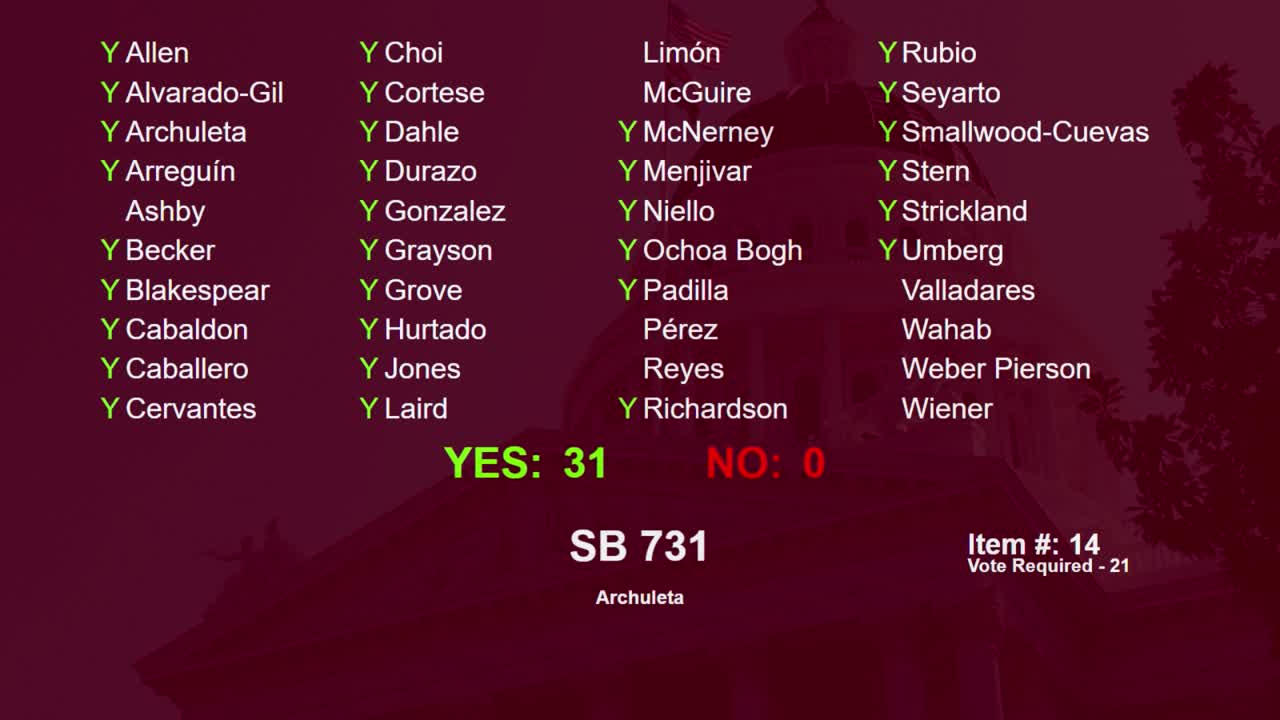 2MIN
Senate Floor
 6MIN
Senate Standing Committee on Local Government
Bill Author

Bill Co-Author(s):
