SB 665: Personal Income Tax Law: Corporation Tax Law: credits: retail security measures.
- Session Year: 2025-2026
- House: Senate
- Latest Version Date: 2025-05-07
Current Status:
Failed
(2026-02-02: Returned to Secretary of Senate pursuant to Joint Rule 56.)
Introduced
In Committee
Awaiting First Chamber Vote
Passed First Chamber
In Committee
Awaiting Second Chamber Vote
Passed Second Chamber
Enacted
The Personal Income Tax Law and the Corporation Tax Law allow various credits against the taxes imposed by those laws.
This bill, for taxable years beginning on or after January 1, 2025, and before January 1, 2030, would allow a credit against those taxes to a qualified taxpayer, as defined, for retail theft prevention measures, as specified. The bill would limit the credit allowed to a taxpayer to no more than $10,000 per taxable year.
Existing law requires any bill authorizing a new tax expenditure to contain, among other things, specific goals, purposes, and objectives that the tax expenditure will achieve, detailed performance indicators, and data collection requirements.
This bill also would include additional information required for any bill authorizing a new tax expenditure.
This bill would take effect immediately as a tax levy.
The Personal Income Tax Law and the Corporation Tax Law allow various credits against the taxes imposed by those laws.
This bill, for taxable years beginning on or after January 1, 2025, and before January 1, 2030, would allow a credit against those taxes to a qualified taxpayer, as defined, for retail theft prevention measures, as specified. The bill would limit the credit allowed to a taxpayer to no more than $10,000 per taxable year.
Existing law requires any bill authorizing a new tax expenditure to contain, among other things, specific goals, purposes, and objectives that the tax expenditure will achieve, detailed performance indicators, and data collection requirements.
This bill also would include additional information required for any bill authorizing a new tax expenditure.
This bill would take effect immediately as a tax levy.
(a)For taxable years beginning on or after January 1, 2025, and before January 1, 2030, there shall be allowed as a credit against the net tax, as that term is defined in Section 17039, an amount equal to the qualified expenditures of a qualified taxpayer during the taxable year, not to exceed ten thousand dollars ($10,000).
(b)For purposes of this section, the following definitions shall apply:
(1)Annual full-time equivalent employee mean either of the following:
(A)In the case of a full-time employee paid hourly wages, annual full-time equivalent means the total number of hours worked for the qualified taxpayer by the employee, not to exceed 2,000 hours per employee, divided by 2,000.
(B)In the case of a salaried full-time employee, annual full-time equivalent means the total number of weeks worked for the qualified taxpayer by the employee divided by 52.
(1)(2)Qualified expenditure shall mean an expense paid or incurred by the qualified taxpayer that is directly related to retail theft prevention measures that exceed the following:
(A)In the case of a qualified taxpayer with 25 or fewer annual full-time equivalent employees, three hundred dollars ($300) at a retail location in the state.
(B)In the case of a qualified taxpayer with more than 25 annual full-time equivalent employees, five hundred dollars ($500) at a retail location in the state.
(2)(3)Qualified taxpayer shall mean a taxpayer that is primarily engaged in a retail trade, as described in Codes 441 to 459999, inclusive, of the North American Industry Classification System published by the United States Office of Management and Budget, 2022 edition.
(3)(4)Retail theft prevention measures shall include, but not be limited to, the following:
(A)Security officers registered under the Private Security Services Act (Chapter 11.5 (commencing with Section 7580) of Division 3 of the Business and Professions Code). (B)(A)Security cameras.
(C)(B)Perimeter security lighting.
(D)(C)Locking or hardening mechanisms.
(E)(D)Alarm systems.
(F)(E)Access control systems.
(G)(F)Exterior license plate reader technology.
(c)If any credit allowed by this section is claimed by the taxpayer, any deduction otherwise allowed under this part for that amount of the cost paid or incurred by the taxpayer which is eligible for the credit that is claimed shall be reduced by the amount of the credit allowed.
(d)(1)The Franchise Tax Board may prescribe rules, guidelines, procedures, or other guidance to carry out the purposes of this section. Chapter 3.5 (commencing with Section 11340) of Part 1 of Division 3 of Title 2 of the Government Code shall not apply to any rule, guideline, or procedure prescribed by the Franchise Tax Board pursuant to this section.
(2)The Franchise Tax Board may prescribe any regulations necessary or appropriate to carry out the purposes of this section, including any regulations to prevent improper claims from being filed and to provide adequate substantiation of expenditures.(e)In the case where the credit allowed by this section exceeds the net tax, the excess may be carried over to reduce the net tax in the following taxable year, and succeeding seven years, if necessary, until the credit is exhausted.
(e)(f)(1)For purposes of complying with Section 41 as it pertains to the credit allowed pursuant to this section and Section 23683, the Legislature finds and declares the following:
(A)The specific goal of the credit is to support local retailers in their efforts to prevent theft.
(B)The performance indicators for the Legislature to use in determining whether the credit achieves the stated goal shall be the number of taxpayers claiming the credit, and the total dollar value amount of credits allowed.
(2)(A)No later than December 1, 2026, April 1, 2028, and annually thereafter, the Franchise Tax Board shall submit a report to the Legislature, in compliance with Section 9795 of the Government Code, detailing the number of taxpayers claiming the credit, and the total dollar value amount of credits allowed.
(B)The disclosure requirements of this paragraph shall be treated as an exception to Section 19542.
(f)(g)This section shall remain operative only until December 1, 2030, and as of that date is repealed.
SEC. 2.Section 23683 is added to the Revenue and Taxation Code, to read:23683.(a)For taxable years beginning on or after January 1, 2025, and before January 1, 2030, there shall be allowed as a credit against the tax, as that term is defined in Section 23036, an amount equal to the qualified expenditures of a qualified taxpayer during the taxable year, not to exceed ten thousand dollars ($10,000).
(b)For purposes of this section, the following definitions shall apply:
(1)Annual full-time equivalent employee mean either of the following:
(A)In the case of a full-time employee paid hourly wages, annual full-time equivalent means the total number of hours worked for the qualified taxpayer by the employee, not to exceed 2,000 hours per employee, divided by 2,000.
(B)In the case of a salaried full-time employee, annual full-time equivalent means the total number of weeks worked for the qualified taxpayer by the employee divided by 52.
(1)(2)Qualified expenditure shall mean an expense paid or incurred by the qualified taxpayer that is directly related to retail theft prevention measures that exceed the following:
(A)In the case of a qualified taxpayer with 25 or fewer annual full-time equivalent employees, three hundred dollars ($300) at a retail location in the state.
(B)In the case of a qualified taxpayer with more than annual full-time equivalent 25 employees, five hundred dollars ($500) at a retail location in the state.
(2)(3)Qualified taxpayer shall mean a taxpayer that is primarily engaged in a retail trade, as described in Codes 441 to 459999, inclusive, of the North American Industry Classification System published by the United States Office of Management and Budget, 2022 edition.
(3)(4)Retail theft prevention measures shall include, but not be limited to, the following:
(A)Security officers registered under the Private Security Services Act (Chapter 11.5 (commencing with Section 7580) of Division 3 of the Business and Professions Code).(B)(A)Security cameras.
(C)(B)Perimeter security lighting.
(D)(C)Locking or hardening mechanisms.
(E)(D)Alarm systems.
(F)(E)Access control systems.
(G)(F)Exterior license plate reader technology.
(c)If any credit allowed by this section is claimed by the taxpayer, any deduction otherwise allowed under this part for that amount of the cost paid or incurred by the taxpayer which is eligible for the credit that is claimed shall be reduced by the amount of the credit allowed.
(d)(1)The Franchise Tax Board may prescribe rules, guidelines, procedures, or other guidance to carry out the purposes of this section. Chapter 3.5 (commencing with Section 11340) of Part 1 of Division 3 of Title 2 of the Government Code shall not apply to any rule, guideline, or procedure prescribed by the Franchise Tax Board pursuant to this section.
(2)The Franchise Tax Board may prescribe any regulations necessary or appropriate to carry out the purposes of this section, including any regulations to prevent improper claims from being filed and to provide adequate substantiation of expenditures.(e)In the case where the credit allowed by this section exceeds the net tax, the excess may be carried over to reduce the net tax in the following taxable year, and succeeding seven years, if necessary, until the credit is exhausted.
(e)(f)This section shall remain operative only until December 1, 2030, and as of that date is repealed.
SEC. 3.This act provides for a tax levy within the meaning of Article IV of the California Constitution and shall go into immediate effect.
(a)For taxable years beginning on or after January 1, 2025, and before January 1, 2030, there shall be allowed as a credit against the net tax, as that term is defined in Section 17039, an amount equal to the qualified expenditures of a qualified taxpayer during the taxable year, not to exceed ten thousand dollars ($10,000).
(b)For purposes of this section, the following definitions shall apply:
(1)Qualified expenditure shall mean an expense paid or incurred by the qualified taxpayer that is directly related to retail theft prevention measures that exceed the following:
(A)In the case of a taxpayer with 25 or fewer employees, three hundred dollars ($300) at a retail location in the state.
(B)In the case of a taxpayer with more than 25 employees, five hundred dollars ($500) at a retail location in the state.
(2)Qualified taxpayer shall mean a taxpayer that is primarily engaged in a retail trade, as described in Codes 441 to 459999, inclusive, of the North American Industry Classification System published by the United States Office of Management and Budget, 2022 edition.
(3)Retail theft prevention measures shall include, but not be limited to, the following:
(A)Security officers registered under the Private Security Services Act (Chapter 11.5 (commencing with Section 7580) of Division 3 of the Business and Professions Code).
(B)Security cameras.
(C)Perimeter security lighting.
(D)Locking or hardening mechanisms.
(E)Alarm systems.
(F)Access control systems.
(G)Exterior license plate reader technology.
(c)If any credit allowed by this section is claimed by the taxpayer, any deduction otherwise allowed under this part for that amount of the cost paid or incurred by the taxpayer which is eligible for the credit that is claimed shall be reduced by the amount of the credit allowed.
(d)(1)The Franchise Tax Board may prescribe rules, guidelines, procedures, or other guidance to carry out the purposes of this section. Chapter 3.5 (commencing with Section 11340) of Part 1 of Division 3 of Title 2 of the Government Code shall not apply to any rule, guideline, or procedure prescribed by the Franchise Tax Board pursuant to this section.
(2)The Franchise Tax Board may prescribe any regulations necessary or appropriate to carry out the purposes of this section, including any regulations to prevent improper claims from being filed and to provide adequate substantiation of expenditures.
(e)(1)For purposes of complying with Section 41 as it pertains to the credit allowed pursuant to this section and Section 23683, the Legislature finds and declares the following:
(A)The specific goal of the credit is to support local retailers in their efforts to prevent theft.
(B)The performance indicators for the Legislature to use in determining whether the credit achieves the stated goal shall be the number of taxpayers claiming the credit, and the total dollar value of credits allowed.
(2)(A)No later than December 1, 2026, and annually thereafter, the Franchise Tax Board shall submit a report to the Legislature, in compliance with Section 9795 of the Government Code, detailing the number of taxpayers claiming the credit, and the total dollar value of credits allowed.
(B)The disclosure requirements of this paragraph shall be treated as an exception to Section 19542.
(f)This section shall remain operative only until December 1, 2030, and as of that date is repealed.
SEC. 2.Section 23683 is added to the Revenue and Taxation Code, to read:23683.(a)For taxable years beginning on or after January 1, 2025, and before January 1, 2030, there shall be allowed as a credit against the tax, as that term is defined in Section 23036, an amount equal to the qualified expenditures of a qualified taxpayer during the taxable year, not to exceed ten thousand dollars ($10,000).
(b)For purposes of this section, the following definitions shall apply:
(1)Qualified expenditure shall mean an expense paid or incurred by the qualified taxpayer that is directly related to retail theft prevention measures that exceed the following:
(A)In the case of a taxpayer with 25 or fewer employees, three hundred dollars ($300) at a retail location in the state.
(B)In the case of a taxpayer with more than 25 employees, five hundred dollars ($500) at a retail location in the state.
(2)Qualified taxpayer shall mean a taxpayer that is primarily engaged in a retail trade, as described in Codes 441 to 459999, inclusive, of the North American Industry Classification System published by the United States Office of Management and Budget, 2022 edition.
(3)Retail theft prevention measures shall include, but not be limited to, the following:
(A)Security officers registered under the Private Security Services Act (Chapter 11.5 (commencing with Section 7580) of Division 3 of the Business and Professions Code).
(B)Security cameras.
(C)Perimeter security lighting.
(D)Locking or hardening mechanisms.
(E)Alarm systems.
(F)Access control systems.
(G)Exterior license plate reader technology.
(c)If any credit allowed by this section is claimed by the taxpayer, any deduction otherwise allowed under this part for that amount of the cost paid or incurred by the taxpayer which is eligible for the credit that is claimed shall be reduced by the amount of the credit allowed.
(d)(1)The Franchise Tax Board may prescribe rules, guidelines, procedures, or other guidance to carry out the purposes of this section. Chapter 3.5 (commencing with Section 11340) of Part 1 of Division 3 of Title 2 of the Government Code shall not apply to any rule, guideline, or procedure prescribed by the Franchise Tax Board pursuant to this section.
(2)The Franchise Tax Board may prescribe any regulations necessary or appropriate to carry out the purposes of this section, including any regulations to prevent improper claims from being filed and to provide adequate substantiation of expenditures.
(e)This section shall remain operative only until December 1, 2030, and as of that date is repealed.
SEC. 3.This act provides for a tax levy within the meaning of Article IV of the California Constitution and shall go into immediate effect.
|
Date
|
Status
|
|---|---|
| Feb 2, 2026 | Returned to Secretary of Senate pursuant to Joint Rule 56. |
| May 14, 2025 | May 14 set for first hearing. Failed passage in committee. (Ayes 1. Noes 4. Page 1083.) Reconsideration granted. |
| May 7, 2025 | From committee with author's amendments. Read second time and amended. Re-referred to Com. on REV. & TAX. |
| Mar 18, 2025 | Set for hearing May 14. |
| Mar 5, 2025 | Referred to Com. on REV. & TAX. |
| Feb 21, 2025 | From printer. May be acted upon on or after March 23. |
| Feb 20, 2025 | Introduced. Read first time. To Com. on RLS. for assignment. To print. |
|
Date
|
Description
|
Location
|
Votes
|
|
|---|---|---|---|---|
| May 14, 2025 | [First] hearing set for [05-14-2025]: Failed passage in Committee. Reconsideration granted | Senate Standing Committee on Revenue and Taxation |
Passed |
|
| May 14, 2025 | Do pass, but first be re-referred to the Committee on [Appropriations] | Senate Standing Committee on Revenue and Taxation |
Failed |
This list shows positions taken on this bill by organizations on the date displayed, which is linked to the original source.
Positions by individuals are not included.
|
Organization
|
Position
|
Date
|
|---|---|---|
| California Tax Reform Association | ** Against | |
| California Teachers Association | ** Against | |
| Folsom Chamber Of Commerce | ** Support |
SENATE COMMITTEE ON REVENUE AND TAXATION
Senator Jerry McNerney, Chair
2025 - 2026 Regular
Bill No: | SB 665 | Hearing Date: | 5/14/25 |
Author: | Choi | Tax Levy: | Yes |
Version: | 5/7/25 Amended | Fiscal: | Yes |
Consultant: | Summers | ||
Personal Income Tax Law: Corporation Tax Law: credits: retail security measures
Enacts a personal income and corporate income tax credit up to $10,000 for qualified expenses on retail theft prevention measures.
Background
Tax expenditures. California law allows various income tax credits, deductions, exemptions, and exclusions. When a tax law is determined to have a cost in the form of foregone revenues, such as a tax exemption, state law refers to them as “tax expenditures.” The Legislature enacts such tax incentives to compensate taxpayers for incurring certain expenses, such as child adoption, or to influence certain behaviors, such as participating in charitable giving. The Legislature uses tax incentives to encourage taxpayers to do something they would otherwise not do “but for” the tax incentive. The Department of Finance must publish a list of tax expenditures annually, currently totaling around $91.5 billion.
Credits. Tax credits reduce the amount of tax owed by a taxpayer on a dollar-for-dollar basis. Credit amounts that exceed the taxpayer’s current tax year liability can either be refunded to the taxpayer or carried forward to reduce tax in future years. However, except for the Earned Income Tax Credit, the Young Child Tax Credit, the Foster Youth Tax Credit, and the Motion Picture and Television Production Credit, all credits against California Personal Income and Corporation Tax are nonrefundable.
Retail theft in California. In 2024, the state’s Organized Retail Crime Task Force conducted 879 investigations, leading to 1,707 arrests and the recovery of 676,227 stolen goods valued at $13.5 million. In January and February 2025, the task force conducted 136 retail theft investigations, leading to 209 arrests while recovering 24,510 stolen items worth an estimated $2.2 million. According to the Public Policy Institute of California, trends in retail theft vary across the state and by type of offense; however, the data indicated a rise in shoplifting, especially in the Bay Area, and an increase in commercial burglary in urban counties.
The author wants to support local retailers in their efforts to prevent theft by enacting a credit for costs incurred for retail theft prevention measures.
Proposed Law
SB 665 enacts a Personal Income and Corporation Tax credit up to $10,000 for qualified expenditures on retail theft prevention measures paid or incurred by a qualified taxpayer primarily engaged in a retail trade. The bill authorizes the credit for the 2025 through the 2029 tax years and allows for the credit to be carried forward to the following taxable year and the succeeding seven years if necessary.
The bill also defines “qualified expenditure,” “qualified taxpayer,” and “retail theft prevention measures”; specifies that the taxpayer may not obtain a double tax benefit for this credit and deduction for the same expense; repeals December 1, 2030; and makes legislative findings and declarations that comply with Section 41 of the Revenue and Taxation Code.
State Revenue Impact
According to the Franchise Tax Board (FTB), the 2/20/25 version of SB 665 will result in a revenue loss of $25 million in fiscal year (FY) 2025-26, $22 million in FY 2026-27, and $17 million in FY 2027-28. The amendments made by the 5/7/25 version of the bill are anticipated to have a minor impact on the revenue estimate.
Comments
- Purpose of the bill. According to the author, “Retail theft has become a significant problem in California, leading to many businesses migrating to other states or closing existing locations in the state. To combat this increase in crime, many businesses have taken precautionary steps to protect their customers, their workers, and their property. They have installed cameras, alarm systems, perimeter security lighting, and even purchased exterior license plate reader technology. SB 665 will establish an annual tax credit for qualified retail establishments that proactively purchase security measures aimed to prevent retail theft. This tax credit will be applied against the “net tax” in an amount equal to the qualified expenditures of the taxpayer, not to exceed $10,000. This bill will provide critical assistance to California businesses that are battling the rise of retail theft.”
- “Windfall” or “but for” tax benefit? Tax expenditures produce two different outcomes. The first outcome is a “windfall,” where the tax expenditure rewards behavior that would have occurred without the tax benefit. The second outcome is a “but for tax benefit,” where a particular activity would not have occurred without the incentive created by the tax expenditure. Here, some retailers may receive a windfall from SB 665 because they would have purchased security measures anyway and will still qualify for the tax credit. For others, notably smaller retailers with tight budgets, the credit may be a “but for” incentive, meaning it is the deciding factor that makes security purchases financially feasible.
- Revenue loss. Existing tax law provides various credits, deductions, exclusions, and exemptions for certain taxpayers. By authorizing a credit against personal and corporate income tax, SB 665 will result in the State General Fund receiving less revenue. As a result, the state will have to reduce spending or increase taxes to account for the loss.
- Precedent. Income is generally taxable, regardless of the source from which it is derived. If the Legislature allows a credit for retail theft prevention measures, why should it not extend the same treatment for manufacturing buildings or construction sites? This may lead to a slippery slope where security expenses are allowed a credit against income tax, thereby eroding the income tax base.
- Equity. SB 665 does not address the underlying socioeconomic issues contributing to theft, which could limit its effectiveness in truly high-need areas. The credit operates as a direct subsidy to retailers, transferring state tax dollars to individual retailers for assets they privately own and control. Because those security upgrades remain private property, the public receives no tangible asset in return for the foregone revenue. The foregone General Fund revenue would otherwise be available for violence-prevention grants such as the California Violence Intervention and Prevention Program or Youth Community Restoration programs that reduce crime at its source and serve entire neighborhoods, not just individual storefronts.
- Ambiguous Definitions. The bill lacks clarity on what counts toward the minimum expenditure thresholds ($300 or $500 per location) for “qualified expenditures.” Do multiple smaller expenses that cumulatively exceed the threshold qualify, or must a single purchase exceed the threshold? Vagueness may result in taxpayer confusion and disagreements between taxpayers and the FTB.
- Related legislation. Before the legislature this year is AB 976 (Ávila Farías), which would provide a similar credit to SB 665 but would cap the credit amount at $4,000. This bill was held under submission at the May 5 hearing of the Assembly Revenue and Taxation Committee. The Committee will also consider SB 666 (Choi, 2025), which enacts a personal income tax credit of up to $250 for expenses in a taxable year for the purchase and installation of a security surveillance system at the taxpayer’s qualified residence
- Section 41. Section 41 of the Revenue and Taxation Code requires any bill enacting a new tax expenditure to contain, among other things, specific goals, purposes, and objectives that the tax expenditure will achieve and detailed performance indicators, along with data collection and reporting requirements (SB 1335, Leno, 2014). To satisfy these requirements, SB 665 finds and declares that the specific goal of the credit is to support local retailers in their efforts to prevent theft. The performance indicators are the number of taxpayers claiming the credit and the total dollar value of credits allowed. To aid the Legislature in determining whether this act meets this goal, SB 665 directs the FTB to submit a report to the Legislature by December 1, 2028, and annually thereafter.
Support and Opposition
(5/9/25)
Support: Folsom Chamber of Commerce
Opposition: California Tax Reform Association
California Teachers Association
-- END --
Discussed in Hearing
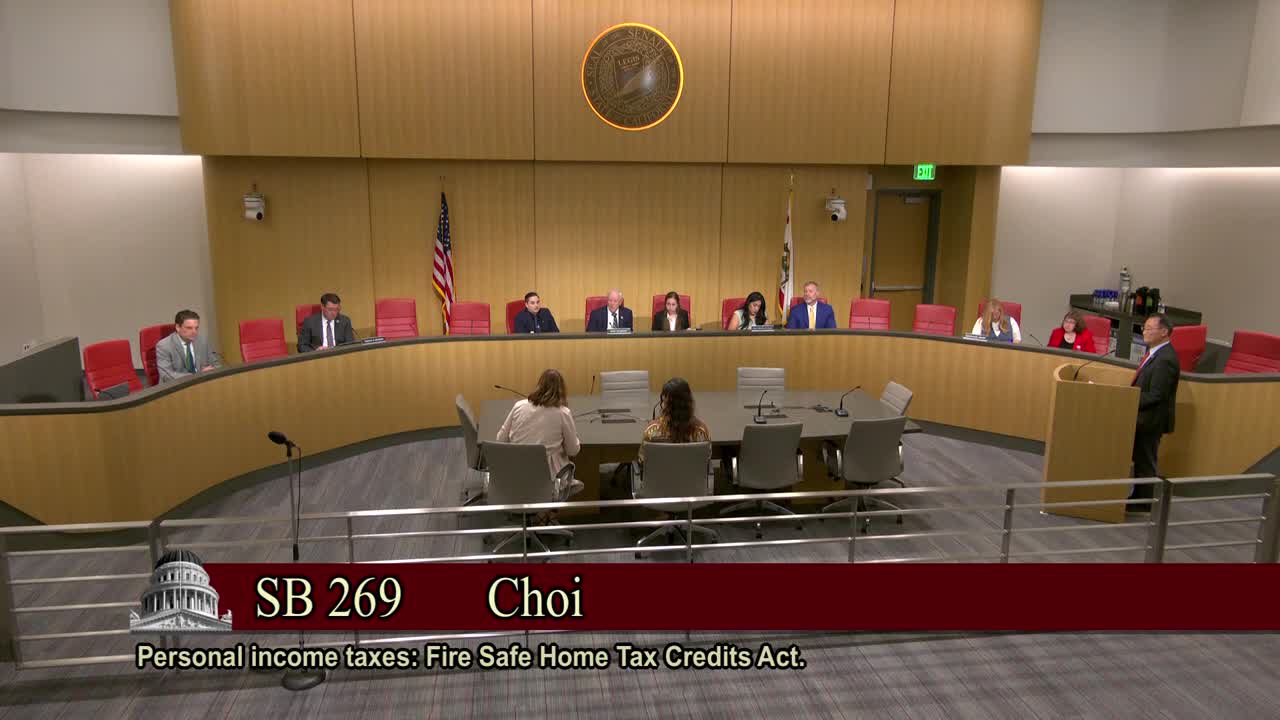 8MIN
Senate Standing Committee on Revenue and Taxation
Bill Author