SB 666: Personal income tax: credit: home security surveillance.
- Session Year: 2025-2026
- House: Senate
- Latest Version Date: 2025-05-07
Current Status:
Failed
(2026-02-02: Returned to Secretary of Senate pursuant to Joint Rule 56.)
Introduced
In Committee
Awaiting First Chamber Vote
Passed First Chamber
In Committee
Awaiting Second Chamber Vote
Passed Second Chamber
Enacted
The Personal Income Tax Law allows various credits against the taxes imposed by that law.
This bill would allow a credit against those taxes for each taxable year beginning on or after January 1, 2026, and before January 1, 2031, in an amount equal to the amount paid or incurred, not to exceed $250, during the taxable year for the purchase and installation of a security surveillance system at the taxpayers principal single-family residence dwelling or housing unit located in the state.
Existing law requires any bill authorizing a new tax expenditure, as defined, to include tax credits, to contain, among other things, specific goals, purposes, and objectives that the tax credit will achieve, detailed performance indicators, and data collection requirements.
This bill would include findings and reporting requirements in compliance with this requirement.
This bill would take effect immediately as a tax levy.
The Personal Income Tax Law allows various credits against the taxes imposed by that law.
This bill would allow a credit against those taxes for each taxable year beginning on or after January 1, 2026, and before January 1, 2031, in an amount equal to the amount paid or incurred, not to exceed $250, during the taxable year for the purchase and installation of a security surveillance system at the taxpayers principal single-family residence located in the state.
Existing law requires any bill authorizing a new tax expenditure, as defined, to include tax credits, to contain, among other things, specific goals, purposes, and objectives that the tax credit will achieve, detailed performance indicators, and data collection requirements.
This bill would include findings and reporting requirements in compliance with this requirement.
This bill would take effect immediately as a tax levy.
(a)For each taxable year beginning on or after January 1, 2026, and before January 1, 2031, there shall be allowed as a credit against the net tax, as defined in Section 17039, an amount equal to 100 percent of the amount paid or incurred during the taxable year for the purchase and installation of a security surveillance system at the taxpayers qualified residence. The credit shall not exceed two hundred and fifty dollars ($250) per taxable year.
(b)For purposes of this section, the following shall apply:
(1)Principal residence has the same meaning as that term is used in Section 121 of the Internal Revenue Code.
(2)Qualified residence means a single-family residence dwelling or housing unit located in the state that is the taxpayers principal residence.
(3)Security surveillance system means any video, audio, or photographic recording devices devices, or corresponding security software, installed for the purpose of surveilling or recording activity occurring at the qualified residence.
(c)Each qualified residence shall only be eligible for one credit allowed by this section per taxable year. In the case of two taxpayers filing a joint return, only one credit may be claimed per qualified residence. If a taxpayer has filed a separate return for a taxable year for which a joint return could have been filed, only one of the taxpayers may claim the credit allowed by this section.
(d)In the case where the credit allowed by this section exceeds the net tax, the excess may be carried over to reduce the net tax in the following taxable year, and succeeding eight years if necessary, until the credit is exhausted.
(e)(1)For purposes of complying with Section 41, the Legislature finds and declares the specific goal, purpose, and objective of the tax credit allowed by this section is to assist California residents in affording the cost of a home security camera, which is costly to purchase and install. Home security cameras help deter property crime, allow residents to monitor their homes for natural disasters, and improve residents overall sense of security.
(2)The performance indicators for the Legislature to use in determining whether the credit achieves the stated objective shall be the number of California taxpayers that receive the credit pursuant to this section.
(3)No later than June 30, 2028, and each June 30 thereafter, the Franchise Tax Board shall submit a report to the Legislature, in accordance with Section 9795 of the Government Code, detailing the number of taxpayers that claimed the tax credit pursuant to this section for the most recent taxable year.
(f)This section shall remain in effect only until December 1, 2031, and as of that date is repealed. However, any unused credit may continue to be carried forward, as provided in subdivision (a), until the credit is exhausted.
SEC. 2.This act provides for a tax levy within the meaning of Article IV of the California Constitution and shall go into immediate effect.
(a)For each taxable year beginning on or after January 1, 2026, and before January 1, 2031, there shall be allowed as a credit against the net tax, as defined in Section 17039, an amount equal to 100 percent of the amount paid or incurred during the taxable year for the purchase and installation of a security surveillance system at the taxpayers qualified residence. The credit shall not exceed two hundred and fifty dollars ($250) per taxable year.
(b)For purposes of this section, the following shall apply:
(1)Principal residence has the same meaning as that term is used in Section 121 of the Internal Revenue Code.
(2)Qualified residence means a single-family residence located in the state that is the taxpayers principal residence.
(3)Security surveillance system means any video, audio, or photographic recording devices installed for the purpose of surveilling or recording activity occurring at the qualified residence.
(c)Each qualified residence shall only be eligible for one credit allowed by this section per taxable year. In the case of two taxpayers filing a joint return, only one credit may be claimed per qualified residence. If a taxpayer has filed a separate return for a taxable year for which a joint return could have been filed, only one of the taxpayers may claim the credit allowed by this section.
(d)In the case where the credit allowed by this section exceeds the net tax, the excess may be carried over to reduce the net tax in the following taxable year, and succeeding years if necessary, until the credit is exhausted.
(e)(1)For purposes of complying with Section 41, the Legislature finds and declares the specific goal, purpose, and objective of the tax credit allowed by this section is to assist California residents in affording the cost of a home security camera, which is costly to purchase and install. Home security cameras help deter property crime, allow residents to monitor their homes for natural disasters, and improve residents overall sense of security.
(2)The performance indicators for the Legislature to use in determining whether the credit achieves the stated objective shall be the number of California taxpayers that receive the credit pursuant to this section.
(3)No later than June 30, 2028, and each June 30 thereafter, the Franchise Tax Board shall submit a report to the Legislature, in accordance with Section 9795 of the Government Code, detailing the number of taxpayers that claimed the tax credit pursuant to this section for the most recent taxable year.
(f)This section shall remain in effect only until December 1, 2031, and as of that date is repealed. However, any unused credit may continue to be carried forward, as provided in subdivision (a), until the credit is exhausted.
SEC. 2.This act provides for a tax levy within the meaning of Article IV of the California Constitution and shall go into immediate effect.
|
Date
|
Status
|
|---|---|
| Feb 2, 2026 | Returned to Secretary of Senate pursuant to Joint Rule 56. |
| May 14, 2025 | May 14 set for first hearing. Failed passage in committee. (Ayes 1. Noes 4. Page 1083.) Reconsideration granted. |
| May 7, 2025 | From committee with author's amendments. Read second time and amended. Re-referred to Com. on REV. & TAX. |
| Mar 18, 2025 | Set for hearing May 14. |
| Mar 5, 2025 | Referred to Com. on REV. & TAX. |
| Feb 21, 2025 | From printer. May be acted upon on or after March 23. |
| Feb 20, 2025 | Introduced. Read first time. To Com. on RLS. for assignment. To print. |
|
Date
|
Description
|
Location
|
Votes
|
|
|---|---|---|---|---|
| May 14, 2025 | [First] hearing set for [05-14-2025]: Failed passage in Committee. Reconsideration granted | Senate Standing Committee on Revenue and Taxation |
Passed |
|
| May 14, 2025 | Do pass, but first be re-referred to the Committee on [Appropriations] | Senate Standing Committee on Revenue and Taxation |
Failed |
This list shows positions taken on this bill by organizations on the date displayed, which is linked to the original source.
Positions by individuals are not included.
|
Organization
|
Position
|
Date
|
|---|---|---|
| California Teachers Association | ** Against | |
| Electronic Frontier Foundation | ** Against | |
| Oakland Privacy | ** Against |
SENATE COMMITTEE ON REVENUE AND TAXATION
Senator Jerry McNerney, Chair
2025 - 2026 Regular
Bill No: | SB 666 | Hearing Date: | 5/14/25 |
Author: | Choi | Tax Levy: | Yes |
Version: | 5/07/25 Amended | Fiscal: | Yes |
Consultant: | Summers | ||
Personal income tax: credit: home security surveillance
Enacts a personal income tax credit of up to $250 for expenses in a taxable year for the purchase and installation of a security surveillance system at the taxpayer’s qualified residence.
Background
Tax expenditures. California law allows various income tax credits, deductions, exemptions, and exclusions. When a tax law is determined to have a cost in the form of foregone revenues, such as a tax exemption, state law refers to them as “tax expenditures.” The Legislature enacts such tax incentives to compensate taxpayers for incurring certain expenses, such as child adoption, or to influence certain behaviors, such as participating in charitable giving. The Legislature uses tax incentives to encourage taxpayers to do something they would otherwise not do “but for” the tax incentive. The Department of Finance must publish a list of tax expenditures annually, currently totaling around $91.5 billion.
Credits. Tax credits reduce the amount of tax owed by a taxpayer on a dollar-for-dollar basis. Credit amounts that exceed the taxpayer’s current tax year liability can either be refunded to the taxpayer or carried forward to reduce tax in future years. However, except for the Earned Income Tax Credit, the Young Child Tax Credit, the Foster Youth Tax Credit, and the Motion Picture and Television Production Credit, all credits against California Personal Income and Corporation Tax are nonrefundable.
Burglar behavior. Interviews with convicted burglars indicate that security measures weigh heavily in their target selection. In an oft-cited study by the University of North Carolina at Charlotte, around 83% of surveyed burglars said they would try to determine if an alarm or camera was present before attempting a break-in.[1] Over 60% said that discovering an alarm or surveillance system would cause them to seek an alternative target. Even after a burglary attempt has begun, if the intruder notices cameras or triggers an alarm, about 50% indicated they would abandon the attempt immediately. A concrete example of burglary deterrence comes from a Los Angeles Police Department (LAPD) pilot program.[2] In 2015, LAPD partnered with Ring (a California-based smart doorbell company) to distribute 500 free video doorbells to homeowners in the Wilshire Park and Country Club Park neighborhoods of Los Angeles. The results reported by police were dramatic: over the six months following installation, burglaries dropped by 55% in those communities.
The author wants to assist California residents in affording the cost of home security devices by enacting a personal income tax credit for their purchase.
Proposed Law
SB 666 enacts a personal income tax credit of up to $250 for expenses in a taxable year for the purchase and installation of a security surveillance system at the taxpayer’s qualified residence. The bill authorizes the credit for the 2026 through the 2030 tax years and allows for the credit to be carried forward to the following taxable year and the succeeding eight years if necessary.
The bill also defines “principal residence,” “qualified residence,” and “security surveillance system”; limits the credit to only one credit per qualified residence in the case of two taxpayers filing a joint return; and makes legislative findings and declarations supporting its purposes, defines several terms, and complies with Section 41 of the Revenue and Taxation Code.
State Revenue Impact
According to the Franchise Tax Board (FTB), the 2/20/25 version of SB 666 will result in revenue losses of $140 million in FY 2026-27 and $130 million in FY 2027-28. The amendments made by the 5/7/25 version of the bill are anticipated to have a minor impact on the revenue estimate.
Comments
- Purpose of the bill. According to the author, “Property crime has long been a significant concern for all Californians. With recent advancements in technology, many have taken proactive measures to protect their assets by investing in home security measures. With the rise in popularity and use of home security systems, such as doorbell cameras, video surveillance, and home alarms, it has become easier for residents to protect their homes and deter crime. SB 666 will establish an annual tax credit, not to exceed $250 per taxable year, for qualified applicants who install private security surveillance systems or software at their residence. This tax credit will apply to a taxpayer’s single family “principal residence”, and shall only be applied once per taxable year. This bill will provide Californians with real assistance as they take measures to protect their families and their property.”
- “Windfall” or “but for” tax benefit? Tax expenditures produce two different outcomes. The first outcome is a “windfall,” where the tax expenditure rewards behavior that would have occurred without the tax benefit. The second outcome is a “but for tax benefit,” where a particular activity would not have occurred without the incentive created by the tax expenditure. SB 666 may be a “windfall” to taxpayers who would have purchased and installed home security systems regardless of the tax credit, effectively rewarding those who think it is worth it to buy a home security system. However, for lower-income homeowners or those hesitant to invest in home security, the credit may serve as a “but for” incentive, nudging them toward making a purchase they might not otherwise afford.
- Balancing privacy rights and property rights. Concerned opponents raise the issue that the home security system installation could infringe on privacy rights by potentially capturing video, images, and audio beyond the homeowner's property. They argue that the mass existence of doorbell cameras threatens civil liberties and exacerbates racial discrimination by enabling unnecessary surveillance. Opponents also highlight that surveillance cameras can be hacked and used to share footage with law enforcement. While it is true that homeowners using surveillance equipment to protect their home may incidentally capture video, images, and audio from beyond their property, there is also research to suggest that home security cameras deter crime on private property and can bolster safer communities through increased utilization.
- Revenue loss. Existing tax law provides various credits, deductions, exclusions, and exemptions for certain taxpayers. By allowing a credit for home surveillance equipment, SB 666 will result in the State General Fund receiving less revenue. As a result, the state will have to reduce spending or increase taxes to account for the loss.
- Precedent. If the Legislature allows a credit for home surveillance equipment for “qualified residence,” which is defined by this bill as meaning a dwelling or house unit, why should it not extend the same treatment for other non-commercial real property like detached garages or barns? This may lead to a slippery slope where additional personal security or home improvement credits are authorized, thereby eroding the income tax base.
- Definitions. Additionally, the bill defines the “security surveillance system” as “video, audio, or photographic recording devices, or corresponding software.” As a result, taxpayers may lack clarity as to whether this includes subscription costs, cloud storage, commercial monitoring services, or if it merely includes the software embedded or uploaded on devices. The committee may wish to consider whether more precise definitions would provide greater certainty for taxpayers and ease of administration for the FTB.
- Equity. If SB 666 allows both homeowners and renters to claim a tax credit for the purchase and installation of a security surveillance system at their principal residence, this credit may help broaden access to personal safety tools across income levels. This inclusive eligibility structure has the potential to benefit individuals in high-crime areas, many of whom are renters, by offsetting the cost of surveillance technology. However, the effectiveness of the credit may still be limited for lower-income taxpayers who lack the upfront resources to purchase and install such systems, even with the promise of reimbursement through a tax credit. Additionally, landlords, rather than tenants, may retain control over whether surveillance devices can be installed, which could still present access barriers in rental housing. However, if SB 666 requires ownership of the dwelling or housing unit to be eligible for the credit, then SB 666 disproportionately benefits higher-income individuals, as homeownership rates are lower among low-income and minority communities, widening the gap in access to security measures. Further, the credit does not address the underlying socioeconomic issues contributing to crime, which could limit its effectiveness in truly high-need areas. The foregone General Fund revenue would otherwise be available for violence-prevention grants such as the California Violence Intervention and Prevention Program or Youth Community Restoration programs that reduce crime at its source and serve entire neighborhoods, not just individual homes.
- Related legislation. AB 2219 (Wallis, 2024), similar to this bill, would have allowed for a credit for home security surveillance systems. This bill was held in the Assembly Revenue and Taxation Committee under submission. Before the Legislature this year is AB 976 (Ávila Farías), which would provide a similar credit to SB 665 but would cap the credit amount at $4,000 and was held under submission by the Assembly Revenue and Taxation Committee. The Committee will also consider SB 665 (Choi, 2025), which would allow a credit against net tax for retail theft prevention measures up to $10,000.
- Section 41. Section 41 of the Revenue and Taxation Code requires any bill enacting a new tax expenditure to contain, among other things, specific goals, purposes, and objectives that the tax expenditure will achieve and detailed performance indicators, along with data collection and reporting requirements (SB 1335, Leno, 2014). To satisfy these requirements, SB 666 finds and declares that the specific goal, purpose, and objective of the tax credit is to assist California residents in affording the cost of a home security camera, which is costly to purchase and install. The performance indicators are the number of California taxpayers who receive the credit pursuant to this section. To aid the Legislature in determining whether this act meets the goals, purposes, and objectives, SB 666 directs the FTB to submit a report to the Legislature by June 30, 2028, and each June 30 thereafter.
Support and Opposition
(5/9/25)
Support: None received.
Opposition: California Teachers Association
Electronic Frontier Foundation
Oakland Privacy
-- END --
Bowman, J. (2022, July 8). Do surveillance cameras actually deter criminals? Arcdyn. https://arcdyn.com/articles/do-surveillance-cameras-actually-deter-criminals. ↑
Suter, L. (2016, March 25). LAPD pilot program uses smartphone app to reduce burglaries. ABC7 Los Angeles. https://abc7.com/technology-smartphone-ring-doorbell/1262052/. ↑
Discussed in Hearing
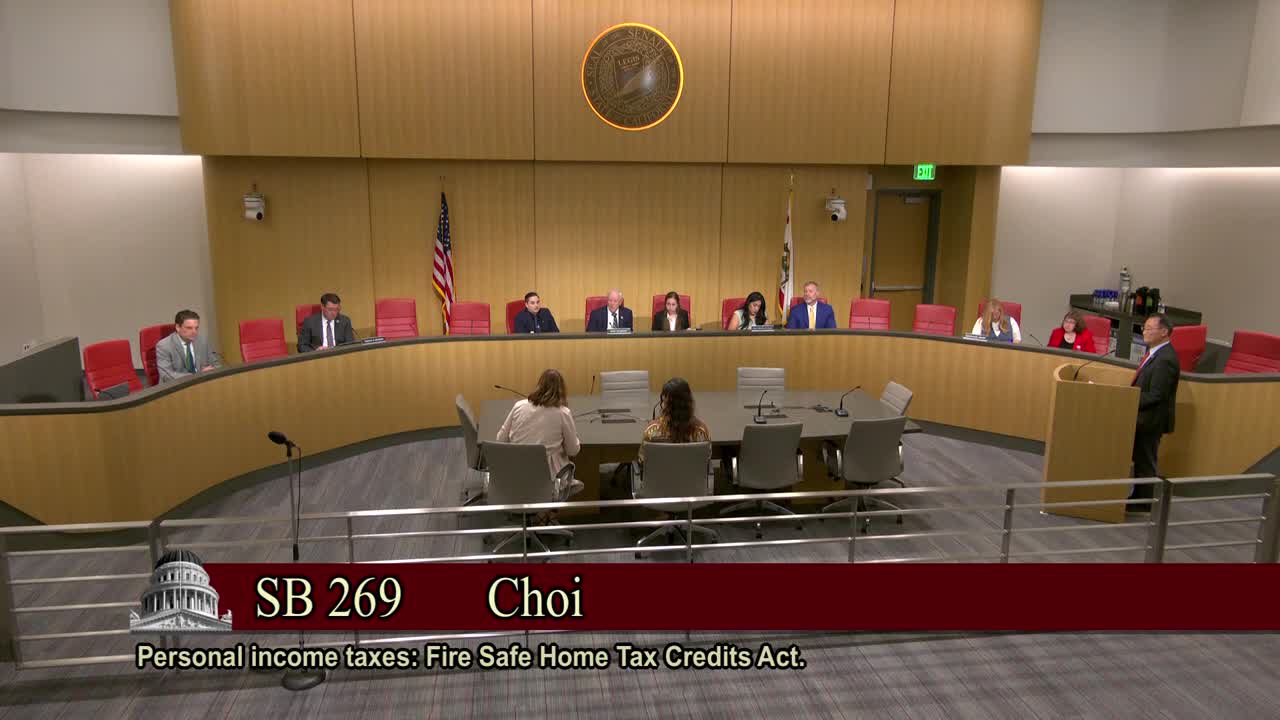 5MIN
Senate Standing Committee on Revenue and Taxation
Bill Author