SB 715: Elections.
- Session Year: 2025-2026
- House: Senate
- Latest Version Date: 2026-09-30
Current Status:
Passed
(2026-09-30: Chaptered by Secretary of State. Chapter 978, Statutes of 2026.)
Introduced
In Committee
Awaiting First Chamber Vote
Passed First Chamber
In Committee
Awaiting Second Chamber Vote
Passed Second Chamber
Enacted
Existing law requires the Secretary of State to transmit a certified list of candidates for partisan and voter-nominated offices eligible to be voted on within each county to the county elections official at least 68 days before a primary or general election. Existing law also requires the Secretary of State to notify the candidates for partisan and voter-nominated offices of the names, addresses, offices, occupations, and party preferences of all other candidates for the same office at least 73 days before the election. Existing law imposes various deadlines pertaining to candidates and elections. Existing law requires a candidate who submits a ballot designation to file a ballot designation worksheet, as specified.
This bill would move the deadline to notify candidates of the other candidates for the same office to at least 78 days before the election. The bill would move other specified deadlines earlier, including the deadline for the Secretary of State to publicly announce a list of candidates and the availability of specified forms and documents. The bill would require a candidate to certify, under penalty of perjury, the truth and accuracy of the content of the ballot designation worksheet. By expanding the crime of perjury, the bill would impose a state-mandated local program.
This bill would incorporate additional changes to Section 13307 of the Elections Code proposed by SB 1360 to be operative only if this bill and SB 1360 are enacted and this bill is enacted last.
The California Constitution requires the state to reimburse local agencies and school districts for certain costs mandated by the state. Statutory provisions establish procedures for making that reimbursement.
This bill would provide that no reimbursement is required by this act for a specified reason.
Existing law requires the Secretary of State to transmit a certified list of candidates for partisan and voter-nominated offices eligible to be voted on within each county to the county elections official at least 68 days before a primary or general election. Existing law also requires the Secretary of State to notify the candidates for partisan and voter-nominated offices of the names, addresses, offices, occupations, and party preferences of all other candidates for the same office at least 73 days before the election. Existing law imposes various deadlines pertaining to candidates and elections. Existing law requires a candidate who submits a ballot designation to file a ballot designation worksheet, as specified.
This bill would move the deadline to notify candidates of the other candidates for the same office to at least 78 days before the election. The bill would move other specified deadlines 5 days earlier, including the deadline for the Secretary of State to publicly announce a list of candidates and the availability of specified forms and documents. The bill would require a candidate to certify, under penalty of perjury, the truth and accuracy of the content of the ballot designation worksheet. By expanding the crime of perjury, the bill would impose a state-mandated local program.
This bill would incorporate additional changes to Section 13307 of the Elections Code proposed by SB 1360 to be operative only if this bill and SB 1360 are enacted and this bill is enacted last.
The California Constitution requires the state to reimburse local agencies and school districts for certain costs mandated by the state. Statutory provisions establish procedures for making that reimbursement.
This bill would provide that no reimbursement is required by this act for a specified reason.
Existing law requires the Secretary of State to transmit a certified list of candidates for partisan and voter-nominated offices eligible to be voted on within each county to the county elections official at least 68 days before a primary or general election. Existing law also requires the Secretary of State to notify the candidates for partisan and voter-nominated offices of the names, addresses, offices, occupations, and party preferences of all other candidates for the same office at least 73 days before the election. Existing law imposes various deadlines pertaining to candidates and elections. Existing law requires a candidate who submits a ballot designation to file a ballot designation worksheet, as specified.
This bill would move the deadline to notify candidates of the other candidates for the same office to at least 78 days before the election. The bill would move specified deadlines 5 days earlier, including the deadline for the Secretary of State to publicly announce a list of candidates and the availability of specified forms and documents. The bill would require a candidate to certify, under penalty of perjury, the truth and accuracy of the content of the ballot designation worksheet. By expanding the crime of perjury, the bill would impose a state-mandated local program.
The California Constitution requires the state to reimburse local agencies and school districts for certain costs mandated by the state. Statutory provisions establish procedures for making that reimbursement.
This bill would provide that no reimbursement is required by this act for a specified reason.
Existing law requires the Secretary of State to transmit a certified list of candidates for partisan and voter-nominated offices eligible to be voted on within each county to the county elections official at least 68 days before a primary or general election. Existing law also requires the Secretary of State to notify the candidates for partisan and voter-nominated offices of the names, addresses, offices, occupations, and party preferences of all other candidates for the same office at least 73 days before the election.
This bill would move the deadline to notify candidates of the other candidates for the same office to at least 78 days before the election.
The Planning and Zoning Law, for the 4th and subsequent revisions of the housing element, requires the Department of Housing and Community Development to determine the existing and projected need for housing for each region, as provided, and requires the appropriate council of governments or for cities and counties without a council of governments, the department, to adopt a final regional housing need plan allocating a share of the regional housing need to each city, county, or city and county. Existing law requires the department to meet and consult with the council of governments regarding the assumptions and methodology to be used by the department to determine the regions housing needs and requires the council of governments to provide data assumptions, including specified information regarding housing availability within the region. Existing law requires the council of governments, or delegate subregion as applicable, to develop a proposed methodology for distributing the existing and projected regional housing need to cities, counties, and cities and counties within the region or subregion, as applicable, that furthers specified objectives. Existing law, to the extent that sufficient data is available as provided, requires each council of governments, or delegate subregion as applicable, to consider including specified factors to develop the methodology that allocates regional housing needs, including the loss of units during a state of emergency that was declared by the Governor that have yet to be rebuilt or replaced at the time of the analysis.This bill would remove the requirement that the loss of units factor be considered and instead require those lost units to be distributed proportionally according to the regions proposed methodology, as provided, and would prohibit the lost units from solely being distributed to the jurisdictions in which they were lost. By imposing additional duties on councils of governments, this bill would impose a state-mandated local program.Existing law, for cities and counties without a council of governments, requires the department to determine and distribute the existing and projected housing need. If the department determines that a county or counties and a majority of cities within the county or counties representing a majority of the population of the county or counties possess the capability and resources and has agreed to accept the responsibility for the distribution of the regional housing need, as specified, existing law requires the department to delegate this responsibility to the cities and county or counties. Existing law requires the distribution of regional housing need to take into consideration certain factors. Existing law also requires, as part of the allocation of the regional housing need, the department to provide each city and county with data describing the assumptions and methodology used in calculating its share of the regional housing need.This bill would require the department or the entities delegated, as described above, to allocate the units lost in a state of emergency based on the allocation methodology.The California Constitution requires the state to reimburse local agencies and school districts for certain costs mandated by the state. Statutory provisions establish procedures for making that reimbursement.This bill would provide that, if the Commission on State Mandates determines that the bill contains costs mandated by the state, reimbursement for those costs shall be made pursuant to the statutory provisions noted above.The Planning and Zoning Law, for the 4th and subsequent revisions of the housing element, requires the Department of Housing and Community Development to determine the existing and projected need for housing for each region, as provided, and requires the appropriate council of governments or for cities and counties without a council of governments, the department, to adopt a final regional housing need plan allocating a share of the regional housing need to each city, county, or city and county. Existing law requires the department to meet and consult with the council of governments regarding the assumptions and methodology to be used by the department to determine the regions housing needs and requires the council of governments to provide data assumptions, including specified information regarding housing availability within the region. Existing law requires the council of governments, or delegate subregion as applicable, to develop a proposed methodology for distributing the existing and projected regional housing need to cities, counties, and cities and counties within the region or subregion, as applicable, that furthers specified objectives. Existing law, to the extent that sufficient data is available as provided, requires each council of governments, or delegate subregion as applicable, to consider including specified factors to develop the methodology that allocates regional housing needs, including the loss of units during a state of emergency that was declared by the Governor that have yet to be rebuilt or replaced at the time of the analysis.
This bill would remove the requirement that the loss of units factor be considered and instead require the draft methodology to allocate some or all of the housing need resulting from units lost during a state of emergency that was declared by the Governor during the planning period immediately preceding the relevant revision that have yet to be rebuilt or replaced at the time of the analysis to jurisdictions other than the jurisdictions in which the lost units were located. those lost units to be distributed proportionally according to the regions proposed methodology, as provided, and would prohibit the lost units from solely being distributed to the jurisdictions in which they were lost. By imposing additional duties on councils of governments, this bill would impose a state-mandated local program.
Existing law requires each council of governments and delegate subregion, as applicable and at least one and one-half years before the scheduled house element revision, to distribute a draft allocation of regional housing needs to each local government in the region or subregion, where applicable, and the department, based on the adopted methodology as described above. Within 30 days following receipt of the draft allocation, existing law authorizes a local government within the region or the delegate subregion, as applicable, or the department to appeal to the council of governments or the delegate subregion for a revision of the share of the regional housing need proposed to be allocated to one or more local governments. Existing law limits the appeals to certain circumstances, including that a significant and unforeseen change in circumstances has occurred in the local jurisdiction or jurisdictions that merits a revision of certain information submitted for developing the methodology described above. Existing law requires the council of governments or delegate subregion, as applicable and no later than 45 days after a specified public hearing, to take certain actions, including making a final determination that either accepts, rejects, or modifies each appeal for a revised share. Existing law requires the final determination to be based upon specified information and the methodology described above. Existing law also requires the council of governments or delegate subregion, as applicable, to adjust allocations to the local governments based upon the results of the appeals process. Existing law gives the council of governments final authority to determine the distribution of the regions existing and projected housing need to the extent that the final allocation plan fully allocates the regional share of statewide housing need and has taken into account all appeals.This bill would additionally require each council of governments or delegate subregion, as applicable, to make adjustments to the draft allocation plan, including by , among other things, reducing the allocation to each jurisdiction within the region or subregion by a percentage equal to the percentage of land suitable for urban development or for conversion to residential use, as provided, within the jurisdiction that is located with a very high fire risk area, as defined. The bill would expand the appealable circumstances described above to include if the council of governments or delegate subregion failed to adjust the allocation plan as described above. The bill would additionally require the final determination described above to be based on the allocation adjustments described above. In adjusting the allocations to local governments based upon the results of the appeals process, this bill would additionally require that the distribution not result in any county being allocated a percentage of the housing need within the region or subregion, as applicable, that exceeds the percentage of total population within the region or subregion that resides within urban areas, as defined, in the unincorporated area of the county. The bill would additionally require the council of governments final authority to determine the distribution of the regions existing and project housing need to be subject to the adjustments to the draft allocation plan as described above. By imposing additional duties on councils of governments, this bill would impose a state-mandated local program.Existing law, for cities and counties without a council of governments, requires the department to determine and distribute the existing and projected housing need. If the department determines that a county or counties and a majority of cities within the county or counties representing a majority of the population of the county or counties possess the capability and resources and has agreed to accept the responsibility for the distribution of the regional housing need, as specified, existing law requires the department to delegate this responsibility to the cities and county or counties. Existing law requires the distribution of regional housing need to take into consideration certain factors. Existing law also requires, as part of the allocation of the regional housing need, the department to provide each city and county with data describing the assumptions and methodology used in calculating its share of the regional housing need. Existing law authorizes a city or county to propose to revise the determination of its share of the regional housing need in accordance with criteria set forth in the draft distribution within a specified timeframe. If the department grants a revised allocation, existing law requires the department to ensure that the total regional housing need is maintained.
This bill would require the department to adjust the allocation described above, including by, among other things, reducing the allocation to each city and county by a percentage equal to the percentage of land suitable for urban development or for conversion to residential use, as provided, within the city and county that is located with a very high fire risk area, as defined. The bill would modify the authorization for a city or county proposing to revise its determination of its share of the regional housing need by requiring the proposal to be subject to the adjustments described above. The bill would also require any revised allocation to be consistent with adjustments described above. or the entities delegated, as described above, to allocate the units lost in a state of emergency based on the allocation methodology.
The California Constitution requires the state to reimburse local agencies and school districts for certain costs mandated by the state. Statutory provisions establish procedures for making that reimbursement.
This bill would provide that, if the Commission on State Mandates determines that the bill contains costs mandated by the state, reimbursement for those costs shall be made pursuant to the statutory provisions noted above.
The Planning and Zoning Law, for the 4th and subsequent revisions of the housing element, requires the Department of Housing and Community Development to determine the existing and projected need for housing for each region, as provided, and requires the appropriate council of governments or for cities and counties without a council of governments, the department, to adopt a final regional housing need plan allocating a share of the regional housing need to each city, county, or city and county. Existing law requires the department to meet and consult with the council of governments regarding the assumptions and methodology to be used by the department to determine the regions housing needs and requires the council of governments to provide data assumptions, including specified information regarding housing availability within the region. Existing law requires the council of governments, or delegate subregion as applicable, to develop a proposed methodology for distributing the existing and projected regional housing need to cities, counties, and cities and counties within the region or subregion, as applicable, that furthers specified objectives. Existing law, to the extent that sufficient data is available as provided, requires each council of governments, or delegate subregion as applicable, to consider including specified factors to develop the methodology that allocates regional housing needs, including the loss of units during a state of emergency that was declared by the Governor that have yet to be rebuilt or replaced at the time of the analysis.
This bill would remove the requirement that the loss of units factor be considered and instead require the draft methodology to allocate some or all of the housing need resulting from units lost during a state of emergency that was declared by the Governor during the planning period immediately preceding the relevant revision that have yet to be rebuilt or replaced at the time of the analysis to jurisdictions other than the jurisdictions in which the lost units were located. By imposing additional duties on councils of governments, this bill would impose a state-mandated local program.
Existing law requires each council of governments and delegate subregion, as applicable and at least one and one-half years before the scheduled house element revision, to distribute a draft allocation of regional housing needs to each local government in the region or subregion, where applicable, and the department, based on the adopted methodology as described above. Within 30 days following receipt of the draft allocation, existing law authorizes a local government within the region or the delegate subregion, as applicable, or the department to appeal to the council of governments or the delegate subregion for a revision of the share of the regional housing need proposed to be allocated to one or more local governments. Existing law limits the appeals to certain circumstances, including that a significant and unforeseen change in circumstances has occurred in the local jurisdiction or jurisdictions that merits a revision of certain information submitted for developing the methodology described above. Existing law requires the council of governments or delegate subregion, as applicable and no later than 45 days after a specified public hearing, to take certain actions, including making a final determination that either accepts, rejects, or modifies each appeal for a revised share. Existing law requires the final determination to be based upon specified information and the methodology described above. Existing law also requires the council of governments or delegate subregion, as applicable, to adjust allocations to the local governments based upon the results of the appeals process. Existing law gives the council of governments final authority to determine the distribution of the regions existing and projected housing need to the extent that the final allocation plan fully allocates the regional share of statewide housing need and has taken into account all appeals.
This bill would additionally require each council of governments or delegate subregion, as applicable, to make adjustments to the draft allocation plan, including by , among other things, reducing the allocation to each jurisdiction within the region or subregion by a percentage equal to the percentage of land suitable for urban development or for conversion to residential use, as provided, within the jurisdiction that is located with a very high fire risk area, as defined. The bill would expand the appealable circumstances described above to include if the council of governments or delegate subregion failed to adjust the allocation plan as described above. The bill would additionally require the final determination described above to be based on the allocation adjustments described above. In adjusting the allocations to local governments based upon the results of the appeals process, this bill would additionally require that the distribution not result in any county being allocated a percentage of the housing need within the region or subregion, as applicable, that exceeds the percentage of total population within the region or subregion that resides within urban areas, as defined, in the unincorporated area of the county. The bill would additionally require the council of governments final authority to determine the distribution of the regions existing and project housing need to be subject to the adjustments to the draft allocation plan as described above. By imposing additional duties on councils of governments, this bill would impose a state-mandated local program.
Existing law, for cities and counties without a council of governments, requires the department to determine and distribute the existing and projected housing need. Existing law requires the distribution of regional housing need to take into consideration certain factors. Existing law also requires, as part of the allocation of the regional housing need, the department to provide each city and county with data describing the assumptions and methodology used in calculating its share of the regional housing need. Existing law authorizes a city or county to propose to revise the determination of its share of the regional housing need in accordance with criteria set forth in the draft distribution within a specified timeframe. If the department grants a revised allocation, existing law requires the department to ensure that the total regional housing need is maintained.
This bill would require the department to adjust the allocation described above, including by, among other things, reducing the allocation to each city and county by a percentage equal to the percentage of land suitable for urban development or for conversion to residential use, as provided, within the city and county that is located with a very high fire risk area, as defined. The bill would modify the authorization for a city or county proposing to revise its determination of its share of the regional housing need by requiring the proposal to be subject to the adjustments described above. The bill would also require any revised allocation to be consistent with adjustments described above.
The California Constitution requires the state to reimburse local agencies and school districts for certain costs mandated by the state. Statutory provisions establish procedures for making that reimbursement.
This bill would provide that, if the Commission on State Mandates determines that the bill contains costs mandated by the state, reimbursement for those costs shall be made pursuant to the statutory provisions noted above.
Existing law, the Planning and Zoning Law, requires a city or county to adopt a general plan for the land use and development of the county or city that includes, among other things, a housing element. Existing law requires each local government to review its housing element as frequently as appropriate to evaluate, among other things, the appropriateness of the housing goals, objectives, and policies in contributing to the attainment of the state housing goal.Existing law requires the Department of Housing and Community Development, for the fourth and subsequent revisions of a housing element, to determine the existing and projected need for housing for each region in accordance with specified requirements. Existing law requires the appropriate council of governments, or, for cities and counties without a council of governments, the department, to adopt a final regional housing need allocation plan that allocates a share of the regional housing need to each city, county, or city and county at least one year prior to the scheduled revision of a housing element, as specified.This bill would state the intent of the Legislature to enact legislation to ensure post-disaster recovery, local environmental conditions, and climate change impacts are appropriately considered during regional housing need allocations.Existing law, the Planning and Zoning Law, requires a city or county to adopt a general plan for the land use and development of the county or city that includes, among other things, a housing element. Existing law requires each local government to review its housing element as frequently as appropriate to evaluate, among other things, the appropriateness of the housing goals, objectives, and policies in contributing to the attainment of the state housing goal.
Existing law requires the Department of Housing and Community Development, for the fourth and subsequent revisions of a housing element, to determine the existing and projected need for housing for each region in accordance with specified requirements. Existing law requires the appropriate council of governments, or, for cities and counties without a council of governments, the department, to adopt a final regional housing need allocation plan that allocates a share of the regional housing need to each city, county, or city and county at least one year prior to the scheduled revision of a housing element, as specified.
This bill would state the intent of the Legislature to enact legislation to ensure post-disaster recovery, local environmental conditions, and climate change impacts are appropriately considered during regional housing need allocations.
The Secretary of State shall place the name of a candidate upon the presidential primary ballot when the Secretary of State has determined that the candidate is generally advocated for or recognized throughout the United States or California as actively seeking the nomination of the Democratic Party for President of the United States. The Secretary of State shall include as criteria for selecting candidates the fact of qualifying for funding under the Federal Elections Campaign Act of 1974, as amended.
On or before the 95th day preceding a presidential primary election, the Secretary of State shall publicly announce and distribute to the news media for publication a list of the selected candidates that the Secretary of State intends to place on the ballot at the following presidential primary election.
SEC. 2.Section 6340 of the Elections Code is amended to read:6340.(a)The Secretary of State shall place the name of a candidate upon the Republican presidential primary ballot when the Secretary of State has determined that the candidate is generally advocated for or recognized throughout the United States or California as a candidate for the nomination of the Republican Party for President of the United States.
(b)On or before the 95th day preceding a presidential primary election the Secretary of State shall publicly announce and distribute to the news media for publication a list of the candidates the Secretary of State intends to place on the ballot at the following presidential primary election. Following this announcement the Secretary of State may add candidates to the Secretary of States selection, but the Secretary of State shall not delete any candidate whose name appears on the announced list.
SEC. 3.Section 6520 of the Elections Code is amended to read:6520.(a)The Secretary of State shall place the name of a candidate upon the American Independent Party presidential preference ballot when the Secretary of State has determined that the candidate is generally advocated for or recognized in the news media throughout the United States or California as actively seeking the nomination of the American Independent Party for President of the United States.
(b)On or before the 95th day preceding a presidential primary election, the Secretary of State shall publicly announce and distribute to the news media for publication a list of the candidates the Secretary of State intends to place on the ballot at the following presidential primary election. Following this announcement the Secretary of State may add candidates to the Secretary of States selection, but the Secretary of State may not delete any candidate whose name appears on the announced list.
SEC. 4.Section 6722 of the Elections Code is amended to read:6722.On or before the 95th day preceding a presidential primary election, the Secretary of State shall publicly announce and distribute to the news media for publication a list of the candidates the Secretary of State intends to place on the ballot at the following presidential primary election. Following this announcement, the Secretary of State may add to the Secretary of States selection, but the Secretary of State may not delete any candidate whose name appears on the announced list. The Secretary of State shall mail a copy of the list and any subsequent additions thereto to the Chairpersons of the Peace and Freedom Party State and County Central Committees.
SEC. 5.Section 6852 of the Elections Code is amended to read:6852.On or before the 95th day preceding a presidential primary election, the Secretary of State shall publicly announce and distribute to the news media for publication a list of the candidates the Secretary of State intends to place on the ballot at the following presidential primary election. Following this announcement, the Secretary of State may add candidates to the Secretary of States selection, but the Secretary of State may not delete any candidate whose name appears on the announced list. The Secretary of State shall mail a copy of the list and any subsequent additions to the list to the Green Party Liaison to the Secretary of State.
SEC. 6.Section 8020 of the Elections Code is amended to read:8020.(a)A candidates name shall not be printed on the ballot to be used at the direct primary unless the following nomination documents are delivered for filing to the county elections official:
(1)Declaration of candidacy pursuant to Section 8040.
(2)Nomination papers signed by signers pursuant to Section 8041.
(3)Proper qualification documentation pursuant to subdivision (a) of Section 13.5, if applicable.
(b)The forms shall first be available on the 120th day prior to the direct primary election, or on the 165th day prior to the primary election for a candidate for membership on a county central committee, and shall be delivered to the county for which the nomination documents were circulated not later than 5 p.m. on the 95th day prior to the primary election. The forms may be delivered to the county elections official by a person other than the candidate.
(c)Upon the receipt of an executed nomination document, the county elections official shall give the person delivering the document a receipt, properly dated, indicating that the document was delivered to the county elections official.
(d)Notwithstanding Section 8028, upon request of a candidate, the county elections official shall provide the candidate with a declaration of candidacy. The county elections official shall not require a candidate to sign, file, or sign and file, a declaration of candidacy as a condition of receiving nomination papers.
SEC. 7.Section 8020.5 of the Elections Code is amended to read:8020.5.(a)A candidate may withdraw nomination documents for any office other than a statewide office that the candidate delivered for filing to the county elections official by delivering a statement of withdrawal to the county elections official. The statement may be delivered to the county elections official by a person other than the candidate. If the statement is not executed by the candidate in the office of the elections official, the candidate shall execute the statement before a notary public appointed by the Secretary of State or other state official. The statement shall be signed by the candidate under penalty of perjury, and shall include all of the following:
(1)Identification of the office for which the candidate previously delivered nomination documents for filing to the county elections official.
(2)A statement that the candidate irrevocably withdraws those nomination documents.
(3)A statement that the candidate understands that by withdrawing the nomination documents, the candidate will not appear on the ballot as a candidate for that office.
(4)A statement that the candidate understands that they will not receive a refund of any filing fees that the candidate paid in connection with the candidacy for that office pursuant to subdivision (a) of Section 8105 of the Elections Code.
(b)A candidate shall have until 5 p.m. on the 95th day before the primary election to withdraw nomination documents, except that if the extended period for filing nomination documents specified in Section 8022 or Section 8024 applies for a particular office, a candidate shall have until 5 p.m. on the 90th day before the primary election to withdraw nomination documents for that office.
(c)A candidate who withdraws nomination documents pursuant to this section may, during the applicable filing period, file nomination documents for any other office at the same primary election for which the person is eligible to be a candidate, except the office for which the person withdrew their nomination documents. This subdivision shall not be construed to extend any deadline for filing nomination documents.
(d)If a candidate withdraws their nomination documents and does not subsequently qualify as a candidate for another office at the same primary election, the candidates name shall not appear on the ballot for any office at that election.
(e)If a candidate delivers a statement of withdrawal to a county elections official pursuant to this section, and the office to which the statement applies is one for which nomination documents are required to be filed in the office of the Secretary of State pursuant to subdivision (a) of Section 8100, the county elections official shall do all of the following:
(1)Immediately upon receipt, electronically send a copy of the statement to the Secretary of State.
(2)If the office to which the statement applies is to be voted on in more than one county, immediately upon receipt electronically send a copy of the statement to the elections official in each other affected county.
(3)Within five days of receipt of the statement, forward the original statement to the Secretary of State.
(f)For purposes of this section, statewide office means the office of Governor, Lieutenant Governor, Attorney General, Controller, Insurance Commissioner, Secretary of State, Superintendent of Public Instruction, Treasurer, or Member of the United States Senate.
SEC. 8.Section 8022 of the Elections Code is amended to read:8022.Notwithstanding Section 8020 or any other provision of the law, if nomination documents for an incumbent state Senator, Member of the Assembly, state constitutional officer, Insurance Commissioner, Member of the United States House of Representatives, or United States Senator are not delivered by 5 p.m. on the 88th day before the direct primary election, or are delivered but then are withdrawn before 5 p.m. on the 95th day before the direct primary election, any person other than the person who was the incumbent on the 95th day shall have until 5 p.m. on the 90th day before the election to file nomination documents for the elective office.
However, if the incumbents failure to file nomination documents is because the incumbent has already served the maximum number of terms permitted by the California Constitution for that office, there shall be no extension of the period for filing the nomination documents.
SEC. 9.Section 8024 of the Elections Code is amended to read:8024.Notwithstanding Section 8020 or any other provision of the law, if nomination documents for an incumbent officer of a county are not delivered by 5 p.m. on the 95th day before the direct primary election, or are delivered but then are withdrawn before 5 p.m. on the 95th day before the direct primary election, any person other than the person who was the incumbent on the 95th day shall have until 5 p.m. on the 90th day before the election to file nomination documents for the elective office.
This section is not applicable where there is no incumbent eligible to be elected.
SEC. 10.Section 8027 of the Elections Code is amended to read:8027.(a)Filing of nomination papers for a nonpartisan office, except for a judicial office, shall be reopened when an incumbent who is a candidate for a nonpartisan statewide, countywide, or citywide office, or for a nonpartisan office that is elected by division, area, or district which the incumbent currently holds at an election at which only one other candidate, excluding any write-in candidates, has qualified to have their name placed on the ballot for that office and either the challenger or the incumbent dies after the 95th day but before the 68th day before the election.
(b)Any person qualified to be a candidate for the office for which either the deceased challenger or the deceased incumbent was a candidate may circulate and deliver nomination papers commencing the day after the death of either the challenger or the incumbent. Candidates shall be nominated in accordance with this part, except that in-lieu-filing-fee petitions shall not be made available and nomination papers shall be returned to the elections official no later than 5 p.m. on the 68th day before the election.
SEC. 11.Section 8028 of the Elections Code is amended to read:8028.(a)Except as provided in subdivision (b), a candidate shall not remove a declaration of candidacy form from the office of the elections official, and the elections official shall require all candidates filing a declaration of candidacy to execute the declaration in the office of the elections official.
(b)A candidate may, in a written statement signed and dated by the candidate, designate a person to receive a declaration of candidacy form from the elections official and deliver it to the candidate. The statement shall include language indicating that the candidate is aware that the declaration of candidacy must be properly executed and delivered to the elections official of the county of the candidates residence by the 95th day prior to the direct primary election. That statement shall be retained by the elections official.
SEC. 12.Section 8121 of the Elections Code is amended to read:8121.(a)Not less than 10 days before the Secretary of State transmits the certified list of candidates to the county elections officials, as provided in Section 8120, the Secretary of State shall notify each candidate for partisan office and voter-nominated office of the names, addresses, offices, occupations, and party preferences of all other persons who have filed for the same office.
(b)(1)Beginning not less than 10 days before the Secretary of State transmits the certified list of candidates to the county elections officials, as required by Section 8120, the Secretary of State shall post, in a conspicuous place on their internet website, the party preference history of each candidate for voter-nominated office for the preceding 10 years, or for as long as the candidate has been eligible to vote in the state if less than 10 years. The candidates party preference history shall be continuously posted until such time as the official canvass is completed for the general or special election at which a candidate is elected to the voter-nominated office sought, except that, in the case of a candidate who participated in the primary election and who was not nominated to participate in the general election, the candidates party preference history need not continue to be posted following the completion of the official canvass for the primary election in question.
(2)For purposes of this subdivision, party preference history also refers to the candidates history of party registration during the 10 years preceding the effective date of this section.
(3)The Secretary of State shall also conspicuously post on the same internet website as that containing the candidates party preference history the notice specified by subdivision (b) of Section 9083.5.
SEC. 13.Section 8147.5 of the Elections Code is amended to read:8147.5.Not less than 78 days, and not more than 90 days, before the general election, the Secretary of State shall notify each candidate for partisan office and voter-nominated office of the names, addresses, offices, ballot designations, and party preferences of all other persons whose names are to appear on the ballot for the same office at the general election.
SEC. 14.Section 8903 of the Elections Code is amended to read:8903.(a)The candidate shall submit the following to the Secretary of State:
(1)(A)Two copies of each tax return required by Section 8902. One copy of each tax return shall be identical to the version submitted to the Internal Revenue Service, without redactions, and shall not be subject to disclosure pursuant to this section. One copy shall be identical to the version submitted to the Internal Revenue Service but shall be redacted pursuant to this paragraph. The tax returns shall be provided to the Secretary of State in hard-copy form not later than 5 p.m. on the 95th day prior to the election or, in the case of a recall election, not later than 5 p.m. on the 60th day prior to the recall election.
(B)The candidate shall redact the following information from the redacted copy of each tax return:
(i)Social security numbers.
(ii)Home address.
(iii)Telephone number.
(iv)Email address.
(v)Medical information.
(vi)Bank account numbers and routing numbers.
(vii)Internal Revenue Service personal identification number (PIN).
(C)The candidate may also redact the following information from the redacted copy of each tax return:
(i)Names of dependent minors.
(ii)Employer identification number.
(iii)Business addresses.
(iv)Preparer or accountant tax identification number, client number, address, telephone number, and email address of paid tax return preparers or accountants.
(2)A written consent form, signed by the candidate, granting the Secretary of State permission to publicly release a version of the candidates tax returns redacted pursuant to this section. The Secretary of State shall prepare a standard consent form consistent with this paragraph.
(b)The Secretary of State shall review the redacted copy of each tax return submitted by the candidate to ensure that the redactions comply with subdivision (a). If the Secretary of State determines that the candidate has redacted information other than that permitted by subdivision (a), or failed to redact information required to be redacted by subdivision (a), the Secretary of State shall notify the candidate of any deficiencies. The candidate shall submit corrected hard copies of the tax return no later than 5:00 p.m. on the 78th day prior to the election or, in the case of a recall election, not later than 5 p.m. on the 57th day prior to the recall election. If the corrected hard copies are not timely submitted, the candidate shall not be qualified to have their name placed on the ballot of the election.
(c)(1)At the time the Secretary of State issues the certified list of candidates for the election in accordance with Section 8120, the Secretary of State shall make the redacted copies of the tax returns available to the public on the Secretary of States internet website. Except as provided by paragraph (2), the Secretary of State shall make public the redacted copies of the tax returns submitted by the candidate pursuant to subdivision (a).
(2)If the candidate is required to submit a corrected copy of a tax return pursuant to subdivision (b), the Secretary of State shall make public that corrected copy.
(3)The redacted tax returns shall be continuously posted until such time as the official canvass is completed for the election at which a candidate is elected to the office, except that the tax returns of a candidate who participated in a primary election and who was not nominated to participate in the general election need only be posted until the official canvass for the primary election is completed.
(4)The Secretary of State shall retain the paper copies of the submitted tax returns until the completion of the official canvass of the election at which a candidate is elected to the office. Thereafter, the paper copies of the submitted tax returns shall be destroyed as soon as practicable, unless the Secretary of State has received a court order, or a lawful written request from a state or federal governmental agency, directing the Secretary of State to preserve the submitted tax returns.
SEC. 15.Section 10220 of the Elections Code is amended to read:10220.Candidates may be nominated for any of the elective offices of the city in the following manner:
Not earlier than the 120th day nor later than the 95th day before a municipal election during normal office hours, as posted, the voters may nominate candidates for election by signing a nomination paper. Each candidate shall be proposed by not less than 20 nor more than 30 voters in a city of 1,000 registered voters or more, and not less than five nor more than 10 voters in a city of less than 1,000 registered voters, but only one candidate may be named in any one nomination paper. No voter may sign more than one nomination paper for the same office, and in the event the voter does so, that voters signature shall count only on the first nomination paper filed which contains the voters signature. Nomination papers subsequently filed and containing that voters signature shall be considered as though that signature does not appear thereon. Each seat on the governing body is a separate office. Any person who meets the requirements of Section 102 may circulate a nomination paper. Only one person may circulate each nomination paper. Where there are full terms and short terms to be filled, the term shall be specified in the nomination paper.
SEC. 16.Section 10224 of the Elections Code is amended to read:10224.All nomination papers shall be filed with the city elections official during regular business hours as posted, not later than the 95th day before the election. Until that time, but not after, a candidate may withdraw their nomination paper after it is filed with the elections official as provided in this section.
SEC. 17.Section 10225 of the Elections Code is amended to read:10225.(a)Notwithstanding Sections 10220 and 10224, if nomination papers for an incumbent officer of the city are not filed by or on the 95th day before the election, during normal business hours, as posted, or are filed but then are withdrawn before the close of normal business hours on the 95th day before the election, the voters shall have until the 90th day before the election during normal business hours, as posted, to nominate candidates other than the person who was the incumbent on the 95th day, for that incumbents elective office.
(b)This section is not applicable where there is no incumbent eligible to be elected. If this section is applicable, notwithstanding Section 10224, a candidate may withdraw their nomination paper until the 90th day before the election during normal business hours, as posted.
SEC. 18.Section 10229 of the Elections Code is amended to read:10229.(a)If, by the 95th day, during normal business hours as posted, before the day fixed for a regularly scheduled municipal election or the 90th day before the election, during normal business hours as posted, if an incumbent fails to file or files but then withdraws pursuant to Section 10225, (i) no one or only one person has been nominated for any office that is elected on a citywide basis, or (ii) no one or only one person is nominated to be elected from or by a legislative district, or (iii) in the case of any office or offices to be elected at large, the number of persons who have been nominated for those offices does not exceed the number to be filled at that election; or, if, by the 95th day, during normal business hours as posted, before a municipal election to fill any vacancy in office, no one or only one person has been nominated for any elective office to be filled at that election, and the election is subject to Section 36512 of the Government Code, the city elections official shall submit a certificate of these facts to the governing body of the city and inform the governing body of the city that it may, at a regular or special meeting held before the municipal election, adopt one of the following courses of action:
(1)Appoint to the office the person who has been nominated.
(2)Appoint to the office an eligible elector if no one has been nominated.
(3)Hold the election, if either no one or only one person has been nominated. The city elections official shall publish a notice of the facts described in this section and the courses of action available under this subdivision. Publication shall be made pursuant to Section 6061 of the Government Code in any newspaper of general circulation as designated by the city elections official.
After the fifth day following the date of posting or publication, the governing body of the city may make the appointment or direct an election to be held in the affected territory. The person appointed, if any, shall qualify and take office and serve exactly as if elected at a municipal election for the office.
Notwithstanding Section 10403, if, by the 75th day before the municipal election, no person has been appointed to office pursuant to paragraph (1) or (2), the election shall be held.
(b)Subdivision (a) shall not apply if, at the regularly scheduled municipal election, more than one person has been nominated to another city office to be elected on a citywide basis or a city measure has qualified and is to be submitted to the voters at that municipal election.
(c)Notwithstanding Chapter 1 (commencing with Section 8600) of Part 3 of Division 8, or any other provision of the law to the contrary, if the governing body of a city makes an appointment pursuant to subdivision (a), the elections official shall not accept for filing any statement of write-in candidacy that is submitted after the appointment is made.
(d)Nothing in this section shall be construed to prevent a city from enacting an ordinance pursuant to Section 36512 of the Government Code, requiring that a special election be held, or from enacting an ordinance pursuant to Section 36512 of the Government Code, providing that a person appointed to fill a vacancy on the city council shall hold office only until the date of the special election, or both. Any ordinance or ordinances may allow for appointment consistent with subdivision (a) without requiring or providing for a special election.
If an appointment to office is made in a particular legislative district pursuant to subdivision (a), that appointment shall not affect the conduct of the municipal election in other legislative districts of the city.
SEC. 19.Section 10403 of the Elections Code is amended to read:10403.(a)Except as provided in subdivision (d), whenever an election called by a district, city, or other political subdivision for the submission of a question, proposition, or office to be filled is to be consolidated with a statewide election, and the question, proposition, or office to be filled is to appear upon the same ballot as that provided for the statewide election, the district, city, or other political subdivision shall, at least 95 days prior to the date of the election, file with the board of supervisors, and a copy with the elections official, a resolution of its governing board that does all of the following:
(1)Requests that the district, city, or other political subdivision election be consolidated with the statewide election.
(2)Sets forth the exact form of the question, proposition, or office to be voted upon at the election, as it is to appear on the ballot. The question or proposition to appear on the ballot shall conform to this code governing the wording of propositions submitted to the voters at a statewide election.
(3)Acknowledges that the consolidated election will be held and conducted in the manner prescribed in Section 10418.
(b)The resolution requesting the consolidation shall be adopted and filed at the same time as the adoption of the ordinance, resolution, or order calling the election.
(c)The names of the candidates to appear upon the ballot where district, city, or other political subdivision offices are to be filled shall be filed with the county elections official no later than 88 days prior to the election.
(d)In lieu of filing a resolution pursuant to subdivision (a) with the board of supervisors and filing a copy with the elections official, a district, city, or other political subdivision may file the resolution with only the elections official if, at least 95 days before the date of the election, either of the following requirements is met:
(1)The elections official provides the resolution to the board of supervisors.
(2)The board of supervisors has authorized the elections official to receive resolutions and consolidate elections without seeking new approval by the board of supervisors for each election.
SEC. 20.Section 10407 of the Elections Code is amended to read:10407.(a)Notwithstanding any other provision of law, whenever other elections are consolidated with a regularly scheduled election, the period for the filing of nomination documents by candidates in elections consolidated with the regularly scheduled election shall commence on the 120th day before the election. The nomination documents shall be filed not later than the close of business on the 95th day before the regularly scheduled election in the office of the appropriate officer, during regular office hours.
(b)Notwithstanding subdivision (a), if nomination documents for an incumbent officer of a political subdivision are not filed by the close of business on the 95th day before the election, or are filed but then are withdrawn before the close of normal business hours on the 95th day before the election, any person other than the person who was the incumbent on the 95th day shall have until the close of business on the 90th day before the election to file nomination documents for the elective office. This section is not applicable where there is no incumbent eligible to be elected.
SEC. 21.Section 10510 of the Elections Code is amended to read:10510.(a)Forms for declarations of candidacy for all district offices shall be obtained from the office of the county elections official. The county elections official may, for convenience or necessity, authorize the district secretary to issue declarations of candidacy. The forms shall first be available on the 120th day prior to the general district election and shall be filed not later than 5 p.m. on the 95th day prior to the general district election in the office of the county elections official during regular office hours or may be filed by certified mail so that the forms reach the office of the county election official no later than the deadline for filing in that office. The county elections official shall record the date of filing upon the first page of each declaration of candidacy filed pursuant to this section. No candidate shall withdraw their declaration of candidacy after 5 p.m. on the 95th day prior to the general district election.
(b)Notwithstanding any other provision of law, a person shall not file nomination papers for more than one district office or term of office for the same district at the same election.
(c)On request of the district secretary, the county elections official shall provide the secretary with a copy of each declaration of candidacy filed pursuant to this section.
SEC. 22.Section 10516 of the Elections Code is amended to read:10516.(a)Notwithstanding any other provision of law, in any district or agency election, if a declaration of candidacy for an incumbent elective officer of a district is not filed by 5 p.m. on the 95th day before the general district election, or is filed but then is withdrawn before 5 p.m. on the 95th day before the election, any person other than the person who was the incumbent on the 95th day shall have until 5 p.m. on the 90th day before the election to file a declaration of candidacy for the elective office.
(b)This section is not applicable where there is no incumbent to be elected. If this section is applicable, notwithstanding Section 10510, a candidate may withdraw their declaration of candidacy until 5 p.m. on the 90th day before the general election.
SEC. 23.Section 10603 of the Elections Code is amended to read:10603.(a)In any school district or community college district governing board election the name of any person shall be placed on the ballot, subject to Sections 35107 and 72103 of the Education Code, if there is filed with the county elections official having jurisdiction, not more than 120 days nor less than 95 days prior to the election, a declaration of candidacy containing the appropriate information in the blank spaces and signed by the person whose name is thereby to be placed on the ballot.
(b)No candidate whose declaration of candidacy has been filed for any school district or community college district governing board election or county board of education election may withdraw as a candidate after the 95th day prior to the election.
(c)Notwithstanding any other provision of law, except as provided in subdivision (d), no person shall file nomination papers for more than one district office, including a county board of education office, at the same election.
(d)Notwithstanding any other provision of law, if a proposal to form a unified school district is on the same ballot as the election of governing board members of that district, any candidate for a position on the existing governing board may file nomination papers for that position pursuant to subdivision (a) and may, at the same election, also file nomination papers for a position on the governing board of the proposed unified school district.
SEC. 24.Section 10604 of the Elections Code is amended to read:10604.(a)Notwithstanding Section 10603, if a declaration of candidacy for an incumbent member of a school district or community college district governing board or of a county board of education is not filed by 5 p.m. on the 95th day before the election, or is filed but then is withdrawn before 5 p.m. on the 95th day before the election, any person, other than the person who was the incumbent on the 95th day, shall have until 5 p.m. on the 90th day before an election to file a declaration of candidacy for the elective office.
(b)This section is not applicable where there is no incumbent eligible to be elected. If this section is applicable, notwithstanding Section 10603, a candidate whose declaration of candidacy has been filed for any school district or community college district governing board election or county board of education election may withdraw as a candidate until 5 p.m. on the 90th day before the election.
SEC. 25.Section 10703 of the Elections Code is amended to read:10703.(a)(1)Except as provided in paragraph (2), a special election to fill a vacancy in the office of Representative in Congress, State Senator, or Member of the Assembly shall be conducted on a Tuesday at least 133 days, but not more than 147 days, following the issuance of an election proclamation by the Governor pursuant to Section 1773 of the Government Code.
(2)A special election to fill a vacancy in an office listed in paragraph (1) may be conducted within 200 days following the proclamation in order to consolidate the election or the primary election with an election occurring wholly or partially within the same territory in which the vacancy exists.
(b)Except as provided in Chapter 3 (commencing with Section 10730), a special election or a primary election shall not be conducted on the day after a state holiday.
SEC. 26.Section 12101 of the Elections Code is amended to read:12101.(a)Not earlier than the 134th nor later than the 120th day before any municipal election to fill offices, the city elections official shall publish a notice of the election in the city pursuant to Section 6061 of the Government Code. The notice shall be headed Notice of Election, and shall contain a statement of:
(1)The time of the election.
(2)The offices to be filled, specifying full term or short term, as the case may be.
(b)With respect to a special election to fill a vacancy in office, unless the city has enacted an ordinance as referred to in subdivision (d) of Section 10229, and the ordinance does not allow for appointment to fill the vacancy and requires the vacancy to be filled in the special election, the notice shall also state that if no one or only one person is nominated for an elected office, appointment to the elective office may be made as prescribed by Section 10229.
If there is no newspaper of general circulation published and circulated in the city, the notice shall be typewritten and copies shall be posted conspicuously within the time prescribed in at least three public places in the city.
SEC. 27.Section 12262 of the Elections Code is amended to read:12262.Jurisdictional boundary changes occurring less than 132 days before an election shall not be effective for purposes of that election. Voters residing within an area affected by a boundary change, occurring within 132 days before an election, shall vote at the ensuing election in all respects as if a boundary change had not occurred.
SEC. 28.Section 13107.3 of the Elections Code is amended to read:13107.3.(a)A candidate who submits a ballot designation pursuant to subdivision (a) of Section 13107 shall complete and file a ballot designation worksheet that supports the use of that ballot designation by the candidate, in a format prescribed by the Secretary of State. The candidate shall, under penalty of perjury, certify the truth and accuracy of the content of the ballot designation worksheet.
(b)The ballot designation worksheet shall be filed with the elections official at the same time that the candidate files their declaration of candidacy.
(c)In the event that a candidate fails to file a ballot designation worksheet in accordance with subdivision (a), no designation shall appear under the candidates name on the ballot.
SEC. 29.Section 13112 of the Elections Code is amended to read:13112.The Secretary of State shall conduct a drawing of the letters of the alphabet, the result of which shall be known as a randomized alphabet. The procedure shall be as follows:
(a)Each letter of the alphabet shall be written on a separate slip of paper, each of which shall be folded and inserted into a capsule. Each capsule shall be opaque and of uniform weight, color, size, shape, and texture. The capsules shall be placed in a container, which shall be shaken vigorously in order to mix the capsules thoroughly. The container then shall be opened and the capsules removed at random one at a time. As each is removed, it shall be opened and the letter on the slip of paper read aloud and written down. The resulting random order of letters constitutes the randomized alphabet, which is to be used in the same manner as the conventional alphabet in determining the order of all candidates in all elections. For example, if two candidates with the surnames Campbell and Carlson are running for the same office, their order on the ballot will depend on the order in which the letters M and R were drawn in the randomized alphabet drawing.
(b)(1)There shall be six drawings, three in each even-numbered year and three in each odd-numbered year. Each drawing shall be held at 11 a.m. on the date specified in this subdivision. The results of each drawing shall be mailed immediately to each county elections official responsible for conducting an election to which the drawing is applicable, who shall use it in determining the order on the ballot of the names of the candidates for office.
(A)The first drawing under this subdivision shall take place on the 89th day before the April general law city elections of an even-numbered year, and shall apply to those elections and any other elections held at the same time.
(B)The second drawing under this subdivision shall take place on the 89th day before the direct primary of an even-numbered year, and shall apply to all candidates on the ballot in that election.
(C)(i)The third drawing under this subdivision shall take place on the 89th day before the November general election of an even-numbered year, and shall apply to all candidates on the ballot in the November general election.
(ii)In the case of the primary election and the November general election, the Secretary of State shall certify and transmit to each county elections official the order in which the names of federal and state candidates, with the exception of candidates for State Senate and Assembly, shall appear on the ballot. The elections official shall determine the order on the ballot of all other candidates using the appropriate randomized alphabet for that purpose.
(D)The fourth drawing under this subdivision shall take place on the 89th day before the March general law city elections of each odd-numbered year, and shall apply to those elections and any other elections held at the same time.
(E)The fifth drawing under this subdivision shall take place on the 89th day before the first Tuesday after the first Monday in June of each odd-numbered year, and shall apply to all candidates on the ballot in the elections held on that date.
(F)The sixth drawing under this subdivision shall take place on the 89th day before the first Tuesday after the first Monday in November of the odd-numbered year, and shall apply to all candidates on the ballot in the elections held on that date.
(2)In the event there is to be an election of candidates to a special district, school district, charter city, or other local government body at the same time as one of the five major election dates specified in subparagraphs (A) to (F), inclusive, and the last possible day to file nomination papers for the local election would occur after the date of the drawing for the major election date, the procedure set forth in Section 13113 shall apply.
(c)Each randomized alphabet drawing shall be open to the public. At least 10 days prior to a drawing, the Secretary of State shall notify the news media and other interested parties of the date, time, and place of the drawing. The president of each statewide association of local officials with responsibilities for conducting elections shall be invited by the Secretary of State to attend each drawing or send a representative. The state chairman of each qualified political party shall be invited to attend or send a representative in the case of drawings held to determine the order of candidates on the primary election ballot, the November general election ballot, or a special election ballot as provided for in subdivision (d).
(d)In the case of any special election for State Assembly, State Senate, or Representative in Congress, on the first weekday after the close of filing of nomination papers for the office, the Secretary of State shall conduct a public drawing to produce a randomized alphabet in the same manner as provided for in subdivisions (a) and (c). The resulting randomized alphabet shall be used for determining the order on the ballot of the candidates in both the primary election for the special election and in the special election.
SEC. 30.Section 13307 of the Elections Code is amended to read:13307.(a)(1)Each candidate for nonpartisan elective office in any local agency, including any city, county, city and county, or district, may prepare a candidates statement on an appropriate form provided by the elections official. The statement may include the name, age, and occupation of the candidate and a brief description, of no more than 200 words, of the candidates own education and qualifications expressed by the candidate. However, the governing body of the local agency may authorize an increase in the limitations on words for the statement from 200 to 400 words. The statement shall not include the party affiliation of the candidate, nor membership or activity in partisan political organizations.
(2)The statement authorized by this subdivision shall be filed in the office of the elections official when the candidates nomination papers are returned for filing, if it is for a primary election, or for an election for offices for which there is no primary. The statement shall be filed in the office of the elections official no later than the 95th day before the election, if it is for an election for which nomination papers are not required to be filed. If a runoff election or general election occurs within 95 days of the primary or first election, the statement shall be filed with the elections official by the third day following the governing bodys declaration of the results from the primary or first election.
(3)Except as provided in Section 13309, the statement may be withdrawn, but not changed, during the period for filing nomination papers and until 5 p.m. of the next working day after the close of the nomination period.
(b)(1)The elections official shall send to each voter a county voter information guide that contains the written statements of each candidate that is prepared pursuant to subdivision (a). The statement of each candidate shall be printed in type of uniform size and darkness, and with uniform spacing.
(2)The elections official shall provide a Spanish translation to those candidates who wish to have one, and shall select a person to provide that translation who is one of the following:
(A)A certified and registered interpreter on the Judicial Council Master List.
(B)An interpreter categorized as certified or professionally qualified by the Administrative Office of the United States Courts.
(C)From an institution accredited by a regional or national accrediting agency recognized by the United States Secretary of Education.
(D)A current voting member in good standing of the American Translators Association.
(E)A current member in good standing of the American Association of Language Specialists.
(c)(1)In addition to the statement prepared pursuant to subdivision (a), if the elections official who is conducting the election or the county elections official who is conducting a local agencys election, including a local election that is consolidated with the county election, permits electronic distribution of a candidates statement, each candidate for nonpartisan elective office in the local agency may prepare a candidates statement for the purpose of electronic distribution pursuant to this subdivision.
(2)A statement prepared pursuant to this subdivision shall be posted on the website of the elections official, and may be included in a voters pamphlet that is electronically distributed by the elections official pursuant to Section 13300.7, but shall not be included in a voters pamphlet that is printed and mailed to voters pursuant to subdivision (b).
(3)A statement that is printed in the voters pamphlet and mailed to voters pursuant to subdivision (b) shall be included with the statement that is prepared and electronically distributed pursuant to this subdivision.
(4)A statement that is prepared and electronically distributed pursuant to this subdivision shall be displayed in type of uniform size and darkness, and with uniform spacing.
(5)The elections official shall provide a Spanish translation to those candidates who wish to have one, and shall select a person to provide that translation who is one of the persons listed in paragraph (2) of subdivision (b).
(d)The local agency may estimate the total cost of printing, handling, translating, mailing, and electronically distributing candidates statements filed pursuant to this section, including costs incurred as a result of complying with the federal Voting Rights Act of 1965, as amended. The local agency may require each candidate filing a statement to pay in advance to the local agency the candidates estimated pro rata share as a condition of having the candidates statement included in the county voter information guide or electronically distributed. In the event the estimated payment is required, the receipt for the payment shall include a written notice that the estimate is just an approximation of the actual cost that varies from one election to another election and may be significantly more or less than the estimate, depending on the actual number of candidates filing statements. Accordingly, the local agency is not bound by the estimate and may, on a pro rata basis, bill the candidate for additional actual expense or refund any excess paid depending on the final actual cost. In the event of underpayment, the local agency may require the candidate to pay the balance of the cost incurred. In the event of overpayment, the local agency that, or the elections official who, collected the estimated cost shall prorate the excess amount among the candidates and refund the excess amount paid within 30 days of the election.
(e)This section shall not be deemed to make any statement, or the authors of any statement, free or exempt from any civil or criminal action or penalty because of any false, slanderous, or libelous statements offered for printing electronic distribution pursuant to this section or contained in the county voter information guide.
(f)Before the nominating period opens, the local agency for that election shall determine whether a charge shall be levied against that candidate for the candidates statement sent to each voter and, if authorized pursuant to subdivision (c), for the electronically distributed candidates statement. This decision shall not be revoked or modified after the seventh day before the opening of the nominating period. A written statement of the regulations with respect to charges for handling, packaging, mailing, and electronic distribution shall be provided to each candidate or each candidates representative, at the time they pick up the nomination papers.
(g)For purposes of this section and Section 13310, the board of supervisors is the governing body of judicial elections.
SEC. 30.5.Section 13307 of the Elections Code is amended to read:13307.(a)(1)Each candidate for nonpartisan elective office in any local agency, including any city, county, city and county, or district, may prepare a candidates statement on an appropriate form provided by the elections official. The statement may include the name, age, and occupation of the candidate and a brief description, of no more than 200 words, of the candidates own education and qualifications expressed by the candidate. However, the governing body of the local agency may authorize an increase in the limitations on words for the statement from 200 to 400 words. The statement shall not include the party affiliation of the candidate, nor membership or activity in partisan political organizations.
(2)The statement authorized by this subdivision shall be filed in the office of the elections official when the candidates nomination papers are returned for filing, if it is for a primary election, or for an election for offices for which there is no primary. The statement shall be filed in the office of the elections official no later than the 95th day before the election, if it is for an election for which nomination papers are not required to be filed. If a runoff election or general election occurs within 95 days of the primary or first election, the statement shall be filed with the elections official by the third day following the governing bodys declaration of the results from the primary or first election.
(3)Except as provided in Section 13309, the statement may be withdrawn, but not changed, during the period for filing nomination papers and until 5 p.m. of the next working day after the close of the nomination period.
(b)(1)The elections official shall send to each voter a county voter information guide that contains the written statements of each candidate that is prepared pursuant to subdivision (a). The statement of each candidate shall be printed in type of uniform size and darkness, and with uniform spacing.
(2)The elections official shall provide a Spanish translation to those candidates who wish to have one, and shall select a person to provide that translation who is one of the following:
(A)A certified and registered interpreter on the Judicial Council Master List.
(B)An interpreter categorized as certified or professionally qualified by the Administrative Office of the United States Courts.
(C)From an institution accredited by a regional or national accrediting agency recognized by the United States Secretary of Education.
(D)A current voting member in good standing of the American Translators Association.
(E)A current member in good standing of the American Association of Language Specialists.
(c)(1)In addition to the statement prepared pursuant to subdivision (a), if the elections official who is conducting the election or the county elections official who is conducting a local agencys election, including a local election that is consolidated with the county election, permits electronic distribution of a candidates statement, each candidate for nonpartisan elective office in the local agency may prepare a candidates statement for the purpose of electronic distribution pursuant to this subdivision.
(2)A statement prepared pursuant to this subdivision shall be posted on the website of the elections official, and may be included in a voters pamphlet that is electronically distributed by the elections official pursuant to Section 13300.7, but shall not be included in a voters pamphlet that is printed and mailed to voters pursuant to subdivision (b).
(3)A statement that is printed in the voters pamphlet and mailed to voters pursuant to subdivision (b) shall be included with the statement that is prepared and electronically distributed pursuant to this subdivision.
(4)A statement that is prepared and electronically distributed pursuant to this subdivision shall be displayed in type of uniform size and darkness, and with uniform spacing.
(5)The elections official shall provide a Spanish translation to those candidates who wish to have one, and shall select a person to provide that translation who is one of the persons listed in paragraph (2) of subdivision (b).
(d)The local agency may estimate the total cost of printing, handling, translating, mailing, and electronically distributing candidates statements filed pursuant to this section, including costs incurred as a result of complying with Section 14035 and the federal Voting Rights Act of 1965, as amended. The local agency may require each candidate filing a statement to pay in advance to the local agency the candidates estimated pro rata share as a condition of having the candidates statement included in the county voter information guide or electronically distributed. In the event the estimated payment is required, the receipt for the payment shall include a written notice that the estimate is just an approximation of the actual cost that varies from one election to another election and may be significantly more or less than the estimate, depending on the actual number of candidates filing statements. Accordingly, the local agency is not bound by the estimate and may, on a pro rata basis, bill the candidate for additional actual expense or refund any excess paid depending on the final actual cost. In the event of underpayment, the local agency may require the candidate to pay the balance of the cost incurred. In the event of overpayment, the local agency that, or the elections official who, collected the estimated cost shall prorate the excess amount among the candidates and refund the excess amount paid within 30 days of the election.
(e)This section shall not be deemed to make any statement, or the authors of any statement, free or exempt from any civil or criminal action or penalty because of any false, slanderous, or libelous statements offered for printing electronic distribution pursuant to this section or contained in the county voter information guide.
(f)Before the nominating period opens, the local agency for that election shall determine whether a charge shall be levied against that candidate for the candidates statement sent to each voter and, if authorized pursuant to subdivision (c), for the electronically distributed candidates statement. This decision shall not be revoked or modified after the seventh day before the opening of the nominating period. A written statement of the regulations with respect to charges for handling, packaging, mailing, and electronic distribution shall be provided to each candidate or each candidates representative, at the time they pick up the nomination papers.
(g)For purposes of this section and Section 13310, the board of supervisors is the governing body of judicial elections.
SEC. 31.Section 30.5 of this bill incorporates amendments to Section 13307 of the Elections Code proposed by both this bill and SB 1360. That section of this bill shall only become operative if (1) both bills are enacted and become effective on or before January 1, 2027, (2) each bill amends Section 13307 of the Elections Code, and (3) this bill is enacted after SB 1360, in which case Section 30 of this bill shall not become operative.
SEC. 32.No reimbursement is required by this act pursuant to Section 6 of Article XIIIB of the California Constitution because the only costs that may be incurred by a local agency or school district will be incurred because this act creates a new crime or infraction, eliminates a crime or infraction, or changes the penalty for a crime or infraction, within the meaning of Section 17556 of the Government Code, or changes the definition of a crime within the meaning of Section 6 of Article XIIIB of the California Constitution.
The Secretary of State shall place the name of a candidate upon the presidential primary ballot when the Secretary of State has determined that the candidate is generally advocated for or recognized throughout the United States or California as actively seeking the nomination of the Democratic Party for President of the United States. The Secretary of State shall include as criteria for selecting candidates the fact of qualifying for funding under the Federal Elections Campaign Act of 1974, as amended.
On or before the 92nd 95th day preceding a presidential primary election, the Secretary of State shall publicly announce and distribute to the news media for publication a list of the selected candidates that the Secretary of State intends to place on the ballot at the following presidential primary election.
SEC. 2.Section 6340 of the Elections Code is amended to read:6340.(a)The Secretary of State shall place the name of a candidate upon the Republican presidential primary ballot when the Secretary of State has determined that the candidate is generally advocated for or recognized throughout the United States or California as a candidate for the nomination of the Republican Party for President of the United States.
(b)On or before the 92nd 95th day preceding a presidential primary election the Secretary of State shall publicly announce and distribute to the news media for publication a list of the candidates the Secretary of State intends to place on the ballot at the following presidential primary election. Following this announcement the Secretary of State may add candidates to the Secretary of States selection, but the Secretary of State shall not delete any candidate whose name appears on the announced list.
SEC. 3.Section 6520 of the Elections Code is amended to read:6520.(a)The Secretary of State shall place the name of a candidate upon the American Independent Party presidential preference ballot when the Secretary of State has determined that the candidate is generally advocated for or recognized in the news media throughout the United States or California as actively seeking the nomination of the American Independent Party for President of the United States.
(b)On or before the 92nd 95th day preceding a presidential primary election, the Secretary of State shall publicly announce and distribute to the news media for publication a list of the candidates the Secretary of State intends to place on the ballot at the following presidential primary election. Following this announcement the Secretary of State may add candidates to the Secretary of States selection, but the Secretary of State may not delete any candidate whose name appears on the announced list.
SEC. 4.Section 6722 of the Elections Code is amended to read:6722.On or before the 92nd 95th day preceding a presidential primary election, the Secretary of State shall publicly announce and distribute to the news media for publication a list of the candidates the Secretary of State intends to place on the ballot at the following presidential primary election. Following this announcement, the Secretary of State may add to the Secretary of States selection, but the Secretary of State may not delete any candidate whose name appears on the announced list. The Secretary of State shall mail a copy of the list and any subsequent additions thereto to the Chairpersons of the Peace and Freedom Party State and County Central Committees.
SEC. 5.Section 6852 of the Elections Code is amended to read:6852.On or before the 92nd 95th day preceding a presidential primary election, the Secretary of State shall publicly announce and distribute to the news media for publication a list of the candidates the Secretary of State intends to place on the ballot at the following presidential primary election. Following this announcement, the Secretary of State may add candidates to the Secretary of States selection, but the Secretary of State may not delete any candidate whose name appears on the announced list. The Secretary of State shall mail a copy of the list and any subsequent additions to the list to the Green Party Liaison to the Secretary of State.
SEC. 6.Section 8020 of the Elections Code is amended to read:8020.(a)A candidates name shall not be printed on the ballot to be used at the direct primary unless the following nomination documents are delivered for filing to the county elections official:
(1)Declaration of candidacy pursuant to Section 8040.
(2)Nomination papers signed by signers pursuant to Section 8041.
(3)Proper qualification documentation pursuant to subdivision (a) of Section 13.5, if applicable.
(b)The forms shall first be available on the 118th 120th day prior to the direct primary election, or on the 163rd 165th day prior to the primary election for a candidate for membership on a county central committee, and shall be delivered to the county for which the nomination documents were circulated not later than 5 p.m. on the 92nd 95th day prior to the primary election. The forms may be delivered to the county elections official by a person other than the candidate.
(c)Upon the receipt of an executed nomination document, the county elections official shall give the person delivering the document a receipt, properly dated, indicating that the document was delivered to the county elections official.
(d)Notwithstanding Section 8028, upon request of a candidate, the county elections official shall provide the candidate with a declaration of candidacy. The county elections official shall not require a candidate to sign, file, or sign and file, a declaration of candidacy as a condition of receiving nomination papers.
SEC. 7.Section 8020.5 of the Elections Code is amended to read:8020.5.(a)A candidate may withdraw nomination documents for any office other than a statewide office that the candidate delivered for filing to the county elections official by delivering a statement of withdrawal to the county elections official. The statement may be delivered to the county elections official by a person other than the candidate. If the statement is not executed by the candidate in the office of the elections official, the candidate shall execute the statement before a notary public appointed by the Secretary of State or other state official. The statement shall be signed by the candidate under penalty of perjury, and shall include all of the following:
(1)Identification of the office for which the candidate previously delivered nomination documents for filing to the county elections official.
(2)A statement that the candidate irrevocably withdraws those nomination documents.
(3)A statement that the candidate understands that by withdrawing the nomination documents, the candidate will not appear on the ballot as a candidate for that office.
(4)A statement that the candidate understands that they will not receive a refund of any filing fees that the candidate paid in connection with the candidacy for that office pursuant to subdivision (a) of Section 8105 of the Elections Code.
(b)A candidate shall have until 5 p.m. on the 92nd 95th day before the primary election to withdraw nomination documents, except that if the extended period for filing nomination documents specified in Section 8022 or Section 8024 applies for a particular office, a candidate shall have until 5 p.m. on the 88th 90th day before the primary election to withdraw nomination documents for that office.
(c)A candidate who withdraws nomination documents pursuant to this section may, during the applicable filing period, file nomination documents for any other office at the same primary election for which the person is eligible to be a candidate, except the office for which the person withdrew their nomination documents. This subdivision shall not be construed to extend any deadline for filing nomination documents.
(d)If a candidate withdraws their nomination documents and does not subsequently qualify as a candidate for another office at the same primary election, the candidates name shall not appear on the ballot for any office at that election.
(e)If a candidate delivers a statement of withdrawal to a county elections official pursuant to this section, and the office to which the statement applies is one for which nomination documents are required to be filed in the office of the Secretary of State pursuant to subdivision (a) of Section 8100, the county elections official shall do all of the following:
(1)Immediately upon receipt, electronically send a copy of the statement to the Secretary of State.
(2)If the office to which the statement applies is to be voted on in more than one county, immediately upon receipt electronically send a copy of the statement to the elections official in each other affected county.
(3)Within five days of receipt of the statement, forward the original statement to the Secretary of State.
(f)For purposes of this section, statewide office means the office of Governor, Lieutenant Governor, Attorney General, Controller, Insurance Commissioner, Secretary of State, Superintendent of Public Instruction, Treasurer, or Member of the United States Senate.
SEC. 8.Section 8022 of the Elections Code is amended to read:8022.Notwithstanding Section 8020 or any other provision of the law, if nomination documents for an incumbent state Senator, Member of the Assembly, state constitutional officer, Insurance Commissioner, Member of the United States House of Representatives, or United States Senator are not delivered by 5 p.m. on the 88th day before the direct primary election, or are delivered but then are withdrawn before 5 p.m. on the 92nd 95th day before the direct primary election, any person other than the person who was the incumbent on the 92nd 95th day shall have until 5 p.m. on the 88th 90th day before the election to file nomination documents for the elective office.
However, if the incumbents failure to file nomination documents is because the incumbent has already served the maximum number of terms permitted by the California Constitution for that office, there shall be no extension of the period for filing the nomination documents.
SEC. 9.Section 8024 of the Elections Code is amended to read:8024.Notwithstanding Section 8020 or any other provision of the law, if nomination documents for an incumbent officer of a county are not delivered by 5 p.m. on the 92nd 95th day before the direct primary election, or are delivered but then are withdrawn before 5 p.m. on the 92nd 95th day before the direct primary election, any person other than the person who was the incumbent on the 92nd 95th day shall have until 5 p.m. on the 88th 90th day before the election to file nomination documents for the elective office.
This section is not applicable where there is no incumbent eligible to be elected.
SEC. 10.Section 8027 of the Elections Code is amended to read:8027.(a)Filing of nomination papers for a nonpartisan office, except for a judicial office, shall be reopened when an incumbent who is a candidate for a nonpartisan statewide, countywide, or citywide office, or for a nonpartisan office that is elected by division, area, or district which the incumbent currently holds at an election at which only one other candidate, excluding any write-in candidates, has qualified to have their name placed on the ballot for that office and either the challenger or the incumbent dies after the 92nd 95th day but before the 68th day before the election.
(b)Any person qualified to be a candidate for the office for which either the deceased challenger or the deceased incumbent was a candidate may circulate and deliver nomination papers commencing the day after the death of either the challenger or the incumbent. Candidates shall be nominated in accordance with this part, except that in-lieu-filing-fee petitions shall not be made available and nomination papers shall be returned to the elections official no later than 5 p.m. on the 68th day before the election.
SEC. 11.Section 8028 of the Elections Code is amended to read:8028.(a)Except as provided in subdivision (b), a candidate shall not remove a declaration of candidacy form from the office of the elections official, and the elections official shall require all candidates filing a declaration of candidacy to execute the declaration in the office of the elections official.
(b)A candidate may, in a written statement signed and dated by the candidate, designate a person to receive a declaration of candidacy form from the elections official and deliver it to the candidate. The statement shall include language indicating that the candidate is aware that the declaration of candidacy must be properly executed and delivered to the elections official of the county of the candidates residence by the 92nd 95th day prior to the direct primary election. That statement shall be retained by the elections official.
SEC. 12.Section 8121 of the Elections Code is amended to read:8121.(a)Not less than 10 days before the Secretary of State transmits the certified list of candidates to the county elections officials, as provided in Section 8120, the Secretary of State shall notify each candidate for partisan office and voter-nominated office of the names, addresses, offices, occupations, and party preferences of all other persons who have filed for the same office.
(b)(1)Beginning not less than five 10 days before the Secretary of State transmits the certified list of candidates to the county elections officials, as required by Section 8120, the Secretary of State shall post, in a conspicuous place on their internet website, the party preference history of each candidate for voter-nominated office for the preceding 10 years, or for as long as the candidate has been eligible to vote in the state if less than 10 years. The candidates party preference history shall be continuously posted until such time as the official canvass is completed for the general or special election at which a candidate is elected to the voter-nominated office sought, except that, in the case of a candidate who participated in the primary election and who was not nominated to participate in the general election, the candidates party preference history need not continue to be posted following the completion of the official canvass for the primary election in question.
(2)For purposes of this subdivision, party preference history also refers to the candidates history of party registration during the 10 years preceding the effective date of this section.
(3)The Secretary of State shall also conspicuously post on the same internet website as that containing the candidates party preference history the notice specified by subdivision (b) of Section 9083.5.
SEC. 13.Section 8147.5 of the Elections Code is amended to read:8147.5.Not less than 78 days, and not more than 90 days, before the general election, the Secretary of State shall notify each candidate for partisan office and voter-nominated office of the names, addresses, offices, ballot designations, and party preferences of all other persons whose names are to appear on the ballot for the same office at the general election.
SEC. 14.Section 8903 of the Elections Code is amended to read:8903.(a)The candidate shall submit the following to the Secretary of State:
(1)(A)Two copies of each tax return required by Section 8902. One copy of each tax return shall be identical to the version submitted to the Internal Revenue Service, without redactions, and shall not be subject to disclosure pursuant to this section. One copy shall be identical to the version submitted to the Internal Revenue Service but shall be redacted pursuant to this paragraph. The tax returns shall be provided to the Secretary of State in hard-copy form not later than 5 p.m. on the 92nd 95th day prior to the election or, in the case of a recall election, not later than 5 p.m. on the 60th day prior to the recall election.
(B)The candidate shall redact the following information from the redacted copy of each tax return:
(i)Social security numbers.
(ii)Home address.
(iii)Telephone number.
(iv)Email address.
(v)Medical information.
(vi)Bank account numbers and routing numbers.
(vii)Internal Revenue Service personal identification number (PIN).
(C)The candidate may also redact the following information from the redacted copy of each tax return:
(i)Names of dependent minors.
(ii)Employer identification number.
(iii)Business addresses.
(iv)Preparer or accountant tax identification number, client number, address, telephone number, and email address of paid tax return preparers or accountants.
(2)A written consent form, signed by the candidate, granting the Secretary of State permission to publicly release a version of the candidates tax returns redacted pursuant to this section. The Secretary of State shall prepare a standard consent form consistent with this paragraph.
(b)The Secretary of State shall review the redacted copy of each tax return submitted by the candidate to ensure that the redactions comply with subdivision (a). If the Secretary of State determines that the candidate has redacted information other than that permitted by subdivision (a), or failed to redact information required to be redacted by subdivision (a), the Secretary of State shall notify the candidate of any deficiencies. The candidate shall submit corrected hard copies of the tax return no later than 5:00 p.m. on the 78th day prior to the election or, in the case of a recall election, not later than 5 p.m. on the 57th day prior to the recall election. If the corrected hard copies are not timely submitted, the candidate shall not be qualified to have their name placed on the ballot of the election.
(c)(1)At the time the Secretary of State issues the certified list of candidates for the election in accordance with Section 8120, the Secretary of State shall make the redacted copies of the tax returns available to the public on the Secretary of States internet website. Except as provided by paragraph (2), the Secretary of State shall make public the redacted copies of the tax returns submitted by the candidate pursuant to subdivision (a).
(2)If the candidate is required to submit a corrected copy of a tax return pursuant to subdivision (b), the Secretary of State shall make public that corrected copy.
(3)The redacted tax returns shall be continuously posted until such time as the official canvass is completed for the election at which a candidate is elected to the office, except that the tax returns of a candidate who participated in a primary election and who was not nominated to participate in the general election need only be posted until the official canvass for the primary election is completed.
(4)The Secretary of State shall retain the paper copies of the submitted tax returns until the completion of the official canvass of the election at which a candidate is elected to the office. Thereafter, the paper copies of the submitted tax returns shall be destroyed as soon as practicable, unless the Secretary of State has received a court order, or a lawful written request from a state or federal governmental agency, directing the Secretary of State to preserve the submitted tax returns.
SEC. 15.Section 10220 of the Elections Code is amended to read:10220.Candidates may be nominated for any of the elective offices of the city in the following manner:
Not earlier than the 118th 120th day nor later than the 92nd 95th day before a municipal election during normal office hours, as posted, the voters may nominate candidates for election by signing a nomination paper. Each candidate shall be proposed by not less than 20 nor more than 30 voters in a city of 1,000 registered voters or more, and not less than five nor more than 10 voters in a city of less than 1,000 registered voters, but only one candidate may be named in any one nomination paper. No voter may sign more than one nomination paper for the same office, and in the event the voter does so, that voters signature shall count only on the first nomination paper filed which contains the voters signature. Nomination papers subsequently filed and containing that voters signature shall be considered as though that signature does not appear thereon. Each seat on the governing body is a separate office. Any person who meets the requirements of Section 102 may circulate a nomination paper. Only one person may circulate each nomination paper. Where there are full terms and short terms to be filled, the term shall be specified in the nomination paper.
SEC. 16.Section 10224 of the Elections Code is amended to read:10224.All nomination papers shall be filed with the city elections official during regular business hours as posted, not later than the 92nd 95th day before the election. Until that time, but not after, a candidate may withdraw their nomination paper after it is filed with the elections official as provided in this section.
SEC. 17.Section 10225 of the Elections Code is amended to read:10225.(a)Notwithstanding Sections 10220 and 10224, if nomination papers for an incumbent officer of the city are not filed by or on the 92nd 95th day before the election, during normal business hours, as posted, or are filed but then are withdrawn before the close of normal business hours on the 92nd 95th day before the election, the voters shall have until the 88th 90th day before the election during normal business hours, as posted, to nominate candidates other than the person who was the incumbent on the 92nd 95th day, for that incumbents elective office.
(b)This section is not applicable where there is no incumbent eligible to be elected. If this section is applicable, notwithstanding Section 10224, a candidate may withdraw their nomination paper until the 88th 90th day before the election during normal business hours, as posted.
SEC. 18.Section 10229 of the Elections Code is amended to read:10229.(a)If, by the 92nd 95th day, during normal business hours as posted, before the day fixed for a regularly scheduled municipal election or the 88th 90th day before the election, during normal business hours as posted, if an incumbent fails to file or files but then withdraws pursuant to Section 10225, (i) no one or only one person has been nominated for any office that is elected on a citywide basis, or (ii) no one or only one person is nominated to be elected from or by a legislative district, or (iii) in the case of any office or offices to be elected at large, the number of persons who have been nominated for those offices does not exceed the number to be filled at that election; or, if, by the 92nd 95th day, during normal business hours as posted, before a municipal election to fill any vacancy in office, no one or only one person has been nominated for any elective office to be filled at that election, and the election is subject to Section 36512 of the Government Code, the city elections official shall submit a certificate of these facts to the governing body of the city and inform the governing body of the city that it may, at a regular or special meeting held before the municipal election, adopt one of the following courses of action:
(1)Appoint to the office the person who has been nominated.
(2)Appoint to the office an eligible elector if no one has been nominated.
(3)Hold the election, if either no one or only one person has been nominated. The city elections official shall publish a notice of the facts described in this section and the courses of action available under this subdivision. Publication shall be made pursuant to Section 6061 of the Government Code in any newspaper of general circulation as designated by the city elections official.
After the fifth day following the date of posting or publication, the governing body of the city may make the appointment or direct an election to be held in the affected territory. The person appointed, if any, shall qualify and take office and serve exactly as if elected at a municipal election for the office.
Notwithstanding Section 10403, if, by the 75th day before the municipal election, no person has been appointed to office pursuant to paragraph (1) or (2), the election shall be held.
(b)Subdivision (a) shall not apply if, at the regularly scheduled municipal election, more than one person has been nominated to another city office to be elected on a citywide basis or a city measure has qualified and is to be submitted to the voters at that municipal election.
(c)Notwithstanding Chapter 1 (commencing with Section 8600) of Part 3 of Division 8, or any other provision of the law to the contrary, if the governing body of a city makes an appointment pursuant to subdivision (a), the elections official shall not accept for filing any statement of write-in candidacy that is submitted after the appointment is made.
(d)Nothing in this section shall be construed to prevent a city from enacting an ordinance pursuant to Section 36512 of the Government Code, requiring that a special election be held, or from enacting an ordinance pursuant to Section 36512 of the Government Code, providing that a person appointed to fill a vacancy on the city council shall hold office only until the date of the special election, or both. Any ordinance or ordinances may allow for appointment consistent with subdivision (a) without requiring or providing for a special election.
If an appointment to office is made in a particular legislative district pursuant to subdivision (a), that appointment shall not affect the conduct of the municipal election in other legislative districts of the city.
SEC. 19.Section 10403 of the Elections Code is amended to read:10403.(a)Whenever Except as provided in subdivision (d), whenever an election called by a district, city, or other political subdivision for the submission of a question, proposition, or office to be filled is to be consolidated with a statewide election, and the question, proposition, or office to be filled is to appear upon the same ballot as that provided for the statewide election, the district, city, or other political subdivision shall, at least 88 95 days prior to the date of the election, file with the board of supervisors, and a copy with the elections official, a resolution of its governing board that does all of the following:
(1)Requests that the district, city, or other political subdivision election be consolidated with the statewide election.
(2)Sets forth the exact form of the question, proposition, or office to be voted upon at the election, as it is to appear on the ballot. The question or proposition to appear on the ballot shall conform to this code governing the wording of propositions submitted to the voters at a statewide election.
(3)Acknowledges that the consolidated election will be held and conducted in the manner prescribed in Section 10418.
(b)The resolution requesting the consolidation shall be adopted and filed at the same time as the adoption of the ordinance, resolution, or order calling the election.
(c)The names of the candidates to appear upon the ballot where district, city, or other political subdivision offices are to be filled shall be filed with the county elections official no later than 81 88 days prior to the election.
(d)In lieu of filing a resolution pursuant to subdivision (a) with the board of supervisors and filing a copy with the elections official, a district, city, or other political subdivision may file the resolution with only the elections official if, at least 95 days before the date of the election, either of the following requirements is met:
(1)The elections official provides the resolution to the board of supervisors.
(2)The board of supervisors has authorized the elections official to receive resolutions and consolidate elections without seeking new approval by the board of supervisors for each election.
SEC. 19.SEC. 20.Section 10407 of the Elections Code is amended to read:10407.(a)Notwithstanding any other provision of law, whenever other elections are consolidated with a regularly scheduled election, the period for the filing of nomination documents by candidates in elections consolidated with the regularly scheduled election shall commence on the 118th 120th day before the election. The nomination documents shall be filed not later than the close of business on the 92nd 95th day before the regularly scheduled election in the office of the appropriate officer, during regular office hours.
(b)Notwithstanding subdivision (a), if nomination documents for an incumbent officer of a political subdivision are not filed by the close of business on the 92nd 95th day before the election, or are filed but then are withdrawn before the close of normal business hours on the 92nd 95th day before the election, any person other than the person who was the incumbent on the 92nd 95th day shall have until the close of business on the 88th 90th day before the election to file nomination documents for the elective office. This section is not applicable where there is no incumbent eligible to be elected.
SEC. 20.SEC. 21.Section 10510 of the Elections Code is amended to read:10510.(a)Forms for declarations of candidacy for all district offices shall be obtained from the office of the county elections official. The county elections official may, for convenience or necessity, authorize the district secretary to issue declarations of candidacy. The forms shall first be available on the 118th 120th day prior to the general district election and shall be filed not later than 5 p.m. on the 92nd 95th day prior to the general district election in the office of the county elections official during regular office hours or may be filed by certified mail so that the forms reach the office of the county election official no later than the deadline for filing in that office. The county elections official shall record the date of filing upon the first page of each declaration of candidacy filed pursuant to this section. No candidate shall withdraw their declaration of candidacy after 5 p.m. on the 92nd 95th day prior to the general district election.
(b)Notwithstanding any other provision of law, a person shall not file nomination papers for more than one district office or term of office for the same district at the same election.
(c)On request of the district secretary, the county elections official shall provide the secretary with a copy of each declaration of candidacy filed pursuant to this section.
SEC. 21.SEC. 22.Section 10516 of the Elections Code is amended to read:10516.(a)Notwithstanding any other provision of law, in any district or agency election, if a declaration of candidacy for an incumbent elective officer of a district is not filed by 5 p.m. on the 92nd 95th day before the general district election, or is filed but then is withdrawn before 5 p.m. on the 92nd 95th day before the election, any person other than the person who was the incumbent on the 92nd 95th day shall have until 5 p.m. on the 88th 90th day before the election to file a declaration of candidacy for the elective office.
(b)This section is not applicable where there is no incumbent to be elected. If this section is applicable, notwithstanding Section 10510, a candidate may withdraw their declaration of candidacy until 5 p.m. on the 88th 90th day before the general election.
SEC. 22.SEC. 23.Section 10603 of the Elections Code is amended to read:10603.(a)In any school district or community college district governing board election the name of any person shall be placed on the ballot, subject to Sections 35107 and 72103 of the Education Code, if there is filed with the county elections official having jurisdiction, not more than 118 120 days nor less than 92 95 days prior to the election, a declaration of candidacy containing the appropriate information in the blank spaces and signed by the person whose name is thereby to be placed on the ballot.
(b)No candidate whose declaration of candidacy has been filed for any school district or community college district governing board election or county board of education election may withdraw as a candidate after the 92nd 95th day prior to the election.
(c)Notwithstanding any other provision of law, except as provided in subdivision (d), no person shall file nomination papers for more than one district office, including a county board of education office, at the same election.
(d)Notwithstanding any other provision of law, if a proposal to form a unified school district is on the same ballot as the election of governing board members of that district, any candidate for a position on the existing governing board may file nomination papers for that position pursuant to subdivision (a) and may, at the same election, also file nomination papers for a position on the governing board of the proposed unified school district.
SEC. 23.SEC. 24.Section 10604 of the Elections Code is amended to read:10604.(a)Notwithstanding Section 10603, if a declaration of candidacy for an incumbent member of a school district or community college district governing board or of a county board of education is not filed by 5 p.m. on the 92nd 95th day before the election, or is filed but then is withdrawn before 5 p.m. on the 92nd 95th day before the election, any person, other than the person who was the incumbent on the 92nd 95th day, shall have until 5 p.m. on the 88th 90th day before an election to file a declaration of candidacy for the elective office.
(b)This section is not applicable where there is no incumbent eligible to be elected. If this section is applicable, notwithstanding Section 10603, a candidate whose declaration of candidacy has been filed for any school district or community college district governing board election or county board of education election may withdraw as a candidate until 5 p.m. on the 88th 90th day before the election.
SEC. 25.Section 10703 of the Elections Code is amended to read:10703.(a)(1)Except as provided in paragraph (2), a special election to fill a vacancy in the office of Representative in Congress, State Senator, or Member of the Assembly shall be conducted on a Tuesday at least 126 133 days, but not more than 140 147 days, following the issuance of an election proclamation by the Governor pursuant to Section 1773 of the Government Code.
(2)A special election to fill a vacancy in an office listed in paragraph (1) may be conducted within 200 days following the proclamation in order to consolidate the election or the primary election with an election occurring wholly or partially within the same territory in which the vacancy exists.
(b)Except as provided in Chapter 3 (commencing with Section 10730), a special election or a primary election shall not be conducted on the day after a state holiday.
SEC. 24.Section 10704 of the Elections Code is amended to read:10704.(a)Except as provided in subdivision (b), a special primary election shall be held in the district in which the vacancy occurred on the 10th Tuesday or, if the 10th Tuesday is the day of or the day following a state holiday, the 11th Tuesday preceding the day of the special general election at which the vacancy is to be filled. Candidates at the primary election shall be nominated in the manner set forth in Chapter 1 (commencing with Section 8000) of Part 1 of Division 8, except that nomination papers shall not be circulated more than 78 days before the primary election, shall be left with the county elections official for examination not less than 60 days before the primary election, and shall be filed with the Secretary of State not less than 60 days before the primary election.(b)A special primary election shall be held in the district in which the vacancy occurred on the 11th Tuesday preceding the day of the special general election at which the vacancy is to be filled if both of the following conditions apply:(1)The 11th Tuesday preceding the day of the special general election is an established election date pursuant to Section 1000.(2)A statewide or local election occurring wholly or partially within the same territory in which the vacancy exists is scheduled for the 11th Tuesday preceding the day of the special general election.(c)The sample ballot for a special election shall contain a written explanation of the election procedure for voter-nominated office as specified in subdivision (b) of Section 9083.5. Immediately after the explanation shall be printed the following: If one candidate receives more than 50% of the votes cast at the special primary election, the candidate will be elected to fill the vacancy and no special general election will be held.(d)On the ballot for a special election, immediately before or above the first contest for a voter-nominated office, the following words shall be printed:Voter-Nominated OfficesAll voters may vote in these contests.Candidates display a party preference (or None) for the information of voters. This is not a party endorsement or approval.SEC. 26.Section 12101 of the Elections Code is amended to read:12101.(a)Not earlier than the 127th 134th nor later than the 113th 120th day before any municipal election to fill offices, the city elections official shall publish a notice of the election in the city pursuant to Section 6061 of the Government Code. The notice shall be headed Notice of Election, and shall contain a statement of:
(1)The time of the election.
(2)The offices to be filled, specifying full term or short term, as the case may be.
(b)With respect to a special election to fill a vacancy in office, unless the city has enacted an ordinance as referred to in subdivision (d) of Section 10229, and the ordinance does not allow for appointment to fill the vacancy and requires the vacancy to be filled in the special election, the notice shall also state that if no one or only one person is nominated for an elected office, appointment to the elective office may be made as prescribed by Section 10229.
If there is no newspaper of general circulation published and circulated in the city, the notice shall be typewritten and copies shall be posted conspicuously within the time prescribed in at least three public places in the city.
SEC. 27.Section 12262 of the Elections Code is amended to read:12262.Jurisdictional boundary changes occurring less than 125 132 days before an election shall not be effective for purposes of that election. Voters residing within an area affected by a boundary change, occurring within 125 132 days before an election, shall vote at the ensuing election in all respects as if a boundary change had not occurred.
SEC. 25.SEC. 28.Section 13107.3 of the Elections Code is amended to read:13107.3.(a)A candidate who submits a ballot designation pursuant to subdivision (a) of Section 13107 shall complete and file a ballot designation worksheet that supports the use of that ballot designation by the candidate, in a format prescribed by the Secretary of State. The candidate shall, under penalty of perjury, certify the truth and accuracy of the content of the ballot designation worksheet.
(b)A candidate who submits a ballot designation worksheet shall provide documentary evidence that supports each of their proposed ballot designations. Examples of acceptable documentary evidence include a current teaching credential issued by the State of California, a business license, or letter from an employer verifying current employment.(c)(b)The ballot designation worksheet shall be filed with the elections official at the same time that the candidate files their declaration of candidacy.
(d)(c)In the event that a candidate fails to file either a ballot designation worksheet in accordance with subdivision (a), the documentary evidence required by subdivision (b), or both, no designation shall appear under the candidates name on the ballot.
SEC. 29.Section 13112 of the Elections Code is amended to read:13112.The Secretary of State shall conduct a drawing of the letters of the alphabet, the result of which shall be known as a randomized alphabet. The procedure shall be as follows:
(a)Each letter of the alphabet shall be written on a separate slip of paper, each of which shall be folded and inserted into a capsule. Each capsule shall be opaque and of uniform weight, color, size, shape, and texture. The capsules shall be placed in a container, which shall be shaken vigorously in order to mix the capsules thoroughly. The container then shall be opened and the capsules removed at random one at a time. As each is removed, it shall be opened and the letter on the slip of paper read aloud and written down. The resulting random order of letters constitutes the randomized alphabet, which is to be used in the same manner as the conventional alphabet in determining the order of all candidates in all elections. For example, if two candidates with the surnames Campbell and Carlson are running for the same office, their order on the ballot will depend on the order in which the letters M and R were drawn in the randomized alphabet drawing.
(b)(1)There shall be six drawings, three in each even-numbered year and three in each odd-numbered year. Each drawing shall be held at 11 a.m. on the date specified in this subdivision. The results of each drawing shall be mailed immediately to each county elections official responsible for conducting an election to which the drawing is applicable, who shall use it in determining the order on the ballot of the names of the candidates for office.
(A)The first drawing under this subdivision shall take place on the 82nd 89th day before the April general law city elections of an even-numbered year, and shall apply to those elections and any other elections held at the same time.
(B)The second drawing under this subdivision shall take place on the 82nd 89th day before the direct primary of an even-numbered year, and shall apply to all candidates on the ballot in that election.
(C)(i)The third drawing under this subdivision shall take place on the 82nd 89th day before the November general election of an even-numbered year, and shall apply to all candidates on the ballot in the November general election.
(ii)In the case of the primary election and the November general election, the Secretary of State shall certify and transmit to each county elections official the order in which the names of federal and state candidates, with the exception of candidates for State Senate and Assembly, shall appear on the ballot. The elections official shall determine the order on the ballot of all other candidates using the appropriate randomized alphabet for that purpose.
(D)The fourth drawing under this subdivision shall take place on the 82nd 89th day before the March general law city elections of each odd-numbered year, and shall apply to those elections and any other elections held at the same time.
(E)The fifth drawing under this subdivision shall take place on the 82nd 89th day before the first Tuesday after the first Monday in June of each odd-numbered year, and shall apply to all candidates on the ballot in the elections held on that date.
(F)The sixth drawing under this subdivision shall take place on the 82nd 89th day before the first Tuesday after the first Monday in November of the odd-numbered year, and shall apply to all candidates on the ballot in the elections held on that date.
(2)In the event there is to be an election of candidates to a special district, school district, charter city, or other local government body at the same time as one of the five major election dates specified in subparagraphs (A) to (F), inclusive, and the last possible day to file nomination papers for the local election would occur after the date of the drawing for the major election date, the procedure set forth in Section 13113 shall apply.
(c)Each randomized alphabet drawing shall be open to the public. At least 10 days prior to a drawing, the Secretary of State shall notify the news media and other interested parties of the date, time, and place of the drawing. The president of each statewide association of local officials with responsibilities for conducting elections shall be invited by the Secretary of State to attend each drawing or send a representative. The state chairman of each qualified political party shall be invited to attend or send a representative in the case of drawings held to determine the order of candidates on the primary election ballot, the November general election ballot, or a special election ballot as provided for in subdivision (d).
(d)In the case of any special election for State Assembly, State Senate, or Representative in Congress, on the first weekday after the close of filing of nomination papers for the office, the Secretary of State shall conduct a public drawing to produce a randomized alphabet in the same manner as provided for in subdivisions (a) and (c). The resulting randomized alphabet shall be used for determining the order on the ballot of the candidates in both the primary election for the special election and in the special election.
SEC. 26.SEC. 30.Section 13307 of the Elections Code is amended to read:13307.(a)(1)Each candidate for nonpartisan elective office in any local agency, including any city, county, city and county, or district, may prepare a candidates statement on an appropriate form provided by the elections official. The statement may include the name, age, and occupation of the candidate and a brief description, of no more than 200 words, of the candidates own education and qualifications expressed by the candidate. However, the governing body of the local agency may authorize an increase in the limitations on words for the statement from 200 to 400 words. The statement shall not include the party affiliation of the candidate, nor membership or activity in partisan political organizations.
(2)The statement authorized by this subdivision shall be filed in the office of the elections official when the candidates nomination papers are returned for filing, if it is for a primary election, or for an election for offices for which there is no primary. The statement shall be filed in the office of the elections official no later than the 93rd 95th day before the election, if it is for an election for which nomination papers are not required to be filed. If a runoff election or general election occurs within 93 95 days of the primary or first election, the statement shall be filed with the elections official by the third day following the governing bodys declaration of the results from the primary or first election.
(3)Except as provided in Section 13309, the statement may be withdrawn, but not changed, during the period for filing nomination papers and until 5 p.m. of the next working day after the close of the nomination period.
(b)(1)The elections official shall send to each voter a county voter information guide that contains the written statements of each candidate that is prepared pursuant to subdivision (a). The statement of each candidate shall be printed in type of uniform size and darkness, and with uniform spacing.
(2)The elections official shall provide a Spanish translation to those candidates who wish to have one, and shall select a person to provide that translation who is one of the following:
(A)A certified and registered interpreter on the Judicial Council Master List.
(B)An interpreter categorized as certified or professionally qualified by the Administrative Office of the United States Courts.
(C)From an institution accredited by a regional or national accrediting agency recognized by the United States Secretary of Education.
(D)A current voting member in good standing of the American Translators Association.
(E)A current member in good standing of the American Association of Language Specialists.
(c)(1)In addition to the statement prepared pursuant to subdivision (a), if the elections official who is conducting the election or the county elections official who is conducting a local agencys election, including a local election that is consolidated with the county election, permits electronic distribution of a candidates statement, each candidate for nonpartisan elective office in the local agency may prepare a candidates statement for the purpose of electronic distribution pursuant to this subdivision.
(2)A statement prepared pursuant to this subdivision shall be posted on the website of the elections official, and may be included in a voters pamphlet that is electronically distributed by the elections official pursuant to Section 13300.7, but shall not be included in a voters pamphlet that is printed and mailed to voters pursuant to subdivision (b).
(3)A statement that is printed in the voters pamphlet and mailed to voters pursuant to subdivision (b) shall be included with the statement that is prepared and electronically distributed pursuant to this subdivision.
(4)A statement that is prepared and electronically distributed pursuant to this subdivision shall be displayed in type of uniform size and darkness, and with uniform spacing.
(5)The elections official shall provide a Spanish translation to those candidates who wish to have one, and shall select a person to provide that translation who is one of the persons listed in paragraph (2) of subdivision (b).
(d)The local agency may estimate the total cost of printing, handling, translating, mailing, and electronically distributing candidates statements filed pursuant to this section, including costs incurred as a result of complying with the federal Voting Rights Act of 1965, as amended. The local agency may require each candidate filing a statement to pay in advance to the local agency the candidates estimated pro rata share as a condition of having the candidates statement included in the county voter information guide or electronically distributed. In the event the estimated payment is required, the receipt for the payment shall include a written notice that the estimate is just an approximation of the actual cost that varies from one election to another election and may be significantly more or less than the estimate, depending on the actual number of candidates filing statements. Accordingly, the local agency is not bound by the estimate and may, on a pro rata basis, bill the candidate for additional actual expense or refund any excess paid depending on the final actual cost. In the event of underpayment, the local agency may require the candidate to pay the balance of the cost incurred. In the event of overpayment, the local agency that, or the elections official who, collected the estimated cost shall prorate the excess amount among the candidates and refund the excess amount paid within 30 days of the election.
(e)This section shall not be deemed to make any statement, or the authors of any statement, free or exempt from any civil or criminal action or penalty because of any false, slanderous, or libelous statements offered for printing electronic distribution pursuant to this section or contained in the county voter information guide.
(f)Before the nominating period opens, the local agency for that election shall determine whether a charge shall be levied against that candidate for the candidates statement sent to each voter and, if authorized pursuant to subdivision (c), for the electronically distributed candidates statement. This decision shall not be revoked or modified after the seventh day before the opening of the nominating period. A written statement of the regulations with respect to charges for handling, packaging, mailing, and electronic distribution shall be provided to each candidate or each candidates representative, at the time they pick up the nomination papers.
(g)For purposes of this section and Section 13310, the board of supervisors is the governing body of judicial elections.
SEC. 30.5.Section 13307 of the Elections Code is amended to read:13307.(a)(1)Each candidate for nonpartisan elective office in any local agency, including any city, county, city and county, or district, may prepare a candidates statement on an appropriate form provided by the elections official. The statement may include the name, age, and occupation of the candidate and a brief description, of no more than 200 words, of the candidates own education and qualifications expressed by the candidate. However, the governing body of the local agency may authorize an increase in the limitations on words for the statement from 200 to 400 words. The statement shall not include the party affiliation of the candidate, nor membership or activity in partisan political organizations.
(2)The statement authorized by this subdivision shall be filed in the office of the elections official when the candidates nomination papers are returned for filing, if it is for a primary election, or for an election for offices for which there is no primary. The statement shall be filed in the office of the elections official no later than the 88th 95th day before the election, if it is for an election for which nomination papers are not required to be filed. If a runoff election or general election occurs within 88 95 days of the primary or first election, the statement shall be filed with the elections official by the third day following the governing bodys declaration of the results from the primary or first election.
(3)Except as provided in Section 13309, the statement may be withdrawn, but not changed, during the period for filing nomination papers and until 5 p.m. of the next working day after the close of the nomination period.
(b)(1)The elections official shall send to each voter a county voter information guide that contains the written statements of each candidate that is prepared pursuant to subdivision (a). The statement of each candidate shall be printed in type of uniform size and darkness, and with uniform spacing.
(2)The elections official shall provide a Spanish translation to those candidates who wish to have one, and shall select a person to provide that translation who is one of the following:
(A)A certified and registered interpreter on the Judicial Council Master List.
(B)An interpreter categorized as certified or professionally qualified by the Administrative Office of the United States Courts.
(C)From an institution accredited by a regional or national accrediting agency recognized by the United States Secretary of Education.
(D)A current voting member in good standing of the American Translators Association.
(E)A current member in good standing of the American Association of Language Specialists.
(c)(1)In addition to the statement prepared pursuant to subdivision (a), if the elections official who is conducting the election or the county elections official who is conducting a local agencys election, including a local election that is consolidated with the county election, permits electronic distribution of a candidates statement, each candidate for nonpartisan elective office in the local agency may prepare a candidates statement for the purpose of electronic distribution pursuant to this subdivision.
(2)A statement prepared pursuant to this subdivision shall be posted on the website of the elections official, and may be included in a voters pamphlet that is electronically distributed by the elections official pursuant to Section 13300.7, but shall not be included in a voters pamphlet that is printed and mailed to voters pursuant to subdivision (b).
(3)A statement that is printed in the voters pamphlet and mailed to voters pursuant to subdivision (b) shall be included with the statement that is prepared and electronically distributed pursuant to this subdivision.
(4)A statement that is prepared and electronically distributed pursuant to this subdivision shall be displayed in type of uniform size and darkness, and with uniform spacing.
(5)The elections official shall provide a Spanish translation to those candidates who wish to have one, and shall select a person to provide that translation who is one of the persons listed in paragraph (2) of subdivision (b).
(d)The local agency may estimate the total cost of printing, handling, translating, mailing, and electronically distributing candidates statements filed pursuant to this section, including costs incurred as a result of complying with Section 14035 and the federal Voting Rights Act of 1965, as amended. The local agency may require each candidate filing a statement to pay in advance to the local agency the candidates estimated pro rata share as a condition of having the candidates statement included in the county voter information guide or electronically distributed. In the event the estimated payment is required, the receipt for the payment shall include a written notice that the estimate is just an approximation of the actual cost that varies from one election to another election and may be significantly more or less than the estimate, depending on the actual number of candidates filing statements. Accordingly, the local agency is not bound by the estimate and may, on a pro rata basis, bill the candidate for additional actual expense or refund any excess paid depending on the final actual cost. In the event of underpayment, the local agency may require the candidate to pay the balance of the cost incurred. In the event of overpayment, the local agency that, or the elections official who, collected the estimated cost shall prorate the excess amount among the candidates and refund the excess amount paid within 30 days of the election.
(e)This section shall not be deemed to make any statement, or the authors of any statement, free or exempt from any civil or criminal action or penalty because of any false, slanderous, or libelous statements offered for printing electronic distribution pursuant to this section or contained in the county voter information guide.
(f)Before the nominating period opens, the local agency for that election shall determine whether a charge shall be levied against that candidate for the candidates statement sent to each voter and, if authorized pursuant to subdivision (c), for the electronically distributed candidates statement. This decision shall not be revoked or modified after the seventh day before the opening of the nominating period. A written statement of the regulations with respect to charges for handling, packaging, mailing, and electronic distribution shall be provided to each candidate or each candidates representative, at the time they pick up the nomination papers.
(g)For purposes of this section and Section 13310, the board of supervisors is the governing body of judicial elections.
SEC. 31.Section 30.5 of this bill incorporates amendments to Section 13307 of the Elections Code proposed by both this bill and SB 1360. That section of this bill shall only become operative if (1) both bills are enacted and become effective on or before January 1, 2027, (2) each bill amends Section 13307 of the Elections Code, and (3) this bill is enacted after SB 1360, in which case Section 30 of this bill shall not become operative.
SEC. 27.SEC. 32.No reimbursement is required by this act pursuant to Section 6 of Article XIIIB of the California Constitution because the only costs that may be incurred by a local agency or school district will be incurred because this act creates a new crime or infraction, eliminates a crime or infraction, or changes the penalty for a crime or infraction, within the meaning of Section 17556 of the Government Code, or changes the definition of a crime within the meaning of Section 6 of Article XIIIB of the California Constitution.
The Secretary of State shall place the name of a candidate upon the presidential primary ballot when the Secretary of State has determined that the candidate is generally advocated for or recognized throughout the United States or California as actively seeking the nomination of the Democratic Party for President of the United States. The Secretary of State shall include as criteria for selecting candidates the fact of qualifying for funding under the Federal Elections Campaign Act of 1974, as amended.
On or before the 88th 92nd day preceding a presidential primary election, the Secretary of State shall publicly announce and distribute to the news media for publication a list of the selected candidates that the Secretary of State intends to place on the ballot at the following presidential primary election.
SEC. 2.Section 6340 of the Elections Code is amended to read:6340.(a)The Secretary of State shall place the name of a candidate upon the Republican presidential primary ballot when the Secretary of State has determined that the candidate is generally advocated for or recognized throughout the United States or California as a candidate for the nomination of the Republican Party for President of the United States.
(b)On or before the 88th 92nd day preceding a presidential primary election the Secretary of State shall publicly announce and distribute to the news media for publication a list of the candidates the Secretary of State intends to place on the ballot at the following presidential primary election. Following this announcement the Secretary of State may add candidates to the Secretary of States selection, but the Secretary of State shall not delete any candidate whose name appears on the announced list.
SEC. 3.Section 6520 of the Elections Code is amended to read:6520.(a)The Secretary of State shall place the name of a candidate upon the American Independent Party presidential preference ballot when the Secretary of State has determined that the candidate is generally advocated for or recognized in the news media throughout the United States or California as actively seeking the nomination of the American Independent Party for President of the United States.
(b)On or before the 88th 92nd day preceding a presidential primary election, the Secretary of State shall publicly announce and distribute to the news media for publication a list of the candidates the Secretary of State intends to place on the ballot at the following presidential primary election. Following this announcement the Secretary of State may add candidates to the Secretary of States selection, but the Secretary of State may not delete any candidate whose name appears on the announced list.
SEC. 4.Section 6722 of the Elections Code is amended to read:6722.On or before the 88th 92nd day preceding a presidential primary election, the Secretary of State shall publicly announce and distribute to the news media for publication a list of the candidates the Secretary of State intends to place on the ballot at the following presidential primary election. Following this announcement, the Secretary of State may add to the Secretary of States selection, but the Secretary of State may not delete any candidate whose name appears on the announced list. The Secretary of State shall mail a copy of the list and any subsequent additions thereto to the Chairpersons of the Peace and Freedom Party State and County Central Committees.
SEC. 5.Section 6852 of the Elections Code is amended to read:6852.On or before the 88th 92nd day preceding a presidential primary election, the Secretary of State shall publicly announce and distribute to the news media for publication a list of the candidates the Secretary of State intends to place on the ballot at the following presidential primary election. Following this announcement, the Secretary of State may add candidates to the Secretary of States selection, but the Secretary of State may not delete any candidate whose name appears on the announced list. The Secretary of State shall mail a copy of the list and any subsequent additions to the list to the Green Party Liaison to the Secretary of State.
SEC. 6.Section 8020 of the Elections Code is amended to read:8020.(a)A candidates name shall not be printed on the ballot to be used at the direct primary unless the following nomination documents are delivered for filing to the county elections official:
(1)Declaration of candidacy pursuant to Section 8040.
(2)Nomination papers signed by signers pursuant to Section 8041.
(3)Proper qualification documentation pursuant to subdivision (a) of Section 13.5, if applicable.
(b)The forms shall first be available on the 113th 118th day prior to the direct primary election, or on the 158th 163rd day prior to the primary election for a candidate for membership on a county central committee, and shall be delivered to the county for which the nomination documents were circulated not later than 5 p.m. on the 88th 92nd day prior to the primary election. The forms may be delivered to the county elections official by a person other than the candidate.
(c)Upon the receipt of an executed nomination document, the county elections official shall give the person delivering the document a receipt, properly dated, indicating that the document was delivered to the county elections official.
(d)Notwithstanding Section 8028, upon request of a candidate, the county elections official shall provide the candidate with a declaration of candidacy. The county elections official shall not require a candidate to sign, file, or sign and file, a declaration of candidacy as a condition of receiving nomination papers.
SEC. 7.Section 8020.5 of the Elections Code is amended to read:8020.5.(a)A candidate may withdraw nomination documents for any office other than a statewide office that the candidate delivered for filing to the county elections official by delivering a statement of withdrawal to the county elections official. The statement may be delivered to the county elections official by a person other than the candidate. If the statement is not executed by the candidate in the office of the elections official, the candidate shall execute the statement before a notary public appointed by the Secretary of State or other state official. The statement shall be signed by the candidate under penalty of perjury, and shall include all of the following:
(1)Identification of the office for which the candidate previously delivered nomination documents for filing to the county elections official.
(2)A statement that the candidate irrevocably withdraws those nomination documents.
(3)A statement that the candidate understands that by withdrawing the nomination documents, the candidate will not appear on the ballot as a candidate for that office.
(4)A statement that the candidate understands that they will not receive a refund of any filing fees that the candidate paid in connection with the candidacy for that office pursuant to subdivision (a) of Section 8105 of the Elections Code.
(b)A candidate shall have until 5 p.m. on the 88th 92nd day before the primary election to withdraw nomination documents, except that if the extended period for filing nomination documents specified in Section 8022 or Section 8024 applies for a particular office, a candidate shall have until 5 p.m. on the 83rd 88th day before the primary election to withdraw nomination documents for that office.
(c)A candidate who withdraws nomination documents pursuant to this section may, during the applicable filing period, file nomination documents for any other office at the same primary election for which the person is eligible to be a candidate, except the office for which the person withdrew their nomination documents. This subdivision shall not be construed to extend any deadline for filing nomination documents.
(d)If a candidate withdraws their nomination documents and does not subsequently qualify as a candidate for another office at the same primary election, the candidates name shall not appear on the ballot for any office at that election.
(e)If a candidate delivers a statement of withdrawal to a county elections official pursuant to this section, and the office to which the statement applies is one for which nomination documents are required to be filed in the office of the Secretary of State pursuant to subdivision (a) of Section 8100, the county elections official shall do all of the following:
(1)Immediately upon receipt, electronically send a copy of the statement to the Secretary of State.
(2)If the office to which the statement applies is to be voted on in more than one county, immediately upon receipt electronically send a copy of the statement to the elections official in each other affected county.
(3)Within five days of receipt of the statement, forward the original statement to the Secretary of State.
(f)For purposes of this section, statewide office means the office of Governor, Lieutenant Governor, Attorney General, Controller, Insurance Commissioner, Secretary of State, Superintendent of Public Instruction, Treasurer, or Member of the United States Senate.
SEC. 8.Section 8022 of the Elections Code is amended to read:8022.Notwithstanding Section 8020 or any other provision of the law, if nomination documents for an incumbent state Senator, Member of the Assembly, state constitutional officer, Insurance Commissioner, Member of the United States House of Representatives, or United States Senator are not delivered by 5 p.m. on the 88th day before the direct primary election, or are delivered but then are withdrawn before 5 p.m. on the 88th 92nd day before the direct primary election, any person other than the person who was the incumbent on the 88th 92nd day shall have until 5 p.m. on the 83rd 88th day before the election to file nomination documents for the elective office.
However, if the incumbents failure to file nomination documents is because the incumbent has already served the maximum number of terms permitted by the California Constitution for that office, there shall be no extension of the period for filing the nomination documents.
SEC. 9.Section 8024 of the Elections Code is amended to read:8024.Notwithstanding Section 8020 or any other provision of the law, if nomination documents for an incumbent officer of a county are not delivered by 5 p.m. on the 88th 92nd day before the direct primary election, or are delivered but then are withdrawn before 5 p.m. on the 88th 92nd day before the direct primary election, any person other than the person who was the incumbent on the 88th 92nd day shall have until 5 p.m. on the 83rd 88th day before the election to file nomination documents for the elective office.
This section is not applicable where there is no incumbent eligible to be elected.
SEC. 10.Section 8027 of the Elections Code is amended to read:8027.(a)Filing of nomination papers for a nonpartisan office, except for a judicial office, shall be reopened when an incumbent who is a candidate for a nonpartisan statewide, countywide, or citywide office, or for a nonpartisan office that is elected by division, area, or district which he or she the incumbent currently holds at an election at which only one other candidate, excluding any write-in candidates, has qualified to have his or her their name placed on the ballot for that office and either the challenger or the incumbent dies after the 88th 92nd day but before the 68th day before the election.
(b)Any person qualified to be a candidate for the office for which either the deceased challenger or the deceased incumbent was a candidate may circulate and deliver nomination papers commencing the day after the death of either the challenger or the incumbent. Candidates shall be nominated in accordance with this part, except that in-lieu-filing-fee petitions shall not be made available and nomination papers shall be returned to the elections official no later than 5 p.m. on the 68th day before the election.
SEC. 11.Section 8028 of the Elections Code is amended to read:8028.(a)Except as provided in subdivision (b), a candidate shall not remove a declaration of candidacy form from the office of the elections official, and the elections official shall require all candidates filing a declaration of candidacy to execute the declaration in the office of the elections official.
(b)A candidate may, in a written statement signed and dated by the candidate, designate a person to receive a declaration of candidacy form from the elections official and deliver it to the candidate. The statement shall include language indicating that the candidate is aware that the declaration of candidacy must be properly executed and delivered to the elections official of the county of the candidates residence by the 88th 92nd day prior to the direct primary election. That statement shall be retained by the elections official.
SECTION 1.SEC. 12.Section 8121 of the Elections Code is amended to read:8121.(a)Not less than 10 days before he or she the Secretary of State transmits the certified list of candidates to the county elections officials, as provided in Section 8120, the Secretary of State shall notify each candidate for partisan office and voter-nominated office of the names, addresses, offices, occupations, and party preferences of all other persons who have filed for the same office.
(b)(1)Beginning not less than five days before he or she the Secretary of State transmits the certified list of candidates to the county elections officials, as required by Section 8120, the Secretary of State shall post, in a conspicuous place on his or her their internet website, the party preference history of each candidate for voter-nominated office for the preceding 10 years, or for as long as he or she the candidate has been eligible to vote in the state if less than 10 years. The candidates party preference history shall be continuously posted until such time as the official canvass is completed for the general or special election at which a candidate is elected to the voter-nominated office sought, except that, in the case of a candidate who participated in the primary election and who was not nominated to participate in the general election, the candidates party preference history need not continue to be posted following the completion of the official canvass for the primary election in question.
(2)For purposes of this subdivision, party preference history also refers to the candidates history of party registration during the 10 years preceding the effective date of this section.
(3)The Secretary of State shall also conspicuously post on the same internet website as that containing the candidates party preference history the notice specified by subdivision (b) of Section 9083.5.
SEC. 2.SEC. 13.Section 8147.5 of the Elections Code is amended to read:8147.5.Not less than 78 days, and not more than 90 days, before the general election, the Secretary of State shall notify each candidate for partisan office and voter-nominated office of the names, addresses, offices, ballot designations, and party preferences of all other persons whose names are to appear on the ballot for the same office at the general election.
SEC. 14.Section 8903 of the Elections Code is amended to read:8903.(a)The candidate shall submit the following to the Secretary of State:
(1)(A)Two copies of each tax return required by Section 8902. One copy of each tax return shall be identical to the version submitted to the Internal Revenue Service, without redactions, and shall not be subject to disclosure pursuant to this section. One copy shall be identical to the version submitted to the Internal Revenue Service but shall be redacted pursuant to this paragraph. The tax returns shall be provided to the Secretary of State in hard-copy form not later than 5 p.m. on the 88th 92nd day prior to the election or, in the case of a recall election, not later than 5 p.m. on the 60th day prior to the recall election.
(B)The candidate shall redact the following information from the redacted copy of each tax return:
(i)Social security numbers.
(ii)Home address.
(iii)Telephone number.
(iv)Email address.
(v)Medical information.
(vi)Bank account numbers and routing numbers.
(vii)Internal Revenue Service personal identification number (PIN).
(C)The candidate may also redact the following information from the redacted copy of each tax return:
(i)Names of dependent minors.
(ii)Employer identification number.
(iii)Business addresses.
(iv)Preparer or accountant tax identification number, client number, address, telephone number, and email address of paid tax return preparers or accountants.
(2)A written consent form, signed by the candidate, granting the Secretary of State permission to publicly release a version of the candidates tax returns redacted pursuant to this section. The Secretary of State shall prepare a standard consent form consistent with this paragraph.
(b)The Secretary of State shall review the redacted copy of each tax return submitted by the candidate to ensure that the redactions comply with subdivision (a). If the Secretary of State determines that the candidate has redacted information other than that permitted by subdivision (a), or failed to redact information required to be redacted by subdivision (a), the Secretary of State shall notify the candidate of any deficiencies. The candidate shall submit corrected hard copies of the tax return no later than 5:00 p.m. on the 78th day prior to the election or, in the case of a recall election, not later than 5 p.m. on the 57th day prior to the recall election. If the corrected hard copies are not timely submitted, the candidate shall not be qualified to have their name placed on the ballot of the election.
(c)(1)At the time the Secretary of State issues the certified list of candidates for the election in accordance with Section 8120, the Secretary of State shall make the redacted copies of the tax returns available to the public on the Secretary of States internet website. Except as provided by paragraph (2), the Secretary of State shall make public the redacted copies of the tax returns submitted by the candidate pursuant to subdivision (a).
(2)If the candidate is required to submit a corrected copy of a tax return pursuant to subdivision (b), the Secretary of State shall make public that corrected copy.
(3)The redacted tax returns shall be continuously posted until such time as the official canvass is completed for the election at which a candidate is elected to the office, except that the tax returns of a candidate who participated in a primary election and who was not nominated to participate in the general election need only be posted until the official canvass for the primary election is completed.
(4)The Secretary of State shall retain the paper copies of the submitted tax returns until the completion of the official canvass of the election at which a candidate is elected to the office. Thereafter, the paper copies of the submitted tax returns shall be destroyed as soon as practicable, unless the Secretary of State has received a court order, or a lawful written request from a state or federal governmental agency, directing the Secretary of State to preserve the submitted tax returns.
SEC. 15.Section 10220 of the Elections Code is amended to read:10220.Candidates may be nominated for any of the elective offices of the city in the following manner:
Not earlier than the 113th 118th day nor later than the 88th 92nd day before a municipal election during normal office hours, as posted, the voters may nominate candidates for election by signing a nomination paper. Each candidate shall be proposed by not less than 20 nor more than 30 voters in a city of 1,000 registered voters or more, and not less than five nor more than 10 voters in a city of less than 1,000 registered voters, but only one candidate may be named in any one nomination paper. No voter may sign more than one nomination paper for the same office, and in the event the voter does so, that voters signature shall count only on the first nomination paper filed which contains the voters signature. Nomination papers subsequently filed and containing that voters signature shall be considered as though that signature does not appear thereon. Each seat on the governing body is a separate office. Any person who meets the requirements of Section 102 may circulate a nomination paper. Only one person may circulate each nomination paper. Where there are full terms and short terms to be filled, the term shall be specified in the nomination paper.
SEC. 16.Section 10224 of the Elections Code is amended to read:10224.All nomination papers shall be filed with the city elections official during regular business hours as posted, not later than the 88th 92nd day before the election. Until that time, but not after, a candidate may withdraw his or her their nomination paper after it is filed with the elections official as provided in this section.
SEC. 17.Section 10225 of the Elections Code is amended to read:10225.(a)Notwithstanding Sections 10220 and 10224, if nomination papers for an incumbent officer of the city are not filed by or on the 88th 92nd day before the election, during normal business hours, as posted, or are filed but then are withdrawn before the close of normal business hours on the 88th 92nd day before the election, the voters shall have until the 83rd 88th day before the election during normal business hours, as posted, to nominate candidates other than the person who was the incumbent on the 88th 92nd day, for that incumbents elective office.
(b)This section is not applicable where there is no incumbent eligible to be elected. If this section is applicable, notwithstanding Section 10224, a candidate may withdraw their nomination paper until the 83rd 88th day before the election during normal business hours, as posted.
SEC. 18.Section 10229 of the Elections Code is amended to read:10229.(a)If, by the 88th 92nd day, during normal business hours as posted, before the day fixed for a regularly scheduled municipal election or the 83rd 88th day before the election, during normal business hours as posted, if an incumbent fails to file or files but then withdraws pursuant to Section 10225, (i) no one or only one person has been nominated for any office that is elected on a citywide basis, or (ii) no one or only one person is nominated to be elected from or by a legislative district, or (iii) in the case of any office or offices to be elected at large, the number of persons who have been nominated for those offices does not exceed the number to be filled at that election; or, if, by the 88th 92nd day, during normal business hours as posted, before a municipal election to fill any vacancy in office, no one or only one person has been nominated for any elective office to be filled at that election, and the election is subject to Section 36512 of the Government Code, the city elections official shall submit a certificate of these facts to the governing body of the city and inform the governing body of the city that it may, at a regular or special meeting held before the municipal election, adopt one of the following courses of action:
(1)Appoint to the office the person who has been nominated.
(2)Appoint to the office an eligible elector if no one has been nominated.
(3)Hold the election, if either no one or only one person has been nominated. The city elections official shall publish a notice of the facts described in this section and the courses of action available under this subdivision. Publication shall be made pursuant to Section 6061 of the Government Code in any newspaper of general circulation as designated by the city elections official.
After the fifth day following the date of posting or publication, the governing body of the city may make the appointment or direct an election to be held in the affected territory. The person appointed, if any, shall qualify and take office and serve exactly as if elected at a municipal election for the office.
Notwithstanding Section 10403, if, by the 75th day before the municipal election, no person has been appointed to office pursuant to paragraph (1) or (2), the election shall be held.
(b)Subdivision (a) shall not apply if, at the regularly scheduled municipal election, more than one person has been nominated to another city office to be elected on a citywide basis or a city measure has qualified and is to be submitted to the voters at that municipal election.
(c)Notwithstanding Chapter 1 (commencing with Section 8600) of Part 3 of Division 8, or any other provision of the law to the contrary, if the governing body of a city makes an appointment pursuant to subdivision (a), the elections official shall not accept for filing any statement of write-in candidacy that is submitted after the appointment is made.
(d)Nothing in this section shall be construed to prevent a city from enacting an ordinance pursuant to Section 36512 of the Government Code, requiring that a special election be held, or from enacting an ordinance pursuant to Section 36512 of the Government Code, providing that a person appointed to fill a vacancy on the city council shall hold office only until the date of the special election, or both. Any ordinance or ordinances may allow for appointment consistent with subdivision (a) without requiring or providing for a special election.
If an appointment to office is made in a particular legislative district pursuant to subdivision (a), that appointment shall not affect the conduct of the municipal election in other legislative districts of the city.
SEC. 19.Section 10407 of the Elections Code is amended to read:10407.(a)Notwithstanding any other provision of law, whenever other elections are consolidated with a regularly scheduled election, the period for the filing of nomination documents by candidates in elections consolidated with the regularly scheduled election shall commence on the 113th 118th day before the election. The nomination documents shall be filed not later than the close of business on the 88th 92nd day before the regularly scheduled election in the office of the appropriate officer, during regular office hours.
(b)Notwithstanding subdivision (a), if nomination documents for an incumbent officer of a political subdivision are not filed by the close of business on the 88th 92nd day before the election, or are filed but then are withdrawn before the close of normal business hours on the 88th 92nd day before the election, any person other than the person who was the incumbent on the 88th 92nd day shall have until the close of business on the 83rd 88th day before the election to file nomination documents for the elective office. This section is not applicable where there is no incumbent eligible to be elected.
SEC. 20.Section 10510 of the Elections Code is amended to read:10510.(a)Forms for declarations of candidacy for all district offices shall be obtained from the office of the county elections official. The county elections official may, for convenience or necessity, authorize the district secretary to issue declarations of candidacy. The forms shall first be available on the 113th 118th day prior to the general district election and shall be filed not later than 5 p.m. on the 88th 92nd day prior to the general district election in the office of the county elections official during regular office hours or may be filed by certified mail so that the forms reach the office of the county election official no later than the deadline for filing in that office. The county elections official shall record the date of filing upon the first page of each declaration of candidacy filed pursuant to this section. No candidate shall withdraw his or her their declaration of candidacy after 5 p.m. on the 88th 92nd day prior to the general district election.
(b)Notwithstanding any other provision of law, a person shall not file nomination papers for more than one district office or term of office for the same district at the same election.
(c)On request of the district secretary, the county elections official shall provide the secretary with a copy of each declaration of candidacy filed pursuant to this section.
SEC. 21.Section 10516 of the Elections Code is amended to read:10516.(a)Notwithstanding any other provision of law, in any district or agency election, if a declaration of candidacy for an incumbent elective officer of a district is not filed by 5 p.m. on the 88th 92nd day before the general district election, or is filed but then is withdrawn before 5 p.m. on the 88th 92nd day before the election, any person other than the person who was the incumbent on the 88th 92nd day shall have until 5 p.m. on the 83rd 88th day before the election to file a declaration of candidacy for the elective office.
(b)This section is not applicable where there is no incumbent to be elected. If this section is applicable, notwithstanding Section 10510, a candidate may withdraw their declaration of candidacy until 5 p.m. on the 83rd 88th day before the general election.
SEC. 22.Section 10603 of the Elections Code is amended to read:10603.(a)In any school district or community college district governing board election the name of any person shall be placed on the ballot, subject to Sections 35107 and 72103 of the Education Code, if there is filed with the county elections official having jurisdiction, not more than 113 118 days nor less than 88 92 days prior to the election, a declaration of candidacy containing the appropriate information in the blank spaces and signed by the person whose name is thereby to be placed on the ballot.
(b)No candidate whose declaration of candidacy has been filed for any school district or community college district governing board election or county board of education election may withdraw as a candidate after the 88th 92nd day prior to the election.
(c)Notwithstanding any other provision of law, except as provided in subdivision (d), no person shall file nomination papers for more than one district office, including a county board of education office, at the same election.
(d)Notwithstanding any other provision of law, if a proposal to form a unified school district is on the same ballot as the election of governing board members of that district, any candidate for a position on the existing governing board may file nomination papers for that position pursuant to subdivision (a) and may, at the same election, also file nomination papers for a position on the governing board of the proposed unified school district.
SEC. 23.Section 10604 of the Elections Code is amended to read:10604.(a)Notwithstanding Section 10603, if a declaration of candidacy for an incumbent member of a school district or community college district governing board or of a county board of education is not filed by 5 p.m. on the 88th 92nd day before the election, or is filed but then is withdrawn before 5 p.m. on the 88th 92nd day before the election, any person, other than the person who was the incumbent on the 88th 92nd day, shall have until 5 p.m. on the 83rd 88th day before an election to file a declaration of candidacy for the elective office.
(b)This section is not applicable where there is no incumbent eligible to be elected. If this section is applicable, notwithstanding Section 10603, a candidate whose declaration of candidacy has been filed for any school district or community college district governing board election or county board of education election may withdraw as a candidate until 5 p.m. on the 83rd 88th day before the election.
SEC. 24.Section 10704 of the Elections Code is amended to read:10704.(a)Except as provided in subdivision (b), a special primary election shall be held in the district in which the vacancy occurred on the 9th 10th Tuesday or, if the 9th 10th Tuesday is the day of or the day following a state holiday, the 10th 11th Tuesday preceding the day of the special general election at which the vacancy is to be filled. Candidates at the primary election shall be nominated in the manner set forth in Chapter 1 (commencing with Section 8000) of Part 1 of Division 8, except that nomination papers shall not be circulated more than 73 78 days before the primary election, shall be left with the county elections official for examination not less than 53 60 days before the primary election, and shall be filed with the Secretary of State not less than 53 60 days before the primary election.
(b)A special primary election shall be held in the district in which the vacancy occurred on the 10th 11th Tuesday preceding the day of the special general election at which the vacancy is to be filled if both of the following conditions apply:
(1)The 10th 11th Tuesday preceding the day of the special general election is an established election date pursuant to Section 1000.
(2)A statewide or local election occurring wholly or partially within the same territory in which the vacancy exists is scheduled for the 10th 11th Tuesday preceding the day of the special general election.
(c)The sample ballot for a special election shall contain a written explanation of the election procedure for voter-nominated office as specified in subdivision (b) of Section 9083.5. Immediately after the explanation shall be printed the following: If one candidate receives more than 50% of the votes cast at the special primary election, the candidate will be elected to fill the vacancy and no special general election will be held.
(d)On the ballot for a special election, immediately before or above the first contest for a voter-nominated office, the following words shall be printed:
Voter-Nominated Offices
All voters may vote in these contests.
Candidates display a party preference (or None) for the information of voters. This is not a party endorsement or approval.
SEC. 25.Section 13107.3 of the Elections Code is amended to read:13107.3.(a)A candidate who submits a ballot designation pursuant to subdivision (a) of Section 13107 shall complete and file a ballot designation worksheet that supports the use of that ballot designation by the candidate, in a format prescribed by the Secretary of State. The candidate shall, under penalty of perjury, certify the truth and accuracy of the content of the ballot designation worksheet.
(b)A candidate who submits a ballot designation worksheet shall provide documentary evidence that supports each of their proposed ballot designations. Examples of acceptable documentary evidence include a current teaching credential issued by the State of California, a business license, or letter from an employer verifying current employment.
(b)(c)The ballot designation worksheet shall be filed with the elections official at the same time that the candidate files his or her their declaration of candidacy.
(c)(d)In the event that a candidate fails to file either a ballot designation worksheet in accordance with subdivision (a), (a), the documentary evidence required by subdivision (b), or both, no designation shall appear under the candidates name on the ballot.
SEC. 26.Section 13307 of the Elections Code is amended to read:13307.(a)(1)Each candidate for nonpartisan elective office in any local agency, including any city, county, city and county, or district, may prepare a candidates statement on an appropriate form provided by the elections official. The statement may include the name, age, and occupation of the candidate and a brief description, of no more than 200 words, of the candidates own education and qualifications expressed by the candidate. However, the governing body of the local agency may authorize an increase in the limitations on words for the statement from 200 to 400 words. The statement shall not include the party affiliation of the candidate, nor membership or activity in partisan political organizations.
(2)The statement authorized by this subdivision shall be filed in the office of the elections official when the candidates nomination papers are returned for filing, if it is for a primary election, or for an election for offices for which there is no primary. The statement shall be filed in the office of the elections official no later than the 88th 93rd day before the election, if it is for an election for which nomination papers are not required to be filed. If a runoff election or general election occurs within 88 93 days of the primary or first election, the statement shall be filed with the elections official by the third day following the governing bodys declaration of the results from the primary or first election.
(3)Except as provided in Section 13309, the statement may be withdrawn, but not changed, during the period for filing nomination papers and until 5 p.m. of the next working day after the close of the nomination period.
(b)(1)The elections official shall send to each voter a county voter information guide that contains the written statements of each candidate that is prepared pursuant to subdivision (a). The statement of each candidate shall be printed in type of uniform size and darkness, and with uniform spacing.
(2)The elections official shall provide a Spanish translation to those candidates who wish to have one, and shall select a person to provide that translation who is one of the following:
(A)A certified and registered interpreter on the Judicial Council Master List.
(B)An interpreter categorized as certified or professionally qualified by the Administrative Office of the United States Courts.
(C)From an institution accredited by a regional or national accrediting agency recognized by the United States Secretary of Education.
(D)A current voting member in good standing of the American Translators Association.
(E)A current member in good standing of the American Association of Language Specialists.
(c)(1)In addition to the statement prepared pursuant to subdivision (a), if the elections official who is conducting the election or the county elections official who is conducting a local agencys election, including a local election that is consolidated with the county election, permits electronic distribution of a candidates statement, each candidate for nonpartisan elective office in the local agency may prepare a candidates statement for the purpose of electronic distribution pursuant to this subdivision.
(2)A statement prepared pursuant to this subdivision shall be posted on the website of the elections official, and may be included in a voters pamphlet that is electronically distributed by the elections official pursuant to Section 13300.7, but shall not be included in a voters pamphlet that is printed and mailed to voters pursuant to subdivision (b).
(3)A statement that is printed in the voters pamphlet and mailed to voters pursuant to subdivision (b) shall be included with the statement that is prepared and electronically distributed pursuant to this subdivision.
(4)A statement that is prepared and electronically distributed pursuant to this subdivision shall be displayed in type of uniform size and darkness, and with uniform spacing.
(5)The elections official shall provide a Spanish translation to those candidates who wish to have one, and shall select a person to provide that translation who is one of the persons listed in paragraph (2) of subdivision (b).
(d)The local agency may estimate the total cost of printing, handling, translating, mailing, and electronically distributing candidates statements filed pursuant to this section, including costs incurred as a result of complying with the federal Voting Rights Act of 1965, as amended. The local agency may require each candidate filing a statement to pay in advance to the local agency the candidates estimated pro rata share as a condition of having the candidates statement included in the county voter information guide or electronically distributed. In the event the estimated payment is required, the receipt for the payment shall include a written notice that the estimate is just an approximation of the actual cost that varies from one election to another election and may be significantly more or less than the estimate, depending on the actual number of candidates filing statements. Accordingly, the local agency is not bound by the estimate and may, on a pro rata basis, bill the candidate for additional actual expense or refund any excess paid depending on the final actual cost. In the event of underpayment, the local agency may require the candidate to pay the balance of the cost incurred. In the event of overpayment, the local agency that, or the elections official who, collected the estimated cost shall prorate the excess amount among the candidates and refund the excess amount paid within 30 days of the election.
(e)This section shall not be deemed to make any statement, or the authors of any statement, free or exempt from any civil or criminal action or penalty because of any false, slanderous, or libelous statements offered for printing electronic distribution pursuant to this section or contained in the county voter information guide.
(f)Before the nominating period opens, the local agency for that election shall determine whether a charge shall be levied against that candidate for the candidates statement sent to each voter and, if authorized pursuant to subdivision (c), for the electronically distributed candidates statement. This decision shall not be revoked or modified after the seventh day before the opening of the nominating period. A written statement of the regulations with respect to charges for handling, packaging, mailing, and electronic distribution shall be provided to each candidate or each candidates representative, at the time they pick up the nomination papers.
(g)For purposes of this section and Section 13310, the board of supervisors is the governing body of judicial elections.
SEC. 27.No reimbursement is required by this act pursuant to Section 6 of Article XIIIB of the California Constitution because the only costs that may be incurred by a local agency or school district will be incurred because this act creates a new crime or infraction, eliminates a crime or infraction, or changes the penalty for a crime or infraction, within the meaning of Section 17556 of the Government Code, or changes the definition of a crime within the meaning of Section 6 of Article XIIIB of the California Constitution.
(a)Not less than five 10 days before he or she transmits the certified list of candidates to the county elections officials, as provided in Section 8120, the Secretary of State shall notify each candidate for partisan office and voter-nominated office of the names, addresses, offices, occupations, and party preferences of all other persons who have filed for the same office.
(b)(1)Beginning not less than five days before he or she transmits the certified list of candidates to the county elections officials, as required by Section 8120, the Secretary of State shall post, in a conspicuous place on his or her Internet Web site, internet website, the party preference history of each candidate for voter-nominated office for the preceding 10 years, or for as long as he or she has been eligible to vote in the state if less than 10 years. The candidates party preference history shall be continuously posted until such time as the official canvass is completed for the general or special election at which a candidate is elected to the voter-nominated office sought, except that, in the case of a candidate who participated in the primary election and who was not nominated to participate in the general election, the candidates party preference history need not continue to be posted following the completion of the official canvass for the primary election in question.
(2)For purposes of this subdivision, party preference history also refers to the candidates history of party registration during the 10 years preceding the effective date of this section.
(3)The Secretary of State shall also conspicuously post on the same Internet Web site internet website as that containing the candidates party preference history the notice specified by subdivision (b) of Section 9083.5.
SEC. 2.Section 8147.5 of the Elections Code is amended to read:8147.5.Not less than 73 78 days, and not more than 90 days, before the general election, the Secretary of State shall notify each candidate for partisan office and voter-nominated office of the names, addresses, offices, ballot designations, and party preferences of all other persons whose names are to appear on the ballot for the same office at the general election.
SECTION 1.Section 65584.04 of the Government Code is amended to read:65584.04.(a)At least two years before a scheduled revision required by Section 65588, each council of governments, or delegate subregion as applicable, shall develop, in consultation with the department, a proposed methodology for distributing the existing and projected regional housing need to cities, counties, and cities and counties within the region or within the subregion, where applicable pursuant to this section. The methodology shall further the objectives listed in subdivision (d) of Section 65584.(b)(1)No more than six months before the development of a proposed methodology for distributing the existing and projected housing need, each council of governments shall survey each of its member jurisdictions to request, at a minimum, information regarding the factors listed in subdivision (e) that will allow the development of a methodology based upon the factors established in subdivision (e).(2)With respect to the objective in paragraph (5) of subdivision (d) of Section 65584, the survey shall review and compile information that will allow the development of a methodology based upon the issues, strategies, and actions that are included, as available, in an Analysis of Impediments to Fair Housing Choice or an Assessment of Fair Housing completed by any city or county or the department that covers communities within the area served by the council of governments, and in housing elements adopted pursuant to this article by cities and counties within the area served by the council of governments.(3)The council of governments shall seek to obtain the information in a manner and format that is comparable throughout the region and utilize readily available data to the extent possible.(4)The information provided by a local government pursuant to this section shall be used, to the extent possible, by the council of governments, or delegate subregion as applicable, as source information for the methodology developed pursuant to this section. The survey shall state that none of the information received may be used as a basis for reducing the total housing need established for the region pursuant to Section 65584.01.(5)If the council of governments fails to conduct a survey pursuant to this subdivision, a city, county, or city and county may submit information related to the items listed in subdivision (e) before the public comment period provided for in subdivision (d).(c)The council of governments shall electronically report the results of the survey of fair housing issues, strategies, and actions compiled pursuant to paragraph (2) of subdivision (b). The report shall describe common themes and effective strategies employed by cities and counties within the area served by the council of governments, including common themes and effective strategies around avoiding the displacement of lower income households. The council of governments shall also identify significant barriers to affirmatively furthering fair housing at the regional level and may recommend strategies or actions to overcome those barriers. A council of governments or metropolitan planning organization, as appropriate, may use this information for any other purpose, including publication within a regional transportation plan adopted pursuant to Section 65080 or to inform the land use assumptions that are applied in the development of a regional transportation plan.(d)Public participation and access shall be required in the development of the methodology and in the process of drafting and adoption of the allocation of the regional housing needs. Participation by organizations other than local jurisdictions and councils of governments shall be solicited in a diligent effort to achieve public participation of all economic segments of the community as well as members of protected classes under Section 12955 and households with special housing needs under paragraph (7) of subdivision (a) of Section 65583. The proposed methodology, along with any relevant underlying data and assumptions, an explanation of how information about local government conditions gathered pursuant to subdivision (b) has been used to develop the proposed methodology, how each of the factors listed in subdivision (e) is incorporated into the methodology, and how the proposed methodology furthers the objectives listed in subdivision (d) of Section 65584, shall be distributed to all cities, counties, any subregions, and members of the public who have made a written or electronic request for the proposed methodology and published on the council of governments, or delegate subregions, internet website. The council of governments, or delegate subregion, as applicable, shall conduct at least one public hearing to receive oral and written comments on the proposed methodology.(e)To the extent that sufficient data is available from local governments pursuant to subdivision (b) or other sources, each council of governments, or delegate subregion as applicable, shall consider including the following factors in developing the methodology that allocates regional housing needs:(1)Each member jurisdictions existing and projected jobs and housing relationship. This shall include an estimate based on readily available data on the number of low-wage jobs within the jurisdiction and how many housing units within the jurisdiction are affordable to low-wage workers as well as an estimate based on readily available data, of projected job growth and projected household growth by income level within each member jurisdiction during the planning period.(2)The opportunities and constraints to development of additional housing in each member jurisdiction, including all of the following:(A)Lack of capacity for sewer or water service due to federal or state laws, regulations or regulatory actions, or supply and distribution decisions made by a sewer or water service provider other than the local jurisdiction that preclude the jurisdiction from providing necessary infrastructure for additional development during the planning period.(B)The availability of land suitable for urban development or for conversion to residential use, the availability of underutilized land, and opportunities for infill development and increased residential densities. The council of governments may not limit its consideration of suitable housing sites or land suitable for urban development to existing zoning ordinances and land use restrictions of a locality, but shall consider the potential for increased residential development under alternative zoning ordinances and land use restrictions. The determination of available land suitable for urban development may exclude lands where the Federal Emergency Management Agency (FEMA) or the Department of Water Resources has determined that the flood management infrastructure designed to protect that land is not adequate to avoid the risk of flooding.(C)Lands preserved or protected from urban development under existing federal or state programs, or both, designed to protect open space, farmland, environmental habitats, and natural resources on a long-term basis, including land zoned or designated for agricultural protection or preservation that is subject to a local ballot measure that was approved by the voters of that jurisdiction that prohibits or restricts conversion to nonagricultural uses.(D)County policies to preserve prime agricultural land, as defined pursuant to Section 56064, within an unincorporated area and land within an unincorporated area zoned or designated for agricultural protection or preservation that is subject to a local ballot measure that was approved by the voters of that jurisdiction that prohibits or restricts its conversion to nonagricultural uses.(E)Emergency evacuation route capacity, wildfire risk, sea level rise, and other impacts caused by climate change.(3)The distribution of household growth assumed for purposes of a comparable period of regional transportation plans and opportunities to maximize the use of public transportation and existing transportation infrastructure.(4)Agreements between a county and cities in a county to direct growth toward incorporated areas of the county and land within an unincorporated area zoned or designated for agricultural protection or preservation that is subject to a local ballot measure that was approved by the voters of the jurisdiction that prohibits or restricts conversion to nonagricultural uses.(5)The loss of units contained in assisted housing developments, as defined in paragraph (9) of subdivision (a) of Section 65583, that changed to non-low-income use through mortgage prepayment, subsidy contract expirations, or termination of use restrictions.(6)The percentage of existing households at each of the income levels listed in subdivision (f) of Section 65584 that are paying more than 30 percent and more than 50 percent of their income in rent.(7)The rate of overcrowding.(8)The housing needs of farmworkers.(9)The housing needs generated by the presence of a private university or a campus of the California State University or the University of California within any member jurisdiction.(10)The housing needs of individuals and families experiencing homelessness. If a council of governments has surveyed each of its member jurisdictions pursuant to subdivision (b) on or before January 1, 2020, this paragraph shall apply only to the development of methodologies for the seventh and subsequent revisions of the housing element.(11)The regions greenhouse gas emissions targets provided by the State Air Resources Board pursuant to Section 65080.(12)Any other factors adopted by the council of governments, that further the objectives listed in subdivision (d) of Section 65584, provided that the council of governments specifies which of the objectives each additional factor is necessary to further. The council of governments may include additional factors unrelated to furthering the objectives listed in subdivision (d) of Section 65584 so long as the additional factors do not undermine the objectives listed in subdivision (d) of Section 65584 and are applied equally across all household income levels as described in subdivision (f) of Section 65584 and the council of governments makes a finding that the factor is necessary to address significant health and safety conditions.(f)The council of governments, or delegate subregion, as applicable, shall explain in writing how each of the factors described in subdivision (e) was incorporated into the methodology and how the methodology furthers the objectives listed in subdivision (d) of Section 65584. The methodology may include numerical weighting. This information, and any other supporting materials used in determining the methodology, shall be posted on the council of governments, or delegate subregions, internet website.(g)The following criteria shall not be a justification for a determination or a reduction in a jurisdictions share of the regional housing need:(1)Any ordinance, policy, voter-approved measure, or standard of a city or county that directly or indirectly limits the number of residential building permits issued by a city or county.(2)Prior underproduction of housing in a city or county from the previous regional housing need allocation, as determined by each jurisdictions annual production report submitted pursuant to subparagraph (H) of paragraph (2) of subdivision (a) of Section 65400.(3)Stable population numbers in a city or county from the previous regional housing needs cycle.(h)Units lost in a state of emergency pursuant to subparagraph (I) of paragraph (1) of subdivision (b) of Section 65584.01 shall not solely be distributed to the jurisdictions in which they were lost. These units shall be distributed proportionally according to the regions proposed methodology required by subdivision (a) so as to further the objectives listed in subdivision (d) of Section 65584.(i)Following the conclusion of the public comment period described in subdivision (d) on the proposed allocation methodology, and after making any revisions deemed appropriate by the council of governments, or delegate subregion, as applicable, as a result of comments received during the public comment period, and as a result of consultation with the department, each council of governments, or delegate subregion, as applicable, shall publish a draft allocation methodology on its internet website and submit the draft allocation methodology, along with the information required pursuant to subdivision (e), to the department.(j)Within 60 days, the department shall review the draft allocation methodology and report its written findings to the council of governments, or delegate subregion, as applicable. In its written findings the department shall determine whether the methodology furthers the objectives listed in subdivision (d) of Section 65584. If the department determines that the methodology is not consistent with subdivision (d) of Section 65584, the council of governments, or delegate subregion, as applicable, shall take one of the following actions:(1)Revise the methodology to further the objectives listed in subdivision (d) of Section 65584 and adopt a final regional, or subregional, housing need allocation methodology.(2)Adopt the regional, or subregional, housing need allocation methodology without revisions and include within its resolution of adoption findings, supported by substantial evidence, as to why the council of governments, or delegate subregion, believes that the methodology furthers the objectives listed in subdivision (d) of Section 65584 despite the findings of the department.(k)If the departments findings are not available within the time limits set by subdivision (i), the council of governments, or delegate subregion, may act without them.(l)Upon either action pursuant to subdivision (i), the council of governments, or delegate subregion, shall provide notice of the adoption of the methodology to the jurisdictions within the region, or delegate subregion, as applicable, and to the department, and shall publish the adopted allocation methodology, along with its resolution and any adopted written findings, on its internet website.(m)The department may, within 45 days, review the adopted methodology and report its findings to the council of governments, or delegate subregion.(n)(1)It is the intent of the Legislature that housing planning be coordinated and integrated with the regional transportation plan. To achieve this goal, the allocation plan shall allocate housing units within the region consistent with the development pattern included in the sustainable communities strategy.(2)(A)The final allocation plan shall ensure that the total regional housing need, by income category, as determined under Section 65584, is maintained, and that each jurisdiction in the region receive an allocation of units for low- and very low income households.(B)For the seventh and subsequent revisions of the housing element, the allocation to each region required under subparagraph (A) shall also include an allocation of units for acutely low and extremely low income households.(3)The resolution approving the final housing need allocation plan shall demonstrate that the plan is consistent with the sustainable communities strategy in the regional transportation plan and furthers the objectives listed in subdivision (d) of Section 65584.SEC. 2.Section 65584.06 of the Government Code is amended to read:65584.06.(a)For cities and counties without a council of governments, the department shall determine and distribute the existing and projected housing need, in accordance with Section 65584, Section 65584.01, as applicable, and this section. If the department determines that a county or counties, supported by a resolution adopted by the board or boards of supervisors, and a majority of cities within the county or counties representing a majority of the population of the county or counties, possess the capability and resources and has agreed to accept the responsibility, with respect to its jurisdiction, for the distribution of the regional housing need, the department shall delegate this responsibility to the cities and county or counties.(b)The distribution of regional housing need shall, based upon available data and in consultation with the cities and counties, take into consideration market demand for housing, the distribution of household growth within the county assumed in the regional transportation plan where applicable, employment opportunities and commuting patterns, the availability of suitable sites and public facilities, the needs of individuals and families experiencing homelessness, agreements between a county and cities in a county to direct growth toward incorporated areas of the county, or other considerations as may be requested by the affected cities or counties and agreed to by the department, including, but not limited to, emergency evacuation route capacity, wildfire risk, sea level rise, and other impacts caused by climate change. As part of the allocation of the regional housing need, the department shall provide each city and county with data describing the assumptions and methodology used in calculating its share of the regional housing need. Consideration of suitable housing sites or land suitable for urban development is not limited to existing zoning ordinances and land use restrictions of a locality, but shall include consideration of the potential for increased residential development under alternative zoning ordinances and land use restrictions. The determination of available land suitable for urban development may exclude lands where the Federal Emergency Management Agency (FEMA) or the Department of Water Resources has determined that the flood management infrastructure designed to protect that land is not adequate to avoid the risk of flooding. The department or the entities delegated shall allocate the units lost in a state of emergency pursuant to subparagraph (I) of paragraph (1) of subdivision (b) of Section 65584.01 based on the allocation methodology developed pursuant to this section.(c)Within 90 days following the departments determination of a draft distribution of the regional housing need to the cities and the county, a city or county may propose to revise the determination of its share of the regional housing need in accordance with criteria set forth in the draft distribution. The proposed revised share shall be based upon comparable data available for all affected jurisdictions, and accepted planning methodology, and shall be supported by adequate documentation.(d)(1)Within 60 days after the end of the 90-day time period for the revision by the cities or county, the department shall accept the proposed revision, modify its earlier determination, or indicate why the proposed revision is inconsistent with the regional housing need.(2)If the department does not accept the proposed revision, then, within 30 days, the city or county may request a public hearing to review the determination.(3)The city or county shall be notified within 30 days by certified mail, return receipt requested, of at least one public hearing regarding the determination.(4)The date of the hearing shall be at least 10 but not more than 15 days from the date of the notification.(5)Before making its final determination, the department shall consider all comments received and shall include a written response to each request for revision received from a city or county.(e)If the department accepts the proposed revision or modifies its earlier determination, the city or county shall use that share. If the department grants a revised allocation pursuant to subdivision (d), the department shall ensure that the total regional housing need is maintained. The departments final determination shall be in writing and shall include information explaining how its action is consistent with this section. If the department indicates that the proposed revision is inconsistent with the regional housing need, the city or county shall use the share that was originally determined by the department. The department, within its final determination, may adjust the allocation of a city or county that was not the subject of a request for revision of the draft distribution.(f)The department shall issue a final regional housing need allocation for all cities and counties within 45 days of the completion of the local review period.(g)Statutory changes enacted after the date the department issued a final determination pursuant to this section shall not be a basis for a revision of the final determination.SEC. 3. If the Commission on State Mandates determines that this act contains costs mandated by the state, reimbursement to local agencies and school districts for those costs shall be made pursuant to Part 7 (commencing with Section 17500) of Division 4 of Title 2 of the Government Code.(a)At least two years before a scheduled revision required by Section 65588, each council of governments, or delegate subregion as applicable, shall develop, in consultation with the department, a proposed methodology for distributing the existing and projected regional housing need to cities, counties, and cities and counties within the region or within the subregion, where applicable pursuant to this section. The methodology shall do both of the following: further the objectives listed in subdivision (d) of Section 65584.
(1)Further the objectives listed in subdivision (d) of Section 65584.(2)Allocate some or all of the housing need resulting from units lost during a state of emergency that was declared by the Governor pursuant to the California Emergency Services Act (Chapter 7 (commencing with Section 8550) of Division 1 of Title 2), during the planning period immediately preceding the relevant revision pursuant to Section 65588 that have yet to be rebuilt or replaced at the time of the analysis, to jurisdictions other than the jurisdictions in which the lost units were located. That allocation shall consider the risk of recurrence of the emergency conditions that resulted in the loss of units.(b)(1)No more than six months before the development of a proposed methodology for distributing the existing and projected housing need, each council of governments shall survey each of its member jurisdictions to request, at a minimum, information regarding the factors listed in subdivision (e) that will allow the development of a methodology based upon the factors established in subdivision (e).
(2)With respect to the objective in paragraph (5) of subdivision (d) of Section 65584, the survey shall review and compile information that will allow the development of a methodology based upon the issues, strategies, and actions that are included, as available, in an Analysis of Impediments to Fair Housing Choice or an Assessment of Fair Housing completed by any city or county or the department that covers communities within the area served by the council of governments, and in housing elements adopted pursuant to this article by cities and counties within the area served by the council of governments.
(3)The council of governments shall seek to obtain the information in a manner and format that is comparable throughout the region and utilize readily available data to the extent possible.
(4)The information provided by a local government pursuant to this section shall be used, to the extent possible, by the council of governments, or delegate subregion as applicable, as source information for the methodology developed pursuant to this section. The survey shall state that none of the information received may be used as a basis for reducing the total housing need established for the region pursuant to Section 65584.01.
(5)If the council of governments fails to conduct a survey pursuant to this subdivision, a city, county, or city and county may submit information related to the items listed in subdivision (e) before the public comment period provided for in subdivision (d).
(c)The council of governments shall electronically report the results of the survey of fair housing issues, strategies, and actions compiled pursuant to paragraph (2) of subdivision (b). The report shall describe common themes and effective strategies employed by cities and counties within the area served by the council of governments, including common themes and effective strategies around avoiding the displacement of lower income households. The council of governments shall also identify significant barriers to affirmatively furthering fair housing at the regional level and may recommend strategies or actions to overcome those barriers. A council of governments or metropolitan planning organization, as appropriate, may use this information for any other purpose, including publication within a regional transportation plan adopted pursuant to Section 65080 or to inform the land use assumptions that are applied in the development of a regional transportation plan.
(d)Public participation and access shall be required in the development of the methodology and in the process of drafting and adoption of the allocation of the regional housing needs. Participation by organizations other than local jurisdictions and councils of governments shall be solicited in a diligent effort to achieve public participation of all economic segments of the community as well as members of protected classes under Section 12955 and households with special housing needs under paragraph (7) of subdivision (a) of Section 65583. The proposed methodology, along with any relevant underlying data and assumptions, an explanation of how information about local government conditions gathered pursuant to subdivision (b) has been used to develop the proposed methodology, how each of the factors listed in subdivision (e) is incorporated into the methodology, and how the proposed methodology furthers the objectives listed in subdivision (d) of Section 65584, shall be distributed to all cities, counties, any subregions, and members of the public who have made a written or electronic request for the proposed methodology and published on the council of governments, or delegate subregions, internet website. The council of governments, or delegate subregion, as applicable, shall conduct at least one public hearing to receive oral and written comments on the proposed methodology.
(e)To the extent that sufficient data is available from local governments pursuant to subdivision (b) or other sources, each council of governments, or delegate subregion as applicable, shall consider including the following factors in developing the methodology that allocates regional housing needs:
(1)Each member jurisdictions existing and projected jobs and housing relationship. This shall include an estimate based on readily available data on the number of low-wage jobs within the jurisdiction and how many housing units within the jurisdiction are affordable to low-wage workers as well as an estimate based on readily available data, of projected job growth and projected household growth by income level within each member jurisdiction during the planning period.
(2)The opportunities and constraints to development of additional housing in each member jurisdiction, including all of the following:
(A)Lack of capacity for sewer or water service due to federal or state laws, regulations or regulatory actions, or supply and distribution decisions made by a sewer or water service provider other than the local jurisdiction that preclude the jurisdiction from providing necessary infrastructure for additional development during the planning period.
(B)The availability of land suitable for urban development or for conversion to residential use, the availability of underutilized land, and opportunities for infill development and increased residential densities. The council of governments may not limit its consideration of suitable housing sites or land suitable for urban development to existing zoning ordinances and land use restrictions of a locality, but shall consider the potential for increased residential development under alternative zoning ordinances and land use restrictions. The determination of available land suitable for urban development may exclude lands where the Federal Emergency Management Agency (FEMA) or the Department of Water Resources has determined that the flood management infrastructure designed to protect that land is not adequate to avoid the risk of flooding.
(C)Lands preserved or protected from urban development under existing federal or state programs, or both, designed to protect open space, farmland, environmental habitats, and natural resources on a long-term basis, including land zoned or designated for agricultural protection or preservation that is subject to a local ballot measure that was approved by the voters of that jurisdiction that prohibits or restricts conversion to nonagricultural uses.
(D)County policies to preserve prime agricultural land, as defined pursuant to Section 56064, within an unincorporated area and land within an unincorporated area zoned or designated for agricultural protection or preservation that is subject to a local ballot measure that was approved by the voters of that jurisdiction that prohibits or restricts its conversion to nonagricultural uses.
(E)Emergency evacuation route capacity, wildfire risk, sea level rise, and other impacts caused by climate change.
(3)The distribution of household growth assumed for purposes of a comparable period of regional transportation plans and opportunities to maximize the use of public transportation and existing transportation infrastructure.
(4)Agreements between a county and cities in a county to direct growth toward incorporated areas of the county and land within an unincorporated area zoned or designated for agricultural protection or preservation that is subject to a local ballot measure that was approved by the voters of the jurisdiction that prohibits or restricts conversion to nonagricultural uses.
(5)The loss of units contained in assisted housing developments, as defined in paragraph (9) of subdivision (a) of Section 65583, that changed to non-low-income use through mortgage prepayment, subsidy contract expirations, or termination of use restrictions.
(6)The percentage of existing households at each of the income levels listed in subdivision (f) of Section 65584 that are paying more than 30 percent and more than 50 percent of their income in rent.
(7)The rate of overcrowding.
(8)The housing needs of farmworkers.
(9)The housing needs generated by the presence of a private university or a campus of the California State University or the University of California within any member jurisdiction.
(10)The housing needs of individuals and families experiencing homelessness. If a council of governments has surveyed each of its member jurisdictions pursuant to subdivision (b) on or before January 1, 2020, this paragraph shall apply only to the development of methodologies for the seventh and subsequent revisions of the housing element.
(11)The regions greenhouse gas emissions targets provided by the State Air Resources Board pursuant to Section 65080.
(12)Any other factors adopted by the council of governments, that further the objectives listed in subdivision (d) of Section 65584, provided that the council of governments specifies which of the objectives each additional factor is necessary to further. The council of governments may include additional factors unrelated to furthering the objectives listed in subdivision (d) of Section 65584 so long as the additional factors do not undermine the objectives listed in subdivision (d) of Section 65584 and are applied equally across all household income levels as described in subdivision (f) of Section 65584 and the council of governments makes a finding that the factor is necessary to address significant health and safety conditions.
(f)The council of governments, or delegate subregion, as applicable, shall explain in writing how each of the factors described in subdivision (e) was incorporated into the methodology and how the methodology furthers the objectives listed in subdivision (d) of Section 65584. The methodology may include numerical weighting. This information, and any other supporting materials used in determining the methodology, shall be posted on the council of governments, or delegate subregions, internet website.
(g)The following criteria shall not be a justification for a determination or a reduction in a jurisdictions share of the regional housing need:
(1)Any ordinance, policy, voter-approved measure, or standard of a city or county that directly or indirectly limits the number of residential building permits issued by a city or county.
(2)Prior underproduction of housing in a city or county from the previous regional housing need allocation, as determined by each jurisdictions annual production report submitted pursuant to subparagraph (H) of paragraph (2) of subdivision (a) of Section 65400.
(3)Stable population numbers in a city or county from the previous regional housing needs cycle.
(h)Units lost in a state of emergency pursuant to subparagraph (I) of paragraph (1) of subdivision (b) of Section 65584.01 shall not solely be distributed to the jurisdictions in which they were lost. These units shall be distributed proportionally according to the regions proposed methodology required by subdivision (a) so as to further the objectives listed in subdivision (d) of Section 65584.
(h)(i)Following the conclusion of the public comment period described in subdivision (d) on the proposed allocation methodology, and after making any revisions deemed appropriate by the council of governments, or delegate subregion, as applicable, as a result of comments received during the public comment period, and as a result of consultation with the department, each council of governments, or delegate subregion, as applicable, shall publish a draft allocation methodology on its internet website and submit the draft allocation methodology, along with the information required pursuant to subdivision (e), to the department.
(i)(j)Within 60 days, the department shall review the draft allocation methodology and report its written findings to the council of governments, or delegate subregion, as applicable. In its written findings the department shall determine whether the methodology furthers the objectives listed in subdivision (d) of Section 65584. If the department determines that the methodology is not consistent with subdivision (d) of Section 65584, the council of governments, or delegate subregion, as applicable, shall take one of the following actions:
(1)Revise the methodology to further the objectives listed in subdivision (d) of Section 65584 and adopt a final regional, or subregional, housing need allocation methodology.
(2)Adopt the regional, or subregional, housing need allocation methodology without revisions and include within its resolution of adoption findings, supported by substantial evidence, as to why the council of governments, or delegate subregion, believes that the methodology furthers the objectives listed in subdivision (d) of Section 65584 despite the findings of the department.
(j)(k)If the departments findings are not available within the time limits set by subdivision (i), the council of governments, or delegate subregion, may act without them.
(k)(l)Upon either action pursuant to subdivision (i), the council of governments, or delegate subregion, shall provide notice of the adoption of the methodology to the jurisdictions within the region, or delegate subregion, as applicable, and to the department, and shall publish the adopted allocation methodology, along with its resolution and any adopted written findings, on its internet website.
(l)(m)The department may, within 45 days, review the adopted methodology and report its findings to the council of governments, or delegate subregion.
(m)(n)(1)It is the intent of the Legislature that housing planning be coordinated and integrated with the regional transportation plan. To achieve this goal, the allocation plan shall allocate housing units within the region consistent with the development pattern included in the sustainable communities strategy.
(2)(A)The final allocation plan shall ensure that the total regional housing need, by income category, as determined under Section 65584, is maintained, and that each jurisdiction in the region receive an allocation of units for low- and very low income households.
(B)For the seventh and subsequent revisions of the housing element, the allocation to each region required under subparagraph (A) shall also include an allocation of units for acutely low and extremely low income households.
(3)The resolution approving the final housing need allocation plan shall demonstrate that the plan is consistent with the sustainable communities strategy in the regional transportation plan and furthers the objectives listed in subdivision (d) of Section 65584.
(n)This section shall become operative on January 1, 2025.SEC. 2.Section 65584.05 of the Government Code is amended to read:65584.05.(a)(1)At least one and one-half years before the scheduled revision required by Section 65588, each council of governments and delegate subregion, as applicable, shall distribute a draft allocation of regional housing needs to each local government in the region or subregion, where applicable, and the department, and shall publish the draft allocation on its internet website. The council of governments may additionally distribute the draft allocation plan upon adoption of the final methodology reviewed and accepted by the department pursuant to paragraph (2) of subdivision (i) of Section 65584.04. The draft allocation shall include the underlying data and methodology on which the allocation is based, and a statement as to how it furthers the objectives listed in subdivision (d) of Section 65584. It is the intent of the Legislature that the draft allocation should be distributed before the completion of the update of the applicable regional transportation plan. The draft allocation shall distribute to localities and subregions, if any, within the region the entire regional housing need determined pursuant to Section 65584.01 or within subregions, as applicable, the subregions entire share of the regional housing need determined pursuant to Section 65584.03.(2)The draft allocation plan shall be based on the methodology adopted pursuant to Section 65584.04, subject to the following adjustments:(A)The allocation to each jurisdiction within the region or subregion shall be reduced by a percentage equal to the percentage of land described in subparagraph (B) of paragraph (2) of subdivision (e) of Section 65584.04 within the jurisdiction that is located within a very high fire risk area.(B)After the reduction pursuant to subparagraph (A), the allocation to each county within the region or subregion shall be further reduced by a percentage equal to the percentage of the total population of the unincorporated area of the county that resides outside of an urban area.(C)The council of governments or delegate subregion, as applicable, shall distribute any adjustments pursuant to subparagraphs (A) and (B) proportionally to all local governments, provided that a distribution pursuant to this subparagraph shall not result in any county being allocated a percentage of the housing need within the region or subregion, as applicable, that exceeds the percentage of total population within the region or subregion that resides within urban areas in the unincorporated area of the county. The total distribution of housing need shall not equal less than the regional housing need, as determined pursuant to Section 65584.01, nor shall the subregional distribution of housing need equal less than its share of the regional housing need as determined pursuant to Section 65584.03.(b)Within 30 days following receipt of the draft allocation, a local government within the region or the delegate subregion, as applicable, or the department may appeal to the council of governments or the delegate subregion for a revision of the share of the regional housing need proposed to be allocated to one or more local governments. Appeals shall be based upon comparable data available for all affected jurisdictions and accepted planning methodology, and supported by adequate documentation, and shall include a statement as to why the revision is necessary to further the intent of the objectives listed in subdivision (d) of Section 65584. An appeal pursuant to this subdivision shall be consistent with, and not to the detriment of, the development pattern in an applicable sustainable communities strategy developed pursuant to paragraph (2) of subdivision (b) of Section 65080. Appeals shall be limited to any of the following circumstances:(1)The council of governments or delegate subregion, as applicable, failed to adequately consider the information submitted pursuant to subdivision (b) of Section 65584.04.(2)The council of governments or delegate subregion, as applicable, failed to determine the share of the regional housing need in accordance with the information described in, and the methodology established pursuant to, Section 65584.04, and in a manner that furthers, and does not undermine, the intent of the objectives listed in subdivision (d) of Section 65584.(3)A significant and unforeseen change in circumstances has occurred in the local jurisdiction or jurisdictions that merits a revision of the information submitted pursuant to subdivision (b) of Section 65584.04. Appeals on this basis shall only be made by the jurisdiction or jurisdictions where the change in circumstances has occurred.(4)The council of governments or delegate subregion, as applicable, failed to adjust the allocation plan in accordance with paragraph (2) of subdivision (a).(c)At the close of the period for filing appeals pursuant to subdivision (b), the council of governments or delegate subregion, as applicable, shall notify all other local governments within the region or delegate subregion and the department of all appeals and shall make all materials submitted in support of each appeal available on a publicly available internet website. Local governments and the department may, within 45 days, comment on one or more appeals. If no appeals are filed, the draft allocation may be adopted pursuant to subdivision (g).(d)No later than 30 days after the close of the comment period, and after providing all local governments within the region or delegate subregion, as applicable, at least 10 days prior notice, the council of governments or delegate subregion shall conduct one public hearing to consider all appeals filed pursuant to subdivision (b) and all comments received pursuant to subdivision (c).(e)No later than 45 days after the public hearing pursuant to subdivision (d), the council of governments or delegate subregion, as applicable, shall do all of the following:(1)Make a final determination that either accepts, rejects, or modifies each appeal for a revised share filed pursuant to subdivision (b). Final determinations shall be based upon the information and methodology described in Section 65584.04 and the adjustments required under paragraph (2) of subdivision (a), and whether the revision is necessary to further the objectives listed in subdivision (d) of Section 65584. The final determination shall be in writing and shall include written findings as to how the determination is consistent with this article. The final determination on an appeal may require the council of governments or delegate subregion, as applicable, to adjust the share of the regional housing need allocated to one or more local governments that are not the subject of an appeal.(2)Issue a proposed final allocation plan.(3)Submit the proposed final allocation plan to the department.(4)Set a date for a public hearing to adopt a final allocation plan pursuant to subdivision (g).(f)In the proposed final allocation plan, the council of governments or delegate subregion, as applicable, shall adjust allocations to local governments based upon the results of the appeals process. If the adjustments total 7 percent or less of the regional housing need determined pursuant to Section 65584.01, or, as applicable, total 7 percent or less of the subregions share of the regional housing need as determined pursuant to Section 65584.03, then the council of governments or delegate subregion, as applicable, shall distribute the adjustments proportionally to all local governments. If the adjustments total more than 7 percent of the regional housing need, then the council of governments or delegate subregion, as applicable, shall develop a methodology to distribute the amount greater than the 7 percent to local governments. A distribution made pursuant to this paragraph shall not result in any county being allocated a percentage of the housing need within the region or subregion, as applicable, that exceeds the percentage of total population within the region or subregion that resides within urban areas in the unincorporated area of the county. The total distribution of housing need shall not equal less than the regional housing need, as determined pursuant to Section 65584.01, nor shall the subregional distribution of housing need equal less than its share of the regional housing need as determined pursuant to Section 65584.03.(g)Within 45 days after the issuance of the proposed final allocation plan by the council of governments and each delegate subregion, as applicable, the council of governments shall hold a public hearing to adopt a final allocation plan. To the extent that the final allocation plan fully allocates the regional share of statewide housing need, as determined pursuant to Section 65584.01 and has taken into account all appeals, the council of governments shall have final authority to determine the distribution of the regions existing and projected housing need as determined pursuant to Section 65584.01, subject to the adjustments required under paragraph (2) of subdivision (a). The council of governments shall submit its final allocation plan to the department within three days of adoption. Within 15 days after the departments receipt of the final allocation plan adopted by the council of governments, the department shall determine if the final allocation plan is consistent with the existing and projected housing need for the region, as determined pursuant to Section 65584.01. The department may revise the determination of the council of governments if necessary to obtain this consistency.(h)Any authority of the council of governments to review and revise the share of a city or county of the regional housing need under this section shall not constitute authority to revise, approve, or disapprove the manner in which the share of the city or county of the regional housing need is implemented through its housing program.(i)Any time period in subdivision (d) or (e) may be extended by a council of governments or delegate subregion, as applicable, for up to 30 days. Any time period in subdivision (b), (c), (d), (e), or (g) may be reduced by a council of governments or delegate subregion, as applicable, to facilitate earlier adoption of the final allocation plan. No time period shall be reduced to fewer than a minimum of 10 days.(j)The San Diego Association of Governments may follow the process in this section for the draft and final allocation plan for the sixth revision of the housing element notwithstanding such actions being carried out before the adoption of an updated regional transportation plan and sustainable communities strategy.(k)For purposes of this section, the following definitions shall apply:(1)Urban area means an urban area designated by the United States Census Bureau, as published in the Federal Register, Volume 87, Number 249, on December 29, 2022.(2)Very high fire risk area means any lands located within a very high fire hazard severity zone, as designated pursuant to subdivisions (a) and (b) of Section 51179, or as indicated on maps adopted by the Department of Forestry and Fire Protection pursuant to Section 4202 of the Public Resources Code.SEC. 3.SEC. 2.Section 65584.06 of the Government Code is amended to read:65584.06.(a)For cities and counties without a council of governments, the department shall determine and distribute the existing and projected housing need, in accordance with Section 65584, Section 65584.01, as applicable, and this section. If the department determines that a county or counties, supported by a resolution adopted by the board or boards of supervisors, and a majority of cities within the county or counties representing a majority of the population of the county or counties, possess the capability and resources and has agreed to accept the responsibility, with respect to its jurisdiction, for the distribution of the regional housing need, the department shall delegate this responsibility to the cities and county or counties.
(b)(1)The distribution of regional housing need shall, based upon available data and in consultation with the cities and counties, take into consideration market demand for housing, the distribution of household growth within the county assumed in the regional transportation plan where applicable, employment opportunities and commuting patterns, the availability of suitable sites and public facilities, the needs of individuals and families experiencing homelessness, agreements between a county and cities in a county to direct growth toward incorporated areas of the county, or other considerations as may be requested by the affected cities or counties and agreed to by the department, including, but not limited to, emergency evacuation route capacity, wildfire risk, sea level rise, and other impacts caused by climate change. As part of the allocation of the regional housing need, the department shall provide each city and county with data describing the assumptions and methodology used in calculating its share of the regional housing need. Consideration of suitable housing sites or land suitable for urban development is not limited to existing zoning ordinances and land use restrictions of a locality, but shall include consideration of the potential for increased residential development under alternative zoning ordinances and land use restrictions. The determination of available land suitable for urban development may exclude lands where the Federal Emergency Management Agency (FEMA) or the Department of Water Resources has determined that the flood management infrastructure designed to protect that land is not adequate to avoid the risk of flooding. The department or the entities delegated shall allocate the units lost in a state of emergency pursuant to subparagraph (I) of paragraph (1) of subdivision (b) of Section 65584.01 based on the allocation methodology developed pursuant to this section.
(2)The allocation developed pursuant to paragraph (1) shall be adjusted as follows:(A)The allocation to each city and county shall be reduced by a percentage equal to the percentage of land described in subparagraph (B) of paragraph (2) of subdivision (e) of Section 65584.04 within the city or county that is located with a very high fire risk area.(B)After the reduction pursuant to subparagraph (A), the allocation to the unincorporated county shall be further reduced by a percentage equal to the percentage of the total population of the unincorporated area of the county that resides outside of an urban area.(C)The department shall distribute any adjustments pursuant to subparagraphs (A) and (B) proportionally to all local governments, provided that a distribution pursuant to this paragraph shall not result in the unincorporated county being allocated a percentage of the regional housing need that exceeds the percentage of total population within the entire county that resides within urban areas in the unincorporated area of the county. The total distribution of housing need shall not equal less than the regional housing need, as determined pursuant to Section 65584.01.(c)Within 90 days following the departments determination of a draft distribution of the regional housing need to the cities and the county, a city or county may propose to revise the determination of its share of the regional housing need in accordance with criteria set forth in the draft distribution, subject to the adjustments required under paragraph (2) of subdivision (b). distribution. The proposed revised share shall be based upon comparable data available for all affected jurisdictions, and accepted planning methodology, and shall be supported by adequate documentation.
(d)(1)Within 60 days after the end of the 90-day time period for the revision by the cities or county, the department shall accept the proposed revision, modify its earlier determination, or indicate why the proposed revision is inconsistent with the regional housing need.
(2)If the department does not accept the proposed revision, then, within 30 days, the city or county may request a public hearing to review the determination.
(3)The city or county shall be notified within 30 days by certified mail, return receipt requested, of at least one public hearing regarding the determination.
(4)The date of the hearing shall be at least 10 but not more than 15 days from the date of the notification.
(5)Before making its final determination, the department shall consider all comments received and shall include a written response to each request for revision received from a city or county.
(e)If the department accepts the proposed revision or modifies its earlier determination, the city or county shall use that share. If the department grants a revised allocation pursuant to subdivision (d), the department shall ensure that the total regional housing need is maintained. A revised allocation shall be consistent with paragraph (2) subdivision (b). The departments final determination shall be in writing and shall include information explaining how its action is consistent with this section. If the department indicates that the proposed revision is inconsistent with the regional housing need, the city or county shall use the share that was originally determined by the department. The department, within its final determination, may adjust the allocation of a city or county that was not the subject of a request for revision of the draft distribution.
(f)The department shall issue a final regional housing need allocation for all cities and counties within 45 days of the completion of the local review period.
(g)Statutory changes enacted after the date the department issued a final determination pursuant to this section shall not be a basis for a revision of the final determination.
(h)For purposes of this section, the following definitions shall apply:(1)Urban area means an urban area designated by the United States Census Bureau, as published in the Federal Register, Volume 87, Number 249, on December 29, 2022.(2)Very high fire risk area means any lands located within a very high fire hazard severity zone, as designated pursuant to subdivisions (a) and (b) of Section 51179, or as indicated on maps adopted by the Department of Forestry and Fire Protection pursuant to Section 4202 of the Public Resources Code.SEC. 4.SEC. 3.If the Commission on State Mandates determines that this act contains costs mandated by the state, reimbursement to local agencies and school districts for those costs shall be made pursuant to Part 7 (commencing with Section 17500) of Division 4 of Title 2 of the Government Code.
(a)At least two years before a scheduled revision required by Section 65588, each council of governments, or delegate subregion as applicable, shall develop, in consultation with the department, a proposed methodology for distributing the existing and projected regional housing need to cities, counties, and cities and counties within the region or within the subregion, where applicable pursuant to this section. The methodology shall do both of the following: further
(1)Further the objectives listed in subdivision (d) of Section 65584.
(2)Allocate some or all of the housing need resulting from units lost during a state of emergency that was declared by the Governor pursuant to the California Emergency Services Act (Chapter 7 (commencing with Section 8550) of Division 1 of Title 2), during the planning period immediately preceding the relevant revision pursuant to Section 65588 that have yet to be rebuilt or replaced at the time of the analysis, to jurisdictions other than the jurisdictions in which the lost units were located. That allocation shall consider the risk of recurrence of the emergency conditions that resulted in the loss of units.
(b)(1)No more than six months before the development of a proposed methodology for distributing the existing and projected housing need, each council of governments shall survey each of its member jurisdictions to request, at a minimum, information regarding the factors listed in subdivision (e) that will allow the development of a methodology based upon the factors established in subdivision (e).
(2)With respect to the objective in paragraph (5) of subdivision (d) of Section 65584, the survey shall review and compile information that will allow the development of a methodology based upon the issues, strategies, and actions that are included, as available, in an Analysis of Impediments to Fair Housing Choice or an Assessment of Fair Housing completed by any city or county or the department that covers communities within the area served by the council of governments, and in housing elements adopted pursuant to this article by cities and counties within the area served by the council of governments.
(3)The council of governments shall seek to obtain the information in a manner and format that is comparable throughout the region and utilize readily available data to the extent possible.
(4)The information provided by a local government pursuant to this section shall be used, to the extent possible, by the council of governments, or delegate subregion as applicable, as source information for the methodology developed pursuant to this section. The survey shall state that none of the information received may be used as a basis for reducing the total housing need established for the region pursuant to Section 65584.01.
(5)If the council of governments fails to conduct a survey pursuant to this subdivision, a city, county, or city and county may submit information related to the items listed in subdivision (e) before the public comment period provided for in subdivision (d).
(c)The council of governments shall electronically report the results of the survey of fair housing issues, strategies, and actions compiled pursuant to paragraph (2) of subdivision (b). The report shall describe common themes and effective strategies employed by cities and counties within the area served by the council of governments, including common themes and effective strategies around avoiding the displacement of lower income households. The council of governments shall also identify significant barriers to affirmatively furthering fair housing at the regional level and may recommend strategies or actions to overcome those barriers. A council of governments or metropolitan planning organization, as appropriate, may use this information for any other purpose, including publication within a regional transportation plan adopted pursuant to Section 65080 or to inform the land use assumptions that are applied in the development of a regional transportation plan.
(d)Public participation and access shall be required in the development of the methodology and in the process of drafting and adoption of the allocation of the regional housing needs. Participation by organizations other than local jurisdictions and councils of governments shall be solicited in a diligent effort to achieve public participation of all economic segments of the community as well as members of protected classes under Section 12955 and households with special housing needs under paragraph (7) of subdivision (a) of Section 65583. The proposed methodology, along with any relevant underlying data and assumptions, an explanation of how information about local government conditions gathered pursuant to subdivision (b) has been used to develop the proposed methodology, how each of the factors listed in subdivision (e) is incorporated into the methodology, and how the proposed methodology furthers the objectives listed in subdivision (d) of Section 65584, shall be distributed to all cities, counties, any subregions, and members of the public who have made a written or electronic request for the proposed methodology and published on the council of governments, or delegate subregions, internet website. The council of governments, or delegate subregion, as applicable, shall conduct at least one public hearing to receive oral and written comments on the proposed methodology.
(e)To the extent that sufficient data is available from local governments pursuant to subdivision (b) or other sources, each council of governments, or delegate subregion as applicable, shall consider including the following factors in developing the methodology that allocates regional housing needs:
(1)Each member jurisdictions existing and projected jobs and housing relationship. This shall include an estimate based on readily available data on the number of low-wage jobs within the jurisdiction and how many housing units within the jurisdiction are affordable to low-wage workers as well as an estimate based on readily available data, of projected job growth and projected household growth by income level within each member jurisdiction during the planning period.
(2)The opportunities and constraints to development of additional housing in each member jurisdiction, including all of the following:
(A)Lack of capacity for sewer or water service due to federal or state laws, regulations or regulatory actions, or supply and distribution decisions made by a sewer or water service provider other than the local jurisdiction that preclude the jurisdiction from providing necessary infrastructure for additional development during the planning period.
(B)The availability of land suitable for urban development or for conversion to residential use, the availability of underutilized land, and opportunities for infill development and increased residential densities. The council of governments may not limit its consideration of suitable housing sites or land suitable for urban development to existing zoning ordinances and land use restrictions of a locality, but shall consider the potential for increased residential development under alternative zoning ordinances and land use restrictions. The determination of available land suitable for urban development may exclude lands where the Federal Emergency Management Agency (FEMA) or the Department of Water Resources has determined that the flood management infrastructure designed to protect that land is not adequate to avoid the risk of flooding.
(C)Lands preserved or protected from urban development under existing federal or state programs, or both, designed to protect open space, farmland, environmental habitats, and natural resources on a long-term basis, including land zoned or designated for agricultural protection or preservation that is subject to a local ballot measure that was approved by the voters of that jurisdiction that prohibits or restricts conversion to nonagricultural uses.
(D)County policies to preserve prime agricultural land, as defined pursuant to Section 56064, within an unincorporated area and land within an unincorporated area zoned or designated for agricultural protection or preservation that is subject to a local ballot measure that was approved by the voters of that jurisdiction that prohibits or restricts its conversion to nonagricultural uses.
(E)Emergency evacuation route capacity, wildfire risk, sea level rise, and other impacts caused by climate change.
(3)The distribution of household growth assumed for purposes of a comparable period of regional transportation plans and opportunities to maximize the use of public transportation and existing transportation infrastructure.
(4)Agreements between a county and cities in a county to direct growth toward incorporated areas of the county and land within an unincorporated area zoned or designated for agricultural protection or preservation that is subject to a local ballot measure that was approved by the voters of the jurisdiction that prohibits or restricts conversion to nonagricultural uses.
(5)The loss of units contained in assisted housing developments, as defined in paragraph (9) of subdivision (a) of Section 65583, that changed to non-low-income use through mortgage prepayment, subsidy contract expirations, or termination of use restrictions.
(6)The percentage of existing households at each of the income levels listed in subdivision (f) of Section 65584 that are paying more than 30 percent and more than 50 percent of their income in rent.
(7)The rate of overcrowding.
(8)The housing needs of farmworkers.
(9)The housing needs generated by the presence of a private university or a campus of the California State University or the University of California within any member jurisdiction.
(10)The housing needs of individuals and families experiencing homelessness. If a council of governments has surveyed each of its member jurisdictions pursuant to subdivision (b) on or before January 1, 2020, this paragraph shall apply only to the development of methodologies for the seventh and subsequent revisions of the housing element.
(11)The loss of units during a state of emergency that was declared by the Governor pursuant to the California Emergency Services Act (Chapter 7 (commencing with Section 8550) of Division 1 of Title 2), during the planning period immediately preceding the relevant revision pursuant to Section 65588 that have yet to be rebuilt or replaced at the time of the analysis.(12)(11)The regions greenhouse gas emissions targets provided by the State Air Resources Board pursuant to Section 65080.
(13)(12)Any other factors adopted by the council of governments, that further the objectives listed in subdivision (d) of Section 65584, provided that the council of governments specifies which of the objectives each additional factor is necessary to further. The council of governments may include additional factors unrelated to furthering the objectives listed in subdivision (d) of Section 65584 so long as the additional factors do not undermine the objectives listed in subdivision (d) of Section 65584 and are applied equally across all household income levels as described in subdivision (f) of Section 65584 and the council of governments makes a finding that the factor is necessary to address significant health and safety conditions.
(f)The council of governments, or delegate subregion, as applicable, shall explain in writing how each of the factors described in subdivision (e) was incorporated into the methodology and how the methodology furthers the objectives listed in subdivision (d) of Section 65584. The methodology may include numerical weighting. This information, and any other supporting materials used in determining the methodology, shall be posted on the council of governments, or delegate subregions, internet website.
(g)The following criteria shall not be a justification for a determination or a reduction in a jurisdictions share of the regional housing need:
(1)Any ordinance, policy, voter-approved measure, or standard of a city or county that directly or indirectly limits the number of residential building permits issued by a city or county.
(2)Prior underproduction of housing in a city or county from the previous regional housing need allocation, as determined by each jurisdictions annual production report submitted pursuant to subparagraph (H) of paragraph (2) of subdivision (a) of Section 65400.
(3)Stable population numbers in a city or county from the previous regional housing needs cycle.
(h)Following the conclusion of the public comment period described in subdivision (d) on the proposed allocation methodology, and after making any revisions deemed appropriate by the council of governments, or delegate subregion, as applicable, as a result of comments received during the public comment period, and as a result of consultation with the department, each council of governments, or delegate subregion, as applicable, shall publish a draft allocation methodology on its internet website and submit the draft allocation methodology, along with the information required pursuant to subdivision (e), to the department.
(i)Within 60 days, the department shall review the draft allocation methodology and report its written findings to the council of governments, or delegate subregion, as applicable. In its written findings the department shall determine whether the methodology furthers the objectives listed in subdivision (d) of Section 65584. If the department determines that the methodology is not consistent with subdivision (d) of Section 65584, the council of governments, or delegate subregion, as applicable, shall take one of the following actions:
(1)Revise the methodology to further the objectives listed in subdivision (d) of Section 65584 and adopt a final regional, or subregional, housing need allocation methodology.
(2)Adopt the regional, or subregional, housing need allocation methodology without revisions and include within its resolution of adoption findings, supported by substantial evidence, as to why the council of governments, or delegate subregion, believes that the methodology furthers the objectives listed in subdivision (d) of Section 65584 despite the findings of the department.
(j)If the departments findings are not available within the time limits set by subdivision (i), the council of governments, or delegate subregion, may act without them.
(k)Upon either action pursuant to subdivision (i), the council of governments, or delegate subregion, shall provide notice of the adoption of the methodology to the jurisdictions within the region, or delegate subregion, as applicable, and to the department, and shall publish the adopted allocation methodology, along with its resolution and any adopted written findings, on its internet website.
(l)The department may, within 45 days, review the adopted methodology and report its findings to the council of governments, or delegate subregion.
(m)(1)It is the intent of the Legislature that housing planning be coordinated and integrated with the regional transportation plan. To achieve this goal, the allocation plan shall allocate housing units within the region consistent with the development pattern included in the sustainable communities strategy.
(2)(A)The final allocation plan shall ensure that the total regional housing need, by income category, as determined under Section 65584, is maintained, and that each jurisdiction in the region receive an allocation of units for low- and very low income households.
(B)For the seventh and subsequent revisions of the housing element, the allocation to each region required under subparagraph (A) shall also include an allocation of units for acutely low and extremely low income households.
(3)The resolution approving the final housing need allocation plan shall demonstrate that the plan is consistent with the sustainable communities strategy in the regional transportation plan and furthers the objectives listed in subdivision (d) of Section 65584.
(n)This section shall become operative on January 1, 2025.
SEC. 2.Section 65584.05 of the Government Code is amended to read:65584.05.(a)(1)At least one and one-half years before the scheduled revision required by Section 65588, each council of governments and delegate subregion, as applicable, shall distribute a draft allocation of regional housing needs to each local government in the region or subregion, where applicable, and the department, based on the methodology adopted pursuant to Section 65584.04 and shall publish the draft allocation on its internet website. The council of governments may additionally distribute the draft allocation plan upon adoption of the final methodology reviewed and accepted by the department pursuant to paragraph (2) of subdivision (i) of Section 65584.04. The draft allocation shall include the underlying data and methodology on which the allocation is based, and a statement as to how it furthers the objectives listed in subdivision (d) of Section 65584. It is the intent of the Legislature that the draft allocation should be distributed before the completion of the update of the applicable regional transportation plan. The draft allocation shall distribute to localities and subregions, if any, within the region the entire regional housing need determined pursuant to Section 65584.01 or within subregions, as applicable, the subregions entire share of the regional housing need determined pursuant to Section 65584.03.
(2)The draft allocation plan shall be based on the methodology adopted pursuant to Section 65584.04, subject to the following adjustments:
(A)The allocation to each jurisdiction within the region or subregion shall be reduced by a percentage equal to the percentage of land described in subparagraph (B) of paragraph (2) of subdivision (e) of Section 65584.04 within the jurisdiction that is located within a very high fire risk area.
(B)After the reduction pursuant to subparagraph (A), the allocation to each county within the region or subregion shall be further reduced by a percentage equal to the percentage of the total population of the unincorporated area of the county that resides outside of an urban area.
(C)The council of governments or delegate subregion, as applicable, shall distribute any adjustments pursuant to subparagraphs (A) and (B) proportionally to all local governments, provided that a distribution pursuant to this subparagraph shall not result in any county being allocated a percentage of the housing need within the region or subregion, as applicable, that exceeds the percentage of total population within the region or subregion that resides within urban areas in the unincorporated area of the county. The total distribution of housing need shall not equal less than the regional housing need, as determined pursuant to Section 65584.01, nor shall the subregional distribution of housing need equal less than its share of the regional housing need as determined pursuant to Section 65584.03.
(b)Within 30 days following receipt of the draft allocation, a local government within the region or the delegate subregion, as applicable, or the department may appeal to the council of governments or the delegate subregion for a revision of the share of the regional housing need proposed to be allocated to one or more local governments. Appeals shall be based upon comparable data available for all affected jurisdictions and accepted planning methodology, and supported by adequate documentation, and shall include a statement as to why the revision is necessary to further the intent of the objectives listed in subdivision (d) of Section 65584. An appeal pursuant to this subdivision shall be consistent with, and not to the detriment of, the development pattern in an applicable sustainable communities strategy developed pursuant to paragraph (2) of subdivision (b) of Section 65080. Appeals shall be limited to any of the following circumstances:
(1)The council of governments or delegate subregion, as applicable, failed to adequately consider the information submitted pursuant to subdivision (b) of Section 65584.04.
(2)The council of governments or delegate subregion, as applicable, failed to determine the share of the regional housing need in accordance with the information described in, and the methodology established pursuant to, Section 65584.04, and in a manner that furthers, and does not undermine, the intent of the objectives listed in subdivision (d) of Section 65584.
(3)A significant and unforeseen change in circumstances has occurred in the local jurisdiction or jurisdictions that merits a revision of the information submitted pursuant to subdivision (b) of Section 65584.04. Appeals on this basis shall only be made by the jurisdiction or jurisdictions where the change in circumstances has occurred.
(4)The council of governments or delegate subregion, as applicable, failed to adjust the allocation plan in accordance with paragraph (2) of subdivision (a).
(c)At the close of the period for filing appeals pursuant to subdivision (b), the council of governments or delegate subregion, as applicable, shall notify all other local governments within the region or delegate subregion and the department of all appeals and shall make all materials submitted in support of each appeal available on a publicly available internet website. Local governments and the department may, within 45 days, comment on one or more appeals. If no appeals are filed, the draft allocation may be adopted pursuant to subdivision (g).
(d)No later than 30 days after the close of the comment period, and after providing all local governments within the region or delegate subregion, as applicable, at least 10 days prior notice, the council of governments or delegate subregion shall conduct one public hearing to consider all appeals filed pursuant to subdivision (b) and all comments received pursuant to subdivision (c).
(e)No later than 45 days after the public hearing pursuant to subdivision (d), the council of governments or delegate subregion, as applicable, shall do all of the following:
(1)Make a final determination that either accepts, rejects, or modifies each appeal for a revised share filed pursuant to subdivision (b). Final determinations shall be based upon the information and methodology described in Section 65584.04 65584.04 and the adjustments required under paragraph (2) of subdivision (a), and whether the revision is necessary to further the objectives listed in subdivision (d) of Section 65584. The final determination shall be in writing and shall include written findings as to how the determination is consistent with this article. The final determination on an appeal may require the council of governments or delegate subregion, as applicable, to adjust the share of the regional housing need allocated to one or more local governments that are not the subject of an appeal.
(2)Issue a proposed final allocation plan.
(3)Submit the proposed final allocation plan to the department.
(4)Set a date for a public hearing to adopt a final allocation plan pursuant to subdivision (g).
(f)In the proposed final allocation plan, the council of governments or delegate subregion, as applicable, shall adjust allocations to local governments based upon the results of the appeals process. If the adjustments total 7 percent or less of the regional housing need determined pursuant to Section 65584.01, or, as applicable, total 7 percent or less of the subregions share of the regional housing need as determined pursuant to Section 65584.03, then the council of governments or delegate subregion, as applicable, shall distribute the adjustments proportionally to all local governments. If the adjustments total more than 7 percent of the regional housing need, then the council of governments or delegate subregion, as applicable, shall develop a methodology to distribute the amount greater than the 7 percent to local governments. A distribution made pursuant to this paragraph shall not result in any county being allocated a percentage of the housing need within the region or subregion, as applicable, that exceeds the percentage of total population within the region or subregion that resides within urban areas in the unincorporated area of the county. The total distribution of housing need shall not equal less than the regional housing need, as determined pursuant to Section 65584.01, nor shall the subregional distribution of housing need equal less than its share of the regional housing need as determined pursuant to Section 65584.03.
(g)Within 45 days after the issuance of the proposed final allocation plan by the council of governments and each delegate subregion, as applicable, the council of governments shall hold a public hearing to adopt a final allocation plan. To the extent that the final allocation plan fully allocates the regional share of statewide housing need, as determined pursuant to Section 65584.01 and has taken into account all appeals, the council of governments shall have final authority to determine the distribution of the regions existing and projected housing need as determined pursuant to Section 65584.01. 65584.01, subject to the adjustments required under paragraph (2) of subdivision (a). The council of governments shall submit its final allocation plan to the department within three days of adoption. Within 15 days after the departments receipt of the final allocation plan adopted by the council of governments, the department shall determine if the final allocation plan is consistent with the existing and projected housing need for the region, as determined pursuant to Section 65584.01. The department may revise the determination of the council of governments if necessary to obtain this consistency.
(h)Any authority of the council of governments to review and revise the share of a city or county of the regional housing need under this section shall not constitute authority to revise, approve, or disapprove the manner in which the share of the city or county of the regional housing need is implemented through its housing program.
(i)Any time period in subdivision (d) or (e) may be extended by a council of governments or delegate subregion, as applicable, for up to 30 days. Any time period in subdivision (b), (c), (d), (e), or (g) may be reduced by a council of governments or delegate subregion, as applicable, to facilitate earlier adoption of the final allocation plan. No time period shall be reduced to fewer than a minimum of 10 days.
(j)The San Diego Association of Governments may follow the process in this section for the draft and final allocation plan for the sixth revision of the housing element notwithstanding such actions being carried out before the adoption of an updated regional transportation plan and sustainable communities strategy.
(k)For purposes of this section, the following definitions shall apply:
(1)Urban area means an urban area designated by the United States Census Bureau, as published in the Federal Register, Volume 87, Number 249, on December 29, 2022.
(2)Very high fire risk area means any lands located within a very high fire hazard severity zone, as designated pursuant to subdivisions (a) and (b) of Section 51179, or as indicated on maps adopted by the Department of Forestry and Fire Protection pursuant to Section 4202 of the Public Resources Code.
SEC. 3.Section 65584.06 of the Government Code is amended to read:65584.06.(a)For cities and counties without a council of governments, the department shall determine and distribute the existing and projected housing need, in accordance with Section 65584, Section 65584.01, as applicable, and this section. If the department determines that a county or counties, supported by a resolution adopted by the board or boards of supervisors, and a majority of cities within the county or counties representing a majority of the population of the county or counties, possess the capability and resources and has agreed to accept the responsibility, with respect to its jurisdiction, for the distribution of the regional housing need, the department shall delegate this responsibility to the cities and county or counties.
(b)(1)The distribution of regional housing need shall, based upon available data and in consultation with the cities and counties, take into consideration market demand for housing, the distribution of household growth within the county assumed in the regional transportation plan where applicable, employment opportunities and commuting patterns, the availability of suitable sites and public facilities, the needs of individuals and families experiencing homelessness, agreements between a county and cities in a county to direct growth toward incorporated areas of the county, or other considerations as may be requested by the affected cities or counties and agreed to by the department, including, but not limited to, emergency evacuation route capacity, wildfire risk, sea level rise, and other impacts caused by climate change. As part of the allocation of the regional housing need, the department shall provide each city and county with data describing the assumptions and methodology used in calculating its share of the regional housing need. Consideration of suitable housing sites or land suitable for urban development is not limited to existing zoning ordinances and land use restrictions of a locality, but shall include consideration of the potential for increased residential development under alternative zoning ordinances and land use restrictions. The determination of available land suitable for urban development may exclude lands where the Federal Emergency Management Agency (FEMA) or the Department of Water Resources has determined that the flood management infrastructure designed to protect that land is not adequate to avoid the risk of flooding.
(2)The allocation developed pursuant to paragraph (1) shall be adjusted as follows:
(A)The allocation to each city and county shall be reduced by a percentage equal to the percentage of land described in subparagraph (B) of paragraph (2) of subdivision (e) of Section 65584.04 within the city or county that is located with a very high fire risk area.
(B)After the reduction pursuant to subparagraph (A), the allocation to the unincorporated county shall be further reduced by a percentage equal to the percentage of the total population of the unincorporated area of the county that resides outside of an urban area.
(C)The department shall distribute any adjustments pursuant to subparagraphs (A) and (B) proportionally to all local governments, provided that a distribution pursuant to this paragraph shall not result in the unincorporated county being allocated a percentage of the regional housing need that exceeds the percentage of total population within the entire county that resides within urban areas in the unincorporated area of the county. The total distribution of housing need shall not equal less than the regional housing need, as determined pursuant to Section 65584.01.
(c)Within 90 days following the departments determination of a draft distribution of the regional housing need to the cities and the county, a city or county may propose to revise the determination of its share of the regional housing need in accordance with criteria set forth in the draft distribution. distribution, subject to the adjustments required under paragraph (2) of subdivision (b). The proposed revised share shall be based upon comparable data available for all affected jurisdictions, and accepted planning methodology, and shall be supported by adequate documentation.
(d)(1)Within 60 days after the end of the 90-day time period for the revision by the cities or county, the department shall accept the proposed revision, modify its earlier determination, or indicate why the proposed revision is inconsistent with the regional housing need.
(2)If the department does not accept the proposed revision, then, within 30 days, the city or county may request a public hearing to review the determination.
(3)The city or county shall be notified within 30 days by certified mail, return receipt requested, of at least one public hearing regarding the determination.
(4)The date of the hearing shall be at least 10 but not more than 15 days from the date of the notification.
(5)Before making its final determination, the department shall consider all comments received and shall include a written response to each request for revision received from a city or county.
(e)If the department accepts the proposed revision or modifies its earlier determination, the city or county shall use that share. If the department grants a revised allocation pursuant to subdivision (d), the department shall ensure that the total regional housing need is maintained. A revised allocation shall be consistent with paragraph (2) subdivision (b). The departments final determination shall be in writing and shall include information explaining how its action is consistent with this section. If the department indicates that the proposed revision is inconsistent with the regional housing need, the city or county shall use the share that was originally determined by the department. The department, within its final determination, may adjust the allocation of a city or county that was not the subject of a request for revision of the draft distribution.
(f)The department shall issue a final regional housing need allocation for all cities and counties within 45 days of the completion of the local review period.
(g)Statutory changes enacted after the date the department issued a final determination pursuant to this section shall not be a basis for a revision of the final determination.
(h)This section shall become operative on January 1, 2025.(h)For purposes of this section, the following definitions shall apply:
(1)Urban area means an urban area designated by the United States Census Bureau, as published in the Federal Register, Volume 87, Number 249, on December 29, 2022.
(2)Very high fire risk area means any lands located within a very high fire hazard severity zone, as designated pursuant to subdivisions (a) and (b) of Section 51179, or as indicated on maps adopted by the Department of Forestry and Fire Protection pursuant to Section 4202 of the Public Resources Code.
SEC. 4.If the Commission on State Mandates determines that this act contains costs mandated by the state, reimbursement to local agencies and school districts for those costs shall be made pursuant to Part 7 (commencing with Section 17500) of Division 4 of Title 2 of the Government Code.
SECTION 1.It is the intent of the Legislature to enact legislation to ensure post-disaster recovery, local environmental conditions, and climate change impacts are appropriately considered during regional housing need allocations.It is the intent of the Legislature to enact legislation to ensure post-disaster recovery, local environmental conditions, and climate change impacts are appropriately considered during regional housing need allocations.
|
Date
|
Status
|
|---|---|
| Sep 30, 2026 | Chaptered by Secretary of State. Chapter 978, Statutes of 2026. |
| Sep 30, 2026 | Approved by the Governor. |
| Sep 9, 2026 | Enrolled and presented to the Governor at 2 p.m. |
| Aug 31, 2026 | Assembly amendments concurred in. (Ayes 39. Noes 0.) Ordered to engrossing and enrolling. |
| Aug 30, 2026 | In Senate. Concurrence in Assembly amendments pending. |
| Aug 30, 2026 | Read third time. Passed. (Ayes 75. Noes 0. Page 6943.) Ordered to the Senate. |
| Aug 30, 2026 | Read third time. Passed. Ordered to the Senate. |
| Aug 20, 2026 | Read third time and amended. |
| Aug 20, 2026 | Ordered to third reading. |
| Aug 17, 2026 | Read second time. Ordered to third reading. |
| Aug 13, 2026 | Read second time and amended. Ordered to second reading. |
| Aug 13, 2026 | From committee: Do pass as amended. (Ayes 11. Noes 0.) (August 13). |
| Aug 13, 2026 | Assembly Rule 63 suspended. |
| Aug 5, 2026 | August 5 set for first hearing. Placed on suspense file. |
| Jul 1, 2026 | From committee: Do pass and re-refer to Com. on APPR. (Ayes 8. Noes 0.) (July 1). Re-referred to Com. on APPR. |
| Jun 15, 2026 | Re-referred to Com. on ELECTIONS pursuant to Assembly Rule 96. |
| Jun 11, 2026 | From committee with author's amendments. Read second time and amended. Re-referred to Com. on H. & C.D. |
| Jun 18, 2025 | June 18 set for first hearing canceled at the request of author. |
| Jun 5, 2025 | Referred to Coms. on H. & C.D. and L. GOV. |
| May 28, 2025 | In Assembly. Read first time. Held at Desk. |
| May 28, 2025 | Read third time. Passed. (Ayes 27. Noes 8. Page 1298.) Ordered to the Assembly. |
| May 20, 2025 | Read second time. Ordered to third reading. |
| May 19, 2025 | From committee: Be ordered to second reading pursuant to Senate Rule 28.8. |
| May 9, 2025 | Set for hearing May 19. |
| May 1, 2025 | Read second time and amended. Re-referred to Com. on APPR. |
| Apr 30, 2025 | From committee: Do pass as amended and re-refer to Com. on APPR. (Ayes 9. Noes 1. Page 937.) (April 29). |
| Apr 24, 2025 | Set for hearing April 29. |
| Apr 2, 2025 | Re-referred to Com. on HOUSING. |
| Mar 25, 2025 | From committee with author's amendments. Read second time and amended. Re-referred to Com. on RLS. |
| Mar 12, 2025 | Referred to Com. on RLS. |
| Feb 24, 2025 | Read first time. |
| Feb 24, 2025 | From printer. May be acted upon on or after March 24. |
| Feb 21, 2025 | Introduced. To Com. on RLS. for assignment. To print. |
|
Date
|
Description
|
Location
|
Votes
|
|
|---|---|---|---|---|
| Aug 31, 2026 | Unfinished Business SB715 Allen Concurrence | Senate Floor |
Passed |
|
| Aug 30, 2026 | SB 715 Allen Senate Third Reading By Berman | Assembly Floor |
Passed |
|
| Aug 13, 2026 | Do pass as amended. | Assembly Standing Committee on Appropriations |
Passed |
|
| Jul 1, 2026 | Do pass and be re-referred to the Committee on [Appropriations] | Assembly Standing Committee on Elections |
Passed |
|
| May 28, 2025 | Senate 3rd Reading SB715 Allen et al. | Senate Floor |
Passed |
|
| Apr 29, 2025 | Do pass as amended, but first amend, and re-refer to the Committee on [Appropriations] | Senate Standing Committee on Housing |
Passed |
This list shows positions taken on this bill by organizations on the date displayed, which is linked to the original source.
Positions by individuals are not included.
|
Organization
|
Position
|
Date
|
|---|---|---|
| Brentwood Alliance of Canyons & Hillsides | ** Support | |
| California Building Industry Association | ** Against | |
| California Native Plant Society | ** Support | |
| California Rural Legal Assistance Foundation | ** Against | |
| Canyon Back Alliance | ** Support | |
| Catalyst For Local Control | ** Support | |
| Center For Biological Diversity | ** Support | |
| Endangered Habitats League | ** Support | |
| Friends of Ballona Wetlands | ** Support | |
| Friends Of Griffith Park | ** Support | |
| Friends of North Sonoma | ** Support | |
| Hills for Everyone | ** Support | |
| Midpeninsula Regional Open Space District | ** Support | |
| Preserve Rural Sonoma County | ** Support | |
| Russian Riverkeeper | ** Support | |
| Secretary of State | ** Against | |
| State Alliance for Firesafe Road Regulations | ** Support | |
| Sustainable Mill Valley | ** Support | |
| The Climate Alliance | ** Support | |
| The Escondido Creek Conservancy | ** Support | |
| Urban Wildlife Research Project | ** Support | |
| Valley of the Moon Alliance | ** Support |
SENATE RULES COMMITTEE Office of Senate Floor Analyses (916) 651-4171 | SB 715 |
UNFINISHED BUSINESS
Bill No: SB 715
Author: Allen (D)
Amended: 8/20/26
SENATE HOUSING COMMITTEE: 9-1, 4/29/25
AYES: Wahab, Arreguín, Cabaldon, Caballero, Cortese, Durazo, Gonzalez, Grayson, Padilla
NOES: Ochoa Bogh
NO VOTE RECORDED: Seyarto
SENATE FLOOR: 27-8, 5/28/25
AYES: Allen, Archuleta, Arreguín, Ashby, Becker, Blakespear, Cabaldon, Caballero, Cervantes, Cortese, Gonzalez, Grayson, Hurtado, Laird, Limón, McGuire, McNerney, Menjivar, Padilla, Pérez, Richardson, Rubio, Smallwood-Cuevas, Stern, Umberg, Wahab, Weber Pierson
NOES: Alvarado-Gil, Grove, Jones, Niello, Ochoa Bogh, Seyarto, Strickland, Wiener
NO VOTE RECORDED: Choi, Dahle, Durazo, Reyes, Valladares
SENATE APPROPRIATIONS COMMITTEE: Senate Rule 28.8
ASSEMBLY FLOOR: 75-0, 8/30/26 - See last page for vote
SUBJECT: Elections
SOURCE: Author
DIGEST:
This bill provides more time to challenge a candidate’s ballot designation by making numerous changes to the calendar deadlines that precede an election. This bill also requires candidates to certify under penalty of perjury to the truth and accuracy of their ballot designations.
Assembly Amendments
delete the contents of the bill as passed by the Senate and replace them with the current provisions related to candidate ballot designations.
ANALYSIS:
Existing law:
- Requires the Secretary of State (SOS) to place the name of a candidate seeking the nomination of a qualified political party for the office of President on the presidential primary ballot when the SOS makes a certain determination. The SOS must announce these candidates on or before the 88th day preceding a presidential primary election.
- Requires a candidate to file specified documents to appear on the ballot for a primary, municipal, or district election. Forms to file these documents must be available on the 113th day prior to the election and must be returned to the elections official no later than the 88th day prior to the election or no later than the 83rd day when an incumbent eligible to run for re-election does not file to run.
- Requires a candidate when filing their declaration of candidacy to submit a ballot designation worksheet to support the candidate’s expressed ballot designation.
- Permits an elections official to reject a ballot designation that does not comply with state law.
- Allows an elector to challenge a candidate’s ballot designation by seeking a writ of mandate.
- Requires the SOS, at least 68 days before a primary or general election, to transmit to each county elections official a certified list of candidates who are eligible to appear on that county’s ballots. The certified list must include the name, office, party preference as appropriate, and ballot designation of each candidate. The SOS, at least five days before transmitting the list, must notify each candidate of the names, addresses, offices, occupations (for which the SOS uses ballot designations), and party preferences of all other persons who have filed to run for the same office.
This bill:
- Adjusts the elections calendar to provide additional time to challenge a candidate’s ballot designation by:
- Requiring the SOS to announce presidential primary candidates on or before the 95th day, rather than 88th, preceding a presidential primary election.
- Providing that documents to file as a candidate for a primary, municipal, or district election must first be available on the 120th day, rather than the 113th day, before the election, and must be returned to the elections official no later than the 95th day, rather than the 88th, prior to the election.
- Requiring the SOS to notify candidates of other candidates for the same office at least 10 days, rather than five, prior to transmitting the certified list of candidates to county elections officials, so at least 78 days prior to the elections, rather than 68 days.
- Making conforming changes to various time periods for elections administration to add several days, including the deadlines for adjusting the boundaries of districts, submitting candidate statements for voter information guides; conducting the randomized alphabet drawing; extending filing periods when an eligible incumbent does not file for re-election; adjusting the filing period for party central committee candidates; and adjusting the applicable dates for scheduling special elections.
- Requires a candidate to certify under penalty of perjury to the truth and accuracy of the content of their ballot designation worksheet.
- Avoids chaptering out SB 1429 (Committee on Elections and Constitutional Amendments, Chapter 114, Statutes of 2026) by permitting a local jurisdiction to file a resolution to consolidate its elections with a statewide election with only the elections official if, at least 95 days before the date of the election, either of the following requirements are met:
- The elections official provides the resolution to the board of supervisors.
- The board of supervisors authorizes the elections official to receive resolutions and consolidate elections without seeking new approval by the board of supervisors for each election.
- Includes language to ensure that it will not chapter out SB 1360 (Cervantes) of 2026, should both bills become law this year.
Background
Existing law allows candidates to have a ballot designation of up to three words denoting their current or recent profession, vocation, or occupation, including the word “incumbent” when running for re-election. When requesting a ballot designation, a candidate must file a ballot designation worksheet that supports the use of that ballot designation. The SOS has final approval of ballot designations for state and federal candidates and county election officials have jurisdiction over local candidates. If a ballot designation does not comply with the law, the SOS or the local elections official notifies the candidate, who then has three days to provide an alternative ballot designation.
Additionally, current law permits any elector to challenge the validity of a candidate's ballot designation by seeking a writ of mandate. The court must place this ahead of other civil matters on its calendar so that it may issue a decision quickly and not interfere with the conduct of the election.
Under existing law, the candidate filing period starts 113 days before the election and ends 88 days before the election. To appear on the ballot during this time, a candidate must submit a declaration of candidacy and supporting documents, which election officials then verify to ensure compliance with state law. This verification process must be completed within a very short time. For instance, the SOS must complete its verification process 73 days before Election Day, which is the deadline for the SOS to provide notice to candidates of the ballot designations of other candidates seeking the same office. Subsequently, not less than 68 days before Election Day, the SOS must release the final certified list of candidates. It is during this five-day period, 73 to 68 days before the election, that another candidate or other elector would challenge a ballot designation in court.
Comments
- Author’s Statement. The names of candidates for elected office appear on the ballot alongside a ballot designation that the candidate has chosen to describe their current occupation or employment to inform voters of their professional background. Under existing law, the SOS must transmit the certified list of candidates, along with their ballot designations, to county elections officials 68 days before the election. The SOS also provides the list to all candidates 73 days before the election which affords candidates the opportunity to issue legal challenges against any information they believe is inaccurate or may mislead voters.
With the existing deadlines, candidates have only five days to review designations and file legal challenges before the list is officially certified on the 68th day before an election. Additionally, the deadline for the list to be provided to the candidates always falls on a Saturday which further limits the ability to process challenges during traditional business hours.
This bill addresses this issue by moving up candidate filing deadlines in order to provide the list to candidates 78 days before the election and by requiring candidates to attest under penalty of perjury to the truth and accuracy of their ballot designations. This deadline change will give candidates a more reasonable opportunity to identify inaccuracies in ballot designations and pursue challenges.
- Major Adjustment to the Elections Calendar. This bill was recently amended to make numerous changes related to the longstanding calendar for nominating candidates for elective office in California. In essence, the bill adds a week of time to that schedule for every action required of candidates and election officials up to the point when the list of candidates and their ballot designations become finalized. Because this bill has been in print for a short period of time, it is likely that many who may have concerns about these adjustments to the calendar have had insufficient time to become aware of and submit comments about these changes. It is likely that this bill will need cleanup legislation and lead to possible confusion during future election cycles.
FISCAL EFFECT: Appropriation: No Fiscal Com.: Yes Local: Yes
According to the Assembly Committee on Appropriations:
Costs of an unknown, but likely significant amount, in excess of $150,000, to the SOS in additional staff workload and operational risks to provide the notice to candidates five days earlier during the primary and general election periods for each statewide election cycle (General Fund). In addition to staff overtime costs to meet the accelerated deadline, this bill may also lead to oversights during the candidate verification process, resulting in subsequent staff workload to resolve issues, as well as potential legal challenges.
For its part, the SOS estimates minimum costs of approximately $18,000 each even-numbered year, unless a special election occurs, in additional staff overtime. The SOS notes that staff already routinely work substantial overtime during the candidate filing period to ensure all legal requirements are met. During the June 2, 2026, primary election, staff worked more than 650 hours of overtime over approximately two months to meet existing statutory deadlines. The SOS generally concludes that this bill’s timelines are infeasible and would significantly compress the period available for staff to receive, review, verify, and process candidate filing documents; resolve filing and ballot designation issues with candidates and county elections officials; and prepare and distribute the notice to candidates.
SUPPORT: (Verified 8/31/26)
None received
OPPOSITION: (Verified 8/31/26)
None received
ASSEMBLY FLOOR: 75-0, 8/30/26
AYES: Addis, Aguiar-Curry, Ahrens, Alanis, Alvarez, Arambula, Ávila Farías, Bains, Bauer-Kahan, Bennett, Berman, Boerner, Bonta, Bryan, Caloza, Carrillo, Castillo, Chen, Connolly, Davies, DeMaio, Dixon, Elhawary, Ellis, Fong, Gabriel, Garcia, Gipson, Jeff Gonzalez, Mark González, Hadwick, Haney, Harabedian, Hart, Hoover, Irwin, Johnson, Kalra, Lackey, Lee, Lowenthal, Macedo, McKinnor, Muratsuchi, Nguyen, Ortega, Pacheco, Papan, Patel, Patterson, Pellerin, Petrie-Norris, Quirk-Silva, Ramos, Ransom, Celeste Rodriguez, Michelle Rodriguez, Rogers, Blanca Rubio, Sanchez, Schiavo, Schultz, Sharp-Collins, Solache, Soria, Stefani, Ta, Tangipa, Valencia, Wallis, Ward, Wicks, Wilson, Zbur, Rivas
NO VOTE RECORDED: Calderon, Flora, Jackson, Krell
Prepared by: Carrie Cornwell / E. & C.A. / (916) 651-4106
8/31/26 9:51:13
**** END ****
SENATE THIRD READING
STR Bill Id:SB 715
Author:(Allen)
As Amended Ver:August 20, 2026
Majority vote
SUMMARY
Changes the deadline by which the Secretary of State (SOS) must notify candidates of the other candidates running for the same office. Requires a candidate to certify under penalty of perjury to the truth and accuracy of the content of their ballot designation worksheet.
Major Provisions
- Requires the SOS to notify each candidate for partisan office and voter-nominated office of the names, addresses, offices, occupations, and party preferences of all other candidates who have filed for the same office at least 78 days before the election, instead of at least 73 days before the election (or at least 10 days, instead of at least five days, before the SOS transmits the certified list of candidates to the county elections official).
- Moves the deadline for the SOS to post the party preference history of each candidate for voter-nominated office on the SOS's website from five days before the SOS transmits the certified list of candidates to county elections officials to 10 days before that date.
- Moves other specified election-related deadlines, including the candidate filing deadline, seven days earlier in the election calendar.
- Requires a special election to fill a vacancy in the office of Representative in Congress, State Senator, or Member of the Assembly to be conducted on a Tuesday at least 133 days, but not more than 147 days, following the issuance of an election proclamation by the Governor, instead of being conducted between 126 and 140 days following the issuance of the proclamation.
- Eliminates a requirement that a local jurisdiction file a request to consolidate its election with a statewide election with the board of supervisors, and allows the request to be filed only with the county elections official, if at least 95 days (instead of 88 days) before the date of the election, either of the following requirements are met:
- The elections official provides the resolution to the board of supervisors.
- The board of supervisors authorizes the elections official to receive resolutions and consolidate elections without seeking new approval by the board of supervisors for each election.
- Requires a candidate to certify the truth and accuracy of the content of their ballot designation worksheet under penalty of perjury.
- Contains double-jointing language to avoid chaptering problems with SB 1360 (Cervantes) of the current legislative session.
COMMENTS
All candidates who want a ballot designation printed under their name must complete and file a ballot designation worksheet that supports the use of that ballot designation by the candidate, as specified. The SOS's office has final approval of ballot designations for state and federal candidates and county elections officials have jurisdiction over local candidates. If a ballot designation does not comply with the law, a candidate will be notified and have an opportunity to provide an alternative ballot designation within three business days of the notification.
Additionally, current law permits an elector to challenge the validity of a candidate's ballot designation by seeking a writ of mandate, as specified.
Existing law specifies that the candidate filing period starts 113 days before the election and ends 88 days before the election. After required candidate filing documents are submitted they must be verified by the elections official to ensure compliance. This verification process must be completed within a very short time period. For instance, the SOS must complete its verification process by 73 days before Election Day which is the deadline for the SOS to provide notice to candidates of the ballot designations of other people for the office that the candidate is seeking. Subsequently, not less than 68 days before Election Day, the SOS must release the final certified list of candidates. It is unclear whether it is feasible to cut the amount of time that the SOS has to prepare the notice to candidates after the candidate filing deadline. Moreover, changing one deadline on the election calendar will affect every other deadline in the election process.
The author contends that the existing timelines under which a candidate receives notification of the other candidates running for the same office and time to initiate and resolve a ballot designation legal challenge (only five days) is insufficient. To address this concern, this bill moves the deadline for the SOS to notify candidates of the other candidates for the same office from no less than 73 days before an election to no less than 78 days before an election. Additionally, this bill moves other specified election-related deadlines seven days earlier on the election calendar. Notably, this bill moves the deadline for the SOS to publicly announce a list of candidates and the availability of specified forms and documents. Additionally, this bill adjusts the timing for when a special election to fill a vacancy in the office of Representative in Congress, State Senator, or Member of the Assembly must be conducted, pushing back the window for holding such a special election by 7 days. This bill also requires a candidate to certify the truth and accuracy of the content of their ballot designation worksheet under penalty of perjury.
According to the Author
"Under existing law, the Secretary of State must transmit the certified list of candidates, along with their ballot designations, to county elections officials 68 days before the election. The Secretary of State also provides the list to all candidates 73 days before the election which affords candidates the opportunity to issue legal challenges against any information they believe is inaccurate or may mislead voters.
"With the existing deadlines, candidates have only five days to review designations and file legal challenges before the list is officially certified on the 68th day before an election. Additionally, the deadline for the list to be provided to the candidates always falls on a Saturday which further limits the ability to process challenges during traditional business hours. SB 715 addresses this issue by moving the deadline for providing the list to candidates to 78 days before the election. This five-day extension gives candidates a more reasonable opportunity to identify inaccuracies and pursue challenges."
Arguments in Support
None received.
Arguments in Opposition
None received.
FISCAL COMMENTS
According to the Assembly Appropriations Committee, costs of an unknown amount, potentially in the tens of thousands of dollars, to the SOS in additional staff overtime to provide the notice to candidates five days earlier during the primary and general election periods for each statewide election cycle (General Fund).
VOTES
SENATE FLOOR: 27-8-5
YES: Allen, Archuleta, Arreguín, Ashby, Becker, Blakespear, Cabaldon, Caballero, Cervantes, Cortese, Gonzalez, Grayson, Hurtado, Laird, Limón, McGuire, McNerney, Menjivar, Padilla, Pérez, Richardson, Rubio, Smallwood-Cuevas, Stern, Umberg, Wahab, Weber Pierson
NO: Alvarado-Gil, Grove, Jones, Niello, Ochoa Bogh, Seyarto, Strickland, Wiener
ABS, ABST OR NV: Choi, Dahle, Durazo, Reyes, Valladares
ASM ELECTIONS: 8-0-0
YES: Pellerin, Johnson, Bennett, Berman, Elhawary, Ellis, Solache, Stefani
ASM APPROPRIATIONS: 11-0-4
YES: Wicks, Arambula, Calderon, Caloza, Fong, Mark González, Krell, Pacheco, Pellerin, Sharp-Collins, Solache
ABS, ABST OR NV: Hoover, Dixon, Ta, Tangipa
UPDATED
VERSION: August 20, 2026
CONSULTANT: Nichole Becker / ELECTIONS / (916) 319-2094 FN: 0003956
SENATE THIRD READING
STR Bill Id:SB 715
Author:(Allen)
As Amended Ver:August 13, 2026
Majority vote
SUMMARY
Changes the deadline by which the Secretary of State (SOS) must notify candidates of the other candidates running for the same office. Requires a candidate to certify under penalty of perjury to the truth and accuracy of the content of their ballot designation worksheet.
Major Provisions
- Requires the SOS to notify each candidate for partisan office and voter-nominated office of the names, addresses, offices, occupations, and party preferences of all other candidates who have filed for the same office at least 78 days before the election, instead of at least 73 days before the election (or at least 10 days, instead of at least five days, before the SOS transmits the certified list of candidates to the county elections official).
- Moves other specified election-related deadlines, including the candidate filing deadline, four to five days earlier in the election calendar.
- Requires a candidate to certify the truth and accuracy of the content of their ballot designation worksheet under penalty of perjury. Requires a candidate who submits a ballot designation worksheet to provide documentary evidence that supports each of their proposed ballot designations. Provides that examples of acceptable documentary evidence include a current teaching credential issued by the State of California, a business license, or letter from an employer verifying current employment.
COMMENTS
All candidates who want a ballot designation printed under their name must complete and file a ballot designation worksheet that supports the use of that ballot designation by the candidate, as specified. The SOS's office has final approval of ballot designations for state and federal candidates and county elections officials have jurisdiction over local candidates. If a ballot designation does not comply with the law, a candidate will be notified and have an opportunity to provide an alternative ballot designation within three business days of the notification.
Additionally, current law permits an elector to challenge the validity of a candidate's ballot designation by seeking a writ of mandate, as specified.
Existing law specifies that the candidate filing period starts 113 days before the election and ends 88 days before the election. After required candidate filing documents are submitted they must be verified by the elections official to ensure compliance. This verification process must be completed within a very short time period. For instance, the SOS must complete its verification process by 73 days before Election Day which is the deadline for the SOS to provide notice to candidates of the ballot designations of other people for the office that the candidate is seeking. Subsequently, not less than 68 days before Election Day, the SOS must release the final certified list of candidates. It is unclear whether it is feasible to cut the amount of time that the SOS has to prepare the notice to candidates after the candidate filing deadline. Moreover, changing one deadline on the election calendar will affect every other deadline in the election process.
The author contends that the existing timelines under which a candidate receives notification of the other candidates running for the same office and time to initiate and resolve a ballot designation legal challenge (only five days) is insufficient. To address this concern, this bill moves the deadline for the SOS to notify candidates of the other candidates for the same office from no less than 73 days before an election to no less than 78 days before an election. Additionally, this bill moves other specified election-related deadlines to earlier dates on the election calendar. For instance, this bill moves the deadline for the SOS to publicly announce a list of candidates and the availability of specified forms and documents. In addition, this bill requires a candidate to certify the truth and accuracy of the content of their ballot designation worksheet under penalty of perjury and to provide documentary evidence that supports each of their proposed ballot designations.
Please see the policy committee analysis for a full discussion of this bill.
According to the Author
"Under existing law, the Secretary of State must transmit the certified list of candidates, along with their ballot designations, to county elections officials 68 days before the election. The Secretary of State also provides the list to all candidates 73 days before the election which affords candidates the opportunity to issue legal challenges against any information they believe is inaccurate or may mislead voters.
"With the existing deadlines, candidates have only five days to review designations and file legal challenges before the list is officially certified on the 68th day before an election. Additionally, the deadline for the list to be provided to the candidates always falls on a Saturday which further limits the ability to process challenges during traditional business hours. SB 715 addresses this issue by moving the deadline for providing the list to candidates to 78 days before the election. This five-day extension gives candidates a more reasonable opportunity to identify inaccuracies and pursue challenges."
Arguments in Support
None received.
Arguments in Opposition
None received.
FISCAL COMMENTS
According to the Assembly Appropriations Committee, costs of an unknown amount, potentially in the tens of thousands of dollars, to the SOS in additional staff overtime to provide the notice to candidates five days earlier during the primary and general election periods for each statewide election cycle (General Fund).
VOTES
SENATE FLOOR: 27-8-5
YES: Allen, Archuleta, Arreguín, Ashby, Becker, Blakespear, Cabaldon, Caballero, Cervantes, Cortese, Gonzalez, Grayson, Hurtado, Laird, Limón, McGuire, McNerney, Menjivar, Padilla, Pérez, Richardson, Rubio, Smallwood-Cuevas, Stern, Umberg, Wahab, Weber Pierson
NO: Alvarado-Gil, Grove, Jones, Niello, Ochoa Bogh, Seyarto, Strickland, Wiener
ABS, ABST OR NV: Choi, Dahle, Durazo, Reyes, Valladares
ASM ELECTIONS: 8-0-0
YES: Pellerin, Johnson, Bennett, Berman, Elhawary, Ellis, Solache, Stefani
ASM APPROPRIATIONS: 11-0-4
YES: Wicks, Arambula, Calderon, Caloza, Fong, Mark González, Krell, Pacheco, Pellerin, Sharp-Collins, Solache
ABS, ABST OR NV: Hoover, Dixon, Ta, Tangipa
UPDATED
VERSION: August 13, 2026
CONSULTANT: Nichole Becker / ELECTIONS / (916) 319-2094 FN: 0003655
Date of Hearing: August 5, 2026
ASSEMBLY COMMITTEE ON APPROPRIATIONS
Buffy Wicks, Chair
SBPCA Bill Id:SB 715
Author:(Allen) – As Amended Ver:June 11, 2026
Policy Committee: | Elections | Vote: | 8 - 0 |
|
| ||
|
|
Urgency: No State Mandated Local Program: No Reimbursable: No
SUMMARY:
This bill shortens the deadline by which the Secretary of State (SOS) must notify candidates for an office of all other candidates for the same office.
Specifically, this bill shortens the deadline by five days, requiring the SOS to notify the candidates for a partisan or voter-nominated office of the names, addresses, offices, occupations, and party preferences of all other candidates for the same office at least 78 days before the election, instead of at least 73 days before the election (or at least 10 days, instead of at least five days, before the SOS transmits the certified list of candidates to the county elections official).
FISCAL EFFECT:
Costs of an unknown, but likely significant amount, in excess of $150,000, to the SOS in additional staff workload and operational risks to provide the notice to candidates five days earlier during the primary and general election periods for each statewide election cycle (General Fund). In addition to staff overtime costs to meet the accelerated deadline, this bill may also lead to oversights during the candidate verification process, resulting in subsequent staff workload to resolve issues, as well as potential legal challenges.
For its part, the SOS estimates minimum costs of approximately $18,000 each even-numbered year, unless a special election occurs, in additional staff overtime. The SOS notes that staff already routinely work substantial overtime during the candidate filing period to ensure all legal requirements are met. During the June 2, 2026, primary election, staff worked more than 650 hours of overtime over approximately two months to meet existing statutory deadlines. The SOS generally concludes that this bill’s timelines are infeasible and would significantly compress the period available for staff to receive, review, verify, and process candidate filing documents; resolve filing and ballot designation issues with candidates and county elections officials; and prepare and distribute the notice to candidates.
COMMENTS:
- Purpose. According to the author:
Under existing law, the [SOS] must transmit the certified list of candidates, along with their ballot designations, to county elections officials 68 days before the election. The [SOS] also provides the list to all candidates 73 days before the election which affords candidates the opportunity to issue legal challenges against any information they believe is inaccurate or may mislead voters.
With the existing deadlines, candidates have only five days to review designations and file legal challenges before the list is officially certified on the 68th day before an election. Additionally, the deadline for the list to be provided to the candidates always falls on a Saturday which further limits the ability to process challenges during traditional business hours.
SB 715 addresses this issue by moving the deadline for providing the list to candidates to 78 days before the election. This five-day extension gives candidates a more reasonable opportunity to identify inaccuracies and pursue challenges.
- Background. Ballot Designations. A candidate must file a ballot designation worksheet along with other filing documents to have the candidate’s profession appear on the ballot under the candidate’s name. The SOS has final approval of ballot designations for state and federal candidates and county elections officials have such jurisdiction over local candidates. If the ballot designation requested by a candidate does not comply with the law, the elections official will notify the candidate, who has three business days to provide an alternative designation. Existing law also allows an elector to challenge the validity of a candidate’s ballot designation by seeking a writ of mandate.
Election Deadlines. The candidate filing period starts 113 days before the election and the filing deadline is generally 88 days before the election. Such filing documents must be verified by the elections official within a very short period. Existing law requires the SOS to complete its verification process 73 days before the election, which is also the deadline for the SOS to provide notice to a candidate of the names, ballot designations, and other information for all the other candidates running for the same office. The SOS must then release the final certified list of candidates 68 days before the election. This bill shifts the deadline that includes the release of ballot designation information to 78 days before the election. As noted in the Assembly Elections Committee’s analysis of this bill:
If this bill is signed into law, the SOS will have less time to verify candidate filings. It is unclear whether it is feasible to cut the amount of time that the SOS has to prepare the notice to candidates after the candidate filing deadline. Additionally, changing one deadline on the election calendar will affect every other deadline in the election process.
Analysis Prepared by: Irene Ho / APPR. / (916) 319-2081
Date of Hearing: July 1, 2026
ASSEMBLY COMMITTEE ON ELECTIONS
Gail Pellerin, Chair
SBPCA Bill Id:SB 715
Author:(Allen) – As Amended Ver:June 11, 2026
SENATE VOTE: [not relevant]
SUBJECT: Elections: notice of candidates.
SUMMARY: Changes the deadline by which the Secretary of State (SOS) must notify candidates of the other candidates running for the same office. Specifically, this bill:
- Requires the SOS to notify each candidate for partisan office and voter-nominated office of the names, addresses, offices, occupations, and party preferences of all other persons who have filed for the same office not less than 10 days before the SOS transmits the certified list of candidates to the county elections officials, instead not less than 5 days before transmitting the certified list of candidates to county elections officials as is the case under existing law.
- Makes conforming changes.
EXISTING LAW:
- Requires the SOS, at least 68 days before a primary or general election, to transmit to each county elections official a certified list of candidates who are eligible to be voted on within each county. (Elections Code §§8120, 8148, 8149)
- Requires the certified list of candidates sent to each county elections official by the SOS to show all of the following:
- The name of each candidate;
- The office for which each person is a candidate;
- With respect to candidates for partisan offices, the party each person represents;
- With respect to candidates for voter-nominated offices, the political party preference designation made by the candidate; and,
- If applicable, each candidate’s ballot designation, as specified. (Elections Code §8124)
- Require the SOS, not less than five days before the SOS transmits the certified list of candidates to the county elections officials (73 days before the election), to notify each candidate for partisan office and voter-nominated office of the names, addresses, offices, occupations, and party preferences of all other persons who have filed for the same office. (Elections Code §§8121(a), 8147.5)
- Requires a candidate running for office to submit certain documents to the elections official in order to appear on the ballot. (Elections Code §§8020, 8040, 8041, 8061-8064, 8100, 8106)
- Permits a candidate to have a ballot designation appear on the ballot, as specified. Authorizes an elections official to reject proposed ballot designations that fail to comply with existing law. (Elections Code §§13107, 13107.3, 13107.5; 2 CCR § 20710, et seq.)
- Permits an elector to challenge the validity of a candidate’s ballot designation by seeking a writ of mandate, and requires a peremptory writ of mandate to be issued upon proof that the error, omission, or neglect is in violation of the law, as specified. (Elections Code §13314)
FISCAL EFFECT: Unknown
COMMENTS:
- New Bill: This bill recently was amended at the request of the author to delete its prior contents and add the current provisions. As a result, prior votes and analyses are not relevant. The current version of this bill proposes policy changes that have not been heard in an Assembly or Senate policy committee during this legislative session.
- Purpose of the Bill: According to the author:
The names of candidates for elected office appear on the ballot alongside a ballot designation that the candidate has chosen to describe their current occupation or employment to inform voters of their professional background. Under existing law, the Secretary of State must transmit the certified list of candidates, along with their ballot designations, to county elections officials 68 days before the election. The Secretary of State also provides the list to all candidates 73 days before the election which affords candidates the opportunity to issue legal challenges against any information they believe is inaccurate or may mislead voters.
With the existing deadlines, candidates have only five days to review designations and file legal challenges before the list is officially certified on the 68th day before an election. Additionally, the deadline for the list to be provided to the candidates always falls on a Saturday which further limits the ability to process challenges during traditional business hours.
SB 715 addresses this issue by moving the deadline for providing the list to candidates to 78 days before the election. This five-day extension gives candidates a more reasonable opportunity to identify inaccuracies and pursue challenges.
- Candidate Filing: All federal, state, and local candidates running for office are required to complete and submit certain candidate filing documents in order to have their name appear on the ballot. For instance, forms required to be submitted may include, but are not limited to, the declaration of candidacy, nomination papers, and ballot designation worksheet.
A ballot designation is a word or group of words that appear on the ballot under the candidate’s name, designating the principal profession, vocation, or occupation of the candidate. All candidates who want a ballot designation printed under their name must complete and file a ballot designation worksheet that supports the use of that ballot designation by the candidate, as specified. The worksheet allows a candidate to indicate their preferred ballot designation and provide alternatives to be used if their preferred designation is determined to be noncompliant with the existing law. The SOS’s office has final approval of ballot designations for state and federal candidates and county elections officials have jurisdiction over local candidates. If a ballot designation does not comply with the law, a candidate will be notified and have an opportunity to provide an alternative ballot designation within three business days of the notification. Ballot designations cannot be changed by the candidate after the final date for filing nomination documents.
Additionally, current law permits an elector to challenge the validity of a candidate’s ballot designation by seeking a writ of mandate. A peremptory writ of mandate may be issued only upon proof that the error, omission, or neglect is in violation of the Elections Code or the California Constitution, and where issuance of the writ will not substantially interfere with the conduct of the election.
- Election Process: Existing law specifies that the candidate filing period starts 113 days before the election and ends 88 days before the election (approximately 25 days). For example, the candidate filing period for the June 2026 statewide primary election began February 9, 2026, and ended March 6, 2026. While there are circumstances when the candidate filing deadline may be extended, such as when an eligible incumbent does not file for reelection, the candidate filing deadline typically is 88 days before Election Day. After required candidate filing documents are submitted they must be verified by the elections official to ensure compliance. This verification process must be completed within a very short time period. For instance, the SOS must complete its verification process by 73 days before Election Day which is the deadline for the SOS to provide notice to candidates of the ballot designations of other people for the office that the candidate is seeking. Subsequently, not less than 68 days before Election Day, the SOS must release the final certified list of candidates. According to the SOS, for the June statewide primary election, the SOS had to verify over 800 candidate filings.
The author contends that the existing timelines under which a candidate receives notification of the other candidates running for the same office and time to initiate and resolve a ballot designation legal challenge (only 5 days) is insufficient. Additionally, the deadline to notify candidates falls on a Saturday, meaning limited weekend business hours further limit the ability of candidates to challenge opponents’ ballot designations in court.
To address this concern, this bill moves the deadline for the SOS to notify candidates of the other candidates for the same office from no less than 73 days before an election to no less than 78 days before an election.
If this bill is signed into law, the SOS will have less time to verify candidate filings. It is unclear whether it is feasible to cut the amount of time that the SOS has to prepare the notice to candidates after the candidate filing deadline. Additionally, changing one deadline on the election calendar will affect every other deadline in the election process.
REGISTERED SUPPORT / OPPOSITION:
Support
None on file.
Opposition
None on file.
Analysis Prepared by: Nichole Becker / ELECTIONS / (916) 319-2094
SENATE RULES COMMITTEE Office of Senate Floor Analyses (916) 651-1520 Fax: (916) 327-4478 | SB 715 |
THIRD READING
Bill No: SB 715
Author: Allen (D) and Stern (D)
Amended: 5/1/25
Vote: 21
SENATE HOUSING COMMITTEE: 9-1, 4/29/25
AYES: Wahab, Arreguín, Cabaldon, Caballero, Cortese, Durazo, Gonzalez, Grayson, Padilla
NOES: Ochoa Bogh
NO VOTE RECORDED: Seyarto
SENATE APPROPRIATIONS COMMITTEE: Senate Rule 28.8
SUBJECT: Regional housing need: methodology: distribution
SOURCE: Author
DIGEST:
This bill revises the regional housing need allocation (RHNA) methodology to require redistribution of housing units lost in one jurisdiction during a state of emergency to other jurisdictions within the region.
ANALYSIS:
Existing law:
- Requires each city and county to adopt a housing element, which must contain specified information, programs, and objectives, including:
- An assessment of housing needs and an inventory of resources and constraints relevant to the meeting of these needs;
- A statement of the community’s goals, quantified objectives, and policies relative to affirmatively furthering fair housing and to the maintenance, preservation, improvement, and development of housing; and
- A program that sets forth a schedule of actions during the planning period, and timelines for implementation, that the local government is undertaking to implement the policies and achieve the goals and objectives of the housing element.
- Requires the housing element to identify and analyze existing and projected housing needs, including the jurisdiction’s share of the RHNA; identify adequate sites with appropriate zoning to meet the housing needs of all income segments of the community; and demonstrate local efforts to remove governmental and nongovernmental constraints that hinder the jurisdiction from meeting its share of the regional housing need, among other requirements.
- Provides that each community’s fair share of housing be determined through the RHNA process, which is composed of three main stages:
- The Department of Finance and Department of Housing and Community Development (HCD) develop regional housing needs estimates;
- Councils of government (COGs) allocate housing within each region based on these estimates (where a COG does not exist, HCD makes the determinations); and
- Cities and counties incorporate their allocations into their housing elements.
- Requires each jurisdiction’s RHNA plan to further five statutory objectives:
- Increasing the housing supply and the mix of housing types, tenure, and affordability in all cities and counties in the region in an equitable manner.
- Promoting infill development and socioeconomic equity, protecting environmental and agricultural resources, encouraging efficient development patterns, and achieving the state’s greenhouse gas reduction targets.
- Promoting an improved intraregional relationship between jobs and housing.
- Allocating a lower proportion of housing need to an income category when a jurisdiction already has a disproportionately high share of households in that income category.
- Affirmatively furthering fair housing.
This bill:
- Requires a COG to distribute any housing units lost in a state of emergency proportionally, pursuant to the RHNA methodology, so as to further the statutory RHNA objectives.
- Prohibits a COG from redistributing housing units lost in a state of emergency solely to the jurisdictions in which they were lost.
- Removes the loss of units during a state of emergency, from the factors that must be considered by a COG when developing its RHNA methodology.
- Makes corresponding changes for jurisdictions where HCD acts as COG.
Background
Housing elements. Every city and county in California is required to develop a general plan that outlines the community’s vision of future development through a series of policy statements and goals. A community’s general plan lays the foundation for all future land use decisions, as these decisions must be consistent with the plan. General plans are comprised of several elements that address various land use topics. State law mandates seven elements: land use, circulation (e.g., traffic), housing conservation, open-space, noise, and safety.
Each community’s general plan must include a housing element, which outlines a long-term plan for meeting the community’s existing and projected housing needs. The housing element demonstrates how the community plans to accommodate its “fair share” of its region’s housing needs. Following a staggered schedule, cities and counties located within the territory of a metropolitan planning organization (MPO) must revise their housing elements every eight years, and cities and counties in rural non-MPO regions must revise their housing elements every five years. These five- and eight-year periods are known as the housing element planning period.
In general, a housing element must identify and analyze existing and project housing needs, identify adequate sites with appropriate zoning to meet its share of the RHNA, and ensure that regulatory systems provide opportunities for, and do not unduly constrain, housing development.
RHNA process. Before each housing element revision, each community is assigned its fair share of the region’s housing need for four separate income categories (very low-, low-, moderate-, and above-moderate income households) through a two-step process known as RHNA. First, HCD determines the aggregate housing need for the region during the planning period the housing element will cover; then the COG allocates the regional housing need to each city and county within the region.
Comments
Author statement. “The recent fires in Los Angeles have brought into focus the limitations of planning and inadequacies of our infrastructure to respond to wind-driven urban wildfires, leading to devastating outcomes well beyond the boundaries of the burned areas. Continuing development in the wildland-urban interface magnifies the destruction and leads to disastrous, long-term consequences for families, communities, and the state. SB 715 makes modest changes to the regional housing needs allocation process relating to these issues by ensuring units lost during a state of emergency be allocated in the next round of RHNA based on the region’s methodology, rather than automatically returned to the jurisdiction in which the units were lost. This allows for population drift and climate hazards to be more appropriately considered during post-disaster planning and rebuilding.”
Improving RHNA. In past housing element cycles, RHNA was criticized as being a political rather than a methodologically sound, data-driven process. In the past, jurisdictions with a higher share of wealthier, whiter residents were more likely to have received lower allocations of moderate- and lower-income housing, while more diverse and lower-income cities sometimes received higher allocations of those categories. The Legislature has made a number of changes to the RHND, RHNA, and housing element process over the past several years to strengthen the law and restrict the ability of jurisdictions to evade their housing obligations.
As part of the efforts to address RHNA concerns, the Legislature directed HCD to develop recommendations to improve the RHNA process and methodology in a manner that promotes and streamlines housing development, and substantially addresses California’s housing shortage (AB 101, Committee on Budget, Chapter 159, Statutes of 2019). Last year, after developing recommendations through a stakeholder engagement process, HCD published these recommendations.[1]
Addressing a RHNA report recommendation. This bill is modeled on Policy Recommendation #2 of the HCD report, “Explore Assigning Units Lost During a State of Emergency Declaration to the Overall Allocation.”
In the report, HCD notes that when acting as a COG in the seventh RHNA cycle in 2023 (HCD acts as COG in some small, primarily rural counties), it used data provided by CalOES and CalFIRE to adjust for units lost due to a declared state of emergency. The report explains that after the Paradise Fire in Butte County, the Butte County Association of Governments (BCAG) was given an 8,803-unit increase to its RHND. BCAG then directly assigned those units to the Town of Paradise and the unincorporated county – the two jurisdictions that lost housing to the Camp Fire – based on their proportion of homes lost in the fire. This raised concerns about reallocating RHNA to jurisdictions with a continuing risk of losing homes to fires, as well as the need to plan for additional housing in nearby jurisdictions that absorbed displaced households.
Based on these concerns, HCD recommended that the Legislature consider statutory changes to require units lost in a state of emergency to be included in the overall allocation. HCD notes that such a change would require the units to be allocated according to the COG’s allocation methodology, rather than being directly applied to jurisdictions that lost units. This would ensure that any reallocation would further the five statutory RHNA objectives and better align with state planning priorities, as well as acknowledging that all jurisdictions in the region need to plan for additional housing capacity after a disaster.
Where can we build? California is experiencing a serious housing crisis and it is essential to expedite construction of critically needed housing units. In order to make this happen, it is important for every jurisdiction to meet its full regional housing obligation and to create an environment where housing is available to all Californians of all income levels. Toward this end, the Legislature has enacted multiple bills in recent years to provide both funding and incentives to help increase compliance with housing element law. The state faces a difficult policy question in that it must balance the protection of its residents from wildfires, sea level rise, floods, earthquakes, and other risks, against meeting the need for more housing.
RHNA and very high risk fire areas. Recent legislation (SB 182 (Jackson) of 2020) and (SB 12 (McGuire) of 2022) attempted to address concerns about localities including housing in very high fire risk areas in their RHNA plans. Key RHNA-related provisions of both bills included:
- A new statutory objective of “promoting resilient communities,” with a statement that “furthering this objective shall include reducing development pressure within very high fire risk areas.”
- A requirement for a COG to allocate a lower proportion of housing to cities and counties within its jurisdiction if they would otherwise have to identify sites in very high fire hazard areas in order to meet their RHNA obligation, with the intent to “reduce development pressure” in these areas, with the caveat that this shall not waive or reduce a city’s or county’s obligation to meet its RHNA share.
- A prohibition on a city or county approving a development of nine or more units located in a very high fire hazard zone unless, among other things it makes a finding that the development can be reasonably accessed and served in the event of a wildfire, with the caveat that that these requirements do not waive or reduce a city’s or county’s obligation to ensure that its housing element inventory accommodates, at all times through the planning period, its remaining RHNA share.
SB 182 was subject to extensive negotiations over two years, and was eventually vetoed; the Governor’s veto message noted, in part, that the bill “creates a loophole for regions to not comply with their housing requirements…” The final language of SB 182 was reintroduced in SB 12 (which was also negotiated over two years), but that bill failed in the Assembly Local Government Committee. This committee and many stakeholders expressed strong concerns during negotiations on both bills about jurisdictions potentially using these provisions to escape their RHNA obligations despite the critical need for housing in every part of the state.
Trying again. In order to help ensure a reasonable redistribution across the COG of housing units lost in a natural disaster, this bill elevates the loss of units from a factor a COG must consider when developing the RHNA methodology, to a requirement A COG must meet when making allocations. In other words, this bill requires a COG to filter lost units back through the methodology and redistribute them proportionately across the COG.
FISCAL EFFECT: Appropriation: No Fiscal Com.: Yes Local: Yes
SUPPORT: (Verified 5/20/25)
Brentwood Alliance of Canyons & Hillsides
California Native Plant Society
Canyon Back Alliance
Catalyst for Local Control
Center for Biological Diversity
Endangered Habitats League
Friends of Ballona Wetlands
Friends of Griffith Park
Friends of North Sonoma
Hills for Everyone
Midpeninsula Regional Open Space District
Preserve Rural Sonoma County
Russian Riverkeeper
State Alliance for Firesafe Road Regulations
Sustainable Mill Valley
The Climate Alliance
The Escondido Creek Conservancy
Urban Wildlife Research Project
Valley of the Moon Alliance
OPPOSITION: (Verified 5/20/25)
None received
ARGUMENTS IN SUPPORT: A coalition of environmental organizations states that “SB 715 offers a commonsense solution to help safeguard communities while meeting housing needs.”
Prepared by: Erin Riches / HOUSING / (916) 651-4124
5/20/25 16:51:17
**** END ****
HCD, California’s Housing Future 2040: The Next Regional Housing Needs Allocation (RHNA), April 2024, at California’s Housing Future 2040 The Next Regional Housing Needs Allocation (RHNA), POLICY RECO #2 IS pp. 68-70. ↑
SENATE COMMITTEE ON HOUSING
Senator Aisha Wahab, Chair
2025 - 2026 Regular
Bill No: SB 715 Hearing Date: 4/29/25
Author: | Allen | ||
Version: | 3/25/2025 Amended | ||
Urgency: | No | Fiscal: | Yes |
Consultant: | Alison Hughes | ||
SUBJECT: Regional housing need: methodology: distribution
DIGEST: This bill revises the regional housing need allocation (RHNA) methodology to require redistribution of housing units lost in one jurisdiction during a state of emergency to other jurisdictions within the region.
ANALYSIS:
Existing law:
- Requires each city and county to adopt a housing element, which must contain specified information, programs, and objectives, including:
- An assessment of housing needs and an inventory of resources and constraints relevant to the meeting of these needs;
- A statement of the community’s goals, quantified objectives, and policies relative to affirmatively furthering fair housing and to the maintenance, preservation, improvement, and development of housing; and
- A program that sets forth a schedule of actions during the planning period, and timelines for implementation, that the local government is undertaking to implement the policies and achieve the goals and objectives of the housing element.
- Requires the housing element to identify and analyze existing and projected housing needs, including the jurisdiction’s share of the RHNA; identify adequate sites with appropriate zoning to meet the housing needs of all income segments of the community; and demonstrate local efforts to remove governmental and nongovernmental constraints that hinder the jurisdiction from meeting its share of the regional housing need, among other requirements.
- Provides that each community’s fair share of housing be determined through the RHNA process, which is composed of three main stages:
- The Department of Finance and Department of Housing and Community Development (HCD) develop regional housing needs estimates;
- Councils of government (COGs) allocate housing within each region based on these estimates (where a COG does not exist, HCD makes the determinations); and
- Cities and counties incorporate their allocations into their housing elements.
- Requires each jurisdiction’s RHNA plan to further five statutory objectives:
- Increasing the housing supply and the mix of housing types, tenure, and affordability in all cities and counties in the region in an equitable manner.
- Promoting infill development and socioeconomic equity, protecting environmental and agricultural resources, encouraging efficient development patterns, and achieving the state’s greenhouse gas reduction targets.
- Promoting an improved intraregional relationship between jobs and housing.
- Allocating a lower proportion of housing need to an income category when a jurisdiction already has a disproportionately high share of households in that income category.
- Affirmatively furthering fair housing.
This bill:
- Requires a RHNA’s allocation methodology to, in addition to furthering the statutory objectives outlined in existing law, allocate some or all of the housing need resulting from units lost during a state of emergency declared by the Governor during the immediately prior planning period that have yet to be rebuilt or replaced, to other jurisdictions within the COG. Requires the allocation to consider the risk of recurrence of the emergency conditions that resulted in the loss of the units.
- Revises the requirements for distribution of the draft RHNA allocation plan as follows:
- Requires the allocation to each jurisdiction within the region to be reduced by a percentage equal to the percentage of land described in the jurisdiction’s sites inventory that is located within a very high fire risk area.
- Requires the allocation to each county within the region, after the reduction pursuant to (a), to be further reduced by a percentage equal to the percentage of the total population of the unincorporated area of the county that resides outside an urban area.
- Requires the COG to distribute any adjustments pursuant to (a) or (b) proportionally to all local governments, provided that such a distribution shall not result in any county being allocated a percentage of the regional housing need that exceeds the percentage of total population within the region that resides in urban areas in the unincorporated areas of the county.
- Provides that the total distribution of housing need shall not equal less than the housing need.
- Adds to the list of circumstances under which a local jurisdiction may appeal its RHNA allocation to the COG, that the COG failed to adjust the allocation plan pursuant to (2)(a) above.
- Removes from the list of factors COGs must consider when developing the RHNA allocation methodology, units lost during a state of emergency during the prior planning period that have yet to be rebuilt or replaced.
- Provides that the proposed final allocation shall not provide a distribution that results in any county being allocated a percentage of regional housing need that exceeds the percentage of total population within the region that resides in urban areas in the unincorporated area of the county.
- Makes corresponding changes for jurisdictions where HCD acts as COG.
Background
Housing elements. Every city and county in California is required to develop a general plan that outlines the community’s vision of future development through a series of policy statements and goals. A community’s general plan lays the foundation for all future land use decisions, as these decisions must be consistent with the plan. General plans are comprised of several elements that address various land use topics. State law mandates seven elements: land use, circulation (e.g., traffic), housing conservation, open-space, noise, and safety.
Each community’s general plan must include a housing element, which outlines a long-term plan for meeting the community’s existing and projected housing needs. The housing element demonstrates how the community plans to accommodate its “fair share” of its region’s housing needs. Following a staggered schedule, cities and counties located within the territory of a metropolitan planning organization (MPO) must revise their housing elements every eight years, and cities and counties in rural non-MPO regions must revise their housing elements every five years. These five- and eight-year periods are known as the housing element planning period.
In general, a housing element must identify and analyze existing and project housing needs, identify adequate sites with appropriate zoning to meet its share of the RHNA, and ensure that regulatory systems provide opportunities for, and do not unduly constrain, housing development.
RHNA process. Before each housing element revision, each community is assigned its fair share of the region’s housing need for four separate income categories (very low-, low-, moderate-, and above-moderate income households) through a two-step process known as RHNA. First, HCD determines the aggregate housing need for the region during the planning period the housing element will cover; then the COG allocates the regional housing need to each city and county within the region.
Comments
- Author statement. “The recent fires in Los Angeles have brought into focus the limitations of planning and inadequacies of our infrastructure to respond to wind-driven urban wildfires, leading to devastating outcomes well beyond the boundaries of the burned areas. Continuing development in the wildland-urban interface magnifies the destruction and leads to disastrous, long-term consequences for families, communities, and the state. SB 715 makes modest changes to the regional housing needs allocation process relating to these issues by shifting some pressure of increasing development away from very high fire severity zones and areas recently affected by wildfires or other natural disasters to areas more appropriate for significant development in order to better protect the public and public finances.”
- Improving RHNA. In past housing element cycles, RHNA was criticized as being a political rather than a methodologically sound, data-driven process. In the past, jurisdictions with a higher share of wealthier, whiter residents were more likely to have received lower allocations of moderate- and lower-income housing, while more diverse and lower-income cities sometimes received higher allocations of those categories. The Legislature has made a number of changes to the RHND, RHNA, and housing element process over the past several years to strengthen the law and restrict the ability of jurisdictions to evade their housing obligations.
As part of the efforts to address RHNA concerns, the Legislature directed HCD to develop recommendations to improve the RHNA process and methodology in a manner that promotes and streamlines housing development, and substantially addresses California’s housing shortage (AB 101, Committee on Budget, Chapter 159, Statutes of 2019). Last year, after developing recommendations through a stakeholder engagement process, HCD published these recommendations.[1]
- Addressing a RHNA report recommendation. This bill is modeled on Policy Recommendation #2 of the HCD report, “Explore Assigning Units Lost During a State of Emergency Declaration to the Overall Allocation.”
In the report, HCD notes that when acting as a COG in the seventh RHNA cycle in 2023 (HCD acts as COG in some small, primarily rural counties), it used data provided by CalOES and CalFIRE to adjust for units lost due to a declared state of emergency. The report explains that after the Paradise Fire in Butte County, the Butte County Association of Governments (BCAG) was given an 8,803-unit increase to its RHND. BCAG then directly assigned those units to the Town of Paradise and the unincorporated county – the two jurisdictions that lost housing to the Camp Fire – based on their proportion of homes lost in the fire. This raised concerns about reallocating RHNA to jurisdictions with a continuing risk of losing homes to fires, as well as the need to plan for additional housing in nearby jurisdictions that absorbed displaced households.
Based on these concerns, HCD recommended that the Legislature consider statutory changes to require units lost in a state of emergency to be included in the overall allocation. HCD notes that such a change would require the units to be allocated according to the COG’s allocation methodology, rather than being directly applied to jurisdictions that lost units. This would ensure that any reallocation would further the five statutory RHNA objectives and better align with state planning priorities, as well as acknowledging that all jurisdictions in the region need to plan for additional housing capacity after a disaster.
- Where can we build? California is experiencing a serious housing crisis and it is essential to expedite construction of critically needed housing units. In order to make this happen, it is important for every jurisdiction to meet its full regional housing obligation and to create an environment where housing is available to all Californians of all income levels. Toward this end, the Legislature has enacted multiple bills in recent years to provide both funding and incentives to help increase compliance with housing element law. The state faces a difficult policy question in that it must balance the protection of its residents from wildfires, sea level rise, floods, earthquakes, and other risks, against meeting the need for more housing.
- RHNA and very high risk fire areas. Recent legislation (SB 182, Jackson, 2020) and (SB 12, McGuire, 2022) attempted to address concerns about localities including housing in very high fire risk areas in their RHNA plans. Key RHNA-related provisions of both bills included:
A new statutory objective of “promoting resilient communities,” with a statement that “furthering this objective shall include reducing development pressure within very high fire risk areas.”
A requirement for a COG to allocate a lower proportion of housing to cities and counties within its jurisdiction if they would otherwise have to identify sites in very high fire hazard areas in order to meet their RHNA obligation, with the intent to “reduce development pressure” in these areas, with the caveat that this shall not waive or reduce a city’s or county’s obligation to meet its RHNA share.
A prohibition on a city or county approving a development of nine or more units located in a very high fire hazard zone unless, among other things it makes a finding that the development can be reasonably accessed and served in the event of a wildfire, with the caveat that that these requirements do not waive or reduce a city’s or county’s obligation to ensure that its housing element inventory accommodates, at all times through the planning period, its remaining RHNA share.
SB 182 was subject to extensive negotiations over two years, and was eventually vetoed; the Governor’s veto message noted, in part, that the bill “creates a loophole for regions to not comply with their housing requirements…” The final language of SB 182 was reintroduced in SB 12 (which was also negotiated over two years), but that bill failed in the Assembly Local Government Committee. This committee and many stakeholders expressed strong concerns during negotiations on both bills about jurisdictions potentially using these provisions to escape their RHNA obligations despite the critical need for housing in every part of the state.
- Trying again. This bill proposes to make a number of fundamental changes to RHNA methodology, including:
- Moving lost housing units to other jurisdictions. Existing law outlines a number of factors a COG must consider when developing its RHNA methodology, including the loss of housing units during a disaster that have not yet been rebuilt or replaced. This bill would delete that factor and instead require a COG to, along with furthering the five statutory objectives, allocate some or all housing units lost in a disaster to other jurisdictions within the COG. This would mean that if 100 housing units were lost in a single locality, that locality would not be obligated to replace a single unit. The author has agreed to remove this provision.
- Further reductions for very high risk fire areas. In addition to the reallocation in (a), this bill would require a COG to then reduce the allocation to each jurisdiction in the region by the percentage of land located in a very high fire risk area. This bill then requires an even further reduction, by the percentage of the population that lives outside an urban area in the unincorporated area of the county. Finally, it authorizes local jurisdictions to appeal their RHNA allocations if these reductions have not been made. This could result in drastic reductions in the RHNA obligation of, in some cases, large portions of a COG, with correspondingly significant increases in RHNA shares in the rest of the COG. This would not, however, result in the overall COGs number being reduced. The author has agreed to remove this provision.
- Proposed amendments. To help ensure that housing units lost due to a disaster are redistributed fairly across the COG, the author has agreed to the following amendments, consistent with the recommendation in the HCD report (see Comment 3):
- Prohibit units lost in a disaster from being solely distributed to the jurisdictions in which they were lost. These units must instead be distributed proportionally according to the region’s proposed RHNA methodology, so as to further the five statutory objectives.
- Delete the provisions allowing a reduction after the units are reallocated to account for the percentage of land located in a very high fire risk area, and a further reduction to account for the percentage of the total population of the unincorporated area of the county that resides outside an urban area.
8) Opposition. California Rural Legal Assistance Foundation (CRLAF) is opposed to provisions in the bill that unreasonably lower allocation of the regional housing need to jurisdictions where housing has been lost to disasters or where areas are designated as very high fire hazard severity zones. CRLAF argues that further adjusting RHNA allocations when fire risk was already considered as part of the allocation process will only artificially lower RHNA numbers. Additionally, existing law requires consideration of lost units due to disaster; destroyed units should not be allocated separately but should be part of the overall distribution throughout the region. The California Building Industry Association (CBIA) is opposed because FHSZ designations do not indicate areas where no building may occur – they do dictate what mitigation measures apply in those areas. And when used within master-planned communities, they provide the lowest risks that residents can have. CBIA also argues SB 715 provides a jailbreak for local jurisdictions who do not want to provide housing by counting the FHSZ zones they determine themselves as acreage that will lower their housing need allocation.
Related/Prior Legislation
SB 7 (Blakespear, Chapter 283, Statutes of 2024) – makes a number of technical changes to the regional housing needs determination process conducted by HCD and the RHNA process conducted by HCD or COGs.
SB 12 (McGuire, 2022) – would have imposed certain fire hazard planning responsibilities on local governments; required cities and counties to make specified findings on fire standards prior to permitting development in the very high fire hazard severity zone; and incorporated fire hazard planning into RHNA objectives and methodology. This bill failed in the Assembly Housing Committee.
SB 182 (Jackson, 2020) – would have imposed certain fire hazard planning responsibilities on local governments; required a city’s or county’s RHNA plan to further the objective of reducing development pressure within very high fire risk areas; and required COGs to incorporate lower housing allocations to cities and counties in very high fire risk areas, into their RHNA methodology. This bill was vetoed by the Governor.
FISCAL EFFECT: Appropriation: Fiscal Com.: Local:
POSITIONS: (Communicated to the committee before noon on Wednesday,
April 23, 2025.)
SUPPORT:
Brentwood Alliance of Canyons & Hillsides
California Native Plant Society
Canyon Back Alliance
Catalyst for Local Control
Center for Biological Diversity
Endangered Habitats League
Friends of Ballona Wetlands
Friends of Griffith Park
Friends of North Sonoma
Hills for Everyone
Midpeninsula Regional Open Space District
Preserve Rural Sonoma County
Russian Riverkeeper
State Alliance for Firesafe Road Regulations
Sustainable Mill Valley
The Climate Alliance
The Escondido Creek Conservancy
Urban Wildlife Research Project
Valley of the Moon Alliance
OPPOSITION:
California Building Industry Association
California Rural Legal Assistance Foundation
-- END --
HCD, California’s Housing Future 2040: The Next Regional Housing Needs Allocation (RHNA), April 2024, at California’s Housing Future 2040 The Next Regional Housing Needs Allocation (RHNA), POLICY RECO #2 IS pp. 68-70. ↑
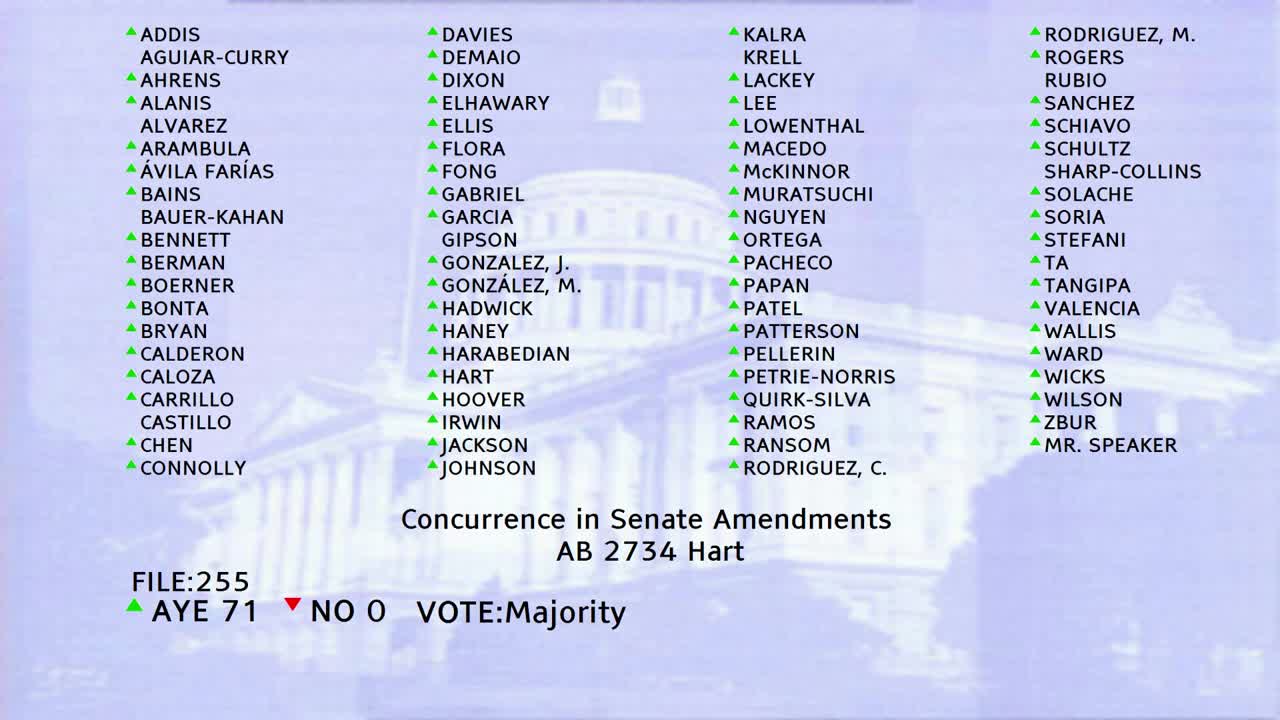


Bill Co-Author(s):