SB 784: Home improvement loans: right to cancel contracts.
- Session Year: 2025-2026
- House: Senate
- Latest Version Date: 2025-07-17
Current Status:
In Progress
(2026-08-13: August 13 hearing: Held in committee and under submission.)
Introduced
In Committee
Awaiting First Chamber Vote
Passed First Chamber
In Committee
Awaiting Second Chamber Vote
Passed Second Chamber
Enacted
(1)Existing law generally regulates various types of consumer credit contracts and transactions, including consumer loans, home solicitation contracts and offers, and home improvement businesses and contracts.
This bill would regulate home improvement loans. The bill would require a lender to take specified actions before a consumer executes a contract for a home improvement loan, including obtaining oral confirmation of key terms of the home improvement loan contract, as defined and specified. The bill would require a lender that offers or provides a home improvement loan to make certain information available to the consumer and would prescribe how a lender must respond to requests for information from a consumer. The bill would prohibit a consumers repayment obligations under a home improvement loan loan, as specified, until the lender has taken specified actions.
(2)Existing law authorizes a buyer to cancel certain home solicitation contracts or offers until midnight of the 3rd business day after the day on which the buyer signs an agreement or offer to purchase that complies with specified requirements. Existing law authorizes a buyer to cancel a home solicitation contract written for certain home improvement work until midnight of the 3rd business day after the buyer receives a signed and dated copy of the contract or offer to purchase that complies with specified requirements. Existing law requires contracts for a home solicitation contract or offer to include a notice of cancellation form with specified statements as to the buyers right to cancel. Existing law permits a buyer to provide a seller an express waiver to this right to cancel, if the contract meets other specified requirements.
Existing law requires specific provisions and requirements for home improvement contracts, as defined, that are not governed by the provisions described above. Existing law requires these contracts to include a notice regarding the buyers 3-day right to cancel.
Existing law provides an alternate 5-day period of time to cancel the contracts or offers described above if the buyer or property owner is a senior citizen, as defined, for contracts entered into, or offers to purchase conveyed, on or after January 1, 2021.
This bill would extend those 3-day and 5-day periods to 5-day and 7-day periods, respectively. The bill would also make conforming changes. The bill would apply these new extended periods to transactions on or after January 1, 2026.
(1)Existing law generally regulates various types of consumer credit contracts and transactions, including consumer loans, home solicitation contracts and offers, and home improvement businesses and contracts.
This bill would regulate home improvement loans. The bill would require a lender to take specified actions before a consumer executes a contract for a home improvement loan, including obtaining oral confirmation of key terms of the home improvement loan contract, as defined and specified. The bill would require a lender that offers or provides a home improvement loan to make certain information available to the consumer and would prescribe how a lender must respond to requests for information from a consumer. The bill would prohibit a consumers repayment obligations under a home improvement loan until the lender has taken specified actions.
(2)Existing law authorizes a buyer to cancel certain home solicitation contracts or offers until midnight of the 3rd business day after the day on which the buyer signs an agreement or offer to purchase that complies with specified requirements. Existing law authorizes a buyer to cancel a home solicitation contract written for certain home improvement work until midnight of the 3rd business day after the buyer receives a signed and dated copy of the contract or offer to purchase that complies with specified requirements. Existing law requires contracts for a home solicitation contract or offer to include a notice of cancellation form with specified statements as to the buyers right to cancel. Existing law permits a buyer to provide a seller an express waiver to this right to cancel, if the contract meets other specified requirements.
Existing law requires specific provisions and requirements for home improvement contracts, as defined, that are not governed by the provisions described above. Existing law requires these contracts to include a notice regarding the buyers 3-day right to cancel.
Existing law provides an alternate 5-day period of time to cancel the contracts or offers described above if the buyer or property owner is a senior citizen, as defined, for contracts entered into, or offers to purchase conveyed, on or after January 1, 2021.
This bill would extend those 3-day and 5-day periods to 5-day and 7-day periods, respectively. The bill would also make conforming changes. The bill would apply these new extended periods to transactions on or after January 1, 2026.
(1)Existing law generally regulates various types of consumer credit contracts and transactions, including consumer loans, home solicitation contracts and offers, and home improvement businesses and contracts.
This bill would regulate home improvement loans. The bill would require a lender to take specified actions before a consumer executes a contract for a home improvement loan, including obtaining oral confirmation of key terms of the home improvement loan contract, as defined and specified. The bill would require a lender that offers or provides a home improvement loan to make certain information available to the consumer or the property owner, as specified, and would prescribe how a lender must respond to requests for information from a consumer. The bill would prohibit a consumers repayment obligations under a home improvement lone loan until the lender has taken specified actions. The bill would prohibit a lender making a home improvement loan from providing cash or material value to a third party in excess of the actual price charged by that third party.
(2)Existing law authorizes a buyer who cancels to cancel certain home solicitation contracts or offers until midnight of the 3rd business day after the day on which the buyer signs an agreement or offer to purchase that complies with specified requirements. Existing law authorizes a buyer to cancel a home solicitation contract written for certain home improvement work until midnight of the 3rd business day after the buyer receives a signed and dated copy of the contract or offer to purchase that complies with specified requirements. Existing law requires contracts for a home solicitation contract or offer to include a notice of cancellation form with specified statements as to the buyers right to cancel. Existing law permits a buyer to provide a seller an express waiver to this right to cancel, if the contract meets other specified requirements.
Existing law requires specific provisions and requirements for home improvement contracts, as defined, that are not governed by the provisions described above. Existing law requires these contracts to include a notice regarding the buyers 3-day right to cancel.
Existing law provides an alternate 5-day period of time to cancel the contracts or offers described above if the buyer or property owner is a senior citizen, as defined, for contracts entered into, or offers to purchase conveyed, on or after January 1, 2021.
This bill would extend those 3-day and 5-day periods to 5-day and 7-day periods, respectively. The bill would also make conforming changes. The bill would apply these new extended periods to transactions on or after January 1, 2026.
(1)Existing law generally regulates various types of consumer credit contracts and transactions, including consumer loans, home solicitation contracts and offers, and home improvement businesses and contracts.
This bill would regulate home improvement loans. The bill would require a lender to take specified actions before a consumer executes a contract for a home improvement loan, including obtaining oral confirmation of key terms of the home improvement loan contract, as defined and specified. The bill would require a lender that offers or provides a home improvement loan to make certain information available to the consumer or the property owner, as specified, and would prescribe how a lender must respond to requests for information from a consumer. The bill would prohibit a consumers repayment obligations under a home improvement lone until the lender has taken specified actions. The bill would prohibit a lender making a home improvement loan from providing cash or material value to a third party in excess of the actual price charged by that third party.
(2)Existing law authorizes a buyer who cancels certain home solicitation contracts or offers until midnight of the 3rd business day after the day on which the buyer signs an agreement or offer to purchase that complies with specified requirements. Existing law authorizes a buyer to cancel a home solicitation contract written for certain home improvement work until midnight of the 3rd business day after the buyer receives a signed and dated copy of the contract or offer to purchase that complies with specified requirements. Existing law requires contracts for a home solicitation contract or offer to include a notice of cancellation form with specified statements as to the buyers right to cancel. Existing law permits a buyer to provide a seller an express waiver to this right to cancel, if the contract meets other specified requirements.
Existing law requires specific provisions and requirements for home improvement contracts, as defined, that are not governed by the provisions described above. Existing law requires these contracts to include a notice regarding the buyers 3-day right to cancel.
Existing law provides an alternate 5-day period of time to cancel the contracts or offers described above if the buyer or property owner is a senior citizen, as defined, for contracts entered into, or offers to purchase conveyed, on or after January 1, 2021.
This bill would extend those 3-day and 5-day periods to 5-day and 7-day periods, respectively. The bill would also make conforming changes. The bill would apply these new extended periods to transactions on or after January 1, 2026.
(a)(1)This section identifies the projects for which a home improvement contract is required, outlines the contract requirements, and lists the items that shall be included in the contract, or may be provided as an attachment.
(2)This section does not apply to service and repair contracts that are subject to Section 7159.10, if the contract for the applicable services complies with Sections 7159.10 to 7159.14, inclusive.
(3)This section does not apply to the sale, installation, and servicing of a fire alarm sold in conjunction with an alarm system, as defined in Section 7590.1, if all costs attributable to making the fire alarm system operable, including sale and installation costs, do not exceed five hundred dollars ($500), and the licensee complies with the requirements set forth in Section 7159.9.
(4)This section does not apply to any costs associated with monitoring a burglar or fire alarm system.
(5)Failure by the licensee, their agent or salesperson, or by a person subject to be licensed under this chapter, to provide the specified information, notices, and disclosures in the contract, or to otherwise fail to comply with any provision of this section, is cause for discipline.
(b)For purposes of this section, home improvement contract means an agreement, whether oral or written, or contained in one or more documents, between a contractor and an owner or between a contractor and a tenant, regardless of the number of residence or dwelling units contained in the building in which the tenant resides, if the work is to be performed in, to, or upon the residence or dwelling unit of the tenant, for the performance of a home improvement, as defined in Section 7151, and includes all labor, services, and materials to be furnished and performed thereunder, if the aggregate contract price specified in one or more improvement contracts, including all labor, services, and materials to be furnished by the contractor, exceeds five hundred dollars ($500). Home improvement contract also means an agreement, whether oral or written, or contained in one or more documents, between a salesperson, whether or not they are a home improvement salesperson, and an owner or a tenant, regardless of the number of residence or dwelling units contained in the building in which the tenant resides, which provides for the sale, installation, or furnishing of home improvement goods or services.
(c)In addition to the specific requirements listed under this section, every home improvement contract and any person subject to licensure under this chapter or their agent or salesperson shall comply with all of the following:
(1)The writing shall be legible.
(2)Any printed form shall be readable. Unless a larger typeface is specified in this article, text in any printed form shall be in at least 10-point typeface and the headings shall be in at least 10-point boldface type.
(3)(A)Before any work is started, the contractor shall give the buyer a copy of the contract signed and dated by both the contractor and the buyer. The buyers receipt of the copy of the contract initiates the buyers rights to cancel the contract pursuant to Sections 1689.5 to 1689.14, inclusive, of the Civil Code.
(B)The contract shall contain on the first page, in a typeface no smaller than that generally used in the body of the document, both of the following:
(i)The date the buyer signed the contract.
(ii)The name and address of the contractor to which the applicable Notice of Cancellation is to be mailed, immediately preceded by a statement advising the buyer that the Notice of Cancellation may be sent to the contractor at the address noted on the contract.
(4)The contract shall include a statement that, upon satisfactory payment being made for any portion of the work performed, the contractor, prior to any further payment being made, shall furnish to the person contracting for the home improvement or swimming pool work a full and unconditional release from any potential lien claimant claim or mechanics lien authorized pursuant to Sections 8400 and 8404 of the Civil Code for that portion of the work for which payment has been made.
(5)A change-order form for changes or extra work shall be incorporated into the contract and shall become part of the contract only if it is in writing and signed by the parties prior to the commencement of any work covered by a change order.
(6)The contract shall contain, in close proximity to the signatures of the owner and contractor, a notice stating that the owner or tenant has the right to require the contractor to have a performance and payment bond.
(7)If the contract provides for a contractor to furnish joint control, the contractor shall not have any financial or other interest in the joint control.
(8)The provisions of this section are not exclusive and do not relieve the contractor from compliance with any other applicable provision of law.
(d)A home improvement contract and any changes to the contract shall be in writing and signed by the parties to the contract prior to the commencement of work covered by the contract or an applicable change order and, except as provided in paragraph (8) of subdivision (a) of Section 7159.5, shall include or comply with all of the following:
(1)The name, business address, and license number of the contractor.
(2)If applicable, the name and registration number of the home improvement salesperson that solicited or negotiated the contract.
(3)The following heading on the contract form that identifies the type of contract in at least 10-point boldface type: Home Improvement.
(4)The following statement in at least 12-point boldface type: You are entitled to a completely filled in copy of this agreement, signed by both you and the contractor, before any work may be started.
(5)The heading: Contract Price, followed by the amount of the contract in dollars and cents.
(6)If a finance charge will be charged, the heading: Finance Charge, followed by the amount in dollars and cents. The finance charge is to be set out separately from the contract amount.
(7)The heading: Description of the Project and Description of the Significant Materials to be Used and Equipment to be Installed, followed by a description of the project and a description of the significant materials to be used and equipment to be installed. For swimming pools, the project description required under this paragraph also shall include a plan and scale drawing showing the shape, size, dimensions, and the construction and equipment specifications.
(8)If a downpayment will be charged, the details of the downpayment shall be expressed in substantially the following form, and shall include the text of the notice as specified in subparagraph (C):
(A)The heading: Downpayment.
(B)A space where the actual downpayment appears.
(C)The following statement in at least 12-point boldface type:
THE DOWNPAYMENT MAY NOT EXCEED $1,000 OR 10 PERCENT OF THE CONTRACT PRICE, WHICHEVER IS LESS.
(9)If payments, other than the downpayment, are to be made before the project is completed, the details of these payments, known as progress payments, shall be expressed in substantially the following form, and shall include the text of the statement as specified in subparagraph (C):
(A)A schedule of progress payments shall be preceded by the heading: Schedule of Progress Payments.
(B)Each progress payment shall be stated in dollars and cents and specifically reference the amount of work or services to be performed and materials and equipment to be supplied.
(C)The section of the contract reserved for the progress payments shall include the following statement in at least 12-point boldface type:
The schedule of progress payments must specifically describe each phase of work, including the type and amount of work or services scheduled to be supplied in each phase, along with the amount of each proposed progress payment. IT IS AGAINST THE LAW FOR A CONTRACTOR TO COLLECT PAYMENT FOR WORK NOT YET COMPLETED, OR FOR MATERIALS NOT YET DELIVERED. HOWEVER, A CONTRACTOR MAY REQUIRE A DOWNPAYMENT.
(10)The contract shall address the commencement of work to be performed in substantially the following form:
(A)A statement that describes what constitutes substantial commencement of work under the contract.
(B)The heading: Approximate Start Date.
(C)The approximate date on which work will be commenced.
(11)The estimated completion date of the work shall be referenced in the contract in substantially the following form:
(A)The heading: Approximate Completion Date.
(B)The approximate date of completion.
(12)If applicable, the heading: List of Documents to be Incorporated into the Contract, followed by the list of documents incorporated into the contract.
(13)The heading: Note About Extra Work and Change Orders, followed by the following statement:
Extra Work and Change Orders become part of the contract once the order is prepared in writing and signed by the parties prior to the commencement of work covered by the new change order. The order must describe the scope of the extra work or change, the cost to be added or subtracted from the contract, and the effect the order will have on the schedule of progress payments.
(e)Except as provided in paragraph (8) of subdivision (a) of Section 7159.5, all of the following notices shall be provided to the owner as part of the contract form as specified or, if otherwise authorized under this subdivision, may be provided as an attachment to the contract:
(1)A notice concerning commercial general liability insurance. This notice may be provided as an attachment to the contract if the contract includes the following statement: A notice concerning commercial general liability insurance is attached to this contract. The notice shall include the heading Commercial General Liability Insurance (CGL), followed by whichever of the following statements is both relevant and correct:
(A)(The name on the license or This contractor) does not carry commercial general liability insurance.
(B)(The name on the license or This contractor) carries commercial general liability insurance written by (the insurance company). You may call (the insurance company) at ____ to check the contractors insurance coverage.
(C)(The name on the license or This contractor) is self-insured.
(D)(The name on the license or This contractor) is a limited liability company that carries liability insurance or maintains other security as required by law. You may call (the insurance company or trust company or bank) at ____ to check on the contractors insurance coverage or security.
(2)A notice concerning workers compensation insurance. This notice may be provided as an attachment to the contract if the contract includes the statement: A notice concerning workers compensation insurance is attached to this contract. The notice shall include the heading Workers Compensation Insurance followed by whichever of the following statements is correct:
(A)(The name on the license or This contractor) has no employees and is exempt from workers compensation requirements.
(B)(The name on the license or This contractor) carries workers compensation insurance for all employees.
(3)A notice that provides the buyer with the following information about the performance of extra or change-order work:
(A)A statement that the buyer may not require a contractor to perform extra or change-order work without providing written authorization prior to the commencement of work covered by the new change order.
(B)A statement informing the buyer that extra work or a change order is not enforceable against a buyer unless the change order also identifies all of the following in writing prior to the commencement of work covered by the new change order:
(i)The scope of work encompassed by the order.
(ii)The amount to be added or subtracted from the contract.
(iii)The effect the order will make in the progress payments or the completion date.
(C)A statement informing the buyer that the contractors failure to comply with the requirements of this paragraph does not preclude the recovery of compensation for work performed based upon legal or equitable remedies designed to prevent unjust enrichment.
(4)A notice with the heading Mechanics Lien Warning written as follows:
MECHANICS LIEN WARNING:
Anyone who helps improve your property, but who is not paid, may record what is called a mechanics lien on your property. A mechanics lien is a claim, like a mortgage or home equity loan, made against your property and recorded with the county recorder.
Even if you pay your contractor in full, unpaid subcontractors, suppliers, and laborers who helped to improve your property may record mechanics liens and sue you in court to foreclose the lien. If a court finds the lien is valid, you could be forced to pay twice or have a court officer sell your home to pay the lien. Liens can also affect your credit.
To preserve their right to record a lien, each subcontractor and material supplier must provide you with a document called a Preliminary Notice. This notice is not a lien. The purpose of the notice is to let you know that the person who sends you the notice has the right to record a lien on your property if they are not paid.
BE CAREFUL. The Preliminary Notice can be sent up to 20 days after the subcontractor starts work or the supplier provides material. This can be a big problem if you pay your contractor before you have received the Preliminary Notices.
You will not get Preliminary Notices from your prime contractor or from laborers who work on your project. The law assumes that you already know they are improving your property.
PROTECT YOURSELF FROM LIENS. You can protect yourself from liens by getting a list from your contractor of all the subcontractors and material suppliers that work on your project. Find out from your contractor when these subcontractors started work and when these suppliers delivered goods or materials. Then wait 20 days, paying attention to the Preliminary Notices you receive.
PAY WITH JOINT CHECKS. One way to protect yourself is to pay with a joint check. When your contractor tells you it is time to pay for the work of a subcontractor or supplier who has provided you with a Preliminary Notice, write a joint check payable to both the contractor and the subcontractor or material supplier.
For other ways to prevent liens, visit CSLBs internet website at www.cslb.ca.gov or call CSLB at 800-321-CSLB (2752).
REMEMBER, IF YOU DO NOTHING, YOU RISK HAVING A LIEN PLACED ON YOUR HOME. This can mean that you may have to pay twice, or face the forced sale of your home to pay what you owe.
(5)The following notice shall be provided in at least 12-point typeface:
Information about the Contractors State License Board (CSLB): CSLB is the state consumer protection agency that licenses and regulates construction contractors.
Contact CSLB for information about the licensed contractor you are considering, including information about disclosable complaints, disciplinary actions, and civil judgments that are reported to CSLB.
Use only licensed contractors. If you file a complaint against a licensed contractor within the legal deadline (usually four years), CSLB has authority to investigate the complaint. If you use an unlicensed contractor, CSLB may not be able to help you resolve your complaint. Your only remedy may be in civil court, and you may be liable for damages arising out of any injuries to the unlicensed contractor or the unlicensed contractors employees.
For more information:
Visit CSLBs internet website at www.cslb.ca.gov
Call CSLB at 800-321-CSLB (2752)
Write CSLB at P.O. Box 26000, Sacramento, CA 95826.
(6)(A)The notice set forth in subparagraph (B) and entitled Five-Day Right to Cancel, or entitled Seven-Day Right to Cancel for contracts with a senior citizen, shall be provided to the buyer unless the contract is:
(i)Negotiated at the contractors place of business.
(ii)Subject to the Seven-Day Right to Cancel, as set forth in paragraph (7).
(iii)Subject to licensure under the Alarm Company Act (Chapter 11.6 (commencing with Section 7590)), provided the alarm company licensee complies with Sections 1689.5, 1689.6, and 1689.7 of the Civil Code, as applicable.
(B)(i)Five-Day Right to Cancel
You, the buyer, have the right to cancel this contract within five business days. You may cancel by emailing, mailing, faxing, or delivering a written notice to the contractor at the contractors place of business by midnight of the fifth business day after you received a signed and dated copy of the contract that includes this notice. Include your name, your address, and the date you received the signed copy of the contract and this notice.
If you cancel, the contractor must return to you anything you paid within 10 days of receiving the notice of cancellation. For your part, you must make available to the contractor at your residence, in substantially as good condition as you received them, goods delivered to you under this contract or sale. Or, you may, if you wish, comply with the contractors instructions on how to return the goods at the contractors expense and risk. If you do make the goods available to the contractor and the contractor does not pick them up within 20 days of the date of your notice of cancellation, you may keep them without any further obligation. If you fail to make the goods available to the contractor, or if you agree to return the goods to the contractor and fail to do so, then you remain liable for performance of all obligations under the contract.
(ii)References to five and fifth in the notice set forth in clause (i) shall be changed to seven and seventh respectively, for a buyer who is a senior citizen.
(C)The notice required by this paragraph shall comply with all of the following:
(i)The text of the notice is at least 12-point boldface type.
(ii)The notice is in immediate proximity to a space reserved for the owners signature.
(iii)The owner acknowledges receipt of the notice by signing and dating the notice form in the signature space.
(iv)The notice is written in the same language, e.g., Spanish, as that principally used in any oral sales presentation.
(v)The notice may be attached to the contract if the contract includes, in at least 12-point boldface type, a checkbox with one of the following statements, as applicable:
(I)For a contract with a senior citizen: The law requires that the contractor give you a notice explaining your right to cancel. Initial the checkbox if the contractor has given you a Notice of the Seven-Day Right to Cancel.
(II)For all other contracts: The law requires that the contractor give you a notice explaining your right to cancel. Initial the checkbox if the contractor has given you a Notice of the Five-Day Right to Cancel.
(vi)(I)The notice shall be accompanied by a completed form in duplicate, captioned Notice of Cancellation, which also shall be attached to the agreement or offer to purchase and be easily detachable, and which shall contain the following statement written in the same language, e.g., Spanish, as used in the contract:
Notice of Cancellation | |
/enter date of transaction/ | |
|---|---|
(Date) | |
You may cancel this transaction, without any penalty or obligation, within five business days from the above date.
If you cancel, any property traded in, any payments made by you under the contract or sale, and any negotiable instrument executed by you will be returned within 10 days following receipt by the seller of your cancellation notice, and any security interest arising out of the transaction will be canceled.
If you cancel, you must make available to the seller at your residence, in substantially as good condition as when received, any goods delivered to you under this contract or sale, or you may, if you wish, comply with the instructions of the seller regarding the return shipment of the goods at the sellers expense and risk.
If you do make the goods available to the seller and the seller does not pick them up within 20 days of the date of your notice of cancellation, you may retain or dispose of the goods without any further obligation. If you fail to make the goods available to the seller, or if you agree to return the goods to the seller and fail to do so, then you remain liable for performance of all obligations under the contract.
To cancel this transaction, mail or deliver a signed and dated copy of this cancellation notice, or any other written notice, or send a telegram |
to , |
/name of seller/ |
at |
/address of sellers place of business/ |
not later than midnight of . |
(Date) |
I hereby cancel this transaction. |
(Date) |
(Buyers signature) |
(II)The reference to five in the statement set forth in subclause (I) shall be changed to seven for a buyer who is a senior citizen.
(7)(A)The following notice entitled Seven-Day Right to Cancel shall be provided to the buyer for any contract that is written for the repair or restoration of residential premises damaged by any sudden or catastrophic event for which a state of emergency has been declared by the President of the United States or the Governor, or for which a local emergency has been declared by the executive officer or governing body of any city, county, or city and county:
Seven-Day Right to Cancel
You, the buyer, have the right to cancel this contract within seven business days. You may cancel by emailing, mailing, faxing, or delivering a written notice to the contractor at the contractors place of business by midnight of the seventh business day after you received a signed and dated copy of the contract that includes this notice. Include your name, your address, and the date you received the signed copy of the contract and this notice.
If you cancel, the contractor must return to you anything you paid within 10 days of receiving the notice of cancellation. For your part, you must make available to the contractor at your residence, in substantially as good condition as you received them, goods delivered to you under this contract or sale. Or, you may, if you wish, comply with the contractors instructions on how to return the goods at the contractors expense and risk. If you do make the goods available to the contractor and the contractor does not pick them up within 20 days of the date of your notice of cancellation, you may keep them without any further obligation. If you fail to make the goods available to the contractor, or if you agree to return the goods to the contractor and fail to do so, then you remain liable for performance of all obligations under the contract.
(B)The Seven-Day Right to Cancel notice required by this subdivision shall comply with all of the following:
(i)The text of the notice is at least 12-point boldface type.
(ii)The notice is in immediate proximity to a space reserved for the owners signature.
(iii)The owner acknowledges receipt of the notice by signing and dating the notice form in the signature space.
(iv)The notice is written in the same language, e.g., Spanish, as that principally used in any oral sales presentation.
(v)The notice may be attached to the contract if the contract includes, in at least 12-point boldface type, a checkbox with the following statement: The law requires that the contractor give you a notice explaining your right to cancel. Initial the checkbox if the contractor has given you a Notice of the Seven-Day Right to Cancel.
(vi)The notice shall be accompanied by a completed form in duplicate, captioned Notice of Cancellation, which shall also be attached to the agreement or offer to purchase and be easily detachable, and which shall contain the following statement written in the same language, e.g., Spanish, as used in the contract:
Notice of Cancellation | |
/enter date of transaction/ | |
|---|---|
(Date) | |
You may cancel this transaction, without any penalty or obligation, within seven business days from the above date.
If you cancel, any property traded in, any payments made by you under the contract or sale, and any negotiable instrument executed by you will be returned within 10 days following receipt by the seller of your cancellation notice, and any security interest arising out of the transaction will be canceled.
If you cancel, you must make available to the seller at your residence, in substantially as good condition as when received, any goods delivered to you under this contract or sale, or you may, if you wish, comply with the instructions of the seller regarding the return shipment of the goods at the sellers expense and risk.
If you do make the goods available to the seller and the seller does not pick them up within 20 days of the date of your notice of cancellation, you may retain or dispose of the goods without any further obligation. If you fail to make the goods available to the seller, or if you agree to return the goods to the seller and fail to do so, then you remain liable for performance of all obligations under the contract.
To cancel this transaction, mail or deliver a signed and dated copy of this cancellation notice, or any other written notice, or send a telegram |
to , |
/name of seller/ |
at |
/address of sellers place of business/ |
not later than midnight of . |
(Date) |
I hereby cancel this transaction. |
(Date) |
(Buyers signature) |
(f)The five-day right to cancel added by the act that amended paragraph (6) of subdivision (e) shall apply to contracts entered into on or after January 1, 2021.
(g)The five-day and seven-day rights to cancel added by the act in the 202425 Regular Session of the Legislature that amended paragraph (6) of subdivision (e) shall apply to contracts entered into on or after January 1, 2026.
SEC. 2.Section 1689.6 of the Civil Code is amended to read:1689.6.(a)(1)Except for a contract written pursuant to Section 7151.2 or 7159.10 of the Business and Professions Code, in addition to any other right to revoke an offer, the buyer has the right to cancel a home solicitation contract or offer until midnight of the fifth business day, or until midnight of the seventh business day if the buyer is a senior citizen, after the day on which the buyer signs an agreement or offer to purchase which complies with Section 1689.7.
(2)In addition to any other right to revoke an offer, the buyer has the right to cancel a home solicitation contract written pursuant to Section 7151.2 of the Business and Professions Code until midnight of the fifth business day, or until midnight of the seventh business day if the buyer is a senior citizen, after the buyer receives a signed and dated copy of the contract or offer to purchase that complies with Section 1689.7.
(3)(A)In addition to any other right to revoke an offer, the buyer has the right to cancel a home solicitation contract or offer to purchase written pursuant to Section 7159.10 of the Business and Professions Code, until the buyer receives a signed and dated copy of a service and repair contract that complies with the contract requirements specified in Section 7159.10 of the Business and Professions Code and the work commences.
(B)For any contract written pursuant to Section 7159.10 of the Business and Professions Code, or otherwise presented to the buyer as a service and repair contract, unless all of the conforming requirements listed under subdivision (a) of that section are met, the requirements set forth under Section 7159 of the Business and Professions Code shall be applicable, regardless of the aggregate contract price, including the right to cancel as set forth under this section.
(4)The five-day right to cancel added by the act that amended paragraphs (1) and (2) shall apply to contracts entered into, or offers to purchase conveyed, on or after January 1, 2021.
(5)The five-day and seven-day rights to cancel added by the act amending paragraphs (1) and (2) in the 202526 Regular Session of the Legislature shall apply to contracts entered into, or offers to purchase conveyed, on or after January 1, 2026.
(b)In addition to any other right to revoke an offer, any buyer has the right to cancel a home solicitation contract or offer for the purchase of a personal emergency response unit until midnight of the seventh business day after the day on which the buyer signs an agreement or offer to purchase which complies with Section 1689.7. This subdivision shall not apply to a personal emergency response unit installed with, and as part of, a home security alarm system subject to the Alarm Company Act (Chapter 11.6 (commencing with Section 7590) of Division 3 of the Business and Professions Code) which has two or more stationary protective devices used to enunciate an intrusion or fire and is installed by an alarm company operator operating under a current license issued pursuant to the Alarm Company Act, which shall instead be subject to subdivision (a).
(c)In addition to any other right to revoke an offer, a buyer has the right to cancel a home solicitation contract or offer for the repair or restoration of residential premises damaged by a disaster that was not void pursuant to Section 1689.14, until midnight of the seventh business day after the buyer signs and dates the contract unless the provisions of Section 1689.15 are applicable.
(d)Cancellation occurs when the buyer gives written notice of cancellation to the seller at the address specified in the agreement or offer.
(e)Notice of cancellation, if given by mail, is effective when deposited in the mail properly addressed with postage prepaid.
(f)Notice of cancellation given by the buyer need not take the particular form as provided with the contract or offer to purchase and, however expressed, is effective if it indicates the intention of the buyer not to be bound by the home solicitation contract or offer.
(g)Personal emergency response unit, for purposes of this section, means an in-home radio transmitter device or two-way radio device generally, but not exclusively, worn on a neckchain, wrist strap, or clipped to clothing, and connected to a telephone line through which a monitoring station is alerted of an emergency and emergency assistance is summoned.
SEC. 3.Section 1689.7 of the Civil Code is amended to read:1689.7.(a)(1)Except for contracts written pursuant to Sections 7151.2 and 7159.10 of the Business and Professions Code, in a home solicitation contract or offer, the buyers agreement or offer to purchase shall be written in the same language, e.g., Spanish, as principally used in the oral sales presentation, shall be dated, shall be signed by the buyer, and except as provided in paragraph (2), shall contain in immediate proximity to the space reserved for the buyers signature, a conspicuous statement in a size equal to at least 10-point boldface type, as follows:
(A)For a buyer who is a senior citizen:You, the buyer, may cancel this transaction at any time prior to midnight of the seventh business day after the date of this transaction. See the attached notice of cancellation form for an explanation of this right.
(B)For all other buyers:You, the buyer, may cancel this transaction at any time prior to midnight of the fifth business day after the date of this transaction. See the attached notice of cancellation form for an explanation of this right.
(2)The statement required pursuant to this subdivision for a home solicitation contract or offer for the purchase of a personal emergency response unit, as defined in Section 1689.6, that is not installed with and as part of a home security alarm system subject to the Alarm Company Act (Chapter 11.6 (commencing with Section 7590) of Division 3 of the Business and Professions Code) that has two or more stationary protective devices used to enunciate an intrusion or fire and is installed by an alarm company operator operating under a current license issued pursuant to the Alarm Company Act, is as follows: You, the buyer, may cancel this transaction at any time prior to midnight of the seventh business day after the date of this transaction. See the attached notice of cancellation form for an explanation of this right.
(3)Except for contracts written pursuant to Sections 7151.2 and 7159.10 of the Business and Professions Code, the statement required pursuant to this subdivision for the repair or restoration of residential premises damaged by a disaster pursuant to subdivision (c) of Section 1689.6 is as follows:You, the buyer, may cancel this transaction at any time prior to midnight of the seventh business day after the date of this transaction. See the attached notice of cancellation form for an explanation of this right.
(4)(A)A home solicitation contract written pursuant to Section 7151.2 of the Business and Professions Code shall be written in
the same language, e.g., Spanish, as principally used in the oral sales presentation. The contract, or an attachment to the contract that is subject to Section 7159 of the Business and Professions Code shall include in immediate proximity to the space reserved for the buyers signature, the following statement in a size equal to at least 12-point boldface type, which shall be dated and signed by the buyer:
Five-Day Right to Cancel
You, the buyer, have the right to cancel this contract within five business days. You may cancel by e-mailing, mailing, faxing, or delivering a written notice to the contractor at the contractors place of business by midnight of the fifth business day after you received a signed and dated copy of the contract that includes this notice. Include your name, your address, and the date you received the signed copy of the contract and this notice.
If you cancel, the contractor must return to you anything you paid within 10 days of receiving the notice of cancellation. For your part, you must make available to the contractor at your residence, in substantially as good condition as you received it, any goods delivered to you under this contract or sale. Or, you may, if you wish, comply with the contractors instructions on how to return the goods at the contractors expense and risk. If you do make the goods available to the contractor and the contractor does not pick them up within 20 days of the date of your notice of cancellation, you may keep them without any further obligation. If you fail to make the goods available to the contractor, or if you agree to return the goods to the contractor and fail to do so,
then you remain liable for performance of all obligations under the contract.
(B)References to five and fifth in the statement set forth in subparagraph (A) shall be changed to seven and seventh, respectively, for a buyer who is a senior citizen.
(b)The agreement or offer to purchase shall contain on the first page, in a type size no smaller than that generally used in the body of the document, the following: (1) the name and address of the seller to which the notice is to be mailed, and (2) the date the buyer signed the agreement or offer to purchase.
(c)(1)Except for contracts written pursuant to Sections 7151.2 and 7159.10 of the Business and Professions Code, or except as provided in subdivision (d), the agreement or offer to purchase shall be accompanied by a completed form in duplicate, captioned Notice of Cancellation which shall be attached to the agreement or offer to purchase and be easily detachable, and which shall contain in type of at least 10-point the following statement written in the same language, e.g., Spanish, as used in the contract:
Notice of Cancellation | |
/enter date of transaction/ | |
(Date) | |
You may cancel this transaction, without any penalty or obligation, within five business days from the above date.
If you cancel, any property traded in, any payments made by you under the contract or sale, and any negotiable instrument executed by you will be returned within 10 days following receipt by the seller of your cancellation notice, and any security interest arising out of the transaction will be canceled.
If you cancel, you must make available to the seller at your residence, in substantially as good condition as when received, any goods delivered to you under this contract or sale, or you may, if you wish, comply with the instructions of the seller regarding the return shipment of the goods at the sellers expense and risk.
If you do make the goods available to the seller and the seller does not pick them up within 20 days of the date of your notice of cancellation, you may retain or dispose of the goods without any further obligation. If you fail to make the goods available to the seller, or if you agree to return the goods to the seller and fail to do so, then you remain liable for performance of all obligations under the contract.
| To cancel this transaction, mail or deliver a signed and dated copy of this cancellation notice, or any other written notice, or send a telegram | |
to/name of seller/, | |
at/address of sellers place of business/ | |
not later than midnight of(Date). | |
I hereby cancel this transaction.(Date) | |
(Buyers signature) |
(2)The reference to five in the statement set forth in paragraph (1) shall be changed to seven for a buyer who is a senior citizen.
(d)Any agreement or offer to purchase a personal emergency response unit, as defined in Section 1689.6, which is not installed with and as part of a home security alarm system subject to the Alarm Company Act which has two or more stationary protective devices used to enunciate an intrusion or fire and is installed by an alarm company operator operating under a current license issued pursuant to the Alarm Company Act, shall be subject to the requirements of subdivision (c), and shall be accompanied by the Notice of Cancellation required by subdivision (c), except that the first paragraph of that notice shall be deleted and replaced with the following paragraph:
You may cancel this transaction, without any penalty or obligation, within seven business days from the above date.
(e)A home solicitation contract written pursuant to Section 7151.2 of the Business and Professions Code for the repair or restoration of residential premises damaged by a disaster that is subject to subdivision (c) of Section 1689.6, shall be written in the same language, e.g., Spanish, as principally used in the oral sales presentation. The contract, or an attachment to the contract that is subject to Section 7159 of the Business and Professions Code shall include, in immediate proximity to the space reserved for the buyers signature, the following statement in a size equal to at least 12-point boldface type, which shall be signed and dated by the buyer:
Seven-Day Right to Cancel
You, the buyer, have the right to cancel this contract within seven business days. You may cancel by e-mailing, mailing, faxing, or delivering a written notice to the contractor at the contractors place of business by midnight of the seventh business day after you received a signed and dated copy of the contract that includes this notice. Include your name, your address, and the date you received the signed copy of the contract and this notice.
If you cancel, the contractor must return to you anything you paid within 10 days of receiving the notice of cancellation. For your part, you must make available to the contractor at your residence, in substantially as good condition as you received it, any goods delivered to you under this contract or sale. Or, you may, if you wish, comply with the contractors instructions on how to return the goods at the contractors expense and risk. If you do make the goods available
to the contractor and the contractor does not pick them up within 20 days of the date of your notice of cancellation, you may keep them without any further obligation. If you fail to make the goods available to the contractor, or if you agree to return the goods to the contractor and fail to do so, then you remain liable for performance of all obligations under the contract.
(f)The seller shall provide the buyer with a copy of the contract or offer to purchase and the attached notice of cancellation, and shall inform the buyer orally of the buyers right to cancel and the requirement that cancellation be in writing, at the time the home solicitation contract or offer is executed.
(g)Until the seller has complied with this section the buyer may cancel the home solicitation contract or offer.
(h)Contract or sale as used in subdivision (c) means home solicitation contract or offer as defined by Section 1689.5.
(i)The five-day right to cancel added by the act that added subparagraph (A) to paragraph (1) and subparagraph (B) to paragraph (4) of subdivision (a), and paragraph (2) to subdivision (c) applies to contracts, or offers to purchase conveyed, entered into, on or after January 1, 2021.
(j)The five-day and seven-day rights to cancel added by the act in the 202526 Regular Session of the Legislature that amended subdivisions (a) and (c) apply to contracts entered into, or offers to purchase conveyed, on or after January 1, 2026.
SEC. 4.Section 1689.13 of the Civil Code is amended to read:1689.13.Sections 1689.5, 1689.6, 1689.7, 1689.10, 1689.12, and 1689.14 do not apply to a contract that meets all of the following requirements:
(a)The contract is initiated by the buyer or the buyers agent or insurance representative.
(b)The contract is executed in connection with making of emergency or immediately necessary repairs that are necessary for the immediate protection of persons or real or personal property.
(c)(1)The buyer gives the seller a separate statement that is dated and signed that describes the situation that requires immediate remedy, and expressly acknowledges and waives the right to cancel the sale within the applicable time period.
(2)The waiver of the five-day right to cancel added by the act that amended paragraph (1) shall apply to contracts entered into, or offers to purchase conveyed, on or after January 1, 2021.
(3)The waiver of the five-day and seven-day rights to cancel added by the act in the 202526 Regular Session of the Legislature that amended paragraph (1) applies to contracts entered into, or offers to purchase conveyed, on or after January 1, 2026.
SEC. 5.Title 1.87 (commencing with Section 1799.220) is added to Part 4 of Division 3 of the Civil Code, to read:1.87.Home Improvement Loans1799.220.For purposes of this title:
(a)Consumer has the same meaning as defined in Section 4052 of the Financial Code.
(b)Consumer loan has the same meaning as defined in Section 22203 of the Financial Code.
(c)Dealer fee means a charge associated with a home improvement loan that is treated by the lender as sellers points pursuant to Section 1026.4 of Title 12 of the Code of Federal Regulations.
(d)Home improvement has the same meaning as defined in Section 7151 of the Business and Professions Code.
(e)Home improvement contract has the same meaning as defined in Section 7159 of the Business and Professions Code.
(f)(1)Home improvement loan means a consumer loan that will be disbursed to a contractor in connection with a home solicitation contract to finance a home improvement.
(2)Home improvement loan does not include a either of the following:
(A)A PACE assessment.
(B)A mortgage loan that meets any of the following criteria:
(i)Insured by the Federal Housing Administration.
(ii)Guaranteed or insured by the federal Department of Veterans Affairs.
(iii)Guaranteed or insured by the federal Department of Agriculture.
(iv)Purchased or securitized by the Federal Home Loan Mortgage Corporation.
(v)Purchased or securitized by the Federal National Mortgage Association.
(g)Home solicitation contract has the same meaning as defined in Section 1689.5.
(h)PACE assessment has the same meaning as defined in Section 22015 of the Financial Code.
(i)Solar energy system has the same meaning as defined in Section 7151 of the Business and Professions Code.
1799.221.(a)Except as provided in subdivision (b), a A consumers repayment obligations under a home improvement loan, loan that finances a home improvement, excluding a solar energy system described in subdivision (b), and including, but not limited to, payments, fees, penalties, and interest, shall not commence until the lender has done either of the following: following has occurred:
(1)Confirmed The lender has confirmed that all home improvements financed in whole or in part by the home improvement loan have been given final approval by all permitting agencies and received confirmation from the consumer, orally and in writing, consumer that the improvements are operational.
(2)(A)Completed The lender has completed a reasonable investigation and determined that all home improvements are operational.
(B)For purposes of this paragraph, a reasonable investigation may include a review of video and photographic evidence that all home improvements funded by the loan are operational and fit for use, provided that the video and photographic evidence includes geolocation and time data.
(b)If the For a home improvement that is a solar energy system, a consumers repayment obligations under a home improvement loan, including, but not limited to, payments, fees, penalties, and interest, interest accrual, shall not commence until the lender confirms that the utility supplying electricity to the property has been connected to the solar energy system and has granted permission to operate the solar energy system, and the consumer confirms, orally and in writing, that the solar energy system is operating. system.
(c)A lender shall not report a home improvement loan to a credit reporting agency or record a financing statement in connection with the home improvement loan until the home improvement is operational and the consumer repayment obligations have commenced pursuant to this section.
(d)A consumers confirmation under this section that a home improvement is operational shall not stop the consumer from subsequently raising any claim or defense against the contractor or lender relating to the home improvement, nor shall the confirmation be treated as a prior inconsistent statement under Section 1235 of the Evidence Code with respect to a defect or other problem with the home improvement or workmanship that the consumer did not actually discover until after the confirmation.
1799.222.(a)Before a consumer executes a home improvement loan, the lender shall disclose to the consumer orally and in writing the dealer fee, if any, associated with the loan in compliance with this section.
(b)(1)A lender shall complete and deliver to the consumer, or cause to be completed and delivered to the consumer, a printed copy of the disclosure set forth below, or a substantially similar printed document that displays the same information in a substantially similar format, in no smaller than 14-point type. The disclosure shall be signed by the consumer before a loan agreement may be executed.
The amount of your loan may include a dealer fee that is not included as a finance charge for the purpose of calculating the annual percentage rate (APR) of the loan. This means that the true cost of this loan may be higher than indicated by the APR. If you seek financing from another lender that does not have a relationship with your contractor, the loan is unlikely to include a dealer fee but may have a higher interest rate or other finance charges. For this reason, you are encouraged to shop around and compare the costs of different loans before deciding which to use for this project.
The dealer fee for this loan is $____. You will be required to pay this back. Your contractor may have opted to pay a dealer fee in order for your lender to extend credit to you on the terms reflected in your loan agreement. If your contractor added this amount or any portion of this amount to your home improvement contract, you will be required to pay that amount back. The dealer fee is in addition to distinct from the payment or payments made by the lender to the contractor for their work on this project, which for this loan is $____.
Confirmation of Receipt:
Your signature below serves to show you have received this disclosure. Your signature on this form is not a contract to enter into a home improvement loan.
Consumer SignatureDate
(2)Before delivering, or authorizing the delivery of, the printed disclosure set forth in this subdivision, the lender shall approve the form of disclosure that will be delivered to the consumer and provide the values of the dealer fee and the amount of the payment or payments that will be made by the lender to the contractor that will be disclosed to the consumer.
(3)The printed disclosure may be a form copy with blanks for the dealer fee and the amount of the payment or payments that will be made by the lender to the contractor to be filled out by the person delivering the printed copy on behalf of the lender before delivering the form to the consumer. If a form copy is used, the lender shall receive oral confirmation from the consumer during the call required by subdivision (b) of Section 1799.224 that the form was completed and accurate and that the blanks were filled in before the form was delivered and consumer was asked to sign it.
(4)The lender shall obtain a copy, either physical or digital, of the signed disclosure before executing the home improvement loan.
(c)The oral disclosure required by this section shall be provided in substantially the same form as the written disclosure set forth in paragraph (1) of subdivision (b).
1799.223.(a)In a dispute arising out of a home solicitation wherein a home improvement loan is obtained, a consumer may assert against the lender a claim or defense arising out of the solicitation of a home improvement loan available to the consumer against a contractor, salesperson, or broker who solicited the home improvement loan with misrepresentations as to the key terms of the loan, as defined in Section 1799.224, or the financial benefits of the home improvement.(b)(1)A lender shall not be held liable pursuant to subdivision (a) for a misrepresentation made by a contractor, salesperson, or broker that is cured by the lender in the telephone, video, or digital call required by Section 1799.224. A misrepresentation about a specific financial benefit of the home improvement may be cured with a statement that the specific financial benefit is not a term of the home improvement and the consumer should not rely on the purported financial benefit in determining whether they can afford, or otherwise wish to enter into, the loan.(2)For purposes of this section, a financial benefit of the home improvement includes, but is not limited to, any tax benefits from the home improvement or any cost savings resulting from the home improvement.(c)This section does not limit any rights or remedies available to the consumer by any other law.1799.224.(a)For purposes of this section:
(1)Key terms means the material terms of the home improvement loan, including, but not limited to, all of the following:
(A)What home improvements are being financed.
(B)The name of the contractor who will receive the loan proceeds.
(C)The loan term or period of time for repayment.
(D)The total cost of the loan.
(E)The monthly payment amounts amounts and due dates.
(F)The finance charge and due dates. charge.
(G)Whether the amount of monthly payments due will change during the term of the loan.
(H)The annual percentage rate of interest.
(I)How late fees may be incurred.
(J)How payments more than the minimum payment will be applied.
(K)Whether there are any prepayment penalties.
(L)When the first payment is due.
(M)Any dealer fees.
(2)Their own interpreter means a person who meets represents that they meet all of the following conditions:
(A)The person is not a minor
(B)The person is able to speak fluently and read with full understanding both the English language and the language in which the consumer prefers to communicate, provided that the language is specified in Section 1632 of the Civil Code.
(C)The person is not employed by, and whose services are not made available through, the lender or the contractor.
(b)(1)Before a consumer executes a contract for a home improvement loan to pay for a home improvement and before the right-to-cancel time period expires for a home improvement contract that is being financed by a home improvement loan, the lender shall do both of the following:
(A)Obtain a copy of the home improvement contract for the home improvement that is being financed by the home improvement loan.
(B)Complete and document a telephone, video, or digital call with the consumer, or an authorized representative of the consumer to do all of the following:
(i)Receive oral confirmation that all owners of the property have the consumer has received a copy of the home improvement loan contract, with the key terms completed, the financing estimate and disclosure form required under the federal Truth in Lending Act, and the right-to-cancel form.
(ii)Review the key terms of the home improvement loan contract, in plain language, with, and convey all of the information required by paragraph (3) to, the consumer on the call or to a verified authorized representative of the consumer on the call, and receive oral confirmation that the consumer or their representative understands the key terms of the loan.
(iii)Provide the consumer, or an authorized representative of the consumer, the opportunity to ask any questions about the loan or terms of the loan, and, once all questions have been answered, receive oral confirmation that the consumer understands the terms of the home improvement loan contract.
(2)(A)At the commencement of the oral confirmation required by subparagraph (B) of paragraph (1), the lender shall ask if the consumer on the call would prefer to communicate during the oral confirmation primarily in a language other than English that is specified in Section 1632 of the Civil Code. 1632. If the preferred language is supported by the lender, the oral confirmation shall be given in that primary language, except where the consumer on the call chooses to communicate through their own interpreter. If the preferred language is not supported and an interpreter is not chosen by the consumer on the call, the home improvement loan contract shall not proceed.
(B)After determining the consumers preferred language, the lender shall inform the consumer that they have the right to include anyone else on the call, except that the contractor or contractors salesperson shall not be present during or participate in the call. The lender shall ask the consumer whether they wish to have anyone else participate in the call and confirm with the consumer that the contractor or contractors salesperson are is not present. The lender shall terminate the call, and the home improvement loan contract shall not proceed, if the lender learns that the contractor or salesperson, or both, are present, or that an unauthorized third party is attempting to participate in the call.
(3)The oral confirmation required pursuant to subparagraph (B) of paragraph (1) shall include, but need not be limited to, all of the following information:
(A)A statement that the consumer should review the home improvement loan and financing estimate and disclosure form with all other owners of the property.
(B)An explanation of the home improvements being installed that are being financed by the home improvement loan, including, but not limited to, the description of the home improvements as described in the home improvement contract.
(C)An explanation of the key terms of the home improvement loan.
(D)Confirmation of the consumers gross monthly household income and ability to pay the monthly payment amount and total cost even if any estimated cost savings are not realized.
(E)Confirmation that the consumer understands that any estimates of cost savings from the home improvements are not guaranteed and may be based on estimates that differ from actual results, and that the consumer is obligated to repay the loan regardless of whether any estimated cost savings are realized.
(F)Confirmation that the consumer understands that they should consult a tax professional to determine the consumer may qualify for any tax benefits related to the home improvement project and that the consumer should not rely on any representations made by the contractor, contractors salesperson, or lender in determining the value of any tax benefits for which the consumer may qualify.
(G)Disclosure of whether the property will be subject to a financing statement filing requirement, as specified in Section 9501 of the Commercial Code, during the term of the loan contract and confirmation that the consumer understands that the obligations under the loan contract may be required to be paid in full before the property owner sells or refinances the property.
(H)Confirmation of the identity of the consumer, including their email address, and if the lender will send communications to the borrower through email, confirmation that the consumer is able to access email.
(4)The lender shall maintain a recording of the oral confirmation required by subparagraph (B) of paragraph (1) for at least five years after the loan term ends or the last date the loan is active, whichever is earlier, and shall make it available to the consumer upon request.
(c)If the oral confirmation required by this section was conducted primarily in a language other than English that is specified in Section 1632 of the Civil Code, 1632, the lender shall deliver in writing to the consumer, in the language used during the oral confirmation, the disclosures and contract or agreement required by law, including, but not limited to, all of the following:
(1)The home improvement loan contract.
(2)The right-to-cancel form.
(3)The financing estimate and disclosure form required under the federal Truth in Lending Act.
(d)If the oral confirmation required by this section was conducted primarily in any language other than English and that is specified in Section 1632, all subsequent communications, whether written or oral, shall be conducted in the manner described in subparagraph (B) of paragraph (2) of subdivision (b).
1799.225.(a)A lender that offers or provides a home improvement loan shall make available to the consumer, upon request, information in the control or possession of the lender concerning the home improvement loan that was provided to the consumer to finance the home improvement contract, as set forth in this section.
(b)A lender shall comply with the requirements of this section for any written request for information from a consumer or their authorized representative that includes the name of the consumer, the project subject to the financing agreement, information that enables the lender to identify the consumers account, and that states the information the consumer is requesting.
(c)A lender shall provide to the consumer or their authorized representative, upon written request, any of the following documentation:
(1)The financing application.
(2)Financing agreement and disclosures, including all certificates, disclosures, and contracts associated with the home improvement loan, and including any signed or initialed copies.
(3)A copy of the home improvement contract for the financed work.
(4)Completion certificates or other documentation relied upon to evidence that performance of the financed home improvement was completed or satisfactorily concluded, including any signed copies.
(5)Documentation of any electronic signatures obtained in connection with the home improvement loan, including electronic certificates, electronic signature envelopes, or audit trails.
(6)Documentation of all payments to the contractor. The requirement described in this paragraph does not prohibit a lender from redacting any information that is confidential or of a sensitive nature, including, but not limited to, account or routing numbers.
(7)The transaction history between the lender and the consumer.
(8)Financing estimate and Home improvement loan disclosures.
(9)An accounting from the date of original transaction to the present.
(10)If secured by a financing statement, as described in Section 9501 of the Commercial Code, a copy of the financing statement.
(11)Recordings of all oral confirmation calls with the consumer or their authorized representative or representatives.
(12)Documentation of any investigation performed in compliance with Section 1799.221.
(13)Documentation of any dealer fees.
(14)Documentation of the lenders compliance with Section 1799.222.
(d)A lender shall maintain each of the records specified in subdivision (c) relating to any transaction for five years from the end of the loan term or the last date the loan is active, whichever is later. earlier.
(e)A lender, by written notice provided to a consumer, may establish an address that a consumer must use to request information in accordance with the procedures in this section.
(f)No later than 30 business days after the lender receives the request for information, the lender shall do one of the following:
(1)Provide the consumer with the requested information and contact information, including a telephone number, for further assistance in writing.
(2)Conduct a reasonable search for the requested information and provide the consumer with a written notification that states that the lender has determined that the requested information is not available to the lender. That notification shall also identify the basis for the lenders determination, and provide contact information, including a telephone number, for further assistance.
(g)A lender, as a condition of responding to an information request, shall not charge a fee, or require a consumer to make any payment that may be owed on the consumers account, or impose any other requirement.
(a)(1)This section identifies the projects for which a home improvement contract is required, outlines the contract requirements, and lists the items that shall be included in the contract, or may be provided as an attachment.
(2)This section does not apply to service and repair contracts that are subject to Section 7159.10, if the contract for the applicable services complies with Sections 7159.10 to 7159.14, inclusive.
(3)This section does not apply to the sale, installation, and servicing of a fire alarm sold in conjunction with an alarm system, as defined in Section 7590.1, if all costs attributable to making the fire alarm system operable, including sale and installation costs, do not exceed five hundred dollars ($500), and the licensee complies with the requirements set forth in Section 7159.9.
(4)This section does not apply to any costs associated with monitoring a burglar or fire alarm system.
(5)Failure by the licensee, their agent or salesperson, or by a person subject to be licensed under this chapter, to provide the specified information, notices, and disclosures in the contract, or to otherwise fail to comply with any provision of this section, is cause for discipline.
(b)For purposes of this section, home improvement contract means an agreement, whether oral or written, or contained in one or more documents, between a contractor and an owner or between a contractor and a tenant, regardless of the number of residence or dwelling units contained in the building in which the tenant resides, if the work is to be performed in, to, or upon the residence or dwelling unit of the tenant, for the performance of a home improvement, as defined in Section 7151, and includes all labor, services, and materials to be furnished and performed thereunder, if the aggregate contract price specified in one or more improvement contracts, including all labor, services, and materials to be furnished by the contractor, exceeds five hundred dollars ($500). Home improvement contract also means an agreement, whether oral or written, or contained in one or more documents, between a salesperson, whether or not they are a home improvement salesperson, and an owner or a tenant, regardless of the number of residence or dwelling units contained in the building in which the tenant resides, which provides for the sale, installation, or furnishing of home improvement goods or services.
(c)In addition to the specific requirements listed under this section, every home improvement contract and any person subject to licensure under this chapter or their agent or salesperson shall comply with all of the following:
(1)The writing shall be legible.
(2)Any printed form shall be readable. Unless a larger typeface is specified in this article, text in any printed form shall be in at least 10-point typeface and the headings shall be in at least 10-point boldface type.
(3)(A)Before any work is started, the contractor shall give the buyer a copy of the contract signed and dated by both the contractor and the buyer. The buyers receipt of the copy of the contract initiates the buyers rights to cancel the contract pursuant to Sections 1689.5 to 1689.14, inclusive, of the Civil Code.
(B)The contract shall contain on the first page, in a typeface no smaller than that generally used in the body of the document, both of the following:
(i)The date the buyer signed the contract.
(ii)The name and address of the contractor to which the applicable Notice of Cancellation is to be mailed, immediately preceded by a statement advising the buyer that the Notice of Cancellation may be sent to the contractor at the address noted on the contract.
(4)The contract shall include a statement that, upon satisfactory payment being made for any portion of the work performed, the contractor, prior to any further payment being made, shall furnish to the person contracting for the home improvement or swimming pool work a full and unconditional release from any potential lien claimant claim or mechanics lien authorized pursuant to Sections 8400 and 8404 of the Civil Code for that portion of the work for which payment has been made.
(5)A change-order form for changes or extra work shall be incorporated into the contract and shall become part of the contract only if it is in writing and signed by the parties prior to the commencement of any work covered by a change order.
(6)The contract shall contain, in close proximity to the signatures of the owner and contractor, a notice stating that the owner or tenant has the right to require the contractor to have a performance and payment bond.
(7)If the contract provides for a contractor to furnish joint control, the contractor shall not have any financial or other interest in the joint control.
(8)The provisions of this section are not exclusive and do not relieve the contractor from compliance with any other applicable provision of law.
(d)A home improvement contract and any changes to the contract shall be in writing and signed by the parties to the contract prior to the commencement of work covered by the contract or an applicable change order and, except as provided in paragraph (8) of subdivision (a) of Section 7159.5, shall include or comply with all of the following:
(1)The name, business address, and license number of the contractor.
(2)If applicable, the name and registration number of the home improvement salesperson that solicited or negotiated the contract.
(3)The following heading on the contract form that identifies the type of contract in at least 10-point boldface type: Home Improvement.
(4)The following statement in at least 12-point boldface type: You are entitled to a completely filled in copy of this agreement, signed by both you and the contractor, before any work may be started.
(5)The heading: Contract Price, followed by the amount of the contract in dollars and cents.
(6)If a finance charge will be charged, the heading: Finance Charge, followed by the amount in dollars and cents. The finance charge is to be set out separately from the contract amount.
(7)The heading: Description of the Project and Description of the Significant Materials to be Used and Equipment to be Installed, followed by a description of the project and a description of the significant materials to be used and equipment to be installed. For swimming pools, the project description required under this paragraph also shall include a plan and scale drawing showing the shape, size, dimensions, and the construction and equipment specifications.
(8)If a downpayment will be charged, the details of the downpayment shall be expressed in substantially the following form, and shall include the text of the notice as specified in subparagraph (C):
(A)The heading: Downpayment.
(B)A space where the actual downpayment appears.
(C)The following statement in at least 12-point boldface type:
THE DOWNPAYMENT MAY NOT EXCEED $1,000 OR 10 PERCENT OF THE CONTRACT PRICE, WHICHEVER IS LESS.
(9)If payments, other than the downpayment, are to be made before the project is completed, the details of these payments, known as progress payments, shall be expressed in substantially the following form, and shall include the text of the statement as specified in subparagraph (C):
(A)A schedule of progress payments shall be preceded by the heading: Schedule of Progress Payments.
(B)Each progress payment shall be stated in dollars and cents and specifically reference the amount of work or services to be performed and materials and equipment to be supplied.
(C)The section of the contract reserved for the progress payments shall include the following statement in at least 12-point boldface type:
The schedule of progress payments must specifically describe each phase of work, including the type and amount of work or services scheduled to be supplied in each phase, along with the amount of each proposed progress payment. IT IS AGAINST THE LAW FOR A CONTRACTOR TO COLLECT PAYMENT FOR WORK NOT YET COMPLETED, OR FOR MATERIALS NOT YET DELIVERED. HOWEVER, A CONTRACTOR MAY REQUIRE A DOWNPAYMENT.
(10)The contract shall address the commencement of work to be performed in substantially the following form:
(A)A statement that describes what constitutes substantial commencement of work under the contract.
(B)The heading: Approximate Start Date.
(C)The approximate date on which work will be commenced.
(11)The estimated completion date of the work shall be referenced in the contract in substantially the following form:
(A)The heading: Approximate Completion Date.
(B)The approximate date of completion.
(12)If applicable, the heading: List of Documents to be Incorporated into the Contract, followed by the list of documents incorporated into the contract.
(13)The heading: Note About Extra Work and Change Orders, followed by the following statement:
Extra Work and Change Orders become part of the contract once the order is prepared in writing and signed by the parties prior to the commencement of work covered by the new change order. The order must describe the scope of the extra work or change, the cost to be added or subtracted from the contract, and the effect the order will have on the schedule of progress payments.
(e)Except as provided in paragraph (8) of subdivision (a) of Section 7159.5, all of the following notices shall be provided to the owner as part of the contract form as specified or, if otherwise authorized under this subdivision, may be provided as an attachment to the contract:
(1)A notice concerning commercial general liability insurance. This notice may be provided as an attachment to the contract if the contract includes the following statement: A notice concerning commercial general liability insurance is attached to this contract. The notice shall include the heading Commercial General Liability Insurance (CGL), followed by whichever of the following statements is both relevant and correct:
(A)(The name on the license or This contractor) does not carry commercial general liability insurance.
(B)(The name on the license or This contractor) carries commercial general liability insurance written by (the insurance company). You may call (the insurance company) at ____ to check the contractors insurance coverage.
(C)(The name on the license or This contractor) is self-insured.
(D)(The name on the license or This contractor) is a limited liability company that carries liability insurance or maintains other security as required by law. You may call (the insurance company or trust company or bank) at ____ to check on the contractors insurance coverage or security.
(2)A notice concerning workers compensation insurance. This notice may be provided as an attachment to the contract if the contract includes the statement: A notice concerning workers compensation insurance is attached to this contract. The notice shall include the heading Workers Compensation Insurance followed by whichever of the following statements is correct:
(A)(The name on the license or This contractor) has no employees and is exempt from workers compensation requirements.
(B)(The name on the license or This contractor) carries workers compensation insurance for all employees.
(3)A notice that provides the buyer with the following information about the performance of extra or change-order work:
(A)A statement that the buyer may not require a contractor to perform extra or change-order work without providing written authorization prior to the commencement of work covered by the new change order.
(B)A statement informing the buyer that extra work or a change order is not enforceable against a buyer unless the change order also identifies all of the following in writing prior to the commencement of work covered by the new change order:
(i)The scope of work encompassed by the order.
(ii)The amount to be added or subtracted from the contract.
(iii)The effect the order will make in the progress payments or the completion date.
(C)A statement informing the buyer that the contractors failure to comply with the requirements of this paragraph does not preclude the recovery of compensation for work performed based upon legal or equitable remedies designed to prevent unjust enrichment.
(4)A notice with the heading Mechanics Lien Warning written as follows:
MECHANICS LIEN WARNING:
Anyone who helps improve your property, but who is not paid, may record what is called a mechanics lien on your property. A mechanics lien is a claim, like a mortgage or home equity loan, made against your property and recorded with the county recorder.
Even if you pay your contractor in full, unpaid subcontractors, suppliers, and laborers who helped to improve your property may record mechanics liens and sue you in court to foreclose the lien. If a court finds the lien is valid, you could be forced to pay twice or have a court officer sell your home to pay the lien. Liens can also affect your credit.
To preserve their right to record a lien, each subcontractor and material supplier must provide you with a document called a Preliminary Notice. This notice is not a lien. The purpose of the notice is to let you know that the person who sends you the notice has the right to record a lien on your property if they are not paid.
BE CAREFUL. The Preliminary Notice can be sent up to 20 days after the subcontractor starts work or the supplier provides material. This can be a big problem if you pay your contractor before you have received the Preliminary Notices.
You will not get Preliminary Notices from your prime contractor or from laborers who work on your project. The law assumes that you already know they are improving your property.
PROTECT YOURSELF FROM LIENS. You can protect yourself from liens by getting a list from your contractor of all the subcontractors and material suppliers that work on your project. Find out from your contractor when these subcontractors started work and when these suppliers delivered goods or materials. Then wait 20 days, paying attention to the Preliminary Notices you receive.
PAY WITH JOINT CHECKS. One way to protect yourself is to pay with a joint check. When your contractor tells you it is time to pay for the work of a subcontractor or supplier who has provided you with a Preliminary Notice, write a joint check payable to both the contractor and the subcontractor or material supplier.
For other ways to prevent liens, visit CSLBs internet website at www.cslb.ca.gov or call CSLB at 800-321-CSLB (2752).
REMEMBER, IF YOU DO NOTHING, YOU RISK HAVING A LIEN PLACED ON YOUR HOME. This can mean that you may have to pay twice, or face the forced sale of your home to pay what you owe.
(5)The following notice shall be provided in at least 12-point typeface:
Information about the Contractors State License Board (CSLB): CSLB is the state consumer protection agency that licenses and regulates construction contractors.
Contact CSLB for information about the licensed contractor you are considering, including information about disclosable complaints, disciplinary actions, and civil judgments that are reported to CSLB.
Use only licensed contractors. If you file a complaint against a licensed contractor within the legal deadline (usually four years), CSLB has authority to investigate the complaint. If you use an unlicensed contractor, CSLB may not be able to help you resolve your complaint. Your only remedy may be in civil court, and you may be liable for damages arising out of any injuries to the unlicensed contractor or the unlicensed contractors employees.
For more information:
Visit CSLBs internet website at www.cslb.ca.gov
Call CSLB at 800-321-CSLB (2752)
Write CSLB at P.O. Box 26000, Sacramento, CA 95826.
(6)(A)The notice set forth in subparagraph (B) and entitled Five-Day Right to Cancel, or entitled Seven-Day Right to Cancel for contracts with a senior citizen, shall be provided to the buyer unless the contract is:
(i)Negotiated at the contractors place of business.
(ii)Subject to the Seven-Day Right to Cancel, as set forth in paragraph (7).
(iii)Subject to licensure under the Alarm Company Act (Chapter 11.6 (commencing with Section 7590)), provided the alarm company licensee complies with Sections 1689.5, 1689.6, and 1689.7 of the Civil Code, as applicable.
(B)(i)Five-Day Right to Cancel
You, the buyer, have the right to cancel this contract within five business days. You may cancel by emailing, mailing, faxing, or delivering a written notice to the contractor at the contractors place of business by midnight of the fifth business day after you received a signed and dated copy of the contract that includes this notice. Include your name, your address, and the date you received the signed copy of the contract and this notice.
If you cancel, the contractor must return to you anything you paid within 10 days of receiving the notice of cancellation. For your part, you must make available to the contractor at your residence, in substantially as good condition as you received them, goods delivered to you under this contract or sale. Or, you may, if you wish, comply with the contractors instructions on how to return the goods at the contractors expense and risk. If you do make the goods available to the contractor and the contractor does not pick them up within 20 days of the date of your notice of cancellation, you may keep them without any further obligation. If you fail to make the goods available to the contractor, or if you agree to return the goods to the contractor and fail to do so, then you remain liable for performance of all obligations under the contract.
(ii)References to five and fifth in the notice set forth in clause (i) shall be changed to seven and seventh respectively, for a buyer who is a senior citizen.
(C)The notice required by this paragraph shall comply with all of the following:
(i)The text of the notice is at least 12-point boldface type.
(ii)The notice is in immediate proximity to a space reserved for the owners signature.
(iii)The owner acknowledges receipt of the notice by signing and dating the notice form in the signature space.
(iv)The notice is written in the same language, e.g., Spanish, as that principally used in any oral sales presentation.
(v)The notice may be attached to the contract if the contract includes, in at least 12-point boldface type, a checkbox with one of the following statements, as applicable:
(I)For a contract with a senior citizen: The law requires that the contractor give you a notice explaining your right to cancel. Initial the checkbox if the contractor has given you a Notice of the Seven-Day Right to Cancel.
(II)For all other contracts: The law requires that the contractor give you a notice explaining your right to cancel. Initial the checkbox if the contractor has given you a Notice of the Five-Day Right to Cancel.
(vi)(I)The notice shall be accompanied by a completed form in duplicate, captioned Notice of Cancellation, which also shall be attached to the agreement or offer to purchase and be easily detachable, and which shall contain the following statement written in the same language, e.g., Spanish, as used in the contract:
Notice of Cancellation | |
/enter date of transaction/ | |
|---|---|
(Date) | |
You may cancel this transaction, without any penalty or obligation, within five business days from the above date.
If you cancel, any property traded in, any payments made by you under the contract or sale, and any negotiable instrument executed by you will be returned within 10 days following receipt by the seller of your cancellation notice, and any security interest arising out of the transaction will be canceled.
If you cancel, you must make available to the seller at your residence, in substantially as good condition as when received, any goods delivered to you under this contract or sale, or you may, if you wish, comply with the instructions of the seller regarding the return shipment of the goods at the sellers expense and risk.
If you do make the goods available to the seller and the seller does not pick them up within 20 days of the date of your notice of cancellation, you may retain or dispose of the goods without any further obligation. If you fail to make the goods available to the seller, or if you agree to return the goods to the seller and fail to do so, then you remain liable for performance of all obligations under the contract.
To cancel this transaction, mail or deliver a signed and dated copy of this cancellation notice, or any other written notice, or send a telegram |
to , |
/name of seller/ |
at |
/address of sellers place of business/ |
not later than midnight of . |
(Date) |
I hereby cancel this transaction. |
(Date) |
(Buyers signature) |
(II)The reference to five in the statement set forth in subclause (I) shall be changed to seven for a buyer who is a senior citizen.
(7)(A)The following notice entitled Seven-Day Right to Cancel shall be provided to the buyer for any contract that is written for the repair or restoration of residential premises damaged by any sudden or catastrophic event for which a state of emergency has been declared by the President of the United States or the Governor, or for which a local emergency has been declared by the executive officer or governing body of any city, county, or city and county:
Seven-Day Right to Cancel
You, the buyer, have the right to cancel this contract within seven business days. You may cancel by emailing, mailing, faxing, or delivering a written notice to the contractor at the contractors place of business by midnight of the seventh business day after you received a signed and dated copy of the contract that includes this notice. Include your name, your address, and the date you received the signed copy of the contract and this notice.
If you cancel, the contractor must return to you anything you paid within 10 days of receiving the notice of cancellation. For your part, you must make available to the contractor at your residence, in substantially as good condition as you received them, goods delivered to you under this contract or sale. Or, you may, if you wish, comply with the contractors instructions on how to return the goods at the contractors expense and risk. If you do make the goods available to the contractor and the contractor does not pick them up within 20 days of the date of your notice of cancellation, you may keep them without any further obligation. If you fail to make the goods available to the contractor, or if you agree to return the goods to the contractor and fail to do so, then you remain liable for performance of all obligations under the contract.
(B)The Seven-Day Right to Cancel notice required by this subdivision shall comply with all of the following:
(i)The text of the notice is at least 12-point boldface type.
(ii)The notice is in immediate proximity to a space reserved for the owners signature.
(iii)The owner acknowledges receipt of the notice by signing and dating the notice form in the signature space.
(iv)The notice is written in the same language, e.g., Spanish, as that principally used in any oral sales presentation.
(v)The notice may be attached to the contract if the contract includes, in at least 12-point boldface type, a checkbox with the following statement: The law requires that the contractor give you a notice explaining your right to cancel. Initial the checkbox if the contractor has given you a Notice of the Seven-Day Right to Cancel.
(vi)The notice shall be accompanied by a completed form in duplicate, captioned Notice of Cancellation, which shall also be attached to the agreement or offer to purchase and be easily detachable, and which shall contain the following statement written in the same language, e.g., Spanish, as used in the contract:
Notice of Cancellation | |
/enter date of transaction/ | |
|---|---|
(Date) | |
You may cancel this transaction, without any penalty or obligation, within seven business days from the above date.
If you cancel, any property traded in, any payments made by you under the contract or sale, and any negotiable instrument executed by you will be returned within 10 days following receipt by the seller of your cancellation notice, and any security interest arising out of the transaction will be canceled.
If you cancel, you must make available to the seller at your residence, in substantially as good condition as when received, any goods delivered to you under this contract or sale, or you may, if you wish, comply with the instructions of the seller regarding the return shipment of the goods at the sellers expense and risk.
If you do make the goods available to the seller and the seller does not pick them up within 20 days of the date of your notice of cancellation, you may retain or dispose of the goods without any further obligation. If you fail to make the goods available to the seller, or if you agree to return the goods to the seller and fail to do so, then you remain liable for performance of all obligations under the contract.
To cancel this transaction, mail or deliver a signed and dated copy of this cancellation notice, or any other written notice, or send a telegram |
to , |
/name of seller/ |
at |
/address of sellers place of business/ |
not later than midnight of . |
(Date) |
I hereby cancel this transaction. |
(Date) |
(Buyers signature) |
(f)The five-day right to cancel added by the act that amended paragraph (6) of subdivision (e) shall apply to contracts entered into on or after January 1, 2021.
(g)The five-day and seven-day rights to cancel added by the act in the 202425 Regular Session of the Legislature that amended paragraph (6) of subdivision (e) shall apply to contracts entered into on or after January 1, 2026.
SEC. 2.Section 1689.6 of the Civil Code is amended to read:1689.6.(a)(1)Except for a contract written pursuant to Section 7151.2 or 7159.10 of the Business and Professions Code, in addition to any other right to revoke an offer, the buyer has the right to cancel a home solicitation contract or offer until midnight of the fifth business day, or until midnight of the seventh business day if the buyer is a senior citizen, after the day on which the buyer signs an agreement or offer to purchase which complies with Section 1689.7.
(2)In addition to any other right to revoke an offer, the buyer has the right to cancel a home solicitation contract written pursuant to Section 7151.2 of the Business and Professions Code until midnight of the fifth business day, or until midnight of the seventh business day if the buyer is a senior citizen, after the buyer receives a signed and dated copy of the contract or offer to purchase that complies with Section 1689.7.
(3)(A)In addition to any other right to revoke an offer, the buyer has the right to cancel a home solicitation contract or offer to purchase written pursuant to Section 7159.10 of the Business and Professions Code, until the buyer receives a signed and dated copy of a service and repair contract that complies with the contract requirements specified in Section 7159.10 of the Business and Professions Code and the work commences.
(B)For any contract written pursuant to Section 7159.10 of the Business and Professions Code, or otherwise presented to the buyer as a service and repair contract, unless all of the conforming requirements listed under subdivision (a) of that section are met, the requirements set forth under Section 7159 of the Business and Professions Code shall be applicable, regardless of the aggregate contract price, including the right to cancel as set forth under this section.
(4)The five-day right to cancel added by the act that amended paragraphs (1) and (2) shall apply to contracts entered into, or offers to purchase conveyed, on or after January 1, 2021.
(5)The five-day and seven-day rights to cancel added by the act amending paragraphs (1) and (2) in the 202526 Regular Session of the Legislature shall apply to contracts entered into, or offers to purchase conveyed, on or after January 1, 2026.
(b)In addition to any other right to revoke an offer, any buyer has the right to cancel a home solicitation contract or offer for the purchase of a personal emergency response unit until midnight of the seventh business day after the day on which the buyer signs an agreement or offer to purchase which complies with Section 1689.7. This subdivision shall not apply to a personal emergency response unit installed with, and as part of, a home security alarm system subject to the Alarm Company Act (Chapter 11.6 (commencing with Section 7590) of Division 3 of the Business and Professions Code) which has two or more stationary protective devices used to enunciate an intrusion or fire and is installed by an alarm company operator operating under a current license issued pursuant to the Alarm Company Act, which shall instead be subject to subdivision (a).
(c)In addition to any other right to revoke an offer, a buyer has the right to cancel a home solicitation contract or offer for the repair or restoration of residential premises damaged by a disaster that was not void pursuant to Section 1689.14, until midnight of the seventh business day after the buyer signs and dates the contract unless the provisions of Section 1689.15 are applicable.
(d)Cancellation occurs when the buyer gives written notice of cancellation to the seller at the address specified in the agreement or offer.
(e)Notice of cancellation, if given by mail, is effective when deposited in the mail properly addressed with postage prepaid.
(f)Notice of cancellation given by the buyer need not take the particular form as provided with the contract or offer to purchase and, however expressed, is effective if it indicates the intention of the buyer not to be bound by the home solicitation contract or offer.
(g)Personal emergency response unit, for purposes of this section, means an in-home radio transmitter device or two-way radio device generally, but not exclusively, worn on a neckchain, wrist strap, or clipped to clothing, and connected to a telephone line through which a monitoring station is alerted of an emergency and emergency assistance is summoned.
SEC. 3.Section 1689.7 of the Civil Code is amended to read:1689.7.(a)(1)Except for contracts written pursuant to Sections 7151.2 and 7159.10 of the Business and Professions Code, in a home solicitation contract or offer, the buyers agreement or offer to purchase shall be written in the same language, e.g., Spanish, as principally used in the oral sales presentation, shall be dated, shall be signed by the buyer, and except as provided in paragraph (2), shall contain in immediate proximity to the space reserved for the buyers signature, a conspicuous statement in a size equal to at least 10-point boldface type, as follows:
(A)For a buyer who is a senior citizen:You, the buyer, may cancel this transaction at any time prior to midnight of the seventh business day after the date of this transaction. See the attached notice of cancellation form for an explanation of this right.
(B)For all other buyers:You, the buyer, may cancel this transaction at any time prior to midnight of the fifth business day after the date of this transaction. See the attached notice of cancellation form for an explanation of this right.
(2)The statement required pursuant to this subdivision for a home solicitation contract or offer for the purchase of a personal emergency response unit, as defined in Section 1689.6, that is not installed with and as part of a home security alarm system subject to the Alarm Company Act (Chapter 11.6 (commencing with Section 7590) of Division 3 of the Business and Professions Code) that has two or more stationary protective devices used to enunciate an intrusion or fire and is installed by an alarm company operator operating under a current license issued pursuant to the Alarm Company Act, is as follows: You, the buyer, may cancel this transaction at any time prior to midnight of the seventh business day after the date of this transaction. See the attached notice of cancellation form for an explanation of this right.
(3)Except for contracts written pursuant to Sections 7151.2 and 7159.10 of the Business and Professions Code, the statement required pursuant to this subdivision for the repair or restoration of residential premises damaged by a disaster pursuant to subdivision (c) of Section 1689.6 is as follows:You, the buyer, may cancel this transaction at any time prior to midnight of the seventh business day after the date of this transaction. See the attached notice of cancellation form for an explanation of this right.
(4)(A)A home solicitation contract written pursuant to Section 7151.2 of the Business and Professions Code shall be written in
the same language, e.g., Spanish, as principally used in the oral sales presentation. The contract, or an attachment to the contract that is subject to Section 7159 of the Business and Professions Code shall include in immediate proximity to the space reserved for the buyers signature, the following statement in a size equal to at least 12-point boldface type, which shall be dated and signed by the buyer:
Five-Day Right to Cancel
You, the buyer, have the right to cancel this contract within five business days. You may cancel by e-mailing, mailing, faxing, or delivering a written notice to the contractor at the contractors place of business by midnight of the fifth business day after you received a signed and dated copy of the contract that includes this notice. Include your name, your address, and the date you received the signed copy of the contract and this notice.
If you cancel, the contractor must return to you anything you paid within 10 days of receiving the notice of cancellation. For your part, you must make available to the contractor at your residence, in substantially as good condition as you received it, any goods delivered to you under this contract or sale. Or, you may, if you wish, comply with the contractors instructions on how to return the goods at the contractors expense and risk. If you do make the goods available to the contractor and the contractor does not pick them up within 20 days of the date of your notice of cancellation, you may keep them without any further obligation. If you fail to make the goods available to the contractor, or if you agree to return the goods to the contractor and fail to
do so, then you remain liable for performance of all obligations under the contract.
(B)References to five and fifth in the statement set forth in subparagraph (A) shall be changed to seven and seventh, respectively, for a buyer who is a senior citizen.
(b)The agreement or offer to purchase shall contain on the first page, in a type size no smaller than that generally used in the body of the document, the following: (1) the name and address of the seller to which the notice is to be mailed, and (2) the date the buyer signed the agreement or offer to purchase.
(c)(1)Except for contracts written pursuant to Sections 7151.2 and 7159.10 of the Business and Professions Code, or except as provided in subdivision (d), the agreement or offer to purchase shall be accompanied by a completed form in duplicate, captioned Notice of Cancellation which shall be attached to the agreement or offer to purchase and be easily detachable, and which shall contain in type of at least 10-point the following statement written in the same language, e.g., Spanish, as used in the contract:
Notice of Cancellation | |
/enter date of transaction/ | |
(Date) | |
You may cancel this transaction, without any penalty or obligation, within five business days from the above date.
If you cancel, any property traded in, any payments made by you under the contract or sale, and any negotiable instrument executed by you will be returned within 10 days following receipt by the seller of your cancellation notice, and any security interest arising out of the transaction will be canceled.
If you cancel, you must make available to the seller at your residence, in substantially as good condition as when received, any goods delivered to you under this contract or sale, or you may, if you wish, comply with the instructions of the seller regarding the return shipment of the goods at the sellers expense and risk.
If you do make the goods available to the seller and the seller does not pick them up within 20 days of the date of your notice of cancellation, you may retain or dispose of the goods without any further obligation. If you fail to make the goods available to the seller, or if you agree to return the goods to the seller and fail to do so, then you remain liable for performance of all obligations under the contract.
| To cancel this transaction, mail or deliver a signed and dated copy of this cancellation notice, or any other written notice, or send a telegram | |
to/name of seller/, | |
at/address of sellers place of business/ | |
not later than midnight of(Date). | |
I hereby cancel this transaction.(Date) | |
(Buyers signature) |
(2)The reference to five in the statement set forth in paragraph (1) shall be changed to seven for a buyer who is a senior citizen.
(d)Any agreement or offer to purchase a personal emergency response unit, as defined in Section 1689.6, which is not installed with and as part of a home security alarm system subject to the Alarm Company Act which has two or more stationary protective devices used to enunciate an intrusion or fire and is installed by an alarm company operator operating under a current license issued pursuant to the Alarm Company Act, shall be subject to the requirements of subdivision (c), and shall be accompanied by the Notice of Cancellation required by subdivision (c), except that the first paragraph of that notice shall be deleted and replaced with the following paragraph:
You may cancel this transaction, without any penalty or obligation, within seven business days from the above date.
(e)A home solicitation contract written pursuant to Section 7151.2 of the Business and Professions Code for the repair or restoration of residential premises damaged by a disaster that is subject to subdivision (c) of Section 1689.6, shall be written in the same language, e.g., Spanish, as principally used in the oral sales presentation. The contract, or an attachment to the contract that is subject to Section 7159 of the Business and Professions Code shall include, in immediate proximity to the space reserved for the buyers signature, the following statement in a size equal to at least 12-point boldface type, which shall be signed and dated by the buyer:
Seven-Day Right to Cancel
You, the buyer, have the right to cancel this contract within seven business days. You may cancel by e-mailing, mailing, faxing, or delivering a written notice to the contractor at the contractors place of business by midnight of the seventh business day after you received a signed and dated copy of the contract that includes this notice. Include your name, your address, and the date you received the signed copy of the contract and this notice.
If you cancel, the contractor must return to you anything you paid within 10 days of receiving the notice of cancellation. For your part, you must make available to the contractor at your residence, in substantially as good condition as you received it, any goods delivered to you under this contract or sale. Or, you may, if you wish, comply with the contractors instructions on how to return the goods at the contractors expense and risk. If you do make the goods
available to the contractor and the contractor does not pick them up within 20 days of the date of your notice of cancellation, you may keep them without any further obligation. If you fail to make the goods available to the contractor, or if you agree to return the goods to the contractor and fail to do so, then you remain liable for performance of all obligations under the contract.
(f)The seller shall provide the buyer with a copy of the contract or offer to purchase and the attached notice of cancellation, and shall inform the buyer orally of the buyers right to cancel and the requirement that cancellation be in writing, at the time the home solicitation contract or offer is executed.
(g)Until the seller has complied with this section the buyer may cancel the home solicitation contract or offer.
(h)Contract or sale as used in subdivision (c) means home solicitation contract or offer as defined by Section 1689.5.
(i)The five-day right to cancel added by the act that added subparagraph (A) to paragraph (1) and subparagraph (B) to paragraph (4) of subdivision (a), and paragraph (2) to subdivision (c) applies to contracts, or offers to purchase conveyed, entered into, on or after January 1, 2021.
(j)The five-day and seven-day rights to cancel added by the act in the 202526 Regular Session of the Legislature that amended subdivisions (a) and (c) apply to contracts entered into, or offers to purchase conveyed, on or after January 1, 2026.
SEC. 4.Section 1689.13 of the Civil Code is amended to read:1689.13.Sections 1689.5, 1689.6, 1689.7, 1689.10, 1689.12, and 1689.14 do not apply to a contract that meets all of the following requirements:
(a)The contract is initiated by the buyer or the buyers agent or insurance representative.
(b)The contract is executed in connection with making of emergency or immediately necessary repairs that are necessary for the immediate protection of persons or real or personal property.
(c)(1)The buyer gives the seller a separate statement that is dated and signed that describes the situation that requires immediate remedy, and expressly acknowledges and waives the right to cancel the sale within the applicable time period.
(2)The waiver of the five-day right to cancel added by the act that amended paragraph (1) shall apply to contracts entered into, or offers to purchase conveyed, on or after January 1, 2021.
(3)The waiver of the five-day and seven-day rights to cancel added by the act in the 202526 Regular Session of the Legislature that amended paragraph (1) applies to contracts entered into, or offers to purchase conveyed, on or after January 1, 2026.
SEC. 5.Title 1.87 (commencing with Section 1799.220) is added to Part 4 of Division 3 of the Civil Code, to read:1.87.Home Improvement Loans1799.220.For purposes of this title:
(a)Consumer has the same meaning as defined in Section 4052 of the Financial Code.
(b)Consumer loan has the same meaning as defined in Section 22203 of the Financial Code.
(c)Dealer fee means a charge associated with a home improvement loan that meets any of the following conditions:
(1)The charge is paid to the lender by a third party as a condition of the extension of credit.(2)The charge is retained by the lender as a condition of the extension of credit.(3)The charge is treated by the lender as sellers points pursuant to Section 1026.4 of Title 12 of the Code of Federal Regulations.
(d)Home improvement has the same meaning as defined in Section 7151 of the Business and Professions Code.
(e)Home improvement contract has the same meaning as defined in Section 7159 of the Business and Professions Code.
(f)(1)Home improvement loan means a consumer loan that will be disbursed to a contractor in connection with a home solicitation contract to finance a home improvement.
(2)Home improvement loan does not include a PACE assessment.
(g)Home solicitation contract has the same meaning as defined in Section 1689.5.
(h)PACE assessment has the same meaning as defined in Section 22015 of the Financial Code.
(i)Solar energy system has the same meaning as defined in Section 7151 of the Business and Professions Code.
1799.221.(a)Except as provided in subdivision (b), a consumers repayment obligations under a home improvement loan, including, but not limited to, payments, fees, penalties, and interest, shall not commence until the lender has done either of the following:
(1)Confirmed that all home improvements financed in whole or in part by the home improvement loan have been given final approval by all permitting agencies and the consumer confirms, received from the consumer, orally and in writing, that the improvements are operational.
(2)(A)Completed a reasonable investigation and determined that all home improvements are operational.
(B)For purposes of this paragraph, a reasonable investigation may include a review of video and photographic evidence that all home improvements funded by the loan are operational and fit for use, provided that the video and photographic evidence includes geolocation and time data.
(b)If the home improvement is a solar energy system, a consumers repayment obligations under a home improvement loan loan, including, but not limited to, payments, fees, penalties, and interest, shall not commence until the lender confirms that the utility supplying electricity to the property has been connected to the solar energy system and has granted permission to operate the solar energy system, and the consumer confirms, orally and in writing, that the solar energy system is operating.
(c)A lender shall not report a home improvement loan to a credit reporting agency or record a financing statement in connection with the home improvement loan until the consumer repayment obligations have commenced pursuant to this section.
(d)A consumers confirmation under this section that a home improvement is operational shall not stop the consumer from subsequently raising any claim or defense against the contractor or lender relating to the home improvement, nor shall the confirmation be treated as a prior inconsistent statement under Section 1235 of the Evidence Code with respect to a defect or other problem with the home improvement or workmanship that the consumer did not actually discover until after the confirmation.
1799.222.(a)Before a consumer executes a home improvement loan, the lender shall disclose to the consumer orally and in writing the dealer fee, if any, associated with the loan in compliance with this section.
(b)(1)A lender shall complete and deliver to the consumer consumer, or cause to be completed and delivered to the consumer, a printed copy of the disclosure set forth below, or a substantially similar printed document that displays the same information in a substantially similar format, in no smaller than 14-point type. The disclosure shall be signed by the consumer before a loan agreement may be executed.
The amount of your loan may include a dealer fee that is not included as a finance charge for the purpose of calculating the annual percentage rate (APR) of the loan. This means that the true cost of this loan may be higher than indicated by the APR. If you seek financing from another lender that does not have a relationship with your contractor, the loan is unlikely to include a dealer fee. fee but may have a higher interest rate or other finance charges. For this reason, you are encouraged to shop around and compare the costs of different loans before deciding which to use for this project.
The dealer fee for this loan is $____. You will be required to pay this back. The dealer fee is added on top of the actual cost of the project paid to the contractor, in addition to the payment or payments made by the lender to the contractor for their work on this project, which for this loan is $____.
Confirmation of Receipt:
Your signature below serves to show you have received this disclosure. Your signature on this form is not a contract to enter into a home improvement loan.
Consumer SignatureDate
(2)Before delivering, or authorizing the delivery of, the printed disclosure set forth in this subdivision, the lender shall approve the form of disclosure that will be delivered to the consumer and provide the values of the dealer fee and the amount of the payment or payments that will be made by the lender to the contractor that will be disclosed to the consumer.
(3)The printed disclosure may be a form copy with blanks for the dealer fee and the amount of the payment or payments that will be made by the lender to the contractor to be filled out by the person delivering the printed copy on behalf of the lender before delivering the form to the consumer. If a form copy is used, the lender shall receive oral confirmation from the consumer during the call required by subdivision (b) of Section 1799.224 that the form was completed and accurate and that the blanks were filled in before the form was delivered and consumer was asked to sign it.
(4)The lender shall obtain a copy, either physical or digital, of the signed disclosure before executing the home improvement loan.
(c)The oral disclosure required by this section shall be provided in substantially the same form as the written disclosure set forth in paragraph (1) of subdivision (b).
1799.223.(a)In a dispute arising out of a home solicitation wherein a home improvement loan is obtained, a consumer may assert against the lender a claim or defense arising out of the solicitation of a home improvement loan available to the consumer against a contractor, salesperson, or broker who solicited the home improvement loan with misrepresentations as to the key terms of the loan, as defined in Section 1799.224, or the financial benefits of the home improvement.
(b)(1)A lender shall not be held liable pursuant to subdivision (a) for a misrepresentation made by a contractor, salesperson, or broker that is cured by the lender in the telephone, video, or digital call required by Section 1799.224. A misrepresentation about a specific financial benefit of the home improvement may be cured with a statement that the specific financial benefit is not a term of the home improvement and the consumer should not rely on the purported financial benefit in determining whether they can afford, or otherwise wish to enter into, the loan.
(2)For purposes of this section, a financial benefit of the home improvement includes, but is not limited to, any tax benefits from the home improvement or any cost savings resulting from the home improvement.
(c)This section does not limit any rights or remedies available to the consumer by any other law.
1799.224.(a)For purposes of this section:
(1)Key terms means the material terms of the home improvement loan, including, but not limited to, all of the following:
(A)What home improvements are being financed.
(B)The name of the contractor who will receive the loan proceeds.
(C)The loan term or period of time for repayment.
(D)The total cost of the loan.
(E)The monthly payment amounts
(F)The finance charge and due dates.
(G)Whether the amount of monthly payments due will change during the term of the loan.
(H)The annual percentage rate of interest.
(I)How late fees may be incurred.
(J)How payments more than the minimum payment will be applied.
(K)Whether there are any prepayment penalties.
(L)When the first payment is due.
(2)Their own interpreter means a person who meets all of the following conditions:
(A)The person is not a minor
(B)The person is able to speak fluently and read with full understanding both the English language and any of the languages the language in which the consumer prefers to communicate, provided that the language is specified in Section 1632 of the Civil Code.
(C)The person is not employed by, and whose services are not made available through, the lender or the contractor.
(b)(1)Before a consumer executes a contract for a home improvement loan to pay for a home improvement and before the right-to-cancel time period expires for a home improvement contract that is being financed by a home improvement loan, the lender shall do all both of the following:
(A)Obtain a copy of the home improvement contract for the home improvement that is being financed by the home improvement loan.
(B)Complete and document a telephone, video, or digital call with the consumer, or an authorized representative of the consumer to obtain oral confirmations about both do all of the following:
(i)All Receive oral confirmation that all owners of the property have received a copy of the home improvement loan contract, with the key terms completed, the financing estimate and disclosure form required under the federal Truth in Lending Act, and the right-to-cancel form.
(ii)The Review the key terms of the home improvement loan contract, in plain language, with with, and convey all of the information required by paragraph (3) to, the consumer on the call or to a verified authorized representative of the consumer on the call, and an acknowledgment from the consumer on the call to whom the oral confirmation is given. receive oral confirmation that the consumer or their representative understands the key terms of the loan.
(C)Determine with reasonable certainty that(iii)Provide the consumer, or an authorized representative of the consumer, the opportunity to ask any questions about the loan or terms of the loan, and, once all questions have been answered, receive oral confirmation that the consumer understands the terms of the home improvement loan contract.
(2)(A)At the commencement of the oral confirmation required by subparagraph (B) of paragraph (1), the lender shall ask if the consumer on the call would prefer to communicate during the oral confirmation primarily in a language other than English that is specified in Section 1632 of the Civil Code. If the preferred language is supported by the lender, the oral confirmation shall be given in that primary language, except where the consumer on the call chooses to communicate through their own interpreter. If the preferred language is not supported and an interpreter is not chosen by the consumer on the call, the home improvement loan contract shall not proceed.
(B)After determining the consumers preferred language, the lender shall inform the consumer that they have the right to include anyone else on the call, except that the contractor or contractors salesperson shall not be present during or participate in the call. The lender shall ask the consumer whether they wish to have anyone else participate in the call and confirm with the consumer that the contractor or contractors salesperson are not present. The lender shall terminate the call, and the home improvement loan contract shall not proceed, if the lender learns that the contractor or salesperson, or both, are present, or that an unauthorized third party is attempting to participate in the call.
(B)(3)The oral confirmation required pursuant to subparagraph (B) of paragraph (1) shall include, but is not need not be limited to, all of the following information:
(i)The consumer on the call has the right to have other persons present for the call, and an inquiry as to whether the consumer requests to exercise the right to include anyone else on the call. This shall occur at the onset of the call, after the determination of the preferred language of communication. The contractor or contractor salesperson, or both, for the home improvements being financed by the loan shall not be present during or participate in the call. A third party shall not be allowed to participate in the call unless expressly authorized by the consumer. (ii)The(A)A statement that the consumer on the call is informed that they should review the home improvement loan and financing estimate and disclosure form with all other owners of the property.
(iii)The(B)An explanation of the home improvements being installed that are being financed by the home improvement loan, including, but not limited to, the description of the home improvements as described in the home improvement contract.
(iv)The(C)An explanation of the key terms of the home improvement loan.
(v)(D)Confirmation of the consumers gross monthly household income and ability to pay the monthly payment amount and total cost. cost even if any estimated cost savings are not realized.
(vi)The(E)Confirmation that the consumer understands that any estimates of cost savings from the home improvements are not guaranteed and may be unreliable. based on estimates that differ from actual results, and that the consumer is obligated to repay the loan regardless of whether any estimated cost savings are realized.
(F)Confirmation that the consumer understands that they should consult a tax professional to determine the consumer may qualify for any tax benefits related to the home improvement project and that the consumer should not rely on any representations made by the contractor, contractors salesperson, or lender in determining the value of any tax benefits for which the consumer may qualify.
(vii)Whether(G)Disclosure of whether the property will be subject to a financing statement filing requirement, as specified in Section 9501 of the Commercial Code, during the term of the loan contract and confirmation that the consumer understands that the obligations under the loan contract may be required to be paid in full before the property owner sells or refinances the property.
(viii)(H)Confirmation of the identity of the consumer, including their email address, that they have signed a home improvement loan with the lender, and if the lender will send communications to the borrower through email, confirmation that the consumer is able to access email.
(3)(4)The lender shall maintain a recording of the oral confirmation required by subparagraph (B) of paragraph (1) for at least five years after the loan term ends and shall make it available to the consumer upon request.
(c)If the oral confirmation required by this section was conducted primarily in a language other than English that is specified in Section 1632 of the Civil Code, the lender shall deliver in writing to the consumer, in the language used during the oral confirmation, the disclosures and contract or agreement required by law, including, but not limited to, all of the following:
(1)The loan contract.
(2)The right-to-cancel form.
(3)The financing estimate and disclosure form required under the federal Truth in Lending Act.
1799.225.(a)A lender that offers or provides a home improvement loan shall make available to the consumer, upon request, information in the control or possession of the lender concerning the home improvement loan that was provided to the consumer to finance the home improvement contract, as set forth in this section.
(b)A lender shall comply with the requirements of this section for any written request for information from a consumer or their authorized representative that includes the name of the consumer, the project subject to the financing agreement, information that enables the lender to identify the consumers account, and that states the information the consumer is requesting.
(c)A lender shall provide to the consumer or their authorized representative, upon written request, any of the following documentation:
(1)The financing application.
(2)Financing agreement and disclosures, including all certificates, disclosures, and contracts associated with the home improvement loan, and including any signed or initialed copies.
(3)A copy of the home improvement contract for the financed work.
(4)Completion certificates or other documentation relied upon to evidence that performance of the financed home improvement was completed or satisfactorily concluded, including any signed copies.
(5)Documentation of any electronic signatures obtained in connection with the home improvement loan, including electronic certificates, electronic signature envelopes, or audit trails.
(6)Documentation of all payments to the contractor.
(7)The transaction history between the lender and the consumer.
(8)Financing estimate and disclosures.
(9)An accounting from the date of original transaction to the present.
(10)If secured by a financing statement, as described in Section 9501 of the Commercial Code, a copy of the financing statement.
(11)Recordings of all oral confirmation calls with the consumer or their authorized representative or representatives.
(12)Documentation of any investigation performed in compliance with Section 1799.221.
(13)Documentation of any dealer fees.
(14)Documentation of the lenders compliance with Section 1799.222.
(d)A lender shall maintain each of the records specified in subdivision (c) relating to any transaction for five years from the end of the loan term or the last date the loan is active, whichever is later.
(e)A lender, by written notice provided to a consumer, may establish an address that a consumer must use to request information in accordance with the procedures in this section.
(f)No later than 30 business days after the lender receives the request for information, the lender shall do one of the following:
(1)Provide the consumer with the requested information and contact information, including a telephone number, for further assistance in writing.
(2)Conduct a reasonable search for the requested information and provide the consumer with a written notification that states that the lender has determined that the requested information is not available to the lender. That notification shall also identify the basis for the lenders determination, and provide contact information, including a telephone number, for further assistance.
(g)A lender, as a condition of responding to an information request, shall not charge a fee, or require a consumer to make any payment that may be owed on the consumers account, or impose any other requirement.
(a)(1)This section identifies the projects for which a home improvement contract is required, outlines the contract requirements, and lists the items that shall be included in the contract, or may be provided as an attachment.
(2)This section does not apply to service and repair contracts that are subject to Section 7159.10, if the contract for the applicable services complies with Sections 7159.10 to 7159.14, inclusive.
(3)This section does not apply to the sale, installation, and servicing of a fire alarm sold in conjunction with an alarm system, as defined in Section 7590.1, if all costs attributable to making the fire alarm system operable, including sale and installation costs, do not exceed five hundred dollars ($500), and the licensee complies with the requirements set forth in Section 7159.9.
(4)This section does not apply to any costs associated with monitoring a burglar or fire alarm system.
(5)Failure by the licensee, their agent or salesperson, or by a person subject to be licensed under this chapter, to provide the specified information, notices, and disclosures in the contract, or to otherwise fail to comply with any provision of this section, is cause for discipline.
(b)For purposes of this section, home improvement contract means an agreement, whether oral or written, or contained in one or more documents, between a contractor and an owner or between a contractor and a tenant, regardless of the number of residence or dwelling units contained in the building in which the tenant resides, if the work is to be performed in, to, or upon the residence or dwelling unit of the tenant, for the performance of a home improvement, as defined in Section 7151, and includes all labor, services, and materials to be furnished and performed thereunder, if the aggregate contract price specified in one or more improvement contracts, including all labor, services, and materials to be furnished by the contractor, exceeds five hundred dollars ($500). Home improvement contract also means an agreement, whether oral or written, or contained in one or more documents, between a salesperson, whether or not they are a home improvement salesperson, and an owner or a tenant, regardless of the number of residence or dwelling units contained in the building in which the tenant resides, which provides for the sale, installation, or furnishing of home improvement goods or services.
(c)In addition to the specific requirements listed under this section, every home improvement contract and any person subject to licensure under this chapter or their agent or salesperson shall comply with all of the following:
(1)The writing shall be legible.
(2)Any printed form shall be readable. Unless a larger typeface is specified in this article, text in any printed form shall be in at least 10-point typeface and the headings shall be in at least 10-point boldface type.
(3)(A)Before any work is started, the contractor shall give the buyer a copy of the contract signed and dated by both the contractor and the buyer. The buyers receipt of the copy of the contract initiates the buyers rights to cancel the contract pursuant to Sections 1689.5 to 1689.14, inclusive, of the Civil Code.
(B)The contract shall contain on the first page, in a typeface no smaller than that generally used in the body of the document, both of the following:
(i)The date the buyer signed the contract.
(ii)The name and address of the contractor to which the applicable Notice of Cancellation is to be mailed, immediately preceded by a statement advising the buyer that the Notice of Cancellation may be sent to the contractor at the address noted on the contract.
(4)The contract shall include a statement that, upon satisfactory payment being made for any portion of the work performed, the contractor, prior to any further payment being made, shall furnish to the person contracting for the home improvement or swimming pool work a full and unconditional release from any potential lien claimant claim or mechanics lien authorized pursuant to Sections 8400 and 8404 of the Civil Code for that portion of the work for which payment has been made.
(5)A change-order form for changes or extra work shall be incorporated into the contract and shall become part of the contract only if it is in writing and signed by the parties prior to the commencement of any work covered by a change order.
(6)The contract shall contain, in close proximity to the signatures of the owner and contractor, a notice stating that the owner or tenant has the right to require the contractor to have a performance and payment bond.
(7)If the contract provides for a contractor to furnish joint control, the contractor shall not have any financial or other interest in the joint control.
(8)The provisions of this section are not exclusive and do not relieve the contractor from compliance with any other applicable provision of law.
(d)A home improvement contract and any changes to the contract shall be in writing and signed by the parties to the contract prior to the commencement of work covered by the contract or an applicable change order and, except as provided in paragraph (8) of subdivision (a) of Section 7159.5, shall include or comply with all of the following:
(1)The name, business address, and license number of the contractor.
(2)If applicable, the name and registration number of the home improvement salesperson that solicited or negotiated the contract.
(3)The following heading on the contract form that identifies the type of contract in at least 10-point boldface type: Home Improvement.
(4)The following statement in at least 12-point boldface type: You are entitled to a completely filled in copy of this agreement, signed by both you and the contractor, before any work may be started.
(5)The heading: Contract Price, followed by the amount of the contract in dollars and cents.
(6)If a finance charge will be charged, the heading: Finance Charge, followed by the amount in dollars and cents. The finance charge is to be set out separately from the contract amount.
(7)The heading: Description of the Project and Description of the Significant Materials to be Used and Equipment to be Installed, followed by a description of the project and a description of the significant materials to be used and equipment to be installed. For swimming pools, the project description required under this paragraph also shall include a plan and scale drawing showing the shape, size, dimensions, and the construction and equipment specifications.
(8)If a downpayment will be charged, the details of the downpayment shall be expressed in substantially the following form, and shall include the text of the notice as specified in subparagraph (C):
(A)The heading: Downpayment.
(B)A space where the actual downpayment appears.
(C)The following statement in at least 12-point boldface type:
THE DOWNPAYMENT MAY NOT EXCEED $1,000 OR 10 PERCENT OF THE CONTRACT PRICE, WHICHEVER IS LESS.
(9)If payments, other than the downpayment, are to be made before the project is completed, the details of these payments, known as progress payments, shall be expressed in substantially the following form, and shall include the text of the statement as specified in subparagraph (C):
(A)A schedule of progress payments shall be preceded by the heading: Schedule of Progress Payments.
(B)Each progress payment shall be stated in dollars and cents and specifically reference the amount of work or services to be performed and materials and equipment to be supplied.
(C)The section of the contract reserved for the progress payments shall include the following statement in at least 12-point boldface type:
The schedule of progress payments must specifically describe each phase of work, including the type and amount of work or services scheduled to be supplied in each phase, along with the amount of each proposed progress payment. IT IS AGAINST THE LAW FOR A CONTRACTOR TO COLLECT PAYMENT FOR WORK NOT YET COMPLETED, OR FOR MATERIALS NOT YET DELIVERED. HOWEVER, A CONTRACTOR MAY REQUIRE A DOWNPAYMENT.
(10)The contract shall address the commencement of work to be performed in substantially the following form:
(A)A statement that describes what constitutes substantial commencement of work under the contract.
(B)The heading: Approximate Start Date.
(C)The approximate date on which work will be commenced.
(11)The estimated completion date of the work shall be referenced in the contract in substantially the following form:
(A)The heading: Approximate Completion Date.
(B)The approximate date of completion.
(12)If applicable, the heading: List of Documents to be Incorporated into the Contract, followed by the list of documents incorporated into the contract.
(13)The heading: Note About Extra Work and Change Orders, followed by the following statement:
Extra Work and Change Orders become part of the contract once the order is prepared in writing and signed by the parties prior to the commencement of work covered by the new change order. The order must describe the scope of the extra work or change, the cost to be added or subtracted from the contract, and the effect the order will have on the schedule of progress payments.
(e)Except as provided in paragraph (8) of subdivision (a) of Section 7159.5, all of the following notices shall be provided to the owner as part of the contract form as specified or, if otherwise authorized under this subdivision, may be provided as an attachment to the contract:
(1)A notice concerning commercial general liability insurance. This notice may be provided as an attachment to the contract if the contract includes the following statement: A notice concerning commercial general liability insurance is attached to this contract. The notice shall include the heading Commercial General Liability Insurance (CGL), followed by whichever of the following statements is both relevant and correct:
(A)(The name on the license or This contractor) does not carry commercial general liability insurance.
(B)(The name on the license or This contractor) carries commercial general liability insurance written by (the insurance company). You may call (the insurance company) at ____ to check the contractors insurance coverage.
(C)(The name on the license or This contractor) is self-insured.
(D)(The name on the license or This contractor) is a limited liability company that carries liability insurance or maintains other security as required by law. You may call (the insurance company or trust company or bank) at ____ to check on the contractors insurance coverage or security.
(2)A notice concerning workers compensation insurance. This notice may be provided as an attachment to the contract if the contract includes the statement: A notice concerning workers compensation insurance is attached to this contract. The notice shall include the heading Workers Compensation Insurance followed by whichever of the following statements is correct:
(A)(The name on the license or This contractor) has no employees and is exempt from workers compensation requirements.
(B)(The name on the license or This contractor) carries workers compensation insurance for all employees.
(3)A notice that provides the buyer with the following information about the performance of extra or change-order work:
(A)A statement that the buyer may not require a contractor to perform extra or change-order work without providing written authorization prior to the commencement of work covered by the new change order.
(B)A statement informing the buyer that extra work or a change order is not enforceable against a buyer unless the change order also identifies all of the following in writing prior to the commencement of work covered by the new change order:
(i)The scope of work encompassed by the order.
(ii)The amount to be added or subtracted from the contract.
(iii)The effect the order will make in the progress payments or the completion date.
(C)A statement informing the buyer that the contractors failure to comply with the requirements of this paragraph does not preclude the recovery of compensation for work performed based upon legal or equitable remedies designed to prevent unjust enrichment.
(4)A notice with the heading Mechanics Lien Warning written as follows:
MECHANICS LIEN WARNING:
Anyone who helps improve your property, but who is not paid, may record what is called a mechanics lien on your property. A mechanics lien is a claim, like a mortgage or home equity loan, made against your property and recorded with the county recorder.
Even if you pay your contractor in full, unpaid subcontractors, suppliers, and laborers who helped to improve your property may record mechanics liens and sue you in court to foreclose the lien. If a court finds the lien is valid, you could be forced to pay twice or have a court officer sell your home to pay the lien. Liens can also affect your credit.
To preserve their right to record a lien, each subcontractor and material supplier must provide you with a document called a Preliminary Notice. This notice is not a lien. The purpose of the notice is to let you know that the person who sends you the notice has the right to record a lien on your property if they are not paid.
BE CAREFUL. The Preliminary Notice can be sent up to 20 days after the subcontractor starts work or the supplier provides material. This can be a big problem if you pay your contractor before you have received the Preliminary Notices.
You will not get Preliminary Notices from your prime contractor or from laborers who work on your project. The law assumes that you already know they are improving your property.
PROTECT YOURSELF FROM LIENS. You can protect yourself from liens by getting a list from your contractor of all the subcontractors and material suppliers that work on your project. Find out from your contractor when these subcontractors started work and when these suppliers delivered goods or materials. Then wait 20 days, paying attention to the Preliminary Notices you receive.
PAY WITH JOINT CHECKS. One way to protect yourself is to pay with a joint check. When your contractor tells you it is time to pay for the work of a subcontractor or supplier who has provided you with a Preliminary Notice, write a joint check payable to both the contractor and the subcontractor or material supplier.
For other ways to prevent liens, visit CSLBs internet website at www.cslb.ca.gov or call CSLB at 800-321-CSLB (2752).
REMEMBER, IF YOU DO NOTHING, YOU RISK HAVING A LIEN PLACED ON YOUR HOME. This can mean that you may have to pay twice, or face the forced sale of your home to pay what you owe.
(5)The following notice shall be provided in at least 12-point typeface:
Information about the Contractors State License Board (CSLB): CSLB is the state consumer protection agency that licenses and regulates construction contractors.
Contact CSLB for information about the licensed contractor you are considering, including information about disclosable complaints, disciplinary actions, and civil judgments that are reported to CSLB.
Use only licensed contractors. If you file a complaint against a licensed contractor within the legal deadline (usually four years), CSLB has authority to investigate the complaint. If you use an unlicensed contractor, CSLB may not be able to help you resolve your complaint. Your only remedy may be in civil court, and you may be liable for damages arising out of any injuries to the unlicensed contractor or the unlicensed contractors employees.
For more information:
Visit CSLBs internet website at www.cslb.ca.gov
Call CSLB at 800-321-CSLB (2752)
Write CSLB at P.O. Box 26000, Sacramento, CA 95826.
(6)(A)The notice set forth in subparagraph (B) and entitled Five-Day Right to Cancel, or entitled Seven-Day Right to Cancel for contracts with a senior citizen, shall be provided to the buyer unless the contract is:
(i)Negotiated at the contractors place of business.
(ii)Subject to the Seven-Day Right to Cancel, as set forth in paragraph (7).
(iii)Subject to licensure under the Alarm Company Act (Chapter 11.6 (commencing with Section 7590)), provided the alarm company licensee complies with Sections 1689.5, 1689.6, and 1689.7 of the Civil Code, as applicable.
(B)(i)Five-Day Right to Cancel
You, the buyer, have the right to cancel this contract within five business days. You may cancel by emailing, mailing, faxing, or delivering a written notice to the contractor at the contractors place of business by midnight of the fifth business day after you received a signed and dated copy of the contract that includes this notice. Include your name, your address, and the date you received the signed copy of the contract and this notice.
If you cancel, the contractor must return to you anything you paid within 10 days of receiving the notice of cancellation. For your part, you must make available to the contractor at your residence, in substantially as good condition as you received them, goods delivered to you under this contract or sale. Or, you may, if you wish, comply with the contractors instructions on how to return the goods at the contractors expense and risk. If you do make the goods available to the contractor and the contractor does not pick them up within 20 days of the date of your notice of cancellation, you may keep them without any further obligation. If you fail to make the goods available to the contractor, or if you agree to return the goods to the contractor and fail to do so, then you remain liable for performance of all obligations under the contract.
(ii)References to five and fifth in the notice set forth in clause (i) shall be changed to seven and seventh respectively, for a buyer who is a senior citizen.
(C)The notice required by this paragraph shall comply with all of the following:
(i)The text of the notice is at least 12-point boldface type.
(ii)The notice is in immediate proximity to a space reserved for the owners signature.
(iii)The owner acknowledges receipt of the notice by signing and dating the notice form in the signature space.
(iv)The notice is written in the same language, e.g., Spanish, as that principally used in any oral sales presentation.
(v)The notice may be attached to the contract if the contract includes, in at least 12-point boldface type, a checkbox with one of the following statements, as applicable:
(I)For a contract with a senior citizen: The law requires that the contractor give you a notice explaining your right to cancel. Initial the checkbox if the contractor has given you a Notice of the Seven-Day Right to Cancel.
(II)For all other contracts: The law requires that the contractor give you a notice explaining your right to cancel. Initial the checkbox if the contractor has given you a Notice of the Five-Day Right to Cancel.
(vi)(I)The notice shall be accompanied by a completed form in duplicate, captioned Notice of Cancellation, which also shall be attached to the agreement or offer to purchase and be easily detachable, and which shall contain the following statement written in the same language, e.g., Spanish, as used in the contract:
Notice of Cancellation | |
/enter date of transaction/ | |
|---|---|
(Date) | |
You may cancel this transaction, without any penalty or obligation, within five business days from the above date.
If you cancel, any property traded in, any payments made by you under the contract or sale, and any negotiable instrument executed by you will be returned within 10 days following receipt by the seller of your cancellation notice, and any security interest arising out of the transaction will be canceled.
If you cancel, you must make available to the seller at your residence, in substantially as good condition as when received, any goods delivered to you under this contract or sale, or you may, if you wish, comply with the instructions of the seller regarding the return shipment of the goods at the sellers expense and risk.
If you do make the goods available to the seller and the seller does not pick them up within 20 days of the date of your notice of cancellation, you may retain or dispose of the goods without any further obligation. If you fail to make the goods available to the seller, or if you agree to return the goods to the seller and fail to do so, then you remain liable for performance of all obligations under the contract.
To cancel this transaction, mail or deliver a signed and dated copy of this cancellation notice, or any other written notice, or send a telegram |
to , |
/name of seller/ |
at |
/address of sellers place of business/ |
not later than midnight of . |
(Date) |
I hereby cancel this transaction. |
(Date) |
(Buyers signature) |
(II)The reference to five in the statement set forth in subclause (I) shall be changed to seven for a buyer who is a senior citizen.
(7)(A)The following notice entitled Seven-Day Right to Cancel shall be provided to the buyer for any contract that is written for the repair or restoration of residential premises damaged by any sudden or catastrophic event for which a state of emergency has been declared by the President of the United States or the Governor, or for which a local emergency has been declared by the executive officer or governing body of any city, county, or city and county:
Seven-Day Right to Cancel
You, the buyer, have the right to cancel this contract within seven business days. You may cancel by emailing, mailing, faxing, or delivering a written notice to the contractor at the contractors place of business by midnight of the seventh business day after you received a signed and dated copy of the contract that includes this notice. Include your name, your address, and the date you received the signed copy of the contract and this notice.
If you cancel, the contractor must return to you anything you paid within 10 days of receiving the notice of cancellation. For your part, you must make available to the contractor at your residence, in substantially as good condition as you received them, goods delivered to you under this contract or sale. Or, you may, if you wish, comply with the contractors instructions on how to return the goods at the contractors expense and risk. If you do make the goods available to the contractor and the contractor does not pick them up within 20 days of the date of your notice of cancellation, you may keep them without any further obligation. If you fail to make the goods available to the contractor, or if you agree to return the goods to the contractor and fail to do so, then you remain liable for performance of all obligations under the contract.
(B)The Seven-Day Right to Cancel notice required by this subdivision shall comply with all of the following:
(i)The text of the notice is at least 12-point boldface type.
(ii)The notice is in immediate proximity to a space reserved for the owners signature.
(iii)The owner acknowledges receipt of the notice by signing and dating the notice form in the signature space.
(iv)The notice is written in the same language, e.g., Spanish, as that principally used in any oral sales presentation.
(v)The notice may be attached to the contract if the contract includes, in at least 12-point boldface type, a checkbox with the following statement: The law requires that the contractor give you a notice explaining your right to cancel. Initial the checkbox if the contractor has given you a Notice of the Seven-Day Right to Cancel.
(vi)The notice shall be accompanied by a completed form in duplicate, captioned Notice of Cancellation, which shall also be attached to the agreement or offer to purchase and be easily detachable, and which shall contain the following statement written in the same language, e.g., Spanish, as used in the contract:
Notice of Cancellation | |
/enter date of transaction/ | |
|---|---|
(Date) | |
You may cancel this transaction, without any penalty or obligation, within seven business days from the above date.
If you cancel, any property traded in, any payments made by you under the contract or sale, and any negotiable instrument executed by you will be returned within 10 days following receipt by the seller of your cancellation notice, and any security interest arising out of the transaction will be canceled.
If you cancel, you must make available to the seller at your residence, in substantially as good condition as when received, any goods delivered to you under this contract or sale, or you may, if you wish, comply with the instructions of the seller regarding the return shipment of the goods at the sellers expense and risk.
If you do make the goods available to the seller and the seller does not pick them up within 20 days of the date of your notice of cancellation, you may retain or dispose of the goods without any further obligation. If you fail to make the goods available to the seller, or if you agree to return the goods to the seller and fail to do so, then you remain liable for performance of all obligations under the contract.
To cancel this transaction, mail or deliver a signed and dated copy of this cancellation notice, or any other written notice, or send a telegram |
to , |
/name of seller/ |
at |
/address of sellers place of business/ |
not later than midnight of . |
(Date) |
I hereby cancel this transaction. |
(Date) |
(Buyers signature) |
(f)The five-day right to cancel added by the act that amended paragraph (6) of subdivision (e) shall apply to contracts entered into on or after January 1, 2021.
(g)The five-day and seven-day rights to cancel added by the act in the 202425 Regular Session of the Legislature that amended paragraph (6) of subdivision (e) shall apply to contracts entered into on or after January 1, 2026.
SEC. 2.Section 1689.6 of the Civil Code is amended to read:1689.6.(a)(1)Except for a contract written pursuant to Section 7151.2 or 7159.10 of the Business and Professions Code, in addition to any other right to revoke an offer, the buyer has the right to cancel a home solicitation contract or offer until midnight of the fifth business day, or until midnight of the seventh business day if the buyer is a senior citizen, after the day on which the buyer signs an agreement or offer to purchase which complies with Section 1689.7.
(2)In addition to any other right to revoke an offer, the buyer has the right to cancel a home solicitation contract written pursuant to Section 7151.2 of the Business and Professions Code until midnight of the fifth business day, or until midnight of the seventh business day if the buyer is a senior citizen, after the buyer receives a signed and dated copy of the contract or offer to purchase that complies with Section 1689.7.
(3)(A)In addition to any other right to revoke an offer, the buyer has the right to cancel a home solicitation contract or offer to purchase written pursuant to Section 7159.10 of the Business and Professions Code, until the buyer receives a signed and dated copy of a service and repair contract that complies with the contract requirements specified in Section 7159.10 of the Business and Professions Code and the work commences.
(B)For any contract written pursuant to Section 7159.10 of the Business and Professions Code, or otherwise presented to the buyer as a service and repair contract, unless all of the conforming requirements listed under subdivision (a) of that section are met, the requirements set forth under Section 7159 of the Business and Professions Code shall be applicable, regardless of the aggregate contract price, including the right to cancel as set forth under this section.
(4)The five-day right to cancel added by the act that amended paragraphs (1) and (2) shall apply to contracts entered into, or offers to purchase conveyed, on or after January 1, 2021.
(5)The five-day and seven-day rights to cancel added by the act amending paragraphs (1) and (2) in the 202526 Regular Session of the Legislature shall apply to contracts entered into, or offers to purchase conveyed, on or after January 1, 2026.
(b)In addition to any other right to revoke an offer, any buyer has the right to cancel a home solicitation contract or offer for the purchase of a personal emergency response unit until midnight of the seventh business day after the day on which the buyer signs an agreement or offer to purchase which complies with Section 1689.7. This subdivision shall not apply to a personal emergency response unit installed with, and as part of, a home security alarm system subject to the Alarm Company Act (Chapter 11.6 (commencing with Section 7590) of Division 3 of the Business and Professions Code) which has two or more stationary protective devices used to enunciate an intrusion or fire and is installed by an alarm company operator operating under a current license issued pursuant to the Alarm Company Act, which shall instead be subject to subdivision (a).
(c)In addition to any other right to revoke an offer, a buyer has the right to cancel a home solicitation contract or offer for the repair or restoration of residential premises damaged by a disaster that was not void pursuant to Section 1689.14, until midnight of the seventh business day after the buyer signs and dates the contract unless the provisions of Section 1689.15 are applicable.
(d)Cancellation occurs when the buyer gives written notice of cancellation to the seller at the address specified in the agreement or offer.
(e)Notice of cancellation, if given by mail, is effective when deposited in the mail properly addressed with postage prepaid.
(f)Notice of cancellation given by the buyer need not take the particular form as provided with the contract or offer to purchase and, however expressed, is effective if it indicates the intention of the buyer not to be bound by the home solicitation contract or offer.
(g)Personal emergency response unit, for purposes of this section, means an in-home radio transmitter device or two-way radio device generally, but not exclusively, worn on a neckchain, wrist strap, or clipped to clothing, and connected to a telephone line through which a monitoring station is alerted of an emergency and emergency assistance is summoned.
SEC. 3.Section 1689.7 of the Civil Code is amended to read:1689.7.(a)(1)Except for contracts written pursuant to Sections 7151.2 and 7159.10 of the Business and Professions Code, in a home solicitation contract or offer, the buyers agreement or offer to purchase shall be written in the same language, e.g., Spanish, as principally used in the oral sales presentation, shall be dated, shall be signed by the buyer, and except as provided in paragraph (2), shall contain in immediate proximity to the space reserved for the buyers signature, a conspicuous statement in a size equal to at least 10-point boldface type, as follows:
(A)For a buyer who is a senior citizen:You, the buyer, may cancel this transaction at any time prior to midnight of the seventh business day after the date of this transaction. See the attached notice of cancellation form for an explanation of this right.
(B)For all other buyers:You, the buyer, may cancel this transaction at any time prior to midnight of the fifth business day after the date of this transaction. See the attached notice of cancellation form for an explanation of this right.
(2)The statement required pursuant to this subdivision for a home solicitation contract or offer for the purchase of a personal emergency response unit, as defined in Section 1689.6, that is not installed with and as part of a home security alarm system subject to the Alarm Company Act (Chapter 11.6 (commencing with Section 7590) of Division 3 of the Business and Professions Code) that has two or more stationary protective devices used to enunciate an intrusion or fire and is installed by an alarm company operator operating under a current license issued pursuant to the Alarm Company Act, is as follows: You, the buyer, may cancel this transaction at any time prior to midnight of the seventh business day after the date of this transaction. See the attached notice of cancellation form for an explanation of this right.
(3)Except for contracts written pursuant to Sections 7151.2 and 7159.10 of the Business and Professions Code, the statement required pursuant to this subdivision for the repair or restoration of residential premises damaged by a disaster pursuant to subdivision (c) of Section 1689.6 is as follows:You, the buyer, may cancel this transaction at any time prior to midnight of the seventh business day after the date of this transaction. See the attached notice of cancellation form for an explanation of this right.
(4)(A)A home solicitation contract written pursuant to Section 7151.2 of the Business and Professions Code shall be written in
the same language, e.g., Spanish, as principally used in the oral sales presentation. The contract, or an attachment to the contract that is subject to Section 7159 of the Business and Professions Code shall include in immediate proximity to the space reserved for the buyers signature, the following statement in a size equal to at least 12-point boldface type, which shall be dated and signed by the buyer:
Five-Day Right to Cancel
You, the buyer, have the right to cancel this contract within five business days. You may cancel by e-mailing, mailing, faxing, or delivering a written notice to the contractor at the contractors place of business by midnight of the fifth business day after you received a signed and dated copy of the contract that includes this notice. Include your name, your address, and the date you received the signed copy of the contract and this notice.
If you cancel, the contractor must return to you anything you paid within 10 days of receiving the notice of cancellation. For your part, you must make available to the contractor at your residence, in substantially as good condition as you received it, any goods delivered to you under this contract or sale. Or, you may, if you wish, comply with the contractors instructions on how to return the goods at the contractors expense and risk. If you do make the goods available to the contractor and the contractor does not pick them up within 20 days of the date of your notice of cancellation, you may keep them without any further obligation. If you fail to make the goods available to the contractor, or if you agree to return the goods to the contractor and fail to do so,
then you remain liable for performance of all obligations under the contract.
(B)References to five and fifth in the statement set forth in subparagraph (A) shall be changed to seven and seventh, respectively, for a buyer who is a senior citizen.
(b)The agreement or offer to purchase shall contain on the first page, in a type size no smaller than that generally used in the body of the document, the following: (1) the name and address of the seller to which the notice is to be mailed, and (2) the date the buyer signed the agreement or offer to purchase.
(c)(1)Except for contracts written pursuant to Sections 7151.2 and 7159.10 of the Business and Professions Code, or except as provided in subdivision (d), the agreement or offer to purchase shall be accompanied by a completed form in duplicate, captioned Notice of Cancellation which shall be attached to the agreement or offer to purchase and be easily detachable, and which shall contain in type of at least 10-point the following statement written in the same language, e.g., Spanish, as used in the contract:
Notice of Cancellation | |
/enter date of transaction/ | |
(Date) | |
You may cancel this transaction, without any penalty or obligation, within five business days from the above date.
If you cancel, any property traded in, any payments made by you under the contract or sale, and any negotiable instrument executed by you will be returned within 10 days following receipt by the seller of your cancellation notice, and any security interest arising out of the transaction will be canceled.
If you cancel, you must make available to the seller at your residence, in substantially as good condition as when received, any goods delivered to you under this contract or sale, or you may, if you wish, comply with the instructions of the seller regarding the return shipment of the goods at the sellers expense and risk.
If you do make the goods available to the seller and the seller does not pick them up within 20 days of the date of your notice of cancellation, you may retain or dispose of the goods without any further obligation. If you fail to make the goods available to the seller, or if you agree to return the goods to the seller and fail to do so, then you remain liable for performance of all obligations under the contract.
| To cancel this transaction, mail or deliver a signed and dated copy of this cancellation notice, or any other written notice, or send a telegram | |
to/name of seller/, | |
at/address of sellers place of business/ | |
not later than midnight of(Date). | |
I hereby cancel this transaction.(Date) | |
(Buyers signature) |
(2)The reference to five in the statement set forth in paragraph (1) shall be changed to seven for a buyer who is a senior citizen.
(d)Any agreement or offer to purchase a personal emergency response unit, as defined in Section 1689.6, which is not installed with and as part of a home security alarm system subject to the Alarm Company Act which has two or more stationary protective devices used to enunciate an intrusion or fire and is installed by an alarm company operator operating under a current license issued pursuant to the Alarm Company Act, shall be subject to the requirements of subdivision (c), and shall be accompanied by the Notice of Cancellation required by subdivision (c), except that the first paragraph of that notice shall be deleted and replaced with the following paragraph:
You may cancel this transaction, without any penalty or obligation, within seven business days from the above date.
(e)A home solicitation contract written pursuant to Section 7151.2 of the Business and Professions Code for the repair or restoration of residential premises damaged by a disaster that is subject to subdivision (c) of Section 1689.6, shall be written in the same language, e.g., Spanish, as principally used in the oral sales presentation. The contract, or an attachment to the contract that is subject to Section 7159 of the Business and Professions Code shall include, in immediate proximity to the space reserved for the buyers signature, the following statement in a size equal to at least 12-point boldface type, which shall be signed and dated by the buyer:
Seven-Day Right to Cancel
You, the buyer, have the right to cancel this contract within seven business days. You may cancel by e-mailing, mailing, faxing, or delivering a written notice to the contractor at the contractors place of business by midnight of the seventh business day after you received a signed and dated copy of the contract that includes this notice. Include your name, your address, and the date you received the signed copy of the contract and this notice.
If you cancel, the contractor must return to you anything you paid within 10 days of receiving the notice of cancellation. For your part, you must make available to the contractor at your residence, in substantially as good condition as you received it, any goods delivered to you under this contract or sale. Or, you may, if you wish, comply with the contractors instructions on how to return the goods at the contractors expense and risk. If you do make the goods
available to the contractor and the contractor does not pick them up within 20 days of the date of your notice of cancellation, you may keep them without any further obligation. If you fail to make the goods available to the contractor, or if you agree to return the goods to the contractor and fail to do so, then you remain liable for performance of all obligations under the contract.
(f)The seller shall provide the buyer with a copy of the contract or offer to purchase and the attached notice of cancellation, and shall inform the buyer orally of the buyers right to cancel and the requirement that cancellation be in writing, at the time the home solicitation contract or offer is executed.
(g)Until the seller has complied with this section the buyer may cancel the home solicitation contract or offer.
(h)Contract or sale as used in subdivision (c) means home solicitation contract or offer as defined by Section 1689.5.
(i)The five-day right to cancel added by the act that added subparagraph (A) to paragraph (1) and subparagraph (B) to paragraph (4) of subdivision (a), and paragraph (2) to subdivision (c) applies to contracts, or offers to purchase conveyed, entered into, on or after January 1, 2021.
(j)The five-day and seven-day rights to cancel added by the act in the 202526 Regular Session of the Legislature that amended subdivisions (a) and (c) apply to contracts entered into, or offers to purchase conveyed, on or after January 1, 2026.
SEC. 4.Section 1689.13 of the Civil Code is amended to read:1689.13.Sections 1689.5, 1689.6, 1689.7, 1689.10, 1689.12, and 1689.14 do not apply to a contract that meets all of the following requirements:
(a)The contract is initiated by the buyer or the buyers agent or insurance representative.
(b)The contract is executed in connection with making of emergency or immediately necessary repairs that are necessary for the immediate protection of persons or real or personal property.
(c)(1)The buyer gives the seller a separate statement that is dated and signed that describes the situation that requires immediate remedy, and expressly acknowledges and waives the right to cancel the sale within the applicable time period.
(2)The waiver of the five-day right to cancel added by the act that amended paragraph (1) shall apply to contracts entered into, or offers to purchase conveyed, on or after January 1, 2021.
(3)The waiver of the five-day and seven-day rights to cancel added by the act in the 202526 Regular Session of the Legislature that amended paragraph (1) applies to contracts entered into, or offers to purchase conveyed, on or after January 1, 2026.
SEC. 5.Title 1.87 (commencing with Section 1799.220) is added to Part 4 of Division 3 of the Civil Code, to read:1.87.Home Improvement Loans1799.220.For purposes of this title:
(a)Consumer has the same meaning as defined in Section 4052 of the Financial Code.
(b)Consumer loan has the same meaning as defined in Section 22203 of the Financial Code.
(c)Dealer fee means a charge associated with a home improvement loan that meets any of the following conditions:
(1)The charge is paid to the lender by a third party as a condition of the extension of credit.
(2)The charge is retained by the lender as a condition of the extension of credit.
(3)The charge is treated by the lender as sellers points pursuant to Section 1026.4 of Title 12 of the Code of Federal Regulations.
(c)(d)Home improvement has the same meaning as defined in Section 7151 of the Business and Professions Code.
(d)(e)Home improvement contract has the same meaning as defined in Section 7159 of the Business and Professions Code.
(e)(f)(1)Home improvement loan means a consumer loan that will be disbursed to a contractor in connection with a home solicitation contract to finance a home improvement.
(2)Home improvement loan does not include a PACE assessment.
(f)(g)Home solicitation contract has the same meaning as defined in Section 1689.5.
(g)(h)PACE assessment has the same meaning as defined in Section 22015 of the Financial Code.
(h)(i)Solar energy system has the same meaning as defined in Section 7151 of the Business and Professions Code.
1799.221.(a)Except as provided in subdivision (b), a consumers repayment obligations under a home improvement loan, including, but not limited to, payments, fees, penalties, and interest, shall not commence until the lender has done either of the following:
(1)Confirmed that all home improvements financed in whole or in part by the home improvement loan have been given final approval by all permitting agencies and the consumer confirms, orally and in writing, that the improvements are operational.
(2)Completed a reasonable investigation and determined that all home improvements are operational.
(b)If the home improvement is a solar energy system, a consumers repayment obligations under a home improvement loan shall not commence until the lender confirms that the utility supplying electricity to the property has been connected to the solar energy system and has granted permission to operate the solar energy system, and the consumer confirms, orally and in writing, that the solar energy system is operating.
(c)A lender shall not report a home improvement loan to a credit reporting agency or record a financing statement in connection with the home improvement loan until the consumer repayment obligations have commenced pursuant to this section.
1799.222.A lender making a home improvement loan shall not provide any direct or indirect cash payment or other thing of material value to a third party in excess of the actual price charged by that third party for the home improvement financed by the home improvement loan.1799.222.(a)Before a consumer executes a home improvement loan, the lender shall disclose to the consumer orally and in writing the dealer fee, if any, associated with the loan in compliance with this section.
(b)A lender shall complete and deliver to the consumer a printed copy of the disclosure set forth below, or a substantially similar printed document that displays the same information in a substantially similar format, in no smaller than 14-point type. The disclosure shall be signed by the consumer before a loan agreement may be executed.
The amount of your loan may include a dealer fee that is not included as a finance charge for the purpose of calculating the annual percentage rate (APR) of the loan. This means that the true cost of this loan may be higher than indicated by the APR. If you seek financing from another lender that does not have a relationship with your contractor, the loan is unlikely to include a dealer fee. For this reason, you are encouraged to shop around and compare the costs of different loans before deciding which to use for this project.
The dealer fee for this loan is $____. You will be required to pay this back. The dealer fee is added on top of the actual cost of the project paid to the contractor, which for this loan is $____.
Confirmation of Receipt:
Your signature below serves to show you have received this disclosure. Your signature on this form is not a contract to enter into a home improvement loan.
Consumer SignatureDate
(c)The oral disclosure required by this section shall be provided in substantially the same form as the written disclosure set forth in subdivision (b).
1799.223.(a)In a dispute arising out of a home solicitation wherein a home improvement loan is obtained, a consumer may assert against the lender a claim or defense arising out of the solicitation of a home improvement loan available to the consumer against a contractor, salesperson, or broker. broker who solicited the home improvement loan with misrepresentations as to the key terms of the loan, as defined in Section 1799.224, or the financial benefits of the home improvement.
(b)A lender shall not be held liable pursuant to subdivision (a) for a misrepresentation made by a contractor, salesperson, or broker that is cured by the lender in the telephone, video, or digital call required by Section 1799.224.
(c)This section does not limit any rights or remedies available to the consumer by any other law.
1799.224.(a)For purposes of this section:
(1)Key terms means the material terms of the home improvement loan, including, but not limited to, all of the following:
(A)What home improvements are being financed.
(B)The name of the contractor who will receive the loan proceeds.
(C)The loan term or period of time for repayment.
(D)The total cost of the loan.
(E)The monthly payment amounts
(F)The finance charge and due dates.
(G)Whether the amount of monthly payments due will change during the term of the loan.
(H)The annual percentage rate of interest.
(I)How late fees may be incurred.
(J)How payments more than the minimum payment will be applied.
(K)Whether there are any prepayment penalties.
(L)When the first payment is due.
(2)Their own interpreter means a person who meets all of the following conditions:
(A)The person is not a minor
(B)The person is able to speak fluently and read with full understanding both the English language and any of the languages specified in Section 1632 of the Civil Code.
(C)The person is not employed by, and whose services are not made available through, the lender or the contractor.
(b)(1)Before a consumer executes a contract for a home improvement loan to pay for a home improvement and before the right-to-cancel time period expires for a home improvement contract that is being financed by a home improvement loan, the lender shall do all of the following:
(A)Obtain a copy of the home improvement contract for the home improvement that is being financed by the home improvement loan.
(B)Complete and document a telephone, video, or digital call with the consumer, or an authorized representative of the consumer to obtain oral confirmations about both of the following:
(i)All owners of the property have received a copy of the home improvement loan contract, with the key terms completed, the financing estimate and disclosure form required under the federal Truth in Lending Act, and the right-to-cancel form.
(ii)The key terms of the home improvement loan contract, in plain language, with the consumer on the call or to a verified authorized representative of the consumer on the call, and an acknowledgment from the consumer on the call to whom the oral confirmation is given.
(C)Determine with reasonable certainty that the consumer, or an authorized representative of the consumer, understands the terms of the home improvement loan contract.
(2)(A)At the commencement of the oral confirmation required by subparagraph (B) of paragraph (1), the lender shall ask if the consumer on the call would prefer to communicate during the oral confirmation primarily in a language other than English that is specified in Section 1632 of the Civil Code. If the preferred language is supported by the lender, the oral confirmation shall be given in that primary language, except where the consumer on the call chooses to communicate through their own interpreter. If the preferred language is not supported and an interpreter is not chosen by the consumer on the call, the home improvement loan contract shall not proceed.
(B)The oral confirmation required pursuant to subparagraph (B) of paragraph (1) shall include, but is not limited to, all of the following information:
(i)The consumer on the call has the right to have other persons present for the call, and an inquiry as to whether the consumer requests to exercise the right to include anyone else on the call. This shall occur at the onset of the call, after the determination of the preferred language of communication. The contractor or contractor salesperson, or both, for the home improvements being financed by the loan shall not be present during or participate in the call. A third party shall not be allowed to participate in the call unless expressly authorized by the consumer.
(ii)The consumer on the call is informed that they should review the home improvement loan and financing estimate and disclosure form with all other owners of the property.
(iii)The home improvements being installed that are being financed by the home improvement loan, including, but not limited to, the description of the home improvements as described in the home improvement contract.
(iv)The key terms of the home improvement loan.
(v)Confirmation of the consumers gross monthly household income and ability to pay the monthly payment amount and total cost.
(vi)The consumer understands that any estimates of cost savings from the home improvements are not guaranteed and may be unreliable.
(vii)Whether the property will be subject to a financing statement filing requirement, as specified in Section 9501 of the Commercial Code, during the term of the loan contract and that the obligations under the loan contract may be required to be paid in full before the property owner sells or refinances the property.
(viii)Confirmation of the identity of the consumer, including their email address, that they have signed a home improvement loan with the lender, and if the lender will send communications to the borrower through email, confirmation that the consumer is able to access email.
(3)The lender shall maintain a recording of the oral confirmation required by subparagraph (B) of paragraph (1) for at least five years after the loan term ends and shall make it available to the consumer upon request.
(c)If the oral confirmation required by this section was conducted primarily in a language other than English that is specified in Section 1632 of the Civil Code, the lender shall deliver in writing to the consumer, in the language used during the oral confirmation, the disclosures and contract or agreement required by law, including, but not limited to, all of the following:
(1)The loan contract.
(2)The right-to-cancel form.
(3)The financing estimate and disclosure form required under the federal Truth in Lending Act.
1799.225.(a)A lender that offers or provides a home improvement loan shall make available to the consumer or property owner, or both, consumer, upon request, information in the control or possession of the lender concerning the home improvement loan that was provided to the consumer to finance the home improvement contract, including, but not limited to, information relating to any transaction, series of transactions, or to the account, including costs, charges, and payment history. contract, as set forth in this section.
(b)A lender shall comply with the requirements of this section for any written request for information from a consumer or their verified authorized representative that includes the name of the consumer, the project subject to the financing agreement, information that enables the lender to identify the consumers account, and that states the information the consumer is requesting.
(c)A lender shall provide to the consumer or their verified authorized representative, upon written request, any of the following documentation:
(1)The financing application completed by the consumer. application.
(2)Financing agreement and disclosures, including all certificates, disclosures, and contracts associated with the home improvement loan, and including any signed or initialed copies.
(3)A copy of the home improvement contract for the financed work.
(4)Completion certificates or other documentation relied upon to evidence that performance of a the financed home improvement is complete was completed or satisfactorily concluded, including any signed copies.
(5)Documentation of any electronic signatures obtained in connection with the home improvement loan, including electronic certificates, electronic signature envelopes, or audit trails.
(6)Documentation of all payments to the contractor.
(7)The transaction history between the lender and the consumer.
(8)Financing estimate and disclosures.
(9)An accounting from the date of original transaction to the present.
(10)If secured by a financing statement, as described in Section 9501 of the Commercial Code, the lender shall provide that financing statement and the list of collateral or statement of account, or both, under Section 9210 of the Commercial Code. a copy of the financing statement.
(11)Recordings of all oral confirmation calls with the consumer or their verified representative. authorized representative or representatives.
(12)Documentation of any investigation performed in compliance with Section 1799.221.
(13)Documentation of any dealer fees.
(14)Documentation of the lenders compliance with Section 1799.222.
(d)A lender shall maintain each of the records specified in subdivision (c) relating to any transaction for five years from the end of the loan term or the last date the loan is active, whichever is later.
(e)A lender, by written notice provided to a consumer, may establish an address that a consumer must use to request information in accordance with the procedures in this section.
(f)No later than 30 business days after the lender receives the request for information, the lender shall do one of the following:
(1)Provide the consumer with the requested information and contact information, including a telephone number, for further assistance in writing.
(2)Conduct a reasonable search for the requested information and provide the consumer with a written notification that states that the lender has determined that the requested information is not available to the lender. That notification shall also identify the basis for the lenders determination, and provide contact information, including a telephone number, for further assistance.
(g)A lender, as a condition of responding to an information request, shall not charge a fee, or require a consumer to make any payment that may be owed on the consumers account, or impose any other requirement.
(a)(1)This section identifies the projects for which a home improvement contract is required, outlines the contract requirements, and lists the items that shall be included in the contract, or may be provided as an attachment.
(2)This section does not apply to service and repair contracts that are subject to Section 7159.10, if the contract for the applicable services complies with Sections 7159.10 to 7159.14, inclusive.
(3)This section does not apply to the sale, installation, and servicing of a fire alarm sold in conjunction with an alarm system, as defined in Section 7590.1, if all costs attributable to making the fire alarm system operable, including sale and installation costs, do not exceed five hundred dollars ($500), and the licensee complies with the requirements set forth in Section 7159.9.
(4)This section does not apply to any costs associated with monitoring a burglar or fire alarm system.
(5)Failure by the licensee, their agent or salesperson, or by a person subject to be licensed under this chapter, to provide the specified information, notices, and disclosures in the contract, or to otherwise fail to comply with any provision of this section, is cause for discipline.
(b)For purposes of this section, home improvement contract means an agreement, whether oral or written, or contained in one or more documents, between a contractor and an owner or between a contractor and a tenant, regardless of the number of residence or dwelling units contained in the building in which the tenant resides, if the work is to be performed in, to, or upon the residence or dwelling unit of the tenant, for the performance of a home improvement, as defined in Section 7151, and includes all labor, services, and materials to be furnished and performed thereunder, if the aggregate contract price specified in one or more improvement contracts, including all labor, services, and materials to be furnished by the contractor, exceeds five hundred dollars ($500). Home improvement contract also means an agreement, whether oral or written, or contained in one or more documents, between a salesperson, whether or not they are a home improvement salesperson, and an owner or a tenant, regardless of the number of residence or dwelling units contained in the building in which the tenant resides, which provides for the sale, installation, or furnishing of home improvement goods or services.
(c)In addition to the specific requirements listed under this section, every home improvement contract and any person subject to licensure under this chapter or their agent or salesperson shall comply with all of the following:
(1)The writing shall be legible.
(2)Any printed form shall be readable. Unless a larger typeface is specified in this article, text in any printed form shall be in at least 10-point typeface and the headings shall be in at least 10-point boldface type.
(3)(A)Before any work is started, the contractor shall give the buyer a copy of the contract signed and dated by both the contractor and the buyer. The buyers receipt of the copy of the contract initiates the buyers rights to cancel the contract pursuant to Sections 1689.5 to 1689.14, inclusive, of the Civil Code.
(B)The contract shall contain on the first page, in a typeface no smaller than that generally used in the body of the document, both of the following:
(i)The date the buyer signed the contract.
(ii)The name and address of the contractor to which the applicable Notice of Cancellation is to be mailed, immediately preceded by a statement advising the buyer that the Notice of Cancellation may be sent to the contractor at the address noted on the contract.
(4)The contract shall include a statement that, upon satisfactory payment being made for any portion of the work performed, the contractor, prior to any further payment being made, shall furnish to the person contracting for the home improvement or swimming pool work a full and unconditional release from any potential lien claimant claim or mechanics lien authorized pursuant to Sections 8400 and 8404 of the Civil Code for that portion of the work for which payment has been made.
(5)A change-order form for changes or extra work shall be incorporated into the contract and shall become part of the contract only if it is in writing and signed by the parties prior to the commencement of any work covered by a change order.
(6)The contract shall contain, in close proximity to the signatures of the owner and contractor, a notice stating that the owner or tenant has the right to require the contractor to have a performance and payment bond.
(7)If the contract provides for a contractor to furnish joint control, the contractor shall not have any financial or other interest in the joint control.
(8)The provisions of this section are not exclusive and do not relieve the contractor from compliance with any other applicable provision of law.
(d)A home improvement contract and any changes to the contract shall be in writing and signed by the parties to the contract prior to the commencement of work covered by the contract or an applicable change order and, except as provided in paragraph (8) of subdivision (a) of Section 7159.5, shall include or comply with all of the following:
(1)The name, business address, and license number of the contractor.
(2)If applicable, the name and registration number of the home improvement salesperson that solicited or negotiated the contract.
(3)The following heading on the contract form that identifies the type of contract in at least 10-point boldface type: Home Improvement.
(4)The following statement in at least 12-point boldface type: You are entitled to a completely filled in copy of this agreement, signed by both you and the contractor, before any work may be started.
(5)The heading: Contract Price, followed by the amount of the contract in dollars and cents.
(6)If a finance charge will be charged, the heading: Finance Charge, followed by the amount in dollars and cents. The finance charge is to be set out separately from the contract amount.
(7)The heading: Description of the Project and Description of the Significant Materials to be Used and Equipment to be Installed, followed by a description of the project and a description of the significant materials to be used and equipment to be installed. For swimming pools, the project description required under this paragraph also shall include a plan and scale drawing showing the shape, size, dimensions, and the construction and equipment specifications.
(8)If a downpayment will be charged, the details of the downpayment shall be expressed in substantially the following form, and shall include the text of the notice as specified in subparagraph (C):
(A)The heading: Downpayment.
(B)A space where the actual downpayment appears.
(C)The following statement in at least 12-point boldface type:
THE DOWNPAYMENT MAY NOT EXCEED $1,000 OR 10 PERCENT OF THE CONTRACT PRICE, WHICHEVER IS LESS.
(9)If payments, other than the downpayment, are to be made before the project is completed, the details of these payments, known as progress payments, shall be expressed in substantially the following form, and shall include the text of the statement as specified in subparagraph (C):
(A)A schedule of progress payments shall be preceded by the heading: Schedule of Progress Payments.
(B)Each progress payment shall be stated in dollars and cents and specifically reference the amount of work or services to be performed and materials and equipment to be supplied.
(C)The section of the contract reserved for the progress payments shall include the following statement in at least 12-point boldface type:
The schedule of progress payments must specifically describe each phase of work, including the type and amount of work or services scheduled to be supplied in each phase, along with the amount of each proposed progress payment. IT IS AGAINST THE LAW FOR A CONTRACTOR TO COLLECT PAYMENT FOR WORK NOT YET COMPLETED, OR FOR MATERIALS NOT YET DELIVERED. HOWEVER, A CONTRACTOR MAY REQUIRE A DOWNPAYMENT.
(10)The contract shall address the commencement of work to be performed in substantially the following form:
(A)A statement that describes what constitutes substantial commencement of work under the contract.
(B)The heading: Approximate Start Date.
(C)The approximate date on which work will be commenced.
(11)The estimated completion date of the work shall be referenced in the contract in substantially the following form:
(A)The heading: Approximate Completion Date.
(B)The approximate date of completion.
(12)If applicable, the heading: List of Documents to be Incorporated into the Contract, followed by the list of documents incorporated into the contract.
(13)The heading: Note About Extra Work and Change Orders, followed by the following statement:
Extra Work and Change Orders become part of the contract once the order is prepared in writing and signed by the parties prior to the commencement of work covered by the new change order. The order must describe the scope of the extra work or change, the cost to be added or subtracted from the contract, and the effect the order will have on the schedule of progress payments.
(e)Except as provided in paragraph (8) of subdivision (a) of Section 7159.5, all of the following notices shall be provided to the owner as part of the contract form as specified or, if otherwise authorized under this subdivision, may be provided as an attachment to the contract:
(1)A notice concerning commercial general liability insurance. This notice may be provided as an attachment to the contract if the contract includes the following statement: A notice concerning commercial general liability insurance is attached to this contract. The notice shall include the heading Commercial General Liability Insurance (CGL), followed by whichever of the following statements is both relevant and correct:
(A)(The name on the license or This contractor) does not carry commercial general liability insurance.
(B)(The name on the license or This contractor) carries commercial general liability insurance written by (the insurance company). You may call (the insurance company) at __________ ____ to check the contractors insurance coverage.
(C)(The name on the license or This contractor) is self-insured.
(D)(The name on the license or This contractor) is a limited liability company that carries liability insurance or maintains other security as required by law. You may call (the insurance company or trust company or bank) at ____ to check on the contractors insurance coverage or security.
(2)A notice concerning workers compensation insurance. This notice may be provided as an attachment to the contract if the contract includes the statement: A notice concerning workers compensation insurance is attached to this contract. The notice shall include the heading Workers Compensation Insurance followed by whichever of the following statements is correct:
(A)(The name on the license or This contractor) has no employees and is exempt from workers compensation requirements.
(B)(The name on the license or This contractor) carries workers compensation insurance for all employees.
(3)A notice that provides the buyer with the following information about the performance of extra or change-order work:
(A)A statement that the buyer may not require a contractor to perform extra or change-order work without providing written authorization prior to the commencement of work covered by the new change order.
(B)A statement informing the buyer that extra work or a change order is not enforceable against a buyer unless the change order also identifies all of the following in writing prior to the commencement of work covered by the new change order:
(i)The scope of work encompassed by the order.
(ii)The amount to be added or subtracted from the contract.
(iii)The effect the order will make in the progress payments or the completion date.
(C)A statement informing the buyer that the contractors failure to comply with the requirements of this paragraph does not preclude the recovery of compensation for work performed based upon legal or equitable remedies designed to prevent unjust enrichment.
(4)A notice with the heading Mechanics Lien Warning written as follows:
MECHANICS LIEN WARNING:
Anyone who helps improve your property, but who is not paid, may record what is called a mechanics lien on your property. A mechanics lien is a claim, like a mortgage or home equity loan, made against your property and recorded with the county recorder.
Even if you pay your contractor in full, unpaid subcontractors, suppliers, and laborers who helped to improve your property may record mechanics liens and sue you in court to foreclose the lien. If a court finds the lien is valid, you could be forced to pay twice or have a court officer sell your home to pay the lien. Liens can also affect your credit.
To preserve their right to record a lien, each subcontractor and material supplier must provide you with a document called a Preliminary Notice. This notice is not a lien. The purpose of the notice is to let you know that the person who sends you the notice has the right to record a lien on your property if they are not paid.
BE CAREFUL. The Preliminary Notice can be sent up to 20 days after the subcontractor starts work or the supplier provides material. This can be a big problem if you pay your contractor before you have received the Preliminary Notices.
You will not get Preliminary Notices from your prime contractor or from laborers who work on your project. The law assumes that you already know they are improving your property.
PROTECT YOURSELF FROM LIENS. You can protect yourself from liens by getting a list from your contractor of all the subcontractors and material suppliers that work on your project. Find out from your contractor when these subcontractors started work and when these suppliers delivered goods or materials. Then wait 20 days, paying attention to the Preliminary Notices you receive.
PAY WITH JOINT CHECKS. One way to protect yourself is to pay with a joint check. When your contractor tells you it is time to pay for the work of a subcontractor or supplier who has provided you with a Preliminary Notice, write a joint check payable to both the contractor and the subcontractor or material supplier.
For other ways to prevent liens, visit CSLBs internet website at www.cslb.ca.gov or call CSLB at 800-321-CSLB (2752).
REMEMBER, IF YOU DO NOTHING, YOU RISK HAVING A LIEN PLACED ON YOUR HOME. This can mean that you may have to pay twice, or face the forced sale of your home to pay what you owe.
(5)The following notice shall be provided in at least 12-point typeface:
Information about the Contractors State License Board (CSLB): CSLB is the state consumer protection agency that licenses and regulates construction contractors.
Contact CSLB for information about the licensed contractor you are considering, including information about disclosable complaints, disciplinary actions, and civil judgments that are reported to CSLB.
Use only licensed contractors. If you file a complaint against a licensed contractor within the legal deadline (usually four years), CSLB has authority to investigate the complaint. If you use an unlicensed contractor, CSLB may not be able to help you resolve your complaint. Your only remedy may be in civil court, and you may be liable for damages arising out of any injuries to the unlicensed contractor or the unlicensed contractors employees.
For more information:
Visit CSLBs internet website at www.cslb.ca.gov
Call CSLB at 800-321-CSLB (2752)
Write CSLB at P.O. Box 26000, Sacramento, CA 95826.
(6)(A)The notice set forth in subparagraph (B) and entitled Three-Day Five-Day Right to Cancel, or entitled Five-Day Seven-Day Right to Cancel for contracts with a senior citizen, shall be provided to the buyer unless the contract is:
(i)Negotiated at the contractors place of business.
(ii)Subject to the Seven-Day Right to Cancel, as set forth in paragraph (7).
(iii)Subject to licensure under the Alarm Company Act (Chapter 11.6 (commencing with Section 7590)), provided the alarm company licensee complies with Sections 1689.5, 1689.6, and 1689.7 of the Civil Code, as applicable.
(B)(i)Three-Day Five-Day Right to Cancel
You, the buyer, have the right to cancel this contract within three five business days. You may cancel by emailing, mailing, faxing, or delivering a written notice to the contractor at the contractors place of business by midnight of the third fifth business day after you received a signed and dated copy of the contract that includes this notice. Include your name, your address, and the date you received the signed copy of the contract and this notice.
If you cancel, the contractor must return to you anything you paid within 10 days of receiving the notice of cancellation. For your part, you must make available to the contractor at your residence, in substantially as good condition as you received them, goods delivered to you under this contract or sale. Or, you may, if you wish, comply with the contractors instructions on how to return the goods at the contractors expense and risk. If you do make the goods available to the contractor and the contractor does not pick them up within 20 days of the date of your notice of cancellation, you may keep them without any further obligation. If you fail to make the goods available to the contractor, or if you agree to return the goods to the contractor and fail to do so, then you remain liable for performance of all obligations under the contract.
(ii)References to three five and third fifth in the notice set forth in clause (i) shall be changed to five seven and fifth, seventh respectively, for a buyer who is a senior citizen.
(C)The notice required by this paragraph shall comply with all of the following:
(i)The text of the notice is at least 12-point boldface type.
(ii)The notice is in immediate proximity to a space reserved for the owners signature.
(iii)The owner acknowledges receipt of the notice by signing and dating the notice form in the signature space.
(iv)The notice is written in the same language, e.g., Spanish, as that principally used in any oral sales presentation.
(v)The notice may be attached to the contract if the contract includes, in at least 12-point boldface type, a checkbox with one of the following statements, as applicable:
(I)For a contract with a senior citizen: The law requires that the contractor give you a notice explaining your right to cancel. Initial the checkbox if the contractor has given you a Notice of the Five-Day Seven-Day Right to Cancel.
(II)For all other contracts: The law requires that the contractor give you a notice explaining your right to cancel. Initial the checkbox if the contractor has given you a Notice of the Three-Day Five-Day Right to Cancel.
(vi)(I)The notice shall be accompanied by a completed form in duplicate, captioned Notice of Cancellation, which also shall be attached to the agreement or offer to purchase and be easily detachable, and which shall contain the following statement written in the same language, e.g., Spanish, as used in the contract:
Notice of Cancellation | |
/enter date of transaction/ | |
|---|---|
(Date) | |
You may cancel this transaction, without any penalty or obligation, within three five business days from the above date.
If you cancel, any property traded in, any payments made by you under the contract or sale, and any negotiable instrument executed by you will be returned within 10 days following receipt by the seller of your cancellation notice, and any security interest arising out of the transaction will be canceled.
If you cancel, you must make available to the seller at your residence, in substantially as good condition as when received, any goods delivered to you under this contract or sale, or you may, if you wish, comply with the instructions of the seller regarding the return shipment of the goods at the sellers expense and risk.
If you do make the goods available to the seller and the seller does not pick them up within 20 days of the date of your notice of cancellation, you may retain or dispose of the goods without any further obligation. If you fail to make the goods available to the seller, or if you agree to return the goods to the seller and fail to do so, then you remain liable for performance of all obligations under the contract.
To cancel this transaction, mail or deliver a signed and dated copy of this cancellation notice, or any other written notice, or send a telegram |
to , |
/name of seller/ |
at |
/address of sellers place of business/ |
not later than midnight of . |
(Date) |
I hereby cancel this transaction. |
(Date) |
(Buyers signature) |
(II)The reference to three five in the statement set forth in subclause (I) shall be changed to five seven for a buyer who is a senior citizen.
(7)(A)The following notice entitled Seven-Day Right to Cancel shall be provided to the buyer for any contract that is written for the repair or restoration of residential premises damaged by any sudden or catastrophic event for which a state of emergency has been declared by the President of the United States or the Governor, or for which a local emergency has been declared by the executive officer or governing body of any city, county, or city and county:
Seven-Day Right to Cancel
You, the buyer, have the right to cancel this contract within seven business days. You may cancel by emailing, mailing, faxing, or delivering a written notice to the contractor at the contractors place of business by midnight of the seventh business day after you received a signed and dated copy of the contract that includes this notice. Include your name, your address, and the date you received the signed copy of the contract and this notice.
If you cancel, the contractor must return to you anything you paid within 10 days of receiving the notice of cancellation. For your part, you must make available to the contractor at your residence, in substantially as good condition as you received them, goods delivered to you under this contract or sale. Or, you may, if you wish, comply with the contractors instructions on how to return the goods at the contractors expense and risk. If you do make the goods available to the contractor and the contractor does not pick them up within 20 days of the date of your notice of cancellation, you may keep them without any further obligation. If you fail to make the goods available to the contractor, or if you agree to return the goods to the contractor and fail to do so, then you remain liable for performance of all obligations under the contract.
(B)The Seven-Day Right to Cancel notice required by this subdivision shall comply with all of the following:
(i)The text of the notice is at least 12-point boldface type.
(ii)The notice is in immediate proximity to a space reserved for the owners signature.
(iii)The owner acknowledges receipt of the notice by signing and dating the notice form in the signature space.
(iv)The notice is written in the same language, e.g., Spanish, as that principally used in any oral sales presentation.
(v)The notice may be attached to the contract if the contract includes, in at least 12-point boldface type, a checkbox with the following statement: The law requires that the contractor give you a notice explaining your right to cancel. Initial the checkbox if the contractor has given you a Notice of the Seven-Day Right to Cancel.
(vi)The notice shall be accompanied by a completed form in duplicate, captioned Notice of Cancellation, which shall also be attached to the agreement or offer to purchase and be easily detachable, and which shall contain the following statement written in the same language, e.g., Spanish, as used in the contract:
Notice of Cancellation | |
/enter date of transaction/ | |
|---|---|
(Date) | |
You may cancel this transaction, without any penalty or obligation, within seven business days from the above date.
If you cancel, any property traded in, any payments made by you under the contract or sale, and any negotiable instrument executed by you will be returned within 10 days following receipt by the seller of your cancellation notice, and any security interest arising out of the transaction will be canceled.
If you cancel, you must make available to the seller at your residence, in substantially as good condition as when received, any goods delivered to you under this contract or sale, or you may, if you wish, comply with the instructions of the seller regarding the return shipment of the goods at the sellers expense and risk.
If you do make the goods available to the seller and the seller does not pick them up within 20 days of the date of your notice of cancellation, you may retain or dispose of the goods without any further obligation. If you fail to make the goods available to the seller, or if you agree to return the goods to the seller and fail to do so, then you remain liable for performance of all obligations under the contract.
To cancel this transaction, mail or deliver a signed and dated copy of this cancellation notice, or any other written notice, or send a telegram |
to , |
/name of seller/ |
at |
/address of sellers place of business/ |
not later than midnight of . |
(Date) |
I hereby cancel this transaction. |
(Date) |
(Buyers signature) |
(f)The five-day right to cancel added by the act that amended paragraph (6) of subdivision (e) shall apply to contracts entered into on or after January 1, 2021.
(g)The five-day and seven-day rights to cancel added by the act in the 202425 Regular Session of the Legislature that amended paragraph (6) of subdivision (e) shall apply to contracts entered into on or after January 1, 2026.
SEC. 2.Section 1689.6 of the Civil Code is amended to read:1689.6.(a)(1)Except for a contract written pursuant to Section 7151.2 or 7159.10 of the Business and Professions Code, in addition to any other right to revoke an offer, the buyer has the right to cancel a home solicitation contract or offer until midnight of the third fifth business day, or until midnight of the fifth seventh business day if the buyer is a senior citizen, after the day on which the buyer signs an agreement or offer to purchase which complies with Section 1689.7.
(2)In addition to any other right to revoke an offer, the buyer has the right to cancel a home solicitation contract written pursuant to Section 7151.2 of the Business and Professions Code until midnight of the third fifth business day, or until midnight of the fifth seventh business day if the buyer is a senior citizen, after the buyer receives a signed and dated copy of the contract or offer to purchase that complies with Section 1689.7 of this code. 1689.7.
(3)(A)In addition to any other right to revoke an offer, the buyer has the right to cancel a home solicitation contract or offer to purchase written pursuant to Section 7159.10 of the Business and Professions Code, until the buyer receives a signed and dated copy of a service and repair contract that complies with the contract requirements specified in Section 7159.10 of the Business and Professions Code and the work commences.
(B)For any contract written pursuant to Section 7159.10 of the Business and Professions Code, or otherwise presented to the buyer as a service and repair contract, unless all of the conforming requirements listed under subdivision (a) of that section are met, the requirements set forth under Section 7159 of the Business and Professions Code shall be applicable, regardless of the aggregate contract price, including the right to cancel as set forth under this section.
(4)The five-day right to cancel added by the act that amended paragraphs (1) and (2) shall apply to contracts entered into, or offers to purchase conveyed, on or after January 1, 2021.
(5)The five-day and seven-day rights to cancel added by the act amending paragraphs (1) and (2) in the 202526 Regular Session of the Legislature shall apply to contracts entered into, or offers to purchase conveyed, on or after January 1, 2026.
(b)In addition to any other right to revoke an offer, any buyer has the right to cancel a home solicitation contract or offer for the purchase of a personal emergency response unit until midnight of the seventh business day after the day on which the buyer signs an agreement or offer to purchase which complies with Section 1689.7. This subdivision shall not apply to a personal emergency response unit installed with, and as part of, a home security alarm system subject to the Alarm Company Act (Chapter 11.6 (commencing with Section 7590) of Division 3 of the Business and Professions Code) which has two or more stationary protective devices used to enunciate an intrusion or fire and is installed by an alarm company operator operating under a current license issued pursuant to the Alarm Company Act, which shall instead be subject to subdivision (a).
(c)In addition to any other right to revoke an offer, a buyer has the right to cancel a home solicitation contract or offer for the repair or restoration of residential premises damaged by a disaster that was not void pursuant to Section 1689.14, until midnight of the seventh business day after the buyer signs and dates the contract unless the provisions of Section 1689.15 are applicable.
(d)Cancellation occurs when the buyer gives written notice of cancellation to the seller at the address specified in the agreement or offer.
(e)Notice of cancellation, if given by mail, is effective when deposited in the mail properly addressed with postage prepaid.
(f)Notice of cancellation given by the buyer need not take the particular form as provided with the contract or offer to purchase and, however expressed, is effective if it indicates the intention of the buyer not to be bound by the home solicitation contract or offer.
(g)Personal emergency response unit, for purposes of this section, means an in-home radio transmitter device or two-way radio device generally, but not exclusively, worn on a neckchain, wrist strap, or clipped to clothing, and connected to a telephone line through which a monitoring station is alerted of an emergency and emergency assistance is summoned.
SEC. 3.Section 1689.7 of the Civil Code is amended to read:1689.7.(a)(1)Except for contracts written pursuant to Sections 7151.2 and 7159.10 of the Business and Professions Code, in a home solicitation contract or offer, the buyers agreement or offer to purchase shall be written in the same language, e.g., Spanish, as principally used in the oral sales presentation, shall be dated, shall be signed by the buyer, and except as provided in paragraph (2), shall contain in immediate proximity to the space reserved for the buyers signature, a conspicuous statement in a size equal to at least 10-point boldface type, as follows:
(A)For a buyer who is a senior citizen:You, the buyer, may cancel this transaction at any time prior to midnight of the fifth seventh business day after the date of this transaction. See the attached notice of cancellation form for an explanation of this right.
(B)For all other buyers:You, the buyer, may cancel this transaction at any time prior to midnight of the third fifth business day after the date of this transaction. See the attached notice of cancellation form for an explanation of this right.
(2)The statement required pursuant to this subdivision for a home solicitation contract or offer for the purchase of a personal emergency response unit, as defined in Section 1689.6, that is not installed with and as part of a home security alarm system subject to the Alarm Company Act (Chapter 11.6 (commencing with Section 7590) of Division 3 of the Business and Professions Code) that has two or more stationary protective devices used to enunciate an intrusion or fire and is installed by an alarm company operator operating under a current license issued pursuant to the Alarm Company Act, is as follows: You, the buyer, may cancel this transaction at any time prior to midnight of the seventh business day after the date of this transaction. See the attached notice of cancellation form for an explanation of this right.
(3)Except for contracts written pursuant to Sections 7151.2 and 7159.10 of the Business and Professions Code, the statement required pursuant to this subdivision for the repair or restoration of residential premises damaged by a disaster pursuant to subdivision (c) of Section 1689.6 is as follows:You, the buyer, may cancel this transaction at any time prior to midnight of the seventh business day after the date of this transaction. See the attached notice of cancellation form for an explanation of this right.
(4)(A)A home solicitation contract written pursuant to Section 7151.2 of the Business and Professions Code shall be written in
the same language, e.g., Spanish, as principally used in the oral sales presentation. The contract, or an attachment to the contract that is subject to Section 7159 of the Business and Professions Code shall include in immediate proximity to the space reserved for the buyers signature, the following statement in a size equal to at least 12-point boldface type, which shall be dated and signed by the buyer:
Three-Day Five-Day Right to Cancel
You, the buyer, have the right to cancel this contract within three five business days. You may cancel by e-mailing, mailing, faxing, or delivering a written notice to the contractor at the contractors place of business by midnight of the third fifth business day after you received a signed and dated copy of the contract that includes this notice. Include your name, your address, and the date you received the signed copy of the contract and this notice.
If you cancel, the contractor must return to you anything you paid within 10 days of receiving the notice of cancellation. For your part, you must make available to the contractor at your residence, in substantially as good condition as you received it, any goods delivered to you under this contract or sale. Or, you may, if you wish, comply with the contractors instructions on how to return the goods at the contractors expense and risk. If you do make the goods available to the contractor and the contractor does not pick them up within 20 days of the date of your notice of cancellation,
you may keep them without any further obligation. If you fail to make the goods available to the contractor, or if you agree to return the goods to the contractor and fail to do so, then you remain liable for performance of all obligations under the contract.
(B)References to three five and third fifth in the statement set forth in subparagraph (A) shall be changed to five seven and fifth, seventh, respectively, for a buyer who is a senior citizen.
(b)The agreement or offer to purchase shall contain on the first page, in a type size no smaller than that generally used in the body of the document, the following: (1) the name and address of the seller to which the notice is to be mailed, and (2) the date the buyer signed the agreement or offer to purchase.
(c)(1)Except for contracts written pursuant to Sections 7151.2 and 7159.10 of the Business and Professions Code, or except as provided in subdivision (d), the agreement or offer to purchase shall be accompanied by a completed form in duplicate, captioned Notice of Cancellation which shall be attached to the agreement or offer to purchase and be easily detachable, and which shall contain in type of at least 10-point the following statement written in the same language, e.g., Spanish, as used in the contract:
Notice of Cancellation | |
/enter date of transaction/ | |
(Date) | |
You may cancel this transaction, without any penalty or obligation, within three five business days from the above date.
If you cancel, any property traded in, any payments made by you under the contract or sale, and any negotiable instrument executed by you will be returned within 10 days following receipt by the seller of your cancellation notice, and any security interest arising out of the transaction will be canceled.
If you cancel, you must make available to the seller at your residence, in substantially as good condition as when received, any goods delivered to you under this contract or sale, or you may, if you wish, comply with the instructions of the seller regarding the return shipment of the goods at the sellers expense and risk.
If you do make the goods available to the seller and the seller does not pick them up within 20 days of the date of your notice of cancellation, you may retain or dispose of the goods without any further obligation. If you fail to make the goods available to the seller, or if you agree to return the goods to the seller and fail to do so, then you remain liable for performance of all obligations under the contract.
| To cancel this transaction, mail or deliver a signed and dated copy of this cancellation notice, or any other written notice, or send a telegram | |
to/name of seller/, | |
at/address of sellers place of business/ | |
not later than midnight of(Date). | |
I hereby cancel this transaction.(Date) | |
(Buyers signature) |
(2)The reference to three five in the statement set forth in paragraph (1) shall be changed to five seven for a buyer who is a senior citizen.
(d)Any agreement or offer to purchase a personal emergency response unit, as defined in Section 1689.6, which is not installed with and as part of a home security alarm system subject to the Alarm Company Act which has two or more stationary protective devices used to enunciate an intrusion or fire and is installed by an alarm company operator operating under a current license issued pursuant to the Alarm Company Act, shall be subject to the requirements of subdivision (c), and shall be accompanied by the Notice of Cancellation required by subdivision (c), except that the first paragraph of that notice shall be deleted and replaced with the following paragraph:
You may cancel this transaction, without any penalty or obligation, within seven business days from the above date.
(e)A home solicitation contract written pursuant to Section 7151.2 of the Business and Professions Code for the repair or restoration of residential premises damaged by a disaster that is subject to subdivision (c) of Section 1689.6, shall be written in the same language, e.g., Spanish, as principally used in the oral sales presentation. The contract, or an attachment to the contract that is subject to Section 7159 of the Business and Professions Code shall include, in immediate proximity to the space reserved for the buyers signature, the following statement in a size equal to at least 12-point boldface type, which shall be signed and dated by the buyer:
Seven-Day Right to Cancel
You, the buyer, have the right to cancel this contract within seven business days. You may cancel by e-mailing, mailing, faxing, or delivering a written notice to the contractor at the contractors place of business by midnight of the seventh business day after you received a signed and dated copy of the contract that includes this notice. Include your name, your address, and the date you received the signed copy of the contract and this notice.
If you cancel, the contractor must return to you anything you paid within 10 days of receiving the notice of cancellation. For your part, you must make available to the contractor at your residence, in substantially as good condition as you received it, any goods delivered to you under this contract or sale. Or, you may, if you wish, comply with the contractors instructions on how to return the goods at the contractors expense and risk. If you do make the goods available to the contractor and the contractor does not pick them up within 20 days of the date of your notice of cancellation,
you may keep them without any further obligation. If you fail to make the goods available to the contractor, or if you agree to return the goods to the contractor and fail to do so, then you remain liable for performance of all obligations under the contract.
(f)The seller shall provide the buyer with a copy of the contract or offer to purchase and the attached notice of cancellation, and shall inform the buyer orally of the buyers right to cancel and the requirement that cancellation be in writing, at the time the home solicitation contract or offer is executed.
(g)Until the seller has complied with this section the buyer may cancel the home solicitation contract or offer.
(h)Contract or sale as used in subdivision (c) means home solicitation contract or offer as defined by Section 1689.5.
(i)The five-day right to cancel added by the act that added subparagraph (A) to paragraph (1) and subparagraph (B) to paragraph (4) of subdivision (a), and paragraph (2) to subdivision (c) applies to contracts, or offers to purchase conveyed, entered into, on or after January 1, 2021.
(j)The five-day and seven-day rights to cancel added by the act in the 202526 Regular Session of the Legislature that amended subdivisions (a) and (c) apply to contracts entered into, or offers to purchase conveyed, on or after January 1, 2026.
SEC. 4.Section 1689.13 of the Civil Code is amended to read:1689.13.Sections 1689.5, 1689.6, 1689.7, 1689.10, 1689.12, and 1689.14 do not apply to a contract that meets all of the following requirements:
(a)The contract is initiated by the buyer or the buyers agent or insurance representative.
(b)The contract is executed in connection with making of emergency or immediately necessary repairs that are necessary for the immediate protection of persons or real or personal property.
(c)(1)The buyer gives the seller a separate statement that is dated and signed that describes the situation that requires immediate remedy, and expressly acknowledges and waives the right to cancel the sale within three, five, or seven business days, whichever applies. the applicable time period.
(2)The waiver of the five-day right to cancel added by the act that amended paragraph (1) shall apply to contracts entered into, or offers to purchase conveyed, on or after January 1, 2021.
(3)The waiver of the five-day and seven-day rights to cancel added by the act in the 202526 Regular Session of the Legislature that amended paragraph (1) applies to contracts entered into, or offers to purchase conveyed, on or after January 1, 2026.
SEC. 5.Title 1.87 (commencing with Section 1799.220) is added to Part 4 of Division 3 of the Civil Code, to read:1.87.Home Improvement Loans1799.220.For purposes of this title:
(a)Consumer has the same meaning as defined in Section 4052 of the Financial Code.
(b)Consumer loan has the same meaning as defined in Section 22203 of the Financial Code.
(c)Home improvement has the same meaning as defined in Section 7151 of the Business and Professions Code.
(d)Home improvement contract has the same meaning as defined in Section 7159 of the Business and Professions Code.
(e)(1)Home improvement loan means a consumer loan that will be disbursed to a contractor in connection with a home solicitation contract to finance a home improvement.
(2)Home improvement loan does not include a PACE assessment.
(f)Home solicitation contract has the same meaning as defined in Section 1689.5.
(g)PACE assessment has the same meaning as defined in Section 22015 of the Financial Code.
(h)Solar energy system has the same meaning as defined in Section 7151 of the Business and Professions Code.
1799.221.(a)Except as provided in subdivision (b), a consumers repayment obligations under a home improvement loan, including, but not limited to, payments, fees, penalties, and interest, shall not commence until the lender has done either of the following:
(1)Confirmed that all home improvements financed in whole or in part by the home improvement loan have been given final approval by all permitting agencies and the consumer confirms, orally and in writing, that the improvements are operational.
(2)Completed a reasonable investigation and determined that all home improvements are operational.
(b)If the home improvement is a solar energy system, a consumers repayment obligations under a home improvement loan shall not commence until the lender confirms that the utility supplying electricity to the property has been connected to the solar energy system and has granted permission to operate the solar energy system, and the consumer confirms, orally and in writing, that the solar energy system is operating.
(c)A lender shall not report a home improvement loan to a credit reporting agency or record a financing statement in connection with the home improvement loan until the consumer repayment obligations have commenced pursuant to this section.
1799.222.A lender making a home improvement loan shall not provide any direct or indirect cash payment or other thing of material value to a third party in excess of the actual price charged by that third party for the home improvement financed by the home improvement loan.
1799.223.In a dispute arising out of a home solicitation wherein a home improvement loan is obtained, a consumer may assert against the lender a claim or defense available to the consumer against a contractor, salesperson, or broker.
1799.224.(a)For purposes of this section:
(1)Key terms means the material terms of the home improvement loan, including, but not limited to, all of the following:
(A)What home improvements are being financed.
(B)The name of the contractor who will receive the loan proceeds.
(C)The loan term or period of time for repayment.
(D)The total cost of the loan.
(E)The monthly payment amounts
(F)The finance charge and due dates.
(G)Whether the amount of monthly payments due will change during the term of the loan.
(H)The annual percentage rate of interest.
(I)How late fees may be incurred.
(J)How payments more than the minimum payment will be applied.
(K)Whether there are any prepayment penalties.
(L)When the first payment is due.
(2)Their own interpreter means a person who meets all of the following conditions:
(A)The person is not a minor
(B)The person is able to speak fluently and read with full understanding both the English language and any of the languages specified in Section 1632 of the Civil Code.
(C)The person is not employed by, and whose services are not made available through, the lender or the contractor.
(b)(1)Before a consumer executes a contract for a home improvement loan to pay for a home improvement and before the right-to-cancel time period expires for a home improvement contract that is being financed by a home improvement loan, the lender shall do all of the following:
(A)Obtain a copy of the home improvement contract for the home improvement that is being financed by the home improvement loan.
(B)Complete and document a telephone, video, or digital call with the consumer, or an authorized representative of the consumer to obtain oral confirmations about both of the following:
(i)All owners of the property have received a copy of the home improvement loan contract, with the key terms completed, the financing estimate and disclosure form required under the federal Truth in Lending Act, and the right-to-cancel form.
(ii)The key terms of the home improvement loan contract, in plain language, with the consumer on the call or to a verified authorized representative of the consumer on the call, and an acknowledgment from the consumer on the call to whom the oral confirmation is given.
(C)Determine with reasonable certainty that the consumer, or an authorized representative of the consumer, understands the terms of the home improvement loan contract.
(2)(A)At the commencement of the oral confirmation required by subparagraph (B) of paragraph (1), the lender shall ask if the consumer on the call would prefer to communicate during the oral confirmation primarily in a language other than English that is specified in Section 1632 of the Civil Code. If the preferred language is supported by the lender, the oral confirmation shall be given in that primary language, except where the consumer on the call chooses to communicate through their own interpreter. If the preferred language is not supported and an interpreter is not chosen by the consumer on the call, the home improvement loan contract shall not proceed.
(B)The oral confirmation required pursuant to subparagraph (B) of paragraph (1) shall include, but is not limited to, all of the following information:
(i)The consumer on the call has the right to have other persons present for the call, and an inquiry as to whether the consumer requests to exercise the right to include anyone else on the call. This shall occur at the onset of the call, after the determination of the preferred language of communication. The contractor or contractor salesperson, or both, for the home improvements being financed by the loan shall not be present during or participate in the call. A third party shall not be allowed to participate in the call unless expressly authorized by the consumer.
(ii)The consumer on the call is informed that they should review the home improvement loan and financing estimate and disclosure form with all other owners of the property.
(iii)The home improvements being installed that are being financed by the home improvement loan, including, but not limited to, the description of the home improvements as described in the home improvement contract.
(iv)The key terms of the home improvement loan.
(v)Confirmation of the consumers gross monthly household income and ability to pay the monthly payment amount and total cost.
(vi)The consumer understands that any estimates of cost savings from the home improvements are not guaranteed and may be unreliable.
(vii)Whether the property will be subject to a financing statement filing requirement, as specified in Section 9501 of the Commercial Code, during the term of the loan contract and that the obligations under the loan contract may be required to be paid in full before the property owner sells or refinances the property.
(viii)Confirmation of the identity of the consumer, including their email address, that they have signed a home improvement loan with the lender, and if the lender will send communications to the borrower through email, confirmation that the consumer is able to access email.
(3)The lender shall maintain a recording of the oral confirmation required by subparagraph (B) of paragraph (1) for at least five years after the loan term ends and shall make it available to the consumer upon request.
(c)If the oral confirmation required by this section was conducted primarily in a language other than English that is specified in Section 1632 of the Civil Code, the lender shall deliver in writing to the consumer, in the language used during the oral confirmation, the disclosures and contract or agreement required by law, including, but not limited to, all of the following:
(1)The loan contract.
(2)The right-to-cancel form.
(3)The financing estimate and disclosure form required under the federal Truth in Lending Act.
1799.225.(a)A lender that offers or provides a home improvement loan shall make available to the consumer or property owner, or both, upon request, information in the control or possession of the lender concerning the home improvement loan that was provided to the consumer to finance the home improvement contract, including, but not limited to, information relating to any transaction, series of transactions, or to the account, including costs, charges, and payment history.
(b)A lender shall comply with the requirements of this section for any written request for information from a consumer or their verified representative that includes the name of the consumer, information that enables the lender to identify the consumers account, and states the information the consumer is requesting.
(c)A lender shall provide to the consumer or their verified authorized representative, upon request, any of the following documentation:
(1)The financing application completed by the consumer.
(2)Financing agreement and disclosures, including all certificates, disclosures, and contracts associated with the home improvement loan, and including any signed or initialed copies.
(3)A copy of the home improvement contract for the financed work.
(4)Completion certificates or other evidence that performance of a home improvement is complete or satisfactorily concluded, including any signed copies.
(5)Documentation of any electronic signatures obtained in connection with the home improvement loan, including electronic certificates, electronic signature envelopes, or audit trails.
(6)Documentation of all payments to the contractor.
(7)The transaction history between the lender and the consumer.
(8)Financing estimate and disclosures.
(9)An accounting from date of original transaction to the present.
(10)If secured by a financing statement, as described in Section 9501 of the Commercial Code, the lender shall provide that financing statement and the list of collateral or statement of account, or both, under Section 9210 of the Commercial Code.
(11)Recordings of all oral confirmation calls with the consumer or their verified representative.
(12)Documentation of any investigation performed in compliance with Section 1799.221.
(d)A lender shall maintain each of the records specified in subdivision (c) relating to any transaction for five years from the end of the loan term or the last date the loan is active, whichever is later.
(e)A lender, by written notice provided to a consumer, may establish an address that a consumer must use to request information in accordance with the procedures in this section.
(f)No later than 30 business days after the lender receives the request for information, the lender shall do one of the following:
(1)Provide the consumer with the requested information and contact information, including a telephone number, for further assistance in writing.
(2)Conduct a reasonable search for the requested information and provide the consumer with a written notification that states that the lender has determined that the requested information is not available to the lender. That notification shall also identify the basis for the lenders determination, and provide contact information, including a telephone number, for further assistance.
(g)A lender, as a condition of responding to an information request, shall not charge a fee, or require a consumer to make any payment that may be owed on the consumers account, or impose any other requirement.
|
Date
|
Status
|
|---|---|
| Aug 13, 2026 | August 13 hearing: Held in committee and under submission. |
| Aug 29, 2025 | August 29 hearing postponed by committee. |
| Aug 20, 2025 | August 20 set for first hearing. Placed on APPR. suspense file. |
| Jul 17, 2025 | Read second time and amended. Re-referred to Com. on APPR. |
| Jul 16, 2025 | From committee: Do pass as amended and re-refer to Com. on APPR. (Ayes 9. Noes 3.) (July 15). |
| Jul 8, 2025 | From committee: Do pass and re-refer to Com. on JUD. (Ayes 7. Noes 1.) (July 7). Re-referred to Com. on JUD. |
| Jun 17, 2025 | June 23 hearing postponed by committee. |
| Jun 9, 2025 | Referred to Coms. on B. & F. and JUD. |
| Jun 3, 2025 | In Assembly. Read first time. Held at Desk. |
| Jun 2, 2025 | Read third time. Passed. (Ayes 27. Noes 2. Page 1379.) Ordered to the Assembly. |
| May 23, 2025 | Read second time. Ordered to third reading. |
| May 23, 2025 | From committee: Do pass. (Ayes 5. Noes 0. Page 1213.) (May 23). |
| May 16, 2025 | Set for hearing May 23. |
| May 12, 2025 | May 12 hearing: Placed on APPR. suspense file. |
| May 6, 2025 | Set for hearing May 12. |
| May 1, 2025 | Read second time and amended. Re-referred to Com. on APPR. |
| Apr 30, 2025 | From committee: Do pass as amended and re-refer to Com. on APPR. (Ayes 10. Noes 0. Page 943.) (April 29). |
| Apr 11, 2025 | Set for hearing April 29. |
| Apr 7, 2025 | Read second time and amended. Re-referred to Com. on JUD. |
| Apr 3, 2025 | From committee: Do pass as amended and re-refer to Com. on JUD. (Ayes 5. Noes 0. Page 63.) (April 2). |
| Mar 18, 2025 | Set for hearing April 2. |
| Mar 12, 2025 | Referred to Coms. on B. & F.I. and JUD. |
| Feb 24, 2025 | Read first time. |
| Feb 24, 2025 | From printer. May be acted upon on or after March 24. |
| Feb 21, 2025 | Introduced. To Com. on RLS. for assignment. To print. |
|
Date
|
Description
|
Location
|
Votes
|
|
|---|---|---|---|---|
| Jul 15, 2025 | Do pass as amended and be re-referred to the Committee on [Appropriations] | Assembly Standing Committee on Judiciary |
Passed |
|
| Jul 7, 2025 | Do pass and be re-referred to the Committee on [Judiciary] | Assembly Standing Committee on Banking and Finance |
Passed |
|
| Jun 2, 2025 | Senate 3rd Reading SB784 Durazo et al. | Senate Floor |
Passed |
|
| May 23, 2025 | Do pass | Senate Standing Committee on Appropriations |
Passed |
|
| May 12, 2025 | Placed on suspense file | Senate Standing Committee on Appropriations |
Passed |
|
| Apr 29, 2025 | Do pass as amended, but first amend, and re-refer to the Committee on [Appropriations] | Senate Standing Committee on Judiciary |
Passed |
|
| Apr 2, 2025 | Do pass as amended, but first amend, and re-refer to the Committee on [Judiciary] | Senate Standing Committee on Banking and Financial Institutions |
Passed |
This list shows positions taken on this bill by organizations on the date displayed, which is linked to the original source.
Positions by individuals are not included.
|
Organization
|
Position
|
Date
|
|---|---|---|
| AARP | ** Support | |
| ACCE Action | ** Support | |
| American Financial Services Association | ** Against | |
| American Fintech Council | ** Against | |
| California Bankers Association | ** Against | |
| California Commission on Aging | ** Support | |
| California Community Banking Network | ** Against | |
| California Credit Union League | ** Against | |
| California Elder Justice Coalition | ** Support | |
| California Environmental Justice Alliance Action, a Project of Tides Advocacy | ** Support | |
| California Financial Services Association | ** Against | |
| California Low-Income Consumer Coalition | ** Support | |
| California Solar & Storage Association | ** Against | |
| CAMEO Network | ** Support | |
| Center for Responsible Lending | ** Support | |
| Consumer Federation Of California | ** Support | |
| Consumer Reports | ** Support | |
| Contra Costa Senior Legal Services | ** Support | |
| Contractors State License Board | ** Support | |
| Elder Law & Advocacy | ** Support | |
| Electric & Gas Industries Association | ** Against | |
| Enfin Corp. | ** Against | |
| EnFin Corp; | ** Against | |
| Heating, Air Conditioning, and Refrigeration Distributors International | ** Against | |
| Heating, Air-conditioning, & Refrigeration Distributors International | ** Against | |
| HERA | ** Support | |
| Housing and Economic Rights Advocates | ** Support | |
| Institute of Heating and Air Conditioning Industries | ** Against | |
| Legal Services for Senior | ** Support | |
| Legal Services for Seniors | ** Support | |
| National Consumer Law Center | ** Support | |
| National Consumer Law Project | ** Support | |
| National Housing Law Project | ** Support | |
| Public Counsel | ** Support | |
| Public Law Center | ** Support | |
| Rise Economy | ** Support | |
| SEIU California | ** Support | |
| Solar Energy Industry Association | ** Against | |
| Southwest California Legislative Council | ** Against | |
| Tesla Inc. | ** Against | |
| The Greenlining Institute | ** Support | |
| UDW/AFSCME Local 3930 | ** Support |
Date of Hearing: August 20, 2025
ASSEMBLY COMMITTEE ON APPROPRIATIONS
Buffy Wicks, Chair
SBPCA Bill Id:SB 784
Author:(Durazo) – As Amended Ver:July 17, 2025
Policy Committee: | Banking and Finance | Vote: | 7 - 1 |
Judiciary | 9 - 3 | ||
|
|
Urgency: No State Mandated Local Program: No Reimbursable: No
SUMMARY:
This bill regulates home improvement loans and extends the time periods by which a consumer may cancel a home improvement or solicitation contract.
Specifically, this bill:
- Extends, from three days to five days, and, from five days to seven days if the consumer is a senior citizen, the time period a consumer has to cancel a home improvement or solicitation contract.
- Defines a “home improvement loan” as a consumer loan that will be disbursed to a contractor in connection with a home solicitation contract to finance a home improvement.
- Prohibits a consumer’s repayment obligations under a home improvement loan from commencing until the lender has met certain operational due diligence requirements.
- Requires a lender, before a consumer executes a home improvement loan, to: (a) provide oral and written disclosures regarding the dealer fee, if any, associated with the loan, (b) obtain a copy of the home improvement contract for the improvement being financed by the loan, and (c) complete and document an in-language call with the consumer reviewing key terms of the contract, concluding with an oral confirmation meeting certain conditions that the consumer understands the contract’s terms.
- Requires a lender to make certain home improvement loan information available to the consumer upon request. The lender must maintain records relating to the transaction for five years after the end of the loan term.
FISCAL EFFECT:
- Costs of approximately $219,000 in the first year and $216,000 annually thereafter to the Department of Financial Protection and Innovation (DFPI) to update exam standards and procedures, respond to and investigate consumer complaints, and conduct enforcement (Financial Protection Fund).
- Costs of approximately $389,000 in fiscal year (FY) 2025-26 and $686,000 in FY 2026-27 and annually thereafter to the Department of Justice (DOJ) for three additional positions to undertake enforcement actions, as a violation of this bill’s prohibition and requirements is an unlawful business practice enforceable by DOJ under the Unfair Competition Law (UCL) (Unfair Competition Law Fund).
- Cost pressures (General Fund (GF) or Trial Court Trust Fund (TCTF)) of an unknown, but potentially significant, amount to the courts in additional workload by creating a new prohibition and requirements enforceable under the UCL. A claim under the UCL may be brought by either a public prosecutor or a person who lost money or property as the result of the unlawful conduct. It is unclear how many actions may be filed statewide, but the estimated workload cost of one hour of court time is $1,000. Although courts are not funded on the basis of workload, increased pressure on staff and the TCTF may create a demand for increased court funding from the GF to perform existing duties. The Budget Act of 2025 provides $82 million ongoing GF to the TCTF for court operations.
- The Contractors State License Board (CSLB) reports no fiscal impact from this bill. The CSLB already has the authority to bring an enforcement action against a contractor who violates the law. The Budget Act of 2025 provided $708,000 in FY 2025-26 and $676,000 ongoing beginning FY 2026-27 to the CSLB for four positions to address increased enforcement workload due to a sustained increase in residential solar consumer complaints. Although the CSLB regulates contractors, not lenders, the CSLB notes it receives a significant number of complaints related to incomplete home improvement projects for which payments are due to the lender. To the extent this bill results in more transparent lending practices, CSLB may experience a corresponding decrease in consumer complaints.
COMMENTS:
- Purpose. According to the author:
SB 784 addresses the growing problem of deceptive lending practices in home improvement financing, where homeowners are often misled into loan agreements that leave them in a worse financial situation. With the home solar market growing by 51% in 2023 and approximately 70% of installations financed through loans, many consumers are promised savings but end up facing hidden fees and harmful terms. This bill ensures greater transparency and stronger consumer protections, reducing the risks of foreclosure, bankruptcy, and financial harm caused by misleading sales tactics and predatory lending practices.
- Background. Home Solicitation Sales Act. The Legislature passed the Home Solicitation Sales Act (Act) in 1971 to give consumers a time period to cancel contracts, including home improvement contracts, entered into outside the trade premises. The purpose of the Act was to protect consumers against aggressive marketing tactics and pressure to make an immediate purchasing decision when a salesperson appears at their home or when the sales pitch is given at a non-business location.
Home Improvement Contracts and Loans. A home improvement contract is an agreement between a property owner and a contractor over the specifics of a home improvement project and each party’s respective obligations, including key terms of the financing. A home improvement loan is a type of unsecured personal loan, unlike a home equity line of credit or home equity loan for which real property is used as collateral. Thus, a home improvement loan generally has a higher interest rate and a shorter repayment term.
According to a study by the Center for Responsible Lending, many homeowners have shifted from leasing solar panels to owning them as the financial sector increases access to loan products designed for such purchases, with salespersons or contractors making near-instantaneous loan offers to homeowners through in-person, door-to-door visits. Additionally, the study found that some lenders and installers utilize predatory contract practices, such as inflating the cost of solar loans by including a “dealer fee” in the loan principal that is effectively a hidden finance fee benefitting the lender, and conducting the sales presentation in the homeowner’s native language but putting forth an English language contract for signature. This bill addresses such practices by extending existing right-to-cancel timelines under the Act by two days and requiring a lender to take certain actions before the consumer enters into the home improvement loan agreement and before the consumer is obligated to begin loan payments.
- Support and Opposition. This bill is co-sponsored by Housing and Economic Rights Advocates and the Consumer Federation of California, which argue this bill enacts “changes that prioritize transparency and accountability on the part of the finance lender as well as the contractor” and “empowers homeowners to make informed decisions about their home improvement projects.” This bill is also supported by other consumer and social justice groups, labor organizations, and the CSLB.
This bill is opposed by various lending entities, with the American Fintech Council arguing this bill limits “constituents’ access to the safe, responsible and affordable capital they need for home improvement projects – including fireproofing measures, solar panel installations, and other capital projects that can add important value to their homes.”
- Prior Legislation. AB 2993 (Grayson), of the 2023-24 Legislative Session, was similar to this bill, except AB 2993 would have impacted loans regulated by the Financial Code only. AB 2993’s hearing in the Senate Judiciary Committee was canceled at the request of the author.
Analysis Prepared by: Irene Ho / APPR. / (916) 319-2081
Date of Hearing: July 15, 2025
ASSEMBLY COMMITTEE ON JUDICIARY
Ash Kalra, Chair
SBPCA Bill Id:SB 784
Author:(Durazo) – As Amended Ver:May 1, 2025
As Proposed to be Amended
SENATE VOTE: 27-2
SUBJECT: Home improvement loans: right to cancel contracts
KEY ISSUES:
- should the right of consumers to cancel a home solicitation contract be extended from three days to five days for consumers under age 65 and from five days to seven days for consumers who are 65 or older?
- Should the execution of a home improvement loan, and consumer’s repayment obligations, be conditioned on the lender confirming a consumer’s understanding of the agreement and obtaining assurances the work is properly permitted and executed?
SYNOPSIS
This bill seeks to enhance protections for consumers who enter into a home improvement loan agreement. The author and supporters claim that entities that rely on door-to-door solicitation and offer their own financing too often use tactics that pressure consumers to commit to unnecessary home improvements and unfavorable financing terms. Opponents of the bill contend that in its effort to stop a few bad actors, the bill sweeps too broadly and will deny people access to the safe, responsible, and affordable capital that they need for home improvement projects.
Under existing state law, most consumers have three days to cancel the contract if they are under 65 years of age and five days to cancel if they 65 or over. Existing law also requires home improvement contractors and lenders to comply with certain requirements, including providing a written contract containing key terms. Finally, the Contractors State License Board has the power to discipline contractors who violate the law, and other statutes prohibit unfair and misrepresentative business practices.
This bill builds upon existing regulations and consumer protections. First, the bill would increase the “right to cancel” period for a home solicitation contract from three days to five days for consumers under 65 years of age, and from five to seven days for consumers 65 and older. Second, the bill requires lenders to take certain actions before the consumer enters into the home improvement loan agreement and before the consumer’s obligations to make repayments commences. These requirements appear to seek two objectives: first, that the consumer is fully informed about the key terms of the loan and, second, that the lender confirms that necessary permits will be obtained and that home improvements will become operational.
The bill is co-sponsored by Housing and Economic Rights Advocates and the Consumer Federation of California. It is opposed by American Fintech Council and Tesla. It is opposed unless amended by several other groups, though the proposed amendments are not all the same or consistent with each other. The author will take amendments in this Committee, though these amendments will not remove all of the opposition. The amendments are reflected in the bill summary below and detailed in the analysis. The bill recently passed out of the Assembly Banking and Finance Committee on a 7-1 vote, with one member not voting.
SUMMARY: Seeks to strengthen the regulation of home improvement loans. Specifically, this bill:
- Defines “home improvement loan” to mean a consumer loan that will be disbursed to a contractor in connection with a home improvement solicitation contract to finance a home improvement. Specifies that a home improvement loan does include PACE Assessment, as defined, or a mortgage loan that is insured, guaranteed, purchased or securitized by the Federal Housing Administration, the Department of Veterans Affairs, the Department of Agriculture, the Federal Home Loan Mortgage Corporation, or the Federal National Mortgage Association.
- Provides that a consumer’s repayment obligations, as specified, under a home improvement loan, excluding a solar energy system, shall not commence until either of the following has occurred:
- The lender has confirmed that all home improvements financed in whole or in part by the home improvement loan have been given final approval by all permitting agencies and received confirmation from the consumer that the improvements are operational.
- The lender has completed a reasonable investigation, as described, and determined that all home improvements are operational.
- Provides that, for a home improvement that is a solar energy system, a consumer’s repayment obligations shall not commence until the lender confirms that the utility supplying the electricity has been connected to the solar energy system and has granted permission to operate the solar energy system.
- Specifies that a lender shall not report a home improvement loan to a credit reporting agency until the home improvement is operational and consumer payment obligations have commenced.
- Requires a lender, before a consumer executes a home improvement loan, to disclose to the consumer orally and in writing the dealer fee, if any, associated with the loan, and requires the lender to provide the consumer with a prescribed disclosure form, in a prescribed manner, setting forth information about the loan and any dealer fee.
- Before a consumer executes a contract for a home improvement loan, the lender shall do both of the following:
- Obtain a copy of the home improvement contract, as specified.
- Complete and document a telephone, video, or digital call with the consumer to receive oral confirmation that the consumer has received a copy of the home improvement loan contract; review the contracts key terms with the consumer; provide the consumer, or an authorized representative, an opportunity to ask questions; and receive oral confirmation that the consumer understands the key terms. Requires that, when requested, these conversations shall be conducted in the consumers preferred language, or through an interpreter, as specified.
- Requires the lender to maintain records and documentation relating to the transaction for at least five years, and to provide the consumer with contact information and means for requesting information about the loan.
EXISTING LAW:
- Gives consumers a right to cancel the home improvement contract within three days, unless the consumer is a senior citizen for whom the law grants a five-day right to cancel. (Business and Professions Code Section 7159 (c). Subsequent citations refer to this code.)
- Defines “home improvement contract” for purposes of this section to mean an agreement between a contractor and an owner or between a contractor and a tenant, if the work is to be performed in, to, or upon the residence or dwelling unit of the tenant, for the performance of a home improvement, and includes all labor, services, and materials to be furnished and performed thereunder, if the aggregate contract price specified in one or more improvement contracts, including all labor, services, and materials to be furnished by the contractor, exceeds $500. (Section 7159 (b).)
- Provides that failure of a licensed contractor or a person subject to licensure, or their agent or salesperson, to comply with specified home improvement contract requirements, including the following, is cause for discipline:
- The contract must be in writing and include the agreed contract amount in dollars and cents. The contract amount must include the entire cost of the contract, including profit, labor, and materials, but not finance charges.
- If a down payment will be charged, the down payment cannot exceed $1,000 or 10 percent of the contract amount, whichever amount is less.
- Except for a down payment, a contractor cannot request nor accept payment that exceeds the value of the work performed or material delivered. This prohibition includes advance payment in whole or in part from any lender or financier for the performance or sale of home improvement goods or services. (Section 7159.5.)
- Establishes Contractors State License Law that regulates contractors and authorizes the Contractors State License Board (CSLB) to bring enforcement action against contractors who violate the law. (Section 7000 et seq.)
FISCAL EFFECT: As currently in print this bill is keyed fiscal.
COMMENTS: According to the author:
SB 784 addresses the growing problem of deceptive lending practices in home improvement financing, where homeowners are often misled into loan agreements that leave them in a worse financial situation. With the home solar market growing by 51% in 2023 and approximately 70% of installations financed through loans, many consumers are promised savings but end up facing hidden fees and harmful terms. This bill ensures greater transparency and stronger consumer protections, reducing the risks of foreclosure, bankruptcy, and financial harm caused by misleading sales tactics and predatory lending practices.
The problem and existing law. This bill seeks to strengthen existing protections for consumers who enter into a home improvement loan agreement. The author and supporters claim that entities that rely on door-to-door solicitation and offer their own financing too often use tactics that pressure consumers to commit to unnecessary or infeasible home improvements and unfavorable financing. Opponents of the bill contend that its effort to stop a few bad actors, the bill sweeps too broadly and will deny people access to the safe, responsible and affordable capital that they need for home improvement projects.
Under existing state law, most consumers have three days to cancel the contract and five days to cancel if they are over 65 years of age. Existing law also requires home improvement contractors to comply with certain requirements, including providing a written contract containing key terms of the financing. Finally, the Contractors State License Board has the power to discipline contractors who violate the law.
This bill would build upon and strengthen existing regulations and consumer protections. First, the bill would increase the “right to cancel” period from three days to five days for consumers under 65 years of age, and increase it from five to seven days for consumers 65 and older.
Second, the bill requires lenders to take certain actions before the consumer may enter into the home improvement loan agreement. For example, the lender must first obtain a copy of the underlying home improvement contract. The lender must then take several steps to ensure that the consumer is informed, including by completing and documenting a telephone, video, or digital call with the consumer in order to obtain oral confirmation that the consumer has received a copy of the home improvement loan contract that contains key terms, especially relating to the total cost of the loan, financing charges, rates of interest, late fees, and dealer fees. The lender must review these terms with the consumer, or an authorized representative, to ensure that the consumer understands the terms. During this oral confirmation, the lender must also ask the consumer if they would prefer to communicate in a language other than English. If so, then the confirmation must be conducted in that language or through an interpreter.
Third, the bill provides that the consumer’s obligation to make repayments does not commence until the lender has either (1) confirmed that home improvements financed by the loan have been given final approval by all permitting agencies; or (2) received confirmation from the consumer that the improvements are operational. If the home improvement loan is for the installation of a solar energy system, a consumer’s repayment obligations shall not commence until the lender confirms that the utility supplying the electricity has been connected to the solar energy system and has granted permission to operate the solar energy system.
Opposition concerns. The opposition to this bill is varied. Opposition from the financial technology industry (“fintech”) focuses on the requirements that undermine the efficiency of new financial technologies, such as by requiring oral confirmations and written copies of contracts and disclosures. Fintech encompasses a range of technologies – mobile banking, electronic payment applications, and online lending – that offer cheaper and more efficient financial services than traditional methods. For example, a door-to-door solicitation may rely upon entering information and signatures directly upon an iPad or other handheld device. While the proponents of this bill see this technology as a means of aiding deception and coercion, the opponents see it as creating efficiencies that provide faster and cheaper access to credit. According to the American Fintech Council’s opposition letter, some of the requirements, like the pre-contract oral confirmation calls and written disclosures, will undermine the efficiency and affordability of financing transactions that occur entirely online.
While the American Fintech Council opposes the bill outright, associations representing banks, credit unions, and established financial service companies oppose the bill unless amended to exclude their businesses and financial products. For example, the California Banking Association (CBA) and the California Credit Union League (CCUL), among others, urge the author to focus on “bad actors” and the high-pressure, door-to-door solicitations that the author and supporters identify as the crux of the problem. Indeed, CBA and CCUL suggest that legislation should focus more on prohibiting bad conduct, rather than imposing new requirements on all actors, many of whom provide a valuable and more affordable financial product by the use of new technology.
Proposed Amendments. The author agreed in principle to take amendments in the Assembly Banking and Finance Committee, but for timing purposes will be taken in this Committee. The amendments below include some additional clarifying amendments.
- On page 23, line 12, strike out “a” and insert: either of the following (A)
- On page 23 between lines 13 and 14 insert:
(B) A mortgage loan that meets any of the following criteria:
(i) Insured by the Federal Housing Administration.
(ii) Guaranteed or insured by the federal Department of Veterans Affairs.
(iii) Guaranteed or insured by the federal Department of Agriculture.
(iv) Purchased or securitized by the Federal Home Loan Mortgage Corporation.
(v) Purchased or securitized by the Federal National Mortgage Association.
- On page 23, line 20, strike out “Except as provided in subdivision (b), a” and insert: A
- On page 23, line 22, strike out “loan,” and insert: loan that finances a home improvement, excluding a solar energy system described in subdivision (b), and
- On page 23, line 23, strike out “the lender has done”
- On page 23, strike out line 24 an insert: following has occurred:
- On page 23, line 25, strike out “Confirmed” and insert: The lender has confirmed
- On page 23, line 28, after “received” insert: confirmation
- On page 23, line 30, strike out “Completed” and insert: the lender has completed
- On page 23, line 37, after “improvement” insert: that
- On page 23, line 40, strike “interest,” and insert: interest accrual
- On page 24, line 3, strike out “and the consumer affirms, orally and in”
- On page 24, lines 6-7, strike out “or record a financing statement in connection with the home improvement loan”
- On page 24, lines 7, after “until” insert: the home improvement is operational and
- On page 24, lines 39-40, strike out “you will be required to pay this back” and insert: Your contractor may have opted to pay a dealer fee in order for your lender to extend credit to you on the terms reflected in your loan agreement. If your contractor added this amount or any portion of this amount to your home improvement contract, you will be required to pay that amount back.
- On page 25, line 1, strike out “in addition to” and insert: distinct from
- On page 25, strike out lines 32 to 39, inclusive, and on page 26, strike out lines 1-15, inclusive. [Note: Removing liability provisions.]
- On page 26, line 25, strike out “amounts” and insert: amount and due dates
- On page 26, line 26, strike out “charge and due dates” and insert: charge
- On page 26, between lines 34 and 35, insert: (M) Any dealer fees
- On page 26, line 35, strike “meets” and insert: represents that they meet
- On page 27, line 6, strike out “and before the,” strike out line 7, and in line 8 strike out “contract”
- On page 27, lines 16-17, strike out “all owners of the property have” and insert: the consumer has
- On page 27, line 39, strike out “1632 of the Civil Code” and insert: 1632
- On page 28, line 12, strike out “are” and insert: is
- On page 29, line 36, after “ends” insert: or the last date the loan is active, whichever is earlier
- On page 29, line 40, strike out “1632 of the Civil Code” and insert: 1632
- On page 30, line 4, after “The” insert: home improvement
- On page 30, between lines 7 and 8 insert: (d) If the oral confirmation required by this section was conducted primarily in any language other than English and that is specified in Section 1632, all subsequent communications, whether written or oral, shall be conducted in the manner described in subparagraph (B) of paragraph (2) of subdivision (b)
- On page 30, line 36, after the period insert: The requirement described in this paragraph does not prohibit a lender from redacting any information that is confidential or of a sensitive nature, including, but not limited to, account or routing numbers.
- On page 30, line 38, strike out “Financing estimate and” and insert: Home improvement loan
- On page 31, line 13, strike out “later” and insert: earlier
ARGUMENTS IN SUPPORT: The co-sponsors of this bill – Housing and Economic Rights Advocates and the Consumer Federation of California – write in support:
SB 784 is a crucial step towards addressing the abuses and harm that arises from finance lenders using contractors to market their loans for home improvements, signing homeowners up electronically (often without their knowledge or informed consent), and then releasing the funds directly to the contractor without taking steps to ensure the work has been finished properly. Because of the inherent likelihood of abuse, existing law provides special protections for “home solicitation contracts”, those that are negotiated outside the contractor’s place of business, such as through door-to-door sales. Unfortunately, the law does not adequately address the role of lenders who finance these improvements, often leaving consumers vulnerable. Aggressive marketing tactics and door-to-door solicitation often lead homeowners to agree to projects they may not necessarily need, funded by costly unsecured consumer loans with opaque terms. Furthermore, when projects are left incomplete or poorly executed, homeowners have limited recourse with the finance lender who is seeking repayment of the loan for substandard or incomplete work.
SB 784 presents a solution to these challenges by enacting changes that prioritize transparency and accountability on the part of the finance lender as well as the contractor. By extending the "right to rescind" timeline, requiring lenders to clearly communicate loan terms, and ensuring that the consumer is not required to start paying on the loan until the improvements are working, this legislation empowers homeowners to make informed decisions about their home improvement projects. Additionally, ensuring that consumers have adequate recourse against the lender for certain actions by the contractor promotes oversight of the contractor’s solicitation and performance of the financed home improvement projects, and ensures greater accountability within the industry.
ARGUMENTS IN OPPOSITION: The American Fintech Council (AFC) opposes this bill because it “will limit Californian’s access to the safe, responsible and affordable capital they need for home improvement projects, including fireproofing measures, solar panel installations, and other capital projects that can add important value to their homes.” AFC explains:
As drafted, SB 784 poses significant risks for the very consumers the bill is intended to protect by establishing requirements that increase the risks and costs associated with originating home improvement loans in California. In turn, these requirements would limit consumers’ access to the responsible and affordable credit necessary to complete their home improvements.
Specifically, AFC is concerned with the bill’s provisions that require
- Lenders to provide a printed hard copy of a dealer fee disclosure form and obtain customer signature, prior to execution of the loan agreement. This provision hinders the very accessibility and convenience of responsible fintech loans, which are usually executed entirely online.
- Lenders to conduct a consumer confirmation call and take additional actions prior to the execution of a home improvement loan, including obtaining the home improvement contract and confirming all property owners have received a copy of the loan agreement. [This] provision significantly increases lender risk and as a result, lenders may tighten their criteria, and limit opportunities for borrowers.
- Lenders to conduct a consumer confirmation call and take additional actions prior to the execution of a home improvement loan, including obtaining the home improvement contract and confirming all property owners have received a copy of the loan agreement. This provision would particularly harm home improvement loans offered online by creating an unnecessary analogue barrier that would decrease efficiency and significantly slow down access to the capital borrowers need to start making deposits and payments on the supplies for their home improvement projects in a short timeframe.
- An expansion of lender liability beyond the federal Holder Rule for misrepresentations related to the home improvement loan and "financial benefits". [This] this liability expansion would increase lender risk and reduce competition severely limiting safe and responsible access for consumers
- A prohibition on consumer repayment obligations under a home improvement loan until the lender has taken specified actions. [This] provision further disincentivizes lenders from taking the risk of making these loans.
ARGUMENTS IN OPPOSITION, UNLESS AMENDED: The California Credit Union League, the California Bankers Association, and other banking associations (banking industry) oppose this bill unless it is amended to exempt the types of products that established banks and credit unions provide, and instead urge the author to narrow the bill to lenders who solicit door-to-door, and especially the solicitation of solar energy products that apparently generate some of the greatest concern. The representatives of the banking industry write:
As has been noted by the author and proponents, criticisms appear “to be targeted primarily at contractors who engage in door-to-door sales and promise energy savings, tax rebates, and other financial benefits for various home improvements… and that these risky practices are concentrated primarily in projects related to rooftop solar installations.” Further, “the Consumer Financial Protection Bureau (CFPB) published a report in August 2024 about the solar financing market. The CFPB report focuses on solar-specific loans that are often facilitated by large financial technology firms through a point of-sale partnership with solar installers…” Despite the fact that the problem appears to rest exclusively with solar contractors, this measure applies to all forms of home improvement lending.
Our members engage in home improvement lending within their broader retail financing programs supported by safe and sound business practices, operations, and risk controls that are identical for multiple retail market segments on a multistate/national basis. This bill imposes requirements, individually and in the aggregate, which would significantly frustrate and disrupt the ability to provide home improvement lending in California within the larger retail credit programs our members operate. Moreover, our members do not make home improvement financing available through contractors whose primary sales model involves door-to-door solicitation. We urge the Assembly Member to narrow application of the bill to financing through solar contractors or contractors whose primary sales model is characterized by door-to-door solicitation, which would not impair the ability of our members to continue providing low-cost, home improvement financing to California residents.
REGISTERED SUPPORT / OPPOSITION:
Support
AARP
ACCE Action
California Commission on Aging
California Elder Justice Coalition
California Environmental Justice Alliance Action, a Project of Tides Advocacy
California Low-income Consumer Coalition
Cameo Network
Center for Responsible Lending
Consumer Federation of California
Consumer Reports
Contra Costa Senior Legal Services
Contractors State License Board
Elder Law & Advocacy
Housing and Economic Rights Advocates
Legal Services for Seniors
National Consumer Law Center
National Housing Law Project
Public Counsel
Public Law Center
Rise Economy
SEIU California
The Greenlining Institute
UDW/AFSCME Local 3930
Opposition
American Fintech Council
Tesla INC.
Oppose unless amended (to pre-amended version)
American Financial Services Association
California Bankers Association
California Community Banking Network
California Credit Union League
California Financial Services Association
California Solar & Storage Association
Enfin Corp.
Heating, Air-conditioning, & Refrigeration Distributors International
Institute of Heating and Air Conditioning Industries
Solar Energy Industry Association (to prior version)
Analysis Prepared by: Tom Clark / JUD. / (916) 319-2334
SENATE RULES COMMITTEE Office of Senate Floor Analyses (916) 651-1520 Fax: (916) 327-4478 | SB 784 |
THIRD READING
Bill No: SB 784
Author: Durazo (D), et al.
Amended: 5/1/25
Vote: 21
SENATE BANKING & F.I. COMMITTEE: 5-0, 4/2/25
AYES: Grayson, Cervantes, Hurtado, Limón, Richardson
NO VOTE RECORDED: Niello, Strickland
SENATE JUDICIARY COMMITTEE: 10-0, 4/29/25
AYES: Umberg, Allen, Arreguín, Ashby, Caballero, Durazo, Laird, Wahab, Weber Pierson, Wiener
NO VOTE RECORDED: Niello, Stern, Valladares
SENATE APPROPRIATIONS COMMITTEE: 5-0, 5/23/25
AYES: Caballero, Cabaldon, Grayson, Richardson, Wahab
NO VOTE RECORDED: Seyarto, Dahle
SUBJECT: Home improvement loans: right to cancel contracts
SOURCE: California Low-Income Consumer Coalition, Consumer Federation of California, Housing and Economic Rights Advocates
DIGEST:
This bill adds requirements and restrictions related to home improvement loans, including a mandatory disclosure related to dealer fees and a required confirmed terms call prior to loan execution.
ANALYSIS:
Existing Law:
- Provides requirements related to home improvement contracts, including which projects require a home improvement contract and specified contract requirements. (Business and Professions Code Section 7150 et seq.)
- Provides consumers with a right to cancel the home improvement contract within three days, unless the consumer is a senior citizen for whom the law grants a five-day right to cancel. (Business and Professions Code Section 7159(c))
- Provides that failure of a licensed contractor or a person subject to licensure, or their agent or salesperson, to comply with specified home improvement contract requirements is cause for discipline. (Business and Professions Code Section 7159.5)
- Provides requirements related to home solicitation contracts, including the right to cancel a home solicitation contract within three business days, or five business days if the buyer is 65 or older. (Civil Code Section 1689.6)
- Provides the Contractors State License Law that regulates contractors and authorizes the Contractors State License Board (CSLB) to bring enforcement action against contractors who violate the law. (Business and Professions Code Section 7000, et seq.)
This Bill:
- Extends the right to cancel a home improvement or home solicitation contract from three days to five days for consumers younger than 65 years old and from five days to seven days for consumers 65 years and older.
- Regulates activities related to a “home improvement loan” which is defined to mean a consumer loan that will be disbursed to a contractor in connection with a home solicitation contract to finance a home improvement.
- Provides that a consumer’s repayment obligations under a home improvement loan shall not commence until the lender has satisfied one of the following:
- For a home improvement that is not a solar energy system, either:
- Confirmed that all home improvements financed in whole or in part by the home improvement loan have been given final approval by all permitting agencies and received from the consumer, orally and in writing, that the improvements are operational, or
- Completed a reasonable investigation, as specified, and determined that all home improvements are operational.
- For a home improvement that is a solar energy system, the lender has confirmed that the utility has connected the solar energy system and has granted permission to operate, and the consumer confirms, orally and in writing, that the solar energy system is operating.
- For a home improvement that is not a solar energy system, either:
- Prohibits a lender from reporting a home improvement loan to a credit reporting agency or from recording a financing statement in connection with the home improvement loan until the consumer repayment obligations have commenced pursuant to 3) above.
- Requires a lender to disclose orally and in writing the dealer fee, if any, associated with a home improvement loan, as specified.
- Authorizes a consumer to assert against a lender a claim or defense available to the consumer against a contractor, salesperson, or broker, related to misrepresentations as to the key terms of the loan or the financial benefits of the home improvement. Provides a lender with the right to cure such a misrepresentation.
- Requires a lender to do all of the following before a consumer executes a contract for a home improvement loan and before the right-to-cancel period expires under the home improvement contract:
- Obtain a copy of the home improvement contract.
- Complete and document a telephone call, as specified, to make oral confirmations that all owners of the property have received a copy of the home improvement loan contract, the financing estimate and disclosure, and the right to cancel form, and to confirm the key terms of the loan contract with the consumer.
- Requires that the loan contract, right to cancel form, and financing estimate and disclosure form be provided in the language that the oral confirmation was conducted in, as specified.
- Requires a lender to provide specified information about a consumer’s home improvement loan, such as required disclosures, account history, and a recording of the oral confirmation telephone calls, upon the request of the consumer.
Background
This bill is substantially similar to AB 2993 (Grayson) of the 2023-24 legislative session, which was not heard in Senate Judiciary Committee at the request of the author. The author of this bill has made several changes to address concerns raised by home improvement contractors and financing companies.
The author’s office characterizes the home improvement financing market as plagued by deceptive lending practices and significant risks. The criticism appears to be targeted primarily at contractors who engage in door-to-door sales and promise energy savings, tax rebates, and other financial benefits for various home improvements. The author asserts that these risky practices are concentrated primarily in projects related to rooftop solar installations, but the author expects increased concerns in the future about projects related to the construction of accessory dwelling units.
In these home improvement sales contexts, a lender may be directly responsible for harm caused to the borrower, but more often, the contractor is primarily at fault. Consumers may try to pursue claims against the contractor, only to find that the contractor goes out of business or changes the corporate structure behind which it conducts business. Fortunately, a powerful federal consumer protection law provides a path for a consumer to find remedy. Pursuant to the Holder in Due Course Rule, the lender or any successive holder of the loan is subject to the claims and defenses that the borrower could assert against the seller (i.e., the contractor in this case) up to the amounts paid by borrower. This rule not only gives consumers a chance to pursue relief from an entity more likely to be a going concern, but it also provides incentive for lenders to conduct due diligence on sellers that they partner with and to consider resolving disputes with borrowers.
State law recognizes the need to regulate the home improvement marketplace. Home improvement contractors are required to be licensed by the CSLB. Per the CSLB, there are around 285,000 contractor licenses in the state, for which the CSLB’s approximately 400 employees are responsible for overseeing. CSLB commonly receives complaints about contractors related to poor workmanship; abandonment of a project; use of false, misleading, or deceptive advertising; and violations of the law governing home improvement contracts, among other complaints.[1] Upon receipt of a complaint, CSLB has authority to attempt mediation, after which, if unsuccessful, CSLB may recommend settlement through its arbitration program or recommend that the complainant contact the surety company that issued the contractor’s bond, file a claim in small claims court, or file a civil suit in superior court. Given the size of the home improvement market in California compared to the size of the CSLB, it is likely that many instances of consumer harm are not resolved administratively, leaving consumers with the difficult decision of assessing whether the cost of litigation is worth the risk of pursuing a complaint.
One of the sponsors of this bill, Housing and Economic Rights Advocates, has represented numerous consumers who have alleged harm inflicted by home improvement contractors. Several of the complaints echo problems that plagued the Program of All-Inclusive Care for the Elderly (PACE) program prior to the state enacting significant reforms in that market starting in 2018. Some of those reforms inspired provisions of this bill, particularly the requirement to conduct a confirmed terms call before a consumer executes a loan agreement.
Comments
Several sources validate the author’s concerns about risks to consumers in the home improvement financing market, particularly related to solar projects.
The Consumer Financial Protection Bureau (CFPB) published a report in August 2024 about the solar financing market.[2] The CFPB report focuses on solar-specific loans that are often facilitated by large financial technology firms through a point-of-sale partnership with solar installers. Unlike general-purpose loans that have a clear distinction between the financing contract and the installation contract, solar-specific loans are often sold to consumers by solar salespeople who work with installers and lenders that allow for the installation contract and financing contract to be consummated at the same time. The CFPB reveals deceptive and unfair practices conducted by lenders and/or solar salespeople that likely result in consumers making decisions that they would otherwise not make if provided with accurate and complete information.
Hidden fees: Some lenders hide mark-ups or fees in a manner that increases the loan principal by 30% or more compared to the cash price, all while quoting the consumer a single-digit interest rate that suggests the cost of financing is low. By hiding the true cost of financing, consumers are less likely to shop around for the best financing deal or may take on financing even when they have the means to pay for a project in cash.[3] While the loan disclosures may comply with certain federal laws, this deceptive practice arguably violates other consumer protection laws and is the basis of an active complaint filed by Minnesota Attorney General Keith Ellison against several solar financing companies.[4] Committee staff recommends amendments in Comment #7 intended to bring more transparency to the use of dealer fees in this market.
Misleading claims about tax benefits: Some consumers qualify for a federal tax credit that reduces the cost of their solar project by up to 30%, but the manner in which salespeople, installers, and lenders communicate about the tax benefits can be misleading, especially for lower-income consumers who will not realize the full benefits, if any, of the tax credit. The CFPB found that some lenders present the actual loan principal in a small, light font, while highlighting the so-called “net system cost” in a large, bright font. Given that lenders cannot know whether a consumer will realize the full tax benefit, the so-called net system cost understates the actual cost for consumers who do not have a sufficient tax liability to capture the full value of the credit.
Misrepresentations and omissions concerning prepayments: Related to the tax credit, some solar loans require a large repayment – often around 30% of the loan principal –within the first 18 months of the loan term. Failure to make this repayment triggers an increase in the monthly installment payment over the life of the loan. Some unscrupulous salespeople gloss over or hide this fact when closing a deal in a consumer’s home. The use of digital tablets or similar mobile devices allows a salesperson to quickly scroll through files, skip over sections, or omit entire documents completely, leaving the consumer with insufficient information when making an important decision.
The Center for Responsible Lending (CRL) has also studied the solar financing market, finding similarities in sales processes and contract terms as those used by predatory subprime mortgage lenders in the 2000s.[5] Consumers face misleading sales practices, including misrepresentations regarding the cost-effectiveness of solar and the expected tax benefits. Consumers are offered harmful contract clauses, including forced arbitration clauses, disclaimers of all the salesperson’s representations (i.e., only the fine print of the contract matters), hidden dealer fees, failing to comply with disclosures required by law related to a consumer’s right to cancel, providing a contract in English when the deal was negotiated in the homeowner’s preferred language, and even forging signatures. Unscrupulous or incompetent contractors fail to complete projects, install systems poorly and fail to pass inspection, or fail to inform consumers accurately about the ability to sell power back to the grid.
FISCAL EFFECT: Appropriation: No Fiscal Com.: Yes Local: No
According to the Senate Appropriations Committee:
- Unknown potentially significant fiscal impact to the Department of Financial Protection and Innovation (DFPI) for any additional administrative and enforcement workload associated with new requirements and restrictions for lenders as proposed by this bill. (Financial Protection Fund). Staff notes that additional workload impacts to DFPI may exacerbate the department’s main fund, the Financial Protection Fund, which faces growing cost pressures.
- Unknown, potentially significant cost to the state funded trial court system (Trial Court Trust Fund, General Fund). By allowing a consumer to assert against a lender all claims and defenses arising out of a dispute involving a home solicitation with a contractor, salesperson, or broker, this bill may lead to additional filings (see staff comments).
- The Contractors State License Board (CSLB) and the Department of Real Estate do not anticipate a fiscal impact.
SUPPORT: (Verified 5/23/2025)
California Low-Income Consumer Coalition (co-source)
Consumer Federation of California (co-source)
Housing and Economic Rights Advocates (co-source)
AARP
ACCE Action
California Elder Justice Coalition
CAMEO Network
Center for Responsible Lending
Consumer Reports
Contra Costa Senior Legal Services
Contractors State License Board
Elder Law & Advocacy
Legal Services for Senior
National Consumer Law Center
National Housing Law Project
Public Counsel
RISE Economy
SEIU California
UDW/AFSCME Local 3930
OPPOSITION: (Verified 5/23/2025)
American Fintech Council
California Solar & Storage Association
Electric & Gas Industries Association
Enfin Corp.
Heating, Air-conditioning, & Refrigeration Distributors International
Institute of Heating and Air Conditioning Industries
Solar Energy Industry Association
Southwest California Legislative Council
ARGUMENTS IN SUPPORT: A coalition of consumer advocacy and labor organizations, led by co-sponsors Housing and Economic Rights Advocates and Consumer Federation of California, writes:
SB 784 is a crucial step towards addressing the abuses and harm that arises from finance lenders using contractors to market their loans for home improvements, signing homeowners up electronically (often without their knowledge or informed consent), and then releasing the funds directly to the contractor without taking steps to ensure the work has been finished properly… SB 784 presents a solution to these challenges by enacting changes that prioritize transparency and accountability on the part of the finance lender as well as the contractor.
ARGUMENTS IN OPPOSITION: The California Solar & Storage Association writes in opposition, requesting amendments related to the following: the conditions required before payment is owed by a borrower to a lender, the timing of the confirmed terms call, information that is required to be shared with property owners, deletion of the provision expanding a lender’s liability for acts conducted by a contractor or their salesperson, and allowing the dealer fee disclosure to be provided electronically.
Prepared by: Michael Burdick / B. & F.I. /
5/26/25 13:45:55
See discussion of enforcement procedures in Chapter 1 of Section 1 of the California Contractors License Law & Reference Book, 2024 edition, accessed here: https://www.cslb.ca.gov/Resources/GuidesAndPublications/2024/2024-CA-License-Law-Reference-Book.pdf. ↑
Consumer Financial Protection Bureau. (2024). Solar Financing Market: Issue Spotlight. Accessed here on 3/16/2025: https://files.consumerfinance.gov/f/documents/cfpb_solar-financing-issue-spotlight_2024-08.pdf. ↑
For example, if a consumer can take out a loan with a 2% interest rate while earning a 5% risk-free return in an FDIC-insured account, the consumer can effectively earn a “free” 3% float based on the difference in interest charged and interest earned. If large fees are hidden in the principal, however, the consumer would be better off paying for the project in cash. ↑
https://www.ag.state.mn.us/Office/Communications/2024/docs/SolarLending_Complaint.pdf. ↑
Lederer, A. & Kushner, A. (2024). The Shady Side of Solar System Financing. Center for Responsible Lending. https://www.responsiblelending.org/sites/default/files/nodes/files/research-publication/crl-shady-side-solar-financing-jul2024.pdf ↑
SENATE COMMITTEE ON
Senator Anna Caballero, Chair
2025 - 2026 Regular Session
SB 784 (Durazo) - Home improvement loans: right to cancel contracts
Version: | Policy Vote: |
Urgency: | Mandate: |
Hearing Date: | Consultant: |
Bill Summary:
SB 784 adds requirements and restrictions related to home improvement loans.
Fiscal Impact:
- Unknown potentially significant fiscal impact to the Department of Financial Protection and Innovation (DFPI) for any additional administrative and enforcement workload associated with new requirements and restrictions for lenders as proposed by this bill. (Financial Protection Fund). Staff notes that additional workload impacts to DFPI may exacerbate the department’s main fund, the Financial Protection Fund, which faces growing cost pressures.
- Unknown, potentially significant cost to the state funded trial court system (Trial Court Trust Fund, General Fund). By allowing a consumer to assert against a lender all claims and defenses arising out of a dispute involving a home solicitation with a contractor, salesperson, or broker, this bill may lead to additional filings (see staff comments).
- The Contractors State License Board (CSLB) and the Department of Real Estate do not anticipate a fiscal impact.
Background:
All contractors in the state of California must be licensed by the CSLB. California also has a robust consumer protection regime for home improvement contracts entered into between a consumer and the contractor or contractor’s salesperson. California has additional protections for “home solicitation offers,” which are home improvement contracts entered into at a location other than the contractor’s “appropriate trade premises,” which is usually, but not exclusively, at the consumer’s home.
The requirements for home solicitation contracts and offers include:
- The right to cancel a home improvement contract entered into away from the contractor’s business at any point until the buyer receives a signed and dated copy of the contract.
- A three-day right to cancel a home improvement contract entered into away from the contractor’s place of business, or a five-day right if the buyer is a senior citizen, running from the time the buyer receives the signed and dated contract.
- The contract must include specified disclosures relating to the terms of the contract, the right to cancel, the financing of the contract, if any, and how to contact the CSLB, which licenses and oversees contractors in the state.
Proposed Law:
- For contracts entered into, or offers to purchase conveyed on and after January 1, 2026, extends the right to cancel a home improvement or home solicitation contract:
- From the default three-day cancellation window to five days.
- For senior citizens, from the default five-day cancellation window to seven days.
- Provides that a consumer’s repayment obligations under a home improvement loan shall not commence until the lender has done either of the following:
- Confirmed that all home improvements financed in whole or in part by the home improvement loan have been given final approval by all permitting agencies and received from the consumer, orally and in writing, that the improvements are operational.
- Completed a reasonable investigation, as specified, and determined that all home improvements are operational.
- For solar energy systems, provides that that a consumer’s repayment obligations under a home improvement loan shall not commence until the lender confirms that the utility supplying electricity to the property has been connected to the solar energy system and has granted permission to operate the solar energy system; and the consumer confirms, orally and in writing, that the solar energy system is operating.
- Prohibits a lender from reporting a home improvement loan to a credit reporting agency or record a financing statement in connection with the loan until the consumer repayment obligations have commenced pursuant to the above specified lender requirements.
- Provides that a consumer’s confirmation that a home improvement is operational shall not prohibit the consumer from raising any claim or defense against the contractor or lender relating to the home improvement, as specified.
- Requires a lender to disclose to the consumer, orally and in writing, the dealer fee (if applicable) associated with the loan before execution of a home improvement loan.
- Requires the lender to complete and deliver a printed copy of the disclosure below, in a substantially similar format in at least 14-point type font. Establishes parameters for form and delivery of the below disclosure. Requires the below disclosure to be signed by the consumer before a loan agreement may be executed.
“The amount of your loan may include a dealer fee that is not included as a finance charge for the purpose of calculating the annual percentage rate (APR) of the loan. This means that the true cost of this loan may be higher than indicated by the APR. If you seek financing from another lender that does not have a relationship with your contractor, the loan is unlikely to include a dealer fee but may have a higher interest rate or other finance charges. For this reason, you are encouraged to shop around and compare the costs of different loans before deciding which to use for this project.
The dealer fee for this loan is $____. You will be required to pay this back. The dealer fee is in addition to the payment or payments made by the lender to the contractor for their work on this project, which for this loan is $____.
Confirmation of Receipt:
Your signature below serves to show you have received this disclosure. Your signature on this form is not a contract to enter into a home improvement loan.
Consumer SignatureDate”
- In a dispute arising from a home solicitation where a home improvement loan is obtained, authorizes a consumer to assert against the lender a claim or defense arising out of the solicitation of a home improvement loan available to the consumer against a contractor, salesperson, or broker who solicited the home improvement loan with misrepresentations as to the key terms of the loan or the financial benefits of the home improvement.
- Provides that a lender is not liable for a misrepresentation made by a contractor, salesperson, or broker, as specified.
- Before a consumer executes a contract for a home improvement loan to pay for a home improvement and before the right-to-cancel time period expires, requires the lender to:
- Obtain a copy of the home improvement contract for the home improvement that is being financed by the home improvement loan.
- Complete and document a telephone, video, or digital call with the consumer, or an authorized representative of the consumer to do all of the following:
- Receive oral confirmation that all owners of the property have received a copy of the home improvement loan contract, with the key terms completed, the financing estimate and disclosure form required under the federal Truth in Lending Act, and the right-to-cancel form.
- At the commencement of oral communication, requires the lender to ask if the consumer would prefer in their primary language other than English, as specified, and requires the oral confirmation to include specified information for the consumer.
- Review the key terms of the home improvement loan contract, in plain language, with, and convey all of the information required by paragraph (3) to, the consumer on the call or to a verified authorized representative of the consumer on the call, and receive oral confirmation that the consumer or their representative understands the key terms of the loan.
- Provide the consumer, or an authorized representative of the consumer, the opportunity to ask any questions about the loan or terms of the loan, and, once all questions have been answered, receive oral confirmation that the consumer understands the terms of the home improvement loan contract.
- Receive oral confirmation that all owners of the property have received a copy of the home improvement loan contract, with the key terms completed, the financing estimate and disclosure form required under the federal Truth in Lending Act, and the right-to-cancel form.
- Requires a lender for a home improvement loan to make available to the consumer, upon request, information the lender has concerning the loan and requires the lender to comply with requirements regarding any written request for information.
- Within 30 business days of receiving a request for information, requires the lender to either provide the consumer with the requested information or conduct a reasonable search for the request information.
- Prohibits a lender from charging a fee or other payment as a condition of responding to an information request.
- Requires a lender to maintain records, as specified, and authorizes a lender to establish an address a consumer must use to request information.
- Establishes definitions.
- Makes other technical and conforming changes.
Related Legislation:
AB 2993 (Grayson, 2024) would have regulated home improvement loans in a manner substantially similar as this bill, though limited to loans made by lenders subject to the California Financing Law. AB 2993 was held by the author in the Senate Judiciary Committee.
Staff Comments:
Creating new causes of action could lead to lengthier and more complex court proceedings with attendant workload and resource costs to the court. The fiscal impact of this bill to the courts will depend on many unknown factors, including the number of cases filed and the factors unique to each case. An eight-hour court day costs approximately $10,500 in staff in workload. If court days exceed 10, costs to the trial courts could reach hundreds of thousands of dollars. In 2023–24, over 4.8 million cases were filed statewide in the superior courts. Filings increased over the past year, driven mostly by misdemeanors and infractions, and civil limited cases. The increase in filings from the previous year is greater than 5% for civil limited and unlimited, appellate division appeals, juvenile delinquency, misdemeanors and infractions, and probate. While the courts are not funded on a workload basis, an increase in workload could result in delayed court services and would put pressure on the General Fund to fund additional staff and resources and to increase the amount appropriated to backfill for trial court operations. The Governor’s 2025-26 budget proposes a $40 million ongoing increase in discretionary funding from the General Fund to help pay for increased trial court operation costs beginning in 2025-26.
-- END --
Senator Thomas Umberg, Chair
2025-2026 Regular Session
Bill No: SB 784 (Author:Durazo)
Version: April 7, 2025
Hearing Date: April 29, 2025
Fiscal: Yes
Urgency: No
Consultant: AWM
SUBJECT
Home improvement loans: right to cancel contracts
DIGEST
This bill adds requirements and restrictions related to home improvement loans, as defined.
EXECUTIVE SUMMARY
Existing law regulates home improvement contracts, as defined, entered into between a consumer and a contractor. Existing law also imposes additional protections for “home solicitation contracts,” which are home improvement contracts entered into at a location other than the contractor’s usual place of business—generally the consumer’s home. The theory behind this added layer of protection is that consumers are more likely to be vulnerable to high-pressure sales tactics, and more likely to rush into a transaction, when they are unable to walk away from a transaction because the salesperson is in their home.
According to the author and sponsor, it is increasingly common for home solicitation contracts to be paid for through financing facilitated by the in-home salesperson. In these transactions, the salesperson or contractor has the consumer complete the paperwork for the home improvement contract and the financing in one integrated transaction; according to the sponsors, consumers often do not realize that they agreed to a loan. The sponsors report that this new home improvement financing market is plagued by deceptive lending practices and significant risks, including misrepresentations about the value of the home improvements (especially solar panels) and contracting work that goes unfinished, while the consumer is still on the hook for the loan repayments.
This bill is intended to address deceptive and coercive tactics in home improvement financing by imposing a regime of requirements for loans issued in connection with home improvement contracts. Among other things, the bill requires a lender to have a call with the consumer before the loan is executed to explain the key terms; allows a consumer to assert any claims or defenses against the holder of the loan that would be available to the consumer against the contractor or salesperson in connection with misrepresentations about the key terms or benefits of the contract, unless the lender cured the misrepresentations on the pre-execution call; and provides that a consumer’s obligation to begin loan payments does not begin until certain conditions are met. Additionally, the bill extends the current three-day cancelation window for home improvement contracts, and five-day cancelation window for senior citizens, to five days and seven days, respectively. The author has agreed to amendments to clarify a number of the bill’s requirements, both to provide more guidance to lenders and to strengthen the consumer protections of the bill.
This bill is sponsored by the Consumer Federation of California and Housing and Economic Rights Advocates (HERA), and is supported by AARP, the California Low-Income Consumer Coalition, the Center for Responsible Lending, Consumer Reports, the Contractors State License Board, Elder Law & Advocacy, the National Consumer Law Center, the National Housing Law Project, Public Counsel, Rise Economy, SEIU California, and UDW/AFSCME Local 3930. This bill is opposed by the American Fintech Council, the California Solar & Storage Association, EnFin Corp., Heating, Air Conditioning, and Refrigeration Distributions International, and the Solar Energy Industries Association. The Senate Banking and Financial Institutions Committee passed this bill with a vote of 5-0.
PROPOSED CHANGES TO THE LAW
Existing law:
- Establishes the Contractors State License Law (CSLL), which governs the licensure and conduct of contractors, including subcontractors, who undertake or offer to undertake construction or repair projects, under the oversight of the Contractors State License Board (CSLB). (Bus. & Prof. Code, div. 3, ch. 9, §§ 7000 et seq.)
- Defines the following relevant terms:
- “Senior citizen” means a person who is 65 years of age or older. (Bus. & Prof. Code, § 7150.)
- “Home improvement” includes the repairing, remodeling, altering, converting, or modernizing of, or adding to, residential property, including the construction, erection, installation, replacement, or improvement of driveways, swimming pools, terraces, patios, awnings, storm windows, solar energy systems, landscaping, fences, porches, garages, fallout shelters, basements, and other improvements of the structures or land which is adjacent to a dwelling house, as well as the installation of home improvement goods or the furnishing of home improvement services, as specified. (Bus. & Prof. Code, § 7151.)
- “Home improvement contract” means an agreement, oral or written, between a contractor and an owner or a contractor and a tenant, if the work is to be performed in, to, or upon the residence or dwelling unit, for the performance of a home improvement, as defined, and includes all labor, services, and materials to be furnished and performed thereunder; “home improvement contract” also means an agreement, oral or written, between a salesperson and an owner or tenant, which provides for the sale, installation, or furnishing of home improvement goods. (Bus. & Prof. Code, § 7151.2.)
- “Home improvement salesperson” is a person who is registered under the Contractors State License Law and is engaged in the business of soliciting, selling, negotiating, or executing contracts for home improvements, for the sale, installation, or furnishing of home improvement goods or services, or for swimming pools, spas, or hot tubs on behalf of a home improvement contractor licensed under the Contractors State Licensing Law, subject to specified exceptions. (Bus. & Prof. Code, § 7152.)
- Establishes consumer protections for home improvement contracts in excess of $500, including:
- The contract must be in writing and in at least 10-point or 12-point typeface, as specified.
- The contractor shall give the buyer a copy of the contract signed and dated by both the contractor and the buyer before any work is started.
- The contract must include specified terms and information about the contractor.
- If a down payment is required, it may not exceed $1,000 or 10 percent of the contract price, whichever is less.
- A buyer has the right to cancel the contract within three business days of executing the contract; or, if the buyer is a senior citizen, the buyer has the right to cancel the contract within five business days of executing the contract. (Bus. & Prof. Code, § 7159.)
- Provides that failure of a licensed contractor or a person subject to licensure, or their agent or salesperson, to comply with specified home improvement contract requirements, including the following, is cause for discipline:
- The contract must be in writing and include the agreed contract amount in dollars and cents. The contract amount must include the entire cost of the contract, including profit, labor, and materials, but not finance charges.
- If a down payment will be charged, the down payment cannot exceed $1,000 or 10 percent of the contract amount, whichever amount is less.
- Except for a down payment, a contractor cannot request nor accept payment that exceeds the value of the work performed or material delivered. This prohibition includes advance payment in whole or in part from any lender or financier for the performance or sale of home improvement goods or services. (Bus. & Prof. Code, § 7159.5.)
- Provides that a contract is extinguished by its rescission, and establishes the general means by which a contract may be rescinded, including if all of the parties thereto consent, or if the consent of the party rescinding was given by mistake or obtained by duress, menace, fraud, or undue influence by the other party to the contract. (Civ. Code, §§ 1688, 1689.)
- Defines “home solicitation contract or offer” as a contract for the sale, lease, or rental of good or services made at other than appropriate trade premises, as specified, in an amount of $25 or more; “services” do not include financial services unless those financial services are connected with the sale of goods or services. (Civ. Code, § 1689.5.)
- Establishes requirements for home solicitation contracts or offers to contract not covered by the CSLL, including:
- A buyer has the right to cancel a home solicitation contract or offer until midnight of the third business day, or midnight on the fifth business day if the buyer is a senior citizen (aged 65 years or older), after the day on which the buyer signs an agreement or offer to purchase, or after their receipt of a signed and dated copy of the contract.
- The buyer’s agreement or offer to purchase must be written in the same language as principally used in the oral sales presentation, shall be dated and signed as specified, and must include specified language regarding the three-day or five-day right to cancel. (Civ. Code, §§ 1689.6, 1689.7.)
- Provides that the requirements in 7), above, do not apply to a contract that meets all of the following requirements:
- The contract is initiated by the buyer or the buyer’s agent or insurance representative.
- The contract is executed in connection with the making of emergency or immediately necessary repairs that are necessary for the immediate protection of persons or real or personal property.
- The buyer gives a separate statement that is dated and signed that describes the situation that requires immediate remedy, and expressly acknowledges the right to cancel within the applicable period. (Civ. Code, § 1689.13.)
This bill:
- Extends the timeframe to cancel a home solicitation contract that meets the requirements of a home improvement contract for contracts entered into, or offers to purchase conveyed, on or after January 1, 2026, as follows:
- The default three-day cancelation window is extended to five days.
- The five-day cancelation window for senior citizens is extended to seven days.
- Adds a new title within Part 4 of Division 3 of the Civil Code regulating home improvement loans (“Title 1.87”).
- Defines the following terms within Title 1.87:
- “Consumer” has the same meaning as in Section 4502 of the Financial Code.
- “Consumer loan” has the same meaning as defined in Section 22203 of the Financial Code.
- “Dealer fee” means a charge associated with a home improvement loan that meets any of the following conditions: (1) the charge is paid to the lender by a third party as a condition of the credit; (2) the charge is retrained by the lender as a condition of the extension of credit; or (3) the charge is treated by the lender as seller’s points pursuant to Section 1026.4 of Title 12 of the Code of Federal Regulations.
- “Home improvement” has the same meaning as defined in Section 7151 of the Business and Professions Code.
- “Home improvement contract” has the same meaning as defined in Section 7159 of the Business and Professions Code.
- “Home improvement loan” means a consumer loan that will be disbursed to a contractor in connection with a home solicitation contract to finance a home improvement, but does not include a PACE assessment.
- “Home solicitation contract” has the same meaning as in Section 1689.5 of the Civil Code.
- “PACE assessment” has the same meaning as in Section 22015 of the Financial Code.
- “Solar energy system” has the same meaning as in 7151 of the Business and Professions Code.
- Provides that, except as provided in 5), below, a consumer’s repayment obligations under a home improvement loan, including, but not limited to, payments, fees, penalties, and interest, shall not commence until the lender has done either of the following:
- Confirmed that all home improvements financed in whole or in part by the home improvement loan have been given final approval by all permitting agencies and the consumer confirms, orally and in writing, that the improvements are operational.
- Completed a reasonable investigation that all home improvements are operational.
- Provides, notwithstanding 4), below, that if the home improvement is a solar energy system, a consumer’s repayment obligations under a home improvement loan shall not commence until the lender confirms that the utility supplying electricity to the property has been connected to the solar energy system and has granted permission to operate the solar energy system, and the consumer confirms, orally and in writing, that the solar energy system is operating.
- Provides that a lender shall not report a home improvement loan to a credit reporting agency or record a financing statement in connection with the home improvement loan until the consumer repayment obligations have commenced pursuant to 4) or 5).
- Requires the lender, before a consumer executes a home improvement loan, to disclose to the consumer, orally and in writing, the dealer fee, if any, associated with the loan, as follows:
- The lender shall complete and deliver to the consumer a printed copy of the disclosure set forth in 7)(b), or a substantially similar printed document that displays the same information in a substantially similar format, in no smaller than 14-point type.
- The disclosure must state “the amount of your loan may include a dealer fee that is not included as a finance charge for the purpose of calculating the annual percentage rate (APR) of the loan. This means that the true cost of this loan may be higher than indicated by the APR. If you seek financing from another lender that does not have a relationship with your contractor, the loan is unlikely to include a dealer fee. For this reason, you are encouraged to shop around and compare the costs of different loans before deciding which to use for this project,” and state the dollar amount of the dealer fee, as specified.
- The consumer must sign the disclosure before the loan agreement may be executed.
- The oral disclosure shall be provided in substantially the same form as the written disclosure.
- Provides that, in a dispute arising out of a home solicitation wherein a home improvement loan is obtained, a consumer may assert against the lender a claim or defense arising out of the solicitation of a home improvement loan available to the consumer against a contractor, salesperson, or broker who solicited the home improvement loan with misrepresentations as to the key terms of the loan, as defined in 9), or the financial benefits of the home improvement.
- A lender shall not be held liable pursuant to 8) for a misrepresentation made by a contractor, salesperson, or broker that is cured by the lender in the telephone, video, or digital call required in 10).
- This provision does not limit any rights or remedies available to the consumer by any other law.
- Defines the following terms for purposes of 10) and 12):
- “Key terms” means the material terms of the home improvement loan, including, but not limited to:
- What home improvements are being financed.
- The name of the contractor who will receive the loan proceeds.
- The loan term or period of time for repayment.
- The total cost of the loan.
- The monthly payment amounts.
- The finance charge and due dates.
- Whether the amount of monthly payments due will change during the term of the loan.
- The annual percentage rate of interest.
- How late fees may be incurred.
- How payments more than the minimum payment will be applied.
- Whether there are any prepayment penalties.
- When the first payment is due.
- “Their own interpreter” means a person who meets all of the following conditions:
- The person is not a minor.
- The person is able to speak fluently and read with full understanding both the English language and any of the languages specified in Civil Code section 1632 (currently Spanish, Chinese, Tagalog, Vietnamese, and Korean).
- “Key terms” means the material terms of the home improvement loan, including, but not limited to:
- Requires a lender, before a consumer executes a contract for a home improvement loan to pay for a home improvement and before the right-to-cancel time period expires for a home improvement contract that is being financed by a home improvement loan, to do all of the following:
- Obtain a copy of the home improvement contract for the home improvement that is being finalized by the home improvement loan.
- Complete and document a telephone, video, or digital call with the consumer, or an authorized representative of the consumer, to obtain oral confirmations about both of the following:
- All owners of the property have received a copy of the home improvement loan contract, with the key terms completed, the financing estimate and disclosure form required under the federal Truth in Lending Act, and the right-to-cancel form.
- The key terms of the home improvement loan contract, in plain language, with the consumer on the call or to a verified authorized representative of the consumer on the call, and an acknowledgement from the consumer on the call to whom the oral confirmation is given.
- Determine with reasonable certainty that the consumer, or an authorized representative of the consumer, understands the terms of the home improvement contract.
- Requires the lender, at the beginning of the oral confirmation required in 10), to ask if the consumer would prefer to communicate during the oral confirmation primarily in a language other than English that is specified in Civil Code section 1632.
- If the preferred language is supported by the lender, the oral confirmation shall be given in that primary language, except where the consumer on the call chooses to communicate through their own interpreter.
- If the preferred language is not supported and an interpreter is not chosen by the consumer on the call, the home improvement loan contract shall not proceed.
- Requires the oral confirmation call under 10) to include, but is not limited to, all of the following information:
- The consumer on the call has the right to have other persons present for the call, and an inquiry as to whether the consumer requests to exercise the right to include anyone else on the call; this shall occur at the onset of the call, after the determination of the preferred language communication. The contractor or contractor salesperson, or both, for the home improvements being financed by the loan shall not be present during, or participate in, the call. A third party shall not be allowed to participate in the call unless expressly authorized by the consumer.
- The consumer on the call is informed that they should review the home improvement loan and financing estimate and disclosure form with all other owners of the property.
- The home improvements being installed that are being financed by the home improvement loan, including, but not limited to, the description of the home improvements as described in the home improvement contract.
- The key terms of the home improvement contract.
- Confirmation of the consumer’s gross monthly household income and ability to pay the monthly payment amount and total cost.
- The consumer understands that any estimates of cost savings from the home improvements are not guaranteed and may be unreliable.
- Whether the property will be subject to a financing statement filing request, as specified in Section 9501 of the Commercial Code, during the term of the loan contract and that the obligations under the loan contract may be required to be paid in full before the property owner sells or refinances the property.
- Confirmation of the identity of the consumer, including their email address, that they have signed a home improvement loan with the lender, and, if the lender will send communications to the borrower through email, confirmation that the consumer is able to access email.
- Requires a lender to maintain a recording of the oral confirmation required by 10) for at least five years after the loan term ends and shall make it available to the consumer on request.
- Provides that, if the oral confirmation required in 10) was conducted primarily in a language other than English that is specified in Civil Code section 1632, the lender shall deliver in writing to the consumer, in the language used during the oral confirmation, the disclosures and contract or agreement required by law, including, but not limited to:
- The loan contract.
- The right-to-cancel form.
- The financing estimate and disclosure required under the Federal Truth in Lending Act.
- Requires a lender that offers or provides a home improvement loan to make available to the consumer, upon request, information in the control or possession of the lender concerning the home improvement loan that was provided to the consumer to finance the home improvement contract.
- Requires a lender to comply with a request under 15) when the request is in writing, submitted by the consumer or their authorized representative, and includes the name of the consumer, the project subject to the financing agreement, information that enables the lender to identify the consumer’s account, and states the information that the consumer is requesting.
- Requires a lender to provide any of the following documentation to the consumer or their authorized representative upon a request that satisfies 16):
- The financing application.
- The financing agreement and disclosures, including all certificates, disclosures, and contracts associated with the home improvement loan, and including any signed or initialed copies.
- A copy of the home improvement contract for the financed work.
- Completion certificates or other documentation relied upon to evidence that performance of the financed home improvement was completed or satisfactorily concluded, including any signed copies.
- Documentation of any electronic signatures obtained in connection with the home improvement loan, including electronic certificates, electronic signature envelopes, or audit trails.
- Documentation of all payments to the contractor.
- The transaction history between the lender and the consumer.
- Financing estimates and disclosures.
- An accounting from the date of the original transaction to the present.
- If secured by a financing statement, as defined, a copy of the financing statement.
- Recordings of all oral confirmation calls with the consumer or their authorized representative or representatives.
- Documentation of any investigation performed in compliance with 4).
- Documentation of any dealer fees.
- Documentation of the lender’s compliance with 7).
- Requires a lender to maintain each of the records specified in 17) relating to any transaction for five years from the end of the loan term or the last date the loan is active, whichever is later.
- Permits a lender, by written notice provided to a consumer, to establish an address that a consumer must use to request information in accordance with the procedures for requesting and receiving documentation.
- Requires a lender, no later than 30 business days after the lender receives a request for information, to do one of the following:
- Provide the consumer with the requested information and contact information, including a telephone number, for further assistance in writing.
- Conduct a reasonable search for the requested information and provide the consumer with a written notification that states that the lender has determined that the requested information is not available to the lender. That notification shall also identify the basis for the lender’s determination, and provide contact information, including a telephone number, for further assistance.
- Prohibits a lender, as a condition for responding to an information request, from charging a fee, or requiring a consumer to make any payment that may be owed on the consumer’s request, or imposing any other condition.
COMMENTS
- Author’s comment
According to the author:
The Consumer Financial Bureau, the Center for Responsible Lending, Time Magazine, and a wealth of other publications have exposed the solar home improvement financing industry as a market plagued by deceptive lending practices and significant risks to consumers. Contractors and lenders often use aggressive sales tactics to convince vulnerable homeowners—especially non-English speakers, limited English proficient (LEP) individuals, and the elderly—to agree to unnecessary home improvement projects. These projects are frequently funded by expensive consumer loans with unclear terms that many homeowners cannot bear. This issue extends beyond the solar industry and encompasses a wide range of home improvement projects, including the rapidly expanding market for Accessory Dwelling Units (ADUs), where deceptive practices are becoming more prevalent.
The Center for Responsible Lending has likened the harms of the solar financing industry to the subprime mortgage crisis of 2007-2010, with many consumers left in a worse financial situation than before the salesperson visited. Oftentimes, homeowners are unaware that they've entered into a loan agreement, trusting the salesperson's assurance that the cost of the improvements will be covered by a government program.
Research shows that consumers in states with weaker consumer protections are harmed more than those in states with stronger protections. In recent years, some State Attorneys General have filed lawsuits against bad actors in the solar installation and financing sectors, further highlighting the need for stronger regulation and enforcement.
In the solar industry, about 70% of installations were financed through loans last year. Meanwhile, ADUs—an expanding market—are seeing a similar surge in misleading financing practices. The Contractors State License Board (CSLB), which oversees contractors in California and supports SB 784, has reported a 176% increase in complaints against solar companies. This spike has led the CSLB to establish a multiple-offender unit to address misconduct. To further manage the rising enforcement workload, the CSLB has requested a Budget Change Proposal for an additional 4 positions and $708,000 for fiscal year 2025-26.
SB 784 aims to proactively protect consumers by introducing reasonable safeguards, enhancing transparency, and addressing misleading industry practices that too often has resulted in foreclosure, bankruptcy, and other financial distress for homeowners.
2. California’s protections for home solicitation contracts
All contractors in the state of California must be licensed by the CSLB.[1] California also has a robust consumer protection regime for home improvement contracts entered into between a consumer and the contractor or contractor’s salesperson.[2] On top of that, California has additional protections for “home solicitation offers,” which are home improvement contracts entered into at a location other than the contractor’s “appropriate trade premises,”[3] which is usually, but not exclusively, at the consumer’s home.[4] The purpose of these laws is to:
[P]rotect consumers against the types of pressures that typically can arise when a salesman appears at a buyer’s home. One such pressure arises in the usual door-to-door sales situation and consists of the buyer being forced to make an immediate decision regarding a product or service which he had not contemplated until the seller appeared at his door…A second and equally serious pressure arises, however, from the fact that the seller may be an intimidating presence once inside the buyer’s home. A reluctant buyer can easily walk away from a seller’s place of business, but he cannot walk away from his own home, and he may find that the only practical way of getting the seller to leave is to agree to buy what the seller is selling.[5]
The requirements for home solicitation contracts and offers include:
- The right to cancel a home improvement contract entered into away from the contractor’s business at any point until the buyer receives a signed and dated copy of the contract.[6]
- A three-day right to cancel a home improvement contract entered into away from the contractor’s place of business, or a five-day right if the buyer is a senior citizen, running from the time the buyer receives the signed and dated contract.[7]
- The contract must include specified disclosures relating to the terms of the contract, the right to cancel, the financing of the contract, if any, and how to contact the CSLB, which licenses and oversees contractors in the state.[8]
3. Concerns about the home-improvement loan industry
The requirements set forth in Comment 2 apply to the contract for work between the consumer and the contractor or contractor’s salesperson. According to the author and sponsor, however, additional protections are needed for the financing component of home improvement loans, i.e., the contract between the consumer and the lender that accompanies the home improvement contract.
The Consumer Financial Protection Bureau (CFPB) released a report in 2024 detailing the recent increase in door-to-door sales of solar-related products and financial products.[9] The report explains that solar improvement loans are often facilitated by large financial technology firms and come with risks not previously prevalent in home solicitation contracts, including:
- “Hidden markups and fees. The CFPB has found that some lenders include substantial markups and fees that can increase the loan principal by 30 percent or more above the cash price. Lenders frequently bake these fees (commonly referred to within the industry as “dealer fees”) into the loan principal but often do not indicate that these fees are a markup from the total cash price that consumers pay for the system installation.”[10]
- “Misleading statements concerning federal tax credits. Many solar loan sales pitches promote the 30 percent federal “Investment Tax Credit” for residential solar installations with a presumption of universality. However, the tax credit is not a guarantee—it depends on the consumer’s federal tax liability.”[11]
- “Misrepresentations and omissions concerning “voluntary” prepayments. Many solar loans are structured to increase the required monthly payment unless the borrower prepays a large share of the loan principal—typically 30 percent, which is the presumptive amount of the federal tax credit. However, many consumers are surprised by the prepayment expectation, do not receive the presumptive amount of the tax credit, or will not have the funds to remit that prepayment. As a result, they will face large increases to their monthly payments.”[12]
- “Misrepresentations regarding financial benefits. While households can generate substantial savings from solar energy installation, the CFPB identified misleading statements and marketing materials. Consumers report being told that solar panels will not only cover the cost of the financing but also eliminate future energy bills, when the actual financial benefits are uncertain and can vary significantly by geographic location and season, among other factors.”[13]
The author and supporters argue that the problem of predatory lending practices are not limited to solar-related loans. For example, AARP California writes in support:
Home improvement scams in particular often target older Americans. According to the National Council on Aging (NCOA), those ages 60 to 78 were most likely to become victims of this type of scam, losing an average of $2,426. NCOA reports that fraudsters seek out older homeowners because they believe they are more trusting, wealthier, and more likely to have cognitive issues. A report of the Senate Special Committee on Aging in 2016 found that home improvement scams were among the top 10 scams reported to the committee’s fraud hotline.
The CSLB, also writing in support, states that “[w]hile CSLB does not oversee lenders or lending practices, CSLB receives a significant number of complaints related to incomplete home improvement projects where loan payments are due to the lender.”
4. This bill regulates consumer home improvement loans
In response to concerns about the home improvement financing market, this bill imposes requirements on home improvement financing companies in connection with the execution of, and collection on, home improvement loans. The bill defines a “home improvement loan” as a consumer loan that will be disbursed to a contractor in connection with a home solicitation contract to finance a home improvement. The bill’s specific protections are set forth below.
This bill is similar to, and sponsored by one of the same entities as, AB 2993 (Grayson, 2024). AB 2994 was referred to the Senate Judiciary Committee and was set to be heard on July 2, 2024, after it was passed by the Senate Banking and Financial Institutions Committee. The author, however, pulled the bill from the agenda. The author of this bill has made several changes to address concerns raised by home improvement contractors and financing companies last year, though several points of contention remain. In response to concerns raised by opposition, the author has agreed to a number of amendments; these are discussed below, and a complete mock-up of the amendments is set forth in the Appendix to this analysis.
a. Extension of the cancellation period
This bill extends the three-day cancelation window for most persons, and the five-day cancelation window for persons over 65 years of age, to a five days and seven days, respectively. The author and sponsors assert that the extra time will give consumers more of a cooling down period in which they can rethink loans that may have been executed in a high-pressure scenario, or to give them time to research whether the financing offered was actually a good deal. The extended windows would take effect only for contracts or offers made on or after January 1, 2026, and the consumer can still waive the cancelation window for emergency repairs. Opposition letters submitted to the Committee do not object to this portion of the bill.
b. Delayed repayment obligations
This bill delays the point at which a consumer’s repayment obligations under a home improvement loan begin. For a non-solar loan, the consumer’s repayment obligations do not commence until the lender has done one of the following:
- Confirmed that all home improvements financed in whole or in part by the home improvement loan have been given final approval by all permitting agencies and the consumer confirms, orally and in writing, that the improvements are operational; or
- Completed a reasonable investigation and determined that all home improvements are operational.
If the home improvement system is a solar energy system, a consumer’s repayment obligations under the home improvement loan do not commence until the lender confirms that the utility supplying electricity to the property has been connected to the solar energy system and has granted permission to operate the solar energy system, and the consumer confirms, orally and in writing, that the solar energy system is operating.
The author and sponsors argue that this measure will ensure that consumers do not have to make loan payments on shoddy or incomplete work. The bill’s opponents argue that the requirements are too stringent, for a couple of reasons. With respect to the first prong for non-solar improvements, they assert that, because of permitting delays at the local government level, it can take months, or even over a year, for permits to be officially approved; if they are unable to begin collecting loan payments on fully operational improvements for months or years, they say, they will be unable to continue lending. With respect to the second prong, they argue that the “reasonable investigation” is vague and overly onerous for a financial institution. They also argue that the method for confirming that the solar improvements are working will cause undue delay before the loan obligations commence.
In response to these concerns, the author has agreed to provide examples of what could constitute a “reasonable investigation” of a non-solar improvement, namely, video and photographic evidence of the home improvements in use. The amendments also clarify that any representations made by the consumer that the improvements are working cannot be held against the consumer for any subsequently discovered problems with the improvements. The amendments do not address the method for confirming that solar improvements are working; the author and opposition are encouraged to keep working on this issue.
c. Dealer fee disclosure
As noted above, the CFPB found that solar-related loans often involve hidden markups of up to 30 percent of the loan that increase the consumer’s overall cost. For example, for a job where the contractor’s base price is $30,000, the contractor or lender might add a fee—referred to using ambiguous language such as “dealer fee,” “program fee,” or “platform fee”—of up to $9,000 to the principal amount.[14] The Center for Responsible Lending found a similar problem: while the salesperson touts the advantage of the low cost of financing for the loan, neither the contractor nor the lender disclose to the consumer that an added fee is being added to the principal, functionally eroding the advantage of the low APR.[15]
This bill requires a lender, before the consumer executes a home improvement loan, to disclose to the consumer, orally and in writing, any dealer fee associated with the loan. The disclosure must be made in a physical writing and orally, as specified.
Opponents of the bill argue that they cannot deliver the physical copy of the disclosure to the consumer before the loan is executed, and that they might not know whether the contractor has elected to add to the cost of the loan in order to obtain a more favorable interest rate.
In response to these concerns, the author has agreed to (1) amend the definition of “dealer fee” to be more precise; (2) clarify that the lender can have someone else deliver the physical copy of the disclosure to the consumer, and that the physical copy can be a pre-printed form with blanks to be filled in for the dealer fee and base cost of the work; and (3) added clarity with respect to how the dealer fee and provision of the form must be treated on the pre-execution call with the consumer (discussed below).
d. Lender liability
Under a federal regulation known as the Holder in Due Course Rule, a seller that arranges direct loan financing for its customers must include a specified provision in the loan contract that subjects the holder of the loan contract to all claims and defenses which the debtor could assert against the seller of goods or services obtained with the proceeds of the loan, up to the amount of the loan.[16] In the home improvement loan context, the Holder in Due Course Rule allows a consumer to seek from the lender (or whoever holds the loan) damages they could have sought from the contractor, or to defend against a lender’s claim for payment on the basis of issues arising from the contractor’s work. This gives consumers added security against contractors who have gone out of business or who are under-insured, and gives lenders an added incentive to do due diligence into the contractors with whom they partner.
This bill permits a consumer, in a dispute arising out of a home solicitation contract wherein a home improvement loan is obtained, to assert against a lender a claim or defense arising out of the solicitation of a home improvement loan that would be available to the consumer against a contractor, salesperson, or broker who solicited the home improvement loan with misrepresentations as to the key terms of the loan, or the financial benefits of the home improvement. The bill allows a lender to avoid liability under this provision if the lender cures any misrepresentations made by the contractor, salesperson, or broker in the lender’s call with the consumer, discussed below.
Opponents of the bill argue that the Holder in Due Course rule is sufficient, and that the phrase “financial benefits” is overly vague. To address these concerns, the amendments specify that “financial benefits” include tax benefits and cost savings from the home improvement, which the sponsors report are the two most common home-improvement-related misrepresentations. Additionally, the amendments clarify that a lender can cure a specific misrepresentation with a statement that the specific financial benefit is not a term of the loan and the consumer should not rely on it. This language is intended to put the onus on the lender to inquire as to what promises were made to the consumer as part of the sales pitch, so that the lender can disclaim any and every specific misrepresentation that may have been made. Not only will this protect consumers, but it should give lenders a better sense of whether certain contractors with whom they partner are chronic over-promisers.
e. Pre-execution lender call
This bill requires a lender, before the home improvement loan is executed and before the right-to-cancel window on the home improvement contract expires, to conduct a telephone, video, or digital call with the lender in which the lender explains the key terms of the loan. The bill includes a non-inclusive list of key terms, including (1) the home improvements being financed, (2) the loan term or period of time for repayment, (3) the total cost of the loan, (4) the APR, and (5) when the first payment is due. The consumer has a right to proceed with an interpreter if they speak one of the five most-common non-English languages spoken in the state;[17] if the lender cannot provide an interpreter, and there is no person on the consumer’s side to perform as an interpreter, the loan contract cannot be executed. The bill also specifies that the contractor cannot be present for the call between the lender and the consumer.
The author and sponsor argue that this call is essential to ensure that the consumer is not taking on debt on the basis of unclear, glossed-over, or misrepresentations by the contractor or salesperson. The bill’s opponents are generally supportive of a confirmation call requirement, but argue that the call should come after the lending documents are executed, with the caveat that a consumer could still cancel the loan transaction based on information received on the confirmation call.
The author has agreed to several amendments to this provision. Some are simply organizational, such as placing the two discussions that must happen at the outset of the call—first determining whether the consumer needs an interpreter, then ensuring that the contractor or salesperson are not present—next to each other in the statute. Some, however, are substantive. The amendments clarify that the lender is entitled to rely on the consumer’s representations, provided that the lender follows the necessary steps and gives the consumer time to ask any questions they may have. The amendments also clarify the nature of some of the questions that must be asked and the information that must be conveyed. Finally, the amendments add requirements relating to the potential benefits of the home improvement; these are intended to ensure that consumers are given as clear a picture as possible of the true upsides and downsides of the home improvements and debt to which they are agreeing.
f. Consumer right to documents
This bill requires the lender of a home improvement loan to make specific documents available to the consumer upon request, as specified. The bill also requires a lender to maintain the documentation for five years from the end of the loan or the last date the loan is active, whichever is earlier. A lender must respond to a request for documentation within 30 business days, and may not charge a fee for the request or production of documents. Opponents of the bill express concern that the bill is too lax with respect to protecting consumers’ sensitive information. There are no amendments to this section at this time, the author and sponsor may wish to keep working with the opponents on mutually agreeable language.
6. Arguments in support
According to a coalition of the bill’s sponsors and supporters:
Because of the inherent likelihood of abuse, existing law provides special protections for “home solicitation contracts”, those that are negotiated outside the contractor’s place of business, such as through door-to-door sales. Unfortunately, the law does not adequately address the role of lenders who finance these improvements, often leaving consumers vulnerable. Aggressive marketing tactics and door-to-door solicitation often lead homeowners to agree to projects they may not necessarily need, funded by costly unsecured consumer loans with opaque terms. Furthermore, when projects are left incomplete or poorly executed, homeowners have limited recourse with the finance lender who is seeking repayment of the loan for substandard or incomplete work.
SB 784 presents a solution to these challenges by enacting changes that prioritize transparency and accountability on the part of the finance lender as well as the contractor. By extending the "right to rescind" timeline, requiring lenders to clearly communicate loan terms, and ensuring that the consumer is not required to start paying on the loan until the improvements are working, this legislation empowers homeowners to make informed decisions about their home improvement projects. Additionally, ensuring that consumers have adequate recourse against the lender for certain actions by the contractor promotes oversight of the contractor’s solicitation and performance of the financed home improvement projects, and ensures greater accountability within the industry.
7. Arguments in opposition
According to the Solar Energy Industries Association (SEIA):
SEIA supports the intent of SB 784; however, we have various concerns and believe that amendments will improve the bill. We wish to highlight a few of these concerns, specifically the proposals related to repayment, welcome calls, and defenses.
- Loan Repayment: Under SB 784, lenders would not be able to ask customers to repay the loan until the relevant electric utility provides permission to operate; and the customer provides both written and oral confirmation that the solar system is operational. This is challenging as utilities do not have mandatory timelines to approve interconnection applications. Additionally, requiring written and oral confirmation could cause confusion among consumers, who may not understand why they must provide both forms of confirmation for a lender to be repaid. These provisions also effectively allow a consumer to decide when, if ever, they repay the loan.
- Welcome Call: This bill would require lenders to obtain a copy of the home improvement agreement and conduct a welcome call to walk through the loan terms and home improvement agreement. While SEIA supports the concept of a welcome call to discuss key loan terms, there are a number of concerns with this proposal:
o In cases where consumers apply for a loan before signing a home improvement agreement, it would be impossible for lenders to walk them through a home improvement offer in a welcome call. Additionally, lenders are typically not registered contractors who sold the home improvements to the customer. Thus, they are not the ideal party to explain the terms of the home improvement contract to a customer.
o Welcome calls typically take place after customers sign an agreement, because then there is a contract and terms to review. Requiring a welcome call before execution could lead to more confusion for customers, and repeated calls. For instance, someone considering multiple lenders would be hit with multiple welcome calls before they select a lender. Instead, a welcome call after the agreement is signed, and during a cooling off period, would keep welcome calls targeted while still giving customers time to cancel.
SUPPORT
California Consumer Federation (co-sponsor)
HERA (co-sponsor)
AARP
California Low-Income Consumer Coalition
Center for Responsible Lending
Consumer Reports
Contractors State License Board
Elder Law & Advocacy
National Consumer Law Project
National Housing Law Project
Public Counsel
Rise Economy
SEIU California
UDW/AFSCME Local 3930
OPPOSITION
American Fintech Council
California Solar & Storage Association
EnFin Corp;
Heating, Air Conditioning, and Refrigeration Distributions International
Solar Energy Industries Association
RELATED LEGISLATION
Pending legislation:
SB 517 (Niello, 2025) requires a home improvement contract, as defined, the aggregate price of which exceeds $500, to include the name and contact information of a subcontractor, when the contractor has a subcontractor performing more than 50 percent of the total estimated project cost. SB 517 is pending before this Committee and is set to be heard on the same date as this bill.
AB 1329 (Aguiar-Curry, 2025) requires a buyer’s notice of cancelation of a home improvement contract to be deliverable by email, and requires the seller to include in the contract an email address to which cancelations can be sent and a telephone number which customers can call for support in completing a notice of cancelation. AB 1329 is pending before the Assembly Appropriations Committee.
AB 559 (Berman, 2025) includes, within the definition of “home improvement contract,” the construction, erection, installation, replacement, or improvement of accessory dwelling units on residentially zoned property; and imposes penalties for a violation of the requirement to include specified down payment information in a home improvement contract. AB 559 is pending before the Assembly Appropriations Committee.
Prior legislation:
AB 2993 (Grayson, 2024) was substantially similar to this bill, except that it applies to all lenders, not only those licensed under the California Financing Law, and has a shorter extension of the rescission period. AB 2993 died in this Committee.
SB 601 (McGuire, Ch. 403, Stats. 2023) increased penalties for contractors who violate home improvement contract requirements when the violation occurs in a location damaged by a natural disaster, as specified.
AB 2471 (Maienschein, Ch. 158, Stats. 2020) provided senior citizens with the current five-day right to cancel various contracts and agreements, including home improvement and home solicitation contracts.
PRIOR VOTES:
Senate Banking and Financial Institutions Committee (Ayes 5, Noes 0)
**************
Appendix A
The amendments to the bill are set forth below, subject to any nonsubstantive changes the Office of Legislative Counsel may make. The mock-up starts at Section 5 because there are no amendments to Sections 1-4 of the bill. Additions are in bold and underline; deletions are in strikethrough.
SEC. 5. Title 1.87 (commencing with Section 1799.220) is added to Part 4 of Division 3 of the Civil Code, to read:
TITLE 1.87. Home Improvement Loans
1799.220. For purposes of this title:
(a) “Consumer” has the same meaning as defined in Section 4052 of the Financial Code.
(b) “Consumer loan” has the same meaning as defined in Section 22203 of the Financial Code.
(c) “Dealer fee” means a charge associated with a home improvement loan that meets any of the following conditions:
(1) The charge is paid to the lender by a third party as a condition of the extension of credit.
(2) The charge is retained by the lender as a condition of the extension of credit.
(3) The charge is treated by the lender as seller’s points pursuant to Section 1026.4 of Title 12 of the Code of Federal Regulations.
(d) “Home improvement” has the same meaning as defined in Section 7151 of the Business and Professions Code.
(e) “Home improvement contract” has the same meaning as defined in Section 7159 of the Business and Professions Code.
(f) (1) “Home improvement loan” means a consumer loan that will be disbursed to a contractor in connection with a home solicitation contract to finance a home improvement.
(2) “Home improvement loan” does not include a PACE assessment.
(g) “Home solicitation contract” has the same meaning as defined in Section 1689.5.
(h) “PACE assessment” has the same meaning as defined in Section 22015 of the Financial Code.
(i) “Solar energy system” has the same meaning as defined in Section 7151 of the Business and Professions Code.
1799.221. (a) Except as provided in subdivision (b), a consumer’s repayment obligations under a home improvement loan, including, but not limited to, payments, fees, penalties, and interest, shall not commence until the lender has done either of the following:
(1) Confirmed that all home improvements financed in whole or in part by the home improvement loan have been given final approval by all permitting agencies and received confirmation from the consumer confirms, orally and in writing, that the improvements are operational.
(2) (A) Completed a reasonable investigation and determined that all home improvements are operational.
(B) A reasonable investigation may include a review of video and photographic evidence that all home improvements funded by the loan are operational and fit for use, provided that the video and photographic evidence includes geolocation and time data.
(b) If the home improvement is a solar energy system, a consumer’s repayment obligations under a home improvement loan, including, but not limited to, payments, fees, penalties, and interest, shall not commence until the lender confirms that the utility supplying electricity to the property has been connected to the solar energy system and has granted permission to operate the solar energy system, and the consumer confirms, orally and in writing, that the solar energy system is operating.
(c) A lender shall not report a home improvement loan to a credit reporting agency or record a financing statement in connection with the home improvement loan until the consumer repayment obligations have commenced pursuant to this section.
(d) A consumer’s confirmation under this section that a home improvement is operational shall not estop the consumer from subsequently raising any claim or defense against the contractor or lender relating to the home improvement, nor shall the confirmation be treated as a prior inconsistent statement under Section 1235 of the Evidence Code with respect to defects or other problems with the home improvement or workmanship that the consumer did not actually discover until after the confirmation.
1799.222. (a) Before a consumer executes a home improvement loan, the lender shall disclose to the consumer orally and in writing the dealer fee, if any, associated with the loan in compliance with this section.
(b) (1) A lender shall complete and deliver to the consumer, or cause to be completed and delivered to the consumer, a printed copy of the disclosure set forth below, or a substantially similar printed document that displays the same information in a substantially similar format, in no smaller than 14-point type. The disclosure shall be signed by the consumer before a loan agreement may be executed.
“The amount of your loan may include a dealer fee that is not included as a finance charge for the purpose of calculating the annual percentage rate (APR) of the loan. This means that the true cost of this loan may be higher than indicated by the APR. If you seek financing from another lender that does not have a relationship with your contractor, the loan is unlikely to include a dealer fee but may have a higher interest rate or other finance charges. For this reason, you are encouraged to shop around and compare the costs of different loans before deciding which to use for this project.
The dealer fee for this loan is $____. You will be required to pay this back. The dealer fee is in addition to the payment(s) made by the lender to the contractor for their work on this projectadded on top of the actual cost of the project paid to the contractor, which for this loan is $____.
Confirmation of Receipt:
Your signature below serves to show you have received this disclosure. Your signature on this form is not a contract to enter into a home improvement loan.
Consumer SignatureDate”
(c) The oral disclosure required by this section shall be provided in substantially the same form as the written disclosure set forth in subdivision (b).
(d) (1) Prior to delivering, or authorizing the delivery, of the printed copy in subdivision (b), the lender shall approve the form of disclosure that will be delivered to the consumer and provide the values of the dealer fee and the amount of the payment(s) that will be made by the lender to the contractor that will be disclosed to the consumer.
(2) The printed copy may be a form disclosure with blanks for the dealer fee and the actual cost of the project paid to the contractor, to be filled out by the person delivering the printed copy on behalf of the lender before delivering the form to the consumer. If a such a form copy is used, the lender must receive oral confirmation from the consumer that the form was completed and all blanks were filled in before the form was delivered and the consumer was asked to sign it on the pre-execution call required under subdivision (b) of Section 1799.224.
(e) (1) If the lender causes the printed copy to be delivered to the consumer pursuant to paragraph (b), the lender must confirm that the information on the printed form is accurate and receive oral confirmation from the consumer that they received and signed the printed copy of the disclosure in the pre-execution call required under subdivision (b) of Section 1799.224.
(f) The lender shall obtain a copy, either physical or digital, of a signed disclosure provided pursuant to this section before the consumer executes the home improvement loan.
1799.223. (a) In a dispute arising out of a home solicitation wherein a home improvement loan is obtained, a consumer may assert against the lender a claim or defense arising out of the solicitation of a home improvement loan available to the consumer against a contractor, salesperson, or broker who solicited the home improvement loan with misrepresentations as to the key terms of the loan, as defined in Section 1799.224, or the financial benefits of the home improvement.
(b) (1) A lender shall not be held liable pursuant to subdivision (a) for a misrepresentation made by a contractor, salesperson, or broker that is cured by the lender in the telephone, video, or digital call required by Section 1799.224. A misrepresentation about a specific financial benefit of the home improvement may be cured with a statement that the specific financial benefit is not a term of the home improvement loan and the consumer should not rely on the purported financial benefit in determining whether they can afford, or otherwise wish to enter into, the loan.
(2) A financial benefit of the home improvement includes, but is not limited to, any tax benefits from the home improvement or any cost savings resulting from the home improvement.
(c) This section does not limit any rights or remedies available to the consumer by any other law.
1799.224. (a) For purposes of this section:
(1) “Key terms” means the material terms of the home improvement loan, including, but not limited to, all of the following:
(A) What home improvements are being financed.
(B) The name of the contractor who will receive the loan proceeds.
(C) The loan term or period of time for repayment.
(D) The total cost of the loan.
(E) The monthly payment amounts
(F) The finance charge and due dates.
(G) Whether the amount of monthly payments due will change during the term of the loan.
(H) The annual percentage rate of interest.
(I) How late fees may be incurred.
(J) How payments more than the minimum payment will be applied.
(K) Whether there are any prepayment penalties.
(L) When the first payment is due.
(2) “Their own interpreter” means a person who meets all of the following conditions:
(A) The person is not a minor
(B) The person is able to speak fluently and read with full understanding both the English language and any of the languages in which the consumer prefers to communicate, provided that the language is specified in Section 1632 of the Civil Code.
(C) The person is not employed by, and whose services are not made available through, the lender or the contractor.
(b) (1) Before a consumer executes a contract for a home improvement loan to pay for a home improvement and before the right-to-cancel time period expires for a home improvement contract that is being financed by a home improvement loan, the lender shall do all both of the following:
(A) Obtain a copy of the home improvement contract for the home improvement that is being financed by the home improvement loan.
(B) Complete and document a telephone, video, or digital call with the consumer, or an authorized representative of the consumer to obtain oral confirmations about both do all of the following:
(i) All Receive confirmation that all owners of the property have received a copy of the home improvement loan contract, with the key terms completed, the financing estimate and disclosure form required under the federal Truth in Lending Act, and the right-to-cancel form.
(ii) The Review the key terms of the home improvement loan contract, in plain language with, and convey all of the information required in paragraph (3) to, with the consumer on the call or to an verified authorized representative of the consumer on the call, and receive oral confirmation that the consumer or their representative understands that the consumer or their representative understands the key terms of the loan an acknowledgment from the consumer on the call to whom the oral confirmation is given.
(iiiC) Determine with reasonable certainty that the Provide the consumer, or an authorized representative of the consumer, the opportunity to ask any questions about the loan or terms of the loan, and once all questions have been answered, receive oral confirmation that the consumer understands the terms of the home improvement loan contract.
(2) (A) At the commencement of the oral confirmation required by subparagraph (B) of paragraph (1), the lender shall ask if the consumer on the call would prefer to communicate during the oral confirmation primarily in a language other than English that is specified in Section 1632 of the Civil Code. If the preferred language is supported by the lender, the oral confirmation shall be given in that primary language, except where the consumer on the call chooses to communicate through their own interpreter. If the preferred language is not supported and an interpreter is not chosen by the consumer on the call, the home improvement loan contract shall not proceed.
(B) After determining the consumer’s preferred language, the lender shall inform the consumer that they have the right to include anyone else on the call, except that the contractor or contractor’s salesperson shall not be present during, or participate in, the call. The lender shall ask the consumer whether they wish to have anyone else participate in the call, and confirm with the consumer that the contractor or contractor salesperson are not present. The lender shall terminate the call, and the home improvement loan contract shall not proceed, if the lender learns that the contractor or salesperson, or both, are present, or that an unauthorized third party is attempting to participate in the call.
(3B) The oral confirmation required pursuant to subparagraph (B) of paragraph (1) shall include, but need not be is not limited to, all of the following information:
(i) The consumer on the call has the right to have other persons present for the call, and an inquiry as to whether the consumer requests to exercise the right to include anyone else on the call. This shall occur at the onset of the call, after the determination of the preferred language of communication. The contractor or contractor salesperson, or both, for the home improvements being financed by the loan shall not be present during or participate in the call. A third party shall not be allowed to participate in the call unless expressly authorized by the consumer.
(Aii) The A statement that the consumer on the call is informed that they should review the home improvement loan and financing estimate and disclosure form with all other owners of the property.
(Biii) The An explanation of the home improvements being installed that are being financed by the home improvement loan, including, but not limited to, the description of the home improvements as described in the home improvement contract.
(Civ) TheAn explanation of the key terms of the home improvement loan.
(Dv) Confirmation of the consumer’s gross monthly household income and ability to pay the monthly payment amount and total cost even if any estimated cost savings are not realized.
(Evi) The consumer Confirmation that the consumer understands that any estimates of cost savings from the home improvements are not guaranteed and may be based on estimates that differ from actual results, and that the consumer is obligated to repay the loan regardless of whether any estimated cost savings are realized unreliable.
(F) Confirmation that the consumer understands that they should consult a tax professional to determine if the consumer may qualify for any tax benefits related to the home improvement project and that the consumer should not rely on any representations made by the contactor, contractor’s salesperson, or lender in determining the value of any tax benefits for which the consumer may qualify.
(Gvii) Whether Disclosure of whether the property will be subject to a financing statement filing requirement, as specified in Section 9501 of the Commercial Code, during the term of the loan contract and confirmation that the consumer understands that the obligations under the loan contract may be required to be paid in full before the property owner sells or refinances the property.
(Hviii) Confirmation of the identity of the consumer, including their email address, that they have signed a home improvement loan with the lender, and if the lender will send communications to the borrower through email, confirmation that the consumer is able to access email.
(43) The lender shall maintain a recording of the oral confirmation required by subparagraph (B) of paragraph (1) for at least five years after the loan term ends and shall make it available to the consumer upon request.
(c) If the oral confirmation required by this section was conducted primarily in a language other than English that is specified in Section 1632 of the Civil Code, the lender shall deliver in writing to the consumer, in the language used during the oral confirmation, the disclosures and contract or agreement required by law, including, but not limited to, all of the following:
(1) The loan contract.
(2) The right-to-cancel form.
(3) The financing estimate and disclosure form required under the federal Truth in Lending Act.
1799.225. (a) A lender that offers or provides a home improvement loan shall make available to the consumer, upon request, information in the control or possession of the lender concerning the home improvement loan that was provided to the consumer to finance the home improvement contract, as set forth in this section.
(b) A lender shall comply with the requirements of this section for any written request for information from a consumer or their authorized representative that includes the name of the consumer, the project subject to the financing agreement, information that enables the lender to identify the consumer’s account, and that states the information the consumer is requesting.
(c) A lender shall provide to the consumer or their authorized representative, upon written request, any of the following documentation:
(1) The financing application.
(2) Financing agreement and disclosures, including all certificates, disclosures, and contracts associated with the home improvement loan, and including any signed or initialed copies.
(3) A copy of the home improvement contract for the financed work.
(4) Completion certificates or other documentation relied upon to evidence that performance of the financed home improvement was completed or satisfactorily concluded, including any signed copies.
(5) Documentation of any electronic signatures obtained in connection with the home improvement loan, including electronic certificates, electronic signature envelopes, or audit trails.
(6) Documentation of all payments to the contractor.
(7) The transaction history between the lender and the consumer.
(8) Financing estimate and disclosures.
(9) An accounting from the date of original transaction to the present.
(10) If secured by a financing statement, as described in Section 9501 of the Commercial Code, a copy of the financing statement.
(11) Recordings of all oral confirmation calls with the consumer or their authorized representative or representatives.
(12) Documentation of any investigation performed in compliance with Section 1799.221.
(13) Documentation of any dealer fees.
(14) Documentation of the lender’s compliance with Section 1799.222.
(d) A lender shall maintain each of the records specified in subdivision (c) relating to any transaction for five years from the end of the loan term or the last date the loan is active, whichever is later.
(e) A lender, by written notice provided to a consumer, may establish an address that a consumer must use to request information in accordance with the procedures in this section.
(f) No later than 30 business days after the lender receives the request for information, the lender shall do one of the following:
(1) Provide the consumer with the requested information and contact information, including a telephone number, for further assistance in writing.
(2) Conduct a reasonable search for the requested information and provide the consumer with a written notification that states that the lender has determined that the requested information is not available to the lender. That notification shall also identify the basis for the lender’s determination, and provide contact information, including a telephone number, for further assistance.
(g) A lender, as a condition of responding to an information request, shall not charge a fee, or require a consumer to make any payment that may be owed on the consumer’s account, or impose any other requirement.
Bus. & Prof. Code, div. 3, ch. 9, §§ 7000 et seq. ↑
See Bus. & Prof. Code, div. 3, ch. 9, art. 10, §§ 7150 et seq. ↑
Civ. Code, §§ 1689.5, 1689.6. ↑
Id., § 1689.6. ↑
Weatherall Aluminum Products Co. v. Scott (1977) 71 Cal.App.3d 245, 248. ↑
Civ. Code, § 1689.6(a)(3). ↑
Id., § 1689.6(a)(2). ↑
Civ. Code, §§ 1689.7, 1689.8; Bus. & Prof. Code, §§ 7159, 7159.1. ↑
CFPB, Report: Solar Financing Market Issue Spotlight (Aug. 2024) p. 2, available at https://files.consumerfinance.gov/f/documents/cfpb_solar-financing-issue-spotlight_2024-08.pdf (link current as of April 24, 2025). ↑
Ibid. ↑
Ibid. ↑
Ibid. ↑
Id. at pp. 2-3. ↑
CFPB, Report: Solar Financing Market Issue Spotlight, supra, at p. 13. ↑
Lederer & Kushner, The Shady Side of Solar System Financing, Center for Responsible Lending (Jul. 2024) pp. 12-13. ↑
16 C.F.R. § 433.2. ↑
See Civ. Code, § 1632 (Spanish, Chinese, Tagalog, Vietnamese, and Korean). ↑
SENATE COMMITTEE ON
BANKING AND FINANCIAL INSTITUTIONS
Senator Timothy Grayson, Chair
2025 - 2026 Regular
Bill No: SB 784 Hearing Date: April 2, 2025
Author: | Durazo | ||
Version: | February 21, 2025 Introduced | ||
Urgency: | No | Fiscal: | Yes |
Consultant: | Michael Burdick | ||
Subject: Home improvement loans: right to cancel contracts
SUMMARY
This bill adds requirements and restrictions related to home improvement loans.
EXISTING FEDERAL LAW
Pursuant to the Trade Regulation Rule Concerning Preservation of Consumers’ Claims and Defenses (also known as the Holder in Due Course Rule), requires a seller that arranges direct loan financing for its customers to include a specified provision in the loan contract that subjects the holder of the loan contract to all claims and defenses which the debtor could assert against the seller of goods or services obtained with the proceeds of the loan. (16 CFR 433.2)
EXISTING STATE LAW
- Provides requirements related to home improvement contracts, including which projects require a home improvement contract and specified contract requirements.
- Defines “home improvement” to include the repairing, remodeling, altering, converting, or modernizing of, or adding to, residential property, including the construction, erection, installation, replacement, or improvement of driveways, swimming pools, terraces, patios, awnings, storm windows, solar energy systems, landscaping, fences, porches, garages, fallout shelters, basements, and other improvements of the structures or land which is adjacent to a dwelling house, as well as the installation of home improvement goods or the furnishing of home improvement services, as specified. (Business and Professions Code Section 7151)
- Defines “home improvement contract” as an agreement between a contractor and an owner or between a contractor and a tenant, if the work is to be performed in, to, or upon the residence or dwelling unit of the tenant, for the performance of a home improvement, and includes all labor, services, and materials to be furnished and performed thereunder, if the aggregate contract price specified in one or more improvement contracts, including all labor, services, and materials to be furnished by the contractor, exceeds $500. (Business and Professions Code Section 7159(b))
- Provides consumers with a right to cancel the home improvement contract within three days, unless the consumer is a senior citizen for whom the law grants a five-day right to cancel. (Business and Professions Code Section 7159(c))
- Provides that failure of a licensed contractor or a person subject to licensure, or their agent or salesperson, to comply with specified home improvement contract requirements, including the following, is cause for discipline:
- The contract must be in writing and include the agreed contract amount in dollars and cents. The contract amount must include the entire cost of the contract, including profit, labor, and materials, but not finance charges.
- If a downpayment will be charged, the downpayment cannot exceed $1,000 or 10 percent of the contract amount, whichever amount is less.
- Except for a downpayment, a contractor cannot request nor accept payment that exceeds the value of the work performed or material delivered. This prohibition includes advance payment in whole or in part from any lender or financier for the performance or sale of home improvement goods or services. (Business and Professions Code Section 7159.5)
- Provides requirements related to home solicitation contracts, including rights to cancel and specified disclosures related to such rights:
- Defines “home solicitation contract or offer” to mean a contract for the sale, lease, or rental of good or services made at other than appropriate trade premises, as specified, in an amount of $25 or more. Provides that “services” does not included financial services unless those financial services are connected with the sale of goods or services. (Civil Code Section 1689.5)
- Provides a buyer the right to cancel a home solicitation contract within three business days, or five business days if the buyer is 65 or older. (Civil Code Section 1689.6)
- Provides the Contractors State License Law that regulates contractors and authorizes the Contractors State License Board (CSLB) to bring enforcement action against contractors who violate the law. (Business and Professions Code Section 7000, et seq.)
THIS BILL
- Extends the right to cancel a home improvement or home solicitation contract from three days to five days for consumers younger than 65 years old and from five days to seven days for consumers 65 years and older.
- Regulates activities related to a “home improvement loan” which is defined to mean a consumer loan that will be disbursed to a contractor in connection with a home solicitation contract to finance a home improvement.
- Provides that a consumer’s repayment obligations under a home improvement loan shall not commence until the lender has satisfied one of the following:
- For a home improvement that is not a solar energy system, either:
- Confirmed that all home improvements financed in whole or in part by the home improvement loan have been given final approval by all permitting agencies and the consumer confirms, orally and in writing, that the improvements are operational, or
- Completed a reasonable investigation and determined that all home improvements are operational.
- For a home improvement that is a solar energy system, the lender has confirmed that the utility has connected the solar energy system and has granted permission to operate, and the consumer confirms, orally and in writing, that the solar energy system is operating.
- For a home improvement that is not a solar energy system, either:
- Prohibits a lender from reporting a home improvement loan to a credit reporting agency or from recording a financing statement in connection with the home improvement loan until the consumer repayment obligations have commenced pursuant to #3 above.
- Prohibits a lender making a home improvement loan from providing any direct or indirect cash payment or other thing of material value to a third party in excess of the actual price charged by that third party for the home improvement financed by the home improvement loan.
- Authorizes a consumer to assert against a lender a claim or defense available to the consumer against a contractor, salesperson, or broker, related to a dispute arising out of a home solicitation wherein a home improvement loan is obtained.
- Requires a lender to do all of the following before a consumer executes a contract for a home improvement loan and before the right-to-cancel period expires under the home improvement contract:
- Obtain a copy of the home improvement contract.
- Complete and document a telephone call, as specified, to make oral confirmations that all owners of the property have received a copy of the home improvement loan contract, the financing estimate and disclosure, and the right to cancel form, and to confirm the key terms of the loan contract with the consumer.
- Requires that the loan contract, right to cancel form, and financing estimate and disclosure form be provided in the language that the oral confirmation was conducted in, as specified.
- Requires a lender to provide specified information about a consumer’s home improvement loan, such as required disclosures, account history, and a recording of the oral confirmation telephone calls, upon the request of the consumer.
COMMENTS
- Purpose
According to the author:
SB 784 addresses the growing problem of deceptive lending practices in home improvement financing, where homeowners are often misled into loan agreements that leave them in a worse financial situation. With the home solar market growing by 51% in 2023 and approximately 70% of installations financed through loans, many consumers are promised savings but end up facing hidden fees and harmful terms. This bill ensures greater transparency and stronger consumer protections, reducing the risks of foreclosure, bankruptcy, and financial harm caused by misleading sales tactics and predatory lending practices.
- Background
This bill is substantially similar to AB 2993 (Grayson) of the 2023-24 legislative session, which passed this committee on a 6-0 vote but was not heard in Senate Judiciary Committee at the request of the author. The author of this bill has made several changes to address concerns raised by home improvement contractors and financing companies last year, though several issues of considerable disagreement remain. A discussion of the changes made from last year’s bill can be found in Comment #4 below.
The author’s office characterizes the home improvement financing market as plagued by deceptive lending practices and significant risks. The criticism appears to be targeted primarily at contractors who engage in door-to-door sales and promise energy savings, tax rebates, and other financial benefits for various home improvements. The author asserts that these risky practices are concentrated primarily in projects related to rooftop solar installations, but the author expects increased concerns in the future about projects related to the construction of accessory dwelling units (ADUs).
In these home improvement sales contexts, a lender may be directly responsible for harm caused to the borrower, but more often, the contractor is primarily at fault. Consumers may try to pursue claims against the contractor, only to find that the contractor goes out of business or changes the corporate structure behind which it conducts business. Fortunately, a powerful federal consumer protection law provides a path for a consumer to find remedy. Pursuant to the Holder in Due Course Rule, the lender or any successive holder of the loan is subject to the claims and defenses that the borrower could assert against the seller (i.e., the contractor in this case) up to the amounts paid by borrower. This rule not only gives consumers a chance to pursue relief from an entity more likely to be a going concern, but it also provides incentive for lenders to conduct due diligence on sellers that they partner with and to consider resolving disputes with borrowers.
State law recognizes the need to regulate the home improvement marketplace. Home improvement contractors are required to be licensed by the Contractors State License Board (CSLB). Per the CSLB, there are around 285,000 contractor licenses in the state, for which the CSLB’s approximately 400 employees are responsible for overseeing. CSLB commonly receives complaints about contractors related to poor workmanship; abandonment of a project; use of false, misleading, or deceptive advertising; and violations of the law governing home improvement contracts, among other complaints.[1] Upon receipt of a complaint, CSLB has authority to attempt mediation, after which, if unsuccessful, CSLB may recommend settlement through its arbitration program or recommend that the complainant contact the surety company that issued the contractor’s bond, file a claim in small claims court, or file a civil suit in superior court. Given the size of the home improvement market in California compared to the size of the CSLB, it is likely that many instances of consumer harm are not resolved administratively, leaving consumers with the difficult decision of assessing whether the cost of litigation is worth the risk of pursuing a complaint.
One of the sponsors of this bill, Housing and Economic Rights Advocates (HERA), has represented numerous consumers who have alleged harm inflicted by home improvement contractors. Several of the complaints echo problems that plagued the PACE program prior to the state enacting significant reforms in that market starting in 2018. Some of those reforms inspired provisions of this bill, particularly the requirement to conduct a confirmed terms call before a consumer executes a loan agreement.
- Problems in the market
Several sources validate the author’s concerns about risks to consumers in the home improvement financing market, particularly related to solar projects.
- The Consumer Financial Protection Bureau (CFPB) published a report in August 2024 about the solar financing market.[2] The CFPB report focuses on solar-specific loans that are often facilitated by large financial technology firms through a point-of-sale partnership with solar installers. Unlike general-purpose loans that have a clear distinction between the financing contract and the installation contract, solar-specific loans are often sold to consumers by solar salespeople who work with installers and lenders that allow for the installation contract and financing contract to be consummated at the same time. The CFPB reveals deceptive and unfair practices conducted by lenders and/or solar salespeople that likely result in consumers making decisions that they would otherwise not make if provided with accurate and complete information.
- Hidden fees: Some lenders hide mark-ups or fees in a manner that increases the loan principal by 30% or more compared to the cash price, all while quoting the consumer a single-digit interest rate that suggests the cost of financing is low. By hiding the true cost of financing, consumers are less likely to shop around for the best financing deal or may take on financing even when they have the means to pay for a project in cash.[3] While the loan disclosures may comply with certain federal laws, this deceptive practice arguably violates other consumer protection laws and is the basis of an active complaint filed by Minnesota Attorney General Keith Ellison against several solar financing companies.[4] Committee staff recommends amendments in Comment #7 intended to bring more transparency to the use of dealer fees in this market.
- Misleading claims about tax benefits: Some consumers qualify for a federal tax credit that reduces the cost of their solar project by up to 30%, but the manner in which salespeople, installers, and lenders communicate about the tax benefits can be misleading, especially for lower-income consumers who will not realize the full benefits, if any, of the tax credit. The CFPB found that some lenders present the actual loan principal in a small, light font, while highlighting the so-called “net system cost” in a large, bright font. Given that lenders cannot know whether a consumer will realize the full tax benefit, the so-called net system cost understates the actual cost for consumers who do not have a sufficient tax liability to capture the full value of the credit.
- Misrepresentations and omissions concerning prepayments: Related to the tax credit, some solar loans require a large repayment – often around 30% of the loan principal –within the first 18 months of the loan term. Failure to make this repayment triggers an increase in the monthly installment payment over the life of the loan. Some unscrupulous salespeople gloss over or hide this fact when closing a deal in a consumer’s home. The use of digital tablets or similar mobile devices allows a salesperson to quickly scroll through files, skip over sections, or omit entire documents completely, leaving the consumer with insufficient information when making an important decision.
- The Center for Responsible Lending (CRL) has also studied the solar financing market, finding similarities in sales processes and contract terms as those used by predatory subprime mortgage lenders in the 2000s.[5] Consumers face misleading sales practices, including misrepresentations regarding the cost-effectiveness of solar and the expected tax benefits. Consumers are offered harmful contract clauses, including forced arbitration clauses, disclaimers of all the salesperson’s representations (i.e., only the fine print of the contract matters), hidden dealer fees, failing to comply with disclosures required by law related to a consumer’s right to cancel, providing a contract in English when the deal was negotiated in the homeowner’s preferred language, and even forging signatures. Unscrupulous or incompetent contractors fail to complete projects, install systems poorly and fail to pass inspection, or fail to inform consumers accurately about the ability to sell power back to the grid.
- Looking to a California-specific source, CSLB is seeking additional resources in the 2025-26 budget to deal with complaints related to solar contractors.[6] CSLB cites a 154% increase in complaints related to residential solar installations since 2019 and expects continued growth in the future. Notably, residential solar installations increased nearly 130% from 2018 to 2023, suggesting that the rate of complaints is relatively steady over that time period. CSLB specifically describes some solar-related complaints as “financially complex,” and the Board established a pilot program in November 2023 to focus on solar installers with multiple complaints against them. CSLB asserts that the pilot was immediately successful and generated operational efficiencies, compelling CSLB to request budget authority to make the pilot permanent and to expand its staffing.
- The Consumer Financial Protection Bureau (CFPB) published a report in August 2024 about the solar financing market.[2] The CFPB report focuses on solar-specific loans that are often facilitated by large financial technology firms through a point-of-sale partnership with solar installers. Unlike general-purpose loans that have a clear distinction between the financing contract and the installation contract, solar-specific loans are often sold to consumers by solar salespeople who work with installers and lenders that allow for the installation contract and financing contract to be consummated at the same time. The CFPB reveals deceptive and unfair practices conducted by lenders and/or solar salespeople that likely result in consumers making decisions that they would otherwise not make if provided with accurate and complete information.
- How this bill differs from last year’s effort
The scope of this bill affects a broader set of lenders than AB 2993, while remaining focused on the same type of loans. The bill continues to cover only those loans that meet the following conditions:
- The proceeds of the loan are disbursed directly to a contractor, rather than to the borrower.
- The proceeds of the loan are for the purpose of paying for a home improvement.
- The home improvement contract must have been negotiated outside the contractor’s place of business.[7]
As discussed in this committee’s analysis of AB 2993, last year’s bill covered only lenders licensed under the California Financing Law, leaving out banks and credit unions that offer similar products. This bill does not differentiate based on the type of financial institution providing the loan, thus seeking to extend rules more uniformly than AB 2993 and mitigate the risk of certain evasive schemes that would allow a lender to change business models in order to avoid regulation.
This bill does not contain prescriptive requirements that a lender withhold certain payments from a contractor until specified conditions are met. Instead, this bill focuses on keeping a borrower free from loan repayment obligations until a project has been completed, per specified conditions. Similar to last year’s bill, participants in the contracting and financing industries remain concerned about this provision, particularly in relation to conditions that are not fully under the control of contractors or lenders, such as receiving final approval from permitting agencies or the granting of permission by a utility to operate a solar installation.
This bill restores a controversial liability provision that was amended out of AB 2993 by this committee last year. The provision, summarized in item #6 of the This Bill section on page 3, expands a lender’s liability relative to that which can attach pursuant to the Holder Rule. The provision would make a lender potentially liable for any damages caused by a contractor or salesperson, even if the action that caused the damages occurred outside of the scope of any agency relationship that may exist between the lender and the contractor or salesperson. Committee staff recommends amendments in Comment #7 to limit this provision.
- Arguments in support
A coalition of consumer advocacy and labor organizations, led by co-sponsors Housing and Economic Rights Advocates and Consumer Federation of California, writes:
SB 784 is a crucial step towards addressing the abuses and harm that arises from finance lenders using contractors to market their loans for home improvements, signing homeowners up electronically (often without their knowledge or informed consent), and then releasing the funds directly to the contractor without taking steps to ensure the work has been finished properly… SB 784 presents a solution to these challenges by enacting changes that prioritize transparency and accountability on the part of the finance lender as well as the contractor.
- Arguments in opposition
The California Solar & Storage Association (CALSSA) writes in opposition, concerned that this bill may “unduly penalize contractors and lenders working in good faith.” CALSSA enumerates several concerns related to the following topics, two of which are high priorities and remain unresolved:
- Repayment to lender: “the bill proposes modifying the repayment schedule from customer to lender, based on events outside of the lender’s control. This will put significant financial strain on lenders, cause costs to increase for Californians who seek these financing options, and risk eliminating this customer financing option entirely in the state.”
- Confirmation call: “the bill requires all lenders making home improvement loans to conduct a confirmation call with the potential borrower before the loan agreement has been signed and before the right to cancel has expired to confirm key aspects of the loan… we recommend that the call be conducted after the loan agreement is signed, and that the borrower be allowed a reasonable amount of time to cancel the contract after completing the call.”
- Amendments
Committee staff recommends the committee adopt the following amendments to the bill, which are agreeable to the author.
- Make dealer fees more transparent through a required disclosure. This amendment would give consumers better information about the true cost of financing, allowing them to shop around for the best financing option.
Recommended amendment:
Add the following definition of “dealer fee” to proposed Civil Code Section 1799.220:
“Dealer fee” means a charge associated with a home improvement loan that meets any of the following conditions:
(1) the charge is paid to the lender by a third party as a condition of the extension of credit,
(2) the charge is retained by the lender as a condition of the extension of credit, or
(3) the charge is treated by the lender as seller’s points pursuant to 12 CFR 1026.4.
Delete the contents of proposed Civil Code Section 1799.222 in the current version of the bill and replace with the following:
(a)(1) Before a consumer executes a home improvement loan, the lender shall disclose to the consumer orally and in writing the dealer fee, if any, associated with the loan.
(2) Pursuant to paragraph (1), the lender shall complete and deliver to the consumer a printed copy of the disclosure set forth below, or a substantially similar printed document that displays the same information in a substantially similar format, in no smaller than 14-point type. The disclosure must be signed by the consumer before a loan agreement can be executed.
The amount of your loan may include a dealer fee that is not included as a finance charge for the purpose of calculating the annual percentage rate (APR) of the loan. This means that the true cost of this loan may be higher than indicated by the APR. If you seek financing from another lender that does not have a relationship with your contractor, the loan is unlikely to include a dealer fee. For this reason, you are encouraged to shop around and compare the costs of different loans before deciding which to use for this project.
The dealer fee for this loan is _$_________. You will be required to pay this back. The dealer fee is added on top of the actual cost of the project paid to the contractor, which for this loan is _$_______.
Confirmation of Receipt:
Your signature below serves to show you have received this disclosure. Your signature on this form is not a contract to enter into a home improvement loan.
_____________________________
Consumer Signature Date
(3) The oral disclosure required by paragraph (1) shall be provided in substantially the same form as the disclosure set for in paragraph (2).
- Limit a lender’s liability related to actions of a contractor, salesperson, or broker. The liability provision in the current version of the bill introduces uncapped joint liability that could make a lender responsible for a wide range of acts undertaken by a contractor that extend beyond any agency relationship. This amendment is intended to constrain that liability to acts undertaken by a contractor, salesperson, or broker during the sales process and related to misrepresentations about the key terms of the loan or the financial benefits of the home improvement project. The amendment also provides a provision that releases a lender from liability if the lender cures the misrepresentation.
Recommended amendment:
Amend proposed Civil Code Section 1799.223 to read:
(a) In a dispute arising out of a home solicitation wherein a home improvement loan is obtained, a consumer may assert against the lender a claim or defense arising out of the solicitation of a home improvement loan available to the consumer against a contractor, salesperson, or broker who solicited the home improvement loan with misrepresentations as to the key terms of the loan, as defined in Section 1799.224, or the financial benefits of the home improvement.
(b) A lender shall not be held liable pursuant to subdivision (a) for a misrepresentation made by a contractor, salesperson, or broker that is cured by the lender in the telephone, video, or digital call required by Section 1799.224.
(c) Nothing in this section limits any rights or remedies available to the consumer under existing law.
- Make technical amendments to protect consumer privacy and make clarifying and conforming changes to the requirement for a lender to provide certain documents related to a home improvement loan.
Recommended amendment:
Amend proposed Civil Code Section 1799.225 to read:
(a) A lender that offers or provides a home improvement loan shall make available to the consumer or property owner, or both, upon request, information in the control or possession of the lender concerning the home improvement loan that was provided to the consumer to finance the home improvement contract as set forth below. , including, but not limited to, information relating to any transaction, series of transactions, or to the account, including costs, charges, and payment history.
(b) A lender shall comply with the requirements of this section for any written request for information from a consumer or their verified authorized representative that includes the name of the consumer, the project subject to the financing agreement, information that enables the lender to identify the consumer’s account, and states the information the consumer is requesting.
(c) A lender shall provide to the consumer or their verified authorized representative, upon written request, any of the following documentation:
(1) The financing application completed by the consumer.
(2) Financing agreement and disclosures, including all certificates, disclosures, and contracts associated with the home improvement loan, and including any signed or initialed copies.
(3) A copy of the home improvement contract for the financed work.
(4) Completion certificates or other documentation relied upon to evidence that performance of a the financed home improvement is was complete or satisfactorily concluded, including any signed copies.
(5) Documentation of any electronic signatures obtained in connection with the home improvement loan, including electronic certificates, electronic signature envelopes, or audit trails.
(6) Documentation of all payments to the contractor.
(7) The transaction history between the lender and the consumer.
(8) Financing estimate and disclosures.
(9) An accounting from the date of original transaction to the present.
(10) If secured by a financing statement, a copy of the financing statement as described in Section 9501 of the Commercial Code, the lender shall provide that financing statement and the list of collateral or statement of account, or both, under Section 9210 of the Commercial Code.
(11) Recordings of all oral confirmation calls with the consumer or their verified authorized representative(s).
(12) Documentation of any investigation performed in compliance with Section 1799.221.
(13) Documentation of any dealer fees.
(14) Documentation of the lender’s compliance with Section 1799.222.
(d) …(No proposed amendments to subdivisions (d) through (g) of this section.)
- Double referral
This bill is double referred to the Senate Judiciary Committee.
- Prior and related legislation
AB 2993 (Grayson, 2024) would have regulated home improvement loans in a manner substantially similar as this bill, though limited to loans made by lenders subject to the California Financing Law. The bill was held by the author in the Senate Judiciary Committee.
AB 2471 (Maienschein, Chapter 158, Statutes of 2020) provides senior citizens with a five-day right to cancel various contracts and agreements, including home improvement and home solicitation contracts.
SB 242 (Skinner, Chapter 484, Statutes of 2017) requires a PACE program administrator to conduct a “confirmed terms” call with a property owner, as specified, before that property owner can execute a PACE assessment contract, among other provisions.
LIST OF REGISTERED SUPPORT/OPPOSITION
Support
Housing and Economic Rights Advocates (co-sponsor)
Consumer Federation of California (co-sponsor)
California Low-income Consumer Coalition
Center for Responsible Lending
Contractors State License Board
Elder Law & Advocacy
National Housing Law Project
Public Counsel
Rise Economy
SEIU California
UDW/AFSCME Local 3930
Opposition
California Solar & Storage Association
Heating, Air-conditioning, & Refrigeration Distributors International
Institute of Heating and Air Conditioning Industries
-- END --
See discussion of enforcement procedures in Chapter 1 of Section 1 of the California Contractors License Law & Reference Book, 2024 edition, accessed here: https://www.cslb.ca.gov/Resources/GuidesAndPublications/2024/2024-CA-License-Law-Reference-Book.pdf. ↑
Consumer Financial Protection Bureau. (2024). Solar Financing Market: Issue Spotlight. Accessed here on 3/16/2025: https://files.consumerfinance.gov/f/documents/cfpb_solar-financing-issue-spotlight_2024-08.pdf. ↑
For example, if a consumer can take out a loan with a 2% interest rate while earning a 5% risk-free return in an FDIC-insured account, the consumer can effectively earn a “free” 3% float based on the difference in interest charged and interest earned. If large fees are hidden in the principal, however, the consumer would be better off paying for the project in cash. ↑
https://www.ag.state.mn.us/Office/Communications/2024/docs/SolarLending_Complaint.pdf. ↑
Lederer, A. & Kushner, A. (2024). The Shady Side of Solar System Financing. Center for Responsible Lending. https://www.responsiblelending.org/sites/default/files/nodes/files/research-publication/crl-shady-side-solar-financing-jul2024.pdf ↑
See Budget Change Proposal here: https://bcp.dof.ca.gov/2526/FY2526_ORG1111_BCP7835.pdf. ↑
This third condition likely covers a majority of home improvement contracts given that contractors often discuss projects, provide price quotes, and obtain a consumer’s signature on a home improvement contract while at the consumer’s property, not at the contractor’s place of business. Proponents of the bill have repeatedly raised concerns related to “home solicitation” and “door-to-door sales,” but the definition of “home improvement loan” would encompass certain types of financing that are used to pay for home improvement projects where the consumer initiated contact with the contractor and was not subject to solicitation or aggressive marketing. ↑
Discussed in Hearing
 12MIN
Assembly Standing Committee on Judiciary
 31MIN
Assembly Standing Committee on Banking and Finance
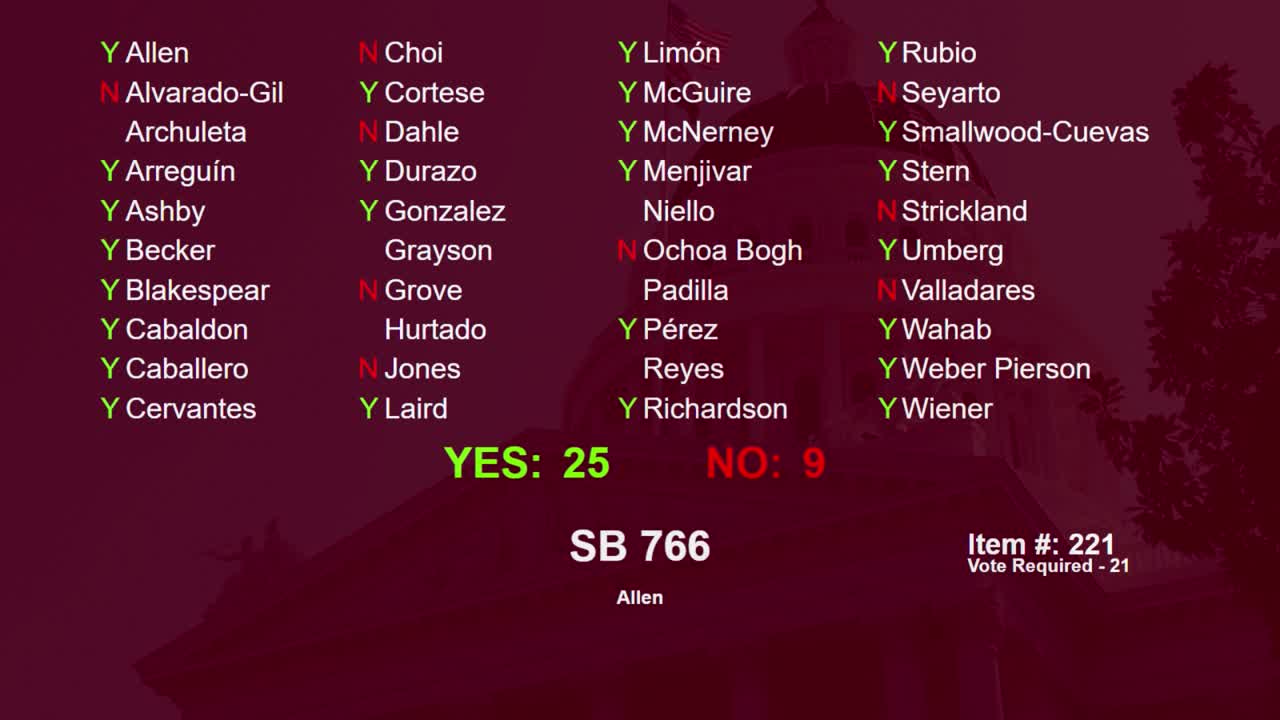 5MIN
Senate Floor
 15MIN
Senate Standing Committee on Judiciary
 38MIN
Senate Standing Committee on Banking and Financial Institutions
Bill Author

Bill Co-Author(s):
