SB 832: Upper Los Angeles River and Tributaries Working Group: membership: revitalization plan.
- Session Year: 2025-2026
- House: Senate
- Latest Version Date: 2026-09-30
Current Status:
Passed
(2026-09-30: Chaptered by Secretary of State. Chapter 983, Statutes of 2026.)
Introduced
In Committee
Awaiting First Chamber Vote
Passed First Chamber
In Committee
Awaiting Second Chamber Vote
Passed Second Chamber
Enacted
Existing law establishes the Santa Monica Mountains Conservancy and prescribes the membership, functions, and duties of the conservancy regarding the acquisition, preservation, and improvement of real property within the Santa Monica Mountains Zone, as defined. Existing law establishes within the conservancy the Upper Los Angeles River and Tributaries Working Group with designated membership of no more than 23 appointed representatives. Existing law requires the working group to develop, through watershed-based planning methods and community engagement, a revitalization plan for the Upper Los Angeles River, the tributaries of the Pacoima Wash, Tujunga Wash, and Verdugo Wash, the Arroyo Seco, and any additional tributary waterway that the working group determines to be necessary. Existing law requires the working group to submit the revitalization plan to the conservancy for adoption, and requires the conservancy to submit a copy of the revitalization plan to the Assembly Committee on Water, Parks, and Wildlife and the Senate Committee on Natural Resources and Water, as specified.
This bill would add an additional member to the working group, for a total of no more than 25 appointed representatives. The bill would require one of the representatives appointed to the working group to represent the city council district within the City of Los Angeles with the greatest number of Upper Los Angeles River miles. The bill would require the working group to meet at least once each year to evaluate and report on implementation of the revitalization plan to the conservancy, and propose amendments to the revitalization plan to the conservancy for adoption. The bill would require the working group to submit proposed amendments to the revitalization plan to the conservancy, and would require that the conservancy take action to adopt the proposed amendments, as specified.
Existing law establishes the Santa Monica Mountains Conservancy and prescribes the membership, functions, and duties of the conservancy regarding the acquisition, preservation, and improvement of real property within the Santa Monica Mountains Zone, as defined. Existing law establishes within the conservancy the Upper Los Angeles River and Tributaries Working Group with designated membership of no more than 23 appointed representatives. Existing law requires the working group to develop, through watershed-based planning methods and community engagement, a revitalization plan for the Upper Los Angeles River, the tributaries of the Pacoima Wash, Tujunga Wash, and Verdugo Wash, the Arroyo Seco, and any additional tributary waterway that the working group determines to be necessary. Existing law requires the working group to submit the revitalization plan to the conservancy for adoption, and requires the conservancy to submit a copy of the revitalization plan to the Assembly Committee on Water, Parks, and Wildlife and the Senate Committee on Natural Resources and Water, as specified.
This bill would add an additional member to the working group, for a total of no more than 24 25 appointed representatives. The bill would require one of the representatives appointed to the working group to represent the city council district within the City of Los Angeles with the greatest number of Upper Los Angeles River miles. The bill would require the working group to meet at least once each year to evaluate and report on implementation of the revitalization plan to the conservancy, and propose amendments to the revitalization plan to the conservancy for adoption. The bill would require an amendment to the revitalization plan adopted by the conservancy to be submitted to the Assembly Committee on Water, Parks, and Wildlife and the Senate Committee on Natural Resources and Water, as provided. the working group to submit proposed amendments to the revitalization plan to the conservancy, and would require that the conservancy take action to adopt the proposed amendments, as specified.
Existing law establishes the Santa Monica Mountains Conservancy and prescribes the membership, functions, and duties of the conservancy regarding the acquisition, preservation, and improvement of real property within the Santa Monica Mountains Zone, as defined. Existing law establishes within the conservancy the Upper Los Angeles River and Tributaries Working Group with designated membership of no more than 23 appointed representatives. Existing law requires the working group to develop, through watershed-based planning methods and community engagement, a revitalization plan for the Upper Los Angeles River, the tributaries of the Pacoima Wash, Tujunga Wash, and Verdugo Wash, the Arroyo Seco, and any additional tributary waterway that the working group determines to be necessary. Existing law requires the working group to submit the revitalization plan to the conservancy for adoption, and requires the conservancy to submit a copy of the revitalization plan to the Assembly Committee on Water, Parks, and Wildlife and the Senate Committee on Natural Resources and Water, as specified.
This bill would add an additional member to the working group, for a total of no more than 24 appointed representatives. The bill would require one of the representatives appointed to the working group to represent the city council district within the City of Los Angeles with the greatest number of Upper Los Angeles River miles. The bill would require the working group to meet at least once each year to evaluate and report on implementation of the revitalization plan to the conservancy, and propose amendments to the revitalization plan to the conservancy for adoption. The bill would require an amendment to the revitalization plan adopted by the conservancy to be submitted to the Assembly Committee on Water, Parks, and Wildlife and the Senate Committee on Natural Resources and Water, as provided.
(1)Existing law establishes that, notwithstanding any other law, a claim for damages based upon childhood sexual assault that occurred on or before December 31, 2023, may be commenced only pursuant to the applicable statute of limitations set forth in existing law as it read on December 31, 2023, which provided that, for an action for recovery of damages suffered as a result of childhood sexual assault, the time for commencement of the action was 22 years from the date on which the plaintiff attains the age of majority or within 5 years of the date on which the plaintiff discovers or reasonably should have discovered that psychological injury or illness occurring after the age of majority was caused by the sexual assault, whichever period expires later.This bill would require, if the claim, including those that have been filed but have not yet been heard at trial, alleges that the act of childhood sexual assault occurred before January 1, 2006, that the claim be supported by clear and convincing corroborating evidence, other than the plaintiffs testimony. The bill would advance the date specified in the previous provision by one year in each subsequent year.(2)Existing law, the California School Finance Authority Act, authorizes a participating party, as defined, in connection with securing financing or refinancing of a project, or working capital, as defined, to elect to provide for funding payments of bonds issued by the California School Finance Authority and related obligations by electing to participate in a state or local intercept, or both, by an action of its governing board. Existing law requires the Controller, the county treasurer, or other appropriate county fiscal officer, as applicable, upon receipt of written notice provided by the participating party, to make an apportionment or revenue transfer from specified moneys designated for apportionment to the participating party.This bill would provide a similar authorization to a participating party, as defined, in connection with securing financing, refinancing, or refunding of a public debt obligation, as defined, to elect to provide for funding payments of the public debt obligation by electing to participate in a state or local intercept, or both, by an action of its governing board. The bill would require the Controller, the county treasurer, or other appropriate county fiscal officer, as applicable, upon receipt of written notice provided by the participating party, to make an apportionment or revenue transfer from specified moneys designated for apportionment to the participating party, as provided. The bill would authorize, and not require, a county to participate in local intercepts under these provisions. The bill would require a participating party to certify the payment schedule, as specified. By expanding the crime of perjury, this bill would impose a state-mandated local program.(3)Existing law authorizes the governing board of a school district that determines during a fiscal year that its revenues are less than the amount necessary to meet its current year expenditure obligations to request an emergency apportionment through the Superintendent of Public Instruction, subject to specified requirements. Existing law prescribes the financing conditions on emergency apportionments, including a requirement for a school district to develop a schedule to repay the emergency loan, which the county superintendent of schools is required to review, comment on, and submit to the Superintendent for approval.Existing law authorizes emergency apportionments to be provided through an interim loan from the General Fund and lease financing to be made available by the California Infrastructure and Economic Development Bank, which is authorized to issue bonds for purposes of the emergency apportionments and related costs. Existing law prohibits the term of the lease from exceeding 20 years, except as specified. Existing law authorizes, as an alternative to lease financing, emergency apportionments to be provided from the General Fund. Existing law requires the emergency apportionment to be repaid within 20 years.This bill would require the school district to consult the county superintendent of schools and the County Office Fiscal Crisis and Management Assistance Team in developing the repayment schedule and would require the county superintendent of schools to submit the repayment schedule to the Department of Finance, instead of the Superintendent, for approval. The bill would extend the maximum term of a lease or for repayment of an emergency apportionment to 30 years. The bill would require the determination of the term to be made by the Department of Finance, in consultation with the school district, the county superintendent of schools, the Superintendent, and the County Office Fiscal Crisis and Management Assistance Team and would require the determination to take into consideration specified factors. To the extent the bill imposes new duties on county superintendents of schools, the bill would impose a state-mandated local program.(4)Existing law authorizes the governing board of a local taxing entity to deem it necessary for the local taxing entity to incur a bonded indebtedness to fund all or any portion of an outstanding judgment against the entity by adoption of a resolution that includes, among other things, the date of the special election of the local taxing entity that a proposition on the matter shall be submitted to the voters. If 2/3 or more of the votes cast upon the proposition at the election are in favor of incurring the bonded indebtedness, the board may issue the bonds at the time or times it deems proper and may sell the bonds at the times or in the manner the board deems to be to the public interest. Existing law authorizes a public agency to bring an action to determine the validity of bonds pursuant to specified procedures. Existing law establishes that, for purposes of those procedures, bonds shall be deemed to be in existence upon their authorization and authorized as of the date of adoption by the governing body of the public agency of a resolution or ordinance authorizing their issuance.This bill would authorize a local public entity to initiate an action to determine the validity of those bonds before a judgment in a tort action against the local taxing entity necessitating the bonded indebtedness has been entered and endow bonds to fund all or any portion of an outstanding judgment against a local taxing entity with a rebuttable presumption of validity in an action described above.(5)Existing law specifies procedures for the payment of judgments against a public entity and authorizes the public entity to make an election to pay a judgment in periodic payments if the judgment on a tort claims action against a public entity that is not insured is greater than a specified amount. Existing law requires the judgment-debtor to pay, as specified, 50% immediately, and the other 50% over a period of time to be determined by the court, not to exceed 10 years or the length of the judgment-creditors remaining life expectancy at the time the judgment is entered, whichever is less.This bill would require the judgment-debtor to pay, as specified, 25% of the amount awarded as nonpunitive damages immediately, and the other 75% over a period of time determined by the court, not to exceed 20 years or the length of the judgment-debtors remaining life expectancy at the time the judgment is entered, whichever is less. The bill would also similarly revise other related provisions that specify the procedure for payment of a judgment if a public entity is a defendant in any action for personal injuries or wrongful death, awarded as nonpunitive damages that includes damages paid from a collateral source.(6)The California Constitution requires the state to reimburse local agencies and school districts for certain costs mandated by the state. Statutory provisions establish procedures for making that reimbursement.This bill would provide that, with regard to certain mandates, no reimbursement is required by this act for a specified reason.With regard to any other mandates, this bill would provide that, if the Commission on State Mandates determines that the bill contains costs so mandated by the state, reimbursement for those costs shall be made pursuant to the statutory provisions noted above.(1)Existing law establishes that, notwithstanding any other law, a claim for damages based upon childhood sexual assault that occurred on or before December 31, 2023, may be commenced only pursuant to the applicable statute of limitations set forth in existing law as it read on December 31, 2023, which provided that, for an action for recovery of damages suffered as a result of childhood sexual assault, the time for commencement of the action was 22 years from the date on which the plaintiff attains the age of majority or within 5 years of the date on which the plaintiff discovers or reasonably should have discovered that psychological injury or illness occurring after the age of majority was caused by the sexual assault, whichever period expires later.
This bill would require, if the claim, including those that have been filed but have not yet been heard at trial, alleges that the act of childhood sexual assault occurred before January 1, 2006, that the claim be supported by clear and convincing corroborating evidence, other than the plaintiffs testimony. The bill would advance the date specified in the previous provision by one year in each subsequent year.
(2)Existing law, the California School Finance Authority Act, authorizes a participating party, as defined, in connection with securing financing or refinancing of a project, or working capital, as defined, to elect to provide for funding payments of bonds issued by the California School Finance Authority and related obligations by electing to participate in a state or local intercept, or both, by an action of its governing board. Existing law requires the Controller, the county treasurer, or other appropriate county fiscal officer, as applicable, upon receipt of written notice provided by the participating party, to make an apportionment or revenue transfer from specified moneys designated for apportionment to the participating party.
This bill would provide a similar authorization to a participating party, as defined, in connection with securing financing, refinancing, or refunding of a public debt obligation, as defined, to elect to provide for funding payments of the public debt obligation by electing to participate in a state or local intercept, or both, by an action of its governing board. The bill would require the Controller, the county treasurer, or other appropriate county fiscal officer, as applicable, upon receipt of written notice provided by the participating party, to make an apportionment or revenue transfer from specified moneys designated for apportionment to the participating party, as provided. The bill would authorize, and not require, a county to participate in local intercepts under these provisions. The bill would require a participating party to certify the payment schedule, as specified. By expanding the crime of perjury, this bill would impose a state-mandated local program.
(3)Existing law authorizes the governing board of a school district that determines during a fiscal year that its revenues are less than the amount necessary to meet its current year expenditure obligations to request an emergency apportionment through the Superintendent of Public Instruction, subject to specified requirements. Existing law prescribes the financing conditions on emergency apportionments, including a requirement for a school district to develop a schedule to repay the emergency loan, which the county superintendent of schools is required to review, comment on, and submit to the Superintendent for approval.
Existing law authorizes emergency apportionments to be provided through an interim loan from the General Fund and lease financing to be made available by the California Infrastructure and Economic Development Bank, which is authorized to issue bonds for purposes of the emergency apportionments and related costs. Existing law prohibits the term of the lease from exceeding 20 years, except as specified. Existing law authorizes, as an alternative to lease financing, emergency apportionments to be provided from the General Fund. Existing law requires the emergency apportionment to be repaid within 20 years.
This bill would require the school district to consult the county superintendent of schools and the County Office Fiscal Crisis and Management Assistance Team in developing the repayment schedule and would require the county superintendent of schools to submit the repayment schedule to the Department of Finance, instead of the Superintendent, for approval. The bill would extend the maximum term of a lease or for repayment of an emergency apportionment to 30 years. The bill would require the determination of the term to be made by the Department of Finance, in consultation with the school district, the county superintendent of schools, the Superintendent, and the County Office Fiscal Crisis and Management Assistance Team and would require the determination to take into consideration specified factors. To the extent the bill imposes new duties on county superintendents of schools, the bill would impose a state-mandated local program.
(4)Existing law authorizes the governing board of a local taxing entity to deem it necessary for the local taxing entity to incur a bonded indebtedness to fund all or any portion of an outstanding judgment against the entity by adoption of a resolution that includes, among other things, the date of the special election of the local taxing entity that a proposition on the matter shall be submitted to the voters. If 2/3 or more of the votes cast upon the proposition at the election are in favor of incurring the bonded indebtedness, the board may issue the bonds at the time or times it deems proper and may sell the bonds at the times or in the manner the board deems to be to the public interest. Existing law authorizes a public agency to bring an action to determine the validity of bonds pursuant to specified procedures. Existing law establishes that, for purposes of those procedures, bonds shall be deemed to be in existence upon their authorization and authorized as of the date of adoption by the governing body of the public agency of a resolution or ordinance authorizing their issuance.
This bill would authorize a local public entity to initiate an action to determine the validity of those bonds before a judgment in a tort action against the local taxing entity necessitating the bonded indebtedness has been entered and endow bonds to fund all or any portion of an outstanding judgment against a local taxing entity with a rebuttable presumption of validity in an action described above.
(5)Existing law specifies procedures for the payment of judgments against a public entity and authorizes the public entity to make an election to pay a judgment in periodic payments if the judgment on a tort claims action against a public entity that is not insured is greater than a specified amount. Existing law requires the judgment-debtor to pay, as specified, 50% immediately, and the other 50% over a period of time to be determined by the court, not to exceed 10 years or the length of the judgment-creditors remaining life expectancy at the time the judgment is entered, whichever is less.
This bill would require the judgment-debtor to pay, as specified, 25% of the amount awarded as nonpunitive damages immediately, and the other 75% over a period of time determined by the court, not to exceed 20 years or the length of the judgment-debtors remaining life expectancy at the time the judgment is entered, whichever is less. The bill would also similarly revise other related provisions that specify the procedure for payment of a judgment if a public entity is a defendant in any action for personal injuries or wrongful death, awarded as nonpunitive damages that includes damages paid from a collateral source.
(6)The California Constitution requires the state to reimburse local agencies and school districts for certain costs mandated by the state. Statutory provisions establish procedures for making that reimbursement.
This bill would provide that, with regard to certain mandates, no reimbursement is required by this act for a specified reason.
With regard to any other mandates, this bill would provide that, if the Commission on State Mandates determines that the bill contains costs so mandated by the state, reimbursement for those costs shall be made pursuant to the statutory provisions noted above.
Existing law, the Planning and Zoning Law, requires a city, county, or city and county to adopt a comprehensive general plan that addresses a number of elements. Existing law provides that the Legislature intends that the general plan and elements and parts thereof comprise an integrated, internally consistent and compatible statement of policies for the adopting agency.This bill would make nonsubstantive changes to these provisions.Existing law, the Planning and Zoning Law, requires a city, county, or city and county to adopt a comprehensive general plan that addresses a number of elements. Existing law provides that the Legislature intends that the general plan and elements and parts thereof comprise an integrated, internally consistent and compatible statement of policies for the adopting agency.
This bill would make nonsubstantive changes to these provisions.
(a)There shall be within the Santa Monica Mountains Conservancy an Upper Los Angeles River and Tributaries Working Group. The Secretary of the Natural Resources Agency, in consultation with the conservancy, and, to the extent that they wish to consult, the Los Angeles County Board of Supervisors and the City of Los Angeles, shall consider requests from local agency representatives to participate in the working group and may appoint no more than 25 representatives to the working group. One of the representatives appointed to the working group shall represent the city council district within the City of Los Angeles with the greatest number of Upper Los Angeles River miles. A representative appointed to the working group may designate an alternate in their place. The working group may include, but need not be limited to, representatives from the conservancy, the County of Los Angeles, the Cities of Burbank, Glendale, La Canada Flintridge, Los Angeles, Pasadena, San Fernando, and South Pasadena, elected officials of the cities riparian to the Pacoima Wash and Tujunga Wash, and nonprofit organizations serving the Upper Los Angeles River, San Fernando Valley, Pacoima Wash, Tujunga Wash, and Verdugo Wash.
(b)On or before June 30, 2020, the working group shall develop, through watershed-based planning methods and community engagement, a revitalization plan for the Upper Los Angeles River, the tributaries of the Pacoima Wash, Tujunga Wash, and Verdugo Wash, the Arroyo Seco, and any additional tributary waterway that the working group determines to be necessary. The revitalization plan shall address the unique and diverse needs of the Upper Los Angeles River, Pacoima Wash, Tujunga Wash, Verdugo Wash, and Arroyo Seco, and the communities through which they pass. The plan shall be consistent with and enhance, and may be incorporated into plans that include, but are not limited to, the County of Los Angeles Master Plan. The plan shall include watershed education programs that help the Upper Los Angeles River, Pacoima Wash, Tujunga Wash, Verdugo Wash, and Arroyo Seco communities recognize the value of the waterways and the importance of protecting the rivers watershed resources and its vitality to their communities. The revitalization plan shall require a master planning process that includes community engagement and a prioritization of disadvantaged communities, identified pursuant to Section 39711 of the Health and Safety Code.
(c)The conservancy shall provide any necessary staffing to the working group to assist in the development of the plan.
(d)The development and implementation of the revitalization plan may be eligible for funding from any public or private source, including, but not limited to, funding available pursuant to Section 79735 of the Water Code. Entities that are eligible to implement the revitalization plan include, but are not limited to, state agencies, local agencies, and nonprofit organizations, and may be eligible for state funding. An entity receiving funding to implement the revitalization plan shall submit progress reports to the conservancy that include the status of funding.
(e)The working group shall submit the revitalization plan to the conservancy for approval. Upon adoption by the conservancy, the revitalization plan shall be considered an amendment to the Watershed and Open Space Plan for the San Gabriel and Los Angeles Rivers. To the extent that the city or county wishes to consider the revitalization plan, the conservancy shall submit the plan for adoption to the Los Angeles County Board of Supervisors for inclusion in the Master Plan of the County of Los Angeles and to the Los Angeles City Council for inclusion into the Los Angeles River Revitalization Master Plan.
(f)On or before June 30, 2020, the conservancy shall submit a copy of the plan to the Assembly Committee on Water, Parks, and Wildlife and the Senate Committee on Natural Resources and Water.
(g)(1)The working group shall meet at least once each year to evaluate and report progress on implementation of the revitalization plan to the conservancy, and to propose amendments to the revitalization plan to the conservancy for adoption consistent with subdivision (e).
(2)The working group shall submit proposed amendments to the revitalization plan to the conservancy for approval. The conservancy shall take action to adopt the proposed amendment within 60 days of submission. The amendment shall become effective immediately upon adoption by the conservancy.
(a)There shall be within the Santa Monica Mountains Conservancy an Upper Los Angeles River and Tributaries Working Group. The Secretary of the Natural Resources Agency, in consultation with the conservancy, and, to the extent that they wish to consult, the Los Angeles County Board of Supervisors and the City of Los Angeles, shall consider requests from local agency representatives to participate in the working group and may appoint no more than 24 25 representatives to the working group. One of the representatives appointed to the working group shall represent the city council district within the City of Los Angeles with the greatest number of Upper Los Angeles River miles. A representative appointed to the working group may designate an alternate in their place. The working group may include, but need not be limited to, representatives from the conservancy, the County of Los Angeles, the Cities of Burbank, Glendale, La Canada Flintridge, Los Angeles, Pasadena, San Fernando, and South Pasadena, elected officials of the cities riparian to the Pacoima Wash and Tujunga Wash, and nonprofit organizations serving the Upper Los Angeles River, San Fernando Valley, Pacoima Wash, Tujunga Wash, and Verdugo Wash.
(b)On or before June 30, 2020, the working group shall develop, through watershed-based planning methods and community engagement, a revitalization plan for the Upper Los Angeles River, the tributaries of the Pacoima Wash, Tujunga Wash, and Verdugo Wash, the Arroyo Seco, and any additional tributary waterway that the working group determines to be necessary. The revitalization plan shall address the unique and diverse needs of the Upper Los Angeles River, Pacoima Wash, Tujunga Wash, Verdugo Wash, and Arroyo Seco, and the communities through which they pass. The plan shall be consistent with and enhance, and may be incorporated into plans that include, but are not limited to, the County of Los Angeles Master Plan. The plan shall include watershed education programs that help the Upper Los Angeles River, Pacoima Wash, Tujunga Wash, Verdugo Wash, and Arroyo Seco communities recognize the value of the waterways and the importance of protecting the rivers watershed resources and its vitality to their communities. The revitalization plan shall require a master planning process that includes community engagement and a prioritization of disadvantaged communities, identified pursuant to Section 39711 of the Health and Safety Code.
(c)The conservancy shall provide any necessary staffing to the working group to assist in the development of the plan.
(d)The development and implementation of the revitalization plan may be eligible for funding from any public or private source, including, but not limited to, funding available pursuant to Section 79735 of the Water Code. Entities that are eligible to implement the revitalization plan include, but are not limited to, state agencies, local agencies, and nonprofit organizations, and may be eligible for state funding. An entity receiving funding to implement the revitalization plan shall submit progress reports to the conservancy that include the status of funding.
(e)The working group shall submit the revitalization plan to the conservancy for approval. Upon adoption by the conservancy, the revitalization plan shall be considered an amendment to the Watershed and Open Space Plan for the San Gabriel and Los Angeles Rivers. To the extent that the city or county wishes to consider the revitalization plan, the conservancy shall submit the plan for adoption to the Los Angeles County Board of Supervisors for inclusion in the Master Plan of the County of Los Angeles and to the Los Angeles City Council for inclusion into the Los Angeles River Revitalization Master Plan.
(f)On or before June 30, 2020, the conservancy shall submit a copy of the plan to the Assembly Committee on Water, Parks, and Wildlife and the Senate Committee on Natural Resources and Water.
(g)(1)The working group shall meet at least once each year to evaluate and report progress on implementation of the revitalization plan to the conservancy, and to propose amendments to the revitalization plan to the conservancy for adoption consistent with subdivision (e).
(2)An amendment to the revitalization plan adopted by the conservancy shall be submitted to the Assembly Committee on Water, Parks, and Wildlife and the Senate Committee on Natural Resources and Water. The amendment shall become effective 30 days after that submission.(3)Information required to be submitted to the Assembly Committee on Water, Parks, and Wildlife and the Senate Committee on Natural Resources and Water pursuant to paragraph (2) shall be submitted in compliance with Section 9795 of the Government Code.(2)The working group shall submit proposed amendments to the revitalization plan to the conservancy for approval. The conservancy shall take action to adopt the proposed amendment within 60 days of submission. The amendment shall become effective immediately upon adoption by the conservancy.
(a)There shall be within the Santa Monica Mountains Conservancy an Upper Los Angeles River and Tributaries Working Group. The Secretary of the Natural Resources Agency, in consultation with the conservancy, and, to the extent that they wish to consult, the Los Angeles County Board of Supervisors and the City of Los Angeles, shall consider requests from local agency representatives to participate in the working group and may appoint no more than 23 24 representatives to the working group. One of the representatives appointed to the working group shall represent the city council district within the City of Los Angeles with the greatest number of Upper Los Angeles River miles. A representative appointed to the working group may designate an alternate in his or her their place. The working group may include, but need not be limited to, representatives from the conservancy, the County of Los Angeles, the Cities of Burbank, Glendale, La Canada Flintridge, Los Angeles, Pasadena, San Fernando, and South Pasadena, elected officials of the cities riparian to the Pacoima Wash and Tujunga Wash, and nonprofit organizations serving the Upper Los Angeles River, San Fernando Valley, Pacoima Wash, Tujunga Wash, and Verdugo Wash.
(b)On or before June 30, 2020, the working group shall develop, through watershed-based planning methods and community engagement, a revitalization plan for the Upper Los Angeles River, the tributaries of the Pacoima Wash, Tujunga Wash, and Verdugo Wash, the Arroyo Seco, and any additional tributary waterway that the working group determines to be necessary. The revitalization plan shall address the unique and diverse needs of the Upper Los Angeles River, Pacoima Wash, Tujunga Wash, Verdugo Wash, and Arroyo Seco, and the communities through which they pass. The plan shall be consistent with and enhance, and may be incorporated into plans that include, but are not limited to, the County of Los Angeles Master Plan. The plan shall include watershed education programs that help the Upper Los Angeles River, Pacoima Wash, Tujunga Wash, Verdugo Wash, and Arroyo Seco communities recognize the value of the waterways and the importance of protecting the rivers watershed resources and its vitality to their communities. The revitalization plan shall require a master planning process that includes community engagement and a prioritization of disadvantaged communities, identified pursuant to Section 39711 of the Health and Safety Code.
(c)The conservancy shall provide any necessary staffing to the working group to assist in the development of the plan.
(d)The development and implementation of the revitalization plan may be eligible for funding from any public or private source, including, but not limited to, funding available pursuant to Section 79735 of the Water Code. Entities that are eligible to implement the revitalization plan include, but are not limited to, state agencies, local agencies, and nonprofit organizations, and may be eligible for state funding. An entity receiving funding to implement the revitalization plan shall submit progress reports to the conservancy that include the status of funding.
(e)The working group shall submit the revitalization plan to the conservancy for approval. Upon adoption by the conservancy, the revitalization plan shall be considered an amendment to the Watershed and Open Space Plan for the San Gabriel and Los Angeles Rivers. To the extent that the city or county wishes to consider the revitalization plan, the conservancy shall submit the plan for adoption to the Los Angeles County Board of Supervisors for inclusion in the Master Plan of the County of Los Angeles and to the Los Angeles City Council for inclusion into the Los Angeles River Revitalization Master Plan.
(f)No later than On or before June 30, 2020, the conservancy shall submit a copy of the plan to the Assembly Committee on Water, Parks, and Wildlife and the Senate Committee on Natural Resources and Water.
(g)(1)The working group shall meet at least once each year to evaluate and report progress on implementation of the revitalization plan to the conservancy, and to propose amendments to the revitalization plan to the conservancy for adoption consistent with subdivision (e).
(2)An amendment to the revitalization plan adopted by the conservancy shall be submitted to the Assembly Committee on Water, Parks, and Wildlife and the Senate Committee on Natural Resources and Water. The amendment shall become effective 30 days after that submission.
(3)Information required to be submitted to the Assembly Committee on Water, Parks, and Wildlife and the Senate Committee on Natural Resources and Water pursuant to paragraph (2) shall be submitted in compliance with Section 9795 of the Government Code.
All matter omitted in this version of the bill appears in the bill as amended in the Senate, March 26, 2025. (JR11)(a)There is no time limit for the commencement of any of the following actions for recovery of damages suffered as a result of childhood sexual assault:
(1)An action against any person for committing an act of childhood sexual assault.
(2)An action for liability against any person or entity who owed a duty of care to the plaintiff, if a wrongful or negligent act by that person or entity was a legal cause of the childhood sexual assault that resulted in the injury to the plaintiff.
(3)An action for liability against any person or entity if an intentional act by that person or entity was a legal cause of the childhood sexual assault that resulted in the injury to the plaintiff.
(b)(1)In an action described in subdivision (a), a person who is sexually assaulted and proves it was as the result of a cover up may recover up to treble damages against a defendant who is found to have covered up the sexual assault of a minor, unless prohibited by another law.
(2)For purposes of this subdivision, a cover up is a concerted effort to hide evidence relating to childhood sexual assault.
(c)Childhood sexual assault as used in this section includes any act committed against the plaintiff that occurred when the plaintiff was under the age of 18 years and that would have been proscribed by Section 266j of the Penal Code; Section 285 of the Penal Code; paragraph (1) or (2) of subdivision (b), or of subdivision (c), of Section 286 of the Penal Code; subdivision (a) or (b) of Section 288 of the Penal Code; paragraph (1) or (2) of subdivision (b), or of subdivision (c), of Section 287 or of former Section 288a of the Penal Code; subdivision (h), (i), or (j) of Section 289 of the Penal Code; any sexual conduct as defined in paragraph (1) of subdivision (d) of Section 311.4 of the Penal Code; Section 647.6 of the Penal Code; or any prior laws of this state of similar effect at the time the act was committed. This subdivision does not limit the availability of causes of action permitted under subdivision (a), including causes of action against persons or entities other than the alleged perpetrator of the abuse.
(d)This section shall not be construed to alter the otherwise applicable burden of proof, as defined in Section 115 of the Evidence Code, that a plaintiff has in a civil action subject to this section.
(e)Every plaintiff 40 years of age or older at the time the action is filed shall file certificates of merit as specified in subdivision (f).
(f)Certificates of merit setting forth the facts that support the declaration shall be executed by the attorney for the plaintiff and by a licensed mental health practitioner selected by the plaintiff declaring, respectively, as follows:
(1)That the attorney has reviewed the facts of the case, consulted with at least one mental health practitioner who the attorney reasonably believes is knowledgeable of the relevant facts and issues involved in the particular action, and concluded on the basis of that review and consultation that there is reasonable and meritorious cause for the filing of the action.
(2)That the mental health practitioner consulted is licensed to practice and practices in this state and is not a party to the action, that the practitioner is not treating and has not treated the plaintiff, and that the practitioner has interviewed the plaintiff and is knowledgeable of the relevant facts and issues involved in the particular action, and has concluded, on the basis of the practitioners knowledge of the facts and issues, that in the practitioners professional opinion there is a reasonable basis to believe that the plaintiff had been subject to childhood sexual abuse.
(g)If certificates are required pursuant to subdivision (e), the attorney for the plaintiff shall execute a separate certificate of merit for each defendant named in the complaint.
(h)In any action subject to subdivision (e), a defendant shall not be served, and the duty to serve a defendant with process does not attach, until the court has reviewed the certificates of merit filed pursuant to subdivision (f) with respect to that defendant, and has found, in camera, based solely on those certificates of merit, that there is reasonable and meritorious cause for the filing of the action against that defendant. At that time, the duty to serve that defendant with process shall attach.
(i)A violation of this section may constitute unprofessional conduct and may be the grounds for discipline against the attorney.
(j)The failure to file certificates in accordance with this section shall be grounds for a demurrer pursuant to Section 430.10 or a motion to strike pursuant to Section 435.
(k)In any action subject to subdivision (e), a defendant shall be named by Doe designation in any pleadings or papers filed in the action until there has been a showing of corroborative fact as to the charging allegations against that defendant.
(l)At any time after the action is filed, the plaintiff may apply to the court for permission to amend the complaint to substitute the name of the defendant or defendants for the fictitious designation, as follows:
(1)The application shall be accompanied by a certificate of corroborative fact executed by the attorney for the plaintiff. The certificate shall declare that the attorney has discovered one or more facts corroborative of one or more of the charging allegations against a defendant or defendants, and shall set forth in clear and concise terms the nature and substance of the corroborative fact. If the corroborative fact is evidenced by the statement of a witness or the contents of a document, the certificate shall declare that the attorney has personal knowledge of the statement of the witness or of the contents of the document, and the identity and location of the witness or document shall be included in the certificate. For purposes of this section, a fact is corroborative of an allegation if it confirms or supports the allegation. The opinion of any mental health practitioner concerning the plaintiff shall not constitute a corroborative fact for purposes of this section.
(2)If the application to name a defendant is made before that defendants appearance in the action, neither the application nor the certificate of corroborative fact by the attorney shall be served on the defendant or defendants, nor on any other party or their counsel of record.
(3)If the application to name a defendant is made after that defendants appearance in the action, the application shall be served on all parties and proof of service provided to the court, but the certificate of corroborative fact by the attorney shall not be served on any party or their counsel of record.
(m)The court shall review the application and the certificate of corroborative fact in camera and, based solely on the certificate and any reasonable inferences to be drawn from the certificate, shall, if one or more facts corroborative of one or more of the charging allegations against a defendant has been shown, order that the complaint may be amended to substitute the name of the defendant or defendants.
(n)The court shall keep under seal and confidential from the public and all parties to the litigation, other than the plaintiff, any and all certificates of corroborative fact filed pursuant to subdivision (l).
(o)Upon the favorable conclusion of the litigation with respect to any defendant for whom a certificate of merit was filed or for whom a certificate of merit should have been filed pursuant to this section, the court may, upon the motion of a party or upon the courts own motion, verify compliance with this section by requiring the attorney for the plaintiff who was required by subdivision (f) to execute the certificate to reveal the name, address, and telephone number of the person or persons consulted with pursuant to subdivision (f) that were relied upon by the attorney in preparation of the certificate of merit. The name, address, and telephone number shall be disclosed to the trial judge in camera and in the absence of the moving party. If the court finds there has been a failure to comply with this section, the court may order a party, a partys attorney, or both, to pay any reasonable expenses, including attorneys fees, incurred by the defendant for whom a certificate of merit should have been filed.
(p)This section applies to any claim in which the childhood sexual assault occurred on and after January 1, 2024. Notwithstanding any other law, a claim for damages based on conduct described in paragraphs (1) through (3), inclusive, of subdivision (a), in which the childhood sexual assault occurred on or before December 31, 2023 may only be commenced pursuant to the applicable statute of limitations set forth in existing law as it read on December 31, 2023. If the claim alleges that the act of childhood sexual assault occurred before January 1, 2006, the claim, including those that have been filed but have not yet been heard at trial, shall be supported by clear and convincing corroborating evidence, other than the plaintiffs testimony. The date specified in the previous provisions shall, in each subsequent year, advance by one year, so that on January 1, 2027, it shall apply to assaults that occurred before January 1, 2007, on January 1, 2028, it shall apply to assaults that occurred before January 1, 2008, and so forth.
(q)Notwithstanding any other law, including Chapter 1 of Part 3 of Division 3.6 of Title 1 of the Government Code (commencing with Section 900) and Chapter 2 of Part 3 of Division 3.6 of Title 1 of the Government Code (commencing with Section 910), a claim for damages described in paragraphs (1) through (3), inclusive, of subdivision (a), is not required to be presented to any government entity prior to the commencement of an action.
SEC. 2.Chapter 5 (commencing with Section 14560) is added to Part 9 of Division 1 of Title 1 of the Education Code, to read:5.Election to Participate in Intercept14560.For purposes of this section, the following definitions apply:
(a)Participating party means a school district, county office of education, community college district, or educational joint powers authority.
(b)Public debt obligation means a debt incurred by a participating party for any reason, including tort liability, and includes, but is not limited to, a general obligation bond, lease financing, tax and revenue anticipation note, and bond anticipation note.
14561.(a)Notwithstanding any other law, a participating party, in connection with securing financing, refinancing, or refunding of a public debt obligation may, in accordance with this section, elect to provide for funding, in whole or in part, payments on the public debt obligation.
(b)To participate under this section, the participating party shall do all of the following:
(1)Elect to participate in a state intercept or local intercept, or both, by an action of its governing board taken in compliance with the rules of that governing board. For a local intercept, the participating party shall send to the county treasurer, or other appropriate county fiscal officer, a request for the county to participate. A county is not required to participate. A county may agree to participate as evidenced by an agreement among the participating party or parties, the county, and the issuer of the public debt obligation.
(2)Provide written notice to the Controller and the Superintendent, with respect to a state intercept, or to the county treasurer or other appropriate county fiscal officer, with respect to a local intercept, no later than the date of the issuance of the public debt obligation or 60 days before the next payment, whichever is later, of all of the following:
(A)Its election to participate.
(B)A schedule of the payments subject to that election.
(C)The payee or payees of those payments, or the trustee or agent on their behalf to receive those payments.
(D)(i)Payment delivery instructions, which may be by wire transfer or other method approved by the Controller or county treasurer or other appropriate county fiscal officer, as applicable.
(ii)If the method of payment delivery is wire transfer, the participating party shall complete and submit the appropriate authorization form as prescribed by the Controller or the county treasurer or other appropriate county fiscal officer, as applicable.
(c)The participating party may amend, supplement, or restate the notice required pursuant to paragraph (2) of subdivision (b) for any reason, including, but not necessarily limited to, providing for new or increased payments. The participating party shall certify in the notice and in any amendment, supplement, or restatement of the notice that each and every payment reflected in the schedule is a payment described in subdivision (a) and the amounts scheduled do not exceed the actual or reasonably estimated payment obligations to be funded pursuant to this section. The participating party shall also represent in the notice that it is not submitting the notice for the purpose of accelerating a participating partys receipt of its apportionments. This section does not prohibit transfer by the recipient of an apportionment under this section to the participating party submitting the notice of the excess apportionment above the amount needed to fund actual payments where the excess resulted from erroneous estimation of scheduled payments or otherwise.
(d)Upon receipt of the notice required by paragraph (2) of subdivision (b), the Controller shall make an apportionment to the indicated recipient on the date, or during the period, shown in the schedule in accordance with all of the following:
(1)If the participating party requests transfers in full as scheduled, in the amount of the scheduled transfer or whatever lesser amount is available from the sources described in subdivision (e).
(2)If the participating party does not request transfers in full as scheduled, in the amount of the anticipated deficiency for the purpose of making the required payment indicated in a written request of the participating party to the Controller and in the amount of the actual shortfall in payment indicated in a written request of the recipient or the participating party to the Controller or whatever lesser amount is available from the sources described in subdivision (e).
(3)To the extent funds available for an apportionment are insufficient to pay the amount set forth in a schedule in any period, the Controller shall, if and as requested in the notice, reschedule the payment of all or a portion of the deficiency to a subsequent period.
(4)In making apportionments under this section, the Controller may rely conclusively and without liability on any notice or request delivered under this section. The Controller may make, but is not obligated to make, apportionments not reflected on a notice or on an amended, supplemented, or restated notice delivered under this section that the Controller receives less than 20 days before when the apportionment would otherwise be required.
(e)The Controller shall make an apportionment under this section only from moneys designated for apportionment to the participating party delivering the notice, and only from one or more of the following:
(1)Any funding apportioned by the state for purposes of the local control funding formula pursuant to Section 42238.02, as implemented by Section 42238.03, or state categorical or grant programs, to a school district without regard to the specific funding source of the apportionment.
(2)Any funding apportioned by the state for purposes of the local control funding formula pursuant to Section 2574 or state categorical or grant programs, to a county superintendent of schools without regard to the specific funding source of the apportionment.
(3)Any funding apportioned by the state for purposes of community college apportionments pursuant to Sections 84750.4 and 84750.5, or state categorical or grant programs, to a community college district without regard to the specific funding source of the apportionment.
(4)Any funding apportioned by the state to an educational joint powers authority without regard to the specific funding source of the apportionment.
(f)Upon receipt of the notice required by paragraph (2) of subdivision (b), a county treasurer or other appropriate county fiscal officer shall make an apportionment or revenue transfer to the indicated recipient on the date, or during the period, shown in the schedule in accordance with all of the following:
(1)If the participating party requests transfers in full as scheduled, in the amount of the scheduled transfer or whatever lesser amount is available from the sources described in subdivision (g).
(2)If the participating party does not request transfers in full as scheduled, in the amount of the anticipated deficiency for the purpose of making the required payment indicated in a written request of the participating party to the county treasurer or other appropriate county fiscal officer and in the amount of the actual shortfall in payment indicated in a written request of the recipient or the participating party to the county treasurer or other appropriate county fiscal officer or whatever lesser amount is available from the sources described in subdivision (g).
(3)To the extent funds available for an apportionment or revenue transfer are insufficient to pay the amount set forth in a schedule in any period, the county treasurer or other appropriate county fiscal officer shall, if and as requested in the notice, reschedule the payment of all or a portion of the deficiency to a subsequent period.
(4)In making apportionments under this section, the county treasurer or other appropriate county fiscal officer may rely conclusively and without liability on any notice or request delivered under this section. The county treasurer or other appropriate county fiscal officer may make, but is not obligated to make, apportionments or revenue transfers not reflected on a notice or on an amended, supplemented, or restated notice delivered under this section that the county treasurer or other appropriate county fiscal officer receives less than 20 days before when the apportionment would otherwise be required.
(g)The county treasurer or other appropriate county fiscal officer shall make an apportionment or revenue transfer under this section only from moneys designated for apportionment to the participating party delivering the notice, and only from one or more of the following:
(1)Any funding apportioned or administered by a county for purposes of the local control funding formula pursuant to Section 42238.02, as implemented by Section 42238.03, to a school district without regard to the specific funding source of the apportionment.
(2)Any funding apportioned or administered by a county for purposes of the local control funding formula pursuant to Section 2574 to a county superintendent of schools without regard to the specific funding source of the apportionment.
(3)Any funding apportioned or administered by a county for purposes of community college apportionments pursuant to Sections 84750.4 and 84750.5 to a community college district without regard to the specific funding source of the apportionment.
(4)Any funding apportioned or administered by a county to an educational joint powers authority without regard to the specific funding source of the apportionment.
(h)(1)The amount apportioned for a participating party pursuant to this section shall be deemed to be an allocation to the participating party, and shall be included in the computation of allocation, limit, entitlement, or apportionment for the participating party.
(2)The participating party and its creditors do not have a claim to funds apportioned or anticipated to be apportioned by the Controller or the county treasurer or appropriate county fiscal officer, as applicable, pursuant to this section.
(i)This section does not make the State of California liable for any payments within the meaning of Section 1 of Article XVI of the California Constitution.
(j)A school district or educational joint powers authority that has a qualified or negative certification pursuant to Section 42131, or a county office of education that has a qualified or negative certification pursuant to Section 1240, may only participate under this section to intercept payments for indebtedness for which the repayment is determined to be probable pursuant to Section 42133.
(k)This section does not obligate the State of California to make available the sources of apportionment under subdivision (e) or a county to make available the sources of apportionment under subdivision (g) in any amount or at any time or, except as provided in this section, to fund any payment described in this section. This subdivision is intended solely to clarify existing law.
SEC. 3.Section 41320 of the Education Code is amended to read:41320.As a condition to any emergency apportionment to be made pursuant to Section 41320.2, the following requirements shall be met:
(a)The school district requesting the apportionment shall submit to the county superintendent of schools having jurisdiction over the school district a report issued by an independent auditor approved by the county superintendent of schools on the financial conditions and budgetary controls of the school district, a written management review conducted by a qualified management consultant approved by the county superintendent of schools, and a fiscal plan adopted by the governing board to resolve the financial problems of the school district.
(b)The county superintendent of schools shall review, and provide written comment on, the independent auditors report, the management review, and the school district plan. That written comment shall include the county superintendents approval or disapproval of the school district plan. In the event the county superintendent disapproves the plan, the governing board shall revise the school district plan to respond to the concerns expressed by the county superintendent.
(c)Upon his or her their approval of the school district plan, the county superintendent of schools shall submit copies of the report, review, plan, and written comments specified in subdivision (b) to the Superintendent, the Joint Legislative Audit Committee, the Joint Legislative Budget Committee, the Director of Finance, the president of the state board or his or her their designee, and the Controller.
(d)The school district receiving the apportionment shall be eligible for assistance from the California Collaborative for Educational Excellence pursuant to Section 52074.
(e)The county superintendent of schools, with the concurrence of the Superintendent, shall certify to the Director of Finance that the action taken to correct the financial problems of the school district is realistic and will result in placing the school district on a sound financial basis.
(f)The In consultation with the county superintendent of schools and the County Office Fiscal Crisis and Management Assistance Team, the school district shall develop a schedule to repay the emergency loan, including any lease financing pursuant to Article 2.7 (commencing with Section 41329.50), and submit it to the county superintendent of schools. The county superintendent of schools shall review and comment on the repayment schedule and submit it to the Superintendent Department of Finance for approval or disapproval. Upon the approval of the repayment schedule, and of the other reports, reviews, plans, and the appointment of the trustee required by this article, the Superintendent shall request the Controller to disburse the proceeds of the emergency loan to the school district.
(g)The school district requesting the apportionment shall reimburse the county superintendent of schools for the costs incurred by the superintendent pursuant to this section.
SEC. 4.Section 41329.52 of the Education Code is amended to read:41329.52.(a)A school district may receive a two-part financing designed to provide an advance of apportionments owed to the district from the State School Fund and the Education Protection Account.
(b)The initial emergency apportionment shall be an interim loan from the General Fund to the school district. General Fund money shall not be advanced to a school district until that district agrees to obtain a lease financing as described in subdivision (c) and the bank adopts a reimbursement resolution governing the lease financing. The interim loan shall be repaid in full, with interest, from the proceeds of the lease financing pursuant to subdivision (c) at a time mutually agreed upon between the Department of Finance and the bank. The interest rate on the interim loan shall be the rate earned by moneys in the Pooled Money Investment Account as of the date of the initial disbursement of emergency apportionments to the school district.
(c)The school district shall enter into a lease financing with the bank for the purpose of financing the emergency apportionment, including a repayment to the General Fund of the amount advanced pursuant to subdivision (b). In addition to the emergency apportionment, the lease financing may include funds necessary for reserves, capitalized interest, credit enhancements, and costs of issuance. The bank shall issue bonds for that purpose pursuant to the powers granted pursuant to the Bergeson-Peace Infrastructure and Economic Development Bank Act as set forth in Division 1 (commencing with Section 63000) of Part Title 6.7 of the Government Code. The term of the lease shall not exceed 20 30 years, except that if at the end of the lease term any rent payable is not fully paid, or if the rent payable has been abated, the term of the lease shall be extended for a period not to exceed 10 years. The determination of the term of the lease shall be made by the Department of Finance, in consultation with the school district, the county superintendent of schools, the Superintendent, and the County Office Fiscal Crisis and Management Assistance Team. The determination shall take into consideration the amount of the lease, the school districts realistic ability to meet the annual repayment obligation, the school districts educational program and service needs, and the conditions established in Section 41320 and subdivision (a) of Section 41326.
SEC. 5.Section 41329.53 of the Education Code is amended to read:41329.53.(a)As an alternative to the lease financing pursuant to Section 41329.52, a school district may receive an emergency apportionment from the General Fund designed to provide an advance of apportionments owed to the district from the State School Fund and the Education Protection Account. The emergency apportionment shall be repaid within 20 years. The calculation of the amount of the apportionment, including implied costs, and the interest rate shall be calculated pursuant to subdivision (b). (c). Each year the Superintendent shall withhold from the apportionments to be made to the school district from the State School Fund and the Education Protection Account an amount equal to the emergency apportionment repayment that becomes due in the year.
(b)The emergency apportionment shall be repaid within 30 years. The determination of the term for repayment of the emergency apportionment shall be made by the Department of Finance, in consultation with the school district, the county superintendent of schools, the Superintendent, and the County Office Fiscal Crisis and Management Assistance Team. The determination shall take into consideration the amount of the emergency apportionment, the school districts realistic ability to meet the annual repayment obligation, the school districts educational program and service needs, and the conditions established in Section 41320 and subdivision (a) of Section 41326.
(b)(c)The determination by statute as to whether the emergency apportionment shall take the form of lease financing pursuant to Section 41329.52 or an emergency apportionment from the General Fund pursuant to this section shall be based upon the availability of funds within the General Fund and not on any cost differential between the two financing mechanisms. To ensure that the two alternatives are cost neutral, if the statute does not authorize a lease financing, the bank shall commission a cost study from financial advisers under contract with the bank to determine the interest rate, costs of issuance, and if it is more cost effective, credit enhancement costs likely if the financing was a lease financing rather than an emergency apportionment from the General Fund. These implied lease costs shall be included as the fixed interest rate on the repayment of the emergency apportionment to the General Fund, repayable over 20 years. the term for repayment of the emergency apportionment.
SEC. 6.Section 977.8 of the Government Code is amended to read:977.8.(a)An action to determine the validity of bonds may be brought pursuant to Chapter 9 (commencing with Section 860) of Title 10 of Part 2 of the Code of Civil Procedure.
(b)A local public agency may initiate an action pursuant to subdivision (a) before a judgment in a tort action against the local taxing entity necessitating the bonded indebtedness has been entered.
(c)In an action pursuant to subdivision (a) there shall be a rebuttable presumption of validity of the bonds.
SEC. 7.Section 984 of the Government Code is amended to read:984.(a)As used in this section, not insured includes a public entity that has no liability insurance or is self-insured by itself, or through an insurance pooling arrangement, a joint powers agreement, the Local Agency Self Insurance Authority, or any other similar arrangement.
(b)If a public entity has commercial insurance as to a portion of the judgment, this section shall only apply to that portion of the judgment which is not insured as defined in this section.
(c)A judgment against a public entity may be ordered to be paid by periodic payments only if ordered under Section 667.7 of the Code of Civil Procedure or Section 970.6, or if the public entity has made an election under subdivision (d), or if the parties have agreed to it.
(d)If, after making any deductions pursuant to Section 985 of the Government Code, the judgment on a tort claims action against a public entity that is not insured is greater than five hundred thousand dollars ($500,000), the public entity may elect to pay the judgment in periodic payments as provided in this subdivision.
Effective January 1, 1990, the five hundred thousand dollar ($500,000) threshold amount shall be five hundred fifty thousand dollars ($550,000). Effective January 1, 1992, that amount shall be six hundred thousand dollars ($600,000). Effective January 1, 1994, that amount shall be six hundred fifty thousand dollars ($650,000). Effective January 1, 1996, that amount shall be seven hundred twenty-five thousand dollars ($725,000), and thereafter, the seven hundred twenty-five thousand dollar ($725,000) amount shall be increased 5 percent on January 1 of each year.
After any amounts reimbursed pursuant to Section 985, the judgment-debtor shall pay 50 percent of the remainder immediately, and the other 50 percent of the remainder shall be paid over a period of time to be determined by the court, not to exceed 10 years or the length of the judgment-creditors remaining life expectancy at the time the judgment is entered, whichever is less. The judgment-debtor shall pay 25 percent of the remainder awarded as nonpunitive damages immediately, and the other 75 percent of the remainder awarded as nonpunitive damages shall be paid over a period of time determined by the court, not to exceed 20 years or the length of the judgment-debtors remaining life expectancy at the time the judgment is entered, whichever is less.
(e)The following provisions apply to all judgments for periodic payment under this section against a public entity:
(1)Payments shall not terminate upon the death of the judgment-creditor.
(2)Interest at the same rate as one-year United States Treasury bills as of January 1, each year shall accrue to the unpaid balance of the judgment, and on each January 1 thereafter throughout the duration of the installment payments the interest shall be adjusted until the judgment is fully satisfied.
(3)Throughout the term of the installment payments until the judgment is fully satisfied, the public entity shall remain liable for all payments due on the judgment and the interest.
(4)The court shall retain jurisdiction in order to enforce, amend, modify, or approve settlement of the installment payments as may be just. Upon a motion by the judgment-creditor, the court shall accelerate the installment payments if it finds any unreasonable delay in, or failure to make payments.
(5)The court, upon motion, may modify the installment payments consistent with Sections 1431 to 1431.5, inclusive, of the Civil Code to account for the insolvency or uncollectability of amounts of the judgment owed by joint tortfeasors. The defendant shall bring a motion for that adjustment under Section 1010 of the Code of Civil Procedure.
(f)Nothing in this section shall prevent the parties from agreeing to settle an action on any other terms.
(g)The Judicial Council shall adopt rules providing for a reasonable extension of the time for filing the notice of appeal from a judgment on the verdict to permit an election pursuant to this section and any hearing pursuant to subdivision (d).
(h)This section does not apply to contribution and indemnity between joint tortfeasors.
SEC. 8.Section 985 of the Government Code, as added by Section 25 of Chapter 1201 of the Statutes of 1987, is amended to read:985.(a)As used in this section:
(1)Collateral source payment includes either of the following:
(A)The direct provision of services prior to the commencement of trial to the plaintiff for the same injury or death by prepaid health maintenance organizations providing services to their members or by nonfederal publicly funded health service providers.
(B)Monetary payments paid or obligated to be paid for services or benefits that were provided prior to the commencement of trial to or on behalf of the plaintiff for the same injury or death from a provider of collateral source payments described in paragraphs (1) and (2) of subdivision (f).
(2)Plaintiff includes, but is not limited to, a person or entity who is entitled to make a claim under Part 2 (commencing with Section 6400) of Division 6 of the Probate Code for the collateral source benefits against the tortfeasor or alleged tortfeasor, and in the case of a minor, the minor and the minors parent, legal guardian or guardian ad litem.
(3)Commencement of trial occurs as defined in paragraph (6) of subdivision (a) of Section 581 of the Code of Civil Procedure.
(b)Any collateral source payment paid or owed to or on behalf of a plaintiff shall be inadmissible in any action for personal injuries or wrongful death where a public entity is a defendant. However, after a verdict has been returned against a public entity that includes damages for which payment from a collateral source listed below has already been paid or is obligated to be paid for services or benefits that were provided prior to the commencement of trial, and the total of the collateral source payments is greater than five thousand dollars ($5,000), that amount to be increased 5 percent compounded on January 1, 1989, and each January 1 thereafter, the defendant public entity may, by a motion noticed within the time set in Section 659 of the Code of Civil Procedure, request a posttrial hearing for a reduction of the judgment against the defendant public entity for collateral source payments paid or obligated to be paid for services or benefits that were provided prior to the commencement of trial. The hearing may be noticed with any motions pursuant to Sections 962 and 984 of the Government Code or Section 659 of the Code of Civil Procedure; however, the hearing shall not occur until after the determination of any motions for a new trial, for judgment notwithstanding the verdict, for remittitur, for additur, and after any mandatory settlement conference pursuant to Section 962 of the Government Code.
(c)A defendant public entity may, by interrogatory or in writing at the trial-setting conference, request from the plaintiff a list of the names and addresses of any provider of a collateral source payment affected by this section that has provided collateral source payments directly to or on behalf of the plaintiff and the amount provided to the plaintiff from each collateral source. The plaintiff shall produce the requested list within 30 days of such request. The plaintiff shall have a continuing duty to disclose to the public entity defendant the name and address of any provider of a collateral source payment affected by this section but not disclosed in plaintiffs response if that provider pays or owes collateral source payments to or on behalf of plaintiff between the time of plaintiffs response and the commencement of trial.
The public entity shall provide written notice to each provider of a collateral source payment listed by the plaintiff or identified by defendant of the date set for any pretrial settlement conference.
The provider of a collateral source shall not be required to attend a settlement conference unless requested to do so by the court. The court may request a provider of a collateral source to attend a settlement conference or to provide written information, to be available by telephone, or to otherwise participate in the conference, and a provider of a collateral source shall waive its rights to reimbursement unless it attends or otherwise complies with the request.
(d)If the plaintiff fails or refuses to supply to the defendant public entity information as to the identity of a provider of a collateral source payment, as required by this section, the defendant public entity may, upon discovery of the identity of the provider of a collateral source payment, within five years of the date of entry of judgment, request a reduction of the judgment for payment made or for services provided prior to the commencement of trial by that source. Failure of plaintiff to provide the names of collateral source providers affected by this section and known to plaintiff, shall subject plaintiff or plaintiffs attorney to sanctions pursuant to Section 128.5 of the Code of Civil Procedure.
(e)The public entity shall also give 20 days notice to the provider of a collateral source payment of any posttrial settlement conference or hearing regarding collateral source payments under this section.
Proof of service of any notice sent pursuant to this section shall be filed with the court and a copy served on all parties to the action.
(f)At the hearing the trial court shall, in its discretion and on terms as may be just, make a final determination as to any pending lien and subrogation rights, and, subject to paragraphs (1) to (3), inclusive, determine what portion of collateral source payments should be reimbursed from the judgment to the provider of a collateral source payment, deducted from the verdict, or accrue to the benefit of the plaintiff. No provider of collateral source payments pursuant to this section shall recover any amount against the plaintiff nor shall it be subrogated to the rights of the plaintiff against a public entity defendant other than in the amount so determined by the court. The following provisions shall apply to the courts adjustments:
(1)If the court has determined that the verdict included money damages for which the plaintiff has already received payment from or had his or her their expenses paid by the following collateral sources: Medi-Cal, county health care, Aid to Families with Dependent Children, Victims of Crime, or other nonfederal publicly funded sources of benefit with statutory lien rights, the court shall order reimbursement from the judgment of those amounts to the provider of a collateral source payment pursuant to this section and on terms as may be just.
(2)If the court has determined that the verdict includes money damages for which the plaintiff has already received payment from or had his or her their expenses paid by the following collateral sources: private medical programs, health maintenance organizations, state disability, unemployment insurance, private disability insurance, or other sources of compensation similar to those listed in this paragraph, the court may, after considering the totality of all circumstances and on terms as may be just, determine what portion of the collateral source benefits will be reimbursed from the judgment to the provider of the collateral source payment, used to reduce the verdict, or accrue to the benefit of the plaintiff. However, nothing in this section shall create subrogation or lien rights that do not already exist.
(3)In determining the amount to be reimbursed from the judgment to a provider of a collateral source payment, or the amount by which the judgment will be reduced to account for collateral source payments, the court shall make the following adjustments:
(A)Where plaintiff has been found partially at fault, the reimbursement or reduction shall be decreased by the same percentage as the entire judgment is reduced to take into account the plaintiffs comparative fault.
(B)The court shall deduct from the reimbursement or reduction the amount of premiums the court determines were paid by or on behalf of the plaintiff to the provider of a collateral source payment.
(C)After making the adjustments described in subparagraphs (A) and (B) above, the court shall reduce that amount by a percentage equal to the percentage of the entire judgment that the plaintiff paid or owes for his or her their attorney fees and costs and reasonable expenses incurred.
(g)In no event shall the total dollar amount deducted from the verdict, paid to lienholders or reimbursed to all collateral source providers, exceed one-half of the plaintiffs net recovery for all damages after deducting for attorneys fees, medical services paid by the plaintiff, and litigation costs; however, the court may order no reimbursement or verdict reduction if the reimbursement or reduction would result in undue financial hardship upon the person who suffered the injury.
(h)Unless (1)Except as provided in paragraph (2), and unless otherwise ordered by the court, 50 percent of any amount reimbursed pursuant to this section shall be due immediately. The court may order the remaining 50 percent to be paid in installments over a period of time to be determined by the court pursuant to Section 984, not to exceed 10 years.
(2)Unless otherwise ordered by the court, 25 percent of any amount reimbursed pursuant to this section for nonpunitive damages shall be due immediately. The court may order the remaining 75 percent to be paid in installments over a period of time to be determined by the court pursuant to Section 984, not to exceed 20 years.
(i)In any case involving multiple defendants, a reduction pursuant to this section shall be proportional to the percentage of the judgment actually paid by the public entity and shall satisfy the judgment as to the portion reduced so that no other judgment debtor shall be jointly liable for the portion of the judgment reduced pursuant to this section. If, after a hearing and determination pursuant to this section, the public entity judgment debtor is required to satisfy a portion of a joint and several judgment beyond that public entity judgment debtors several portion due to the uncollectability of a joint tortfeasors portion, the public entity may make a motion to reduce the additional portion in an amount proportional to the determination of the court pursuant to this section.
(j)In all actions affected by this section, the court shall instruct the jury with the following language:
You shall award damages in an amount that fully compensates plaintiff for damages in accordance with instructions from the court. You shall not speculate or consider any other possible sources of benefit the plaintiff may have received. After you have returned your verdict the court will make whatever adjustments are necessary in this regard.
(k)The Judicial Council shall adopt rules providing for a reasonable extension of the time for filing the notice of appeal from a judgment on the verdict to permit a motion for the hearing and the hearing itself.
(l)If the defendant public entity or defendant public employee is also a health care provider as defined in Section 3333.1 of the Civil Code, that section controls as to that defendant.
(m)This chapter does not apply to lien or subrogation rights provided in Chapter 5 (commencing with Section 385) 3850) of Part 1 of Division 4 of the Labor Code.
SEC. 9.Section 985 of the Government Code, as added by Section 8 of Chapter 1208 of the Statutes of 1987, is amended to read:985.(a)As used in this section:
(1)Collateral source payment includes either of the following:
(A)The direct provision of services prior to the commencement of trial to the plaintiff for the same injury or death by prepaid health maintenance organizations providing services to their members or by nonfederal publicly funded health service providers.
(B)Monetary payments paid or obligated to be paid for services or benefits that were provided prior to the commencement of trial to or on behalf of the plaintiff for the same injury or death from a provider of collateral source payments described in paragraphs (1) and (2) of subdivision (f).
(2)Plaintiff includes, but is not limited to, a person or entity who is entitled to make a claim under Part 2 (commencing with Section 6400) of Division 6 of the Probate Code for the collateral source benefits against the tortfeasor or alleged tortfeasor, and in the case of a minor, the minor and the minors parent, legal guardian or guardian ad litem.
(3)Commencement of trial occurs as defined in paragraph (6) of subdivision (a) of Section 581 of the Code of Civil Procedure.
(b)Any collateral source payment paid or owed to or on behalf of a plaintiff shall be inadmissible in any action for personal injuries or wrongful death where a public entity is a defendant. However, after a verdict has been returned against a public entity that includes damages for which payment from a collateral source listed below has already been paid or is obligated to be paid for services or benefits that were provided prior to the commencement of trial, and the total of the collateral source payments is greater than five thousand dollars ($5,000), that amount to be increased 5 percent compounded on January 1, 1989, and each January 1 thereafter, the defendant public entity may, by a motion noticed within the time set in Section 659 of the Code of Civil Procedure, request a posttrial hearing for a reduction of the judgment against the defendant public entity for collateral source payments paid or obligated to be paid for services or benefits that were provided prior to the commencement of trial. The hearing may be noticed with any motions pursuant to Sections 962 and 984 of the Government Code or Section 659 of the Code of Civil Procedure; however, the hearing shall not occur until after the determination of any motions for a new trial, for judgment notwithstanding the verdict, for remittitur, for additur, and after any mandatory settlement conference pursuant to Section 962 of the Government Code.
(c)A defendant public entity may, by interrogatory or in writing at the trial-setting conference, request from the plaintiff a list of the names and addresses of any provider of a collateral source payment affected by this section that has provided collateral source payments directly to or on behalf of the plaintiff and the amount provided to the plaintiff from each collateral source. The plaintiff shall produce the requested list within 30 days of such request. The plaintiff shall have a continuing duty to disclose to the public entity defendant the name and address of any provider of a collateral source payment affected by this section but not disclosed in plaintiffs response if that provider pays or owes collateral source payments to or on behalf of plaintiff between the time of plaintiffs response and the commencement of trial.
The public entity shall provide written notice to each provider of a collateral source payment listed by the plaintiff or identified by defendant of the date set for any pretrial settlement conference.
The provider of a collateral source shall not be required to attend a settlement conference unless requested to do so by the court. The court may request a provider of a collateral source to attend a settlement conference or to provide written information, to be available by telephone, or to otherwise participate in the conference, and a provider of a collateral source shall waive its rights to reimbursement unless it attends or otherwise complies with the request.
(d)If the plaintiff fails or refuses to supply to the defendant public entity information as to the identity of a provider of a collateral source payment, as required by this section, the defendant public entity may, upon discovery of the identity of the provider of a collateral source payment, within five years of the date of entry of judgment, request a reduction of the judgment for payment made or for services provided prior to the commencement of trial by that source. Failure of plaintiff to provide the names of collateral source providers affected by this section and known to plaintiff, shall subject plaintiff or plaintiffs attorney to sanctions pursuant to Section 128.5 of the Code of Civil Procedure.
(e)The public entity shall also give 20 days notice to the provider of a collateral source payment of any posttrial settlement conference or hearing regarding collateral source payments under this section.
Proof of service of any notice sent pursuant to this section shall be filed with the court and a copy served on all parties to the action.
(f)At the hearing the trial court shall, in its discretion and on terms as may be just, make a final determination as to any pending lien and subrogation rights, and, subject to subdivisions (1) to (3), inclusive, determine what portion of collateral source payments should be reimbursed from the judgment to the provider of a collateral source payment, deducted from the verdict, or accrue to the benefit of the plaintiff. No provider of collateral source payments pursuant to this section shall recover any amount against the plaintiff nor shall it be subrogated to the rights of the plaintiff against a public entity defendant other than in the amount so determined by the court. The following provisions shall apply to the courts adjustments:
(1)If the court has determined that the verdict included money damages for which the plaintiff has already received payment from or had his or her their expenses paid by the following collateral sources: Medi-Cal, county health care, Aid to Families with Dependent Children, Victims of Crime, or other nonfederal publicly funded sources of benefit with statutory lien rights, the court shall order reimbursement from the judgment of those amounts to the provider of a collateral source payment pursuant to this section and on terms as may be just.
(2)If the court has determined that the verdict includes money damages for which the plaintiff has already received payment from or had his or her their expenses paid by the following collateral sources: private medical programs, health maintenance organizations, state disability, unemployment insurance, private disability insurance, or other sources of compensation similar to those listed in this paragraph, the court may, after considering the totality of all circumstances and on terms as may be just, determine what portion of the collateral source benefits will be reimbursed from the judgment to the provider of the collateral source payment, used to reduce the verdict, or accrue to the benefit of the plaintiff. However, nothing in this section shall create subrogation or lien rights that do not already exist.
(3)In determining the amount to be reimbursed from the judgment to a provider of a collateral source payment, or the amount by which the judgment will be reduced to account for collateral source payments, the court shall make the following adjustments:
(A)Where plaintiff has been found partially at fault, the reimbursement or reduction shall be decreased by the same percentage as the entire judgment is reduced to take into account the plaintiffs comparative fault.
(B)The court shall deduct from the reimbursement or reduction the amount of premiums the court determines were paid by or on behalf of the plaintiff to the provider of a collateral source payment.
(C)After making the adjustments described in subparagraphs (A) and (B) above, the court shall reduce that amount by a percentage equal to the percentage of the entire judgment that the plaintiff paid or owes for his or her their attorney fees and costs and reasonable expenses incurred.
(g)In no event shall the total dollar amount deducted from the verdict, paid to lienholders or reimbursed to all collateral source providers, exceed one-half of the plaintiffs net recovery for all damages after deducting for attorneys fees, medical services paid by the plaintiff, and litigation costs; however, the court may order no reimbursement or verdict reduction if the reimbursement or reduction would result in undue financial hardship upon the person who suffered the injury.
(h)Unless (1)Except as provided in paragraph (2) and unless otherwise ordered by the court, 50 percent of any amount reimbursed pursuant to this section shall be due immediately. The court may order the remaining 50 percent to be paid in installments over a period of time to be determined by the court pursuant to Section 984, not to exceed 10 years.
(2)Unless otherwise ordered by the court, 25 percent of any amount reimbursed pursuant to this section for nonpunitive damages shall be due immediately. The court may order the remaining 75 percent to be paid in installments over a period of time to be determined by the court pursuant to Section 984, not to exceed 20 years.
(i)In any case involving multiple defendants, a reduction pursuant to this section shall be proportional to the percentage of the judgment actually paid by the public entity and shall satisfy the judgment as to the portion reduced so that no other judgment debtor shall be jointly liable for the portion of the judgment reduced pursuant to this section. If, after a hearing and determination pursuant to this section, the public entity judgment debtor is required to satisfy a portion of a joint and several judgment beyond that public entity judgment debtors several portion due to the uncollectability of a joint tortfeasors portion, the public entity may make a motion to reduce the additional portion in an amount proportional to the determination of the court pursuant to this section.
(j)In all actions affected by this section, the court shall instruct the jury with the following language:
You shall award damages in an amount that fully compensates plaintiff for damages in accordance with instructions from the court. You shall not speculate or consider any other possible sources of benefit the plaintiff may have received. After you have returned your verdict the court will make whatever adjustments are necessary in this regard.
(k)The Judicial Council shall adopt rules providing for a reasonable extension of the time for filing the notice of appeal from a judgment on the verdict to permit a motion for the hearing and the hearing itself.
(l)If the defendant public entity or defendant public employee is also a health care provider as defined in Section 3333.1 of the Civil Code, that section controls as to that defendant.
(m)This chapter does not apply to lien or subrogation rights provided in Chapter 5 (commencing with Section 3850) of Part 1 of Division 4 of the Labor Code.
SEC. 10.No reimbursement is required by this act pursuant to Section 6 of Article XIIIB of the California Constitution for certain costs that may be incurred by a local agency or school district because, in that regard, this act creates a new crime or infraction, eliminates a crime or infraction, or changes the penalty for a crime or infraction, within the meaning of Section 17556 of the Government Code, or changes the definition of a crime within the meaning of Section 6 of Article XIIIB of the California Constitution.
However, if the Commission on State Mandates determines that this act contains other costs mandated by the state, reimbursement to local agencies and school districts for those costs shall be made pursuant to Part 7 (commencing with Section 17500) of Division 4 of Title 2 of the Government Code.
SECTION 1.Section 65300.5 of the Government Code is amended to read:65300.5.(a)In construing this article, the Legislature intends that the general plan and elements and parts thereof comprise an integrated, internally consistent and compatible statement of policies for the adopting agency.(b)The Legislature intends that this article, as stated in paragraph (4) of subdivision (g) of Section 65302, support and encourage communities in reaching the states environmental and climate objectives. Climate change causes catastrophic threats to lives, property, and resources in California, and continues to affect all parts of the Californian economy and environment. This provision is intended to encourage measures that enable communities to adapt to the impacts of climate change including, but not limited to, higher average temperatures, decreased air and water quality, the spread of infectious and vectorborne diseases, other public health impacts, extreme weather events, sea level rise, flooding, heat waves, wildfires, and drought.(a)In construing the provisions of this article, the Legislature intends that the general plan and elements and parts thereof comprise an integrated, internally consistent and compatible statement of policies for the adopting agency.
(b)The Legislature intends that the provisions of this article, as stated in paragraph (4) of subdivision (g) of Section 65302, support and encourage communities in reaching the states environmental and climate objectives. Climate change causes catastrophic threats to lives, property, and resources in California, and continues to affect all parts of the Californian economy and environment. This provision is intended to encourage measures that enable communities to adapt to the impacts of climate change including, but not limited to, higher average temperatures, decreased air and water quality, the spread of infectious and vectorborne diseases, other public health impacts, extreme weather events, sea level rise, flooding, heat waves, wildfires, and drought.
|
Date
|
Status
|
|---|---|
| Sep 30, 2026 | Chaptered by Secretary of State. Chapter 983, Statutes of 2026. |
| Sep 30, 2026 | Approved by the Governor. |
| Aug 21, 2026 | Enrolled and presented to the Governor at 3 p.m. |
| Aug 17, 2026 | Assembly amendments concurred in. (Ayes 40. Noes 0.) Ordered to engrossing and enrolling. |
| Aug 17, 2026 | Assembly amendments concurred in. (Ayes 40. Noes 0. Page 5484.) Ordered to engrossing and enrolling. |
| Aug 6, 2026 | In Senate. Concurrence in Assembly amendments pending. |
| Aug 6, 2026 | Read third time. Passed. (Ayes 71. Noes 0. Page 6085.) Ordered to the Senate. |
| Aug 6, 2026 | Read third time. Passed. Ordered to the Senate. |
| Jul 2, 2026 | Read second time. Ordered to consent calendar. |
| Jul 1, 2026 | From committee: Do pass. Ordered to consent calendar. (Ayes 11. Noes 0.) (July 1). |
| Jun 16, 2026 | From committee: Do pass and re-refer to Com. on APPR. with recommendation: To consent calendar. (Ayes 11. Noes 0.) (June 16). Re-referred to Com. on APPR. |
| May 21, 2026 | From committee with author's amendments. Read second time and amended. Re-referred to Com. on W., P., & W. |
| May 4, 2026 | Referred to Com. on W., P., & W. |
| Jan 26, 2026 | In Assembly. Read first time. Held at Desk. |
| Jan 26, 2026 | Read third time. Passed. (Ayes 39. Noes 0. Page 3282.) Ordered to the Assembly. |
| Jan 21, 2026 | Read second time. Ordered to third reading. |
| Jan 20, 2026 | From committee: Be ordered to second reading pursuant to Senate Rule 28.8. |
| Jan 14, 2026 | Set for hearing January 20. |
| Jan 13, 2026 | From committee: Do pass and re-refer to Com. on APPR. (Ayes 6. Noes 0. Page 3214.) (January 13). Re-referred to Com. on APPR. |
| Jan 7, 2026 | Set for hearing January 13. |
| Jan 5, 2026 | Withdrawn from committee. |
| Jan 5, 2026 | Re-referred to Com. on RLS. |
| Jan 5, 2026 | Re-referred to Com. on N.R. & W. |
| Jan 5, 2026 | From committee with author's amendments. Read second time and amended. Re-referred to Com. on JUD. |
| Apr 16, 2025 | April 22 set for first hearing canceled at the request of author. |
| Apr 8, 2025 | Set for hearing April 22. |
| Apr 2, 2025 | Re-referred to Coms. on JUD. and L. GOV. |
| Mar 26, 2025 | From committee with author's amendments. Read second time and amended. Re-referred to Com. on RLS. |
| Mar 12, 2025 | Referred to Com. on RLS. |
| Feb 24, 2025 | Read first time. |
| Feb 24, 2025 | From printer. May be acted upon on or after March 24. |
| Feb 21, 2025 | Introduced. To Com. on RLS. for assignment. To print. |
|
Date
|
Description
|
Location
|
Votes
|
|
|---|---|---|---|---|
| Aug 17, 2026 | Unfinished Business SB832 Allen et al. Concurrence | Senate Floor |
Passed |
|
| Aug 6, 2026 | SB 832 Allen Consent Calendar Second Day Regular Session | Assembly Floor |
Passed |
|
| Jul 1, 2026 | Do pass. To Consent Calendar. | Assembly Standing Committee on Appropriations |
Passed |
|
| Jun 16, 2026 | Do pass and be re-referred to the Committee on [Appropriations] with recommendation: To Consent Calendar | Assembly Standing Committee on Water, Parks, and Wildlife |
Passed |
|
| Jan 26, 2026 | Senate 3rd Reading SB832 Allen | Senate Floor |
Passed |
|
| Jan 13, 2026 | Do pass, but first be re-referred to the Committee on [Appropriations] | Senate Standing Committee on Natural Resources and Water |
Passed |
This list shows positions taken on this bill by organizations on the date displayed, which is linked to the original source.
Positions by individuals are not included.
|
Organization
|
Position
|
Date
|
|---|---|---|
| Mountains Recreation And Conservation Authority | ** Support | |
| Mountains Recreation and Conservation Authority (MRCA) | ** Support | |
| Nithya Raman, Los Angeles City Councilmember, 4th District | ** Support |
SENATE RULES COMMITTEE Office of Senate Floor Analyses (916) 651-4171 | SB 832 |
UNFINISHED BUSINESS
Bill No: SB 832
Author: Allen (D), et al.
Amended: 5/21/26
Vote: 21
SENATE NATURAL RES. & WATER COMMITTEE: 6-0, 1/13/26
AYES: Becker, Seyarto, Allen, Cabaldon, Laird, Stern
NO VOTE RECORDED: Grove
SENATE APPROPRIATIONS COMMITTEE: Senate Rule 28.8
SENATE FLOOR: 39-0, 1/26/26
AYES: Allen, Alvarado-Gil, Archuleta, Arreguín, Ashby, Becker, Blakespear, Cabaldon, Caballero, Cervantes, Choi, Cortese, Dahle, Durazo, Grayson, Grove, Hurtado, Jones, Laird, Limón, McGuire, McNerney, Menjivar, Niello, Ochoa Bogh, Padilla, Pérez, Reyes, Richardson, Rubio, Seyarto, Smallwood-Cuevas, Stern, Strickland, Umberg, Valladares, Wahab, Weber Pierson, Wiener
NO VOTE RECORDED: Gonzalez
ASSEMBLY FLOOR: 71-0, 8/6/26 (Consent) - See last page for vote
SUBJECT: Upper Los Angeles River and Tributaries Working Group: membership: revitalization plan
SOURCE: Author
DIGEST:
This bill add an additional member to the Upper Los Angeles River and Tributaries Working Group, for a total of no more than 25 appointed representatives. The bill require the working group to meet at least once each year to evaluate and report on implementation of the revitalization plan to the conservancy, and propose amendments to the revitalization plan to the conservancy for adoption.
Assembly Amendments
of 5/21/26 strike the requirement to send the amendments to relevant policy committees, and that the amendment would become effective 30 days after that submission, and instead require that the working group send the amendments to the Santa Monica Mountains Conservancy for approval. The conservancy shall approve the report within 60 days, and the amendments shall become effective immediately upon approval.
ANALYSIS:
Existing law:
- Establishes the Upper Los Angeles River and Tributaries Working Group (PRC §33220).
- Prohibits the membership of the working group from exceeding 23 members.
- Establishes that members of the working group may represent:
- the Santa Monica Mountains Conservancy;
- the County of Los Angeles;
- the Cities of Burbank, Glendale, La Cañada Flintridge, Los Angeles, Pasadena, San Fernando, and South Pasadena;
- elected officials of the cities riparian to the Pacoima Wash and Tujunga Wash; and
- nonprofit organizations serving the Upper Los Angeles River, San Fernando Valley, Pacoima Wash, Tujunga Wash, and Verdugo Wash.
- Authorizes $6.6 million in the Budget Act of 2022 to the Conservancy to fund projects that:
- improve the climate resiliency or the protection of the Los Angeles River watershed or
- are a part of the revitalization plan.
- The Budget Act of 2022 requires the working group to meet at least twice a year to evaluate and report progress of revitalization plan implementation and to propose amendments.
This bill:
- Increases the number of members on the working group to up to 25;
- Requires that one member of the working group represent the Los Angeles City Council district with the most number of Upper Los Angeles River miles.
- Requires the working group to meet at least once a year.
- The working group shall report progress on implementation of the revitalization plan and propose amendments to the revitalization plan.
- Requires amendments to the revitalization plan be submitted to Santa Monica Mountains Conservancy
- Requires the conservancy approve the amendments within 60 days
- Establishes that the amendments become effective immediately upon approval
Background
Revitalizing the Upper Los Angeles River. Current law establishes within the Santa Monica Mountains Conservancy (Conservancy) the Upper Los Angeles River and Tributaries Working Group (working group; Public Resources Code (PRC) §33220). The Secretary of the Natural Resources Agency, in consultation with the Conservancy, and, to the extent that they wish to consult, the Los Angeles County Board of Supervisors and the City of Los Angeles, is required to consider requests from local agency representatives to participate in the working group and may appoint no more than 23 representatives to the working group. The working group may include, but is not limited to, representatives from the Conservancy; the County of Los Angeles; the Cities of Burbank, Glendale, Los Angeles, and San Fernando; elected officials of the cities riparian to the Pacoima Wash and Tujunga Wash; and nonprofit organizations serving the Upper Los Angeles River, San Fernando Valley, Pacoima Wash, Tujunga Wash, and Verdugo Wash.
The working group was required to develop, by June 30, 3020, a revitalization plan for the Upper Los Angeles River, the tributaries of the Pacoima Wash, Tujunga Wash, and Verdugo Wash, the Arroyo Seco, and the communities through which they pass. The revitalization plan was adopted at the working group’s April 16, 2020, meeting.
Budget Act of 2022. The Budget Act of 2022 (SB 154, Skinner, Chapter 43, Statutes of 2022) distributed $6.6 million to the Conservancy to fund the working group and projects that improve the climate resiliency or the protection of the Los Angeles River watershed or are part of the revitalization plan. The Budget Act also required the working group to meet at least twice per year to evaluate and report progress on implementation of the revitalization plan and proposed amendments to the plan to the Conservancy. This funding was available for encumbrance or expenditure until June 30, 2025.
Comments
Future-proofing membership. Every ten years, the City of Los Angeles redraws the maps that determine the geographic area of each council district. This bill establishes that the member of the city council with the greatest number of Upper Los Angeles River miles would consistently have a presence on the working group, regardless of which city council district the river is in. As the geographic boundaries of city council districts shift, it is important to maintain representation on the working group from the communities most directly adjacent to the Upper Los Angeles River.
As the bill moves through the Legislative process, the author may wish to consider amendments to re-establish an odd number of working group members and address other eligible members of the working group whose representation of the river may be affected by boundaries that change on occasion.
Creating a living document. While budget control language in the Budget Act of 2022 requires that the working group meet at least twice a year to evaluate and report progress of revitalization plan implementation and to propose amendments, codified law does not require the working group to meet regularly, perform implementation monitoring, or recommend revisions to the revitalization plan. This bill codifies the requirement that the working group meet annually to evaluate and report on the progress of plan implementation and propose amendments to the plan. The original revitalization plan was completed in 2020, however, the working group continues to serve an important function monitoring implementation of river revitalization projects and evaluating potential amendments to the plan. Codified statute is not currently reflective of these ongoing responsibilities.
Related/Prior Legislation
AB 466 (Bocanegra, Chapter 341, Statutes of 2017) created the Upper Los Angeles River and Tributaries Working Group within the Santa Monica Mountains Conservancy.
SB 1126 (Portantino, Chapter 895, Statutes of 2018) added the Arroyo Seco Tributary to the list of waterways that must be included in a revitalization plan for the Upper Los Angeles River.
FISCAL EFFECT: Appropriation: No Fiscal Com.: Yes Local: No
The conservancy and the California Natural Resources Agency report minor and absorbable costs to implement the requirements of this bill.
SUPPORT: (Verified 8/6/26)
Mountains Recreation and Conservation Authority
Nithya Raman, 4th District, Los Angeles City Council
OPPOSITION: (Verified 8/6/26)
None received
ARGUMENTS IN SUPPORT: According to the author, “The Upper Los Angeles River and Tributaries Working Group has done commendable work developing a plan to revitalize waterway areas in Los Angeles, identify opportunities for multi-benefit projects to restore natural habitat, and increase outdoor access for nearby communities. However, current statute does not accurately reflect the ongoing nature of their work and does not allow for the addition of more members to the working group to reflect post-redistricting changes. SB 832 would update the working group’s statute and ensure appropriate representation on the working group.”
ARGUMENTS IN OPPOSITION: None received.
ASSEMBLY FLOOR: 71-0, 8/6/26
AYES: Aguiar-Curry, Ahrens, Alanis, Alvarez, Arambula, Ávila Farías, Bains, Bauer-Kahan, Bennett, Berman, Boerner, Bonta, Bryan, Calderon, Caloza, Carrillo, Chen, Connolly, Davies, DeMaio, Dixon, Elhawary, Ellis, Gabriel, Garcia, Gipson, Jeff Gonzalez, Mark González, Hadwick, Haney, Harabedian, Hart, Hoover, Irwin, Jackson, Johnson, Kalra, Krell, Lackey, Lee, Lowenthal, Macedo, McKinnor, Muratsuchi, Nguyen, Ortega, Pacheco, Papan, Patel, Patterson, Pellerin, Petrie-Norris, Quirk-Silva, Ramos, Ransom, Celeste Rodriguez, Michelle Rodriguez, Rogers, Schultz, Sharp-Collins, Solache, Soria, Stefani, Ta, Tangipa, Wallis, Ward, Wicks, Wilson, Zbur, Rivas
NO VOTE RECORDED: Addis, Castillo, Flora, Fong, Blanca Rubio, Sanchez, Schiavo, Valencia
Prepared by: Edith Hannigan / N.R. & W. / (916) 651-4116
8/7/26 13:37:14
**** END ****
Date of Hearing: July 1, 2026
ASSEMBLY COMMITTEE ON APPROPRIATIONS
Buffy Wicks, Chair
SBPCA Bill Id:SB 832
Author:(Allen) – As Amended Ver:May 21, 2026
Policy Committee: | Water, Parks and Wildlife | Vote: | 11 - 0 |
|
| ||
|
|
Urgency: No State Mandated Local Program: No Reimbursable: No
SUMMARY:
This bill increases the number of members of the Upper Los Angeles River and Tributaries (ULART) Working Group and requires the ULART Working Group to meet regularly to evaluate the implementation of the ULART revitalization plan.
Specifically, this bill, among other things:
- Increases the maximum number of members of the ULART Working Group from 23 to 25 and requires one of the representatives appointed to the ULART Working Group to represent the Los Angeles City Council district with the greatest number of Upper Los Angeles River miles.
- Requires the ULART Working Group to meet at least annually to evaluate and report on implementation of the revitalization plan to the Santa Monica Mountains Conservancy (SMMC) and to propose amendments to the revitalization plan to SMMC for adoption, as specified.
- Requires the ULART Working Group to submit proposed amendments to the revitalization plan to SMMC for approval; requires SMMC to take action to adopt the proposed amendments within 60 days of submission; and provides that the amendments shall become effective immediately upon adoption by SMMC.
FISCAL EFFECT:
SMMC and the California Natural Resources Agency report minor and absorbable costs to implement the requirements of this bill.
COMMENTS:
1) Purpose. According to the author:
The [ULART Working Group] has done commendable work developing a plan for revitalizing waterway areas in Los Angeles, identifying opportunities for multi-benefit projects to restore natural habitat and increase outdoor access for nearby communities. However, current statute does not accurately reflect the ongoing nature of their work, and does not allow for the addition of more members to the working group to reflect post-redistricting changes. [This bill] would update the working group’s statute and ensure appropriate representation on the working group.
2) Background. AB 466 (Bocanegra), Chapter 341, Statutes of 2017, established within SMMC the ULART Working Group and charged the working group with developing a revitalization plan for the Upper Los Angeles River, the tributaries of the Pacoima Wash, Tujunga Wash, and Verdugo Wash, and any additional tributary waterway the working group determines to be necessary. Appointees to the working group include representatives from the State of California, Los Angeles County, and cities adjoining the Upper Los Angeles River.
The 2021-22 Budget Act allocated $10 million to SMMC for ULART-related projects and authorized the ULART Working Group to meet at least twice per year to evaluate and report on implementation and to propose any amendments to the revitalization plan. The 2022-23 Budget Act allocated $6.7 million to SMMC for projects that improve the climate resiliency or the protection of the Los Angeles River Watershed or are a part of the revitalization plan. The ULART Working Group met three times between 2021 and 2023 to consider and recommend ten projects to SMMC and to hear updates on implementation of the revitalization plan. The Proposition 4 climate bond provides $40 million to SMMC for climate resiliency and protection of the Los Angeles River watershed. Of this total, the 2025-26 Budget Act allocated $20 million, and the Governor’s 2026-27 budget proposes an additional $6 million.
This bill requires the ULART Working Group to meet at least once per year and creates a different process for amending the revitalization plan. Current law requires that amendments be submitted to the Assembly Committee on Water, Parks, and Wildlife and the Senate Committee on Natural Resources and Water and become effective 30 days following submission. This bill requires that amendments be submitted to SMMC for approval and allows SMMC 60 days to approve the amendments following submission.
This bill is sponsored by the Mountains Recreation and Conservation Authority (MRCA), which writes:
While the current composition allows for City of Los Angeles representation, the City’s 2021 redistricting process caused substantial shifts in council district boundaries. SB 832 is a district bill that is necessary to allow for an additional city council member whose district now encompasses a large area or the upper Los Angeles River, as well as updating the number of annual meetings to provide more flexibility.
Analysis Prepared by: Nikita Koraddi / APPR. / (916) 319-2081
Date of Hearing: June 16, 2026
ASSEMBLY COMMITTEE ON WATER, PARKS, AND WILDLIFE
Diane Papan, Chair
SBPCA Bill Id:SB 832
Author:(Allen) – As Amended Ver:May 21, 2026
SENATE VOTE: 39-0
SUBJECT: Upper Los Angeles River and Tributaries Working Group: membership: revitalization plan
SUMMARY: Increases the number of members of the Upper Los Angeles River and Tributaries (ULART) Working Group and requires the ULART Working Group to meet regularly to evaluate the implementation of the ULART revitalization plan. Specifically, this bill:
- Increases the maximum number of members of the ULART Working Group from 23 to 25.
- Requires one of the members of the ULART Working Group to represent the Los Angeles City Council district with the greatest number of Upper Los Angeles River miles.
- Requires the ULART Working Group to meet at least annually to evaluate and report on the implementation of the revitalization plan to the Santa Monica Mountains Conservancy (SMMC) and to submit proposed amendments to the revitalization plan to SMMC.
- Requires SMMC to adopt proposed amendments to the revitalization plan within 60 days of submission and provides that amendments shall become effective immediately upon adoption by SMMC.
EXISTING LAW:
- Establishes SMMC to acquire, restore, and consolidate lands in the Santa Monica Mountains, Rim of the Valley Trail Corridor, Upper Los Angeles River Watershed, and watersheds of Santa Monica Bay for park, recreation, and conservation purposes [Public Resources Code (PRC) § 33000 et seq.].
- Establishes the ULART Working Group within SMMC to develop, on or before June 30, 2020, a revitalization plan for the Upper Los Angeles River, the tributaries of the Pacoima Wash, Tujunga Wash, the Arroyo Seco, and any additional tributary waterway deemed necessary by the ULART Working Group (PRC § 33220).
- Requires the ULART Working Group to meet at least twice per year to evaluate and report on implementation progress, and to propose any amendments to the revitalization plan to SMMC, and requires that any amendments to the revitalization plan be submitted to the Assembly Committee on Water, Parks, and Wildlife and the Senate Committee on Natural Resources and Water [Chapter 240, Statutes of 2021, Budget Act of 2021 (Item 3810-101-0001)].
FISCAL EFFECT: Unknown. This bill is keyed fiscal.
COMMENTS:
- Purpose of this bill. According to the author, “[The ULART Working Group] has done commendable work developing a plan for revitalizing waterway areas in Los Angeles, identifying opportunities for multi-benefit projects to restore natural habitat and increase outdoor access for nearby communities. However, current statute does not accurately reflect the ongoing nature of their work, and does not allow for the addition of more members to the working group to reflect post-redistricting changes. [This bill] would update the working group’s statute and ensure appropriate representation on the working group.”
- Background. Los Angeles has a long and complex relationship with green space and equitable access to the outdoors. In 1930, the Olmsted-Bartholomew “Parks, Playgrounds, and Beaches for the Los Angeles Region” plan proposed a vast network of parks and reserves that would place every resident within a ten-minute walk of a park (the plan was never acted on). Over the ensuing decades, rapid urbanization resulted in a Los Angeles with relatively few parks compared to other large cities. Growing desire to utilize the 51-mile Los Angeles River corridor for parkland and urban connectivity resulted in Los Angeles County’s adoption of the 1996 Los Angeles River Master Plan, which was most recently updated in 2022.
Development of the ULART revitalization plan. The Master Plan covers the entire Los Angeles River corridor; the ULART Working Group was created by AB 466 (Bocanegra, Chapter 341, Statutes of 2017) to focus revitalization efforts, consistent with the Master Plan, for the headwaters of the Los Angeles River (a separate revitalization plan was created for the Lower Los Angeles River). The need for a unified, focused approach is highlighted in the 2022 Master Plan update, which identifies 114 distinct planning documents in the ULART study area. Over the course of 20 months, the ULART Working Group held 23 public meetings to inform its final revitalization plan, which it submitted to the Legislature in April 2020.
Ongoing work of the ULART Working Group. The ULART revitalization plan includes site-specific projects for over 250 locations, in addition to templates for improvements throughout the ULART study area. As funding has been made available to implement revitalization projects, the ULART revitalization plan has been used as a guide. The 2021-22 Budget made $10 million available to SMMC in part for projects that are part of the revitalization plan. Additional funding was appropriated in 2022-23 ($6.7 million), 2025-26 ($20 million), and is proposed by the Governor for 2026-27 ($6 million).
The Budget Act of 2021 requires the ULART Working Group to meet at least twice per year to evaluate and report progress on the implementation of the revitalization plan and creates a mechanism for amending the plan; the same provision was also included in the Budget Act of 2022. The ULART Working Group met three times between 2021 and 2023 to consider and recommend ten projects to SMMC and to hear updates on implementation of the revitalization plan.
This bill would instead require the ULART Working Group to meet at least once per year and would create a different process for amending the revitalization plan. Current law requires that amendments be submitted to the Assembly Committee on Water, Parks, and Wildlife and the Senate Committee on Natural Resources and Water and become effective 30 days following submission. This bill would instead require that amendments be submitted to SMMC for approval and allow SMMC 60 days to approve the amendments following submission.
The current law directing the ongoing activities of the ULART Working Group is uncodified Budget language and may be constitutionally tenuous as policy language in a Budget item. The new, codified law proposed by this bill would supersede the previously enacted Budget provisions.
Los Angeles city and county redistricting. The Los Angeles City Charter requires that city council districts be redrawn following each decennial U.S. Census. The new districts following the 2020 Census came into effect on December 10, 2021, after the ULART Working Group had been constituted. The Los Angeles membership on the ULART Working Group currently includes the city councilmembers from the 3rd, 6th, and 7th districts. Following redistricting, the 4th district now includes the most Upper Los Angeles River miles but is not represented on the ULART Working Group. This bill would increase the size of the ULART Working Group and require that one of the members represent the Los Angeles City Council district with the most Upper Los Angeles River miles.
Similar concerns exist for Los Angeles County’s seats. In 2024, Los Angeles County voters approved Measure G, which, among a variety of charter reforms, increased the number of county supervisors from five to nine, to take effect following the 2030 Census. Three supervisors are currently appointed to the ULART Working Group—those representing the 1st, 3rd, and 5th districts. This bill would increase the size of the ULART Working Group to allow for the possibility of appointing an additional supervisor should the post-2030 district boundaries result in four districts covering a substantial portion of the Upper Los Angeles River watershed.
- Arguments in support. The Mountains Recreation and Conservation Authority, the sponsor of the bill, writes, “Appointees to the [ULART] Working Group include representatives from the State of California, Los Angeles County, and cities adjoining the Upper [Los Angeles] River. While the current composition allows for City of Los Angeles representation, the City’s 2021 redistricting process caused substantial shifts in council district boundaries. [This bill] . . . is necessary to allow for an additional city council member whose district now encompasses a large area of the Upper Los Angeles River, as well as updating the number of annual meetings to provide more flexibility.”
- Related legislation. SB 105 (Wiener), Chapter 104, Statutes of 2025, amends the Budget Act of 2025 to, among other things, appropriate $20 million in Proposition 4 (2024) funds to SMMC for projects that improve the climate resilience or the protection of the Los Angeles River Watershed and are a part of the revitalization plan developed by the ULART Working Group.
SB 154 (Skinner), Chapter 43, Statutes of 2022, the Budget Act of 2022, among other provisions, requires the ULART Working Group to meet at least twice per year to evaluate and report progress on implementation and to propose any amendments to the revitalization plan to SMMC, and requires that amendments to the revitalization plan be submitted to the Assembly Committee on Water, Parks, and Wildlife and the Senate Committee on Natural Resources and Water.
SB 170 (Skinner), Chapter 240, Statutes of 2021, amends the Budget Act of 2021 to, among other things, requires the ULART Working Group to meet at least twice per year to evaluate and report progress on implementation and to propose any amendments to the revitalization plan to SMMC, and requires that amendments to the revitalization plan be submitted to the Assembly Committee on Water, Parks, and Wildlife and the Senate Committee on Natural Resources and Water.
SB 1126 (Portantino), Chapter 895, Statutes of 2018, increases the number of cities with representation on the ULART Working Group, adds the Arroyo Seco to the jurisdiction of the ULART Working Group, extends the deadline for the revitalization plan to June 30, 2020, and requires the ULART Working Group to submit a copy of the plan to the Assembly Water, Parks, and Wildlife Committee and the Senate Natural Resources and Water Committee.
AB 466 (Bocanegra), Chapter 341, Statutes of 2017, establishes the ULART Working Group and requires a revitalization plan to be developed no later than March 1, 2019.
AB 530 (Rendon), Chapter 684, Statutes of 2015, establishes the Lower Los Angeles River Working Group staffed by the San Gabriel and Lower Los Angeles Mountains Conservancy, and requires a revitalization plan to be developed no later than March 1, 2017.
REGISTERED SUPPORT / OPPOSITION:
Support
Mountains Recreation and Conservation Authority (sponsor)
Nithya Raman, Los Angeles City Councilmember, 4th District
Opposition
None on file
Analysis Prepared by: Sean Clair / W., P., & W. / (916) 319-2096
SENATE RULES COMMITTEE Office of Senate Floor Analyses (916) 651-4171 | SB 832 |
THIRD READING
Bill No: SB 832
Author: Allen (D)
Amended: 1/5/26
Vote: 21
SENATE NATURAL RES. & WATER COMMITTEE: 6-0, 1/13/26
AYES: Becker, Seyarto, Allen, Cabaldon, Laird, Stern
NO VOTE RECORDED: Grove
SENATE APPROPRIATIONS COMMITTEE: Senate Rule 28.8
SUBJECT: Upper Los Angeles River and Tributaries Working Group: membership: revitalization plan
SOURCE: Author
DIGEST:
This adds an additional member to the Upper Los Angeles River and Tributaries Working Group, representing the Los Angeles City Council district with the greatest number of Upper Los Angeles River miles, and requires the working group to meet once a year.
ANALYSIS:
Existing law:
- Establishes the Upper Los Angeles River and Tributaries Working Group. (Public Resources Code (PRC) §33220)
- Prohibits the membership of the working group from exceeding 23 members.
- Establishes that members of the working group may represent:
- the Santa Monica Mountains Conservancy;
- the County of Los Angeles;
- the Cities of Burbank, Glendale, La Cañada Flintridge, Los Angeles, Pasadena, San Fernando, and South Pasadena;
- elected officials of the cities riparian to the Pacoima Wash and Tujunga Wash; and
- nonprofit organizations serving the Upper Los Angeles River, San Fernando Valley, Pacoima Wash, Tujunga Wash, and Verdugo Wash.
- Authorizes $6.6 million in the Budget Act of 2022 to the Conservancy to fund projects that:
- improve the climate resiliency or the protection of the Los Angeles River watershed or
- are a part of the revitalization plan.
- Requires, under the Budget Act of 2022, the working group to meet at least twice a year to evaluate and report progress of revitalization plan implementation and to propose amendments.
This bill:
- Increases the number of members on the working group to up to 24.
- Requires that one member of the working group represent the Los Angeles City Council district with the greatest number of Upper Los Angeles River miles.
- Requires the working group to meet at least once a year.
- The working group shall report progress on implementation of the revitalization plan and propose amendments to the revitalization plan.
- The working group shall report progress on implementation of the revitalization plan and propose amendments to the revitalization plan.
- Requires amendments to the revitalization plan be submitted to the Assembly Committee on Water, Parks, and Wildlife and Senate Committee on Natural Resources and Water.
- Amendments to the revitalization plan become effective 30 days after submission.
Background
Revitalizing the Upper Los Angeles River. Current law establishes within the Santa Monica Mountains Conservancy (Conservancy) the Upper Los Angeles River and Tributaries Working Group (working group; PRC §33220). The Secretary of the Natural Resources Agency, in consultation with the Conservancy, and, to the extent that they wish to consult, the Los Angeles County Board of Supervisors and the City of Los Angeles, is required to consider requests from local agency representatives to participate in the working group and may appoint no more than 23 representatives to the working group. The working group may include, but is not limited to, representatives from the Conservancy; the County of Los Angeles; the Cities of Burbank, Glendale, Los Angeles, and San Fernando; elected officials of the cities riparian to the Pacoima Wash and Tujunga Wash; and nonprofit organizations serving the Upper Los Angeles River, San Fernando Valley, Pacoima Wash, Tujunga Wash, and Verdugo Wash.
The working group was required to develop, by June 30, 3020, a revitalization plan for the Upper Los Angeles River, the tributaries of the Pacoima Wash, Tujunga Wash, and Verdugo Wash, the Arroyo Seco, and the communities through which they pass. The revitalization plan was adopted at the working group’s April 16, 2020, meeting.
Budget Act of 2022. The Budget Act of 2022 (SB 154, Skinner, Chapter 43, Statutes of 2022) distributed $6.6 million to the Conservancy to fund the working group and projects that improve the climate resiliency or the protection of the Los Angeles River watershed or are part of the revitalization plan. The Budget Act also required the working group to meet at least twice per year to evaluate and report progress on implementation of the revitalization plan and proposed amendments to the plan to the Conservancy. This funding was available for encumbrance or expenditure until June 30, 2025.
Comments
Future-proofing membership. Every ten years, the City of Los Angeles redraws the maps that determine the geographic area of each council district. This bill would establish that the member of the city council with the greatest number of Upper Los Angeles River miles would consistently have a presence on the working group, regardless of which city council district the river is in. As the geographic boundaries of city council districts shift, it is important to maintain representation on the working group from the communities most directly adjacent to the Upper Los Angeles River.
As this bill moves through the Legislative process, the author may wish to consider amendments to re-establish an odd number of working group members and address other eligible members of the working group whose representation of the river may be affected by boundaries that change on occasion.
Creating a living document. While budget control language in the Budget Act of 2022 requires that the working group meet at least twice a year to evaluate and report progress of revitalization plan implementation and to propose amendments, codified law does not require the working group to meet regularly, perform implementation monitoring, or recommend revisions to the revitalization plan. This bill would codify the requirement that the working group meet annually to evaluate and report on the progress of plan implementation and propose amendments to the plan. The original revitalization plan was completed in 2020, however, the working group continues to serve an important function monitoring implementation of river revitalization projects and evaluating potential amendments to the plan. Codified statute is not currently reflective of these ongoing responsibilities.
Amendment approval process. This bill would require amendments to the revitalization plan, after adoption by the Conservancy, be sent to the Assembly Committee on Water, Parks, and Wildlife, and the Senate Committee on Natural Resources and Water. The amendments are not effective until 30 days after submission to the Legislature.
The original revitalization plan had a different approval process, and the proposed approval process for the amendment to the revitalization plan in this bill is not aligned with the process for the original revitalization plan. It is unclear the purpose for the 30-day period where the Conservancy adopted amendment is sent to the Legislature, but not yet effective. There is no mechanism in this bill for the Legislature to take action on or otherwise impact the outcome of the amendment. While the proposed language states that the approval process undertaken be “consistent” with a portion of the existing original revitalization plan process, it is unclear to what extent that applies. As this bill moves through the Legislative process, the author may wish to clarify approval and implementation processes for amendments to the revitalization plan.
Related/Prior Legislation
AB 466 (Bocanegra, Chapter 341, Statutes of 2017) created the Upper Los Angeles River and Tributaries Working Group within the Santa Monica Mountains Conservancy.
SB 1126 (Portantino, Chapter 895, Statutes of 2018) added the Arroyo Seco Tributary to the list of waterways that must be included in a revitalization plan for the Upper Los Angeles River.
FISCAL EFFECT: Appropriation: No Fiscal Com.: Yes Local: No
SUPPORT: (Verified 1/20/26)
Mountains Recreation and Conservation Authority
Nithya Raman, 4th District, Los Angeles City Council
OPPOSITION: (Verified 1/20/26)
None received
ARGUMENTS IN SUPPORT: According to the author, “The Upper Los Angeles River and Tributaries Working Group has done commendable work developing a plan to revitalize waterway areas in Los Angeles, identify opportunities for multi-benefit projects to restore natural habitat, and increase outdoor access for nearby communities. However, current statute does not accurately reflect the ongoing nature of their work and does not allow for the addition of more members to the working group to reflect post-redistricting changes. SB 832 would update the working group’s statute and ensure appropriate representation on the working group.”
Prepared by: Edith Hannigan / N.R. & W. / (916) 651-4116
1/21/26 16:05:28
**** END ****
SENATE COMMITTEE ON NATURAL RESOURCES AND WATER
Senator Josh Becker, Chair
2025 - 2026 Regular
Bill No: SB Hearing Date: January 13, 2026
Author: | |||
Version: | Amended | ||
Urgency: | Fiscal: | ||
Consultant: | |||
Subject: Upper Los Angeles River and Tributaries Working Group: membership: revitalization plan
SUMMARY
This bill would add an additional member to the Upper Los Angeles River and Tributaries Working Group, representing the Los Angeles City Council district with the greatest number of Upper Los Angeles River miles. This bill would also require the working group to meet once a year.
BACKGROUND AND EXISTING LAW
Revitalizing the Upper Los Angeles River. Current law establishes within the Santa Monica Mountains Conservancy (Conservancy) the Upper Los Angeles River and Tributaries Working Group (working group; Public Resources Code (PRC) §33220). The Secretary of the Natural Resources Agency, in consultation with the Conservancy, and, to the extent that they wish to consult, the Los Angeles County Board of Supervisors and the City of Los Angeles, is required to consider requests from local agency representatives to participate in the working group and may appoint no more than 23 representatives to the working group. The working group may include, but is not limited to, representatives from the Conservancy; the County of Los Angeles; the Cities of Burbank, Glendale, Los Angeles, and San Fernando; elected officials of the cities riparian to the Pacoima Wash and Tujunga Wash; and nonprofit organizations serving the Upper Los Angeles River, San Fernando Valley, Pacoima Wash, Tujunga Wash, and Verdugo Wash.
The working group was required to develop, by June 30, 3020, a revitalization plan for the Upper Los Angeles River, the tributaries of the Pacoima Wash, Tujunga Wash, and Verdugo Wash, the Arroyo Seco, and the communities through which they pass. The revitalization plan was adopted at the working group’s April 16, 2020, meeting.
Budget Act of 2022. The Budget Act of 2022 (SB 154, Skinner, Chapter 43, Statutes of 2022) distributed $6.6 million to the Conservancy to fund the working group and projects that improve the climate resiliency or the protection of the Los Angeles River watershed or are part of the revitalization plan. The Budget Act also required the working group to meet at least twice a year to evaluate and report progress on implementation of the revitalization plan and proposed amendments to the plan to the Conservancy. This funding was available for encumbrance or expenditure until June 30, 2025.
Existing law:
- Establishes the Upper Los Angeles River and Tributaries Working Group (PRC §33220).
- Prohibits the membership of the working group from exceeding 23 members.
- Establishes that members of the working group may represent:
- the Santa Monica Mountains Conservancy;
- the County of Los Angeles;
- the Cities of Burbank, Glendale, La Cañada Flintridge, Los Angeles, Pasadena, San Fernando, and South Pasadena;
- elected officials of the cities riparian to the Pacoima Wash and Tujunga Wash; and
- nonprofit organizations serving the Upper Los Angeles River, San Fernando Valley, Pacoima Wash, Tujunga Wash, and Verdugo Wash.
- Authorizes $6.6 million in the Budget Act of 2022 to the Conservancy to fund projects that:
- improve the climate resiliency or the protection of the Los Angeles River watershed or
- are a part of the revitalization plan.
- The Budget Act of 2022 requires the working group to meet at least twice a year to evaluate and report progress of revitalization plan implementation and to propose amendments.
PROPOSED LAW
This bill would:
- increase the number of members on the working group to up to 24;
- require that one member of the working group represent the Los Angeles City Council district with the most number of Upper Los Angeles River miles.
- require the working group to meet at least once a year.
- The working group shall report progress on implementation of the revitalization plan and propose amendments to the revitalization plan.
- The working group shall report progress on implementation of the revitalization plan and propose amendments to the revitalization plan.
- require amendments to the revitalization plan be submitted to the Assembly Committee on Water, Parks, and Wildlife and Senate Committee on Natural Resources and Water.
- Amendments to the revitalization plan become effective 30 days after submission.
ARGUMENTS IN SUPPORT
According to the author, “The Upper Los Angeles River and Tributaries Working Group has done commendable work developing a plan to revitalize waterway areas in Los Angeles, identify opportunities for multi-benefit projects to restore natural habitat, and increase outdoor access for nearby communities. However, current statute does not accurately reflect the ongoing nature of their work and does not allow for the addition of more members to the working group to reflect post-redistricting changes. SB 832 would update the working group’s statute and ensure appropriate representation on the working group.”
ARGUMENTS IN OPPOSITION
None received.
COMMENTS
Future-proofing membership. Every ten years, the City of Los Angeles redraws the maps that determine the geographic area of each council district. This bill would establish that the member of the city council with the greatest number of Upper Los Angeles River miles would consistently have a presence on the working group, regardless of which city council district the river is in. As the geographic boundaries of city council districts shift, it is important to maintain representation on the working group from the communities most directly adjacent to the Upper Los Angeles River.
As the bill moves through the Legislative process, the author may wish to consider amendments to re-establish an odd number of working group members and address other eligible members of the working group whose representation of the river may be affected by boundaries that change on occasion.
Creating a living document. While budget control language in the Budget Act of 2022 requires that the working group meet at least twice a year to evaluate and report progress of revitalization plan implementation and to propose amendments, codified law does not require the working group to meet regularly, perform implementation monitoring, or recommend revisions to the revitalization plan. This bill would codify the requirement that the working group meet annually to evaluate and report on the progress of plan implementation and propose amendments to the plan. The original revitalization plan was completed in 2020, however, the working group continues to serve an important function monitoring implementation of river revitalization projects and evaluating potential amendments to the plan. Codified statute is not currently reflective of these ongoing responsibilities.
Amendment approval process. This bill would require amendments to the revitalization plan, after adoption by the Conservancy, be sent to the Assembly Committee on Water, Parks, and Wildlife, and the Senate Committee on Natural Resources and Water. The amendments are not effective until 30 days after submission to the Legislature.
The original revitalization plan had a different approval process:
- a master planning process that included community engagement and a prioritization of disadvantaged communities;
- the Working Group shall submit the plan to the Conservancy for approval; upon adoption by the Conservancy, the plan shall be considered an amendment to the Watershed and Open Space Plan for the San Gabriel and Los Angeles Rivers; and
- the Conservancy shall submit the plan to the Los Angeles Board of Supervisors and Los Angeles City Council for inclusion in relevant Master Plans, if the Supervisors or Council members so desire.
The proposed approval process for the amendment to the revitalization plan in this bill is not aligned with the process for the original revitalization plan. It is unclear whether community engagement will occur prior to any amendment proposal to the Conservancy. Further, it is unclear the purpose for the 30-day period where the Conservancy adopted amendment is sent to the Legislature, but not yet effective. There is no mechanism in the bill for the Legislature to take action on or otherwise impact the outcome of the amendment. While the proposed language states that the approval process undertaken by “consistent” with a portion of the existing original revitalization plan process, it is unclear to what extent that applies.
As this bill moves through the Legislative process, the author may wish to clarify approval and implementation processes for amendments to the revitalization plan.
Related Legislation
AB 466 (Bocanegra, Chapter 341, Statutes of 2017) created the Upper Los Angeles River and Tributaries Working Group within the Santa Monica Mountains Conservancy.
SB 1126 (Portantino, Chapter 895, Statutes of 2018) added the Arroyo Seco Tributary to the list of waterways that must be included in a revitalization plan for the Upper Los Angeles River.
SUGGESTED AMENDMENTS
None.
SUPPORT
Mountains Recreation and Conservation Authority (sponsor)
OPPOSITION
None received.
-- END --
Discussed in Hearing
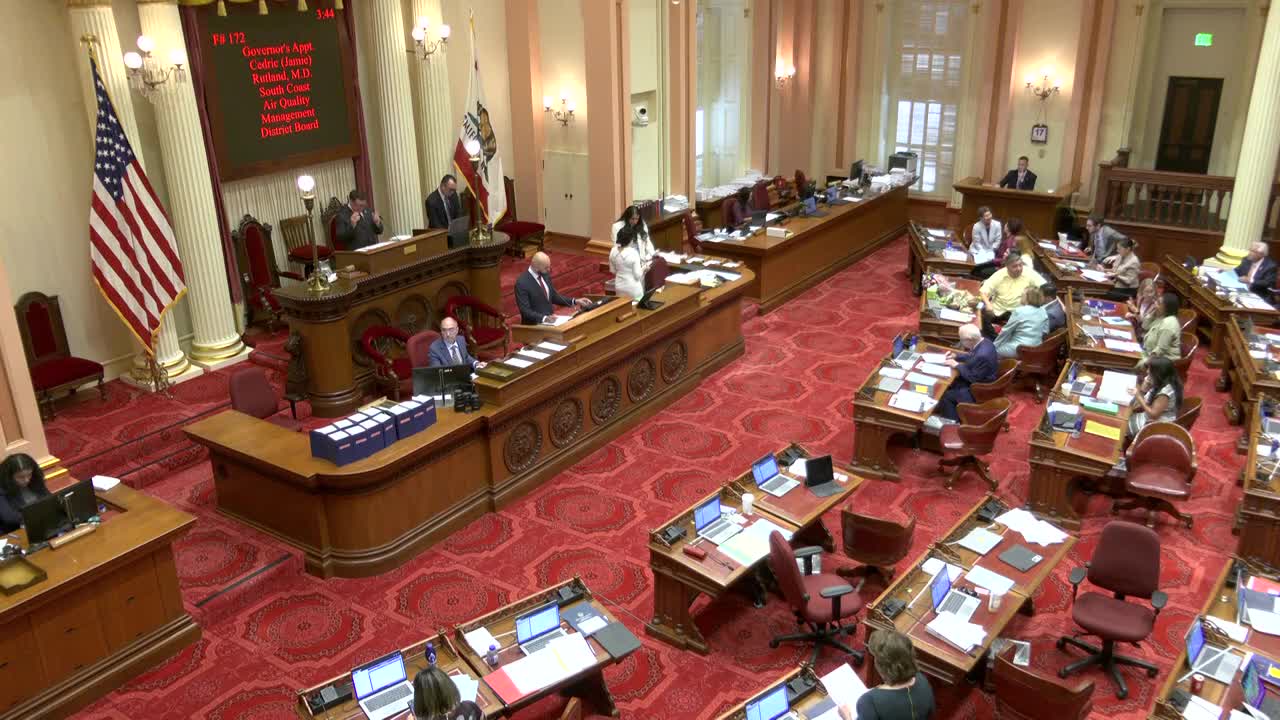 54SEC
Senate Floor
 7MIN
Senate Standing Committee on Natural Resources and Water
Bill Author