SB 921: Employment: employer contributions: employee withholdings: credit: agricultural employees.
- Session Year: 2025-2026
- House: Senate
- Latest Version Date: 2026-01-28
Current Status:
Failed
(2026-04-22: April 22 set for first hearing. Failed passage in committee. (Ayes 1. Noes 4. Page 4012.))
Introduced
In Committee
Awaiting First Chamber Vote
Passed First Chamber
In Committee
Awaiting Second Chamber Vote
Passed Second Chamber
Enacted
What does this bill do?
The bill lets employers of agricultural workers covered by Wage Order No. 14-2001 claim a credit equal to the overtime wages they paid those workers and, if that credit is larger than what the employer would have owed for employee tax withholdings in a quarter, allows a refund subject to available funding. It also requires farm labor contractors to show each worker’s gross and net pay on payroll records after subtracting any credit the contractor claimed.
The summary is provided by generative AI which can make mistakes. For original language, please view the details in the table below.
(1)The Personal Income Tax Law imposes taxes on taxable income, as provided. Under existing law, every employer who pays wages to a resident employee for services performed either within or without this state, or to a nonresident employee for services performed in this state, is required to deduct and withhold from those wages, except as provided, for each payroll, a tax computed in an amount substantially equivalent to the amount reasonably estimated to be due under the Personal Income Tax Law. Under existing law, every employer required to withhold those taxes is required to, for each calendar quarter, file a withholding report, a quarterly return, and a report of wages in a form prescribed by the Employment Development Department, and pay over the taxes required to be withheld.
This bill would authorize an employer to claim a credit in an amount equal to the amount of overtime wages, as defined, paid during that quarter to specified agricultural employees covered by a certain wage order. The bill would require the credit to be claimed on the employers report of contributions, quarterly return, and report of wages, or in an electronic funds transfer, as specified. The bill would specify a refund of any credit amounts exceeding the amount that would have been remitted for that quarter to the Employment Development Department for employee withholdings. The bill would make implementation of the above-described refund contingent upon appropriation by the Legislature.
(2)Existing law requires farm labor contractors to be licensed by the Labor Commissioner and to comply with specified employment laws applicable to farm labor contractors. Existing law requires a person acting in the capacity of a farm labor contractor to provide a grower with whom the contractor has contracted to supply farmworkers a payroll record for each farmworker providing labor under the contract. Existing law requires the above-described payroll record to include certain disclosures, including the net and gross wages earned by each farmworker. Under existing law, a person who violates farm labor contractor requirements is guilty of a misdemeanor.
This bill would, instead, require the above-described disclosure to include the net and gross wages earned, less the amount of credit the farm labor contractor received pursuant to the above provisions, by each farmworker. By imposing a new requirement on farm labor contractors, the violation of which is a crime, the bill would impose a state-mandated local program.
(3)The California Constitution requires the state to reimburse local agencies and school districts for certain costs mandated by the state. Statutory provisions establish procedures for making that reimbursement.
This bill would provide that no reimbursement is required by this act for a specified reason.
The Legislature finds and declares all the following:
(a)Californias agricultural industry is facing historic economic challenges. A few thousand California farmers and ranchers will likely go out of business in the next two or three years.
(1)Climate change-induced drought has caused Californias irrigated farmland to shrink by 752,000 acres in the last five years. According to the United States Department of Agricultures 2022 Census of Agriculture, the number of California farms fell 10.5 percent between 2017 and 2022, a decrease of 7,387 farms. In 2024, the United States Secretary of Agriculture called the numbers in the 2022 Census of Agriculture a wake-up call.
(2)The Department of Food and Agriculture reported that in 2023, Californias farms and ranches received $59.4 billion in cash receipts for their output. This represents a 1.4-percent increase in cash receipts compared to the previous year. This was significantly behind Californias inflation rate in 2023 that was 3.9 percent as measured by the California Consumer Price Index. This means that in 2023, Californias agricultural industry was $1.5 billion behind simply keeping up with inflation, which would have been breaking even.
(3)In January 2024, at the State of the Industry at the Unified Wine and Grape Symposium, the California wine industry was urged to remove 50,000 acres of grapevines statewide to correct the oversupply issue. In November 2025, the Standing Winegrape Acreage Report found that California winegrape growers removed nearly 40,000 acres of vineyard, roughly 7 percent of the states winegrape acreage, between October 2024 and August 2025. In 2024, the French government saw the same problem and allocated 120,000,000 in subsidies aimed at funding the permanent removal of vineyards. Their objective was to remove up to 100,000 hectares of vineyards in France. In 2023, the French government provided $215,000,000 in funding to wineries to sell off their surplus wine. To date, California has provided no similar financial support for California wineries and vineyards that are competing in a global market.
(4)In August 2024, AgWest Farm Credit reported high interest rates, falling farm income, shifting water availability, and regulations are among the main drivers lowering agricultural land values in California.
(5)In November 2024, the California Farm Bureau reported a significant decline in San Joaquin Valley land values. This is attributed primarily to reduced access to groundwater, which has hit farms without surface water access hardest. Reduced land values has been particularly challenging for almond orchards and vineyards, where values have been reported to have dropped by as much as 50 percent.
(6)The combination of low commodity prices and high operating costs has made it difficult for agricultural producers to secure operating loans and has resulted in abandonment of orchards and vineyards. This has created the pest problems that led the Legislature to pass Assembly Bill 732 in 2025 allowing county agricultural commissioners to compel landowners to clean up neglected orchards and vineyards.
(b)Californias 400,000 agricultural employees face incredible challenges and need help.
(1)The Public Policy Institute of California in 2022 reported, A trend taking shape over decades is the increasingly settled nature of farm work, with workers living in the United States year-round. In the past, patterns of settling were quite different by immigration status. This report highlights the need of agricultural employees for year-round services including health care.
(2)A November 2024 report from the Rural Health Information Hub stated, The challenges that rural residents face in accessing healthcare services contribute to health disparities. The barriers to healthcare access include distance and transportation, healthcare workforce shortages, cost of insurance, and lack of access to broadband, privacy, and health literacy.
(3)Work in vineyards, orchards, and fields is hard work. Section 858 of the Labor Code states, Agricultural employees engage in back-breaking work every day. Few occupations in todays America are as physically demanding and exhausting as agricultural work. Yet Section 3441 of Title 8 of the California Code of Regulations is a barrier to using technology to make the work safer and less labor intensive.
(4)Agricultural employees have a difficult time finding housing in California as the state has some of the highest housing prices in the nation. In the coastal area of the Counties of Monterey and Santa Cruz, a consortium of local agencies released a housing report in 2018 that found that about 73,000 agricultural employees live in the Salinas and Pajaro Valleys year round. An estimated 77 percent live in overcrowded or extremely overcrowded conditions, with multiple families sharing bedrooms. Little has been done by the State of California to help create new agricultural housing.
(5)(A)Recognizing the needs and importance of supporting its agricultural employees, the Oregon Legislature approved House Bill 4002 in April 2024. The measure requires agricultural employers to pay certain workers for overtime hours worked and created a refundable personal or corporate income tax credit for employers for a percentage of wages paid as overtime pay to agricultural workers for calendar years 2023 through 2028.
(B)The State of New York has also created a farm employer overtime credit. The credit is 118 percent of the overtime hours the agricultural employer paid multiplied by the difference between the employees overtime rate of pay and their regular rate of pay.
(c)In 2016, the Legislature passed legislation that was intended to increase the take-home pay of California agricultural employees who are working overtime.
(1)It was the intent of the Legislature, to enact the Phase-In Overtime for Agricultural Workers Act of 2016 to provide any person employed in an agricultural occupation in California, as defined in Order No. 14-2001 of the Industrial Welfare Commission (revised 07-2014) with an opportunity to earn overtime compensation under the same standards as millions of other Californians.
(2)According to research led by Dr. Alexandra Hill at University of California, Berkeley, California farm workers have experienced reduced work hours and reduced earnings since the Phase-In Overtime for Agricultural Workers Act of 2016 became law. Dr. Hill found that in farmworker interviews reported by the National Agricultural Workers Survey (NAWS), California farm workers reported 4.7 fewer work hours per week in 2022 than in 2012. In the farmworkers responses to the American Community Survey (ACS), farmworkers reported 4.2 fewer work hours per week in that same period. As a result, according to NAWS, these workers reported reduced average weekly earnings of $120 per week in 2022 than in 2012. According to ACS, responding farmworkers reported reduced average annual earnings of $2,800 in 2023 compared to 2012.
(3)The USDA Farm Labor Survey found that the average weekly hours of directly hired California workers fell relative to the average weekly hours of all United States directly hired farm workers. In 2016, Californias directly hired farm workers averaged 2.7 more hours a week than all United States farm workers. That fell to 1.9 more hours a week in 2019, 0.1 more hours in 2021, and one less hour in 2023, which means that directly hired California farm workers averaged an one hour less per week in 2023 than all United States farm workers.
(d)As Californias agricultural industry faces economic challenges causing the reduction of overtime hours available to employees, the unintended consequence of the Phase-In Overtime for Agricultural Workers Act of 2016 is that employees are losing money. Therefore, it is in the public interest to support agricultural employees through public financial support of overtime wages.
(1)The intent of enacting Section 13200 of the Unemployment Insurance Code is to recognize the findings and declarations in subdivisions (a) through (c), inclusive, and to provide a much-needed investment in the well-being of agricultural employees.
(2)In September, 2024, Governor Gavin Newsom stated, Farmworkers are the backbone of Californias nation-leading agricultural industry and play a critical role in ensuring the stability of the state, nation and worlds food supply. Investing in their well-being is investing in Californias success.
SEC. 2.Section 1695.55 of the Labor Code is amended to read:1695.55.(a)Every person acting in the capacity of a farm labor contractor shall provide any grower with whom he or she the contractor has contracted to supply farmworkers a payroll record for each farmworker providing labor under the contract. The payroll record shall include a disclosure of the net and gross wages, less the amount of credit the farm labor contractor received pursuant to Section 13200 of the Unemployment Insurance Code, total hours worked, and total hourly and piece rate earnings for each farmworker.
(b)Each grower entering into a contract with a farm labor contractor shall retain a copy of the payroll record provided by the contractor for a period of three years after the contract has ended.
SEC. 3.Section 1585.6 is added to the Unemployment Insurance Code, to read:1585.6.(a)For an employer, if the total amount claimed pursuant to subdivision (b) of Section 13200 in any given quarter exceeds the amount that would have been remitted by that employer for that quarter to the Employment Development Department for employee withholdings pursuant to Division 6 (commencing with Section 13000) but for the operation of Section 13200, the employer shall receive a refund, subject to subdivision (b).
(b)Implementation of this section shall be contingent upon appropriation of sufficient funding by the Legislature in the annual Budget Act or other statute for that purpose.
SEC. 4.Division 6.1 (commencing with Section 13200) is added to the Unemployment Insurance Code, to read:6.1.Overtime for Agricultural Workers Act of 2017 Credit13200.(a)An employer whose employees are covered by Wage Order No. 14-2001 of the Industrial Welfare Commission may claim a credit in accordance with this section.
(b)The amount of the credit shall be equal to the amount of overtime wages paid for that quarter under Chapter 6 (commencing with Section 857) of Part 2 of Division 2 of the Labor Code to employees who are covered by Wage Order No. 14-2001.
(c)The credit shall be claimed, in a form and manner prescribed by the department, pursuant to either of the following:
(1)On the report of contributions, quarterly return, and report of wages required under Section 1088.
(2)In an electronic funds transfer pursuant to subdivision (f) of Section 1110 or Section 13021.
(d)(1)This section does not change the amount of taxes required to be withheld from employees pursuant to Division 6 (commencing with Section 13000) and required to be reported to the employee, the Employment Development Department, the Franchise Tax Board, and the Internal Revenue Service.
(2)This section does not require additional taxes to be paid by the employee or otherwise alter the employees tax liability under Part 10 (commencing with Section 17001) of Division 2 of the Revenue and Taxation Code.
(3)It is the intent of the Legislature that the operation of this section does not require an appropriation of moneys by reducing moneys remitted by the employer to the Employment Development Department that would otherwise be deposited in the General Fund.
(e)The Employment Development Department may adopt rules and regulations that are necessary or appropriate to implement this section.
(f)For purposes of this section, the following definitions apply:
(1)Employee has the same meaning as that term is used in Sections 3205, 3205.1, 3205.2, and 3205.3 of Title 8 of the California Code of Regulations, as those sections read on January 1, 2023.
(2)Overtime wages means the difference between the employees overtime rate of pay and their regular rate of pay.
(3)Quarterly return means the form on which the employer reports its employer contributions and employee withholdings pursuant to this code.
SEC. 5.No reimbursement is required by this act pursuant to Section 6 of Article XIIIB of the California Constitution because the only costs that may be incurred by a local agency or school district will be incurred because this act creates a new crime or infraction, eliminates a crime or infraction, or changes the penalty for a crime or infraction, within the meaning of Section 17556 of the Government Code, or changes the definition of a crime within the meaning of Section 6 of Article XIIIB of the California Constitution.
|
Date
|
Status
|
|---|---|
| Apr 22, 2026 | April 22 set for first hearing. Failed passage in committee. (Ayes 1. Noes 4. Page 4012.) |
| Apr 22, 2026 | April 22 set for first hearing. Failed passage in committee. (Ayes 1. Noes 4.) |
| Apr 15, 2026 | Set for hearing April 22. |
| Feb 11, 2026 | Referred to Com. on L., P.E. & R. |
| Jan 29, 2026 | From printer. May be acted upon on or after February 28. |
| Jan 28, 2026 | Introduced. Read first time. To Com. on RLS. for assignment. To print. |
|
Date
|
Description
|
Location
|
Votes
|
|
|---|---|---|---|---|
| Apr 22, 2026 | Do pass, but first be re-referred to the Committee on [Appropriations] | Senate Standing Committee on Labor, Public Employment and Retirement |
Failed |
This list shows positions taken on this bill by organizations on the date displayed, which is linked to the original source.
Positions by individuals are not included.
|
Organization
|
Position
|
Date
|
|---|---|---|
| 24 Carrot Farm, LLC | ** Support | |
| Agricultural Council Of California | ** Support | |
| Allied Grape Growers | ** Support | |
| Almond Alliance Of California | ** Support | |
| California Association Of Winegrape Growers | ** Support | |
| California Citrus Mutual | ** Support | |
| california cotton ginners and growers association, inc. | ** Support | |
| California Farm Bureau | ** Support | |
| California Federation of Labor Unions | ** Against | |
| California Fresh Fruit Association | ** Support | |
| California Rural Legal Assistance Foundation | ** Against | |
| California Strawberry Commission | ** Support | |
| California Walnut Commission | ** Support | |
| Exeter Chamber of Commerce | ** Support | |
| Fowler Packing Company, Inc. | ** Support | |
| Greater Bakersfield Chamber of Commerce | ** Support | |
| Grower-Shipper Association of Central California | ** Support | |
| Jsm Organics, INC. | ** Support | |
| Kern County Farm Bureau | ** Support | |
| Munger Farms | ** Support | |
| Proteus, Inc. | ** Support | |
| Tulare County Farm Bureau | ** Support | |
| Tulare County Supervisor Dennis Townsend | ** Support | |
| Western Tree Nut Association | ** Support |
SENATE COMMITTEE ON LABOR, PUBLIC EMPLOYMENT AND RETIREMENT
Senator Lola Smallwood-Cuevas, Chair
2025 - 2026 Regular
Bill No: SB 921 Hearing Date: April 22, 2026
Author: | Grove | ||
Version: | January 28, 2026 | ||
Urgency: | No | Fiscal: | Yes |
Consultant: | Jazmin Marroquin | ||
SUBJECT: Employment: employer contributions: employee withholdings: credit: agricultural employees
KEY ISSUE
This bill creates a payroll tax credit to reimburse agricultural employers for overtime wages paid to their agricultural employees, as specified.
ANALYSIS
Existing law:
- Establishes the Department of Industrial Relations (DIR) in the Labor and Workforce Development Agency (LWDA), and vests it with various powers and duties to foster, promote, and develop the welfare of the wage earners of California, to improve their working conditions, and to advance their opportunities for profitable employment. (Labor Code §50.5)
- Sets wage, hour, and meal break requirements, and other working conditions for employees and requires an employer to pay overtime wages to an employee who works in excess of a workday or workweek. (Labor Code §§500-556, 558)
- Establishes, under the Phase in Overtime for Agricultural Workers Act of 2016, an implementation schedule for large employers and small employers that phases in overtime requirements for persons employed in an agricultural occupation, as defined. (Labor Code §§857-964)
- Beginning January 1, 2022, requires that any work performed by a person employed in an agricultural occupation in excess of 12 hours per day be compensated at a rate no less than twice the employee’s regular rate of pay.
- Beginning January 1, 2025, for an employer who employs 25 or fewer employees, requires that any work performed by a person employed in an agricultural occupation in excess of 12 hours per day be compensated at a rate no less than twice the employee’s regular rate of pay.
- Requires DIR to update Wage Order No. 14-2001 of the IWC to be consistent with these provisions, except in specified circumstances the wage order provides greater protections or benefits to agricultural employees.
- Specifies “employed in an agricultural occupation” has the same meaning as in Order No.14-2001 of the Industrial Welfare Commission (revised 07-2014).
- Establishes the Industrial Welfare Commission (IWC) within DIR, to regulate wages, hours and working conditions in California. (Labor Code §§70-74)
- Establishes the Employment Development Department (EDD) within the LWDA. EDD is responsible for, among other duties, the administration of the Unemployment Insurance (UI) and Disability Insurance (DI) programs. (Unemployment Insurance Code §301)
- Requires employers to withhold specified amounts from their employee payroll and transfer those amounts to the EDD for purpose of paying the Unemployment Insurance (UI) Tax, State Disability Insurance (SDI) Tax, Employment Training Tax (ETT) and the California Personal Income Tax (PIT). (Unemployment Insurance Code §13020 et seq.)
- Requires every licensed farm labor contractor to, among other things, make specified disclosures to employers and workers, maintain specified records, promptly pay all moneys owed to workers, conspicuously post information related to workers' rights, provide mandated training, including sexual harassment prevention training for all supervisors and farm workers, and comply with all federal law requirements, as specified. (Labor Code §1695-1696)
This bill:
- Authorizes an employer whose employees are covered by Wage Order No. 14-2001 of the Industrial Welfare Commission to claim a credit, as specified.
- Provides that the amount of the credit is equal to the amount of overtime wages paid for that quarter, as specified, to employees who are covered by Wage Order No. 14-2001.
- Provides that the credit must be claimed, in a form and manner prescribed by the department, pursuant to either of the following:
- On the report of contributions, quarterly return, and report of wages, as specified.
- In an electronic funds transfer, as specified.
- Provides that this section does not change the amount of taxes required to be withheld from employee, as specified, and required to be reported to the employee, the EDD, the Franchise Tax Board (FTB), and the Internal Revenue Service (IRS).
- This section does not require additional taxes to be paid by the employee or otherwise alter the employee’s tax liability, as specified.
- It is the intent of the Legislature that the operation of this section does not require an appropriation of moneys by reducing moneys remitted by the employer to the EDD that would otherwise be deposited in the General Fund.
- Authorizes EDD to adopt rules and regulations that are necessary or appropriate to implement this section.
- Defines the following terms for purposes of this section:
- “Employee” has the same meaning as that term is used in Sections 3205, 3205.1, 3205.2, and 3205.3 of Title 8 of the California Code of Regulations, as those sections read on January 1, 2023.
- “Overtime wages” means the difference between the employees’ overtime rate of pay and their regular rate of pay.
- “Quarterly return” means the form on which the employer reports its employer contributions and employee withholdings, as specified.
- Provides that for the payroll record that a farm labor contractor has to provide to any grower, includes a disclosure of the net and gross wages, minus the amount of credit the farm labor contractor received, as specified, in addition to total hours worked, and total hourly and piece rate earnings for each farmworker.
- Requires the employer to receive a refund, as specified, if the total amount claimed, as specified, in any given quarter exceeds the amount that would have been remitted by that employer for that quarter to the EDD for employee withholdings, as specified.
- Implementation of this section is contingent upon appropriation of sufficient funding by the Legislature in the annual Budget Act or other statute for that purpose.
- Makes a series of legislative findings and declarations.
COMMENTS
1. Background:
Overtime Pay
In 1938, Congress passed the Fair Labor Standards Act (FLSA), which established minimum requirements for labor laws in all states. The FLSA establishes minimum wage, overtime pay, recordkeeping, and child labor standards affecting employees in the private sector and in federal, state, and local governments. As with all provisions with the FLSA, states are allowed to exceed the requirements laid out in the federal law.
In California, the general overtime provisions are that a nonexempt employee shall not be employed more than 8 hours in any workday or more than 40 hours in any workweek, unless they receive overtime pay. In California, employees are required to be compensated for overtime at no less than:
- One and half times the employee’s regular rate of pay for all hours worked in excess of 8 hours, up to 12 hours, in any workday, and for the first 8 hours worked on the seventh consecutive day of work in a workweek, and
- Double the employee’s regular rate of pay for all hours worked in excess of 12 hours in any workday, and for all hours worked in excess of 8 hours on the seventh consecutive day or work in a workweek.
There are several exemptions and exceptions from California’s overtime law, meaning that overtime law does not apply to certain employee classifications, and that overtime is paid to a certain classification of employees on a different basis as well.
Agricultural Workers and Overtime Pay
Under the FLSA, agricultural employees are exempt from overtime pay provisions. They do not have to be paid time and one-half their regular rates of pay for hours worked over 40 per week under the FLSA. California law had been silent on issue of overtime for agricultural employees until 1941. In 1941, however, the California Legislature exempted all agricultural employees from the statutory requirements of overtime, similar to the FLSA. This statutory exemption was retained when the eight-hour day was codified in 1999.
This statutory exemption, however, did not prohibit the IWC from legally promulgating overtime provisions beyond the traditional eight-hour standard of California law. Prior to the passage of AB 1066 in 2016 (as described below), the applicable wage order for agricultural employees required the payment of overtime wages when an agricultural employee works longer than 10 hours in a single day, and more than six days during any workweek.
Industrial Welfare Commission (IWC) Wage Orders
The IWC is a commission under DIR made up of five members, appointed by the Governor and approved by the Senate, responsible for setting the wages, hour of work, and working conditions of California employees. The IWC has 17 “Wage Orders.”
Wage Order 14, or IWC Order No. 14-2001, applies to agricultural employers and employees.[1] Agricultural workers are defined in Wage Order 14 and includes employees engaged in the preparation, care, and treatment of farmland as well as the care and harvesting of crops.
Phase in Overtime for Agricultural Workers Act of 2016
In 2016, the Governor signed AB 1066 (Gonzalez, Chapter 313), also known as the Phase-in Overtime for Agricultural Workers Act of 2016. AB 1066 created a phase-in schedule for agricultural workers to receive overtime pay. It created two timelines:
- Larger agricultural employers (with 26 or more employees) will have to pay their employees overtime (1.5 times the regular rate of pay) after 8 hours per day or 40 hours per week by January 1, 2022.
- Smaller agricultural employers (with 25 or fewer employees) will have to pay their employees overtime after 8 hours per day or 40 hours per week by January 1, 2025.
- In addition, agricultural employees will begin to receive double the employee’s regular rate of pay after 12 hours in any workday beginning January 1, 2022 (for large employers) and January 1, 2025 (for small employers).
AB 1066 ensured that by January 1, 2025, all agricultural employees would receive overtime pay on the same basis as workers in most other industries.
Agricultural employees are also entitled to time and one-half pay for the first 8 hours worked on the seventh consecutive day of work and double-time pay for all work performed in excess of 8 hours on the seventh consecutive day of work. These protections from Wage Order 14 (Agricultural Employers) continue to apply, consistent with Labor Code section 510, regardless of employer size.
Agricultural workers also became entitled to all statutory protections in the working hours and overtime requirements in Labor Code Sections 500 through 556, and Labor Code Section 558.1, from which they were previously excluded. This includes standards regarding meal periods, alternative workweek schedules, make-up work time, the one day’s rest in seven requirement, and the administrative, executive, or professional overtime exemption standard.
2. Committee Comments:
This bill seeks to create a payroll tax credit to reimburse agricultural employers for overtime wages paid to their agricultural employees. As noted above, when the Legislature enacted AB 1066, they created two schedules to allow agricultural employers and other small employers to gradually phase-in this requirement in order for employers to adjust and absorb additional costs. By creating a payroll tax credit to reimburse agricultural employers for overtime wages, it sets a troubling precedent. The committee must consider its responsibility to ensure that California employers appropriately compensate their employees, including agricultural employees, for their labor.
Opponents argue that this bill would essentially reward agricultural employers who already have a legal responsibility to pay their agricultural employees for overtime hours worked, and that this bill does not honor the protections agricultural employees earned with passage of AB 1066 by making “the state foot the bill.”
Proponents point to research[2] by the UC Berkeley’s Department of Agricultural and Resource Economics that shows that on average, there has been a decrease in farmworkers’ hours and wages in the first two years since AB 1066’s implementation. However, the research further states that “overall, the results are consistent with employers cutting hours to avoid paying the higher overtime rate.”
3. Need for this bill?
According to the author, “AB 1066 was approved in 2016 and required that farm workers receive overtime premiums (50% of the employee’s regular rate of pay) for hours worked after 8 in a workday and 40 in a work week. The law was built on an assumption that employers would keep providing the same amount of overtime hours to be worked. However, data has shown that agricultural employers could not afford to pay those overtime premiums. Consequently, those overtime hours were reduced substantially.
SB 921 would create a payroll tax credit to reimburse agricultural employers for overtime wages paid to their agricultural employees. The goal is to increase overtime hours for agricultural workers, increasing their take home pay, and alleviating the financial pressures felt throughout rural California.”
4. Proponent Arguments:
According to the California Farm Bureau and California Association of Winegrape Growers, co-sponsors of this bill:
“SB 921 […] creates a tax credit for agricultural employers equal to the amount they pay in overtime wages to agricultural employees. Since AB 1066 took effect in 2017, agricultural employees have seen a steady drop in take-home pay as ag overtime wages have declined.
SB 921 addresses a very linear situation: When agricultural employers cannot afford to pay overtime wages, overtime hours will fall and take-home pay for agricultural employees will decline as well. This reality was verified by a study by UC Berkely which documented the detrimental effects of AB 1066 (approved in 2016) on agricultural employees.
This bill deals with this problem by providing a tax credit to make it possible for agricultural employers to offer overtime hours and the opportunity for agricultural employees to earn both the hourly straight-time wage and overtime premiums again. SB 921 will help accomplish the stated goal of AB 1066 – increasing take-home pay for agricultural employees.”
5. Opponent Arguments:
According to the California Federation of Labor Unions, who are in opposition to this bill:
“In 2016, California passed AB 1066 (Gonzalez), providing overtime pay for farm workers. The law simply requires employers to pay workers overtime, similar to what every other employer in California is required to do. AB 1066 included a reasonable timetable to phase in overtime pay for farm workers until 2022, when they would be entitled to overtime pay after 40 hours a week. It also allowed small employers, those with 25 or fewer employees, an additional 3 years to comply until 2025. Yet, employers vehemently fought, and continue to fight, this basic labor protection that covers every other worker so they could continue to exempt themselves from paying overtime.
SB 921 states that the intent of the bill is “to provide a much-needed investment in the well-being of agricultural employees.” AB 1066 did just that. It invested in farm workers’ well-being to ensure they are paid overtime for the long, arduous hours they work producing the agricultural bounty that feeds the nation and drives the state’s economy. That bill was just one step to addressing the challenges facing farm workers, many stemming from low-pay and long hours—all challenges that employers have the power to address on their own through increased wages, better working conditions, and collective bargaining with union representatives. Yet, employers have fought legislation and unionization drives, intended to directly improve farm workers’ well-being, which do not just help them, but provide legal protections and a seat at the table to negotiate with employers as equals.
Ultimately, SB 921 would set a harmful precedent for California, as it would require the state to pay employers to follow existing law. The Legislature passes, and the Governor signs into law, bills with which they intend and expect residents and businesses to comply, regardless of economic or other circumstances. Instead of honoring the hard-won protections in AB 1066, this bill represents employers’ further attempts to exempt themselves from labor law, only this time they also want the state to foot the bill. At a time when the California legislature is debating how to allocate tax dollars to fund all the state’s priorities in health care, education, housing, human services, infrastructure, energy, etc., this proposal is additionally harmful. Farm workers deserve equal rights and protections in law, and employers should not have to be subsidized to comply.”
6. Prior Legislation:
SB 628 (Grove, 2025) is substantially similar to this bill and would have created a payroll tax credit to reimburse agricultural employers for overtime wages paid to their agricultural employees. This bill failed passage in the Senate Labor, Public Employment and Retirement Committee.
AB 3056 (Gallagher, 2024) sought to repeal the specified provisions of the phase-in of overtime for agricultural workers and provide that agricultural workers shall be entitled to one-half times their regular rate of pay for all hours worked over 45 hours in any workweek, or over 48 hours if the employer employees 25 or fewer employees. The bill failed passage in the Assembly Labor and Employment Committee.
SB 375 (Alvardo-Gil, 2023) would have provided a tax credit, as specified, to employers for their costs to comply with Cal/OSHA’s COVID-19 Prevention/Non-Emergency Standard regulation. The bill was held under submission in the Senate Appropriations Committee.
AB 1066 (Gonzalez, Chapter 313, Statutes of 2016), enacted the Phase-In Overtime for Agricultural Workers Act of 2016, which removed the exemption for agricultural employees regarding hours, meal breaks, and other working conditions, including specified wage requirements, and created a schedule that would phase in overtime requirements for agricultural workers, as defined, over the course of 4 years, from 2019 to 2022, inclusive. Beginning January 1, 2022, the bill required any work performed by a person employed in an agricultural occupation in excess of 12 hours in one day to be compensated at the rate of no less than twice the employee’s regular rate of pay. The bill provided employers who employ 25 or fewer employees an additional 3 years to comply with the phasing in of these overtime requirements. The bill required DIR to update a specified wage order for consistency with these provisions, as specified.
SUPPORT
California Association of Winegrape Growers (Co-sponsor)
California Farm Bureau (Co-sponsor)
24 Carrot Farm, LLC
Agricultural Council of California
Allied Grape Growers
Almond Alliance of California
California Citrus Mutual
California Cotton Ginners and Growers Association, INC.
California Fresh Fruit Association
California Strawberry Commission
California Walnut Commission
Exeter Chamber of Commerce
Fowler Packing Company, INC.
Greater Bakersfield Chamber of Commerce
Grower-Shipper Association of Central California
JSM Organics, INC.
Kern County Farm Bureau
Munger Farms
Proteus, INC.
Tulare County Farm Bureau
Tulare County Supervisor Dennis Townsend
Western Tree Nut Association
OPPOSITION
California Federation of Labor Unions
California Rural Legal Assistance Foundation
-- END --
IWC 14-2001, https://www.dir.ca.gov/IWC/WageOrders2024/IWCArticle14.pdf ↑
Hill, Alexandra E., “California’s Overtime Law for Agricultural Workers: What Happened to Worker Hours and Pay?” Giannini Foundation of Agricultural Economics, University of California. Oct. 2023. https://s.giannini.ucop.edu/uploads/pub/2023/12/13/v27n1_1.pdf ↑
Discussed in Hearing
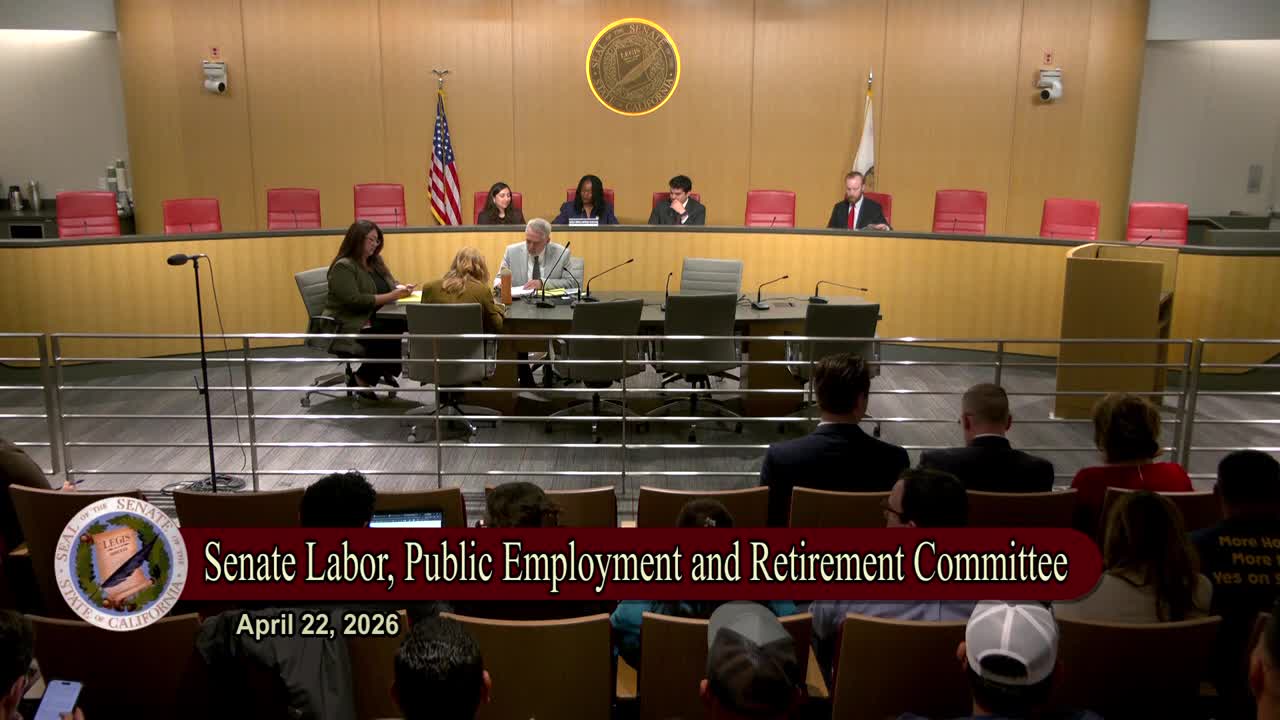 35MIN
Senate Standing Committee on Labor, Public Employment and Retirement


Bill Co-Author(s):