SB 929: State Energy Resources Conservation and Development Commission: chair: report to the Legislature.
- Session Year: 2025-2026
- House: Senate
- Latest Version Date: 2026-06-15
Current Status:
In Progress
(2026-08-13: August 13 hearing: Held in committee and under submission.)
Introduced
In Committee
Awaiting First Chamber Vote
Passed First Chamber
In Committee
Awaiting Second Chamber Vote
Passed Second Chamber
Enacted
Existing law establishes the State Energy Resources Conservation and Development Commission consisting of 5 members and establishes various duties and responsibilities of the commission relating to energy usage in the state. Existing law requires the Governor to designate a chair of the commission and requires the chair to direct the public advisor, the executive director, and other staff of the commission in the performance of their duties in conformance with the policies and guidelines established by the commission.
This bill would require the chair of the commission to appear annually before the appropriate policy committees of the Legislature to report on activities of the commission, the commissions activities and plans as they relate to the commissions responsibilities, as specified.
Existing law establishes the State Energy Resources Conservation and Development Commission consisting of 5 members and establishes various duties and responsibilities of the commission relating to energy usage in the state. Existing law requires the Governor to designate a chair of the commission and requires the chair to direct the public advisor, the executive director, and other staff of the commission in the performance of their duties in conformance with the policies and guidelines established by the commission.
This bill would require the chair of the commission to appear annually before the appropriate policy committees of the Legislature to report on activities of the commission, as specified.
(a)The chair of the commission shall direct the public advisor, the executive director, and other staff in the performance of their duties in conformance with the policies and guidelines established by the commission.
(b)(1)The chair of the commission shall appear annually before the appropriate policy committees of the Legislature to report on the commissions plans to carry out the commissions responsibilities, including, but not limited to, its activities regarding all of activities and plans as they relate to the commissions responsibilities. These may include details on all of the following:
(A)Research, development, and demonstration.
(B)Building and appliance efficiency standards.
(C)Electricity and natural gas demand forecasts.
(D)Siting of thermal powerplants.
(E)Implementation of the California Renewables Portfolio Standard Program (Article 16 (commencing with Section 399.11) of Chapter 2.3 of Part 1 of Division 1 of the Public Utilities Code) and energy labeling.
(F)Transportation fuels and alternative fuel vehicles.
(2)The chair of the commission shall report on the activities taken undertaken by the commission in the previous year and the processes instituted to solicit input from Californians in diverse regions of the state.
(3)The chair shall report on the successes and the challenges encountered in carrying out the responsibilities specified in paragraph (1) and the reported activities taken undertaken and processes instituted pursuant to paragraph (2).
(a) The chair of the commission shall direct the public advisor, the executive director, and other staff in the performance of their duties in conformance with the policies and guidelines established by the commission.
(b)(1)The chair of the commission shall appear annually before the appropriate policy committees of the Legislature to report on the commissions plans to carry out the commissions responsibilities, including, but not limited to, its activities regarding all of the following:
(A)Research, development, and demonstration.
(B)Building and appliance efficiency standards.
(C)Electricity and natural gas demand forecasts.
(D)Siting of thermal powerplants.
(E)Implementation of the California Renewables Portfolio Standard Program (Article 16 (commencing with Section 399.11) of Chapter 2.3 of Part 1 of Division 1 of the Public Utilities Code) and energy labeling.
(F)Transportation fuels and alternative fuel vehicles.
(2)The chair of the commission shall report on the activities taken by the commission in the previous year and the processes instituted to solicit input from Californians in diverse regions of the state.
(3)The chair shall report on the successes and the challenges encountered in carrying out the responsibilities specified in paragraph (1) and the reported activities taken and processes instituted pursuant to paragraph (2).
|
Date
|
Status
|
|---|---|
| Aug 13, 2026 | August 13 hearing: Held in committee and under submission. |
| Jul 1, 2026 | July 1 set for first hearing. Placed on suspense file. |
| Jun 15, 2026 | Read second time and amended. Re-referred to Com. on APPR. |
| Jun 11, 2026 | From committee: Do pass as amended and re-refer to Com. on APPR. with recommendation: To consent calendar. (Ayes 18. Noes 0.) (June 10). |
| Jun 1, 2026 | Referred to Com. on U. & E. |
| May 26, 2026 | In Assembly. Read first time. Held at Desk. |
| May 26, 2026 | Read third time. Passed. (Ayes 37. Noes 0.) Ordered to the Assembly. |
| May 26, 2026 | Read third time. Passed. (Ayes 37. Noes 0. Page 4440.) Ordered to the Assembly. |
| Apr 28, 2026 | Read second time. Ordered to third reading. |
| Apr 27, 2026 | From committee: Be ordered to second reading pursuant to Senate Rule 28.8. |
| Apr 17, 2026 | Set for hearing April 27. |
| Apr 16, 2026 | April 20 hearing postponed by committee. |
| Apr 10, 2026 | Set for hearing April 20. |
| Apr 7, 2026 | From committee: Do pass and re-refer to Com. on APPR. (Ayes 15. Noes 0.) (April 7). Re-referred to Com. on APPR. |
| Apr 7, 2026 | From committee: Do pass and re-refer to Com. on APPR. (Ayes 15. Noes 0. Page 3755.) (April 7). Re-referred to Com. on APPR. |
| Mar 25, 2026 | Set for hearing April 7. |
| Feb 11, 2026 | Referred to Com. on E., U & C. |
| Jan 30, 2026 | From printer. May be acted upon on or after March 1. |
| Jan 29, 2026 | Introduced. Read first time. To Com. on RLS. for assignment. To print. |
|
Date
|
Description
|
Location
|
Votes
|
|
|---|---|---|---|---|
| Jun 10, 2026 | Do pass as amended, and be re-referred to the Committee on [Appropriations] with recommendation: To Consent Calendar | Assembly Standing Committee on Utilities and Energy |
Passed |
|
| May 26, 2026 | Senate 3rd Reading SB929 Jones | Senate Floor |
Passed |
|
| Apr 7, 2026 | Do pass, but first be re-referred to the Committee on [Appropriations] | Senate Standing Committee on Energy, Utilities and Communications |
Passed |
This list shows positions taken on this bill by organizations on the date displayed, which is linked to the original source.
Positions by individuals are not included.
Date of Hearing: July 1, 2026
ASSEMBLY COMMITTEE ON APPROPRIATIONS
Buffy Wicks, Chair
SBPCA Bill Id:SB 929
Author:(Jones) – As Amended Ver:June 15, 2026
Policy Committee: | Utilities and Energy | Vote: | 18 - 0 |
|
| ||
|
|
Urgency: No State Mandated Local Program: No Reimbursable: No
SUMMARY:
This bill requires the chair of the California Energy Commission (CEC) to appear annually before the appropriate policy committees of the Legislature to report on the CEC’s plans to carry out the CEC’s activities and plans as they relate to the CEC’s responsibilities.
FISCAL EFFECT:
Minor state costs, which the CEC can absorb with existing resources. However, consistent with the committee’s rules regarding a bill that has the primary purpose of creating a task force, a commission, a work group, a pilot project or a pilot project extension, a report or a study, this bill is a candidate for the committee’s suspense file.
COMMENTS:
The State Energy Resources Conservation and Development Commission (more commonly known as the “California Energy Commission” or “CEC”) describes itself as the state’s primary energy policy and planning agency and as committed to reducing energy costs and environmental impacts of energy use while ensuring a safe, resilient and reliable supply of energy.
The CEC is involved, directly or indirectly, in all aspects of energy policy development and implementation and energy regulation in the state. Statute assigns to the CEC several distinct responsibilities. Those responsibilities include, but are not limited to:
- Forecasting natural gas and electricity demand.
- Permitting (“siting”) large thermal powerplants.
- Setting energy efficiency standards applicable to appliances and buildings.
- Awarding financial incentives for energy-related research, development and demonstration projects; development and deployment of low-carbon fuels and advanced vehicle technologies and installation of solar photovoltaic systems on new homes.
- Certifying renewable powerplants as eligible for compliance with the state’s renewable portfolio standard.
The California Public Utilities Commission (CPUC) sets the rates and, to a large extent, the terms of service of the state’s publicly owned utilities, including electrical and natural gas utilities. By practical necessity and, in some instances, statutory requirement, the CEC works closely with and influences the work of the CPUC.
Statue obligates the president of the CPUC to appear annually before the relevant legislative committees. The conditions that led the Legislature to require the president of the CPUC to appear before it seem to be unique to the CPUC at the time the requirement was created: the CPUC faced a persistent workload backlog and, according to long-time legislative staff, the then-president of the CPUC ignored legislative requests to appear before policy committees.
This committee is unaware of similar workload issues at the CEC; nor is this committee aware of any reluctance on the part of CEC leadership or staff to appear before or report to the Legislature. It is not clear why legislative oversight of the CEC could not be achieved by a standing request by the policy committees of each house that the CEC appear annually before them, similar to the practice of legislative budget committees.
The author contends the statutory requirement is required because:
The authority and responsibility of the California Energy Commission have expanded significantly, yet its oversight by the Legislature has not appropriately kept up with that growth…Given its growth in size and purview, it is now unique among similar state agencies in its lack of an ‘appear and report’ requirement.
There have been several attempts to place in statute the requirement that the chair of the CEC appear before the Legislature; however, none of those attempts passed both houses of the Legislature. The committee is aware of neither support for, nor opposition to, this bill.
Analysis Prepared by: Jay Dickenson / APPR. / (916) 319-2081
Date of Hearing: June 10, 2026
ASSEMBLY COMMITTEE ON UTILITIES AND ENERGY
Cottie Petrie-Norris, Chair
SBPCA Bill Id:SB 929
Author:(Jones) – As Introduced Ver:January 29, 2026
SENATE VOTE: 37-0
SUBJECT: State Energy Resources Conservation and Development Commission: chair: report to the Legislature
SUMMARY: Requires the chair of the California Energy Commission (CEC) to appear annually before appropriate policy committees of the Legislature to report on plans and activities of the CEC. Specifically, this bill:
- Requires the chair to report on the topics related to CEC’s responsibilities, including but not limited to:
- Research, development, and demonstration.
- Building and appliance efficiency standards.
- Electricity and natural gas demand forecasts.
- Siting of thermal power plants.
- Implementation of the California Renewables Portfolio Standard Program and energy labeling.
- Transportation fuels and alternative fuel vehicles.
- Requires the chair to report on the activities undertaken by the CEC in the previous year and the process instituted to solicit input from Californians in diverse regions of the state.
- Requires the chair to report on the successes and challenges encountered in carrying out the responsibilities, activities, and processes of the CEC.
EXISTING LAW:
- Establishes the CEC, consisting of five members appointed by the governor, and specifies the duties of the commission. Every two years, the governor must designate a chair and vice chair from the CEC’s membership. The CEC must appoint a public adviser every three years to carry out certain public engagement duties. (Public Resources Code § 25200 et. seq.)
- Requires the CEC to assess trends in energy consumption and analyze the social, economic, and environmental consequences of these trends. The CEC must establish energy conservation measures, including building and appliance energy efficiency standards, and recommend additional conservation measures to the governor and the Legislature. (Public Resources Code § 25216)
- Requires the California Public Utilities Commission (CPUC) to prepare an annual report on its activities and performance, and requires the president of the CPUC to annually appear before the appropriate policy committees of the Legislature to present the report. (Public Utilities Code §§ 910 and 321.6)
- Requires the director of the Public Advocate’s Office (PAO) to be appointed by the governor and appear annually before the appropriate policy committee of the Assembly and the Senate to report on the activities of the office. (Public Utilities Code § 309.5)
- Requires the chair of the board of governors and the chief executive officer of the California Independent System Operator (CAISO) to appear annually before the appropriate policy committees of the Legislature to present an annual report detailing CAISO’s activities. (Public Utilities Code § 345.1)
- Requires the chair of the California Air Resources Board (CARB) to appear annually before the Joint Committee on Climate Change to present an annual report on topics related to the scoping plan. (Government Code § 9147.10)
FISCAL EFFECT: Unknown. Upon passage in this committee, this bill will be referred to the Assembly Committee on Appropriations for its review. This bill passed out of the Senate Committee on Appropriations under Senate Rule 28.8, indicating that any state costs of implementing the bill are not significant.
BACKGROUND:
What is the CEC? The CEC was established in 1974 by the Warren-Alquist Act in response to the 1970s oil embargo and the state’s anticipated energy demand. As the state’s primary energy policy and planning agency, the CEC is committed to reducing costs and environmental impacts of energy use, while ensuring a safe, resilient, and reliable supply of energy. Over the last 50 years, the CEC’s role has expanded into many aspects of the state’s energy policies and goals. The CEC also administers multiple programs that impact the duties of other agencies, including the CPUC, CARB, and CAISO. The CEC’s role can broadly be categorized by the following core responsibilities:
- Forecasting electricity and natural gas demand to ensure adequate supplies are developed [via the Integrated Energy Policy Report (IEPR)].
- Promoting energy efficiency and conservation by setting the state’s appliance and building efficiency standards [California Appliance Standards – Title 20 and California Green Building Standards – Title 24].
- Investing in energy innovation that advances energy science and technology through research, development, and demonstration projects [via the Electric Program Investment Charge Program (EPIC) and natural gas research].
- Developing renewable energy resources.
- Advancing alternative and renewable transportation fuels, vehicles, and technologies.
- Certifying thermal power plants greater than 50 megawatts and providing a voluntary permitting process for clean energy resources.
- Planning for and directing state response to energy emergencies.
In addition to these core responsibilities, the CEC has some regulatory authority over the state’s publicly owned utilities (POUs). For example, the CEC verifies eligible renewable energy resources procured by POUs for compliance with the Renewables Portfolio Standard (RPS). The CEC also verifies the Power Content Label – an annual disclosure of an entity’s power mix and emissions – for all statewide retail suppliers, POUs included.[1]
The CEC is made up of five commissioners appointed by the Governor and confirmed by the Senate. Commissioners serve staggered five-year terms. The Governor also designates a chair and vice chair as primary agency leads. The CEC currently has 880 employees[2] and an annual expenditure in 2024-2025 of approximately $104.6 million.[3]
Reports to the Legislature – The CEC annually submits reports to the Legislature on a number of its activities. Every two years, the CEC submits the comprehensive IEPR, with updates to the report submitted every other year. The CEC also submits reports to the Legislature on energy research, development, and demonstration activities, electric reliability, transportation fuels, and transportation investments.
COMMENTS:
- Author’s statement. According to the author, “The authority and responsibility of the California Energy Commission have expanded significantly, yet its oversight by the Legislature has not appropriately kept up with that growth. The Commission has adopted and is considering policies with substantial cost implications for Californians along with its implementation of impactful policies enacted by the Legislature. These actions have direct impacts on housing affordability, energy costs, and the overall cost of living in California. Unlike the California Public Utilities Commission, the Chair of the Energy Commission is not required to appear annually before relevant legislative policy committees to provide a formal oversight report. Given its growth in size and purview, it is now unique among similar state agencies in its lack of an ‘appear and report’ requirement. SB 929 would require the Chair to provide an annual report to the appropriate policy committees of the Legislature on the commission’s activities to include reporting on the commission’s efforts and plans to carry out its varied duties and responsibilities, including research and development, building and appliance standards, electricity and natural gas demand forecasts, renewable energy development, low and zero-emission vehicle fueling and charging infrastructure planning, development and deployment, and relevant financial data to aide the legislature in crafting sound public policy and ensuring proper implementation thereof.”
- Purpose of the bill. This bill requires the CEC’s chair to annually report to the appropriate policy committees of the Legislature on a list of specified topics. A statutory requirement is not needed to compel the CEC’s chair to appear before a legislative committee. Indeed, both the chair and vice chair of the CEC have already appeared before this committee during this session to report on the IEPR and fuel uncertainty. Previous legislative attempts to create a similar statutory requirement have often failed for such reason.
In 2010, Governor Schwarzenegger vetoed a bill (SB 1467, Padilla) that would have required the chair of the CEC to annually appear before the relevant policy committees of the Legislature, stating that “If the legislature would like to invite the chair[person] to appear before their committees, they simply need to call.” However, and as noted above, the CEC’s role in the state’s energy policy landscape has grown considerably since 2010, and having a mandated requirement will yield predictable appearances from the CEC chair. Moreover, it provides parity with similar energy-focused entities such as the CPUC, CARB, CAISO, and PAO, whose leads (chair, CEO, director) also have a statutory obligation to appear annually before the Legislature.
- Practical appearance. As currently written, this bill requires the CEC chair to appear before the Legislature to discuss specified topics related to the CEC’s core responsibilities. This type of prescriptive appearance would be an anomaly and potentially unproductive for the Legislature. Similar statutory requirements of other energy principals, such as the CPUC or CARB, are associated with reports that detail activities of the entity but do not require the lead individual to detail every aspect of the entity's work in the appearance before the Legislature. Additionally, most legislative hearings are focused on a central topic and are often an opportunity to hear from a number of individuals. As currently written, this bill would require the opposite. To meet the bill’s requirements, the CEC chair would have to make a standalone appearance before the legislature to cover each topic outlined in the bill. Therefore, to better align with the realities of these appearances, the committee recommends that the language clarify that the listed topics in the bill are activities the CEC chair may speak to during an annual appearance before the Legislature, but are not a mandatory or exhaustive list for a standalone appearance.
- Prior Legislation.
SB 491 (Laird, 2025) was substantially similar to this bill. Status: Held in the Assembly Committee on Appropriations.
SB 610 (Laird, 2024) was substantially similar to this bill. The bill was subsequently amended into a different subject matter. Status: Held in the Assembly Committee on Appropriations.
SB 733 (Hueso, 2022) was substantially similar to this bill. The bill was subsequently amended into a different subject matter. Status: Held in the Assembly Committee on Appropriations.
SB 497 (Bradford, 2019) was substantially similar to this bill. Status: Held in the Assembly Committee on Appropriations.
SB 376 (Bradford, 2017) was substantially similar to this bill. Status: Held in the Assembly Committee on Appropriations.
SB 1467 (Padilla, 2010) made various technical changes to Public Utilities Code and required the chair of the CEC to annually appear before the relevant policy committees of the Legislature. Status: Vetoed by Governor Schwarzenegger.
REGISTERED SUPPORT / OPPOSITION:
Support
None on file.
Opposition
None on file.
Analysis Prepared by: Alexa Cohill-Milanick / U. & E. / (916) 319-2083
https://www.energy.ca.gov/programs-and-topics/programs/power-source-disclosure-program/power-content-label/annual-power-5 ↑
More accurately noted as “filled positions” which is not equivalent to a headcount, but is approximate. ↑
Pg. 31 of Department of Finance table for Natural Resources; https://dof.ca.gov/media/docs/budget/historical-budget-information/historical-budget-publications/2026-27/2026-27-salaries-and-wages/Natural_Resources.pdf ↑
SENATE RULES COMMITTEE Office of Senate Floor Analyses (916) 651-4171 | SB 929 |
THIRD READING
Bill No: SB 929
Author: Jones (R)
Introduced: 1/29/26
Vote: 21
SENATE ENERGY, U. & C. COMMITTEE: 15-0, 4/7/26
AYES: Allen, Ochoa Bogh, Archuleta, Arreguín, Becker, Caballero, Gonzalez, Hurtado, McNerney, Reyes, Richardson, Rubio, Stern, Strickland, Wahab
NO VOTE RECORDED: Dahle, Grove
SENATE APPROPRIATIONS COMMITTEE: Senate Rule 28.8
SUBJECT: State Energy Resources Conservation and Development Commission: chair: report to the Legislature
SOURCE: Author
DIGEST:
This bill requires the chair of the California Energy Commission (CEC) to annually appear before the relevant legislative policy committees to report on specified activities of the CEC.
ANALYSIS:
Existing law:
- Establishes the CEC, consisting of five members appointed by the Governor, and specifies the duties of the CEC. Every two years, the Governor must designate a chair and vice chair from the CEC’s membership. The CEC must appoint a public adviser every three years to carry out certain public engagement duties. (Public Resources Code §25200 et. seq.)
- Requires the CEC to assess trends in energy consumption and analyze the social, economic, and environmental consequences of these trends. The CEC must establish energy conservation measures, including building and appliance energy efficiency standards, and recommend additional conservation measures to the Governor and the Legislature. (Public Resources Code §25216)
- Establishes the California Public Utilities Commission (CPUC), consisting of five members appointed by the Governor, and authorizes the CPUC to fix rates and establish rules for public utilities. (Article XII of the California Constitution)
- Requires the CPUC to prepare an annual report on its activities and performance and requires the president of the CPUC to appear annually before the appropriate policy committees of the Legislature to present the report. (Public Utilities Code §§910 and 321.6)
This bill:
- Requires the chair of the CEC to appear annually before the relevant policy committees of the Legislature to report on the CEC’s responsibilities, including the following activities:
- Research, development, and demonstration.
- Building and appliance efficiency standards.
- Electricity and natural gas demand forecasts.
- Siting of thermal powerplants.
- Implementation of the Renewables Portfolio Standard (RPS) Program and energy labeling.
- Transportation fuels and alternative fuel vehicles.
- Requires the CEC’s chair to report on the CEC’s activities from the prior year and efforts taken to solicit input from Californians in diverse parts of the states.
- Requires the CEC’s chair to report on the successes and challenges encountered in carrying out its responsibilities and outreach efforts.
Background
More duties, more oversight? This bill is one of several substantially similar measures passed by this house in recent years aimed at increasing legislative oversight for the CEC. Under existing law, the president of the CPUC must annually appear before the relevant policy committees and submit a report on CPUC activities undertaken in the prior year. This bill would establish a similar reporting requirement for the Chair of the CEC. The CEC plays a significant role in the state’s energy policy and administers multiple programs that impact the duties of other agencies, including the CPUC, the California Air Resources Board and the California Independent System Operator (CAISO). CEC’s duties have traditionally included the following activities:
- Analyzing state demand and supply for electricity and natural gas;
- Administering the RPS program;
- Environmental review and certification of proposed large thermal power plants;
- Establishment of building and appliance efficiency standards that promote energy conservation;
- Coordination and development of zero-emission vehicle technology and infrastructure; and
- Managing the largest state-level energy research and development program in the nation.
In addition to these longstanding duties, recent legislation has substantially expanded the CEC’s responsibilities related to transportation fuel markets, energy reliability, renewable energy development and siting, and electric vehicle (EV) charger reliability. Specifically, new duties assigned to the CEC in recent legislation include, but are not limited to, the following:
- Administering a streamlined permitting process for certain large-scale renewable energy projects that opt-in for state-level certification.
- Establishing the Strategic Reliability Reserve to fund sources that enable the shifting or reduction of net peak demand during critical reliability events. The CEC administers two programs that receive funding from the Strategic Reliability Fund: the Demand Side Grid Support and Distributed Electricity Backup Assets programs.
- Establishing the Division of Petroleum Market Oversight and collecting and analyzing petroleum refinery data, monitoring fuel pricing trends, overseeing oil refinery turnaround and maintenance periods, and setting minimum transportation fuel inventory levels for refineries.
- Creating a strategic plan for developing offshore wind resources.
- Setting bidirectional charging requirements on EVs sold in the state and establishing reliability standards for EV chargers.
The CEC, CPUC, and CAISO each play a critical role in forecasting, planning, and addressing energy demands. Increasingly, policies adopted by one of these agencies will impact the activities of the other energy agencies. For example, the CEC’s building and appliance energy efficiency standards may influence utility building decarbonization investments overseen by the CPUC. Greater electrical loads resulting from higher electrification may impact the availability of resources through the CAISO. Renewable siting and RPS targets can impact utility procurements overseen by the CPUC. Despite the inter-relatedness of these energy agencies’ actions, existing law only currently requires the CPUC to annually report on its efforts and appear before relevant legislative policy committees. This bill would extend similar reporting obligations to the CEC.
Related/Prior Legislation
SB 491 (Laird) of 2025, was substantially similar to this bill. The bill was held in the Assembly Appropriations Committee.
SB 610 (Laird) of 2024, was substantially similar to this bill when heard by the Senate Energy Utilities and Communications Committee. The bill was subsequently amended into a different subject matter. The bill was held in the Assembly Appropriations Committee.
SB 733 (Hueso) of 2022, as passed by the Senate Energy Utilities and Communications Committee, was substantially similar to this bill. The bill was subsequently amended into a different subject matter. The bill was held in the Assembly Appropriations Committee
SB 708 (Hueso) of 2019, would have required the CAISO to disclose information relating to tariff or rule of conduct violations by market participants or scheduling coordinators and established other transparency requirements. The bill also would have required the CAISO’s Chief Executive Officer to appear annually before the relevant policy committees of the Legislature to report on the CAISO’s operations and state of the grid. The bill died in the Assembly.
SB 497 (Bradford) of 2019, was substantially similar to this bill and would have required the CEC to appear annually before the appropriate policy committees of the Legislature to report on specified activities. The bill died in the Assembly.
SB 376 (Bradford) of 2017, was substantially similar to this bill and would have required the CEC to appear annually before the appropriate policy committees of the Legislature to report on specified activities. The bill died in the Assembly.
FISCAL EFFECT: Appropriation: No Fiscal Com.: Yes Local: No
SUPPORT: (Verified 4/27/26)
None received
OPPOSITION: (Verified 4/27/26)
None received
ARGUMENTS IN SUPPORT: According to the author:
The authority and responsibility of the California Energy Commission have expanded significantly, yet its oversight by the Legislature has not appropriately kept up with that growth. The Commission has adopted and is considering policies with substantial cost implications for Californians along with its implementation of impactful policies enacted by the Legislature. These actions have direct impacts on housing affordability, energy costs, and the overall cost of living in California.
Prepared by: Sarah Smith / E., U. & C. / (916) 651-4107
4/28/26 16:33:32
**** END ****
SENATE COMMITTEE ON ENERGY, UTILITIES AND COMMUNICATIONS
Senator Benjamin Allen, Chair
2025 - 2026 Regular
Bill No: Hearing Date: 4/7/2026
Author: | |||
Version: | Introduced | ||
Urgency: | Fiscal: | ||
Consultant: | |||
SUBJECT:
DIGEST: This bill requires the chair of the California Energy Commission (CEC) to annually appear before the relevant legislative policy committees to report on specified activities of the CEC.
ANALYSIS:
Existing law:
- Establishes the CEC, consisting of five members appointed by the Governor, and specifies the duties of the CEC. Every two years, the Governor must designate a chair and vice chair from the CEC’s membership. The CEC must appoint a public adviser every three years to carry out certain public engagement duties. (Public Resources Code §25200 et. seq.)
- Requires the CEC to assess trends in energy consumption and analyze the social, economic, and environmental consequences of these trends. The CEC must establish energy conservation measures, including building and appliance energy efficiency standards, and recommend additional conservation measures to the Governor and the Legislature. (Public Resources Code §25216)
- Establishes the California Public Utilities Commission (CPUC), consisting of five members appointed by the Governor, and authorizes the CPUC to fix rates and establish rules for public utilities. (Article XII of the California Constitution)
- Requires the CPUC to prepare an annual report on its activities and performance and requires the president of the CPUC to appear annually before the appropriate policy committees of the Legislature to present the report. (Public Utilities Code §§910 and 321.6)
This bill:
- Requires the chair of the CEC to appear annually before the relevant policy committees of the Legislature to report on the CEC’s responsibilities, including the following activities:
- Research, development, and demonstration.
- Building and appliance efficiency standards.
- Electricity and natural gas demand forecasts.
- Siting of thermal powerplants.
- Implementation of the Renewables Portfolio Standard (RPS) Program and energy labeling.
- Transportation fuels and alternative fuel vehicles.
- Requires the CEC’s chair to report on the CEC’s activities from the prior year and efforts taken to solicit input from Californians in diverse parts of the states.
- Requires the CEC’s chair to report on the successes and challenges encountered in carrying out its responsibilities and outreach efforts.
Background
More duties, more oversight? This bill is one of several substantially similar measures passed by this committee in recent years aimed at increasing legislative oversight for the CEC. Under existing law, the president of the CPUC must annually appear before the relevant policy committees and submit a report on CPUC activities undertaken in the prior year. This bill would establish a similar reporting requirement for the Chair of the CEC. The CEC plays a significant role in the state’s energy policy and administers multiple programs that impact the duties of other agencies, including the CPUC, the California Air Resources Board (CARB) and the California Independent System Operator (CAISO). CEC’s duties have traditionally included the following activities:
- Analyzing state demand and supply for electricity and natural gas;
- Administering the RPS program;
- Environmental review and certification of proposed large thermal power plants;
- Establishment of building and appliance efficiency standards that promote energy conservation;
- Coordination and development of zero-emission vehicle (ZEV) technology and infrastructure; and
- Managing the largest state-level energy research and development program in the nation.
In addition to these longstanding duties, recent legislation has substantially expanded the CEC’s responsibilities related to transportation fuel markets, energy reliability, renewable energy development and siting, and electric vehicle (EV) charger reliability. Specifically, new duties assigned to the CEC in recent legislation include, but are not limited to, the following:
- Administering a streamlined permitting process for certain large-scale renewable energy projects that opt-in for state-level certification.
- Establishing the Strategic Reliability Reserve to fund sources that enable the shifting or reduction of net peak demand during critical reliability events. The CEC administers two programs that receive funding from the Strategic Reliability Fund: the Demand Side Grid Support and Distributed Electricity Backup Assets programs.
- Establishing the Division of Petroleum Market Oversight and collecting and analyzing petroleum refinery data, monitoring fuel pricing trends, overseeing oil refinery turnaround and maintenance periods, and setting minimum transportation fuel inventory levels for refineries.
- Creating a strategic plan for developing offshore wind resources.
- Setting bidirectional charging requirements on EVs sold in the state and establishing reliability standards for EV chargers.
The CEC, CPUC, and CAISO each play a critical role in forecasting, planning, and addressing energy demands. Increasingly, policies adopted by one of these agencies will impact the activities of the other energy agencies. For example, the CEC’s building and appliance energy efficiency standards may influence utility building decarbonization investments overseen by the CPUC. Greater electrical loads resulting from higher electrification may impact the availability of resources through the CAISO. Renewable siting and RPS targets can impact utility procurements overseen by the CPUC. Despite the inter-relatedness of these energy agencies’ actions, existing law only currently requires the CPUC to annually report on its efforts and appear before relevant legislative policy committees. This bill would extend similar reporting obligations to the CEC.
Prior/Related Legislation
SB 491 (Laird) of 2025, was substantially similar to this bill. The bill was held in the Assembly Appropriations Committee.
SB 610 (Laird) of 2024, was substantially similar to this bill when heard by this committee. The bill was subsequently amended into a different subject matter. The bill was held in the Assembly Appropriations Committee.
SB 733 (Hueso) of 2022, as passed by this committee, was substantially similar to this bill. The bill was subsequently amended into a different subject matter. The bill was held in the Assembly Appropriations Committee
SB 708 (Hueso) of 2019, would have required the CAISO to disclose information relating to tariff or rule of conduct violations by market participants or scheduling coordinators and established other transparency requirements. The bill also would have required the CAISO’s Chief Executive Officer to appear annually before the relevant policy committees of the Legislature to report on the CAISO’s operations and state of the grid. The bill died in the Assembly.
SB 497 (Bradford) of 2019, was substantially similar to this bill and would have required the CEC to appear annually before the appropriate policy committees of the Legislature to report on specified activities. The bill died in the Assembly.
SB 376 (Bradford) of 2017, was substantially similar to this bill and would have required the CEC to appear annually before the appropriate policy committees of the Legislature to report on specified activities. The bill died in the Assembly.
FISCAL EFFECT: Appropriation: Fiscal Com.: Local:
SUPPORT:
None received
OPPOSITION:
None received
ARGUMENTS IN SUPPORT: According to the author:
The authority and responsibility of the California Energy Commission have expanded significantly, yet its oversight by the Legislature has not appropriately kept up with that growth. The Commission has adopted and is considering policies with substantial cost implications for Californians along with its implementation of impactful policies enacted by the Legislature. These actions have direct impacts on housing affordability, energy costs, and the overall cost of living in California.
Unlike the California Public Utilities Commission, the Chair of the Energy Commission is not required to appear annually before relevant legislative policy committees to provide a formal oversight report. Given its growth in size and purview, it is now unique among similar state agencies in its lack of an ‘appear and report’ requirement.
SB 929 would require the Chair to provide an annual report to the appropriate policy committees of the Legislature on the commission’s activities to include reporting on the commission’s efforts and plans to carry out its varied duties and responsibilities, including research and development, building and appliance standards, electricity and natural gas demand forecasts, renewable energy development, low and zero-emission vehicle fueling and charging infrastructure planning, development and deployment, and relevant financial data to aide the legislature in crafting sound public policy and ensuring proper implementation thereof.
-- END --
Discussed in Hearing
 3MIN
Senate Standing Committee on Business, Professions and Economic Development
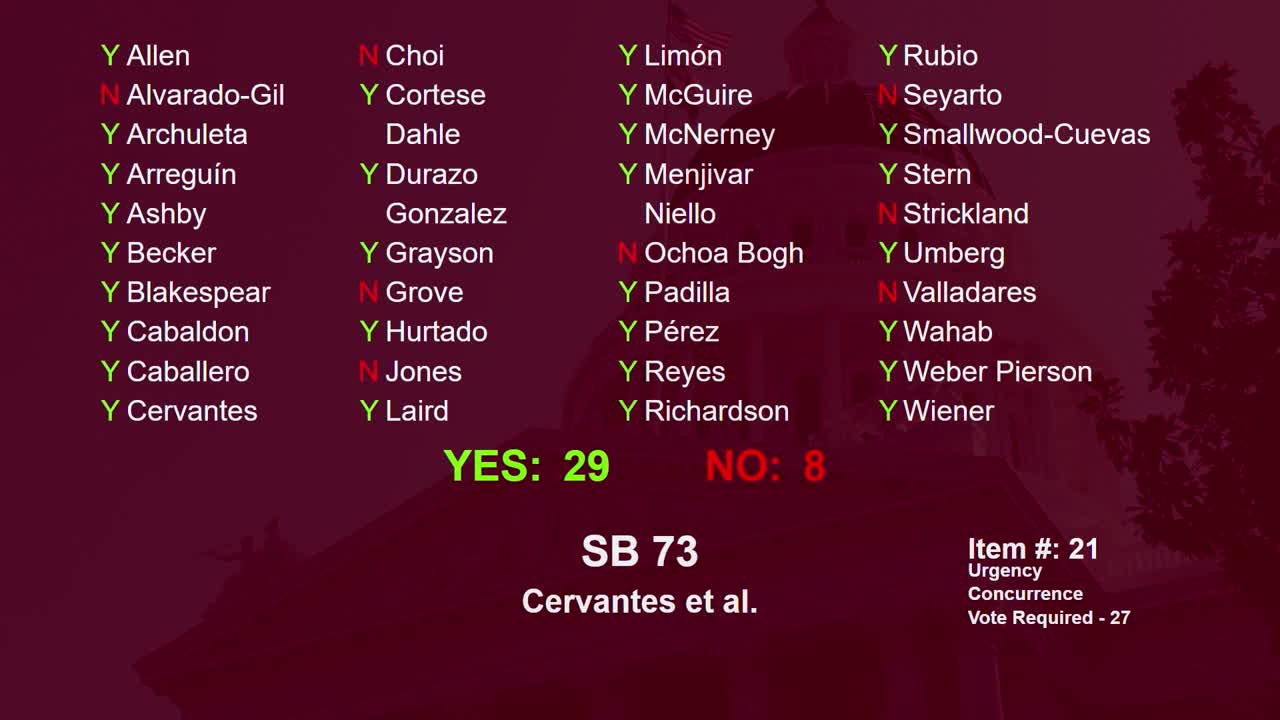 2MIN
Senate Floor
 3MIN
Senate Standing Committee on Energy, Utilities and Communications
Bill Author

Bill Co-Author(s):