SB 94: Transportation funding: Greenhouse Gas Reduction Fund: Motor Vehicle Fuel Account.
- Session Year: 2025-2026
- House: Senate
- Latest Version Date: 2025-03-26
Current Status:
Failed
(2026-02-02: Returned to Secretary of Senate pursuant to Joint Rule 56.)
Introduced
In Committee
Awaiting First Chamber Vote
Passed First Chamber
In Committee
Awaiting Second Chamber Vote
Passed Second Chamber
Enacted
The California Global Warming Solutions Act of 2006 designates the State Air Resources Board as the state agency charged with monitoring and regulating sources of emissions of greenhouse gases. The act authorizes the state board to include in its regulation of those emissions the use of market-based compliance mechanisms. Existing law requires all moneys, except for fines and penalties, collected by the state board from the auction or sale of allowances as part of a market-based compliance mechanism to be deposited in the Greenhouse Gas Reduction Fund. Existing law continuously appropriates 25% of the annual proceeds of the fund to the High-Speed Rail Authority for certain purposes, as specified.
This bill would eliminate the continuous appropriation of 25% of the annual proceeds of the Greenhouse Gas Reduction Fund to the High-Speed Rail Authority on June 30, 2026. The bill, beginning with the 202627 fiscal year, and until December 31, 2030, would require 25% of the annual proceeds of the Greenhouse Gas Reduction Fund to be transferred to the Motor Vehicle Fuel Account.
Existing law, the Motor Vehicle Fuel Tax Law, imposes a tax upon each gallon of motor vehicle fuel removed from a refinery or terminal rack in this state, entered into this state, or sold in this state, at a specified rate per gallon. Existing law provides that amounts received pursuant to the Motor Vehicle Fuel Tax Law are deposited into the Motor Vehicle Fuel Account in the Transportation Tax Fund. Existing law transfers the portions of those motor vehicle fuel tax revenues attributable to various off-highway uses of motor vehicle fuel to specified funds and transfers the remaining revenues to the Highway Users Tax Account for allocation to various state and local transportation purposes consistent with the expenditure restrictions imposed by Article XIX of the California Constitution on excise tax revenues from fuels used in motor vehicles on the highway.
This bill, beginning July 1, 2026, and before January 1, 2031, would reduce the rate of the tax imposed upon each gallon of fuel by a specified percentage based annually on the amount transferred to the Motor Vehicle Fuel Account from the Greenhouse Gas Reduction Fund. By transferring moneys to a continuously appropriated account, this bill would make an appropriation.
Existing law requires the Department of Motor Vehicles to procure and distribute bicycle license indicia and registration forms to all counties and cities that have adopted a bicycle licensing ordinance or resolution. Existing law prohibits a city or county that adopts a bicycle licensing ordinance or resolution from prohibiting the operation of an unlicensed bicycle. Existing law defines bicycle for these purposes.This bill would make a technical, nonsubstantive change to this provision.Existing law requires the Department of Motor Vehicles to procure and distribute bicycle license indicia and registration forms to all counties and cities that have adopted a bicycle licensing ordinance or resolution. Existing law prohibits a city or county that adopts a bicycle licensing ordinance or resolution from prohibiting the operation of an unlicensed bicycle. Existing law defines bicycle for these purposes.
This bill would make a technical, nonsubstantive change to this provision.
(a)The Legislature shall appropriate the annual proceeds of the fund for the purpose of reducing greenhouse gas emissions in this state in accordance with the requirements of Section 39712.
(b)To carry out a portion of the requirements of subdivision (a), the annual proceeds of the fund are continuously appropriated for the following:
(1)Beginning in the 201516 fiscal year, and notwithstanding Section 13340 of the Government Code, 35 percent of the annual proceeds of the fund are continuously appropriated, without regard to fiscal years, for transit, affordable housing, and sustainable communities programs as follows:
(A)Ten percent of the annual proceeds of the fund is hereby continuously appropriated to the Transportation Agency for the Transit and Intercity Rail Capital Program created by Part 2 (commencing with Section 75220) of Division 44 of the Public Resources Code.
(B)Five percent of the annual proceeds of the fund is hereby continuously appropriated to the Low Carbon Transit Operations Program created by Part 3 (commencing with Section 75230) of Division 44 of the Public Resources Code. Moneys shall be allocated by the Controller, according to requirements of the program, and pursuant to the distribution formula in subdivision (b) or (c) of Section 99312 of, and Sections 99313 and 99314 of, the Public Utilities Code.
(C)Twenty percent of the annual proceeds of the fund is hereby continuously appropriated to the Strategic Growth Council for the Affordable Housing and Sustainable Communities Program created by Part 1 (commencing with Section 75200) of Division 44 of the Public Resources Code. Of the amount appropriated in this subparagraph, no less than 10 percent of the annual proceeds of the fund shall be expended for affordable housing, consistent with the provisions of that program.
(2)Beginning in the 201516 fiscal year, and until June 30, 2026, notwithstanding Section 13340 of the Government Code, and subject to the requirements of Section 39719.3, 25 percent of the annual proceeds of the fund is hereby continuously appropriated to the High-Speed Rail Authority for the following components of the initial operating segment and Phase I Blended System as described in the 2012 business plan adopted pursuant to Section 185033 of the Public Utilities Code:
(A)Acquisition and construction costs of the project.
(B)Environmental review and design costs of the project.
(C)Other capital costs of the project.
(D)Repayment of any loans made to the authority to fund the project.
(3)(A)Beginning in the 202021 fiscal year, and until June 30, 2030, 5 percent of the annual proceeds of the fund, up to the sum of one hundred thirty million dollars ($130,000,000), is hereby annually transferred to the Safe and Affordable Drinking Water Fund established pursuant to Section 116766 for the purposes of Chapter 4.6 (commencing with Section 116765) of Part 12 of Division 104.
(B)Moneys transferred under this paragraph shall be used for the purpose of facilitating the achievement of reductions of greenhouse gas emissions in this state in accordance with the requirements of Section 39712 or to improve climate change adaptation and resiliency of disadvantaged communities or low-income households or communities, consistent with Division 25.5 (commencing with Section 38500). For purposes of the moneys transferred under this paragraph, a state agency may also comply with the requirements of paragraphs (2) and (3) of subdivision (a) of Section 16428.9 of the Government Code by describing how each proposed expenditure will improve climate change adaptation and resiliency of disadvantaged communities or low-income households or communities.
(4)Notwithstanding Section 13340 of the Government Code, for each fiscal year, beginning in the 202223 fiscal year through the 2028-29 202829 fiscal year, the sum of two hundred million dollars ($200,000,000) is hereby continuously appropriated, appropriated to the Department of Forestry and Fire Protection and allocated as follows:
(A)One hundred sixty-five million dollars ($165,000,000) for healthy forest and fire prevention programs and projects that improve forest health and reduce emissions of greenhouse gases caused by uncontrolled wildfires.
(B)Thirty-five million dollars ($35,000,000) for the completion of prescribed fire and other fuel reduction projects through proven forestry practices consistent with the recommendations of the California Forest Carbon Plan, including the operation of year-round prescribed fire crews and implementation of a research and monitoring program for climate adaptation.
(c)In determining the amount of the annual proceeds of the fund for purposes of the calculation in paragraphs (1) to (3), inclusive, of subdivision (b), the funds subject to Section 39719.1 and the sum set forth in paragraph (4) of subdivision (b) shall not be included.
(d)Notwithstanding subdivision (a), beginning in the 202627 fiscal year, and until December 31, 2030, 25 percent of the annual proceeds of the fund is hereby annually transferred to the Motor Vehicle Fuel Account. The amount transferred is continuously appropriated in accordance with Section 8352 of the Revenue and Taxation Code.
SEC. 2.Section 7360 of the Revenue and Taxation Code is amended to read:7360.(a)(1)A Except as provided in Section 7374, a tax of eighteen cents ($0.18) is hereby imposed upon each gallon of fuel subject to the tax in Sections 7362, 7363, and 7364.
(2)If the federal fuel tax is reduced below the rate of nine cents ($0.09) per gallon and federal financial allocations to this state for highway and exclusive public mass transit guideway purposes are reduced or eliminated correspondingly, the tax rate imposed by paragraph (1), on and after the date of the reduction, shall be recalculated by an amount so that the combined state rate under paragraph (1) and the federal tax rate per gallon equal twenty-seven cents ($0.27).
(3)If any person or entity is exempt or partially exempt from the federal fuel tax at the time of a reduction, the person or entity shall continue to be so exempt under this section.
(b)(1)On Except as provided in Section 7374, on and after July 1, 2010, in addition to the tax imposed by subdivision (a), a tax is hereby imposed upon each gallon of motor vehicle fuel, other than aviation gasoline, subject to the tax in Sections 7362, 7363, and 7364 in an amount equal to seventeen and three-tenths cents ($0.173) per gallon.
(2)For the 201112 fiscal year and each fiscal year thereafter, the board shall, on or before March 1 of the fiscal year immediately preceding the applicable fiscal year, adjust the rate in paragraph (1) in that manner as to generate an amount of revenue that will equal the amount of revenue loss attributable to the exemption provided by Section 6357.7, based on estimates made by the board, and that rate shall be effective during the states next fiscal year.
(3)In order to maintain revenue neutrality for each year, beginning with the rate adjustment on or before March 1, 2012, the adjustment under paragraph (2) shall also take into account the extent to which the actual amount of revenues derived pursuant to this subdivision and, as applicable, Section 7361.1, the revenue loss attributable to the exemption provided by Section 6357.7 resulted in a net revenue gain or loss for the fiscal year ending prior to the rate adjustment date on or before March 1.
(4)The intent of paragraphs (2) and (3) is to ensure that the act adding this subdivision and Section 6357.7 does not produce a net revenue gain in state taxes.
(5)Commencing July 1, 2019, the adjustments in paragraphs (2) and (3) shall cease, and the rate imposed by this subdivision shall be the rate in paragraph (1).
(c)On Except as provided in Section 7374, on and after November 1, 2017, in addition to the taxes imposed by subdivisions (a) and (b), a tax is hereby imposed upon each gallon of motor vehicle fuel, other than aviation gasoline, subject to the tax in Sections 7362, 7363, and 7364, in an amount equal to twelve cents ($0.12) per gallon.
(d)On July 1, 2020, and every July 1 thereafter, the board shall adjust the taxes imposed by subdivisions (a), (b), and (c), with the adjustment to apply to both to the base tax rates specified in those provisions and to any previous adjustment in rates made pursuant to this subdivision, by increasing the taxes by a percentage amount equal to the increase in the California Consumer Price Index, as calculated by the Department of Finance with the resulting taxes rounded to the nearest one-tenth of one cent ($0.01). The first adjustment pursuant to this subdivision shall be a percentage amount equal to the increase in the California Consumer Price Index from November 1, 2017, to November 1, 2019. Subsequent annual adjustments shall cover subsequent 12 month periods. The incremental change shall be added to the associated rate for that year.
(e)Any increases to the taxes imposed under subdivisions (a), (b), and (c) that are enacted by legislation subsequent to July 1, 2017, shall be deemed to be changes to the base tax rates for purposes of the California Consumer Price Index calculation and adjustment performed pursuant to subdivision (d).
SEC. 3.Section 7362 of the Revenue and Taxation Code is amended to read:7362.The Except as provided in Section 7374, the tax specified in Section 7360 is imposed on the removal of motor vehicle fuel in this state from a terminal if the motor vehicle fuel is removed at the rack.
SEC. 4.Section 7363 of the Revenue and Taxation Code is amended to read:7363.The Except as provided in Section 7374, the tax specified in Section 7360 is also imposed on all of the following:
(a)The removal of motor vehicle fuel in this state from any refinery if either of the following applies:
(1)The removal is by bulk transfer and the refiner or the owner of the motor vehicle fuel immediately before the removal is not a licensed supplier.
(2)The removal is at the refinery rack.
(b)The entry of motor vehicle fuel into this state for sale, consumption, use, or warehousing if either of the following applies:
(1)The entry is by bulk transfer and the enterer is not a licensed supplier.
(2)The entry is not by bulk transfer.
(c)The removal or sale of motor vehicle fuel in this state to an unlicensed person unless there was a prior taxable removal, entry, or sale of the motor vehicle fuel.
(d)The removal or sale of blended motor vehicle fuel in this state by the blender thereof. The number of gallons of blended motor vehicle fuel subject to tax is the difference between the total number of gallons of blended motor vehicle fuel removed or sold and the number of gallons of previously taxed motor vehicle fuel used to produce the blended motor vehicle fuel.
SEC. 5.Section 7364 of the Revenue and Taxation Code is amended to read:7364.The Except as provided in Section 7374, the tax specified in Section 7360 is imposed as a backup tax as follows:
(a)On the delivery into the fuel tank of a motor vehicle fuel-powered highway vehicle of:
(1)Any motor vehicle fuel on which a claim for refund has been allowed; or
(2)Any liquid on which tax has not been imposed by this part, Part 3 (commencing with Section 8601), or Part 31 (commencing with Section 60001).
(b)On the sale of any motor vehicle fuel on which a claim for refund has been allowed.
(c)On the sale and delivery into the fuel tank of a motor vehicle fuel-powered highway vehicle of any liquid on which tax has not been imposed by this part, Part 3 (commencing with Section 8601), or Part 31 (commencing with Section 60001).
SEC. 6.Section 7374 is added to the Revenue and Taxation Code, to read:7374.(a)Beginning July 1, 2026, and before January 1, 2031, the rate of any tax imposed upon each gallon of fuel subject to tax pursuant to this chapter shall be reduced by the percentage annually estimated under paragraph (3) of subdivision (b).
(b)(1)No later than June 30, 2026, and each June 30 thereafter, the California Department of Tax and Fee Administration shall determine the amount collected pursuant to Sections 7360, 7362, 7363, and 7364 in the 202425 fiscal year, and adjust that amount for inflation to estimate the amount to be received in the next fiscal year.
(2)No later than June 30, 2026, and each June 30 thereafter, the California Department of Tax and Fee Administration, in coordination with the State Air Resources Board, shall estimate the amount that is to be transferred to the Motor Vehicle Fuel Account pursuant to subdivision (d) of Section 39719 of the Health and Safety Code for the next fiscal year.
(3)The California Department of Tax and Fee Administration shall estimate the percentage reduction in the rate of the tax imposed by this chapter for the next fiscal year, beginning July 1, that would reduce the amount estimated in paragraph (1) by the amount estimated in paragraph (2).
(c)This section shall remain operative only until April 1, 2031, and as of that date is repealed.
SECTION 1.Section 39000 of the Vehicle Code is amended to read:39000.Bicycle, for the purposes of this division, means any device upon which a person may ride, which is propelled by human power through a system of belts, chains, or gears having either two or three wheels (one of which is at least 20 inches in diameter) or having a frame size of at least 14 inches, or having four or more wheels.Bicycle, Bicycle, for the purposes of this division, means any device upon which a person may ride, which is propelled by human power through a system of belts, chains, or gears having either two or three wheels (one of which is at least 20 inches in diameter) or having a frame size of at least 14 inches, or having four or more wheels.
|
Date
|
Status
|
|---|---|
| Feb 2, 2026 | Returned to Secretary of Senate pursuant to Joint Rule 56. |
| Apr 23, 2025 | April 23 set for first hearing. Failed passage in committee. (Ayes 1. Noes 4. Page 872.) Reconsideration granted. |
| Apr 17, 2025 | Set for hearing April 30 in E.Q. pending receipt. |
| Apr 8, 2025 | Set for hearing April 23. |
| Apr 3, 2025 | Re-referred to Coms. on REV. & TAX. and E.Q. |
| Apr 3, 2025 | Withdrawn from committee. |
| Apr 2, 2025 | Re-referred to Coms. on E.Q. and REV. & TAX. |
| Mar 26, 2025 | From committee with author's amendments. Read second time and amended. Re-referred to Com. on RLS. |
| Feb 5, 2025 | Referred to Com. on RLS. |
| Jan 24, 2025 | From printer. May be acted upon on or after February 23. |
| Jan 23, 2025 | Introduced. Read first time. To Com. on RLS. for assignment. To print. |
|
Date
|
Description
|
Location
|
Votes
|
|
|---|---|---|---|---|
| Apr 23, 2025 | [First] hearing set for [04-23-2025]: Failed passage in Committee. Reconsideration granted | Senate Standing Committee on Revenue and Taxation |
Passed |
|
| Apr 23, 2025 | Do pass, but first be re-referred to the Committee on [Environmental Quality] | Senate Standing Committee on Revenue and Taxation |
Failed |
This list shows positions taken on this bill by organizations on the date displayed, which is linked to the original source.
Positions by individuals are not included.
|
Organization
|
Position
|
Date
|
|---|---|---|
| Climate Action California | ** Against |
SENATE COMMITTEE ON REVENUE AND TAXATION
Senator Jerry McNerney, Chair
2025 - 2026 Regular
Bill No: | SB 94 | Hearing Date: | 4/23/25 |
Author: | Strickland | Tax Levy: | No |
Version: | 3/26/25 | Fiscal: | Yes |
Consultant: | Summers | ||
Transportation funding: Greenhouse Gas Reduction Fund: Motor Vehicle Fuel Account
Eliminates the 25% continuous appropriation from the Greenhouse Gas Reduction Fund to the High‑Speed Rail Authority, redirects those proceeds to the Motor Vehicle Fuel Account, and directs the California Department of Tax and Fee Administration to reduce the per-gallon Motor Vehicle Fuel Tax excise tax rate to account for the redirected appropriation.
Background
Prior to 2017, the Board of Equalization (BOE) administered both motor vehicle and diesel fuel taxes. In that year, the Legislature enacted the Taxpayer Transparency and Fairness Act, which created the California Department of Tax and Fee Administration (CDTFA) and shifted all of the BOE’s statutory tax administration functions to the newly formed Department (AB 102, Committee on Budget). As a result, CDTFA now operates almost all tax and fee programs previously administered by BOE, including motor vehicle and diesel fuel taxes. While taxpayers register, file returns, and pay taxes to CDTFA, the Controller processes gasoline tax payments and refunds, and the Office of Tax Appeals considers appeals.
Section Two of Article XIX of the California Constitution provides that revenues from taxes on motor vehicle fuels, less refunds and costs of administration, be deposited into the Highway Users Tax Account (HUTA). Portions of these revenues flow to cities and counties through the HUTA and the Road Maintenance and Rehabilitation Account. Revenue from the diesel fuel tax is transferred into the State Transportation Fund to construct and maintain public roads and mass transit systems, while Motor Vehicle Fuel Tax (MVFT) revenues flow to the State Transportation Fund to construct and maintain public roads and mass transit systems, airports, and waterways. Revenue from the MVFT is also allocated to the Aeronautics Account, Harbors and Watercraft Revolving Fund, Off-Highway Vehicle Trust Fund, and Department of Food and Agriculture Fund.
Excise taxes on fuel. The excise tax on motor vehicle fuel (gasoline) was first enacted in 1923, and was quickly followed by an excise tax on use fuel (diesel and other non-gasoline vehicle fuels) in 1927. The excise tax rates on gasoline increased several times to $0.07 per gallon by 1963. In 1969, the MVFT was amended by adding the Aircraft Jet Fuel Tax, establishing a $0.02 per gallon rate for aircraft jet fuel.
In 1990, Proposition 111 increased the excise tax rates on gasoline and use fuel from $0.09 to $0.14 per gallon, with annual increases of $0.01 over four years, until the rate reached $0.18 per gallon in 1993 (SCA 1, Garamendi, 1990). Starting in 1994, the rates were indexed to inflation to maintain their value. In 1995, the Diesel Fuel Tax became operative, which removed the excise tax on diesel under the Use Fuel Tax and instead subjected it to an excise tax under the Diesel Fuel Tax (SB 840, Presley, 1994). The excise tax rates on gasoline and diesel were subsequently altered in 2010 by the “fuel tax swap”, Propositions 22 and 26, and in 2017 by SB 1 (Beall).
The “Fuel Tax Swap” (ABx8-6). In 2010, the Legislature enacted a “Fuel Tax Swap” (ABx8-6, Committee on Budget, 2010). One of the primary motivating factors behind the Fuel Tax Swap is that the Constitution permitted gasoline excise taxes to pay debt service on highway bonds, but prohibited using sales taxes for this purpose. ABx8-6 exempted 6% of the sales taxes on gasoline and swapped it with a variable “price-based” per-gallon excise tax on motor vehicle gasoline, which reduced the sales tax to 2.25% and increased the gasoline excise tax rate by $0.173. The Swap also increased the diesel sales tax by 1.75%, to a total of 9.25%, and reduced the excise tax on diesel fuels from $0.18 to $0.136 to avoid any overall increase in tax collections, and to adjust the excise tax rate each year to maintain revenue neutrality. The excise and sales tax on aircraft jet fuel was unaffected by this legislation.
Propositions 22 and 26 (2010). In opposition to the Fuel Tax Swap, voters passed Propositions 22 and 26. Proposition 26 tightened the definition of taxes and required a two-thirds legislative vote to impose new taxes. Proposition 22 amended the Constitution to prohibit the state from borrowing or redirecting fuel excise taxes, local government property taxes, and public transit funds. The Legislature re-adopted the Fuel Tax Swap in 2011 with the required two-thirds vote and revised it to include new funding sources (AB 105, Committee on Budget, 2011).
Road Repair and Accountability Act of 2017 (SB 1). In response to significant underinvestment and deferred maintenance on California’s streets and roads, the Legislature enacted SB 1 (Beall, 2017). Specifically, SB 1:
- Increased the MVFT by $0.12 per gallon beginning November 1, 2017;
- Eliminated the annual adjustment to the MVFT required by the "Fuel Tax Swap";
- Reestablished the $0.173 per gallon rate set in ABx8-6 beginning July 1, 2019;
- Increased the diesel excise tax by $.20 beginning November 1, 2017;
- Increased the sales on diesel by 4%; and
- Requires BOE (now CDTFA) to adjust gasoline and diesel excise tax rates annually based on the California Consumer Price Index (CCPI), beginning July 1, 2020.
Global Warming Solutions Act of 2006 (AB 32). The California Air Resources Board (CARB) currently administers the Global Warming Solutions Act of 2006, which requires California to reduce its greenhouse gas (GHG) emissions to at least 40 % of 1990 levels by 2020 (AB 32, Nunez, 2006; extended to 2030 by AB 398, Garcia, 2018). AB 1279 (Muratsuchi, 2022) subsequently set a carbon neutrality target by 2045, and requires direct GHG emissions to be reduced to 85% below 1990 levels by 2045. Under AB 32, CARB is authorized to use “market-based compliance mechanisms” to reduce GHG emissions to target levels. The main market-based approach CARB administers is the Cap-and-Trade Program, launched in 2012, which sets a statewide limit on most sources of GHGs and allocates or sells GHG credit allowances to GHG emitters. According to a 2025 report from the Legislative Analyst’s Office, the Program generates $4.2 billion in revenue annually, which is deposited into the Greenhouse Gas Reduction Fund (GGRF). 25% of annual revenue in the GGRF is appropriated to the high‑speed rail project administered by the California High‑Speed Rail Authority (HSRA).
California high-speed rail project. The HSRA is responsible for planning, designing, building, and operating the nation’s first high-speed rail system, envisioned to connect San Francisco and Los Angeles in under three hours with a completion date of 2020. The project has experienced significant delays and cost overruns, with current cost estimates of $128 billion and completion not expected until 2040. The project receives funding from: Proposition 1A (2008) bonds; 25% of California's cap-and-trade auction revenue; and federal grants. The Governor’s Proposed 2024‑25 Cap‑and‑Trade Spending Plan proposes a $912 million continuous appropriation from GGRF to the high-speed-rail project.
Future of the Cap-and-Trade Program. Although the current cap-and-trade program does not expire until 2030, Governor Newsom proposed in the 2025-2026 budget to extend the program sooner rather than later to provide greater certainty and attract stable investment. The proposal to renew the program sooner rather than later has become a renewed point of importance since President Trump signed the "Protecting American Energy from State Overreach" executive order, which targeted California's cap-and-trade program, among other policies.
Seeking to reduce the MVFT rate while maintaining the same level of funding for the Motor Vehicle Fuel Account, the author proposes to eliminate the 25% GGRF continuous appropriation to the High‑Speed Rail Authority and redirect those proceeds to the Motor Vehicle Fuel Account to subsidize a reduced per-gallon MVFT rate correlating to the redirected appropriation.
Proposed Law
Senate Bill 94 eliminates, on June 30, 2026, the 25% continuous appropriation of the annual proceeds from the GGRF to the High‑Speed Rail Authority and redirects those proceeds, beginning in the 2026–27 fiscal year, to the Motor Vehicle Fuel Account through December 31, 2030. SB 94 requires the CDTFA to reduce the MVFT rate annually by a percentage correlating to redirected GGRF proceeds. SB 94 shall remain operative only until April 1, 2031, and as of that date is repealed.
State Revenue Impact
CDTFA estimates that sales and use tax revenue loss from this bill is $37.02 million in FY 2026-27. This estimate is based on the statewide local sales and use tax of 2.25% and the average local special district taxes of 1.461%. CDTFA would incur absorbable administrative costs of $50,000.
Comments
1. Purpose of the bill. According to the author, “The high speed rail project started with the passage of Proposition 1A in 2008. And it was sold to the votes as 800 miles connecting San Francisco to Los Angeles. And it would only cost $9.95 billion. Currently, there is no completion date in sight. It is projected costs have skyrocketed to an estimated total of $128 billion, this year, alone, the project needs $7 billion. In essence, the high-speed rail project is a financial train wreck. It has eroded public confidence in what our state can achieve. I believe there are endless opportunities of how better to use over $100 billion dollars here in California.”
2. Cost adjustments. State law requires inflation adjustment of many different tax rates to ensure that the revenues that fund public services are maintained at levels necessary for public agencies to pay for the goods and services they require, including the MVFT rate. However, recent gasoline and diesel fuel price increases have caused significant strain for many Californians. SB 94 reduces the MVFT rate, but in doing so, it eliminates a substantial appropriation of money for the HSRA, which, while not currently operational, could be a valuable part of the state’s future transportation infrastructure. Additionally, the measure’s relief is temporary, which means that consumers will only experience a reduction in gas prices until December 31, 2030, which is only half of FY 2030-31. The Committee may wish to consider the tradeoff between the tax reductions granted by SB 94 and the transportation funding reductions to the HSRA.
3. Revenue implications. If the MVFT is reduced, the amount of sales tax collected on each gallon of fuel also declines. Since gasoline is exempt from the state portion of the sales and use tax, these loss in revenue is concentrated to local sales tax revenue as follows:
Effected Fund | FY 2026-27 |
State Sales Tax – Local Revenue Fund 1991 (0.50%) | $4,986,939 |
State Sales Tax – Local Public Safety Fund (0.50%) | $4,986,939 |
State Sales Tax – Bradley Burns Local (1.25%) | $12,467,348 |
Local Special District Tax (1.461) | $14,575,826 |
Total Estimated Tax Revenue Loss | $37,017,053 |
4. Who benefits? The MVFT is imposed on certain suppliers and wholesalers who remove gasoline at the refinery or terminal rack, import it into the state, sell it to an unlicensed person, or remove or sell it by a gasoline fuel blender. Therefore, this rate reduction benefits suppliers and wholesalers of gasoline and their customers, but they are not required to pass on tax savings in reduced prices for motorists.
5. Who loses? If the HSRA lost the 25% appropriation from the GGRF, it would struggle to finish even the Central Valley segment of the high-speed rail system, threatening the viability of the entire system. Unless HSRA can generate alternative funding, Californians would lose thousands of clean-energy construction jobs and a major long-term solution to traffic congestion and air pollution. Redirecting the 25% appropriation from the GGRF to reduce the MVFT undermines the fund’s goal of cutting emissions by making fossil fuel use more affordable. The bill encourages more fuel consumption and diverts funding away from high-speed rail, a transportation alternative that can significantly reduce GHGs by replacing car and plane trips. According to Climate Action Now, SB 94 would “represent a drastic and damaging reversal of California’s transportation and climate priorities.”
6. Estimation issues: SB 94 directs CDTFA to estimate the annual MVFT rate reduction authorized under this bill. However, the revenue from the MVFT and the cap-and-trade program varies yearly. As a result, it may be difficult for CDTFA to collect enough information to calculate an accurate rate. Additionally, because the rate reduction is based on estimates that may differ from actual revenue, it may lead to a rate reduction that results in too little or too much tax revenue collected.
7. Excise tax rates and revenue. In fiscal year 2023-24, the excise tax rate per gallon on gasoline was $0.579 (raising $7,816,550,000), $0.185 on aircraft jet fuel (raising $4,699,000), and $0.44 on diesel (raising $1,492,912,000). Effective July 1, 2025, the excise tax rate per gallon under the MVFT is $0.596 and under the Diesel Fuel Tax is $0.454. The federal fuel excise taxes are currently $0.184 per gallon on gasoline and $0.244 per gallon on diesel fuel. The current prepayment sales tax rate per gallon is $0.08 for gasoline, $0.15 for aircraft jet fuel, and $0.445 for diesel.
8. Related legislation. AB 1058 (Gonzalez, 2025) would suspend imposition of the MVFT for one year, require that all savings be passed on to the end consumer, and make the violation of this requirement an unfair business practice. AB 1268 (Macedo, 2025) would authorize the Governor, upon determining that increasing the rate would impose an undue burden on low-income and middle-class families, to suspend the inflation adjustment to the MVFT tax rate scheduled on or after July 1, 2026.
9. Double-referred. The Senate Rules Committee ordered a double referral of SB 94: first to the Revenue and Taxation Committee and second to the Committee on Environmental Quality.
Support and Opposition
(4/20/25)
Support: None received.
Opposition: Climate Action California.
-- END --
Discussed in Hearing
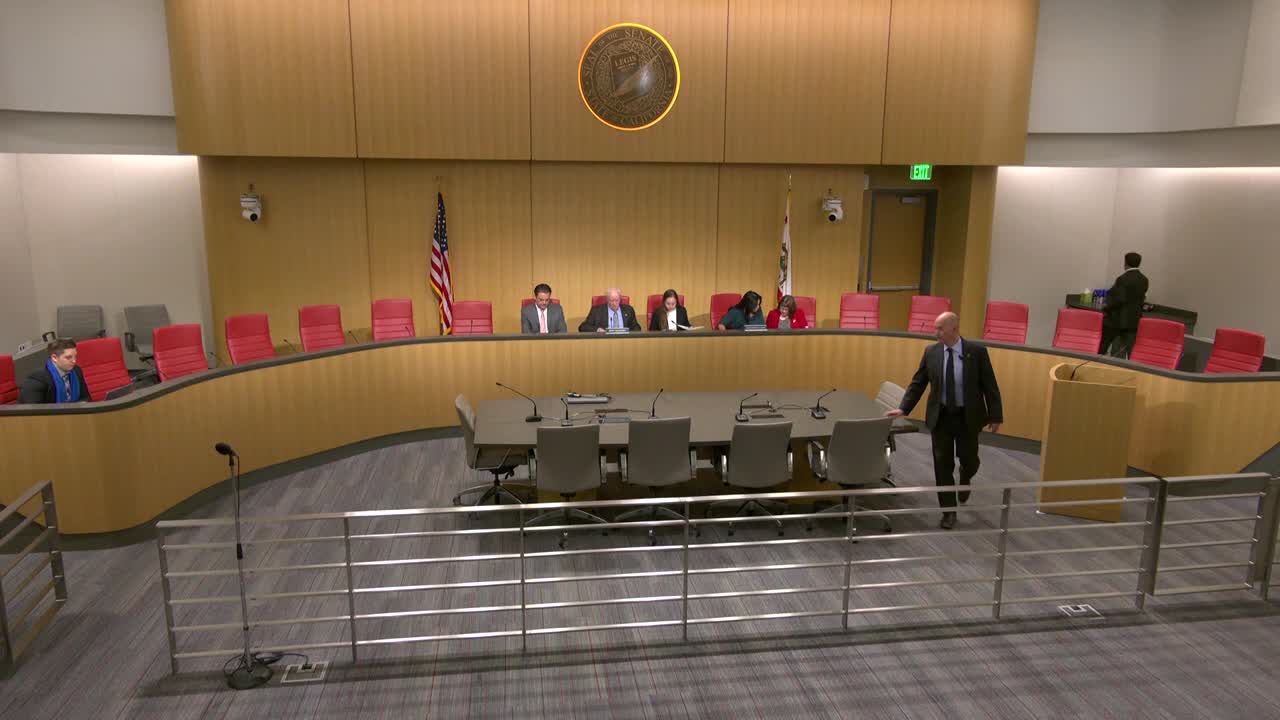 14MIN
Senate Standing Committee on Revenue and Taxation


Bill Co-Author(s):