SB 954: California Environmental Quality Act: advanced manufacturing facilities: exemption.
- Session Year: 2025-2026
- House: Senate
- Latest Version Date: 2026-08-31
Current Status:
In Progress
(2026-09-18: In Senate. Consideration of Governor's veto pending.)
Introduced
In Committee
Awaiting First Chamber Vote
Passed First Chamber
In Committee
Awaiting Second Chamber Vote
Passed Second Chamber
Enacted
The California Environmental Quality Act (CEQA) requires a lead agency, as defined, to prepare, or cause to be prepared, and certify the completion of, an environmental impact report on a project that it proposes to carry out or approve that may have a significant effect on the environment or to adopt a negative declaration if it finds that the project will not have that effect. CEQA also requires a lead agency to prepare a mitigated negative declaration for a project that may have a significant effect on the environment if revisions in the project would avoid or mitigate that effect and there is no substantial evidence that the project, as revised, would have a significant effect on the environment.
CEQA defines various terms, including natural and protected lands for its purposes.
This bill would revise the definition of that term to include habitats for protected species identified as candidate, sensitive, or species of special status by state or federal agencies.
CEQA exempts from its requirement projects that consist exclusively of a day care center that is not located in a residential area and projects that consist exclusively of an advanced manufacturing facility located on a site zoned exclusively for industrial uses.
This bill would additionally exempt projects consisting exclusively of a family day care home, as defined. The bill would, for the exemption for the day care center and family day care home, instead require the projects for those facilities not be located in an area zoned for industrial use or within 3,200 feet of a facility that actively extracts or refines oil or natural gas in order for the exemption to apply. The bill would revise the exemption for advanced manufacturing facility projects to require those projects to be used exclusively for final tier manufacturing, as defined. The bill would require an applicant of an advanced manufacturing project that is exempted from CEQA under the bills requirement to enter into a bona fide community benefits agreement, as provided, and to comply with certain labor requirements, as provided. The bill would require the lead agency, before determining that an advanced manufacturing project is exempt from CEQA, to hold at least one public hearing on the project and to ensure that the applicant complies with the requirement to enter into a bona fide community benefits agreement and the labor requirements.
CEQA exempts from its requirements a rezoning that implements the schedule of actions contained in an approved housing element. CEQA specifies that this exemption does not apply to a rezoning that would allow for the construction of certain facilities, including oil and gas infrastructure. CEQA also specifies that this exemption does not apply rezoning that would allow for construction to occur within the boundaries of any natural and protected lands, except as provided.
This bill would repeal the exception from the CEQA exemption for rezoning that would allow for oil and gas infrastructure. The bill would specify that the definition of natural and protected land does not include habitats for protected species that would be added to that definition by this bill for purposes the exception for rezoning that would allow for construction to occur within the boundaries of any natural and protected lands to the CEQA exemption.
CEQA specifies, for a proposed housing development project that would otherwise be exempt from its requirements but for a single condition required for the exemption to apply, that the application of CEQA is limited to the effects upon the environment that are caused by that single condition. CEQA provides that this limited application of CEQA does not apply if the proposed housing project is located on natural and protected land, but does not include natural and protected land that is a site within a very high fire hazard severity zone or within the state responsibility area, except as provided.
This bill would additionally specify that natural and protected land does not include habitats for protected species that would be added to that definition by this bill.
Because the bill would impose additional duties on a lead agency, this bill would impose a state-mandated local program.
The California Constitution requires the state to reimburse local agencies and school districts for certain costs mandated by the state. Statutory provisions establish procedures for making that reimbursement.
This bill would provide that no reimbursement is required by this act for a specified reason.
The California Environmental Quality Act (CEQA) requires a lead agency, as defined, to prepare, or cause to be prepared, and certify the completion of, an environmental impact report on a project that it proposes to carry out or approve that may have a significant effect on the environment or to adopt a negative declaration if it finds that the project will not have that effect. CEQA also requires a lead agency to prepare a mitigated negative declaration for a project that may have a significant effect on the environment if revisions in the project would avoid or mitigate that effect and there is no substantial evidence that the project, as revised, would have a significant effect on the environment.
CEQA defines various terms, including natural and protected lands for its purposes.
This bill would revise the definition of that term to include habitats for protected species identified as candidate, sensitive, or species of special status by state or federal agencies.
CEQA exempts from its requirement projects that consist exclusively of a day care center that is not located in a residential area and projects that consist exclusively of an advanced manufacturing facility located on a site zoned exclusively for industrial uses.
This bill would additionally exempt projects consisting exclusively of a family day care home, as defined. The bill would, for the exemption for the day care center and family day care home, instead require the projects for those facilities not be located in an area zoned for industrial use or within 3,200 feet of a facility that actively extracts or refines oil or natural gas in order for the exemption to apply. The bill would revise the exemption for advanced manufacturing facility projects to require those projects to be used exclusively for final tier manufacturing, as defined, and for the Governor to certify the project, as provided. defined. The bill would require an applicant of an advanced manufacturing project that is exempted from CEQA under the bills requirement to enter into a bona fide community benefits agreement, as provided, and to comply with certain labor requirements, as provided. The bill would require the lead agency, before determining that an advanced manufacturing project is exempt from CEQA, to hold at least one public hearing on the project and to ensure that the applicant complies with the requirement to enter into a bona fide community benefits agreement and the labor requirements.
CEQA exempts from its requirements a rezoning that implements the schedule of actions contained in an approved housing element. CEQA specifies that this exemption does not apply to a rezoning that would allow for the construction of certain facilities, including oil and gas infrastructure. CEQA also specifies that this exemption does not apply rezoning that would allow for construction to occur within the boundaries of any natural and protected lands, except as provided.
This bill would repeal the exception from the CEQA exemption for rezoning that would allow for oil and gas infrastructure. The bill would specify that the definition of natural and protected land does not include habitats for protected species that would be added to that definition by this bill for purposes the exception for rezoning that would allow for construction to occur within the boundaries of any natural and protected lands to the CEQA exemption.
CEQA specifies, for a proposed housing development project that would otherwise be exempt from its requirements but for a single condition required for the exemption to apply, that the application of CEQA is limited to the effects upon the environment that are caused by that single condition. CEQA provides that this limited application of CEQA does not apply if the proposed housing project is located on natural and protected land, but does not include natural and protected land that is a site within a very high fire hazard severity zone or within the state responsibility area, except as provided.
This bill would additionally specify that natural and protected land does not include habitats for protected species that would be added to that definition by this bill.
Because the bill would imposes additional duties on a lead agency, this bill would impose a state-mandated local program.
The California Constitution requires the state to reimburse local agencies and school districts for certain costs mandated by the state. Statutory provisions establish procedures for making that reimbursement.
This bill would provide that no reimbursement is required by this act for a specified reason.
The California Environmental Quality Act (CEQA) requires a lead agency, as defined, to prepare, or cause to be prepared, and certify the completion of, an environmental impact report on a project that it proposes to carry out or approve that may have a significant effect on the environment or to adopt a negative declaration if it finds that the project will not have that effect. CEQA also requires a lead agency to prepare a mitigated negative declaration for a project that may have a significant effect on the environment if revisions in the project would avoid or mitigate that effect and there is no substantial evidence that the project, as revised, would have a significant effect on the environment.
CEQA defines various terms, including natural and protected lands for its purposes.
This bill would revise the definition of that term to include habitats for protected species identified as candidate, sensitive, or species of special status by state or federal agencies.
CEQA exempts from its requirement projects that consist exclusively of a day care center that is not located in a residential area and projects that consist exclusively of an advanced manufacturing facility located on a site zoned exclusively for industrial uses.
This bill would additionally exempt projects consisting exclusively of a family day care home, as defined. The bill would, for the exemption for the day care center and family day care home, instead require the projects for those facilities not be located in an area zoned for industrial use or within 3,200 feet of a facility that actively extracts or refines oil or natural gas in order for the exemption to apply. The bill would revise the exemption for advanced manufacturing facility projects to require those projects to be used exclusively for final tier manufacturing, as defined, and for the Governor to certify the project, as provided. The bill would require an applicant of an advanced manufacturing project that is exempted from CEQA under the bills requirement to enter into a bona fide community benefits agreement, as provided, and to comply with certain labor requirements, as provided. The bill would require the lead agency, before determining that an advanced manufacturing project is exempt from CEQA, to hold at least one public hearing on the project and to ensure that the applicant complies with the requirement to enter into a bona fide community benefits agreement and the labor requirements.
CEQA generally does not apply to exempts from its requirements a rezoning that implements the schedule of actions contained in an approved housing element, unless the element. CEQA specifies that this exemption does not apply to a rezoning that would allow for the construction of certain facilities, including oil and gas infrastructure. infrastructure. CEQA also specifies that this exemption does not apply rezoning that would allow for construction to occur within the boundaries of any natural and protected lands, except as provided.
This bill would make CEQA applicable to a rezoning of this kind that authorizes a tourism facility use that was not permitted before the rezoning or authorizes an increase in the allowable floor area, height, density, intensity, or development capacity of a tourism facility use beyond that permitted under the sites zoning designation in effect before the rezoning or before January 1, 2027, whichever is later, except as provided, or that would allow for the construction of oil and gas infrastructure. repeal the exception from the CEQA exemption for rezoning that would allow for oil and gas infrastructure. The bill would specify that the definition of natural and protected land does not include habitats for protected species that would be added to that definition by this bill for purposes the exception for rezoning that would allow for construction to occur within the boundaries of any natural and protected lands to the CEQA exemption.
CEQA specifies, for a proposed housing development project that would otherwise be exempt from its requirements but for a single condition required for the exemption to apply, that the application of CEQA is limited to the effects upon the environment that are caused by that single condition. CEQA provides that this limited application of CEQA does not apply if the proposed housing project is located on natural and protected land, but does not include natural and protected land that is a site within a very high fire hazard severity zone or within the state responsibility area, except as provided.
This bill would additionally specify that natural and protected land does not include habitats for protected species that would be added to that definition by this bill.
Because the bill would imposes additional duties on a lead agency, this bill would impose a state-mandated local program.
The California Constitution requires the state to reimburse local agencies and school districts for certain costs mandated by the state. Statutory provisions establish procedures for making that reimbursement.
This bill would provide that no reimbursement is required by this act for a specified reason.
The California Environmental Quality Act (CEQA) requires a lead agency, as defined, to prepare, or cause to be prepared, and certify the completion of, an environmental impact report on a project that it proposes to carry out or approve that may have a significant effect on the environment or to adopt a negative declaration if it finds that the project will not have that effect. CEQA also requires a lead agency to prepare a mitigated negative declaration for a project that may have a significant effect on the environment if revisions in the project would avoid or mitigate that effect and there is no substantial evidence that the project, as revised, would have a significant effect on the environment.
CEQA defines various terms, including natural and protected lands for its purposes.
This bill would revise the definition of that term to include habitats for protected species identified as candidate, sensitive, or species of special status by state or federal agencies.
CEQA exempts from its requirement projects that consist exclusively of a day care center that is not located in a residential area and projects that consist exclusively of an advanced manufacturing facility located on a site zoned exclusively for industrial uses.
This bill would additionally exempt projects consisting exclusively of a family day care home, as defined. The bill would, for the exemption for the day care center and family day care home, instead, instead require the projects for those facilities not be located in an area zoned for industrial use or within 3,200 feet of a facility that actively extracts or refines oil or natural gas in order for the exemption to apply. The bill would revise the exemption for advanced manufacturing facility projects to require those projects to meet certain requirements be used exclusively for final tier manufacturing, as defined, and for the Governor to certify the project, as provided. The bill would require an applicant of an advanced manufacturing project that is exempted from CEQA under the bills requirement to enter into a bona fide community benefits agreement, as provided, and to comply with certain labor requirements, as provided. The bill would require to the lead agency, before determining that an advanced manufacturing project is exempt from CEQA, to hold at least one public hearing on the project and to ensure that the applicant complies with the requirement to enter into a bona fide community benefits agreement and the labor requirements.
CEQA also exempts from its requirements rezoning the generally does not apply to a rezoning that implements of the schedule of actions contained in an approved housing element. CEQA provides that this exemption does not apply to rezoning that element, unless the rezoning would allow for the construction of certain facilities, including oil and gas infrastructure.
This bill would provide that the above exemption also does not apply make CEQA applicable to a rezoning of this kind that authorizes a tourism facility use that was not permitted before the rezoning or authorizes an increase in the allowable floor area, height, density, intensity, or development capacity of a tourism facility use beyond that permitted under the sites zoning designation in effect before the rezoning or before January 1, 2027, whichever is later, except as provided, and would repeal the exception from the exemption for rezoning or that would allow for the construction of oil and gas infrastructures. infrastructure.
Because the bill would imposes additional duties on a lead agency, this bill would impose a state-mandated local program.
The California Constitution requires the state to reimburse local agencies and school districts for certain costs mandated by the state. Statutory provisions establish procedures for making that reimbursement.
This bill would provide that no reimbursement is required by this act for a specified reason.
The California Environmental Quality Act (CEQA) requires a lead agency, as defined, to prepare, or cause to be prepared, and certify the completion of, an environmental impact report on a project that it proposes to carry out or approve that may have a significant effect on the environment or to adopt a negative declaration if it finds that the project will not have that effect. CEQA also requires a lead agency to prepare a mitigated negative declaration for a project that may have a significant effect on the environment if revisions in the project would avoid or mitigate that effect and there is no substantial evidence that the project, as revised, would have a significant effect on the environment.
CEQA defines various terms, including natural and protected lands for its purposes.
This bill would revise the definition of that term to include habitats for protected species identified as candidate, sensitive, or species of special status by state or federal agencies.
CEQA exempts from its requirement projects that consist exclusively of a day care center that is not located in a residential area and projects that consist exclusively of an advanced manufacturing facility located on a site zoned exclusively for industrial uses.
This bill would additionally exempt projects consisting exclusively of a family day care home, as defined. The bill would, for the exemption for the day care center and family day care home, instead, require the projects for those facilities not be located in an area zoned for industrial use or within 3,200 feet of a facility that actively extracts or refines oil or natural gas in order for the exemption to apply. The bill would revise the exemption for advanced manufacturing facility projects to require those projects to meet certain requirements and for the Governor to certify the project, as provided. The bill would require an applicant of an advanced manufacturing project that is exempted from CEQA under the bills requirement to enter into a bona fide community benefits agreement, as provided, and to comply with certain labor requirements, as provided. The bill would require to lead agency, before determining that an advanced manufacturing project is exempt from CEQA, to hold at least one public hearing on the project and to ensure that the applicant complies with the requirement to enter into a bona fide community benefits agreement and the labor requirements.
CEQA also exempts from its requirements rezoning the implements of the schedule of actions contained in an approved housing element. CEQA provides that this exemption does not apply to rezoning that would allow for the construction of certain facilities, including oil and gas infrastructure.
This bill would provide that the above exemption also does not apply to rezoning that would allow for the construction of a authorizes a tourism facility, as defined, facility use that was not permitted before the rezoning or authorizes an increase in the allowable floor area, height, density, intensity, or development capacity of a tourism facility use beyond that permitted under the sites zoning designation in effect before the rezoning or before January 1, 2027, whichever is later, except as provided, and would repeal the exception from the exemption for rezoning that would allow for the construction of oil and gas infrastructures.
Because the bill would imposes additional duties on a lead agency, this bill would impose a state-mandated local program.
The California Constitution requires the state to reimburse local agencies and school districts for certain costs mandated by the state. Statutory provisions establish procedures for making that reimbursement.
This bill would provide that no reimbursement is required by this act for a specified reason.
The California Environmental Quality Act (CEQA) requires a lead agency, as defined, to prepare, or cause to be prepared, and certify the completion of, an environmental impact report on a project that it proposes to carry out or approve that may have a significant effect on the environment or to adopt a negative declaration if it finds that the project will not have that effect. CEQA also requires a lead agency to prepare a mitigated negative declaration for a project that may have a significant effect on the environment if revisions in the project would avoid or mitigate that effect and there is no substantial evidence that the project, as revised, would have a significant effect on the environment.
CEQA defines various terms, including natural and protected lands for its purposes.
This bill would revise the definition of that term to include habitats for protected species identified as candidate, sensitive, or species of special status by state or federal agencies.
CEQA exempts from its requirement projects that consist exclusively of a day care center that is not located in a residential area and projects that consist exclusively of an advanced manufacturing facility located on a site zoned exclusively for industrial uses.
This bill would additionally exempt projects consisting exclusively of a family day care home, as defined. The bill would, for the exemption for the day care center and family day care home, instead, require the projects for those facilities not be located in an area zoned for industrial use or within 3,200 feet of a facility that actively extracts or refines oil or natural gas in order for the exemption to apply. The bill would revise the exemption for advanced manufacturing facility projects to require those projects to meet certain requirements and for the Governor to certify the project, as provided. The bill would require an applicant of an advanced manufacturing project that is exempted from CEQA under the bills requirement to enter into a community benefits agreement, as provided, and to comply with certain labor requirements, as provided. The bill would require to lead agency, before determining that an advanced manufacturing project is exempt from CEQA, to hold at least one public hearing on the project and to ensure that the applicant complies with the requirement to enter into a community benefits agreement and the labor requirements.
CEQA also exempts from its requirements rezoning the implements of the schedule of actions contained in an approved housing element. CEQA provides that this exemption does not apply to rezoning that would allow for the construction of certain facilities, including oil and gas infrastructure.
This bill would provide that the above exemption also does not apply to rezoning that would allow for the construction of a tourism facility, as defined, and would repeal the exception from the exemption for rezoning that would allow for the construction of oil and gas infrastructures.
Because the bill would imposes additional duties on a lead agency, this bill would impose a state-mandated local program.
The California Constitution requires the state to reimburse local agencies and school districts for certain costs mandated by the state. Statutory provisions establish procedures for making that reimbursement.
This bill would provide that no reimbursement is required by this act for a specified reason.
The California Environmental Quality Act (CEQA) requires a lead agency, as defined, to prepare, or cause to be prepared, and certify the completion of an environmental impact report on a project that it proposes to carry out or approve that may have a significant effect on the environment or to adopt a negative declaration if it finds that the project will not have that effect. CEQA also requires a lead agency to prepare a mitigated negative declaration for a project that may have a significant effect on the environment if revisions in the project would avoid or mitigate that effect and there is no substantial evidence that the project, as revised, would have a significant effect on the environment. CEQA exempts specified projects, including, among other things, projects for advanced manufacturing and childcare facilities, as provided, from its provisions.This bill would provide that it is the intent of the Legislature to enact subsequent legislation that would amend provisions of CEQA relating to natural and protected lands, childcare facilities, and advanced manufacturing, among other changes, as provided.The California Environmental Quality Act (CEQA) requires a lead agency, as defined, to prepare, or cause to be prepared, and certify the completion of an environmental impact report on a project that it proposes to carry out or approve that may have a significant effect on the environment or to adopt a negative declaration if it finds that the project will not have that effect. CEQA also requires a lead agency to prepare a mitigated negative declaration for a project that may have a significant effect on the environment if revisions in the project would avoid or mitigate that effect and there is no substantial evidence that the project, as revised, would have a significant effect on the environment. CEQA exempts specified projects, including, among other things, projects for advanced manufacturing and childcare facilities, as provided, from its provisions.
This bill would provide that it is the intent of the Legislature to enact subsequent legislation that would amend provisions of CEQA relating to natural and protected lands, childcare facilities, and advanced manufacturing, among other changes, as provided.
Natural and protected lands means sites located within any of the following locations:
(a)The state park system, as described in Article 1 (commencing with Section 5001) of Chapter 1 of Division 5.
(b)A wilderness area, as defined in Section 5093.32.
(c)A marine protected area, as defined in Section 2852 of the Fish and Game Code.
(d)The national park system, as defined in Section 100102 of Title 54 of the United States Code.
(e)A national recreation area.
(f)A national monument.
(g)The national wild and scenic rivers system, as defined in Section 1273 of Title 16 of the United States Code.
(h)Any ecological reserve or wildlife management area acquired and managed by the Department of Fish and Wildlife pursuant to Article 2 (commencing with Section 1525) or Article 4 (commencing with Section 1580) of Chapter 5 of Division 2 of the Fish and Game Code.
(i)A hazardous waste site that is listed pursuant to Section 65962.5 of the Government Code or a hazardous waste site designated by the Department of Toxic Substances Control pursuant to Section 25356 of the Health and Safety Code, unless either of the following apply:
(1)The site is an underground storage tank site that received a uniform closure letter issued pursuant to subdivision (g) of Section 25296.10 of the Health and Safety Code based on closure criteria established by the State Water Resources Control Board for the use proposed by the project. This paragraph does not alter or change the conditions to remove a site from the list of hazardous waste sites listed pursuant to Section 65962.5 of the Government Code.
(2)The State Department of Public Health, State Water Resources Control Board, Department of Toxic Substances Control, or a local agency making a determination pursuant to subdivision (c) of Section 25296.10 of the Health and Safety Code has otherwise determined that the site is suitable for the use proposed by the project.
(j)Within a regulatory floodway as determined by the Federal Emergency Management Agency in any official maps published by the Federal Emergency Management Agency, unless the development has received a no-rise certification in accordance with Section 60.3(d)(3) of Title 44 of the Code of Federal Regulations.
(k)Lands under conservation easement.
(l)On, or within a 300-foot radius of, a wetland, as defined in the United States Fish and Wildlife Service Manual, Part 660 FW 2 (June 21, 1993).
(m)An environmentally sensitive area within the coastal zone, as defined in Section 30107.5.
(n)Lands identified for conservation in an adopted natural community conservation plan pursuant to the Natural Community Conservation Planning Act (Chapter 10 (commencing with Section 2800) of Division 3 of the Fish and Game Code) or habitat conservation plan pursuant to the federal Endangered Species Act of 1973 (16 U.S.C. Sec. 1531 et seq.), or other adopted natural resource protection plan.
(o)Within a very high fire hazard severity zone, as determined by the Department of Forestry and Fire Protection pursuant to Section 51178 of the Government Code, or within the state responsibility area, as defined in Section 4102. This subdivision does not apply to sites that have adopted fire hazard mitigation measures pursuant to existing building standards or state fire mitigation measures applicable to the development, including, but not limited to, standards established under all of the following provisions or their successor provisions:
(1)Section 4291 of this code or Section 51182 of the Government Code, as applicable.
(2)Section 4290.
(3)Chapter 7A (commencing with Section 701A.1) of Part 2 of Title 24 of the California Code of Regulations.
(p)Either prime farmland or farmland of statewide importance, as defined pursuant to the United States Department of Agriculture land inventory and monitoring criteria, as modified for California, and designated on the maps prepared by the Farmland Mapping and Monitoring Program of the Department of Conservation, or land zoned or designated for agricultural protection or preservation by a local ballot measure that was approved by the voters of that jurisdiction.
(q)Habitat for protected species identified as candidate, sensitive, or species of special status by state or federal agencies, fully protected species, or species protected by the federal Endangered Species Act of 1973 (16 U.S.C. Sec. 1531 et seq.), the California Endangered Species Act (Chapter 1.5 (commencing with Section 2050) of Division 3 of the Fish and Game Code), or the Native Plant Protection Act (Chapter 10 (commencing with Section 1900) of Division 2 of the Fish and Game Code).
SEC. 2.Section 21080.085 of the Public Resources Code is amended to read:21080.085.(a)This division does not apply to a rezoning that implements the schedule of actions contained in an approved housing element pursuant to subdivision (c) of Section 65583 of the Government Code.
(b)(1)Subdivision (a) does not apply to any of the following:
(A)A rezoning that would allow for the construction of a distribution center.
(B)(i)Except as provided in paragraph (2), a rezoning that would allow for construction to occur within the boundaries of any natural and protected lands.
(ii)For purposes of clause (i), natural and protected lands does not include lands described in subdivision (q) of Section 21067.5.
(2)(A)(i)Notwithstanding subparagraph (B) of paragraph (1), subdivision (a) applies to a rezoning that contains within its boundaries any natural and protected lands if those natural and protected lands are excluded from the rezoning.
(ii)Natural and protected lands described in clause (i) does not include the lands described in subdivision (p) of Section 21067.5.
(B)The rezoning of a parcel or portions of a parcel that is excluded from a rezoning under this paragraph shall be a separate project that is subject to this division.
SEC. 3.Section 21080.1 of the Public Resources Code is amended to read:21080.1.(a)The lead agency shall be responsible for determining whether the project is exempt from this division and whether an environmental impact report, a negative declaration, or a mitigated negative declaration shall be required for any project that is subject to this division. That determination shall be final and conclusive on all persons, including responsible agencies, unless challenged as provided in Section 21167.
(b)(1)If a proposed housing development project would otherwise be exempt from this division pursuant to a statutory exemption, or categorical exemption pursuant to Class 1 to 5, inclusive, 12, 15, 20, 27, 30, or 32 that is adopted before January 1, 2026, but for a single condition detailed in the statutory exemption or in Section 15300.2, 15301, 15302, 15303, 15304, 15305, 15312, 15315, 15320, 15322, 15327, 15330, or 15332 of Title 14 of the California Code of Regulations, as applicable, the application of this division to the approval of the proposed housing development project shall be limited to effects upon the environment that are caused solely by that single condition.
(2)An initial study or environmental impact report prepared for a housing development project subject to this subdivision is only required to examine those effects that the lead agency determines, based upon substantial evidence in the record, are caused solely by the single condition that makes the proposed housing development project ineligible for the statutory exemption or categorical exemption.
(3)An environmental impact report for a housing development project subject to this subdivision is not required to include any discussion of alternatives to the housing development project or the growth-inducing impacts of the housing development project.
(4)This subdivision does not apply to any of the following housing development projects:
(A)A proposed housing development project that is not similar in kind to the projects listed in the statutory or categorical exemption.
(B)A proposed housing development project that is ineligible for the statutory exemption or categorical exemption due to two or more conditions.
(C)A proposed housing development project that includes a distribution center or oil and gas infrastructure.
(D)(i)A proposed housing development project located on natural and protected lands, as defined pursuant to Section 21067.5.
(ii)For purposes of this subparagraph, natural and protected lands does not include the lands described in subdivision (o) or (q) of Section 21067.5.
(E)The project site or the parcel size exceeds four acres, and either of the following occurred:
(i)The project is a builders remedy project, as defined in paragraph (11) of subdivision (h) of Section 65589.5 of the Government Code.
(ii)The project applicant applied pursuant to paragraph (5) of subdivision (d) of Section 65589.5 of the Government Code as it read before January 1, 2025.
(5)For purposes of this subdivision, the following definitions apply:
(A)Condition means a physical or regulatory feature of the project or its setting or an effect upon the environment caused by the project.
(B)Housing development project has the same meaning as defined in Section 65589.5 of the Government Code.
(c)In the case of a project described in subdivision (c) of Section 21065, the lead agency shall, upon the request of a potential applicant, provide for consultation before the filing of the application regarding the range of actions, potential alternatives, mitigation measures, and any potential and significant effects on the environment of the project.
SEC. 4.Section 21080.69 of the Public Resources Code is amended to read:21080.69.(a)Except as provided in subdivision (b), this division does not apply to any of the following projects:
(1)A project that consists exclusively of either a day care center, as defined in Section 1596.76 of the Health and Safety Code, or a family daycare home, as defined in Section 1596.78 of the Health and Safety Code, and the project is not located in either of the following:
(A)An area zoned for industrial use.
(B)An area within 3,200 feet of a facility that actively extracts or refines oil or natural gas.
(2)A project that consists exclusively of a rural health clinic, as defined by Section 1396(d)(l)(1) of Title 42 of the United States Code, or a federally qualified health center, as defined by Section 1396(d)(l)(2) of Title 42 of the United States Code, if the facility is less than 50,000 square feet in total space.
(3)A project that consists exclusively of a nonprofit food bank or food pantry, defined as a nonprofit organization that is exempt from federal income taxation under Section 501(c)(3) of the Internal Revenue Code of 1986, as amended (26 U.S.C. Sec. 501(c)(3)), that solicits, stores, and distributes sufficient food to their defined service area, if the project is located on a site that is zoned exclusively for industrial uses.
(b)This section does not apply to a project located on natural and protected lands, as defined pursuant to Section 21067.5.
SEC. 5.Chapter 8 (commencing with Section 21189.100) is added to Division 13 of the Public Resources Code, to read:8.Environmental Leadership Program for Advanced Manufacturing21189.100.For purposes of this chapter, the following definitions apply:
(a)Advanced manufacturing facility means a facility used for advanced manufacturing, as defined in Section 26003, and is used exclusively for final tier manufacturing.
(b)Advanced manufacturing facility project or project means a project for the construction and operation of an advanced manufacturing facility.
(c)Applicant means a person, or a public or private entity or its affiliates, and its successors, heirs, or assignees, who undertakes or proposes an advanced manufacturing facility project.
(d)Disadvantaged community means any of the following:
(1)A disadvantaged community identified pursuant to Section 39711 of the Health and Safety Code.
(2)A disadvantaged unincorporated community as defined in Section 65302.10 of the Government Code.
(3)A census tract receiving the highest 15 percentile of the CalEnviroScreen Pollution Burden percentile score.
(e)(1)Final tier manufacturing means the stage of manufacturing that does any of the following:
(A)Performs the final assembly of components, subassembly, or materials into a completed, market-ready product.
(B)Integrates hardware or software, or other functional systems necessary for the products intended use.
(C)Conducts final quality control testing, inspection, certification, or validation required for sale or distribution.
(D)Packages or otherwise prepares the completed product for sale or distribution.
(2)Final tier manufacturing does not include any of the following:
(A)The production of or conversion of materials into fuels, feedstocks, or other raw materials.
(B)Disposal activities as described in subdivision (a) or (b) of Section 40192.
(C)The production of equipment designed and used primarily for the activities described in subparagraph (A).
(D)The manufacture of intermediate components or subassembly of intermediate components that are not sold or distributed as complete, end-use products.
(f)Office means the Office of Land Use and Climate Innovation.
(g)Sensitive receptor has the same meaning as set forth in Section 65098 of the Government Code.
21189.101.Subject to Section 21189.105, this division does not apply to an advanced manufacturing facility project that meets all of the following criteria:
(a)The project is located on a site zoned exclusively for industrial uses as of January 1, 2026.
(b)The project is not located within 1,600 feet of a sensitive receptor.
(c)The project is not located within 1,000 feet of a disadvantaged community.
(d)The project does not produce air pollution emissions through construction or operation that exceed 50 percent of the thresholds of significance used or established by the air quality management district or regional air pollution control district in which the project is located for purposes of this division, including criteria air pollutants and toxic air contaminants.
(e)The project does not cause significant adverse impacts to tribal cultural resources unless there is a documented enforceable agreement as defined in subparagraph (B) of paragraph (5) of subdivision (b) of Section 21080.66.
(f)The project is not located on natural and protected lands.
(g)The project uses at least 50 percent zero-emission backup generation.
(h)The advanced manufacturing facility is eligible to be certified as Leadership in Energy and Environmental Design gold or better by the United States Green Building Council or to be certified gold through the Green Globes program. To achieve either of those certifications, the project shall earn points through achieving the energy and water efficiency standards for those certifications.
(i)For an advanced manufacturing facility for semiconductors, the facility shall install and operate all of the following:
(1)Onsite wastewater treatment equipment designed to remove and destroy perfluoroalkyl or polyfluoroalkyl substances without incineration.
(2)Point of use treatment systems designed to achieve 99 percent destructive removal efficiency for fluorinated process gases.
(3)Cooling systems to minimize the emission of fugitive fluorinated heat transfer fluids.
21189.102.Before making a determination that a project is not subject to this division, the lead agency shall do all of the following:
(a)Hold at least one public hearing on the project.
(b)Ensure that the applicant complies with Section 21189.103.
(c)Ensure that the applicant complies with Section 21189.104.
21189.103.(a)An applicant of a project that is exempt from this division under this chapter shall meet both of the following requirements:
(1)(A)The applicant shall demonstrate high road employment standards and shall certify to the lead agency that it will maintain those standards in the operation of the facility.
(B)The State Energy Resources Conservation and Development Commission shall develop and make available to lead agencies guidelines for evaluating whether a project applicant demonstrates high road employment standards as required pursuant to subparagraph (A). The guidelines shall be made publicly available.
(2)(A)The applicant shall enter into a bona fide community benefits agreement that includes enforceable commitments to provide local environmental mitigation, high road employment standards, and job access within the community in which the project is located.
(B)The specific terms of the bona fide community benefits agreement shall include funding for, or direct implementation of, specific community improvements or amenities that may include, but are not limited to, park and playground equipment, urban greening, enhanced safety crossings, paving roads and bicycle paths, reductions in or credits for residential utility bills, and annual contributions to a nonprofit or community-based organization that awards grants to organizations delivering community-based services and amenities.
(b)For purposes of this section, the following definitions apply:
(1)Community benefits agreement means a private agreement between the applicant and independent stakeholders from the surrounding communities, and that is informed by meaningful engagement and outreach to residents of the surrounding communities. Stakeholders that receive financial remuneration from a project applicant shall not be considered independent.
(2)Enforceable commitments means specific mechanisms, such as binding arbitration, built into agreements that ensure that the parties have remedies to resolve disputes.
(3)High road employment standards means employment practices and standards that include, but are not limited to, all of the following:
(A)Provision of comparatively good wages and benefits, relative to the industry, occupation, and labor market in which participating workers are employed.
(B)Payment of workers at or above local or regional living wage standards as well as payment at or above regional prevailing wage standards where those standards exist for the occupations in question.
(C)Commitment to investing in employee training, growth, and development, including through comprehensive workforce training programs or apprenticeship programs.
(D)Adoption of mechanisms to include worker voice and agency in the workplace.
(E)Safe and healthy working conditions.
(F)Consistent compliance with workplace laws and regulations, including proactive efforts to remedy past problems.
21189.104.For a project that is exempt from this division under this chapter, the applicant shall comply with either of the following requirements with respect to the initial construction of the facility and subsequent maintenance that is contracted out to a contractor in the construction industry:
(a)(1)For a project undertaken by a public agency, the project is a public work for which prevailing wages shall be paid for purposes of Chapter 1 (commencing with Section 1720) of Part 7 of Division 2 of the Labor Code.
(2)Except as provided in paragraph (3), for a project undertaken by a public agency, an entity shall not be prequalified or shortlisted or awarded a contract by the public agency to perform any portion of the project unless the entity provides an enforceable commitment to the public agency that the entity and its contractors and subcontractors at every tier will use a skilled and trained workforce to perform all work on the project or contract that falls within an apprenticeable occupation in the building and construction trades.
(3)Paragraph (2) does not apply if the project will be covered by a project labor agreement that will bind all contractors and subcontractors at every tier performing work on the project to use a skilled and trained workforce and provide for enforcement of that obligation through an arbitration procedure.
(b)For a project undertaken by a private entity, the applicant shall do all of the following:
(1)Certify to the lead agency that either of the following is true:
(A)The entirety of the project is a public work for purposes of Chapter 1 (commencing with Section 1720) of Part 7 of Division 2 of the Labor Code.
(B)(i)If the project is not in its entirety a public work, all construction workers employed on the project will be paid at least the general prevailing rate of per diem wages for the type of work and geographic area, as determined by the Director of Industrial Relations pursuant to Sections 1773 and 1773.9 of the Labor Code, except that apprentices registered in programs approved by the Chief of the Division of Apprenticeship Standards may be paid at least the applicable apprentice prevailing rate. If the project is subject to this subparagraph, then for those portions of the project that are not a public work, all of the following shall apply:
(I)The project applicant shall ensure that the prevailing wage requirement is included in all contracts for the performance of all construction and maintenance work.
(II)All contractors and subcontractors shall pay to all construction workers employed in the execution of the work on the project or contract at least the general prevailing rate of per diem wages, except that apprentices registered in programs approved by the Chief of the Division of Apprenticeship Standards may be paid at least the applicable apprentice prevailing rate.
(III)(ia)Except as provided in sub-subclause (ic), all contractors and subcontractors shall maintain and verify payroll records pursuant to Section 1776 of the Labor Code and make those records available for inspection and copying as provided therein.
(ib)Except as provided in sub-subclause (ic), the obligation of the contractors and subcontractors at every tier to pay prevailing wages may be enforced by the Labor Commissioner through the issuance of a civil wage and penalty assessment pursuant to Section 1741 of the Labor Code, which may be reviewed pursuant to Section 1742 of the Labor Code, within 18 months after the completion of the development, or by an underpaid worker through an administrative complaint or civil action, or by a joint labor-management committee though a civil action under Section 1771.2 of the Labor Code. If a civil wage and penalty assessment is issued, the contractor, subcontractor, and surety on a bond or bonds issued to secure the payment of wages covered by the assessment shall be liable for liquidated damages pursuant to Section 1742.1 of the Labor Code.
(ic)Sub-subclauses (ia) and (ib) do not apply if all contractors and subcontractors at every tier performing work on the project are subject to a project labor agreement that requires the payment of prevailing wages to all construction workers employed in the execution of the project or contract and provides for enforcement of that obligation through an arbitration procedure.
(ii)Notwithstanding subdivision (c) of Section 1773.1 of the Labor Code, the requirement that employer payments not reduce the obligation to pay the hourly straight time or overtime wages found to be prevailing shall not apply if otherwise provided in a bona fide collective bargaining agreement covering the worker. The requirement to pay at least the general prevailing rate of per diem wages does not preclude use of an alternative workweek schedule adopted pursuant to Section 511 or 514 of the Labor Code.
(2)Certify to the lead agency that a skilled and trained workforce will be used to perform all construction work on the project. All of the following requirements shall apply to the project:
(A)The project applicant shall require in all contracts for the performance of work that every contractor and subcontractor at every tier will individually use a skilled and trained workforce to construct and maintain the project.
(B)Every contractor and subcontractor at every tier shall use a skilled and trained workforce to construct and maintain the project.
(C)(i)Except as provided in clause (ii), the project applicant shall provide to the lead agency, on a monthly basis while the project or contract is being performed, a report demonstrating compliance with Chapter 2.9 (commencing with Section 2600) of Part 1 of Division 2 of the Public Contract Code. A monthly report provided to the local government pursuant to this subclause shall be a public record under the California Public Records Act (Division 10 (commencing with Section 7920.000) of Title 1 of the Government Code) and shall be open to public inspection. A project applicant that fails to provide a monthly report demonstrating compliance with Chapter 2.9 (commencing with Section 2600) of Part 1 of Division 2 of the Public Contract Code shall be subject to a civil penalty of ten thousand dollars ($10,000) per month for each month for which the report has not been provided. Any contractor or subcontractor that fails to use a skilled and trained workforce shall be subject to a civil penalty of two hundred dollars ($200) per day for each worker employed in contravention of the skilled and trained workforce requirement. Penalties may be assessed by the Labor Commissioner within 18 months of completion of the project using the same procedures for issuance of civil wage and penalty assessments pursuant to Section 1741 of the Labor Code, and may be reviewed pursuant to the same procedures in Section 1742 of the Labor Code. Penalties shall be paid to the State Public Works Enforcement Fund, established pursuant to Section 1771.3 of the Labor Code.
(ii)Clause (i) shall not apply if all contractors and subcontractors at every tier performing work on the project are subject to a project labor agreement that requires compliance with the skilled and trained workforce requirement and provides for enforcement of that obligation through an arbitration procedure.
(3)Certify to the lead agency that it has entered into a labor peace agreement. This paragraph applies only if the state has a proprietary interest in the project or the state is providing direct financial assistance to the project, tax credits, or tax preferences in excess of two million five hundred thousand dollars ($2,500,000).
21189.105.For purposes of Section 21189.104, both of the following definitions apply:
(a)Labor peace agreement means an agreement between the applicant and any bona fide labor organization that, at a minimum, prohibits labor organizations and members from engaging in picketing, work stoppages, boycotts, and any other economic interference with the project applicants business. As a part of the agreement, the applicant agrees not to disrupt efforts by the bona fide labor organization to communicate with, and attempt to organize and represent, the applicants employees. The agreement shall provide a bona fide labor organization access at reasonable times to areas in which the applicants employees work for the purpose of meeting with employees to discuss their right to representation, employment rights under state law, and terms and conditions of employment. The agreement shall not mandate a particular method of election or certification of the bona fide labor organization.
(b)Project labor agreement has the same meaning as provided in paragraph (1) of subdivision (b) of Section 2500 of the Public Contract Code.
(c)Skilled and trained workforce has the same meaning as provided in Chapter 2.9 (commencing with Section 2600) of Part 1 of Division 2 of the Public Contract Code.
SEC. 6.No reimbursement is required by this act pursuant to Section 6 of Article XIIIB of the California Constitution because a local agency or school district has the authority to levy service charges, fees, or assessments sufficient to pay for the program or level of service mandated by this act, within the meaning of Section 17556 of the Government Code.
Natural and protected lands means sites located within any of the following locations:
(a)The state park system, as described in Article 1 (commencing with Section 5001) of Chapter 1 of Division 5.
(b)A wilderness area, as defined in Section 5093.32.
(c)A marine protected area, as defined in Section 2852 of the Fish and Game Code.
(d)The national park system, as defined in Section 100102 of Title 54 of the United States Code.
(e)A national recreation area.
(f)A national monument.
(g)The national wild and scenic rivers system, as defined in Section 1273 of Title 16 of the United States Code.
(h)Any ecological reserve or wildlife management area acquired and managed by the Department of Fish and Wildlife pursuant to Article 2 (commencing with Section 1525) or Article 4 (commencing with Section 1580) of Chapter 5 of Division 2 of the Fish and Game Code.
(i)A hazardous waste site that is listed pursuant to Section 65962.5 of the Government Code or a hazardous waste site designated by the Department of Toxic Substances Control pursuant to Section 25356 of the Health and Safety Code, unless either of the following apply:
(1)The site is an underground storage tank site that received a uniform closure letter issued pursuant to subdivision (g) of Section 25296.10 of the Health and Safety Code based on closure criteria established by the State Water Resources Control Board for the use proposed by the project. This paragraph does not alter or change the conditions to remove a site from the list of hazardous waste sites listed pursuant to Section 65962.5 of the Government Code.
(2)The State Department of Public Health, State Water Resources Control Board, Department of Toxic Substances Control, or a local agency making a determination pursuant to subdivision (c) of Section 25296.10 of the Health and Safety Code has otherwise determined that the site is suitable for the use proposed by the project.
(j)Within a regulatory floodway as determined by the Federal Emergency Management Agency in any official maps published by the Federal Emergency Management Agency, unless the development has received a no-rise certification in accordance with Section 60.3(d)(3) of Title 44 of the Code of Federal Regulations.
(k)Lands under conservation easement.
(l)On, or within a 300-foot radius of, a wetland, as defined in the United States Fish and Wildlife Service Manual, Part 660 FW 2 (June 21, 1993).
(m)An environmentally sensitive area within the coastal zone, as defined in Section 30107.5.
(n)Lands identified for conservation in an adopted natural community conservation plan pursuant to the Natural Community Conservation Planning Act (Chapter 10 (commencing with Section 2800) of Division 3 of the Fish and Game Code) or habitat conservation plan pursuant to the federal Endangered Species Act of 1973 (16 U.S.C. Sec. 1531 et seq.), or other adopted natural resource protection plan.
(o)Within a very high fire hazard severity zone, as determined by the Department of Forestry and Fire Protection pursuant to Section 51178 of the Government Code, or within the state responsibility area, as defined in Section 4102. This subdivision does not apply to sites that have adopted fire hazard mitigation measures pursuant to existing building standards or state fire mitigation measures applicable to the development, including, but not limited to, standards established under all of the following provisions or their successor provisions:
(1)Section 4291 of this code or Section 51182 of the Government Code, as applicable.
(2)Section 4290.
(3)Chapter 7A (commencing with Section 701A.1) of Part 2 of Title 24 of the California Code of Regulations.
(p)Either prime farmland or farmland of statewide importance, as defined pursuant to the United States Department of Agriculture land inventory and monitoring criteria, as modified for California, and designated on the maps prepared by the Farmland Mapping and Monitoring Program of the Department of Conservation, or land zoned or designated for agricultural protection or preservation by a local ballot measure that was approved by the voters of that jurisdiction.
(q)Habitat for protected species identified as candidate, sensitive, or species of special status by state or federal agencies, fully protected species, or species protected by the federal Endangered Species Act of 1973 (16 U.S.C. Sec. 1531 et seq.), the California Endangered Species Act (Chapter 1.5 (commencing with Section 2050) of Division 3 of the Fish and Game Code), or the Native Plant Protection Act (Chapter 10 (commencing with Section 1900) of Division 2 of the Fish and Game Code).
SEC. 2.Section 21080.085 of the Public Resources Code is amended to read:21080.085.(a)This division does not apply to a rezoning that implements the schedule of actions contained in an approved housing element pursuant to subdivision (c) of Section 65583 of the Government Code.
(b)(1)Subdivision (a) does not apply to any of the following:
(A)A rezoning that would allow for the construction of a distribution center.
(B)(i)Except as provided in paragraph (2), a rezoning that would allow for construction to occur within the boundaries of any natural and protected lands.
(ii)For purposes of clause (i), natural and protected lands does not include lands described in subdivision (q) of Section 21067.5.
(2)(A)(i)Notwithstanding subparagraph (B) of paragraph (1), subdivision (a) applies to a rezoning that contains within its boundaries any natural and protected lands if those natural and protected lands are excluded from the rezoning.
(ii)Natural and protected lands described in clause (i) does not include the lands described in subdivision (p) of Section 21067.5.
(B)The rezoning of a parcel or portions of a parcel that is excluded from a rezoning under this paragraph shall be a separate project that is subject to this division.
SEC. 3.Section 21080.1 of the Public Resources Code is amended to read:21080.1.(a)The lead agency shall be responsible for determining whether the project is exempt from this division and whether an environmental impact report, a negative declaration, or a mitigated negative declaration shall be required for any project that is subject to this division. That determination shall be final and conclusive on all persons, including responsible agencies, unless challenged as provided in Section 21167.
(b)(1)If a proposed housing development project would otherwise be exempt from this division pursuant to a statutory exemption, or categorical exemption pursuant to Class 1 to 5, inclusive, 12, 15, 20, 27, 30, or 32 that is adopted before January 1, 2026, but for a single condition detailed in the statutory exemption or in Section 15300.2, 15301, 15302, 15303, 15304, 15305, 15312, 15315, 15320, 15322, 15327, 15330, or 15332 of Title 14 of the California Code of Regulations, as applicable, the application of this division to the approval of the proposed housing development project shall be limited to effects upon the environment that are caused solely by that single condition.
(2)An initial study or environmental impact report prepared for a housing development project subject to this subdivision is only required to examine those effects that the lead agency determines, based upon substantial evidence in the record, are caused solely by the single condition that makes the proposed housing development project ineligible for the statutory exemption or categorical exemption.
(3)An environmental impact report for a housing development project subject to this subdivision is not required to include any discussion of alternatives to the housing development project or the growth-inducing impacts of the housing development project.
(4)This subdivision does not apply to any of the following housing development projects:
(A)A proposed housing development project that is not similar in kind to the projects listed in the statutory or categorical exemption.
(B)A proposed housing development project that is ineligible for the statutory exemption or categorical exemption due to two or more conditions.
(C)A proposed housing development project that includes a distribution center or oil and gas infrastructure.
(D)(i)A proposed housing development project located on natural and protected lands, as defined pursuant to Section 21067.5.
(ii)For purposes of this subparagraph, natural and protected lands does not include the lands described in subdivision (o) or (q) of Section 21067.5.
(E)The project site or the parcel size exceeds four acres, and either of the following occurred:
(i)The project is a builders remedy project, as defined in paragraph (11) of subdivision (h) of Section 65589.5 of the Government Code.
(ii)The project applicant applied pursuant to paragraph (5) of subdivision (d) of Section 65589.5 of the Government Code as it read before January 1, 2025.
(5)For purposes of this subdivision, the following definitions apply:
(A)Condition means a physical or regulatory feature of the project or its setting or an effect upon the environment caused by the project.
(B)Housing development project has the same meaning as defined in Section 65589.5 of the Government Code.
(c)In the case of a project described in subdivision (c) of Section 21065, the lead agency shall, upon the request of a potential applicant, provide for consultation before the filing of the application regarding the range of actions, potential alternatives, mitigation measures, and any potential and significant effects on the environment of the project.
SEC. 4.Section 21080.69 of the Public Resources Code is amended to read:21080.69.(a)Except as provided in subdivision (b), this division does not apply to any of the following projects:
(1)A project that consists exclusively of either a day care center, as defined in Section 1596.76 of the Health and Safety Code, or a family daycare home, as defined in Section 1596.78 of the Health and Safety Code, and the project is not located in either of the following:
(A)An area zoned for industrial use.
(B)An area within 3,200 feet of a facility that actively extracts or refines oil or natural gas.
(2)A project that consists exclusively of a rural health clinic, as defined by Section 1396(d)(l)(1) of Title 42 of the United States Code, or a federally qualified health center, as defined by Section 1396(d)(l)(2) of Title 42 of the United States Code, if the facility is less than 50,000 square feet in total space.
(3)A project that consists exclusively of a nonprofit food bank or food pantry, defined as a nonprofit organization that is exempt from federal income taxation under Section 501(c)(3) of the Internal Revenue Code of 1986, as amended (26 U.S.C. Sec. 501(c)(3)), that solicits, stores, and distributes sufficient food to their defined service area, if the project is located on a site that is zoned exclusively for industrial uses.
(b)This section does not apply to a project located on natural and protected lands, as defined pursuant to Section 21067.5.
SEC. 5.Chapter 8 (commencing with Section 21189.100) is added to Division 13 of the Public Resources Code, to read:8.Environmental Leadership Program for Advanced Manufacturing21189.100.(a)The Legislature finds and declares both of the following:(1)California is first in the nation in manufacturing output and remains the global center for innovation, technology, and entrepreneurship.(2)The states manufacturing sector spans advanced electronics, semiconductors, clean energy technologies, decarbonization, and climate resilience. These industries are essential to economic resilience, supply chain security, and climate progress.(b)It is the intent of the Legislature to streamline manufacturing for advanced manufacturing that deploys cutting-edge technologies to significantly reduce environmental impacts, to increase resource use efficiency compared to existing industry standards in California, and to promote development of clean energy and other manufacturing industries that lead to an abundant future for all Californians. 21189.101.21189.100.For purposes of this chapter, the following definitions apply:
(a)Advanced manufacturing facility means a facility used for advanced manufacturing, as defined in Section 26003, and is used exclusively for final tier manufacturing.
(b)Advanced manufacturing facility project or project means a project for the construction and operation of an advanced manufacturing facility.
(c)Applicant means a person, or a public or private entity or its affiliates, and its successors, heirs, or assignees, who undertakes or proposes an advanced manufacturing facility project.
(d)Disadvantaged community means any of the following:
(1)A disadvantaged community identified pursuant to Section 39711 of the Health and Safety Code.
(2)A disadvantaged unincorporated community as defined in Section 65302.10 of the Government Code.
(3)A census tract receiving the highest 15 percentile of the CalEnviroScreen Pollution Burden percentile score.
(e)(1)Final tier manufacturing means the stage of manufacturing that does any of the following:
(A)Performs the final assembly of components, subassembly, or materials into a completed, market-ready product.
(B)Integrates hardware or software, or other functional systems necessary for the products intended use.
(C)Conducts final quality control testing, inspection, certification, or validation required for sale or distribution.
(D)Packages or otherwise prepares the completed product for sale or distribution.
(2)Final tier manufacturing does not include any of the following:
(A)The production, recycling, or conservation production of or conversion of materials into fuels, feedstocks, or other raw materials.
(B)Disposal activities as described in subdivision (a) or (b) of Section 40192.
(B)(C)The production of equipment designed and used primarily for the activities described in subparagraph (A).
(C)(D)The manufacture of intermediate components or subassembly of intermediate components that are not sold or distributed as complete, end-use products.
(f)Office means the Office of Land Use and Climate Innovation.
(g)Sensitive receptor has the same meaning as set forth in Section 65098 of the Government Code.
21189.102.21189.101.Subject to Section 21189.105, this division does not apply to an advanced manufacturing facility project that is certified by the Governor pursuant to Section 21189.104 and meets all of the following criteria:
(a)The project is located on a site zoned exclusively for heavy industrial uses as of January 1, 2026.
(b)The project is not located within 1,600 feet of a sensitive receptor.
(c)The project is not located within 1,000 feet of a disadvantaged community.
(d)The project does not exceed any of the following operational or construction emissions limits:(1)Fifty-four pounds per day or 10 tons per year of reactive organic gases, whichever is lower.(2)Fifty-four pounds per day or 10 tons per year of oxides of nitrogen, whichever is lower.(3)Eighty pounds per day or 14.6 tons per year, whichever is lower, of particulate matter less than 10 microns in diameter.(4)Fifty-four pounds per day or 10 tons per year, whichever is lower, of particulate matter less than 2.5 microns in diameter.(5)Ten pounds per day or less of methane.(6)One hundred thirty-seven pounds per day or 25 tons per year, whichever is lower, of oxides of sulfur.(7)Five hundred forty-eight pounds per day or 100 tons per year, whichever is lower, of carbon monoxide.(e)The project is compliant with a quality community risk reduction plan or demonstrates an increased cancer risk of no more than 10 in one million and an increase in noncancer risk of less than 1.0 on the hazard index for both chronic and acute exposure for receptors within 1,000 feet radius of the fence of the advanced manufacturing facility.(d)The project does not produce air pollution emissions through construction or operation that exceed 50 percent of the thresholds of significance used or established by the air quality management district or regional air pollution control district in which the project is located for purposes of this division, including criteria air pollutants and toxic air contaminants.
(f)(e)The project does not cause significant adverse impacts to tribal cultural resources unless there is a documented enforceable agreement as defined in subparagraph (B) of paragraph (5) of subdivision (b) of Section 21080.66.
(g)(f)The project is not located on natural and protected lands.
(h)(g)The project uses at least 50 percent zero-emission backup generation.
(h)The advanced manufacturing facility is eligible to be certified as Leadership in Energy and Environmental Design gold or better by the United States Green Building Council or to be certified gold through the Green Globes program. To achieve either of those certifications, the project shall earn points through achieving the energy and water efficiency standards for those certifications.
(i)For an advanced manufacturing facility for semiconductors, the facility shall install and operate all of the following:
(1)Onsite wastewater treatment equipment designed to remove and destroy perfluoroalkyl or polyfluoroalkyl substances without incineration.
(2)Point of use treatment systems designed to achieve 99 percent destructive removal efficiency for fluorinated process gases.
(3)Cooling systems to minimize the emission of fugitive fluorinated heat transfer fluids.
21189.103.An advanced manufacturing facility project is eligible for certification by the Governor if the project meets both of the following:(a)The advanced manufacturing facility is certified as Leadership in Energy and Environmental Design gold or better by the United States Green Building Council.(b)The applicant demonstrates that the project has significant improvements over the current industry standards for energy and water consumption, water quality impacts, specifically including reducing perfluoroalkyl or polyfuoroalkyl substances effluent as compared to industry baselines, and air quality impacts.21189.104.(a)(1)The Governor may certify a project under this chapter if the project meets the requirements of Section 21189.103. An applicant may apply for certification of a project by the Governor under this chapter by submitting an application to the office. The applicant shall provide evidence and materials deemed necessary by the Governor demonstrating that the project meets the requirements of Section 21189.103. The applicant shall also submit the business case on why the project should be implemented.(2)The office may charge a fee on an applicant seeking certification under this chapter for the reasonable costs incurred by the Governors office in implementing this chapter.(3)The office shall make evidence and materials submitted by the applicant in support of the application publicly available on its internet website at least 30 days before the Governors decision on the application.(b)(1)If the Governor determines to certify the project, the Governor shall submit the proposed certification and any supporting information to the Joint Legislative Budget Committee for review and concurrence or nonconcurrence.(2)Except as provided in paragraph (3), within 30 days of receiving the determination, the Joint Legislative Budget Committee shall concur or nonconcur in writing on the determination.(3)If the Joint Legislative Budget Committee fails to concur or nonconcur on the determination within 30 days of the submittal, the project is deemed to be certified.21189.105.21189.102.Before making a determination that a project is not subject to this division, the lead agency shall do all of the following:
(a)Hold at least one public hearing on the project.
(b)Ensure that the applicant complies with Section 21189.106. 21189.103.
(c)Ensure that the applicant complies with Section 21189.107. 21189.104.
21189.106.21189.103.(a)An applicant of a project that is exempt from this division under this chapter shall meet both of the following requirements:
(1)(A)The applicant shall demonstrate high road employment standards and shall certify to the lead agency that it will maintain those standards in the operation of the facility.
(B)The State Energy Resources Conservation and Development Commission shall develop and make available to lead agencies guidelines for evaluating whether a project applicant demonstrates high road employment standards as required pursuant to subparagraph (A). The guidelines shall be made publicly available.
(2)(A)The applicant shall enter into a bona fide community benefits agreement that includes enforceable commitments to provide local environmental mitigation, high road employment standards, and job access within the community in which the project is located.
(B)The specific terms of the bona fide community benefits agreement shall include funding for, or direct implementation of, specific community improvements or amenities that may include, but are not limited to, park and playground equipment, urban greening, enhanced safety crossings, paving roads and bicycle paths, reductions in or credits for residential utility bills, and annual contributions to a nonprofit or community-based organization that awards grants to organizations delivering community-based services and amenities.
(b)For purposes of this section, the following definitions apply:
(1)Community benefits agreement means a private agreement between the applicant and independent stakeholders from the surrounding communities, and that is informed by meaningful engagement and outreach to residents of the surrounding communities. Stakeholders that receive financial remuneration from a project applicant shall not be considered independent.
(2)Enforceable commitments means specific mechanisms, such as binding arbitration, built into agreements that ensure that the parties have remedies to resolve disputes.
(3)High road employment standards means employment practices and standards that include, but are not limited to, all of the following:
(A)Provision of comparatively good wages and benefits, relative to the industry, occupation, and labor market in which participating workers are employed.
(B)Payment of workers at or above local or regional living wage standards as well as payment at or above regional prevailing wage standards where those standards exist for the occupations in question.
(C)Commitment to investing in employee training, growth, and development, including through comprehensive workforce training programs or apprenticeship programs.
(D)Adoption of mechanisms to include worker voice and agency in the workplace.
(E)Safe and healthy working conditions.
(F)Consistent compliance with workplace laws and regulations, including proactive efforts to remedy past problems.
21189.107.21189.104.For a project that is exempt from this division under this chapter, the applicant shall comply with either of the following requirements with respect to the initial construction of the facility and subsequent maintenance that is contracted out to a contractor in the construction industry:
(a)(1)For a project undertaken by a public agency, the project is a public work for which prevailing wages shall be paid for purposes of Chapter 1 (commencing with Section 1720) of Part 7 of Division 2 of the Labor Code.
(2)Except as provided in paragraph (3), for a project undertaken by a public agency, an entity shall not be prequalified or shortlisted or awarded a contract by the public agency to perform any portion of the project unless the entity provides an enforceable commitment to the public agency that the entity and its contractors and subcontractors at every tier will use a skilled and trained workforce to perform all work on the project or contract that falls within an apprenticeable occupation in the building and construction trades.
(3)Paragraph (2) does not apply if the project will be covered by a project labor agreement that will bind all contractors and subcontractors at every tier performing work on the project to use a skilled and trained workforce and provide for enforcement of that obligation through an arbitration procedure.
(b)For a project undertaken by a private entity, the applicant shall do all of the following:
(1)Certify to the lead agency that either of the following is true:
(A)The entirety of the project is a public work for purposes of Chapter 1 (commencing with Section 1720) of Part 7 of Division 2 of the Labor Code.
(B)(i)If the project is not in its entirety a public work, all construction workers employed on the project will be paid at least the general prevailing rate of per diem wages for the type of work and geographic area, as determined by the Director of Industrial Relations pursuant to Sections 1773 and 1773.9 of the Labor Code, except that apprentices registered in programs approved by the Chief of the Division of Apprenticeship Standards may be paid at least the applicable apprentice prevailing rate. If the project is subject to this subparagraph, then for those portions of the project that are not a public work, all of the following shall apply:
(I)The project applicant shall ensure that the prevailing wage requirement is included in all contracts for the performance of all construction and maintenance work.
(II)All contractors and subcontractors shall pay to all construction workers employed in the execution of the work on the project or contract at least the general prevailing rate of per diem wages, except that apprentices registered in programs approved by the Chief of the Division of Apprenticeship Standards may be paid at least the applicable apprentice prevailing rate.
(III)(ia)Except as provided in sub-subclause (ic), all contractors and subcontractors shall maintain and verify payroll records pursuant to Section 1776 of the Labor Code and make those records available for inspection and copying as provided therein.
(ib)Except as provided in sub-subclause (ic), the obligation of the contractors and subcontractors at every tier to pay prevailing wages may be enforced by the Labor Commissioner through the issuance of a civil wage and penalty assessment pursuant to Section 1741 of the Labor Code, which may be reviewed pursuant to Section 1742 of the Labor Code, within 18 months after the completion of the development, or by an underpaid worker through an administrative complaint or civil action, or by a joint labor-management committee though a civil action under Section 1771.2 of the Labor Code. If a civil wage and penalty assessment is issued, the contractor, subcontractor, and surety on a bond or bonds issued to secure the payment of wages covered by the assessment shall be liable for liquidated damages pursuant to Section 1742.1 of the Labor Code.
(ic)Sub-subclauses (ia) and (ib) do not apply if all contractors and subcontractors at every tier performing work on the project are subject to a project labor agreement that requires the payment of prevailing wages to all construction workers employed in the execution of the project or contract and provides for enforcement of that obligation through an arbitration procedure.
(ii)Notwithstanding subdivision (c) of Section 1773.1 of the Labor Code, the requirement that employer payments not reduce the obligation to pay the hourly straight time or overtime wages found to be prevailing shall not apply if otherwise provided in a bona fide collective bargaining agreement covering the worker. The requirement to pay at least the general prevailing rate of per diem wages does not preclude use of an alternative workweek schedule adopted pursuant to Section 511 or 514 of the Labor Code.
(2)Certify to the lead agency that a skilled and trained workforce will be used to perform all construction work on the project. All of the following requirements shall apply to the project:
(A)The project applicant shall require in all contracts for the performance of work that every contractor and subcontractor at every tier will individually use a skilled and trained workforce to construct and maintain the project.
(B)Every contractor and subcontractor at every tier shall use a skilled and trained workforce to construct and maintain the project.
(C)(i)Except as provided in clause (ii), the project applicant shall provide to the lead agency, on a monthly basis while the project or contract is being performed, a report demonstrating compliance with Chapter 2.9 (commencing with Section 2600) of Part 1 of Division 2 of the Public Contract Code. A monthly report provided to the local government pursuant to this subclause shall be a public record under the California Public Records Act (Division 10 (commencing with Section 7920.000) of Title 1 of the Government Code) and shall be open to public inspection. A project applicant that fails to provide a monthly report demonstrating compliance with Chapter 2.9 (commencing with Section 2600) of Part 1 of Division 2 of the Public Contract Code shall be subject to a civil penalty of ten thousand dollars ($10,000) per month for each month for which the report has not been provided. Any contractor or subcontractor that fails to use a skilled and trained workforce shall be subject to a civil penalty of two hundred dollars ($200) per day for each worker employed in contravention of the skilled and trained workforce requirement. Penalties may be assessed by the Labor Commissioner within 18 months of completion of the project using the same procedures for issuance of civil wage and penalty assessments pursuant to Section 1741 of the Labor Code, and may be reviewed pursuant to the same procedures in Section 1742 of the Labor Code. Penalties shall be paid to the State Public Works Enforcement Fund, established pursuant to Section 1771.3 of the Labor Code.
(ii)Clause (i) shall not apply if all contractors and subcontractors at every tier performing work on the project are subject to a project labor agreement that requires compliance with the skilled and trained workforce requirement and provides for enforcement of that obligation through an arbitration procedure.
(3)Certify to the lead agency that it has entered into a labor peace agreement. This paragraph applies only if the state has a proprietary interest in the project or the state is providing direct financial assistance to the project, tax credits, or tax preferences in excess of two million five hundred thousand dollars ($2,500,000).
21189.108.21189.105.For purposes of Section 21189.107, 21189.104, both of the following definitions apply:
(a)Labor peace agreement means an agreement between the applicant and any bona fide labor organization that, at a minimum, prohibits labor organizations and members from engaging in picketing, work stoppages, boycotts, and any other economic interference with the project applicants business. As a part of the agreement, the applicant agrees not to disrupt efforts by the bona fide labor organization to communicate with, and attempt to organize and represent, the applicants employees. The agreement shall provide a bona fide labor organization access at reasonable times to areas in which the applicants employees work for the purpose of meeting with employees to discuss their right to representation, employment rights under state law, and terms and conditions of employment. The agreement shall not mandate a particular method of election or certification of the bona fide labor organization.
(b)Project labor agreement has the same meaning as provided in paragraph (1) of subdivision (b) of Section 2500 of the Public Contract Code.
(c)Skilled and trained workforce has the same meaning as provided in Chapter 2.9 (commencing with Section 2600) of Part 1 of Division 2 of the Public Contract Code.
SEC. 6.No reimbursement is required by this act pursuant to Section 6 of Article XIIIB of the California Constitution because a local agency or school district has the authority to levy service charges, fees, or assessments sufficient to pay for the program or level of service mandated by this act, within the meaning of Section 17556 of the Government Code.
Natural and protected lands means sites located within any of the following locations:
(a)The state park system, as described in Article 1 (commencing with Section 5001) of Chapter 1 of Division 5.
(b)A wilderness area, as defined in Section 5093.32.
(c)A marine protected area, as defined in Section 2852 of the Fish and Game Code.
(d)The national park system, as defined in Section 100102 of Title 54 of the United States Code.
(e)A national recreation area.
(f)A national monument.
(g)The national wild and scenic rivers system, as defined in Section 1273 of Title 16 of the United States Code.
(h)Any ecological reserve or wildlife management area acquired and managed by the Department of Fish and Wildlife pursuant to Article 2 (commencing with Section 1525) or Article 4 (commencing with Section 1580) of Chapter 5 of Division 2 of the Fish and Game Code.
(i)A hazardous waste site that is listed pursuant to Section 65962.5 of the Government Code or a hazardous waste site designated by the Department of Toxic Substances Control pursuant to Section 25356 of the Health and Safety Code, unless either of the following apply:
(1)The site is an underground storage tank site that received a uniform closure letter issued pursuant to subdivision (g) of Section 25296.10 of the Health and Safety Code based on closure criteria established by the State Water Resources Control Board for the use proposed by the project. This paragraph does not alter or change the conditions to remove a site from the list of hazardous waste sites listed pursuant to Section 65962.5 of the Government Code.
(2)The State Department of Public Health, State Water Resources Control Board, Department of Toxic Substances Control, or a local agency making a determination pursuant to subdivision (c) of Section 25296.10 of the Health and Safety Code has otherwise determined that the site is suitable for the use proposed by the project.
(j)Within a regulatory floodway as determined by the Federal Emergency Management Agency in any official maps published by the Federal Emergency Management Agency, unless the development has received a no-rise certification in accordance with Section 60.3(d)(3) of Title 44 of the Code of Federal Regulations.
(k)Lands under conservation easement.
(l)On, or within a 300-foot radius of, a wetland, as defined in the United States Fish and Wildlife Service Manual, Part 660 FW 2 (June 21, 1993).
(m)An environmentally sensitive area within the coastal zone, as defined in Section 30107.5.
(n)Lands identified for conservation in an adopted natural community conservation plan pursuant to the Natural Community Conservation Planning Act (Chapter 10 (commencing with Section 2800) of Division 3 of the Fish and Game Code) or habitat conservation plan pursuant to the federal Endangered Species Act of 1973 (16 U.S.C. Sec. 1531 et seq.), or other adopted natural resource protection plan.
(o)Within a very high fire hazard severity zone, as determined by the Department of Forestry and Fire Protection pursuant to Section 51178 of the Government Code, or within the state responsibility area, as defined in Section 4102. This subdivision does not apply to sites that have adopted fire hazard mitigation measures pursuant to existing building standards or state fire mitigation measures applicable to the development, including, but not limited to, standards established under all of the following provisions or their successor provisions:
(1)Section 4291 of this code or Section 51182 of the Government Code, as applicable.
(2)Section 4290.
(3)Chapter 7A (commencing with Section 701A.1) of Part 2 of Title 24 of the California Code of Regulations.
(p)Either prime farmland or farmland of statewide importance, as defined pursuant to the United States Department of Agriculture land inventory and monitoring criteria, as modified for California, and designated on the maps prepared by the Farmland Mapping and Monitoring Program of the Department of Conservation, or land zoned or designated for agricultural protection or preservation by a local ballot measure that was approved by the voters of that jurisdiction.
(q)Habitat for protected species identified as candidate, sensitive, or species of special status by state or federal agencies, fully protected species, or species protected by the federal Endangered Species Act of 1973 (16 U.S.C. Sec. 1531 et seq.), the California Endangered Species Act (Chapter 1.5 (commencing with Section 2050) of Division 3 of the Fish and Game Code), or the Native Plant Protection Act (Chapter 10 (commencing with Section 1900) of Division 2 of the Fish and Game Code).
SEC. 2.Section 21069.5 is added to the Public Resources Code, to read:21069.5.Tourism facility means either of the following:(a)A hotel, resort, or other transient lodging facility. For purposes of this subdivision, other transient lodging does not include either of the following:(1)A residential hotel, as defined in Section 50519 of the Health and Safety Code.(2)After the issuance of a certificate of occupancy, a residents use or marketing of a unit as short-term lodging, as defined in Section 17568.8 of the Business and Professions Code, in a manner consistent with local law.(b)An event center, as defined in Section 40717.8 of the Health and Safety Code, that is at least 100,000 square feet or has a seating capacity of at least 10,000 seats.SEC. 3.SEC. 2.Section 21080.085 of the Public Resources Code is amended to read:21080.085.(a)This division does not apply to a rezoning that implements the schedule of actions contained in an approved housing element pursuant to subdivision (c) of Section 65583 of the Government Code.
(b)(1)Subdivision (a) does not apply to any of the following:
(A)A rezoning that would allow for the construction of a distribution center.
(B)(i)Except as provided in paragraph (2), a rezoning that would allow for construction to occur within the boundaries of any natural and protected lands.
(ii)For purposes of clause (i), natural and protected lands does not include lands described in subdivision (q) of Section 21067.5.
(C)A rezoning that does either of the following:(i)Authorizes a tourism facility use that was not permitted on the site before the rezoning.(ii)Authorizes an increase in the allowable floor area, height, density, intensity, or development capacity for a tourism facility use beyond that permitted under the sites zoning designation in effect before the rezoning or before January 1, 2027, whichever is later.(2)(A)(i)Notwithstanding subparagraph (B) of paragraph (1), subdivision (a) applies to a rezoning that contains within its boundaries any natural and protected lands if those natural and protected lands are excluded from the rezoning.
(ii)Natural and protected lands described in clause (i) does not include the lands described in subdivision (p) of Section 21067.5.
(B)The rezoning of a parcel or portions of a parcel that is excluded from a rezoning under this paragraph shall be a separate project that is subject to this division.
SEC. 3.Section 21080.1 of the Public Resources Code is amended to read:21080.1.(a)The lead agency shall be responsible for determining whether the project is exempt from this division and whether an environmental impact report, a negative declaration, or a mitigated negative declaration shall be required for any project that is subject to this division. That determination shall be final and conclusive on all persons, including responsible agencies, unless challenged as provided in Section 21167.
(b)(1)If a proposed housing development project would otherwise be exempt from this division pursuant to a statutory exemption, or categorical exemption pursuant to Class 1 to 5, inclusive, 12, 15, 20, 27, 30, or 32 that is adopted before January 1, 2026, but for a single condition detailed in the statutory exemption or in Section 15300.2, 15301, 15302, 15303, 15304, 15305, 15312, 15315, 15320, 15322, 15327, 15330, or 15332 of Title 14 of the California Code of Regulations, as applicable, the application of this division to the approval of the proposed housing development project shall be limited to effects upon the environment that are caused solely by that single condition.
(2)An initial study or environmental impact report prepared for a housing development project subject to this subdivision is only required to examine those effects that the lead agency determines, based upon substantial evidence in the record, are caused solely by the single condition that makes the proposed housing development project ineligible for the statutory exemption or categorical exemption.
(3)An environmental impact report for a housing development project subject to this subdivision is not required to include any discussion of alternatives to the housing development project or the growth-inducing impacts of the housing development project.
(4)This subdivision does not apply to any of the following housing development projects:
(A)A proposed housing development project that is not similar in kind to the projects listed in the statutory or categorical exemption.
(B)A proposed housing development project that is ineligible for the statutory exemption or categorical exemption due to two or more conditions.
(C)A proposed housing development project that includes a distribution center or oil and gas infrastructure.
(D)(i)A proposed housing development project located on natural and protected lands, as defined pursuant to Section 21067.5.
(ii)The definition of For purposes of this subparagraph, natural and protected lands described in clause (i) does not include the lands described in subdivision (o) or (q) of Section 21067.5.
(E)The project site or the parcel size exceeds four acres, and either of the following occurred:
(i)The project is a builders remedy project, as defined in paragraph (11) of subdivision (h) of Section 65589.5 of the Government Code.
(ii)The project applicant applied pursuant to paragraph (5) of subdivision (d) of Section 65589.5 of the Government Code as it read before January 1, 2025.
(5)For purposes of this subdivision, the following definitions apply:
(A)Condition means a physical or regulatory feature of the project or its setting or an effect upon the environment caused by the project.
(B)Housing development project has the same meaning as defined in Section 65589.5 of the Government Code.
(c)In the case of a project described in subdivision (c) of Section 21065, the lead agency shall, upon the request of a potential applicant, provide for consultation before the filing of the application regarding the range of actions, potential alternatives, mitigation measures, and any potential and significant effects on the environment of the project.
SEC. 4.Section 21080.69 of the Public Resources Code is amended to read:21080.69.(a)Except as provided in subdivision (b), this division does not apply to any of the following projects:
(1)A project that consists exclusively of either a day care center, as defined in Section 1596.76 of the Health and Safety Code, or a family daycare home, as defined in Section 1596.78 of the Health and Safety Code, and the project is not located in either of the following:
(A)An area zoned for industrial use.
(B)An area within 3,200 feet of a facility that actively extracts or refines oil or natural gas.
(2)A project that consists exclusively of a rural health clinic, as defined by Section 1396(d)(l)(1) of Title 42 of the United States Code, or a federally qualified health center, as defined by Section 1396(d)(l)(2) of Title 42 of the United States Code, if the facility is less than 50,000 square feet in total space.
(3)A project that consists exclusively of a nonprofit food bank or food pantry, defined as a nonprofit organization that is exempt from federal income taxation under Section 501(c)(3) of the Internal Revenue Code of 1986, as amended (26 U.S.C. Sec. 501(c)(3)), that solicits, stores, and distributes sufficient food to their defined service area, if the project is located on a site that is zoned exclusively for industrial uses.
(b)This section does not apply to a project located on natural and protected lands, as defined pursuant to Section 21067.5.
SEC. 5.Chapter 8 (commencing with Section 21189.100) is added to Division 13 of the Public Resources Code, to read:8.Environmental Leadership Program for Advanced Manufacturing21189.100.(a)The Legislature finds and declares both of the following:
(1)California is first in the nation in manufacturing output and remains the global center for innovation, technology, and entrepreneurship.
(2)The states manufacturing sector spans advanced electronics, semiconductors, clean energy technologies, decarbonization, and climate resilience. These industries are essential to economic resilience, supply chain security, and climate progress.
(b)It is the intent of the Legislature to streamline manufacturing for advanced manufacturing that deploys cutting-edge technologies to significantly reduce environmental impacts, to increase resource use efficiency compared to existing industry standards in California, and to promote development of clean energy and other manufacturing industries that lead to an abundant future for all Californians.
21189.101.For purposes of this chapter, the following definitions apply:
(a)Advanced manufacturing facility means a facility used for advanced manufacturing, as defined in Section 26003, and is used exclusively for final tier manufacturing.
(b)Advanced manufacturing facility project or project means a project for the construction and operation of an advanced manufacturing facility.
(c)Applicant means a person, or a public or private entity or its affiliates, and its successors, heirs, or assignees, who undertakes or proposes an advanced manufacturing facility project.
(d)Disadvantaged community means any of the following:
(1)A disadvantaged community identified pursuant to Section 39711 of the Health and Safety Code.
(2)A disadvantaged unincorporated community as defined in Section 65302.10 of the Government Code.
(3)A census tract receiving the highest 15 percentile of the CalEnviroScreen Pollution Burden percentile score.
(e)(1)Final tier manufacturing means the stage of manufacturing that does any of the following:
(A)Performs the final assembly of components, subassembly, or materials into a completed, market-ready product.
(B)Integrates hardware or software, or other functional systems necessary for the products intended use.
(C)Conducts final quality control testing, inspection, certification, or validation required for sale or distribution.
(D)Packages or otherwise prepares the completed product for sale or distribution.
(2)Final tier manufacturing does not include any of the following:
(A)The production, recycling, or conservation of materials into fuels, feedstocks, or raw materials.
(B)The production of equipment designed and used primarily for the activities described in subparagraph (A).
(C)The manufacture of intermediate components or subassembly of intermediate components that are not sold or distributed as complete, end-use products.
(f)Office means the Office of Land Use and Climate Innovation.
(g)Sensitive receptor has the same meaning as set forth in Section 65098 of the Government Code.
21189.102.Subject to Section 21189.105, this division does not apply to an advanced manufacturing facility project that is certified by the Governor pursuant to Section 21189.104 and meets all of the following criteria:
(a)The project is located on a site zoned exclusively for heavy industrial uses as of January 1, 2026.
(b)The project is not located within 1,600 feet of a sensitive receptor.
(c)The project is not located within 1,000 feet of a disadvantaged community.
(d)The project does not exceed any of the following operational or construction emissions limits:
(1)Fifty-four pounds per day or 10 tons per year of reactive organic gases, whichever is lower.
(2)Fifty-four pounds per day or 10 tons per year of oxides of nitrogen, whichever is lower.
(3)Eighty pounds per day or 14.6 tons per year, whichever is lower, of particulate matter less than 10 microns in diameter.
(4)Fifty-four pounds per day or 10 tons per year, whichever is lower, of particulate matter less than 2.5 microns in diameter.
(5)Ten pounds per day or less of methane.
(6)One hundred thirty-seven pounds per day or 25 tons per year, whichever is lower, of oxides of sulfur.
(7)Five hundred forty-eight pounds per day or 100 tons per year, whichever is lower, of carbon monoxide.
(e)The project is compliant with a quality community risk reduction plan or demonstrates an increased cancer risk of no more than 10 in one million and an increase in noncancer risk of less than 1.0 on the hazard index for both chronic and acute exposure for receptors within 1,000 feet radius of the fence of the advanced manufacturing facility.
(f)The project does not cause significant adverse impacts to tribal cultural resources unless there is a documented enforceable agreement as defined in subparagraph (B) of paragraph (5) of subdivision (b) of Section 21080.66.
(g)The project is not located on natural and protected lands.
(h)The project uses zero-emission backup generation.
21189.103.An advanced manufacturing facility project is eligible for certification by the Governor if the project meets both of the following:
(a)The advanced manufacturing facility is certified as Leadership in Energy and Environmental Design gold or better by the United States Green Building Council.
(b)The applicant demonstrates that the project has significant improvements over the current industry standards for energy and water consumption, water quality impacts, specifically including reducing perfluoroalkyl or polyfuoroalkyl substances effluent as compared to industry baselines, and air quality impacts.
21189.104.(a)(1)The Governor may certify a project under this chapter if the project meets the requirements of Section 21189.103. An applicant may apply for certification of a project by the Governor under this chapter by submitting an application to the office. The applicant shall provide evidence and materials deemed necessary by the Governor demonstrating that the project meets the requirements of Section 21189.103. The applicant shall also submit the business case on why the project should be implemented.
(2)The office may charge a fee on an applicant seeking certification under this chapter for the reasonable costs incurred by the Governors office in implementing this chapter.
(3)The office shall make evidence and materials submitted by the applicant in support of the application publicly available on its internet website at least 30 days before the Governors decision on the application.
(b)(1)If the Governor determines to certify the project, the Governor shall submit the proposed certification and any supporting information to the Joint Legislative Budget Committee for review and concurrence or nonconcurrence.
(2)Except as provided in paragraph (3), within 30 days of receiving the determination, the Joint Legislative Budget Committee shall concur or nonconcur in writing on the determination.
(3)If the Joint Legislative Budget Committee fails to concur or nonconcur on the determination within 30 days of the submittal, the project is deemed to be certified.
21189.105.Before making a determination that a project is not subject to this division, the lead agency shall do all of the following:
(a)Hold at least one public hearing on the project.
(b)Ensure that the applicant complies with Section 21189.106.
(c)Ensure that the applicant complies with Section 21189.107.
21189.106.(a)An applicant of a project that is exempt from this division under this chapter shall meet both of the following requirements:
(1)(A)The applicant shall demonstrate high road employment standards and shall certify to the lead agency that it will maintain those standards in the operation of the facility.
(B)The State Energy Resources Conservation and Development Commission shall develop and make available to lead agencies guidelines for evaluating whether a project applicant demonstrates high road employment standards as required pursuant to subparagraph (A).
(2)(A)The applicant shall enter into a bona fide community benefits agreement that includes enforceable commitments to provide local environmental mitigation, high road employment standards, and job access within the community in which the project is located.
(B)The specific terms of the bona fide community benefits agreement shall include funding for, or direct implementation of, specific community improvements or amenities that may include, but are not limited to, park and playground equipment, urban greening, enhanced safety crossings, paving roads and bicycle paths, reductions in or credits for residential utility bills, and annual contributions to a nonprofit or community-based organization that awards grants to organizations delivering community-based services and amenities.
(b)For purposes of this section, the following definitions apply:
(1)Community benefits agreement means a private agreement between the applicant and independent stakeholders from the surrounding communities, and that is informed by meaningful engagement and outreach to residents of the surrounding communities. Stakeholders that receive financial remuneration from a project applicant shall not be considered independent.
(2)Enforceable commitments means specific mechanisms, such as binding arbitration, built into agreements that ensure that the parties have remedies to resolve disputes.
(3)High road employment standards means employment practices and standards that include, but are not limited to, all of the following:
(A)Provision of comparatively good wages and benefits, relative to the industry, occupation, and labor market in which participating workers are employed.
(B)Payment of workers at or above local or regional living wage standards as well as payment at or above regional prevailing wage standards where those standards exist for the occupations in question.
(C)Commitment to investing in employee training, growth, and development, including through comprehensive workforce training programs or apprenticeship programs.
(D)Adoption of mechanisms to include worker voice and agency in the workplace.
(E)Safe and healthy working conditions.
(F)Consistent compliance with workplace laws and regulations, including proactive efforts to remedy past problems.
21189.107.For a project that is exempt from this division under this chapter, the applicant shall comply with either of the following requirements with respect to the initial construction of the facility and subsequent maintenance that is contracted out to a contractor in the construction industry:
(a)(1)For a project undertaken by a public agency, the project is a public work for which prevailing wages shall be paid for purposes of Chapter 1 (commencing with Section 1720) of Part 7 of Division 2 of the Labor Code.
(2)Except as provided in paragraph (3), for a project undertaken by a public agency, an entity shall not be prequalified or shortlisted or awarded a contract by the public agency to perform any portion of the project unless the entity provides an enforceable commitment to the public agency that the entity and its contractors and subcontractors at every tier will use a skilled and trained workforce to perform all work on the project or contract that falls within an apprenticeable occupation in the building and construction trades.
(3)Paragraph (2) does not apply if the project will be covered by a project labor agreement that will bind all contractors and subcontractors at every tier performing work on the project to use a skilled and trained workforce and provide for enforcement of that obligation through an arbitration procedure.
(b)For a project undertaken by a private entity, the applicant shall do all of the following:
(1)Certify to the lead agency that either of the following is true:
(A)The entirety of the project is a public work for purposes of Chapter 1 (commencing with Section 1720) of Part 7 of Division 2 of the Labor Code.
(B)(i)If the project is not in its entirety a public work, all construction workers employed on the project will be paid at least the general prevailing rate of per diem wages for the type of work and geographic area, as determined by the Director of Industrial Relations pursuant to Sections 1773 and 1773.9 of the Labor Code, except that apprentices registered in programs approved by the Chief of the Division of Apprenticeship Standards may be paid at least the applicable apprentice prevailing rate. If the project is subject to this subparagraph, then for those portions of the project that are not a public work, all of the following shall apply:
(I)The project applicant shall ensure that the prevailing wage requirement is included in all contracts for the performance of all construction and maintenance work.
(II)All contractors and subcontractors shall pay to all construction workers employed in the execution of the work on the project or contract at least the general prevailing rate of per diem wages, except that apprentices registered in programs approved by the Chief of the Division of Apprenticeship Standards may be paid at least the applicable apprentice prevailing rate.
(III)(ia)Except as provided in sub-subclause (ic), all contractors and subcontractors shall maintain and verify payroll records pursuant to Section 1776 of the Labor Code and make those records available for inspection and copying as provided therein.
(ib)Except as provided in sub-subclause (ic), the obligation of the contractors and subcontractors at every tier to pay prevailing wages may be enforced by the Labor Commissioner through the issuance of a civil wage and penalty assessment pursuant to Section 1741 of the Labor Code, which may be reviewed pursuant to Section 1742 of the Labor Code, within 18 months after the completion of the development, or by an underpaid worker through an administrative complaint or civil action, or by a joint labor-management committee though a civil action under Section 1771.2 of the Labor Code. If a civil wage and penalty assessment is issued, the contractor, subcontractor, and surety on a bond or bonds issued to secure the payment of wages covered by the assessment shall be liable for liquidated damages pursuant to Section 1742.1 of the Labor Code.
(ic)Sub-subclauses (ia) and (ib) do not apply if all contractors and subcontractors at every tier performing work on the project are subject to a project labor agreement that requires the payment of prevailing wages to all construction workers employed in the execution of the project or contract and provides for enforcement of that obligation through an arbitration procedure.
(ii)Notwithstanding subdivision (c) of Section 1773.1 of the Labor Code, the requirement that employer payments not reduce the obligation to pay the hourly straight time or overtime wages found to be prevailing shall not apply if otherwise provided in a bona fide collective bargaining agreement covering the worker. The requirement to pay at least the general prevailing rate of per diem wages does not preclude use of an alternative workweek schedule adopted pursuant to Section 511 or 514 of the Labor Code.
(2)Certify to the lead agency that a skilled and trained workforce will be used to perform all construction work on the project. All of the following requirements shall apply to the project:
(A)The project applicant shall require in all contracts for the performance of work that every contractor and subcontractor at every tier will individually use a skilled and trained workforce to construct and maintain the project.
(B)Every contractor and subcontractor at every tier shall use a skilled and trained workforce to construct and maintain the project.
(C)(i)Except as provided in clause (ii), the project applicant shall provide to the lead agency, on a monthly basis while the project or contract is being performed, a report demonstrating compliance with Chapter 2.9 (commencing with Section 2600) of Part 1 of Division 2 of the Public Contract Code. A monthly report provided to the local government pursuant to this subclause shall be a public record under the California Public Records Act (Division 10 (commencing with Section 7920.000) of Title 1 of the Government Code) and shall be open to public inspection. A project applicant that fails to provide a monthly report demonstrating compliance with Chapter 2.9 (commencing with Section 2600) of Part 1 of Division 2 of the Public Contract Code shall be subject to a civil penalty of ten thousand dollars ($10,000) per month for each month for which the report has not been provided. Any contractor or subcontractor that fails to use a skilled and trained workforce shall be subject to a civil penalty of two hundred dollars ($200) per day for each worker employed in contravention of the skilled and trained workforce requirement. Penalties may be assessed by the Labor Commissioner within 18 months of completion of the project using the same procedures for issuance of civil wage and penalty assessments pursuant to Section 1741 of the Labor Code, and may be reviewed pursuant to the same procedures in Section 1742 of the Labor Code. Penalties shall be paid to the State Public Works Enforcement Fund, established pursuant to Section 1771.3 of the Labor Code.
(ii)Clause (i) shall not apply if all contractors and subcontractors at every tier performing work on the project are subject to a project labor agreement that requires compliance with the skilled and trained workforce requirement and provides for enforcement of that obligation through an arbitration procedure.
(3)Certify to the lead agency that it has entered into a labor peace agreement. This paragraph applies only if the state has a proprietary interest in the project or the state is providing direct financial assistance to the project, tax credits, or tax preferences in excess of two million five hundred thousand dollars ($2,500,000).
21189.108.For purposes of Section 21189.107, the following definitions apply:
(a)Labor peace agreement means an agreement between the applicant and any bona fide labor organization that, at a minimum, prohibits labor organizations and members from engaging in picketing, work stoppages, boycotts, and any other economic interference with the project applicants business. As a part of the agreement, the applicant agrees not to disrupt efforts by the bona fide labor organization to communicate with, and attempt to organize and represent, the applicants employees. The agreement shall provide a bona fide labor organization access at reasonable times to areas in which the applicants employees work for the purpose of meeting with employees to discuss their right to representation, employment rights under state law, and terms and conditions of employment. The agreement shall not mandate a particular method of election or certification of the bona fide labor organization.
(b)Project labor agreement has the same meaning as provided in paragraph (1) of subdivision (b) of Section 2500 of the Public Contract Code.
(c)Skilled and trained workforce has the same meaning as provided in Chapter 2.9 (commencing with Section 2600) of Part 1 of Division 2 of the Public Contract Code.
SEC. 6.No reimbursement is required by this act pursuant to Section 6 of Article XIIIB of the California Constitution because a local agency or school district has the authority to levy service charges, fees, or assessments sufficient to pay for the program or level of service mandated by this act, within the meaning of Section 17556 of the Government Code.
Natural and protected lands means sites located within any of the following locations:
(a)The state park system, as described in Article 1 (commencing with Section 5001) of Chapter 1 of Division 5.
(b)A wilderness area, as defined in Section 5093.32.
(c)A marine protected area, as defined in Section 2852 of the Fish and Game Code.
(d)The national park system, as defined in Section 100102 of Title 54 of the United States Code.
(e)A national recreation area.
(f)A national monument.
(g)The national wild and scenic rivers system, as defined in Section 1273 of Title 16 of the United States Code.
(h)Any ecological reserve or wildlife management area acquired and managed by the Department of Fish and Wildlife pursuant to Article 2 (commencing with Section 1525) or Article 4 (commencing with Section 1580) of Chapter 5 of Division 2 of the Fish and Game Code.
(i)A hazardous waste site that is listed pursuant to Section 65962.5 of the Government Code or a hazardous waste site designated by the Department of Toxic Substances Control pursuant to Section 25356 of the Health and Safety Code, unless either of the following apply:
(1)The site is an underground storage tank site that received a uniform closure letter issued pursuant to subdivision (g) of Section 25296.10 of the Health and Safety Code based on closure criteria established by the State Water Resources Control Board for the use proposed by the project. This paragraph does not alter or change the conditions to remove a site from the list of hazardous waste sites listed pursuant to Section 65962.5 of the Government Code.
(2)The State Department of Public Health, State Water Resources Control Board, Department of Toxic Substances Control, or a local agency making a determination pursuant to subdivision (c) of Section 25296.10 of the Health and Safety Code has otherwise determined that the site is suitable for the use proposed by the project.
(j)Within a regulatory floodway as determined by the Federal Emergency Management Agency in any official maps published by the Federal Emergency Management Agency, unless the development has received a no-rise certification in accordance with Section 60.3(d)(3) of Title 44 of the Code of Federal Regulations.
(k)Lands under conservation easement.
(l)On, or within a 300-foot radius of, a wetland, as defined in the United States Fish and Wildlife Service Manual, Part 660 FW 2 (June 21, 1993).
(m)An environmentally sensitive area within the coastal zone, as defined in Section 30107.5.
(n)Lands identified for conservation in an adopted natural community conservation plan pursuant to the Natural Community Conservation Planning Act (Chapter 10 (commencing with Section 2800) of Division 3 of the Fish and Game Code) or habitat conservation plan pursuant to the federal Endangered Species Act of 1973 (16 U.S.C. Sec. 1531 et seq.), or other adopted natural resource protection plan.
(o)Within a very high fire hazard severity zone, as determined by the Department of Forestry and Fire Protection pursuant to Section 51178 of the Government Code, or within the state responsibility area, as defined in Section 4102. This subdivision does not apply to sites that have adopted fire hazard mitigation measures pursuant to existing building standards or state fire mitigation measures applicable to the development, including, but not limited to, standards established under all of the following provisions or their successor provisions:
(1)Section 4291 of this code or Section 51182 of the Government Code, as applicable.
(2)Section 4290.
(3)Chapter 7A (commencing with Section 701A.1) of Part 2 of Title 24 of the California Code of Regulations.
(p)Either prime farmland or farmland of statewide importance, as defined pursuant to the United States Department of Agriculture land inventory and monitoring criteria, as modified for California, and designated on the maps prepared by the Farmland Mapping and Monitoring Program of the Department of Conservation, or land zoned or designated for agricultural protection or preservation by a local ballot measure that was approved by the voters of that jurisdiction.
(q)Habitat for protected species identified as candidate, sensitive, or species of special status by state or federal agencies, fully protected species, or species protected by the federal Endangered Species Act of 1973 (16 U.S.C. Sec. 1531 et seq.), the California Endangered Species Act (Chapter 1.5 (commencing with Section 2050) of Division 3 of the Fish and Game Code), or the Native Plant Protection Act (Chapter 10 (commencing with Section 1900) of Division 2 of the Fish and Game Code).
SEC. 2.Section 21069.5 is added to the Public Resources Code, to read:21069.5.Tourism facility means either of the following:
(a)A hotel, resort, or other transient lodging facility. For purposes of this subdivision, other transient lodging does not include either of the following:
(1)A residential hotel, as defined in Section 50519 of the Health and Safety Code.
(2)After the issuance of a certificate of occupancy, a residents use or marketing of a unit as short-term lodging, as defined in Section 17568.8 of the Business and Professions Code, in a manner consistent with local law.
(b)An event center, as defined in Section 40717.8 of the Health and Safety Code, that is at least 100,000 square feet or has a seating capacity of at least 10,000 seats.
SEC. 3.Section 21080.085 of the Public Resources Code is amended to read:21080.085.(a)This division does not apply to a rezoning that implements the schedule of actions contained in an approved housing element pursuant to subdivision (c) of Section 65583 of the Government Code.
(b)(1)Subdivision (a) does not apply to any of the following:
(A)A rezoning that would allow for the construction of a distribution center.
(B)Except as provided in paragraph (2), a rezoning that would allow for construction to occur within the boundaries of any natural and protected lands.
(C)A rezoning that does either of the following:
(i)Authorizes a tourism facility use that was not permitted on the site before the rezoning.
(ii)Authorizes an increase in the allowable floor area, height, density, intensity, or development capacity for a tourism facility use beyond that permitted under the sites zoning designation in effect before the rezoning or before January 1, 2027, whichever is later.
(2)(A)(i)Notwithstanding subparagraph (B) of paragraph (1), subdivision (a) applies to a rezoning that contains within its boundaries any natural and protected lands if those natural and protected lands are excluded from the rezoning.
(ii)Natural and protected lands described in clause (i) does not include the lands described in subdivision (p) of Section 21067.5.
(B)The rezoning of a parcel or portions of a parcel that is excluded from a rezoning under this paragraph shall be a separate project that is subject to this division.
SEC. 4.Section 21080.69 of the Public Resources Code is amended to read:21080.69.(a)Except as provided in subdivision (b), this division does not apply to any of the following projects:
(1)A project that consists exclusively of either a day care center, as defined in Section 1596.76 of the Health and Safety Code, or a family daycare home, as defined in Section 1596.78 of the Health and Safety Code, and the project is not located in either of the following:
(A)An area zoned for industrial use.
(B)An area within 3,200 feet of a facility that actively extracts or refines oil or natural gas.
(2)A project that consists exclusively of a rural health clinic, as defined by Section 1396(d)(l)(1) of Title 42 of the United States Code, or a federally qualified health center, as defined by Section 1396(d)(l)(2) of Title 42 of the United States Code, if the facility is less than 50,000 square feet in total space.
(3)A project that consists exclusively of a nonprofit food bank or food pantry, defined as a nonprofit organization that is exempt from federal income taxation under Section 501(c)(3) of the Internal Revenue Code of 1986, as amended (26 U.S.C. Sec. 501(c)(3)), that solicits, stores, and distributes sufficient food to their defined service area, if the project is located on a site that is zoned exclusively for industrial uses.
(b)This section does not apply to a project located on natural and protected lands, as defined pursuant to Section 21067.5.
SEC. 5.Chapter 8 (commencing with Section 21189.100) is added to Division 13 of the Public Resources Code, to read:8.Environmental Leadership Program for Advanced Manufacturing21189.100.(a)The Legislature finds and declares both of the following:
(1)California is first in the nation in manufacturing output and remains the global center for innovation, technology, and entrepreneurship.
(2)The states manufacturing sector spans advanced electronics, semiconductors, clean energy technologies, decarbonization, and climate resilience. These industries are essential to economic resilience, supply chain security, and climate progress.
(b)It is the intent of the Legislature to streamline manufacturing for advanced manufacturing that deploys cutting-edge technologies to significantly reduce environmental impacts, to increase resource use efficiency compared to existing industry standards in California, and to promote development of clean energy and other manufacturing industries that lead to an abundant future for all Californians.
21189.101.For purposes of this chapter, the following definitions apply:
(a)Advanced manufacturing facility means a facility used for advanced manufacturing, as defined in Section 26003, and is used exclusively for final tier manufacturing of any of the following: manufacturing.
(1)____.(2)____.(3)____.(b)Advanced manufacturing facility project or project means a project for the construction and operation of an advanced manufacturing facility.
(c)Applicant means a person, or a public or private entity or its affiliates, and its successors, heirs, or assignees, who undertakes or proposes an advanced manufacturing facility project.
(d)Disadvantaged community means any of the following:
(1)A disadvantaged community identified pursuant to Section 39711 of the Health and Safety Code.
(2)A disadvantaged unincorporated community as defined in Section 65302.10 of the Government Code.
(3)A census tract receiving the highest 15 percentile of the CalEnviroScreen Pollution Burden percentile score.
(e)(1)Final tier manufacturing means the stage of manufacturing that does any of the following:
(A)Performs the final assembly of components, subassembly, or materials into a completed, market-ready product.
(B)Integrates hardware or software, or other financial functional systems necessary for the products intended use.
(C)Conducts final quality control testing, inspection, certification, or validation required for sale or distribution.
(D)Packages or otherwise prepares the completed product for sale or distribution.
(2)Final tier manufacturing does not include either any of the following:
(A)The production of production, recycling, or conservation of materials into fuels, feedstocks, or raw materials.
(B)The production of equipment designed and used primarily for the activities described in subparagraph (A).
(B)(C)The manufacture of intermediate components or subassembly of intermediate components that are not sold or distributed as complete, end-use products.
(f)Office means the Office of Land Use and Climate Innovation.
(g)Sensitive receptor has the same meaning as set forth in Section 65098 of the Government Code.
21189.102.Subject to Section 21189.105, this division does not apply to an advanced manufacturing facility project that is certified by the Governor pursuant to Section 21189.104 and meets all of the following criteria:
(a)The project is located on a site zoned exclusively for heavy industrial uses as of January 1, 2026.
(b)The project is not located within 1,600 feet of a sensitive receptor.
(c)The project is not located within 1,000 feet of a disadvantaged community.
(d)The project does not exceed any of the following operational or construction emissions limits:
(1)Fifty-four pounds per day or 10 tons per year of reactive organic gases, whichever is lower.
(2)Fifty-four pounds per day or 10 tons per year of oxides of nitrogen, whichever is lower.
(3)Eighty pounds per day or 14.6 tons per year, whichever is lower, of particulate matter less than 10 microns in diameter.
(4)Fifty-four pounds per day or 10 tons per year, whichever is lower, of particulate matter less than 2.5 microns in diameter.
(5)Ten pounds per day or less or of methane.
(6)One hundred thirty-seven pounds per day or 25 tons per year, whichever is lower, of oxides of sulfur.
(7)Five hundred forty-eight pounds per day or 100 tons per year, whichever is lower, of carbon monoxide.
(e)The project is compliant with a quality community risk reduction plan or demonstrates an increased cancer risk of no more than 10 in one million and an increase in noncancer risk of less than 1.0 on the hazard index for both chronic and acute exposure for receptors within 1,000 feet radius of the fence of the advanced manufacturing facility.
(f)The project does not cause significant adverse impacts to tribal cultural resources unless there is a documented enforceable agreement as defined in subparagraph (B) of paragraph (5) of subdivision (b) of Section 21080.66.
(g)The project is not located on natural and protected lands.
(h)The project uses zero-emission backup generation.
21189.103.An advanced manufacturing facility project is eligible for certification by the Governor if the project meets both of the following:
(a)The advanced manufacturing facility is certified as Leadership in Energy and Environmental Design gold or better by the United States Green Building Council.
(b)The applicant demonstrates that the project has significant improvements over the current industry standards for energy and water consumption, water quality impacts, specifically including reducing perfluoroalkyl or polyfuoroalkyl substances effluent as compared to industry baselines, and air quality impacts.
21189.104.(a)(1)The Governor may certify a project under this chapter if the project meets the requirements of Section 21189.103. An applicant may apply for certification of a project by the Governor under this chapter by submitting an application to the office. The applicant shall provide evidence and materials deemed necessary by the Governor demonstrating that the project meets the requirements of Section 21189.103. The applicant shall also submit the business case on why the project should be implemented.
(2)The office may charge a fee on an applicant seeking certification under this chapter for the reasonable costs incurred by the Governors office in implementing this chapter.
(3)The office shall make evidence and materials submitted by the applicant in support of the application publicly available on its internet website at least 30 days before the Governors decision on the application.
(b)(1)If the Governor determines to certify the project, the Governor shall submit the proposed certification and any supporting information to the Joint Legislative Budget Committee for review and concurrence or nonconcurrence.
(2)Except as provided in paragraph (3), within 30 days of receiving the determination, the Joint Legislative Budget Committee shall concur or nonconcur in writing on the determination.
(3)If the Joint Legislative Budget Committee fails to concur or nonconcur on the determination within 30 days of the submittal, the project is deemed to be certified.
21189.105.Before making a determination that a project is not subject to this division, the lead agency shall do all of the following:
(a)Hold at least one public hearing on the project.
(b)Ensure that the applicant complies with Section 21189.106.
(c)Ensure that the applicant complies with Section 21189.107.
21189.106.(a)An applicant of a project that is exempt from this division under this chapter shall meet both of the following requirements:
(1)(A)The applicant shall demonstrate high road employment standards and shall certify to the lead agency that it will maintain those standards in the operation of the facility.
(B)The State Energy Resources Conservation and Development Commission shall develop and make available to lead agencies guidelines for evaluating whether a project applicant demonstrates high road employment standards as required pursuant to subparagraph (A).
(2)(A)The applicant shall enter into a bona fide community benefits agreement that includes enforceable commitments to provide local environmental mitigation, high road employment standards, and job access within the community in which the project is located.
(B)The specific terms of the bona fide community benefits agreement shall include funding for, or direct implementation of, specific community improvements or amenities that may include, but are not limited to, park and playground equipment, urban greening, enhanced safety crossings, paving roads and bicycle paths, reductions in or credits for residential utility bills, and annual contributions to a nonprofit or community-based organization that awards grants to organizations delivering community-based services and amenities.
(b)For purposes of this section, the following definition definitions apply:
(1)Community benefits agreement means a private agreement between the applicant and independent stakeholders from the surrounding communities, and that is informed by meaningful engagement and outreach to residents of the surrounding communities. Stakeholders that receive financial remuneration from a project applicant shall not be considered independent.
(2)Enforceable commitments means specific mechanisms, such as binding arbitration, built into agreements that ensure that the parties have remedies to resolve disputes.
(3)High road employment standards means employment practices and standards that include, but are not limited to, all of the following:
(A)Provision of comparatively good wages and benefits, relative to the industry, occupation, and labor market in which participating workers are employed.
(B)Payment of workers at or above local or regional living wage standards as well as payment at or above regional prevailing wage standards where those standards exist for the occupations in question.
(C)Commitment to investing in employee training, growth, and development, including through comprehensive workforce training programs or apprenticeship programs.
(D)Adoption of mechanisms to include worker voice and agency in the workplace.
(E)Safe and healthy working conditions.
(F)Consistent compliance with workplace laws and regulations, including proactive efforts to remedy past problems.
21189.107.For a project that is exempt from this division under this chapter, the applicant shall comply with either of the following requirements with respect to the initial construction of the facility and subsequent maintenance that is contracted out to a contractor in the construction industry:
(a)(1)For a project undertaken by a public agency, the project is a public work for which prevailing wages shall be paid for purposes of Chapter 1 (commencing with Section 1720) of Part 7 of Division 2 of the Labor Code.
(2)Except as provided in paragraph (3), for a project undertaken by a public agency, an entity shall not be prequalified or shortlisted or awarded a contract by the public agency to perform any portion of the project unless the entity provides an enforceable commitment to the public agency that the entity and its contractors and subcontractors at every tier will use a skilled and trained workforce to perform all work on the project or contract that falls within an apprenticeable occupation in the building and construction trades.
(3)Paragraph (2) does not apply if the project will be covered by a project labor agreement that will bind all contractors and subcontractors at every tier performing work on the project to use a skilled and trained workforce and provide for enforcement of that obligation through an arbitration procedure.
(b)For a project undertaken by a private entity, the applicant shall do all of the following:
(1)Certify to the lead agency that either of the following is true:
(A)The entirety of the project is a public work for purposes of Chapter 1 (commencing with Section 1720) of Part 7 of Division 2 of the Labor Code.
(B)(i)If the project is not in its entirety a public work, all construction workers employed on the project will be paid at least the general prevailing rate of per diem wages for the type of work and geographic area, as determined by the Director of Industrial Relations pursuant to Sections 1773 and 1773.9 of the Labor Code, except that apprentices registered in programs approved by the Chief of the Division of Apprenticeship Standards may be paid at least the applicable apprentice prevailing rate. If the project is subject to this subparagraph, then for those portions of the project that are not a public work, all of the following shall apply:
(I)The project applicant shall ensure that the prevailing wage requirement is included in all contracts for the performance of all construction and maintenance work.
(II)All contractors and subcontractors shall pay to all construction workers employed in the execution of the work on the project or contract at least the general prevailing rate of per diem wages, except that apprentices registered in programs approved by the Chief of the Division of Apprenticeship Standards may be paid at least the applicable apprentice prevailing rate.
(III)(ia)Except as provided in sub-subclause (ic), all contractors and subcontractors shall maintain and verify payroll records pursuant to Section 1776 of the Labor Code and make those records available for inspection and copying as provided therein.
(ib)Except as provided in sub-subclause (ic), the obligation of the contractors and subcontractors at every tier to pay prevailing wages may be enforced by the Labor Commissioner through the issuance of a civil wage and penalty assessment pursuant to Section 1741 of the Labor Code, which may be reviewed pursuant to Section 1742 of the Labor Code, within 18 months after the completion of the development, or by an underpaid worker through an administrative complaint or civil action, or by a joint labor-management committee though a civil action under Section 1771.2 of the Labor Code. If a civil wage and penalty assessment is issued, the contractor, subcontractor, and surety on a bond or bonds issued to secure the payment of wages covered by the assessment shall be liable for liquidated damages pursuant to Section 1742.1 of the Labor Code.
(ic)Sub-subclauses (ia) and (ib) do not apply if all contractors and subcontractors at every tier performing work on the project are subject to a project labor agreement that requires the payment of prevailing wages to all construction workers employed in the execution of the project or contract and provides for enforcement of that obligation through an arbitration procedure.
(ii)Notwithstanding subdivision (c) of Section 1773.1 of the Labor Code, the requirement that employer payments not reduce the obligation to pay the hourly straight time or overtime wages found to be prevailing shall not apply if otherwise provided in a bona fide collective bargaining agreement covering the worker. The requirement to pay at least the general prevailing rate of per diem wages does not preclude use of an alternative workweek schedule adopted pursuant to Section 511 or 514 of the Labor Code.
(2)Certify to the lead agency that a skilled and trained workforce will be used to perform all construction work on the project. All of the following requirements shall apply to the project:
(A)The project applicant shall require in all contracts for the performance of work that every contractor and subcontractor at every tier will individually use a skilled and trained workforce to construct and maintain the project.
(B)Every contractor and subcontractor at every tier shall use a skilled and trained workforce to construct and maintain the project.
(C)(i)Except as provided in clause (ii), the project applicant shall provide to the lead agency, on a monthly basis while the project or contract is being performed, a report demonstrating compliance with Chapter 2.9 (commencing with Section 2600) of Part 1 of Division 2 of the Public Contract Code. A monthly report provided to the local government pursuant to this subclause shall be a public record under the California Public Records Act (Division 10 (commencing with Section 7920.000) of Title 1 of the Government Code) and shall be open to public inspection. A project applicant that fails to provide a monthly report demonstrating compliance with Chapter 2.9 (commencing with Section 2600) of Part 1 of Division 2 of the Public Contract Code shall be subject to a civil penalty of ten thousand dollars ($10,000) per month for each month for which the report has not been provided. Any contractor or subcontractor that fails to use a skilled and trained workforce shall be subject to a civil penalty of two hundred dollars ($200) per day for each worker employed in contravention of the skilled and trained workforce requirement. Penalties may be assessed by the Labor Commissioner within 18 months of completion of the project using the same procedures for issuance of civil wage and penalty assessments pursuant to Section 1741 of the Labor Code, and may be reviewed pursuant to the same procedures in Section 1742 of the Labor Code. Penalties shall be paid to the State Public Works Enforcement Fund, established pursuant to Section 1771.3 of the Labor Code.
(ii)Clause (i) shall not apply if all contractors and subcontractors at every tier performing work on the project are subject to a project labor agreement that requires compliance with the skilled and trained workforce requirement and provides for enforcement of that obligation through an arbitration procedure.
(3)Certify to the lead agency that it has entered into a labor peace agreement. This paragraph applies only if the state has a proprietary interest in the project or the state is providing direct financial assistance to the project, tax credits, or tax preferences in excess of two million five hundred thousand dollars ($2,500,000).
21189.108.For purposes of Section 21189.107, the following definitions apply:
(a)Labor peace agreement means an agreement between the applicant and any bona fide labor organization that, at a minimum, prohibits labor organizations and members from engaging in picketing, work stoppages, boycotts, and any other economic interference with the project applicants business. As a part of the agreement, the applicant agrees not to disrupt efforts by the bona fide labor organization to communicate with, and attempt to organize and represent, the applicants employees. The agreement shall provide a bona fide labor organization access at reasonable times to areas in which the applicants employees work for the purpose of meeting with employees to discuss their right to representation, employment rights under state law, and terms and conditions of employment. The agreement shall not mandate a particular method of election or certification of the bona fide labor organization.
(b)Project labor agreement has the same meaning as provided in paragraph (1) of subdivision (b) of Section 2500 of the Public Contract Code.
(c)Skilled and trained workforce has the same meaning as provided in Chapter 2.9 (commencing with Section 2600) of Part 1 of Division 2 of the Public Contract Code.
SEC. 6.No reimbursement is required by this act pursuant to Section 6 of Article XIIIB of the California Constitution because a local agency or school district has the authority to levy service charges, fees, or assessments sufficient to pay for the program or level of service mandated by this act, within the meaning of Section 17556 of the Government Code.
REVISIONS: HeadingLine 4.Natural and protected lands means sites located within any of the following locations:
(a)The state park system, as described in Article 1 (commencing with Section 5001) of Chapter 1 of Division 5.
(b)A wilderness area, as defined in Section 5093.32.
(c)A marine protected area, as defined in Section 2852 of the Fish and Game Code.
(d)The national park system, as defined in Section 100102 of Title 54 of the United States Code.
(e)A national recreation area.
(f)A national monument.
(g)The national wild and scenic rivers system, as defined in Section 1273 of Title 16 of the United States Code.
(h)Any ecological reserve or wildlife management area acquired and managed by the Department of Fish and Wildlife pursuant to Article 2 (commencing with Section 1525) or Article 4 (commencing with Section 1580) of Chapter 5 of Division 2 of the Fish and Game Code.
(i)A hazardous waste site that is listed pursuant to Section 65962.5 of the Government Code or a hazardous waste site designated by the Department of Toxic Substances Control pursuant to Section 25356 of the Health and Safety Code, unless either of the following apply:
(1)The site is an underground storage tank site that received a uniform closure letter issued pursuant to subdivision (g) of Section 25296.10 of the Health and Safety Code based on closure criteria established by the State Water Resources Control Board for the use proposed by the project. This paragraph does not alter or change the conditions to remove a site from the list of hazardous waste sites listed pursuant to Section 65962.5 of the Government Code.
(2)The State Department of Public Health, State Water Resources Control Board, Department of Toxic Substances Control, or a local agency making a determination pursuant to subdivision (c) of Section 25296.10 of the Health and Safety Code has otherwise determined that the site is suitable for the use proposed by the project.
(j)Within a regulatory floodway as determined by the Federal Emergency Management Agency in any official maps published by the Federal Emergency Management Agency, unless the development has received a no-rise certification in accordance with Section 60.3(d)(3) of Title 44 of the Code of Federal Regulations.
(k)Lands under conservation easement.
(l)On, or within a 300-foot radius of, a wetland, as defined in the United States Fish and Wildlife Service Manual, Part 660 FW 2 (June 21, 1993).
(m)An environmentally sensitive area within the coastal zone, as defined in Section 30107.5.
(n)Lands identified for conservation in an adopted natural community conservation plan pursuant to the Natural Community Conservation Planning Act (Chapter 10 (commencing with Section 2800) of Division 3 of the Fish and Game Code) or habitat conservation plan pursuant to the federal Endangered Species Act of 1973 (16 U.S.C. Sec. 1531 et seq.), or other adopted natural resource protection plan.
(o)Within a very high fire hazard severity zone, as determined by the Department of Forestry and Fire Protection pursuant to Section 51178 of the Government Code, or within the state responsibility area, as defined in Section 4102. This subdivision does not apply to sites that have adopted fire hazard mitigation measures pursuant to existing building standards or state fire mitigation measures applicable to the development, including, but not limited to, standards established under all of the following provisions or their successor provisions:
(1)Section 4291 of this code or Section 51182 of the Government Code, as applicable.
(2)Section 4290.
(3)Chapter 7A (commencing with Section 701A.1) of Part 2 of Title 24 of the California Code of Regulations.
(p)Either prime farmland or farmland of statewide importance, as defined pursuant to the United States Department of Agriculture land inventory and monitoring criteria, as modified for California, and designated on the maps prepared by the Farmland Mapping and Monitoring Program of the Department of Conservation, or land zoned or designated for agricultural protection or preservation by a local ballot measure that was approved by the voters of that jurisdiction.
(q)Habitat for protected species identified as candidate, sensitive, or species of special status by state or federal agencies, fully protected species, or species protected by the federal Endangered Species Act of 1973 (16 U.S.C. Sec. 1531 et seq.), the California Endangered Species Act (Chapter 1.5 (commencing with Section 2050) of Division 3 of the Fish and Game Code), or the Native Plant Protection Act (Chapter 10 (commencing with Section 1900) of Division 2 of the Fish and Game Code).
SEC. 2.Section 21069.5 is added to the Public Resources Code, to read:21069.5.Tourism facility means any either of the following:
(a)A hotel, resort, or other transient lodging facility. For purposes of this subdivision, other transient lodging does not include either of the following:
(1)A residential hotel, as defined in Section 50519 of the Health and Safety Code.
(2)After the issuance of a certificate of occupancy, a residents use or marketing of a unit as short-term lodging, as defined in Section 17568.8 of the Business and Professions Code, in a manner consistent with local law.
(b)An event center, as defined in Section 40717.8 of the Health and Safety Code, that is at least 100,000 square feet or has a seating capacity of at least 10,000 seats.
(c)An airport.SEC. 3.Section 21080.085 of the Public Resources Code is amended to read:21080.085.(a)This division does not apply to a rezoning that implements the schedule of actions contained in an approved housing element pursuant to subdivision (c) of Section 65583 of the Government Code.
(b)(1)Subdivision (a) does not apply to either any of the following:
(A)A rezoning that would allow for the construction of a distribution center or for a tourism facility. center.
(B)A Except as provided in paragraph (2), a rezoning that would allow for construction to occur within the boundaries of any natural and protected lands as defined pursuant to Section 21067.5. lands.
(C)A rezoning that does either of the following:
(i)Authorizes a tourism facility use that was not permitted on the site before the rezoning.
(ii)Authorizes an increase in the allowable floor area, height, density, intensity, or development capacity for a tourism facility use beyond that permitted under the sites zoning designation in effect before the rezoning or before January 1, 2027, whichever is later.
(2)(A)(i)Subdivision Notwithstanding subparagraph (B) of paragraph (1), subdivision (a) applies to a rezoning that contains within its boundaries any natural and protected lands as defined pursuant to Section 21067.5 if those natural and protected lands are excluded from the rezoning.
(ii)The definition of natural Natural and protected lands described in clause (i) does not include the lands described in subdivision (p) of Section 21067.5.
(B)The rezoning of any a parcel or portions of a parcel that is excluded from a rezoning under this paragraph shall be a separate project that is subject to this division.
SEC. 4.Section 21080.69 of the Public Resources Code is amended to read:21080.69.(a)Except as provided in subdivision (b), this division does not apply to any of the following projects:
(1)A project that consists exclusively of either a day care center, as defined in Section 1596.76 of the Health and Safety Code, or a family daycare home, as defined in Section 1596.78 of the Health and Safety Code, and the project is not located in either of the following:
(A)An area zoned for industrial use.
(B)An area within 3,200 feet of a facility that actively extracts or refines oil or natural gas.
(2)A project that consists exclusively of a rural health clinic, as defined by Section 1396(d)(l)(1) of Title 42 of the United States Code, or a federally qualified health center, as defined by Section 1396(d)(l)(2) of Title 42 of the United States Code, if the facility is less than 50,000 square feet in total space.
(3)A project that consists exclusively of a nonprofit food bank or food pantry, defined as a nonprofit organization that is exempt from federal income taxation under Section 501(c)(3) of the Internal Revenue Code of 1986, as amended (26 U.S.C. Sec. 501(c)(3)), that solicits, stores, and distributes sufficient food to their defined service area, if the project is located on a site that is zoned exclusively for industrial uses.
(b)This section does not apply to a project located on natural and protected lands, as defined pursuant to Section 21067.5.
SEC. 5.Chapter 8 (commencing with Section 21189.100) is added to Division 13 of the Public Resources Code, to read:8.Environmental Leadership Program for Advanced Manufacturing21189.100.(a)The Legislature finds and declares both of the following:
(1)California is first in the nation in manufacturing output and remains the global center for innovation, technology, and entrepreneurship.
(2)The states manufacturing sector spans advanced electronics, semiconductors, clean energy technologies, decarbonization, and climate resilience. These industries are essential to economic resilience, supply chain security, and climate progress.
(b)It is the intent of the Legislature to streamline manufacturing for advanced manufacturing that deploys cutting-edge technologies to significantly reduce environmental impacts, to increase resource use efficiency compared to existing industry standards in California, and to promote development of clean energy and other manufacturing industries that lead to an abundant future for all Californians.
21189.101.For purposes of this chapter, the following definitions apply:
(a)Advanced manufacturing facility means a facility used for advanced manufacturing, as defined in Section 26003, and is used exclusively for final tier manufacturing of any of the following:
(1)____.
(2)____.
(3)____.
(b)Advanced manufacturing facility project or project means a project for the construction and operation of an advanced manufacturing facility.
(c)Applicant means a person, or a public or private entity or its affiliates, and its successors, heirs, or assignees, who undertakes or proposes an advanced manufacturing facility project.
(d)Disadvantaged community means any of the following:
(1)A disadvantaged community identified pursuant to Section 39711 of the Health and Safety Code.
(2)A disadvantaged unincorporated community as defined in Section 65302.10 of the Government Code.
(3)A census tract receiving the highest 15 percentile of the CalEnviroScreen Pollution Burden percentile score.
(e)(1)Final tier manufacturing means the stage of manufacturing that does any of the following:
(A)Performs the final assembly of components, subassembly, or materials into a completed, market-ready product.
(B)Integrates hardware or software, or other financial systems necessary for the products intended use.
(C)Conducts final quality control testing, inspection, certification, or validation required for sale or distribution.
(D)Packages or otherwise prepares the completed product for sale or distribution.
(2)Final tier manufacturing does not include either of the following:
(A)The production of raw materials.
(B)The manufacture of intermediate components or subassembly of intermediate components that are not sold or distributed as complete, end-use products.
(f)Office means the Office of Land Use and Climate Innovation.
(g)Sensitive receptor has the same meaning as set forth in Section 65098 of the Government Code.
21189.102.Subject to Section 21189.105, this division does not apply to an advanced manufacturing facility project that is certified by the Governor pursuant to Section 21189.104 and meets all of the following criteria:
(a)The project is located on a site zoned exclusively for heavy industrial uses as of January 1, 2026.
(b)The project is not located within 1,600 feet of a sensitive receptor.
(c)The project is not located within 1,000 feet of a disadvantaged community.
(d)The project does not exceed any of the following operational or construction emissions limits:
(1)Fifty-four pounds per day or 10 tons per year of reactive organic gases, whichever is lower.
(2)Fifty-four pounds per day or 10 tons per year of oxides of nitrogen, whichever is lower.
(3)Eighty pounds per day or 14.6 tons per year, whichever is lower, of particulate matter less than 10 microns in diameter.
(4)Fifty-four pounds per day or 10 tons per year, whichever is lower, of particulate matter less than 2.5 microns in diameter.
(5)Ten pounds per day or less or methane.
(4)(6)One hundred thirty-seven pounds per day or 25 tons per year, whichever is lower, of oxides of sulfur.
(5)(7)Five hundred forty-eight pounds per day or 100 tons per year, whichever is lower, of carbon monoxide.
(e)The project is compliant with a quality community risk reduction plan or demonstrates an increased cancer risk of no more than 10 in one million and an increase in noncancer risk of less than 1.0 on the hazard index for both chronic and acute exposure for receptors within 1,000 feet radius of the fence of the advanced manufacturing facility.
(f)The project does not cause significant adverse impacts to tribal cultural resources unless there is a documented enforceable agreement as defined in subparagraph (B) of paragraph (5) of subdivision (b) of Section 21080.66.
(g)The project is not located on natural and protected lands.
(h)The project uses zero-emission backup generation.
21189.103.An advanced manufacturing facility project is eligible for certification by the Governor if the project meets both of the following:
(a)The advanced manufacturing facility is certified as Leadership in Energy and Environmental Design gold or better by the United States Green Building Council.
(b)The applicant demonstrates that the project has significant improvements over the current industry standards for energy and water consumption, water quality impacts, specifically including reducing perfluoroalkyl or polyfuoroalkyl substances effluent as compared to industry baselines, and air quality impacts.
21189.104.(a)(1)The Governor may certify a project under this chapter if the project meets the requirements of Section 21189.103. An applicant may apply for certification of a project by the Governor under this chapter by submitting an application to the office. The applicant shall provide evidence and materials deemed necessary by the Governor demonstrating that the project meets the requirements of Section 21189.103. The applicant shall also submit the business case on why the project should be implemented.
(2)The office may charge a fee on an applicant seeking certification under this chapter for the reasonable costs incurred by the Governors office in implementing this chapter.
(3)The office shall make evidence and materials submitted by the applicant in support of the application publicly available on its internet website at least 30 days before the Governors decision on the application.
(b)(1)If the Governor determines to certify the project, the Governor shall submit the proposed certification and any supporting information to the Joint Legislative Budget Committee for review and concurrence or nonconcurrence.
(2)Except as provided in paragraph (3), within 30 days of receiving the determination, the Joint Legislative Budget Committee shall concur or nonconcur in writing on the determination.
(3)If the Joint Legislative Budget Committee fails to concur or nonconcur on the determination within 30 days of the submittal, the project is deemed to be certified.
21189.105.Before making a determination that a project is not subject to this division, the lead agency shall do all of the following:
(a)Hold at least one public hearing on the project.
(b)Ensure that the applicant has entered into a community benefits agreement pursuant to complies with Section 21189.106.
(c)Ensure that the applicant complies with Section 21189.107.
21189.106.(a)An applicant of a project that is exempt from this division under this chapter shall enter into a community benefits agreement that includes all of the following: meet both of the following requirements:
(a)Enforceable commitments to provide local environmental mitigation.(b)(1)High road employment standards and job access within the community in which the project is located.(1)(A)The applicant shall demonstrate high road employment standards and shall certify to the lead agency that it will maintain those standards in the operation of the facility.
(2)(B)The State Energy Resources Conservation and Development Commission shall develop and make available to lead agencies guidelines for evaluating whether a project applicant demonstrates high road employment standards as required pursuant to paragraph (1). subparagraph (A).
(c)Funding(2)(A)The applicant shall enter into a bona fide community benefits agreement that includes enforceable commitments to provide local environmental mitigation, high road employment standards, and job access within the community in which the project is located.
(B)The specific terms of the bona fide community benefits agreement shall include funding for, or direct implementation of, specific community improvements or amenities that may include, but are not limited to, park and playground equipment, urban greening, enhanced safety crossings, paving roads and bicycle paths, reductions in or credits for residential utility bills, and annual contributions to a nonprofit or community-based organization that awards grants to organizations delivering community-based services and amenities.
(b)For purposes of this section, the following definition apply:
(1)Community benefits agreement means a private agreement between the applicant and independent stakeholders from the surrounding communities, and that is informed by meaningful engagement and outreach to residents of the surrounding communities. Stakeholders that receive financial remuneration from a project applicant shall not be considered independent.
(2)Enforceable commitments means specific mechanisms, such as binding arbitration, built into agreements that ensure that the parties have remedies to resolve disputes.
(3)High road employment standards means employment practices and standards that include, but are not limited to, all of the following:
(A)Provision of comparatively good wages and benefits, relative to the industry, occupation, and labor market in which participating workers are employed.
(B)Payment of workers at or above local or regional living wage standards as well as payment at or above regional prevailing wage standards where those standards exist for the occupations in question.
(C)Commitment to investing in employee training, growth, and development, including through comprehensive workforce training programs or apprenticeship programs.
(D)Adoption of mechanisms to include worker voice and agency in the workplace.
(E)Safe and healthy working conditions.
(F)Consistent compliance with workplace laws and regulations, including proactive efforts to remedy past problems.
21189.107.An applicant for For a project that is exempt from this division under this chapter chapter, the applicant shall comply with either of the following: following requirements with respect to the initial construction of the facility and subsequent maintenance that is contracted out to a contractor in the construction industry:
(a)(1)For a project undertaken by a public agency, the project is a public work for which prevailing wages shall be paid for purposes of Chapter 1 (commencing with Section 1720) of Part 7 of Division 2 of the Labor Code.
(2)Except as provided in paragraph (3), for a project undertaken by a public agency, an entity shall not be prequalified or shortlisted or awarded a contract by the public agency to perform any portion of the project unless the entity provides an enforceable commitment to the public agency that the entity and its contractors and subcontractors at every tier will use a skilled and trained workforce to perform all work on the project or contract that falls within an apprenticeable occupation in the building and construction trades.
(3)Paragraph (2) does not apply if the project will be covered by a project labor agreement that will bind all contractors and subcontractors at every tier performing work on the project to use a skilled and trained workforce and provide for enforcement of that obligation through an arbitration procedure.
(b)For a project undertaken by a private entity, the applicant shall do all of the following:
(1)Certify to the lead agency that either of the following is true:
(A)The entirety of the project is a public work for purposes of Chapter 1 (commencing with Section 1720) of Part 7 of Division 2 of the Labor Code.
(B)(i)If the project is not in its entirety a public work, all construction workers employed on the project will be paid at least the general prevailing rate of per diem wages for the type of work and geographic area, as determined by the Director of Industrial Relations pursuant to Sections 1773 and 1773.9 of the Labor Code, except that apprentices registered in programs approved by the Chief of the Division of Apprenticeship Standards may be paid at least the applicable apprentice prevailing rate. If the project is subject to this subparagraph, then for those portions of the project that are not a public work, all of the following shall apply:
(I)The project applicant shall ensure that the prevailing wage requirement is included in all contracts for the performance of all construction and maintenance work.
(II)All contractors and subcontractors shall pay to all construction workers employed in the execution of the work on the project or contract at least the general prevailing rate of per diem wages, except that apprentices registered in programs approved by the Chief of the Division of Apprenticeship Standards may be paid at least the applicable apprentice prevailing rate.
(III)(ia)Except as provided in sub-subclause (ic), all contractors and subcontractors shall maintain and verify payroll records pursuant to Section 1776 of the Labor Code and make those records available for inspection and copying as provided therein.
(ib)Except as provided in sub-subclause (ic), the obligation of the contractors and subcontractors at every tier to pay prevailing wages may be enforced by the Labor Commissioner through the issuance of a civil wage and penalty assessment pursuant to Section 1741 of the Labor Code, which may be reviewed pursuant to Section 1742 of the Labor Code, within 18 months after the completion of the development, or by an underpaid worker through an administrative complaint or civil action, or by a joint labor-management committee though a civil action under Section 1771.2 of the Labor Code. If a civil wage and penalty assessment is issued, the contractor, subcontractor, and surety on a bond or bonds issued to secure the payment of wages covered by the assessment shall be liable for liquidated damages pursuant to Section 1742.1 of the Labor Code.
(ic)Sub-subclauses (ia) and (ib) do not apply if all contractors and subcontractors at every tier performing work on the project are subject to a project labor agreement that requires the payment of prevailing wages to all construction workers employed in the execution of the project or contract and provides for enforcement of that obligation through an arbitration procedure.
(ii)Notwithstanding subdivision (c) of Section 1773.1 of the Labor Code, the requirement that employer payments not reduce the obligation to pay the hourly straight time or overtime wages found to be prevailing shall not apply if otherwise provided in a bona fide collective bargaining agreement covering the worker. The requirement to pay at least the general prevailing rate of per diem wages does not preclude use of an alternative workweek schedule adopted pursuant to Section 511 or 514 of the Labor Code.
(2)Certify to the lead agency that a skilled and trained workforce will be used to perform all construction work on the project. All of the following requirements shall apply to the project:
(A)The project applicant shall require in all contracts for the performance of work that every contractor and subcontractor at every tier will individually use a skilled and trained workforce to construct and maintain the project.
(B)Every contractor and subcontractor at every tier shall use a skilled and trained workforce to construct and maintain the project.
(C)(i)Except as provided in clause (ii), the project applicant shall provide to the lead agency, on a monthly basis while the project or contract is being performed, a report demonstrating compliance with Chapter 2.9 (commencing with Section 2600) of Part 1 of Division 2 of the Public Contract Code. A monthly report provided to the local government pursuant to this subclause shall be a public record under the California Public Records Act (Division 10 (commencing with Section 7920.000) of Title 1 of the Government Code) and shall be open to public inspection. A project applicant that fails to provide a monthly report demonstrating compliance with Chapter 2.9 (commencing with Section 2600) of Part 1 of Division 2 of the Public Contract Code shall be subject to a civil penalty of ten thousand dollars ($10,000) per month for each month for which the report has not been provided. Any contractor or subcontractor that fails to use a skilled and trained workforce shall be subject to a civil penalty of two hundred dollars ($200) per day for each worker employed in contravention of the skilled and trained workforce requirement. Penalties may be assessed by the Labor Commissioner within 18 months of completion of the project using the same procedures for issuance of civil wage and penalty assessments pursuant to Section 1741 of the Labor Code, and may be reviewed pursuant to the same procedures in Section 1742 of the Labor Code. Penalties shall be paid to the State Public Works Enforcement Fund, established pursuant to Section 1771.3 of the Labor Code.
(ii)Clause (i) shall not apply if all contractors and subcontractors at every tier performing work on the project are subject to a project labor agreement that requires compliance with the skilled and trained workforce requirement and provides for enforcement of that obligation through an arbitration procedure.
(3)Certify to the lead agency that it has entered into a labor peace agreement. This paragraph applies only if the state has a proprietary interest in the project or the state is providing direct financial assistance to the project, tax credits, or tax preferences in excess of two million five hundred thousand dollars ($2,500,000).
21189.108.For purposes of Section 21189.107, the following definitions apply:
(a)Labor peace agreement means an agreement between the applicant and any bona fide labor organization that, at a minimum, prohibits labor organizations and members from engaging in picketing, work stoppages, boycotts, and any other economic interference with the project applicants business. As a part of the agreement, the applicant agrees not to disrupt efforts by the bona fide labor organization to communicate with, and attempt to organize and represent, the applicants employees. The agreement shall provide a bona fide labor organization access at reasonable times to areas in which the applicants employees work for the purpose of meeting with employees to discuss their right to representation, employment rights under state law, and terms and conditions of employment. The agreement shall not mandate a particular method of election or certification of the bona fide labor organization.
(b)Project labor agreement has the same meaning as provided in paragraph (1) of subdivision (b) of Section 2500 of the Public Contract Code.
(c)Skilled and trained workforce has the same meaning as provided in Chapter 2.9 (commencing with Section 2600) of Part 1 of Division 2 of the Public Contract Code.
SEC. 6.No reimbursement is required by this act pursuant to Section 6 of Article XIIIB of the California Constitution because a local agency or school district has the authority to levy service charges, fees, or assessments sufficient to pay for the program or level of service mandated by this act, within the meaning of Section 17556 of the Government Code.
Natural and protected lands means sites located within any of the following locations:
(a)The state park system, as described in Article 1 (commencing with Section 5001) of Chapter 1 of Division 5.
(b)A wilderness area, as defined in Section 5093.32.
(c)A marine protected area, as defined in Section 2852 of the Fish and Game Code.
(d)The national park system, as defined in Section 100102 of Title 54 of the United States Code.
(e)A national recreation area.
(f)A national monument.
(g)The national wild and scenic rivers system, as defined in Section 1273 of Title 16 of the United States Code.
(h)Any ecological reserve or wildlife management area acquired and managed by the Department of Fish and Wildlife pursuant to Article 2 (commencing with Section 1525) or Article 4 (commencing with Section 1580) of Chapter 5 of Division 2 of the Fish and Game Code.
(i)A hazardous waste site that is listed pursuant to Section 65962.5 of the Government Code or a hazardous waste site designated by the Department of Toxic Substances Control pursuant to Section 25356 of the Health and Safety Code, unless either of the following apply:
(1)The site is an underground storage tank site that received a uniform closure letter issued pursuant to subdivision (g) of Section 25296.10 of the Health and Safety Code based on closure criteria established by the State Water Resources Control Board for the use proposed by the project. This paragraph does not alter or change the conditions to remove a site from the list of hazardous waste sites listed pursuant to Section 65962.5 of the Government Code.
(2)The State Department of Public Health, State Water Resources Control Board, Department of Toxic Substances Control, or a local agency making a determination pursuant to subdivision (c) of Section 25296.10 of the Health and Safety Code has otherwise determined that the site is suitable for the use proposed by the project.
(j)Within a regulatory floodway as determined by the Federal Emergency Management Agency in any official maps published by the Federal Emergency Management Agency, unless the development has received a no-rise certification in accordance with Section 60.3(d)(3) of Title 44 of the Code of Federal Regulations.
(k)Lands under conservation easement.
(l)On, or within a 300-foot radius of, a wetland, as defined in the United States Fish and Wildlife Service Manual, Part 660 FW 2 (June 21, 1993).
(m)An environmentally sensitive area within the coastal zone, as defined in Section 30107.5.
(n)Lands identified for conservation in an adopted natural community conservation plan pursuant to the Natural Community Conservation Planning Act (Chapter 10 (commencing with Section 2800) of Division 3 of the Fish and Game Code) or habitat conservation plan pursuant to the federal Endangered Species Act of 1973 (16 U.S.C. Sec. 1531 et seq.), or other adopted natural resource protection plan.
(o)Within a very high fire hazard severity zone, as determined by the Department of Forestry and Fire Protection pursuant to Section 51178 of the Government Code, or within the state responsibility area, as defined in Section 4102. This subdivision does not apply to sites that have adopted fire hazard mitigation measures pursuant to existing building standards or state fire mitigation measures applicable to the development, including, but not limited to, standards established under all of the following provisions or their successor provisions:
(1)Section 4291 of this code or Section 51182 of the Government Code, as applicable.
(2)Section 4290.
(3)Chapter 7A (commencing with Section 701A.1) of Part 2 of Title 24 of the California Code of Regulations.
(p)Either prime farmland or farmland of statewide importance, as defined pursuant to the United States Department of Agriculture land inventory and monitoring criteria, as modified for California, and designated on the maps prepared by the Farmland Mapping and Monitoring Program of the Department of Conservation, or land zoned or designated for agricultural protection or preservation by a local ballot measure that was approved by the voters of that jurisdiction.
(q)Habitat for protected species identified as candidate, sensitive, or species of special status by state or federal agencies, fully protected species, or species protected by the federal Endangered Species Act of 1973 (16 U.S.C. Sec. 1531 et seq.), the California Endangered Species Act (Chapter 1.5 (commencing with Section 2050) of Division 3 of the Fish and Game Code), or the Native Plant Protection Act (Chapter 10 (commencing with Section 1900) of Division 2 of the Fish and Game Code).
SEC. 2.Section 21069.5 is added to the Public Resources Code, to read:21069.5.Tourism facility means any of the following:
(a)A hotel, resort, or other transient lodging facility. For purposes of this subdivision, other transient lodging does not include either of the following:
(1)A residential hotel, as defined in Section 50519 of the Health and Safety Code.
(2)After the issuance of a certificate of occupancy, a residents use or marketing of a unit as short-term lodging, as defined in Section 17568.8 of the Business and Professions Code, in a manner consistent with local law.
(b)An event center, as defined in Section 40717.8 of the Health and Safety Code, that is at least 100,000 square feet or has a seating capacity of at least 10,000 seats.
(c)An airport.
SEC. 3.Section 21080.085 of the Public Resources Code is amended to read:21080.085.(a)This division does not apply to a rezoning that implements the schedule of actions contained in an approved housing element pursuant to subdivision (c) of Section 65583 of the Government Code.
(b)(1)Subdivision (a) does not apply to either of the following:
(A)A rezoning that would allow for the construction of a distribution center or for oil and gas infrastructure. a tourism facility.
(B)A rezoning that would allow for construction to occur within the boundaries of any natural and protected lands as defined pursuant to Section 21067.5.
(2)(A)(i)Subdivision (a) applies to a rezoning that contains within its boundaries any natural and protected lands as defined pursuant to Section 21067.5 if those natural and protected lands are excluded from the rezoning.
(ii)The definition of natural and protected lands described in clause (i) does not include the lands described in subdivision (p) of Section 21067.5.
(B)The rezoning of any parcel or portions of a parcel that is excluded from a rezoning under this paragraph shall be a separate project that is subject to this division.
SEC. 4.Section 21080.69 of the Public Resources Code is amended to read:21080.69.(a)Except as provided in subdivision (b), this division does not apply to any of the following projects:
(1)A project that consists exclusively of either a day care center, as defined in Section 1596.76 of the Health and Safety Code, that or a family daycare home, as defined in Section 1596.78 of the Health and Safety Code, and the project is not located in a residential area. either of the following:
(A)An area zoned for industrial use.
(B)An area within 3,200 feet of a facility that actively extracts or refines oil or natural gas.
(2)A project that consists exclusively of a rural health clinic, as defined by Section 1396(d)(l)(1) of Title 42 of the United States Code, or a federally qualified health center, as defined by Section 1396(d)(l)(2) of Title 42 of the United States Code, if the facility is less than 50,000 square feet in total space.
(3)A project that consists exclusively of a nonprofit food bank or food pantry, defined as a nonprofit organization that is exempt from federal income taxation under Section 501(c)(3) of the Internal Revenue Code of 1986, as amended (26 U.S.C. Sec. 501(c)(3)), that solicits, stores, and distributes sufficient food to their defined service area, if the project is located on a site that is zoned exclusively for industrial uses.
(4)A project that consists exclusively of a facility for advanced manufacturing, as defined in Section 26003, if the project is located on a site zoned exclusively for industrial uses.(b)This section does not apply to a project located on natural and protected lands, as defined pursuant to Section 21067.5.
SEC. 5.Chapter 8 (commencing with Section 21189.100) is added to Division 13 of the Public Resources Code, to read:8.Environmental Leadership Program for Advanced Manufacturing21189.100.(a)The Legislature finds and declares both of the following:
(1)California is first in the nation in manufacturing output and remains the global center for innovation, technology, and entrepreneurship.
(2)The states manufacturing sector spans advanced electronics, semiconductors, clean energy technologies, decarbonization, and climate resilience. These industries are essential to economic resilience, supply chain security, and climate progress.
(b)It is the intent of the Legislature to streamline manufacturing for advanced manufacturing that deploys cutting-edge technologies to significantly reduce environmental impacts, to increase resource use efficiency compared to existing industry standards in California, and to promote development of clean energy and other manufacturing industries that lead to an abundant future for all Californians.
21189.101.For purposes of this chapter, the following definitions apply:
(a)Advanced manufacturing facility means a facility used for advanced manufacturing, as defined in Section 26003, and is used exclusively for final tier manufacturing of any of the following:
(1)____.
(2)____.
(3)____.
(b)Advanced manufacturing facility project or project means a project for the construction and operation of an advanced manufacturing facility.
(c)Applicant means a person, or a public or private entity or its affiliates, and its successors, heirs, or assignees, who undertakes or proposes an advanced manufacturing facility project.
(d)Disadvantaged community means any of the following:
(1)A disadvantaged community identified pursuant to Section 39711 of the Health and Safety Code.
(2)A disadvantaged unincorporated community as defined in Section 65302.10 of the Government Code.
(3)A census tract receiving the highest 15 percentile of the CalEnviroScreen Pollution Burden percentile score.
(e)(1)Final tier manufacturing means the stage of manufacturing that does any of the following:
(A)Performs the final assembly of components, subassembly, or materials into a completed, market-ready product.
(B)Integrates hardware or software, or other financial systems necessary for the products intended use.
(C)Conducts final quality control testing, inspection, certification, or validation required for sale or distribution.
(D)Packages or otherwise prepares the completed product for sale or distribution.
(2)Final tier manufacturing does not include either of the following:
(A)The production of raw materials.
(B)The manufacture of intermediate components or subassembly of intermediate components that are not sold or distributed as complete, end-use products.
(f)Office means the Office of Land Use and Climate Innovation.
(g)Sensitive receptor has the same meaning as set forth in Section 65098 of the Government Code.
21189.102.Subject to Section 21189.105, this division does not apply to an advanced manufacturing facility project that is certified by the Governor pursuant to Section 21189.104 and meets all of the following criteria:
(a)The project is located on a site zoned exclusively for heavy industrial uses as of January 1, 2026.
(b)The project is not located within 1,600 feet of a sensitive receptor.
(c)The project is not located within 1,000 feet of a disadvantaged community.
(d)The project does not exceed any of the following operational or construction emissions limits:
(1)Fifty-four pounds per day or 10 tons per year of reactive organic gases, whichever is lower.
(2)Fifty-four pounds per day or 10 tons per year of oxides of nitrogen, whichever is lower.
(3)Eighty pounds per day or 14.6 tons per year, whichever is lower, of particulate matter less than 10 microns in diameter.
(4)One hundred thirty-seven pounds per day or 25 tons per year, whichever is lower, of oxides of sulfur.
(5)Five hundred forty-eight pounds per day or 100 tons per year, whichever is lower, of carbon monoxide.
(e)The project is compliant with a quality community risk reduction plan or demonstrates an increased cancer risk of no more than 10 in one million and an increase in noncancer risk of less than 1.0 on the hazard index for both chronic and acute exposure for receptors within 1,000 feet radius of the fence of the advanced manufacturing facility.
(f)The project does not cause significant adverse impacts to tribal cultural resources unless there is a documented enforceable agreement as defined in subparagraph (B) of paragraph (5) of subdivision (b) of Section 21080.66.
(g)The project is not located on natural and protected lands.
(h)The project uses zero-emission backup generation.
21189.103.An advanced manufacturing facility project is eligible for certification by the Governor if the project meets both of the following:
(a)The advanced manufacturing facility is certified as Leadership in Energy and Environmental Design gold or better by the United States Green Building Council.
(b)The applicant demonstrates that the project has significant improvements over the current industry standards for energy and water consumption, water quality impacts, specifically including reducing perfluoroalkyl or polyfuoroalkyl substances effluent as compared to industry baselines, and air quality impacts.
21189.104.(a)(1)The Governor may certify a project under this chapter if the project meets the requirements of Section 21189.103. An applicant may apply for certification of a project by the Governor under this chapter by submitting an application to the office. The applicant shall provide evidence and materials deemed necessary by the Governor demonstrating that the project meets the requirements of Section 21189.103. The applicant shall also submit the business case on why the project should be implemented.
(2)The office may charge a fee on an applicant seeking certification under this chapter for the reasonable costs incurred by the Governors office in implementing this chapter.
(3)The office shall make evidence and materials submitted by the applicant in support of the application publicly available on its internet website at least 30 days before the Governors decision on the application.
(b)(1)If the Governor determines to certify the project, the Governor shall submit the proposed certification and any supporting information to the Joint Legislative Budget Committee for review and concurrence or nonconcurrence.
(2)Except as provided in paragraph (3), within 30 days of receiving the determination, the Joint Legislative Budget Committee shall concur or nonconcur in writing on the determination.
(3)If the Joint Legislative Budget Committee fails to concur or nonconcur on the determination within 30 days of the submittal, the project is deemed to be certified.
21189.105.Before making a determination that a project is not subject to this division, the lead agency shall do all of the following:
(a)Hold at least one public hearing on the project.
(b)Ensure that the applicant has entered into a community benefits agreement pursuant to Section 21189.106.
(c)Ensure that the applicant complies with Section 21189.107.
21189.106.An applicant of a project that is exempt from this division under this chapter shall enter into a community benefits agreement that includes all of the following:
(a)Enforceable commitments to provide local environmental mitigation.
(b)(1)High road employment standards and job access within the community in which the project is located.
(2)The State Energy Resources Conservation and Development Commission shall develop and make available to lead agencies guidelines for evaluating whether a project applicant demonstrates high road employment standards as required pursuant to paragraph (1).
(c)Funding for, or direct implementation of, specific community improvements or amenities that may include, but are not limited to, park and playground equipment, urban greening, enhanced safety crossings, paving roads and bicycle paths, reductions in or credits for residential utility bills, and annual contributions to a nonprofit or community-based organization that awards grants to organizations delivering community-based services and amenities.
21189.107.An applicant for a project that is exempt from this division under this chapter shall comply with either of the following:
(a)(1)For a project undertaken by a public agency, the project is a public work for which prevailing wages shall be paid for purposes of Chapter 1 (commencing with Section 1720) of Part 7 of Division 2 of the Labor Code.
(2)Except as provided in paragraph (3), for a project undertaken by a public agency, an entity shall not be prequalified or shortlisted or awarded a contract by the public agency to perform any portion of the project unless the entity provides an enforceable commitment to the public agency that the entity and its contractors and subcontractors at every tier will use a skilled and trained workforce to perform all work on the project or contract that falls within an apprenticeable occupation in the building and construction trades.
(3)Paragraph (2) does not apply if the project will be covered by a project labor agreement that will bind all contractors and subcontractors at every tier performing work on the project to use a skilled and trained workforce and provide for enforcement of that obligation through an arbitration procedure.
(b)For a project undertaken by a private entity, the applicant shall do all of the following:
(1)Certify to the lead agency that either of the following is true:
(A)The entirety of the project is a public work for purposes of Chapter 1 (commencing with Section 1720) of Part 7 of Division 2 of the Labor Code.
(B)(i)If the project is not in its entirety a public work, all construction workers employed on the project will be paid at least the general prevailing rate of per diem wages for the type of work and geographic area, as determined by the Director of Industrial Relations pursuant to Sections 1773 and 1773.9 of the Labor Code, except that apprentices registered in programs approved by the Chief of the Division of Apprenticeship Standards may be paid at least the applicable apprentice prevailing rate. If the project is subject to this subparagraph, then for those portions of the project that are not a public work, all of the following shall apply:
(I)The project applicant shall ensure that the prevailing wage requirement is included in all contracts for the performance of all construction and maintenance work.
(II)All contractors and subcontractors shall pay to all construction workers employed in the execution of the work on the project or contract at least the general prevailing rate of per diem wages, except that apprentices registered in programs approved by the Chief of the Division of Apprenticeship Standards may be paid at least the applicable apprentice prevailing rate.
(III)(ia)Except as provided in sub-subclause (ic), all contractors and subcontractors shall maintain and verify payroll records pursuant to Section 1776 of the Labor Code and make those records available for inspection and copying as provided therein.
(ib)Except as provided in sub-subclause (ic), the obligation of the contractors and subcontractors at every tier to pay prevailing wages may be enforced by the Labor Commissioner through the issuance of a civil wage and penalty assessment pursuant to Section 1741 of the Labor Code, which may be reviewed pursuant to Section 1742 of the Labor Code, within 18 months after the completion of the development, or by an underpaid worker through an administrative complaint or civil action, or by a joint labor-management committee though a civil action under Section 1771.2 of the Labor Code. If a civil wage and penalty assessment is issued, the contractor, subcontractor, and surety on a bond or bonds issued to secure the payment of wages covered by the assessment shall be liable for liquidated damages pursuant to Section 1742.1 of the Labor Code.
(ic)Sub-subclauses (ia) and (ib) do not apply if all contractors and subcontractors at every tier performing work on the project are subject to a project labor agreement that requires the payment of prevailing wages to all construction workers employed in the execution of the project or contract and provides for enforcement of that obligation through an arbitration procedure.
(ii)Notwithstanding subdivision (c) of Section 1773.1 of the Labor Code, the requirement that employer payments not reduce the obligation to pay the hourly straight time or overtime wages found to be prevailing shall not apply if otherwise provided in a bona fide collective bargaining agreement covering the worker. The requirement to pay at least the general prevailing rate of per diem wages does not preclude use of an alternative workweek schedule adopted pursuant to Section 511 or 514 of the Labor Code.
(2)Certify to the lead agency that a skilled and trained workforce will be used to perform all construction work on the project. All of the following requirements shall apply to the project:
(A)The project applicant shall require in all contracts for the performance of work that every contractor and subcontractor at every tier will individually use a skilled and trained workforce to construct and maintain the project.
(B)Every contractor and subcontractor at every tier shall use a skilled and trained workforce to construct and maintain the project.
(C)(i)Except as provided in clause (ii), the project applicant shall provide to the lead agency, on a monthly basis while the project or contract is being performed, a report demonstrating compliance with Chapter 2.9 (commencing with Section 2600) of Part 1 of Division 2 of the Public Contract Code. A monthly report provided to the local government pursuant to this subclause shall be a public record under the California Public Records Act (Division 10 (commencing with Section 7920.000) of Title 1 of the Government Code) and shall be open to public inspection. A project applicant that fails to provide a monthly report demonstrating compliance with Chapter 2.9 (commencing with Section 2600) of Part 1 of Division 2 of the Public Contract Code shall be subject to a civil penalty of ten thousand dollars ($10,000) per month for each month for which the report has not been provided. Any contractor or subcontractor that fails to use a skilled and trained workforce shall be subject to a civil penalty of two hundred dollars ($200) per day for each worker employed in contravention of the skilled and trained workforce requirement. Penalties may be assessed by the Labor Commissioner within 18 months of completion of the project using the same procedures for issuance of civil wage and penalty assessments pursuant to Section 1741 of the Labor Code, and may be reviewed pursuant to the same procedures in Section 1742 of the Labor Code. Penalties shall be paid to the State Public Works Enforcement Fund, established pursuant to Section 1771.3 of the Labor Code.
(ii)Clause (i) shall not apply if all contractors and subcontractors at every tier performing work on the project are subject to a project labor agreement that requires compliance with the skilled and trained workforce requirement and provides for enforcement of that obligation through an arbitration procedure.
(3)Certify to the lead agency that it has entered into a labor peace agreement. This paragraph applies only if the state has a proprietary interest in the project or the state is providing direct financial assistance to the project, tax credits, or tax preferences in excess of two million five hundred thousand dollars ($2,500,000).
SEC. 6.No reimbursement is required by this act pursuant to Section 6 of Article XIIIB of the California Constitution because a local agency or school district has the authority to levy service charges, fees, or assessments sufficient to pay for the program or level of service mandated by this act, within the meaning of Section 17556 of the Government Code.
SECTION 1.It is the intent of the Legislature to enact subsequent legislation that would amend provisions of the law as enacted by Senate Bill 131 (Chapter 24 of the Statutes of 2025), relating to natural and protected lands, childcare facilities, and advanced manufacturing, among other changes.It is the intent of the Legislature to enact subsequent legislation that would amend provisions of the law as enacted by Senate Bill 131 (Chapter 24 of the Statutes of 2025), relating to natural and protected lands, childcare facilities, and advanced manufacturing, among other changes.
|
Date
|
Status
|
|---|---|
| Sep 18, 2026 | In Senate. Consideration of Governor's veto pending. |
| Sep 18, 2026 | Vetoed by the Governor. |
| Sep 4, 2026 | Enrolled and presented to the Governor at 2 p.m. |
| Aug 28, 2026 | Assembly amendments concurred in. (Ayes 28. Noes 10.) Ordered to engrossing and enrolling. |
| Aug 28, 2026 | Assembly amendments concurred in. (Ayes 28. Noes 10. Page 6060.) Ordered to engrossing and enrolling. |
| Aug 27, 2026 | In Senate. Concurrence in Assembly amendments pending. |
| Aug 26, 2026 | Read third time. Passed. (Ayes 50. Noes 17. Page 6623.) Ordered to the Senate. |
| Aug 26, 2026 | Read third time. Passed. Ordered to the Senate. |
| Aug 21, 2026 | Assembly Rule 69(b)(1) suspended. (Ayes 55. Noes 17. Page 6296.) |
| Aug 21, 2026 | Assembly Rule 69(b)(1) suspended. |
| Aug 21, 2026 | Ordered to third reading. |
| Aug 21, 2026 | Read third time and amended. |
| Aug 17, 2026 | Read second time. Ordered to third reading. |
| Aug 13, 2026 | Read second time and amended. Ordered to second reading. |
| Aug 13, 2026 | From committee: Do pass as amended. (Ayes 11. Noes 4.) (August 13). |
| Aug 13, 2026 | Assembly Rule 63 suspended. |
| Aug 5, 2026 | August 5 set for first hearing. Placed on suspense file. |
| Jun 25, 2026 | From committee: Do pass and re-refer to Com. on APPR. (Ayes 5. Noes 1.) (June 24). Re-referred to Com. on APPR. |
| Jun 25, 2026 | Coauthors revised. |
| Jun 23, 2026 | From committee: Do pass and re-refer to Com. on L. & E. (Ayes 9. Noes 4.) (June 22). Re-referred to Com. on L. & E. |
| Jun 15, 2026 | Assembly Rule 56 suspended. |
| Jun 8, 2026 | Referred to Coms. on NAT. RES. and L. & E. |
| May 26, 2026 | In Assembly. Read first time. Held at Desk. |
| May 26, 2026 | Read third time. Passed. (Ayes 23. Noes 10. Page 4447.) Ordered to the Assembly. |
| May 26, 2026 | Read third time. Passed. (Ayes 22. Noes 10.) Ordered to the Assembly. |
| May 18, 2026 | Read second time. Ordered to third reading. |
| May 14, 2026 | Read second time and amended. Ordered to second reading. |
| May 14, 2026 | From committee: Do pass as amended. (Ayes 5. Noes 2.) (May 14). |
| May 14, 2026 | From committee: Do pass as amended. (Ayes 5. Noes 2. Page 4259.) (May 14). |
| May 8, 2026 | Set for hearing May 14. |
| May 4, 2026 | May 4 hearing: Placed on APPR. suspense file. |
| Apr 24, 2026 | Set for hearing May 4. |
| Apr 22, 2026 | From committee: Do pass and re-refer to Com. on APPR. (Ayes 4. Noes 1.) (April 22). Re-referred to Com. on APPR. |
| Apr 22, 2026 | From committee: Do pass and re-refer to Com. on APPR. (Ayes 4. Noes 1. Page 4012.) (April 22). Re-referred to Com. on APPR. |
| Apr 16, 2026 | Read second time and amended. Re-referred to Com. on L., P.E. & R. |
| Apr 15, 2026 | Set for hearing April 22 in L., P.E. & R. pending receipt. |
| Apr 15, 2026 | From committee: Do pass as amended and re-refer to Com. on L., P.E. & R. (Ayes 5. Noes 2.) (April 15). |
| Apr 15, 2026 | From committee: Do pass as amended and re-refer to Com. on L., P.E. & R. (Ayes 5. Noes 2. Page 3899.) (April 15). |
| Apr 9, 2026 | Set for hearing April 15. |
| Apr 8, 2026 | Re-referred to Coms. on E.Q. and L., P.E. & R. |
| Mar 25, 2026 | From committee with author's amendments. Read second time and amended. Re-referred to Com. on RLS. |
| Feb 11, 2026 | Referred to Com. on RLS. |
| Feb 3, 2026 | From printer. May be acted upon on or after March 5. |
| Feb 2, 2026 | Introduced. Read first time. To Com. on RLS. for assignment. To print. |
|
Date
|
Description
|
Location
|
Votes
|
|
|---|---|---|---|---|
| Aug 28, 2026 | Unfinished Business SB954 Blakespear et al. Concurrence | Senate Floor |
Passed |
|
| Aug 26, 2026 | SB 954 Blakespear Senate Third Reading By Connolly | Assembly Floor |
Passed |
|
| Aug 13, 2026 | Do pass as amended. | Assembly Standing Committee on Appropriations |
Passed |
|
| Jun 24, 2026 | Do pass and be re-referred to the Committee on [Appropriations] | Assembly Standing Committee on Labor and Employment |
Passed |
|
| Jun 22, 2026 | Do pass and be re-referred to the Committee on [Labor and Employment] | Assembly Standing Committee on Natural Resources |
Passed |
|
| May 27, 2026 | Senate 3rd Reading SB954 Blakespear et al. | Senate Floor |
Passed |
|
| May 26, 2026 | Senate 3rd Reading SB954 Blakespear et al. | Senate Floor |
Passed |
|
| May 14, 2026 | Do pass as amended | Senate Standing Committee on Appropriations |
Passed |
|
| May 4, 2026 | Placed on suspense file | Senate Standing Committee on Appropriations |
Passed |
|
| Apr 22, 2026 | Do pass, but first be re-referred to the Committee on [Appropriations] | Senate Standing Committee on Labor, Public Employment and Retirement |
Passed |
|
| Apr 15, 2026 | Do pass as amended, but first amend, and re-refer to the Committee on [Labor, Public Employment and Retirement ] | Senate Standing Committee on Environmental Quality |
Passed |
This list shows positions taken on this bill by organizations on the date displayed, which is linked to the original source.
Positions by individuals are not included.
|
Organization
|
Position
|
Date
|
|---|---|---|
| 1000 Friends Protecting Historic Benicia | ** Support | |
| 2100 Iff Strategies | ** Support | |
| 2100 Iff Strategies | ** Support | |
| 2100iff Strategies | ** Support | |
| 350 Sacramento | ** Support | |
| A Voice for Choice Advocacy | ** Support | |
| Alta Peak Chapter, California Native Plant Society | ** Support | |
| Apen Action | ** Support | |
| Arroyos & Foothills Conservancy | ** Support | |
| Atrium 916 | ** Support | |
| Ballona Wetlands Institute | ** Support | |
| Bay Area Council | ** Against | |
| BlueGreen Alliance | ** Support | |
| Brentwood Alliance of Canyons & Hillsides | ** Support | |
| California Alliance For Retired Americans | ** Support | |
| California Association for Labor Economic Development | ** Against | |
| California Association For Local Economic Development | ** Against | |
| California Business Properties Association | ** Against | |
| California Business Roundtable | ** Against | |
| California Cement Manufacturers Environmental Coalition | ** Against | |
| California Chamber Of Commerce | ** Against | |
| California Coastal Protection Network | ** Support | |
| California Construction And Industrial Materials Association | ** Against | |
| California Council For Affordable Housing | ** Against | |
| California Environmental Justice Alliance Action | ** Support | |
| California Environmental Voters | ** Support | |
| California Federation of Labor Unions, Afl-cio | ** Support | |
| California Interfaith Power & Light | ** Support | |
| California Land Watch | ** Support | |
| California Manufacturing Technology Association | ** Against | |
| California Medical Association (CMA) | ** Support | |
| California Native Plant Society | ** Support | |
| California Retailers Association | ** Against | |
| California River Watch | ** Support | |
| California State Association Of Electrical Workers | ** Support | |
| California State Legislative Board of the Smart - Transportation Division | ** Support | |
| California State Pipe Trades Council | ** Support | |
| california wildlife foundation | ** Support | |
| California YIMBY | ** Against | |
| Californians Against Waste | ** Support | |
| Calwild | ** Support | |
| Canyon Back Alliance | ** Support | |
| Center For Biological Diversity | ** Support | |
| Center For Environmental Health | ** Support | |
| Center For Food Safety | ** Support | |
| Center on Race, Poverty & the Environment | ** Support | |
| Central Valley Partnership | ** Support | |
| Chaparral Lands Conservancy, The | ** Support | |
| Chemical Industry Council Of California | ** Against | |
| Chips Communities United | ** Support | |
| Circulate Planning & Policy | ** Against | |
| Citizens Committee to Complete the Refuge | ** Support | |
| Citizens for Los Angeles Wildlife | ** Support | |
| Citizens for Los Angeles Wildlife (CLAW) | ** Support | |
| Citizens for Los Angeles Wildlife (CLAW) | ** Support | |
| Citizens for the Preservation of Parks & Beaches | ** Support | |
| Citizens' Climate Lobby Monterey Bay | ** Support | |
| Clean and Healthy California | ** Support | |
| Clean Water Action | ** Support | |
| cleanearth4kids.org | ** Support | |
| Climate Action California | ** Support | |
| Climate Action Campaign at the Humboldt UU Fellowship | ** Support | |
| Climate Health Now Action Fund | ** Support | |
| Climate Reality Contra Costa County Policy Action Squad | ** Support | |
| Climate Reality Project Bay Area Chapter | ** Support | |
| Climate Reality Project Orange County | ** Support | |
| Coalition for a Beautiful Los Angeles | ** Support | |
| Coalition For Clean Air | ** Support | |
| Coast Action Group | ** Support | |
| Coastal Corridor Alliance | ** Support | |
| Coastal Lands Action Network | ** Support | |
| Coastal Lands Action Network (CLAN) | ** Support | |
| Coastal Lands Action Network (CLAN) | ** Support | |
| Commercial Reasons Estate Development Association SoCal Chapter | ** Against | |
| Committees for Land, Air, Water and Species | ** Support | |
| Communities for a Better Environment | ** Support | |
| Contra Costa Central Labor Council | ** Support | |
| Courage California | ** Support | |
| Defend Ballona Wetlands | ** Support | |
| Defenders Of Wildlife | ** Support | |
| Earthjustice | ** Support | |
| East Bay Economic Development Alliance | ** Against | |
| East Bay Leadership Council | ** Against | |
| Elders Climate Action Northern CA Chapter | ** Support | |
| Elders Climate Action Southern CA Chapter | ** Support | |
| Endangered Habitats League | ** Support | |
| Environment California | ** Support | |
| Environmental Action Committee of West Marin | ** Support | |
| Environmental Council of Sacramento (ECOS) | ** Support | |
| Environmental Defense Center | ** Support | |
| Environmental Protection Information Center | ** Support | |
| Escondido Creek Conservancy | ** Support | |
| Facts Families Advocating for Chemical and Toxics Safety | ** Support | |
| Families Advocating for Chemical and Toxics Safety | ** Support | |
| Fieldstead And Company, Inc. | ** Against | |
| Five Counties Central Labor Council | ** Support | |
| Forest Unlimited | ** Support | |
| Forest Unlimited | ** Support | |
| Forests Forever | ** Support | |
| Forests Unlimited | ** Support | |
| Fossil Free California | ** Support | |
| Friends Of Griffith Park | ** Support | |
| Friends of Harbors, Beaches and Parks | ** Support | |
| Friends of Rose Canyon | ** Support | |
| Friends of Rose Creek | ** Support | |
| Friends of the Inyo | ** Support | |
| Friends of the Los Angeles River | ** Support | |
| Friends of the Lost Coast | ** Support | |
| Friends of the River | ** Support | |
| Good Neighbor Steering Committee | ** Support | |
| Greater Sacramento Economic Council | ** Against | |
| Green Foothills | ** Support | |
| Greenfield Walking Group | ** Support | |
| Greenla Coalition | ** Support | |
| GreenLatinos | ** Support | |
| Habitat 2020 | ** Support | |
| Hills for Everyone | ** Support | |
| Hillside Federation | ** Support | |
| Housing Action Coalition | ** Against | |
| Humboldt Waterkeeper | ** Support | |
| Inland Empire Labor Council, AFL-CIO | ** Support | |
| Interfaith Climate Action Network of Contra Costa County | ** Support | |
| International Brotherhood Of Electrical Workers | ** Support | |
| International Brotherhood Of Electrical Workers, Local 1245 | ** Support | |
| LA Waterkeeper | ** Support | |
| Laguna Greenbelt Inc. | ** Support | |
| Last Plastic Straw, The | ** Support | |
| Leadership Counsel for Justice & Accountability | ** Support | |
| Long Beach Alliance for Clean Energy | ** Support | |
| Los Angeles Area Chamber Of Commerce | ** Against | |
| Los Cerritos Wetlands Land Trust | ** Support | |
| Mercury Press | ** Support | |
| morongo basin conservation association | ** Support | |
| Mothers Out Front Silicon Valley | ** Support | |
| Mount Shasta Bioregional Ecology Center | ** Support | |
| Naiop Commercial Real Estate Development Association Socal Chapter | ** Against | |
| Napa Solano Audubon Society | ** Support | |
| Napa Solano Central Labor Council | ** Support | |
| Napa-Solano Central Labor Council (AFL-CIO) | ** Support | |
| National Parks Conservation Association | ** Support | |
| Natural Resources Defense Council | ** Support | |
| Natural Resources Defense Council (NRDC) | ** Support | |
| Natural Resources Defense Council (NRDC) | ** Support | |
| Nature Conservancy | ** Support | |
| New California Coalition | ** Against | |
| No Data Center Mpk | ** Support | |
| North Bay Labor Council | ** Support | |
| North Bay Leadership Council | ** Against | |
| North Valley Labor Federation | ** Support | |
| Occidental Arts and Ecology Center | ** Support | |
| Orange County Labor Federation, AFL-CIO | ** Support | |
| Orchard Partners | ** Against | |
| Oswit Land Trust | ** Support | |
| Pacific Forest Trust | ** Support | |
| Physicians for Social Responsibility - Los Angeles | ** Support | |
| Physicians for Social Responsibility - San Francisco Bay | ** Support | |
| Planning And Conservation League | ** Support | |
| Preserve Calavera | ** Support | |
| PROGRESSIVE DEMOCRATS OF BENICIA | ** Support | |
| Protect Monterey County | ** Support | |
| Protect San Benito County | ** Support | |
| Reach Central Coast | ** Against | |
| Resource Renewal Institute | ** Support | |
| Restore the Delta | ** Support | |
| River Otter Ecology Project, The | ** Support | |
| Rural County Representatives of California (unless amended) | ** Against | |
| Russian Riverkeeper | ** Support | |
| Sacramento Central Labor Council, AFL-CIO | ** Support | |
| SAN DIEGO & IMPERIAL COUNTIES LABOR COUNCIL | ** Support | |
| San Diego Bird Alliance | ** Support | |
| San Francisco Bay Area Chapter Physicians for Social Responsibility | ** Support | |
| San Francisco Bay Area Chapter Physicians for Social Responsibility | ** Support | |
| San Francisco Baykeeper | ** Support | |
| San Joaquin Valley Manufacturing Alliance | ** Against | |
| san mateo county central labor council | ** Support | |
| San Mateo County Economic Development Association | ** Against | |
| SanDiego350 | ** Support | |
| Santa Clara Valley Bird Alliance | ** Support | |
| Santa Clarita Organization for Planning and the Environment | ** Support | |
| Santa Cruz Climate Action Network | ** Support | |
| Santa Rosa Metro Chamber | ** Against | |
| Save Temescal Valley | ** Support | |
| Save The Bay | ** Support | |
| Save the Park | ** Support | |
| Save the Sonoma Coast | ** Support | |
| Sea And Sage Audubon Society | ** Support | |
| Sierra Club California | ** Support | |
| Sierra Watch | ** Support | |
| Solano County Democratic Central Committee | ** Support | |
| Solano County Orderly Growth Committee | ** Support | |
| Sonoma County Climate Activist Network | ** Support | |
| Sonoma Land Trust | ** Support | |
| Southern California Leadership Council | ** Against | |
| SPUR | ** Against | |
| State Building and Construction Trades Council of California, AFL-CIO | ** Support | |
| Student Homes Coalition | ** Against | |
| Sunflower Alliance | ** Support | |
| Supply Chain Federation | ** Against | |
| Surfrider Foundation | ** Support | |
| Sustainable Mill Valley | ** Support | |
| Teamsters California | ** Support | |
| The River Otter Ecology Project | ** Support | |
| The River Otter Ecology Project | ** Support | |
| Third Act Bay Area | ** Support | |
| UAW Region 6 | ** Support | |
| Unite Here International Union, Afl-Cio | ** Support | |
| United Food And Commercial Workers, Western States Council | ** Support | |
| United Food and the Commercial Workers, Western States Council | ** Support | |
| Valley Improvement Projects | ** Support | |
| We Advocate Thorough Environmental Review | ** Support | |
| West Berkeley Alliance for Clean Air and Safe Jobs | ** Support | |
| Western Center on Law & Poverty, INC. | ** Support | |
| Western Electrical Contractors Association | ** Against | |
| Western States Council Sheet Metal, Air, Rail And Transportation | ** Support | |
| Western Watersheds Project | ** Support | |
| Yosemite Rivers Alliance | ** Support |
SENATE RULES COMMITTEE Office of Senate Floor Analyses (916) 651-4171 | SB 954 |
VETO
Bill No: SB 954
Author: Blakespear (D), et al.
Amended: 8/21/26
Vote: 27
SENATE ENVIRONMENTAL QUALITY COMMITTEE: 5-2, 4/15/26
AYES: Blakespear, Allen, Gonzalez, Hurtado, Menjivar
NOES: Valladares, Dahle
SENATE LABOR, PUB. EMP. & RET. COMMITTEE: 4-1, 4/22/26
AYES: Smallwood-Cuevas, Cortese, Durazo, Laird
NOES: Strickland
SENATE APPROPRIATIONS COMMITTEE: 5-2, 5/14/26
AYES: Cervantes, Cabaldon, Grayson, Richardson, Wahab
NOES: Seyarto, Dahle
SENATE FLOOR: 23-9, 5/27/26
AYES: Allen, Archuleta, Arreguín, Ashby, Blakespear, Cervantes, Cortese, Durazo, Hurtado, Laird, Limón, McGuire, Menjivar, Padilla, Pérez, Reyes, Richardson, Rubio, Smallwood-Cuevas, Stern, Umberg, Wahab, Weber Pierson
NOES: Alvarado-Gil, Choi, Grove, Jones, Ochoa Bogh, Seyarto, Strickland, Valladares, Wiener
NO VOTE RECORDED: Becker, Cabaldon, Caballero, Dahle, Gonzalez, Grayson, McNerney, Niello
SENATE FLOOR: 28-10, 8/28/26
AYES: Allen, Archuleta, Arreguín, Ashby, Becker, Blakespear, Cabaldon, Caballero, Cervantes, Cortese, Durazo, Gonzalez, Laird, Limón, McGuire, McNerney, Menjivar, Padilla, Pérez, Reyes, Richardson, Rubio, Smallwood-Cuevas, Stern, Umberg, Wahab, Weber Pierson, Wiener
NOES: Alvarado-Gil, Choi, Dahle, Grove, Jones, Niello, Ochoa Bogh, Seyarto, Strickland, Valladares
NO VOTE RECORDED: Grayson, Hurtado
ASSEMBLY FLOOR: 50-17, 8/26/26 - See last page for vote
SUBJECT: California Environmental Quality Act: advanced manufacturing facilities: exemption
SOURCE: Author
DIGEST:
This bill excludes ‘habitat for protected species’ from a number of California Environmental Quality Act (CEQA) exemptions introduced in SB 131 (Chapter 24, Statutes of 2025), and adds further eligibility criteria to the CEQA exemption for ‘advanced manufacturing,’ including that the exemption be restricted to final tier manufacturing as defined.
ANALYSIS:
Existing law:
- Requires under CEQA that a lead agency determines whether a project is exempt from CEQA, or if it must do an initial study to determine if a project will have significant effects on the environment. If a project has no effect on the environment or effects that can be mitigated, the lead agency prepares a negative declaration (ND) or mitigated ND (MND). If the project will have significant impacts, the lead agency prepares an environmental impact report (EIR) to evaluate and propose mitigation measures for any effects on the environment, including impacts or likely impacts to land, air, water, minerals, flora, fauna, ambient noise, and historic or aesthetic significance. (Public Resources Code (PRC) §§21000 et seq.)
- Through the passage of SB 131 (Weiner, Chapter 24, Statutes of 2025), established a dozen new CEQA exemptions including:
- Maintenance facility projects and stations that are within a mile of an existing right of way and are approved for high speed rail
- Wildfire exemptions for prescribed fire and fuel reduction projects under 50 acres within ½ mile of subdivision and with an exemption for sensitive habitat coastal sage brush.
- Defensible space and fuel management with 100 or 200 feet of an ingress/egress route so long as they don’t cut down mature trees
- Defensible space within 200 feet of structures
- Drinking water and wastewater for disadvantaged systems and community water systems funded by Prop 4 or SAFER.
- Broadband projects within an existing right of way or 30 feet from roads.
- Any climate adaptation and mitigation plan
- Parks and trail facilities funded by Prop 4
- Rural health clinics
- Food pantries in industrial zones
- Farmworker housing
- Daycare centers in all areas except residential zones
- Rezoning that implements a housing element
- Advanced Manufacturing facilities in industrial zones
- Defines ‘advanced manufacturing’ as
- “Advanced manufacturing” means manufacturing processes that improve existing or create entirely new materials, products, and processes through the use of science, engineering, or information technologies, high-precision tools and methods, a high-performance workforce, and innovative business or organizational models utilizing any of the following technology areas:
- Microelectronics and nanoelectronics, including semiconductors
- Advanced materials
- Integrated computational materials engineering
- Nanotechnology
- Additive manufacturing
- Industrial biotechnology, and;
- “Advanced manufacturing” includes any the following:
- Systems that result from substantive advancement, whether incremental or breakthrough, beyond the current industry standard, in the production of materials and products. These advancements include improvements in manufacturing processes and systems that are often referred to as “smart” or “intelligent” manufacturing systems, which integrate computational predictability and operational efficiency, among others.
- “Advanced manufacturing” means manufacturing processes that improve existing or create entirely new materials, products, and processes through the use of science, engineering, or information technologies, high-precision tools and methods, a high-performance workforce, and innovative business or organizational models utilizing any of the following technology areas:
- Establishes a definition of ‘natural and protected lands” where some of the new SB 131 CEQA exemptions do not apply.
This bill:
- Changes the CEQA exemption for daycare facilities to include residential areas and exclude industrial zones or areas within 3,200 feet of a facility that actively extracts or refines oil or natural gas.
- Adds “habitat for protected species” as defined, to the list of “Natural and protected lands” (lands where the dozen newly created CEQA exemptions in SB 131 do not apply).
- Specifies that advanced manufacturing for purposes of the CEQA exemption applies only to ‘final tier manufacturing’ as defined.
- Adds further guardrails to the ‘advanced manufacturing’ CEQA exemption to specify that CEQA exemption only applies if the projects meet the following criteria:
- Uses zero emission backup generation.
- Includes a community benefits agreement to address labor and community concerns.
- Specifies that the project will not harm tribal resources or will use the existing CEQA consultation process.
- Requires that projects meet high labor standards, including skilled and trained labor requirements for public projects, prevailing wage for private projects, and meeting high roads labor standards, as defined.
- Holds a public hearing on the proposed project.
- Be in heavy industrial zones, identified as such in 2026.
- Be in areas that are at least 1,000 foot setbacks from disadvantaged communities, as defined.
- Projects cannot emit more than a set amount air pollutants including PM and NOx and toxic air contaminates (TACS) that mirror the threshold for significance for air pollution for CEQA review in the current version of air pollution guidance by Bay Area Air Quality Management District, including cumulative emission thresholds for TACs.
Background
How is ‘advanced manufacturing’ defined in California law? Advanced manufacturing is defined in existing law as part of a tax credit program. This definition is extremely broad and includes “manufacturing processes that improve existing or create entirely new materials, products, and processes” and includes anything that has “systems that result from substantive advancement, whether incremental or breakthrough, beyond the current industry standard, in the production of materials and products.” The California Alternative Energy and Advanced Transportation Financing Authority (CAEATFA) Sales and Use Tax Exclusion (STE) Program, offers a full sales and use tax exclusion on equipment purchases for qualified advanced manufacturers meeting this definition. Any business wishing to receive this exclusion must apply to CAEATFA, which reviews the applications to determine if they qualify for the STE. Currently, 85 projects have received the STE for advanced manufacturing. Some examples of project types include the following:
• Strip Mining
• Metal Forging and Thin Steel Plate Manufacturing
• Semiconductor and Fabrication Equipment Manufacturing
• Fertilizer Production
• Lithium Battery Cell Manufacturing
• Metal Products Manufacturing
• Electric Vehicle Battery Manufacturing
• Biopharmaceutical and Medical Device Manufacturing
• Advanced Carpet Recycling
• Water Bottling Facility
• Lithium Recovery and Processing
• Beverage Production
• Solar Photovoltaic Manufacturing
• Defense and Aerospace manufacturing
• Advanced Robotic Surgical Systems and Tools
• Electric Vehicle Charging Station Production
• Peptide Pharmaceutical Manufacturing
• Carbon Black Production
• Biomass Processing, Fuel Production and Corn Oil Production
• Rail Transportation Manufacturing
• Residential Insulation Manufacturing
Governor Certification process for CEQA streamlining ELDP. The Legislature has developed the Environmental Leadership Development Program, which authorizes projects meeting strong environmental and labor to be certified by the Governor as “leadership” projects and receive judicial and administrative streamlining (judicial streamlining requires that a CEQA lawsuit against an ELDP project be heard in 270 days, including all appeals, as feasible.) While the specific criteria for ELDP certification depends on the project type, existing ELDP certification requires that projects meet skilled and trained or prevailing wage labor standards, and environmental criteria such as achieving Leadership in Energy and Environmental Design (LEED) Gold certification and being greenhouse gas neutral. (SB 149, Caballero, Chapter 60, Statutes of 2023). The average time between submitting the application and getting the ELDP certification by the Governor is relatively short, typically 1-3 months.
Comments
- Purpose of Bill. According to the author “SB 954 makes targeted changes to last year’s California Environmental Quality Act (CEQA) reforms enacted in SB 131. In particular, the bill would narrow overly broad definitions of advanced manufacturing, add environmental guardrails to protect communities, and clarify language so the original intent of SB 131 is followed without harming the environment, labor or tribal resources.
“SB 954 strengthens protections for habitat of protected species, extends CEQA exemptions for residential daycare facilities, and adds clear environmental guardrails to the CEQA exemption for advanced manufacturing, and specifies the intent of the Legislature to further narrow the definition of advanced manufacturing to appropriate sectors, allowing room for stakeholders and the Legislature to continue discussions on the definition of advanced manufacturing and CEQA exemptions.”
- Is strip mining really “Advanced Manufacturing”? The current definition of advanced manufacturing could arguably apply to most manufacturing so long as it improves systems, even incrementally, using ‘smart’ systems such as integrating AI or computing. Nothing in the current definition restricts products on their environmental impacts or even requires that this manufacturing be to create cutting edge products: as a result, the CAEFTA tax credit using this definition of ‘advanced manufacturing’ has been awarded to many projects that have significant environmental impacts, including a strip mining operation. Such a broad definition may be reasonable for a tax credit, where each applicant is evaluated by the CAEFTA, but exempting projects from ceqa regardless of their environmental impacts could result in a myriad of problems for applicants, communities, and the environment.
- What does it mean to exempt advanced manufacturing from CEQA? On the pros list, a CEQA exemption for advanced manufacturing can send a strong signal to industry that their business is welcome in California, and potentially (though not guaranteed) reduce times and costs associated with environmental review, especially reducing risk of litigation.
On the cons list, manufacturing projects that are exempt from CEQA will not have the same public transparency or mitigation requirements integral to CEQA. One study by the Institute of Research on Labor and Employment has already considered the environmental and economic impacts associated with ‘advanced manufacturing’ projects that have received the CAEFTA tax credit to try and estimate how a CEQA exemption for such projects could impact the environment and economy. According to that report: “The specific risks presented by the “advanced manufacturing” CEQA exemption can be illustrated by several examples. The first of these is the Mountain Pass Rare Earth Mine in the Mojave Desert, operated by MP Materials Corporation, which was granted tax credits as an “advanced manufacturing” facility in 2021.If this facility is issued a CEQA exemption for its planned expansion (Kimball, 2025), its parent company could circumvent key CEQA requirements for radioactive waste containment and groundwater protection. Critically, the facility was previously ordered to shut down in 2002 after about 600,000 gallons of radioactive toxic waste had spilled from seven separate spill events from a ruptured pipeline at the mine (Ali, 2014). Another example is the CertainTeed fiberglass insulation plant in Chowchilla. In 2020, the facility was sued for their glass melting furnace exceeding the opacity emission standard for soot and PM2.5 by more than 8,700 times, committing at least 163 discharge violations of smog-forming NOx, and failing to properly monitor pollution In 2021, the plant was awarded “advanced manufacturing” STE tax credits, despite the facility’s record of environmental violations Just two years after being classified as “advanced manufacturing” and awarded tax credits, CertainTeed emitted the second most PM2.5 pollution of any facility in the San Joaquin Valley.”
In addition, projects like manufacturing that can have significant impacts on air water, wildlife hazardous waste etc. may run into hurdles when trying to get all the permits that they need without CEQA. CEQA establishes processes by which permitting agencies work with developers and the lead agency, and the analyses created for CEQA are used to inform many of those permitting processes. Without CEQA, projects that have significant environmental impacts may face extended timelines and difficulties in getting permits.
Historically, CEQA exemptions have primarily been applied to projects that do not have significant impacts on the environment or that, with appropriate guardrails, will substantially avoid those significant impacts. The CEQA exemption for advanced manufacturing, with its broad scope for projects that are likely to have significant impacts on the environment, is unprecedented.
- ‘Advanced manufacturing’ in SB 954. SB-954 specifies that advanced manufacturing applies only to ‘final tier’ manufacturing, as defined, which does not include resource extraction, fuels or recycling. This somewhat narrows the existing CEQA exemption for advanced manufacturing (e.g., it would exclude strip mining and other extractive processes), but still leaves the definition very broad which will accommodate a wide range of manufacturing industries including future industries that have not yet been contemplated.
While SB-954 leaves intact the broad list of advanced manufacturing facilities, it protects the environment by adding guardrails to the CEQA exemption for manufacturing: only projects meeting the high standards established in SB-954 for labor and environmental protection are eligible for the exemption. Environmental guardrails include requiring a community benefits agreement, specifying that the project will not harm tribal resources, limiting eligibility to projects that do not exceed certain air pollution thresholds and that are located in heavy industrial zones set back from disadvantaged communities, among other criteria.
SB 954 also requires that projects, in order to be eligible for the ‘advanced manufacturing’ CEQA exemption, become certified by the Governor as advanced manufacturing leaders. This parallels the certification process in existing law which allows projects to get expedited judicial review and adds important state oversight for a CEQA exemption for such a broad list of potential projects. To be certified as an advanced manufacturing leader project applicants will have to make the case that the project is significantly better on resource consumption and less polluting than current industry standards, be LEED Gold eligible, and meet high roads labor criteria for construction and operation of projects (requiring skilled and trained standards for construction of projects, and CBAs guaranteeing high roads labor standards, as defined, including for construction).
- ‘Habitat for protected species’: not good sites for CEQA exemptions. The framework for protecting sensitive habitats and species in California is done through CEQA. CEQA can require biological assessments as part of environmental review documents: these biological assessments would not generally be done outside of CEQA, unless there is another CDFW permit required, such as a Lake and Streambed Alteration Agreement. These biological assessments ensure that the California Endangered Species Act is enforced: if a species is protected by the California Endangered Species Act then a take permit would be required, but without the biological assessments, there may be no knowledge that a particular listed species is present unless a biological assessment is done. In this way, CEQA acts as a linchpin for environmental laws protecting endangered species. SB 954 sets up a process by which a developer in areas that are likely to have habitat would have to conduct biological assessments to determine whether or not protected species are present before beginning construction.
FISCAL EFFECT: Appropriation: No Fiscal Com.: Yes Local: Yes
- The Governor’s Office of Land Use and Climate Innovation (LCI) estimates one-time costs of $448,000 spread over two years for one limited-term positions to establish to draft guidelines, develop internal processes and procedures, begin accepting applications, and provide technical assistance and engagement regarding the addition of an advanced manufacturing category to judicial streamlining certification.
- Unknown but potentially significant one-time costs (Energy Resources Program Account [ERPA] or General Fund) for the California Energy Commission (CEC) to develop and make available to lead agencies guidelines for evaluating whether a project applicant demonstrates high road employment standards.
- To the extent that projects qualify for judicial streamlining certification that otherwise would not have qualified absent this bill, it would result in potential cost pressure of an unknown amount (General Fund) to the state-funded court system to process and hear challenges to a project's environmental review within the required timeframes.
- Unknown costs (various funds) for other state entities and lead agencies to implement the provisions of this bill.
SUPPORT: (Verified 9/24/26)
California Medical Association (CMA)
California State Association of Electrical Workers
California State Pipe Trades Council
Solano County Democratic Central Committee
Unite Here International Union, Afl-cio
Western States Council Sheet Metal, Air, Rail and Transportation
OPPOSITION: (Verified 9/24/26)
Bay Area Council
California Cement Manufacturers Environmental Coalition
California Chamber of Commerce
California Manufacturing Technology Association
Western Electrical Contractors Association
GOVERNOR'S VETO MESSAGE:
I am returning Senate Bill 954 without my signature.
This bill would revise several California Environmental Quality Act (CEQA) exemptions enacted last year, including repealing the exemption for advanced manufacturing facilities. The bill replaces it with a substantially narrower exemption limited to final-tier manufacturing facilities that meet numerous new siting, emissions, building, operational, technological, and procedural requirements.
Just last year, we enacted the most significant reforms of California housing and environmental review law in decades a long-overdue overhaul to get California building again. While I appreciate the author’s stated intent to ensure these reforms do not result in unintended adverse impacts on the environment, this bill does not merely clarify or refine the existing exemption. It repeals the CEQA exemption for advanced manufacturing facilities. Further, the bill’s numerous new siting, operational, and emissions requirements would make the narrower exemption impractical for many of the projects it was intended to support.
Protecting communities and strengthening California’s advanced manufacturing economy are not mutually exclusive goals. The exemption was designed to advance both and should be given a meaningful opportunity to work. If implementation reveals problems, they should be addressed through targeted, evidence-based changes, not by preemptively rolling back our progress.
For these reasons, I cannot sign this bill.
ASSEMBLY FLOOR: 50-17, 8/26/26
AYES: Addis, Aguiar-Curry, Ahrens, Alvarez, Arambula, Bauer-Kahan, Bennett, Berman, Boerner, Bonta, Bryan, Calderon, Caloza, Connolly, Elhawary, Fong, Gabriel, Garcia, Gipson, Mark González, Haney, Harabedian, Hart, Irwin, Jackson, Kalra, Krell, Lee, Lowenthal, McKinnor, Muratsuchi, Ortega, Papan, Patel, Pellerin, Ramos, Ransom, Celeste Rodriguez, Rogers, Schiavo, Schultz, Sharp-Collins, Solache, Soria, Stefani, Valencia, Ward, Wicks, Zbur, Rivas
NOES: Alanis, Ávila Farías, DeMaio, Dixon, Ellis, Flora, Jeff Gonzalez, Hadwick, Hoover, Johnson, Lackey, Macedo, Patterson, Sanchez, Ta, Tangipa, Wallis
NO VOTE RECORDED: Bains, Carrillo, Castillo, Chen, Davies, Nguyen, Pacheco, Petrie-Norris, Quirk-Silva, Michelle Rodriguez, Blanca Rubio, Wilson
Prepared by: Brynn Cook / E.Q. / (916) 651-4108
10/2/26 13:48:40
**** END ****
SENATE RULES COMMITTEE Office of Senate Floor Analyses (916) 651-4171 | SB 954 |
UNFINISHED BUSINESS
Bill No: SB 954
Author: Blakespear (D), et al.
Amended: 8/21/26
Vote: 21
SENATE ENVIRONMENTAL QUALITY COMMITTEE: 5-2, 4/15/26
AYES: Blakespear, Allen, Gonzalez, Hurtado, Menjivar
NOES: Valladares, Dahle
SENATE LABOR, PUB. EMP. & RET. COMMITTEE: 4-1, 4/22/26
AYES: Smallwood-Cuevas, Cortese, Durazo, Laird
NOES: Strickland
SENATE APPROPRIATIONS COMMITTEE: 5-2, 5/14/26
AYES: Cervantes, Cabaldon, Grayson, Richardson, Wahab
NOES: Seyarto, Dahle
SENATE FLOOR: 23-9, 5/27/26
AYES: Allen, Archuleta, Arreguín, Ashby, Blakespear, Cervantes, Cortese, Durazo, Hurtado, Laird, Limón, McGuire, Menjivar, Padilla, Pérez, Reyes, Richardson, Rubio, Smallwood-Cuevas, Stern, Umberg, Wahab, Weber Pierson
NOES: Alvarado-Gil, Choi, Grove, Jones, Ochoa Bogh, Seyarto, Strickland, Valladares, Wiener
NO VOTE RECORDED: Becker, Cabaldon, Caballero, Dahle, Gonzalez, Grayson, McNerney, Niello
ASSEMBLY FLOOR: Passed, 8/26/26
SUBJECT: California Environmental Quality Act: advanced manufacturing facilities: exemption
SOURCE: Author
DIGEST:
This bill excludes ‘habitat for protected species’ from a number of California Environmental Quality Act (CEQA) exemptions introduced in (SB 131, Chapter 24, Statutes of 2025), and adds further eligibility criteria to the CEQA exemption for ‘advanced manufacturing,’ including that the exemption be restricted to final tier manufacturing as defined.
Assembly Amendments
remove provisions in this bill related to housing and narrow the scope of the guardrails applied to the ‘advanced manufacturing’ CEQA exemption, including removing the requirement that projects be certified as eligible for the CEQA exemption by the Governor.
ANALYSIS
Existing law:
- Requires under CEQA that a lead agency determines whether a project is exempt from CEQA, or if it must do an initial study to determine if a project will have significant effects on the environment. If a project has no effect on the environment or effects that can be mitigated, the lead agency prepares a negative declaration (ND) or mitigated ND (MND). If the project will have significant impacts, the lead agency prepares an environmental impact report (EIR) to evaluate and propose mitigation measures for any effects on the environment, including impacts or likely impacts to land, air, water, minerals, flora, fauna, ambient noise, and historic or aesthetic significance. (Public Resources Code (PRC) §§21000 et seq.)
- Through the passage of SB 131 (Weiner, Chapter 24, Statutes of 2025), established a dozen new CEQA exemptions including projects for wildfire preparedness, Drinking water and wastewater for disadvantaged systems, broadband projects, climate adaptation and mitigation plans, parks and trail facilities funded by Prop 4, rural health clinics, food pantries in industrial zones, farmworker housing, daycare centers in all areas except residential zones, rezoning that implements a housing element, and advanced Manufacturing facilities in industrial zones.
- Defines ‘advanced manufacturing’ as
- “Advanced manufacturing” means manufacturing processes that improve existing or create entirely new materials, products, and processes through the use of science, engineering, or information technologies, high-precision tools and methods, a high-performance workforce, and innovative business or organizational models utilizing any of the following technology areas:
- Microelectronics and nanoelectronics, including semiconductors
- Advanced materials
- Integrated computational materials engineering
- Nanotechnology
- Additive manufacturing
- Industrial biotechnology, and;
- “Advanced manufacturing” includes any the following:
- Systems that result from substantive advancement, whether incremental or breakthrough, beyond the current industry standard, in the production of materials and products. These advancements include improvements in manufacturing processes and systems that are often referred to as “smart” or “intelligent” manufacturing systems, which integrate computational predictability and operational efficiency, among others.
- “Advanced manufacturing” means manufacturing processes that improve existing or create entirely new materials, products, and processes through the use of science, engineering, or information technologies, high-precision tools and methods, a high-performance workforce, and innovative business or organizational models utilizing any of the following technology areas:
- Establishes a definition of ‘natural and protected lands” where some of the new SB 131 CEQA exemptions do not apply.
This bill
- Adds habitat for protected species to the list of ″natural and protected lands″ for purposes of excluding such habitat from this bill’s exemption for advanced manufacturing facilities, as well as the SB 131 exemptions for day care centers, rural health clinics, nonprofit food banks, and high-speed rail maintenance facilities and stations.
- Revises the SB 131 exemption for day care centers to include projects in residential areas and exclude projects in areas zoned for industrial use and areas within 3,200 feet of an oil or natural gas extraction or refining facility.
- Repeals the SB 131 exemption for advanced manufacturing facilities on industrial sites and instead adds an exemption for advanced manufacturing facilities as follows:
- Limits to facilities used exclusively for final tier manufacturing, as defined.
- Adds the following location requirements:
- Site zoned exclusively for industrial uses as of January 1, 2026.
- Not located within 1,600 feet of a sensitive receptor (e.g., a residence, school, daycare, park, nursing home, or hospital), within 1,000 feet of a disadvantaged community, or on natural or protected lands.
- Prohibits the project from producing emissions of criteria air pollutants and toxic air contaminants through construction or operation that exceed 50% of the air district’s CEQA thresholds of significance.
- Prohibits the project from causing significant adverse impacts to tribal cultural resources, unless there is a documented enforceable agreement, as specified.
- Requires use of at least 50% zero-emission backup generation.
- Requires the project to be eligible for certification as Leadership in Energy and Environmental Design (LEED) gold or better, or gold through the Green Globes program.
- Requires a semiconductor facility to install and operate:
- Onsite wastewater treatment equipment designed to remove and destroy perfluoroalkyl or polyfluoroalkyl substances without incineration.
- Point of use treatment systems designed to achieve 99% destructive removal efficiency for fluorinated process gases.
- Cooling systems to minimize the emission of fugitive fluorinated heat transfer fluids.
- Requires the lead agency to hold at least one public hearing on the project and ensure that the applicant complies with specified ″high road″ employment standards, enters a community benefits agreement, and for construction work, pays prevailing wages and uses a skilled and trained workforce, or has a project labor agreement.
Background
- How is ‘advanced manufacturing’ defined in California law? Advanced manufacturing is defined in existing law as part of a tax credit program. The California Alternative Energy and Advanced Transportation Financing Authority (CAEATFA) Sales and Use Tax Exclusion (STE) Program, authorized under CA PRC 26003, offers qualified manufacturers a full sales and use tax exclusion on equipment purchases. Any business wishing to receive this exclusion must apply to CAEATFA, which reviews the applications to determine if they qualify for the STE. Statute limits the program to awarding $100 million in sales and use tax exclusions in each calendar year, and applicants are limited to $10-15 million per year. Currently, 85 projects have received the STE for advanced manufacturing, and some examples of project types include the following:
• Strip Mining
• Metal Forging and Thin Steel Plate Manufacturing
• Semiconductor and Fabrication Equipment Manufacturing
• Fertilizer Production
• Lithium Battery Cell Manufacturing
• Metal Products Manufacturing
• Electric Vehicle Battery Manufacturing
• Biopharmaceutical and Medical Device Manufacturing
• Recycled Food Packaging Manufacturing and Label Production
• Advanced Carpet Recycling
• Water Bottling Facility
• Lithium Recovery and Processing
• Beverage Production
• Solar Photovoltaic Manufacturing
• Defense and Aerospace manufacturing
• Advanced Robotic Surgical Systems and Tools
• Electric Vehicle Charging Station Production
• Peptide Pharmaceutical Manufacturing
• Health and Beauty Products
• Fuel Grade Hydrogen Production
• Carbon Black Production
• Biomass Processing, Fuel Production and Corn Oil Production
• Rail Transportation Manufacturing
• Residential Insulation Manufacturing
- CEQA exemptions for childcare facilities. Currently, most childcare facilities are exempt from CEQA. A search of the terms “childcare” and “preschool” on CEQAnet, the statewide database of CEQA documents, returns dozens of examples of Notices of Exemptions for preschools and childcare facilities. Common CEQA exemptions for childcare facilities include the ‘existing facilities’ CEQA exemption for buildings that are being repurposed, and the Class 32 ‘infill’ exemption for projects in infill areas. Many more daycare facilities are likely considered by-right, meaning that they are not subject to CEQA at all and may not file notices of exemption. The same search of ‘childcare’ and ‘preschool’ returned no examples of the more environmentally intensive EIR documents being prepared for daycare facilities. In other words, childcare facilities are almost always CEQA exempt under current law.
Comments
- Purpose of Bill. According to the author “SB 954 makes targeted changes to last year’s California Environmental Quality Act (CEQA) reforms enacted in SB 131. In particular, the bill would narrow overly broad definitions of advanced manufacturing, add environmental guardrails to protect communities, and clarify language so the original intent of SB 131 is followed without harming the environment, labor or tribal resources.”
“SB 954 strengthens protections for habitat of protected species, extends CEQA exemptions for residential daycare facilities, and adds clear environmental guardrails to the CEQA exemption for advanced manufacturing, and specifies the intent of the Legislature to further narrow the definition of advanced manufacturing to appropriate sectors, allowing room for stakeholders and the Legislature to continue discussions on the definition of advanced manufacturing and CEQA exemptions.”
- Is strip mining really “Advanced Manufacturing”? The current definition of advanced manufacturing could arguably apply to most manufacturing so long as it improves systems, even incrementally, using ‘smart’ systems such as integrating AI or computing. Nothing in the current definition restricts products on their environmental impacts or even requires that this manufacturing be to create cutting edge products: as a result, the CAEFTA tax credit using this definition of ‘advanced manufacturing’ has been awarded to many projects that have significant environmental impacts, including a strip mining operation. Such a broad definition may be reasonable for a tax credit, where each applicant is evaluated by the CAEFTA, but exempting projects from CEQA regardless of their environmental impacts could result in a myriad of problems for applicants, communities, and the environment.
- What does it mean to exempt advanced manufacturing from CEQA?
On the pros list, a CEQA exemption for advanced manufacturing can send a strong signal to industry that their business is welcome in California, and potentially (though not guaranteed) reduce times and costs associated with environmental review, especially reducing risk of litigation.
On the cons list, manufacturing projects that are exempt from CEQA will not have the same public transparency or mitigation requirements integral to CEQA. One study by the Institute of Research on Labor and Employment has already considered the environmental and economic impacts associated with ‘advanced manufacturing’ projects that have received the CAEFTA tax credit to try and estimate how a CEQA exemption for such projects could impact the environment and economy. According to that report: “The specific risks presented by the “advanced manufacturing” CEQA exemption can be illustrated by several examples. The first of these is the Mountain Pass Rare Earth Mine in the Mojave Desert, operated by MP Materials Corporation, which was granted tax credits as an “advanced manufacturing” facility in 2021.If this facility is issued a CEQA exemption for its planned expansion (Kimball, 2025), its parent company could circumvent key CEQA requirements for radioactive waste containment and groundwater protection. Critically, the facility was previously ordered to shut down in 2002 after about 600,000 gallons of radioactive toxic waste had spilled from seven separate spill events from a ruptured pipeline at the mine (Ali, 2014). Another example is the CertainTeed fiberglass insulation plant in Chowchilla. In 2020, the facility was sued for their glass melting furnace exceeding the opacity emission standard for soot and PM2.5 by more than 8,700 times, committing at least 163 discharge violations of smog-forming NOx, and failing to properly monitor pollution In 2021, the plant was awarded “advanced manufacturing” STE tax credits, despite the facility’s record of environmental violations Just two years after being classified as “advanced manufacturing” and awarded tax credits, CertainTeed emitted the second most PM2.5 pollution of any facility in the San Joaquin Valley.”
In addition, projects like manufacturing that can have significant impacts on air water, wildlife hazardous waste etc. may run into hurdles when trying to get all the permits that they need without CEQA. CEQA establishes processes by which permitting agencies work with developers and the lead agency, and the analyses created for CEQA are used to inform many of those permitting processes. Without CEQA, projects that have significant environmental impacts may face extended timelines and difficulties in getting permits.
Historically, CEQA exemptions have primarily been applied to projects that do not have significant impacts on the environment or that, with appropriate guardrails, will substantially avoid those significant impacts. The CEQA exemption for advanced manufacturing, with its broad scope for projects that are likely to have significant impacts on the environment, is unprecedented.
- ‘Advanced manufacturing’ in SB 954. This bill specifies that advanced manufacturing applies only to ‘final tier’ manufacturing, as defined, which does not include resource extraction, fuels or recycling. This somewhat narrows the existing CEQA exemption for advanced manufacturing (e.g., it would exclude strip mining and other extractive processes), but still leaves the definition very broad which will accommodate a wide range of manufacturing industries including future industries that have not yet been contemplated.
While this bill leaves intact the broad list of advanced manufacturing facilities, it protects the environment by adding guardrails to the CEQA exemption for manufacturing: only projects meeting the high standards established in this bill for labor and environmental protection are eligible for the exemption. Environmental guardrails include requiring a community benefits agreement, specifying that the projects will have tribal consultation, limiting eligibility to projects that do not exceed certain air pollution thresholds and that are located in industrial zones set back from disadvantaged communities, among other criteria.
FISCAL EFFECT: Appropriation: No Fiscal Com.: Yes Local: Yes
1) The Governor’s Office of Land Use and Climate Innovation (LCI) – which provides technical assistance related to CEQA to state and local government agencies and develops technical advisories on selected CEQA topics – estimates annual General Fund costs of $224,000 for two years for an air pollution specialist to draft guidelines, develop internal processes and procedures, accept project applications for certification by the Governor, review and make public evidence and materials demonstrating that a project meets the bill’s requirements, and provide technical assistance to applicants.
2) The California Energy Commission (CEC) – which the bill tasks with developing and making available to lead agencies guidelines for evaluating whether a project applicant demonstrates “high road employment standards” – estimates a one-time cost of $273,000 for one year for one attorney to develop the required guidelines. Because of the ongoing structural deficit within the Energy Resource Program Account (ERPA) Fund, the CEC’s primary account, ERPA may not be able to support the implementation of this bill.
3) The Labor Commissioner’s Office (LCO) estimates costs of $850,000 in year one followed by ongoing annual costs of $800,000 (State Public Works Enforcement Fund) to enforce the bill’s labor standards by investigating complaints, conducting audits, determining compliance with prevailing wage, skilled and trained workforce, and other applicable labor requirements, and issuing penalties or other enforcement actions.
SUPPORT: (Verified 8/26/26)
California Medical Association (CMA)
California State Association of Electrical Workers
California State Pipe Trades Council
Solano County Democratic Central Committee
Unite Here International Union, Afl-cio
Western States Council Sheet Metal, Air, Rail and Transportation
OPPOSITION (Verified 8/26/26)
Bay Area Council
California Cement Manufacturers Environmental Coalition
California Chamber of Commerce
California Manufacturing Technology Association
Western Electrical Contractors Association
Prepared by: Brynn Cook / E.Q. / (916) 651-4108
8/26/26 17:56:41
**** END ****
SENATE THIRD READING
STR Bill Id:SB 954
Author:(Blakespear)
As Amended Ver:August 21, 2026
Majority vote
SUMMARY
Repeals the California Environmental Quality Act (CEQA) exemption for advanced manufacturing facilities enacted by SB 131 (Budget Committee), Chapter 24, Statutes of 2025, replacing it with a more limited exemption with extensive environmental and labor conditions.
Major Provisions
- Adds habitat for protected species to the list of ″natural and protected lands″ for purposes of excluding such habitat from this bill’s exemption for advanced manufacturing facilities, as well as the SB 131 exemptions for day care centers, rural health clinics, nonprofit food banks, and high-speed rail maintenance facilities and stations.
- Revises the SB 131 exemption for day care centers to include projects in residential areas and exclude projects in areas zoned for industrial use and areas within 3,200 feet of an oil or natural gas extraction or refining facility.
- Repeals the SB 131 exemption for advanced manufacturing facilities on industrial sites and instead adds an exemption for advanced manufacturing facilities as follows:
- Limits to facilities used exclusively for final tier manufacturing, as defined.
- Adds the following location requirements:
- Site zoned exclusively for industrial uses as of January 1, 2026.
- Not located within 1,600 feet of a sensitive receptor (e.g., a residence, school, daycare, park, nursing home, or hospital), within 1,000 feet of a disadvantaged community, or on natural or protected lands.
- Prohibits the project from producing emissions of criteria air pollutants and toxic air contaminants through construction or operation that exceed 50% of the air district’s CEQA thresholds of significance.
- Prohibits the project from causing significant adverse impacts to tribal cultural resources, unless there is a documented enforceable agreement, as specified.
- Requires use of at least 50% zero-emission backup generation.
- Requires the project to be eligible for certification as Leadership in Energy and Environmental Desgin (LEED) gold or better, or gold through the Green Globes program.
- Requires a semiconductor facility to install and operate:
- Onsite wastewater treatment equipment designed to remove and destroy perfluoroalkyl or polyfluoroalkyl substances without incineration.
- Point of use treatment systems designed to achieve 99% destructive removal efficiency for fluorinated process gases.
- Cooling systems to minimize the emission of fugitive fluorinated heat transfer fluids.
- Requires the lead agency to hold at least one public hearing on the project and ensure that the applicant complies with specified ″high road″ employment standards, enters a community benefits agreement, and for construction work, pays prevailing wages and uses a skilled and trained workforce, or has a project labor agreement.
COMMENTS
The definition of ″advanced manufacturing″ borrowed for the CEQA exemption added by SB 131 was established in 2013 for purposes of a temporary tax credit program that currently expires in 2028. The definition is extremely broad and vague, in the sense that it describes general manufacturing products and processes rather than physical projects. The definition includes no reference to, or conditions regarding, the environmental benefits or impacts of advanced manufacturing projects.
The California Alternative Energy and Advanced Transportation Financing Authority (CAEATFA) Sales and Use Tax Exclusion (STE) Program, offers a full sales and use tax exclusion on equipment purchases for qualified advanced manufacturers meeting this definition. Any business wishing to receive this exclusion must apply to CAEATFA, which reviews the applications to determine if they qualify for the STE. Currently, 85 projects have received the STE for advanced manufacturing. Some examples of project types include the following:
- Strip Mining
- Metal Forging and Thin Steel Plate Manufacturing
- Semiconductor and Fabrication Equipment Manufacturing
- Fertilizer Production
- Lithium Battery Cell Manufacturing
- Metal Products Manufacturing
- Electric Vehicle Battery Manufacturing
- Biopharmaceutical and Medical Device Manufacturing
- Advanced Carpet Recycling
- Water Bottling Facility
- Lithium Recovery and Processing
- Beverage Production
- Solar Photovoltaic Manufacturing
- Defense and Aerospace manufacturing
- Advanced Robotic Surgical Systems and Tools
- Electric Vehicle Charging Station Production
- Peptide Pharmaceutical Manufacturing
- Carbon Black Production
- Biomass Processing, Fuel Production and Corn Oil Production
- Rail Transportation Manufacturing
- Residential Insulation Manufacturing
Unlike the tax credit process, which requires applications to be reviewed and approved by CAEATFA, the eligibility for the CEQA exemption typically will be determined by city or county lead agencies.
According to the Author
Last year, the Legislature passed Senate Bill 131 through the budget process. While SB 131 created many sensible CEQA exemptions and reforms, it also created an exemption for advanced manufacturing that is so broad it covers strip mining and other activities known to be especially harmful to the environment. SB 131 passed the Legislature with the commitment that the policy would be revisited to add stronger protections for habitat, tribal resources, and to reconsider the scope of CEQA exemptions for advanced manufacturing.
SB 954 follows through on those promises by adding important guardrails to the CEQA exemption for advanced manufacturing, including adding protections for tribal cultural resources, in addition to adding labor provisions to the CEQA exemption for advanced manufacturing. SB 954 also excludes habitat for protected species from many of the CEQA exemptions created in SB 131, and expands SB 131’s CEQA exemption for daycare facilities to include residential areas while excluding industrial areas.
Ultimately, SB 954 advances the goals of SB 131 to reduce green tape while adding the important protections for habitat, communities, tribal resources, and workers needed to ensure that California is not just building more, but building better.
Arguments in Support
Writing in support of this bill, a coalition of organizations argues that legal experts have warned that the broad definition of ″advanced manufacturing″ in SB 131 ″could include an incredibly large range of industrial projects, from chemical manufacturing to fuel production to nuclear facilities,″ and that ″never before had the Legislature exempted such hazardous land uses from CEQA’s requirements for transparency, impact mitigation, and community input.″
Arguments in Opposition
Writing in opposition, a coalition of business and housing groups argues this bill eliminates eligible SB 131 sites, overrides local control, includes infeasible environmental standards and unprecedented labor standards, requires the Governor to personally approve projects, and introduces a problematic ″final tier manufacturing″ definition, among other objectionable provisions.
FISCAL COMMENTS
According to the Assembly Appropriations Committee:
- The Governor’s Office of Land Use and Climate Innovation (LCI) – which provides technical assistance related to CEQA to state and local government agencies and develops technical advisories on selected CEQA topics – estimates annual General Fund costs of $224,000 for two years for an air pollution specialist to draft guidelines, develop internal processes and procedures, accept project applications for certification by the Governor, review and make public evidence and materials demonstrating that a project meets the bill’s requirements, and provide technical assistance to applicants.
The bill allows LCI to charge a fee on an applicant seeking certification for the reasonable costs incurred by the Governor’s Office in implementing this bill. Currently, LCI charges fees for applicants seeking its certification for judicial streamlining. For example, the office charges a clean renewable energy project that generates electricity exclusively through wind or solar seeking certification for judicial streamlining a $39,000 fee. LCI expects to similarly charge a fee to applicants seeking certification (for a full CEQA exemption) under this bill to cover its ongoing costs.
- The California Energy Commission (CEC) – which the bill tasks with developing and making available to lead agencies guidelines for evaluating whether a project applicant demonstrates ″high road employment standards″ – estimates a one-time cost of $273,000 for one year for one attorney to develop the required guidelines. Because of the ongoing structural deficit within the Energy Resource Program Account (ERPA) Fund, the CEC’s primary account, ERPA may not be able to support the implementation of this bill.
- The Labor Commissioner’s Office estimates costs of $850,000 in year one followed by ongoing annual costs of $800,000 (State Public Works Enforcement Fund) to enforce the bill’s labor standards by investigating complaints, conducting audits, determining compliance with prevailing wage, skilled and trained workforce, and other applicable labor requirements, and issuing penalties or other enforcement actions.
VOTES
SENATE FLOOR: 23-9-8
YES: Allen, Archuleta, Arreguín, Ashby, Blakespear, Cervantes, Cortese, Durazo, Hurtado, Laird, Limón, McGuire, Menjivar, Padilla, Pérez, Reyes, Richardson, Rubio, Smallwood-Cuevas, Stern, Umberg, Wahab, Weber Pierson
NO: Alvarado-Gil, Choi, Grove, Jones, Ochoa Bogh, Seyarto, Strickland, Valladares, Wiener
ABS, ABST OR NV: Becker, Cabaldon, Caballero, Dahle, Gonzalez, Grayson, McNerney, Niello
ASM NATURAL RESOURCES: 9-4-1
YES: Bryan, Connolly, Garcia, Haney, Kalra, Muratsuchi, Pellerin, Schultz, Zbur
NO: Ellis, Alanis, Hoover, Macedo
ABS, ABST OR NV: Wicks
ASM LABOR AND EMPLOYMENT: 5-1-1
YES: Ortega, Elhawary, Kalra, Lee, Ward
NO: Alanis
ABS, ABST OR NV: Chen
ASM APPROPRIATIONS: 11-4-0
YES: Wicks, Arambula, Calderon, Caloza, Fong, Mark González, Krell, Pacheco, Pellerin, Sharp-Collins, Solache
NO: Hoover, Dixon, Ta, Tangipa
UPDATED
VERSION: August 21, 2026
CONSULTANT: Lawrence Lingbloom / NAT. RES. / (916) 319-2092 FN: 0003989
SENATE THIRD READING
STR Bill Id:SB 954
Author:(Blakespear)
As Amended Ver:August 13, 2026
Majority vote
SUMMARY
Repeals the California Environmental Quality Act (CEQA) exemption for advanced manufacturing facilities enacted by SB 131 (Budget Committee), Chapter 24, Statutes of 2025, replacing it with a more limited exemption with extensive environmental and labor conditions.
Major Provisions
- Adds habitat for protected species to the list of "natural and protected lands" for purposes of excluding such habitat from this bill's exemption for advanced manufacturing facilities, as well as the SB 131 exemptions for day care centers, rural health clinics, nonprofit food banks, and high-speed rail maintenance facilities and stations.
- Revises the SB 131 exemption for day care centers to include projects in residential areas and exclude projects in areas zoned for industrial use and areas within 3,200 feet of an oil or natural gas extraction or refining facility.
- Repeals the SB 131 exemption for advanced manufacturing facilities on industrial sites and instead adds an exemption for advanced manufacturing facilities as follows:
- Limits to facilities used exclusively for final tier manufacturing, as defined.
- Adds the following location requirements:
- Site zoned exclusively for heavy industrial uses as of January 1, 2026.
- Not located within 1,600 feet of a sensitive receptor (e.g., a residence, school, daycare, park, nursing home, or hospital), within 1,000 feet of a disadvantaged community, or on natural or protected lands.
- Adds the following emissions limits:
- Fifty-four pounds per day or 10 tons per year of reactive organic gases, whichever is lower.
- Fifty-four pounds per day or 10 tons per year of oxides of nitrogen, whichever is lower.
- Eighty pounds per day or 14.6 tons per year, whichever is lower, of particulate matter less than 10 microns in diameter.
- Fifty-four pounds per day or 10 tons per year, whichever is lower, of particulate matter less than 2.5 microns in diameter.
- Ten pounds per day or less of methane.
- One hundred thirty-seven pounds per day or 25 tons per year, whichever is lower, of oxides of sulfur.
- Five hundred forty-eight pounds per day or 100 tons per year, whichever is lower, of carbon monoxide.
- Requires compliance with a quality community risk reduction plan or demonstration of an increased cancer risk of no more than 10 in one million and an increase in noncancer risk of less than 1.0 on the hazard index for both chronic and acute exposure for receptors within 1,000 feet radius of the fence of the facility.
- Prohibits the project from causing significant adverse impacts to tribal cultural resources, unless there is a documented enforceable agreement, as specified.
- Requires use of zero-emission backup generation.
- Requires the Governor to certify that the project:
- Is certified Leadership in Energy and Environmental Desgin (LEED) gold or better.
- Demonstrates significant improvements over current industry standards for energy and water consumption, water quality impacts, specifically including reducing perfluoroalkyl or polyfuoroalkyl substances (PFAS) effluent as compared to industry baselines, and air quality impacts.
- Requires the lead agency to hold at least one public hearing on the project and ensure that the applicant complies with specified "high road" employment standards, enters a community benefits agreement, and for construction work, pays prevailing wages and uses a skilled and trained workforce, or has a project labor agreement.
COMMENTS
The definition of "advanced manufacturing" borrowed for the CEQA exemption added by SB 131 was established in 2013 for purposes of a temporary tax credit program that currently expires in 2028. The definition is extremely broad and vague, in the sense that it describes general manufacturing products and processes rather than physical projects. The definition includes no reference to, or conditions regarding, the environmental benefits or impacts of advanced manufacturing projects.
The California Alternative Energy and Advanced Transportation Financing Authority (CAEATFA) Sales and Use Tax Exclusion (STE) Program, offers a full sales and use tax exclusion on equipment purchases for qualified advanced manufacturers meeting this definition. Any business wishing to receive this exclusion must apply to CAEATFA, which reviews the applications to determine if they qualify for the STE. Currently, 85 projects have received the STE for advanced manufacturing. Some examples of project types include the following:
- Strip Mining
- Metal Forging and Thin Steel Plate Manufacturing
- Semiconductor and Fabrication Equipment Manufacturing
- Fertilizer Production
- Lithium Battery Cell Manufacturing
- Metal Products Manufacturing
- Electric Vehicle Battery Manufacturing
- Biopharmaceutical and Medical Device Manufacturing
- Advanced Carpet Recycling
- Water Bottling Facility
- Lithium Recovery and Processing
- Beverage Production
- Solar Photovoltaic Manufacturing
- Defense and Aerospace manufacturing
- Advanced Robotic Surgical Systems and Tools
- Electric Vehicle Charging Station Production
- Peptide Pharmaceutical Manufacturing
- Carbon Black Production
- Biomass Processing, Fuel Production and Corn Oil Production
- Rail Transportation Manufacturing
- Residential Insulation Manufacturing
Unlike the tax credit process, which requires applications to be reviewed and approved by CAEATFA, the eligibility for the CEQA exemption typically will be determined by city or county lead agencies.
According to the Author
Last year, the Legislature passed Senate Bill 131 through the budget process. While SB 131 created many sensible CEQA exemptions and reforms, it also created an exemption for advanced manufacturing that is so broad it covers strip mining and other activities known to be especially harmful to the environment. SB 131 passed the Legislature with the commitment that the policy would be revisited to add stronger protections for habitat, tribal resources, and to reconsider the scope of CEQA exemptions for advanced manufacturing.
SB 954 follows through on those promises by adding important guardrails to the CEQA exemption for advanced manufacturing, including adding protections for tribal cultural resources, in addition to adding labor provisions to the CEQA exemption for advanced manufacturing. SB 954 also excludes habitat for protected species from many of the CEQA exemptions created in SB 131, and expands SB 131's CEQA exemption for daycare facilities to include residential areas while excluding industrial areas.
Ultimately, SB 954 advances the goals of SB 131 to reduce green tape while adding the important protections for habitat, communities, tribal resources, and workers needed to ensure that California is not just building more, but building better.
Arguments in Support
Writing in support of this bill, a coalition of organizations argues that legal experts have warned that the broad definition of "advanced manufacturing" in SB 131 "could include an incredibly large range of industrial projects, from chemical manufacturing to fuel production to nuclear facilities," and that "never before had the Legislature exempted such hazardous land uses from CEQA's requirements for transparency, impact mitigation, and community input."
Arguments in Opposition
Writing in opposition, a coalition of business and housing groups argues this bill eliminates eligible SB 131 sites, overrides local control, includes infeasible environmental standards and unprecedented labor standards, requires the Governor to personally approve projects, and introduces a problematic "final tier manufacturing" definition, among other objectionable provisions.
FISCAL COMMENTS
According to the Assembly Appropriations Committee:
- The Governor's Office of Land Use and Climate Innovation (LCI) – which provides technical assistance related to CEQA to state and local government agencies and develops technical advisories on selected CEQA topics – estimates annual General Fund costs of $224,000 for two years for an air pollution specialist to draft guidelines, develop internal processes and procedures, accept project applications for certification by the Governor, review and make public evidence and materials demonstrating that a project meets the bill's requirements, and provide technical assistance to applicants.
The bill allows LCI to charge a fee on an applicant seeking certification for the reasonable costs incurred by the Governor's Office in implementing this bill. Currently, LCI charges fees for applicants seeking its certification for judicial streamlining. For example, the office charges a clean renewable energy project that generates electricity exclusively through wind or solar seeking certification for judicial streamlining a $39,000 fee. LCI expects to similarly charge a fee to applicants seeking certification (for a full CEQA exemption) under this bill to cover its ongoing costs.
2) The California Energy Commission (CEC) – which the bill tasks with developing and making available to lead agencies guidelines for evaluating whether a project applicant demonstrates "high road employment standards" – estimates a one-time cost of $273,000 for one year for one attorney to develop the required guidelines. Because of the ongoing structural deficit within the Energy Resource Program Account (ERPA) Fund, the CEC's primary account, ERPA may not be able to support the implementation of this bill.
3) The Labor Commissioner's Office estimates costs of $850,000 in year one followed by ongoing annual costs of $800,000 (State Public Works Enforcement Fund) to enforce the bill's labor standards by investigating complaints, conducting audits, determining compliance with prevailing wage, skilled and trained workforce, and other applicable labor requirements, and issuing penalties or other enforcement actions.
VOTES
SENATE FLOOR: 23-9-8
YES: Allen, Archuleta, Arreguín, Ashby, Blakespear, Cervantes, Cortese, Durazo, Hurtado, Laird, Limón, McGuire, Menjivar, Padilla, Pérez, Reyes, Richardson, Rubio, Smallwood-Cuevas, Stern, Umberg, Wahab, Weber Pierson
NO: Alvarado-Gil, Choi, Grove, Jones, Ochoa Bogh, Seyarto, Strickland, Valladares, Wiener
ABS, ABST OR NV: Becker, Cabaldon, Caballero, Dahle, Gonzalez, Grayson, McNerney, Niello
ASM NATURAL RESOURCES: 9-4-1
YES: Bryan, Connolly, Garcia, Haney, Kalra, Muratsuchi, Pellerin, Schultz, Zbur
NO: Ellis, Alanis, Hoover, Macedo
ABS, ABST OR NV: Wicks
ASM LABOR AND EMPLOYMENT: 5-1-1
YES: Ortega, Elhawary, Kalra, Lee, Ward
NO: Alanis
ABS, ABST OR NV: Chen
ASM APPROPRIATIONS: 11-4-0
YES: Wicks, Arambula, Calderon, Caloza, Fong, Mark González, Krell, Pacheco, Pellerin, Sharp-Collins, Solache
NO: Hoover, Dixon, Ta, Tangipa
UPDATED
VERSION: August 13, 2026
CONSULTANT: Lawrence Lingbloom / NAT. RES. / FN: 0003652
Date of Hearing: August 5, 2026
ASSEMBLY COMMITTEE ON APPROPRIATIONS
Buffy Wicks, Chair
SBPCA Bill Id:SB 954
Author:(Blakespear) – As Amended Ver:May 14, 2026
Policy Committee: | Natural Resources | Vote: | 9 - 4 |
Labor and Employment | 5 - 1 | ||
|
|
Urgency: No State Mandated Local Program: Yes Reimbursable: No
SUMMARY:
This bill narrows the California Environmental Quality Act (CEQA) exemption for advanced manufacturing facilities enacted by SB 131 (Budget Committee), Chapter 24, Statutes of 2025, by limiting the exemption to projects certified by the Governor that satisfy extensive environmental, siting, public process, and labor standards.
More specifically, this bill, among other things:
- Adds ‘habitat for protected species,’ as defined, to the list of ‘natural and protected lands,’ which are lands on which many of the CEQA exemptions created by SB 131 do not apply.
- Defines “tourism facility” as a hotel, resort, other transient lodging facility, or an event center for purposes of excluding tourism facilities from the CEQA exemption for rezoning to implement a housing element.
- Revises the exemption for day care centers to include projects in residential areas and exclude projects in areas zoned for industrial use and areas within 3,200 feet of an oil or natural gas extraction or refining facility.
- Specifies that the SB 131 CEQA exemption for advanced manufacturing facilities applies only to projects involving "final tier manufacturing," as defined, that are certified by the Governor and satisfy numerous specified environmental, siting, and labor requirements.
FISCAL EFFECT:
1) The Governor’s Office of Land Use and Climate Innovation (LCI) – which provides technical assistance related to CEQA to state and local government agencies and develops technical advisories on selected CEQA topics – estimates annual General Fund costs of $224,000 for two years for an air pollution specialist to draft guidelines, develop internal processes and procedures, accept project applications for certification by the Governor, review and make public evidence and materials demonstrating that a project meets the bill’s requirements, and provide technical assistance to applicants.
The bill allows LCI to charge a fee on an applicant seeking certification for the reasonable costs incurred by the Governor’s Office in implementing this bill. Currently, LCI charges fees for applicants seeking its certification for judicial streamlining. For example, the office charges a clean renewable energy project that generates electricity exclusively through wind or solar seeking certification for judicial streamlining a $39,000 fee. LCI expects to similarly charge a fee to applicants seeking certification (for a full CEQA exemption) under this bill to cover its ongoing costs.
2) The California Energy Commission (CEC) – which the bill tasks with developing and making available to lead agencies guidelines for evaluating whether a project applicant demonstrates “high road employment standards” – estimates a one-time cost of $273,000 for one year for one attorney to develop the required guidelines. Because of the ongoing structural deficit within the Energy Resource Program Account (ERPA) Fund, the CEC’s primary account, ERPA may not be able to support the implementation of this bill.
3) The Labor Commissioner’s Office (LCO) estimates costs of $850,000 in year one followed by ongoing annual costs of $800,000 (State Public Works Enforcement Fund) to enforce the bill’s labor standards by investigating complaints, conducting audits, determining compliance with prevailing wage, skilled and trained workforce, and other applicable labor requirements, and issuing penalties or other enforcement actions.
COMMENTS:
1) Purpose. According to the author:
While SB 131 created many sensible CEQA exemptions and reforms, it also created an exemption for advanced manufacturing that is so broad it covers strip mining and other activities known to be especially harmful to the environment. SB 131 passed the Legislature with the commitment that the policy would be revisited to add stronger protections for habitat, tribal resources, and to reconsider the scope of CEQA exemptions for advanced manufacturing. SB 954 follows through on those promises by adding important guardrails to the CEQA exemption for advanced manufacturing…
2) Background. SB 131, among other things, established CEQA exemptions for a wide range of projects, including (with specified limitations and criteria) stations for high-speed rail, day care centers, rural health clinics and federally qualified health centers, nonprofit food banks and food pantries, and advanced manufacturing facilities.
Writing in support of this bill, a coalition of organizations argues that legal experts have warned that the broad definition of “advanced manufacturing” in SB 131 “could include an incredibly large range of industrial projects, from chemical manufacturing to fuel production to nuclear facilities,” and that “never before had the Legislature exempted such hazardous land uses from CEQA’s requirements for transparency, impact mitigation, and community input. SB 954 makes several necessary changes to SB 131 to limit the potential harms that the CEQA exemptions may cause.” The coalition argues that while they question whether facilities of this nature should be eligible for a CEQA exemption at all, “given the serious threats they pose, SB 954 represents a compromise that maintains the exemption while restoring basic, longstanding protections.”
Writing in opposition, a coalition of business and housing groups argue this bill jeopardizes the successful implementation of local housing elements by narrowing the CEQA exemptions previously granted to city and county rezoning actions. By reintroducing "habitat for protected species" as a disqualifying factor for these exemptions, the coalition asserts, the bill creates immense uncertainty for local governments. The coalition further argues this bill eliminates eligible SB 131 sites, overrides local control, includes infeasible environmental standards and unprecedented labor standards, requires the Governor to personally approve projects, and introduces a problematic “final tier manufacturing” definition, among other objectionable provisions.
3) Related Legislation. SB 299 (Cabaldon) of the current legislative session exempts from CEQA a project that consists exclusively of a day care center located on a parcel of land zoned exclusively for residential use, except for a project located within 3,200 feet of a facility that actively extracts or refines oil or natural gas or a project located on natural and protected lands. SB 299 is pending in this committee.
Analysis Prepared by: Nikita Koraddi / APPR. / (916) 319-2081
Date of Hearing: June 24, 2026
ASSEMBLY COMMITTEE ON LABOR AND EMPLOYMENT
Liz Ortega, Chair
SBPCA Bill Id:SB 954
Author:(Blakespear) – As Amended Ver:May 14, 2026
SENATE VOTE: 23-9
This analysis only addresses the labor provisions in the bill.
SUBJECT: California Environmental Quality Act: advanced manufacturing facilities: exemption
SUMMARY: Requires an applicant seeking a California Environmental Quality Act (CEQA) exemption for an advanced manufacturing facility project, as specified, to demonstrate high road employment standards, utilize a skilled and trained workforce, as specified, pay prevailing wages, and enter into a community benefits agreement for community improvements and amenities. Specifically, this bill:
- Exempts from CEQA an advanced manufacturing facility project that is certified by the Governor, as specified, and meets all of the following criteria:
- The project is located on a site zoned exclusively for heavy industrial uses as of January 1, 2026.
- The project is not located within 1,600 feet of a sensitive receptor.
- The project is not located within 1,000 feet of a disadvantaged community.
- The project does not exceed any of the following operational or construction emissions limits:
- Fifty-four pounds per day or 10 tons per year of reactive organic gases, whichever is lower.
- Fifty-four pounds per day or 10 tons per year of oxides of nitrogen, whichever is lower.
- Eighty pounds per day or 14.6 tons per year, whichever is lower, of particulate matter less than 10 microns in diameter.
- Fifty-four pounds per day or 10 tons per year, whichever is lower, of particulate matter less than 2.5 microns in diameter.
- Ten pounds per day or less of methane.
- One hundred thirty-seven pounds per day or 25 tons per year, whichever is lower, of oxides of sulfur.
- Five hundred forty-eight pounds per day or 100 tons per year, whichever is lower, of carbon monoxide.
- The project is compliant with a quality community risk reduction plan or demonstrates an increased cancer risk of no more than 10 in one million and an increase in noncancer risk of less than 1.0 on the hazard index for both chronic and acute exposure for receptors within 1,000 feet radius of the fence of the advanced manufacturing facility.
- The project does not cause significant adverse impacts to tribal cultural resources unless there is a documented enforceable agreement, as defined.
- The project is not located on natural and protected lands.
- The project uses zero-emission backup generation.
- Requires an applicant of a project as described in 1) above to meet both of the following requirements:
- The applicant shall demonstrate high road employment standards and shall certify to the lead agency that it will maintain those standards in the operation of the facility.
- The applicant shall enter into a bona fide community benefits agreement that includes enforceable commitments to provide local environmental mitigation, high road employment standards, and job access within the community in which the project is located.
- The community benefits agreement shall include funding for, or direct implementation of, specific community improvements or amenities that may include, but are not limited to, park and playground equipment, urban greening, enhanced safety crossings, paving roads and bicycle paths, reductions in or credits for residential utility bills, and annual contributions to a nonprofit or community-based organization that awards grants to organizations delivering community-based services and amenities.
- Defines “community benefits agreement” to mean a private agreement between the applicant and independent stakeholders from the surrounding communities, and that is informed by meaningful engagement and outreach to residents of the surrounding communities. Stakeholders that receive financial remuneration from a project applicant shall not be considered independent.
- Defines “enforceable commitments” to mean specific mechanisms, such as binding arbitration, built into agreements that ensure that the parties have remedies to resolve disputes.
- Defines “high road employment standards” to mean employment practices and standards that include, but are not limited to, all of the following:
- Provision of comparatively good wages and benefits, relative to the industry, occupation, and labor market in which participating workers are employed.
- Payment of workers at or above local or regional living wage standards as well as payment at or above regional prevailing wage standards where those standards exist for the occupations in question.
- Commitment to investing in employee training, growth, and development, including through comprehensive workforce training programs or apprenticeship programs.
- Adoption of mechanisms to include worker voice and agency in the workplace.
- Safe and healthy working conditions.
- Consistent compliance with workplace laws and regulations, including proactive efforts to remedy past problems.
- Requires an applicant for a project described in 1) above to comply with either of the following requirements with respect to the initial construction of the facility and subsequent maintenance that is contracted out to a contractor in the construction industry:
- For a project undertaken by a public agency, the project must comply with the following:
- The project is a public work for which prevailing wages shall be paid.
- An entity shall not be prequalified or shortlisted or awarded a contract by the public agency to perform any portion of the project unless the entity provides an enforceable commitment to the public agency that the entity and its contractors and subcontractors at every tier will use a skilled and trained workforce to perform all work on the project or contract that falls within an apprenticeable occupation in the building and construction trades. This requirement does not apply if the project will be covered by a project labor agreement (PLA), with specified provisions.
- For a project undertaken by a private entity, the applicant shall do all of the following:
- Certify to the lead agency that either of the following is true:
- The entirety of the project is a public work.
- If the project is not in its entirety a public work, the following apply:
- All construction workers employed on the project will be paid at least the general prevailing rate of per diem wages for the type of work and geographic area, as specified, except that apprentices registered in programs approved by the Chief of the Division of Apprenticeship Standards (DAS) may be paid at least the applicable apprentice prevailing rate.
- For those portions of the project that are not a public work, all of the following shall apply:
- Certify to the lead agency that either of the following is true:
- For a project undertaken by a public agency, the project must comply with the following:
The project applicant shall ensure that the prevailing wage requirement is included in all contracts for the performance of all construction and maintenance work.
All contractors and subcontractors shall pay to all construction workers employed in the execution of the work on the project or contract at least the general prevailing rate of per diem wages, except as specified.
All contractors and subcontractors, unless covered in (v) below, shall maintain and verify payroll records, as specified, and make those records available for inspection and copying as provided therein.
Unless covered in (v) below, the obligation of the contractors and subcontractors at every tier to pay prevailing wages may be enforced by the Labor Commissioner (LC) through the issuance of a civil wage and penalty assessment, as specified, which may be reviewed, as specified, or by an underpaid worker through an administrative complaint or civil action, or by a joint labor-management committee though a civil action, as specified. If a civil wage and penalty assessment is issued, the contractor, subcontractor, and surety on a bond or bonds issued to secure the payment of wages covered by the assessment shall be liable for liquidated damages.
Subsections (iii) and (iv) above do not apply if all contractors and subcontractors at every tier performing work on the project are subject to a PLA that requires the payment of prevailing wages to all construction workers employed in the execution of the project or contract and provides for enforcement of that obligation through an arbitration procedure.
- Certify to the lead agency that a skilled and trained workforce will be used to perform all construction work on the project. All of the following requirements shall apply to the project:
- The project applicant shall require in all contracts for the performance of work that every contractor and subcontractor at every tier will individually use a skilled and trained workforce to construct and maintain the project.
- Every contractor and subcontractor at every tier shall use a skilled and trained workforce to construct and maintain the project.
- The project applicant shall provide to the lead agency, on a monthly basis while the project or contract is being performed, a report demonstrating compliance with the skilled and trained requirements of the Public Contract Code. A project applicant that fails to provide a monthly report demonstrating such compliance shall be subject to a civil penalty of ten thousand dollars ($10,000) per month for each month for which the report has not been provided. Any contractor or subcontractor that fails to use a skilled and trained workforce shall be subject to a civil penalty of two hundred dollars ($200) per day for each worker employed in contravention of the skilled and trained workforce requirement. Penalties may be assessed by the LC within 18 months of completion of the project, as specified, and reviewed, as specified. Penalties shall be paid to the State Public Works Enforcement Fund.
- If all contractors and subcontractors at every tier performing work on the project are subject to a PLA with specified skilled and trained obligations, (3) above does not apply.
- Certify to the lead agency that it has entered into a labor peace agreement. This paragraph applies only if the state has a proprietary interest in the project or the state is providing direct financial assistance to the project, tax credits, or tax preferences in excess of two million five hundred thousand dollars ($2,500,000).
- Certify to the lead agency that a skilled and trained workforce will be used to perform all construction work on the project. All of the following requirements shall apply to the project:
- Defines “labor peace agreement” to mean an agreement between the applicant and any bona fide labor organization that, at a minimum, prohibits labor organizations and members from engaging in picketing, work stoppages, boycotts, and any other economic interference with the project applicant’s business. The agreement shall provide, among other things, that the applicant agrees not to disrupt efforts by the bona fide labor organization to communicate with, and attempt to organize and represent, the applicant’s employees.
EXISTING LAW:
- Requires the body awarding any contract for public work, or otherwise undertaking any public work, to obtain the general prevailing rate of per diem wages and the general prevailing rate for holiday and overtime work in the locality in which the public work is to be performed for each craft, classification, or type of worker needed to execute the contract from the Director of Industrial Relations (director). Labor Code § 1773.
- Requires the director, in determining the rates, to ascertain and consider the applicable wage rates established by collective bargaining agreements and the rates that may have been predetermined for federal public works, within the locality and in the nearest labor market area. Where the rates do not constitute the rates actually prevailing in the locality, the director shall obtain and consider further data from the labor organizations and employers or employer associations concerned, including the recognized collective bargaining representatives for the particular craft, classification, or type of work involved. Labor Code § 1773.
- Authorizes, if the director determines that the rate of prevailing wage for any craft, classification, or type of worker is the rate established by a collective bargaining agreement, the director to adopt that rate by reference as provided for in the collective bargaining agreement and that determination shall be effective for the life of the agreement or until the director determines that another rate should be adopted. Labor Code § 1773.
- Authorizes a public entity to require a bidder, contractor, or other entity to use a skilled and trained workforce to complete a contract or project regardless of whether the public entity is required to do so by a statute or regulation. Public Contract Code § 2600(b).
- Requires, when the use of a skilled and trained workforce to complete a contract or project is required, the public entity to include in all bid documents and construction contracts a notice that the project is subject to the skilled and trained workforce requirement. Public Contract Code § 2600(c).
- Defines a “skilled and trained workforce” to mean a workforce that meets certain conditions, including specified apprenticeship graduation requirements. Public Contract Code § 2601.
- Requires a contractor, bidder, or other entity to provide to the public entity or other awarding body, on a monthly basis while the project or contract is being performed, a report demonstrating compliance with skilled and trained workforce requirements. Public Contract Code § 2602.
- Requires a contractor or subcontractor to pay a civil penalty to the state of not more than $5,000 per month of work performed in violation of the skilled and trained workforce requirements if the LC or their designee determines that the contractor or subcontractor failed to use a skilled and trained workforce. A contractor or subcontractor that commits a second or subsequent violation within a three-year period shall forfeit as a civil penalty to the state the sum of not more than $10,000 per month of work performed in violation. Public Contract Code § 2603.
- Provides that the ratio of work performed by apprentices to journeymen employed in a particular craft or trade on the public work may be no higher than the ratio stipulated in the apprenticeship standards under which the apprenticeship program operates if the contractor agrees to be bound by those standards, but provides that, unless otherwise specified, in no case shall the ratio be less than one hour of apprentice work for every five hours of journeyman work. Labor Code § 1777.5(g).
- Defines “PLA” to mean a prehire collective bargaining agreement that establishes terms and conditions of employment for a specific construction project or projects, and authorizes a public entity to use, enter into, or require contractors to enter into a PLA for a construction project if specified conditions are met. Public Contract Code § 2500(b)(1).
FISCAL EFFECT: According to the Senate Appropriations Committee,
- Unknown but likely significant one-time costs, likely in the hundreds of thousands of dollars (General Fund) for the Governor’s Office of Land Use and Climate Innovation (LCI) to establish draft guidelines, develop internal processes and procedures, begin accepting applications, and provide technical assistance and engagement regarding the addition of an advanced manufacturing category to judicial streamlining certification.
- Unknown but potentially significant one-time costs (Energy Resources Program Account [ERPA] or General Fund) for the California Energy Commission (CEC) to develop and make available to lead agencies guidelines for evaluating whether a project applicant demonstrates high road employment standards.
- To the extent that projects qualify for judicial streamlining certification that otherwise would not have qualified absent this bill, it would result in potential cost pressure of an unknown amount (General Fund) to the state-funded court system to process and hear challenges to a project's environmental review within the required timeframes.
- Unknown costs (various funds) for other state entities and lead agencies to implement the provisions of this bill.
COMMENTS: This bill incorporates a number of labor standards as requirements for an applicant to obtain a CEQ exemption for an advanced manufacturing facility project. A project applicant must demonstrate high road employment standards and enter into a community benefits agreement. Furthermore, the construction and subsequent maintenance of the facility must be performed by a skilled and trained workforce and workers must receive the prevailing wage, as specified. Finally, if the state has a proprietary or financial interest in the project, the applicant must enter into a labor peace agreement. This means the applicant agrees not disrupt efforts by a labor organization to organize the workers on the project in exchange for the labor organization agreeing not to strike, engage in a work stoppage, or a boycott.
High Road Employment Standards Are Becoming the Standard
There is growing interest and momentum in California to ensure that workforce standards are attached to new jobs. In 2019, Governor Newsom established the Future of Work Commission, comprised of 21 prominent leaders from various sectors. The Commission’s charge was to “study, understand, analyze, and make recommendations regarding the kinds of jobs Californians could have in the decades to come; the impact of technology on work, workers, employers, jobs, and societies; methods of promoting better job quality, wages, and working conditions through technology; modernizing worker safety net protections; and the best way to preserve good jobs, ready the workforce for the jobs of the future throughout lifelong learning, and ensure shared prosperity for all.” A central recommendation of the Commission’s final report, released in March of 2021, is to support efforts that promote job quality. Citing a 2019 Gallup Poll, the report offers a sobering statistic that fewer than half of California workers consider themselves in a “good job.” In addition to raising the living wage, the report suggests taking measures “to uplift and promote ‘high-road’ employers, which are employers who raise their wages far above the minimum wage and provide other benefits, thus incentivizing other employers to move toward becoming ‘high-road.’ A state-wide program could recognize and incentivize employers offering ‘high-road’ jobs, including formal recognition to encourage consumer support, tax incentives, streamlined permitting or licensing, and priority for procurement decisions.”
This legislature has considered bills to require high road employment standards as a condition of a business contracting with the state. For example, SB 822 (Durazo) of 2023, although vetoed by the Governor, would have required state agencies to incorporate high road employment requirements in their procurement processes, contracts and incentive programs. State agencies were tasked with evaluating a contractor’s employee wages, benefits, working conditions, and compliance with labor laws.
Furthermore, the federal government, prior to the current Administration, has promoted and attached the goals of quality job creation and inclusivity to procurement. According to the Aspen Institute, “Placing requirements on procurement to achieve socioeconomic goals goes back over many decades. Set-asides to boost contracting with minority-, women-, and veteran-headed businesses are prominent examples. Prevailing wage requirements and minimum wage/leave standards for federal contracted workers are other cases in point.”[1]
Localities Are Utilizing Community Benefits Agreements
Over the last 20 years, a number of cities in the state have adopted Community Benefits Agreements. For example, since 2005, the Los Angeles Airport has operated under a Community Benefits Agreement that provides for, among other things, targeted hiring of low-income individuals living in the project area, job training programs including skills development and job readiness, and work experience programs. Similarly, in 2013, the City of Oakland entered into a Community Benefits Agreement to transform a decommissioned army base into an international trade and logistics center at the Port of Oakland. Due to the agreement’s local hiring provisions, the construction of the center “generated tens of millions of dollars in wages for Oakland workers, union jobs offered career advancement opportunities for city dwellers, and new hiring and investment practices …begun to address the racial injustice and economic loss experienced by West Oakland residents.[2]”
What Are the Benefits of Using a Skilled and Trained Workforce?
A skilled and trained workforce refers to the requirement that a project utilize workers performing work in an apprenticeable occupation within the building and construction trades who are either skilled journeypersons or registered apprentices enrolled in an apprenticeship program approved by the chief of the DAS.
The benefits of using a skilled and trained workforce in the construction and associated industries are well documented. Research demonstrates that using a skilled workforce on construction projects generally leads to better project performance.[3] Conversely, hiring unskilled labor at lower wages on projects “may cause time delays, cost escalation, quality defects, schedule overrun, increase(s) in the amount of rework or defects, inappropriate use of materials, improper construction methods, and increase in safety incidents.[4]” Furthermore, skilled workforce initiatives lead to safer worksites. These initiatives prioritize “safety training, reducing the number of accidents and injuries in the construction sector. Proper knowledge of safety protocols and practices ensures a safer work environment for both workers and the public.[5]”
According to the author, “Last year, the Legislature passed Senate Bill 131 through the budget process. While SB 131 created many sensible CEQA exemptions and reforms, it also created an exemption for advanced manufacturing that is so broad it covers strip mining and other activities known to be especially harmful to the environment. SB 131 passed the Legislature with the commitment that the policy would be revisited to add stronger protections for habitat, tribal resources, and to reconsider the scope of CEQA exemptions for advanced manufacturing.
SB 954 follows through on those promises by adding important guardrails to the CEQA exemption for advanced manufacturing, including adding protections for tribal and cultural resources, in addition to adding labor provisions to the CEQA exemption for advanced manufacturing. SB 954 also excludes habitat for protected species from many of the CEQA exemptions created in SB 131, and expands SB 131’s CEQA exemption for daycare facilities to include residential areas while excluding industrial areas.
Ultimately, SB 954 advances the goals of SB 131 to reduce green tape while adding the important protections for habitat, communities, tribal resources, and workers needed to ensure that California is not just building more, but building better.”
The author further states that the bill will maximize benefits for underserved and marginalized communities because “among the guardrails in SB 954 is a requirement that projects be set back from sensitive receptors and disadvantaged communities, including low income and pollution burdened communities. SB 954 therefore recognizes that manufacturing facilities are frequently sited in disadvantaged communities and retains important transparency and protections afforded by CEQA in those communities.”
Arguments in Support
A coalition of labor organizations, including the California Federation of Labor Unions, AFL-CIO, are in support and state, “SB 131 was signed into law on June 30, 2025, just three days after its language was published. It was not subject to the standard legislative process—instead, it was written as a “budget trailer bill,” nearly eliminating public disclosure and conditioning passage of the state budget on its adoption. SB 131 created sweeping California Environmental Quality Act (CEQA) exemptions for broadly defined “advanced manufacturing” projects without labor standards. As a result of SB 131, major industrial facilities may be constructed without guarantees of a skilled and trained workforce, prevailing wages, or community benefits agreements, undermining job quality, worker safety, and construction standards across the industry. Equally concerning, SB 131 weakened long-standing environmental and public health protections by exempting large categories of industrial development from CEQA review and reducing safeguards for sensitive habitats. These changes increase risks not only to surrounding communities but also to the workers who will build, operate, and maintain these facilities.
SB 954 will address these impacts by restoring necessary protections for workers, communities, and the environment, and by establishing state oversight over the use of the “advanced manufacturing” CEQA exemption. Specifically, this bill:
• Includes labor protections such as requirements for a skilled, trained workforce, prevailing wage standards, high-road job standards, and community benefits agreements,
• Ensures that exempted “advanced manufacturing” projects are located a safe distance away from homes, schools, and disadvantaged communities,
• Creates a state-administered certification process to designate “advanced manufacturing” projects for exemption,
• Narrows the class of projects that are eligible for the “advanced manufacturing” CEQA exemption,
• Sharply limits air pollution from exempted projects; and
• Restores standard protections for endangered species habitat.
These provisions are critical to ensuring that any CEQA streamlining is paired with strong workforce standards and responsible construction practices. Absent these protections, exemptions risk incentivizing a low-road model that compromises safety, undermines apprenticeship pathways, and delivers lower-quality outcomes for the state.”
Arguments in Opposition
A coalition of business organizations, including the Bay Area Council, is opposed on the grounds
that the bill “Requires unprecedented labor standards that may conflict with existing regulations and have an unclear method of enforcement. These include labor requirements for facility operations, not just construction, a new requirement that’s far beyond what’s required by CEQA and in many cases might not be possible. In addition, because these standards are required to be established under the community benefit agreement, it is unclear 1) how SB 954 would account for any standards within a CBA that conflict with existing regulations, such as those under the purview of CalOSHA for example and 2) whether by introducing these standards via a CBA, SB 954 is introducing a pathway for private litigation when the intent is to reduce project litigation…
The decline of manufacturing in California is an urgent economic and climate challenge, since many of these industries are choosing to grow in states with dirtier electric grids and fuel portfolios. A factory in California emits 33% fewer emissions than the same factory in Nevada, 56% fewer emissions than in Texas, and 70% fewer emissions than in Utah. California also boasts higher wages, stronger workplace protections, and stricter air and water quality regulations than other states. When California drives existing manufacturers out and fails to attract new investment here because of permitting dysfunction and regulatory uncertainty, it protects neither the environment nor our economy.”
Prior Legislation
SB 1185 (Cortese) of 2026 requires an owner, operator, or developer of a facility that will be used for the research, development, or production of pharmaceutical products to, when contracting for the performance of initial and subsequent construction, alteration, demolition, installation, repair, or maintenance work on the facility, require that its contractors and any subcontractors use a skilled and trained workforce. This measure is pending in the Assembly Appropriations Committee.
SB 131 (Committee on Budget and Fiscal Review) Chapter 24, Statutes of 2025 exempted from CEQA, except when located on natural and protected lands, as defined, a project that consists exclusively of a day care center, as specified, a project that consists exclusively of a federally qualified health center or a rural health clinic, as specified, a project that consists exclusively of a nonprofit food bank or food pantry, as specified, and a project that consists exclusively of a facility for advanced manufacturing, as specified.
AB 1083 (Connolly) of 2025 had labor provisions that were identical to those in this measure. The bill died in the Assembly Rules Committee.
REGISTERED SUPPORT / OPPOSITION:
Support
350 Sacramento
California Alliance for Retired Americans
California Environmental Voters
California Federation of Labor Unions, AFL-CIO
California State Association of Electrical Workers
California State Legislative Board of the Smart - Transportation Division
California State Pipe Trades Council
Center for Biological Diversity
Center on Race, Poverty & the Environment
Coalition for Clean Air
Contra Costa Central Labor Council
Defenders of Wildlife
Earthjustice
Five Counties Central Labor Council
Inland Empire Labor Council, AFL-CIO
International Brotherhood of Electrical Workers
International Brotherhood of Electrical Workers, Local 1245
Leadership Counsel for Justice & Accountability
Napa Solano Central Labor Council
North Bay Labor Council
North Valley Labor Federation
Orange County Labor Federation, AFL-CIO
Planning and Conservation League
Sacramento Central Labor Council, AFL-CIO
San Diego & Imperial Counties Labor Council
San Mateo County Central Labor Council
State Building and Construction Trades Council of California, AFL-CIO
Teamsters California
UAW Region 6
Unite Here International Union, AFL-CIO
Unite Here Local 11
United Food and Commercial Workers, Western States Council
Western States Council of Sheet Metal, Air, Rail, & Transportation
Support If Amended
Western Center on Law & Poverty, INC.
Opposition
Bay Area Council
California Association for Local Economic Development
California Business Properties Association
California Business Roundtable
California Chamber of Commerce
California Construction and Industrial Materials Association
California Council for Affordable Housing
California Manufacturers and Technology Association
California Retailers Association
California YIMBY
Chemical Industry Council of California
Circulate Planning & Policy
East Bay Economic Development Alliance
East Bay Leadership Council
Fieldstead and Company, INC.
Greater Sacramento Economic Council
Housing Action Coalition
Los Angeles Area Chamber of Commerce
Naiop Commercial Real Estate Development Association Socal Chapter
New California Coalition
North Bay Leadership Council
Orchard Partners
Reach Central Coast
San Joaquin Valley Manufacturing Alliance
San Mateo County Economic Development Association
Santa Rosa Metro Chamber
Southern California Leadership Council
SPUR
Student Homes Coalition
Supply Chain Federation
Western Electrical Contractors Association
Analysis Prepared by: Megan Lane / L. & E. / (916) 319-2091
Tomas E. Duran and Mark G. Popovich, The Aspen Institute, “Trillion Dollar Opportunities: Quality Jobs Should Be A Priority in Federal Procurement,” March 11, 2021. ↑
“Oakland’s Army Base Redevelopment Was a Win for Locals. Can the Coliseum Be the Same?” Katie DeBenedetti, KQED, May 30, 2025. ↑
Shahid Hussain, Wang Xuetong, and Talib Hussain. “Impact of Skilled and Unskilled Labor on Project Performance Using Structural Equation Modeling Approach.” SAGE Open, Vol. 10, Issue 1, March 31, 2020. ↑
Ibid. ↑
Sunita Umesh Madhure, “Skill Development Initiatives for Workers in the Construction Sector: Challenges and Opportunities,” The Online Journal of Distance Education and e-Learning, April 2023, Vol. 11, Issue 2. ↑
Date of Hearing: June 22, 2026
ASSEMBLY COMMITTEE ON NATURAL RESOURCES
Isaac G. Bryan, Chair
SBPCA Bill Id:SB 954
Author:(Blakespear) – As Amended Ver:May 14, 2026
SENATE VOTE: 23-9
SUBJECT: California Environmental Quality Act: advanced manufacturing facilities: exemption
SUMMARY: Repeals the California Environmental Quality Act (CEQA) exemption for advanced manufacturing facilities enacted by SB 131 (Budget Committee), Chapter 24, Statutes of 2025, replacing it with a more limited exemption with extensive environmental and labor conditions. Revises other provisions of SB 131 to expand the exemption for day care centers and exclude habitat for protected species and tourism facilities from specified provisions.
EXISTING LAW:
- CEQA requires lead agencies with the principal responsibility for carrying out or approving a proposed project to prepare a negative declaration, mitigated negative declaration, or environmental impact report (EIR) for this action. (Public Resources Code (PRC) 21000 et seq.)
- Exempts from CEQA a facility for “advanced manufacturing” that is located on a site zoned exclusively for industrial uses, excluding projects on natural and protected lands. (PRC 21080.69)
- Exempts from CEQA a project that consists exclusively of a day care center that is not located in a residential area, excluding projects on natural and protected lands. (PRC 21080.69)
- Exempts from CEQA a rezoning that implements the schedule of actions in an approved housing element, provided any natural and protected lands, except for farmland, are excluded. (PRC 21080.085)
- Defines “natural and protected lands” as sites located within any of the following locations:
- The state park system.
- A wilderness area.
- A marine protected area.
- The national park system.
- A national recreation area.
- A national monument.
- The national wild and scenic rivers system.
- Any ecological reserve or wildlife management area acquired and managed by the Department of Fish and Wildlife.
- A hazardous waste site that has not been cleared for the use proposed by the project, as specified.
- Within a regulatory floodway as determined by the Federal Emergency Management Agency unless the development has received a no-rise certification.
- Lands under conservation easement.
- On, or within a 300-foot radius of, a wetland, as defined in the United States Fish and Wildlife Service Manual.
- An environmentally sensitive area within the coastal zone.
- Lands identified for conservation in an adopted natural community conservation plan, habitat conservation plan, or other adopted natural resource protection plan.
- Within a very high fire hazard severity zone or within the state responsibility area unless the site has adopted fire hazard mitigation measures pursuant to existing building standards or state fire mitigation measures applicable to the development, as specified.
- Either prime farmland or farmland of statewide importance, as specified, or land zoned or designated for agricultural protection or preservation by a local ballot measure.
(PRC 21067.5)
- Defines “advanced manufacturing” as manufacturing processes that improve existing or create entirely new materials, products, and processes through the use of science, engineering, or information technologies, high-precision tools and methods, a high-performance workforce, and innovative business or organizational models utilizing any of the following technology areas:
- Microelectronics and nanoelectronics, including semiconductors.
- Advanced materials.
- Integrated computational materials engineering.
- Nanotechnology.
- Additive manufacturing.
- Industrial biotechnology.
“Advanced manufacturing” includes any of the following:
- Systems that result from substantive advancement, whether incremental or breakthrough, beyond the current industry standard, in the production of materials and products. These advancements include improvements in manufacturing processes and systems that are often referred to as “smart” or “intelligent” manufacturing systems, which integrate computational predictability and operational efficiency.
- Sustainable manufacturing systems and manufacturing technologies that minimize the use of resources while maintaining or improving cost and performance, not including those required to be undertaken pursuant to state or federal law or regulations, air district rules or regulations, memoranda of understanding with a governmental entity, or legally binding agreements or documents.
(PRC 26003)
THIS BILL:
- Adds habitat for protected species to the list of “natural and protected lands” for purposes of excluding such habitat from:
- Limitations on CEQA review when a housing project would be eligible for exemption except for a single condition.
- Exemptions for advanced manufacturing facilities, day care centers, rural health clinics, nonprofit food banks, high-speed rail maintenance facilities and stations, and rezoning to implement a housing element.
- Defines “tourism facility” as a hotel, resort, other transient lodging facility, or an event center for purposes of excluding tourism facilities from the exemption for rezoning to implement a housing element.
- Revises the exemption for day care centers to include projects in residential areas and exclude projects in areas zoned for industrial use and areas within 3,200 feet of an oil or natural gas extraction or refining facility.
- Repeals the exemption for advanced manufacturing facilities on industrial sites and instead adds an exemption for advanced manufacturing facilities as follows:
- Limits to facilities used exclusively for final tier manufacturing, as defined.
- Adds the following location requirements:
- Site zoned exclusively for heavy industrial uses as of January 1, 2026.
- Not located within 1,600 feet of a sensitive receptor (e.g., a residence, school, daycare, park, nursing home, or hospital), within 1,000 feet of a disadvantaged community, or on natural or protected lands.
- Adds the following emissions limits:
- Fifty-four pounds per day or 10 tons per year of reactive organic gases, whichever is lower.
- Fifty-four pounds per day or 10 tons per year of oxides of nitrogen, whichever is lower.
- Eighty pounds per day or 14.6 tons per year, whichever is lower, of particulate matter less than 10 microns in diameter.
- Fifty-four pounds per day or 10 tons per year, whichever is lower, of particulate matter less than 2.5 microns in diameter.
- Ten pounds per day or less of methane.
- One hundred thirty-seven pounds per day or 25 tons per year, whichever is lower, of oxides of sulfur.
- Five hundred forty-eight pounds per day or 100 tons per year, whichever is lower, of carbon monoxide.
- Requires compliance with a quality community risk reduction plan or demonstration of an increased cancer risk of no more than 10 in one million and an increase in noncancer risk of less than 1.0 on the hazard index for both chronic and acute exposure for receptors within 1,000 feet radius of the fence of the facility.
- Prohibits the project from causing significant adverse impacts to tribal cultural resources, unless there is a documented enforceable agreement, as specified.
- Requires use of zero-emission backup generation.
- Requires the Governor to certify that the project:
- Is certified Leadership in Energy and Environmental Desgin (LEED) gold or better.
- Demonstrates significant improvements over current industry standards for energy and water consumption, water quality impacts, specifically including reducing perfluoroalkyl or polyfuoroalkyl substances (PFAS) effluent as compared to industry baselines, and air quality impacts.
- Requires the lead agency to hold at least one public hearing on the project and ensure that the applicant complies with specified “high road” employment standards, enters a community benefits agreement, and for construction work, pays prevailing wages and uses a skilled and trained workforce, or has a project labor agreement.
FISCAL EFFECT: According to the Senate Appropriations Committee:
- The Governor’s Office of Land Use and Climate Innovation (LCI) estimates one-time costs of $448,000 spread over two years for one limited-term positions to establish to draft guidelines, develop internal processes and procedures, begin accepting applications, and provide technical assistance and engagement regarding the addition of an advanced manufacturing category to judicial streamlining certification.
- Unknown but potentially significant one-time costs (Energy Resources Program Account [ERPA] or General Fund) for the California Energy Commission (CEC) to develop and make available to lead agencies guidelines for evaluating whether a project applicant demonstrates high road employment standards.
- To the extent that projects qualify for judicial streamlining certification that otherwise would not have qualified absent this bill, it would result in potential cost pressure of an unknown amount (General Fund) to the state-funded court system to process and hear challenges to a project's environmental review within the required timeframes.
- Unknown costs (various funds) for other state entities and lead agencies to implement the provisions of this bill.
COMMENTS:
- Background. The definition of “advanced manufacturing” borrowed for the CEQA exemption added by SB 131 was established in 2013 for purposes of a temporary tax credit program that currently expires in 2028. The definition is extremely broad and vague, in the sense that it describes general manufacturing products and processes rather than physical projects. The definition includes no reference to, or conditions regarding, the environmental benefits or impacts of advanced manufacturing projects.
The California Alternative Energy and Advanced Transportation Financing Authority (CAEATFA) Sales and Use Tax Exclusion (STE) Program, offers a full sales and use tax exclusion on equipment purchases for qualified advanced manufacturers meeting this definition. Any business wishing to receive this exclusion must apply to CAEATFA, which reviews the applications to determine if they qualify for the STE. Currently, 85 projects have received the STE for advanced manufacturing. Some examples of project types include the following:
• Strip Mining
• Metal Forging and Thin Steel Plate Manufacturing
• Semiconductor and Fabrication Equipment Manufacturing
• Fertilizer Production
• Lithium Battery Cell Manufacturing
• Metal Products Manufacturing
• Electric Vehicle Battery Manufacturing
• Biopharmaceutical and Medical Device Manufacturing
• Advanced Carpet Recycling
• Water Bottling Facility
• Lithium Recovery and Processing
• Beverage Production
• Solar Photovoltaic Manufacturing
• Defense and Aerospace manufacturing
• Advanced Robotic Surgical Systems and Tools
• Electric Vehicle Charging Station Production
• Peptide Pharmaceutical Manufacturing
• Carbon Black Production
• Biomass Processing, Fuel Production and Corn Oil Production
• Rail Transportation Manufacturing
• Residential Insulation Manufacturing
Unlike the tax credit process, which requires applications to be reviewed and approved by CAEATFA, the eligibility for the CEQA exemption typically will be determined by city or county lead agencies.
- Author’s statement:
Last year, the Legislature passed Senate Bill 131 through the budget process. While SB 131 created many sensible CEQA exemptions and reforms, it also created an exemption for advanced manufacturing that is so broad it covers strip mining and other activities known to be especially harmful to the environment. SB 131 passed the Legislature with the commitment that the policy would be revisited to add stronger protections for habitat, tribal resources, and to reconsider the scope of CEQA exemptions for advanced manufacturing.
SB 954 follows through on those promises by adding important guardrails to the CEQA exemption for advanced manufacturing, including adding protections for tribal cultural resources, in addition to adding labor provisions to the CEQA exemption for advanced manufacturing. SB 954 also excludes habitat for protected species from many of the CEQA exemptions created in SB 131, and expands SB 131’s CEQA exemption for daycare facilities to include residential areas while excluding industrial areas.
Ultimately, SB 954 advances the goals of SB 131 to reduce green tape while adding the important protections for habitat, communities, tribal resources, and workers needed to ensure that California is not just building more, but building better.
- Double referral. This bill has been double-referred to the Labor and Employment Committee.
REGISTERED SUPPORT / OPPOSITION:
Support
350 Humboldt: Grass Roots Climate Action
350 Sacramento
A Voice for Choice Advocacy
California Alliance for Retired Americans
California Environmental Voters
California Federation of Labor Unions, AFL-CIO
California State Association of Electrical Workers
California State Legislative Board of the Smart - Transportation Division
California State Pipe Trades Council
Center for Biological Diversity
Center on Race, Poverty & the Environment
Clean and Healthy California
Coalition for Clean Air
Contra Costa Labor Council
Defenders of Wildlife
Earthjustice
Five Counties Central Labor Council
Inland Empire Labor Council, AFL-CIO
International Brotherhood of Electrical Workers (IBEW)
International Brotherhood of Electrical Workers, Local 1245
Leadership Counsel for Justice & Accountability
Napa-Solano Central Labor Council (AFL-CIO)
Nature Conservancy
North Bay Labor Council
North Valley Labor Federation
Orange County Labor Federation, AFL-CIO
Planning and Conservation League
Sacramento Central Labor Council, AFL-CIO
San Diego & Imperial Counties Labor Council
San Mateo County Central Labor Council
Sea and Sage Audubon Society
State Building and Construction Trades Council of California, AFL-CIO
Teamsters California
UAW Region 6
Unite Here Local 11
United Food and Commercial Workers, Western States Council
Western States Council of Sheet Metal, Air, Rail, & Transportation
Opposition
Bay Area Council
California Association for Local Economic Development
California Business Properties Association
California Business Roundtable
California Cement Manufacturers Environmental Coalition
California Chamber of Commerce
California Construction & Industrial Materials Association
California Council for Affordable Housing
California Manufacturers and Technology Association
California Retailers Association
California YIMBY
Chemical Industry Council of California
Circulate Planning & Policy
East Bay Economic Development Alliance
East Bay Leadership Council
Fieldstead and Company
Greater Sacramento Economic Council
Housing Action Coalition
Los Angeles Area Chamber of Commerce
NAIOP Commercial Real Estate Development Association SoCal Chapter
New California Coalition
North Bay Leadership Council
Orchard Partners
Reach Central Coast
Rural County Representatives of California (unless amended)
San Joaquin Valley Manufacturing Alliance
San Mateo County Economic Development Association
Santa Rosa Metro Chamber
Southern California Leadership Council
SPUR
Student Homes Coalition
Supply Chain Federation
Western Electrical Contractors Association
Analysis Prepared by: Lawrence Lingbloom / NAT. RES. /
SENATE RULES COMMITTEE Office of Senate Floor Analyses (916) 651-4171 | SB 954 |
THIRD READING
Bill No: SB 954
Author: Blakespear (D), et al.
Amended: 5/14/26
Vote: 21
SENATE ENVIRONMENTAL QUALITY COMMITTEE: 5-2, 4/15/26
AYES: Blakespear, Allen, Gonzalez, Hurtado, Menjivar
NOES: Valladares, Dahle
SENATE LABOR, PUB. EMP. & RET. COMMITTEE: 4-1, 4/22/26
AYES: Smallwood-Cuevas, Cortese, Durazo, Laird
NOES: Strickland
SENATE APPROPRIATIONS COMMITTEE: 5-2, 5/14/26
AYES: Cervantes, Cabaldon, Grayson, Richardson, Wahab
NOES: Seyarto, Dahle
SUBJECT: California Environmental Quality Act: advanced manufacturing facilities: exemption
SOURCE: Author
DIGEST:
This bill excludes ‘habitat for protected species’ from a number of California Environmental Quality Act (CEQA) exemptions introduced in (SB 131, Chapter 24, Statutes of 2025), and adds further eligibility criteria to the CEQA exemption for ‘advanced manufacturing,’ including that the exemption be restricted to final tier manufacturing as defined.
ANALYSIS:
Existing law:
- Requires under CEQA that a lead agency determines whether a project is exempt from CEQA, or if it must do an initial study to determine if a project will have significant effects on the environment. If a project has no effect on the environment or effects that can be mitigated, the lead agency prepares a negative declaration (ND) or mitigated ND (MND). If the project will have significant impacts, the lead agency prepares an environmental impact report (EIR) to evaluate and propose mitigation measures for any effects on the environment, including impacts or likely impacts to land, air, water, minerals, flora, fauna, ambient noise, and historic or aesthetic significance. (Public Resources Code (PRC) §§21000 et seq.)
- Through the passage of SB 131 (Weiner, Chapter 24, Statutes of 2025), established a dozen new CEQA exemptions including:
- Maintenance facility projects and stations that are within a mile of an existing right of way and are approved for high speed rail
- Wildfire exemptions for prescribed fire and fuel reduction projects under 50 acres within ½ mile of subdivision and with an exemption for sensitive habitat coastal sage brush.
- Defensible space and fuel management with 100 or 200 feet of an ingress/egress route so long as they don’t cut down mature trees
- Defensible space within 200 feet of structures
- Drinking water and wastewater for disadvantaged systems and community water systems funded by Prop 4 or SAFER.
- Broadband projects within an existing right of way or 30 feet from roads.
- Any climate adaptation and mitigation plan
- Parks and trail facilities funded by Prop 4
- Rural health clinics
- Food pantries in industrial zones
- Farmworker housing
- Daycare centers in all areas except residential zones
- Rezoning that implements a housing element
- Advanced Manufacturing facilities in industrial zones
- Defines ‘advanced manufacturing’ as
- “Advanced manufacturing” means manufacturing processes that improve existing or create entirely new materials, products, and processes through the use of science, engineering, or information technologies, high-precision tools and methods, a high-performance workforce, and innovative business or organizational models utilizing any of the following technology areas:
- Microelectronics and nanoelectronics, including semiconductors
- Advanced materials
- Integrated computational materials engineering
- Nanotechnology
- Additive manufacturing
- Industrial biotechnology, and;
- “Advanced manufacturing” includes any the following:
- Systems that result from substantive advancement, whether incremental or breakthrough, beyond the current industry standard, in the production of materials and products. These advancements include improvements in manufacturing processes and systems that are often referred to as “smart” or “intelligent” manufacturing systems, which integrate computational predictability and operational efficiency, among others.
- “Advanced manufacturing” means manufacturing processes that improve existing or create entirely new materials, products, and processes through the use of science, engineering, or information technologies, high-precision tools and methods, a high-performance workforce, and innovative business or organizational models utilizing any of the following technology areas:
- Establishes a definition of ‘natural and protected lands” where some of the new SB 131 CEQA exemptions do not apply.
This bill:
- Changes the CEQA exemption for daycare facilities to include residential areas and exclude industrial zones or areas within 3,200 feet of a facility that actively extracts or refines oil or natural gas.
- Adds “habitat for protected species” as defined, to the list of “Natural and protected lands” (lands where the dozen newly created CEQA exemptions in SB 131 do not apply).
- Specifies that advanced manufacturing for purposes of the CEQA exemption applies only to ‘final tier manufacturing’ as defined.
- Adds further guardrails to the ‘advanced manufacturing’ CEQA exemption to specify that CEQA exemption only applies if the projects meet the following criteria:
- Uses zero emission backup generation.
- Includes a community benefits agreement to address labor and community concerns.
- Specifies that the project will not harm tribal resources or will use the existing CEQA consultation process.
- Requires that projects meet high labor standards, including skilled and trained labor requirements for public projects, prevailing wage for private projects, and meeting high roads labor standards, as defined.
- Holds a public hearing on the proposed project.
- Be in heavy industrial zones, identified as such in 2026.
- Be in areas that are at least 1,000 foot setbacks from disadvantaged communities, as defined.
- Projects cannot emit more than a set amount air pollutants including PM and NOx and toxic air contaminates (TACS) that mirror the threshold for significance for air pollution for CEQA review in the current version of air pollution guidance by Bay Area Air Quality Management District, including cumulative emission thresholds for TACs.
Background
- How is ‘advanced manufacturing’ defined in California law? Advanced manufacturing is defined in existing law as part of a tax credit program. This definition is extremely broad and includes “manufacturing processes that improve existing or create entirely new materials, products, and processes” and includes anything that has “systems that result from substantive advancement, whether incremental or breakthrough, beyond the current industry standard, in the production of materials and products.” The California Alternative Energy and Advanced Transportation Financing Authority (CAEATFA) Sales and Use Tax Exclusion (STE) Program, offers a full sales and use tax exclusion on equipment purchases for qualified advanced manufacturers meeting this definition. Any business wishing to receive this exclusion must apply to CAEATFA, which reviews the applications to determine if they qualify for the STE. Currently, 85 projects have received the STE for advanced manufacturing. Some examples of project types include the following:
• Strip Mining
• Metal Forging and Thin Steel Plate Manufacturing
• Semiconductor and Fabrication Equipment Manufacturing
• Fertilizer Production
• Lithium Battery Cell Manufacturing
• Metal Products Manufacturing
• Electric Vehicle Battery Manufacturing
• Biopharmaceutical and Medical Device Manufacturing
• Advanced Carpet Recycling
• Water Bottling Facility
• Lithium Recovery and Processing
• Beverage Production
• Solar Photovoltaic Manufacturing
• Defense and Aerospace manufacturing
• Advanced Robotic Surgical Systems and Tools
• Electric Vehicle Charging Station Production
• Peptide Pharmaceutical Manufacturing
• Carbon Black Production
• Biomass Processing, Fuel Production and Corn Oil Production
• Rail Transportation Manufacturing
• Residential Insulation Manufacturing
- Governor Certification process for CEQA streamlining ELDP. The Legislature has developed the Environmental Leadership Development Program, which authorizes projects meeting strong environmental and labor to be certified by the Governor as “leadership” projects and receive judicial and administrative streamlining (judicial streamlining requires that a CEQA lawsuit against an ELDP project be heard in 270 days, including all appeals, as feasible.) While the specific criteria for ELDP certification depends on the project type, existing ELDP certification requires that projects meet skilled and trained or prevailing wage labor standards, and environmental criteria such as achieving Leadership in Energy and Environmental Design (LEED) Gold certification and being greenhouse gas neutral. (SB 149, Caballero, Chapter 60, Statutes of 2023). The average time between submitting the application and getting the ELDP certification by the Governor is relatively short, typically 1-3 months.
Comments
- Purpose of Bill. According to the author “SB 954 makes targeted changes to last year’s California Environmental Quality Act (CEQA) reforms enacted in SB 131. In particular, the bill would narrow overly broad definitions of advanced manufacturing, add environmental guardrails to protect communities, and clarify language so the original intent of SB 131 is followed without harming the environment, labor or tribal resources.”
“SB 954 strengthens protections for habitat of protected species, extends CEQA exemptions for residential daycare facilities, and adds clear environmental guardrails to the CEQA exemption for advanced manufacturing, and specifies the intent of the Legislature to further narrow the definition of advanced manufacturing to appropriate sectors, allowing room for stakeholders and the Legislature to continue discussions on the definition of advanced manufacturing and CEQA exemptions.”
- Is strip mining really “Advanced Manufacturing”? The current definition of advanced manufacturing could arguably apply to most manufacturing so long as it improves systems, even incrementally, using ‘smart’ systems such as integrating AI or computing. Nothing in the current definition restricts products on their environmental impacts or even requires that this manufacturing be to create cutting edge products: as a result, the CAEFTA tax credit using this definition of ‘advanced manufacturing’ has been awarded to many projects that have significant environmental impacts, including a strip mining operation. Such a broad definition may be reasonable for a tax credit, where each applicant is evaluated by the CAEFTA, but exempting projects from ceqa regardless of their environmental impacts could result in a myriad of problems for applicants, communities, and the environment.
- What does it mean to exempt advanced manufacturing from CEQA?
On the pros list, a CEQA exemption for advanced manufacturing can send a strong signal to industry that their business is welcome in California, and potentially (though not guaranteed) reduce times and costs associated with environmental review, especially reducing risk of litigation.
On the cons list, manufacturing projects that are exempt from CEQA will not have the same public transparency or mitigation requirements integral to CEQA. One study by the Institute of Research on Labor and Employment has already considered the environmental and economic impacts associated with ‘advanced manufacturing’ projects that have received the CAEFTA tax credit to try and estimate how a CEQA exemption for such projects could impact the environment and economy. According to that report: “The specific risks presented by the “advanced manufacturing” CEQA exemption can be illustrated by several examples. The first of these is the Mountain Pass Rare Earth Mine in the Mojave Desert, operated by MP Materials Corporation, which was granted tax credits as an “advanced manufacturing” facility in 2021.If this facility is issued a CEQA exemption for its planned expansion (Kimball, 2025), its parent company could circumvent key CEQA requirements for radioactive waste containment and groundwater protection. Critically, the facility was previously ordered to shut down in 2002 after about 600,000 gallons of radioactive toxic waste had spilled from seven separate spill events from a ruptured pipeline at the mine (Ali, 2014). Another example is the CertainTeed fiberglass insulation plant in Chowchilla. In 2020, the facility was sued for their glass melting furnace exceeding the opacity emission standard for soot and PM2.5 by more than 8,700 times, committing at least 163 discharge violations of smog-forming NOx, and failing to properly monitor pollution In 2021, the plant was awarded “advanced manufacturing” STE tax credits, despite the facility’s record of environmental violations Just two years after being classified as “advanced manufacturing” and awarded tax credits, CertainTeed emitted the second most PM2.5 pollution of any facility in the San Joaquin Valley.”
In addition, projects like manufacturing that can have significant impacts on air water, wildlife hazardous waste etc. may run into hurdles when trying to get all the permits that they need without CEQA. CEQA establishes processes by which permitting agencies work with developers and the lead agency, and the analyses created for CEQA are used to inform many of those permitting processes. Without CEQA, projects that have significant environmental impacts may face extended timelines and difficulties in getting permits.
Historically, CEQA exemptions have primarily been applied to projects that do not have significant impacts on the environment or that, with appropriate guardrails, will substantially avoid those significant impacts. The CEQA exemption for advanced manufacturing, with its broad scope for projects that are likely to have significant impacts on the environment, is unprecedented.
- ‘Advanced manufacturing’ in SB 954. This bill specifies that advanced manufacturing applies only to ‘final tier’ manufacturing, as defined, which does not include resource extraction, fuels or recycling. This somewhat narrows the existing CEQA exemption for advanced manufacturing (e.g., it would exclude strip mining and other extractive processes), but still leaves the definition very broad which will accommodate a wide range of manufacturing industries including future industries that have not yet been contemplated.
While this bill leaves intact the broad list of advanced manufacturing facilities, it protects the environment by adding guardrails to the CEQA exemption for manufacturing: only projects meeting the high standards established in this bill for labor and environmental protection are eligible for the exemption. Environmental guardrails include requiring a community benefits agreement, specifying that the project will not harm tribal resources, limiting eligibility to projects that do not exceed certain air pollution thresholds and that are located in heavy industrial zones set back from disadvantaged communities, among other criteria.
This bill also requires that projects, in order to be eligible for the ‘advanced manufacturing’ CEQA exemption, become certified by the Governor as advanced manufacturing leaders. This parallels the certification process in existing law which allows projects to get expedited judicial review and adds important state oversight for a CEQA exemption for such a broad list of potential projects. To be certified as an advanced manufacturing leader project applicants will have to make the case that the project is significantly better on resource consumption and less polluting than current industry standards, be LEED Gold eligible, and meet high roads labor criteria for construction and operation of projects (requiring skilled and trained standards for construction of projects, and CBAs guaranteeing high roads labor standards, as defined, including for construction).
- ‘Habitat for protected species’: not good sites for CEQA exemptions. The framework for protecting sensitive habitats and species in California is done through CEQA. CEQA can require biological assessments as part of environmental review documents: these biological assessments would not generally be done outside of CEQA, unless there is another CDFW permit required, such as a Lake and Streambed Alteration Agreement. These biological assessments ensure that the California Endangered Species Act is enforced: if a species is protected by the California Endangered Species Act then a take permit would be required, but without the biological assessments, there may be no knowledge that a particular listed species is present unless a biological assessment is done. In this way, CEQA acts as a linchpin for environmental laws protecting endangered species. This bill sets up a process by which a developer in areas that are likely to have habitat would have to conduct biological assessments to determine whether or not protected species are present before beginning construction.
FISCAL EFFECT: Appropriation: No Fiscal Com.: Yes Local: Yes
According to the Senate Appropriations Committee:
- The Governor’s Office of Land Use and Climate Innovation (LCI) estimates one-time costs of $448,000 spread over two years for one limited-term positions to establish to draft guidelines, develop internal processes and procedures, begin accepting applications, and provide technical assistance and engagement regarding the addition of an advanced manufacturing category to judicial streamlining certification.
- Unknown but potentially significant one-time costs (Energy Resources Program Account [ERPA] or General Fund) for the California Energy Commission (CEC) to develop and make available to lead agencies guidelines for evaluating whether a project applicant demonstrates high road employment standards.
- To the extent that projects qualify for judicial streamlining certification that otherwise would not have qualified absent this bill, it would result in potential cost pressure of an unknown amount (General Fund) to the state-funded court system to process and hear challenges to a project's environmental review within the required timeframes.
- Unknown costs (various funds) for other state entities and lead agencies to implement the provisions of this bill.
SUPPORT: (Verified 5/14/26)
California Medical Association
California State Association of Electrical Workers
California State Pipe Trades Council
Solano County Democratic Central Committee
Unite Here International Union, Afl-cio
Western States Council Sheet Metal, Air, Rail and Transportation
OPPOSITION: (Verified 5/14/26)
Bay Area Council
California Cement Manufacturers Environmental Coalition
California Chamber of Commerce
California Manufacturing Technology Association
Western Electrical Contractors Association
Prepared by: Brynn Cook / E.Q. / (916) 651-4108
5/18/26 15:05:44
**** END ****
SENATE COMMITTEE ON
Senator Sabrina Cervantes, Chair
2025 - 2026 Regular Session
SB 954 (Blakespear) - California Environmental Quality Act: advanced manufacturing facilities: exemption
Version: | Policy Vote: |
Urgency: | Mandate: |
Hearing Date: | Consultant: |
Bill Summary:
This bill would make several changes to existing California Environmental Quality Act (CEQA) exemptions, including extending specified labor standards to the CEQA exemption for “advanced manufacturing facility projects” and excluding ‘habitat for protected species’ from a number of CEQA exemptions introduced in SB 131 (Chapter 24, Statutes of 2025).
*********** ANALYSIS ADDENDUM – SUSPENSE FILE ***********
The following information is revised to reflect amendments
adopted by the committee on May 14, 2026
Fiscal Impact:
- Unknown but likely significant one-time costs, likely in the hundreds of thousands of dollars (General Fund) for the Governor’s Office of Land Use and Climate Innovation (LCI) to establish draft guidelines, develop internal processes and procedures, begin accepting applications, and provide technical assistance and engagement regarding the addition of an advanced manufacturing category to judicial streamlining certification.
- Unknown but potentially significant one-time costs (Energy Resources Program Account [ERPA] or General Fund) for the California Energy Commission (CEC) to develop and make available to lead agencies guidelines for evaluating whether a project applicant demonstrates high road employment standards.
- To the extent that projects qualify for judicial streamlining certification that otherwise would not have qualified absent this bill, it would result in potential cost pressure of an unknown amount (General Fund) to the state-funded court system to process and hear challenges to a project's environmental review within the required timeframes.
- Unknown costs (various funds) for other state entities and lead agencies to implement the provisions of this bill.
Author Amendments:
Author amendments would take out the framework currently in the bill to list out which specific facilities are eligible for the advanced manufacturing CEQA exemption and instead simply specify that ‘final tier manufacturing’ does not include fuels or recycling.
-- END --
SENATE COMMITTEE ON
Senator Sabrina Cervantes, Chair
2025 - 2026 Regular Session
SB 954 (Blakespear) - California Environmental Quality Act: advanced manufacturing facilities: exemption
Version: | Policy Vote: |
Urgency: | Mandate: |
Hearing Date: | Consultant: |
Bill Summary:
This bill would make several changes to existing California Environmental Quality Act (CEQA) exemptions, including extending specified labor standards to the CEQA exemption for “advanced manufacturing facility projects” and excluding ‘habitat for protected species’ from a number of CEQA exemptions introduced in SB 131 (Chapter 24, Statutes of 2025).
Fiscal Impact:
- The Governor’s Office of Land Use and Climate Innovation (LCI) estimates one-time costs of $448,000 spread over two years for one limited-term positions to establish to draft guidelines, develop internal processes and procedures, begin accepting applications, and provide technical assistance and engagement regarding the addition of an advanced manufacturing category to judicial streamlining certification.
- Unknown but potentially significant one-time costs (Energy Resources Program Account [ERPA] or General Fund) for the California Energy Commission (CEC) to develop and make available to lead agencies guidelines for evaluating whether a project applicant demonstrates high road employment standards.
- To the extent that projects qualify for judicial streamlining certification that otherwise would not have qualified absent this bill, it would result in potential cost pressure of an unknown amount (General Fund) to the state-funded court system to process and hear challenges to a project's environmental review within the required timeframes.
- Unknown costs (various funds) for other state entities and lead agencies to implement the provisions of this bill.
Background:
CEQA is designed to (a) make government agencies and the public aware of the environmental impacts of a proposed project, (b) ensure the public can take part in the review process, and (c) identify and implement measures to mitigate or eliminate any negative impact the project may have on the environment. CEQA is enforced by civil lawsuits that can challenge any project’s environmental review.
Under CEQA, projects (unless they have a specific exemption) must undergo environmental analysis. This process starts with an initial study which determines what level of further environmental review is needed for a given project. If a project has no significant effects on the environment, or if those effects can be fully mitigated, the project can move forward with a negative declaration (ND) or mitigated negative declaration (MND). If the initial study finds the project has potential significant effects on the environment, then a full EIR is conducted.
Proposed Law:
This bill would:
- Expand the definition of daycare facilities and change the CEQA exemption for daycare facilities to include residential areas, but to simultaneously exclude industrial zones or areas within 3,200 feet of a facility that actively extracts or refines oil or natural gas.
- Add “habitat for protected species,” as defined, to the list of “natural and protected lands” (lands where the dozen newly created CEQA exemptions in SB 131 do not apply).
- Add additional conditions to the advanced manufacturing CEQA exemption to require an “advanced manufacturing facility project” be certified by the Governor, as specified, and meet all of the following criteria:
- The project is located on a site zoned exclusively for heavy industrial uses as of January 1, 2026.
- The project is not located within 1,600 feet of a sensitive receptor.
- The project is not located within 1,000 feet of a disadvantaged community, as specified.
- The project does not exceed specified operational or construction emissions limits.
- The project is compliant with a quality community risk reduction plan or demonstrates an increased cancer risk of no more than 10 in one million and an increase in noncancer risk of less than 1.0 on the hazard index for both chronic and acute exposure for receptors within 1,000 feet radius of the fence of the advanced manufacturing facility.
- The project does not cause significant adverse impacts to tribal cultural resources unless there is a documented enforceable agreement, as specified.
- The project is not located on natural and protected lands.
- The project uses zero-emission backup generation.
- The lead agency completes specified tasks, described below.
- Provide that an advanced manufacturing project is eligible for certification by the Governor if the project meets both of the following:
- The advanced manufacturing facility is certified as Leadership in Energy and Environmental Design gold or better by the United States Green Building Council.
- The applicant demonstrates that the project has significant improvements over the current industry standards for energy and water consumption, water quality impacts, specifically including reducing perfluoroalkyl or polyfuoroalkyl substances effluent as compared to industry baselines, and air quality impacts.
- Require the lead agency, before determining that a project is exempt from CEQA, to do all of the following:
- Hold at least one public hearing on the project.
- Ensure that the applicant demonstrates high road employment standards and enters into a community benefits agreement (CBA), as specified in 6).
- Ensure that the applicant complies with prevailing wage and STW requirements, as specified below.
- Require an applicant of a project that is exempt from CEQA under these provisions to meet both of the following requirements:
- The applicant shall demonstrate high road employment standards and shall certify to the lead agency that it will maintain those standards in the operation of the facility.
- The California Energy Commission shall develop and make available to lead agencies guidelines for evaluating whether a project applicant demonstrates high road employment standards.
- The applicant shall enter into a bona fide CBA that includes enforceable commitments to provide local environmental mitigation, high road employment standards, and job access within the community in which the project is located.
- The specific terms of the bona fide CBA shall include funding for, or direct implementation of, specific community improvements or amenities.
- The applicant shall demonstrate high road employment standards and shall certify to the lead agency that it will maintain those standards in the operation of the facility.
- Require, for a project that is exempt from CEQA under these provisions, the applicant to comply with either of the following requirements with respect to the initial construction of the facility and subsequent maintenance that is contracted out to a contractor in the construction industry:
- For a project undertaken by a public agency, the following apply:
- The project is a public work for which prevailing wages shall be paid, as specified.
- An entity shall not be prequalified or shortlisted or awarded a contract by the public agency to perform any portion of the project unless the entity provides an enforceable commitment to the public agency that the entity and its contractors and subcontractors at every tier will use a STW to perform all work on the project or contract, as specified.
- The STW requirement does not apply if the project will be covered by a PLA that will bind all contractors and subcontractors at every tier performing work on the project to use a STW and provide for enforcement of that obligation through an arbitration procedure.
- For a project undertaken by a private entity, the applicant shall do all of the following:
- Certify to the lead agency that either of the following is true:
- For a project undertaken by a public agency, the following apply:
- The entirety of the project is a public work, as specified.
- If the project is not in its entirety a public work, all construction workers employed on the project will be paid at least the general prevailing rate of per diem wages, as specified. If the project is subject to this provision, then for the portions of the project that are not a public work, the bill would specify all of the provisions that shall apply.
- Certify to the lead agency that a STW will be used to perform all construction work on the project. The bill would specify all of the requirements that shall apply to the project:
- Define several terms and establish legislative intent.
Related Legislation:
SB 299 (Cabaldon) would create an exemption from the California Environmental Quality Act (CEQA) for family daycare homes for residential day care facilities, as specified.
SB 131 (Chapter 24, Statutes of 2025), makes numerous changes to CEQA, including creating CEQA exemptions for advanced manufacturing, stations for high-speed rail, an exemption for rezoning of housing elements, and day care facilities among others.
-- END --
SENATE COMMITTEE ON LABOR, PUBLIC EMPLOYMENT AND RETIREMENT
Senator Lola Smallwood-Cuevas, Chair
2025 - 2026 Regular
Bill No: SB 954 Hearing Date: April 22, 2026
Author: | Blakespear | ||
Version: | April 16, 2026 | ||
Urgency: | No | Fiscal: | Yes |
Consultant: | Emma Bruce | ||
SUBJECT: California Environmental Quality Act: advanced manufacturing facilities: exemption
KEY ISSUE
This bill makes several changes to existing California Environmental Quality Act (CEQA) exemptions, including extending specified labor standards to the CEQA exemption for “advanced manufacturing facility projects.”
ANALYSIS
Existing law:
- Establishes within the Department of Industrial Relations (DIR), the Division of Labor Standards Enforcement under the direction of the Labor Commissioner (LC) and empowers the LC to ensure a just day’s pay in every workplace and to promote justice through robust enforcement of labor laws. (Labor Code §79-107)
- Defines “public works” as, among other things, construction, alteration, demolition, installation, or repair work done under contract and paid for, in whole or in part, out of public funds. (Labor Code §1720(a))
- Requires the body awarding any contract for public work, or otherwise undertaking any public work, to obtain the general prevailing rate of per diem wages and the general rate for holiday and overtime work in the locality in which the public work is to be performed for each craft, classification, or type of worker needed to execute the contract from the Director of DIR. (Labor Code §1773)
- Requires each contractor and subcontractor to keep accurate payroll records, showing the name, address, social security number, work classification, straight time and overtime hours worked each day and week, and the actual per diem wages paid to each journeyman, apprentice, worker, or other employee employed by the contractor or subcontractor in connection with the public work. These payroll records shall be certified (CPRs) and made available for inspection, as specified. (Labor Code §1776 (a))
- Requires the LC to, with reasonable promptness, issue a civil wage and penalty assessment to the contractor or subcontractor, or both, if the LC or their designee determines after an investigation that there has been a violation of public works law. (Labor Code §1741(a))
- Authorizes a joint labor-management committee (JLMC) to bring an action in any court of competent jurisdiction against an employer that fails to pay the prevailing wage to its employees or that fails to provide certified payroll records, as specified. (Labor Code §1771.2)
- Defines a “skilled and trained” workforce (STW) as a workforce that meets both of the following conditions:
- All the workers performing work in an apprenticeable occupation in the building and construction trades are either skilled journeypersons or apprentices registered in an apprenticeship program approved by the Division of Apprenticeship Standards.
- At least 60% of the skilled journeypersons employed to perform work on the contract or project by every contractor and each of its subcontractors at every tier are graduates of an apprenticeship program for the applicable occupation, as specified.
(Public Contract Code §2601)
- Requires a contractor, bidder, or other entity to provide to the public entity or other awarding body, on a monthly basis while the project or contract is being performed, a report demonstrating compliance with skilled and trained workforce requirements. (Public Contract Code §2602)
- Defines “project labor agreement” (PLA) as a prehire collective bargaining agreement that establishes the terms and conditions of employment for a specific construction project or projects and is an agreement described in Section 158(f) of Title 29 of the United States Code. (Public Contract Code §2500(b)(1))
- Defines “high road” as a set of economic and workforce development strategies to achieve economic growth, economic equity, shared prosperity and a clean environment. (Unemployment Insurance Code §14005(r))
- Establishes a CEQA exemption for advanced manufacturing facilities, as specified, if the project is located on a site zoned exclusively for industrial uses. (Public Resources Code §21080.69(a)(4))
- Defines “advanced manufacturing” as:
- Manufacturing processes that improve existing or create entirely new materials, products, and processes through the use of science, engineering, or information technologies, high-precision tools and methods, a high-performance workforce, and innovative business or organizational models utilizing any of the following technology areas:
- Microelectronics and nanoelectronics, including semiconductors.
- Advanced materials.
- Integrated computational materials engineering.
- Nanotechnology.
- Additive manufacturing.
- Industrial biotechnology.
- “Advanced manufacturing” includes any of the following:
- Systems that result from substantive advancement, whether incremental or breakthrough, beyond the current industry standard, in the production of materials and products. These advancements include improvements in manufacturing processes and systems that are often referred to as “smart” or “intelligent” manufacturing systems, which integrate computational predictability and operational efficiency.
- Sustainable manufacturing systems and manufacturing technologies that minimize the use of resources while maintaining or improving cost and performance, as specified.
(Public Resources Code §26003(a))
This bill:
- Expands the definition of daycare facilities and changes the CEQA exemption for daycare facilities to include residential areas, but to simultaneously exclude industrial zones or areas within 3,200 feet of a facility that actively extracts or refines oil or natural gas.
- Adds “habitat for protected species” as defined, to the list of “natural and protected lands” (lands where the dozen newly created CEQA exemptions in SB 131 do not apply).
- Adds additional conditions to the advanced manufacturing CEQA exemption to require an “advanced manufacturing facility project” be certified by the Governor, as specified, and meet all of the following criteria:
- The project is located on a site zoned exclusively for heavy industrial uses as of January 1, 2026.
- The project is not located within 1,600 feet of a sensitive receptor.
- The project is not located within 1,000 feet of a disadvantaged community, as specified.
- The project does not exceed specified operational or construction emissions limits.
- The project is compliant with a quality community risk reduction plan or demonstrates an increased cancer risk of no more than 10 in one million and an increase in noncancer risk of less than 1.0 on the hazard index for both chronic and acute exposure for receptors within 1,000 feet radius of the fence of the advanced manufacturing facility.
- The project does not cause significant adverse impacts to tribal cultural resources unless there is a documented enforceable agreement, as specified.
- The project is not located on natural and protected lands.
- The project uses zero-emission backup generation.
- The lead agency completes specified tasks, described in 5).
- Provides that an advanced manufacturing project is eligible for certification by the Governor if the project meets both of the following:
- The advanced manufacturing facility is certified as Leadership in Energy and Environmental Design gold or better by the United States Green Building Council.
- The applicant demonstrates that the project has significant improvements over the current industry standards for energy and water consumption, water quality impacts, specifically including reducing perfluoroalkyl or polyfuoroalkyl substances effluent as compared to industry baselines, and air quality impacts.
- Requires the lead agency, before determining that a project is exempt from CEQA, to do all of the following:
- Hold at least one public hearing on the project.
- Ensure that the applicant demonstrates high road employment standards and enters into a community benefits agreement (CBA), as specified in 6).
- Ensure that the applicant complies with prevailing wage and STW requirements, as specified in 7).
- Requires an applicant of a project that is exempt from CEQA under these provisions to meet both of the following requirements:
- The applicant shall demonstrate high road employment standards and shall certify to the lead agency that it will maintain those standards in the operation of the facility.
- The California Energy Commission shall develop and make available to lead agencies guidelines for evaluating whether a project applicant demonstrates high road employment standards.
- The applicant shall enter into a bona fide CBA that includes enforceable commitments to provide local environmental mitigation, high road employment standards, and job access within the community in which the project is located.
- The specific terms of the bona fide CBA shall include funding for, or direct implementation of, specific community improvements or amenities.
- Requires, for a project that is exempt from CEQA under these provisions, the applicant to comply with either of the following requirements with respect to the initial construction of the facility and subsequent maintenance that is contracted out to a contractor in the construction industry:
- For a project undertaken by a public agency, the following apply:
- The project is a public work for which prevailing wages shall be paid, as specified.
- An entity shall not be prequalified or shortlisted or awarded a contract by the public agency to perform any portion of the project unless the entity provides an enforceable commitment to the public agency that the entity and its contractors and subcontractors at every tier will use a STW to perform all work on the project or contract, as specified.
- The STW requirement does not apply if the project will be covered by a PLA that will bind all contractors and subcontractors at every tier performing work on the project to use a STW and provide for enforcement of that obligation through an arbitration procedure.
- For a project undertaken by a private entity, the applicant shall do all of the following:
- Certify to the lead agency that either of the following is true:
- The entirety of the project is a public work, as specified.
- If the project is not in its entirety a public work, all construction workers employed on the project will be paid at least the general prevailing rate of per diem wages, as specified. If the project is subject to this provision, then for the portions of the project that are not a public work, all of the following shall apply:
- The project applicant shall ensure that the prevailing wage requirement is included in all contracts for the performance of all construction and maintenance work.
- All contractors and subcontractors shall pay to all construction workers employed in the execution of the work on the project or contract at least the general prevailing rate of per diem wages, as specified.
- All contractors shall maintain and verify payroll records and make those records available for inspection and copying, as specified.
- The obligation of the contractors and subcontractors to pay prevailing wages may be enforced by the LC through a CWPA, or by an underpaid worker through an administrative complaint or civil action, or by a JLMC through a civil action, as specified.
- The payroll records requirement (3) and enforcement provisions (4) do not apply if all contractors and subcontractors at every tier performing work on the project are subject to a PLA that requires the payment of prevailing wages, as specified, and provides for enforcement of that obligation through an arbitration procedure.
- The requirement that employer payments not reduce the obligation to pay the hourly straight time or overtime wages found to be prevailing shall not apply if otherwise provided in a bona fide collective bargaining agreement covering the worker. The requirement to pay at least the general prevailing rate of per diem wages does not preclude use of an alternative workweek schedule, as specified.
- Certify to the lead agency that a STW will be used to perform all construction work on the project. All of the following requirements shall apply to the project:
- The project applicant shall require in all contracts for the performance of work that every contractor and subcontractor at every tier will individually use a STW to construct and maintain the project.
- Every contractor and subcontractor at every tier shall use a STW to construct and maintain the project.
- The project shall provide to the lead agency, on a monthly basis, a report demonstrating compliance with STW requirements, as specified.
- A monthly report shall be a public record under the Public Records Act and shall be open to public inspection.
- A project applicant that fails to provide a monthly report demonstrating compliance shall be subject to a civil penalty of $10,000 per month for each month for which the report has not been provided.
- Any contractor or subcontractor that fails to use a STW shall be subject to a civil penalty of $200 per day for each worker employed in contravention of the STW requirement.
- Penalties may be assessed by the LC within 18 months of completion of the project using the same procedures for issuance of a CWPA, as specified. Penalties shall be paid to the State Public Works Enforcement Fund.
- The monthly reporting requirement and penalties (C) shall not apply if all contractors and subcontractors at every tier performing work on the project are subject to a PLA that requires compliance with STW requirements and provides for enforcement of that obligation through an arbitration procedure.
- Certify to the lead agency that it has entered into a labor peace agreement. This applies only if the state has a proprietary interest in the project or the state is providing direct financial assistance to the project, tax credits, or tax preferences in excess of $2,500,000.
- Defines several terms, including:
- “Advanced manufacturing facility” means a facility used for advanced manufacturing, as defined in Section 26003 of the Public Resourced Code, and is used exclusively for final tier manufacturing of any of the following:
- ____.
- ____.
- ____.
- “Advanced manufacturing facility project” or “project” means a project for the construction and operation of an advanced manufacturing facility.
- “Applicant” means a person, or a public entity or private entity or its affiliates, and its successors, heirs, or assignees, who undertakes or proposes an advanced manufacturing facility project.
- “Final tier manufacturing” means the stage of manufacturing that does any of the following:
- Performs the final assembly of components, subassembly, or materials into a completed, market-ready product.
- Integrates hardware or software, or other financial systems necessary for the product’s intended use.
- Conducts final quality control testing, inspection, certification, or validation required for sale or distribution.
- Packages or otherwise prepares the completed product for sale or distribution.
- “Final tier manufacturing does not include either of the following:
- The production of raw materials.
- The manufacture of intermediate components or subassembly of intermediate components that are not sold or distributed as complete, end-use products.
- “Community benefits agreement” means a private agreement between the applicant and independent stakeholders from the surrounding communities, and that is informed by meaningful engagement and outreach to residents of the surrounding communities. Stakeholders that receive financial renumeration from a project applicant shall not be considered independent.
- “Enforceable commitments” means specific mechanisms, such as binding arbitration, built into agreements that ensure that the parties remedies to resolve disputes.
- “High road employment standards” means employment practices and standards that include, but are not limited to, all of the following:
- Provisions of comparatively good wages and benefits, relative to the industry, occupation, and labor market in which participating workers are employed.
- Payment of workers at or above local or regional living wage standards as well as payment at or above regional prevailing wage standards where those standards exist for the occupations in question.
- Commitment to investing in employee training, growth, and development, including comprehensive workforce training programs or apprenticeship programs.
- Adoption of mechanisms to include worker voice and agency in the workplace.
- Safe and healthy working conditions.
- Consistent compliance with workplace laws and regulations, including proactive efforts to remedy past problems.
- “Labor peace agreement” means an agreement between the applicant and any bona fide labor organization that, at a minimum, prohibits labor organizations and members from engaging in picketing, work stoppages, boycotts, and any other economic interferences with the project applicant’s business. As a part of the agreement, the applicant agrees not to disrupt efforts by the bona fide labor organization to communicate with, and attempt to organize and represent, the applicant’s employees. The agreement shall provide a bona fide labor organization access at reasonable times to areas in which the applicant’s employees work for the purpose of meeting with employees to discuss their right to representation, employment rights under state law, and terms and conditions of employment. The agreement shall not mandate a particular method of election or certification of the bona fide labor organization.
- Establishes the intent of the Legislature to narrow the existing CEQA exemption or “advanced manufacturing” by further identifying final tier “advanced manufacturing” facilities that would be eligible for the “advanced manufacturing’ CEQA exemption.
COMMENTS
1. Background:
This analysis is limited to the bill’s labor standards provisions. Please see the Senate Environmental Quality Committee’s analysis for background on CEQA, advanced manufacturing, and SB 131 (Committee on Budget and Fiscal Review, Chapter 24, Statutes of 2025).
Putting California on the High Road
High road workforce standards are policies designed to ensure that public investments and programs generate the best economic and equity outcomes possible. In practice, this means creating and sustaining good jobs locally, ensuring jobs pay family-supporting wages and benefits, offering robust training, supporting collective bargaining, and increasing environmental sustainability. The high road framework is built into the state’s workforce development system to ensure that employers have a skilled workforce and employees have ample economic opportunity. Supporting good job quality and equitable job access outcomes requires strong standards on mechanisms that create demand for work, such as public investments and regulatory frameworks.
SB 954 would require all project applicants that receive a CEQA exemption for an advanced manufacturing facility project to 1) demonstrate high road employment standards, 2) certify to the lead agency that it will maintain those standards in the operation of the facility, and 3) enter into a bona fide CBA that includes enforceable commitments to provide local environmental mitigation, high road employment standards, and job access within the community in which the project is located. A CBA is a private agreement between the applicant and independent stakeholders from the surrounding communities that is informed by meaningful engagement and outreach. The high road employment standards defined in the bill are modeled after the workforce development system’s high road training partnership initiative.
Public Works Requirements
All contractors and subcontractors working on “public works” projects are required to abide by a set of laws that ensure the responsible use of public funds. When enforced consistently and accurately, California’s public works laws prevent worker exploitation and promote the creation of a skilled workforce. SB 954 would extend specified public works requirements to privately funded advanced manufacturing facility projects that receive a CEQA exemption. The project applicant would be required to meet these requirements for both the initial construction of the facility and subsequent maintenance. Publicly funded advanced manufacturing facility projects are already considered public works, because they are paid for out of public funds. Below is a brief overview of the public works requirements that would be applicable to privately funded projects.
Contractors would be required to pay each construction worker employed to work on the project, at minimum, the general prevailing rate of per diem wages. The prevailing wage rate is the basic hourly rate paid on public works projects to a majority of workers engaged in a particular craft, classification or type of work within the locality and in the nearest labor market area. The Director of DIR issues wage determinations semiannually, on February 22 and August 22. In determining the rates, the Director ascertains and considers the applicable wage rates established by collective bargaining agreements and the rates that may have been predetermined for federal public works. Under SB 954, the LC, an underpaid construction worker, or a JLMC would enforce the prevailing wage requirement.
Contractors performing work on the project would also be required to maintain payroll records and make them available for inspection and copying, as specified. Records must contain the name, address, social security number, work classification, straight time, and overtime hours worked each day and week, and the actual per diem wages paid to each journeyman, apprentice, worker, or other employee employed by the contractor or subcontractor in connection with the work. Access to payroll records varies depending on the requesting entity. These records are an essential tool for combatting wage theft.
If all contractors and subcontractors performing work on the project are subject to a PLA that requires the payment of prevailing wages and provides for the enforcement of that obligation through an arbitration procedure, then the enforcement provisions and payroll records described above would not apply.
What is a Skilled and Trained Workforce (STW)?
A “skilled and trained” workforce is one in which all workers performing work in an apprenticeable occupation in the building and construction trades are either skilled journeypersons[1] or apprentices registered in a DAS-approved apprenticeship program. Additionally, at least 60% of the skilled journeypersons employed to perform work on the contract or project are graduates of either an in-state, DAS-approved apprenticeship program or an out-of-state, federally-approved apprenticeship program. Individuals who qualify as skilled journeypersons based on their on-the-job experience do not count towards the 60% minimum graduation requirement. STW requirements ensure high-quality construction projects and invest in the state’s apprenticeship programs by increasing demand for graduates.
A public entity can be required, by statute or regulation, to obtain an enforceable commitment that a bidder, contractor, or other entity will use a STW to complete a contract or project. Even in the absence of a statute or regulation, a public entity can mandate the use of a STW. When a contractor is required to use a STW, they commit to doing so in an enforceable agreement with the public entity or awarding body. As part of this agreement, a contractor submits monthly reports to the public entity or other awarding body that demonstrate their compliance and their subcontractors’ compliance at every tier. Reports include the full name of each worker and the name, location, and graduation date of their completed apprenticeship program.
This bill would require the use of a STW for both publicly funded and privately funded projects. The STW requirements outlined for privately funded differ slightly from those for publicly funded ones. For example, on privately funded projects the project applicant, not the contractor, would be tasked with completing monthly reports. Furthermore, failure to submit a monthly report would also result in a $10,000 civil penalty, typically the penalty is $5,000 for initial violations.
Publicly funded and privately funded projects covered by a PLA that requires the use of a STW and provides for the enforcement of that obligation through an arbitration procedure are exempt from specified monthly reporting requirements and penalties.
2. Need for this bill?
According to the author:
“In 2026, the Legislature passed SB 131, which created numerous changes to CEQA, including a dozen new CEQA exemptions that span daycares, high speed rail facilities, and most significantly, advanced manufacturing’…
SB 954 builds off the CEQA exemptions in SB 131, while also strengthening protections for habitats for sensitive species, expanding a CEQA exemption for daycare facilities, and adding strong environmental and labor guardrails to the CEQA exemption for advanced manufacturing. SB 954 specifies the intent of the Legislature to further narrow the definition of ‘advanced manufacturing’ to key manufacturing types, allowing room for stakeholders and the Legislature to thoughtfully consider what manufacturing types should be CEQA exempt.”
3. Committee Comments:
Last year, the Legislature approved SB 131 (Committee on Budget and Fiscal Review, Chapter 24, Statutes of 2025) which made numerous changes to CEQA, including creating an exemption for advanced manufacturing. This bill seeks to build on last year’s CEQA changes by, among other things, declaring the intent of the Legislature to narrow the definition of advanced manufacturing and attaching specified labor standards to advanced manufacturing facility projects. The committee notes the following:
- Prevailing wages and STW requirements typically apply to publicly funded projects, not privately funded ones. Recently, the Legislature has extended these requirements to certain privately funded projects to prevent worker exploitation and promote the creation of a skilled workforce. SB 954 would continue this practice by requiring privately funded advanced manufacturing facility projects to pay prevailing wages and use a STW.
- SB 954 would require prevailing wages and a STW for both the initial construction of the facility and subsequent maintenance. Essentially, this would require applicants for privately funded projects to commit to both requirements in perpetuity. Given the health risks associated with advanced manufacturing and that chemicals of concern would not be evaluated during the CEQA process, this continuous commitment is meant to ensure workers are well compensated and remain safe.
4. Proponent Arguments:
The Teamsters support the measure, arguing:
“Teamsters' members include tens of thousands of workers in construction, warehouses, and numerous other key industries where CEQA remains critical in protecting worker safety.
SB 954 addresses key issues resulting from the unintended consequences of SB 131's broad CEQA exemptions, particularly for advanced manufacturing. SB 954 will strengthen key worker protections by ensuring industries that remain dangerous for the environment and workers are not exempt from the CEQA process.”
Unite Here supports the measure, arguing:
“SB 954 provides that the existing CEQA exemption for rezoning to implement an approved housing element does not apply to rezoning that would allow for the construction of a tourism facility. Under the bill, a ‘tourism facility’ includes a hotel, resort, or other transient lodging facility, as well as an event center that is at least 100,000 square feet or has a seating capacity of at least 10,000 seats. These are substantial, high-impact commercial developments that generate significant traffic, noise, and infrastructure demands. Exempting them from environmental review -under a provision designed to accelerate housing production -would harm workers, surrounding communities, and the integrity of housing policy alike.”
5. Opponent Arguments:
The Western Electrical Contractors Association opposes the measure, arguing:
“[SB 954] imposes a new web of restrictive conditions—including expanded setback
requirements, mandatory community benefit agreements, zero-emission backup generation
mandates regardless of feasibility, stringent air emissions thresholds, LEED Gold certification requirements, and even gubernatorial certification before a project may qualify. Each of these requirements adds uncertainty, delay, and cost. Collectively, they make the exemption functionally unattainable for many projects that California should be welcoming.
Most troubling are the labor-related provisions that compound these barriers and create a
double standard that disadvantages merit shop contractors and their employees:
- State Skilled and Trained Workforce Mandates Tied to CEQA Relief
SB 954 requires projects seeking relief under last year’s CEQA reforms to comply with Skilled and Trained Workforce mandates unless they are covered by a project labor agreement (PLA). This effectively coerces developers into PLAs as the only practical path to compliance, regardless of whether a PLA is appropriate for the project.
- Unequal Treatment of State-Approved Apprenticeship Programs
California has many state-approved apprenticeship programs that produce highly trained workers, including those jointly administered outside the traditional union system. Yet these provisions privilege one labor model over another, excluding qualified contractors and skilled workers who are fully capable of performing this work safely and effectively.
- Suspension of Labor Commissioner Enforcement on PLA Projects
The bill again advances the troubling precedent of barring the California Labor Commissioner from enforcing wage-and-hour laws on PLA-covered projects. No employer, union, or contractor should be insulated from independent state oversight. Removing public enforcement authority undermines transparency, accountability, and worker protections.”
6. Dual Referral:
The Senate Rules Committee referred this bill to the Senate Environmental Quality Committee, where it passed on a 5-2 vote, and the Senate Labor, Public Employment and Retirement Committee.
7. “Support in Concept” Position:
Except for the Teamsters and Unite Here, the organizations listed under “Support” have a “support in concept” position. Specifically:
“The undersigned organizations support the goals of these provisions [SB 954], provided they are accompanied by a narrowing of the range of facilities eligible for this exemption to a limited, clearly-defined set of projects that support state goals and are unlikely to generate significant environmental impacts.[2]”
8. Prior Legislation:
SB 299 (Cabaldon, 2026) would create an exemption from CEQA for family daycare homes for residential day care facilities, as specified. SB 299 is pending hearing in the Assembly.
SB 909 (Smallwood-Cuevas, 2026) would 1) require the Director of DIR to annually adjust contractor registration and renewal fees based on the increase in the Bureau of Labor Statistics Consumer Price index, as specified; 2) increase penalties for various public works violations; and 3) direct 50% of penalties recovered through a civil wage and penalty assessment to the State Public Works Enforcement Fund. SB 909 is pending hearing in the Senate Appropriations Committee.
SB 958 (Weber Pierson, 2026) would create a CEQA exemption for the Midway Rising redevelopment project in the City of San Diego. Among other requirements, the project would need to create high-wage, highly skilled jobs that pay prevailing wages and employ a STW, as specified. SB 958 is pending hearing in the Senate Local Government Committee.
SB 978 (Perez, 2026) would, among other things, require a contractor who enters a contract to perform work on a data center facility to abide by specified public works requirements and use a STW. SB 978 is pending hearing in the Senate Appropriations Committee.
SB 1185 (Cortese, 2026) would require an owner, operator, or developer of a facility that will be used for the research, development, or production of pharmaceutical products to, when contracting for the performance of initial and subsequent construction, alteration, demolition, installation, repair, or maintenance work on the facility, require that its contractors and any subcontractors use a STW to perform all onsite work within an apprenticeable occupation in the building and construction trades. SB 1185 is pending in the Senate Appropriations Committee.
SB 1241 (Smallwood-Cuevas, 2026) would, among other things, 1) expand the circumstances under which a public entity can be required to obtain an enforceable commitment to use a STW; 2) define “substantial compliance plan” and “material misrepresentation;” 3) modify the criteria the LC uses to assess penalties for STW violations; and 4) require the LC to impose the maximum allowable penalty for a contractor’s failure to submit a monthly report or continued failure to use a STW after notice of a violation, as specified. SB 1241 is pending hearing in the Senate Appropriations Committee.
SB 131 (Committee on Budget and Fiscal Review, Chapter 24, Statutes of 2025), makes numerous changes to CEQA, including creating CEQA exemptions for advanced manufacturing, stations for high-speed rail, an exemption for rezoning of housing elements, and day care facilities among others.
SUPPORT
350 Bay Area Action
350 Contra Costa Action
350 South Bay Los Angeles
350 Southland Legislative Alliance
1000 Friends Protecting Historic Benicia
2100iff Strategies
Alta Peak Chapter, California Native Plant Society
APEN Action
Arroyos & Foothills Conservancy
Atrium 916
Ballona Wetlands Institute
Bluegreen Alliance
Brentwood Alliance of Canyons & Hillsides
California Coastal Protection Network
California Environmental Justice Alliance Action
California Environmental Voters
California Federation of Labor Unions
California Interfaith Power & Light
California Land Watch
California Native Plant Society
California River Watch
California Wildlife Foundation
Californians Against Waste
CalWild
Canyon Back Alliance
Center for Biological Diversity
Center for Environmental Health
Center for Food Safety
Center on Race, Poverty & the Environment
Central Valley Partnership
Chaparral Lands Conservancy, The
Chips Communities United
Citizens Committee to Complete the Refuge
Citizens for Los Angeles Wildlife
Citizens for the Preservation of Parks & Beaches
Citizens' Climate Lobby Monterey Bay
Clean Water Action
Cleanearth4kids.org
Climate Action California
Climate Action Campaign at the Humboldt UU Fellowship
Climate Health Now Action Fund
Climate Reality Contra Costa County Policy Action Squad
Climate Reality Project Bay Area Chapter
Climate Reality Project Orange County
Coalition for a Beautiful Los Angeles
Coalition for Clean Air
Coast Action Group
Coastal Corridor Alliance
Coastal Lands Action Network
Committees for Land, Air, Water and Species
Communities for a Better Environment
Courage California
Defend Ballona Wetlands
Earthjustice
Elders Climate Action Northern CA Chapter
Elders Climate Action Southern CA Chapter
Endangered Habitats League
Environment California
Environmental Action Committee of West Marin
Environmental Council of Sacramento
Environmental Defense Center
Environmental Protection Information Center
Escondido Creek Conservancy
Facts Families Advocating for Chemical and Toxics Safety
Families Advocating for Chemical and Toxics Safety
Forest Unlimited
Forests Forever
Fossil Free California
Friends of Griffith Park
Friends of Harbors, Beaches and Parks
Friends of Rose Canyon
Friends of Rose Creek
Friends of the Inyo
Friends of the Los Angeles River
Friends of the Lost Coast
Friends of the River
Good Neighbor Steering Committee
Green Foothills
Greenfield Walking Group
GreenLA Coalition
GreenLatinos
Habitat 2020
Hills for Everyone
Hillside Federation
Humboldt Waterkeeper
Interfaith Climate Action Network of Contra Costa County
LA Waterkeeper
Laguna Greenbelt INC.
Last Plastic Straw, The
Leadership Council for Justice and Accountability
Long Beach Alliance for Clean Energy
Los Cerritos Wetlands Land Trust
Mercury Press
Morongo Basin Conservation Association
Mothers Out Front Silicon Valley
Mount Shasta Bioregional Ecology Center
Napa Solano Audubon Society
National Parks Conservation Association
Natural Resources Defense Council
No Data Center MPK
Occidental Arts and Ecology Center
Oswit Land Trust
Pacific Forest Trust
Physicians for Social Responsibility - Los Angeles
Physicians for Social Responsibility - San Francisco Bay
Planning and Conservation League
Preserve Calavera
Progressive Democrats of Benicia
Protect Monterey County
Protect San Benito County
Resource Renewal Institute
Restore the Delta
River Otter Ecology Project, The
Russian Riverkeeper
San Diego Bird Alliance
San Francisco Baykeeper
SanDiego350
Santa Clara Valley Bird Alliance
Santa Clarita Organization for Planning and the Environment
Santa Cruz Climate Action Network
Save Temescal Valley
Save the Bay
Save the Park
Save the Sonoma Coast
Sea and Sage Audubon Society
Sierra Club California
Sierra Watch
SoCal350 Climate Action
Solano County Orderly Growth Committee
Sonoma County Climate Activist Network
Sonoma Land Trust
State Building and Construction Trades Council of California
Sunflower Alliance
Surfrider Foundation
Sustainable Mill Valley
Teamsters California
Third ACT Bay Area
UAW Region 6
Unite Here International Union
Valley Improvement Projects
We Advocate Thorough Environmental Review
West Berkeley Alliance for Clean Air and Safe Jobs
Western Watersheds Project
Yosemite Rivers Alliance
OPPOSITION
Bay Area Council
California Association for Labor Economic Development
California Business Properties Association
California Business Roundtable
California Cement Manufacturers Environmental Coalition
California Chamber of Commerce
California Construction & Industrial Materials Association
California Manufacturers & Technology Association
California Manufacturing Technology Association
California Retailers Association
Chemical Industry Council of California
Commercial Reasons Estate Development Association SoCal Chapter
East Bay Leadership Council
Greater Sacramento Economic Council
Los Angeles Area Chamber of Commerce
New California Coalition
North Bay Leadership Council
Orchard Partners
Reach Central Coast
San Joaquin Valley Manufacturing Alliance
San Mateo County Economic Development Association
Southern California Leadership Council
Supply Chain Federation
Western Electrical Contractors Association
-- END --
A “skilled journeyperson” means a worker who either 1) graduated from an in-state apprenticeship program approved by DAS or an out-of-state apprenticeship program, approved by the federal Secretary of Labor or 2) has at least as many hours of on-the-job experience as would be required to graduate from the applicable DAS-approved apprenticeship program. ↑
Quote sourced from the “Support in Concept” coalition letter, dated April 15, 2026. ↑
SENATE COMMITTEE ON ENVIRONMENTAL QUALITY
Senator Blakespear, Chair
2025 - 2026 Regular
Bill No: SB 954
Author: | Blakespear | ||
Version: | 3/25/2026 | Hearing Date: | 4/15/2026 |
Urgency: | No | Fiscal: | Yes |
Consultant: | Brynn Cook | ||
SUBJECT: California Environmental Quality Act: advanced manufacturing facilities: exemption
DIGEST: This bill excludes ‘habitat for protected species’ from a number of California Environmental Quality Act (CEQA) exemptions introduced in SB 131 (Chapter 24, Statutes of 2025), and adds further eligibility criteria to the CEQA exemption for ‘advanced manufacturing,’ and states the intent of the Legislature to further identify which facility types will be eligible for this CEQA exemption, among other changes.
ANALYSIS:
Existing law:
- Requires under CEQA that a lead agency determines whether a project is exempt from CEQA, or if it must do an initial study to determine if a project will have significant effects on the environment. If a project has no effect on the environment or effects that can be mitigated, the lead agency prepares a negative declaration (ND) or mitigated ND (MND). If the project will have significant impacts, the lead agency prepares an environmental impact report (EIR) to evaluate and propose mitigation measures for any effects on the environment, including impacts or likely impacts to land, air, water, minerals, flora, fauna, ambient noise, and historic or aesthetic significance. (Public Resources Code (PRC) §§21000 et seq.)
- Through the passage of SB 131 (Weiner, Chapter 24, Statutes of 2025), established a dozen new CEQA exemptions including:
- Maintenance facility projects and stations that are within a mile of an existing right of way and are approved for high speed rail
- Wildfire exemptions for prescribed fire and fuel reduction projects under 50 acres within ½ mile of subdivision and with an exemption for sensitive habitat coastal sage brush
- Defensible space and fuel management with 100 or 200 feet of an ingress/egress route so long as they don’t cut down mature trees
- Defensible space within 200 feet of structures
- Drinking water and wastewater for disadvantaged systems (with a 2032 sunset) and community water systems funded by Prop 4 or SAFER until 2030
- Broadband projects within an existing right of way or 30 feet from streets and roads
- Any climate adaptation and mitigation plan
- Parks and trail facilities funded by Prop 4
- Rural health clinics
- Food pantries in industrial zones
- Farmworker housing
- Daycare centers in all areas except residential zones
- Rezoning that implements a housing element
- Advanced Manufacturing facilities in industrial zones
- Defines ‘advanced manufacturing’ as
- “Advanced manufacturing” means manufacturing processes that improve existing or create entirely new materials, products, and processes through the use of science, engineering, or information technologies, high-precision tools and methods, a high-performance workforce, and innovative business or organizational models utilizing any of the following technology areas:
- Microelectronics and nanoelectronics, including semiconductors
- Advanced materials
- Integrated computational materials engineering
- Nanotechnology
- Additive manufacturing
- Industrial biotechnology, and;
- “Advanced manufacturing” includes any the following:
- Systems that result from substantive advancement, whether incremental or breakthrough, beyond the current industry standard, in the production of materials and products. These advancements include improvements in manufacturing processes and systems that are often referred to as “smart” or “intelligent” manufacturing systems, which integrate computational predictability and operational efficiency, among others.
- “Advanced manufacturing” means manufacturing processes that improve existing or create entirely new materials, products, and processes through the use of science, engineering, or information technologies, high-precision tools and methods, a high-performance workforce, and innovative business or organizational models utilizing any of the following technology areas:
- Establishes a definition of ‘natural and protected lands” where some of the new SB 131 CEQA exemptions do not apply and which includes the following areas:
- State parks
- Wilderness areas and marine protected areas
- National parks, recreation areas, and monuments
- The national wild and scenic rivers system
- Any ecological reserve or wildlife management area
- A hazardous waste site, excluding specific circumstances
- Within a regulatory floodway
- Lands under conservation easement
- On, or within a 300-foot radius of, a wetland
- Lands identified for conservation in an adopted natural community conservation plan pursuant to the Natural Community Conservation Planning Act or habitat conservation plan.
- Within a very high fire hazard severity zone, unless sites have adopted fire hazard mitigation measures pursuant to existing building standards or state fire mitigation measures applicable to the development.
- Either prime farmland or farmland of statewide importance, as defined pursuant to the United States Department of Agriculture land inventory and monitoring criteria, as modified for California, and designated on the maps prepared by the Farmland Mapping and Monitoring Program of the Department of Conservation, or land zoned or designated for agricultural protection or preservation by a local ballot measure that was approved by the voters of that jurisdiction.
- Establishes numerous exemptions from CEQA in statute and in the CEQA Guidelines. These include, among many others, the following exemptions that are for childcare facilities or are commonly used for childcare facilities
- Class 32 categorical exemption for infill development projects that are consistent with a general plan and zoning, are substantially surrounded by urban uses and do not impinge on habitat or result in any significant effects relating to traffic, noise, air quality, or water quality, and can be adequately served by utilities and public services. (CEQA Guidelines §15332)
- Class 1 categorical exemption for existing facilities. This exemption covers the operation, repair, maintenance, permitting, leasing, licensing, or minor alteration of existing public or private structures, facilities, mechanical equipment, or topographical features, involving negligible or no expansion of existing or former use. (CEQA Guidelines §15301)
- (SB 131 CEQA exemption for daycare facilities) Establishes a CEQA exemption for daycare facilities that are not located on natural and protected lands, as defined, and are not in areas zoned residential. (PRC 21080.69(a)(1))
- Establishes a ministerial approval process for daycare centers co-located with multifamily housing for purposes of CEQA (Health and Safety Code HSC 1597.22). Projects approved by a ministerial process are not subject to CEQA.
- Specifies that lead agencies must, through the CEQA process, consider whether projects will have significant effects on tribal cultural resources, and consult with tribes (PRC 21080.3)
- Establishes the Jobs and Economic Improvement Through Environmental Leadership Act of 2011 (AB 900, Buchanan, Chapter 354, Statutes of 2011), (PRC §21178 et seq.) which established CEQA administrative and judicial review procedures for an "environmental leadership" project. The Act was later extended and modified in 2021 (SB 7, Atkins, Chapter 19, Statutes of 2021) and again in SB 149 (Caballero, Chapter 60, Statutes of 2023). To be eligible for judicial streamlining (having all suits against the project heard in 270 days, as feasible), projects must meet high environmental and labor standards, including among others that:
- The project be certified LEED Gold or higher.
- Actions taken to mitigate environmental impacts in disadvantaged communities must be done in and directly benefit the affected community.
- Projects must be GHG neutral.
- The project must have skilled and trained labor for public projects and pay prevailing wage for private projects.
This bill:
Makes changes to three of the CEQA exemptions passed in SB 131, including;
- Expands the definition of daycare facilities and changes the CEQA exemption for daycare facilities to include residential areas, but to simultaneously exclude industrial zones or areas within 3,200 feet of a facility that actively extracts or refines oil or natural gas.
- Adds “habitat for protected species” as defined, to the list of “Natural and protected lands” (lands where the dozen newly created CEQA exemptions in SB 131 do not apply).
- Defines ‘habitat for protected species’ as: candidate, sensitive, or species of special status by state or federal agencies, fully protected species, or species protected by the federal Endangered Species Act of 1973 (16 U.S.C. Sec. 1531 et seq.), the California Endangered Species Act (Chapter 1.5 (commencing with Section 2050) of Division 3 of the Fish and Game Code), or the Native Plant Protection Act (Chapter 10 (commencing with Section 1900) of Division 2 of the Fish and Game Code).
- Establishes the intent of the Legislature to narrow the existing CEQA exemption or “advanced manufacturing” by further identifying final tier “advanced manufacturing” facilities that would be eligible for the “advanced manufacturing’ CEQA exemption.
- Adds further guardrails to the ‘advanced manufacturing’ CEQA exemption to specify that CEQA exemption only applies if the projects meet the following criteria:
- Uses zero emission backup generation.
- Includes a community benefits agreement to address labor and community concerns.
- Specifies that the project will not harm tribal resources or will use the existing CEQA consultation process.
- Requires that projects meet high labor standards, including skilled and trained labor requirements for public projects, prevailing wage for private projects, and meeting high roads labor standards, as defined.
- Holds a public hearing on the proposed project.
- Be in heavy industrial zones, identified as such in 2026.
- Be in areas that are at least 1,000 foot setbacks from disadvantaged communities, as defined.
- Projects cannot emit more than a set amount air pollutants including PM and NOx and toxic air contaminates (TACS) that mirror the threshold for significance for air pollution for CEQA review in the current version of air pollution guidance by Bay Area Air Quality Management District, including cumulative emission thresholds for TACs.
Background
- The A, B, C’s of CEQA. CEQA is designed to (a) make government agencies and the public aware of the environmental impacts of a proposed project, (b) ensure the public can take part in the review process, and (c) identify and implement measures to mitigate or eliminate any negative impact the project may have on the environment. CEQA is enforced by civil lawsuits that can challenge any project’s environmental review.
Under CEQA, projects (unless they have a specific exemption) must undergo environmental analysis. This process starts with an initial study which determines what level of further environmental review is needed for a given project. If a project has no significant effects on the environment, or if those effects can be fully mitigated, the project can move forward with a negative declaration (ND) or mitigated negative declaration (MND). If the initial study finds the project has potential significant effects on the environment, then a full EIR is conducted.
- CEQA Exemptions: Categorical and Statutory. Some projects may be eligible for CEQA exemptions. If a project is exempt from CEQA, the lead agency simply identifies which exemption the project is eligible for, and no further environmental review or public engagement is required.
There are two types of CEQA exemptions— statutory and categorical. Statutory exemptions are created by the Legislature and apply even if a project has the potential to significantly affect the environment. In contrast, categorical exemptions, which are developed by the Office of Planning and Research and approved by the Secretary of the Natural Resources Agency as part of the CEQA guidelines, generally do not apply if there are significant environmental impacts associated with the project. More specifically, categorical exemptions do not apply if (1) there is a reasonable possibility of a significant effect on the environment due to unusual circumstances; (2) significant cumulative impacts from projects of the same type will result; or (3) the project will have impacts on a uniquely sensitive environment.
There are over 120 statutory CEQA exemptions in the Public Resources Code, Water Code, Government Code, Health and Safety Code. There are also 33 categorical CEQA exemptions listed in the CEQA guidelines.
- What is “Advanced Manufacturing”? In broad strokes, ‘advanced manufacturing; is the “Use of innovative technologies to create existing products and the creation of new products. Advanced manufacturing can include production activities that depend on information, automation, computation, software, sensing, and networking.[1]” Advanced manufacturing is about the processes used in manufacturing, not about what the manufacturing produces.
The definition of ‘advanced manufacturing’ in the public resources code is hardly more tailored than the one above: it is defined to mean “manufacturing processes that improve existing or create entirely new materials, products, and processes through the use of science, engineering, or information technologies, high-precision tools and methods, a high-performance workforce, and innovative business or organizational models uses microelectronics, nanotechnology, advanced materials, additive manufacturing, and industrial biotechnology.” The definition further specifies that “advanced manufacturing” includes anything that has ‘systems that result from substantive advancement, whether incremental or breakthrough, beyond the current industry standard, in the production of materials and products.”
- How is ‘advanced manufacturing’ defined in California law? Advanced manufacturing is defined in existing law as part of a tax credit program. The California Alternative Energy and Advanced Transportation Financing Authority (CAEATFA) Sales and Use Tax Exclusion (STE) Program, authorized under CA PRC 26003, offers qualified manufacturers a full sales and use tax exclusion on equipment purchases. Any business wishing to receive this exclusion must apply to CAEATFA, which reviews the applications to determine if they qualify for the STE. Statute limits the program to awarding $100 million in sales and use tax exclusions in each calendar year, and applicants are limited to $10-15 million per year. Currently, 85 projects have received the STE for advanced manufacturing, and some examples of project types include the following:
• Strip Mining
• Metal Forging and Thin Steel Plate Manufacturing
• Semiconductor and Fabrication Equipment Manufacturing
• Fertilizer Production
• Lithium Battery Cell Manufacturing
• Metal Products Manufacturing
• Electric Vehicle Battery Manufacturing
• Biopharmaceutical and Medical Device Manufacturing
• Recycled Food Packaging Manufacturing and Label Production
• Advanced Carpet Recycling
• Water Bottling Facility
• Lithium Recovery and Processing
• Beverage Production
• Solar Photovoltaic Manufacturing
• Defense and Aerospace manufacturing
• Advanced Robotic Surgical Systems and Tools
• Electric Vehicle Charging Station Production
• Peptide Pharmaceutical Manufacturing
• Health and Beauty Products
• Fuel Grade Hydrogen Production
• Carbon Black Production
• Biomass Processing, Fuel Production and Corn Oil Production
• Rail Transportation Manufacturing
• Residential Insulation Manufacturing
- Governor Certification process for CEQA streamlining ELDP. The Legislature has developed the Environmental Leadership Development Program, which authorizes projects meeting strong environmental and labor to be certified by the Governor as “leadership” projects and receive judicial and administrative streamlining.
Judicial streamlining requires that a CEQA lawsuit against an ELDP project be heard in 270 days, including all appeals, as feasible. Administrative streamlining requires projects to prepare the administrative record, the comprehensive document at the heart of a CEQA case, at the same time as the environmental review documents are prepared. Preparing these documents concurrently, instead of sequentially, saves time if there is a lawsuit.
In 2011, the Legislature passed the first CEQA streamlining certification program with the Jobs and Economic Improvement Through Environmental Leadership Act (Leadership Act), which created CEQA streamlining for residential, retail, commercial, sports, and recreational use projects that were certified as Environmental Leadership Development Projects (ELDP) by the Governor (AB 900, Buchanan, Chapter 354, Statutes of 2011). The ELDP program was further extended and modified in 2021 with SB 7 (Atkins, Chapter 19, Statutes of 2021). In 2023, The Legislature expanded these same streamlining provisions for certain energy, transportation, and water infrastructure projects (SB 149, Caballero, Chapter 60, Statutes of 2023).
While the specific criteria for ELDP certification depends on the project type, existing ELDP certification requires that projects meet skilled and trained or prevailing wage labor standards, such as achieving Leadership in Energy and Environmental Design (LEED) Gold certification and being greenhouse gas neutral. SB 149 (Caballero, Chapter 60, Statutes of 2023) also includes a specific equity provision which requires that projects both minimize significant environmental impacts in disadvantaged communities and take mitigation measures that directly benefit the affected community.
The average time between submitting the application and getting the ELDP certification by the Governor is relatively short, typically 1-3 months.
- CEQA exemptions for childcare facilities. Currently, most childcare facilities are exempt from CEQA. A search of the terms “childcare” and “preschool” on CEQAnet, the statewide database of CEQA documents, returns dozens of examples of Notices of Exemptions for preschools and childcare facilities. Common CEQA exemptions for childcare facilities include the ‘existing facilities’ CEQA exemption for buildings that are being repurposed, and the Class 32 ‘infill’ exemption for projects in infill areas. Many more daycare facilities are likely considered by-right, meaning that they are not subject to CEQA at all and may not file notices of exemption. The same search of ‘childcare’ and ‘preschool’ returned no examples of the more environmentally intensive EIR documents being prepared for daycare facilities. In other words, childcare facilities are almost always CEQA exempt under current law.
- Habitat Conservation Plans (HCP) Natural Community Conservation Plans (NCCP) and Habitat for Protected Species. The newly created CEQA exemptions in SB 131 do not apply on ‘natural and protected lands’, which includes HCP’s and NCCP’s.
An HCP is a planning document designed to accommodate economic development to the extent possible by authorizing the limited and unintentional take of listed species when it occurs incidental to otherwise lawful activities. The plan is designed not only to help landowners and communities but also to provide long-term benefits to species and their habitats. An NCCP is a similar planning document, which identifies and provides for the regional protection of plants, animals, and their habitats, while allowing compatible and appropriate economic activity. Working with landowners, environmental organizations, and other interested parties, a local agency oversees the numerous activities that compose the development of an NCCP. CDFW and the U.S. Fish and Wildlife Service provide the necessary support, direction, and guidance to NCCP participants. There are currently 17[2] approved NCCPs.
However, only small portions across the entire state of California have adopted HCP’s or NCCPs. In addition, those areas with HCP’s and NCCPs tend to be more clustered in and around urban centers, rather than in the less developed areas of the state.
“Habitat for protected species” is a broader definition, capturing all areas that have habitat for species that are endangered, threatened, or at risk of being endangered. This also includes entire ecosystems, such as chaparral and coastal sage brush and oak woodlands, and requires, in the absence of other information, biological assessments to determine if endangered, threatened, or otherwise sensitive species are located on a given site.
Comments
- Purpose of Bill. According to the author “SB 954 makes targeted changes to last year’s California Environmental Quality Act (CEQA) reforms enacted in SB 131. In particular, the bill would narrow overly broad definitions of advanced manufacturing, add environmental guardrails to protect communities, and clarify language so the original intent of SB 131 is followed without harming the environment, labor or tribal resources.
“SB 954 strengthens protections for habitat of protected species, extends CEQA exemptions for residential daycare facilities, and adds clear environmental guardrails to the CEQA exemption for advanced manufacturing, and specifies the intent of the Legislature to further narrow the definition of advanced manufacturing to appropriate sectors, allowing room for stakeholders and the Legislature to continue discussions on the definition of advanced manufacturing and CEQA exemptions.”
- Is strip mining really “Advanced Manufacturing”? Advanced manufacturing can include cutting edge technologies integrated into manufacturing that will decrease energy consumption and pollution while providing clean, safe jobs for workers. The definition of advanced manufacturing in current law is very broad, including “manufacturing processes that improve existing or create entirely new materials, products, and process” and are “systems that result from substantive advancement, whether incremental or breakthrough, beyond the current industry standard, in the production of materials and products” including systems that are often referred to as “smart” or “intelligent” manufacturing systems.
In short, the current definition of advanced manufacturing could arguably apply to most manufacturing so long as it improves systems, even incrementally, using ‘smart’ systems such as integrating AI or computing. None of these definitions restrict products on their environmental impacts or even requires that this manufacturing be to create cutting edge products: it simply must be more efficient than the industry standard, even if it pertains to a process like strip mining (the CAEFTA tax credit using this definition of ‘advanced manufacturing’ has been awarded to a strip mining operation).
Such a broad definition may be reasonable for the use it was intended for: a tax credit, where each applicant is evaluated by the CAEFTA before being awarded the tax credit. A definition this broad, however, introduces a myriad of complexities for qualification in skipping environmental review through CEQA.
One study by the Institute of Research on Labor and Employment has already considered the environmental and economic impacts associated with ‘advanced manufacturing’ projects that have received the CAEFTA tax credit to try and estimate how a CEQA exemption for such projects could impact the environment and economy. According to that report:
“The specific risks presented by the “advanced manufacturing” CEQA exemption can be illustrated by several examples. The first of these is the Mountain Pass Rare Earth Mine in the Mojave Desert, operated by MP Materials Corporation, which was granted tax credits as an “advanced manufacturing” facility in 2021.If this facility is issued a CEQA exemption for its planned expansion (Kimball, 2025), its parent company could circumvent key CEQA requirements for radioactive waste containment and groundwater protection. Critically, the facility was previously ordered to shut down in 2002 after about 600,000 gallons of radioactive toxic waste had spilled from seven separate spill events from a ruptured pipeline at the mine (Ali, 2014). Another example is the CertainTeed fiberglass insulation plant in Chowchilla. In 2020, the facility was sued for their glass melting furnace exceeding the opacity emission standard for soot and PM2.5 by more than 8,700 times, committing at least 163 discharge violations of smog-forming NOx, and failing to properly monitor pollution In 2021, the plant was awarded “advanced manufacturing” STE tax credits, despite the facility’s record of environmental violations Just two years after being classified as “advanced manufacturing” and awarded tax credits, CertainTeed emitted the second most PM2.5 pollution of any facility in the San Joaquin Valley”
- ‘Advanced manufacturing’ in SB 954: still rendering. SB 954 does not define what facility types are advanced manufacturing: instead, it lays out a framework for the Legislature to further identify which types of advanced manufacturing facilities should be eligible for a CEQA exemption, in an environmentally protective framework. Notably, SB 954 specifies that the project types that will be developed are only for ‘final tier’ manufacturing. This narrowing is significant, since without this specification, it is not clear if ‘advanced manufacturing’ exemption would apply to all manufacturing along a given product chain, including manufacturing chemicals like PFAS that coat other products.
The million dollar question—what types of facilities will be defined as eligible for the advanced manufacturing CEQA exemption, is still open.
As the bill continues to move through the process, the author may wish to consider which manufacturing facilities are most essential for advancing the goals of the state.
- Environmental Guardrails and Leadership Certification. SB 954 puts the discussion of what manufacturing facility types should be eligible for a CEQA exemption in an environmentally protective framework by adding numerous environmental guardrails and requiring that projects be certified by the Governor as ‘leadership’ projects meeting high environmental and labor standards.
Environmental guardrails. Environmental guardrails include requiring that in order to be eligible for the ‘advanced manufacturing’ exemption, projects meet the following criteria:
- Use zero emission backup generation
- Include a community benefits agreement
- Specifies that the project will not harm tribal resources or will use the existing CEQA consultation process to ensure
- Holds a public hearing on the proposed project
- Projects cannot emit more air pollutants including PM and NOx and toxic air contaminates (TACS) than the threshold for significance for air pollution for CEQA review established by Bay Area Air Quality Management District, including cumulative emission thresholds for TACs.
- Be in heavy industrials zones, identified as such in 2026
- Be at least 1,000 foot setbacks from disadvantaged communities, as defined, including top 80% DACs identified in CalEnviroScreen, and top percentiles for low-income and environmental degradation layers separately.
These environmental guardrails not only limit pollution from manufacturing projects that want to skip environmental review through CEQA—they also require that projects within 1,000 feet of disadvantaged communities are not eligible for a CEQA exemption. Under SB 954, advanced manufacturing near disadvantaged communities would then have to go through the transparency and mitigation measures required under CEQA.
Certified ‘advanced manufacturing’ leaders. SB 954 also requires that projects, in order to be eligible for the ‘advanced manufacturing’ CEQA exemption, become certified by the Governor as advanced manufacturing leaders. This parallels the certification process in existing law which allows projects to get expedited judicial review if they are certified as environmental leadership development projects. The criteria for being certified as a leader require that the project applicant:
- Makes the case that the project is significantly better on resource consumption and less polluting than current industry standards, including demonstrating significant reductions in PFAS compared to industry baselines.
- Be LEED Gold eligible
- Meets high roads labor criteria for construction and operation of projects (requiring skilled and trained standards for construction of public projects and prevailing wage for construction of private projects, and CBAs guaranteeing high roads labor standards including for construction)
As the bill moves through the legislative process, there are several ways in which both guardrails and the certification process may need to change as specific facility types become identified as ‘advanced manufacturing’, and some requirements of the bill need additional details to be implementable. Some examples follow:
It is not clear when the public hearing required as part of the eligibility criteria for SB 954 would take place. This timing is important, since public feedback on a project is likely to be more substantive the further along the project is in its planning stage. To address the current lack of clarity, the author and committee may wish to specify that the public hearing occur only after the project has received the certification of leadership from the Governor.
The language currently requires that projects be located in exclusively heavy industrial zones, as identified in 2026. While SB 131 restricted advanced manufacturing to ‘exclusively industrial’, and heavy industrial sites make up about 50% of the total industrial sites across California, it is unclear what percentage of sites are eligible for ‘heavy industrial’ but could also include ‘industrial’ and thus not be eligible for the CEQA exemption. As the bill continues through the process, the author may wish to consider what definition of ‘heavy industrial’ best captures the areas that are zoned for the kind of manufacturing that would be CEQA exempt under SB 954.
The Governor’s office may not have sufficient technical expertise to consider whether applicants meet all of the eligibility criteria for certification: as the bill moves through the process and specific facility types become identified as ‘advanced manufacturing’, the author may wish to consider whether state agencies or other offices would be better positioned to certify projects as ‘advanced manufacturing leaders’.
Different types of manufacturing may emit more PFAS and have more potential to reduce PFAS relative to industry baselines. As the bill moves through the process, the author may wish to further consider what reduction in PFAS constitutes a ‘significant’ reduction for industry baselines.
Furthermore, several clarifying amendments are needed to define currently undefined terms related to the community benefits and labor provisions in the bill, including defining “community benefits agreement”, “enforceable provisions”, “high road labor standards” and “labor peace agreements.”
The environmental guardrails for SB 954 include limits for air pollution mirroring the requirements for thresholds of significance established by the Bay Area Air Quality Management District : however, the language in print does not set explicit thresholds for PM 2.5 and Methane.
The author and committee may also wish to add definition for labor terms in the bill and specify thresholds for PM 2.5 and methane mirroring criteria from BAAQMD to the bill.
- ‘Habitat for protected species’: not good sites for CEQA exemptions. The framework for protecting sensitive habitats and species in California is done through CEQA. CEQA can require biological assessments as part of environmental review documents: these biological assessments would not generally be done outside of CEQA, unless there is another CDFW permit required, such as a Lake and Streambed Alteration Agreement. These biological assessments are essential to ensure that the California Endangered Species Act is enforced: if a species is protected by the California Endangered Species Act then a take permit would be required, but without the biological assessments, there may be no knowledge that a particular listed species is present unless a biological assessment is done.
In this way, CEQA acts as a linchpin for environmental laws protecting endangered species.
There are also many species that are not fully protected or endangered that would still be at risk if the habitat for protected species is not included, such as the Gila monster, monarch butterflies, Short eared Owls, California giant salamander, and entire ecosystems, such as chaparral and coastal sage brush and oak woodlands.
In requiring that the new slew of CEQA exemptions created in SB 131 do not apply in ‘habitat for protected species’, SB 954 sets up a process by which a developer in areas that are likely to have habitat would have to conduct biological assessments to determine whether or not protected species are present before beginning construction.
- CEQA as linchpin of environmental laws. As discussed in the background section, CEQA is first and foremost a planning and transparency law. It requires that government agencies and the public are aware of the environmental impacts of a proposed project, and that measures are taken to mitigate any negative environmental impacts that result from a project. In considering all environmental impacts in one environmental analysis, CEQA can act as a consolidation of other environmental review processes. The analyses created for CEQA are used to inform other permitting processes, including permits from the air districts and water boards. Without CEQA, getting a permit from any agency, and compiling permits from all relevant agencies, may be more challenging and time consuming: CEQA exemptions for projects that will require significant analysis from state agencies in their permitting process may increase timelines for obtaining those permits.
As the bill continues through the legislative process, the author may wish to consider how best to dovetail eligibility for the advanced manufacturing CEQA exemption with analyses and actions that are consistent with existing permits and requirements from environmental regulatory agencies.
- CEQA exemptions for Daycare facilities. SB 954 expands the CEQA exemption for childcare facilities to include those in residential areas, and adds guardrails requiring that to get the exemption, projects cannot be in industrial zones or within 3,200 feet of oil wells. This modifies the CEQA exemption for childcare facilities in SB 131, which applied to all childcare facilities unless they were in residential areas: by moving the areas where CEQA exemptions for daycare facilities apply from all areas except residential areas to all areas except industrial zones, SB 954 offers a planning paradigm that is more protective of human health.
SB 954 is compatible with SB 299, a bill heard earlier this year in Senate EQ, that created a new CEQA exemption for family daycare homes and day care centers that are located in exclusively residential areas, are 3,200 feet setback from oil wells, and are not located on natural and protected lands.
The author and committee may wish to further expand the list of facilities that are eligible for CEQA exemptions to include family daycare homes.
- Committee amendments. Staff recommends the committee adopt the bolded amendments contained in comments 2 and 4 above.
DOUBLE REFERRAL:
If this measure is approved by the Senate Environmental Quality Committee, the do pass motion must include the action to re-refer the bill to the Senate Labor Committee.
Related/Prior Legislation
SB 299 (Cabaldon) would create an exemption from the California Environmental Quality Act (CEQA) for family daycare homes for residential day care facilities, as specified. This bill is awaiting hearing in the assembly.
SB 131 (Chapter 24, Statutes of 2025), makes numerous changes to CEQA, including creating CEQA exemptions for advanced manufacturing, stations for high-speed rail, an exemption for rezoning of housing elements, and day care facilities among others.
SOURCE:
Author
SUPPORT:
1000 Friends Protecting Historic Benicia
2100 Iff Strategies
350 Bay Area Action
350 Contra Costa Action
350 South Bay Los Angeles
350 Southland Legislative Alliance
Alta Peak Chapter, California Native Plant Society
Apen Action
Arroyos & Foothills Conservancy
Ballona Wetlands Institute
Bluegreen Alliance
Brentwood Alliance of Canyons & Hillsides
California Coastal Protection Network
California Environmental Justice Alliance (CEJA) Action
California Environmental Voters
California Federation of Labor Unions
California Interfaith Power & Light
California Land Watch
California Native Plant Society
California River Watch
California Wildlife Foundation
Californians Against Waste
Calwild
Canyon Back Alliance
Center for Biological Diversity
Center for Environmental Health
Center for Food Safety
Center on Race, Poverty & the Environment
Central Valley Partnership
Chips Communities United
Citizens Committee to Complete the Refuge
Citizens for Los Angeles Wildlife (CLAW)
Citizens for the Preservation of Parks & Beaches
Citizens' Climate Lobby Monterey Bay
Clean Water Action
Cleanearth4kids.org
Climate Action California
Climate Health Now Action Fund
Climate Reality Contra Costa County Policy Action Squad
Climate Reality Project Bay Area Chapter
Climate Reality Project, Orange County Chapter
Coalition for a Beautiful Los Angeles
Coalition for Clean Air
Coast Action Group
Coastal Corridor Alliance
Coastal Lands Action Network (CLAN)
Defend Ballona Wetlands
Earthjustice
Endangered Habitats League
Environment California
Environmental Action Committee of West Marin
Environmental Council of Sacramento (ECOS)
Environmental Defense Center
Environmental Protection Information Center
Escondido Creek Conservancy
Families Advocating for Chemical and Toxics Safety
Forest Unlimited
Forests Forever
Fossil Free California
Friends of Griffith Park
Friends of Harbors, Beaches and Parks
Friends of Rose Creek
Friends of the Los Angeles River
Friends of the Lost Coast
Friends of the River
Good Neighbor Steering Committee
Green Foothills
Greenfield Walking Group
Greenla Coalition
Greenlatinos
Habitat 2020
Hills for Everyone
Humboldt Waterkeeper
Interfaith Climate Action Network of Contra Costa County
LA Waterkeeper
Laguna Greenbelt INC.
Leadership Counsel for Justice and Accountability
Long Beach Alliance for Clean Energy
Los Cerritos Wetlands Land Trust
Morongo Basin Conservation Association
Mothers Out Front Silicon Valley
Mount Shasta Bioregional Ecology Center
Napa Solano Audubon Society
National Parks Conservation Association
Natural Resources Defense Council (NRDC)
No Data Center Mpk
Occidental Arts and Ecology Center
Oswit Land Trust
Pacific Forest Trust
Physicians for Social Responsibility - Los Angeles
Preserve Calavera
Progressive Democrats of Benicia
Protect Monterey County
Protect San Benito County
Resource Renewal Institute
Restore the Delta
Russian Riverkeeper
San Diego Bird Alliance
San Francisco Bay Area Chapter Physicians for Social Responsibility
San Francisco Baykeeper
Sandiego350
Santa Clara Valley Bird Alliance
Santa Clarita Organization for Planning and the Environment
Santa Cruz Climate Action Network
Save the Bay
Save the Park
Save the Sonoma Coast
Sea and Sage Audubon Society
Sierra Club California
Sierra Watch
Socal350 Climate Action
Solano County Orderly Growth Committee
Sonoma Land Trust
State Building & Construction Trades Council of California
Sunflower Alliance
Surfrider Foundation
The Last Plastic Straw
The River Otter Ecology Project
Third ACT Bay Area
UAW Region 6
Valley Improvement Projects (VIP)
We Advocate Thorough Environmental Review
Western Watersheds Project
Yosemite Rivers Alliance
OPPOSITION:
Bay Area Council
California Cement Manufacturers Environmental Coalition
California Chamber of Commerce
California Manufacturing Technology Association
Western Electrical Contractors Association
-- END --
SENATE COMMITTEE ON ENVIRONMENTAL QUALITY
Senator Blakespear, Chair
2025 - 2026 Regular
Bill No: SB 954
Author: | Blakespear | ||
Version: | 3/25/2026 | Hearing Date: | 4/15/2026 |
Urgency: | No | Fiscal: | Yes |
Consultant: | Brynn Cook | ||
SUBJECT: California Environmental Quality Act: advanced manufacturing facilities: exemption
DIGEST: This bill excludes ‘habitat for protected species’ from a number of California Environmental Quality Act (CEQA) exemptions introduced in SB 131 (Chapter 24, Statutes of 2025), and adds further eligibility criteria to the CEQA exemption for ‘advanced manufacturing,’ and states the intent of the Legislature to further identify which facility types will be eligible for this CEQA exemption, among other changes.
ANALYSIS:
Existing law:
- Requires under CEQA that a lead agency determines whether a project is exempt from CEQA, or if it must do an initial study to determine if a project will have significant effects on the environment. If a project has no effect on the environment or effects that can be mitigated, the lead agency prepares a negative declaration (ND) or mitigated ND (MND). If the project will have significant impacts, the lead agency prepares an environmental impact report (EIR) to evaluate and propose mitigation measures for any effects on the environment, including impacts or likely impacts to land, air, water, minerals, flora, fauna, ambient noise, and historic or aesthetic significance. (Public Resources Code (PRC) §§21000 et seq.)
- Through the passage of SB 131 (Weiner, Chapter 24, Statutes of 2025), established a dozen new CEQA exemptions including:
- Maintenance facility projects and stations that are within a mile of an existing right of way and are approved for high speed rail
- Wildfire exemptions for prescribed fire and fuel reduction projects under 50 acres within ½ mile of subdivision and with an exemption for sensitive habitat coastal sage brush
- Defensible space and fuel management with 100 or 200 feet of an ingress/egress route so long as they don’t cut down mature trees
- Defensible space within 200 feet of structures
- Drinking water and wastewater for disadvantaged systems (with a 2032 sunset) and community water systems funded by Prop 4 or SAFER until 2030
- Broadband projects within an existing right of way or 30 feet from streets and roads
- Any climate adaptation and mitigation plan
- Parks and trail facilities funded by Prop 4
- Rural health clinics
- Food pantries in industrial zones
- Farmworker housing
- Daycare centers in all areas except residential zones
- Rezoning that implements a housing element
- Advanced Manufacturing facilities in industrial zones
- Defines ‘advanced manufacturing’ as
- “Advanced manufacturing” means manufacturing processes that improve existing or create entirely new materials, products, and processes through the use of science, engineering, or information technologies, high-precision tools and methods, a high-performance workforce, and innovative business or organizational models utilizing any of the following technology areas:
- Microelectronics and nanoelectronics, including semiconductors
- Advanced materials
- Integrated computational materials engineering
- Nanotechnology
- Additive manufacturing
- Industrial biotechnology, and;
- “Advanced manufacturing” includes any the following:
- Systems that result from substantive advancement, whether incremental or breakthrough, beyond the current industry standard, in the production of materials and products. These advancements include improvements in manufacturing processes and systems that are often referred to as “smart” or “intelligent” manufacturing systems, which integrate computational predictability and operational efficiency, among others.
- “Advanced manufacturing” means manufacturing processes that improve existing or create entirely new materials, products, and processes through the use of science, engineering, or information technologies, high-precision tools and methods, a high-performance workforce, and innovative business or organizational models utilizing any of the following technology areas:
- Establishes a definition of ‘natural and protected lands” where some of the new SB 131 CEQA exemptions do not apply and which includes the following areas:
- State parks
- Wilderness areas and marine protected areas
- National parks, recreation areas, and monuments
- The national wild and scenic rivers system
- Any ecological reserve or wildlife management area
- A hazardous waste site, excluding specific circumstances
- Within a regulatory floodway
- Lands under conservation easement
- On, or within a 300-foot radius of, a wetland
- Lands identified for conservation in an adopted natural community conservation plan pursuant to the Natural Community Conservation Planning Act or habitat conservation plan.
- Within a very high fire hazard severity zone, unless sites have adopted fire hazard mitigation measures pursuant to existing building standards or state fire mitigation measures applicable to the development.
- Either prime farmland or farmland of statewide importance, as defined pursuant to the United States Department of Agriculture land inventory and monitoring criteria, as modified for California, and designated on the maps prepared by the Farmland Mapping and Monitoring Program of the Department of Conservation, or land zoned or designated for agricultural protection or preservation by a local ballot measure that was approved by the voters of that jurisdiction.
- Establishes numerous exemptions from CEQA in statute and in the CEQA Guidelines. These include, among many others, the following exemptions that are for childcare facilities or are commonly used for childcare facilities
- Class 32 categorical exemption for infill development projects that are consistent with a general plan and zoning, are substantially surrounded by urban uses and do not impinge on habitat or result in any significant effects relating to traffic, noise, air quality, or water quality, and can be adequately served by utilities and public services. (CEQA Guidelines §15332)
- Class 1 categorical exemption for existing facilities. This exemption covers the operation, repair, maintenance, permitting, leasing, licensing, or minor alteration of existing public or private structures, facilities, mechanical equipment, or topographical features, involving negligible or no expansion of existing or former use. (CEQA Guidelines §15301)
- (SB 131 CEQA exemption for daycare facilities) Establishes a CEQA exemption for daycare facilities that are not located on natural and protected lands, as defined, and are not in areas zoned residential. (PRC 21080.69(a)(1))
- Establishes a ministerial approval process for daycare centers co-located with multifamily housing for purposes of CEQA (Health and Safety Code HSC 1597.22). Projects approved by a ministerial process are not subject to CEQA.
- Specifies that lead agencies must, through the CEQA process, consider whether projects will have significant effects on tribal cultural resources, and consult with tribes (PRC 21080.3)
- Establishes the Jobs and Economic Improvement Through Environmental Leadership Act of 2011 (AB 900, Buchanan, Chapter 354, Statutes of 2011), (PRC §21178 et seq.) which established CEQA administrative and judicial review procedures for an "environmental leadership" project. The Act was later extended and modified in 2021 (SB 7, Atkins, Chapter 19, Statutes of 2021) and again in SB 149 (Caballero, Chapter 60, Statutes of 2023). To be eligible for judicial streamlining (having all suits against the project heard in 270 days, as feasible), projects must meet high environmental and labor standards, including among others that:
- The project be certified LEED Gold or higher.
- Actions taken to mitigate environmental impacts in disadvantaged communities must be done in and directly benefit the affected community.
- Projects must be GHG neutral.
- The project must have skilled and trained labor for public projects and pay prevailing wage for private projects.
This bill:
Makes changes to three of the CEQA exemptions passed in SB 131, including;
- Expands the definition of daycare facilities and changes the CEQA exemption for daycare facilities to include residential areas, but to simultaneously exclude industrial zones or areas within 3,200 feet of a facility that actively extracts or refines oil or natural gas.
- Adds “habitat for protected species” as defined, to the list of “Natural and protected lands” (lands where the dozen newly created CEQA exemptions in SB 131 do not apply).
- Defines ‘habitat for protected species’ as: candidate, sensitive, or species of special status by state or federal agencies, fully protected species, or species protected by the federal Endangered Species Act of 1973 (16 U.S.C. Sec. 1531 et seq.), the California Endangered Species Act (Chapter 1.5 (commencing with Section 2050) of Division 3 of the Fish and Game Code), or the Native Plant Protection Act (Chapter 10 (commencing with Section 1900) of Division 2 of the Fish and Game Code).
- Establishes the intent of the Legislature to narrow the existing CEQA exemption or “advanced manufacturing” by further identifying final tier “advanced manufacturing” facilities that would be eligible for the “advanced manufacturing’ CEQA exemption.
- Adds further guardrails to the ‘advanced manufacturing’ CEQA exemption to specify that CEQA exemption only applies if the projects meet the following criteria:
- Uses zero emission backup generation.
- Includes a community benefits agreement to address labor and community concerns.
- Specifies that the project will not harm tribal resources or will use the existing CEQA consultation process.
- Requires that projects meet high labor standards, including skilled and trained labor requirements for public projects, prevailing wage for private projects, and meeting high roads labor standards, as defined.
- Holds a public hearing on the proposed project.
- Be in heavy industrial zones, identified as such in 2026.
- Be in areas that are at least 1,000 foot setbacks from disadvantaged communities, as defined.
- Projects cannot emit more than a set amount air pollutants including PM and NOx and toxic air contaminates (TACS) that mirror the threshold for significance for air pollution for CEQA review in the current version of air pollution guidance by Bay Area Air Quality Management District, including cumulative emission thresholds for TACs.
Background
- The A, B, C’s of CEQA. CEQA is designed to (a) make government agencies and the public aware of the environmental impacts of a proposed project, (b) ensure the public can take part in the review process, and (c) identify and implement measures to mitigate or eliminate any negative impact the project may have on the environment. CEQA is enforced by civil lawsuits that can challenge any project’s environmental review.
Under CEQA, projects (unless they have a specific exemption) must undergo environmental analysis. This process starts with an initial study which determines what level of further environmental review is needed for a given project. If a project has no significant effects on the environment, or if those effects can be fully mitigated, the project can move forward with a negative declaration (ND) or mitigated negative declaration (MND). If the initial study finds the project has potential significant effects on the environment, then a full EIR is conducted.
- CEQA Exemptions: Categorical and Statutory. Some projects may be eligible for CEQA exemptions. If a project is exempt from CEQA, the lead agency simply identifies which exemption the project is eligible for, and no further environmental review or public engagement is required.
There are two types of CEQA exemptions— statutory and categorical. Statutory exemptions are created by the Legislature and apply even if a project has the potential to significantly affect the environment. In contrast, categorical exemptions, which are developed by the Office of Planning and Research and approved by the Secretary of the Natural Resources Agency as part of the CEQA guidelines, generally do not apply if there are significant environmental impacts associated with the project. More specifically, categorical exemptions do not apply if (1) there is a reasonable possibility of a significant effect on the environment due to unusual circumstances; (2) significant cumulative impacts from projects of the same type will result; or (3) the project will have impacts on a uniquely sensitive environment.
There are over 120 statutory CEQA exemptions in the Public Resources Code, Water Code, Government Code, Health and Safety Code. There are also 33 categorical CEQA exemptions listed in the CEQA guidelines.
- What is “Advanced Manufacturing”? In broad strokes, ‘advanced manufacturing; is the “Use of innovative technologies to create existing products and the creation of new products. Advanced manufacturing can include production activities that depend on information, automation, computation, software, sensing, and networking.[1]” Advanced manufacturing is about the processes used in manufacturing, not about what the manufacturing produces.
The definition of ‘advanced manufacturing’ in the public resources code is hardly more tailored than the one above: it is defined to mean “manufacturing processes that improve existing or create entirely new materials, products, and processes through the use of science, engineering, or information technologies, high-precision tools and methods, a high-performance workforce, and innovative business or organizational models uses microelectronics, nanotechnology, advanced materials, additive manufacturing, and industrial biotechnology.” The definition further specifies that “advanced manufacturing” includes anything that has ‘systems that result from substantive advancement, whether incremental or breakthrough, beyond the current industry standard, in the production of materials and products.”
- How is ‘advanced manufacturing’ defined in California law? Advanced manufacturing is defined in existing law as part of a tax credit program. The California Alternative Energy and Advanced Transportation Financing Authority (CAEATFA) Sales and Use Tax Exclusion (STE) Program, authorized under CA PRC 26003, offers qualified manufacturers a full sales and use tax exclusion on equipment purchases. Any business wishing to receive this exclusion must apply to CAEATFA, which reviews the applications to determine if they qualify for the STE. Statute limits the program to awarding $100 million in sales and use tax exclusions in each calendar year, and applicants are limited to $10-15 million per year. Currently, 85 projects have received the STE for advanced manufacturing, and some examples of project types include the following:
• Strip Mining
• Metal Forging and Thin Steel Plate Manufacturing
• Semiconductor and Fabrication Equipment Manufacturing
• Fertilizer Production
• Lithium Battery Cell Manufacturing
• Metal Products Manufacturing
• Electric Vehicle Battery Manufacturing
• Biopharmaceutical and Medical Device Manufacturing
• Recycled Food Packaging Manufacturing and Label Production
• Advanced Carpet Recycling
• Water Bottling Facility
• Lithium Recovery and Processing
• Beverage Production
• Solar Photovoltaic Manufacturing
• Defense and Aerospace manufacturing
• Advanced Robotic Surgical Systems and Tools
• Electric Vehicle Charging Station Production
• Peptide Pharmaceutical Manufacturing
• Health and Beauty Products
• Fuel Grade Hydrogen Production
• Carbon Black Production
• Biomass Processing, Fuel Production and Corn Oil Production
• Rail Transportation Manufacturing
• Residential Insulation Manufacturing
- Governor Certification process for CEQA streamlining ELDP. The Legislature has developed the Environmental Leadership Development Program, which authorizes projects meeting strong environmental and labor to be certified by the Governor as “leadership” projects and receive judicial and administrative streamlining.
Judicial streamlining requires that a CEQA lawsuit against an ELDP project be heard in 270 days, including all appeals, as feasible. Administrative streamlining requires projects to prepare the administrative record, the comprehensive document at the heart of a CEQA case, at the same time as the environmental review documents are prepared. Preparing these documents concurrently, instead of sequentially, saves time if there is a lawsuit.
In 2011, the Legislature passed the first CEQA streamlining certification program with the Jobs and Economic Improvement Through Environmental Leadership Act (Leadership Act), which created CEQA streamlining for residential, retail, commercial, sports, and recreational use projects that were certified as Environmental Leadership Development Projects (ELDP) by the Governor (AB 900, Buchanan, Chapter 354, Statutes of 2011). The ELDP program was further extended and modified in 2021 with SB 7 (Atkins, Chapter 19, Statutes of 2021). In 2023, The Legislature expanded these same streamlining provisions for certain energy, transportation, and water infrastructure projects (SB 149, Caballero, Chapter 60, Statutes of 2023).
While the specific criteria for ELDP certification depends on the project type, existing ELDP certification requires that projects meet skilled and trained or prevailing wage labor standards, such as achieving Leadership in Energy and Environmental Design (LEED) Gold certification and being greenhouse gas neutral. SB 149 (Caballero, Chapter 60, Statutes of 2023) also includes a specific equity provision which requires that projects both minimize significant environmental impacts in disadvantaged communities and take mitigation measures that directly benefit the affected community.
The average time between submitting the application and getting the ELDP certification by the Governor is relatively short, typically 1-3 months.
- CEQA exemptions for childcare facilities. Currently, most childcare facilities are exempt from CEQA. A search of the terms “childcare” and “preschool” on CEQAnet, the statewide database of CEQA documents, returns dozens of examples of Notices of Exemptions for preschools and childcare facilities. Common CEQA exemptions for childcare facilities include the ‘existing facilities’ CEQA exemption for buildings that are being repurposed, and the Class 32 ‘infill’ exemption for projects in infill areas. Many more daycare facilities are likely considered by-right, meaning that they are not subject to CEQA at all and may not file notices of exemption. The same search of ‘childcare’ and ‘preschool’ returned no examples of the more environmentally intensive EIR documents being prepared for daycare facilities. In other words, childcare facilities are almost always CEQA exempt under current law.
- Habitat Conservation Plans (HCP) Natural Community Conservation Plans (NCCP) and Habitat for Protected Species. The newly created CEQA exemptions in SB 131 do not apply on ‘natural and protected lands’, which includes HCP’s and NCCP’s.
An HCP is a planning document designed to accommodate economic development to the extent possible by authorizing the limited and unintentional take of listed species when it occurs incidental to otherwise lawful activities. The plan is designed not only to help landowners and communities but also to provide long-term benefits to species and their habitats. An NCCP is a similar planning document, which identifies and provides for the regional protection of plants, animals, and their habitats, while allowing compatible and appropriate economic activity. Working with landowners, environmental organizations, and other interested parties, a local agency oversees the numerous activities that compose the development of an NCCP. CDFW and the U.S. Fish and Wildlife Service provide the necessary support, direction, and guidance to NCCP participants. There are currently 17[2] approved NCCPs.
However, only small portions across the entire state of California have adopted HCP’s or NCCPs. In addition, those areas with HCP’s and NCCPs tend to be more clustered in and around urban centers, rather than in the less developed areas of the state.
“Habitat for protected species” is a broader definition, capturing all areas that have habitat for species that are endangered, threatened, or at risk of being endangered. This also includes entire ecosystems, such as chaparral and coastal sage brush and oak woodlands, and requires, in the absence of other information, biological assessments to determine if endangered, threatened, or otherwise sensitive species are located on a given site.
Comments
- Purpose of Bill. According to the author “SB 954 makes targeted changes to last year’s California Environmental Quality Act (CEQA) reforms enacted in SB 131. In particular, the bill would narrow overly broad definitions of advanced manufacturing, add environmental guardrails to protect communities, and clarify language so the original intent of SB 131 is followed without harming the environment, labor or tribal resources.
“SB 954 strengthens protections for habitat of protected species, extends CEQA exemptions for residential daycare facilities, and adds clear environmental guardrails to the CEQA exemption for advanced manufacturing, and specifies the intent of the Legislature to further narrow the definition of advanced manufacturing to appropriate sectors, allowing room for stakeholders and the Legislature to continue discussions on the definition of advanced manufacturing and CEQA exemptions.”
- Is strip mining really “Advanced Manufacturing”? Advanced manufacturing can include cutting edge technologies integrated into manufacturing that will decrease energy consumption and pollution while providing clean, safe jobs for workers. The definition of advanced manufacturing in current law is very broad, including “manufacturing processes that improve existing or create entirely new materials, products, and process” and are “systems that result from substantive advancement, whether incremental or breakthrough, beyond the current industry standard, in the production of materials and products” including systems that are often referred to as “smart” or “intelligent” manufacturing systems.
In short, the current definition of advanced manufacturing could arguably apply to most manufacturing so long as it improves systems, even incrementally, using ‘smart’ systems such as integrating AI or computing. None of these definitions restrict products on their environmental impacts or even requires that this manufacturing be to create cutting edge products: it simply must be more efficient than the industry standard, even if it pertains to a process like strip mining (the CAEFTA tax credit using this definition of ‘advanced manufacturing’ has been awarded to a strip mining operation).
Such a broad definition may be reasonable for the use it was intended for: a tax credit, where each applicant is evaluated by the CAEFTA before being awarded the tax credit. A definition this broad, however, introduces a myriad of complexities for qualification in skipping environmental review through CEQA.
One study by the Institute of Research on Labor and Employment has already considered the environmental and economic impacts associated with ‘advanced manufacturing’ projects that have received the CAEFTA tax credit to try and estimate how a CEQA exemption for such projects could impact the environment and economy. According to that report:
“The specific risks presented by the “advanced manufacturing” CEQA exemption can be illustrated by several examples. The first of these is the Mountain Pass Rare Earth Mine in the Mojave Desert, operated by MP Materials Corporation, which was granted tax credits as an “advanced manufacturing” facility in 2021.If this facility is issued a CEQA exemption for its planned expansion (Kimball, 2025), its parent company could circumvent key CEQA requirements for radioactive waste containment and groundwater protection. Critically, the facility was previously ordered to shut down in 2002 after about 600,000 gallons of radioactive toxic waste had spilled from seven separate spill events from a ruptured pipeline at the mine (Ali, 2014). Another example is the CertainTeed fiberglass insulation plant in Chowchilla. In 2020, the facility was sued for their glass melting furnace exceeding the opacity emission standard for soot and PM2.5 by more than 8,700 times, committing at least 163 discharge violations of smog-forming NOx, and failing to properly monitor pollution In 2021, the plant was awarded “advanced manufacturing” STE tax credits, despite the facility’s record of environmental violations Just two years after being classified as “advanced manufacturing” and awarded tax credits, CertainTeed emitted the second most PM2.5 pollution of any facility in the San Joaquin Valley”
- ‘Advanced manufacturing’ in SB 954: still rendering. SB 954 does not define what facility types are advanced manufacturing: instead, it lays out a framework for the Legislature to further identify which types of advanced manufacturing facilities should be eligible for a CEQA exemption, in an environmentally protective framework. Notably, SB 954 specifies that the project types that will be developed are only for ‘final tier’ manufacturing. This narrowing is significant, since without this specification, it is not clear if ‘advanced manufacturing’ exemption would apply to all manufacturing along a given product chain, including manufacturing chemicals like PFAS that coat other products.
The million dollar question—what types of facilities will be defined as eligible for the advanced manufacturing CEQA exemption, is still open.
As the bill continues to move through the process, the author may wish to consider which manufacturing facilities are most essential for advancing the goals of the state.
- Environmental Guardrails and Leadership Certification. SB 954 puts the discussion of what manufacturing facility types should be eligible for a CEQA exemption in an environmentally protective framework by adding numerous environmental guardrails and requiring that projects be certified by the Governor as ‘leadership’ projects meeting high environmental and labor standards.
Environmental guardrails. Environmental guardrails include requiring that in order to be eligible for the ‘advanced manufacturing’ exemption, projects meet the following criteria:
- Use zero emission backup generation
- Include a community benefits agreement
- Specifies that the project will not harm tribal resources or will use the existing CEQA consultation process to ensure
- Holds a public hearing on the proposed project
- Projects cannot emit more air pollutants including PM and NOx and toxic air contaminates (TACS) than the threshold for significance for air pollution for CEQA review established by Bay Area Air Quality Management District, including cumulative emission thresholds for TACs.
- Be in heavy industrials zones, identified as such in 2026
- Be at least 1,000 foot setbacks from disadvantaged communities, as defined, including top 80% DACs identified in CalEnviroScreen, and top percentiles for low-income and environmental degradation layers separately.
These environmental guardrails not only limit pollution from manufacturing projects that want to skip environmental review through CEQA—they also require that projects within 1,000 feet of disadvantaged communities are not eligible for a CEQA exemption. Under SB 954, advanced manufacturing near disadvantaged communities would then have to go through the transparency and mitigation measures required under CEQA.
Certified ‘advanced manufacturing’ leaders. SB 954 also requires that projects, in order to be eligible for the ‘advanced manufacturing’ CEQA exemption, become certified by the Governor as advanced manufacturing leaders. This parallels the certification process in existing law which allows projects to get expedited judicial review if they are certified as environmental leadership development projects. The criteria for being certified as a leader require that the project applicant:
- Makes the case that the project is significantly better on resource consumption and less polluting than current industry standards, including demonstrating significant reductions in PFAS compared to industry baselines.
- Be LEED Gold eligible
- Meets high roads labor criteria for construction and operation of projects (requiring skilled and trained standards for construction of public projects and prevailing wage for construction of private projects, and CBAs guaranteeing high roads labor standards including for construction)
As the bill moves through the legislative process, there are several ways in which both guardrails and the certification process may need to change as specific facility types become identified as ‘advanced manufacturing’, and some requirements of the bill need additional details to be implementable. Some examples follow:
It is not clear when the public hearing required as part of the eligibility criteria for SB 954 would take place. This timing is important, since public feedback on a project is likely to be more substantive the further along the project is in its planning stage. To address the current lack of clarity, the author and committee may wish to specify that the public hearing occur only after the project has received the certification of leadership from the Governor.
The language currently requires that projects be located in exclusively heavy industrial zones, as identified in 2026. While SB 131 restricted advanced manufacturing to ‘exclusively industrial’, and heavy industrial sites make up about 50% of the total industrial sites across California, it is unclear what percentage of sites are eligible for ‘heavy industrial’ but could also include ‘industrial’ and thus not be eligible for the CEQA exemption. As the bill continues through the process, the author may wish to consider what definition of ‘heavy industrial’ best captures the areas that are zoned for the kind of manufacturing that would be CEQA exempt under SB 954.
The Governor’s office may not have sufficient technical expertise to consider whether applicants meet all of the eligibility criteria for certification: as the bill moves through the process and specific facility types become identified as ‘advanced manufacturing’, the author may wish to consider whether state agencies or other offices would be better positioned to certify projects as ‘advanced manufacturing leaders’.
Different types of manufacturing may emit more PFAS and have more potential to reduce PFAS relative to industry baselines. As the bill moves through the process, the author may wish to further consider what reduction in PFAS constitutes a ‘significant’ reduction for industry baselines.
Furthermore, several clarifying amendments are needed to define currently undefined terms related to the community benefits and labor provisions in the bill, including defining “community benefits agreement”, “enforceable provisions”, “high road labor standards” and “labor peace agreements.”
The environmental guardrails for SB 954 include limits for air pollution mirroring the requirements for thresholds of significance established by the Bay Area Air Quality Management District : however, the language in print does not set explicit thresholds for PM 2.5 and Methane.
The author and committee may also wish to add definition for labor terms in the bill and specify thresholds for PM 2.5 and methane mirroring criteria from BAAQMD to the bill.
- ‘Habitat for protected species’: not good sites for CEQA exemptions. The framework for protecting sensitive habitats and species in California is done through CEQA. CEQA can require biological assessments as part of environmental review documents: these biological assessments would not generally be done outside of CEQA, unless there is another CDFW permit required, such as a Lake and Streambed Alteration Agreement. These biological assessments are essential to ensure that the California Endangered Species Act is enforced: if a species is protected by the California Endangered Species Act then a take permit would be required, but without the biological assessments, there may be no knowledge that a particular listed species is present unless a biological assessment is done.
In this way, CEQA acts as a linchpin for environmental laws protecting endangered species.
There are also many species that are not fully protected or endangered that would still be at risk if the habitat for protected species is not included, such as the Gila monster, monarch butterflies, Short eared Owls, California giant salamander, and entire ecosystems, such as chaparral and coastal sage brush and oak woodlands.
In requiring that the new slew of CEQA exemptions created in SB 131 do not apply in ‘habitat for protected species’, SB 954 sets up a process by which a developer in areas that are likely to have habitat would have to conduct biological assessments to determine whether or not protected species are present before beginning construction.
- CEQA as linchpin of environmental laws. As discussed in the background section, CEQA is first and foremost a planning and transparency law. It requires that government agencies and the public are aware of the environmental impacts of a proposed project, and that measures are taken to mitigate any negative environmental impacts that result from a project. In considering all environmental impacts in one environmental analysis, CEQA can act as a consolidation of other environmental review processes. The analyses created for CEQA are used to inform other permitting processes, including permits from the air districts and water boards. Without CEQA, getting a permit from any agency, and compiling permits from all relevant agencies, may be more challenging and time consuming: CEQA exemptions for projects that will require significant analysis from state agencies in their permitting process may increase timelines for obtaining those permits.
As the bill continues through the legislative process, the author may wish to consider how best to dovetail eligibility for the advanced manufacturing CEQA exemption with analyses and actions that are consistent with existing permits and requirements from environmental regulatory agencies.
- CEQA exemptions for Daycare facilities. SB 954 expands the CEQA exemption for childcare facilities to include those in residential areas, and adds guardrails requiring that to get the exemption, projects cannot be in industrial zones or within 3,200 feet of oil wells. This modifies the CEQA exemption for childcare facilities in SB 131, which applied to all childcare facilities unless they were in residential areas: by moving the areas where CEQA exemptions for daycare facilities apply from all areas except residential areas to all areas except industrial zones, SB 954 offers a planning paradigm that is more protective of human health.
SB 954 is compatible with SB 299, a bill heard earlier this year in Senate EQ, that created a new CEQA exemption for family daycare homes and day care centers that are located in exclusively residential areas, are 3,200 feet setback from oil wells, and are not located on natural and protected lands.
The author and committee may wish to further expand the list of facilities that are eligible for CEQA exemptions to include family daycare homes.
- Committee amendments. Staff recommends the committee adopt the bolded amendments contained in comments 2 and 4 above.
DOUBLE REFERRAL:
If this measure is approved by the Senate Environmental Quality Committee, the do pass motion must include the action to re-refer the bill to the Senate Labor Committee.
Related/Prior Legislation
SB 299 (Cabaldon) would create an exemption from the California Environmental Quality Act (CEQA) for family daycare homes for residential day care facilities, as specified. This bill is awaiting hearing in the assembly.
SB 131 (Chapter 24, Statutes of 2025), makes numerous changes to CEQA, including creating CEQA exemptions for advanced manufacturing, stations for high-speed rail, an exemption for rezoning of housing elements, and day care facilities among others.
SOURCE:
Author
SUPPORT:
1000 Friends Protecting Historic Benicia
2100 Iff Strategies
350 Bay Area Action
350 Contra Costa Action
350 South Bay Los Angeles
350 Southland Legislative Alliance
Alta Peak Chapter, California Native Plant Society
Apen Action
Arroyos & Foothills Conservancy
Ballona Wetlands Institute
Bluegreen Alliance
Brentwood Alliance of Canyons & Hillsides
California Coastal Protection Network
California Environmental Justice Alliance (CEJA) Action
California Environmental Voters
California Federation of Labor Unions
California Interfaith Power & Light
California Land Watch
California Native Plant Society
California River Watch
California Wildlife Foundation
Californians Against Waste
Calwild
Canyon Back Alliance
Center for Biological Diversity
Center for Environmental Health
Center for Food Safety
Center on Race, Poverty & the Environment
Central Valley Partnership
Chips Communities United
Citizens Committee to Complete the Refuge
Citizens for Los Angeles Wildlife (CLAW)
Citizens for the Preservation of Parks & Beaches
Citizens' Climate Lobby Monterey Bay
Clean Water Action
Cleanearth4kids.org
Climate Action California
Climate Health Now Action Fund
Climate Reality Contra Costa County Policy Action Squad
Climate Reality Project Bay Area Chapter
Climate Reality Project, Orange County Chapter
Coalition for a Beautiful Los Angeles
Coalition for Clean Air
Coast Action Group
Coastal Corridor Alliance
Coastal Lands Action Network (CLAN)
Defend Ballona Wetlands
Earthjustice
Endangered Habitats League
Environment California
Environmental Action Committee of West Marin
Environmental Council of Sacramento (ECOS)
Environmental Defense Center
Environmental Protection Information Center
Escondido Creek Conservancy
Families Advocating for Chemical and Toxics Safety
Forest Unlimited
Forests Forever
Fossil Free California
Friends of Griffith Park
Friends of Harbors, Beaches and Parks
Friends of Rose Creek
Friends of the Los Angeles River
Friends of the Lost Coast
Friends of the River
Good Neighbor Steering Committee
Green Foothills
Greenfield Walking Group
Greenla Coalition
Greenlatinos
Habitat 2020
Hills for Everyone
Humboldt Waterkeeper
Interfaith Climate Action Network of Contra Costa County
LA Waterkeeper
Laguna Greenbelt INC.
Leadership Counsel for Justice and Accountability
Long Beach Alliance for Clean Energy
Los Cerritos Wetlands Land Trust
Morongo Basin Conservation Association
Mothers Out Front Silicon Valley
Mount Shasta Bioregional Ecology Center
Napa Solano Audubon Society
National Parks Conservation Association
Natural Resources Defense Council (NRDC)
No Data Center Mpk
Occidental Arts and Ecology Center
Oswit Land Trust
Pacific Forest Trust
Physicians for Social Responsibility - Los Angeles
Preserve Calavera
Progressive Democrats of Benicia
Protect Monterey County
Protect San Benito County
Resource Renewal Institute
Restore the Delta
Russian Riverkeeper
San Diego Bird Alliance
San Francisco Bay Area Chapter Physicians for Social Responsibility
San Francisco Baykeeper
Sandiego350
Santa Clara Valley Bird Alliance
Santa Clarita Organization for Planning and the Environment
Santa Cruz Climate Action Network
Save the Bay
Save the Park
Save the Sonoma Coast
Sea and Sage Audubon Society
Sierra Club California
Sierra Watch
Socal350 Climate Action
Solano County Orderly Growth Committee
Sonoma Land Trust
Sunflower Alliance
Surfrider Foundation
The Last Plastic Straw
The River Otter Ecology Project
Third ACT Bay Area
UAW Region 6
Valley Improvement Projects (VIP)
We Advocate Thorough Environmental Review
Western Watersheds Project
Yosemite Rivers Alliance
OPPOSITION:
Bay Area Council
California Cement Manufacturers Environmental Coalition
California Chamber of Commerce
California Manufacturing Technology Association
Western Electrical Contractors Association
-- END --
Discussed in Hearing
 2MIN
Senate Floor
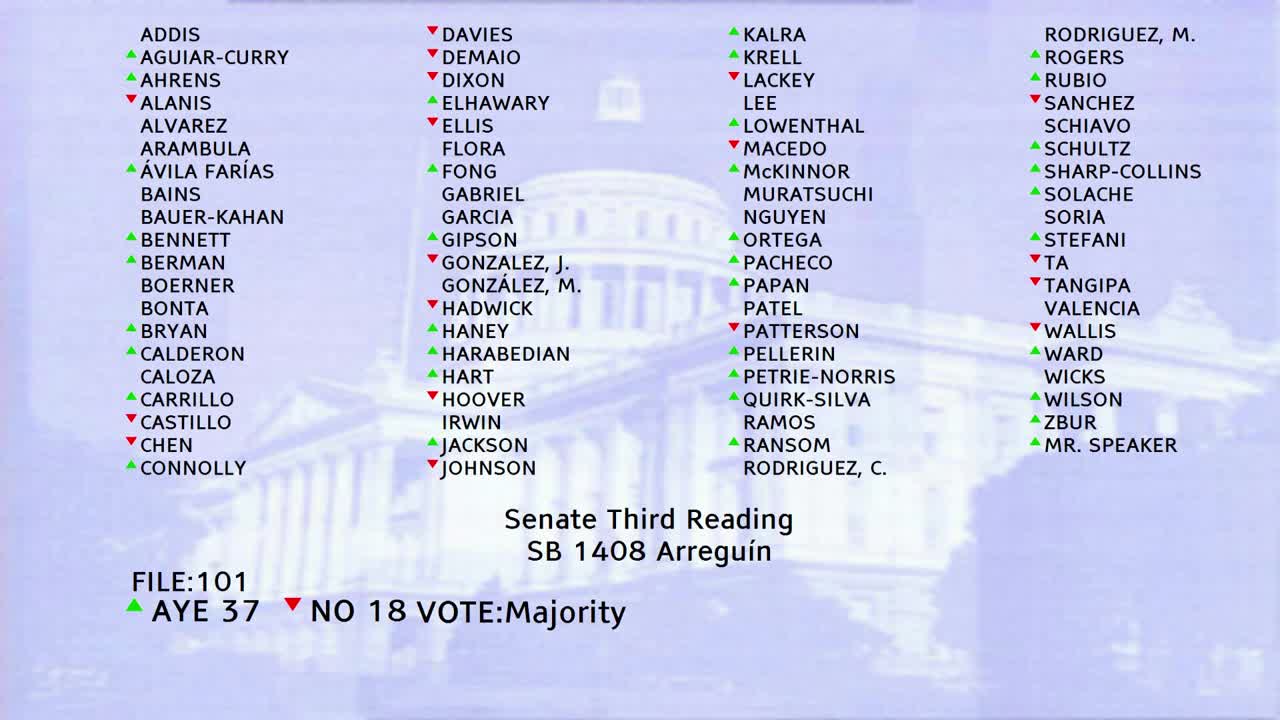 12MIN
Assembly Floor
 18SEC
Assembly Standing Committee on Appropriations
22SEC
Assembly Standing Committee on Appropriations
 20MIN
Assembly Standing Committee on Labor and Employment
 1H
Assembly Standing Committee on Natural Resources
 28MIN
Senate Floor
 28MIN