SB 97: Digital financial assets: stablecoins.
- Session Year: 2025-2026
- House: Senate
- Latest Version Date: 2026-06-30
Current Status:
Passed
(2026-06-30: Chaptered by Secretary of State. Chapter 52, Statutes of 2026.)
Introduced
In Committee
Awaiting First Chamber Vote
Passed First Chamber
In Committee
Awaiting Second Chamber Vote
Passed Second Chamber
Enacted
(1)Existing law, the Digital Financial Assets Law, prohibits a person, on or after July 1, 2026, from engaging in digital financial asset business activity, or holding itself out as being able to engage in digital financial asset business activity, with, or on behalf of, a resident, unless any of certain criteria are met, including that the person is licensed with the Department of Financial Protection and Innovation, as prescribed, or the person submits an application on or before July 1, 2026, and is awaiting approval or denial of that application.
This bill would revise the above-described latter criterion to specify that the person submits a completed application, as provided.
The Digital Financial Assets Law authorizes the Commissioner of Financial Protection and Innovation to issue a conditional license to an applicant who holds or maintains a license to conduct virtual currency business activity in the State of New York, as specified, provided the license was issued or approved no later than January 1, 2023.
This bill would revise the above-described authorization to require that the license be issued or approved no later than January 1, 2025.
(2)The Digital Financial Assets Law defines digital financial asset business activity to mean any of specified activities, including, among others, exchanging, transferring, or storing a digital financial asset, as specified, or exchanging one or more digital representations of value used within one or more online games, game platforms, or family of games, as provided.
This bill would remove exchanging one or more digital representations of value used within one or more online games, game platforms, or family of games from the definition of digital financial business activity. The bill would specify that a digital financial asset does not include, among other things, a transaction in which a merchant grants digital representations of value that primarily relate to an affinity or rewards program, as provided, or a digital representation of value issued by or on behalf of a publisher and used primarily within online games or game platforms and that is not otherwise a digital financial asset.
The Digital Financial Assets Law declares that its provisions do not apply to specified activity, including by a person who does not receive compensation for providing digital financial asset products or services or for conducting financial asset business activity or that is engaged in testing products or services with the persons own funds.
This bill would specify that the above-described exclusion includes a person who merely retains the ability to terminate, suspend, or interrupt a digital financial transaction solely to prevent unauthorized or fraudulent activity and who is not compensated for that service.
The Digital Financial Assets Law prohibits a covered person from exchanging, transferring, or storing a digital financial asset that is a stablecoin or engaging in digital financial asset administration of a stablecoin, as specified, unless certain conditions are met. However, existing law authorizes a covered person to exchange, transfer, or store a stablecoin or engage in digital financial asset administration of that stablecoin, as specified, if the stablecoin is approved by the commissioner and complies with certain requirements, restrictions, or prohibitions established by the commissioner.
This bill would repeal the above-described provisions related to stablecoins.
(3)The Digital Financial Assets Law requires a licensee to submit an annual report, as provided, containing specified information, including a description of any data security breach or cybersecurity event of the licensee. Existing law requires a licensee to file with the department, as applicable, a report of, among other things, a change in the licensees business for the conduct of its digital financial asset business activity with, or on behalf of, a resident that meets one of specified criteria, including that the proposed change might raise safety and soundness or operational concerns.
This bill would revise the above-described annual report to instead include a description of any material data security breach or cybersecurity event of the licensee. The bill would revise the specified criteria in the requirement to file the above-described report of a change in the licensees business to instead include that the proposed change might raise material safety and soundness or operational concerns.
Before engaging in digital financial asset business activity with a resident, the Digital Financial Assets Law requires a covered person, defined as a person required to obtain a license pursuant to that law, to disclose, as provided, certain information, including the residents right to at least 14 days prior notice of specified changes that have a material impact on digital financial asset business activity with the resident, or the policies applicable to the residents account. Existing law requires a covered exchange, as provided, to certify on a form provided by the department that the covered exchange has taken specified actions, except for any digital financial asset approved for listing on or before January 1, 2023. In a transaction for or with a resident, existing law prohibits the covered exchange from interjecting a third party between the covered exchange and the best market for the digital financial asset in a manner inconsistent with specified requirements.
This bill would prohibit the 14-day notice requirement from applying to changes in terms, conditions, or policies that are reasonably necessary to address a risk of loss to the resident or covered person, to the extent that the change does not relate to the fee schedule. The bill would instead exclude from the above-described certification requirement a digital financial asset approved for listing on or before January 1, 2025. The bill would require a covered person to provide and make available an up-to-date description of the order execution practices of the covered person, as specified. The bill would exempt a transaction in which a resident receives stablecoin, as defined, in exchange for legal tender or bank or credit union credit from the above-described prohibition against interjecting a third party.
The Digital Financial Assets Law requires an applicant, as provided, to create, and during licensure, maintain in a record specified policies and procedures. Existing law requires these policies and procedures be disclosed separately from other disclosures made available to a resident, as specified, except for, among other things, an adopted information security program or an operational security program.
This bill would instead exclude from the above-described requirement to disclose separately from other disclosures programs with information that is sensitive to potential security risks, as specified.
This bill would declare that it is to take effect immediately as an urgency statute.
(1)Existing law, the Digital Financial Assets Law, prohibits a person, on or after July 1, 2026, from engaging in digital financial asset business activity, or holding itself out as being able to engage in digital financial asset business activity, with, or on behalf of, a resident, unless any of certain criteria are met, including that the person is licensed with the Department of Financial Protection and Innovation, as prescribed, or the person submits an application on or before July 1, 2026, and is awaiting approval or denial of that application.
This bill would revise the above-described latter criterion to specify that the person submits a completed application, as provided.
The Digital Financial Assets Law authorizes the Commissioner of Financial Protection and Innovation to issue a conditional license to an applicant who holds or maintains a license to conduct virtual currency business activity in the State of New York, as specified, provided the license was issued or approved no later than January 1, 2023.
This bill would revise the above-described authorization to require that the license be issued or approved no later than January 1, 2025.
(2)The Digital Financial Assets Law defines digital financial asset business activity to mean any of specified activities, including, among others, exchanging, transferring, or storing a digital financial asset, as specified, or exchanging one or more digital representations of value used within one or more online games, game platforms, or family of games, as provided.
This bill would remove exchanging one or more digital representations of value used within one or more online games, game platforms, or family of games from the definition of digital financial business activity. The bill would specify that a digital financial asset does not include, among other things, a transaction in which a merchant grants digital representations of value that primarily relate to an affinity or rewards program, as provided, or a digital representation of value issued by or on behalf of a publisher and used primarily within online games or game platforms and that is not otherwise a digital financial asset.
The Digital Financial Assets Law declares that its provisions do not apply to specified activity, including by a person who does not receive compensation for providing digital financial asset products or services or for conducting financial asset business activity or that is engaged in testing products or services with the persons own funds.
This bill would specify that the above-described exclusion includes a person who merely retains the ability to terminate, suspend, or interrupt a digital financial transaction solely to prevent unauthorized or fraudulent activity and who is not compensated for that service.
The Digital Financial Assets Law prohibits a covered person from exchanging, transferring, or storing a digital financial asset that is a stablecoin or engaging in digital financial asset administration of a stablecoin, as specified, unless certain conditions are met. However, existing law authorizes a covered person to exchange, transfer, or store a stablecoin or engage in digital financial asset administration of that stablecoin, as specified, if the stablecoin is approved by the commissioner and complies with certain requirements, restrictions, or prohibitions established by the commissioner.
This bill would repeal the above-described provisions related to stablecoins.
(3)The Digital Financial Assets Law requires a licensee to submit an annual report, as provided, containing specified information, including a description of any data security breach or cybersecurity event of the licensee. Existing law requires a licensee to file with the department, as applicable, a report of, among other things, a change in the licensees business for the conduct of its digital financial asset business activity with, or on behalf of, a resident that meets one of specified criteria, including that the proposed change might raise safety and soundness or operational concerns.
This bill would revise the above-described annual report to instead include a description of any material data security breach or cybersecurity event of the licensee. The bill would revise the specified criteria in the requirement to file the above-described report of a change in the licensees business to instead include that the proposed change might raise material safety and soundness or operational concerns.
Before engaging in digital financial asset business activity with a resident, the Digital Financial Assets Law requires a covered person, defined as a person required to obtain a license pursuant to that law, to disclose, as provided, certain information, including the residents right to at least 14 days prior notice of specified changes that have a material impact on digital financial asset business activity with the resident, or the policies applicable to the residents account. Existing law requires a covered exchange, as provided, to certify on a form provided by the department that the covered exchange has taken specified actions, except for any digital financial asset approved for listing on or before January 1, 2023. In a transaction for or with a resident, existing law prohibits the covered exchange from interjecting a third party between the covered exchange and the best market for the digital financial asset in a manner inconsistent with specified requirements.
This bill would prohibit the 14-day notice requirement from applying to changes in terms, conditions, or policies that are reasonably necessary to address a risk of loss to the resident or covered person, to the extent that the change does not relate to the fee schedule. The bill would instead exclude from the above-described certification requirement a digital financial asset approved for listing on or before January 1, 2025. The bill would require a covered person to provide and make available an up-to-date description of the order execution practices of the covered person, as specified. The bill would exempt a transaction in which a resident receives stablecoin, as defined, in exchange for legal tender or bank or credit union credit from the above-described prohibition against interjecting a third party.
The Digital Financial Assets Law requires an applicant, as provided, to create, and during licensure, maintain in a record specified policies and procedures. Existing law requires these policies and procedures be disclosed separately from other disclosures made available to a resident, as specified, except for, among other things, an adopted information security program or an operational security program.
This bill would instead exclude from the above-described requirement to disclose separately from other disclosures programs with information that is sensitive to potential security risks, as specified.
This bill would declare that it is to take effect immediately as an urgency statute.
(1)Existing law, the Digital Financial Assets Law, prohibits a person, on or after July 1, 2026, from engaging in digital financial asset business activity, or holding itself out as being able to engage in digital financial asset business activity, with, or on behalf of, a resident, unless any of certain criteria are met, including that the person is licensed with the Department of Financial Protection and Innovation, as prescribed, or the person submits an application on or before July 1, 2026, and is awaiting approval or denial of that application.
This bill would revise the above-described latter criterion to specify that the person submits a completed application, as provided.
The Digital Financial Assets Law authorizes the Commissioner of Financial Protection and Innovation to issue a conditional license to an applicant who holds or maintains a license to conduct virtual currency business activity in the State of New York, as specified, provided the license was issued or approved no later than January 1, 2023.
This bill would revise the above-described authorization to require that the license be issued or approved no later than January 1, 2025.
(2)The Digital Financial Assets Law defines digital financial asset business activity to mean any of specified activities, including, among others, exchanging, transferring, or storing a digital financial asset, as specified, or exchanging one or more digital representations of value used within one or more online games, game platforms, or family of games, as provided.
This bill would remove exchanging one or more digital representations of value used within one or more online games, game platforms, or family of games from the definition of digital financial business activity. The bill would specify that a digital financial asset does not include include, among other things, a transaction in which a merchant grants digital representations of value that primarily relate to an affinity or rewards program, as provided, or a digital representation of value issued by or on behalf of a publisher and used primarily within online games or game platforms and that is not otherwise a digital financial asset.
The Digital Financial Assets Law declares that its provisions do not apply to specified activity, including by a person who does not receive compensation for providing digital financial asset products or services or for conducting financial asset business activity or that is engaged in testing products or services with the persons own funds.
This bill would specify that the above-described exclusion includes a person who merely retains the ability to terminate, suspend, or interrupt a digital financial transaction solely to prevent unauthorized or fraudulent activity and who is not compensated for that service.
The Digital Financial Assets Law authorizes the commissioner to approve a stablecoin for various purposes if the commissioner determines that the stablecoin does not compromise the interests of residents who may use the stablecoin as a payment for goods and services or as a store of value. Existing law requires the commissioner to consider specified factors in determining whether to make an approval under those provisions. prohibits a covered person from exchanging, transferring, or storing a digital financial asset that is a stablecoin or engaging in digital financial asset administration of a stablecoin, as specified, unless certain conditions are met. However, existing law authorizes a covered person to exchange, transfer, or store a stablecoin or engage in digital financial asset administration of that stablecoin, as specified, if the stablecoin is approved by the commissioner and complies with certain requirements, restrictions, or prohibitions established by the commissioner.
This bill would include additional factors the commissioner must consider in determining whether to make an approval under those provisions, as specified. repeal the above-described provisions related to stablecoins.
(3)The Digital Financial Assets Law requires a licensee to submit an annual report, as provided, containing specified information, including a description of any data security breach or cybersecurity event of the licensee. Existing law requires a licensee to file with the department, as applicable, a report of, among other things, a change in the licensees business for the conduct of its digital financial asset business activity with, or on behalf of, a resident that meets one of specified criteria, including that the proposed change might raise safety and soundness or operational concerns.
This bill would revise the above-described annual report to instead include a description of any material data security breach or cybersecurity event of the licensee. The bill would revise the specified criteria in the requirement to file the above-described report of a change in the licensees business to instead include that the proposed change might raise material safety and soundness or operational concerns.
Before engaging in digital financial asset business activity with a resident, the Digital Financial Assets Law requires a covered person, defined as a person required to obtain a license pursuant to that law, to disclose, as provided, certain information, including the residents right to at least 14 days prior notice of specified changes that have a material impact on digital financial asset business activity with the resident, or the policies applicable to the residents account. Existing law requires a covered exchange, as provided, to certify on a form provided by the department that the covered exchange has taken specified actions, except for any digital financial asset approved for listing on or before January 1, 2023. In a transaction for or with a resident, existing law prohibits the covered exchange from interjecting a third party between the covered exchange and the best market for the digital financial asset in a manner inconsistent with specified requirements.
This bill would prohibit the 14-day notice requirement from applying to changes in terms, conditions, or policies that are reasonably necessary to address a risk of loss to the resident or covered person, to the extent that the change does not relate to the fee schedule. The bill would instead exclude from the above-described certification requirement a digital financial asset approved for listing on or before January 1, 2025. The bill would require a covered person to provide and make available an up-to-date description of the order execution practices of the covered person, as specified. The bill would exempt a transaction in which a resident receives stablecoin, as defined, in exchange for legal tender or bank or credit union credit from the above-described prohibition against interjecting a third party.
The Digital Financial Assets Law requires an applicant, as provided, to create, and during licensure, maintain in a record specified policies and procedures. Existing law requires these policies and procedures be disclosed separately from other disclosures made available to a resident, as specified, except for, among other things, an adopted information security program or an operational security program.
This bill would instead exclude from the above-described requirement to disclose separately from other disclosures programs with information that is sensitive to potential security risks, as specified.
This bill would declare that it is to take effect immediately as an urgency statute.
(1)Existing law, the Digital Financial Assets Law, prohibits a person, on or after July 1, 2026, from engaging in digital financial asset business activity, or holding itself out as being able to engage in digital financial asset business activity, with, or on behalf of, a resident, unless any of certain criteria are met, including that the person is licensed with the Department of Financial Protection and Innovation, as prescribed. prescribed, or the person submits an application on or before July 1, 2026, and is awaiting approval or denial of that application.
This bill would revise the above-described latter criterion to specify that the person submits a completed application, as provided.
The Digital Financial Assets Law authorizes the Commissioner of Financial Protection and Innovation to issue a conditional license to an applicant who holds or maintains a license to conduct virtual currency business activity in the State of New York, as specified, provided the license was issued or approved no later than January 1, 2023.
This bill would revise the above-described authorization to require that the license be issued or approved no later than January 1, 2025.
Existing law(2)The Digital Financial Assets Law defines digital financial asset business activity to mean any of specified activities, including, among others, exchanging, transferring, or storing a digital financial asset, as specified, or exchanging one or more digital representations of value used within one or more online games, game platforms, or family of games, as provided.
This bill would remove exchanging one or more digital representations of value used within one or more online games, game platforms, or family of games from the definition of digital financial business activity. The bill would specify that a digital financial asset does not include a transaction in which a merchant grants digital representations of value that primarily relate to an affinity or rewards program, as provided, or a digital representation of value issued by or on behalf of a publisher and used primarily within online games or game platforms and that is not otherwise a digital financial asset.
The Digital Financial Assets Law declares that its provisions do not apply to specified activity, including by a person who does not receive compensation for providing digital financial asset products or services or for conducting financial asset business activity or that is engaged in testing products or services with the persons own funds.
This bill would specify that the above-described exclusion includes a person who merely retains the ability to terminate, suspend, or interrupt a digital financial transaction solely to prevent unauthorized or fraudulent activity and who is not compensated for that service.
The Digital Financial Assets Law authorizes the Commissioner of Financial Protection and Innovation commissioner to approve a stablecoin for various purposes if the commissioner determines that the stablecoin does not compromise the interests of residents who may use the stablecoin as a payment for goods and services or as a store of value. Existing law requires the commissioner to consider specified factors in determining whether to make an approval under those provisions.
This bill would include additional factors the commissioner must consider in determining whether to make an approval under those provisions, as specified.
(3)The Digital Financial Assets Law requires a licensee to submit an annual report, as provided, containing specified information, including a description of any data security breach or cybersecurity event of the licensee. Existing law requires a licensee to file with the department, as applicable, a report of, among other things, a change in the licensees business for the conduct of its digital financial asset business activity with, or on behalf of, a resident that meets one of specified criteria, including that the proposed change might raise safety and soundness or operational concerns.
This bill would revise the above-described annual report to instead include a description of any material data security breach or cybersecurity event of the licensee. The bill would revise the specified criteria in the requirement to file the above-described report of a change in the licensees business to instead include that the proposed change might raise material safety and soundness or operational concerns.
Before engaging in digital financial asset business activity with a resident, the Digital Financial Assets Law requires a covered person, defined as a person required to obtain a license pursuant to that law, to disclose, as provided, certain information, including the residents right to at least 14 days prior notice of specified changes that have a material impact on digital financial asset business activity with the resident, or the policies applicable to the residents account. Existing law requires a covered exchange, as provided, to certify on a form provided by the department that the covered exchange has taken specified actions, except for any digital financial asset approved for listing on or before January 1, 2023.
This bill would prohibit the 14-day notice requirement from applying to changes in terms, conditions, or policies that are reasonably necessary to address a risk of loss to the resident or covered person, to the extent that the change does not relate to the fee schedule. The bill would instead exclude from the above-described certification requirement a digital financial asset approved for listing on or before January 1, 2025. The bill would require a covered person to provide and make available an up-to-date description of the order execution practices of the covered person, as specified.
The Digital Financial Assets Law requires an applicant, as provided, to create, and during licensure, maintain in a record specified policies and procedures. Existing law requires these policies and procedures be disclosed separately from other disclosures made available to a resident, as specified, except for, among other things, an adopted information security program or an operational security program.
This bill would instead exclude from the above-described requirement to disclose separately from other disclosures programs with information that is sensitive to potential security risks, as specified.
Existing law, the Digital Financial Assets Law, prohibits a person, on or after July 1, 2026, from engaging in digital financial asset business activity, or holding itself out as being able to engage in digital financial asset business activity, with, or on behalf of, a resident, unless any of certain criteria are met, including that the person is licensed with the Department of Financial Protection and Innovation, as prescribed. Existing law defines digital financial asset business activity to mean any of specified activities, including, among others, exchanging, transferring, or storing a digital financial asset, as specified, or exchanging one or more digital representations of value used within one or more online games, game platforms, or family of games, as provided.
This bill would remove exchanging one or more digital representations of value used within one or more online games, game platforms, or family of games from the definition of digital financial business activity.
The Digital Financial Assets Law authorizes the Commissioner of Financial Protection and Innovation to approve a stablecoin for various purposes if the commissioner determines that the stablecoin does not compromise the interests of residents who may use the stablecoin as a payment for goods and services or as a store of value. Existing law requires the commissioner to consider specified factors in determining whether to make an approval under those provisions.
This bill would include additional factors the commissioner must consider in determining whether to make an approval under those provisions, as specified.
Existing law, the Digital Financial Assets Law, prohibits a person, on or after July 1, 2026, from engaging in digital financial asset business activity, or holding itself out as being able to engage in digital financial asset business activity, with, or on behalf of, a resident, unless any of certain criteria are met, including that the person is licensed with the Department of Financial Protection and Innovation, as prescribed. Existing law defines digital financial asset business activity to mean any of specified activities, including, among others, exchanging, transferring, or storing a digital financial asset, as specified, or exchanging one or more digital representations of value used within one or more online games, game platforms, or family of games, as provided.
This bill would remove exchanging one or more digital representations of value used within one or more online games, game platforms, or family of games from the definition of digital financial business activity.
The Digital Financial Assets Law authorizes the Commissioner of Financial Protection and Innovation to approve a stablecoin for various purposes if the commissioner determines that the stablecoin does not compromise the interests of residents who may use the stablecoin as a payment for goods and services or as a store of value. Existing law requires the commissioner to consider specified factors in determining whether to make an approval under those provisions.
This bill would include additional factors the commissioner must consider in determining whether to make an approval under those provisions, as specified.
The Digital Financial Assets Law authorizes the Commissioner of Financial Protection and Innovation to approve a stablecoin for various purposes if the commissioner determines that the stablecoin does not compromise the interests of residents who may use the stablecoin as a payment for goods and services or as a store of value. Existing law requires the commissioner to consider specified factors in determining whether to make an approval under those provisions.
This bill would include additional factors the commissioner must consider in determining whether to make an approval under those provisions, as specified.
Existing law, the Digital Financial Assets Law, prohibits a person, on or after July 1, 2026, from engaging in digital financial asset business activity, or holding itself out as being able to engage in digital financial asset business activity, with, or on behalf of, a resident, unless any of certain criteria are met, including that the person is licensed with the Department of Financial Protection and Innovation, as prescribed. Existing law defines digital financial asset to mean a digital representation of value that is used as a medium of exchange, unit of account, or store of value, and that is not legal tender, whether or not denominated in legal tender, except as specified.This bill would make a nonsubstantive change to that provision.Existing law, the Digital Financial Assets Law, prohibits a person, on or after July 1, 2026, from engaging in digital financial asset business activity, or holding itself out as being able to engage in digital financial asset business activity, with, or on behalf of, a resident, unless any of certain criteria are met, including that the person is licensed with the Department of Financial Protection and Innovation, as prescribed. Existing law defines digital financial asset to mean a digital representation of value that is used as a medium of exchange, unit of account, or store of value, and that is not legal tender, whether or not denominated in legal tender, except as specified.
This bill would make a nonsubstantive change to that provision.
For purposes of this division:
(a)Applicant means a person that applies for a license under this division.
(b)Bank means a bank, savings bank, savings and loan association, savings association, or industrial loan company chartered under the laws of this state or any other state or under the laws of the United States.
(c)Control means both of the following:
(1)When used in reference to a transaction or relationship involving a digital financial asset, power to execute unilaterally or prevent indefinitely a digital financial asset transaction, unless the power to prevent indefinitely is limited to the ability to terminate, suspend, or interrupt a transaction solely in response to unauthorized or fraudulent activity.
(2)When used in reference to a person, the direct or indirect power to do either of the following:
(A)Vote 25 percent or more of any class of the voting securities issued by a person.
(B)Direct or cause the direction of the management and policies of a person, whether through the ownership of voting securities, by contract, other than a commercial contract for goods or nonmanagement services, or otherwise, if no individual is deemed to control a person solely on account of being a director, officer, or employee of such person.
(d)Covered person means a person required to obtain a license pursuant to this division.
(e)Credit union means a credit union licensed under the laws of this state, or any other state, or a federal credit union chartered under the laws of the United States.
(f)Department means the Department of Financial Protection and Innovation.
(g)(1)Digital financial asset means a digital representation of value that is used as a medium of exchange, unit of account, or store of value, and that is not legal tender, whether or not denominated in legal tender.
(2)Digital financial asset does not include any of the following:
(A)A transaction in which a merchant grants, as part of an affinity or rewards program, digital representations of value that primarily relate to the affinity or rewards program and cannot be taken from or exchanged with the merchant for legal tender, bank or credit union credit, or a digital financial asset.
(B)A digital representation of value issued by or on behalf of a publisher and used primarily within online games or game platforms and that is not otherwise a digital financial asset.
(C)A security registered with or exempt from registration with the United States Securities and Exchange Commission or a security qualified with or exempt from qualifications with the department.
(D)A digital record of ownership, or equivalent thereto, of tangible or intangible goods, including, but not limited to, any of the following:
(i)Works of art, musical compositions, literary works, and similar intellectual property.
(ii)Collectibles, merchandise, virtual land, and in-game assets.
(iii)Digital affinity, loyalty, or rewards points granted by a merchant or a network of participating merchants if all of the following are true:
(I)The points cannot be redeemed with a participating merchant in exchange for legal tender, bank or credit union credit, or a digital financial asset.
(II)The points can only be redeemed by participating merchants as part of the purchase of goods or services, which does not include digital financial assets.
(III)The points are granted or redeemed by participating merchants pursuant to a formal loyalty program intended to reward frequent customers.
(iv)Licenses, tickets, and similar rights to attend events or participate in activities.
(h)Digital financial asset business activity means either of the following:
(1)Exchanging, transferring, or storing a digital financial asset.
(2)Holding electronic precious metals or electronic certificates representing interests in precious metals on behalf of another person or issuing shares or electronic certificates representing interests in precious metals.
(i)Exchange, when used as a verb, means to assume control of a digital financial asset from, or on behalf of, a resident, at least momentarily, to sell, trade, or convert either of the following:
(1)A digital financial asset for legal tender, bank or credit union credit, or one or more forms of digital financial assets.
(2)Legal tender or bank or credit union credit for one or more forms of digital financial assets.
(j)Executive officer includes, but is not limited to, an individual who is a director, officer, manager, managing member, partner, or trustee of a person that is not an individual, or any other person who performs similar policymaking or policy implementation functions.
(k)Insolvent means any of the following:
(1)Having generally ceased to pay debts in the ordinary course of business other than as a result of a bona fide dispute.
(2)Being unable to pay debts as they become due.
(3)Being insolvent within the meaning of federal bankruptcy law.
(l)Legal tender means a medium of exchange or unit of value, including the coin or paper money of the United States, issued by the United States or by another government.
(m)Licensee means a person licensed or conditionally licensed under this division.
(n)(1)Person means an individual, partnership, estate, business or nonprofit entity, or other legal entity.
(2)Person does not include a government-sponsored enterprise, government, or governmental subdivision, agency, or instrumentality.
(o)Record means information that is inscribed on a tangible medium or that is stored in an electronic or other medium and is retrievable in perceivable form.
(p)(1)Resident means any of the following:
(A)A person who is domiciled in this state.
(B)A person who is physically located in this state for more than 183 days of the previous 365 days.
(C)A person who has a place of business in this state.
(D)A legal representative of a person that is domiciled in this state.
(2)Notwithstanding paragraph (1), resident does not include a licensee or an affiliate, as defined in subdivision (a) of Section 90005, of a licensee.
(q)Responsible individual means an individual who has direct control over, or significant management policy and decisionmaking authority with respect to, a licensees digital financial asset business activity in this state.
(r)SAFE Act means the federal Secure and Fair Enforcement for Mortgage Licensing Act of 2008 (Public Law 110-289).
(s)Sign means, with present intent to authenticate or adopt a record, either of the following:
(1)To execute or adopt a tangible symbol.
(2)To attach to, or logically associate with, the record an electronic symbol, sound, or process.
(t)State means a state of the United States, the District of Columbia, Puerto Rico, the United States Virgin Islands, or any territory or insular possession subject to the jurisdiction of the United States.
(u)Store, except in the phrase store of value, means to maintain control of a digital financial asset on behalf of a resident by a person other than the resident. Storage and storing have corresponding meanings.
(v)Transfer means to assume control of a digital financial asset from, or on behalf of, a resident and to subsequently do any of the following:
(1)Credit the digital financial asset to the account of another person.
(2)Move the digital financial asset from one account of a resident to another account of the same resident.
(3)Relinquish control of a digital financial asset to another person.
(w)United States dollar equivalent of digital financial assets means the equivalent value of a particular digital financial asset in United States dollars shown on a digital financial asset exchange based in the United States for a particular date or period specified in this division.
SEC. 2.Section 3103 of the Financial Code is amended to read:3103.(a)Except as otherwise provided in subdivision (b), this division governs the digital financial asset business activity of a person doing business in this state or, wherever located, who engages in or holds itself out as engaging in the activity with, or on behalf of, a resident.
(b)This division does not apply to activity by any of the following:
(1)The United States, a state, political subdivision of a state, agency, or instrumentality of federal, state, or local government, or a foreign government or a subdivision, department, agency, or instrumentality of a foreign government.
(2)A bank that is one of the following:
(A)A commercial bank or industrial bank, the deposits of which are insured by the Federal Deposit Insurance Corporation or its successor.
(B)A foreign (other nation) bank that is licensed under Chapter 20 (commencing with Section 1750) of Division 1.1 or that is authorized under federal law to maintain a federal agency or federal branch office in this state.
(C)An association or federal association, as defined in Section 5102, the deposits of which are insured by the Federal Deposit Insurance Corporation or its successor.
(3)A trust company licensed pursuant to Section 1042 or a national association authorized under federal law to engage in a trust banking business.
(4)A federally chartered or state-chartered credit union, with an office in California, the member accounts of which are insured or guaranteed as provided in Section 14858.
(5)A person whose participation in a payment system is limited to providing processing, clearing, or performing settlement services solely for transactions between or among persons that are exempt from the licensing requirements of this division.
(6)A person engaged in the business of dealing in foreign exchange to the extent the persons activity meets the definition in Section 1010.605(f)(1)(iv) of Title 31 of the Code of Federal Regulations.
(7)A person that is any of the following:
(A)A person that contributes only connectivity software or computing power to securing a network that records digital financial asset transactions or to a protocol governing transfer of the digital representation of value.
(B)A person that provides only data storage or security services for a business engaged in digital financial asset business activity and does not otherwise engage in digital financial asset business activity on behalf of another person.
(C)A person that provides only to a person otherwise exempt from this division a digital financial asset as one or more enterprise solutions used solely among each other and that does not have an agreement or a relationship with a resident that is an end user of a digital financial asset.
(8)A person using a digital financial asset, including creating, investing, buying or selling, or obtaining a digital financial asset as payment for the purchase or sale of goods or services, solely on the persons own behalf for personal, family, or household purposes or for academic purposes.
(9)A person whose digital financial asset business activity with, or on behalf of, residents is reasonably expected to be valued, in the aggregate, on an annual basis at fifty thousand dollars ($50,000) or less, measured by the United States dollar equivalent of digital financial assets.
(10)An attorney to the extent of providing escrow services to a resident.
(11)A title insurance company to the extent of providing escrow services to a resident.
(12)A secured creditor under Division 9 (commencing with Section 9101) of the Commercial Code or a creditor with a judicial lien, or lien arising by operation of law, on collateral that is a digital financial asset, if the digital financial asset business activity of the creditor is limited to enforcement of the security interest in compliance with Division 9 (commencing with Section 9101) of the Commercial Code or lien in compliance with the law applicable to the lien.
(13)A person that does not receive compensation, either directly or indirectly, for providing digital financial asset products or services or for conducting digital financial asset business activity, including a person who merely retains the ability to terminate, suspend, or interrupt a digital financial transaction solely to prevent unauthorized or fraudulent activity and who is not compensated for that service, or that is engaged in testing products or services with the persons own funds.
(14)Any entity or futures commission merchant, swap dealer, or introducing broker registered under the federal Commodity Exchange Act (7 U.S.C. Sec. 1, et seq.) to the extent those activities are conducted under authority of that act, are actually regulated by the Commodity Futures Trading Commission, and are entitled to preemption.
(15)A person registered as a securities broker-dealer under federal or state securities laws to the extent of its operation as a broker-dealer.
(16)A person that provides clearance or settlement services pursuant to a registration as a clearing agency or an exemption from registration granted under the federal securities laws to the extent of its operation as such a provider.
(17)A merchant that accepts a digital financial asset as payment for the purchase or sale of goods or services, which does not include digital financial assets.
(c)(1)The commissioner may, by regulation or order, either unconditionally or upon specified terms and conditions or for specified periods, exempt from all or part of this division any person or transaction, or class of persons or transactions, if the commissioner finds such action to be in the public interest and that the regulation of such persons or transactions is not necessary for the purposes of this division.
(2)The commissioner shall post on the commissioners internet website a list of all persons, transactions, or classes of person or transactions exempt pursuant to this section, and the part or parts of this division from which they are exempt.
(3)The commissioner may, by regulation or order, amend or rescind any exemption made pursuant to this subdivision.
SEC. 3.Section 3201 of the Financial Code is amended to read:3201.On or after July 1, 2026, a person shall not engage in digital financial asset business activity, or hold itself out as being able to engage in digital financial asset business activity, with or on behalf of a resident unless any of the following is true:
(a)The person is licensed in this state by the department under Section 3203.
(b)The person submits a completed application on or before July 1, 2026, and is awaiting approval or denial of that application.
(c)The person is exempt from licensure under this division pursuant to Section 3103.
SEC. 4.Section 3205 of the Financial Code is amended to read:3205.(a)The commissioner may issue a conditional license to an applicant who holds or maintains a license to conduct virtual currency business activity in the State of New York pursuant to Part 200 of Title 23 of the New York Code of Rules and Regulations or a charter as a New York State limited purpose trust company with approval to conduct a virtual currency business under New York law, provided the license was issued or approved no later than January 1, 2025, and the applicant pays all appropriate fees and complies with the requirements of this division.
(b)The commissioner may issue a conditional license to an applicant pending compliance with the requirements of Section 3219 if all of the following conditions are met:
(1)The applicant has supplied all fingerprints required under Section 3219.
(2)The applicant meets all other requirements for licensure.
(3)Notwithstanding the commissioners reasonable efforts, the commissioner has been unable to complete the criminal history investigations required by Section 3219 with reasonable speed.
(c)A conditional license issued pursuant to this section shall expire at the earliest of the following:
(1)Upon issuance of an unconditional license.
(2)Upon denial of a license application.
(3)Upon revocation of a license issued pursuant to Part 200 of Title 23 of the New York Code of Rules and Regulations or disapproval or revocation of a charter as a New York State limited purpose trust company with approval to conduct a virtual currency business under New York law.
SEC. 5.Section 3211 of the Financial Code is amended to read:3211.(a)Subject to subdivision (h), between October 1 and November 1 of each year, a licensee shall submit to the department an annual report under subdivision (b).
(b)The annual report required by subdivision (a) shall be submitted in a form and medium prescribed by the department. The report shall contain all of the following:
(1)Either a copy of the licensees most recent reviewed annual financial statement, if the gross revenue generated by the licensees digital financial asset business activity in this state was not more than two million dollars ($2,000,000) for the fiscal year ending before the anniversary date of issuance of its license under this division, or a copy of the licensees most recent audited annual financial statement, if the licensees digital financial asset business activity in this state amounted to more than two million dollars ($2,000,000), for the fiscal year ending before the anniversary date.
(2)If a person other than an individual has control of the licensee, a copy of either of the following:
(A)The persons most recent reviewed annual financial statement, if the persons gross revenue was not more than two million dollars ($2,000,000) in the previous fiscal year measured as of the anniversary date of issuance of its license under this division.
(B)The persons most recent audited consolidated annual financial statement, if the persons gross revenue was more than two million dollars ($2,000,000) in the previous fiscal year measured as of the anniversary date of issuance of its license under this division.
(3)A description of any of the following:
(A)Any material change in the financial condition of the licensee.
(B)Any material litigation related to the licensees digital financial asset business activity and involving the licensee or an executive officer or responsible individual of the licensee.
(C)Any international, federal, state, or local investigation of the licensee, where permitted by applicable law.
(D)(i)Any material data security breach or cybersecurity event of the licensee.
(ii)A description of a data security breach pursuant to this subparagraph does not constitute disclosure or notification of a security breach for purposes of Section 1798.82 of the Civil Code.
(4)Information or records required by Section 3307 that the licensee has not reported to the department.
(5)The number of digital financial asset business activity transactions with, or on behalf of, residents for the period since, subject to subdivision (h), the later of the date the license was issued or the date the last annual report was submitted.
(6)(A)The amount of United States dollar equivalent of digital financial asset in the control of the licensee at, subject to subdivision (h), the end of the last month that ends not later than 30 days before the date of the annual report.
(B)The total number of residents for whom the licensee had control of United States dollar equivalent of digital financial assets on that date.
(7)Evidence that the licensee is in compliance with Section 3503.
(8)Evidence that the licensee is in compliance with Section 3205.
(9)A list of all locations where the licensee engages in its digital financial asset business activity.
(10)The number of residents with whom, or on behalf of, the licensee engaged in digital financial asset business activity between September 30 of the preceding year and October 1 of the year in which the licensee is submitting the annual report.
(11)Any other information the department requires by rule.
(c)(1)On or before February 28 of each year, a licensee and an applicant operating under this division without a license pursuant to subdivision (b) of Section 3201 shall pay its pro rata cost share of all costs and expenses reasonably incurred in the administration of this division, as estimated by the commissioner, for the ensuing year and any deficit actually incurred or anticipated in the administration of the program in both the year in which the assessment is made and the preceding year.
(2)The pro rata cost share described in paragraph (1) shall be the proportion of residents with whom, or on behalf of, a licensee or an applicant operating under this division without a license pursuant to subdivision (b) of Section 3201 engages in digital financial asset business activity bears to the aggregate residents with whom, or on behalf of, all licensees and applicants operating under this division without a license pursuant to subdivision (b) of Section 3201 engage in digital financial asset business activity, as determined by the commissioner, for the costs and expenses reasonably incurred in the administration of this division, not including any costs covered by the fees or cost recoveries under Section 3203 or cost recoveries under Section 3301.
(3)On or before January 31 of each year, the commissioner shall notify each licensee and applicant operating under this division without a license pursuant to subdivision (b) of Section 3201 of the amount assessed and levied against it.
(4)The commissioner may use funds obtained by the commissioner through the enforcement of this division, including, but not limited to, moneys received through fines, penalties, settlements, or judgements, for the administration of this division, which shall offset amounts assessed and levied against pursuant to this subdivision.
(5)The department may adopt rules that change the calculation of the pro rata cost share and the dates on which assessment notifications and payments are due pursuant to this subdivision, except that the amount of the pro rata cost share shall not exceed the costs and expenses reasonably incurred in the administration of this division.
(d)(1)Following at least five business days notice to the licensee, the commissioner may by order summarily suspend or revoke the license of any licensee that fails to comply with subdivisions (a) to (c), inclusive, by March 31 of the year in which an assessment is made pursuant to subdivision (c).
(2)The licensee may request a hearing on the order within 30 days of receipt of the notice.
(3)If the licensee timely requests a hearing on the order and a hearing is not held within 60 days of that request, the order shall be deemed rescinded as of the effective date of the order.
(e)If the department suspends or revokes a license under this division for noncompliance with subdivisions (a) to (c), inclusive, the department may end the suspension or rescind the revocation and notify the licensee of the action if, subject to subdivision (h), not later than 20 days after the license was suspended or revoked, the licensee files an annual report required by subdivision (a), a pro rata cost share required by subdivision (c), and pays any penalty assessed under Section 3407.
(f)The department shall give prompt notice to a licensee of the lifting of a suspension or rescission of a revocation after the licensee complies with subdivision (e).
(g)Suspension or revocation of a license under this section does not invalidate a transfer or exchange of digital financial assets for, or on behalf of, a resident made during the suspension or revocation and does not insulate the licensee from liability under this division.
(h)The department may extend a period under this section.
SEC. 6.Section 3307 of the Financial Code is amended to read:3307.(a)A licensee shall file with the department a report of the following, as may be applicable:
(1)A material change in information in the application for a license under this division or the most recent annual report of the licensee under this division.
(2)A change in the licensees business for the conduct of its digital financial asset business activity with, or on behalf of, a resident that meets one of the following criteria:
(A)The change may raise a legal or regulatory issue about the permissibility of the licensees digital financial business activity.
(B)The proposed change might raise material safety and soundness or operational concerns.
(C)The proposed change is to digital financial business activity that may cause such activity to be materially different from that previously listed on the application for licensing by the commissioner.
(3)A change of an executive officer, responsible individual, or person in control of the licensee.
(b)A report required by this section shall be filed not later than 15 days after the change described in subdivision (a).
SEC. 7.Section 3501 of the Financial Code is amended to read:3501.(a)When engaging in digital financial business activity with a resident, a covered person shall provide to a resident the disclosures required by subdivision (b) and any additional disclosure the department by rule determines reasonably necessary for the protection of residents. The department shall determine by rule the time and form required for disclosure. A disclosure required by this section shall be made separately from any other information provided by the covered person and in a clear and conspicuous manner in a record the resident may keep. A covered person may propose, for the departments approval, alternate disclosures as more appropriate for its digital financial asset business activity with, or on behalf of, residents.
(b)Before engaging in digital financial asset business activity with a resident, a covered person shall disclose, to the extent applicable to the digital financial asset business activity the covered person will undertake with the resident, all of the following:
(1)A schedule of fees and charges the covered person may assess, the manner by which fees and charges will be calculated if they are not set in advance and disclosed, and the timing of the fees and charges.
(2)Whether the product or service provided by the covered person is covered by either of the following:
(A)A form of insurance or other guarantee against loss by an agency of the United States as follows:
(i)Up to the full United States dollar equivalent of digital financial assets placed under the control of, or purchased from, the covered person as of the date of the placement or purchase, including the maximum amount provided by insurance under the Federal Deposit Insurance Corporation, National Credit Union Share Insurance Fund, or otherwise available from the Securities Investor Protection Corporation.
(ii)If not provided at the full United States dollar equivalent of the digital financial asset placed under the control of or purchased from the covered person, the maximum amount of coverage for each resident expressed in the United States dollar equivalent of the digital financial asset.
(B)(i)Private insurance against theft or loss, including cybertheft or theft by other means.
(ii)Upon request of a resident with whom a covered person engages in digital financial asset business activity, a covered person shall disclose the terms of the insurance policy to the resident in a manner that allows the resident to understand the specific insured risks that may result in partial coverage of the residents assets.
(3)The irrevocability of a transfer or exchange and any exception to irrevocability.
(4)A description of all of the following:
(A)The covered persons liability for an unauthorized, mistaken, or accidental transfer or exchange.
(B)The residents responsibility to provide notice to the covered person of an unauthorized, mistaken, or accidental transfer or exchange.
(C)The basis for any recovery by the resident from the covered person in case of an unauthorized, mistaken, or accidental transfer or exchange.
(D)General error resolution rights applicable to an unauthorized, mistaken, or accidental transfer or exchange.
(E)The method for the resident to update the residents contact information with the covered person.
(5)That the date or time when the transfer or exchange is made and the residents account is debited may differ from the date or time when the resident initiates the instruction to make the transfer or exchange.
(6)Whether the resident has a right to stop a preauthorized payment or revoke authorization for a transfer and the procedure to initiate a stop-payment order or revoke authorization for a subsequent transfer.
(7)The residents right to receive a receipt, trade ticket, or other evidence of the transfer or exchange.
(8)The residents right to at least 14 days prior notice of a change in the covered persons fee schedule, other terms and conditions that have a material impact on digital financial asset business activity with the resident, or the policies applicable to the residents account. The 14-day notice requirement shall not apply to changes in terms and conditions or policies that are reasonably necessary to address a risk of loss to the resident or the covered person, to the extent that the change does not relate to the covered persons fee schedule.
(9)That no digital financial asset is currently recognized as legal tender by California or the United States.
(10)(A)A list of instances in the past 12 months when the covered persons service was unavailable to 10,000 or more customers seeking to engage in digital financial asset business activity due to a service outage on the part of the covered person and the causes of each identified service outage.
(B)As part of the disclosure required by this paragraph, the covered person may list any steps the covered person has taken to resolve underlying causes for those outages.
(c)Except as otherwise provided in subdivision (d), at the conclusion of a digital financial asset transaction with, or on behalf of, a resident, a covered person shall provide the resident a confirmation in a record which contains all of the following:
(1)The name and contact information of the covered person, including the toll-free telephone number required under Section 3507.
(2)The type, value, date, precise time, and amount of the transaction.
(3)The fee charged for the transaction, including any charge for conversion of a digital financial asset to legal tender, bank credit, or other digital financial asset, as well as any indirect charges.
(d)If a covered person discloses that it will provide a daily confirmation in the initial disclosure under subdivision (c), the covered person may elect to provide a single, daily confirmation for all transactions with, or on behalf of, a resident on that day instead of a per transaction confirmation.
SEC. 8.Section 3505 of the Financial Code is amended to read:3505.(a)(1)Except as provided for under paragraph (2), a covered exchange, prior to listing or offering a digital financial asset that the covered exchange can exchange on behalf of a resident, shall certify on a form provided by the department that the covered exchange has done the following:
(A)Identified the likelihood that the digital financial asset would be deemed a security by federal or California regulators.
(B)Provided, in writing, full and fair disclosure of all material facts relating to conflicts of interest that are associated with the covered exchange and the digital financial asset.
(C)Conducted a comprehensive risk assessment designed to ensure consumers are adequately protected from cybersecurity risk, risk of malfeasance, including theft, risks related to code or protocol defects, or market-related risks, including price manipulation and fraud.
(D)Established policies and procedures to reevaluate the appropriateness of the continued listing or offering of the digital financial asset, including an evaluation of whether material changes have occurred.
(E)Established policies and procedures to cease listing or offering the digital financial asset, including notification to affected consumers and counterparties.
(2)Certification by a covered exchange shall not be required for any digital financial asset approved for listing on or before January 1, 2025, by the New York Department of Financial Services pursuant to Part 200 of Title 23 of the New York Code of Rules and Regulations.
(3)The department, after a finding that a covered exchange has listed or offered a digital financial asset without appropriate certification or after a finding that material misrepresentations were made in the certification process, shall require the covered exchange to cease offering or listing the digital financial asset and may assess the civil penalty of up to twenty thousand dollars ($20,000) per day the violation has occurred.
(b)(1)A covered exchange shall make every effort to execute a residents request to exchange a digital financial asset that the covered exchange receives fully and promptly.
(2)(A)A covered exchange shall use reasonable diligence to ensure that the outcome to the resident is as favorable as possible under prevailing market conditions. Compliance with this paragraph shall be determined by factors, including, but not limited to, all of the following:
(i)The character of the market for the digital financial asset, including price and volatility.
(ii)The size and type of transaction.
(iii)The number of markets checked.
(iv)Accessibility of appropriate pricing.
(B)At least once every six months, a covered exchange shall review aggregated trading records of residents against benchmarks to determine execution quality, shall investigate the causes of any variance, and shall promptly take action to remedy issues identified in that review.
(3)(A)In a transaction for or with a resident, the covered exchange shall not interject a third party between the covered exchange and the best market for the digital financial asset in a manner inconsistent with this subdivision.
(B)This paragraph does not apply to a transaction in which a resident receives stablecoin in exchange for legal tender or bank or credit union credit. For purposes of this subparagraph, stablecoin has the same meaning as payment stablecoin, as defined in Section 5901 of Title 12 of the United States Code.
(4)If a covered exchange cannot execute directly with a market and employs other means in order to ensure an execution advantageous to the resident, the burden of showing the acceptable circumstances for doing so is on the covered exchange.
(5)A covered exchange shall provide and make available to a resident an up-to-date description of the order execution practices of the covered exchange, which shall include a description of how the covered exchange receives and achieves the order preferences of a resident.
(6)Nothing in this subdivision shall be construed to authorize the department to impose, by rule, specific trade routing rules.
(c)For purposes of this section:
(1)Conflict of interest means an interest that might incline a covered exchange or a natural person who is an associated person of a covered exchange to make a recommendation that is not disinterested.
(2)Covered exchange means a covered person that exchanges or holds itself out as being able to exchange a digital financial asset for a resident.
(d)Failure of a particular policy or procedure adopted under this section to meet its goals in a particular instance is not a ground for liability of the licensee if the policy or procedure was created, implemented, and monitored properly. Repeated failures of a policy or procedure are evidence that the policy or procedure was not created or implemented properly.
SEC. 9.Chapter 6 (commencing with Section 3601) of Division 1.25 of the Financial Code is repealed.SEC. 10.Section 3701 of the Financial Code is amended to read:3701.(a)An applicant, before submitting an application, shall create and, during licensure, maintain in a record policies and procedures for all of the following:
(1)An information security program and an operational security program.
(2)A business continuity program.
(3)A disaster recovery program.
(4)An antifraud program.
(5)A program to prevent money laundering.
(6)A program to prevent funding of terrorist activity.
(7)(A)A program designed to ensure compliance with this division and other laws of this state or federal laws applicable to the digital financial asset business activity contemplated by the licensee with, or on behalf of, residents and to assist the licensee in achieving the purposes of other state laws and federal laws if violation of those laws has a remedy under this division.
(B)The program described by this paragraph shall specify detailed policies and procedures that the licensee undertakes to minimize the probability that the licensee facilitates the exchange of unregistered securities.
(b)A policy required by subdivision (a) shall be in a record and designed to be adequate for a licensees contemplated digital financial asset business activity with, or on behalf of, residents, considering the circumstances of all participants and the safe operation of the activity. Any policy and implementing procedure shall be compatible with other policies and the procedures implementing them and not conflict with policies or procedures applicable to the licensee under other state law. A policy and implementing procedure may be one in existence in the licensees digital financial asset business activity with, or on behalf of, residents.
(c)A licensees policy for detecting fraud shall include all of the following:
(1)Identification and assessment of the material risks of its digital financial asset business activity related to fraud, which shall include any form of market manipulation and insider trading by the licensee, its employees, or its customers.
(2)Protection against any material risk related to fraud identified by the department or the licensee.
(3)Periodic evaluation and revision of the antifraud procedure.
(d)A licensees policy for preventing money laundering and financing of terrorist activity shall include all of the following:
(1)Identification and assessment of the material risks of its digital financial asset business activity related to money laundering and financing of terrorist activity.
(2)Procedures, in accordance with federal law or guidance published by federal agencies responsible for enforcing federal law, pertaining to money laundering and financing of terrorist activity.
(3)Filing reports under the Bank Secrecy Act (31 U.S.C. Sec. 5311 et seq.) or Chapter X of Title 31 of the Code of Federal Regulations and other federal or state law pertaining to the prevention or detection of money laundering or financing of terrorist activity.
(e)A licensees information security and operational security policy shall include reasonable and appropriate administrative, physical, and technical safeguards to protect the confidentiality, integrity, and availability of any nonpublic personal information or digital financial asset it receives, maintains, or transmits.
(f)A licensee shall file with the department a copy of a report it makes to a federal authority.
(g)A licensees protection policy under subdivision (e) for residents shall include all of the following:
(1)Any action or system of records required to comply with this division and other state law applicable to the licensee with respect to digital financial asset business activity with, or on behalf of, a resident.
(2)A procedure for resolving disputes between the licensee and a resident.
(3)A procedure for a resident to report an unauthorized, mistaken, or accidental digital financial asset business activity transaction.
(4)A procedure for a resident to file a complaint with the licensee and for the resolution of the complaint in a fair and timely manner with notice to the resident as soon as reasonably practical of the resolution and the reasons for the resolution.
(h)After the policies and procedures required under this section are created by the licensee, the licensee shall engage a responsible individual with adequate authority and experience to monitor each policy and procedure, publicize it as appropriate, recommend changes as desirable, and enforce it.
(i)A licensee may request advice from the department as to compliance with this section and, with the departments approval, outsource functions, other than compliance, required under this section, and may request a determination from the department that a policy or procedure is not subject to the disclosure requirement described in subdivision (k) due to potential security risks.
(j)Failure of a particular policy or procedure adopted under this section to meet its goals in a particular instance is not a ground for liability of the licensee if the policy or procedure was created, implemented, and monitored properly. Repeated failures of a policy or procedure are evidence that the policy or procedure was not created or implemented properly.
(k)(1)Except as provided in paragraph (2), policies and procedures adopted under this section shall be disclosed separately from other disclosures made available to a resident, in a clear and conspicuous manner and in the medium through which the resident contacted the licensee.
(2)This subdivision does not apply to either of the following:
(A)Programs with information that is sensitive to potential security risks, including those programs described in paragraphs (1) to (6), inclusive, of subdivision (a).
(B)Any policy or procedure the department previously determined is not subject to this subdivision due to potential security risks.
SEC. 11.This act is an urgency statute necessary for the immediate preservation of the public peace, health, or safety within the meaning of Article IV of the California Constitution and shall go into immediate effect. The facts constituting the necessity are:
The Digital Financial Assets Law is set to become operative on July 1, 2026, and the changes proposed by this act are necessary to update the law prior to the operative date.
For purposes of this division:
(a)Applicant means a person that applies for a license under this division.
(b)Bank means a bank, savings bank, savings and loan association, savings association, or industrial loan company chartered under the laws of this state or any other state or under the laws of the United States.
(c)Control means both of the following:
(1)When used in reference to a transaction or relationship involving a digital financial asset, power to execute unilaterally or prevent indefinitely a digital financial asset transaction, unless the power to prevent indefinitely is limited to the ability to terminate, suspend, or interrupt a transaction solely in response to unauthorized or fraudulent activity.
(2)When used in reference to a person, the direct or indirect power to do either of the following:
(A)Vote 25 percent or more of any class of the voting securities issued by a person.
(B)Direct or cause the direction of the management and policies of a person, whether through the ownership of voting securities, by contract, other than a commercial contract for goods or nonmanagement services, or otherwise, if no individual is deemed to control a person solely on account of being a director, officer, or employee of such person.
(d)Covered person means a person required to obtain a license pursuant to this division.
(e)Credit union means a credit union licensed under the laws of this state, or any other state, or a federal credit union chartered under the laws of the United States.
(f)Department means the Department of Financial Protection and Innovation.
(g)(1)Digital financial asset means a digital representation of value that is used as a medium of exchange, unit of account, or store of value, and that is not legal tender, whether or not denominated in legal tender.
(2)Digital financial asset does not include any of the following:
(A)A transaction in which a merchant grants, as part of an affinity or rewards program, digital representations of value that primarily relate to the affinity or rewards program and cannot be taken from or exchanged with the merchant for legal tender, bank or credit union credit, or a digital financial asset.
(B)A digital representation of value issued by or on behalf of a publisher and used primarily within online games or game platforms and that is not otherwise a digital financial asset.
(C)A security registered with or exempt from registration with the United States Securities and Exchange Commission or a security qualified with or exempt from qualifications with the department.
(D)A digital record of ownership, or equivalent thereto, of tangible or intangible goods, including, but not limited to, any of the following:
(i)Works of art, musical compositions, literary works, and similar intellectual property.
(ii)Collectibles, merchandise, virtual land, and in-game assets.
(iii)Digital affinity, loyalty, or rewards points granted by a merchant or a network of participating merchants if all of the following are true:
(I)The points cannot be redeemed with a participating merchant in exchange for legal tender, bank or credit union credit, or a digital financial asset.
(II)The points can only be redeemed by participating merchants as part of the purchase of goods or services, which does not include digital financial assets.
(III)The points are granted or redeemed by participating merchants pursuant to a formal loyalty program intended to reward frequent customers.
(iv)Licenses, tickets, and similar rights to attend events or participate in activities.
(h)Digital financial asset business activity means either of the following:
(1)Exchanging, transferring, or storing a digital financial asset.
(2)Holding electronic precious metals or electronic certificates representing interests in precious metals on behalf of another person or issuing shares or electronic certificates representing interests in precious metals.
(i)Exchange, when used as a verb, means to assume control of a digital financial asset from, or on behalf of, a resident, at least momentarily, to sell, trade, or convert either of the following:
(1)A digital financial asset for legal tender, bank or credit union credit, or one or more forms of digital financial assets.
(2)Legal tender or bank or credit union credit for one or more forms of digital financial assets.
(j)Executive officer includes, but is not limited to, an individual who is a director, officer, manager, managing member, partner, or trustee of a person that is not an individual, or any other person who performs similar policymaking or policy implementation functions.
(k)Insolvent means any of the following:
(1)Having generally ceased to pay debts in the ordinary course of business other than as a result of a bona fide dispute.
(2)Being unable to pay debts as they become due.
(3)Being insolvent within the meaning of federal bankruptcy law.
(l)Legal tender means a medium of exchange or unit of value, including the coin or paper money of the United States, issued by the United States or by another government.
(m)Licensee means a person licensed or conditionally licensed under this division.
(n)(1)Person means an individual, partnership, estate, business or nonprofit entity, or other legal entity.
(2)Person does not include a government-sponsored enterprise, government, or governmental subdivision, agency, or instrumentality.
(o)Record means information that is inscribed on a tangible medium or that is stored in an electronic or other medium and is retrievable in perceivable form.
(p)(1)Resident means any of the following:
(A)A person who is domiciled in this state.
(B)A person who is physically located in this state for more than 183 days of the previous 365 days.
(C)A person who has a place of business in this state.
(D)A legal representative of a person that is domiciled in this state.
(2)Notwithstanding paragraph (1), resident does not include a licensee or an affiliate, as defined in subdivision (a) of Section 90005, of a licensee.
(q)Responsible individual means an individual who has direct control over, or significant management policy and decisionmaking authority with respect to, a licensees digital financial asset business activity in this state.
(r)SAFE Act means the federal Secure and Fair Enforcement for Mortgage Licensing Act of 2008 (Public Law 110-289).
(s)Sign means, with present intent to authenticate or adopt a record, either of the following:
(1)To execute or adopt a tangible symbol.
(2)To attach to, or logically associate with, the record an electronic symbol, sound, or process.
(t)State means a state of the United States, the District of Columbia, Puerto Rico, the United States Virgin Islands, or any territory or insular possession subject to the jurisdiction of the United States.
(u)Store, except in the phrase store of value, means to maintain control of a digital financial asset on behalf of a resident by a person other than the resident. Storage and storing have corresponding meanings.
(v)Transfer means to assume control of a digital financial asset from, or on behalf of, a resident and to subsequently do any of the following:
(1)Credit the digital financial asset to the account of another person.
(2)Move the digital financial asset from one account of a resident to another account of the same resident.
(3)Relinquish control of a digital financial asset to another person.
(w)United States dollar equivalent of digital financial assets means the equivalent value of a particular digital financial asset in United States dollars shown on a digital financial asset exchange based in the United States for a particular date or period specified in this division.
SEC. 2.Section 3103 of the Financial Code is amended to read:3103.(a)Except as otherwise provided in subdivision (b), this division governs the digital financial asset business activity of a person doing business in this state or, wherever located, who engages in or holds itself out as engaging in the activity with, or on behalf of, a resident.
(b)This division does not apply to activity by any of the following:
(1)The United States, a state, political subdivision of a state, agency, or instrumentality of federal, state, or local government, or a foreign government or a subdivision, department, agency, or instrumentality of a foreign government.
(2)A bank that is one of the following:
(A)A commercial bank or industrial bank, the deposits of which are insured by the Federal Deposit Insurance Corporation or its successor.
(B)A foreign (other nation) bank that is licensed under Chapter 20 (commencing with Section 1750) of Division 1.1 or that is authorized under federal law to maintain a federal agency or federal branch office in this state.
(C)An association or federal association, as defined in Section 5102, the deposits of which are insured by the Federal Deposit Insurance Corporation or its successor.
(3)A trust company licensed pursuant to Section 1042 or a national association authorized under federal law to engage in a trust banking business.
(4)A federally chartered or state-chartered credit union, with an office in California, the member accounts of which are insured or guaranteed as provided in Section 14858.
(5)A person whose participation in a payment system is limited to providing processing, clearing, or performing settlement services solely for transactions between or among persons that are exempt from the licensing requirements of this division.
(6)A person engaged in the business of dealing in foreign exchange to the extent the persons activity meets the definition in Section 1010.605(f)(1)(iv) of Title 31 of the Code of Federal Regulations.
(7)A person that is any of the following:
(A)A person that contributes only connectivity software or computing power to securing a network that records digital financial asset transactions or to a protocol governing transfer of the digital representation of value.
(B)A person that provides only data storage or security services for a business engaged in digital financial asset business activity and does not otherwise engage in digital financial asset business activity on behalf of another person.
(C)A person that provides only to a person otherwise exempt from this division a digital financial asset as one or more enterprise solutions used solely among each other and that does not have an agreement or a relationship with a resident that is an end user of a digital financial asset.
(8)A person using a digital financial asset, including creating, investing, buying or selling, or obtaining a digital financial asset as payment for the purchase or sale of goods or services, solely on the persons own behalf for personal, family, or household purposes or for academic purposes.
(9)A person whose digital financial asset business activity with, or on behalf of, residents is reasonably expected to be valued, in the aggregate, on an annual basis at fifty thousand dollars ($50,000) or less, measured by the United States dollar equivalent of digital financial assets.
(10)An attorney to the extent of providing escrow services to a resident.
(11)A title insurance company to the extent of providing escrow services to a resident.
(12)A secured creditor under Division 9 (commencing with Section 9101) of the Commercial Code or a creditor with a judicial lien, or lien arising by operation of law, on collateral that is a digital financial asset, if the digital financial asset business activity of the creditor is limited to enforcement of the security interest in compliance with Division 9 (commencing with Section 9101) of the Commercial Code or lien in compliance with the law applicable to the lien.
(13)A person that does not receive compensation, either directly or indirectly, for providing digital financial asset products or services or for conducting digital financial asset business activity, including a person who merely retains the ability to terminate, suspend, or interrupt a digital financial transaction solely to prevent unauthorized or fraudulent activity and who is not compensated for that service, or that is engaged in testing products or services with the persons own funds.
(14)Any entity or futures commission merchant, swap dealer, or introducing broker registered under the federal Commodity Exchange Act (7 U.S.C. Sec. 1, et seq.) to the extent those activities are conducted under authority of that act, are actually regulated by the Commodity Futures Trading Commission, and are entitled to preemption.
(15)A person registered as a securities broker-dealer under federal or state securities laws to the extent of its operation as a broker-dealer.
(16)A person that provides clearance or settlement services pursuant to a registration as a clearing agency or an exemption from registration granted under the federal securities laws to the extent of its operation as such a provider.
(17)A merchant that accepts a digital financial asset as payment for the purchase or sale of goods or services, which does not include digital financial assets.
(c)(1)The commissioner may, by regulation or order, either unconditionally or upon specified terms and conditions or for specified periods, exempt from all or part of this division any person or transaction, or class of persons or transactions, if the commissioner finds such action to be in the public interest and that the regulation of such persons or transactions is not necessary for the purposes of this division.
(2)The commissioner shall post on the commissioners internet website a list of all persons, transactions, or classes of person or transactions exempt pursuant to this section, and the part or parts of this division from which they are exempt.
(3)The commissioner may, by regulation or order, amend or rescind any exemption made pursuant to this subdivision.
SEC. 3.Section 3201 of the Financial Code is amended to read:3201.On or after July 1, 2026, a person shall not engage in digital financial asset business activity, or hold itself out as being able to engage in digital financial asset business activity, with or on behalf of a resident unless any of the following is true:
(a)The person is licensed in this state by the department under Section 3203.
(b)The person submits a completed application on or before July 1, 2026, and is awaiting approval or denial of that application.
(c)The person is exempt from licensure under this division pursuant to Section 3103.
SEC. 4.Section 3205 of the Financial Code is amended to read:3205.(a)The commissioner may issue a conditional license to an applicant who holds or maintains a license to conduct virtual currency business activity in the State of New York pursuant to Part 200 of Title 23 of the New York Code of Rules and Regulations or a charter as a New York State limited purpose trust company with approval to conduct a virtual currency business under New York law, provided the license was issued or approved no later than January 1, 2025, and the applicant pays all appropriate fees and complies with the requirements of this division.
(b)The commissioner may issue a conditional license to an applicant pending compliance with the requirements of Section 3219 if all of the following conditions are met:
(1)The applicant has supplied all fingerprints required under Section 3219.
(2)The applicant meets all other requirements for licensure.
(3)Notwithstanding the commissioners reasonable efforts, the commissioner has been unable to complete the criminal history investigations required by Section 3219 with reasonable speed.
(c)A conditional license issued pursuant to this section shall expire at the earliest of the following:
(1)Upon issuance of an unconditional license.
(2)Upon denial of a license application.
(3)Upon revocation of a license issued pursuant to Part 200 of Title 23 of the New York Code of Rules and Regulations or disapproval or revocation of a charter as a New York State limited purpose trust company with approval to conduct a virtual currency business under New York law.
SEC. 5.Section 3211 of the Financial Code is amended to read:3211.(a)Subject to subdivision (h), between October 1 and November 1 of each year, a licensee shall submit to the department an annual report under subdivision (b).
(b)The annual report required by subdivision (a) shall be submitted in a form and medium prescribed by the department. The report shall contain all of the following:
(1)Either a copy of the licensees most recent reviewed annual financial statement, if the gross revenue generated by the licensees digital financial asset business activity in this state was not more than two million dollars ($2,000,000) for the fiscal year ending before the anniversary date of issuance of its license under this division, or a copy of the licensees most recent audited annual financial statement, if the licensees digital financial asset business activity in this state amounted to more than two million dollars ($2,000,000), for the fiscal year ending before the anniversary date.
(2)If a person other than an individual has control of the licensee, a copy of either of the following:
(A)The persons most recent reviewed annual financial statement, if the persons gross revenue was not more than two million dollars ($2,000,000) in the previous fiscal year measured as of the anniversary date of issuance of its license under this division.
(B)The persons most recent audited consolidated annual financial statement, if the persons gross revenue was more than two million dollars ($2,000,000) in the previous fiscal year measured as of the anniversary date of issuance of its license under this division.
(3)A description of any of the following:
(A)Any material change in the financial condition of the licensee.
(B)Any material litigation related to the licensees digital financial asset business activity and involving the licensee or an executive officer or responsible individual of the licensee.
(C)Any international, federal, state, or local investigation of the licensee, where permitted by applicable law.
(D)(i)Any material data security breach or cybersecurity event of the licensee.
(ii)A description of a data security breach pursuant to this subparagraph does not constitute disclosure or notification of a security breach for purposes of Section 1798.82 of the Civil Code.
(4)Information or records required by Section 3307 that the licensee has not reported to the department.
(5)The number of digital financial asset business activity transactions with, or on behalf of, residents for the period since, subject to subdivision (h), the later of the date the license was issued or the date the last annual report was submitted.
(6)(A)The amount of United States dollar equivalent of digital financial asset in the control of the licensee at, subject to subdivision (h), the end of the last month that ends not later than 30 days before the date of the annual report.
(B)The total number of residents for whom the licensee had control of United States dollar equivalent of digital financial assets on that date.
(7)Evidence that the licensee is in compliance with Section 3503.
(8)Evidence that the licensee is in compliance with Section 3205.
(9)A list of all locations where the licensee engages in its digital financial asset business activity.
(10)The number of residents with whom, or on behalf of, the licensee engaged in digital financial asset business activity between September 30 of the preceding year and October 1 of the year in which the licensee is submitting the annual report.
(11)Any other information the department requires by rule.
(c)(1)On or before February 28 of each year, a licensee and an applicant operating under this division without a license pursuant to subdivision (b) of Section 3201 shall pay its pro rata cost share of all costs and expenses reasonably incurred in the administration of this division, as estimated by the commissioner, for the ensuing year and any deficit actually incurred or anticipated in the administration of the program in both the year in which the assessment is made and the preceding year.
(2)The pro rata cost share described in paragraph (1) shall be the proportion of residents with whom, or on behalf of, a licensee or an applicant operating under this division without a license pursuant to subdivision (b) of Section 3201 engages in digital financial asset business activity bears to the aggregate residents with whom, or on behalf of, all licensees and applicants operating under this division without a license pursuant to subdivision (b) of Section 3201 engage in digital financial asset business activity, as determined by the commissioner, for the costs and expenses reasonably incurred in the administration of this division, not including any costs covered by the fees or cost recoveries under Section 3203 or cost recoveries under Section 3301.
(3)On or before January 31 of each year, the commissioner shall notify each licensee and applicant operating under this division without a license pursuant to subdivision (b) of Section 3201 of the amount assessed and levied against it.
(4)The commissioner may use funds obtained by the commissioner through the enforcement of this division, including, but not limited to, moneys received through fines, penalties, settlements, or judgements, for the administration of this division, which shall offset amounts assessed and levied against pursuant to this subdivision.
(5)The department may adopt rules that change the calculation of the pro rata cost share and the dates on which assessment notifications and payments are due pursuant to this subdivision, except that the amount of the pro rata cost share shall not exceed the costs and expenses reasonably incurred in the administration of this division.
(d)(1)Following at least five business days notice to the licensee, the commissioner may by order summarily suspend or revoke the license of any licensee that fails to comply with subdivisions (a) to (c), inclusive, by March 31 of the year in which an assessment is made pursuant to subdivision (c).
(2)The licensee may request a hearing on the order within 30 days of receipt of the notice.
(3)If the licensee timely requests a hearing on the order and a hearing is not held within 60 days of that request, the order shall be deemed rescinded as of the effective date of the order.
(e)If the department suspends or revokes a license under this division for noncompliance with subdivisions (a) to (c), inclusive, the department may end the suspension or rescind the revocation and notify the licensee of the action if, subject to subdivision (h), not later than 20 days after the license was suspended or revoked, the licensee files an annual report required by subdivision (a), a pro rata cost share required by subdivision (c), and pays any penalty assessed under Section 3407.
(f)The department shall give prompt notice to a licensee of the lifting of a suspension or rescission of a revocation after the licensee complies with subdivision (e).
(g)Suspension or revocation of a license under this section does not invalidate a transfer or exchange of digital financial assets for, or on behalf of, a resident made during the suspension or revocation and does not insulate the licensee from liability under this division.
(h)The department may extend a period under this section.
SEC. 6.Section 3307 of the Financial Code is amended to read:3307.(a)A licensee shall file with the department a report of the following, as may be applicable:
(1)A material change in information in the application for a license under this division or the most recent annual report of the licensee under this division.
(2)A change in the licensees business for the conduct of its digital financial asset business activity with, or on behalf of, a resident that meets one of the following criteria:
(A)The change may raise a legal or regulatory issue about the permissibility of the licensees digital financial business activity.
(B)The proposed change might raise material safety and soundness or operational concerns.
(C)The proposed change is to digital financial business activity that may cause such activity to be materially different from that previously listed on the application for licensing by the commissioner.
(3)A change of an executive officer, responsible individual, or person in control of the licensee.
(b)A report required by this section shall be filed not later than 15 days after the change described in subdivision (a).
SEC. 7.Section 3501 of the Financial Code is amended to read:3501.(a)When engaging in digital financial business activity with a resident, a covered person shall provide to a resident the disclosures required by subdivision (b) and any additional disclosure the department by rule determines reasonably necessary for the protection of residents. The department shall determine by rule the time and form required for disclosure. A disclosure required by this section shall be made separately from any other information provided by the covered person and in a clear and conspicuous manner in a record the resident may keep. A covered person may propose, for the departments approval, alternate disclosures as more appropriate for its digital financial asset business activity with, or on behalf of, residents.
(b)Before engaging in digital financial asset business activity with a resident, a covered person shall disclose, to the extent applicable to the digital financial asset business activity the covered person will undertake with the resident, all of the following:
(1)A schedule of fees and charges the covered person may assess, the manner by which fees and charges will be calculated if they are not set in advance and disclosed, and the timing of the fees and charges.
(2)Whether the product or service provided by the covered person is covered by either of the following:
(A)A form of insurance or other guarantee against loss by an agency of the United States as follows:
(i)Up to the full United States dollar equivalent of digital financial assets placed under the control of, or purchased from, the covered person as of the date of the placement or purchase, including the maximum amount provided by insurance under the Federal Deposit Insurance Corporation, National Credit Union Share Insurance Fund, or otherwise available from the Securities Investor Protection Corporation.
(ii)If not provided at the full United States dollar equivalent of the digital financial asset placed under the control of or purchased from the covered person, the maximum amount of coverage for each resident expressed in the United States dollar equivalent of the digital financial asset.
(B)(i)Private insurance against theft or loss, including cybertheft or theft by other means.
(ii)Upon request of a resident with whom a covered person engages in digital financial asset business activity, a covered person shall disclose the terms of the insurance policy to the resident in a manner that allows the resident to understand the specific insured risks that may result in partial coverage of the residents assets.
(3)The irrevocability of a transfer or exchange and any exception to irrevocability.
(4)A description of all of the following:
(A)The covered persons liability for an unauthorized, mistaken, or accidental transfer or exchange.
(B)The residents responsibility to provide notice to the covered person of an unauthorized, mistaken, or accidental transfer or exchange.
(C)The basis for any recovery by the resident from the covered person in case of an unauthorized, mistaken, or accidental transfer or exchange.
(D)General error resolution rights applicable to an unauthorized, mistaken, or accidental transfer or exchange.
(E)The method for the resident to update the residents contact information with the covered person.
(5)That the date or time when the transfer or exchange is made and the residents account is debited may differ from the date or time when the resident initiates the instruction to make the transfer or exchange.
(6)Whether the resident has a right to stop a preauthorized payment or revoke authorization for a transfer and the procedure to initiate a stop-payment order or revoke authorization for a subsequent transfer.
(7)The residents right to receive a receipt, trade ticket, or other evidence of the transfer or exchange.
(8)The residents right to at least 14 days prior notice of a change in the covered persons fee schedule, other terms and conditions that have a material impact on digital financial asset business activity with the resident, or the policies applicable to the residents account. The 14-day notice requirement shall not apply to changes in terms and conditions or policies that are reasonably necessary to address a risk of loss to the resident or the covered person, to the extent that the change does not relate to the covered persons fee schedule.
(9)That no digital financial asset is currently recognized as legal tender by California or the United States.
(10)(A)A list of instances in the past 12 months when the covered persons service was unavailable to 10,000 or more customers seeking to engage in digital financial asset business activity due to a service outage on the part of the covered person and the causes of each identified service outage.
(B)As part of the disclosure required by this paragraph, the covered person may list any steps the covered person has taken to resolve underlying causes for those outages.
(c)Except as otherwise provided in subdivision (d), at the conclusion of a digital financial asset transaction with, or on behalf of, a resident, a covered person shall provide the resident a confirmation in a record which contains all of the following:
(1)The name and contact information of the covered person, including the toll-free telephone number required under Section 3507.
(2)The type, value, date, precise time, and amount of the transaction.
(3)The fee charged for the transaction, including any charge for conversion of a digital financial asset to legal tender, bank credit, or other digital financial asset, as well as any indirect charges.
(d)If a covered person discloses that it will provide a daily confirmation in the initial disclosure under subdivision (c), the covered person may elect to provide a single, daily confirmation for all transactions with, or on behalf of, a resident on that day instead of a per transaction confirmation.
SEC. 8.Section 3505 of the Financial Code is amended to read:3505.(a)(1)Except as provided for under paragraph (2), a covered exchange, prior to listing or offering a digital financial asset that the covered exchange can exchange on behalf of a resident, shall certify on a form provided by the department that the covered exchange has done the following:
(A)Identified the likelihood that the digital financial asset would be deemed a security by federal or California regulators.
(B)Provided, in writing, full and fair disclosure of all material facts relating to conflicts of interest that are associated with the covered exchange and the digital financial asset.
(C)Conducted a comprehensive risk assessment designed to ensure consumers are adequately protected from cybersecurity risk, risk of malfeasance, including theft, risks related to code or protocol defects, or market-related risks, including price manipulation and fraud.
(D)Established policies and procedures to reevaluate the appropriateness of the continued listing or offering of the digital financial asset, including an evaluation of whether material changes have occurred.
(E)Established policies and procedures to cease listing or offering the digital financial asset, including notification to affected consumers and counterparties.
(2)Certification by a covered exchange shall not be required for any digital financial asset approved for listing on or before January 1, 2025, by the New York Department of Financial Services pursuant to Part 200 of Title 23 of the New York Code of Rules and Regulations.
(3)The department, after a finding that a covered exchange has listed or offered a digital financial asset without appropriate certification or after a finding that material misrepresentations were made in the certification process, shall require the covered exchange to cease offering or listing the digital financial asset and may assess the civil penalty of up to twenty thousand dollars ($20,000) per day the violation has occurred.
(b)(1)A covered exchange shall make every effort to execute a residents request to exchange a digital financial asset that the covered exchange receives fully and promptly.
(2)(A)A covered exchange shall use reasonable diligence to ensure that the outcome to the resident is as favorable as possible under prevailing market conditions. Compliance with this paragraph shall be determined by factors, including, but not limited to, all of the following:
(i)The character of the market for the digital financial asset, including price and volatility.
(ii)The size and type of transaction.
(iii)The number of markets checked.
(iv)Accessibility of appropriate pricing.
(B)At least once every six months, a covered exchange shall review aggregated trading records of residents against benchmarks to determine execution quality, shall investigate the causes of any variance, and shall promptly take action to remedy issues identified in that review.
(3)(A)In a transaction for or with a resident, the covered exchange shall not interject a third party between the covered exchange and the best market for the digital financial asset in a manner inconsistent with this subdivision.
(B)This paragraph does not apply to a transaction in which a resident receives stablecoin in exchange for legal tender or bank or credit union credit. For purposes of this subparagraph, stablecoin has the same meaning as payment stablecoin, as defined in Section 5901 of Title 12 of the United States Code.
(4)If a covered exchange cannot execute directly with a market and employs other means in order to ensure an execution advantageous to the resident, the burden of showing the acceptable circumstances for doing so is on the covered exchange.
(5)A covered exchange shall provide and make available to a resident an up-to-date description of the order execution practices of the covered exchange, which shall include a description of how the covered exchange receives and achieves the order preferences of a resident.
(6)Nothing in this subdivision shall be construed to authorize the department to impose, by rule, specific trade routing rules.
(c)For purposes of this section:
(1)Conflict of interest means an interest that might incline a covered exchange or a natural person who is an associated person of a covered exchange to make a recommendation that is not disinterested.
(2)Covered exchange means a covered person that exchanges or holds itself out as being able to exchange a digital financial asset for a resident.
(d)Failure of a particular policy or procedure adopted under this section to meet its goals in a particular instance is not a ground for liability of the licensee if the policy or procedure was created, implemented, and monitored properly. Repeated failures of a policy or procedure are evidence that the policy or procedure was not created or implemented properly.
SEC. 9.Chapter 6 (commencing with Section 3601) of Division 1.25 of the Financial Code is repealed.SEC. 10.Section 3701 of the Financial Code is amended to read:3701.(a)An applicant, before submitting an application, shall create and, during licensure, maintain in a record policies and procedures for all of the following:
(1)An information security program and an operational security program.
(2)A business continuity program.
(3)A disaster recovery program.
(4)An antifraud program.
(5)A program to prevent money laundering.
(6)A program to prevent funding of terrorist activity.
(7)(A)A program designed to ensure compliance with this division and other laws of this state or federal laws applicable to the digital financial asset business activity contemplated by the licensee with, or on behalf of, residents and to assist the licensee in achieving the purposes of other state laws and federal laws if violation of those laws has a remedy under this division.
(B)The program described by this paragraph shall specify detailed policies and procedures that the licensee undertakes to minimize the probability that the licensee facilitates the exchange of unregistered securities.
(b)A policy required by subdivision (a) shall be in a record and designed to be adequate for a licensees contemplated digital financial asset business activity with, or on behalf of, residents, considering the circumstances of all participants and the safe operation of the activity. Any policy and implementing procedure shall be compatible with other policies and the procedures implementing them and not conflict with policies or procedures applicable to the licensee under other state law. A policy and implementing procedure may be one in existence in the licensees digital financial asset business activity with, or on behalf of, residents.
(c)A licensees policy for detecting fraud shall include all of the following:
(1)Identification and assessment of the material risks of its digital financial asset business activity related to fraud, which shall include any form of market manipulation and insider trading by the licensee, its employees, or its customers.
(2)Protection against any material risk related to fraud identified by the department or the licensee.
(3)Periodic evaluation and revision of the antifraud procedure.
(d)A licensees policy for preventing money laundering and financing of terrorist activity shall include all of the following:
(1)Identification and assessment of the material risks of its digital financial asset business activity related to money laundering and financing of terrorist activity.
(2)Procedures, in accordance with federal law or guidance published by federal agencies responsible for enforcing federal law, pertaining to money laundering and financing of terrorist activity.
(3)Filing reports under the Bank Secrecy Act (31 U.S.C. Sec. 5311 et seq.) or Chapter X of Title 31 of the Code of Federal Regulations and other federal or state law pertaining to the prevention or detection of money laundering or financing of terrorist activity.
(e)A licensees information security and operational security policy shall include reasonable and appropriate administrative, physical, and technical safeguards to protect the confidentiality, integrity, and availability of any nonpublic personal information or digital financial asset it receives, maintains, or transmits.
(f)A licensee shall file with the department a copy of a report it makes to a federal authority.
(g)A licensees protection policy under subdivision (e) for residents shall include all of the following:
(1)Any action or system of records required to comply with this division and other state law applicable to the licensee with respect to digital financial asset business activity with, or on behalf of, a resident.
(2)A procedure for resolving disputes between the licensee and a resident.
(3)A procedure for a resident to report an unauthorized, mistaken, or accidental digital financial asset business activity transaction.
(4)A procedure for a resident to file a complaint with the licensee and for the resolution of the complaint in a fair and timely manner with notice to the resident as soon as reasonably practical of the resolution and the reasons for the resolution.
(h)After the policies and procedures required under this section are created by the licensee, the licensee shall engage a responsible individual with adequate authority and experience to monitor each policy and procedure, publicize it as appropriate, recommend changes as desirable, and enforce it.
(i)A licensee may request advice from the department as to compliance with this section and, with the departments approval, outsource functions, other than compliance, required under this section, and may request a determination from the department that a policy or procedure is not subject to the disclosure requirement described in subdivision (k) due to potential security risks.
(j)Failure of a particular policy or procedure adopted under this section to meet its goals in a particular instance is not a ground for liability of the licensee if the policy or procedure was created, implemented, and monitored properly. Repeated failures of a policy or procedure are evidence that the policy or procedure was not created or implemented properly.
(k)(1)Except as provided in paragraph (2), policies and procedures adopted under this section shall be disclosed separately from other disclosures made available to a resident, in a clear and conspicuous manner and in the medium through which the resident contacted the licensee.
(2)This subdivision does not apply to either of the following:
(A)Programs with information that is sensitive to potential security risks, including those programs described in paragraphs (1) to (6), inclusive, of subdivision (a).
(B)Any policy or procedure the department previously determined is not subject to this subdivision due to potential security risks.
SEC. 11.This act is an urgency statute necessary for the immediate preservation of the public peace, health, or safety within the meaning of Article IV of the California Constitution and shall go into immediate effect. The facts constituting the necessity are:
The Digital Financial Assets Law is set to become operative on July 1, 2026, and the changes proposed by this act are necessary to update the law prior to the operative date.
For purposes of this division:
(a)Applicant means a person that applies for a license under this division.
(b)Bank means a bank, savings bank, savings and loan association, savings association, or industrial loan company chartered under the laws of this state or any other state or under the laws of the United States.
(c)Control means both of the following:
(1)When used in reference to a transaction or relationship involving a digital financial asset, power to execute unilaterally or prevent indefinitely a digital financial asset transaction. transaction, unless the power to prevent indefinitely is limited to the ability to terminate, suspend, or interrupt a transaction solely in response to unauthorized or fraudulent activity.
(2)When used in reference to a person, the direct or indirect power to do either of the following:
(A)Vote 25 percent or more of any class of the voting securities issued by a person.
(B)Direct or cause the direction of the management and policies of a person, whether through the ownership of voting securities, by contract, other than a commercial contract for goods or nonmanagement services, or otherwise, if no individual is deemed to control a person solely on account of being a director, officer, or employee of such person.
(d)Covered person means a person required to obtain a license pursuant to this division.
(e)Credit union means a credit union licensed under the laws of this state, or any other state, or a federal credit union chartered under the laws of the United States.
(f)Department means the Department of Financial Protection and Innovation.
(g)(1)Digital financial asset means a digital representation of value that is used as a medium of exchange, unit of account, or store of value, and that is not legal tender, whether or not denominated in legal tender.
(2)Digital financial asset does not include any of the following:
(A)A transaction in which a merchant grants, as part of an affinity or rewards program, digital representations of value that primarily relate to the affinity or rewards program and cannot be taken from or exchanged with the merchant for legal tender, bank or credit union credit, or a digital financial asset.
(B)A digital representation of value issued by or on behalf of a publisher and used primarily within online games or game platforms and that is not otherwise a digital financial asset.
(C)A security registered with or exempt from registration with the United States Securities and Exchange Commission or a security qualified with or exempt from qualifications with the department.
(D)A digital record of ownership, or equivalent thereto, of tangible or intangible goods, including, but not limited to, any of the following:
(i)Works of art, musical compositions, literary works, and similar intellectual property.
(ii)Collectibles, merchandise, virtual land, and in-game assets.
(iii)Digital affinity, loyalty, or rewards points granted by a merchant or a network of participating merchants if all of the following are true:
(I)The points cannot be redeemed with a participating merchant in exchange for legal tender, bank or credit union credit, or a digital financial asset.
(II)The points can only be redeemed by participating merchants as part of the purchase of goods or services, which does not include digital financial assets.
(III)The points are granted or redeemed by participating merchants pursuant to a formal loyalty program intended to reward frequent customers.
(iv)Licenses, tickets, and similar rights to attend events or participate in activities.
(h)Digital financial asset administration means issuing a digital financial asset with the authority to redeem the digital financial asset for legal tender, bank or credit union credit, or another digital financial asset.(i)(h)Digital financial asset business activity means either of the following:
(1)Exchanging, transferring, or storing a digital financial asset or engaging in digital financial asset administration, whether directly or through an agreement with a digital financial asset control services vendor. asset.
(2)Holding electronic precious metals or electronic certificates representing interests in precious metals on behalf of another person or issuing shares or electronic certificates representing interests in precious metals.
(j)Digital financial asset control services vendor means a person that has control of a digital financial asset solely under an agreement with a person that, on behalf of another person, assumes control of the digital financial asset.(k)(i)Exchange, when used as a verb, means to assume control of a digital financial asset from, or on behalf of, a resident, at least momentarily, to sell, trade, or convert either of the following:
(1)A digital financial asset for legal tender, bank or credit union credit, or one or more forms of digital financial assets.
(2)Legal tender or bank or credit union credit for one or more forms of digital financial assets.
(l)(j)Executive officer includes, but is not limited to, an individual who is a director, officer, manager, managing member, partner, or trustee of a person that is not an individual, or any other person who performs similar policymaking or policy implementation functions.
(m)(k)Insolvent means any of the following:
(1)Having generally ceased to pay debts in the ordinary course of business other than as a result of a bona fide dispute.
(2)Being unable to pay debts as they become due.
(3)Being insolvent within the meaning of federal bankruptcy law.
(n)(l)Legal tender means a medium of exchange or unit of value, including the coin or paper money of the United States, issued by the United States or by another government.
(o)(m)Licensee means a person licensed or conditionally licensed under this division.
(p)(n)(1)Person means an individual, partnership, estate, business or nonprofit entity, or other legal entity.
(2)Person does not include a government-sponsored enterprise, government, or governmental subdivision, agency, or instrumentality.
(q)(o)Record means information that is inscribed on a tangible medium or that is stored in an electronic or other medium and is retrievable in perceivable form.
(r)(p)(1)Resident means any of the following:
(A)A person who is domiciled in this state.
(B)A person who is physically located in this state for more than 183 days of the previous 365 days.
(C)A person who has a place of business in this state.
(D)A legal representative of a person that is domiciled in this state.
(2)Notwithstanding paragraph (1), resident does not include a licensee or an affiliate, as defined in subdivision (a) of Section 90005, of a licensee.
(s)(q)Responsible individual means an individual who has direct control over, or significant management policy and decisionmaking authority with respect to, a licensees digital financial asset business activity in this state.
(t)(r)SAFE Act means the federal Secure and Fair Enforcement for Mortgage Licensing Act of 2008 (Public Law 110-289).
(u)(s)Sign means, with present intent to authenticate or adopt a record, either of the following:
(1)To execute or adopt a tangible symbol.
(2)To attach to, or logically associate with, the record an electronic symbol, sound, or process.
(v)(t)State means a state of the United States, the District of Columbia, Puerto Rico, the United States Virgin Islands, or any territory or insular possession subject to the jurisdiction of the United States.
(w)(u)Store, except in the phrase store of value, means to maintain control of a digital financial asset on behalf of a resident by a person other than the resident. Storage and storing have corresponding meanings.
(x)(v)Transfer means to assume control of a digital financial asset from, or on behalf of, a resident and to subsequently do any of the following:
(1)Credit the digital financial asset to the account of another person.
(2)Move the digital financial asset from one account of a resident to another account of the same resident.
(3)Relinquish control of a digital financial asset to another person.
(y)(w)United States dollar equivalent of digital financial assets means the equivalent value of a particular digital financial asset in United States dollars shown on a digital financial asset exchange based in the United States for a particular date or period specified in this division.
SEC. 2.Section 3103 of the Financial Code is amended to read:3103.(a)Except as otherwise provided in subdivision (b), this division governs the digital financial asset business activity of a person doing business in this state or, wherever located, who engages in or holds itself out as engaging in the activity with, or on behalf of, a resident.
(b)This division does not apply to activity by any of the following:
(1)The United States, a state, political subdivision of a state, agency, or instrumentality of federal, state, or local government, or a foreign government or a subdivision, department, agency, or instrumentality of a foreign government.
(2)A bank that is one of the following:
(A)A commercial bank or industrial bank, the deposits of which are insured by the Federal Deposit Insurance Corporation or its successor.
(B)A foreign (other nation) bank that is licensed under Chapter 20 (commencing with Section 1750) of Division 1.1 or that is authorized under federal law to maintain a federal agency or federal branch office in this state.
(C)An association or federal association, as defined in Section 5102, the deposits of which are insured by the Federal Deposit Insurance Corporation or its successor.
(3)A trust company licensed pursuant to Section 1042 or a national association authorized under federal law to engage in a trust banking business.
(4)A federally chartered or state-chartered credit union, with an office in California, the member accounts of which are insured or guaranteed as provided in Section 14858.
(5)A person whose participation in a payment system is limited to providing processing, clearing, or performing settlement services solely for transactions between or among persons that are exempt from the licensing requirements of this division.
(6)A person engaged in the business of dealing in foreign exchange to the extent the persons activity meets the definition in Section 1010.605(f)(1)(iv) of Title 31 of the Code of Federal Regulations.
(7)A person that is any of the following:
(A)A person that contributes only connectivity software or computing power to securing a network that records digital financial asset transactions or to a protocol governing transfer of the digital representation of value.
(B)A person that provides only data storage or security services for a business engaged in digital financial asset business activity and does not otherwise engage in digital financial asset business activity on behalf of another person.
(C)A person that provides only to a person otherwise exempt from this division a digital financial asset as one or more enterprise solutions used solely among each other and that does not have an agreement or a relationship with a resident that is an end user of a digital financial asset.
(8)A person using a digital financial asset, including creating, investing, buying or selling, or obtaining a digital financial asset as payment for the purchase or sale of goods or services, solely on the persons own behalf for personal, family, or household purposes or for academic purposes.
(9)A person whose digital financial asset business activity with, or on behalf of, residents is reasonably expected to be valued, in the aggregate, on an annual basis at fifty thousand dollars ($50,000) or less, measured by the United States dollar equivalent of digital financial assets.
(10)An attorney to the extent of providing escrow services to a resident.
(11)A title insurance company to the extent of providing escrow services to a resident.
(12)A secured creditor under Division 9 (commencing with Section 9101) of the Commercial Code or a creditor with a judicial lien, or lien arising by operation of law, on collateral that is a digital financial asset, if the digital financial asset business activity of the creditor is limited to enforcement of the security interest in compliance with Division 9 (commencing with Section 9101) of the Commercial Code or lien in compliance with the law applicable to the lien.
(13)A person that does not receive compensation, either directly or indirectly, for providing digital financial asset products or services or for conducting digital financial asset business activity, including a person who merely retains the ability to terminate, suspend, or interrupt a digital financial transaction solely to prevent unauthorized or fraudulent activity and who is not compensated for that service, or that is engaged in testing products or services with the persons own funds.
(14)Any entity or futures commission merchant, swap dealer, or introducing broker registered under the federal Commodity Exchange Act (7 U.S.C. Sec. 1, et seq.) to the extent those activities are conducted under authority of that act, are actually regulated by the Commodity Futures Trading Commission, and are entitled to preemption.
(15)A person registered as a securities broker-dealer under federal or state securities laws to the extent of its operation as a broker-dealer.
(16)A person that provides clearance or settlement services pursuant to a registration as a clearing agency or an exemption from registration granted under the federal securities laws to the extent of its operation as such a provider.
(17)A merchant that accepts a digital financial asset as payment for the purchase or sale of goods or services, which does not include digital financial assets.
(c)(1)The commissioner may, by regulation or order, either unconditionally or upon specified terms and conditions or for specified periods, exempt from all or part of this division any person or transaction, or class of persons or transactions, if the commissioner finds such action to be in the public interest and that the regulation of such persons or transactions is not necessary for the purposes of this division.
(2)The commissioner shall post on the commissioners internet website a list of all persons, transactions, or classes of person or transactions exempt pursuant to this section, and the part or parts of this division from which they are exempt.
(3)The commissioner may, by regulation or order, amend or rescind any exemption made pursuant to this subdivision.
SEC. 3.Section 3201 of the Financial Code is amended to read:3201.On or after July 1, 2026, a person shall not engage in digital financial asset business activity, or hold itself out as being able to engage in digital financial asset business activity, with or on behalf of a resident unless any of the following is true:
(a)The person is licensed in this state by the department under Section 3203.
(b)The person submits a completed application on or before July 1, 2026, and is awaiting approval or denial of that application.
(c)The person is exempt from licensure under this division pursuant to Section 3103.
SEC. 4.Section 3205 of the Financial Code is amended to read:3205.(a)The commissioner may issue a conditional license to an applicant who holds or maintains a license to conduct virtual currency business activity in the State of New York pursuant to Part 200 of Title 23 of the New York Code of Rules and Regulations or a charter as a New York State limited purpose trust company with approval to conduct a virtual currency business under New York law, provided the license was issued or approved no later than January 1, 2025, and the applicant pays all appropriate fees and complies with the requirements of this division.
(b)The commissioner may issue a conditional license to an applicant pending compliance with the requirements of Section 3219 if all of the following conditions are met:
(1)The applicant has supplied all fingerprints required under Section 3219.
(2)The applicant meets all other requirements for licensure.
(3)Notwithstanding the commissioners reasonable efforts, the commissioner has been unable to complete the criminal history investigations required by Section 3219 with reasonable speed.
(c)A conditional license issued pursuant to this section shall expire at the earliest of the following:
(1)Upon issuance of an unconditional license.
(2)Upon denial of a license application.
(3)Upon revocation of a license issued pursuant to Part 200 of Title 23 of the New York Code of Rules and Regulations or disapproval or revocation of a charter as a New York State limited purpose trust company with approval to conduct a virtual currency business under New York law.
SEC. 5.Section 3211 of the Financial Code is amended to read:3211.(a)Subject to subdivision (h), between October 1 and November 1 of each year, a licensee shall submit to the department an annual report under subdivision (b).
(b)The annual report required by subdivision (a) shall be submitted in a form and medium prescribed by the department. The report shall contain all of the following:
(1)Either a copy of the licensees most recent reviewed annual financial statement, if the gross revenue generated by the licensees digital financial asset business activity in this state was not more than two million dollars ($2,000,000) for the fiscal year ending before the anniversary date of issuance of its license under this division, or a copy of the licensees most recent audited annual financial statement, if the licensees digital financial asset business activity in this state amounted to more than two million dollars ($2,000,000), for the fiscal year ending before the anniversary date.
(2)If a person other than an individual has control of the licensee, a copy of either of the following:
(A)The persons most recent reviewed annual financial statement, if the persons gross revenue was not more than two million dollars ($2,000,000) in the previous fiscal year measured as of the anniversary date of issuance of its license under this division.
(B)The persons most recent audited consolidated annual financial statement, if the persons gross revenue was more than two million dollars ($2,000,000) in the previous fiscal year measured as of the anniversary date of issuance of its license under this division.
(3)A description of any of the following:
(A)Any material change in the financial condition of the licensee.
(B)Any material litigation related to the licensees digital financial asset business activity and involving the licensee or an executive officer or responsible individual of the licensee.
(C)Any international, federal, state, or local investigation of the licensee, where permitted by applicable law.
(D)(i)Any material data security breach or cybersecurity event of the licensee.
(ii)A description of a data security breach pursuant to this subparagraph does not constitute disclosure or notification of a security breach for purposes of Section 1798.82 of the Civil Code.
(4)Information or records required by Section 3307 that the licensee has not reported to the department.
(5)The number of digital financial asset business activity transactions with, or on behalf of, residents for the period since, subject to subdivision (h), the later of the date the license was issued or the date the last annual report was submitted.
(6)(A)The amount of United States dollar equivalent of digital financial asset in the control of the licensee at, subject to subdivision (h), the end of the last month that ends not later than 30 days before the date of the annual report.
(B)The total number of residents for whom the licensee had control of United States dollar equivalent of digital financial assets on that date.
(7)Evidence that the licensee is in compliance with Section 3503.
(8)Evidence that the licensee is in compliance with Section 3205.
(9)A list of all locations where the licensee engages in its digital financial asset business activity.
(10)The number of residents with whom, or on behalf of, the licensee engaged in digital financial asset business activity between September 30 of the preceding year and October 1 of the year in which the licensee is submitting the annual report.
(11)Any other information the department requires by rule.
(c)(1)On or before February 28 of each year, a licensee and an applicant operating under this division without a license pursuant to subdivision (b) of Section 3201 shall pay its pro rata cost share of all costs and expenses reasonably incurred in the administration of this division, as estimated by the commissioner, for the ensuing year and any deficit actually incurred or anticipated in the administration of the program in both the year in which the assessment is made and the preceding year.
(2)The pro rata cost share described in paragraph (1) shall be the proportion of residents with whom, or on behalf of, a licensee or an applicant operating under this division without a license pursuant to subdivision (b) of Section 3201 engages in digital financial asset business activity bears to the aggregate residents with whom, or on behalf of, all licensees and applicants operating under this division without a license pursuant to subdivision (b) of Section 3201 engage in digital financial asset business activity, as determined by the commissioner, for the costs and expenses reasonably incurred in the administration of this division, not including any costs covered by the fees or cost recoveries under Section 3203 or cost recoveries under Section 3301.
(3)On or before January 31 of each year, the commissioner shall notify each licensee and applicant operating under this division without a license pursuant to subdivision (b) of Section 3201 of the amount assessed and levied against it.
(4)The commissioner may use funds obtained by the commissioner through the enforcement of this division, including, but not limited to, moneys received through fines, penalties, settlements, or judgements, for the administration of this division, which shall offset amounts assessed and levied against pursuant to this subdivision.
(5)The department may adopt rules that change the calculation of the pro rata cost share and the dates on which assessment notifications and payments are due pursuant to this subdivision, except that the amount of the pro rata cost share shall not exceed the costs and expenses reasonably incurred in the administration of this division.
(d)(1)Following at least five business days notice to the licensee, the commissioner may by order summarily suspend or revoke the license of any licensee that fails to comply with subdivisions (a) to (c), inclusive, by March 31 of the year in which an assessment is made pursuant to subdivision (c).
(2)The licensee may request a hearing on the order within 30 days of receipt of the notice.
(3)If the licensee timely requests a hearing on the order and a hearing is not held within 60 days of that request, the order shall be deemed rescinded as of the effective date of the order.
(e)If the department suspends or revokes a license under this division for noncompliance with subdivisions (a) to (c), inclusive, the department may end the suspension or rescind the revocation and notify the licensee of the action if, subject to subdivision (h), not later than 20 days after the license was suspended or revoked, the licensee files an annual report required by subdivision (a), a pro rata cost share required by subdivision (c), and pays any penalty assessed under Section 3407.
(f)The department shall give prompt notice to a licensee of the lifting of a suspension or rescission of a revocation after the licensee complies with subdivision (e).
(g)Suspension or revocation of a license under this section does not invalidate a transfer or exchange of digital financial assets for, or on behalf of, a resident made during the suspension or revocation and does not insulate the licensee from liability under this division.
(h)The department may extend a period under this section.
SEC. 6.Section 3307 of the Financial Code is amended to read:3307.(a)A licensee shall file with the department a report of the following, as may be applicable:
(1)A material change in information in the application for a license under this division or the most recent annual report of the licensee under this division.
(2)A change in the licensees business for the conduct of its digital financial asset business activity with, or on behalf of, a resident that meets one of the following criteria:
(A)The change may raise a legal or regulatory issue about the permissibility of the licensees digital financial business activity.
(B)The proposed change might raise material safety and soundness or operational concerns.
(C)The proposed change is to digital financial business activity that may cause such activity to be materially different from that previously listed on the application for licensing by the commissioner.
(3)A change of an executive officer, responsible individual, or person in control of the licensee.
(b)A report required by this section shall be filed not later than 15 days after the change described in subdivision (a).
SEC. 7.Section 3501 of the Financial Code is amended to read:3501.(a)When engaging in digital financial business activity with a resident, a covered person shall provide to a resident the disclosures required by subdivision (b) and any additional disclosure the department by rule determines reasonably necessary for the protection of residents. The department shall determine by rule the time and form required for disclosure. A disclosure required by this section shall be made separately from any other information provided by the covered person and in a clear and conspicuous manner in a record the resident may keep. A covered person may propose, for the departments approval, alternate disclosures as more appropriate for its digital financial asset business activity with, or on behalf of, residents.
(b)Before engaging in digital financial asset business activity with a resident, a covered person shall disclose, to the extent applicable to the digital financial asset business activity the covered person will undertake with the resident, all of the following:
(1)A schedule of fees and charges the covered person may assess, the manner by which fees and charges will be calculated if they are not set in advance and disclosed, and the timing of the fees and charges.
(2)Whether the product or service provided by the covered person is covered by either of the following:
(A)A form of insurance or other guarantee against loss by an agency of the United States as follows:
(i)Up to the full United States dollar equivalent of digital financial assets placed under the control of, or purchased from, the covered person as of the date of the placement or purchase, including the maximum amount provided by insurance under the Federal Deposit Insurance Corporation, National Credit Union Share Insurance Fund, or otherwise available from the Securities Investor Protection Corporation.
(ii)If not provided at the full United States dollar equivalent of the digital financial asset placed under the control of or purchased from the covered person, the maximum amount of coverage for each resident expressed in the United States dollar equivalent of the digital financial asset.
(B)(i)Private insurance against theft or loss, including cybertheft or theft by other means.
(ii)Upon request of a resident with whom a covered person engages in digital financial asset business activity, a covered person shall disclose the terms of the insurance policy to the resident in a manner that allows the resident to understand the specific insured risks that may result in partial coverage of the residents assets.
(3)The irrevocability of a transfer or exchange and any exception to irrevocability.
(4)A description of all of the following:
(A)The covered persons liability for an unauthorized, mistaken, or accidental transfer or exchange.
(B)The residents responsibility to provide notice to the covered person of an unauthorized, mistaken, or accidental transfer or exchange.
(C)The basis for any recovery by the resident from the covered person in case of an unauthorized, mistaken, or accidental transfer or exchange.
(D)General error resolution rights applicable to an unauthorized, mistaken, or accidental transfer or exchange.
(E)The method for the resident to update the residents contact information with the covered person.
(5)That the date or time when the transfer or exchange is made and the residents account is debited may differ from the date or time when the resident initiates the instruction to make the transfer or exchange.
(6)Whether the resident has a right to stop a preauthorized payment or revoke authorization for a transfer and the procedure to initiate a stop-payment order or revoke authorization for a subsequent transfer.
(7)The residents right to receive a receipt, trade ticket, or other evidence of the transfer or exchange.
(8)The residents right to at least 14 days prior notice of a change in the covered persons fee schedule, other terms and conditions that have a material impact on digital financial asset business activity with the resident, or the policies applicable to the residents account. The 14-day notice requirement shall not apply to changes in terms and conditions or policies that are reasonably necessary to address a risk of loss to the resident or the covered person, to the extent that the change does not relate to the covered persons fee schedule.
(9)That no digital financial asset is currently recognized as legal tender by California or the United States.
(10)(A)A list of instances in the past 12 months when the covered persons service was unavailable to 10,000 or more customers seeking to engage in digital financial asset business activity due to a service outage on the part of the covered person and the causes of each identified service outage.
(B)As part of the disclosure required by this paragraph, the covered person may list any steps the covered person has taken to resolve underlying causes for those outages.
(c)Except as otherwise provided in subdivision (d), at the conclusion of a digital financial asset transaction with, or on behalf of, a resident, a covered person shall provide the resident a confirmation in a record which contains all of the following:
(1)The name and contact information of the covered person, including the toll-free telephone number required under Section 3507.
(2)The type, value, date, precise time, and amount of the transaction.
(3)The fee charged for the transaction, including any charge for conversion of a digital financial asset to legal tender, bank credit, or other digital financial asset, as well as any indirect charges.
(d)If a covered person discloses that it will provide a daily confirmation in the initial disclosure under subdivision (c), the covered person may elect to provide a single, daily confirmation for all transactions with, or on behalf of, a resident on that day instead of a per transaction confirmation.
SEC. 8.Section 3505 of the Financial Code is amended to read:3505.(a)(1)Except as provided for under paragraph (2), a covered exchange, prior to listing or offering a digital financial asset that the covered exchange can exchange on behalf of a resident, shall certify on a form provided by the department that the covered exchange has done the following:
(A)Identified the likelihood that the digital financial asset would be deemed a security by federal or California regulators.
(B)Provided, in writing, full and fair disclosure of all material facts relating to conflicts of interest that are associated with the covered exchange and the digital financial asset.
(C)Conducted a comprehensive risk assessment designed to ensure consumers are adequately protected from cybersecurity risk, risk of malfeasance, including theft, risks related to code or protocol defects, or market-related risks, including price manipulation and fraud.
(D)Established policies and procedures to reevaluate the appropriateness of the continued listing or offering of the digital financial asset, including an evaluation of whether material changes have occurred.
(E)Established policies and procedures to cease listing or offering the digital financial asset, including notification to affected consumers and counterparties.
(2)Certification by a covered exchange shall not be required for any digital financial asset approved for listing on or before January 1, 2025, by the New York Department of Financial Services pursuant to Part 200 of Title 23 of the New York Code of Rules and Regulations.
(3)The department, after a finding that a covered exchange has listed or offered a digital financial asset without appropriate certification or after a finding that material misrepresentations were made in the certification process, shall require the covered exchange to cease offering or listing the digital financial asset and may assess the civil penalty of up to twenty thousand dollars ($20,000) per day the violation has occurred.
(b)(1)A covered exchange shall make every effort to execute a residents request to exchange a digital financial asset that the covered exchange receives fully and promptly.
(2)(A)A covered exchange shall use reasonable diligence to ensure that the outcome to the resident is as favorable as possible under prevailing market conditions. Compliance with this paragraph shall be determined by factors, including, but not limited to, all of the following:
(i)The character of the market for the digital financial asset, including price and volatility.
(ii)The size and type of transaction.
(iii)The number of markets checked.
(iv)Accessibility of appropriate pricing.
(B)At least once every six months, a covered exchange shall review aggregated trading records of residents against benchmarks to determine execution quality, shall investigate the causes of any variance, and shall promptly take action to remedy issues identified in that review.
(3)(A)In a transaction for or with a resident, the covered exchange shall not interject a third party between the covered exchange and the best market for the digital financial asset in a manner inconsistent with this subdivision.
(B)This paragraph does not apply to a transaction in which a resident receives stablecoin in exchange for legal tender or bank or credit union credit. For purposes of this subparagraph, stablecoin has the same meaning as payment stablecoin, as defined in Section 5901 of Title 12 of the United States Code.
(4)If a covered exchange cannot execute directly with a market and employs other means in order to ensure an execution advantageous to the resident, the burden of showing the acceptable circumstances for doing so is on the covered exchange.
(5)A covered exchange shall provide and make available to a resident an up-to-date description of the order execution practices of the covered exchange, which shall include a description of how the covered exchange receives and achieves the order preferences of a resident.
(6)Nothing in this subdivision shall be construed to authorize the department to impose, by rule, specific trade routing rules.
(c)For purposes of this section:
(1)Conflict of interest means an interest that might incline a covered exchange or a natural person who is an associated person of a covered exchange to make a recommendation that is not disinterested.
(2)Covered exchange means a covered person that exchanges or holds itself out as being able to exchange a digital financial asset for a resident.
(d)Failure of a particular policy or procedure adopted under this section to meet its goals in a particular instance is not a ground for liability of the licensee if the policy or procedure was created, implemented, and monitored properly. Repeated failures of a policy or procedure are evidence that the policy or procedure was not created or implemented properly.
SEC. 9.Section 3603 of the Financial Code is amended to read:3603.(a)Notwithstanding subdivision (a) of Section 3601, a covered person may exchange, transfer, or store a stablecoin or engage in digital financial asset administration of that stablecoin, whether directly or through an agreement with a digital financial asset control services vendor, if that stablecoin is approved by the commissioner pursuant to subdivision (b), provided that the covered person complies with any requirements, restrictions, or prohibitions established by the commissioner pursuant to subdivision (c).(b)(1)The commissioner may approve a stablecoin for exchange, transfer, or storage by a covered person, or for issuance pursuant to digital financial asset administration, if the commissioner determines that the stablecoin does not compromise the interests of residents who may use the stablecoin as a payment for goods and services or as a store of value.(2)In determining whether to make an approval under paragraph (1), the commissioner shall consider all of the following factors:(A)Any legally enforceable rights provided by the issuer of the stablecoin to holders of the stablecoin, including, but not limited to, rights to redeem the stablecoin for legal tender or bank or credit union credit.(B)The amount, nature, and quality of assets owned or held by the issuer of the stablecoin that may be used to fund any redemption requests from residents.(C)Any risks related to how the assets described in subparagraph (B) are owned or held by the issuer that may impair the ability of the issuer of the stablecoin to meet any redemption requests from residents.(D)Any representations made by the issuer of the stablecoin related to the potential uses of the stablecoin.(E)Any representations made by the issuer of the stablecoin related to the risks of using the stablecoin as payment for goods or services or as a store of value.(F)Whether the issuer of the stablecoin is subject to any legally enforceable collateralization requirements; the details of any collateralization requirements, including the required collateralization level and the type and quality of assets being held as collateral; whether any assets held as collateral by the issuer are digital financial assets, and, if so, the amount, nature, and quality of those assets; and any other issues relevant to algorithmic stablecoins and how the issuer addresses or mitigates those risks.(G)Whether there are programmable liquidation, redemption, or settlement mechanism requirements.(H)Whether there are code security audit requirements for major new initial releases and ongoing satisfaction of audit requirements through transparent code.(I)Any other factors the commissioner deems material to making their determination.(c)(1)As a condition of providing an approval pursuant to subdivision (b), the commissioner may require the stablecoin issuer to obtain a license under Section 3203 and may impose additional requirements, restrictions, or prohibitions on the activities of the issuer of the stablecoin in order to protect the interests of residents who may use the stablecoin as payment for goods or services or as a store of value.(2)The commissioner may impose additional requirements, restrictions, or prohibitions on the activities of a covered person exchanging, transferring, or storing an approved stablecoin or engaging in digital financial asset administration of an approved stablecoin, whether directly or through an agreement with a digital financial asset control services vendor, in order to protect the interests of residents who may use the stablecoin as a payment for goods or services or as a store of value.(d)(1)The commissioner shall revoke an approval under subdivision (b) if, after notice and reasonable opportunity to be heard, the commissioner determines that the issuer of the stablecoin markets the stablecoin in a manner that may create a reasonable expectation or belief among the general public that the stablecoin poses no more risk to a holder or user of the stablecoin than the risks posed to the holder or user of bank credit or a stored value product issued by a person licensed pursuant to Division 1.2.(2)The commissioner may revoke an approval under subdivision (b) if, after notice and reasonable opportunity to be heard, the commissioner makes any of the following determinations:(A)Changes in the activities of the covered person or the issuer of the stablecoin relative to the commissioners understanding of those activities when the commissioner made the approval may compromise the interests of residents who use or hold the stablecoin.(B)Changes in market conditions within the financial system or within markets for digital financial assets relative to the commissioners understanding of the financial system or the markets when the commissioner made the approval may compromise the interests of residents who use or hold the stablecoin.(C)The covered person or the issuer violates any requirement, restriction, or prohibition imposed by the commissioner pursuant to subdivision (c) or any other provision, requirement, rule, or regulation under this chapter.(e)If the commissioner approves a stablecoin pursuant to this section, the commissioner shall make available on the departments internet website the approval.SEC. 9.Chapter 6 (commencing with Section 3601) of Division 1.25 of the Financial Code is repealed.SEC. 10.Section 3701 of the Financial Code is amended to read:3701.(a)An applicant, before submitting an application, shall create and, during licensure, maintain in a record policies and procedures for all of the following:
(1)An information security program and an operational security program.
(2)A business continuity program.
(3)A disaster recovery program.
(4)An antifraud program.
(5)A program to prevent money laundering.
(6)A program to prevent funding of terrorist activity.
(7)(A)A program designed to ensure compliance with this division and other laws of this state or federal laws applicable to the digital financial asset business activity contemplated by the licensee with, or on behalf of, residents and to assist the licensee in achieving the purposes of other state laws and federal laws if violation of those laws has a remedy under this division.
(B)The program described by this paragraph shall specify detailed policies and procedures that the licensee undertakes to minimize the probability that the licensee facilitates the exchange of unregistered securities.
(b)A policy required by subdivision (a) shall be in a record and designed to be adequate for a licensees contemplated digital financial asset business activity with, or on behalf of, residents, considering the circumstances of all participants and the safe operation of the activity. Any policy and implementing procedure shall be compatible with other policies and the procedures implementing them and not conflict with policies or procedures applicable to the licensee under other state law. A policy and implementing procedure may be one in existence in the licensees digital financial asset business activity with, or on behalf of, residents.
(c)A licensees policy for detecting fraud shall include all of the following:
(1)Identification and assessment of the material risks of its digital financial asset business activity related to fraud, which shall include any form of market manipulation and insider trading by the licensee, its employees, or its customers.
(2)Protection against any material risk related to fraud identified by the department or the licensee.
(3)Periodic evaluation and revision of the antifraud procedure.
(d)A licensees policy for preventing money laundering and financing of terrorist activity shall include all of the following:
(1)Identification and assessment of the material risks of its digital financial asset business activity related to money laundering and financing of terrorist activity.
(2)Procedures, in accordance with federal law or guidance published by federal agencies responsible for enforcing federal law, pertaining to money laundering and financing of terrorist activity.
(3)Filing reports under the Bank Secrecy Act (31 U.S.C. Sec. 5311 et seq.) or Chapter X of Title 31 of the Code of Federal Regulations and other federal or state law pertaining to the prevention or detection of money laundering or financing of terrorist activity.
(e)A licensees information security and operational security policy shall include reasonable and appropriate administrative, physical, and technical safeguards to protect the confidentiality, integrity, and availability of any nonpublic personal information or digital financial asset it receives, maintains, or transmits.
(f)A licensee shall file with the department a copy of a report it makes to a federal authority.
(g)A licensees protection policy under subdivision (e) for residents shall include all of the following:
(1)Any action or system of records required to comply with this division and other state law applicable to the licensee with respect to digital financial asset business activity with, or on behalf of, a resident.
(2)A procedure for resolving disputes between the licensee and a resident.
(3)A procedure for a resident to report an unauthorized, mistaken, or accidental digital financial asset business activity transaction.
(4)A procedure for a resident to file a complaint with the licensee and for the resolution of the complaint in a fair and timely manner with notice to the resident as soon as reasonably practical of the resolution and the reasons for the resolution.
(h)After the policies and procedures required under this section are created by the licensee, the licensee shall engage a responsible individual with adequate authority and experience to monitor each policy and procedure, publicize it as appropriate, recommend changes as desirable, and enforce it.
(i)A licensee may request advice from the department as to compliance with this section and, with the departments approval, outsource functions, other than compliance, required under this section, and may request a determination from the department that a policy or procedure is not subject to the disclosure requirement described in subdivision (k) due to potential security risks.
(j)Failure of a particular policy or procedure adopted under this section to meet its goals in a particular instance is not a ground for liability of the licensee if the policy or procedure was created, implemented, and monitored properly. Repeated failures of a policy or procedure are evidence that the policy or procedure was not created or implemented properly.
(k)(1)Except as provided in paragraph (2), policies and procedures adopted under this section shall be disclosed separately from other disclosures made available to a resident, in a clear and conspicuous manner and in the medium through which the resident contacted the licensee.
(2)This subdivision does not apply to either of the following:
(A)Programs with information that is sensitive to potential security risks, including those programs described in paragraphs (1) to (6), inclusive, of subdivision (a).
(B)Any policy or procedure the department previously determined is not subject to this subdivision due to potential security risks.
SEC. 11.This act is an urgency statute necessary for the immediate preservation of the public peace, health, or safety within the meaning of Article IV of the California Constitution and shall go into immediate effect. The facts constituting the necessity are:
The Digital Financial Assets Law is set to become operative on July 1, 2026, and the changes proposed by this act are necessary to update the law prior to the operative date.
For purposes of this division:
(a)Applicant means a person that applies for a license under this division.
(b)Bank means a bank, savings bank, savings and loan association, savings association, or industrial loan company chartered under the laws of this state or any other state or under the laws of the United States.
(c)Control means both of the following:
(1)When used in reference to a transaction or relationship involving a digital financial asset, power to execute unilaterally or prevent indefinitely a digital financial asset transaction.
(2)When used in reference to a person, the direct or indirect power to do either of the following:
(A)Vote 25 percent or more of any class of the voting securities issued by a person.
(B)Direct or cause the direction of the management and policies of a person, whether through the ownership of voting securities, by contract, other than a commercial contract for goods or nonmanagement services, or otherwise, if no individual is deemed to control a person solely on account of being a director, officer, or employee of such person.
(d)Covered person means a person required to obtain a license pursuant to this division.
(e)Credit union means a credit union licensed under the laws of this state, or any other state, or a federal credit union chartered under the laws of the United States.
(f)Department means the Department of Financial Protection and Innovation.
(g)(1)Digital financial asset means a digital representation of value that is used as a medium of exchange, unit of account, or store of value, and that is not legal tender, whether or not denominated in legal tender.
(2)Digital financial asset does not include any of the following:
(A)A transaction in which a merchant grants, as part of an affinity or rewards program, digital representations of value that primarily relate to the affinity or rewards program and cannot be taken from or exchanged with the merchant for legal tender, bank or credit union credit, or a digital financial asset.
(B)A digital representation of value issued by or on behalf of a publisher and used solely primarily within an online game, games or game platform, or family of games sold by the same publisher or offered on the same game platform. platforms and that is not otherwise a digital financial asset.
(C)A security registered with or exempt from registration with the United States Securities and Exchange Commission or a security qualified with or exempt from qualifications with the department.
(h)Digital financial asset administration means issuing a digital financial asset with the authority to redeem the digital financial asset for legal tender, bank or credit union credit, or another digital financial asset.
(i)Digital financial asset business activity means either of the following:
(1)Exchanging, transferring, or storing a digital financial asset or engaging in digital financial asset administration, whether directly or through an agreement with a digital financial asset control services vendor.
(2)Holding electronic precious metals or electronic certificates representing interests in precious metals on behalf of another person or issuing shares or electronic certificates representing interests in precious metals.
(j)Digital financial asset control services vendor means a person that has control of a digital financial asset solely under an agreement with a person that, on behalf of another person, assumes control of the digital financial asset.
(k)Exchange, when used as a verb, means to assume control of a digital financial asset from, or on behalf of, a resident, at least momentarily, to sell, trade, or convert either of the following:
(1)A digital financial asset for legal tender, bank or credit union credit, or one or more forms of digital financial assets.
(2)Legal tender or bank or credit union credit for one or more forms of digital financial assets.
(l)Executive officer includes, but is not limited to, an individual who is a director, officer, manager, managing member, partner, or trustee of a person that is not an individual, or any other person who performs similar policymaking or policy implementation functions.
(m)Insolvent means any of the following:
(1)Having generally ceased to pay debts in the ordinary course of business other than as a result of a bona fide dispute.
(2)Being unable to pay debts as they become due.
(3)Being insolvent within the meaning of federal bankruptcy law.
(n)Legal tender means a medium of exchange or unit of value, including the coin or paper money of the United States, issued by the United States or by another government.
(o)Licensee means a person licensed or conditionally licensed under this division.
(p)(1)Person means an individual, partnership, estate, business or nonprofit entity, or other legal entity.
(2)Person does not include a government-sponsored enterprise, government, or governmental subdivision, agency, or instrumentality.
(q)Record means information that is inscribed on a tangible medium or that is stored in an electronic or other medium and is retrievable in perceivable form.
(r)(1)Resident means any of the following:
(A)A person who is domiciled in this state.
(B)A person who is physically located in this state for more than 183 days of the previous 365 days.
(C)A person who has a place of business in this state.
(D)A legal representative of a person that is domiciled in this state.
(2)Notwithstanding paragraph (1), resident does not include a licensee or an affiliate, as defined in subdivision (a) of Section 90005, of a licensee.
(s)Responsible individual means an individual who has direct control over, or significant management policy and decisionmaking authority with respect to, a licensees digital financial asset business activity in this state.
(t)SAFE Act means the federal Secure and Fair Enforcement for Mortgage Licensing Act of 2008 (Public Law 110-289).
(u)Sign means, with present intent to authenticate or adopt a record, either of the following:
(1)To execute or adopt a tangible symbol.
(2)To attach to, or logically associate with, the record an electronic symbol, sound, or process.
(v)State means a state of the United States, the District of Columbia, Puerto Rico, the United States Virgin Islands, or any territory or insular possession subject to the jurisdiction of the United States.
(w)Store, except in the phrase store of value, means to maintain control of a digital financial asset on behalf of a resident by a person other than the resident. Storage and storing have corresponding meanings.
(x)Transfer means to assume control of a digital financial asset from, or on behalf of, a resident and to subsequently do any of the following:
(1)Credit the digital financial asset to the account of another person.
(2)Move the digital financial asset from one account of a resident to another account of the same resident.
(3)Relinquish control of a digital financial asset to another person.
(y)United States dollar equivalent of digital financial assets means the equivalent value of a particular digital financial asset in United States dollars shown on a digital financial asset exchange based in the United States for a particular date or period specified in this division.
SEC. 2.Section 3103 of the Financial Code is amended to read:3103.(a)Except as otherwise provided in subdivision (b), this division governs the digital financial asset business activity of a person doing business in this state or, wherever located, who engages in or holds itself out as engaging in the activity with, or on behalf of, a resident.
(b)This division does not apply to activity by any of the following:
(1)The United States, a state, political subdivision of a state, agency, or instrumentality of federal, state, or local government, or a foreign government or a subdivision, department, agency, or instrumentality of a foreign government.
(2)A bank that is one of the following:
(A)A commercial bank or industrial bank, the deposits of which are insured by the Federal Deposit Insurance Corporation or its successor.
(B)A foreign (other nation) bank that is licensed under Chapter 20 (commencing with Section 1750) of Division 1.1 or that is authorized under federal law to maintain a federal agency or federal branch office in this state.
(C)An association or federal association, as defined in Section 5102, the deposits of which are insured by the Federal Deposit Insurance Corporation or its successor.
(3)A trust company licensed pursuant to Section 1042 or a national association authorized under federal law to engage in a trust banking business.
(4)A federally chartered or state-chartered credit union, with an office in California, the member accounts of which are insured or guaranteed as provided in Section 14858.
(5)A person whose participation in a payment system is limited to providing processing, clearing, or performing settlement services solely for transactions between or among persons that are exempt from the licensing requirements of this division.
(6)A person engaged in the business of dealing in foreign exchange to the extent the persons activity meets the definition in Section 1010.605(f)(1)(iv) of Title 31 of the Code of Federal Regulations.
(7)A person that is any of the following:
(A)A person that contributes only connectivity software or computing power to securing a network that records digital financial asset transactions or to a protocol governing transfer of the digital representation of value.
(B)A person that provides only data storage or security services for a business engaged in digital financial asset business activity and does not otherwise engage in digital financial asset business activity on behalf of another person.
(C)A person that provides only to a person otherwise exempt from this division a digital financial asset as one or more enterprise solutions used solely among each other and that does not have an agreement or a relationship with a resident that is an end user of a digital financial asset.
(8)A person using a digital financial asset, including creating, investing, buying or selling, or obtaining a digital financial asset as payment for the purchase or sale of goods or services, solely on the persons own behalf for personal, family, or household purposes or for academic purposes.
(9)A person whose digital financial asset business activity with, or on behalf of, residents is reasonably expected to be valued, in the aggregate, on an annual basis at fifty thousand dollars ($50,000) or less, measured by the United States dollar equivalent of digital financial assets.
(10)An attorney to the extent of providing escrow services to a resident.
(11)A title insurance company to the extent of providing escrow services to a resident.
(12)A secured creditor under Division 9 (commencing with Section 9101) of the Commercial Code or a creditor with a judicial lien, or lien arising by operation of law, on collateral that is a digital financial asset, if the digital financial asset business activity of the creditor is limited to enforcement of the security interest in compliance with Division 9 (commencing with Section 9101) of the Commercial Code or lien in compliance with the law applicable to the lien.
(13)A person that does not receive compensation, either directly or indirectly, for providing digital financial asset products or services or for conducting digital financial asset business activity activity, including a person who merely retains the ability to terminate, suspend, or interrupt a digital financial transaction solely to prevent unauthorized or fraudulent activity and who is not compensated for that service, or that is engaged in testing products or services with the persons own funds.
(14)Any entity or futures commission merchant, swap dealer, or introducing broker registered under the federal Commodity Exchange Act (7 U.S.C. Sec. 1, et seq.) to the extent those activities are conducted under authority of that act, are actually regulated by the Commodity Futures Trading Commission, and are entitled to preemption.
(15)A person registered as a securities broker-dealer under federal or state securities laws to the extent of its operation as a broker-dealer.
(16)A person that provides clearance or settlement services pursuant to a registration as a clearing agency or an exemption from registration granted under the federal securities laws to the extent of its operation as such a provider.
(17)A merchant that accepts a digital financial asset as payment for the purchase or sale of goods or services, which does not include digital financial assets.
(c)(1)The commissioner may, by regulation or order, either unconditionally or upon specified terms and conditions or for specified periods, exempt from all or part of this division any person or transaction, or class of persons or transactions, if the commissioner finds such action to be in the public interest and that the regulation of such persons or transactions is not necessary for the purposes of this division.
(2)The commissioner shall post on the commissioners internet website a list of all persons, transactions, or classes of person or transactions exempt pursuant to this section, and the part or parts of this division from which they are exempt.
(3)The commissioner may, by regulation or order, amend or rescind any exemption made pursuant to this subdivision.
SEC. 3.Section 3201 of the Financial Code is amended to read:3201.On or after July 1, 2026, a person shall not engage in digital financial asset business activity, or hold itself out as being able to engage in digital financial asset business activity, with or on behalf of a resident unless any of the following is true:
(a)The person is licensed in this state by the department under Section 3203.
(b)The person submits an a completed application on or before July 1, 2026, and is awaiting approval or denial of that application.
(c)The person is exempt from licensure under this division pursuant to Section 3103.
SEC. 4.Section 3205 of the Financial Code is amended to read:3205.(a)The commissioner may issue a conditional license to an applicant who holds or maintains a license to conduct virtual currency business activity in the state State of New York pursuant to Part 200 of Title 23 of the New York Code of Rules and Regulations or a charter as a New York State limited purpose trust company with approval to conduct a virtual currency business under New York law, provided the license was issued or approved no later than January 1, 2023, 2025, and the applicant pays all appropriate fees and complies with the requirements of this division.
(b)The commissioner may issue a conditional license to an applicant pending compliance with the requirements of Section 3219 if all of the following conditions are met:
(1)The applicant has supplied all fingerprints required under Section 3219.
(2)The applicant meets all other requirements for licensure.
(3)Notwithstanding the commissioners reasonable efforts, the commissioner has been unable to complete the criminal history investigations required by Section 3219 with reasonable speed.
(c)A conditional license issued pursuant to this section shall expire at the earliest of the following:
(1)Upon issuance of an unconditional license.
(2)Upon denial of a license application.
(3)Upon revocation of a license issued pursuant to Part 200 of Title 23 of the New York Code of Rules and Regulations or disapproval or revocation of a charter as a New York State limited purpose trust company with approval to conduct a virtual currency business under New York law.
SEC. 5.Section 3211 of the Financial Code is amended to read:3211.(a)Subject to subdivision (h), between October 1 and November 1 of each year, a licensee shall submit to the department an annual report under subdivision (b).
(b)The annual report required by subdivision (a) shall be submitted in a form and medium prescribed by the department. The report shall contain all of the following:
(1)Either a copy of the licensees most recent reviewed annual financial statement, if the gross revenue generated by the licensees digital financial asset business activity in this state was not more than two million dollars ($2,000,000) for the fiscal year ending before the anniversary date of issuance of its license under this division, or a copy of the licensees most recent audited annual financial statement, if the licensees digital financial asset business activity in this state amounted to more than two million dollars ($2,000,000), for the fiscal year ending before the anniversary date.
(2)If a person other than an individual has control of the licensee, a copy of either of the following:
(A)The persons most recent reviewed annual financial statement, if the persons gross revenue was not more than two million dollars ($2,000,000) in the previous fiscal year measured as of the anniversary date of issuance of its license under this division.
(B)The persons most recent audited consolidated annual financial statement, if the persons gross revenue was more than two million dollars ($2,000,000) in the previous fiscal year measured as of the anniversary date of issuance of its license under this division.
(3)A description of any of the following:
(A)Any material change in the financial condition of the licensee.
(B)Any material litigation related to the licensees digital financial asset business activity and involving the licensee or an executive officer or responsible individual of the licensee.
(C)Any international, federal, state, or local investigation of the licensee, where permitted by applicable law.
(D)(i)Any material data security breach or cybersecurity event of the licensee.
(ii)A description of a data security breach pursuant to this subparagraph does not constitute disclosure or notification of a security breach for purposes of Section 1798.82 of the Civil Code.
(4)Information or records required by Section 3307 that the licensee has not reported to the department.
(5)The number of digital financial asset business activity transactions with, or on behalf of, residents for the period since, subject to subdivision (h), the later of the date the license was issued or the date the last annual report was submitted.
(6)(A)The amount of United States dollar equivalent of digital financial asset in the control of the licensee at, subject to subdivision (h), the end of the last month that ends not later than 30 days before the date of the annual report.
(B)The total number of residents for whom the licensee had control of United States dollar equivalent of digital financial assets on that date.
(7)Evidence that the licensee is in compliance with Section 3503.
(8)Evidence that the licensee is in compliance with Section 3205.
(9)A list of all locations where the licensee engages in its digital financial asset business activity.
(10)The number of residents with whom, or on behalf of, the licensee engaged in digital financial asset business activity between September 30 of the preceding year and October 1 of the year in which the licensee is submitting the annual report.
(11)Any other information the department requires by rule.
(c)(1)On or before February 28 of each year, a licensee and an applicant operating under this division without a license pursuant to subdivision (b) of Section 3201 shall pay its pro rata cost share of all costs and expenses reasonably incurred in the administration of this division, as estimated by the commissioner, for the ensuing year and any deficit actually incurred or anticipated in the administration of the program in both the year in which the assessment is made and the preceding year.
(2)The pro rata cost share described in paragraph (1) shall be the proportion of residents with whom, or on behalf of, a licensee or an applicant operating under this division without a license pursuant to subdivision (b) of Section 3201 engages in digital financial asset business activity bears to the aggregate residents with whom, or on behalf of, all licensees and applicants operating under this division without a license pursuant to subdivision (b) of Section 3201 engage in digital financial asset business activity, as determined by the commissioner, for the costs and expenses reasonably incurred in the administration of this division, not including any costs covered by the fees or cost recoveries under Section 3203 or cost recoveries under Section 3301.
(3)On or before January 31 of each year, the commissioner shall notify each licensee and applicant operating under this division without a license pursuant to subdivision (b) of Section 3201 of the amount assessed and levied against it.
(4)The commissioner may use funds obtained by the commissioner through the enforcement of this division, including, but not limited to, moneys received through fines, penalties, settlements, or judgements, for the administration of this division, which shall offset amounts assessed and levied against pursuant to this subdivision.
(5)The department may adopt rules that change the calculation of the pro rata cost share and the dates on which assessment notifications and payments are due pursuant to this subdivision, except that the amount of the pro rata cost share shall not exceed the costs and expenses reasonably incurred in the administration of this division.
(d)(1)Following at least five business days notice to the licensee, the commissioner may by order summarily suspend or revoke the license of any licensee that fails to comply with subdivisions (a) to (c), inclusive, by March 31 of the year in which an assessment is made pursuant to subdivision (c).
(2)The licensee may request a hearing on the order within 30 days of receipt of the notice.
(3)If the licensee timely requests a hearing on the order and a hearing is not held within 60 days of that request, the order shall be deemed rescinded as of the effective date of the order.
(e)If the department suspends or revokes a license under this division for noncompliance with subdivisions (a) to (c), inclusive, the department may end the suspension or rescind the revocation and notify the licensee of the action if, subject to subdivision (h), not later than 20 days after the license was suspended or revoked, the licensee files an annual report required by subdivision (a), a pro rata cost share required by subdivision (c), and pays any penalty assessed under Section 3407.
(f)The department shall give prompt notice to a licensee of the lifting of a suspension or rescission of a revocation after the licensee complies with subdivision (e).
(g)Suspension or revocation of a license under this section does not invalidate a transfer or exchange of digital financial assets for, or on behalf of, a resident made during the suspension or revocation and does not insulate the licensee from liability under this division.
(h)The department may extend a period under this section.
SEC. 6.Section 3307 of the Financial Code is amended to read:3307.(a)A licensee shall file with the department a report of the following, as may be applicable:
(1)A material change in information in the application for a license under this division or the most recent annual report of the licensee under this division.
(2)A change in the licensees business for the conduct of its digital financial asset business activity with, or on behalf of, a resident that meets one of the following criteria:
(A)The change may raise a legal or regulatory issue about the permissibility of the licensees digital financial business activity.
(B)The proposed change may might raise material safety and soundness or operational concerns.
(C)The proposed change is to digital financial business activity that may cause such activity to be materially different from that previously listed on the application for licensing by the commissioner.
(3)A change of an executive officer, responsible individual, or person in control of the licensee.
(b)A report required by this section shall be filed not later than 15 days after the change described in subdivision (a).
SEC. 7.Section 3501 of the Financial Code is amended to read:3501.(a)When engaging in digital financial business activity with a resident, a covered person shall provide to a resident the disclosures required by subdivision (b) and any additional disclosure the department by rule determines reasonably necessary for the protection of residents. The department shall determine by rule the time and form required for disclosure. A disclosure required by this section shall be made separately from any other information provided by the covered person and in a clear and conspicuous manner in a record the resident may keep. A covered person may propose, for the departments approval, alternate disclosures as more appropriate for its digital financial asset business activity with, or on behalf of, residents.
(b)Before engaging in digital financial asset business activity with a resident, a covered person shall disclose, to the extent applicable to the digital financial asset business activity the covered person will undertake with the resident, all of the following:
(1)A schedule of fees and charges the covered person may assess, the manner by which fees and charges will be calculated if they are not set in advance and disclosed, and the timing of the fees and charges.
(2)Whether the product or service provided by the covered person is covered by either of the following:
(A)A form of insurance or other guarantee against loss by an agency of the United States as follows:
(i)Up to the full United States dollar equivalent of digital financial assets placed under the control of, or purchased from, the covered person as of the date of the placement or purchase, including the maximum amount provided by insurance under the Federal Deposit Insurance Corporation, National Credit Union Share Insurance Fund, or otherwise available from the Securities Investor Protection Corporation.
(ii)If not provided at the full United States dollar equivalent of the digital financial asset placed under the control of or purchased from the covered person, the maximum amount of coverage for each resident expressed in the United States dollar equivalent of the digital financial asset.
(B)(i)Private insurance against theft or loss, including cybertheft or theft by other means.
(ii)Upon request of a resident with whom a covered person engages in digital financial asset business activity, a covered person shall disclose the terms of the insurance policy to the resident in a manner that allows the resident to understand the specific insured risks that may result in partial coverage of the residents assets.
(3)The irrevocability of a transfer or exchange and any exception to irrevocability.
(4)A description of all of the following:
(A)The covered persons liability for an unauthorized, mistaken, or accidental transfer or exchange.
(B)The residents responsibility to provide notice to the covered person of an unauthorized, mistaken, or accidental transfer or exchange.
(C)The basis for any recovery by the resident from the covered person in case of an unauthorized, mistaken, or accidental transfer or exchange.
(D)General error resolution rights applicable to an unauthorized, mistaken, or accidental transfer or exchange.
(E)The method for the resident to update the residents contact information with the covered person.
(5)That the date or time when the transfer or exchange is made and the residents account is debited may differ from the date or time when the resident initiates the instruction to make the transfer or exchange.
(6)Whether the resident has a right to stop a preauthorized payment or revoke authorization for a transfer and the procedure to initiate a stop-payment order or revoke authorization for a subsequent transfer.
(7)The residents right to receive a receipt, trade ticket, or other evidence of the transfer or exchange.
(8)The residents right to at least 14 days prior notice of a change in the covered persons fee schedule, other terms and conditions that have a material impact on digital financial asset business activity with the resident, or the policies applicable to the residents account. The 14-day notice requirement shall not apply to changes in terms and conditions or policies that are reasonably necessary to address a risk of loss to the resident or the covered person, to the extent that the change does not relate to the covered persons fee schedule.
(9)That no digital financial asset is currently recognized as legal tender by California or the United States.
(10)(A)A list of instances in the past 12 months when the covered persons service was unavailable to 10,000 or more customers seeking to engage in digital financial asset business activity due to a service outage on the part of the covered person and the causes of each identified service outage.
(B)As part of the disclosure required by this paragraph, the covered person may list any steps the covered person has taken to resolve underlying causes for those outages.
(c)Except as otherwise provided in subdivision (d), at the conclusion of a digital financial asset transaction with, or on behalf of, a resident, a covered person shall provide the resident a confirmation in a record which contains all of the following:
(1)The name and contact information of the covered person, including the toll-free telephone number required under Section 3507.
(2)The type, value, date, precise time, and amount of the transaction.
(3)The fee charged for the transaction, including any charge for conversion of a digital financial asset to legal tender, bank credit, or other digital financial asset, as well as any indirect charges.
(d)If a covered person discloses that it will provide a daily confirmation in the initial disclosure under subdivision (c), the covered person may elect to provide a single, daily confirmation for all transactions with, or on behalf of, a resident on that day instead of a per transaction confirmation.
SEC. 8.Section 3505 of the Financial Code is amended to read:3505.(a)(1)Except as provided for under paragraph (2), a covered exchange, prior to listing or offering a digital financial asset that the covered exchange can exchange on behalf of a resident, shall certify on a form provided by the department that the covered exchange has done the following:
(A)Identified the likelihood that the digital financial asset would be deemed a security by federal or California regulators.
(B)Provided, in writing, full and fair disclosure of all material facts relating to conflicts of interest that are associated with the covered exchange and the digital financial asset.
(C)Conducted a comprehensive risk assessment designed to ensure consumers are adequately protected from cybersecurity risk, risk of malfeasance, including theft, risks related to code or protocol defects, or market-related risks, including price manipulation and fraud.
(D)Established policies and procedures to reevaluate the appropriateness of the continued listing or offering of the digital financial asset, including an evaluation of whether material changes have occurred.
(E)Established policies and procedures to cease listing or offering the digital financial asset, including notification to affected consumers and counterparties.
(2)Certification by a covered exchange shall not be required for any digital financial asset approved for listing on or before January 1, 2023, 2025, by the New York Department of Financial Services pursuant to Part 200 of Title 23 of the New York Code of Rules and Regulations.
(3)The department, after a finding that a covered exchange has listed or offered a digital financial asset without appropriate certification or after a finding that material misrepresentations were made in the certification process, shall require the covered exchange to cease offering or listing the digital financial asset and may assess the civil penalty of up to twenty thousand dollars ($20,000) per day the violation has occurred.
(b)(1)A covered exchange shall make every effort to execute a residents request to exchange a digital financial asset that the covered exchange receives fully and promptly.
(2)(A)A covered exchange shall use reasonable diligence to ensure that the outcome to the resident is as favorable as possible under prevailing market conditions. Compliance with this paragraph shall be determined by factors, including, but not limited to, all of the following:
(i)The character of the market for the digital financial asset, including price and volatility.
(ii)The size and type of transaction.
(iii)The number of markets checked.
(iv)Accessibility of appropriate pricing.
(B)At least once every six months, a covered exchange shall review aggregated trading records of residents against benchmarks to determine execution quality, shall investigate the causes of any variance, and shall promptly take action to remedy issues identified in that review.
(3)In a transaction for or with a resident, the covered exchange shall not interject a third party between the covered exchange and the best market for the digital financial asset in a manner inconsistent with this subdivision.
(4)If a covered exchange cannot execute directly with a market and employs other means in order to ensure an execution advantageous to the resident, the burden of showing the acceptable circumstances for doing so is on the covered exchange.
(5)A covered exchange shall provide and make available to a resident an up-to-date description of the order execution practices of the covered exchange, which shall include a description of how the covered exchange receives and achieves the order preferences of a resident.
(6)Nothing in this subdivision shall be construed to authorize the department to impose, by rule, specific trade routing rules.
(c)For purposes of this section:
(1)Conflict of interest means an interest that might incline a covered exchange or a natural person who is an associated person of a covered exchange to make a recommendation that is not disinterested.
(2)Covered exchange means a covered person that exchanges or holds itself out as being able to exchange a digital financial asset for a resident.
(d)Failure of a particular policy or procedure adopted under this section to meet its goals in a particular instance is not a ground for liability of the licensee if the policy or procedure was created, implemented, and monitored properly. Repeated failures of a policy or procedure are evidence that the policy or procedure was not created or implemented properly.
SEC. 2.SEC. 9.Section 3603 of the Financial Code is amended to read:3603.(a)Notwithstanding subdivision (a) of Section 3601, a covered person may exchange, transfer, or store a stablecoin or engage in digital financial asset administration of that stablecoin, whether directly or through an agreement with a digital financial asset control services vendor, if that stablecoin is approved by the commissioner pursuant to subdivision (b), provided that the covered person complies with any requirements, restrictions, or prohibitions established by the commissioner pursuant to subdivision (c).
(b)(1)The commissioner may approve a stablecoin for exchange, transfer, or storage by a covered person, or for issuance pursuant to digital financial asset administration, if the commissioner determines that the stablecoin does not compromise the interests of residents who may use the stablecoin as a payment for goods and services or as a store of value.
(2)In determining whether to make an approval under paragraph (1), the commissioner shall consider all of the following factors:
(A)Any legally enforceable rights provided by the issuer of the stablecoin to holders of the stablecoin, including, but not limited to, rights to redeem the stablecoin for legal tender or bank or credit union credit.
(B)The amount, nature, and quality of assets owned or held by the issuer of the stablecoin that may be used to fund any redemption requests from residents.
(C)Any risks related to how the assets described in subparagraph (B) are owned or held by the issuer that may impair the ability of the issuer of the stablecoin to meet any redemption requests from residents.
(D)Any representations made by the issuer of the stablecoin related to the potential uses of the stablecoin.
(E)Any representations made by the issuer of the stablecoin related to the risks of using the stablecoin as payment for goods or services or as a store of value.
(F)Whether the issuer of the stablecoin is subject to any legally enforceable collateralization requirements; the details of any collateralization requirements, including the required collateralization level and the type and quality of assets being held as collateral; whether any assets held as collateral by the issuer are digital financial assets, and, if so, the amount, nature, and quality of those assets; and any other issues relevant to algorithmic stablecoins and how the issuer addresses or mitigates those risks.
(G)Whether there are programmable liquidation, redemption, or settlement mechanism requirements.
(H)Whether there are code security audit requirements for major new initial releases and ongoing satisfaction of audit requirements through transparent code.
(I)Any other factors the commissioner deems material to making their determination.
(c)(1)As a condition of providing an approval pursuant to subdivision (b), the commissioner may require the stablecoin issuer to obtain a license under Section 3203 and may impose additional requirements, restrictions, or prohibitions on the activities of the issuer of the stablecoin in order to protect the interests of residents who may use the stablecoin as payment for goods or services or as a store of value.
(2)The commissioner may impose additional requirements, restrictions, or prohibitions on the activities of a covered person exchanging, transferring, or storing an approved stablecoin or engaging in digital financial asset administration of an approved stablecoin, whether directly or through an agreement with a digital financial asset control services vendor, in order to protect the interests of residents who may use the stablecoin as a payment for goods or services or as a store of value.
(d)(1)The commissioner shall revoke an approval under subdivision (b) if, after notice and reasonable opportunity to be heard, the commissioner determines that the issuer of the stablecoin markets the stablecoin in a manner that may create a reasonable expectation or belief among the general public that the stablecoin poses no more risk to a holder or user of the stablecoin than the risks posed to the holder or user of bank credit or a stored value product issued by a person licensed pursuant to Division 1.2.
(2)The commissioner may revoke an approval under subdivision (b) if, after notice and reasonable opportunity to be heard, the commissioner makes any of the following determinations:
(A)Changes in the activities of the covered person or the issuer of the stablecoin relative to the commissioners understanding of those activities when the commissioner made the approval may compromise the interests of residents who use or hold the stablecoin.
(B)Changes in market conditions within the financial system or within markets for digital financial assets relative to the commissioners understanding of the financial system or the markets when the commissioner made the approval may compromise the interests of residents who use or hold the stablecoin.
(C)The covered person or the issuer violates any requirement, restriction, or prohibition imposed by the commissioner pursuant to subdivision (c) or any other provision, requirement, rule, or regulation under this chapter.
(e)If the commissioner approves a stablecoin pursuant to this section, the commissioner shall make available on the departments internet website the approval.
SEC. 10.Section 3701 of the Financial Code is amended to read:3701.(a)An applicant, before submitting an application, shall create and, during licensure, maintain in a record policies and procedures for all of the following:
(1)An information security program and an operational security program.
(2)A business continuity program.
(3)A disaster recovery program.
(4)An antifraud program.
(5)A program to prevent money laundering.
(6)A program to prevent funding of terrorist activity.
(7)(A)A program designed to ensure compliance with this division and other laws of this state or federal laws applicable to the digital financial asset business activity contemplated by the licensee with, or on behalf of, residents and to assist the licensee in achieving the purposes of other state laws and federal laws if violation of those laws has a remedy under this division.
(B)The program described by this paragraph shall specify detailed policies and procedures that the licensee undertakes to minimize the probability that the licensee facilitates the exchange of unregistered securities.
(b)A policy required by subdivision (a) shall be in a record and designed to be adequate for a licensees contemplated digital financial asset business activity with, or on behalf of, residents, considering the circumstances of all participants and the safe operation of the activity. Any policy and implementing procedure shall be compatible with other policies and the procedures implementing them and not conflict with policies or procedures applicable to the licensee under other state law. A policy and implementing procedure may be one in existence in the licensees digital financial asset business activity with, or on behalf of, residents.
(c)A licensees policy for detecting fraud shall include all of the following:
(1)Identification and assessment of the material risks of its digital financial asset business activity related to fraud, which shall include any form of market manipulation and insider trading by the licensee, its employees, or its customers.
(2)Protection against any material risk related to fraud identified by the department or the licensee.
(3)Periodic evaluation and revision of the antifraud procedure.
(d)A licensees policy for preventing money laundering and financing of terrorist activity shall include all of the following:
(1)Identification and assessment of the material risks of its digital financial asset business activity related to money laundering and financing of terrorist activity.
(2)Procedures, in accordance with federal law or guidance published by federal agencies responsible for enforcing federal law, pertaining to money laundering and financing of terrorist activity.
(3)Filing reports under the Bank Secrecy Act (31 U.S.C. Sec. 5311 et seq.) or Chapter X of Title 31 of the Code of Federal Regulations and other federal or state law pertaining to the prevention or detection of money laundering or financing of terrorist activity.
(e)A licensees information security and operational security policy shall include reasonable and appropriate administrative, physical, and technical safeguards to protect the confidentiality, integrity, and availability of any nonpublic personal information or digital financial asset it receives, maintains, or transmits.
(f)A licensee shall file with the department a copy of a report it makes to a federal authority.
(g)A licensees protection policy under subdivision (e) for residents shall include all of the following:
(1)Any action or system of records required to comply with this division and other state law applicable to the licensee with respect to digital financial asset business activity with, or on behalf of, a resident.
(2)A procedure for resolving disputes between the licensee and a resident.
(3)A procedure for a resident to report an unauthorized, mistaken, or accidental digital financial asset business activity transaction.
(4)A procedure for a resident to file a complaint with the licensee and for the resolution of the complaint in a fair and timely manner with notice to the resident as soon as reasonably practical of the resolution and the reasons for the resolution.
(h)After the policies and procedures required under this section are created by the licensee, the licensee shall engage a responsible individual with adequate authority and experience to monitor each policy and procedure, publicize it as appropriate, recommend changes as desirable, and enforce it.
(i)A licensee may request advice from the department as to compliance with this section and, with the departments approval, outsource functions, other than compliance, required under this section, and may request a determination from the department that a policy or procedure is not subject to the disclosure requirement described in subdivision (k) due to potential security risks.
(j)Failure of a particular policy or procedure adopted under this section to meet its goals in a particular instance is not a ground for liability of the licensee if the policy or procedure was created, implemented, and monitored properly. Repeated failures of a policy or procedure are evidence that the policy or procedure was not created or implemented properly.
(k)(1)Except as provided in paragraph (2), policies and procedures adopted under this section shall be disclosed separately from other disclosures made available to a resident, in a clear and conspicuous manner and in the medium through which the resident contacted the licensee.
(2)This subdivision does not apply to either of the following:
(A)An adopted information security program or an operational security program Programs with information that is sensitive to potential security risks, including those programs described in paragraphs (1) to (6), inclusive, of subdivision (a).
(B)Any policy or procedure the department previously determined is not subject to this subdivision due to potential security risks.
For purposes of this division:
(a)Applicant means a person that applies for a license under this division.
(b)Bank means a bank, savings bank, savings and loan association, savings association, or industrial loan company chartered under the laws of this state or any other state or under the laws of the United States.
(c)Control means both of the following:
(1)When used in reference to a transaction or relationship involving a digital financial asset, power to execute unilaterally or prevent indefinitely a digital financial asset transaction.
(2)When used in reference to a person, the direct or indirect power to do either of the following:
(A)Vote 25 percent or more of any class of the voting securities issued by a person.
(B)Direct or cause the direction of the management and policies of a person, whether through the ownership of voting securities, by contract, other than a commercial contract for goods or nonmanagement services, or otherwise, if no individual is deemed to control a person solely on account of being a director, officer, or employee of such person.
(d)Covered person means a person required to obtain a license pursuant to this division.
(e)Credit union means a credit union licensed under the laws of this state, or any other state, or a federal credit union chartered under the laws of the United States.
(f)Department means the Department of Financial Protection and Innovation.
(g)(1)Digital financial asset means a digital representation of value that is used as a medium of exchange, unit of account, or store of value, and that is not legal tender, whether or not denominated in legal tender.
(2)Digital financial asset does not include any of the following:
(A)A transaction in which a merchant grants, as part of an affinity or rewards program, value that cannot be taken from or exchanged with the merchant for legal tender, bank or credit union credit, or a digital financial asset.
(B)A digital representation of value issued by or on behalf of a publisher and used solely within an online game, game platform, or family of games sold by the same publisher or offered on the same game platform.
(C)A security registered with or exempt from registration with the United States Securities and Exchange Commission or a security qualified with or exempt from qualifications with the department.
(h)Digital financial asset administration means issuing a digital financial asset with the authority to redeem the digital financial asset for legal tender, bank or credit union credit, or another digital financial asset.
(i)Digital financial asset business activity means either of the following:
(1)Exchanging, transferring, or storing a digital financial asset or engaging in digital financial asset administration, whether directly or through an agreement with a digital financial asset control services vendor.
(2)Holding electronic precious metals or electronic certificates representing interests in precious metals on behalf of another person or issuing shares or electronic certificates representing interests in precious metals.
(j)Digital financial asset control services vendor means a person that has control of a digital financial asset solely under an agreement with a person that, on behalf of another person, assumes control of the digital financial asset.
(k)Exchange, when used as a verb, means to assume control of a digital financial asset from, or on behalf of, a resident, at least momentarily, to sell, trade, or convert either of the following:
(1)A digital financial asset for legal tender, bank or credit union credit, or one or more forms of digital financial assets.
(2)Legal tender or bank or credit union credit for one or more forms of digital financial assets.
(l)Executive officer includes, but is not limited to, an individual who is a director, officer, manager, managing member, partner, or trustee of a person that is not an individual, or any other person who performs similar policymaking or policy implementation functions.
(m)Insolvent means any of the following:
(1)Having generally ceased to pay debts in the ordinary course of business other than as a result of a bona fide dispute.
(2)Being unable to pay debts as they become due.
(3)Being insolvent within the meaning of federal bankruptcy law.
(n)Legal tender means a medium of exchange or unit of value, including the coin or paper money of the United States, issued by the United States or by another government.
(o)Licensee means a person licensed or conditionally licensed under this division.
(p)(1)Person means an individual, partnership, estate, business or nonprofit entity, or other legal entity.
(2)Person does not include a government-sponsored enterprise, government, or governmental subdivision, agency, or instrumentality.
(q)Record means information that is inscribed on a tangible medium or that is stored in an electronic or other medium and is retrievable in perceivable form.
(r)(1)Resident means any of the following:
(A)A person who is domiciled in this state.
(B)A person who is physically located in this state for more than 183 days of the previous 365 days.
(C)A person who has a place of business in this state.
(D)A legal representative of a person that is domiciled in this state.
(2)Notwithstanding paragraph (1), resident does not include a licensee or an affiliate, as defined in subdivision (a) of Section 90005, of a licensee.
(s)Responsible individual means an individual who has direct control over, or significant management policy and decisionmaking authority with respect to, a licensees digital financial asset business activity in this state.
(t)SAFE Act means the federal Secure and Fair Enforcement for Mortgage Licensing Act of 2008 (Public Law 110-289).
(u)Sign means, with present intent to authenticate or adopt a record, either of the following:
(1)To execute or adopt a tangible symbol.
(2)To attach to, or logically associate with, the record an electronic symbol, sound, or process.
(v)State means a state of the United States, the District of Columbia, Puerto Rico, the United States Virgin Islands, or any territory or insular possession subject to the jurisdiction of the United States.
(w)Store, except in the phrase store of value, means to maintain control of a digital financial asset on behalf of a resident by a person other than the resident. Storage and storing have corresponding meanings.
(x)Transfer means to assume control of a digital financial asset from, or on behalf of, a resident and to subsequently do any of the following:
(1)Credit the digital financial asset to the account of another person.
(2)Move the digital financial asset from one account of a resident to another account of the same resident.
(3)Relinquish control of a digital financial asset to another person.
(y)United States dollar equivalent of digital financial assets means the equivalent value of a particular digital financial asset in United States dollars shown on a digital financial asset exchange based in the United States for a particular date or period specified in this division.
SEC. 2.Section 3603 of the Financial Code is amended to read:3603.(a)Notwithstanding subdivision (a) of Section 3601, a covered person may exchange, transfer, or store a stablecoin or engage in digital financial asset administration of that stablecoin, whether directly or through an agreement with a digital financial asset control services vendor, if that stablecoin is approved by the commissioner pursuant to subdivision (b), provided that the covered person complies with any requirements, restrictions, or prohibitions established by the commissioner pursuant to subdivision (c).
(b)(1)The commissioner may approve a stablecoin for exchange, transfer, or storage by a covered person, or for issuance pursuant to digital financial asset administration, if the commissioner determines that the stablecoin does not compromise the interests of residents who may use the stablecoin as a payment for goods and services or as a store of value.
(2)In determining whether to make an approval under paragraph (1), the commissioner shall consider all of the following factors:
(A)Any legally enforceable rights provided by the issuer of the stablecoin to holders of the stablecoin, including, but not limited to, rights to redeem the stablecoin for legal tender or bank or credit union credit.
(B)The amount, nature, and quality of assets owned or held by the issuer of the stablecoin that may be used to fund any redemption requests from residents.
(C)Any risks related to how the assets described in subparagraph (B) are owned or held by the issuer that may impair the ability of the issuer of the stablecoin to meet any redemption requests from residents.
(D)Any representations made by the issuer of the stablecoin related to the potential uses of the stablecoin.
(E)Any representations made by the issuer of the stablecoin related to the risks of using the stablecoin as payment for goods or services or as a store of value.
(F)Whether there are collateralization requirements that include digital assets as eligible collateral that address the type and amount of digital assets and recognize the unique nature of algorithmic stablecoins. the issuer of the stablecoin is subject to any legally enforceable collateralization requirements; the details of any collateralization requirements, including the required collateralization level and the type and quality of assets being held as collateral; whether any assets held as collateral by the issuer are digital financial assets, and, if so, the amount, nature, and quality of those assets; and any other issues relevant to algorithmic stablecoins and how the issuer addresses or mitigates those risks.
(G)Whether there are programmable liquidation, redemption, or settlement mechanism requirements.
(H)Whether there are code security audit requirements for major new initial releases and ongoing satisfaction of audit requirements through transparent code.
(I)Any other factors the commissioner deems material to making their determination.
(c)(1)As a condition of providing an approval pursuant to subdivision (b), the commissioner may require the stablecoin issuer to obtain a license under Section 3203 and may impose additional requirements, restrictions, or prohibitions on the activities of the issuer of the stablecoin in order to protect the interests of residents who may use the stablecoin as payment for goods or services or as a store of value.
(2)The commissioner may impose additional requirements, restrictions, or prohibitions on the activities of a covered person exchanging, transferring, or storing an approved stablecoin or engaging in digital financial asset administration of an approved stablecoin, whether directly or through an agreement with a digital financial asset control services vendor, in order to protect the interests of residents who may use the stablecoin as a payment for goods or services or as a store of value.
(d)(1)The commissioner shall revoke an approval under subdivision (b) if, after notice and reasonable opportunity to be heard, the commissioner determines that the issuer of the stablecoin markets the stablecoin in a manner that may create a reasonable expectation or belief among the general public that the stablecoin poses no more risk to a holder or user of the stablecoin than the risks posed to the holder or user of bank credit or a stored value product issued by a person licensed pursuant to Division 1.2.
(2)The commissioner may revoke an approval under subdivision (b) if, after notice and reasonable opportunity to be heard, the commissioner makes any of the following determinations:
(A)Changes in the activities of the covered person or the issuer of the stablecoin relative to the commissioners understanding of those activities when the commissioner made the approval may compromise the interests of residents who use or hold the stablecoin.
(B)Changes in market conditions within the financial system or within markets for digital financial assets relative to the commissioners understanding of the financial system or the markets when the commissioner made the approval may compromise the interests of residents who use or hold the stablecoin.
(C)The covered person or the issuer violates any requirement, restriction, or prohibition imposed by the commissioner pursuant to subdivision (c) or any other provision, requirement, rule, or regulation under this chapter.
(e)If the commissioner approves a stablecoin pursuant to this section, the commissioner shall make available on the departments internet website the approval.
For purposes of this division:
(a)Applicant means a person that applies for a license under this division.
(b)Bank means a bank, savings bank, savings and loan association, savings association, or industrial loan company chartered under the laws of this state or any other state or under the laws of the United States.
(c)Control means both of the following:
(1)When used in reference to a transaction or relationship involving a digital financial asset, power to execute unilaterally or prevent indefinitely a digital financial asset transaction.
(2)When used in reference to a person, the direct or indirect power to do either of the following:
(A)Vote 25 percent or more of any class of the voting securities issued by a person.
(B)Direct or cause the direction of the management and policies of a person, whether through the ownership of voting securities, by contract, other than a commercial contract for goods or nonmanagement services, or otherwise, if no individual is deemed to control a person solely on account of being a director, officer, or employee of such person.
(d)Covered person means a person required to obtain a license pursuant to this division.
(e)Credit union means a credit union licensed under the laws of this state, or any other state, or a federal credit union chartered under the laws of the United States.
(f)Department means the Department of Financial Protection and Innovation.
(g)(1)Digital financial asset means a digital representation of value that is used as a medium of exchange, unit of account, or store of value, and that is not legal tender, whether or not denominated in legal tender.
(2)Digital financial asset does not include any of the following:
(A)A transaction in which a merchant grants, as part of an affinity or rewards program, value that cannot be taken from or exchanged with the merchant for legal tender, bank or credit union credit, or a digital financial asset.
(B)A digital representation of value issued by or on behalf of a publisher and used solely within an online game, game platform, or family of games sold by the same publisher or offered on the same game platform.
(C)A security registered with or exempt from registration with the United States Securities and Exchange Commission or a security qualified with or exempt from qualifications with the department.
(h)Digital financial asset administration means issuing a digital financial asset with the authority to redeem the digital financial asset for legal tender, bank or credit union credit, or another digital financial asset.
(i)Digital financial asset business activity means any either of the following:
(1)Exchanging, transferring, or storing a digital financial asset or engaging in digital financial asset administration, whether directly or through an agreement with a digital financial asset control services vendor.
(2)Holding electronic precious metals or electronic certificates representing interests in precious metals on behalf of another person or issuing shares or electronic certificates representing interests in precious metals.
(3)Exchanging one or more digital representations of value used within one or more online games, game platforms, or family of games for either of the following:(A)A digital financial asset offered by or on behalf of the same publisher from which the original digital representation of value was received.(B)Legal tender or bank or credit union credit outside the online game, game platform, or family of games offered by or on behalf of the same publisher from which the original digital representation of value was received.(j)Digital financial asset control services vendor means a person that has control of a digital financial asset solely under an agreement with a person that, on behalf of another person, assumes control of the digital financial asset.
(k)Exchange, when used as a verb, means to assume control of a digital financial asset from, or on behalf of, a resident, at least momentarily, to sell, trade, or convert either of the following:
(1)A digital financial asset for legal tender, bank or credit union credit, or one or more forms of digital financial assets.
(2)Legal tender or bank or credit union credit for one or more forms of digital financial assets.
(l)Executive officer includes, but is not limited to, an individual who is a director, officer, manager, managing member, partner, or trustee of a person that is not an individual, or any other person who performs similar policymaking or policy implementation functions.
(m)Insolvent means any of the following:
(1)Having generally ceased to pay debts in the ordinary course of business other than as a result of a bona fide dispute.
(2)Being unable to pay debts as they become due.
(3)Being insolvent within the meaning of federal bankruptcy law.
(n)Legal tender means a medium of exchange or unit of value, including the coin or paper money of the United States, issued by the United States or by another government.
(o)Licensee means a person licensed or conditionally licensed under this division.
(p)(1)Person means an individual, partnership, estate, business or nonprofit entity, or other legal entity.
(2)Person does not include a government-sponsored enterprise, government, or governmental subdivision, agency, or instrumentality.
(q)Record means information that is inscribed on a tangible medium or that is stored in an electronic or other medium and is retrievable in perceivable form.
(r)(1)Resident means any of the following:
(A)A person who is domiciled in this state.
(B)A person who is physically located in this state for more than 183 days of the previous 365 days.
(C)A person who has a place of business in this state.
(D)A legal representative of a person that is domiciled in this state.
(2)Notwithstanding paragraph (1), resident does not include a licensee or an affiliate, as defined in subdivision (a) of Section 90005, of a licensee.
(s)Responsible individual means an individual who has direct control over, or significant management policy and decisionmaking authority with respect to, a licensees digital financial asset business activity in this state.
(t)SAFE Act means the federal Secure and Fair Enforcement for Mortgage Licensing Act of 2008 (Public Law 110-289).
(u)Sign means, with present intent to authenticate or adopt a record, either of the following:
(1)To execute or adopt a tangible symbol.
(2)To attach to, or logically associate with, the record an electronic symbol, sound, or process.
(v)State means a state of the United States, the District of Columbia, Puerto Rico, the United States Virgin Islands, or any territory or insular possession subject to the jurisdiction of the United States.
(w)Store, except in the phrase store of value, means to maintain control of a digital financial asset on behalf of a resident by a person other than the resident. Storage and storing have corresponding meanings.
(x)Transfer means to assume control of a digital financial asset from, or on behalf of, a resident and to subsequently do any of the following:
(1)Credit the digital financial asset to the account of another person.
(2)Move the digital financial asset from one account of a resident to another account of the same resident.
(3)Relinquish control of a digital financial asset to another person.
(y)United States dollar equivalent of digital financial assets means the equivalent value of a particular digital financial asset in United States dollars shown on a digital financial asset exchange based in the United States for a particular date or period specified in this division.
SECTION 1.SEC. 2.Section 3603 of the Financial Code is amended to read:3603.(a)Notwithstanding subdivision (a) of Section 3601, a covered person may exchange, transfer, or store a stablecoin or engage in digital financial asset administration of that stablecoin, whether directly or through an agreement with a digital financial asset control services vendor, if that stablecoin is approved by the commissioner pursuant to subdivision (b), provided that the covered person complies with any requirements, restrictions, or prohibitions established by the commissioner pursuant to subdivision (c).
(b)(1)The commissioner may approve a stablecoin for exchange, transfer, or storage by a covered person, or for issuance pursuant to digital financial asset administration, if the commissioner determines that the stablecoin does not compromise the interests of residents who may use the stablecoin as a payment for goods and services or as a store of value.
(2)In determining whether to make an approval under paragraph (1), the commissioner shall consider all of the following factors:
(A)Any legally enforceable rights provided by the issuer of the stablecoin to holders of the stablecoin, including, but not limited to, rights to redeem the stablecoin for legal tender or bank or credit union credit.
(B)The amount, nature, and quality of assets owned or held by the issuer of the stablecoin that may be used to fund any redemption requests from residents.
(C)Any risks related to how the assets described in subparagraph (B) are owned or held by the issuer that may impair the ability of the issuer of the stablecoin to meet any redemption requests from residents.
(D)Any representations made by the issuer of the stablecoin related to the potential uses of the stablecoin.
(E)Any representations made by the issuer of the stablecoin related to the risks of using the stablecoin as payment for goods or services or as a store of value.
(F)Whether there are collateralization requirements that include digital assets as eligible collateral that address the type and amount of digital assets and recognize the unique nature of algorithmic stablecoins.
(G)Whether there are programmable liquidation, redemption, or settlement mechanism requirements.
(H)Whether there are code security audit requirements for major new initial releases and ongoing satisfaction of audit requirements through transparent code.
(I)Any other factors the commissioner deems material to making their determination.
(c)(1)As a condition of providing an approval pursuant to subdivision (b), the commissioner may require the stablecoin issuer to obtain a license under Section 3203 and may impose additional requirements, restrictions, or prohibitions on the activities of the issuer of the stablecoin in order to protect the interests of residents who may use the stablecoin as payment for goods or services or as a store of value.
(2)The commissioner may impose additional requirements, restrictions, or prohibitions on the activities of a covered person exchanging, transferring, or storing an approved stablecoin or engaging in digital financial asset administration of an approved stablecoin, whether directly or through an agreement with a digital financial asset control services vendor, in order to protect the interests of residents who may use the stablecoin as a payment for goods or services or as a store of value.
(d)(1)The commissioner shall revoke an approval under subdivision (b) if, after notice and reasonable opportunity to be heard, the commissioner determines that the issuer of the stablecoin markets the stablecoin in a manner that may create a reasonable expectation or belief among the general public that the stablecoin poses no more risk to a holder or user of the stablecoin than the risks posed to the holder or user of bank credit or a stored value product issued by a person licensed pursuant to Division 1.2.
(2)The commissioner may revoke an approval under subdivision (b) if, after notice and reasonable opportunity to be heard, the commissioner makes any of the following determinations:
(A)Changes in the activities of the covered person or the issuer of the stablecoin relative to the commissioners understanding of those activities when the commissioner made the approval may compromise the interests of residents who use or hold the stablecoin.
(B)Changes in market conditions within the financial system or within markets for digital financial assets relative to the commissioners understanding of the financial system or the markets when the commissioner made the approval may compromise the interests of residents who use or hold the stablecoin.
(C)The covered person or the issuer violates any requirement, restriction, or prohibition imposed by the commissioner pursuant to subdivision (c) or any other provision, requirement, rule, or regulation under this chapter.
(e)If the commissioner approves a stablecoin pursuant to this section, the commissioner shall make available on the departments internet website the approval.
(a)Notwithstanding subdivision (a) of Section 3601, a covered person may exchange, transfer, or store a stablecoin or engage in digital financial asset administration of that stablecoin, whether directly or through an agreement with a digital financial asset control services vendor, if that stablecoin is approved by the commissioner pursuant to subdivision (b), provided that the covered person complies with any requirements, restrictions, or prohibitions established by the commissioner pursuant to subdivision (c).
(b)(1)The commissioner may approve a stablecoin for exchange, transfer, or storage by a covered person, or for issuance pursuant to digital financial asset administration, if the commissioner determines that the stablecoin does not compromise the interests of residents who may use the stablecoin as a payment for goods and services or as a store of value.
(2)In determining whether to make an approval under paragraph (1), the commissioner shall consider all of the following factors:
(A)Any legally enforceable rights provided by the issuer of the stablecoin to holders of the stablecoin, including, but not limited to, rights to redeem the stablecoin for legal tender or bank or credit union credit.
(B)The amount, nature, and quality of assets owned or held by the issuer of the stablecoin that may be used to fund any redemption requests from residents.
(C)Any risks related to how the assets described in subparagraph (B) are owned or held by the issuer that may impair the ability of the issuer of the stablecoin to meet any redemption requests from residents.
(D)Any representations made by the issuer of the stablecoin related to the potential uses of the stablecoin.
(E)Any representations made by the issuer of the stablecoin related to the risks of using the stablecoin as payment for goods or services or as a store of value.
(F)Whether there are collateralization requirements that include digital assets as eligible collateral that address the type and amount of digital assets and recognize the unique nature of algorithmic stablecoins.
(G)Whether there are programmable liquidation, redemption, or settlement mechanism requirements.
(H)Whether there are code security audit requirements for major new initial releases and ongoing satisfaction of audit requirements through transparent code.
(F)(I)Any other factors the commissioner deems material to making their determination.
(c)(1)As a condition of providing an approval pursuant to subdivision (b), the commissioner may require the stablecoin issuer to obtain a license under Section 3203 and may impose additional requirements, restrictions, or prohibitions on the activities of the issuer of the stablecoin in order to protect the interests of residents who may use the stablecoin as payment for goods or services or as a store of value.
(2)The commissioner may impose additional requirements, restrictions, or prohibitions on the activities of a covered person exchanging, transferring, or storing an approved stablecoin or engaging in digital financial asset administration of an approved stablecoin, whether directly or through an agreement with a digital financial asset control services vendor, in order to protect the interests of residents who may use the stablecoin as a payment for goods or services or as a store of value.
(d)(1)The commissioner shall revoke an approval under subdivision (b) if, after notice and reasonable opportunity to be heard, the commissioner determines that the issuer of the stablecoin markets the stablecoin in a manner that may create a reasonable expectation or belief among the general public that the stablecoin poses no more risk to a holder or user of the stablecoin than the risks posed to the holder or user of bank credit or a stored value product issued by a person licensed pursuant to Division 1.2.
(2)The commissioner may revoke an approval under subdivision (b) if, after notice and reasonable opportunity to be heard, the commissioner makes any of the following determinations:
(A)Changes in the activities of the covered person or the issuer of the stablecoin relative to the commissioners understanding of those activities when the commissioner made the approval may compromise the interests of residents who use or hold the stablecoin.
(B)Changes in market conditions within the financial system or within markets for digital financial assets relative to the commissioners understanding of the financial system or the markets when the commissioner made the approval may compromise the interests of residents who use or hold the stablecoin.
(C)The covered person or the issuer violates any requirement, restriction, or prohibition imposed by the commissioner pursuant to subdivision (c) or any other provision, requirement, rule, or regulation under this chapter.
(e)If the commissioner approves a stablecoin pursuant to this section, the commissioner shall make available on the departments internet website the approval.
SECTION 1.Section 3102 of the Financial Code is amended to read:3102.For purposes of this division:(a)Applicant means a person that applies for a license under this division.(b)Bank means a bank, savings bank, savings and loan association, savings association, or industrial loan company chartered under the laws of this state or any other state or under the laws of the United States.(c)Control means both of the following:(1)When used in reference to a transaction or relationship involving a digital financial asset, power to execute unilaterally or prevent indefinitely a digital financial asset transaction.(2)When used in reference to a person, the direct or indirect power to do either of the following:(A)Vote 25 percent or more of any class of the voting securities issued by a person.(B)Direct or cause the direction of the management and policies of a person, whether through the ownership of voting securities, by contract, other than a commercial contract for goods or nonmanagement services, or otherwise, if no individual is deemed to control a person solely on account of being a director, officer, or employee of such person.(d)Covered person means a person required to obtain a license pursuant to this division.(e)Credit union means a credit union licensed under the laws of this state, or any other state, or a federal credit union chartered under the laws of the United States.(f)Department means the Department of Financial Protection and Innovation.(g)(1)Digital financial asset means a digital representation of value that is used as a medium of exchange, unit of account, or store of value and that is not legal tender, whether or not denominated in legal tender.(2)Digital financial asset does not include any of the following:(A)A transaction in which a merchant grants, as part of an affinity or rewards program, value that cannot be taken from or exchanged with the merchant for legal tender, bank or credit union credit, or a digital financial asset.(B)A digital representation of value issued by or on behalf of a publisher and used solely within an online game, game platform, or family of games sold by the same publisher or offered on the same game platform.(C)A security registered with or exempt from registration with the United States Securities and Exchange Commission or a security qualified with or exempt from qualifications with the department.(h)Digital financial asset administration means issuing a digital financial asset with the authority to redeem the digital financial asset for legal tender, bank or credit union credit, or another digital financial asset.(i)Digital financial asset business activity means any of the following:(1)Exchanging, transferring, or storing a digital financial asset or engaging in digital financial asset administration, whether directly or through an agreement with a digital financial asset control services vendor.(2)Holding electronic precious metals or electronic certificates representing interests in precious metals on behalf of another person or issuing shares or electronic certificates representing interests in precious metals.(3)Exchanging one or more digital representations of value used within one or more online games, game platforms, or family of games for either of the following:(A)A digital financial asset offered by or on behalf of the same publisher from which the original digital representation of value was received.(B)Legal tender or bank or credit union credit outside the online game, game platform, or family of games offered by or on behalf of the same publisher from which the original digital representation of value was received.(j)Digital financial asset control services vendor means a person that has control of a digital financial asset solely under an agreement with a person that, on behalf of another person, assumes control of the digital financial asset.(k)Exchange, when used as a verb, means to assume control of a digital financial asset from, or on behalf of, a resident, at least momentarily, to sell, trade, or convert either of the following:(1)A digital financial asset for legal tender, bank or credit union credit, or one or more forms of digital financial assets.(2)Legal tender or bank or credit union credit for one or more forms of digital financial assets.(l)Executive officer includes, but is not limited to, an individual who is a director, officer, manager, managing member, partner, or trustee of a person that is not an individual, or any other person who performs similar policymaking or policy implementation functions.(m)Insolvent means any of the following:(1)Having generally ceased to pay debts in the ordinary course of business other than as a result of a bona fide dispute.(2)Being unable to pay debts as they become due.(3)Being insolvent within the meaning of federal bankruptcy law.(n)Legal tender means a medium of exchange or unit of value, including the coin or paper money of the United States, issued by the United States or by another government.(o)Licensee means a person licensed or conditionally licensed under this division.(p)(1)Person means an individual, partnership, estate, business or nonprofit entity, or other legal entity.(2)Person does not include a government-sponsored enterprise, government, or governmental subdivision, agency, or instrumentality.(q)Record means information that is inscribed on a tangible medium or that is stored in an electronic or other medium and is retrievable in perceivable form.(r)(1)Resident means any of the following:(A)A person who is domiciled in this state.(B)A person who is physically located in this state for more than 183 days of the previous 365 days.(C)A person who has a place of business in this state.(D)A legal representative of a person that is domiciled in this state.(2)Notwithstanding paragraph (1), resident does not include a licensee or an affiliate, as defined in subdivision (a) of Section 90005, of a licensee.(s)Responsible individual means an individual who has direct control over, or significant management policy and decisionmaking authority with respect to, a licensees digital financial asset business activity in this state.(t)SAFE Act means the federal Secure and Fair Enforcement for Mortgage Licensing Act of 2008 (Public Law 110-289).(u)Sign means, with present intent to authenticate or adopt a record, either of the following:(1)To execute or adopt a tangible symbol.(2)To attach to, or logically associate with, the record an electronic symbol, sound, or process.(v)State means a state of the United States, the District of Columbia, Puerto Rico, the United States Virgin Islands, or any territory or insular possession subject to the jurisdiction of the United States.(w)Store, except in the phrase store of value, means to maintain control of a digital financial asset on behalf of a resident by a person other than the resident. Storage and storing have corresponding meanings.(x)Transfer means to assume control of a digital financial asset from, or on behalf of, a resident and to subsequently do any of the following:(1)Credit the digital financial asset to the account of another person.(2)Move the digital financial asset from one account of a resident to another account of the same resident.(3)Relinquish control of a digital financial asset to another person.(y)United States dollar equivalent of digital financial assets means the equivalent value of a particular digital financial asset in United States dollars shown on a digital financial asset exchange based in the United States for a particular date or period specified in this division.For purposes of this division:
(a)Applicant means a person that applies for a license under this division.
(b)Bank means a bank, savings bank, savings and loan association, savings association, or industrial loan company chartered under the laws of this state or any other state or under the laws of the United States.
(c)Control means both of the following:
(1)When used in reference to a transaction or relationship involving a digital financial asset, power to execute unilaterally or prevent indefinitely a digital financial asset transaction.
(2)When used in reference to a person, the direct or indirect power to do either of the following:
(A)Vote 25 percent or more of any class of the voting securities issued by a person.
(B)Direct or cause the direction of the management and policies of a person, whether through the ownership of voting securities, by contract, other than a commercial contract for goods or nonmanagement services, or otherwise, if no individual is deemed to control a person solely on account of being a director, officer, or employee of such person.
(d)Covered person means a person required to obtain a license pursuant to this division.
(e)Credit union means a credit union licensed under the laws of this state, or any other state, or a federal credit union chartered under the laws of the United States.
(f)Department means the Department of Financial Protection and Innovation.
(g)(1)Digital financial asset means a digital representation of value that is used as a medium of exchange, unit of account, or store of value, value and that is not legal tender, whether or not denominated in legal tender.
(2)Digital financial asset does not include any of the following:
(A)A transaction in which a merchant grants, as part of an affinity or rewards program, value that cannot be taken from or exchanged with the merchant for legal tender, bank or credit union credit, or a digital financial asset.
(B)A digital representation of value issued by or on behalf of a publisher and used solely within an online game, game platform, or family of games sold by the same publisher or offered on the same game platform.
(C)A security registered with or exempt from registration with the United States Securities and Exchange Commission or a security qualified with or exempt from qualifications with the department.
(h)Digital financial asset administration means issuing a digital financial asset with the authority to redeem the digital financial asset for legal tender, bank or credit union credit, or another digital financial asset.
(i)Digital financial asset business activity means any of the following:
(1)Exchanging, transferring, or storing a digital financial asset or engaging in digital financial asset administration, whether directly or through an agreement with a digital financial asset control services vendor.
(2)Holding electronic precious metals or electronic certificates representing interests in precious metals on behalf of another person or issuing shares or electronic certificates representing interests in precious metals.
(3)Exchanging one or more digital representations of value used within one or more online games, game platforms, or family of games for either of the following:
(A)A digital financial asset offered by or on behalf of the same publisher from which the original digital representation of value was received.
(B)Legal tender or bank or credit union credit outside the online game, game platform, or family of games offered by or on behalf of the same publisher from which the original digital representation of value was received.
(j)Digital financial asset control services vendor means a person that has control of a digital financial asset solely under an agreement with a person that, on behalf of another person, assumes control of the digital financial asset.
(k)Exchange, when used as a verb, means to assume control of a digital financial asset from, or on behalf of, a resident, at least momentarily, to sell, trade, or convert either of the following:
(1)A digital financial asset for legal tender, bank or credit union credit, or one or more forms of digital financial assets.
(2)Legal tender or bank or credit union credit for one or more forms of digital financial assets.
(l)Executive officer includes, but is not limited to, an individual who is a director, officer, manager, managing member, partner, or trustee of a person that is not an individual, or any other person who performs similar policymaking or policy implementation functions.
(m)Insolvent means any of the following:
(1)Having generally ceased to pay debts in the ordinary course of business other than as a result of a bona fide dispute.
(2)Being unable to pay debts as they become due.
(3)Being insolvent within the meaning of federal bankruptcy law.
(n)Legal tender means a medium of exchange or unit of value, including the coin or paper money of the United States, issued by the United States or by another government.
(o)Licensee means a person licensed or conditionally licensed under this division.
(p)(1)Person means an individual, partnership, estate, business or nonprofit entity, or other legal entity.
(2)Person does not include a government-sponsored enterprise, government, or governmental subdivision, agency, or instrumentality.
(q)Record means information that is inscribed on a tangible medium or that is stored in an electronic or other medium and is retrievable in perceivable form.
(r)(1)Resident means any of the following:
(A)A person who is domiciled in this state.
(B)A person who is physically located in this state for more than 183 days of the previous 365 days.
(C)A person who has a place of business in this state.
(D)A legal representative of a person that is domiciled in this state.
(2)Notwithstanding paragraph (1), resident does not include a licensee or an affiliate, as defined in subdivision (a) of Section 90005, of a licensee.
(s)Responsible individual means an individual who has direct control over, or significant management policy and decisionmaking authority with respect to, a licensees digital financial asset business activity in this state.
(t)SAFE Act means the federal Secure and Fair Enforcement for Mortgage Licensing Act of 2008 (Public Law 110-289).
(u)Sign means, with present intent to authenticate or adopt a record, either of the following:
(1)To execute or adopt a tangible symbol.
(2)To attach to, or logically associate with, the record an electronic symbol, sound, or process.
(v)State means a state of the United States, the District of Columbia, Puerto Rico, the United States Virgin Islands, or any territory or insular possession subject to the jurisdiction of the United States.
(w)Store, except in the phrase store of value, means to maintain control of a digital financial asset on behalf of a resident by a person other than the resident. Storage and storing have corresponding meanings.
(x)Transfer means to assume control of a digital financial asset from, or on behalf of, a resident and to subsequently do any of the following:
(1)Credit the digital financial asset to the account of another person.
(2)Move the digital financial asset from one account of a resident to another account of the same resident.
(3)Relinquish control of a digital financial asset to another person.
(y)United States dollar equivalent of digital financial assets means the equivalent value of a particular digital financial asset in United States dollars shown on a digital financial asset exchange based in the United States for a particular date or period specified in this division.
|
Date
|
Status
|
|---|---|
| Jun 30, 2026 | Chaptered by Secretary of State. Chapter 52, Statutes of 2026. |
| Jun 30, 2026 | Approved by the Governor. |
| Jun 29, 2026 | Enrolled and presented to the Governor at 6 p.m. |
| Jun 29, 2026 | Urgency clause adopted. |
| Jun 29, 2026 | Unanimous consent granted to take up without reference to file. |
| Jun 29, 2026 | In Senate. Concurrence in Assembly amendments pending. |
| Jun 29, 2026 | Assembly amendments concurred in. (Ayes 38. Noes 0.) Ordered to engrossing and enrolling. |
| Jun 29, 2026 | Assembly amendments concurred in. (Ayes 38. Noes 0. Page 5075.) Ordered to engrossing and enrolling. |
| Jun 29, 2026 | Read third time. Urgency clause adopted. Passed. (Ayes 75. Noes 0. Page 5913.) Ordered to the Senate. |
| Jun 29, 2026 | Read third time. Urgency clause adopted. Passed. Ordered to the Senate. |
| Jun 23, 2026 | Read third time and amended. |
| Jun 23, 2026 | Ordered to third reading. |
| Jun 22, 2026 | Ordered to third reading. |
| Jun 22, 2026 | From inactive file. |
| Jun 18, 2026 | Notice of intention to remove from inactive file given by Assembly Member Garcia. |
| Aug 21, 2025 | Read second time. Ordered to third reading. |
| Aug 21, 2025 | Ordered to inactive file on request of Assembly Member Aguiar-Curry. |
| Aug 20, 2025 | From committee: Do pass. (Ayes 15. Noes 0.) (August 20). |
| Jul 9, 2025 | From committee: Do pass and re-refer to Com. on APPR. (Ayes 13. Noes 0.) (July 8). Re-referred to Com. on APPR. |
| Jul 8, 2025 | From committee: Do pass and re-refer to Com. on P. & C.P. (Ayes 9. Noes 0.) (July 7). Re-referred to Com. on P. & C.P. |
| Jun 27, 2025 | Assembly Rule 56 suspended. |
| Jun 17, 2025 | June 23 hearing postponed by committee. |
| Jun 9, 2025 | Referred to Coms. on B. & F. and P. & C.P. |
| Jun 4, 2025 | In Assembly. Read first time. Held at Desk. |
| Jun 3, 2025 | Read third time. Passed. (Ayes 38. Noes 0. Page 1438.) Ordered to the Assembly. |
| Jun 2, 2025 | Read second time. Ordered to third reading. |
| May 29, 2025 | Read third time and amended. |
| May 29, 2025 | Ordered to second reading. |
| May 1, 2025 | Ordered to third reading. |
| May 1, 2025 | From consent calendar on motion of Senator Gonzalez. |
| Apr 29, 2025 | Read second time. Ordered to consent calendar. |
| Apr 28, 2025 | From committee: Be ordered to second reading pursuant to Senate Rule 28.8 and ordered to consent calendar. |
| Apr 17, 2025 | Set for hearing April 28. |
| Apr 10, 2025 | Read second time and amended. Re-referred to Com. on APPR. |
| Apr 9, 2025 | From committee: Do pass as amended and re-refer to Com. on APPR. with recommendation: To consent calendar. (Ayes 13. Noes 0. Page 705.) (April 8). |
| Apr 3, 2025 | From committee: Do pass and re-refer to Com. on JUD. with recommendation: To consent calendar. (Ayes 7. Noes 0. Page 632.) (April 2). Re-referred to Com. on JUD. |
| Mar 25, 2025 | Set for hearing April 8 in JUD. pending receipt. |
| Mar 24, 2025 | From committee with author's amendments. Read second time and amended. Re-referred to Com. on B. & F.I. |
| Mar 20, 2025 | Set for hearing April 2. |
| Mar 19, 2025 | Re-referred to Coms. on B. & F.I. and JUD. |
| Mar 12, 2025 | From committee with author's amendments. Read second time and amended. Re-referred to Com. on RLS. |
| Feb 5, 2025 | Referred to Com. on RLS. |
| Jan 24, 2025 | From printer. May be acted upon on or after February 23. |
| Jan 23, 2025 | Introduced. Read first time. To Com. on RLS. for assignment. To print. |
|
Date
|
Description
|
Location
|
Votes
|
|
|---|---|---|---|---|
| Jun 29, 2026 | SB 97 Grayson Third Reading Urgency By Blanca Rubio | Assembly Floor |
Passed |
|
| Jun 29, 2026 | W/O REF. TO FILE SB97 Grayson | Senate Floor |
Passed |
|
| Aug 20, 2025 | Do pass. | Assembly Standing Committee on Appropriations |
Passed |
|
| Jul 8, 2025 | Do pass and be re-referred to the Committee on [Appropriations] | Assembly Standing Committee on Privacy and Consumer Protection |
Passed |
|
| Jul 7, 2025 | Do pass and be re-referred to the Committee on [Privacy and Consumer Protection] | Assembly Standing Committee on Banking and Finance |
Passed |
|
| Jun 3, 2025 | Senate 3rd Reading SB97 Grayson | Senate Floor |
Passed |
|
| Apr 8, 2025 | Do pass as amended, but first amend, and re-refer to the Committee on [Appropriations] with the recommendation: To Consent Calendar | Senate Standing Committee on Judiciary |
Passed |
|
| Apr 2, 2025 | Do pass, but first be re-referred to the Committee on [Judiciary] with the recommendation: To Consent Calendar | Senate Standing Committee on Banking and Financial Institutions |
Passed |
This list shows positions taken on this bill by organizations on the date displayed, which is linked to the original source.
Positions by individuals are not included.
|
Organization
|
Position
|
Date
|
|---|---|---|
| California Blockchain Advocacy Coalition | ** Support |
SENATE RULES COMMITTEE Office of Senate Floor Analyses (916) 651-4171 | SB 97 |
UNFINISHED BUSINESS
Bill No: SB 97
Author: Grayson (D)
Chaptered: 6/30/26
Vote: 27 - Urgency
SENATE BANKING & F.I. COMMITTEE: 7-0, 4/2/25
AYES: Grayson, Niello, Cervantes, Hurtado, Limón, Richardson, Strickland
SENATE JUDICIARY COMMITTEE: 13-0, 4/8/25
AYES: Umberg, Niello, Allen, Arreguín, Ashby, Caballero, Durazo, Laird, Stern, Valladares, Wahab, Weber Pierson, Wiener
SENATE APPROPRIATIONS COMMITTEE: Senate Rule 28.8
SENATE FLOOR: 38-0, 6/3/25
AYES: Allen, Alvarado-Gil, Archuleta, Arreguín, Ashby, Becker, Blakespear, Cabaldon, Caballero, Cervantes, Choi, Cortese, Dahle, Durazo, Gonzalez, Grayson, Grove, Jones, Laird, Limón, McGuire, McNerney, Menjivar, Niello, Ochoa Bogh, Padilla, Pérez, Richardson, Rubio, Seyarto, Smallwood-Cuevas, Stern, Strickland, Umberg, Valladares, Wahab, Weber Pierson, Wiener
NO VOTE RECORDED: Hurtado, Reyes
ASSEMBLY FLOOR: 75-0, 6/29/26 - See last page for vote
SUBJECT: Digital financial assets: stablecoins
SOURCE: Author
DIGEST:
This bill makes technical and clarifying changes to the Digital Financial Assets Law (DFAL), which becomes operative on July 1, 2026.
Assembly Amendments
of 6/23/26 remove provisions from DFAL related to stablecoins, clarify the definition of “control,” specify types of non-financial digital assets that are not subject to DFAL, and add an urgency clause.
ANALYSIS:
Existing law:
- Establishes the Digital Financial Assets Law (DFAL), a licensing and regulatory framework, administered by the Department of Financial Protection and Innovation (DFPI), for digital financial asset business activity. (Financial Code Section § 3101 et seq.)
- Defines “digital financial asset business activity” to mean any of the following:
- Exchanging, transferring, or storing a digital financial asset or engaging in digital financial asset administration, whether directly or through an agreement with a digital financial asset control services vendor.
- Holding electronic precious metals or electronic certificates representing interests in precious metals on behalf of another person or issuing shares or electronic certificates representing interests in precious metals.
- Exchanging one or more digital representations of value used within one or more online games, game platforms, or family of games for either of the following:
- A digital financial asset offered by or on behalf of the same publisher from which the original digital representation of value was received.
- Legal tender or bank or credit union credit outside the online game, game platform, or family of games offered by or on behalf of the same publisher from which the original digital representation of value was received.
- Prohibits, on or after July 1, 2026, a person from engaging in digital financial asset business activity without a license from DFPI, as specified. (Financial Code Section § 3201)
- Prohibits a covered person from exchanging, transferring, or storing a stablecoin or engaging in digital financial asset administration unless:
a) the issuer of the stablecoin is a licensee, a person that applies for a license, a bank, or a California or federal trust, and
b) the issuer of the stablecoin at all times owns eligible securities that fully back the stablecoin, as specified. (Financial Code Section § 3601)
- Provides a process whereby a stablecoin that does not meet specified requirements (summarized in #4 above) may be issued and made available for exchange, transfer, or storing, subject to approval by the commissioner. In determining whether to make such an approval, the commissioner is required to consider specified factors, including the amount, nature, and quality of assets backing the stablecoin and any risks related to how those assets are held by the issuer. (Financial Code Sections 3603)
This bill:
- Amends the definition of “control” to exclude the power to prevent indefinitely a digital financial asset transaction when such a power is limited to the ability to terminate, suspend, or interrupt a transaction solely in response to unauthorized or fraudulent activity.
- Clarifies the conditions that must apply to digital representations of value that relate to affinity or rewards programs or online games if those digital representations of value are not to be considered digital financial assets.
- Specifies categories of non-financial digital records of ownership, as specified, that are not considered digital financial assets.
- Deletes references to digital financial asset administration and digital financial asset control services vendor throughout DFAL.
- Clarifies that an exemption from DFAL applies to a person who merely retains the ability to terminate, suspend, or interrupt a digital financial transaction solely to prevent unauthorized or fraudulent activity and who is not compensated for that service.
- Clarifies that a person must submit a completed application on or before July 1, 2026, in order to engage in digital financial asset business activity.
- Repeals Chapter 6 from DFAL, related to stablecoins.
- Provides additional technical and clarifying changes.
- Provides that this bill is an urgency measure and shall go into immediate effect, given need to update DFAL prior to its operative date of July 1, 2026.
Comments
Purpose. According to the author,
In 2023 I authored AB 39 which established the Digital Financial Assets Law (DFAL) with the purpose of protecting consumers and retail investors in the crypto industry. DFAL is a licensing law administered by the Department of Financial Protection and Innovation (DFPI), and the department is on the brink of officially launching the program on July 1, 2026. Businesses that will be subject to the licensure requirements of DFAL have requested clarifying amendments to the law. Additionally, with the enactment of federal law related to stablecoins in July 2025, DFAL needed to be updated to reflect the growing federal role in that space. I have worked diligently with industry, DFPI, and consumer advocates to make improvements to DFAL and to get those changes in place by the July 1 operative date.
DFAL implementation. In 2023 California enacted AB 39 (Grayson, Chapter 792, Statutes of 2023), which established the DFAL, a new licensure program for digital financial asset companies. The law is intended to protect consumers by regulating the business activity of companies that offer to exchange, store, or transfer digital assets – more commonly referred to as crypto assets or cryptocurrencies – on behalf of California residents. The author introduced AB 39 in direct response to high-profile frauds, scams, and failures of crypto companies that resulted in billions of dollars of losses to consumers. The DFPI is charged with administering the DFAL. The licensure requirement under DFAL goes into effect on July 1, 2026.
DFAL is a fairly extensive law containing provisions that focus on the administrative authorities provided to DFPI to implement the licensing program, as well as provisions that address substantive policy issues. As businesses who anticipate seeking a DFAL license review the law, they have identified several requested amendments to the statute. This bill includes two of those requested changes, and the author continues to work with stakeholders to identify any additional changes that preserve the intent of DFAL and aid the implementation of the law by DFPI.
On July 18, 2025, the federal government enacted a law related to stablecoins (P.L. No: 119-27). While the law is still being implemented by federal regulators, the ultimate effect of the law will curtail California’s role in regulating stablecoin issuers and the exchange, transfer, or storage of stablecoins. Recognizing the preemptive elements of the federal law, this bill removes stablecoin provisions from DFAL to remove the short-term administrative burden on DFPI and businesses subject to DFAL related to compliance.
In addition to removing stablecoin provisions, this bill makes numerous clarifying and technical changes that maintain the consumer and investor protection intent motivating DFAL, while providing more specificity and clarify to DFPI and market participants about the regulatory perimeter encompassed by DFAL.
FISCAL EFFECT: Appropriation: No Fiscal Com.: Yes Local: No
According to the Assembly Appropriations Committee, minor and absorbable costs to DFPI to update program procedures and trainings.
SUPPORT: (Verified 6/26/26)
None received
OPPOSITION: (Verified 6/26/26)
None received
ASSEMBLY FLOOR: 75-0, 6/29/26
AYES: Addis, Aguiar-Curry, Ahrens, Alanis, Alvarez, Arambula, Ávila Farías, Bauer-Kahan, Bennett, Berman, Bonta, Bryan, Calderon, Caloza, Carrillo, Castillo, Chen, Connolly, Davies, DeMaio, Dixon, Elhawary, Ellis, Flora, Fong, Gabriel, Garcia, Gipson, Jeff Gonzalez, Mark González, Hadwick, Haney, Harabedian, Hart, Hoover, Irwin, Jackson, Johnson, Kalra, Krell, Lee, Lowenthal, Macedo, McKinnor, Nguyen, Ortega, Pacheco, Papan, Patel, Patterson, Pellerin, Petrie-Norris, Quirk-Silva, Ramos, Ransom, Celeste Rodriguez, Michelle Rodriguez, Rogers, Blanca Rubio, Sanchez, Schiavo, Schultz, Sharp-Collins, Solache, Soria, Stefani, Ta, Tangipa, Valencia, Wallis, Ward, Wicks, Wilson, Zbur, Rivas
NO VOTE RECORDED: Bains, Boerner, Lackey, Muratsuchi
Prepared by: Michael Burdick / B. & F.I. /
7/7/26 15:12:22
**** END ****
SENATE RULES COMMITTEE Office of Senate Floor Analyses (916) 651-4171 | SB 97 |
UNFINISHED BUSINESS
Bill No: SB 97
Author: Grayson (D)
Amended: 6/23/26
Vote: 27 - Urgency
SENATE BANKING & F.I. COMMITTEE: 7-0, 4/2/25
AYES: Grayson, Niello, Cervantes, Hurtado, Limón, Richardson, Strickland
SENATE JUDICIARY COMMITTEE: 13-0, 4/8/25
AYES: Umberg, Niello, Allen, Arreguín, Ashby, Caballero, Durazo, Laird, Stern, Valladares, Wahab, Weber Pierson, Wiener
SENATE APPROPRIATIONS COMMITTEE: Senate Rule 28.8
SENATE FLOOR: 38-0, 6/3/25
AYES: Allen, Alvarado-Gil, Archuleta, Arreguín, Ashby, Becker, Blakespear, Cabaldon, Caballero, Cervantes, Choi, Cortese, Dahle, Durazo, Gonzalez, Grayson, Grove, Jones, Laird, Limón, McGuire, McNerney, Menjivar, Niello, Ochoa Bogh, Padilla, Pérez, Richardson, Rubio, Seyarto, Smallwood-Cuevas, Stern, Strickland, Umberg, Valladares, Wahab, Weber Pierson, Wiener
NO VOTE RECORDED: Hurtado, Reyes
ASSEMBLY FLOOR VOTE: 6/29/26- Roll call not available.
SUBJECT: Digital financial assets: stablecoins
SOURCE: Author
DIGEST:
This bill makes technical and clarifying changes to the Digital Financial Assets Law (DFAL), which becomes operative on July 1, 2026.
Assembly Amendments
of 6/23/26 remove provisions from DFAL related to stablecoins, clarify the definition of “control,” specify types of non-financial digital assets that are not subject to DFAL, and add an urgency clause.
ANALYSIS:
Existing law:
- Establishes the Digital Financial Assets Law (DFAL), a licensing and regulatory framework, administered by the Department of Financial Protection and Innovation (DFPI), for digital financial asset business activity. (Financial Code Section § 3101 et seq.)
- Defines “digital financial asset business activity” to mean any of the following:
- Exchanging, transferring, or storing a digital financial asset or engaging in digital financial asset administration, whether directly or through an agreement with a digital financial asset control services vendor.
- Holding electronic precious metals or electronic certificates representing interests in precious metals on behalf of another person or issuing shares or electronic certificates representing interests in precious metals.
- Exchanging one or more digital representations of value used within one or more online games, game platforms, or family of games for either of the following:
- A digital financial asset offered by or on behalf of the same publisher from which the original digital representation of value was received.
- Legal tender or bank or credit union credit outside the online game, game platform, or family of games offered by or on behalf of the same publisher from which the original digital representation of value was received.
- Prohibits, on or after July 1, 2026, a person from engaging in digital financial asset business activity without a license from DFPI, as specified. (Financial Code Section § 3201)
- Prohibits a covered person from exchanging, transferring, or storing a stablecoin or engaging in digital financial asset administration unless:
a) the issuer of the stablecoin is a licensee, a person that applies for a license, a bank, or a California or federal trust, and
b) the issuer of the stablecoin at all times owns eligible securities that fully back the stablecoin, as specified. (Financial Code Section § 3601)
- Provides a process whereby a stablecoin that does not meet specified requirements (summarized in #4 above) may be issued and made available for exchange, transfer, or storing, subject to approval by the commissioner. In determining whether to make such an approval, the commissioner is required to consider specified factors, including the amount, nature, and quality of assets backing the stablecoin and any risks related to how those assets are held by the issuer. (Financial Code Sections 3603)
This bill:
- Amends the definition of “control” to exclude the power to prevent indefinitely a digital financial asset transaction when such a power is limited to the ability to terminate, suspend, or interrupt a transaction solely in response to unauthorized or fraudulent activity.
- Clarifies the conditions that must apply to digital representations of value that relate to affinity or rewards programs or online games if those digital representations of value are not to be considered digital financial assets.
- Specifies categories of non-financial digital records of ownership, as specified, that are not considered digital financial assets.
- Deletes references to digital financial asset administration and digital financial asset control services vendor throughout DFAL.
- Clarifies that an exemption from DFAL applies to a person who merely retains the ability to terminate, suspend, or interrupt a digital financial transaction solely to prevent unauthorized or fraudulent activity and who is not compensated for that service.
- Clarifies that a person must submit a completed application on or before July 1, 2026, in order to engage in digital financial asset business activity.
- Repeals Chapter 6 from DFAL, related to stablecoins.
- Provides additional technical and clarifying changes.
- Provides that this bill is an urgency measure and shall go into immediate effect, given need to update DFAL prior to its operative date of July 1, 2026.
Comments
Purpose. According to the author,
In 2023 I authored AB 39 which established the Digital Financial Assets Law (DFAL) with the purpose of protecting consumers and retail investors in the crypto industry. DFAL is a licensing law administered by the Department of Financial Protection and Innovation (DFPI), and the department is on the brink of officially launching the program on July 1, 2026. Businesses that will be subject to the licensure requirements of DFAL have requested clarifying amendments to the law. Additionally, with the enactment of federal law related to stablecoins in July 2025, DFAL needed to be updated to reflect the growing federal role in that space. I have worked diligently with industry, DFPI, and consumer advocates to make improvements to DFAL and to get those changes in place by the July 1 operative date.
DFAL implementation. In 2023 California enacted AB 39 (Grayson, Chapter 792, Statutes of 2023), which established the DFAL, a new licensure program for digital financial asset companies. The law is intended to protect consumers by regulating the business activity of companies that offer to exchange, store, or transfer digital assets – more commonly referred to as crypto assets or cryptocurrencies – on behalf of California residents. The author introduced AB 39 in direct response to high-profile frauds, scams, and failures of crypto companies that resulted in billions of dollars of losses to consumers. The DFPI is charged with administering the DFAL. The licensure requirement under DFAL goes into effect on July 1, 2026.
DFAL is a fairly extensive law containing provisions that focus on the administrative authorities provided to DFPI to implement the licensing program, as well as provisions that address substantive policy issues. As businesses who anticipate seeking a DFAL license review the law, they have identified several requested amendments to the statute. This bill includes two of those requested changes, and the author continues to work with stakeholders to identify any additional changes that preserve the intent of DFAL and aid the implementation of the law by DFPI.
On July 18, 2025, the federal government enacted a law related to stablecoins (P.L. No: 119-27). While the law is still being implemented by federal regulators, the ultimate effect of the law will curtail California’s role in regulating stablecoin issuers and the exchange, transfer, or storage of stablecoins. Recognizing the preemptive elements of the federal law, this bill removes stablecoin provisions from DFAL to remove the short-term administrative burden on DFPI and businesses subject to DFAL related to compliance.
In addition to removing stablecoin provisions, this bill makes numerous clarifying and technical changes that maintain the consumer and investor protection intent motivating DFAL, while providing more specificity and clarify to DFPI and market participants about the regulatory perimeter encompassed by DFAL.
FISCAL EFFECT: Appropriation: No Fiscal Com.: Yes Local: No
According to the Assembly Appropriations Committee, minor and absorbable costs to DFPI to update program procedures and trainings.
SUPPORT: (Verified 6/26/26)
None received
OPPOSITION: (Verified 6/26/26)
None received
Prepared by: Michael Burdick / B. & F.I. /
6/29/26 15:38:55
**** END ****
SENATE THIRD READING
STR Bill Id:SB 97
Author:(Grayson)
As Amended Ver:June 23, 2026
Majority vote
SUMMARY
This bill makes a variety of updates and clarifications to the Digital Financial Assets Law (DFAL).
Major Provisions
- Clarifies exemptions to the definition of "digital financial asset" related to affinity or rewards programs and digital assets used within a game or game platform.
- Exempts from DFAL a person who merely retains the ability to terminate, suspend, or interrupt a digital financial transaction solely to prevent unauthorized or fraudulent activity and who is not compensated for that service.
- Deletes the paragraph related to exchanging a digital representation of value within an online game from the definition of "digital financial asset business activity."
- Makes a correction to the licensure requirement specifying that the submitted application must be complete.
- Updates the licensure date from 2023 to 2025 for the conditional license requirement for New York State license holders.
- Refines licensee annual reporting requirement to include material data security breach or cyber security event.
- Refines licensee reporting requirements for change in the licensee's business if the proposed change might raise material safety and soundness or operational concerns.
- Exempts from the requirement to provide a minimum of 14 days notice to a resident of a change in a covered person's fee schedule or other material information that has a material impact on digital financial asset business activity, changes that are reasonably necessary to address risk of loss to the resident or the covered person, to the extent that the change does not relate to the covered person's fee schedule.
- Provides that a covered exchange shall provide and make available to a resident an up-to-date description of the order execution practices of the covered exchange, which shall include a description of how the covered exchange receives and achieves the order preferences of a resident.
- Clarifies that the Department of Financial Protection and Innovation is not authorized to impose, by rule, specific trade routing rules.
- Clarifies which programs and the exemptions to the disclosure of policy and procedures related to programs with information that is sensitive to potential security risks.
- Adds factors that the commissioner must consider when determining whether to approve a stablecoin pursuant to the discretionary approval process provided by the DFAL as provided.
- Adds an urgency clause for immediate effect due to July 1, 2026 DFAL implementation date.
- Adds exemption language regarding specified digital records of ownership of tangible or intangible goods.
COMMENTS
In recent years, market volatility has exposed consumer investor risks in the crypto market. In response to this, and increasing consumer frustrations with scams, theft, and fraud in the crypto space, AB 39 (Bryan) of 2023 the Digital Financial Assets Law (DFAL) was passed in 2024. Since then, the author has continued the conversation with industry stakeholders to further refine and adapt DFAL where feasible, while protecting the interests of consumers and retail investors who transact in crypto markets in the form of this bill.
The federal Guiding and Establishing National Innovation for U.S. Stablecoins Act (GENIUS Act) was signed July 18, 2025. This law provides legal compliance guidance for stablecoin, a type of digital token pegged to a 1:1 value with the U.S. dollar. The GENIUS Act introduces a dual-track framework that permits certain smaller issuers, those with less than $10 billion in consolidated outstanding stablecoin issuance, to opt into a state-level regulatory regime, provided that regime is certified as "substantially similar" to the federal framework. Certification of a state regulatory regime under the GENIUS Act requires a determination by a new Stablecoin Certification Review Committee, composed of the Treasury, the Federal Reserve and the Federal Deposit Insurance Corporation (FDIC).
Currently CLARITY Act (Digital Asset Market Clarity Act) is proposed U.S. legislation (H.R. 3633, 119 Congress 2025-2026) designed to establish a comprehensive regulatory framework for cryptocurrencies and digital assets. The bill is currently being considered in the U.S. Senate Banking Committee. If CLARITY does become law, DFAL will continue to remain important for consumer safety in California along the same lines of the author's original intention in SB 39. Thus, conversations with all stakeholders in this constantly evolving landscape will be important to keep up with innovation in the field, and the foreseeably related adaptation of consumer harms. Additionally, given the imminent nature of the pending DFAL registration implementation date, and the lack of federal regulation, SB 97's amended urgency clause is well warranted for licensees to meet clear compliance requirements.
According to the Author
"In 2023 I authored AB 39 which established the Digital Financial Assets Law (DFAL) with the purpose of protecting consumers and retail investors in the crypto industry. DFAL is a licensing law administered by the Department of Financial Protection and Innovation (DFPI), and the department is well underway with implementing the program with the goal of issuing licenses by July 2026. Businesses that will be subject to the licensure requirements of DFAL are poring over the statute and have requested amendments to the law ranging from clarifying changes to substantive and complex policy decisions. I have worked with industry participants, consumer advocates, and DFPI to identify as many areas of mutual agreement in making DFAL an even better law than currently exists in statute."
Arguments in Support (Verified 6/18/2026)
None received
Arguments in Opposition Support (Verified 6/18/2026)
None received
FISCAL COMMENTS
Minor and absorbable costs to DFPI to update program procedures and trainings.
VOTES
SENATE FLOOR: 38-0-2
YES: Allen, Alvarado-Gil, Archuleta, Arreguín, Ashby, Becker, Blakespear, Cabaldon, Caballero, Cervantes, Choi, Cortese, Dahle, Durazo, Gonzalez, Grayson, Grove, Jones, Laird, Limón, McGuire, McNerney, Menjivar, Niello, Ochoa Bogh, Padilla, Pérez, Richardson, Rubio, Seyarto, Smallwood-Cuevas, Stern, Strickland, Umberg, Valladares, Wahab, Weber Pierson, Wiener
ABS, ABST OR NV: Hurtado, Reyes
ASM BANKING AND FINANCE: 9-0-0
YES: Valencia, Chen, Dixon, Fong, Krell, Michelle Rodriguez, Blanca Rubio, Schiavo, Soria
ASM PRIVACY AND CONSUMER PROTECTION: 13-0-2
YES: Dixon, Haney, Bryan, Irwin, Lowenthal, McKinnor, Ortega, Lackey, Pellerin, Petrie-Norris, Ward, Wicks, Wilson
ABS, ABST OR NV: DeMaio, Hoover
ASM APPROPRIATIONS: 15-0-0
YES: Wicks, Arambula, Calderon, Caloza, Dixon, Elhawary, Fong, Mark González, Hart, Pacheco, Pellerin, Jeff Gonzalez, Solache, Ta, Tangipa
UPDATED
VERSION: June 23, 2026
CONSULTANT: Desiree Nguyen Orth / B. & F. / (916) 319-3081 FN: 0003187
Date of Hearing: August 20, 2025
ASSEMBLY COMMITTEE ON APPROPRIATIONS
Buffy Wicks, Chair
SBPCA Bill Id:SB 97
Author:(Grayson) – As Amended Ver:May 29, 2025
Policy Committee: | Banking and Finance | Vote: | 9 - 0 |
Privacy and Consumer Protection | 13 - 0 | ||
|
|
Urgency: No State Mandated Local Program: No Reimbursable: No
SUMMARY:
This bill modifies the definition of a “digital financial asset” (DFA), adds factors the Department of Financial Protection and Innovation (DFPI) must consider when approving a stablecoin, and makes other changes to the Digital Financial Assets Law (DFAL).
Specifically, this bill:
- Revises the definition of a “DFA” to exclude: (a) a transaction in which a merchant grants a digital representation of value that primarily relates to an affinity or rewards program, and (b) a digital representation of value issued by a publisher and used primarily within online games or game platforms.
- Repeals a provision in the definition of “DFA business activity” to remove the exchange of one or more digital representations of value used within one or more online games, game platforms, or family of games.
- Provides that the DFAL does not cover an uncompensated person who merely retains the ability to terminate, suspend, or interrupt a DFA transaction to prevent unauthorized or fraudulent activity.
- Authorizes DFPI to issue a conditional license to a DFAL applicant who has a license to conduct virtual currency business activity in the State of New York issued or approved no later than January 1, 2025, instead of no later than January 1, 2023.
- Adds new factors DFPI must consider when determining whether to approve a stablecoin.
- Modifies various DFAL annual reporting and consumer disclosure requirements.
FISCAL EFFECT:
Minor and absorbable costs to DFPI to update program procedures and trainings.
COMMENTS:
- Purpose. According to the author:
Businesses that will be subject to the licensure requirements of DFAL are poring over the statute and have requested amendments to the law ranging from clarifying changes to substantive and complex policy decisions. I have worked with industry participants, consumer advocates, and DFPI to identify as many areas of mutual agreement in making DFAL an even better law than currently exists in statute.
- DFAL Implementation. A DFA, also referred to as “cryptocurrency” or “crypto,” is a digital representation of value that is not issued or backed by a government or central bank. A stablecoin is a type of DFA whose value is pegged to another asset. Thus, unlike other DFAs, which can experience large fluctuations in value over a short period of time, a stablecoin is intended to be more predictable in value.
AB 39 (Grayson), Chapter 792, Statutes of 2023, established a licensing program for DFA companies serving California customers. Under the DFAL, companies must apply for licensure by July 1, 2026, and adhere to new regulations governing operating procedures, customer service standards, and financial stability. The DFAL application process requires DFPI to conduct an upfront review of DFA companies wishing to do business with California consumers. DFPI must undertake a rigorous and complex process to: (a) review information provided by the applicant regarding its proposed DFA business plans, financial records, and recent litigation history and (b) evaluate the applicant using a range of criteria, including whether the applicant has sound financial condition, competence, and responsibility to engage in DFA business activity.
This bill makes various changes to the DFAL, including modifying the definition of a DFA and adding factors DFPI must consider when approving a stablecoin. According to the Assembly Banking and Finance Committee’s analysis of this bill, “After passage of [AB 39], the author has continued the conversation with industry stakeholders to further refine and adapt DFAL where feasible, while protecting the interests of consumers and retail investors who transact in crypto markets in the form of this bill, SB 97.” The California Blockchain Advocacy Coalition supports this bill if amended to include “Additional refinements to the definition of [DFA] to reflect the diverse utilization of digital represented products – many of which do not have financial implications or representations.”
Analysis Prepared by: Irene Ho / APPR. / (916) 319-2081
SENATE RULES COMMITTEE Office of Senate Floor Analyses (916) 651-1520 Fax: (916) 327-4478 | SB 97 |
THIRD READING
Bill No: SB 97
Author: Grayson (D)
Amended: 5/29/25
Vote: 21
SENATE BANKING & F.I. COMMITTEE: 7-0, 4/2/25
AYES: Grayson, Niello, Cervantes, Hurtado, Limón, Richardson, Strickland
SENATE JUDICIARY COMMITTEE: 13-0, 4/8/25
AYES: Umberg, Niello, Allen, Arreguín, Ashby, Caballero, Durazo, Laird, Stern, Valladares, Wahab, Weber Pierson, Wiener
SENATE APPROPRIATIONS COMMITTEE: Senate Rule 28.8
SUBJECT: Digital financial assets: stablecoins
SOURCE: Author
DIGEST:
This bill makes a variety of updates and clarifications to the Digital Financial Assets Law.
ANALYSIS:
Existing Law:
- Establishes the Digital Financial Assets Law (DFAL), a licensing and regulatory framework, administered by the Department of Financial Protection and Innovation (DFPI), for digital financial asset business activity. (Financial Code Section 3101 et seq.)
- Defines “digital financial asset” to mean a digital representation of value that is used as a medium of exchange, unit of account, or store of value, and that is not legal tender, whether or not denominated in legal tender. Provides that “digital financial asset” does not include any of the following:
- A transaction in which a merchant grants, as part of an affinity or rewards program, value that cannot be taken from or exchanged with the merchant for legal tender, bank or credit union credit, or a digital financial asset.
- A digital representation of value issued by or on behalf of a publisher and used solely within an online game, game platform, or family of games sold by the same publisher or offered on the same game platform.
- A security registered with or exempt from registration with the United States Securities and Exchange Commission or a security qualified with or exempt from qualifications with the department.
- Defines “digital financial asset business activity” to mean any of the following:
- Exchanging, transferring, or storing a digital financial asset or engaging in digital financial asset administration, whether directly or through an agreement with a digital financial asset control services vendor.
- Holding electronic precious metals or electronic certificates representing interests in precious metals on behalf of another person or issuing shares or electronic certificates representing interests in precious metals.
- Exchanging one or more digital representations of value used within one or more online games, game platforms, or family of games for either of the following:
- A digital financial asset offered by or on behalf of the same publisher from which the original digital representation of value was received.
- Legal tender or bank or credit union credit outside the online game, game platform, or family of games offered by or on behalf of the same publisher from which the original digital representation of value was received.
- Prohibits, on or after July 1, 2026, a person from engaging in digital financial asset business activity without a license from DFPI, as specified. (Financial Code Section 3201)
- Prohibits a covered person from exchanging, transferring, or storing a stablecoin or engaging in digital financial asset administration unless (a) the issuer of the stablecoin is a licensee, a person that applies for a license, a bank, or a California or federal trust, and (b) the issuer of the stablecoin at all times owns eligible securities that fully back the stablecoin, as specified. (Financial Code Section 3601)
- Provides a process whereby a stablecoin that does not meet specified requirements (summarized in #4 above) may be issued and made available for exchange, transfer, or storing, subject to approval by the commissioner. In determining whether to make such an approval, the commissioner is required to consider specified factors, including the amount, nature, and quality of assets backing the stablecoin and any risks related to how those assets are held by the issuer. (Financial Code Sections 3603)
This bill
- Clarifies exemptions to the definition of “digital financial asset” related to affinity or rewards programs and digital assets used within a game or game platform.
- Exempts from DFAL a person who merely retains the ability to terminate, suspend, or interrupt a digital financial transaction solely to prevent unauthorized or fraudulent activity and who is not compensated for that service.
- Deletes the paragraph related to exchanging a digital representation of value within an online game from the definition of “digital financial asset business activity.”
- Clarifies that, on or after July 1, 2026, a person may engage in digital financial asset business activity if the person has submitted a completed application by July 1, 2026.
- Updates the grandfathered date that applies to conditional licensure for persons maintaining a license from the State of New York to January 1, 2025.
- Updates the grandfathered date that applies to certification requirements for a digital financial asset approved for listing by the State of New York on or before January 1, 2025.
- Requires a covered exchange to provide and make available an up-to-date description of the order execution practices and clarifies that the Department of Financial Protection and Innovation is not authorized to impose, by rule, specific trade routing rules.
- Provides that a licensee is not required to publicly disclose specified policies that are sensitive to potential security risks, as specified.
- Adds the following factors that the commissioner must consider when determining whether to approve a stablecoin pursuant to the discretionary approval process provided by the DFAL:
- Whether the issuer of the stablecoin is subject to any legally enforceable collateralization requirements; the details of any collateralization requirements, including the required collateralization level and the type and quality of assets being held as collateral; whether any assets held as collateral by the issuer are digital financial assets, and, if so, the amount, nature, and quality of those assets; and any other issues relevant to algorithmic stablecoins and how the issuer addresses or mitigates those risks.
- Whether there are programmable liquidation, redemption, or settlement mechanism requirements.
- Whether there are code security audit requirements for major new initial releases and ongoing satisfaction of audit requirements through transparent code.
Comments
In 2023 California enacted AB 39 (Grayson, Chapter 792, Statutes of 2023), which established the DFAL, a new licensure program for digital financial asset companies. The law is intended to protect consumers by regulating the business activity of companies that offer to exchange, store, or transfer digital assets – more commonly referred to as crypto assets or cryptocurrencies – on behalf of California residents. The author introduced AB 39 in direct response to high-profile frauds, scams, and failures of crypto companies that resulted in billions of dollars of losses to consumers. The DFPI is charged with administering DFAL, and the department is in the early stages of implementing the new law. The licensure requirement under DFAL will go into effect on July 1, 2026.
DFAL is a fairly extensive law containing provisions that focus on the administrative authorities provided to DFPI to implement the licensing program, as well as provisions that address substantive policy issues. As businesses who anticipate seeking a DFAL license review the law, they have identified several requested amendments to the statute. This bill includes a variety of those requested changes that will clarify the law and address concerns of the industry without undermining the consumer protection benefits that motivated the author to pursue the enactment of DFAL in AB 39.
FISCAL EFFECT: Appropriation: No Fiscal Com.: Yes Local: No
SUPPORT: (Verified 5/29/25)
California Blockchain Advocacy Coalition
OPPOSITION: (Verified 5/29/25)
None received
ARGUMENTS IN SUPPORT: The California Blockchain Advocacy Coalition writes:
Throughout the 2023 legislative session, CBAC engaged constructively with the author of AB 39 to address concerns and ensure that the resulting licensure framework would be appropriately tailored—not overly prescriptive—and would not inadvertently inhibit the growth of California’s digital asset sector. While we commend the author for addressing many of the issues raised by stakeholders, we also recognize that the development of an entirely new regulatory regime for such a fast-evolving industry will necessarily require ongoing refinement and input.
We sincerely appreciate your leadership in bringing forward SB 97 to address remaining gaps and ensure that DFAL is implemented in a way that protects consumers while fostering innovation.
Prepared by: Michael Burdick / B. & F.I. /
6/2/25 23:03:35
**** END ****
SENATE RULES COMMITTEE Office of Senate Floor Analyses (916) 651-1520 Fax: (916) 327-4478 | SB 97 |
THIRD READING
Bill No: SB 97
Author: Grayson (D)
Amended: 4/10/25
Vote: 21
SENATE BANKING & F.I. COMMITTEE: 7-0, 4/2/25
AYES: Grayson, Niello, Cervantes, Hurtado, Limón, Richardson, Strickland
SENATE JUDICIARY COMMITTEE: 13-0, 4/8/25
AYES: Umberg, Niello, Allen, Arreguín, Ashby, Caballero, Durazo, Laird, Stern, Valladares, Wahab, Weber Pierson, Wiener
SENATE APPROPRIATIONS COMMITTEE: Senate Rule 28.8
SUBJECT: Digital financial assets: stablecoins
SOURCE: Author
DIGEST:
This bill adds factors that the Department of Financial Protection and Innovation must consider in determining whether to approve a stablecoin for issuance, exchange, transfer, or storage by a person covered by the Digital Financial Assets Law and deletes a provision related to the use of digital assets within an online game.
ANALYSIS:
Existing Law:
- Establishes the Digital Financial Assets Law (DFAL), a licensing and regulatory framework, administered by the Department of Financial Protection and Innovation (DFPI), for digital financial asset business activity. (Financial Code Section 3101 et seq.)
- Defines “digital financial asset business activity” to mean any of the following:
- Exchanging, transferring, or storing a digital financial asset or engaging in digital financial asset administration, whether directly or through an agreement with a digital financial asset control services vendor.
- Holding electronic precious metals or electronic certificates representing interests in precious metals on behalf of another person or issuing shares or electronic certificates representing interests in precious metals.
- Exchanging one or more digital representations of value used within one or more online games, game platforms, or family of games for either of the following:
- A digital financial asset offered by or on behalf of the same publisher from which the original digital representation of value was received.
- Legal tender or bank or credit union credit outside the online game, game platform, or family of games offered by or on behalf of the same publisher from which the original digital representation of value was received.
- Prohibits, on or after July 1, 2026, a person from engaging in digital financial asset business activity without a license from DFPI, as specified. (Financial Code Section 3201)
- Prohibits a covered person from exchanging, transferring, or storing a stablecoin or engaging in digital financial asset administration unless (a) the issuer of the stablecoin is a licensee, a person that applies for a license, a bank, or a California or federal trust, and (b) the issuer of the stablecoin at all times owns eligible securities that fully back the stablecoin, as specified. (Financial Code Section 3601)
- Provides a process whereby a stablecoin that does not meet specified requirements (summarized in #4 above) may be issued and made available for exchange, transfer, or storing, subject to approval by the commissioner. In determining whether to make such an approval, the commissioner is required to consider specified factors, including the amount, nature, and quality of assets backing the stablecoin and any risks related to how those assets are held by the issuer. (Financial Code Sections 3603)
This bill:
- Adds the following factors that the commissioner must consider when determining whether to approve a stablecoin pursuant to the discretionary approval process provided by the DFAL:
- Whether the issuer of the stablecoin is subject to any legally enforceable collateralization requirements; the details of any collateralization requirements, including the required collateralization level and the type and quality of assets being held as collateral; whether any assets held as collateral by the issuer are digital financial assets, and, if so, the amount, nature, and quality of those assets; and any other issues relevant to algorithmic stablecoins and how the issuer addresses or mitigates those risks.
- Whether there are programmable liquidation, redemption, or settlement mechanism requirements.
- Whether there are code security audit requirements for major new initial releases and ongoing satisfaction of audit requirements through transparent code.
- Deletes the paragraph related to exchanging a digital representation of value within an online game from the definition of “digital financial asset business activity.”
Comments
Purpose. According to the author:
In 2023 I authored AB 39 which established the Digital Financial Assets Law (DFAL) with the purpose of protecting consumers and retail investors in the crypto industry. DFAL is a licensing law administered by the Department of Financial Protection and Innovation (DFPI), and the department is well underway with implementing the program with the goal of issuing licenses by July 2026. Businesses that will be subject to the licensure requirements of DFAL are poring over the statute and have requested amendments to the law ranging from clarifying changes to substantive and complex policy decisions. SB 97 will serve as the legislative vehicle for changes to DFAL, and I expect to work with industry participants, consumer advocates, and DFPI to identify as many areas of mutual agreement in making DFAL an even better law than currently exists in statute.
DFAL implementation. In 2023 California enacted AB 39 (Grayson, Chapter 792, Statutes of 2023), which established the DFAL, a new licensure program for digital financial asset companies. The law is intended to protect consumers by regulating the business activity of companies that offer to exchange, store, or transfer digital assets – more commonly referred to as crypto assets or cryptocurrencies – on behalf of California residents. The author introduced AB 39 in direct response to high-profile frauds, scams, and failures of crypto companies that resulted in billions of dollars of losses to consumers. The DFPI is charged with administering the DFAL, and the department is in the early stages of implementing the new law. The licensure requirement under DFAL will go into effect on July 1, 2026.
DFAL is a fairly extensive law containing provisions that focus on the administrative authorities provided to DFPI to implement the licensing program, as well as provisions that address substantive policy issues. As businesses who anticipate seeking a DFAL license review the law, they have identified several requested amendments to the statute. This bill includes two of those requested changes, and the author continues to work with stakeholders to identify any additional changes that preserve the intent of DFAL and aid the implementation of the law by DFPI.
FISCAL EFFECT: Appropriation: No Fiscal Com.: Yes Local: No
SUPPORT: (Verified 4/28/25)
California Blockchain Advocacy Coalition
OPPOSITION: (Verified 4/28/25)
None received
ARGUMENTS IN SUPPORT: The California Blockchain Advocacy Coalition (CBAC) writes:
Throughout the 2023 legislative session, CBAC engaged constructively with the author of AB 39 to address concerns and ensure that the resulting licensure framework would be appropriately tailored—not overly prescriptive—and would not inadvertently inhibit the growth of California’s digital asset sector. While we commend the author for addressing many of the issues raised by stakeholders, we also recognize that the development of an entirely new regulatory regime for such a fast-evolving industry will necessarily require ongoing refinement and input.
We sincerely appreciate your leadership in bringing forward SB 97 to address remaining gaps and ensure that DFAL is implemented in a way that protects consumers while fostering innovation.
ARGUMENTS IN OPPOSITION: None received
Prepared by: Michael Burdick / B. & F.I. /
5/1/25 16:48:49
**** END ****
SENATE RULES COMMITTEE Office of Senate Floor Analyses (916) 651-1520 Fax: (916) 327-4478 | SB 97 |
CONSENT
Bill No: SB 97
Author: Grayson (D)
Amended: 4/10/25
Vote: 21
SENATE BANKING & F.I. COMMITTEE: 7-0, 4/2/25
AYES: Grayson, Niello, Cervantes, Hurtado, Limón, Richardson, Strickland
SENATE JUDICIARY COMMITTEE: 13-0, 4/8/25
AYES: Umberg, Niello, Allen, Arreguín, Ashby, Caballero, Durazo, Laird, Stern, Valladares, Wahab, Weber Pierson, Wiener
SENATE APPROPRIATIONS COMMITTEE: Senate Rule 28.8
SUBJECT: Digital financial assets: stablecoins
SOURCE: Author
DIGEST:
This bill adds factors that the Department of Financial Protection and Innovation must consider in determining whether to approve a stablecoin for issuance, exchange, transfer, or storage by a person covered by the Digital Financial Assets Law and deletes a provision related to the use of digital assets within an online game.
ANALYSIS:
Existing Law:
- Establishes the Digital Financial Assets Law (DFAL), a licensing and regulatory framework, administered by the Department of Financial Protection and Innovation (DFPI), for digital financial asset business activity. (Financial Code Section 3101 et seq.)
- Defines “digital financial asset business activity” to mean any of the following:
- Exchanging, transferring, or storing a digital financial asset or engaging in digital financial asset administration, whether directly or through an agreement with a digital financial asset control services vendor.
- Holding electronic precious metals or electronic certificates representing interests in precious metals on behalf of another person or issuing shares or electronic certificates representing interests in precious metals.
- Exchanging one or more digital representations of value used within one or more online games, game platforms, or family of games for either of the following:
- A digital financial asset offered by or on behalf of the same publisher from which the original digital representation of value was received.
- Legal tender or bank or credit union credit outside the online game, game platform, or family of games offered by or on behalf of the same publisher from which the original digital representation of value was received.
- Prohibits, on or after July 1, 2026, a person from engaging in digital financial asset business activity without a license from DFPI, as specified. (Financial Code Section 3201)
- Prohibits a covered person from exchanging, transferring, or storing a stablecoin or engaging in digital financial asset administration unless (a) the issuer of the stablecoin is a licensee, a person that applies for a license, a bank, or a California or federal trust, and (b) the issuer of the stablecoin at all times owns eligible securities that fully back the stablecoin, as specified. (Financial Code Section 3601)
- Provides a process whereby a stablecoin that does not meet specified requirements (summarized in #4 above) may be issued and made available for exchange, transfer, or storing, subject to approval by the commissioner. In determining whether to make such an approval, the commissioner is required to consider specified factors, including the amount, nature, and quality of assets backing the stablecoin and any risks related to how those assets are held by the issuer. (Financial Code Sections 3603)
This bill:
- Adds the following factors that the commissioner must consider when determining whether to approve a stablecoin pursuant to the discretionary approval process provided by the DFAL:
- Whether the issuer of the stablecoin is subject to any legally enforceable collateralization requirements; the details of any collateralization requirements, including the required collateralization level and the type and quality of assets being held as collateral; whether any assets held as collateral by the issuer are digital financial assets, and, if so, the amount, nature, and quality of those assets; and any other issues relevant to algorithmic stablecoins and how the issuer addresses or mitigates those risks.
- Whether there are programmable liquidation, redemption, or settlement mechanism requirements.
- Whether there are code security audit requirements for major new initial releases and ongoing satisfaction of audit requirements through transparent code.
- Deletes the paragraph related to exchanging a digital representation of value within an online game from the definition of “digital financial asset business activity.”
Comments
Purpose. According to the author:
In 2023 I authored AB 39 which established the Digital Financial Assets Law (DFAL) with the purpose of protecting consumers and retail investors in the crypto industry. DFAL is a licensing law administered by the Department of Financial Protection and Innovation (DFPI), and the department is well underway with implementing the program with the goal of issuing licenses by July 2026. Businesses that will be subject to the licensure requirements of DFAL are poring over the statute and have requested amendments to the law ranging from clarifying changes to substantive and complex policy decisions. SB 97 will serve as the legislative vehicle for changes to DFAL, and I expect to work with industry participants, consumer advocates, and DFPI to identify as many areas of mutual agreement in making DFAL an even better law than currently exists in statute.
DFAL implementation. In 2023 California enacted AB 39 (Grayson, Chapter 792, Statutes of 2023), which established the DFAL, a new licensure program for digital financial asset companies. The law is intended to protect consumers by regulating the business activity of companies that offer to exchange, store, or transfer digital assets – more commonly referred to as crypto assets or cryptocurrencies – on behalf of California residents. The author introduced AB 39 in direct response to high-profile frauds, scams, and failures of crypto companies that resulted in billions of dollars of losses to consumers. The DFPI is charged with administering the DFAL, and the department is in the early stages of implementing the new law. The licensure requirement under DFAL will go into effect on July 1, 2026.
DFAL is a fairly extensive law containing provisions that focus on the administrative authorities provided to DFPI to implement the licensing program, as well as provisions that address substantive policy issues. As businesses who anticipate seeking a DFAL license review the law, they have identified several requested amendments to the statute. This bill includes two of those requested changes, and the author continues to work with stakeholders to identify any additional changes that preserve the intent of DFAL and aid the implementation of the law by DFPI.
FISCAL EFFECT: Appropriation: No Fiscal Com.: Yes Local: No
SUPPORT: (Verified 4/28/25)
California Blockchain Advocacy Coalition
OPPOSITION: (Verified 4/28/25)
None received
ARGUMENTS IN SUPPORT: The California Blockchain Advocacy Coalition (CBAC) writes:
Throughout the 2023 legislative session, CBAC engaged constructively with the author of AB 39 to address concerns and ensure that the resulting licensure framework would be appropriately tailored—not overly prescriptive—and would not inadvertently inhibit the growth of California’s digital asset sector. While we commend the author for addressing many of the issues raised by stakeholders, we also recognize that the development of an entirely new regulatory regime for such a fast-evolving industry will necessarily require ongoing refinement and input.
We sincerely appreciate your leadership in bringing forward SB 97 to address remaining gaps and ensure that DFAL is implemented in a way that protects consumers while fostering innovation.
ARGUMENTS IN OPPOSITION: None received
Prepared by: Michael Burdick / B. & F.I. /
4/30/25 16:52:54
**** END ****
Senator Thomas Umberg, Chair
2025-2026 Regular Session
Bill No: SB 97 (Author:Grayson)
Version: March 24, 2025
Hearing Date: April 8, 2025
Fiscal: Yes
Urgency: No
Consultant: AWM
SUBJECT
Digital financial assets: stablecoins
DIGEST
This bill makes changes to the Digital Financial Assets Law (DFAL), which regulates cryptocurrency and other financial assets offered and sold to Californians, in anticipation of the July 1, 2026, date at which point digital financial asset companies must apply for licensure.
EXECUTIVE SUMMARY
California’s DFAL regulates digital financial assets—primarily cryptocurrency—that are offered to, traded by, or exchanged by Californians. Under the DFAL, digital financial asset businesses, as defined, will have to obtain a license to operate from the Department of Financial Protection and Innovation (DFPI) beginning July 1, 2026.
This bill makes two changes to the DFAL in anticipation of the impending licensure date. First, the bill deletes one category of activity currently included in the definition of “digital financial asset activity”; the author, in consultation with stakeholders, has determined that this category—for digital financial asset activity in online gaming—is already covered by the other, remaining categories. Second, the bill adds factors that DFPI must consider when determining whether to permit a stablecoin to be offered, exchanged, or held by Californians, when the stablecoin is not both (1) issued by a DFAL licensee or financial institution, as specified, and (2) fully backed by eligible securities. The author has agreed to a minor amendment to clarify one of the new stablecoin considerations.
This bill is sponsored by the author and is supported by the California Blockchain Advocacy Coalition. The Committee has not received timely opposition to this bill. The Senate Banking and Financial Institutions Committee passed this bill with a vote of 7-0.
PROPOSED CHANGES TO THE LAW
Existing law:
- Establishes the DFAL, which establishes regulations for persons engaging in digital financial business activity in the state, as defined. (Fin. Code, div. 1.25, §§ 3101 et seq.)
- Defines “digital financial asset” as a digital representation of value that is used as a medium of exchange, unit of account, or store of value, and that is not legal tender, whether or not denominated in legal tender; but “digital financial asset” does not include any of the following:
- A transaction in which a merchant grants, as part of an affinity or rewards program, value that cannot be taken from or exchanged with the merchant for legal tender, bank or credit union credit, or a digital financial asset.
- A digital representation of value issued on or behalf of a publisher and used solely within an online game, game platform, or family of games sold by the same publisher or offered on the same game platform.
- A security registered with or exempt from registration with the United States Securities and Exchange Commission or a security qualified with or exempt from qualifications with the DFPI. (Fin. Code, § 3102(g).)
- Defines “digital financial asset business activity” to mean any of the following:
- Exchanging, transferring, or storing a digital financial asset or engaging in digital financial asset administration, whether directly or through an agreement with a digital financial asset control services vendor.
- Holding electronic precious metals or electronic certificates representing interests in precious metals on behalf of another person or issuing shares or electronic certificates representing interests in precious metals.
- Exchanging one or more digital representations of value used within one or more online games, fame platforms, or family of games for either (1) a digital financial asset offered by or on behalf of the same publisher from which the original digital representation of value was received, or (2) legal tender or bank or credit union credit outside the online game, game platform, or family offered by or on behalf of the same publisher from which the original digital representation of value was received. (Fin. Code, § 3102(i).)
- Provides that, beginning July 1, 2026, a person shall not engage in digital financial asset business activity, or hold itself out as being able to engage in digital financial asset business activity, with or on behalf of a resident of the state unless any of the following is true:
- The person is licensed in this state by the DFPI.
- The person has submitted a timely application for a license and is awaiting a decision.
- The person is exempt from licensure, as provided. (Fin. Code, § 3201; see id., §§ 3202-3225 (setting forth requirements for licensure and enforcement).)
- Defines a “covered person” as a person required to obtain a license pursuant to 4). (Fin. Code, § 3102(d).)
- Requires a covered person, when engaging in digital financial asset business activity with a resident of the state, to make specified disclosures to the resident and to the DFPI relating to matters including potential fees and charges, any insurance protection provided, and the covered person’s liability for unauthorized or mistaken transfers or exchanges. (Fin. Code, §§ 3501-3508.)
- Provides that the disclosure requirements set forth in 6) shall be operative on July 1, 2026. (Fin. Code, § 3509.)
- Defines “stablecoin” as a digital financial asset that is pegged to the United States dollar or another national currency and is marketed in a manner that intends to establish a reasonable expectation or belief among the general public that the instrument will retain a nominal value that is so stable as to render the nominal value effectively fixed. (Fin. Code, § 3601(b).)
- Imposes additional regulatory requirements for persons engaging in the exchange, transfer, storage, or administration of digital financial assets that are stablecoins, including restricting who may engage in stablecoin activity as follows:
- If the issuer of the stablecoin is a licensee, applicant for a license, or financial entity authorized to do business under federal law, and the issuer at all times owns eligible securities having an aggregate market value computed in accordance with United States generally accepted accounting principles of not less than the aggregate amount of all of its outstanding stablecoins issued or sold, the issuer need not obtain additional approval.
- If the issuer does not satisfy the criteria in 9)(a), the issuer must obtain approval from the Commissioner of the DFPI. (Fin. Code, §§ 3601, 3603.)
- Establishes a two-tiered regime for the licensure and exchange of a stablecoin within the state, as follows:
- If the issuer of the stablecoin is (1) licensed under the DFAL or a financial institution under specified state or federal law, and (2) the issuer at all times owns eligible securities having an aggregate market value of not less than the aggregate amount of all of its outstanding stablecoins issued, the stablecoin may be issued and transferred under the DFAL without additional steps to obtain approval.
- If the stablecoin does not satisfy the requirements in 10)(a), DFPI may grant approval of the stablecoin if DFPI determines that the stablecoin does not compromise the interests of residents who may use the stablecoin as a payment for goods and services or as a store of value. The DFPI may, as part of its approval under this provision, require the stablecoin issuer to obtain a license and may impose additional requirements, restrictions, or prohibitions on the activities of the issuer or persons exchanging, transferring, or storing the stablecoin in order to protect the interests of residents. (Fin. Code, §§ 3601, 3603.)
- Sets forth the factors that the DFPI must consider when determining whether to approve the exchange, transfer, or store of a stablecoin under 10)(b), as follows:
- Any legally enforceable rights provided by the issuer of the stablecoin, including, but not limited to, rights to redeem the stablecoin for legal tender or bank or credit union credit.
- The amount, nature, and quality of assets owned or held by the issuer of the stablecoin that may be used to fund any redemption requests from residents.
- Any risks related to how the assets in 11)(b) are owned or held by the issuer that may impair the ability of the issuer of the stablecoin to meet any redemption requests from residents.
- Any representations made by the issuer of the stablecoin related to the potential uses of the stablecoin.
- Any representations made by the issuer of the stablecoin related to the risks of using the stablecoin as payment for goods or services or as a store of value.
- Any other factors the Commissioner of the DFPI deems material to making their determination. (Fin. Code, § 3603(b).)
This bill:
- Modifies the definition of “digital financial asset activity” to delete the prong that categorizes as digital financial asset activity the exchange of one or more digital representations of value used within one or more online games, game platforms, or family of games for either (1) a digital financial asset offered by or on behalf of the same publisher from which the original digital representation of value was received; or (2) legal tender or bank or credit union credit outside the online game, game platform, or family of games offered by or on behalf of the same publisher from which the original digital representation of value was received.
- Adds, to the list of the factors the DFPI shall consider in determining whether to approve a stablecoin for exchange, transfer, or storage under the provision for the discretionary approval of stablecoins that are not fully collateralized or issued by approved entities, the following factors:
- Whether there are collateralization requirements that include digital assets as eligible collateral that address the type and amount of assets and recognize the unique nature of algorithmic stablecoins.
- Whether there are programmable liquidation, redemption, or settlement mechanism requirements.
- Whether there are code security audit requirements for major new initial releases and ongoing satisfaction of audit requirements through transparent code.
COMMENTS
- Author’s comment
According to the author:
In 2023 I authored AB 39 which established the Digital Financial Assets Law (DFAL) with the purpose of protecting consumers and retail investors in the crypto industry. DFAL is a licensing law administered by the Department of Financial Protection and Innovation (DFPI), and the department is well underway with implementing the program with the goal of issuing licenses by July 2026. Businesses that will be subject to the licensure requirements of DFAL are poring over the statute and have requested amendments to the law ranging from clarifying changes to substantive and complex policy decisions. SB 97 will serve as the legislative vehicle for changes to DFAL, and I expect to work with industry participants, consumer advocates, and DFPI to identify as many areas of mutual agreement in making DFAL an even better law than currently exists in statute.
2. Cryptocurrency, the DFAL, and the status of implementation
A digital financial asset is, broadly speaking, a digital representation of value that is not issued or backed by a government or central bank. Unlike the dollar, cryptocurrency is not considered legal tender, but private parties may agree to use it to facilitate an economic exchange. Also unlike the dollar, there is no physical manifestation of a digital financial asset that can be possessed in the physical realm; it exists only virtually. Bitcoin, the most well-known virtual currency, and many other virtual currencies are created and tracked via a decentralized protocol, rather than the centralized issuance model that prevails in the world of fiat money.
In 2023, the Legislature enacted AB 39 (Grayson, Ch. 792, Stats. 2023) and SB 401 (Limón, Ch. 871, Stats. 2023) which together comprise the DFAL, a comprehensive licensing and regulation regime for cryptocurrency and other digital financial assets.[1] The DFAL requires, beginning July 1, 2026, any person engaging in digital financial asset business activity with residents of this state must have a license obtained from the DFPI.[2] The DFAL also establishes criteria for obtaining a license and grants the DFPI enforcement authority over the DFAL’s provisions.[3] Additionally, the DFAL regulates digital financial asset transaction kiosks—kiosks that are kind of like an ATM, except instead of allowing a user to access fiat currency from a bank account, they let a user convert fiat currency into a digital asset or vice versa.[4]
The DFPI is currently in the rulemaking process in anticipation of the July 1, 2026, digital financial asset licensing date.[5] The kiosk-specific requirements are already in effect.[6]
3. This bill makes minor changes to the DFAL in advance of the licensure deadline
SB 97 is intended to hone the DFAL as the July 1, 2026, licensure date approaches. The author has worked with the DFPI and other stakeholders on the language. As currently in print, the bill makes two changes.
First, the bill eliminates, from the definition of “digital financial asset business activity,” the prong that addresses representations of value in online games, gaming platforms, or family of games. This deletion does not reflect a determination that online games can never be covered by the DFAL; rather, the DFPI determined that the other, more general “digital financial business activity” definitions are adequate to encompass online gaming activity that is intended to be covered by this bill.
Second, the bill adds to the list of factors that the DFPI must consider when determining whether to approve the exchange, transfer, or storage of a stablecoin that does not meet the issuer and collateralization requirements that allow a stablecoin to be traded as a matter of course. Stablecoins are a subcategory of cryptocurrency; unlike most cryptocurrencies, whose value is intended to go up over time, the value of a stablecoin is intended to remain fixed to the value of a fiat currency, usually the U.S. dollar.
Stablecoins are given extra scrutiny under the DFAL because of their increased financial precariousness. Maintaining a stablecoin’s steady value is difficult, as demonstrated by Terra’s crash and burn in May 2022.[7] The Terra stablecoin ostensibly maintained its dollar peg through an algorithm that connected the Terra and its companion coin, Luna.[8] Because Terra put all its faith in its algorithm and was not otherwise backed with adequate reserves, it was uniquely susceptible to trading spikes, and in May 2022, the algorithm was unable to keep up.[9] Terra broke its peg and lost about $40 billion in value in two days,[10] which led to a broader crypto sell-off that led to the loss of around $300 billion across the industry.[11]
Currently, the most prominent stablecoin is Tether, which claims to have over $144 billion worth of Tether tokens in net circulation.[12] Tether represents that its tokens are fully backed by reserves,[13] though the exact nature of these reserves is a mystery. At least some portion of Tether’s holdings are U.S. Treasury bills—Tether’s acquisitions in 2024 make it the seventh-largest holder of U.S. debt—but Tether’s long-promised reserve audit has yet to occur.[14] Assuming Tether’s collateral is in high-quality securities, however, Tether’s full collateralization should protect against the kind of doom spiral that led to Terra’s collapse.
The difference in risk profiles between fully collateralized stablecoins and stablecoins that are algorithmically pegged to the dollar, or are otherwise not fully backed, is addressed in the DFAL’s two-tiered system for stablecoins. If a stablecoin is both (1) issued by a DFAL licensee or specified types of financial institutions, and (2) maintains sufficient collateral, in the form of specified reliable securities, to cover the full amount of all of its stablecoins (like Tether claims to be), the stablecoin can be exchanged, transferred, and stored under the existing requirements of the DFAL without any special DFPI approval.[15] If, however, the stablecoin does not satisfy those two requirements—e.g., if the stablecoin is algorithmically stabilized, like Terra was—the issuer or other DFAL licensee may apply to the DFPI for approval to offer or trade in the stablecoin, and the DFPI may grant approval if it determines that the stablecoin does not compromise the interests of California residents who may use the stablecoin.[16] The DFAL sets forth a list of factors the DFPI should consider in determining whether to grant its discretionary approval, including the amount and nature of assets the issuer holds that may be used to find redemption requests, and any representations made by the issuer about the ability to redeem, potential uses of, or risks of, the stablecoin.[17] The DFPI is permitted to grant its approval with conditions, such as requiring the issuer to obtain a DFAL license or to impose other restrictions or prohibitions, as the DFPI deems necessary to protect California residents who may trade in the stablecoin.
This bill adds three new factors the DFPI must consider in determining whether to approve a non-fully-collateralized stablecoin that is not issued by a licensee or financial institution. These factors look at (1) whether the issuer is subject to any legally enforceable collateralization requirements, and if so, the details of those requirements and any other stablecoin-specific issues; (2) whether there are programmable liquidation, redemption, or settlement mechanism requirements; and (3) whether there are code security audit requirements for major new initial releases and ongoing satisfaction of audit requirements through transparent code. The author has agreed to amend (1) to clarify the factors the DFPI should consider. The amended language is set forth below in Part 4. Together, these added factors are intended to more clearly guide the DFPI’s approval process for stablecoins that are uncollateralized and/or are not offered by a licensee or financial institution.
4. Amendments
As noted above, the author has agreed to amend one of the factors that the DFPI must consider when exercising its discretionary stablecoin approval authority. The amendment is as follows, subject to any nonsubstantive changes the Office of Legislative Counsel may make:
Amendment
Delete lines 38-39 on page 6 and lines 1-2 on page 7, and insert:
(F) Whether the issuer of the stablecoin is subject to any legally enforceable collateralization requirements; the details of any collateralization requirements, including the required collateralization level and the type and quality of assets being held as collateral; whether any assets held as collateral by the issuer are digital financial assets, and if so, the amount, nature, and quality of those assets; and any other issues relevant to algorithmic stablecoins and how the issuer addresses or mitigates those risks.
SUPPORT
California Blockchain Advocacy Coalition
OPPOSITION
None received
RELATED LEGISLATION
Pending legislation: AB 236 (Chen, 2025) caps the application fee the DFPI may charge for a DFAL licensing application at $5,000. AB 236 is pending before the Assembly Appropriations Committee.
Prior legislation:
AB 1934 (Grayson, Ch. 945, Stats. 2024) added and clarified requirements for issuers of stablecoins, as defined, under the DFAL, and delays the effective date of DFAL’s licensing, disclosure, consumer protection, and stablecoin provisions, from July 1, 2025, to July 1, 2026
SB 401 (Limón, Ch. 871, Stats. 2023) authorized DFPI to regulate digital financial asset kiosks and imposed certain requirements on kiosk operators.
AB 39 (Grayson, Ch. 792, Stats. 2023) enacted the DFAL, discussed in greater detail in Part 2 of this analysis.
AB 2269 (Grayson, 2022) was similar to AB 39 and would have implemented a regulatory and licensing regime for specified digital financial asset business activities administered by the DFPI, to take effect January 1, 2024. AB 2269 was vetoed by the Governor, who stated in his veto message that it was premature to implement a licensing structure for digital financial asset activity in statute in light of work being conducted by the executive branch and by the federal government.
PRIOR VOTES:
Senate Banking and Financial Institutions Committee (Ayes 7, Noes 0)
**************
See Fin. Code, div. 1.25, §§ 3101 et seq. ↑
Id., § 3201. The DFAL’s licensing requirements were originally set to take effect on July 1, 2025, but they were extended by one year to give the DFPI more time to ramp up its digital-asset-related operations. (See AB 1934 (Grayson, Ch. 945, Stats. 2024).) ↑
Id., §§ 3202, 3225. ↑
See id, div. 1.25, Ch. 9, §§ 3901 et seq. ↑
See DFPI, Digital Financial Assets, https://dfpi.ca.gov/regulated-industries/digital-financial-assets/. All links in this analysis are current as of April 4, 2025. ↑
See Fin. Code, §§ 3901-3907. To the extent any digital financial asset kiosk operator also engages in digital financial asset business activity, that operator will also be required to comply with the DFAL’s broader licensing requirements. (Id., § 3907.) ↑
Yaffe-Bellany & Griffith, How a Trash-Talking Crypto Founder Caused a $40 Billion Crash (May 18, 2022; updated May 20, 2022) N.Y. Times, available at https://web.archive.org/web/20220526125450/https://www.nytimes.com/2022/05/18/technology/terra-luna-cryptocurrency-do-kwon.html. ↑
Federal Reserve Bank of Richmond, Wong, Why Stablecoins Fail: An Economist’s Post-Mortem on Terra (Jul. 2022) Economic Brief No. 22-24, available at https://www.richmondfed.org/publications/research/economic_brief/2022/eb_22-24. ↑
Ibid. ↑
Wintermeyer, From Hero to Zero: How Terra Was Toppled in Crypto’s Darkest Hour (May 25, 2022) Forbes, available at https://www.forbes.com/sites/lawrencewintermeyer/2022/05/25/from-hero-to-zero-how-terra-was-toppled-in-cryptos-darkest-hour/. ↑
Yaffe-Bellamy & Griffith, supra. ↑
Tether, Transparency, https://tether.to/en/transparency/?tab=usdt. ↑
Ibid. ↑
Lang & Howcraft, Tether is in talks with ‘Big Four’ firm about reserve audit, CEO says (Mar. 21, 2025) Reuters, https://www.reuters.com/technology/tether-is-talks-with-big-four-firm-about-reserve-audit-ceo-says-2025-03-21/. ↑
Fin. Code, § 3601. ↑
Id., § 3603. ↑
Id., § 3603(b). ↑
SENATE COMMITTEE ON
BANKING AND FINANCIAL INSTITUTIONS
Senator Timothy Grayson, Chair
2025 - 2026 Regular
Bill No: SB 97 Hearing Date: April 2, 2025
Author: | Grayson | ||
Version: | March 12, 2025 Amended | ||
Urgency: | No | Fiscal: | Yes |
Consultant: | Michael Burdick | ||
Subject: Digital financial assets: stablecoins
SUMMARY
This bill adds factors that the Department of Financial Protection and Innovation must consider in determining whether to approve a stablecoin for issuance, exchange, transfer, or storage by a person covered by the Digital Financial Assets Law and deletes a provision related to the use of digital assets within an online game.
EXISTING LAW
- Establishes the Digital Financial Assets Law (DFAL), a licensing and regulatory framework, administered by the Department of Financial Protection and Innovation (DFPI), for digital financial asset business activity. (Financial Code Section 3101 et seq.)
- Defines “digital financial asset business activity” to mean any of the following:
- Exchanging, transferring, or storing a digital financial asset or engaging in digital financial asset administration, whether directly or through an agreement with a digital financial asset control services vendor.
- Holding electronic precious metals or electronic certificates representing interests in precious metals on behalf of another person or issuing shares or electronic certificates representing interests in precious metals.
- Exchanging one or more digital representations of value used within one or more online games, game platforms, or family of games for either of the following:
- A digital financial asset offered by or on behalf of the same publisher from which the original digital representation of value was received.
- Legal tender or bank or credit union credit outside the online game, game platform, or family of games offered by or on behalf of the same publisher from which the original digital representation of value was received.
- Prohibits, on or after July 1, 2026, a person from engaging in digital financial asset business activity without a license from DFPI, as specified. (Financial Code Section 3201)
- Prohibits a covered person from exchanging, transferring, or storing a stablecoin or engaging in digital financial asset administration unless (a) the issuer of the stablecoin is a licensee, a person that applies for a license, a bank, or a California or federal trust, and (b) the issuer of the stablecoin at all times owns eligible securities that fully back the stablecoin, as specified. (Financial Code Section 3601)
- Provides a process whereby a stablecoin that does not meet specified requirements (summarized in #4 above) may be issued and made available for exchange, transfer, or storing, subject to approval by the commissioner. In determining whether to make such an approval, the commissioner is required to consider specified factors, including the amount, nature, and quality of assets backing the stablecoin and any risks related to how those assets are held by the issuer. (Financial Code Sections 3603)
THIS BILL
- Adds the following factors that the commissioner must consider when determining whether to approve a stablecoin pursuant to the discretionary approval process provided by the DFAL:
- Whether there are collateralization requirements that include digital assets as eligible collateral that address the type and amount of digital assets and recognize the unique nature of algorithmic stablecoins.
- Whether there are programmable liquidation, redemption, or settlement mechanism requirements.
- Whether there are code security audit requirements for major new initial releases and ongoing satisfaction of audit requirements through transparent code.
- Deletes the paragraph related to exchanging a digital representation of value within an online game from the definition of “digital financial asset business activity.”
COMMENTS
- Purpose
According to the author,
In 2023 I authored AB 39 which established the Digital Financial Assets Law (DFAL) with the purpose of protecting consumers and retail investors in the crypto industry. DFAL is a licensing law administered by the Department of Financial Protection and Innovation (DFPI), and the department is well underway with implementing the program with the goal of issuing licenses by July 2026. Businesses that will be subject to the licensure requirements of DFAL are poring over the statute and have requested amendments to the law ranging from clarifying changes to substantive and complex policy decisions. SB 97 will serve as the legislative vehicle for changes to DFAL, and I expect to work with industry participants, consumer advocates, and DFPI to identify as many areas of mutual agreement in making DFAL an even better law than currently exists in statute.
- Background
In 2023 California enacted AB 39 (Grayson, Chapter 792, Statutes of 2023), which established the Digital Financial Assets Law (DFAL), a new licensure program for digital financial asset companies. The law is intended to protect consumers by regulating the business activity of companies that offer to exchange, store, or transfer digital assets – more commonly referred to as crypto assets or cryptocurrencies – on behalf of California residents. The author introduced AB 39 in direct response to high-profile frauds, scams, and failures of crypto companies that resulted in billions of dollars of losses to consumers. The Department of Financial Protection and Innovation (DFPI) is charged with administering the DFAL, and the department is in the early stages of implementing the new law. The licensure requirement under DFAL will go into effect on July 1, 2026.
DFAL is a fairly extensive law containing provisions that focus on the administrative authorities provided to DFPI to implement the licensing program, as well as provisions that address substantive policy issues. As businesses who anticipate seeking a DFAL license review the law, they have identified a laundry list of requested amendments to the statute. Two of those requests are reflected in the current version of the bill before the committee. Others have been denied, primarily due to concerns that the request would hinder DFPI’s administration of the licensing law or due to consumer protection concerns. There are at least five requests for which the author is working to find consensus among industry, consumer groups, and DFPI before amending this bill further. Those requests are summarized in the following comment.
- Outstanding Requests
The author is engaged in conversations around the following issues, which will be included in a subsequent version of the bill to the extent that stakeholders agree on specific amendment language that preserves the core intent of DFAL in protecting the interests of consumers and retail investors who are customers of digital financial asset businesses.
- Exempting non-fungible tokens (NFTs)
The technology underpinning NFTs can be applied in a variety of ways, and the appropriate legal treatment of NFTs that serve various functions is disputed. Some NFTs serve nonfinancial functions and are not of concern to consumer protection or securities laws. Some of the most publicly prominent uses of NFTs raise concerns about unregistered securities offerings.[1] Issuers of NFTs have settled cases brought by private parties and government securities regulators related to alleged violations of securities laws.[2]
DFAL does not define the concept of an NFT. Some businesses that engage in activities related to NFTs request that the term “NFT” be defined and made exempt from the definition of “digital financial asset” under the law. To preserve the underlying intent of DFAL, such a definition will need to capture the concept in a manner that is functionally accurate, technology agnostic, and sufficiently narrow to protect against the creation of loopholes that allow for genuine digital financial assets business activity to take place outside of the regulatory perimeter of DFAL.
- How to consider the power to “prevent indefinitely” a transaction
The concept of “control” is a critical lynchpin at the center of the DFAL framework. The licensure requirement of DFAL hinges on whether a person engages in “digital financial asset business activity.” Among the ways that a person engages in such activity include exchanging, transferring, or storing a digital financial asset. Each of those defined terms – exchange, transfer, and store – require that a person assume “control” over a digital financial asset, with control being defined as “power to execute unilaterally or prevent indefinitely a digital financial asset transaction.”
Industry participants note that many crypto-related services employ technologies that allow multiple parties to override a protocol, such as stopping a pre-programmed process in the event of a security breach (e.g., a hack). This type of arrangement relies on a blockchain technology commonly referred to as a multi-signature wallet, which, for example, can have seven signers and requires at least four of those seven signatures before a transaction can be effected. Many of these arrangements require involvement of persons outside of the business organization that owns or manages the protocol – an effort to decentralize the management and provision of certain blockchain-enabled services. These outside persons may receive little or no financial benefit from the economic transactions occurring within the ecosystem in which they participate as a signer, suggesting they will have little incentive to bear regulatory compliance costs for their participation in the system.
Industry participants argue that the requirement that a person be licensed if they can indefinitely prevent a transaction is overly burdensome for some signers of multi-signature wallets. Faced with a decision to get licensed or cease participation in the multi-signature system, some businesses with the ability to edit the protocol underpinning a crypto-related service may decide to remove or avoid writing programs that allow multiple signers to freeze a pre-programmed process. In this scenario, the operational security of the protocol may be weakened.
- Best execution
DFAL borrows a concept from traditional securities regulation related to fairness in price execution – that is, purchasers of a digital financial asset should get the best price available for their specific transaction. This provision is intended to ensure that crypto exchanges do not profit at the expense of unwitting purchasers by charging more for an asset than the current market price. The provision also encourages competition that will drive industry trading costs down.
Some industry participants raise concerns that the execution requirements in DFAL could result in DFPI mandating particular trade routing requirements. Some are also concerned that such trade routing could result in a transaction requested by a California resident being settled on an exchange that is not licensed under DFAL. These concerns are reasonable, even though DFAL does not specifically contemplate nor compel such outcomes. The author intends to provide clarity on this matter by finding mutually agreeable language with stakeholders.
- Policy disclosures
DFAL requires applicants to maintain policies and procedures related to information security, operational security, business continuity, disaster recovery, antifraud, prevention of money laundering and terrorist financing, and compliance with state and federal laws. The law requires that many of these policies be made available to California residents, with the idea that potential customers could avail themselves of the opportunity to do their own research, identify the businesses with the apparent best practices, and choose to do business with less risky service providers.
As industry participants argue, revealing information about how a business prevents fraud or money laundering gives criminals and other bad actors information they can use to exploit vulnerabilities. Upon consultation with stakeholders, the author will likely allow for these policies to remain nonpublic, while still allowing DFPI to review the policies in its administration of DFAL.
- Grandfathering of certain businesses regulated by New York
During the initial implementation period of DFAL, the law allows DFPI to issue conditional licenses to applicants who hold a specified license or charter from the state of New York. New York has been ahead and mostly alone in its regulation of digital financial asset businesses, and the state’s regulatory approach is relatively consistent with DFAL. The rationale for providing special treatment for businesses regulated under New York laws is that DFPI will have a considerable workload in reviewing and granting initial licenses, that businesses regulated by New York pose less threat to California residents given those companies’ existing compliance programs, and that granting conditional licenses to these businesses will free up DFPI resources that can focus on previously unregulated and potentially riskier businesses.
DFAL provides that only those business with specified New York licenses or charters issued or approved no later than January 1, 2023, may qualify for a conditional license. One business – PayPal – has requested that this date be moved to June 1, 2024, to accommodate a PayPal subsidiary that received a charter from New York before that date. The author expects to accommodate this request in future amendments to this bill.
- Double referral
This bill is double referred to the Senate Judiciary Committee.
- Prior and related legislation
AB 1934 (Grayson, Chapter 945, Statutes of 2024) delayed the operative date of the Digital Financial Assets Law to July 1, 2026, and clarifies provisions in that law related to stablecoins.
AB 39 (Grayson, Chapter 792, Statutes of 2023) provides a licensing and regulatory framework, administered by the Department of Financial Protection and Innovation, for digital financial asset business activity.
LIST OF REGISTERED SUPPORT/OPPOSITION
Support
California Blockchain Advocacy Coalition
Opposition
None received
-- END --
This category of NFTs is sometimes described as digital collectibles, akin to baseball cards, Pokémon cards, or Beanie Babies. But unlike those analog analogs, NFTs do not have a physical manifestation that can be “owned” in the traditional sense. In this regard, NFTs are more akin to star naming services that allow for a consumer to pay a business to make an entry in a database that states that a particular star in the heavens is “named” for a particular person. In this sense, NFTs can be used as a nifty way for a group of likeminded people to establish pseudo-ownership over digital ephemera. ↑
See, e.g., discussion of NFTs beginning on page 16 of a statement from Lee Reiners, Lecturing Fellow, Duke University, before the SEC’s Crypto Task Force: https://www.sec.gov/files/ctf-input-reiners-2025-3-18.pdf. ↑
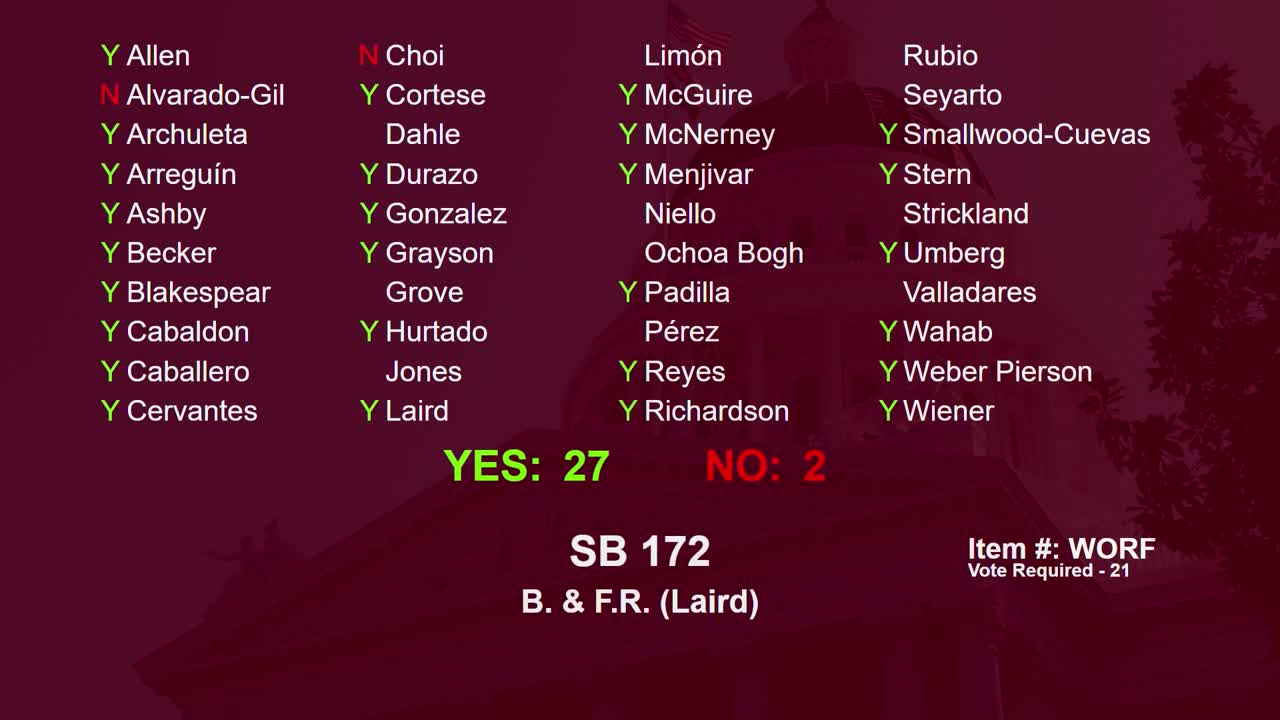

Bill Author
Bill Co-Author(s):