SB 972: California Financing Law: commercial loans: investment advisers.
- Session Year: 2025-2026
- House: Senate
- Latest Version Date: 2026-02-04
Current Status:
In Progress
(2026-05-14: May 14 hearing: Held in committee and under submission.)
Introduced
In Committee
Awaiting First Chamber Vote
Passed First Chamber
In Committee
Awaiting Second Chamber Vote
Passed Second Chamber
Enacted
Existing law, the California Financing Law, generally regulates the business of finance lenders and brokers and prohibits any person from engaging in those businesses without obtaining a license from the Commissioner of Financial Protection and Innovation. Existing law also imposes various requirements on licensees who offer or sell commercial loans, as defined.
This bill would authorize an investment adviser that is registered with the United States Securities and Exchange Commission, known as an SEC-registered investment adviser, to apply for and obtain a finance lender license to act on its own behalf and on behalf of any client account if all lending activity conducted pursuant to the license is limited to commercial loans, in accordance with certain requirements. The bill would provide that a license obtained by an SEC-registered investment adviser to act as a finance lender covers any affiliate of the SEC-registered investment adviser that is also an SEC-registered investment adviser. The bill would require the SEC-registered investment adviser to maintain and file with the commissioner an appendix to its license application and renewals, listing each client account, as defined. Under the bill, as a condition of licensure, the SEC-registered investment adviser would be required to obtain and maintain a surety bond, complete background checks, meet minimum net worth and commercial loan threshold requirements, and file specified information with the commissioner under oath, subject to penalty of perjury. The bill also would authorize the commissioner to adopt rules and regulations as necessary to implement and administer these provisions. By expanding the scope of the crime of perjury, the bill would impose a state-mandated local program.
The California Constitution prohibits usury, which is the loan or forbearance of any money, goods, or things at a rate of interest in excess of specified rates, but exempts certain transactions and lenders from these provisions, and allows the Legislature to exempt additional classes of persons by statute. Existing law, the California Financing Law, establishes a class of exempt persons pursuant to the constitutional provision on usury that includes personal property brokers and specified lenders.
This bill would provide that the class of exempt persons under the California Financing Law includes each person within the meaning of client account, as defined, to which the above-described provision on investment advisors applies.
Existing constitutional provisions require that a statute that limits the right of access to the meetings of public bodies or the writings of public officials and agencies be adopted with findings demonstrating the interest protected by the limitation and the need for protecting that interest.
This bill would make legislative findings to that effect.
The California Constitution requires the state to reimburse local agencies and school districts for certain costs mandated by the state. Statutory provisions establish procedures for making that reimbursement.
This bill would provide that no reimbursement is required by this act for a specified reason.
To accomplish its underlying purposes and policies, this division creates a class of exempt persons pursuant to Section 1 of Article XV of the California Constitution. The class of exempt persons includes each person within the meaning of a client account, as defined in paragraph (2) of subdivision (c) of Section 22100.3, to which Section 22100.3 applies.
It is the intent of the Legislature to preserve existing exemptions under Section 1 of Article XV of the California Constitution and statutory law for (a) personal property brokers formerly regulated by the Personal Property Brokers Law; (b) lenders formerly regulated by the Consumer Finance Lenders Law; and (c) lenders formerly regulated by the Commercial Finance Lenders Law; and no finding that any provision of this division is invalid with respect to a particular lender or class of lenders shall affect the enforceability of this division with respect to any of the foregoing classifications of lenders, which shall in all events continue to be exempted by this division.
SEC. 2.Section 22100.3 is added to the Financial Code, to read:22100.3.(a)(1)An investment adviser that is registered with the United States Securities and Exchange Commission, known as an SEC-registered investment adviser, may apply for and obtain a finance lender license under this section and Section 22100 to act on its own behalf and on behalf of any client account if all lending activity conducted pursuant to the license is limited to commercial loans, as described in this section.
(2)Any reference in this section to an SEC-registered investment adviser shall also include a relying adviser, affiliate, or affiliated adviser, as the context requires.
(b)A license obtained by an SEC-registered investment adviser to act as a finance lender shall cover any affiliate of the SEC-registered investment adviser that is also an SEC-registered investment adviser, including any relying advisers, affiliates, or affiliated advisers, as those terms are defined by the Securities and Exchange Commission for purposes of investment adviser registration and reporting forms, with those affiliated advisers listed on an appendix, as modified pursuant to paragraph (1) of subdivision (c), and labeled as such with the SEC-registered investment advisers application for a finance lender license.
(c)(1)The SEC-registered investment adviser shall maintain and file with the commissioner an appendix to its license application and renewals, listing each client account, as defined in paragraph (2). The appendix shall include, for each affiliated adviser and each client account, the legal name and the jurisdiction of formation. The SEC-registered investment adviser shall update the appendix as necessary to reflect any changes in the list of affiliated advisers and the list of client accounts, which shall include any additions or removals from the list, engaging in, or that may engage in, as determined by the SEC-registered investment adviser, commercial lending activity in the State of California.
(2)For purposes of this section, client account means any account, fund, pooled investment vehicle, special purpose vehicle, subsidiary, or similar vehicle or person sponsored, advised, managed, subadvised, or submanaged by the SEC-registered investment adviser or by any affiliated adviser registered investment adviser or any affiliated adviser that may engage in commercial lending activity in this state.
(d)A license issued to an SEC-registered investment adviser by the commissioner pursuant to this section shall authorize the adviser and its affiliated advisers to engage in commercial lending activities in this state through any of their respective client accounts listed on the appendix at the time of those commercial lending activities, without the need for a separate license for each affiliated adviser client account. The SEC-registered investment adviser shall be deemed the sole licensee for all activities conducted through its listed client accounts, except as otherwise provided in this section.
(e)(1)For purposes of the background investigation and fingerprinting requirements set forth in this article, only those individuals, even if not affiliated with the adviser, who both (A) directly control the advisory activities of the SEC-registered investment adviser or any of its affiliated advisers and (B) hold direct responsibility for making an investment decision to engage in any particular commercial lending transaction in this state shall be required to submit fingerprint images and related information to the Department of Justice.
(2)For the avoidance of doubt, and for the purposes of paragraph (1), both of the following conditions apply:
(A)Fingerprint images shall be submitted to the Department of Justice solely on a one-time basis per individual at the time of the initial application or in any amendment adding the person.
(B)A presumption of control shall not apply to any SEC-registered investment adviser with respect to any affiliated adviser or client account.
(3)The term control, as used in this section, means the possession, direct or indirect, of the power to direct or cause the direction of the management and policies of a person. Control shall not be construed to mean, or deemed to refer to, control as defined by the Securities and Exchange Commission in the Glossary of Terms contained in the Uniform Application for Investment Adviser Registration and Report by Exempt Reporting Advisers (Form ADV) in the rules promulgated pursuant to the Investment Advisers Act of 1940.
(f)(1)The SEC-registered investment adviser shall obtain and maintain a surety bond in accordance with this subdivision.
(2)The surety bond shall be in an amount of not less than twenty-five thousand dollars ($25,000) per client account listed on the appendix, in the aggregate.
(3)The bond may be obtained either for each client account individually or by the relevant SEC-registered investment adviser on behalf of some or all of its client accounts, provided that the total bond amount is at least twenty-five thousand dollars ($25,000) multiplied by the number of client accounts listed on the appendix.
(4)The bond shall be payable to the commissioner and issued by an insurer authorized to do business in this state, and shall be used for the recovery of expenses, fines, and fees levied by the commissioner or for losses or damages incurred by borrowers or consumers as the result of noncompliance with the requirements of this section, provided, however, that the bond shall only be utilized if the SEC-registered investment adviser and relevant client accounts do not directly cover the expenses, fines, and fees.
(g)(1)The SEC-registered investment adviser shall be responsible for ensuring that all commercial lending activities conducted by or through one of its affiliated advisers or their respective listed client accounts comply with the requirements of this section and any regulations promulgated thereunder.
(2)The commissioner may hold the SEC-registered investment adviser accountable for any violations of this section arising from the lending activities of its or any of its affiliated advisers listed client accounts.
(3)Paragraph (2) shall not limit the availability of any indemnification provided for the benefit of the SEC-registered investment adviser or its affiliated advisers.
(h)Each client account listed on the appendix shall be subject to the minimum net worth requirement set forth in this section. For purposes of this section, the minimum net worth requirement shall be deemed satisfied with respect to a client account if, within 90 days of the filing of the appendix and, thereafter, at all times during the remaining term of the client account, either of the following conditions are satisfied:
(1)The client account maintains a net worth of at least twenty-five thousand dollars ($25,000).
(2)The client account has binding contractual capital commitments from one or more investors or affiliates to fund at least twenty-five thousand dollars ($25,000) in equity.
(i)The SEC-registered investment adviser shall provide to the commissioner, at the time of initial application and upon each renewal, a representation letter for each client account listed on the appendix. The representation letter shall certify, on behalf of each client account, that the client account either maintains the required minimum net worth or has binding contractual capital commitments to fund the required minimum equity amount as described above. The representation letter shall be executed by an authorized officer or representative of the SEC-registered investment adviser with knowledge of the financial condition and capital commitments of the client account.
(j)Except as specifically set forth in subdivisions (f) and (h), no further guarantee, surety, capital commitment, or net worth requirements, obligations, or conditions shall apply to any SEC-registered investment adviser, any affiliate adviser, or client account for purposes of compliance with this section.
(k)(1)Each licensee shall file an annual report with the commissioner on or before March 15. This report shall provide all relevant information that the commissioner reasonably requires regarding the commercial lending activities conducted by the licensees client account within the State of California during the preceding calendar year for each licensed place of business. The annual report shall generally be made available to the public for inspection, except that, upon request in the annual report, the balance sheet of a sole proprietor or any other nonpublicly traded person, defined as a person with securities owned by 35 or fewer individuals, may be withheld from public inspection. All reports shall be made under oath and in the form prescribed by the commissioner. In addition to the annual report, a licensee shall submit any other special reports that may be reasonably required by the commissioner.
(2)The licensee may submit, on behalf of their relevant affiliated advisers and their respective client accounts, a single aggregated summary of lending activity and California lending activity in satisfaction of the annual reporting requirement. For the sake of clarity, rather than submitting individual reports for each client account, the adviser may provide a consolidated report that encompasses the aggregated relevant activities of all relevant affiliated advisers and their respective client accounts. Any fees assessed in connection with the annual reporting requirement shall be based on the aggregated reporting, rather than being calculated on a per-client account basis, in order to streamline the reporting process.
(l)(1)The availability of reliance on the licensing process under this section shall be strictly limited to the activity of those client accounts of an SEC-registered investment adviser that are engaged in making commercial loans on a privately originated basis in a minimum aggregate amount exceeding five hundred thousand dollars ($500,000). This licensing process shall not be available to the activity of those client accounts to the extent the client account engages in any of the following activities:
(A)Mortgage loan origination.
(B)Consumer lending.
(C)Making a commercial finance offer or a commercial loan in an amount equal to or less than five hundred thousand dollars ($500,000) per specific commercial financing offer.
(2)Any client account of an SEC-registered investment adviser, to the extent the client account engages in mortgage loan origination, consumer loans, or makes a commercial finance offer or a commercial loan that is equal to or less than five hundred thousand dollars ($500,000), shall not be eligible to utilize the SEC-registered investment adviser licensing process set forth in this section for that specific commercial financing offer.
(m)The commissioner may adopt rules and regulations as necessary to implement and administer this section, including, but not limited to, requirements for applications, reporting, and the supervision of commercial lending activities conducted by SEC-registered investment advisers and their listed client accounts.
SEC. 3.The Legislature finds and declares that Section 2 of this act, which adds Section 22100.3 to the Financial Code, imposes a limitation on the publics right of access to the meetings of public bodies or the writings of public officials and agencies within the meaning of Section 3 of Article I of the California Constitution. Pursuant to that constitutional provision, the Legislature makes the following findings to demonstrate the interest protected by this limitation and the need for protecting that interest:
This act balances the right of the public to access public records while also preserving the confidentiality of certain financial information.
SEC. 4.No reimbursement is required by this act pursuant to Section 6 of Article XIIIB of the California Constitution because the only costs that may be incurred by a local agency or school district will be incurred because this act creates a new crime or infraction, eliminates a crime or infraction, or changes the penalty for a crime or infraction, within the meaning of Section 17556 of the Government Code, or changes the definition of a crime within the meaning of Section 6 of Article XIIIB of the California Constitution.
|
Date
|
Status
|
|---|---|
| May 14, 2026 | May 14 hearing: Held in committee and under submission. |
| May 8, 2026 | Set for hearing May 14. |
| Apr 20, 2026 | April 20 hearing: Placed on APPR. suspense file. |
| Apr 10, 2026 | Set for hearing April 20. |
| Apr 8, 2026 | From committee: Do pass and re-refer to Com. on APPR. with recommendation: To consent calendar. (Ayes 12. Noes 0. Page 3757.) (April 7). Re-referred to Com. on APPR. |
| Apr 8, 2026 | From committee: Do pass and re-refer to Com. on APPR. with recommendation: To consent calendar. (Ayes 12. Noes 0.) (April 7). Re-referred to Com. on APPR. |
| Mar 25, 2026 | Set for hearing April 7. |
| Mar 18, 2026 | From committee: Do pass and re-refer to Com. on JUD. (Ayes 6. Noes 0. Page 3599.) (March 18). Re-referred to Com. on JUD. |
| Mar 18, 2026 | From committee: Do pass and re-refer to Com. on JUD. (Ayes 6. Noes 0.) (March 18). Re-referred to Com. on JUD. |
| Feb 24, 2026 | Set for hearing March 18. |
| Feb 11, 2026 | Referred to Coms. on B. & F.I. and JUD. |
| Feb 5, 2026 | From printer. May be acted upon on or after March 7. |
| Feb 4, 2026 | Introduced. Read first time. To Com. on RLS. for assignment. To print. |
|
Date
|
Description
|
Location
|
Votes
|
|
|---|---|---|---|---|
| Apr 20, 2026 | Placed on suspense file | Senate Standing Committee on Appropriations |
Passed |
|
| Apr 7, 2026 | Do pass, but first be re-referred to the Committee on [Appropriations] with the recommendation: To Consent Calendar | Senate Standing Committee on Judiciary |
Passed |
|
| Mar 18, 2026 | Do pass, but first be re-referred to the Committee on [Judiciary] | Senate Standing Committee on Banking and Financial Institutions |
Passed |
This list shows positions taken on this bill by organizations on the date displayed, which is linked to the original source.
Positions by individuals are not included.
|
Organization
|
Position
|
Date
|
|---|---|---|
| Agl Credit Management LP | ** Support | |
| Antares Capital LP | ** Support | |
| Ares Management LLC | ** Support | |
| Canyon Partners LLC | ** Support | |
| Churchill Asset Management LLC | ** Support | |
| Crescent Capital Group LP | ** Support | |
| Elevate California | ** Support | |
| LSTA | ** Support | |
| Oaktree Capital Management, L.P. | ** Support | |
| Oaktree Capital Management, L.P. And Its Affiliate Ocm Investments, LLC | ** Support | |
| PGIM | ** Support |
SENATE COMMITTEE ON
Senator Sabrina Cervantes, Chair
2025 - 2026 Regular Session
SB 972 (Grayson) - California Financing Law: commercial loans: investment advisers
Version: | Policy Vote: |
Urgency: | Mandate: |
Hearing Date: | Consultant: |
Bill Summary:
SB 972 establishes an alternative licensure process under the California Financing Law (CFL) for entities making large commercial loans through U.S. Securities and Exchange Commission (SEC)-registered investment advisers (RIA).
Fiscal Impact:
Unknown, potentially significant fiscal impact to the Department of Financial Protection and Innovation (DFPI) (Financial Protection Fund or General Fund). One-time costs may include workload associated with promulgating regulations. While the total operating costs for the department to administer the program will depend on the number of new licensees, license fees may offset these costs to some extent.
Background:
The CFL is a licensing framework administered by the DFPI to regulate the activities of non-bank lenders, brokers, and Property Assessed Clean Energy (PACE) program administrators doing business in California. The law is designed to ensure an adequate supply of credit, foster competition among lenders, and protect borrowers from unfair or deceptive practices. The CFL covers a wide range of loan products, such as a $500 unsecured consumer loan, a $20,000 automobile loan, a $500,000 mortgage loan, a $200,000 loan to a small business, and a multi-million dollar loan to a mid-size or large corporation. While the regulations that apply to each type of loan vary, the persons providing the loans must each undertake a similar process in applying for a CFL license and complying with the administrative aspects of the licensing law.
Proposed Law:
- Authorizes an SEC-RIA to apply for and obtain a CFL license to act on its own behalf and on behalf of any client account. Provides that an “SEC-registered investment adviser” include a “relying adviser,” “affiliate,” or “affiliated adviser,” as the context requires.
- Defines “client account” to mean any account, fund, pooled investment vehicle, special purpose vehicle, subsidiary, or similar vehicle or person sponsored, advised, managed, subadvised, or submanaged by the RIA or by any affiliated RIA or any affiliated adviser that may engage in commercial lending activity in this state.
- Requires an RIA to maintain and file with the Commissioner of DFPI an appendix to its license application and renewals, listing each client account. Requires the appendix to include, for each affiliated adviser and each client account, the legal name and the jurisdiction of formation. Requires an RIA to update the appendix as necessary.
- Provides that a license issued to an RIA shall authorize the adviser and its affiliated advisers to engage in commercial lending activity through any of their respective client accounts listed on the appendix at the time of those commercial lending activities, without the need for a separate license for each affiliated adviser client account.
- For the purposes of the background investigation and fingerprint requirements required by the CFL, provides that only those individuals, even if not affiliated with the adviser, who both (A) directly control the advisory activities of the RIA or any of its affiliate advisers and (B) hold direct responsibility for making an investment decision to engage in any particular commercial lending transaction shall be required to submit fingerprint images and related information to the Department of Justice, as specified.
- Limits CFL activities under such a license to the activity of client accounts that are engaged in making commercial loans on a privately originated basis in a minimum aggregate amount exceeding $500,000, and specifically prohibits mortgage loan origination, consumer lending, or making a commercial finance offer in an amount of less than $500,000 per specific offer.
- Requires an RIA to maintain and file with DFPI an appendix to its license application and renewals that lists each client account engaging in, or that may engage in, commercial lending activity.
- Requires the RIA to obtain and maintain a surety bond of $25,000 per client account, as specified.
- Requires each client account to maintain a minimum net worth of $25,000, as specified.
- Requires an RIA to provide to DFPI, at the time of application and upon each renewal, a representation for each client account, certifying that each client account maintains the minimum net worth requirement.
- Requires each licensee to file an annual report with DFPI providing all relevant information that DFPI reasonably requires related to commercial lending activity conducted by the licensee’s client accounts.
- Provides that the licensee may submit, on behalf of their relevant affiliated advisers and client accounts, a single aggregated summary of lending activity, as specified.
- Requires the annual report to be available for public inspection, except that, upon request in the annual report, the balance sheet of a sole proprietor or any other nonpublicly traded person may be withheld from public inspection.
- “Nonpublicly traded person” is defined as a person with securities owned by 35 or fewer individuals.
- Authorizes DFPI to adopt rules and regulations necessary to implement and administer the licensure process established by this bill.
-- END --
Senator Thomas Umberg, Chair
2025-2026 Regular Session
Bill No: SB 972 (Author:Grayson)
Version: February 4, 2026
Hearing Date: April 7, 2026
Fiscal: Yes
Urgency: No
Consultant: AM
SUBJECT
California Financing Law: commercial loans: investment advisers
DIGEST
This bill establishes an alternative licensure process under the Consumer Financing Law (CFL) for an investment adviser that is registered with the U. S. Securities and Exchange Commission (SEC). The bill would allow certain financial information contained in an annual report to be exempt from public disclosure.
EXECUTIVE SUMMARY
The intent of this bill is to ensure that SEC-registered investment advisors (RIAs) remain licensed and regulated under the CFL, but also are able to quickly deploy capital to businesses in California. The provisions of the bill in this Committee’s jurisdiction pertain to limiting access to public records, and as such, this analysis will focus on that provision. The bill is sponsored by LSTA and supported by various investment advisors and Congressman Brad Sherman. There is no known opposition. The bill passed the Senate Committee on Banking and Financial Institutions on a vote of 6 to 0.
PROPOSED CHANGES TO THE LAW
Existing law:
- Requires the licensure and oversight of businesses that provide commercial loans in the state by the Department of Financial Protection and Innovation (DFPI), pursuant to the California Financing Law (CFL). (Fin. Code §§ 22000 et seq.)
- Exempts from the CFL a person who makes no more than one loan in a 12-month period if that loan is a commercial loan. (Fin. Code § 22050.5.)
- Defines “commercial loan” as a loan of a principal amount of $5,000 or more, or any loan under an open-end credit program, the proceeds of which are intended by the borrower for use primarily for other than personal, family, or household purposes. (Fin. Code § 22502.)
- Prohibits a person from engaging in the business of a finance lender or broker without obtaining a license under the CFL. (Fin. Code § 22100.)
- Requires an applicant for licensure under the CFL to, among other things:
- submit fingerprints for the purposes of a criminal history record check; and (Fin. Code § 22101.5.)
- submit financial statements that indicate a minimum net worth of at least $25,000. (Fin. Code § 22104.)
- Requires a licensee to maintain a surety bond of $25,000, to be used for the recovery of expenses, fines, and fees levied by DFPI for noncompliance with the CFL. (Fin. Code § 22112.)
- Prohibits a person subject to the CFL from doing any of the following:
- making a materially false or misleading statement or representation to a borrower about the terms or conditions of that borrower’s loan, when making or brokering the loan;
- engaging in false, misleading, or deceptive advertising;
- engaging in any act in violation of Section 17200 of the Business and Professions Code (known as the Unfair Competition Law);
- knowingly misrepresenting, circumventing, or concealing, through subterfuge or device, any material aspect or information regarding a transaction to which the person is a party; or
- committing an act that constitutes fraud or dishonest dealings. (Fin. Code § 22161.)
- Requires certain licensees to file an annual report with the Commissioner of Financial Protection and Innovation (Commissioner) providing the relevant information that the Commissioner reasonably requires concerning the business and operations conducted by the licensee within the state during the preceding calendar year for each licensed place of business. (Fin. Code § 22159 & 23026.)
- Requires the annual reports to be made available to the public for inspection, except upon request in the annual report to the Commissioner, the balance sheet of a sole proprietor or any other nonpublicly traded person.
- “Nonpublicly traded person” is defined as persons with securities owned by 35 or fewer individuals. (Ibid.)
- Provides, pursuant to the California Constitution, that the people have the right of access to information concerning the conduct of the people’s business, and, therefore, the meetings of public bodies and the writings of public officials and agencies are required to be open to public scrutiny. (Cal. const. art. I, § 3(b)(1).)
- Requires a statute to be broadly construed if it furthers the people’s right of access, and narrowly construed if it limits the right of access. (Cal. const. art. I, § 3(b)(1).)
- Requires a statute that limits the public’s right of access to be adopted with findings demonstrating the interest protected by the limitation and the need for protecting that interest. (Cal. const. art. I, § 3(b)(1).)
- Governs the disclosure of information collected and maintained by public agencies pursuant to the CPRA. (Gov. Code §§ 7920.000 et seq.)
- States that the Legislature, mindful of the individual right to privacy, finds and declares that access to information concerning the conduct of the people’s business is a fundamental and necessary right of every person in this state. (Gov. Code § 7921.000.)
- Defines “public records” as any writing containing information relating to the conduct of the public’s business prepared, owned, used, or retained by any state or local agency regardless of physical form or characteristics. (Gov. Code § 7920.530.)
- Provides that all public records are accessible to the public upon request, unless the record requested is exempt from public disclosure. (Gov. Code § 7922.530.)
This bill:
- Authorizes an RIA that is registered with the United State Securities and Exchange Commission (SEC) to apply for and obtain a CFL license to act on its own behalf and on behalf of any client account.
- Provides that a license covers any affiliate of the RIA if that affiliate is also an RIA, as specified.
- Defines “client account” as any account, fund, pooled investment vehicle, special purpose vehicle, subsidiary, or similar vehicle or person sponsored, advised, managed, subadvised, or submanaged by the SEC-registered investment adviser or by any affiliated adviser registered investment adviser or any affiliated adviser that may engage in commercial lending activity in California.
- Provides that, for the purposes of the background investigation and fingerprint requirements under the CFL, only those individuals, even if not affiliated with the adviser, who both: (a) directly control the advisory activities of the RIA or any of its affiliate advisers; and (b) hold direct responsibility for making an investment decision to engage in any particular commercial lending transaction, are required to submit fingerprint images and related information to the Department of Justice, as specified.
- Limits activities under such a license to the activity of client accounts that are engaged in making commercial loans on a privately originated basis in a minimum aggregate amount exceeding $500,000, and specifically prohibits mortgage loan origination, consumer lending, or making a commercial finance offer in an amount of less than $500,000 per specific offer.
- Requires an RIA to maintain and file with DFPI an appendix to its license application and renewals that lists each client account engaging in, or that may engage in, commercial lending activity.
- Requires the RIA to obtain and maintain a surety bond of $25,000 per client account, as specified.
- Requires each client account to maintain a minimum net worth of $25,000, as specified.
- Requires an RIA to provide to DFPI, at the time of application and upon each renewal, a representation for each client account, certifying that each client account maintains the minimum net worth requirement.
- Requires each licensee to file an annual report with DFPI providing all relevant information that DFPI reasonably requires related to commercial lending activity conducted by the licensee’s client accounts.
- Provides that the licensee may submit, on behalf of their relevant affiliated advisers and client accounts, a single aggregated summary of lending activity, as specified.
- Requires the annual report to be available for public inspection, except that, upon request in the annual report, the balance sheet of a sole proprietor or any other nonpublicly traded person may be withheld from public inspection.
- “Nonpublicly traded person” is defined as a person with securities owned by 35 or fewer individuals.
- States that the “act balances the right of the public to access public records while also preserving the confidentiality of certain financial information.”
COMMENTS
- Stated need for the bill
The author writes:
SB 972 updates the California Financing Law (CFL) to provide a streamlined licensure process for certain large commercial loan transactions. The bill allows an SEC-registered investment adviser (RIA) to obtain a CFL license that authorizes the adviser to make commercial loans of greater than $500,000 directly, through affiliate advisers, or on behalf of client accounts. Through this streamlined process, an RIA can deploy capital on behalf of its clients to finance businesses and projects in California that would otherwise not benefit from such capital. By expanding the pool of investable capital, this bill has the potential to reduce the cost and increase the availability of capital for California business and projects, which can contribute to more jobs and greater economic growth. SB 972 provides a tailored approach to amending the CFL with the goal of avoiding fiscal strains on the CFL program and maintaining oversight authority sufficient to protect the integrity of the nonbank lending market in California.
- This bill establishes an alternative licensure process under the CFL for SEC-registered investment advisers
According to the Senate Committee on Banking and Finance, obtaining a license under the CFL can take anywhere from six to eighteen months.[1] This bill seeks to establish an alternative licensure process under the CFL that allows an SEC-registered investment adviser (RIA) to obtain an umbrella license that covers the commercial lending activity of the RIA, any affiliated advisers, and the investment funds that the RIAs advise. The Senate Committee on Banking and Finance notes that the “intent of this bill is to alleviate the frictions caused by the CFL licensure process, not to facilitate evasion of the requirements of the law. The RIA that holds the CFL license remains subject to the provisions of the CFL that pertain to commercial lending, and the bill provides that the licensee is responsible for the compliance of any affiliates or funds under the umbrella license.”[2]
- Limiting access to personal identifying information collected by state and local agencies appears consistent with the state’s right to privacy
Access to information concerning the conduct of the people’s business is a fundamental and necessary right of every person in this state. (Gov. Code § 7921.000.) In 2004, the right of public access was enshrined in the California Constitution with the passage of Proposition 59 (Nov. 3, 2004, statewide general election),[3] which amended the California Constitution to specifically protect the right of the public to access and obtain government records: “The people have the right of access to information concerning the conduct of the people’s business, and therefore . . . the writings of public officials and agencies shall be open to public scrutiny.” (Cal. Const., art. I, sec. 3 (b)(1).) In 2014, voters approved Proposition 42 (Jun. 3, 2014, statewide direct primary election)[4] to further increase public access to government records by requiring local agencies to comply with the CPRA and the Ralph M. Brown Act[5], and with any subsequent statutory enactment amending either act, as provided. (Cal. Const., art. I, sec. 3 (b)(7).)
Under the CPRA, public records are open to inspection by the public at all times during the office hours of the agency, unless they are exempt from disclosure. (Gov. Coed § 7922.525.) A public record is defined as any writing containing information relating to the conduct of the public’s business that is prepared, owned, used, or retained by any public agency regardless of physical form or characteristics. (Gov. Code § 7920.530.) There are several general categories of documents or information that are permissively exempt from disclosure under the CPRA essentially due to the character of the information. The exempt information can be withheld by the public agency with custody of the information, but it also may be disclosed if it is shown that the public’s interest in disclosure outweighs the public’s interest in non-disclosure of the information. (CBS, Inc. v. Block (1986) 42 Cal.3d 646, at 652.). Additionally, some records are prohibited from disclosure or are specifically stated to not be public records. (see Gov. Code § 7924.110(a).)
California generally recognizes that public access to information concerning the conduct of the people’s business is a fundamental and necessary right.[6] At the same time, the state recognizes that this right must be balanced against the right to privacy.[7] The general right of access to public records may, therefore, be limited when records include personal or sensitive information.
Under the bill, certain information contained in the annual report provided to DFPI by an RIA can be withheld from public disclosure upon request of the RIA. This information is the balance sheet of a sole proprietor or any other nonpublicly traded person, which is defined as a person with securities owned by 35 or fewer individuals. The bill states that this limitation “balances the right of the public to access public records while also preserving the confidentiality of certain financial information.” This limitation is consistent with existing law, which allows this same information to be withheld from public disclosure for other licensees under the CFL.[8] In light of this, the finding in the bill regarding the need for limiting access to public records seems warranted.
- Statements in support
LSTA, a not-for-profit trade association that advocates for the U.S. corporate lending market, is the sponsor of the bill. LSTA writes in support stating:
[…] SB 972 will open new avenues for capital formation in California by enabling investment advisers to deploy private capital for commercial loans under a transparent, state-regulated framework. By creating a robust and more efficient licensing procedure through the Department of Financial Protection and Innovation (DFPI), SB 972 provides the certainty needed for institutional and managed funds to participate more actively in California’s commercial lending markets.
Expanding responsible commercial lending capacity is good for California. Increased access to capital supports mid-sized and large businesses in California, fuels job creation, and strengthens regional economic growth. Diversified sources of regulated private capital, in addition to traditional bank lending, are essential to maintaining economic momentum across the state. […]
SUPPORT
LSTA (sponsor)
Congressman Brad Sherman
AGL Credit Management LP
Antares Capital LP
Ares Management LLC
Canyon Partners LLC
Churchill Asset Management LLC
Crescent Capital Group LP
Elevate California
Oaktree Capital Management, L.P.
PGIM
OPPOSITION
None received
RELATED LEGISLATION
Pending Legislation: None known.
Prior Legislation:
AB 2981 (Chen, 2024) would have specified that a commercial finance lender that does not make or broker residential mortgage loans or consumer loans is deemed a licensee under the CFL if that finance lender makes five or fewer commercial loans annually and the principal amount of each loan exceeds $350,000. AB 2981 was held in the Assembly Appropriations Committee.
PRIOR VOTES
Senate Committee on Banking and Financial Instituions (6 Ayes, 0 Noes)
**************
Sen. Comm. on Banking and Fin. Analysis of SB 972 (2025-26 reg. sess.) introduced Feb. 4, 2026, at p. 4. ↑
Id. at p. 5. ↑
Prop. 59 was placed on the ballot by a unanimous vote of both houses of the Legislature. (SCA 1 (Burton, Ch. 1, Stats. 2004).) ↑
Prop. 42 was placed on the ballot by a unanimous vote of both houses of the Legislature. (SCA 3 (Leno, Ch. 123, Stats. 2013).) ↑
The Ralph M. Brown Act is the open meetings laws that applies to local agencies. (Gov. Code §§ 59450 et. seq.) ↑
Cal. Const., art. I, § 3; Gov. Code, § 7921.000. ↑
Cal. Const., art. I, § 1. ↑
See Fin. Code §§ 22159 & 23026. ↑
SENATE COMMITTEE ON
BANKING AND FINANCIAL INSTITUTIONS
Senator Timothy Grayson, Chair
2025 - 2026 Regular
Bill No: SB 972 Hearing Date: March 18, 2026
Author: | Grayson | ||
Version: | February 4, 2026 Introduced | ||
Urgency: | No | Fiscal: | Yes |
Consultant: | Michael Burdick | ||
Subject: California Financing Law: commercial loans: investment advisers
SUMMARY
This bill establishes a tailored licensing process under the California Financing Law for entities making large commercial loans through SEC-registered investment advisers.
EXISTING LAW
- Requires the licensure and oversight by the Department of Financial Protection and Innovation (DFPI) of businesses that provide commercial loans in the state, pursuant to the California Financing Law (CFL). (Division 9 of the Financial Code, Section 22000 et seq.)
- Defines “commercial loan” as a loan of a principal amount of $5,000 or more, or any loan under an open-end credit program, the proceeds of which are intended by the borrower for use primarily for other than personal, family, or household purposes. (Financial Code Section 22502)
- Exempts from the CFL a person who makes no more than one loan in a 12-month period if that loan is a commercial loan. (Financial Code Section 22050.5)
- Prohibits a person from engaging in the business of a finance lender or broker without obtaining a CFL license. (Financial Code Section 22100)
- Requires a CFL applicant to submit fingerprints for the purposes of a criminal history record check. (Financial Code Section 22101.5)
- Requires a CFL applicant to submit financial statements that indicate a minimum net worth of at least $25,000. (Financial Code Section 22104)
- Upon the filing of a CFL application, requires DFPI to investigate the applicant, its principal officers, directors, managing members, and persons owning or controlling, directly or indirectly, 10 percent or more of the outstanding equity securities or any person responsible for the conduct of the applicant’s lending activities. (Financial Code Section 22105)
- Requires each CFL licensee to pay its pro rata share of all costs and expenses reasonably incurred by DFPI in the administration of the CFL, as specified. (Financial Code Section 22107)
- Requires a CFL licensee to maintain a surety bond of $25,000, to be used for the recovery of expenses, fines, and fees levied by DFPI, related to noncompliance with the CFL. (Financial Code Section 22112)
- Requires a CFL licensee to file an annual report by March 15, giving the relevant information that DFPI reasonably requires concerning the business and operations conducted by the licensee. (Financial Code Section 22159)
- Prohibits a person subject to the CFL from doing any of the following:
- Making a materially false or misleading statement or representation to a borrower about the terms or conditions of that borrower’s loan, when making or brokering the loan.
- Engaging in false, misleading, or deceptive advertising.
- Engaging in any act in violation of Section 17200 of the Business and Professions Code (the Unfair Competition Law).
- Knowingly misrepresenting, circumventing, or concealing, through subterfuge or device, any material aspect or information regarding a transaction to which the person is a party.
- Committing an act that constitutes fraud or dishonest dealings. (Financial Code Section 22161)
THIS BILL
- Authorizes an investment adviser that is registered with the United State Securities and Exchange Commission (SEC) to apply for and obtain a CFL license to act on its own behalf and on behalf of any client account, pursuant to the following specifications:
- Defines “client account” as any account, fund, pooled investment vehicle, special purpose vehicle, subsidiary, or similar vehicle or person sponsored, advised, managed, subadvised, or submanaged by the SEC-registered investment adviser or by any affiliated adviser registered investment adviser or any affiliated adviser that may engage in commercial lending activity in California.
- Provides that a license covers any affiliate of the SEC-registered investment adviser (RIA) if that affiliate is also an RIA, as specified.
- Provides that a license issued to an RIA shall authorize the adviser and its affiliated advisers to engage in commercial lending activity through any of their respective client accounts listed on the appendix at the time of those commercial lending activities, without the need for a separate license for each affiliated adviser client account.
- For the purposes of the background investigation and fingerprint requirements required by the CFL, provides that only those individuals, even if not affiliated with the adviser, who both (A) directly control the advisory activities of the RIA or any of its affiliate advisers and (B) hold direct responsibility for making an investment decision to engage in any particular commercial lending transaction shall be required to submit fingerprint images and related information to the Department of Justice, as specified.
- Limits CFL activities under such a license to the activity of client accounts that are engaged in making commercial loans on a privately originated basis in a minimum aggregate amount exceeding $500,000, and specifically prohibits mortgage loan origination, consumer lending, or making a commercial finance offer in an amount of less than $500,000 per specific offer.
- Requires an RIA to maintain and file with DFPI an appendix to its license application and renewals, listing each client account engaging in or that may engage in commercial lending activity.
- Requires the RIA to obtain and maintain a surety bond of $25,000 per client account, as specified.
- Requires each client account to maintain a minimum net worth of $25,000, as specified.
- Requires an RIA to provide to DFPI, at the time of application and upon each renewal, a representation for each client account, certifying that each client account maintains the minimum net worth requirement.
- Provides that each licensee shall file an annual report with DFPI on or before March 15, providing all relevant information that DFPI reasonably requires related to commercial lending activity conducted by the licensee’s client accounts. Provides that the licensee may submit, on behalf of their relevant affiliated advisers and client accounts, a single aggregated summary of lending activity, as specified.
- Authorizes DFPI to adopt rules and regulations as necessary to implement and administer the licensure process described in this bill.
- Specifies that the class of exempt persons pursuant to the prohibition on usury in the California Constitution includes each person within the meaning of client account.
COMMENTS
- Purpose
According to the author:
SB 972 updates the California Financing Law (CFL) to provide a streamlined licensure process for certain large commercial loan transactions. The bill allows a SEC-registered investment adviser (RIA) to obtain a CFL license that authorizes the adviser to make commercial loans of greater than $500,000 directly, through affiliate advisers, or on behalf of client accounts. Through this streamlined process, an RIA can deploy capital on behalf of its clients to finance businesses and projects in California that would otherwise not benefit from such capital. By expanding the pool of investable capital, this bill has the potential to reduce the cost and increase the availability of capital for California business and projects, which can contribute to more jobs and greater economic growth. SB 972 provides a tailored approach to amending the CFL with the goal of avoiding fiscal strains on the CFL program and maintaining oversight authority sufficient to protect the integrity of the nonbank lending market in California.
- Background on the California Financing Law (CFL)
The California Financing Law (CFL) is a licensing framework administered by the Department of Financial Protection and Innovation (DFPI) to supervise and regulate the activities of non-bank lenders, brokers, and PACE program administrators doing business in California. The CFL covers a wide range of loan products, such as a $500 unsecured consumer loan, a $20,000 automobile loan, a $500,000 mortgage loan, a $200,000 loan to a small business, and a multi-million dollar loan to a mid-size or large corporation. While the regulations that apply to each type of loan vary, the persons providing the loans must each undertake a similar process in applying for a CFL license and complying with the administrative aspects of the licensing law.
As codified in statute, the underlying purposes and policies of the CFL include the following: to ensure an adequate supply of credit to borrowers; to simplify, clarify, and modernize the law governing loans made by finance lenders; to protect borrowers against unfair practices by some lenders, having due regard for the interests of legitimate and scrupulous lenders; to permit and encourage the development of fair and economically sound lending practices; and to encourage and foster a sound economic climate (Financial Code Section 22001). Clearly, the Legislature does not intend for the CFL to hinder lending that benefits both the borrower and the lender, while also recognizing that mutually beneficial lending can have positive effects on the broader economy.
Under current law and practice, the CFL inhibits the flow of capital in so-called private debt markets. Further elaboration on private debt markets is covered in the following comment, but suffice it to say that the time it takes to apply for and obtain a CFL license, anywhere from six to eighteen months, can stymie a private debt fund from allocating capital to California borrowers. This bill intends to address this challenge and modernize the CFL in a manner consistent with the underlying purposes and policies of the law.
- Private debt markets and the CFL
Private debt (or “private credit”) refers to loans made by non-bank entities, like private debt funds or business development companies (BDCs)[1], primarily to middle-sized corporations with earnings in the $5 million - $100 million range or larger. Private debt is distinct from traditional bank lending or raising capital by issuing bonds in the public markets. Just as private equity serves an important role in capital provision where public markets are not a good fit, private debt markets meet a significant demand for credit, especially for middle-market firms.
Private debt funds and BDCs typically engage in direct lending where one borrower and a single lender (or small group of lenders) bilaterally negotiate the terms of the loan. The lender anticipates holding the loan to maturity, rather than originating the loan with the intent to sell or assign portions to other investors in the secondary market. Generally, providers of private debt can offer more flexible terms to borrowers and are able to take more risk than commercial banks and can provide capital to firms that may not be large enough to issue debt in public markets at attractive pricing.
Private debt funds and BDCs fund loans with equity capital raised from investors, as well as debt financing from issuing public bonds, bank credit, and other sources. Capital raised by these entities is managed by an investment adviser, who is typically registered with the federal Securities and Exchange Commission pursuant to the Investment Advisers Act of 1940. The registered investment adviser (RIA) is the entity that directs the lending decisions for the fund. It is common for an RIA to advise more than one fund in making direct loans in the private debt markets.
Given that private debt funds and BDCs are not depository institutions that are exempt from the CFL, these entities must obtain a CFL license before engaging in the business of commercial lending in California. While the ability to ultimately obtain a license is not in question, the time it takes to obtain a license can serve as a practical impediment for some funds. Once an RIA achieves the desired capital commitments to close a funding round, investors expect the RIA to quickly deploy capital by making loans. Waiting for six to eighteen months to obtain a CFL license before making a loan in California may not be a realistic option.
The CFL provides a particular exemption that can help ease the burden of licensure, but it is far from an ideal alternative. The CFL provides an exemption for an entity that makes only one commercial loan in any 12-month period. While a one-loan-per-year exemption may satisfy some private debt funds, it is limiting for others and impedes efficient capital allocation. An RIA may pass on one or more “good” deals in California, reserving its one loan exception for an opportunity later in the year that may be better for the RIA. Certainly, a better alternative can be crafted that allows borrowers and lenders to enter into mutually beneficial transactions.
- How this bill modernizes the CFL
This bill establishes an alternative licensure approach under the CFL that allows an SEC-registered investment adviser (RIA) to obtain an umbrella license that covers the commercial lending activity of the RIA, any affiliated advisers, and the investment funds that the advisers advise. This approach would allow the RIA that holds a CFL license to raise new funds, acquire existing funds, and enter into new advisory relationships – all while facilitating commercial lending activity through those funds without applying for a new CFL license in each instance.
The intent of this bill is to alleviate the frictions caused by the CFL licensure process, not to facilitate evasion of the requirements of the law. The RIA that holds the CFL license remains subject to the provisions of the CFL that pertain to commercial lending, and the bill provides that the licensee is responsible for the compliance of any affiliates or funds under the umbrella license. DFPI retains authority to examine the licensee for compliance with the law and take enforcement action when appropriate. Additionally, the licensee is responsible for paying its pro rata share of the CFL program costs, just like any other licensee, based on the commercial lending activity conducted under the license.
In addition to streamlining the CFL process, this bill makes clear that loans made under this process are treated similarly to other loans made by CFL finance lenders under state usury law. The state constitution provides a usury cap of the greater of 10% or the federal discount rate plus 5% for commercial loans; however, this cap only applies to unregulated lenders. CFL finance lenders, as well as banks, credit unions, and other regulated financial institutions, are exempt from the cap. By providing a clear and less inhibitive path to CFL licensure, this bill will make clear that loans made through an RIA that holds a CFL license are not subject to the prohibitive usury limit in the constitution.
- Arguments in Support
LSTA, as sponsor, writes in support:
LSTA is a not-for-profit trade association that has been the leading advocate for the U.S. corporate lending market since 1995. LSTA’s mission is to promote a fair, orderly, efficient and growing corporate loan market while advancing and balancing the interests of all market participants. Our 600+ member institutions include commercial banks (ranging in size from GSIBs to community banks), investment banks, broker-dealers, asset managers, and institutional lenders, as well as law firms and market service providers. LSTA undertakes a wide variety of activities in pursuit of its mission, including advocacy, thought leadership, data analytics, education, and standardization of documents and practices.
SB 972 will open new avenues for capital formation in California by enabling investment advisers to deploy private capital for commercial loans under a transparent, state-regulated framework. By creating a robust and more efficient licensing procedure through the Department of Financial Protection and Innovation (DFPI), SB 972 provides the certainty needed for institutional and managed funds to participate more actively in California’s commercial lending markets.
Expanding responsible commercial lending capacity is good for California. Increased access to capital supports mid-sized and large businesses in California, fuels job creation, and strengthens regional economic growth. Diversified sources of regulated private capital, in addition to traditional bank lending, are essential to maintaining economic momentum across the state.
- Double Referral
This bill is double referred to the Committee on Judiciary.
- Considerations for author and DFPI
This bill is mostly clear in the method by which it creates a parallel license application process under the CFL, but there may be opportunities to improve the drafting and further clarify the interaction with existing law. As the sole administrator of the CFL, DFPI may contribute helpful technical assistance to the author to ensure the intent of the bill is carried out and to add sufficient detail in statute to reduce the rulemaking burden of the department. Committee staff identifies the following issues for additional conversation with DFPI and supporters where the author can seek additional clarification:
- Would the bill benefit from defining a new term, such as “RIA finance lender,” that can be used throughout the bill to identify a licensee that obtains a CFL license through the proposed streamlined process?
- Is the bill sufficiently clear in how provisions of this bill related to certain sections of existing law, particularly Financial Code Sections 22100, 22105, and 22159?
- A CFL license for commercial lending is not subject to “renewal” as implied by the bill. What is the best procedure for updating DFPI with the information related to client accounts required by this bill?
- Does the sponsor of the bill expect the licensed RIA to be responsible for all compliance obligations under the CFL that could pertain to the affiliated advisers or their respective client accounts? If so, the use of the word “section” in subdivision (g) of Section 22100.3 in the bill should be changed to “division.”
- Should the bill include a delayed operative date to allow DFPI the time to conduct rulemaking and other administrative requirements to implement the law?
- Prior and Related Legislation
AB 2981 (Chen) of 2024 would have specified that a commercial finance lender that does not make or broker residential mortgage loans or consumer loans shall be deemed a licensee under the California Financing Law if that finance lender makes five or fewer commercial loans annually and the principal amount of each loan exceeds $350,000. The bill was held in the Assembly Appropriations Committee.
LIST OF REGISTERED SUPPORT/OPPOSITION
Support
LSTA (sponsor)
AGL Credit Management LP
Ares Management LLC
Canyon Partners, LLC
Churchill Asset Management LLC
Congressman Brad Sherman
Crescent Capital Group LP
Elevate California
Oaktree Capital Management, L.P. and its Affiliate OCM Investments, LLC
PGIM
Opposition
None received
-- END --
BDCs are a particular type of closed-end investment fund under the federal Investment Company Act. BDCs invest in debt and equity of small and medium-sized private, or some small public, companies. The companies BDCs invest in are typically in their early stages of development or are distressed companies that may not be able to obtain bank loans or raise money from other investors. Sometimes BDCs may help manage the companies they invest in. See more at: https://www.investor.gov/introduction-investing/investing-basics/investment-products/closed-end-funds/publicly-traded-business-development-companies-bdcs, accessed on March 15, 2026. ↑
Discussed in Hearing
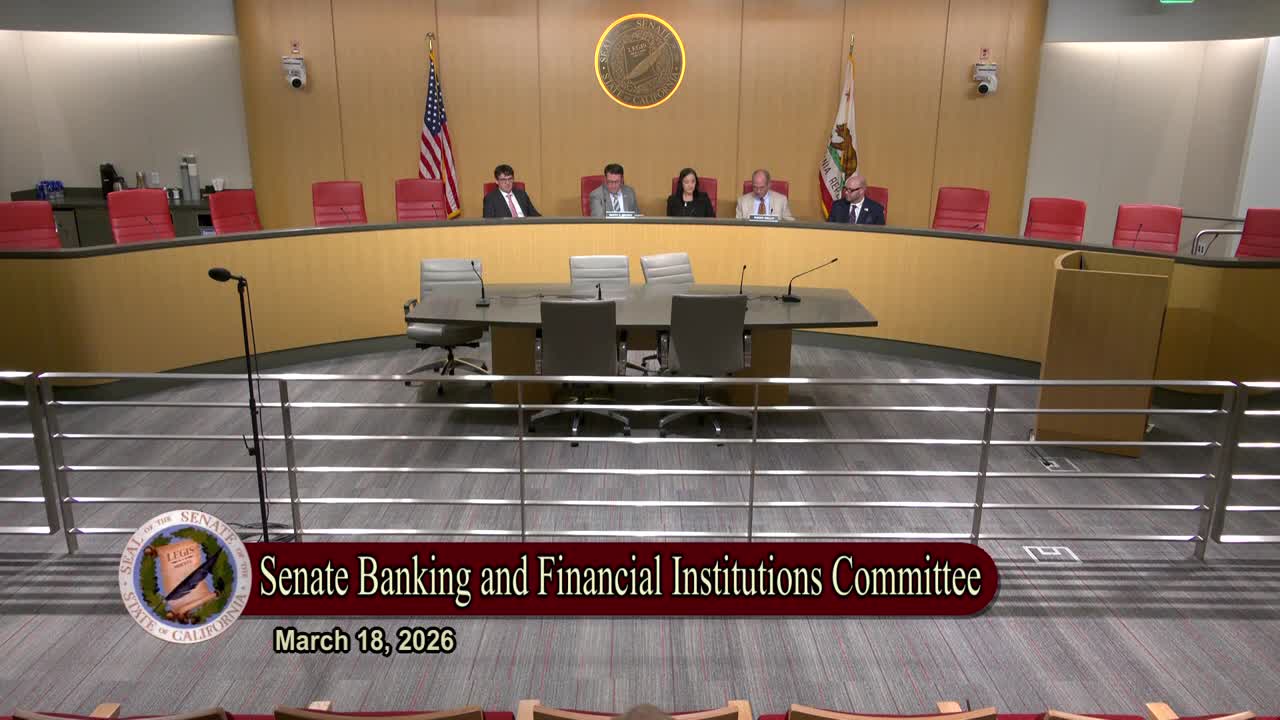 6MIN
Senate Standing Committee on Banking and Financial Institutions
Bill Author
Bill Co-Author(s):