SB 999: Franchise Tax Board: reporting requirements.
- Session Year: 2025-2026
- House: Senate
- Latest Version Date: 2026-09-27
Current Status:
Passed
(2026-09-27: Chaptered by Secretary of State. Chapter 671, Statutes of 2026.)
Introduced
In Committee
Awaiting First Chamber Vote
Passed First Chamber
In Committee
Awaiting Second Chamber Vote
Passed Second Chamber
Enacted
Existing law requires the Franchise Tax Board, on or before March 1, 2022, and annually on or before March 1 thereafter, to report certain information to the Legislature regarding health coverage penalties paid by households, in addition to related information.
This bill would change the annual reporting deadline to April 1, as provided.
Existing law requires the Franchise Tax Board, on or before March 1, 2022, and annually on or before March 1 thereafter, to report certain information to the Legislature regarding health coverage penalties paid by households, in addition to related information.
This bill would change the annual reporting deadline to April 1, as provided.
Existing law requires the Franchise Tax Board, on or before March 1, 2022, and annually on or before March 1 thereafter, to report certain information to the Legislature regarding health coverage penalties paid by households, in addition to related information.
This bill would change the annual reporting deadline to June April 1, as provided.
Existing law requires the Franchise Tax Board, on or before March 1, 2022, and annually on or before March 1 thereafter, to report certain information to the Legislature regarding health coverage penalties paid by households, in addition to related information.
This bill would change the annual reporting deadline to June 1, as provided.
(a)On or before March 1, 2022, and annually on or before April 1 thereafter, the Franchise Tax Board shall report to the Legislature on information regarding this part and Title 24 (commencing with Section 100700) and Title 25 (commencing with Section 100800) of the Government Code, including all of the following:
(1)The total number of applicable households paying the penalty and the total number of dependents for whom applicable households pay the penalty, by county and by adjusted gross income class.
(2)The total penalty amounts imposed, by county and by adjusted gross income class.
(3)The total statewide penalty amount imposed.
(4)The total number of exemptions applied, and the most common qualifications for exemptions applied.
(5)The number of applicable households who pay the penalty and the number of dependents claimed by applicable households who pay the penalty, by federal poverty level category. The federal poverty level shall be estimated using adjusted gross income and number of individuals in the tax household, using the following categories:
(A)At or between 0 percent and 138 percent of the federal poverty level.
(B)At or between 139 percent and 266 percent of the federal poverty level.
(C)At or between 267 percent and 400 percent of the federal poverty level.
(D)At or above 401 percent of the federal poverty level.
(6)The number and amount of state financial subsidies paid and adjustments made through reconciliation, by county and by federal poverty level category as described in paragraph (5).
(b)The report shall be submitted pursuant to Section 9795 of the Government Code.
(a)On or before March 1, 2022, and annually on or before April 1 thereafter, the Franchise Tax Board shall report to the Legislature on information regarding this part and Title 24 (commencing with Section 100700) and Title 25 (commencing with Section 100800) of the Government Code, including all of the following:
(1)The total number of applicable households paying the penalty and the total number of dependents for whom applicable households pay the penalty, by county and by adjusted gross income class.
(2)The total penalty amounts imposed, by county and by adjusted gross income class.
(3)The total statewide penalty amount imposed.
(4)The total number of exemptions applied, and the most common qualifications for exemptions applied.
(5)The number of applicable households who pay the penalty and the number of dependents claimed by applicable households who pay the penalty, by federal poverty level category. The federal poverty level shall be estimated using adjusted gross income and number of individuals in the tax household, using the following categories:
(A)At or between 0 percent and 138 percent of the federal poverty level.
(B)At or between 139 percent and 266 percent of the federal poverty level.
(C)At or between 267 percent and 400 percent of the federal poverty level.
(D)At or above 401 percent of the federal poverty level.
(6)The number and amount of state financial subsidies paid and adjustments made through reconciliation, by county and by federal poverty level category as described in paragraph (5).
(b)The report shall be submitted pursuant to Section 9795 of the Government Code.
(a)On or before March 1, 2022, and annually on or before June April 1 thereafter, the Franchise Tax Board shall report to the Legislature on information regarding this part and Title 24 (commencing with Section 100700) and Title 25 (commencing with Section 100800) of the Government Code, including all of the following:
(1)The total number of applicable households paying the penalty and the total number of dependents for whom applicable households pay the penalty, by county and by adjusted gross income class.
(2)The total penalty amounts imposed, by county and by adjusted gross income class.
(3)The total statewide penalty amount imposed.
(4)The total number of exemptions applied, and the most common qualifications for exemptions applied.
(5)The number of applicable households who pay the penalty and the number of dependents claimed by applicable households who pay the penalty, by federal poverty level category. The federal poverty level shall be estimated using adjusted gross income and number of individuals in the tax household, using the following categories:
(A)At or between 0 percent and 138 percent of the federal poverty level.
(B)At or between 139 percent and 266 percent of the federal poverty level.
(C)At or between 267 percent and 400 percent of the federal poverty level.
(D)At or above 401 percent of the federal poverty level.
(6)The number and amount of state financial subsidies paid and adjustments made through reconciliation, by county and by federal poverty level category as described in paragraph (5).
(b)The report shall be submitted pursuant to Section 9795 of the Government Code.
(a)On or before March 1, 2022, and annually on or before March June 1 thereafter, the Franchise Tax Board shall report to the Legislature on information regarding this part and Title 24 (commencing with Section 100700) and Title 25 (commencing with Section 100800) of the Government Code, including all of the following:
(1)The total number of applicable households paying the penalty and the total number of dependents for whom applicable households pay the penalty, by county and by adjusted gross income class.
(2)The total penalty amounts imposed, by county and by adjusted gross income class.
(3)The total statewide penalty amount imposed.
(4)The total number of exemptions applied, and the most common qualifications for exemptions applied.
(5)The number of applicable households who pay the penalty and the number of dependents claimed by applicable households who pay the penalty, by federal poverty level category. The federal poverty level shall be estimated using adjusted gross income and number of individuals in the tax household, using the following categories:
(A)At or between 0 percent and 138 percent of the federal poverty level.
(B)At or between 139 percent and 266 percent of the federal poverty level.
(C)At or between 267 percent and 400 percent of the federal poverty level.
(D)At or above 401 percent of the federal poverty level.
(6)The number and amount of state financial subsidies paid and adjustments made through reconciliation, by county and by federal poverty level category as described in paragraph (5).
(b)The report shall be submitted pursuant to Section 9795 of the Government Code.
|
Date
|
Status
|
|---|---|
| Sep 27, 2026 | Chaptered by Secretary of State. Chapter 671, Statutes of 2026. |
| Sep 27, 2026 | Approved by the Governor. |
| Aug 30, 2026 | Enrolled and presented to the Governor at 6 p.m. |
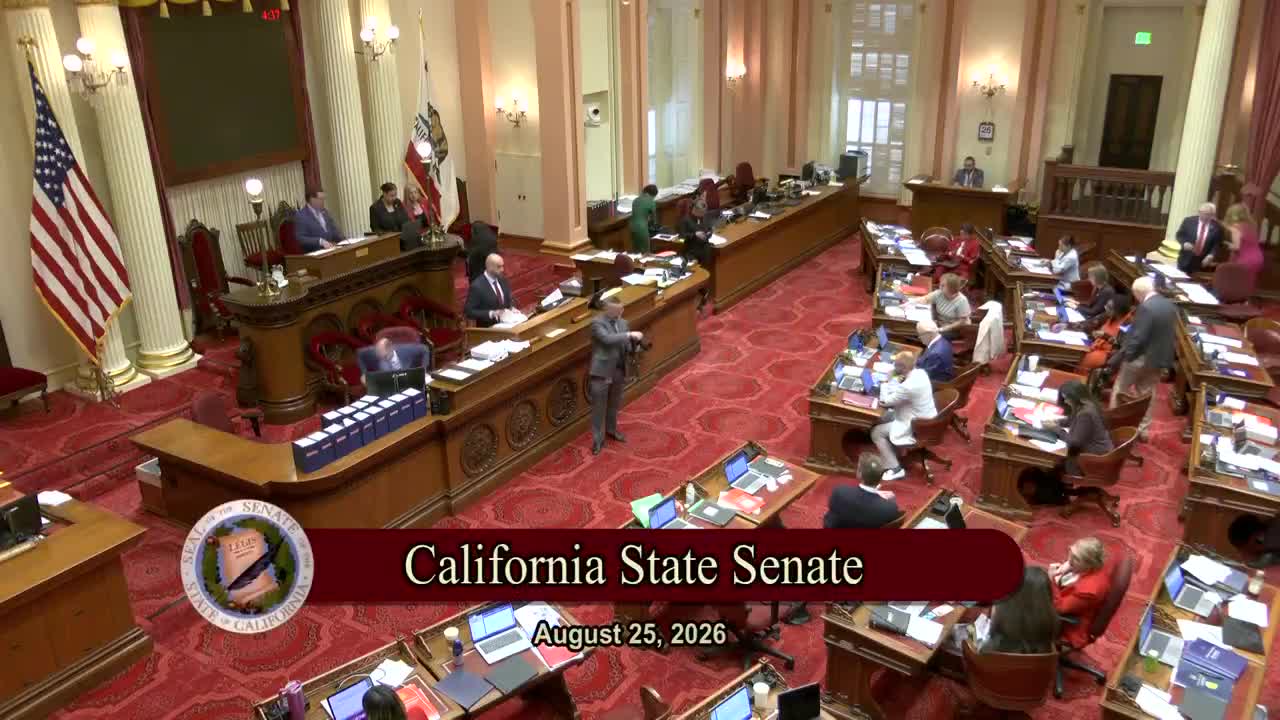
| Aug 25, 2026 | Assembly amendments concurred in. (Ayes 40. Noes 0.) Ordered to engrossing and enrolling. |
| Aug 25, 2026 | Assembly amendments concurred in. (Ayes 40. Noes 0. Page 5794.) Ordered to engrossing and enrolling. |
| Aug 25, 2026 | Assembly amendments concurred in. (Ayes 39. Noes 0.) Ordered to engrossing and enrolling. |
| Aug 24, 2026 | In Senate. Concurrence in Assembly amendments pending. |
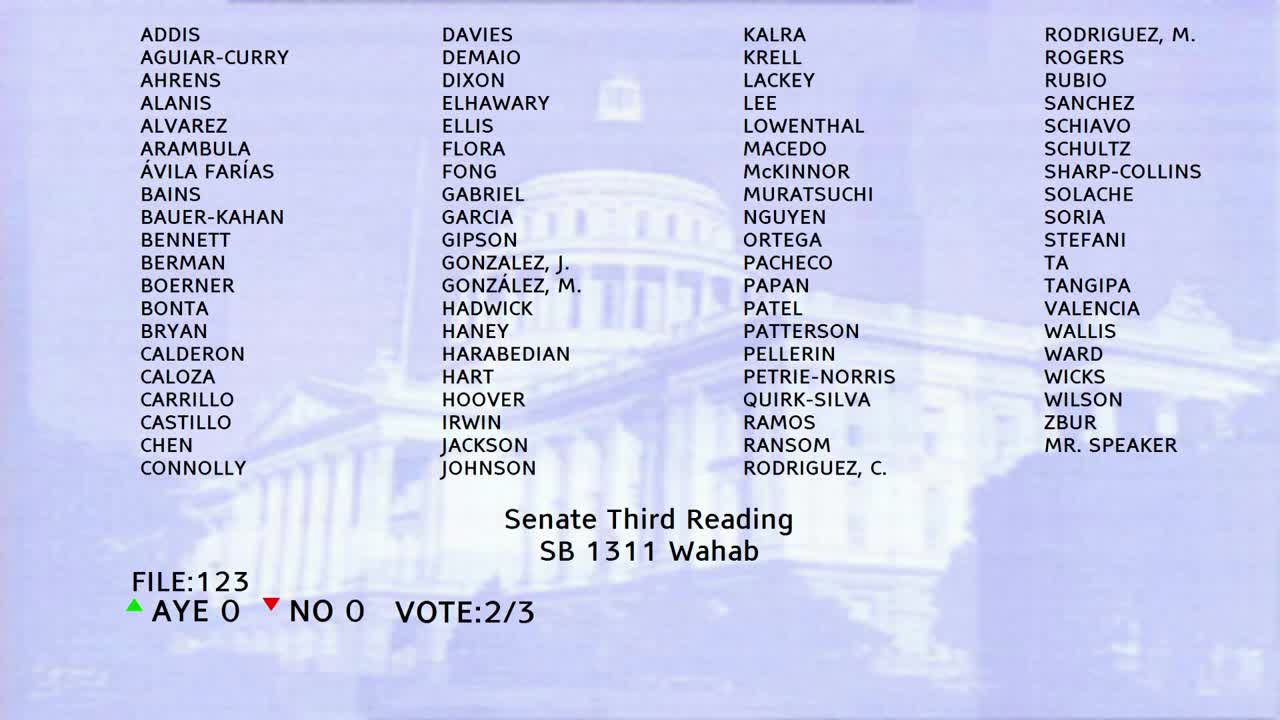
| Aug 24, 2026 | Read third time. Passed. (Ayes 72. Noes 3. Page 6378.) Ordered to the Senate. |
| Aug 24, 2026 | Read third time. Passed. Ordered to the Senate. |
| Aug 10, 2026 | Read second time. Ordered to third reading. |
| Aug 6, 2026 | Read second time and amended. Ordered to second reading. |
| Aug 5, 2026 | From committee: Do pass as amended. (Ayes 13. Noes 1.) (August 5). |
| Jun 24, 2026 | June 24 set for first hearing canceled at the request of author. |
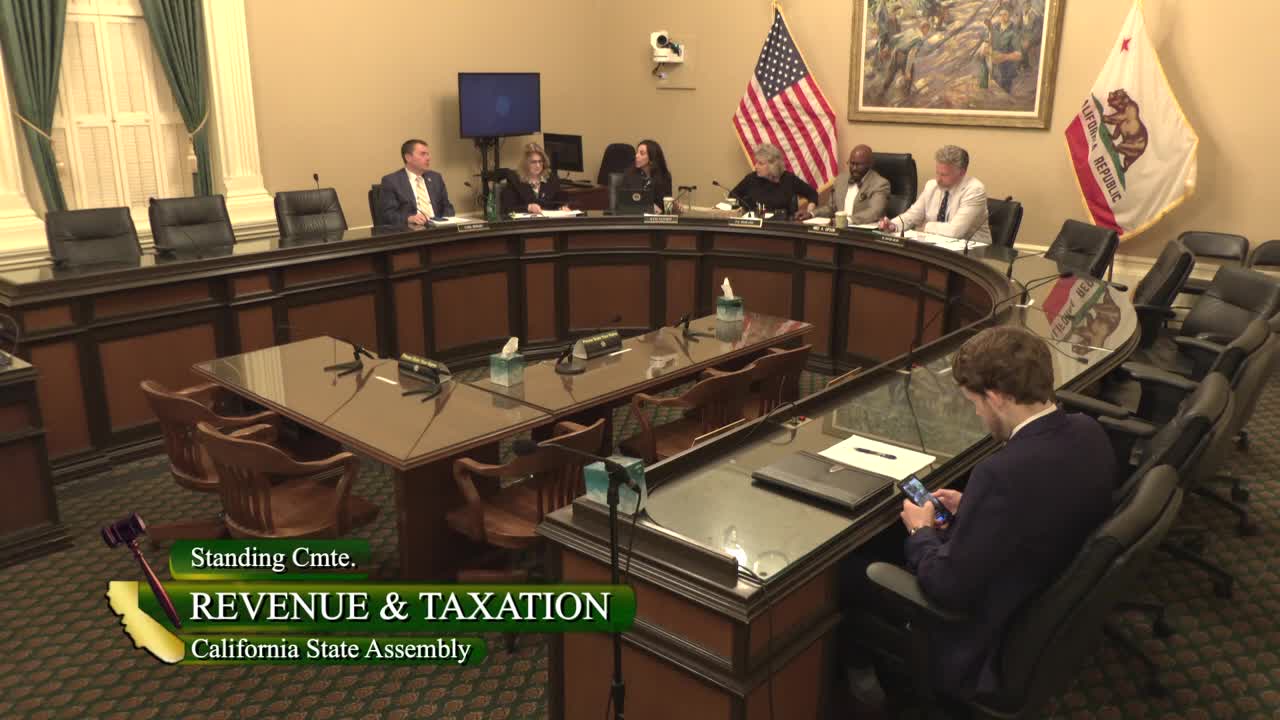
| Jun 9, 2026 | From committee: Do pass and re-refer to Com. on APPR. (Ayes 5. Noes 2.) (June 8). Re-referred to Com. on APPR. |
| May 4, 2026 | Referred to Com. on REV. & TAX. |
| Apr 16, 2026 | In Assembly. Read first time. Held at Desk. |
| Apr 16, 2026 | Read third time. Passed. (Ayes 38. Noes 0.) Ordered to the Assembly. |
| Apr 16, 2026 | Read third time. Passed. (Ayes 38. Noes 0. Page 3920.) Ordered to the Assembly. |
| Apr 14, 2026 | Read second time. Ordered to consent calendar. |
| Apr 13, 2026 | From committee: Be ordered to second reading pursuant to Senate Rule 28.8 and ordered to consent calendar. |
| Mar 27, 2026 | Set for hearing April 13. |
| Mar 25, 2026 | From committee: Do pass and re-refer to Com. on APPR. with recommendation: To consent calendar. (Ayes 5. Noes 0.) (March 25). Re-referred to Com. on APPR. |
| Mar 25, 2026 | From committee: Do pass and re-refer to Com. on APPR. with recommendation: To consent calendar. (Ayes 5. Noes 0. Page 3691.) (March 25). Re-referred to Com. on APPR. |
| Mar 11, 2026 | Set for hearing March 25. |
| Feb 18, 2026 | Referred to Com. on REV. & TAX. |
| Feb 10, 2026 | From printer. May be acted upon on or after March 12. |
| Feb 9, 2026 | Introduced. Read first time. To Com. on RLS. for assignment. To print. |
|
Date
|
Description
|
Location
|
Votes
|
|
|---|---|---|---|---|
| Aug 25, 2026 | Unfinished Business SB999 Weber Pierson Concurrence | Senate Floor |
Passed |
|
| Aug 24, 2026 | SB 999 Weber Pierson Senate Third Reading By Gipson | Assembly Floor |
Passed |
|
| Aug 5, 2026 | Do pass as amended. | Assembly Standing Committee on Appropriations |
Passed |
|
| Jun 8, 2026 | Do pass and be re-referred to the Committee on [Appropriations] | Assembly Standing Committee on Revenue and Taxation |
Passed |
|
| Apr 16, 2026 | Consent Calendar 2nd SB999 Weber Pierson | Senate Floor |
Passed |
|
| Mar 25, 2026 | Do pass, but first be re-referred to the Committee on [Appropriations] with the recommendation: To Consent Calendar | Senate Standing Committee on Revenue and Taxation |
Passed |
This list shows positions taken on this bill by organizations on the date displayed, which is linked to the original source.
Positions by individuals are not included.
|
Organization
|
Position
|
Date
|
|---|---|---|
| Health Access California | ** Support | |
| UCLA Center for Health Policy Research | ** Support |
SENATE RULES COMMITTEE Office of Senate Floor Analyses (916) 651-4171 | SB 999 |
UNFINISHED BUSINESS
Bill No: SB 999
Author: Weber Pierson (D)
Amended: 8/6/26
Vote: 21
SENATE REVENUE AND TAXATION COMMITTEE: 5-0, 3/25/26
AYES: McNerney, Alvarado-Gil, Ashby, Becker, Grayson
SENATE APPROPRIATIONS COMMITTEE: Senate Rule 28.8
SENATE FLOOR: 38-0, 4/16/26 (Consent)
AYES: Allen, Alvarado-Gil, Archuleta, Arreguín, Ashby, Becker, Blakespear, Cabaldon, Caballero, Cervantes, Choi, Cortese, Dahle, Durazo, Gonzalez, Grayson, Grove, Hurtado, Jones, Laird, Limón, McGuire, McNerney, Niello, Ochoa Bogh, Padilla, Pérez, Reyes, Richardson, Rubio, Smallwood-Cuevas, Stern, Strickland, Umberg, Valladares, Wahab, Weber Pierson, Wiener
NO VOTE RECORDED: Menjivar, Seyarto
ASSEMBLY FLOOR: Passed, 8/24/26
SUBJECT: Franchise Tax Board: reporting requirements
SOURCE: Author
DIGEST:
This bill changes the due date from March 1 to April 1 for the Franchise Tax Board (FTB) to report to the Legislature specific information regarding California’s minimum essential health coverage requirement and individual shared responsibility penalty.
Assembly Amendments
change the due date of the FTB report to April 1 instead of June 1.
ANALYSIS:
Existing federal law:
- Requires health care insurers to offer coverage to all individuals, regardless of their age or health status, pursuant to the Patient Protection and Affordable Care Act (ACA) of 2010.
- Requires nearly everyone to have minimum essential coverage (MEC) for health care or pay a tax penalty collected by the Internal Revenue Service as part of the federal income tax form, unless an exemption applies.
- Reduces, beginning in 2019, the tax penalty for individuals who fail to maintain MEC to $0.
- Authorizes the Advanced Premium Tax Credit for individuals between 100-400% of the federal poverty line (FPL), with some exceptions below 100% FPL and other eligibility conditions.
- Creates state-based health insurance exchanges.
- Allows states to operate their own exchanges or have the Department of Health and Human Services and operate an exchange within the state.
Existing state law:
- Creates a California Health Benefit Exchange, also known as Covered California, to administer the ACA at the state level (AB 1602, Perez, Chapter 655, Statutes of 2010; and SB 900, Alquist, Chapter 659, Statutes of 2010).
- Establishes a program within Covered California to provide state subsidies to assist individuals with incomes under 600% of the FPL to afford health insurance (SB 78, Committee on Budget and Fiscal Review, Chapter 38, Statutes of 2019).
- Requires California residents and any of their dependents to have MEC for each month beginning on January 1, 2020, unless they qualify for an exemption.
- Impose a penalty on individuals who fail to maintain MEC, known as the “Individual Shared Responsibility Penalty,” almost identical to the penalty in federal law. The penalty must be included on the individual’s tax return and applies to any month in which an individual or their dependent fails to maintain MEC.
- Requires the FTB to annually publish on its website:
- The number of applicable households paying the penalty and the average penalty amount by applicable household income level.
- The number of applicable households paying the penalty in each county and statewide.
- The total penalty amount collected.
- The number and type of most commonly claimed exemptions.
- The number and total penalty amounts collected.
- Directs FTB to also report to the Legislature specific data on the MEC and failure to maintain the penalty (AB 414, Bonta, Chapter 801, Statues of 2019), including:
- The number of applicable households that pay the penalty and the number of dependents claimed by applicable households that pay the penalty by county and by federal poverty level category: 0% to 138% of FPL, 139% to 266% of FPL, 267% to 400% of FPL, and above 401% of FPL.
- The total penalty amounts imposed by county and by adjusted gross income class.
- The total statewide penalty amount imposed.
- The total number of exemptions applied, and the most common exemptions applied.
- The number and total amounts of penalties imposed and collected on applicable entities that provide MEC, including plan sponsors of employment-based health plan coverage.
- The number and amount of state financial subsidies paid and adjustments made through reconciliation, by county and by federal poverty level category.
- Requires that this data be reported to the Legislature, on or before March 1, 2022, and annually thereafter.
This bill changes the due date from March 1 to April 1 for the Franchise Tax Board to report to the Legislature specific information regarding California’s MEC requirement for health care and individual shared responsibility penalty.
Background
Getting the whole picture. Changing the statutory due date for the MEC penalty report to April 1st would allow FTB an additional month of data collection. Including those additional returns would make the report more complete and give the Legislature a more accurate measure of penalty incidence and collections.
By the numbers. The FTB’s February 2026 Health Care MEC Individual Mandate Report was timely filed and prepared using processed return data available as of September 30, 2025. The report includes data tables and qualitative analysis that satisfy the statutory reporting mandate. For example, the report indicates that in 2025, the Individual Shared Responsibility Penalty was assessed to 208,283 households for a total assessed amount of $237,804,497, with an average assessment of $1,142 and a mean of $900.
FISCAL EFFECT: Appropriation: No Fiscal Com.: Yes Local: No
According to the Assembly Appropriations Committee, SB 999 would result in minor and absorbable costs to the FTB to publish the report by a later date and include additional data in the report from tax returns filed in October.
SUPPORT: (Verified 8/24/26)
Health Access California
OPPOSITION: (Verified 8/24/26)
None received
ARGUMENTS IN SUPPORT: According to the author, “Following the elimination of the federal Individual Shared Responsibility Penalty in 2019, the UCLA Center for Health Policy Research projected that approximately 150,000-450,000 more Californians would become uninsured by 2020, growing to between 490,000-790,000 more uninsured by 2023, due to the elimination of the penalty. The Center states that the zeroing out of the penalty payment reduces incentive for healthier individuals to sign up for coverage, which leads to an inevitable increase in premiums and a further decrease in enrollment rates. SB 78 (Committee on Budget and Fiscal Review, Chapter 38, Statutes of 2019) responded to this by reinstating the penalty payment in California to help prevent such a substantial number of Californians from losing their health insurance, as well as any further destabilization of the insurance market. AB 414 (Bonta, Chapter 801, Statutes of 2019) built upon this mandate by requiring the Franchise Tax Board (FTB) to annually report specified data regarding qualified individuals who paid the penalty in California. However, the current deadline for the annual report only includes timely filed and processed return data available as of September 30th, preventing FTB from including October extension filers in the report. Delaying the publication date would allow FTB to more accurately portray the number of Californians without coverage.”
Prepared by: Haley Summers / REV. & TAX. / (916) 651-4117
8/24/26 16:39:33
**** END ****
SENATE THIRD READING
STR Bill Id:SB 999
Author:(Weber Pierson)
As Amended Ver:August 06, 2026
Majority vote
SUMMARY
Delays, from March 1 to April 1, the annual reporting due date for the healthcare mandate individual shared responsibility (ISR) penalty report published by the Franchise Tax Board (FTB).
Major Provisions
COMMENTS
Healthcare mandate: The federal Affordable Care Act requires most individuals to maintain health insurance coverage or pay a penalty for non-compliance collected through the federal tax return. However, the federal Tax Cuts and Jobs Act reduced the non-compliance penalty to $0 beginning in tax year 2019. Subsequent state law thus enacted a state mandate for most individuals to maintain minimum essential healthcare coverage or pay an individual shared responsibility (ISR) penalty for non-compliance when filing their state personal income tax (PIT) return. The penalty amount is the higher of either: (a) a flat amount, based on the number of people in the taxpayer′s household, or (b) a percentage of the taxpayer′s household income. For example, sample penalty amounts for 2025 on the FTB′s website are $950 for an individual with income of less than $57,580 and $2,850 for a family of four with income of less than $177,163.
What problem does this bill seek to solve? While individual tax returns are typically due on or before April 15 of each year, the filing deadline has been extended for some taxpayers in recent years due to the COVID-19 pandemic and natural disasters in various parts of the state. Additionally, California provides individual taxpayers with an automatic six-month extension to file their personal income return, which means these taxpayers must file on or before October 15. An extension to file the return is not an extension of the payment deadline, however. Taxpayers must pay the amount owed by April 15 to avoid penalties and interest.
According to the Author
Following the elimination of the federal Individual Shared Responsibility Penalty in 2019, the UCLA Center for Health Policy Research projected that approximately 150,000-450,000 more Californians would become uninsured by 2020, growing to between 490,000-790,000 more uninsured by 2023, due to the elimination of the penalty. The Center states that the zeroing out of the penalty payment reduces incentive for healthier individuals to sign up for coverage, which leads to an inevitable increase in premiums and a further decrease in enrollment rates.
SB 78 (Committee on Budget and Fiscal Review), Chapter 38, Statutes of 2019, responded to this by reinstating the penalty payment in California to help prevent such a substantial number of Californians from losing their health insurance, as well as any further destabilization of the insurance market. AB 414 (Bonta), Chapter 801, Statutes of 2019, built upon this mandate by requiring the FTB to annually report specified data regarding qualified individuals who paid the penalty in California. However, the current deadline for the annual report only includes timely filed and processed return data available as of September 30th, preventing FTB from including October extension filers in the report. Delaying the publication date would allow FTB to more accurately portray the number of Californians without coverage.
Arguments in Support
Health Access California, writing in support of this measure, notes, in part:
In 2019, the legislature reinstated the penalty payment in California and required the Franchise Tax Board to annually report data regarding the individuals who paid the penalty in California. However, the current deadline only includes data available as of September 30th, preventing October extension filers in the report. Californian provides individuals taxpayers with an automatic six-month extension to file their personal return, meaning they must file on or before October 15th. Delaying the date of the report will more accurately show the number of Californians without coverage.
Arguments in Opposition
None on file.
FISCAL COMMENTS
According to the Assembly Committee on Appropriations, this bill will create minor and absorbable costs to the FTB to publish the report by a later date and include additional data in the report from tax returns filed in October.
VOTES
SENATE FLOOR: 38-0-2
YES: Allen, Alvarado-Gil, Archuleta, Arreguín, Ashby, Becker, Blakespear, Cabaldon, Caballero, Cervantes, Choi, Cortese, Dahle, Durazo, Gonzalez, Grayson, Grove, Hurtado, Jones, Laird, Limón, McGuire, McNerney, Niello, Ochoa Bogh, Padilla, Pérez, Reyes, Richardson, Rubio, Smallwood-Cuevas, Stern, Strickland, Umberg, Valladares, Wahab, Weber Pierson, Wiener
ABS, ABST OR NV: Menjivar, Seyarto
ASM REVENUE AND TAXATION: 5-2-0
YES: Gipson, Carrillo, McKinnor, Quirk-Silva, Michelle Rodriguez
NO: Sanchez, DeMaio
ASM APPROPRIATIONS: 13-1-1
YES: Wicks, Arambula, Calderon, Caloza, Fong, Mark González, Krell, Pacheco, Pellerin, Sharp-Collins, Solache, Ta, Tangipa
NO: Hoover
ABS, ABST OR NV: Dixon
UPDATED
VERSION: August 6, 2026
CONSULTANT: Wesley Whitaker / REV. & TAX. / (916) 319-2098 FN: 0003390
Date of Hearing: August 5, 2026
ASSEMBLY COMMITTEE ON APPROPRIATIONS
Buffy Wicks, Chair
SBPCA Bill Id:SB 999
Author:(Weber Pierson) – As Introduced Ver:February 9, 2026
Policy Committee: | Revenue and Taxation | Vote: | 5 - 2 |
|
| ||
|
|
Urgency: No State Mandated Local Program: No Reimbursable: No
SUMMARY:
This bill delays, from March 1 to June 1, the annual due date for a Franchise Tax Board (FTB) report regarding healthcare coverage penalties.
FISCAL EFFECT:
Minor and absorbable costs to the FTB to publish the report by a later date and include additional data in the report from tax returns filed in October.
COMMENTS:
- Purpose. According to the author:
Following the elimination of the federal Individual Shared Responsibility Penalty in 2019, the UCLA Center for Health Policy Research projected that approximately 150,000-450,000 more Californians would become uninsured by 2020, growing to between 490,000-790,000 more uninsured by 2023, due to the elimination of the penalty…
SB 78 (Committee on Budget and Fiscal Review), Chapter 38, Statutes of 2019, responded to this by reinstating the penalty payment in California to help prevent such a substantial number of Californians from losing their health insurance, as well as any further destabilization of the insurance market. AB 414 (Bonta), Chapter 801, Statutes of 2019, built upon this mandate by requiring the FTB to annually report specified data regarding qualified individuals who paid the penalty in California. However, the current deadline for the annual report only includes timely field and processed return data available as of September 30th, preventing FTB from including October extension filers in the report. Delaying the publication date would allow FTB to more accurately portray the number of Californians without coverage.
- Background. Healthcare Mandate. The federal Affordable Care Act requires most individuals to maintain health insurance coverage or pay a penalty for non-compliance collected through the federal tax return. However, the federal Tax Cuts and Jobs Act reduced the non-compliance penalty to $0 beginning in tax year 2019. Subsequent state law thus enacted a state mandate for most individuals to maintain minimum essential healthcare coverage or pay an individual shared responsibility (ISR) penalty for non-compliance when filing their state personal income tax (PIT) return. The penalty amount is the higher of either: (a) a flat amount, based on the number of people in the taxpayer’s household, or (b) a percentage of the taxpayer’s household income. For example, sample penalty amounts for 2025 on the FTB’s website are $950 for an individual with income of less than $57,580 and $2,850 for a family of four with income of less than $177,163.
Due Dates. Existing state law requires the FTB to annually report specified ISR penalty data to the Legislature by March 1. According to the FTB, this existing due date precludes the FTB from incorporating ISR penalty data from extension filers into the report. While PIT payments and returns are generally due on or before April 15 each year, this deadline has been extended for certain taxpayers in recent years due to emergency disaster declarations in various parts of the state. Additionally, existing law grants individual taxpayers an automatic six-month extension upon request to file their PIT return (although payment is still due on April 15), resulting in numerous timely returns filed on or before October 15 each year.
- Proposed Amendments. This bill delays the March 1 due date for the ISR penalty data report to June 1, thus providing the FTB more time to analyze and incorporate data from the prior tax year’s extension filers into the report. However, delaying the report until June 1 makes it more difficult for the report’s findings to be considered by legislators, state officials, and the public when deliberating the state budget that must be passed by June 15. Thus, the committee and the author’s office have agreed to the following amendment delaying the report due date to April 1, instead of June 1:
(a) On or before March 1, 2022, and annually on or before June April 1 thereafter, the Franchise Tax Board shall report to the Legislature on information regarding this part…
This amendment will still allow the FTB to capture PIT return data from a large portion of extension filers when preparing the ISR penalty data report, while also allowing full consideration of the report’s findings during the budget process.
Analysis Prepared by: Irene Ho / APPR. / (916) 319-2081
Date of Hearing: June 24, 2026
ASSEMBLY COMMITTEE ON APPROPRIATIONS
Buffy Wicks, Chair
SBPCA Bill Id:SB 999
Author:(Weber Pierson) – As Introduced Ver:February 9, 2026
Policy Committee: | Revenue and Taxation | Vote: | 5 - 2 |
|
| ||
|
|
Urgency: No State Mandated Local Program: No Reimbursable: No
SUMMARY:
This bill delays, from March 1 to June 1, the annual due date for a Franchise Tax Board (FTB) report regarding healthcare coverage penalties.
FISCAL EFFECT:
Minor and absorbable costs to the FTB to publish the report by a later date and include additional data in the report from tax returns filed in October.
COMMENTS:
- Purpose. According to the author:
Following the elimination of the federal Individual Shared Responsibility Penalty in 2019, the UCLA Center for Health Policy Research projected that approximately 150,000-450,000 more Californians would become uninsured by 2020, growing to between 490,000-790,000 more uninsured by 2023, due to the elimination of the penalty…
SB 78 (Committee on Budget and Fiscal Review), Chapter 38, Statutes of 2019, responded to this by reinstating the penalty payment in California to help prevent such a substantial number of Californians from losing their health insurance, as well as any further destabilization of the insurance market. AB 414 (Bonta), Chapter 801, Statutes of 2019, built upon this mandate by requiring the FTB to annually report specified data regarding qualified individuals who paid the penalty in California. However, the current deadline for the annual report only includes timely field and processed return data available as of September 30th, preventing FTB from including October extension filers in the report. Delaying the publication date would allow FTB to more accurately portray the number of Californians without coverage.
- Background. Healthcare Mandate. The federal Affordable Care Act requires most individuals to maintain health insurance coverage or pay a penalty for non-compliance collected through the federal tax return. However, the federal Tax Cuts and Jobs Act reduced the non-compliance penalty to $0 beginning in tax year 2019. Subsequent state law thus enacted a state mandate for most individuals to maintain minimum essential healthcare coverage or pay an individual shared responsibility (ISR) penalty for non-compliance when filing their state personal income tax (PIT) return. The penalty amount is the higher of either: (a) a flat amount, based on the number of people in the taxpayer’s household, or (b) a percentage of the taxpayer’s household income. For example, sample penalty amounts for 2025 on the FTB’s website are $950 for an individual with income of less than $57,580 and $2,850 for a family of four with income of less than $177,163.
Due Dates. Existing state law requires the FTB to annually report specified ISR penalty data to the Legislature by March 1. According to the FTB, this existing due date precludes the FTB from incorporating ISR penalty data from extension filers into the report. While PIT payments and returns are generally due on or before April 15 each year, this deadline has been extended for certain taxpayers in recent years due to emergency disaster declarations in various parts of the state. Additionally, existing law grants individual taxpayers an automatic six-month extension upon request to file their PIT return (although payment is still due on April 15), resulting in numerous timely returns filed on or before October 15 each year.
- Proposed Amendments. This bill delays the March 1 due date for the ISR penalty data report to June 1, thus providing the FTB more time to analyze and incorporate data from the prior tax year’s extension filers into the report. However, delaying the report until June 1 makes it more difficult for the report’s findings to be considered by legislators, state officials, and the public when deliberating the state budget that must be passed by June 15. Thus, the committee and the author’s office have agreed to the following amendment delaying the report due date to April 1, instead of June 1:
(a) On or before March 1, 2022, and annually on or before June April 1 thereafter, the Franchise Tax Board shall report to the Legislature on information regarding this part…
This amendment will still allow the FTB to capture PIT return data from a large portion of extension filers when preparing the ISR penalty data report, while also allowing full consideration of the report’s findings during the budget process.
Analysis Prepared by: Irene Ho / APPR. / (916) 319-2081
Date of Hearing: June 8, 2026
ASSEMBLY COMMITTEE ON REVENUE AND TAXATION
Mike Gipson, Chair
SBPCA Bill Id:SB 999
Author:(Weber Pierson) – As Introduced Ver:February 9, 2026
Majority vote. Fiscal committee.
SENATE VOTE: 38-0
SUBJECT: Franchise Tax Board: reporting requirements
SUMMARY: Delays, from March 1 to June 1, the annual reporting due date for the healthcare mandate individual shared responsibility (ISR) penalty report published by the Franchise Tax Board (FTB).
EXISTING LAW:
- Requires an individual and the individual's spouse and any dependents to maintain minimum essential coverage (MEC) for healthcare and imposes a penalty on taxpayers who fail to comply with this requirement. (Government Code Section 100700 et seq. and Revenue and Taxation Code (R&TC) Section 61000 et seq.)
- Requires the FTB to annually report certain ISR penalty data to the Legislature on or before March 1. (R&TC Section 61050.)
- Provides financial assistance for healthcare coverage to California residents with incomes at, or below, 600% of the Federal poverty level (FPL) through the Individual Market Assistance (IMA) program. (Government Code Section 100800.)
FISCAL EFFECT: The FTB has not yet provided an estimate of the costs associated with implementing this bill, but it would not impact state income or franchise tax revenue.
COMMENTS:
- The author has provided the following statement in support of this bill:
Following the elimination of the federal Individual Shared Responsibility Penalty in 2019, the UCLA Center for Health Policy Research projected that approximately 150,000-450,000 more Californians would become uninsured by 2020, growing to between 490,000-790,000 more uninsured by 2023, due to the elimination of the penalty. The Center states that the zeroing out of the penalty payment reduces incentive for healthier individuals to sign up for coverage, which leads to an inevitable increase in premiums and a further decrease in enrollment rates.
SB 78 (Committee on Budget and Fiscal Review), Chapter 38, Statutes of 2019, responded to this by reinstating the penalty payment in California to help prevent such a substantial number of Californians from losing their health insurance, as well as any further destabilization of the insurance market. AB 414 (Bonta), Chapter 801, Statutes of 2019, built upon this mandate by requiring the FTB to annually report specified data regarding qualified individuals who paid the penalty in California. However, the current deadline for the annual report only includes timely filed and processed return data available as of September 30th, preventing FTB from including October extension filers in the report. Delaying the publication date would allow FTB to more accurately portray the number of Californians without coverage.
- Committee Staff Comments:
- The Affordable Care Act: Pursuant to the Patient Protection and Affordable Care Act (ACA), starting January 1, 2014 most individuals had to maintain health insurance coverage or pay a penalty for noncompliance implemented through the Internal Revenue Code (IRC). The ACA contained multiple requirements applicable to private health insurance issuers that sought to improve access to private health insurance for sick individuals or those at high risk of becoming ill, including prohibiting insurers from denying coverage based on pre-existing conditions. The individual mandate works in tandem with the other requirements by encouraging healthy individuals to participate in the market so that insurers' risk pools are not primarily composed of individuals who are at high risk of using health care services.[1]
Some individuals are exempt from the mandate and not subject to its associated penalty, such as low-income taxpayers, people who are incarcerated, and certain non-citizens who are not lawfully present in the United States. Individuals who do not comply with the mandate, or who have dependents who do not comply, may be required to pay a penalty annually for each month of noncompliance, to be implemented through the IRC. An individual's annual penalty is equal to one-twelfth of the annual penalty multiplied by the number of months in which the individual did not comply with the mandate.
The ACA also created the Advanced Premium Tax Credit (APTC) for individuals earning between 100 to 400% of the FPL, which reduces the cost for health insurance premiums when individuals buy health insurance on a state marketplace, such as Covered California. The APTC is calculated and sent directly from the federal government to insurance companies, reducing the covered individual's monthly premiums.
- Federal penalty suspended: Enacted in 2017, the Tax Cuts and Jobs Act (TCJA) did not eliminate the ISR mandate but reduced the penalty for failure to comply to zero dollars for tax year 2019 and all subsequent years. Starting January 1, 2019, taxpayers are still required by law to have MEC or qualify for a coverage exemption. However, under the TCJA, a taxpayer no longer needs to make a shared responsibility payment or file the requisite form with the Internal Revenue Service claiming an exemption.
- States step in: Following the suspension of the federal MEC penalty, California and several other states enacted state-level mandates intended to maintain a balanced insurance pool; keep premiums from rising too quickly; and fund state healthcare initiatives, such as reinsurance programs or subsidized care for certain populations. Beginning January 1, 2020, California residents and their dependents must maintain qualifying MEC for each month during the taxable year unless they qualify for one of 14 exemptions. Most exemptions can be claimed on the tax return, e.g., income is below the tax filing threshold, health coverage is considered unaffordable, short coverage gap of three consecutive months or less, etc. However, the individual must apply with Covered California, which administers the California Health Benefit Exchange, for MEC exemptions for religious conscience, affordability hardship, and general hardships.
On the FTB's public website, there is a webpage for individuals, tax professionals, and insurance providers and employers that provides information about the MEC Individual Mandate, the subsidy, the ISR penalty, relevant tax forms and instructions, an ISR Penalty tool that can be used to estimate the penalty, instructional videos, news articles, and useful website links.[2]
California also created and provided a state-level premium assistance subsidy to supplement the APTC for the 2020-2022 tax years to individuals with household incomes at or below 600% of the FPL, which is more expansive than the 100-400% of the FPL used to determine eligibility for the federal APTC.
- Federal subsidies expanded before expiring this year: Responding to the COVID-19 pandemic, the American Rescue Plan Act of 2021 increased the APTC subsidy through the 2022 tax year and removed the 400% FPL income limitation ("Enhanced APTC"). Because most individuals were subsidized at a higher rate by the federal government, state subsidies for taxpayers earning under 600% of the FPL were almost entirely superseded and eligibility was reduced to zero for nearly all taxpayers in the California Premium Subsidy Program. The Inflation Reduction Act, passed in 2022, extended the Enhanced APTC through December 31, 2025.
Because the Enhanced APTC was not extended by Congress, federal healthcare subsidy assistance has reverted to the original APTC, which is limited to individuals with household incomes of between 100 to 400% of the FPL.
- What problem does this bill seek to solve? While individual tax returns are typically due on or before April 15 of each year, the filing deadline has been extended for some taxpayers in recent years due to the COVID-19 pandemic and natural disasters in various parts of the state. Additionally, California provides individual taxpayers with an automatic six-month extension to file their personal income return, which means these taxpayers must file on or before October 15. An extension to file the return is not an extension of the payment deadline, however. Taxpayers must pay the amount owed by April 15 to avoid penalties and interest.
According to the Senate Committee on Revenue and Taxation's analysis of this bill, FTB staff estimate that shifting the due date of the annual report would capture roughly 12% more returns. Including those additional returns would make the report substantially more complete, reduce bias from missing late-filed but timely returns, and provide the Legislature with a more accurate measure of penalty incidence and collections.
- What problem does this bill seek to solve? While individual tax returns are typically due on or before April 15 of each year, the filing deadline has been extended for some taxpayers in recent years due to the COVID-19 pandemic and natural disasters in various parts of the state. Additionally, California provides individual taxpayers with an automatic six-month extension to file their personal income return, which means these taxpayers must file on or before October 15. An extension to file the return is not an extension of the payment deadline, however. Taxpayers must pay the amount owed by April 15 to avoid penalties and interest.
REGISTERED SUPPORT / OPPOSITION:
Support
None on file
Opposition
None on file
Analysis Prepared by: Wesley Whitaker / REV. & TAX. / (916) 319-2098
Mach, Annie. "The Individual Mandate for Health Insurance Coverage: In Brief." Congressional Research Service. Updated March 19, 2018. https://crsreports.congress.gov/R44438. ↑
"Health care mandate – Minimum Essential Coverage Individual Mandate." Franchise Tax Board. Updated September 24, 2025. https://www.ftb.ca.gov/file/personal/filing-situations/healthcare/. ↑
SENATE RULES COMMITTEE Office of Senate Floor Analyses (916) 651-4171 | SB 999 |
CONSENT
Bill No: SB 999
Author: Weber Pierson (D)
Introduced: 2/9/26
Vote: 21
SENATE REVENUE AND TAXATION COMMITTEE: 5-0, 3/25/26
AYES: McNerney, Alvarado-Gil, Ashby, Becker, Grayson
SENATE APPROPRIATIONS COMMITTEE: Senate Rule 28.8
SUBJECT: Franchise Tax Board: reporting requirements
SOURCE: Author
DIGEST:
This bill changes the due date from March 1 to June 1 for the Franchise Tax Board to report to the Legislature specific information regarding California’s minimum essential health coverage requirement and individual shared responsibility penalty.
ANALYSIS:
Existing federal law:
- Requires health care insurers to offer coverage to all individuals, regardless of their age or health status, pursuant to the Patient Protection and Affordable Care Act (ACA) of 2010.
- Requires nearly everyone to have minimum essential health coverage (MEC) or pay a tax penalty collected by the Internal Revenue Service as part of the federal income tax form, unless an exemption applies.
- Reduces, beginning in 2019, the tax penalty for individuals who fail to maintain MEC to $0.
- Authorizes the Advanced Premium Tax Credit (APTC) for individuals between 100-400% of the federal poverty line (FPL), with some exceptions below 100% FPL and other eligibility conditions.
- Creates state-based health insurance exchanges.
- Allows states to operate their own exchanges or have the Department of Health and Human Services and operate an exchange within the state.
Existing state law:
- Creates a California Health Benefit Exchange, also known as Covered California, to administer the ACA at the state level (AB 1602, Perez, Chapter 655, Statutes of 2010; and SB 900, Alquist, Chapter 659, Statutes of 2010).
- Establishes a program within Covered California to provide state subsidies to assist individuals with incomes under 600% of the FPL to afford health insurance (SB 78, Committee on Budget and Fiscal Review, Chapter 38, Statutes of 2019).
- Requires California residents and any of their dependents to have MEC for each month beginning on January 1, 2020, unless they qualify for an exemption.
- Impose a penalty on individuals who fail to maintain MEC, known as the “Individual Shared Responsibility Penalty,” almost identical to the penalty in federal law. The penalty must be included on the individual’s tax return and applies to any month in which an individual or their dependent fails to maintain MEC.
- Requires the Franchise Tax Board (FTB) to annually publish on its website:
- The number of applicable households paying the penalty and the average penalty amount by applicable household income level.
- The number of applicable households paying the penalty in each county and statewide.
- The total penalty amount collected.
- The number and type of most commonly claimed exemptions.
- The number and total penalty amounts collected.
- Directs the FTB to also report to the Legislature specific data on the MEC and failure to maintain the penalty (AB 414, Bonta, Chapter 801, Statues of 2019), including:
- The number of applicable households that pay the penalty and the number of dependents claimed by applicable households that pay the penalty by county and by federal poverty level category: 0% to 138% of FPL, 139% to 266% of FPL, 267% to 400% of FPL, and above 401% of FPL.
- The total penalty amounts imposed by county and by adjusted gross income class.
- The total statewide penalty amount imposed.
- The total number of exemptions applied, and the most common exemptions applied.
- The number and total amounts of penalties imposed and collected on applicable entities that provide MEC, including plan sponsors of employment-based health plan coverage.
- The number and amount of state financial subsidies paid and adjustments made through reconciliation, by county and by federal poverty level category.
- Requires that this data be reported to the Legislature, on or before March 1, 2022, and annually thereafter.
This bill changes the due date from March 1 to June 1 for the Franchise Tax Board to report to the Legislature specific information regarding California’s minimum essential health coverage requirement and individual shared responsibility penalty.
Background
Getting the whole picture. Changing the statutory due date for the MEC penalty to June 1st would allow FTB three additional months of data, extending the cutoff from Sept 30th to the end of the year and capturing most October extension filers. According to FTB, re-running the data from the most recent report would yield about 12% more returns. Including those additional returns would make the report substantially more complete, reduce bias from missing late filed but timely returns, and provide the Legislature with a more accurate measure of penalty incidence and collections.
By the numbers. The FTB’s February 2026 Health Care Minimum Essential Coverage Individual Mandate Report was timely filed and prepared using processed return data available as of September 30, 2025. The report includes data tables and qualitative analysis that satisfy the statutory reporting mandate. For example, the report indicates that in 2025, the Individual Shared Responsibility Penalty was assessed to 208,283 households for a total assessed amount of $237,804,497, with an average assessment of $1,142 and a mean of $900.
FISCAL EFFECT: Appropriation: No Fiscal Com.: Yes Local: No
SUPPORT: (Verified 4/13/2026)
None received
OPPOSITION: (Verified 4/13/2026)
None received
ARGUMENTS IN SUPPORT: According to the author, “Following the elimination of the federal Individual Shared Responsibility Penalty in 2019, the UCLA Center for Health Policy Research projected that approximately 150,000-450,000 more Californians would become uninsured by 2020, growing to between 490,000-790,000 more uninsured by 2023, due to the elimination of the penalty. The Center states that the zeroing out of the penalty payment reduces incentive for healthier individuals to sign up for coverage, which leads to an inevitable increase in premiums and a further decrease in enrollment rates. SB 78 (Committee on Budget and Fiscal Review, Chapter 38, Statutes of 2019) responded to this by reinstating the penalty payment in California to help prevent such a substantial number of Californians from losing their health insurance, as well as any further destabilization of the insurance market. AB 414 (Bonta, Chapter 801, Statutes of 2019) built upon this mandate by requiring the Franchise Tax Board (FTB) to annually report specified data regarding qualified individuals who paid the penalty in California. However, the current deadline for the annual report only includes timely filed and processed return data available as of September 30th, preventing FTB from including October extension filers in the report. Delaying the publication date would allow FTB to more accurately portray the number of Californians without coverage.”
Prepared by: Haley Summers / REV. & TAX. / (916) 651-4117
4/14/26 16:16:05
SENATE COMMITTEE ON REVENUE AND TAXATION
Senator Jerry McNerney, Chair
2025 - 2026 Regular
Bill No: | SB 999 | Hearing Date: | 3/25/26 |
Author: | Weber Pierson | Tax Levy: | No |
Version: | 2/9/26 | Fiscal: | Yes |
Consultant: | Summers | ||
Franchise Tax Board: reporting requirements
Changes the due date from March 1 to June 1 for the Franchise Tax Board to report to the Legislature specific information regarding California’s minimum essential health coverage requirement and individual shared responsibility penalty.
Background
Enacted by Congress in 2010 under President Obama’s Administration, the Patient Protection and Affordable Care Act (ACA) required health care insurers to offer coverage to all individuals, regardless of their age or health status. The ACA also requires nearly everyone to have minimum essential health coverage (MEC) or pay a tax penalty collected by the Internal Revenue Service as part of the federal income tax form, unless an exemption applies. The ACA also created the Advanced Premium Tax Credit (APTC) (advanceable/refundable) for individuals between 100-400% of the federal poverty line (FPL), among other revisions to the health care system, and created state-based health insurance exchanges. States could choose to operate their own exchanges, or the Department of Health and Human Services would establish one.
In December 2017, Congress enacted the Tax Cuts and Jobs Act, which, among many changes to the federal income tax, reduced the tax penalty for individuals who fail to maintain MEC to zero, effective in 2019. In response to COVID-19, Congress passed the American Rescue Plan Act, which increased the APTC through tax year 2022 and removed the 400% FPL income limitation. In 2022, Congress enacted the Inflation Reduction Act, which extended the enhanced APTC through December 31, 2025. With the expanded subsidies set to expire, the assistance provided to individuals will revert to the original ACA/APTC, which is limited to individuals with household income between 100-400% of the FPL.
California was the first state in the nation to enact legislation creating a health benefit exchange under federal health care reform (AB 1602, Perez, 2010; and SB 900, Alquist, 2010). The California Health Benefit Exchange, also known as Covered California, was created to administer the ACA at the state level. Covered California was established to serve as a health plan marketplace, where Californians with incomes below 400% of the FPL can apply for federal subsidies to purchase health plans.
In June 2019, Governor Newsom signed SB 78 (Committee on Budget and Fiscal Review), which included several changes to maintain the positive effect of the ACA on health insurance rates in California, including:
- Establish a program within Covered California to provide state subsidies to assist individuals with incomes under 600% of the FPL to afford health insurance.
- Require California residents and any of their dependents to have MEC for each month beginning on January 1, 2020, unless they qualify for an exemption.
- Impose a penalty on individuals who fail to maintain MEC, known as the “Individual Shared Responsibility Penalty,” almost identical to the penalty in federal law. The penalty must be included on the individual’s tax return and applies to any month in which an individual or their dependent fails to maintain MEC.
SB 78 also required the Franchise Tax Board (FTB) to annually publish on its website:
- The number of applicable households paying the penalty and the average penalty amount by applicable household income level.
- The number of applicable households paying the penalty in each county and statewide.
- The total penalty amount collected.
- The number and type of most commonly claimed exemptions.
- The number and total penalty amounts collected under subdivision (j) of Section 61005.
AB 414 (Bonta, 2019) built upon SB 78’s reporting requirements by directing the FTB to also report to the Legislature specific data on the MEC and failure to maintain the penalty, including:
- The number of applicable households that pay the penalty and the number of dependents claimed by applicable households that pay the penalty by county and by federal poverty level category. The federal poverty level shall be estimated using adjusted gross income and the number of individuals in the tax household, using the following categories:
- At or between 0 percent and 138 percent of the FPL.
- At or between 139 percent and 266 percent of the FPL.
- At or between 267 percent and 400 percent of the FPL.
- At or above 401 percent of the FPL.
- The total penalty amounts imposed by county and by adjusted gross income class.
- The total statewide penalty amount imposed.
- The total number of exemptions applied, and the most common exemptions applied.
- The number and total amounts of penalties imposed and collected on applicable entities that provide MEC, including plan sponsors of employment-based health plan coverage.
- The number and amount of state financial subsidies paid and adjustments made through reconciliation, by county and by federal poverty level category.
AB 414 requires that this data be reported to the Legislature, on or before March 1, 2022, and annually thereafter. However, in order to meet the March 1 deadline, FTB uses data with a cutoff date of Sept 30th.
The author wants to change the due date for the report to the Legislature from March 1 to June 1 to allow FTB three additional months of data, extending the data cutoff to the end of the year and capturing most October extension filers.
Proposed Law
Senate Bill 999 changes the due date from March 1 to June 1 for the FTB to report to the Legislature specific information regarding California’s MEC requirement and individual shared responsibility penalty.
State Revenue Impact
FTB states that SB 999 would not impact state income or franchise tax revenue.
Comments
1. Purpose of the bill. According to the author, “Following the elimination of the federal Individual Shared Responsibility Penalty in 2019, the UCLA Center for Health Policy Research projected that approximately 150,000-450,000 more Californians would become uninsured by 2020, growing to between 490,000-790,000 more uninsured by 2023, due to the elimination of the penalty. The Center states that the zeroing out of the penalty payment reduces incentive for healthier individuals to sign up for coverage, which leads to an inevitable increase in premiums and a further decrease in enrollment rates. SB 78 (Committee on Budget and Fiscal Review, Chapter 38, Statutes of 2019) responded to this by reinstating the penalty payment in California to help prevent such a substantial number of Californians from losing their health insurance, as well as any further destabilization of the insurance market. AB 414 (Bonta, Chapter 801, Statutes of 2019) built upon this mandate by requiring the Franchise Tax Board (FTB) to annually report specified data regarding qualified individuals who paid the penalty in California. However, the current deadline for the annual report only includes timely filed and processed return data available as of September 30th, preventing FTB from including October extension filers in the report. Delaying the publication date would allow FTB to more accurately portray the number of Californians without coverage.”
2. Getting the whole picture. Changing the statutory due date for the MEC penalty to June 1st would allow FTB three additional months of data, extending the cutoff from Sept 30th to the end of the year and capturing most October extension filers. According to FTB, re-running the data from the most recent report would yield about 12% more returns. Including those additional returns would make the report substantially more complete, reduce bias from missing late-filed but timely returns, and provide the Legislature with a more accurate measure of penalty incidence and collections.
3. By the numbers. The FTB’s February 2026 Health Care Minimum Essential Coverage Individual Mandate Report was timely filed and prepared using processed return data available as of September 30, 2025.[1] The report includes data tables and qualitative analysis that satisfy the statutory reporting mandate. For example, the report indicates that in 2025, the Individual Shared Responsibility Penalty was assessed to 208,283 households for a total assessed amount of $237,804,497, with an average assessment of $1,142 and a mean of $900.
Support and Opposition
(3/20/26)
Support: None received.
Opposition: None received.
-- END --
Discussed in Hearing
 47SEC
Senate Floor
 1MIN
Assembly Floor
 2MIN
Assembly Standing Committee on Appropriations
 3MIN
Assembly Standing Committee on Revenue and Taxation
Bill Author

Bill Co-Author(s):