SB 310: Name and gender change: prisons and county jails.
- Session Year: 2017-2018
- House: Senate
- Latest Version Date: 2017-10-15
Existing law allows a person to apply for a change of name or gender, as specified. Existing law prohibits a person imprisoned in the state prison from filing a petition for a change of name unless permitted by the Secretary of the Department of Corrections and Rehabilitation. Existing law requires a court to deny a petition for a name change made by a person under the jurisdiction of the Department of Corrections and Rehabilitation, unless that persons parole agent or probation officer determines that the name change will not pose a security risk to the community and grants prior written approval.
This bill, commencing September 1, 2018, would remove those limitations on a petition for a change of name filed by a person imprisoned in a state prison. The bill would instead establish the right of a person under the jurisdiction of the department or sentenced to county jail to petition the court to obtain a name or gender change. The bill would require the department or county jail to use the new name of a person who obtains a name change, and to list the prior name only as an alias. This bill would also require that the person petitioning for a name change provide a copy of the petition to the department or sheriffs department at the time of filing. By increasing the duties of county jails, this bill would create a state-mandated local program.
The California Constitution requires the state to reimburse local agencies and school districts for certain costs mandated by the state. Statutory provisions establish procedures for making that reimbursement.
This bill would provide that, if the Commission on State Mandates determines that the bill contains costs mandated by the state, reimbursement for those costs shall be made pursuant to the statutory provisions noted above.
Existing law allows a person to apply for a change of name or gender, as specified. Existing law prohibits a person imprisoned in the state prison from filing a petition for a change of name unless permitted by the Secretary of the Department of Corrections and Rehabilitation. Existing law requires a court to deny a petition for a name change made by a person under the jurisdiction of the Department of Corrections and Rehabilitation, unless that persons parole agent or probation officer determines that the name change will not pose a security risk to the community and grants prior written approval.
This bill bill, commencing September 1, 2018, would remove those limitations on a petition for a change of name filed by a person imprisoned in a state prison. The bill would instead establish the right of a person under the jurisdiction of the department or sentenced to county jail to petition the court to obtain a name or gender change. The bill would require the department or county jail to use the new name of a person who obtains a name change, and to list the prior name only as an alias. This bill would also require that the person petitioning for a name change provide a copy of the petition to the department or sheriffs department at the time of filing. By increasing the duties of county jails, this bill would create a state-mandated local program.
The California Constitution requires the state to reimburse local agencies and school districts for certain costs mandated by the state. Statutory provisions establish procedures for making that reimbursement.
This bill would provide that, if the Commission on State Mandates determines that the bill contains costs mandated by the state, reimbursement for those costs shall be made pursuant to the statutory provisions noted above.
Existing law allows a person to apply for a change of name or gender, as specified. Existing law prohibits a person imprisoned in the state prison from filing a petition for a change of name unless permitted by the Secretary of the Department of Corrections and Rehabilitation. Existing law requires a court to deny a petition for a name change made by a person under the jurisdiction of the Department of Corrections and Rehabilitation, unless that persons parole agent or probation officer determines that the name change will not pose a security risk to the community and grants prior written approval.
This bill would remove those limitations on a petition for a change of name filed by a person imprisoned in a state prison. The bill would instead establish the right of a person under the jurisdiction of the Department of Corrections and Rehabilitation department or sentenced to county jail to petition the court to obtain a name or gender change. The bill would require the Department of Corrections and Rehabilitation department or county jail to use the new name of a person who obtains a name change, and to list the prior name only as an alias. This bill would also require that the person petitioning for a name change provide a copy of the petition to the Department of Corrections and Rehabilitation department or sheriffs department at the time of filing. By increasing the duties of county jails, this bill would create a state-mandated local program.
The California Constitution requires the state to reimburse local agencies and school districts for certain costs mandated by the state. Statutory provisions establish procedures for making that reimbursement.
This bill would provide that, if the Commission on State Mandates determines that the bill contains costs mandated by the state, reimbursement for those costs shall be made pursuant to the statutory provisions noted above.
Existing law allows a person to apply for a change of name or gender, as specified. Existing law prohibits a person imprisoned in the state prison from filing a petition for a change of name unless permitted by the Secretary of the Department of Corrections and Rehabilitation. Existing law requires a court to deny a petition for a name change made by a person under the jurisdiction of the Department of Corrections and Rehabilitation, unless that persons parole agent or probation officer determines that the name change will not pose a security risk to the community and grants prior written approval.
This bill would remove those limitations on a petition for a change of name filed by a person imprisoned in a state prison. The bill would instead establish the right of a person under the jurisdiction of the Department of Corrections and Rehabilitation or imprisoned within a sentenced to county jail to petition the court to obtain a name or gender change. The bill would require the Department of Corrections and Rehabilitation or county jail to use the new name of a person who obtains a name change, and to list the prior name only as an alias. This bill would also require that the person petitioning for a name change provide a copy of the petition to the Department of Corrections and Rehabilitation at the time of filing. By increasing the duties of county jails, this bill would create a state-mandated local program.
The California Constitution requires the state to reimburse local agencies and school districts for certain costs mandated by the state. Statutory provisions establish procedures for making that reimbursement.
This bill would provide that, if the Commission on State Mandates determines that the bill contains costs mandated by the state, reimbursement for those costs shall be made pursuant to the statutory provisions noted above.
Existing law allows a person to apply for a change of name or gender, as specified. Existing law prohibits a person imprisoned in the state prison from filing a petition for a change of name unless permitted by the Director Secretary of the Department of Corrections and Rehabilitation. Existing law requires a court to deny a petition for a name change made by a person under the jurisdiction of the Department of Corrections and Rehabilitation, unless that persons parole agent or probation officer determines that the name change will not pose a security risk to the community and grants prior written approval.
This bill would remove those limitations on a petition for a change of name filed by a person imprisoned in the a state prison. The bill would instead establish the right of a person under the jurisdiction of the Department of Corrections and Rehabilitation or imprisoned within a county jail to petition the court to obtain a name or gender change. The bill would require the Department of Corrections and Rehabilitation or county jail to use the new name of a person who obtains a name change, and to list the prior name only as an alias. This bill would also require that the person petitioning for a name change provide a copy of the petition to the Department of Corrections and Rehabilitation at the time of filing. By increasing the duties of county jails, this bill would create a state-mandated local program.
The California Constitution requires the state to reimburse local agencies and school districts for certain costs mandated by the state. Statutory provisions establish procedures for making that reimbursement.
This bill would provide that, if the Commission on State Mandates determines that the bill contains costs mandated by the state, reimbursement for those costs shall be made pursuant to the statutory provisions noted above.
Existing law allows a person to apply for a change of name or gender, as specified. Existing law prohibits a person imprisoned in the state prison from filing a petition for a change of name unless permitted by the Director of Corrections and Rehabilitation. Existing law requires a court to deny a petition for a name change made by a person under the jurisdiction of the Department of Corrections and Rehabilitation, unless that persons parole agent or probation officer determines that the name change will not pose a security risk to the community and grants prior written approval.
This bill would remove those limitations on a petition for a change of name filed by a person imprisoned in the state prison. The bill would instead establish the right of a person under the jurisdiction of the Department of Corrections and Rehabilitation or imprisoned within a county jail to petition the court to obtain a name or gender change. The bill would require the Department of Corrections and Rehabilitation or county jail to use the new name of a person who obtains a name change, and to list the prior name only as an alias. By increasing the duties of county jails, this bill would create a state-mandated local program.
The California Constitution requires the state to reimburse local agencies and school districts for certain costs mandated by the state. Statutory provisions establish procedures for making that reimbursement.
This bill would provide that, if the Commission on State Mandates determines that the bill contains costs mandated by the state, reimbursement for those costs shall be made pursuant to the statutory provisions noted above.
The Legislature finds and declares the following:
(a)Section 1279.5 of the Code of Civil Procedure states that incarcerated people are not allowed to file name changes unless permitted under the discretion of the Secretary of the Department of Corrections and Rehabilitation. Under Section 1279.5 of the Code of Civil Procedure, there remains a common law right to change ones name. People charged with a sex offense are prohibited unless the court determines it is in the best interest of justice to grant the petition.
(b)In Norsworthy v. Beard (N.D.Cal. 2014) 74 F.Supp.3d 1100, a transgender woman incarcerated in a California state prison was denied a legal name change. The denial prompted her to file suit showing a violation of her equal protection rights, as required for an official capacity suit under Section 1983 of Title 42 of the United States Code for prospective injunctive relief. She alleged that prison officials denied her request based upon a policy that people incarcerated in mens prisons should not be allowed to legally adopt a normatively feminine name until they met the criteria for transfer to a womans prison. The federal court ruled in favor of a preliminary injunction ordering the Department of Corrections and Rehabilitation to provide adequate medical care, including gender-affirming surgery, to Michelle-Lael Norsworthy.
(c)In Delaware, effective June 2015, an incarcerated individual has the ability to change a name and gender marker while incarcerated when motivated by gender identity or religious belief.
SEC. 2.Section 1279.5 of the Code of Civil Procedure is amended to read:1279.5.(a)Except as provided in subdivision (b), (c), (d), or (e), nothing in this title shall be construed to abrogate the common law right of any person to change his or her name.
(b)Notwithstanding any other law, no person imprisoned in the state prison and under the jurisdiction of the Director of Corrections shall be allowed to file a petition for change of name pursuant to Section 1276, except as permitted at the discretion of the Director of Corrections.
(c)A court shall deny a petition for a name change pursuant to Section 1276 made by a person who is under the jurisdiction of the Department of Corrections, unless that persons parole agent or probation officer grants prior written approval. Before granting that approval, the parole agent or probation officer shall determine that the name change will not pose a security risk to the community.
(d)Notwithstanding any other law, a court shall deny a petition for a name change pursuant to Section 1276 made by a person who is required to register as a sex offender under Section 290 of the Penal Code, unless the court determines that it is in the best interest of justice to grant the petition and that doing so will not adversely affect the public safety. If a petition for a name change is granted for an individual required to register as a sex offender, the individual shall, within five working days, notify the chief of police of the city in which he or she is domiciled, or the sheriff of the county if he or she is domiciled in an unincorporated area, and additionally with the chief of police of a campus of a University of California or California State University if he or she is domiciled upon the campus or in any of its facilities.
(e)For the purpose of this section, the court shall use the California Law Enforcement Telecommunications System (CLETS) and Criminal Justice Information System (CJIS) to determine whether or not an applicant for a name change is under the jurisdiction of the Department of Corrections or is required to register as a sex offender pursuant to Section 290 of the Penal Code. Each person applying for a name change shall declare under penalty of perjury that he or she is not under the jurisdiction of the Department of Corrections or is required to register as a sex offender pursuant to Section 290 of the Penal Code. If a court is not equipped with CLETS or CJIS, the clerk of the court shall contact an appropriate local law enforcement agency, which shall determine whether or not the petitioner is under the jurisdiction of the Department of Corrections or is required to register as a sex offender pursuant to Section 290 of the Penal Code.
(f)This section shall become inoperative on September 1, 2018, and, as of January 1, 2019, is repealed.
SEC. 3.Section 1279.5 is added to the Code of Civil Procedure, to read:1279.5.(a)Except as provided in subdivision (e) or (f), this title does not abrogate the common law right of a person to change his or her name.
(b)A person under the jurisdiction of the Department of Corrections and Rehabilitation or sentenced to county jail has the right to petition the court to obtain a name or gender change pursuant to this title or Article 7 (commencing with Section 103425) of Chapter 11 of Part 1 of Division 102 of the Health and Safety Code.
(c)A person under the jurisdiction of the Department of Corrections and Rehabilitation shall provide a copy of the petition for a name change to the department, in a manner prescribed by the department, at the time the petition is filed. A person sentenced to county jail shall provide a copy of the petition for name change to the sheriffs department, in a manner prescribed by the department, at the time the petition is filed.
(d)In all documentation of a person under the jurisdiction of the Department of Corrections and Rehabilitation or imprisoned within a county jail, the new name of a person who obtains a name change shall be used, and prior names shall be listed as an alias.
(e)Notwithstanding any other law, a court shall deny a petition for a name change pursuant to this title made by a person who is required to register as a sex offender under Section 290 of the Penal Code, unless the court determines that it is in the best interest of justice to grant the petition and that doing so will not adversely affect the public safety. If a petition for a name change is granted for an individual required to register as a sex offender, the individual shall, within five working days, notify the chief of police of the city in which he or she is domiciled, or the sheriff of the county if he or she is domiciled in an unincorporated area, and additionally with the chief of police of a campus of a University of California or California State University if he or she is domiciled upon the campus or in any of its facilities.
(f)For the purpose of this section, the court shall use the California Law Enforcement Telecommunications System (CLETS) and Criminal Justice Information System (CJIS) to determine whether or not an applicant for a name change is required to register as a sex offender pursuant to Section 290 of the Penal Code. Each person applying for a name change shall declare under penalty of perjury that he or she is not required to register as a sex offender pursuant to Section 290 of the Penal Code. If a court is not equipped with CLETS or CJIS, the clerk of the court shall contact an appropriate local law enforcement agency, which shall determine whether or not the petitioner is required to register as a sex offender pursuant to Section 290 of the Penal Code.
(g)This section shall become operative on September 1, 2018.
SEC. 4.If the Commission on State Mandates determines that this act contains costs mandated by the state, reimbursement to local agencies and school districts for those costs shall be made pursuant to Part 7 (commencing with Section 17500) of Division 4 of Title 2 of the Government Code.
The Legislature finds and declares the following:
(a)Section 1279.5 of the Code of Civil Procedure states that incarcerated people are not allowed to file name changes unless permitted under the discretion of the Secretary of the Department of Corrections and Rehabilitation. Under Section 1279.5 of the Code of Civil Procedure, there remains a common law right to change ones name. People charged with a sex offense are prohibited unless the court determines it is in the best interest of justice to grant the petition.
(b)In Norsworthy v. Beard, Beard (N.D.Cal. 2014) 74 F.Supp.3d 1100 (N.D. Cal. 2014), 1100, a transgender woman incarcerated in a California state prison was denied a legal name change. The denial prompted her to file suit showing a violation of her equal protection rights, as required for an official capacity suit under Section 1983 of Title 42 of the United States Code for prospective injunctive relief. She alleged that prison officials denied her request based upon a policy that people incarcerated in mens prisons should not be allowed to legally adopt a normatively feminine name until they met the criteria for transfer to a womans prison. The federal court ruled in favor of a preliminary injunction ordering the Department of Corrections and Rehabilitation to provide adequate medical care, including gender-affirming surgery, to Michelle-Lael Norsworthy.
(c)In Delaware, effective June 2015, an incarcerated individual has the ability to change a name and gender marker while incarcerated when motivated by gender identity or religious belief.
SEC. 2.Section 1279.5 of the Code of Civil Procedure is amended to read:1279.5.(a)Except as provided in subdivision (e) or (f), this title does not abrogate the common law right of any person to change his or her name.(b)A person under the jurisdiction of the Department of Corrections and Rehabilitation or sentenced to county jail has the right to petition the court to obtain a name or gender change pursuant to Section 1276 of this code or Section 103425 of the Health and Safety Code.(c)A person under the jurisdiction of the Department of Corrections and Rehabilitation shall provide a copy of the petition for a name change to the department, in a manner prescribed by the department, at the time the petition is filed. A person sentenced to county jail shall provide a copy of the petition for name change to the sheriffs department, in a manner prescribed by the department, at the time the petition is filed.(d)In all documentation of a person under the jurisdiction of the Department of Corrections and Rehabilitation or imprisoned within a county jail, the new name of a person who obtains a name change shall be used, and prior names shall be listed as an alias.(e)Notwithstanding any other law, a court shall deny a petition for a name change pursuant to Section 1276 made by a person who is required to register as a sex offender under Section 290 of the Penal Code, unless the court determines that it is in the best interest of justice to grant the petition and that doing so will not adversely affect the public safety. If a petition for a name change is granted for an individual required to register as a sex offender, the individual shall, within five working days, notify the chief of police of the city in which he or she is domiciled, or the sheriff of the county if he or she is domiciled in an unincorporated area, and additionally with the chief of police of a campus of a University of California or California State University if he or she is domiciled upon the campus or in any of its facilities.(f)For the purpose of this section, the court shall use the California Law Enforcement Telecommunications System (CLETS) and Criminal Justice Information System (CJIS) to determine whether or not an applicant for a name change is required to register as a sex offender pursuant to Section 290 of the Penal Code. Each person applying for a name change shall declare under penalty of perjury that he or she is not required to register as a sex offender pursuant to Section 290 of the Penal Code. If a court is not equipped with CLETS or CJIS, the clerk of the court shall contact an appropriate local law enforcement agency, which shall determine whether or not the petitioner is required to register as a sex offender pursuant to Section 290 of the Penal Code.SEC. 2.Section 1279.5 of the Code of Civil Procedure is amended to read:1279.5.(a)Except as provided in subdivision (b), (c), (d), or (e), nothing in this title shall be construed to abrogate the common law right of any person to change his or her name.
(b)Notwithstanding any other law, no person imprisoned in the state prison and under the jurisdiction of the Director of Corrections shall be allowed to file a petition for change of name pursuant to Section 1276, except as permitted at the discretion of the Director of Corrections.
(c)A court shall deny a petition for a name change pursuant to Section 1276 made by a person who is under the jurisdiction of the Department of Corrections, unless that persons parole agent or probation officer grants prior written approval. Before granting that approval, the parole agent or probation officer shall determine that the name change will not pose a security risk to the community.
(d)Notwithstanding any other law, a court shall deny a petition for a name change pursuant to Section 1276 made by a person who is required to register as a sex offender under Section 290 of the Penal Code, unless the court determines that it is in the best interest of justice to grant the petition and that doing so will not adversely affect the public safety. If a petition for a name change is granted for an individual required to register as a sex offender, the individual shall, within five working days, notify the chief of police of the city in which he or she is domiciled, or the sheriff of the county if he or she is domiciled in an unincorporated area, and additionally with the chief of police of a campus of a University of California or California State University if he or she is domiciled upon the campus or in any of its facilities.
(e)For the purpose of this section, the court shall use the California Law Enforcement Telecommunications System (CLETS) and Criminal Justice Information System (CJIS) to determine whether or not an applicant for a name change is under the jurisdiction of the Department of Corrections or is required to register as a sex offender pursuant to Section 290 of the Penal Code. Each person applying for a name change shall declare under penalty of perjury that he or she is not under the jurisdiction of the Department of Corrections or is required to register as a sex offender pursuant to Section 290 of the Penal Code. If a court is not equipped with CLETS or CJIS, the clerk of the court shall contact an appropriate local law enforcement agency, which shall determine whether or not the petitioner is under the jurisdiction of the Department of Corrections or is required to register as a sex offender pursuant to Section 290 of the Penal Code.
(f)This section shall become inoperative on September 1, 2018, and, as of January 1, 2019, is repealed.
SEC. 3.Section 1279.5 is added to the Code of Civil Procedure, to read:1279.5.(a)Except as provided in subdivision (e) or (f), this title does not abrogate the common law right of a person to change his or her name.
(b)A person under the jurisdiction of the Department of Corrections and Rehabilitation or sentenced to county jail has the right to petition the court to obtain a name or gender change pursuant to this title or Article 7 (commencing with Section 103425) of Chapter 11 of Part 1 of Division 102 of the Health and Safety Code.
(c)A person under the jurisdiction of the Department of Corrections and Rehabilitation shall provide a copy of the petition for a name change to the department, in a manner prescribed by the department, at the time the petition is filed. A person sentenced to county jail shall provide a copy of the petition for name change to the sheriffs department, in a manner prescribed by the department, at the time the petition is filed.
(d)In all documentation of a person under the jurisdiction of the Department of Corrections and Rehabilitation or imprisoned within a county jail, the new name of a person who obtains a name change shall be used, and prior names shall be listed as an alias.
(e)Notwithstanding any other law, a court shall deny a petition for a name change pursuant to this title made by a person who is required to register as a sex offender under Section 290 of the Penal Code, unless the court determines that it is in the best interest of justice to grant the petition and that doing so will not adversely affect the public safety. If a petition for a name change is granted for an individual required to register as a sex offender, the individual shall, within five working days, notify the chief of police of the city in which he or she is domiciled, or the sheriff of the county if he or she is domiciled in an unincorporated area, and additionally with the chief of police of a campus of a University of California or California State University if he or she is domiciled upon the campus or in any of its facilities.
(f)For the purpose of this section, the court shall use the California Law Enforcement Telecommunications System (CLETS) and Criminal Justice Information System (CJIS) to determine whether or not an applicant for a name change is required to register as a sex offender pursuant to Section 290 of the Penal Code. Each person applying for a name change shall declare under penalty of perjury that he or she is not required to register as a sex offender pursuant to Section 290 of the Penal Code. If a court is not equipped with CLETS or CJIS, the clerk of the court shall contact an appropriate local law enforcement agency, which shall determine whether or not the petitioner is required to register as a sex offender pursuant to Section 290 of the Penal Code.
(g)This section shall become operative on September 1, 2018.
SEC. 3.SEC. 4.If the Commission on State Mandates determines that this act contains costs mandated by the state, reimbursement to local agencies and school districts for those costs shall be made pursuant to Part 7 (commencing with Section 17500) of Division 4 of Title 2 of the Government Code.
The Legislature finds and declares the following:
(a)Section 1279.5 of the Code of Civil Procedure states that incarcerated people are not allowed to file name changes unless permitted under the discretion of the Secretary of the Department of Corrections and Rehabilitation. Under Section 1279.5 of the Code of Civil Procedure, there remains a common law right to change ones name. People charged with a sex offense are prohibited unless the court determines it is in the best interest of justice to grant the petition.
(b)In Norsworthy v. Beard, 74 F.Supp.3d 1100 (N.D. Cal. 2014), a transgender woman incarcerated in a California state prison was denied a legal name change. The denial prompted her to file suit showing a violation of her equal protection rights, as required for an official capacity suit under Section 1983 of Title 42 of the United States Code for prospective injunctive relief. She alleged that prison officials denied her request based upon a policy that people incarcerated in mens prisons should not be allowed to legally adopt a normatively feminine name until they met the criteria for transfer to a womans prison. The federal court ruled in favor of a preliminary injunction ordering the Department of Corrections and Rehabilitation to provide adequate medical care, including gender-affirming surgery, to Michelle-Lael Norsworthy.
(c)In Delaware, effective June 2015, an incarcerated individual has the ability to change a name and gender marker while incarcerated when motivated by gender identity or religious belief.
SEC. 2.Section 1279.5 of the Code of Civil Procedure is amended to read:1279.5.(a)Except as provided in subdivision (e) or (f), this title does not abrogate the common law right of any person to change his or her name.
(b)A person under the jurisdiction of the Department of Corrections and Rehabilitation or sentenced to county jail has the right to petition the court to obtain a name or gender change pursuant to Section 1276 of this code or Section 103425 of the Health and Safety Code.
(c)A person under the jurisdiction of the Department of Corrections and Rehabilitation shall provide a copy of the petition for a name change to the department, in a manner prescribed by the department, at the time the petition is filed. A person sentenced to county jail shall provide a copy of the petition for name change to the sheriffs department, in a manner prescribed by the department, at the time the petition is filed.
(d)In all documentation of a person under the jurisdiction of the Department of Corrections and Rehabilitation or imprisoned within a county jail, the new name of a person who obtains a name change shall be used, and prior names shall be listed as an alias.
(e)Notwithstanding any other law, a court shall deny a petition for a name change pursuant to Section 1276 made by a person who is required to register as a sex offender under Section 290 of the Penal Code, unless the court determines that it is in the best interest of justice to grant the petition and that doing so will not adversely affect the public safety. If a petition for a name change is granted for an individual required to register as a sex offender, the individual shall, within five working days, notify the chief of police of the city in which he or she is domiciled, or the sheriff of the county if he or she is domiciled in an unincorporated area, and additionally with the chief of police of a campus of a University of California or California State University if he or she is domiciled upon the campus or in any of its facilities.
(f)For the purpose of this section, the court shall use the California Law Enforcement Telecommunications System (CLETS) and Criminal Justice Information System (CJIS) to determine whether or not an applicant for a name change is required to register as a sex offender pursuant to Section 290 of the Penal Code. Each person applying for a name change shall declare under penalty of perjury that he or she is not required to register as a sex offender pursuant to Section 290 of the Penal Code. If a court is not equipped with CLETS or CJIS, the clerk of the court shall contact an appropriate local law enforcement agency, which shall determine whether or not the petitioner is required to register as a sex offender pursuant to Section 290 of the Penal Code.
SEC. 3.If the Commission on State Mandates determines that this act contains costs mandated by the state, reimbursement to local agencies and school districts for those costs shall be made pursuant to Part 7 (commencing with Section 17500) of Division 4 of Title 2 of the Government Code.
The Legislature finds and declares the following:
(a)Sixteen percent of transgender people who have been in jail or prison report being physically assaulted and 15 percent report being sexually assaulted.(b)Nationally, of transgender people who have transitioned in gender, only 21 percent report being able to update all of their identifications and records with their new gender.(c)Forty percent of those transgender people who presented identification, when it was required in the ordinary course of life, that did not match their gender identity or expression reported being harassed, 3 percent reported being attacked or assaulted, and 15 percent reported being asked to leave. (d)(a)Section 1279.5 of the Code of Civil Procedure states that incarcerated people are not allowed to file name changes unless permitted under the discretion of the Secretary of the Department of Corrections and Rehabilitation. Under Section 1279.5 of the Code of Civil Procedure, there remains a common law right to change ones name. People charged with a sex offense are prohibited unless the court determines it is in the best interest of justice to grant the petition.
(e)(b)In Norsworthy v. Beard, 74 F.Supp.3d 1100 (N.D. Cal. 2014), a transgender woman incarcerated in a California state prison was denied a legal name change. The denial prompted her to file suit showing a violation of her equal protection rights, as required for an official capacity suit under Section 1983 of Title 42 of the United States Code for prospective injunctive relief. She alleged that prison officials denied her request based upon a policy that people incarcerated in mens prisons should not be allowed to legally adopt a normatively feminine name until they met the criteria for transfer to a womans prison. The federal court ruled in favor of a preliminary injunction ordering the Department of Corrections and Rehabilitation to provide adequate medical care, including gender-affirming surgery, to Michelle-Lael Norsworthy.
(f)(c)In Delaware, effective June 2015, an incarcerated individual has the ability to change a name and gender marker while incarcerated when motivated by gender identity or religious belief.
SEC. 2.Section 1279.5 of the Code of Civil Procedure is amended to read:1279.5.(a)Except as provided in subdivision (e) or (f), this title does not abrogate the common law right of any person to change his or her name.
(b)A person under the jurisdiction of the Department of Corrections and Rehabilitation or imprisoned within a sentenced to county jail has the right to petition the court to obtain a name or gender change pursuant to Section 1276 of this code or Section 103425 of the Health and Safety Code.
(c)A person under the jurisdiction of the Department of Corrections and Rehabilitation shall provide a copy of the petition for a name change to the department, in a manner prescribed by the department, at the time the petition is filed.
(d)In all documentation of a person under the jurisdiction of the Department of Corrections and Rehabilitation or imprisoned within a county jail, the new name of a person who obtains a name change shall be used, and prior names shall be listed as an alias.
(e)Notwithstanding any other law, a court shall deny a petition for a name change pursuant to Section 1276 made by a person who is required to register as a sex offender under Section 290 of the Penal Code, unless the court determines that it is in the best interest of justice to grant the petition and that doing so will not adversely affect the public safety. If a petition for a name change is granted for an individual required to register as a sex offender, the individual shall, within five working days, notify the chief of police of the city in which he or she is domiciled, or the sheriff of the county if he or she is domiciled in an unincorporated area, and additionally with the chief of police of a campus of a University of California or California State University if he or she is domiciled upon the campus or in any of its facilities.
(f)For the purpose of this section, the court shall use the California Law Enforcement Telecommunications System (CLETS) and Criminal Justice Information System (CJIS) to determine whether or not an applicant for a name change is required to register as a sex offender pursuant to Section 290 of the Penal Code. Each person applying for a name change shall declare under penalty of perjury that he or she is not required to register as a sex offender pursuant to Section 290 of the Penal Code. If a court is not equipped with CLETS or CJIS, the clerk of the court shall contact an appropriate local law enforcement agency, which shall determine whether or not the petitioner is required to register as a sex offender pursuant to Section 290 of the Penal Code.
SEC. 3.If the Commission on State Mandates determines that this act contains costs mandated by the state, reimbursement to local agencies and school districts for those costs shall be made pursuant to Part 7 (commencing with Section 17500) of Division 4 of Title 2 of the Government Code.
The Legislature finds and declares the following:
(a)Sixteen percent of transgender people who have been in jail or prison report being physically assaulted and 15 percent report being sexually assaulted.
(b)Nationally, of transgender people who have transitioned in gender, only 21 percent report being able to update all of their identifications and records with their new gender.
(c)Forty percent of those transgender people who presented identification, when it was required in the ordinary course of life, that did not match their gender identity or expression reported being harassed, 3 percent reported being attacked or assaulted, and 15 percent reported being asked to leave.
(d)Section 1279.5 of the Code of Civil Procedure states that incarcerated people are not allowed to file name changes unless permitted under the discretion of the Director Secretary of the Department of Corrections and Rehabilitation. Under Section 1279.5 of the Code of Civil Procedure, there remains a common law right to change ones name. People charged with a sex offense are prohibited unless the court determines it is in the best interest of justice to grant the petition.
(e)In Norsworthy v. Beard, 74 F.Supp.3d 1100 (N.D. Cal. 2014), a transgender woman incarcerated in a California State state Prison prison was denied a legal name change. The denial prompted her to file suit showing a violation of her equal protection rights, as required for an official capacity suit under Section 1983 of Title 42 of the United States Code for prospective injunctive relief. She alleged that prison officials denied her request based upon a policy that people incarcerated in mens prisons should not be allowed to legally adopt a normatively feminine name until they met the criteria for transfer to a womans prison. The federal court ruled in favor of a preliminary injunction ordering the Department of Corrections and Rehabilitation to provide adequate medical care, including gender-affirming surgery, to Michelle-Lael Norsworthy.
(f)There is precedent set by an amendment to the Civil Code in In Delaware, effective June 2015, that includes an incarcerated individual has the ability to change a name and gender marker while incarcerated when motivated by gender identity or religious belief.
SEC. 2.Section 1279.5 of the Code of Civil Procedure is amended to read:1279.5.(a)Except as provided in subdivision (d) (e) or (e), (f), this title does not abrogate the common law right of any person to change his or her name.
(b)A person under the jurisdiction of the Department of Corrections and Rehabilitation or imprisoned within a county jail has the right to petition the court to obtain a name or gender change pursuant to Section 1276 of this code or Section 103425 of the Health and Safety Code.
(c)A person under the jurisdiction of the Department of Corrections and Rehabilitation shall provide a copy of the petition for a name change to the department, in a manner prescribed by the department, at the time the petition is filed.
(c)(d)In all documentation of a person under the jurisdiction of the Department of Corrections and Rehabilitation or imprisoned within a county jail, the new name of a person who obtains a name change shall be used, and prior names shall be listed as an alias.
(d)(e)Notwithstanding any other law, a court shall deny a petition for a name change pursuant to Section 1276 made by a person who is required to register as a sex offender under Section 290 of the Penal Code, unless the court determines that it is in the best interest of justice to grant the petition and that doing so will not adversely affect the public safety. If a petition for a name change is granted for an individual required to register as a sex offender, the individual shall, within five working days, notify the chief of police of the city in which he or she is domiciled, or the sheriff of the county if he or she is domiciled in an unincorporated area, and additionally with the chief of police of a campus of a University of California or California State University if he or she is domiciled upon the campus or in any of its facilities.
(e)(f)For the purpose of this section, the court shall use the California Law Enforcement Telecommunications System (CLETS) and Criminal Justice Information System (CJIS) to determine whether or not an applicant for a name change is required to register as a sex offender pursuant to Section 290 of the Penal Code. Each person applying for a name change shall declare under penalty of perjury that he or she is not required to register as a sex offender pursuant to Section 290 of the Penal Code. If a court is not equipped with CLETS or CJIS, the clerk of the court shall contact an appropriate local law enforcement agency, which shall determine whether or not the petitioner is required to register as a sex offender pursuant to Section 290 of the Penal Code.
SEC. 3.If the Commission on State Mandates determines that this act contains costs mandated by the state, reimbursement to local agencies and school districts for those costs shall be made pursuant to Part 7 (commencing with Section 17500) of Division 4 of Title 2 of the Government Code.
The Legislature finds and declares the following:
(a)Sixteen percent of transgender people who have been in jail or prison report being physically assaulted and 15 percent report being sexually assaulted.
(b)Nationally, of transgender people who have transitioned in gender, only 21 percent report being able to update all of their identifications and records with their new gender.
(c)Forty percent of those transgender people who presented identification, when it was required in the ordinary course of life, that did not match their gender identity or expression reported being harassed, 3 percent reported being attacked or assaulted, and 15 percent reported being asked to leave.
(d)Section 1279.5 of the Code of Civil Procedure states that incarcerated people are not allowed to file name changes unless permitted under the discretion of the Director of Corrections and Rehabilitation. Under Section 1279.5 of the Code of Civil Procedure, there remains a common law right to change ones name. People charged with a sex offense are prohibited unless the court determines it is in the best interest of justice to grant the petition.
(e)In Norsworthy v. Beard, 74 F.Supp.3d 1100 (N.D. Cal. 2014), a transgender woman incarcerated in a California State Prison was denied a legal name change. The denial prompted her to file suit showing a violation of her equal protection rights, as required for an official capacity suit under Section 1983 of Title 42 of the United States Code for prospective injunctive relief. She alleged that prison officials denied her request based upon a policy that people incarcerated in mens prisons should not be allowed to legally adopt a normatively feminine name until they met the criteria for transfer to a womans prison. The federal court ruled in favor of a preliminary injunction ordering the Department of Corrections and Rehabilitation to provide adequate medical care, including gender-affirming surgery, to Michelle-Lael Norsworthy.
(f)There is precedent set by an amendment to the Civil Code in Delaware, effective June 2015, that includes the ability to change a name and gender marker while incarcerated when motivated by gender identity or religious belief.
SEC. 2.Section 1279.5 of the Code of Civil Procedure is amended to read:1279.5.(a)Except as provided in subdivision (b), (c), (d), (d) or (e), nothing in this title shall be construed to does not abrogate the common law right of any person to change his or her name.
(b)Notwithstanding any other law, no person imprisoned in the state prison and under the jurisdiction of the Director of Corrections shall be allowed to file a petition for change of name pursuant to Section 1276, except as permitted at the discretion of the Director of Corrections.(c)A court shall deny a petition for a name change pursuant to Section 1276 made by a person who is under the jurisdiction of the Department of Corrections, unless that persons parole agent or probation officer grants prior written approval. Before granting that approval, the parole agent or probation officer shall determine that the name change will not pose a security risk to the community.(b)A person under the jurisdiction of the Department of Corrections and Rehabilitation or imprisoned within a county jail has the right to petition the court to obtain a name or gender change pursuant to Section 1276 or Section 103425 of the Health and Safety Code.
(c)In all documentation of a person under the jurisdiction of the Department of Corrections and Rehabilitation or imprisoned within a county jail, the new name of a person who obtains a name change shall be used, and prior names shall be listed as an alias.
(d)Notwithstanding any other law, a court shall deny a petition for a name change pursuant to Section 1276 made by a person who is required to register as a sex offender under Section 290 of the Penal Code, unless the court determines that it is in the best interest of justice to grant the petition and that doing so will not adversely affect the public safety. If a petition for a name change is granted for an individual required to register as a sex offender, the individual shall, within five working days, notify the chief of police of the city in which he or she is domiciled, or the sheriff of the county if he or she is domiciled in an unincorporated area, and additionally with the chief of police of a campus of a University of California or California State University if he or she is domiciled upon the campus or in any of its facilities.
(e)For the purpose of this section, the court shall use the California Law Enforcement Telecommunications System (CLETS) and Criminal Justice Information System (CJIS) to determine whether or not an applicant for a name change is under the jurisdiction of the Department of Corrections or is required to register as a sex offender pursuant to Section 290 of the Penal Code. Each person applying for a name change shall declare under penalty of perjury that he or she is not under the jurisdiction of the Department of Corrections or is required to register as a sex offender pursuant to Section 290 of the Penal Code. If a court is not equipped with CLETS or CJIS, the clerk of the court shall contact an appropriate local law enforcement agency, which shall determine whether or not the petitioner is under the jurisdiction of the Department of Corrections or is required to register as a sex offender pursuant to Section 290 of the Penal Code.
SEC. 3.If the Commission on State Mandates determines that this act contains costs mandated by the state, reimbursement to local agencies and school districts for those costs shall be made pursuant to Part 7 (commencing with Section 17500) of Division 4 of Title 2 of the Government Code.
|
Date
|
Status
|
|---|---|
| Oct 15, 2017 | Chaptered by Secretary of State. Chapter 856, Statutes of 2017. |
| Oct 15, 2017 | Approved by the Governor. |
| Sep 20, 2017 | Enrolled and presented to the Governor at 4 p.m. |
| Sep 14, 2017 | Assembly amendments concurred in. (Ayes 27. Noes 13.) Ordered to engrossing and enrolling. |
| Sep 14, 2017 | In Senate. Concurrence in Assembly amendments pending. |
| Sep 13, 2017 | Read third time. Passed. Ordered to the Senate. |
| Sep 6, 2017 | Read second time. Ordered to third reading. |
| Sep 5, 2017 | Read second time and amended. Ordered to second reading. |
| Sep 1, 2017 | From committee: Do pass as amended. (Ayes 11. Noes 5.) (September 1). |
| Aug 23, 2017 | August 23 set for first hearing. Placed on suspense file. |
| Jul 12, 2017 | From committee: Do pass and re-refer to Com. on APPR. (Ayes 5. Noes 2.) (July 11). Re-referred to Com. on APPR. |
| Jun 28, 2017 | From committee: Do pass and re-refer to Com. on PUB. S. (Ayes 9. Noes 2.) (June 27). Re-referred to Com. on PUB. S. |
| Jun 22, 2017 | From committee with author's amendments. Read second time and amended. Re-referred to Com. on JUD. |
| Jun 21, 2017 | From committee with author's amendments. Read second time and amended. Re-referred to Com. on JUD. |
| Jun 15, 2017 | Referred to Coms. on JUD. and PUB. S. |
| Jun 1, 2017 | In Assembly. Read first time. Held at Desk. |
| May 31, 2017 | Read third time. Passed. (Ayes 26. Noes 13. Page 1321.) Ordered to the Assembly. |
| May 26, 2017 | Read second time and amended. Ordered to third reading. |
| May 25, 2017 | From committee: Do pass as amended. (Ayes 5. Noes 2. Page 1181.) (May 25). |
| May 19, 2017 | Set for hearing May 25. |
| May 1, 2017 | May 1 hearing: Placed on APPR. suspense file. |
| Apr 21, 2017 | Set for hearing May 1. |
| Apr 19, 2017 | From committee: Do pass and re-refer to Com. on APPR. (Ayes 5. Noes 2. Page 746.) (April 18). Re-referred to Com. on APPR. |
| Apr 7, 2017 | Set for hearing April 18. |
| Apr 4, 2017 | Read second time and amended. Re-referred to Com. on JUD. |
| Apr 3, 2017 | From committee: Do pass as amended and re-refer to Com. on JUD. (Ayes 5. Noes 2. Page 514.) (March 28). |
| Mar 8, 2017 | Set for hearing March 28. |
| Feb 23, 2017 | Referred to Coms. on PUB. S. and JUD. |
| Feb 14, 2017 | From printer. May be acted upon on or after March 16. |
| Feb 13, 2017 | Introduced. Read first time. To Com. on RLS. for assignment. To print. |
|
Date
|
Description
|
Location
|
Votes
|
|
|---|---|---|---|---|
| Sep 14, 2017 | Unfinished Business SB310 Atkins et al. Concurrence | Senate Floor |
Passed |
|
| Sep 13, 2017 | SB 310 Atkins Senate Third Reading By STONE | Assembly Floor |
Passed |
|
| Sep 1, 2017 | Do pass as amended. | Assembly Standing Committee on Appropriations |
Passed |
|
| Jul 11, 2017 | Do pass and be re-referred to the Committee on [Appropriations] | Assembly Standing Committee on Public Safety |
Passed |
|
| Jun 27, 2017 | Do pass and be re-referred to the Committee on [Public Safety] | Assembly Standing Committee on Judiciary |
Passed |
|
| May 31, 2017 | Senate 3rd Reading SB310 Atkins et al. | Senate Floor |
Passed |
|
| May 25, 2017 | Do pass as amended | Senate Standing Committee on Appropriations |
Passed |
|
| May 1, 2017 | Placed on suspense file | Senate Standing Committee on Appropriations |
Passed |
|
| Apr 18, 2017 | Do pass, but first be re-referred to the Committee on [Appropriations] | Senate Standing Committee on Judiciary |
Passed |
|
| Mar 28, 2017 | Do pass as amended, but first amend, and re-refer to the Committee on [Judiciary] | Senate Standing Committee on Public Safety |
Passed |
This list shows positions taken on this bill by organizations on the date displayed, which is linked to the original source.
Positions by individuals are not included.
Office of Senate Floor Analyses (916) 651-1520 Fax: (916) 327-4478 | SB |
UNFINISHED BUSINESS
Bill No: SB 310
:
SENATE PUBLIC SAFETY COMMITTEE: 5-2, 3/28/17
AYES: Skinner, Bradford, Jackson, Mitchell, Wiener
NOES: Anderson, Stone
SENATE JUDICIARY COMMITTEE: 5-2, 4/18/17
AYES: Jackson, Hertzberg, Monning, Stern, Wieckowski
NOES: Moorlach, Anderson
SENATE APPROPRIATIONS COMMITTEE: 5-2, 5/25/17
AYES: Lara, Beall, Bradford, Hill, Wiener
NOES: Bates, Nielsen
SENATE FLOOR: 26-13, 5/31/17
AYES: Allen, Atkins, Beall, Bradford, De León, Dodd, Galgiani, Glazer, Hernandez, Hertzberg, Hill, Hueso, Jackson, Lara, Leyva, McGuire, Mendoza, Mitchell, Monning, Newman, Pan, Roth, Skinner, Stern, Wieckowski, Wiener
NOES: Anderson, Bates, Berryhill, Cannella, Fuller, Gaines, Moorlach, Morrell, Nguyen, Nielsen, Stone, Vidak, Wilk
NO VOTE RECORDED: Portantino
ASSEMBLY FLOOR: 51-22, 9/13/17 - See last page for vote
St. James Infirmary
The Transgender Gender-Variant Intersex Justice Project
The Transgender Law Center
Western Regional Advocacy Project
Women’s Foundation of California
Women’s Policy Institute
DIGEST:
This bill, commencing on September 1, 2018, allows incarcerated persons to petition for a name change or gender change under existing law, and requires that the petition for a name change to be noticed to the Department of Corrections and Rehabilitation (CDCR) or the county jail.
Assembly Amendments
provide notice to the sheriff’s department at the time the petition is filed, in a manner prescribed by the department. Additionally, the amendments delay the implementation date to September 1, 2018.
Existing law:
- Provides that a petition for name change must be filed in the superior court and signed by the person whose name is to be changed. (Code Civ. Proc., § 1276.)
- Provides that a petition for name change for a person under 18 years of age is signed by one or both of the person’s parents, or by any guardian of the person. If not signed by one or both parents, the petition shall name, as far as known to the person proposing the name change, the parent(s) of the person and their place of residence. (Code Civ. Proc., § 1276.)
- Prohibits a person imprisoned in the state prison and under the jurisdiction of the Director of CDCR from filing a petition for change of name, except as permitted at the discretion of the Director. (Code Civ. Proc., § 1279.5, subd. (b).)
- Requires a court to deny a petition for a name change made by a person who is under the jurisdiction of the CDCR, unless that person's parole agent or probation officer grants prior written approval. Before granting that approval, the parole agent or probation officer is required to determine that the name change will not pose a security risk to the community. (Code Civ. Proc., § 1279.5, subd. (c).)
- Requires a court to deny a petition for a name change made by a person who is required to register as a sex offender, unless the court determines that it is in the best interest of justice to grant the petition and that doing so will not adversely affect the public safety. (Code Civ. Proc., § 1279.5, subd. (d).)
- Requires a registered sex offender who has been granted a petition for name change to notify the chief of police of the city in which he or she is domiciled, or the sheriff of the county if he or she is domiciled in an unincorporated area, and also the chief of police of a campus of a University of California or California State University, if he or she is domiciled upon the campus or in any of its facilities, as specified. (Code Civ. Proc., § 1279.5, subd. (d).)
- States that whenever a person has undergone clinically-appropriate treatment for the purpose of gender transition, the person may file a petition with the superior court in any county seeking a judgment recognizing the change of gender. (Health & Saf. Code, § 103425.)
This bill:
- Provides a person under the jurisdiction of CDCR or sentenced to county jail has the right to petition the court to obtain a name change or gender change provided under existing law.
- Requires a person under the jurisdiction of CDCR or sentenced to county jail to provide a copy of the petition for a name change to the respective department, in a manner prescribed by the department, at the time the petition is filed.
- Requires that in all documentation of a person under the jurisdiction of CDCR or a county jail, the new name of a person who obtains a name change shall be used, and prior names shall be listed as an alias.
- Makes several legislative findings and makes technical and conforming changes.
- Delays the operative date of its provisions to September 1, 2018.
It is well-established that the common law recognizes a person's right to change one's name. (In re Ross (1937) 8 Cal.2d 608, 609.) Although the statutory procedure under the law is merely a way to record that name change, the formal process is generally required to change a person's other identity documents such as a California's driver's license, a United States (U.S.) Passport, or Social Security records. Under the statutory framework, a person seeking a name change files a petition with the court and the court thereafter issues an order to show cause—an order that provides other parties notice about the opportunity to object to the name change petition at a scheduled hearing. In many cases, the order to show cause must be published in a newspaper of general circulation. If there are no objections filed with the court, the court may grant the name change petition without a hearing. The name change procedures are slightly different for certain individuals (e.g., minors, victims of domestic violence, transgender persons).
In 2013, the Legislature enacted AB 1121 (Atkins), Chapter 651, Statutes of 2013, which reduced burdens for transgender and nonbinary individuals seeking a name change in order to preserve their privacy. To that end, AB 1121—among other things—exempted the publication requirements for persons seeking a name change if the name change was to conform with the petitioner's gender identity, and required the court to grant a petition for a name change without a hearing if the case was uncontested.
Under existing law, a person imprisoned under the jurisdiction of CDCR is not allowed to file a name change petition without CDCR's approval. Specifically, existing law requires the court to deny a name change petition by a state prisoner unless the prisoner's parole agent or probation officer grants prior written approval. Existing law also prohibits the court from granting a name change to certain prisoners who have committed specific sex offenses unless it is in the best interest of justice to grant the name change and doing so will not adversely affect public safety.
As stated, it is well-established that a person has a right to change one's name. And yet, existing law requires an imprisoned person in state prison to obtain prior written approval from CDCR before filing a name change petition. Arguably, the name change denial process provided under existing law may implicate the First Amendment, and violate the speech rights of prison inmates by requiring approval of prison officials and without a process to challenge a denial of such petition. Indeed, some have suggested that a name-change denial "could be challenged as limiting access to a government benefit based on impermissible viewpoint discrimination under the limited public forum doctrine." (Kushner, The Right to Control One's Name (2009) 57 UCLA L. Rev. 313, 337.) To be sure, it does not appear that there has been a recent court decision which has held that a name-change denial amounts to a restriction on speech. However, it seems clear that a prison regulation that implicates a prisoner's First Amendment speech rights would be struck down if the regulation was not rationally-related to legitimate penological interests. (Turner, supra, at 78.)
Existing law requires a prisoner to obtain approval from CDCR before the prisoner can file a petition for a name change. Under existing law, CDCR is required to determine whether the name change will pose a security risk to the community. According to CDCR, since 2012, there were approximately 589 inmate name change requests; however, CDCR does not have data about how many requests were denied or approved, nor how many requests were made by persons seeking a name change to reflect gender identity. Most importantly, CDCR does not have available information as to why name change requests may have been denied. While security risk appears to be a rationally-related reason to deny a name change for a prisoner, it is difficult to assess whether CDCR is denying name change petitions based on security risks or for some other reason. According to the author, many transgender prisoners have requested permission to file their name change petition only to have their request denied without explanation. Additionally, many transgender people imprisoned in state prisons or county jails report that corrections officers often refuse to refer to them by their preferred name and gender. To the extent that a name change request is denied based on the transgender status of the individual (rather than a security risk), it would appear that this kind of denial would amount to a form of viewpoint discrimination. Obviously, however, if CDCR was only denying requests based on security risks, the statute would be rationally-related to penological interests, and would be upheld. Accordingly, this bill may reduce the risk of a First Amendment challenge to the existing statute if CDCR were denying requests inconsistent with penological interests.
To address concerns raised by law enforcement, this bill requires the petitioner to provide notice to corrections or the jail prior to filing the name change petition. Accordingly, if CDCR has an objection to the name change that is based on security risks, it can make those objections to the court. It should be noted that under a plain reading of the statute, inmates in county jails are allowed to file a name change petition under existing law without obtaining prior approval from the county jail. (The existing notice provisions only apply to prisoners under the custody of CDCR). Additionally, it does not appear that there is any local rule in county jails that would prevent or limit an inmate from filing a petition directly with the court. By providing that an inmate in county jails may directly file a name change petition (or gender change petition) with the court, this bill appears to be clarifying of existing law. (See also In re Arnett (2007) 148 Cal.App.4th 654).
Existing law allows a person to petition the court for a judgment to recognize a change of gender. Currently, the petition must include an affidavit of a physician attesting that the person has undergone clinically appropriate treatment for the purpose of gender transition. Generally, the court is required to grant the petition if the court determines that the physician's affidavit shows that the person has undergone clinically appropriate treatment for the purpose of gender transition. Existing law also allows Californians born-in state to file for a gender marker change through an administrative application to the State Registrar. This process also requires the physician's affidavit.
Under a plain reading of the statute, it appears that both state prisoners and inmates in county jails are allowed to file a gender change petition under existing law. This bill appears to simply clarify that a state prisoner or a county jail inmate can directly file a gender change petition with the court.
FISCAL EFFECT: Appropriation: Fiscal Com.: Local:
According to the Assembly Appropriations Committee:
- General Fund costs to CDCR of up to $200,000, including $50,000 in one-time costs to update regulations and ongoing costs for increased workload associated with this bill.
- Unknown potentially reimbursable local mandate, depending on the number of name changes that must be processed by county jails and associated system and file changes to reflect the new name and the prior name as an alias.
Equality California (co-source)
St. James Infirmary (co-source)
The Transgender Gender-Variant Intersex Justice Project (co-source)
The Transgender Law Center (co-source)
Western Regional Advocacy Project (co-source)
Women’s Foundation of California (co-source)
Women’s Policy Institute (co-source)
American Civil Liberties Union
American Friends Service Committee
BEAM, Inc.
California Coalition for Women Prisoners
California Public Defenders Association
Center on Gender Equity and Health, UC San Diego School of Medicine
Justice Now
Los Angeles Community Action Network
Riverside Temple Beth El
Voices for Progress Education Fund
One individual
OPPOSITION: (Verified 9/13/17)
California Family Council
California State Sheriffs’ Association
ASSEMBLY FLOOR: 51-22, 9/13/17
AYES: Aguiar-Curry, Arambula, Berman, Bloom, Bocanegra, Bonta, Burke, Caballero, Calderon, Cervantes, Chau, Chiu, Chu, Cooper, Dababneh, Daly, Eggman, Friedman, Cristina Garcia, Eduardo Garcia, Gipson, Gloria, Gonzalez Fletcher, Gray, Grayson, Holden, Irwin, Jones-Sawyer, Kalra, Levine, Limón, Low, Maienschein, McCarty, Medina, Mullin, Muratsuchi, O'Donnell, Quirk, Quirk-Silva, Reyes, Ridley-Thomas, Rodriguez, Rubio, Santiago, Mark Stone, Thurmond, Ting, Weber, Wood, Rendon
NOES: Acosta, Baker, Bigelow, Brough, Chen, Choi, Cunningham, Dahle, Flora, Fong, Gallagher, Harper, Kiley, Lackey, Mathis, Melendez, Obernolte, Patterson, Salas, Steinorth, Voepel, Waldron
NO VOTE RECORDED: Travis Allen, Chávez, Cooley, Frazier, Mayes, Nazarian
9/14/17 10:02:49
**** END ****
SENATE THIRD READING
STR Bill Id:
Author:(Atkins)
As Amended Ver:September 5, 2017
Majority vote
SENATE VOTE: 26-13
Committee | Votes | Ayes | Noes |
Judiciary | 9-2 | Mark Stone, Chau, Chiu, Cristina Garcia, Holden, Kalra, Maienschein, Reyes, Ting | Cunningham, Kiley |
Public Safety | 5-2 | Jones-Sawyer, Gonzalez Fletcher, Quirk, Rubio, Santiago | Lackey, Flora |
Appropriations | 11-5 | Gonzalez Fletcher, Bloom, Bocanegra, Bonta, Calderon, Chau, Eggman, Friedman, Eduardo Garcia, Jones-Sawyer, Reyes | Bigelow, Brough, Fong, Gallagher, Obernolte |
SUMMARY: Commencing on September 1, 2018, allows incarcerated persons to petition for a name change or gender change under existing law, and requires that the petition for a name change to be noticed to the Department of Corrections and Rehabilitation (CDCR) or the county jail. Specifically, this bill:
- Provides a person under the jurisdiction of CDCR or sentenced to county jail has the right to petition the court to obtain a name change or gender change provided under existing law.
- Requires a person under the jurisdiction of CDCR or sentenced to county jail to provide a copy of the petition for a name change to the respective department, in a manner prescribed by the department, at the time the petition is filed.
- Requires that in all documentation of a person under the jurisdiction of CDCR or a county jail, the new name of a person who obtains a name change shall be used, and prior names shall be listed as an alias.
- Makes several legislative findings and makes technical and conforming changes.
- Delays the operative date of its provisions to September 1, 2018.
FISCAL EFFECT: According to the Assembly Appropriations Committee:
- General Fund costs to CDCR of up to $200,000, including $50,000 in one-time costs to update regulations and ongoing costs for increased workload associated with this bill.
- Unknown potentially reimbursable local mandate, depending on the number of name changes that must be processed by county jails and associated system and file changes to reflect the new name and the prior name as an alias.
COMMENTS: It has been reported that many transgender prisoners have written to their warden to request permission to file their name change petition only to have their request denied without explanation. Additionally, it has also been reported that many correctional officers will refuse to use the preferred name and gender of a transgender prisoner. Because of the emotional distress that is caused by this discrimination, this bill seeks to modify the procedures in which persons under the jurisdiction of the Department of Corrections and Rehabilitations (CDCR) may legally change their name or gender. Additionally, this bill clarifies that persons sentenced to a county jail may file a name or gender provision under existing law. Importantly, this bill requires that if a name change petition is granted, CDCR or the county jail shall reflect the new name in all of its documentation and list any prior name as an alias.
Background on name change and the procedures. It is well-established that the common law recognizes a person's right to change one's name. (In re Ross (1937) 8 Cal.2d 608, 609.) Although the statutory procedure under the law is merely a way to record that name change, the formal process is generally required to change a person's other identity documents such as a California's driver's license, a United States (U.S.) Passport, or Social Security records. Under the statutory framework, a person seeking a name change files a petition with the court and the court thereafter issues an order to show cause—an order that provides other parties notice about the opportunity to object to the name change petition at a scheduled hearing. In many cases, the order to show cause must be published in a newspaper of general circulation. If there are no objections filed with the court, the court may grant the name change petition without a hearing. The name change procedures are slightly different for certain individuals (e.g., minors, victims of domestic violence, transgender persons).
Name change procedures for transgender and nonbinary individuals. In 2013, the Legislature enacted AB 1121 (Atkins), Chapter 651, Statutes of 2013, which reduced burdens for transgender and nonbinary individuals seeking a name change in order to preserve their privacy. To that end, AB 1121—among other things—exempted the publication requirements for persons seeking a name change if the name change was to conform with the petitioner's gender identity, and required the court to grant a petition for a name change without a hearing if the case was uncontested.
Persons who are incarcerated by the Department of Corrections and Rehabilitation may only change their names upon permission of the warden. Under existing law, a person imprisoned under the jurisdiction of CDCR is not allowed to file a name change petition without CDCR's approval. Specifically, existing law requires the court to deny a name change petition by a state prisoner unless the prisoner's parole agent or probation officer grants prior written approval. Existing law also prohibits the court from granting a name change to certain prisoners who have committed specific sex offenses unless it is in the best interest of justice to grant the name change and doing so will not adversely affect public safety.
By allowing a prisoner to file a name change petition directly to the court without prior CDCR approval, this bill may reduce the risk of potential First Amendment challenges to the existing law. As stated, it is well-established that a person has a right to change one's name. And yet, existing law requires an imprisoned person in state prison to obtain prior written approval from CDCR before filing a name change petition. Arguably, the name change denial process provided under existing law may implicate the First Amendment, and violate the speech rights of prison inmates by requiring approval of prison officials and without a process to challenge a denial of such petition. Indeed, some have suggested that a name-change denial "could be challenged as limiting access to a government benefit based on impermissible viewpoint discrimination under the limited public forum doctrine." (Kushner, The Right to Control One's Name (2009) 57 UCLA L. Rev. 313, 337.) To be sure, it does not appear that there has been a recent court decision which has held that a name-change denial amounts to a restriction on speech. However, it seems clear that a prison regulation that implicates a prisoner's First Amendment speech rights would be struck down if the regulation was not rationally-related to legitimate penological interests. (Turner, supra, at 78.)
By specifically allowing a prisoner to file a name change petition directly in court without prior approval from CDCR, this bill would appear to reduce the risk of a First Amendment challenge to the existing statute if it were found that CDCR was engaging in some form of viewpoint discrimination in denying name change petitions requests from transgender prisoners and inmates. As stated, existing law requires a prisoner to obtain approval from CDCR before the prisoner can file a petition for a name change. Under existing law, CDCR is required to determine whether the name change will pose a security risk to the community. According to CDCR, since 2012, there were approximately 589 inmate name change requests; however, CDCR does not have data about how many requests were denied or approved, nor how many requests were made by persons seeking a name change to reflect gender identity. Most importantly, CDCR does not have available information as to why name change requests may have been denied. While security risk appears to be a rationally-related reason to deny a name change for a prisoner, it is difficult to assess whether CDCR is denying name change petitions based on security risks or for some other reason. According to the author, many transgender prisoners have requested permission to file their name change petition only to have their request denied without explanation. Additionally, many transgender people imprisoned in state prisons or county jails report that corrections officers often refuse to refer to them by their preferred name and gender. To the extent that a name change request is denied based on the transgender status of the individual (rather than a security risk), it would appear that this kind of denial would amount to a form of viewpoint discrimination. Obviously, however, if CDCR was only denying requests based on security risks, the statute would be rationally-related to penological interests, and would be upheld. Accordingly, this bill may reduce the risk of a First Amendment challenge to the existing statute if CDCR were denying requests inconsistent with penological interests.
In an attempt to address concerns raised by law enforcement, this bill requires an inmate seeking to petition for a name change to provide notice to CDCR or the county jail prior to the filing of the petition. To address concerns raised by law enforcement, this bill requires the petitioner to provide notice to corrections or the jail prior to filing the name change petition. Accordingly, if CDCR has an objection to the name change that is based on security risks, it can make those objections to the court. It should be noted that under a plain reading of the statute, inmates in county jails are allowed to file a name change petition under existing law without obtaining prior approval from the county jail. (The existing notice provisions only apply to prisoners under the custody of CDCR). Additionally, it does not appear that there is any local rule in county jails that would prevent or limit an inmate from filing a petition directly with the court. By providing that an inmate in county jails may directly file a name change petition (or gender change petition) with the court, this bill appears to be clarifying of existing law. (See also In re Arnett (2007) 148 Cal.App.4th 654).
Background on gender change procedures. Existing law allows a person to petition the court for a judgment to recognize a change of gender. Currently, the petition must include an affidavit of a physician attesting that the person has undergone clinically appropriate treatment for the purpose of gender transition. Generally, the court is required to grant the petition if the court determines that the physician's affidavit shows that the person has undergone clinically appropriate treatment for the purpose of gender transition. Existing law also allows Californians born-in state to file for a gender marker change through an administrative application to the State Registrar. This process also requires the physician's affidavit.
In 2014, CDCR transgender prisoner, Michelle-Lael Norsworthy, challenged CDCR's decision to deny her requests for a name change and medically-necessary sex reassignment surgery. Michelle Norsworthy, a transgender woman, was imprisoned at Mule Creek State Prison in Ione, California. (Norsworthy v. Beard (N.D.Cal. 2014) 74 F.Supp.3d 1100, 1104.) While imprisoned, she made multiple requests to change her name and to have medically-necessary sex reassignment surgery. CDCR denied her name change request, contending that it was not appropriate "to approve a name change to the feminine until [she] is determined to meet the criteria to be assigned to an institution for female offenders." (Id. at 1105.) Additionally, CDCR denied her sex-reassignment surgery, contending that it was not medically-necessary. (Ibid.) In 2014, she filed a federal suit against CDCR, alleging – among other things – violations of the Eight and Fourteenth Amendment to the United States Constitution, and sought injunctive relief. (Id. at 1106.) Ultimately, the court ordered CDCR (in a subsequent case) to provide Norsworthy her request for sexual reassignment surgery because not doing so violated her Eighth Amendment rights. (Norsworthy v. Beard (N.D.Cal. 2015) 87 F.Supp.3d 1100, 1195.) However, the court did not resolve Norsworthy's claim for name change.
This bill clarifies that any CDCR prisoner or county jail inmate may file a gender change petition under existing law. Under a plain reading of the statute, it appears that both state prisoners and inmates in county jails are allowed to file a gender change petition under existing law. This bill appears to simply clarify that a state prisoner or a county jail inmate can directly file a gender change petition with the court.
Analysis Prepared by: Eric Dang / JUD. / (916) 319-2334 FN: 0001690
Date of Hearing: August 23, 2017
ASSEMBLY COMMITTEE ON APPROPRIATIONS
Lorena Gonzalez Fletcher, Chair
SBPCA Bill Id:SB 310
Author:(Atkins) – As Amended Ver:June 22, 2017
Policy Committee: | Judiciary | Vote: | 9 - 2 |
Public Safety | 5 - 2 | ||
|
|
Urgency: No State Mandated Local Program: Yes Reimbursable: Yes
SUMMARY:
This bill establishes the right of inmates under the jurisdiction of the California Department of Corrections and Rehabilitation (CDCR) or serving a sentence in a county jail to petition the court to obtain a name or gender marker change. Specifically, this bill:
- Entitles a person under the jurisdiction of the CDCR or sentenced to county jail to petition the court to obtain a name or gender marker change, as provided under existing law to non-incarcerated individuals.
- Requires a person under the jurisdiction of CDCR or sentenced to county jail to provide a copy of the petition for a name change to the respective department, in a manner prescribed by the department, at the time the petition is filed.
- Requires CDCR and county jails to use the person’s new name in all documentation, and requires prior names to be listed as an alias.
FISCAL EFFECT:
- GF costs to CDCR of up to $200,000, including $50,000 in one-time costs to update regulations and ongoing costs for increased workload associated with this bill.
- Unknown potentially reimbursable local mandate, depending on the number of name changes that must be processed by county jails and associated system and file changes to reflect the new name and the prior name as an alias.
COMMENTS:
- Background and Purpose. According to the author, “SB 310 will simply ensure that incarcerated transgender people have access to the courts to petition for name or name-and-gender change court orders by removing the possibility for arbitrary or retaliatory denials by corrections officials.” The author further states, “Transgender people who are incarcerated should have the same right as anyone else to legally change their name or gender and to be
recognized for who they are. Thus, SB 310 also requires state prisons and county jails to use the new name of a prisoner who has successfully obtained a name change.”
Analysis Prepared by: Jessica Peters / APPR. / (916) 319-2081
Date of Hearing: July 11, 2017
Counsel: Sandy Uribe
ASSEMBLY COMMITTEE ON PUBLIC SAFETY
Reginald Byron Jones-Sawyer, Sr., Chair
SBPCA Bill Id:SB 310
Author:(Atkins) – As Amended Ver:June 22, 2017
SUMMARY: Establishes the right of inmates under the jurisdiction of the California Department of Corrections and Rehabilitation (CDCR) or serving a sentence in a county jail to petition the court to obtain a name or gender marker change. Specifically, this bill:
- Entitles a person under the jurisdiction of the CDCR or sentenced to county jail to petition the court to obtain a name or gender change provided under existing law.
- Requires a person under the jurisdiction of CDCR or sentenced to county jail to provide a copy of the petition for a name change to the respective department, in a manner prescribed by the department, at the time the petition is filed.
- Requires CDCR and county jails to use the person’s new name in all documentation, and requires prior names to be listed as an alias.
- Makes several legislative findings and makes technical and conforming changes.
- Requires an inmate to provide a copy of a petition for a name change to CDCR, in a manner prescribed by CDCR, at the time a petition is filed.
EXISTING LAW:
- Provides that a petition for name change must be filed in the superior court and signed by the person whose name is to be changed. (Code Civ. Proc., § 1276.)
- Provides that a petition for name change for a person under 18 years of age is signed by one or both of the person’s parents, or by any guardian of the person. If not signed by one or both parents, the petition shall name, as far as known to the person proposing the name change, the parent(s) of the person and their place of residence. (Code Civ. Proc., § 1276.)
- Prohibits a person imprisoned in the state prison and under the jurisdiction of the Director of CDCR from filing a petition for change of name, except as permitted at the discretion of the Director. (Code Civ. Proc., § 1279.5, subd. (b).)
- Requires a court to deny a petition for a name change made by a person who is under the jurisdiction of the CDCR, unless that person's parole agent or probation officer grants prior written approval. Before granting that approval, the parole agent or probation officer is required to determine that the name change will not pose a security risk to the community. (Code Civ. Proc., § 1279.5, subd. (c).)
- Requires a court to deny a petition for a name change made by a person who is required to register as a sex offender, unless the court determines that it is in the best interest of justice to grant the petition and that doing so will not adversely affect the public safety. (Code Civ. Proc., § 1279.5, subd. (d).)
- Requires a registered sex offender who has been granted a petition for name change to notify the chief of police of the city in which he or she is domiciled, or the sheriff of the county if he or she is domiciled in an unincorporated area, and also the chief of police of a campus of a University of California or California State University, if he or she is domiciled upon the campus or in any of its facilities, as specified. (Code Civ. Proc., § 1279.5, subd. (d).)
- States that whenever a person has undergone clinically-appropriate treatment for the purpose of gender transition, the person may file a petition with the superior court in any county seeking a judgment recognizing the change of gender. (Health & Saf. Code, § 103425.)
FISCAL EFFECT:
COMMENTS:
- Author's Statement: According to the author, “SB 310 will simply ensure that incarcerated transgender people have access to the courts to petition for name or name-and-gender change court orders by removing the possibility for arbitrary or retaliatory denials by corrections officials.
“If corrections officials have concerns over the name change request of a particular prisoner, they will be able to file objections with the court. A judge will consider their objections at a hearing before deciding whether to grant or deny a prisoner’s petition for a name change. Thus, while likely rare, issues involving problem prisoners will be addressed with this legislation and, therefore, the exceptions should not determine the rule.
“Transgender people who are incarcerated should have the same right as anyone else to legally change their name or gender and to be recognized for who they are. Thus, SB 310 also requires state prisons and county jails to use the new name of a prisoner who has successfully obtained a name change.
“Finally, SB 310 will increase the chances for transgender prisoners to successfully reenter society. Life after incarceration is difficult for most people. However, transgender people face added difficulties – especially in finding employment – when their gender presentation does not match their identification documents. SB 310 will enable prisoners to get a head start on these important documents while incarcerated.” - Background on Name Change Procedures: A person seeking a name change files a petition with the court and the court thereafter issues an order to show cause—an order that provides other parties notice about the opportunity to object to the name change petition at a scheduled hearing. In many cases, the order to show cause must be published in a newspaper of general circulation. If there are no objections filed with the court, the court may grant the petition for name change without a hearing.
Name change procedures are slightly different for certain individuals (e.g., minors, victims of domestic violence, transgender persons). In 2013, the Legislature enacted AB 1121 (Atkins), Chapter 651, which reduced burdens for transgender and nonbinary individuals seeking a name change. To that end, AB 1121—among other things—exempted the publication requirements for persons seeking a name change if the name change was to conform with the petitioner’s gender identity, and required the court to grant a petition for a name change without a hearing if the case was uncontested.
Persons who are incarcerated in CDCR may only change their names upon permission of the warden and are not allowed to file a name change petition without CDCR’s approval. Specifically, existing law requires the court to deny a name change petition by a state prisoner unless the prisoner’s parole agent or probation officer grants prior written approval. Existing law also prohibits the court from granting a name change to certain prisoners who have committed specific sex offenses, unless it is in the best interest of justice to grant the name change and doing so will not adversely affect public safety. - Background on gender change procedures: Existing law allows a person to petition the court for a judgment to recognize a change of gender. Currently, the petition must include an affidavit of a physician attesting that the person has undergone clinically appropriate treatment for the purpose of gender transition. Generally, the court is required to grant the petition if the court determines that the physician’s affidavit shows that the person has undergone clinically appropriate treatment for the purpose of gender transition. Existing law also allows Californians born-in state to file for a gender marker change through an administrative application to the State Registrar. This process also requires the physician’s affidavit.
- Inmate Litigation: In Norsworthy v. Beard (N.D.Cal. 2014) 74 F.Supp.3d 1100, Michelle Norsworthy, a transgender woman held in a California men’s prison was denied sex reassignment surgery, even though her treating psychologist had repeatedly concluded that it was medically necessary to treat her gender dysphoria. She was also denied a legal name change because the name she wanted to use is a traditionally feminine name. CDCR denied the change request on the basis that it was not appropriate “to approve a name change to the feminine until [she] is determined to meet the criteria to be assigned to an institution for female offenders.” (Id. at 1105.) Additionally, CDCR denied her sex-reassignment surgery on because the department determined that it was not medically-necessary. (Ibid.)
Norsworthy filed a federal suit against CDCR, alleging—among other things—violations of the Eight Amendment and the Equal Protection Clause of the United States Constitution. (Norsworthy v. Beard, supra, 74 F.Supp. at 1106.) CDCR sought to dismiss the lawsuit. The motion to dismiss was granted in part and dismissed in part. The court held that Norsworthy had sufficiently alleged deliberate indifference to the her serious medical needs in violation of the Eighth Amendment by ignoring a treating psychologist's opinion that sex reassignment surgery was medically necessary. (Id. at 1112.) The court also found that Norsworthy had sufficiently alleged that the denial of both the surgery and the name change violated the Equal Protection Clause. (Id. at p. 1116.) However, the court concluded that Norsworthy's claim for violation of the Eighth Amendment based on CDCR’s failure to allow her to pursue a legal name change should be dismissed. (Id. at p. 1117.)
In a subsequent case, the court concluded that Norsworthy was likely to succeed on the merits of her Eighth Amendment deliberate-medical-indifference claim and issued a preliminary injunction requiring CDCR to provide sex reassignment surgery on that basis. (Norsworthy v. Beard (N.D.Cal. 2015) 87 F.Supp.3d 1164, 1192, 1194-1195.) As a result, the court did not consider her likelihood of success on the Equal Protection claim. (Id. at p. 1192.)[1] The case also did not resolve Norsworthy’s claim for name change.
By allowing inmates to petition for a name change without the approval of CDCR or the sheriff, if the inmate is sentenced to county jail, this bill will potentially avoid equal protection challenges on that ground. - Argument in Support: According to the Transgender Law Center, a co-sponsor of this bill, “Under existing law, an incarcerated transgender person seeking a name and gender change court order must first obtain approval from the warden of their facility and then the approval of the Division of Adult Institutions Regional Administrator as well as a Corrections Case Manager before filing a petition with the court. This belabored process almost always results in either a denial or with no response from corrections officials.
“Transgender people face extreme difficulties when they reenter society when their gender presentation does not match their identification documents, including employment, housing, healthcare and government subsidies. A significant number of transgender people have reported verbal harassment, denial of benefits or services, being asked to leave, or being assaulted after presenting identification documents that do not match their gender identity.
“SB 310 establishes the right of people imprisoned in state or county facilities to obtain a name or gender change. It also requires CDCR and county jails to use the new name of a person who obtains a name change, and to refer to the prior name as an alias. Ensuring that incarcerated transgender people have access the name and gender change court process and ensuring that they are referred to by their new name and gender provides a baseline of dignity and respect for prisoners while they are incarcerated and will help ensure their successful reentry into society.” - Argument in Opposition: According to the California State Sheriff’s Association, “While we are sensitive to the issues highlighted by this bill, it raises numerous logistical concerns. SB 310 provides no limit on the number of times a person may petition for a name and/or gender change. SB 310 includes no requirement that a person actually be transgender to undertake the name change process contemplated by this bill. Gender changes that happen during incarceration will ostensibly create classification and housing issues within the jail.
“Additionally, allowing inmates to change names and gender while in the facility could complicate identification issues when it comes to other pending criminal matters, interactions with other government agencies like those responsible for health services and child welfare, or reconciling criminal history data with other agencies. In addition, SB 310 creates the obligation for counties to undertake more unfunded local mandates.” - Related Legislation: SB 179 (Atkins) would permit anyone to petition the courts for legal recognition of a gender change, with the option of obtaining a new birth certificate reflecting that change, based on the petitioner’s expressed gender identity and without regard as to whether or not the petitioner has “undergone clinically appropriate treatment for the purpose of gender transition.” SB 179 is currently pending in the Assembly Judiciary Committee.
- Prior Legislation:
- AB 433 (Lowenthal), Chapter 718, Statutes of 2011, permits anyone who has “undergone clinically appropriate treatment for the purpose of gender transition” to petition the courts for legal recognition of a gender change, with the option of requesting issuance of a new birth certificate reflecting the updated gender and any accompanying name change.
- AB 2782 (Boland), Chapter 557, Statutes of 1994, prohibits inmates from seeking a name change without the permission of CDCR.
- AB 433 (Lowenthal), Chapter 718, Statutes of 2011, permits anyone who has “undergone clinically appropriate treatment for the purpose of gender transition” to petition the courts for legal recognition of a gender change, with the option of requesting issuance of a new birth certificate reflecting the updated gender and any accompanying name change.
REGISTERED SUPPORT / OPPOSITION:
Support
Californians for Safety and Justice (Co-Sponsor)
Equality California (Co-Sponsor)
Transgender Law Center (Co-Sponsor)
Western Regional Advocacy Project (Co-Sponsor)
Women’s Foundation of California, Women’s Policy Institute (Co-Sponsor)
American Civil Liberties Union
Access Women’s Health Justice
ACT for Women and Girls
Asian Prisoner Support Committee
API Equality
Bay Area Women Against Rape
Beam Inc
Black and Pink
BYP100, Bay Area Chapter
California Coalition for Women Prisoners
California Latinas for Reproductive Justice
California Prison Focus
California Public Defenders Association
Californians United for a Responsible Budget
Captive Genders Anthology Collective, University of California, Riverside
Center on Gender Equity and Health, University of California, San Diego
Coyote RI
Critical Resistance
Courage Campaign
Ella Baker Center for Human Rights
Essie Justice Group
House Keys Not Handcuffs
Justice Now
Los Angeles Community Action Network
National Association of Social Workers, California Chapter
National Center for Lesbian Rights
National Lawyers Guild, San Francisco Bay Area Chapter
Our Family Coalition
Prison Law Office
Prison Policy Initiative
Riverside Temple Beth El
Sacramento Homeless Organizing Committee
Sacramento Regional Coalition to End Homelessness
San Diego LGBT Community Center
San Francisco Coalition on Homelessness
St. Mary’s Center
Transgender Variant Intersex Justice Project
Voices for Progress Education Fund
W. Haywood Burns Institute
One Private Individual
Opposition
California Family Council
California State Sheriffs’ Association
Analysis Prepared by: Sandy Uribe / PUB. S. / (916) 319-3744
CDCR appealed to the Ninth Circuit, which issued a stay. The case ultimately became moot because Norsworthy was granted parole. (See Norsworthy v. Beard (9th Cir. 2015) 802 F.3d 1090.) ↑
Date of Hearing: June 27, 2017
ASSEMBLY COMMITTEE ON JUDICIARY
Mark Stone, Chair
SBPCA Bill Id:SB 310
Author:(Atkins) – As Amended Ver:June 22, 2017
SENATE VOTE: 26-13
SUBJECT: NAME AND GENDER CHANGE: PRISONS AND COUNTY JAILS
KEY ISSUES:
- IN ORDER TO PROVIDE TRANSGENDER PERSONS WITH DIGNITY AND PROTECT THEM FROM FURTHER HARASSMENT AND VIOLENCE, SHOULD THEY BE ALLOWED TO FILE A NAME OR GENDER CHANGE PETITION WITH THE COURT, WHILE INCARCERATED, TO ENABLE THEM TO BETTER REENTER SOCIETY UPON RELEASE?
- SHOULD THE DEPARTMENT OF CORRECTIONS AND REHABILITATIONS AND THE COUNTY JAIL RECEIVE NOTICE WHEN AN INMATE PETITIONS FOR A NAME CHANGE, AND USE THE NEW NAME OR GENDER CHANGE ON ITS OFFICIAL DOCUMENTS ONCE THE PETITION IS GRANTED?
SYNOPSIS
According to the author and sponsors, transgender people face extreme difficulties when they reenter society after incarceration, especially when their gender presentation does not match their identification documents. These challenges include employment, housing, healthcare, and government subsidies. A significant number of transgender people have reported verbal harassment, denial of benefits or services, being asked to leave, or being assaulted after presenting identification documents that do not match their gender identity. Many transgender prisoners have reported writing to their warden to request permission to file their name change petitions, only to have their requests denied without explanation. Additionally, many transgender people imprisoned in state prisons or county jails report that corrections officers often refuse to refer to them by their preferred name and gender. This causes them emotional distress and violates their right to be free from discrimination on the basis of their gender identity and expression.
This bill seeks to modify the procedures in which persons under the jurisdiction of the Department of Corrections and Rehabilitations (CDCR) may legally change their name or gender. This bill also clarifies that persons sentenced to a county jail may file a name or gender provision under existing law. This bill requires the petitioner to provide a copy of the petition to CDCR or the county jail (in a manner prescribed by CDCR or the county jail). This bill requires that if a name change petition is granted, CDCR or the county jail shall reflect the new name in all of its documentation, and list any prior name as an alias.
The bill is co-sponsored by several civil rights organizations including Equality California, Transgender Law Center, St. James Infirmary, Transgender Gender-Variant Intersex Justice Project, Western Regional Advocacy Project, Women’s Foundation of California, and the Women’s Policy Institute. The bill is supported by a broad coalition of LGBT organizations, human rights advocates, social workers, youth advocates, criminal justice reform organizations, homelessness organizations, and many others. This bill is opposed by the California State Sheriffs’ Association and the California Family Council.
This bill will move to the Assembly Public Safety Committee should this bill advance out of this Committee.
SUMMARY: Allows incarcerated persons to petition for a name or gender change under existing law, and requires that the petition be noticed to the Department of Corrections and Rehabilitation or the county jail. Specifically, this bill:
- Provides a person under the jurisdiction of the Department of Corrections and Rehabilitation (CDCR) or sentenced to county jail has the right to petition the court to obtain a name or gender change provided under existing law.
- Requires a person under the jurisdiction of CDCR or sentenced to county jail to provide a copy of the petition for a name change to the respective department, in a manner prescribed by the department, at the time the petition is filed.
- Requires that in all documentation of a person under the jurisdiction of CDCR or a county jail, the new name of a person who obtains a name change shall be used, and prior names shall be listed as an alias.
- Makes several legislative findings and makes technical and conforming changes.
EXISTING LAW:
- Provides that an application for a change of name must be determined by the superior court. (Code of Civil Procedure Section 1275. Unless stated otherwise, all further statutory references are to this Code.)
- Requires all applications for change of name to be made to the superior court of the county where the person whose name is proposed to be changed resides. The petition must be signed by the person or, if the person is under 18 years of age, either: (1) by one of the person’s parents; (2) by any guardian of the person; or (3) if both parents are dead and there is no guardian of the person, then by some near relative or friend of the person or as provided. The petition or pleading shall specify the place of birth and residence of the person, his or her present name, the name proposed, and the reason for the change of name. (Section 1276 (a).)
- Provides that upon the filing of a name change petition, the court shall make an order reciting the filing of the petition, the name of the person by whom it is filed, and the name proposed. The order shall direct all persons interested in the matter to appear before the court at a time and place specified, which shall be not less than 6 weeks nor more than 12 weeks from the time of making the order, unless the court orders a different time, to show cause why the application for change of name should not be granted. (Section 1277 (a)(1).)
- Specifies that the order described in 3) shall direct all persons interested in the matter to make known any objection that they may have to the granting of the petition for change of name by filing a written objection, which includes the reasons for the objection, with the court at least two court days before the matter is scheduled to be heard and by appearing in court at the hearing to show cause why the petition for change of name should not be granted. (Section 1277 (a)(1).)
- Provides that the petition or application shall be heard only if objections show to the court good reason against the change of name. At the hearing, the court may examine on oath any of the petitioners, remonstrants, or other persons touching the petition or application, and may make an order changing the name, or dismissing the petition or application, as the court may seem right and proper. (Section 1278.)
- Provides that if no written objection is timely filed, the court may grant the petition without a hearing. If the petition seeks to conform the petitioner’s name to his or her gender identity and no objection is timely filed, the court shall grant the petition without a hearing. (Section 1277 (a)(1).)
- Requires that a copy of the order to show cause be published in a newspaper of general circulation, as provided, to be designated in the order published in the county, as provided. (Section 1277 (a)(2).)
- Provides that if the petition for a change of name is sought in order to conform the petitioner’s name to his or her gender identity, the action for a change of name is exempt from the publication requirement, as provided. (Section 1277 (a)(5).)
- States that if no objection is filed at least two court days before the date set for hearing, the court may, without hearing, enter the order that the change of name is granted. If the petition seeks to conform the petitioner’s name to his or her gender identity and no objection is timely filed, the court shall grant the petition without a hearing. (Section 1278.)
- Prohibits a person imprisoned in the state prison and under the jurisdiction of the Director of Corrections from being allowed to file a petition for change of name except as permitted at the discretion of the Director of Corrections. (Section 1279.5 (b).)
- Requires the court to deny a petition for a name change made by a person who is under the jurisdiction of the Department of Corrections unless that person’s parole agent or probation officer grants prior written approval. Before granting that approval, the parole agent or probation officer shall determine that the name change will not pose a security risk to the community. (Section 1279.5 (c).)
- Requires the court to deny a petition for a name change made by a person who is required to register as a sex offender unless the court determines that it is in the best interest of justice to grant the petition and that doing so will not adversely affect the public safety. If a petition for a name change is granted for an individual required to register as a sex offender, the individual shall, within five working days, notify the chief of police, the sheriff of the county, or the chief of police of a university campus, as provided. (Section 1279.5 (d).)
- Requires the court to use the California Law Enforcement Telecommunications System (CLETS) and Criminal Justice Information System (CJIS) to determine whether or not an applicant for a name change is under the jurisdiction of the Department of Corrections or is required to register as a sex offender, as provided. Each person applying for a name change shall declare under penalty of perjury that he or she is not under the jurisdiction of the Department of Corrections or is required to register as a sex offender, as provided. If a court is not equipped with CLETS or CJIS, the clerk of the court shall contact an appropriate local law enforcement agency, which shall determine whether or not the petitioner is under the jurisdiction of the Department of Corrections or is required to register as a sex offender, as provided. (Section 1279.5 (e).)
- Establishes an internal inmate name change review process reviewed by the Warden or Regional Parole Administrator, as provided. (15 CCR Section 3294.5.)
- States that nothing under these provisions of law abrogate the common law right of any person to change his or her name. (Section 1279.5 (a).)
- Prohibits any government body from making any law respecting an establishment of religion, or prohibiting the free exercise thereof; or abridging the freedom of speech, or of the press; or the right of the people peaceably to assemble, and to petition the government for a redress of grievances. (U.S. Constitution, Amendment I, made applicable to the states by Amendment XIV.)
- Provides that every person may freely speak, write and publish his or her sentiments on all subjects, being responsible for the abuse of this right, and that no law shall restrain or abridge liberty of speech or press. (Cal. Const., Art. I, Section 2.)
- Provides that a person sentenced to imprisonment in a state prison or county jail as provided may during that period of confinement be deprived of such rights, and only such rights, as is reasonably related to legitimate penological interests. (Penal Code Section 2600.)
- Provides that whenever a person has undergone clinically appropriate treatment for the purpose of gender transition, the person may file a petition with the superior court in any county seeking a judgment recognizing the change of gender. (Health and Safety Code Section 103425 (a).)
- Specifies that if requested, the judgment recognizing the change of gender shall include an order that a new birth certificate be prepared for the person reflecting the change of gender and any change of name accomplished by an order of a court of this state, another state, the District of Columbia, or any territory of the United States. (Health and Safety Code Section 103425 (b).)
- Requires the petition for change of gender to include an affidavit of a physician attesting that the person has undergone clinically appropriate treatment for the purpose of gender transition, based on contemporary medical standards, and a certified copy of the court order changing the applicant’s name, if applicable. (Health and Safety Code Section 103430 (a).)
- Requires that the petition be heard at the time appointed by the court. At the hearing, the court may examine on oath the petitioner, and any other person having knowledge of facts relevant to the application. At the conclusion of the hearing, the court shall grant the petition if the court determines that the physician’s affidavit shows that the person has undergone clinically appropriate treatment for the purpose of gender transition. (Health and Safety Code Section 103430 (b).)
- Provides that if the judgment includes an order for a new birth certificate and if the petitioner was born in this state, a certified copy of the decree of the court ordering the new birth certificate, shall, within 30 days from the date of the decree, be filed with the State Registrar. Upon receipt thereof together with the fee prescribed by Section 103725, the State Registrar shall establish a new birth certificate for the applicant. (Health and Safety Code Section 103430 (c).)
- Requires the new birth certificate to indicate the sex of the registrant as specified in the judgment of the court and shall reflect any change of name specified in the application if accompanied by a court order, as provided. No reference shall be made in the new birth certificate, nor shall its form in any way indicate, that it is not the original birth certificate of the registrant. (Health and Safety Code Section 103430 (d).)
FISCAL EFFECT: As currently in print this bill is keyed fiscal.
COMMENTS: According to the author and the sponsors of the bill, many transgender prisoners have reported writing to their warden to request permission to file their name change petition, only to have their request denied without explanation. Additionally, many transgender people imprisoned in state prisons or county jails report that corrections officers often refuse to refer to them by their preferred name and gender. This causes them emotional distress and violates their right to be free from discrimination on the basis of their gender identity and expression.
This bill. This bill seeks to modify the procedures in which persons under the jurisdiction of the Department of Corrections and Rehabilitations (CDCR) may legally change their name or gender. This bill also clarifies that persons sentenced to a county jail may file a name or gender provision under existing law. This bill requires the petitioner to provide a copy of the petition to CDCR or the county jail (in a manner prescribed by CDCR or the county jail). This bill requires that if a name change petition is granted, CDCR or the county jail shall reflect the new name in all of its documentation and list any prior name as an alias.
Author’s statement. In support of the bill, the author writes:
SB 310 will simply ensure that incarcerated transgender people have access to the courts to petition for name or name-and-gender change court orders by removing the possibility for arbitrary or retaliatory denials by corrections officials. Transgender people who are incarcerated should have the same right as anyone else to legally change their name or gender and to be recognized for who they are. SB 310 will increase the chances for transgender prisoners to successfully reenter society. Life after incarceration is difficult for most people. However, transgender people face added difficulties—especially in finding employment—when their gender presentation does not match their identification documents. SB 310 will enable prisoners to get a head start on these important documents while incarcerated.
Background on name change and the procedures. It is well-established that the common law recognizes a person’s right to change one’s name. (In re Ross (1937) 8 Cal.2d 608, 609.) Although the statutory procedure under the law is merely a way to record that name change, the formal process is generally required to change a person’s other identity documents such as a California’s driver’s license, a U.S. Passport, or Social Security records. Under the statutory framework, a person seeking a name change files a petition with the court and the court thereafter issues an order to show cause—an order that provides other parties notice about the opportunity to object to the name change petition at a scheduled hearing. In many cases, the order to show cause must be published in a newspaper of general circulation. If there are no objections filed with the court, the court may grant the name change petition without a hearing. The name change procedures are slightly different for certain individuals (e.g., minors, victims of domestic violence, transgender persons).
Name change procedures for transgender and nonbinary individuals. In 2013, the Legislature enacted AB 1121 (Atkins, Chap. 651, Stats. 2013), which reduced burdens for transgender and nonbinary individuals seeking a name change. As this Committee stated when it analyzed that bill, the bill was aimed at streamlining the name change process for transgender and nonbinary individuals in order to preserve their privacy. To that end, AB 1121—among other things—exempted the publication requirements for persons seeking a name change if the name change was to conform with the petitioner’s gender identity, and required the court to grant a petition for a name change without a hearing if the case was uncontested.
Persons who are incarcerated by the Department of Corrections and Rehabilitation (CDCR) may only change their names upon permission of the warden. Under existing law, a person imprisoned in the state prison and under the jurisdiction of CDCR is not allowed to file a name change petition without CDCR’s approval. Specifically, existing law requires the court to deny a name change petition by a state prisoner unless the prisoner’s parole agent or probation officer grants prior written approval. Existing law also prohibits the court from granting a name change to certain prisoners who have committed specific sex offenses, unless it is in the best interest of justice to grant the name change and doing so will not adversely affect public safety.
By allowing a prisoner to file a name change petition directly to the court without prior CDCR approval, this bill may reduce the risk of potential First Amendment challenges to the existing law. As stated, it is well-established that a person has a right to change one’s name. And yet, existing law requires an imprisoned person in state prison to obtain prior written approval from CDCR before filing a name change petition. Although the rights of inmates are curtailed while incarcerated, they are not extinguished. “Prison walls do not form a barrier separating prison inmates from the protections of the Constitution.” (Turner v. Safley (1987) 482 U.S. 78, 84.) Arguably, the name change denial process provided under existing law may implicate the First Amendment, and violate the speech rights of prison inmates, by requiring approval of prison officials and without a process to challenge a denial of such petition.
First Amendment. To be sure, Committee staff has found no court decision holding that a name-change denial amounts to a restriction on speech. However, some have suggested that a name-change denial “could be challenged as limiting access to a government benefit based on impermissible viewpoint discrimination under the limited public forum doctrine.” (Kushner, The Right to Control One’s Name (2009) 57 UCLA L. Rev. 313, 337.) Accordingly, under this theory, any prison regulation that implicates a prisoner’s First Amendment speech rights are valid only if the regulation is rationally related to legitimate penological interests. (Turner, supra, at 78.)
As stated, existing law requires a prisoner to obtain approval from CDCR before the prisoner can file a petition for a name change. Under existing law, CDCR is required to determine whether the name change will pose a security risk to the community. According to CDCR, since 2012, there were approximately 589 inmate name change requests; however, CDCR does not have data about how many requests were denied or approved, nor how many requests were made by persons seeking a name change to reflect gender identity. Most importantly, CDCR does not have available information as to why name change requests may have been denied. While security risk appears to be a rationally-related reason to deny a name change for a prisoner, it is difficult to assess whether CDCR is denying name change petitions based on security risks or for some other reason. According to the author, many transgender prisoners have requested permission to file their name change petition only to have their request denied without explanation. Additionally, many transgender people imprisoned in state prisons or county jails report that corrections officers often refuse to refer to them by their preferred name and gender. To the extent that a name change request is denied based on the transgender status of the individual (rather than a security risk), it would appear that this kind of denial would amount to a form of viewpoint discrimination. Obviously, however, if CDCR was only denying requests based on security risks, the statute would be rationally-related to penological interests, and would be upheld.
By specifically allowing a prisoner to file a name change petition directly in court without prior approval from CDCR, this bill would appear to reduce the risk of a First Amendment challenge to the existing statute, if CDCR was in fact engaging in some form of viewpoint discrimination in denying name change petitions requests from transgender prisoners and inmates. To maintain penological interests, this bill requires the petitioner to provide notice to CDCR prior to filing the name change petition. To the extent that CDCR has an objection to the name change that is based on security risks, it can make those objections to the court.
In an attempt to address concerns raised by the California State Sheriffs’ Association, this bill also requires an inmate in a county jail petition for a name change to provide notice to county jails prior to the filing of the petition. It should be noted that from a plain reading of the statute, it appears that inmates in county jails are allowed to file a name change petition under existing law without obtaining prior approval from the county jail. (The existing notice provisions only apply to prisoners under the custody of CDCR). Additionally, the Committee is unaware of any local rule in county jails that would prevent or limit an inmate from filing a petition directly with the court. By providing that an inmate in county jails may directly file a name change petition (or gender change petition) with the court, this bill appears to be clarifying of existing law. Indeed, in In re Arnett (2007) 148 Cal.App.4th 654, a Fresno county jail inmate filed a name change petition directly with the Fresno Superior Court and was denied because the trial court found that the name change was illegal. On appeal, the Court of Appeal reversed the trial court’s decision, and remanded the case back to the lower court to apply the correct legal standard. The author—in a good faith effort in attempting to address the concerns of the California State Sheriffs Association—has taken a recent amendment to require a county jail inmate to provide notice to the county jail prior to filing a name change petition. While the California State Sheriffs Association appears to acknowledge this movement, it remains opposed to the bill, as more fully explained below.
Background on gender change procedures. Existing law allows a person to petition the court for a judgment to recognize a change of gender. Currently, the petition must include an affidavit of a physician attesting that the person has undergone clinically appropriate treatment for the purpose of gender transition. Generally, the court is required to grant the petition if the court determines that the physician’s affidavit shows that the person has undergone clinically appropriate treatment for the purpose of gender transition. Existing law also allows Californians born-in state to file for a gender marker change through an administrative application to the State Registrar. This process also requires the physician’s affidavit.
In 2014, CDCR transgender prisoner, Michelle-Lael Norsworthy, challenged CDCR’s decision to deny her requests for a name change and medically-necessary sex reassignment surgery. Michelle Norsworthy, a transgender woman, was imprisoned at Mule Creek State Prison in Ione, California. (Norsworthy v. Beard (N.D.Cal. 2014) 74 F.Supp.3d 1100, 1104.) While imprisoned, she made multiple requests to change her name and to have medically-necessary sex reassignment surgery. CDCR denied her name change request, contending that it was not appropriate “to approve a name change to the feminine until [she] is determined to meet the criteria to be assigned to an institution for female offenders.” (Id. at 1105.) Additionally, CDCR denied her sex-reassignment surgery, contending that it was not medically-necessary. (Ibid.) In 2014, she filed a federal suit against CDCR, alleging—among other things—violations of the Eight and Fourteenth Amendment to the United States Constitution, and sought injunctive relief. (Id. at 1106.) Ultimately, the court ordered CDCR (in a subsequent case) to provide Norsworthy her request for sexual reassignment surgery because not doing so violated her Eighth Amendment rights. (Norsworthy v. Beard (N.D.Cal. 2015) 87 F.Supp.3d 1100, 1195.) However, the court did not resolve Norsworthy’s claim for name change.
This bill clarifies that any CDCR prisoner or county jail inmate may file a gender change petition under existing law. It should be noted that from a plain reading of the statute, it appears that both state prisoners and inmates in county jails are allowed to file a gender change petition under existing law, without obtaining prior approval from CDCR or the county jail. By providing that a state prisoner or a county jail inmate can directly file a gender change petition with the court, this bill appears to be clarifying of existing law.
In opposition to the bill, the California State Sheriffs’ Association argues that this bill raises logistical and policy concerns. In its letter of opposition, it writes:
While we are sensitive to the issues highlighted by this bill, it raises numerous logistical and policy concerns. SB 310 provides no limit on the number of times a person may petition for a name and/or gender change. SB 310 includes no requirements that a person actually be transgender to undertake the name change process contemplated by the bill. Gender changes that happen during incarceration will ostensibly create classification and housing issues within the jail. Additionally, allowing inmates to change names and gender while in the facility could complicate identification issues when it comes to other pending criminal matters, interactions with other government agencies like those responsible for health services and child welfare, or reconciling criminal history data with other agencies. [Additionally], SB 310 creates the obligation for counties to undertake more unfunded local duties.
Committee staff notes a petition for a gender change allows a petitioner—prisoner or not—to correct the gender marker on appropriate government documents so that official documents faithfully reflect the gender identity of the person seeking the petition. The opponent’s letter stating that this bill imposes “no requirements that a personal actually be transgender” conflates gender identity with sex assigned at birth. (See also Senate Judiciary Committee analysis of SB 310; April 18, 2017.)
SIMILAR OR RELATED LEGISLATION: SB 179 (Atkins, 2017) would enact the Gender Recognition Act and would improve name and gender change procedures, and recognize nonbinary as a third gender. This bill is currently in this Committee.
REGISTERED SUPPORT / OPPOSITION:
Support
Equality California (co-sponsor)
St. James Infirmary (co-sponsor)
Transgender Gender-Variant Intersex Justice Project (co-sponsor)
Transgender Law Center (co-sponsor)
Western Regional Advocacy Project (co-sponsor)
Women’s Foundation of California, Women’s Policy Institute (co-sponsor)
ACCESS Women’s Health Justice
ACT for Women and Girls
Alliance for Boys and Men of Color
American Civil Liberties Union of California
API Equality, Northern California
Asian Prisoner Support Committee
Bay Area Lawyers for Individual Freedom
Bay Area Women Against Rape
BEAM
Black Youth Project 100, Bay Area Chapter
California Coalition for Women Prisoners
California Immigrant Policy Center
California Latinas for Reproductive Justice
California Prison Focus
Californians for Safety and Justice
Californians United for a Responsible Budget
Captive Genders anthology collective, UC Riverside
Causa Justa
Center on Gender Equity and Health, UCSD
Courage Campaign
CoyoteRI
Critical Resistance, Oakland and Los Angeles
East Bay Community Law Center
Ella Baker Center for Human Rights
Essie Justice Group
Justice Now
Los Angeles Center for Law and Justice
Los Angeles Community Action Network
National Association of Social Workers, California Chapter
National Center for Lesbian Rights
National Lawyers Guild, San Francisco Bay Area Chapter
Our Family Coalition
Positive Women’s Network
Prison Law Office
Prison Policy Initiative
Riverside Temple Beth El
Root & Rebound
Sacramento Homeless Organizing Committee
Sacramento Regional Coalition to End Homelessness
San Diego LGBT Community Center
San Francisco Coalition on Homelessness
San Francisco Lesbian Gay Bisexual Transgender Community Center
St. Mary’s Center
Transgender Advocates for Justice & Accountability Coalition
Voices for Progress Education Fund
W. Haywood Burns Institute
Youth Justice Coalition
Numerous individuals
Opposition
California Family Council
California State Sheriffs’ Association
Analysis Prepared by: Eric Dang / JUD. / (916) 319-2334
Office of Senate Floor Analyses (916) 651-1520 Fax: (916) 327-4478 | SB |
THIRD READING
Bill No: SB 310
:
SENATE PUBLIC SAFETY COMMITTEE: 5-2, 3/28/17
AYES: Skinner, Bradford, Jackson, Mitchell, Wiener
NOES: Anderson, Stone
SENATE JUDICIARY COMMITTEE: 5-2, 4/18/17
AYES: Jackson, Hertzberg, Monning, Stern, Wieckowski
NOES: Moorlach, Anderson
SENATE APPROPRIATIONS COMMITTEE: 5-2, 5/25/17
AYES: Lara, Beall, Bradford, Hill, Wiener
NOES: Bates, Nielsen
SOURCE: The Transgender Gender-Variant Intersex Justice Project
The Transgender Law Center
St. James Infirmary
Western Regional Advocacy Project
Women’s Foundation of California
Women’s Policy Institute
Equality California
DIGEST:
This bill establishes the right of inmates under the jurisdiction of the Department of Corrections and Rehabilitation (CDCR) or sentenced in a county jail to petition the court to obtain a name or gender change.
Existing law:
- States that, notwithstanding any other law, no person imprisoned in the state prison and under the jurisdiction of the Director of Corrections is allowed to file a petition for change of name, except as permitted at the discretion of the Director of Corrections. (Code of Civil Procedure § 1279.5(b).)
- Requires a court to deny a petition for a name change made by a person who is under the jurisdiction of the CDCR, unless that person's parole agent or probation officer grants prior written approval. Before granting that approval, the parole agent or probation officer is required to determine that the name change will not pose a security risk to the community. (Code of Civil Procedure § 1279.5(c).)
- Requires, notwithstanding any other law, a court to deny a petition for a name change made by a person who is required to register as a sex offender, unless the court determines that it is in the best interest of justice to grant the petition and that doing so will not adversely affect the public safety. If a petition for a name change is granted for an individual required to register as a sex offender, the individual must, within five working days, notify the chief of police of the city in which he or she is domiciled, or the sheriff of the county if he or she is domiciled in an unincorporated area, and additionally with the chief of police of a campus of a University of California or California State University if he or she is domiciled upon the campus or in any of its facilities. (Code of Civil Procedure § 1279.5(d).)
- States that whenever a person has undergone clinically appropriate treatment for the purpose of gender transition, the person may file a petition with the superior court in any county seeking a judgment recognizing the change of gender. If requested, the judgment shall include an order that a new birth certificate be prepared for the person reflecting the change of gender and any change of name accomplished by an order of a court of this state, another state, the District of Columbia, or any territory of the United States. (Health and Safety Code § 103425.)
This bill:
- Deletes the provision that prohibited persons imprisoned in state prison from applying for a name change without being permitted by the Director of Corrections.
- Deletes the provision the requires a court to deny a petition for a name change made by a person who is under the jurisdiction of CDCR, unless that person's parole agent or probation officer grants prior written approval.
- States that a person under the jurisdiction of CDCR or sentenced to a county jail has the right to petition the court to obtain a name or gender name.
- Provides that a person under the jurisdiction of CDCR shall provide a copy of the petition for a name change to the department, in a manner prescribed by CDCR, at the time a petition is filed.
- Requires the CDCR and county jails to use the person’s new name in all documentation, and specifies that the prior names shall be listed as an alias.
FISCAL EFFECT: Appropriation: Fiscal Com.: Local:
According to the Senate Appropriations Committee:
- Regulation revision: One-time costs in the range of $50,000 (General Fund) for CDCR to revise regulations and the Department Operations Manual (DOM) to align practices with the provisions of this bill.
- Petitioner interviews: Potential minor increase in workload costs of in the tens of thousands of dollar (General Fund) for CDCR for increased name change reviews conducted by the department due to the new procedure proposed by this bill.
- Contest petitions: Unknown costs (General Fund) in increased administrative and legal workload for CDCR to the extent the department disagrees with the court granting the petition.
Equality California (co-source)
St. James Infirmary (co-source)
The Transgender Gender-Variant Intersex Justice Project (co-source)
The Transgender Law Center (co-source)
Western Regional Advocacy Project (co-source)
Women’s Foundation of California (co-source)
Women’s Policy Institute (co-source)
American Civil Liberties Union
American Friends Service Committee
BEAM, Inc.
California Coalition for Women Prisoners
California Public Defenders Association
Center on Gender Equity and Health, UC San Diego School of Medicine
Justice Now
Legal Services for Prisoners with Children
Los Angeles Community Action Network
Riverside Temple Beth El
Voices for Progress Education Fund
One individual
OPPOSITION: (Verified 5/26/17)
California Family Council
California State Sheriffs’ Association
5/27/17 16:00:24
**** END ****
SENATE COMMITTEE ON
Senator Ricardo Lara, Chair
2017 - 2018 Regular Session
SB 310 (Atkins) - Name and gender change: prisons and county jails
Version: | Policy Vote: |
Urgency: | Mandate: |
Hearing Date: | Consultant: |
*********** ANALYSIS ADDENDUM – SUSPENSE FILE ***********
The following information is revised to reflect amendments
adopted by the committee on May 25, 2017
Bill Summary:
SB 310 would establish the right of inmates under the jurisdiction of the Department of Corrections and Rehabilitation (CDCR) or sentenced in a county jail to petition the court to obtain a name or gender change.
Fiscal Impact:
- Regulation revision: One-time costs in the range of $50,000 (General Fund) for CDCR to revise regulations and the Department Operations Manual (DOM) to align practices with the provisions of this bill.
- Petitioner interviews: Potential minor increase in workload costs of in the tens of thousands of dollar (General Fund) for CDCR for increased name change reviews conducted by the department due to the new procedure proposed by this bill.
- Contest petitions: Unknown costs (General Fund) in increased administrative and legal workload for CDCR to the extent the department disagrees with the court granting the petition.
Committee Amendments:
Strike specified findings and declarations. Limit the application of the bill in county jails to people sentenced to jail.
-- END --
SENATE COMMITTEE ON APPROPRIATIONS
Senator Ricardo Lara, Chair
2017 - 2018 Regular Session
SB 310 (Atkins) - Name and gender change: prisons and county jails
Version: April 4, 2017 | Policy Vote: PUB. S. 5 - 2, JUD. 5 - 2 |
Urgency: No | Mandate: Yes |
Hearing Date: May 1, 2017 | Consultant: Shaun Naidu |
This bill meets the criteria for referral to the Suspense File.
Bill Summary:
SB 310 would establish the right of inmates under the jurisdiction of the Department of Corrections and Rehabilitation (CDCR) or imprisoned in a county jail to petition the court to obtain a name or gender change.
Fiscal Impact:
- Regulation revision: One-time costs in the range of $50,000 (General Fund) for CDCR to revise regulations and the Department Operations Manual (DOM) to align practices with the provisions of this bill.
- Petitioner interviews: Potential minor increase in workload costs of in the tens of thousands of dollar (General Fund) for CDCR for increased name change reviews conducted by the department due to the new procedure proposed by this bill.
- Contest petitions: Unknown costs (General Fund) in increased administrative and legal workload for CDCR to the extent the department disagrees with the court granting the petition.
Background:
Generally, existing law allows anyone to petition the courts for a legally-recognized name change. The petition or pleading must specify the place of birth and residence of the person, the person’s present name, the name proposed, and the reason for the name change. Notwithstanding any other law, however, a person imprisoned in state prison and under the jurisdiction of CDCR cannot file a name change petition unless permitted by the department Secretary, who decides at his or her discretion.
The court is required to deny a petition for a name change made by a person who is under CDCR jurisdiction, unless that person's parole agent or probation officer grants prior written approval. Before granting that approval, the parole agent or probation officer is required to determine that the name change will not pose a security risk to the community. Department regulations provide for a multi-step internal review process before CDCR authorizes an inmate or parolee to seek a name change.
The court, however, is required to deny a petition for a name change made by a person who is required to register as a sex offender, unless the court determines that it is in the best interest of justice to grant the petition and that doing so will not adversely affect public safety. If a petition for a name change is granted for an individual required to register as a sex offender, the individual must, within five working days, notify the head of the local law enforcement agency of the place in which he or she is domiciled of the change.
Proposed Law:
This bill would:
- Permit people under the jurisdiction of CDCR or imprisoned in a county jail to petition for a name or gender change without prior permission from CDCR.
- Requires a person under CDCR jurisdiction to provide a copy of the petition to the department at the time of the filing, in a manner prescribed by the department.
- Eliminate the requirement that the petitioner obtain written approval from the petitioner’s parole agent or probation officer before a court may grant a name change petition.
- Require that, if a name change petition is granted, CDCR and county jails must use the new name in all documentation and provides that any prior names would be listed as aliases.
Related Legislation:
SB 179 (Atkins, 2017) would permit anyone to petition the courts for legal recognition of a gender change, with the option of obtaining a new birth certificate reflecting that change, based on the petitioner’s expressed gender identity and without regard as to if the petitioner has “undergone clinically appropriate treatment for the purpose of gender transition.” SB 179 is pending in this Committee.
Staff Comments:
Under the current name change request process, CDCR staff (usually correctional counselors) will interview the inmate as well as review his or her case factors. In the review process, the department ascertains the person’s reason for changing his or her name to determine if there is any nefarious motive. This process would change very little if this bill were enacted.
The department has identified approximately 589 inmate name change requests going back to 2012, about 147 requests per year (for a four-year period). To the extent that SB 310 would result in increased interest in individuals under the jurisdiction of CDCR due to the perception that it creates an easier process, the department’s cost to review and assess the requests would increase accordingly. If the requests increased by 100 per year, for example, CDCR would incur additional workload costs of around $7,000 to $12,000.
Additionally, should CDCR disagree with a person under its jurisdiction changing his or her name, the department would incur new legal expenses under SB 310. Currently, if it were to disagree with the request, the department’s determination would be final. It is unknown to what extent this would happen.
-- END --
Senator Hannah-Beth Jackson, Chair
2017-2018 Regular Session
Bill No: SB 310 (Author:Atkins)
Version: April 4, 2017
Hearing Date: April 18, 2017
Fiscal: Yes
Urgency: No
Consultant: TSG
SUBJECT
Name and gender change: prisons and county jails
DESCRIPTION
This bill would permit inmates and parolees under the jurisdiction of the California Department of Corrections and Rehabilitation (CDCR) to petition the courts for a change of name and official gender identification without the need for prior authorization. Those under the jurisdiction of CDCR would still have to notify the department of the petition, giving it the opportunity to present objections to the proposed change in court. This bill would also require state prisons and county jails to use the new name once approved by the courts.
BACKGROUND
Up until 1994, California law permitted anyone, including inmates and parolees, to petition the courts seeking formal, legal recognition of a name change. Courts do not automatically grant such petitions. The proceeding is public, requires publication of the request unless it is just for a name change to match gender identity, and anyone may present objections to the proposed name change. If there are objections, the court can only grant a name change after holding a hearing and considering those objections. (Code Civ. Proc. Sec. 1277.)
In 1994, in wake of an incident in which an inmate used a legal name change to harass the victims of his crimes, the Legislature enacted strict new limitations on the ability of inmates to file name change petitions. (See Sen. Pub. Saf. Com., Analysis of Sen. Bill No. 310 (2017-2018 Reg. Sess.) for a detailed history of this incident and the subsequent enactment of AB 2782 (Boland, Ch. 557, Stats. of 1994).)
The resulting restrictions are codified in Code of Civil Procedure Section 1279.5. CDCR has implemented these restrictions through an internal process that requires an inmate or parolee to obtain multiple authorizations before a court can even begin to consider whether to grant that inmate’s name change petition. (15 C.C.R. 3294.5.) In effect, CDCR acts as gatekeeper to the courts for inmates who desire a name or gender change.
Since the enactment of Code of Civil Procedure Section 1279.5, public understanding and California law regarding the rights of transgender individuals has evolved significantly. In 1995, California enacted a new law recognizing the right of anyone who has “undergone clinically appropriate treatment for the purpose of gender transition” to petition the courts for the issuance of a new birth certificate reflecting the change in gender and, at the option of the petitioner, a name change as well. (SB 1630, Com. On Health & H.S., Chapter 415, Statutes of 1995).
Subsequently, in 2011, California amended these provisions so that people who had undergone a gender transition could simply seek legal recognition of their new gender. Issuance of a new birth certificate corresponding to the change became optional. (AB 433 (Lowenthal, Chapter 718, Statutes of 2011).)
More recently, in a series of decisions on the rights of transgender inmates specifically, a U.S. District Court ruled that CDCR could not deny an inmate sexual reassignment surgery when her physicians indicated that it was medically necessary for her, based on the Eighth Amendment’s prohibition on cruel and unusual punishment. (Norsworthy v. Beard (N.D.Cal. 2015) 87 F.Supp.3d 1164.) Earlier, in denying CDCR’s motion to dismiss the case, the judge concluded that laws which discriminate on the basis of transgender status are subject to intermediate scrutiny. (Norsworthy v. Beard (N.D.Cal. 2014) 74 F.Supp.3d 1100, 1115). Such scrutiny requires that the government show an exceedingly persuasive justification for the law. (Ibid., internal citations omitted.)
The judge in the Norsworthy cases declined to find that CDCR’s denial of a name change was worthy of further review based on the specific pleadings before him. (Norsworthy v. Beard (N.D. Cal. 2014) supra, at 1116-1118.) Nonetheless, the ultimate outcome of the case and its holding seem to suggest that respect for an inmate’s gender identity may be constitutionally mandated and may extend to a corresponding change in name. In light of this, the existing name and gender change process set forth in Code of Civil Procedure Section 1279.5, in which CDCR holds absolute power to determine whether an inmate or parolee can even access the courts, may no longer be constitutionally tenable. (See Comment 3, below, for a more detailed discussion.)
This bill would change that process. As introduced, the bill would have allowed inmates and parolees to petition the courts for a name and gender change just as any other Californian can. To address the concerns that first motivated the enactment of Code of Civil Procedure Section 1279.5, however, the author has amended the bill to include an extra notice requirement. As amended, the bill would still allow any inmate or parolee to petition the courts for a name or gender change without the need for prior permission, but that inmate or parolee would have to notify CDCR, in a manner prescribed by the department, at the time the petition is filed, thus ensuring that the department has the opportunity to object to the name change, if it has concerns, as well as the chance to present the reasons for any such objection in court.
CHANGES TO EXISTING LAW
Existing law permits anyone to petition the courts for a legally recognized name change. The petition or pleading shall specify the place of birth and residence of the person, his or her present name, the name proposed, and the reason for the change of name. (Code Civ. Proc. Sec. 1276.)
Existing law provides that, upon receipt of a petition for a name change, the court shall issue an order directing everyone interested in the matter to appear before the court at a time and place specified, which cannot be less than 6 weeks and not more than 12 weeks from the time of making the order, unless the court orders a different time, to show cause why the application for change of name should not be granted. The order must direct all persons interested in the matter to make known any objection that they may have to the granting of the petition for change of name by filing a written objection, which includes the reasons for the objection at least two court days before the matter is scheduled to be heard and by appearing in court at the hearing to show cause why the petition for change of name should not be granted. The order shall state that, if no written objection is timely filed, the court may grant the petition without a hearing. If the petition seeks to conform the petitioner's name to his or her gender identity and no objection is timely filed, the court shall grant the petition without a hearing. (Code of Civ. Proc. Sec. 1277(a)(1).)
Existing law provides that a copy of the order to show cause shall be published in newspaper of general circulation. Four weekly publications is sufficient publication of the order to show cause. If the order is published in a daily newspaper, publication once a week for four successive weeks is sufficient. (Code Civ. Proc. Sec. 1277(a)(2) and (a)(3).)
Existing law exempts petitioners from the requirement requirement to publish the order to show cause if the petition for a change of name is sought in order to conform the petitioner’s name to his or her gender identity. (Code Civ. Proc. Sec. 1277(a)(5).)
Existing law states that, if objections to the name change are filed, the court must hold a hearing on the matter. At the hearing, the court may question the petitioner, the people objecting, and any witnesses. At the conclusion of the hearing, the court may make an order changing the name, or dismissing the petition or application, as the court may deem right and proper. (Code Civ. Proc. Sec. 1278(a).)
Existing law allows anyone who has “undergone clinically appropriate treatment for the purpose of gender transition” to petition the courts for legal recognition of that gender change, with the option of requesting issuance of a new birth certificate reflecting the updated gender and any accompanying name change. (Health & Saf. Code Sec. 103425.)
Existing law states that, notwithstanding any other law, no person imprisoned in the state prison and under the jurisdiction of the Director of Corrections is allowed to file a petition for change of name, except as permitted at the discretion of the Director of Corrections. (Code of Civ. Proc. Sec. 1279.5(b).)
Existing law requires a court to deny a petition for a name change made by a person who is under the jurisdiction of the Department of Corrections, unless that person's parole agent or probation officer grants prior written approval. Before granting that approval, the parole agent or probation officer is required to determine that the name change will not pose a security risk to the community. (Code of Civ. Proc. Sec. 1279.5(c).)
Existing law provides for a multi-step internal review process before CDCR authorizes an inmate or parolee to seek a name change. (15 C.C.R. 3294.5.)
Existing law requires, notwithstanding any other law, a court to deny a petition for a name change made by a person who is required to register as a sex offender, unless the court determines that it is in the best interest of justice to grant the petition and that doing so will not adversely affect the public safety. If a petition for a name change is granted for an individual required to register as a sex offender, the individual must, within five working days, notify the chief of police of the city in which he or she is domiciled, or the sheriff of the county if he or she is domiciled in an unincorporated area, and additionally with the chief of police of a campus of a University of California or California State University if he or she is domiciled upon the campus or in any of its facilities. (Code of Civ. Proc. Sec. 1279.5(d).)
This bill would permit people under the jurisdiction of CDCR to petition for a name or gender change without the need for prior permission from CDCR. However, a person under the jurisdiction of CDCR would have to notify the department upon filing the petition, in a manner prescribed by the department.
This bill would eliminate the requirement that the petitioner obtain written approval from the petitioner’s parole agent or probation officer before a court may grant a name change petition.
This bill would require that, if a name change petition is granted, CDCR and county jails must use the new name in all documentation. Any prior names would be listed as aliases.
COMMENT
1. Stated need for the bill
According to the author:
SB 310, the Name and Dignity Act, will help ensure that transgender people are legally recognized for who they are while incarcerated, and it will increase the likelihood of their successful reentry into society upon release from custody.
Transgender people, who identify as a gender different than the one they were assigned at birth, face significant discrimination both inside and outside of prison. The paradox of their struggle is that they are often hyper-visible for their lack of conformity to gender norms, and, at the same time, are often denied formal legal recognition of who they are, placing them at great risk of discrimination and harassment.
Due to this discrimination, too many transgender people are pushed out of traditional employment, housing, and healthcare. As a result, many transgender people end up incarcerated, criminalized for existing, as they must find alternative ways to survive. Transgender women of color are the most significantly impacted.
The discrimination faced by transgender people in our society is only amplified in prison. According to a 2015 national survey of 25,000 transgender individuals, 30% of incarcerated respondents were physically and/or sexually assaulted while in custody.
Upon their release from incarceration, transgender people face added difficulties reentering society – especially in finding employment – when their gender presentation does not match their identification documents. A significant number of transgender people have reported verbal harassment, denial of benefits or services, being asked to leave, or being assaulted after presenting identification documents that do not match their gender identity.
Current law establishes the common law right of any person to change their name as well as procedures for a person to apply to the court for an official change of name and/or gender. However, people incarcerated in state prison or otherwise under CDCR jurisdiction face significant barriers to accessing the courts for name and gender changes.
Specifically, before petitioning the court for a name change court order or a name and gender change court order, an incarcerated transgender person must first obtain approval from the warden of their facility and then the approval of the Division of Adult Institutions Regional Administrator as well as a Corrections Case Manager. (See Cal. Code Civ. Proc. §1279.5.) This belabored process often results in either a denial or no response from corrections officials.
The sponsors of this bill work directly with transgender prisoners throughout the state. Many transgender prisoners have reported writing to their warden to request permission to file their name change petition, only to have their request denied. They report the denial often contains no explanation. Many report receiving no response at all.
Additionally, many transgender people imprisoned in state prisons or county jails report that custodial staff often refuse to refer to them by their preferred name and gender. This causes them emotional distress and violates their right to be free from discrimination on the basis of their gender identity and expression.
SB 310 establishes the right of people imprisoned in state or county facilities to access the courts to petition for a name or gender change. It also requires CDCR and county jails to use the new name of a person who obtains a name change, referring to their prior name only as an a.k.a. or alias.
In support, Equality California writes:
…Ensuring that incarcerated transgender people have access to the name and gender change court process and ensuring that they are referred to by their new name and gender provides a baseline of dignity and respect for prisoners while they are incarcerated and will help ensure their successful reentry into society…
In further support, the Center on Gender Equity and Health at the UC San Diego School of Medicine writes:
…Based on our expertise and the extensive evidence regarding the increased risk for violence and discrimination of transgender people and the health consequences of these concerns, we offer this letter of support for [SB 310].
This bill aims to ensure the same access to public services for transgender inmates regarding their ability to legally change their name – and gender – on official documents, as non-incarcerated transgender persons. Such access would help ease the reentry process for transgender people re-entering the community after being incarcerated as well as provide transgender prisoners with basic dignity, respect, and gender-appropriate communications while incarcerated. From our work, we know that when institutions adopt gender-inclusive and gender-responsive policies, such as those proposed in SB 310, these structural changes help to change social norms, reduce stigma and discrimination, helping to shape more equitable health outcomes for vulnerable populations…
2. Expressed concerns about the bill
In opposition to the bill, the California State Sheriffs’ Association writes:
…While we are sensitive to the issues highlighted by this bill, it raises numerous logistical and policy concerns. SB 310 provides no limit on the number of times a person may petition for a name and/or gender change. Also, there is no differentiation in the bill between a person who may be serving a short commitment, including a pre-trial inmate, and an inmate sentenced to a multi-year term of incarceration. SB 310 includes no requirement that a person actually be transgender to undertake the name change process contemplated by the bill. Gender changes that happen during incarceration will ostensibly create classification and housing issues within the jail.
Additionally, allowing inmates to change names and gender while in the facility could complicate identification issues when it comes to other pending criminal matters, interactions with other government agencies like those responsible for health services and child welfare, or reconciling criminal history data with other agencies.
In addition to the concerns listed above, SB 310 creates the obligation for counties to undertake more unfunded local duties…
Committee staff notes that the amendments to Code of Civil Procedure Section 1279.5 proposed by SB 310 do not change the existing law (which is silent) regarding the number of times an inmate can seek a name or gender change. As the law stands today, an inmate (or anyone else for that matter) could request to change names multiple times if so inclined. The same is true about the amount of time an inmate has been or will be incarcerated. SB 310 may not address that point, but neither does anything in the existing statute.
Regarding the statement that SB 310 does not require that a person “actually be transgender” to undertake the name change process, Committee staff notes, first, that this phrasing may conflate gender identity with the body parts traditionally associated with the categories of male and female. In some cases, of course, a mismatch between a person’s gender identity and physical characteristics may make the person long for a physical transformation to bring these two aspects of themselves into better harmony. That condition is gender dysphoria.[1] But a person need not have diagnosable gender dysphoria nor must they have acted on it to “actually be transgender.”
Second, as to name changes alone, it is already true that a petitioner need not show evidence of any sort of physical transformation for a judge to grant the petition. SB 310 does nothing to alter that. Existing law does require evidence of “clinically appropriate treatment for the purposes of gender transition” to obtain judicial recognition of a gender change. SB 310 does not alter this law, either. All that SB 310 really does is remove the correctional institution’s absolute power to prevent an inmate from accessing the courts for purposes of seeking a name or gender change.
None of this is to imply that the California State Sheriffs’ Association’s concerns are unfounded. It is just to say that SB 310 entrusts the resolution of these concerns to the courts, with sufficient notice to the affected correctional institution to allow it to express its viewpoint. If an inmate or parolee is filing for a new name so frequently that it is causing problems, the court has procedures for dealing with that. (See Code Civ. Proc. Sec. 391 et seq.) If an inmate or parolee is seeking a name change for disingenuous or nefarious purposes, SB 310 ensures that the correctional institution will have sufficient notification of the petition to allow it to weigh in on that point, and existing law gives a judge ample authority to deny the petition if he or she agrees.
In further opposition, the California Family Council writes:
…[W]e believe government documents needs to reflect genetic and biological reality for identification and medical purposes. If the state allows an inmate who is genetically and physiologically male to list themselves as a female, or vice versa, then the government will knowingly let inmates put false information on identity documents. Allowing this fundamentally undermines the credibility, honesty, and authenticity that the public expects and requires from its government.
Secondly, we believe this bill advances a lie; that being male or female, or no gender at all is a choice each person has a right make, not a medical fact each person must recognize. Laws like SB 310 will simply erase any meaningful gender definitions, if being male or female is completely divorced from biological reality.
The only exception to this rule should be for individuals who are truly intersex; that is, born with a genetics, anatomy, or other physiological characteristics that are neither fully male and female. These intersex individuals should have the choice to identify which sex they would like to be, and the prison system should be willing to accommodate these very rare instances. However, this must only be based on physical evidence, not merely personal feelings or self identification.
3. Constitutional considerations
Although the law is currently unsettled and evolving in this area, arguably there is a trend suggesting that constitutional concerns demand a restructuring of the procedures around prisoners’ and parolees’ ability to petition for name and gender change in California.
Under current law, inmates must obtain permission from the director of CDCR and parolees must obtain prior written approval from their parole agent or probation officer before a court can consider the inmates’ name or gender change request. (Code Civ. Proc. Sec. 1297.5.) This gatekeeping function raises potential conflicts with regard to the constitutional prohibition on cruel and unusual punishment. It may also interfere with inmate’s constitutional rights to free expression, equal protection, and due process.
- Eighth Amendment
The Eighth Amendment to the U.S. Constitution prohibits cruel and unusual punishment. The courts have interpreted this clause to mean that, when the government imprisons someone, it has a duty to provide a certain level of basic medical care. Specifically, the government may not act, or fail to act, in a way that exhibits “deliberate indifference to serious medical needs.” (Estelle v. Gamble (1976) 429 U.S. 97, 104). It was this standard that led the U.S. District Court for Northern California to conclude in Norsworthy v. Beard (2015) 87 F.Supp.3d 1164, that CDCR had to provide sex reassignment surgery to a transgender inmate. The inmate’s gender dysphoria, a condition in which the patient suffers emotional and psychological harm as a result of the mismatch between gender identity and physical characteristics, was a serious medical need, the court determined. Since the medical standard for treatment of the condition calls for sex reassignment surgery and the inmate’s mental health and medical providers recommended it for her, CDCR could not withhold the procedure without likely violating the Eighth Amendment.
On the facts as they were presented in Norsworthy, the court declined to find that CDCR’s refusal to let the inmate pursue a name change also violated the Eight Amendment. (Norsworthy v. Beard (N.D. Cal. 2014) 74 F.Supp.3d 1100, 1115-1117). The court noted that neither the inmate nor her doctors had alleged that a name change was medically necessary as part of treatment for her gender dysphoria. It is not hard to see how doctors might conclude that a name change is medically necessary to treat gender dysphoria, however, and, following the logic that led the Norsworthy court to order sex reassignment surgery, a name change would arguably be constitutionally required for the same reason.
The Norsworthy rulings are only district court level decisions. Courts in other parts of the country have gone in other directions. (See, e.g., Kosilek v. Spencer (1st Cir. 2014) 774 F.3d 63, certiorari denied by Kosilek v. O'Brien (2015) 135 S. Ct. 2059.) Nonetheless, the Norsworthy decisions may suggest judicial movement in California toward increasing respect for the right of transgender prisoners to pursue changes that will alleviate harm from gender dysphoria.
- First Amendment
The First Amendment to the U.S. Constitution prohibits the government from denying people the right to free expression. One’s gender presentation would certainly seem to be a form of personal expression. In the context of prisons, the U.S. Supreme Court has held that the government may restrict inmate’s freedom of expression so long as the action is reasonably related to a legitimate penological interest. (Turner v. Safely (1987) 482 U.S. 78.) With that in mind, at least one court has struck down First Amendment claims based on a male prison’s refusal to allow inmates to wear makeup and women’s clothing. (Star v. Gramley, (C.D. Ill. 1993) 815 F. Supp. 276, 278.) The legitimate penological interest identified was prison security. As understanding of the significance of gender expression increases, however, it is arguably more difficult to sustain this logic. If, for example, an inmate has a right to sex reassignment surgery when medically necessary, how would an associated name or gender change increase any corresponding security risk any further?
- Fourteenth Amendment – Equal Protection
The Fourteenth Amendment to the U.S. Constitution prohibits states from denying the people equal protection under the law. As a result, laws that treat various categories of people differently are subject to judicial scrutiny. The intensity of the scrutiny depends upon the classes of people affected by the law. Laws that discriminate based on gender generally receive “intermediate” scrutiny, meaning that the government must show that the law serves important governmental objectives and is substantially related to those objectives. (Craig v. Boren (1976) 419 U.S. 190, 197.) In the Norsworthy cases, the judge concluded that laws which discriminate on the basis of transgender status should be subjected to this same level of scrutiny. (Norsworthy v. Beard (N.D.Cal. 2014) 74 F.Supp.3d 1100, 1115).
Elsewhere, courts have rejected the idea that equal protection doctrine requires prisons to accommodate requests from prisoners to be allowed to express their gender identity. In Lopez v. City of New York ((S.D.N.Y. 2009) No. 05 Civ. 10321, 2009 WL 229956, p. 13), the court rejected an inmate’s claim that prison officials violated equal protection by refusing to allow the inmate to wear women’s clothing. In Powell v. Cusimano, ((D.Conn. 2004) 326 F.Supp. 2d 322, 343), the court denied an inmate’s equal protection claims regarding the prison’s prohibition on hair extensions and contact lenses. In both cases, however, the courts applied rational basis scrutiny to the rules in question, rather than the intermediate scrutiny standard which Norsworthy adopted. Arguably, under the higher standard, these same rules could not be justified constitutionally.
- Fourteenth Amendment – Due Process
The Fourteenth Amendment to the U.S. Constitution also prohibits the government from depriving anyone of liberty interests without due process of law. The U.S. Supreme Court has not given any hard and fast meaning to “due process of law.” The concept, “unlike some legal rules, is not a technical conception with a fixed content unrelated to time, place, and circumstances. Due process is flexible and calls for such procedural protections as the particular situation demands.”(Mathews v. Eldridge (1976) 424 U.S. 319, 334 (internal citations omitted)). At a minimum, however, due process generally requires advance notice and a meaningful opportunity to be heard before an impartial decision maker. (Chemerinsky, Constitutional Law Policies and Principles, Fifth Edition (2015), p. 606.)
Prisoners do not lose all due process protections merely because they are incarcerated. (Sandin v. Conner (1995) 515 U.S. 472.) Where the courts have found a deprivation of liberty in the context of incarceration, the degree of due process required “has varied enormously depending on the setting.” (Chemerinsky, Constitutional Law Policies and Principles, Fifth Edition (2015), p. 618.)
The range of procedures required for prisoners can be understood as reflecting the Court’s sense about the severity of the deprivation. In instances where the Court perceived a more serious deprivation, such as revocation of probation or parole or the transfer of a prisoner to a mental hospital or administration of antipsychotic medications, the Court requires more procedural protections. In instances where the Court regards the deprivation as more minor, such as the administration of discipline within a prison, the Court requires less procedural protections. (Id. at 621.)
In light of the growing judicial recognition of their rights, transgender inmates arguably have a sufficient liberty interest in accessing the courts to petition for a name change that the procedures set forth in Code of Civil Procedure Section 1297.5 fail to provide constitutionally adequate due process. Giving correctional institutions absolute discretion over whether or not an inmate can access the courts to petition for a name or gender change effectively amounts to no due process at all. Unless the correctional facility gives permission, there is no hearing and no impartial decision maker to determine whether the inmate should or should not be allowed to change his or her name. Absent the presentation of an extraordinary writ, it is not clear that the inmate has any legal recourse whatsoever.
Taken together, these First, Eighth, and Fourteenth Amendment considerations may suggest that Code of Civil Procedure Section 1279.5 in its current form is unconstitutional. By addressing these concerns, SB 310 would arguably ensure that Section 1297.5 is on more solid constitutional footing going forward, while still providing correctional systems with the opportunity to object to name and gender changes when appropriate.
Support: Access Women’s Health Justice; Alliance for Boys and Men of Color; American Civil Liberties Union; American Friends Service Committee; API Equality – Northern California; Asian Prisoner Support Committee; Bay Area Women Against Rape; BEAM, Inc.; BYP100 – Bay Area Chapter; California Coalition for Women Prisoners; California Latinas for Reproductive Justice; California Prison Focus; California Public Defenders Association; Californians for Safety and Justice; Californians United for a Responsible Budget; Call Off Your Tired Old Ethics; Captive Genders Anthology Collective at UC Riverside College of Humanities, Arts, and Social Sciences; Center on Gender Equity and Health, UC San Diego School of Medicine; Courage Campaign; Critical Resistance; Drug Policy Alliance; Essie Justice Group; Ella Baker Center for Human Rights; Equality California; Justice Now; Los Angeles Community Action Network (LA CAN); National Association of Social Workers – California Chapter; National Center for Lesbian Rights; National Lawyers Guild – San Francisco Bay Area Chapter; Our Family Coalition; Prison Law Office; Prison Policy Initiative; Riverside Temple Beth El; Sacramento Homeless Organizing Committee; Sacramento Regional Coalition to End Homelessness; San Francisco Coalition on Homelessness; St. Mary’s Center; Transgender Gender Variant Intersex Justice Project; Voices for Progress Education Fund; The W. Haywood Burns Institute; one individual
Opposition: California Family Council; California State Sheriff’s Association
HISTORY
Source: The Transgender Gender-Variant Intersex Justice Project; The Transgender Law Center; St. James Infirmary; Western Regional Advocacy Project; Women’s Foundation of California; Women’s Policy Institute; Equality California
Related Pending Legislation:
SB 179 (Atkins, 2017) would, as relevant to this bill, permit anyone to petition the courts for legal recognition of a gender change, with the option of obtaining a new birth certificate reflecting that change, based on the petitioner’s expressed gender identity and without regard as to whether or not the petitioner has “undergone clinically appropriate treatment for the purpose of gender transition.” This bill is currently pending in the Senate Committee on Judiciary.
Prior Legislation:
AB 433 (Lowenthal, Chapter 718, Statutes of 2011) amended Health and Safety Code Section 103425 to permit anyone who has “undergone clinically appropriate treatment for the purpose of gender transition” to petition the courts for legal recognition of a gender change, with the option of requesting issuance of a new birth certificate reflecting the updated gender and any accompanying name change. AB 433 also permits the consolidation of a gender change petition with a name change petition.
SB 1630 (Committee on Health and Human Services, Chapter 415, Statutes of 1995) added Health and Safety Code 103425 permitting anyone who has “undergone surgical treatment for the purpose of altering his or her sexual characteristics” to petition the courts for the issuance of a new birth certificate reflecting the updated gender and any accompanying name change.
AB 2782 (Boland, Chapter 557, Statutes of 1994) enacted Code of Civil Procedure Section 1279.5 which places strict limitations on the ability of inmates to seek name or gender changes.
Prior Vote: Senate Public Safety Committee (Ayes 5, Noes 2)
**************
See What Is Gender Dysphoria, American Psychiatric Association < http://www.psychiatry.org/patients-families/gender-dysphoria/what-is-gender-dysphoria> (as of Apr. 2, 2017). ↑
SENATE COMMITTEE ON PUBLIC SAFETY
Senator Nancy Skinner, Chair
2017 - 2018 Regular
Bill No: SB 310 Hearing Date: March 28, 2017
Author: | Atkins | ||
Version: | February 13, 2017 | ||
Urgency: | No | Fiscal: | Yes |
Consultant: | JRD | ||
Subject: Name and Gender Change: Prisons and County Jails
HISTORY
Source: The Transgender Gender-Variant Intersex Justice Project
The Transgender Law Center
St. James Infirmary
Western Regional Advocacy Project
Women’s Foundation of California
Women’s Policy Institute
Equality California
Prior Legislation: AB 2782 (Boland) --Chapter 557, Statutes of 1994
Support: American Civil Liberties Union; American Friends Service Committee; BEAM, Inc.; California Coalition for Women Prisoners; California Public Defenders Association; Center on Gender Equity and Health, UC San Diego School of Medicine; Justice Now; Los Angeles Community Action Network (LA CAN); Riverside Temple Beth El; Voices for Progress Education Fund; one individual
Opposition: California State Sheriffs’ Association
PURPOSE
The purpose of this legislation is to provide individuals under the jurisdiction of the California Department of Corrections (CDCR) the ability to seek a name change, without CDCR approval, as specified.
Existing law provides that all applications for change of names be filed in the superior court and signed by the person whose name is to be changed. (Code of Civil Procedure § 1276(a).)
Existing law provides that all applications for change of names for a person under 18 years of age is signed by one or both of the person’s parents, or by any guardian of the person. (Code of Civil Procedure § 1276(a).)
Existing law provides that petitions to change the name of a person under 18 which are not signed by one or both parents, shall name, as far as known to the person proposing the name change, the parent(s) of the person and their place of residence. (Code of Civil Procedure § 1276(b) and (c).)
Existing law provides that if a proceeding for a change of name is commenced by the filing of a petition, except as otherwise specified, the court must make an order reciting the filing of the petition, the name of the person by whom it is filed, and the name proposed. The order must direct all persons interested in the matter to appear before the court at a time and place specified, which cannot be less than 6 weeks and not more than 12 weeks from the time of making the order, unless the court orders a different time, to show cause why the application for change of name should not be granted. The order must direct all persons interested in the matter to make known any objection that they may have to the granting of the petition for change of name by filing a written objection, which includes the reasons for the objection, with the court at least two court days before the matter is scheduled to be heard and by appearing in court at the hearing to show cause why the petition for change of name should not be granted. The order shall state that, if no written objection is timely filed, the court may grant the petition without a hearing. If the petition seeks to conform the petitioner's name to his or her gender identity and no objection is timely filed, the court shall grant the petition without a hearing. (Code Civ. Proc. Sec. 1277(a)(1).)
Existing law provides that a copy of the order to show cause shall be published in newspaper of general circulation. Four weekly publications is sufficient publication of the order to show cause. If the order is published in a daily newspaper, publication once a week for four successive weeks is sufficient. (Code Civ. Proc. Sec. 1277(a)(2) and (a)(3).)
Existing law states that the petition or application for a name change must be heard at the time designated by the court, only if objections are filed by a person who can, in those objections, show to the court good reason against the change of name. At the hearing, the court may examine on oath any of the petitioners, remonstrants, or other persons touching the petition or application, and may make an order changing the name, or dismissing the petition or application, as the court may seem right and proper. If no objection is filed at least two court days before the date set for hearing, the court may, without hearing, enter the order that the change of name is granted. If the petition seeks to conform the petitioner's name to his or her gender identity and no objection is timely filed, the court must grant the petition without a hearing. (Code of Civil Procedure § 1278(a).)
Existing law states that, notwithstanding any other law, no person imprisoned in the state prison and under the jurisdiction of the Director of Corrections is allowed to file a petition for change of name, except as permitted at the discretion of the Director of Corrections. (Code of Civil Procedure § 1279.5(b).)
Existing law requires a court to deny a petition for a name change made by a person who is under the jurisdiction of the Department of Corrections, unless that person's parole agent or probation officer grants prior written approval. Before granting that approval, the parole agent or probation officer is required to determine that the name change will not pose a security risk to the community. (Code of Civil Procedure § 1279.5(c).)
Existing law requires, notwithstanding any other law, a court to deny a petition for a name change made by a person who is required to register as a sex offender, unless the court determines that it is in the best interest of justice to grant the petition and that doing so will not adversely affect the public safety. If a petition for a name change is granted for an individual required to register as a sex offender, the individual must, within five working days, notify the chief of police of the city in which he or she is domiciled, or the sheriff of the county if he or she is domiciled in an unincorporated area, and additionally with the chief of police of a campus of a University of California or California State University if he or she is domiciled upon the campus or in any of its facilities. (Code of Civil Procedure § 1279.5(d).)
Existing law states that whenever a person has undergone clinically appropriate treatment for the purpose of gender transition, the person may file a petition with the superior court in any county seeking a judgment recognizing the change of gender. If requested, the judgment shall include an order that a new birth certificate be prepared for the person reflecting the change of gender and any change of name accomplished by an order of a court of this state, another state, the District of Columbia, or any territory of the United States. (Health and Safety Code § 103425.)
This bill would delete the provision that prohibited persons imprisoned in state prison from applying for a name change without being permitted by the Direction of Corrections.
This bill would delete the provision the requires a court to deny a petition for a name change made by a person who is under the jurisdiction of the Department of Corrections, unless that person's parole agent or probation officer grants prior written approval.
This bill adds a provision stating that individuals imprisoned in prison, or a county jail, have the right to petition the court for a name or gender change. And, requires the California Department of Corrections and county jails to use the individuals new name in all documentation, and specifies that the prior names shall be listed as an alias.
This bill includes the following findings and declarations:
- Sixteen percent of transgender people who have been in jail or prison report being physically assaulted and 15 percent report being sexually assaulted.
- Nationally, of transgender people who have transitioned in gender, only 21 percent report being able to update all of their identifications and records with their new gender.
- Forty percent of those transgender people who presented identification, when it was required in the ordinary course of life, that did not match their gender identity or expression reported being harassed, 3 percent reported being attacked or assaulted, and 15 percent reported being asked to leave.
- Section 1279.5 of the Code of Civil Procedure states that incarcerated people are not allowed to file name changes unless permitted under the discretion of the Director of Corrections and Rehabilitation. Under Section 1279.5 of the Code of Civil Procedure, there remains a common law right to change one’s name. People charged with a sex offense are prohibited unless the court determines it is in the best interest of justice to grant the petition.
- In Norsworthy v. Beard, 74 F.Supp.3d 1100 (N.D. Cal. 2014), a transgender woman incarcerated in a California State Prison was denied a legal name change. The denial prompted her to file suit showing a violation of her equal protection rights, as required for an official capacity suit under Section 1983 of Title 42 of the United States Code for prospective injunctive relief. She alleged that prison officials denied her request based upon a policy that people incarcerated in men’s prisons should not be allowed to legally adopt a normatively feminine name until they met the criteria for transfer to a woman’s prison. The federal court ruled in favor of a preliminary injunction ordering the Department of Corrections and Rehabilitation to provide adequate medical care, including gender-affirming surgery, to Michelle-Lael Norsworthy.
- There is precedent set by an amendment to the Civil Code in Delaware, effective June 2015, that includes the ability to change a name and gender marker while incarcerated when motivated by gender identity or religious belief.
COMMENTS
- Need for This Bill
According to the author:
SB 310, the Name and Dignity Act, will help ensure that transgender people are legally recognized for who they are while incarcerated, and it will increase the likelihood of their successful reentry into society upon release from custody.
Transgender people, who identify as a gender different than the one they were assigned at birth, face significant discrimination both inside and outside of prison. The paradox of their struggle is that they are often hyper-visible for their lack of conformity to gender norms, and, at the same time, are often denied formal legal recognition of who they are, placing them at great risk of discrimination and harassment.
Due to this discrimination, too many transgender people are pushed out of traditional employment, housing, and healthcare. As a result, many transgender people end up incarcerated, criminalized for existing, as they must find alternative ways to survive. Transgender women of color are the most significantly impacted.
The discrimination faced by transgender people in our society is only amplified in prison. According to a 2015 national survey of 25,000 transgender individuals, 30% of incarcerated respondents were physically and/or sexually assaulted while in custody.
Upon their release from incarceration, transgender people face added difficulties reentering society – especially in finding employment – when their gender presentation does not match their identification documents. A significant number of transgender people have reported verbal harassment, denial of benefits or services, being asked to leave, or being assaulted after presenting identification documents that do not match their gender identity.
Current law establishes the common law right of any person to change their name as well as procedures for a person to apply to the court for an official change of name and/or gender. However, people incarcerated in state prison or otherwise under CDCR jurisdiction face significant barriers to accessing the courts for name and gender changes.
Specifically, before petitioning the court for a name change court order or a name and gender change court order, an incarcerated transgender person must first obtain approval from the warden of their facility and then the approval of the Division of Adult Institutions Regional Administrator as well as a Corrections Case Manager. (See Cal. Code Civ. Proc. §1279.5.) This belabored process often results in either a denial or no response from corrections officials.
Additionally, many transgender people imprisoned in state prisons or county jails report that custodial staff often refuse to refer to them by their preferred name and gender. This causes them emotional distress and violates their right to be free from discrimination on the basis of their gender identity and expression.
SB 310 establishes the right of people imprisoned in state or county facilities to obtain a name or gender change. It also requires CDCR and county jails to use the new name of a person who obtains a name change, referring to their prior name only as an a.k.a or alias.
- History of Code of Civil Procedure 1279.5
In 1994, the legislature passed Assembly Bill 2782 (Boland), which added the provision that prohibits inmates from seeking a name change without CDCR permission. According to the Senate Public Safety Committee analysis:
The San Francisco Chronicle highlighted a specific instance of an inmate harassing alleged former victims in a June 1, 1993 article which states:
‘Despite being locked away in California's most remote and secure prison, a child molester and killer has waged a war of harassment against a San Francisco mother who was responsible for his arrest nearly a decade ago.’
The Assembly Committee on Public Safety further highlighted the case during a special hearing on July 20, 1993, which revealed that Ms. Linda Pride and her daughter Jennifer had been harassed over a period of almost a decade from behind bars by a man whom Ms. Pride had accused of molesting Jennifer years before. The inmate, Herbert Bruce Lemont, had: filed change of address forms five times and had Pride family's mail forwarded to him in prison; mailed forged power-of-attorney forms to the IRS and obtained her tax returns; fraudulently obtained her credit report; and acquired the Social Security earnings statement for Pride's daughter, Jennifer.
His harassment of the Prides was reportedly facilitated by his legal adoption of the name Walter Borovkoff -- that of Pride's ex-husband and Jennifer's father. According to the San Francisco Chronicle, he was ‘claiming in court records and to prison authorities’ that Jennifer was his daughter and Pride his ex-wife. The prisoner also secured photos of Jennifer and her yearbook from her school. The Prides moved on several occasions, had an unlisted address and sealed DMV records, but still received threatening calls and letters.
The IRS and postal service declined Pride's requests to have Lemont prosecuted, partly because he was already serving a long sentence.
Ms. Pride tried unsuccessfully to get lawyers in Del Norte County, where Lemont is imprisoned, to have his name change expunged. She says they were unwilling to antagonize an inmate.
Only after the Chronicle article publicized Ms. Pride's ordeal did a Del Norte County judge rescind the name change.
Shortly thereafter, despite increased monitoring of Lemont by the CDC, he managed to get another threatening letter through to Pride.
3. Delaware Law
Under Delaware law, an inmate under the supervision of the State of Delaware Department of Corrections may seek a name change if the name change is motivated by a religious belief or gender identity. Section 5901 of Title 10 of the Delaware Code states, in part:
(c) The common law right of any person to change his or her name is hereby abrogated as to individuals subject to the supervision of the State of Delaware Department of Correction. Such individuals may only effect a name change by petitioning the Court of Common Pleas as follows:
(1) Individuals subject to the supervision of the Department of Correction shall be prohibited from adopting any names other than their legal names or otherwise effecting name changes, except as provided in this subsection.
(2) When, based upon testimony or sworn affidavits, the Court finds that a petition for a name change of an individual subject to the supervision of the Department of Correction is motivated by a sincerely held religious belief or gender identity, the Court may grant such petition. In any case in which an individual subject to the supervision of the Department of Correction petitions the Court of Common Pleas for a change of name, the Court shall provide notice and opportunity to oppose the name change to the Department of Correction and shall permit it to submit any appropriate documentation in support of its opposition.
(3) If an individual is granted a name change pursuant to paragraph (c)(2) of this section, he or she must provide all names previously held or adopted, as well as his or her legal name when signing any legal document or providing information to a law-enforcement officer.
(4) The granting of any name changes pursuant to this subsection shall not restrict the Department of Correction from maintaining institutional files or otherwise referring to individuals by the names under which they became subject to the Department's supervision.
The provision that allows inmates to change their names because of gender identity was added in 2015.
- Effect of This Legislation
The legislation would allow inmates at CDCR, as well as individuals on probation or parole, to file a request for a name change without CDCR or county approval. This legislation would, additionally, require CDCR and counties to utilize the inmate’s new name. Given that there is at least one incident in which a CDCR inmate changed his name for the purpose of harassing his victim, members may wish to consider recommending an amendment that would require the individuals under the jurisdiction of CDCR to provide CDCR with a copy of the application for a name change when it is filed. This amendment will afford CDCR the opportunity to object to a name change, should a name change be sought for a nefarious purpose.
5. Argument in Opposition
According the California State Sheriffs’ Association:
While we are sensitive to the issues highlighted by this bill, it raises numerous logistical and policy concerns. SB 310 provides no limit on the number of times a person may petition for a name and/or gender change. Also, there is no differentiation in the bill between a person who may be serving a short commitment, including a pre-trial inmate, and an inmate sentenced to a multi-year term of incarceration. SB 310 includes no requirement that a person actually be transgender to undertake the name change process contemplated by the bill. Gender changes that happen during incarceration will ostensibly create classification and housing issues within the jail.
Additionally, allowing inmates to change names and gender while in the facility could complicate identification issues when it comes to other pending criminal matters, interactions with other government agencies like those responsible for health services and child welfare, or reconciling criminal history data with other agencies.
In addition to the concerns listed above, SB 310 creates the obligation for counties to undertake more unfunded local duties.
-- END –
Discussed in Hearing
 2MIN
Senate Floor
 1MIN
Assembly Floor
 1H
Assembly Standing Committee on Appropriations
 18MIN
Assembly Standing Committee on Public Safety
 23MIN
Assembly Standing Committee on Judiciary
 2MIN
Senate Floor
 48MIN
Senate Standing Committee on Appropriations
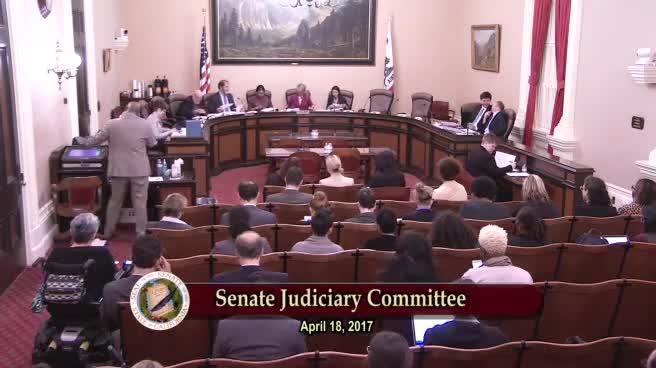 30MIN
Senate Standing Committee on Judiciary
Bill Author

Bill Co-Author(s):






