AB 1906: Mental health: sexually violent predators.
- Session Year: 2015-2016
- House: Assembly
- Latest Version Date: 2016-09-30
Existing law requires the Secretary of the Department of Corrections and Rehabilitation to refer a person who is in custody under that departments jurisdiction, who is serving a determinate sentence or whose parole has been revoked, for evaluation by the State Department of State Hospitals if the secretary determines that the person may be a sexually violent predator. Existing law establishes a screening process for the department and the Board of Parole Hearings to determine whether a person has committed a sexually violent offense, and to determine if the person is likely to be a sexually violent predator prior to referral to the State Department of State Hospitals for a full evaluation. Existing law authorizes the board, upon a showing of good cause, as defined, to order that the person referred to the State Department of State Hospitals remain in custody for no more than 45 days beyond the persons scheduled release date for full evaluation. Existing law requires, if the State Department of State Hospitals determines that the person is a sexually violent predator, as defined, the Director of State Hospitals to forward a request to a specified county for a petition to be filed for the person to be committed to a facility for mental health treatment.
This bill would require the Director of State Hospitals to forward the request no less than 20 calendar days prior to the scheduled release date of the person or, if the person is ordered by the board to remain in custody beyond the persons scheduled release date, no less than 20 calendar days prior to the end of that hold. The bill would modify the definition of good cause in the above provision. The bill would also make technical, nonsubstantive changes to these provisions.
Existing law requires the Secretary of the Department of Corrections and Rehabilitation to refer a person who is in custody under that departments jurisdiction, who is serving a determinate sentence or whose parole has been revoked, for evaluation by the State Department of State Hospitals if the secretary determines that the person may be a sexually violent predator. Existing law establishes a screening process for the department and the Board of Parole Hearings to determine whether a person has committed a sexually violent offense, and to determine if the person is likely to be a sexually violent predator prior to referral to the State Department of State Hospitals for a full evaluation. Existing law authorizes the board, upon a showing of good cause, as defined, to order that the person referred to the State Department of State Hospitals remain in custody for no more than 45 days beyond the persons scheduled release date for full evaluation. Existing law also requires, if the State Department of State Hospitals determines that a the person is a sexually violent predator, as defined, the Director of State Hospitals to forward a request to a specified county for a petition to be filed for the person to be committed to a facility for mental health treatment.
This bill would require the Director of State Hospitals to forward the request no less than 20 calendar days prior to the scheduled release date of the person. person or, if the person is ordered by the board to remain in custody beyond the persons scheduled release date, no less than 20 calendar days prior to the end of that hold. The bill would modify the definition of good cause in the above provision. The bill would also make technical, nonsubstantive changes to these provisions.
Existing law requires the Secretary of the Department of Corrections and Rehabilitation to refer a person who is in custody under that departments jurisdiction, who is serving a determinate sentence or whose parole has been revoked, for evaluation by the State Department of State Hospitals if the secretary determines that the person may be a sexually violent predator. Existing law establishes a screening process for the department and the Board of Parole Hearings to determine whether a person has committed a sexually violent offense, and to determine if the person is likely to be a sexually violent predator prior to referral to the State Department of State Hospitals for a full evaluation. Existing law also requires, if the State Department of State Hospitals determines that a person is a sexually violent predator, as defined, the Director of State Hospitals to forward a request to a specified county for a petition to be filed for the person to be committed to a facility for mental health treatment.
This bill would require the Director of State Hospitals to forward the request no less than 20 calendar days prior to the scheduled release date of the person.
(a)(1)Whenever the Secretary of the Department of Corrections and Rehabilitation determines that an individual who is in custody under the jurisdiction of the Department of Corrections and Rehabilitation, and who is either serving a determinate prison sentence or whose parole has been revoked, may be a sexually violent predator, the secretary shall, at least six months prior to that individuals scheduled date for release from prison, refer the person for evaluation in accordance with this section. However, if the inmate was received by the department with less than nine months of his or her sentence to serve, or if the inmates release date is modified by judicial or administrative action, the secretary may refer the person for evaluation in accordance with this section at a date that is less than six months prior to the inmates scheduled release date.
(2)A petition may be filed under this section if the individual was in custody pursuant to his or her determinate prison term, parole revocation term, or a hold placed pursuant to Section 6601.3, at the time the petition is filed. A petition shall not be dismissed on the basis of a later judicial or administrative determination that the individuals custody was unlawful, if the unlawful custody was the result of a good faith mistake of fact or law. This paragraph shall apply to any petition filed on or after January 1, 1996.
(b)The person shall be screened by the Department of Corrections and Rehabilitation and the Board of Parole Hearings based on whether the person has committed a sexually violent predatory offense and on a review of the persons social, criminal, and institutional history. This screening shall be conducted in accordance with a structured screening instrument developed and updated by the State Department of State Hospitals in consultation with the Department of Corrections and Rehabilitation. If as a result of this screening it is determined that the person is likely to be a sexually violent predator, the Department of Corrections and Rehabilitation shall refer the person to the State Department of State Hospitals for a full evaluation of whether the person meets the criteria in Section 6600.
(c)The State Department of State Hospitals shall evaluate the person in accordance with a standardized assessment protocol, developed and updated by the State Department of State Hospitals, to determine whether the person is a sexually violent predator as defined in this article. The standardized assessment protocol shall require assessment of diagnosable mental disorders, as well as various factors known to be associated with the risk of reoffense among sex offenders. Risk factors to be considered shall include criminal and psychosexual history, type, degree, and duration of sexual deviance, and severity of mental disorder.
(d)Pursuant to subdivision (c), the person shall be evaluated by two practicing psychiatrists or psychologists, or one practicing psychiatrist and one practicing psychologist, designated by the Director of State Hospitals. If both evaluators concur that the person has a diagnosed mental disorder so that he or she is likely to engage in acts of sexual violence without appropriate treatment and custody, the Director of State Hospitals shall forward a request for a petition for commitment under Section 6602 to the county designated in subdivision (i). Copies of the evaluation reports and any other supporting documents shall be made available to the attorney designated by the county pursuant to subdivision (i) who may file a petition for commitment.
(e)If one of the professionals performing the evaluation pursuant to subdivision (d) does not concur that the person meets the criteria specified in subdivision (d), but the other professional concludes that the person meets those criteria, the Director of State Hospitals shall arrange for further examination of the person by two independent professionals selected in accordance with subdivision (g).
(f)If an examination by independent professionals pursuant to subdivision (e) is conducted, a petition to request commitment under this article shall only be filed if both independent professionals who evaluate the person pursuant to subdivision (e) concur that the person meets the criteria for commitment specified in subdivision (d). The professionals selected to evaluate the person pursuant to subdivision (g) shall inform the person that the purpose of their examination is not treatment but to determine if the person meets certain criteria to be involuntarily committed pursuant to this article. It is not required that the person appreciate or understand that information.
(g)Any independent professional who is designated by the Secretary of the Department of Corrections and Rehabilitation or the Director of State Hospitals for purposes of this section shall not be a state government employee, shall have at least five years of experience in the diagnosis and treatment of mental disorders, and shall include psychiatrists and licensed psychologists who have a doctoral degree in psychology. The requirements set forth in this section also shall apply to any professionals appointed by the court to evaluate the person for purposes of any other proceedings under this article.
(h)(1)If the State Department of State Hospitals determines that the person is a sexually violent predator as defined in this article, the Director of State Hospitals shall forward a request for a petition to be filed for commitment under this article to the county designated in subdivision (i) no less than 20 calendar days prior to the scheduled release date of the person. Copies of the evaluation reports and any other supporting documents shall be made available to the attorney designated by the county pursuant to subdivision (i) who may file a petition for commitment in the superior court.
(2)If a hold is placed pursuant to Section 6601.3 and the State Department of State Hospitals determines that the person is a sexually violent predator as defined in this article, the Director of State Hospitals shall forward a request for a petition to be filed for commitment under this article to the county designated in subdivision (i) no less than 20 calendar days prior to the end of the hold.
(3)The person shall have no right to enforce the time limit set forth in this subdivision and shall have no remedy for its violation.
(i)If the countys designated counsel concurs with the recommendation, a petition for commitment shall be filed in the superior court of the county in which the person was convicted of the offense for which he or she was committed to the jurisdiction of the Department of Corrections and Rehabilitation. The petition shall be filed, and the proceedings shall be handled, by either the district attorney or the county counsel of that county. The county board of supervisors shall designate either the district attorney or the county counsel to assume responsibility for proceedings under this article.
(j)An order issued by a judge pursuant to Section 6601.5, finding that the petition, on its face, supports a finding of probable cause to believe that the individual named in the petition is likely to engage in sexually violent predatory criminal behavior upon his or her release, shall toll that persons parole pursuant to paragraph (4) of subdivision (a) of Section 3000 of the Penal Code, if that individual is determined to be a sexually violent predator.
(k)Pursuant to subdivision (d), the attorney designated by the county pursuant to subdivision (i) shall notify the State Department of State Hospitals of its decision regarding the filing of a petition for commitment within 15 days of making that decision.
SEC. 2.Section 6601.3 of the Welfare and Institutions Code is amended to read:6601.3.(a)Upon a showing of good cause, the Board of Parole Hearings may order that a person referred to the State Department of State Hospitals pursuant to subdivision (b) of Section 6601 remain in custody for no more than 45 days beyond the persons scheduled release date for full evaluation pursuant to subdivisions (c) to (i), inclusive, of Section 6601.
(b)For purposes of this section, good cause means circumstances where there is a recalculation of credits or a restoration of denied or lost credits by any custodial agency or court, a resentencing by a court, the receipt of the prisoner into custody, or equivalent exigent circumstances that result in there being less than 45 days prior to the persons scheduled release date for the full evaluation described in subdivisions (c) to (i), inclusive, of Section 6601.
(a)(1)Whenever the Secretary of the Department of Corrections and Rehabilitation determines that an individual who is in custody under the jurisdiction of the Department of Corrections and Rehabilitation, and who is either serving a determinate prison sentence or whose parole has been revoked, may be a sexually violent predator, the secretary shall, at least six months prior to that individuals scheduled date for release from prison, refer the person for evaluation in accordance with this section. However, if the inmate was received by the department with less than nine months of his or her sentence to serve, or if the inmates release date is modified by judicial or administrative action, the secretary may refer the person for evaluation in accordance with this section at a date that is less than six months prior to the inmates scheduled release date.
(2)A petition may be filed under this section if the individual was in custody pursuant to his or her determinate prison term, parole revocation term, or a hold placed pursuant to Section 6601.3, at the time the petition is filed. A petition shall not be dismissed on the basis of a later judicial or administrative determination that the individuals custody was unlawful, if the unlawful custody was the result of a good faith mistake of fact or law. This paragraph shall apply to any petition filed on or after January 1, 1996.
(b)The person shall be screened by the Department of Corrections and Rehabilitation and the Board of Parole Hearings based on whether the person has committed a sexually violent predatory offense and on a review of the persons social, criminal, and institutional history. This screening shall be conducted in accordance with a structured screening instrument developed and updated by the State Department of State Hospitals in consultation with the Department of Corrections and Rehabilitation. If as a result of this screening it is determined that the person is likely to be a sexually violent predator, the Department of Corrections and Rehabilitation shall refer the person to the State Department of State Hospitals for a full evaluation of whether the person meets the criteria in Section 6600.
(c)The State Department of State Hospitals shall evaluate the person in accordance with a standardized assessment protocol, developed and updated by the State Department of State Hospitals, to determine whether the person is a sexually violent predator as defined in this article. The standardized assessment protocol shall require assessment of diagnosable mental disorders, as well as various factors known to be associated with the risk of reoffense among sex offenders. Risk factors to be considered shall include criminal and psychosexual history, type, degree, and duration of sexual deviance, and severity of mental disorder.
(d)Pursuant to subdivision (c), the person shall be evaluated by two practicing psychiatrists or psychologists, or one practicing psychiatrist and one practicing psychologist, designated by the Director of State Hospitals. If both evaluators concur that the person has a diagnosed mental disorder so that he or she is likely to engage in acts of sexual violence without appropriate treatment and custody, the Director of State Hospitals shall forward a request for a petition for commitment under Section 6602 to the county designated in subdivision (i). Copies of the evaluation reports and any other supporting documents shall be made available to the attorney designated by the county pursuant to subdivision (i) who may file a petition for commitment.
(e)If one of the professionals performing the evaluation pursuant to subdivision (d) does not concur that the person meets the criteria specified in subdivision (d), but the other professional concludes that the person meets those criteria, the Director of State Hospitals shall arrange for further examination of the person by two independent professionals selected in accordance with subdivision (g).
(f)If an examination by independent professionals pursuant to subdivision (e) is conducted, a petition to request commitment under this article shall only be filed if both independent professionals who evaluate the person pursuant to subdivision (e) concur that the person meets the criteria for commitment specified in subdivision (d). The professionals selected to evaluate the person pursuant to subdivision (g) shall inform the person that the purpose of their examination is not treatment but to determine if the person meets certain criteria to be involuntarily committed pursuant to this article. It is not required that the person appreciate or understand that information.
(g)Any independent professional who is designated by the Secretary of the Department of Corrections and Rehabilitation or the Director of State Hospitals for purposes of this section shall not be a state government employee, shall have at least five years of experience in the diagnosis and treatment of mental disorders, and shall include psychiatrists and licensed psychologists who have a doctoral degree in psychology. The requirements set forth in this section also shall apply to any professionals appointed by the court to evaluate the person for purposes of any other proceedings under this article.
(h)(1)If the State Department of State Hospitals determines that the person is a sexually violent predator as defined in this article, the Director of State Hospitals shall forward a request for a petition to be filed for commitment under this article to the county designated in subdivision (i) no less than 20 calendar days prior to the scheduled release date of the person. Copies of the evaluation reports and any other supporting documents shall be made available to the attorney designated by the county pursuant to subdivision (i) who may file a petition for commitment in the superior court. The person has no right to enforce the time limit set forth in this subdivision and has no remedy for its violation.
(2)If a hold is placed pursuant to Section 6601.3 and the State Department of State Hospitals determines that the person is a sexually violent predator as defined in this article, the Director of State Hospitals shall forward a request for a petition to be filed for commitment under this article to the county designated in subdivision (i) no less than 20 calendar days prior to the end of the hold.
(3)The person shall have no right to enforce the time limit set forth in this subdivision and shall have no remedy for its violation.
(i)If the countys designated counsel concurs with the recommendation, a petition for commitment shall be filed in the superior court of the county in which the person was convicted of the offense for which he or she was committed to the jurisdiction of the Department of Corrections and Rehabilitation. The petition shall be filed, and the proceedings shall be handled, by either the district attorney or the county counsel of that county. The county board of supervisors shall designate either the district attorney or the county counsel to assume responsibility for proceedings under this article.
(j)The time limits set forth in this section shall not apply during the first year that this article is operative.
(k)
(j)An order issued by a judge pursuant to Section 6601.5, finding that the petition, on its face, supports a finding of probable cause to believe that the individual named in the petition is likely to engage in sexually violent predatory criminal behavior upon his or her release, shall toll that persons parole pursuant to paragraph (4) of subdivision (a) of Section 3000 of the Penal Code, if that individual is determined to be a sexually violent predator.
(l)
(k)Pursuant to subdivision (d), the attorney designated by the county pursuant to subdivision (i) shall notify the State Department of State Hospitals of its decision regarding the filing of a petition for commitment within 15 days of making that decision.
SEC. 2.Section 6601.3 of the Welfare and Institutions Code is amended to read:6601.3.(a)Upon a showing of good cause, the Board of Parole Hearings may order that a person referred to the State Department of State Hospitals pursuant to subdivision (b) of Section 6601 remain in custody for no more than 45 days beyond the persons scheduled release date for full evaluation pursuant to subdivisions (c) to (i), inclusive, of Section 6601.
(b)For purposes of this section, good cause means circumstances where there is a recalculation of credits or a restoration of denied or lost credits, credits by any custodial agency or court, a resentencing by a court, the receipt of the prisoner into custody, or equivalent exigent circumstances which that result in there being less than 45 days prior to the persons scheduled release date for the full evaluation described in subdivisions (c) to (i), inclusive, of Section 6601.
(a)(1)Whenever the Secretary of the Department of Corrections and Rehabilitation determines that an individual who is in custody under the jurisdiction of the Department of Corrections and Rehabilitation, and who is either serving a determinate prison sentence or whose parole has been revoked, may be a sexually violent predator, the secretary shall, at least six months prior to that individuals scheduled date for release from prison, refer the person for evaluation in accordance with this section. However, if the inmate was received by the department with less than nine months of his or her sentence to serve, or if the inmates release date is modified by judicial or administrative action, the secretary may refer the person for evaluation in accordance with this section at a date that is less than six months prior to the inmates scheduled release date.
(2)A petition may be filed under this section if the individual was in custody pursuant to his or her determinate prison term, parole revocation term, or a hold placed pursuant to Section 6601.3, at the time the petition is filed. A petition shall not be dismissed on the basis of a later judicial or administrative determination that the individuals custody was unlawful, if the unlawful custody was the result of a good faith mistake of fact or law. This paragraph shall apply to any petition filed on or after January 1, 1996.
(b)The person shall be screened by the Department of Corrections and Rehabilitation and the Board of Parole Hearings based on whether the person has committed a sexually violent predatory offense and on a review of the persons social, criminal, and institutional history. This screening shall be conducted in accordance with a structured screening instrument developed and updated by the State Department of State Hospitals in consultation with the Department of Corrections and Rehabilitation. If as a result of this screening it is determined that the person is likely to be a sexually violent predator, the Department of Corrections and Rehabilitation shall refer the person to the State Department of State Hospitals for a full evaluation of whether the person meets the criteria in Section 6600.
(c)The State Department of State Hospitals shall evaluate the person in accordance with a standardized assessment protocol, developed and updated by the State Department of State Hospitals, to determine whether the person is a sexually violent predator as defined in this article. The standardized assessment protocol shall require assessment of diagnosable mental disorders, as well as various factors known to be associated with the risk of reoffense among sex offenders. Risk factors to be considered shall include criminal and psychosexual history, type, degree, and duration of sexual deviance, and severity of mental disorder.
(d)Pursuant to subdivision (c), the person shall be evaluated by two practicing psychiatrists or psychologists, or one practicing psychiatrist and one practicing psychologist, designated by the Director of State Hospitals. If both evaluators concur that the person has a diagnosed mental disorder so that he or she is likely to engage in acts of sexual violence without appropriate treatment and custody, the Director of State Hospitals shall forward a request for a petition for commitment under Section 6602 to the county designated in subdivision (i). Copies of the evaluation reports and any other supporting documents shall be made available to the attorney designated by the county pursuant to subdivision (i) who may file a petition for commitment.
(e)If one of the professionals performing the evaluation pursuant to subdivision (d) does not concur that the person meets the criteria specified in subdivision (d), but the other professional concludes that the person meets those criteria, the Director of State Hospitals shall arrange for further examination of the person by two independent professionals selected in accordance with subdivision (g).
(f)If an examination by independent professionals pursuant to subdivision (e) is conducted, a petition to request commitment under this article shall only be filed if both independent professionals who evaluate the person pursuant to subdivision (e) concur that the person meets the criteria for commitment specified in subdivision (d). The professionals selected to evaluate the person pursuant to subdivision (g) shall inform the person that the purpose of their examination is not treatment but to determine if the person meets certain criteria to be involuntarily committed pursuant to this article. It is not required that the person appreciate or understand that information.
(g)Any independent professional who is designated by the Secretary of the Department of Corrections and Rehabilitation or the Director of State Hospitals for purposes of this section shall not be a state government employee, shall have at least five years of experience in the diagnosis and treatment of mental disorders, and shall include psychiatrists and licensed psychologists who have a doctoral degree in psychology. The requirements set forth in this section also shall apply to any professionals appointed by the court to evaluate the person for purposes of any other proceedings under this article.
(h)If the State Department of State Hospitals determines that the person is a sexually violent predator as defined in this article, the Director of State Hospitals shall forward a request for a petition to be filed for commitment under this article to the county designated in subdivision (i). (i) no less than 20 calendar days prior to the scheduled release date of the person. Copies of the evaluation reports and any other supporting documents shall be made available to the attorney designated by the county pursuant to subdivision (i) who may file a petition for commitment in the superior court. The person has no right to enforce the time limit set forth in this subdivision and has no remedy for its violation.
(i)If the countys designated counsel concurs with the recommendation, a petition for commitment shall be filed in the superior court of the county in which the person was convicted of the offense for which he or she was committed to the jurisdiction of the Department of Corrections and Rehabilitation. The petition shall be filed, and the proceedings shall be handled, by either the district attorney or the county counsel of that county. The county board of supervisors shall designate either the district attorney or the county counsel to assume responsibility for proceedings under this article.
(j)The time limits set forth in this section shall not apply during the first year that this article is operative.
(k)An order issued by a judge pursuant to Section 6601.5, finding that the petition, on its face, supports a finding of probable cause to believe that the individual named in the petition is likely to engage in sexually violent predatory criminal behavior upon his or her release, shall toll that persons parole pursuant to paragraph (4) of subdivision (a) of Section 3000 of the Penal Code, if that individual is determined to be a sexually violent predator.
(l)Pursuant to subdivision (d), the attorney designated by the county pursuant to subdivision (i) shall notify the State Department of State Hospitals of its decision regarding the filing of a petition for commitment within 15 days of making that decision.
(m)This section shall become operative on the date that the director executes a declaration, which shall be provided to the fiscal and policy committees of the Legislature, including the Chairperson of the Joint Legislative Budget Committee, and the Department of Finance, specifying that sufficient qualified state employees have been hired to conduct the evaluations required pursuant to subdivision (d), or January 1, 2013, whichever occurs first.
|
Date
|
Status
|
|---|---|
| Aug 30, 2016 | Enrolled and presented to the Governor at 4 p.m. |
| Aug 23, 2016 | Senate amendments concurred in. To Engrossing and Enrolling. (Ayes 80. Noes 0. Page 6127.). |
| Aug 23, 2016 | Senate amendments concurred in. To Engrossing and Enrolling. |
| Aug 17, 2016 | Read third time. Passed. Ordered to the Assembly. (Ayes 39. Noes 0. Page 5053.). |
| Aug 17, 2016 | Read third time. Passed. Ordered to the Assembly. (Ayes 39. Noes 0.). |
| Aug 17, 2016 | In Assembly. Concurrence in Senate amendments pending. May be considered on or after August 19 pursuant to Assembly Rule 77. |
| Aug 17, 2016 | Read third time. Passed. Ordered to the Assembly. |
| Aug 16, 2016 | Read second time. Ordered to third reading. |
| Aug 15, 2016 | Read third time and amended. Ordered to second reading. |
| May 16, 2016 | Ordered to third reading. |
| May 16, 2016 | From Consent Calendar. |
| May 11, 2016 | Read second time. Ordered to Consent Calendar. |
| May 10, 2016 | From committee: Do pass. To Consent Calendar. (Ayes 7. Noes 0.) (May 10). |
| Apr 7, 2016 | Referred to Com. on PUB. S. |
| Mar 28, 2016 | Read third time. Passed. Ordered to the Senate. (Ayes 74. Noes 0. Page 4040.) |
| Mar 28, 2016 | In Senate. Read first time. To Com. on RLS. for assignment. |
| Mar 28, 2016 | Read third time. Passed. Ordered to the Senate. |
| Mar 16, 2016 | Read second time. Ordered to Consent Calendar. |
| Mar 15, 2016 | From committee: Do pass. To Consent Calendar. (Ayes 7. Noes 0.) (March 15). |
| Feb 25, 2016 | Referred to Com. on PUB. S. |
| Feb 12, 2016 | From printer. May be heard in committee March 13. |
| Feb 11, 2016 | Read first time. To print. |
|
Date
|
Description
|
Location
|
Votes
|
|
|---|---|---|---|---|
| Aug 23, 2016 | AB 1906 MELENDEZ Concurrence in Senate Amendments | Assembly Floor |
Passed |
|
| Aug 17, 2016 | Assembly 3rd Reading AB1906 Melendez By Morrell | Senate Floor |
Passed |
|
| May 10, 2016 | Do pass and be ordered to the Consent Calendar | Senate Standing Committee on Public Safety |
Passed |
|
| Mar 28, 2016 | AB 1906 MELENDEZ Consent Calendar Second Day Regular Session | Assembly Floor |
Passed |
|
| Mar 15, 2016 | Do pass. To Consent Calendar. | Assembly Standing Committee on Public Safety |
Passed |
This list shows positions taken on this bill by organizations on the date displayed, which is linked to the original source.
Positions by individuals are not included.
CONCURRENCE IN SENATE AMENDMENTS
CSA1 Bill Id:AB 1906
Author:(Melendez)
As Amended Ver:August 15, 2016
Majority vote
ASSEMBLY: | 74-0 | (March 28, 2016) | SENATE: | 39-0 | (August 17, 2016) |
Original Committee Reference: PUB. S.
SUMMARY: Requires the Director of the Department of State Hospitals (DSH) to forward a request to a county that a petition be filed for a person to be committed to the DSH for sexually violent predator (SVP) treatment no later than 20 calendar days prior to the scheduled release date of the person.
The Senate amendments clarify that if 45 day hold is placed on a person determined to be an SVP, the Director of DSH shall forward a request that a petition be filed to commit the person to DSH for treatment at least 20 calendar days prior to the expiration of the hold.
EXISTING LAW:
- Provides for the civil commitment for psychiatric and psychological treatment of a prison inmate found to be a SVP after the person has served his or her prison commitment.
- Defines a "sexually violent predator" as "a person who has been convicted of a sexually violent offense against at least one victim, and who has a diagnosed mental disorder that makes the person a danger to the health and safety of others in that it is likely that he or she will engage in sexually violent criminal behavior."
- Permits a person committed as a SVP to be held for an indeterminate term upon commitment.
- Requires that a person found to have been a SVP and committed to the DSH have a current examination on his or her mental condition made at least yearly. The report shall include consideration of conditional release to a less restrictive alternative or an unconditional release is in the best interest of the person and also what conditions can be imposed to adequately protect the community.
- Allows a SVP to seek conditional release with the authorization of the DSH Director when DSH determines that the person's condition has so changed that he or she no longer meets the SVP criteria, or when conditional release is in the person's best interest and conditions to adequately protect the public can be imposed.
- Allows a person committed as a SVP to petition for conditional release or an unconditional discharge any time after one year of commitment, notwithstanding the lack of recommendation or concurrence by the Director of DSH.
- Provides that, if the court deems the conditional release petition not frivolous, the court is to give notice of the hearing date to the attorney designated to represent the county of commitment, the retained or appointed attorney for the committed person, and the Director of State Hospitals at least 30 court days before the hearing date.
- Requires the court to first obtain the written recommendation of the director of the treatment facility before taking any action on the petition for conditional release if the is made without the consent of the director of the treatment facility.
- Provides that the court shall hold a hearing to determine whether the person committed would be a danger to the health and safety of others in that it is likely that he or she will engage in sexually violent criminal behavior due to his or her diagnosed mental disorder if under supervision and treatment in the community. Provides that the attorney designated the county of commitment shall represent the state and have the committed person evaluated by experts chosen by the state and that the committed person shall have the right to the appointment of experts, if he or she so requests.
- Requires the court to order the committed person placed with an appropriate forensic conditional release program operated by the state for one year if the court at the hearing determines that the committed person would not be a danger to others due to his or her diagnosed mental disorder while under supervision and treatment in the community. Requires a substantial portion of the state-operated forensic conditional release program to include outpatient supervision and treatment. Provides that the court retains jurisdiction of the person throughout the course of the program.
- Provides that if the court denies the petition to place the person in an appropriate forensic conditional release program, the person may not file a new application until one year has elapsed from the date of the denial.
- Allows, after a minimum of one year on conditional release, the committed person, with or without the recommendation or concurrence of the Director of State Hospitals, to petition the court for unconditional discharge, as specified.
FISCAL EFFECT: None. This bill is keyed non-fiscal by the Legislative Counsel.
COMMENTS: According to the author, "When the California Department of Corrections and Rehabilitation (CDCR) and the Board of Parole Hearings (BPH) determine that an individual in custody may be an SVP, based on their commitment offense and a review of their social, criminal, and institutional history, the individual is referred to the DSH for a full SVP evaluation.
"Following that evaluation, if DSH determines that the individual is an SVP, the Director of DSH is required to request that the District Attorney or County Counsel in the county in which the person was convicted file a petition for commitment. The filing of that petition begins a civil commitment process, which can lead to the individual being confined at Coalinga State Hospital to receive treatment until it is determined that they no longer pose a risk of re-offense.
"The SVP Act, as currently written, contains a statutory timeline for each step of the evaluation process, as well as time limits for the filing of the petition and certain court proceedings. It does not, however, contain a time frame for the submission of the request for the filing of a petition to the DA [District Attorney] or County Counsel. Because of this, DSH often submits filing materials less than 48 hours before the release of an inmate who has already been determined to qualify as an SVP.
"The result of these late requests is that the prosecuting agency bears the burden of filing a case and transporting a defendant at the last minute at an enormous cost and use of resources. The better, and long accepted operating practice is for DSH to submit the filing in time for the DA to be able to meaningfully review the request, file the petition, and arrange for transportation through Statewide Transportation. In at least one instance in Los Angeles County, the filing request was submitted too late for the filing of a petition. In several instances, the supporting documents that are necessary for the filing of a petition were not certified and there was little to no time to correct this egregious error by DSH.
"The simple solution to this problem is to create a statutory requirement that DSH submit the request for the filing of a petition no fewer than 20 days prior to the release of a person determined to be an SVP. This provides the attorneys with time to meaningfully review and prepare a petition, and protects public safety by helping to ensure that nobody slips through the cracks due to a last minute filing request."
Please see the policy committee analysis for a full discussion of this bill.
Analysis Prepared by: Gregory Pagan / PUB. S. / (916) 319-3744 FN: 0004316
Office of Senate Floor Analyses (916) 651-1520 Fax: (916) 327-4478 | AB 1906 |
THIRD READING
Bill No: AB 1906
Amended: 8/15/16 in Senate
SENATE PUBLIC SAFETY COMMITTEE: 7-0, 5/10/16
AYES: Hancock, Anderson, Glazer, Leno, Liu, Monning, Stone
ASSEMBLY FLOOR: 74-0, 3/28/16 (Consent) - See last page for vote
SUBJECT: Mental health: sexually violent predators
SOURCE: California District Attorneys Association
DIGEST: This bill (1) requires the Department of State Hospitals (DSH) to request that a district attorney file a petition for commitment of a person as a sexually violent predator (SVP) within 20 days of the determination by DSH that the person meets the criteria for commitment as an SVP; and (2) clarifies that good cause for a hold of up to 45 days after an inmate’s scheduled release date to allow DSH to evaluate the inmate as a possible SVP includes recalculation or restoration of sentencing credits by “any custodial agency or court.”
Senate Floor Amendments of 8/15/16 (1) clarify that a request from DSH to a prosecutor to file a petition for commitment of an inmate determined by DSH to be an SVP, and who has been held for 45 days so that DSH can complete an evaluation before scheduled release, shall be made at least 20 days prior to expiration of the hold; and (2) clarify that good cause to hold an inmate for 45 days includes recalculation or restoration of credits “by any custodial agency or court”.
Existing law:
- Provides for the civil commitment for psychiatric and psychological treatment of a prison inmate found to be an SVP after the person has served his or her prison commitment. (Welf. & Inst. Code, § 6600, et seq.)
- Defines a "sexually violent predator" as "a person who has been convicted of a sexually violent offense against at least one victim, and who has a diagnosed mental disorder that makes the person a danger to the health and safety of others in that it is likely that he or she will engage in sexually violent criminal behavior." (Welf. & Inst. Code, § 6600, subd. (a)(1).)
- Permits a person committed as an SVP to be held for an indeterminate term upon commitment. (Welf. & Inst. Code, § 6604.1.)
- Requires that a person found to have been an SVP and committed to the DSH have a current examination on his or her mental condition made at least yearly. The report shall include consideration of conditional release to a less restrictive alternative or an unconditional release is in the best interest of the person and also what conditions can be imposed to adequately protect the community. (Welf. & Inst. Code, § 6604.9.)
- Allows an SVP to seek conditional release with the authorization of the DSH Director when DSH determines that the person's condition has so changed that he or she no longer meets the SVP criteria, or when conditional release is in the person's best interest and conditions to adequately protect the public can be imposed. (Welf. & Inst. Code, § 6607.)
- Allows a person committed as an SVP to petition for conditional release or an unconditional discharge any time after one year of commitment, notwithstanding the lack of recommendation or concurrence by the Director of DSH. (Welf. & Inst. Code, § 6608, subd. (a).)
- Provides that, if the court deems the conditional release petition not frivolous, the court is to give notice of the hearing date to the attorney designated to represent the county of commitment, the retained or appointed attorney for the committed person, and the Director of DSH at least 30 court days before the hearing date. (Welf. & Inst. Code, § 6608, subd. (b).)
- Requires the court to first obtain the written recommendation of the director of the treatment facility before taking any action on the petition for conditional release if the is made without the consent of the director of the treatment facility. (Welf. & Inst. Code, § 6608, subd. (c).)
- Provides that the court shall hold a hearing to determine whether the person committed would be a danger to the health and safety of others in that it is likely that he or she will engage in sexually violent criminal behavior due to his or her diagnosed mental disorder if under supervision and treatment in the community. Existing law further provides that the attorney designated the county of commitment shall represent the state and have the committed person evaluated by experts chosen by the state and that the committed person shall have the right to the appointment of experts, if he or she so requests. (Welf. & Inst. Code, § 6608, subd. (e).)
- Requires the court to order the committed person placed with an appropriate forensic conditional release program operated by the state for one year if the court at the hearing determines that the committed person would not be a danger to others due to his or her diagnosed mental disorder while under supervision and treatment in the community. Existing law further requires a substantial portion of the state-operated forensic conditional release program to include outpatient supervision and treatment. Provides that the court retains jurisdiction of the person throughout the course of the program. (Welf. & Inst. Code, § 6608, subd. (e).)
- Provides that if the court denies the petition to place the person in an appropriate forensic conditional release program, the person may not file a new application until one year has elapsed from the date of the denial. (Welf. & Inst. Code, § 6608, subd. (h).)
- Allows, after a minimum of one year on conditional release, the committed person, with or without the recommendation or concurrence of the Director of DSH, to petition the court for unconditional discharge, as specified. (Welf. & Inst. Code, § 6608, subd. (k).)
This bill:
- Requires the Director of DSH to forward a request to a county that a petition be filed for a person to be committed to DSH for SVP treatment no later than 20 calendar days prior to the scheduled release date of the person, or no less than 20 days prior to expiration of a hold that was imposed to give DSH time to complete an evaluation of the inmate as a possible SVP prior to scheduled release.
- Clarifies that a good cause for a hold of up to 45 days to allow DSH to complete an evaluation of the inmate as a possible SVP includes recalculation or restoration of credits by any custodial agency or court.
Background
The SVP law was enacted in 1995 in response to concerns that dangerous sex offenders were being released into the community after they served determinate sentences in prison. The law is especially complicated. There are numerous steps and entities involved in the process of assessing and committing a person to DSH as an SVP. The law has been frequently amended to prevent or forestall release of an alleged or committed SVP due to some problem or anomaly arising from the complexity of process. For example, the law was amended by two separate urgency bills in the 1999-2000 legislative session. One bill allowed the California Department of Corrections and Rehabilitation (CDCR) to hold a potential SVP 45 days past his parole release date so that DSH experts could complete required SVP evaluations. The other bill allowed commitment proceedings to proceed despite a mistake in law or fact by CDCR as to application of parole rules. In 2015, the law was amended to give prosecutors access to material relied upon by evaluators in producing updated evaluations of alleged SVPs. Other amendments from 1999 through 2015 have concerned notice requirements to communities where an SVP will be released and virtually every other aspect of the law.
Comments
According to the author:
When the California Department of Corrections and Rehabilitation (CDCR) and the Board of Parole Hearings (BPH) determine that an individual in custody may be an SVP, based on their commitment offense and a review of their social, criminal, and institutional history, the individual is referred to the DSH for a full SVP evaluation. Following that evaluation, if DSH determines that the individual is an SVP, the Director of DSH is required to request that the District Attorney or County Counsel in the county in which the person was convicted file a petition for commitment. The filing of that petition begins a civil commitment process, which can lead to the individual being confined at Coalinga State Hospital to receive treatment until it is determined that they no longer pose a risk of re-offense.
The SVP Act contains a statutory timeline for each step of the evaluation process, as well as time limits for the filing of the petition and certain court proceedings. It does not, however, contain a time frame for the submission of the request for the filing of a petition to the DA or County Counsel. Because of this, DSH often submits filing materials less than 48 hours before the release of an inmate who has already been determined to qualify as an SVP. The result of these late requests is that the prosecuting agency bears the burden of filing a case and transporting a defendant at the last minute, at an enormous cost and use of resources. The better and long accepted operating practice is for DSH to submit the filing in time for the DA to be able to meaningfully review the request, file the petition, and arrange for transportation of the alleged SVP to the county where trial will be held. In at least one instance in Los Angeles County, the filing request was submitted too late for the filing of a petition. In several instances, the supporting documents that are necessary for the filing of a petition were not certified and there was little to no time to correct this egregious error by DSH.
The simple solution to this problem is to create a statutory requirement that DSH submit the request for the filing of a petition no fewer than 20 days prior to the release of a person determined to be an SVP. This provides the attorneys with time to meaningfully review and prepare a petition, and protects public safety by helping to ensure that nobody slips through the cracks due to a last minute filing request.
Since the SVP law was enacted in 1996, the law has been amended very numerous times as issues on the application of the law have arisen in the courts. The SVP law requires DSH to evaluate an inmate as a possible SVP at least six months prior to release, with exceptions for circumstances where an inmate’s release date was modified or the inmate was received by the prison system with fewer than nine months to serve on his sentence. These provisions did not address circumstances where an inmate was scheduled to be released on parole prior to the time an evaluation could be completed. These cases occurred where an inmate’s sentencing credits were restored or recalculated, or where a court ordered an inmate’s release. To address these cases, the law was amended to authorize, for good cause, a 45-day hold past the inmate’s scheduled release to allow DSH to complete an evaluation. The law was thereafter amended to specify that good cause means a recalculation or restoration of credits. This bill clarifies that good cause for a hold involves restoration or recalculation of credits “by any custodial agency or court.”
FISCAL EFFECT: Appropriation: Fiscal Com.: No Local:
California District Attorneys Association (source)
California State Sheriffs’ Association
OPPOSITION: (Verified 8/16/16)
None received
ASSEMBLY FLOOR: 74-0, 3/28/16
AYES: Achadjian, Alejo, Travis Allen, Atkins, Baker, Bigelow, Bloom, Bonilla, Bonta, Brough, Brown, Burke, Calderon, Campos, Chau, Chávez, Chiu, Chu, Cooley, Cooper, Dababneh, Daly, Dodd, Frazier, Beth Gaines, Gallagher, Cristina Garcia, Eduardo Garcia, Gatto, Gipson, Gomez, Gonzalez, Gordon, Gray, Grove, Hadley, Harper, Roger Hernández, Holden, Irwin, Jones, Jones-Sawyer, Kim, Lackey, Levine, Linder, Lopez, Low, Maienschein, Mathis, Mayes, Medina, Melendez, Mullin, Nazarian, Obernolte, Olsen, Patterson, Quirk, Ridley-Thomas, Rodriguez, Salas, Santiago, Steinorth, Mark Stone, Thurmond, Ting, Wagner, Waldron, Weber, Wilk, Williams, Wood, Rendon
NO VOTE RECORDED: Chang, Dahle, Eggman, McCarty, O'Donnell
Prepared by: Jerome McGuire / PUB. S. /
8/16/16 17:57:14
**** END ****
Office of Senate Floor Analyses (916) 651-1520 Fax: (916) 327-4478 | AB 1906 |
THIRD READING
Bill No: AB 1906
Introduced: 2/11/16
SENATE PUBLIC SAFETY COMMITTEE: 7-0, 5/10/16
AYES: Hancock, Anderson, Glazer, Leno, Liu, Monning, Stone
ASSEMBLY FLOOR: 74-0, 3/28/16 (Consent) - See last page for vote
SUBJECT: Mental health: sexually violent predators
SOURCE: California District Attorneys Association
DIGEST: This bill requires the Department of State Hospitals (DSH) to request that a district attorney file a petition for commitment of a person as a sexually violent predator (SVP) within 20 days of the determination by DSH that the person meets the criteria for commitment as an SVP.
Existing law:
- Provides for the civil commitment for psychiatric and psychological treatment of a prison inmate found to be an SVP after the person has served his or her prison commitment. (Welf. & Inst. Code, § 6600, et seq.)
- Defines a "sexually violent predator" as "a person who has been convicted of a sexually violent offense against at least one victim, and who has a diagnosed mental disorder that makes the person a danger to the health and safety of others in that it is likely that he or she will engage in sexually violent criminal behavior." (Welf. & Inst. Code, § 6600, subd. (a)(1).)
- Permits a person committed as an SVP to be held for an indeterminate term upon commitment. (Welf. & Inst. Code, § 6604.1.)
- Requires that a person found to have been an SVP and committed to the DSH have a current examination on his or her mental condition made at least yearly. The report shall include consideration of conditional release to a less restrictive alternative or an unconditional release is in the best interest of the person and also what conditions can be imposed to adequately protect the community. (Welf. & Inst. Code, § 6604.9.)
- Allows an SVP to seek conditional release with the authorization of the DSH Director when DSH determines that the person's condition has so changed that he or she no longer meets the SVP criteria, or when conditional release is in the person's best interest and conditions to adequately protect the public can be imposed. (Welf. & Inst. Code, § 6607.)
- Allows a person committed as an SVP to petition for conditional release or an unconditional discharge any time after one year of commitment, notwithstanding the lack of recommendation or concurrence by the Director of DSH. (Welf. & Inst. Code, § 6608, subd. (a).)
- Provides that, if the court deems the conditional release petition not frivolous, the court is to give notice of the hearing date to the attorney designated to represent the county of commitment, the retained or appointed attorney for the committed person, and the Director of DSH at least 30 court days before the hearing date. (Welf. & Inst. Code, § 6608, subd. (b).)
- Requires the court to first obtain the written recommendation of the director of the treatment facility before taking any action on the petition for conditional release if the is made without the consent of the director of the treatment facility. (Welf. & Inst. Code, § 6608, subd. (c).)
- Provides that the court shall hold a hearing to determine whether the person committed would be a danger to the health and safety of others in that it is likely that he or she will engage in sexually violent criminal behavior due to his or her diagnosed mental disorder if under supervision and treatment in the community. Existing law further provides that the attorney designated the county of commitment shall represent the state and have the committed person evaluated by experts chosen by the state and that the committed person shall have the right to the appointment of experts, if he or she so requests. (Welf. & Inst. Code, § 6608, subd. (e).)
- Requires the court to order the committed person placed with an appropriate forensic conditional release program operated by the state for one year if the court at the hearing determines that the committed person would not be a danger to others due to his or her diagnosed mental disorder while under supervision and treatment in the community. Existing law further requires a substantial portion of the state-operated forensic conditional release program to include outpatient supervision and treatment. Provides that the court retains jurisdiction of the person throughout the course of the program. (Welf. & Inst. Code, § 6608, subd. (e).)
- Provides that if the court denies the petition to place the person in an appropriate forensic conditional release program, the person may not file a new application until one year has elapsed from the date of the denial. (Welf. & Inst. Code, § 6608, subd. (h).)
- Allows, after a minimum of one year on conditional release, the committed person, with or without the recommendation or concurrence of the Director of DSH, to petition the court for unconditional discharge, as specified. (Welf. & Inst. Code, § 6608, subd. (k).)
This bill requires the Director of DSH to forward a request to a county that a petition be filed for a person to be committed to DSH for SVP treatment no later than 20 calendar days prior to the scheduled release date of the person.
Background
The SVP law was enacted in 1995 in response to concerns that dangerous sex offenders were being released into the community after they served determinate sentences in prison. The law is especially complicated. There are numerous steps and entities involved in the process of assessing and committing a person to DSH as an SVP. The law has been frequently amended to prevent or forestall release of an alleged or committed SVP due to some problem or anomaly arising from the complexity of process. For example, the law was amended by two separate urgency bills in the 1999-2000 legislative session. One bill allowed the California Department of Corrections and Rehabilitation (CDCR) to hold a potential SVP 45 days past his parole release date so that DSH experts could complete required SVP evaluations. The other bill allowed commitment proceedings to proceed despite a mistake in law or fact by CDCR as to application of parole rules. In 2015, the law was amended to give prosecutors access to material relied upon by evaluators in producing updated evaluations of alleged SVPs. Other amendments from 1999 through 2015 have concerned notice requirements to communities where an SVP will be released and virtually every other aspect of the law.
Comments
According to the author:
When the California Department of Corrections and Rehabilitation (CDCR) and the Board of Parole Hearings (BPH) determine that an individual in custody may be an SVP, based on their commitment offense and a review of their social, criminal, and institutional history, the individual is referred to the DSH for a full SVP evaluation. Following that evaluation, if DSH determines that the individual is an SVP, the Director of DSH is required to request that the District Attorney or County Counsel in the county in which the person was convicted file a petition for commitment. The filing of that petition begins a civil commitment process, which can lead to the individual being confined at Coalinga State Hospital to receive treatment until it is determined that they no longer pose a risk of re-offense.
The SVP Act contains a statutory timeline for each step of the evaluation process, as well as time limits for the filing of the petition and certain court proceedings. It does not, however, contain a time frame for the submission of the request for the filing of a petition to the DA or County Counsel. Because of this, DSH often submits filing materials less than 48 hours before the release of an inmate who has already been determined to qualify as an SVP. The result of these late requests is that the prosecuting agency bears the burden of filing a case and transporting a defendant at the last minute, at an enormous cost and use of resources. The better and long accepted operating practice is for DSH to submit the filing in time for the DA to be able to meaningfully review the request, file the petition, and arrange for transportation of the alleged SVP to the county where trial will be held. In at least one instance in Los Angeles County, the filing request was submitted too late for the filing of a petition. In several instances, the supporting documents that are necessary for the filing of a petition were not certified and there was little to no time to correct this egregious error by DSH.
The simple solution to this problem is to create a statutory requirement that DSH submit the request for the filing of a petition no fewer than 20 days prior to the release of a person determined to be an SVP. This provides the attorneys with time to meaningfully review and prepare a petition, and protects public safety by helping to ensure that nobody slips through the cracks due to a last minute filing request.
FISCAL EFFECT: Appropriation: Fiscal Com.: Local:
California District Attorneys Association (source)
California State Sheriffs’ Association
OPPOSITION: (Verified 5/11/16)
None received
ASSEMBLY FLOOR: 74-0, 3/28/16
AYES: Achadjian, Alejo, Travis Allen, Atkins, Baker, Bigelow, Bloom, Bonilla, Bonta, Brough, Brown, Burke, Calderon, Campos, Chau, Chávez, Chiu, Chu, Cooley, Cooper, Dababneh, Daly, Dodd, Frazier, Beth Gaines, Gallagher, Cristina Garcia, Eduardo Garcia, Gatto, Gipson, Gomez, Gonzalez, Gordon, Gray, Grove, Hadley, Harper, Roger Hernández, Holden, Irwin, Jones, Jones-Sawyer, Kim, Lackey, Levine, Linder, Lopez, Low, Maienschein, Mathis, Mayes, Medina, Melendez, Mullin, Nazarian, Obernolte, Olsen, Patterson, Quirk, Ridley-Thomas, Rodriguez, Salas, Santiago, Steinorth, Mark Stone, Thurmond, Ting, Wagner, Waldron, Weber, Wilk, Williams, Wood, Rendon
NO VOTE RECORDED: Chang, Dahle, Eggman, McCarty, O'Donnell
Prepared by: Jerome McGuire / PUB. S. /
5/16/16 14:32:15
**** END ****
Office of Senate Floor Analyses (916) 651-1520 Fax: (916) 327-4478 | AB 1906 |
CONSENT
Bill No: AB 1906
Introduced: 2/11/16
SENATE PUBLIC SAFETY COMMITTEE: 7-0, 5/10/16
AYES: Hancock, Anderson, Glazer, Leno, Liu, Monning, Stone
ASSEMBLY FLOOR: 74-0, 3/28/16 (Consent) - See last page for vote
SUBJECT: Mental health: sexually violent predators
DIGEST: This bill requires the Department of State Hospitals (DSH) to request that a district attorney file a petition for commitment of a person as a sexually violent predator (SVP) within 20 days of the determination by DSH that the person meets the criteria for commitment as an SVP.
Existing law:
- Provides for the civil commitment for psychiatric and psychological treatment of a prison inmate found to be an SVP after the person has served his or her prison commitment. (Welf. & Inst. Code, § 6600, et seq.)
- Defines a "sexually violent predator" as "a person who has been convicted of a sexually violent offense against at least one victim, and who has a diagnosed mental disorder that makes the person a danger to the health and safety of others in that it is likely that he or she will engage in sexually violent criminal behavior." (Welf. & Inst. Code, § 6600, subd. (a)(1).)
- Permits a person committed as an SVP to be held for an indeterminate term upon commitment. (Welf. & Inst. Code, § 6604.1.)
- Requires that a person found to have been an SVP and committed to the DSH have a current examination on his or her mental condition made at least yearly. The report shall include consideration of conditional release to a less restrictive alternative or an unconditional release is in the best interest of the person and also what conditions can be imposed to adequately protect the community. (Welf. & Inst. Code, § 6604.9.)
- Allows an SVP to seek conditional release with the authorization of the DSH Director when DSH determines that the person's condition has so changed that he or she no longer meets the SVP criteria, or when conditional release is in the person's best interest and conditions to adequately protect the public can be imposed. (Welf. & Inst. Code, § 6607.)
- Allows a person committed as an SVP to petition for conditional release or an unconditional discharge any time after one year of commitment, notwithstanding the lack of recommendation or concurrence by the Director of DSH. (Welf. & Inst. Code, § 6608, subd. (a).)
- Provides that, if the court deems the conditional release petition not frivolous, the court is to give notice of the hearing date to the attorney designated to represent the county of commitment, the retained or appointed attorney for the committed person, and the Director of DSH at least 30 court days before the hearing date. (Welf. & Inst. Code, § 6608, subd. (b).)
- Requires the court to first obtain the written recommendation of the director of the treatment facility before taking any action on the petition for conditional release if the is made without the consent of the director of the treatment facility. (Welf. & Inst. Code, § 6608, subd. (c).)
- Provides that the court shall hold a hearing to determine whether the person committed would be a danger to the health and safety of others in that it is likely that he or she will engage in sexually violent criminal behavior due to his or her diagnosed mental disorder if under supervision and treatment in the community. Existing law further provides that the attorney designated the county of commitment shall represent the state and have the committed person evaluated by experts chosen by the state and that the committed person shall have the right to the appointment of experts, if he or she so requests. (Welf. & Inst. Code, § 6608, subd. (e).)
- Requires the court to order the committed person placed with an appropriate forensic conditional release program operated by the state for one year if the court at the hearing determines that the committed person would not be a danger to others due to his or her diagnosed mental disorder while under supervision and treatment in the community. Existing law further requires a substantial portion of the state-operated forensic conditional release program to include outpatient supervision and treatment. Provides that the court retains jurisdiction of the person throughout the course of the program. (Welf. & Inst. Code, § 6608, subd. (e).)
- Provides that if the court denies the petition to place the person in an appropriate forensic conditional release program, the person may not file a new application until one year has elapsed from the date of the denial. (Welf. & Inst. Code, § 6608, subd. (h).)
- Allows, after a minimum of one year on conditional release, the committed person, with or without the recommendation or concurrence of the Director of DSH, to petition the court for unconditional discharge, as specified. (Welf. & Inst. Code, § 6608, subd. (k).)
This bill requires the Director of DSH to forward a request to a county that a petition be filed for a person to be committed to DSH for SVP treatment no later than 20 calendar days prior to the scheduled release date of the person.
Background
The SVP law was enacted in 1995 in response to concerns that dangerous sex offenders were being released into the community after they served determinate sentences in prison. The law is especially complicated. There are numerous steps and entities involved in the process of assessing and committing a person to DSH as an SVP. The law has been frequently amended to prevent or forestall release of an alleged or committed SVP due to some problem or anomaly arising from the complexity of process. For example, the law was amended by two separate urgency bills in the 1999-2000 legislative session. One bill allowed the California Department of Corrections and Rehabilitation (CDCR) to hold a potential SVP 45 days past his parole release date so that DSH experts could complete required SVP evaluations. The other bill allowed commitment proceedings to proceed despite a mistake in law or fact by CDCR as to application of parole rules. In 2015, the law was amended to give prosecutors access to material relied upon by evaluators in producing updated evaluations of alleged SVPs. Other amendments from 1999 through 2015 have concerned notice requirements to communities where an SVP will be released and virtually every other aspect of the law.
Comments
According to the author:
When the California Department of Corrections and Rehabilitation (CDCR) and the Board of Parole Hearings (BPH) determine that an individual in custody may be an SVP, based on their commitment offense and a review of their social, criminal, and institutional history, the individual is referred to the DSH for a full SVP evaluation. Following that evaluation, if DSH determines that the individual is an SVP, the Director of DSH is required to request that the District Attorney or County Counsel in the county in which the person was convicted file a petition for commitment. The filing of that petition begins a civil commitment process, which can lead to the individual being confined at Coalinga State Hospital to receive treatment until it is determined that they no longer pose a risk of re-offense.
The SVP Act contains a statutory timeline for each step of the evaluation process, as well as time limits for the filing of the petition and certain court proceedings. It does not, however, contain a time frame for the submission of the request for the filing of a petition to the DA or County Counsel. Because of this, DSH often submits filing materials less than 48 hours before the release of an inmate who has already been determined to qualify as an SVP. The result of these late requests is that the prosecuting agency bears the burden of filing a case and transporting a defendant at the last minute, at an enormous cost and use of resources. The better and long accepted operating practice is for DSH to submit the filing in time for the DA to be able to meaningfully review the request, file the petition, and arrange for transportation of the alleged SVP to the county where trial will be held. In at least one instance in Los Angeles County, the filing request was submitted too late for the filing of a petition. In several instances, the supporting documents that are necessary for the filing of a petition were not certified and there was little to no time to correct this egregious error by DSH.
The simple solution to this problem is to create a statutory requirement that DSH submit the request for the filing of a petition no fewer than 20 days prior to the release of a person determined to be an SVP. This provides the attorneys with time to meaningfully review and prepare a petition, and protects public safety by helping to ensure that nobody slips through the cracks due to a last minute filing request.
FISCAL EFFECT: Appropriation: Fiscal Com.: Local:
California District Attorneys Association (source)
California State Sheriffs’ Association
OPPOSITION: (Verified 5/11/16)
None received
ASSEMBLY FLOOR: 74-0, 3/28/16
AYES: Achadjian, Alejo, Travis Allen, Atkins, Baker, Bigelow, Bloom, Bonilla, Bonta, Brough, Brown, Burke, Calderon, Campos, Chau, Chávez, Chiu, Chu, Cooley, Cooper, Dababneh, Daly, Dodd, Frazier, Beth Gaines, Gallagher, Cristina Garcia, Eduardo Garcia, Gatto, Gipson, Gomez, Gonzalez, Gordon, Gray, Grove, Hadley, Harper, Roger Hernández, Holden, Irwin, Jones, Jones-Sawyer, Kim, Lackey, Levine, Linder, Lopez, Low, Maienschein, Mathis, Mayes, Medina, Melendez, Mullin, Nazarian, Obernolte, Olsen, Patterson, Quirk, Ridley-Thomas, Rodriguez, Salas, Santiago, Steinorth, Mark Stone, Thurmond, Ting, Wagner, Waldron, Weber, Wilk, Williams, Wood, Rendon
NO VOTE RECORDED: Chang, Dahle, Eggman, McCarty, O'Donnell
Prepared by: Jerome McGuire / PUB. S. /
5/11/16 15:58:18
**** END ****
SENATE COMMITTEE ON PUBLIC SAFETY
Senator Loni Hancock, Chair
2015 - 2016 Regular
Bill No: AB 1906 Hearing Date: May 10, 2016
Author: | Melendez | ||
Version: | February 11, 2016 | ||
Urgency: | No | Fiscal: | No |
Consultant: | JM | ||
Subject: Mental Health: Sexually Violent Predators
HISTORY
Source: California District Attorneys Association
Prior Legislation: SB 507 (Pavley) – Ch. 576, Stats. 2015
AB 1607 (Fox) – Ch. 877, Stats. 2014
SB 295 (Emmerson) – Ch. 182, Stats. 2013
SB 760 (Alquist) – Ch. 790, Stats. 2012
Proposition 83, November 2006 General Election
SB 1128 (Alquist) – Ch. 337, Stats. 2006
AB 893 (Horton) – Ch. 162, Stats. 2005
AB 2450 (Canciamilla) – Ch. 425, Stats. 2004
AB 493 (Salinas) – Ch. 222, Stats. 2004
SB 659 (Correa) – Ch. 248, Stats. 2001
AB 1142 (Runner) – Ch. 323, Stats. 2001
SB 2018 (Schiff) – Ch. 420, Stats. 2000
SB 451 (Schiff) – Ch. 41, Stats. 2000
AB 2849 (Havice) – Ch. 643, Stats. 2000
SB 746 (Schiff) – Ch. 995, Stats. 1999
SB 11 (Schiff) – Ch. 136, Stats. 1999
SB 1976 (Mountjoy) – Ch. 961, Stats. 1998
AB 888 (Rogan) – Ch. 763, Stats. 1995
SB 1143 (Mountjoy) - Ch. 764, Stats. 1995
AB 888 (Rogan) – Ch. 763, Stats. of 1995
SB 1143 (Mountjoy) – Ch. 764, Stats. of 1995
Support: California State Sheriffs’ Association
Opposition: None known
Assembly Floor Vote: 74 - 0
PURPOSE
The purpose of this bill is to require the Department of State Hospitals (DSH) to request that a district attorney file a petition for commitment of a person as a sexually violent predator (SVP) within 20 days of the determination by DSH that the person meets the criteria for commitment as an SVP.
Current law provides for the civil commitment for psychiatric and psychological treatment of a prison inmate found to be a SVP after the person has served his or her prison commitment. (Welf. & Inst. Code, § 6600, et seq.)
Current law defines a "sexually violent predator" as "a person who has been convicted of a sexually violent offense against at least one victim, and who has a diagnosed mental disorder that makes the person a danger to the health and safety of others in that it is likely that he or she will engage in sexually violent criminal behavior." (Welf. & Inst. Code, § 6600, subd. (a)(1).)
Current law permits a person committed as a SVP to be held for an indeterminate term upon commitment. (Welf. & Inst. Code, § 6604.1.)
Current law requires that a person found to have been a SVP and committed to the Department of State Hospitals (DSH) have a current examination on his or her mental condition made at least yearly. The report shall include consideration of conditional release to a less restrictive alternative or an unconditional release is in the best interest of the person and also what conditions can be imposed to adequately protect the community. (Welf. & Inst. Code, § 6604.9.)
Current law allows a SVP to seek conditional release with the authorization of the DSH Director when DSH determines that the person's condition has so changed that he or she no longer meets the SVP criteria, or when conditional release is in the person's best interest and conditions to adequately protect the public can be imposed. (Welf. & Inst. Code, § 6607.)
Current law allows a person committed as a SVP to petition for conditional release or an unconditional discharge any time after one year of commitment, notwithstanding the lack of recommendation or concurrence by the Director of DSH. (Welf. & Inst. Code, § 6608, subd. (a).)
Current law provides that, if the court deems the conditional release petition not frivolous, the court is to give notice of the hearing date to the attorney designated to represent the county of commitment, the retained or appointed attorney for the committed person, and the Director of State Hospitals at least 30 court days before the hearing date. (Welf. & Inst. Code, § 6608, subd. (b).)
Current law requires the court to first obtain the written recommendation of the director of the treatment facility before taking any action on the petition for conditional release if the is made without the consent of the director of the treatment facility. (Welf. & Inst. Code, § 6608, subd. (c).)
Current law provides that the court shall hold a hearing to determine whether the person committed would be a danger to the health and safety of others in that it is likely that he or she will engage in sexually violent criminal behavior due to his or her diagnosed mental disorder if under supervision and treatment in the community. Current law further provides that the attorney designated the county of commitment shall represent the state and have the committed person evaluated by experts chosen by the state and that the committed person shall have the right to the appointment of experts, if he or she so requests. (Welf. & Inst. Code, § 6608, subd. (e).)
Current law requires the court to order the committed person placed with an appropriate forensic conditional release program operated by the state for one year if the court at the hearing determines that the committed person would not be a danger to others due to his or her diagnosed mental disorder while under supervision and treatment in the community. Current law further requires a substantial portion of the state-operated forensic conditional release program to include outpatient supervision and treatment. Provides that the court retains jurisdiction of the person throughout the course of the program. (Welf. & Inst. Code, § 6608, subd. (e).)
Current law provides that if the court denies the petition to place the person in an appropriate forensic conditional release program, the person may not file a new application until one year has elapsed from the date of the denial. (Welf. & Inst. Code, § 6608, subd. (h)
Current law allows, after a minimum of one year on conditional release, the committed person, with or without the recommendation or concurrence of the Director of State Hospitals, to petition the court for unconditional discharge, as specified. (Welf. & Inst. Code, § 6608, subd. (k).)
This bill requires the Director of DSH to forward a request to a county that a petition be filed for a person to be committed to DSH for SVP treatment no later than 20 calendar days prior to the scheduled release date of the person.
RECEIVERSHIP/OVERCROWDING CRISIS AGGRAVATION
For the past several years this Committee has scrutinized legislation referred to its jurisdiction for any potential impact on prison overcrowding. Mindful of the United States Supreme Court ruling and federal court orders relating to the state’s ability to provide a constitutional level of health care to its inmate population and the related issue of prison overcrowding, this Committee has applied its “ROCA” policy as a content-neutral, provisional measure necessary to ensure that the Legislature does not erode progress in reducing prison overcrowding.
On February 10, 2014, the federal court ordered California to reduce its in-state adult institution population to 137.5% of design capacity by February 28, 2016, as follows:
- 143% of design bed capacity by June 30, 2014;
- 141.5% of design bed capacity by February 28, 2015; and,
- 137.5% of design bed capacity by February 28, 2016.
In December of 2015 the administration reported that as “of December 9, 2015, 112,510 inmates were housed in the State’s 34 adult institutions, which amounts to 136.0% of design bed capacity, and 5,264 inmates were housed in out-of-state facilities. The current population is 1,212 inmates below the final court-ordered population benchmark of 137.5% of design bed capacity, and has been under that benchmark since February 2015.” (Defendants’ December 2015 Status Report in Response to February 10, 2014 Order, 2:90-cv-00520 KJM DAD PC, 3-Judge Court, Coleman v. Brown, Plata v. Brown (fn. omitted).) One year ago, 115,826 inmates were housed in the State’s 34 adult institutions, which amounted to 140.0% of design bed capacity, and 8,864 inmates were housed in out-of-state facilities. (Defendants’ December 2014 Status Report in Response to February 10, 2014 Order, 2:90-cv-00520 KJM DAD PC, 3-Judge Court, Coleman v. Brown, Plata v. Brown (fn. omitted).)
While significant gains have been made in reducing the prison population, the state must stabilize these advances and demonstrate to the federal court that California has in place the “durable solution” to prison overcrowding “consistently demanded” by the court. (Opinion Re: Order Granting in Part and Denying in Part Defendants’ Request For Extension of December 31, 2013 Deadline, NO. 2:90-cv-0520 LKK DAD (PC), 3-Judge Court, Coleman v. Brown, Plata v. Brown (2-10-14). The Committee’s consideration of bills that may impact the prison population therefore will be informed by the following questions:
- Whether a proposal erodes a measure which has contributed to reducing the prison population;
- Whether a proposal addresses a major area of public safety or criminal activity for which there is no other reasonable, appropriate remedy;
- Whether a proposal addresses a crime which is directly dangerous to the physical safety of others for which there is no other reasonably appropriate sanction;
- Whether a proposal corrects a constitutional problem or legislative drafting error; and
- Whether a proposal proposes penalties which are proportionate, and cannot be achieved through any other reasonably appropriate remedy.
COMMENTS
- Need for This Bill
According to the author:
When the California Department of Corrections and Rehabilitation (CDCR) and the Board of Parole Hearings (BPH) determine that an individual in custody may be an SVP, based on their commitment offense and a review of their social, criminal, and institutional history, the individual is referred to the DSH for a full SVP evaluation. Following that evaluation, if DSH determines that the individual is an SVP, the Director of DSH is required to request that the District Attorney or County Counsel in the county in which the person was convicted file a petition for commitment. The filing of that petition begins a civil commitment process, which can lead to the individual being confined at Coalinga State Hospital to receive treatment until it is determined that they no longer pose a risk of re-offense.
The SVP Act contains a statutory timeline for each step of the evaluation process, as well as time limits for the filing of the petition and certain court proceedings. It does not, however, contain a time frame for the submission of the request for the filing of a petition to the DA or County Counsel. Because of this, DSH often submits filing materials less than 48 hours before the release of an inmate who has already been determined to qualify as an SVP. The result of these late requests is that the prosecuting agency bears the burden of filing a case and transporting a defendant at the last minute, at an enormous cost and use of resources. The better and long accepted operating practice is for DSH to submit the filing in time for the DA to be able to meaningfully review the request, file the petition, and arrange for transportation of the alleged SVP to the county where trial will be held. In at least one instance in Los Angeles County, the filing request was submitted too late for the filing of a petition. In several instances, the supporting documents that are necessary for the filing of a petition were not certified and there was little to no time to correct this egregious error by DSH.
The simple solution to this problem is to create a statutory requirement that DSH submit the request for the filing of a petition no fewer than 20 days prior to the release of a person determined to be an SVP. This provides the attorneys with time to meaningfully review and prepare a petition, and protects public safety by helping to ensure that nobody slips through the cracks due to a last minute filing request.
2. Previous SVP Law Amendments
The SVP law was enacted in 1995 in response to concerns that dangerous sex offenders were being released into the community after they served determinate sentences in prison. The law is especially complicated. There are numerous steps and entities involved in the process of assessing and committing a person to DSH as an SVP. The law has been frequently amended to prevent or forestall release of an alleged or committed SVP due to some problem or anomaly arising from the complexity of process. For example, the law was amended by two separate urgency bills in the 1999-2000 legislative session. One bill allowed CDCR to hold a potential SVP 45 days past his parole release date so that DSH experts could complete required SVP evaluations. The other bill allowed commitment proceedings to proceed despite a mistake in law or fact by CDCR as to application of parole rules. In 2015, the law was amended to give prosecutors access to material relied upon by evaluators in producing updated evaluations of alleged SVPs. Other amendments from 1999 through 2015 have concerned notice requirements to communities where an SVP will be released and virtually every other aspect of the law.
-- END –
Date of Hearing: March 15, 2016
Chief Counsel: Gregory Pagan
ASSEMBLY COMMITTEE ON
, Sr., Chair
ABPCA Bill Id:
Author:() – As Ver:
SUMMARY:
Requires the Director of the Department of State Hospitals (DSH) to forward a request to a county that a petition be filed for a person to be committed to the DSH for sexually violent predator (SVP) treatment no later than 20 calendar days prior to the scheduled release date of the person.
EXISTING LAW:
- Provides for the civil commitment for psychiatric and psychological treatment of a prison inmate found to be a SVP after the person has served his or her prison commitment. (Welf. & Inst. Code, § 6600, et seq.)
- Defines a "sexually violent predator" as "a person who has been convicted of a sexually violent offense against at least one victim, and who has a diagnosed mental disorder that makes the person a danger to the health and safety of others in that it is likely that he or she will engage in sexually violent criminal behavior." (Welf. & Inst. Code, § 6600, subd. (a)(1).)
- Permits a person committed as a SVP to be held for an indeterminate term upon commitment. (Welf. & Inst. Code, § 6604.1.)
- Requires that a person found to have been a SVP and committed to the Department of State Hospitals (DSH) have a current examination on his or her mental condition made at least yearly. The report shall include consideration of conditional release to a less restrictive alternative or an unconditional release is in the best interest of the person and also what conditions can be imposed to adequately protect the community. (Welf. & Inst. Code, § 6604.9.)
- Allows a SVP to seek conditional release with the authorization of the DSH Director when DSH determines that the person's condition has so changed that he or she no longer meets the SVP criteria, or when conditional release is in the person's best interest and conditions to adequately protect the public can be imposed. (Welf. & Inst. Code, § 6607.)
- Allows a person committed as a SVP to petition for conditional release or an unconditional discharge any time after one year of commitment, notwithstanding the lack of recommendation or concurrence by the Director of DSH. (Welf. & Inst. Code, § 6608, subd. (a).)
- Provides that, if the court deems the conditional release petition not frivolous, the court is to give notice of the hearing date to the attorney designated to represent the county of commitment, the retained or appointed attorney for the committed person, and the Director of State Hospitals at least 30 court days before the hearing date. (Welf. & Inst. Code, § 6608, subd. (b).)
- Requires the court to first obtain the written recommendation of the director of the treatment facility before taking any action on the petition for conditional release if the is made without the consent of the director of the treatment facility. (Welf. & Inst. Code, § 6608, subd. (c).)
- Provides that the court shall hold a hearing to determine whether the person committed would be a danger to the health and safety of others in that it is likely that he or she will engage in sexually violent criminal behavior due to his or her diagnosed mental disorder if under supervision and treatment in the community. Provides that the attorney designated the county of commitment shall represent the state and have the committed person evaluated by experts chosen by the state and that the committed person shall have the right to the appointment of experts, if he or she so requests. (Welf. & Inst. Code, § 6608, subd. (e).)
- Requires the court to order the committed person placed with an appropriate forensic conditional release program operated by the state for one year if the court at the hearing determines that the committed person would not be a danger to others due to his or her diagnosed mental disorder while under supervision and treatment in the community. Requires a substantial portion of the state-operated forensic conditional release program to include outpatient supervision and treatment. Provides that the court retains jurisdiction of the person throughout the course of the program. (Welf. & Inst. Code, § 6608, subd. (e).)
- Provides that if the court denies the petition to place the person in an appropriate forensic conditional release program, the person may not file a new application until one year has elapsed from the date of the denial. (Welf. & Inst. Code, § 6608, subd. (h)
- Allows, after a minimum of one year on conditional release, the committed person, with or without the recommendation or concurrence of the Director of State Hospitals, to petition the court for unconditional discharge, as specified. (Welf. & Inst. Code, § 6608, subd. (k).)
FISCAL EFFECT:
Unknown
COMMENTS:
- Author's Statement: According to the author, "When the California Department of Corrections and Rehabilitation (CDCR) and the Board of Parole Hearings (BPH) determine that an individual in custody may be an SVP, based on their commitment offense and a review of their social, criminal, and institutional history, the individual is referred to the DSH for a full SVP evaluation.
"Following that evaluation, if DSH determines that the individual is an SVP, the Director of DSH is required to request that the District Attorney or County Counsel in the county in which the person was convicted file a petition for commitment. The filing of that petition begins a civil commitment process, which can lead to the individual being confined at Coalinga State Hospital to receive treatment until it is determined that they no longer pose a risk of re-offense.
"The SVP Act, as currently written, contains a statutory timeline for each step of the evaluation process, as well as time limits for the filing of the petition and certain court proceedings. It does not, however, contain a time frame for the submission of the request for the filing of a petition to the DA or County Counsel. Because of this, DSH often submits filing materials less than 48 hours before the release of an inmate who has already been determined to qualify as an SVP.
The result of these late requests is that the prosecuting agency bears the burden of filing a case and transporting a defendant at the last minute at an enormous cost and use of resources. The better, and long accepted operating practice is for DSH to submit the filing in time for the DA to be able to meaningfully review the request, file the petition, and arrange for transportation through Statewide Transportation. In at least one instance in Los Angeles County, the filing request was submitted too late for the filing of a petition. In several instances, the supporting documents that are necessary for the filing of a petition were not certified and there was little to no time to correct this egregious error by DSH.
The simple solution to this problem is to create a statutory requirement that DSH submit the request for the filing of a petition no fewer than 20 days prior to the release of a person determined to be an SVP. This provides the attorneys with time to meaningfully review and prepare a petition, and protects public safety by helping to ensure that nobody slips through the cracks due to a last minute filing request.
- Argument in Support: The California District Attorneys Association states, " The SVP Act (Welfare & Institutions Code section 6600 et seq), as currently written, contains a statutory timeline for each step of the evaluation process, as well as time limits for the filing of the petition and certain court proceedings. It does not, however, contain a time frame for the submission of the request for the filing of a petition to the DA or County Counsel. Because of this, DSH often submits filing materials less than 48 hours before the release of an inmate who has already been determined to qualify as an SVP.
“The result of these late requests is that the prosecuting agency bears the burden of filing a case and transporting a defendant at the last minute at an enormous cost and use of resources. The better, and long accepted operating practice is for DSH to submit the filing in time for the DA to be able to meaningfully review the request, file the petition, and a arrange for transportation through Statewide Transportation. In at least one instance in Los Angeles County, the filing request was submitted too late for the filing of a petition. In several instances, the support documents that are necessary for the filing of a petition were not certified and there was little to no time to correct this egregious error by DSH.
“AB 1906 would create a statutory requirement that DSH submit the request for the filing of a petition no fewer than 20 days prior to the release of a person determined to be an SVP. This provides the attorneys with time to meaningfully review and prepare a petition, and protects public safety by helping to ensure that nobody slips through the cracks due to a last minute filing request.”
- Prior Legislation: AB 1003 of the 2015 Legislative Session created an SVP oversight board comprised of members from the DSH and the criminal justice system to make recommendation to the Governor and Legislature regarding the SVP program. AB 1003 was held on the Assembly Appropriations Committee suspense file.
REGISTERED SUPPORT / OPPOSITION:
Support
California District Attorneys Association
California State Sheriffs’ Association
Opposition
None
Analysis Prepared by:
Discussed in Hearing
 6MIN
Senate Standing Committee on Judiciary
 36SEC
Assembly Floor
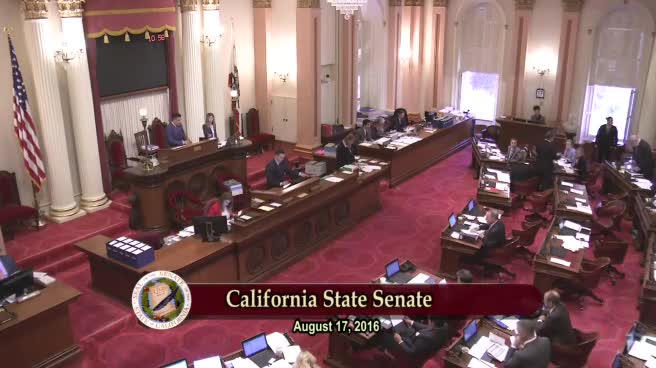 1MIN
Senate Floor
Bill Author

Bill Co-Author(s):