SB 366: Electrical corporations: Green Tariff Shared Renewables Program.
- Session Year: 2017-2018
- House: Senate
- Latest Version Date: 2017-06-20
Under existing law, the Public Utilities Commission (PUC) has regulatory authority over public utilities, including electrical corporations. The Green Tariff Shared Renewables Program requires an electrical corporation with 100,000 or more customers in California to file with the PUC an application requesting approval of a tariff to implement a program enabling ratepayers to participate directly in offsite electrical generation facilities that use eligible renewable energy resources, consistent with certain legislative findings and statements of intent. Existing law requires the PUC, by July 1, 2014, to issue a decision to approve or disapprove the utilitys application, with or without modifications. Existing law requires the PUC, after notice and opportunity for public comment, to approve the application if the PUC determines that the proposed program is reasonable and consistent with the legislative findings and statements of intent and directs the commission to require that a utilitys Green Tariff Shared Renewables Program be administered in accordance with specified provisions. An electrical corporation is not required to offer the program once the nameplate rated generating capacity serving customers participating in the program reaches the utilitys proportionate share of a statewide limitation of 600 megawatts. Of this amount, 100 megawatts are reserved for facilities that are no larger than one megawatt nameplate rated generating capacity and that are located in areas that the California Environmental Protection Agency has identified pursuant to law as the 20% most impacted and disadvantaged communities, 100 megawatts are reserved for participation by residential class customers, and 20 megawatts are reserved for the City of Davis.
This bill would require the PUC to increase the 600-megawatt statewide minimum limitation up to 800 megawatts, to the extent necessary to accommodate participation by low-income customers and projects located in disadvantaged communities, as specified. The bill would provide, for the 100 megawatts reserved for the 20% most impacted and disadvantaged communities, that the 100 megawatts would instead be reserved for the 25% most impacted and disadvantaged communities, and would authorize the PUC to increase this minimum reserved for the most impacted and disadvantaged communities from 100 megawatts up to 300 megawatts. The bill would require, for the program generation not reserved for the most impacted and disadvantaged communities, residential class customers, and the City of Davis, that preference be given to projects located in disadvantaged communities identified by the agency.
The California Global Warming Solutions Act of 2006 establishes the State Air Resources Board as the state agency responsible for monitoring and regulating sources emitting greenhouse gases. That act requires the state board to adopt a statewide greenhouse gas emissions limit, as defined, to be achieved by 2020, equivalent to the statewide greenhouse gas emissions level in 1990. The state board is authorized to include in its implementation of the act the use of market-based compliance mechanisms. The implementing regulations adopted by the state board provide for the direct allocation of greenhouse gas allowances to electrical corporations pursuant to a market-based compliance mechanism. Existing law authorizes the PUC to allocate 15% of the revenues from the sale of these allowances for clean energy and energy efficiency projects established pursuant to statute that are administered by electrical corporations or 3rd-party administrators and requires the PUC to direct the balance of the revenues to be credited directly to the residential, small business, and emissions-intensive trade-exposed retail customers of the electrical corporations, as specified. Existing law requires the PUC to annually authorize the allocation of $100,000,000 or 10%, whichever is less, beginning with the fiscal year commencing July 1, 2016, and ending with the fiscal year ending June 30, 2020, from the greenhouse gas allowance revenues received by electrical corporations set aside for clean energy and energy efficiency projects for the Multifamily Affordable Housing Solar Roofs Program.
This bill would require the PUC to implement, by January 1, 2019, the Renewable Energy for All program to pay any net costs associated with subscriptions by participating low-income customers under the Green Tariff Shared Renewables Program for generating facilities built pursuant to the 100 megawatts set aside for the most impacted and disadvantaged communities and projects given priority pursuant to this bill because they are located within disadvantaged communities. The bill would require that, beginning with the 201819 fiscal year and ending with the 201920 fiscal year, any moneys remaining of the 15% available for clean energy and energy efficiency projects from the sale of greenhouse gas allowances by electrical corporations not allocated to the Multifamily Affordable Housing Solar Roofs Program be allocated to the Renewable Energy for All program. The bill would authorize the PUC to allocate additional moneys to the Renewable Energy for All program if it makes specified findings. The bill would require the PUC to allocate moneys from the Renewable Energy for All program to community-based and nonprofit organizations to conduct marketing, education, and outreach to customers, with emphasis on increasing participation of low-income customers.
Under existing law, a violation of the Public Utilities Act or any order, decision, rule, direction, demand, or requirement of the PUC is a crime.
Because the bill requires action by the PUC to implement its requirements, and a violation of the PUCs rule or order would be a crime, the bill would impose a state-mandated local program by creating a new crime.
The California Constitution requires the state to reimburse local agencies and school districts for certain costs mandated by the state. Statutory provisions establish procedures for making that reimbursement.
This bill would provide that no reimbursement is required by this act for a specified reason.
Under existing law, the Public Utilities Commission (PUC) has regulatory authority over public utilities, including electrical corporations. The Green Tariff Shared Renewables Program requires an electrical corporation with 100,000 or more customers in California to file with the PUC an application requesting approval of a tariff to implement a program enabling ratepayers to participate directly in offsite electrical generation facilities that use eligible renewable energy resources, consistent with certain legislative findings and statements of intent. Existing law requires the PUC, by July 1, 2014, to issue a decision to approve or disapprove the utilitys application, with or without modifications. Existing law requires the PUC, after notice and opportunity for public comment, to approve the application if the PUC determines that the proposed program is reasonable and consistent with the legislative findings and statements of intent and directs the commission to require that a utilitys Green Tariff Shared Renewables Program be administered in accordance with specified provisions. An electrical corporation is not required to offer the program once the nameplate rated generating capacity serving customers participating in the program reaches the utilitys proportionate share of a statewide limitation of 600 megawatts. Of this amount, 100 megawatts are reserved for facilities that are no larger than one megawatt nameplate rated generating capacity and that are located in areas that the California Environmental Protection Agency has identified pursuant to law as the 20% most impacted and disadvantaged communities, 100 megawatts are reserved for participation by residential class customers, and 20 megawatts are reserved for the City of Davis.
This bill would authorize require the PUC to increase the 600-megawatt statewide limitation minimum up to 800 megawatts, to the extent necessary to accommodate participation by low-income customers and projects located in disadvantaged communities, as specified. The bill would provide, for the 100 megawatts reserved for the 20% most impacted and disadvantaged communities, that the 100 megawatts would instead be reserved for the 25% most impacted and disadvantaged communities. communities, and would authorize the PUC to increase this minimum reserved for the most impacted and disadvantaged communities from 100 megawatts up to 300 megawatts. The bill would require, for the program generation not reserved for the most impacted and disadvantaged communities, residential class customers, and the City of Davis, that preference be given to projects located in disadvantaged communities identified by the agency.
The California Global Warming Solutions Act of 2006 establishes the State Air Resources Board as the state agency responsible for monitoring and regulating sources emitting greenhouse gases. That act requires the state board to adopt a statewide greenhouse gas emissions limit, as defined, to be achieved by 2020, equivalent to the statewide greenhouse gas emissions level in 1990. The state board is authorized to include in its implementation of the act the use of market-based compliance mechanisms. The implementing regulations adopted by the state board provide for the direct allocation of greenhouse gas allowances to electrical corporations pursuant to a market-based compliance mechanism. Existing law authorizes the PUC to allocate 15% of these the revenues from the sale of these allowances for clean energy and energy efficiency projects established pursuant to statute that are administered by electrical corporations or 3rd-party administrators and requires the PUC to direct the balance of the revenues to be credited directly to the residential, small business, and emissions-intensive trade-exposed retail customers of the electrical corporations, as specified. Existing law requires the PUC to annually authorize the allocation of $100,000,000 or 10%, whichever is less, beginning with the fiscal year commencing July 1, 2016, and ending with the fiscal year ending June 30, 2020, from the greenhouse gas allowance revenues received by electrical corporations set aside for clean energy and energy efficiency projects for the Multifamily Affordable Housing Solar Roofs Program.
This bill would require the PUC to implement, by January 1, 2019, the Renewable Energy for All program to pay any net costs associated with subscriptions by participating low-income customers under the Green Tariff Shared Renewables Program for generating facilities built pursuant to the 100 megawatts set aside for the most impacted and disadvantaged communities and projects given priority pursuant to this bill because they are located within disadvantaged communities. The bill would require that, beginning with the 201819 fiscal year and ending with the 201920 fiscal year, any moneys remaining of the 15% available for clean energy and energy efficiency projects from the sale of greenhouse gas allowances by electrical corporations not allocated to the Multifamily Affordable Housing Solar Roofs Program be allocated to the Renewable Energy for All program. The bill would authorize the PUC to allocate additional moneys to the Renewable Energy for All program if it makes specified findings. The bill would require the PUC to allocate moneys from the Renewable Energy for All program to community-based and nonprofit organizations to conduct marketing, education, and outreach to customers, with emphasis on increasing participation of low-income customers.
Under existing law, a violation of the Public Utilities Act or any order, decision, rule, direction, demand, or requirement of the PUC is a crime.
Because the bill requires action by the PUC to implement its requirements, and a violation of the PUCs rule or order would be a crime, the bill would impose a state-mandated local program by creating a new crime.
The California Constitution requires the state to reimburse local agencies and school districts for certain costs mandated by the state. Statutory provisions establish procedures for making that reimbursement.
This bill would provide that no reimbursement is required by this act for a specified reason.
Under existing law, the Public Utilities Commission (PUC) has regulatory authority over public utilities, including electrical corporations. The Green Tariff Shared Renewables Program requires an electrical corporation with 100,000 or more customers in California to file with the PUC an application requesting approval of a tariff to implement a program enabling ratepayers to participate directly in offsite electrical generation facilities that use eligible renewable energy resources, consistent with certain legislative findings and statements of intent. Existing law requires the PUC, by July 1, 2014, to issue a decision to approve or disapprove the utilitys application, with or without modifications. Existing law requires the PUC, after notice and opportunity for public comment, to approve the application if the PUC determines that the proposed program is reasonable and consistent with the legislative findings and statements of intent and directs the commission to require that a utilitys Green Tariff Shared Renewables Program be administered in accordance with specified provisions. An electrical corporation is not required to offer the program once the nameplate rated generating capacity serving customers participating in the program reaches the utilitys proportionate share of a statewide limitation of 600 megawatts. Of this amount, 100 megawatts are reserved for facilities that are no larger than one megawatt nameplate rated generating capacity and that are located in areas that the California Environmental Protection Agency has identified pursuant to law as the 20% most impacted and disadvantaged communities. communities, 100 megawatts are reserved for participation by residential class customers, and 20 megawatts are reserved for the City of Davis.
This bill would, in place of the 600 megawatt statewide limitation, require that an electrical corporation offer the program until the utility reaches the utilitys proportionate share of a statewide minimum of 800 megawatts and would require that a minimum of 300 megawatts be reserved for disadvantaged communities identified pursuant to a specified law. would authorize the PUC to increase the 600-megawatt statewide limitation up to 800 megawatts, to the extent necessary to accommodate participation by low-income customers and projects located in disadvantaged communities, as specified. The bill would provide, for the 100 megawatts reserved for the 20% most impacted and disadvantaged communities, that the 100 megawatts would instead be reserved for the 25% most impacted and disadvantaged communities. The bill would require require, for the program generation not reserved for the most impacted and disadvantaged communities, residential class customers, and the City of Davis, that preference be given to projects located in disadvantaged communities identified pursuant to that law, except as specified. by the agency.
The California Global Warming Solutions Act of 2006 establishes the State Air Resources Board as the state agency responsible for monitoring and regulating sources emitting greenhouse gases. That act requires the state board to adopt a statewide greenhouse gas emissions limit, as defined, to be achieved by 2020, equivalent to the statewide greenhouse gas emissions level in 1990. The state board is authorized to include in its implementation of the act the use of market-based compliance mechanisms. The implementing regulations adopted by the state board provide for the direct allocation of greenhouse gas allowances to electrical corporations pursuant to a market-based compliance mechanism. Existing law authorizes the PUC to allocate 15% of these revenues for clean energy and energy efficiency projects established pursuant to statute that are administered by electrical corporations or 3rd-party administrators and requires the PUC to direct the balance of the revenues to be credited directly to the residential, small business, and emissions-intensive trade-exposed retail customers of the electrical corporations, as specified. Existing law requires the PUC to annually authorize the allocation of $100,000,000 or 10%, whichever is less, beginning with the fiscal year commencing July 1, 2016, and ending with the fiscal year ending June 30, 2020, from the greenhouse gas allowance revenues received by electrical corporations set aside for clean energy and energy efficiency projects for the Multifamily Affordable Housing Solar Roofs Program.
This bill would require the PUC to implement, by January 1, 2019, the Renewable Energy for All program to pay any net costs associated with subscriptions by participating low-income customers under the Green Tariff Shared Renewables Program for generating facilities built pursuant to the 300 megawatt 100 megawatts set aside for disadvantaged communities under the Green Tariff Shared Renewables Program. and projects given priority pursuant to this bill because they are located within disadvantaged communities. The bill would require that, beginning with the 201819 fiscal year and ending with the 201920 fiscal year, any moneys remaining of the 15% available for clean energy and energy efficiency projects from the sale of greenhouse gas allowances by electrical corporations not allocated to the Multifamily Affordable Housing Solar Roofs Program be allocated to the Renewable Energy for All program. The bill would authorize the PUC to allocate additional moneys to the Renewable Energy for All program if it makes specified findings. The bill would require the PUC to allocate moneys from the Renewable Energy for All program to community-based and nonprofit organizations to conduct marketing, education, and outreach to customers, with emphasis on increasing participation of low-income customers.
Under existing law, a violation of the Public Utilities Act or any order, decision, rule, direction, demand, or requirement of the PUC is a crime.
Because the bill requires action by the PUC to implement its requirements, and a violation of the PUCs rule or order would be a crime, thus the bill would impose a state-mandated local program by creating a new crime.
The California Constitution requires the state to reimburse local agencies and school districts for certain costs mandated by the state. Statutory provisions establish procedures for making that reimbursement.
This bill would provide that no reimbursement is required by this act for a specified reason.
Under existing law, the Public Utilities Commission (PUC) has regulatory authority over public utilities, including electrical corporations. The Green Tariff Shared Renewables Program requires an electrical corporation with 100,000 or more customers in California to file with the PUC an application requesting approval of a tariff to implement a program enabling ratepayers to participate directly in offsite electrical generation facilities that use eligible renewable energy resources, consistent with certain legislative findings and statements of intent. Existing law requires the PUC, by July 1, 2014, to issue a decision to approve or disapprove the the utilitys application, with or without modifications. Existing law requires the PUC, after notice and opportunity for public comment, to approve the application if the PUC determines that the proposed program is reasonable and consistent with the legislative findings and statements of intent and directs the commission to require that a utilitys Green Tariff Shared Renewables Program be administered in accordance with specified provisions. An electrical corporation is not required to offer the program once the nameplate rated generating capacity serving customers participating in the program reaches the utilitys proportionate share of a statewide limitation of 600 megawatts. Of this amount, 100 megawatts are reserved for facilities that are no larger than one megawatt nameplate rated generating capacity and that are located in areas that the California Environmental Protection Agency has identified as most impacted and disadvantaged communities.
This bill would substitute an unspecified amount would, in place of the 600 megawatt statewide limitation. The bill would do the same for the 100 megawatts reserved for most impacted and disadvantaged communities and would reserve that unspecified megawatt amount instead limitation, require that an electrical corporation offer the program until the utility reaches the utilitys proportionate share of a statewide minimum of 800 megawatts and would require that a minimum of 300 megawatts be reserved for disadvantaged communities identified pursuant to a specified law. The bill would prohibit the operator of a generating facility participating in the program from charging a participating low-income customer, as defined, in a disadvantaged community for the purchase of the customers share of the electricity at a rate above the applicable California Alternate Rates for Energy program rate. The bill would require the State Energy Resources Conservation and Development Commission to establish a grant program to provide financial assistance to operators of a generating facility participating in a utilitys green tariff shared renewables program that is providing electricity to participating low-income customers in communities identified pursuant to a specified law. The bill would require the operator of a generating facility participating in the program pursuant to the portion of the program reserved for facilities that are no larger than one megawatt nameplate rated generating capacity and that are located in communities identified as disadvantaged to coordinate with the electrical corporations workforce development program discussed above. require that preference be given to projects located in disadvantaged communities identified pursuant to that law, except as specified.
The California Global Warming Solutions Act of 2006 establishes the State Air Resources Board as the state agency responsible for monitoring and regulating sources emitting greenhouse gases. That act requires the state board to adopt a statewide greenhouse gas emissions limit, as defined, to be achieved by 2020, equivalent to the statewide greenhouse gas emissions level in 1990. The state board is authorized to include in its implementation of the act the use of market-based compliance mechanisms. The implementing regulations adopted by the state board provide for the direct allocation of greenhouse gas allowances to electrical corporations pursuant to a market-based compliance mechanism. Existing law authorizes the PUC to allocate 15% of these revenues for clean energy and energy efficiency projects established pursuant to statute that are administered by electrical corporations or 3rd-party administrators and requires the PUC to direct the balance of the revenues to be credited directly to the residential, small business, and emissions-intensive trade-exposed retail customers of the electrical corporations, as specified. Existing law requires the PUC to annually authorize the allocation of $100,000,000 or 10%, whichever is less, beginning with the fiscal year commencing July 1, 2016, and ending with the fiscal year ending June 30, 2020, from the greenhouse gas allowance revenues received by electrical corporations set aside for clean energy and energy efficiency projects for the Multifamily Affordable Housing Solar Roofs Program.
This bill would require the PUC to implement, by January 1, 2019, the Renewable Energy for All program to pay any net costs associated with subscriptions by participating low-income customers for generating facilities built pursuant to the 300 megawatt set aside for disadvantaged communities under the Green Tariff Shared Renewables Program. The bill would require that, beginning with the 201819 fiscal year and ending with the 201920 fiscal year, any moneys remaining of the 15% available for clean energy and energy efficiency projects from the sale of greenhouse gas allowances by electrical corporations not allocated to the Multifamily Affordable Housing Solar Roofs Program be allocated to the Renewable Energy for All program. The bill would authorize the PUC to allocate additional moneys to the Renewable Energy for All program if it makes specified findings. The bill would require the PUC to allocate moneys from the Renewable Energy for All program to community-based and nonprofit organizations to conduct marketing, education, and outreach to customers, with emphasis on increasing participation of low-income customers.
Under existing law, a violation of the Public Utilities Act or any order, decision, rule, direction, demand, or requirement of the PUC is a crime.
Because the bill requires action by the PUC to implement its requirements, and a violation of the PUCs rule or order would be a crime, thus the bill would impose a state-mandated local program by creating a new crime.
The California Constitution requires the state to reimburse local agencies and school districts for certain costs mandated by the state. Statutory provisions establish procedures for making that reimbursement.
This bill would provide that no reimbursement is required by this act for a specified reason.
Under existing law, the Public Utilities Commission (PUC) has regulatory authority over public utilities, including electrical corporations, gas corporations, water corporations, and telephone corporations. The California Constitution authorizes the PUC to establish rules and to fix the rates and charges for all public utilities, subject to control by the Legislature. Existing law directs the PUC to require every electrical, gas, water, and telephone corporation, and wireless telecommunications service provider, with annual gross revenues exceeding $25,000,000, and their regulated subsidiaries and affiliates, to annually submit a detailed and verifiable plan for increasing procurement from women-, minority-, and disabled veteran-owned, and LGBT business enterprises, as defined, and directs the PUC to require the reporting of certain related information. The PUC, by its rulemaking authority, has adopted General Order 156, applicable to certain electrical, gas, and telephone corporations, to effectuate these requirements.
This bill would require the PUC, in consultation with the Labor and Workforce Development Agency, to establish rules by January 1, 2019, requiring an electrical corporation to establish training programs that will cultivate quality workforce development, and that will provide recruitment, job opportunities, and job retention strategies for residents living in disadvantaged communities. The bill would require that the training program include those training opportunities that the PUC determines to be prudent and reasonable for persons that construct, operate, or maintain distributed generation resources that interconnect to the electrical corporations electrical grid.
The Green Tariff Shared Renewables Program requires an electrical corporation with 100,000 or more customers in California to file with the PUC an application requesting approval of a tariff to implement a program enabling ratepayers to participate directly in offsite electrical generation facilities that use eligible renewable energy resources, consistent with certain legislative findings and statements of intent. Existing law requires the PUC, by July 1, 2014, to issue a decision to approve or disapprove the the utilitys application, with or without modifications. Existing law requires the PUC, after notice and opportunity for public comment, to approve the application if the PUC determines that the proposed program is reasonable and consistent with the legislative findings and statements of intent and directs the commission to require that a utilitys Green Tariff Shared Renewables Program be administered in accordance with specified provisions. An electrical corporation is not required to offer the program once the nameplate rated generating capacity serving customers participating in the program reaches the utilitys proportionate share of a statewide limitation of 600 megawatts. Of this amount, 100 megawatts are reserved for facilities that are no larger than one megawatt nameplate rated generating capacity and that are located in areas that the California Environmental Protection Agency has identified as most impacted and disadvantaged communities.
This bill would substitute an unspecified amount in place of the 600 megawatt statewide limitation. The bill would do the same for the 100 megawatts reserved for most impacted and disadvantaged communities and would reserve that unspecified megawatt amount instead for disadvantaged communities identified pursuant to a specified law. The bill would prohibit the operator of a generating facility participating in the program from charging a participating low-income customer, as defined, in a disadvantaged community for the purchase of the customers share of the electricity at a rate above the applicable California Alternate Rates for Energy program rate. The bill would require the State Energy Resources Conservation and Development Commission to establish a grant program to provide financial assistance to operators of a generating facility participating in a utilitys green tariff shared renewables program that is providing electricity to participating low-income customers in communities identified pursuant to a specified law. The bill would require the operator of a generating facility participating in the program pursuant to the portion of the program reserved for facilities that are no larger than one megawatt nameplate rated generating capacity and that are located in communities identified as disadvantaged to coordinate with the electrical corporations workforce development program discussed above.
Under existing law, a violation of the Public Utilities Act or any order, decision, rule, direction, demand, or requirement of the PUC is a crime.
Because the bill requires action by the PUC to implement its requirements, a violation of the PUCs rule or order would impose a state-mandated local program by creating a new crime.
The California Constitution requires the state to reimburse local agencies and school districts for certain costs mandated by the state. Statutory provisions establish procedures for making that reimbursement.
This bill would provide that no reimbursement is required by this act for a specified reason.
(a)This chapter shall be known, and may be cited, as the Green Tariff Shared Renewables Program.
(b)For purposes of this chapter, the following terms have the following meanings:
(1)Eligible renewable energy resource, renewable energy credit, and renewables portfolio standard have the same meaning as those terms have for the California Renewables Portfolio Standard Program (Article 16 (commencing with Section 399.11) of Chapter 2.3 of Part 1).
(2)Participating low-income customer means a customer of a participating utility who is eligible for the California Alternate Rates for Energy program established pursuant to Section 739.1 or the Family Electric Rate Assistance program and who is procuring renewable energy resources pursuant to the Green Tariff Shared Renewables Program.
(3)Participating utility means an electrical corporation with 100,000 or more customer accounts in California.
SEC. 2.Section 2833 of the Public Utilities Code is amended to read:2833.(a)The commission shall require a green tariff shared renewables program to be administered by a participating utility in accordance with this section.
(b)Generating facilities participating in a participating utilitys green tariff shared renewables program shall be eligible renewable energy resources with a nameplate rated generating capacity not exceeding 20 megawatts, except for those generating facilities reserved for location in areas identified by the California Environmental Protection Agency as the most impacted and disadvantaged communities pursuant to paragraph (1) of subdivision (d), which shall not exceed one megawatt nameplate rated generating capacity.
(c)A participating utility shall use commission-approved tools and mechanisms to procure additional eligible renewable energy resources for the green tariff shared renewables program from electrical generation facilities that are in addition to those required by the California Renewables Portfolio Standard Program (Article 16 (commencing with Section 399.11) of Chapter 2.3 of Part 1). For purposes of this subdivision, commission-approved tools and mechanisms means those procurement methods approved by the commission for an electrical corporation to procure eligible renewable energy resources for purposes of meeting the procurement requirements of the California Renewables Portfolio Standard Program (Article 16 (commencing with Section 399.11) of Chapter 2.3 of Part 1).
(d)A participating utility shall permit customers within the service territory of the utility to purchase electricity pursuant to the tariff approved by the commission to implement the utilitys green tariff shared renewables program, until the utility meets its proportionate share of a statewide minimum limitation established by the commission. The statewide minimum limitation established by the commission shall not be less than 600 megawatts of customer participation, measured by nameplate rated generating capacity. The statewide minimum limitation shall be increased to the extent necessary, but to no more than 800 megawatts, based on participation in the program and other factors, as determined by the commission, to accommodate participation by participating low-income customers and projects located in disadvantaged communities built pursuant to paragraph (1). The proportionate share of the statewide minimum limitation shall be calculated based on the ratio of each participating utilitys retail sales to total retail sales of electricity by all participating utilities. The commission may place other restrictions on purchases under a green tariff shared renewables program, including restricting participation to a certain level of capacity each year. The following requirements shall apply to the statewide minimum limitation established by the commission:
(1)(A)Not less than 100 megawatts shall be reserved for facilities that are no larger than one megawatt nameplate rated generating capacity and that are located in areas previously identified by the California Environmental Protection Agency as the most impacted and disadvantaged communities. The commission may increase this reserved amount to not more than 300 megawatts to accommodate participation by low-income customers and projects located in the most impacted and disadvantaged communities. These communities shall be identified by census tract, and shall be determined to be the most impacted 25 percent based on results from the best available cumulative impact screening methodology designed to identify each of the following:
(i)Areas disproportionately affected by environmental pollution and other hazards that can lead to negative public health effects, exposure, or environmental degradation.
(ii)Areas with socioeconomic vulnerability.
(B)For purposes of this paragraph, previously identified means identified prior to commencing construction of the facility.
(2)Not less than 100 megawatts shall be reserved for participation by residential class customers.
(3)Twenty megawatts shall be reserved for the City of Davis.
(4)For the remainder not set aside pursuant to paragraphs (1) to (3), inclusive, preference shall be given to projects located in communities identified pursuant to Section 39711 of the Health and Safety Code.
(e)To the extent possible, a participating utility shall seek to procure eligible renewable energy resources that are located in reasonable proximity to enrolled participants.
(f)A participating utilitys green tariff shared renewables program shall support diverse procurement and the goals of commission General Order 156.
(g)A participating utilitys green tariff shared renewables program shall not allow a customer to subscribe to more than 100 percent of the customers electricity demand.
(h)Except as authorized by this subdivision, a participating utilitys green tariff shared renewables program shall not allow a customer to subscribe to more than two megawatts of nameplate generating capacity. This limitation does not apply to a federal, state, or local government, school or school district, county office of education, the California Community Colleges, the California State University, or the University of California.
(i)A participating utilitys green tariff shared renewables program shall not allow any single entity or its affiliates or subsidiaries to subscribe to more than 20 percent of any single calendar years total cumulative rated generating capacity.
(j)To the extent possible, a participating utility shall actively market the utilitys green tariff shared renewables program to low-income and minority communities and customers.
(k)Participating customers shall receive bill credits for the generation of a participating eligible renewable energy resource using the class average retail generation cost as established in the participating utilitys approved tariff for the class to which the participating customer belongs, plus a renewables adjustment value representing the difference between the time-of-delivery profile of the eligible renewable energy resource used to serve the participating customer and the class average time-of-delivery profile and the resource adequacy value, if any, of the resource contained in the utilitys green tariff shared renewables program. The renewables adjustment value applicable to a time-of-delivery profile of an eligible renewable energy resource shall be determined according to rules adopted by the commission. For these purposes, time-of-delivery profile refers to the daily generating pattern of a participating eligible renewable energy resource over time, the value of which is determined by comparing the generating pattern of that participating eligible renewable energy resource to the demand for electricity over time and other generating resources available to serve that demand.
(l)Participating customers shall pay a renewable generation rate established by the commission, the administrative costs of the participating utility, and any other charges the commission determines are just and reasonable to fully cover the cost of procuring a green tariff shared renewables programs resources to serve a participating customers needs.
(m)A participating customers rates shall be debited or credited with any other commission-approved costs or values applicable to the eligible renewable energy resources contained in a participating utilitys green tariff shared renewables programs portfolio. These additional costs or values shall be applied to new customers when they initially subscribe after the cost or value has been approved by the commission.
(n)Participating customers shall pay all otherwise applicable charges without modification.
(o)A participating utility shall permit a participating customer to subscribe to the program and be provided with a nonbinding estimate of reasonably anticipated bill credits and bill charges, as determined by the commission, for a period of up to 20 years.
(p)A participating utility shall provide support for enhanced community renewables programs to facilitate development of eligible renewable energy resource projects located close to the source of demand.
(q)The commission shall ensure that charges and credits associated with a participating utilitys green tariff shared renewables program are set in a manner that ensures nonparticipant ratepayer indifference for the remaining bundled service, direct access, and community choice aggregation customers and ensures that no costs are shifted from participating customers to nonparticipating ratepayers.
(r)A participating utility shall track and account for all revenues and costs to ensure that the utility recovers the actual costs of the utilitys green tariff shared renewables program and that all costs and revenues are fully transparent and auditable.
(s)Any renewable energy credits associated with electricity procured by a participating utility for the utilitys green tariff shared renewables program and utilized by a participating customer shall be retired by the participating utility on behalf of the participating customer. Those renewable energy credits shall not be further sold, transferred, or otherwise monetized for any purpose. Any renewable energy credits associated with electricity procured by a participating utility for the shared renewable energy self-generation program, but not utilized by a participating customer, shall be counted toward meeting that participating utilitys renewables portfolio standard.
(t)A participating utility shall, in the event of participant customer attrition or other causes that reduce customer participation or electrical demand below generation levels, apply the excess generation from the eligible renewable energy resources procured through the utilitys green tariff shared renewables program to the utilitys renewable portfolio standard procurement obligations or bank the excess generation for future use to benefit all customers in accordance with the renewables portfolio standard banking and procurement rules approved by the commission.
(u)In calculating its procurement requirements to meet the requirements of the California Renewables Portfolio Standard Program (Article 16 (commencing with Section 399.11) of Chapter 2.3 of Part 1), a participating utility may exclude from total retail sales the kilowatthours generated by an eligible renewable energy resource that is credited to a participating customer pursuant to the utilitys green tariff shared renewables program, commencing with the point in time at which the generating facility achieves commercial operation.
(v)All renewable energy resources procured on behalf of participating customers in the participating utilitys green tariff shared renewables program shall comply with the State Air Resources Boards Voluntary Renewable Electricity Program. California-eligible greenhouse gas allowances associated with these purchases shall be retired on behalf of participating customers as part of the boards Voluntary Renewable Electricity Program.
(w)A participating utility shall provide a municipality with aggregated consumption data for participating customers within the municipalitys jurisdiction to allow for reporting on progress toward climate action goals by the municipality. A participating utility shall also publicly disclose, on a geographic basis, consumption data and reductions in emissions of greenhouse gases achieved by participating customers in the utilitys green tariff shared renewables program, on an aggregated basis consistent with privacy protections as specified in Chapter 5 (commencing with Section 8380) of Division 4.1.
(x)This section does not prohibit or restrict a community choice aggregator from offering its own voluntary renewable energy programs to participating customers of the community choice aggregation.
SEC. 3.Section 2833.2 is added to the Public Utilities Code, to read:2833.2.(a)By January 1, 2019, the commission shall implement the Renewable Energy for All program to pay any net costs associated with subscriptions by participating low-income customers for a generating facility that is built pursuant to paragraph (1) or (4) of subdivision (d) of Section 2833. The commission shall ensure that the moneys made available for the Renewable Energy for All program are sufficient, at a minimum, to eliminate any forecasted rate premium and ensure meaningful bill savings over the duration of the contractual commitment by participating low-income customers. The commission may limit subscriptions as necessary to ensure sufficient moneys are available to meet the requirements of this section.
(b)From the revenues described in subdivision (c) of Section 748.5, beginning with the 201819 fiscal year, and ending with the 201920 fiscal year, the commission shall annually require the allocation of any remaining available moneys not allocated to the Multifamily Affordable Housing Solar Roofs Program to the Renewable Energy for All program. The commission shall authorize the allocation of these moneys for the Renewable Energy for All program through June 30, 2030, if the commission determines that revenues are available after June 30, 2020, and that there is adequate interest and participation in the program.
(c)The commission shall allocate moneys from the Renewable Energy for All program to community-based and nonprofit organizations to conduct marketing, education, and outreach to customers, with an emphasis on increasing participation of low-income customers.
SEC. 4.No reimbursement is required by this act pursuant to Section 6 of Article XIIIB of the California Constitution because the only costs that may be incurred by a local agency or school district will be incurred because this act creates a new crime or infraction, eliminates a crime or infraction, or changes the penalty for a crime or infraction, within the meaning of Section 17556 of the Government Code, or changes the definition of a crime within the meaning of Section 6 of Article XIIIB of the California Constitution.
(a)This chapter shall be known, and may be cited, as the Green Tariff Shared Renewables Program.
(b)For purposes of this chapter, the following terms have the following meanings:
(1)Eligible renewable energy resource, renewable energy credit, and renewables portfolio standard have the same meaning as those terms have for the California Renewables Portfolio Standard Program (Article 16 (commencing with Section 399.11) of Chapter 2.3 of Part 1).
(2)Participating low-income customer means a customer of a participating utility who is eligible for the California Alternate Rates for Energy program established pursuant to Section 739.1 or the Family Electric Rate Assistance program and who is procuring renewable energy resources pursuant to the Green Tariff Shared Renewables Program.
(3)Participating utility means an electrical corporation with 100,000 or more customer accounts in California.
SEC. 2.Section 2833 of the Public Utilities Code is amended to read:2833.(a)The commission shall require a green tariff shared renewables program to be administered by a participating utility in accordance with this section.
(b)Generating facilities participating in a participating utilitys green tariff shared renewables program shall be eligible renewable energy resources with a nameplate rated generating capacity not exceeding 20 megawatts, except for those generating facilities reserved for location in areas identified by the California Environmental Protection Agency as the most impacted and disadvantaged communities pursuant to paragraph (1) of subdivision (d), which shall not exceed one megawatt nameplate rated generating capacity.
(c)A participating utility shall use commission-approved tools and mechanisms to procure additional eligible renewable energy resources for the green tariff shared renewables program from electrical generation facilities that are in addition to those required by the California Renewables Portfolio Standard Program (Article 16 (commencing with Section 399.11) of Chapter 2.3 of Part 1). For purposes of this subdivision, commission-approved tools and mechanisms means those procurement methods approved by the commission for an electrical corporation to procure eligible renewable energy resources for purposes of meeting the procurement requirements of the California Renewables Portfolio Standard Program (Article 16 (commencing with Section 399.11) of Chapter 2.3 of Part 1).
(d)A participating utility shall permit customers within the service territory of the utility to purchase electricity pursuant to the tariff approved by the commission to implement the utilitys green tariff shared renewables program, until the utility meets its proportionate share of a statewide minimum of established by the commission. The statewide minimum established by the commission shall not be less than 600 megawatts of customer participation, measured by nameplate rated generating capacity. The statewide minimum of 600 megawatts of customer participation shall be increased to the extent necessary, but to no more than 800 megawatts, based on participation in the program and other factors, as determined by the commission, to accommodate participation by participating low-income customers and projects located in disadvantaged communities. communities built pursuant to paragraph (1). The proportionate share of the statewide minimum shall be calculated based on the ratio of each participating utilitys retail sales to total retail sales of electricity by all participating utilities. The commission may place other restrictions on purchases under a green tariff shared renewables program, including restricting participation to a certain level of capacity each year. The following requirements shall apply to the statewide minimum of 600 megawatts of customer participation: established by the commission:
(1)(A)One hundred Not less than 100 megawatts shall be reserved for facilities that are no larger than one megawatt nameplate rated generating capacity and that are located in areas previously identified by the California Environmental Protection Agency as the most impacted and disadvantaged communities. The commission may increase this reserved amount to not more than 300 megawatts to accommodate participation by low-income customers and projects located in the most impacted and disadvantaged communities. These communities shall be identified by census tract, and shall be determined to be the most impacted 25 percent based on results from the best available cumulative impact screening methodology designed to identify each of the following:
(i)Areas disproportionately affected by environmental pollution and other hazards that can lead to negative public health effects, exposure, or environmental degradation.
(ii)Areas with socioeconomic vulnerability.
(B)For purposes of this paragraph, previously identified means identified prior to commencing construction of the facility.
(2)Not less than 100 megawatts shall be reserved for participation by residential class customers.
(3)Twenty megawatts shall be reserved for the City of Davis.
(4)For the remainder not set aside pursuant to paragraphs (1) to (3), inclusive, preference shall be given to projects located in communities identified pursuant to Section 39711 of the Health and Safety Code.
(e)To the extent possible, a participating utility shall seek to procure eligible renewable energy resources that are located in reasonable proximity to enrolled participants.
(f)A participating utilitys green tariff shared renewables program shall support diverse procurement and the goals of commission General Order 156.
(g)A participating utilitys green tariff shared renewables program shall not allow a customer to subscribe to more than 100 percent of the customers electricity demand.
(h)Except as authorized by this subdivision, a participating utilitys green tariff shared renewables program shall not allow a customer to subscribe to more than two megawatts of nameplate generating capacity. This limitation does not apply to a federal, state, or local government, school or school district, county office of education, the California Community Colleges, the California State University, or the University of California.
(i)A participating utilitys green tariff shared renewables program shall not allow any single entity or its affiliates or subsidiaries to subscribe to more than 20 percent of any single calendar years total cumulative rated generating capacity.
(j)To the extent possible, a participating utility shall actively market the utilitys green tariff shared renewables program to low-income and minority communities and customers.
(k)Participating customers shall receive bill credits for the generation of a participating eligible renewable energy resource using the class average retail generation cost as established in the participating utilitys approved tariff for the class to which the participating customer belongs, plus a renewables adjustment value representing the difference between the time-of-delivery profile of the eligible renewable energy resource used to serve the participating customer and the class average time-of-delivery profile and the resource adequacy value, if any, of the resource contained in the utilitys green tariff shared renewables program. The renewables adjustment value applicable to a time-of-delivery profile of an eligible renewable energy resource shall be determined according to rules adopted by the commission. For these purposes, time-of-delivery profile refers to the daily generating pattern of a participating eligible renewable energy resource over time, the value of which is determined by comparing the generating pattern of that participating eligible renewable energy resource to the demand for electricity over time and other generating resources available to serve that demand.
(l)Participating customers shall pay a renewable generation rate established by the commission, the administrative costs of the participating utility, and any other charges the commission determines are just and reasonable to fully cover the cost of procuring a green tariff shared renewables programs resources to serve a participating customers needs.
(m)A participating customers rates shall be debited or credited with any other commission-approved costs or values applicable to the eligible renewable energy resources contained in a participating utilitys green tariff shared renewables programs portfolio. These additional costs or values shall be applied to new customers when they initially subscribe after the cost or value has been approved by the commission.
(n)Participating customers shall pay all otherwise applicable charges without modification.
(o)A participating utility shall permit a participating customer to subscribe to the program and be provided with a nonbinding estimate of reasonably anticipated bill credits and bill charges, as determined by the commission, for a period of up to 20 years.
(p)A participating utility shall provide support for enhanced community renewables programs to facilitate development of eligible renewable energy resource projects located close to the source of demand.
(q)The commission shall ensure that charges and credits associated with a participating utilitys green tariff shared renewables program are set in a manner that ensures nonparticipant ratepayer indifference for the remaining bundled service, direct access, and community choice aggregation customers and ensures that no costs are shifted from participating customers to nonparticipating ratepayers.
(r)A participating utility shall track and account for all revenues and costs to ensure that the utility recovers the actual costs of the utilitys green tariff shared renewables program and that all costs and revenues are fully transparent and auditable.
(s)Any renewable energy credits associated with electricity procured by a participating utility for the utilitys green tariff shared renewables program and utilized by a participating customer shall be retired by the participating utility on behalf of the participating customer. Those renewable energy credits shall not be further sold, transferred, or otherwise monetized for any purpose. Any renewable energy credits associated with electricity procured by a participating utility for the shared renewable energy self-generation program, but not utilized by a participating customer, shall be counted toward meeting that participating utilitys renewables portfolio standard.
(t)A participating utility shall, in the event of participant customer attrition or other causes that reduce customer participation or electrical demand below generation levels, apply the excess generation from the eligible renewable energy resources procured through the utilitys green tariff shared renewables program to the utilitys renewable portfolio standard procurement obligations or bank the excess generation for future use to benefit all customers in accordance with the renewables portfolio standard banking and procurement rules approved by the commission.
(u)In calculating its procurement requirements to meet the requirements of the California Renewables Portfolio Standard Program (Article 16 (commencing with Section 399.11) of Chapter 2.3 of Part 1), a participating utility may exclude from total retail sales the kilowatthours generated by an eligible renewable energy resource that is credited to a participating customer pursuant to the utilitys green tariff shared renewables program, commencing with the point in time at which the generating facility achieves commercial operation.
(v)All renewable energy resources procured on behalf of participating customers in the participating utilitys green tariff shared renewables program shall comply with the State Air Resources Boards Voluntary Renewable Electricity Program. California-eligible greenhouse gas allowances associated with these purchases shall be retired on behalf of participating customers as part of the boards Voluntary Renewable Electricity Program.
(w)A participating utility shall provide a municipality with aggregated consumption data for participating customers within the municipalitys jurisdiction to allow for reporting on progress toward climate action goals by the municipality. A participating utility shall also publicly disclose, on a geographic basis, consumption data and reductions in emissions of greenhouse gases achieved by participating customers in the utilitys green tariff shared renewables program, on an aggregated basis consistent with privacy protections as specified in Chapter 5 (commencing with Section 8380) of Division 4.1.
(x)This section does not prohibit or restrict a community choice aggregator from offering its own voluntary renewable energy programs to participating customers of the community choice aggregation.
SEC. 3.Section 2833.2 is added to the Public Utilities Code, to read:2833.2.(a)By January 1, 2019, the commission shall implement the Renewable Energy for All program to pay any net costs associated with subscriptions by participating low-income customers for a generating facility that is built pursuant to paragraph (1) or (4) of subdivision (d) of Section 2833. The commission shall ensure that the moneys made available for the Renewable Energy for All program are sufficient, at a minimum, to eliminate any forecasted rate premium and ensure meaningful bill savings over the duration of the contractual commitment by participating low-income customers. The commission may limit subscriptions as necessary to ensure sufficient moneys are available to meet the requirements of this section.
(b)From the revenues described in subdivision (c) of Section 748.5, beginning with the 201819 fiscal year, and ending with the 201920 fiscal year year, the commission shall annually require the allocation of any remaining available moneys not allocated to the Multifamily Affordable Housing Solar Roofs Program to the Renewable Energy for All program. The commission shall authorize the allocation of these moneys for the Renewable Energy for All program through June 30, 2030, if the commission determines that revenues are available after June 30, 2020, and that there is adequate interest and participation in the program.
(c)The commission shall allocate moneys from the Renewable Energy for All program to community-based and nonprofit organizations to conduct marketing, education, and outreach to customers, with an emphasis on increasing participation of low-income customers.
SEC. 4.No reimbursement is required by this act pursuant to Section 6 of Article XIIIB of the California Constitution because the only costs that may be incurred by a local agency or school district will be incurred because this act creates a new crime or infraction, eliminates a crime or infraction, or changes the penalty for a crime or infraction, within the meaning of Section 17556 of the Government Code, or changes the definition of a crime within the meaning of Section 6 of Article XIIIB of the California Constitution.
(a)This chapter shall be known, and may be cited, as the Green Tariff Shared Renewables Program.
(b)For purposes of this chapter, the following terms have the following meanings:
(1)Eligible renewable energy resource, renewable energy credit, and renewables portfolio standard have the same meaning as those terms have for the California Renewables Portfolio Standard Program (Article 16 (commencing with Section 399.11) of Chapter 2.3 of Part 1).
(2)Participating low-income customer means a customer of a participating utility who is eligible for the California Alternate Rates for Energy program established pursuant to Section 739.1 or the Family Electric Rate Assistance program and who is procuring renewable energy resources pursuant to the Green Tariff Shared Renewables Program.
(3)Participating utility means an electrical corporation with 100,000 or more customer accounts in California.
SEC. 2.Section 2833 of the Public Utilities Code is amended to read:2833.(a)The commission shall require a green tariff shared renewables program to be administered by a participating utility in accordance with this section.
(b)Generating facilities participating in a participating utilitys green tariff shared renewables program shall be eligible renewable energy resources with a nameplate rated generating capacity not exceeding 20 megawatts, except for those generating facilities reserved for location in areas identified by the California Environmental Protection Agency as the most impacted and disadvantaged communities pursuant to paragraph (1) of subdivision (d), which shall not exceed one megawatt nameplate rated generating capacity.
(c)A participating utility shall use commission-approved tools and mechanisms to procure additional eligible renewable energy resources for the green tariff shared renewables program from electrical generation facilities that are in addition to those required by the California Renewables Portfolio Standard Program (Article 16 (commencing with Section 399.11) of Chapter 2.3 of Part 1). For purposes of this subdivision, commission-approved tools and mechanisms means those procurement methods approved by the commission for an electrical corporation to procure eligible renewable energy resources for purposes of meeting the procurement requirements of the California Renewables Portfolio Standard Program (Article 16 (commencing with Section 399.11) of Chapter 2.3 of Part 1).
(d)A participating utility shall permit customers within the service territory of the utility to purchase electricity pursuant to the tariff approved by the commission to implement the utilitys green tariff shared renewables program, until the utility meets its proportionate share of a statewide minimum of 800 600 megawatts of customer participation, measured by nameplate rated generating capacity. The statewide minimum of 800 600 megawatts of customer participation shall be increased to the extent necessary necessary, but to no more than 800 megawatts, based on participation in the program and other factors, as determined by the commission, to accommodate participation by participating low-income customers and projects located in disadvantaged communities. The proportionate share shall be calculated based on the ratio of each participating utilitys retail sales to total retail sales of electricity by all participating utilities. The commission may place other restrictions on purchases under a green tariff shared renewables program, including restricting participation to a certain level of capacity each year. The following requirements shall apply to the statewide minimum of 800 600 megawatts of customer participation:
(1)Not less than 300 (A)One hundred megawatts shall be reserved for facilities that are no larger than one megawatt nameplate rated generating capacity and that are located in communities identified pursuant to Section 39711 of the Health and Safety Code. areas previously identified by the California Environmental Protection Agency as the most impacted and disadvantaged communities. These communities shall be identified by census tract, and shall be determined to be the most impacted 25 percent based on results from the best available cumulative impact screening methodology designed to identify each of the following:
(i)Areas disproportionately affected by environmental pollution and other hazards that can lead to negative public health effects, exposure, or environmental degradation.
(ii)Areas with socioeconomic vulnerability.
(B)For purposes of this paragraph, previously identified means identified prior to commencing construction of the facility.
(2)Not less than 100 megawatts shall be reserved for participation by residential class customers.
(3)Twenty megawatts shall be reserved for the City of Davis.
(4)For the reminder remainder not set aside pursuant to paragraphs (1) to (3), inclusive, preference shall be given to projects located in communities identified pursuant to Section 39711 of the Health and Safety Code.
(e)To the extent possible, a participating utility shall seek to procure eligible renewable energy resources that are located in reasonable proximity to enrolled participants.
(f)A participating utilitys green tariff shared renewables program shall support diverse procurement and the goals of commission General Order 156.
(g)A participating utilitys green tariff shared renewables program shall not allow a customer to subscribe to more than 100 percent of the customers electricity demand.
(h)Except as authorized by this subdivision, a participating utilitys green tariff shared renewables program shall not allow a customer to subscribe to more than two megawatts of nameplate generating capacity. This limitation does not apply to a federal, state, or local government, school or school district, county office of education, the California Community Colleges, the California State University, or the University of California.
(i)A participating utilitys green tariff shared renewables program shall not allow any single entity or its affiliates or subsidiaries to subscribe to more than 20 percent of any single calendar years total cumulative rated generating capacity.
(j)To the extent possible, a participating utility shall actively market the utilitys green tariff shared renewables program to low-income and minority communities and customers.
(k)Participating customers shall receive bill credits for the generation of a participating eligible renewable energy resource using the class average retail generation cost as established in the participating utilitys approved tariff for the class to which the participating customer belongs, plus a renewables adjustment value representing the difference between the time-of-delivery profile of the eligible renewable energy resource used to serve the participating customer and the class average time-of-delivery profile and the resource adequacy value, if any, of the resource contained in the utilitys green tariff shared renewables program. The renewables adjustment value applicable to a time-of-delivery profile of an eligible renewable energy resource shall be determined according to rules adopted by the commission. For these purposes, time-of-delivery profile refers to the daily generating pattern of a participating eligible renewable energy resource over time, the value of which is determined by comparing the generating pattern of that participating eligible renewable energy resource to the demand for electricity over time and other generating resources available to serve that demand.
(l)Participating customers shall pay a renewable generation rate established by the commission, the administrative costs of the participating utility, and any other charges the commission determines are just and reasonable to fully cover the cost of procuring a green tariff shared renewables programs resources to serve a participating customers needs.
(m)A participating customers rates shall be debited or credited with any other commission-approved costs or values applicable to the eligible renewable energy resources contained in a participating utilitys green tariff shared renewables programs portfolio. These additional costs or values shall be applied to new customers when they initially subscribe after the cost or value has been approved by the commission.
(n)Participating customers shall pay all otherwise applicable charges without modification.
(o)A participating utility shall permit a participating customer to subscribe to the program and be provided with a nonbinding estimate of reasonably anticipated bill credits and bill charges, as determined by the commission, for a period of up to 20 years.
(p)A participating utility shall provide support for enhanced community renewables programs to facilitate development of eligible renewable energy resource projects located close to the source of demand.
(q)The commission shall ensure that charges and credits associated with a participating utilitys green tariff shared renewables program are set in a manner that ensures nonparticipant ratepayer indifference for the remaining bundled service, direct access, and community choice aggregation customers and ensures that no costs are shifted from participating customers to nonparticipating ratepayers.
(r)A participating utility shall track and account for all revenues and costs to ensure that the utility recovers the actual costs of the utilitys green tariff shared renewables program and that all costs and revenues are fully transparent and auditable.
(s)Any renewable energy credits associated with electricity procured by a participating utility for the utilitys green tariff shared renewables program and utilized by a participating customer shall be retired by the participating utility on behalf of the participating customer. Those renewable energy credits shall not be further sold, transferred, or otherwise monetized for any purpose. Any renewable energy credits associated with electricity procured by a participating utility for the shared renewable energy self-generation program, but not utilized by a participating customer, shall be counted toward meeting that participating utilitys renewables portfolio standard.
(t)A participating utility shall, in the event of participant customer attrition or other causes that reduce customer participation or electrical demand below generation levels, apply the excess generation from the eligible renewable energy resources procured through the utilitys green tariff shared renewables program to the utilitys renewable portfolio standard procurement obligations or bank the excess generation for future use to benefit all customers in accordance with the renewables portfolio standard banking and procurement rules approved by the commission.
(u)In calculating its procurement requirements to meet the requirements of the California Renewables Portfolio Standard Program (Article 16 (commencing with Section 399.11) of Chapter 2.3 of Part 1), a participating utility may exclude from total retail sales the kilowatthours generated by an eligible renewable energy resource that is credited to a participating customer pursuant to the utilitys green tariff shared renewables program, commencing with the point in time at which the generating facility achieves commercial operation.
(v)All renewable energy resources procured on behalf of participating customers in the participating utilitys green tariff shared renewables program shall comply with the State Air Resources Boards Voluntary Renewable Electricity Program. California-eligible greenhouse gas allowances associated with these purchases shall be retired on behalf of participating customers as part of the boards Voluntary Renewable Electricity Program.
(w)A participating utility shall provide a municipality with aggregated consumption data for participating customers within the municipalitys jurisdiction to allow for reporting on progress toward climate action goals by the municipality. A participating utility shall also publicly disclose, on a geographic basis, consumption data and reductions in emissions of greenhouse gases achieved by participating customers in the utilitys green tariff shared renewables program, on an aggregated basis consistent with privacy protections as specified in Chapter 5 (commencing with Section 8380) of Division 4.1.
(x)This section does not prohibit or restrict a community choice aggregator from offering its own voluntary renewable energy programs to participating customers of the community choice aggregation.
SEC. 3.Section 2833.2 is added to the Public Utilities Code, to read:2833.2.(a)By January 1, 2019, the commission shall implement the Renewable Energy for All program to pay any net costs associated with subscriptions by participating low-income customers for a generating facility that is built pursuant to paragraph (1) paragraph (1) or (4) of subdivision (d) of Section 2833. The commission shall ensure that the moneys made available for the Renewable Energy for All program are sufficient, at a minimum, to eliminate any forecasted rate premium and ensure meaningful bill savings over the duration of the contractual commitment by participating low-income customers. The commission may limit subscriptions as necessary to ensure sufficient moneys are available to meet the requirements of this section.
(b)From the revenues described in subdivision (c) of Section 748.5, beginning with the 201819 fiscal year, and ending with the 201920 fiscal year the commission shall annually require the allocation of any remaining available moneys not allocated to the Multifamily Affordable Housing Solar Roofs Program to the Renewable Energy for All program. The commission shall authorize the allocation of these moneys for the Renewable Energy for All program through June 30, 2030, if the commission determines that revenues are available after June 30, 2020, and that there is adequate interest and participation in the program.
(c)If a participating low-income customer defaults on his or her subscription obligations, each electrical corporation shall procure the associated generation at the price specified in the customers subscription and ensure that any net costs are allocated on a fully nonbypassable basis consistent with the treatment of costs identified in paragraph (2) of subdivision (c) of Section 365.1.(d)(c)The commission shall allocate moneys from the Renewable Energy for All program to community-based and nonprofit organizations to conduct marketing, education, and outreach to customers, with an emphasis on increasing participation of low-income customers.
SEC. 4.No reimbursement is required by this act pursuant to Section 6 of Article XIIIB of the California Constitution because the only costs that may be incurred by a local agency or school district will be incurred because this act creates a new crime or infraction, eliminates a crime or infraction, or changes the penalty for a crime or infraction, within the meaning of Section 17556 of the Government Code, or changes the definition of a crime within the meaning of Section 6 of Article XIIIB of the California Constitution.
(a)This chapter shall be known, and may be cited, as the Green Tariff Shared Renewables Program.
(b)For purposes of this chapter, the following terms have the following meanings:
(1)Eligible renewable energy resource, renewable energy credit, and renewables portfolio standard have the same meaning as those terms have for the California Renewables Portfolio Standard Program (Article 16 (commencing with Section 399.11) of Chapter 2.3 of Part 1).
(2)Participating low-income customer means a customer of a participating utility who is eligible for the California Alternate Rates for Energy program established pursuant to Section 739.1 or the CalFresh program established pursuant to Chapter 10 (commencing with Section 18900) of Part 6 of Division 9 of the Welfare and Institutions Code Family Electric Rate Assistance program and who is procuring renewable energy resources pursuant to the Green Tariff Shared Renewables Program.
(3)Participating utility means an electrical corporation with 100,000 or more customer accounts in California.
SEC. 2.Section 2833 of the Public Utilities Code is amended to read:2833.(a)The commission shall require a green tariff shared renewables program to be administered by a participating utility in accordance with this section.
(b)Generating facilities participating in a participating utilitys green tariff shared renewables program shall be eligible renewable energy resources with a nameplate rated generating capacity not exceeding 20 megawatts, except for those generating facilities reserved for location in areas identified by the California Environmental Protection Agency as the most impacted and disadvantaged communities pursuant to paragraph (1) of subdivision (d), which shall not exceed one megawatt nameplate rated generating capacity.
(c)A participating utility shall use commission-approved tools and mechanisms to procure additional eligible renewable energy resources for the green tariff shared renewables program from electrical generation facilities that are in addition to those required by the California Renewables Portfolio Standard Program (Article 16 (commencing with Section 399.11) of Chapter 2.3 of Part 1). For purposes of this subdivision, commission-approved tools and mechanisms means those procurement methods approved by the commission for an electrical corporation to procure eligible renewable energy resources for purposes of meeting the procurement requirements of the California Renewables Portfolio Standard Program (Article 16 (commencing with Section 399.11) of Chapter 2.3 of Part 1).
(d)A participating utility shall permit customers within the service territory of the utility to purchase electricity pursuant to the tariff approved by the commission to implement the utilitys green tariff shared renewables program, until the utility meets its proportionate share of a statewide limitation of ____ minimum of 800 megawatts of customer participation, measured by nameplate rated generating capacity. The statewide minimum of 800 megawatts of customer participation shall be increased to the extent necessary to accommodate participation by participating low-income customers and projects located in disadvantaged communities. The proportionate share shall be calculated based on the ratio of each participating utilitys retail sales to total retail sales of electricity by all participating utilities. The commission may place other restrictions on purchases under a green tariff shared renewables program, including restricting participation to a certain level of capacity each year. The following restrictions requirements shall apply to the statewide ____ megawatt limitation: minimum of 800 megawatts of customer participation:
(1)____ Not less than 300 megawatts shall be reserved for facilities that are no larger than one megawatt nameplate rated generating capacity and that are located in communities identified pursuant to Section 39711 of the Health and Safety Code.
(2)Not less than 100 megawatts shall be reserved for participation by residential class customers.
(3)Twenty megawatts shall be reserved for the City of Davis.
(4)For the reminder not set aside pursuant to paragraphs (1) to (3), inclusive, preference shall be given to projects located in communities identified pursuant to Section 39711 of the Health and Safety Code.
(e)To the extent possible, a participating utility shall seek to procure eligible renewable energy resources that are located in reasonable proximity to enrolled participants.
(f)A participating utilitys green tariff shared renewables program shall support diverse procurement and the goals of commission General Order 156.
(g)A participating utilitys green tariff shared renewables program shall not allow a customer to subscribe to more than 100 percent of the customers electricity demand.
(h)Except as authorized by this subdivision, a participating utilitys green tariff shared renewables program shall not allow a customer to subscribe to more than two megawatts of nameplate generating capacity. This limitation does not apply to a federal, state, or local government, school or school district, county office of education, the California Community Colleges, the California State University, or the University of California.
(i)A participating utilitys green tariff shared renewables program shall not allow any single entity or its affiliates or subsidiaries to subscribe to more than 20 percent of any single calendar years total cumulative rated generating capacity.
(j)To the extent possible, a participating utility shall actively market the utilitys green tariff shared renewables program to low-income and minority communities and customers.
(k)Participating customers shall receive bill credits for the generation of a participating eligible renewable energy resource using the class average retail generation cost as established in the participating utilitys approved tariff for the class to which the participating customer belongs, plus a renewables adjustment value representing the difference between the time-of-delivery profile of the eligible renewable energy resource used to serve the participating customer and the class average time-of-delivery profile and the resource adequacy value, if any, of the resource contained in the utilitys green tariff shared renewables program. The renewables adjustment value applicable to a time-of-delivery profile of an eligible renewable energy resource shall be determined according to rules adopted by the commission. For these purposes, time-of-delivery profile refers to the daily generating pattern of a participating eligible renewable energy resource over time, the value of which is determined by comparing the generating pattern of that participating eligible renewable energy resource to the demand for electricity over time and other generating resources available to serve that demand.
(l)Participating customers shall pay a renewable generation rate established by the commission, the administrative costs of the participating utility, and any other charges the commission determines are just and reasonable to fully cover the cost of procuring a green tariff shared renewables programs resources to serve a participating customers needs.
(m)A participating customers rates shall be debited or credited with any other commission-approved costs or values applicable to the eligible renewable energy resources contained in a participating utilitys green tariff shared renewables programs portfolio. These additional costs or values shall be applied to new customers when they initially subscribe after the cost or value has been approved by the commission.
(n)Participating customers shall pay all otherwise applicable charges without modification.
(o)A participating utility shall permit a participating customer to subscribe to the program and be provided with a nonbinding estimate of reasonably anticipated bill credits and bill charges, as determined by the commission, for a period of up to 20 years.
(o)(p)A participating utility shall provide support for enhanced community renewables programs to facilitate development of eligible renewable energy resource projects located close to the source of demand.
(p)(q)The commission shall ensure that charges and credits associated with a participating utilitys green tariff shared renewables program are set in a manner that ensures nonparticipant ratepayer indifference for the remaining bundled service, direct access, and community choice aggregation customers and ensures that no costs are shifted from participating customers to nonparticipating ratepayers.
(q)(r)A participating utility shall track and account for all revenues and costs to ensure that the utility recovers the actual costs of the utilitys green tariff shared renewables program and that all costs and revenues are fully transparent and auditable.
(r)(s)Any renewable energy credits associated with electricity procured by a participating utility for the utilitys green tariff shared renewables program and utilized by a participating customer shall be retired by the participating utility on behalf of the participating customer. Those renewable energy credits shall not be further sold, transferred, or otherwise monetized for any purpose. Any renewable energy credits associated with electricity procured by a participating utility for the shared renewable energy self-generation program, but not utilized by a participating customer, shall be counted toward meeting that participating utilitys renewables portfolio standard.
(s)(t)A participating utility shall, in the event of participant customer attrition or other causes that reduce customer participation or electrical demand below generation levels, apply the excess generation from the eligible renewable energy resources procured through the utilitys green tariff shared renewables program to the utilitys renewable portfolio standard procurement obligations or bank the excess generation for future use to benefit all customers in accordance with the renewables portfolio standard banking and procurement rules approved by the commission.
(t)(u)In calculating its procurement requirements to meet the requirements of the California Renewables Portfolio Standard Program (Article 16 (commencing with Section 399.11) of Chapter 2.3 of Part 1), a participating utility may exclude from total retail sales the kilowatthours generated by an eligible renewable energy resource that is credited to a participating customer pursuant to the utilitys green tariff shared renewables program, commencing with the point in time at which the generating facility achieves commercial operation.
(u)(v)All renewable energy resources procured on behalf of participating customers in the participating utilitys green tariff shared renewables program shall comply with the State Air Resources Boards Voluntary Renewable Electricity Program. California-eligible greenhouse gas allowances associated with these purchases shall be retired on behalf of participating customers as part of the boards Voluntary Renewable Electricity Program.
(v)(w)A participating utility shall provide a municipality with aggregated consumption data for participating customers within the municipalitys jurisdiction to allow for reporting on progress toward climate action goals by the municipality. A participating utility shall also publicly disclose, on a geographic basis, consumption data and reductions in emissions of greenhouse gases achieved by participating customers in the utilitys green tariff shared renewables program, on an aggregated basis consistent with privacy protections as specified in Chapter 5 (commencing with Section 8380) of Division 4.1.
(w)(x)This section does not prohibit or restrict a community choice aggregator from offering its own voluntary renewable energy programs to participating customers of the community choice aggregation.
SEC. 3.Section 2833.2 is added to the Public Utilities Code, to read:2833.2.(a)An operator of a generating facility participating in a utilitys green tariff shared renewables program pursuant to paragraph (1) of subdivision (d) of Section 2833 shall not charge a participating low-income customer in a disadvantaged community for the purchase of the customers share of the electricity at a rate above the applicable California Alternate Rates for Energy program rate.(b)The Energy Commission shall establish a grant program to provide financial assistance to the operator of a generating facility participating in a utilitys green tariff shared renewables program that is providing electricity to participating low-income customers in communities identified pursuant to Section 39711 of the Health and Safety Code.2833.2.(a)By January 1, 2019, the commission shall implement the Renewable Energy for All program to pay any net costs associated with subscriptions by participating low-income customers for a generating facility that is built pursuant to paragraph (1) of subdivision (d) of Section 2833. The commission shall ensure that the moneys made available for the Renewable Energy for All program are sufficient, at a minimum, to eliminate any forecasted rate premium and ensure meaningful bill savings over the duration of the contractual commitment by participating low-income customers. The commission may limit subscriptions as necessary to ensure sufficient moneys are available to meet the requirements of this section.
(b)From the revenues described in subdivision (c) of Section 748.5, beginning with the 201819 fiscal year, and ending with the 201920 fiscal year the commission shall annually require the allocation of any remaining available moneys not allocated to the Multifamily Affordable Housing Solar Roofs Program to the Renewable Energy for All program. The commission shall authorize the allocation of these moneys for the Renewable Energy for All program through June 30, 2030, if the commission determines that revenues are available after June 30, 2020, and that there is adequate interest and participation in the program.
(c)If a participating low-income customer defaults on his or her subscription obligations, each electrical corporation shall procure the associated generation at the price specified in the customers subscription and ensure that any net costs are allocated on a fully nonbypassable basis consistent with the treatment of costs identified in paragraph (2) of subdivision (c) of Section 365.1.
(d)The commission shall allocate moneys from the Renewable Energy for All program to community-based and nonprofit organizations to conduct marketing, education, and outreach to customers, with an emphasis on increasing participation of low-income customers.
SEC. 4.Section 2833.4 is added to the Public Utilities Code, to read:2833.4.To ensure consistent, high-quality installations and to maximize benefits to disadvantaged communities, an operator of a generating facility participating in a utilitys green tariff shared renewables program pursuant to paragraph (1) of subdivision (d) of Section 2833 shall coordinate with the electrical corporations workforce development program established pursuant to Section 8291.SEC. 5.Article 6 (commencing with Section 8290) is added to Chapter 7 of Division 4 of the Public Utilities Code, to read:6.Workforce development8290.For purposes of this article, disadvantaged communities means communities identified pursuant to Section 39711 of the Health and Safety Code.8291.By January 1, 2019, the commission, in consultation with the Labor and Workforce Development Agency, shall establish rules requiring an electrical corporation to establish training programs that will cultivate quality workforce development, and that will provide recruitment, job opportunities, and job retention strategies for residents living in disadvantaged communities. In order to ensure electrical grid reliability that accommodates distributed generation, in addition to training persons who are or potentially may become employees of the electrical corporation, the training program shall include those training opportunities that the commission determines to be prudent and reasonable for persons that construct, operate, or maintain distributed generation resources that interconnect to the electrical corporations electrical grid.SEC. 6.SEC. 4.No reimbursement is required by this act pursuant to Section 6 of Article XIIIB of the California Constitution because the only costs that may be incurred by a local agency or school district will be incurred because this act creates a new crime or infraction, eliminates a crime or infraction, or changes the penalty for a crime or infraction, within the meaning of Section 17556 of the Government Code, or changes the definition of a crime within the meaning of Section 6 of Article XIIIB of the California Constitution.
(a)This chapter shall be known, and may be cited, as the Green Tariff Shared Renewables Program.
(b)For purposes of this chapter, the following terms have the following meanings:
(1)Eligible renewable energy resource, renewable energy credit, and renewables portfolio standard have the same meaning as those terms have for the California Renewables Portfolio Standard Program (Article 16 (commencing with Section 399.11) of Chapter 2.3 of Part 1).
(2)Participating low-income customer means a customer of a participating utility who is eligible for the California Alternate Rates for Energy program established pursuant to Section 739.1 or the CalFresh program established pursuant to Chapter 10 (commencing with Section 18900) of Part 6 of Division 9 of the Welfare and Institutions Code and who is procuring renewable energy resources pursuant to the Green Tariff Shared Renewables Program.
(2)(3)Participating utility means an electrical corporation with 100,000 or more customer accounts in California.
SEC. 2.Section 2833 of the Public Utilities Code is amended to read:2833.(a)The commission shall require a green tariff shared renewables program to be administered by a participating utility in accordance with this section.
(b)Generating facilities participating in a participating utilitys green tariff shared renewables program shall be eligible renewable energy resources with a nameplate rated generating capacity not exceeding 20 megawatts, except for those generating facilities reserved for location in areas identified by the California Environmental Protection Agency as the most impacted and disadvantaged communities pursuant to paragraph (1) of subdivision (d), which shall not exceed one megawatt nameplate rated generating capacity.
(c)A participating utility shall use commission-approved tools and mechanisms to procure additional eligible renewable energy resources for the green tariff shared renewables program from electrical generation facilities that are in addition to those required by the California Renewables Portfolio Standard Program (Article 16 (commencing with Section 399.11) of Chapter 2.3 of Part 1). For purposes of this subdivision, commission-approved tools and mechanisms means those procurement methods approved by the commission for an electrical corporation to procure eligible renewable energy resources for purposes of meeting the procurement requirements of the California Renewables Portfolio Standard Program (Article 16 (commencing with Section 399.11) of Chapter 2.3 of Part 1).
(d)A participating utility shall permit customers within the service territory of the utility to purchase electricity pursuant to the tariff approved by the commission to implement the utilitys green tariff shared renewables program, until the utility meets its proportionate share of a statewide limitation of 600 ____ megawatts of customer participation, measured by nameplate rated generating capacity. The proportionate share shall be calculated based on the ratio of each participating utilitys retail sales to total retail sales of electricity by all participating utilities. The commission may place other restrictions on purchases under a green tariff shared renewables program, including restricting participation to a certain level of capacity each year. The following restrictions shall apply to the statewide 600 ____ megawatt limitation:
(1)(A)One hundred ____ megawatts shall be reserved for facilities that are no larger than one megawatt nameplate rated generating capacity and that are located in areas previously identified by the California Environmental Protection Agency as the most impacted and disadvantaged communities. These communities shall be identified by census tract, and shall be determined to be the most impacted 20 percent based on results from the best available cumulative impact screening methodology designed to identify each of the following: communities identified pursuant to Section 39711 of the Health and Safety Code.
(i)Areas disproportionately affected by environmental pollution and other hazards that can lead to negative public health effects, exposure, or environmental degradation.(ii)Areas with socioeconomic vulnerability.(B)For purposes of this paragraph, previously identified means identified prior to commencing construction of the facility.(2)Not less than 100 megawatts shall be reserved for participation by residential class customers.
(3)Twenty megawatts shall be reserved for the City of Davis.
(e)To the extent possible, a participating utility shall seek to procure eligible renewable energy resources that are located in reasonable proximity to enrolled participants.
(f)A participating utilitys green tariff shared renewables program shall support diverse procurement and the goals of commission General Order 156.
(g)A participating utilitys green tariff shared renewables program shall not allow a customer to subscribe to more than 100 percent of the customers electricity demand.
(h)Except as authorized by this subdivision, a participating utilitys green tariff shared renewables program shall not allow a customer to subscribe to more than two megawatts of nameplate generating capacity. This limitation does not apply to a federal, state, or local government, school or school district, county office of education, the California Community Colleges, the California State University, or the University of California.
(i)A participating utilitys green tariff shared renewables program shall not allow any single entity or its affiliates or subsidiaries to subscribe to more than 20 percent of any single calendar years total cumulative rated generating capacity.
(j)To the extent possible, a participating utility shall actively market the utilitys green tariff shared renewables program to low-income and minority communities and customers.
(k)Participating customers shall receive bill credits for the generation of a participating eligible renewable energy resource using the class average retail generation cost as established in the participating utilitys approved tariff for the class to which the participating customer belongs, plus a renewables adjustment value representing the difference between the time-of-delivery profile of the eligible renewable energy resource used to serve the participating customer and the class average time-of-delivery profile and the resource adequacy value, if any, of the resource contained in the utilitys green tariff shared renewables program. The renewables adjustment value applicable to a time-of-delivery profile of an eligible renewable energy resource shall be determined according to rules adopted by the commission. For these purposes, time-of-delivery profile refers to the daily generating pattern of a participating eligible renewable energy resource over time, the value of which is determined by comparing the generating pattern of that participating eligible renewable energy resource to the demand for electricity over time and other generating resources available to serve that demand.
(l)Participating customers shall pay a renewable generation rate established by the commission, the administrative costs of the participating utility, and any other charges the commission determines are just and reasonable to fully cover the cost of procuring a green tariff shared renewables programs resources to serve a participating customers needs.
(m)A participating customers rates shall be debited or credited with any other commission-approved costs or values applicable to the eligible renewable energy resources contained in a participating utilitys green tariff shared renewables programs portfolio. These additional costs or values shall be applied to new customers when they initially subscribe after the cost or value has been approved by the commission.
(n)Participating customers shall pay all otherwise applicable charges without modification.
(o)A participating utility shall permit a participating customer to subscribe to the program and be provided with a nonbinding estimate of reasonably anticipated bill credits and bill charges, as determined by the commission, for a period of up to 20 years.(p)(o)A participating utility shall provide support for enhanced community renewables programs to facilitate development of eligible renewable energy resource projects located close to the source of demand.
(q)(p)The commission shall ensure that charges and credits associated with a participating utilitys green tariff shared renewables program are set in a manner that ensures nonparticipant ratepayer indifference for the remaining bundled service, direct access, and community choice aggregation customers and ensures that no costs are shifted from participating customers to nonparticipating ratepayers.
(r)(q)A participating utility shall track and account for all revenues and costs to ensure that the utility recovers the actual costs of the utilitys green tariff shared renewables program and that all costs and revenues are fully transparent and auditable.
(s)(r)Any renewable energy credits associated with electricity procured by a participating utility for the utilitys green tariff shared renewables program and utilized by a participating customer shall be retired by the participating utility on behalf of the participating customer. Those renewable energy credits shall not be further sold, transferred, or otherwise monetized for any purpose. Any renewable energy credits associated with electricity procured by a participating utility for the shared renewable energy self-generation program, but not utilized by a participating customer, shall be counted toward meeting that participating utilitys renewables portfolio standard.
(t)(s)A participating utility shall, in the event of participant customer attrition or other causes that reduce customer participation or electrical demand below generation levels, apply the excess generation from the eligible renewable energy resources procured through the utilitys green tariff shared renewables program to the utilitys renewable portfolio standard procurement obligations or bank the excess generation for future use to benefit all customers in accordance with the renewables portfolio standard banking and procurement rules approved by the commission.
(u)(t)In calculating its procurement requirements to meet the requirements of the California Renewables Portfolio Standard Program (Article 16 (commencing with Section 399.11) of Chapter 2.3 of Part 1), a participating utility may exclude from total retail sales the kilowatthours generated by an eligible renewable energy resource that is credited to a participating customer pursuant to the utilitys green tariff shared renewables program, commencing with the point in time at which the generating facility achieves commercial operation.
(v)(u)All renewable energy resources procured on behalf of participating customers in the participating utilitys green tariff shared renewables program shall comply with the State Air Resources Boards Voluntary Renewable Electricity Program. California-eligible greenhouse gas allowances associated with these purchases shall be retired on behalf of participating customers as part of the boards Voluntary Renewable Electricity Program.
(w)(v)A participating utility shall provide a municipality with aggregated consumption data for participating customers within the municipalitys jurisdiction to allow for reporting on progress toward climate action goals by the municipality. A participating utility shall also publicly disclose, on a geographic basis, consumption data and reductions in emissions of greenhouse gases achieved by participating customers in the utilitys green tariff shared renewables program, on an aggregated basis consistent with privacy protections as specified in Chapter 5 (commencing with Section 8380) of Division 4.1.
(x)(w)This section does not prohibit or restrict a community choice aggregator from offering its own voluntary renewable energy programs to participating customers of the community choice aggregation.
SEC. 3.Section 2833.2 is added to the Public Utilities Code, to read:2833.2.(a)An operator of a generating facility participating in a utilitys green tariff shared renewables program pursuant to paragraph (1) of subdivision (d) of Section 2833 shall not charge a participating low-income customer in a disadvantaged community for the purchase of the customers share of the electricity at a rate above the applicable California Alternate Rates for Energy program rate.
(b)The Energy Commission shall establish a grant program to provide financial assistance to the operator of a generating facility participating in a utilitys green tariff shared renewables program that is providing electricity to participating low-income customers in communities identified pursuant to Section 39711 of the Health and Safety Code.
SEC. 4.Section 2833.4 is added to the Public Utilities Code, to read:2833.4.To ensure consistent, high-quality installations and to maximize benefits to disadvantaged communities, an operator of a generating facility participating in a utilitys green tariff shared renewables program pursuant to paragraph (1) of subdivision (d) of Section 2833 shall coordinate with the electrical corporations workforce development program established pursuant to Section 8291.
SEC. 5.Article 6 (commencing with Section 8290) is added to Chapter 7 of Division 4 of the Public Utilities Code, to read:6.Workforce development8290.For purposes of this article, disadvantaged communities means communities identified pursuant to Section 39711 of the Health and Safety Code.
8291.By January 1, 2019, the commission, in consultation with the Labor and Workforce Development Agency, shall establish rules requiring an electrical corporation to establish training programs that will cultivate quality workforce development, and that will provide recruitment, job opportunities, and job retention strategies for residents living in disadvantaged communities. In order to ensure electrical grid reliability that accommodates distributed generation, in addition to training persons who are or potentially may become employees of the electrical corporation, the training program shall include those training opportunities that the commission determines to be prudent and reasonable for persons that construct, operate, or maintain distributed generation resources that interconnect to the electrical corporations electrical grid.
SEC. 6.No reimbursement is required by this act pursuant to Section 6 of Article XIIIB of the California Constitution because the only costs that may be incurred by a local agency or school district will be incurred because this act creates a new crime or infraction, eliminates a crime or infraction, or changes the penalty for a crime or infraction, within the meaning of Section 17556 of the Government Code, or changes the definition of a crime within the meaning of Section 6 of Article XIIIB of the California Constitution.
|
Date
|
Status
|
|---|---|
| Jul 12, 2017 | July 12 set for first hearing canceled at the request of author. |
| Jul 5, 2017 | July 5 hearing postponed by committee. |
| Jun 20, 2017 | From committee with author's amendments. Read second time and amended. Re-referred to Com. on U. & E. |
| Jun 12, 2017 | Referred to Com. on U. & E. |
| Jun 1, 2017 | In Assembly. Read first time. Held at Desk. |
| May 31, 2017 | Read third time. Passed. (Ayes 35. Noes 4. Page 1351.) Ordered to the Assembly. |
| May 26, 2017 | Read second time and amended. Ordered to third reading. |
| May 25, 2017 | From committee: Do pass as amended. (Ayes 6. Noes 1. Page 1183.) (May 25). |
| May 19, 2017 | Set for hearing May 25. |
| May 15, 2017 | May 15 hearing: Placed on APPR. suspense file. |
| May 4, 2017 | Set for hearing May 15. |
| May 1, 2017 | Read second time and amended. Re-referred to Com. on APPR. |
| Apr 27, 2017 | From committee: Do pass as amended and re-refer to Com. on APPR. (Ayes 11. Noes 0. Page 727.) (April 18). |
| Apr 3, 2017 | From committee with author's amendments. Read second time and amended. Re-referred to Com. on E., U. & C. |
| Mar 23, 2017 | Set for hearing April 18. |
| Mar 22, 2017 | April 4 hearing postponed by committee. |
| Mar 9, 2017 | Set for hearing April 4. |
| Feb 23, 2017 | Referred to Com. on E., U. & C. |
| Feb 15, 2017 | From printer. May be acted upon on or after March 17. |
| Feb 14, 2017 | Introduced. Read first time. To Com. on RLS. for assignment. To print. |
|
Date
|
Description
|
Location
|
Votes
|
|
|---|---|---|---|---|
| May 31, 2017 | Senate 3rd Reading SB366 Leyva | Senate Floor |
Passed |
|
| May 25, 2017 | Do pass as amended | Senate Standing Committee on Appropriations |
Passed |
|
| May 15, 2017 | Placed on suspense file | Senate Standing Committee on Appropriations |
Passed |
|
| Apr 18, 2017 | Do pass as amended, but first amend, and re-refer to the Committee on [Appropriations] | Senate Standing Committee on Energy, Utilities and Communications |
Passed |
This list shows positions taken on this bill by organizations on the date displayed, which is linked to the original source.
Positions by individuals are not included.
Date of Hearing: July 12, 2017
ASSEMBLY COMMITTEE ON UTILITIES AND ENERGY
Chris Holden, Chair
SBPCA Bill Id:SB 366
Author:(Leyva) – As Amended Ver:June 20, 2017
SENATE VOTE: 35-4
SUBJECT: Electrical corporations: Green Tariff Shared Renewables Program
SUMMARY: Revises the Green Tariff Shared Renewables Program (GTSR) to permit the California Public Utilities Commission (CPUC) to increase the program cap from 600 megawatts (MWs) to 800 MWs to accommodate projects for low-income customers and projects located in disadvantaged communities. Allocates revenues from electric corporation (IOU) greenhouse gas emission allowances to fund the Renewable Energy for All program. Specifically, this bill:
- Authorizes an increase in the statewide capacity limit of 600 MWs for the GTSR to 800 MWs if the CPUC determines it is necessary to accommodate increased participation for low-income customers and projects in disadvantaged communities.
- Requires that not less than 100 MWs be reserved for customers in the most impacted and disadvantaged communities and authorizes the CPUC to increase the amount of MWs that may be reserved for those communities from 100 MWs to no more than 300 MWs.
- Modifies the definition of most impacted and disadvantaged communities to be 25% of the most impacted communities on the CalEnviroScreen, an increase from 20%.
- Requires preference for the remaining capacity in the GTSR Program to be given to projects located in communities identified as disadvantaged in the CalEnviroScreen.
- Defines “participating low-income customer” as a customer of an IOU who is eligible for the California Alternate Rates for Energy Program (CARE) or the Family Electric Rate Assistance program (FERA).
- Requires, by January 1, 2019, the CPUC to implement the Renewable Energy for All program to pay any net costs associated with subscriptions by participating low-income customers for a generating facility built under the GTSR Program in a disadvantaged community.
- Requires the CPUC to ensure the monies made available for the Renewable Energy for All program are sufficient to eliminate any forecasted rate premium and ensure meaningful bill savings over the duration of the contractual commitment by participating low-income customers.
- Authorizes the CPUC to limit subscriptions as necessary to ensure sufficient funds are available to meet the requirements of the program.
- Requires the CPUC to annually require the allocation of any remaining available monies not allocated to the Multifamily Affordable Housing Solar Roofs Program to the Renewable Energy for All program, beginning with the 2018-19 fiscal year and ending with the 2019-20 fiscal year.
- Requires the CPUC to authorize the allocation of the monies for the Renewable Energy for All program through June 30, 2030, if the CPUC determines that revenues are available after June 30, 2020, and if there is adequate interest and participation in the program.
- Requires the CPUC to allocate monies from the Renewable Energy for All program to community-based and nonprofit organizations to conduct marketing, education, and outreach to customers, with an emphasis on increasing participation of low-income customers.
EXISTING LAW:
- Requires the IOUs to permit customers to subscribe to the GTSR Program until there is 600 MWs of customer participation, with each utility responsible for its proportionate share of GTSR participation. Statute also sets aside the following GTSR Program components: (a) 100 MWs for facilities one MW or less located in areas identified by the California Environmental Protection Agency as the most impacted and disadvantaged communities; (b) 100 MWs for residential customers; and (c) 20 MWs for the City of Davis. Statute declares the intent of the Legislature that implementation of the GTSR Program not affect nonparticipating ratepayers. Statute further requires the CPUC, by July 1, 2014, to issue a decision to approve or disapprove each IOU’s GTSR Program, with or without modification. (Public Utilities Code § 2831 et seq.)
- Requires the CPUC to ensure that the GTSR charges and credits are set in a manner that ensures nonparticipant ratepayer indifference for the remaining bundled service, direct access, and community choice aggregation customers and ensures that no costs are shifted from participating customers to nonparticipating ratepayers. (Public Utilities Code § 2833 [q])
- Requires the IOUs, to the extent possible, to actively market the GTSR Program to low-income and minority communities and customers. (Public Utilities Code § 2833 [j])
- Requires the IOUs to credit all revenues received from the sale of GHG allowances to residential, small business, and emissions-intensive trade-exposed retail customers of the electrical corporation except that up to 15% may be allocate for clean energy and energy efficiency projects. (Public Utilities Code § 748.5)
- Requires the CPUC to establish a program for assistance to low-income electric and gas customers, referred to as the California Alternate Rates for Energy (CARE) Program, and a discount on utility service, referred to as the Family Electric Rate Assistance (FERA) program. (Public Utilities Code § 739.1)
- Specifies no less than 10 percent of the overall funding for the California Solar Initiative is to be directed toward programs assisting low-income households in obtaining the benefits of solar technology which resulted in the Single-Family Affordable Solar Homes Program (SASH) and Multi-Family Affordable Solar Homes Program (MASH) to provide monetary incentives for the installation of solar energy systems on low-income residential housing until December 31, 2021. (Public Utilities Code §§ 2851, 2852)
- Establishes the Multifamily Affordable Housing Solar Roofs Program (MASH) to fund solar energy systems on qualified multifamily affordable housing buildings. Requires the CPUC to annually authorize the allocation of $100 million or 66.67 percent of available funds, whichever is less, from the revenues associated with the auctioning of utilities’ GHG emissions allowances for up to 10 years. (Public Utilities Code § 2870)
- Requires the CPUC to develop specific alternatives to the net energy metering tariff to ensure that customer-sited renewable distributed is available to residential customers in disadvantaged communities. (Public Utilities Code § 2827.1)
- Requires the CPUC and the CEC to take into account the use of distributed generation to the extent that it provides economic and environmental benefits in disadvantaged communities as identified pursuant the CalEnviroScreen. (Public Utilities Code 400[a])
FISCAL EFFECT: According to the Senate Appropriations Committee, approximately $309,000 annually for two years (Utilities Reimbursement Account) to the CPUC to design, implement, and launch the revised program. It is important to note however that the appropriations committees limit analyses to the impacts state agencies and cannot assess the impacts of policy on the costs of electricity or gas service to ratepayers.
BACKGROUND:
Green Tariff Shared Renewables (GTSR) Program – This program was mandated by the Legislature in 2013 after three years and three very contentious bills. In the end a two-part program was created which allows IOU customers to purchase energy from a portfolio of sources with a greater share of renewables than is offered in the utility’s standard portfolio – the green tariff option. The second part is an “Enhanced Community Renewables” option which allows customers to purchase renewable energy from specific community-based renewable generation projects.
The GTSR program is designed to allow PG&E, SCE and SDG&E customers to receive 50% to 100% of their electricity demand from renewable generation. The program has a capped enrollment of 600 MWs statewide. The program was initially required to sunset, or close to new subscribers, on January 1, 2019, but the sunset clause was repealed in trailer legislation to the 2016 Budget Act.
One hundred of the total 600 MWs in the program are reserved for residential customers. The City of Davis has reserved 20 MWs as well. Additionally, 100 MW of the energy procured through GTSR must be sited in areas identified by the CalEnviroScreen as being one of the 20% most disadvantaged census tracts in each IOU’s territory. The project capacity is capped at one MW. Other GTSR projects may be up to 20 MWs capacity.
Under the Green Tariff, a customer may pay the difference between their current generation charge and a charge that reflects the cost of procuring 50% to 100% renewable generation for electricity needs. Under the Enhanced Community Renewables, a customer agrees to purchase a share of a renewable project directly from a developer, and in exchange will receive a credit from their utility for the customer’s avoided generation procurement and for their share of the benefit of the renewable development to the utility. Neither of these program sub-components are dedicated to a certain amount of the overall 600 MW cap. It is intended that the GTSR program will not result in any cost-shifts to non-participating customers.
GTSR Program is Still Nascent – The implementation of the GTSR program is still relatively new – roughly one year – and the participation rates are still well below the 600 MW cap. This chart from the CPUC notes the most recent numbers for participation in the GTSR program for all customers.
Procured Solar Capacity by IOU for GTSR Program

Low-income Solar Programs – Solar programs were initially designed to ensure participation by low-income families as part of the California Solar Initiative. The Single Family Affordable Solar Housing (SASH) incentives to qualified low-income homeowners to help offset the costs of a solar electric system. The SASH program is overseen by the CPUC and administered by GRID Alternatives, a non-profit organization. More than 6,000 PV systems have been installed and interconnected under SASH. Funding for the program has been exhausted. The Multifamily Affordable Solar Housing (MASH) Program is also overseen by the CPUC and provides incentives to qualifying affordable housing within the service territories of the three large electrical IOUs. Nearly 400 projects have been interconnected and an additional 173 projects are currently reserved. Current funding for the MASH program is fully subscribed.
COMMENTS:
- Author’s Statement. According to the author many low-income customers cannot put solar on their own roofs because they are renters or homeowners with unsuitable roofs. These barriers, as well as the significant initial costs to solar, leave many customers unable to access the benefits of advances in clean energy technology. SB 366 would help these customers participate in the clean energy market and benefit from it. Specifically the bill would make California’s shared solar program, known as the GTSR program, affordable for low-income customers by using electricity sector GHG auction revenues to ensure savings for low-income customers and encourage solar development in disadvantaged communities.
- Slow Start. Although the program was mandated in 2013, final implementation was not authorized by the CPUC until last year. Thus far there is modest enrollment in the green tariff option of this program and the IOUs accepted no bids as a result of the first solicitation for projects in the enhanced community renewables program in 2016 which was completed in the fourth quarter. Three solicitations remain in 2017 and 2018 as directed by the CPUC. A recent media report is that IOU “customers eager to invest in local renewables will have to wait, as the IOUs have yet to secure projects for their community renewables programs. The utilities had hoped to have executed power-purchase agreements by now, but responses to a solicitation issued last year were sparse and ultimately did not result in any contracts. While some have blamed the lack of interest by developers on the program’s newness, others are questioning whether there is enough benefit from the cost.” Although bids were received, none were selected and the report goes on to note that “San Diego Gas & Electric issued March 22 a second RFO in the hopes of attracting viable bids. Pacific Gas & Electric and Southern California Edison are poised to follow suit once they receive a green light from the CPUC, charged with implementing the GTSR program.”
Because of the slow start and lack of program design, structure, and cost of the Renewable Energy for All program, increasing the statewide cap of the program may be premature at this time. The committee may wish to consider striking the increase to 800 MWs and retaining the current statutory cap of 600 MWs. - CPUC Backed-up on Renewables Program Administration. The Legislature called for increased access to renewables for low-income customers and disadvantaged communities in 2013 and 2015. Legislative directives included designing options for low-income customers related to an update of the net energy metering tariff, development of the Multi-family Affordable Solar Roofs program, and SB 350 requires that the energy agencies take into account the use of distributed generation to the extent that it provides economic and environmental benefits in disadvantaged communities.
Although the CPUC has an open rulemaking and took comments on program implementation of the 2013 mandates, in 2015, they did not do any further work on that track of the proceeding until this spring. In March the CPUC revisited the prior filings and issued a new ruling asking parties to the proceeding to more broadly consider program design to serve disadvantaged communities to increase investment in renewable resources and meet the requirements of legislative directives in 2013 and 2015.
The CPUC recently convened an en banc hearing to discuss environmental justice challenges facing disadvantaged communities and potential solutions including how to increase access to renewables. One commissioner reported that six percent of distributed solar is in disadvantaged communities and raised a question about the value of solar behind the meter in the context of an increasingly greener grid. In the end she notes the value of seeing tangible assets in the community. The commissioner also indicated that a proposed decision on program design for these communities would be released later this summer.
The Renewables for All program elements proposed in this bill could conflict with any decision of the commission and further stall the work of the commission on program implementation.
- Renewables for All? The program title envisioned by this bill would be limited to those customers in served directly by the state’s three largest electrical IOUs. The mandate does not apply to local publicly owned utilities, IOU customers served by community choice aggregators, electrical cooperatives, or the states four small electrical IOUs.
- Bill Savings Program or Renewable Access? The GTSR Program has two components: the “enhanced community renewables” component (which does not yet have any participation) and the “green tariff” component. Under the Green Tariff, a customer pays the difference between their current generation charge and a charge that reflects the cost of procuring 50 percent to 100 percent of the customer’s electricity from a remote renewable resource (more than likely solar). This results in an additional premium of roughly 2.3 cents per kilowatt hour (kWh), depending on the utility, to cover the extra costs of the renewable generation and meet the program requirement that there be no cost shifting to non-participating customers.
As currently implemented by the CPUC the 30% CARE discount available to low-income customers applies to the customer’s full electricity bill including the premium paid for renewables in the GTSR program. Consequently, a CARE customer’s premium for the GTSR subscription would be approximately 1.6 cents per kWh, depending on the utility, rather than the average 2.3 cents per kWh.
This bill is intended to eliminate the premium for CARE customers and also lower the bill of a participating customer by an unspecified amount to be funded by revenues the IOUs receive from the sale of free GHG emissions allowances they received from CARB under the cap and trade program. Current law requires the IOUs to credit 85% of those revenues to electric customers. A set-aside of 15% was originally created to allow the CPUC to target those funds to “clean energy” programs but was not used. Consequently the CPUC had directed the IOUs to use 100% of the revenues for the climate credit. In 2015 and 2017 the Legislature directed some of the 15% set-aside to a Multi-family Affordable Solar Roofs program. That program is pending implementation by the CPUC (see comment #3). - Cost Shifting? This bill proposes to eliminate the premium paid by low-income customers for the GTSR and to further reduce the cost of enrolling in either portion of the GTSR program to create a “bill savings” as a result of enrollment. In so doing, the bill would conflict with current law which requires that nonparticipating customers be held indifferent to the cost impacts of the program and therefore prohibiting any shifting of GTSR Program costs to non-GTSR participants. Arguably application of the CARE discount to the current program violates this intent since the added CARE costs are passed on to other customers through increased public purpose program charges.
In its decision authorizing the use of the CARE funds, and the related cost shift, the CPUC stated that “the legislature did not prohibit the use of the GTSR with the CARE discount, and in fact actively encouraged the access and enrollment to low income customers into the program…we approve making the CARE discount available to eligible customers who have enrolled in the GTSR program.”
This bill does not specifically condition implementation of the bill savings element or renewables premium payments of the program on the availability of GHG emissions revenues. The committee may wish to amend the bill to condition the bill savings and premium payments on the availability of those funds to prevent further cost-shifts.
- Long Term Commitment v. Short-term Revenues. This bill authorizes the use of revenues the IOUs receive as a result of the sale of free GHG allowances from the cap & trade program which sunsets in 2020. The bill acknowledges the sunset of the cap & trade program by providing the CPUC with the authority to continue the program beyond 2020 if it “determines that revenues are available after June 30, 2020, and that there is adequate interest and participation in the program." Those funds could be severely reduced or eliminated (thereby affecting the current IOU climate credit as well) in any new program structure and the committee would be afforded the opportunity to review the best use of those revenues for ratepayers. Additionally, program design and cost of the Renewable For all program proposed in this bill and how it would or wouldn’t work with the implementation of the 2013 and 2015 mandates for renewable access for disadvantaged communities under consideration by the CPUC is not known.
To provide the Legislature with the opportunity to consider the overall program design and expense, the committee may wish to consider striking the ongoing funding of this program beyond 2020. This would allow the program to continue to be designed, implemented and operated beyond 2020 and funded with any GHG revenues which accrue under the 15% set-aside up to 2020. The CPUC would also direct the IOUs to exclude the 15% set-aside of GHG revenues immediately and withhold the inclusion of those funds into the customer climate credit. This would provide the Legislature with the opportunity to review the costs and impacts of this new program, as well as the structure of the cap and trade program, before automatically allowing it to be funded under a cap and trade program that doesn’t yet exist. - Stranded Assets? The allocation of GHG IOU revenues to fund this bill and lower the costs of participation for low-income customers is intended to result in solar development through disadvantaged communities in facilities of up to one megawatt in capacity to which low-income customers (and others) could subscribe. However, the CPUC has predicted that up to 85% of current IOU electrical customers will likely be defaulted into CCAs. This means that those customers, low-income or not, who have enrolled in a GTSR program would automatically leave the IOU therefore stranded the local solar assets that have been built to serve that customer based on the customers commitment to subscribe. This would result in a stranded asset for the IOU ratepayers and a cost-shift to cover the costs of the asset to the remaining customers. Should the Legislature consider an exemption from the default CCA enrollment for customers who have committee to the GTSR program?
To address these impacts and prevent an exacerbation of the stranded renewable generation resources that they will already have in their generation fleet, the committee should consider amendments that carve-out any GTSR customers from default subscription into a CCA and restrict that customer’s enrollment going forward, where a customer has subscribed to a GTSR program.
- Related Legislation.
AB 1573 (Bloom) Increases the maximum generating capacity for a facility eligible for the Green Tariff Shared Renewables (GTSR) program from 20 MWs to 30 MWs. Status: Senate Energy, Utilities & Communications Committee
SB 92 (Budget Committee) Resources trailer bill to the 2017 Budget Act which increases funding available for the Multifamily Affordable Housing Solar Roofs Program as provided for in AB 693 (Eggman), Chapter 582, Statutes of 2015 from 10% or $100 million of the 15% of electrical IOU auction allowance revenue to 66.67% or $100 million whichever is less. Status: Chapter 26, Statutes of 2017.
- Prior Legislation.
AB 693 (Eggman) Creates a Multifamily Affordable Housing Solar Roofs Program to provide financial incentives for qualified solar installations at multifamily affordable housing properties funded from investor-owned utility's (IOUs) greenhouse gas (GHG) allowances. Status: Chapter 582, Statutes of 2015.
SB 793 (Wolk) Permits a participating customer to subscribe to a Green Tariff Shared Renewables (GTSR) Program and receive a reasonably estimated bill credit and bill charge, as determined by the CPUC. Status: Chapter 587, Statutes of 2015.
AB 415 (Chavez) Spot bill concerning the GTSR. Status: Died at Assembly desk, 2015.
SB 43 (Wolk) Established, until January 1, 2019, a Shared Renewable Self Generation Program allowing IOU customers to purchase an interest in a “community renewable energy facility” and receive a bill credit for the generation component of the customer’s electrical service. Status: Chapter 413, Statues of 2013.
AB 327 (Perea) Among the provisions, requires the CPUC to develop specific alternatives to the net energy metering tariff to ensure that customer-sited renewable distributed is available to residential customers in disadvantaged communities. Status: Chapter 611, Statutes of 2013.
REGISTERED SUPPORT / OPPOSITION:
Support
Asian Pacific Environmental Network (Co-Sponsor)
California Environmental Justice Alliance (Co-Sponsor)
Institute For Local Self-reliance
Alameda County Board Of Supervisors
Asian Pacific Islander Forward Movement
Audubon California
AZUL
Brightline Defense
California Coastal Protection Network
California Housing Partnership
California League Of Conservation Voters
Catholic Charities, Diocese Of Stockton
Center For Community Action And Environmental Justice
Center On Race, Poverty, And Environment
Central Coast Alliance United For A Sustainable Economy
Climate Action Campaign
Coalition For Clean Air
Communities For A Better Environment
Environment California
Environmental Defense Fund
Environmental Health Coalition
Filipino/American Coalition For Environmental Solidarity
Grid Alternatives
Leadership Counsel For Justice And Accountability
Local Clean Air Energy Alliance
Lutheran Office Of Public Policy - California
Mirasol Development
National Housing Law Project
Natural Resources Defense Council
Office Of Ratepayer Advocates
People Organizing To Demand Environmental & Economic Rights
Rising Sun Energy Center
Sierra Club California
Solar Mosaic
Strategic Concepts In Organizing And Policy Education
Sustainable Economies Law Center
The Greenlining Institute
The Trust For Public Land
The Utility Reform Network
Union Of Concerned Scientists
Voices For Progress Education Fund
Vote Solar
Support if Amended
Pacific Gas and Electric Company
Southern California Edison
Opposition
None on file.
Analysis Prepared by: Kellie Smith / U. & E. /
Office of Senate Floor Analyses (916) 651-1520 Fax: (916) 327-4478 | SB |
THIRD READING
Bill No: SB 366
Amended: 5/26/17
SENATE ENERGY, U. & C. COMMITTEE: 11-0, 4/18/17
AYES: Hueso, Morrell, Bradford, Cannella, Hertzberg, Hill, McGuire, Skinner, Stern, Vidak, Wiener
SENATE APPROPRIATIONS COMMITTEE: 6-1, 5/25/17
AYES: Lara, Bates, Beall, Bradford, Hill, Wiener
NOES: Nielsen
SOURCE: Asian Pacific Environmental Network
California Environmental Justice Alliance
DIGEST:
This bill makes changes to address affordability and outreach for implementing the Green Tariff Shared Renewable (GTSR) Program for low-income residents in investor-owned electric utility (IOU) service areas, including authorizing the California Public Utilities Commission (CPUC) to increase the statewide megawatt (MW) minimum by 200 MW, increase the dedicated MW to eligible low-income customers, and requires the CPUC to allocate monies to community-based organizations for marketing, education and outreach of the program.
Existing law:
- Requires the IOUs to permit customers to subscribe to the GTSR Program until there is statewide 600 MW of customer participation, with each utility responsible for its proportionate share of GTSR participation. Statute also sets aside the following GTSR Program components: (a) 100 MW for facilities one MW or less located in areas identified by the California Environmental Protection Agency as the most impacted and disadvantaged communities; (b) 100 MW for residential customers; and (c) 20 MW for the City of Davis. Statute declares the intent of the Legislature that implementation of the GTSR Program not affect nonparticipating ratepayers. Statute further requires the CPUC, by July 1, 2014, to issue a decision to approve or disapprove each IOU’s GTSR Program, with or without modification. (Public Utilities Code §2831 et seq.)
- Requires the California Air Resources Board (ARB), pursuant to the California Global Warming Solutions Act of 2006, to adopt rules and regulations, and consider the use of market-based compliance mechanisms, that would reduce greenhouse gas (GHG) emissions in the state to 1990 levels by 2020. (Health and Safety Code §§38500 to 38599)
- Requires the CPUC to establish a program for assistance to low-income electric and gas customers, referred to as the California Alternate Rates for Energy (CARE) Program, and a discount on utility service, referred to as the Family Electric Rate Assistance (FERA) program. (Public Utilities Code §739.1)
- Requires the CPUC, except as provided, to require all revenues, including accrued interest, received by an electrical corporation as a result of the direct allocation of GHG allowances to electric utilities to be credited directly to the residential, small business, and emissions-intensive trade-exposed retail customers of the electrical corporation. (Public Utilities Code §748.5)
- Authorizes the CPUC to allocate 15 percent of these revenues for clean energy and energy efficiency projects established pursuant to statute that are administered by the electrical corporation or third party contractor and that are not otherwise funded by another funding source. (Public Utilities Code §748.5)
- Creates the California Solar Initiative (CSI) with a goal to install solar energy systems with a generation capacity of 3,000 MW, to make solar energy systems a viable mainstream option for both homes and businesses in 10 years, and to place solar energy systems on 50 percent of new homes in 13 years. Specifies no less than 10 percent of the overall CSI funding is to be directed toward programs assisting low-income households in obtaining the benefits of solar technology. Permits the CPUC to adopt decisions that established the Single-Family Affordable Solar Homes Program (SASH) and the Multifamily Affordable Solar Housing Program (MASH), which provide monetary incentives for the installation of solar energy systems on low-income residential housing. (Public Utilities Code §2852)
- Extends the SASH and MASH programs until December 31, 2021, or until budgeted funds are exhausted, whichever occurs sooner. (Public Utilities Code §2851)
- Establishes the Multifamily Affordable Housing Solar Roofs Program to fund solar energy systems on qualified multifamily affordable housing buildings. Requires the CPUC to annually authorize the allocation of $100 million or 10 percent of available funds, whichever is less, from the revenues associated with the auctioning of utilities’ GHG emissions allowances for up to 10 years. (Public Utilities Code §2870)
- Establishes the Energy Efficiency Low-Income Weatherization Program (LIWP) in the Department of Community Services and Development (CSD) from the appropriation of GHG emissions reductions allowances from non-utility funds. The program provides for weatherization and renewable energy installations in disadvantaged communities defined by the California Environmental Protection Agency (CalEPA). (Government Code §12087.5)
This bill:
- Defines “participating low-income customer” means a customer of a participating utility who is eligible for the CARE Program and who is procuring renewable energy resources pursuant to the GTSR Program.
- Requires the statewide minimum of 600 MW for the green tariff shared renewables program.
- Requires an increase of the minimum from 600 MW to be to no more than 800 megawatts, based on participation of the program and other factors, as determined by the CPUC, to the extent necessary to accommodate participation by participating low-income customers and projects located in disadvantaged communities.
- Authorizes the CPUC to increase the amount of MW that must be reserved for disadvantaged communities from 100 MW to no more than 300 MW.
- Requires disadvantaged communities to be identified by census tracts and to be the most impacted 25 percent based on results from the best available cumulative impact screening methodology.
- Requires preference for the remaining MW in the GTSR Program to be given to projects located in communities identified as disadvantaged.
- Requires, by January 1, 2019, the CPUC to implement the Renewable Energy for All program to pay any net costs associated with subscriptions by participating low-income customers for a generating facility as part of the GTSR Program.
- Requires the CPUC to ensure the monies made available for the Renewable Energy for All program are sufficient to eliminate any forecasted rate premium and ensure meaningful bill savings over the duration of the contractual commitment by participating low-income customers.
- Authorizes the CPUC to limit subscriptions as necessary to ensure sufficient monies are available to meet the requirements of the program.
- Requires the CPUC to annually require the allocation of any remaining available monies not allocated to the Multifamily Affordable Housing Solar Roofs Program to the Renewable Energy for All program, beginning with the 2018-19 fiscal year and ending with the 2019-20 fiscal year.
- Requires the CPUC to authorize the allocation of the monies for the Renewable Energy for All program through June 30, 2030, if the CPUC determines that revenues are available after June 30, 2020, and if there is adequate interest and participation in the program.
- Requires the CPUC to allocate monies from the Renewable Energy for All program to community-based and nonprofit organizations to conduct marketing, education, and outreach to customers, with an emphasis on increasing participation of low-income customers.
Background
GTSR Program. The GTSR Program is designed to allow PG&E, SCE and SDG&E customers to receive 50 percent – 100 percent of their electricity demand from solar generation. The program has a capped enrollment of 600 MW statewide. The program sunsets, or closes to new subscribers, on January 1, 2019, but existing subscribers may continue to participate after that date.
One hundred of the total 600 MW is reserved for residential customers. The City of Davis is reserved 20 MW, as well. Additionally, 100 MW of the energy procured through GTSR must be sited in areas identified by the CalEnviroScreen 2.0 tool as being one of the 20 percent most disadvantaged census tracts in each IOU’s territory, known as the Environmental Justice Reservation. These projects must be between 500 kilowatt (kW) and one MW in size. Other GTSR projects may be up to 20 MW in size.
The GTSR Program has two components: the “green tariff” component and the “enhanced community renewables” component. Under the Green Tariff, a customer may pay the difference between their current generation charge and a charge that reflects the cost of procuring 50 percent to 100 percent solar generation for their electricity needs. This results in an additional premium of roughly 2.3 cents per kW hour, depending on the utility. Under Enhanced Community Renewables (ECR), a customer agrees to purchase a share of a local solar project directly from a solar developer, and in exchange will receive a credit from their utility for the customer’s avoided generation procurement and for their share of the benefit of the solar development to the utility. Neither of these program sub-components are dedicated a certain amount of the overall 600 MW cap. The GTSR Program will ensure that non-participating utility customers will not bear any of the costs of GTSR.
CPUC implementation. In January, 2015, the CPUC adopted a Decision beginning the process of GTSR implementation. This Decision (D.15-01-051) required the utilities to submit their plans for GTSR implementation by May 2015. The implementation plan includes three phases: Phase I – Green Tariff options for SDG&E and PG&E, Phase II – Green Tariff options for SCE, and Phase III – ECR program requirements. All three IOUs have started offering GTSR to their customers. In May 2016, the CPUC adopted D.16-05-006 that addressed participation of ECR projects in the Renewable Auction Mechanism. In addition, the decision provided guidance on a number of outstanding issues including the reporting of GHG claims, the securities opinion requirement, and forecasting of rate elements, including bill charges and credits. While both the GTSR and ECR components are relatively new, the ECR program has only very recently begun implementation.
Program is Still Nascent. Considering that the implementation of the GTSR Program is still relatively new – roughly one year – it’s not surprising that the participation rates are still well below the 600 MW cap. Below is a chart from the CPUC noting the most recent numbers for participation in the GTSR Program:
Procured Solar Capacity by IOU for GTSR Program
| PG&E | SCE | SDG&E | |||||||||
Category | Av | GT | ECR | Rem | Av | GT | ECR | Rem | Av | GT | ECR | Rem |
Unrestricted | 207 | 51 | 0 | 156 | 224 | 60 | 0 | 29 | 49 | 20 | 0 | 29 |
EJ | 45 | 2 | 0 | 43 | 45 | 0 | 0 | 43 | 10 | 0 | 0 | 43 |
City of Davis | 20 | 0 | 0 | 20 |
|
|
|
|
|
|
|
|
Totals | 272 | 53 | 0 | 219 | 269 | 60 | 0 | 209 | 59 | 20 | 0 | 39 |
EJ Reservation Merits More Strategies. Based on the relatively low participation rates for the EJ reservation, the indications are there are likely barriers hindering greater participation by residents in the identified communities. However, the EJ reservation is likely challenged by the rate premiums (roughly 2.3 cents per kW hour, depending on the utility) which are not likely to be affordable to low-income residents. This bill appropriately proposes to tackle affordability and effective outreach, two issues explicitly mentioned in the recent SB 350 Low-Income Barriers Study recommendations. Specifically, this bill provides the opportunity to utilize remaining funds allocated from the Multifamily Affordable Housing Solar Roofs program to help offset the rate premium costs for participation in the GTSR for eligible low-income residents. This bill also provides funding for community-based nonprofits to conduct outreach.
Merits Correction. The bill language related to a “minimum” is inconsistent with the intent of the bill as it was voted out of policy committee which was intended to remain a “limitation” on the megawatts. As this bill moves forward, the author will need to amend the bill to reflect this correction.
Related/Prior Legislation
SB 350 (De León, Chapter 547, Statutes of 2015) ordered the California Energy Commission to publish a study on the barriers and solutions for fully realizing the potential of solar to serve low-income customers, including those in disadvantaged communities.
SB 43 (Wolk, Chapter 413, Statutes of 2013) established, until January 1, 2019, a GTSR Program to allow IOUs to administer a program that allows utility customers to voluntarily purchase electricity from renewable energy facilities, with specified megawatt allocations.
AB 693 (Eggman, Chapter 582, Statutes of 2015) established the Multifamily Affordable Housing Solar Roofs Program, to provide financial incentives for qualified solar installations at multifamily affordable housing properties funded from IOU’s GHG allowances, at up to $100 million annually, to support up to 300 MW of solar installations.
FISCAL EFFECT: Appropriation: Fiscal Com.: Local:
According to the Senate Appropriations Committee, approximately $309,000 annually for two years (Utilities Reimbursement Account) to the CPUC to design, implement, and launch the revised program.
Asian Pacific Environmental Network (co-source)
California Environmental Justice Alliance (co-source)
Audubon California
AZUL
Brightline Defense
California Coastal Protection Network
California Housing Partnership
California League of Conservation Voters
Center on Race, Poverty and Environment
Central Coast Alliance United for a Sustainable Economy
Climate Action Campaign
Coalition for Clean Air
Communities for a Better Environment
Community Action and Environmental Justice
Environment California
Environmental Defense Fund
GRID Alternatives
Leadership Counsel for Justice and Accountability
Mirasol Development
National Housing Law Project
Natural Resources Defense Council
People Organizing to Demand Environmental & Economic Rights
Rising Sun Energy Center
Sierra Club California
Solar Mosaic
Strategic Concepts in Organizing and Policy Education
Sustainable Economies Law Center
The Greenlining Institute
The Trust for Public Land
The Utility Reform Network
Union of Concerned Scientists
Voices for Progress Education Fund
Vote Solar
OPPOSITION: (Verified 5/25/17)
None received
ARGUMENTS IN SUPPORT: According to the author:
SB 366 would make improvements to the IOU GTSR program to ensure that it benefits low-income customers and has a strong environmental justice focus. While the basic structure, including the pricing structure, of the GTSR program remains unchanged, electricity sector GHG auction revenue dollars would be made available to make shared renewable energy affordable for low-income customers and incentivize more renewable energy development. Additionally, this bill would enhance outreach and education efforts so that low-income customers are aware of the benefits of the program. This effort will promote the development of more renewable energy projects in disadvantaged communities that will directly benefit low-income energy customers.
5/27/17 18:03:46
**** END ****
SENATE COMMITTEE ON
Senator Ricardo Lara, Chair
2017 - 2018 Regular Session
SB 366 (Leyva) - Electrical corporations: Green Tariff Shared Renewables Program
Version: | Policy Vote: |
Urgency: | Mandate: |
Hearing Date: | Consultant: |
*********** ANALYSIS ADDENDUM – SUSPENSE FILE ***********
The following information is revised to reflect amendments
adopted by the committee on May 25, 2017
Bill Summary:
SB 366 changes the Green Tariff Shared Renewable (GTSR) Program for low-income residents in investor-owned electric utility (IOU) service areas.
Fiscal Impact:
- Approximately $309,000 annually for two years (Utilities Reimbursement Account) to the California Public Utilities Commission (CPUC) to design, implement, and launch the revised program.
Author Amendments:
Make the following changes:
- Removes minimum megawatt allocation to low-income customers and disadvantaged communities, and instead allows the CPUC to determine the appropriate allocation, but limiting the increase to an additional 300 megawatt (MW) to accommodate participation.
- Changes the set-aside for smaller generating facilities from a total of 100 MW to up to 100 MW.
-- END --
SENATE COMMITTEE ON APPROPRIATIONS
Senator Ricardo Lara, Chair
2017 - 2018 Regular Session
SB 366 (Leyva) - Electrical corporations: Green Tariff Shared Renewables Program
Version: May 1, 2017 | Policy Vote: E., U., & C. 11 - 0 |
Urgency: No | Mandate: Yes |
Hearing Date: May 15, 2017 | Consultant: Narisha Bonakdar |
This bill meets the criteria for referral to the Suspense File.
Bill Summary:
SB 366 changes the Green Tariff Shared Renewable (GTSR) Program for low-income residents in investor-owned electric utility (IOU) service areas. Changes include increasing the statewide megawatt cap by 200 megawatts (MW), dedicating the megawatts to eligible low-income customers, and requiring the California Public Utilities Commission (CPUC) to allocate monies to community-based organizations for marketing, education, and outreach of the program.
Fiscal Impact:
- Approximately $309,000 annually for two years (Utilities Reimbursement Account) to the CPUC to design, implement, and launch the revised program.
Background:
The Green Tariff Shared Renewable Program. The GTSR Program is designed to allow Pacific Gas & Electric, Southern California Edison, and San Diego Gas & Electric customers to receive 50 to 100 percent of their electricity demand from solar generation. The program has a 600 MW enrollment cap statewide and closes to new subscribers on January 1, 2019, though existing subscribers may continue to participate after that date. One hundred of the total 600 MW is reserved for residential customers. Additionally, 100 MW of the energy procured through GTSR must be sited in areas identified by the CalEnviroScreen 2.0 tool as being one of the 20 percent most disadvantaged census tracts in each IOU’s territory. This is known as the Environmental Justice Reservation. These projects must be between 500 kilowatt (kW) and one MW in size. Other GTSR projects may be up to 20 MW in size.
The GTSR Program has two components: the “green tariff” component and the “enhanced community renewables” component. Under the Green Tariff, a customer may pay the difference between their current generation charge and a charge that reflects the cost of procuring 50 percent to 100 percent solar generation for their electricity needs. This results in an additional premium of roughly 2.3 cents per kW hour, depending on the utility. Under Enhanced Community Renewables (ECR), a customer agrees to purchase a share of a local solar project directly from a solar developer, and in exchange will receive a credit from their utility for the customer’s avoided generation procurement and for their share of the benefit of the solar development to the utility. Neither of these program sub-components are dedicated a certain amount of the overall 600 MW cap. Non-participating utility customers do not bear any of the costs of GTSR.
CPUC Implementation. In January, 2015, the CPUC adopted a Decision beginning the process of GTSR implementation. This Decision (D.15-01-051) required the utilities to submit their plans for GTSR implementation by May 2015. The implementation plan includes three phases: Phase I – Green Tariff options for SDG&E and PG&E, Phase II – Green Tariff options for SCE, and Phase III – ECR program requirements. All three IOUs have started offering GTSR to their customers.
In May 2016, the CPUC adopted D.16-05-006 that addressed participation of ECR projects in the Renewable Auction Mechanism. In addition, the decision provided guidance on a number of outstanding issues including the reporting of GHG claims, the securities opinion requirement, and forecasting of rate elements, including bill charges and credits. While both the GTSR and ECR components are relatively new, the ECR program has only very recently begun implementation.
IOUs’ GHG Allowance Revenues. With the passage of the Global Warming Solutions Act of 2006, the ARB has implemented regulations to achieve the goal of reducing GHG emissions to 1990 levels by 2020. Under the GHG Cap-and-Trade Regulation, ARB allocates GHG emissions allowances to capped sectors, including electric IOUs. ARB requires IOUs to sell these allowances at ARB’s quarterly allowance auctions, and requires that all proceeds be used for ratepayer benefit, subject to CPUC oversight.
In 2012, SB 1018 (Committee on Budget and Fiscal Review, Chapter 39), required that revenues from the GHG allowances be credited back to residential, small business, and emissions-intensive trade-exposed businesses (businesses that are most at risk for moving their activities out of California because they aren’t able to pass the costs on). Under CPUC Decision 12-12-033, the CPUC allows the three large electric utilities to allocate allowance proceeds to temporarily offset GHG costs from residential rates. As such, all remaining funds, less any proceeds used for approved clean energy and energy efficiency projects, are distributed to residential customers as the California Climate Credit, roughly $26-$40 per ratepayer, depending on the utility.
Proposed Law:
This bill:
- Defines a “participating low-income customer” as a customer of a participating utility who is eligible for the California Alternate Rates for Energy program or the Family Electric Rate Assistance program and who is procuring renewable energy resources pursuant to the GTSR Program.
- Increases, from 600 MW to 800 MW, the minimum megawatts of customer participation in the GTSR Program, to the extent necessary to accommodate participation by participating low-income customers and projects located in disadvantaged communities.
- Expands eligibility for the 100 MW reserved for specified facilities in areas previously identified as the most impacted 20 percent of disadvantaged communities, to include the most impact 25 percent of the communities.
- Gives preference to projects located in disadvantaged communities for any unreserved megawatts under the cap.
- Requires the CPUC, by January 1, 2019, to implement the Renewable Energy for All program to pay any net costs associated with subscriptions by participating low-income customers for specified generating facility.
- Requires the CPUC to ensure that the moneys made available for the Renewable Energy for All program are sufficient, at a minimum, to eliminate any forecasted rate premium and ensure meaningful bill savings over the duration of the contractual commitment by participating low-income customers.
- Specifies that the CPUC may limit subscriptions as necessary to ensure sufficient moneys are available to meet the requirements of this section.
- Requires the CPUC to annually require the allocation of any remaining available monies not allocated to the Multifamily Affordable Housing Solar Roofs Program to the Renewable Energy for All program, beginning with the 2018-19 fiscal year and ending with the 2019-20 fiscal year.
- Requires the CPUC to authorize the allocation of the monies for the Renewable Energy for All program through June 30, 2030, if the CPUC determines that revenues are available after June 30, 2020, and if there is adequate interest and participation in the program.
- Requires the CPUC to allocate moneys from the Renewable Energy for All program to community-based and nonprofit organizations to conduct marketing, education, and outreach to customers, with an emphasis on increasing participation of low-income customers.
Related Legislation:
SB 350 (De León, Chapter 547, Statutes of 2015) ordered the California Energy Commission to publish a study on the barriers and solutions for fully realizing the potential of solar to serve low-income customers, including those in disadvantaged communities.
SB 43 (Wolk, Chapter 413, Statutes of 2013) established, until January 1, 2019, a GTSR Program to allow IOUs to administer a program that allows utility customers to voluntarily purchase electricity from renewable energy facilities, with specified MW allocations.
AB 693 (Eggman, Chapter 582, Statutes of 2015) established the Multifamily Affordable Housing Solar Roofs Program, to provide financial incentives for qualified solar installations at multifamily affordable properties funded from IOU’s GHG allowances, at up to $100 million annually, to support up to 300 MW of solar installations.
Staff Comments:
Fiscal impact. The CPUC anticipates the need for two limited-term positions (an Administrative Law Judge and a Public Utilities Regulatory Analyst IV) to, among other things, develop the forecasting methodologies necessary to implement provisions of the bill, develop and implement a marketing framework that integrates GTSR with other programs that serve disadvantaged communities, conduct necessary meetings and hearings, and responds to comments and draft decisions. The fiscal analysis also includes minor contract fees GIS Mapping Software.
State mandate. This bill constitutes a state mandate. However, under the California Constitution, costs associated legislation defining a new crime or changing an existing definition of a crime are not reimbursable.
-- END --
SENATE COMMITTEE ON ENERGY, UTILITIES AND COMMUNICATIONS
Senator Ben Hueso, Chair
2017 - 2018 Regular
Bill No: SB 366 Hearing Date: 4/18/2017
Author: | Leyva | ||
Version: | 4/3/2017 As Amended | ||
Urgency: | No | Fiscal: | Yes |
Consultant: | Nidia Bautista | ||
SUBJECT: Electrical corporations: Green Tariff Shared Renewables Program
DIGEST: This bill would make changes to address affordability and outreach for implementing the Green Tariff Shared Renewable (GTSR) Program for low-income residents in investor-owned electric utility (IOU) service areas, including increasing the statewide megawatt cap by 200 megawatts (MW), dedicating the megawatts to eligible low-income customers, and require the California Public Utilities Commission (CPUC) to allocate monies to community-based organizations for marketing, education and outreach of the program.
ANALYSIS:
Existing law:
- Requires the IOUs to permit customers to subscribe to the GTSR Program until there is statewide 600 MW of customer participation, with each utility responsible for its proportionate share of GTSR participation. Statute also sets aside the following GTSR Program components: (a) 100 MW for facilities one MW or less located in areas identified by the California Environmental Protection Agency as the most impacted and disadvantaged communities; (b) 100 MW for residential customers; and (c) 20 MW for the City of Davis. Statute declares the intent of the Legislature that implementation of the GTSR Program not affect nonparticipating ratepayers. Statute further requires the CPUC, by July 1, 2014, to issue a decision to approve or disapprove each IOU’s GTSR Program, with or without modification. (Public Utilities Code §2831 et seq.)
- Requires the California Air Resources Board (ARB), pursuant to the California Global Warming Solutions Act of 2006, to adopt rules and regulations, and consider the use of market-based compliance mechanisms, that would reduce greenhouse gas (GHG) emissions in the state to 1990 levels by 2020. (Health and Safety Code §§38500 to 38599)
- Requires the CPUC to establish a program for assistance to low-income electric and gas customers, referred to as the California Alternate Rates for Energy (CARE) Program. (Public Utilities Code §739.1)
- Requires the CPUC, except as provided, to require all revenues, including accrued interest, received by an electrical corporation as a result of the direct allocation of GHG allowances to electric utilities to be credited directly to the residential, small business, and emissions-intensive trade-exposed retail customers of the electrical corporation. (Public Utilities Code §748.5)
- Authorizes the CPUC to allocate 15 percent of these revenues for clean energy and energy efficiency projects established pursuant to statute that are administered by the electrical corporation or third party contractor and that are not otherwise funded by another funding source. (Public Utilities Code §748.5)
- Creates the California Solar Initiative (CSI) with a goal to install solar energy systems with a generation capacity of 3,000 MW, to make solar energy systems a viable mainstream option for both homes and businesses in 10 years, and to place solar energy systems on 50 percent of new homes in 13 years. Specifies no less than 10 percent of the overall CSI funding is to be directed toward programs assisting low-income households in obtaining the benefits of solar technology. Permits the CPUC to adopt decisions that established the Single-Family Affordable Solar Homes Program (SASH) and the Multifamily Affordable Solar Housing Program (MASH), which provide monetary incentives for the installation of solar energy systems on low-income residential housing. (Public Utilities Code §2852)
- Extends the SASH and MASH programs until December 31, 2021, or until budgeted funds are exhausted, whichever occurs sooner. (Public Utilities Code §2851)
- Establishes the Multifamily Affordable Housing Solar Roofs Program to fund solar energy systems on qualified multifamily affordable housing buildings. Requires the CPUC to annually authorize the allocation of $100 million or 10 percent of available funds, whichever is less, from the revenues associated with the auctioning of utilities’ GHG emissions allowances for up to 10 years. (Public Utilities Code §2870)
- Establishes the Energy Efficiency Low-Income Weatherization Program (LIWP) in the Department of Community Services and Development (CSD) from the appropriation of GHG emissions reductions allowances from non-utility funds. The program provides for weatherization and renewable energy installations in disadvantaged communities defined by the California Environmental Protection Agency (CalEPA). (Government Code §12087.5)
This bill:
- Defines “eligible renewable energy resource,” “renewable energy credit,” and “renewables portfolio standard” have the same meaning as those terms have for the California Renewable Portfolio Standard (RPS) Program.
- Defines “participating low-income customer” means a customer of a participating utility who is eligible for the CARE Program and who is procuring renewable energy resources pursuant to the GTSR Program.
- Defines “participating utility” to mean an electrical corporation with 100,000 or more customer accounts in California.
- Requires an increase of the minimum megawatts of customer participation in the GTSR Program by an additional 200 MW (from 600 MW to 800 MW).
- Requires an increase of the statewide minimum of 800 MW of customer participation, as proposed in the bill, to the extent necessary to accommodate participation by participating low-income customers and projects located in disadvantaged communities.
- Requires an increase in the minimum amount of megawatts that must be reserved for disadvantaged communities by 200 MW, from one hundred megawatts to 300 MW and clarifies that the definition of disadvantaged communities is as defined by CalEPA.
- Requires that preference is given to projects located in communities identified as disadvantaged by CalEPA for the remainder megawatts, not set aside in statute, 380 MW of the 800 total MW.
- Requires the CPUC to implement the Renewable Energy for All program to pay any net costs associated with subscriptions by participating low-income customer for a generating facility that is built as part of the GTSR Program.
- Requires the CPUC to ensure the monies made available for the Renewable Energy for All program are sufficient to eliminate any forecasted rate premium and ensure meaningful bill savings over the duration of the contractual commitment by participating low-income customers.
- Authorizes the CPUC to limit subscriptions as necessary to ensure sufficient monies are available to meet the requirements of the program.
- Requires the CPUC to annually require the allocation of any remaining available monies not allocated to the Multifamily Affordable Housing Solar Roofs Program to the Renewable Energy for All program, beginning with the 2018-19 fiscal year and ending with the 2019-20 fiscal year.
- Requires the CPUC to authorize the allocation of the monies for the Renewable Energy for All program through June 30, 2030, if the CPUC determines that revenues are available after June 30, 2020, and if there is adequate interest and participation in the program.
- Requires each electrical corporation, if a participating low-income customer defaults on his or her subscription, to procure the associated generation at the price specified in the customer’s subscription and ensure that any net costs are allocated on a fully nonbypassable basis.
- Requires the CPUC to allocate monies from the Renewable Energy for All program to community-based and nonprofit organizations to conduct marketing, education, and outreach to customers, with an emphasis on increasing participation of low-income customers.
Background
The Green Tariff Shared Renewable (GTSR) Program. The GTSR Program is designed to allow PG&E, SCE and SDG&E customers to receive 50 percent – 100 percent of their electricity demand from solar generation. The program has a capped enrollment of 600 MW statewide. The program sunsets, or closes to new subscribers, on January 1, 2019, but existing subscribers may continue to participate after that date.
One hundred of the total 600 MW is reserved for residential customers. The City of Davis is reserved 20 MW, as well. Additionally, 100 MW of the energy procured through GTSR must be sited in areas identified by the CalEnviroScreen 2.0 tool as being one of the 20 percent most disadvantaged census tracts in each IOU’s territory. This is known as the Environmental Justice Reservation. These projects must be between 500 kilowatt (kW) and one MW in size. Other GTSR projects may be up to 20 MW in size.
The GTSR Program has two components: the “green tariff” component and the “enhanced community renewables” component. Under the Green Tariff, a customer may pay the difference between their current generation charge and a charge that reflects the cost of procuring 50 percent to 100 percent solar generation for their electricity needs. This results in an additional premium of roughly 2.3 cents per kW hour, depending on the utility. Under Enhanced Community Renewables (ECR), a customer agrees to purchase a share of a local solar project directly from a solar developer, and in exchange will receive a credit from their utility for the customer’s avoided generation procurement and for their share of the benefit of the solar development to the utility. Neither of these program sub-components are dedicated a certain amount of the overall 600 MW cap. The GTSR Program will ensure that non-participating utility customers will not bear any of the costs of GTSR.
CPUC Implementation. In January, 2015, the CPUC adopted a Decision beginning the process of GTSR implementation. This Decision (D.15-01-051) required the utilities to submit their plans for GTSR implementation by May 2015. The implementation plan includes three phases: Phase I – Green Tariff options for SDG&E and PG&E, Phase II – Green Tariff options for SCE, and Phase III – ECR program requirements. All three IOUs have started offering GTSR to their customers. In May 2016, the CPUC adopted D.16-05-006 that addressed participation of ECR projects in the Renewable Auction Mechanism. In addition, the decision provided guidance on a number of outstanding issues including the reporting of GHG claims, the securities opinion requirement, and forecasting of rate elements, including bill charges and credits. While both the GTSR and ECR components are relatively new, the ECR program has only very recently begun implementation.
IOUs’ GHG Allowance Revenues. With the passage of the Global Warming Solutions Act of 2006, the ARB has implemented regulations to achieve the goal of reducing GHG emissions to 1990 levels by 2020. Under the GHG Cap-and-Trade Regulation, ARB allocates GHG emissions allowances to capped sectors, including electric IOUs. ARB requires IOUs to sell these allowances at ARB’s quarterly allowance auctions, and requires that all proceeds be used for ratepayer benefit, subject to CPUC oversight.
In 2012, the Legislature adopted budget trailer language in SB 1018 (Committee on Budget and Fiscal Review, Chapter 39), which further restricted the CPUC’s discretion related to the use of the utilities’ GHG allowance auction funds. Specifically, SB 1018, requires that revenues from the GHG allowances be credited back to residential, small business and emissions-intensive trade-exposed businesses (businesses that are most at risk for moving their activities out of California because they aren’t able to pass the costs on). Under CPUC Decision 12-12-033, the CPUC allows the three large electric utilities to allocate allowance proceeds to temporarily offset GHG costs from residential rates. As such, all remaining funds, less any proceeds used for approved clean energy and energy efficiency projects, are distributed to residential customers as the California Climate Credit. Each utility calculates the semi-annual residential California Climate Credit by dividing the total amount of revenues forecast to be available for the Climate Credit by the number of eligible households (and then dividing by two because the credit is distributed twice a year). Since residential customers are the last to be compensated, the amount of revenue they received is reduced when clean energy and energy efficiency projects are funded with these funds. Among the three largest IOUs in the state, the semi-annual climate credit is roughly $26-$40 per ratepayer, depending on the utility.
More of the Same? There are several existing programs that provide solar and weatherization services to low-income residents, including the SASH and the MASH programs, the LIWP at the CSD, and the recently adopted Multifamily Affordable Housing Solar Roofs program.
- The LIWP is funded from the state’s Greenhouse Gas Reductions Fund (GGRF), with $25 million from the 2014-15 Budget directed to renewable energy projects for low-income residents in disadvantaged communities. The Budget directed $75 million to the CSD for weatherization and renewable projects working with their network of local organizations and government agencies. CSD was allocated $75M for the implementation of LIWP in FY 2014-15. SB 101, Chapter 321, Statutes of 2015 (chaptered September 22, 2015), amended the FY 2015-16 Budget Act to appropriate $78.78 million for the continuation of LIWP. AB 1613 (Committee on Budget, Chapter 370, Statutes of 2016) provided an additional allocation of $20 million to LIWP in the FY 2016-17 Budget. The 2016-17 Budget included $174 million for this program, although a final budget isn’t expected to be adopted until June.
- The SASH and MASH programs. With the passage of the CSI, capped program spending to reach one million solar roofs to $2.5 billion of ratepayer funds over a 10-year period for solar incentives with some funding available for projects for low-income residents. In 2007, in response to legislation, the CPUC issued a decision which established $108 million SASH incentive program for low-income homeowners. In October 2009, the CPUC established a $108 million MASH incentive program for affordable housing developments. In 2013, the Legislature extended the programs to 2021 and authorized $108 million in new funding for both programs. MASH currently has a wait list of projects and is closed to new applicants, pending approval of the updated MASH program details.
- The Multifamily Affordable Housing Solar Roofs program established by AB 693 (Eggman, Chapter 582, Statues of 2015) provides that an appropriation of up to $100 million annually from the roughly $1 billion in annual utility GHG allowance revenues, AB 693, can be used to deploy solar installations on qualified multifamily buildings. The program is allowed to continue for up ten years, depending on participation and interest.
However, unlike the above programs, the GTSR provides opportunities to access additional solar (beyond the renewable procurement required by the RPS) for ratepayers whose buildings may pose structural or ownership barriers to support solar installations. As such the proposed Renewable Energy Program would provide low-income customers greater opportunities to procure solar generation, beyond the limitations of the dwelling.
Program is Still Nascent. Considering that the implementation of the GTSR program is still relatively new – roughly one year – it’s not surprising that the participation rates are still well below the 600 MW cap. Below is a chart from the CPUC noting the most recent numbers for participation in the GTSR program:
Procured Solar Capacity by IOU for GTSR Program
| PG&E | SCE | SDG&E | |||||||||
Category | Av | GT | ECR | Rem | Av | GT | ECR | Rem | Av | GT | ECR | Rem |
Unrestricted | 207 | 51 | 0 | 156 | 224 | 60 | 0 | 29 | 49 | 20 | 0 | 29 |
EJ | 45 | 2 | 0 | 43 | 45 | 0 | 0 | 43 | 10 | 0 | 0 | 43 |
City of Davis | 20 | 0 | 0 | 20 |
|
|
|
|
|
|
|
|
Totals | 272 | 53 | 0 | 219 | 269 | 60 | 0 | 209 | 59 | 20 | 0 | 39 |
EJ Reservation Merits More Strategies. Based on the relatively low participation rates for the EJ reservation, the indications are there are likely barriers hindering greater participation by residents in the identified communities. However, the EJ reservation is likely challenged by the rate premiums (roughly 2.3 cents per kW hour, depending on the utility) which are not likely to be affordable to low-income residents. This bill appropriately proposes to tackle affordability and effective outreach, two issues explicitly mentioned in the recent SB 350 Low-Income Barriers Study recommendations. Specifically, this bill provides the opportunity to utilize remaining funds allocated from the Multifamily Affordable Housing Solar Roofs program to help offset the rate premium costs for participation in the GTSR for eligible low-income residents. This bill also provides funding for community-based nonprofits to conduct outreach. However, expanding the program by an additional 200 MW, particularly dedicated to the EJ reservation, is premature. Should the proposed strategies in this bill regarding effective outreach and affordability be effective, it’s possible the participation rates will increase quickly. However, the CPUC would be well-suited to exam the participation rates and assess whether additional megawatts for the program would be useful. Therefore, the author and committee may wish to amend this bill to authorize the CPUC to increase megawatt cap incrementally, depending on participation rates, but up to no more than a total of 200 additional megawatts statewide without additional legislative authority.
Identification of Disadvantaged Communities for Purposes of EJ Reservation. In order to ensure the program is not stymied by additional implementation processes, the requirement to pivot from the CPUC’s current approach to identify disadvantaged communities, utilizing CalEnviroScreen 2.0 with the top 20 percent for each IOU should be maintained. This bill proposes to require a statewide designation for disadvantaged communities that would not fall evenly across utilities. At a minimum, the statewide designation can be in addition to the current CPUC-designated communities, but would ideally not eliminate the existing language in the GTSR program. The author and committee may wish to amend this bill to reinstate the existing definitions for disadvantaged communities, as has been implemented by the CPUC.
IOU Liability on Customer Defaults. The language related to potential customer defaults merits further refinement and explanation. The intent here seems to be targeted at the ECR portion of the program in an effort to assist with long-term financing for community solar generation. However, the ECR program is only recently begun to be implemented, so it’s unclear if this is an appropriate strategy. Therefore, it may make more sense to explore a loan-guarantee program in lieu of compelling utilities to absorb the liability of customer defaults or explore other strategies. The author and committee may wish to strike this section of this bill that requires utilities to provide generation in lieu of customer defaults.
Prior/Related Legislation
SB 350 (De León, Chapter 547, Statutes of 2015) ordered the California Energy Commission to publish a study on the barriers and solutions for fully realizing the potential of solar to serve low-income customers, including those in disadvantaged communities.
SB 43 (Wolk, Chapter 413, Statutes of 2013) established, until January 1, 2019, a GTSR Program to allow IOUs to administer a program that allows utility customers to voluntarily purchase electricity from renewable energy facilities, with specified megawatt allocations.
AB 693 (Eggman, Chapter 582, Statutes of 2015) established the Multifamily Affordable Housing Solar Roofs Program, to provide financial incentives for qualified solar installations at multifamily affordable housing properties funded from IOU’s GHG allowances, at up to $100 million annually, to support up to 300 MW of solar installations.
FISCAL EFFECT: Appropriation: No Fiscal Com.: Yes Local: Yes
SUPPORT:
Asian Pacific Environmental Network (Source)
California Environmental Justice Alliance (Source)
Audubon California
AZUL
Brightline Defense
California Coastal Protection Network
California Housing Partnership
California League of Conservation Voters
Center on Race, Poverty and Environment
Central Coast Alliance United for a Sustainable Economy
Climate Action Campaign
Coalition for Clean Air
Communities for a Better Environment
Community Action and Environmental Justice
Environment California
Environmental Defense Fund
Leadership Counsel for Justice and Accountability
Mirasol Development
National Housing Law Project
People Organizing to Demand Environmental & Economic Rights
Rising Sun Energy Center
Sierra Club California
Solar Mosaic
Strategic Concepts in Organizing and Policy Education
Sustainable Economies Law Center
The Greenlining Institute
The Trust for Public Land
The Utility Reform Network
Union of Concerned Scientists
Voices for Progress Education Fund
Vote Solar
OPPOSITION:
None received
ARGUMENTS IN SUPPORT: According to the author:
SB 366 would make improvements to the IOU GTSR program to ensure that it benefits low-income customers and has a strong environmental justice focus. While the basic structure, including the pricing structure, of the GTSR program remains unchanged, electricity sector GHG auction revenue dollars would be made available to make shared renewable energy affordable for low-income customers and incentivize more renewable energy development. Additionally, this bill would enhance outreach and education efforts so that low-income customers are aware of the benefits of the program. This effort will promote the development of more renewable energy projects in disadvantaged communities that will directly benefit low-income energy customers.
-- END --
Discussed in Hearing
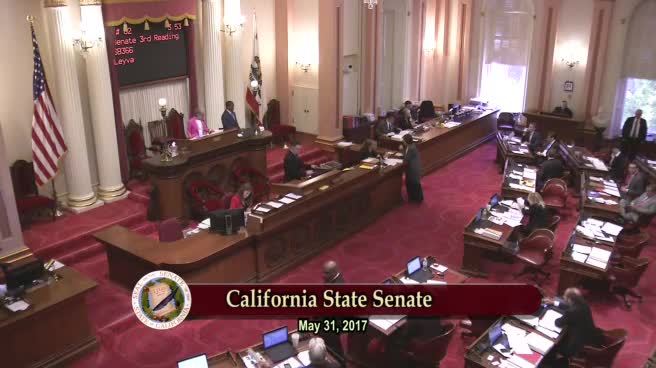 2MIN
Senate Floor
 48MIN
Senate Standing Committee on Appropriations
 14MIN
Senate Standing Committee on Energy, Utilities and Communications
Bill Author

Bill Co-Author(s):