SB 400: Highways: surplus residential property.
- Session Year: 2017-2018
- House: Senate
- Latest Version Date: 2017-10-07
Existing law authorizes the Department of Transportation to acquire real property for state highway purposes and specifies various procedures to be followed by the department when it determines that real property acquired for state highway purposes is no longer necessary for those purposes.
Existing law declares the intent of the Legislature to preserve, upgrade, and expand the supply of current housing to persons or families of low or moderate income through the sale of specified surplus residential property. Existing law requires an agency of the state disposing of surplus residential property to do so in accordance with specified priorities and procedures, including that priority to purchase be given to tenants that are former owners or are persons or families of low or moderate income.
This bill would, until January 1, 2020, prohibit the Department of Transportation from increasing the rent of tenants who reside in surplus residential property located within the State Route 710 corridor in the County of Los Angeles and who participate in the Affordable Rent Program administered by the department.
Existing law authorizes the Department of Transportation to acquire real property for state highway purposes and specifies various procedures to be followed by the department when it determines that real property acquired for state highway purposes is no longer necessary for those purposes.
Existing law declares the intent of the Legislature to preserve, upgrade, and expand the supply of current housing to persons or families of low or moderate income through the sale of specified surplus residential property. Existing law requires an agency of the state disposing of surplus residential property to do so in accordance with specified priorities and procedures, including that priority to purchase be given to tenants that are former owners or are persons or families of low or moderate income.
This bill would, until January 1, 2020, prohibit the Department of Transportation from increasing the rent of tenants who reside in surplus residential property located on within the State Route 710 corridor in the County of Los Angeles. Angeles and who participate in the Affordable Rent Program administered by the department.
Existing law authorizes the Department of Transportation to acquire real property for state highway purposes and specifies various procedures to be followed by the department when it determines that real property acquired for state highway purposes is no longer necessary for those purposes.
Existing law declares the intent of the Legislature to preserve, upgrade, and expand the supply of current housing to persons or families of low or moderate income through the sale of specified surplus residential property. Existing law requires an agency of the state disposing of surplus residential property to do so in accordance with specified priorities and procedures, including that priority to purchase be given to tenants that are former owners or are persons or families of low or moderate income.
This bill would, until January 1, 2020, prohibit the Department of Transportation from increasing the rent of tenants who reside in surplus residential property located on State Route 710 in the County of Los Angeles.
Existing law requires the Department of Transportation to design, construct, place, and maintain, or cause to be designed, constructed, placed, and maintained, Please Dont Drink and Drive signs on state highways in memory of accident victims killed in accidents involving another party who was convicted of drunk driving or various other alcohol-related offenses, as specified, if the sign is requested, or consented to, by an immediate family member of the accident victim, and the requester pays a fee to cover the departments costs, as specified.This bill would add, until January 1, 2022, similar provisions to providing for the placement of Please Drive Safely signs in memory of victims killed in vehicular accidents unrelated to drugs or alcohol. The bill would limit to 24 the number of signs that may be placed each calendar year under these new provisions, with a maximum of 2 signs per year in each district of the department. The bill would exclude from the meaning of victim a party to the accident who operated a vehicle involved in the vehicle accident in violation of any nonalcohol-related or nondrug-related driving offense, but who died in the accident or was not prosecuted because he or she was found to be mentally competent, as specified. The bill would require the department to prepare an evaluation of the program and report its findings and any related recommendations to the Legislature by January 1, 2021.Existing law requires the Department of Transportation to design, construct, place, and maintain, or cause to be designed, constructed, placed, and maintained, Please Dont Drink and Drive signs on state highways in memory of accident victims killed in accidents involving another party who was convicted of drunk driving or various other alcohol-related offenses, as specified, if the sign is requested, or consented to, by an immediate family member of the accident victim, and the requester pays a fee to cover the departments costs, as specified.
This bill would expand these add, until January 1, 2022, similar provisions to also include providing for the placement of Please Drive Safely signs in memory of victims killed in vehicular accidents unrelated to drugs or alcohol. The bill would limit to 24 the number of signs that may be placed each calendar year under these new provisions, with a maximum of 2 signs per year in each district of the department. The bill would exclude from the meaning of victim a party to the accident who operated a vehicle involved in the vehicle accident in violation of any nonalcohol-related or nondrug-related driving offense, but who died in the accident or was not prosecuted because he or she was found to be mentally competent, as specified. The bill would require the department to prepare an evaluation of the program and report its findings and any related recommendations to the Legislature by January 1, 2021.
Existing law requires the Department of Transportation to design, construct, place, and maintain, or cause to be designed, constructed, placed, and maintained, Please Dont Drink and Drive signs on state highways in memory of accident victims killed in accidents involving another party who was convicted of drunk driving or various other alcohol-related offenses, as specified, if the sign is requested, or consented to, by an immediate family member of the accident victim, and the requester pays a fee to cover the departments costs, as specified.
This bill would expand these provisions to also include Please Drive Safely signs in memory of victims killed in vehicular accidents unrelated to drugs or alcohol. The bill would limit to 24 the number of signs that may be placed each calendar year under these new provisions, with a maximum of 2 signs per year in each district of the department.
Existing law authorizes the legislative body of a city to do any and all things necessary to lay out, acquire, and construct any section or portion of any street or highway within its jurisdiction as a freeway and to make any existing street or highway a freeway.This bill would make nonsubstantive changes to this provision.Existing law authorizes the legislative body of a city to do any and all things necessary to lay out, acquire, and construct any section or portion of any street or highway within its jurisdiction as a freeway and to make any existing street or highway a freeway.
This bill would make nonsubstantive changes to this provision.
(a)The Department of Transportation shall not increase the rent of a tenant who resides in a surplus residential property located within the State Route 710 corridor in the County of Los Angeles and who participates in the Affordable Rent Program administered by the department pursuant to Article 1 of Chapter 24 of Division 2 of Title 21 of the California Code of Regulations, Sections 2653 to 2658, inclusive.
(b)This section shall remain in effect only until January 1, 2020, and as of that date is repealed.
(a)The Department of Transportation shall not increase the rent of a tenant who resides in a surplus residential property located on within the State Route 710 corridor in the County of Los Angeles. Angeles and who participates in the Affordable Rent Program administered by the department pursuant to Article 1 of Chapter 24 of Division 2 of Title 21 of the California Code of Regulations, Sections 2653 to 2658, inclusive.
(b)This section shall remain in effect only until January 1, 2020, and as of that date is repealed.
(a)The Department of Transportation shall not increase the rent of a tenant who resides in a surplus residential property located on State Route 710 in the County of Los Angeles.
(b)This section shall remain in effect only until January 1, 2020, and as of that date is repealed.
SECTION 1.Section 101.15 is added to the Streets and Highways Code, to read:101.15.(a)(1)The department shall design, construct, place, and maintain, or cause to be designed, constructed, placed, and maintained, along state highways, signs that read as follows: Please Drive Safely followed by: In Memory of (victims name). These signs shall be placed upon the state highways in accordance with this section, placement guidelines adopted by the department, and any applicable federal limitations or conditions on highway signage, including location and spacing. Signs may memorialize more than one victim. Victim for purposes of this paragraph means a person who was killed in a vehicular accident unrelated to drugs or alcohol. No more than 24 signs may be placed throughout the state each calendar year pursuant to this paragraph, with no more than two signs in each of the departments 12 districts, notwithstanding any other provision of this section. Requests for signs under this paragraph shall be submitted to, and be processed by, the applicable district office of the department. Victim for purposes of this paragraph means a person who was killed in a vehicular accident, but does not include a party described in subdivision (c).(2)The department shall adopt program guidelines for the application for and placement of signs authorized by this section, including, but not limited to, the sign application and qualification process, the procedure for the dedication of signs, and procedures for the replacement or restoration of any signs that are damaged or stolen.(b)If the placement at the location of a vehicular accident is safe and practical and the conditions of subdivisions (c) and (d) are met, the department shall place a sign described in subdivision (a) in close proximity to the location where the vehicular accident occurred.(c)Victim does not include a party to that accident who operated a vehicle involved in the vehicular accident in violation of any nonalcohol-related or nondrug-related traffic offense pursuant to Division 11 (commencing with Section 21000) of the Vehicle Code, but who died in the accident or was not prosecuted because he or she was found mentally incompetent pursuant to Section 1367 of the Penal Code.(d)(1)Upon the request of an immediate family member of the deceased victim involved in an accident occurring on and after January 1, 1991, the department shall place a sign in accordance with this section. A person who is not a member of the immediate family may also submit a request to have a sign placed under this section if that person also submits the written consent of an immediate family member. The department shall charge the requesting party a fee to cover the departments cost in designing, constructing, placing, and maintaining that sign, and the departments costs in administering this section. The sign shall be posted for seven years from the date of initial placement, or until the date the department determines that the condition of the sign has deteriorated to the point that it is no longer serviceable, whichever date is first.(2)Immediate family means spouse, child, stepchild, brother, stepbrother, sister, stepsister, mother, stepmother, father, or stepfather.(3)If there is any opposition to the placement of the memorial sign by a member of the immediate family, no sign shall be placed pursuant to this section.(e)The department shall prepare an evaluation of the program authorized by this section and shall report its findings and any related recommendations to the Legislature by January 1, 2021.(f)This section shall remain in effect only until January 1, 2022, and as of that date is repealed, unless a later enacted statute that is enacted before January 1, 2022, deletes or extends that date.(a)(1)The department shall design, construct, place, and maintain, or cause to be designed, constructed, placed, and maintained, along state highways, signs that read as follows: Please Drive Safely followed by: In Memory of (victims name). These signs shall be placed upon the state highways in accordance with this section, placement guidelines adopted by the department, and any applicable federal limitations or conditions on highway signage, including location and spacing. Signs may memorialize more than one victim. Victim for purposes of this paragraph means a person who was killed in a vehicular accident unrelated to drugs or alcohol. No more than 24 signs may be placed throughout the state each calendar year pursuant to this paragraph, with no more than two signs in each of the departments 12 districts, notwithstanding any other provision of this section. Requests for signs under this paragraph shall be submitted to, and be processed by, the applicable district office of the department. Victim for purposes of this paragraph means a person who was killed in a vehicular accident, but does not include a party described in subdivision (c).
(2)The department shall adopt program guidelines for the application for and placement of signs authorized by this section, including, but not limited to, the sign application and qualification process, the procedure for the dedication of signs, and procedures for the replacement or restoration of any signs that are damaged or stolen.
(b)If the placement at the location of a vehicular accident is safe and practical and the conditions of subdivisions (c) and (d) are met, the department shall place a sign described in subdivision (a) in close proximity to the location where the vehicular accident occurred.
(c)Victim does not include a party to that accident who operated a vehicle involved in the vehicular accident in violation of any nonalcohol-related or nondrug-related traffic offense pursuant to Division 11 (commencing with Section 21000) of the Vehicle Code, but who died in the accident or was not prosecuted because he or she was found mentally incompetent pursuant to Section 1367 of the Penal Code.
(d)(1)Upon the request of an immediate family member of the deceased victim involved in an accident occurring on and after January 1, 1991, the department shall place a sign in accordance with this section. A person who is not a member of the immediate family may also submit a request to have a sign placed under this section if that person also submits the written consent of an immediate family member. The department shall charge the requesting party a fee to cover the departments cost in designing, constructing, placing, and maintaining that sign, and the departments costs in administering this section. The sign shall be posted for seven years from the date of initial placement, or until the date the department determines that the condition of the sign has deteriorated to the point that it is no longer serviceable, whichever date is first.
(2)Immediate family means spouse, child, stepchild, brother, stepbrother, sister, stepsister, mother, stepmother, father, or stepfather.
(3)If there is any opposition to the placement of the memorial sign by a member of the immediate family, no sign shall be placed pursuant to this section.
(e)The department shall prepare an evaluation of the program authorized by this section and shall report its findings and any related recommendations to the Legislature by January 1, 2021.
(f)This section shall remain in effect only until January 1, 2022, and as of that date is repealed, unless a later enacted statute that is enacted before January 1, 2022, deletes or extends that date.
SECTION 1.Section 101.10 of the Streets and Highways Code is amended to read:101.10.(a)(1)The department shall design, construct, place, and maintain, or cause to be designed, constructed, placed, and maintained, along state highways, signs that read as follows: Please Dont Drink and Drive, followed by: In Memory of (victims name). These signs shall be placed upon the state highways in accordance with this section, placement guidelines adopted by the department, and any applicable federal limitations or conditions on highway signage, including location and spacing. Signs may memorialize more than one victim. Victim for purposes of this paragraph means a person who was killed in a vehicular accident, but does not include a party described in paragraph (2) of subdivision (c).(2)The department shall also design, construct, place, and maintain, or cause to be designed, constructed, placed, and maintained, along state highways, signs that read as follows: Please Drive Safely followed by: In Memory of (victims name). These signs shall be placed upon the state highways in accordance with this section, placement guidelines adopted by the department, and any applicable federal limitations or conditions on highway signage, including location and spacing. Signs may memorialize more than one victim. Victim for purposes of this paragraph means a person who was killed in a vehicular accident unrelated to drugs or alcohol. No more than 24 signs may be placed throughout the state each calendar year pursuant to this paragraph, with no more than two signs in each of the departments 12 districts, notwithstanding any other provision of this section. Requests for signs under this paragraph shall be submitted to, and be processed by, the applicable district office of the department.(3)The department shall adopt program guidelines for the application for and placement of signs authorized by this section, including, but not limited to, the sign application and qualification process, the procedure for the dedication of signs, and procedures for the replacement or restoration of any signs that are damaged or stolen.(b)(1)If the placement at the location of a vehicular accident is safe and practical and the conditions of subdivisions (c) and (d) are met, the department shall place a sign described in paragraph (1) of subdivision (a) in close proximity to the location where the vehicular accident occurred.(2)If the placement at the location of a vehicular accident is safe and practical and the condition of subdivision (d) is met, the department shall place a sign described in paragraph (2) of subdivision (a) in close proximity to the location where the vehicular accident occurred.(c)(1)A party to that accident was convicted of any of the following:(A)Murder of the second degree under Section 187, and the violation was a direct result of driving a vehicle while in violation of Section 23152 or 23153 of the Vehicle Code.(B)Gross vehicular manslaughter while intoxicated under subdivision (a) of Section 191.5 of the Penal Code.(C)Vehicular manslaughter under subdivision (b) of Section 191.5 of the Penal Code.(2)A party to that accident operated a vehicle involved in the vehicular accident in violation of Section 23152 or 23153 of the Vehicle Code, but died in the accident or was not prosecuted because he or she is found mentally incompetent pursuant to Section 1367 of the Penal Code.(d)(1)Upon the request of an immediate family member of the deceased victim involved in an accident occurring on and after January 1, 1991, and described in subdivision (b), the department shall place a sign in accordance with this section. A person who is not a member of the immediate family may also submit a request to have a sign placed under this section if that person also submits the written consent of an immediate family member. The department shall charge the requesting party a fee to cover the departments cost in designing, constructing, placing, and maintaining that sign, and the departments costs in administering this section. The sign shall be posted for seven years from the date of initial placement, or until the date the department determines that the condition of the sign has deteriorated to the point that it is no longer serviceable, whichever date is first.(2)Immediate family means spouse, child, stepchild, brother, stepbrother, sister, stepsister, mother, stepmother, father, or stepfather.(3)If there is any opposition to the placement of the memorial sign by a member of the immediate family, no sign shall be placed pursuant to this section.(a)(1)The department shall design, construct, place, and maintain, or cause to be designed, constructed, placed, and maintained, along state highways, signs that read as follows: Please Dont Drink and Drive, followed by: In Memory of (victims name). These signs shall be placed upon the state highways in accordance with this section, placement guidelines adopted by the department, and any applicable federal limitations or conditions on highway signage, including location and spacing. Signs may memorialize more than one victim. Victim for purposes of this section paragraph means a person who was killed in a vehicular accident, but does not include a party described in paragraph (2) of subdivision (c).
(2)The department shall also design, construct, place, and maintain, or cause to be designed, constructed, placed, and maintained, along state highways, signs that read as follows: Please Drive Safely followed by: In Memory of (victims name). These signs shall be placed upon the state highways in accordance with this section, placement guidelines adopted by the department, and any applicable federal limitations or conditions on highway signage, including location and spacing. Signs may memorialize more than one victim. Victim for purposes of this paragraph means a person who was killed in a vehicular accident unrelated to drugs or alcohol. No more than 24 signs may be placed throughout the state each calendar year pursuant to this paragraph, with no more than two signs in each of the departments 12 districts, notwithstanding any other provision of this section. Requests for signs under this paragraph shall be submitted to, and be processed by, the applicable district office of the department.
(2)(3)The department shall adopt program guidelines for the application for and placement of signs authorized by this section, including, but not limited to, the sign application and qualification process, the procedure for the dedication of signs, and procedures for the replacement or restoration of any signs that are damaged or stolen.
(b)(1)If the placement at the location of a vehicular accident is safe and practical and the conditions of subdivisions (c) and (d) are met, the department shall place a sign described in paragraph (1) of subdivision (a) in close proximity to the location where the vehicular accident occurred.
(2)If the placement at the location of a vehicular accident is safe and practical and the condition of subdivision (d) is met, the department shall place a sign described in paragraph (2) of subdivision (a) in close proximity to the location where the vehicular accident occurred.
(c)(1)A party to that accident was convicted of any of the following:
(A)Murder of the second degree under Section 187, and the violation was a direct result of driving a vehicle while in violation of Section 23152 or 23153 of the Vehicle Code.
(B)Gross vehicular manslaughter while intoxicated under subdivision (a) of Section 191.5 of the Penal Code.
(C)Vehicular manslaughter under subdivision (b) of Section 191.5 of the Penal Code.
(2)A party to that accident operated a vehicle involved in the vehicular accident in violation of Section 23152 or 23153 of the Vehicle Code, but died in the accident or was not prosecuted because he or she is found mentally incompetent pursuant to Section 1367 of the Penal Code.
(d)(1)Upon the request of an immediate family member of the deceased victim involved in an accident occurring on and after January 1, 1991, and described in subdivision (b), the department shall place a sign in accordance with this section. A person who is not a member of the immediate family may also submit a request to have a sign placed under this section if that person also submits the written consent of an immediate family member. The department shall charge the requesting party a fee to cover the departments cost in designing, constructing, placing, and maintaining that sign, and the departments costs in administering this section. The sign shall be posted for seven years from the date of initial placement, or until the date the department determines that the condition of the sign has deteriorated to the point that it is no longer serviceable, whichever date is first.
(2)Immediate family means spouse, child, stepchild, brother, stepbrother, sister, stepsister, mother, stepmother, father, or stepfather.
(3)If there is any opposition to the placement of the memorial sign by a member of the immediate family, no sign shall be placed pursuant to this section.
SECTION 1.Section 1800 of the Streets and Highways Code is amended to read:1800.The legislative body of a city may do any and all things necessary to lay out, acquire, and construct a section or portion of a street or highway within its jurisdiction as a freeway and to make an existing street or highway a freeway.The legislative body of any a city may do any and all things necessary to lay out, acquire, and construct any a section or portion of any a street or highway within its jurisdiction as a freeway, freeway and to make any an existing street or highway a freeway.
|
Date
|
Status
|
|---|---|
| Oct 7, 2017 | Chaptered by Secretary of State. Chapter 568, Statutes of 2017. |
| Oct 7, 2017 | Approved by the Governor. |
| Sep 22, 2017 | Enrolled and presented to the Governor at 3 p.m. |
| Sep 15, 2017 | Assembly amendments concurred in. (Ayes 37. Noes 1.) Ordered to engrossing and enrolling. |
| Sep 14, 2017 | From committee: That the Assembly amendments be concurred in. (Ayes 10. Noes 0.) |
| Sep 13, 2017 | Re-referred to Com. on RLS. pursuant to Senate Rule 29.10(d). |
| Sep 13, 2017 | In Senate. Concurrence in Assembly amendments pending. |
| Sep 12, 2017 | Read third time. Passed. Ordered to the Senate. |
| Sep 8, 2017 | Read third time and amended. |
| Sep 5, 2017 | Read second time. Ordered to third reading. |
| Sep 1, 2017 | From committee: Do pass. (Ayes 15. Noes 1.) (September 1). |
| Jul 19, 2017 | July 19 set for first hearing. Placed on APPR. suspense file. |
| Jun 27, 2017 | From committee: Do pass and re-refer to Com. on APPR. (Ayes 12. Noes 1.) (June 26). Re-referred to Com. on APPR. |
| Jun 1, 2017 | From committee with author's amendments. Read second time and amended. Re-referred to Com. on TRANS. |
| Jun 1, 2017 | Referred to Com. on TRANS. |
| May 23, 2017 | In Assembly. Read first time. Held at Desk. |
| May 22, 2017 | Read third time. Passed. (Ayes 37. Noes 0. Page 1149.) Ordered to the Assembly. |
| May 16, 2017 | Read second time. Ordered to consent calendar. |
| May 15, 2017 | From committee: Be ordered to second reading pursuant to Senate Rule 28.8 and ordered to consent calendar. |
| May 4, 2017 | Set for hearing May 15. |
| Apr 27, 2017 | Read second time and amended. Re-referred to Com. on APPR. |
| Apr 26, 2017 | From committee: Do pass as amended and re-refer to Com. on APPR. with recommendation: To consent calendar. (Ayes 13. Noes 0. Page 857.) (April 25). |
| Apr 4, 2017 | Set for hearing April 25. |
| Mar 29, 2017 | Re-referred to Com. on T. & H. |
| Mar 20, 2017 | From committee with author's amendments. Read second time and amended. Re-referred to Com. on RLS. |
| Feb 23, 2017 | Referred to Com. on RLS. |
| Feb 16, 2017 | From printer. May be acted upon on or after March 18. |
| Feb 15, 2017 | Introduced. Read first time. To Com. on RLS. for assignment. To print. |
|
Date
|
Description
|
Location
|
Votes
|
|
|---|---|---|---|---|
| Sep 15, 2017 | Unfinished Business SB400 Portantino Concurrence | Senate Floor |
Passed |
|
| Sep 14, 2017 | That the Assembly amendments be concurred in | Senate Standing Committee on Transportation and Housing |
Passed |
|
| Sep 12, 2017 | SB 400 Portantino Senate Third Reading By LOW | Assembly Floor |
Passed |
|
| Sep 1, 2017 | Do pass. | Assembly Standing Committee on Appropriations |
Passed |
|
| Jun 26, 2017 | Do pass and be re-referred to the Committee on [Appropriations] | Assembly Standing Committee on Transportation |
Passed |
|
| May 22, 2017 | Consent Calendar 2nd SB400 | Senate Floor |
Passed |
|
| Apr 25, 2017 | Do pass as amended, but first amend, and re-refer to the Committee on [Appropriations] with the recommendation: To Consent Calendar | Senate Standing Committee on Transportation and Housing |
Passed |
This list shows positions taken on this bill by organizations on the date displayed, which is linked to the original source.
Positions by individuals are not included.
Office of Senate Floor Analyses (916) 651-1520 Fax: (916) 327-4478 | SB |
UNFINISHED BUSINESS
Bill No: SB 400
:
PRIOR SENATE VOTES NOT RELEVANT
SENATE TRANS. & HOUSING COMMITTEE: 10-0, 9/14/17 (Pursuant to Senate Rule 29.10)
AYES: Beall, Cannella, Atkins, Gaines, McGuire, Mendoza, Roth, Vidak, Wieckowski, Wiener
NO VOTE RECORDED: Allen, Morrell, Skinner
ASSEMBLY FLOOR: 75-1, 9/12/17 - See last page for vote
DIGEST:
This bill prohibits the California Department of Transportation (Caltrans) from increasing the rent of tenants who are participants in Caltrans’ Affordable Rent Program and residing in surplus residential properties within the State Route (SR) 710 corridor.
Assembly Amendments gut the bill and insert the provisions relating to the SR 710 corridor.
Existing law:
- Authorizes Caltrans, when it determines that any real property acquired for highway purposes is no longer necessary, to sell or exchange the property upon terms, standards, and conditions established by the California Transportation Commission. Proceeds from the sale are deposited in the State Highway Account.
- Establishes priorities and procedures for the disposition of surplus residential properties in the SR 710 corridor. Under the Roberti Act, Caltrans must offer surplus property in the following priority order:
- First, at fair-market value (market rate) to all single-family residences presently occupied by the former owners.
- Second, at an affordable price to current low-or moderate-income occupants who meet minimum length-of-occupancy standards.
- Third, to public or private housing-related entities at a price necessary to make the housing affordable to present tenants and households of low or moderate income, as specified.
- Fourth, at market rate to present occupants in good standing, next to former tenants, and lastly to persons who intend to be owner-occupants.
- Requires all non-historic surplus residential properties within the SR 710 corridor that are not purchased by former owners or the present occupants to be offered to a public or private housing-related entity at a reasonable price to allow the property to be used as affordable housing for low- and moderate-income individuals, as specified.
- Requires all historic surplus residential properties within the SR 710 corridor that are not purchased by former owners or the present occupants to be offered first to a housing-related public entity or a nonprofit private entity dedicated to rehabilitating and maintaining the home for public and community access and use.
- Requires the net proceeds from a subsequent sale of surplus residential property to be deposited into an Affordable Housing Trust Account to benefit families of low and moderate income residing exclusively in Pasadena, South Pasadena, Alhambra, La Canada Flintridge, and the 90032 postal ZIP code.
- Establishes an Affordable Rent Program by which Caltrans considers affordability when adjusting rents for current residential tenants who are economically disadvantaged.
This bill:
- Prohibits Caltrans from increasing the rent of a tenant who resides in a surplus residential property located within the SR 710 corridor in Los Angeles County and participates in Caltrans’ Affordable Rent Program.
- Sunsets this prohibition on January 1, 2020.
Comments
Purpose. The author states that he recently hosted a town hall meeting with Caltrans at which SR 710 corridor tenants expressed serious concerns about rising rents. In the wake of the Los Angeles County Metropolitan Transportation Authority’s vote to kill the SR 710 tunnel, the sale of SR 710 houses is the next big piece of the puzzle that needs to fall into place. The author states that current tenants have the right to purchase their homes from Caltrans and that he wants to ensure that rising rents don’t drive them out during the home stretch of resolving the 60-year issue in the SR 710 corridor. Freezing rents will help facilitate the quick and efficient sale of properties.
SR 710 Properties. For decades, Caltrans has proposed extending SR 710 to close a roughly 4.5 mile unconstructed gap in the freeway between SR 10 in Los Angeles and SR 710 in Pasadena. This gap affects the cities of Alhambra, Pasadena, South Pasadena, and a portion of Los Angeles. The project has been in the planning stage since 1953 for a variety of reasons related to the federal environmental review process. In December 2016, Caltrans announced its plans to sell 42 of the SR 710 corridor properties and outlined future plans to sell many, if not all, of the remaining properties. In spring 2017, the Los Angeles County Metropolitan Transportation Authority voted unanimously to withdraw its support and funding for a proposed tunnel connecting the SR 710 and SR 210 freeways; Caltrans is expected to take similar action to cease further study of the freeway gap project. Since many tenants are trying to save up enough money to purchase the homes, the author feels that they should be protected against rising rents. This bill originally applied to all SR 710 corridor tenants but was recently narrowed to only those in the Affordable Rent Program.
Caltrans rents. Caltrans currently owns more than 460 homes within the original surface route corridor, of which 400 are occupied. Property management of these homes has created long-standing tension between Caltrans and its tenants. Tenants have complained that Caltrans does not adequately maintain the homes, while Caltrans has contended that since the houses will eventually be razed for freeway construction; long-term improvements are not an appropriate use of state funds. Caltrans and tenants have also clashed on the issue of appropriate rent levels.
According to Caltrans, 254 of the currently rented homes fall outside the Affordable Rent Program. Of the 123 tenants in the program, 47 are charged less than the affordable rent rate. Caltrans raises rents every year for homes that are less than 25% below either the fair market rate or the affordable rate, whichever is applicable, and every six months for homes that are more than 25% below the appropriate rate. Increases are limited to 10% by regulation. This bill would freeze rents for the 123 tenants who are in the Affordable Rent program.
Senate Rule 29.10 referral. This bill initially expanded the “Please Don’t Drink and Drive” Victims Memorial Sign Program to victims of non-driving-under-the-influence accidents. This bill was amended in the Assembly Transportation Committee to remove that content and instead address the SR 710 properties. Pursuant to Senate Rule 29.10, the Senate Rules Committee referred the amended bill to the Senate Transportation and Housing Committee to consider the Assembly amendments. The committee recommended concurrence on September 14th.
Related/Prior Legislation
SB 275 (Portantino) requires any property purchased at an affordable price in the SR 710 corridor to be assessed at its affordable price for property tax purposes, and any property purchased at a reasonable price in the SR 710 corridor to be assessed at a reasonable price for property tax purposes. The language of this bill was adopted as part of the 2017 budget agreement.
SB 580 (Liu, Chapter 709, Statutes of 2016) made changes to the Roberti Act governing the sale of surplus properties in the SR 710 corridor.
SB 1018 (Liu, 2016) would have required the Board of Directors of the Los Angeles County Metropolitan Transportation Authority to hold three public hearings on the cost-benefit analysis prepared for the SR 710 North Gap Closure project. The bill died in the Senate Transportation and Housing Committee.
SB 580 (Liu, Chapter 709, Statutes of 2015) made changes to the Roberti Act governing the sale of surplus properties in the SR 710 corridor.
SB 416 (Liu, Chapter 468, Statutes of 2013) expedited the sale of surplus residential properties in the cities of Los Angeles, South Pasadena, and Pasadena that do not fall within the boundaries of any alternate route being considered in the SR 710 Project Draft Environmental Impact Report/Environmental Impact Statement.
SB 204 (Liu, 2012) would have required the sale of Caltrans-owned surplus properties in the SR 710 Project. The bill was vetoed by the Governor.
AB 1617 (Liu, 2006) would have given cities priority over affordable housing entities to purchase, rehabilitate, and resell Caltrans-owned surplus residential properties in the SR 710 corridor. The bill failed passage in the Senate Transportation and Housing Committee.
FISCAL EFFECT: Appropriation: Fiscal Com.: Local:
According to the Assembly Appropriations Committee, unknown revenue loss to Caltrans by freezing rental rates for properties that would otherwise likely have a rate increase.
California School Employees Association
City of Los Angeles Mayor Eric Garcetti
City of Pasadena
City of South Pasadena
No on 710 Action Committee
West Pasadena Residents’ Association
OPPOSITION: (Verified 9/14/17)
None received
ARGUMENTS IN SUPPORT: Los Angeles Mayor Eric Garcetti states that this bill will ensure that homes owned by the State of California are kept affordable and tenants, who wish to do so, are able to purchase their homes from Caltrans.
ASSEMBLY FLOOR: 75-1, 9/12/17
AYES: Acosta, Aguiar-Curry, Arambula, Baker, Berman, Bigelow, Bloom, Bocanegra, Bonta, Brough, Burke, Caballero, Calderon, Cervantes, Chau, Chávez, Chen, Chiu, Choi, Chu, Cooley, Cooper, Cunningham, Dababneh, Dahle, Daly, Eggman, Flora, Fong, Frazier, Friedman, Gallagher, Cristina Garcia, Eduardo Garcia, Gipson, Gloria, Gonzalez Fletcher, Gray, Grayson, Holden, Irwin, Jones-Sawyer, Kalra, Kiley, Lackey, Levine, Limón, Low, Maienschein, Mathis, Mayes, McCarty, Medina, Melendez, Mullin, Muratsuchi, O'Donnell, Patterson, Quirk, Quirk-Silva, Reyes, Ridley-Thomas, Rodriguez, Rubio, Salas, Santiago, Steinorth, Mark Stone, Thurmond, Ting, Voepel, Waldron, Weber, Wood, Rendon
NOES: Travis Allen
NO VOTE RECORDED: Harper, Nazarian, Obernolte
9/14/17 19:10:13
**** END ****
SENATE COMMITTEE ON TRANSPORTATION AND HOUSING
Senator Jim Beall, Chair
2017 - 2018 Regular
Bill No: SB 400 Hearing Date: 9/14/2017
Author: | Portantino | ||
Version: | 9/8/2017 Amended Assembly | ||
Urgency: | No | Fiscal: | Yes |
Consultant: | Erin Riches | ||
SUBJECT: Highways: surplus residential property.
DIGEST: This bill prohibits the state Department of Transportation (Caltrans) from increasing the rent of tenants who are participants in Caltrans’ Affordable Rent Program and residing in surplus residential properties within the State Route (SR) 710 corridor.
ANALYSIS:
Existing law:
- Authorizes Caltrans, when it determines that any real property acquired for highway purposes is no longer necessary, to sell or exchange the property upon terms, standards, and conditions established by the California Transportation Commission. Proceeds from the sale are deposited in the State Highway Account.
- Establishes priorities and procedures for the disposition of surplus residential properties in the SR 710 corridor. Under the Roberti Act, Caltrans must offer surplus property in the following priority order:
- First, at fair-market value (market rate) to all single-family residences presently occupied by the former owners.
- Second, at an affordable price to current low-or moderate-income occupants who meet minimum length-of-occupancy standards.
- Third, to public or private housing-related entities at a price necessary to make the housing affordable to present tenants and households of low or moderate income, as specified.
- Fourth, at market rate to present occupants in good standing, next to former tenants, and lastly to persons who intend to be owner-occupants.
- Requires all non-historic surplus residential properties within the SR 710 corridor that are not purchased by former owners or the present occupants to be offered to a public or private housing-related entity at a reasonable price to allow the property to be used as affordable housing for low- and moderate-income individuals, as specified.
- Requires all historic surplus residential properties within the SR 710 corridor that are not purchased by former owners or the present occupants to be offered first to a housing-related public entity or a nonprofit private entity dedicated to rehabilitating and maintaining the home for public and community access and use.
- Requires the net proceeds from a subsequent sale of surplus residential property to be deposited into an Affordable Housing Trust Account to benefit families of low and moderate income residing exclusively in Pasadena, South Pasadena, Alhambra, La Canada Flintridge, and the 90032 postal ZIP code.
- Establishes an Affordable Rent Program by which Caltrans considers affordability when adjusting rents for current residential tenants who are economically disadvantaged.
This bill:
- Prohibits Caltrans from increasing the rent of a tenant who resides in a surplus residential property located within the SR 710 corridor in Los Angeles County and participates in Caltrans’ Affordable Rent Program.
- Sunsets this prohibition on January 1, 2020.
COMMENTS:
- Purpose. The author states that he recently hosted a town hall meeting with Caltrans at which SR 710 corridor tenants expressed serious concerns about rising rents. In the wake of the Los Angeles County Metropolitan Transportation Authority’s vote to kill the SR 710 tunnel, the sale of SR 710 houses is the next big piece of the puzzle that needs to fall into place. The author states that current tenants have the right to purchase their homes from Caltrans and that he wants to ensure that rising rents don’t drive them out during the home stretch of resolving the 60-year issue in the SR 710 corridor. Freezing rents will help facilitate the quick and efficient sale of properties.
- SR 710 Properties. For decades, Caltrans has proposed extending SR 710 to close a roughly 4.5 mile unconstructed gap in the freeway between SR 10 in Los Angeles and SR 710 in Pasadena. This gap affects the cities of Alhambra, Pasadena, South Pasadena, and a portion of Los Angeles. The project has been in the planning stage since 1953 for a variety of reasons related to the federal environmental review process. In December 2016, Caltrans announced its plans to sell 42 of the SR 710 corridor properties and outlined future plans to sell many, if not all, of the remaining properties. In spring 2017, the Los Angeles County Metropolitan Transportation Authority voted unanimously to withdraw its support and funding for a proposed tunnel connecting the SR 710 and SR 210 freeways; Caltrans is expected to take similar action to cease further study of the freeway gap project. Since many tenants are trying to save up enough money to purchase the homes, the author feels that they should be protected against rising rents. This bill originally applied to all SR 710 corridor tenants but was recently narrowed to only those in the Affordable Rent Program.
- Caltrans rents. Caltrans currently owns more than 460 homes within the original surface route corridor, of which 400 are occupied. Property management of these homes has created long-standing tension between Caltrans and its tenants. Tenants have complained that Caltrans does not adequately maintain the homes, while Caltrans has contended that since the houses will eventually be razed for freeway construction; long-term improvements are not an appropriate use of state funds. Caltrans and tenants have also clashed on the issue of appropriate rent levels.
According to Caltrans, 254 of the currently rented homes fall outside the Affordable Rent Program. Of the 123 tenants in the program, 47 are charged less than the affordable rent rate. Caltrans raises rents every year for homes that are less than 25% below either the fair market rate or the affordable rate, whichever is applicable, and every six months for homes that are more than 25% below the appropriate rate. Increases are limited to 10% by regulation. This bill would freeze rents for the 123 tenants who are in the Affordable Rent program.
- Senate Rule 29.10 referral. This bill initially expanded the “Please Don’t Drink and Drive” Victims Memorial Sign Program to victims of non-driving-under-the-influence (DUI) accidents. This bill was amended in the Assembly Transportation Committee to remove that content and instead address the SR 710 properties. Pursuant to Senate Rule 29.10, the Senate Rules Committee referred the amended bill to the Transportation and Housing Committee to consider the Assembly amendments.
Assembly Votes:
Floor: 75-1
Approps: 15-1
Trans: 12-1
Related Legislation:
SB 275 (Portantino) — would require any property purchased at an affordable price in the SR 710 corridor to be assessed at its affordable price for property tax purposes, and any property purchased at a reasonable price in the SR 710 corridor to be assessed at a reasonable price for property tax purposes. This bill is in the Assembly Housing Committee. The language of this bill was adopted as part of the 2017 budget agreement.
SB 580 (Liu, Chapter 709, Statutes of 2016) — made changes to the Roberti Act governing the sale of surplus properties in the SR 710 corridor.
SB 1018 (Liu) — would have required the Board of Directors of the Los Angeles County Metropolitan Transportation Authority to hold three public hearings on the cost-benefit analysis prepared for the SR 710 North Gap Closure project. This bill died in the Senate Transportation and Housing Committee.
SB 580 (Liu, Chapter 709, Statutes of 2015) — made changes to the Roberti Act governing the sale of surplus properties in the SR 710 corridor.
SB 416 (Liu, Chapter 468, Statutes of 2013) — expedited the sale of surplus residential properties in the cities of Los Angeles, South Pasadena, and Pasadena that do not fall within the boundaries of any alternate route being considered in the SR 710 Project Draft Environmental Impact Report/Environmental Impact Statement.
SB 204 (Liu, 2012) — would have required the sale of Caltrans-owned surplus properties in the SR 710 Project. This bill was vetoed by the Governor.
AB 1617 (Liu, 2006) — would have given cities priority over affordable housing entities to purchase, rehabilitate, and resell Caltrans-owned surplus residential properties in the SR 710 corridor. This bill failed passage in the Senate Transportation and Housing Committee.
FISCAL EFFECT: Appropriation: Fiscal Com.: Local:
POSITIONS: (Communicated to the committee by September 13, 2017.)
SUPPORT:
California School Employees Association
City of Los Angeles Mayor Eric Garcetti
City of Pasadena
City of South Pasadena
No on 710 Action Committee
West Pasadena Residents’ Association
OPPOSITION:
None received.
-- END --
SENATE THIRD READING
STR Bill Id:SB 400
Author:(Portantino)
As Amended Ver:September 8, 2017
Majority vote
SENATE VOTE: 37-0
Committee | Votes | Ayes | Noes |
Transportation | 12-1 | Frazier, Fong, Aguiar-Curry, Baker, Berman, Bocanegra, Chu, Daly, Friedman, Mathis, Medina, O'Donnell | Harper |
Appropriations | 15-1 | Gonzalez Fletcher, Bigelow, Bloom, Bocanegra, Bonta, Brough, Calderon, Chau, Eggman, Fong, Friedman, Gallagher, Eduardo Garcia, Jones-Sawyer, Reyes | Obernolte |
SUMMARY: Prohibits, until January 1, 2020, the California Department of Transportation (Caltrans) from increasing rents for surplus residential properties within the State Route (SR) 710 corridor in Los Angeles County; limits the rent freeze to tenants who are in the Caltrans Affordable Rent Program.
EXISTING LAW:
- Allows Caltrans to acquire any real property that it considers necessary for state highway purposes.
- Allows Caltrans, whenever it determines that any real property acquired by the state for highway purposes is no longer necessary, to sell or exchange it in the manner and upon terms, standards, and conditions established by the California Transportation Commission.
- Requires Caltrans, to the greatest extent possible, to offer to sell or exchange excess real property within one year from the date that it determines the property is excess.
- Generally requires state and local agencies, prior to disposing of excess lands, first to offer property for sale or lease to local public agencies, housing authorities, or redevelopment agencies within whose jurisdiction the property is located. Requires Caltrans to give priority first to entities agreeing to use the land for low- or moderate-income housing then to entities for open-space purposes, school facilities construction, enterprise zone purposes, and infill opportunities, in that order.
- Provides an exception from these provisions for the disposal of excess residential properties in the unconstructed portion of the SR 710 corridor, i.e., the portion of SR 710 addressed in this bill. According to this exception, provided for in the Roberti Act, excess residential properties in this corridor are to be sold as follows:
- First, homes presently occupied by their former owners must be offered for sale to the occupant at fair market value. (Caltrans reports that there are no longer any properties in the SR 710 corridor occupied by previous owners);
- Second, homes are to be offered to present occupants that have lived in the property for at least two years and who are persons and families of low or moderate income;
- Third, homes must be offered for sale to present occupants that have lived in the home for more than five years and whose household income does not exceed 150% of the area median income;
- Homes offered to income-qualified buyers are to be offered at an affordable price, but not less than the acquisition price or more than fair market value.
- Homes not sold under these terms must then be offered to housing-related private and public entities for a price which is best suited economically to using the property for low- or moderate-income housing; and,
- Any excess homes not sold pursuant to these provisions are then to be sold at fair market value with first priority given to purchasers who are present occupants and then to purchasers who will be owner occupants.
- Directs 50% of the revenue collected by Caltrans from rental of historic property that is located in a freeway right-of-way corridor to be deposited in the Historic Property Maintenance Fund to pay for costs associated with maintenance and operation of the historic properties.
- As set forth in regulations, establishes an Affordable Rent Program by which Caltrans considers affordability when adjusting rents for current residential tenants who are economically disadvantaged.
FISCAL EFFECT: According to the Assembly Appropriations Committee, unknown revenue loss to Caltrans by freezing rental rates for properties that would otherwise likely have a rate increase.
COMMENTS: Beginning in the 1950s, Caltrans began acquiring property by eminent domain for the purpose of extending the SR 710 freeway through Alhambra, El Sereno, South Pasadena, and Pasadena. Local political opposition stalled the project, at which point Caltrans began renting the residential properties. Caltrans currently owns over 400 properties in the corridor, most of them single-family homes. [The project continues to be somewhat in limbo, although progress to resolve it seems to be progressing. The surface route, originally proposed in 1953, was eliminated from consideration years ago, but other alternatives were still being considered, including a tunnel, light rail, bus rapid transit, and transportation demand and traffic flow management. However, in May of this year, the Los Angeles County Metropolitan Transportation Authority (Metro) board voted unanimously to withdraw its support and funding for the five-mile, $3.2-billion tunnel connecting the SR 710 and SR 210 freeways. Instead, the board voted to spend $700 million on a range of transportation fixes to ease congestion and other problems within the corridor. Caltrans is expected to take similar action to cease further study of the freeway gap project.]
Property management of the homes in the SR 710 corridor has created long-standing tension between SR 710 corridor tenants and Caltrans. Over the years, tenants argued that Caltrans inadequately maintained the homes and failed to make appropriate improvements. Caltrans argued that the homes were being rented on a temporary basis and were expected to be razed to make way for freeway construction; hence, homes were kept up to health and safety standards, but long-term improvements were not a reasonable expense of public funds.
Caltrans and tenants have also long tussled over the issue of appropriate rental rates in this corridor. AB 21 (Liu) of 2003 was illustrative of this conflict. It would have required Caltrans to establish a task force to develop recommendations to the Legislature regarding rental rates on department-owned residential property in the SR 710 corridor. It would have also prohibited Caltrans from increasing rents on occupied residential properties and placed a moratorium on any without-cause evictions. AB 21 stemmed from tension over complaints from tenants about the maintenance of the properties and Caltrans indication at that time that it intended to increase rents in order to get the rents up to fair market levels. AB 21 was never heard in the Senate.
Then, as now, tenants in some cases were paying significantly less than current market rent, despite the department's policy generally to charge fair market rates, except within its Affordable Rent Program. That program, developed in regulations in 2013, is intended to protect low-income tenants already living in SR 710 corridor homes from large rental rate increases. (New tenants, however, are required to pay fair market rates.) For tenants who began renting a home prior to 1981, affordable rent equates to 25% of gross monthly income. For tenants who began renting after this date, affordable rent equates to 30% of their gross monthly income. Gross monthly income is considered the total income for the most previous tax year, before adjustments, credits, and taxes.
According to Caltrans, of the nearly 400 homes currently being rented, 254 fall outside of the Affordable Rent Program. Of these 254 homes, 251 of the tenants are charged less than fair market rent. Of the 123 tenants under the Affordable Rent Program, 47 are charged less than the affordable rent rate. Caltrans raises rents every year for homes that are less than 25% below either the fair market rate or the affordable rate, whichever is applicable, and every six months for tenants that are more than 25% below the appropriate rate. Increases are limited to 10% per regulations. This bill limits the proposed rent freeze to tenants that are in the Affordable Rent Program.
In December 2016, Caltrans announced its plans to sell 42 of the SR 710 corridor properties and outlined future plans to sell many, if not all, of the remaining properties. This announcement, along with Metro's announcement to withdraw its support for a freeway gap tunnel project, has spurred the author to introduce this bill. As the author points out, existing law allows current tenants of Caltrans-owned properties to purchase their homes once the properties are declared surplus. The author wants to ensure that these tenants are not forced out of the homes they rent because of rental rate increases imposed by Caltrans. The author stated, "Current tenants have the right to purchase their homes from Caltrans. I want to make sure that rising rents don't drive them out while we are in the home stretch of resolving the 60-year issue in the SR 710 corridor. For me, the fair thing to do is to freeze rents and help facilitate the sale of the properties as quickly and efficiently as possible."
Please see the policy committee analysis for full discussion of this bill.
Analysis Prepared by: Janet Dawson / TRANS. / (916) 319-2093 FN: 0002065
SENATE THIRD READING
STR Bill Id:SB 400
Author:(Portantino)
As Amended Ver:June 1, 2017
Majority vote
SENATE VOTE: 37-0
Committee | Votes | Ayes | Noes |
Transportation | 12-1 | Frazier, Fong, Aguiar-Curry, Baker, Berman, Bocanegra, Chu, Daly, Friedman, Mathis, Medina, O'Donnell | Harper |
Appropriations | 15-1 | Gonzalez Fletcher, Bigelow, Bloom, Bocanegra, Bonta, Brough, Calderon, Chau, Eggman, Fong, Friedman, Gallagher, Eduardo Garcia, Jones-Sawyer, Reyes | Obernolte |
SUMMARY: Prohibits, until January 1, 2020, the California Department of Transportation (Caltrans) from increasing rents for surplus residential properties in the State Route (SR) 710 corridor in Los Angeles County.
EXISTING LAW:
- Allows Caltrans to acquire any real property that it considers necessary for state highway purposes.
- Allows Caltrans, whenever it determines that any real property acquired by the state for highway purposes is no longer necessary, to sell or exchange it in the manner and upon terms, standards, and conditions established by the California Transportation Commission.
- Requires Caltrans, to the greatest extent possible, to offer to sell or exchange excess real property within one year from the date that it determines the property is excess.
- Generally requires state and local agencies, prior to disposing of excess lands, first to offer property for sale or lease to local public agencies, housing authorities, or redevelopment agencies within whose jurisdiction the property is located. Requires Caltrans to give priority first to entities agreeing to use the land for low- or moderate-income housing then to entities for open-space purposes, school facilities construction, enterprise zone purposes, and infill opportunities, in that order.
- Provides an exception from these provisions for the disposal of excess residential properties in the unconstructed portion of the SR 710 corridor, i.e., the portion of SR 710 addressed in this bill. According to this exception, provided for in the Roberti Act, excess residential properties in this corridor are to be sold as follows:
- First, homes presently occupied by their former owners must be offered for sale to the occupant at fair market value. (Caltrans reports that there are no longer any properties in the SR 710 corridor occupied by previous owners);
- Second, homes are to be offered to present occupants that have lived in the property for at least two years and who are persons and families of low or moderate income;
- Third, homes must be offered for sale to present occupants that have lived in the home for more than five years and whose household income does not exceed 150% of the area median income;
- Homes offered to income-qualified buyers are to be offered at an affordable price, but not less than the acquisition price or more than fair market value.
- Homes not sold under these terms must then be offered to housing-related private and public entities for a price which is best suited economically to using the property for low- or moderate-income housing; and,
- Any excess homes not sold pursuant to these provisions are then to be sold at fair market value with first priority given to purchasers who are present occupants and then to purchasers who will be owner occupants.
- Directs 50% of the revenue collected by Caltrans from rental of historic property that is located in a freeway right-of-way corridor to be deposited in the Historic Property Maintenance Fund to pay for costs associated with maintenance and operation of the historic properties.
- As set forth in regulations, establishes an Affordable Rent Program by which Caltrans considers affordability when adjusting rents for current residential tenants who are economically disadvantaged.
FISCAL EFFECT: According to the Assembly Appropriations Committee, unknown revenue loss to Caltrans by freezing rental rates for properties that would otherwise likely have a rate increase.
COMMENTS: Beginning in the 1950s, Caltrans began acquiring property by eminent domain for the purpose of extending the SR 710 freeway through Alhambra, El Sereno, South Pasadena, and Pasadena. Local political opposition stalled the project, at which point Caltrans began renting the residential properties. Caltrans currently owns over 400 properties in the corridor, most of them single-family homes. [The project continues to be somewhat in limbo, although progress to resolve it seems to be progressing. The surface route, originally proposed in 1953, was eliminated from consideration years ago, but other alternatives were still being considered, including a tunnel, light rail, bus rapid transit, and transportation demand and traffic flow management. However, in May of this year, the Los Angeles County Metropolitan Transportation Authority (Metro) board voted unanimously to withdraw its support and funding for the five-mile, $3.2-billion tunnel connecting the SR 710 and SR 210 freeways. Instead, the board voted to spend $700 million on a range of transportation fixes to ease congestion and other problems within the corridor. Caltrans is expected to take similar action to cease further study of the freeway gap project.]
Property management of the homes in the SR 710 corridor has created long-standing tension between SR 710 corridor tenants and Caltrans. Over the years, tenants argued that Caltrans inadequately maintained the homes and failed to make appropriate improvements. Caltrans argued that the homes were being rented on a temporary basis and were expected to be razed to make way for freeway construction; hence, homes were kept up to health and safety standards, but long-term improvements were not a reasonable expense of public funds.
Caltrans and tenants have also long tussled over the issue of appropriate rental rates in this corridor. AB 21 (Liu) of 2003 was illustrative of this conflict. It would have required Caltrans to establish a task force to develop recommendations to the Legislature regarding rental rates on department-owned residential property in the SR 710 corridor. It would have also prohibited Caltrans from increasing rents on occupied residential properties and placed a moratorium on any without-cause evictions. AB 21 stemmed from tension over complaints from tenants about the maintenance of the properties and Caltrans indication at that time that it intended to increase rents in order to get the rents up to fair market levels. AB 21 was never heard in the Senate.
Then, as now, tenants in some cases were paying significantly less than current market rent, despite the department's policy generally to charge fair market rates, except within its Affordable Rent Program. That program, developed in regulations in 2013, is intended to protect low-income tenants already living in SR 710 corridor homes from large rental rate increases. (New tenants, however, are required to pay fair market rates.) For tenants who began renting a home prior to 1981, affordable rent equates to 25% of gross monthly income. For tenants who began renting after this date, affordable rent equates to 30% of their gross monthly income. Gross monthly income is considered the total income for the most previous tax year, before adjustments, credits, and taxes.
According to Caltrans, of the nearly 400 homes currently being rented, 254 fall outside of the Affordable Rent Program. Of these 254 homes, 251 of the tenants are charged less than fair market rent. Of the 123 tenants under the Affordable Rent Program, 47 are charged less than the affordable rent rate. Caltrans raises rents every year for homes that are less than 25% below either the fair market rate or the affordable rate, whichever is applicable, and every six months for tenants that are more than 25% below the appropriate rate. Increases are limited to 10% per regulations.
When it comes to setting the appropriate rental rate schedule for this corridor, Caltrans is in an impossible situation. An earlier attempt to charge market rates (including a proposed rental rate increase in 2002 that was issued for tenants paying less than 80% market value) was suspended due to legislative and tenant outcries. Subsequently, a 2012 State Audit strongly criticized the department and found, among other things, Caltrans' failure to charge full market rental rates for the properties cost the state over $22 million over about a five-year period. The audit found that properties were, on average, rented at rates that were 43% below the market rate. The audit warned that failure to rent these properties at the fair market rate essentially constituted a gift of public funds, which, the Auditor argued, is prohibited by the California Constitution. (Others provide different legal opinions on this point. For example, in an opinion published by then-Attorney General Edmund G. Brown (No. 07-801), the Attorney General opined that below-market sales or rentals are constitutionally permissible as a limited exception to the "gift of public funds" prohibition if the property qualifies as surplus residential property under the affordable-housing legislation known as the Roberti Law, within which the SR 710 properties fall.)
In December 2016, Caltrans announced its plans to sell 42 of the SR 710 corridor properties and outlined future plans to sell many, if not all, of the remaining properties. This announcement, along with Metro's announcement to withdraw its support for a freeway gap tunnel project, has spurred the author to introduce this bill. As the author points out, existing law allows current tenants of Caltrans-owned properties to purchase their homes once the properties are declared surplus. The author wants to ensure that these tenants are not forced out of the homes they rent because of rental rate increases imposed by Caltrans. The author stated, "Current tenants have the right to purchase their homes from Caltrans. I want to make sure that rising rents don't drive them out while we are in the home stretch of resolving the 60-year issue in the SR 710 corridor. For me, the fair thing to do is to freeze rents and help facilitate the sale of the properties as quickly and efficiently as possible."
Committee concerns: This bill undermines existing efforts to resolve a decades-old problem, that is, to charge appropriate rental rates for SR 710 properties. It arbitrarily freezes rates for those tenants that are not yet paying either the fair market rate or affordable rental rate, all the while other tenants in the corridor and around the state are required to pay the appropriate rental rates.
Please see the policy committee analysis for full discussion of this bill.
Analysis Prepared by: Janet Dawson / TRANS. / (916) 319-2093 FN: 0001861
Date of Hearing: July 19, 2017
ASSEMBLY COMMITTEE ON APPROPRIATIONS
Lorena Gonzalez Fletcher, Chair
SBPCA Bill Id:SB 400
Author:(Portantino) – As Amended Ver:June 1, 2017
Policy Committee: | Transportation | Vote: | 12 - 1 |
|
| ||
|
|
Urgency: No State Mandated Local Program: No Reimbursable: No
SUMMARY:
This bill prohibits, until January 1, 2020, the California Department of Transportation (Caltrans) from increasing rents for surplus residential properties located on State Route (SR) 710 in Los Angeles County.
FISCAL EFFECT:
Unknown revenue loss to Caltrans by freezing rental rates for properties that would otherwise likely have a rate increase.
COMMENTS:
- Background. Beginning in the 1950s, Caltrans began acquiring property for the purpose of extending the SR 710 freeway through Alhambra, El Sereno, South Pasadena, and Pasadena. Local political opposition stalled the project, at which point Caltrans began renting the residential properties. The surface route for the SR 710 extension, originally proposed in 1953, was eliminated from consideration years ago. However, Caltrans still owns over 400 properties in the corridor, most of which are single-family homes. In December 2016, Caltrans announced plans to sell 42 of the SR 710 corridor properties and outlined future plans to sell many, if not all, of the remaining properties.
- Purpose. Existing law allows current tenants of Caltrans-owned properties to purchase their homes once the properties are declared surplus. The author wants to ensure that these tenants are not forced out of the homes they rent because of rental rate increases imposed by Caltrans before they have the opportunity to purchase the homes when they are put up for sale in the coming years. The author states, "Current tenants have the right to purchase their homes from Caltrans. I want to make sure that rising rents don’t drive them out while we are in the home stretch of resolving the 60-year issue in the SR 710 corridor. For me, the fair thing to do is to freeze rents and help facilitate the sale of the properties as quickly and efficiently as possible."
Analysis Prepared by: Jessica Peters / APPR. / (916) 319-2081
Date of Hearing: June 26, 2017
ASSEMBLY COMMITTEE ON TRANSPORTATION
Jim Frazier, Chair
SBPCA Bill Id:SB 400
Author:(Portantino) – As Amended Ver:June 1, 2017
SENATE VOTE: 37-0
SUBJECT: Highways: surplus residential property
SUMMARY: Prohibits, until January 1, 2020, the California Department of Transportation (Caltrans) from increasing rents for surplus residential properties in the State Route (SR) 710 corridor in Los Angeles County.
EXISTING LAW:
- Allows Caltrans to acquire any real property that it considers necessary for state highway purposes.
- Allows Caltrans, whenever it determines that any real property acquired by the state for highway purposes is no longer necessary, to sell or exchange it in the manner and upon terms, standards, and conditions established by the California Transportation Commission.
- Requires Caltrans, to the greatest extent possible, to offer to sell or exchange excess real property within one year from the date that it determines the property is excess.
- Generally requires state and local agencies, prior to disposing of excess lands, first to offer property for sale or lease to local public agencies, housing authorities, or redevelopment agencies within whose jurisdiction the property is located. Requires Caltrans to give priority first to entities agreeing to use the land for low- or moderate-income housing then to entities for open-space purposes, school facilities construction, enterprise zone purposes, and infill opportunities, in that order.
- Provides an exception from these provisions for the disposal of excess residential properties in the unconstructed portion of the SR 710 corridor, i.e., the portion of SR 710 addressed in this bill. According to this exception, provided for in the Roberti Act, excess residential properties in this corridor are to be sold as follows:
- First, homes presently occupied by their former owners must be offered for sale to the occupant at fair market value. (Caltrans reports that there are no longer any properties in the SR 710 corridor occupied by previous owners);
- Second, homes are to be offered to present occupants that have lived in the property for at least two years and who are persons and families of low or moderate income;
- Third, homes must be offered for sale to present occupants that have lived in the home for more than five years and whose household income does not exceed 150% of the area median income;
- Homes offered to income-qualified buyers are to be offered at an affordable price, but not less than the acquisition price or more than fair market value.
- Homes not sold under these terms must then be offered to housing-related private and public entities for a price which is best suited economically to using the property for low- or moderate-income housing; and,
- Any excess homes not sold pursuant to these provisions are then to be sold at fair market value with first priority given to purchasers who are present occupants and then to purchasers who will be owner occupants.
- Directs 50% of the revenue collected by Caltrans from rental of historic property that is located in a freeway right-of-way corridor to be deposited in the Historic Property Maintenance Fund to pay for costs associated with maintenance and operation of the historic properties.
- As set forth in regulations, establishes an Affordable Rent Program by which Caltrans considers affordability when adjusting rents for current residential tenants who are economically disadvantaged.
FISCAL EFFECT: Unknown
COMMENTS: Beginning in the 1950s, Caltrans began acquiring property by eminent domain for the purpose of extending the SR 710 freeway through Alhambra, El Sereno, South Pasadena, and Pasadena. Local political opposition stalled the project, at which point Caltrans began renting the residential properties. Caltrans currently owns over 400 properties in the corridor, most of them single-family homes. [The project continues to be somewhat in limbo, although progress to resolve it seems to be progressing. The surface route, originally proposed in 1953, was eliminated from consideration years ago, but other alternatives were still being considered, including a tunnel, light rail, bus rapid transit, and transportation demand and traffic flow management. However, in May of this year, the Los Angeles County Metropolitan Transportation Authority (Metro) board voted unanimously to withdraw its support and funding for the five-mile, $3.2-billion tunnel connecting the SR 710 and SR 210 freeways. Instead, the board voted to spend $700 million on a range of transportation fixes to ease congestion and other problems within the corridor. Caltrans is expected to take similar action to cease further study of the freeway gap project.]
Property management of the homes in the SR 710 corridor has created long-standing tension between SR 710 corridor tenants and Caltrans. Over the years, tenants argued that Caltrans inadequately maintained the homes and failed to make appropriate improvements. Caltrans argued that the homes were being rented on a temporary basis and were expected to be razed to make way for freeway construction; hence, homes were kept up to health and safety standards, but long-term improvements were not a reasonable expense of public funds.
Caltrans and tenants have also long tussled over the issue of appropriate rental rates in this corridor. AB 21 (Liu) of 2003 was illustrative of this conflict. It would have required Caltrans to establish a task force to develop recommendations to the Legislature regarding rental rates on department-owned residential property in the SR 710 corridor. It would have also prohibited Caltrans from increasing rents on occupied residential properties and placed a moratorium on any without-cause evictions. AB 21 stemmed from tension over complaints from tenants about the maintenance of the properties and Caltrans indication at that time that it intended to increase rents in order to get the rents up to fair market levels. AB 21 was never heard in the Senate.
Then, as now, tenants in some cases were paying significantly less than current market rent, despite the department's policy generally to charge fair market rates, except within its Affordable Rent Program. That program, developed in regulations in 2013, is intended to protect low-income tenants already living in SR 710 corridor homes from large rental rate increases. (New tenants, however, are required to pay fair market rates.) For tenants who began renting a home prior to 1981, affordable rent equates to 25% of gross monthly income. For tenants who began renting after this date, affordable rent equates to 30% of their gross monthly income. Gross monthly income is considered the total income for the most previous tax year, before adjustments, credits, and taxes.
According to Caltrans, of the nearly 400 homes currently being rented, 254 fall outside of the Affordable Rent Program. Of these 254 homes, 251 of the tenants are charged less than fair market rent. Of the 123 tenants under the Affordable Rent Program, 47 are charged less than the affordable rent rate. Caltrans raises rents every year for homes that are less than 25% below either the fair market rate or the affordable rate, whichever is applicable, and every six months for tenants that are more than 25% below the appropriate rate. Increases are limited to 10% per regulations.
When it comes to setting the appropriate rental rate schedule for this corridor, Caltrans is in an impossible situation. An earlier attempt to charge market rates (including a proposed rental rate increase in 2002 that was issued for tenants paying less than 80% market value) was suspended due to legislative and tenant outcries. Subsequently, a 2012 State Audit strongly criticized the department and found, among other things, Caltrans' failure to charge full market rental rates for the properties cost the state over $22 million over about a five-year period. The audit found that properties were, on average, rented at rates that were 43% below the market rate. The audit warned that failure to rent these properties at the fair market rate essentially constituted a gift of public funds, which, the Auditor argued, is prohibited by the California Constitution. (Others provide different legal opinions on this point. For example, in an opinion published by then-Attorney General Edmund G. Brown (No. 07-801), the Attorney General opined that below-market sales or rentals are constitutionally permissible as a limited exception to the "gift of public funds" prohibition if the property qualifies as surplus residential property under the affordable-housing legislation known as the Roberti Law, within which the SR 710 properties fall.)
In December 2016, Caltrans announced its plans to sell 42 of the SR 710 corridor properties and outlined future plans to sell many, if not all, of the remaining properties. This announcement, along with Metro's announcement to withdraw its support for a freeway gap tunnel project, has spurred the author to introduce this bill. As the author points out, existing law allows current tenants of Caltrans-owned properties to purchase their homes once the properties are declared surplus. The author wants to ensure that these tenants are not forced out of the homes they rent because of rental rate increases imposed by Caltrans. The author stated, "Current tenants have the right to purchase their homes from Caltrans. I want to make sure that rising rents don’t drive them out while we are in the home stretch of resolving the 60-year issue in the SR 710 corridor. For me, the fair thing to do is to freeze rents and help facilitate the sale of the properties as quickly and efficiently as possible."
Committee concerns: This bill undermines existing efforts to resolve a decades-old problem, that is, to charge appropriate rental rates for SR 710 properties. It arbitrarily freezes rates for those tenants that are not yet paying either the fair market rate or affordable rental rate, all the while other tenants in the corridor and around the state are required to pay the appropriate rental rates.
Related legislation: SB 99 (Committee on Budget and Fiscal Review) requires surplus residential property purchased at an affordable price to be assessed at its affordable price for property tax purposes. SB 99 would provide that these provisions only apply to surplus residential properties originally acquired for the construction of SR 710, in the County of Los Angeles. SB 99 is currently in the Assembly Budget Committee.
Previous legislation: AB 21 (Liu) of 2003 would have required Caltrans to establish a task force to develop recommendations to the Legislature on rental rates on department-owned residential property in the SR 710 corridor. AB 21 would have prohibited the department from increasing rents on such occupied residential units and place a moratorium on any without-cause evictions until January 1, 2005.
REGISTERED SUPPORT / OPPOSITION:
Support
None on file
Opposition
None on file
Analysis Prepared by: Janet Dawson / TRANS. / (916) 319-2093
Office of Senate Floor Analyses (916) 651-1520 Fax: (916) 327-4478 | SB |
CONSENT
Bill No: SB 400
:
SENATE TRANS. & HOUSING COMMITTEE: 13-0, 4/25/17
AYES: Beall, Cannella, Allen, Atkins, Bates, Gaines, McGuire, Mendoza, Morrell, Roth, Skinner, Wieckowski, Wiener
SENATE APPROPRIATIONS COMMITTEE: Senate Rule 28.8
DIGEST:
This bill expands the “Please Don’t Drink and Drive” Victims Memorial Sign Program to victims of non-driving-under-the-influence (DUI) accidents.
ANALYSIS: Existing law establishes the “Please Don’t Drink and Drive” Victims Memorial Sign Program, which memorializes victims of DUI accidents, as follows:
- Requires Caltrans to design, construct, place, and maintain, or cause to be designed, constructed, placed, and maintained, signs along state highways that read “Please Don’t Drink and Drive,” followed by “In Memory of (victim’s name).”
- Requires Caltrans to adopt guidelines and follow any applicable federal limits or conditions on highway signage, including location and spacing. Provides that Caltrans may only place a sign at the location of the accident if it is safe and practical.
- Allows a sign to memorialize more than one victim. Defines “victim” as a person who was killed in an accident in which the at-fault driver was convicted of second-degree murder, gross vehicular manslaughter while DUI. Excludes from the definition of “victim,” the intoxicated driver.
- Provides that Caltrans shall place the sign upon request of a family member of the deceased victim. Prohibits Caltrans from placing a sign if any member of the immediate family objects.
- Allows Caltrans to charge the requesting party a fee to cover the department’s costs. (This fee is currently $1,000.)
- Provides that the sign shall be posted for the sooner of seven years or until the date Caltrans determines that the condition of the sign has deteriorated to the point that it is no longer serviceable.
This bill creates a “Please Don’t Drink and Drive” Victims Memorial Sign Program to cover victims of non-DUI accidents, as follows:
- Requires Caltrans to design, construct, place, and maintain, or cause to be designed, constructed, placed, and maintained, signs along state highways that read “Please Drive Safely” followed by “In Memory of (victim’s name).”
- Requires these signs to meet the requirements of the existing program, with the additional provision that the “Please Drive Safely” signs shall be limited to 24 per year throughout the state, with no more than two signs in each of Caltrans’ 12 districts.
- Defines “victim” as a person who was killed in a vehicular accident unrelated to drugs or alcohol. Excludes from the definition of “victim,” a driver involved in the accident who operated the vehicle in violation of specified non-alcohol-related or non-drug-related offenses.
- Requires Caltrans to evaluate the program and report its findings to the Legislature by January 1, 2021. Sunsets the program on January 1, 2022.
Comments
- Purpose. The author states that fatal accident sites on state highways often become unofficial memorials to the victims. Grieving family members often create memorials that include flowers, balloons, and stuffed animals. Caltrans, however, quickly removes these displays because it is unlawful to place such items along a highway. Memorial signs can both help families of victims through the grieving process and provide a legal manner in which to memorialize a lost loved one. In addition, these signs help bring home the point to all drivers that unsafe driving can be deadly. This bill will replicate the current DUI victim memorial program and create “Please Drive Safely” signs in memory of victims killed in accidents unrelated to drugs or alcohol.
- Who decides? Although the current victim memorial sign program is unlimited, this bill limits the new signs to 24 per year, with no more than two in each Caltrans district. (This bill is virtually identical to a 2009 bill, vetoed by Governor Schwarzenegger, which limited the number of signs due to concerns about the large number of non-DUI accidents that occur each year and a potential flood of applications to Caltrans.) This bill does not specify, however, how Caltrans might prioritize multiple requests. For example, should Caltrans accept requests on a first come, first served basis? Should it collect requests for a year and then choose from all requests submitted? What if several accidents occur at the same spot — should Caltrans construct multiple signs at the same location? In addition, since people apply to the appropriate Caltrans district office, Caltrans headquarters will need to have a process for tracking to make sure the 24-per-year limit is not exceeded. Moving forward, the author may wish to consider establishing some clarifying parameters for Caltrans in this bill.
- Impact of the current program. AB 965 (Mountjoy, Chapter 864, Statutes of 2001), which established the original DUI victim memorial sign program, included a sunset of 2007 (subsequent legislation made the program permanent). In its report to the Legislature in 2006, Caltrans indicated that the number of alcohol-related fatalities in the 16 counties in which signs had been erected decreased from 789 in the three-year period prior to the program, to 710 during the first three years of the program. Caltrans noted that it could not ascertain whether the drop was related to the memorial sign program. Caltrans also stated that it had not observed a decrease in makeshift memorials. Despite such findings, Caltrans endorsed the permanent extension of the program citing benefits to victims’ families, local communities, and the state for very little cost and effort.
- How many signs? In 2006, Caltrans reported that there were 29 signs in place under the DUI victim memorial program. Caltrans estimates that about five per year have been added since then, and beginning in 2010 Caltrans began removing signs that were worn out. Caltrans estimates that a total of 75 to 80 signs have been installed since the program began, with approximately 45 to 50 signs still in place. This bill would add 24 signs per year, a significant increase in the number of signs on state highways.
- Trying again. A virtually identical bill to this bill, AB 882 (Fuller, 2009), was vetoed by Governor Schwarzenegger in 2009. In his veto message, the Governor stated that:
“I am sympathetic to the desires of those who have lost loved ones in vehicle collisions. However, I am concerned that posting multiple signs on highways could lead to increased driver inattention and distraction. Furthermore, the increase in the number of memorial signs could draw attraction from friends and family members who may want to place flowers or other items at the location of the sign on the state highway. Stopping along the side of the highway to get out of a vehicle and pay tribute to a loved one would place surviving friends and family members in immediate danger of being hit by another vehicle traveling at highway speeds. For these reasons, I am unable to sign this bill.”
Related/Prior Legislation
AB 882 (Fuller, 2009) would have allowed Caltrans to erect up to 24 signs per year, with no more than two signs in each Caltrans district, in memory of non-DUI accident victims to read “Please Drive Safely – In Memory of (victim’s name).” This bill was vetoed by the Governor.
AB 1781 (Mountjoy, Chapter 81, Statutes of 2006) deleted the sunset on the memorial sign program for victims of accidents involving drunk driving or driving under the influence of drugs.
AB 965 (Mountjoy, Chapter 864, Statutes of 2001) established a memorial sign program along state highways for victims of accidents involving drunk driving or driving under the influence of drugs, to sunset on January 1, 2007.
FISCAL EFFECT: Appropriation: Fiscal Com.: Local:
None received
OPPOSITION: (Verified 5/15/17)
None received
ARGUMENTS IN SUPPORT: The author states that memorial signs can both help families of victims through the grieving process and provide a legal manner in which to memorialize a lost loved one. In addition, these signs help bring home the point to all drivers that unsafe driving can be deadly.
5/19/17 10:06:38
**** END ****
SENATE COMMITTEE ON TRANSPORTATION AND HOUSING
Senator Jim Beall, Chair
2017 - 2018 Regular
Bill No: Hearing Date: 4/25/2017
Author: | Portantino | ||
Version: | 3/20/2017 | ||
Urgency: | No | Fiscal: | Yes |
Consultant: | Erin Riches | ||
SUBJECT: .
DIGEST: This bill expands the “Please Don’t Drink and Drive” Victims Memorial Sign Program to victims of non-driving-under-the-influence (DUI) accidents.
ANALYSIS:
Existing law establishes the “Please Don’t Drink and Drive” Victims Memorial Sign Program, which memorializes victims of DUI accidents, as follows:
- Requires Caltrans to design, construct, place, and maintain, or cause to be designed, constructed, placed, and maintained, signs along state highways that read “Please Don’t Drink and Drive,” followed by “In Memory of (victim’s name)”
- Requires Caltrans to adopt guidelines and follow any applicable federal limits or conditions on highway signage, including location and spacing. Provides that Caltrans may only place a sign at the location of the accident if it is safe and practical.
- Allows a sign to memorialize more than one victim. Defines “victim” as a person who was killed in an accident in which the at-fault driver was convicted of second-degree murder, gross vehicular manslaughter while DUI, or in which the at-fault driver was DUI but died in the accident or was not prosecuted due to mental incompetence. Excludes from the definition of “victim,” the intoxicated driver.
- Provides that Caltrans shall place the sign upon request of a family member of the deceased victim. Prohibits Caltrans from placing a sign if any member of the immediate family objects.
- Allows Caltrans to charge the requesting party a fee to cover the department’s costs. (This fee is currently $1,000.)
- Provides that the sign shall be posted for the sooner of seven years or until the date Caltrans determines that the condition of the sign has deteriorated to the point that it is no longer serviceable.
This bill expands the “Please Don’t Drink and Drive” Victims Memorial Sign Program to also cover victims of non-DUI accidents, as follows:
- Requires Caltrans to design, construct, place, and maintain, or cause to be designed, constructed, placed, and maintained, signs along state highways that read “Please Drive Safely” followed by “In Memory of (victim’s name).”
- Requires these signs to meet the requirements of the existing program, with the additional provision that the “Please Drive Safely” signs shall be limited to 24 per year throughout the state, with no more than two signs in each of Caltrans’ 12 districts.
- Defines “victim” as a person who was killed in a vehicular accident unrelated to drugs or alcohol.
COMMENTS:
- Purpose. The author states that fatal accident sites on state highways often become unofficial memorials to the victims. Grieving family members often create memorials that include flowers, balloons, and stuffed animals. Caltrans, however, quickly removes these displays because it is unlawful to place such items along a highway. Memorial signs can both help families of victims through the grieving process and provide a legal manner in which to memorialize a lost loved one. In addition, these signs help bring home the point to all drivers that unsafe driving can be deadly. This bill will replicate the current DUI victim memorial program and create “Please Drive Safely” signs in memory of victims killed in accidents unrelated to drugs or alcohol.
- Who decides? Although the current victim memorial sign program is unlimited, this bill limits the new signs to 24 per year, with no more than two in each Caltrans district. (This bill is virtually identical to a 2009 bill, vetoed by Governor Schwarzenegger, which limited the number of signs due to concerns about the large number of non-DUI accidents that occur each year and a potential flood of applications to Caltrans.) This bill does not specify, however, how Caltrans might prioritize multiple requests. For example, should Caltrans accept requests on a first come, first served basis? Should it collect requests for a year and then choose from all requests submitted? What if several accidents occur at the same spot — should Caltrans construct multiple signs at the same location? In addition, since people apply to the appropriate Caltrans district office, Caltrans headquarters will need to have a process for tracking to make sure the 24-per-year limit is not exceeded. Moving forward, the author may wish to consider establishing some clarifying parameters for Caltrans in this bill.
- Who should be memorialized? The current victim memorial sign program specifically excludes an intoxicated driver who caused a fatality, from being memorialized. As currently written, this bill defines a victim as “a person who was killed in a vehicular accident unrelated to drugs or alcohol.” This may be overly broad; for example, what if the person requested to be memorialized, was illegally texting while driving and caused the accident that killed himself or herself, and perhaps killed or seriously injured someone else? Should the state memorialize such behavior? Alternatively, what if the families of both the person who caused the accident, and the person who was a victim, request signs? Would both names be placed on the same sign? Would Caltrans have to construct separate signs? To help address these concerns, the author will accept an amendment limiting eligibility for a memorial sign under the new program to a driver who was driving legally at the time of the fatal accident.
- Impact of the current program. AB 965 (Mountjoy, 2001), which established the original DUI victim memorial sign program, included a sunset of 2007 (subsequent legislation made the program permanent). In its report to the Legislature in 2006, Caltrans indicated that the number of alcohol-related fatalities in the 16 counties in which signs had been erected decreased from 789 in the three-year period prior to the program, to 710 during the first three years of the program. Caltrans noted that it could not ascertain whether the drop was related to the memorial sign program. Caltrans also stated that it had not observed a decrease in makeshift memorials. Despite such findings, Caltrans endorsed the permanent extension of the program citing benefits to victims’ families, local communities, and the state for very little cost and effort.
- How many signs? In 2006, Caltrans reported that there were 29 signs in place under the DUI victim memorial program. Caltrans estimates that about five per year have been added since then, and beginning in 2010 Caltrans began removing signs that were worn out. Caltrans estimates that a total of 75 to 80 signs have been installed since the program began, with approximately 45 to 50 signs still in place. This bill would add 24 signs per year, a significant increase in the number of signs on state highways.
- Sunset provision. AB 965 (Mountjoy, 2001), which established the current victim memorial sign program, included a sunset and required Caltrans to report to the Legislature the year before the sunset. The author will accept amendments to establish a January 1, 2022 sunset on the new program, and to require Caltrans to report to the Legislature by January 1, 2021.
- Trying again. A virtually identical bill to this bill, AB 882 (Fuller, 2009), was vetoed by Governor Schwarzenegger in 2009. In his veto message, the Governor stated that:
“I am sympathetic to the desires of those who have lost loved ones in vehicle collisions. However, I am concerned that posting multiple signs on highways could lead to increased driver inattention and distraction. Furthermore, the increase in the number of memorial signs could draw attraction from friends and family members who may want to place flowers or other items at the location of the sign on the state highway. Stopping along the side of the highway to get out of a vehicle and pay tribute to a loved one would place surviving friends and family members in immediate danger of being hit by another vehicle traveling at highway speeds. For these reasons, I am unable to sign this bill.”
Related Legislation:
AB 882 (Fuller, 2009) — would have allowed Caltrans to erect up to 24 signs per year, with no more than two signs in each Caltrans district, in memory of non-DUI accident victims to read “Please Drive Safely – In Memory of (victim’s name).” This bill was vetoed by the Governor.
AB 1781 (Mountjoy, Chapter 81, Statutes of 2006) — deleted the sunset on the memorial sign program for victims of accidents involving drunk driving or driving under the influence of drugs.
AB 965 (Mountjoy, Chapter 864, Statutes of 2001) — established a memorial sign program along state highways for victims of accidents involving drunk driving or driving under the influence of drugs, to sunset on January 1, 2007.
FISCAL EFFECT: Appropriation: No Fiscal Com.: Yes Local: No
POSITIONS: (Communicated to the committee before noon on Wednesday,
April 19, 2017.)
SUPPORT:
None received.
OPPOSITION:
None received.
-- END --
Discussed in Hearing
 4MIN
Senate Floor
 9MIN
Senate Standing Committee on Transportation and Housing
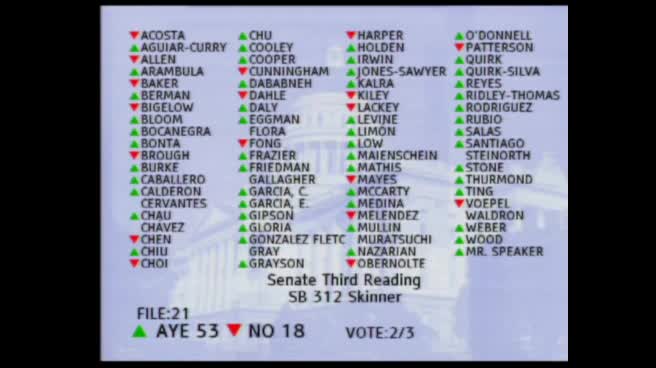 1MIN
Assembly Floor
 1MIN
Assembly Floor
 1H
Assembly Standing Committee on Appropriations
 8MIN
Assembly Standing Committee on Transportation
Bill Author

Bill Co-Author(s):