SB 448: Local government: organization: districts.
- Session Year: 2017-2018
- House: Senate
- Latest Version Date: 2017-09-27
(1)Existing law requires the officer of each local agency, as defined, who has charge of the financial records of the local agency, to furnish to the Controller a report of all the financial transactions of the local agency during the next preceding fiscal year within 7 months after the close of each fiscal year. Existing law also requires a report of an audit of a special districts accounts and records made by a certified public accountant or public accountant to be filed with the Controller and the county auditor of the county in which the special district is located within 12 months of the end of the fiscal year or years under examination.
This bill would instead require special districts defined by a specified provision to file those audit reports with the Controller and special districts defined by another specified provision to file those audit reports with the Controller and with the local agency formation commission of either the county in which the special district is located or, if the special district is located in 2 or more counties, with each local agency formation commission within each county in which the district is located. The bill would also require the Controller to publish on the Controllers Internet Web site a comprehensive list of special districts on or before July 1, 2019, and to annually update that list.
(2)The Cortese-Knox-Hertzberg Local Government Reorganization Act of 2000 provides the exclusive authority and procedure for the initiation, conduct, and completion of changes of organization and reorganization for cities and districts, as specified.
This bill would require the Controller to create a list of special districts that are inactive, as provided. The bill would also require the Controller to publish this list and to notify a local agency formation commission in the county or counties in which the special district is located if the Controller has included the special district in this list. The bill would require a local agency formation commission to initiate proceedings for the dissolution of any special district that is an inactive district and to dissolve those districts. The bill would define the term inactive district for these purposes. This bill would also make conforming changes. By increasing the duties of local officials, this bill would impose a state-mandated local program.
(3)The California Constitution requires the state to reimburse local agencies and school districts for certain costs mandated by the state. Statutory provisions establish procedures for making that reimbursement.
This bill would provide that no reimbursement is required by this act for a specified reason.
(1)Existing law requires the officer of each local agency, as defined, who has charge of the financial records of the local agency, to furnish to the Controller a report of all the financial transactions of the local agency during the next preceding fiscal year within 7 months after the close of each fiscal year. Existing law also requires a report of an audit of a special districts accounts and records made by a certified public accountant or public accountant to be filed with the Controller and the county auditor of the county in which the special district is located within 12 months of the end of the fiscal year or years under examination.
This bill would instead require special districts defined by a specified provision to file those audit reports with the Controller and special districts defined by another specified provision to file those audit reports with the Controller and with the local agency formation commission of either the county in which the special district is located or, if the special district is located in 2 or more counties, with each local agency formation commission within each county in which the district is located. The bill would also require the Controller to publish on the Controllers Internet Web site a comprehensive list of special districts on or before July 1, 2019, and to annually update that list.
(2)The Cortese-Knox-Hertzberg Local Government Reorganization Act of 2000 provides the exclusive authority and procedure for the initiation, conduct, and completion of changes of organization and reorganization for cities and districts, as specified.
This bill would require the Controller to create a list of special districts that are inactive, as provided. The bill would also require the Controller to publish this list and to notify a local agency formation commission in the county or counties in which the special district is located if the Controller has included the special district in this list. The bill would require a local agency formation commission to initiate proceedings for the dissolution of any special district that is an inactive district and to dissolve those districts. The bill would define the term inactive district for these purposes. This bill would also make conforming changes. By increasing the duties of local officials, this bill would impose a state-mandated local program.
(3)The California Constitution requires the state to reimburse local agencies and school districts for certain costs mandated by the state. Statutory provisions establish procedures for making that reimbursement.
This bill would provide that no reimbursement is required by this act for a specified reason.
(1)Existing law requires the officer of each local agency, as defined, who has charge of the financial records of the local agency, to furnish to the Controller a report of all the financial transactions of the local agency during the next preceding fiscal year within 7 months after the close of each fiscal year. Existing law also requires a report of an audit of a special districts accounts and records made by a certified public accountant or public accountant to be filed with the Controller and the county auditor of the county in which the special district is located within 12 months of the end of the fiscal year or years under examination.
This bill would instead require special districts defined by a specified provision to file those audit reports with the Controller and special districts defined by another specified provision to file those audit reports with the Controller and with the local agency formation commission of either the county in which the special district is located or, if the special district is located in 2 or more counties, with each local agency formation commission within each county in which the district is located. The bill would also require the Controller to publish on the Controllers Internet Web site a comprehensive list of special districts on or before July 1, 2019, and to annually update that list.
(2)The Cortese-Knox-Hertzberg Local Government Reorganization Act of 2000 provides the exclusive authority and procedure for the initiation, conduct, and completion of changes of organization and reorganization for cities and districts, as specified.
This bill would require the Controller to create a list of special districts that are inactive, as provided. The bill would also require the Controller to publish this list and to notify a local agency formation commission in the county or counties in which the special district is located if the Controller has included the special district in this list. The bill would require a local agency formation commission to initiate proceedings for the dissolution of any special district that is an inactive district and to dissolve those districts. The bill would define the term inactive district for these purposes. This bill would also make conforming changes. By increasing the duties of local officials, this bill would impose a state-mandated local program.
(3)The California Constitution requires the state to reimburse local agencies and school districts for certain costs mandated by the state. Statutory provisions establish procedures for making that reimbursement.
This bill would provide that no reimbursement is required by this act for a specified reason.
(1)Existing law requires the officer of each local agency, as defined, who has charge of the financial records of the local agency, to furnish to the Controller a report of all the financial transactions of the local agency during the next preceding fiscal year within 7 months after the close of each fiscal year. Existing law also requires a report of an audit of a special districts accounts and records made by a certified public accountant or public accountant to be filed with the Controller and the county auditor of the county in which the special district is located within 12 months of the end of the fiscal year or years under examination.
This bill would instead require that special districts defined by a specified provision to file those audit reports also be filed with the Controller and special districts defined by another specified provision to file those audit reports with the Controller and with the local agency formation commission of either the county in which the special district is located or, if the special district is located in 2 or more counties, with each local agency formation commission within each county in which the district is located until January 1, 2027, and thereafter with the county containing the greatest percentage of the assessed value of taxable property in the district. located. The bill would also require the Controller to publish on the Controllers Internet Web site a comprehensive list of special districts on or before July 1, 2019, and to annually update that list.
(2)The Cortese-Knox-Hertzberg Local Government Reorganization Act of 2000 provides the exclusive authority and procedure for the initiation, conduct, and completion of changes of organization and reorganization for cities and districts, as specified.
This bill would require a local agency formation commission the Controller to create a list of special districts that are inactive, as provided. The bill would also require the Controller to publish this list and to notify a local agency formation commission in the county or counties in which the special district is located if the Controller has included the special district in this list. The bill would require a local agency formation commission to initiate proceedings for the dissolution of any special district that is an inactive district and to dissolve any special district that is an inactive district. those districts. The bill would define the term inactive district for these purposes. This bill would also make conforming changes. By increasing the duties of local officials, this bill would impose a state-mandated local program.
(3)Existing property tax law requires that each county tax bill, or a statement accompanying that bill, include specified information.This bill would additionally require that information contained in a county tax bill that is electronically transmitted reflect the same information contained on both the mailed county tax bill and any separate statements. By increasing the duties of local officials, this bill would impose a state-mandated local program.(4)The California Constitution requires the state to reimburse local agencies and school districts for certain costs mandated by the state. Statutory provisions establish procedures for making that reimbursement.This bill would provide that with regard to certain mandates no reimbursement is required by this act for a specified reason.With regard to any other mandates, this bill would provide that, if the Commission on State Mandates determines that the bill contains costs so mandated by the state, reimbursement for those costs shall be made pursuant to the statutory provisions noted above.(3)The California Constitution requires the state to reimburse local agencies and school districts for certain costs mandated by the state. Statutory provisions establish procedures for making that reimbursement.
This bill would provide that no reimbursement is required by this act for a specified reason.
(1)Existing law requires the officer of each local agency, as defined, who has charge of the financial records of the local agency, to furnish to the Controller a report of all the financial transactions of the local agency during the next preceding fiscal year within 90 days of the close of each fiscal year, or within 110 days if the report is furnished in an electronic format. 7 months after the close of each fiscal year. Existing law also requires a report of an audit of a special districts accounts and records made by a certified public accountant or public accountant to be filed with the Controller and the county auditor of the county in which the special district is located within 12 months of the end of the fiscal year or years under examination.
This bill would require that those audit reports also be filed with the local agency formation commission of either the county in which the special district is located or, if the special district is located in 2 or more counties, the county containing the greatest percentage of the assessed value of taxable property of the district. This bill would require the Controller, on or before October 1, 2018, and every year thereafter, to create a list of idle districts, as defined, and notify each special district that has been identified as an idle district, on or before November 1, 2018, and every 2 years thereafter. This bill would require each special district to submit, with every audit or other specified documents filed with the Controller and the local agency formation commission, a statement of purpose, as specified. The bill would require the Controller to post each statement of purpose it receives on its Internet Web site. with each local agency formation commission within each county in which the district is located until January 1, 2027, and thereafter with the county containing the greatest percentage of the assessed value of taxable property in the district. The bill would also require the Controller to publish on the Controllers Internet Web site a comprehensive list of special districts on or before July 1, 2019, and to annually update that list.
(2)The Cortese-Knox-Hertzberg Local Government Reorganization Act of 2000 provides the exclusive authority and procedure for the initiation, conduct, and completion of changes of organization and reorganization for cities and districts, as specified.
This bill would require a local agency formation commission to dissolve any special district that is an inactive district. The bill would additionally require a local agency formation commission to initiate proceedings for the dissolution of idle districts, as specified. This The bill would define the terms term inactive district and idle district for these purposes. By increasing the duties of local officials, this bill would impose a state-mandated local program.
(3)Existing property tax law requires that each county tax bill, or a statement accompanying that bill, include specified information.
This bill would additionally require that each county tax bill, or a statement accompanying that bill, to include a list of all services provided by a city, county, special district, or school district that are funded by the general ad valorem property tax and any special taxes or special assessments levied. information contained in a county tax bill that is electronically transmitted reflect the same information contained on both the mailed county tax bill and any separate statements. By increasing the duties of local officials, this bill would impose a state-mandated local program.
(4)The California Constitution requires the state to reimburse local agencies and school districts for certain costs mandated by the state. Statutory provisions establish procedures for making that reimbursement.
This bill would provide that with regard to certain mandates no reimbursement is required by this act for a specified reason.
With regard to any other mandates, this bill would provide that, if the Commission on State Mandates determines that the bill contains costs so mandated by the state, reimbursement for those costs shall be made pursuant to the statutory provisions noted above.
(1)Existing law requires the officer of each local agency, as defined, who has charge of the financial records of the local agency, to furnish to the Controller a report of all the financial transactions of the local agency during the next preceding fiscal year within 90 days of the close of each fiscal year, or within 110 days if the report is furnished in an electronic format. Existing law also requires a report of an audit of a special districts accounts and records made by a certified public accountant or public accountant to be filed with the Controller and the county auditor of the county in which the special district is located within 12 months of the end of the fiscal year or years under examination.
This bill would require that those audit reports also be filed with the local agency formation commission of either the county in which the special district is located or, if the special district is located in 2 or more counties, the county containing the greatest percentage of the assessed value of taxable property of the district. This bill would require the Controller, on or before October 1, 2018, and every year thereafter, to create a list of idle districts, as defined, and notify each special district that has been identified as an idle district, on or before November 1, 2018, and every 2 years thereafter. This bill would require each special district to submit, with every audit or other specified documents filed with the Controller and the local agency formation commission, a statement of purpose, as specified. The bill would require the Controller to post each statement of purpose it receives on its Internet Web site. The bill would also require the Controller to publish on the Controllers Internet Web site a comprehensive list of special districts on or before July 1, 2019, and to annually update that list.
(2)The Cortese-Knox-Hertzberg Local Government Reorganization Act of 2000 provides the exclusive authority and procedure for the initiation, conduct, and completion of changes of organization and reorganization for cities and districts, as specified.
This bill would require a local agency formation commission to dissolve any special district that is an inactive district. The bill would additionally require a local agency formation commission to initiate proceedings for the dissolution of idle districts, as specified. This bill would define the terms inactive district and idle district for these purposes. By increasing the duties of local officials, this bill would impose a state-mandated local program.
(3)Existing property tax law requires that each county tax bill, or a statement accompanying that bill, include specified information.
This bill would additionally require that each county tax bill, or a statement accompanying that bill, to include a list of all services provided by a city, county, special district, or school district that are funded by the general ad valorem property tax and any special taxes or special assessments levied. By increasing the duties of local officials, this bill would impose a state-mandated local program.
(4)The California Constitution requires the state to reimburse local agencies and school districts for certain costs mandated by the state. Statutory provisions establish procedures for making that reimbursement.
This bill would provide that with regard to certain mandates no reimbursement is required by this act for a specified reason.
With regard to any other mandates, this bill would provide that, if the Commission on State Mandates determines that the bill contains costs so mandated by the state, reimbursement for those costs shall be made pursuant to the statutory provisions noted above.
(1)Existing law requires the officer of each local agency, as defined, who has charge of the financial records of the local agency, to furnish to the Controller a report of all the financial transactions of the local agency during the next preceding fiscal year within 90 days of the close of each fiscal year, or within 110 days if the report is furnished in an electronic format. Existing law also requires a report of an audit of a special districts accounts and records made by a certified public accountant or public accountant to be filed with the Controller and the county auditor of the county in which the special district is located within 12 months of the end of the fiscal year or years under examination.
This bill would require each special district, on or before September 1, 2018, and every 2 years thereafter, to submit an audit covering the previous 2 fiscal years to the Controller, as specified. that those audit reports also be filed with the local agency formation commission of either the county in which the special district is located or, if the special district is located in 2 or more counties, the county containing the greatest percentage of the assessed value of taxable property of the district. This bill would require the Controller, on or before October 1, 2018, and every year thereafter, to create a list of idle districts, as defined, and notify each special district that has been identified as an idle district, on or before November 1, 2018, and every 2 years thereafter. This bill would require a each special district that has received notice that the Controller has identified the special district as an idle district to submit, within 180 days, with every audit or other specified documents filed with the Controller and the local agency formation commission, a statement of purpose, as specified. The bill would require the Controller to post each statement of purpose it receives on its Internet Web site. The bill would also require the Controller to publish on the Controllers Internet Web site a comprehensive list of special districts on or before July 1, 2019, and to annually update that list.
(2)The Cortese-Knox-Hertzberg Local Government Reorganization Act of 2000 provides the exclusive authority and procedure for the initiation, conduct, and completion of changes of organization and reorganization for cities and districts, as specified.
This bill would require a local agency formation commission to dissolve any special district that is an inactive district. The bill would additionally require a local agency formation commission to initiate proceedings for the dissolution of idle districts, as specified. This bill would define the terms inactive district and idle district for these purposes. By increasing the duties of local officials, this bill would impose a state-mandated local program.
(3)Existing property tax law requires that each county tax bill, or a statement accompanying that bill, include specified information.
This bill would additionally require that each county tax bill, or a statement accompanying that bill, to include a list of all services provided by a city, county, special district, or school district that are funded by the general ad valorem property tax and any special taxes or special assessments levied. By increasing the duties of local officials, this bill would impose a state-mandated local program.
(4)The California Constitution requires the state to reimburse local agencies and school districts for certain costs mandated by the state. Statutory provisions establish procedures for making that reimbursement.
This bill would provide that with regard to certain mandates no reimbursement is required by this act for a specified reason.
With regard to any other mandates, this bill would provide that, if the Commission on State Mandates determines that the bill contains costs so mandated by the state, reimbursement for those costs shall be made pursuant to the statutory provisions noted above.
(1)Existing law requires the officer of each local agency, as defined, who has charge of the financial records of the local agency, to furnish to the Controller a report of all the financial transactions of the local agency during the next preceding fiscal year within 90 days of the close of each fiscal year, or within 110 days if the report is furnished in an electronic format.
This bill would require each special district, on or before September 1, 2018, and every 2 years thereafter, to submit an audit covering the previous 2 fiscal years to the Controller, as specified. This bill would require the Controller, on or before October 1, 2018, and every year thereafter, to create a list of idle districts, as defined, and notify each special district that has been identified as an idle district, on or before November 1, 2018, and every 2 years thereafter. This bill would require a special district that has received notice that the Controller has identified the special district as an idle district to submit, within 180 days, a statement of purpose, as specified. The bill would require the Controller to post each statement of purpose it receives on its Internet Web site.
The(2)The Cortese-Knox-Hertzberg Local Government Reorganization Act of 2000 provides the exclusive authority and procedure for the initiation, conduct, and completion of changes of organization and reorganization for cities and districts, as specified, and defines various terms for these purposes. specified.
This bill would require a local agency formation commission to dissolve any special district that is an inactive district. The bill would additionally require a local agency formation commission to initiate proceedings for the dissolution of idle districts, as specified. This bill would define the term terms inactive district for purposes of that act. and idle district for these purposes. By increasing the duties of local officials, this bill would impose a state-mandated local program.
(3)Existing property tax law requires that each county tax bill, or a statement accompanying that bill, include specified information.
This bill would additionally require that each county tax bill, or a statement accompanying that bill, to include a list of all services provided by a city, county, special district, or school district that are funded by the general ad valorem property tax and any special taxes or special assessments levied. By increasing the duties of local officials, this bill would impose a state-mandated local program.
(4)The California Constitution requires the state to reimburse local agencies and school districts for certain costs mandated by the state. Statutory provisions establish procedures for making that reimbursement.
This bill would provide that with regard to certain mandates no reimbursement is required by this act for a specified reason.
With regard to any other mandates, this bill would provide that, if the Commission on State Mandates determines that the bill contains costs so mandated by the state, reimbursement for those costs shall be made pursuant to the statutory provisions noted above.
The Cortese-Knox-Hertzberg Local Government Reorganization Act of 2000 provides the exclusive authority and procedure for the initiation, conduct, and completion of changes of organization and reorganization for cities and districts, as specified, and defines various terms for these purposes.
This bill would define the term inactive district for purposes of that act.
On or before July 1, 2019, the Controller shall publish on the Controllers Internet Web site a comprehensive list of special districts. The Controller shall update the list every year thereafter. For purposes of this section, the term special district means an independent district or independent special district as those terms are defined in Section 56044.
SEC. 2.Section 26909 of the Government Code, as amended by Section 1 of Chapter 164 of the Statutes of 2016, is amended to read:26909.(a)(1)The county auditor shall either make or contract with a certified public accountant or public accountant to make an annual audit of the accounts and records of every special district within the county for which an audit by a certified public accountant or public accountant is not otherwise provided. In each case, the minimum requirements of the audit shall be prescribed by the Controller and shall conform to generally accepted auditing standards.
(2)(A)If an audit of a special districts accounts and records is made by a certified public accountant or public accountant, the minimum requirements of the audit shall be prescribed by the Controller and shall conform to generally accepted auditing standards.
(B)A report of the audit required pursuant to subparagraph (A) shall be filed within 12 months of the end of the fiscal year or years under examination as follows:
(i)For a special district defined in paragraph (2) of subdivision (d) of Section 12463, with the Controller.
(ii)For a special district defined in Section 56036, with the Controller and with the local agency formation commission of the county in which the special district is located, unless the special district is located in two or more counties, then with each local agency formation commission within each county in which the district is located.
(3)Any costs incurred by the county auditor, including contracts with, or employment of, certified public accountants or public accountants, in making an audit of every special district pursuant to this section shall be borne by the special district and shall be a charge against any unencumbered funds of the district available for the purpose.
(4)For a special district that is located in two or more counties, this subdivision shall apply to the auditor of the county in which the treasury is located.
(5)The county controller, or ex officio county controller, shall effect this section in those counties having a county controller or ex officio county controller.
(b)A special district may, by unanimous request of the governing board of the special district and with unanimous approval of the board of supervisors, replace the annual audit required by this section with one of the following, performed in accordance with professional standards, as determined by the county auditor:
(1)A biennial audit covering a two-year period.
(2)An audit covering a five-year period if the special districts annual revenues do not exceed an amount specified by the board of supervisors.
(3)An audit conducted at specific intervals, as recommended by the county auditor, that shall be completed at least once every five years.
(c)(1)A special district may, by unanimous request of the governing board of the special district and with unanimous approval of the board of supervisors, replace the annual audit required by this section with a financial review, or an agreed-upon procedures engagement, in accordance with the appropriate professional standards, as determined by the county auditor, if the following conditions are met:
(A)All of the special districts revenues and expenditures are transacted through the countys financial system.
(B)The special districts annual revenues do not exceed one hundred fifty thousand dollars ($150,000).
(C)The special district shall pay for any costs incurred by the county auditor in performing an agreed-upon procedures engagement. Those costs shall be charged against any unencumbered funds of the district available for that purpose.
(2)If the board of supervisors is the governing board of the special district, it may, upon unanimous approval, replace the annual audit of the special district required by this section with a financial review, or an agreed-upon procedures engagement, in accordance with the appropriate professional standards, as determined by the county auditor, if the special district satisfies the requirements of subparagraphs (A) and (B) of paragraph (1).
(d)(1)A special district may, by annual unanimous request of the governing board of the special district and with annual unanimous approval of the board of supervisors, replace the annual audit required by this section with an annual financial compilation of the special district to be performed by the county auditor in accordance with professional standards, if all of the following conditions are met:
(A)All of the special districts revenues and expenditures are transacted through the countys financial system.
(B)The special districts annual revenues do not exceed one hundred fifty thousand dollars ($150,000).
(C)The special district shall pay for any costs incurred by the county auditor in performing a financial compilation. Those costs shall be a charge against any unencumbered funds of the district available for that purpose.
(2)A special district shall not replace an annual audit required by this section with an annual financial compilation of the special district pursuant to paragraph (1) for more than five consecutive years, after which a special district shall comply with subdivision (a).
(e)Notwithstanding this section, a special district shall be exempt from the requirement of an annual audit if the financial statements are audited by the Controller to satisfy federal audit requirements.
(f)Upon receipt of the financial review, agreed-upon procedures engagement, or financial compilation, the county auditor shall have the right to appoint, pursuant to subdivision (a), a certified public accountant or a public accountant to conduct an audit of the special district, with proper notice to the governing board of the special district and board of supervisors.
(g)This section shall remain in effect only until January 1, 2027, and as of that date is repealed.
SEC. 3.Section 26909 of the Government Code, as added by Section 2 of Chapter 164 of the Statutes of 2016, is amended to read:26909.(a)(1)The county auditor shall either make or contract with a certified public accountant or public accountant to make an annual audit of the accounts and records of every special district within the county for which an audit by a certified public accountant or public accountant is not otherwise provided. In each case, the minimum requirements of the audit shall be prescribed by the Controller and shall conform to generally accepted auditing standards.
(2)(A)If an audit of a special districts accounts and records is made by a certified public accountant or public accountant, the minimum requirements of the audit shall be prescribed by the Controller and shall conform to generally accepted auditing standards.
(B)A report of the audit required pursuant to subparagraph (A) shall be filed within 12 months of the end of the fiscal year or years under examination as follows:
(i)For a special district defined in paragraph (2) of subdivision (d) of Section 12463, with the Controller.
(ii)For a special district defined in Section 56036, with the Controller and with the local agency formation commission of the county in which the special district is located, unless the special district is located in two or more counties, then with each local agency formation commission within each county in which the district is located.
(3)Any costs incurred by the county auditor, including contracts with, or employment of, certified public accountants or public accountants, in making an audit of every special district pursuant to this section shall be borne by the special district and shall be a charge against any unencumbered funds of the district available for the purpose.
(4)For a special district that is located in two or more counties, this subdivision shall apply to the auditor of the county in which the treasury is located.
(5)The county controller, or ex officio county controller, shall effect this section in those counties having a county controller or ex officio county controller.
(b)A special district may, by unanimous request of the governing board of the special district and with unanimous approval of the board of supervisors, replace the annual audit required by this section with one of the following, performed in accordance with professional standards, as determined by the county auditor:
(1)A biennial audit covering a two-year period.
(2)An audit covering a five-year period if the special districts annual revenues do not exceed an amount specified by the board of supervisors.
(3)An audit conducted at specific intervals, as recommended by the county auditor, that shall be completed at least once every five years.
(c)(1)A special district may, by unanimous request of the governing board of the special district and with unanimous approval of the board of supervisors, replace the annual audit required by this section with a financial review, in accordance with the appropriate professional standards, as determined by the county auditor, if the following conditions are met:
(A)All of the special districts revenues and expenditures are transacted through the countys financial system.
(B)The special districts annual revenues do not exceed one hundred fifty thousand dollars ($150,000).
(2)If the board of supervisors is the governing board of the special district, it may, upon unanimous approval, replace the annual audit of the special district required by this section with a financial review in accordance with the appropriate professional standards, as determined by the county auditor, if the special district satisfies the requirements of subparagraphs (A) and (B) of paragraph (1).
(d)Notwithstanding this section, a special district shall be exempt from the requirement of an annual audit if the financial statements are audited by the Controller to satisfy federal audit requirements.
(e)This section shall become operative on January 1, 2027.
SEC. 4.Section 56042 is added to the Government Code, to read:56042.Inactive district means a special district that meets all of the following:
(a)The special district is as defined in Section 56036.
(b)The special district has had no financial transactions in the previous fiscal year.
(c)The special district has no assets and liabilities.
(d)The special district has no outstanding debts, judgments, litigation, contracts, liens, or claims.
SEC. 5.Section 56073.1 of the Government Code is amended to read:56073.1.Resolution of application means the document adopted by a local agency or school district initiating a change of organization or reorganization pursuant to Section 56654 or the document adopted by a commission pursuant to paragraph (2) of subdivision (a) of Section 56375 or by subdivision (c) of Section 56879.
SEC. 6.Section 56375 of the Government Code is amended to read:56375.The commission shall have all of the following powers and duties subject to any limitations upon its jurisdiction set forth in this part:
(a)(1)To review and approve with or without amendment, wholly, partially, or conditionally, or disapprove proposals for changes of organization or reorganization, consistent with written policies, procedures, and guidelines adopted by the commission.
(2)The commission may initiate proposals by resolution of application for any of the following:
(A)The consolidation of a district, as defined in Section 56036.
(B)The dissolution of a district.
(C)A merger.
(D)The establishment of a subsidiary district.
(E)The formation of a new district or districts.
(F)A reorganization that includes any of the changes specified in subparagraph (A), (B), (C), (D), or (E).
(G)The dissolution of an inactive district pursuant to Section 56879.
(3)A commission may initiate a proposal described in paragraph (2) only if that change of organization or reorganization is consistent with a recommendation or conclusion of a study prepared pursuant to Section 56378, 56425, or 56430, and the commission makes the determinations specified in subdivision (b) of Section 56881.
(4)A commission shall not disapprove an annexation to a city, initiated by resolution, of contiguous territory that the commission finds is any of the following:
(A)Surrounded or substantially surrounded by the city to which the annexation is proposed or by that city and a county boundary or the Pacific Ocean if the territory to be annexed is substantially developed or developing, is not prime agricultural land as defined in Section 56064, is designated for urban growth by the general plan of the annexing city, and is not within the sphere of influence of another city.
(B)Located within an urban service area that has been delineated and adopted by a commission, which is not prime agricultural land, as defined by Section 56064, and is designated for urban growth by the general plan of the annexing city.
(C)An annexation or reorganization of unincorporated islands meeting the requirements of Section 56375.3.
(5)As a condition to the annexation of an area that is surrounded, or substantially surrounded, by the city to which the annexation is proposed, the commission may require, where consistent with the purposes of this division, that the annexation include the entire island of surrounded, or substantially surrounded, territory.
(6)A commission shall not impose any conditions that would directly regulate land use density or intensity, property development, or subdivision requirements.
(7)The decision of the commission with regard to a proposal to annex territory to a city shall be based upon the general plan and prezoning of the city. When the development purposes are not made known to the annexing city, the annexation shall be reviewed on the basis of the adopted plans and policies of the annexing city or county. A commission shall require, as a condition to annexation, that a city prezone the territory to be annexed or present evidence satisfactory to the commission that the existing development entitlements on the territory are vested or are already at build-out, and are consistent with the citys general plan. However, the commission shall not specify how, or in what manner, the territory shall be prezoned.
(8)(A)Except for those changes of organization or reorganization authorized under Section 56375.3, and except as provided by subparagraph (B), a commission shall not approve an annexation to a city of any territory greater than 10 acres, or as determined by commission policy, where there exists a disadvantaged unincorporated community that is contiguous to the area of proposed annexation, unless an application to annex the disadvantaged unincorporated community to the subject city has been filed with the executive officer.
(B)An application to annex a contiguous disadvantaged community shall not be required if either of the following apply:
(i)A prior application for annexation of the same disadvantaged community has been made in the preceding five years.
(ii)The commission finds, based upon written evidence, that a majority of the registered voters within the affected territory are opposed to annexation.
(b)With regard to a proposal for annexation or detachment of territory to, or from, a city or district or with regard to a proposal for reorganization that includes annexation or detachment, to determine whether territory proposed for annexation or detachment, as described in its resolution approving the annexation, detachment, or reorganization, is inhabited or uninhabited.
(c)With regard to a proposal for consolidation of two or more cities or districts, to determine which city or district shall be the consolidated successor city or district.
(d)To approve the annexation of unincorporated, noncontiguous territory, subject to the limitations of Section 56742, located in the same county as that in which the city is located, and that is owned by a city and used for municipal purposes and to authorize the annexation of the territory without notice and hearing.
(e)To approve the annexation of unincorporated territory consistent with the planned and probable use of the property based upon the review of general plan and prezoning designations. No subsequent change may be made to the general plan for the annexed territory or zoning that is not in conformance to the prezoning designations for a period of two years after the completion of the annexation, unless the legislative body for the city makes a finding at a public hearing that a substantial change has occurred in circumstances that necessitate a departure from the prezoning in the application to the commission.
(f)With respect to the incorporation of a new city or the formation of a new special district, to determine the number of registered voters residing within the proposed city or special district or, for a landowner-voter special district, the number of owners of land and the assessed value of their land within the territory proposed to be included in the new special district. The number of registered voters shall be calculated as of the time of the last report of voter registration by the county elections official to the Secretary of State prior to the date the first signature was affixed to the petition. The executive officer shall notify the petitioners of the number of registered voters resulting from this calculation. The assessed value of the land within the territory proposed to be included in a new landowner-voter special district shall be calculated as shown on the last equalized assessment roll.
(g)To adopt written procedures for the evaluation of proposals, including written definitions consistent with existing state law. The commission may adopt standards for any of the factors enumerated in Section 56668. Any standards adopted by the commission shall be written.
(h)To adopt standards and procedures for the evaluation of service plans submitted pursuant to Section 56653 and the initiation of a change of organization or reorganization pursuant to subdivision (a).
(i)To make and enforce regulations for the orderly and fair conduct of hearings by the commission.
(j)To incur usual and necessary expenses for the accomplishment of its functions.
(k)To appoint and assign staff personnel and to employ or contract for professional or consulting services to carry out and effect the functions of the commission.
(l)To review the boundaries of the territory involved in any proposal with respect to the definiteness and certainty of those boundaries, the nonconformance of proposed boundaries with lines of assessment or ownership, and other similar matters affecting the proposed boundaries.
(m)To waive the restrictions of Section 56744 if it finds that the application of the restrictions would be detrimental to the orderly development of the community and that the area that would be enclosed by the annexation or incorporation is so located that it cannot reasonably be annexed to another city or incorporated as a new city.
(n)To waive the application of Section 22613 of the Streets and Highways Code if it finds the application would deprive an area of a service needed to ensure the health, safety, or welfare of the residents of the area and if it finds that the waiver would not affect the ability of a city to provide any service. However, within 60 days of the inclusion of the territory within the city, the legislative body may adopt a resolution nullifying the waiver.
(o)If the proposal includes the incorporation of a city, as defined in Section 56043, or the formation of a district, as defined in Section 2215 of the Revenue and Taxation Code, the commission shall determine the property tax revenue to be exchanged by the affected local agencies pursuant to Section 56810.
(p)To authorize a city or district to provide new or extended services outside its jurisdictional boundaries pursuant to Section 56133.
(q)To enter into an agreement with the commission for an adjoining county for the purpose of determining procedures for the consideration of proposals that may affect the adjoining county or where the jurisdiction of an affected agency crosses the boundary of the adjoining county.
(r)To approve with or without amendment, wholly, partially, or conditionally, or disapprove pursuant to this section the annexation of territory served by a mutual water company formed pursuant to Part 7 (commencing with Section 14300) of Division 3 of Title 1 of the Corporations Code that operates a public water system to a city or special district. Any annexation approved in accordance with this subdivision shall be subject to the state and federal constitutional prohibitions against the taking of private property without the payment of just compensation. This subdivision shall not impair the authority of a public agency or public utility to exercise eminent domain authority.
SEC. 7.Article 6 (commencing with Section 56879) is added to Chapter 5 of Part 3 of Division 3 of Title 5 of the Government Code, to read:6.Inactive Special Districts56879.(a)On or before November 1, 2018, and every year thereafter, the Controller shall create a list of special districts that are inactive, as defined in Section 56042, based upon the financial reports received by the Controller pursuant to Section 53891. The Controller shall publish the list of inactive districts on the Controllers Internet Web site. The Controller shall also notify the commission in the county or counties in which the district is located if the Controller has included the district in this list.
(b) The commission shall initiate dissolution of inactive districts by resolution within 90 days of receiving notification from the Controller pursuant to subdivision (a), unless the commission determines that the district does not meet the criteria set forth in Section 56042. The commission shall notify the Controller if the commission determines that a district does not meet the criteria set forth in Section 56042.
(c)The commission shall dissolve inactive districts. The commission shall hold one public hearing on the dissolution of an inactive district pursuant to this section no more than 90 days following the adoption of the resolution initiating dissolution. The dissolution of an inactive district shall not be subject to any of the following:
(1)Chapter 1 (commencing with Section 57000) to Chapter 7 (commencing with Section 57176), inclusive, of Part 4.
(2)Determinations pursuant to subdivision (b) of Section 56881.
(3)Requirements for commission-initiated changes of organization described in paragraph (3) of subdivision (a) of Section 56375.
56880.This article shall not apply to a special district formed by special legislation that is required by its enabling statute to obtain funding within a specified period of time or be dissolved. That district shall not be subject to this article during that specified period of time.
SEC. 8.No reimbursement is required by this act pursuant to Section 6 of Article XIIIB of the California Constitution because a local agency or school district has the authority to levy service charges, fees, or assessments sufficient to pay for the program or level of service mandated by this act, within the meaning of Section 17556 of the Government Code.
On or before July 1, 2019, the Controller shall publish on the Controllers Internet Web site a comprehensive list of special districts. The Controller shall update the list every year thereafter. For purposes of this section, the term special district means an independent district or independent special district as those terms are defined in Section 56044.
SEC. 2.Section 26909 of the Government Code, as amended by Section 1 of Chapter 164 of the Statutes of 2016, is amended to read:26909.(a)(1)The county auditor shall either make or contract with a certified public accountant or public accountant to make an annual audit of the accounts and records of every special district within the county for which an audit by a certified public accountant or public accountant is not otherwise provided. In each case, the minimum requirements of the audit shall be prescribed by the Controller and shall conform to generally accepted auditing standards.
(2)(A)If an audit of a special districts accounts and records is made by a certified public accountant or public accountant, the minimum requirements of the audit shall be prescribed by the Controller and shall conform to generally accepted auditing standards.
(B)A report of the audit required pursuant to subparagraph (A) shall be filed within 12 months of the end of the fiscal year or years under examination as follows:
(i)For a special district defined in paragraph (2) of subdivision (d) of Section 12463, with the Controller.
(ii)For a special district defined in Section 56036, with the Controller and with the local agency formation commission of the county in which the special district is located, unless the special district is located in two or more counties, then with each local agency formation commission within each county in which the district is located.
(3)Any costs incurred by the county auditor, including contracts with, or employment of, certified public accountants or public accountants, in making an audit of every special district pursuant to this section shall be borne by the special district and shall be a charge against any unencumbered funds of the district available for the purpose.
(4)For a special district that is located in two or more counties, this subdivision shall apply to the auditor of the county in which the treasury is located.
(5)The county controller, or ex officio county controller, shall effect this section in those counties having a county controller or ex officio county controller.
(b)A special district may, by unanimous request of the governing board of the special district and with unanimous approval of the board of supervisors, replace the annual audit required by this section with one of the following, performed in accordance with professional standards, as determined by the county auditor:
(1)A biennial audit covering a two-year period.
(2)An audit covering a five-year period if the special districts annual revenues do not exceed an amount specified by the board of supervisors.
(3)An audit conducted at specific intervals, as recommended by the county auditor, that shall be completed at least once every five years.
(c)(1)A special district may, by unanimous request of the governing board of the special district and with unanimous approval of the board of supervisors, replace the annual audit required by this section with a financial review, or an agreed-upon procedures engagement, in accordance with the appropriate professional standards, as determined by the county auditor, if the following conditions are met:
(A)All of the special districts revenues and expenditures are transacted through the countys financial system.
(B)The special districts annual revenues do not exceed one hundred fifty thousand dollars ($150,000).
(C)The special district shall pay for any costs incurred by the county auditor in performing an agreed-upon procedures engagement. Those costs shall be charged against any unencumbered funds of the district available for that purpose.
(2)If the board of supervisors is the governing board of the special district, it may, upon unanimous approval, replace the annual audit of the special district required by this section with a financial review, or an agreed-upon procedures engagement, in accordance with the appropriate professional standards, as determined by the county auditor, if the special district satisfies the requirements of subparagraphs (A) and (B) of paragraph (1).
(d)(1)A special district may, by annual unanimous request of the governing board of the special district and with annual unanimous approval of the board of supervisors, replace the annual audit required by this section with an annual financial compilation of the special district to be performed by the county auditor in accordance with professional standards, if all of the following conditions are met:
(A)All of the special districts revenues and expenditures are transacted through the countys financial system.
(B)The special districts annual revenues do not exceed one hundred fifty thousand dollars ($150,000).
(C)The special district shall pay for any costs incurred by the county auditor in performing a financial compilation. Those costs shall be a charge against any unencumbered funds of the district available for that purpose.
(2)A special district shall not replace an annual audit required by this section with an annual financial compilation of the special district pursuant to paragraph (1) for more than five consecutive years, after which a special district shall comply with subdivision (a).
(e)Notwithstanding this section, a special district shall be exempt from the requirement of an annual audit if the financial statements are audited by the Controller to satisfy federal audit requirements.
(f)Upon receipt of the financial review, agreed-upon procedures engagement, or financial compilation, the county auditor shall have the right to appoint, pursuant to subdivision (a), a certified public accountant or a public accountant to conduct an audit of the special district, with proper notice to the governing board of the special district and board of supervisors.
(g)This section shall remain in effect only until January 1, 2027, and as of that date is repealed.
SEC. 3.Section 26909 of the Government Code, as added by Section 2 of Chapter 164 of the Statutes of 2016, is amended to read:26909.(a)(1)The county auditor shall either make or contract with a certified public accountant or public accountant to make an annual audit of the accounts and records of every special district within the county for which an audit by a certified public accountant or public accountant is not otherwise provided. In each case, the minimum requirements of the audit shall be prescribed by the Controller and shall conform to generally accepted auditing standards.
(2)(A)If an audit of a special districts accounts and records is made by a certified public accountant or public accountant, the minimum requirements of the audit shall be prescribed by the Controller and shall conform to generally accepted auditing standards.
(B)A report of the audit required pursuant to subparagraph (A) shall be filed within 12 months of the end of the fiscal year or years under examination as follows:
(i)For a special district defined in paragraph (2) of subdivision (d) of Section 12463, with the Controller.
(ii)For a special district defined in Section 56036, with the Controller and with the local agency formation commission of the county in which the special district is located, unless the special district is located in two or more counties, then with each local agency formation commission within each county in which the district is located.
(3)Any costs incurred by the county auditor, including contracts with, or employment of, certified public accountants or public accountants, in making an audit of every special district pursuant to this section shall be borne by the special district and shall be a charge against any unencumbered funds of the district available for the purpose.
(4)For a special district that is located in two or more counties, this subdivision shall apply to the auditor of the county in which the treasury is located.
(5)The county controller, or ex officio county controller, shall effect this section in those counties having a county controller or ex officio county controller.
(b)A special district may, by unanimous request of the governing board of the special district and with unanimous approval of the board of supervisors, replace the annual audit required by this section with one of the following, performed in accordance with professional standards, as determined by the county auditor:
(1)A biennial audit covering a two-year period.
(2)An audit covering a five-year period if the special districts annual revenues do not exceed an amount specified by the board of supervisors.
(3)An audit conducted at specific intervals, as recommended by the county auditor, that shall be completed at least once every five years.
(c)(1)A special district may, by unanimous request of the governing board of the special district and with unanimous approval of the board of supervisors, replace the annual audit required by this section with a financial review, in accordance with the appropriate professional standards, as determined by the county auditor, if the following conditions are met:
(A)All of the special districts revenues and expenditures are transacted through the countys financial system.
(B)The special districts annual revenues do not exceed one hundred fifty thousand dollars ($150,000).
(2)If the board of supervisors is the governing board of the special district, it may, upon unanimous approval, replace the annual audit of the special district required by this section with a financial review in accordance with the appropriate professional standards, as determined by the county auditor, if the special district satisfies the requirements of subparagraphs (A) and (B) of paragraph (1).
(d)Notwithstanding this section, a special district shall be exempt from the requirement of an annual audit if the financial statements are audited by the Controller to satisfy federal audit requirements.
(e)This section shall become operative on January 1, 2027.
SEC. 4.Section 56042 is added to the Government Code, to read:56042.Inactive district means a special district that meets all of the following:
(a)The special district is as defined in Section 56036.
(b)The special district has had no financial transactions in the previous fiscal year.
(c)The special district has no assets and liabilities.
(d)The special district has no outstanding debts, judgments, litigation, contracts, liens, or claims.
SEC. 5.Section 56073.1 of the Government Code is amended to read:56073.1.Resolution of application means the document adopted by a local agency or school district initiating a change of organization or reorganization pursuant to Section 56654 or the document adopted by a commission pursuant to paragraph (2) of subdivision (a) of Section 56375 or by subdivision (c) of Section 56879.
SEC. 6.Section 56375 of the Government Code is amended to read:56375.The commission shall have all of the following powers and duties subject to any limitations upon its jurisdiction set forth in this part:
(a)(1)To review and approve with or without amendment, wholly, partially, or conditionally, or disapprove proposals for changes of organization or reorganization, consistent with written policies, procedures, and guidelines adopted by the commission.
(2)The commission may initiate proposals by resolution of application for any of the following:
(A)The consolidation of a district, as defined in Section 56036.
(B)The dissolution of a district.
(C)A merger.
(D)The establishment of a subsidiary district.
(E)The formation of a new district or districts.
(F)A reorganization that includes any of the changes specified in subparagraph (A), (B), (C), (D), or (E).
(G)The dissolution of an inactive district pursuant to Section 56879.
(3)A commission may initiate a proposal described in paragraph (2) only if that change of organization or reorganization is consistent with a recommendation or conclusion of a study prepared pursuant to Section 56378, 56425, or 56430, and the commission makes the determinations specified in subdivision (b) of Section 56881.
(4)A commission shall not disapprove an annexation to a city, initiated by resolution, of contiguous territory that the commission finds is any of the following:
(A)Surrounded or substantially surrounded by the city to which the annexation is proposed or by that city and a county boundary or the Pacific Ocean if the territory to be annexed is substantially developed or developing, is not prime agricultural land as defined in Section 56064, is designated for urban growth by the general plan of the annexing city, and is not within the sphere of influence of another city.
(B)Located within an urban service area that has been delineated and adopted by a commission, which is not prime agricultural land, as defined by Section 56064, and is designated for urban growth by the general plan of the annexing city.
(C)An annexation or reorganization of unincorporated islands meeting the requirements of Section 56375.3.
(5)As a condition to the annexation of an area that is surrounded, or substantially surrounded, by the city to which the annexation is proposed, the commission may require, where consistent with the purposes of this division, that the annexation include the entire island of surrounded, or substantially surrounded, territory.
(6)A commission shall not impose any conditions that would directly regulate land use density or intensity, property development, or subdivision requirements.
(7)The decision of the commission with regard to a proposal to annex territory to a city shall be based upon the general plan and prezoning of the city. When the development purposes are not made known to the annexing city, the annexation shall be reviewed on the basis of the adopted plans and policies of the annexing city or county. A commission shall require, as a condition to annexation, that a city prezone the territory to be annexed or present evidence satisfactory to the commission that the existing development entitlements on the territory are vested or are already at build-out, and are consistent with the citys general plan. However, the commission shall not specify how, or in what manner, the territory shall be prezoned.
(8)(A)Except for those changes of organization or reorganization authorized under Section 56375.3, and except as provided by subparagraph (B), a commission shall not approve an annexation to a city of any territory greater than 10 acres, or as determined by commission policy, where there exists a disadvantaged unincorporated community that is contiguous to the area of proposed annexation, unless an application to annex the disadvantaged unincorporated community to the subject city has been filed with the executive officer.
(B)An application to annex a contiguous disadvantaged community shall not be required if either of the following apply:
(i)A prior application for annexation of the same disadvantaged community has been made in the preceding five years.
(ii)The commission finds, based upon written evidence, that a majority of the registered voters within the affected territory are opposed to annexation.
(b)With regard to a proposal for annexation or detachment of territory to, or from, a city or district or with regard to a proposal for reorganization that includes annexation or detachment, to determine whether territory proposed for annexation or detachment, as described in its resolution approving the annexation, detachment, or reorganization, is inhabited or uninhabited.
(c)With regard to a proposal for consolidation of two or more cities or districts, to determine which city or district shall be the consolidated successor city or district.
(d)To approve the annexation of unincorporated, noncontiguous territory, subject to the limitations of Section 56742, located in the same county as that in which the city is located, and that is owned by a city and used for municipal purposes and to authorize the annexation of the territory without notice and hearing.
(e)To approve the annexation of unincorporated territory consistent with the planned and probable use of the property based upon the review of general plan and prezoning designations. No subsequent change may be made to the general plan for the annexed territory or zoning that is not in conformance to the prezoning designations for a period of two years after the completion of the annexation, unless the legislative body for the city makes a finding at a public hearing that a substantial change has occurred in circumstances that necessitate a departure from the prezoning in the application to the commission.
(f)With respect to the incorporation of a new city or the formation of a new special district, to determine the number of registered voters residing within the proposed city or special district or, for a landowner-voter special district, the number of owners of land and the assessed value of their land within the territory proposed to be included in the new special district. The number of registered voters shall be calculated as of the time of the last report of voter registration by the county elections official to the Secretary of State prior to the date the first signature was affixed to the petition. The executive officer shall notify the petitioners of the number of registered voters resulting from this calculation. The assessed value of the land within the territory proposed to be included in a new landowner-voter special district shall be calculated as shown on the last equalized assessment roll.
(g)To adopt written procedures for the evaluation of proposals, including written definitions consistent with existing state law. The commission may adopt standards for any of the factors enumerated in Section 56668. Any standards adopted by the commission shall be written.
(h)To adopt standards and procedures for the evaluation of service plans submitted pursuant to Section 56653 and the initiation of a change of organization or reorganization pursuant to subdivision (a).
(i)To make and enforce regulations for the orderly and fair conduct of hearings by the commission.
(j)To incur usual and necessary expenses for the accomplishment of its functions.
(k)To appoint and assign staff personnel and to employ or contract for professional or consulting services to carry out and effect the functions of the commission.
(l)To review the boundaries of the territory involved in any proposal with respect to the definiteness and certainty of those boundaries, the nonconformance of proposed boundaries with lines of assessment or ownership, and other similar matters affecting the proposed boundaries.
(m)To waive the restrictions of Section 56744 if it finds that the application of the restrictions would be detrimental to the orderly development of the community and that the area that would be enclosed by the annexation or incorporation is so located that it cannot reasonably be annexed to another city or incorporated as a new city.
(n)To waive the application of Section 22613 of the Streets and Highways Code if it finds the application would deprive an area of a service needed to ensure the health, safety, or welfare of the residents of the area and if it finds that the waiver would not affect the ability of a city to provide any service. However, within 60 days of the inclusion of the territory within the city, the legislative body may adopt a resolution nullifying the waiver.
(o)If the proposal includes the incorporation of a city, as defined in Section 56043, or the formation of a district, as defined in Section 2215 of the Revenue and Taxation Code, the commission shall determine the property tax revenue to be exchanged by the affected local agencies pursuant to Section 56810.
(p)To authorize a city or district to provide new or extended services outside its jurisdictional boundaries pursuant to Section 56133.
(q)To enter into an agreement with the commission for an adjoining county for the purpose of determining procedures for the consideration of proposals that may affect the adjoining county or where the jurisdiction of an affected agency crosses the boundary of the adjoining county.
(r)To approve with or without amendment, wholly, partially, or conditionally, or disapprove pursuant to this section the annexation of territory served by a mutual water company formed pursuant to Part 7 (commencing with Section 14300) of Division 3 of Title 1 of the Corporations Code that operates a public water system to a city or special district. Any annexation approved in accordance with this subdivision shall be subject to the state and federal constitutional prohibitions against the taking of private property without the payment of just compensation. This subdivision shall not impair the authority of a public agency or public utility to exercise eminent domain authority.
SEC. 7.Article 6 (commencing with Section 56879) is added to Chapter 5 of Part 3 of Division 3 of Title 5 of the Government Code, to read:6.Inactive Special Districts56879.(a)On or before November 1, 2018, and every year thereafter, the Controller shall create a list of special districts that are inactive, as defined in Section 56042, based upon the financial reports received by the Controller pursuant to Section 53891. The Controller shall publish the list of inactive districts on the Controllers Internet Web site. The Controller shall also notify the commission in the county or counties in which the district is located if the Controller has included the district in this list.
(b) The commission shall initiate dissolution of inactive districts by resolution within 90 days of receiving notification from the Controller pursuant to subdivision (a), unless the commission determines that the district does not meet the criteria set forth in Section 56042. The commission shall notify the Controller if the commission determines that a district does not meet the criteria set forth in Section 56042.
(c)The commission shall dissolve inactive districts. The commission shall hold one public hearing on the dissolution of an inactive district pursuant to this section no more than 90 days following the adoption of the resolution initiating dissolution. The dissolution of an inactive district shall not be subject to any of the following:
(1)Chapter 1 (commencing with Section 57000) to Chapter 7 (commencing with Section 57176), inclusive, of Part 4.
(2)Determinations pursuant to subdivision (b) of Section 56881.
(3)Requirements for commission-initiated changes of organization described in paragraph (3) of subdivision (a) of Section 56375.
56880.This article shall not apply to a special district formed by special legislation that is required by its enabling statute to obtain funding within a specified period of time or be dissolved. That district shall not be subject to this article during that specified period of time.
SEC. 8.No reimbursement is required by this act pursuant to Section 6 of Article XIIIB of the California Constitution because a local agency or school district has the authority to levy service charges, fees, or assessments sufficient to pay for the program or level of service mandated by this act, within the meaning of Section 17556 of the Government Code.
On or before July 1, 2019, the Controller shall publish on the Controllers Internet Web site a comprehensive list of special districts. The Controller shall update the list every year thereafter. For purposes of this section, the term special district means an independent district or independent special district as those terms are defined in Section 56044.
SEC. 2.Section 26909 of the Government Code, as amended by Section 1 of Chapter 164 of the Statutes of 2016, is amended to read:26909.(a)(1)The county auditor shall either make or contract with a certified public accountant or public accountant to make an annual audit of the accounts and records of every special district within the county for which an audit by a certified public accountant or public accountant is not otherwise provided. In each case, the minimum requirements of the audit shall be prescribed by the Controller and shall conform to generally accepted auditing standards.
(2)(A)If an audit of a special districts accounts and records is made by a certified public accountant or public accountant, the minimum requirements of the audit shall be prescribed by the Controller and shall conform to generally accepted auditing standards.
(B)A report of the audit required pursuant to subparagraph (A) shall be filed within 12 months of the end of the fiscal year or years under examination as follows:
(i)For a special district defined in paragraph (2) of subdivision (d) of Section 12463, with the Controller.
(ii)For a special district defined in Section 56036, with the Controller and with the local agency formation commission of the county in which the special district is located, unless the special district is located in two or more counties, then with each local agency formation commission within each county in which the district is located.
(3)Any costs incurred by the county auditor, including contracts with, or employment of, certified public accountants or public accountants, in making an audit of every special district pursuant to this section shall be borne by the special district and shall be a charge against any unencumbered funds of the district available for the purpose.
(4)For a special district that is located in two or more counties, this subdivision shall apply to the auditor of the county in which the treasury is located.
(5)The county controller, or ex officio county controller, shall effect this section in those counties having a county controller or ex officio county controller.
(b)A special district may, by unanimous request of the governing board of the special district and with unanimous approval of the board of supervisors, replace the annual audit required by this section with one of the following, performed in accordance with professional standards, as determined by the county auditor:
(1)A biennial audit covering a two-year period.
(2)An audit covering a five-year period if the special districts annual revenues do not exceed an amount specified by the board of supervisors.
(3)An audit conducted at specific intervals, as recommended by the county auditor, that shall be completed at least once every five years.
(c)(1)A special district may, by unanimous request of the governing board of the special district and with unanimous approval of the board of supervisors, replace the annual audit required by this section with a financial review, or an agreed-upon procedures engagement, in accordance with the appropriate professional standards, as determined by the county auditor, if the following conditions are met:
(A)All of the special districts revenues and expenditures are transacted through the countys financial system.
(B)The special districts annual revenues do not exceed one hundred fifty thousand dollars ($150,000).
(C)The special district shall pay for any costs incurred by the county auditor in performing an agreed-upon procedures engagement. Those costs shall be charged against any unencumbered funds of the district available for that purpose.
(2)If the board of supervisors is the governing board of the special district, it may, upon unanimous approval, replace the annual audit of the special district required by this section with a financial review, or an agreed-upon procedures engagement, in accordance with the appropriate professional standards, as determined by the county auditor, if the special district satisfies the requirements of subparagraphs (A) and (B) of paragraph (1).
(d)(1)A special district may, by annual unanimous request of the governing board of the special district and with annual unanimous approval of the board of supervisors, replace the annual audit required by this section with an annual financial compilation of the special district to be performed by the county auditor in accordance with professional standards, if all of the following conditions are met:
(A)All of the special districts revenues and expenditures are transacted through the countys financial system.
(B)The special districts annual revenues do not exceed one hundred fifty thousand dollars ($150,000).
(C)The special district shall pay for any costs incurred by the county auditor in performing a financial compilation. Those costs shall be a charge against any unencumbered funds of the district available for that purpose.
(2)A special district shall not replace an annual audit required by this section with an annual financial compilation of the special district pursuant to paragraph (1) for more than five consecutive years, after which a special district shall comply with subdivision (a).
(e)Notwithstanding this section, a special district shall be exempt from the requirement of an annual audit if the financial statements are audited by the Controller to satisfy federal audit requirements.
(f)Upon receipt of the financial review, agreed-upon procedures engagement, or financial compilation, the county auditor shall have the right to appoint, pursuant to subdivision (a), a certified public accountant or a public accountant to conduct an audit of the special district, with proper notice to the governing board of the special district and board of supervisors.
(g)This section shall remain in effect only until January 1, 2027, and as of that date is repealed.
SEC. 3.Section 26909 of the Government Code, as added by Section 2 of Chapter 164 of the Statutes of 2016, is amended to read:26909.(a)(1)The county auditor shall either make or contract with a certified public accountant or public accountant to make an annual audit of the accounts and records of every special district within the county for which an audit by a certified public accountant or public accountant is not otherwise provided. In each case, the minimum requirements of the audit shall be prescribed by the Controller and shall conform to generally accepted auditing standards.
(2)(A)If an audit of a special districts accounts and records is made by a certified public accountant or public accountant, the minimum requirements of the audit shall be prescribed by the Controller and shall conform to generally accepted auditing standards.
(B)A report of the audit required pursuant to subparagraph (A) shall be filed within 12 months of the end of the fiscal year or years under examination as follows:
(i)For a special district defined in paragraph (2) of subdivision (d) of Section 12463, with the Controller.
(ii)For a special district defined in Section 56036, with the Controller and with the local agency formation commission of the county in which the special district is located, unless the special district is located in two or more counties, then with each local agency formation commission within each county in which the district is located.
(3)Any costs incurred by the county auditor, including contracts with, or employment of, certified public accountants or public accountants, in making an audit of every special district pursuant to this section shall be borne by the special district and shall be a charge against any unencumbered funds of the district available for the purpose.
(4)For a special district that is located in two or more counties, this subdivision shall apply to the auditor of the county in which the treasury is located.
(5)The county controller, or ex officio county controller, shall effect this section in those counties having a county controller or ex officio county controller.
(b)A special district may, by unanimous request of the governing board of the special district and with unanimous approval of the board of supervisors, replace the annual audit required by this section with one of the following, performed in accordance with professional standards, as determined by the county auditor:
(1)A biennial audit covering a two-year period.
(2)An audit covering a five-year period if the special districts annual revenues do not exceed an amount specified by the board of supervisors.
(3)An audit conducted at specific intervals, as recommended by the county auditor, that shall be completed at least once every five years.
(c)(1)A special district may, by unanimous request of the governing board of the special district and with unanimous approval of the board of supervisors, replace the annual audit required by this section with a financial review, in accordance with the appropriate professional standards, as determined by the county auditor, if the following conditions are met:
(A)All of the special districts revenues and expenditures are transacted through the countys financial system.
(B)The special districts annual revenues do not exceed one hundred fifty thousand dollars ($150,000).
(2)If the board of supervisors is the governing board of the special district, it may, upon unanimous approval, replace the annual audit of the special district required by this section with a financial review in accordance with the appropriate professional standards, as determined by the county auditor, if the special district satisfies the requirements of subparagraphs (A) and (B) of paragraph (1).
(d)Notwithstanding this section, a special district shall be exempt from the requirement of an annual audit if the financial statements are audited by the Controller to satisfy federal audit requirements.
(e)This section shall become operative on January 1, 2027.
SEC. 4.Section 56042 is added to the Government Code, to read:56042.Inactive district means a special district that meets all of the following:
(a)The special district is as defined in Section 56036.
(b)The special district has had no financial transactions in the previous fiscal year.
(c)The special district has no assets. assets and liabilities.
(d)The special district has no fund equity.(e)(d)The special district has no outstanding debts, judgments, litigation, contracts, liens, claims, or postemployment liabilities. or claims.
SEC. 5.Section 56073.1 of the Government Code is amended to read:56073.1.Resolution of application means the document adopted by a local agency or school district initiating a change of organization or reorganization pursuant to Section 56654. 56654 or the document adopted by a commission pursuant to paragraph (2) of subdivision (a) of Section 56375 or by subdivision (c) of Section 56879.
SEC. 5.SEC. 6.Section 56375 of the Government Code is amended to read:56375.The commission shall have all of the following powers and duties subject to any limitations upon its jurisdiction set forth in this part:
(a)(1)To review and approve with or without amendment, wholly, partially, or conditionally, or disapprove proposals for changes of organization or reorganization, consistent with written policies, procedures, and guidelines adopted by the commission.
(2)The commission may initiate proposals by resolution of application for any of the following:
(A)The consolidation of a district, as defined in Section 56036.
(B)The dissolution of a district.
(C)A merger.
(D)The establishment of a subsidiary district.
(E)The formation of a new district or districts.
(F)A reorganization that includes any of the changes specified in subparagraph (A), (B), (C), (D), or (E).
(G)The dissolution of an inactive district pursuant to Section 56879.
(3)A commission may initiate a proposal described in paragraph (2) only if that change of organization or reorganization is consistent with a recommendation or conclusion of a study prepared pursuant to Section 56378, 56425, or 56430, and the commission makes the determinations specified in subdivision (b) of Section 56881.
(4)A commission shall not disapprove an annexation to a city, initiated by resolution, of contiguous territory that the commission finds is any of the following:
(A)Surrounded or substantially surrounded by the city to which the annexation is proposed or by that city and a county boundary or the Pacific Ocean if the territory to be annexed is substantially developed or developing, is not prime agricultural land as defined in Section 56064, is designated for urban growth by the general plan of the annexing city, and is not within the sphere of influence of another city.
(B)Located within an urban service area that has been delineated and adopted by a commission, which is not prime agricultural land, as defined by Section 56064, and is designated for urban growth by the general plan of the annexing city.
(C)An annexation or reorganization of unincorporated islands meeting the requirements of Section 56375.3.
(5)As a condition to the annexation of an area that is surrounded, or substantially surrounded, by the city to which the annexation is proposed, the commission may require, where consistent with the purposes of this division, that the annexation include the entire island of surrounded, or substantially surrounded, territory.
(6)A commission shall not impose any conditions that would directly regulate land use density or intensity, property development, or subdivision requirements.
(7)The decision of the commission with regard to a proposal to annex territory to a city shall be based upon the general plan and prezoning of the city. When the development purposes are not made known to the annexing city, the annexation shall be reviewed on the basis of the adopted plans and policies of the annexing city or county. A commission shall require, as a condition to annexation, that a city prezone the territory to be annexed or present evidence satisfactory to the commission that the existing development entitlements on the territory are vested or are already at build-out, and are consistent with the citys general plan. However, the commission shall not specify how, or in what manner, the territory shall be prezoned.
(8)(A)Except for those changes of organization or reorganization authorized under Section 56375.3, and except as provided by subparagraph (B), a commission shall not approve an annexation to a city of any territory greater than 10 acres, or as determined by commission policy, where there exists a disadvantaged unincorporated community that is contiguous to the area of proposed annexation, unless an application to annex the disadvantaged unincorporated community to the subject city has been filed with the executive officer.
(B)An application to annex a contiguous disadvantaged community shall not be required if either of the following apply:
(i)A prior application for annexation of the same disadvantaged community has been made in the preceding five years.
(ii)The commission finds, based upon written evidence, that a majority of the registered voters within the affected territory are opposed to annexation.
(b)With regard to a proposal for annexation or detachment of territory to, or from, a city or district or with regard to a proposal for reorganization that includes annexation or detachment, to determine whether territory proposed for annexation or detachment, as described in its resolution approving the annexation, detachment, or reorganization, is inhabited or uninhabited.
(c)With regard to a proposal for consolidation of two or more cities or districts, to determine which city or district shall be the consolidated successor city or district.
(d)To approve the annexation of unincorporated, noncontiguous territory, subject to the limitations of Section 56742, located in the same county as that in which the city is located, and that is owned by a city and used for municipal purposes and to authorize the annexation of the territory without notice and hearing.
(e)To approve the annexation of unincorporated territory consistent with the planned and probable use of the property based upon the review of general plan and prezoning designations. No subsequent change may be made to the general plan for the annexed territory or zoning that is not in conformance to the prezoning designations for a period of two years after the completion of the annexation, unless the legislative body for the city makes a finding at a public hearing that a substantial change has occurred in circumstances that necessitate a departure from the prezoning in the application to the commission.
(f)With respect to the incorporation of a new city or the formation of a new special district, to determine the number of registered voters residing within the proposed city or special district or, for a landowner-voter special district, the number of owners of land and the assessed value of their land within the territory proposed to be included in the new special district. The number of registered voters shall be calculated as of the time of the last report of voter registration by the county elections official to the Secretary of State prior to the date the first signature was affixed to the petition. The executive officer shall notify the petitioners of the number of registered voters resulting from this calculation. The assessed value of the land within the territory proposed to be included in a new landowner-voter special district shall be calculated as shown on the last equalized assessment roll.
(g)To adopt written procedures for the evaluation of proposals, including written definitions consistent with existing state law. The commission may adopt standards for any of the factors enumerated in Section 56668. Any standards adopted by the commission shall be written.
(h)To adopt standards and procedures for the evaluation of service plans submitted pursuant to Section 56653 and the initiation of a change of organization or reorganization pursuant to subdivision (a).
(i)To make and enforce regulations for the orderly and fair conduct of hearings by the commission.
(j)To incur usual and necessary expenses for the accomplishment of its functions.
(k)To appoint and assign staff personnel and to employ or contract for professional or consulting services to carry out and effect the functions of the commission.
(l)To review the boundaries of the territory involved in any proposal with respect to the definiteness and certainty of those boundaries, the nonconformance of proposed boundaries with lines of assessment or ownership, and other similar matters affecting the proposed boundaries.
(m)To waive the restrictions of Section 56744 if it finds that the application of the restrictions would be detrimental to the orderly development of the community and that the area that would be enclosed by the annexation or incorporation is so located that it cannot reasonably be annexed to another city or incorporated as a new city.
(n)To waive the application of Section 22613 of the Streets and Highways Code if it finds the application would deprive an area of a service needed to ensure the health, safety, or welfare of the residents of the area and if it finds that the waiver would not affect the ability of a city to provide any service. However, within 60 days of the inclusion of the territory within the city, the legislative body may adopt a resolution nullifying the waiver.
(o)If the proposal includes the incorporation of a city, as defined in Section 56043, or the formation of a district, as defined in Section 2215 of the Revenue and Taxation Code, the commission shall determine the property tax revenue to be exchanged by the affected local agencies pursuant to Section 56810.
(p)To authorize a city or district to provide new or extended services outside its jurisdictional boundaries pursuant to Section 56133.
(q)To enter into an agreement with the commission for an adjoining county for the purpose of determining procedures for the consideration of proposals that may affect the adjoining county or where the jurisdiction of an affected agency crosses the boundary of the adjoining county.
(r)To approve with or without amendment, wholly, partially, or conditionally, or disapprove pursuant to this section the annexation of territory served by a mutual water company formed pursuant to Part 7 (commencing with Section 14300) of Division 3 of Title 1 of the Corporations Code that operates a public water system to a city or special district. Any annexation approved in accordance with this subdivision shall be subject to the state and federal constitutional prohibitions against the taking of private property without the payment of just compensation. This subdivision shall not impair the authority of a public agency or public utility to exercise eminent domain authority.
SEC. 6.SEC. 7.Article 6 (commencing with Section 56879) is added to Chapter 5 of Part 3 of Division 3 of Title 5 of the Government Code, to read:6.Inactive Special Districts56879.(a)On or before November 1, 2018, and every year thereafter, the Controller shall create a list of special districts that are inactive, as defined in Section 56042, based upon the financial reports received by the Controller pursuant to Section 53891. The Controller shall publish the list of inactive districts on the Controllers Internet Web site. The Controller shall also notify the commission in the county or counties in which the district is located if the Controller has included the district in this list.
(b) The commission shall initiate dissolution of inactive districts by resolution within 90 days of receiving notification from the Controller pursuant to subdivision (a), unless the commission determines that the district does not meet the criteria set forth in Section 56042. The commission shall notify the Controller if the commission determines that a district does not meet the criteria set forth in Section 56042.
(c)The commission shall dissolve inactive districts. The commission shall hold one public hearing on the dissolution of an inactive district pursuant to this section. section no more than 90 days following the adoption of the resolution initiating dissolution. The dissolution of an inactive district shall not be subject to any of the following:
(1)Sections 57008, 57077.1, and 57102.(1)Chapter 1 (commencing with Section 57000) to Chapter 7 (commencing with Section 57176), inclusive, of Part 4.
(2)Determinations pursuant to subdivision (b) of Section 56881.
(3)Requirements for commission-initiated changes of organization described in paragraph (3) of subdivision (a) of Section 56375.
(d)If the Controller receives substantial evidence that a district does not meet the criteria set forth in Section 56042, the Controller shall remove the district from the inactive list created pursuant to subdivision (a) and notify the commission in the county or counties in which the district is located.56880.This article shall not apply to a special district formed by special legislation during the period of time in which the district is authorized to obtain funding. that is required by its enabling statute to obtain funding within a specified period of time or be dissolved. That district shall not be subject to this article during that specified period of time.
SEC. 7.SEC. 8.No reimbursement is required by this act pursuant to Section 6 of Article XIIIB of the California Constitution because a local agency or school district has the authority to levy service charges, fees, or assessments sufficient to pay for the program or level of service mandated by this act, within the meaning of Section 17556 of the Government Code.
On or before July 1, 2019, the Controller shall publish on the Controllers Internet Web site a comprehensive list of special districts. The Controller shall update the list every year thereafter. For purposes of this section, the term special district means an independent district or independent special district as those terms are defined in Section 56044.
SEC. 2.Section 26909 of the Government Code, as amended by Section 1 of Chapter 164 of the Statutes of 2016, is amended to read:26909.(a)(1)The county auditor shall either make or contract with a certified public accountant or public accountant to make an annual audit of the accounts and records of every special district within the county for which an audit by a certified public accountant or public accountant is not otherwise provided. In each case, the minimum requirements of the audit shall be prescribed by the Controller and shall conform to generally accepted auditing standards.
(2)(A)If an audit of a special districts accounts and records is made by a certified public accountant or public accountant, the minimum requirements of the audit shall be prescribed by the Controller and shall conform to generally accepted auditing standards, and a report thereof shall be filed with the Controller, with the county auditor of the county in which the special district is located, and with the local agency formation commission of the county in which the special district is located, unless the special district is located in two or more counties, then with each local agency formation commission within each county in which the district is located. The report shall be filed within 12 months of the end of the fiscal year or years under examination. standards.
(B)A report of the audit required pursuant to subparagraph (A) shall be filed within 12 months of the end of the fiscal year or years under examination as follows:
(i)For a special district defined in paragraph (2) of subdivision (d) of Section 12463, with the Controller.
(ii)For a special district defined in Section 56036, with the Controller and with the local agency formation commission of the county in which the special district is located, unless the special district is located in two or more counties, then with each local agency formation commission within each county in which the district is located.
(3)Any costs incurred by the county auditor, including contracts with, or employment of, certified public accountants or public accountants, in making an audit of every special district pursuant to this section shall be borne by the special district and shall be a charge against any unencumbered funds of the district available for the purpose.
(4)For a special district that is located in two or more counties, this subdivision shall apply to the auditor of the county in which the treasury is located.
(5)The county controller, or ex officio county controller, shall effect this section in those counties having a county controller or ex officio county controller.
(b)A special district may, by unanimous request of the governing board of the special district and with unanimous approval of the board of supervisors, replace the annual audit required by this section with one of the following, performed in accordance with professional standards, as determined by the county auditor:
(1)A biennial audit covering a two-year period.
(2)An audit covering a five-year period if the special districts annual revenues do not exceed an amount specified by the board of supervisors.
(3)An audit conducted at specific intervals, as recommended by the county auditor, that shall be completed at least once every five years.
(c)(1)A special district may, by unanimous request of the governing board of the special district and with unanimous approval of the board of supervisors, replace the annual audit required by this section with a financial review, or an agreed-upon procedures engagement, in accordance with the appropriate professional standards, as determined by the county auditor, if the following conditions are met:
(A)All of the special districts revenues and expenditures are transacted through the countys financial system.
(B)The special districts annual revenues do not exceed one hundred fifty thousand dollars ($150,000).
(C)The special district shall pay for any costs incurred by the county auditor in performing an agreed-upon procedures engagement. Those costs shall be charged against any unencumbered funds of the district available for that purpose.
(2)If the board of supervisors is the governing board of the special district, it may, upon unanimous approval, replace the annual audit of the special district required by this section with a financial review, or an agreed-upon procedures engagement, in accordance with the appropriate professional standards, as determined by the county auditor, if the special district satisfies the requirements of subparagraphs (A) and (B) of paragraph (1).
(d)(1)A special district may, by annual unanimous request of the governing board of the special district and with annual unanimous approval of the board of supervisors, replace the annual audit required by this section with an annual financial compilation of the special district to be performed by the county auditor in accordance with professional standards, if all of the following conditions are met:
(A)All of the special districts revenues and expenditures are transacted through the countys financial system.
(B)The special districts annual revenues do not exceed one hundred fifty thousand dollars ($150,000).
(C)The special district shall pay for any costs incurred by the county auditor in performing a financial compilation. Those costs shall be a charge against any unencumbered funds of the district available for that purpose.
(2)A special district shall not replace an annual audit required by this section with an annual financial compilation of the special district pursuant to paragraph (1) for more than five consecutive years, after which a special district shall comply with subdivision (a).
(e)Notwithstanding this section, a special district shall be exempt from the requirement of an annual audit if the financial statements are audited by the Controller to satisfy federal audit requirements.
(f)Upon receipt of the financial review, agreed-upon procedures engagement, or financial compilation, the county auditor shall have the right to appoint, pursuant to subdivision (a), a certified public accountant or a public accountant to conduct an audit of the special district, with proper notice to the governing board of the special district and board of supervisors.
(g)This section shall remain in effect only until January 1, 2027, and as of that date is repealed.
SEC. 3.Section 26909 of the Government Code, as added by Section 2 of Chapter 164 of the Statutes of 2016, is amended to read:26909.(a)(1)The county auditor shall either make or contract with a certified public accountant or public accountant to make an annual audit of the accounts and records of every special district within the county for which an audit by a certified public accountant or public accountant is not otherwise provided. In each case, the minimum requirements of the audit shall be prescribed by the Controller and shall conform to generally accepted auditing standards.
(2)(A)If an audit of a special districts accounts and records is made by a certified public accountant or public accountant, the minimum requirements of the audit shall be prescribed by the Controller and shall conform to generally accepted auditing standards, and a report thereof shall be filed with the Controller, with the county auditor of the county in which the special district is located, and with the local agency formation commission of the county in which the special district is located unless the special district is located in two or more counties, then the county containing the greatest percentage of the assessed value of taxable property of the district. The report shall be filed within 12 months of the end of the fiscal year or years under examination. standards.
(B)A report of the audit required pursuant to subparagraph (A) shall be filed within 12 months of the end of the fiscal year or years under examination as follows:
(i)For a special district defined in paragraph (2) of subdivision (d) of Section 12463, with the Controller.
(ii)For a special district defined in Section 56036, with the Controller and with the local agency formation commission of the county in which the special district is located, unless the special district is located in two or more counties, then with each local agency formation commission within each county in which the district is located.
(3)Any costs incurred by the county auditor, including contracts with, or employment of, certified public accountants or public accountants, in making an audit of every special district pursuant to this section shall be borne by the special district and shall be a charge against any unencumbered funds of the district available for the purpose.
(4)For a special district that is located in two or more counties, this subdivision shall apply to the auditor of the county in which the treasury is located.
(5)The county controller, or ex officio county controller, shall effect this section in those counties having a county controller or ex officio county controller.
(b)A special district may, by unanimous request of the governing board of the special district and with unanimous approval of the board of supervisors, replace the annual audit required by this section with one of the following, performed in accordance with professional standards, as determined by the county auditor:
(1)A biennial audit covering a two-year period.
(2)An audit covering a five-year period if the special districts annual revenues do not exceed an amount specified by the board of supervisors.
(3)An audit conducted at specific intervals, as recommended by the county auditor, that shall be completed at least once every five years.
(c)(1)A special district may, by unanimous request of the governing board of the special district and with unanimous approval of the board of supervisors, replace the annual audit required by this section with a financial review, in accordance with the appropriate professional standards, as determined by the county auditor, if the following conditions are met:
(A)All of the special districts revenues and expenditures are transacted through the countys financial system.
(B)The special districts annual revenues do not exceed one hundred fifty thousand dollars ($150,000).
(2)If the board of supervisors is the governing board of the special district, it may, upon unanimous approval, replace the annual audit of the special district required by this section with a financial review in accordance with the appropriate professional standards, as determined by the county auditor, if the special district satisfies the requirements of subparagraphs (A) and (B) of paragraph (1).
(d)Notwithstanding this section, a special district shall be exempt from the requirement of an annual audit if the financial statements are audited by the Controller to satisfy federal audit requirements.
(e)This section shall become operative on January 1, 2027.
SEC. 4.Section 56042 is added to the Government Code, to read:56042.Inactive district means a special district that meets all of the following:
(a)The special district is as defined in Section 56036.
(b)The special district has had no financial transactions in the previous fiscal year.
(c)The special district has no assets.
(d)The special district has no fund equity.
(e)The special district has no outstanding debts, judgments, litigation, contracts, liens, claims, or postemployment liabilities.
SEC. 5.Section 56375 of the Government Code is amended to read:56375.The commission shall have all of the following powers and duties subject to any limitations upon its jurisdiction set forth in this part:
(a)(1)To review and approve with or without amendment, wholly, partially, or conditionally, or disapprove proposals for changes of organization or reorganization, consistent with written policies, procedures, and guidelines adopted by the commission.
(2)The commission may initiate proposals by resolution of application for any of the following:
(A)The consolidation of a district, as defined in Section 56036.
(B)The dissolution of a district.
(C)A merger.
(D)The establishment of a subsidiary district.
(E)The formation of a new district or districts.
(F)A reorganization that includes any of the changes specified in subparagraph (A), (B), (C), (D), or (E).
(G)The dissolution of an inactive district pursuant to Section 56879.
(3)A commission may initiate a proposal described in paragraph (2) only if that change of organization or reorganization is consistent with a recommendation or conclusion of a study prepared pursuant to Section 56378, 56425, or 56430, and the commission makes the determinations specified in subdivision (b) of Section 56881.
(4)A commission shall not disapprove an annexation to a city, initiated by resolution, of contiguous territory that the commission finds is any of the following:
(A)Surrounded or substantially surrounded by the city to which the annexation is proposed or by that city and a county boundary or the Pacific Ocean if the territory to be annexed is substantially developed or developing, is not prime agricultural land as defined in Section 56064, is designated for urban growth by the general plan of the annexing city, and is not within the sphere of influence of another city.
(B)Located within an urban service area that has been delineated and adopted by a commission, which is not prime agricultural land, as defined by Section 56064, and is designated for urban growth by the general plan of the annexing city.
(C)An annexation or reorganization of unincorporated islands meeting the requirements of Section 56375.3.
(5)As a condition to the annexation of an area that is surrounded, or substantially surrounded, by the city to which the annexation is proposed, the commission may require, where consistent with the purposes of this division, that the annexation include the entire island of surrounded, or substantially surrounded, territory.
(6)A commission shall not impose any conditions that would directly regulate land use density or intensity, property development, or subdivision requirements.
(7)The decision of the commission with regard to a proposal to annex territory to a city shall be based upon the general plan and prezoning of the city. When the development purposes are not made known to the annexing city, the annexation shall be reviewed on the basis of the adopted plans and policies of the annexing city or county. A commission shall require, as a condition to annexation, that a city prezone the territory to be annexed or present evidence satisfactory to the commission that the existing development entitlements on the territory are vested or are already at build-out, and are consistent with the citys general plan. However, the commission shall not specify how, or in what manner, the territory shall be prezoned.
(8)(A)Except for those changes of organization or reorganization authorized under Section 56375.3, and except as provided by subparagraph (B), a commission shall not approve an annexation to a city of any territory greater than 10 acres, or as determined by commission policy, where there exists a disadvantaged unincorporated community that is contiguous to the area of proposed annexation, unless an application to annex the disadvantaged unincorporated community to the subject city has been filed with the executive officer.
(B)An application to annex a contiguous disadvantaged community shall not be required if either of the following apply:
(i)A prior application for annexation of the same disadvantaged community has been made in the preceding five years.
(ii)The commission finds, based upon written evidence, that a majority of the registered voters within the affected territory are opposed to annexation.
(b)With regard to a proposal for annexation or detachment of territory to, or from, a city or district or with regard to a proposal for reorganization that includes annexation or detachment, to determine whether territory proposed for annexation or detachment, as described in its resolution approving the annexation, detachment, or reorganization, is inhabited or uninhabited.
(c)With regard to a proposal for consolidation of two or more cities or districts, to determine which city or district shall be the consolidated successor city or district.
(d)To approve the annexation of unincorporated, noncontiguous territory, subject to the limitations of Section 56742, located in the same county as that in which the city is located, and that is owned by a city and used for municipal purposes and to authorize the annexation of the territory without notice and hearing.
(e)To approve the annexation of unincorporated territory consistent with the planned and probable use of the property based upon the review of general plan and prezoning designations. No subsequent change may be made to the general plan for the annexed territory or zoning that is not in conformance to the prezoning designations for a period of two years after the completion of the annexation, unless the legislative body for the city makes a finding at a public hearing that a substantial change has occurred in circumstances that necessitate a departure from the prezoning in the application to the commission.
(f)With respect to the incorporation of a new city or the formation of a new special district, to determine the number of registered voters residing within the proposed city or special district or, for a landowner-voter special district, the number of owners of land and the assessed value of their land within the territory proposed to be included in the new special district. The number of registered voters shall be calculated as of the time of the last report of voter registration by the county elections official to the Secretary of State prior to the date the first signature was affixed to the petition. The executive officer shall notify the petitioners of the number of registered voters resulting from this calculation. The assessed value of the land within the territory proposed to be included in a new landowner-voter special district shall be calculated as shown on the last equalized assessment roll.
(g)To adopt written procedures for the evaluation of proposals, including written definitions consistent with existing state law. The commission may adopt standards for any of the factors enumerated in Section 56668. Any standards adopted by the commission shall be written.
(h)To adopt standards and procedures for the evaluation of service plans submitted pursuant to Section 56653 and the initiation of a change of organization or reorganization pursuant to subdivision (a).
(i)To make and enforce regulations for the orderly and fair conduct of hearings by the commission.
(j)To incur usual and necessary expenses for the accomplishment of its functions.
(k)To appoint and assign staff personnel and to employ or contract for professional or consulting services to carry out and effect the functions of the commission.
(l)To review the boundaries of the territory involved in any proposal with respect to the definiteness and certainty of those boundaries, the nonconformance of proposed boundaries with lines of assessment or ownership, and other similar matters affecting the proposed boundaries.
(m)To waive the restrictions of Section 56744 if it finds that the application of the restrictions would be detrimental to the orderly development of the community and that the area that would be enclosed by the annexation or incorporation is so located that it cannot reasonably be annexed to another city or incorporated as a new city.
(n)To waive the application of Section 22613 of the Streets and Highways Code if it finds the application would deprive an area of a service needed to ensure the health, safety, or welfare of the residents of the area and if it finds that the waiver would not affect the ability of a city to provide any service. However, within 60 days of the inclusion of the territory within the city, the legislative body may adopt a resolution nullifying the waiver.
(o)If the proposal includes the incorporation of a city, as defined in Section 56043, or the formation of a district, as defined in Section 2215 of the Revenue and Taxation Code, the commission shall determine the property tax revenue to be exchanged by the affected local agencies pursuant to Section 56810.
(p)To authorize a city or district to provide new or extended services outside its jurisdictional boundaries pursuant to Section 56133.
(q)To enter into an agreement with the commission for an adjoining county for the purpose of determining procedures for the consideration of proposals that may affect the adjoining county or where the jurisdiction of an affected agency crosses the boundary of the adjoining county.
(r)To approve with or without amendment, wholly, partially, or conditionally, or disapprove pursuant to this section the annexation of territory served by a mutual water company formed pursuant to Part 7 (commencing with Section 14300) of Division 3 of Title 1 of the Corporations Code that operates a public water system to a city or special district. Any annexation approved in accordance with this subdivision shall be subject to the state and federal constitutional prohibitions against the taking of private property without the payment of just compensation. This subdivision shall not impair the authority of a public agency or public utility to exercise eminent domain authority.
SEC. 5.SEC. 6.Article 6 (commencing with Section 56879) is added to Chapter 5 of Part 3 of Division 3 of Title 5 of the Government Code, to read:6.Inactive Special Districts56879.(a)The On or before November 1, 2018, and every year thereafter, the Controller shall create a list of special districts that are inactive, as defined in Section 56042, based upon the financial reports received by the Controller pursuant to Section 53891. The Controller shall publish the list of inactive districts on the Controllers Internet Web site. The Controller shall also notify the commission in the county or counties in which the district is located if the Controller has included the district in this list.
(b) The commission shall initiate dissolution of inactive districts by resolution within 90 days of receiving notification from the Controller pursuant to subdivision (a), unless the commission determines that the district does not meet the criteria set forth in Section 56042. The commission shall notify the Controller if the commission determines that a district does not meet the criteria set forth in Section 56042.
(c)The commission shall dissolve inactive districts. The commission shall hold one public hearing on the dissolution of an inactive district pursuant to this section. The dissolution of an inactive district shall not be subject to any of the following:
(1)Protest proceedings, as defined in Section 56069.5.(1)Sections 57008, 57077.1, and 57102.
(2)Determinations pursuant to subdivision (b) of Section 56881.
(3)Requirements for commission-initiated changes of organization described in paragraph (3) of subdivision (a) of Section 56375.
(b)An inactive district may not object to a proceeding pursuant to this section.(d)If the Controller receives substantial evidence that a district does not meet the criteria set forth in Section 56042, the Controller shall remove the district from the inactive list created pursuant to subdivision (a) and notify the commission in the county or counties in which the district is located.
56880.This article shall not apply to a special district formed by special legislation during the period of time in which the district is authorized to obtain funding.
SEC. 6.Section 2611.6 of the Revenue and Taxation Code is amended to read:2611.6.The following information shall be included in each county tax bill, whether mailed or electronically transmitted, or in a separate statement accompanying the bill:(a)The full value of locally assessed property, including assessments made for irrigation district purposes in accordance with Section 26625.1 of the Water Code.(b)The tax rate required by Article XIIIA of the California Constitution.(c)The rate or dollar amount of taxes levied in excess of the 1-percent limitation to pay for voter-approved indebtedness incurred before July 1, 1978, or bonded indebtedness for the acquisition or improvement of real property approved by two-thirds of the voters on or after June 4, 1986.(d)The amount of any special taxes, fixed charges, and special assessments levied.(e)The amount of any tax rate reduction pursuant to Section 96.8, with the notation: Tax reduction by (name of jurisdiction).(f)The amount of any exemptions. Exemptions reimbursable by the state shall be shown separately.(g)The total taxes due and payable on the property covered by the bill.(h)Instructions on tendering payment, including the name and mailing address of the tax collector.(i)The billing of any special purpose parcel tax as required by paragraph (2) of subdivision (b) of Section 53087.4 of the Government Code, or any successor to that paragraph.(j)Information contained in a county tax bill that is electronically transmitted shall reflect the same information contained on both the mailed county tax bill and any separate statements.(k)Information specifying all of the following:(1)That if the taxpayer disagrees with the assessed value as shown on the tax bill, the taxpayer has the right to an informal assessment review by contacting the assessors office.(2)That if the taxpayer and the assessor are unable to agree on a proper assessed value pursuant to an informal assessment review, the taxpayer has the right to file an application for reduction in assessment for the following year with the county board of equalization or the assessment appeals board, as applicable, and the time period during which the application will be accepted.(3)The address of the clerk of the county board of equalization or the assessment appeals board, as applicable, at which forms for an application for reduction in assessment may be obtained.(4)That if an informal or formal assessment review is requested, relief from penalties shall apply only to the difference between the county assessors final determination of value and the value on the assessment roll for the fiscal year covered.SEC. 7.No reimbursement is required by this act pursuant to Section 6 of Article XIIIB of the California Constitution for certain costs that may be incurred by a local agency or school district because, in that regard, a local agency or school district has the authority to levy service charges, fees, or assessments sufficient to pay for the program or level of service mandated by this act within the meaning of Section 17556 of the Government Code.However, if the Commission on State Mandates determines that this act contains other costs mandated by the state, reimbursement to local agencies and school districts for those costs shall be made pursuant to Part 7 (commencing with Section 17500) of Division 4 of Title 2 of the Government Code.SEC. 7.No reimbursement is required by this act pursuant to Section 6 of Article XIIIB of the California Constitution because a local agency or school district has the authority to levy service charges, fees, or assessments sufficient to pay for the program or level of service mandated by this act, within the meaning of Section 17556 of the Government Code.
On or before July 1, 2019, the Controller shall publish on the Controllers Internet Web site a comprehensive list of special districts. The Controller shall update the list every year thereafter. For purposes of this section, the term special district means an independent district or independent special district as those terms are defined in Section 56044.
SEC. 2.Section 26909 of the Government Code, as amended by Section 1 of Chapter 164 of the Statutes of 2016, is amended to read:26909.(a)(1)The county auditor shall either make or contract with a certified public accountant or public accountant to make an annual audit of the accounts and records of every special district within the county for which an audit by a certified public accountant or public accountant is not otherwise provided. In each case, the minimum requirements of the audit shall be prescribed by the Controller and shall conform to generally accepted auditing standards.
(2)If an audit of a special districts accounts and records is made by a certified public accountant or public accountant, the minimum requirements of the audit shall be prescribed by the Controller and shall conform to generally accepted auditing standards, and a report thereof shall be filed with the Controller, with the county auditor of the county in which the special district is located, and with the local agency formation commission of the county in which the special district is located, unless the special district is located in two or more counties, then the county containing the greatest percentage of the assessed value of taxable property of the district. with each local agency formation commission within each county in which the district is located. The report shall be filed within 12 months of the end of the fiscal year or years under examination.
(3)Any costs incurred by the county auditor, including contracts with, or employment of, certified public accountants or public accountants, in making an audit of every special district pursuant to this section shall be borne by the special district and shall be a charge against any unencumbered funds of the district available for the purpose.
(4)For a special district that is located in two or more counties, this subdivision shall apply to the auditor of the county in which the treasury is located.
(5)The county controller, or ex officio county controller, shall effect this section in those counties having a county controller or ex officio county controller.
(b)A special district may, by unanimous request of the governing board of the special district and with unanimous approval of the board of supervisors, replace the annual audit required by this section with one of the following, performed in accordance with professional standards, as determined by the county auditor:
(1)A biennial audit covering a two-year period.
(2)An audit covering a five-year period if the special districts annual revenues do not exceed an amount specified by the board of supervisors.
(3)An audit conducted at specific intervals, as recommended by the county auditor, that shall be completed at least once every five years.
(c)(1)A special district may, by unanimous request of the governing board of the special district and with unanimous approval of the board of supervisors, replace the annual audit required by this section with a financial review, or an agreed-upon procedures engagement, in accordance with the appropriate professional standards, as determined by the county auditor, if the following conditions are met:
(A)All of the special districts revenues and expenditures are transacted through the countys financial system.
(B)The special districts annual revenues do not exceed one hundred fifty thousand dollars ($150,000).
(C)The special district shall pay for any costs incurred by the county auditor in performing an agreed-upon procedures engagement. Those costs shall be charged against any unencumbered funds of the district available for that purpose.
(2)If the board of supervisors is the governing board of the special district, it may, upon unanimous approval, replace the annual audit of the special district required by this section with a financial review, or an agreed-upon procedures engagement, in accordance with the appropriate professional standards, as determined by the county auditor, if the special district satisfies the requirements of subparagraphs (A) and (B) of paragraph (1).
(d)(1)A special district may, by annual unanimous request of the governing board of the special district and with annual unanimous approval of the board of supervisors, replace the annual audit required by this section with an annual financial compilation of the special district to be performed by the county auditor in accordance with professional standards, if all of the following conditions are met:
(A)All of the special districts revenues and expenditures are transacted through the countys financial system.
(B)The special districts annual revenues do not exceed one hundred fifty thousand dollars ($150,000).
(C)The special district shall pay for any costs incurred by the county auditor in performing a financial compilation. Those costs shall be a charge against any unencumbered funds of the district available for that purpose.
(2)A special district shall not replace an annual audit required by this section with an annual financial compilation of the special district pursuant to paragraph (1) for more than five consecutive years, after which a special district shall comply with subdivision (a).
(e)Notwithstanding this section, a special district shall be exempt from the requirement of an annual audit if the financial statements are audited by the Controller to satisfy federal audit requirements.
(f)Upon receipt of the financial review, agreed-upon procedures engagement, or financial compilation, the county auditor shall have the right to appoint, pursuant to subdivision (a), a certified public accountant or a public accountant to conduct an audit of the special district, with proper notice to the governing board of the special district and board of supervisors.
(g)This section shall remain in effect only until January 1, 2027, and as of that date is repealed.
SEC. 3.Section 26909 of the Government Code, as added by Section 2 of Chapter 164 of the Statutes of 2016, is amended to read:26909.(a)(1)The county auditor shall either make or contract with a certified public accountant or public accountant to make an annual audit of the accounts and records of every special district within the county for which an audit by a certified public accountant or public accountant is not otherwise provided. In each case, the minimum requirements of the audit shall be prescribed by the Controller and shall conform to generally accepted auditing standards.
(2)If an audit of a special districts accounts and records is made by a certified public accountant or public accountant, the minimum requirements of the audit shall be prescribed by the Controller and shall conform to generally accepted auditing standards, and a report thereof shall be filed with the Controller, with the county auditor of the county in which the special district is located, and with the local agency formation commission of the county in which the special district is located unless the special district is located in two or more counties, then the county containing the greatest percentage of the assessed value of taxable property of the district. The report shall be filed within 12 months of the end of the fiscal year or years under examination.
(3)Any costs incurred by the county auditor, including contracts with, or employment of, certified public accountants or public accountants, in making an audit of every special district pursuant to this section shall be borne by the special district and shall be a charge against any unencumbered funds of the district available for the purpose.
(4)For a special district that is located in two or more counties, this subdivision shall apply to the auditor of the county in which the treasury is located.
(5)The county controller, or ex officio county controller, shall effect this section in those counties having a county controller or ex officio county controller.
(b)A special district may, by unanimous request of the governing board of the special district and with unanimous approval of the board of supervisors, replace the annual audit required by this section with one of the following, performed in accordance with professional standards, as determined by the county auditor:
(1)A biennial audit covering a two-year period.
(2)An audit covering a five-year period if the special districts annual revenues do not exceed an amount specified by the board of supervisors.
(3)An audit conducted at specific intervals, as recommended by the county auditor, that shall be completed at least once every five years.
(c)(1)A special district may, by unanimous request of the governing board of the special district and with unanimous approval of the board of supervisors, replace the annual audit required by this section with a financial review, in accordance with the appropriate professional standards, as determined by the county auditor, if the following conditions are met:
(A)All of the special districts revenues and expenditures are transacted through the countys financial system.
(B)The special districts annual revenues do not exceed one hundred fifty thousand dollars ($150,000).
(2)If the board of supervisors is the governing board of the special district, it may, upon unanimous approval, replace the annual audit of the special district required by this section with a financial review in accordance with the appropriate professional standards, as determined by the county auditor, if the special district satisfies the requirements of subparagraphs (A) and (B) of paragraph (1).
(d)Notwithstanding this section, a special district shall be exempt from the requirement of an annual audit if the financial statements are audited by the Controller to satisfy federal audit requirements.
(e)The This section shall become operative on January 1, 2027.
SEC. 4.Article 9.5 (commencing with Section 53898) is added to Chapter 4 of Part 1 of Division 2 of Title 5 of the Government Code, to read:9.5.Idle Districts53898.(a)On or before October 1, 2018, and every two years thereafter, the Controller shall create a list of special districts that are idle. A special district shall be included on that list and considered idle if the special district has not submitted financial materials to the Controller pursuant to Section 26909 by two years from the date the financial materials were due.(b)(1)On or before November 1, 2018, and every two years thereafter, the Controller shall notify a special district if the Controller has added the special district to the list pursuant to subdivision (a).(2)(A)A special district shall submit a statement of purpose with every audit, financial review, agreed-upon procedures engagement, or financial compilation the special district submits to the Controller and the local agency formation commission. The statement of purpose shall include all of the following:(i)A list of any previous efforts made by the special district, the local agency formation commission, or the county toward dissolution, reorganization, or consolidation of the special district.(ii)The date that the special district last performed a service.(iii)Any planned date that the special district expects to perform a service.(iv)An explanation for why services provided by the special district cannot be provided by the county or city in which the special district is located.(v)A list of services provided by the special district that are also provided by the county or city, if any.(B)The Controller shall publish each statement of purpose received pursuant to this subdivision on the Controllers Internet Web site.(c)For purposes of this article, the term special district means independent district or independent special district as those terms are defined in Section 56044.SEC. 5.Section 56040.5 is added to the Government Code, to read:56040.5.Idle district means a district included on the list created by the Controller pursuant to Section 53898.SEC. 6.SEC. 4.Section 56042 is added to the Government Code, to read:56042.Inactive district means a special district that meets all of the following:
(a)The special district is an independent district or an independent special district, as defined in Section 56044. as defined in Section 56036.
(b)The special district has had no financial transactions in the previous fiscal year.
(c)The special district has no assets.
(d)The special district has no fund equity.
(e)The special district has no outstanding debts, judgments, litigation, contracts, liens, claims, or postemployment liabilities.
SEC. 7.SEC. 5.Article 6 (commencing with Section 56879) is added to Chapter 5 of Part 3 of Division 3 of Title 5 of the Government Code, to read:6.Idle and Inactive Special Districts56879.(a)The commission shall dissolve inactive districts. The commission shall hold one public hearing on the dissolution of an inactive district pursuant to this section. The dissolution of an inactive district shall not be subject to any of the following:
(1)Protest proceedings, as defined in Section 56069.5.
(2)A report pursuant to Section 56665. (3)(2)Determinations pursuant to subdivision (b) of Section 56881.
(4)(3)Requirements for commission-initiated changes of organization described in paragraph (3) of subdivision (a) of Section 56375.
(b)An inactive district may not object to a proceeding pursuant to this section.
56879.5.(a)The commission shall initiate proceedings to dissolve an idle district identified by the Controller pursuant to Section 53898 if the special district remains on that list for two years.(b)If the commission determines that, based upon the information contained in a statement of purpose submitted pursuant to paragraph (2) of subdivision (b) of Section 53898, there is sufficient grounds to initiate a dissolution, reorganization, or consolidation, the commission may utilize the statement of purpose to initiate the process. Failure to submit a statement of purpose shall be sufficient grounds to initiate a dissolution, reorganization, or consolidation.(c)An idle district may not object to dissolution pursuant to this section.SEC. 8.SEC. 6.Section 2611.6 of the Revenue and Taxation Code is amended to read:2611.6.The following information shall be included in each county tax bill, whether mailed or electronically transmitted, or in a separate statement accompanying the bill:
(a)The full value of locally assessed property, including assessments made for irrigation district purposes in accordance with Section 26625.1 of the Water Code.
(b)The tax rate required by Article XIIIA of the California Constitution.
(c)The rate or dollar amount of taxes levied in excess of the 1-percent limitation to pay for voter-approved indebtedness incurred before July 1, 1978, or bonded indebtedness for the acquisition or improvement of real property approved by two-thirds of the voters on or after June 4, 1986.
(d)The amount of any special taxes taxes, fixed charges, and special assessments levied.
(e)The amount of any tax rate reduction pursuant to Section 96.8, with the notation: Tax reduction by (name of jurisdiction).
(f)The amount of any exemptions. Exemptions reimbursable by the state shall be shown separately.
(g)The total taxes due and payable on the property covered by the bill.
(h)Instructions on tendering payment, including the name and mailing address of the tax collector.
(i)The billing of any special purpose parcel tax as required by paragraph (2) of subdivision (b) of Section 53087.4 of the Government Code, or any successor to that paragraph.
(j)A list of all services provided by a city, county, special district, or school district that are funded by the general ad valorem property tax and any special taxes or special assessments levied. For purposes of this subdivision, the term special district means an independent district or independent special district as those terms are defined in Section 56044 of the Government Code.(j)Information contained in a county tax bill that is electronically transmitted shall reflect the same information contained on both the mailed county tax bill and any separate statements.
(k)Information specifying all of the following:
(1)That if the taxpayer disagrees with the assessed value as shown on the tax bill, the taxpayer has the right to an informal assessment review by contacting the assessors office.
(2)That if the taxpayer and the assessor are unable to agree on a proper assessed value pursuant to an informal assessment review, the taxpayer has the right to file an application for reduction in assessment for the following year with the county board of equalization or the assessment appeals board, as applicable, and the time period during which the application will be accepted.
(3)The address of the clerk of the county board of equalization or the assessment appeals board, as applicable, at which forms for an application for reduction in assessment may be obtained.
(4)That if an informal or formal assessment review is requested, relief from penalties shall apply only to the difference between the county assessors final determination of value and the value on the assessment roll for the fiscal year covered.
SEC. 9.SEC. 7.No reimbursement is required by this act pursuant to Section 6 of Article XIIIB of the California Constitution for certain costs that may be incurred by a local agency or school district because, in that regard, this act creates a new crime or infraction, eliminates a crime or infraction, or changes the penalty for a crime or infraction, a local agency or school district has the authority to levy service charges, fees, or assessments sufficient to pay for the program or level of service mandated by this act within the meaning of Section 17556 of the Government Code, or changes the definition of a crime within the meaning of Section 6 of Article XIIIB of the California Constitution. Code.
However, if the Commission on State Mandates determines that this act contains other costs mandated by the state, reimbursement to local agencies and school districts for those costs shall be made pursuant to Part 7 (commencing with Section 17500) of Division 4 of Title 2 of the Government Code.
On or before July 1, 2019, the Controller shall publish on the Controllers Internet Web site a comprehensive list of special districts. The Controller shall update the list every year thereafter. For purposes of this section, the term special district means an independent district or independent special district as those terms are defined in Section 56044.
SEC. 2.Section 26909 of the Government Code, as amended by Section 1 of Chapter 164 of the Statutes of 2016, is amended to read:26909.(a)(1)The county auditor shall either make or contract with a certified public accountant or public accountant to make an annual audit of the accounts and records of every special district within the county for which an audit by a certified public accountant or public accountant is not otherwise provided. In each case, the minimum requirements of the audit shall be prescribed by the Controller and shall conform to generally accepted auditing standards.
(2)If an audit of a special districts accounts and records is made by a certified public accountant or public accountant, the minimum requirements of the audit shall be prescribed by the Controller and shall conform to generally accepted auditing standards, and a report thereof shall be filed with the Controller, with the county auditor of the county in which the special district is located, and with the local agency formation commission of the county in which the special district is located, unless the special district is located in two or more counties, then the county containing the greatest percentage of the assessed value of taxable property of the district. The report shall be filed within 12 months of the end of the fiscal year or years under examination.
(3)Any costs incurred by the county auditor, including contracts with, or employment of, certified public accountants or public accountants, in making an audit of every special district pursuant to this section shall be borne by the special district and shall be a charge against any unencumbered funds of the district available for the purpose.
(4)For a special district that is located in two or more counties, this subdivision shall apply to the auditor of the county in which the treasury is located.
(5)The county controller, or ex officio county controller, shall effect this section in those counties having a county controller or ex officio county controller.
(b)A special district may, by unanimous request of the governing board of the special district and with unanimous approval of the board of supervisors, replace the annual audit required by this section with one of the following, performed in accordance with professional standards, as determined by the county auditor:
(1)A biennial audit covering a two-year period.
(2)An audit covering a five-year period if the special districts annual revenues do not exceed an amount specified by the board of supervisors.
(3)An audit conducted at specific intervals, as recommended by the county auditor, that shall be completed at least once every five years.
(c)(1)A special district may, by unanimous request of the governing board of the special district and with unanimous approval of the board of supervisors, replace the annual audit required by this section with a financial review, or an agreed-upon procedures engagement, in accordance with the appropriate professional standards, as determined by the county auditor, if the following conditions are met:
(A)All of the special districts revenues and expenditures are transacted through the countys financial system.
(B)The special districts annual revenues do not exceed one hundred fifty thousand dollars ($150,000).
(C)The special district shall pay for any costs incurred by the county auditor in performing an agreed-upon procedures engagement. Those costs shall be charged against any unencumbered funds of the district available for that purpose.
(2)If the board of supervisors is the governing board of the special district, it may, upon unanimous approval, replace the annual audit of the special district required by this section with a financial review, or an agreed-upon procedures engagement, in accordance with the appropriate professional standards, as determined by the county auditor, if the special district satisfies the requirements of subparagraphs (A) and (B) of paragraph (1).
(d)(1)A special district may, by annual unanimous request of the governing board of the special district and with annual unanimous approval of the board of supervisors, replace the annual audit required by this section with an annual financial compilation of the special district to be performed by the county auditor in accordance with professional standards, if all of the following conditions are met:
(A)All of the special districts revenues and expenditures are transacted through the countys financial system.
(B)The special districts annual revenues do not exceed one hundred fifty thousand dollars ($150,000).
(C)The special district shall pay for any costs incurred by the county auditor in performing a financial compilation. Those costs shall be a charge against any unencumbered funds of the district available for that purpose.
(2)A special district shall not replace an annual audit required by this section with an annual financial compilation of the special district pursuant to paragraph (1) for more than five consecutive years, after which a special district shall comply with subdivision (a).
(e)Notwithstanding this section, a special district shall be exempt from the requirement of an annual audit if the financial statements are audited by the Controller to satisfy federal audit requirements.
(f)Upon receipt of the financial review, agreed-upon procedures engagement, or financial compilation, the county auditor shall have the right to appoint, pursuant to subdivision (a), a certified public accountant or a public accountant to conduct an audit of the special district, with proper notice to the governing board of the special district and board of supervisors.
(g)This section shall remain in effect only until January 1, 2027, and as of that date is repealed.
SEC. 3.Section 26909 of the Government Code, as added by Section 2 of Chapter 164 of the Statutes of 2016, is amended to read:26909.(a)(1)The county auditor shall either make or contract with a certified public accountant or public accountant to make an annual audit of the accounts and records of every special district within the county for which an audit by a certified public accountant or public accountant is not otherwise provided. In each case, the minimum requirements of the audit shall be prescribed by the Controller and shall conform to generally accepted auditing standards.
(2)If an audit of a special districts accounts and records is made by a certified public accountant or public accountant, the minimum requirements of the audit shall be prescribed by the Controller and shall conform to generally accepted auditing standards, and a report thereof shall be filed with the Controller, with the county auditor of the county in which the special district is located, and with the local agency formation commission of the county in which the special district is located unless the special district is located in two or more counties, then the county containing the greatest percentage of the assessed value of taxable property of the district. The report shall be filed within 12 months of the end of the fiscal year or years under examination.
(3)Any costs incurred by the county auditor, including contracts with, or employment of, certified public accountants or public accountants, in making an audit of every special district pursuant to this section shall be borne by the special district and shall be a charge against any unencumbered funds of the district available for the purpose.
(4)For a special district that is located in two or more counties, this subdivision shall apply to the auditor of the county in which the treasury is located.
(5)The county controller, or ex officio county controller, shall effect this section in those counties having a county controller or ex officio county controller.
(b)A special district may, by unanimous request of the governing board of the special district and with unanimous approval of the board of supervisors, replace the annual audit required by this section with one of the following, performed in accordance with professional standards, as determined by the county auditor:
(1)A biennial audit covering a two-year period.
(2)An audit covering a five-year period if the special districts annual revenues do not exceed an amount specified by the board of supervisors.
(3)An audit conducted at specific intervals, as recommended by the county auditor, that shall be completed at least once every five years.
(c)(1)A special district may, by unanimous request of the governing board of the special district and with unanimous approval of the board of supervisors, replace the annual audit required by this section with a financial review, in accordance with the appropriate professional standards, as determined by the county auditor, if the following conditions are met:
(A)All of the special districts revenues and expenditures are transacted through the countys financial system.
(B)The special districts annual revenues do not exceed one hundred fifty thousand dollars ($150,000).
(2)If the board of supervisors is the governing board of the special district, it may, upon unanimous approval, replace the annual audit of the special district required by this section with a financial review in accordance with the appropriate professional standards, as determined by the county auditor, if the special district satisfies the requirements of subparagraphs (A) and (B) of paragraph (1).
(d)Notwithstanding this section, a special district shall be exempt from the requirement of an annual audit if the financial statements are audited by the Controller to satisfy federal audit requirements.
(e)The section shall become operative on January 1, 2027.
SEC. 4.Article 9.5 (commencing with Section 53898) is added to Chapter 4 of Part 1 of Division 2 of Title 5 of the Government Code, to read:9.5.Idle Districts53898.(a)On or before October 1, 2018, and every two years thereafter, the Controller shall create a list of special districts that are idle. A special district shall be included on that list and considered idle if the special district has not submitted financial materials to the Controller pursuant to Section 26909 by two years from the date the financial materials were due.
(b)(1)On or before November 1, 2018, and every two years thereafter, the Controller shall notify a special district if the Controller has added the special district to the list pursuant to subdivision (a).
(2)(A)A special district shall submit a statement of purpose with every audit, financial review, agreed-upon procedures engagement, or financial compilation the special district submits to the Controller and the local agency formation commission. The statement of purpose shall include all of the following:
(i)A list of any previous efforts made by the special district, the local agency formation commission, or the county toward dissolution, reorganization, or consolidation of the special district.
(ii)The date that the special district last performed a service.
(iii)Any planned date that the special district expects to perform a service.
(iv)An explanation for why services provided by the special district cannot be provided by the county or city in which the special district is located.
(v)A list of services provided by the special district that are also provided by the county or city, if any.
(B)The Controller shall publish each statement of purpose received pursuant to this subdivision on the Controllers Internet Web site.
(c)For purposes of this article, the term special district means independent district or independent special district as those terms are defined in Section 56044.
SEC. 5.Section 56040.5 is added to the Government Code, to read:56040.5.Idle district means a district included on the list created by the Controller pursuant to Section 53898.
SEC. 6.Section 56042 is added to the Government Code, to read:56042.Inactive district means a special district that meets all of the following:
(a)The special district is an independent district or an independent special district, as defined in Section 56044.
(a)(b)The special district has had no financial transactions in the previous fiscal year.
(b)(c)The special district has no assets.
(c)(d)The special district has no fund equity.
(d)(e)The special district has no outstanding debts, judgments, litigation, contracts, liens, claims, or postemployment liabilities.
SEC. 7.Article 6 (commencing with Section 56879) is added to Chapter 5 of Part 3 of Division 3 of Title 5 of the Government Code, to read:6.Idle and Inactive Special Districts56879.(a)The commission shall dissolve inactive districts. The commission shall hold one public hearing on the dissolution of an inactive district pursuant to this section. The dissolution of an inactive district shall not be subject to any of the following:
(1)Protest proceedings, as defined in Section 56069.5.
(2)A report pursuant to Section 56665.
(3)Determinations pursuant to subdivision (b) of Section 56881.
(4)Requirements for commission-initiated changes of organization described in paragraph (3) of subdivision (a) of Section 56375.
(b)An inactive district may not object to a proceeding pursuant to this section.
56879.5.(a)The commission shall initiate proceedings to dissolve an idle district identified by the Controller pursuant to Section 53898 if the special district remains on that list for two years.
(b)If the commission determines that, based upon the information contained in a statement of purpose submitted pursuant to paragraph (2) of subdivision (b) of Section 53898, there is sufficient grounds to initiate a dissolution, reorganization, or consolidation, the commission may utilize the statement of purpose to initiate the process. Failure to submit a statement of purpose shall be sufficient grounds to initiate a dissolution, reorganization, or consolidation.
(c)An idle district may not object to dissolution pursuant to this section.
SEC. 8.Section 2611.6 of the Revenue and Taxation Code is amended to read:2611.6.The following information shall be included in each county tax bill, whether mailed or electronically transmitted, or in a separate statement accompanying the bill:
(a)The full value of locally assessed property, including assessments made for irrigation district purposes in accordance with Section 26625.1 of the Water Code.
(b)The tax rate required by Article XIIIA of the California Constitution.
(c)The rate or dollar amount of taxes levied in excess of the 1-percent limitation to pay for voter-approved indebtedness incurred before July 1, 1978, or bonded indebtedness for the acquisition or improvement of real property approved by two-thirds of the voters on or after June 4, 1986.
(d)The amount of any special taxes and special assessments levied.
(e)The amount of any tax rate reduction pursuant to Section 96.8, with the notation: Tax reduction by (name of jurisdiction).
(f)The amount of any exemptions. Exemptions reimbursable by the state shall be shown separately.
(g)The total taxes due and payable on the property covered by the bill.
(h)Instructions on tendering payment, including the name and mailing address of the tax collector.
(i)The billing of any special purpose parcel tax as required by paragraph (2) of subdivision (b) of Section 53087.4 of the Government Code, or any successor to that paragraph.
(j)A list of all services provided by a city, county, special district, or school district that are funded by the general ad valorem property tax and any special taxes or special assessments levied. For purposes of this subdivision, the term special district means an independent district or independent special district as those terms are defined in Section 56044 of the Government Code.
(k)Information specifying all of the following:
(1)That if the taxpayer disagrees with the assessed value as shown on the tax bill, the taxpayer has the right to an informal assessment review by contacting the assessors office.
(2)That if the taxpayer and the assessor are unable to agree on a proper assessed value pursuant to an informal assessment review, the taxpayer has the right to file an application for reduction in assessment for the following year with the county board of equalization or the assessment appeals board, as applicable, and the time period during which the application will be accepted.
(3)The address of the clerk of the county board of equalization or the assessment appeals board, as applicable, at which forms for an application for reduction in assessment may be obtained.
(4)That if an informal or formal assessment review is requested, relief from penalties shall apply only to the difference between the county assessors final determination of value and the value on the assessment roll for the fiscal year covered.
SEC. 9.No reimbursement is required by this act pursuant to Section 6 of Article XIIIB of the California Constitution for certain costs that may be incurred by a local agency or school district because, in that regard, this act creates a new crime or infraction, eliminates a crime or infraction, or changes the penalty for a crime or infraction, within the meaning of Section 17556 of the Government Code, or changes the definition of a crime within the meaning of Section 6 of Article XIIIB of the California Constitution.
However, if the Commission on State Mandates determines that this act contains other costs mandated by the state, reimbursement to local agencies and school districts for those costs shall be made pursuant to Part 7 (commencing with Section 17500) of Division 4 of Title 2 of the Government Code.
On or before July 1, 2019, the Controller shall publish on the Controllers Internet Web site a comprehensive list of special districts. The Controller shall update the list every year thereafter.
SEC. 2.Section 26909 of the Government Code, as amended by Section 1 of Chapter 164 of the Statutes of 2016, is amended to read:26909.(a)(1)The county auditor shall either make or contract with a certified public accountant or public accountant to make an annual audit of the accounts and records of every special district within the county for which an audit by a certified public accountant or public accountant is not otherwise provided. In each case, the minimum requirements of the audit shall be prescribed by the Controller and shall conform to generally accepted auditing standards.
(2)If an audit of a special districts accounts and records is made by a certified public accountant or public accountant, the minimum requirements of the audit shall be prescribed by the Controller and shall conform to generally accepted auditing standards, and a report thereof shall be filed with the Controller and Controller, with the county auditor of the county in which the special district is located. located, and with the local agency formation commission of the county in which the special district is located, unless the special district is located in two or more counties, then the county containing the greatest percentage of the assessed value of taxable property of the district. The report shall be filed within 12 months of the end of the fiscal year or years under examination.
(3)Any costs incurred by the county auditor, including contracts with, or employment of, certified public accountants or public accountants, in making an audit of every special district pursuant to this section shall be borne by the special district and shall be a charge against any unencumbered funds of the district available for the purpose.
(4)For a special district that is located in two or more counties, this subdivision shall apply to the auditor of the county in which the treasury is located.
(5)The county controller, or ex officio county controller, shall effect this section in those counties having a county controller or ex officio county controller.
(b)A special district may, by unanimous request of the governing board of the special district and with unanimous approval of the board of supervisors, replace the annual audit required by this section with one of the following, performed in accordance with professional standards, as determined by the county auditor:
(1)A biennial audit covering a two-year period.
(2)An audit covering a five-year period if the special districts annual revenues do not exceed an amount specified by the board of supervisors.
(3)An audit conducted at specific intervals, as recommended by the county auditor, that shall be completed at least once every five years.
(c)(1)A special district may, by unanimous request of the governing board of the special district and with unanimous approval of the board of supervisors, replace the annual audit required by this section with a financial review, or an agreed-upon procedures engagement, in accordance with the appropriate professional standards, as determined by the county auditor, if the following conditions are met:
(A)All of the special districts revenues and expenditures are transacted through the countys financial system.
(B)The special districts annual revenues do not exceed one hundred fifty thousand dollars ($150,000).
(C)The special district shall pay for any costs incurred by the county auditor in performing an agreed-upon procedures engagement. Those costs shall be charged against any unencumbered funds of the district available for that purpose.
(2)If the board of supervisors is the governing board of the special district, it may, upon unanimous approval, replace the annual audit of the special district required by this section with a financial review, or an agreed-upon procedures engagement, in accordance with the appropriate professional standards, as determined by the county auditor, if the special district satisfies the requirements of subparagraphs (A) and (B) of paragraph (1).
(d)(1)A special district may, by annual unanimous request of the governing board of the special district and with annual unanimous approval of the board of supervisors, replace the annual audit required by this section with an annual financial compilation of the special district to be performed by the county auditor in accordance with professional standards, if all of the following conditions are met:
(A)All of the special districts revenues and expenditures are transacted through the countys financial system.
(B)The special districts annual revenues do not exceed one hundred fifty thousand dollars ($150,000).
(C)The special district shall pay for any costs incurred by the county auditor in performing a financial compilation. Those costs shall be a charge against any unencumbered funds of the district available for that purpose.
(2)A special district shall not replace an annual audit required by this section with an annual financial compilation of the special district pursuant to paragraph (1) for more than five consecutive years, after which a special district shall comply with subdivision (a).
(e)Notwithstanding this section, a special district shall be exempt from the requirement of an annual audit if the financial statements are audited by the Controller to satisfy federal audit requirements.
(f)Upon receipt of the financial review, agreed-upon procedures engagement, or financial compilation, the county auditor shall have the right to appoint, pursuant to subdivision (a), a certified public accountant or a public accountant to conduct an audit of the special district, with proper notice to the governing board of the special district and board of supervisors.
(g)This section shall remain in effect only until January 1, 2027, and as of that date is repealed.
SEC. 3.Section 26909 of the Government Code, as added by Section 2 of Chapter 164 of the Statutes of 2016, is amended to read:26909.(a)(1)The county auditor shall either make or contract with a certified public accountant or public accountant to make an annual audit of the accounts and records of every special district within the county for which an audit by a certified public accountant or public accountant is not otherwise provided. In each case, the minimum requirements of the audit shall be prescribed by the Controller and shall conform to generally accepted auditing standards.
(2)If an audit of a special districts accounts and records is made by a certified public accountant or public accountant, the minimum requirements of the audit shall be prescribed by the Controller and shall conform to generally accepted auditing standards, and a report thereof shall be filed with the Controller and Controller, with the county auditor of the county in which the special district is located. located, and with the local agency formation commission of the county in which the special district is located unless the special district is located in two or more counties, then the county containing the greatest percentage of the assessed value of taxable property of the district. The report shall be filed within 12 months of the end of the fiscal year or years under examination.
(3)Any costs incurred by the county auditor, including contracts with, or employment of, certified public accountants or public accountants, in making an audit of every special district pursuant to this section shall be borne by the special district and shall be a charge against any unencumbered funds of the district available for the purpose.
(4)For a special district that is located in two or more counties, this subdivision shall apply to the auditor of the county in which the treasury is located.
(5)The county controller, or ex officio county controller, shall effect this section in those counties having a county controller or ex officio county controller.
(b)A special district may, by unanimous request of the governing board of the special district and with unanimous approval of the board of supervisors, replace the annual audit required by this section with one of the following, performed in accordance with professional standards, as determined by the county auditor:
(1)A biennial audit covering a two-year period.
(2)An audit covering a five-year period if the special districts annual revenues do not exceed an amount specified by the board of supervisors.
(3)An audit conducted at specific intervals, as recommended by the county auditor, that shall be completed at least once every five years.
(c)(1) A special district may, by unanimous request of the governing board of the special district and with unanimous approval of the board of supervisors, replace the annual audit required by this section with a financial review, in accordance with the appropriate professional standards, as determined by the county auditor, if the following conditions are met:
(A)All of the special districts revenues and expenditures are transacted through the countys financial system.
(B)The special districts annual revenues do not exceed one hundred fifty thousand dollars ($150,000).
(2)If the board of supervisors is the governing board of the special district, it may, upon unanimous approval, replace the annual audit of the special district required by this section with a financial review in accordance with the appropriate professional standards, as determined by the county auditor, if the special district satisfies the requirements of subparagraphs (A) and (B) of paragraph (1).
(d)Notwithstanding this section, a special district shall be exempt from the requirement of an annual audit if the financial statements are audited by the Controller to satisfy federal audit requirements.
(e)The section shall become operative on January 1, 2027.
SECTION 1.SEC. 4.Article 9.5 (commencing with Section 53898) is added to Chapter 4 of Part 1 of Division 2 of Title 5 of the Government Code, to read:9.5.Idle Districts53898.(a)On or before September 1, 2018, and every two years thereafter, each special district shall submit an audit to the controller covering the previous two fiscal years.(b)A special district may elect to submit a statement of purpose and financial review pursuant to paragraph (2) of subdivision (b) of Section 53898.5 to the controller no more than once every five years.53898.5. 53898.(a)On or before October 1, 2018, and every two years thereafter, the Controller shall create a list of special districts that are idle, based upon the audits received pursuant to Section 53898. idle. A special district shall be included on that list and considered idle if either of the following apply: the special district has not submitted financial materials to the Controller pursuant to Section 26909 by two years from the date the financial materials were due.
(1)Both of the following apply:(A)The special district has had no financial transactions within the audited time period.(B)The special district has had no revenue within the audited time period.(2)The special district has failed to submit an audit pursuant to Section 53898.(b)(1)On or before November 1, 2018, and every two years thereafter, the Controller shall notify a special district if the Controller has added the special district to the list pursuant to subdivision (a).
(2)(A)Upon notification pursuant to paragraph (1), a special district shall, within 180 days, submit a statement of purpose to the Controller. The(2)(A)A special district shall submit a statement of purpose with every audit, financial review, agreed-upon procedures engagement, or financial compilation the special district submits to the Controller and the local agency formation commission. The statement of purpose shall include all of the following:
(i)A list of any previous efforts made by the special district, the local agency formation commission, or the county toward dissolution, reorganization, or consolidation of the special district.
(ii)The date that the special district last performed a service.
(iii)Any planned date that the special district expects to perform a service.
(iv)An explanation for why services provided by the special district cannot be provided by the county or city in which the special district is located.
(v)A list of services provided by the special district that are also provided by the county, county or city, if any.
(B)The Controller shall publish each statement of purpose received pursuant to this subdivision on its the Controllers Internet Web site.
SEC. 2.SEC. 5.Section 56040.5 is added to the Government Code, to read:56040.5.Idle district means a district included on the list created by the Controller pursuant to Section 53898.5. 53898.
SEC. 3.SEC. 6.Section 56042 is added to the Government Code, to read:56042.Inactive district means a special district that meets all of the following:
(a)The special district has had no financial transactions in the previous fiscal year.
(b)The special district has no assets.
(c)The special district has no fund equity.
(d)The special district has no outstanding debts, judgments, litigation, contracts, liens, claims, or postemployment liabilities.
SEC. 4.SEC. 7.Article 6 (commencing with Section 58879) 56879) is added to Chapter 5 of Part 3 of Division 3 of Title 5 of the Government Code, to read:6.Idle and Inactive Special Districts56879.(a)The commission shall dissolve inactive districts. The commission shall hold one public hearing on the dissolution of an inactive district pursuant to this section. The dissolution of an inactive district shall not be subject to either any of the following:
(1)Protest proceedings, as defined in Section 56069.5.
(2)A report pursuant to Section 56665.
(3)Determinations pursuant to subdivision (b) of Section 56881.
(4)Requirements for commission-initiated changes of organization described in paragraph (3) of subdivision (a) of Section 56375.
(b)An inactive district may not object to a proceeding pursuant to this section.
56879.5.(a)The commission shall initiate proceedings to dissolve an idle district identified by the Controller pursuant to Section 53898.5 53898 if the special district remains on that list after two audits are submitted pursuant to that section. for two years.
(b)The commission shall initiate proceedings to dissolve an idle district that has not submitted a statement of purpose within 180 days pursuant to paragraph (2) of subdivision (b) of Section 53898.5.(c)(b)If the commission determines that, based upon the information contained in a statement of purpose submitted pursuant to paragraph (2) of subdivision (b) of Section 53898.5, 53898, there is sufficient grounds to initiate a dissolution, reorganization, or consolidation, the commission may utilize the statement of purpose to initiate the process. Failure to submit a statement of purpose shall be sufficient grounds to initiate a dissolution, reorganization, or consolidation.
(d)(c)An idle district may not object to dissolution pursuant to this section.
SEC. 5.SEC. 8.Section 2611.6 of the Revenue and Taxation Code is amended to read:2611.6.The following information shall be included in each county tax bill, whether mailed or electronically transmitted, or in a separate statement accompanying the bill:
(a)The full value of locally assessed property, including assessments made for irrigation district purposes in accordance with Section 26625.1 of the Water Code.
(b)The tax rate required by Article XIIIA of the California Constitution.
(c)The rate or dollar amount of taxes levied in excess of the 1-percent limitation to pay for voter-approved indebtedness incurred before July 1, 1978, or bonded indebtedness for the acquisition or improvement of real property approved by two-thirds of the voters on or after June 4, 1986.
(d)The amount of any special taxes and special assessments levied.
(e)The amount of any tax rate reduction pursuant to Section 96.8, with the notation: Tax reduction by (name of jurisdiction).
(f)The amount of any exemptions. Exemptions reimbursable by the state shall be shown separately.
(g)The total taxes due and payable on the property covered by the bill.
(h)Instructions on tendering payment, including the name and mailing address of the tax collector.
(i)The billing of any special purpose parcel tax as required by paragraph (2) of subdivision (b) of Section 53087.4 of the Government Code, or any successor to that paragraph.
(j)A list of all services provided by a city, county, special district, or school district that are funded by the general ad valorem property tax and any special taxes or special assessments levied.
(k)Information specifying all of the following:
(1)That if the taxpayer disagrees with the assessed value as shown on the tax bill, the taxpayer has the right to an informal assessment review by contacting the assessors office.
(2)That if the taxpayer and the assessor are unable to agree on a proper assessed value pursuant to an informal assessment review, the taxpayer has the right to file an application for reduction in assessment for the following year with the county board of equalization or the assessment appeals board, as applicable, and the time period during which the application will be accepted.
(3)The address of the clerk of the county board of equalization or the assessment appeals board, as applicable, at which forms for an application for reduction in assessment may be obtained.
(4)That if an informal or formal assessment review is requested, relief from penalties shall apply only to the difference between the county assessors final determination of value and the value on the assessment roll for the fiscal year covered.
SEC. 6.SEC. 9.No reimbursement is required by this act pursuant to Section 6 of Article XIIIB of the California Constitution for certain costs that may be incurred by a local agency or school district because, in that regard, this act creates a new crime or infraction, eliminates a crime or infraction, or changes the penalty for a crime or infraction, within the meaning of Section 17556 of the Government Code, or changes the definition of a crime within the meaning of Section 6 of Article XIIIB of the California Constitution.
However, if the Commission on State Mandates determines that this act contains other costs mandated by the state, reimbursement to local agencies and school districts for those costs shall be made pursuant to Part 7 (commencing with Section 17500) of Division 4 of Title 2 of the Government Code.
(a)On or before September 1, 2018, and every two years thereafter, each special district shall submit an audit to the controller covering the previous two fiscal years.
(b)A special district may elect to submit a statement of purpose and financial review pursuant to paragraph (2) of subdivision (b) of Section 53898.5 to the controller no more than once every five years.
53898.5.(a)On or before October 1, 2018, and every two years thereafter, the Controller shall create a list of special districts that are idle, based upon the audits received pursuant to Section 53898. A special district shall be included on that list and considered idle if either of the following apply:
(1)Both of the following apply:
(A)The special district has had no financial transactions within the audited time period.
(B)The special district has had no revenue within the audited time period.
(2)The special district has failed to submit an audit pursuant to Section 53898.
(b)(1)On or before November 1, 2018, and every two years thereafter, the Controller shall notify a special district if the Controller has added the special district to the list pursuant to subdivision (a).
(2)(A)Upon notification pursuant to paragraph (1), a special district shall, within 180 days, submit a statement of purpose to the Controller. The statement of purpose shall include all of the following:
(i)A list of any previous efforts made by the special district, the local agency formation commission, or the county toward dissolution, reorganization, or consolidation of the special district.
(ii)The date that the special district last performed a service.
(iii)Any planned date that the special district expects to perform a service.
(iv)An explanation for why services provided by the special district cannot be provided by the county in which the special district is located.
(v)A list of services provided by the special district that are also provided by the county, if any.
(B)The Controller shall publish each statement of purpose received pursuant to this subdivision on its Internet Web site.
SEC. 2.Section 56040.5 is added to the Government Code, to read:56040.5.Idle district means a district included on the list created by the Controller pursuant to Section 53898.5.
SECTION 1.SEC. 3.Section 56042 is added to the Government Code, to read:56042.Inactive district means a district that has reported no financial activity for one or more fiscal years. meets all of the following:
(a)The special district has had no financial transactions in the previous fiscal year.
(b)The special district has no assets.
(c)The special district has no fund equity.
(d)The special district has no outstanding debts, judgments, litigation, contracts, liens, claims, or postemployment liabilities.
SEC. 4.Article 6 (commencing with Section 58879) is added to Chapter 5 of Part 3 of Division 3 of Title 5 of the Government Code, to read:6.Idle and Inactive Special Districts56879.(a)The commission shall dissolve inactive districts. The commission shall hold one public hearing on the dissolution of an inactive district pursuant to this section. The dissolution of an inactive district shall not be subject to either of the following:
(1)Protest proceedings, as defined in Section 56069.5.
(2)A report pursuant to Section 56665.
(b)An inactive district may not object to a proceeding pursuant to this section.
56879.5.(a)The commission shall initiate proceedings to dissolve an idle district identified by the Controller pursuant to Section 53898.5 if the special district remains on that list after two audits are submitted pursuant to that section.
(b)The commission shall initiate proceedings to dissolve an idle district that has not submitted a statement of purpose within 180 days pursuant to paragraph (2) of subdivision (b) of Section 53898.5.
(c)If the commission determines that, based upon the information contained in a statement of purpose submitted pursuant to paragraph (2) of subdivision (b) of Section 53898.5, there is sufficient grounds to initiate a dissolution, reorganization, or consolidation, the commission may utilize the statement of purpose to initiate the process. Failure to submit a statement of purpose shall be sufficient grounds to initiate a dissolution, reorganization, or consolidation.
(d)An idle district may not object to dissolution pursuant to this section.
SEC. 5.Section 2611.6 of the Revenue and Taxation Code is amended to read:2611.6.The following information shall be included in each county tax bill, whether mailed or electronically transmitted, or in a separate statement accompanying the bill:
(a)The full value of locally assessed property, including assessments made for irrigation district purposes in accordance with Section 26625.1 of the Water Code.
(b)The tax rate required by Article XIIIA of the California Constitution.
(c)The rate or dollar amount of taxes levied in excess of the 1-percent limitation to pay for voter-approved indebtedness incurred before July 1, 1978, or bonded indebtedness for the acquisition or improvement of real property approved by two-thirds of the voters on or after June 4, 1986.
(d)The amount of any special taxes and special assessments levied.
(e)The amount of any tax rate reduction pursuant to Section 96.8, with the notation: Tax reduction by (name of jurisdiction).
(f)The amount of any exemptions. Exemptions reimbursable by the state shall be shown separately.
(g)The total taxes due and payable on the property covered by the bill.
(h)Instructions on tendering payment, including the name and mailing address of the tax collector.
(i)The billing of any special purpose parcel tax as required by paragraph (2) of subdivision (b) of Section 53087.4 of the Government Code, or any successor to that paragraph.
(j)A list of all services provided by a city, county, special district, or school district that are funded by the general ad valorem property tax and any special taxes or special assessments levied.
(j)(k)Information specifying all of the following:
(1)That if the taxpayer disagrees with the assessed value as shown on the tax bill, the taxpayer has the right to an informal assessment review by contacting the assessors office.
(2)That if the taxpayer and the assessor are unable to agree on a proper assessed value pursuant to an informal assessment review, the taxpayer has the right to file an application for reduction in assessment for the following year with the county board of equalization or the assessment appeals board, as applicable, and the time period during which the application will be accepted.
(3)The address of the clerk of the county board of equalization or the assessment appeals board, as applicable, at which forms for an application for reduction in assessment may be obtained.
(4)That if an informal or formal assessment review is requested, relief from penalties shall apply only to the difference between the county assessors final determination of value and the value on the assessment roll for the fiscal year covered.
SEC. 6.No reimbursement is required by this act pursuant to Section 6 of Article XIIIB of the California Constitution for certain costs that may be incurred by a local agency or school district because, in that regard, this act creates a new crime or infraction, eliminates a crime or infraction, or changes the penalty for a crime or infraction, within the meaning of Section 17556 of the Government Code, or changes the definition of a crime within the meaning of Section 6 of Article XIIIB of the California Constitution.
However, if the Commission on State Mandates determines that this act contains other costs mandated by the state, reimbursement to local agencies and school districts for those costs shall be made pursuant to Part 7 (commencing with Section 17500) of Division 4 of Title 2 of the Government Code.
Inactive district means a district that has reported no financial activity for one or more fiscal years.
|
Date
|
Status
|
|---|---|
| Sep 27, 2017 | Chaptered by Secretary of State. Chapter 334, Statutes of 2017. |
| Sep 27, 2017 | Approved by the Governor. |
| Sep 11, 2017 | Enrolled and presented to the Governor at 4 p.m. |
| Sep 5, 2017 | Assembly amendments concurred in. (Ayes 40. Noes 0.) Ordered to engrossing and enrolling. |
| Sep 1, 2017 | Ordered to special consent calendar. |
| Aug 31, 2017 | In Senate. Concurrence in Assembly amendments pending. |
| Aug 31, 2017 | Read third time. Passed. Ordered to the Senate. |
| Aug 24, 2017 | Read second time. Ordered to third reading. |
| Aug 23, 2017 | From committee: Do pass. (Ayes 14. Noes 0.) (August 23). |
| Jul 17, 2017 | Read second time and amended. Re-referred to Com. on APPR. |
| Jul 13, 2017 | From committee: Do pass as amended and re-refer to Com. on APPR. (Ayes 9. Noes 0.) (July 12). |
| Jul 3, 2017 | From committee with author's amendments. Read second time and amended. Re-referred to Com. on L. GOV. |
| Jun 15, 2017 | Referred to Com. on L. GOV. |
| Jun 1, 2017 | In Assembly. Read first time. Held at Desk. |
| May 31, 2017 | Read third time. Passed. (Ayes 39. Noes 0. Page 1340.) Ordered to the Assembly. |
| May 26, 2017 | From committee: Do pass as amended. (Ayes 6. Noes 0.) (May 25). |
| May 19, 2017 | Set for hearing May 25. |
| May 15, 2017 | May 15 hearing: Placed on APPR. suspense file. |
| May 4, 2017 | Set for hearing May 15. |
| May 2, 2017 | Read second time and amended. Re-referred to Com. on APPR. |
| May 1, 2017 | From committee: Do pass as amended and re-refer to Com. on APPR. (Ayes 6. Noes 0. Page 884.) (April 26). |
| Apr 18, 2017 | From committee with author's amendments. Read second time and amended. Re-referred to Com. on GOV. & F. |
| Apr 7, 2017 | Set for hearing April 26. |
| Apr 4, 2017 | From committee with author's amendments. Read second time and amended. Re-referred to Com. on GOV. & F. |
| Feb 23, 2017 | Referred to Com. on GOV. & F. |
| Feb 16, 2017 | From printer. May be acted upon on or after March 18. |
| Feb 15, 2017 | Introduced. Read first time. To Com. on RLS. for assignment. To print. |
|
Date
|
Description
|
Location
|
Votes
|
|
|---|---|---|---|---|
| Sep 5, 2017 | Special Consent SB448 | Senate Floor |
Passed |
|
| Aug 31, 2017 | SB 448 Wieckowski Senate Third Reading By AGUIAR-CURRY | Assembly Floor |
Passed |
|
| Aug 23, 2017 | Do pass. | Assembly Standing Committee on Appropriations |
Passed |
|
| Jul 12, 2017 | Do pass as amended and be re-referred to the Committee on [Appropriations] | Assembly Standing Committee on Local Government |
Passed |
|
| May 31, 2017 | Senate 3rd Reading SB448 Wieckowski | Senate Floor |
Passed |
|
| May 25, 2017 | Do pass as amended | Senate Standing Committee on Appropriations |
Passed |
|
| May 15, 2017 | Placed on suspense file | Senate Standing Committee on Appropriations |
Passed |
|
| Apr 26, 2017 | Do pass as amended, but first amend, and re-refer to the Committee on [Appropriations] | Senate Standing Committee on Governance and Finance |
Passed |
This list shows positions taken on this bill by organizations on the date displayed, which is linked to the original source.
Positions by individuals are not included.
Office of Senate Floor Analyses (916) 651-1520 Fax: (916) 327-4478 | SB |
UNFINISHED BUSINESS
Bill No: SB 448
:
SENATE GOVERNANCE & FIN. COMMITTEE: 6-0, 4/26/17
AYES: McGuire, Nguyen, Beall, Hernandez, Hertzberg, Lara
NO VOTE RECORDED: Moorlach
SENATE APPROPRIATIONS COMMITTEE: 6-0, 5/25/17
AYES: Lara, Beall, Bradford, Hill, Nielsen, Wiener
NO VOTE RECORDED: Bates
SENATE FLOOR: 39-0, 5/31/17
AYES: Allen, Anderson, Atkins, Bates, Beall, Berryhill, Bradford, Cannella, De León, Dodd, Fuller, Galgiani, Glazer, Hernandez, Hertzberg, Hill, Hueso, Jackson, Lara, Leyva, McGuire, Mendoza, Mitchell, Monning, Moorlach, Morrell, Newman, Nguyen, Nielsen, Pan, Portantino, Roth, Skinner, Stern, Stone, Vidak, Wieckowski, Wiener, Wilk
NO VOTE RECORDED: Gaines
ASSEMBLY FLOOR: 76-0, 8/31/17 - See last page for vote
DIGEST:
This bill requires the State Controller to publish a list of inactive special districts and establishes a process for local agency formation commissions (LAFCOs) to dissolve inactive special districts.
Assembly Amendments
remove requirements to include specific information on county tax bills and specify that the bill does not apply to districts formed by special legislation that is required by its enabling statute to obtain funding within a specified period of time or be dissolved, among other technical amendments.
Existing law:
- Enacts the Cortese-Knox-Hertzberg Local Government Reorganization Act of 2000 (CKH Act), which:
- Controls how local officials change the boundaries of cities and special districts, putting LAFCOs in charge of the proceedings.
- Directs LAFCOs to ensure that services are effectively and efficiently delivered, and local governments can only exercise their powers and provide services where allowed to by LAFCO, including the formation of new cities and special districts, modifications of existing boundaries, and dissolutions of unsustainable special districts.
- Requires county auditors to annually audit each special district’s accounts and records.
- Requires special districts to pay for the annual audit.
- Authorizes a special district, by unanimous request of the special district’s governing board and with the unanimous approval of the county board of supervisors, to replace the annual audit with:
- A biennial audit;
- A five-year audit if the district’s annual budget doesn’t exceed an amount set by the county supervisors; or
- An audit at a specified interval, as designated by the county auditor, not to exceed five years.
- Authorizes a special district that processes their financial transactions through the county’s financial system and has annual revenues below $150,000 to replace the annual audit with a financial review upon unanimous request of the special district’s governing board and with the unanimous approval of the county board of supervisors.
This bill:
- Requires the State Controller, on or before November 1, 2018, and every year thereafter, to create a list of special districts that are inactive, based upon the financial reports received by the Controller. Requires the Controller to publish the list of inactive districts on its Internet Web site.
- Defines "inactive district" to mean a special district that meets all of the following:
- The special district, as defined in LAFCO law, to mean an agency of the state, formed pursuant to general law or special act, for the local performance of governmental or proprietary functions within limited boundaries, as specified;
- The special district has had no financial transactions in the previous fiscal year;
- The special district has no assets and liabilities; and,
- The special district has no outstanding debts, judgments, litigation, contracts, liens, or claims.
- Requires the State Controller to notify the LAFCO in the county or counties in which the inactive district is located, if the Controller has included the district on the list.
- Requires the LAFCO to initiate dissolution of inactive districts by resolution within 90 days of receiving notification from the Controller, unless the LAFCO determines that the district does not meet the specified criteria.
- Requires the LAFCO to notify the State Controller, if the LAFCO determines that a district does not meet the criteria for an inactive district.
- Requires the LAFCO to hold one public hearing, within 90 days of the adoption of the resolution initiating dissolution, on the dissolution of an inactive district.
- Prohibits the dissolution of an inactive district from being subject to protest and election requirements or determinations by the LAFCO.
- Prohibits the dissolution process for inactive districts in this bill from applying to a special district formed by special legislation during the period of time in which the district is authorized to obtain funding.
- Requires the State Controller, on or before July 1, 2019, to publish on its Internet Web site a comprehensive list of independent special districts. Requires the Controller to update the list every year thereafter.
- Requires special districts to file annual audits with the LAFCO in the county or counties in which the district is located.
- Adds the dissolution of an inactive district to the list of powers and duties granted to LAFCOs.
- Provides that no reimbursement is required by this bill because a local agency or school district has the authority to levy service charges, fees, or assessments sufficient to pay for the program or level of service mandated by this bill.
Background
Audits. County auditors must annually audit each special district’s accounts and records. The county auditor can contract with a certified public accountant or public accountant for this work. In either case, the audit must meet the State Controller’s standards and conform to generally accepted accounting practices. If the State Controller audits a district’s financial statement to satisfy federal audit requirements, the district is exempt from the requirement for an annual audit, and the special district pays the cost.
Annual audits can be cost prohibitive. To reduce the burden on smaller special districts, the Legislature has authorized several alternatives to the annual audit. By unanimous request of the special district’s governing board and with the unanimous approval of the county board of supervisors, a district may replace the annual audit with: (1) a biennial audit; (2) a five-year audit if the district’s annual budget doesn’t exceed an amount set by the county supervisors; or (3) an audit at a specified interval, as designated by the county auditor, not to exceed five years.
Special districts that both process their financial transactions through the county’s financial system and have annual revenues below $150,000 may also avail themselves of another option. In 2008, the Legislature authorized these districts to replace the annual audit with a financial review upon unanimous request of the special district’s governing board and with the unanimous approval of the county board of supervisors (AB 2510, La Malfa, Chapter 244, Statutes of 2008). Last year, AB 2613 (Achadjian, Chapter 164) authorized until, January 1, 2027, added alternatives to the annual audit for special districts that both process their financial transactions through the county’s financial system and have annual revenues below $150,000. Such districts may replace the annual audit with an agreed-upon procedures engagement or with an annual financial compilation performed by the county auditor.
Types of Financial Oversight. Auditors perform a variety of financial oversight services that differ in the scope, activity, and assurance of financial stability provided, including:
- Audit. An audit is the highest level of financial oversight that can be provided. Its purpose is to provide financial statement users with an opinion by the auditor on whether the financial statements are prepared in accordance with the proper financial reporting framework. The auditor evaluates the internal control system, tests accounting records by examining source documents, and performs other procedures to obtain reasonable assurance about whether the financial statements are free from misstatement, error, or fraud.
- Financial Review. When performing a financial review, an auditor issues a formal report that includes a conclusion as to whether he or she is aware of any material modifications that should be made to the financial statements in order for them to meet the accounting principles and practices generally used in an industry. The auditor does not perform any audit procedures, such as assessing fraud risk. Thus, a financial review provides less assurance than an audit.
- Agreed-upon Procedures Engagement (AUP). Auditors may also enter into an AUP, where the auditor and the client agree upon specific audit procedures to perform or specific aspects of the agency to review, but stops short of performing all of the procedures required in a full audit. An AUP provides more assurance than a financial review because it can include additional analyses and tests, but less assurance than a full audit.
- Financial Compilation. The objective of a financial compilation is to present the financial information in a standardized format. A financial compilation provides no assurance regarding the financial statements because the auditor is not required to verify the accuracy or completeness of the information provided, or express an audit opinion or a review conclusion. Furthermore, unlike other financial oversight services, an auditor is not required to be independent, although any lack of independence must be disclosed.
LAFCOs. The Cortese-Knox-Hertzberg Act of 2000 controls the manner in which local officials change the boundaries of cities and special districts, and designates a LAFCO in each county to oversee boundary changes. Besides the more common annexations to cities and special districts, LAFCOs also control district formations, consolidations, and dissolutions, as well as city incorporations, consolidations, and disincorporations. The statutory mission of LAFCOs is to discourage urban sprawl and encourage the orderly formation and development of local agencies.
Most boundary changes begin when a city or special district applies to LAFCOs, or when registered voters or landowners file petitions with a LAFCO. In limited circumstances, a LAFCO can initiate some special district boundary changes: consolidations, dissolutions, mergers, subsidiary districts, or reorganizations (AB 1335, Gotch, 1993). Boundary changes, including district dissolutions, require four (sometimes five) steps:
- First, there must be a completed application to LAFCOs, including a petition or resolution, an environmental review document, and a property tax exchange agreement between the county and the district.
- Second, LAFCOs must hold a noticed public hearing, take testimony, and may approve the proposed district dissolution. LAFCOs may impose terms and conditions that spell out what happens to the district’s assets and liabilities. If a LAFCO disapproves, the proposed dissolution stops.
- Third, LAFCOs must hold another public hearing to measure protests. In general, LAFCOs must order an election on the proposed dissolution, but there are many statutory exemptions. For example, if a district has been inactive for three years, no election is required.
- Fourth, if state law requires an election, it occurs among the district’s voters. A successful dissolution requires majority-voter approval.
- Finally, a LAFCO’s staff files formal documents to complete the dissolution.
Comments
Purpose of the bill. According to the author, "The State Controller Office's (SCO) annual auditing reports reveal approximately 5,000 special districts in California; however, it is entirely unclear whether this is the accurate number of special districts. There is no accurate comprehensive list of districts in the state, making it impossible to hold districts accountable to their promised service, fair fees, or basic auditing requirements. This complete lack of transparency regarding the existence of special districts and the taxes they charge has created issues of inefficiency and unfair fees. Several special districts serving similar or identical purposes can overlap with each other or with city or county services, resulting in duplicative fees for duplicative services. This is not only expensive, but also makes it difficult for residents to contact their servicer, since there is not one primary provider. In California, these districts are largely invisible because neither the average taxpayer nor the State of California knows how many of these districts exist. SB 448 seeks to create transparency for special districts by mandating the creation of a comprehensive list of existing special districts in California. Additionally, the bill will create a streamlined process for [LAFCOs] to dissolve districts that demonstrate they are no longer performing through their regular audits. SB 448 is important to finally determine the size of the universe of special districts and to assist LAFCOs in dissolving districts that are no longer serving their purpose."
Comprehensive list. Every year, cities, counties, and special districts must submit a financial transaction report to the State Controller. The Government Code requires the Controller to then compile and publish the financial transactions of each type of entity into a separate report. The most recent financial reports published are from the 2011-2012 fiscal year. While the Controller’s list of local agencies is substantial because of the reporting requirement, this information largely relies upon self-reporting, which can lead to an incomplete list. It is unclear how the Controller’s Office will be able to properly identify those districts that have failed to submit a financial report, especially if a district has been inactive for an extended period of time.
Who pays? Traditionally, the agency that initiates dissolution, consolidation, annexation, or other change of organization pays for the costs associated with completing the process. LAFCOs are funded by the cities, counties, and, in 30 counties, special districts. The California Association of Local Agency Formation Commissions states that one third of the 58 LAFCOs have an annual budget of less than $100,000 and one-fifth have an annual budget of less than $50,000. Mandating that LAFCOs initiate and fund the cost of dissolution of certain districts could strain their budgets.
FISCAL EFFECT: Appropriation: Fiscal Com.: Local:
According to the Assembly Appropriations Committee:
- Likely minor costs (GF) for the State Controller’s Office to compile and post lists of independent special districts and inactive special districts on its Internet Web site each year.
- Unknown local costs for LAFCOs to initiate and conduct curtailed dissolution proceedings for inactive special districts. Any local costs are not likely to be deemed reimbursable by the Commission on State Mandates because local agencies have general fee authority to cover these costs.
Association of California Healthcare Districts
Association of California Water Agencies
California Association of Realtors
California Association of Local Agency Formation Commissions
California Special Districts Association
Contra Costa Local Agency Formation Commission
Little Hoover Commission
Napa County Local Agency Formation Commission
Riverside Local Agency Formation Commission
San Mateo Local Agency Formation Commission
OPPOSITION: (Verified 8/31/17)
ASSEMBLY FLOOR: 76-0, 8/31/17
AYES: Acosta, Aguiar-Curry, Travis Allen, Arambula, Baker, Berman, Bigelow, Bloom, Bocanegra, Bonta, Brough, Burke, Caballero, Calderon, Cervantes, Chau, Chávez, Chen, Chiu, Choi, Chu, Cooley, Cooper, Cunningham, Dababneh, Dahle, Daly, Eggman, Flora, Fong, Frazier, Friedman, Gallagher, Eduardo Garcia, Gipson, Gloria, Gonzalez Fletcher, Gray, Grayson, Harper, Holden, Irwin, Jones-Sawyer, Kalra, Kiley, Lackey, Levine, Limón, Low, Maienschein, Mathis, Mayes, McCarty, Medina, Melendez, Mullin, Muratsuchi, Nazarian, Obernolte, O'Donnell, Patterson, Quirk, Reyes, Rodriguez, Rubio, Salas, Santiago, Steinorth, Mark Stone, Thurmond, Ting, Voepel, Waldron, Weber, Wood, Rendon
NO VOTE RECORDED: Cristina Garcia, Quirk-Silva, Ridley-Thomas
8/31/17 18:09:17
**** END ****
SENATE THIRD READING
STR Bill Id:SB 448
Author:(Wieckowski)
As Amended Ver:July 17, 2017
Majority vote
SENATE VOTE: 39-0
Committee | Votes | Ayes | Noes |
Local Government | 9-0 | Aguiar-Curry, Waldron, Bloom, Caballero, Gonzalez Fletcher, Grayson, Lackey, Ridley-Thomas, Voepel | |
Appropriations | 14-0 | Gonzalez Fletcher, Bigelow, Bocanegra, Bonta, Brough, Calderon, Chau, Eggman, Friedman, Gallagher, Gray, Jones-Sawyer, Obernolte, Reyes |
SUMMARY: Requires the State Controller to publish a list of inactive special districts and establishes a process for local agency formation commissions (LAFCO) to dissolve inactive special districts. Specifically, this bill:
- Requires the Controller, on or before November 1, 2018, and every year thereafter, to create a list of special districts that are inactive, based upon the financial reports received by the Controller, pursuant to existing law. Requires the Controller to publish the list of inactive districts on its Internet Web site.
- Defines "inactive district" to mean a special district that meets all of the following:
- The special district, as defined in LAFCO law, to mean an agency of the state, formed pursuant to general law or special act, for the local performance of governmental or proprietary functions within limited boundaries, as specified;
- The special district has had no financial transactions in the previous fiscal year;
- The special district has no assets and liabilities; and,
- The special district has no outstanding debts, judgments, litigation, contracts, liens, or claims.
- Requires the Controller to notify the LAFCO in the county or counties in which the inactive district is located, if the Controller has included the district on the list.
- Requires LAFCO to initiate dissolution of inactive districts by resolution within 90 days of receiving notification from the Controller, unless LAFCO determines that the district does not meet the criteria, pursuant to 2), above.
- Requires LAFCO to notify the Controller, if the LAFCO determines that a district does not meet the criteria for an inactive district.
- Requires LAFCO to dissolve inactive districts. Requires LAFCO to hold one public hearing, within 90 days of the adoption of the resolution initiating dissolution, on the dissolution of an inactive district.
- Prohibits the dissolution of an inactive district from being subject to protest and election requirements or determinations by LAFCO.
- Prohibits the dissolution process for inactive districts in this bill from applying to a special district formed by special legislation during the period of time in which the district is authorized to obtain funding.
- Requires the Controller, on or before July 1, 2019, to publish on its Internet Web site a comprehensive list of independent special districts. Requires the Controller to update the list every year thereafter.
- Requires special districts to file annual audits with the LAFCO in the county or counties in which the district is located.
- Adds the dissolution of an inactive district to the list of powers and duties granted to LAFCOs.
- Provides that no reimbursement is required by this bill because a local agency or school district has the authority to levy service charges, fees, or assessments sufficient to pay for the program or level of service mandated by this bill.
FISCAL EFFECT: According to the Appropriations Committee:
- Likely minor costs (GF) for the Controller's Office to compile and post lists of independent special districts and inactive special districts on its Internet Web site each year; and,
- Unknown local costs for LAFCOs to initiate and conduct curtailed dissolution proceedings for inactive special districts. Any local costs are not likely to be deemed reimbursable by the Commission on State Mandates because local agencies have general fee authority to cover these costs.
COMMENTS:
- Bill Summary. This bill contains several provisions relating to special districts. This bill only applies to independent special districts and the provisions regarding dissolution do not apply to a special district formed by special legislation during the period of time in which the district is authorized to obtain funding. This bill is author-sponsored.
- Dissolution of Inactive Districts. This bill requires the Controller, by November 1, 2018, to create a list annually of special districts that are inactive based on financial reports the Controller receives. The bill establishes the criteria for an inactive special district which must be an independent special district that has no financial transactions in the previous year, assets, fund equity, outstanding debts, judgments, litigation, contracts, liens, claims, or postemployment liabilities. Once the Controller notifies LAFCO of a district's inclusion on the inactive list, the LAFCO must initiate the dissolution of the district. This bill establishes an expedited dissolution process, unless LAFCO determines that the district does not meet the criteria of an inactive district. Under this bill, LAFCO must hold one public hearing and the dissolution cannot be subject to several steps of the usual dissolution process under LAFCO law, including protest and determinations.
- Audits. This bill requires special districts to file annual audits with the LAFCO in the county or counties in which the district is located.
- List of Special Districts. This bill requires the Controller, on or before July 1, 2019, to annually publish on its Internet Web site a comprehensive list of all independent special districts.
- Author's Statement. According to the author, "The State Controller Office's (SCO) annual auditing reports reveal approximately 5,000 special districts in California; however, it is entirely unclear whether this is the accurate number of special districts. There is no accurate comprehensive list of districts in the state, making it impossible to hold districts accountable to their promised service, fair fees, or basic auditing requirements. This complete lack of transparency regarding the existence of special districts and the taxes they charge has created issues of inefficiency and unfair fees. Several special districts serving similar or identical purposes can overlap with each other or with city or county services, resulting in duplicative fees for duplicative services. This is not only expensive, but also makes it difficult for residents to contact their servicer, since there is not one primary provider. In California, these districts are largely invisible because neither the average taxpayer nor the State of California knows how many of these districts exist. SB 448 seeks to create transparency for special districts by mandating the creation of a comprehensive list of existing special districts in California. Additionally, the bill will create a streamlined process for [LAFCOs] to dissolve districts that demonstrate they are no longer performing through their regular audits. SB 448 is important to finally determine the size of the universe of special districts and to assist LAFCOs in dissolving districts that are no longer serving their purpose."
- LAFCOs. LAFCOs are responsible for coordinating logical and timely changes in local governmental boundaries, conducting special studies that review ways to reorganize, simplify, and streamline governmental structures, and preparing a sphere of influence for each city and special district within each county. The courts refer to LAFCOs as the Legislature's "watchdog" over local boundary changes. The Act establishes procedures for local government changes of organization, including special district dissolution. LAFCOs regulate boundary changes through the approval or denial of proposals by other public agencies or individuals for these procedures.
The Act prescribes a process for the dissolution of special districts, which is similar to most boundary changes that require numerous steps: a) Initiation of LAFCO process, by petition of property owners or registered voters in the district or resolution of an affected agency; b) Noticed public hearing, testimony, and approval or disapproval by LAFCO; c) Additional public hearing for protests, and in specified cases, LAFCO must order an election on the proposed dissolution; d) Dissolution election, if required, among district's voters, which requires a majority vote approval; and, e) LAFCO staff files documents to complete the dissolution. AB 912 (Gordon), Chapter 109, Statutes of 2011, created an expedited process for the dissolution of special districts.
- Audits. Pursuant to existing law, special districts are required to submit an annual Financial Transactions Report, a Compensation Report, and an annual audit to the Controller. County auditors are required to annually audit each special district or contract with a certified public accountant or public accountant for this work. Existing law requires that the audit conforms to standards established by the Controller and to generally accepted auditing standards.
- Policy Consideration. LAFCOs are funded by the cities, counties, and, in 30 counties, special districts. CALAFCO states that one third of the 58 LAFCOs have an annual budget of less than $100,000 and one-fifth have an annual budget of less than $50,000. Mandating LAFCOs to initiate and fund the cost of dissolution of inactive districts would place significant strain on their budgets. The Legislature may wish to consider how LAFCOs will be able to budget for this requirement.
- Arguments in Support. None on file.
- Arguments in Opposition. None on file.
Analysis Prepared by: Misa Lennox / L. GOV. / (916) 319-3958 FN: 0001382
Date of Hearing: August 23, 2017
ASSEMBLY COMMITTEE ON APPROPRIATIONS
Lorena Gonzalez Fletcher, Chair
SBPCA Bill Id:SB 448
Author:(Wieckowski) – As Amended Ver:July 17, 2017
Policy Committee: | Local Government | Vote: | 9 - 0 |
|
| ||
|
|
Urgency: No State Mandated Local Program: Yes Reimbursable: No
SUMMARY:
This bill places additional reporting requirements on independent special districts, establishes procedures to identify inactive and idle districts, and establishes a process for local agency formation commissions (LAFCO) to dissolve inactive special districts. Specifically, this bill:
- Requires the State Controller (SCO), on or before July 1, 2019, and every year thereafter, to publish a comprehensive list of independent special districts on its Internet Web site.
- Requires the SCO, on or before November 1, 2018, and every year thereafter, to create a list of special districts that are inactive, based upon the financial reports received by the SCO, and requires the SCO to publish the list of inactive districts on its Internet Web site.
- Requires the Controller to notify the LAFCO in the county or counties in which the inactive district is located, if the Controller has included the district on the inactive list.
- Requires LAFCO to initiate dissolution of inactive districts by resolution within 90 days of receiving notification from the Controller, unless LAFCO determines that the district does not meet specified criteria.
- Requires LAFCO to dissolve inactive districts after holding one public hearing. The dissolution of an inactive district would not be subject to specified protest proceedings, reports, determination, or requirements that would otherwise apply to a LAFCO-initiated change of organization, and the district may not object to the dissolution proceeding.
- Prohibits the dissolution process for inactive districts in this bill from applying to a special district formed by special legislation during the period of time in which the district is authorized to obtain funding.
- Requires specified special districts, in addition to filing with the SCO, to file annual audits with the LAFCO in the county or counties in which the district is located.
FISCAL EFFECT:
- Likely minor costs (GF) for the State Controller’s Office (SCO) to compile and post lists of independent special districts and inactive special districts on its Internet Web site each year.
- Unknown local costs for LAFCOs to initiate and conduct curtailed dissolution proceedings for inactive special districts. Any local costs are not likely to be deemed reimbursable by the Commission on State Mandates because local agencies have general fee authority to cover these costs.
COMMENTS:
- Purpose. According to the author, "The State Controller Office’s (SCO) annual auditing reports reveal approximately 5,000 special districts in California; however, it is entirely unclear whether this is the accurate number of special districts. There is no accurate comprehensive list of districts in the state, making it impossible to hold districts accountable to their promised service, fair fees, or basic auditing requirements. This complete lack of transparency regarding the existence of special districts and the taxes they charge has created issues of inefficiency and unfair fees. Several special districts serving similar or identical purposes can overlap with each other or with city or county services, resulting in duplicative fees for duplicative services. This is not only expensive, but also makes it difficult for residents to contact their servicer, since there is not one primary provider. In California, these districts are largely invisible because neither the average taxpayer nor the State of California knows how many of these districts exist. SB 448 seeks to create transparency for special districts by mandating the creation of a comprehensive list of existing special districts in California. Additionally, the bill will create a streamlined process for [LAFCOs] to dissolve districts that demonstrate they are no longer performing through their regular audits. SB 448 is important to finally determine the size of the universe of special districts and to assist LAFCOs in dissolving districts that are no longer serving their purpose."
- Background. The Cortese-Knox-Hertzberg Act of 2000 controls the manner in which local officials change the boundaries of cities and special districts, and designates a LAFCO in each county to oversee boundary changes. Besides the more common annexations to cities and special districts, LAFCOs also control district formations, consolidations, and dissolutions, as well as city incorporations, consolidations, and disincorporations.
Most boundary changes begin when a city or special district applies to LAFCO, or when registered voters or landowners file petitions with a LAFCO. In limited circumstances, LAFCO can initiate some special district boundary changes. District dissolutions, and other boundary changes, typically require four (sometimes five) steps: (1) A requesting entity files a completed application, including required documentation, to LAFCO; (2) LAFCO holds a noticed public hearing to take testimony and approve, conditionally approve, or disapprove the proposal; (3) LAFCO holds another public hearing to measure protests, and orders an election, if required (if a district has been inactive for three years, no election is required); (4) a majority-vote election is held, if required, among the district’s voters; and (5) LAFCO files formal documents to complete the dissolution.
This bill truncates that process for inactive special districts.
Analysis Prepared by: Jennifer Swenson / APPR. / (916) 319-2081
Date of Hearing: July 12, 2017
ASSEMBLY COMMITTEE ON LOCAL GOVERNMENT
Cecilia Aguiar-Curry, Chair
SBPCA Bill Id:SB 448
Author:(Wieckowski) – As Amended Ver:July 3, 2017
SENATE VOTE: 39-0
SUBJECT: Local government: organization: districts.
SUMMARY: Requires the State Controller to publish a list of inactive special districts and establishes a process for local agency formation commissions (LAFCO) to dissolve inactive special districts. Specifically, this bill:
- Requires the Controller, on or before November 1, 2018, and every year thereafter, to create a list of special districts that are inactive, based upon the financial reports received by the Controller, pursuant to existing law. Requires the Controller to publish the list of inactive districts on its Internet Website.
- Defines “inactive district” to mean a special district that meets all of the following:
- The special district, as defined in LAFCO law, to mean an agency of the state, formed pursuant to general law or special act, for the local performance of governmental or proprietary functions within limited boundaries, as specified;
- The special district has had no financial transactions in the previous fiscal year;
- The special district has no assets;
- The special district has no fund equity; and,
- The special district has no outstanding debts, judgments, litigation, contracts, liens, claims, or postemployment liabilities.
- Requires the Controller to notify the LAFCO in the county or counties in which the inactive district is located, if the Controller has included the district on the list.
- Requires LAFCO to initiate dissolution of inactive districts by resolution within 90 days of receiving notification from the Controller, unless LAFCO determines that the district does not meet the criteria, pursuant to 2), above.
- Requires LAFCO to notify the Controller, if the LAFCO determines that a district does not meet the criteria for an inactive district.
- Requires LAFCO to dissolve inactive districts. Requires LAFCO to hold one public hearing on the dissolution of an inactive district.
- Prohibits the dissolution of an inactive district from being subject to protest and election requirements or determinations by LAFCO.
- Requires the Controller to remove a district from the inactive list, if the Controller receives substantial evidence that a district does not meet the criteria for an inactive district. Requires the Controller to notify the LAFCO in the county or counties in which the district is located, if the Controller’s removes the district from the inactive list.
- Prohibits the dissolution process for inactive districts in this bill from applying to a special district formed by special legislation during the period of time in which the district is authorized to obtain funding.
- Requires the Controller, on or before July 1, 2019, to publish on its Internet Web site a comprehensive list of independent special districts. Requires the Controller to update the list every year thereafter.
- Requires special districts to file annual audits with the LAFCO in the county or counties in which the district is located.
- Adds the dissolution of an inactive district to the list of powers and duties granted to LAFCOs.
- Provides that no reimbursement is required by this bill because a local agency or school district has the authority to levy service charges, fees, or assessments sufficient to pay for the program or level of service mandated by this bill.
FISCAL EFFECT: According to the Senate Appropriations Committee, for the prior version of this bill:
- Likely minor costs for the State Controller’s Office (SCO) to compile and post lists of independent special districts on its website each year. (General Fund)
- Unknown local costs for LAFCOs to initiate and conduct curtailed dissolution proceedings for inactive independent special districts. Costs incurred by LAFCOs are not likely to be considered state-reimbursable by the Commission on State Mandates.
COMMENTS:
- Bill Summary. This bill contains several provisions relating to special districts. This bill only applies to independent special districts and the provisions regarding dissolution do not apply to a special district formed by special legislation during the period of time in which the district is authorized to obtain funding. This bill is author-sponsored.
- Dissolution of Inactive Districts. This bill requires the Controller, by November 1, 2018, to create a list annually of special districts that are inactive based on financial reports the Controller receives. The bill establishes the criteria for an inactive special district which must be an independent special district that has no financial transactions in the previous year, assets, fund equity, outstanding debts, judgments, litigation, contracts, liens, claims, or postemployment liabilities. Once the Controller notifies LAFCO of a district’s inclusion on the inactive list, the LAFCO must initiate the dissolution of the district. This bill establishes an expedited dissolution process, unless LAFCO determines that the district does not meet the criteria of an inactive district.
Under this bill, LAFCO must hold one public hearing and the dissolution cannot be subject to several steps of the usual dissolution process under LAFCO law, including protest and determinations. Further, this bill requires the Controller to remove a district from the inactive list upon receipt of substantial evidence that the district does not meet the criteria for an inactive district.
- Audits. This bill requires special districts to file annual audits with the LAFCO in the county or counties in which the district is located.
- List of Special Districts. This bill requires the Controller, on or before July 1, 2019, to annually publish on its Internet Web site a comprehensive list of all independent special districts.
- Audits. This bill requires special districts to file annual audits with the LAFCO in the county or counties in which the district is located.
- Author's Statement. According to the author, "The State Controller Office’s (SCO) annual auditing reports reveal approximately 5,000 special districts in California; however, it is entirely unclear whether this is the accurate number of special districts. There is no accurate comprehensive list of districts in the state, making it impossible to hold districts accountable to their promised service, fair fees, or basic auditing requirements. This complete lack of transparency regarding the existence of special districts and the taxes they charge has created issues of inefficiency and unfair fees. Several special districts serving similar or identical purposes can overlap with each other or with city or county services, resulting in duplicative fees for duplicative services. This is not only expensive, but also makes it difficult for residents to contact their servicer, since there is not one primary provider. In California, these districts are largely invisible because neither the average taxpayer nor the State of California knows how many of these districts exist. SB 448 seeks to create transparency for special districts by mandating the creation of a comprehensive list of existing special districts in California. Additionally, the bill will create a streamlined process for [LAFCOs] to dissolve districts that demonstrate they are no longer performing through their regular audits. SB 448 is important to finally determine the size of the universe of special districts and to assist LAFCOs in dissolving districts that are no longer serving their purpose."
- LAFCOs. LAFCOs are responsible for coordinating logical and timely changes in local governmental boundaries, conducting special studies that review ways to reorganize, simplify, and streamline governmental structures, and preparing a sphere of influence for each city and special district within each county. The courts refer to LAFCOs as the Legislature's "watchdog" over local boundary changes. The Act establishes procedures for local government changes of organization, including special district dissolution. LAFCOs regulate boundary changes through the approval or denial of proposals by other public agencies or individuals for these procedures.
The Act prescribes a process for the dissolution of special districts, which is similar to most boundary changes that require numerous steps: a) Initiation of LAFCO process, by petition
of property owners or registered voters in the district or resolution of an affected agency;
b) Noticed public hearing, testimony, and approval or disapproval by LAFCO; c) Additional public hearing for protests, and in specified cases, LAFCO must order an election on the proposed dissolution; d) Dissolution election, if required, among district's voters, which requires a majority vote approval; and, e) LAFCO staff files documents to complete the dissolution.
AB 912 (Gordon), Chapter 109, Statutes of 2011, created an expedited process for the dissolution of special districts. Under this expedited process, if the proposed dissolution is initiated by the special district's board and dissolution is consistent with a prior action of LAFCO regarding a special study, sphere of influence, or municipal service review, LAFCO can order dissolution without protest or election. If the dissolution was initiated by an affected local agency, LAFCO, or petition, LAFCO must hold a public hearing to consider protest, and if there is no majority protest, LAFCO must order the dissolution without an election. Existing law also requires that a resolution adopted by LAFCO ordering the dissolution of a healthcare district to be subject to confirmation by the voters. Due to this provision and the expedited dissolution process put in place by AB 912, there is some ambiguity in existing law about a LAFCO's ability to order the dissolution of a healthcare district without an election.
- Audits. Pursuant to existing law, special districts are required to submit an annual Financial Transactions Report, a Compensation Report, and an annual audit to the Controller. County auditors are required to annually audit each special district or contract with a certified public accountant or public accountant for this work. Existing law requires that the audit conforms to standards established by the Controller and to generally accepted auditing standards.
- Policy Considerations and Committee Amendments. The Committee may wish to consider the following and to ask the author to accept the following amendments:
- Who is making the determination? This bill assigns the Controller with the role of creating the inactive district list and therefore determining, based on the criteria established by this bill, which independent special districts belong on that list. This bill also authorizes LAFCOs to notify the Controller if they determine that a district does not meet the criteria as an inactive district. Additionally, this bill requires the Controller to remove a district from the inactive list if they receive substantial evidence that a district does not meet the inactive district criteria. The Committee may wish to consider if this creates a confusing process, and if the initial requirement for the Controller to establish the list and for the LAFCO to determine that a district meets the inactive district criteria prior to dissolution should suffice. In light of this consideration, the Committee may wish to ask the author to accept a committee amendment to delete subdivision (d) in Section 56879.
- Let's get technical. The Committee may wish to ask the author to accept amendments to address the following procedural and technical issues:
- Special legislation. This bill seeks to protect special districts formed by special legislation during the period of time in which the district is authorized to obtain funding. The Committee may wish to ask the author to amend this language to ensure special act special districts that were authorized to utilize several financing tools with no sunset date, will still be subject to the provisions regarding dissolution.
- LAFCO provisions. LAFCO law contains prescriptive steps for changes of organization, including for district dissolutions. The Committee may wish to ask the author to accept committee amendments to refine the portions of LAFCO law that are exempted to ensure the expedited dissolution process this bill creates for inactive districts can be achieved. Additionally, the Committee may wish to ask the author to accept amendments that provide additional clarity to the LAFCO process to ensure the public hearing regarding the dissolution of an inactive district occurs no more than 90 days following the adoption of the resolution initiating dissolution.
- Defining an Inactive District. The Committee may wish to consider asking the author to accept amendments to simplify some of the terms listed in the definition for an inactive district, per the request of the Controller's Office for whom this bill tasks with creating the list. These simplifications include striking out fund equity and postemployment liabilities and inserting liabilities.
- Who Pays? LAFCOs are funded by the cities, counties, and, in 30 counties, special districts. CALAFCO states that one third of the 58 LAFCOs have an annual budget of less than $100,000 and one-fifth have an annual budget of less than $50,000. Mandating LAFCOs to initiate and fund the cost of dissolution of inactive districts would place significant strain on their budgets. The Committee may wish to consider how LAFCOs will be able to budget for this requirement.
- Arguments in Support. None on file.
- Arguments in Opposition. Opposition argues that there should be a process to ensure that a dissolution discussion at LAFCO is well-informed and vetted with community stakeholders.
REGISTERED SUPPORT / OPPOSITION: (Includes opposition letters received by the Committee's deadline which address a prior version of the bill.)
Support
None on file
Opposition
Association of California Healthcare Districts
California Association of Local Agency Formation Commissions (unless amended)
California Special Districts Association (unless amended)
Local Agency Formation Commission for San Bernardino County (unless amended)
Analysis Prepared by: Misa Lennox / L. GOV. / (916) 319-3958
Office of Senate Floor Analyses (916) 651-1520 Fax: (916) 327-4478 | SB |
THIRD READING
Bill No: SB 448
:
SENATE GOVERNANCE & FIN. COMMITTEE: 6-0, 4/26/17
AYES: McGuire, Nguyen, Beall, Hernandez, Hertzberg, Lara
NO VOTE RECORDED: Moorlach
SENATE APPROPRIATIONS COMMITTEE: 6-0, 5/25/17
AYES: Lara, Beall, Bradford, Hill, Nielsen, Wiener
NO VOTE RECORDED: Bates
DIGEST:
This bill places requirements on multiple state and local entities related to property tax and service provision information and modifies local agency formation commission (LAFCO) processes for the dissolution of inactive districts.
Existing law:
- Enacts the Cortese-Knox-Hertzberg Local Government Reorganization Act of 2000 (CKH Act), which:
- Controls how local officials change the boundaries of cities and special districts, putting LAFCOs in charge of the proceedings.
- Directs LAFCOs to ensure that services are effectively and efficiently delivered, and local governments can only exercise their powers and provide services where allowed to by LAFCO, including the formation of new cities and special districts, modifications of existing boundaries, and dissolutions of unsustainable special districts.
- Requires county auditors to annually audit each special district’s accounts and records.
- Requires special districts to pay for the annual audit.
- Authorizes a special district, by unanimous request of the special district’s governing board and with the unanimous approval of the county board of supervisors, to replace the annual audit with:
- A biennial audit;
- A five-year audit if the district’s annual budget doesn’t exceed an amount set by the county supervisors; or
- An audit at a specified interval, as designated by the county auditor, not to exceed five years.
- Authorizes a special district that processes their financial transactions through the county’s financial system and has annual revenues below $150,000 to replace the annual audit with a financial review upon unanimous request of the special district’s governing board and with the unanimous approval of the county board of supervisors.
- Requires specific information to be included in each property tax bill.
This bill:
- Requires the State Controller to publish on its Web site a comprehensive list of special districts on or before July 1, 2019. The list must be updated every year.
- Requires that if a special district’s audit is conducted by a certified public accountant or public accountant, a report must be filed with the district’s principal LAFCO.
- Defines an “inactive district” as one that meets all of the following:
- Has had no financial transactions in the previous year.
- Has no assets.
- Has no fund equity.
- Has no outstanding debts, judgments, litigation, contracts, liens, claims, or postemployment liabilities.
- Requires the relevant LAFCO to dissolve inactive districts after holding one public hearing on the dissolution. The dissolution of an inactive district is not subject to protest proceedings, certain requirements for LAFCO initiated changes, or specific LAFCO determinations. An inactive district may not object to a dissolution proceeding.
- Requires information contained in a county tax bill that is electronically transmitted to reflect the same information contained on both the mailed county tax bill and any separate statements.
Background
Audits. County auditors must annually audit each special district’s accounts and records. The county auditor can contract with a certified public accountant or public accountant for this work. In either case, the audit must meet the State Controller’s standards and conform to generally accepted accounting practices. If the State Controller audits a district’s financial statement to satisfy federal audit requirements, the district is exempt from the requirement for an annual audit, and the special district pays the cost.
Annual audits can be cost prohibitive. To reduce the burden on smaller special districts, the Legislature has authorized several alternatives to the annual audit. By unanimous request of the special district’s governing board and with the unanimous approval of the county board of supervisors, a district may replace the annual audit with: (1) a biennial audit; (2) a five-year audit if the district’s annual budget doesn’t exceed an amount set by the county supervisors; or (3) an audit at a specified interval, as designated by the county auditor, not to exceed five years.
Special districts that both process their financial transactions through the county’s financial system and have annual revenues below $150,000 may also avail themselves of another option. In 2008, the Legislature authorized these districts to replace the annual audit with a financial review upon unanimous request of the special district’s governing board and with the unanimous approval of the county board of supervisors (AB 2510, La Malfa, Chapter 244, Statutes of 2008). Last year, AB 2613 (Achadjian, Chapter 164) authorized until, January 1, 2027, added alternatives to the annual audit for special districts that both process their financial transactions through the county’s financial system and have annual revenues below $150,000. Such districts may replace the annual audit with an agreed-upon procedures engagement or with an annual financial compilation performed by the county auditor.
Types of Financial Oversight. Auditors perform a variety of financial oversight services that differ in the scope, activity, and assurance of financial stability provided, including:
- Audit. An audit is the highest level of financial oversight that can be provided. Its purpose is to provide financial statement users with an opinion by the auditor on whether the financial statements are prepared in accordance with the proper financial reporting framework. The auditor evaluates the internal control system, tests accounting records by examining source documents, and performs other procedures to obtain reasonable assurance about whether the financial statements are free from misstatement, error, or fraud.
- Financial Review. When performing a financial review, an auditor issues a formal report that includes a conclusion as to whether he or she is aware of any material modifications that should be made to the financial statements in order for them to meet the accounting principles and practices generally used in an industry. The auditor does not perform any audit procedures, such as assessing fraud risk. Thus, a financial review provides less assurance than an audit.
- Agreed-upon Procedures Engagement (AUP). Auditors may also enter into an AUP, where the auditor and the client agree upon specific audit procedures to perform or specific aspects of the agency to review, but stops short of performing all of the procedures required in a full audit. An AUP provides more assurance than a financial review because it can include additional analyses and tests, but less assurance than a full audit.
- Financial Compilation. The objective of a financial compilation is to present the financial information in a standardized format. A financial compilation provides no assurance regarding the financial statements because the auditor is not required to verify the accuracy or completeness of the information provided, or express an audit opinion or a review conclusion. Furthermore, unlike other financial oversight services, an auditor is not required to be independent, although any lack of independence must be disclosed.
LAFCOs. The Cortese-Knox-Hertzberg Act of 2000 controls the manner in which local officials change the boundaries of cities and special districts, and designates a LAFCO in each county to oversee boundary changes. Besides the more common annexations to cities and special districts, LAFCOs also control district formations, consolidations, and dissolutions, as well as city incorporations, consolidations, and disincorporations. The statutory mission of LAFCOs is to discourage urban sprawl and encourage the orderly formation and development of local agencies.
Most boundary changes begin when a city or special district applies to LAFCOs, or when registered voters or landowners file petitions with a LAFCO. In limited circumstances, a LAFCO can initiate some special district boundary changes: consolidations, dissolutions, mergers, subsidiary districts, or reorganizations (AB 1335, Gotch, 1993). Boundary changes, including district dissolutions, require four (sometimes five) steps:
- First, there must be a completed application to LAFCOs, including a petition or resolution, an environmental review document, and a property tax exchange agreement between the county and the district.
- Second, LAFCOs must hold a noticed public hearing, take testimony, and may approve the proposed district dissolution. LAFCOs may impose terms and conditions that spell out what happens to the district’s assets and liabilities. If a LAFCO disapproves, the proposed dissolution stops.
- Third, LAFCOs must hold another public hearing to measure protests. In general, LAFCOs must order an election on the proposed dissolution, but there are many statutory exemptions. For example, if a district has been inactive for three years, no election is required.
- Fourth, if state law requires an election, it occurs among the district’s voters. A successful dissolution requires majority-voter approval.
- Finally, a LAFCO’s staff files formal documents to complete the dissolution.
Comments
Purpose of the bill. According to the author, “Special districts often serve narrow and technical purposes, which renders them largely invisible until a problem arises. These districts are largely invisible because neither the average taxpayer nor the State of California knows how many of these districts exist. In some states, they are referred to as ‘ghost governments’ because of their lack of oversight and accountability. SB 448 seeks to create transparency for special districts by mandating the creation of a comprehensive list of existing special districts in California. Additionally, special district taxes will be listed on county property taxes to create more accountability of the districts for their residents. SB 448 will also require special districts to submit statements of purpose that will identify what specific service the special district performs and how frequently. Finally, the bill will create a streamlined process for Local Agency Formation Commissions (LAFCOs) to dissolve inactive districts that are no longer performing. SB 448 is important to finally determine the size of the universe of special districts, inform property owners of where their taxes are going, and assist LAFCOs in dissolving defunct districts.”
Comprehensive list. Every year, cities, counties, and special districts must submit a financial transaction report to the State Controller. The Government Code requires the Controller to then compile and publish the financial transactions of each type of entity into a separate report. The most recent financial reports published are from the 2011-2012 fiscal year. While the Controller’s list of local agencies is substantial because of the reporting requirement, this information largely relies upon self-reporting, which can lead to an incomplete list. It is unclear how the Controller’s Office will be able to properly identify those districts that have failed to submit a financial report, especially if a district has been inactive for an extended period of time.
Due process. The traditional process for a change of organization, whether it is a dissolution, annexation, incorporation, or activation of a particular service, is a petition signed by a specific threshold of voters or by an affected local agency, a thorough fiscal and service review, approval by the LAFCO commissioners, a protest hearing, and an election in certain circumstances. With any change of organization, there is one constant: significant public engagement. SB 448 requires the dissolution of an inactive district after one public hearing and with comparatively diminutive review of whether a district is truly inactive. Should the LAFCO be required to circulate its findings to the community and affected agencies before a public hearing to dissolve an inactive district is held?
Who pays? Traditionally, the agency that initiates dissolution, consolidation, annexation, or other change of organization pays for the costs associated with completing the process. LAFCOs are funded by the cities, counties, and, in 30 counties, special districts. The California Association of Local Agency Formation Commissions states that one third of the 58 LAFCOs have an annual budget of less than $100,000 and one-fifth have an annual budget of less than $50,000. Mandating that LAFCOs initiate and fund the cost of dissolution of certain districts could strain their budgets.
FISCAL EFFECT: Appropriation: Fiscal Com.: Local:
According to the Senate Appropriations Committee:
- Likely minor costs for the State Controller’s Office to compile and post lists of independent special districts on its website each year. (General Fund)
- Unknown local costs for LAFCOs to initiate and conduct curtailed dissolution proceedings for inactive independent special districts. Costs incurred by LAFCOs are not likely to be considered state-reimbursable by the Commission on State Mandates.
SUPPORT: (Verified 5/26/17)
California Association of Realtors
OPPOSITION: (Verified 5/26/17)
Association of California Healthcare Districts
California Association of Local Agency Formation Commissions;
California Association of Treasurers and Tax Collectors
California Special Districts Association
California State Association of Counties
Rural County Representatives of California
5/27/17 17:21:31
**** END ****
SENATE COMMITTEE ON
Senator Ricardo Lara, Chair
2017 - 2018 Regular Session
SB 448 (Wieckowski) - Local government: organization: districts
Version: | Policy Vote: |
Urgency: | Mandate: |
Hearing Date: | Consultant: |
Bill Summary:
SB 448 would place additional reporting requirements on independent special districts, establish procedures to identify inactive and idle districts, and provide for their dissolution, as specified. The bill would also require every county tax bill to include a list of all services provided by a city, county, independent special district, or school district that are funded by the general ad valorem property tax and any other special taxes or assessments.
*********** ANALYSIS ADDENDUM – SUSPENSE FILE ***********
The following information is revised to reflect amendments
adopted by the committee on May 25, 2017
Fiscal Impact:
- Likely minor costs for the State Controller’s Office (SCO) to compile and post lists of independent special districts on its website each year. (General Fund)
- Unknown local costs for local agency formation commissions (LAFCOs) to initiate and conduct curtailed dissolution proceedings for inactive independent special districts. Costs incurred by LAFCOs are not likely to be considered state-reimbursable by the Commission on State Mandates.
Author Amendments:
- Revise the provisions requiring multi-county special districts to send audit reports to LAFCOs. Specifically, until January 1, 2027, a multi-county special district must file the reports to each county in which the district is located, rather than the county containing the greatest percentage of assessed value of taxable district property.
- Include all special districts that meet specified criteria within the proposed definition of “inactive district,” rather than just independent districts that meet other criteria.
- Require all county tax bills to include information on the amount of any fixed charges, in addition to any special taxes and assessments that are levied.
- Delete provisions requiring county tax bills to include a list of all services provided by a city, county, independent special district, or school district that are funded by the general ad valorem property tax and any other special taxes or assessments.
- Require information in the county tax bill that is electronically transmitted to reflect the same information contained on both the mailed tax bill and any separate statements.
Committee Amendments:
Delete provisions pertaining to idle districts. Specifically, these amendments would delete Sections 4 and 5 of the bill, and proposed Government Code Section 56879.5 in Section 7 of the May 2, 2017 version of the bill.
-- END --
SENATE COMMITTEE ON
Senator Ricardo Lara, Chair
2017 - 2018 Regular Session
SB 448 (Wieckowski) - Local government: organization: districts
Version: | Policy Vote: |
Urgency: | Mandate: |
Hearing Date: | Consultant: |
This bill meets the criteria for referral to the Suspense File.
Bill Summary:
SB 448 would place additional reporting requirements on independent special districts, establish procedures to identify inactive and idle districts, and provide for their dissolution, as specified. The bill would also require every county tax bill to include a list of all services provided by a city, county, independent special district, or school district that are funded by the general ad valorem property tax and any other special taxes or assessments.
Fiscal Impact:
- Ongoing State Controller’s Office (SCO) costs of approximately $167,000 annually for two PY of staff time to compile and post lists of special districts and idle special districts, review and process statements of purpose, and coordinate with idle districts. (General Fund)
- Unknown, significant reimbursable mandate costs, likely in the millions annually related to requirements for counties to report specified information regarding services provided through the ad valorem property tax on every tax bill. The information would require tax data to be segregated and reported at the tax rate area level, which would place substantial burdens on county officials. (General Fund)
- Unknown, potentially reimbursable mandate costs for over 2,000 independent special districts to submit statements of purpose to the SCO. Reimbursable costs would depend upon a determination by the Commission on State Mandates, and would likely be limited to districts that don’t have appropriate fee authority that could be used to offset local costs.
- Unknown significant local costs for local agency formation commissions (LAFCOs) to initiate and conduct curtailed dissolution proceedings for inactive independent special districts, and idle districts that fail to comply with reporting requirements and remain on the SCO’s list for two years. Costs incurred by LAFCOs are not likely to be considered state-reimbursable by the Commission on State Mandates.
Background:
Special district audits and reporting
Existing law requires county auditors to annually audit each special district’s accounts and records according to the SCO’s specifications. Any costs incurred by the county auditor must be borne by the special district. Existing law also provides for less expensive options, upon unanimous request of a special district’s governing board and unanimous approval of the county board of supervisors: (1) a biennial audit; (2) a five-year audit if the district’s annual budget doesn’t exceed an amount set by the county supervisors; or (3) an audit at a specified interval, as designated by the county auditor, not to exceed five years. Under certain circumstances, some special districts are authorized to replace the audit requirements with a specified financial review, financial compilation, or other agreed-upon procedures engagement. Copies of special district audits must be filed with the SCO.
LAFCO dissolution proceedings:
The Cortese-Knox-Hertzberg Act of 2000 controls the manner in which local officials change the boundaries of cities and special districts, and designates a LAFCO in each county to oversee boundary changes. Besides the more common annexations to cities and special districts, LAFCOs also control district formations, consolidations, and dissolutions, as well as city incorporations, consolidations, and disincorporations.
Most boundary changes begin when a city or special district applies to LAFCO, or when registered voters or landowners file petitions with a LAFCO. In limited circumstances, LAFCO can initiate some special district boundary changes: consolidations, dissolutions, mergers, subsidiary districts, or reorganizations. District dissolutions, and other boundary changes, typically require four (sometimes five) steps: (1) A requesting entity files a completed application, including required documentation, to LAFCO; (2) LAFCO holds a noticed public hearing to take testimony and approve, conditionally approve, or disapprove the proposal; (3) LAFCO holds another public hearing to measure protests, and orders an election, if required (if a district has been inactive for three years, no election is required); (4) a majority-vote election is held, if required, among the district’s voters; and (5) LAFCO files formal documents to complete the dissolution.
Property tax bills:
Article XIII A of the California Constitution (Proposition 13 of 1978) limits the ad valorem (based on value) property tax rate to 1% of a property’s value, and requires the tax to be collected by counties and apportioned to districts within the counties. Apportionment formulae were established by the Legislature following the passage of Proposition 13 (AB 8 (Greene), Chap 282/1979). The AB 8 allocations are generally based upon the proportionate share that each jurisdiction received prior to the passage of Proposition 13, adjusted annually by a growth factor. The property tax is distributed to over 4,000 local agencies statewide. All property taxes remain within the county and county auditors distribute the revenues by tax rate areas, which are small geographical areas within a county that contain properties served by a unique combination of local governments (the county, a city, and the same set of special districts and school districts). The number of tax rate areas within each county varies; a single county may contain thousands of tax rate areas.
Existing law requires specified information to be included on each county tax bill, including the value of the property and any improvements, the rate of the 1% ad valorem tax imposed on the property, the rate or dollar amount of any pre-Proposition 13 voter-approved indebtedness and other bonded indebtedness, and the amount of any special taxes and special assessments levied on the property. While property tax bills often identify the purpose for specified items on the bill, such as Mello-Roos taxes, school bond payments, and other special assessments, there is no description of the services and programs funded by the general 1% ad valorem tax, which accounts for over 90 percent of the total property taxes paid statewide.
Proposed Law:
SB 448 would establish procedures to identify inactive and idle independent special districts, and provide for their dissolution. Specifically, this bill would do the following:
- Require the SCO to publish a comprehensive list of independent special districts on its website by July 1, 2019, and update the list annually.
- Require all special districts to file a copy of any periodic audits or financial reviews with LAFCO, as specified.
- Require independent special districts to submit a statement of purpose with every audit or financial review filed with the SCO or LAFCO, and require the SCO to publish each statement on its website. The statement of purpose would include:
- A list of previous efforts toward dissolution, reorganization, or consolidation of the district.
- The date the special district last performed a service, and any planned dates to perform a service
- An explanation for why district services cannot be provided by the city or county in which the district is located.
- A list of district services that are also provided by the city or county.
- Require the SCO to create a list of idle independent special districts by October 1, 2018 and every two years thereafter. A special district would be deemed idle if it has failed to submit periodic required audits or financial materials to the SCO by two years past the due date of those materials.
- Require the SCO to notify a special district that it has been added to the list of idle districts by November 1, 2018 and every two years thereafter.
- Define an “inactive district” as an independent special district that has had no financial transactions within in the previous fiscal year, has no assets, fund equity, outstanding debts, judgments, litigation, contracts, liens, claims, or postemployment liabilities.
- Require LAFCO to dissolve inactive districts after holding one public hearing. The dissolution of an inactive district would not be subject to specified protest proceedings, reports, determinations, or requirements that would otherwise apply to a LAFCO-initiated change of organization, and the district may not object to the dissolution proceeding.
- Require LAFCO to initiate proceedings to dissolve idle districts identified by the SCO, if the district remains on the SCO list for two years. The idle district may not object to the dissolution.
- Authorize LAFCO to use the specified statement of purpose to initiate the process against an idle district, if it determines that there are sufficient grounds to initiate a dissolution, reorganization, or consolidation. The determination may be based on information in the statement of purpose, or on a failure to submit that statement.
The bill would also require every county tax bill to include a list of all services provided by a city, county, independent special district, or school district that are funded by the general ad valorem property tax and any other special taxes or assessments.
Related Legislation:
AB 920 (Ting), which was held under submission on the Assembly Appropriations Committee’s Suspense File in 2013, would have established a three-county pilot project requiring property tax bills to contain a comprehensive account of revenues and services funded by local governments for each tax rate area.
AB 2211 (Ting), which was vetoed by the Governor in 2014, would have required counties to post a graph visualization on their websites indicating how general ad valorem property tax revenues are allocated countywide at a summarized jurisdictional level, as specified. The Governor’s veto statement included the following:
Providing information to taxpayers about how local property tax dollars are allocated and spent is important but this bill would impose a state mandate on county governments and could result in corresponding general fund costs. I encourage counties to put this information on their website and update it accordingly.
Staff Comments:
Existing LAFCO law generally requires the entity that initiates a dissolution, consolidation, annexation, or other change of organization (the applicant) to pay for any costs associated with the process. This bill would require LAFCO to dissolve inactive districts pursuant to an abbreviated process and to initiate dissolution proceedings for specified idle special districts. The costs for the latter would be extensive and the process requires the applicant (LAFCO) to pay for a municipal service review, hold hearings, hold protest hearings, and potentially an election for voters to determine whether the district should be dissolved. According to the California Association of Local Agency Formation Commissions (CALAFCO), simple proceedings can require up to six months of staff analysis time and up to $50,000. LAFCOs are funded by the cities, counties, and, in 30 counties, special districts, and CALAFCO indicates that one third of the 58 LAFCOs have an annual budget of less than $100,000 and one-fifth have an annual budget of less than $50,000. This bill would likely place significant strain on some LAFCO budgets, requiring additional financial support from the local governments that support them. Any local costs are not likely to be deemed reimbursable by the Commission on State Mandates, as local agencies have general planning and permitting fee authority that could be used to offset any increased costs.
-- END --
SENATE COMMITTEE ON GOVERNANCE AND FINANCE
Senator Mike McGuire, Chair
2017 - 2018 Regular
Bill No: | SB 448 | Hearing Date: | 4/26/17 |
Author: | Wieckowski | Tax Levy: | No |
Version: | 4/18/17 | Fiscal: | Yes |
Consultant: | MacDonald | ||
Local government: organization: districts
Places requirements on multiple state and local entities related to property tax and service provision information and modifies LAFCO processes for the dissolution of inactive and idle special districts.
Background
Audits. County auditors must annually audit each special district’s accounts and records. The county auditor can contract with a certified public accountant or public accountant for this work. In either case, the audit must meet the State Controller’s standards and conform to generally accepted accounting practices. If the State Controller audits a district’s financial statement to satisfy federal audit requirements, the district is exempt from the requirement for an annual audit, and the special district pays the cost.
Annual audits can be cost prohibitive. To reduce the burden on smaller special districts, the Legislature has authorized several alternatives to the annual audit. By unanimous request of the special district’s governing board and with the unanimous approval of the county board of supervisors, a district may replace the annual audit with: (1) a biennial audit; (2) a five-year audit if the district’s annual budget doesn’t exceed an amount set by the county supervisors; or (3) an audit at a specified interval, as designated by the county auditor, not to exceed five years.
Special districts that both process their financial transactions through the county’s financial system and have annual revenues below $150,000 may also avail themselves of another option. In 2008, the Legislature authorized these districts to replace the annual audit with a financial review upon unanimous request of the special district’s governing board and with the unanimous approval of the county board of supervisors (AB 2510, La Malfa, 2008). Last year, AB 2613 (Achadjian) authorized until, January 1, 2027, added alternatives to the annual audit for special districts that both process their financial transactions through the county’s financial system and have annual revenues below $150,000. Such districts may replace the annual audit with an agreed-upon procedures engagement or with an annual financial compilation performed by the county auditor.
Types of Financial Oversight. Auditors perform a variety of financial oversight services that differ in the scope, activity, and assurance of financial stability provided, including:
- Audit. An audit is the highest level of financial oversight that can be provided. Its purpose is to provide financial statement users with an opinion by the auditor on whether the financial statements are prepared in accordance with the proper financial reporting framework. The auditor evaluates the internal control system, tests accounting records by examining source documents, and performs other procedures to obtain reasonable assurance about whether the financial statements are free from misstatement, error, or fraud.
- Financial Review. When performing a financial review, an auditor issues a formal report that includes a conclusion as to whether he or she is aware of any material modifications that should be made to the financial statements in order for them to meet the accounting principles and practices generally used in an industry. The auditor does not perform any audit procedures, such as assessing fraud risk. Thus, a financial review provides less assurance than an audit.
- Agreed-upon Procedures Engagement (AUP). Auditors may also enter into an AUP, where the auditor and the client agree upon specific audit procedures to perform or specific aspects of the agency to review, but stops short of performing all of the procedures required in a full audit. An AUP provides more assurance than a financial review because it can include additional analyses and tests, but less assurance than a full audit.
- Financial Compilation. The objective of a financial compilation is to present the financial information in a standardized format. A financial compilation provides no assurance regarding the financial statements because the auditor is not required to verify the accuracy or completeness of the information provided, or express an audit opinion or a review conclusion. Furthermore, unlike other financial oversight services, an auditor is not required to be independent, although any lack of independence must be disclosed.
LAFCOs. The Cortese-Knox-Hertzberg Act of 2000 controls the manner in which local officials change the boundaries of cities and special districts, and designates a LAFCO in each county to oversee boundary changes. Besides the more common annexations to cities and special districts, LAFCOs also control district formations, consolidations, and dissolutions, as well as city incorporations, consolidations, and disincorporations. The statutory mission of LAFCOs is to discourage urban sprawl and encourage the orderly formation and development of local agencies.
Most boundary changes begin when a city or special district applies to LAFCO, or when registered voters or landowners file petitions with a LAFCO. In limited circumstances, LAFCO can initiate some special district boundary changes: consolidations, dissolutions, mergers, subsidiary districts, or reorganizations (AB 1335, Gotch, 1993). Boundary changes, including district dissolutions, require four (sometimes five) steps:
- First, there must be a completed application to LAFCO, including a petition or resolution, an environmental review document, and a property tax exchange agreement between the county and the district.
- Second, LAFCO must hold a noticed public hearing, take testimony, and may approve the proposed district dissolution. LAFCO may impose terms and conditions that spell out what happens to the district’s assets and liabilities. If LAFCO disapproves, the proposed dissolution stops.
- Third, LAFCO must hold another public hearing to measure protests. In general, LAFCO must order an election on the proposed dissolution, but there are many statutory exemptions. For example, if a district has been inactive for three years, no election is required.
- Fourth, if state law requires an election, it occurs among the district’s voters. A successful dissolution requires majority-voter approval.
- Finally, LAFCO’s staff files formal documents to complete the dissolution.
County Tax Bill. When property owners pay property tax bills to the county treasurer-tax collector, the funds are transferred to the county auditor for distribution. On a typical property tax bill, however, the 1% rate is listed at the general tax levy or countywide rate with no indication as to which local governments receive the revenue or for what purpose the funds are used. In general, county auditors allocate revenue from the 1% rate to a variety of local governments within the county pursuant to a series of complex state statutes. More than 4,000 local governments receive revenue from the 1% rate.
The allocation system defined in current law was established by AB 8 (Greene, 1979). Each county is divided into tax rate areas, geographical areas within a county served by the same local governments, county, city, schools, and special districts. The number of tax rate areas vary— some counties may have thousands of tax rate areas. Auditors allocate revenue to local governments by tax rate area. Additionally, some property tax revenue is diverted from each local agency to the Educational Revenue Augmentation Fund (ERAF) and to former redevelopment agencies (RDAs) which continue to pay down debt and other remaining financial obligations.
To increase transparency regarding which special districts serve specific communities, the author would like to require greater oversight by the State Controller, increase special districts reporting requirements, mandate counties to share detailed tax information, and give LAFCOs the authority to dissolve those special districts that are not providing their intended services.
Proposed Law
List of special districts. Senate Bill 448 requires the State Controller to publish on its website a comprehensive list of special districts on or before July 1, 2019. The list must be updated every year.
Audits. SB 448 requires that if a special district’s audit is conducted by a certified public accountant or public accountant, a report must be filed with the district’s principal LAFCO.
Statement of purpose. SB 448 requires all special districts to submit a statement of purpose when adhering to the requirement to provide the specified financial materials to the Controller and the LAFCO. The Controller must publish each statement of purpose on its website.
The statement of purpose must include:
- A list of any previous efforts made by the special districts, LAFCO, or county toward dissolution, reorganization, or consolidation of the special district.
- The date that the special district last performed a service.
- Any planned date that the special district expects to perform a service.
- An explanation for why services provided by the special district cannot be provided by the county or city in which the special district is located.
- A list of services provided by the special district that are also provided by the county or city, if any.
Idle districts. SB 448 defines an “idle district” as any special district that has not provided the required financial materials to the Controller two years from the date in which the materials are due. This bill requires the Controller to create a list of idle districts by October 1, 2018 and every two years thereafter. By November 1, 2018, and every two years thereafter, the Controller must notify a special district if it has been added to the idle list. Financial materials include audits, financial reviews, agreed-upon procedures engagements, or financial compilations.
SB 448 specifies that if a LAFCO determines that, based upon a statement of purpose, there is sufficient reason to initiate dissolution, reorganization, or consolidation. The LAFCO can use the statement of purpose to initiate the dissolution process. Failure to submit a statement of purpose is sufficient grounds to initiate dissolution, reorganization, or consolidation. An idle district may not object to its dissolution.
Inactive districts. SB 448 defines an “inactive district” as one that meets all of the following:
- Has had no financial transactions in the previous year.
- Has no assets.
- Has no fund equity.
- Has no outstanding debts, judgments, litigation, contracts, liens, claims, or postemployment liabilities.
SB 448 requires the relevant LAFCO to dissolve inactive districts after holding one public hearing on the dissolution. The dissolution of an inactive district is not subject to protest proceeding, LAFCO review, requirements for LAFCO initiated changes, or specific LAFCO determinations. An inactive district may not object to a dissolution proceeding.
County tax bill. SB 448 requires a list of all services by a city, county, special district, or schools district that are funded by the general ad valorem property tax and any special taxes or special assessments levied on the county tax bill provided to property owners.
State Revenue Impact
No estimate.
Comments
1. Purpose of the bill. According to the author, “Special districts often serve narrow and technical purposes, which renders them largely invisible until a problem arises. These districts are largely invisible because neither the average taxpayer nor the State of California knows how many of these districts exist. In some states, they are referred to as ‘ghost governments’ because of their lack of oversight and accountability. SB 448 seeks to create transparency for special districts by mandating the creation of a comprehensive list of existing special districts in California. Additionally, special district taxes will be listed on county property taxes to create more accountability of the districts for their residents. SB 448 will also require special districts to submit statements of purpose that will identify what specific service the special district performs and how frequently. Finally, the bill will create a streamlined process for Local Agency Formation Commissions (LAFCOs) to dissolve inactive districts that are no longer performing. SB 448 is important to finally determine the size of the universe of special districts, inform property owners of where their taxes are going, and assist LAFCOs in dissolving defunct districts.”
2. Comprehensive list. Every year, cities, counties, and special districts must submit a financial transaction report to the Controller. The Government Code requires the Controller to then compile and publish the financial transactions of each type of entity into a separate report. The most recent financial reports published are from the 2011-2012 fiscal year. While the Controller’s list of local agencies is substantial because of the reporting requirement, this information largely relies upon self-reporting, which can lead to an incomplete list. It is unclear how the Controller’s office will be able to properly identify those districts that have failed to submit a financial report, especially if a district has been inactive for an extended period of time. Additionally, the Controller’s financial report on special districts includes dependent special districts that are effectually departments of a city or a county, joint powers authorities, and nonprofit corporations. The committee may wish to consider amending SB 448 to reference Government Code Section 56044, which defines “independent” special district and would help avoid confusion.
3. Due process. The traditional process for a change of organization, whether it is a dissolution, annexation, incorporation, or activation of a particular service, is a petition signed by a specific threshold of voters or by an affected local agency, a thorough fiscal and service review, approval by the LAFCO commissioners, a protest hearing, and an election in certain circumstances. With any change of organization, there is one constant: significant public engagement. SB 448 requires the dissolution of an inactive district after one public hearing and with comparatively diminutive review of whether a district is truly inactive. Should the LAFCO be required to circulate its findings to the community and affected agencies before a public hearing to dissolve an inactive district is held? What if a district is incorrectly placed on the inactive or idle lists or even dissolved? There is no current procedure in SB 448 to reactivate a district if this situation arises or to remove a district from one of these lists. The committee may wish to consider if SB 448 provides enough opportunity for the affected community to engage and respond before a district is dissolved. Additionally, the committee may wish to consider if a process to reverse its decisions, especially in the case of the inadvertent placement of a special district on the inactive or idle list should be added to the bill.
4. Who pays? Traditionally, the agency that initiates dissolution, consolidation, annexation, or other change of organization pays for the costs associated with completing the process. The dissolution process for a special district can be protracted as LAFCO considers many factors. SB 448 would require the LAFCO to initiate dissolution proceedings for districts that have been idle for a two-year period, and the California Association of Local Agency Formation Commissions (CALAFCO) estimates that simple proceedings can require up to six months of staff analysis time and up to $50,000. LAFCOs are funded by the cities, counties, and, in 30 counties, special districts. CALAFCO states that one third of the 58 LAFCOs have an annual budget of less than $100,000 and one-fifth have an annual budget of less than $50,000. Mandating that LAFCOs initiate and fund the cost of dissolution of idle districts would place significant strain on their budgets. The Committee may wish to consider how LAFCOs will be able to adhere to this mandate.
5. Reporting. SB 448 requires special districts to submit to the state controller a statement of purpose that includes information related to local service provision and efforts for dissolution, reorganization, and consolidation. LAFCOs currently must conduct municipal service reviews (MSRs) of every local agency within its county every 5 years and are in a more advantageous position to review all services provided within a county, both public and private. Limiting the reporting requirements to services provided by cities, counties, and special districts leaves out those services provided by mutual and private water companies, investor owned utilities, and state operated services like CalFIRE, among others. The California Special Districts Association raises concerns that the statement of purpose will result in an inaccurate reflection of the local service provision, and that it would provide duplicate information or would conflict with more accurate information in MSRs. Finally, SB 448 does not limit the statement of purpose requirement to those districts placed on the idle list. The benefit to why a special district in good standing would need to file a statement of purpose every two years is unclear. The committee may wish to consider amending the bill to limit the statement of purpose to districts that have been deemed idle.
6. Tax bill. Ad valorem property tax allocation is an immensely complicated process requiring county auditors to complete numerous complex financial transactions. The California State Association of Counties raises concerns regarding the difficulty of meeting the fiscal and practical requirements of placing specific property tax information on the tax bill. Since the passage of Proposition 13 in 1978 and the adoption of the AB 8 allocation structure, property taxes have been swapped and reallocated on a number of occasions, including the shifting of revenue to RDAs and to ERAF. Counties worry that because of the significant complexity of property tax allocation, it will be difficult to accurately reflect property tax allocations in a manner that is meaningful to constituents. The Committee may wish to consider how the counties will be able to accurately determine the list of services this bill requires to be included on the county tax bill, and if the measure will truly produce transparency for taxpayers.
7. Related legislation. AB 920 (Ting, 2013), would have required the property tax bill to include similar specific information on how property tax revenues fund critical local government functions. The bill died in the Assembly Appropriations Committee. A similar measure, AB 2211 (Ting, 2014), was similar and was vetoed by Governor Brown who stated:
This bill requires each county to develop and annually update a graph on its website that provides taxpayers with information about how general ad valorem property tax revenues are allocated countywide, to the county, cities, independent special districts, school districts and redevelopment successor agencies.
Providing information to taxpayers about how local property tax dollars are allocated and spent is important but this bill would impose a state mandate on county governments and could result in corresponding general fund costs. I encourage counties to put this information on their website and update it accordingly.
8. Mandate. The California Constitution generally requires the state to reimburse local agencies for their costs when the state imposes new programs or additional duties on them. No reimbursement is required for the mandate that creates a new crime, which is consistent with the California Constitution (Article XIIIB, 6[a][2]). However, if the Commission on State Mandates determines this act contains other mandated costs, reimbursement must be made to local agencies.
Support and Opposition
(4/20/17)
Support: California Association of Realtors.
Opposition: Association of California Healthcare Districts; California Association of Local Agency Formation Commissions; California Association of Treasurers and Tax Collectors; California Special Districts Association; California State Association of Counties; Rural County Representatives of California.
END --
Discussed in Hearing
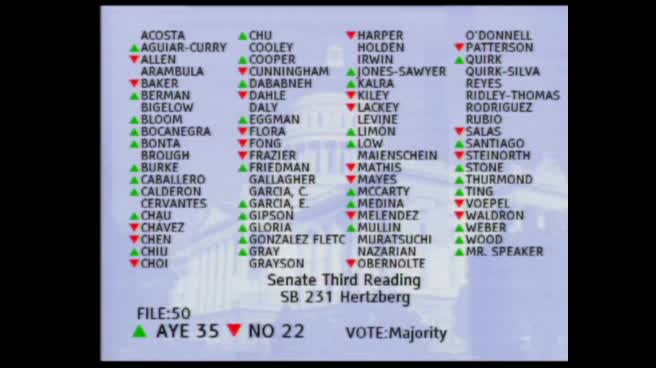 1MIN
Assembly Floor
 35SEC
Assembly Standing Committee on Appropriations
 5MIN
Assembly Standing Committee on Local Government
 45SEC
Senate Floor
 48MIN
Senate Standing Committee on Appropriations
 1MIN
Senate Standing Committee on Appropriations
 22MIN
Senate Standing Committee on Governance and Finance
Bill Author
Bill Co-Author(s):