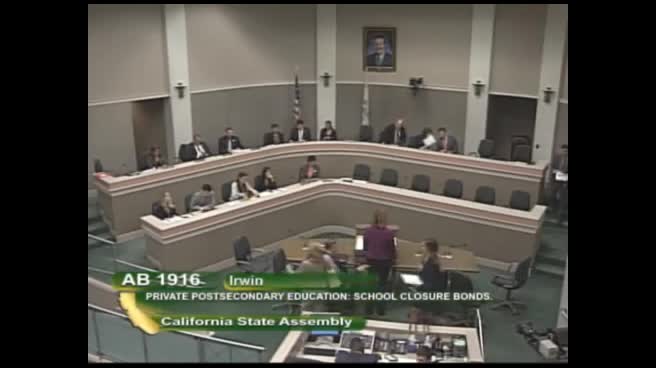
AB 1916: Private postsecondary education: school closure bonds.
- Session Year: 2015-2016
- House: Assembly
- Latest Version Date: 2016-04-05
Existing law, the California Private Postsecondary Education Act of 2009, provides for the regulation of private postsecondary educational institutions by the Bureau for Private Postsecondary Education in the Department of Consumer Affairs. The act exempts an institution from its provisions, if any of a list of specific criteria are met.
The act establishes the Student Tuition Recovery Fund and requires the bureau to adopt regulations governing the administration and maintenance of the fund, including requirements relating to assessments on students and student claims against the fund, and establishes that the moneys in this fund are continuously appropriated to the bureau for specified purposes.
This bill would require a private postsecondary institution, as defined, to file a surety bond before January 1, 2019, with the department bureau in the an amount equal to a reasonable estimate of the maximum amount of tuition and fees imposed on students of the institution for a period of attendance of greatest expense during the applicable academic year. no less than the total amount of tuition and fees charged by the institution for the immediately preceding academic year, divided by 4.
In the event the institution ceases operation, this bill would require the bureau, upon request for a refund by a student or the implementation of a teach-out for students of the institution, to bureau, if it makes a specified determination, to make a demand on the bond to: (1) issue a refund of tuition and fees for student claims, (2) implement a teach-out for students of the institution, and (3) to provide recovery to students who were enrolled at the time of the closure, or within 120 days of the closure, and reimburse the Student Tuition Recovery Fund for moneys paid from the fund for student claims that would have been otherwise recoverable under the bond. these students.
Existing law, the California Private Postsecondary Education Act of 2009, provides for the regulation of private postsecondary educational institutions by the Bureau for Private Postsecondary Education in the Department of Consumer Affairs. The act exempts an institution from its provisions, if any of a list of specific criteria are met.
The act establishes the Student Tuition Recovery Fund and requires the bureau to adopt regulations governing the administration and maintenance of the fund, including requirements relating to assessments on students and student claims against the fund, and establishes that the moneys in this fund are continuously appropriated to the bureau for specified purposes.
This bill would require a private postsecondary institution, as defined, to file a surety bond before January 1, 2019, with the department in the amount equal to a reasonable estimate of the maximum amount of tuition and fees imposed on students of the institution for a period of attendance of greatest expense during the applicable academic year.
In the event the institution ceases operation, this bill would require the bureau, upon request for a refund by a student or the implementation of a teach-out for students of the institution, to make a demand on the bond to: (1) issue a refund of tuition and fees for student claims, (2) implement a teach-out for students of the institution, and (3) reimburse the Student Tuition Recovery Fund for moneys paid from the fund for student claims that would have been otherwise recoverable under the bond.
(a)Before January 1, 2019, an institution shall file with the bureau a surety bond in the amount determined pursuant to subdivision (b). The bond shall be executed by the institution as principal and by a surety company authorized to do business in this state. The bond shall be continuous unless the surety is released pursuant to this section.
(b)The amount of the bond shall be equal to a reasonable estimate of the maximum amount of tuition and fees to be returned to students of the institution for the most expensive period of attendance during the applicable academic year. Following the initial filing of the bond with the bureau, the amount of the bond shall be recalculated annually by the bureau based upon a reasonable estimate of the maximum amount of tuition and fees to be returned to students anticipated by the school for that period of attendance. The bond shall, to the extent practicable, cover potential administrative costs incurred by the bureau in an amount no less than 5 percent of the total amount of the bond. In no case shall the amount of the bond be less than five thousand dollars ($5,000). no less than the total amount of tuition and fees charged by the institution for the immediately preceding academic year, divided by four.
(c)(1)In the event that an institution ceases operation, the bureau shall make demand on the surety of the institution upon the request for a refund by a student or the implementation of the teach-out for the students of the institution according to the plan provided to the bureau pursuant to Section 94926, and the surety shall pay the claim due within 45 days. The bureau shall use the bond to pay claims, to the extent practicable, filed by students who have not otherwise recovered their tuition and fees through a teach-out, or from the Student Tuition Recovery Fund established in Section 94923. The bureau shall use the bond to reimburse the Student Tuition Recovery Fund for all moneys paid from the fund for claims that would have been otherwise recoverable under the bond, except as provided in paragraph (4). to provide refunds of tuition and fees and, if applicable, punitive damages to students who were enrolled at the time of the closure, or within 120 days before the closure, if the bureau determines that there was a significant decline in the quality or value of applicable educational programs offered by the institution during that 120-day time period. If Student Tuition Recovery Fund reimbursements are processed for these students, the bureau shall immediately notify the surety and use the surety to fully reimburse the fund. If the bureau fails to make the demand on the surety within 120 days of closure, a student or group of students of the closed institution may make a demand directly on the surety of that institution to recover refunds of tuition and fees and, if applicable, punitive damages to which the student or students proves he or she is due. The surety shall provide recovery to students for at least four years after the closure of the institution or until the surety is depleted of funds. A student may, but is not required to, use his or her recovery from the surety to pay for a teach-out or other educational services.
(2)The bureau shall develop and implement a process, and necessary forms, for students enrolled in an institution ceasing operation to file claims to the bureau to recover their tuition and fees not recovered through a teach-out.
(3)Any student enrolled in an institution ceasing operation who does not file a claim to recover tuition and fees pursuant to paragraph (2) may recover through a teach-out provided to students of the institution ceasing operation through a contract with a community college or any other arrangement approved by the bureau. The teach-out provided to the student shall replace the enrollment agreement or contract between the institution ceasing operation and the student, except that fee and tuition payments shall be made by the student as required by the enrollment agreement or contract.
(4)If the amount of the bond is less than the total tuition and fees paid by all students declining the teach-out at the time the institution ceased operation, the amount of the bond shall be prorated among those students.
(5)The Student Tuition Recovery Fund shall be used to cover economic loss incurred by a student while enrolled at an institution ceasing operation, including any prepaid tuition and fees not recovered by the student under the bond.
(6)The bond shall be used to provide recovery for students enrolled in an institution at the time it ceases operation, within 121 days of the institution ceasing operation, and, if applicable, within a period of a declining quality of education, as determined by the bureau, longer than 120 days before the institution ceases operation.
(d)Once an institution ceases operation, no new students shall be enrolled.
(e)An institutions approval to operate shall be suspended by operation of law when the institution is no longer covered by a surety bond as required by this section. The bureau shall give written notice to the institution at the last-known address, at least 45 days prior to a release of a surety, to the effect that approval shall be suspended by operation of law until another surety bond is filed in the same manner and like amount as the bond being released.
(f)A surety on any bond filed under the provisions of this section may be released after the surety or the institution serves written notice to the bureau at least 60 days prior to the release. The release shall not discharge or otherwise affect any claim filed by any student for loss of tuition or any fees that occurred while the bond was in effect or that occurred under any note or contract executed during any period of time when the bond was in effect, except when another bond is filed in a like amount and provides indemnification for any loss.
(g)For purposes of this section, and notwithstanding Section 94858, institution means, to the extent authorized by federal law, a private postsecondary educational institution that offers postsecondary education to the public in this state for an institutional charge, but does not include an independent institution of higher education, as defined in Section 66010, that has operated in California as an independent academic institution for no less than 15 academic years.
(h)An institution, as defined in subdivision (g), shall on at least a quarterly basis provide copies of records sufficient to produce academic transcripts, and certify completion of the degrees or other programs offered by the institution, to a third party. The third party shall be independent of the institution, financially stable, and capable of producing transcripts and certifications, upon request, within two weeks of the closure of the institution, and in perpetuity thereafter. The third party shall charge a fee of no more than ten dollars ($10) per transcript or certification it produces in the event of the institutions closure, and it shall not withhold a transcript or certification based on a students nonpayment of a debt or obligation to the institution or any other party.
(i)The bond may be used to award punitive damages to a student of an institution that ceases operation and is found, by a court of law, to have violated state or federal law, or laws, that caused or contributed to the students economic loss.
(h)
(j)Tuition and fees for purposes of this section are both of the following:
(1)(A)Paid tuition and fees not recovered by the receipt of academic credits.
(2)Paid tuition and fees recovered by the receipt of academic credits that are nontransferable to accredited institutions.
(B)Tuition and fees pursuant to subparagraph (A) shall include amounts paid under the Cal Grant Program (commencing with Section 69430) of Part 42 of Division 5, the California National Guard Education Assistance Award Program, as established in Article 20.7 (commencing with Section 69999.10) of Chapter 2 of Part 42 of Division 5, and the Post 9/11 GI Bill program, as established in Chapter 33 (commencing with Section 3301) of Title 38 of the United States Code, as it read on January 1, 2016.
(2)Interest on educational loans incurred to pay tuition and fees not recovered by the receipt of academic credits.
(a)Before January 1, 2019, an institution shall file with the bureau a surety bond in the amount determined pursuant to subdivision (b). The bond shall be executed by the institution as principal and by a surety company authorized to do business in this state. The bond shall be continuous unless the surety is released pursuant to this section.
(b)The amount of the bond shall be equal to a reasonable estimate of the maximum amount of tuition and fees to be returned to students of the institution for the most expensive period of attendance during the applicable academic year. Following the initial filing of the bond with the bureau, the amount of the bond shall be recalculated annually by the bureau based upon a reasonable estimate of the maximum amount of tuition and fees to be returned to students anticipated by the school for that period of attendance. The bond shall, to the extent practicable, cover potential administrative costs incurred by the bureau in an amount no less than 5 percent of the total amount of the bond. In no case shall the amount of the bond be less than five thousand dollars ($5,000).
(c)(1)In the event that an institution ceases operation, the bureau shall make demand on the surety of the institution upon the request for a refund by a student or the implementation of the teach-out for the students of the institution according to the plan provided to the bureau pursuant to Section 94926, and the surety shall pay the claim due within 45 days. The bureau shall use the bond to pay claims, to the extent practicable, filed by students who have not otherwise recovered their tuition and fees through a teach-out, or from the Student Tuition Recovery Fund established in Section 94923. The bureau shall use the bond to reimburse the Student Tuition Recovery Fund for all moneys paid from the fund for claims that would have been otherwise recoverable under the bond, except as provided in paragraph (4).
(2)The bureau shall develop and implement a process, and necessary forms, for students enrolled in an institution ceasing operation to file claims to the bureau to recover their tuition and fees not recovered through a teach-out.
(3)Any student enrolled in an institution ceasing operation who does not file a claim to recover tuition and fees pursuant to paragraph (2) may recover through a teach-out provided to students of the institution ceasing operation through a contract with a community college or any other arrangement approved by the bureau. The teach-out provided to the student shall replace the enrollment agreement or contract between the institution ceasing operation and the student, except that fee and tuition payments shall be made by the student as required by the enrollment agreement or contract.
(4)If the amount of the bond is less than the total tuition and fees paid by all students declining the teach-out at the time the institution ceased operation, the amount of the bond shall be prorated among those students.
(5)The Student Tuition Recovery Fund shall be used to cover economic loss incurred by a student while enrolled at an institution ceasing operation, including any prepaid tuition and fees not recovered by the student under the bond.
(6)The bond shall be used to provide recovery for students enrolled in an institution at the time it ceases operation, within 121 days of the institution ceasing operation, and, if applicable, within a period of a declining quality of education, as determined by the bureau, longer than 120 days before the institution ceases operation.
(d)Once an institution ceases operation, no new students shall be enrolled.
(e)An institutions approval to operate shall be suspended by operation of law when the institution is no longer covered by a surety bond as required by this section. The bureau shall give written notice to the institution at the last-known address, at least 45 days prior to a release of a surety, to the effect that approval shall be suspended by operation of law until another surety bond is filed in the same manner and like amount as the bond being released.
(f)A surety on any bond filed under the provisions of this section may be released after the surety serves written notice to the bureau at least 60 days prior to the release. The release shall not discharge or otherwise affect any claim filed by any student for loss of tuition or any fees that occurred while the bond was in effect or that occurred under any note or contract executed during any period of time when the bond was in effect, except when another bond is filed in a like amount and provides indemnification for any loss.
(g)For purposes of this section, and notwithstanding Section 94858, institution means, to the extent authorized by federal law, a private postsecondary educational institution that offers postsecondary education to the public in this state for an institutional charge, but does not include an independent institution of higher education, as defined in Section 66010, that has operated in California for no less than 15 academic years.
(h)Tuition and fees for purposes of this section are both of the following:
(1)Paid tuition and fees not recovered by the receipt of academic credits.
(2)Paid tuition and fees recovered by the receipt of academic credits that are nontransferable to accredited institutions.
|
Date
|
Status
|
|---|---|
| Apr 19, 2016 | In committee: Set, first hearing. Failed passage. Reconsideration granted. |
| Apr 19, 2016 | From committee: Amend, and do pass as amended and re-refer to Com. on APPR. (Ayes 8. Noes 7.) (April 19). |
| Apr 13, 2016 | From committee: Do pass and re-refer to Com. on B. & P. (Ayes 9. Noes 4.) (April 12). Re-referred to Com. on B. & P. |
| Apr 6, 2016 | Re-referred to Com. on HIGHER ED. |
| Apr 5, 2016 | From committee chair, with author's amendments: Amend, and re-refer to Com. on HIGHER ED. Read second time and amended. |
| Mar 15, 2016 | In committee: Hearing postponed by committee. |
| Feb 25, 2016 | Referred to Coms. on HIGHER ED. and B. & P. |
| Feb 12, 2016 | From printer. May be heard in committee March 13. |
| Feb 11, 2016 | Read first time. To print. |
|
Date
|
Description
|
Location
|
Votes
|
|
|---|---|---|---|---|
| Apr 19, 2016 | Reconsideration. | Assembly Standing Committee on Business and Professions |
Passed |
|
| Apr 19, 2016 | Do pass as amended and be re-referred to the Committee on [Appropriations] | Assembly Standing Committee on Business and Professions |
Failed |
|
| Apr 12, 2016 | Do pass and be re-referred to the Committee on [Business and Professions] | Assembly Standing Committee on Higher Education |
Passed |
This list shows positions taken on this bill by organizations on the date displayed, which is linked to the original source.
Positions by individuals are not included.
Date of Hearing: April 19, 2016
ASSEMBLY COMMITTEE ON BUSINESS AND PROFESSIONS
Rudy Salas, Chair
ABPCA Bill Id:AB 1916
Author:(Irwin) – As Amended Ver:April 5, 2016
NOTE: This bill is double-referred, having been previously heard by the Assembly Committee on Higher Education on April 12, 2016 and approved on a 9-4 vote.
SUBJECT: Private postsecondary education: school closure bonds.
SUMMARY: Requires private postsecondary institutions to file a surety bond before January 1, 2019, with the Bureau of Private Postsecondary Education (BPPE) equal to a reasonable estimate of the maximum amount of tuition and fees imposed on students of the institution for a period of attendance, as specified; and further requires the BPPE, upon request of student claims, to make a demand on the bond to refund the costs of tuition and fees, conduct outreach and education with respect to educational and financial relief, manage student transcripts and records, and administer the Student Tuition Recovery Fund (STRF).
EXISTING LAW:
- Establishes the BPPE within the Department of Consumer Affairs (DCA) to oversee and regulate private postsecondary educational institutions; provides that the BPPE operate until January 1, 2017. (Education Code (EDC) Section 94800, et seq.)
- Requires the BPPE to adopt by regulation minimum operating standards for an institution to ensure that the program can achieve its objective; the facilities and instructional equipment and material are sufficient to enable the program; the administrators and faculty are qualified; the institution maintain written and relevant standards for student admissions, as well as maintains a withdrawal policy and provides refunds; gives students a document signifying the degree or diploma awarded; maintains records and standard transcripts; and, is accredited by an accrediting agency or is in the process of accreditation. (EDC Section 94885)
- Provides for specified exemptions from the Act for specific types of institutions, including, but not limited to, those where oversight is already provided by other entities; provides that an institution seeking exemption must still comply with all other regulations as though the exemption were not in place. (EDC Section 94874).
- Establishes the STRF, administered by the BPPE, to relieve or mitigate the economic loss suffered by students enrolled at a non-exempt private postsecondary educational institution due to the institution’s closer, the institution’s failure to pay refunds or reimburse loan proceeds, or the institution’s failure to pay students’ restitution award for a violation of the Act; provides that the STRF is limited to no more than $25 million; requires institutions to assess students an amount established in regulation by the BPPE and remit funds to the BPPE for STRF. (EDC Sections 94923-94925)
THIS BILL:
- Provides, effective January 1, 2019, each institution shall maintain and file with the BPPE a surety bond, with a surety bond company authorized to do business in California.
- Provides the amount of the bond shall be no less than the amount of tuition and fees charged by the institution during the prior academic year, divided by four.
- Provides that, in the event that an institution ceases operation, BPPE shall make demand on the surety of that institution to provide refunds due to any students who were enrolled at the time of the closure, or within 120 days prior to the closure, if the bureau determines that there was a significant decline in the quality or value of that educational program during that time period. The amount of any refund received by a student shall offset any claim that the student may make against the Student Tuition Recovery Fund (STRF).
- BPPE shall use the surety to reimburse any refund received by a student through the STRF.
- Provides that if BPPE fails to make such a demand within 120 days of closure, any student or group of students may make a demand directly on the surety of that institution to recover any refund to which the student or students are due. A student may, but is not required to, use such payments to pay for a teach-out or other educational services.
- Provides that once an institution ceases operation, no new students shall be enrolled.
- Provides that an institution’s approval to operate shall be suspended by operation of law when the institution is no longer covered by a surety bond as required by this section. The institution and the surety shall give written notice to BPPE at least 45 days prior to a release of a surety.
- Provides that a surety on any bond filed may be released after the surety serves written notice to BPPE at least 60 days prior to the release. The release shall not discharge or otherwise affect any claim filed by any student for loss of tuition or any fees that occurred while the bond was in effect or that occurred under any note or contract executed during any period of time when the bond was in effect, except when another bond is filed in a like amount and provides indemnification for any loss.
- Provides that an “institution” means, to the extent authorized by federal law, a private postsecondary educational institution that offers postsecondary education to the public in this state for an institutional charge, but does not include an independent institution of higher education, as defined, that has operated in California as an independent academic institution for no less than 15 academic years.
- Provides that all institutions shall on at least a quarterly basis provide copies of records sufficient to produce academic transcripts and to certify completion of any degree or other program offered by the institution, to a third party. The third party shall be independent of the institution, financially stable, and capable of producing transcripts and certifications, upon request, within two weeks of the closure of a school, and continuing thereafter. The third party shall charge a fee of no more than $10 per transcript or certification, and it shall not withhold a transcript or certification based on the student’s non-payment of a debt or obligation to the school or to any other party.
- Provides that the bond may be used to award punitive damages to a student of an institution that ceases operation and is found, by a court of law, to have violated state or federal law, or laws, that caused or contributed to the student's economic loss.
- Defines tuition and fees as all of the following: (a) paid tuition and fees not recovered by the receipt of academic credits; interest on educational loans incurred to pay such tuition and fees recovered by the receipt of academic credits; and, (c) general fund costs associated with restoring the benefits of eligible students’ for Cal Grants, as defined in Section 69430 of the Education Code, California National Guard Education Assistance Award Program (CNG EAAP), as defined in Section 69999.10 of the Education Code, and the Post 9/11 GI Bill, as defined in Title 38, Part III, Chapter 33 of the US Code.
FISCAL EFFECT: Unknown. This bill is keyed fiscal by the Legislative Counsel.
COMMENTS:
Purpose. This bill requires private postsecondary institutions to file a surety bond before January 1, 2019, with the BPPE equal to a reasonable estimate of the maximum amount of tuition and fees imposed on students of the institution for a period of attendance, as specified, if the institution closes; requires the BPPE, upon request of student claims, to make a demand on the bond to refund the costs of tuition and fees, enforce the Act, conduct outreach and education with respect to educational and financial relief, manage student transcripts and records, and administer the STRF.
This bill is sponsored by the author. According to the author, “Existing state and federal law provide little relief to the California students affected by a school closure as shown by the recent closures of Corinthian Colleges and other small institutions. In these cases, students are not compensated for their economic loss, and the institution itself has no financial disincentive to close at a particular time that further harms students. The only protection students have is supported by fees collected from each student, so students are self-insuring against closure and no liability for compensating students is shifted to the closing institution under this policy. According to the National Consumer Law Center, California is not among the 40 other states that require a surety bond to be posted by for-profit schools to protect students in the event of a closure. [This bill] would provide protection for California students attending private for-profit colleges in the event that the school closes. The posting of a surety bond by these institutions will protect students in two ways: 1) recovery of economic loss in the event of a closure; [and,] 2) provides disincentive for schools to close before the end of an academic term.”
Corinthian Colleges, Inc. (CCI) Institutions. Heald, WyoTech, and Everest campuses offered a range of programs, including certificate programs, with tuition and fees that ranged from $13,100 to $75,384. According to a 2014 complaint filed by the Consumer Financial Protection Bureau (CFPB), most students attending CCI were low-income, or the first in their families to seek an education beyond high school. Most students attending CCI received federal financial aid; according to CCIs filing with the Securities and Exchange Commission, CCI received 84.8% of net revenue from federal financial aid.
CCI has been subject to state and federal administrative or legal actions for the last several years. Below are a few key dates that demonstrate the landscape of CCI’s closure in 2015.
- October 2013 – AG Kamala Harris filed a lawsuit against CCI alleging deceptive marketing and job-placement claims.
- August 2014 – the California State Approving Agency for Veterans Education (CSAAVE) withdrew institutional approval at all 23 institutions owned and operated in California by CCI, and were thus no longer eligible for GI bill benefits. In order to continue using Title 38 benefits, veteran students were required to transfer/enroll in a CSAAVE eligible school.
- April 14, 2015 – the USDE announced a $30 million fine against Heald's Salinas and Stockton campuses for fraudulent placement and other advertising, which CCI appealed. The decision effectively barred all Heald campuses from receiving federal funds for new enrollments. Two days later, the California Student Aid Commission (CSAC) permanently terminated Heald's eligibility for the Cal Grant program; Everest and WyoTech were already not eligible. The next days, the BPPE issued an emergency decision prohibiting Everest and WyoTech campuses from enrolling new students. CCI closed all campuses on April 26, 2015.
- May 4, 2015 – CCI filed for bankruptcy.
- On March 23, 2016, the AG announced that the San Francisco County Superior Court of California issued a $1.1 billion default judgment against CCI, finding, among other things: many of CCI's representations and advertisements related to job placement were untrue and/or misleading, dating back to at least 2009; CCI knowingly advertised programs, since 2010, that it did not offer; CCI unlawfully used military seals; enrollment agreements contained unlawful clauses; CCI engaged in unlawful debt collection and failed to disclose its role in the Genesis Private Student Loan Program; and, CCI misrepresented the transferability of credits.
Relief for students. Financial aid relief varies with local, state and federal provisions, and although there are mechanisms for restitution, some students remain ineligible for current programs.
State relief. The STRF, administered by the BPPE, was established to relieve or mitigate economic loss incurred by students enrolled at a non-exempt private postsecondary educational institution. According to the BPPE, California students enrolled within 60 days of closure of a California WyoTech and Everest campus are eligible for STRF. California CCI students enrolled in Heald and Everest Online are not covered by STRF as those CCI institutions were not regulated by BPPE. According to the BPPE at its Sunset Review Hearing on March 28, 2016, the BPPE expanded its consideration to students who were enrolled within 120 days of the institution’s closure.
For the CCI students that are eligible for STRF, application and approval rates are low. According to BPPE data, of the estimated 1,586 WyoTech students eligible for STRF, only 34 STRF applications have been approved. Of the estimated 4,336 Everest students eligible for STRF, only 75 applications have been approved. Fewer than 350 total students have applied.
USDE expanded the closed school loan discharge eligibility to students enrolled as far back as June 20, 2014, making California veterans eligible for closed school loan discharge. BPPE has not yet taken such a similar action. When the California State Approving Agency for Veterans Education withdrew institutional approval of CCI campuses in California, the students of those campuses could no longer benefit from the GI bill benefits. If BPPE mirrors the expansion provided by the USDE, California veteran students would be eligible for similar loan discharge claims.
Federal relief. The USDE announced expanded loan forgiveness options for CCI students who were affected by the closure or by the unlawful practices of the institution. Eligible students are ones who can show that CCI violated state law; and students who were enrolled after June 20, 2014. Students enrolled in Heald programs between 2010 and 2014 have been deemed eligible to apply through an expedited loan forgiveness pathway; an expedited pathway is pending for Everest and WyoTech students enrolled in most programs between 2010 and 2013.
The USDE has indicated additional eligibility and financial aid relief may be established. According to the Special Master for Borrower Defense of the USDE, thousands of students are in the approval process for their loans to be discharged or already have been granted relief. USDE is in the process of starting similar email campaigns for former WyoTech and Everest students. Loans discharged as of March 1, 2016 for CCI institutions, including WyoTech and Everest, amounts to more than $90 million.
Closed school loan forgiveness claims received | 11,740 |
Students granted relief | 6,838 |
Borrower defense claims received | 11,000 (8,501 from CCI) |
Students eligible for loan forgiveness | Approx. 350,000 students. |
Students approved for loan forgiveness | 2,048 |
USDE email communications to former-Heald students regarding loan discharge eligibility | 54,000 |
Average open rate for these email campaigns | 40% |
Local relief. CSOs assisting students harmed by the fraudulent activities and illegal closure of CCI (and other closed institutions such as Four-D College and Marinello Schools of Beauty) are limited by funding cuts.
Students enrolled at institutions exempt from the Act are ineligible for STRF, nor are students who are enrolled at institutions whose physical location is outside of California (i.e. students enrolled in online programs). Even still, students who were affected by a school’s closure may not know about their rights with regard to the STRF. As noted in the BPPE’s 2014 Sunset Report, the number of claims for STRF have been remarkably low. For example, more than 4,000 students who were enrolled at the now-closed WyoTech and Everest Colleges are eligible for STRF. Eighty percent of these students met with BPPE staff in the days following the schools’ closure, but only approximately 300 claims have been filed. Despite the low number of claims, the STRF has proven to be in need improvements. For the claims made by students of WyoTech and Everest, only 2.1% and 1.7%, respectively, were approved.
Establishing a surety bond. A bond is filed for the benefit of consumers who may be damaged as a result of defective agreement or other license law violations. For example, the Contractors State License Board (CSLB) requires contractors to have a bond in place before CSLB may issue an active license, reactivate an inactive license, or renew an active license. According to the CSLB, “A surety bond is a contract in which a surety company promises the State of California that the contractor will comply with the state Contractors License Law. According to the author, requiring institutions to post a surety bond will “[ensure] that students receive the instruction and credits they have paid for, and if they do not, [ensure] that they are made whole for what they have paid, as well as their lost benefits, or nontransferable credits.”
BPPE Sunset Review. The BPPE is currently undergoing the sunset review process. The issues of low rates of student claims for STRF funds, ensuring protection for students not covered by the STRF, and the possibility of a surety bond requirement are raised in the BPPE 2015 Sunset Review Background Paper, prepared by the Senate Committee on Business, Professions and Economic Development staff.
ARGUMENTS IN SUPPORT:
The Office of the Attorney General writes in support, “[This bill] would make California the forty-first state to require for-profit colleges to post some type of surety bond as collateral to cover student losses following a school closure. The bill adds much-needed additional safeguards to protect consumers harmed by a growing industry of for-profit institutions that are often financially unstable and prone to engage in predatory conduct. The bill has been thoughtfully narrowed to a category of institutions most at risk of failure, and its provisions have been crafted to ensure that appropriate funds are available to repay students upon a school’s closure. As the bill makes its way through the legislature, the Attorney General is committed to helping refine the language of the bill to ensure that it will adequately serve to protect future students from financial disaster.”
The California Federation of Teachers writes in support, “Much has been done to regulate private postsecondary institutions in the wake of the closure of Corinthian Colleges. However, there remains a great need to provide protection for those California students attending private for-profit colleges in the event that a school closes. By requiring these institutions to post a surety bond, students will be able to recover those economic losses such as educational supplies, living expenses, non-transferable credits, or other damages. Additionally, this bond will serve as a disincentive for schools to close before the end of an academic term, thereby mitigating the loss to students.”
The Institute for College Access and Success writes in support, if amended, “These small rates of relief are surely driven in part by the Bureau’s severe understaffing; it has just two employees dedicated to processing claims for students impacted by school closures and very limited capacity for student outreach. Allowing a surety bond to be tapped to support STRF administration would facilitate students’ access to relief, and as such we recommend amending the bill to enable the bureau to make demand on surety bonds for reimbursement of STRF-related administration and student outreach activities. At the same time, it is important to avoid further complicating STRF processes, especially since determining eligibility and applying for relief can already be challenging for students to navigate. To the extent that students are eligible to obtain state relief, the Bureau should be their point of contact and STRF their source of relief.”
ARGUMENTS IN OPPOSITION:
The California Association of Private Postsecondary Schools writes in opposition, “Current California law allows for a $25 million account, essential an insurance fund, to help students recover costs if their institution closes. The STRF is fully funded and in fact has a $3 million surplus. Mandating every institution have a surety bond equally 25% of their tuition revenue on top of the $25 million STRF account is the definition of duplicative. After discussing the mechanics of how this proposed surety could work, our experts do not think many Institutions could afford to maintain such a high bond. They are equally uncertain, given the dollar fluctuations inherent in calculating such a bond, that commercial entities would be inclined to offer such a bond, except at a very high price, which would doom many smaller Institutions.”
The University of Phoenix writes in opposition, "Although the University supports the concept of a bond, it opposes duplicative financial burdens for licensed institutions through the imposition of both a bond and the STRF. Specifically, the bond requirement should only apply to those students who do not otherwise contribute to the STRF. Even then, by focusing exclusively on institutions regulated by the BPPE, the measure leaves out a significant portion of CA online students that attend non-BPPE regulated institutions; meaning those student will have no recourse should their institution close.” The University goes on to say, “In addition to the duplicative coverage, the measure will now provide that students shall be eligible to receive punitive damages for up to four years after an institution closes. It’s unclear if punitive damages could be insured under the surety bond required of institutions, in which case it would be impossible to comply with the bill.”
American Career College / West Coast University writes in support, “California currently has the [STRF] as the mechanism to aid students impacted by a school closure. STRF is fully funded. Requiring another duplicative mechanism will not streamline efforts to help students receive the aid they need quickly, but rather will complicate those efforts. Additionally, the bond requirements in [this bill] are excessively expensive and it is uncertain whether a bond of this magnitude could even be obtained. This serves only to take away from resources that could go directly to educations and training programs that benefit students.”
POLICY ISSUES FOR CONSIDERATION:
On April 12, 2016, the Assembly Higher Education Committee heard and approved this bill by a vote of 9-4. The author agreed to accept amendments recommended by the Higher Education Committee, which will be formally adopted in this Committee. The amendments specify that for all institutions enrolling students that are covered by the STRF, the STRF will remain the source of relief for student economic loss. For institutions exempt from the BPPE, and therefore not covered by STRF, the surety bond will cover student economic loss. Additionally, the amendments require, for all institutions, the surety bond cover BPPE administrative costs associated with school closure and STRF eligibility, transcript and records database and administration, and student outreach activities. Finally, the amendments specify, consistent with current law, that BPPE is responsible for records and transcripts for all closed institutions.
Despite the prevalence of states having a surety bond in addition to STRF-type coverage, it is unclear if California should also have duplicative coverage. The STRF currently has $28 million available to students, which is more than its statutory limit allows. If an institution covered by a surety bond closes, the bond itself would still not benefit students for until STRF funds are expended or if the bond were to replace STRF entirely.
Instead, the surety bond should only cover costs associated with a school closure that STRF does not cover, namely reimbursing the BPPE for conducting outreach and education with respect to educational and financial relief, managing student transcripts and records, and fulfilling awards for punitive damages.
AMENDMENTS:
SECTION 1. Section 94874 of the Education Code is amended to read:
94874. Except as provided in Section 94874.2,Sections 94874.2 and 94886.5, the following are exempt from this chapter:
(a) An institution that offers solely avocational or recreational educational programs.
(b) (1) An institution offering educational programs sponsored by a bona fide trade, business, professional, or fraternal organization, solely for that organization’s membership.
(2) (A) Except as provided in subparagraph (B), a bona fide organization, association, or council that offers preapprenticeship training programs, on behalf of one or more Division of Apprenticeship Standards-approved labor-management apprenticeship programs that satisfies one of the following conditions:
(i) It is not on the Eligible Training Provider List established and maintained by the California Workforce Investment Board but has met the requirements for placement on the list.
(ii) It is on the Eligible Training Provider List established and maintained by the California Workforce Investment Board and meets the requirements for continued listing.
(B) If an organization, association, or council has been removed from the Eligible Training Provider List established and maintained by the California Workforce Investment Board for failure to meet performance standards, it is not exempt until it meets all applicable performance standards.
(c) A postsecondary educational institution established, operated, and governed by the federal government or by this state or its political subdivisions.
(d) An institution offering either of the following:
(1) Test preparation for examinations required for admission to a postsecondary educational institution.
(2) Continuing education or license examination preparation, if the institution or the program is approved, certified, or sponsored by any of the following:
(A) A government agency, other than the bureau, that licenses persons in a particular profession, occupation, trade, or career field.
(B) A state-recognized professional licensing body, such as the State Bar of California, that licenses persons in a particular profession, occupation, trade, or career field.
(C) A bona fide trade, business, or professional organization.
(e) (1) An institution owned, controlled, and operated and maintained by a religious organization lawfully operating as a nonprofit religious corporation pursuant to Part 4 (commencing with Section 9110) of Division 2 of Title 1 of the Corporations Code, that meets all of the following requirements:
(A) The instruction is limited to the principles of that religious organization, or to courses offered pursuant to Section 2789 of Business and Professions Code.
(B) The diploma or degree is limited to evidence of completion of that education.
(2) An institution operating under this subdivision shall offer degrees and diplomas only in the beliefs and practices of the church, religious denomination, or religious organization.
(3) An institution operating under this subdivision shall not award degrees in any area of physical science.
(4) Any degree or diploma granted under this subdivision shall contain on its face, in the written description of the title of the degree being conferred, a reference to the theological or religious aspect of the degree’s subject area.
(5) A degree awarded under this subdivision shall reflect the nature of the degree title, such as “associate of religious studies,” “bachelor of religious studies,” “master of divinity,” or “doctor of divinity.”
(f) An institution that does not award degrees and that solely provides educational programs for total charges of two thousand five hundred dollars ($2,500) or less when no part of the total charges is paid from state or federal student financial aid programs. The bureau may adjust this cost threshold based upon the California Consumer Price Index and post notification of the adjusted cost threshold on its Internet Web site, as the bureau determines, through the promulgation of regulations, that the adjustment is consistent with the intent of this chapter.
(g) A law school that is accredited by the Council of the Section of Legal Education and Admissions to the Bar of the American Bar Association or a law school or law study program that is subject to the approval, regulation, and oversight of the Committee of Bar Examiners, pursuant to Sections 6046.7 and 6060.7 of the Business and Professions Code.
(h) A nonprofit public benefit corporation that satisfies all of the following criteria:
(1) Is qualified under Section 501(c)(3) of the United States Internal Revenue Code.
(2) Is organized specifically to provide workforce development or rehabilitation services.
(3) Is accredited by an accrediting organization for workforce development or rehabilitation services recognized by the Department of Rehabilitation.
(i) An institution that is accredited by the Accrediting Commission for Senior Colleges and Universities, Western Association of Schools and Colleges, or the Accrediting Commission for Community and Junior Colleges, Western Association of Schools and Colleges.
(j) An institution that satisfies all of the following criteria:
(1) The institution has been accredited, for at least 10 years, by an accrediting agency that is recognized by the United States Department of Education.
(2) The institution has operated continuously in this state for at least 25 years.
(3) During its existence, the institution has not filed for bankruptcy protection pursuant to Title 11 of the United States Code.
(4) The institution’s cohort default rate on guaranteed student loans does not exceed 10 percent for the most recent three years, as published by the United States Department of Education.
(5) The institution maintains a composite score of 1.5 or greater on its equity, primary reserve, and net income ratios, as provided under Section 668.172 of Title 34 of the Code of Federal Regulations.
(6) The institution provides a pro rata refund of unearned institutional charges to students who complete 75 percent or less of the period of attendance.
(7) The institution provides to all students the right to cancel the enrollment agreement and obtain a refund of charges paid through attendance at the second class session, or the 14th day after enrollment, whichever is later.
(8) The institution submits to the bureau copies of its most recent IRS Form 990, the institution’s Integrated Postsecondary Education Data System Report of the United States Department of Education, and its accumulated default rate.
(9) The institution is incorporated and lawfully operates as a nonprofit public benefit corporation pursuant to Part 2 (commencing with Section 5110) of Division 2 of Title 1 of the Corporations Code and is not managed or administered by an entity for profit.
(k) Flight instruction providers or programs that provide flight instruction pursuant to Federal Aviation Administration regulations and meet both of the following criteria:
(1) The flight instruction provider or program does not require students to enter into written or oral contracts of indebtedness.
(2) The flight instruction provider or program does not require or accept prepayment of instruction-related costs in excess of two thousand five hundred dollars ($2,500).
SECTION 1SEC. 2. 94886.5. (a) Before January 1, 2019, an institution shall file with the bureau a surety bond in the amount determined pursuant to subdivision (b). The amount required to cover these costs shall be estimated by the institution, pursuant to subdivision (a)(1) of this section. The institutions may petition the bureau to lessen the amount of the surety if the institution proves it is financially stable. The bond shall be executed by the institution as principal and by a surety company authorized to do business in this state. The bond shall be continuous unless the surety is released pursuant to this section.
(a)(1)The surety filed with the bureau as required by this section shall be calculated by the following formula: Tuition for a program x Projected California Student Enrollment in that program x Percentage of Program Length. Length is calculated by dividing actual program length by one year (52 weeks or 12 months, as appropriate.) If the school offers more than one program, each program is calculated separately and the results totaled. The total amount calculated for a program or programs shall be rounded to the nearest $1,000.
(2) The bureau shall, through regulations, develop a process by which an institution may petition to have its surety bond lessened. The regulations shall include, but not be limited to, establishing minimum evidence of financial stability.
(b) The amount of the bond shall be equal to a reasonable estimate of the maximum amount of tuition and fees to be returned to students of the institution for the most expensive period of attendance during the applicable academic year. Following the initial filing of the bond with the bureau, the amount of the bond shall be recalculated annually by the bureau based upon a reasonable estimate of the maximum amount of tuition and fees to be returned to students anticipated by the school for that period of attendance. The bond shall, to the extent practicable, cover potential administrative costs incurred by the bureau in an amount no less than 5 percent of the total amount of the bond. In no case shall the amount of the bond be less than five thousand dollars ($5,000). no less than the total amount of tuition and fees charged by the institution for the immediately preceding academic year, divided by four.
(c) (b) (1) In the event that an institution that is required to participate in the Student Tuition Recovery Fund, pursuant to Article 14, ceases operation, the bureau shall make demand on the surety of the institution to provide reimbursement to the bureau to cover costs associated with that institution’s closure, including enforcement of this chapter, outreach and education to students regarding available relief, and management of student transcripts and records, and administration of the fund, and, if applicable, to provide punitive damages to students pursuant to subdivision (g).records.
(2) In the event that an institution ceases operation, that is exempt from the act pursuant to Section 94784, but that is not an independent institution of higher education, as defined in Section 66010, that has operated in California as an independent academic institution for at least 15 academic years, ceases operation, the bureau shall make demand on the surety of the institution upon the request for a refund by a student or the implementation of the teach-out for the students of the institution according to the plan provided to the bureau pursuant to Section 94926, and the surety shall pay the claims, to the extent practicable, filed by students who have not otherwise recovered their tuition and fees through a teach-out, or from the Student Tuition Recovery Fund established in Section 94923. The bureau shall use the bond to reimburse the Student Tuition Recovery Fund for all moneys paid from the fund for claims that would have been otherwise recoverable under the bond, except as provided in paragraph (4). to provide refunds of tuition and fees payments to students for economic loss, as defined in subdivision (f) of Section 94923 and, if applicable, punitive Section 94923. damages to students who were enrolled at the time of the closure, or within 120 days before the closure, if the bureau determines that there was a significant decline in the quality or value of applicable educational programs offered by the institution during that 120-day time period. damages pursuant to subdivision (g). If Student Tuition Recovery Fund reimbursements are processed for these students, the bureau shall immediately notify the surety and use the surety to fully reimburse the fund. If the bureau fails to make the demand on the surety within 120 days of closure, a student or group of students of the closed institution may make a demand directly on the surety of that institution to recover refunds of tuition and feeseconomic loss and, if applicable, punitive damages to which the student or students proves he or she is due. The surety shall provide recovery to students for at least four years after the closure of the institution or until the surety is depleted of funds. A student may, but is not required to, use his or her recovery from the surety to pay for a teach-out or other educational services.The bureau may make demand on the surety of the institution to provide reimbursement to the bureau to cover costs associated with that institution’s closure, including outreach and education to the students regarding available relief, management of student transcripts and records, and administration of the bond.
(2)The bureau shall develop and implement a process, and necessary forms, for students enrolled in an institution ceasing operation to file claims to the bureau to recover their tuition and fees not recovered through a teach-out.
(3)Any student enrolled in an institution ceasing operation who does not file a claim to recover tuition and fees pursuant to paragraph (2) may recover through a teach-out provided to students of the institution ceasing operation through a contract with a community college or any other arrangement approved by the bureau. The teach-out provided to the student shall replace the enrollment agreement or contract between the institution ceasing operation and the student, except that fee and tuition payments shall be made by the student as required by the enrollment agreement or contract.
(4)If the amount of the bond is less than the total tuition and fees paid by all students declining the teach-out at the time the institution ceased operation, the amount of the bond shall be prorated among those students.
(5)The Student Tuition Recovery Fund shall be used to cover economic loss incurred by a student while enrolled at an institution ceasing operation, including any prepaid tuition and fees not recovered by the student under the bond.
(6)The bond shall be used to provide recovery for students enrolled in an institution at the time it ceases operation, within 121 days of the institution ceasing operation, and, if applicable, within a period of a declining quality of education, as determined by the bureau, longer than 120 days before the institution ceases operation.
(d) Once an institution ceases operation, no new students shall be enrolled.
(e) An institution’s approval to operate shall be suspended by operation of law when the institution is no longer covered by a surety bond as required by this section. The bureau shall give written notice to the institution at the last-known address, at least 45 days prior to a release of a surety, to the effect that approval shall be suspended by operation of law until another surety bond is filed in the same manner and like amount as the bond being released.
(f) A surety on any bond filed under the provisions of this section may be released after the surety or the institution serves written notice to the bureau at least 60 days prior to the release. The release shall not discharge or otherwise affect any claim filed by any student for loss of tuition or any fees that occurred while the bond was in effect or that occurred under any note or contract executed during any period of time when the bond was in effect, except when another bond is filed in a like amount and provides indemnification for any loss.
(g) For purposes of this section, and notwithstanding Section 94858, “institution” means, to the extent authorized by federal law, a private postsecondary educational institution that offers postsecondary education to the public in this state for an institutional charge, but does not include an independent institution of higher education, as defined in Section 66010, that has operated in California as an independent academic institution for no less than 15 academic years.
(h) An institution, as defined in subdivision (g), shall on at least a quarterly basis provide copies of records sufficient to produce academic transcripts, and certify completion of the degrees or other programs offered by the institution, to a third party. The third party shall be independent of the institution, financially stable, and capable of producing transcripts and certifications, upon request, within two weeks of the closure of the institution, and in perpetuity thereafter. The third party shall charge a fee of no more than ten dollars ($10) per transcript or certification it produces in the event of the institution’s closure, and it shall not withhold a transcript or certification based on a student’s nonpayment of a debt or obligation to the institution or any other party.
(i) The bond (g) A surety bond as required by this section may be used to award punitive damages to a student of anthe applicable institution that ceases operation and is found, by a court of law, to have violated state or federal law, or laws, that caused or contributed to the student’s economic loss.
(h)
(j) Tuition and fees for purposes of this section are both of the following:
(1) (A) Paid tuition and fees not recovered by the receipt of academic credits.
(2)Paid tuition and fees recovered by the receipt of academic credits that are nontransferable to accredited institutions.
(B) Tuition and fees pursuant to subparagraph (A) shall include amounts paid under the Cal Grant Program (commencing with Section 69430) of Part 42 of Division 5, the California National Guard Education Assistance Award Program, as established in Article 20.7 (commencing with Section 69999.10) of Chapter 2 of Part 42 of Division 5, and the Post 9/11 GI Bill program, as established in Chapter 33 (commencing with Section 3301) of Title 38 of the United States Code, as it read on January 1, 2016.
(2) Interest on educational loans incurred to pay tuition and fees not recovered by the receipt of academic credits.
REGISTERED SUPPORT:
Attorney General, Kamala Harris
California Federation of Teachers
The Institute for College Access and Success (if amended)
REGISTERED OPPOSITION:
American Career College / West Coast University
Association of Private Postsecondary Schools
University of Phoenix
Education Management Corporation
Analysis Prepared by: Gabby Nepomuceno / B. & P. / (916) 319-3301
Date of Hearing: April 12, 2016
ASSEMBLY COMMITTEE ON HIGHER EDUCATION
Jose Medina, Chair
ABPCA Bill Id:AB 1916 (
Author:Irwin) – As Amended Ver:April 5, 2016
[Note: This bill is double referred to the Assembly Business and Professions Committee and will be heard as it relates to issues under its jurisdiction.]
SUBJECT: Private postsecondary education: school closure bonds
SUMMARY: Requires private postsecondary educational institutions (institutions) to maintain a surety bond, filed with the Bureau for Private Postsecondary Education (BPPE) to provide reimbursement to students in the case of school closure. Specifically, this bill:
- Provides, effective January 1, 2019, each institution shall maintain and file with the BPPE a surety bond, with a surety bond company authorized to do business in California.
- Provides the amount of the bond shall be no less than the amount of tuition and fees charged by the institution during the prior academic year, divided by four.
- Provides that, in the event that an institution ceases operation, BPPE shall make demand on the surety of that institution to provide refunds due to any students who were enrolled at the time of the closure, or within 120 days prior to the closure, if the bureau determines that there was a significant decline in the quality or value of that educational program during that time period. The amount of any refund received by a student shall offset any claim that the student may make against the Student Tuition Recovery Fund (STRF).
- BPPE shall use the surety to reimburse any refund received by a student through the STRF.
- Provides that if BPPE fails to make such a demand within 120 days of closure, any student or group of students may make a demand directly on the surety of that institution to recover any refund to which the student or students are due. A student may, but is not required to, use such payments to pay for a teach-out or other educational services.
- Provides that once an institution ceases operation, no new students shall be enrolled.
- Provides that an institution’s approval to operate shall be suspended by operation of law when the institution is no longer covered by a surety bond as required by this section. The institution and the surety shall give written notice to BPPE at least 45 days prior to a release of a surety.
- Provides that a surety on any bond filed may be released after the surety serves written notice to BPPE at least 60 days prior to the release. The release shall not discharge or otherwise affect any claim filed by any student for loss of tuition or any fees that occurred while the bond was in effect or that occurred under any note or contract executed during any period of time when the bond was in effect, except when another bond is filed in a like amount and provides indemnification for any loss.
- Provides that an “institution” means, to the extent authorized by federal law, a private postsecondary educational institution that offers postsecondary education to the public in this state for an institutional charge, but does not include an independent institution of higher education, as defined, that has operated in California as an independent academic institution for no less than 15 academic years.
- Provides that all institutions shall on at least a quarterly basis provide copies of records sufficient to produce academic transcripts and to certify completion of any degree or other program offered by the institution, to a third party. The third party shall be independent of the institution, financially stable, and capable of producing transcripts and certifications, upon request, within two weeks of the closure of a school, and continuing thereafter. The third party shall charge a fee of no more than $10 per transcript or certification, and it shall not withhold a transcript or certification based on the student’s non-payment of a debt or obligation to the school or to any other party.
- Provides that the bond may be used to award punitive damages to a student of an institution that ceases operation and is found, by a court of law, to have violated state or federal law, or laws, that caused or contributed to the student's economic loss.
- Defines tuition and fees as all of the following: (a) paid tuition and fees not recovered by the receipt of academic credits; interest on educational loans incurred to pay such tuition and fees recovered by the receipt of academic credits; and, (c) general fund costs associated with restoring the benefits of eligible students’ for Cal Grants, as defined in Section 69430 of the Education Code, California National Guard Education Assistance Award Program (CNG EAAP), as defined in Section 69999.10 of the Education Code, and the Post 9/11 GI Bill, as defined in Title 38, Part III, Chapter 33 of the US Code.
EXISTING LAW:
- Establishes the BPPE within the Department of Consumer Affairs with the primary function of providing protection of students/consumers through the regulation and oversight of private postsecondary educational institutions. BPPE oversight activities are funded by licensing fees paid by regulated institutions. Existing law also provides for a variety of exemptions from oversight by the Bureau for specific types of institutions, including institutions accredited by the Western Association of Schools and Colleges (WASC). (Education Code Sec. 94800 et seq.)
- Establishes the STRF, administered by the BPPE, to relieve or mitigate economic loss suffered by students enrolled at a non-exempt private postsecondary education institution due to the institutions' closure, the institutions' failure to pay refunds or reimburse loan proceeds, or the institutions' failure to pay students' restitution award for a violation of the Private Postsecondary Education Act. STRF is capped in statute at $25 million. Institutions are required to assess students an amount established in regulation by the BPPE and remit fund to the BPPE for STRF. In 2010, that amount was established at $2.50 per $1000 of tuition charged. In 2013, that amount was reduced to $0.50 per $1000. In 2015, this amount was reduced to $0.00, as the STRF had exceeded the statutory cap (STRF is currently at approximately $28 million). (EC Sec. 94923 – 94925)
FISCAL EFFECT: Unknown.
COMMENTS: Purpose of this bill. According to the author, "California students of for-profit postsecondary institutions do not have adequate protection from economic loss in the event that the institution closes, which has been a frequent occurrence in recent years. California is one of only 10 states in the country that does not require for-profit institutions to maintain a surety bond. Further, California’s existing policy intended to protect these students, the STRF, is entirely funded by the students with no financial interest being passed on to the institution itself. Further, some exemptions from state oversight from the BPPE means STRF is not currently available to some students at California campuses or California students enrolled in out-of-state online programs. This bill will require for-profit and new non-profit institutions to post a surety bond in the amount of tuition and fees collected for an academic term, ensuring that students receive the instruction and credits they have paid for, and if they do not, ensuring that they are made whole for what they have paid, as well as their lost benefits, or nontransferable credits."
Discussion and recommendations. An important tool to assist students harmed by BPPE-regulated institutions is the STRF. However, as currently established and administered there are significant gaps in the economic relief provided to students under STRF:
First, students enrolled in institutions that are exempt from, or not covered by the Act are not eligible for STRF. Due to these broad exemptions in the Act, over 13,000 students enrolled in Heald College, owned by Corinthian Colleges, Inc. (CCI), at the time of the institution’s unlawful closure were not eligible for STRF. Due to the physical presence requirement, a number of California students enrolled in Everest Online (owned by CCI but housed outside of California) are not eligible for STRF. Several other large, publicly traded colleges are now under regulatory, financial and legal pressure similar to that facing CCI prior to closure.
Establishing a requirement for a surety bond for California students not covered by STRF would ensure that all California students are protected. However, Committee staff recommends clarifying that, for all students covered, STRF remain as the source of relief for these students.
Second, as outlined in the BPPE Sunset Review report, even for eligible students, STRF claim and approval rates are very low. Using CCI as an example, over 4,000 former WyoTech and Everest students are estimated to be eligible for STRF. BPPE estimates roughly 80 percent (3,200) met with BPPE staff in the days following CCI’s closure. BPPE reports that about 300 CCI students have filed STRF applications. In light of the relatively low number of STRF applications, as further outlined in the chart below, changes to STRF appear necessary.
Student Tuition Recovery Fund Statistics
School Name | # of Students at Closure | Claims Received | Approved | Denied | Pending | % of Enrolled Students w/ STRF Claims Approved |
WyoTech (CCI) | 1586 | 100 | 34 | 11 | 55 | 2.1% |
Bryman (+Bio Health) | 311 | 89 | 39 | 31 | 19 | 12.5% |
Career Colleges of America | 771 | 127 | 44 | 73 | 10 | 5.7% |
Everest (CCI) | 4336 | 214 | 75 | 40 | 99 | 1.7% |
Four D College | 620 | 55 | 17 | 9 | 29 | 2.7% |
IME | 480 | 317 | 180 | 129 | 8 | 37.5% |
*Between January 1, 2010 and February 28, 2016, 1870 STRF claims were received.
The institutions above represent 60% of the total STRF claims. The remainder is divided between approximately 107 institutions.
Based on the outlined data, BPPE is not providing adequate outreach and education to ensure students eligible for STRF are applying for and receiving relief. Additionally, STRF does not cover the administrative, enforcement or outreach costs associated with an institution's violation of the law and closure. Finally, BPPE reports significant resource costs associated with managing records (transcripts, diplomas, etc.) following a school closure.
Committee staff recommends amending this bill to require that, for all institutions, the surety bond cover costs associated with (1) administration costs associated with school closure and STRF eligibility; (2) transcript and records database and administration; and (3) student outreach activities. Additionally, amendments are necessary to clarify, consistent with current law, that BPPE is responsible for records and transcripts for all institutions.
The formula for determining the amount of the surety bond, as established in this bill, should be adjusted to reflect the aforementioned recommendations, if those recommendations are adopted by the author and Committee. However, as the Business and Professions Committee has jurisdiction over other boards and bureaus within the Department of Consumer Affairs that have surety bond requirements, this item may be more appropriately reviewed and adjusted in the Business and Professions Committee.
BPPE Sunset Review. BPPE is currently undergoing the Sunset Review process. The issue of ensuring protection for students not covered by STRF and the possibility of a surety bond requirement is raised in the BPPE Sunset Review report, prepared by Committee staff. The author and Committee may wish to raise this issue through the 2016 Sunset Review process.
REGISTERED SUPPORT / OPPOSITION:
Support
California Federation of Teachers
Opposition
American Career College/West Coast University
California Association of Private Postsecondary Schools
Education Management Corporation (EDMC)
University of Phoenix
Analysis Prepared by: Laura Metune / HIGHER ED. / (916) 319-3960
Discussed in Hearing
 3MIN
Senate Standing Committee on Public Employment and Retirement
 33MIN
Assembly Standing Committee on Business and Professions
Bill Author

Bill Co-Author(s):