SB 465: Property Assessed Clean Energy Program: wildfire safety improvements.
- Session Year: 2017-2018
- House: Senate
- Latest Version Date: 2018-09-27
Existing law, known commonly as the Property Assessed Clean Energy (PACE) program, authorizes a public agency, by making specified findings, to authorize public agency officials and property owners to enter into voluntary contractual assessments to finance the installation of distributed generation renewable energy sources or energy or water efficiency improvements that are permanently fixed to real property.
Existing law, the California Financing Law (CFL), requires a program administrator who administers a PACE program on behalf of, and with the written consent of, a public agency to comply with specified requirements relating to the PACE program, including requiring, commencing on January 1, 2019, a program administrator to be licensed by the Commissioner of Business Oversight under the California Financing Law.
The Mello-Roos Community Facilities Act of 1982 authorizes a community facilities district to finance the purchase, construction, expansion, improvement, or rehabilitation of certain facilities, including, among others, finance and refinance the acquisition, installation, and improvement of energy efficiency, water conservation, and renewable energy improvements to or on real property and in buildings, as specified.
This bill would, until January 1, 2029, enact the Wildfire Safety Finance Act, which would expand these provisions to also authorize a legislative body that has accepted the designation of Very High Fire Hazard Severity Zone to designate an area for contractual assessments to finance the installation of wildfire safety improvements that are permanently fixed to real property, in accordance with specified procedures and requirements that are similar to requirements that apply to the PACE program under existing law. The bill would define public agency, for purposes of financing the installation of wildfire safety improvements, to mean a city, county, or city and county. The bill would make conforming changes in the CFL, the Mello-Roos Community Facilities Act of 1982, and other related laws to that effect.
This bill would become operative only if 2 specified provisions of AB 2063 become operative on or before January 1, 2019.
This bill would incorporate additional changes to Section 5913 of the Streets and Highways Code proposed by AB 2063 to be operative only if this bill and AB 2063 are enacted and this bill is enacted last.
Existing law, known commonly as the Property Assessed Clean Energy (PACE) program, authorizes a public agency, by making specified findings, to authorize public agency officials and property owners to enter into voluntary contractual assessments to finance the installation of distributed generation renewable energy sources or energy or water efficiency improvements that are permanently fixed to real property.
Existing law, the California Financing Law (CFL), requires a program administrator who administers a PACE program on behalf of, and with the written consent of, a public agency to comply with specified requirements relating to the PACE program, including requiring, commencing on January 1, 2019, a program administrator to be licensed by the Commissioner of Business Oversight under the California Financing Law.
The Mello-Roos Community Facilities Act of 1982 authorizes a community facilities district to finance the purchase, construction, expansion, improvement, or rehabilitation of certain facilities, including, among others, finance and refinance the acquisition, installation, and improvement of energy efficiency, water conservation, and renewable energy improvements to or on real property and in buildings, as specified.
This bill would would, until January 1, 2029, enact the Wildfire Safety Finance Act, which would expand these provisions to also authorize a legislative body that has accepted the designation of Very High Fire Hazard Severity Zone to designate an area for contractual assessments to finance the installation of wildfire safety improvements that are permanently fixed to real property, as specified. property, in accordance with specified procedures and requirements that are similar to requirements that apply to the PACE program under existing law. The bill would define public agency, for purposes of financing the installation of wildfire safety improvements, to mean a city, county, or city and county. The bill would make conforming changes in the CFL and CFL, the Mello-Roos Community Facilities Act of 1982, and other related laws to that effect.
This bill would become operative only if 2 specified provisions of AB 2063 become operative on or before January 1, 2019.
This bill would incorporate additional changes to Section 5913 of the Streets and Highways Code proposed by AB 2063 to be operative only if this bill and AB 2063 are enacted and this bill is enacted last.
Existing law, known commonly as the Property Assessed Clean Energy (PACE) program, authorizes a public agency, by making specified findings, to authorize public agency officials and property owners to enter into voluntary contractual assessments to finance the installation of distributed generation renewable energy sources or energy or water efficiency improvements that are permanently fixed to real property.
Existing law, the California Financing Law (CFL), requires a program administrator who administers a PACE program on behalf of, and with the written consent of, a public agency to comply with specified requirements relating to the PACE program, including requiring, commencing on January 1, 2019, a program administrator to be licensed by the Commissioner of Business Oversight under the California Financing Law.
This bill would enact the Wildfire Safety Finance Act, which would expand these provisions to also authorize contractual assessments to finance the installation of wildfire safety improvements that are permanently fixed to real property, as specified. The bill would define public agency, for purposes of financing the installation of wildfire safety improvements, to mean a city, county, or city and county. The bill would make conforming changes in the CFL and related laws to that effect.
This bill would become operative only if 2 specified provisions of AB 2063 become operative on or before January 1, 2019.
(1)Under existing law, the Division of Oil, Gas, and Geothermal Resources in the Department of Conservation regulates the drilling, operation, maintenance, and abandonment of oil and gas wells in the state. Existing law requires the State Oil and Gas Supervisor to supervise the drilling, operation, maintenance, and abandonment of wells and the operation, maintenance, and removal or abandonment of tanks and facilities related to oil and gas production within an oil and gas field, so as to prevent damage to life, health, property, and natural resources, as provided; to permit owners and operators of wells to utilize all known methods and practices to increase the ultimate recovery of hydrocarbons; and to perform the supervisors duties in a manner that encourages the wise development of oil and gas resources to best meet oil and gas needs in this state.This bill would instead require that the supervisor perform his or her duties in a manner so as to encourage the intelligent, safe, and efficient development of oil and gas resources. The bill would require the supervisor to regulate instead of supervise the drilling, operation, maintenance, and abandonment of wells and the operation, maintenance, and removal or abandonment of tanks and facilities attendant to oil and gas production, as provided.(2)Existing law defines, among other things, active observation well, idle well, and long-term idle well for the purposes of provisions relating to the regulation of oil and gas.This bill would narrow the definitions of idle well and long-term idle well by excluding active observation wells from those definitions.(3)Existing law recognizes the Conservation Committee of California Oil and Gas Producers and authorizes it or any other committee of oil producers to make voluntary recommendations to the supervisor regarding, among other things, maximum efficient rates of production, as defined, if specified conditions are satisfied.This bill would repeal those provisions and instead would require the supervisor to establish the Standing Advisory Council on Oil and Gas Extraction, composed of specified members. The bill would authorize the supervisor to request the council to provide recommendations to support decisions on the regulation of oil and gas development.(1)Under existing law, the Division of Oil, Gas, and Geothermal Resources in the Department of Conservation regulates the drilling, operation, maintenance, and abandonment of oil and gas wells in the state. Existing law requires the State Oil and Gas Supervisor to supervise the drilling, operation, maintenance, and abandonment of wells and the operation, maintenance, and removal or abandonment of tanks and facilities related to oil and gas production within an oil and gas field, so as to prevent damage to life, health, property, and natural resources, as provided; to permit owners and operators of wells to utilize all known methods and practices to increase the ultimate recovery of hydrocarbons; and to perform the supervisors duties in a manner that encourages the wise development of oil and gas resources to best meet oil and gas needs in this state.
This bill would instead require that the supervisor perform his or her duties in a manner so as to encourage the intelligent, safe, and efficient development of oil and gas resources. The bill would require the supervisor to regulate instead of supervise the drilling, operation, maintenance, and abandonment of wells and the operation, maintenance, and removal or abandonment of tanks and facilities attendant to oil and gas production, as provided.
(2)Existing law defines, among other things, active observation well, idle well, and long-term idle well for the purposes of provisions relating to the regulation of oil and gas.
This bill would narrow the definitions of idle well and long-term idle well by excluding active observation wells from those definitions.
(3)Existing law recognizes the Conservation Committee of California Oil and Gas Producers and authorizes it or any other committee of oil producers to make voluntary recommendations to the supervisor regarding, among other things, maximum efficient rates of production, as defined, if specified conditions are satisfied.
This bill would repeal those provisions and instead would require the supervisor to establish the Standing Advisory Council on Oil and Gas Extraction, composed of specified members. The bill would authorize the supervisor to request the council to provide recommendations to support decisions on the regulation of oil and gas development.
(1)Under existing law, the Division of Oil, Gas, and Geothermal Resources in the Department of Conservation regulates the drilling, operation, maintenance, and abandonment of oil and gas wells in the state. Existing law requires the State Oil and Gas Supervisor to supervise the drilling, operation, maintenance, and abandonment of wells and the operation, maintenance, and removal or abandonment of tanks and facilities related to oil and gas production within an oil and gas field, so as to prevent damage to life, health, property, and natural resources, as provided; to permit owners and operators of wells to utilize all known methods and practices to increase the ultimate recovery of hydrocarbons; and to perform the supervisors duties in a manner that encourages the wise development of oil and gas resources to best meet oil and gas needs in this state.
This bill would instead require that the supervisor perform his or her duties in a manner so as to encourage the intelligent, safe, and efficient development of oil and gas resources. The bill would require the supervisor to regulate instead of supervise the drilling, operation, maintenance, and abandonment of wells and the operation, maintenance, and removal or abandonment of tanks and facilities attendant to oil and gas production, as provided.
(2)Existing law defines, among other things, active observation well, idle well, and long-term idle well for the purposes of provisions relating to the regulation of oil and gas.
This bill would narrow the definitions of idle well and long-term idle well by excluding active observation wells from those definitions.
(3)Existing law authorizes the supervisor, acting with the approval of the director, to annually expend, from the amount appropriated to the division, up to $10,000 to support activities at the West Kern Oil Museum.This bill would repeal that provision.(4)(3)Existing law recognizes the Conservation Committee of California Oil and Gas Producers and authorizes it or any other committee of oil producers to make voluntary recommendations to the supervisor regarding, among other things, maximum efficient rates of production, as defined, if specified conditions are satisfied.
This bill would repeal those provisions and instead would require the supervisor to establish the Standing Advisory Council on Oil and Gas Extraction, composed of specified members. The bill would authorize the supervisor to request the council to provide recommendations to support decisions on the regulation of oil and gas development.
(1)Under existing law, the Division of Oil, Gas, and Geothermal Resources in the Department of Conservation regulates the drilling, operation, maintenance, and abandonment of oil and gas wells in the state. Existing law requires the State Oil and Gas Supervisor to supervise the drilling, operation, maintenance, and abandonment of wells and the operation, maintenance, and removal or abandonment of tanks and facilities related to oil and gas production within an oil and gas field, so as to prevent damage to life, health, property, and natural resources, as provided; to permit owners and operators of wells to utilize all known methods and practices to increase the ultimate recovery of hydrocarbons; and to perform the supervisors duties in a manner that encourages the wise development of oil and gas resources to best meet oil and gas needs in this state.
This bill would instead require that the supervisor perform his or her duties in a manner so as to encourage the intelligent, safe, and efficient development of oil and gas resources. The bill would instead require the supervisor to regulate instead of supervise the exploration and production of hydrocarbons, including, among other things, the drilling, stimulation, completion, operation, reworking, maintenance, and abandonment of wells; use of wells for enhanced oil recovery; wells and the operation, maintenance, and removal or abandonment of tanks and facilities attendant to oil and gas production, as provided.
(2)Existing law defines, among other things, acid well stimulation treatment, active observation well, hydraulic fracturing, idle well, and long-term idle well, and well stimulation treatment well for the purposes of provisions relating to the regulation of oil and gas.
This bill would narrow the definitions of idle well and long-term idle well by excluding active observation wells from those definitions. The bill would define enhanced oil recovery for purposes of provisions relating to the regulation of oil and gas. The bill would provide that the definition of enhanced oil recovery does not include acid well stimulation treatment, hydraulic fracturing, or well stimulation treatment, as those terms are defined.
(3)Existing law authorizes the supervisor, acting with the approval of the director, to annually expend, from the amount appropriated to the division, up to $10,000 to support activities at the West Kern Oil Museum.
This bill would repeal that provision.
(4)Existing law recognizes the Conservation Committee of California Oil and Gas Producers and authorizes it or any other committee of oil producers to make voluntary recommendations to the supervisor regarding, among other things, maximum efficient rates of production, as defined, if specified conditions are satisfied.
This bill would repeal those provisions and instead would require the supervisor to establish the Standing Advisory Council on Oil and Gas Extraction comprised Extraction, composed of specified members. The bill would authorize the supervisor to request the council to provide recommendations to support decisions on the regulation of oil and gas development.
(1)Under existing law, the Division of Oil, Gas, and Geothermal Resources in the Department of Conservation regulates the drilling, operation, maintenance, and abandonment of oil and gas wells in the state. Existing law requires the State Oil and Gas Supervisor to supervise the drilling, operation, maintenance, and abandonment of wells and the operation, maintenance, and removal or abandonment of tanks and facilities related to oil and gas production within an oil and gas field, so as to prevent damage to life, health, property, and natural resources, as provided; to permit owners and operators of wells to utilize all known methods and practices to increase the ultimate recovery of hydrocarbons; and to perform the supervisors duties in a manner that encourages the wise development of oil and gas resources to best meet oil and gas needs in this state.
This bill would instead require that the supervisor perform his or her duties a manner so as to encourage the intelligent, safe, and efficient development of oil and gas resources. The bill would instead require the supervisor to regulate the exploration and production of hydrocarbons, including, among other things, the drilling, stimulation, completion, operation, reworking, maintenance, and abandonment of wells; use of wells for enhanced oil recovery; and the operation, maintenance, and removal or abandonment of tanks and facilities attendant to oil and gas production, as provided.
(2)Existing law defines, among other things, acid well stimulation treatment, active observation well, hydraulic fracturing, idle well, long-term idle well, and well stimulation treatment for the purposes of provisions relating to the regulation of oil and gas.
This bill would narrow the definitions of idle well and long-term idle well by excluding active observation wells from those definitions. The bill would define enhanced oil recovery for purposes of provisions relating to the regulation of oil and gas. The bill would provide that the definition of enhanced oil recovery does not include acid well stimulation treatment, hydraulic fracturing, or well stimulation treatment, as those terms are defined.
(3)Existing law authorizes the supervisor, acting with the approval of the director, to annually expend, from the amount appropriated to the division, up to $10,000 to support activities at the West Kern Oil Museum.
This bill would repeal that provision.
(4)Existing law recognizes the Conservation Committee of California Oil and Gas Producers and authorizes it or any other committee of oil producers to make voluntary recommendations to the supervisor regarding, among other things, maximum efficient rates of production, as defined, if specified conditions are satisfied.
This bill would repeal those provisions and instead would require the supervisor to establish the Standing Advisory Council on Oil and Gas Extraction comprised of specified members. The bill would authorize the supervisor to request the council to provide recommendations to support decisions on the regulation of oil and gas development.
Under existing law, the Division of Oil, Gas, and Geothermal Resources in the Department of Conservation regulates the drilling, operation, maintenance, and abandonment of oil and gas wells in the state. Existing law requires the State Oil and Gas Supervisor to supervise the drilling, operation, maintenance, and abandonment of wells and the operation, maintenance, and removal or abandonment of tanks and facilities related to oil and gas production within an oil and gas field, so as to prevent damage to life, health, property, and natural resources, as provided; to permit owners and operators of wells to utilize all known methods and practices to increase the ultimate recovery of hydrocarbons; and to perform the supervisors duties in a manner that encourages the wise development of oil and gas resources to best meet oil and gas needs in this state.Existing law requires the supervisor to order certain tests or remedial work as are necessary relating to safety and environmental damage and requires the order to be served upon the owner of the well, or his or her local agent, either personally or by mail. If no local agent has been designated or the owner is unknown, existing law requires the supervisor to follow specified notice provisions, including publishing the order in a newspaper of general circulation in the county where the well is located.This bill would make nonsubstantive changes to those provisions.Under existing law, the Division of Oil, Gas, and Geothermal Resources in the Department of Conservation regulates the drilling, operation, maintenance, and abandonment of oil and gas wells in the state. Existing law requires the State Oil and Gas Supervisor to supervise the drilling, operation, maintenance, and abandonment of wells and the operation, maintenance, and removal or abandonment of tanks and facilities related to oil and gas production within an oil and gas field, so as to prevent damage to life, health, property, and natural resources, as provided; to permit owners and operators of wells to utilize all known methods and practices to increase the ultimate recovery of hydrocarbons; and to perform the supervisors duties in a manner that encourages the wise development of oil and gas resources to best meet oil and gas needs in this state.
Existing law requires the supervisor to order certain tests or remedial work as are necessary relating to safety and environmental damage and requires the order to be served upon the owner of the well, or his or her local agent, either personally or by mail. If no local agent has been designated or the owner is unknown, existing law requires the supervisor to follow specified notice provisions, including publishing the order in a newspaper of general circulation in the county where the well is located.
This bill would make nonsubstantive changes to those provisions.
The Legislature finds and declares that this act shall be known as the Wildfire Safety Finance Act.
SEC. 2.Section 22003.5 of the Financial Code is amended to read:22003.5.Assessment contract means an agreement entered into between all property owners of record on real property and a public agency in which, for voluntary contractual assessments imposed on the real property, the public agency provides a PACE assessment for the installation of one or more efficiency improvements on the real property in accordance with a PACE program, specified in paragraph (2) of subdivision (a) of Section 5898.20 of the Streets and Highways Code, or Section 5899, 5899.3, or 5899.4 of the Streets and Highways Code, or a special tax described in Section 53328.1 of the Government Code.
This section shall remain in effect only until January 1, 2029, and as of that date is repealed.
SEC. 3.Section 22003.5 is added to the Financial Code, to read:22003.5.Assessment contract means an agreement entered into between all property owners of record on real property and a public agency in which, for voluntary contractual assessments imposed on the real property, the public agency provides a PACE assessment for the installation of one or more efficiency improvements on the real property in accordance with a PACE program, specified in paragraph (2) of subdivision (a) of Section 5898.20 of the Streets and Highways Code, or Section 5899 or 5899.3 of the Streets and Highways Code, or a special tax described in Section 53328.1 of the Government Code.
This section shall become operative on January 1, 2029.
SEC. 4.Section 53313.5 of the Government Code is amended to read:53313.5.A community facilities district may also finance the purchase, construction, expansion, improvement, or rehabilitation of any real or other tangible property with an estimated useful life of five years or longer or may finance planning and design work that is directly related to the purchase, construction, expansion, or rehabilitation of any real or tangible property. The facilities need not be physically located within the district. A district may not lease out facilities that it has financed except pursuant to a lease agreement or annexation agreement entered into prior to January 1, 1988. A district may only finance the purchase of facilities whose construction has been completed, as determined by the legislative body, before the resolution of formation to establish the district is adopted pursuant to Section 53325.1, except that a district may finance the purchase of facilities completed after the adoption of the resolution of formation if the facility was constructed as if it had been constructed under the direction and supervision, or under the authority of, the local agency that will own or operate the facility. For example, a community facilities district may finance facilities, including, but not limited to, the following:
(a)Local park, recreation, parkway, and open-space facilities.
(b)Elementary and secondary schoolsites and structures provided that the facilities meet the building area and cost standards established by the State Allocation Board.
(c)Libraries.
(d)Child care facilities, including costs of insuring the facilities against loss, liability insurance in connection with the operation of the facility, and other insurance costs relating to the operation of the facilities, but excluding all other operational costs. However, the proceeds of bonds issued pursuant to this chapter shall not be used to pay these insurance costs.
(e)The district may also finance the construction or undergrounding of water transmission and distribution facilities, natural gas pipeline facilities, telephone lines, facilities for the transmission or distribution of electrical energy, and cable television lines to provide access to those services to customers who do not have access to those services or to mitigate existing visual blight. The district may enter into an agreement with a public utility to utilize those facilities to provide a particular service and for the conveyance of those facilities to the public utility. Public utility shall include all utilities, whether public and regulated by the Public Utilities Commission, or municipal. If the facilities are conveyed to the public utility, the agreement shall provide that the cost or a portion of the cost of the facilities that are the responsibility of the utility shall be refunded by the public utility to the district or improvement area thereof, to the extent that refunds are applicable pursuant to (1) the Public Utilities Code or rules of the Public Utilities Commission, as to utilities regulated by the commission, or (2) other laws regulating public utilities. Any reimbursement made to the district shall be utilized to reduce or minimize the special tax levied within the district or improvement area, or to construct or acquire additional facilities within the district or improvement area, as specified in the resolution of formation.
(f)The district may also finance the acquisition, improvement, rehabilitation, or maintenance of any real or other tangible property, whether privately or publicly owned, for flood and storm protection services, including, but not limited to, storm drainage and treatment systems and sandstorm protection systems.
(g)The district may also pay in full all amounts necessary to eliminate any fixed special assessment liens or to pay, repay, or defease any obligation to pay or any indebtedness secured by any tax, fee, charge, or assessment levied within the area of a community facilities district or may pay debt service on that indebtedness. When the amount financed by the district is to pay a tax, fee, charge, or assessment imposed by a public agency other than the one conducting the proceedings, and if the amount provided to the other public agency will not be entirely used to pay off or prepay an assessment lien or special tax obligation pursuant to the property owners legal right to do so, the written consent of the other public agency is required. In addition, tax revenues of a district may be used to make lease or debt service payments on any lease, lease-purchase contract, or certificate of participation used to finance facilities authorized to be financed by the district.
(h)Any other governmental facilities that the legislative body creating the community facilities district is authorized by law to contribute revenue to, or construct, own, or operate. However, the district shall not operate or maintain or, except as otherwise provided in subdivisions (e) and (k), have any ownership interest in any facilities for the transmission or distribution of natural gas, telephone service, or electrical energy.
(i)(1)A district may also pay for the following:
(A)Work deemed necessary to bring buildings or real property, including privately owned buildings or real property, into compliance with seismic safety standards or regulations. Only work certified as necessary to comply with seismic safety standards or regulations by local building officials may be financed. No project involving the dismantling of an existing building and its replacement by a new building, nor the construction of a new or substantially new building may be financed pursuant to this subparagraph. Work on qualified historical buildings or structures shall be done in accordance with the State Historical Building Code (Part 2.7 (commencing with Section 18950) of Division 13 of the Health and Safety Code).
(B)In addition, within any county or area designated by the President of the United States or by the Governor as a disaster area or for which the Governor has proclaimed the existence of a state of emergency because of earthquake damage, a district may also pay for any work deemed necessary to repair any damage to real property directly or indirectly caused by the occurrence of an earthquake cited in the Presidents or the Governors designation or proclamation, or by aftershocks associated with that earthquake, including work to reconstruct, repair, shore up, or replace any building damaged or destroyed by the earthquake, and specifically including, but not limited to, work on any building damaged or destroyed in the Loma Prieta earthquake that occurred on October 17, 1989, or by its aftershocks. Work may be financed pursuant to this subparagraph only on property or buildings identified in a resolution of intention to establish a community facilities district adopted within seven years of the date on which the county or area is designated as a disaster area by the President or by the Governor or on which the Governor proclaims for the area the existence of a state of emergency.
(2)Work on privately owned property, including reconstruction or replacement of privately owned buildings pursuant to subparagraph (B) of paragraph (1), may only be financed by a tax levy if all of the votes cast on the question of levying the tax, vote in favor of levying the tax, or with the prior written consent to the tax of the owners of all property that may be subject to the tax, in that case the prior written consent shall be deemed to constitute a vote in favor of the tax and any associated bond issue. Any district created to finance seismic safety work on privately owned buildings, including repair, reconstruction, or replacement of privately owned buildings pursuant to this subdivision, shall consist only of lots or parcels that the legislative body finds have buildings that were damaged or destroyed by the earthquake cited pursuant to subparagraph (B) of paragraph (1) or by the aftershocks of that earthquake.
(j)A district may also pay for the following:
(1)Work deemed necessary to repair and abate damage caused to privately owned buildings and structures by soil deterioration. Soil deterioration means a chemical reaction by soils that causes structural damage or defects in construction materials including concrete, steel, and ductile or cast iron. Only work certified as necessary by local building officials may be financed. No project involving the dismantling of an existing building or structure and its replacement by a new building or structure, nor the construction of a new or substantially new building or structure may be financed pursuant to this paragraph.
(2)Work on privately owned buildings and structures pursuant to this subdivision, including reconstruction, repair, and abatement of damage caused by soil deterioration, may only be financed by a tax levy if all of the votes cast on the question of levying the tax vote in favor of levying the tax. Any district created to finance the work on privately owned buildings or structures, including reconstruction, repair, and abatement of damage caused by soil deterioration, shall consist only of lots or parcels on which the legislative body finds that the buildings or structures to be worked on pursuant to this subdivision suffer from soil deterioration.
(k)A district may also finance the acquisition, improvement, rehabilitation, or maintenance of any real or other tangible property, whether privately or publicly owned, for the purposes of removal or remedial action for the cleanup of any hazardous substance released or threatened to be released into the environment. As used in this subdivision, remedial action and removal shall have the meaning set forth in Sections 25322 and 25323, respectively, of the Health and Safety Code, and hazardous substance shall have the meaning set forth in Section 25281 of the Health and Safety Code.
(l)A district may also finance and refinance the acquisition, installation, and improvement of energy efficiency, water conservation, wildfire safety improvements as defined in Section 5899.4 of the Streets and Highways Code, and renewable energy improvements that are affixed, as specified in Section 660 of the Civil Code, to or on real property and in buildings, whether the real property or buildings are privately or publicly owned. Energy efficiency, water conservation, wildfire safety improvements as defined in Section 5899.4 of the Streets and Highways Code, and renewable energy improvements financed by a district may only be installed on a privately owned building and on privately owned real property with the prior written consent of the owner or owners of the building or real property. This chapter shall not be used to finance installation of energy efficiency, water conservation, wildfire safety improvements as defined in Section 5899.4 of the Streets and Highways Code, and renewable energy improvements on a privately owned building or on privately owned real property in connection with the initial construction of a residential building unless the initial construction is undertaken by the intended owner or occupant.
(m)Any improvement on private property authorized to be financed by this section shall constitute a public facility for purposes of this chapter and a public improvement for purposes of Part 1 (commencing with Section 3100) and Part 2 (commencing with Section 3110) of Division 4.5 of the Streets and Highways Code, whether the improvement is owned by a private entity, if the legislative body has determined that the improvement provides a public benefit, or the improvement is owned by a public agency.
(n)This section shall remain in effect only until January 1, 2029, and as of that date is repealed.
SEC. 5.Section 53313.5 is added to the Government Code, to read:53313.5.A community facilities district may also finance the purchase, construction, expansion, improvement, or rehabilitation of any real or other tangible property with an estimated useful life of five years or longer or may finance planning and design work that is directly related to the purchase, construction, expansion, or rehabilitation of any real or tangible property. The facilities need not be physically located within the district. A district may not lease out facilities that it has financed except pursuant to a lease agreement or annexation agreement entered into prior to January 1, 1988. A district may only finance the purchase of facilities whose construction has been completed, as determined by the legislative body, before the resolution of formation to establish the district is adopted pursuant to Section 53325.1, except that a district may finance the purchase of facilities completed after the adoption of the resolution of formation if the facility was constructed as if it had been constructed under the direction and supervision, or under the authority of, the local agency that will own or operate the facility. For example, a community facilities district may finance facilities, including, but not limited to, the following:
(a)Local park, recreation, parkway, and open-space facilities.
(b)Elementary and secondary schoolsites and structures provided that the facilities meet the building area and cost standards established by the State Allocation Board.
(c)Libraries.
(d)Child care facilities, including costs of insuring the facilities against loss, liability insurance in connection with the operation of the facility, and other insurance costs relating to the operation of the facilities, but excluding all other operational costs. However, the proceeds of bonds issued pursuant to this chapter shall not be used to pay these insurance costs.
(e)The district may also finance the construction or undergrounding of water transmission and distribution facilities, natural gas pipeline facilities, telephone lines, facilities for the transmission or distribution of electrical energy, and cable television lines to provide access to those services to customers who do not have access to those services or to mitigate existing visual blight. The district may enter into an agreement with a public utility to utilize those facilities to provide a particular service and for the conveyance of those facilities to the public utility. Public utility shall include all utilities, whether public and regulated by the Public Utilities Commission, or municipal. If the facilities are conveyed to the public utility, the agreement shall provide that the cost or a portion of the cost of the facilities that are the responsibility of the utility shall be refunded by the public utility to the district or improvement area thereof, to the extent that refunds are applicable pursuant to (1) the Public Utilities Code or rules of the Public Utilities Commission, as to utilities regulated by the commission, or (2) other laws regulating public utilities. Any reimbursement made to the district shall be utilized to reduce or minimize the special tax levied within the district or improvement area, or to construct or acquire additional facilities within the district or improvement area, as specified in the resolution of formation.
(f)The district may also finance the acquisition, improvement, rehabilitation, or maintenance of any real or other tangible property, whether privately or publicly owned, for flood and storm protection services, including, but not limited to, storm drainage and treatment systems and sandstorm protection systems.
(g)The district may also pay in full all amounts necessary to eliminate any fixed special assessment liens or to pay, repay, or defease any obligation to pay or any indebtedness secured by any tax, fee, charge, or assessment levied within the area of a community facilities district or may pay debt service on that indebtedness. When the amount financed by the district is to pay a tax, fee, charge, or assessment imposed by a public agency other than the one conducting the proceedings, and if the amount provided to the other public agency will not be entirely used to pay off or prepay an assessment lien or special tax obligation pursuant to the property owners legal right to do so, the written consent of the other public agency is required. In addition, tax revenues of a district may be used to make lease or debt service payments on any lease, lease-purchase contract, or certificate of participation used to finance facilities authorized to be financed by the district.
(h)Any other governmental facilities that the legislative body creating the community facilities district is authorized by law to contribute revenue to, or construct, own, or operate. However, the district shall not operate or maintain or, except as otherwise provided in subdivisions (e) and (k), have any ownership interest in any facilities for the transmission or distribution of natural gas, telephone service, or electrical energy.
(i)(1)A district may also pay for the following:
(A)Work deemed necessary to bring buildings or real property, including privately owned buildings or real property, into compliance with seismic safety standards or regulations. Only work certified as necessary to comply with seismic safety standards or regulations by local building officials may be financed. No project involving the dismantling of an existing building and its replacement by a new building, nor the construction of a new or substantially new building may be financed pursuant to this subparagraph. Work on qualified historical buildings or structures shall be done in accordance with the State Historical Building Code (Part 2.7 (commencing with Section 18950) of Division 13 of the Health and Safety Code).
(B)In addition, within any county or area designated by the President of the United States or by the Governor as a disaster area or for which the Governor has proclaimed the existence of a state of emergency because of earthquake damage, a district may also pay for any work deemed necessary to repair any damage to real property directly or indirectly caused by the occurrence of an earthquake cited in the Presidents or the Governors designation or proclamation, or by aftershocks associated with that earthquake, including work to reconstruct, repair, shore up, or replace any building damaged or destroyed by the earthquake, and specifically including, but not limited to, work on any building damaged or destroyed in the Loma Prieta earthquake that occurred on October 17, 1989, or by its aftershocks. Work may be financed pursuant to this subparagraph only on property or buildings identified in a resolution of intention to establish a community facilities district adopted within seven years of the date on which the county or area is designated as a disaster area by the President or by the Governor or on which the Governor proclaims for the area the existence of a state of emergency.
(2)Work on privately owned property, including reconstruction or replacement of privately owned buildings pursuant to subparagraph (B) of paragraph (1), may only be financed by a tax levy if all of the votes cast on the question of levying the tax, vote in favor of levying the tax, or with the prior written consent to the tax of the owners of all property that may be subject to the tax, in that case the prior written consent shall be deemed to constitute a vote in favor of the tax and any associated bond issue. Any district created to finance seismic safety work on privately owned buildings, including repair, reconstruction, or replacement of privately owned buildings pursuant to this subdivision, shall consist only of lots or parcels that the legislative body finds have buildings that were damaged or destroyed by the earthquake cited pursuant to subparagraph (B) of paragraph (1) or by the aftershocks of that earthquake.
(j)A district may also pay for the following:
(1)Work deemed necessary to repair and abate damage caused to privately owned buildings and structures by soil deterioration. Soil deterioration means a chemical reaction by soils that causes structural damage or defects in construction materials including concrete, steel, and ductile or cast iron. Only work certified as necessary by local building officials may be financed. No project involving the dismantling of an existing building or structure and its replacement by a new building or structure, nor the construction of a new or substantially new building or structure may be financed pursuant to this paragraph.
(2)Work on privately owned buildings and structures pursuant to this subdivision, including reconstruction, repair, and abatement of damage caused by soil deterioration, may only be financed by a tax levy if all of the votes cast on the question of levying the tax vote in favor of levying the tax. Any district created to finance the work on privately owned buildings or structures, including reconstruction, repair, and abatement of damage caused by soil deterioration, shall consist only of lots or parcels on which the legislative body finds that the buildings or structures to be worked on pursuant to this subdivision suffer from soil deterioration.
(k)A district may also finance the acquisition, improvement, rehabilitation, or maintenance of any real or other tangible property, whether privately or publicly owned, for the purposes of removal or remedial action for the cleanup of any hazardous substance released or threatened to be released into the environment. As used in this subdivision, remedial action and removal shall have the meaning set forth in Sections 25322 and 25323, respectively, of the Health and Safety Code, and hazardous substance shall have the meaning set forth in Section 25281 of the Health and Safety Code.
(l)A district may also finance and refinance the acquisition, installation, and improvement of energy efficiency, water conservation, and renewable energy improvements that are affixed, as specified in Section 660 of the Civil Code, to or on real property and in buildings, whether the real property or buildings are privately or publicly owned. Energy efficiency, water conservation, and renewable energy improvements financed by a district may only be installed on a privately owned building and on privately owned real property with the prior written consent of the owner or owners of the building or real property. This chapter shall not be used to finance installation of energy efficiency, water conservation, and renewable energy improvements on a privately owned building or on privately owned real property in connection with the initial construction of a residential building unless the initial construction is undertaken by the intended owner or occupant.
(m)Any improvement on private property authorized to be financed by this section shall constitute a public facility for purposes of this chapter and a public improvement for purposes of Part 1 (commencing with Section 3100) and Part 2 (commencing with Section 3110) of Division 4.5 of the Streets and Highways Code, whether the improvement is owned by a private entity, if the legislative body has determined that the improvement provides a public benefit, or the improvement is owned by a public agency.
(n)This section shall become operative on January 1, 2029.
SEC. 6.Section 53355.7 of the Government Code is amended to read:53355.7.The refusal by a person to undertake or cause to be undertaken an act relating to Chapter 2.5 (commencing with Section 53311) of Part 1 of Division 2 of Title 5, including formation of, or annexation to, a community facilities district, voting to levy a special tax, or authorizing another to vote to levy a special tax, shall not be a factor when considering the approval of a legislative or adjudicative act, or both, including, but not limited to, the planning, use, or development of real property or any change in governmental organization or reorganization, as defined by Section 56021 or 56037, if the purpose of the community facilities district is to finance energy efficiency, water conservation, wildfire safety improvements as defined in Section 5899.4 of the Streets and Highways Code, and renewable energy improvements.
This section shall remain in effect only until January 1, 2029, and as of that date is repealed.
SEC. 7.Section 53355.7 is added to the Government Code, to read:53355.7.The refusal by a person to undertake or cause to be undertaken an act relating to Chapter 2.5 (commencing with Section 53311) of Part 1 of Division 2 of Title 5, including formation of, or annexation to, a community facilities district, voting to levy a special tax, or authorizing another to vote to levy a special tax, shall not be a factor when considering the approval of a legislative or adjudicative act, or both, including, but not limited to, the planning, use, or development of real property or any change in governmental organization or reorganization, as defined by Section 56021 or 56037, if the purpose of the community facilities district is to finance energy efficiency, water conservation, and renewable energy improvements.
This section shall become operative on January 1, 2029.
SEC. 8.Section 5898.16 of the Streets and Highways Code is amended to read:5898.16.(a)A public agency shall not permit a property owner to participate in any program established pursuant to this chapter for the purposes specified in paragraph (2) of subdivision (a) of Section 5898.20 or Section 5899, 5899.3, or 5899.4 if any of the following apply:
(1)The property owners participation would result in the total amount of the annual property taxes and assessments exceeding 5 percent of the propertys market value, as determined at the time of approval of the property owners contractual assessment.
(2)The property does not comply with the conditions specified in paragraphs (1) to (5), inclusive, and paragraph (8), and, in addition, for properties with energy efficiency improvements specified under Section 5898.20 of this code and paragraph (7) of subdivision (a) of Section 26063 of the Public Resources Code.
(b)A public agency shall not permit the property owner to participate in any program established pursuant to this chapter for the purposes specified in paragraph (2) of subdivision (a) of Section 5898.20 or Section 5899, 5899.3, or 5899.4 unless the property owner is given the right to cancel the contractual assessment without penalty or obligation, consistent with the following:
(1)The property owner shall receive the right to cancel document set forth below or a substantially similar document that displays the same information in a substantially similar format. The document shall be provided to the property owner as a printed copy unless the property owner agrees to an electronic copy.
Right to Cancel | |
| Property Owner: [Owner Full Name],[Phone],[Email] | |
| Property Address: [Property Address] | |
| Your Right to Cancel: | |
You are entering into a contractual assessment with [Provider] for financing that will result in a lien on the property at [Property Address]. You may cancel this transaction, without cost, on or before midnight on the third business day after whichever of the following events occurs last: (1)The date on which you signed the contractual assessment. (2)The date you received your Financing Estimate and Disclosure. (3)The date you received this notice of your right to cancel. If you cancel the transaction, [Provider], within 20 calendar days after [Provider] receives notice of cancellation, must take the steps necessary to reflect the fact that, if recorded, the lien on your property has been discharged and removed from the tax rolls, and [Provider] must return to you any money you have given in connection with your application, not including the application processing fee. After [Provider] has done the things mentioned above, you must return any money paid to you or on your behalf, whether to your contractor or any other person. All money must be returned to the address below. | |
If you cancel the transaction: | |
| You will not be charged a cancellation fee; and | |
| You will be refunded any money you have given, excluding application and processing fees as applicable. | |
| To cancel this transaction, you may submit this form to [Provider] in writing at: | |
| Provider:__________ | |
| Attn:Right to Cancel Notification | |
| Email:__________ | |
| Fax number:__________ | |
| Address:__________ | |
Deadline to Cancel: | |
If you want to cancel this transaction, you must submit this form on or before midnight on the third business day after whichever of the following events occurs last: (1)The date on which you signed the contractual assessment. (2)The date you received your Financing Estimate and Disclosure. (3)The date you received this notice of your right to cancel. | |
| You may use any written statement that is signed and dated by you and states your intention to cancel, or you may use this notice by dating and signing below. If you cancel by mail, fax, or email, you must send the notice no later than midnight of the third business day following the date on which you signed the contractual assessment. If you send or deliver your written notice to cancel some other way, it must be delivered to the above address no later than midnight on the third business day after whichever of the following events occurs last: (1)The date on which you signed the contractual assessment. (2)The date you received your Financing Estimate and Disclosure. (3)The date you received this notice of your right to cancel. | |
I WISH TO CANCEL | |
Property Owner | Date |
(2)The property owner is deemed to have given notice of cancellation at the moment that the property owner sends the notice by mail, email, or fax or at the moment that the property owner otherwise delivers the notice, as applicable.
(c)This section only applies to a property owner who seeks to participate in a program established pursuant to this chapter for the purposes specified in paragraph (2) of subdivision (a) of Section 5898.20 or Section 5899, 5899.3, or 5899.4 for a residential property with four or fewer units.
(d)For the purposes of this section, property owner shall include all owners of record.
(e)This section shall remain in effect only until January 1, 2029, and as of that date is repealed.
SEC. 9.Section 5898.16 is added to the Streets and Highways Code, to read:5898.16.(a)A public agency shall not permit a property owner to participate in any program established pursuant to this chapter for the purposes specified in paragraph (2) of subdivision (a) of Section 5898.20 or Section 5899 or 5899.3 if any of the following apply:
(1)The property owners participation would result in the total amount of the annual property taxes and assessments exceeding 5 percent of the propertys market value, as determined at the time of approval of the property owners contractual assessment.
(2)The property does not comply with the conditions specified in paragraphs (1) to (5), inclusive, and paragraph (8), and, in addition, for properties with energy efficiency improvements specified under Section 5898.20 of this code and paragraph (7) of subdivision (a) of Section 26063 of the Public Resources Code.
(b)A public agency shall not permit the property owner to participate in any program established pursuant to this chapter for the purposes specified in paragraph (2) of subdivision (a) of Section 5898.20 or Section 5899 or 5899.3 unless the property owner is given the right to cancel the contractual assessment without penalty or obligation, consistent with the following:
(1)The property owner shall receive the right to cancel document set forth below or a substantially similar document that displays the same information in a substantially similar format. The document shall be provided to the property owner as a printed copy unless the property owner agrees to an electronic copy.
Right to Cancel | |
| Property Owner: [Owner Full Name],[Phone],[Email] | |
| Property Address: [Property Address] | |
| Your Right to
Cancel: | |
You are entering into a contractual assessment with [Provider] for financing that will result in a lien on the property at [Property Address]. You may cancel this transaction, without cost, on or before midnight on the third business day after whichever of the following events occurs last: (1)The date on which you signed the contractual assessment. (2)The date you received your Financing Estimate and Disclosure. (3)The date you received this notice of your right to cancel. If you cancel the transaction, [Provider], within 20 calendar days after [Provider] receives notice of cancellation, must take the steps necessary to reflect the fact that, if recorded, the lien on your property has been discharged and removed from the tax rolls, and [Provider] must return to you any money you have given in connection with your application, not including the application processing fee. After [Provider] has done the things mentioned above, you must return any money paid to you or on your behalf, whether to your contractor or any other person. All money must be returned to the address below. | |
If you cancel the transaction: | |
| You will not be charged a cancellation fee; and | |
| You will be refunded any money you have given, excluding application and processing fees as applicable. | |
| To cancel this transaction, you may submit this form to [Provider] in writing at: | |
| Provider:__________ | |
| Attn:Right to Cancel Notification | |
| Email:__________ | |
| Fax number:__________ | |
| Address:__________ | |
Deadline to Cancel: | |
If you want to cancel this transaction, you must submit this form on or before midnight on the third business day after whichever of the following events occurs last: (1)The date on which you signed the contractual assessment. (2)The date you received your Financing Estimate and Disclosure. (3)The date you received this notice of your right to cancel. | |
| You may use any written statement that is signed and dated by you and states your intention to cancel, or you may use this notice by dating and signing below. If you cancel by mail, fax, or email, you must send the notice no later than midnight of the third business day following the date on which you signed the contractual assessment. If you send or deliver your written notice to cancel some other way, it must be delivered to the above address no later than midnight on the third
business day after whichever of the following events occurs last: (1)The date on which you signed the contractual assessment. (2)The date you received your Financing Estimate and Disclosure. (3)The date you received this notice of your right to cancel. | |
I WISH TO CANCEL | |
Property Owner | Date |
(2)The property owner is deemed to have given notice of cancellation at the moment that the property owner sends the notice by mail, email, or fax or at the moment that the property owner otherwise delivers the notice, as applicable.
(c)This section only applies to a property owner who seeks to participate in a program established pursuant to this chapter for the purposes specified in paragraph (2) of subdivision (a) of Section 5898.20 or Section 5899 or 5899.3 for a residential property with four or fewer units.
(d)For the purposes of this section, property owner shall include all owners of record.
(e)This section shall become operative on January 1, 2029.
SEC. 10.Section 5898.17 of the Streets and Highways Code is amended to read:5898.17.(a)The disclosure set forth below, or a substantially equivalent document that displays the same information in a substantially similar format, shall be completed and delivered to a property owner before the property owner consummates a voluntary contractual assessment described in this chapter for purposes specified in paragraph (2) of subdivision (a) of Section 5898.20 or Section 5899, 5899.3, or 5899.4, or a special tax described in Section 53328.1 of the Government Code. The disclosure shall be provided to the property owner as a printed copy unless the property owner agrees to an electronic copy. A sample of the disclosure set forth below shall be maintained on a public Internet Web site available to property owners.
(b)This section only applies to disclosure to a property owner who seeks to participate in a program established pursuant to this chapter for the purposes specified in paragraph (2) of subdivision (a) of Section 5898.20 or Section 5899, 5899.3, or 5899.4 for a residential property with four or fewer units.
Financing Estimate and Disclosure | ||
Notice to Property Owner: You have the right to request that a hard copy of this document be provided to you before and after reviewing and signing. The financing arrangement described below will result in an assessment against your property which will be collected along with your property taxes and will result in a lien on your property. You should read and review the terms carefully, and if necessary, consult with a tax professional or attorney. | ||
Customer Service Toll-Free telephone number and email: In the event you have a consumer complaint, questions about your financing obligations related to the contractual assessment or your contractual rights under the terms of this contract, you can contact either this toll-free telephone number or email address provided below and receive a response within 24 hours or one business day. Toll-Free telephone number: ___________ Customer service email address: ___________ | ||
Products and Costs | ||
Product costs (including labor/installation) | $________ | |
Description 1. 2. 3. | ||
Financing Costs | ||
Application fees and costs Prepaid Interest Other Costs Total Amount Financed | $________ $________ $________ $________ | |
Annual Percentage Rate (APR) Simple Interest Rate Total Annual Principal, Interest, and Administrative Fees | ______% ______% $______ | |
Note: If your property taxes are paid through an impound account, your mortgage lender may apportion the amount and add it to your monthly payment. | ||
See Other Important Considerations below | ||
Total Amount you will have paid over the life of the financing | $________ | |
Other Costs Appraisal Fees Bond related costs Annual Administrative fees Estimated closing costs Credit Reporting Fees Recording Fees | $________ $________ $________ $________ $________ $________ | |
Total Financing Costs and Closing Costs | $________ | |
Estimated Cash (out of pocket) to close | $________ | |
Other Terms Prepayment fee | No | Yes ______ |
Additional Information About These Financing Comparisons[Use this information to compare to other financing options] | ||
Over the term of the financing | $________ Principal you will have paid off. $________ Amount of interest you have paid. $________ Amount of financing and other costs you will have paid. $________ Total you will have paid. | |
Annual Percentage Rate | ______% | |
Total Interest Paid (as a percentage of all the payments you have made) | ______% | |
Other Important Considerations | ||
I understand that I may be required to pay off the remaining balance of this obligation by the mortgage lender refinancing my home. If I sell my home, the buyer or their mortgage lender may require me to pay off the balance of this obligation as a condition of sale. | ||
_______________ [Borrower initials] | ||
Monthly Mortgage Payments | ||
Your payments will be added to your property tax bill. Whether you pay your property taxes through your mortgage payment, using an impound account, or if you pay them directly to the tax collector, you will need to save an estimated $_______ for your first tax installment. If you pay your taxes through an impound account you should notify your mortgage lender, so that your monthly mortgage payment can be adjusted by your mortgage lender to cover your increased property tax bill. | ||
_______________ [Borrower initials] | ||
Tax Benefits: Consult your tax adviser regarding tax credits, credits and deductions, tax deductibility, and other tax benefits available. Making an appropriate application for the benefit is your responsibility. | ||
_______________ [Borrower initials] | ||
Statutory Penalties: If your property tax payment is late, the amount due will be subject to a 10% penalty, late fees, and 1.5% per month interest penalty as established by state law, and your property may be subject to foreclosure. | ||
_______________ [Borrower initials] | ||
Three Day Right to Cancel You, the property owner, may cancel the contract at any time on or before midnight on the third business day after the date of the transaction to enter into the agreement without any penalty or obligation. To cancel this transaction, you may mail or deliver a signed and dated copy of the contract with notice of cancellation to: ___________ [name of business] at ___________ [address] You may also cancel the contract by sending notification of cancellation by email to the following email address: _________________[email address of business]. _______________ [Borrower initials] | ||
Confirmation of Receipt This confirms the receipt of the information in this form. You do not have to accept this financing just because you acknowledge that you have received or signed this form, and it is NOT a contract. | ||
__________________________ [Property Owner Signature - Date] | __________________________ [Property Owner Signature - Date] | |
(c)A public agency or other party to a voluntary contractual assessment described in this chapter for the purposes specified in paragraph (2) of subdivision (a) of Section 5898.20 or Section 5899, 5899.3, or 5899.4, or a special tax described in Section 53328.1 of the Government Code shall not make any monetary or percentage representations of increased value to a property owner regarding the effect the financed improvements will have on the market value of the property unless that public agency or other party derives its estimates of the market value using one of the following:
(1)An automated valuation model, which is a computerized property valuation system that is used to derive a real property value.
(2)A brokers price opinion conducted by a real estate broker licensed pursuant to Part 1 (commencing with Section 10000) of Division 4 of the Business and Professions Code.
(3)An appraisal conducted by a state licensed real estate appraiser licensed pursuant to Part 3 (commencing with Section 11300) of Division 4 of the Business and Professions Code.
(d)For the purposes of this section, property owner shall include all owners of record.
(e)This section shall remain in effect only until January 1, 2029, and as of that date is repealed.
SEC. 11.Section 5898.17 is added to the Streets and Highways Code, to read:5898.17.(a)The disclosure set forth below, or a substantially equivalent document that displays the same information in a substantially similar format, shall be completed and delivered to a property owner before the property owner consummates a voluntary contractual assessment described in this chapter for purposes specified in paragraph (2) of subdivision (a) of Section 5898.20 or Section 5899 or 5899.3, or a special tax described in Section 53328.1 of the Government Code. The disclosure shall be provided to the property owner as a printed copy unless the property owner agrees to an electronic copy. A sample of the disclosure set forth below shall be maintained on a public Internet Web site available to property owners.
(b)This section only applies to disclosure to a property owner who seeks to participate in a program established pursuant to this chapter for the purposes specified in paragraph (2) of subdivision (a) of Section 5898.20 or Section 5899 or 5899.3 for a residential property with four or fewer units.
Financing Estimate and Disclosure | ||
Notice to Property Owner: You have the right to request that a hard copy of this document be provided to you before and after reviewing and signing. The financing arrangement described below will result in an assessment against your property which will be collected along with your property taxes and will result in a lien on your property. You should read and review the terms carefully, and if necessary, consult with a tax professional or attorney. | ||
Customer Service Toll-Free telephone number and email: In the event you have a consumer complaint, questions about your financing obligations related to the contractual assessment or your contractual rights under the terms of this contract, you can contact either this toll-free telephone number or email address provided below and receive a response within 24 hours or one business day. Toll-Free telephone number: ___________ Customer service email address: ___________ | ||
Products and Costs | ||
Product costs (including labor/installation) | $________ | |
Description 1. 2. 3. | ||
Financing Costs | ||
Application fees and costs Prepaid Interest Other Costs Total Amount Financed | $________ $________ $________ $________ | |
Annual Percentage Rate (APR) Simple Interest Rate Total Annual Principal, Interest, and Administrative Fees | ______% ______% $______ | |
Note: If your property taxes are paid through an impound account, your mortgage lender may apportion the amount and add it to your monthly payment. | ||
See Other Important Considerations below | ||
Total Amount you will have paid over the life of the financing | $________ | |
Other Costs Appraisal Fees Bond related costs Annual Administrative fees Estimated closing costs Credit Reporting Fees Recording Fees | $________ $________ $________ $________ $________ $________ | |
Total Financing Costs and Closing Costs | $________ | |
Estimated Cash (out of pocket) to close | $________ | |
Other Terms Prepayment fee | No | Yes ______ |
Additional Information About These Financing Comparisons[Use this information to compare to other financing options] | ||
Over the term of the financing | $________ Principal you will have paid off. $________ Amount of interest you have paid. $________ Amount of financing and other costs you will have paid. $________ Total you will have paid. | |
Annual Percentage Rate | ______% | |
Total Interest Paid (as a percentage of all the payments you have made) | ______% | |
Other Important Considerations | ||
I understand that I may be required to pay off the remaining balance of this obligation by the mortgage lender refinancing my home. If I sell my home, the buyer or their mortgage lender may require me to pay off the balance of this obligation as a condition of sale. | ||
_______________ [Borrower initials] | ||
Monthly Mortgage Payments | ||
Your payments will be added to your property tax bill. Whether you pay your property taxes through your mortgage payment, using an impound account, or if you pay them directly to the tax collector, you will need to save an estimated $_______ for your first tax installment. If you pay your taxes through an impound account you should notify your mortgage lender, so that your monthly mortgage payment can be adjusted by your mortgage lender to cover your increased property tax bill. | ||
_______________ [Borrower initials] | ||
Tax Benefits: Consult your tax adviser regarding tax credits, credits and deductions, tax deductibility, and other tax benefits available. Making an appropriate application for the benefit is your responsibility. | ||
_______________ [Borrower initials] | ||
Statutory Penalties: If your property tax payment is late, the amount due will be subject to a 10% penalty, late fees, and 1.5% per month interest penalty as established by state law, and your property may be subject to foreclosure. | ||
_______________ [Borrower initials] | ||
Three Day Right to Cancel You, the property owner, may cancel the contract at any time on or before midnight on the third business day after the date of the transaction to enter into the agreement without any penalty or obligation. To cancel this transaction, you may mail or deliver a signed and dated copy of the contract with notice of cancellation to: ___________ [name of business] at ___________ [address] You may also cancel the contract by sending notification of cancellation by email to the following email address: _________________[email address of business]. _______________ [Borrower initials] | ||
Confirmation of Receipt This confirms the receipt of the information in this form. You do not have to accept this financing just because you acknowledge that you have received or signed this form, and it is NOT a contract. | ||
__________________________ [Property Owner Signature - Date] | __________________________ [Property Owner Signature - Date] | |
(c)A public agency or other party to a voluntary contractual assessment described in this chapter for the purposes specified in paragraph (2) of subdivision (a) of Section 5898.20 or Section 5899 or 5899.3, or a special tax described in Section 53328.1 of the Government Code shall not make any monetary or percentage representations of increased value to a property owner regarding the effect the financed improvements will have on the market value of the property unless that public agency or other party derives its estimates of the market value using one of the following:
(1)An automated valuation model, which is a computerized property valuation system that is used to derive a real property value.
(2)A brokers price opinion conducted by a real estate broker licensed pursuant to Part 1 (commencing with Section 10000) of Division 4 of the Business and Professions Code.
(3)An appraisal conducted by a state licensed real estate appraiser licensed pursuant to Part 3 (commencing with Section 11300) of Division 4 of the Business and Professions Code.
(d)For the purposes of this section, property owner shall include all owners of record.
(e)This section shall become operative on January 1, 2029.
SEC. 12.Section 5899.4 is added to the Streets and Highways Code, to read:5899.4.(a)(1)It is the intent of the Legislature to provide homeowners and businesses with an affordable way to finance improvements to their homes and buildings that make those facilities more resistant to wildfire by permitting voluntary individual efforts to improve the wildfire resilience and safety of those facilities. The Legislature further intends that this chapter should be used to finance the installation of wildfire safety improvements that are permanently fixed to residential, commercial, industrial, agricultural, or other real property.
(2)The upfront cost of making residential, commercial, industrial, agricultural, or other real property more resistant to wildfire prevents many property owners from making those improvements. To make those improvements more affordable and to promote the installation of wildfire safety improvements, it is necessary to authorize an alternative procedure for authorizing assessments to finance the cost of wildfire safety improvements.
(3)A public purpose will be served by a voluntary contractual assessment program that provides the legislative body of any public agency with the authority to finance the installation of wildfire safety improvements that are permanently fixed to residential, commercial, industrial, agricultural, or other real property.
(b)For purposes of this section:
(1)For the purpose of financing the installation of wildfire safety improvements, public agency means a city, county, or city and county. The definition of city in Section 5005 shall not apply to this paragraph.
(2)Wildfire safety improvements means permanent wildfire resilience and safety improvements fixed to existing residential, commercial, industrial, agricultural, or other real property. An improvement within the meaning of this paragraph means any of the components identified by the Department of Forestry and Fire Protection at www.readyforwildfire.org/Hardening-Your-Home/, as updated by the Department of Forestry and Fire Protection or at a subsequent Internet Web site than can be fixed to an existing building or structure. A PACE assessment that finances a wildfire safety improvement shall not be eligible for a waiver of the requirements of paragraph (1) of subdivision (b) of Section 22687 of the Financial Code pursuant to subdivision (e) of Section 22687 of the Financial Code. In order to qualify under this paragraph, a wildfire safety improvement shall be fixed to an existing building or structure, and shall not be used as a part of a project to construct a new home or to rebuild or reconstruct a home that was destroyed or damaged in a fire.
(c)The legislative body of any public agency that has accepted the designation of Very High Fire Hazard Severity Zone pursuant to Section 51179 of the Government Code may designate an area, in the manner provided pursuant to Section 5898.20, within which authorized public agency officials and property owners may enter into voluntary contractual assessments to finance the installation of wildfire safety improvements that are permanently fixed to real property pursuant to this chapter.
(d)For purposes of establishing a voluntary contractual assessment program relating to wildfire safety improvements, the legislative body shall make the determinations required pursuant to Section 5898.20 by adopting a resolution indicating its intention to do so. The resolution of intention shall identify the kinds of wildfire safety improvements that may be financed and shall include all of the information that is required pursuant to subdivision (b) of Section 5898.20, including, but not limited to, directing an appropriate public agency official to prepare a report pursuant to Section 5898.22.
(e)For purposes of the report required pursuant to Section 5898.22, relating to a voluntary contractual assessment program for wildfire safety improvements, the designated public agency official shall satisfy the requirements of paragraph (1) of subdivision (c) of Section 5898.22 by identifying the types of wildfire safety improvements that may be financed through the use of contractual assessments.
(f)Notwithstanding any other provision of this chapter, upon the written consent of an authorized public agency official, the proposed arrangements for financing the program pertaining to the installation of wildfire safety improvements that are permanently fixed to real property may authorize the property owner to purchase directly the related equipment and materials for the installation of wildfire safety improvements and to contract directly for the installation of wildfire safety improvements that are permanently fixed to the property owners residential, commercial, industrial, agricultural, or other real property.
(g)It is the responsibility of the property owner to contact the property owners insurance provider to determine whether the wildfire safety improvement to be financed by the PACE assessment is covered by the property owners insurance plan and whether that improvement will impact the insurance rate.
(h)This section shall remain in effect only until January 1, 2029, and as of that date is repealed.
SEC. 13.Section 5902 of the Streets and Highways Code is amended to read:5902.For purposes of this chapter:
(a)Assessment contract means an agreement entered into between all property owners of record on real property and a public agency in which, for voluntary contractual assessments imposed on the real property, the public agency provides a PACE assessment for the installation of one or more efficiency improvements on the real property in accordance with a PACE program, specified in paragraph (2) of subdivision (a) of Section 5898.20 or Section 5899, 5899.3, or 5899.4, or a special tax described in Section 53328.1 of the Government Code.
(b)Authorized representative means an attorney-in-fact, as defined in Section 4014 of the Probate Code, or conservator of the estate, as defined in Section 2400 of the Probate Code, of the property owner.
(c)Efficiency improvement means one or more permanent improvements fixed to real property.
(d)PACE assessment means a voluntary contractual assessment, voluntary special tax, or special tax, as described in subdivisions (a), (b), and (c) of Section 26054 of the Public Resources Code.
(e)PACE program means a program in which financing is provided for the installation of efficiency improvements on real property and funded through the use of property assessments, as well as other program components defined in this section, established pursuant to any of the following:
(1)Chapter 29 (commencing with Section 5898.10) of Part 3 of this code.
(2)The Mello-Roos Community Facilities Act of 1982 (Chapter 2.5 (commencing with Section 53311) of Part 1 of Division 2 of Title 5 of the Government Code).
(3)A charter citys constitutional authority under Section 5 of Article XI of the California Constitution.
(f)Program administrator means an entity administering a PACE program on behalf of, and with the written consent of, a public agency.
(g)Property owner means all property owners of record on the property subject to the PACE assessment.
(h)Public agency means a city, including a charter city, county, city and county, municipal utility district, community services district, community facilities district, joint powers authority, sanitary district, sanitation district, or water district, as defined in Section 20200 of the Water Code, that has established or participates in a PACE program, and utilizes a program administrator.
(i)This section shall remain in effect only until January 1, 2029, and as of that date is repealed.
SEC. 14.Section 5902 is added to the Streets and Highways Code, to read:5902.For purposes of this chapter:
(a)Assessment contract means an agreement entered into between all property owners of record on real property and a public agency in which, for voluntary contractual assessments imposed on the real property, the public agency provides a PACE assessment for the installation of one or more efficiency improvements on the real property in accordance with a PACE program, specified in paragraph (2) of subdivision (a) of Section 5898.20 or Section 5899 or 5899.3, or a special tax described in Section 53328.1 of the Government Code.
(b)Authorized representative means an attorney-in-fact, as defined in Section 4014 of the Probate Code, or conservator of the estate, as defined in Section 2400 of the Probate Code, of the property owner.
(c)Efficiency improvement means one or more permanent improvements fixed to real property.
(d)PACE assessment means a voluntary contractual assessment, voluntary special tax, or special tax, as described in subdivisions (a), (b), and (c) of Section 26054 of the Public Resources Code.
(e)PACE program means a program in which financing is provided for the installation of efficiency improvements on real property and funded through the use of property assessments, as well as other program components defined in this section, established pursuant to any of the following:
(1)Chapter 29 (commencing with Section 5898.10) of Part 3 of this code.
(2)The Mello-Roos Community Facilities Act of 1982 (Chapter 2.5 (commencing with Section 53311) of Part 1 of Division 2 of Title 5 of the Government Code).
(3)A charter citys constitutional authority under Section 5 of Article XI of the California Constitution.
(f)Program administrator means an entity administering a PACE program on behalf of, and with the written consent of, a public agency.
(g)Property owner means all property owners of record on the property subject to the PACE assessment.
(h)Public agency means a city, including a charter city, county, city and county, municipal utility district, community services district, community facilities district, joint powers authority, sanitary district, sanitation district, or water district, as defined in Section 20200 of the Water Code, that has established or participates in a PACE program, and utilizes a program administrator.
(i)This section shall become operative on January 1, 2029.
SEC. 15.Section 5913 of the Streets and Highways Code is amended to read:5913.(a)(1)Before a property owner executes an assessment contract the program administrator shall do the following:
(A)Make an oral confirmation that at least one owner of the property has a copy of the contract assessment documents required by paragraph (2) of subdivision (a) of Section 5898.20 or Section 5899, 5899.3, or 5899.4, or Section 53328.1 of the Government Code, as applicable, with all the key terms completed, the financing estimate and disclosure form specified in Section 5898.17, and the right to cancel form specified in Section 5898.16, with hard copies available upon request.
(B)Make an oral confirmation of the key terms of the assessment contract, in plain language, with the property owner on the call or to a verified authorized representative of the owner on the call and shall obtain acknowledgment from the property owner on the call to whom the oral confirmation is given.
(2)The oral confirmation required pursuant to paragraph (1) shall include, but is not limited to, all the following information:
(A)The property owner on the call has the right to have other persons present for the call, and an inquiry as to whether the property owner would like to exercise the right to include anyone else on the call. This shall occur at the onset of the call, after the determination of the preferred language of communication.
(B)The property owner on the call is informed that they should review the assessment contract and financing estimate and disclosure form with all other owners of the property.
(C)The efficiency improvement being installed is being financed by a PACE assessment.
(D)The total estimated annual costs the property owner will have to pay under the assessment contract, including applicable fees.
(E)The total estimated average monthly amount of funds the property owner would have to save in order to pay the annual costs under the PACE assessment, including applicable fees.
(F)That the county annual secured property tax bill, which will include the installment of the PACE lien, will be mailed by the county tax collector no later than November 1 each year, and that if the lien is recorded after the fiscal year closes but before the bill is mailed, the first installment may not appear on the county tax bill until the following year.
(G)The term of the assessment contract.
(H)That payments on the assessment contract will be made through an additional annual assessment on the property and paid either directly to the county tax collectors office as part of the total annual secured property tax bill, or through the property owners mortgage impound account, and that if the property owner pays his or her taxes through an impound account he or she should notify their mortgage lender to discuss adjusting his or her monthly mortgage payment by the estimated monthly cost of the PACE assessment.
(I)That the property will be subject to a lien during the term of the assessment contract and that the obligations under the assessment contract may be required to be paid in full before the property owner sells or refinances the property.
(J)That the property owner has disclosed whether the property has received or is seeking additional PACE assessments and has disclosed all other PACE assessments or special taxes that are or about to be placed on the property, if known to and understood by the property owner.
(K)That any potential utility savings are not guaranteed, and will not reduce the assessment payments or total assessment amount.
(L)That the program administrator and contractor do not provide tax advice, and that the property owner should seek professional tax advice if he or she has questions regarding tax credits, tax deductibility, or of other tax impacts on the PACE assessment or assessment contract.
(M)That if that property tax payment is delinquent within the fiscal year, the county tax collector will assess a 10-percent penalty and may assess related costs, as required by state law. A delinquent payment also subjects the property to foreclosure. If the delinquent payment continues past June 30 of a given year and defaults, the county tax collector will assess penalties at the rate of 1 12 percent per month (18 percent per year), and the property will continue to be subject to foreclosure and may become subject to the county tax collectors right to sell the property at auction.
(N)That the property owner has a three-business day right to cancel the assessment contract pursuant to subdivision (b) of Section 5898.16, and that canceling the assessment contract may also cancel the home improvement contract under Section 5940.
(b)The program administrator shall comply with the following when giving the oral confirmation described in subdivision (a):
(1)The program administrator shall record the oral confirmation in an audio format in accordance with applicable laws.
(2)The program administrator may not comply with the requirement in subdivision (a) through the use of a prerecorded message, or other similar device or method.
(3)Recording of an oral confirmation shall be retained by the program administrator for a period of at least five years from the time of the recording.
(c)The provisions of this section shall be in addition to the documents required to be provided to the property owner under Sections 5898.16 and 5898.17.
(d)At the commencement of the oral confirmation, the program administrator shall ask if the property owner on the call would prefer to communicate during the oral confirmation primarily in a language other than English that is specified in Section 1632 of the Civil Code. If the preferred language is supported by the program administrator, the oral confirmation shall be given in that primary language, except where the property owner on the call chooses to communicate through his or her own interpreter. If the preferred language is not supported and an interpreter is not chosen by the property owner on the call, the PACE assessment transaction shall not proceed. For purposes of this subdivision, his or her own interpreter means a person, who is not a minor, is able to speak fluently and read with full understanding both the English language and any of the languages specified in Section 1632 of the Civil Code, and who is not employed by, and whose services are not made available through, the program administrator, the public agency, or the contractor.
(e)(1)Beginning on January 1, 2019, if the oral confirmation was conducted primarily in a language other than English that is specified in Section 1632 of the Civil Code, the program administrator shall deliver in writing the disclosures and contract or agreement required by law, including, but not limited to, the following:
(A)Assessment contract documents specified in paragraph (2) of subdivision (a) of Section 5898.20 or Section 5899, 5899.3, or 5899.4, or a special tax described in Section 53328.1 of the Government Code.
(B)The financing estimate and disclosure form specified in Section 5898.17.
(C)The right to cancel form specified in Section 5898.16.
(2)Before the execution of any contract or agreement described in paragraph (1), the program administrator shall deliver a translation of the disclosures, contract, or agreement in the language in which the oral confirmation was conducted, that includes a translation of every term and condition in that contract or agreement.
(f)This section shall remain in effect only until January 1, 2029, and as of that date is repealed.
SEC. 15.5.Section 5913 of the Streets and Highways Code is amended to read:5913.(a)(1)Before a property owner executes an assessment contract the program administrator shall do the following:
(A)Make an oral confirmation that at least one owner of the property has a copy of the contract assessment documents required by paragraph (2) of subdivision (a) of Section 5898.20 or Section 5899, 5899.3, or 5899.4, or Section 53328.1 of the Government Code, as applicable, with all the key terms completed, the financing estimate and disclosure form specified in Section 5898.17, and the right to cancel form specified in Section 5898.16, with hard copies available upon request.
(B)Make an oral confirmation of the key terms of the assessment contract, in plain language, with the property owner on the call or to a verified authorized representative of the owner on the call and shall obtain acknowledgment from the property owner on the call to whom the oral confirmation is given.
(2)The oral confirmation required pursuant to paragraph (1) shall include, but is not limited to, all the following information:
(A)The property owner on the call has the right to have other persons present for the call, and an inquiry as to whether the property owner would like to exercise the right to include anyone else on the call. This shall occur at the onset of the call, after the determination of the preferred language of communication.
(B)The property owner on the call is informed that they should review the assessment contract and financing estimate and disclosure form with all other owners of the property.
(C)The efficiency improvement being installed is being financed by a PACE assessment.
(D)The total estimated annual costs the property owner will have to pay under the assessment contract, including applicable fees.
(E)The total estimated average monthly amount of funds the property owner would have to save in order to pay the annual costs under the PACE assessment, including applicable fees.
(F)That the county annual secured property tax bill, which will include the installment of the PACE lien, will be mailed by the county tax collector no later than November 1 each year, and that if the lien is recorded after the fiscal year closes but before the bill is mailed, the first installment may not appear on the county tax bill until the following year.
(G)The term of the assessment contract.
(H)That payments on the assessment contract will be made through an additional annual assessment on the property and paid either directly to the county tax collectors office as part of the total annual secured property tax bill, or through the property owners mortgage impound account, and that if the property owner pays his or her taxes through an impound account he or she should notify their mortgage lender to discuss adjusting his or her monthly mortgage payment by the estimated monthly cost of the PACE assessment.
(I)That the property will be subject to a lien during the term of the assessment contract and that the obligations under the assessment contract may be required to be paid in full before the property owner sells or refinances the property.
(J)That the property owner has disclosed whether the property has received or is seeking additional PACE assessments and has disclosed all other PACE assessments or special taxes that are or about to be placed on the property, if known to and understood by the property owner.
(K)That any potential utility savings are not guaranteed, and will not reduce the assessment payments or total assessment amount.
(L)That the program administrator and contractor do not provide tax advice, and that the property owner should seek professional tax advice if he or she has questions regarding tax credits, tax deductibility, or of other tax impacts on the PACE assessment or assessment contract.
(M)That if that property tax payment is delinquent within the fiscal year, the county tax collector will assess a 10-percent penalty and may assess related costs, as required by state law. A delinquent payment also subjects the property to foreclosure. If the delinquent payment continues past June 30 of a given year and defaults, the county tax collector will assess penalties at the rate of 1 12 percent per month (18 percent per year), and the property will continue to be subject to foreclosure and may become subject to the county tax collectors right to sell the property at auction.
(N)That the property owner has a three-business day right to cancel the assessment contract pursuant to subdivision (b) of Section 5898.16, and that canceling the assessment contract may also cancel the home improvement contract under Section 5940.
(O)That it is the responsibility of the property owner to contact the property owners home insurance provider to determine whether the efficiency improvement to be financed by the PACE assessment is covered by the property owners insurance plan.
(b)The program administrator shall comply with the following when giving the oral confirmation described in subdivision (a):
(1)The program administrator shall record the oral confirmation in an audio format in accordance with applicable laws.
(2)The program administrator may not comply with the requirement in subdivision (a) through the use of a prerecorded message, or other similar device or method.
(3)Recording of an oral confirmation shall be retained by the program administrator for a period of at least five years from the time of the recording.
(c)The provisions of this section shall be in addition to the documents required to be provided to the property owner under Sections 5898.16 and 5898.17.
(d)At the commencement of the oral confirmation, the program administrator shall ask if the property owner on the call would prefer to communicate during the oral confirmation primarily in a language other than English that is specified in Section 1632 of the Civil Code. If the preferred language is supported by the program administrator, the oral confirmation shall be given in that primary language, except where the property owner on the call chooses to communicate through his or her own interpreter. If the preferred language is not supported and an interpreter is not chosen by the property owner on the call, the PACE assessment transaction shall not proceed. For purposes of this subdivision, his or her own interpreter means a person, who is not a minor, is able to speak fluently and read with full understanding both the English language and any of the languages specified in Section 1632 of the Civil Code, and who is not employed by, and whose services are not made available through, the program administrator, the public agency, or the contractor.
(e)(1)Beginning on January 1, 2019, if the oral confirmation was conducted primarily in a language other than English that is specified in Section 1632 of the Civil Code, the program administrator shall deliver in writing the disclosures and contract or agreement required by law, including, but not limited to, the following:
(A)Assessment contract documents specified in paragraph (2) of subdivision (a) of Section 5898.20 or Section 5899, 5899.3, or 5899.4, or a special tax described in Section 53328.1 of the Government Code.
(B)The financing estimate and disclosure form specified in Section 5898.17.
(C)The right to cancel form specified in Section 5898.16.
(2)Before the execution of any contract or agreement described in paragraph (1), the program administrator shall deliver a translation of the disclosures, contract, or agreement in the language in which the oral confirmation was conducted, that includes a translation of every term and condition in that contract or agreement.
(f)This section shall remain in effect only until January 1, 2029, and as of that date is repealed.
SEC. 16.Section 5913 is added to the Streets and Highways Code, to read:5913.(a)(1)Before a property owner executes an assessment contract the program administrator shall do the following:
(A)Make an oral confirmation that at least one owner of the property has a copy of the contract assessment documents required by paragraph (2) of subdivision (a) of Section 5898.20 or Section 5899 or 5899.3, or Section 53328.1 of the Government Code, as applicable, with all the key terms completed, the financing estimate and disclosure form specified in Section 5898.17, and the right to cancel form specified in Section 5898.16, with hard copies available upon request.
(B)Make an oral confirmation of the key terms of the assessment contract, in plain language, with the property owner on the call or to a verified authorized representative of the owner on the call and shall obtain acknowledgment from the property owner on the call to whom the oral confirmation is given.
(2)The oral confirmation required pursuant to paragraph (1) shall include, but is not limited to, all the following information:
(A)The property owner on the call has the right to have other persons present for the call, and an inquiry as to whether the property owner would like to exercise the right to include anyone else on the call. This shall occur at the onset of the call, after the determination of the preferred language of communication.
(B)The property owner on the call is informed that they should review the assessment contract and financing estimate and disclosure form with all other owners of the property.
(C)The efficiency improvement being installed is being financed by a PACE assessment.
(D)The total estimated annual costs the property owner will have to pay under the assessment contract, including applicable fees.
(E)The total estimated average monthly amount of funds the property owner would have to save in order to pay the annual costs under the PACE assessment, including applicable fees.
(F)That the county annual secured property tax bill, which will include the installment of the PACE lien, will be mailed by the county tax collector no later than November 1 each year, and that if the lien is recorded after the fiscal year closes but before the bill is mailed, the first installment may not appear on the county tax bill until the following year.
(G)The term of the assessment contract.
(H)That payments on the assessment contract will be made through an additional annual assessment on the property and paid either directly to the county tax collectors office as part of the total annual secured property tax bill, or through the property owners mortgage impound account, and that if the property owner pays his or her taxes through an impound account he or she should notify their mortgage lender to discuss adjusting his or her monthly mortgage payment by the estimated monthly cost of the PACE assessment.
(I)That the property will be subject to a lien during the term of the assessment contract and that the obligations under the assessment contract may be required to be paid in full before the property owner sells or refinances the property.
(J)That the property owner has disclosed whether the property has received or is seeking additional PACE assessments and has disclosed all other PACE assessments or special taxes that are or about to be placed on the property, if known to and understood by the property owner.
(K)That any potential utility savings are not guaranteed, and will not reduce the assessment payments or total assessment amount.
(L)That the program administrator and contractor do not provide tax advice, and that the property owner should seek professional tax advice if he or she has questions regarding tax credits, tax deductibility, or of other tax impacts on the PACE assessment or assessment contract.
(M)That if that property tax payment is delinquent within the fiscal year, the county tax collector will assess a 10-percent penalty and may assess related costs, as required by state law. A delinquent payment also subjects the property to foreclosure. If the delinquent payment continues past June 30 of a given year and defaults, the county tax collector will assess penalties at the rate of 1 12 percent per month (18 percent per year), and the property will continue to be subject to foreclosure and may become subject to the county tax collectors right to sell the property at auction.
(N)That the property owner has a three-business day right to cancel the assessment contract pursuant to subdivision (b) of Section 5898.16, and that canceling the assessment contract may also cancel the home improvement contract under Section 5940.
(b)The program administrator shall comply with the following when giving the oral confirmation described in subdivision (a):
(1)The program administrator shall record the oral confirmation in an audio format in accordance with applicable laws.
(2)The program administrator may not comply with the requirement in subdivision (a) through the use of a prerecorded message, or other similar device or method.
(3)Recording of an oral confirmation shall be retained by the program administrator for a period of at least five years from the time of the recording.
(c)The provisions of this section shall be in addition to the documents required to be provided to the property owner under Sections 5898.16 and 5898.17.
(d)At the commencement of the oral confirmation, the program administrator shall ask if the property owner on the call would prefer to communicate during the oral confirmation primarily in a language other than English that is specified in Section 1632 of the Civil Code. If the preferred language is supported by the program administrator, the oral confirmation shall be given in that primary language, except where the property owner on the call chooses to communicate through his or her own interpreter. If the preferred language is not supported and an interpreter is not chosen by the property owner on the call, the PACE assessment transaction shall not proceed. For purposes of this subdivision, his or her own interpreter means a person, who is not a minor, is able to speak fluently and read with full understanding both the English language and any of the languages specified in Section 1632 of the Civil Code, and who is not employed by, and whose services are not made available through, the program administrator, the public agency, or the contractor.
(e)(1)Beginning on January 1, 2019, if the oral confirmation was conducted primarily in a language other than English that is specified in Section 1632 of the Civil Code, the program administrator shall deliver in writing the disclosures and contract or agreement required by law, including, but not limited to, the following:
(A)Assessment contract documents specified in paragraph (2) of subdivision (a) of Section 5898.20 or Section 5899 or 5899.3, or a special tax described in Section 53328.1 of the Government Code.
(B)The financing estimate and disclosure form specified in Section 5898.17.
(C)The right to cancel form specified in Section 5898.16.
(2)Before the execution of any contract or agreement described in paragraph (1), the program administrator shall deliver a translation of the disclosures, contract, or agreement in the language in which the oral confirmation was conducted, that includes a translation of every term and condition in that contract or agreement.
(f)This section shall become operative on January 1, 2029.
SEC. 16.5.Section 5913 is added to the Streets and Highways Code, to read:5913.(a)(1)Before a property owner executes an assessment contract the program administrator shall do the following:
(A)Make an oral confirmation that at least one owner of the property has a copy of the contract assessment documents required by paragraph (2) of subdivision (a) of Section 5898.20 or Section 5899 or 5899.3, or Section 53328.1 of the Government Code, as applicable, with all the key terms completed, the financing estimate and disclosure form specified in Section 5898.17, and the right to cancel form specified in Section 5898.16, with hard copies available upon request.
(B)Make an oral confirmation of the key terms of the assessment contract, in plain language, with the property owner on the call or to a verified authorized representative of the owner on the call and shall obtain acknowledgment from the property owner on the call to whom the oral confirmation is given.
(2)The oral confirmation required pursuant to paragraph (1) shall include, but is not limited to, all the following information:
(A)The property owner on the call has the right to have other persons present for the call, and an inquiry as to whether the property owner would like to exercise the right to include anyone else on the call. This shall occur at the onset of the call, after the determination of the preferred language of communication.
(B)The property owner on the call is informed that they should review the assessment contract and financing estimate and disclosure form with all other owners of the property.
(C)The efficiency improvement being installed is being financed by a PACE assessment.
(D)The total estimated annual costs the property owner will have to pay under the assessment contract, including applicable fees.
(E)The total estimated average monthly amount of funds the property owner would have to save in order to pay the annual costs under the PACE assessment, including applicable fees.
(F)That the county annual secured property tax bill, which will include the installment of the PACE lien, will be mailed by the county tax collector no later than November 1 each year, and that if the lien is recorded after the fiscal year closes but before the bill is mailed, the first installment may not appear on the county tax bill until the following year.
(G)The term of the assessment contract.
(H)That payments on the assessment contract will be made through an additional annual assessment on the property and paid either directly to the county tax collectors office as part of the total annual secured property tax bill, or through the property owners mortgage impound account, and that if the property owner pays his or her taxes through an impound account he or she should notify their mortgage lender to discuss adjusting his or her monthly mortgage payment by the estimated monthly cost of the PACE assessment.
(I)That the property will be subject to a lien during the term of the assessment contract and that the obligations under the assessment contract may be required to be paid in full before the property owner sells or refinances the property.
(J)That the property owner has disclosed whether the property has received or is seeking additional PACE assessments and has disclosed all other PACE assessments or special taxes that are or about to be placed on the property, if known to and understood by the property owner.
(K)That any potential utility savings are not guaranteed, and will not reduce the assessment payments or total assessment amount.
(L)That the program administrator and contractor do not provide tax advice, and that the property owner should seek professional tax advice if he or she has questions regarding tax credits, tax deductibility, or of other tax impacts on the PACE assessment or assessment contract.
(M)That if that property tax payment is delinquent within the fiscal year, the county tax collector will assess a 10-percent penalty and may assess related costs, as required by state law. A delinquent payment also subjects the property to foreclosure. If the delinquent payment continues past June 30 of a given year and defaults, the county tax collector will assess penalties at the rate of 1 12 percent per month (18 percent per year), and the property will continue to be subject to foreclosure and may become subject to the county tax collectors right to sell the property at auction.
(N)That the property owner has a three-business day right to cancel the assessment contract pursuant to subdivision (b) of Section 5898.16, and that canceling the assessment contract may also cancel the home improvement contract under Section 5940.
(O)That it is the responsibility of the property owner to contact the property owners home insurance provider to determine whether the efficiency improvement to be financed by the PACE assessment is covered by the property owners insurance plan.
(b)The program administrator shall comply with the following when giving the oral confirmation described in subdivision (a):
(1)The program administrator shall record the oral confirmation in an audio format in accordance with applicable laws.
(2)The program administrator may not comply with the requirement in subdivision (a) through the use of a prerecorded message, or other similar device or method.
(3)Recording of an oral confirmation shall be retained by the program administrator for a period of at least five years from the time of the recording.
(c)The provisions of this section shall be in addition to the documents required to be provided to the property owner under Sections 5898.16 and 5898.17.
(d)At the commencement of the oral confirmation, the program administrator shall ask if the property owner on the call would prefer to communicate during the oral confirmation primarily in a language other than English that is specified in Section 1632 of the Civil Code. If the preferred language is supported by the program administrator, the oral confirmation shall be given in that primary language, except where the property owner on the call chooses to communicate through his or her own interpreter. If the preferred language is not supported and an interpreter is not chosen by the property owner on the call, the PACE assessment transaction shall not proceed. For purposes of this subdivision, his or her own interpreter means a person, who is not a minor, is able to speak fluently and read with full understanding both the English language and any of the languages specified in Section 1632 of the Civil Code, and who is not employed by, and whose services are not made available through, the program administrator, the public agency, or the contractor.
(e)(1)Beginning on January 1, 2019, if the oral confirmation was conducted primarily in a language other than English that is specified in Section 1632 of the Civil Code, the program administrator shall deliver in writing the disclosures and contract or agreement required by law, including, but not limited to, the following:
(A)Assessment contract documents specified in paragraph (2) of subdivision (a) of Section 5898.20 or Section 5899 or 5899.3, or a special tax described in Section 53328.1 of the Government Code.
(B)The financing estimate and disclosure form specified in Section 5898.17.
(C)The right to cancel form specified in Section 5898.16.
(2)Before the execution of any contract or agreement described in paragraph (1), the program administrator shall deliver a translation of the disclosures, contract, or agreement in the language in which the oral confirmation was conducted, that includes a translation of every term and condition in that contract or agreement.
(f)This section shall become operative on January 1, 2029.
SEC. 17.Section 5954 of the Streets and Highways Code is amended to read:5954.(a)For each PACE program that it administers, a program administrator shall submit a report to the public agency no later than February 1 for the activity that occurred between July 1st through December 31st of the previous year, and another report no later than August 1 for the activity that occurred between January 1st through June 30th of that year. Those reports shall contain the following information, along with all methodologies and supporting assumptions or sources relied upon in preparing the report:
(1)The number of PACE assessments funded, by city, county, and ZIP Code.
(2)The aggregate dollar amount of PACE assessments funded, by city, county, and ZIP Code.
(3)The average dollar amount of PACE assessments funded, by city, county, and ZIP Code.
(4)The categories of installed efficiency improvements whether energy or water efficiency, renewable energy, wildfire safety improvements, or seismic improvements, and the percentage of PACE assessments represented by each category type, on a number and dollar basis, by city, county, and ZIP Code.
(5)The definition of default used by the program administrator.
(6)For each delinquent assessment:
(A)The total delinquent amount.
(B)The number and dates of missed payments.
(C)ZIP Code, city, and county in which the underlying property is located.
(7)For each defaulted assessment:
(A)The total defaulted amount.
(B)The number and dates of missed payments.
(C)ZIP Code, city, and county in which the underlying property is located.
(D)The percentage the defaults represent of the total assessments within each ZIP Code.
(E)The total number of parcels defaulted and the number of years in default for each property.
(8)The estimated total amount of energy saved, and the estimated total dollar amount of those savings by property owners by the efficiency improvements installed in the calendar year, by city, county, and ZIP Code. In addition, the report shall state the total number of energy savings improvements, and number of improvements installed that are qualified for the Energy Star program of the United States Environmental Protection Agency, including the overall average efficiency rating of installed units for each product type.
(9)The estimated total amount of renewable energy produced by the efficiency improvements installed in the calendar year, by city, county, and ZIP Code. In addition, the report shall state the total number of renewable energy installations, including the average and median system size.
(10)The estimated total amount of water saved, and the estimated total dollar amount of such savings by property owners, by city, county, and ZIP Code. In addition, the report shall state the total number of water savings improvements, the number of efficiency improvements that are qualified for the WaterSense program of the United States Environmental Protection Agency, including the overall average efficiency rating of installed units for each product type.
(11)The estimated amount of greenhouse gas emissions reductions.
(12)The estimated number of jobs created.
(13)The average and median amount of annual and total PACE assessments based on ZIP Code, by city, county, and ZIP Code.
(14)The number and percentage of homeowners over 60 years old by city, county, and ZIP Code.
(b)All reports submitted pursuant to this section shall include only aggregate data, and shall not include any nonpublic personal information.
(c)A public agency that receives a report pursuant to this section shall make the data publicly available on its Internet Web site.
(d)This section does not limit another governmental or regulatory entity from establishing reporting requirements.
This section shall remain in effect only until January 1, 2029, and as of that date is repealed.
SEC. 18.Section 5954 is added to the Streets and Highways Code, to read:5954.(a)For each PACE program that it administers, a program administrator shall submit a report to the public agency no later than February 1 for the activity that occurred between July 1st through December 31st of the previous year, and another report no later than August 1 for the activity that occurred between January 1st through June 30th of that year. Those reports shall contain the following information, along with all methodologies and supporting assumptions or sources relied upon in preparing the report:
(1)The number of PACE assessments funded, by city, county, and ZIP Code.
(2)The aggregate dollar amount of PACE assessments funded, by city, county, and ZIP Code.
(3)The average dollar amount of PACE assessments funded, by city, county, and ZIP Code.
(4)The categories of installed efficiency improvements whether energy or water efficiency, renewable energy, or seismic improvements, and the percentage of PACE assessments represented by each category type, on a number and dollar basis, by city, county, and ZIP Code.
(5)The definition of default used by the program administrator.
(6)For each delinquent assessment:
(A)The total delinquent amount.
(B)The number and dates of missed payments.
(C)ZIP Code, city, and county in which the underlying property is located.
(7)For each defaulted assessment:
(A)The total defaulted amount.
(B)The number and dates of missed payments.
(C)ZIP Code, city, and county in which the underlying property is located.
(D)The percentage the defaults represent of the total assessments within each ZIP Code.
(E)The total number of parcels defaulted and the number of years in default for each property.
(8)The estimated total amount of energy saved, and the estimated total dollar amount of those savings by property owners by the efficiency improvements installed in the calendar year, by city, county, and ZIP Code. In addition, the report shall state the total number of energy savings improvements, and number of improvements installed that are qualified for the Energy Star program of the United States Environmental Protection Agency, including the overall average efficiency rating of installed units for each product type.
(9)The estimated total amount of renewable energy produced by the efficiency improvements installed in the calendar year, by city, county, and ZIP Code. In addition, the report shall state the total number of renewable energy installations, including the average and median system size.
(10)The estimated total amount of water saved, and the estimated total dollar amount of such savings by property owners, by city, county, and ZIP Code. In addition, the report shall state the total number of water savings improvements, the number of efficiency improvements that are qualified for the WaterSense program of the United States Environmental Protection Agency, including the overall average efficiency rating of installed units for each product type.
(11)The estimated amount of greenhouse gas emissions reductions.
(12)The estimated number of jobs created.
(13)The average and median amount of annual and total PACE assessments based on ZIP Code, by city, county, and ZIP Code.
(14)The number and percentage of homeowners over 60 years old by city, county, and ZIP Code.
(b)All reports submitted pursuant to this section shall include only aggregate data, and shall not include any nonpublic personal information.
(c)A public agency that receives a report pursuant to this section shall make the data publicly available on its Internet Web site.
(d)This section does not limit another governmental or regulatory entity from establishing reporting requirements.
(e)This section shall become operative on January 1, 2029.
SEC. 19.This act shall only become operative if both (1) Section 8 of Assembly Bill 2063 of the 201718 Regular Session becomes operative on or before January 1, 2019, and that section amends Section 22684 of the Financial Code, and (2) Section 10 of Assembly Bill 2063 of the 201718 Regular Session becomes operative on or before January 1, 2019, and that section amends Section 22687 of the Financial Code.
SEC. 20.Sections 15.5 and 16.5 of this bill incorporate amendments to Section 5913 of the Streets and Highways Code proposed by both this bill and Assembly Bill 2063. Those sections shall only become operative if (1) both bills are enacted and become effective on or before January 1, 2019, (2) each bill amends Section 5913 of the Streets and Highways Code, and (3) this bill is enacted after Assembly Bill 2063, in which case Sections 15 and 16 of this bill shall not become operative.
The Legislature finds and declares that this act shall be known as the Wildfire Safety Finance Act.
SEC. 2.Section 22003.5 of the Financial Code is amended to read:22003.5.Assessment contract means an agreement entered into between all property owners of record on real property and a public agency in which, for voluntary contractual assessments imposed on the real property, the public agency provides a PACE assessment for the installation of one or more efficiency improvements on the real property in accordance with a PACE program, specified in paragraph (2) of subdivision (a) of Section 5898.20 of the Streets and Highways Code, or Section 5899 or 5899.3 5899, 5899.3, or 5899.4 of the Streets and Highways Code, or a special tax described in Section 53328.1 of the Government Code.
This section shall remain in effect only until January 1, 2029, and as of that date is repealed.
SEC. 3.Section 22003.5 is added to the Financial Code, to read:22003.5.Assessment contract means an agreement entered into between all property owners of record on real property and a public agency in which, for voluntary contractual assessments imposed on the real property, the public agency provides a PACE assessment for the installation of one or more efficiency improvements on the real property in accordance with a PACE program, specified in paragraph (2) of subdivision (a) of Section 5898.20 of the Streets and Highways Code, or Section 5899 or 5899.3 of the Streets and Highways Code, or a special tax described in Section 53328.1 of the Government Code.
This section shall become operative on January 1, 2029.
SEC. 4.Section 53313.5 of the Government Code is amended to read:53313.5.A community facilities district may also finance the purchase, construction, expansion, improvement, or rehabilitation of any real or other tangible property with an estimated useful life of five years or longer or may finance planning and design work that is directly related to the purchase, construction, expansion, or rehabilitation of any real or tangible property. The facilities need not be physically located within the district. A district may not lease out facilities that it has financed except pursuant to a lease agreement or annexation agreement entered into prior to January 1, 1988. A district may only finance the purchase of facilities whose construction has been completed, as determined by the legislative body, before the resolution of formation to establish the district is adopted pursuant to Section 53325.1, except that a district may finance the purchase of facilities completed after the adoption of the resolution of formation if the facility was constructed as if it had been constructed under the direction and supervision, or under the authority of, the local agency that will own or operate the facility. For example, a community facilities district may finance facilities, including, but not limited to, the following:
(a)Local park, recreation, parkway, and open-space facilities.
(b)Elementary and secondary schoolsites and structures provided that the facilities meet the building area and cost standards established by the State Allocation Board.
(c)Libraries.
(d)Child care facilities, including costs of insuring the facilities against loss, liability insurance in connection with the operation of the facility, and other insurance costs relating to the operation of the facilities, but excluding all other operational costs. However, the proceeds of bonds issued pursuant to this chapter shall not be used to pay these insurance costs.
(e)The district may also finance the construction or undergrounding of water transmission and distribution facilities, natural gas pipeline facilities, telephone lines, facilities for the transmission or distribution of electrical energy, and cable television lines to provide access to those services to customers who do not have access to those services or to mitigate existing visual blight. The district may enter into an agreement with a public utility to utilize those facilities to provide a particular service and for the conveyance of those facilities to the public utility. Public utility shall include all utilities, whether public and regulated by the Public Utilities Commission, or municipal. If the facilities are conveyed to the public utility, the agreement shall provide that the cost or a portion of the cost of the facilities that are the responsibility of the utility shall be refunded by the public utility to the district or improvement area thereof, to the extent that refunds are applicable pursuant to (1) the Public Utilities Code or rules of the Public Utilities Commission, as to utilities regulated by the commission, or (2) other laws regulating public utilities. Any reimbursement made to the district shall be utilized to reduce or minimize the special tax levied within the district or improvement area, or to construct or acquire additional facilities within the district or improvement area, as specified in the resolution of formation.
(f)The district may also finance the acquisition, improvement, rehabilitation, or maintenance of any real or other tangible property, whether privately or publicly owned, for flood and storm protection services, including, but not limited to, storm drainage and treatment systems and sandstorm protection systems.
(g)The district may also pay in full all amounts necessary to eliminate any fixed special assessment liens or to pay, repay, or defease any obligation to pay or any indebtedness secured by any tax, fee, charge, or assessment levied within the area of a community facilities district or may pay debt service on that indebtedness. When the amount financed by the district is to pay a tax, fee, charge, or assessment imposed by a public agency other than the one conducting the proceedings, and if the amount provided to the other public agency will not be entirely used to pay off or prepay an assessment lien or special tax obligation pursuant to the property owners legal right to do so, the written consent of the other public agency is required. In addition, tax revenues of a district may be used to make lease or debt service payments on any lease, lease-purchase contract, or certificate of participation used to finance facilities authorized to be financed by the district.
(h)Any other governmental facilities that the legislative body creating the community facilities district is authorized by law to contribute revenue to, or construct, own, or operate. However, the district shall not operate or maintain or, except as otherwise provided in subdivisions (e) and (k), have any ownership interest in any facilities for the transmission or distribution of natural gas, telephone service, or electrical energy.
(i)(1)A district may also pay for the following:
(A)Work deemed necessary to bring buildings or real property, including privately owned buildings or real property, into compliance with seismic safety standards or regulations. Only work certified as necessary to comply with seismic safety standards or regulations by local building officials may be financed. No project involving the dismantling of an existing building and its replacement by a new building, nor the construction of a new or substantially new building may be financed pursuant to this subparagraph. Work on qualified historical buildings or structures shall be done in accordance with the State Historical Building Code (Part 2.7 (commencing with Section 18950) of Division 13 of the Health and Safety Code).
(B)In addition, within any county or area designated by the President of the United States or by the Governor as a disaster area or for which the Governor has proclaimed the existence of a state of emergency because of earthquake damage, a district may also pay for any work deemed necessary to repair any damage to real property directly or indirectly caused by the occurrence of an earthquake cited in the Presidents or the Governors designation or proclamation, or by aftershocks associated with that earthquake, including work to reconstruct, repair, shore up, or replace any building damaged or destroyed by the earthquake, and specifically including, but not limited to, work on any building damaged or destroyed in the Loma Prieta earthquake that occurred on October 17, 1989, or by its aftershocks. Work may be financed pursuant to this subparagraph only on property or buildings identified in a resolution of intention to establish a community facilities district adopted within seven years of the date on which the county or area is designated as a disaster area by the President or by the Governor or on which the Governor proclaims for the area the existence of a state of emergency.
(2)Work on privately owned property, including reconstruction or replacement of privately owned buildings pursuant to subparagraph (B) of paragraph (1), may only be financed by a tax levy if all of the votes cast on the question of levying the tax, vote in favor of levying the tax, or with the prior written consent to the tax of the owners of all property that may be subject to the tax, in that case the prior written consent shall be deemed to constitute a vote in favor of the tax and any associated bond issue. Any district created to finance seismic safety work on privately owned buildings, including repair, reconstruction, or replacement of privately owned buildings pursuant to this subdivision, shall consist only of lots or parcels that the legislative body finds have buildings that were damaged or destroyed by the earthquake cited pursuant to subparagraph (B) of paragraph (1) or by the aftershocks of that earthquake.
(j)A district may also pay for the following:
(1)Work deemed necessary to repair and abate damage caused to privately owned buildings and structures by soil deterioration. Soil deterioration means a chemical reaction by soils that causes structural damage or defects in construction materials including concrete, steel, and ductile or cast iron. Only work certified as necessary by local building officials may be financed. No project involving the dismantling of an existing building or structure and its replacement by a new building or structure, nor the construction of a new or substantially new building or structure may be financed pursuant to this paragraph.
(2)Work on privately owned buildings and structures pursuant to this subdivision, including reconstruction, repair, and abatement of damage caused by soil deterioration, may only be financed by a tax levy if all of the votes cast on the question of levying the tax vote in favor of levying the tax. Any district created to finance the work on privately owned buildings or structures, including reconstruction, repair, and abatement of damage caused by soil deterioration, shall consist only of lots or parcels on which the legislative body finds that the buildings or structures to be worked on pursuant to this subdivision suffer from soil deterioration.
(k)A district may also finance the acquisition, improvement, rehabilitation, or maintenance of any real or other tangible property, whether privately or publicly owned, for the purposes of removal or remedial action for the cleanup of any hazardous substance released or threatened to be released into the environment. As used in this subdivision, remedial action and removal shall have the meaning set forth in Sections 25322 and 25323, respectively, of the Health and Safety Code, and hazardous substance shall have the meaning set forth in Section 25281 of the Health and Safety Code.
(l)A district may also finance and refinance the acquisition, installation, and improvement of energy efficiency, water conservation, wildfire safety improvements as defined in Section 5899.4 of the Streets and Highways Code, and renewable energy improvements that are affixed, as specified in Section 660 of the Civil Code, to or on real property and in buildings, whether the real property or buildings are privately or publicly owned. Energy efficiency, water conservation, wildfire safety improvements as defined in Section 5899.4 of the Streets and Highways Code, and renewable energy improvements financed by a district may only be installed on a privately owned building and on privately owned real property with the prior written consent of the owner or owners of the building or real property. This chapter shall not be used to finance installation of energy efficiency, water conservation, wildfire safety improvements as defined in Section 5899.4 of the Streets and Highways Code, and renewable energy improvements on a privately owned building or on privately owned real property in connection with the initial construction of a residential building unless the initial construction is undertaken by the intended owner or occupant.
(m)Any improvement on private property authorized to be financed by this section shall constitute a public facility for purposes of this chapter and a public improvement for purposes of Part 1 (commencing with Section 3100) and Part 2 (commencing with Section 3110) of Division 4.5 of the Streets and Highways Code, whether the improvement is owned by a private entity, if the legislative body has determined that the improvement provides a public benefit, or the improvement is owned by a public agency.
(n)This section shall remain in effect only until January 1, 2029, and as of that date is repealed.
SEC. 5.Section 53313.5 is added to the Government Code, to read:53313.5.A community facilities district may also finance the purchase, construction, expansion, improvement, or rehabilitation of any real or other tangible property with an estimated useful life of five years or longer or may finance planning and design work that is directly related to the purchase, construction, expansion, or rehabilitation of any real or tangible property. The facilities need not be physically located within the district. A district may not lease out facilities that it has financed except pursuant to a lease agreement or annexation agreement entered into prior to January 1, 1988. A district may only finance the purchase of facilities whose construction has been completed, as determined by the legislative body, before the resolution of formation to establish the district is adopted pursuant to Section 53325.1, except that a district may finance the purchase of facilities completed after the adoption of the resolution of formation if the facility was constructed as if it had been constructed under the direction and supervision, or under the authority of, the local agency that will own or operate the facility. For example, a community facilities district may finance facilities, including, but not limited to, the following:
(a)Local park, recreation, parkway, and open-space facilities.
(b)Elementary and secondary schoolsites and structures provided that the facilities meet the building area and cost standards established by the State Allocation Board.
(c)Libraries.
(d)Child care facilities, including costs of insuring the facilities against loss, liability insurance in connection with the operation of the facility, and other insurance costs relating to the operation of the facilities, but excluding all other operational costs. However, the proceeds of bonds issued pursuant to this chapter shall not be used to pay these insurance costs.
(e)The district may also finance the construction or undergrounding of water transmission and distribution facilities, natural gas pipeline facilities, telephone lines, facilities for the transmission or distribution of electrical energy, and cable television lines to provide access to those services to customers who do not have access to those services or to mitigate existing visual blight. The district may enter into an agreement with a public utility to utilize those facilities to provide a particular service and for the conveyance of those facilities to the public utility. Public utility shall include all utilities, whether public and regulated by the Public Utilities Commission, or municipal. If the facilities are conveyed to the public utility, the agreement shall provide that the cost or a portion of the cost of the facilities that are the responsibility of the utility shall be refunded by the public utility to the district or improvement area thereof, to the extent that refunds are applicable pursuant to (1) the Public Utilities Code or rules of the Public Utilities Commission, as to utilities regulated by the commission, or (2) other laws regulating public utilities. Any reimbursement made to the district shall be utilized to reduce or minimize the special tax levied within the district or improvement area, or to construct or acquire additional facilities within the district or improvement area, as specified in the resolution of formation.
(f)The district may also finance the acquisition, improvement, rehabilitation, or maintenance of any real or other tangible property, whether privately or publicly owned, for flood and storm protection services, including, but not limited to, storm drainage and treatment systems and sandstorm protection systems.
(g)The district may also pay in full all amounts necessary to eliminate any fixed special assessment liens or to pay, repay, or defease any obligation to pay or any indebtedness secured by any tax, fee, charge, or assessment levied within the area of a community facilities district or may pay debt service on that indebtedness. When the amount financed by the district is to pay a tax, fee, charge, or assessment imposed by a public agency other than the one conducting the proceedings, and if the amount provided to the other public agency will not be entirely used to pay off or prepay an assessment lien or special tax obligation pursuant to the property owners legal right to do so, the written consent of the other public agency is required. In addition, tax revenues of a district may be used to make lease or debt service payments on any lease, lease-purchase contract, or certificate of participation used to finance facilities authorized to be financed by the district.
(h)Any other governmental facilities that the legislative body creating the community facilities district is authorized by law to contribute revenue to, or construct, own, or operate. However, the district shall not operate or maintain or, except as otherwise provided in subdivisions (e) and (k), have any ownership interest in any facilities for the transmission or distribution of natural gas, telephone service, or electrical energy.
(i)(1) A district may also pay for the following:
(A)Work deemed necessary to bring buildings or real property, including privately owned buildings or real property, into compliance with seismic safety standards or regulations. Only work certified as necessary to comply with seismic safety standards or regulations by local building officials may be financed. No project involving the dismantling of an existing building and its replacement by a new building, nor the construction of a new or substantially new building may be financed pursuant to this subparagraph. Work on qualified historical buildings or structures shall be done in accordance with the State Historical Building Code (Part 2.7 (commencing with Section 18950) of Division 13 of the Health and Safety Code).
(B)In addition, within any county or area designated by the President of the United States or by the Governor as a disaster area or for which the Governor has proclaimed the existence of a state of emergency because of earthquake damage, a district may also pay for any work deemed necessary to repair any damage to real property directly or indirectly caused by the occurrence of an earthquake cited in the Presidents or the Governors designation or proclamation, or by aftershocks associated with that earthquake, including work to reconstruct, repair, shore up, or replace any building damaged or destroyed by the earthquake, and specifically including, but not limited to, work on any building damaged or destroyed in the Loma Prieta earthquake that occurred on October 17, 1989, or by its aftershocks. Work may be financed pursuant to this subparagraph only on property or buildings identified in a resolution of intention to establish a community facilities district adopted within seven years of the date on which the county or area is designated as a disaster area by the President or by the Governor or on which the Governor proclaims for the area the existence of a state of emergency.
(2)Work on privately owned property, including reconstruction or replacement of privately owned buildings pursuant to subparagraph (B) of paragraph (1), may only be financed by a tax levy if all of the votes cast on the question of levying the tax, vote in favor of levying the tax, or with the prior written consent to the tax of the owners of all property that may be subject to the tax, in that case the prior written consent shall be deemed to constitute a vote in favor of the tax and any associated bond issue. Any district created to finance seismic safety work on privately owned buildings, including repair, reconstruction, or replacement of privately owned buildings pursuant to this subdivision, shall consist only of lots or parcels that the legislative body finds have buildings that were damaged or destroyed by the earthquake cited pursuant to subparagraph (B) of paragraph (1) or by the aftershocks of that earthquake.
(j)A district may also pay for the following:
(1)Work deemed necessary to repair and abate damage caused to privately owned buildings and structures by soil deterioration. Soil deterioration means a chemical reaction by soils that causes structural damage or defects in construction materials including concrete, steel, and ductile or cast iron. Only work certified as necessary by local building officials may be financed. No project involving the dismantling of an existing building or structure and its replacement by a new building or structure, nor the construction of a new or substantially new building or structure may be financed pursuant to this paragraph.
(2)Work on privately owned buildings and structures pursuant to this subdivision, including reconstruction, repair, and abatement of damage caused by soil deterioration, may only be financed by a tax levy if all of the votes cast on the question of levying the tax vote in favor of levying the tax. Any district created to finance the work on privately owned buildings or structures, including reconstruction, repair, and abatement of damage caused by soil deterioration, shall consist only of lots or parcels on which the legislative body finds that the buildings or structures to be worked on pursuant to this subdivision suffer from soil deterioration.
(k)A district may also finance the acquisition, improvement, rehabilitation, or maintenance of any real or other tangible property, whether privately or publicly owned, for the purposes of removal or remedial action for the cleanup of any hazardous substance released or threatened to be released into the environment. As used in this subdivision, remedial action and removal shall have the meaning set forth in Sections 25322 and 25323, respectively, of the Health and Safety Code, and hazardous substance shall have the meaning set forth in Section 25281 of the Health and Safety Code.
(l)A district may also finance and refinance the acquisition, installation, and improvement of energy efficiency, water conservation, and renewable energy improvements that are affixed, as specified in Section 660 of the Civil Code, to or on real property and in buildings, whether the real property or buildings are privately or publicly owned. Energy efficiency, water conservation, and renewable energy improvements financed by a district may only be installed on a privately owned building and on privately owned real property with the prior written consent of the owner or owners of the building or real property. This chapter shall not be used to finance installation of energy efficiency, water conservation, and renewable energy improvements on a privately owned building or on privately owned real property in connection with the initial construction of a residential building unless the initial construction is undertaken by the intended owner or occupant.
(m)Any improvement on private property authorized to be financed by this section shall constitute a public facility for purposes of this chapter and a public improvement for purposes of Part 1 (commencing with Section 3100) and Part 2 (commencing with Section 3110) of Division 4.5 of the Streets and Highways Code, whether the improvement is owned by a private entity, if the legislative body has determined that the improvement provides a public benefit, or the improvement is owned by a public agency.
(n)This section shall become operative on January 1, 2029.
SEC. 6.Section 53355.7 of the Government Code is amended to read:53355.7.The refusal by a person to undertake or cause to be undertaken an act relating to Chapter 2.5 (commencing with Section 53311) of Part 1 of Division 2 of Title 5, including formation of, or annexation to, a community facilities district, voting to levy a special tax, or authorizing another to vote to levy a special tax, shall not be a factor when considering the approval of a legislative or adjudicative act, or both, including, but not limited to, the planning, use, or development of real property or any change in governmental organization or reorganization, as defined by Section 56021 or 56037, if the purpose of the community facilities district is to finance energy efficiency, water conservation, wildfire safety improvements as defined in Section 5899.4 of the Streets and Highways Code, and renewable energy improvements.
This section shall remain in effect only until January 1, 2029, and as of that date is repealed.
SEC. 7.Section 53355.7 is added to the Government Code, to read:53355.7.The refusal by a person to undertake or cause to be undertaken an act relating to Chapter 2.5 (commencing with Section 53311) of Part 1 of Division 2 of Title 5, including formation of, or annexation to, a community facilities district, voting to levy a special tax, or authorizing another to vote to levy a special tax, shall not be a factor when considering the approval of a legislative or adjudicative act, or both, including, but not limited to, the planning, use, or development of real property or any change in governmental organization or reorganization, as defined by Section 56021 or 56037, if the purpose of the community facilities district is to finance energy efficiency, water conservation, and renewable energy improvements.
This section shall become operative on January 1, 2029.
SEC. 2.SEC. 8.Section 5898.16 of the Streets and Highways Code is amended to read:5898.16.(a)A public agency shall not permit a property owner to participate in any program established pursuant to this chapter for the purposes specified in paragraph (2) of subdivision (a) of Section 5898.20 or Section 5899, 5899.3, or 5899.4 if any of the following apply:
(1)The property owners participation would result in the total amount of the annual property taxes and assessments exceeding 5 percent of the propertys market value, as determined at the time of approval of the property owners contractual assessment.
(2)The property does not comply with the conditions specified in paragraphs (1) to (5), inclusive, and paragraph (8), and, in addition, for properties with energy efficiency improvements specified under Section 5898.20 of this code and paragraph (7) of subdivision (a) of Section 26063 of the Public Resources Code.
(b)A public agency shall not permit the property owner to participate in any program established pursuant to this chapter for the purposes specified in paragraph (2) of subdivision (a) of Section 5898.20 or Section 5899, 5899.3, or 5899.4 unless the property owner is given the right to cancel the contractual assessment without penalty or obligation, consistent with the following:
(1)The property owner shall receive the right to cancel document set forth below or a substantially similar document that displays the same information in a substantially similar format. The document shall be provided to the property owner as a printed copy unless the property owner agrees to an electronic copy.
Right to Cancel | |
| Property Owner: [Owner Full Name],[Phone],[Email] | |
| Property Address: [Property Address] | |
| Your Right to Cancel: | |
You are entering into a contractual assessment with [Provider] for financing that will result in a lien on the property at [Property Address]. You may cancel this transaction, without cost, on or before midnight on the third business day after whichever of the following events occurs last: (1)The date on which you signed the contractual assessment. (2)The date you received your Financing Estimate and Disclosure. (3)The date you received this notice of your right to cancel. If you cancel the transaction, [Provider], within 20 calendar days after [Provider] receives notice of cancellation, must take the steps necessary to reflect the fact that, if recorded, the lien on your property has been discharged and removed from the tax rolls, and [Provider] must return to you any money you have given in connection with your application, not including the application processing fee. After [Provider] has done the things mentioned above, you must return any money paid to you or on your behalf, whether to your contractor or any other person. All money must be returned to the address below. | |
If you cancel the transaction: | |
| You will not be charged a cancellation fee; and | |
| You will be refunded any money you have given, excluding application and processing fees as applicable. | |
| To cancel this transaction, you may submit this form to [Provider] in writing at: | |
| Provider:__________ | |
| Attn:Right to Cancel Notification | |
| Email:__________ | |
| Fax number:__________ | |
| Address:__________ | |
Deadline to Cancel: | |
If you want to cancel this transaction, you must submit this form on or before midnight on the third business day after whichever of the following events occurs last: (1)The date on which you signed the contractual assessment. (2)The date you received your Financing Estimate and Disclosure. (3)The date you received this notice of your right to cancel. | |
| You may use any written statement that is signed and dated by you and states your intention to cancel, or you may use this notice by dating and signing below. If you cancel by mail, fax, or email, you must send the notice
no later than midnight of the third business day following the date on which you signed the contractual assessment. If you send or deliver your written notice to cancel some other way, it must be delivered to the above address no later than midnight on the third business day after whichever of the following events occurs last: (1)The date on which you signed the contractual assessment. (2)The date you received your Financing Estimate and Disclosure. (3)The date you received this notice of your right to cancel. | |
I WISH TO CANCEL | |
Property Owner | Date |
(2)The property owner is deemed to have given notice of cancellation at the moment that the property owner sends the notice by mail, email, or fax or at the moment that the property owner otherwise delivers the notice, as applicable.
(c)This section only applies to a property owner who seeks to participate in a program established pursuant to this chapter for the purposes specified in paragraph (2) of subdivision (a) of Section 5898.20 or Section 5899, 5899.3, or 5899.4 for a residential property with four or fewer units.
(d)For the purposes of this section, property owner shall include all owners of record.
(e)This section shall remain in effect only until January 1, 2029, and as of that date is repealed.
SEC. 9.Section 5898.16 is added to the Streets and Highways Code, to read:5898.16.(a)A public agency shall not permit a property owner to participate in any program established pursuant to this chapter for the purposes specified in paragraph (2) of subdivision (a) of Section 5898.20 or Section 5899 or 5899.3 if any of the following apply:
(1)The property owners participation would result in the total amount of the annual property taxes and assessments exceeding 5 percent of the propertys market value, as determined at the time of approval of the property owners contractual assessment.
(2)The property does not comply with the conditions specified in paragraphs (1) to (5), inclusive, and paragraph (8), and, in addition, for properties with energy efficiency improvements specified under Section 5898.20 of this code and paragraph (7) of subdivision (a) of Section 26063 of the Public Resources Code.
(b)A public agency shall not permit the property owner to participate in any program established pursuant to this chapter for the purposes specified in paragraph (2) of subdivision (a) of Section 5898.20 or Section 5899 or 5899.3 unless the property owner is given the right to cancel the contractual assessment without penalty or obligation, consistent with the following:
(1)The property owner shall receive the right to cancel document set forth below or a substantially similar document that displays the same information in a substantially similar format. The document shall be provided to the property owner as a printed copy unless the property owner agrees to an electronic copy.
Right to Cancel | |
| Property Owner: [Owner Full Name],[Phone],[Email] | |
| Property Address: [Property Address] | |
| Your Right to Cancel: | |
You are entering into a contractual assessment with [Provider] for financing that will result in a lien on the property at [Property Address]. You may cancel this transaction, without cost, on or before midnight on the third business day after whichever of the following events occurs last: (1)The date on which you signed the contractual assessment. (2)The date you received your Financing Estimate and Disclosure. (3)The date you received this notice of your right to cancel. If you cancel the transaction, [Provider], within 20 calendar days after [Provider] receives notice of cancellation, must take the steps necessary to reflect the fact that, if recorded, the lien on your property has been discharged and removed from the tax rolls, and [Provider] must return to you any money you have given in connection with your application, not including the application processing fee. After [Provider] has done the things mentioned above, you must return any money paid to you or on your behalf, whether to your contractor or any other person. All money must be returned to the address below. | |
If you cancel the transaction: | |
| You will not be charged a cancellation fee; and | |
| You will be refunded any money you have given, excluding application and processing fees as applicable. | |
| To cancel this transaction, you may submit this form to [Provider] in writing at: | |
| Provider:__________ | |
| Attn:Right to Cancel Notification | |
| Email:__________ | |
| Fax number:__________ | |
| Address:__________ | |
Deadline to Cancel: | |
If you want to cancel this transaction, you must submit this form on or before midnight on the third business day after whichever of the following events occurs last: (1)The date on which you signed the contractual assessment. (2)The date you received your Financing Estimate and Disclosure. (3)The date you received this notice of your right to cancel. | |
| You may use any written statement that is signed and dated by you and states your intention to cancel, or you may use this notice by dating and signing below. If you cancel by mail, fax, or email, you must send the notice no later than midnight of the third business day following the date on which you signed the contractual assessment. If you send or deliver your written notice to cancel some other way, it must be delivered to the
above address no later than midnight on the third business day after whichever of the following events occurs last: (1)The date on which you signed the contractual assessment. (2)The date you received your Financing Estimate and Disclosure. (3)The date you received this notice of your right to cancel. | |
I WISH TO CANCEL | |
Property Owner | Date |
(2)The property owner is deemed to have given notice of cancellation at the moment that the property owner sends the notice by mail, email, or fax or at the moment that the property owner otherwise delivers the notice, as applicable.
(c)This section only applies to a property owner who seeks to participate in a program established pursuant to this chapter for the purposes specified in paragraph (2) of subdivision (a) of Section 5898.20 or Section 5899 or 5899.3 for a residential property with four or fewer units.
(d)For the purposes of this section, property owner shall include all owners of record.
(e)This section shall become operative on January 1, 2029.
SEC. 3.SEC. 10.Section 5898.17 of the Streets and Highways Code is amended to read:5898.17.(a)The disclosure set forth below, or a substantially equivalent document that displays the same information in a substantially similar format, shall be completed and delivered to a property owner before the property owner consummates a voluntary contractual assessment described in this chapter for purposes specified in paragraph (2) of subdivision (a) of Section 5898.20 or Section 5899, 5899.3, or 5899.4, or a special tax described in Section 53328.1 of the Government Code. The disclosure shall be provided to the property owner as a printed copy unless the property owner agrees to an electronic copy. A sample of the disclosure set forth below shall be maintained on a public Internet Web site available to property owners.
(b)This section only applies to disclosure to a property owner who seeks to participate in a program established pursuant to this chapter for the purposes specified in paragraph (2) of subdivision (a) of Section 5898.20 or Section 5899, 5899.3, or 5899.4 for a residential property with four or fewer units.
Financing Estimate and Disclosure | ||
Notice to Property Owner: You have the right to request that a hard copy of this document be provided to you before and after reviewing and signing. The financing arrangement described below will result in an assessment against your property which will be collected along with your property taxes and will result in a lien on your property. You should read and review the terms carefully, and if necessary, consult with a tax professional or attorney. | ||
Customer Service Toll-Free telephone number and email: In the event you have a consumer complaint, questions about your financing obligations related to the contractual assessment or your contractual rights under the terms of this contract, you can contact either this toll-free telephone number or email address provided below and receive a response within 24 hours or one business day. Toll-Free telephone number: ___________ Customer service email address: ___________ | ||
Products and Costs | ||
Product costs (including labor/installation) | $________ | |
Description 1. 2. 3. | ||
Financing Costs | ||
Application fees and costs Prepaid Interest Other Costs Total Amount Financed | $________ $________ $________ $________ | |
Annual Percentage Rate (APR) Simple Interest Rate Total Annual Principal, Interest, and Administrative Fees | ______% ______% $______ | |
Note: If your property taxes are paid through an impound account, your mortgage lender may apportion the amount and add it to your monthly payment. | ||
See Other Important Considerations below | ||
Total Amount you will have paid over the life of the financing | $________ | |
Other Costs Appraisal Fees Bond related costs Annual Administrative fees Estimated closing costs Credit Reporting Fees Recording Fees | $________ $________ $________ $________ $________ $________ | |
Total Financing Costs and Closing Costs | $________ | |
Estimated Cash (out of pocket) to close | $________ | |
Other Terms Prepayment fee | No | Yes ______ |
Additional Information About These Financing Comparisons[Use this information to compare to other financing options] | ||
Over the term of the financing | $________ Principal you will have paid off. $________ Amount of interest you have paid. $________ Amount of financing and other costs you will have paid. $________ Total you will have paid. | |
Annual Percentage Rate | ______% | |
Total Interest Paid (as a percentage of all the payments you have made) | ______% | |
Other Important Considerations | ||
I understand that I may be required to pay off the remaining balance of this obligation by the mortgage lender refinancing my home. If I sell my home, the buyer or their mortgage lender may require me to pay off the balance of this obligation as a condition of sale. | ||
_______________ [Borrower initials] | ||
Monthly Mortgage Payments | ||
Your payments will be added to your property tax bill. Whether you pay your property taxes through your mortgage payment, using an impound account, or if you pay them directly to the tax collector, you will need to save an estimated $_______ for your first tax installment. If you pay your taxes through an impound account you should notify your mortgage lender, so that your monthly mortgage payment can be adjusted by your mortgage lender to cover your increased property tax bill. | ||
_______________ [Borrower initials] | ||
Tax Benefits: Consult your tax adviser regarding tax credits, credits and deductions, tax deductibility, and other tax benefits available. Making an appropriate application for the benefit is your responsibility. | ||
_______________ [Borrower initials] | ||
Statutory Penalties: If your property tax payment is late, the amount due will be subject to a 10% penalty, late fees, and 1.5% per month interest penalty as established by state law, and your property may be subject to foreclosure. | ||
_______________ [Borrower initials] | ||
Three Day Right to Cancel You, the property owner, may cancel the contract at any time on or before midnight on the third business day after the date of the transaction to enter into the agreement without any penalty or obligation. To cancel this transaction, you may mail or deliver a signed and dated copy of the contract with notice of cancellation to: ___________ [name of business] at ___________ [address] You may also cancel the contract by sending notification of cancellation by email to the following email address: _________________[email address of business]. _______________ [Borrower initials] | ||
Confirmation of Receipt This confirms the receipt of the information in this form. You do not have to accept this financing just because you acknowledge that you have received or signed this form, and it is NOT a contract. | ||
__________________________ [Property Owner Signature - Date] | __________________________ [Property Owner Signature - Date] | |
(c)A public agency or other party to a voluntary contractual assessment described in this chapter for the purposes specified in paragraph (2) of subdivision (a) of Section 5898.20 or Section 5899, 5899.3, or 5899.4, or a special tax described in Section 53328.1 of the Government Code shall not make any monetary or percentage representations of increased value to a property owner regarding the effect the financed improvements will have on the market value of the property unless that public agency or other party derives its estimates of the market value using one of the following:
(1)An automated valuation model, which is a computerized property valuation system that is used to derive a real property value.
(2)A brokers price opinion conducted by a real estate broker licensed pursuant to Part 1 (commencing with Section 10000) of Division 4 of the Business and Professions Code.
(3)An appraisal conducted by a state licensed real estate appraiser licensed pursuant to Part 3 (commencing with Section 11300) of Division 4 of the Business and Professions Code.
(d)For the purposes of this section, property owner shall include all owners of record.
(e)This section shall remain in effect only until January 1, 2029, and as of that date is repealed.
SEC. 11.Section 5898.17 is added to the Streets and Highways Code, to read:5898.17.(a)The disclosure set forth below, or a substantially equivalent document that displays the same information in a substantially similar format, shall be completed and delivered to a property owner before the property owner consummates a voluntary contractual assessment described in this chapter for purposes specified in paragraph (2) of subdivision (a) of Section 5898.20 or Section 5899 or 5899.3, or a special tax described in Section 53328.1 of the Government Code. The disclosure shall be provided to the property owner as a printed copy unless the property owner agrees to an electronic copy. A sample of the disclosure set forth below shall be maintained on a public Internet Web site available to property owners.
(b)This section only applies to disclosure to a property owner who seeks to participate in a program established pursuant to this chapter for the purposes specified in paragraph (2) of subdivision (a) of Section 5898.20 or Section 5899 or 5899.3 for a residential property with four or fewer units.
Financing Estimate and Disclosure | ||
Notice to Property Owner: You have the right to request that a hard copy of this document be provided to you before and after reviewing and signing. The financing arrangement described below will result in an assessment against your property which will be collected along with your property taxes and will result in a lien on your property. You should read and review the terms carefully, and if necessary, consult with a tax professional or attorney. | ||
Customer Service Toll-Free telephone number and email: In the event you have a consumer complaint, questions about your financing obligations related to the contractual assessment or your contractual rights under the terms of this contract, you can contact either this toll-free telephone number or email address provided below and receive a response within 24 hours or one business day. Toll-Free telephone number: ___________ Customer service email address: ___________ | ||
Products and Costs | ||
Product costs (including labor/installation) | $________ | |
Description 1. 2. 3. | ||
Financing Costs | ||
Application fees and costs Prepaid Interest Other Costs Total Amount Financed | $________ $________ $________ $________ | |
Annual Percentage Rate (APR) Simple Interest Rate Total Annual Principal, Interest, and Administrative Fees | ______% ______% $______ | |
Note: If your property taxes are paid through an impound account, your mortgage lender may apportion the amount and add it to your monthly payment. | ||
See Other Important Considerations below | ||
Total Amount you will have paid over the life of the financing | $________ | |
Other Costs Appraisal Fees Bond related costs Annual Administrative fees Estimated closing costs Credit Reporting Fees Recording Fees | $________ $________ $________ $________ $________ $________ | |
Total Financing Costs and Closing Costs | $________ | |
Estimated Cash (out of pocket) to close | $________ | |
Other Terms Prepayment fee | No | Yes ______ |
Additional Information About These Financing Comparisons[Use this information to compare to other financing options] | ||
Over the term of the financing | $________ Principal you will have paid off. $________ Amount of interest you have paid. $________ Amount of financing and other costs you will have paid. $________ Total you will have paid. | |
Annual Percentage Rate | ______% | |
Total Interest Paid (as a percentage of all the payments you have made) | ______% | |
Other Important Considerations | ||
I understand that I may be required to pay off the remaining balance of this obligation by the mortgage lender refinancing my home. If I sell my home, the buyer or their mortgage lender may require me to pay off the balance of this obligation as a condition of sale. | ||
_______________ [Borrower initials] | ||
Monthly Mortgage Payments | ||
Your payments will be added to your property tax bill. Whether you pay your property taxes through your mortgage payment, using an impound account, or if you pay them directly to the tax collector, you will need to save an estimated $_______ for your first tax installment. If you pay your taxes through an impound account you should notify your mortgage lender, so that your monthly mortgage payment can be adjusted by your mortgage lender to cover your increased property tax bill. | ||
_______________ [Borrower initials] | ||
Tax Benefits: Consult your tax adviser regarding tax credits, credits and deductions, tax deductibility, and other tax benefits available. Making an appropriate application for the benefit is your responsibility. | ||
_______________ [Borrower initials] | ||
Statutory Penalties: If your property tax payment is late, the amount due will be subject to a 10% penalty, late fees, and 1.5% per month interest penalty as established by state law, and your property may be subject to foreclosure. | ||
_______________ [Borrower initials] | ||
Three Day Right to Cancel You, the property owner, may cancel the contract at any time on or before midnight on the third business day after the date of the transaction to enter into the agreement without any penalty or obligation. To cancel this transaction, you may mail or deliver a signed and dated copy of the contract with notice of cancellation to: ___________ [name of business] at ___________ [address] You may also cancel the contract by sending notification of cancellation by email to the following email address: _________________[email address of business]. _______________ [Borrower initials] | ||
Confirmation of Receipt This confirms the receipt of the information in this form. You do not have to accept this financing just because you acknowledge that you have received or signed this form, and it is NOT a contract. | ||
__________________________ [Property Owner Signature - Date] | __________________________ [Property Owner Signature - Date] | |
(c)A public agency or other party to a voluntary contractual assessment described in this chapter for the purposes specified in paragraph (2) of subdivision (a) of Section 5898.20 or Section 5899 or 5899.3, or a special tax described in Section 53328.1 of the Government Code shall not make any monetary or percentage representations of increased value to a property owner regarding the effect the financed improvements will have on the market value of the property unless that public agency or other party derives its estimates of the market value using one of the following:
(1)An automated valuation model, which is a computerized property valuation system that is used to derive a real property value.
(2)A brokers price opinion conducted by a real estate broker licensed pursuant to Part 1 (commencing with Section 10000) of Division 4 of the Business and Professions Code.
(3)An appraisal conducted by a state licensed real estate appraiser licensed pursuant to Part 3 (commencing with Section 11300) of Division 4 of the Business and Professions Code.
(d)For the purposes of this section, property owner shall include all owners of record.
(e)This section shall become operative on January 1, 2029.
SEC. 4.SEC. 12.Section 5899.4 is added to the Streets and Highways Code, to read:5899.4.(a)(1)It is the intent of the Legislature to provide homeowners and businesses with an affordable way to finance improvements to their homes and buildings that make those facilities more resistant to wildfire by permitting voluntary individual efforts to improve the wildfire resilience and safety of those facilities. The Legislature further intends that this chapter should be used to finance the installation of wildfire safety improvements that are permanently fixed to residential, commercial, industrial, agricultural, or other real property.
(2)The upfront cost of making residential, commercial, industrial, agricultural, or other real property more resistant to wildfire prevents many property owners from making those improvements. To make those improvements more affordable and to promote the installation of wildfire safety improvements, it is necessary to authorize an alternative procedure for authorizing assessments to finance the cost of wildfire safety improvements.
(3)A public purpose will be served by a voluntary contractual assessment program that provides the legislative body of any public agency with the authority to finance the installation of wildfire safety improvements that are permanently fixed to residential, commercial, industrial, agricultural, or other real property.
(b)For purposes of this section:
(1)For the purpose of financing the installation of wildfire safety improvements, public agency means a city, county, or city and county. The definition of city in Section 5005 shall not apply to this paragraph.
(2)Wildfire safety improvements means permanent wildfire resilience and safety improvements fixed to existing residential, commercial, industrial, agricultural, or other real property. These improvements include, but are not limited to, An improvement within the meaning of this paragraph means any of the components identified by the Department of Forestry and Fire Protection at www.readyforwildfire.org/Hardening-Your-Home/, as updated by the Department of Forestry and Fire Protection or at a subsequent Internet Web site. site than can be fixed to an existing building or structure. A PACE assessment that finances a wildfire safety improvement shall not be eligible for a waiver of the requirements of paragraph (1) of subdivision (b) of Section 22687 of the Financial Code pursuant to subdivision (e) of Section 22687 of the Financial Code. In order to qualify under this paragraph, a wildfire safety improvement shall be fixed to an existing building or structure, and shall not be used as a part of a project to construct a new home or to rebuild or reconstruct a home that was destroyed or damaged in a fire.
(c)The legislative body of any public agency that has accepted the designation of Very High Fire Hazard Severity Zone pursuant to Section 51179 of the Government Code may designate an area, in the manner provided pursuant to Section 5898.20, within which authorized public agency officials and property owners may enter into voluntary contractual assessments to finance the installation of wildfire safety improvements that are permanently fixed to real property pursuant to this chapter.
(d)For purposes of establishing a voluntary contractual assessment program relating to wildfire safety improvements, the legislative body shall make the determinations required pursuant to Section 5898.20 by adopting a resolution indicating its intention to do so. The resolution of intention shall identify the kinds of wildfire safety improvements that may be financed and shall include all of the information that is required pursuant to subdivision (b) of Section 5898.20, including, but not limited to, directing an appropriate public agency official to prepare a report pursuant to Section 5898.22.
(e)For purposes of the report required pursuant to Section 5898.22, relating to a voluntary contractual assessment program for wildfire safety improvements, the designated public agency official shall satisfy the requirements of paragraph (1) of subdivision (c) of Section 5898.22 by identifying the types of wildfire safety improvements that may be financed through the use of contractual assessments.
(f)Notwithstanding any other provision of this chapter, upon the written consent of an authorized public agency official, the proposed arrangements for financing the program pertaining to the installation of wildfire safety improvements that are permanently fixed to real property may authorize the property owner to purchase directly the related equipment and materials for the installation of wildfire safety improvements and to contract directly for the installation of wildfire safety improvements that are permanently fixed to the property owners residential, commercial, industrial, agricultural, or other real property.
(g)It is the responsibility of the property owner to contact the property owners insurance provider to determine whether the wildfire safety improvement to be financed by the PACE assessment is covered by the property owners insurance plan and whether that improvement will impact the insurance rate.
(h)This section shall remain in effect only until January 1, 2029, and as of that date is repealed.
SEC. 5.SEC. 13.Section 5902 of the Streets and Highways Code is amended to read:5902.For purposes of this chapter:
(a)Assessment contract means an agreement entered into between all property owners of record on real property and a public agency in which, for voluntary contractual assessments imposed on the real property, the public agency provides a PACE assessment for the installation of one or more efficiency improvements on the real property in accordance with a PACE program, specified in paragraph (2) of subdivision (a) of Section 5898.20 or Section 5899, 5899.3, or 5899.4, or a special tax described in Section 53328.1 of the Government Code.
(b)Authorized representative means an attorney-in-fact, as defined in Section 4014 of the Probate Code, or conservator of the estate, as defined in Section 2400 of the Probate Code, of the property owner.
(c)Efficiency improvement means one or more permanent improvements fixed to real property.
(d)PACE assessment means a voluntary contractual assessment, voluntary special tax, or special tax, as described in subdivisions (a), (b), and (c) of Section 26054 of the Public Resources Code.
(e)PACE program means a program in which financing is provided for the installation of efficiency improvements on real property and funded through the use of property assessments, as well as other program components defined in this section, established pursuant to any of the following:
(1)Chapter 29 (commencing with Section 5898.10) of Part 3 of this code.
(2)The Mello-Roos Community Facilities Act of 1982 (Chapter 2.5 (commencing with Section 53311) of Part 1 of Division 2 of Title 5 of the Government Code).
(3)A charter citys constitutional authority under Section 5 of Article XI of the California Constitution.
(f)Program administrator means an entity administering a PACE program on behalf of, and with the written consent of, a public agency.
(g)Property owner means all property owners of record on the property subject to the PACE assessment.
(h)Public agency means a city, including a charter city, county, city and county, municipal utility district, community services district, community facilities district, joint powers authority, sanitary district, sanitation district, or water district, as defined in Section 20200 of the Water Code, that has established or participates in a PACE program, and utilizes a program administrator.
(i)This section shall remain in effect only until January 1, 2029, and as of that date is repealed.
SEC. 14.Section 5902 is added to the Streets and Highways Code, to read:5902.For purposes of this chapter:
(a)Assessment contract means an agreement entered into between all property owners of record on real property and a public agency in which, for voluntary contractual assessments imposed on the real property, the public agency provides a PACE assessment for the installation of one or more efficiency improvements on the real property in accordance with a PACE program, specified in paragraph (2) of subdivision (a) of Section 5898.20 or Section 5899 or 5899.3, or a special tax described in Section 53328.1 of the Government Code.
(b)Authorized representative means an attorney-in-fact, as defined in Section 4014 of the Probate Code, or conservator of the estate, as defined in Section 2400 of the Probate Code, of the property owner.
(c)Efficiency improvement means one or more permanent improvements fixed to real property.
(d)PACE assessment means a voluntary contractual assessment, voluntary special tax, or special tax, as described in subdivisions (a), (b), and (c) of Section 26054 of the Public Resources Code.
(e)PACE program means a program in which financing is provided for the installation of efficiency improvements on real property and funded through the use of property assessments, as well as other program components defined in this section, established pursuant to any of the following:
(1)Chapter 29 (commencing with Section 5898.10) of Part 3 of this code.
(2)The Mello-Roos Community Facilities Act of 1982 (Chapter 2.5 (commencing with Section 53311) of Part 1 of Division 2 of Title 5 of the Government Code).
(3)A charter citys constitutional authority under Section 5 of Article XI of the California Constitution.
(f)Program administrator means an entity administering a PACE program on behalf of, and with the written consent of, a public agency.
(g)Property owner means all property owners of record on the property subject to the PACE assessment.
(h)Public agency means a city, including a charter city, county, city and county, municipal utility district, community services district, community facilities district, joint powers authority, sanitary district, sanitation district, or water district, as defined in Section 20200 of the Water Code, that has established or participates in a PACE program, and utilizes a program administrator.
(i)This section shall become operative on January 1, 2029.
SEC. 6.SEC. 15.Section 5913 of the Streets and Highways Code is amended to read:5913.(a)(1)Before a property owner executes an assessment contract the program administrator shall do the following:
(A)Make an oral confirmation that at least one owner of the property has a copy of the contract assessment documents required by paragraph (2) of subdivision (a) of Section 5898.20 or Section 5899, 5899.3, or 5899.4, or Section 53328.1 of the Government Code, as applicable, with all the key terms completed, the financing estimate and disclosure form specified in Section 5898.17, and the right to cancel form specified in Section 5898.16, with hard copies available upon request.
(B)Make an oral confirmation of the key terms of the assessment contract, in plain language, with the property owner on the call or to a verified authorized representative of the owner on the call and shall obtain acknowledgment from the property owner on the call to whom the oral confirmation is given.
(2)The oral confirmation required pursuant to paragraph (1) shall include, but is not limited to, all the following information:
(A)The property owner on the call has the right to have other persons present for the call, and an inquiry as to whether the property owner would like to exercise the right to include anyone else on the call. This shall occur at the onset of the call, after the determination of the preferred language of communication.
(B)The property owner on the call is informed that they should review the assessment contract and financing estimate and disclosure form with all other owners of the property.
(C)The efficiency improvement being installed is being financed by a PACE assessment.
(D)The total estimated annual costs the property owner will have to pay under the assessment contract, including applicable fees.
(E)The total estimated average monthly amount of funds the property owner would have to save in order to pay the annual costs under the PACE assessment, including applicable fees.
(F)That the county annual secured property tax bill, which will include the installment of the PACE lien, will be mailed by the county tax collector no later than November 1 each year, and that if the lien is recorded after the fiscal year closes but before the bill is mailed, the first installment may not appear on the county tax bill until the following year.
(G)The term of the assessment contract.
(H)That payments on the assessment contract will be made through an additional annual assessment on the property and paid either directly to the county tax collectors office as part of the total annual secured property tax bill, or through the property owners mortgage impound account, and that if the property owner pays his or her taxes through an impound account he or she should notify their mortgage lender to discuss adjusting his or her monthly mortgage payment by the estimated monthly cost of the PACE assessment.
(I)That the property will be subject to a lien during the term of the assessment contract and that the obligations under the assessment contract may be required to be paid in full before the property owner sells or refinances the property.
(J)That the property owner has disclosed whether the property has received or is seeking additional PACE assessments and has disclosed all other PACE assessments or special taxes that are or about to be placed on the property, if known to and understood by the property owner.
(K)That any potential utility savings are not guaranteed, and will not reduce the assessment payments or total assessment amount.
(L)That the program administrator and contractor do not provide tax advice, and that the property owner should seek professional tax advice if he or she has questions regarding tax credits, tax deductibility, or of other tax impacts on the PACE assessment or assessment contract.
(M)That if that property tax payment is delinquent within the fiscal year, the county tax collector will assess a 10-percent penalty and may assess related costs, as required by state law. A delinquent payment also subjects the property to foreclosure. If the delinquent payment continues past June 30 of a given year and defaults, the county tax collector will assess penalties at the rate of 1 12 percent per month (18 percent per year), and the property will continue to be subject to foreclosure and may become subject to the county tax collectors right to sell the property at auction.
(N)That the property owner has a three-business day right to cancel the assessment contract pursuant to subdivision (b) of Section 5898.16, and that canceling the assessment contract may also cancel the home improvement contract under Section 5940.
(b)The program administrator shall comply with the following when giving the oral confirmation described in subdivision (a):
(1)The program administrator shall record the oral confirmation in an audio format in accordance with applicable laws.
(2)The program administrator may not comply with the requirement in subdivision (a) through the use of a prerecorded message, or other similar device or method.
(3)Recording of an oral confirmation shall be retained by the program administrator for a period of at least five years from the time of the recording.
(c)The provisions of this section shall be in addition to the documents required to be provided to the property owner under Sections 5898.16 and 5898.17.
(d)At the commencement of the oral confirmation, the program administrator shall ask if the property owner on the call would prefer to communicate during the oral confirmation primarily in a language other than English that is specified in Section 1632 of the Civil Code. If the preferred language is supported by the program administrator, the oral confirmation shall be given in that primary language, except where the property owner on the call chooses to communicate through his or her own interpreter. If the preferred language is not supported and an interpreter is not chosen by the property owner on the call, the PACE assessment transaction shall not proceed. For purposes of this subdivision, his or her own interpreter means a person, who is not a minor, is able to speak fluently and read with full understanding both the English language and any of the languages specified in Section 1632 of the Civil Code, and who is not employed by, and whose services are not made available through, the program administrator, the public agency, or the contractor.
(e)(1)Beginning on January 1, 2019, if the oral confirmation was conducted primarily in a language other than English that is specified in Section 1632 of the Civil Code, the program administrator shall deliver in writing the disclosures and contract or agreement required by law, including, but not limited to, the following:
(A)Assessment contract documents specified in paragraph (2) of subdivision (a) of Section 5898.20 or Section 5899, 5899.3, or 5899.4, or a special tax described in Section 53328.1 of the Government Code.
(B)The financing estimate and disclosure form specified in Section 5898.17.
(C)The right to cancel form specified in Section 5898.16.
(2)Before the execution of any contract or agreement described in paragraph (1), the program administrator shall deliver a translation of the disclosures, contract, or agreement in the language in which the oral confirmation was conducted, that includes a translation of every term and condition in that contract or agreement.
(f)This section shall remain in effect only until January 1, 2029, and as of that date is repealed.
SEC. 15.5Section 5913 of the Streets and Highways Code is amended to read:5913.(a)(1)Before a property owner executes an assessment contract the program administrator shall do the following:
(A)Make an oral confirmation that at least one owner of the property has a copy of the contract assessment documents required by paragraph (2) of subdivision (a) of Section 5898.20 or Section 5899 or 5899.3, 5899, 5899.3, or 5899.4, or Section 53328.1 of the Government Code, as applicable, with all the key terms completed, the financing estimate and disclosure form specified in Section 5898.17, and the right to cancel form specified in Section 5898.16, with hard copies available upon request.
(B)Make an oral confirmation of the key terms of the assessment contract, in plain language, with the property owner on the call or to a verified authorized representative of the owner on the call and shall obtain acknowledgment from the property owner on the call to whom the oral confirmation is given.
(2)The oral confirmation required pursuant to paragraph (1) shall include, but is not limited to, all the following information:
(A)The property owner on the call has the right to have other persons present for the call, and an inquiry as to whether the property owner would like to exercise the right to include anyone else on the call. This shall occur at the onset of the call, after the determination of the preferred language of communication.
(B)The property owner on the call is informed that they should review the assessment contract and financing estimate and disclosure form with all other owners of the property.
(C)The efficiency improvement being installed is being financed by a PACE assessment.
(D)The total estimated annual costs the property owner will have to pay under the assessment contract, including applicable fees.
(E)The total estimated average monthly amount of funds the property owner would have to save in order to pay the annual costs under the PACE assessment, including applicable fees.
(F)That the county annual secured property tax bill, which will include the installment of the PACE lien, will be mailed by the county tax collector no later than November 1 each year, and that if the lien is recorded after the fiscal year closes but before the bill is mailed, the first installment may not appear on the county tax bill until the following year.
(G)The term of the assessment contract.
(H)That payments on the assessment contract will be made through an additional annual assessment on the property and paid either directly to the county tax collectors office as part of the total annual secured property tax bill, or through the property owners mortgage impound account, and that if the property owner pays his or her taxes through an impound account he or she should notify their mortgage lender to discuss adjusting his or her monthly mortgage payment by the estimated monthly cost of the PACE assessment.
(I)That the property will be subject to a lien during the term of the assessment contract and that the obligations under the assessment contract may be required to be paid in full before the property owner sells or refinances the property.
(J)That the property owner has disclosed whether the property has received or is seeking additional PACE assessments and has disclosed all other PACE assessments or special taxes that are or about to be placed on the property, if known to and understood by the property owner.
(K)That any potential utility savings are not guaranteed, and will not reduce the assessment payments or total assessment amount.
(L)That the program administrator and contractor do not provide tax advice, and that the property owner should seek professional tax advice if he or she has questions regarding tax credits, tax deductibility, or of other tax impacts on the PACE assessment or assessment contract.
(M)That if that property tax payment is delinquent within the fiscal year, the county tax collector will assess a 10-percent penalty and may assess related costs, as required by state law. A delinquent payment also subjects the property to foreclosure. If the delinquent payment continues past June 30 of a given year and defaults, the county tax collector will assess penalties at the rate of 1 12 percent per month (18 percent per year), and the property will continue to be subject to foreclosure and may become subject to the county tax collectors right to sell the property at auction.
(N)That the property owner has a three-business day right to cancel the assessment contract pursuant to subdivision (b) of Section 5898.16, and that canceling the assessment contract may also cancel the home improvement contract under Section 5940.
(O)That it is the responsibility of the property owner to contact the property owners home insurance provider to determine whether the efficiency improvement to be financed by the PACE assessment is covered by the property owners insurance plan.
(b)The program administrator shall comply with the following when giving the oral confirmation described in subdivision (a):
(1)The program administrator shall record the oral confirmation in an audio format in accordance with applicable laws.
(2)The program administrator may not comply with the requirement in subdivision (a) through the use of a prerecorded message, or other similar device or method.
(3)Recording of an oral confirmation shall be retained by the program administrator for a period of at least five years from the time of the recording.
(c)The provisions of this section shall be in addition to the documents required to be provided to the property owner under Sections 5898.16 and 5898.17.
(d)At the commencement of the oral confirmation, the program administrator shall ask if the property owner on the call would prefer to communicate during the oral confirmation primarily in a language other than English that is specified in Section 1632 of the Civil Code. If the preferred language is supported by the program administrator, the oral confirmation shall be given in that primary language, except where the property owner on the call chooses to communicate through his or her own interpreter. If the preferred language is not supported and an interpreter is not chosen by the property owner on the call, the PACE assessment transaction shall not proceed. For purposes of this subdivision, his or her own interpreter means a person, who is not a minor, is able to speak fluently and read with full understanding both the English language and any of the languages specified in Section 1632 of the Civil Code, and who is not employed by, and whose services are not made available through, the program administrator, the public agency, or the contractor.
(e)(1)Beginning on January 1, 2019, if the oral confirmation was conducted primarily in a language other than English that is specified in Section 1632 of the Civil Code, the program administrator shall deliver in writing the disclosures and contract or agreement required by law, including, but not limited to, the following:
(A)Assessment contract documents specified in paragraph (2) of subdivision (a) of Section 5898.20 or Section 5899 or 5899.3, 5899, 5899.3, or 5899.4, or a special tax described in Section 53328.1 of the Government Code.
(B)The financing estimate and disclosure form specified in Section 5898.17.
(C)The right to cancel form specified in Section 5898.16.
(2)Before the execution of any contract or agreement described in paragraph (1), the program administrator shall deliver a translation of the disclosures, contract, or agreement in the language in which the oral confirmation was conducted, that includes a translation of every term and condition in that contract or agreement.
(f)This section shall remain in effect only until January 1, 2029, and as of that date is repealed.
SEC. 7.Section 22003.5 of the Financial Code is amended to read:22003.5.Assessment contract means an agreement entered into between all property owners of record on real property and a public agency in which, for voluntary contractual assessments imposed on the real property, the public agency provides a PACE assessment for the installation of one or more efficiency improvements on the real property in accordance with a PACE program, specified in paragraph (2) of subdivision (a) of Section 5898.20 of the Streets and Highways Code, or Section 5899, 5899.3, or 5899.4, of the Streets and Highways Code, or a special tax described in Section 53328.1 of the Government Code.SEC. 16.Section 5913 is added to the Streets and Highways Code, to read:5913.(a)(1)Before a property owner executes an assessment contract the program administrator shall do the following:
(A)Make an oral confirmation that at least one owner of the property has a copy of the contract assessment documents required by paragraph (2) of subdivision (a) of Section 5898.20 or Section 5899 or 5899.3, or Section 53328.1 of the Government Code, as applicable, with all the key terms completed, the financing estimate and disclosure form specified in Section 5898.17, and the right to cancel form specified in Section 5898.16, with hard copies available upon request.
(B)Make an oral confirmation of the key terms of the assessment contract, in plain language, with the property owner on the call or to a verified authorized representative of the owner on the call and shall obtain acknowledgment from the property owner on the call to whom the oral confirmation is given.
(2)The oral confirmation required pursuant to paragraph (1) shall include, but is not limited to, all the following information:
(A)The property owner on the call has the right to have other persons present for the call, and an inquiry as to whether the property owner would like to exercise the right to include anyone else on the call. This shall occur at the onset of the call, after the determination of the preferred language of communication.
(B)The property owner on the call is informed that they should review the assessment contract and financing estimate and disclosure form with all other owners of the property.
(C)The efficiency improvement being installed is being financed by a PACE assessment.
(D)The total estimated annual costs the property owner will have to pay under the assessment contract, including applicable fees.
(E)The total estimated average monthly amount of funds the property owner would have to save in order to pay the annual costs under the PACE assessment, including applicable fees.
(F)That the county annual secured property tax bill, which will include the installment of the PACE lien, will be mailed by the county tax collector no later than November 1 each year, and that if the lien is recorded after the fiscal year closes but before the bill is mailed, the first installment may not appear on the county tax bill until the following year.
(G)The term of the assessment contract.
(H)That payments on the assessment contract will be made through an additional annual assessment on the property and paid either directly to the county tax collectors office as part of the total annual secured property tax bill, or through the property owners mortgage impound account, and that if the property owner pays his or her taxes through an impound account he or she should notify their mortgage lender to discuss adjusting his or her monthly mortgage payment by the estimated monthly cost of the PACE assessment.
(I)That the property will be subject to a lien during the term of the assessment contract and that the obligations under the assessment contract may be required to be paid in full before the property owner sells or refinances the property.
(J)That the property owner has disclosed whether the property has received or is seeking additional PACE assessments and has disclosed all other PACE assessments or special taxes that are or about to be placed on the property, if known to and understood by the property owner.
(K)That any potential utility savings are not guaranteed, and will not reduce the assessment payments or total assessment amount.
(L)That the program administrator and contractor do not provide tax advice, and that the property owner should seek professional tax advice if he or she has questions regarding tax credits, tax deductibility, or of other tax impacts on the PACE assessment or assessment contract.
(M)That if that property tax payment is delinquent within the fiscal year, the county tax collector will assess a 10-percent penalty and may assess related costs, as required by state law. A delinquent payment also subjects the property to foreclosure. If the delinquent payment continues past June 30 of a given year and defaults, the county tax collector will assess penalties at the rate of 1 12 percent per month (18 percent per year), and the property will continue to be subject to foreclosure and may become subject to the county tax collectors right to sell the property at auction.
(N)That the property owner has a three-business day right to cancel the assessment contract pursuant to subdivision (b) of Section 5898.16, and that canceling the assessment contract may also cancel the home improvement contract under Section 5940.
(b)The program administrator shall comply with the following when giving the oral confirmation described in subdivision (a):
(1)The program administrator shall record the oral confirmation in an audio format in accordance with applicable laws.
(2)The program administrator may not comply with the requirement in subdivision (a) through the use of a prerecorded message, or other similar device or method.
(3)Recording of an oral confirmation shall be retained by the program administrator for a period of at least five years from the time of the recording.
(c)The provisions of this section shall be in addition to the documents required to be provided to the property owner under Sections 5898.16 and 5898.17.
(d)At the commencement of the oral confirmation, the program administrator shall ask if the property owner on the call would prefer to communicate during the oral confirmation primarily in a language other than English that is specified in Section 1632 of the Civil Code. If the preferred language is supported by the program administrator, the oral confirmation shall be given in that primary language, except where the property owner on the call chooses to communicate through his or her own interpreter. If the preferred language is not supported and an interpreter is not chosen by the property owner on the call, the PACE assessment transaction shall not proceed. For purposes of this subdivision, his or her own interpreter means a person, who is not a minor, is able to speak fluently and read with full understanding both the English language and any of the languages specified in Section 1632 of the Civil Code, and who is not employed by, and whose services are not made available through, the program administrator, the public agency, or the contractor.
(e)(1)Beginning on January 1, 2019, if the oral confirmation was conducted primarily in a language other than English that is specified in Section 1632 of the Civil Code, the program administrator shall deliver in writing the disclosures and contract or agreement required by law, including, but not limited to, the following:
(A)Assessment contract documents specified in paragraph (2) of subdivision (a) of Section 5898.20 or Section 5899 or 5899.3, or a special tax described in Section 53328.1 of the Government Code.
(B)The financing estimate and disclosure form specified in Section 5898.17.
(C)The right to cancel form specified in Section 5898.16.
(2)Before the execution of any contract or agreement described in paragraph (1), the program administrator shall deliver a translation of the disclosures, contract, or agreement in the language in which the oral confirmation was conducted, that includes a translation of every term and condition in that contract or agreement.
(f)This section shall become operative on January 1, 2029.
SEC. 16.5Section 5913 is added to the Streets and Highways Code, to read:5913.(a)(1)Before a property owner executes an assessment contract the program administrator shall do the following:
(A)Make an oral confirmation that at least one owner of the property has a copy of the contract assessment documents required by paragraph (2) of subdivision (a) of Section 5898.20 or Section 5899 or 5899.3, or Section 53328.1 of the Government Code, as applicable, with all the key terms completed, the financing estimate and disclosure form specified in Section 5898.17, and the right to cancel form specified in Section 5898.16, with hard copies available upon request.
(B)Make an oral confirmation of the key terms of the assessment contract, in plain language, with the property owner on the call or to a verified authorized representative of the owner on the call and shall obtain acknowledgment from the property owner on the call to whom the oral confirmation is given.
(2)The oral confirmation required pursuant to paragraph (1) shall include, but is not limited to, all the following information:
(A)The property owner on the call has the right to have other persons present for the call, and an inquiry as to whether the property owner would like to exercise the right to include anyone else on the call. This shall occur at the onset of the call, after the determination of the preferred language of communication.
(B)The property owner on the call is informed that they should review the assessment contract and financing estimate and disclosure form with all other owners of the property.
(C)The efficiency improvement being installed is being financed by a PACE assessment.
(D)The total estimated annual costs the property owner will have to pay under the assessment contract, including applicable fees.
(E)The total estimated average monthly amount of funds the property owner would have to save in order to pay the annual costs under the PACE assessment, including applicable fees.
(F)That the county annual secured property tax bill, which will include the installment of the PACE lien, will be mailed by the county tax collector no later than November 1 each year, and that if the lien is recorded after the fiscal year closes but before the bill is mailed, the first installment may not appear on the county tax bill until the following year.
(G)The term of the assessment contract.
(H)That payments on the assessment contract will be made through an additional annual assessment on the property and paid either directly to the county tax collectors office as part of the total annual secured property tax bill, or through the property owners mortgage impound account, and that if the property owner pays his or her taxes through an impound account he or she should notify their mortgage lender to discuss adjusting his or her monthly mortgage payment by the estimated monthly cost of the PACE assessment.
(I)That the property will be subject to a lien during the term of the assessment contract and that the obligations under the assessment contract may be required to be paid in full before the property owner sells or refinances the property.
(J)That the property owner has disclosed whether the property has received or is seeking additional PACE assessments and has disclosed all other PACE assessments or special taxes that are or about to be placed on the property, if known to and understood by the property owner.
(K)That any potential utility savings are not guaranteed, and will not reduce the assessment payments or total assessment amount.
(L)That the program administrator and contractor do not provide tax advice, and that the property owner should seek professional tax advice if he or she has questions regarding tax credits, tax deductibility, or of other tax impacts on the PACE assessment or assessment contract.
(M)That if that property tax payment is delinquent within the fiscal year, the county tax collector will assess a 10-percent penalty and may assess related costs, as required by state law. A delinquent payment also subjects the property to foreclosure. If the delinquent payment continues past June 30 of a given year and defaults, the county tax collector will assess penalties at the rate of 1 12 percent per month (18 percent per year), and the property will continue to be subject to foreclosure and may become subject to the county tax collectors right to sell the property at auction.
(N)That the property owner has a three-business day right to cancel the assessment contract pursuant to subdivision (b) of Section 5898.16, and that canceling the assessment contract may also cancel the home improvement contract under Section 5940.
(O)That it is the responsibility of the property owner to contact the property owners home insurance provider to determine whether the efficiency improvement to be financed by the PACE assessment is covered by the property owners insurance plan.
(b)The program administrator shall comply with the following when giving the oral confirmation described in subdivision (a):
(1)The program administrator shall record the oral confirmation in an audio format in accordance with applicable laws.
(2)The program administrator may not comply with the requirement in subdivision (a) through the use of a prerecorded message, or other similar device or method.
(3)Recording of an oral confirmation shall be retained by the program administrator for a period of at least five years from the time of the recording.
(c)The provisions of this section shall be in addition to the documents required to be provided to the property owner under Sections 5898.16 and 5898.17.
(d)At the commencement of the oral confirmation, the program administrator shall ask if the property owner on the call would prefer to communicate during the oral confirmation primarily in a language other than English that is specified in Section 1632 of the Civil Code. If the preferred language is supported by the program administrator, the oral confirmation shall be given in that primary language, except where the property owner on the call chooses to communicate through his or her own interpreter. If the preferred language is not supported and an interpreter is not chosen by the property owner on the call, the PACE assessment transaction shall not proceed. For purposes of this subdivision, his or her own interpreter means a person, who is not a minor, is able to speak fluently and read with full understanding both the English language and any of the languages specified in Section 1632 of the Civil Code, and who is not employed by, and whose services are not made available through, the program administrator, the public agency, or the contractor.
(e)(1)Beginning on January 1, 2019, if the oral confirmation was conducted primarily in a language other than English that is specified in Section 1632 of the Civil Code, the program administrator shall deliver in writing the disclosures and contract or agreement required by law, including, but not limited to, the following:
(A)Assessment contract documents specified in paragraph (2) of subdivision (a) of Section 5898.20 or Section 5899 or 5899.3, or a special tax described in Section 53328.1 of the Government Code.
(B)The financing estimate and disclosure form specified in Section 5898.17.
(C)The right to cancel form specified in Section 5898.16.
(2)Before the execution of any contract or agreement described in paragraph (1), the program administrator shall deliver a translation of the disclosures, contract, or agreement in the language in which the oral confirmation was conducted, that includes a translation of every term and condition in that contract or agreement.
(f)This section shall become operative on January 1, 2029.
SEC. 17.Section 5954 of the Streets and Highways Code is amended to read:5954.(a)For each PACE program that it administers, a program administrator shall submit a report to the public agency no later than February 1 for the activity that occurred between July 1st through December 31st of the previous year, and another report no later than August 1 for the activity that occurred between January 1st through June 30th of that year. Those reports shall contain the following information, along with all methodologies and supporting assumptions or sources relied upon in preparing the report:
(1)The number of PACE assessments funded, by city, county, and ZIP Code.
(2)The aggregate dollar amount of PACE assessments funded, by city, county, and ZIP Code.
(3)The average dollar amount of PACE assessments funded, by city, county, and ZIP Code.
(4)The categories of installed efficiency improvements whether energy or water efficiency, renewable energy, wildfire safety improvements, or seismic improvements, and the percentage of PACE assessments represented by each category type, on a number and dollar basis, by city, county, and ZIP Code.
(5)The definition of default used by the program administrator.
(6)For each delinquent assessment:
(A)The total delinquent amount.
(B)The number and dates of missed payments.
(C)ZIP Code, city, and county in which the underlying property is located.
(7)For each defaulted assessment:
(A)The total defaulted amount.
(B)The number and dates of missed payments.
(C)ZIP Code, city, and county in which the underlying property is located.
(D)The percentage the defaults represent of the total assessments within each ZIP Code.
(E)The total number of parcels defaulted and the number of years in default for each property.
(8)The estimated total amount of energy saved, and the estimated total dollar amount of those savings by property owners by the efficiency improvements installed in the calendar year, by city, county, and ZIP Code. In addition, the report shall state the total number of energy savings improvements, and number of improvements installed that are qualified for the Energy Star program of the United States Environmental Protection Agency, including the overall average efficiency rating of installed units for each product type.
(9)The estimated total amount of renewable energy produced by the efficiency improvements installed in the calendar year, by city, county, and ZIP Code. In addition, the report shall state the total number of renewable energy installations, including the average and median system size.
(10)The estimated total amount of water saved, and the estimated total dollar amount of such savings by property owners, by city, county, and ZIP Code. In addition, the report shall state the total number of water savings improvements, the number of efficiency improvements that are qualified for the WaterSense program of the United States Environmental Protection Agency, including the overall average efficiency rating of installed units for each product type.
(11)The estimated amount of greenhouse gas emissions reductions.
(12)The estimated number of jobs created.
(13)The average and median amount of annual and total PACE assessments based on ZIP Code, by city, county, and ZIP Code.
(14)The number and percentage of homeowners over 60 years old by city, county, and ZIP Code.
(b)All reports submitted pursuant to this section shall include only aggregate data, and shall not include any nonpublic personal information.
(c)A public agency that receives a report pursuant to this section shall make the data publicly available on its Internet Web site.
(d)This section does not limit another governmental or regulatory entity from establishing reporting requirements.
This section shall remain in effect only until January 1, 2029, and as of that date is repealed.
SEC. 18.Section 5954 is added to the Streets and Highways Code, to read:5954.(a)For each PACE program that it administers, a program administrator shall submit a report to the public agency no later than February 1 for the activity that occurred between July 1st through December 31st of the previous year, and another report no later than August 1 for the activity that occurred between January 1st through June 30th of that year. Those reports shall contain the following information, along with all methodologies and supporting assumptions or sources relied upon in preparing the report:
(1)The number of PACE assessments funded, by city, county, and ZIP Code.
(2)The aggregate dollar amount of PACE assessments funded, by city, county, and ZIP Code.
(3)The average dollar amount of PACE assessments funded, by city, county, and ZIP Code.
(4)The categories of installed efficiency improvements whether energy or water efficiency, renewable energy, or seismic improvements, and the percentage of PACE assessments represented by each category type, on a number and dollar basis, by city, county, and ZIP Code.
(5)The definition of default used by the program administrator.
(6)For each delinquent assessment:
(A)The total delinquent amount.
(B)The number and dates of missed payments.
(C)ZIP Code, city, and county in which the underlying property is located.
(7)For each defaulted assessment:
(A)The total defaulted amount.
(B)The number and dates of missed payments.
(C)ZIP Code, city, and county in which the underlying property is located.
(D)The percentage the defaults represent of the total assessments within each ZIP Code.
(E)The total number of parcels defaulted and the number of years in default for each property.
(8)The estimated total amount of energy saved, and the estimated total dollar amount of those savings by property owners by the efficiency improvements installed in the calendar year, by city, county, and ZIP Code. In addition, the report shall state the total number of energy savings improvements, and number of improvements installed that are qualified for the Energy Star program of the United States Environmental Protection Agency, including the overall average efficiency rating of installed units for each product type.
(9)The estimated total amount of renewable energy produced by the efficiency improvements installed in the calendar year, by city, county, and ZIP Code. In addition, the report shall state the total number of renewable energy installations, including the average and median system size.
(10)The estimated total amount of water saved, and the estimated total dollar amount of such savings by property owners, by city, county, and ZIP Code. In addition, the report shall state the total number of water savings improvements, the number of efficiency improvements that are qualified for the WaterSense program of the United States Environmental Protection Agency, including the overall average efficiency rating of installed units for each product type.
(11)The estimated amount of greenhouse gas emissions reductions.
(12)The estimated number of jobs created.
(13)The average and median amount of annual and total PACE assessments based on ZIP Code, by city, county, and ZIP Code.
(14)The number and percentage of homeowners over 60 years old by city, county, and ZIP Code.
(b)All reports submitted pursuant to this section shall include only aggregate data, and shall not include any nonpublic personal information.
(c)A public agency that receives a report pursuant to this section shall make the data publicly available on its Internet Web site.
(d)This section does not limit another governmental or regulatory entity from establishing reporting requirements.
(e)This section shall become operative on January 1, 2029.
SEC. 8.SEC. 19.This act shall only become operative if both (1) Section 8 of Assembly Bill 2063 of the 201718 Regular Session becomes operative on or before January 1, 2019, and that section amends Section 22684 of the Financial Code, and (2) Section 10 of Assembly Bill 2063 of the 2017-18 Regular Session becomes operative on or before January 1, 2019, and that section amends Section 22687 of the Financial Code.
SEC. 20.Sections 15.5 and 16.5 of this bill incorporate amendments to Section 5913 of the Streets and Highways Code proposed by both this bill and Assembly Bill 2063. Those sections shall only become operative if (1) both bills are enacted and become effective on or before January 1, 2019, (2) each bill amends Section 5913 of the Streets and Highways Code, and (3) this bill is enacted after Assembly Bill 2063, in which case Sections 15 and 16 of this bill shall not become operative.
The Legislature finds and declares that this act shall be known as the Wildfire Safety Finance Act.
SEC. 2.Section 5898.16 of the Streets and Highways Code is amended to read:5898.16.(a)A public agency shall not permit a property owner to participate in any program established pursuant to this chapter for the purposes specified in paragraph (2) of subdivision (a) of Section 5898.20 or Section 5899 or 5899.3 5899, 5899.3, or 5899.4 if any of the following apply:
(1)The property owners participation would result in the total amount of the annual property taxes and assessments exceeding 5 percent of the propertys market value, as determined at the time of approval of the property owners contractual assessment.
(2)The property does not comply with the conditions specified in paragraphs (1) to (5), inclusive, and paragraph (8), and, in addition, for properties with energy efficiency improvements specified under Section 5898.20 of this code and paragraph (7) of subdivision (a) of Section 26063 of the Public Resources Code.
(b)A public agency shall not permit the property owner to participate in any program established pursuant to this chapter for the purposes specified in paragraph (2) of subdivision (a) of Section 5898.20 or Section 5899 or 5899.3 5899, 5899.3, or 5899.4 unless the property owner is given the right to cancel the contractual assessment without penalty or obligation, consistent with the following:
(1)The property owner shall receive the right to cancel document set forth below or a substantially similar document that displays the same information in a substantially similar format. The document shall be provided to the property owner as a printed copy unless the property owner agrees to an electronic copy.
Right to Cancel | |
| Property Owner: [Owner Full Name],[Phone],[Email] | |
| Property Address: [Property
Address] | |
| Your Right to Cancel: | |
You are entering into a contractual assessment with [Provider] for financing that will result in a lien on the property at [Property Address]. You may cancel this transaction, without cost, on or before midnight on the third business day after whichever of the following events occurs last: (1)The date on which you signed the contractual assessment. (2)The date you received your Financing Estimate and Disclosure. (3)The date you received this notice of your right to cancel. If you cancel the transaction, [Provider], within 20 calendar days after [Provider] receives notice of cancellation, must take the steps necessary to reflect the fact that, if recorded, the lien on your property has been discharged and removed from the tax rolls, and [Provider] must return to you any money you have given in connection with your application, not including the application processing fee. After [Provider] has done the things mentioned above, you must return any money paid to you or on your behalf, whether to your contractor or any other person. All money must be returned to the address below. | |
If you cancel the transaction: | |
| You will not be charged a cancellation fee; and | |
| You will be refunded any money you have given, excluding application and processing fees as applicable. | |
| To cancel this transaction, you may submit this form to [Provider] in writing at: | |
| Provider:__________ | |
| Attn:Right to Cancel Notification | |
| Email:__________ | |
| Fax number:__________ | |
| Address:__________ | |
Deadline to Cancel: | |
If you want to cancel this transaction, you must submit this form on or before midnight on the third business day after whichever of the following events occurs last: (1)The date on which you signed the contractual assessment. (2)The date you received your Financing Estimate and Disclosure. (3)The date you received this notice of your right to cancel. | |
| You may use any written statement that is signed and dated by you and states your intention to cancel, or you may use this notice by dating and signing below. If you cancel by mail, fax, or email, you must send the notice no later than midnight of the third business day following the date on which you signed the contractual assessment. If you send or deliver your written
notice to cancel some other way, it must be delivered to the above address no later than midnight on the third business day after whichever of the following events occurs last: (1)The date on which you signed the contractual assessment. (2)The date you received your Financing Estimate and Disclosure. (3)The date you received this notice of your right to cancel. | |
I WISH TO CANCEL | |
Property Owner | Date |
(2)The property owner is deemed to have given notice of cancellation at the moment that the property owner sends the notice by mail, email, or fax or at the moment that the property owner otherwise delivers the notice, as applicable.
(c)This section only applies to a property owner who seeks to participate in a program established pursuant to this chapter for the purposes specified in paragraph (2) of subdivision (a) of Section 5898.20 or Section 5899 or 5899.3 5899, 5899.3, or 5899.4 for a residential property with four or fewer units.
(d)For the purposes of this section, property owner shall include all owners of record.
SEC. 3.Section 5898.17 of the Streets and Highways Code is amended to read:5898.17.(a)The disclosure set forth below, or a substantially equivalent document that displays the same information in a substantially similar format, shall be completed and delivered to a property owner before the property owner consummates a voluntary contractual assessment described in this chapter for purposes specified in paragraph (2) of subdivision (a) of Section 5898.20 or Section 5899 or 5899.3, 5899, 5899.3, or 5899.4, or a special tax described in Section 53328.1 of the Government Code. The disclosure shall be provided to the property owner as a printed copy unless the property owner agrees to an electronic copy. A sample of the disclosure set forth below shall be maintained on a public Internet Web site available to property owners.
(b)This section only applies to disclosure to a property owner who seeks to participate in a program established pursuant to this chapter for the purposes specified in paragraph (2) of subdivision (a) of Section 5898.20 or Section 5899 or 5899.3 5899, 5899.3, or 5899.4 for a residential property with four or fewer units.
Financing Estimate and Disclosure | ||
Notice to Property Owner: You have the right to request that a hard copy of this document be provided to you before and after reviewing and signing. The financing arrangement described below will result in an assessment against your property which will be collected along with your property taxes and will result in a lien on your property. You should read and review the terms carefully, and if necessary, consult with a tax professional or attorney. | ||
Customer Service Toll-Free telephone number and email: In the event you have a consumer complaint, questions about your financing obligations related to the contractual assessment or your contractual rights under the terms of this contract, you can contact either this toll-free telephone number or email address provided below and receive a response within 24 hours or one business day. Toll-Free telephone number: ___________ Customer service email address: ___________ | ||
Products and Costs | ||
Product costs (including labor/installation) | $________ | |
Description 1. 2. 3. | ||
Financing Costs | ||
Application fees and costs Prepaid Interest Other Costs Total Amount Financed | $________ $________ $________ $________ | |
Annual Percentage Rate (APR) Simple Interest Rate Total Annual Principal, Interest, and Administrative Fees | ______% ______% $______ | |
Note: If your property taxes are paid through an impound account, your mortgage lender may apportion the amount and add it to your monthly payment. | ||
See Other Important Considerations below | ||
Total Amount you will have paid over the life of the financing | $________ | |
Other Costs Appraisal Fees Bond related costs Annual Administrative fees Estimated closing costs Credit Reporting Fees Recording Fees | $________ $________ $________ $________ $________ $________ | |
Total Financing Costs and Closing Costs | $________ | |
Estimated Cash (out of pocket) to close | $________ | |
Other Terms Prepayment fee | No | Yes ______ |
Additional Information About These Financing Comparisons[Use this information to compare to other financing options] | ||
Over the term of the financing | $________ Principal you will have paid off. $________ Amount of interest you have paid. $________ Amount of financing and other costs you will have paid. $________ Total you will have paid. | |
Annual Percentage Rate | ______% | |
Total Interest Paid (as a percentage of all the payments you have made) | ______% | |
Other Important Considerations | ||
I understand that I may be required to pay off the remaining balance of this obligation by the mortgage lender refinancing my home. If I sell my home, the buyer or their mortgage lender may require me to pay off the balance of this obligation as a condition of sale. | ||
_______________ [Borrower initials] | ||
Monthly Mortgage Payments | ||
Your payments will be added to your property tax bill. Whether you pay your property taxes through your mortgage payment, using an impound account, or if you pay them directly to the tax collector, you will need to save an estimated $_______ for your first tax installment. If you pay your taxes through an impound account you should notify your mortgage lender, so that your monthly mortgage payment can be adjusted by your mortgage lender to cover your increased property tax bill. | ||
_______________ [Borrower initials] | ||
Tax Benefits: Consult your tax adviser regarding tax credits, credits and deductions, tax deductibility, and other tax benefits available. Making an appropriate application for the benefit is your responsibility. | ||
_______________ [Borrower initials] | ||
Statutory Penalties: If your property tax payment is late, the amount due will be subject to a 10% penalty, late fees, and 1.5% per month interest penalty as established by state law, and your property may be subject to foreclosure. | ||
_______________ [Borrower initials] | ||
Three Day Right to Cancel You, the property owner, may cancel the contract at any time on or before midnight on the third business day after the date of the transaction to enter into the agreement without any penalty or obligation. To cancel this transaction, you may mail or deliver a signed and dated copy of the contract with notice of cancellation to: ___________ [name of business] at ___________ [address] You may also cancel the contract by sending notification of cancellation by email to the following email address: _________________[email address of business]. _______________ [Borrower initials] | ||
Confirmation of Receipt This confirms the receipt of the information in this form. You do not have to accept this financing just because you acknowledge that you have received or signed this form, and it is NOT a contract. | ||
__________________________ [Property Owner Signature - Date] | __________________________ [Property Owner Signature - Date] | |
(c)A public agency or other party to a voluntary contractual assessment described in this chapter for the purposes specified in paragraph (2) of subdivision (a) of Section 5898.20 or Section 5899 or 5899.3, 5899, 5899.3, or 5899.4, or a special tax described in Section 53328.1 of the Government Code shall not make any monetary or percentage representations of increased value to a property owner regarding the effect the financed improvements will have on the market value of the property unless that public agency or other party derives its estimates of the market value using one of the following:
(1)An automated valuation model, which is a computerized property valuation system that is used to derive a real property value.
(2)A brokers price opinion conducted by a real estate broker licensed pursuant to Part 1 (commencing with Section 10000) of Division 4 of the Business and Professions Code.
(3)An appraisal conducted by a state licensed real estate appraiser licensed pursuant to Part 3 (commencing with Section 11300) of Division 4 of the Business and Professions Code.
(d)For the purposes of this section, property owner shall include all owners of record.
SEC. 4.Section 5899.4 is added to the Streets and Highways Code, to read:5899.4.(a)(1)It is the intent of the Legislature to provide homeowners and businesses with an affordable way to finance improvements to their homes and buildings that make those facilities more resistant to wildfire by permitting voluntary individual efforts to improve the wildfire resilience and safety of those facilities. The Legislature further intends that this chapter should be used to finance the installation of wildfire safety improvements that are permanently fixed to residential, commercial, industrial, agricultural, or other real property.
(2)The upfront cost of making residential, commercial, industrial, agricultural, or other real property more resistant to wildfire prevents many property owners from making those improvements. To make those improvements more affordable and to promote the installation of wildfire safety improvements, it is necessary to authorize an alternative procedure for authorizing assessments to finance the cost of wildfire safety improvements.
(3)A public purpose will be served by a voluntary contractual assessment program that provides the legislative body of any public agency with the authority to finance the installation of wildfire safety improvements that are permanently fixed to residential, commercial, industrial, agricultural, or other real property.
(b)For purposes of this section:
(1)For the purpose of financing the installation of wildfire safety improvements, public agency means a city, county, or city and county. The definition of city in Section 5005 shall not apply to this paragraph.
(2)Wildfire safety improvements means permanent wildfire resilience and safety improvements fixed to residential, commercial, industrial, agricultural, or other real property. These improvements include, but are not limited to, any of the components identified by the Department of Forestry and Fire Protection at www.readyforwildfire.org/Hardening-Your-Home/, as updated by the Department of Forestry and Fire Protection or at a subsequent Internet Web site.
(c)The legislative body of any public agency may designate an area, in the manner provided pursuant to Section 5898.20, within which authorized public agency officials and property owners may enter into voluntary contractual assessments to finance the installation of wildfire safety improvements that are permanently fixed to real property pursuant to this chapter.
(d)For purposes of establishing a voluntary contractual assessment program relating to wildfire safety improvements, the legislative body shall make the determinations required pursuant to Section 5898.20 by adopting a resolution indicating its intention to do so. The resolution of intention shall identify the kinds of wildfire safety improvements that may be financed and shall include all of the information that is required pursuant to subdivision (b) of Section 5898.20, including, but not limited to, directing an appropriate public agency official to prepare a report pursuant to Section 5898.22.
(e)For purposes of the report required pursuant to Section 5898.22, relating to a voluntary contractual assessment program for wildfire safety improvements, the designated public agency official shall satisfy the requirements of paragraph (1) of subdivision (c) of Section 5898.22 by identifying the types of wildfire safety improvements that may be financed through the use of contractual assessments.
(f)Notwithstanding any other provision of this chapter, upon the written consent of an authorized public agency official, the proposed arrangements for financing the program pertaining to the installation of wildfire safety improvements that are permanently fixed to real property may authorize the property owner to purchase directly the related equipment and materials for the installation of wildfire safety improvements and to contract directly for the installation of wildfire safety improvements that are permanently fixed to the property owners residential, commercial, industrial, agricultural, or other real property.
SEC. 5.Section 5902 of the Streets and Highways Code is amended to read:5902.For purposes of this chapter:
(a)Assessment contract means an agreement entered into between all property owners of record on real property and a public agency in which, for voluntary contractual assessments imposed on the real property, the public agency provides a PACE assessment for the installation of one or more efficiency improvements on the real property in accordance with a PACE program, specified in paragraph (2) of subdivision (a) of Section 5898.20 or Section 5899 or 5899.3, 5899, 5899.3, or 5899.4, or a special tax described in Section 53328.1 of the Government Code.
(b)Authorized representative means an attorney-in-fact, as defined in Section 4014 of the Probate Code, or conservator of the estate, as defined in Section 2400 of the Probate Code, of the property owner.
(c)Efficiency improvement means one or more permanent improvements fixed to real property.
(d)PACE assessment means a voluntary contractual assessment, voluntary special tax, or special tax, as described in subdivisions (a), (b), and (c) of Section 26054 of the Public Resources Code.
(e)PACE program means a program in which financing is provided for the installation of efficiency improvements on real property and funded through the use of property assessments, as well as other program components defined in this section, established pursuant to any of the following:
(1)Chapter 29 (commencing with Section 5898.10) of Part 3 of this code.
(2)The Mello-Roos Community Facilities Act of 1982 (Chapter 2.5 (commencing with Section 53311) of Part 1 of Division 2 of Title 5 of the Government Code).
(3)A charter citys constitutional authority under Section 5 of Article XI of the California Constitution.
(f)Program administrator means an entity administering a PACE program on behalf of, and with the written consent of, a public agency.
(g)Property owner means all property owners of record on the property subject to the PACE assessment.
(h)Public agency means a city, including a charter city, county, city and county, municipal utility district, community services district, community facilities district, joint powers authority, sanitary district, sanitation district, or water district, as defined in Section 20200 of the Water Code, that has established or participates in a PACE program, and utilizes a program administrator.
SEC. 6.Section 5913 of the Streets and Highways Code is amended to read:5913.(a)(1)Before a property owner executes an assessment contract the program administrator shall do the following:
(A)Make an oral confirmation that at least one owner of the property has a copy of the contract assessment documents required by paragraph (2) of subdivision (a) of Section 5898.20 or Section 5899 or 5899.3, 5899, 5899.3, or 5899.4, or Section 53328.1 of the Government Code, as applicable, with all the key terms completed, the financing estimate and disclosure form specified in Section 5898.17, and the right to cancel form specified in Section 5898.16, with hard copies available upon request.
(B)Make an oral confirmation of the key terms of the assessment contract, in plain language, with the property owner on the call or to a verified authorized representative of the owner on the call and shall obtain acknowledgment from the property owner on the call to whom the oral confirmation is given.
(2)The oral confirmation required pursuant to paragraph (1) shall include, but is not limited to, all the following information:
(A)The property owner on the call has the right to have other persons present for the call, and an inquiry as to whether the property owner would like to exercise the right to include anyone else on the call. This shall occur at the onset of the call, after the determination of the preferred language of communication.
(B)The property owner on the call is informed that they should review the assessment contract and financing estimate and disclosure form with all other owners of the property.
(C)The efficiency improvement being installed is being financed by a PACE assessment.
(D)The total estimated annual costs the property owner will have to pay under the assessment contract, including applicable fees.
(E)The total estimated average monthly amount of funds the property owner would have to save in order to pay the annual costs under the PACE assessment, including applicable fees.
(F)That the county annual secured property tax bill, which will include the installment of the PACE lien, will be mailed by the county tax collector no later than November 1 each year, and that if the lien is recorded after the fiscal year closes but before the bill is mailed, the first installment may not appear on the county tax bill until the following year.
(G)The term of the assessment contract.
(H)That payments on the assessment contract will be made through an additional annual assessment on the property and paid either directly to the county tax collectors office as part of the total annual secured property tax bill, or through the property owners mortgage impound account, and that if the property owner pays his or her taxes through an impound account he or she should notify their mortgage lender to discuss adjusting his or her monthly mortgage payment by the estimated monthly cost of the PACE assessment.
(I)That the property will be subject to a lien during the term of the assessment contract and that the obligations under the assessment contract may be required to be paid in full before the property owner sells or refinances the property.
(J)That the property owner has disclosed whether the property has received or is seeking additional PACE assessments and has disclosed all other PACE assessments or special taxes that are or about to be placed on the property, if known to and understood by the property owner.
(K)That any potential utility savings are not guaranteed, and will not reduce the assessment payments or total assessment amount.
(L)That the program administrator and contractor do not provide tax advice, and that the property owner should seek professional tax advice if he or she has questions regarding tax credits, tax deductibility, or of other tax impacts on the PACE assessment or assessment contract.
(M)That if that property tax payment is delinquent within the fiscal year, the county tax collector will assess a 10-percent penalty and may assess related costs, as required by state law. A delinquent payment also subjects the property to foreclosure. If the delinquent payment continues past June 30 of a given year and defaults, the county tax collector will assess penalties at the rate of 1 12 percent per month (18 percent per year), and the property will continue to be subject to foreclosure and may become subject to the county tax collectors right to sell the property at auction.
(N)That the property owner has a three-business day right to cancel the assessment contract pursuant to subdivision (b) of Section 5898.16, and that canceling the assessment contract may also cancel the home improvement contract under Section 5940.
(b)The program administrator shall comply with the following when giving the oral confirmation described in subdivision (a):
(1)The program administrator shall record the oral confirmation in an audio format in accordance with applicable laws.
(2)The program administrator may not comply with the requirement in subdivision (a) through the use of a prerecorded message, or other similar device or method.
(3)Recording of an oral confirmation shall be retained by the program administrator for a period of at least five years from the time of the recording.
(c)The provisions of this section shall be in addition to the documents required to be provided to the property owner under Sections 5898.16 and 5898.17.
(d)At the commencement of the oral confirmation, the program administrator shall ask if the property owner on the call would prefer to communicate during the oral confirmation primarily in a language other than English that is specified in Section 1632 of the Civil Code. If the preferred language is supported by the program administrator, the oral confirmation shall be given in that primary language, except where the property owner on the call chooses to communicate through his or her own interpreter. If the preferred language is not supported and an interpreter is not chosen by the property owner on the call, the PACE assessment transaction shall not proceed. For purposes of this subdivision, his or her own interpreter means a person, who is not a minor, is able to speak fluently and read with full understanding both the English language and any of the languages specified in Section 1632 of the Civil Code, and who is not employed by, and whose services are not made available through, the program administrator, the public agency, or the contractor.
(e)(1)Beginning on January 1, 2019, if the oral confirmation was conducted primarily in a language other than English that is specified in Section 1632 of the Civil Code, the program administrator shall deliver in writing the disclosures and contract or agreement required by law, including, but not limited to, the following:
(A)Assessment contract documents specified in paragraph (2) of subdivision (a) of Section 5898.20 or Section 5899 or 5899.3, 5899, 5899.3, or 5899.4, or a special tax described in Section 53328.1 of the Government Code.
(B)The financing estimate and disclosure form specified in Section 5898.17.
(C)The right to cancel form specified in Section 5898.16.
(2)Before the execution of any contract or agreement described in paragraph (1), the program administrator shall deliver a translation of the disclosures, contract, or agreement in the language in which the oral confirmation was conducted, that includes a translation of every term and condition in that contract or agreement.
SEC. 7.Section 22003.5 of the Financial Code is amended to read:22003.5.Assessment contract means an agreement entered into between all property owners of record on real property and a public agency in which, for voluntary contractual assessments imposed on the real property, the public agency provides a PACE assessment for the installation of one or more efficiency improvements on the real property in accordance with a PACE program, specified in paragraph (2) of subdivision (a) of Section 5898.20 of the Streets and Highways Code, or Section 5899 or 5899.3 5899, 5899.3, or 5899.4, of the Streets and Highways Code, or a special tax described in Section 53328.1 of the Government Code.
SEC. 8.This act shall only become operative if both (1) Section 8 of Assembly Bill 2063 of the 201718 Regular Session becomes operative on or before January 1, 2019, and that section amends Section 22684 of the Financial Code, and (2) Section 10 of Assembly Bill 2063 of the 2017-18 Regular Session becomes operative on or before January 1, 2019, and that section amends Section 22687 of the Financial Code.
SECTION 1.Section 3008 of the Public Resources Code is amended to read:3008.(a)Well means any oil or gas well or well for the discovery of oil or gas; any well on lands producing or reasonably presumed to contain oil or gas; any well drilled for the purpose of injecting fluids or gas for stimulating oil or gas recovery, repressuring or pressure maintenance of oil or gas reservoirs, or disposing of waste fluids from an oil or gas field; any well used to inject or withdraw gas from an underground storage facility; or any well drilled within or adjacent to an oil or gas pool for the purpose of obtaining water to be used in production stimulation or repressuring operations.(b)Prospect well or exploratory well means any well drilled to extend a field or explore a new, potentially productive reservoir.(c)Active observation well means a well being used for the sole purpose of gathering reservoir data, such as pressure or temperature in a reservoir being currently produced or injected by the operator. For a well to be an active observation well, the operator shall demonstrate to the divisions satisfaction that the well fulfills a need for gathering reservoir data, and the operator shall provide the division with a summary report of the type of data collected at least annually or as requested by the division.(d)Idle well means any well that for a period of 24 consecutive months has not either produced oil or natural gas, produced water to be used in production stimulation, enhanced oil recovery, or reservoir pressure management, or been used for injection. For the purpose of determining whether a well is an idle well, production or injection is subject to verification by the division. An idle well continues to be an idle well until it has been properly abandoned in accordance with Section 3208 or it has been shown to the divisions satisfaction that, since the well became an idle well, the well has for a continuous six-month period either maintained production of oil or natural gas, maintained production of water used in production stimulation, enhanced oil recovery, or reservoir pressure management, or been used for injection. An idle well does not include an active observation well.(e)Long-term idle well means any well that has been an idle well for eight or more years.SEC. 2.Section 3106 of the Public Resources Code is amended to read:3106.(a)The supervisor shall regulate the drilling, operation, maintenance, and abandonment of wells and the operation, maintenance, and removal or abandonment of tanks and facilities attendant to oil and gas production, including pipelines not subject to regulation pursuant to Chapter 5.5 (commencing with Section 51010) of Part 1 of Division 1 of Title 5 of the Government Code that are within an oil and gas field, so as to prevent, as far as possible, damage to life, health, property, and natural resources; damage to underground oil and gas deposits from infiltrating water and other causes; loss of oil, gas, or reservoir energy; and damage to underground and surface waters suitable for irrigation or domestic purposes by the infiltration of, or the addition of, detrimental substances.(b)The supervisor shall also regulate the drilling, operation, maintenance, and abandonment of wells so as to permit the owners or operators of the wells to utilize all methods and practices known to the oil industry for the purpose of increasing the ultimate recovery of underground hydrocarbons and that, in the opinion of the supervisor, are suitable for this purpose in each proposed case. To further the elimination of waste by increasing the recovery of underground hydrocarbons, it is hereby declared as a policy of this state that the grant in an oil and gas lease or contract to a lessee or operator of the right or power, in substance, to explore for and remove all hydrocarbons from any lands in the state, in the absence of an express provision to the contrary contained in the lease or contract, is deemed to allow the lessee or contractor, or the lessees or contractors successors or assigns, to do what a prudent operator using reasonable diligence would do, having in mind the best interests of the lessor, lessee, and the state in producing and removing hydrocarbons, including, but not limited to, the injection of air, gas, water, or other fluids into the productive strata, the application of pressure, heat, or other means for the reduction of viscosity of the hydrocarbons, the supplying of additional motive force, or the creation of enlarged or new channels for the underground movement of hydrocarbons into production wells, when these methods or processes employed have been approved by the supervisor, except that nothing contained in this section imposes a legal duty upon the lessee or contractor, or the lessees or contractors successors or assigns, to conduct these operations.(c)The supervisor may require an operator to implement a monitoring program, designed to detect releases to the soil and water, including both groundwater and surface water, for aboveground oil production tanks and facilities.(d)The supervisor shall administer this division so as to encourage the intelligent, safe, and efficient development of oil and gas resources.SEC. 3.Section 3113 is added to the Public Resources Code, to read:3113.(a)(1)The supervisor shall establish the Standing Advisory Council on Oil and Gas Extraction. The supervisor may request that the Standing Advisory Council on Oil and Gas Extraction provide recommendations to support decisions on the regulation of oil and gas development.(2)Copies of all the recommendations shall be promptly delivered to the supervisor and shall be made available to the public by posting the recommendations on the divisions Internet Web site within 60 days of their receipt.(3)The Standing Advisory Council on Oil and Gas Extraction shall make available to the supervisor its records, files, minutes, reports, and other data pertaining to the recommendations.(b)The Standing Advisory Council on Oil and Gas Extraction shall be composed as follows:(1)Six members appointed by the Conservation Committee of California Oil and Gas Producers. Each of the divisions districts shall be represented by at least one member appointed by the Conservation Committee of California Oil and Gas Producers.(2)Two members, appointed by the supervisor, with demonstrated expertise in the air quality impacts of oil and gas production and related activities.(3)Two members, appointed by the supervisor, with demonstrated expertise in the water quality impacts of oil and gas production and related activities.(4)(A)Two members, appointed by the supervisor, with demonstrated experience in environmental justice issues. The environmental justice members shall be representatives from communities in the state with the most significant exposure to oil production related impacts including, but not limited to, communities with minority populations or low-income populations, or both.(B)For purposes of this section, environmental justice has the same meaning as defined in subdivision (e) of Section 65040.12 of the Government Code.(5)Four or more members, appointed by the supervisor, who are experienced research scientists in engineering, geology, chemistry, or other fields relevant to oil and gas production and related activities.(c)Any recommendations from members of the Standing Advisory Council on Oil and Gas Extraction do not have to be derived from a consensus of all council members and individual council members are not precluded from commenting on proposed regulations independent of the council. Paragraphs (2) and (3) of subdivision (a) apply to those recommendations.(d)The supervisor shall establish procedures governing the protection of confidential or restricted information, including trade secrets or other proprietary information, conveyed to members of the Standing Advisory Council on Oil and Gas Extraction, whether obtained from records maintained by the division or from other members of the council.SEC. 4.Article 8 (commencing with Section 3450) of Chapter 1 of Division 3 of the Public Resources Code is repealed.(a)Well means any oil or gas well or well for the discovery of oil or gas; any well on lands producing or reasonably presumed to contain oil or gas; any well drilled for the purpose of injecting fluids or gas for stimulating oil or gas recovery, repressuring or pressure maintenance of oil or gas reservoirs, or disposing of waste fluids from an oil or gas field; any well used to inject or withdraw gas from an underground storage facility; or any well drilled within or adjacent to an oil or gas pool for the purpose of obtaining water to be used in production stimulation or repressuring operations.
(b)Prospect well or exploratory well means any well drilled to extend a field or explore a new, potentially productive reservoir.
(c)Active observation well means a well being used for the sole purpose of gathering reservoir data, such as pressure or temperature in a reservoir being currently produced or injected by the operator. For a well to be an active observation well, the operator shall demonstrate to the divisions satisfaction that the well fulfills a need for gathering reservoir data, and the operator shall provide the division with a summary report of the type of data collected at least annually or as requested by the division.
(d)Idle well means any well that for a period of 24 consecutive months has not either produced oil or natural gas, produced water to be used in production stimulation, enhanced oil recovery, or reservoir pressure management, or been used for injection. For the purpose of determining whether a well is an idle well, production or injection is subject to verification by the division. An idle well continues to be an idle well until it has been properly abandoned in accordance with Section 3208 or it has been shown to the divisions satisfaction that, since the well became an idle well, the well has for a continuous six-month period either maintained production of oil or natural gas, maintained production of water used in production stimulation, enhanced oil recovery, or reservoir pressure management, or been used for injection. An idle well does not include an active observation well.
(e)Long-term idle well means any well that has been an idle well for eight or more years.
SEC. 2.Section 3106 of the Public Resources Code is amended to read:3106.(a)The supervisor shall regulate the drilling, operation, maintenance, and abandonment of wells and the operation, maintenance, and removal or abandonment of tanks and facilities attendant to oil and gas production, including pipelines not subject to regulation pursuant to Chapter 5.5 (commencing with Section 51010) of Part 1 of Division 1 of Title 5 of the Government Code that are within an oil and gas field, so as to prevent, as far as possible, damage to life, health, property, and natural resources; damage to underground oil and gas deposits from infiltrating water and other causes; loss of oil, gas, or reservoir energy; and damage to underground and surface waters suitable for irrigation or domestic purposes by the infiltration of, or the addition of, detrimental substances.
(b)The supervisor shall also regulate the drilling, operation, maintenance, and abandonment of wells so as to permit the owners or operators of the wells to utilize all methods and practices known to the oil industry for the purpose of increasing the ultimate recovery of underground hydrocarbons and that, in the opinion of the supervisor, are suitable for this purpose in each proposed case. To further the elimination of waste by increasing the recovery of underground hydrocarbons, it is hereby declared as a policy of this state that the grant in an oil and gas lease or contract to a lessee or operator of the right or power, in substance, to explore for and remove all hydrocarbons from any lands in the state, in the absence of an express provision to the contrary contained in the lease or contract, is deemed to allow the lessee or contractor, or the lessees or contractors successors or assigns, to do what a prudent operator using reasonable diligence would do, having in mind the best interests of the lessor, lessee, and the state in producing and removing hydrocarbons, including, but not limited to, the injection of air, gas, water, or other fluids into the productive strata, the application of pressure, heat, or other means for the reduction of viscosity of the hydrocarbons, the supplying of additional motive force, or the creation of enlarged or new channels for the underground movement of hydrocarbons into production wells, when these methods or processes employed have been approved by the supervisor, except that nothing contained in this section imposes a legal duty upon the lessee or contractor, or the lessees or contractors successors or assigns, to conduct these operations.
(c)The supervisor may require an operator to implement a monitoring program, designed to detect releases to the soil and water, including both groundwater and surface water, for aboveground oil production tanks and facilities.
(d)The supervisor shall administer this division so as to encourage the intelligent, safe, and efficient development of oil and gas resources.
SEC. 3.Section 3113 is added to the Public Resources Code, to read:3113.(a)(1)The supervisor shall establish the Standing Advisory Council on Oil and Gas Extraction. The supervisor may request that the Standing Advisory Council on Oil and Gas Extraction provide recommendations to support decisions on the regulation of oil and gas development.
(2)Copies of all the recommendations shall be promptly delivered to the supervisor and shall be made available to the public by posting the recommendations on the divisions Internet Web site within 60 days of their receipt.
(3)The Standing Advisory Council on Oil and Gas Extraction shall make available to the supervisor its records, files, minutes, reports, and other data pertaining to the recommendations.
(b)The Standing Advisory Council on Oil and Gas Extraction shall be composed as follows:
(1)Six members appointed by the Conservation Committee of California Oil and Gas Producers. Each of the divisions districts shall be represented by at least one member appointed by the Conservation Committee of California Oil and Gas Producers.
(2)Two members, appointed by the supervisor, with demonstrated expertise in the air quality impacts of oil and gas production and related activities.
(3)Two members, appointed by the supervisor, with demonstrated expertise in the water quality impacts of oil and gas production and related activities.
(4)(A)Two members, appointed by the supervisor, with demonstrated experience in environmental justice issues. The environmental justice members shall be representatives from communities in the state with the most significant exposure to oil production related impacts including, but not limited to, communities with minority populations or low-income populations, or both.
(B)For purposes of this section, environmental justice has the same meaning as defined in subdivision (e) of Section 65040.12 of the Government Code.
(5)Four or more members, appointed by the supervisor, who are experienced research scientists in engineering, geology, chemistry, or other fields relevant to oil and gas production and related activities.
(c)Any recommendations from members of the Standing Advisory Council on Oil and Gas Extraction do not have to be derived from a consensus of all council members and individual council members are not precluded from commenting on proposed regulations independent of the council. Paragraphs (2) and (3) of subdivision (a) apply to those recommendations.
(d)The supervisor shall establish procedures governing the protection of confidential or restricted information, including trade secrets or other proprietary information, conveyed to members of the Standing Advisory Council on Oil and Gas Extraction, whether obtained from records maintained by the division or from other members of the council.
SEC. 4.Article 8 (commencing with Section 3450) of Chapter 1 of Division 3 of the Public Resources Code is repealed.(a)Well means any oil or gas well or well for the discovery of oil or gas; any well on lands producing or reasonably presumed to contain oil or gas; any well drilled for the purpose of injecting fluids or gas for stimulating oil or gas recovery, repressuring or pressure maintenance of oil or gas reservoirs, or disposing of waste fluids from an oil or gas field; any well used to inject or withdraw gas from an underground storage facility; or any well drilled within or adjacent to an oil or gas pool for the purpose of obtaining water to be used in production stimulation or repressuring operations.
(b)Prospect well or exploratory well means any well drilled to extend a field or explore a new, potentially productive reservoir.
(c)Active observation well means a well being used for the sole purpose of gathering reservoir data, such as pressure or temperature in a reservoir being currently produced or injected by the operator. For a well to be an active observation well, the operator shall demonstrate to the divisions satisfaction that the well fulfills a need for gathering reservoir data, and the operator shall provide the division with a summary report of the type of data collected at least annually or as requested by the division.
(d)Idle well means any well that for a period of 24 consecutive months has not either produced oil or natural gas, produced water to be used in production stimulation, enhanced oil recovery, or reservoir pressure management, or been used for injection. For the purpose of determining whether a well is an idle well, production or injection is subject to verification by the division. An idle well continues to be an idle well until it has been properly abandoned in accordance with Section 3208 or it has been shown to the divisions satisfaction that, since the well became an idle well, the well has for a continuous six-month period either maintained production of oil or natural gas, maintained production of water used in production stimulation, enhanced oil recovery, or reservoir pressure management, or been used for injection. An idle well does not include an active observation well.
(e)Long-term idle well means any well that has been an idle well for eight or more years.
SEC. 2.Section 3106 of the Public Resources Code is amended to read:3106.(a)The supervisor shall regulate the drilling, operation, maintenance, and abandonment of wells and the operation, maintenance, and removal or abandonment of tanks and facilities attendant to oil and gas production, including pipelines not subject to regulation pursuant to Chapter 5.5 (commencing with Section 51010) of Part 1 of Division 1 of Title 5 of the Government Code that are within an oil and gas field, so as to prevent, as far as possible, damage to life, health, property, and natural resources; damage to underground oil and gas deposits from infiltrating water and other causes; loss of oil, gas, or reservoir energy; and damage to underground and surface waters suitable for irrigation or domestic purposes by the infiltration of, or the addition of, detrimental substances.
(b)The supervisor shall also supervise regulate the drilling, operation, maintenance, and abandonment of wells so as to permit the owners or operators of the wells to utilize all methods and practices known to the oil industry for the purpose of increasing the ultimate recovery of underground hydrocarbons and which, that, in the opinion of the supervisor, are suitable for this purpose in each proposed case. To further the elimination of waste by increasing the recovery of underground hydrocarbons, it is hereby declared as a policy of this state that the grant in an oil and gas lease or contract to a lessee or operator of the right or power, in substance, to explore for and remove all hydrocarbons from any lands in the state, in the absence of an express provision to the contrary contained in the lease or contract, is deemed to allow the lessee or contractor, or the lessees or contractors successors or assigns, to do what a prudent operator using reasonable diligence would do, having in mind the best interests of the lessor, lessee, and the state in producing and removing hydrocarbons, including, but not limited to, the injection of air, gas, water, or other fluids into the productive strata, the application of pressure, heat, or other means for the reduction of viscosity of the hydrocarbons, the supplying of additional motive force, or the creation of enlarged or new channels for the underground movement of hydrocarbons into production wells, when these methods or processes employed have been approved by the supervisor, except that nothing contained in this section imposes a legal duty upon the lessee or contractor, or the lessees or contractors successors or assigns, to conduct these operations.
(c)The supervisor may require an operator to implement a monitoring program, designed to detect releases to the soil and water, including both groundwater and surface water, for aboveground oil production tanks and facilities.
(d)The supervisor shall administer this division so as to encourage the intelligent, safe, and efficient development of oil and gas resources.
SEC. 3.Section 3113 is added to the Public Resources Code, to read:3113.(a)(1)The supervisor shall establish the Standing Advisory Council on Oil and Gas Extraction. The supervisor may request that the Standing Advisory Council on Oil and Gas Extraction provide recommendations to support decisions on the regulation of oil and gas development.
(2)Copies of all the recommendations shall be promptly delivered to the supervisor and shall be made available to the public by posting the recommendations on the divisions Internet Web site within 60 days of their receipt.
(3)The Standing Advisory Council on Oil and Gas Extraction shall make available to the supervisor its records, files, minutes, reports, and other data pertaining to the recommendations.
(b)The Standing Advisory Council on Oil and Gas Extraction shall be composed as follows:
(1)Six members appointed by the Conservation Committee of California Oil and Gas Producers. Each of the divisions districts shall be represented by at least one member appointed by the Conservation Committee of California Oil and Gas Producers.
(2)Two members, appointed by the supervisor, with demonstrated expertise in the air quality impacts of oil and gas production and related activities.
(3)Two members, appointed by the supervisor, with demonstrated expertise in the water quality impacts of oil and gas production and related activities.
(4)(A)Two members, appointed by the supervisor, with demonstrated experience in environmental justice issues. The environmental justice members shall be representatives from communities in the state with the most significant exposure to oil production related impacts including, but not limited to, communities with minority populations or low-income populations, or both.
(B)For purposes of this section, environmental justice has the same meaning as defined in subdivision (e) of Section 65040.12 of the Government Code.
(5)Four or more members, appointed by the supervisor, who are experienced research scientists in engineering, geology, chemistry, or other fields relevant to oil and gas production and related activities.
(c)Any recommendations from members of the Standing Advisory Council on Oil and Gas Extraction do not have to be derived from a consensus of all council members and individual council members are not precluded from commenting on proposed regulations independent of the council. Paragraphs (2) and (3) of subdivision (a) apply to those recommendations.
SEC. 4.Article 8 (commencing with Section 3450) of Chapter 1 of Division 3 of the Public Resources Code is repealed.(a)Well means any oil or gas well or well for the discovery of oil or gas; any well on lands producing or reasonably presumed to contain oil or gas; any well drilled for the purpose of injecting fluids or gas for stimulating oil or gas recovery, repressuring or pressure maintenance of oil or gas reservoirs, or disposing of waste fluids from an oil or gas field; any well used to inject or withdraw gas from an underground storage facility; or any well drilled within or adjacent to an oil or gas pool for the purpose of obtaining water to be used in production stimulation or repressuring operations.
(b)Prospect well or exploratory well means any well drilled to extend a field or explore a new, potentially productive reservoir.
(c)Active observation well means a well being used for the sole purpose of gathering reservoir data, such as pressure or temperature in a reservoir being currently produced or injected by the operator. For a well to be an active observation well, the operator shall demonstrate to the divisions satisfaction that the well fulfills a need for gathering reservoir data, and the operator shall provide the division with a summary report of the type of data collected at least annually or as requested by the division.
(d)Idle well means any well that for a period of 24 consecutive months has not either produced oil or natural gas, produced water to be used in production stimulation, enhanced oil recovery, or reservoir pressure management, or been used for injection. For the purpose of determining whether a well is an idle well, production or injection is subject to verification by the division. An idle well continues to be an idle well until it has been properly abandoned in accordance with Section 3208 or it has been shown to the divisions satisfaction that, since the well became an idle well, the well has for a continuous six-month period either maintained production of oil or natural gas, maintained production of water used in production stimulation, enhanced oil recovery, or reservoir pressure management, or been used for injection. An idle well does not include an active observation well.
(e)Long-term idle well means any well that has been an idle well for eight or more years.
SEC. 2.Section 3106 of the Public Resources Code is amended to read:3106.(a)The supervisor shall regulate the drilling, operation, maintenance, and abandonment of wells and the operation, maintenance, and removal or abandonment of tanks and facilities attendant to oil and gas production, including pipelines not subject to regulation pursuant to Chapter 5.5 (commencing with Section 51010) of Part 1 of Division 1 of Title 5 of the Government Code that are within an oil and gas field, so as to prevent, as far as possible, damage to life, health, property, and natural resources; damage to underground oil and gas deposits from infiltrating water and other causes; loss of oil, gas, or reservoir energy; and damage to underground and surface waters suitable for irrigation or domestic purposes by the infiltration of, or the addition of, detrimental substances.
(b)The supervisor shall also supervise the drilling, operation, maintenance, and abandonment of wells so as to permit the owners or operators of the wells to utilize all methods and practices known to the oil industry for the purpose of increasing the ultimate recovery of underground hydrocarbons and which, in the opinion of the supervisor, are suitable for this purpose in each proposed case. To further the elimination of waste by increasing the recovery of underground hydrocarbons, it is hereby declared as a policy of this state that the grant in an oil and gas lease or contract to a lessee or operator of the right or power, in substance, to explore for and remove all hydrocarbons from any lands in the state, in the absence of an express provision to the contrary contained in the lease or contract, is deemed to allow the lessee or contractor, or the lessees or contractors successors or assigns, to do what a prudent operator using reasonable diligence would do, having in mind the best interests of the lessor, lessee, and the state in producing and removing hydrocarbons, including, but not limited to, the injection of air, gas, water, or other fluids into the productive strata, the application of pressure, heat, or other means for the reduction of viscosity of the hydrocarbons, the supplying of additional motive force, or the creation of enlarged or new channels for the underground movement of hydrocarbons into production wells, when these methods or processes employed have been approved by the supervisor, except that nothing contained in this section imposes a legal duty upon the lessee or contractor, or the lessees or contractors successors or assigns, to conduct these operations.
(c)The supervisor may require an operator to implement a monitoring program, designed to detect releases to the soil and water, including both groundwater and surface water, for aboveground oil production tanks and facilities.
(d)The supervisor shall administer this division so as to encourage the intelligent, safe, and efficient development of oil and gas resources.
SEC. 3.Section 3106.5 of the Public Resources Code is repealed.SEC. 4.SEC. 3.Section 3113 is added to the Public Resources Code, to read:3113.(a)(1)The supervisor shall establish the Standing Advisory Council on Oil and Gas Extraction. The supervisor may request that the Standing Advisory Council on Oil and Gas Extraction provide recommendations to support decisions on the regulation of oil and gas development.
(2)Copies of all the recommendations shall be promptly delivered to the supervisor and shall be made available to the public by posting the recommendations on the divisions Internet Web site within 60 days of their receipt.
(3)The Standing Advisory Council on Oil and Gas Extraction shall make available to the supervisor its records, files, minutes, reports, and other data pertaining to the recommendations.
(b)The Standing Advisory Council on Oil and Gas Extraction shall be composed as follows:
(1)Six members appointed by the Conservation Committee of California Oil and Gas Producers. Each of the divisions districts shall be represented by at least one member appointed by the Conservation Committee of California Oil and Gas Producers.
(2)Two members, appointed by the supervisor, with demonstrated expertise in the air quality impacts of oil and gas production and related activities.
(3)Two members, appointed by the supervisor, with demonstrated expertise in the water quality impacts of oil and gas production and related activities.
(4)(A)Two members, appointed by the supervisor, with demonstrated experience in environmental justice issues. The environmental justice members shall be representatives from communities in the state with the most significant exposure to oil production related impacts including, but not limited to, communities with minority populations or low-income populations, or both.
(B)For purposes of this section, environmental justice has the same meaning as defined in subdivision (e) of Section 65040.12 of the Government Code.
(5)Four or more members, appointed by the supervisor, who are experienced research scientists in engineering, geology, chemistry, or other fields relevant to oil and gas production and related activities.
(c)Any recommendations from members of the Standing Advisory Council on Oil and Gas Extraction do not have to be derived from a consensus of all council members and individual council members are not precluded from commenting on proposed regulations independent of the council. Paragraphs (2) and (3) of subdivision (a) apply to those recommendations.
SEC. 5.SEC. 4.Article 8 (commencing with Section 3450) of Chapter 1 of Division 3 of the Public Resources Code is repealed.(a)Well means any oil or gas well or well for the discovery of oil or gas; any well on lands producing or reasonably presumed to contain oil or gas; any well drilled for the purpose of injecting fluids or gas for stimulating oil or gas recovery, repressuring or pressure maintenance of oil or gas reservoirs, or disposing of waste fluids from an oil or gas field; any well used to inject or withdraw gas from an underground storage facility; or any well drilled within or adjacent to an oil or gas pool for the purpose of obtaining water to be used in production stimulation or repressuring operations.
(b)Prospect well or exploratory well means any well drilled to extend a field or explore a new, potentially productive reservoir.
(c)Active observation well means a well being used for the sole purpose of gathering reservoir data, such as pressure or temperature in a reservoir being currently produced or injected by the operator. For a well to be an active observation well, the operator shall demonstrate to the divisions satisfaction that the well fulfills a need for gathering reservoir data, and the operator shall provide the division with a summary report of the type of data collected at least annually or as requested by the division.
(d)Idle well means any well that for a period of 24 consecutive months has not either produced oil or natural gas, produced water to be used in production stimulation, enhanced oil recovery, or reservoir pressure management, or been used for injection. For the purpose of determining whether a well is an idle well, production or injection is subject to verification by the division. An idle well continues to be an idle well until it has been properly abandoned in accordance with Section 3208 or it has been shown to the divisions satisfaction that, since the well became an idle well, the well has for a continuous six-month period either maintained production of oil or natural gas, maintained production of water used in production stimulation, enhanced oil recovery, or reservoir pressure management, or been used for injection. An idle well does not include an active observation well.
(e)Long-term idle well means any well that has been an idle well for eight or more years.
(f)Enhanced oil recovery means any process to enhance the displacement of oil or other hydrocarbons from a reservoir, including, but not limited to, the injection or subsurface emplacement of fluids or other materials into the productive strata, the application of pressure, heat, or other means for the reduction of viscosity of the hydrocarbons, and the supplying of additional motive force. Enhanced oil recovery does not include hydraulic fracturing as defined in Section 3152, well stimulation treatment as defined in Section 3157, or acid well stimulation treatment as defined in Section 3158.SEC. 2.Section 3106 of the Public Resources Code is amended to read:3106.(a)The supervisor shall regulate the exploration and production of hydrocarbons, including, but not limited to, drilling, stimulation, completion, operation, reworking, maintenance, and abandonment of wells; use of wells for enhanced oil recovery; wells and the operation, maintenance, and removal or abandonment of tanks and facilities attendant to oil and gas production, including pipelines not subject to regulation pursuant to Chapter 5.5 (commencing with Section 51010) of Part 1 of Division 1 of Title 5 of the Government Code that are within an oil and gas field; field, so as to prevent, as far as possible, damage to life, health, property, and natural resources; damage to underground oil and gas deposits from infiltrating water and other causes; loss of oil, gas, or reservoir energy; and damage to underground and surface waters suitable for irrigation or domestic purposes, or those purposes that can be made suitable for irrigation or domestic purposes in a reasonably economically and technically feasible manner. purposes by the infiltration of, or the addition of, detrimental substances.
(b)The supervisor shall also supervise the drilling, operation, maintenance, and abandonment of wells so as to permit the owners or operators of the wells to utilize all methods and practices known to the oil industry for the purpose of increasing the ultimate recovery of underground hydrocarbons and which, in the opinion of the supervisor, are suitable for this purpose in each proposed case. To further the elimination of waste by increasing the recovery of underground hydrocarbons, it is hereby declared as a policy of this state that the grant in an oil and gas lease or contract to a lessee or operator of the right or power, in substance, to explore for and remove all hydrocarbons from any lands in the state, in the absence of an express provision to the contrary contained in the lease or contract, is deemed to allow the lessee or contractor, or the lessees or contractors successors or assigns, to do what a prudent operator using reasonable diligence would do, having in mind the best interests of the lessor, lessee, and the state in producing and removing hydrocarbons, including, but not limited to, the injection of air, gas, water, or other fluids into the productive strata, the application of pressure, heat, or other means for the reduction of viscosity of the hydrocarbons, the supplying of additional motive force, or the creation of enlarged or new channels for the underground movement of hydrocarbons into production wells, when these methods or processes employed have been approved by the supervisor, except that nothing contained in this section imposes a legal duty upon the lessee or contractor, or the lessees or contractors successors or assigns, to conduct these operations.
(c)The supervisor may require an operator to implement a monitoring program, designed to detect releases to the soil and water, including both groundwater and surface water, for aboveground oil production tanks and facilities.
(d)The supervisor shall administer this division so as to encourage the intelligent, safe, and efficient development of oil and gas resources.
SEC. 3.Section 3106.5 of the Public Resources Code is repealed.SEC. 4.Section 3113 is added to the Public Resources Code, to read:3113.(a)(1)The supervisor shall establish the Standing Advisory Council on Oil and Gas Extraction. The supervisor may request that the Standing Advisory Council on Oil and Gas Extraction provide recommendations to support decisions on the regulation of oil and gas development.
(2)Copies of all the recommendations shall be promptly delivered to the supervisor and shall be made available to the public. public by posting the recommendations on the divisions Internet Web site within 60 days of their receipt.
(3)The Standing Advisory Council on Oil and Gas Extraction shall make available to the supervisor its records, files, minutes, reports, and other data pertaining to the recommendations.
(b)The Standing Advisory Council on Oil and Gas Extraction shall be comprised composed as follows:
(1)Six members appointed by the Conservation Committee of California Oil and Gas Producers. Each district of the Conservation Committee of California Oil Producers of the divisions districts shall be represented by at least one member. member appointed by the Conservation Committee of California Oil and Gas Producers.
(2)Two members, appointed by the supervisor, with demonstrated expertise in the air quality impacts of oil and gas production. production and related activities.
(3)Two members, appointed by the supervisor, with demonstrated expertise in the water quality impacts of oil and gas production. production and related activities.
(4)(A)Two members, appointed by the supervisor, with demonstrated experience in environmental justice issues. The environmental justice members shall be representatives from communities in the state with the most significant exposure to oil production related impacts including, but not limited to, communities with minority populations or low-income populations, or both.
(B)For purposes of this section, environmental justice has the same meaning as defined in subdivision (e) of Section 65040.12 of the Government Code.
(5)Four or more members, appointed by the supervisor, who are experienced research scientists in engineering, geology, chemistry, or other fields relevant to oil and gas production. production and related activities.
(c)Any recommendations from members of the Standing Advisory Council on Oil and Gas Extraction do not have to be derived from a consensus of all council members and individual council members are not precluded from commenting on proposed regulations independent of the council. Paragraphs (2) and (3) of subdivision (a) apply to those recommendations.
SEC. 5.Article 8 (commencing with Section 3450) of Chapter 1 of Division 3 of the Public Resources Code is repealed.(a)Well means any oil or gas well or well for the discovery of oil or gas; any well on lands producing or reasonably presumed to contain oil or gas; any well drilled for the purpose of injecting fluids or gas for stimulating oil or gas recovery, repressuring or pressure maintenance of oil or gas reservoirs, or disposing of waste fluids from an oil or gas field; any well used to inject or withdraw gas from an underground storage facility; or any well drilled within or adjacent to an oil or gas pool for the purpose of obtaining water to be used in production stimulation or repressuring operations.
(b)Prospect well or exploratory well means any well drilled to extend a field or explore a new, potentially productive reservoir.
(c)Active observation well means a well being used for the sole purpose of gathering reservoir data, such as pressure or temperature in a reservoir being currently produced or injected by the operator. For a well to be an active observation well, the operator shall demonstrate to the divisions satisfaction that the well fulfills a need for gathering reservoir data, and the operator shall provide the division with a summary report of the type of data collected at least annually or as requested by the division.
(d)Idle well means any well that has had for a period of 24 consecutive months of has not either producing produced oil or natural gas, producing produced water to be used in production stimulation, enhanced oil recovery, or reservoir pressure management, or being been used for injection. For the purpose of determining whether a well is an idle well, production or injection is subject to verification by the division. An idle well continues to be an idle well until it has been properly abandoned in accordance with Section 3208 or it has been shown to the divisions satisfaction that, since the well became an idle well, the well has for a continuous six-month period either maintained production of oil or natural gas, maintained production of water used in production stimulation, enhanced oil recovery, or reservoir pressure management, or been used for injection. An idle well does not include an active observation well.
(e)Long-term idle well means any well that has been an idle well for eight or more years.
(f)Enhanced oil recovery means any process to enhance the displacement of oil or other hydrocarbons from a reservoir, including, but not limited to, the injection or subsurface emplacement of fluids or other materials into the productive strata, the application of pressure, heat, or other means for the reduction of viscosity of the hydrocarbons, and the supplying of additional motive force. Enhanced oil recovery does not include hydraulic fracturing as defined in Section 3152, well stimulation treatment as defined in Section 3157, or acid well stimulation treatment as defined in Section 3158.
SEC. 2.Section 3106 of the Public Resources Code is amended to read:3106.(a)The supervisor shall so supervise regulate the exploration and production of hydrocarbons, including, but not limited to, drilling, stimulation, completion, operation, reworking, maintenance, and abandonment of wells; use of wells for enhanced oil recovery; and the operation, maintenance, and removal or abandonment of tanks and facilities attendant to oil and gas production, including pipelines not subject to regulation pursuant to Chapter 5.5 (commencing with Section 51010) of Part 1 of Division 1 of Title 5 of the Government Code that are within an oil and gas field, field; so as to prevent, as far as possible, damage to life, health, property, and natural resources; damage to underground oil and gas deposits from infiltrating water and other causes; loss of oil, gas, or reservoir energy, energy; and damage to underground and surface waters suitable for irrigation or domestic purposes, or those purposes by the infiltration of, that can be made suitable for irrigation or the addition of, detrimental substances. domestic purposes in a reasonably economically and technically feasible manner.
(b)The supervisor shall also supervise the drilling, operation, maintenance, and abandonment of wells so as to permit the owners or operators of the wells to utilize all methods and practices known to the oil industry for the purpose of increasing the ultimate recovery of underground hydrocarbons and which, in the opinion of the supervisor, are suitable for this purpose in each proposed case. To further the elimination of waste by increasing the recovery of underground hydrocarbons, it is hereby declared as a policy of this state that the grant in an oil and gas lease or contract to a lessee or operator of the right or power, in substance, to explore for and remove all hydrocarbons from any lands in the state, in the absence of an express provision to the contrary contained in the lease or contract, is deemed to allow the lessee or contractor, or the lessees or contractors successors or assigns, to do what a prudent operator using reasonable diligence would do, having in mind the best interests of the lessor, lessee, and the state in producing and removing hydrocarbons, including, but not limited to, the injection of air, gas, water, or other fluids into the productive strata, the application of pressure heat pressure, heat, or other means for the reduction of viscosity of the hydrocarbons, the supplying of additional motive force, or the creating creation of enlarged or new channels for the underground movement of hydrocarbons into production wells, when these methods or processes employed have been approved by the supervisor, except that nothing contained in this section imposes a legal duty upon the lessee or contractor, or the lessees or contractors successors or assigns, to conduct these operations.
(c)The supervisor may require an operator to implement a monitoring program, designed to detect releases to the soil and water, including both groundwater and surface water, for aboveground oil production tanks and facilities.
(d)To best meet oil and gas needs in this state, the The supervisor shall administer this division so as to encourage the wise intelligent, safe, and efficient development of oil and gas resources.
SEC. 3.Section 3106.5 of the Public Resources Code is repealed.3106.5.Acting with the approval of the director, the supervisor may annually expend, from the amount appropriated to the division, up to ten thousand dollars ($10,000) to support activities at the West Kern Oil Museum.SEC. 4.Section 3113 is added to the Public Resources Code, to read:3113.(a)(1)The supervisor shall establish the Standing Advisory Council on Oil and Gas Extraction. The supervisor may request that the Standing Advisory Council on Oil and Gas Extraction provide recommendations to support decisions on the regulation of oil and gas development.
(2)Copies of all the recommendations shall be promptly delivered to the supervisor and shall be made available to the public.
(3)The Standing Advisory Council on Oil and Gas Extraction shall make available to the supervisor its records, files, minutes, reports, and other data pertaining to the recommendations.
(b)The Standing Advisory Council on Oil and Gas Extraction shall be comprised as follows:
(1)Six members appointed by the Conservation Committee of California Oil Producers. Each district of the Conservation Committee of California Oil Producers shall be represented by at least one member.
(2)Two members, appointed by the supervisor, with expertise in the air quality impacts of oil and gas production.
(3)Two members, appointed by the supervisor, with expertise in the water quality impacts of oil and gas production.
(4)Two members, appointed by the supervisor, with experience in environmental justice issues. The environmental justice members shall be representatives from communities in the state with the most significant exposure to oil production related impacts including, but not limited to, communities with minority populations or low-income populations, or both.
(5)Four or more members, appointed by the supervisor, who are experienced research scientists in engineering, geology, chemistry, or other fields relevant to oil and gas production.
(c)Any recommendations from members of the Standing Advisory Council on Oil and Gas Extraction do not have to be derived from a consensus of all council members and individual council members are not precluded from commenting on proposed regulations independent of the council. Paragraphs (2) and (3) of subdivision (a) apply to those recommendations.
SEC. 5.Article 8 (commencing with Section 3450) of Chapter 1 of Division 3 of the Public Resources Code is repealed.SECTION 1.Section 3224 of the Public Resources Code is amended to read:3224.The supervisor shall order tests or remedial work as in his or her judgment are necessary to prevent damage to life, health, property, and natural resources, to protect oil and gas deposits from damage by underground water, to prevent the escape of water into underground formations, or to prevent the infiltration of detrimental substances into underground or surface water suitable for irrigation or domestic purposes, to the best interests of the neighboring property owners and the public. The order shall be in writing, signed by the supervisor. It shall be served upon the owner of the well, or his or her local agent, either personally or by mailing a copy of the order to the post office address given at the time the local agent is designated. If no local agent has been designated, the order shall be served by mailing a copy to the last known post office address of the owner, or if the owner is unknown, by posting a copy in a conspicuous place upon the property, and publishing it once a week for two successive weeks in a newspaper of general circulation throughout the county in which the well is located. The order shall specify the conditions sought to be remedied and the work necessary to protect such deposits from damage from underground water.The supervisor shall order such tests or remedial work as in his or her judgment are necessary to prevent damage to life, health, property, and natural resources; resources, to protect oil and gas deposits from damage by underground water; or water, to prevent the escape of water into underground formations, or to prevent the infiltration of detrimental substances into underground or surface water suitable for irrigation or domestic purposes, to the best interests of the neighboring property owners and the public. The order shall be in writing, signed by the supervisor. It shall be served upon the owner of the well, or his or her local agent, either personally or by mailing a copy of the order to the post office address given at the time the local agent is designated. If no local agent has been designated, the order shall be served by mailing a copy to the last known post office address of the owner, or if the owner is unknown, by posting a copy in a conspicuous place upon the property, and publishing it once a week for two successive weeks in some a newspaper of general circulation throughout the county in which the well is located. The order shall specify the conditions sought to be remedied and the work necessary to protect such deposits from damage from underground water.
|
Date
|
Status
|
|---|---|
| Sep 27, 2018 | Chaptered by Secretary of State. Chapter 837, Statutes of 2018. |
| Sep 27, 2018 | Approved by the Governor. |
| Sep 12, 2018 | Enrolled and presented to the Governor at 5 p.m. |
| Aug 31, 2018 | Assembly amendments concurred in. (Ayes 25. Noes 12. Page 6170.) Ordered to engrossing and enrolling. |
| Aug 31, 2018 | Assembly amendments concurred in. (Ayes 25. Noes 12.) Ordered to engrossing and enrolling. |
| Aug 31, 2018 | From committee: That the Assembly amendments be concurred in. (Ayes 6. Noes 1.) |
| Aug 31, 2018 | From committee: Be re-referred to Com. on GOV. & F. pursuant to Senate Rule 29.10(d). (Ayes 4. Noes 0.) Re-referred to Com. on GOV. & F. |
| Aug 31, 2018 | Re-referred to Com. on RLS. pursuant to Senate Rule 29.10(d). |
| Aug 31, 2018 | In Senate. Concurrence in Assembly amendments pending. |
| Aug 31, 2018 | Read third time. Passed. Ordered to the Senate. |
| Aug 30, 2018 | Read second time. Ordered to third reading. |
| Aug 29, 2018 | From committee: Do pass. (Ayes 11. Noes 5.) (August 29). |
| Aug 28, 2018 | Joint Rule 62(a) suspended. |
| Aug 28, 2018 | From committee: Do pass and re-refer to Com. on APPR. (Ayes 6. Noes 3.) (August 28). Re-referred to Com. on APPR. |
| Aug 27, 2018 | From committee with author's amendments. Read second time and amended. Re-referred to Com. on L. GOV. |
| Aug 24, 2018 | Re-referred to Coms. on L. GOV. and APPR. pursuant to Assembly Rule 77.2. |
| Aug 23, 2018 | Re-referred to Com. on L. GOV. pursuant to Assembly Rule 77.2. |
| Aug 23, 2018 | Read third time and amended. |
| Aug 20, 2018 | From inactive file. |
| Aug 16, 2018 | Notice of intention to remove from inactive file given by Assembly Member Limón. |
| Mar 12, 2018 | Ordered to inactive file on request of Assembly Member Calderon. |
| Mar 6, 2018 | From inactive file. |
| Mar 5, 2018 | Notice of intention to remove from inactive file given by Assembly Member Calderon. |
| Sep 11, 2017 | Ordered to inactive file on request of Assembly Member Calderon. |
| Sep 5, 2017 | Read second time. Ordered to third reading. |
| Sep 1, 2017 | From committee: Do pass. (Ayes 10. Noes 6.) (September 1). |
| Aug 23, 2017 | August 23 set for first hearing. Placed on suspense file. |
| Jul 13, 2017 | Read second time and amended. Re-referred to Com. on APPR. |
| Jul 12, 2017 | From committee: Do pass as amended and re-refer to Com. on APPR. (Ayes 8. Noes 2.) (July 10). |
| Jul 3, 2017 | From committee with author's amendments. Read second time and amended. Re-referred to Com. on NAT. RES. |
| Jun 15, 2017 | Referred to Com. on NAT. RES. |
| Jun 1, 2017 | In Assembly. Read first time. Held at Desk. |
| Jun 1, 2017 | Read third time. Passed. (Ayes 21. Noes 14. Page 1398.) Ordered to the Assembly. |
| May 23, 2017 | Read second time. Ordered to third reading. |
| May 22, 2017 | Ordered to second reading. |
| May 16, 2017 | Read second time. Ordered to third reading. |
| May 15, 2017 | From committee: Be ordered to second reading pursuant to Senate Rule 28.8. |
| May 4, 2017 | Set for hearing May 15. |
| May 1, 2017 | Withdrawn from committee. |
| May 1, 2017 | Read second time and amended. Re-referred to Com. on RLS. |
| Apr 27, 2017 | From committee: Do pass as amended and re-refer to Com. on RLS. (Ayes 7. Noes 2. Page 828.) (April 25). |
| Mar 31, 2017 | Set for hearing April 25. |
| Mar 29, 2017 | Re-referred to Coms. on N.R. & W. and RLS. |
| Mar 20, 2017 | From committee with author's amendments. Read second time and amended. Re-referred to Com. on RLS. |
| Mar 2, 2017 | Referred to Com. on RLS. |
| Feb 17, 2017 | From printer. May be acted upon on or after March 19. |
| Feb 16, 2017 | Introduced. Read first time. To Com. on RLS. for assignment. To print. |
|
Date
|
Description
|
Location
|
Votes
|
|
|---|---|---|---|---|
| Aug 31, 2018 | Unfinished Business SB465 Jackson et al. Concurrence | Senate Floor |
Passed |
|
| Aug 31, 2018 | SB 465 Jackson Senate Third Reading By AGUIAR-CURRY | Assembly Floor |
Passed |
|
| Aug 31, 2018 | That the Assembly amendments be concurred in | Senate Standing Committee on Governance and Finance |
Passed |
|
| Aug 29, 2018 | Do pass. | Assembly Standing Committee on Appropriations |
Passed |
|
| Aug 28, 2018 | Do pass and be re-referred to the Committee on [Appropriations] | Assembly Standing Committee on Local Government |
Passed |
|
| Aug 23, 2018 | SB 465 Jackson Senate Third Reading Amend By LIMÓN Set #1 | Assembly Floor |
Passed |
|
| Sep 1, 2017 | Do pass. | Assembly Standing Committee on Appropriations |
Passed |
|
| Jul 10, 2017 | Do pass as amended and be re-referred to the Committee on [Appropriations] | Assembly Standing Committee on Natural Resources |
Passed |
|
| Jun 1, 2017 | Senate 3rd Reading SB465 Jackson et al. | Senate Floor |
Passed |
|
| Apr 25, 2017 | Do pass as amended, but first amend, and re-refer to the Committee on [Rules] | Senate Standing Committee on Natural Resources and Water |
Passed |
This list shows positions taken on this bill by organizations on the date displayed, which is linked to the original source.
Positions by individuals are not included.
SENATE COMMITTEE ON GOVERNANCE AND FINANCE
Senator Mike McGuire, Chair
2017 - 2018 Regular
Bill No: | SB 465 | Hearing Date: | 8/31/18 |
Author: | Jackson | Tax Levy: | No |
Version: | 8/27/18 | Fiscal: | Yes |
Consultant: | Peterson | ||
Property Assessed Clean Energy Program: wildfire safety improvements.
Authorizes local governments to expand their Property Assessed Clean Energy (PACE)
programs to allow property owners to finance the installation of wildfire safety improvements.
Background
One of the barriers property owners face when it comes to financing water and energy efficiency improvements is the upfront cost of those improvements. Property assessed clean energy (PACE) financing programs allow local governments to offer loans to private property owners to cover the initial costs of renewable energy, energy efficiency, water efficiency, and other improvements to private property that offer public benefits. This allows property owners that would not otherwise be able to afford such improvements the opportunity to finance them. State law establishes two distinct statutory frameworks under which local governments can implement and administer PACE loan programs, which rely on either voluntary contractual assessments or parcel taxes for repayment of the loans. In both cases, the assessments or taxes are secured by priority liens and appear annually on property tax bills until the loans are repaid.
Voluntary contractual assessments. A benefit assessment is an involuntary charge that property owners pay for a public improvement or service that provides a special benefit to their property. As an alternative to benefit assessments, and only with the free and willing consent of affected property owners, state law lets public agencies use voluntary contractual assessments to finance:
- Public improvements to developed parcels (SB 837, McQuorquodale, 1987).
- Renewable energy sources or energy efficiency improvements that are permanently fixed to real property (AB 811, Levine, 2008).
- Water efficiency improvements that are permanently fixed to real property (AB 474, Blumenfield, 2009).
- Electric vehicle charging infrastructure permanently fixed to real property (SB 1340, Kehoe, 2010).
- Seismic strengthening improvements permanently fixed to real property (AB 184, Swanson, 2011).
Mello-Roos Parcel Tax PACE Financing. The Mello-Roos Community Facilities Act allows counties, cities, special districts, and school districts to levy special taxes (parcel taxes) to finance a wide variety of public works, including parks, recreation centers, schools, libraries, child care facilities, and utility infrastructure. A Mello-Roos Community Facilities District (CFD) issues bonds against these special taxes to finance the public works projects. State law establishes an alternative process by which a local government can form a CFD to finance only energy efficiency, water conservation, and renewable energy improvements that are affixed to or on real property and in buildings, whether the real property or buildings are privately or publicly owned (SB 555, Hancock, 2011). Under the alternative formation process, a CFD can initially consist solely of territory proposed for future annexation to the CFD, with the condition that the appropriate local agency may annex the parcel or parcels within that territory to the CFD. The parcel or parcels would be subject to the special tax only with the unanimous approval of the parcel owner or owners at the time of annexation.
In addition to these two statutory frameworks for providing PACE loans, charter cities can establish their own PACE financing programs under California Constitution’s grant of authority to charter cities to control their own “municipal affairs.”
PACE program administration. To use contractual assessments, a city council or county board of supervisors must adopt a resolution, which:
- Determines that it would be convenient, advantageous, and in the public interest to designate an area within which officials and property owners may enter into contractual assessments and make related financing arrangements.
- Identifies the kinds of facility improvements which may be financed.
- Describes the area where contractual assessments may be used.
- Describes the proposed financing arrangements, including the criteria for determining the creditworthiness of a property owner.
- States the time and place for a public hearing.
- Directs an official to prepare a detailed report about the contractual assessment program.
The detailed report on the proposed contractual assessment program must contain:
- A map of the area where contractual assessments will be offered.
- A draft contract specifying the terms and conditions.
- A list of the types of facility improvements which may be financed.
- The official authorized to enter into contractual assessments on behalf of the county or city.
- The maximum aggregate dollar amount of contractual assessments.
- A method for prioritizing requests from property owners for financing.
- A plan for raising the capital amount required to pay for work performed pursuant to contractual assessments.
After holding a public hearing, the legislative body may adopt a resolution confirming the program as detailed in the report, confirm a modified version of the report, or abandon the proceedings.
Public and private PACE administration. In California, there are different models available to local governments for administering a PACE program. Only the counties of Sonoma and Placer administer their own PACE programs. The majority of local governments contract with a private third-party or join a Joint Powers Authority (JPA), which contracts with a private third-party to carry out their PACE programs. The cost of third-party administration is not borne by the local agency, but is built into PACE loan financing. Some of these programs focus on residential projects, others target commercial projects, and some handle both residential and commercial portfolios.
Property owners who voluntarily enter into a contractual assessment agreement pay off their costs over time on their property tax bills. In turn, property owners enter into a voluntary contractual assessment agreement with the local agency to pay for the improvements via an assessment or special tax, secured by a priority lien, on their property tax bill. The assessment or parcel tax remains with the property even if it is sold or transferred, and the improvements must be permanently fixed to the property.
PACE program administrators must report twice each year various outcome and performance measures for the programs they operate. These reports include how many assessments were made, the dollar amounts of funded assessments, information on delinquent and defaulted assessments, and the amount of energy or water saved as a result of the improvements made.
PACE program administration challenges. At the inception of the PACE program, the Legislature did not contemplate the presence of third party administrators and the accompanying complex financing structures. Nearly all local governments utilize the JPA and administrator model for PACE programs. For example, one of the key features of the PACE program is that, not only does the efficiency improvement remain with the property, but so does the obligation to repay the contractual assessment. Homeowners, mortgage and realtor industry stakeholders, PACE administrators, local governments, and others, have seen the consequences when homeowners are forced to repay the entire PACE assessment in order to sell or refinance their homes or cannot afford to make the payments on their property tax bills.
In 2010, the Federal Housing Finance Agency (FHFA), which oversees the nation's largest mortgage finance companies, the Federal Home Loan Mortgage Corporation (Freddie Mac) and the Federal National Mortgage Association (Fannie Mae), raised concerns that residential PACE financing could pose a risk for these companies, because PACE loans are a first-priority lien in a foreclosure and outstanding PACE assessments would be paid before mortgage obligations. As a result, Freddie Mac and Fannie Mae stated that they would no longer purchase mortgage loans secured by properties with outstanding PACE loans. The concerns raised by federal housing finance regulators threatened the viability of PACE financing for residential properties. In response, the Legislature passed SB 96 (Committee on Budget and Fiscal Review, 2013), which required the California Alternative Energy and Advanced Transportation Financing Authority (CAEATFA) to administer a PACE loss reserve program of $10 million to keep mortgage interests whole during a foreclosure or a forced sale. CAEATFA established regulations, and the majority of PACE administrators participate in the program. The PACE Loss Reserve Program compensates first mortgage lenders for losses resulting from the existence of a PACE lien in a foreclosure or tax sale. The program does not apply to second mortgages. CAEATFA’s PACE Loss Reserve Program covers more than 145,000 residential PACE financings valued at about $3.5 billion. To date, CAEATFA had not received any claims on the loss reserve and the PACE Loss Reserve Program has not resolved mortgage lender and federal housing finance regulators’ concerns about PACE financing.
According to an August 15, 2017 Wall Street Journal article, a Wall Street Journal analysis using tax data from 40 California counties found the number of PACE assessment delinquencies grew by nearly 450% from 2015-16 to 2016-17. Approximately 1,100 California borrowers with PACE assessments missed two consecutive payments through the tax year that ended June 30th, 2017, compared with 245 the previous year. Furthermore, because they are placed on a homeowner's property tax bill, delinquent PACE assessments accrue additional interest rapidly, at a rate of 18% annually, making delinquencies harder for property owners to cure. PACE assessments totaling nearly $3.7 million are past due across California through the 2016-17 tax year, up from about $520,000 in the 2015-16 tax year.
Increased PACE oversight and accountability. In response to concerns about PACE programs, the Legislature has made various changes intended to protect property owners:
- AB 2693 (Dababneh, 2016) established a number of consumer notice requirements and sought to tighten financing standards for PACE assessments for residential properties. AB 2693 prohibited a local agency from allowing a homeowner to participate in PACE unless the homeowner is provided both the right to cancel and a financing estimate and disclosure document. AB 2693 also required that the financing estimate and disclosure document must include specified information, including product costs, financing costs, additional information to use to compare to other financing options, and a number of statements that the homeowner must initial. AB 2693 applied to all PACE programs, regardless of whether local agencies use a PACE administrator, for residential properties with four or fewer units.
- AB 1284 (Dababneh, 2017) established a regulatory structure for the oversight of PACE solicitors and PACE solicitor agents under the Department of Business Oversight (DBO). Specifically, AB 1284 established requirements that PACE administrators must meet before PACE assessment contracts may be funded and recorded by a public agency. The measure also included various income verification provisions including prohibiting a program administrator from approving an assessment contract unless the program administrator makes a reasonable good faith determination that the property owner has a reasonable ability to pay the annual payment obligations for the PACE assessment.
- SB 242 (Skinner, 2017) established requirements for third-party PACE administrators, including an oral confirmation of key terms of an assessment contract with a property owner, prohibited PACE administrators from engaging in a number of activities, required PACE administrators to biannually report to a public agency, and established requirements around home improvement contracts.
Following these changes, the financial requirements to qualify for a PACE loan include: the owner must be current on the mortgage; the owner is not in default or in bankruptcy; financing cannot exceed 15% of the value of the property or 10% if property is worth more than $700,000; and the total mortgage-related debt and PACE financing on the underlying property cannot exceed the value of the property.
PACE underwriting. Under a traditional financial arrangement, such as a mortgage, before a financial institution executes and records a loan, it performs various checks on the income of the individual or business to make sure the individual or business only takes out a loan they can afford. These checks are collectively referred to as underwriting. Unlike traditional financial arrangements, the property owner seeking a PACE loan may sign a PACE improvement contract prior to the completion of the underwriting process. In other words, efficiency improvements could be installed on a property and the property owner would be obligated to pay for them before they find out how much they will be able to finance through the PACE assessment. In cases where a program administrator determines a property owner’s ability to pay is less than the amount owed on the PACE improvement contract, existing law makes the program administrator responsible for that difference. Existing law does not provide for how the program administrator must make up that difference.
Very high fire hazard severity zones. The California Department of Forestry and Fire Protection (CALFIRE) provides wildland fire protection on non-federal lands outside cities. To meet this duty, the State Board of Forestry and Fire Protection designates the State Responsibility Area (SRA) every five years. Within SRA lands, the Director of CALFIRE designates fire hazard severity zones. SRA landowners must follow specified fire prevention practices. After the 1991 Oakland-Berkeley fire storm, the Legislature required the CALFIRE to designate very high fire hazard severity zones. Landowners in these areas must follow specified fire prevention practices (AB 337, Bates, 1992). Under current law, cities and counties must adopt an ordinance establishing very high fire hazard severity zones within 120 days of receiving maps of the zones from CALFIRE. Local governments can include additional areas in the very high fire hazard severity zones, and may exempt some areas from complying with the required fire prevention standards in very high fire hazard severity zones, with findings supported by substantial evidence that the protections are not necessary for effective fire protection in the area.
Recent destructive fire seasons. In 2017, California experienced the largest and most destructive wildfire season in its history. Nearly 9,000 wildfires ignited across the state, burning 1.2 million acres of land, destroying more than 10,800 structures, and killing at least 46 people. Five of California’s most destructive wildfires on record occurred in 2017, including the Thomas Fire, which is now the second largest recorded fire in California history, and the Tubbs Fire, which destroyed 5,643 structures to make it by far the most destructive fire in California history. In 2018, wildfires continue on this destructive course. The Carr Fire burned nearly 230,000 acres, destroyed over 1,600 structures, and resulted in three firefighter fatalities. The Ranch Fire became the largest recorded fire in California history and has burned over 400,000 acres.
With the prospect of additional fires aggravated by climate change in the future, the author wants to allow homeowners in very high fire hazard severity zones to make their homes more resilient to wildfires by creating a financing tool to get rid of structural hazard like wood or shingle roofs and wood siding.
Proposed Law
Senate Bill 465 authorizes, until January 1, 2029, a city, county, or city and county to approve the use of contractual assessments to finance the installation of wildfire safety improvements that are permanently fixed to residential, commercial, industrial, agricultural, or other real property in a manner similar to existing PACE law provided that the area is designated as a very high fire hazard severity zone. SB 465 requires that a resolution of intention adopted by the legislative body of a public agency to establish a voluntary contractual assessment program relating to wildfire safety improvements must identify the kinds of wildfire safety improvements that may be financed and also requires the resolution of intention to direct an appropriate public agency official to prepare a report on the proposed assessment program and the types of wildfire safety improvements that may be financed through the program.
Wildfire safety improvements. SB 465 defines eligible wildfire safety improvements as any of the improvements identified by CALFIRE at a specified website that can be fixed to an existing building or structure. Some of these improvements include ember-resistant roofs, dual-paned windows, driveways, and various ignition-resistant products such as walls, decks, and patio covers. SB 465 also requires wildfire safety improvements to not be used as a part of a project to construct a new home, or to rebuild or reconstruct a home that was destroyed or damaged in a fire. SB 465 authorizes, upon written consent of an authorized public agency official, the proposed wildfire safety financing program to allow a property owner to directly purchase wildfire safety-related equipment and materials and contract for the installation of wildfire safety improvements.
Consumer safeguards. The measure includes various provisions intended to safeguard property owners. SB 465 adds conforming changes to ensure that existing PACE statutes apply to the provisions of this bill, such as requiring program administrators to report back to the local agency on improvements made and subjecting programs to oversight by DBO. In addition, SB 465 contains language specifying that the bill only goes into effect if Assembly Bill 2063 of the 2017-18 Regular Session is enacted. These code sections authorize property owners to enter into an assessment or home improvement contract only after underwriting occurs, not before as is the case under current law. SB 465 specifies that it is the responsibility of the property owner to contact their insurance provider to determine whether the wildfire safety improvements they are considering will be covered by their insurance plan and whether those improvements will impact their insurance rate. The measure also contains language to ensure that this provision goes into effect regardless of which bill the Governor signs first, as both SB 464 or AB 2063 similarly amend the same code section. SB 465 also specifies that a PACE assessment that finances wildfire safety improvements is not eligible for a waiver of income verification requirements on account of emergencies or immediate necessity as is the case in existing law for certain temperature regulation improvements, such as a heating, ventilation, and air conditioning (HVAC) system.
Findings and declarations. SB 465 contains legislative findings and declarations regarding the need to finance wildfire safety improvements using voluntary contractual assessments and names the measure the Wildfire Safety Finance Act.
State Revenue Impact
No estimate.
Comments
1. Purpose of the bill. According to the author, SB 465 “would expand California’s PACE program to allow homeowners and businesses to finance ‘home hardening’ upgrades to make their properties more resilient to wildfire. In general, the PACE program provides upfront financing to property owners to install renewable energy equipment or energy efficiency improvements that are permanently fixed to their properties, which is then repaid over time through the owner’s property tax bill. Under existing law, PACE financing can only be used for energy and water efficiency projects and seismic safety upgrades. SB 465 would add wildfire hardening upgrades to the list of projects eligible for PACE financing. Importantly, this bill would do nothing to alter the current PACE program or its administration, and would incorporate recent consumer protection measures enacted into the PACE program.”
2. Wait for it. The financing authorized by SB 465 works just like the other PACE financing programs, which offer government loans to private property owners to cover the initial costs of renewable energy, energy efficiency, seismic, and water efficiency improvements. Property owners repay the loans through voluntary annual assessments, which are secured by priority liens, on their property tax bills. In recent years, the Legislature, mortgage lenders, housing finance regulators, and consumer advocates have all expressed concerns that PACE programs may overburden property owners with debt, raising risks of default. Mortgage lenders and regulators remain concerned because PACE financing is secured with a tax lien that has superior priority over first mortgages, which makes it difficult for property owners to sell properties without first paying for their PACE assessment. In response to these and other concerns regarding PACE, over the last two years the Legislature enacted various measures to strengthen accountability over the program. For example, recent legislation gave DBO the responsibility for overseeing PACE program administrators and solicitors. However, DBO is still developing some of the rules for that oversight process. Expanding the program further without knowing whether the Legislature has achieved the appropriate balance of oversight and accountability could put additional consumers at risk for default or foreclosure. The Committee may wish to consider whether this is an appropriate time to expand the program in light of the fact that recently enacted policies to provide oversight and accountability have not had much time to take effect and additional changes are currently under consideration.
3. It’s not your business. Despite the Legislature’s approval of the PACE program and recent program expansions, some critics still say that local governments should not be in the business of providing public financing for the structural improvement projects authorized by the program on private property. If private property owners want to finance the large up-front costs of structural improvements, they ought to rely on private sector lenders, just as they would finance other types of property improvements. Financing, backed by priority government liens, to pay for wildfire safety improvements, or other PACE improvements, that primarily benefit private property, is inconsistent with the fundamental purpose of issuing government debt. After approving this expansion, Legislators may see additional proposals to expand voluntary property-assessed financing in the future for other important improvements. Improvements to access for people with disabilities, for example, could also provide sufficient public benefits to justify financing using voluntary contractual assessments. While there are many potential improvements that could be financed through voluntary contractual assessments, whether this is an appropriate financing mechanism for such improvements remains uncertain.
4. Worth the investment? The potential list of improvements included on the website referenced by SB 465 is expansive: it includes improvements like ignition-resistant patio covers, roofs, double-paned windows, and decks. While such improvements may improve a property’s fire resiliency, it is unclear how much each individual improvement reduces the risk of fire damage. Existing PACE programs for water and energy efficiency require program administrators to report the amount of energy or water that has been saved by the PACE assessments that they executed. However, it will be impossible for program administrators to provide similar information for wildfire improvements given that it would be difficult to assess how much of a home was saved on account of a specific improvement that was financed through the PACE assessment. This will make it difficult for consumers to determine whether the improvements being suggested by the PACE program administrator are worth the investment. The Committee may wish to consider whether it has enough information on the potential fire protection benefits of each eligible improvement to determine whether the list of improvements is appropriate.
5. Limitations and safeguards. While various stakeholders have raised concern about PACE programs, SB 465 tailors the program to properties in very high fire hazard severity areas that are not part of a project to construct a new home or to rebuild or reconstruct a home that was destroyed or damaged in a fire. This ensures that property owners are not financing improvements in areas that have a lower risk of wildfires or for homes that were already built to modern building standards that incorporate some wildfire safety improvements, or that contractors are not targeting property owners who are recovering from losing their property to a wildfire. By limiting the program to these properties, the bill may become a useful tool for particular property owners in areas at high risk for wildfires. In addition, SB 465 contains language specifying that expanding PACE to wildfire safety improvements would only go into effect if the Legislature approves stricter oversight and accountability standards through AB 2063. The measure also requires program administrators to notify property owners of their responsibility to contact their property insurance providers to determine whether any changes to their policy are necessary to insure the improvements. This may help protect homeowners that would otherwise have to pay for PACE improvements that were destroyed or damaged by a wildfire or other catastrophic event. The Committee may wish to consider whether narrowing the program in this manner helps address some of the concerns about expanding PACE programs to wildfire safety improvements.
6. Related legislation. As a result of the concerns regarding consumer protections in the PACE program, the Legislature is currently considering legislation to increase oversight and accountability over PACE programs:
- AB 2063 clarifies, corrects, and cleans up provisions of AB 1284 and SB 242. The bill requires program administrators to comply with the underwriting requirements of AB 1284 before they execute a PACE assessment contract, before the home improvement contract financed by that PACE assessment contract is executed, and before work may commence under that home improvement contract. SB 465 contains provisions that make the bill effective only upon provisions of AB 2063 becoming operative, including the timing of underwriting requirements. The bill passed in the Senate and is awaiting a final vote on the Assembly floor.
- SB 1087 (Roth) makes numerous changes to the requirements placed upon the DBO, PACE administrators, PACE solicitors and PACE solicitor agents. The bill makes solicitors and their agents subject to the enforcement authority of DBO and requires program administrators to be subject to all provisions of the California Financial Information Privacy Act that are applicable to financial institutions. It also authorizes DBO to take immediate corrective action when it has reasonable grounds to believe that a person is conducting business as a PACE solicitor or PACE solicitor agent in an unsafe or injurious manner. The bill requires the DBO Commissioner to maintain, on its Internet Web site, a searchable list of enrolled PACE solicitors and PACE solicitor agents. The bill passed in the Assembly and is awaiting a final vote on the Senate floor.
7. Gut and amend. As introduced and approved by the Senate, SB 465 contained provisions relating to the supervision of oil and gas resources. Amendments taken in the Assembly deleted the initial contents of SB 465 and inserted the current language relating to PACE. Because this topic was never heard in the Senate, the Senate Rules Committee referred the amended bill under Senate Rule 29.10(d) to the Senate Governance and Finance Committee for a hearing on the Assembly’s amendments. At its August 31 hearing, the Committee has two choices:
- Hold the bill
- Return the bill to the Senate Floor.
Assembly Actions
Assembly Local Government Committee 6-3
Assembly Appropriations Committee 11-5
Assembly Floor 42-28
Support and Opposition
(8/30/18)
Support: California Chaparral Institute; CALFIRE Local 2881; California Fire Chiefs Association; California Professional Firefighters; Coal Oil Point Reserve Nature Center; Fire Districts Association of California; Los Padres Forest Watch; Pacific Forest Trust; Renew Financial; Sierra Club California; Sierra Forest Legacy; The Nature Conservancy; Ygrene; 2 individuals.
Opposition: California Association of County Treasurers and Tax Collectors; California Association of REALTORS; California Escrow Association; California Land Title Association; California Mortgage Association.
-- END --
Office of Senate Floor Analyses (916) 651-1520 Fax: (916) 327-4478 | SB |
UNFINISHED BUSINESS
Bill No: SB 465
:
PRIOR SENATE VOTES NOT RELEVANT
SENATE GOVERNANCE & FIN. COMMITTEE: 6-1, 8/31/18 (Pursuant to Senate Rule 29.10)
AYES: McGuire, Nguyen, Beall, Hernandez, Hertzberg, Lara
NOES: Moorlach
ASSEMBLY FLOOR: Not available
DIGEST:
This bill expands, until January 1, 2029, Property Assessed Clean Energy (PACE) financing to allow cities and counties in very high fire hazard severity zones to authorize contractual assessments for property owners to finance wildfire safety improvements.
Assembly Amendments
delete the initial contents of this bill and insert the current language relating to PACE wildfire safety improvements.
Existing law:
- Authorizes the PACE program through the establishment of voluntary contractual assessments or special tax districts, and imposes specified requirements on local agencies that participate in the PACE program.
- Places requirements on PACE administrators that must be met before PACE assessment contracts can be funded and recorded by a local agency and requires PACE administrators to be licensed under the California Financing Law.
- Establishes a regulatory scheme for oversight of PACE solicitors and PACE solicitor agents.
- Requires PACE administrators to make oral confirmation with property owners regarding the key terms of the assessment contract and the financed improvements.
- Mandates that the PACE administrator record the oral confirmation with the property owner and retain the recording for at least five years.
- Provides additional consumer protections for property owners entering into a PACE assessment contract.
- Requires the Board of Forestry and Fire Protection to classify all lands within the state for the purpose of determining areas in which the financial responsibility of preventing and suppressing fires is primarily the responsibility of the state [known as the State Responsibility Area (SRA)].
- Requires the Department of Forestry and Fire Protection (CALFIRE) to identify certain areas outside the SRA as very high fire hazard severity zones based on consistent statewide criteria and based on the severity of fire hazard that is expected to prevail in those areas.
This bill:
- Enacts the Wildfire Safety Finance Act to allow cities and counties to authorize contractual assessments (PACE) to finance wildfire safety improvements.
- Defines “wildfire safety improvements” to mean permanent wildfire resilience and safety improvements fixed to an existing residential, commercial, industrial, agricultural, or other real property. These improvements mean the components identified and updated by CALFIRE on a specified internet web site.
- Declares that a PACE assessment that finances a wildfire safety improvement shall not be eligible for a waiver of specified requirements contained in existing law.
- Allows the legislative body of any public agency that has accepted the designation of very high fire hazard severity zones pursuant to Section 51179 of the Government Code, to designate an area, in the manner provided pursuant to existing law, within which authorized public agency officials and property owners may enter into voluntary contractual assessments to finance the installation of wildfire safety improvements that are permanently fixed to real property.
- Requires the legislative body to adopt a resolution indicating its intention to establish a voluntary contractual assessment program relating to wildfire safety improvements. Requires the resolution of intention to identify the kinds of wildfire safety improvements that may be financed, and meet other specified requirements pursuant to existing law.
- Allows, upon the written consent of an authorized public agency official, the proposed arrangements for financing the program pertaining to the installation of wildfire safety improvements that are permanently fixed to real property, the property owner to purchase directly the related equipment and materials for the installation of wildfire safety improvements that are permanently fixed to the property owner’s residential, commercial, industrial, agricultural, or other real property.
- Specifies that it is the responsibility of the property owner to contact the property owner’s insurance provider to determine whether the wildfire safety improvement to be financed by the PACE assessment is covered by the property owner’s insurance plan and whether that improvement will impact the insurance rate.
- Adds conforming changes to ensure that existing PACE statutes, including oversight by the Department of Business Oversight (DBO), apply to the provisions of this bill.
- Includes findings and declarations to support its purposes.
- Adds to reporting requirements in existing law a requirement for a program administrator to report back to the local agency on wildfire safety improvements, as specified.
- Contains a sunset of January 1, 2029.
- Makes the bill’s provisions operative only if both (1) Section 8 of AB 2063 (Aguiar-Curry) of the 2017-18 Regular Session becomes operative on or before January 1, 2019, and that section amends Section 22684 of the Financial Code, and (2) Section 10 of AB 2063 of the 2017-18 Regular Session becomes operative on or before January 1, 2019, and that section amends Section 22687 of the Financial Code. These code sections authorize property owners to enter into an assessment or home improvement contract only after underwriting occurs, not before as is the case under current law.
Background
State law establishes two distinct statutory frameworks under which local governments can implement and administer PACE loan programs, which rely on either voluntary contractual assessments or parcel taxes for repayment of the loans. In both cases, the assessments or taxes are secured by priority liens and appear annually on property tax bills until the loans are repaid. In addition to these two statutory frameworks for providing PACE loans, charter cities can establish their own PACE financing programs under California Constitution’s grant of authority to charter cities to control their own “municipal affairs.” The majority of local governments contract with a private third-party or join a Joint Powers Authority, which contracts with a private third-party to carry out their PACE programs. The cost of third-party administration is not borne by the local agency, but is built into PACE loan financing. Some of these programs focus on residential projects, others target commercial projects, and some handle both residential and commercial portfolios. Only the counties of Sonoma and Placer administer their own PACE programs.
PACE program administration challenges. In 2010, the Federal Housing Finance Agency (FHFA), which oversees the nation's largest mortgage finance companies, the Federal Home Loan Mortgage Corporation (Freddie Mac) and the Federal National Mortgage Association (Fannie Mae), raised concerns that residential PACE financing could pose a risk for these companies, because PACE loans are a first-priority lien in the case of foreclosure and outstanding PACE assessments would be paid before mortgage obligations. As a result, Fannie Mae and Freddie Mac stated that they would no longer purchase mortgage loans secured by properties with outstanding PACE loans. According to a Wall Street Journal article published August 15, 2017 ("More Borrowers Are Defaulting on Their Green PACE Loans"), a Wall Street Journal analysis using tax data from 40 California counties found the number of PACE assessment delinquencies grew by nearly 450% from 2015-16 to 2016-17. Approximately 1,100 California borrowers with PACE assessments missed two consecutive payments through the tax year that ended June 30th, 2017, compared with 245 the previous year. Furthermore, because they are placed on a homeowner's property tax bill, delinquent PACE assessments accrue additional interest rapidly, at a rate of 18% annually, making delinquencies, once incurred, that much harder for property owners to cure. PACE assessments totaling nearly $3.7 million are past due across California through the 2016-17 tax year, up from about $520,000 in the 2015-16 tax year.
PACE underwriting. While the Legislature has enacted many changes to PACE in recent years, one area that the Legislature continues to grapple with is the PACE underwriting process. Under a traditional financial arrangement, such as a mortgage, before a financial institution executes and records a loan, it performs various checks on the income of the individual or business to make sure the individual or business only takes out a loan they can afford. These checks are collectively referred to as underwriting. Unlike traditional financial arrangements, the property owner seeking a PACE loan may sign a PACE improvement contract prior to the completion of the underwriting process.
Comments
- Purpose of the bill. According to the author, SB 465 “would expand California’s PACE program to allow homeowners and businesses to finance ‘home hardening’ upgrades to make their properties more resilient to wildfire. In general, the PACE program provides upfront financing to property owners to install renewable energy equipment or energy efficiency improvements that are permanently fixed to their properties, which is then repaid over time through the owner’s property tax bill. Under existing law, PACE financing can only be used for energy and water efficiency projects and seismic safety upgrades. SB 465 would add wildfire hardening upgrades to the list of projects eligible for PACE financing. Importantly, this bill would do nothing to alter the current PACE program or its administration, and would incorporate recent consumer protection measures enacted into the PACE program.”
- Wait for it... The financing authorized by SB 465 works just like the other PACE financing programs, which offer government loans to private property owners to cover the initial costs of renewable energy, energy efficiency, seismic, and water efficiency improvements. Property owners repay the loans through voluntary annual assessments, which are secured by priority liens, on their property tax bills. In recent years, the Legislature, mortgage lenders, housing finance regulators, and consumer advocates have all expressed concerns that PACE programs may overburden property owners with debt, raising risks of default. Mortgage lenders and regulators remain concerned because PACE financing is secured with a tax lien that has superior priority over first mortgages, which makes it difficult for property owners to sell properties without first paying for their PACE assessment. In response to these and other concerns regarding PACE, over the last two years the Legislature enacted various measures to strengthen accountability over the program. For example, recent legislation gave DBO the responsibility for overseeing PACE program administrators and solicitors. However, DBO is still developing some of the rules for that oversight process. Some stakeholders have raised concerns about expanding the program further in light of the fact that recently enacted policies to provide oversight and accountability have not had much time to take effect and additional changes are currently under consideration.
FISCAL EFFECT: Appropriation: Fiscal Com.: Local:
According to the Assembly Appropriations Committee, minor and absorbable costs to the DBO.
California Chaparral Institute
California Fire Chiefs Association
CALFIRE Local 2881
California Professional Firefighters
Coal Oil Point Reserve Nature Center
Fire Districts Association of California
Los Padres Forest Watch
Pacific Forest Trust
Renew Financial
Sierra Club California
Sierra Forest Legacy
The Nature Conservancy
Ygrene
Two individuals
OPPOSITION: (Verified 8/30/18)
California Association of County Treasurers and Tax Collectors
California Association of REALTORS
California Escrow Association
California Land Title Association
California Mortgage Association
8/31/18 20:40:40
**** END ****
SENATE THIRD READING
STR Bill Id:SB 465
Author:(Jackson)
As Amended Ver:August 27, 2018
Majority vote
SENATE VOTE: Vote not relevant
Committee | Votes | Ayes | Noes |
Natural Resources | > | (vote not relevant) | > |
Local Government | 6-3 | Aguiar-Curry, Bloom, Caballero, Gabriel, Grayson, Rivas | Waldron, Lackey, Voepel |
Appropriations | 11-5 | Gonzalez Fletcher, Bloom, Bonta, Calderon, Carrillo, Chau, Eggman, Friedman, Nazarian, Quirk, Reyes | Bigelow, Brough, Fong, Gallagher, Obernolte |
SUMMARY: Expands, until January 1, 2029, Property Assessed Clean Energy (PACE) financing to allow cities and counties in Very High Fire Hazard Severity Zones (VHFHSZ) to authorize contractual assessments for property owners to finance wildfire safety improvements. Specifically, this bill:
- Enacts the Wildfire Safety Finance Act to allow cities and counties to authorize contractual assessments (PACE) to finance wildfire safety improvements.
- Defines the following terms:
- "Public agency" to mean a city, county, or city and county, as specified.
- "Wildfire safety improvements" to mean permanent wildfire resilience and safety improvements fixed to an existing residential, commercial, industrial, agricultural, or other real property. These improvements mean the components identified by the Department of Forestry and Fire Protection (CAL FIRE) at www.readyforwildfire.org/Hardening-Your-Home/, as updated by CAL FIRE or at a subsequent Internet Web site. Declares that a PACE assessment that finances a wildfire safety improvement shall not be eligible for a waiver of specified requirements contained in existing law.
- Allows the legislative body of any public agency that has accepted the designation of VHFHSZ pursuant to Government Code Section 51179, to designate an area, in the manner provided pursuant to existing law, within which authorized public agency officials and property owners may enter into voluntary contractual assessments to finance the installation of wildfire safety improvements that are permanently fixed to real property.
- Requires the legislative body to adopt a resolution indicating its intention to establish a voluntary contractual assessment program relating to wildfire safety improvements. Requires the resolution of intention to identify the kinds of wildfire safety improvements that may be financed, and meet other specified requirements pursuant to existing law.
- Allows, upon the written consent of an authorized public agency official, the proposed arrangements for financing the program pertaining to the installation of wildfire safety improvements that are permanently fixed to real property, the property owner to purchase directly the related equipment and materials for the installation of wildfire safety improvements that are permanently fixed to the property owner's residential, commercial, industrial, agricultural, or other real property.
- Specifies that it is the responsibility of the property owner to contact the property owner's insurance provider to determine whether the wildfire safety improvement to be financed by the PACE assessment is covered by the property owner's insurance plan and whether that improvement will impact the insurance rate.
- Adds conforming changes to ensure that existing PACE statutes, including oversight by the Department of Business Oversight (DBO), apply to the provisions of this bill.
- Makes a number of findings and declarations, as follows:
- Declares the intent of the Legislature to provide homeowners and businesses with an affordable way to finance improvements to their homes and buildings that make those facilities more resistant to wildfire by permitting voluntary individual efforts to improve the wildfire resilience and safety of those facilities. Declares the intent of the Legislature that the installation of these improvements shall be permanently fixed to real property;
- The upfront cost of making residential, commercial, industrial, agricultural, or other real property more resistant to wildfire prevents many property owners from making those improvements. Declares that it is necessary to authorize alternative procedures for authorizing assessments to finance the cost of wildfire safety improvements; and,
- Declares that public purpose will be served by a voluntary contractual assessment program that provides the legislative body of any public agency with the authority to finance the installation of wildfire safety improvements that are permanently fixed to residential, commercial, industrial, agricultural, or other real property.
- Adds to reporting requirements in existing law a requirement for a program administrator to report back to the local agency on wildfire safety improvements, as specified.
- Contains a sunset of January 1, 2029.
- Makes the bill's provisions operative only if both a) Section 8 of AB 2063 (Aguiar-Curry) of the current legislatives session becomes operative on or before January 1, 2019, and that section amends Financial Code Section 22684, and b) Section 10 of AB 2063 becomes operative on oar before January 1, 2019, and that section amends Financial Code Section 22687.
EXISTING LAW:
- Authorizes the PACE program through the establishment of voluntary special assessments pursuant to rules contained in the Streets and Highways Code and through the establishment of special tax districts pursuant to the rules contained in specified sections of the Government Code.
- Imposes additional, specified requirements on local agencies that participate in the PACE program.
- Places requirements on PACE administrators that must be met before PACE assessment contracts can be funded and recorded by a local agency.
- Requires PACE administrators to be licensed under the California Financing Law (CFL).
- Establishes a regulatory scheme for oversight of PACE solicitors and PACE solicitor agents.
- Requires PACE administrators to make oral confirmation with property owners regarding the key terms of the assessment contract and the financed improvements.
- Mandates that the PACE administrator record the oral confirmation with the property owner and retain the recording for at least five years.
- Provides additional consumer protections for property owners entering into a PACE assessment contract.
- Requires the Board of Forestry and Fire Protection (Board) to classify all lands within the state for the purpose of determining areas in which the financial responsibility of preventing and suppressing fires is primarily the responsibility of the state [known as the State Responsibility Area (SRA)].
- Requires CAL FIRE to identify certain areas outside the SRA as VHFHSZ based on consistent statewide criteria and based on the severity of fire hazard that is expected to prevail in those areas.
- Requires a draft element of or draft amendment to the safety element of a county or a city's general plan to be submitted to the Board and to every local agency that provides fire protection to territory in the city or county at least 90 days prior to either the adoption of the safety element or amendment to the safety element of its general plan for each county that contains an SRA or a VHFHSZ.
FISCAL EFFECT: According to the Assembly Appropriations Committee, there are minor and absorbable costs to the DBO.
COMMENTS:
- Bill Summary. This bill would expand California's PACE program to allow homeowners and businesses to finance wildfire safety improvements, also known as "home hardening" upgrades, to make their properties more resilient to wildfire. In general, the PACE program provides upfront financing to property owners to install renewable energy equipment or energy efficiency improvements that are permanently fixed to their properties, which is then repaid over time through the owner's property tax bill. Under existing law, PACE financing can only be used for energy and water efficiency improvements and seismic safety upgrades. This bill would also incorporate recent consumer protection measures enacted into the PACE program.
This bill is sponsored by the author.
- Author's Statement. According to the author, "In 2017, California experienced the largest and most destructive wildfire season in its history. Nearly 9,000 wildfires ignited across the state, burning 1.2 million acres of land, destroying more than 10,800 structures, and killing at least 44 people. Five of California's most destructive wildfires on record occurred in 2017, including the Thomas Fire, which is now the largest recorded fire in California history.
"Unfortunately, 2017 does not appear to be an abnormality. To the contrary, most of California's largest wildfires have occurred within the past 30 years. Changing climate patterns have made our state more vulnerable to wildfire, with massive tree die-offs due to years of drought and widespread insect infestations, year-round fire weather conditions, and critical levels of fuels accumulation, all combining to create severe fire risks throughout the state. Indeed, the National Interagency Fire Center's Predictive Outlook for 2018 is forecasting above normal large fire potential in California due to the persistence of dry fuels, frequent offshore winds, and generally unfavorable weather.
"California's persistent threat of wildfire poses a significant risk to homes and businesses throughout the state. While much is being done to better manage our forests and improve land use decisions to minimize this threat, particularly to new communities, more needs to be done to "harden" our existing homes to make them more resistant to wildfire."
- Wildfire Safety Improvements and Home Hardening. According to the website referenced in the bill, wildfire safety improvements and home hardening improvements can include composite, metal, or tile roofs; mesh vent coverings; ignition-resistant or non-combustible eaves and soffits; dual-paned windows with one pane of tempered glass; ignition-resistant building materials for walls and decks; and, non-combustible chimney screens.
In previous years, the Legislature has authorized PACE for residential and commercial property owners as an option to pay for renewable energy upgrades, energy and water efficiency retrofits, seismic improvements, and other specified improvements for their homes or buildings. Several of the improvements above can already be financed through PACE, including high-efficiency windows and doors, cool roofing (which may require a roof replacement), wall and underfloor insulation, and some natural disaster preparedness improvements.
- Prior PACE Legislation. AB 2693 (Dababneh), Chapter 618, Statutes of 2016, established a number of consumer notice requirements and sought to tighten financing standards for PACE assessments for residential properties. AB 2693 prohibited a local agency from allowing a homeowner to participate in PACE, unless the homeowner is provided both the right to cancel and a financing estimate and disclosure document; and, required that the financing estimate and disclosure must include specified information, including product costs, financing costs, additional information to use to compare to other financing options, and a number of statements that require the homeowner to initial. AB 2693 applied to all PACE programs, regardless of whether local agencies use a PACE administrator, for residential properties with four or fewer units.
AB 242 (Skinner), Chapter 484, Statutes of 2017, established requirements for third-party PACE administrators of PACE programs, including an oral confirmation of key terms of an assessment contract with a property owner, prohibited PACE administrators from engaging in a number of activities, required PACE administrators to biannually report to a public agency, and established requirements around home improvement contracts.
AB 1284 (Dababneh), Chapter 475, Statutes of 2017, established requirements for PACE administrators that must be met before PACE assessment contracts may be funded and recorded by a public agency, renamed the California Finance Lenders Law (CFLL) as the California Financing Law (CFL), required PACE administrators to be licensed under the CFL, and established a regulatory scheme for the oversight of PACE solicitors and PACE solicitor agents under DBO.
- Current PACE Legislation. There are currently two PACE bills moving through the process:
AB 2063 (Aguiar-Curry) clarifies, corrects, and cleans up provisions of AB 1284 (Dababneh) and SB 242 (Skinner). This bill requires program administrators to comply with the underwriting requirements of AB 1284 before they execute a PACE assessment contract, before the home improvement contract financed by that PACE assessment contract is executed, and before work may commence under that home improvement contract.
This bill contains provisions that make the bill effective only upon provisions of AB 2063 becoming operative, including the timing of underwriting requirements.
SB 1087 (Roth) of the current legislative session, makes numerous changes to the requirements placed upon the DBO, PACE administrators, PACE solicitors and PACE solicitor agents. The bill makes solicitors and their agents subject to the enforcement authority of DBO and requires program administrators to be subject to all provisions of the California Financial Information Privacy Act that are applicable to financial institutions and authorizes DBO to take immediate corrective action when it has reasonable grounds to believe that a person is conducting business as a PACE solicitor or PACE solicitor agent in an unsafe or injurious manner. The bill requires the DBO Commissioner to maintain, on its Internet Web site, a searchable list of enrolled PACE solicitors and PACE solicitor agents.
- Policy Considerations. The Legislature may wish to consider the following:
- Expansion of PACE. The California Mortgage Association and the California Escrow Association, in opposition, write that "Having been consistently involved with the Property Assessed Clean Energy (PACE) measures on behalf of our clients for years, we are aware of the benefits of PACE financing, when done responsibly, and the benefits for California homeowners. However, our members remain concerned not only with the continuing super-priority lien status of PACE loans, how a borrower qualifies for a PACE loan or loans, how multiple PACE loans affect property, the effect of a PACE loan on a lender's ability to evaluate loan risk and to recover in the event of foreclosure, how the existence of a PACE loan is known not only to the consumer but also to their escrow provider in a refinance or sale transaction, and other matters.
"For these reasons, a proposed expansion of the PACE program is difficult for our clients to embrace, while still considering how best to protect consumers while encouraging the ongoing health of the PACE program at a time when consumer protection and related measures are still being considered by the Legislature and by the Department of Business Oversight."
- PACE Assessment Pay-Off. The California Bankers Association, California Credit Union League, and the California Mortgage Bankers Association, in their joint letter of "Concerns" writes that "The Legislature should also give careful consideration to the impact SB 465 has on construction financing… following a devastating wildfire, a homeowner with a pre-existing PACE loan who is attempting to secure construction financing to rebuild their residential property, may have difficulty securing that financing until they have paid the entire balance of their PACE loan. Expanding the PACE program to wildfire safety improvements, particularly in areas that may be more prone to wildfires, may increase the likelihood of this concern.
- Arguments in Support. Supporters argue that creating fire safe communities by reducing the flammability of structures is the single best way to protect existing homes from wildfire and that this bill will allow property owners to financing these important improvements.
- Arguments in Opposition. Opponents argue that now is not the time to expand the PACE program, given that DBO is in the middle of rulemaking in accordance with AB 1284 and the fluctuations that the PACE industry is currently facing.
Analysis Prepared by: Debbie Michel / L. GOV. / (916) 319-3958 FN: 0005122
Date of Hearing: August 29, 2018
ASSEMBLY COMMITTEE ON APPROPRIATIONS
Lorena Gonzalez Fletcher, Chair
SBPCA Bill Id:SB 465
Author:(Jackson) – As Amended Ver:August 27, 2018
Policy Committee: | Local Government | Vote: | 6 - 3 |
|
| ||
|
|
Urgency: No State Mandated Local Program: No Reimbursable: No
SUMMARY:
This bill expands, until January 1, 2029, Property Assessed Clean Energy (PACE) financing to allow cities and counties in Very High Fire Hazard Severity Zones (VHFHSZ) to authorize contractual assessments for property owners to finance wildfire safety improvements. Specifically, this bill:
- Allows the legislative body of any public agency that has accepted the designation of VHFHSZ to designate an area, in the manner provided pursuant to existing law, within which authorized public agency officials and property owners may enter into voluntary contractual assessments to finance the installation of wildfire safety improvements, as defined, that are permanently fixed to real property.
- Makes the bill’s provisions operative only if both a) Section 8 of Assembly Bill 2063 of the 2017-18 Regular Session becomes operative on or before January 1, 2019, and that section amends Section 22684 of the Financial Code, and b) Section 10 of Assembly Bill 2063 of the 2017-18 Regular Session becomes operative on or before January 1, 2019, and that section amends Section 22687 of the Financial Code.
FISCAL EFFECT:
Minor and absorbable costs to the Department of Business Oversight (DBO).
COMMENTS:
- Purpose and Background. This bill expands California’s PACE program to allow homeowners and businesses to finance wildfire safety improvements, also known as “home hardening” upgrades to make their properties more resilient to wildfire. In general, the PACE program provides upfront financing to property owners to install renewable energy equipment or energy efficiency improvements that are permanently fixed to their properties, which is then repaid over time through the owner’s property tax bill. Under existing law, PACE financing can only be used for energy and water efficiency improvements and seismic safety upgrades. This bill adds wildfire hardening upgrades to the list of projects eligible for PACE financing. This bill also incorporates recent consumer protection measures enacted into the PACE program. According to the author:
California’s persistent threat of wildfire poses a significant risk to homes and businesses throughout the state. While much is being done to better manage our forests and improve land use decisions to minimize this threat, particularly to new communities, more needs to be done to “harden” our existing homes to make them more resistant to wildfire.
- Wildfire Safety Improvements and Home Hardening. Wildfire safety improvements and home hardening improvements can include composite, metal, or tile roofs; mesh vent coverings; ignition-resistant or non-combustible eaves and soffits; dual-paned windows with one pane of tempered glass; ignition-resistant building materials for walls and decks; and non-combustible chimney screens.
Several of the improvements above can already be financed through PACE, including high-efficiency windows and doors, cool roofing (which may require a roof replacement), wall and underfloor insulation, and some natural disaster preparedness improvements.
- Current PACE Legislation. There are currently two PACE bills moving through the process:
AB 2063 (Aguiar-Curry) clarifies, corrects, and cleans up provisions of AB 1284 (Dababneh, Chapter 475, Statutes of 2017) and SB 242 (Skinner, Chapter 484, Statutes of 2017). The bill requires program administrators to comply with the underwriting requirements of AB 1284 before they execute a PACE assessment contract, before the home improvement contract financed by that PACE assessment contract is executed, and before work may commence under that home improvement contract.
SB 465 contains provisions that make the bill effective only upon provisions of AB 2063 becoming operative, including the timing of underwriting requirements.
SB 1087 (Roth) makes PACE solicitors and their agents subject to the enforcement authority of DBO and requires program administrators to be subject to all provisions of the California Financial Information Privacy Act that are applicable to financial institutions and authorizes DBO to take immediate corrective action when it has reasonable grounds to believe that a person is conducting business as a PACE solicitor or agent in an unsafe or injurious manner. The bill requires the DBO Commissioner to maintain, a searchable list of enrolled PACE solicitors and PACE solicitor agents on its internet website.
- Arguments in Support. Supporters argue that creating fire safe communities by reducing the flammability of structures is the single best way to protect existing homes from wildfire and that this bill will allow property owners to financing these important improvements.
- Arguments in Opposition. Opponents argue that now is not the time to expand the PACE program, given that DBO is in the middle of rulemaking in accordance with AB 1284 and the fluctuations that the PACE industry is currently facing.
Analysis Prepared by: Jennifer Swenson / APPR. / (916) 319-2081
Date of Hearing: August 28, 2018
ASSEMBLY COMMITTEE ON LOCAL GOVERNMENT
Cecilia Aguiar-Curry, Chair
SBPCA Bill Id:SB 465
Author:(Jackson) – As Amended Ver:August 27, 2018
SENATE VOTE: Vote not relevant
SUBJECT: Property Assessed Clean Energy Program: wildfire safety improvements.
SUMMARY: Expands, until January 1, 2029, Property Assessed Clean Energy (PACE) financing to allow cities and counties in Very High Fire Hazard Severity Zones (VHFHSZ) to authorize contractual assessments for property owners to finance wildfire safety improvements. Specifically, this bill:
- Enacts the Wildfire Safety Finance Act to allow cities and counties to authorize contractual assessments (PACE) to finance wildfire safety improvements.
- Defines the following terms:
- “Public agency” to mean a city, county, or city and county, as specified.
- “Wildfire safety improvements” to mean permanent wildfire resilience and safety improvements fixed to an existing residential, commercial, industrial, agricultural, or other real property. These improvements mean the components identified by the Department of Forestry and Fire Protection (CAL FIRE) at www.readyforwildfire.org/Hardening-Your-Home/, as updated by CAL FIRE or at a subsequent Internet Web site. Declares that a PACE assessment that finances a wildfire safety improvement shall not be eligible for a waiver of specified requirements contained in existing law.
- Allows the legislative body of any public agency that has accepted the designation of VHFHSZ pursuant to Section 51179 of the Government Code, to designate an area, in the manner provided pursuant to existing law, within which authorized public agency officials and property owners may enter into voluntary contractual assessments to finance the installation of wildfire safety improvements that are permanently fixed to real property.
- Requires the legislative body to adopt a resolution indicating its intention to establish a voluntary contractual assessment program relating to wildfire safety improvements. Requires the resolution of intention to identify the kinds of wildfire safety improvements that may be financed, and meet other specified requirements pursuant to existing law.
- Allows, upon the written consent of an authorized public agency official, the proposed arrangements for financing the program pertaining to the installation of wildfire safety improvements that are permanently fixed to real property, the property owner to purchase directly the related equipment and materials for the installation of wildfire safety improvements that are permanently fixed to the property owner’s residential, commercial, industrial, agricultural, or other real property.
- Specifies that it is the responsibility of the property owner to contact the property owner’s insurance provider to determine whether the wildfire safety improvement to be financed by the PACE assessment is covered by the property owner’s insurance plan and whether that improvement will impact the insurance rate.
- Adds conforming changes to ensure that existing PACE statutes, including oversight by the Department of Business Oversight (DBO), apply to the provisions of this bill.
- Makes a number of findings and declarations, as follows:
- Declares the intent of the Legislature to provide homeowners and businesses with an affordable way to finance improvements to their homes and buildings that make those facilities more resistant to wildfire by permitting voluntary individual efforts to improve the wildfire resilience and safety of those facilities. Declares the intent of the Legislature that the installation of these improvements shall be permanently fixed to real property;
- The upfront cost of making residential, commercial, industrial, agricultural, or other real property more resistant to wildfire prevents many property owners from making those improvements. Declares that it is necessary to authorize alternative procedures for authorizing assessments to finance the cost of wildfire safety improvements; and,
- Declares that public purpose will be served by a voluntary contractual assessment program that provides the legislative body of any public agency with the authority to finance the installation of wildfire safety improvements that are permanently fixed to residential, commercial, industrial, agricultural, or other real property.
- Adds to reporting requirements in existing law a requirement for a program administrator to report back to the local agency on wildfire safety improvements, as specified.
- Contains a sunset of January 1, 2029.
- Makes the bill’s provisions operative only if both (1) Section 8 of Assembly Bill 2063 of the 2017-18 Regular Session becomes operative on or before January 1, 2019, and that section amends Section 22684 of the Financial Code, and (2) Section 10 of Assembly Bill 2063 of the 2017-18 Regular Session becomes operative on oar before January 1, 2019, and that section amends Section 22687 of the Financial Code.
EXISTING LAW:
- Authorizes the PACE program through the establishment of voluntary special assessments pursuant to rules contained in the Streets and Highways Code and through the establishment of special tax districts pursuant to the rules contained in specified sections of the Government Code.
- Imposes additional, specified requirements on local agencies that participate in the PACE program.
- Places requirements on PACE administrators that must be met before PACE assessment contracts can be funded and recorded by a local agency.
- Requires PACE administrators to be licensed under the California Financing Law (CFL).
- Establishes a regulatory scheme for oversight of PACE solicitors and PACE solicitor agents.
- Requires PACE administrators to make oral confirmation with property owners regarding the key terms of the assessment contract and the financed improvements.
- Mandates that the PACE administrator record the oral confirmation with the property owner and retain the recording for at least five years.
- Provides additional consumer protections for property owners entering into a PACE assessment contract.
- Requires the Board of Forestry and Fire Protection (Board) to classify all lands within the state for the purpose of determining areas in which the financial responsibility of preventing and suppressing fires is primarily the responsibility of the state [known as the State Responsibility Area (SRA)].
- Requires CAL FIRE to identify certain areas outside the SRA as VHFHSZ based on consistent statewide criteria and based on the severity of fire hazard that is expected to prevail in those areas.
- Requires a draft element of or draft amendment to the safety element of a county or a city’s general plan to be submitted to the Board and to every local agency that provides fire protection to territory in the city or county at least 90 days prior to either the adoption of the safety element or amendment to the safety element of its general plan for each county that contains an SRA or a VHFHSZ.
FISCAL EFFECT: This bill is keyed fiscal.
COMMENTS:
- Bill Summary. This bill would expand California’s PACE program to allow homeowners and businesses to finance wildfire safety improvements, also known as “home hardening” upgrades, to make their properties more resilient to wildfire. In general, the PACE program provides upfront financing to property owners to install renewable energy equipment or energy efficiency improvements that are permanently fixed to their properties, which is then repaid over time through the owner’s property tax bill. Under existing law, PACE financing can only be used for energy and water efficiency improvements and seismic safety upgrades. This bill would also incorporate recent consumer protection measures enacted into the PACE program.
This bill is sponsored by the author.
- Author’s Statement. According to the author, “In 2017, California experienced the largest and most destructive wildfire season in its history. Nearly 9,000 wildfires ignited across the state, burning 1.2 million acres of land, destroying more than 10,800 structures, and killing at least 44 people. Five of California’s most destructive wildfires on record occurred in 2017, including the Thomas Fire, which is now the largest recorded fire in California history.
“Unfortunately, 2017 does not appear to be an abnormality. To the contrary, most of California’s largest wildfires have occurred within the past 30 years. Changing climate patterns have made our state more vulnerable to wildfire, with massive tree die-offs due to years of drought and widespread insect infestations, year-round fire weather conditions, and critical levels of fuels accumulation, all combining to create severe fire risks throughout the state. Indeed, the National Interagency Fire Center’s Predictive Outlook for 2018 is forecasting above normal large fire potential in California due to the persistence of dry fuels, frequent offshore winds, and generally unfavorable weather.
“California’s persistent threat of wildfire poses a significant risk to homes and businesses throughout the state. While much is being done to better manage our forests and improve land use decisions to minimize this threat, particularly to new communities, more needs to be done to “harden” our existing homes to make them more resistant to wildfire.”
- Wildfire Safety Improvements and Home Hardening. According to the website referenced in the bill, wildfire safety improvements and home hardening improvements can include composite, metal, or tile roofs; mesh vent coverings; ignition-resistant or non-combustible eaves and soffits; dual-paned windows with one pane of tempered glass; ignition-resistant building materials for walls and decks; and, non-combustible chimney screens.
In previous years, the Legislature has authorized PACE for residential and commercial property owners as an option to pay for renewable energy upgrades, energy and water efficiency retrofits, seismic improvements, and other specified improvements for their homes or buildings. Several of the improvements above can already be financed through PACE, including high-efficiency windows and doors, cool roofing (which may require a roof replacement), wall and underfloor insulation, and some natural disaster preparedness improvements.
- Prior PACE Legislation. AB 2693 (Dababneh), Chapter 618, Statutes of 2016, established a number of consumer notice requirements and sought to tighten financing standards for PACE assessments for residential properties. AB 2693 prohibited a local agency from allowing a homeowner to participate in PACE, unless the homeowner is provided both the right to cancel and a financing estimate and disclosure document; and, required that the financing estimate and disclosure must include specified information, including product costs, financing costs, additional information to use to compare to other financing options, and a number of statements that require the homeowner to initial. AB 2693 applied to all PACE programs, regardless of whether local agencies use a PACE administrator, for residential properties with four or fewer units.
AB 242 (Skinner), Chapter 484, Statutes of 2017, established requirements for third-party PACE administrators of PACE programs, including an oral confirmation of key terms of an assessment contract with a property owner, prohibited PACE administrators from engaging in a number of activities, required PACE administrators to biannually report to a public agency, and established requirements around home improvement contracts.
AB 1284 (Dababneh), Chapter 475, Statutes of 2017, established requirements for PACE administrators that must be met before PACE assessment contracts may be funded and recorded by a public agency, renamed the California Finance Lenders Law (CFLL) as the California Financing Law (CFL), required PACE administrators to be licensed under the CFL, and established a regulatory scheme for the oversight of PACE solicitors and PACE solicitor agents under DBO.
- Current PACE Legislation. There are currently two PACE bills moving through the process:
AB 2063 (Aguiar-Curry) clarifies, corrects, and cleans up provisions of AB 1284 (Dababneh), Chapter 475, Statutes of 2017, and SB 242 (Skinner), Chapter 484, Statutes of 2017. The bill requires program administrators to comply with the underwriting requirements of AB 1284 before they execute a PACE assessment contract, before the home improvement contract financed by that PACE assessment contract is executed, and before work may commence under that home improvement contract.
SB 465 contains provisions that make the bill effective only upon provisions of AB 2063 becoming operative, including the timing of underwriting requirements.
SB 1087 (Roth) makes numerous changes to the requirements placed upon the DBO, PACE administrators, PACE solicitors and PACE solicitor agents. The bill makes solicitors and their agents subject to the enforcement authority of DBO and requires program administrators to be subject to all provisions of the California Financial Information Privacy Act that are applicable to financial institutions and authorizes DBO to take immediate corrective action when it has reasonable grounds to believe that a person is conducting business as a PACE solicitor or PACE solicitor agent in an unsafe or injurious manner. The bill requires the DBO Commissioner to maintain, on its Internet Web site, a searchable list of enrolled PACE solicitors and PACE solicitor agents.
- Policy Considerations. The Committee may wish to consider the following:
- Expansion of PACE. The California Mortgage Association and the California Escrow Association, in opposition, write that “Having been consistently involved with the Property Assessed Clean Energy (PACE) measures on behalf of our clients for years, we are aware of the benefits of PACE financing, when done responsibly, and the benefits for California homeowners. However, our members remain concerned not only with the continuing super-priority lien status of PACE loans, how a borrower qualifies for a PACE loan or loans, how multiple PACE loans affect property, the effect of a PACE loan on a lender’s ability to evaluate loan risk and to recover in the event of foreclosure, how the existence of a PACE loan is known not only to the consumer but also to their escrow provider in a refinance or sale transaction, and other matters.
“For these reasons, a proposed expansion of the PACE program is difficult for our clients to embrace, while still considering how best to protect consumers while encouraging the ongoing health of the PACE program at a time when consumer protection and related measures are still being considered by the Legislature and by the Department of Business Oversight.”
- PACE Assessment Pay-Off. The California Bankers Association, California Credit Union League, and the California Mortgage Bankers Association, in their joint letter of “Concerns” writes that “The Legislature should also give careful consideration to the impact SB 465 has on construction financing….following a devastating wildfire, a homeowner with a pre-existing PACE loan who is attempting to secure construction financing to rebuild their residential property, may have difficulty securing that financing until they have paid the entire balance of their PACE loan. Expanding the PACE program to wildfire safety improvements, particularly in areas that may be more prone to wildfires, may increase the likelihood of this concern.
- Arguments in Support. Supporters argue that creating fire safe communities by reducing the flammability of structures is the single best way to protect existing homes from wildfire and that this bill will allow property owners to financing these important improvements.
- Arguments in Opposition. Opponents argue that now is not the time to expand the PACE program, given that DBO is in the middle of rulemaking in accordance with AB 1284 and the fluctuations that the PACE industry is currently facing.
REGISTERED SUPPORT / OPPOSITION:
Support
California Chaparral Institute
CAL FIRE Local 2881
California Fire Chiefs Association
Coal Oil Point Reserve Nature Center
Fire Districts Association of California
Los Padres ForestWatch
Pacific Forest Trust
Sierra Forest Legacy
The Nature Conservancy
62 individuals
Concerns
California Bankers Association
California Credit Union League
California Mortgage Bankers Association
Opposition
California Association of REALTORS
California Escrow Association
California Land Title Association
California Mortgage Association
Analysis Prepared by: Debbie Michel / L. GOV. / (916) 319-3958
SENATE THIRD READING
STR Bill Id:SB 465
Author:(Jackson)
As Amended Ver:July 13, 2017
Majority vote
SENATE VOTE: 21-14
Committee | Votes | Ayes | Noes |
Natural Resources | 8-2 | Cristina Garcia, Acosta, Chau, Eggman, Limón, McCarty, Muratsuchi, Mark Stone | Travis Allen, Flora |
Appropriations | 10-6 | Gonzalez Fletcher, Bloom, Bonta, Calderon, Chau, Eggman, Friedman, Eduardo Garcia, Jones-Sawyer, Reyes | Bigelow, Bocanegra, Brough, Fong, Gallagher, Obernolte |
SUMMARY: Clarifies the role of state's Oil and Gas Supervisor (Supervisor) to regulate oil and gas production and encourage safe development of oil and gas resources. Eliminates the Conservation Committee of California Oil Producers (Committee) and replaces it with the Standing Advisory Council on Oil and Gas Extraction (Council). Specifically, this bill:
- Specifies that an idle well does not include an active observation well.
- Clarifies that the Supervisor regulates the drilling, operation, maintenance, and abandonment of wells and the operation, maintenance, and removal or abandonment of tanks and facilities attendant to oil and gas production.
- Requires Division of Oil, Gas, and Geothermal Resources (DOGGR) to encourage intelligent, safe, and efficient development of oil and gas resources.
- Eliminates the Committee and replaces it with the Council. Authorizes the Supervisor to provide recommendations to support decisions on the regulation of oil and gas development.
- Requires the Council to be composed of the following members:
- Six members appointed by the Committee. Requires each of DOGGR's districts be represented;
- Two members, appointed by the Supervisor, with demonstrated expertise in the air quality impacts of oil and gas production and related activities.
- Two members, appointed by the Supervisor, with demonstrated expertise in the water quality impacts of oil and gas production and related activities.
- Two members, appointed by the Supervisor, with demonstrated experience in environmental justice issues. The environmental justice members shall be representatives from communities in the state with the most significant exposure to oil production related impacts including, but not limited to, communities with minority populations or low-income populations, or both.
- Four or more members, appointed by the Supervisor, who are experienced research scientists in engineering, geology, chemistry, or other fields relevant to oil and gas production and related activities.
- Authorizes recommendations from members of Council without the consensus of all council members. Authorizes individual Council members to comment on proposed regulations independent of the Council.
- Requires the supervisor to establish procedures governing the protection of confidential or restricted information conveyed to members of the Council.
EXISTING LAW:
- Requires the state's Supervisor to supervise the drilling, operation, maintenance, and abandonment of wells and the operation, maintenance, and removal or abandonment of tanks and facilities attendant to oil and gas production.
- Requires the operator of any well, before commencing the work of drilling the well, to file with the Supervisor or the district deputy a written notice of intention to commence drilling. Specifies that if the Supervisor or the district deputy fails to give the operator written response to the notice within 10 working days from the date of receipt, that notice is considered approved. Requires the notice to be deemed canceled if operations have not commenced within one year of receipt of the notice.
- Defines "production facility" to mean any equipment attendant to oil and gas production or injection operations including, but not limited to, tanks, flowlines, headers, gathering lines, wellheads, heater treaters, pumps, valves, compressors, injection equipment, and pipelines that are not under the jurisdiction of the State Fire Marshal.
- Defines "idle well" as any well that has had 24 consecutive months of not producing oil, natural gas, or water to be used in production stimulation, enhanced oil recovery, or reservoir pressure management. Defines "long-term idle well" as any well that has been an idle well for eight or more years.
- Specifies that the Legislature takes notice of the existence of the Committee. Authorizes the Committee or any other committee of oil producers to make voluntary recommendations to the supervisor regarding, among other things, maximum efficient rates of production, as defined, if specified conditions are satisfied.
FISCAL EFFECT: According to the Assembly Appropriations Committee:
- Initial first year increased DOGGR costs of approximately $300,000 to draft regulations and provide staff support to the Council. Ongoing annual costs of approximately $275,000 (special fund.)
- According to the Department of Conservation, additional unknown, but potentially significant, costs related to liability resulting from the trade secret and confidential information provisions in the bill (GF or special fund).
COMMENTS:
- Renewal plan. DOGGR was created in 1915 to supervise the drilling, operation, maintenance, and plugging and abandonment of onshore and offshore oil, gas, and geothermal wells. California is in the top five oil producing states in the country and produced over 200 million barrels of oil in 2014. There has been concern that DOGGR has had too much focus regulating production practices based on what will increase oil and natural gas production. This focus has been at the cost of protection of groundwater, occupational safety, and public health. A 2011 United States Environmental Protection Agency (US EPA) audit of DOGGR's Underground Injection Control (UIC) program implementation concluded that DOGGR was misclassifying underground sources of drinking water and doing an insufficient job monitoring the UIC program. In addition, the US EPA audit stated that idle well rules needed to be strengthened and bonding requirements may not be adequate. In October 2015, DOGGR released its "Renewal Plan for Oil and Gas Regulation," which outlines reforms DOGGR will undertake with the goal of having "an effective regulatory program that ensures the protection of public health and the environment in the oil fields of California." Since then DOGGR opened several rulemakings. In April 2017, DOGGR updated its renewal plan and stated that DOGGR "remains committed to improvement, transparency, safety, and protection of the public and the environment." This bill amends DOGGR statute to reflect the reality that DOGGR is the regulator of oil and gas production and is concerned with safety.
- Committee. According to the Committee's Internet Web site:
The Committee was formed in 1929, is an industry supported, tax exempt, 501-c3 non-profit organization that administers a voluntary program of production and conservation control. California's sustained production and extended economic producing life has been due, in large measure, to the work of the Committee and its predecessor organizations. The industry, acting through the Committee Engineering Board, continues to promote advanced production practices to maximize the ultimate recovery of oil and gas from California fields.
The Committee provides information to the Supervisor on maximum efficient rates for production, but receives no funding from the state. It is unclear how DOGGR uses the information from the Committee or why the Committee could not continue to provide information to DOGGR if it is not recognized in statute.
This bill eliminates the Committee’s role of providing technical recommendations of maximum efficient rates of production to the Supervisor. The bill instead has the Committee appoint six members to serve on the Council. The Council would have a variety of perspectives and could make recommendations to support the regulation of oil and gas development.
Analysis Prepared by: Michael Jarred / NAT. RES. / (916) 319-2092 FN: 0001713
Date of Hearing: August 23, 2017
ASSEMBLY COMMITTEE ON APPROPRIATIONS
Lorena Gonzalez Fletcher, Chair
SBPCA Bill Id:SB 465
Author:(Jackson) – As Amended Ver:July 13, 2017
Policy Committee: | Natural Resources | Vote: | 8 - 2 |
|
| ||
|
|
Urgency: No State Mandated Local Program: No Reimbursable: No
SUMMARY:
This bill clarifies the role of state’s Oil and Gas Supervisor (Supervisor) to regulate oil and gas production and encourage safe development of oil and gas resources. Additionally, this bill eliminates the role of the Conservation Committee of California Oil Producers (Committee) and replaces it with the Standing Advisory Council on Oil and Gas Extraction (Council). Specifically, this bill:
- Requires the Council to be composed of the following members:
- Six members appointed by the Committee. Requires each of the Division of Oil, Gas, and Geothermal Resources’ (DOGGR) districts to be represented;
- Two members, appointed by the Supervisor, with demonstrated expertise in the air quality impacts of oil and gas production and related activities.
- Two members, appointed by the Supervisor, with demonstrated expertise in the water quality impacts of oil and gas production and related activities.
- Two members, appointed by the Supervisor, with demonstrated experience in environmental justice issues, as specified.
- Four or more members, appointed by the Supervisor, who are experienced research scientists in engineering, geology, chemistry, or other fields relevant to oil and gas production and related activities.
- Requires DOGGR to publish recommendations from the Council on DOGGR’s website within 60 days.
- Authorizes individual Council members to comment on proposed regulations independent of the Council.
- Requires the Supervisor to establish procedures governing the protection of confidential or restricted information including trade secrets and proprietary information, as specified.
- Specifies that an idle well does not include an active observation well.
- Requires DOGGR to encourage intelligent, safe, and efficient development of oil and gas resources.
FISCAL EFFECT:
- Initial first year increased DOGGR costs of approximately $300,000 to draft regulations and provide staff support to the Council. Ongoing annual costs of approximately $275,000 (special fund.)
- According to the Department of Conservation, additional unknown, but potentially significant, costs related to liability resulting from the trade secret and confidential information provisions in the bill (GF or special fund).
COMMENTS:
- Purpose. According to the author, “SB 465 updates the mission of DOGGR through various legal and structural changes that reflect a greater balance between environmental protection, public safety, and oil resource protection. Among other things, this bill creates a new Supervisor’s Advisory Council to formally incorporate non-industry voices into DOGGR’s advisory processes, and places a greater emphasis on science and environmental justice in agency decision-making.”
- Background. DOGGR was created in 1915 to supervise the drilling, operation, maintenance, and plugging and abandonment of onshore and offshore oil, gas, and geothermal wells. This bill updates the DOGGR statute to reflect the reality that DOGGR is the regulator of oil and gas production and is also concerned with safety.
The Committee was formed in 1929, is an industry supported, tax exempt, 501-c3 non-profit organization that administers a voluntary program of production and conservation control. The Committee provides information to the Supervisor on maximum efficient rates for production, but receives no funding from the state. It is unclear how DOGGR uses the information from the Committee or why the Committee could not continue to provide information to DOGGR if it is not recognized in statute.
This bill eliminates the Committee’s role of providing technical recommendations of maximum efficient rates of production to the Supervisor. The bill instead has the Committee appoint six members to serve on the Council. The Council would now have a variety of perspectives and would make recommendations to support the regulation of oil and gas development.
Analysis Prepared by: Jennifer Galehouse / APPR. / (916) 319-2081
Date of Hearing: July 10, 2017
ASSEMBLY COMMITTEE ON NATURAL RESOURCES
Cristina Garcia, Chair
SBPCA Bill Id:SB 465
Author:(Jackson) – As Amended Ver:July 3, 2017
SENATE VOTE: 21-14
SUBJECT: Oil and gas conservation
SUMMARY: Clarifies the role of state’s Oil and Gas Supervisor (Supervisor) to regulate oil and gas production and encourage safe development of oil and gas resources. Eliminates the Conservation Committee of California Oil Producers (Committee) and replaces it with the Standing Advisory Council on Oil and Gas Extraction (Council).
EXISTING LAW:
- Requires the state’s Supervisor to supervise the drilling, operation, maintenance, and abandonment of wells and the operation, maintenance, and removal or abandonment of tanks and facilities attendant to oil and gas production.
- Requires the operator of any well, before commencing the work of drilling the well, to file with the Supervisor or the district deputy a written notice of intention to commence drilling. Specifies that if the Supervisor or the district deputy fails to give the operator written response to the notice within 10 working days from the date of receipt, that notice is considered approved. Requires the notice to be deemed canceled if operations have not commenced within one year of receipt of the notice.
- Defines “production facility” to mean any equipment attendant to oil and gas production or injection operations including, but not limited to, tanks, flowlines, headers, gathering lines, wellheads, heater treaters, pumps, valves, compressors, injection equipment, and pipelines that are not under the jurisdiction of the State Fire Marshal.
- Defines "idle well" as any well that has had 24 consecutive months of not producing oil, natural gas, or water to be used in production stimulation, enhanced oil recovery, or reservoir pressure management. Defines "long-term idle well" as any well that has been an idle well for eight or more years.
- Divides Division of Oil, Gas, and Geothermal Resources (DOGGR) into six districts, the boundaries of which are fixed by the Director of DOC.
- Specifies that the Legislature takes notice of the existence of the Committee. Authorizes the Committee or any other committee of oil producers to make voluntary recommendations to the supervisor regarding, among other things, maximum efficient rates of production, as defined, if specified conditions are satisfied.
THIS BILL:
- Specifies that an idle well does not include an active observation well.
- Clarifies that the Supervisor regulates the drilling, operation, maintenance, and abandonment of wells and the operation, maintenance, and removal or abandonment of tanks and facilities attendant to oil and gas production.
- Requires DOGGR to encourage intelligent, safe, and efficient development of oil and gas resources.
- Eliminates the Committee and replaces it with the Council. Authorizes the Supervisor to provide recommendations to support decisions on the regulation of oil and gas development.
- Requires DOGGR to publish recommendations from the Council on DOGGR’s website within 60 days.
- Requires the Council to be composed of the following members:
- Six members appointed by the Committee. Requires each of DOGGR’s districts be represented;
- Two members, appointed by the Supervisor, with demonstrated expertise in the air quality impacts of oil and gas production and related activities.
- Two members, appointed by the Supervisor, with demonstrated expertise in the water quality impacts of oil and gas production and related activities.
- Two members, appointed by the Supervisor, with demonstrated experience in environmental justice issues. The environmental justice members shall be representatives from communities in the state with the most significant exposure to oil production related impacts including, but not limited to, communities with minority populations or low-income populations, or both.
- Four or more members, appointed by the Supervisor, who are experienced research scientists in engineering, geology, chemistry, or other fields relevant to oil and gas production and related activities.
- Authorizes recommendations from members of Council without the consensus of all council members. Authorizes individual Council members to comment on proposed regulations independent of the Council.
FISCAL EFFECT: According to the Senate Appropriations Committee, pursuant to Senate Rule 28.8, negligible state costs.
COMMENTS:
- Author’s statement:
SB 465 updates the mission of DOGGR through various legal and structural changes that reflect a greater balance between environmental protection, public safety, and oil resource protection. Among other things, this bill creates a new Supervisor’s Advisory Council to formally incorporate non-industry voices into DOGGR’s advisory processes, and places a greater emphasis on science and environmental justice in agency decision-making.
SB 465 modifies DOGGR’s statutory mission and organization to reflect the agency’s modern role in regulating California’s oil and gas resources. This bill codifies the modern mission of the agency by explicitly focusing on safety as a critical element of the agency’s core mission. This bill also incorporates scientific and environmental policy voices into DOGGR’s internal advisory body by creating a new Supervisor’s Advisory Council, and makes other technical and clarifying changes to existing law.
- Renewal plan. DOGGR was created in 1915 to supervise the drilling, operation, maintenance, and plugging and abandonment of onshore and offshore oil, gas, and geothermal wells. California is in the top five oil producing states in the country and produced over 200 million barrels of oil in 2014. There has been concern that DOGGR has had too much focus regulating production practices based on what will increase oil and natural gas production. This focus has been at the cost of protection of groundwater, occupational safety, and public health. A 2011 United States Environmental Protection Agency (US EPA) audit of DOGGR’s Underground Injection Control (UIC) program implementation concluded that DOGGR was misclassifying underground sources of drinking water and doing an insufficient job monitoring the UIC program. In addition, the US EPA audit stated that idle well rules needed to be strengthened and bonding requirements may not be adequate. In October 2015, DOGGR released its “Renewal Plan for Oil and Gas Regulation,” which outlines reforms DOGGR will undertake with the goal of having “an effective regulatory program that ensures the protection of public health and the environment in the oil fields of California.” Since then DOGGR opened several rulemakings. In April 2017, DOGGR updated its renewal plan and stated that DOGGR “remains committed to improvement, transparency, safety, and protection of the public and the environment.” This bill amends DOGGR statute to reflect the reality that DOGGR is the regulator of oil and gas production and is concerned with safety.
- Committee. According to the Committee’s website:
The Committee was formed in 1929, is an industry supported, tax exempt, 501-c3 non-profit organization that administers a voluntary program of production and conservation control. California's sustained production and extended economic producing life has been due, in large measure, to the work of the Committee and its predecessor organizations. The industry, acting through the Committee Engineering Board, continues to promote advanced production practices to maximize the ultimate recovery of oil and gas from California fields.
The Committee provides information to the Supervisor on maximum efficient rates for production, but receives no funding from the state. It is unclear how DOGGR uses the information from the Committee or why the Committee could not continue to provide information to DOGGR if it is not recognized in statute.
This bill eliminates the Committee’s role of providing technical recommendations of maximum efficient rates of production to the Supervisor. The bill instead has the Committee appoint six members to serve on the Council. The Council would have a variety of perspectives and could make recommendations to support the regulation of oil and gas development.
- Amendments. The author and committee may wish to consider amending the bill to establish procedures to protect confidential or restricted information conveyed to members of the Council.
- Related legislation.
SB 809 (Senate Natural Resource and Water) is a committee omnibus bill that makes technical, non-controversial changes to the Fish and Game Code and the Public Resources Code related to the State Lands Commission, Fish and Game Commission, California State Parks, and Department of Conservation. This bill contains some identical language that is in SB 465 regarding idle wells. This bill is also scheduled to be heard by this Committee on July 10.
REGISTERED SUPPORT / OPPOSITION:
Support
Audubon California
Azul
California Environmental Justice Alliance
California League of Conservation Voters
Defenders of Wildlife
Environment California
Get Out Oil
League of Women Voters of California
Santa Barbara Channelkeeper
Sierra Club California
Opposition
California Chamber of Commerce
California Independent Petroleum Association
Kern County Board of Supervisors
Western State Petroleum Association
Analysis Prepared by: Michael Jarred / NAT. RES. /
Office of Senate Floor Analyses (916) 651-1520 Fax: (916) 327-4478 | SB |
THIRD READING
Bill No: SB 465
:
SENATE NATURAL RES. & WATER COMMITTEE: 7-2, 4/25/17
AYES: Hertzberg, Allen, Atkins, Hueso, Jackson, Monning, Stern
NOES: Stone, Vidak
SENATE APPROPRIATIONS COMMITTEE: Senate Rule 28.8
DIGEST:
This bill seeks to continue reform of the Division of Oil, Gas and Geothermal Resources by making several changes to the law governing oil and gas conservation including, among other provisions, the creation of a multi-stakeholder advisory council to replace an industry-based advisory group.
Senate Floor Amendments of 5/22/17 reinstate the provision in existing law that authorizes the Division of Oil, Gas and Geothermal Resources to make up to a $10,000 contribution from its appropriated funds to the West Kern Oil Museum.
Existing law:
- Establishes the state’s oil and gas regulator – the Division of Oil, Gas and Geothermal Resources (division) – in the Department of Conservation (department). The division regulates the drilling, operation, maintenance, and abandonment of oil and gas wells in the state.
- Requires the State Oil and Gas Supervisor (supervisor), the division’s head, to “so supervise” the drilling, operation, maintenance, and abandonment of wells and the operation, maintenance, and removal or abandonment of tanks and facilities related to oil and gas production within an oil and gas field, so as to prevent damage to life, health, property, and natural resources, as provided; to permit owners and operators of wells to utilize all known methods and practices to increase the ultimate recovery of hydrocarbons; and to perform the supervisor’s duties in a manner that encourages the wise development of oil and gas resources to best meet oil and gas needs in this state.
- Defines “idle well,” and “long-term idle well” for the purposes of provisions relating to the regulation of oil and gas.
- Recognizes the Conservation Committee of California Oil Producers (now the Conservation Committee of California Oil and Gas Producers)(conservation committee) and authorizes it or any other committee of oil producers to make voluntary recommendations to the supervisor regarding, among other things, maximum efficient rates of production, as defined, if specified conditions are satisfied.
This bill seeks to continue reform of the division by making several changes to the law governing oil and gas conservation including, among other provisions, the creation of a multi-stakeholder advisory council to replace the conservation committee alone. Specifically, this bill:
- Narrows the definition of “idle” and “long-term idle” well by excluding “active observation wells” from those definitions.
- Requires the supervisor to “regulate” oil and gas development, as specified, replacing the requirement that the supervisor “so supervise” these activities.
- Repeals the existing provision requiring the supervisor to administer the law so as to encourage the wise development of oil and gas resources to meet the oil and gas needs in the state, and replaces it with the supervisor shall administer the law so as to encourage the intelligent, safe, and efficient development of oil and gas resources.
- Repeals the provisions recognizing the conservation committee, as provided, and replaces it with the Standing Advisory Council on Oil and Gas Extraction (advisory council) established by the supervisor. The advisory council shall be composed of the following members:
- Six members appointed by and representing each district of the conservation committee.
- At least 10 members appointed by the supervisor with the following expertise related to oil and gas production or the impacts of oil and gas production:
- Two members with demonstrated expertise in air quality impacts.
- Two members with demonstrated expertise in water quality impacts.
- Two members with demonstrated expertise in environmental justice, as specified.
- Four or more members who are experienced research scientists in relevant fields, as specified.
- Requires the advisory council to provide recommendations to support decisions on oil and gas development at the supervisor’s request.
- Copies of all advisory council recommendations shall be provided to the supervisor and made available to the public, as specified.
- The advisory council shall provide supporting materials, as specified.
- Non-consensus recommendations from the advisory council are allowed, and individual advisory council members are allowed to comment, as specified.
- Makes additional technical and clarifying changes.
Background
California is an important oil and gas producing state. Oil and gas production started in the 19th century in California, and there are currently approximately 90,000 oil and gas wells capable of use statewide. According to the US Energy Information Administration, California was #3 among the 50 states for oil production, despite an overall decline in production since the mid-1980s, and #15 for natural gas production in 2015. California produced about 200 million barrels of oil in 2015.
Starting around 2010, the department and the division began to acknowledge publicly the need to substantially review and reform the division’s practices in order to improve its oversight of oil and gas production and related activities in the state. Up to that point, technical staff levels and division regulations had been largely unchanged for many years. In 2012 the division released a “road map” of planned reforms followed by the 2015 release of a “renewal plan” for the division. Progress has been made on these reforms with repeated and substantial Legislative support. While many elements of division reform can be accomplished administratively, others will require statutory changes
Comments
The Conservation Committee of California Oil and Gas Producers. The conservation committee is a 501(c)(6) non-profit organization that “administers a voluntary program of production and conservation control.” The conservation committee was established in 1929 which predates its legislative recognition by 26 years. The conservation committee appears to be active and eight meetings (four business and four engineering) are scheduled for 2017. According to the conservation committee’s Web site, there are 21 members representing 19 companies, although 9 members represent more than one district. District membership appears to correspond to the division’s districts. The seven fields tentatively scheduled for discussion at the engineering meetings are all subject to multiple unitization agreements according to the division, although it is somewhat unclear if the specific pools to be discussed are already unitized. Unitization agreements are agreements between mineral rights owners who share part of a given resource to share and operate it (see Public Resources Code (PRC) §§ 3600 et seq. regarding well spacing and PRC §§ 3630 et seq. regarding unit agreements for more information). The supervisor retains authority to approve unit agreements and sufficient information to support the planned unit agreement must be provided including to ensure no waste of oil and gas resources.
The Advisory Council. As proposed, the conservation committee appoints six members to the advisory council and retains a role in advising the supervisor. The supervisor has also sought technical expertise when needed either informally or formally. A recent example is the heavy involvement of experts from three national laboratories in the division’s response to the massive gas leak from the Aliso Canyon natural gas storage facility. The advisory council may facilitate the supervisor’s ability to rapidly draw upon experts with a wide variety of expertise.
Wise development. The supervisor’s charge to encourage “wise development” appears to be unique. Senate Natural Resources Committee staff was unable to find similar language in the relevant laws and regulations of other major oil- and gas-producing states, although the other principal reasons cited to supervise the development and operation of oil and gas resources were highly similar. The “wise development” provision was added in 1976, long after the state had become an important oil and gas producing state, and a few years after the first oil price shock in 1973 induced by actions taken by the Organization of Petroleum Exporting Countries (OPEC) where the price per barrel of oil quadrupled over a short period of time.
Active observation wells are not idle wells. The proposed change in this bill fixes an omission in AB 2729 (Williams, Chapter 272, Statutes of 2016).
Maximum Efficient Rate (MER), as defined, appears to be obsolete. This bill deletes the definition of Maximum Efficient Rate (MER). MER generally means the maximum rate an oil reservoir can be produced without unduly impacting total recovery from the reservoir. The two relevant sections (PRC §§3450 – 3451) were added in the mid-1950s, have not been revised since, and are not otherwise referenced in regulation. While some states may regulate some activities based upon MER, it does not appear that California does, although the state does consider the somewhat recast “ultimate economic recovery” in the context of unitized pools (see Title 14, California Code of Regulations, §1720). Additionally, the provisions of PRC §3160b appear to ensure the concept underlying MER is taken into consideration in the regulation of oil and gas activities (and are not proposed to be changed by this bill).
Related/Prior Legislation
SB 724 (Lara, 2017) requires greater disclosure of orphan, hazardous and idle-deserted oil and gas wells and related production facilities, among other things (pending before the Senate Appropriations Committee).
SB 773 (Stern, 2017) establishes state policy regarding data handling and retention at the division (pending before the Senate Appropriations Committee).
AB 1328 (Limón, 2017) requires, among other provisions, quarterly reporting to the division of the chemicals injected into oil and gas wells (pending before the Assembly Appropriations Committee).
AB 2729 (Williams, Chapter 272, Statutes of 2016) substantially revised the division’s idle well program.
AB 2756 (Thurmond, Chapter 274, Statutes of 2016) substantially revised the division’s civil penalty structure for violations and procedures for appeals of its orders among other changes related to its enforcement actions.
AB 1882 (Williams, 2016) would have revised groundwater monitoring requirements at the division, among other things (held on suspense in the Assembly Appropriations Committee).
SB 545 (Jackson, 2015) would have revised the supervisor’s authority, among other provisions (held on suspense in the Senate Appropriations Committee).
SB 248 (Pavley, 2015) would have revised and updated the division’s injection well program, among other things (held on suspense in the Assembly Appropriations Committee).
AB 356 (Williams, 2015) would have revised the division’s groundwater monitoring requirements, among other things (failed on the Assembly Floor).
FISCAL EFFECT: Appropriation: Fiscal Com.: Local:
Environment California
Get Oil Out!
The League of Women Voters of California
Santa Barbara Channelkeeper
Sierra Club California
OPPOSITION: (Verified 5/30/17)
California Chamber of Commerce
California Independent Petroleum Association
Southwest California Legislative Council
Western States Petroleum Association
ARGUMENTS IN SUPPORT: According to the author, “SB 465 updates the mission of California’s [division] through various legal and structural changes that reflect a greater balance between environmental protection, public safety, and oil resource protection. Among other things, this bill creates a new supervisor’s Advisory Council to formally incorporate non-industry voices into [the division’s] advisory processes, and places a greater emphasis on science and environmental justice in agency decision-making.”
The author notes that the statutes governing the supervisor’s authority date back to 1915 and “despite the shift in California’s approach to managing and regulating oil and gas resources over the past one hundred years, [the division’s] statutory mission and structure have not appreciably changed, causing frequent public misunderstanding and concern related to the agency’s true mandate.”
In addition, “existing law governing [the division’s] mission and operations include outdated elements that appear to favor oil and gas extraction over environmental protection. For example, existing law explicitly recognizes an advisory role for the Conservation Committee of California Oil and Gas Producers, an industry supported, tax exempt, non-profit organization that promotes advanced production practices to maximize the ultimate recovery of oil and gas from California fields. […] The Committee does not include any experts in technical or practical environmental protection for air and water, nor does it include individuals with backgrounds in environmental justice.”
ARGUMENTS IN OPPOSITION: The Western States Petroleum Association, California Chamber of Commerce and the California Independent Petroleum Associated submitted a joint letter in opposition to this bill. They write:
“This bill would unnecessarily void the important technical role of a long-standing advisory group under the guise of ‘reforming’ the mission of the [division]. In doing so, the bill creates direct conflicts with [the division’s] statutory mission and would make California the only oil and gas producing state that does not have a formal process for reviewing production efficiency and reservoir protection to ensure the state’s hydrocarbon resources are not wasted or diminished.”
They continue, “the [conservation committee’s] statutorily derived mission relative to MER evaluations are highly technical in nature, and are not appropriate to fold into alternative forums such as the proposed [Advisory Council] which is envisioned to be comprised of people with no technical expertise in reservoir management.”
“Creating a new Advisory Council that mandates certain individuals participate in [the division’s] decision making but have no oil and gas expertise, other than experience in ‘environmental justice’ or ‘air and water quality,’ would only serve the purpose of giving certain entities another forum to make unscrupulous allegations or recommendations against oil and gas operations and [the division].”
Click here to enter text.
5/30/17 19:27:23
Office of Senate Floor Analyses (916) 651-1520 Fax: (916) 327-4478 | SB |
THIRD READING
Bill No: SB 465
:
SENATE NATURAL RES. & WATER COMMITTEE: 7-2, 4/25/17
AYES: Hertzberg, Allen, Atkins, Hueso, Jackson, Monning, Stern
NOES: Stone, Vidak
SENATE APPROPRIATIONS COMMITTEE: Senate Rule 28.8
DIGEST:
This bill seeks to continue reform of the Division of Oil, Gas and Geothermal Resources by making several changes to the law governing oil and gas conservation including, among other provisions, the creation of a multi-stakeholder advisory council to replace an industry-based advisory group.
Existing law:
- Establishes the state’s oil and gas regulator – the Division of Oil, Gas and Geothermal Resources (division) – in the Department of Conservation (department). The division regulates the drilling, operation, maintenance, and abandonment of oil and gas wells in the state.
- Requires the State Oil and Gas Supervisor (supervisor), the division’s head, to “so supervise” the drilling, operation, maintenance, and abandonment of wells and the operation, maintenance, and removal or abandonment of tanks and facilities related to oil and gas production within an oil and gas field, so as to prevent damage to life, health, property, and natural resources, as provided; to permit owners and operators of wells to utilize all known methods and practices to increase the ultimate recovery of hydrocarbons; and to perform the supervisor’s duties in a manner that encourages the wise development of oil and gas resources to best meet oil and gas needs in this state.
- Defines “idle well,” and “long-term idle well” for the purposes of provisions relating to the regulation of oil and gas.
- Authorizes the supervisor, acting with the approval of the director of the department, to annually expend, from the amount appropriated to the division, up to $10,000 to support activities at the West Kern Oil Museum.
- Recognizes the Conservation Committee of California Oil Producers (now the Conservation Committee of California Oil and Gas Producers)(conservation committee) and authorizes it or any other committee of oil producers to make voluntary recommendations to the supervisor regarding, among other things, maximum efficient rates of production, as defined, if specified conditions are satisfied.
This bill seeks to continue reform of the division by making several changes to the law governing oil and gas conservation including, among other provisions, the creation of a multi-stakeholder advisory council to replace the conservation committee alone. Specifically, this bill:
- Narrows the definition of “idle” and “long-term idle” well by excluding “active observation wells” from those definitions.
- Requires the supervisor to “regulate” oil and gas development, as specified, replacing the requirement that the supervisor “so supervise” these activities.
- Repeals the existing provision requiring the supervisor to administer the law so as to encourage the wise development of oil and gas resources to meet the oil and gas needs in the state, and replaces it with the supervisor shall administer the law so as to encourage the intelligent, safe, and efficient development of oil and gas resources.
- Repeals the provision allowing the supervisor to annually expend up to $10,000 annually to the West Kern Oil Museum, as specified.
- Repeals the provisions recognizing the conservation committee, as provided, and replaces it with the Standing Advisory Council on Oil and Gas Extraction (advisory council) established by the supervisor. The advisory council shall be composed of the following members:
- Six members appointed by and representing each district of the conservation committee.
- At least 10 members appointed by the supervisor with the following expertise related to oil and gas production or the impacts of oil and gas production:
- Two members with demonstrated expertise in air quality impacts.
- Two members with demonstrated expertise in water quality impacts.
- Two members with demonstrated expertise in environmental justice, as specified.
- Four or more members who are experienced research scientists in relevant fields, as specified.
- Requires the advisory council to provide recommendations to support decisions on oil and gas development at the supervisor’s request.
- Copies of all advisory council recommendations shall be provided to the supervisor and made available to the public, as specified.
- The advisory council shall provide supporting materials, as specified.
- Non-consensus recommendations from the advisory council are allowed, and individual advisory council members are allowed to comment, as specified.
- Makes additional technical and clarifying changes.
Background
California is an important oil and gas producing state. Oil and gas production started in the 19th century in California, and there are currently approximately 90,000 oil and gas wells capable of use statewide. According to the US Energy Information Administration, California was #3 among the 50 states for oil production, despite an overall decline in production since the mid-1980s, and #15 for natural gas production in 2015. California produced about 200 million barrels of oil in 2015.
Starting around 2010, the department and the division began to acknowledge publicly the need to substantially review and reform the division’s practices in order to improve its oversight of oil and gas production and related activities in the state. Up to that point, technical staff levels and division regulations had been largely unchanged for many years. In 2012 the division released a “road map” of planned reforms followed by the 2015 release of a “renewal plan” for the division. Progress has been made on these reforms with repeated and substantial Legislative support. While many elements of division reform can be accomplished administratively, others will require statutory changes
Comments
The Conservation Committee of California Oil and Gas Producers. The conservation committee is a 501(c)(6) non-profit organization that “administers a voluntary program of production and conservation control.” The conservation committee was established in 1929 which predates its legislative recognition by 26 years. The conservation committee appears to be active and eight meetings (four business and four engineering) are scheduled for 2017. According to the conservation committee’s Web site, there are 21 members representing 19 companies, although 9 members represent more than one district. District membership appears to correspond to the division’s districts. The seven fields tentatively scheduled for discussion at the engineering meetings are all subject to multiple unitization agreements according to the division, although it is somewhat unclear if the specific pools to be discussed are already unitized. Unitization agreements are agreements between mineral rights owners who share part of a given resource to share and operate it (see Public Resources Code (PRC) §§ 3600 et seq. regarding well spacing and PRC §§ 3630 et seq. regarding unit agreements for more information). The supervisor retains authority to approve unit agreements and sufficient information to support the planned unit agreement must be provided including to ensure no waste of oil and gas resources.
The Advisory Council. As proposed, the conservation committee appoints six members to the advisory council and retains a role in advising the supervisor. The supervisor has also sought technical expertise when needed either informally or formally. A recent example is the heavy involvement of experts from three national laboratories in the division’s response to the massive gas leak from the Aliso Canyon natural gas storage facility. The advisory council may facilitate the supervisor’s ability to rapidly draw upon experts with a wide variety of expertise.
Wise development. The supervisor’s charge to encourage “wise development” appears to be unique. Senate Natural Resources and Water Committee staff was unable to find similar language in the relevant laws and regulations of other major oil- and gas-producing states, although the other principal reasons cited to supervise the development and operation of oil and gas resources were highly similar. The “wise development” provision was added in 1976, long after the state had become an important oil and gas producing state, and a few years after the first oil price shock in 1973 induced by actions taken by the Organization of Petroleum Exporting Countries (OPEC) where the price per barrel of oil quadrupled over a short period of time.
Active observation wells are not idle wells. The proposed change in this bill fixes an omission in AB 2729 (Williams, Chapter 272, Statutes of 2016).
West Kern Oil Museum. The West Kern Oil Museum is dedicated to collecting, preserving, exhibiting and interpreting materials related to the story of oil in the state, particularly in West Kern County where a significant amount of the state’s oil has been produced. It is a volunteer-run, non-profit organization. According to data obtained from Web sites that track non-profit organizations, the museum reported assets in 2015 that exceed $1.2 million and most of its revenues come from contributions. The museum’s annual income from 2008 – 2015 on average appears to be in the range roughly of $70,000 - $80,000. Annual income was as high as approximately $165,000 in 2015 and as low as less than $20,000 in 2008. According to data obtained from the division, the division has contributed $2,000 to the museum 12 times since FY 2001/2002 for a total of $24,000.
Maximum Efficient Rate (MER), as defined, appears to be obsolete. This bill deletes the definition of Maximum Efficient Rate (MER). MER generally means the maximum rate an oil reservoir can be produced without unduly impacting total recovery from the reservoir. The two relevant sections (PRC §§3450 – 3451) were added in the mid-1950s, have not been revised since, and are not otherwise referenced in regulation. While some states may regulate some activities based upon MER, it does not appear that California does, although the state does consider the somewhat recast “ultimate economic recovery” in the context of unitized pools (see Title 14, California Code of Regulations, §1720). Additionally, the provisions of PRC §3160b appear to ensure the concept underlying MER is taken into consideration in the regulation of oil and gas activities (and are not proposed to be changed by this bill).
Related/Prior Legislation
SB 724 (Lara, 2017) requires greater disclosure of orphan, hazardous and idle-deserted oil and gas wells and related production facilities, among other things (pending before the Senate Appropriations Committee).
SB 773 (Stern, 2017) establishes state policy regarding data handling and retention at the division (pending before the Senate Appropriations Committee).
AB 1328 (Limón, 2017) requires, among other provisions, quarterly reporting to the division of the chemicals injected into oil and gas wells (pending before the Assembly Appropriations Committee).
AB 2729 (Williams, Chapter 272, Statutes of 2016) substantially revised the division’s idle well program.
AB 2756 (Thurmond, Chapter 274, Statutes of 2016) substantially revised the division’s civil penalty structure for violations and procedures for appeals of its orders among other changes related to its enforcement actions.
AB 1882 (Williams, 2016) would have revised groundwater monitoring requirements at the division, among other things (held on suspense in the Assembly Appropriations Committee).
SB 545 (Jackson, 2015) would have revised the supervisor’s authority, among other provisions (held on suspense in the Senate Appropriations Committee).
SB 248 (Pavley, 2015) would have revised and updated the division’s injection well program, among other things (held on suspense in the Assembly Appropriations Committee).
AB 356 (Williams, 2015) would have revised the division’s groundwater monitoring requirements, among other things (failed on the Assembly Floor).
FISCAL EFFECT: Appropriation: Fiscal Com.: Local:
Environment California
Get Oil Out!
The League of Women Voters of California
Santa Barbara Channelkeeper
OPPOSITION: (Verified 5/16/17)
California Chamber of Commerce
California Independent Petroleum Association
Southwest California Legislative Council
Western States Petroleum Association
ARGUMENTS IN SUPPORT: According to the author, “SB 465 updates the mission of California’s [division] through various legal and structural changes that reflect a greater balance between environmental protection, public safety, and oil resource protection. Among other things, this bill creates a new supervisor’s Advisory Council to formally incorporate non-industry voices into [the division’s] advisory processes, and places a greater emphasis on science and environmental justice in agency decision-making.”
The author notes that the statutes governing the supervisor’s authority date back to 1915 and “despite the shift in California’s approach to managing and regulating oil and gas resources over the past one hundred years, [the division’s] statutory mission and structure have not appreciably changed, causing frequent public misunderstanding and concern related to the agency’s true mandate.”
In addition, “existing law governing [the division’s] mission and operations include outdated elements that appear to favor oil and gas extraction over environmental protection. For example, existing law explicitly recognizes an advisory role for the Conservation Committee of California Oil and Gas Producers, an industry supported, tax exempt, non-profit organization that promotes advanced production practices to maximize the ultimate recovery of oil and gas from California fields. […] The Committee does not include any experts in technical or practical environmental protection for air and water, nor does it include individuals with backgrounds in environmental justice.”
ARGUMENTS IN OPPOSITION: The Western States Petroleum Association, California Chamber of Commerce and the California Independent Petroleum Associated submitted a joint letter in opposition to this bill. They write:
“This bill would unnecessarily void the important technical role of a long-standing advisory group under the guise of ‘reforming’ the mission of the [division]. In doing so, the bill creates direct conflicts with [the division’s] statutory mission and would make California the only oil and gas producing state that does not have a formal process for reviewing production efficiency and reservoir protection to ensure the state’s hydrocarbon resources are not wasted or diminished.”
They continue, “the [conservation committee’s] statutorily derived mission relative to MER evaluations are highly technical in nature, and are not appropriate to fold into alternative forums such as the proposed [Advisory Council] which is envisioned to be comprised of people with no technical expertise in reservoir management.”
“Creating a new Advisory Council that mandates certain individuals participate in [the division’s] decision making but have no oil and gas expertise, other than experience in ‘environmental justice’ or ‘air and water quality,’ would only serve the purpose of giving certain entities another forum to make unscrupulous allegations or recommendations against oil and gas operations and [the division].”
5/17/17 17:00:06
**** END ****
SENATE COMMITTEE ON NATURAL RESOURCES AND WATER
Senator Robert Hertzberg, Chair
2017 - 2018 Regular
Bill No: SB Hearing Date: April 25, 2017
Author: | Jackson | ||
Version: | March 20, 2017 | ||
Urgency: | No | Fiscal: | Yes |
Consultant: | Katharine Moore | ||
Subject: Oil and gas conservation
BACKGROUND AND EXISTING LAW
- There are approximately 90,000 active oil and gas wells in the state (oilfield injection wells are about 50,000 of the total). These wells are primarily used for oil and gas production, injection for enhanced oil recovery (EOR) by a variety of methods, injection for oil and gas field waste water disposal, and gas storage. According to the US Energy Information Administration, California was #3 among the 50 states for oil production, despite an overall decline in production since the mid-1980s, and #15 for natural gas production in 2015. California produced about 200 million barrels of oil in 2015.
- Primary oil and gas production is when the hydrocarbon reservoir has sufficient internal pressure that the hydrocarbons can be produced using only pumping or other artificial lift method. Secondary and tertiary oil and production methods, collectively known as EOR methods, typically – but not always – involve the addition of pressure, heat or both via an injection well to the hydrocarbon reservoir in order to promote hydrocarbon production (e.g. via water flood or steam injection wells, among others). Most of current oil and gas production in California depends upon the use of EOR via injection wells, to continue economic production.
- The Division of Oil, Gas, and Geothermal Resources (Division), the state’s oil and gas regulator, is located in the Department of Conservation (department). The division’s leader – the state oil and gas supervisor (supervisor) – has broad authority to “so supervise” the drilling, operation, maintenance, and abandonment of oil and gas wells in the state, as well as the operation, maintenance, removal or abandonment of related tanks and facilities (Public Resources Code (PRC) §3106).
- The supervisor exercises his or her authority so as to prevent damage to life, health, property, and natural resources, as provided; damage to underground oil and gas deposits from infiltrating water and other causes; loss of oil, gas or reservoir energy and damage to underground and surface waters suitable for irrigation or domestic purposes by the infiltration or additional of detrimental substances.
- The supervisor also exercises his or her authority to permit owners and operators of wells to utilize all known methods and practices to increase the ultimate recovery of hydrocarbons, and so as to encourage the wise development of oil and gas resources to best meet the oil and gas needs in this state.
- Observation wells are used in oil and gas fields for monitoring, and “active observation wells” are defined in statute.
- Existing law authorizes the supervisor, with the department director’s approval, to expend up to $10,000 annually to support the West Kern Oil Museum.
- Existing law recognizes the Conservation Committee of California Oil and Gas Producers (Conservation Committee) and authorizes it or any other committee of oil producers to make voluntary recommendations to the supervisor regarding, among other things, maximum efficient rates of production, as defined, if specified conditions are satisfied.
- Starting in around 2010, the department and the division began to acknowledge publicly the need to substantially review and reform the division’s practices in order to improve its oversight of oil and gas production and related activities in the state. Up to that point, technical staff levels and division regulations had been largely unchanged for many years.
- In 2012 the division released a “road map” of planned reforms followed by the 2015 release of a “renewal plan” for the division. While progress has been made, with repeated and substantial Legislative support, many identified deadlines in the renewal plan have slipped.
- The division’s reforms seek, in part, to respond to a critical audit of the division’s Class II Underground Injection Control (UIC) program wells that was released by the U.S. Environmental Protection Agency in 2011, the 2015 acknowledgement that thousands of UIC wells were improperly permitted, and poor recordkeeping and data retention practices, among other things.
- While many elements of division reform can be accomplished administratively, others will require statutory changes.
PROPOSED LAW
This bill would revise several sections of the division’s statutes in order to facilitate division reform efforts. Specifically this bill would:
- Narrow the definition of “idle” and “long-term idle” well by excluding “active observation wells” from those definitions.
- Define “enhanced oil recovery” as any process to enhance the displacement of oil or other hydrocarbons from a reservoir, including but not limited to, the injection or subsurface emplacement of fluids or other materials into the productive strata, the application of pressure, heat, or other means for the reduction of hydrocarbon viscosity (in other words – resistance to flow), and supplying additional motive force. Well stimulation treatments are specifically excluded from enhanced oil recovery.
- Revise the supervisor’s broad authority as follows:
- Replace the supervisor shall “so supervise” with “regulate.”
- Expand and revise the list of oil and gas field activities that the supervisor has authority over to include the exploration and production of hydrocarbons including, but not limited to, stimulation, completion and reworking of wells; and enhanced oil recovery wells.
- Generalize the charge to the supervisor to prevent damage to underground and surface waters suitable for irrigation or domestic purposes by deleting the provision limiting it to the addition or infiltration of detrimental substances, and additionally require the supervisor to prevent damage to these same waters that are potentially suitable for irrigation or domestic purposes via reasonably economically and technically feasible means.
- Repeal the existing provision requiring the supervisor to administer the law so as to encourage the wise development of oil and gas resources to meet the oil and gas needs in the state, and replace it with the supervisor shall administer the law so as to encourage the intelligent, safe, and efficient development of oil and gas resources.
- Repeal the provision allowing the supervisor to annually expend up to $10,000 annually to the West Kern Oil Museum, as specified.
- Repeal the provisions recognizing the conservation committee, as provided, and replace it with the Standing Advisory Council on Oil and Gas Extraction (Advisory Council) established by the supervisor. The advisory council shall be composed of the following members:
- Six members appointed by and representing each district of the conservation committee.
- At least 10 members appointed by the supervisor with the following expertise related to oil and gas production or the impacts of oil and gas production:
- Two members with expertise in air quality impacts.
- Two members with expertise in water quality impacts.
- Two members with expertise in environmental justice, as specified.
- Four or more members who are experienced research scientists in relevant fields, as specified.
- Require the advisory council to provide recommendations to support decisions on oil and gas development
- Require copies of all advisory council recommendations be provided to the supervisor and made available to the public, as specified.
- Require the advisory council to provide supporting materials, as specified, to the supervisor.
- Authorize non-consensus recommendations from the advisory council and permit individual advisory council members to comment, as specified.
- Make additional technical and clarifying changes.
ARGUMENTS IN SUPPORT
According to the author, “SB 465 updates the mission of California’s [division] through various legal and structural changes that reflect a greater balance between environmental protection, public safety, and oil resource protection. Among other things, this bill creates a new supervisor’s Advisory Council to formally incorporate non-industry voices into [the division’s] advisory processes, and places a greater emphasis on science and environmental justice in agency decision-making.”
The author notes that the statutes governing the supervisor’s authority date back to 1915 and “despite the shift in California’s approach to managing and regulating oil and gas resources over the past one hundred years, [the division’s] statutory mission and structure have not appreciably changed, causing frequent public misunderstanding and concern related to the agency’s true mandate.”
In addition, “existing law governing [the division’s] mission and operations include outdated elements that appear to favor oil and gas extraction over environmental protection. For example, existing law explicitly recognizes an advisory role for the Conservation Committee of California Oil and Gas Producers, an industry supported, tax exempt, non-profit organization that promotes advanced production practices to maximize the ultimate recovery of oil and gas from California fields. […] The Committee does not include any experts in technical or practical environmental protection for air and water, nor does it include individuals with backgrounds in environmental justice.”
ARGUMENTS IN OPPOSITION
The Western States Petroleum Association, California Chamber of Commerce and the California Independent Petroleum Associated submitted a joint letter in opposition to this bill. They write:
“Among other things, the bill would significantly modify the regulatory mission and oversight responsibilities of [the division] by allowing the division to change the supervisor’s regulatory objective from ‘the wise development of oil and gas resources to meet oil and gas needs in this state,’ to ‘encourage the intelligent, safe, and efficient development of oil and gas resources.’”
They continue that “SB 465 proposes a number of new definitions to existing law and expands [the division’s] authority which is unnecessary” and specifically cite the definition of “enhanced oil recovery” and concerns over expanding the division’s authority into water quality given the State Water Resources Control Board’s existing authority.
Additionally, they emphasize the experience and long existence of the [conservation committee] and raise concerns about the potential lack of appropriate industry expertise in the proposed non-conservation committee members to the new advisory committee, and note existing opportunities for the public to comment on regulatory changes. They further note the regional importance of the West Kern Oil Museum.
COMMENTS
This bill is a work-in-progress. While the author’s intent is clear, it is important that the ramifications of significant changes to the supervisor’s broad authority be thoroughly vetted from varying perspectives. For example, the addition of several specific terms, not all of which are statutorily defined, in this bill could potentially serve to undermine the supervisor’s authority.
That stated, the author’s point is well taken that there is significant room to update the supervisor’s broad authority in support of division reform. Technical expertise is required, however. To that end, the author may wish to convene a stakeholder process to discuss and vet changes to the supervisor’s broad authority. The stakeholder process could include the author’s office, committee staff, the division and technical experts. Points for consideration could include terms to include and their definitions, the specific inclusion of storage wells, how to propagate changes in the supervisor’s broad authority throughout the division’s statute, and how the supervisor protects water quality, among other things.
The committee may therefore wish to largely remove the proposed changes to the supervisor’s authority in this bill until the proposed changes are thoroughly considered and vetted, including the definition of enhanced oil recovery. The committee may also wish to direct staff to continue working with the author’s office on these vetting efforts which may result in subsequent revisions to the supervisor’s broad authority. The committee may wish to re-hear the bill in that instance. [Amendment 1].
Further on Enhanced Oil Recovery. There are a variety of EOR methods that seek to improve oil and gas production described in the popular and technical press. The particular applicability of any one technique would depend upon the specific situation, and at least some of the touted methods may not have advanced beyond the research stage. While any EOR method can “work,” the specific physical process or processes underlying it may not be clear. EOR can mean the use of injection wells or an entirely different process utilized on a non-injection well. Therefore to limit the context of EOR to certain injection wells, as proposed in this bill, is not appropriate.
The Advisory Council. The conservation committee appoints six members to the advisory council and retains a role in advising the supervisor. The supervisor has also sought technical expertise when needed either informally or formally. A recent example is the heavy involvement of experts from three national laboratories in the division’s response to the massive gas leak from the Aliso Canyon natural gas storage facility. The advisory council may facilitate the supervisor’s ability to rapidly draw upon experts from a wide variety of expertise. The committee may wish to make some minor technical and clarifying amendments to the advisory council’s membership to further refine it (e.g. requiring “demonstrated” expertise, public dissemination of recommendations online and clarification of the conservation committee’s use of division districts, among other things [Amendment 2].
Wise use. The supervisor’s charge to encourage “wise use” appears to be unique. Committee staff was unable to find similar language in the relevant laws and regulations of other major oil- and gas-producing states, although the other principal reasons cited to supervise the development and operation of oil and gas resources were highly similar.
Active observation wells are not idle wells. The proposed change in this bill fixes an omission in AB 2729 (Williams, c. 272, Stats. 2016).
West Kern Oil Museum. The West Kern Oil Museum is dedicated to collecting, preserving, exhibiting and interpreting materials related to the story of oil in the state, particularly in West Kern County where a significant amount of the state’s oil has been produced. It is a volunteer-run, non-profit organization. According to data obtained from websites that track non-profit organizations, the museum reported assets in 2015 that exceed $1.2 million and most of its revenues come from contributions. The museum’s annual income from 2008 – 2015 on average appears to be in the range roughly of $70,000 - $80,000. Annual income was as high as approximately $165,000 in 2015 and as low as less than $20,000 in 2008. According to data obtained from the division, the division has contributed $2,000 to the museum 12 times since FY 2001/2002 for a total of $24,000.
Maximum Efficient Rate (MER), as defined, appears to be obsolete. This bill deletes the definition of Maximum Efficient Rate (MER). MER generally means the maximum rate an oil reservoir can be produced without unduly impacting total recovery from the reservoir. The two relevant sections (PRC §§3450 – 3451) were added in the mid-1950s, have not been revised much since, and are not otherwise referenced in regulation. While some states may regulate some activities based upon MER, it does not appear that California does, although the state does consider the somewhat recast “ultimate economic recovery” in the context of unitized pools (see Title 14, California Code of Regulations, §1720). Additionally, the provisions of PRC §3160b appear to ensure the concept underlying MER is taken into consideration in the regulation of oil and gas activities (and are not proposed to be changed by this bill).
Recent related legislation.
SB 724 (Lara, 2017) would require greater disclosure of orphan, hazardous and idle-deserted oil and gas wells and related production facilities, among other things. (pending before the Senate Natural Resources and Water Committee).
SB 773 (Stern, 2017) would establish state policy regarding data handling and retention at the division (pending before the Senate Natural Resources and Water Committee.)
AB 1378 (Limón, 2017) would, among other provisions, require quarterly reporting to the division of the chemicals injected into oil and gas wells (pending before the Assembly Natural Resources Committee).
AB 2729 (Williams, c. 272, Stats. 2016) substantially revises the division’s idle well program.
AB 2756 (Thurmond, c. 274, Stats. 2016) substantially revised the division’s civil penalty structure for violations and procedures for appeals of its orders among other changes related to its enforcement actions.
AB 1882 (Williams, 2016) would have revised groundwater monitoring requirements at the division, among other things (held on suspense in the Assembly Appropriations Committee).
SB 545 (Jackson, 2015) would have revised the supervisor’s authority among other updates to the division’s statute (held on suspense in the Senate Appropriations Committee).
SB 248 (Pavley, 2015) would have revised and updated the division’s UIC program, among other things (held on suspense in the Assembly Appropriations Committee).
AB 356 (Williams, 2015) would have revised the division’s groundwater monitoring requirements, among other things (failed on the Assembly Floor).
Double-referral The Rules Committee referred this bill to both the Committee on Natural Resources and Water and to the Committee on Rules. Therefore, if this bill passes this committee, it will be referred to the Committee on Rules.
SUGGESTED AMENDMENTS
AMENDMENT 1
Delete Page 4, lines 20 – 29 inclusive
Revise the supervisor’s broad authority in PRC §3206 as follows:
- Delete Page 4, line 33.
- Revise Page 4, lines 34 -36 inclusive to read:
- “drilling, operation, maintenance, and abandonment of wells and the operation, maintenance, and removal or”
- Revise Page 5, line 6 to read:
- “domestic purposes by the infiltration of, or the addition of, detrimental substances.”
- Delete Page 5, lines 7 – 9, inclusive.
AMENDMENT 2
On Page 6, line 20, delete “public.” and replace with
“public, by posting the recommendations online on the Division’s Internet web-site within 60 days of their receipt.”
Revise page 6, lines 26 – 29 to read:
“(1) Six members appointed by the Conservation Committee of California Oil Producers. Each of the Division’s districts shall be represented by at least one member appointed from the Conservation Committee of California Oil Producers.”
Revise page 6, lines 30 – 39 and page 7, lines 1 - 3 to read:
“(2) Two members, appointed by the supervisor, with demonstrated expertise in the air quality impacts of oil and gas production and related activities.
(3) Two members, appointed by the supervisor, with demonstrated expertise in the water quality impacts of oil and gas production and related activities.
(4) Two members, appointed by the supervisor, with demonstrated experience in environmental justice issues. The environmental justice members shall be representatives from communities in the state with the most significant exposure to oil production related impacts including, but not limited to, communities with minority populations or low-income populations, or both. For the purposes of this section, environmental justice is as defined in subdivision (e) of Section 65040.12 of the Government Code.
(5) Four or more members, appointed by the supervisor, who are experienced research scientists in engineering, geology, chemistry, or other fields relevant to oil and gas production and related activities.”
SUPPORT
None Received
OPPOSITION
The Western States Petroleum Association
California Chamber of Commerce
California Independent Petroleum Associated
-- END --
Discussed in Hearing
 4MIN
Senate Floor
 13MIN
Senate Standing Committee on Governance and Finance
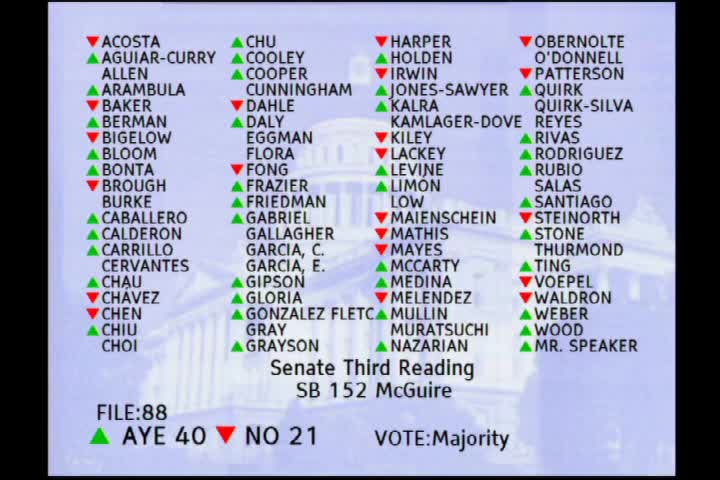 4MIN
Assembly Floor
 4MIN
Assembly Standing Committee on Appropriations
 28MIN
Assembly Standing Committee on Local Government
 1MIN
Assembly Floor
 1H
Assembly Standing Committee on Appropriations
 7MIN
Assembly Standing Committee on Appropriations
Bill Author

Bill Co-Author(s):
