SB 50: Federal public lands: conveyances.
- Session Year: 2017-2018
- House: Senate
- Latest Version Date: 2017-10-06
Existing law vests the authority over public lands owned by the state with the State Lands Commission. Existing federal law authorizes federal agencies to convey federal public lands under certain circumstances.
This bill would establish, except as provided, a policy of the state to discourage conveyances of federal public lands in California from the federal government. The bill would, except as provided, specify that these conveyances are void ab initio unless the commission was provided with the right of first refusal or the right to arrange for the transfer of the federal public land to another entity. The bill would require the commission to issue a certificate of compliance if the commission was provided with the right of first refusal or the right to arrange for the transfer of the federal public land to another entity. The bill would require the commission to waive the right of first refusal or the right to arrange for the transfer of the federal public land to another entity for conveyances the commission deems to be routine, as specified. The bill would require the commission, the Wildlife Conservation Board, and the Department of Fish and Wildlife to enter into a memorandum of understanding establishing a state policy that they will undertake all feasible efforts to protect against future unauthorized conveyances of federal public lands or any change in federal public land designation. The bill would authorize the commission to seek declaratory and injunctive relief in a court of competent jurisdiction to contest these conveyances. The bill would, except as provided, prohibit a person from knowingly presenting for recording or filing with the county recorder a deed, instrument, or other document related to the conveyance of federal public lands unless it is accompanied by a certificate of compliance and would subject a person who violates this prohibition to a civil penalty not to exceed $5,000. By increasing the duties of the county recorders office, this bill would impose a state-mandated local program. The bill would provide that the state shall not be responsible for any costs associated with conveyed federal public land that the commission did not accept, purchase, or arrange for the transfer of, as provided. The bill would require the commission to ensure, for any conveyed federal public land the commission accepts, purchases, or arranges for the transfer of, that future management of the conveyed federal public land is determined in a public process that gives consideration of past recognized and legal uses of those lands.
The California Constitution requires the state to reimburse local agencies and school districts for certain costs mandated by the state. Statutory provisions establish procedures for making that reimbursement.
This bill would provide that no reimbursement is required by this act for a specified reason.
Existing law vests the authority over public lands owned by the state with the State Lands Commission. Existing federal law authorizes federal agencies to convey federal public lands under certain circumstances.
This bill would establish, except as provided, a policy of the state to discourage conveyances of federal public lands in California from the federal government. The bill would, except as provided, specify that these conveyances are void ab initio unless the commission was provided with the right of first refusal or the right to arrange for the transfer of the federal public land to another entity. The bill would require the commission to issue a certificate of compliance if the commission was provided with the right of first refusal or the right to arrange for the transfer of the federal public land to another entity. The bill would require the commission to waive the right of first refusal or the right to arrange for the transfer of the federal public land to another entity for conveyances the commission deems to be routine, as specified. The bill would require the commission, the Wildlife Conservation Board, and the Department of Fish and Wildlife to enter into a memorandum of understanding establishing a state policy that they will undertake all feasible efforts to protect against future unauthorized conveyances of federal public lands or any change in federal public land designation. The bill would authorize the commission to seek declaratory and injunctive relief in a court of competent jurisdiction to contest these conveyances. The bill would, except as provided, prohibit a person from knowingly filing or recording presenting for recording or filing with the county recorder a deed, instrument, or other document related to the conveyance of federal public lands unless it is accompanied by a certificate of compliance and would subject a person who violates this prohibition to a civil penalty not to exceed $5,000. By increasing the duties of the county recorders office, this bill would impose a state-mandated local program. The bill would provide that the state shall not be responsible for any costs associated with conveyed federal public land that the commission did not accept, purchase, or arrange for the transfer of, as provided. The bill would require the commission to ensure, for any conveyed federal public land the commission accepts, purchases, or arranges for the transfer of, that future management of the conveyed federal public land is determined in a public process that gives consideration of past recognized and legal uses of those lands.
The California Constitution requires the state to reimburse local agencies and school districts for certain costs mandated by the state. Statutory provisions establish procedures for making that reimbursement.
This bill would provide that no reimbursement is required by this act for a specified reason.
Existing law vests the authority over public lands owned by the state with the State Lands Commission. Existing federal law authorizes federal agencies to convey federal public lands under certain circumstances.
This bill would establish, except as provided, a policy of the state to discourage conveyances of federal public lands in California from the federal government. The bill would, except as provided, specify that these conveyances are void ab initio unless the commission was provided with the right of first refusal or the right to arrange for the transfer of the federal public land to another entity. The bill would require the commission to issue a certificate of compliance if the commission was provided with the right of first refusal or the right to arrange for the transfer of the federal public land to another entity. The bill would require the commission to waive the right of first refusal or the right to arrange for the transfer of the federal public land to another entity for conveyances the commission deems to be routine. routine, as specified. The bill would require the commission, the Wildlife Conservation Board, and the Department of Fish and Wildlife to enter into a memorandum of understanding establishing a state policy that they will undertake all feasible efforts to protect against future unauthorized conveyances of federal public lands or any change in federal public land designation. The bill would authorize the commission to seek declaratory and injunctive relief in a court of competent jurisdiction to contest these conveyances. The bill would, except as provided, prohibit a person from knowingly filing or recording a deed, instrument, or other document related to the conveyance of federal public lands unless it is accompanied by a certificate of compliance and would subject a person who violates this prohibition to a civil penalty not to exceed $5,000. By increasing the duties of the county recorders office, this bill would impose a state-mandated local program. The bill would provide that the state shall not be responsible for any costs associated with conveyed federal public land that the commission did not accept, purchase, or arrange for the transfer of, as provided. The bill would require the commission to ensure, for any conveyed federal public land the commission accepts, purchases, or arranges for the transfer of, that future management of the conveyed federal public land is determined in a public process that gives consideration of past recognized and legal uses of those lands.
The California Constitution requires the state to reimburse local agencies and school districts for certain costs mandated by the state. Statutory provisions establish procedures for making that reimbursement.
This bill would provide that no reimbursement is required by this act for a specified reason.
Existing law vests the authority over public lands owned by the state with the State Lands Commission. Existing federal law authorizes federal agencies to convey federal public lands under certain circumstances.
This bill would establish, except as provided, a policy of the state to discourage conveyances of federal public lands in California from the federal government. The bill would, except as provided, specify that these conveyances are void ab initio unless the commission is was provided with the right of first refusal or the right to arrange for the transfer of the federal public land to a 3rd party. another entity. The bill would require the commission to issue a certificate of compliance if the commission was provided with the right of first refusal or the right to arrange for the transfer of the federal public land to a 3rd party. another entity. The bill would authorize require the commission to waive the right of first refusal or the right to arrange for the transfer of the federal public land to a 3rd party another entity for conveyances the commission deems to be routine. The bill would require the commission, the Wildlife Conservation Board, and the Department of Fish and Wildlife to enter into a memorandum of understanding establishing a state policy that they will undertake all feasible efforts to protect against future unauthorized conveyances of federal public lands or any change in federal public land designation. The bill would authorize the commission to seek declaratory and injunctive relief in a court of competent jurisdiction to contest these conveyances. The bill would, except as provided, prohibit a person from knowingly filing or recording a deed, instrument, or other document related to the conveyance of federal public lands unless it is accompanied by a certificate of compliance and would subject a person who violates this prohibition to a civil penalty not to exceed $5,000. By increasing the duties of the county recorders office, this bill would impose a state-mandated local program. The bill would require the commission to ensure that transferees of federal public lands in the state are solely responsible for all the costs associated with managing those lands as well as developing infrastructure necessary for all future uses of those lands. provide that the state shall not be responsible for any costs associated with conveyed federal public land that the commission did not accept, purchase, or arrange for the transfer of, as provided. The bill would require the commission to ensure, for any conveyed federal public land the commission accepts, purchases, or arranges for the transfer of, that future management of the conveyed federal public land is determined in a public process that gives consideration of past recognized and legal uses of those lands.
The California Constitution requires the state to reimburse local agencies and school districts for certain costs mandated by the state. Statutory provisions establish procedures for making that reimbursement.
This bill would provide that no reimbursement is required by this act for a specified reason.
Existing law vests the authority over public lands owned by the state with the State Lands Commission. Existing federal law authorizes federal agencies to convey federal public lands under certain circumstances.
This bill would establish, except as provided, a policy of the state to discourage conveyances of federal public lands in California from the federal government. The bill would would, except as provided, specify that these conveyances are void ab initio unless the commission is provided with the right of first refusal or the right to arrange the transfer to a 3rd party. The bill would require the commission to issue a certificate of compliance if the commission was provided with the right of first refusal or the right to arrange the transfer to a 3rd party. The bill would authorize the commission to waive the right of first refusal or the right to arrange the transfer to a 3rd party for conveyances the commission deems to be routine. The bill would require the commission, the Wildlife Conservation Board, and the Department of Fish and Wildlife to enter into a memorandum of understanding establishing a state policy that they will undertake all feasible efforts to protect against future unauthorized conveyances of federal public lands or any change in federal public land designation. The bill would authorize the commission to seek declaratory and injunctive relief in a court of competent jurisdiction to contest these conveyances. The bill would, except as provided, prohibit a person from knowingly filing or recording a deed, instrument, or other document related to the conveyance of federal public lands unless it is accompanied by a certificate of compliance and would subject a person who violates this prohibition to a civil penalty not to exceed $5,000. By increasing the duties of the county recorders office, this bill would impose a state-mandated local program. The bill would require the commission to ensure that transferees of federal public lands in the state are solely responsible for all the costs associated with managing those lands as well as developing infrastructure necessary for all future uses of those lands.
The California Constitution requires the state to reimburse local agencies and school districts for certain costs mandated by the state. Statutory provisions establish procedures for making that reimbursement.
This bill would provide that no reimbursement is required by this act for a specified reason.
Existing law vests the authority over public lands owned by the state with the State Lands Commission. Existing federal law authorizes federal agencies to convey federal public lands under certain circumstances.
This bill would establish, except as provided, a policy of the state to discourage conveyances of federal public lands in California from the federal government. The bill would specify that these conveyances are void ab initio unless the commission is provided with the right of first refusal or the right to arrange the transfer to a 3rd party. The bill would require the commission to issue a certificate of compliance if the commission was provided with the right of first refusal or the right to arrange the transfer to a 3rd party. The bill would require the commission, the Wildlife Conservation Board, and the Department of Fish and Wildlife to enter into a memorandum of understanding establishing a state policy that they will undertake all feasible efforts to protect against future unauthorized conveyances of federal public lands or any change in federal public land designation. The bill would authorize the commission to seek declaratory and injunctive relief in a court of competent jurisdiction to contest these conveyances. The bill would, except as provided, prohibit the commission and a recorder of a county in which the federal public land to be transferred is situated a person from recording knowingly filing or recording a deed, instrument, or other document related to the conveyance that is void ab initio of federal public lands unless it is accompanied by a certificate of compliance and would subject a person who violates this prohibition to a civil penalty not to exceed $5,000. By increasing the duties of the county recorders office, this bill would impose a state-mandated local program. The bill would prohibit a person from filing a deed, instrument, or other document related to the conveyance of federal public land that is void ab initio and would subject a person who violates this prohibition to a civil penalty not to exceed $5,000. The bill would require the commission to ensure that transferees of federal public lands in the state are solely responsible for all the costs associated with managing those lands as well as developing infrastructure necessary for all future uses of those lands.
The California Constitution requires the state to reimburse local agencies and school districts for certain costs mandated by the state. Statutory provisions establish procedures for making that reimbursement.
This bill would provide that no reimbursement is required by this act for a specified reason.
Existing law vests the authority over public lands owned by the state with the State Lands Commission. Existing federal law authorizes federal agencies to convey federal public lands under certain circumstances.
This bill would establish, except as provided, a policy of the state to discourage conveyances of federal public lands in California from the federal government. The bill would specify that these conveyances are void ab initio unless the commission is provided with the right of first refusal or the right to arrange the transfer to a 3rd party. The bill would require the commission, the Wildlife Conservation Board, and the Department of Fish and Wildlife to enter into a memorandum of understanding establishing a state policy that they will undertake all feasible efforts to protect against future unauthorized conveyances of federal public lands or any change in federal public land designation. The bill would authorize the commission to seek declaratory and injunctive relief in a court of competent jurisdiction to contest these conveyances. The bill would, except as provided, prohibit the commission and a recorder of a county in which the federal public land to be transferred is situated from recording a deed, instrument, or other document related to the conveyance that is void ab initio and would subject a person who violates this prohibition to a civil penalty not to exceed $5,000. By increasing the duties of the county recorders office, this bill would impose a state-mandated local program. The bill would prohibit a person from filing a deed, instrument, or other document related to the conveyance of federal public land that is void ab initio and would subject a person who violates this prohibition to a civil penalty not to exceed $5,000. The bill would require the commission to ensure that transferees of federal public lands in the state are solely responsible for all the costs associated with managing those lands as well as developing infrastructure necessary for all future uses of those lands.
The California Constitution requires the state to reimburse local agencies and school districts for certain costs mandated by the state. Statutory provisions establish procedures for making that reimbursement.
This bill would provide that no reimbursement is required by this act for a specified reason.
This bill would express the intent of the Legislature to enact statutory changes relating to the Budget Act of 2016.This bill would express the intent of the Legislature to enact statutory changes relating to the Budget Act of 2016.
(a)A person shall not knowingly present for recording or filing with a county recorder a deed, instrument, or other document related to a conveyance subject to Section 8560 of the Public Resources Code unless it is accompanied by a certificate of compliance from the State Lands Commission. A person who presents for recording or filing with a county recorder a deed, instrument, or other document in violation of this section is liable for a civil penalty not to exceed five thousand dollars ($5,000).
(b)Civil penalties collected pursuant to this section shall be deposited into the state General Fund.
SEC. 3.Section 27338 is added to the Government Code, to read:27338.A deed, instrument, or other document related to a conveyance that is subject to Section 8560 of the Public Resources Code shall be titled Federal Public Land Deed of Conveyance and shall not be recorded without a certificate from the State Lands Commission. The federal agency wishing to convey federal public lands shall ensure that the deed, instrument, or other conveyance document is titled in the manner required by this section.
SEC. 4.Chapter 5 (commencing with Section 8560) is added to Part 4 of Division 6 of the Public Resources Code, to read:5.Conveyance of Federal Lands8560.(a)For purposes of this chapter, the following terms apply:
(1)Conservation plan means a habitat conservation plan developed pursuant to Section 10 of the federal Endangered Species Act of 1973 (16 U.S.C. Sec. 1539) and its implementing regulations, as the federal act and regulations exist as of January 1, 2016, and an approved natural communities conservation plan developed pursuant to the Natural Community Conservation Planning Act (Chapter 10 (commencing with Section 2800) of Division 3 of the Fish and Game Code).
(2)Conveyance includes any method, including sale, donation, or exchange, by which all or a portion of the right, title, and interest of the United States in and to federal lands located in California is transferred to another entity.
(3)Federal public land means any land owned by the United States, including the surface estate, the subsurface estate, or any improvements on those estates.
(4)Infrastructure means any development or construction that is not on or appurtenant to the federal public land at the time of transfer.
(b)(1)Except as provided in Chapter 6 (commencing with Section 6441) of Part 1, it is the policy of the State of California to discourage conveyances that transfer ownership of federal public lands in California from the federal government.
(2)(A)Except as provided in this chapter, conveyances of federal public lands in California are void ab initio unless the commission was provided with the right of first refusal to the conveyance or the right to arrange for the transfer of the federal public land to another entity.
(B)The commission may seek declaratory and injunctive relief from a court of competent jurisdiction to contest conveyances made to any entity unless the requirements of this paragraph are met.
(C)The commission shall formally consider its right of first refusal or arrange for the transfer of federal public lands to a third party at a public hearing.
(D)(i)Prior to the conveyance of federal public lands in California, if the commission was provided with the right of first refusal or the right to arrange for the transfer of the federal public lands to another entity, the commission shall issue a certificate affirming compliance with this section.
(ii)The commission shall waive its right of first refusal or the right to arrange for the transfer of the federal public lands to another entity, and issue a certification of compliance affirming compliance with this section for a conveyance that is deemed by the commission to be routine. A conveyance deemed by the commission to be routine includes, but is not limited to, the exchange of lands of equal value between the federal government and a private entity. The commission may adopt regulations to establish a process and criteria for determining the types of conveyances it considers to be routine.
(E)The commission, the Wildlife Conservation Board, and the Department of Fish and Wildlife shall enter into a memorandum of understanding that establishes a state policy that all three agencies shall undertake all feasible efforts to protect against any future unauthorized conveyance or any change in federal public land designation, including, but not limited to, any change in use, classification, or legal status of any lands designated as federal monuments pursuant to the federal Antiquities Act of 1906 (Public Law 59-209).
(c)The state shall not be responsible for any costs associated with conveyed federal public land that the commission did not accept, purchase, or arrange for the transfer of, pursuant to this section. Costs include, but are not limited to, management costs and infrastructure development costs.
(d)The commission may establish, through regulations or another appropriate method, a process for engaging with federal land managers and potential purchasers of federal public lands early in the conveyance process.
(e)The commission shall ensure, for any conveyed federal public land the commission accepts, purchases, or arranges for the transfer of, that future management of the conveyed federal public land is determined in a public process that gives consideration of past recognized and legal uses of those lands. At a minimum, the public process required by this subdivision shall include a noticed and open meeting as required by the Bagley-Keene Open Meeting Act (Article 9 (commencing with Section 11120) of Division 3 of Title 2 of the Government Code).
(f)The commission shall waive its right of first refusal or the right to arrange for the transfer of the federal public lands to another entity, and issue a certification of compliance affirming compliance with this section for any of the following:
(1)The conveyance of federal public lands pursuant to a conservation plan.
(2)The renewal of a lease in existence as of January 1, 2017.
(3)The conveyance of federal public lands to a federally recognized Native American tribe or lands taken into or out of trust for a Native American tribe or individual Native American.
(g)The provisions of this section are severable. If any provision of this section or its application is held invalid, that invalidity shall not affect other provisions or applications that can be given effect without the invalid provision or application.
8561.This chapter does not apply to the sale of real property acquired by a federal agency through a foreclosure proceeding.
SEC. 5.No reimbursement is required by this act pursuant to Section 6 of Article XIIIB of the California Constitution because a local agency or school district has the authority to levy service charges, fees, or assessments sufficient to pay for the program or level of service mandated by this act, within the meaning of Section 17556 of the Government Code.
(a)A person shall not knowingly file or record present for recording or filing with a county recorder a deed, instrument, or other document related to a conveyance subject to Section 8560 of the Public Resources Code unless it is accompanied by a certificate of compliance from the State Lands Commission. A person who files or records presents for recording or filing with a county recorder a deed, instrument, or other document in violation of this section is liable for a civil penalty not to exceed five thousand dollars ($5,000).
(b)Civil penalties collected pursuant to this section shall be deposited into the state General Fund.
SEC. 3.Section 27338 is added to the Government Code, to read:27338.A deed, instrument, or other document related to a conveyance that is subject to Section 8560 of the Public Resources Code shall be titled Federal Public Land Deed of Conveyance and shall not be recorded without a certificate from the State Lands Commission. The federal agency wishing to convey federal public lands shall ensure that the deed, instrument, or other conveyance document is titled in the manner required by this section.
SEC. 4.Chapter 5 (commencing with Section 8560) is added to Part 4 of Division 6 of the Public Resources Code, to read:5.Conveyance of Federal Lands8560.(a)For purposes of this chapter, the following terms apply:
(1)Conservation plan means a habitat conservation plan developed pursuant to Section 10 of the federal Endangered Species Act of 1973 (16 U.S.C. Sec. 1539) and its implementing regulations, as the federal act and regulations exist as of January 1, 2016, and an approved natural communities conservation plan developed pursuant to the Natural Community Conservation Planning Act (Chapter 10 (commencing with Section 2800) of Division 3 of the Fish and Game Code).
(2)Conveyance includes any method, including sale, donation, or exchange, by which all or a portion of the right, title, and interest of the United States in and to federal lands located in California is transferred to another entity.
(3)Federal public land means any land owned by the United States, including the surface estate, the subsurface estate, or any improvements on those estates.
(4)Infrastructure means any development or construction that is not on or appurtenant to the federal public land at the time of transfer.
(b)(1)Except as provided in Chapter 6 (commencing with Section 6441) of Part 1, it is the policy of the State of California to discourage conveyances that transfer ownership of federal public lands in California from the federal government.
(2)(A)Except as provided in this chapter, conveyances of federal public lands in California are void ab initio unless the commission was provided with the right of first refusal to the conveyance or the right to arrange for the transfer of the federal public land to another entity.
(B)The commission may seek declaratory and injunctive relief from a court of competent jurisdiction to contest conveyances made to any entity unless the requirements of this paragraph are met.
(C)The commission shall formally consider its right of first refusal or arrange for the transfer of federal public lands to a third party at a public hearing.
(D)(i)Prior to the conveyance of federal public lands in California, if the commission was provided with the right of first refusal or the right to arrange for the transfer of the federal public lands to another entity, the commission shall issue a certificate affirming compliance with this section.
(ii)The commission shall waive its right of first refusal or the right to arrange for the transfer of the federal public lands to another entity, and issue a certification of compliance affirming compliance with this section for a conveyance that is deemed by the commission to be routine. A conveyance deemed by the commission to be routine includes, but is not limited to, the exchange of lands of equal value between the federal government and a private entity or the sale of residential property acquired by a federal agency through a foreclosure proceeding. entity. The commission may adopt regulations to establish a process and criteria for determining the types of conveyances it considers to be routine.
(E)The commission, the Wildlife Conservation Board, and the Department of Fish and Wildlife shall enter into a memorandum of understanding that establishes a state policy that all three agencies shall undertake all feasible efforts to protect against any future unauthorized conveyance or any change in federal public land designation, including, but not limited to, any change in use, classification, or legal status of any lands designated as federal monuments pursuant to the federal Antiquities Act of 1906 (Public Law 59-209).
(c)The state shall not be responsible for any costs associated with conveyed federal public land that the commission did not accept, purchase, or arrange for the transfer of, pursuant to this section. Costs include, but are not limited to, management costs and infrastructure development costs.
(d)The commission may establish, through regulations or another appropriate method, a process for engaging with federal land managers and potential purchasers of federal public lands early in the conveyance process.
(e)The commission shall ensure, for any conveyed federal public land the commission accepts, purchases, or arranges for the transfer of, that future management of the conveyed federal public land is determined in a public process that gives consideration of past recognized and legal uses of those lands. At a minimum, the public process required by this subdivision shall include a noticed and open meeting as required by the Bagley-Keene Open Meeting Act (Article 9 (commencing with Section 11120) of Division 3 of Title 2 of the Government Code).
(f)The commission shall waive its right of first refusal or the right to arrange for the transfer of the federal public lands to another entity, and issue a certification of compliance affirming compliance with this section for any of the following:
(1)The conveyance of federal public lands pursuant to a conservation plan.
(2)The renewal of a lease in existence as of January 1, 2017.
(3)The conveyance of federal public lands to a federally recognized Native American tribe or lands taken into or out of trust for a Native American tribe or individual Native American.
(g)The provisions of this section are severable. If any provision of this section or its application is held invalid, that invalidity shall not affect other provisions or applications that can be given effect without the invalid provision or application.
8561.This chapter does not apply to the sale of real property acquired by a federal agency through a foreclosure proceeding.
SEC. 5.No reimbursement is required by this act pursuant to Section 6 of Article XIIIB of the California Constitution because a local agency or school district has the authority to levy service charges, fees, or assessments sufficient to pay for the program or level of service mandated by this act, within the meaning of Section 17556 of the Government Code.
(a)A person shall not knowingly file or record a deed, instrument, or other document related to a conveyance subject to Section 8560 of the Public Resources Code unless it is accompanied by a certificate of compliance from the State Lands Commission. A person who files or records a deed, instrument, or other document in violation of this section is liable for a civil penalty not to exceed five thousand dollars ($5,000).
(b)Civil penalties collected pursuant to this section shall be deposited into the state General Fund.
SEC. 3.Section 27338 is added to the Government Code, to read:27338.A deed, instrument, or other document related to a conveyance that is subject to Section 8560 of the Public Resources Code shall be titled Federal Public Land Deed of Conveyance and shall not be recorded without a certificate from the State Lands Commission. The federal agency wishing to convey federal public lands shall ensure that the deed, instrument, or other conveyance document is titled in the manner required by this section.
SEC. 4.Chapter 5 (commencing with Section 8560) is added to Part 4 of Division 6 of the Public Resources Code, to read:5.Conveyance of Federal Lands8560.(a)For purposes of this chapter, the following terms apply:
(1)Conservation plan means a habitat conservation plan developed pursuant to Section 10 of the federal Endangered Species Act of 1973 (16 U.S.C. Sec. 1539) and its implementing regulations, as the federal act and regulations exist as of January 1, 2016, and an approved natural communities conservation plan developed pursuant to the Natural Community Conservation Planning Act (Chapter 10 (commencing with Section 2800) of Division 3 of the Fish and Game Code).
(2)Conveyance includes any method, including sale, donation, or exchange, by which all or a portion of the right, title, and interest of the United States in and to federal lands located in California is transferred to another entity.
(3)Federal public land means any land owned by the United States, including the surface estate, the subsurface estate, or any improvements on those estates.
(4)Infrastructure means any development or construction that is not on or appurtenant to the federal public land at the time of transfer.
(b)(1)Except as provided in Chapter 6 (commencing with Section 6441) of Part 1, it is the policy of the State of California to discourage conveyances that transfer ownership of federal public lands in California from the federal government.
(2)(A)Except as provided in this chapter, conveyances of federal public lands in California are void ab initio unless the commission was provided with the right of first refusal to the conveyance or the right to arrange for the transfer of the federal public land to another entity.
(B)The commission may seek declaratory and injunctive relief from a court of competent jurisdiction to contest conveyances made to any entity unless the requirements of this paragraph are met.
(C)The commission shall formally consider its right of first refusal or arrange for the transfer of federal public lands to a third party at a public hearing.
(D)(i)Prior to the conveyance of federal public lands in California, if the commission was provided with the right of first refusal or the right to arrange for the transfer of the federal public lands to another entity, the commission shall issue a certificate affirming compliance with this section.
(ii)The commission shall waive its right of first refusal or the right to arrange for the transfer of the federal public lands to another entity, and issue a certification of compliance affirming compliance with this section for a conveyance that is deemed by the commission to be routine. A conveyance deemed by the commission to be routine includes, but is not limited to, the exchange of lands of equal value between the federal government and a private entity. entity or the sale of residential property acquired by a federal agency through a foreclosure proceeding. The commission may adopt regulations to establish a process and criteria for determining the types of conveyances it considers to be routine.
(E)The commission, the Wildlife Conservation Board, and the Department of Fish and Wildlife shall enter into a memorandum of understanding that establishes a state policy that all three agencies shall undertake all feasible efforts to protect against any future unauthorized conveyance or any change in federal public land designation, including, but not limited to, any change in use, classification, or legal status of any lands designated as federal monuments pursuant to the federal Antiquities Act of 1906 (Public Law 59-209).
(c)The state shall not be responsible for any costs associated with conveyed federal public land that the commission did not accept, purchase, or arrange for the transfer of, pursuant to this section. Costs include, but are not limited to, management costs and infrastructure development costs.
(d)The commission may establish, through regulations or another appropriate method, a process for engaging with federal land managers and potential purchasers of federal public lands early in the conveyance process.
(e)The commission shall ensure, for any conveyed federal public land the commission accepts, purchases, or arranges for the transfer of, that future management of the conveyed federal public land is determined in a public process that gives consideration of past recognized and legal uses of those lands. At a minimum, the public process required by this subdivision shall include a noticed and open meeting as required by the Bagley-Keene Open Meeting Act (Article 9 (commencing with Section 11120) of Division 3 of Title 2 of the Government Code).
(f)The commission shall waive its right of first refusal or the right to arrange for the transfer of the federal public lands to another entity, and issue a certification of compliance affirming compliance with this section for any of the following:
(1)The conveyance of federal public lands pursuant to a conservation plan.
(2)The renewal of a lease in existence as of January 1, 2017.
(3)The conveyance of federal public lands to a federally recognized Native American tribe or lands taken into or out of trust for a Native American tribe or individual Native American.
(g)The provisions of this section are severable. If any provision of this section or its application is held invalid, that invalidity shall not affect other provisions or applications that can be given effect without the invalid provision or application.
SEC. 5.No reimbursement is required by this act pursuant to Section 6 of Article XIIIB of the California Constitution because a local agency or school district has the authority to levy service charges, fees, or assessments sufficient to pay for the program or level of service mandated by this act, within the meaning of Section 17556 of the Government Code.
(a)A person shall not knowingly file or record a deed, instrument, or other document related to a conveyance subject to Section 8560 of the Public Resources Code unless it is accompanied by a certificate of compliance from the State Lands Commission. A person who files or records a deed, instrument, or other document in violation of this section is liable for a civil penalty not to exceed five thousand dollars ($5,000).
(b)Civil penalties collected pursuant to this section shall be deposited into the state General Fund.
SEC. 3.Section 27338 is added to the Government Code, to read:27338.A deed, instrument, or other document related to a conveyance that is subject to Section 8560 of the Public Resources Code shall be titled Federal Public Land Deed of Conveyance and shall not be recorded without a certificate from the State Lands Commission.
SEC. 4.Chapter 5 (commencing with Section 8560) is added to Part 4 of Division 6 of the Public Resources Code, to read:5.Conveyance of Federal Lands8560.(a)For purposes of this chapter, the following terms apply:
(1)Conservation plan means a habitat conservation plan developed pursuant to Section 10 of the federal Endangered Species Act of 1973 (16 U.S.C. Sec. 1539) and its implementing regulations, as the federal act and regulations exist as of January 1, 2016, and an approved natural communities conservation plan developed pursuant to the Natural Community Conservation Planning Act (Chapter 10 (commencing with Section 2800) of Division 3 of the Fish and Game Code).
(2)Conveyance includes any method, including sale, donation, or exchange, by which all or a portion of the right, title, and interest of the United States in and to federal lands located in California is transferred to another entity.
(3)Federal public land means any land owned by the United States, including the surface estate, the subsurface estate, or any improvements on those estates.
(4)Infrastructure means any development or construction that is not on or appurtenant to the federal public land at the time of transfer.
(b)(1)Except as provided in Chapter 6 (commencing with Section 6441) of Part 1, it is the policy of the State of California to discourage conveyances that transfer ownership of federal public lands in California from the federal government.
(2)(A)Except as provided in this chapter, conveyances of federal public lands in California are void ab initio unless the commission was provided with the right of first refusal to the conveyance or the right to arrange for the transfer of the property federal public land to another entity.
(B)The commission may seek declaratory and injunctive relief from a court of competent jurisdiction to contest conveyances made to any entity unless the requirements of this paragraph are met.
(C)The commission shall formally consider its right of first refusal or arrange for the transfer of federal public lands to a third party at a public hearing.
(D)(i)Prior to the conveyance of federal public lands in California, if the commission was provided with the right of first refusal or the right to arrange for the transfer of the federal public lands to another entity, the commission shall issue a certificate affirming compliance with this section.
(ii)The commission may shall waive its right of first refusal or the right to arrange for the transfer of the federal public lands to another entity, and issue a certification of compliance affirming compliance with this section for a conveyance that is deemed by the commission to be routine. A conveyance deemed by the commission to be routine includes, but is not limited to, the exchange of lands of equal value between the federal government and a private entity. The commission may adopt regulations to establish a process and criteria for determining the types of conveyances it considers to be routine.
(E)The commission, the Wildlife Conservation Board, and the Department of Fish and Wildlife shall enter into a memorandum of understanding that establishes a state policy that all three agencies shall undertake all feasible efforts to protect against any future unauthorized conveyance or any change in federal public land designation, including, but not limited to, any change in use, classification, or legal status of any lands designated as federal monuments pursuant to the federal Antiquities Act of 1906 (Public Law 59-209).
(c)The commission shall ensure that the transferee of the federal public land pursuant to a conveyance is solely responsible for all costs associated with the management of those lands as well as the cost in developing any infrastructure necessary for all future uses of the lands.(c)The state shall not be responsible for any costs associated with conveyed federal public land that the commission did not accept, purchase, or arrange for the transfer of, pursuant to this section. Costs include, but are not limited to, management costs and infrastructure development costs.
(d)The commission may establish, through regulations or another appropriate method, a process for engaging with federal land managers and potential purchasers of federal public lands early in the conveyance process.
(e)This section does not apply to any of the following:(e)The commission shall ensure, for any conveyed federal public land the commission accepts, purchases, or arranges for the transfer of, that future management of the conveyed federal public land is determined in a public process that gives consideration of past recognized and legal uses of those lands.
(f)The commission shall waive its right of first refusal or the right to arrange for the transfer of the federal public lands to another entity, and issue a certification of compliance affirming compliance with this section for any of the following:
(1)The conveyance of federal public lands pursuant to a conservation plan.
(2)The renewal of a lease in existence as of January 1, 2017.
(3)The conveyance of federal public lands to a federally recognized Native American tribe or lands taken into or out of trust for a Native American tribe or individual Native American.
(f)(g)The provisions of this section are severable. If any provision of this section or its application is held invalid, that invalidity shall not affect other provisions or applications that can be given effect without the invalid provision or application.
SEC. 5.No reimbursement is required by this act pursuant to Section 6 of Article XIIIB of the California Constitution because a local agency or school district has the authority to levy service charges, fees, or assessments sufficient to pay for the program or level of service mandated by this act, within the meaning of Section 17556 of the Government Code.
(a)A person shall not knowingly file or record a deed, instrument, or other document related to a conveyance subject to Section 8560 of the Public Resources Code unless it is accompanied by a certificate of compliance from the State Lands Commission. A person who files or records a deed, instrument, or other document in violation of this section is liable for a civil penalty not to exceed five thousand dollars ($5,000).
(b)Civil penalties collected pursuant to this section shall be deposited into the state General Fund.
SEC. 3.Section 27338 is added to the Government Code, to read:27338.A deed, instrument, or other document related to a conveyance that is subject to Section 8560 of the Public Resources Code shall be titled Federal Public Land Deed of Conveyance and shall not be recorded without a certificate from the State Lands Commission.
SEC. 4.Chapter 5 (commencing with Section 8560) is added to Part 4 of Division 6 of the Public Resources Code, to read:5.Conveyance of Federal Lands8560.(a)For purposes of this chapter, the following terms apply:
(1)Conservation plan means a habitat conservation plan developed pursuant to Section 10 of the federal Endangered Species Act of 1973 (16 U.S.C. Sec. 1539) and its implementing regulations, as the federal act and regulations exist as of January 1, 2016, and an approved natural communities conservation plan developed pursuant to the Natural Community Conservation Planning Act (Chapter 10 (commencing with Section 2800) of Division 3 of the Fish and Game Code).
(2)Conveyance includes any method, including sale, donation, or exchange, by which all or a portion of the right, title, and interest of the United States in and to federal lands located in California is transferred to another entity.
(3)Federal public land means any land owned by the United States, including the surface estate, the subsurface estate, or any improvements on those estates.
(4)Infrastructure means any development or construction that is not on or appurtenant to the federal public land at the time of transfer.
(b)(1)Except as provided in Chapter 6 (commencing with Section 6441) of Part 1, it is the policy of the State of California to discourage conveyances that transfer ownership of federal public lands in California from the federal government.
(2)(A)Except as provided in this chapter, conveyances of federal public lands in California are void ab initio unless the commission was provided with the right of first refusal to the conveyance or the right to arrange for the transfer of the property to another entity.
(B)The commission may seek declaratory and injunctive relief from a court of competent jurisdiction to contest conveyances made to any entity unless the requirements of this paragraph are met.
(C)The commission shall formally consider its right of first refusal or arrange for the transfer of federal lands to a third party at a public hearing.
(D)(i)Prior to the conveyance of federal public lands in California, if the commission was provided with the right of first refusal or the right to arrange for the transfer of the federal public lands to another entity, the commission shall issue a certificate affirming compliance with this section.
(ii)The commission may waive its right of first refusal or the right to arrange for the transfer of the federal public lands to another entity, and issue a certification of compliance affirming compliance with this section for a conveyance that is deemed by the commission to be routine. A conveyance deemed by the commission to be routine includes, but is not limited to, the exchange of lands of equal value between the federal government and a private entity. The commission may adopt regulations to establish a process and criteria for determining the types of conveyances it considers to be routine.
(E)The commission, the Wildlife Conservation Board, and the Department of Fish and Wildlife shall enter into a memorandum of understanding that establishes a state policy that all three agencies shall undertake all feasible efforts to protect against any future unauthorized conveyance or any change in federal public land designation, including, but not limited to, any change in use, classification, or legal status of any lands designated as federal monuments pursuant to the federal Antiquities Act of 1906 (Public Law 59-209).
(c)The commission shall ensure that the transferee of the federal public land pursuant to a conveyance is solely responsible for all costs associated with the management of those lands as well as the cost in developing any infrastructure necessary for all future uses of the lands.
(d)The commission may establish, through regulations or another appropriate method, a process for engaging with federal land managers and potential purchasers of federal public lands early in the conveyance process.
(d)(e)This section does not apply to the any of the following:
(1)The conveyance of federal public lands pursuant to a conservation plan.
(2)The renewal of a lease in existence as of January 1, 2017.
(3)The conveyance of federal public lands to a federally recognized Native American tribe or lands taken into or out of trust for a Native American tribe or individual Native American.
(e)(f)The provisions of this section are severable. If any provision of this section or its application is held invalid, that invalidity shall not affect other provisions or applications that can be given effect without the invalid provision or application.
SEC. 5.No reimbursement is required by this act pursuant to Section 6 of Article XIIIB of the California Constitution because a local agency or school district has the authority to levy service charges, fees, or assessments sufficient to pay for the program or level of service mandated by this act, within the meaning of Section 17556 of the Government Code.
(a)A person shall not knowingly file or record a deed, instrument, or other document related to a conveyance that is void ab initio pursuant subject to Section 8560 of the Public Resources Code. Code unless it is accompanied by a certificate of compliance from the State Lands Commission. A person who files or records a deed, instrument, or other document in violation of this section is liable for a civil penalty not to exceed five thousand dollars ($5,000).
(b)Civil penalties collected pursuant to this section shall be deposited into the state General Fund.
SEC. 3.Section 27338 is added to the Government Code, to read:27338.A deed, instrument, or other document related to a conveyance that is subject to Section 8560 of the Public Resources Code shall be titled Federal Public Land Deed of Conveyance and shall not be recorded without a certificate from the State Lands Commission.
SEC. 4.Chapter 5 (commencing with Section 8560) is added to Part 4 of Division 6 of the Public Resources Code, to read:5.Conveyance of Federal Lands8560.(a)For purposes of this chapter, the following terms apply:
(1)Conservation plan means a habitat conservation plan developed pursuant to Section 10 of the federal Endangered Species Act of 1973 (16 U.S.C. Sec. 1539) and its implementing regulations, as the federal act and regulations exist as of January 1, 2016, and an approved natural communities conservation plan developed pursuant to the Natural Community Conservation Planning Act (Chapter 10 (commencing with Section 2800) of Division 3 of the Fish and Game Code).
(2)Conveyance includes any method, including sale, donation, or exchange, by which all or a portion of the right, title, and interest of the United States in and to federal lands located in California is transferred to another entity.
(3)Federal public land means any land owned by the United States, including the surface estate, the subsurface estate, or any improvements on those estates.
(4)Infrastructure means any development or construction that is not on or appurtenant to the federal public land at the time of transfer.
(b)(1)Except as provided in Chapter 6 (commencing with Section 6441) of Part 1, it is the policy of the State of California to discourage conveyances that transfer ownership of federal public lands in California from the federal government.
(2)(A)Except as provided in this chapter, conveyances of federal public lands in California are void ab initio unless the commission was provided with the right of first refusal to the conveyance or the right to arrange for the transfer of property to another entity. The
(B)The commission may seek declaratory and injunctive relief from a court of competent jurisdiction to contest conveyances made to any entity unless the requirements of this paragraph are met. The
(C)The commission shall formally consider its right of first refusal or arrange for the transfer of federal lands to a third party at a public hearing.
(D)Prior to the conveyance of federal public lands in California, if the commission was provided with the right of first refusal or the right to arrange for the transfer of the federal public lands to another entity, the commission shall issue a certificate affirming compliance with this section.
(B)(E)The commission, the Wildlife Conservation Board, and the Department of Fish and Wildlife shall enter into a memorandum of understanding that establishes a state policy that all three agencies shall undertake all feasible efforts to protect against any future unauthorized conveyance or any change in federal public land designation, including, but not limited to, any change in use, classification, or legal status of any lands designated as federal monuments pursuant to the federal Antiquities Act of 1906 (Pub. (Public Law 59-209).
(C)Notwithstanding Section 6206, the commission and the recorder of the county in which the federal public land to be transferred is situated shall not record any deed executed pursuant to, or related to, the conveyance unless the commission certifies that the conveyance meets the requirements of subparagraph (A).(c)The commission shall ensure that the transferee of the federal public land pursuant to a conveyance is solely responsible for all costs associated with the management of those lands as well as the cost in developing any infrastructure necessary for all future uses of the lands.
(d)This section does not apply to the conveyance of federal lands pursuant to a conservation plan.
(e)The provisions of this section are severable. If any provision of this section or its application is held invalid, that invalidity shall not affect other provisions or applications that can be given effect without the invalid provision or application.
SEC. 5.No reimbursement is required by this act pursuant to Section 6 of Article XIIIB of the California Constitution because a local agency or school district has the authority to levy service charges, fees, or assessments sufficient to pay for the program or level of service mandated by this act, within the meaning of Section 17556 of the Government Code.
(a)A person shall not knowingly file or record a deed, instrument, or other document related to a conveyance that is void ab initio pursuant to Section 8560 of the Public Resources Code. A person who files or records a deed, instrument, or other document in violation of this section is liable for a civil penalty not to exceed five thousand dollars ($5,000).
(b)Civil penalties collected pursuant to this section shall be deposited into the state General Fund.
SEC. 3.Section 27338 is added to the Government Code, to read:27338.A deed, instrument, or other document related to a conveyance that is subject to Section 8560 of the Public Resources Code shall not be recorded without a certificate from the State Lands Commission.
SEC. 4.Chapter 5 (commencing with Section 8560) is added to Part 4 of Division 6 of the Public Resources Code, to read:5.Conveyance of Federal Lands8560.(a)For purposes of this chapter, the following terms apply:
(1)Conservation plan means a habitat conservation plan developed pursuant to Section 10 of the federal Endangered Species Act of 1973 (16 U.S.C. Sec. 1539) and its implementing regulations, as the federal act and regulations exist as of January 1, 2016, and an approved natural communities conservation plan developed pursuant to the Natural Community Conservation Planning Act (Chapter 10 (commencing with Section 2800) of Division 3 of the Fish and Game Code).
(1)(2)Conveyance includes any method, including sale, donation, or exchange, by which all or a portion of the right, title, and interest of the United States in and to federal lands located in California is transferred to another entity.
(2)(3)Federal public land means any land owned by the United States, including the surface estate, the subsurface estate, or any improvements on those estates.
(3)(4)Infrastructure means any development or construction that is not on or appurtenant to the federal public land at the time of transfer.
(b)(1)Except as provided in Chapter 6 (commencing with Section 6441) of Part 1, it is the policy of the State of California to discourage conveyances that transfer ownership of federal public lands in California from the federal government.
(2)(A)Except as provided in this chapter, conveyances of federal public lands in California are void ab initio unless the commission was provided with the right of first refusal to the conveyance or the right to arrange for the transfer of property to another entity. The commission may seek declaratory and injunctive relief from a court of competent jurisdiction to contest conveyances made to any entity unless the requirements of this paragraph are met. The commission shall formally consider its right of first refusal or arrange for the transfer of federal lands to a third party at a public hearing.
(B)The commission, the Wildlife Conservation Board, and the Department of Fish and Wildlife shall enter into a memorandum of understanding that establishes a state policy that all three agencies shall undertake all feasible efforts to protect against any future unauthorized conveyance or any change in federal public land designation, including, but not limited to, any change in use, classification, or legal status of any lands designated as federal monuments pursuant to the federal Antiquities Act of 1906 (Pub. Law 59-209).
(C)Notwithstanding Section 6206, the commission and the recorder of the county in which the federal public land to be transferred is situated shall not record any deed executed pursuant to, or related to, the conveyance unless the commission certifies that the conveyance meets the requirements of subparagraph (A).
(c)The commission shall ensure that the transferee of the federal public land pursuant to a conveyance is solely responsible for all costs associated with the management of those lands as well as the cost in developing any infrastructure necessary for all future uses of the lands.
(d)This section does not apply to the conveyance of federal lands pursuant to a conservation plan.
SEC. 5.No reimbursement is required by this act pursuant to Section 6 of Article XIIIB of the California Constitution because a local agency or school district has the authority to levy service charges, fees, or assessments sufficient to pay for the program or level of service mandated by this act, within the meaning of Section 17556 of the Government Code.
(a)A person shall not knowingly file or record a deed, instrument, or other document related to a conveyance that is void ab initio pursuant to Section 8560 of the Public Resources Code. A person who files or records a deed, instrument, or other document in violation of this section is liable for a civil penalty not to exceed five thousand dollars ($5,000).
(b)Civil penalties collected pursuant to this section shall be deposited into the state General Fund.
SEC. 3.Section 27338 is added to the Government Code, to read:27338.A deed, instrument, or other document related to a conveyance that is subject to Section 8560 of the Public Resources Code shall not be recorded without a certificate from the State Lands Commission.
SEC. 4.Chapter 5 (commencing with Section 8560) is added to Part 4 of Division 6 of the Public Resources Code, to read:5.Conveyance of Federal Lands8560.(a)For purposes of this chapter, the following terms apply:
(1)Conveyance includes any method, including sale, donation, or exchange, by which all or a portion of the right, title, and interest of the United States in and to federal lands located in California is transferred to another entity.
(2)Federal public land means any land owned by the United States, including the surface estate, the subsurface estate, or any improvements on those estates.
(3)Infrastructure means any development or construction that is not on or appurtenant to the federal public land at the time of transfer.
(b)(1)Except as provided in Chapter 6 (commencing with Section 6441) of Part 1, it is the policy of the State of California to discourage conveyances that transfer ownership of federal public lands in California from the federal government.
(2)(A)Except as provided in this chapter, conveyances of federal public lands in California are void ab initio unless the commission was provided with the right of first refusal to the conveyance or the right to arrange for the transfer of property to another entity. The commission may seek declaratory and injunctive relief from a court of competent jurisdiction to contest conveyances made to any entity unless the requirements of this paragraph are met. The commission shall formally consider its right of first refusal or arrange for the transfer of federal lands to a third party at a public hearing.
(B)The commission, the Wildlife Conservation Board, and the Department of Fish and Wildlife shall enter into a memorandum of understanding that establishes a state policy that all three agencies shall undertake all feasible efforts to protect against any future unauthorized conveyance or any change in federal public land designation, including, but not limited to, any change in use, classification, or legal status of any lands designated as federal monuments pursuant to the federal Antiquities Act of 1906 (Pub. Law 59-209).
(C)Notwithstanding Section 6206, the commission and the recorder of the county in which the federal public land to be transferred is situated shall not record any deed executed pursuant to, or related to, the conveyance unless the commission certifies that the conveyance meets the requirements of subparagraph (A).
(c)The commission shall ensure that the transferee of the federal public land pursuant to a conveyance is solely responsible for all costs associated with the management of those lands as well as the cost in developing any infrastructure necessary for all future uses of the lands.
SEC. 5.No reimbursement is required by this act pursuant to Section 6 of Article XIIIB of the California Constitution because a local agency or school district has the authority to levy service charges, fees, or assessments sufficient to pay for the program or level of service mandated by this act, within the meaning of Section 17556 of the Government Code.
SECTION 1.It is the intent of the Legislature to enact statutory changes relating to the Budget Act of 2016.It is the intent of the Legislature to enact statutory changes relating to the Budget Act of 2016.
|
Date
|
Status
|
|---|---|
| Oct 6, 2017 | Chaptered by Secretary of State. Chapter 535, Statutes of 2017. |
| Oct 6, 2017 | Approved by the Governor. |
| Sep 20, 2017 | Enrolled and presented to the Governor at 4 p.m. |
| Sep 14, 2017 | Assembly amendments concurred in. (Ayes 28. Noes 12.) Ordered to engrossing and enrolling. |
| Sep 14, 2017 | In Senate. Concurrence in Assembly amendments pending. |
| Sep 13, 2017 | Read third time. Passed. Ordered to the Senate. |
| Sep 6, 2017 | Read second time. Ordered to third reading. |
| Sep 5, 2017 | Read second time and amended. Ordered to second reading. |
| Sep 1, 2017 | From committee: Do pass as amended. (Ayes 11. Noes 5.) (September 1). |
| Aug 23, 2017 | August 23 set for first hearing. Placed on suspense file. |
| Jul 12, 2017 | Read second time and amended. Re-referred to Com. on APPR. |
| Jul 11, 2017 | From committee: Do pass as amended and re-refer to Com. on APPR. (Ayes 9. Noes 1.) (July 11). |
| Jun 29, 2017 | Read second time and amended. Re-referred to Com. on JUD. |
| Jun 28, 2017 | From committee: Do pass as amended and re-refer to Com. on JUD. (Ayes 7. Noes 3.) (June 26). |
| Jun 15, 2017 | Referred to Coms. on NAT. RES. and JUD. |
| May 31, 2017 | In Assembly. Read first time. Held at Desk. |
| May 30, 2017 | Read third time. Passed. (Ayes 27. Noes 13. Page 1253.) Ordered to the Assembly. |
| May 26, 2017 | Read second time and amended. Ordered to third reading. |
| May 25, 2017 | From committee: Do pass as amended. (Ayes 5. Noes 2. Page 1177.) (May 25). |
| May 19, 2017 | Set for hearing May 25. |
| May 1, 2017 | May 1 hearing: Placed on APPR. suspense file. |
| Apr 21, 2017 | Set for hearing May 1. |
| Apr 17, 2017 | Read second time and amended. Re-referred to Com. on APPR. |
| Apr 6, 2017 | From committee: Do pass as amended and re-refer to Com. on APPR. (Ayes 5. Noes 0. Page 625.) (April 4). |
| Mar 21, 2017 | Set for hearing April 4. |
| Mar 20, 2017 | Read second time and amended. Re-referred to Com. on JUD. |
| Mar 16, 2017 | From committee: Do pass as amended and re-refer to Com. on JUD. (Ayes 7. Noes 1. Page 363.) (March 14). |
| Mar 3, 2017 | Set for hearing March 14. |
| Mar 2, 2017 | Re-referred to Coms. on N.R. & W. and JUD. |
| Feb 22, 2017 | From committee with author's amendments. Read second time and amended. Re-referred to Com. on RLS. |
| Feb 15, 2017 | Re-referred to Com. on RLS. |
| Jan 12, 2017 | Referred to Com. on B. & F.R. |
| Dec 6, 2016 | From printer. May be acted upon on or after January 5. |
| Dec 5, 2016 | Introduced. Read first time. To Com. on RLS. for assignment. To print. |
|
Date
|
Description
|
Location
|
Votes
|
|
|---|---|---|---|---|
| Sep 14, 2017 | Unfinished Business SB50 Allen et al. Concurrence | Senate Floor |
Passed |
|
| Sep 13, 2017 | SB 50 Allen Senate Third Reading By FRIEDMAN | Assembly Floor |
Passed |
|
| Sep 1, 2017 | Do pass as amended. | Assembly Standing Committee on Appropriations |
Passed |
|
| Jul 11, 2017 | Do pass as amended and be re-referred to the Committee on [Appropriations] | Assembly Standing Committee on Judiciary |
Passed |
|
| Jun 26, 2017 | Do pass as amended and be re-referred to the Committee on [Judiciary] | Assembly Standing Committee on Natural Resources |
Passed |
|
| Jun 12, 2017 | Senate 3rd Reading SB50 Allen et al. | Senate Floor |
Passed |
|
| May 30, 2017 | Senate 3rd Reading SB50 Allen et al. | Senate Floor |
Passed |
|
| May 25, 2017 | Do pass as amended | Senate Standing Committee on Appropriations |
Passed |
|
| May 1, 2017 | Placed on suspense file | Senate Standing Committee on Appropriations |
Passed |
|
| Apr 4, 2017 | Do pass as amended, but first amend, and re-refer to the Committee on [Appropriations] | Senate Standing Committee on Judiciary |
Passed |
|
| Mar 14, 2017 | Do pass as amended, but first amend, and re-refer to the Committee on [Judiciary] | Senate Standing Committee on Natural Resources and Water |
Passed |
This list shows positions taken on this bill by organizations on the date displayed, which is linked to the original source.
Positions by individuals are not included.
Office of Senate Floor Analyses (916) 651-1520 Fax: (916) 327-4478 | SB |
UNFINISHED BUSINESS
Bill No: SB 50
:
SENATE NATURAL RES. & WATER COMMITTEE: 7-1, 3/14/17
AYES: Hertzberg, Allen, Atkins, Hueso, Jackson, Monning, Stern
NOES: Vidak
NO VOTE RECORDED: Stone
SENATE JUDICIARY COMMITTEE: 5-0, 4/4/17
AYES: Jackson, Hertzberg, Monning, Stern, Wieckowski
NO VOTE RECORDED: Moorlach, Anderson
SENATE APPROPRIATIONS COMMITTEE: 5-2, 5/25/17
AYES: Lara, Beall, Bradford, Hill, Wiener
NOES: Bates, Nielsen
SENATE FLOOR: 27-13, 6/12/17
AYES: Allen, Atkins, Beall, Bradford, De León, Dodd, Galgiani, Glazer, Hernandez, Hertzberg, Hill, Hueso, Jackson, Lara, Leyva, McGuire, Mendoza, Mitchell, Monning, Newman, Pan, Portantino, Roth, Skinner, Stern, Wieckowski, Wiener
NOES: Anderson, Bates, Berryhill, Cannella, Fuller, Gaines, Moorlach, Morrell, Nguyen, Nielsen, Stone, Vidak, Wilk
ASSEMBLY FLOOR: 55-21, 9/13/17 - See last page for vote
DIGEST:
This bill
- establishes a policy of the state to discourage conveyances of federal public lands in California to third parties and establishes a process at the State Lands Commission to implement or waive this policy as well as exempting routine conveyances from the federal government as well as exempting certain leases, tribal conveyances, and conveyances pursuant to a conservation plan.
Assembly Amendments
(1) add provisions exempting foreclosures, limiting the state’s financial exposure to management of lands it did not acquire pursuant to the terms of the bill, and (2) add a public process regarding the future management of lands that the state may acquire pursuant to the terms of the bill.
Existing law:
- Vests the authority over many public lands owned by the state to the California State Lands Commission (SLC). The lands under the SLC's jurisdiction are primarily sovereign (the beds of tidal and navigable waters acquired at statehood in 1850) and school lands which were lands granted by the United States to California in 1853 to support the public school system. Other entities in state government also occasionally sponsor or support land exchanges or other conveyances with the federal government.
- Authorizes other land exchanges with the federal government including lands in national forests, lands in national parks and other state lands identified by the SLC. Such exchanges are subject to the approval of the SLC, and authorized by the Public Resources Code.
This bill:
- Establishes a policy of the state to discourage conveyances of federal public lands in California to third parties.
- Specifies that such conveyances are void unless the SLC is provided with the right of first refusal or the right to arrange the transfer to a third party, with some exceptions.
- Requires the SLC, the Wildlife Conservation Board and the Department of Fish and Wildlife to enter into a memorandum of understanding establishing a state policy that they will undertake all feasible efforts to protect against future unauthorized conveyances of federal public lands or any change in federal public land designation.
- Provides that the state is not financially responsible for any costs associated with conveyed federal lands that it did not accept, purchase, or arrange for the transfer of.
- Requires a public process to determine future management of lands the commission accepts, purchases, or arranges for the transfer of.
- Authorizes the SLC to seek declaratory and injunctive relieve to contest illegal conveyances.
- Prohibits the SLC or county recorders from recording deeds based on illegal conveyances and imposes a $5,000 fine on violations of this provision.
- Allows the SLC to waive its right of first refusal for conveyances deemed by the SLC to be routine, including exchanges of land of equal value between the federal government and a private entity.
- Allows early consultation between the SLC and federal land managers and potential purchasers.
- Specifies the bill has no effect on the conveyances with the federal government currently authorized in state law or considered by the SLC to be routine. Other exemptions include federal transfers pursuant to a conservation plan, a lease renewal, conveyances to federally recognized Native American tribes or individual Native Americans.
FISCAL EFFECT: Appropriation: Fiscal Com.: Local: Yes
According to the Assembly Appropriations Committee:
- Significant unknown cost pressures, potentially in the millions of dollars should SLC opt to exercise its right of first refusal or arrange for another state agency to purchase federal property with state funds. This bill lacks funding for land acquisition or any necessary environmental impact reports.
Although there are millions of acres of federal lands in California, it is not known how many would be proposed for transfer. In addition to any purchase costs, which could run in the tens to hundreds of millions of dollars, evaluating and acquiring lands would require the development of land acquisition documents by DFW and WCB staff at an average of $25,000 per transaction, in addition to personnel costs.
DFW and WCB estimate an average of 40 hours of staff time at Senior Environmental Scientist or similar classification to prepare, review and process acquisition documents for each transfer of federal land to the state. The cost of managing transferred lands, should they come to DFW, is estimated at $150 per acre, with between two and eight land managers required per 20,000 acres, depending on property characteristics.
- Unknown SLC staff increases to develop a certificate of compliance depending upon how many conveyances could be proposed in the future.
- According to DFW, developing a state policy to address federal land transfers and designation changes will require WCB and DFW resources to develop and implement the policy. The cost of developing policies to carry out the bill are likely absorbable with existing staff and resources currently devoted to acquisition planning and transactions, and to coordination with federal counterparts on wildlife conservation and public use issues.
- Unknown potential General Fund revenue resulting from civil fines.
350 East Bay
American Lung Association
American Rivers
APEN
Audubon Society
Bear Yuba land Trust
Butte Environmental Council
Cal Outdoors
California Coastkeeper Alliance
California Native Plants Society
California Outdoor Recreation Partners
California Park & Recreation Society
California Sportfishing Protection Alliance
California Water Impact Network
California Wilderness Coalition
California Young Democrats
Central Valley Air Quality Coalition
Clean Water Action
Coalition for Clean Air
California Bicycle Coalition
California Coastal Protection Network
California League of Conservation Voters
City of Los Angeles
Defenders of Wildlife
East Bay Regional Park District
Eastern Sierra Land Trust
Endangered Habitats League
Environment California
Environmental Defense Fund
Environmental Working Group
Foothill Conservancy
Friends Committee on Legislation of California
Friends of the River
Friends of Harbors, Beaches and Parks
Friends of the Inyo
Heal the Bay
Hills For Everyone
Marin Council of Mayors and Councilmembers
Mono Lake Committee
Mountain Lion Foundation
Napa County Regional Park and Open Space District
Natural Resources Defense Council
Nature Conservancy
PAN
Placer Land Trust
Releaf
Restore the Delta
Sacramento River Preservation Trust
Sierra Business Council
Sierra Club
Sierra Foothill Conservancy
South Yuba River Citizens League
State Park Partners Coalition
Surfrider Foundation
The Bay Institute
The Environmental Justice Coalition for Water
The Trust For Public Land
Truckee Donner Land Trust
Voices for Progress
Wholly H2O
Winnemen Wintu Tribe
OPPOSITION: (Verified 9/13/17)
County Recorders Association of California
ARGUMENTS IN SUPPORT: According to the author, California has 45.8 million acres of federal lands managed by a variety of agencies including the U.S. National Park Service, U.S. Fish and Wildlife Service, and U.S. Bureau of Land Management within the U.S. Department of the Interior, and the U.S. Forest Service in the U.S. Department of Agriculture. Public, federal ownership of these lands has long been widely supported by the vast majority of Americans, including broad-based support from urban and rural communities, hunters, fishermen, conservationists, and outdoor recreation enthusiasts and was traditionally supported by both major political parties. However, we have seen a drastic shift in Congress which has culminated in efforts to open federal public lands for more oil and gas exploration and even to give lands away outright to corporations or states. There are significant questions about the Trump administration’s support, or lack of support, of public lands based on his appointments and their stated positions.
These public lands not only offer all Californians valuable recreational opportunities, but they also help boost our economy. Outdoor recreation is estimated to create 6.1 million jobs and it contributes $646 billion to the U.S. economy. California businesses like Patagonia and so many others depend on outdoor recreation for its business. In fact, a recent study by Headwater Economics found that over the last 40 years, western rural counties with the highest share of federal lands on average had faster population, employment, and personal income growth than their peers with the lowest share of federal lands. Per capita incomes grew somewhat faster.
This bill protects federal public lands in California in several ways. This bill gives the SLC the right of first refusal either to accept or to find a suitable owner for any federal public lands, or any commensurate mineral rights, in California. This bill puts a process in place to facilitate any conveyance of lands and gives the SLC the authority to enforce that process in the courts. Should transfers of federal lands occur as provided by this bill, the new owner of the land will be solely responsible for all costs of managing the land, including the costs to develop any infrastructure. This bill also prohibits county recorders from recording a transfer unless they obtain a certificate from the SLC that the Commission had a right of first refusal and the process outlined in this bill was followed.
Audubon California and separately, a large environmental coalition, support the bill because it establishes a new policy to discourage conveyances of federal lands to private developers for resource extraction. They also support the direction to the SLC, which oversees much of the federal lands in the state, to determine whether to exercise its right of first refusal for any federal lands proposed for sale or conveyance to other parties
ARGUMENTS IN OPPOSITION: The County Recorders Association of California believes that aspects of this bill may be preempted by federal law and that litigation could ensnare buyers and title companies.
All the remaining opposition has been removed following Assembly amendments.
ASSEMBLY FLOOR: 55-21, 9/13/17
AYES: Aguiar-Curry, Arambula, Baker, Berman, Bloom, Bocanegra, Bonta, Burke, Caballero, Calderon, Cervantes, Chau, Chiu, Chu, Cooley, Cooper, Dababneh, Daly, Eggman, Friedman, Cristina Garcia, Eduardo Garcia, Gipson, Gloria, Gonzalez Fletcher, Gray, Grayson, Holden, Irwin, Jones-Sawyer, Kalra, Levine, Limón, Low, Maienschein, McCarty, Medina, Mullin, Muratsuchi, Nazarian, O'Donnell, Quirk, Quirk-Silva, Reyes, Ridley-Thomas, Rodriguez, Rubio, Salas, Santiago, Mark Stone, Thurmond, Ting, Weber, Wood, Rendon
NOES: Acosta, Travis Allen, Bigelow, Brough, Chávez, Chen, Choi, Cunningham, Dahle, Flora, Fong, Gallagher, Harper, Kiley, Lackey, Mathis, Mayes, Melendez, Obernolte, Voepel, Waldron
NO VOTE RECORDED: Frazier, Patterson, Steinorth
9/14/17 10:02:44
**** END ****
SENATE THIRD READING
STR Bill Id:SB 50
Author:(Allen)
As Amended Ver:September 5, 2017
Majority vote
SENATE VOTE: 27-13
Committee | Votes | Ayes | Noes |
Natural Resources | 7-3 | Cristina Garcia, Chau, Eggman, Limón, McCarty, Muratsuchi, Mark Stone | Acosta, Travis Allen, Flora |
Judiciary | 9-1 | Mark Stone, Chau, Chiu, Cristina Garcia, Holden, Kalra, Maienschein, Reyes, Ting | Kiley |
Appropriations | 11-5 | Gonzalez Fletcher, Bloom, Bocanegra, Bonta, Calderon, Chau, Eggman, Friedman, Eduardo Garcia, Jones-Sawyer, Reyes | Bigelow, Brough, Fong, Gallagher, Obernolte |
SUMMARY: Prohibits a person from knowingly presenting for recording or filing with a county recorder a deed, instrument, or other document related to a conveyance of federal land unless State Lands Commission (SLC) is given right of first refusal for the conveyance or the right to arrange for the transfer of the federal public land. Exempts specified conveyances from the prohibition. Declares it is the policy of the State of California to discourage conveyances that transfer ownership of federal public lands in California from the federal government. Specifically, this bill:
- Requires SLC to issue a certificate of compliance if it was provided with right of first refusal or if a conveyance is deemed to be routine. Authorizes SLC to adopt regulations to establish a process and criteria for determining the types of conveyances it considers routine.
- Establishes civil penalties for presenting for recording or filing with a county recorder a deed instrument or other document without a certificate of compliance.
- Defines “conveyance” to mean any method including sale, donation, or exchange by which all or a portion of the right, title, and interest of the United States in and to federal lands located in California is transferred to another entity.
- Declares it is the policy of the State of California to discourage conveyances that transfer ownership of federal public lands in California from the federal government.
- Declares conveyances that do not adhere to the requirements of this bill to be treated as invalid from the outset.
- Requires SLC to be provided the right of first refusal for conveyances or the right to arrange for the transfer of the federal public land, unless the conveyance is considered routine, to be valid.
- Requires SLC, the Wildlife Conservation Board (WCB), and the Department of Fish and Wildlife (DFW) to enter into a memorandum of understanding that establishes a state policy that all three agencies undertake all feasible efforts to protect against any future unauthorized conveyance or any change in federal public land designation including lands designated as federal monuments pursuant to the Federal Antiquities Act of 1906.
- Prohibits the state from being responsible for any costs associated with conveyed federal public lands that SLC did not accept, purchase, or arrange for the transfer of.
EXISTING LAW:
- Requires SLC to be the steward and manager of the state's public trust lands. SLC has direct administrative control over the state's public trust lands and oversight authority over public trust lands granted by the Legislature to local governments.
- Authorizes SLC under specified conditions to approve the exchange of lands of equal value with the federal government. Requires all lands acquired to be subject to the laws governing state lands of the class from which the exchange was made.
- Authorizes SLC to purchase outstanding interests in tide and submerged lands that have been or may be converted to wetlands, or adjoining or nearby lands where the public use and ownership of the land is in furtherance of public trust purposes.
- Authorizes federal agencies to convey federal public lands under certain circumstances.
FISCAL EFFECT: According to the Assembly Appropriations Committee:
- Significant unknown cost pressures, potentially in the millions of dollars should SLC opt to exercise its right of first refusal or arrange for another state agency to purchase federal property with state funds. This bill lacks funding for land acquisition or any necessary environmental impact reports.
Although there are millions of acres of federal lands in California, it is not known how many would be proposed for transfer. In addition to any purchase costs, which could run in the tens to hundreds of millions of dollars, evaluating and acquiring lands would require the development of land acquisition documents by DFW and WCB staff at an average of $25,000 per transaction, in addition to personnel costs.
DFW and WCB estimate an average of 40 hours of staff time at Senior Environmental Scientist or similar classification to prepare, review and process acquisition documents for each transfer of federal land to the state. The cost of managing transferred lands, should they come to DFW, is estimated at $150 per acre, with between two and eight land managers required per 20,000 acres, depending on property characteristics.
- Unknown SLC staff increases to develop a certificate of compliance depending upon how many conveyances could be proposed in the future.
- According to DFW, developing a state policy to address federal land transfers and designation changes will require WCB and DFW resources to develop and implement the policy. The cost of developing policies to carry out the bill are likely absorbable with existing staff and resources currently devoted to acquisition planning and transactions, and to coordination with federal counterparts on wildlife conservation and public use issues.
- Unknown potential General Fund revenue resulting from civil fines.
COMMENTS: The federal government owns roughly 640 million acres, more than a quarter of the land in the United States. The federal agencies that manage most of these lands include Bureau of Land Management, Forest Service, Fish and Wildlife Service, and National Parks System. These lands are heavily concentrated in 12 western states, where the federal government owns slightly less than half of the overall land area. In California, the federal government owns approximately 45% of the land, including Yosemite National Park, Point Reyes National Seashore, Joshua Tree National Park, and several national forests and monuments. In comparison, east of the Mississippi the federal government owns only 4% of land. Much of the land managed by the Bureau of Land Management is available for leases to ranchers for grazing and to companies that mine or produce oil.
There have been various proposals in congress, the Republican Party platform, and in western state legislatures to either sell federal land through a competitive bid process or transfer federal land to states for management. Many of these proposals have been supported by the American Legislative Exchange Council. Many conservatives contend that there is excessive federal influence over their lives and economies and that the federal government should divest itself of many lands. However, much of the public in California supports federal ownership of land for the benefit of the public. In addition, the federal government spends billions maintaining federal lands and charges lower rents for grazing and mining permits than private land owners. Therefore, states and land users would likely see increased costs under these proposals.
In April, President Donald Trump ordered a review of two dozen national monuments, which could put about six California national monuments up for reconsideration ranging from the wildflower-rich Carrizo Plain National Monument in the San Joaquin Valley to Giant Sequoia National Monument in western slopes of the Sierra Nevada mountain range. The executive order instructs Department of Interior Secretary Ryan Zinke to issue recommendations to the president on whether to rescind, reduce or modify monuments that are larger than 100,000 acres or where the designation was made without enough public input or coordination. These monuments were issued using the 1906 Antiquities Act signed by President Theodore Roosevelt. On August 24, 2017, Secretary Zinke provided a draft report including his recommendations to the President. It is unclear what impact his recommendations will have on California.
This bill declares that it is the policy of the State of California to discourage conveyances that transfer ownership of federal public lands in California from the federal government. It also attempts to establish a right of first refusal for the state to buy, accept, or select the recipient of the federal land. The bill does not specify what funding SLC would use to buy the federal land or who would manage the land if the state did purchase it. However, this bill would place a roadblock towards privatizing federal land, and could allow the state to act first in the public's best interests.
Analysis Prepared by: Michael Jarred / NAT. RES. / (916) 319-2092 FN: 0001840
Date of Hearing: August 23, 2017
ASSEMBLY COMMITTEE ON APPROPRIATIONS
Lorena Gonzalez Fletcher, Chair
SBPCA Bill Id:SB 50
Author:(Allen) – As Amended Ver:July 12, 2017
Policy Committee: | Natural Resources | Vote: | 7 - 3 |
Judiciary | 9 - 1 | ||
|
|
Urgency: No State Mandated Local Program: Yes Reimbursable: No
SUMMARY:
This bill voids the conveyance of federal public lands in California unless the State Lands Commission (SLC) is given the "right of first refusal" and prohibits the recording of any deed or document conveying federal public lands unless it is accompanied by a certificate of compliance from the SLC. Specifically, this bill:
- Permits SLC to waive right of first refusal or the right to arrange for the transfer of the property to another entity if SLC deems that the transfer was routine routine.
- Requires SLC to consider its right of first refusal or to arrange for transfer to a third party at a public hearing.
- Prohibits a person from knowingly filing or recording a deed, instrument, or other document relating to a conveyance of federal public land unless it is accompanied by a certificate of compliance from the SLC, and provides that a person who violates this provision is liable for a civil penalty of up to $5,000.
- Requires SLC, the Wildlife Conservation Board (WCB), and the Department of Fish and Wildlife (DFW) to enter into a memorandum of understanding that will establish a policy requiring all three agencies to undertake all feasible efforts to protect against any unauthorized conveyance or any change in federal public land designation, as specified.
- Requires SLC to ensure, for any conveyed federal public land that it accepts, purchases, or arranges a transfer of, that future management of the land is determined in a public process that gives consideration of past recognized and legal uses of those lands.
- Requires the SLC to waive its rights and issue a certificate of compliance for any of the following:
- Conveyance of federal public lands pursuant to a conservation plan, as defined.
- Renewal of a lease in existence as of January 1, 2017.
- Conveyance of federal public lands to a federally recognized Native American tribe or lands taken into or out of trust for a Native American tribe or individual Native American.
- Specifies that the provision of this bill are severable, so that if any provision is held invalid, that invalidity will not affect other provisions that can be given effect without the invalid provision.
FISCAL EFFECT:
- Significant unknown cost pressures, potentially in the millions of dollars should SLC opt to exercise its right of first refusal or arrange for another state agency to purchase federal property with state funds. This bill lacks funding for land acquisition or any necessary environmental impact reports.
Although there are millions of acres of federal lands in California, it is not known how many would be proposed for transfer. In addition to any purchase costs, which could run in the tens to hundreds of millions of dollars, evaluating and acquiring lands would require the development of land acquisition documents by DFW and WCB staff at an average of $25,000 per transaction, in addition to personnel costs.
DFW and WCB estimate an average of 40 hours of staff time at Senior Environmental Scientist or similar classification to prepare, review and process acquisition documents for each transfer of federal land to the state. The cost of managing transferred lands, should they come to DFW, is estimated at $150 per acre, with between two and eight land managers required per 20,000 acres, depending on property characteristics.
- Unknown SLC staff increases to develop a certificate of compliance depending upon how many conveyances could be proposed in the future.
- According to DFW, developing a state policy to address federal land transfers and designation changes will require WCB and DFW resources to develop and implement the policy. The cost of developing policies to carry out the bill are likely absorbable with existing staff and resources currently devoted to acquisition planning and transactions, and to coordination with federal counterparts on wildlife conservation and public use issues.
- Unknown potential GF revenue resulting from civil fines.
COMMENTS:
- Purpose. This bill seeks to restrict the conveyances of federal public lands in California by requiring the SLC to be given the "right of first refusal" to the conveyance, or the right to arrange for the transfer of the property to a third party.
According to the author, “Nothing in California law prevents the federal government from selling public lands to private individuals. SB 50 seeks to ensure that any federal public lands in California will remain in public hands, managed for the benefit of all Californians and preserved for future generations.”
- Background. In California, as of 2015, the federal government owned just over 46 million acres of land, which is slightly less than 46% of California's 100.2 million acres. The vast majority of federal public lands in California (about 43.8 million of the 46 million acres) are under the jurisdiction of one of three federal agencies: the U.S. Forest Service (20.8 million acres); the Bureau of Land Management (15.4 million acres); and the National Park Service (7.6 million acres). (Congressional Research Service, Federal Land Ownership: Overview and Data, March 3, 2017.)
Federally-owned lands in California include popular and treasured sites such as Yosemite National Park, Point Reyes National Seashore, Joshua Tree National Park, and several national forests and monuments.
In April 2017, the current President ordered a review of two dozen national monuments, which ultimately could result in the reconsideration of six California national monuments ranging from the wildflower-rich Carrizo Plain National Monument in the San Joaquin Valley to the Giant Sequoia National Monument on western slopes of the Sierra Nevada mountain range. The executive order instructs the Department of Interior Secretary Ryan Zinke to issue recommendations to the President on whether to rescind, reduce or modify monuments larger than 100,000 acres or for which the designation was made without enough public input or coordination. These monuments were issued using the 1906 Antiquities Act signed by President Theodore Roosevelt.
This bill seeks to forestall anticipated federal actions, in particular, reports that the President and the Republican-majority Congress may move to sell federal public lands to private interests, thereby removing federal protection from environmentally sensitive lands in national parks, national wilderness areas, and national monuments located within California.
In order to protect against the unprotected privatization of these lands, this bill effectively declares that the State will not legally recognize any conveyance of federal public lands within the state unless the SLC is given the right of first refusal to purchase the land, or the right to arrange transfer of the land to a third party.
Existing law vests the authority over many public lands owned by the state to the SLC. The lands under SLC’s jurisdiction are primarily sovereign (the beds of tidal and navigable waters acquired at statehood in 1850) and school lands which were lands granted by the United States to California in 1853 to support the public school system. Other entities in state government also occasionally sponsor or support land exchanges or other conveyances with the federal government.
Existing law authorizes other land exchanges with the federal government. These include lands in national forest, lands in national parks and other state lands identified by the SLC. Such exchanges are subject to the approval of the SLC.
Analysis Prepared by: Jennifer Galehouse / APPR. / (916) 319-2081
Date of Hearing: July 11, 2017
ASSEMBLY COMMITTEE ON
, Chair
SBPCA Bill Id:
Author:() – As Ver:
SENATE VOTE:
SUBJECT:
KEY ISSUES:
- Should transfers of federal public land in California be deemed void unless the state lands commission is granted a right of first refusal?
- should recording a deed transferring federal public land be prohibited, unless the state lands commission certifies that it was offered a right of first refusal, and should a person who files or records a deed without such a certification be subject to a civil penalty?
- Can a state restrict federal power to dispose of federal lands when the U.S. Supreme court has described that power as "Absolute" and "without limitation?"
SYNOPSIS
This bill is one of many well-intentioned bills heard by the Committee this session that seek to forestall anticipated actions by the current occupant of the White House. This bill in particular, responds to reports that the President and the Republican-majority Congress may move to sell federal public lands to private interests, thereby removing federal protection from environmentally sensitive lands in national parks, national wilderness areas, and national monuments located within California. In all, the federal government owns about 46 million acres of land in California. In order to protect against the ill-conceived privatization of these lands, this bill would effectively declare that the State will not legally recognize any conveyance of federal public lands within the state unless the State Lands Commission (SLC) is given the right of first refusal to purchase the land, or the right to arrange transfer of the land to a third party. The bill prohibits a person from knowingly recording a deed or other document that conveys federal public lands unless the deed or document presented for recording is accompanied by a certification of compliance from the SLC. Although the SLC may waive this right (and in some cases it must waive this right), the purpose of this bill is to protect public lands by preventing their sale to private interests. If the SLC chooses not to purchase the lands on behalf of the State, then it can ensure that the property is sold to a group that will be a good steward of the land, such as a nature conservancy or other nonprofit group. As discussed in the analysis, this bill raises substantial constitutional questions. The so-called "property clause" of the U.S. Constitution (Article I, Section 3, Clause 2) gives Congress the power to dispose of property belonging to the United States. For two hundred years, the case law interpreting that clause has described this power as "absolute" and "without limitation." The author contends that this bill does not, in fact, prohibit the federal government from conveying federal public land. Rather, it simply says that California will not permit the recording of such conveyances and shall declare all such conveyances as void, unless certain pre-conditions are satisfied. Ultimately this issue will be for the courts to decide. In addition to the constitutional issues, the analysis also raises some practical considerations that the author and Committee may wish to consider. The bill is supported by several environmental groups. It is opposed by the California Land Title Association. The analysis recommends a number of clarifying amendments; however, at the time of this writing it was not clear if the author will accept those amendments.
SUMMARY: Voids a conveyance of federal public lands in California unless the State Lands Commission is given a "right of first refusal" and prohibits the recording of any deed or document conveying federal public lands unless the deed or document is accompanied by a certificate of compliance from the State Lands Commission. Specifically, this bill:
- Declares that it is the policy of the state to discourage conveyances that transfer ownership of federal public lands in California and provides, except as provided, that conveyances of public lands in California are void ab initio, unless the State Lands Commission (SLC) was provided with the right of first refusal to the conveyed land or the right to arrange for the transfer of the property to another entity.
- Permits the SLC to seek declaratory and injunctive relief to contest conveyances that are not made in conformity with the provisions of this bill.
- Permits the SLC to waive right of first refusal or the right to arrange for the transfer of the property to another entity if the SLC deems that the transfer was routine. Specifies that a conveyance deemed to be routine includes, but is not limited to, the exchange of lands of equal value between the federal government and a private entity. Specifies that the SLC may establish a process and criteria for determining the types of conveyances it considers to be routine.
- Requires the SLC to issue a certificate of compliance if the SLC was provided a right of first refusal or the right to arrange for transfer to a third party. Requires the SLC to consider its right of first refusal or to arrange for transfer to a third party at a public hearing.
- Prohibits a person from knowingly filing or recording a deed, instrument, or other document relating to a conveyance of federal public land unless it is accompanied by a certificate of compliance from the SLC, and provides that a person who violates this provision is liable for a civil penalty not to exceed $5,000.
- Requires the SLC, the Wildlife Conservation Board, and the Department of Fish and Wildlife to enter into a memorandum of understanding that will establish a policy requiring all three agencies to undertake all feasible efforts to protect against an unauthorized conveyance or any change in federal public land designation, as specified.
- Specifies that the state shall not be responsible for any costs associated with conveyed federal public land that the SLC did not accept, purchase, or arrange for a transfer. Specifies that those costs include, but are not limited to, management costs and infrastructure development costs.
- Permits the SLC to establish a process for engaging with federal land managers and potential purchasers of federal public lands early in the conveyance process.
- Requires the SLC to ensure, for any conveyed federal public land that it accepts, purchases, or arranges a transfer of, that future management of the land is determined in a public process that gives consideration of past recognized and legal uses of those lands.
- Requires the SLC to waive its rights and issue a certificate of compliance for any of the following:
- Conveyance of federal public lands pursuant to a conservation plan, as defined.
- Renewal of a lease in existence as of January 1, 2017.
- Conveyance of federal public lands to a federally recognized Native American tribe or lands taken into or out of trust for a Native American tribe or individual Native American.
- Specifies that the provision of this bill are severable, so that if any provision is held invalid, that invalidity shall not affect other provisions that can be given effect without the invalid provision.
EXISTING LAW:
- Provides that Congress shall have the power to dispose of property belonging to the United States. (United States Constitution, Article IV, Section 3, Clause 2.) Provides, pursuant to case law, that this power over the disposition of federal land is "absolute" and "without limitation," and that a "state has no power to interfere with that right or to embarrass the exercise of it." (U.S. v. Gratiot (1840) 39 U.S. 526; U.S. v. San Francisco (1940) 310 U.S. 16; U.S. v. Board of Commissioners (1944) 145 F.2d 329, cert den (1944) 323 U.S. 804; Alabama v. Texas (1954) 347 U.S. 272; Kleppe v. New Mexico (1976) 426 U.S. 529; Kidd v. U.S. Dept of Interior, BLM (1985) 756 F.2d 1410; Nuclear Energy Inst. v. EPA (2004) 373 F. 1251.)
- Establishes the State Lands Commission to do the following: manage and monitor state public trust lands, including tide and submerged lands and the beds of navigable rivers, streams, lakes, bays, estuaries, inlets, and straits; survey and map ungranted tide and submerged lands; administer mineral rights on lands under the jurisdiction of state agencies; manage lands granted by Congress to support public schools; exchange land with the federal government; and generally protect and enhance public lands and natural resources by issuing leases for use or development, resolving boundaries between public and private lands, and implementing programs to protect state waters, resources, and habitats. (Public Resources Code Section 6001 et seq.)
FISCAL EFFECT: As currently in print this bill is keyed fiscal.
COMMENTS: The federal government owns about 640 million acres of land in the United States, or about 28% of the country's total land mass. Most of these federal public lands are in the Western states. For example, the federal government owns less than 1% of the land in Connecticut but nearly 80% of the land in Nevada. In California, as of 2015, the federal government owned just over 46 million acres of land, which is slightly less than 46% of California's 100.2 million acres. The vast majority of federal public lands in California (about 43 million of the 46 million acres) are under the jurisdiction of one of three federal agencies: the U.S. Forest Service (20.8 million acres); the Bureau of Land Management (15.4 million acres); and the National Park Service (7.6 million acres). (Congressional Research Service, Federal Land Ownership: Overview and Data, March 3, 2017.)
Federal ownership of land has been an especially controversial subject in the Western states, with environmentalists generally wanting to keep more land under federal control, while ranching, mining, and land development interests, as well as states' rights ideologues, want less federal control. Opposition to federal control of Western lands has given rise to conservative political movements, including the so-called "Sagebrush Rebellion" of the 1970s and the more recent "county supremacy movement." Generally, these movements see an unholy alliance between the federal government and environmentalists and seek to "restore" more state and local control, presumably on the presumption that state and local governments will be more sympathetic to their interests. (See e.g. Erin Morrow, "The Environmental Front: Cultural Warfare in the West," (2005) 25 J. Land Resources & Envtl. L. 183.)
Nye County, Nevada, commission Dick Carver summarized the philosophy of these movements and earned his fifteen minutes of fame after using his bulldozer to open a road that the U.S. Forest Service had closed:
The federal government claims ownership of approximately one-third of the nation's land. If the reality of state ownership can be implemented, with public land management at the local level in the interest of local economic, cultural and environmental values, Americans' prosperity will be enhanced, and their God-given rights to life, liberty and the pursuit of happiness will be in much less danger from violation by the federal government than they are today. (Quoted in Alexander H. Southwell, "The County Supremacy Movement: The Federalism Implications of a 1990s States' Rights Battle," (1997) 32 Gonzaga. L. Rev. 417.)
This bill in the context of Western land politics. Consistent with the concerns of environmentalists, the author and supporters fear the prospect that the federal government (under a Trump administration and Republican-majority Congress) will sell off public lands in California to private interests. (Indeed, the Trump administration has already called for a review of the status of about two dozen national monuments larger than 100,000 acres, six of which are in California.) However, echoing (if only unintentionally) the conservative and generally anti-environmentalist movements, this bill asserts state sovereignty to challenge the constitutionally-conferred powers of the federal government.
Specifically, this well-intentioned bill seeks to restrict, or at least discourage, conveyances of federal public lands in California by requiring that the California State Lands Commission (SLC) be afforded a "right of first refusal" to the conveyance, or that the SLC have the right to arrange for the transfer of the property to a third party of the SLC's choice. If the SLC is not given this right, then any conveyance of federal public land in California shall be deemed void ab initio – or void "from the beginning." (As a practical matter, there is no difference between declaring a conveyance "void" and "void ab initio" – in either case the conveyance has no legal effect. California usually avoids this term and instead distinguishes between "void" and "voidable" – with the former meaning a deed or contract that has no legal effect, while the latter allows one of the parties, for public policy reasons, the option of voiding the deed or contract.)
In addition, this bill would prohibit any person from filing or recording a deed or other instrument that conveys federal public lands unless it is accompanied by a "certificate of compliance" indicating the SLC was properly granted its right of first refusal or the right to arrange a conveyance to a third party. A person who knowingly files a deed without such a certificate would be subject to a civil penalty not to exceed $5,000. The bill would also require that any deed or instrument conveying federal public lands must be titled "Federal Public Land Deed of Conveyance," and the bill would prohibit a county recorder from recording such a deed or instrument unless it was accompanied by a certificate from the SLC. These restrictions will not apply – or more accurately the SLC must waive its rights – in any of the following situations: (1) the conveyance is pursuant to a federal conservation plan under the Endangered Species Act (but only as it existed as of January 1, 2016); (2) the conveyance is a renewal of a lease in existence as of January 1, 2017; (3) the conveyance is to a federally recognized Native American tribe or an individual Native American; or (4) the conveyance is deemed by the SLC to be "routine," which the bill states would include, but not be limited to, the exchange of lands of equal value between the federal government and a private party. (The bill provides one example of a "routine" conveyance, but suggests that there could be other examples.) If the SLC waives its right for any reason, it must issue a certificate of compliance (presumably either to the federal agency conveying the land or to the purchaser of the land) affirming compliance and thereby allowing a purchaser to record the deed.
The bill specifies that the state shall not be responsible for any costs associated with conveyed public lands that the SLC did not accept, purchase, or arrange for a transfer. These costs would include, but not be limited to, management and infrastructure development costs. A prior version of the bill would have expressly required the "transferee" of the federal public land to be responsible for these costs, but this language was deleted from the most recent version of the bill. Because the state is no longer responsible for these costs, and because the bill no longer expressly makes the transferee responsible for these costs, the apparent intent of the bill is that responsibility for such costs will be determined according to any relevant existing law or policy.
Finally, the bill would require the SLC to ensure that for any federal public lands that it accepts, purchases, or arranges for transfer, the future management of the conveyed land must be determined in a "public process that gives consideration to past recognized and legal uses of the land." This provision presumes, therefore, that the SLC will have the power to determine how the land will be used by any future owner, including any third party for whom a conveyance is arranged. The bill does not identify what this "public process" must be, but presumably it would be a noticed and open meeting consistent with the Bagley-Keene Act. The provision requiring this public process, including the requirement that there be consideration of past uses, was added in the Assembly Committee on Natural Resources. Apparently the requirement that consideration be given to past uses was added to remove the opposition of certain groups, including the California Cattleman's Association, the California Farm Bureau Federation, and the California Chamber of Commerce. These groups were concerned, in particular, that if the federal government had allowed certain economic uses, such as cattle grazing, then the SLC should take this into account when determining acceptable uses under the new owner.
Constitutional concerns. Article IV, Section 3, clause 2 of the United States Constitution, also known as the "property clause," states in pertinent part:
Congress shall have the power to dispose of and make all needful rules and regulations respecting the territory or other property belonging to the United States. [Emphasis added.]
Like most provisions in the U.S. Constitution, the so-called "property clause" is stated in very general terms that provide little guidance as to how this power shall be exercised in any particular instance, or whether it is subject to any limitations. However, from the mid-19th century to the early-21st century, the federal courts, including the U.S. Supreme Court, have repeatedly and consistently described Congress' power "to dispose of" federal property as "absolute" and "without limitation." To be sure, on occasion the courts have recognized some limited ability of states to regulate certain activities on federal property so long as it does not conflict with a federal law. [See e.g. Big Butte Horse & Cattle Assn. v. Anderson (1930) 133 OR 171) (holding that a state may regulate grazing on public lands within its borders so long as it is not inconsistent with federal law).] However, when it comes to the federal government's power to dispose of federal land – as opposed to regulating it – the federal power has been construed as virtually absolute. (See e.g. U.S. v. Gratiot (1840) 39 U.S. 526; U.S. v. San Francisco (1940) 310 U.S. 16; U.S. v. Board of Commissioners (1944) 145 F.2d 329, cert den (1944) 323 U.S. 804; Alabama v. Texas (1954) 347 U.S. 272; Kleppe v. New Mexico (1976) 426 U.S. 529; Kidd v. U.S. Dept of Interior, BLM (1985) 756 F.2d 1410; Nuclear Energy Inst. v. EPA (2004) 373 F. 1251.)
A few samples from the language of the cases that specifically considered a state's power to interfere with the power of the federal government to dispose of its property illustrate the point:
- "The power of Congress in disposing of the public domain cannot be interfered with or its exercise embarassed by state legislation." (Gibson v. Chouteau (1872) 80 U.S. 92.)
- "[The] laws of the United States alone control disposition of title to its lands, and states are powerless to place any limitation or restriction on that control." (U.S. v. Oregon (1935) 295 U.S. 1.)
- "Congress is vested with absolute right to designate persons to whom real property belonging to the United States shall be transferred and to prescribe the conditions and mode of transfer; [the] state has no power to interfere with that right or to embarrass [the] the exercise of it." (U.S. v. Board of Commissioners (1944) 145 F.2d 329, cert den (1944) 323 U.S. 804.)
Although the cases affirming the federal government's absolute right to dispose of federal property are fairly old (as the examples above illustrate) the more general power that the federal government holds over federal lands – whether as an owner or a regulator – has been reaffirmed several times since. One of the leading cases on the scope of the "property clause" is Kleppe v New Mexico (1976) 426 U.S. 529. Although this case did not address the federal government's ability to transfer its land, it did address the question of whether a state law can interfere with or frustrate the purpose of federal law on federal lands. This case involved the federal "Wild Free-Roaming Horses and Burros Act," which was enacted to protect unbranded and unclaimed horses and burros on federal land from capture or branding. However, a New Mexico statute authorized the New Mexico Livestock Board to round up stray horses, burros, and asses running on private or public lands and sell them at auction. Pursuant to this state law, the New Mexico Livestock Board entered onto federal public lands, removed some wild burros, and sold them at auction. The Bureau of Land Management, which administered the federal lands, demanded that the Board recover the animals and return them to the public land. Although a trial court ruled in favor of the New Mexico Livestock Board, that ruling was eventually overturned on appeal to the U.S. Supreme Court. The Court concluded that federal power to regulate public lands included the power to protect wildlife on those lands, and therefore the federal statute was authorized by the broad powers granted under the property clause of the U.S. Constitution. While the Court in Kleppe conceded that the property clause does not give the federal government complete control over the public policy of the state, the power that the federal government exercises over the public lands themselves is "without limitation." (Kleppe, supra at 539-541.)
The author asserts that this bill does not violate the property clause of the U.S. Constitution because it does not actually prohibit the federal government from conveying its property. Rather, the bill is merely an exercise of the state's unquestioned right to establish rules for recording property deeds. In short, the federal government is still free to convey its property, but state law sets out the process of recording property interests and cannot be forced to recognize or record deeds of conveyance that do not comport with state law. However, to say that the federal government is still free to convey its property within California, while allowing California to declare that same conveyance void, is arguably to make a distinction without a difference. Conveyance of property, after all, is nothing if not a legal action – that is, an operation of law. To say that the conveyance cannot be given legal effect is to effectively say that a legal conveyance cannot occur. Also, even if a court found that the bill does not directly conflict with federal law because it does not prohibit the disposition of property, it could still find that the bill seeks to interfere with that right and frustrate the purpose of federal law. The examples from the case law quoted above say that a state not only cannot interfere with the right to dispose of federal property, but also that state legislation may not "embarrass" the exercise of that right. It seems quite possible that a court would find a law that prohibits legal recognition and recording of an otherwise lawful conveyance is an attempt to "embarrass" the federal government in the exercise of that right.
The Saving Severability Clause: Although the above analysis suggests a strong possibility that federal courts would find that this bill would violate the property clause of the U.S. Constitution, the author has referenced, in a prior hearing, an article by a law professor who argues that this bill could pass constitutional muster – apparently on the grounds that the bill only regulates the recording and recognition of deeds, an established area of state law, not the federal power to convey property. While the Committee has not seen this article, it readily concedes that when it comes to Constitutional Law, it is always possible to make a contrary argument. In that spirit, it is certainly possible that a court could uphold this bill if enacted – even though the weight of authority seems to run in the other direction.
Fortunately, the author has added a severability clause to this bill. If a court should find that some portion of the bill is unconstitutional, the other provisions would still stand. For example, if a court finds that the provision declaring conveyances void ab initio is unconstitutional – because it refuses to give legal effect to the federal's government's right to convey land – then it is possible that the recording restrictions could still apply. If the court finds that both the voiding provision and the recording restrictions are unconstitutional, then the provisions of the bill that encourage the SLC to work with other agencies to discourage sales of federal land to private parties will still remain in place.
Other Issues: In addition to significant constitutional questions noted above, this bill also raises practical implementation questions as well. The Committee and the author may wish to consider whether some of these issues can be addressed by amendments listed below.
Who will be responsible for placing the required title on the deed or other conveyance document? Proposed Section 27338 states that the deed or instrument conveying federal public lands "shall be titled 'Federal Public Land Deed of Conveyance.'" However, it is not entirely clear what person or entity is responsible for adding this title to the deed. Presumably, this will be the responsibility of the federal agency conveying the land. The author may wish to consider whether the responsible party should be specified in the bill.
Should the "public process" for determining future management of conveyed federal public lands be clarified? As noted above, this bill would require the SLC to ensure – for any federal land that SLC accepts, purchases, or arranges transfer – that future management of conveyed lands is determined in a "public process" that gives consideration to past uses of the land. The author may wish to consider whether this "public process" should be clarified. For example, should the bill be amended to specify that this determination must be made in a noticed and open meeting consistent with the Bagley-Keene Act?
How will the State Lands Commission obtain necessary funds and how will this affect its ability to purchase lands? Although the "right of first refusal" gives SLC the first opportunity to purchase federal public lands, it seems likely that, more often than not, the SLC will exercise the second option: arrange for conveyance of the land to a third party. This is because SLC will probably not have sufficient funds to purchase potentially millions of acres of land; it will therefore need to obtain an appropriation from the Legislature. This raises a number of questions about the timing of any SLC purchase. That is, would SLC need to first obtain an appropriation from the Legislature and then invoke its right to purchase the federal land? Or would the SLC exercise its right to purchase the land first and then seek an appropriation from the Legislature? Either scenario creates complicated timing problems. It is unclear whether SLC, upon learning that the federal government intended to sell some land, would have time to request and obtain an appropriation from the Legislature. On the other hand, if the SLC first exercised its right to purchase the land and then went to the Legislature for an appropriation, there would be no guarantee that such an appropriation would be forthcoming.
Given the potential obstacles to SLC purchase of federal public lands, it seems likely that in most cases the SLC will exercise its right to arrange for conveyance of the land to a third party. The author and supporters, of course, hope that this third party will be an entity that will be a good steward of the land, such as a nature conservancy or similar nonprofit group. Indeed, as noted above, the bill gives the SLC the authority to determine the future management of conveyed federal lands, and it could require, for example, that any transferee protect the environmental values and ecological diversity of the land as a condition of the transfer. In short, purchase by the SLC may not be the practical result of the bill, but the goals of the author and the supporters may still be satisfied if the property is transferred to a third party.
How long will the SLC have to obtain funding or arrange for a transfer to a third party? Whether the SLC exercises the right to purchase land – or whether the SLC arranges a transfer to a third party willing to accept the SLC's terms of land management – the process could take a considerable amount of time. The bill does not provide any time frame within which the SLC must purchase, arrange a transfer to a third party, or waive its rights and issue a certificate of compliance so that the land may be sold to another party and recorded. Perhaps slowing down the process by which federal public lands may be conveyed to private interests that might use the land in a manner of which the state disapproves would be a positive result. However, imposing no time limit on how long the state may delay the conveyance of the land could increase the possibility that the federal government would challenge the law.
Opposition Concerns about Foreclosed-upon Property in Possession of a Federal Agency: As further detailed in the arguments section below, the California Land Title Association (CTLA) opposes this bill. One question raised by CTLA, which the author and the Committee may wish to consider, is whether the bill would apply to the sale of foreclosed-upon properties, such as those sometimes sold by the Veterans Administration (VA), the Federal Housing Administration (FHA), the U.S.D.A. Office of Rural Development, and the U.S. Department of Housing and Urban Development (HUD). Indeed, the HUD website lists homes – both single-family dwellings and multi-unit apartment buildings – that are for sale by different federal agencies. (See https://portal.hud.gov/hudportal/HUD?src=/topics/homes_for_sale.) Most if not all of these homes, if owned by a federal agency, would meet the bill's definition of "federal public lands" – that is, "land owned by the United States, including surface estate, the subsurface estate, or any improvements on those estates." Therefore, the Committee may wish to explore with the author whether he is willing to exempt these kinds of properties.
Proposed Committee Amendments: In light of the potential practical problems discussed above, the Committee may wish to request that the author clarify these issues by making a number of clarifying amendments to the bill. These amendments would (1) clarify that the federal agency conveying the property is responsible for titling the deed as required; (2) clarify that the “public process” required for making the land management determination should, at a minimum, include a noticed and open meeting as required by the Bagley-Keene Act; and (3) clarify that the bill will not apply to a federal agency selling foreclosed-upon homes because such a sale would fall under the exempted category of “routine” transfers. Specifically, the Committee proposes the following amendments:
- On page 3, line 24, after "Commission." insert: The federal agency wishing to convey federal public lands shall ensure that the deed, instrument, or other conveyance document is titled in the manner required by this section.
- On page 5, line 32, after "lands." insert: At a minimum, the public process required by this subdivision shall include a noticed and open meeting as required by the Bagley-Keene Open Meeting Act, Article 9 (commencing with Sec. 11120) of Division 3 of Title 2 of the Government Code.
- On page 5, line 1, after "entity" insert, or the sale of residential property acquired by a federal agency through a foreclosure proceeding.
ARGUMENTS IN SUPPORT: According to the author, public ownership and control of federal lands in California has long been supported by an array of groups, "including broad-based support from urban and rural communities, hunters, fishermen, conservationists, and outdoor recreation enthusiasts and was traditionally supported by both major political parties." However, the author writes that "we have seen a drastic shift in Congress which has culminated in efforts to open federal public lands for more oil and gas exploration and to even give lands away outright to corporations or states. There are significant questions about the Trump administration’s support, or lack of support, of public lands based on his appointments and their stated positions and recent executive orders." This bill, according to the author, is an attempt to buffer the state against those possible developments. Specifically, the author writes that "SB 50 seeks to ensure that any federal public lands in California will remain in public hands, managed for the benefit of all Californians and preserved for future generations. This legislation protects federal public lands in California in several ways. The bill gives the California State Lands Commission the right of first refusal either to accept or to find a suitable owner for any federal public lands, or any commensurate mineral rights, in California."
Many of the letters in support of SB 50 also point to the threats posed to federal lands in California by a Republican Congress and President Trump. A joint letter submitted by the Environmental Protection Information Center, the Northcoast Environmental Center, Humboldt Baykeeper, Friends of Del Norte, and Safe Alternatives for our Forest Environment supports SB 50 because it "would make it the state policy of California to oppose all transfers and divestments of federal public land. This is a strong but unfortunately necessary statement." The Friends of Inyo write that SB 50 is "timely and of utmost importance in today's political climate," pointing in particular to suggestions that the Trump administration will review national monument status of many federal public lands.
Defenders of Wildlife (Defenders) writes that after "the election in November, everyone who cares about clean air, clean water, healthy living systems, and healthy people were on notice that environmental protections were in jeopardy," because Republican leadership and President Trump "made little secret of their disdain and dislike for our nation's environmental laws and regulations." Defenders believes that this bill – along with SB 49, which seeks to ensure that health, wildlife, and natural resources protections in California will remain strong regardless of what happens at the federal level – will "demonstrate California's commitment to continue to lead the way forward on efforts to protect public health and the environment and to resist federal action directed at undermining those protections and threatening our clean air and water, wildlife, public lands and environment."
ARGUMENTS IN OPPOSITION: The California Land Title Association (CLTA) opposes SB 50 because it will "make almost any 'non-routine' transfer of federal buildings and lands in California to third parties void unless the [SLC] is first provided with the right of first refusal or the right to arrange the transfer to a third party." While CLTA "understands the goal of SB 50," it fears that the bill, as currently drafted, will result in "numerous unintended consequences for innocent real property owners in California, the title industry, and other interested parties." In addition to constitutional problems that will lead to legal challenges that put "numerous tracts of land in limbo," CLTA also points to a number of specific problems that the bill could cause.
First, CLTA contends that this bill will unintentionally prohibit federal agencies from selling foreclosed-upon property unless they first go through the process required by this bill. CLTA cites in particular homes that were secured by federal loans that are now often possessed by federal agencies. CLTA believes that this bill could also apply to properties sold by government-sponsored entities like Fannie Mae and Freddie Mac. Those entities are not federal agencies, but both remain in conservatorship with the United States having a significant ownership interest. Second, CLTA argues that "SB 50's sweeping language – arguably intended to target gas and oil leases – would seem to put at risk any sale of federal buildings or property to a local government entity, the state, or private buyers unless a 'right for first refusal' is given to the SLC . . . Unfortunately, many of these sales would unnecessarily be delayed by SB 50 because of the overly broad scope of this bill." Third, CLTA argues that the bill is not clear on what will constitute a "routine" conveyance, outside of the single example of an exchange of properties of equal value. Finally, CLTA argues that "innocent buyers and title companies – not the federal government – will be harmed by this bill." As for its own members, CLTA notes that title insurers, when handling escrow, act as agents of the buyer, seller, and lender, and they must follow escrow instructions defined in the transaction. "A strict reading of the law," CLTA contends, could subject title company employees to the $5,000 civil penalty for filing or recording a deed without the proper certification.
REGISTERED SUPPORT / OPPOSITION:
Support
Bear Yuba Land Trust
California Alliance for Retired Americans
California Outdoor Recreation Partners
California Park & Recreation Society
Center for Biological Diversity
Defenders of Wildlife
East Bay Regional Park District
Eastern Sierra Land Trust
Environmental Protection Information Center
Friends of the Inyo
Humboldt Baykeeper
Mountain Lion Foundation
Napa Open Space District
North Coast Environmental Center
Placer Land Trust
Safe Alternatives for our Forest Environment
Sierra Business Council
Sierra-Foothill Conservancy
State Park Partners Coalition
Truckee Donner Land Trust
Opposition
California Land Title Association
Analysis Prepared by:
Date of Hearing: June 26, 2017
ASSEMBLY COMMITTEE ON NATURAL RESOURCES
Cristina Garcia, Chair
SBPCA Bill Id:SB 50
Author:(Allen) – As Amended Ver:May 26, 2017
SENATE VOTE: 27-13
SUBJECT: Federal public lands: conveyances
SUMMARY: Prohibits a person from knowingly filing or recording a deed, instrument, or other document related to a conveyance of federal land unless State Lands Commission (SLC) is given right of first refusal for the conveyance or the right to arrange for the transfer of the federal public land. Exempts specified conveyances from the prohibition. Declares it is the policy of the State of California to discourage conveyances that transfer ownership of federal public lands in California from the federal government.
EXISTING LAW:
- Requires SLC to be the steward and manager of the state's public trust lands. SLC has direct administrative control over the state's public trust lands and oversight authority over public trust lands granted by the Legislature to local governments.
- Authorizes SLC under specified conditions to approve the exchange of lands of equal value with the federal government. Requires all lands acquired to be subject to the laws governing state lands of the class from which the exchange was made.
- Authorizes SLC to purchase outstanding interests in tide and submerged lands that have been or may be converted to wetlands, or adjoining or nearby lands where the public use and ownership of the land is in furtherance of public trust purposes.
- Authorizes federal agencies to convey federal public lands under certain circumstances.
THIS BILL:
- Prohibits a person from knowingly filing or recording a deed, instrument, or other document related to a conveyance of federal land unless SLC has completed a certificate of compliance for that conveyance. Establishes civil penalties for filing or recording a deed instrument or other document without a certificate of compliance.
- Defines “conveyance” to mean any method including sale, donation, or exchange by which all or a portion of the right, title, and interest of the United States in and to federal lands located in California is transferred to another entity.
- Declares it is the policy of the State of California to discourage conveyances that transfer ownership of federal public lands in California from the federal government.
- Declares conveyances that do not adhere to the requirements of this bill to be treated as invalid from the outset.
- Requires SLC to be provided the right of first refusal for conveyances or the right to arrange for the transfer of the federal public land, unless the conveyance is considered routine, to be valid.
- Requires SLC to issue a certificate of compliance if it was provided with right of first refusal or if a conveyance is deemed to be routine. Authorizes SLC to adopt regulations to establish a process and criteria for determining the types of conveyances it considers routine.
- Requires SLC, the Wildlife Conservation Board (WCB), and the Department of Fish and Wildlife (DFW) to enter into a memorandum of understanding that establishes a state policy that all three agencies undertake all feasible efforts to protect against any future unauthorized conveyance or any change in federal public land designation including lands designated as federal monuments pursuant to the Federal Antiquities Act of 1906.
- Requires SLC to ensure that the transferee of the federal public land pursuant to a conveyance is solely responsible for all costs associated with the management of those lands as well as the cost in developing any infrastructure necessary for all future uses of the lands.
FISCAL EFFECT: According to the Senate Appropriations Committee:
- Right of first refusal: Unknown, potentially significant workload costs over $150,000 (General Fund) for assessment, conveyance, legal, public hearing, and other costs by the SLC in exercising the right of first refusal.
- Certificate of compliance: Minor and absorbable costs to SLC to issue certificates of compliance.
- Unauthorized conveyance policy: Minor and absorbable costs to SLC, the WCB, and the DFW to enter into a memorandum of understanding to establish a state policy to protect against future unauthorized conveyance of federal lands.
- Civil penalty: Potential unknown increase in state revenue (General Fund) to the extent entities are successfully prosecuted for knowingly recording certain documents without a certificate of compliance, as specified. Potential penalties awarded would be mitigated, in whole or in part, for the costs to bring the civil prosecution.
COMMENTS:
- Author’s Statement:
Nothing in California law prevents the federal government from selling public lands to private individuals. SB 50 seeks to ensure that any federal public lands in California will remain in public hands, managed for the benefit of all Californians and preserved for future generations. This legislation protects federal public lands in California in several ways. The bill gives SLC the right of first refusal either to accept or to find a suitable owner for any federal public lands, or any commensurate mineral rights, in California. The bill puts a process in place to facilitate any conveyance of lands and gives SLC the authority to enforce that process in the courts. Should transfers of federal lands occur as provided by this bill, the new owner of the land will be solely responsible for all costs of managing the land, including the costs to develop any infrastructure.
The bill also prohibits county recorders from recording a transfer unless they obtain a certificate from the SLC that the SLC had a right of first refusal and the process outlined in the bill was followed.
- Background. The federal government owns roughly 640 million acres, more than a quarter of the land in the United States. The federal agencies that manage most of these lands include Bureau of Land Management, Forest Service, Fish and Wildlife Service, and National Parks System. These lands are heavily concentrated in 12 western states, where the federal government owns slightly less than half of the overall land area. In California, the federal government owns approximately 45% of the land, including Yosemite National Park, Point Reyes National Seashore, Joshua Tree National Park, and several national forests and monuments. In comparison, east of the Mississippi the federal government owns only 4% of land. Much of the land managed by the Bureau of Land Management is available for leases to ranchers for grazing and to companies that mine or produce oil.
There have been various proposals in congress, the Republican Party platform, and in western state legislatures to either sell federal land through a competitive bid process or transfer federal land to states for management. Many of these proposals have been supported by the American Legislative Exchange Council. Many conservatives contend that there is excessive federal influence over their lives and economies and that the federal government should divest itself of many lands. However, much of the public in California supports federal ownership of land for the benefit of the public. In addition, the federal government spends billions maintaining federal lands and charges lower rents for grazing and mining permits than private land owners. Therefore, states and land users would likely see increased costs under these proposals.
In April, President Donald Trump ordered a review of two dozen national monuments, which could put about six California national monuments up for reconsideration ranging from the wildflower-rich Carrizo Plain National Monument in the San Joaquin Valley to Giant Sequoia National Monument in western slopes of the Sierra Nevada mountain range. The executive order instructs Department of Interior Secretary Ryan Zinke to issue recommendations to the president on whether to rescind, reduce or modify monuments that are larger than 100,000 acres or where the designation was made without enough public input or coordination. These monuments were issued using the 1906 Antiquities Act signed by President Theodore Roosevelt.
- This bill. This bill declares that it is the policy of the State of California to discourage conveyances that transfer ownership of federal public lands in California from the federal government. It also attempts to establish a right of first refusal for the state to buy, accept, or select the recipient of the federal land. The bill does not specify what funding SLC would use to buy the federal land or who would manage the land if the state did purchase it. The bill also does not specify how the former federal land will be managed including whether multiple uses such as cattle grazing or timber operations will be allowed. However, this bill would place a roadblock towards privatizing federal land, and could allow the state to act first in the public’s best interests.
The bill also requires SLC to ensure that the transferee of the federal public land through a conveyance be solely responsible for all costs associated with the management of those lands, as well as the cost of developing any infrastructure necessary for all future uses of the lands. It is unclear whether this provision applies to all conveyances or just when the state does not use its first right of refusal. If the state did wish to arrange for the transfer of federal public lands to a land trust or local park district, would the state be able to share the cost of managing that land? In addition, does the author mean to prohibit the transferee from receiving state money for management or infrastructure or a broader prohibition on receiving assistance with costs? The author and committee may wish to consider amending the bill to specify that the state shall not be responsible for any costs associated with conveyed federal land that SLC did not accept or arrange for the transfer of.
This bill exempts certain conveyances from being required to provide SLC with first right of refusal, including conveyances pursuant to a conservation plan or to a federally recognized Native American tribe. However, county recorders would have to determine which conveyances are exempt. The author and committee may wish to consider amending the bill to require SLC to issue a certification of compliance for exempt conveyances.
- Related legislation. This bill is one of a package of Senate bills aimed at insulating the state from rollbacks in federal environmental regulations and public health protections. SB 49 (De León and Stern) makes current federal clean air, climate, clean water, worker safety, and endangered species standards enforceable under state law, even if the federal government weakens those standards, and directs state environmental, public health, and worker safety agencies to take all actions within their authority to ensure standards in effect and being enforced today continue to remain in effect. SB 51 (Jackson) prohibits state professional licensing entities from taking disciplinary action against a public employee for reporting improper governmental activity or sharing information about scientific or technical research in a scientific or a public forum or with the media. SB 49 has been referred to the Environmental Safety and Toxic Materials Committee, Natural Resources Committee, and Judiciary Committee: it is scheduled to be heard in the Environmental Safety and Toxic Materials Committee on June 27th. SB 51 is scheduled to be heard in this committee on June 26.
- Double Referral. This bill has been double referred to the Assembly Judiciary Committee.
REGISTERED SUPPORT / OPPOSITION:
Support
Bear Yuba Land Trust
California Alliance for Retired Americans
California Park & Recreation Society
Defenders of Wildlife
East Bay Regional Park District
Eastern Sierra Land Trust
Friends of The Inyo
Marin County Council of Mayors and Councilmembers
Napa County Regional Park and Open Space District
Placer Land Trust
Sierra Business Council
Sierra Foothill Conservancy
California Outdoor Recreation Partners
State Park Partners Coalition
Truckee Donner Land Trust
Opposition
California Cattlemen’s Association
California Chamber of Commerce
California Farm Bureau Federation
California Forestry Association
Analysis Prepared by: Michael Jarred / NAT. RES. /
Office of Senate Floor Analyses (916) 651-1520 Fax: (916) 327-4478 | SB |
THIRD READING
Bill No: SB 50
: 5/26/17
SENATE NATURAL RES. & WATER COMMITTEE: 7-1, 3/14/17
AYES: Hertzberg, Allen, Atkins, Hueso, Jackson, Monning, Stern
NOES: Vidak
NO VOTE RECORDED: Stone
SENATE JUDICIARY COMMITTEE: 5-0, 4/4/17
AYES: Jackson, Hertzberg, Monning, Stern, Wieckowski
NO VOTE RECORDED: Moorlach, Anderson
SENATE APPROPRIATIONS COMMITTEE: 5-2, 5/25/17
AYES: Lara, Beall, Bradford, Hill, Wiener
NOES: Bates, Nielsen
- establishes a policy of the state to discourage conveyances of federal public lands in California to third parties and establishes a process at the State Lands Commission to implement or waive this policy as well as exempting routine conveyances from the federal government as well as exempting certain leases, tribal conveyances, and conveyances pursuant to a conservation plan.
Existing law:
- Vests the authority over many public lands owned by the state to the California State Lands Commission (SLC). The lands under the SLC's jurisdiction are primarily sovereign (the beds of tidal and navigable waters acquired at statehood in 1850) and school lands which were lands granted by the United States to California in 1853 to support the public school system. Other entities in state government also occasionally sponsor or support land exchanges or other conveyances with the federal government.
- Authorizes other land exchanges with the federal government including lands in national forests, lands in national parks and other state lands identified by the SLC. Such exchanges are subject to the approval of the SLC, and authorized by the Public Resources Code.
This bill:
- Establishes a policy of the state to discourage conveyances of federal public lands in California to third parties.
- Specifies that such conveyances are void unless the SLC is provided with the right of first refusal or the right to arrange the transfer to a third party.
- Requires the SLC, the Wildlife Conservation Board and the Department of Fish and Wildlife to enter into a memorandum of understanding establishing a state policy that they will undertake all feasible efforts to protect against future unauthorized conveyances of federal public lands or any change in federal public land designation.
- Authorizes the SLC to seek declaratory and injunctive relieve to contest illegal conveyances.
- Prohibits the SLC or county recorders from recording deeds based on illegal conveyances and imposes a $5,000 fine on violations of this provision.
- Allows the SLC to waive its right of first refusal for conveyances deemed by the SLC to be routine, including exchanges of land of equal value between the federal government and a private entity.
- Allows early consultation between the SLC and federal land managers and potential purchasers.
- Requires future transferees of federal lands in California, and not state or local governments, to be solely responsible for all costs associated with managing those lands as well as any need infrastructure costs.
- Has no effect on the conveyances with the federal government currently authorized in state law.
This bill is part of a package of Senate environmental, public health, and natural resource bills designed to safeguard California from much-discussed actions by the Republican Congress and President Trump. In the context of public lands, several members of Congress have introduced bills to encourage conveyances of federal lands to third parties—sometimes states, sometimes private entities. This is exceedingly controversial to the many entities that depend on federal public lands for outdoor recreation or economic activities.
FISCAL EFFECT: Appropriation: Fiscal Com.: Local:
According to the Senate Appropriations Committee, the right of first refusal provision had unknown costs above $150,000. Other provisions had minor and absorbable costs, and the civil penalty provision may result in unknown increases to the general fund.
350 East Bay
American Lung Association
American Rivers
APEN
Audubon California
Bear Yuba land Trust
Butte Environmental Council
Cal Outdoors
California Bicycle Coalition
California Coastal Protection Network
California Coastkeeper Alliance
California League of Conservation Voters
California Native Plants Society
California Outdoor Recreation Partners
California Park & Recreation Society
California Sportfishing Protection Alliance
California Water Impact Network
California Wilderness Coalition
Central Valley Air Quality Coalition
City of Los Angeles
Clean Water Action
Coalition for Clean Air
Defenders of Wildlife
East Bay Regional Park District
Eastern Sierra Land Trust
Endangered Habitats League
Environment California
Environmental Defense Fund
Environmental Working Group
Foothill Conservancy
Friends Committee on Legislation of California
Friends of Harbors, Beaches and Parks
Friends of the River
Heal the Bay
Hills For Everyone
Marin Council of Mayors and Councilmembers
Mono Lake Committee
Napa County Regional Park and Open Space District
Natural Resources Defense Council
Nature Conservancy
PAN
Placer Land Trust
Releaf
Restore the Delta
Sacramento River Preservation Trust
Sierra Business Council
Sierra Club
Sierra Foothill Conservancy
South Yuba River Citizens League
State Park Partners Coalition
Surfrider Foundation
The Bay Institute
The Environmental Justice Coalition for Water
The Trust For Public Land
Truckee Donner Land Trust
Voices for Progress
Wholly H2O
Winnemen Wintu Tribe
OPPOSITION: (Verified 5/25/17)
California Cattlemen’s Association
California Chamber of Commerce
California Farm Bureau
California Forestry Association
California Land Title Association
ARGUMENTS IN SUPPORT: According to the author, California has 45.8 million acres of federal lands managed by a variety of agencies including the U.S. National Park Service, U.S. Fish and Wildlife Service, and U.S. Bureau of Land Management within the U.S. Department of the Interior, and the U.S. Forest Service in the U.S. Department of Agriculture. Public, federal ownership of these lands has long been widely supported by the vast majority of Americans, including broad-based support from urban and rural communities, hunters, fishermen, conservationists, and outdoor recreation enthusiasts and was traditionally supported by both major political parties. However, we have seen a drastic shift in Congress which has culminated in efforts to open federal public lands for more oil and gas exploration and even to give lands away outright to corporations or states. There are significant questions about the Trump administration’s support, or lack of support, of public lands based on his appointments and their stated positions.
These public lands not only offer all Californians valuable recreational opportunities, but they also help boost our economy. Outdoor recreation is estimated to create 6.1 million jobs and it contributes $646 billion to the U.S. economy. California businesses like Patagonia and so many others depend on outdoor recreation for its business. In fact, a recent study by Headwater Economics found that over the last 40 years, western rural counties with the highest share of federal lands on average had faster population, employment, and personal income growth than their peers with the lowest share of federal lands. Per capita incomes grew somewhat faster.
This bill protects federal public lands in California in several ways. This bill gives the SLC the right of first refusal either to accept or to find a suitable owner for any federal public lands, or any commensurate mineral rights, in California. This bill puts a process in place to facilitate any conveyance of lands and gives the SLC the authority to enforce that process in the courts. Should transfers of federal lands occur as provided by this bill, the new owner of the land will be solely responsible for all costs of managing the land, including the costs to develop any infrastructure. This bill also prohibits county recorders from recording a transfer unless they obtain a certificate from the SLC that the Commission had a right of first refusal and the process outlined in this bill was followed.
Audubon California and separately, a large environmental coalition, support the bill because it establishes a new policy to discourage conveyances of federal lands to private developers for resource extraction. They also support the direction to the SLC, which oversees much of the federal lands in the state, to determine whether to exercise its right of first refusal for any federal lands proposed for sale or conveyance to other parties.
ARGUMENTS IN OPPOSITION: A business, agriculture, and logging coalition is concerned that the SLC will not protect the “multiple use” doctrine that applies to many federal public lands and could hurt the economic base in affected rural counties.
The California Land Title Association believes that aspects of this bill may be preempted by federal law and that litigation could ensnare buyers and title companies.
5/27/17 17:47:47
**** END ****
SENATE COMMITTEE ON
Senator Ricardo Lara, Chair
2017 - 2018 Regular Session
SB 50 (Allen) - Federal public lands: conveyances
Version: | Policy Vote: |
Urgency: | Mandate: |
Hearing Date: | Consultant: |
*********** ANALYSIS ADDENDUM – SUSPENSE FILE ***********
The following information is revised to reflect amendments
adopted by the committee on May 25, 2017
Bill Summary:
SB 50 would void any conveyance of federal public lands in California, unless the State Lands Commission was provided a right of first refusal or the right to transfer the property to another entity.
Fiscal Impact:
- Right of first refusal: Unknown, potentially significant workload costs over $150,000 (General Fund) for assessment, conveyance, legal, public hearing, and other costs by the State Lands Commission (SLC) in exercising the right of first refusal.
- Certificate of compliance: Minor and absorbable costs to SLC to issue certificates of compliance.
- Unauthorized conveyance policy: Minor and absorbable costs to SLC, the Wildlife Conservation Board, and the Department of Fish and Wildlife to enter into a memorandum of understanding to establish a state policy to protect against future unauthorized conveyance of federal lands.
- Civil penalty: Potential unknown increase in state revenue (General Fund) to the extent entities are successfully prosecuted for knowingly recording certain documents without a certificate of compliance, as specified. Potential penalties awarded would be mitigated, in whole or in part, for the costs to bring the civil prosecution.
Author Amendments:
Allow SLC to waive its right of first refusal for routine land conveyances and exempt additional forms of land conveyances.
-- END --
SENATE COMMITTEE ON APPROPRIATIONS
Senator Ricardo Lara, Chair
2017 - 2018 Regular Session
SB 50 (Allen) - Federal public lands: conveyances
Version: April 17, 2017 | Policy Vote: N.R. & W. 7 - 1, JUD. 5 - 0 |
Urgency: No | Mandate: Yes |
Hearing Date: May 1, 2017 | Consultant: Shaun Naidu |
This bill meets the criteria for referral to the Suspense File.
Bill Summary:
SB 50 would void any conveyance of federal public lands in California, unless the State Lands Commission was provided a right of first refusal or the right to transfer the property to another entity.
Fiscal Impact:
- Right of first refusal: Unknown, potentially significant workload costs over $150,000 (General Fund) for assessment, conveyance, legal, public hearing, and other costs by the State Lands Commission (SLC) in exercising the right of first refusal.
- Certificate of compliance: Minor and absorbable costs to SLC to issue certificates of compliance.
- Unauthorized conveyance policy: Minor and absorbable costs to SLC, the Wildlife Conservation Board, and the Department of Fish and Wildlife to enter into a memorandum of understanding to establish a state policy to protect against future unauthorized conveyance of federal lands.
- Civil penalty: Potential unknown increase in state revenue (General Fund) to the extent entities are successfully prosecuted for knowingly recording certain documents without a certificate of compliance, as specified. Potential penalties awarded would be mitigated, in whole or in part, for the costs to bring the civil prosecution.
Background:
Existing law vests the authority over public lands owned by the state with SLC. Existing federal law authorizes federal agencies to convey federal public lands under certain circumstances. Additionally, conveyances of federal public lands are treated the same as other real property transactions. Documents evidencing the transaction may be recorded regardless of whether SLC has been given a right of first refusal or an option to transfer the property to a third party.
Proposed Law:
This bill would:
- Specify that conveyances of federal land are void from the outset unless SLC was provided with the right of first refusal or an option to arrange a transfer of the property to a third party.
- Prohibit anyone from recording property transfer instruments related to a transfer of federal public land ownership unless it is entitled “Federal Public Land Deed of Conveyance” and is accompanied by certification from SLC that it was provided with the right of first refusal or the right to arrange the transfer to a third party, subject to a $5,000 civil fine for violations.
- Authorize SLC to seek declaratory and injunctive relief to contest conveyances that are void pursuant to this bill.
- Require SLC to formally consider its right of first refusal or option to arrange the transfer of the property to a third party at a public hearing.
- Require SLC, the Wildlife Conservation Board, and the Department of Fish and Wildlife to enter into a memorandum of understanding establishing a state policy that they will undertake all feasible efforts to protect against future unauthorized conveyances of federal public lands or any change in federal public land designation.
- Require transferees of federal lands in California who received the property under this bill to be solely responsible for all costs associated with managing those lands as well as any infrastructure expenses.
Staff Comments:
The Bureau of Land Management makes about five to ten federal public land conveyances in California annually. It is unclear to what extent this rate will change or remain consistent with the new presidential administration and to what extent it would comply with the provisions of this bill. Consequently, the exact costs to SLC are unknown at this time, but it is likely that this bill would increase SLC workload. Significant costs could be incurred by the commission to conduct assessments of federal lands should the federal government offer them to SLC and to arrange for a third-party recipient should the commission decide to refuse the conveyance. SB 50 additionally could result in significant workload and legal costs incurred by SLC to pursue possibly lengthy legal action, specifically declaratory and injunctive relief, to contest conveyances made to an entity outside of the provisions of this bill.
-- END --
Senator Hannah-Beth Jackson, Chair
2017-2018 Regular Session
Bill No: SB 50 (Author:Allen)
Version: March 20, 2017
Hearing Date: April 4, 2017
Fiscal: Yes
Urgency: No
Consultant: TSG
SUBJECT
Federal public lands: conveyances
DESCRIPTION
This bill would void any conveyance of federal public lands in California, unless the State Lands Commission was provided a right of first refusal or the right to transfer the property to another entity. The bill would also prohibit county recorders from filing or recording a deed evidencing a conveyance of federal public lands in California unless the deed was accompanied by certification from the State Lands Commission that the State Lands Commission was provided the chance to buy the property first or the option to transfer the property to another entity.
(This analysis reflects author’s amendments to be offered in Committee.)
BACKGROUND
The federal government owns property – both the surface land and the rights to do things with it, like extracting minerals, harvesting timber, or grazing livestock – throughout the U.S. As the owner of that property, the federal government has the right to sell or otherwise give its property to others, including states or private entities. Since the November 2016 national elections, the number of such proposed conveyances has increased. For example, Utah Senator Lincoln Chaffetz recently floated – and subsequently withdrew – legislation authorizing such a “disposal” of 3.3 million acres of federal land across the western U.S.[1]
The federal government owns 45.8 million acres of land in California. That is roughly 46 percent of the state’s total landmass, and represents a surface area approximately the size of the entire state of Missouri.[2] Natural areas, such as national parks, monuments, wilderness and wildlife reserves, make up a large fraction of this federal land. Should the federal government decide to sell off this land or the rights to use it for mining, development, timber harvest or other extractive purposes, California’s landscape would be permanently altered. California’s residents and environment could be deprived of access to, and the benefits from, this land in its current condition.
This bill would exercise state control over the requirements for recording property ownership to ensure that, when the federal government conveys its property in California, the State Lands Commission receives a right of first refusal or the option to arrange for the transfer of the property to another entity instead.
CHANGES TO EXISTING LAW
Existing law treats conveyances of federal public lands the same as other real property transactions. Documents evidencing the transaction may be recorded regardless of whether or not the State Lands Commission has been given a right of first refusal or an option to transfer the property to a third party. (Civ. Code Secs. 1044; 1091-1134.)
This bill would:
- specify that conveyances of federal land are void from the outset unless the State Lands Commission was provided with the right of first refusal or an option to arrange a transfer of the property to a third party(this provision is severable from the remainder of the section);
- prohibit anyone from recording property transfer instruments related to a transfer of federal public land ownership unless it is entitled “Federal Public Land Deed of Conveyance” and comes accompanied by certification from the State Lands Commission certifies that it was provided with the right of first refusal or the right to arrange the transfer to a third party, subject to a $5,000 fine for violations;
- authorize the State Lands Commission to seek declaratory and injunctive relief to contest conveyances that are void pursuant to this bill;
- require the State Lands Commission to formally consider its right of first refusal or option to arrange the transfer of the property to a third party at a public hearing;
- require the State Lands Commission, the Wildlife Conservation Board and the Department of Fish and Wildlife to enter into a memorandum of understanding establishing a state policy that they will undertake all feasible efforts to protect against future unauthorized conveyances of federal public lands or any change in federal public land designation; and
- require transferees of federal lands in California who received the property under this bill, to be solely responsible for all costs associated with managing those lands as well as any infrastructure expenses.
COMMENT
1. Stated need for the bill
According to the author:
Nothing in California law prevents the Federal government from selling public lands to private individuals. SB 50 seeks to ensure that any federal public lands in California will remain in public hands, managed for the benefit of all Californians and preserved for future generations. This legislation protects federal public lands in California in several ways. The bill gives the California State Lands Commission the right of first refusal either to accept or to find a suitable owner for any federal public lands, or any commensurate mineral rights, in California. The bill puts a process in place to facilitate any conveyance of lands and gives the Commission the authority to enforce that process in the courts. Should transfers of federal lands occur as provided by this bill, the new owner of the land will be solely responsible for all costs of managing the land, including the costs to develop any infrastructure.
The bill also prohibits county recorders from recording a transfer unless they obtain a certificate from the State Lands Commission that the Commission had a right of first refusal and the process outlined in the bill was followed.
In support, a group of organizations “representing hundreds of thousands of Californians,” writes:
Our organizations are alarmed by the attacks flowing from Washington, D.C., on the country’s most fundamental and necessary environmental protections. Clean air, clean water, access to public lands, thriving ecosystems, healthy native species, and safe drinking water are the birthright of all Americans. Yet, in the last couple months, we have seen numerous bills and policies introduced that are designed to undermine these basic protections and threaten the continued health and vitality of our natural surroundings and all it sustains.
While California has long been a leader in protecting our natural resources, many of our environmental protections are built on a foundation of federal standards… SB 50 establishes a state process to ensure that federal lands in California are protected, and that, where feasible public lands are protected through state action…
SB 50 adopt[s] common sense measures to allow California to move forward on a path to economic and environmental sustainability, and reject the false choice that economic progress must come at the expense of worker safety, public health, and the environment.
In further support, the Marin County Council of Mayors and Councilmembers writes:
The economy and tax base of so many of our local communities rely, at least in important part, on the spending of tourists and locals attracted to pristine federal lands and open space. Many federal lands, like the Golden Gate National Recreation Area, are contiguous to Marin cities. Federal lands should never become a profit center at the expense of the economic health of contiguous communities and, potentially, the physiological health of their members. We support efforts of SB 50 to continue and expand the historical protections of federal lands from unregulated resource extraction.
In further support, Defenders of Wildlife writes:
The Republican Congressional leadership and President Trump made little secret of their disdain and dislike for our nation’s environmental law and regulations, and the science and scientists supporting those rules… California has a lot to lose if the current federal leaders are successful. According to NatureServe, California is the most biologically diverse state in the nation and has the highest number of endemic species, which are species found only in a specific place. Yet California also is home to the third highest number of extinct species and the second highest for percentage of species at risk. In addition, federal public lands – areas with concentrated wildlife – encompass more than 45.8% of the state. Thus, rollbacks in protections for wildlife, habitat and public lands would have a profound and costly impact on California.
In further support, Audubon California writes:
California has been a leader in preserving and protecting our most valuable natural resources; everything from our landscapes to our diverse animal species. However over the last few months we have seen direct Federal challenges to many environmental protections we enjoy in California. Those direct challenges, we believe, warrant an equally direct response to pledge our continued protections for the environment, natural resources and public health in the state.
2. Author’s Amendments
The County Recorders’ Association of California (CRAC) opposed this bill as introduced on the grounds that it required county recorders to interpret the legal sufficiency of documents prior to recording them. CRAC’s viewpoint is that the Recorder’s role is purely ministerial:
The responsibility of the Recorder is the acceptance of documents based on State code without the inclusion or interpretation of legal sufficiency to inform persons planning to purchase land about the ownership and condition of title; to protect innocent lenders and purchasers against secret sales, transfers or conveyances; protect from undisclosed encumbrances/liens; to all the title to real property to be freely transferable and to impart constructive notice.
On this basis, CRAC requested that the author amend the bill so as to ensure that the Recorder’s role remains purely ministerial. CRAC is satisfied that the author’s amendments offered below are sufficient to address its concerns. Accordingly, CRAC has withdrawn its opposition to this bill.
The author’s amendments below also contain a severability clause associated with the provision declaring federal public land conveyances void ab initio in California unless the State Lands Commission has been given a right of first refusal or the option to arrange transfer of the property to a third party. See Comment 3, below, for a discussion of the potential relevance of this amendment.
Amendment 1
On page 2, in lines 10 and 11, strike out “that is void ab initio pursuant” and insert:
subject
Amendment 2
On page 2, in line 11, strike out “Code.” and insert:
Code unless it is accompanied by a certificate of compliance from the State Lands Commission
Amendment 3
On page 3, in line 9, after “Code” insert:
shall be titled “Federal Public Land Deed of Conveyance” and
Amendment 4
On page 4, in line 7, strike out “The” and insert:
(B) The
Amendment 5
On page 4, in line 10, strike out “The” and insert:
(C) The
Amendment 6
On page 4, between lines 12 and 13, insert:
(D) Prior to the conveyance of federal public lands in California, if the commission was provided with the right of first refusal or the right to arrange for the transfer of the property to another entity, the commission shall issue a certificate affirming compliance with this section.
Amendment 7
On page 4, in line 13, strike out “(B)” and insert:
(E)
Amendment 8
On page 4, in line 20, strike out “(Pub.” and insert:
(Public
Amendment 9
On page 4, strike out lines 22 to 26, inclusive
Amendment 10
On page 4, between lines 33 and 34, insert:
(e) The provisions of this section are severable. If any provision of this section or its application is held invalid, that invalidity shall not affect other provisions or applications that can be given effect without the invalid provision or application.
3. U.S. constitutional analysis
Can the State of California, exercising its authority over property law and the recording of documents reflecting property ownership, declare the conveyance of federal public lands void ab initio, and refuse to record evidence of it unless the State Lands Commission was provided with a right of first refusal or the option to arrange transfer the property to another entity? In the absence of a federal statute or regulations that conflict with such preconditions, the answer appears to be yes. However, the question is close enough that the constitutionality of SB 50 might well be challenged in court.
States have traditionally controlled the law and procedure governing title to property within their jurisdiction. If it were to enact SB 50 into law, California would therefore be acting well within its traditional authority. At the same time, the federal government has clear and absolute authority to convey its property. “The Congress shall have power to dispose of and make all needful rules and regulations respecting the territory or other property belonging to the United States…” (U.S. Const., art. IV, Sec. 3, par. 2.) This is sometimes referred to as “the Property Clause.”
Whenever federal and state laws conflict, the federal law governs. (U.S. Const., art. VI.) “Under the Supremacy Clause, from which our pre-emption doctrine is derived, any state law, however clearly within a State’s acknowledged power, which interferes with or is contrary to federal law, must yield.” (Gade v. National Solid Waste Management Association (1992) 505 U.S. 88, 108.)
U.S. Supreme Court precedent identifies three types of pre-emption: express, field, and conflict. Express pre-emption applies where Congress explicitly states that a federal statute is intended to pre-empt state legislation. Field pre-emption occurs when federal legislation is so pervasive in an area of law that Congress has left no room for the states to supplement it. Conflict pre-emption takes place when a state and federal statute are so at odds that it is impossible to comply with both at once. (Chemerinsky, Constitutional Law Principles and Policy, Fifth Edition, p. 414.)
In Kleppe v. New Mexico (1976) 426 U.S. 529 (hereafter “Kleppe”), the U.S. Supreme Court addressed how Congress’ powers under the Property Clause interact with pre-emption doctrine. In that case, the State of New Mexico seized three wild burros on federal land, in violation of a federal law protecting the animals. New Mexico asserted that control over wild animals on public land was a matter within state control. It argued that the federal statute intruded unconstitutionally into an area traditionally left to state law.
The U.S. Supreme Court disagreed, holding that Congress’ powers over federal land under the Property Clause are broad. “[W]e have repeatedly observed that [the] power over the public land thus entrusted to Congress is without limitations.” (Kleppe, supra, 426 U.S. 529, 539, internal citations omitted.) Of particular relevance to this bill, the Kleppe court went on to say that: “the Property Clause gives Congress the power over the public lands… to prescribe the conditions upon which others may obtain rights in them….” (Id. at 540, internal citations omitted. See also, Gibson v. Chouteau (1872) 80 U.S. 92, 99 (“Congress has the absolute right to prescribe the times, the conditions, and the mode of transferring this property, or any part of it, and to designate the persons to whom the transfer shall be made. No State legislation can interfere with this right or embarrass its exercise.”); United States v. Oregon (1935) 295 U.S. 1, 28 (“The laws of the United States alone control the disposition of title to its lands. The States are powerless to place any limitation or restriction on that control.”); United States v. Board of Commissioners (10th Cir. 1944) 145 F.2d 329, 330 (“Manifestly Congress is vested with the absolute right to designate the persons to whom real property belonging to the United States shall be transferred, and to prescribe the conditions and mode of the transfer; and a state has no power to interfere with that right or to embarrass the exercise of it.”).)
Yet, even as the Kleppe court affirmed Congress’ sweeping powers under the Property Clause, it went out of its way to emphasize that not all state law relating to federal property is automatically pre-empted. Rather, unless a state cedes or consents to complete federal rule over a particular property within that state’s territory, “[t]he Federal Government does not assert exclusive jurisdiction over… public lands.” (Kleppe, supra, 426 U.S. 529, 543.) Instead, states may legislate with regard to federal lands so long as such legislation does not conflict with federal law:
a State undoubtedly retains jurisdiction over federal lands within its territory, but Congress equally surely retains the power to enact legislation respecting those lands pursuant to the Property Clause. And when Congress so acts, the federal legislation necessarily overrides conflicting state laws under the Supremacy Clause. (Ibid, internal citations omitted.)
Thus, Kleppe makes it clear that conflict pre-emption is the appropriate analysis for state legislation impacting federal property. States may legislate with regard to disposition of federal public land, therefore, so long as it is possible to comply with both the state law and any applicable federal law.
Nothing in SB 50 prevents the federal government from disposing of its property. In that sense, SB 50 would not necessarily interfere with, and would not necessarily be preempted by, every piece of federal legislation or regulation that directed the conveyance of federal public land. SB 50 does, however, require that the State Lands Commission be provided with a right of first refusal and the option to arrange transfer of the property to another entity. If a piece of federal legislation or a federal regulation directed disposition of federal public lands in a manner inconsistent with this provision, then SB 50 would conflict or interfere. Accordingly, SB 50 would be preempted as to that federal statute or regulation. For example, if the federal statute in question mandated sale of a piece of federal public property to a specific purchaser, then SB 50 would at least potentially interfere with that purpose and would therefore be preempted as to that federal statute. On the other hand, if the federal statute merely directed the conveyance of federal public property, but did not indicate to whom, then SB 50 would neither conflict nor interfere.
It is difficult to say with certainty what fraction of federal public land conveyances would be compatible with SB 50 and what fraction would conflict with it. Disposal of federal lands is not done through a uniform process. Several different agencies are authorized to dispose of federal land and each has its own regulations and procedures for doing so. Moreover, Congress can legislate the disposal of federal property at any time, and the terms of the legislation would dictate the process of the conveyance. (Vincent, Corn, Comay and Hoover, Federal Land Ownership: Acquisition and Disposal Authorities (May 15, 2015) Congressional Research Service, p. 1 <https://fas.org/sgp/crs/misc/RL34273.pdf> (as of Mar. 22, 2017).) Accordingly, it is possible that the provisions of SB 50 could conflict or interfere with some federal statutes or regulations.
In sum, it is possible that the federal government may challenge the provisions of this bill and might prevail as to some public land conveyances.
With that in mind, the author’s amendments (see Comment 3, above), provide for partial severability. Should the courts strike down the bill’s provision declaring federal public land conveyances void ab initio unless the State Lands Commission was provided with a right of first refusal or the option of arranging to transfer the property to a third party, the remainder of the bill remains in force. In that instance, even though the conveyance would no longer be void, California’s county recorders would still be prohibited from recording documents to evidence the conveyance.
Under this scenario, Congress could still attempt to enact legislation commanding California county recorders to record documentation of the conveyance of federal public lands. However, such a move would raise constitutional concerns of its own, since the Tenth Amendment prohibits the federal government from commandeering state or local personnel to carry out its programs. (Printz v. United States (1997) 521 U.S. 898.)
Support: American Lung Association in California; American Rivers; American Whitewater; APEN; Audubon California; Audubon Society; The Bay Institute; Butte Environmental Council; Cal Outdoors; California Bicycle Coalition; California Coastal Protection Network; California Environmental Justice Alliance; California League of Conservation Voters; California Native Plant Society, California Releaf; California Sportfishing Protection Alliance; California Water Impact Network; California Wilderness Coalition; Central Valley Air Quality Coalition; Clean Water Action; Coalition for Clean Air; Defenders of Wildlife; Endangered Habitats League; Environment California; Environmental Defense Fund; Environmental Working Group; Environmental Justice Coalition for Water; Foothill Conservancy; Fossil Free California; Friends Committee on Legislation of California; Friends of Harbors, Beaches and Parks; Friends of the River; Heal the Bay; Hills For Everyone; Marin County Board of Supervisors; Marin County Council of Mayors and Councilmembers; Mono Lake Committee; Natural Resources Defense Council; The Nature Conservancy PAN; Restore the Delta; Sierra Club; Sacramento River Preservation Trust; South Yuba River Citizens League; Surfrider Foundation; The Trust For Public Land; Voices for Progress; Wholly H2O; Winnemem Wintu Tribe; 350 East Bay; 350 Sacramento
Opposition: None known
HISTORY
Source: Author
Related Pending Legislation: None known
Prior Legislation: None known
Prior Vote: Senate Natural Resources and Water Committee (Ayes 7, Noes 1)
**************
Cama, GOP Lawmaker Withdraws Bill to Sell Federal Land (Feb. 2, 2017) The Hill <http://thehill.com/policy/energy-environment/317514-gop-rep-pulls-bill-to-sell-federal-land> (as of Mar. 17, 2017). ↑
Vincent, Hanson, and Argueta, Federal Land Ownership: Overview and Data (Mar. 3, 2017) Congressional Research Service <https://fas.org/sgp/crs/misc/R42346.pdf> (as of Mar. 22, 2017). ↑
SENATE COMMITTEE ON NATURAL RESOURCES AND WATER
Senator Robert Hertzberg, Chair
2017 - 2018 Regular
Bill No: SB 50 Hearing Date: March 14, 2017
Author: | |||
Version: |
| ||
Urgency: | Fiscal: | ||
Consultant: | |||
Subject: Federal public lands: conveyances
BACKGROUND AND EXISTING LAW
Existing law vests the authority over many public lands owned by the state to the California State Lands Commission (SLC). The lands under the Commission's jurisdiction are primarily sovereign (the beds of tidal and navigable waters acquired at statehood in 1850) and school lands which were lands granted by the United States to California in 1853 to support the public school system. Other entities in state government also occasionally sponsor or support land exchanges or other conveyances with the federal government.
Existing law authorizes other land exchanges with the federal government. These include lands in national forest, lands in national parks and other state lands identified by the SLC. Such exchanges are subject to the approval of the SLC.
PROPOSED LAW
This bill:
- Establishes a policy of the state to discourage conveyances of federal public lands in California to third parties.
- Specifies that such conveyances are void unless the SLC is provided with the right of first refusal or the right to arrange the transfer to a third party.
- Requires the SLC, the Wildlife Conservation Board (WCB) and the Department of Fish and Wildlife to enter into a memorandum of understanding establishing a state policy that they will undertake all feasible efforts to protect against future unauthorized conveyances of federal public lands or any change in federal public land designation.
- Authorizes the SLC to seek declaratory and injunctive relieve to contest illegal conveyances.
- Prohibits the SLC or county recorders from recording deeds based on illegal conveyances and imposes a $5000 fine on violations of this provision.
- Requires future transferees of federal lands in California, and not state or local governments, to be solely responsible for all costs associated with managing those lands as well as any need infrastructure costs.
- Has no effect on the transactions listed in the existing law section.
ARGUMENTS IN SUPPORT
This bill is part of a package of Senate environmental, public health, and natural resource bills designed to safeguard California from much-discussed actions by the Republican Congress and President Trump. In the context of public lands, several members of Congress have introduced bills to encourage conveyances of federal lands to third parties—sometimes states, sometimes private entities. This is exceedingly controversial to the many entities that depend on federal public lands for outdoor recreation or economic activities.
According to the author, California has 45.8 million acres of federal lands managed by a variety of agencies including the U.S. National Park Service, U.S. Fish and Wildlife Service, and U.S. Bureau of Land Management within the U.S. Department of the Interior, and the U.S. Forest Service in the U.S. Department of Agriculture. Public, federal ownership of these lands has long been widely supported by the vast majority of Americans, including broad-based support from urban and rural communities, hunters, fishermen, conservationists, and outdoor recreation enthusiasts and was traditionally supported by both major political parties. However, we have seen a drastic shift in Congress which has culminated in efforts to open federal public lands for more oil and gas exploration and to even give lands away outright to corporations or states. There are significant questions about the Trump administration’s support, or lack of support, of public lands based on his appointments and their stated positions.
These public lands not only offer all Californians valuable recreational opportunities, but they also help boost our economy. Outdoor recreation is estimated to create 6.1 million jobs and contributes $646 billion to the U.S. economy. California businesses like Patagonia and so many others depend on outdoor recreation for its business. In fact, a recent study by Headwater Economics found that over the last 40 years, western rural counties with the highest share of federal lands on average had faster population, employment, and personal income growth than their peers with the lowest share of federal lands. Per capita incomes grew somewhat faster.
This legislation protects federal public lands in California in several ways. The bill gives the California State Lands Commission the right of first refusal either to accept or to find a suitable owner for any federal public lands, or any commensurate mineral rights, in California. The bill puts a process in place to facilitate any conveyance of lands and gives the Commission the authority to enforce that process in the courts. Should transfers of federal lands occur as provided by this bill, the new owner of the land will be solely responsible for all costs of managing the land, including the costs to develop any infrastructure. The bill also prohibits county recorders from recording a transfer unless they obtain a certificate from the State Lands Commission that the Commission had a right of first refusal and the process outlined in the bill was followed.
Audubon California and separately, a large environmental coalition, support the bill because it establishes a new policy to discourage conveyances of federal lands to private developers for resource extraction. They also support the direction to the SLC, which oversees much of the federal lands in the state, to determine whether to exercise its right of first refusal for any federal lands proposed for sale or conveyance to other parties.
ARGUMENTS IN OPPOSITION
The County Recorders Association of California contends that the bill requires county recorders to “interpret the legal sufficiency” of a transfer and advising individuals regarding the condition of title. (See Comment 1).
COMMENTS
- The County Recorders Association of California views the provision that requires a certificate from the SLC has somehow transforming its role from ministerial to advising individuals on the condition of title of a parcel. That does not seem to be the case, but staff is willing to work with the association and the author on this point if clarification is needed. Under this provision, recorders would process such deeds only when they get the certificate from the SLC. That keeps their role completely ministerial. If they get a deed from the US government to some entity without such a certificate, recorders would not process it. This remains a ministerial process.
- As noted above, other entities in state government also occasionally engage in conveyances of federal land. To accommodate an ongoing habitat conservation plan in San Bernardino County, the first amendment below is suggested. It is worth noting that the intent of the bill is not to interfere with conveyances for which there are defined benefits to public trust resources such as those that result from habitat conservation plans or for conveyances authorized pursuant to sections 6441-45 of the Public Resources Code.
- Although this bill is in its early stages of working its way through the legislative process, its importance in the ongoing discussion about conveying federal public lands has not been lost. For example, Eric Biber, a Boalt Hall law professor who specializes in property and natural resources law, recently did a blog post commenting on the bill, defending and justifying its terms as a proper exercise of state authority, and offering other comments as well. It can be accessed here: http://legal-planet.org/2017/03/06/can-california-keep-its-federal-lands-public/
Double-referral The Rules Committee referred this bill to both the Committee on Natural Resources and Water and to the Committee on Judiciary. Therefore, if this bill passes this committee, it will be referred to the Committee on Judiciary, which will consider the issues within their jurisdiction.
SUGGESTED AMENDMENTS
AMENDMENT 1
- In 8560(a) add new definition for “conservation plan”: Conservation plan means any habitat conservation plan developed pursuant to section 10 of the federal endangered species act as it and its implementing regulations [cite] exist as of 1/1/16, and an approved natural communities conservation plan developed pursuant to section 2800 of the Fish and Game Code.
- Subdivision (b) does not apply to the conveyance of federal lands that are located within a conservation plan as defined in 8560(a).
AMENDMENT 2
Add Senator Jackson as co-author.
SUPPORT
APEN
California Bicycle Coalition
California Coastal Protection Network
California League of Conservation Voters
Endangered Habitats League (also supports Amendment 1)
Environment California
Environmental Defense Fund
Environmental Working Group
Friends Committee on Legislation of California
Friends of Harbors, Beaches and Parks
Heal the Bay
Hills For Everyone
Mono Lake Committee
Natural Resources Defense Council
PAN
Releaf
Sierra Club
The Trust For Public Land
Voices for Progress
Wholly H2O
OPPOSITION: County Recorders Association of California
Discussed in Hearing
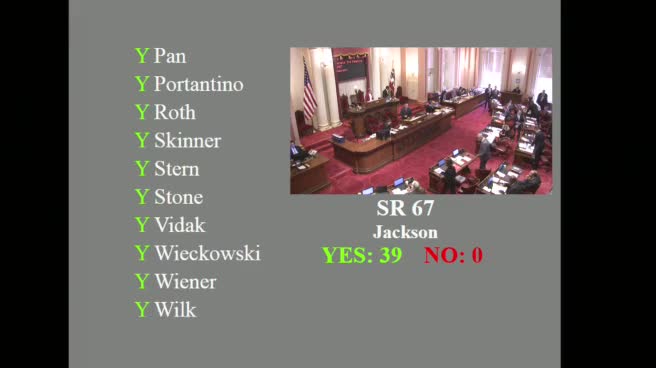 2MIN
Senate Floor
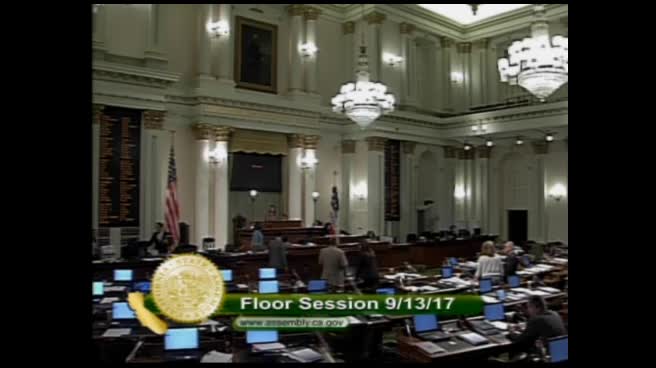 2MIN
Assembly Floor
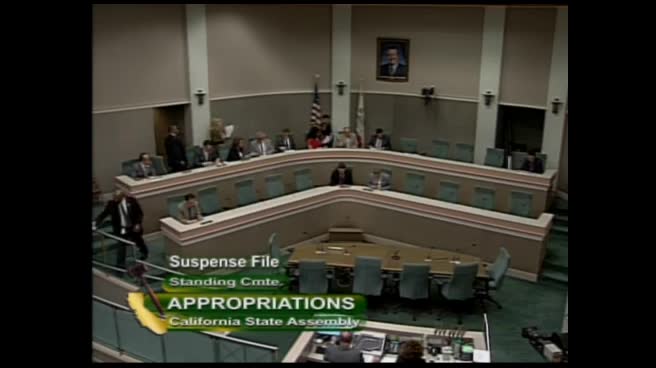 1H
Assembly Standing Committee on Appropriations
 16MIN
Assembly Standing Committee on Judiciary
 24MIN
Assembly Standing Committee on Natural Resources
 4MIN
Senate Floor
 48MIN
Senate Standing Committee on Appropriations
 9MIN