SB 502: Commuter rail systems: availability of automated external defibrillators: Construction Manager/General Contractor Project delivery method: Metrolink commuter rail projects.
- Session Year: 2017-2018
- House: Senate
- Latest Version Date: 2018-09-20
(1)Existing law governing public contracting authorizes regional transportation agencies, as defined, to use the Construction Manager/General Contractor (CM/GC) project delivery method, as specified, to design and construct certain projects if there is an evaluation of the traditional design-bid-build method of construction and of the CM/GC method and the board of the regional transportation agency adopts the CM/GC method in a public meeting. Existing law defines project for these purposes to mean the construction of an expressway that is not on the state highway system, the construction of specified bridges that are not on the state highway system, specified projects in the County of Riverside, and the construction, alteration, repair, rehabilitation, or improvement of the Golden Gate Bridge. Existing law requires that specified information provided to a regional transportation agency under the CM/GC method be verified under oath.
This bill would include in the definition of project a Metrolink commuter rail project. By expanding the scope of the existing crime of perjury, the bill would impose a state-mandated local program.
This bill would make legislative findings and declarations as to the necessity of a special statute for Metrolink commuter rail projects.
(2)Existing law exempts from civil liability any person who, in good faith and not for compensation, renders emergency care or treatment by the use of an automated external defibrillator (AED) at the scene of an emergency, except in the case of personal injury or wrongful death that results from the gross negligence or willful or wanton misconduct of the person who renders emergency care or treatment. Existing law also exempts from civil liability a person or entity that acquires an AED for emergency use and a health care professional who is involved with the selection, placement, or installation of the AED, as specified.
This bill would require a public entity that operates, or contracts for the operation of, a commuter rail system to ensure that each train has an AED as part of its safety equipment subject to specified requirements, including that the AED be installed by July 1, 2020, except as specified, and to transmit confirmation of its compliance with those requirements in writing to the Public Utilities Commission. The bill would exempt an affected public entity that acquires an AED for emergency care from liability for any civil damages resulting from any acts or omissions in the rendering of the emergency care by use of the AED if the public entity has complied with certain requirements.
(3)By imposing new duties on local public officials, the bill would create a state-mandated local program.
(4)The California Constitution requires the state to reimburse local agencies and school districts for certain costs mandated by the state. Statutory provisions establish procedures for making that reimbursement.
This bill would provide that with regard to certain mandates no reimbursement is required by this act for a specified reason.
With regard to any other mandates, this bill would provide that, if the Commission on State Mandates determines that the bill contains costs so mandated by the state, reimbursement for those costs shall be made pursuant to the statutory provisions noted above.
(1)Existing law governing public contracting authorizes regional transportation agencies, as defined, to use the Construction Manager/General Contractor (CM/GC) project delivery method, as specified, to design and construct certain projects if there is an evaluation of the traditional design-bid-build method of construction and of the CM/GC method and the board of the regional transportation agency adopts the CM/GC method in a public meeting. Existing law defines project for these purposes to mean the construction of an expressway that is not on the state highway system, the construction of specified bridges that are not on the state highway system, specified projects in the County of Riverside, and the construction, alteration, repair, rehabilitation, or improvement of the Golden Gate Bridge. Existing law defines the term regional transportation agency for these purposes to include specified entities and specified categories of entities. Existing law requires that specified information provided to a regional transportation agency under the CM/GC method be verified under oath.
This bill would include in the definition of project a Metrolink commuter rail project under the jurisdiction of the Southern California Regional Rail Authority (SCRRA). The bill would include the SCRRA in the definition of regional transportation agency. project. By expanding the scope of the existing crime of perjury, the bill would impose a state-mandated local program.
This bill would make legislative findings and declarations as to the necessity of a special statute for the Southern California Regional Rail Authority (SCRRA). Metrolink commuter rail projects.
(2)Existing law exempts from civil liability any person who, in good faith and not for compensation, renders emergency care or treatment by the use of an automated external defibrillator (AED) at the scene of an emergency, except in the case of personal injury or wrongful death that results from the gross negligence or willful or wanton misconduct of the person who renders emergency care or treatment. Existing law also exempts from civil liability a person or entity that acquires an AED for emergency use and a health care professional who is involved with the selection, placement, or installation of the AED, as specified.
This bill would require a public entity that operates, or contracts for the operation of, a commuter rail system, by July 1, 2020, to ensure that each train has an AED as part of its safety equipment subject to specified requirements, except as specified, and to transmit confirmation of its compliance in writing to the Public Utilities Commission. The bill would exempt an affected public entity that acquires an AED for emergency care from liability for any civil damages resulting from any acts or omissions in the rendering of the emergency care by use of the AED if the public entity has complied with certain requirements.
(3)By imposing new duties on local public officials, the bill would create a state-mandated local program.
(4)The California Constitution requires the state to reimburse local agencies and school districts for certain costs mandated by the state. Statutory provisions establish procedures for making that reimbursement.
This bill would provide that with regard to certain mandates no reimbursement is required by this act for a specified reason.
With regard to any other mandates, this bill would provide that, if the Commission on State Mandates determines that the bill contains costs so mandated by the state, reimbursement for those costs shall be made pursuant to the statutory provisions noted above.
(1)Existing law governing public contracting authorizes regional transportation agencies, as defined, to use the Construction Manager/General Contractor (CM/GC) project delivery method, as specified, to design and construct certain projects if there is an evaluation of the traditional design-bid-build method of construction and of the CM/GC method and the board of the regional transportation agency adopts the CM/GC method in a public meeting. Existing law defines project for these purposes to mean the construction of an expressway that is not on the state highway system, the construction of specified bridges that are not on the state highway system, specified projects in the County of Riverside, and the construction, alteration, repair, rehabilitation, or improvement of the Golden Gate Bridge. Existing law defines the term regional transportation agency for these purposes to include specified entities and specified categories of entities. Existing law requires that specified information provided to a regional transportation agency under the CM/GC method be verified under oath.
This bill would include in the definition of project a Metrolink commuter rail project under the jurisdiction of the Southern California Regional Rail Authority (SCRRA). The bill would include the SCRRA in the definition of regional transportation agency. By expanding the scope of the existing crime of perjury, the bill would impose a state-mandated local program.
This bill would make legislative findings and declarations as to the necessity of a special statute for the Southern California Regional Rail Authority (SCRRA).
(1)(2)Existing law exempts from civil liability any person who, in good faith and not for compensation, renders emergency care or treatment by the use of an automated external defibrillator (AED) at the scene of an emergency, except in the case of personal injury or wrongful death that results from the gross negligence or willful or wanton misconduct of the person who renders emergency care or treatment. Existing law also exempts from civil liability a person or entity that acquires an AED for emergency use and a health care professional who is involved with the selection, placement, or installation of the AED, as specified.
This bill would require a public entity that operates, or contracts for the operation of, a commuter rail system, by July 1, 2020, to ensure that each train has an AED as part of its safety equipment subject to specified requirements, except as specified, and to transmit confirmation of its compliance in writing to the Transportation Agency. Public Utilities Commission. The bill would exempt an affected public entity that acquires an AED for emergency care from liability for any civil damages resulting from any acts or omissions in the rendering of the emergency care by use of the AED if the public entity has complied with certain requirements.
(2)(3)By imposing new duties on local public officials, the bill would create a state-mandated local program.
The California Constitution requires the state to reimburse local agencies and school districts for certain costs mandated by the state. Statutory provisions establish procedures for making that reimbursement.This bill would provide that, if the Commission on State Mandates determines that the bill contains costs mandated by the state, reimbursement for those costs shall be made pursuant to the statutory provisions noted above.(4)The California Constitution requires the state to reimburse local agencies and school districts for certain costs mandated by the state. Statutory provisions establish procedures for making that reimbursement.
This bill would provide that with regard to certain mandates no reimbursement is required by this act for a specified reason.
With regard to any other mandates, this bill would provide that, if the Commission on State Mandates determines that the bill contains costs so mandated by the state, reimbursement for those costs shall be made pursuant to the statutory provisions noted above.
(1)Existing law exempts from civil liability any person who, in good faith and not for compensation, renders emergency care or treatment by the use of an automated external defibrillator (AED) at the scene of an emergency, except in the case of personal injury or wrongful death that results from the gross negligence or willful or wanton misconduct of the person who renders emergency care or treatment. Existing law also exempts from civil liability a person or entity that acquires an AED for emergency use, use and a health care professional who is involved with the selection, placement, or installation of the AED, as specified.
This bill would require a public entity that operates, or contracts for the operation of, a commuter rail system, by July 1, 2020, to ensure that each train has an AED as part of its safety equipment subject to specified requirements, except as specified, and to transmit confirmation of its compliance in writing to the Transportation Agency. The bill would exempt an affected public entity that acquires an AED for emergency care from liability for any civil damages resulting from any acts or omissions in the rendering of the emergency care by use of the AED if the public entity has complied with certain requirements.
(2)By imposing new duties on local public officials, the bill would create a state-mandated local program.
The California Constitution requires the state to reimburse local agencies and school districts for certain costs mandated by the state. Statutory provisions establish procedures for making that reimbursement.
This bill would provide that, if the Commission on State Mandates determines that the bill contains costs mandated by the state, reimbursement for those costs shall be made pursuant to the statutory provisions noted above.
(1)Existing law exempts from civil liability any person who, in good faith and not for compensation, renders emergency care or treatment by the use of an automated external defibrillator (AED) at the scene of an emergency, except in the case of personal injury or wrongful death that results from the gross negligence or willful or wanton misconduct of the person who renders emergency care or treatment. Existing law also exempts from civil liability a person or entity that acquires an AED for emergency use, a physician health care professional who is involved with the placement selection, placement, or installation of the AED, and any person or entity responsible for the site where the AED is located if specified conditions are met, including maintenance and regular testing of the AED and having a written plan that describes the procedures to be followed in case of an emergency that may involve the use of the AED. as specified.
This bill would require a public entity that operates operates, or contracts for the operation of, a commuter rail transit system or a commuter train system system, by July 1, 2020, to ensure that each train has an automated external defibrillator (AED) AED as part of its safety equipment subject to specified requirements. requirements, except as specified, and to transmit confirmation of its compliance in writing to the Transportation Agency. The bill would exempt a an affected public entity that acquires an AED for emergency care from liability for any civil damages resulting from any acts or omissions in the rendering of the emergency care by use of the AED if the public entity has complied with certain requirements.
(2)By imposing new duties on local public officials, the bill would create a state-mandated local program.
The California Constitution requires the state to reimburse local agencies and school districts for certain costs mandated by the state. Statutory provisions establish procedures for making that reimbursement.
This bill would provide that, if the Commission on State Mandates determines that the bill contains costs mandated by the state, reimbursement for those costs shall be made pursuant to the statutory provisions noted above.
(1)Existing law exempts from civil liability any person who, in good faith and not for compensation, renders emergency care or treatment by the use of an automated external defibrillator (AED) at the scene of an emergency, except in the case of personal injury or wrongful death that results from the gross negligence or willful or wanton misconduct of the person who renders emergency care or treatment. Existing law also exempts from civil liability a person or entity that acquires an AED for emergency use, a physician who is involved with the placement of the AED, and any person or entity responsible for the site where the AED is located if specified conditions are met, including maintenance and regular testing of the AED and having a written plan that describes the procedures to be followed in case of an emergency that may involve the use of the AED.
This bill would require a public entity that operates a rail transit system or a commuter train system to ensure that each train has an automated external defibrillator (AED) as part of its safety equipment subject to specified requirements. The bill would exempt a public entity that acquires an AED for emergency care from liability for any civil damages resulting from any acts or omissions in the rendering of the emergency care by use of the AED if the public entity has complied with certain requirements.
(2)By imposing new duties on local public officials, the bill would create a state-mandated local program.
The California Constitution requires the state to reimburse local agencies and school districts for certain costs mandated by the state. Statutory provisions establish procedures for making that reimbursement.
This bill would provide that, if the Commission on State Mandates determines that the bill contains costs mandated by the state, reimbursement for those costs shall be made pursuant to the statutory provisions noted above.
Existing law establishes a pilot program requiring the Department of Corrections and Rehabilitation, Division of Juvenile Facilities to purchase 2 medical laser devices for the removal of tattoos, as specified, from eligible participants who are screened by community groups who serve at-risk youth, ex-offenders, ex-convicts, current and former gang members, or victims of trafficking and prostitution, as specified.This bill would reestablish and modify a recently repealed program known as the California Voluntary Tattoo Removal Program, to be administered by the Board of State and Community Corrections to the extent that funds are appropriated, to provide funding for the removal of certain tattoos for individuals between 14 and 24 years of age, who are in the custody of the Department of Corrections and Rehabilitation or county probation departments, who are on parole or probation, who are in a community-based program serving at-risk youth, or who are placed in foster care as either dependent children or nonminor dependents, as specified, and who meet specified criteria. The bill would repeal the program on January 1, 2026.This bill would also state the intent of the Legislature to encourage the board to extend, if available, specified federal funding for the above-described tattoo removal programs to include programs serving individuals between 14 and 24 years of age who were tattooed for identification in trafficking or prostitution.Existing law establishes a pilot program requiring the Department of Corrections and Rehabilitation, Division of Juvenile Facilities to purchase 2 medical laser devices for the removal of tattoos, as specified, from eligible participants who are screened by community groups who serve at-risk youth, ex-offenders, ex-convicts, current and former gang members, or victims of trafficking and prostitution, as specified.
This bill would reestablish and modify a recently repealed program known as the California Voluntary Tattoo Removal Program, to be administered by the Board of State and Community Corrections to the extent that funds are appropriated, to provide funding for the removal of certain tattoos for individuals between 14 and 24 years of age age, who are in the custody of the Department of Corrections and Rehabilitation or county probation departments, who are on parole or probation, or who are in a community-based program serving at-risk youth youth, or who are placed in foster care as either dependent children or nonminor dependents, as specified, and who meet specified criteria. The bill would repeal the program on January 1, 2026.
This bill would also state the intent of the Legislature to encourage the board to extend, if available, specified federal funding for the above-described tattoo removal programs to include programs serving individuals between 14 and 24 years of age who were tattooed for identification in trafficking or prostitution.
Existing law establishes a pilot program requiring the Department of Corrections and Rehabilitation, Division of Juvenile Facilities to purchase 2 medical laser devices for the removal of tattoos, as specified, from eligible participants who are screened by community groups who serve at-risk youth, ex-offenders, ex-convicts, current and former gang members, or victims of trafficking and prostitution, as specified.
This bill would reestablish a recently repealed program known as the California Voluntary Tattoo Removal Program, to be administered by the Board of State and Community Corrections to the extent that funds are appropriated, to provide funding for the removal of certain tattoos for individuals between 14 and 24 years of age who are in the custody of the Department of Corrections and Rehabilitation or county probation departments, who are on parole or probation, or who are in a community-based program serving at-risk youth and meet specified criteria. The bill would repeal the program on January 1, 2026.
This bill would also state the intent of the Legislature to encourage the board to extend, if available, specified federal funding for the above-described tattoo removal programs to include programs serving individuals between 14 and 24 years of age who were tattooed for identification in trafficking or prostitution.
(a)The Legislature finds and declares that the County of Riverside should be considered a transportation planning agency for the purposes of this chapter in order to effectuate the construction of the railroad grade separations and bridge rehabilitations and replacements specified in subparagraph (C) of paragraph (4) of subdivision (b) using Construction Manager/General Contractor authority. The passage of the Road Repair and Accountability Act of 2017 (Chapter 5 of the Statutes of 2017) provides additional transportation revenue to help close the significant funding shortfalls and address the substantial backlog of infrastructure projects that are in need of repair. The geography, topography, and location of these railroad grade separations and bridge rehabilitations and replacements projects present many potential complex challenges, and the Construction Manager/General Contractor method could reduce delays and ensure that those challenges are fully understood at the outset of construction.
(b)For purposes of this chapter, the following definitions apply:
(1)Construction manager means a partnership, corporation, or other legal entity that is able to provide appropriately licensed contracting and engineering services as needed pursuant to a Construction Manager/General Contractor method contract.
(2)Construction Manager/General Contractor method means a project delivery method in which a construction manager is procured to provide preconstruction services during the design phase of the project and construction services during the construction phase of the project. The contract for construction services may be entered into at the same time as the contract for preconstruction services, or at a later time. The execution of the design and the construction of the project may be in sequential phases or concurrent phases.
(3)Preconstruction services means advice during the design phase, including, but not limited to, scheduling, pricing, and phasing to assist the regional transportation agency to design a more constructible project.
(4)Project means any of the following:
(A)The construction of an expressway that is not on the state highway system.
(B)The construction of the following bridges that are not on the state highway system:
(i)Yerba Buena Island (YBI) West Side Bridges Seismic Retrofit Project.
(ii)Yankee Jims Road Bridge Project in the County of Placer (Replacement/Rehabilitation).
(C)The construction of railroad grade separations and bridge rehabilitations and replacements in the County of Riverside, as specified in Item 2660-110-0042 of Section 2.00 of the Budget Act of 2016, as amended by Chapter 7 of the Statutes of 2017.
(D)The construction, alteration, repair, rehabilitation, or improvement of the Golden Gate Bridge, as defined in Section 27502 of the Streets and Highways Code.
(E)A Metrolink commuter rail project.
(5)Regional transportation agency means any of the following:
(A)A transportation planning agency described in Section 29532 or 29532.1 of the Government Code.
(B)A county transportation commission established under Section 130050, 130050.1, or 130050.2 of the Public Utilities Code.
(C)Any other local or regional transportation entity that is designated by statute as a regional transportation agency.
(D)A joint exercise of powers authority established pursuant to Chapter 5 (commencing with Section 6500) of Division 7 of Title 1 of the Government Code, with the consent of a transportation planning agency or a county transportation commission for the jurisdiction in which the transportation project will be developed.
(E)A local transportation authority created or designated pursuant to Division 12.5 (commencing with Section 131000) or Division 19 (commencing with Section 180000) of the Public Utilities Code.
(F)The Santa Clara Valley Transportation Authority established pursuant to Part 12 (commencing with Section 100000) of Division 10 of the Public Utilities Code.
(G)The County of Placer.
(H)The County of Riverside.
(I)The Golden Gate Bridge, Highway and Transportation District established pursuant to Chapter 18 (commencing with Section 27500) of Part 3 of Division 16 of the Streets and Highways Code
(c)Nothing in this section shall extend any other authority to the County of Riverside or the Golden Gate Bridge, Highway and Transportation District, as a transportation planning agency under any other law.
SEC. 2.Section 99175 is added to the Public Utilities Code, to read:99175.(a)A public entity that operates, or contracts for the operation of, a commuter rail system shall ensure that each train has an automated external defibrillator (AED) as part of its safety equipment subject to the requirements in Section 1797.196 of the Health and Safety Code. As used in this subdivision, commuter rail system does not include intercity passenger rail services, including state-funded intercity passenger rail services managed under an interagency transfer agreement by the LOSSAN Rail Corridor Agency, the San Joaquin Joint Powers Authority, or the Capitol Corridor Joint Powers Authority, and does not include light rail or rapid transit services managed by local agencies.
(b)An affected public entity may provide training for their employees on the use of the AEDs as part of their regularly scheduled safety or other training sessions.
(c)(1)An affected public entity shall install AEDs pursuant to this section by July 1, 2020.
(2)The Peninsula Corridor Joint Powers Board shall be exempt from paragraph (1) and shall instead ensure that trainsets procured as part of the Caltrain Electrification Project are equipped with AEDs.
(d)(1)Upon completion of the installation of AEDs, the public entity shall transmit confirmation of its compliance in writing to the Public Utilities Commission.
(2)If an affected public entity is in compliance with the requirements of this section when it becomes effective, it shall notify the Public Utilities Commission pursuant to paragraph (1).
(e)An affected public entity that acquires an AED for emergency care pursuant to this section shall not be liable for any civil damages resulting from any acts or omissions in the rendering of the emergency care by use of an AED if the public entity has complied with paragraph (1) of subdivision (b) of Section 1797.196 of the Health and Safety Code.
SEC. 3.In regard to Section 1 of this act, the Legislature finds and declares that a special statute is necessary and that a general statute cannot be made applicable within the meaning of Section 16 of Article IV of the California Constitution because of the unique circumstances regarding Metrolink commuter rail projects.
SEC. 4.No reimbursement is required by this act pursuant to Section 6 of Article XIIIB of the California Constitution for certain costs that may be incurred by a local agency or school district because, in that regard, this act creates a new crime or infraction, eliminates a crime or infraction, or changes the penalty for a crime or infraction, within the meaning of Section 17556 of the Government Code, or changes the definition of a crime within the meaning of Section 6 of Article XIIIB of the California Constitution.
However, if the Commission on State Mandates determines that this act contains other costs mandated by the state, reimbursement to local agencies and school districts for those costs shall be made pursuant to Part 7 (commencing with Section 17500) of Division 4 of Title 2 of the Government Code.
(a)The Legislature finds and declares that the County of Riverside should be considered a transportation planning agency for the purposes of this chapter in order to effectuate the construction of the railroad grade separations and bridge rehabilitations and replacements specified in subparagraph (C) of paragraph (4) of subdivision (b) using Construction Manager/General Contractor authority. The passage of the Road Repair and Accountability Act of 2017 (Chapter 5 of the Statutes of 2017) provides additional transportation revenue to help close the significant funding shortfalls and address the substantial backlog of infrastructure projects that are in need of repair. The geography, topography, and location of these railroad grade separations and bridge rehabilitations and replacements projects present many potential complex challenges, and the Construction Manager/General Contractor method could reduce delays and ensure that those challenges are fully understood at the outset of construction.
(b)For purposes of this chapter, the following definitions apply:
(1)Construction manager means a partnership, corporation, or other legal entity that is able to provide appropriately licensed contracting and engineering services as needed pursuant to a Construction Manager/General Contractor method contract.
(2)Construction Manager/General Contractor method means a project delivery method in which a construction manager is procured to provide preconstruction services during the design phase of the project and construction services during the construction phase of the project. The contract for construction services may be entered into at the same time as the contract for preconstruction services, or at a later time. The execution of the design and the construction of the project may be in sequential phases or concurrent phases.
(3)Preconstruction services means advice during the design phase, including, but not limited to, scheduling, pricing, and phasing to assist the regional transportation agency to design a more constructible project.
(4)Project means any of the following:
(A)The construction of an expressway that is not on the state highway system.
(B)The construction of the following bridges that are not on the state highway system:
(i)Yerba Buena Island (YBI) West Side Bridges Seismic Retrofit Project.
(ii)Yankee Jims Road Bridge Project in the County of Placer (Replacement/Rehabilitation).
(C)The construction of railroad grade separations and bridge rehabilitations and replacements in the County of Riverside, as specified in Item 2660-110-0042 of Section 2.00 of the Budget Act of 2016, as amended by Chapter 7 of the Statutes of 2017.
(D)The construction, alteration, repair, rehabilitation, or improvement of the Golden Gate Bridge, as defined in Section 27502 of the Streets and Highways Code.
(E)A Metrolink commuter rail project under the jurisdiction of the Southern California Regional Rail Authority (SCRRA). project.
(5)Regional transportation agency means any of the following:
(A)A transportation planning agency described in Section 29532 or 29532.1 of the Government Code.
(B)A county transportation commission established under Section 130050, 130050.1, or 130050.2 of the Public Utilities Code.
(C)Any other local or regional transportation entity that is designated by statute as a regional transportation agency.
(D)A joint exercise of powers authority established pursuant to Chapter 5 (commencing with Section 6500) of Division 7 of Title 1 of the Government Code, with the consent of a transportation planning agency or a county transportation commission for the jurisdiction in which the transportation project will be developed.
(E)A local transportation authority created or designated pursuant to Division 12.5 (commencing with Section 131000) or Division 19 (commencing with Section 180000) of the Public Utilities Code.
(F)The Santa Clara Valley Transportation Authority established pursuant to Part 12 (commencing with Section 100000) of Division 10 of the Public Utilities Code.
(G)The County of Placer.
(H)The County of Riverside.
(I)The Golden Gate Bridge, Highway and Transportation District established pursuant to Chapter 18 (commencing with Section 27500) of Part 3 of Division 16 of the Streets and Highways Code
(J)The Southern California Regional Rail Authority (SCRRA) as described in paragraph (1) of subdivision (a) of Section 99314.2 of the Public Utilities Code.(c)Nothing in this section shall extend any other authority to the County of Riverside, Riverside or the Golden Gate Bridge, Highway and Transportation District, or the SCRRA, as a transportation planning agency under any other law.
SEC. 2.Section 99175 is added to the Public Utilities Code, to read:99175.(a)A public entity that operates, or contracts for the operation of, a commuter rail system shall ensure that each train has an automated external defibrillator (AED) as part of its safety equipment subject to the requirements in Section 1797.196 of the Health and Safety Code. As used in this subdivision, commuter rail system does not include intercity passenger rail services, including state-funded intercity passenger rail services managed under an interagency transfer agreement by the LOSSAN Rail Corridor Agency, the San Joaquin Joint Powers Authority, or the Capitol Corridor Joint Powers Authority, and does not include light rail or rapid transit services managed by local agencies.
(b)An affected public entity may provide training for their employees on the use of the AEDs as part of their regularly scheduled safety or other training sessions.
(c)(1)An affected public entity shall install AEDs pursuant to this section by July 1, 2020.
(2)The Peninsula Corridor Joint Powers Board shall be exempt from paragraph (1) and shall instead ensure that trainsets procured as part of the Caltrain Electrification Project are equipped with AEDs.
(d)(1)Upon completion of the installation of AEDs, the public entity shall transmit confirmation of its compliance in writing to the Public Utilities Commission.
(2)If an affected public entity is in compliance with the requirements of this section when it becomes effective, it shall notify the Public Utilities Commission pursuant to paragraph (1).
(e)An affected public entity that acquires an AED for emergency care pursuant to this section shall not be liable for any civil damages resulting from any acts or omissions in the rendering of the emergency care by use of an AED if the public entity has complied with paragraph (1) of subdivision (b) of Section 1797.196 of the Health and Safety Code.
SEC. 3.In regard to Section 1 of this act, the Legislature finds and declares that a special statute is necessary and that a general statute cannot be made applicable within the meaning of Section 16 of Article IV of the California Constitution because of the unique circumstances regarding the Southern California Regional Rail Authority (SCRRA). Metrolink commuter rail projects.
SEC. 4.No reimbursement is required by this act pursuant to Section 6 of Article XIIIB of the California Constitution for certain costs that may be incurred by a local agency or school district because, in that regard, this act creates a new crime or infraction, eliminates a crime or infraction, or changes the penalty for a crime or infraction, within the meaning of Section 17556 of the Government Code, or changes the definition of a crime within the meaning of Section 6 of Article XIIIB of the California Constitution.
However, if the Commission on State Mandates determines that this act contains other costs mandated by the state, reimbursement to local agencies and school districts for those costs shall be made pursuant to Part 7 (commencing with Section 17500) of Division 4 of Title 2 of the Government Code.
CORRECTIONS: HeadingLine 2.(a)The Legislature finds and declares that the County of Riverside should be considered a transportation planning agency for the purposes of this chapter in order to effectuate the construction of the railroad grade separations and bridge rehabilitations and replacements specified in subparagraph (C) of paragraph (4) of subdivision (b) using Construction Manager/General Contractor authority. The passage of the Road Repair and Accountability Act of 2017 (Chapter 5 of the Statutes of 2017) provides additional transportation revenue to help close the significant funding shortfalls and address the substantial backlog of infrastructure projects that are in need of repair. The geography, topography, and location of these railroad grade separations and bridge rehabilitations and replacements projects present many potential complex challenges, and the Construction Manager/General Contractor method could reduce delays and ensure that those challenges are fully understood at the outset of construction.
(b)For purposes of this chapter, the following definitions apply:
(1)Construction manager means a partnership, corporation, or other legal entity that is able to provide appropriately licensed contracting and engineering services as needed pursuant to a Construction Manager/General Contractor method contract.
(2)Construction Manager/General Contractor method means a project delivery method in which a construction manager is procured to provide preconstruction services during the design phase of the project and construction services during the construction phase of the project. The contract for construction services may be entered into at the same time as the contract for preconstruction services, or at a later time. The execution of the design and the construction of the project may be in sequential phases or concurrent phases.
(3)Preconstruction services means advice during the design phase, including, but not limited to, scheduling, pricing, and phasing to assist the regional transportation agency to design a more constructible project.
(4)Project means any of the following:
(A)The construction of an expressway that is not on the state highway system.
(B)The construction of the following bridges that are not on the state highway system:
(i)Yerba Buena Island (YBI) West Side Bridges Seismic Retrofit Project.
(ii)Yankee Jims Road Bridge Project in the County of Placer (Replacement/Rehabilitation).
(C)The construction of railroad grade separations and bridge rehabilitations and replacements in the County of Riverside, as specified in Item 2660-110-0042 of Section 2.00 of the Budget Act of 2016, as amended by Chapter 7 of the Statutes of 2017.
(D)The construction, alteration, repair, rehabilitation, or improvement of the Golden Gate Bridge, as defined in Section 27502 of the Streets and Highways Code.
(E)A Metrolink commuter rail project under the jurisdiction of the Southern California Regional Rail Authority (SCRRA).
(5)Regional transportation agency means any of the following:
(A)A transportation planning agency described in Section 29532 or 29532.1 of the Government Code.
(B)A county transportation commission established under Section 130050, 130050.1, or 130050.2 of the Public Utilities Code.
(C)Any other local or regional transportation entity that is designated by statute as a regional transportation agency.
(D)A joint exercise of powers authority established pursuant to Chapter 5 (commencing with Section 6500) of Division 7 of Title 1 of the Government Code, with the consent of a transportation planning agency or a county transportation commission for the jurisdiction in which the transportation project will be developed.
(E)A local transportation authority created or designated pursuant to Division 12.5 (commencing with Section 131000) or Division 19 (commencing with Section 180000) of the Public Utilities Code.
(F)The Santa Clara Valley Transportation Authority established pursuant to Part 12 (commencing with Section 100000) of Division 10 of the Public Utilities Code.
(G)The County of Placer.
(H)The County of Riverside.
(I)The Golden Gate Bridge, Highway and Transportation District established pursuant to Chapter 18 (commencing with Section 27500) of Part 3 of Division 16 of the Streets and Highways Code
(J)The Southern California Regional Rail Authority (SCRRA) as described in paragraph (1) of subdivision (a) of Section 99314.2 of the Public Utilities Code.
(c)Nothing in this section shall extend any other authority to the County of Riverside or Riverside, the Golden Gate Bridge, Highway and Transportation District District, or the SCRRA, as a transportation planning agency under any other law.
SECTION 1.SEC. 2.Section 99175 is added to the Public Utilities Code, to read:99175.(a)A public entity that operates, or contracts for the operation of, a commuter rail system shall ensure that each train has an automated external defibrillator (AED) as part of its safety equipment subject to the requirements in Section 1797.196 of the Health and Safety Code. As used in this subdivision, commuter rail system does not include intercity passenger rail services, including state-funded intercity passenger rail services managed under an interagency transfer agreement by the LOSSAN Rail Corridor Agency, the San Joaquin Joint Powers Authority, or the Capitol Corridor Joint Powers Authority, and does not include light rail or rapid transit services managed by local agencies.
(b)An affected public entity may provide training for their employees on the use of the AEDs as part of their regularly scheduled safety or other training sessions.
(c)(1)An affected public entity shall install AEDs pursuant to this section by July 1, 2020.
(2)The Peninsula Corridor Joint Powers Board shall be exempt from paragraph (1) and shall instead ensure that trainsets procured as part of the Caltrain Electrification Project are equipped with AEDs.
(d)(1)Upon completion of the installation of AEDs, the public entity shall transmit confirmation of its compliance in writing to the Transportation Agency. Public Utilities Commission.
(2)If an affected public entity is in compliance with the requirements of this section when it becomes effective, it shall notify the Transportation Agency Public Utilities Commission pursuant to paragraph (1).
(e)An affected public entity that acquires an AED for emergency care pursuant to this section shall not be liable for any civil damages resulting from any acts or omissions in the rendering of the emergency care by use of an AED if the public entity has complied with paragraph (1) of subdivision (b) of Section 1797.196 of the Health and Safety Code.
SEC. 2.If the Commission on State Mandates determines that this act contains costs mandated by the state, reimbursement to local agencies and school districts for those costs shall be made pursuant to Part 7 (commencing with Section 17500) of Division 4 of Title 2 of the Government Code.SEC. 3.In regard to Section 1 of this act, the Legislature finds and declares that a special statute is necessary and that a general statute cannot be made applicable within the meaning of Section 16 of Article IV of the California Constitution because of the unique circumstances regarding the Southern California Regional Rail Authority (SCRRA).
SEC. 4.No reimbursement is required by this act pursuant to Section 6 of Article XIIIB of the California Constitution for certain costs that may be incurred by a local agency or school district because, in that regard, this act creates a new crime or infraction, eliminates a crime or infraction, or changes the penalty for a crime or infraction, within the meaning of Section 17556 of the Government Code, or changes the definition of a crime within the meaning of Section 6 of Article XIIIB of the California Constitution.
However, if the Commission on State Mandates determines that this act contains other costs mandated by the state, reimbursement to local agencies and school districts for those costs shall be made pursuant to Part 7 (commencing with Section 17500) of Division 4 of Title 2 of the Government Code.
(a)A public entity that operates, or contracts for the operation of, a commuter rail system shall ensure that each train has an automated external defibrillator (AED) as part of its safety equipment subject to the requirements in Section 1797.196 of the Health and Safety Code. As used in this subdivision, commuter rail system does not include intercity passenger rail services, including state-funded intercity passenger rail services managed under an interagency transfer agreement by the LOSSAN Rail Corridor Agency, the San Joaquin Joint Powers Authority, or the Capitol Corridor Joint Powers Authority, and does not include light rail or rapid transit services managed by local agencies.
(b)An affected public entity may provide training for their employees on the use of the AEDs as part of their regularly scheduled safety or other training sessions.
(c)(1)An affected public entity shall install AEDs pursuant to this section by July 1, 2020.
(2)The Peninsula Corridor Joint Powers Board shall be exempt from paragraph (1) and shall instead ensure that trainsets procured as part of the Caltrain Electrification Project are equipped with AEDs.
(d)(1)Upon completion of the installation of AEDs, the public entity shall transmit confirmation of its compliance in writing to the Transportation Agency.
(2)If an affected public entity is in compliance with the requirements of this section when it becomes effective, it shall notify the Transportation Agency pursuant to paragraph (1).
(e)An affected public entity that acquires an AED for emergency care pursuant to this subdivision section shall not be liable for any civil damages resulting from any acts or omissions in the rendering of the emergency care by use of an AED if the public entity has complied with paragraph (1) of subdivision (b) of Section 1797.196 of the Health and Safety Code.
SEC. 2.If the Commission on State Mandates determines that this act contains costs mandated by the state, reimbursement to local agencies and school districts for those costs shall be made pursuant to Part 7 (commencing with Section 17500) of Division 4 of Title 2 of the Government Code.
(a)A public entity that operates, or contracts for the operation of, a commuter rail system shall ensure that each train has an automated external defibrillator (AED) as part of its safety equipment subject to the requirements in Section 1797.196 of the Health and Safety Code. As used in this subdivision, commuter rail system does not include intercity passenger rail services, including state-funded intercity passenger rail services managed under an interagency transfer agreement by the LOSSAN Rail Corridor Agency, the San Joaquin Joint Powers Authority, or the Capitol Corridor Joint Powers Authority, and does not include light rail or rapid transit services managed by local agencies.
(b)An affected public entity may provide training for their employees on the use of the AEDs as part of their regularly scheduled safety or other training sessions.
(c)(1)An affected public entity shall install AEDs pursuant to this section by July 1, 2020.
(2)The Peninsula Corridor Joint Powers Board shall be exempt from paragraph (1) and shall instead ensure that trainsets procured as part of the Caltrain Electrification Project are equipped with AEDs.
(d)(1)Upon completion of the installation of AEDs, the public entity shall transmit confirmation of its compliance in writing to the Transportation Agency.
(2)If an affected public entity is in compliance with the requirements of this section when it becomes effective, it shall notify the Transportation Agency pursuant to paragraph (1).
(e)An affected public entity that acquires an AED for emergency care pursuant to this subdivision shall not be liable for any civil damages resulting from any acts or omissions in the rendering of the emergency care by use of an AED if the public entity has complied with subdivision (b) of Section 1797.196 of the Health and Safety Code.
SEC. 2.If the Commission on State Mandates determines that this act contains costs mandated by the state, reimbursement to local agencies and school districts for those costs shall be made pursuant to Part 7 (commencing with Section 17500) of Division 4 of Title 2 of the Government Code.
Any (a)A public entity which that plans the development of, or which that operates, a rail transit system, shall, with respect to any current or future rail transit system, (a) (1) develop motor vehicle parking facilities to serve the systems passengers at stations planned to be park and ride facilities, and (b) (2) expand private enterprise participation in the development of air space and publicly owned assets to provide those parking facilities.
(b)A public entity that operates a rail transit system or a commuter train system shall ensure that each train has an automated external defibrillator (AED) as part of its safety equipment subject to the requirements in Section 1797.196 of the Health and Safety Code. A public entity that acquires an AED for emergency care pursuant to this subdivision shall not be liable for any civil damages resulting from any acts or omissions in the rendering of the emergency care by use of an AED if the public entity has complied with subdivision (b) of Section 1797.196 of the Health and Safety Code.
SEC. 2.If the Commission on State Mandates determines that this act contains costs mandated by the state, reimbursement to local agencies and school districts for those costs shall be made pursuant to Part 7 (commencing with Section 17500) of Division 4 of Title 2 of the Government Code.
SECTION 1.Section 1916 is added to the Welfare and Institutions Code, to read:1916.(a)The California Voluntary Tattoo Removal Program is hereby established.(b)To the extent that funds are appropriated for this purpose, the Board of State and Community Corrections may administer the program.(c)The program shall be designed to serve individuals between 14 and 24 years of age, who are in the custody of the Department of Corrections and Rehabilitation or county probation departments, who are on parole or probation, who are in a community-based organization serving at-risk youth, or who are placed in foster care as either children adjudged dependents of the juvenile court, pursuant to Section 300, or nonminor dependents, as defined in subdivision (v) of Section 11400.(d)The board shall award grants in a competitive manner and on a geographically diverse basis, serving both northern and southern California.(e)The Division of Juvenile Facilities of the Department of Corrections and Rehabilitation, county probation departments, community-based organizations, county child welfare agencies, and relevant service providers may apply for the grants authorized by this section.(f)Funds appropriated for purposes of this section shall be limited to federal funds.(g)Tattoo removals shall be performed by licensed clinicians who, to the extent feasible, provide their services at a discounted rate, or free of charge.(h)Grantees shall serve individuals who have gang-related tattoos or tattoos received for identification in trafficking and prostitution that are visible in a professional environment and who are recommended for the program by Department of Corrections and Rehabilitation representatives, parole agents, county probation officers, community-based organizations, service providers, or county child welfare agencies.(i)Individuals who have gang-related tattoos or tattoos received for identification in trafficking and prostitution that may be considered unprofessional and are visible in a professional work environment, who meet the criteria of subdivision (c), and who meet any of the following criteria may be eligible for participation in the program:(1)Are actively pursuing secondary or postsecondary education.(2)Are seeking employment or participating in workforce training programs.(3)Are scheduled for an upcoming job interview or job placement.(4)Are participating in a community or public service activity.(j)Use of funding by grantees shall be limited to the following:(1)The removal of gang-related tattoos or tattoos received for identification in trafficking and prostitution.(2)Maintenance or repair of tattoo removal medical devices.(3)Contracting with licensed private providers to offer the tattoo removal service.(k)Grantees may also seek additional federal or private funding to execute the provisions of this section, and use those funds to supplement funding received through the program.(l)This section shall remain in effect only until January 1, 2026, and as of that date is repealed, unless a later enacted statute that is enacted before January 1, 2026, deletes or extends that date.SEC. 2.It is the intent of the Legislature to encourage the Board of State and Community Corrections to extend, if available, federal Edward Byrne Memorial Justice Assistance Grant Program funding authorized prior to the enactment of this measure for tattoo removal programs under Sections 1915 and 1916 of the Welfare and Institutions Code to include programs serving individuals between 14 and 24 years of age who were tattooed for identification in trafficking or prostitution.(a)The California Voluntary Tattoo Removal Program is hereby established.
(b)To the extent that funds are appropriated for this purpose, the Board of State and Community Corrections may administer the program.
(c)The program shall be designed to serve individuals between 14 and 24 years of age, who are in the custody of the Department of Corrections and Rehabilitation or county probation departments, who are on parole or probation, or who are in a community-based organization serving at-risk youth. youth, or who are placed in foster care as either children adjudged dependents of the juvenile court, pursuant to Section 300, or nonminor dependents, as defined in subdivision (v) of Section 11400.
(d)The board shall award grants in a competitive manner and on a geographically diverse basis, serving both northern and southern California.
(e)The Division of Juvenile Facilities of the Department of Corrections and Rehabilitation, county probation departments, community-based organizations, county child welfare agencies, and relevant service providers may apply for the grants authorized by this section.
(f)Funds appropriated for purposes of this section shall be limited to federal funds.
(g)Tattoo removals shall be performed by licensed clinicians who, to the extent feasible, provide their services at a discounted rate, or free of charge.
(h)Grantees shall serve individuals who have gang-related tattoos or tattoos received for identification in trafficking and prostitution that are visible in a professional environment and who are recommended for the program by Department of Corrections and Rehabilitation representatives, parole agents, county probation officers, community-based organizations, or service providers. service providers, or county child welfare agencies.
(i)Individuals who have gang-related tattoos or tattoos received for identification in trafficking and prostitution that may be considered unprofessional and are visible in a professional work environment, who meet the criteria of subdivision (c), and who meet any of the following criteria may be eligible for participation in the program:
(1)Are actively pursuing secondary or postsecondary education.
(2)Are seeking employment or participating in workforce training programs.
(3)Are scheduled for an upcoming job interview or job placement.
(4)Are participating in a community or public service activity.
(j)Use of funding by grantees shall be limited to the following:
(1)The removal of gang-related tattoos or tattoos received for identification in trafficking and prostitution.
(2)Maintenance or repair of tattoo removal medical devices.
(3)Contracting with licensed private providers to offer the tattoo removal service.
(k)Grantees may also seek additional federal or private funding to execute the provisions of this section, and use those funds to supplement funding received through the program.
(l)This section shall remain in effect only until January 1, 2026, and as of that date is repealed, unless a later enacted statute that is enacted before January 1, 2026, deletes or extends that date.
SEC. 2.It is the intent of the Legislature to encourage the Board of State and Community Corrections to extend, if available, federal Edward Byrne Memorial Justice Assistance Grant Program funding authorized prior to the enactment of this measure for tattoo removal programs under Sections 1915 and 1916 of the Welfare and Institutions Code to include programs serving individuals between 14 and 24 years of age, inclusive, age who were tattooed for identification in trafficking or prostitution.
(a)The California Voluntary Tattoo Removal Program is hereby established.
(b)To the extent that funds are appropriated for this purpose, the Board of State and Community Corrections may administer the program.
(c)The program shall be designed to serve individuals between 14 and 24 years of age, who are in the custody of the Department of Corrections and Rehabilitation or county probation departments, who are on parole or probation, or who are in a community-based organization serving at-risk youth.
(d)The board shall award grants in a competitive manner and on a geographically diverse basis, serving both northern and southern California.
(e)The Division of Juvenile Facilities of the Department of Corrections and Rehabilitation, county probation departments, community-based organizations, and relevant service providers may apply for the grants authorized by this section.
(f)Funds appropriated for purposes of this section shall be limited to federal funds.
(g)Tattoo removals shall be performed by licensed clinicians who, to the extent feasible, provide their services at a discounted rate, or free of charge.
(h)Grantees shall serve individuals who have gang-related tattoos or tattoos received for identification in trafficking and prostitution that are visible in a professional environment and who are recommended for the program by Department of Corrections and Rehabilitation representatives, parole agents, county probation officers, community-based organizations, or service providers.
(i)Individuals who have gang-related tattoos or tattoos received for identification in trafficking and prostitution that may be considered unprofessional and are visible in a professional work environment, who meet the criteria of subdivision (c), and who meet any of the following criteria may be eligible for participation in the program:
(1)Are actively pursuing secondary or postsecondary education.
(2)Are seeking employment or participating in workforce training programs.
(3)Are scheduled for an upcoming job interview or job placement.
(4)Are participating in a community or public service activity.
(j)Use of funding by grantees shall be limited to the following:
(1)The removal of gang-related tattoos or tattoos received for identification in trafficking and prostitution.
(2)Maintenance or repair of tattoo removal medical devices.
(3)Contracting with licensed private providers to offer the tattoo removal service.
(k)Grantees may also seek additional federal or private funding to execute the provisions of this section, and use those funds to supplement funding received through the program.
(l)This section shall remain in effect only until January 1, 2026, and as of that date is repealed, unless a later enacted statute that is enacted before January 1, 2026, deletes or extends that date.
SEC. 2.It is the intent of the Legislature to encourage the Board of State and Community Corrections to extend, if available, federal Edward Byrne Memorial Justice Assistance Grant funding authorized prior to the enactment of this measure for tattoo removal programs under Sections 1915 and 1916 of the Welfare and Institutions Code to include programs serving individuals between 14 and 24 years of age, inclusive, who were tattooed for identification in trafficking or prostitution.
|
Date
|
Status
|
|---|---|
| Sep 20, 2018 | Chaptered by Secretary of State. Chapter 602, Statutes of 2018. |
| Sep 20, 2018 | Approved by the Governor. |
| Sep 12, 2018 | Enrolled and presented to the Governor at 5 p.m. |
| Aug 31, 2018 | Assembly amendments concurred in. (Ayes 39. Noes 0.) Ordered to engrossing and enrolling. |
| Aug 31, 2018 | From committee: That the Assembly amendments be concurred in. (Ayes 12. Noes 0.) |
| Aug 31, 2018 | From committee: Be re-referred to Com. on T. & H. pursuant to Senate Rule 29.10(d). (Ayes 5. Noes 0.) Re-referred to Com. on T. & H. |
| Aug 31, 2018 | Re-referred to Com. on RLS. pursuant to Senate Rule 29.10(d). |
| Aug 31, 2018 | In Senate. Concurrence in Assembly amendments pending. |
| Aug 31, 2018 | Read third time. Passed. Ordered to the Senate. |
| Aug 30, 2018 | Assembly Rule 96 suspended. |
| Aug 27, 2018 | From committee with author's amendments. Read second time and amended. Re-referred to Com. on TRANS. |
| Aug 27, 2018 | Re-referred to Com. on TRANS. pursuant to Assembly Rule 77.2. |
| Aug 24, 2018 | Read second time. Ordered to third reading. |
| Aug 23, 2018 | From committee: Do pass. (Ayes 9. Noes 1.) (August 23). |
| Aug 23, 2018 | Re-referred to Com. on TRANS. pursuant to Assembly Rule 77.2. |
| Aug 23, 2018 | Read third time and amended. |
| Aug 20, 2018 | Read second time. Ordered to third reading. |
| Aug 16, 2018 | From committee: Do pass. (Ayes 17. Noes 0.) (August 16). |
| Jun 27, 2018 | June 27 set for first hearing. Placed on APPR. suspense file. |
| Jun 20, 2018 | Read second time and amended. Re-referred to Com. on APPR. |
| Jun 19, 2018 | From committee: Do pass as amended and re-refer to Com. on APPR. with recommendation: To consent calendar. (Ayes 10. Noes 0.) (June 19). |
| Jun 11, 2018 | From committee: Do pass and re-refer to Com. on JUD. with recommendation: To consent calendar. (Ayes 14. Noes 0.) (June 11). Re-referred to Com. on JUD. |
| May 31, 2018 | From committee with author's amendments. Read second time and amended. Re-referred to Com. on TRANS. |
| Apr 18, 2018 | From committee: Be re-referred to Coms. on TRANS. and JUD. (Ayes 9. Noes 0.) (April 16). Re-referred to Com. on TRANS. |
| Sep 11, 2017 | Re-referred to Com. on RLS. pursuant to Assembly Rule 96. |
| Sep 7, 2017 | From committee with author's amendments. Read second time and amended. Re-referred to Com. on PUB. S. |
| Jun 27, 2017 | June 27 set for first hearing canceled at the request of author. |
| Jun 8, 2017 | Referred to Com. on PUB. S. |
| May 31, 2017 | In Assembly. Read first time. Held at Desk. |
| May 30, 2017 | Read third time. Passed. (Ayes 40. Noes 0. Page 1272.) Ordered to the Assembly. |
| May 26, 2017 | Read second time. Ordered to third reading. |
| May 25, 2017 | From committee: Do pass. (Ayes 6. Noes 1. Page 1186.) (May 25). |
| May 19, 2017 | Set for hearing May 25. |
| May 1, 2017 | May 1 hearing: Placed on APPR. suspense file. |
| Apr 21, 2017 | Set for hearing May 1. |
| Apr 19, 2017 | From committee: Do pass and re-refer to Com. on APPR. with recommendation: To consent calendar. (Ayes 7. Noes 0. Page 748.) (April 18). Re-referred to Com. on APPR. |
| Mar 29, 2017 | From committee with author's amendments. Read second time and amended. Re-referred to Com. on PUB. S. |
| Mar 9, 2017 | Set for hearing April 18. |
| Mar 8, 2017 | March 28 set for first hearing canceled at the request of author. |
| Mar 8, 2017 | Set for hearing March 28. |
| Mar 2, 2017 | Referred to Com. on PUB. S. |
| Feb 17, 2017 | From printer. May be acted upon on or after March 19. |
| Feb 16, 2017 | Introduced. Read first time. To Com. on RLS. for assignment. To print. |
|
Date
|
Description
|
Location
|
Votes
|
|
|---|---|---|---|---|
| Aug 31, 2018 | Unfinished Business SB502 Portantino et al. Concurrence | Senate Floor |
Passed |
|
| Aug 31, 2018 | SB 502 Portantino Senate Third Reading By FRAZIER | Assembly Floor |
Passed |
|
| Aug 31, 2018 | That the Assembly amendments be concurred in | Senate Standing Committee on Transportation and Housing |
Passed |
|
| Aug 23, 2018 | Do pass. | Assembly Standing Committee on Transportation |
Passed |
|
| Aug 16, 2018 | Do pass. | Assembly Standing Committee on Appropriations |
Passed |
|
| Jun 19, 2018 | Do pass as amended, and be re-referred to the Committee on [Appropriations] with recommendation: To Consent Calendar | Assembly Standing Committee on Judiciary |
Passed |
|
| Jun 11, 2018 | Do pass and be re-referred to the Committee on [Judiciary] with recommendation: To Consent Calendar | Assembly Standing Committee on Transportation |
Passed |
|
| Apr 16, 2018 | Be re-referred to the Committees on [Transportation] and [Judiciary] | Assembly Standing Committee on Rules |
Passed |
|
| May 30, 2017 | Senate 3rd Reading SB502 Portantino | Senate Floor |
Passed |
|
| May 25, 2017 | Do pass | Senate Standing Committee on Appropriations |
Passed |
|
| May 1, 2017 | Placed on suspense file | Senate Standing Committee on Appropriations |
Passed |
|
| Apr 18, 2017 | Do pass, but first be re-referred to the Committee on [Appropriations] with the recommendation: To Consent Calendar | Senate Standing Committee on Public Safety |
Passed |
This list shows positions taken on this bill by organizations on the date displayed, which is linked to the original source.
Positions by individuals are not included.
SENATE COMMITTEE ON TRANSPORTATION AND HOUSING
Senator Jim Beall, Chair
2017 - 2018 Regular
Bill No: SB 502 Hearing Date: 8/31/2018
Author: | Portantino | ||
Version: | 08/27/2018 Amended | ||
Urgency: | No | Fiscal: | Yes |
Consultant: | Manny Leon | ||
SUBJECT: Commuter rail systems: availability of automated external defibrillators: Construction Manager/General Contractor Project delivery method: Metrolink commuter rail projects
DIGEST: This bill requires operators of commuter rail systems, by July 1, 2020, to ensure that each train be equipped with an Automated External Defibrillator (AED), as specified. This bill provides Construction Manager/General Contractor (CM/GC) authority to the Southern California Regional Rail Authority (Metrolink), as specified.
ANALYSIS:
Existing law:
- Generally defines commuter rail service, intercity rail, and rail transit.
- Provides funding for the state’s five commuter rail systems for both operations and capital improvements.
- Requires certain buildings with capacities of 200 persons or greater, as specified, constructed on or after January 1, 2017, to have an AED on the premises. Requires the building owner to test the AED at least biannually and inspect the AED at least every 90 days.
- Generally exempts from civil liability any person who, in good faith and not for compensation, renders emergency care or treatment by the use of an AED at the scene of an emergency when certain conditions are met. Provides similar immunity from liability for school districts and their employees.
- Outlines maintenance, testing, and training schedules, as specified, for the upkeep of AEDs.
- Authorizes Caltrans to use CM/GC for highway, bridge, or tunnel projects as specified.
- Requires all CM/GC projects administered by Caltrans to use department employees or consultants under contract with Caltrans to perform all construction inspection services, as specified.
- Requires Caltrans to prepare and submit to the Legislature an annual report related to CM/GC project delivery.
- Authorizes regional transportation agencies, as defined, to use CM/GC to design and construct certain projects not on the state highway system, as specified, if the agency completes an evaluation of various project delivery methods for the project and adopts the CM/GC method in a public meeting.
- Provides definitions for CM/GC-qualified projects and regional transportation agencies accordingly.
This bill:
- Authorizes Metrolink to utilize CM/GC authority on Metrolink commuter rail projects.
- Makes findings and declarations relative to the necessity to provide Metrolink CM/GC authority.
- Requires a public entity that operates, or contracts for the operation of, a commuter rail system to ensure that each train has an AED as part of its safety equipment.
- Specifies that “commuter rail” does not include intercity passenger rail services, as defined, light rail or rapid transit services.
- Requires commuter rail operators to comply by July 1, 2020.
- Exempts the Peninsula Joint Powers Authority (Caltrain) from this requirement and instead requires Caltrain to ensure new trainsets acquired as part of its electrification project are equipped with AEDs.
- Authorizes a commuter rail operator to provide training for their employees on the use of AEDs as part of regularly scheduled safety training sessions.
- Requires commuter rail operators to confirm, in writing, their compliance with AED requirement to the California Public Utilities Commission.
- Exempts the commuter rail operator from civil liability for the use of an AED, if the current required maintenance schedule is followed.
COMMENTS
- Purpose. According to the Author, “SB 502 provides the necessary statutory authorization for Metrolink to pursue a Construction Management/ General Contractor (CM/GC) approach to facilitate the delivery of the Southern California Optimized Rail Expansion (SCORE) program by 2028. In addition, requires all operators of commuter rail systems, by July 1, 2020, to ensure that each train is equipped with an Automated External Defibrillator (AED). The bill has a consistent vision to deliver quality, passenger focused commuter rail service.”
- AEDs. An AED is a lightweight, battery-operated portable device that checks the heart rhythm and can deliver an electric shock through the chest to the heart to try to restore a normal heart rhythm. AEDs are used to treat Sudden Cardiac Arrest (SCA). An SCA is a condition in which the heart suddenly and unexpectedly stops beating, which stops blood flowing to the brain and other vital organs. According to the National Heart, Lung, and Blood Institute of the National Institutes of Health (NHLBI), 95% of people who have SCA die from it within minutes.
A built-in computer in the AED checks a victim's heart rhythm through adhesive electrodes, and calculates whether defibrillation is needed. If defibrillation is needed, a recorded voice instructs the rescuer to press the shock button on the AED. This shock momentarily stuns the heart and stops all activity, giving the heart the chance to resume beating effectively. Instructions guide the user through the process, and the device prompts the user to let them know if and when they should send a shock to the heart. AEDs advise a shock only for ventricular fibrillation or another life-threatening condition relating to the heart.
This bill would mandate that certain commuter rail systems ensure that each train in its system has an AED as part of the train’s safety equipment by July 1, 2020, and extends civil liberty exemptions for the operators. The U.S. Department of Transportation does not currently require AEDs on public transit vehicles, although they have been required equipment on all airlines since 2004. Similarly, there is no state requirement for AEDs to be installed on the public transportation systems in California.
There are currently five commuter rail operators in the state, the Altamont Corridor Express (ACE), which connects the San Joaquin Valley to the Bay Area; Caltrain, which operates in the Bay Area peninsula; the Coaster serving San Diego County; Sonoma-Marin Area Rail Transit (SMART) connecting Sonoma and Marin Counties; and Metrolink. Metrolink operates commuter trains on seven routes across a six-county, 538 route-mile network in Southern California. Currently, ACE, and SMART already carry AED’s on their trains and train their personnel in their use as part of regular safety training.
- CM/GC. The CM/GC project-delivery method allows an agency to engage a construction manager during the design process to provide assistance to the design team, which can ultimately lead to a more constructible project. When the design is nearly complete, the agency and the construction manager negotiate a guaranteed maximum price for the construction of the project based on the defined scope and schedule. If this price is acceptable to both parties, they execute a contract for construction services, and the construction manager becomes the general contractor. Studies have suggested CM/GC often leads to less costly or more expediently delivered projects because of the construction manager’s involvement in the design process.
The CM/GC process is meant to provide continuity and collaboration between the design and construction phases of the project. Construction managers have an incentive to provide input during the design phase that will enhance constructability of the project later, because they know that they will have the opportunity to become the general contractor for the project. Furthermore, CM/GC promises to save project delivery time, provide earlier cost certainty, transfer some risks from the public agency to the contractor, and ensure project constructability. Finally, CM/GC allows each agency to design the project to complement the general contractor’s strengths and capabilities, thereby providing maximum competitiveness in a low-bid procurement.
The CM/GC provisions specified in this bill will allow Metrolink to deliver projects under their SCORE (Southern California Optimized Rail Expansion) program in a more timely and cost-effective manner. Ultimately, the completion of the SCORE program will allow Metrolink to provide passenger rail service with 15 and 30 minute headways across its 400-plus track mile service area in Southern California.
FISCAL EFFECT: Appropriation: Fiscal Com.: Local:
POSITIONS: (Communicated to the committee before noon on Wednesday,
August 29, 2018.)
SUPPORT:
Southern California Regional Rail Authority (Metrolink)
OPPOSITION:
None received.
-- END --
Office of Senate Floor Analyses (916) 651-1520 Fax: (916) 327-4478 | SB |
UNFINISHED BUSINESS
Bill No: SB 502
:
PRIOR SENATE VOTES NOT RELEVANT
SENATE TRANS. & HOUSING COMMITTEE: 12-0, 8/31/18 (Pursuant to Senate Rule 29.10)
AYES: Beall, Cannella, Dodd, Gaines, Galgiani, McGuire, Morrell, Roth, Skinner, Vidak, Wieckowski, Wiener
NO VOTE RECORDED: Allen
ASSEMBLY FLOOR: Not available
DIGEST:
This bill requires operators of commuter rail systems, by July 1, 2020, to ensure that each train be equipped with an Automated External Defibrillator (AED), as specified. This bill provides Construction Manager/General Contractor (CM/GC) authority to the Southern California Regional Rail Authority (Metrolink), as specified.
Assembly Amendments
delete provisions as they relate to a Voluntary Tattoo Removal Program and Board of State and Community Corrections. The amendments further add AED requirements for commuter rail providers and provide CM/GC authority for Metrolink projects.
Existing law:
- Defines commuter rail service, intercity rail, and rail transit.
- Provides funding for the state’s five commuter rail systems for both operations and capital improvements.
- Requires certain buildings with capacities of 200 persons or greater, as specified, constructed on or after January 1, 2017, to have an AED on the premises. Requires the building owner to test the AED at least biannually and inspect the AED at least every 90 days.
- Exempts from civil liability any person who, in good faith and not for compensation, renders emergency care or treatment by the use of an AED at the scene of an emergency when certain conditions are met. Provides similar immunity from liability for school districts and their employees.
- Outlines maintenance, testing, and training schedules, as specified, for the upkeep of AEDs.
- Authorizes the California Department of Transportation (Caltrans) to use CM/GC for highway, bridge, or tunnel projects as specified.
- Requires all CM/GC projects administered by Caltrans to use department employees or consultants under contract with Caltrans to perform all construction inspection services, as specified.
- Requires Caltrans to prepare and submit to the Legislature an annual report related to CM/GC project delivery.
- Authorizes regional transportation agencies, as defined, to use CM/GC to design and construct certain projects not on the state highway system, as specified, if the agency completes an evaluation of various project delivery methods for the project and adopts the CM/GC method in a public meeting.
- Provides definitions for CM/GC-qualified projects and regional transportation agencies accordingly.
This bill:
- Authorizes Metrolink to utilize CM/GC authority on Metrolink commuter rail projects.
- Makes findings and declarations relative to the necessity to provide Metrolink CM/GC authority.
- Requires a public entity that operates, or contracts for the operation of, a commuter rail system to ensure that each train has an AED as part of its safety equipment.
- Specifies that “commuter rail” does not include intercity passenger rail services, as defined, light rail or rapid transit services.
- Requires commuter rail operators to comply by July 1, 2020.
- Exempts the Peninsula Joint Powers Authority (Caltrain) from this requirement and instead requires Caltrain to ensure new trainsets acquired as part of its electrification project are equipped with AEDs.
- Authorizes a commuter rail operator to provide training for their employees on the use of AEDs as part of regularly scheduled safety training sessions.
- Requires commuter rail operators to confirm, in writing, their compliance with AED requirement to the California Public Utilities Commission.
- Exempts the commuter rail operator from civil liability for the use of an AED, if the current required maintenance schedule is followed.
Comments
- Purpose. According to the author, “SB 502 provides the necessary statutory authorization for Metrolink to pursue a Construction Management/ General Contractor (CM/GC) approach to facilitate the delivery of the Southern California Optimized Rail Expansion (SCORE) program by 2028. In addition, requires all operators of commuter rail systems, by July 1, 2020, to ensure that each train is equipped with an Automated External Defibrillator (AED). The bill has a consistent vision to deliver quality, passenger focused commuter rail service.”
- AEDs. An AED is a lightweight, battery-operated portable device that checks the heart rhythm and can deliver an electric shock through the chest to the heart to try to restore a normal heart rhythm. AEDs are used to treat Sudden Cardiac Arrest (SCA). An SCA is a condition in which the heart suddenly and unexpectedly stops beating, which stops blood flowing to the brain and other vital organs. According to the National Heart, Lung, and Blood Institute of the National Institutes of Health (NHLBI), 95% of people who have SCA die from it within minutes.
A built-in computer in the AED checks a victim's heart rhythm through adhesive electrodes, and calculates whether defibrillation is needed. If defibrillation is needed, a recorded voice instructs the rescuer to press the shock button on the AED. This shock momentarily stuns the heart and stops all activity, giving the heart the chance to resume beating effectively. Instructions guide the user through the process, and the device prompts the user to let them know if and when they should send a shock to the heart. AEDs advise a shock only for ventricular fibrillation or another life-threatening condition relating to the heart.
This bill mandates that certain commuter rail systems ensure that each train in its system has an AED as part of the train’s safety equipment by July 1, 2020, and extends civil liberty exemptions for the operators. The U.S. Department of Transportation does not currently require AEDs on public transit vehicles, although they have been required equipment on all airlines since 2004. Similarly, there is no state requirement for AEDs to be installed on the public transportation systems in California.
There are currently five commuter rail operators in the state, the Altamont Corridor Express (ACE), which connects the San Joaquin Valley to the Bay Area; Caltrain, which operates in the Bay Area peninsula; the Coaster serving San Diego County; Sonoma-Marin Area Rail Transit (SMART) connecting Sonoma and Marin Counties; and Metrolink. Metrolink operates commuter trains on seven routes across a six-county, 538 route-mile network in Southern California. Currently, ACE, and SMART already carry AED’s on their trains and train their personnel in their use as part of regular safety training.
- CM/GC. The CM/GC project-delivery method allows an agency to engage a construction manager during the design process to provide assistance to the design team, which can ultimately lead to a more constructible project. When the design is nearly complete, the agency and the construction manager negotiate a guaranteed maximum price for the construction of the project based on the defined scope and schedule. If this price is acceptable to both parties, they execute a contract for construction services, and the construction manager becomes the general contractor. Studies have suggested CM/GC often leads to less costly or more expediently delivered projects because of the construction manager’s involvement in the design process.
The CM/GC process is meant to provide continuity and collaboration between the design and construction phases of the project. Construction managers have an incentive to provide input during the design phase that will enhance constructability of the project later, because they know that they will have the opportunity to become the general contractor for the project. Furthermore, CM/GC promises to save project delivery time, provide earlier cost certainty, transfer some risks from the public agency to the contractor, and ensure project constructability. Finally, CM/GC allows each agency to design the project to complement the general contractor’s strengths and capabilities, thereby providing maximum competitiveness in a low-bid procurement.
The CM/GC provisions specified in this bill will allow Metrolink to deliver projects under their SCORE (Southern California Optimized Rail Expansion) program in a more timely and cost-effective manner. Ultimately, the completion of the SCORE program will allow Metrolink to provide passenger rail service with 15 and 30 minute headways across its 400-plus track mile service area in Southern California.
FISCAL EFFECT: Appropriation: Fiscal Com.: Local:
According to the Assembly Appropriations Committee:
- Significant, potentially reimbursable onetime mandated costs, likely in the hundreds of thousands of dollars, for the four commuter rail systems —Altamont Corridor Express, Coaster, Sonoma-Marin Area Rail Transit, and Metrolink— required to have AEDs. Some of these commuter rail systems already have AEDs on rail cars. Because this bill requires each train to have an AED, the state may have to reimburse the costs of AEDs. Assuming a cost of $3,500 to purchase each AED, install the AED, and train staff, and assuming commuter rail agencies purchase roughly 200 AEDs for rail cars, the onetime costs will be $700,000. In addition, the four commuter rail systems may have ongoing costs to maintain or replace AEDs, as necessary. Ongoing costs will be minor compared to the initial onetime costs.
Southern California Regional Rail Authority
OPPOSITION: (Verified 8/31/18)
None received
8/31/18 19:28:17
**** END ****
SENATE THIRD READING
STR Bill Id:SB 502
Author:(Portantino)
As Amended Ver:August 27, 2018
Majority vote
SENATE VOTE: Vote not relevant
Committee | Votes | Ayes | Noes |
Judiciary | 10-0 | Mark Stone, Cunningham, Chau, Chiu, Holden, Kalra, Kiley, Maienschein, Reyes, Gonzalez Fletcher | |
Appropriations | 17-0 | Gonzalez Fletcher, Bigelow, Bloom, Bonta, Brough, Calderon, Carrillo, Chau, Eggman, Fong, Friedman, Gallagher, Eduardo Garcia, Nazarian, Obernolte, Quirk, Reyes | |
Transportation | 9-1 | Frazier, Fong, Aguiar-Curry, Chu, Friedman, Gipson, Medina, Nazarian, O'Donnell | Harper |
SUMMARY: Requires all operators of commuter rail systems, by July 1, 2020, to ensure that each train be equipped with an Automated External Defibrillator (AED) and includes Southern California Regional Rail Authority (Metrolink) commuter rail projects to the list of projects eligible to utilize the construction manager/general contractor (CM/GC) procurement method.
- Requires a public entity that operates, or contracts for the operation of, a commuter rail system to ensure that each train has an AED as part of its safety equipment.
- Specifies that "commuter rail" does not include intercity passenger rail services, as defined, light rail or rapid transit services.
- Requires commuter rail operators to comply by July 1, 2020, and requires operators to confirm, in writing, their compliance with AED requirement to the California State Transportation Agency (CalSTA).
- Exempts the Peninsula Joint Powers Authority (Caltrain) from this requirement and instead requires Caltrain to ensure new trainsets acquired as part of its electrification project are equipped with AEDs.
- Authorizes a commuter rail operator to provide training for their employees on the use of AEDs as part of regularly scheduled safety training sessions.
- Exempts the commuter rail operator from civil liability for the use of an AED, if the current required maintenance schedule is followed.
- Authorizes certain agencies to utilize the CM/GC procurement method for Metrolink commuter rail projects by including these projects in the definition of "project."
FISCAL EFFECT: According to the Assembly Appropriations Committee, significant, potentially reimbursable onetime mandated costs, likely in the hundreds of thousands of dollars, for the four commuter rail systems – Altamont Corridor Express, Coaster, Sonoma-Marin Area Rail Transit, and Metrolink – required to have AEDs. Some of these commuter rail systems already have AEDs on rail cars. Because this bill requires each train to have an AED, the state may have to reimburse the costs of AEDs. Assuming a cost of $3,500 to purchase each AED, install the AED, and train staff, and assuming commuter rail agencies purchase roughly 200 AEDs for rail cars, the onetime costs will be $700,000. In addition, the four commuter rail systems may have ongoing costs to maintain or replace AEDs, as necessary. Ongoing costs will be minor compared to the initial onetime costs.
COMMENTS: This bill does two things related to the state's commuter rail systems. First, this bill requires all operators of commuter rail systems, by July 1, 2020, to ensure that each train be equipped with an AED. Second, this bill authorizes agencies to utilize the CM/GC procurement method for constructing Metrolink commuter rail projects.
Requiring AEDs on Commuter Trains: In the summer of 2017, a passenger on a Metrolink commuter train in Southern California died after suffering a cardiac arrest while onboard. Many believe that if an AED device had been available for use, it may have helped save his life. Although, at the time, Metrolink noted that their conductors are trained in first aid and cardiopulmonary resuscitation (CPR), the trains do not contain AEDs.
An AED is a lightweight, battery-operated portable device that checks the heart rhythm and can deliver an electric shock through the chest to the heart to try to restore a normal heart rhythm. AEDs are used to treat Sudden Cardiac Arrest (SCA).
Currently, California requires AEDs be installed and available for use in health studios and certain new buildings. Current law also outlines the parameters for the proper upkeep of AEDs and required training and procedures, including for employees in K-12 private and public schools. Overall exemptions are provided from any civil liability for good samaritans and other trained personnel who render emergency care or treatment by the use of an AED at the scene of an emergency. There is no requirement for AEDs to be installed on the state's public transportation system.
This bill would require the state's commuter rail operators to install AEDs on trains by July 1, 2020, and extends civil liberty exemptions for the operators. Commuter rail operators would have to certify, in writing, to CalSTA when they have complied with the requirement. Please see the policy committee analysis for full discussion of this portion of this bill.
Authorizing CM/GC for Metrolink projects: For decades, the traditional process for procuring contracts for the construction of public works projects has been the design-bid-build process. This process relies on the public entity (like Caltrans): 1) preparing, or causing to be prepared, a package of complete project design specifications and estimates; 2) putting the complete package out to bid for construction; and, 3) awarding the construction contract to the lowest responsible bidder. The design-bid-build process was developed to protect taxpayers from extravagance, corruption, and other improper practices by public officials as well as to secure a fair and reasonable price for public works construction by injecting competition amongst bidders into the process.
In 2015, AB 1171 (Linder), Chapter 752, Statutes of 2015, authorized all regional transportation agencies to utilize the CM/GC procurement method to design and construct projects under certain limited circumstances. CM/GC was, at the time, an emerging project delivery method that allowed public agencies to engage a design and construction management consultant (or construction manager) to act as its consultant during the pre-construction phase and also as the general contractor during construction. During the design phase, the construction manager acts in an advisory role, providing constructability reviews, value engineering suggestions, construction estimates, and other construction-related recommendations. Later, the public agency and the construction manager can agree that the project design has progressed to a sufficient enough point that construction may begin. The two parties then work out mutually agreeable terms and conditions for the construction contract, and, if all goes well, the construction manager becomes the general contractor and construction on the project commences, often before design is entirely complete.
The CM/GC process provides continuity and collaboration between the design and construction phases of the project. Construction managers have an incentive to provide input during the design phase that will enhance ease of construction later because they know that they will have the opportunity to become the general contractor for the project. Furthermore, CM/GC promises to save project delivery time, provide earlier cost certainty, and transfer risks from a public agency to the contractor. Additionally, CM/GC allows the public agency to design the project to compliment the CM/GC's strengths and capabilities, thereby avoiding the need to over-design the project to provide maximum competitiveness in a low-bid procurement.
This bill expands the definition of "project" in order to enable agencies to utilize CM/GC for Metrolink commuter rail projects and take advantage of the benefits of this alternative construction procurement method.
Analysis Prepared by: Melissa White / TRANS. / (916) 319-2093 FN: 0005026
Eric Thronson
SENATE THIRD READING
STR Bill Id:SB 502
Author:(Portantino)
As Amended Ver:August 23, 2018
Majority vote
SENATE VOTE: 40-0
Committee | Votes | Ayes | Noes |
Judiciary | 10-0 | Mark Stone, Cunningham, Chau, Chiu, Holden, Kalra, Kiley, Maienschein, Reyes, Gonzalez Fletcher | |
Appropriations | 17-0 | Gonzalez Fletcher, Bigelow, Bloom, Bonta, Brough, Calderon, Carrillo, Chau, Eggman, Fong, Friedman, Gallagher, Eduardo Garcia, Nazarian, Obernolte, Quirk, Reyes | |
Transportation | 9-1 | Frazier, Fong, Aguiar-Curry, Chu, Friedman, Gipson, Medina, Nazarian, O'Donnell | Harper |
SUMMARY: Requires all operators of commuter rail systems, by July 1, 2020, to ensure that each train be equipped with an Automated External Defibrillator (AED) and authorizes the Southern California Regional Rail Authority (Metrolink) to utilize the construction manager/general contractor (CM/GC) procurement method.
- Requires a public entity that operates, or contracts for the operation of, a commuter rail system to ensure that each train has an AED as part of its safety equipment.
- Specifies that "commuter rail" does not include intercity passenger rail services, as defined, light rail or rapid transit services.
- Requires commuter rail operators to comply by July 1, 2020, and requires operators to confirm, in writing, their compliance with AED requirement to the California State Transportation Agency (CalSTA).
- Exempts the Peninsula Joint Powers Authority (Caltrain) from this requirement and instead requires Caltrain to ensure new trainsets acquired as part of its electrification project are equipped with AEDs.
- Authorizes a commuter rail operator to provide training for their employees on the use of AEDs as part of regularly scheduled safety training sessions.
- Exempts the commuter rail operator from civil liability for the use of an AED, if the current required maintenance schedule is followed.
- Authorizes Metrolink to utilize the CM/GC procurement method for construction projects by including Metrolink in the definition of "regional transportation agency" and a Metrolink commuter rail project in the definition of "project."
FISCAL EFFECT: According to the Assembly Appropriations Committee, significant, potentially reimbursable onetime mandated costs, likely in the hundreds of thousands of dollars, for the four commuter rail systems – Altamont Corridor Express, Coaster, Sonoma-Marin Area Rail Transit, and Metrolink – required to have AEDs. Some of these commuter rail systems already have AEDs on rail cars. Because this bill requires each train to have an AED, the state may have to reimburse the costs of AEDs. Assuming a cost of $3,500 to purchase each AED, install the AED, and train staff, and assuming commuter rail agencies purchase roughly 200 AEDs for rail cars, the onetime costs will be $700,000. In addition, the four commuter rail systems may have ongoing costs to maintain or replace AEDs, as necessary. Ongoing costs will be minor compared to the initial onetime costs.
COMMENTS: This bill does two things related to the state's commuter rail systems. First, this bill requires all operators of commuter rail systems, by July 1, 2020, to ensure that each train be equipped with an AED. Second, this bill authorizes Metrolink to utilize the CM/GC procurement method for construction projects.
Requiring AEDs on Commuter Trains: In the summer of 2017, a passenger on a Metrolink commuter train in Southern California died after suffering a cardiac arrest while onboard. Many believe that if an AED device had been available for use, it may have helped save his life. Although, at the time, Metrolink noted that their conductors are trained in first aid and cardiopulmonary resuscitation (CPR), the trains do not contain AEDs.
An AED is a lightweight, battery-operated portable device that checks the heart rhythm and can deliver an electric shock through the chest to the heart to try to restore a normal heart rhythm. AEDs are used to treat Sudden Cardiac Arrest (SCA).
Currently, California requires AEDs be installed and available for use in health studios and certain new buildings. Current law also outlines the parameters for the proper upkeep of AEDs and required training and procedures, including for employees in K-12 private and public schools. Overall exemptions are provided from any civil liability for good samaritans and other trained personnel who render emergency care or treatment by the use of an AED at the scene of an emergency. There is no requirement for AEDs to be installed on the state's public transportation system.
This bill would require the state's commuter rail operators to install AEDs on trains by July 1, 2020, and extends civil liberty exemptions for the operators. Commuter rail operators would have to certify, in writing, to CalSTA when they have complied with the requirement. Please see the policy committee analysis for full discussion of this portion of this bill.
Authorizing Metrolink to Utilize CM/GC: For decades, the traditional process for procuring contracts for the construction of public works projects has been the design-bid-build process. This process relies on the public entity (like Caltrans): 1) preparing, or causing to be prepared, a package of complete project design specifications and estimates; 2) putting the complete package out to bid for construction; and, 3) awarding the construction contract to the lowest responsible bidder. The design-bid-build process was developed to protect taxpayers from extravagance, corruption, and other improper practices by public officials as well as to secure a fair and reasonable price for public works construction by injecting competition amongst bidders into the process.
In 2015, AB 1171 (Linder), Chapter 413, Statutes of 2015, authorized all regional transportation agencies to utilize the CM/GC procurement method to design and construct projects under certain limited circumstances. CM/GC was, at the time, an emerging project delivery method that allowed public agencies to engage a design and construction management consultant (or construction manager) to act as its consultant during the pre-construction phase and also as the general contractor during construction. During the design phase, the construction manager acts in an advisory role, providing constructability reviews, value engineering suggestions, construction estimates, and other construction-related recommendations. Later, the public agency and the construction manager can agree that the project design has progressed to a sufficient enough point that construction may begin. The two parties then work out mutually agreeable terms and conditions for the construction contract, and, if all goes well, the construction manager becomes the general contractor and construction on the project commences, often before design is entirely complete.
The CM/GC process provides continuity and collaboration between the design and construction phases of the project. Construction managers have an incentive to provide input during the design phase that will enhance ease of construction later because they know that they will have the opportunity to become the general contractor for the project. Furthermore, CM/GC promises to save project delivery time, provide earlier cost certainty, and transfer risks from a public agency to the contractor. Additionally, CM/GC allows the public agency to design the project to compliment the CM/GC's strengths and capabilities, thereby avoiding the need to over-design the project to provide maximum competitiveness in a low-bid procurement.
This bill expands the definition of "regional transportation agency" in order to give Metrolink the authority to utilize CM/GC and take advantage of the benefits of this alternative construction procurement method.
Analysis Prepared by: Melissa White & Eric Thronson / TRANS. / (916) 319-2093 FN: 0004712
SENATE THIRD READING
STR Bill Id:
Author:(Portantino)
As Amended Ver:
Majority vote
SENATE VOTE: 40-0
Committee | Votes | Ayes | Noes |
Transportation | 14-0 | Frazier, Fong, Aguiar-Curry, Baker, Berman, Chu, Daly, Friedman, Gipson, Harper, Mathis, Medina, Nazarian, O'Donnell | |
Judiciary | 10-0 | Mark Stone, Cunningham, Chau, Chiu, Holden, Kalra, Kiley, Maienschein, Reyes, Gonzalez Fletcher | |
Appropriations | 17-0 | Gonzalez Fletcher, Bigelow, Bloom, Bonta, Brough, Calderon, Carrillo, Chau, Eggman, Fong, Friedman, Gallagher, Eduardo Garcia, Nazarian, Obernolte, Quirk, Reyes |
SUMMARY: Requires all operators of commuter rail systems, by July 1, 2020, to ensure that each train be equipped with an Automated External Defibrillator (AED).
- Requires a public entity that operates, or contracts for the operation of, a commuter rail system to ensure that each train has an AED as part of its safety equipment.
- Specifies that "commuter rail" does not include intercity passenger rail services, as defined, light rail or rapid transit services.
- Requires commuter rail operators to comply by July 1, 2020, and requires operators to confirm, in writing, their compliance with AED requirement to the California State Transportation Agency (CalSTA).
- Exempts the Peninsula Joint Powers Authority (Caltrain) from this requirement and instead requires Caltrain to ensure new trainsets acquired as part of its electrification project are equipped with AEDs.
- Authorizes a commuter rail operator to provide training for their employees on the use of AEDs as part of regularly scheduled safety training sessions.
- Exempts the commuter rail operator from civil liability for the use of an AED, if the current required maintenance schedule is followed.
FISCAL EFFECT: According to the Assembly Appropriations Committee, significant, potentially reimbursable onetime mandated costs, likely in the hundreds of thousands of dollars, for the four commuter rail systems – Altamont Corridor Express, Coaster, Sonoma-Marin Area Rail Transit, and Metrolink – required to have AEDs. Some of these commuter rail systems already have AEDs on rail cars. Because this bill requires each train to have an AED, the state may have to reimburse the costs of AEDs. Assuming a cost of $3,500 to purchase each AED, install the AED, and train staff, and assuming commuter rail agencies purchase roughly 200 AEDs for rail cars, the onetime costs will be $700,000. In addition, the four commuter rail systems may have ongoing costs to maintain or replace AEDs, as necessary. Ongoing costs will be minor compared to the initial onetime costs.
COMMENTS: In the summer of 2017, a passenger on a Metrolink commuter train in Southern California died after suffering a cardiac arrest while onboard. Many believe that if an AED device had been available for use, it may have helped save his life. Although, at the time, Metrolink noted that their conductors are trained in first aid and cardiopulmonary resuscitation (CPR), the trains do not contain AEDs.
An AED is a lightweight, battery-operated portable device that checks the heart rhythm and can deliver an electric shock through the chest to the heart to try to restore a normal heart rhythm. AEDs are used to treat Sudden Cardiac Arrest (SCA).
Currently, California requires AEDs be installed and available for use in health studios and certain new buildings. Current law also outlines the parameters for the proper upkeep of AEDs and required training and procedures, including for employees in K-12 private and public schools. Overall exemptions are provided from any civil liability for good samaritans and other trained personnel who render emergency care or treatment by the use of an AED at the scene of an emergency. There is no requirement for AEDs to be installed on the state’s public transportation system.
This bill would require the state’s commuter rail operators to install AEDs on trains by July 1, 2020, and extends civil liberty exemptions for the operators. Commuter rail operators would have to certify, in writing, to CalSTA when they have complied with the requirement. There are currently five commuter rail operators in the state, the Altamont Corridor Express (ACE), which connects the San Joaquin Valley to the Bay Area; Caltrain, which operates in the Bay Area connecting Sonoma and Marin Counties; and Metrolink. Metrolink operates commuter trains on seven routes across a six-county, 538 route-mile network in Southern California. Currently, ACE, and SMART already carry AEDs on their trains and train their personnel in their use as part of regular safety training.
At the time of the fatal incident on the Metrolink train, the Metrolink Board of Directors began looking into deploying AEDs on their trains. In October 2017, staff briefed the Board on the scope and cost of deployment, detailing that the initial cost to purchase and install AEDs on their 57 cab cars would be approximately $207,600. The cost includes the base unit cost of each AED, installation, routine inspection and initial training of the crews. Additionally, Metrolink estimated ongoing costs to maintain equipment of $5,000 annually. In April 2018, the Board adopted the deployment plan and AEDs will be installed on all cab cars by December 2018.
Please see the policy committee analysis for full discussion of this portion of this bill.
Analysis Prepared by: Melissa White / TRANS. / (916) 319-2093 FN: 0004279
Date of Hearing: June 27, 2018
ASSEMBLY COMMITTEE ON APPROPRIATIONS
Lorena Gonzalez Fletcher, Chair
SBPCA Bill Id:SB 502
Author:(Portantino) – As Amended Ver:June 20, 2018
Policy Committee: | Rules | Vote: | 9 - 0 |
Transportation | 14 - 0 | ||
Judiciary | 10 - 0 |
Urgency: No State Mandated Local Program: Yes Reimbursable: Yes
SUMMARY:
This bill requires operators of commuter rail systems, as specified, to ensure that each train is equipped with an Automated External Defibrillator (AED) by July 1, 2020.
FISCAL EFFECT:
Significant, potentially reimbursable onetime mandated costs, likely in the hundreds of thousands of dollars, for the four commuter rail systems—Altamont Corridor Express, Coaster, Sonoma-Marin Area Rail Transit, and Metrolink—required to have AEDs. Some of these commuter rail systems already have AEDs on rail cars. Because this bill requires each train to have an AED, the state may have to reimburse the costs of AEDs. Assuming a cost of $3,500 to purchase each AED, install the AED, and train staff, and assuming commuter rail agencies purchase roughly 200 AEDs for rail cars, the onetime costs will be $700,000. In addition, the four commuter rail systems may have ongoing costs to maintain or replace AEDs, as necessary. Ongoing costs will be minor compared to the initial onetime costs.
COMMENTS:
- Background. An AED is a lightweight, battery-operated portable device that checks the heart rhythm and can deliver an electric shock through the chest to the heart to try to restore a normal heart rhythm. AEDs are used to treat Sudden Cardiac Arrest (SCA). Currently, AEDs are required in certain buildings and on airplanes. However, there is no requirement to have AEDs on public transit vehicles.
- Purpose. In the summer of 2017, a passenger on a Metrolink commuter train in Southern California died after suffering a cardiac arrest while onboard. According to the author:
The placement of AEDs on passenger trains could help any individual passenger who may suffer from a catastrophic event such as cardiac arrest or a heart attack. As far as I'm concerned by saving one life, the placement of AEDs will have served its purpose. It is our jobs as legislators to protect the lives of our California citizens and this is a step in the right direction.
- Prior legislation. SB 287 (Hueso), Chapter 449, Statutes of 2015, requires certain buildings constructed on or after January 1, 2017, to have an AED on the premises.
Analysis Prepared by: Jessica Peters / APPR. / (916) 319-2081
Date of Hearing: June 19, 2018
ASSEMBLY COMMITTEE ON JUDICIARY
Mark Stone, Chair
SBPCA Bill Id:SB 502
Author:(Portantino) – As Amended Ver:May 31, 2018
PROPOSED CONSENT (As Proposed to be Amended)
SENATE VOTE: Not relevant
SUBJECT: COMMUTER RAIL SYSTEMS: AVAILABILITY OF AUTOMATED EXTERNAL DEFIBRILLATORS
KEY ISSUES:
- SHOULD CERTAIN COMMUTER RAIL SYSTEMS BE REQUIRED TO ENSURE THAT EACH TRAIN IN ITS SYSTEM HAS AN AUTOMATED EXTERNAL DEFIBRILLATOR (AED) AS PART OF THE TRAIN’S SAFETY EQUIPMENT?
- SHOULD A COMMUTER RAIL SYSTEM WHICH IS SUBJECT TO THE ABOVE AED REQUIREMENT HAVE IMMUNITY FROM LIABILITY FOR ANY ACT OR OMISSION IN THE RENDERING OF EMERGENCY CARE WITH AN AED, ASSUMING THAT THE SYSTEM COMPLIES WITH SPECIFIED REQURIEMENTS, INCLUDING TESTING OF THE AED AND TRAINING OF PERSONNEL?
SYNOPSIS
An automated external defibrillator, or AED, is a medical device that is used to administer an electric shock to the heart of a person who has suffered cardiac arrest through the person’s chest wall. Built-in computers in an AED assess the patient’s heart rhythm, determine whether the person is in cardiac arrest, and signal whether to administer the shock. Audible cues guide the user through the process of using the AED. In 1999, in an effort to encourage the installation and use of AEDs in commercial buildings, the Legislature provided qualified immunity to commercial property owners who installed AEDs in their buildings. That legislation (SB 911 (Figueroa), Ch. 163, Stats. of 1999) put in place a number of requirements for property owners who installed AEDs in order to obtain qualified immunity for civil liability associated with the installation or use of the AED. Legislation enacted in 2015 simplified those requirements and mandated that AEDs be installed in certain newly constructed private and public buildings with occupancy of 200 or more. This bill seeks to mandate that certain commuter rail systems ensure that each train in its system has an AED as part of its safety equipment. It also would provide immunity from liability to such systems that comply with relevant requirements that apply to AEDs installed in certain newly constructed buildings that have an occupancy of 200 or more.
This author-sponsored bill was recently approved by the Assembly Transportation Committee by a vote of 14-0 (on Consent). It is supported by the American Heart Association/American Stroke Association and has no opposition on file. The author has agreed to a minor clarifying amendment that makes it clear that while relevant requirements that apply to AEDs installed in certain newly constructed buildings with an occupancy of 200 or more apply to commuter rail systems, irrelevant requirements (such as notification to tenants) are not applicable to those systems. The amendment is reflected in this analysis.
SUMMARY: Requires certain commuter rail systems to ensure that each train in its system has an automated external defibrillator (AED) as part of the train’s safety equipment and provides immunity from liability to such systems that comply with specified requirements. Specifically, this bill:
- Requires a public entity that operates, or contracts for the operation of, a commuter rail system to ensure that each train has an AED as part of its safety equipment.
- Defines “commuter rail system,” for purposes of the bill to exclude the following:
- Intercity passenger rail services, including state-funded intercity passenger rail services managed under an interagency transfer agreement by the LOSSAN Rail Corridor Agency;
- The San Joaquin Joint Powers Authority;
- The Capitol Corridor Joint Powers Authority;
- Light rail or rapid transit services managed by local agencies.
- Allows an affected public entity to provide training for their employees on the use of the AEDs as part of their regularly scheduled safety or other training sessions.
- Requires an affected public entity to install AEDs pursuant to this section by July 1, 2020.
- Provides that the Peninsula Corridor Joint Powers Board is exempt from the requirements of the bill, but shall instead ensure that trainsets procured as part of the Caltrain Electrification Project are equipped with AEDs.
- Requires, upon completion of the installation of AEDs, the public entity to transmit confirmation of its compliance in writing to the Transportation Agency.
- If an affected public entity is in compliance with the requirements of this section when it becomes effective, it shall notify the Transportation Agency.
- Provides that an affected public entity that acquires an AED for emergency care pursuant to this bill is not liable for any civil damages resulting from any acts or omissions in the rendering of the emergency care by use of an AED if the public entity has complied with subdivision (b) of Section 1797.196 of the Health and Safety Code.
- Provides that if the Commission on State Mandates determines that this act contains costs mandated by the state, reimbursement to local agencies and school districts for those costs shall be made pursuant to Part 7 (commencing with Section 17500) of Division 4 of Title 2 of the Government Code.
EXISTING LAW:
- Provides that a carrier of persons for reward must use the utmost care and diligence for their safe carriage, must provide everything necessary for that purpose, and must exercise to that end a reasonable degree of skill. (Civil Code Section 2100.)
- Provides that any person who, in good faith and not for compensation, renders emergency care or treatment by the use of an AED at the scene of an emergency is not liable for any civil damages resulting from any acts or omissions when the AED is used to render emergency care. (Civil Code Section. 1714.21 (b).)
- Provides that any person or entity that provides CPR and AED training to a person who renders emergency care is not liable for any civil damages resulting from any acts or omissions of the person rendering the emergency care. (Id., at (c).)
- Provides that a person or entity that acquires an AED for emergency use is not liable for any civil damages resulting from any acts or omissions in the rendering of the emergency care by use of an AED if that person or entity has complied with the training and maintenance requirements of Section 1797.196 of the Health and Safety Code. (Id., at (d)(1).)
- Provides that a physician and surgeon or other health care professional that is involved in the selection, placement, or installation of an AED pursuant to Section 1797.196 of the Health and Safety Code is not liable for civil damages resulting from acts or omissions in the rendering of emergency care by use of that AED. (Id., at (d)(2).)
- Provides that the protections specified above do not apply in the case of personal injury or wrongful death that results from the gross negligence or willful or wanton misconduct of the person who renders emergency care or treatment by the use of an AED. (Id., at (e).)
- Provides that the above provisions do not relieve a manufacturer, designer, developer, distributor, installer, or supplier of an AED or defibrillator of any liability under any applicable statute or rule of law. (Id., at (f).)
- Provides that any person or entity that acquires an AED shall do all of the following:
- Comply with all regulations governing the placement of an AED.
- Notify an agent of the local EMS agency of the existence, location, and type of AED acquired.
- Ensure that the AED is maintained and tested according to the operation and maintenance guidelines set forth by the manufacturer.
- Ensure that the AED is tested at least biannually and after each use.
- Ensure that an inspection is made of all AEDs on the premises at least every 90 days for potential issues related to operability of the device, including a blinking light or other obvious defect that may suggest tampering or that another problem has arisen with the functionality of the AED.
- Ensure that records of the maintenance and testing required pursuant to this paragraph are maintained. (Health and Safety Code Section 1797.196 (b)(1). All further statutory references are to the Health and Safety Code, unless otherwise indicated.)
- Defines “ ‘wanton’ or ‘reckless’ misconduct (or ‘willful and wanton negligence’) [as] conduct by a person who may have no intent to cause harm, but who intentionally performs an act so unreasonable and dangerous that he or she knows or should know it is highly probable that harm will result.” (City of Santa Barbara v. Superior Court (2007) 41 Cal.4th 747, 754, fn 4 [emphasis added; internal citations omitted].)
- Defines “gross negligence” as an “exercise of so slight a degree of care as to justify the belief there was indifference to the interest and welfare of others.” (46 Cal. Jur. 3d Negligence § 100.)
FISCAL EFFECT: As currently in print this bill is keyed fiscal.
COMMENTS: An automated external defibrillator, or AED, is a medical device that is used to administer an electric shock to the heart of a person who has suffered cardiac arrest through the person’s chest wall. Built-in computers in an AED assess the patient’s heart rhythm, determine whether the person is in cardiac arrest, and signal whether to administer the shock. Audible cues guide the user through the process of using the AED.
In 1999, in an effort to encourage the installation and use of AEDs in commercial buildings, the Legislature provided qualified immunity to commercial property owners who installed AEDs in their buildings. That legislation (SB 911 (Figueroa), Chap. 163, Stats. 1999) put in place a number of requirements for property owners who installed AEDs in order to obtain qualified immunity for civil liability associated with the installation or use of the AED. In 2015, those requirements were revised and simplified by SB 658 (Hill), Chap. 264. Stats. 2015. That same year, the requirements were applied, as of January 1, 2017, to a number of newly constructed buildings with occupancy of 200 or more pursuant to SB 287 (Hueso), Chap. 449, Stats. 2015.
This author-sponsored bill appears to have been prompted by a tragedy in the summer of 2017, when a passenger on a Metrolink commuter train in Southern California died after suffering a cardiac arrest while onboard. Many commentators have speculated that if an AED device had been available for use, it may have helped save the passenger’s life. Although, at the time, Metrolink noted that their conductors are trained in first aid and cardiopulmonary resuscitation (CPR), the trains did not contain AEDs.
This bill would mandate that certain commuter rail systems ensure that each train in its system has an AED as part of the train’s safety equipment. It also would provide immunity from liability to such systems that comply with the same requirements that apply to AEDs installed in certain newly constructed buildings that have an occupancy of 200 or more. According to the author:
The placement of AEDs on passenger trains could help any individual passenger who may suffer from a catastrophic event such as cardiac arrest or a heart attack. As far as I'm concerned by saving one life, the placement of AEDs will have served its purpose. It is our jobs as legislators to protect the lives of our California citizens and this is a step in the right direction.
Case Law Regarding the Duty of Businesses to Their Customers – AED Installation. In Rotolo v. San Jose Sports and Entertainment (2007) 151 Cal.App.4th 307, a lawsuit was brought by the parents of a 17-year-old who experienced sudden cardiac arrest and collapsed on the ice while participating in a hockey tournament game on the south rink at Logitech Ice. Two event bystanders, mothers of other participants in the event, responded to the medical emergency. While they provided CPR to the teen, 911 was called to report the incident to the appropriate emergency responders. Sometime prior to this incident one or more AED’s had been acquired and installed at the Logitech Ice facility. "Respondents had placed one AED on the wall in the area near the penalty box of the south rink where the teenager had collapsed. No one was aware that an AED was installed and available for use close to the south rink. Neither one of the referees officiating the game was aware of the AED. Both [the mothers who performed CPR on Rotolo] had been trained and certified in the use of AED’s. However, no one informed them that there was an AED nearby." The teenager did not survive. (Id. at pp. 316-317.)
In that case, the Superior Court ruled in favor of the defendants, holding that the Legislature had occupied the field by enacting a number of detailed and comprehensive statutes governing the acquisition and use of AEDs, which reflected legislative policy to encourage the availability of AEDs by providing immunity from liability for those who acquired the devices, when they were used in an attempt to save a life.
Those who do install AED’s in their buildings will not be liable for damages resulting from the rendering of emergency care with an AED, so long as certain requirements are met, including maintenance, testing, posting and notice. [Citations omitted.] The notice that is required is specifically limited to tenants of the building where the AED is located. [Citations omitted.] The only other notice requirement set forth in these statutes is that the person or entity that supplies an AED must notify the local emergency services agency of its location. [Citations omitted.] Nothing in these statutes requires that a building owner or manager give notice to particular members of the public expected to use the building. Furthermore, we believe the imposition of such duties that are not clearly outlined in the statutes would tend to discourage, rather than to encourage, the voluntary acquisition of AED’s, and would thus defeat the underlying legislative purpose of promoting the widespread use of these devices. (Rotolo v. San Jose Sports and Entertainment, supra, at p. 314.)
The court also held that, under the common law, the duty of care of a landlord (based on the special relationship to tenants and invitees) had never been extended to impose an affirmative duty like the parents sought to impose: to give notice to prospective invitees about the existence and location of a medical device. (Id. at pp. 314-315.)
Most recently, in 2014, at the request of the Ninth Circuit, the California Supreme Court addressed the following certified question: whether, under California law, the common law duty of reasonable care that the defendant retailer owed to its business customers included an obligation to obtain and make available on its business premises an AED for use in a medical emergency. Notably, that case, Verdugo v. Target Corporation (2014) 59 Cal.4th 312, overruled Rotolo to the extent that the case, in dicta, stated broadly that the Legislature has occupied the field by enacting a number of detailed and comprehensive statutes governing the acquisition and use of AEDs. (Id. at p. 334.)
In Verdugo, the lawsuit arose after a customer at Target suffered sudden cardiac arrest and collapsed while shopping at a Target department store in Pico Rivera, California. In response to a 911 call, paramedics were dispatched from a nearby fire station. It took the paramedics several minutes to reach the store and a few additional minutes to reach Verdugo inside the store and in the meantime, she died. Target did not have an AED in its store. The deceased’s mother and brother filed the underlying lawsuit against Target, maintaining that Target breached the duty of care that it owed to Verdugo, a business customer, by failing to have on hand within its department store an AED for use in a medical emergency.
There, the California Supreme Court held that the existing state statutes on AEDs does not preclude a court from determining that a business has a common law duty to exercise reasonable care with regard to the health and safety of its customers that includes, either in general or in particular circumstances, an obligation to acquire and make available an AED for use in a medical emergency. (Verdugo v. Target Corporation, supra, at p. 321.) In light of the burden imposed by a requirement to acquire and make available an AED and in the absence of any showing of heightened foreseeability of sudden cardiac arrest or of an increased risk of death, the Supreme Court held it was appropriate to leave the policy decision whether a business should be required to acquire and make available an AED for the protection of its patron to the Legislature. (Id. at p. 341.)
Special Duty – Common Carriers. The “special relationship between a carrier and its passengers is even greater than that between other types of businesses and their customers who come on to the ‘premises’ for business purposes.” (Lopez v. Southern Cal. Rapid Transit Dist. (1985) 40 Cal.3d 780, 789 [221 Cal.Rptr. 840, 710 P.2d 907].) Civil Code Section 2100, enacted in 1872 and not amended since then, codifies this common law rule that carriers of passengers for hire—including rail systems—have a special duty to protect the safety of those passengers. Thus, Civil Code Section 2100 provides, “A carrier of persons for reward must use the utmost care and diligence for their safe carriage, must provide everything necessary for that purpose, and must exercise to that end a reasonable degree of skill.”
Therefore, despite the fact that commuter rail systems are not required under current statutory law to acquire, install, and make available AEDs, they may have a common law duty to do so, given their special relationship with their passengers. Likewise, because of that special relationship, rail system employees may have a corresponding common law duty to take action and act with reasonable care in relation to passengers during medical emergencies. If an AED were reasonably available on board of a rail car and a passenger experienced an apparent sudden cardiac arrest, rail system employees would likely be under a duty to use it (or at least attempt to do so) in order to attempt to revive the passenger. This bill which requires certain commuter rail systems ensure that each train in its system has an AED as part of the train’s safety equipment is consistent with, and in furtherance of, this duty.
Immunity Provision in this Bill. The rationale for the immunity provision in this bill is not entirely consistent with the rationale for the immunity provisions in most prior laws where installation or acquisition of potentially life-saving medical equipment and products is allowed, but not required. Furthermore, given the heightened duty of care owed by common carriers, including commuter rail systems, to their passengers, a common carrier could be found to be responsible to provide an AED for its passengers, regardless of whether installation is mandated by law. Nevertheless, despite the bill’s requirement that certain commuter rail systems must ensure that each train in its system has an AED as part of the train’s safety equipment, the bill provides such a commuter rail system with immunity from liability for any injuries that result from use of the AED:
An affected public entity that acquires an AED for emergency care pursuant to this subdivision shall not be liable for any civil damages resulting from any acts or omissions in the rendering of the emergency care by use of an AED if the public entity has complied with subdivision (b) of Section 1797.196 of the Health and Safety Code.
As set forth in detail in the description of existing law, above, paragraph (1) of subdivision (b) of Section 1797.196 requires any person or entity that acquires an AED to do a number of things related to the installation and maintenance of an AED, including to comply “with all regulations governing the placement of an AED,” ensure that an inspection is made of all AEDs on the premises at least every 90 days, and ensure that records of the maintenance and testing required pursuant to this paragraph are maintained. (Section 1797.196 (b)(1).) All of those requirements would seem to logically apply to commuter rail system, as foreseen by this bill.
Minor Technical Amendment. However, paragraph (2) of subdivision (b) of Section 1797.196 has a number of requirements that only apply when an AED is placed in a building. Those requirements, such as at least once a year, notify the tenants as to the location of the AED units and provide information to tenants about who they can contact if they want to voluntarily take AED or CPR training, would not seem applicable to a commuter rail system,. (See Section 1797.196 (b)(2)(A).) Therefore, in order to clarify that only applicable provisions of Section 1797.196 (b) apply to commuter rail systems, the author has agreed to the following technical clarifying amendment, inserting the following on Page 3, at line 35, after “with” :
paragraph (1) of
Related Pending Legislation: AB 2009 (Mainschein) would require a school district or charter school that elects to offer any interscholastic athletic program to acquire a sufficient number of AEDs for each school to ensure that the AED, or AEDs, are available for the purpose of rendering emergency care or treatment within three to five minutes of sudden cardiac arrest to pupils, spectators, and any other individuals in attendance at the athletic program’s activities or events and ensure its availability to athletic trainers and coaches and authorized persons at these activities or events. The bill also would provide qualified immunity to the school district or charter school under specified circumstances. AB 2009 is pending a hearing in the Senate Judiciary Committee.
AB 1766 (Maienschein), would require AEDs be installed at public swimming pools. AB 1766 is pending a hearing in the Senate Judiciary Committee.
REGISTERED SUPPORT / OPPOSITION:
Support
American Heart Association/American Stroke Association
Opposition
None on file
Analysis Prepared by: Alison Merrilees / JUD. / (916) 319-2334
Date of Hearing: June 11, 2018
ASSEMBLY COMMITTEE ON TRANSPORTATION
Jim Frazier, Chair
SBPCA Bill Id:SB 502
Author:(Portantino) – As Amended Ver:May 31, 2018
SENATE VOTE: 40-0
SUBJECT: Commuter rail systems: availability of automated external defibrillators
SUMMARY: Requires all operators of commuter rail systems, by July 1, 2020, to ensure that each train be equipped with an Automated External Defibrillator (AED). Specifically, this bill:
- Requires a public entity that operates, or contracts for the operation of, a commuter rail system to ensure that each train has an AED as part of its safety equipment.
- Specifies that “commuter rail” does not include intercity passenger rail services, as defined, light rail or rapid transit services.
- Requires commuter rail operators to comply by July 1, 2020.
- Exempts the Peninsula Joint Powers Authority (Caltrain) from this requirement and instead requires Caltrain to ensure new trainsets acquired as part of its electrification project are equipped with AEDs.
- Authorizes a commuter rail operator to provide training for their employees on the use of AEDs as part of regularly scheduled safety training sessions.
- Requires commuter rail operators to confirm, in writing, their compliance with AED requirement to the California State Transportation Agency (CalSTA).
- Exempts the commuter rail operator from civil liability for the use of an AED, if the current required maintenance schedule is followed.
- Declares that the bill may be a reimburseable mandate as determined by the Commission on State Mandates.
EXISTING LAW:
- Generally defines commuter rail service, intercity rail, and rail transit.
- Provides funding for the state’s five commuter rail systems for both operations and capital improvements.
- Requires certain buildings with capacities of 200 persons or greater, as specified, constructed on or after January 1, 2017, to have an AED on the premises. Requires the building owner to test the AED at least biannually and inspect the AED at least every 90 days.
- Generally exempts from civil liability any person who, in good faith and not for compensation, renders emergency care or treatment by the use of an AED at the scene of an emergency when certain conditions are met. Provides similar immunity from liability for school districts and their employees.
- Outlines maintenance, testing, and training schedules, as specified, for the upkeep of AEDs.
- Requires that when an AED is placed in a public or private K-12 school, the principal shall ensure staff receive information about AEDs, the school’s emergency plan, and notify school employees of the location of AEDs.
FISCAL EFFECT: Unknown
COMMENTS: In the summer of 2017, a passenger on a Metrolink commuter train in Southern California died after suffering a cardiac arrest while onboard. Many believe that if an AED device had been available for use, it may have helped save his life. Although, at the time, Metrolink noted that their conductors are trained in first aid and cardiopulmonary resuscitation (CPR), the trains do not contain AEDs.
An AED is a lightweight, battery-operated portable device that checks the heart rhythm and can deliver an electric shock through the chest to the heart to try to restore a normal heart rhythm. AEDs are used to treat Sudden Cardiac Arrest (SCA). An SCA is a condition in which the heart suddenly and unexpectedly stops beating, which stops blood flowing to the brain and other vital organs. According to the National Heart, Lung, and Blood Institute of the National Institutes of Health (NHLBI), 95% of people who have SCA die from it within minutes.
A built-in computer in the AED checks a victim's heart rhythm through adhesive electrodes, and calculates whether defibrillation is needed. If defibrillation is needed, a recorded voice instructs the rescuer to press the shock button on the AED. This shock momentarily stuns the heart and stops all activity, giving the heart the chance to resume beating effectively. Instructions guide the user through the process, and the device prompts the user to let them know if and when they should send a shock to the heart. AEDs advise a shock only for ventricular fibrillation or another life-threatening condition relating to the heart. According to the NHLBI, “Learning how to use an AED and taking a CPR course are helpful. However, if trained personnel aren't available, untrained people can also use an AED to help save someone's life.” Further, “AEDs are safe to use. There are no reports of AEDs harming bystanders or users. Also, there are no reports of AEDs delivering inappropriate shocks.”
Currently, California requires AEDs be installed and available for use in health studios and certain new buildings. Current law also outlines the parameters for the proper upkeep of AEDs and required training and procedures, including for employees in K-12 private and public schools. Overall exemptions are provided from any civil liability for good samaritans and other trained personnel who render emergency care or treatment by the use of an AED at the scene of an emergency. There is no requirement for AEDs to be installed on the state’s public transportation system.
The U.S. Department of Transportation does not currently require AEDs on public transit vehicles, although they have been required equipment on all airlines since 2004. Additionally, numerous cities have begun to incorporate AEDs into their public transportation fleets and stations including Boston, New Jersey, and Washington D.C.
According to the author, “The placement of AEDs on passenger trains could help any individual passenger who may suffer from a catastrophic event such as cardiac arrest or a heart attack. As far as I'm concerned by saving one life, the placement of AEDs will have served its purpose. It is our jobs as legislators to protect the lives of our California citizens and this is a step in the right direction.”
This bill would require the state’s commuter rail operators to install AEDs on trains by July 1, 2020, and extends civil liberty exemptions for the operators. Commuter rail operators would have to certify, in writing, to CalSTA when they have complied with the requirement. There are currently five commuter rail operators in the state, the Altamont Corridor Express (ACE), which connects the San Joaquin Valley to the Bay Area; Caltrain, which operates in the Bay Area peninsula; the Coaster serving San Diego County; Sonoma-Marin Area Rail Transit (SMART) connecting Sonoma and Marin Counties; and Metrolink. Metrolink operates commuter trains on seven routes across a six-county, 538 route-mile network in Southern California. Currently, ACE, and SMART already carry AED’s on their trains and train their personnel in their use as part of regular safety training.
At the time of the fatal incident on the Metrolink train, the Metrolink Board of Directors began looking into deploying AED’s on their trains. In October 2017, staff briefed the Board on the scope and cost of deployment, detailing that the initial cost to purchase and install AEDs on their 57 cab cars would be approximately $207,600. The cost includes the base unit cost of each AED, installation, routine inspection and initial training of the crews. Additionally, Metrolink estimated ongoing operating costs to maintain equipment which includes replacement parts and additional training at a cost of $5,000 annually. In April 2018, the Board adopted the deployment plan and AEDs will be installed on all cab cars by December 2018.
Although this bill requires AED’s be fully deployed on commuter rail trains by July 1, 2020, there is an exemption for Caltrain. Currently Caltrain is undertaking a project to electrify its system from San Francisco to San Jose. As part of that project, Caltrain will be purchasing all new rolling stock and those new train cars will be equipped with AED’s. The electric trains are anticipated to be in service in 2022.
Writing in support of the bill, the American Heart Association/American Stroke Association (AHA/ASA), notes that, “Every year there are over 300,000 out-of-hospital cardiac arrests in the United States. Sadly, only 10 percent of victims who suffer a cardiac arrest outside of a hospital setting survive, largely in part because many victims do not receive timely CPR or AED application.”
Further, they state that, “Sudden cardiac arrest is 100 percent fatal if not treated quickly. For every minute without CPR and defibrillation, the chance of survival decreases by 7 to 10%. The AHA/ASA supports SB 502 because it is a step in the direction of increasing AED accessibility and has the potential to save lives.”
Committee Comments: Both research and practical experience have shown that AEDs save lives. If someone is having sudden cardiac arrest, using an AED and giving CPR can improve the person's chance of survival. Additionally, AED technology continues to evolve and the use of AEDs is extremely easy and safe for even people with no safety training. Deploying AEDs in public spaces, including public transportation vehicles and stations is a logical next step. As noted, many public transportation systems have voluntarily deployed AEDs. In addition to the commuter rail systems impacted by this bill, the state’s three intercity passenger rail lines (Amtrak), the Capitol Corridor, San Joaquins, and the Los Angeles – San Diego – San Luis Obispo (LOSSAN) Rail Corridor, are already equipped with AEDs. It is unclear how many of the state’s light rail, metro, and bus systems may have also deployed AEDs on vehicles or in stations. There remain concerns about the cost of deployment and upkeep of the AEDs among the state’s public transportation providers.
Double Referral: This bill will be referred to the Assembly Judiciary Committee should it pass out of this committee.
Related Legislation: AB 1766 (Maienschein), would require AEDs be installed at public swimming pools. AB 1766 is set to be heard by the Senate Health Committee on June 13, 2018.
SB 1397 (Hill), would extend AED existing requirements for certain buildings if the building is undergoing renovations, as specified. SB 1397 is awaiting referral to a policy committee by the Assembly Rules Committee.
Previous Legislation: SB 287 (Hueso), Chapter 449 Statutes of 2015, required certain buildings constructed on or after January 1, 2017, to have an AED on the premises.
SB 658 (Hill), Chapter 264, Statutes of 2015, revised the maintenance and training requirements for placement of AEDs in commercial buildings and K-12 schools that are conditions for obtaining qualified immunity from civil liability for the selection, installation, placement, and use of AEDs in those facilities.
AB 2217 (Melendez), Chapter 812, Statutes of 2014, authorized a public school to solicit and receive non-state funds to acquire and maintain an AED; provided that the employees of the school district are not liable for civil damages, and provided that a public school or school district is not liable for any civil damages resulting from any act or omission in the rendering of the emergency care or treatment.
SB 1436 (Lowenthal), Chapter 71, Statutes of 2012, removed the sunset date for civil immunity in connection with the use of AEDs, thereby making that immunity permanent.
SB 1281 (Padilla) of 2010, would have repealed provisions relating to the maintenance, training, and use of AEDs. SB 1281 failed passage in the Senate Judiciary Committee.
SB 127 (Calderon) Chapter 500, Statutes of 2010, removed the sunset date for existing requirements that every health studio acquires and maintains an AED and trains personnel in its use, thereby extending these requirements indefinitely.
AB 2083 (Vargas) Chapter 85, Statutes of 2006, extended the sunset date from 2008 to 2013 to provide immunity from civil damages for persons or entities that acquire AEDs and comply with maintenance, testing, and training requirements.
AB 1507 (Pavley), Chapter 431, Statutes of 2005, required all health studios, as defined, have AEDs available with properly trained personnel.
AB 254 (Nakanishi), Chapter 111, Statutes of 2005, required the principal of a public or private K-12 school to meet specific requirements in order to be exempt from liability for civil damages associated with the use of an AED.
REGISTERED SUPPORT / OPPOSITION:
Support
American Heart Association/American Stroke Association
Opposition
None on file
Analysis Prepared by: Melissa White / TRANS. / (916) 319-2093
Date of Hearing: June 27, 2017
Consultant: Kennedy Reese
ASSEMBLY COMMITTEE ON PUBLIC SAFETY
Reginald Byron Jones-Sawyer, Sr., Chair
SBPCA Bill Id:SB 502
Author:(Portantino) – As Amended Ver:March 29, 2017
SUMMARY: Reestablishes the California Voluntary Tattoo Removal Program. Specifically, this bill:
- Reestablishes the California Voluntary Tattoo Removal Program (CVTRP), which expired January 1st, 2017.
- Establishes a sunset date of January 1st, 2026 for the CVTRP.
- Authorizes the Board of State and Community Corrections (BSCC) to administer funding appropriated for this program, to the extent that funds are appropriated for the program.
- Requires that the CVTRP be designed to serve individuals between 14 and 24 years of age, who are in the custody of the Department of Corrections and Rehabilitation (CDCR) or county probation departments, who are on parole or probation, who are serving at-risk-youth in a community-based organization, or who are placed in foster care as either children adjudged dependents of the juvenile court or nonminor dependents, as specified.
- Authorizes the BSCC to award grants in a competitive manner on a geographically diverse basis, serving both northern and southern California.
- Allows the Division of Juvenile Justice, county probation departments, community-based organizations, county child welfare agencies, and relevant service providers to apply for grants authorized by this bill.
- Requires that funds appropriated for purposes of this bill be limited to federal funds.
- Requires tattoo removals to be performed by licensed clinicians who, to the extent feasible, provide their services at a discounted rate, or free of charge.
- Requires grantees to serve individuals who have gang-related tattoos or tattoos received for identification in trafficking and prostitution that are visible in a professional environment and who are recommended for the CVTRP by CDCR representatives, parole agents, county probation officers, community-based organizations, service providers, or county child welfare agencies.
- States that individuals who have gang-related tattoos or tattoos received for identification in trafficking and prostitution that may be considered unprofessional and are visible in a professional work environment, and who meet any of the following criteria may be eligible for participation in the CVTRP:
- Are actively pursuing secondary or postsecondary education;
- Are seeking employment or participating in workforce training programs;
- Are scheduled for an upcoming job interview or job placement; or
- Are participating in a community or public service activity.
- Are actively pursuing secondary or postsecondary education;
- Requires that use of funding by grantees be limited to the following:
- The removal of gang-related tattoos or tattoos received for identification in trafficking and prostitution;
- Maintenance or repair of tattoo removal medical devices; or
Contracting with licensed private providers to offer the tattoo removal service.
- The removal of gang-related tattoos or tattoos received for identification in trafficking and prostitution;
- Allows grantees to seek additional federal or private funding to execute the provisions of this section, and use those funds to supplement funding received through the CVTRP.
EXISTING LAW:
- Requires CDCR, Division of Juvenile Facilities (DJF) to purchase, after a competitive bidding process, two medical devices that utilize a laser to remove a tattoo from a person's skin. DJF shall determine, through a competitive bidding process, the placement of the two medical devices pursuant to specified guidelines. (Wel. & Instit. Code, § 1915, subd. (a).)
- States that one of the medical devices shall be located within Los Angeles County and the other shall be located in one of the following counties: Alameda, San Francisco, San Matera, Santa Clara, and Santa Cruz. (Wel. & Instit. Code, § 1915, subd. (a)(1).)
- Specifies that possible sites for the medical devices may include: a licensed health facility, a licensed health clinic, an educational institution, or a probation office. (Wel. & Instit. Code, § 1915, subd. (a)(2).)
- Allows CDCR, DJF to enter into an agreement with a health facility to use the medical device when it is not needed for tattoo removal if the health facility provides the tattoo removal services pursuant to this section free of charge. (Wel. & Instit. Code, § 1915, subd. (a)(2).)
- States that the medical devices shall remain the property of the state. However, they shall be used in conjunction with the tattoo removal program pursuant to this section for the fuctional life of the medical devices. (Wel. & Instit. Code, § 1915, subd. (a)(3).)
- Requires candidates for tattoo removal to be screened by community groups working collaboratively with the operators of the sites of the tattoo removal devices. A male candidate for tattoo removal shall have a tattoo on his lower arm, hand, neck, or head. A female candidate for tattoo removal shall have a tattoo that would be visible in a professional work environment. (Wel. & Instit. Code, § 1915, subd. (b).)
- Specifies that to be eligible for participation, the presence of the tattoo must be deemed to present either a threat to the personal safety of, or an obstacle to the employability of, the candidate. Priority shall be given to candidates who have a job offer that is contingent upon removal of the tattoo. (Wel. & Instit. Code, § 1915, subd. (b).)
- States that at the discretion of the organization that screens a candidate, a candidate for this tattoo removal may be required to complete 20 hours of supervised public service work in order to participate in this program. (Wel. & Instit. Code, § 1915, subd. (b).)
- Requires parental consent before the tattoo of any person under 18 years of age is removed. (Wel. & Instit. Code, § 1915, subd. (b).)
- Requires that community groups recommended pursuant to this bill shall meet the following criteria:
- Serve at-risk youth, ex-offenders, ex-convicts, current and former gang members, or victims of trafficking and prostitution; and
- Possess an established record of providing community-based services for at least one year to the persons described in paragraph. (Wel. & Instit. Code, § 1915, subd. (b).)
- Serve at-risk youth, ex-offenders, ex-convicts, current and former gang members, or victims of trafficking and prostitution; and
- States that community groups that participate in this program and the operators of the sites of the tattoo removal devices shall solicit the pro bono services of licensed health care providers to participate in the CVTRP in order to increase the number of individuals served. (Wel. & Instit. Code, § 1915, subd. (c).)
FISCAL EFFECT: Unknown
COMMENTS:
- Author’s Statement: Gang-related or prostitution-related tattoos leave deep negative impacts on young offenders and victims of trafficking who are on the path of mental and professional redemption. The physical and psychological abuse these individuals suffer should not be a lifelong reminder for these people. Assisting these young people with tattoo removal will help them gain employment and break the psychological effects of the tattoo.
- Background: SB 526 (Hayden), Chapter 907, Statutes of 1997, allocated funding to the California Youth Authority for the purchase of two laser tattoo removal devices, provided that one device was to be placed in Los Angeles while the other was to be placed in the Bay area, to work with community groups recommended by the Office of Criminal Justice Planning. SB 526 directed community groups to screen candidates whose tattoos were both visible in a professional environment and a threat to their personal safety to provide them with tattoo removal services.
SB 1700 (Hayden), Chapter 842, Statutes of 1998, removed the requirement that the selection of sites for the laser devices be made in consultation with the Office of Criminal Justice Planning and the Peace Process Task Force, and instead be made through a competitive bidding process. SB 1700 also provided criteria for the selection of community groups by the Office of Criminal Justice Planning and appropriated $480,000 from the General Fund to be allocated as specified for the purchase or lease of 4 tattoo devices and maintenance agreements, for the department to contract with health care providers, and for the department’s administrative costs of the tattoo removal program.
AB 1122 (Perez), Chapter 661, Statutes of 2011, expanded the previous program by establishing the California Voluntary Tattoo Removal Program, which was funded by the 2011 Edward Byrne Memorial Justice Assistance Formula Grant (Byrne/JAG) and administered by the California Emergency Management Agency. The California Voluntary Tattoo Removal Program provided free and voluntary removal services of tattoos that are visible in a professional environment for young offenders (between the ages of 14 and 24) in custody, on parole, probation, or in a community based organization serving at-risk youth. AB 1122 also established eligibility standards that required the candidate to either be pursuing education, employment or community/public service before being accepted into the CVTRP, and set a sunset date of January 1, 2017.
AB 1956 (Portantino), Chapter 746, Statutes of 2012, expanded the California Voluntary Tattoo Removal Program to serve individuals, between 14 and 24 years of age, who were tattooed for identification in human trafficking or prostitution. AB 1956 also stated that funding for the CVTRP from the Byrne/JAG Awards would be administered by the BSCC. According to information provided by the BSCC, the BSCC was never funded to administer the California Tattoo Removal Program. Thus, the CVTRP effectively disappeared before its sunset date of January 1st, 2017. According to the CDCR, the DJJ currently has two laser tattoo removal devices located at Northern California Youth Correctional Center and Ventura Youth Correctional Facility. Each site averages about 8 hours a month of tattoo removal services. While an exact number of individuals treated is not known, there are 46 youth currently undergoing tattoo removal at the NCYCC facility. - Argument in Support: According to the California Attorneys for Criminal Justice,
“For many, gang-related or prostitution-related tattoos serve as a constant reminder of a darker and more violent time in one’s life, especially when a person is trying to turn over a new leaf. Some of these tattoos are even forced on individuals at a young age who are initiated into a gang or condemned to a life of prostitution. These tattoos not only serve as a continuance of psychological or physical abuse for these individuals, but they directly affect how the world looks and treats them. AB 502 will help remove discrimination based on appearance when that person is looking for employment, housing, or even societal acceptance”.
- Prior Legislation:
- SB 526 (Hayden), Chapter 907, Statutes of 1997, authorized the Department of the Youth Authority to purchase two medical devices that utilize a laser to remove a tattoo from a person's skin and to place one in Los Angeles County and one within any of specified San Francisco Bay Area counties, selected as specified.
- SB 1700 (Hayden), Chapter 842, Statutes of 1998, authorized the Department of the Youth Authority to purchase four medical devices that utilize a laser to remove a tattoo from a person’s skin.
- AB 1122 (Perez), Chapter 661, Statutes of 2011, established the California Voluntary Tattoo Removal Program, administered by CalEMA, which provides competitive grants to grantees to serve individuals between 14 and 24 years of age who have gang-related tattoos and who are in the custody CDCR or county probation departments, who are on parole or probation, or who are in a community-based organization serving at-risk youth.
- AB 1956 (Portantino), Chapter 746, Statutes of 2012, expanded the California Voluntary Tattoo Removal Program, to serve individuals, between 14 and 24 years of age, who were tattooed for identification in human trafficking or prostitution.
- SB 526 (Hayden), Chapter 907, Statutes of 1997, authorized the Department of the Youth Authority to purchase two medical devices that utilize a laser to remove a tattoo from a person's skin and to place one in Los Angeles County and one within any of specified San Francisco Bay Area counties, selected as specified.
REGISTERED SUPPORT / OPPOSITION:
Support
California Attorneys for Criminal Justice
California School Employees Association (CSEA)
National Association of Social Workers
Opposition
None
Analysis Prepared by: Kennedy Reese / PUB. S. / (916) 319-3744
Office of Senate Floor Analyses (916) 651-1520 Fax: (916) 327-4478 | SB |
THIRD READING
Bill No: SB 502
:
SENATE PUBLIC SAFETY COMMITTEE: 7-0, 4/18/17
AYES: Skinner, Anderson, Bradford, Jackson, Mitchell, Stone, Wiener
SENATE APPROPRIATIONS COMMITTEE: 6-1, 5/25/17
AYES: Lara, Bates, Beall, Bradford, Hill, Wiener
NOES: Nielsen
DIGEST:
This bill reestablishes the California Voluntary Tattoo Removal Program, as specified.
Existing law:
- Requires the Division of Juvenile Justice (DJJ) to purchase, after a competitive bidding process, two medical devices that utilize a laser to remove a tattoo from a person's skin. The Department of Corrections and Rehabilitation (CDCR) shall determine, through a competitive bidding process, the placement of the two medical devices pursuant to the following guidelines:
- One of the medical devices shall be located within Los Angeles County and the other shall be located within one of the following counties: Alameda, San Francisco, San Mateo, Santa Clara, and Santa Cruz.
- Possible sites may include: a licensed health facility, a licensed health clinic, an educational institution, or a probation office. CDCR may enter into an agreement with a licensed health facility to permit the health facility to use the medical device when it is not needed for tattoo removal pursuant to this section if the health facility provides tattoo removal services pursuant to this section free of charge. (Welfare and Institutions Code (“WIC”) § 1915.)
- Requires that the medical devices remain the property of the state. However, they shall be used in conjunction with the tattoo removal program pursuant to this section for the functional life of the medical devices. (Id.)
- Requires that candidates for tattoo removal under this section “shall be screened by community groups working collaboratively with the operators of the sites of the tattoo removal devices. A male candidate for tattoo removal shall have a tattoo on his lower arm, hand, neck, or head. A female candidate for tattoo removal shall have a tattoo that would be visible in a professional work environment. To be eligible for participation, the presence of the tattoo must be deemed to present either a threat to the personal safety of, or an obstacle to the employability of, the candidate. Priority shall be given to candidates who have a job offer that is contingent upon removal of the tattoo. At the discretion of the organization that screens a candidate, a candidate for this tattoo removal may be required to complete 20 hours of supervised public service work in order to participate in this program. Parental consent shall be required before the tattoo of any person under 18 years of age is removed.” (Id.)
- Requires that community groups recommended pursuant to this subdivision meet the following criteria:
- Serve at-risk youth, exoffenders, exconvicts, current and former gang members or victims of trafficking and prostitution.
- Possess an established record of providing community-based services for at least one year, as specified. (Id.)
- Requires that community groups that participate in this program and the operators of the sites of the tattoo removal devices solicit the pro bono services of licensed health care providers to participate in the program in order to increase the number of individuals served. (Id.)
- States that it “is the intent of the Legislature that at least 200 tattoo removals shall be performed at each tattoo removal site in its first year of operation. After two years of operation, community groups that participate in this program and the operators of each site shall report to the Department of the Youth Authority on the number of tattoo removals performed by each device and the success of the program in assisting individuals to join the work force. By March 1, 2000, the Department of the Youth Authority shall report these findings to the Legislature.” (Id.)
- States the further intent of the Legislature to “expand these pilot programs as rapidly as possible to other areas of the state where there is gang violence and where there are active community-based gang violence prevention programs.” (Id.)
This bill:
- Establishes the California Voluntary Tattoo Removal Program.
- Provides that to the extent that funds are appropriated for this purpose, the Board of State and Community Corrections (BSCC) may administer the Program.
- Requires the Program be designed to serve individuals between 14 and 24 years of age, who are in the custody of CDCR or county probation departments, who are on parole or probation who are in a community-based organization serving at-risk
-youth, or who are placed in foster care as either children adjudged dependents of the juvenile court or nonminor dependents, as specified. - Requires BSCC to award grants in a competitive manner and on a geographically diverse basis, serving both northern and southern California.
- Allows DJJ, county probation departments, community-based organizations, county child welfare agencies, and relevant service providers to apply for the grants authorized by this bill.
- Requires that funds appropriated for purposes of this bill be limited to federal funds.
- Requires tattoo removals to be performed by licensed clinicians who, to the extent feasible, provide their services at a discounted rate, or free of charge.
- Requires grantees to serve individuals who have gang-related tattoos or tattoos received for identification in trafficking and prostitution that are visible in a professional environment and who are recommended for the program by CDCR representatives, parole agents, county probation officers, community-based organizations, service providers, or county child welfare agencies.
- States that individuals who have gang-related tattoos or tattoos received for identification in trafficking and prostitution that may be considered unprofessional and are visible in a professional work environment, who meet the criteria below, and who meet any of the following criteria may be eligible for participation in the Program:
- Are actively pursuing secondary or postsecondary education.
- Are seeking employment or participating in workforce training programs.
- Are scheduled for an upcoming job interview or job placement.
- Are participating in a community or public service activity.
- Requires that use of funding by grantees be limited to the following:
- The removal of gang-related tattoos or tattoos received for identification in trafficking and prostitution.
- Maintenance or repair of tattoo removal medical devices.
- Contracting with licensed private providers to offer the tattoo removal service.
- States that grantees may also seek additional federal or private funding to execute the provisions of this section, and use those funds to supplement funding received through the Program.
- Specifies that its provisions will in effect only until January 1, 2026, and as of that date is repealed, unless a later enacted statute that is enacted before January 1, 2026, deletes or extends that date.
Background
According to the author:
AB 1122 established the California Voluntary Tattoo Removal Program in 2011.
California Voluntary Tattoo Removal Program, repealed in January 2017, provided free and voluntary tattoo removal services for young offenders (between the ages of 14 and 24) in the custody, on parole, probation, or in a community-based organization serving at-risk youth.
Through the program, young offenders who had gang related tattoos that are visible in a professional environment could voluntarily have their tattoos removed free of charge.
In 2012, the Legislature passed AB 1956 (Portantino), which expanded the California Voluntary Tattoo Removal Program to serve individuals, between 14 and 24 years of age, who were tattooed for identification in human trafficking or prostitution.
California Voluntary Tattoo Removal Program provided an opportunity for young offenders and victims of trafficking who are on the path to recovery to erase the marks of the past and enter the workforce.
Gang-related or prostitution-related tattoos leave deep negative impacts on young offenders and victims of tariffing who are on the path of mental and professional redemption.
The physical and psychological abuse these individuals suffer should not be a lifelong reminder for these people. Assisting these young people with tattoo removal will help them gain employment and break the psychological effects of the tattoo.
SB 502 would reestablish the California Voluntary Tattoo Removal Program until January 1, 2026.
FISCAL EFFECT: Appropriation: Fiscal Com.: Local:
According to the Senate Appropriations Committee:
- Competitive grant program: Unknown cost pressures (federal funds) on federally-funded programs and services that are eligible recipients of the funding from which the Program is sourced, to the extent funds that the Program receives otherwise would have gone to those other programs or services.
- Program administration: Unknown costs, potentially in the tens of thousands of dollars (federal funds*) to BSCC to administer the competitive grant program, dependent on the amount of funds used for the Program.
*The administering body of federal grant funds potentially may retain a percentage of the funds for administering the grant.
California Attorneys for Criminal Justice
The National Association of Social Workers – California Chapter
OPPOSITION: (Verified 5/26/17)
5/27/17 18:17:16
**** END ****
SENATE COMMITTEE ON APPROPRIATIONS
Senator Ricardo Lara, Chair
2017 - 2018 Regular Session
SB 502 (Portantino) - California Voluntary Tattoo Removal Program
Version: March 29, 2017 | Policy Vote: PUB. S. 7 - 0 |
Urgency: No | Mandate: No |
Hearing Date: May 1, 2017 | Consultant: Shaun Naidu |
This bill meets the criteria for referral to the Suspense File.
Bill Summary:
SB 502 would reestablish the California Voluntary Tattoo Removal Program with certain modifications.
Fiscal Impact:
- Competitive grant program: Unknown cost pressures (federal funds) on federally-funded programs and services that are eligible recipients of the funding from which the California Voluntary Tattoo Removal Program is sourced, to the extent funds that the California Voluntary Tattoo Removal Program receives otherwise would have gone to those other programs or services.
- Program administration: Unknown costs, potentially in the tens of thousands of dollars (federal funds*) to the Board of State and Community Corrections (BSCC) to administer the competitive grant program, dependent on the amount of funds used for the program.
*The administering body of federal grant funds potentially may retain a percentage of the funds for administering the grant.
Background:
Until recently, there was the California Voluntary Tattoo Removal Program established in state law. The program was to provide funding for the removal of certain tattoos for individuals between 14 and 24 years of age who are in the custody of the Department of Corrections and Rehabilitation (CDCR) or county probation departments, who are on parole or probation, or who are in a community-based organization serving at-risk youth, through a competitive grant process.
Grant funds appropriated for the program were limited to federal funds. Additionally, grantees were required to serve individuals who had gang-related tattoos that were visible in a professional environment and who met any of the following specified criteria: 1) actively pursuing secondary or postsecondary education, 2) seeking employment or participating in a workforce training program, 3) scheduled for an upcoming job interview or job placement, or 4) participating in a community or public service activity.
The program was repealed on January 1, 2017 due to a sunset provision.
Separately, as required by existing law, the Division of Juvenile Facilities (DJF) of CDCR purchased two medical laser devices for the removal of certain tattoos from eligible participants who are at-risk youth, ex-offenders, and current or former gang members, as specified.
Proposed Law:
This bill would reestablish and modify the California Voluntary Tattoo Removal Program. Specific provisions of this bill would:
- Limit funds appropriated for the purpose of the program to federal funds.
- Provide that BSCC may administer the program to the extent that funds are appropriated for this purpose.
- State that it is the intent of the Legislature to encourage BSCC to extend, if available, federal Edward Byrne Memorial Justice Assistance Grant Program (Byrne JAG) funding authorized prior to the enactment of this measure for tattoo removal programs, as specified.
- Require the program to be designed to serve individuals between 14 and 24 years of age, who are in the custody of CDCR or county probation departments, who are on parole or probation, who are in a community-based organization serving at-risk youth, or who are placed in foster care as either children adjudged dependents of the juvenile court or nonminor dependents, as specified.
- Require BSCC to award grants in a competitive manner and on a geographically diverse basis, serving both northern and southern California.
- Allow DJF, county probation departments, community-based organizations, county child welfare agencies, and relevant service providers to apply for California Voluntary Tattoo Removal Program grants.
Prior Legislation:
AB 1122 (J. Perez, Ch. 661, Stats. 2011) established the California Voluntary Tattoo Removal Program, designed to serve individuals between 14 and 24 years of age, through a competitive federal grant process, as specified.
AB 1956 (Portantino, Ch. 746, Stats. 2012) expanded the California Voluntary Tattoo Removal Program to serve individuals between 14 and 24 years of age who were tattooed for identification in human trafficking or prostitution, as specified.
Staff Comments:
This bill seeks to reestablish the California Voluntary Tattoo Removal Program that was repealed in statute on January 1, 2017. The original program was enacted in statute in 2011 and was substantively similar to the program in this bill (given the incorporation of human trafficking- and prostitution-related tattoos into the original program by AB 1956). In staff level conservations with BSCC, it appears that the 2011 tattoo removal program was never funded, as the criteria on the use of federal funding and the parameters set for the program were not aligned. For example, the 2011 program and the program this bill seeks to establish are limited to the use of federal funds, and this bill encourages BSCC to use Byrne JAG funds for the program. The state received roughly $18 million in Byrne JAG funding for local assistance programs and services in the last cycle. This allocation comes with a number of restrictions on use, one of which having relevance to this bill is that the money can be used only for local public programs or services. SB 502 allows DJF, a state entity, and community-based organizations to apply for California Voluntary Tattoo Removal Program grants. To the extent that Byrne JAG funds are used for this tattoo removal program, state, private, and non-profit actors would be ineligible.
Although contingency language is included in this bill, BSCC is statutorily required to administer the program upon the availability of unspecified (federal) funding, creating an unfunded mandate on the board to administer a statewide grant program. Costs to administer the program are unknown but could be in the tens of thousands of dollars to the extent that federal funding is available and used for the program but is not embedded within an existing grant program for which BSCC already is receiving administrative funds for its costs.
-- END --
SENATE COMMITTEE ON PUBLIC SAFETY
Senator Nancy Skinner, Chair
2017 - 2018 Regular
Bill No: SB 502 Hearing Date: April 18, 2017
Author: | Portantino | ||
Version: | March 29, 2017 | ||
Urgency: | No | Fiscal: | Yes |
Consultant: | JRD | ||
Subject: California Voluntary Tattoo Removal Program
HISTORY
Source: Author
Prior Legislation: AB 1122 (Perez) Chapter 661, Stats. of 2011
AB 1956 (Portantino) Chapter 746, Stats. of 2012
Support: The National Association of Social Workers – California Chapter; California Attorneys for Criminal Justice
Opposition: None known
PURPOSE
The purpose of this legislation is to reestablish the California Voluntary Tattoo Removal Program, as specified.
Current statute requires the Division of Juvenile Justice (DJJ) to purchase, after a competitive bidding process, two medical devices that utilize a laser to remove a tattoo from a person's skin. The department shall determine, through a competitive bidding process, the placement of the two medical devices pursuant to the following guidelines:
(1) One of the medical devices shall be located within Los Angeles County and the other shall be located within one of the following counties: Alameda, San Francisco, San Mateo, Santa Clara, and Santa Cruz.
(2) Possible sites may include: a licensed health facility, a licensed health clinic, an educational institution, or a probation office. The department may enter into an agreement with a licensed health facility to permit the health facility to use the medical device when it is not needed for tattoo removal pursuant to this section if the health facility provides tattoo removal services pursuant to this section free of charge. (Welfare and Institutions Code (“WIC”) § 1915.)
Existing law requires that the medical devices remain the property of the state. However, they shall be used in conjunction with the tattoo removal program pursuant to this section for the functional life of the medical devices. (Id.)
Existing law requires that candidates for tattoo removal under this section “shall be screened by community groups working collaboratively with the operators of the sites of the tattoo removal devices. A male candidate for tattoo removal shall have a tattoo on his lower arm, hand, neck, or head. A female candidate for tattoo removal shall have a tattoo that would be visible in a professional work environment. To be eligible for participation, the presence of the tattoo must be deemed to present either a threat to the personal safety of, or an obstacle to the employability of, the candidate. Priority shall be given to candidates who have a job offer that is contingent upon removal of the tattoo. At the discretion of the organization that screens a candidate, a candidate for this tattoo removal may be required to complete 20 hours of supervised public service work in order to participate in this program. Parental consent shall be required before the tattoo of any person under 18 years of age is removed.” (Id.)
Existing law requires that community groups recommended pursuant to this subdivision meet the following criteria:
(1) Serve at-risk youth, exoffenders, exconvicts, current and former gang members or victims of trafficking and prostitution.
(2) Possess an established record of providing community-based services for at least one year, as specified. (Id.)
Existing law requires that community groups that participate in this program and the operators of the sites of the tattoo removal devices solicit the pro bono services of licensed health care providers to participate in the program in order to increase the number of individuals served. (Id.)
Existing law states that it “is the intent of the Legislature that at least 200 tattoo removals shall be performed at each tattoo removal site in its first year of operation. After two years of operation, community groups that participate in this program and the operators of each site shall
report to the Department of the Youth Authority on the number of tattoo removals performed by each device and the success of the program in assisting individuals to join the work force. By March 1, 2000, the Department of the Youth Authority shall report these findings to the Legislature.” (Id.)
Existing law states the further intent of the Legislature to “expand these pilot programs as rapidly as possible to other areas of the state where there is gang violence and where there are active community-based gang violence prevention programs.” (Id.)
This bill establishes the California Voluntary Tattoo Removal Program.
This bill states that to the extent that funds are appropriated for this purpose, the Board of State and Community Corrections (BSCC) may administer the program.
This bill requires the program be designed to serve individuals between 14 and 24 years of age, who are in the custody of the Department of Corrections and Rehabilitation (CDCR) or county probation departments, who are on parole or probation who are in a community-based organization serving at-risk-youth, or who are placed in foster care as either children adjudged dependents of the juvenile court or nonminor dependents, as specified.
This bill requires the board to award grants in a competitive manner and on a geographically diverse basis, serving both northern and southern California.
This bill allows DJJ, county probation departments, community-based organizations, county child welfare agencies, and relevant service providers to apply for the grants authorized by this section.
This bill requires that funds appropriated for purposes of this section be limited to federal funds.
This bill requires tattoo removals to be performed by licensed clinicians who, to the extent feasible, provide their services at a discounted rate, or free of charge.
This bill requires grantees to serve individuals who have gang-related tattoos or tattoos received for identification in trafficking and prostitution that are visible in a professional environment and who are recommended for the program by CDCR representatives, parole agents, county probation officers, community-based organizations, service providers, or county child welfare agencies.
This bill states that individuals who have gang-related tattoos or tattoos received for identification in trafficking and prostitution that may be considered unprofessional and are visible in a professional work environment, who meet the criteria below, and who meet any of the following criteria may be eligible for participation in the program:
- Are actively pursuing secondary or postsecondary education.
- Are seeking employment or participating in workforce training programs.
- Are scheduled for an upcoming job interview or job placement.
- Are participating in a community or public service activity.
This bill requires that use of funding by grantees be limited to the following:
- The removal of gang-related tattoos or tattoos received for identification in trafficking and prostitution.
- Maintenance or repair of tattoo removal medical devices.
- Contracting with licensed private providers to offer the tattoo removal service.
This bill states that grantees may also seek additional federal or private funding to execute the provisions of this section, and use those funds to supplement funding received through the program.
This bill specified that its provisions will in effect only until January 1, 2026, and as of that date is repealed, unless a later enacted statute that is enacted before January 1, 2026, deletes or extends that date.
COMMENTS
1. Need for This Legislation
According to the author:
AB 1122 established the California Voluntary Tattoo Removal Program in 2011.
California Voluntary Tattoo Removal Program, repealed in January 2017, provided free and voluntary tattoo removal services for young offenders (between the ages of 14 and 24) in the custody, on parole, probation, or in a community-based organization serving at-risk youth.
Through the program, young offenders who had gang related tattoos that are visible in a professional environment could voluntarily have their tattoos removed free of charge.
In 2012, the Legislature passed AB 1956 (Portantino), which expanded the California Voluntary Tattoo Removal Program to serve individuals, between 14 and 24 years of age, who were tattooed for identification in human trafficking or prostitution.
California Voluntary Tattoo Removal Program provided an opportunity for young offenders and victims of trafficking who are on the path to recovery to erase the marks of the past and enter the workforce.
Gang-related or prostitution-related tattoos leave deep negative impacts on young offenders and victims of tariffing who are on the path of mental and professional redemption.
The physical and psychological abuse these individuals suffer should not be a lifelong reminder for these people. Assisting these young people with tattoo removal will help them gain employment and break the psychological effects of the tattoo.
SB 502 would reestablish the California Voluntary Tattoo Removal Program until January 1, 2026.
2. Tattoo Removal at CDCR
Under existing law, DJJ is required to have two tattoo removal devices. According to information provided by CDCR:
DJJ has two medical devices that utilize a laser to remove tattoos from skin. One is located at Northern California Youth Correctional Center; the other is located at Ventura Youth Correctional Facility. Each site averages about 8 hours a month of tattoo removal services. An exact number of individuals treated is not known. There are 46 youth currently undergoing tattoo removal at the NCYCC facility.
CDCR, additionally, provided information relating to individuals paroling from CDCR:
Division of Adult Parole Operations (DAPO) coordinates Parole and Community Teach (PACT) meetings that newly released offenders and parolees attend. Tattoo removal services are identified in handouts that are provided to these individuals at the PACT meetings. Most of the tattoo removal programs are run by private organizations and/or county programs. The number of individuals utilizing the program is unknown.
3. Effect of this Legislation
AB 1122 (Perez, of 2011) established the California Voluntary Tattoo Removal Program, administered by CalEMA. The tattoo removal program was a one-time pilot program funded with the 2011 Byrne/JAG Award. Beginning in 2012, the Byrne/JAG Awards were to be administered by BSCC. (SB 92 (Budget and Fiscal Review Committee, of 2011).) According to information provided by the BSCC, the BSCC was never funded to administer the California Voluntary Tattoo Removal Program. Given this, the program seemingly disappeared prior to the law sunsetting in January of this year.
The legislation would reestablish the California Voluntary Tattoo Removal Program. As discussed above, this program was designed to provide free and voluntary tattoo removal services for young offenders (between the ages of 14 and 24) in the custody, on parole, probation, or in a community-based organization serving at-risk youth. The National Association of Social Workers – California Chapter, explains the importance of this legislation:
Certain tattoos, such as gang-related or prostitution-related, leave deep negative impacts on young offenders and victims of trafficking who are on the path of mental and professional redemption. . .
The physical and psychological abuse these individuals suffer should not be a lifelong reminder for these people. Assisting these young people with tattoo removal will help them gain employment and break the psychological effects of the tattoo.
-- END –
Discussed in Hearing
 1MIN
Senate Floor
 1MIN
Senate Standing Committee on Transportation and Housing
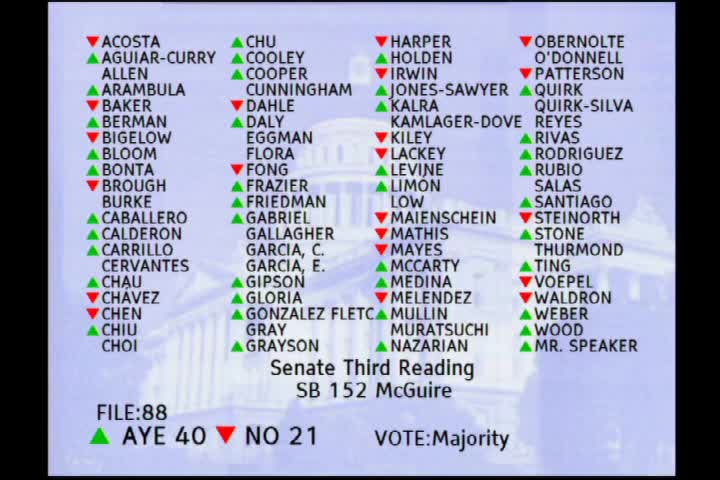 1MIN
Assembly Floor
 19MIN
Assembly Standing Committee on Transportation
 1H
Assembly Standing Committee on Appropriations
 3MIN
Senate Floor
 48MIN
Senate Standing Committee on Appropriations
Bill Author








