SB 519: State highways: property leases.
- Session Year: 2017-2018
- House: Senate
- Latest Version Date: 2018-09-17
Existing law provides that the Department of Transportation has full possession and control of the state highway system, including associated property. Existing law authorizes the department to lease certain property, including the area above or below a state highway, and certain property held for future highway purposes, to public agencies under specified terms and conditions, including specific provisions governing leases of airspace and other property in the City and County of San Francisco for purposes of an emergency shelter or feeding program, and at a lease cost of $1 per month and payment of an administrative fee not to exceed $500 per year. Existing law also requires that a lease be offered on a right of first refusal by the department to the city and county or a political subdivision of the city and county and authorizes leases of property for park, recreational, or open-space purposes, subject to certain additional terms and conditions.
This bill would authorize the department to offer leases to the Cities of Los Angeles and San Jose on a right of first refusal basis for any airspace under a freeway or certain real property acquired for highway purposes located in each city for purposes of an emergency shelter or feeding program for a lease amount, for up to 10 parcels, of $1 per month, and a payment of an administrative fee not to exceed $500 per year, as specified.
Existing law provides that the Department of Transportation has full possession and control of the state highway system, including associated property. Existing law authorizes the department to lease certain property, including the area above or below a state highway, and certain property held for future highway purposes, to public agencies under specified terms and conditions, including specific provisions governing leases of airspace and other property in the City and County of San Francisco for purposes of an emergency shelter or feeding program, and at a lease cost of $1 per month and payment of an administrative fee not to exceed $500 per year.Existing law also requires that a lease be offered on a right of first refusal by the department to the city and county or a political subdivision of the city and county and authorizes leases of property for park, recreational, or open-space purposes, subject to certain additional terms and conditions.
This bill would authorize the department to offer leases to the Cities of Los Angeles and San Jose on a right of first refusal basis for any airspace under a freeway or certain real property acquired for highway purposes located in each city for purposes of an emergency shelter or feeding program for a lease amount, for up to 10 parcels, of $1 per month, and a payment of an administrative fee not to exceed $500 per year, as specified.
Existing law, the Santa Clara Valley Water District Act, creates the Santa Clara Valley Water District and authorizes the district to provide for the conservation and management of flood, storm, and recycled waters, and other waters, for beneficial uses and to enhance natural resources in connection with carrying out the purposes of the district. The district act requires the board of directors to adopt a resolution that divides the district into 7 electoral districts and requires one director to be elected by the voters of each electoral district, as prescribed. The district act requires a candidate for the board of directors to be a resident in the electoral district for which he or she is a candidate and to continue to reside within the electoral district during his or her term of office. The district act requires a vacancy in the office of any director to be filled, as specified.This bill would require any director appointed or elected to fill a vacancy to represent the electoral district in which the vacancy occurred and to be a qualified elector residing in the electoral district in which the vacancy occurred.Existing law, the Santa Clara Valley Water District Act, creates the Santa Clara Valley Water District and authorizes the district to provide for the conservation and management of flood, storm, and recycled waters, and other waters, for beneficial uses and to enhance natural resources in connection with carrying out the purposes of the district. The district act authorizes the district to prevent contamination, pollution, or otherwise rendering unfit for beneficial use the surface or subsurface water used or useful in the district, and to commence, maintain, and defend actions and proceedings to prevent interference with the waters that may endanger or damage the inhabitants, lands, or use of water in, or flowing into, the district.
This bill would specify that the district has the authority to engage in acts the board of the district deems appropriate and beneficial to reduce impacts on the waters from activity in and around waterways in the district, as specified.The district act act requires the board of directors to adopt a resolution that divides the district into 7 electoral districts and requires one director to be elected by the voters of each electoral district, as prescribed. The district act requires a candidate for the board of directors to be a resident in the electoral district for which he or she is a candidate and to continue to reside within the electoral district during his or her term of office. The district act requires a vacancy in the office of any director to be filled, as specified.
This bill would require any director appointed or elected to fill a vacancy to represent the electoral district in which the vacancy occurred and to be a qualified elector residing in the electoral district in which the vacancy occurred.
Existing law, the Santa Clara Valley Water District Act, creates the Santa Clara Valley Water District and authorizes the district to provide for the conservation and management of flood, storm, and recycled waters, and other waters, for beneficial uses and to enhance natural resources in connection with carrying out the purposes of the district. The district act authorizes the district to prevent contamination, pollution, or otherwise rendering unfit for beneficial use the surface or subsurface water used or useful in the district, and to commence, maintain, and defend actions and proceedings to prevent interference with the waters that may endanger or damage the inhabitants, lands, or use of water in, or flowing into, the district.
This bill would specify that the district has the authority to engage in acts the board of the district deems appropriate and beneficial to reduce impacts on the waters from activity in and around waterways in the district, as specified.
The district act requires the board of directors to adopt a resolution that divides the district into 7 electoral districts and requires one director to be elected by the voters of each electoral district, as prescribed. The district act requires a candidate for the board of directors to be a resident in the electoral district for which he or she is a candidate and to continue to reside within the electoral district during his or her term of office. The district act requires a vacancy in the office of any director to be filled, as specified.
This bill would require any director appointed or elected to fill a vacancy to represent the electoral district in which the vacancy occurred and to be a qualified elector residing in the electoral district in which the vacancy occurred.
(a)(1)Any airspace under a freeway, or real property acquired for highway purposes, in the City of Los Angeles, that is not excess property, may be offered for lease on a right of first refusal by the department to the city, or to a political subdivision of the city, for purposes of an emergency shelter or feeding program.
(2)For up to 10 parcels, the lease amount for emergency shelter or feeding programs shall be for one dollar ($1) per month. The lease amount may be paid in advance of the term covered in order to reduce the administrative costs associated with the payment of the monthly rental fee. The lease shall require the payment of an administrative fee not to exceed five hundred dollars ($500) per year, unless the department determines that a higher administrative fee is necessary, for the departments cost of administering the lease.
(3)The Legislature finds and declares that the lease of real property pursuant to this subdivision serves a public purpose.
(b)(1)Any airspace under a freeway, or real property acquired for highway purposes, in the City of San Jose, that is not excess property, may be offered for lease on a right of first refusal by the department to the city, or to a political subdivision of the city, for purposes of an emergency shelter or feeding program.
(2)For up to 10 parcels, the lease amount for emergency shelter or feeding programs shall be for one dollar ($1) per month. The lease amount may be paid in advance of the term covered in order to reduce the administrative costs associated with the payment of the monthly rental fee. The lease shall require the payment of an administrative fee not to exceed five hundred dollars ($500) per year, unless the department determines that a higher administrative fee is necessary, for the departments cost of administering the lease.
(3)The Legislature finds and declares that the lease of real property pursuant to this subdivision serves a public purpose.
SECTION 1.Section 7.9 of the Santa Clara Valley Water District Act (Chapter 1405 of the Statutes of 1951), as amended by Chapter 443 of the Statutes of 2009, is amended to read:Sec. 7.9.A vacancy in the office of any director shall be filled pursuant to Section 1780 of the Government Code. Any director appointed or elected to fill a vacancy shall represent the electoral district in which the vacancy occurred and shall be a qualified elector residing in the electoral district in which the vacancy occurred.A vacancy in the office of any director shall be filled pursuant to Section 1780 of the Government Code. Any director appointed or elected to fill a vacancy shall represent the electoral district in which the vacancy occurred and shall be a qualified elector residing in the electoral district in which the vacancy occurred.
The district is hereby declared to be a body corporate and politic and, in addition to other powers granted by this act, may take action to carry out all of the following purposes:
1.To have perpetual succession.
2.To sue and be sued in the name of the district in all actions and proceedings in all courts and tribunals of competent jurisdiction.
3.To adopt a seal and alter it at pleasure.
4.To acquire by grant, purchase, lease, gift, devise, contract, construction, or otherwise, and to hold, use, enjoy, sell, let, and dispose of real and personal property of every kind, including lands, structures, buildings, rights-of-way, easements, and privileges, and to construct, maintain, alter, and operate any and all works or improvements, within or outside the district, necessary or proper to carry out any of the objects or purposes of this act and convenient to the full exercise of its powers, and to complete, extend, add to, alter, remove, repair, or otherwise improve any works, or improvements, or property acquired by it as authorized by this act.
5.To store water in surface or underground reservoirs within or outside of the district for the common benefit of the district or of any zone or zones affected; to conserve, reclaim, recycle, distribute, store, and manage water for present and future use within the district; to appropriate and acquire water and water rights, and import water into the district and to conserve within or outside the district, water for any purpose useful to the district; and to do any and every lawful act necessary to be done that sufficient water may be available for any present or future beneficial use or uses of the lands or inhabitants within the district, including, but not limited to, the acquisition, storage, and distribution of water for irrigation, domestic, fire protection, municipal, commercial, industrial, environmental, and all other beneficial uses; to distribute, sell, or otherwise dispose of, outside the district, any waters not needed for beneficial uses within the district; to commence, maintain, intervene in, defend, or compromise, in the name of the district on behalf of the landowners therein, or otherwise, and to assume the costs and expenses of any action or proceeding involving or affecting the ownership or use of waters or water rights within or outside the district, used or useful for any purpose of the district or of common benefit to any land situated therein, or involving the wasteful use of water therein; to commence, maintain, intervene in, defend, and compromise and to assume the cost and expenses of any and all actions and proceedings now or hereafter begun; to prevent interference with or diminution of, or to declare rights in the natural flow of any stream or surface or subterranean supply of water used or useful for any purpose of the district or of common benefit to the lands within the district or to its inhabitants; to prevent unlawful exportation of water from the district; to prevent contamination, pollution, or otherwise rendering unfit for beneficial use the surface or subsurface water used or useful in the district, and to commence, maintain, and defend actions and proceedings to prevent any such interference with the described waters as may endanger or damage the inhabitants, lands, or use of water in, or flowing into, the district; district, including to engage in acts the board of the district deems appropriate and beneficial to reduce impacts on the described waters from activity in and around waterways in the district, including, but not limited to, camping, construction, and the discharge or disposal of waste or other materials; provided, however, that the district shall not have power to intervene or take part in, or to pay the costs or expenses of, actions or controversies between the owners of lands or water rights that do not affect the interests of the district.
6.To control the flood and storm waters of the district and the flood and storm waters of streams that have their sources outside of the district, but which streams and the floodwaters thereof, flow into said district, and to conserve such waters for beneficial and useful purposes of the district by spreading, storing, retaining, and causing to percolate into the soil within or without the district, or to save or conserve in any manner all or any of those waters and protect from damage from those flood or storm waters the watercourses, watersheds, public highways, life, and property in the district, and the watercourses outside of the district of streams flowing into the district.
7.To enter upon any land, to make surveys and locate the necessary works of improvement and the lines for channels, conduits, canals, pipelines, roadways, and other rights-of-way; to acquire by purchase, lease, contract, gift, devise, or other legal means all lands and water and water rights and other property necessary or convenient for the construction, use, supply, maintenance, repair, and improvement of the works, including works constructed and being constructed by private owners, lands for reservoirs for storage of necessary water, and all necessary appurtenances, and also where necessary or convenient to that end, and for those purposes and uses, to acquire and to hold in the name of the state, the capital stock of any mutual water company or corporation, domestic or foreign, owning water or water rights, canals, waterworks, franchises, concessions, or rights, when the ownership of such stock is necessary to secure a water supply required by the district or any part thereof, upon the condition that when holding such stock, the district shall be entitled to all the rights, powers, and privileges, and shall be subject to all the obligations and liabilities conferred or imposed by law upon other holders of such stock in the same company; to cooperate with, act in conjunction with, enter into and to do any acts necessary for the proper performance of any agreement with the State of California, or any of its engineers, officers, boards, commissions, departments, or agencies, or with the government of the United States, or any of its engineers, officers, boards, commissions, departments, or agencies or with any state, city and county, city, county, district of any kind, public or private corporation, association, firm, or individual, or any number of them, for the ownership, joint acquisition, leasing, disposition, use, management, construction, installation, extension, maintenance, repair, or operation of any rights, works, or other property of a kind which might lawfully be acquired or owned by the district or for the lawful performance of any power or purpose of the district provided for in this act, including, but not limited to, the granting of the right to the use of any water or the right to store that water in any reservoir of the district or to carrying that water through any tunnel, canal, ditch, or conduit of the district or for the delivery, sale, or exchange of any water right, water supply, or water pumped, stored, appropriated, or otherwise acquired or secured for the use of the district, or for controlling drainage waters, or flood or storm waters of streams in or running into the district, or for the protection of life or property therein, or for the purpose of conserving any waters for the beneficial use within the district, or in any other works, uses, or purposes provided for in this act; and to adopt and carry out any definite plan or system for accomplishing, facilitating, or financing all work which may lawfully be accomplished by the district and to enforce that plan or system by resolution or ordinance.
8.To carry on technical and other necessary investigations, make measurements, collect data, make analyses, studies, and inspections pertaining to water supply, water rights, control of flood and storm waters, and use of water both within and outside the district relating to watercourses or streams flowing in or into the district. For these purposes, the district shall have the right of access through its authorized representatives to all properties within the district and elsewhere relating to watercourses and streams flowing in or into said district. The district, through its authorized representatives, may enter upon such lands and make examinations, surveys, and maps thereof.
9.To prescribe, revise, and collect fees and charges for facilities furnished or to be furnished to any new building, improvement, or structure by the use of any flood control or storm drainage system constructed or to be constructed in a zone of the district, and whenever a drainage or flood control problem is referred to the district by the County of Santa Clara, or any incorporated city therein, to require the installation of drainage or flood control improvements necessary and/or convenient for needs of the zone, including, but not limited to, residential, subdivision, commercial, and industrial drainage and flood control needs, that county and those cities being hereby authorized to refer all drainage and flood control problems, arising under the Subdivision Map Act (Division 2 (commencing with Section 66410) of Title 7 of the Government Code) or otherwise, to the district for solution. Revenues derived under this section shall be used for the acquisition, construction, reconstruction, maintenance, and operation of the flood control or storm drainage facilities of the zone, to reduce the principal or interest of any bonded indebtedness thereof, or to replace funds expended on behalf of that zone derived from the fund created pursuant to subdivision 1 of Section 13.
10.To incur indebtedness, and to issue bonds in accordance with this act.
11.To cause taxes or assessments to be levied and collected for the purpose of paying any obligation of the district, and to carry out any of the purposes of this act, in the manner hereinafter provided.
12.To make contracts, and to employ labor, and to do all acts necessary for the full exercise of all powers vested in the district or any of the officers thereof, by this act.
13.To have the power and right to disseminate information concerning the rights, properties, activities, plans, and proposals of the district; provided, however, that expenditures during any fiscal year for those purposes shall not exceed one-half cent ($0.005) for each one hundred dollars ($100) of assessed valuation of the district.
14.To pay to any city, public agency, district, or educational institution recognized under Chapter 3 (commencing with Section 94301) of Part 59 of the Education Code, a portion of the cost of water imported by that city, public agency, district, or educational institution into, for use within, and of benefit to the Santa Clara Valley Water District.
15.To establish designated floodways in accordance with the Cobey-Alquist Flood Plain Management Act (Chapter 4 (commencing with Section 8400) of Part 2 of Division 5 of the Water Code).
16.To acquire, construct, maintain, operate, and install landscaping or recreational facilities in connection with any dam, reservoir, or other works owned or controlled by the district.
17.To acquire, construct, maintain, operate and install, lease, and control facilities for the generation, transmission, distribution, sale, exchange, and lease of electric power.
18.To require the sealing of abandoned or unused wells according to standards adopted by the board by ordinance and designed to protect the groundwater resources of the district from contamination. Upon and following the effective date of the ordinance, the County of Santa Clara or any incorporated city therein shall require all persons applying for any land development permit or approval to show the existence and location of any water well upon a map of the property the subject of the application. When a well is shown, the map shall be referred to the district immediately upon receipt for review and investigation. If upon review and investigation the district determines that the well or wells are to be sealed by the applicant pursuant to the ordinance, the determination shall be transmitted promptly to the applicant by the district as a requirement in writing.
SEC. 2.Section 7.9 of the Santa Clara Valley Water District Act (Chapter 1405 of the Statutes of 1951), as amended by Chapter 443 of the Statutes of 2009, is amended to read:Sec. 7.9.A vacancy in the office of any director shall be filled pursuant to Section 1780 of the Government Code. Any director appointed or elected to fill a vacancy in either of the offices described in subdivision (a) of Section 7.1 shall represent the electoral district at large in which the vacancy occurred and shall be a qualified elector residing in the County of Santa Clara. electoral district in which the vacancy occurred.
|
Date
|
Status
|
|---|---|
| Sep 17, 2018 | Chaptered by Secretary of State. Chapter 444, Statutes of 2018. |
| Sep 17, 2018 | Approved by the Governor. |
| Sep 12, 2018 | Enrolled and presented to the Governor at 5 p.m. |
| Aug 31, 2018 | Assembly amendments concurred in. (Ayes 32. Noes 5.) Ordered to engrossing and enrolling. |
| Aug 31, 2018 | From committee: That the Assembly amendments be concurred in. (Ayes 11. Noes 1.) |
| Aug 31, 2018 | From committee: Be re-referred to Com. on T. & H. pursuant to Senate Rule 29.10(d). (Ayes 5. Noes 0.) Re-referred to Com. on T. & H. |
| Aug 31, 2018 | Re-referred to Com. on RLS. pursuant to Senate Rule 29.10(d). |
| Aug 31, 2018 | In Senate. Concurrence in Assembly amendments pending. |
| Aug 31, 2018 | Read third time. Passed. Ordered to the Senate. |
| Aug 30, 2018 | Read second time. Ordered to third reading. |
| Aug 29, 2018 | From committee: Do pass. (Ayes 10. Noes 3.) (August 29). |
| Aug 28, 2018 | Joint Rule 62(a) suspended. |
| Aug 23, 2018 | Re-referred to Com. on TRANS. pursuant to Assembly Rule 77.2. |
| Aug 23, 2018 | Read third time and amended. |
| Jun 25, 2018 | Read second time. Ordered to third reading. |
| Jun 21, 2018 | From committee: Do pass. (Ayes 7. Noes 0.) (June 20). |
| Apr 26, 2018 | Referred to Com. on L. GOV. |
| Jan 23, 2018 | In Assembly. Read first time. Held at Desk. |
| Jan 22, 2018 | Read third time. Passed. (Ayes 38. Noes 0.) Ordered to the Assembly. |
| Jan 11, 2018 | Read second time. Ordered to third reading. |
| Jan 10, 2018 | Ordered to second reading. |
| Jan 10, 2018 | From committee: Do pass and re-refer to Com. on EQ. with recommendation: To consent calendar. (Ayes 7. Noes 0.) (January 10). Re-referred to Com. on EQ. |
| Jan 3, 2018 | From committee with author's amendments. Read second time and amended. Re-referred to Com. on GOV. & F. |
| Dec 21, 2017 | Set for hearing January 10. |
| Apr 13, 2017 | April 19 hearing postponed by committee. |
| Apr 7, 2017 | Set for hearing April 19 in EQ. pending receipt. |
| Apr 5, 2017 | April 5 hearing postponed by committee. |
| Mar 8, 2017 | Set for hearing April 5. |
| Mar 2, 2017 | Referred to Coms. on GOV. & F. and EQ. |
| Feb 17, 2017 | From printer. May be acted upon on or after March 19. |
| Feb 16, 2017 | Introduced. Read first time. To Com. on RLS. for assignment. To print. |
|
Date
|
Description
|
Location
|
Votes
|
|
|---|---|---|---|---|
| Aug 31, 2018 | Unfinished Business SB519 Beall et al. Concurrence | Senate Floor |
Passed |
|
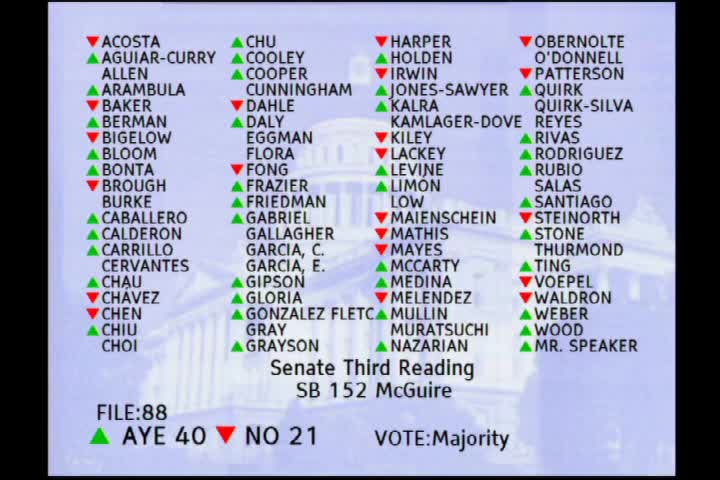
| Aug 31, 2018 | SB 519 Beall Senate Third Reading By GIPSON | Assembly Floor |
Passed |
|
| Aug 31, 2018 | That the Assembly amendments be concurred in | Senate Standing Committee on Transportation and Housing |
Passed |
|
| Aug 29, 2018 | Do pass. | Assembly Standing Committee on Transportation |
Passed |
|
| Aug 23, 2018 | SB 519 Beall Senate Third Reading Amend By GIPSON Set #1 | Assembly Floor |
Passed |
|
| Jun 20, 2018 | Do pass. | Assembly Standing Committee on Local Government |
Passed |
|
| Jan 22, 2018 | Senate 3rd Reading SB519 Beall | Senate Floor |
Passed |
|
| Jan 10, 2018 | Do pass, but first be re-referred to the Committee on [Environmental Quality] with the recommendation: To Consent Calendar | Senate Standing Committee on Governance and Finance |
Passed |
This list shows positions taken on this bill by organizations on the date displayed, which is linked to the original source.
Positions by individuals are not included.
SENATE COMMITTEE ON TRANSPORTATION AND HOUSING
Senator Jim Beall, Chair
2017 - 2018 Regular
Bill No: SB 519 Hearing Date: 8/31/18
Author: | Beall | ||
Version: | 8/23/2018 Amended | ||
Urgency: | No | Fiscal: | Yes |
Consultant: | Jeffery Song | ||
SUBJECT: State highways: property leases
DIGEST: This bill authorizes the California Department of Transportation (Caltrans) to lease at a discount up to 10 parcels of airspace under a freeway or other real property to the City of Los Angeles and the City of San Jose for emergency shelter or feeding programs.
ANALYSIS:
Existing law:
- Grants Caltrans broad authority to acquire by eminent domain any property necessary for state highway purposes.
- Authorizes Caltrans to lease to public agencies or private entities the use of areas above or below state highways (known as “airspace”). Generally, leases to private entities are required to be made on the basis of competitive bids and at fair market value.
- Authorizes Caltrans to make land or airspace available, with or without charge, to a public entity to accommodate needed passenger, commuter, or high-speed rail; magnetic levitation systems; and highway and non-highway mass transit facilities.
- Authorizes $1 per month leases of Caltrans airspace parcels to the City and County of San Francisco, Santa Barbara County, the City of San Diego, and San Joaquin County for specified emergency shelter or feeding purposes.
This bill:
- Requires any airspace under a freeway, or real property acquired for highway purposes, in the City of Los Angeles and the City of San Jose, that is not excess property, to be offered by Caltrans for lease on a right of first refusal to the city, or to a political subdivision of the city, for purposes of an emergency shelter or feeding program.
- Requires, for up to 10 parcels, the lease amount for emergency shelter or feeding programs to be $1 per month.
- Allows the lease amount to be paid in advance of the term covered in order to reduce the administrative costs associated with the payment of the monthly rental fee.
- Requires the lease to require the payment of an administrative fee not to exceed $500 per year, unless Caltrans determines that a higher administrative fee is necessary, for its cost of administering the lease.
- Finds and declares that the lease of real property pursuant to these provisions serves a public purpose.
COMMENTS:
- New Bill. As approved by the Senate on January 22, 2018, this bill dealt with water districts. This bill has been referred to this committee pursuant to Senate Rule 29.10(d). The committee may either hold the bill or return the bill to the Senate floor for consideration. Amendments are not permitted.
- Author’s Statement. According to the author, California’s homeless population has skyrocketed over the last several years. This sharp increase in the state’s homeless population has sent local jurisdictions throughout the state scrambling to address the issue. Several cities have developed emergency shelters on Caltrans owned land but these projects will not be economically feasible if the cities are required to lease them at market rate.
This bill would expand Caltrans’ existing authority by allowing Caltrans to lease real property to the cities of Los Angeles and San Jose for the purposes of establishing an emergency shelter or feeding program, for $1 per month. This will give these local jurisdictions the ability to leverage state and local assets to take bold and aggressive actions to address the state’s homelessness crisis.
- Exception for emergency shelter and feeding programs. Existing law grants Caltrans the authority to enter into airspace leases, and it generally obligates Caltrans to secure fair market value lease rates for airspace under freeways or other available parcels, based on the estimated highest and best use of the property. Notable exceptions to the fair market value requirement authorize Caltrans to lease unused parcels of land below market rates (e.g., $1 per month) to various cities and counties for the purposes of emergency shelters and feeding programs. In each of these exceptions, the Legislature has found that below-market rate leases for these particular uses serve a public purpose.
- Similar bills. This year, there were three similar bills, AB 2629 (Eggman), AB 3061 (Gloria), and AB 3139(Bonta), passed by the Legislature that also provide or extend authorization for Caltrans to lease airspace parcels in specific cities and counties for the purposes of emergency shelter or feeding. These bills, in addition to this one, give these cities and counties a helpful tool to address California’s significant homelessness crisis.
Related Legislation:
AB 2629 (Eggman, 2018) — authorizes Caltrans to lease airspace parcels in San Joaquin and Santa Barbara Counties for emergency shelter or feeding purposes regardless of whether there are other prospective buyers and removes the current restriction that the San Joaquin County airspace lease be limited to a 10-year term with two possible 10-year lease renewals. This bill has been approved by the Legislature and is awaiting action from the Governor.
AB 3061 (Gloria, 2018) — authorizes Caltrans to lease specified additional property in the City of San Diego to another public entity for purposes of an emergency shelter, feeding program, or children’s day care facility, at a lease amount of $1 per month and an administrative fee not to exceed $500 per year, as specified. This bill has been approved by the Legislature and is awaiting action from the Governor.
AB 3139 (Bonta, 2018) — authorizes Caltrans to lease airspace under a freeway or other real property to the City of Oakland for emergency shelter or feeding programs. This bill has been approved by the Legislature and is awaiting action from the Governor.
AB 1898 (Mathis, 2018) — would have required Caltrans to lease at a discount to a city or county any airspace under a freeway or other real property in a disadvantaged community for various purposes. AB 1898 was held on Suspense in the Assembly Appropriations Committee.
AB 857 (Ting, Chapter 822, Statutes of 2017) — directed Caltrans to lease to San Francisco up to 10 parcels of airspace under a freeway at 30% of fair market lease value for park, recreational, or open-space purposes.
SB 120 (Kopp, Chapter 750, Statutes of 1993) — authorized Caltrans to lease to San Francisco any airspace under a freeway or property for an emergency shelter or feeding program at a rate of $1 per month.
SB 1441 (Johnston, Chapter 143, Statutes of 1992) — enabled the City of Stockton to renew its airspace lease at the SR 4 and I-5 interchange for ten years, and authorized two subsequent ten-year renewals following that first renewal.
FISCAL EFFECT: Appropriation: Fiscal Com.: Local:
POSITIONS: (Communicated to the committee before noon on Wednesday,
August 29, 2018.)
SUPPORT:
City of Los Angeles
City of San Jose
County of Santa Clara
OPPOSITION:
None received.
-- END --
Office of Senate Floor Analyses (916) 651-1520 Fax: (916) 327-4478 | SB |
UNFINISHED BUSINESS
Bill No: SB 519
:
PRIOR SENATE VOTES NOT RELEVANT
SENATE TRANS. & HOUSING COMMITTEE: 11-1, 8/31/18 (Pursuant to Senate Rule 29.10)
AYES: Beall, Cannella, Dodd, Gaines, Galgiani, McGuire, Roth, Skinner, Vidak, Wieckowski, Wiener
NOES: Morrell
NO VOTE RECORDED: Allen
ASSEMBLY FLOOR: Not available
DIGEST:
This bill authorizes the California Department of Transportation (Caltrans) to lease at a discount up to 10 parcels of airspace under a freeway or other real property to the City of Los Angeles and the City of San Jose for emergency shelter or feeding programs.
Assembly Amendments
create a new bill. When the bill left the Senate, it dealt with water districts.
Existing law:
- Grants Caltrans broad authority to acquire by eminent domain any property necessary for state highway purposes.
- Authorizes Caltrans to lease to public agencies or private entities the use of areas above or below state highways (known as “airspace”). Generally, leases to private entities are required to be made on the basis of competitive bids and at fair market value.
- Authorizes Caltrans to make land or airspace available, with or without charge, to a public entity to accommodate needed passenger, commuter, or high-speed rail; magnetic levitation systems; and highway and non-highway mass transit facilities.
- Authorizes $1 per month leases of Caltrans airspace parcels to the City and County of San Francisco, Santa Barbara County, the City of San Diego, and San Joaquin County for specified emergency shelter or feeding purposes.
This bill:
- Requires any airspace under a freeway, or real property acquired for highway purposes, in the City of Los Angeles and the City of San Jose, that is not excess property, to be offered by Caltrans for lease on a right of first refusal to the city, or to a political subdivision of the city, for purposes of an emergency shelter or feeding program.
- Requires, for up to 10 parcels, the lease amount for emergency shelter or feeding programs to be $1 per month.
- Allows the lease amount to be paid in advance of the term covered in order to reduce the administrative costs associated with the payment of the monthly rental fee.
- Requires the lease to require the payment of an administrative fee not to exceed $500 per year, unless Caltrans determines that a higher administrative fee is necessary, for its cost of administering the lease.
- Finds and declares that the lease of real property pursuant to these provisions serves a public purpose.
Comments
- New Bill. As approved by the Senate on January 22, 2018, this bill dealt with water districts.
- Author’s Statement. According to the author, California’s homeless population has skyrocketed over the last several years. This sharp increase in the state’s homeless population has sent local jurisdictions throughout the state scrambling to address the issue. Several cities have developed emergency shelters on Caltrans owned land but these projects will not be economically feasible if the cities are required to lease them at market rate.
This bill expands Caltrans’ existing authority by allowing Caltrans to lease real property to the cities of Los Angeles and San Jose for the purposes of establishing an emergency shelter or feeding program, for $1 per month. This will give these local jurisdictions the ability to leverage state and local assets to take bold and aggressive actions to address the state’s homelessness crisis.
- Exception for emergency shelter and feeding programs. The authority for Caltrans to enter into airspace leases is in existing law and Caltrans is generally obligated to secure fair market value lease rates for airspace under freeways or other available parcels, based on the estimated highest and best use of the property. Notable exceptions to the fair market value requirement authorize Caltrans to lease unused parcels of land below market rates to various cities and counties for the purposes of emergency shelters and feeding programs. In each of these exceptions, the Legislature has found that below-market rate leases for these particular uses serve a public purpose.
- Similar bills. This year, there were three similar bills, AB 2629 (Eggman), AB 3061 (Gloria), and AB 3139 (Bonta), passed by the Legislature that also provide or extend authorization for Caltrans to lease airspace parcels in specific cities and counties for the purposes of emergency shelter or feeding. These bills, in addition to this one, give these cities and counties a helpful tool to address California’s significant homelessness crisis.
Related/Prior Legislation
AB 2629 (Eggman, 2018) authorizes Caltrans to lease airspace parcels in San Joaquin and Santa Barbara Counties for emergency shelter or feeding purposes regardless of whether there are other prospective buyers and removes the current restriction that the San Joaquin County airspace lease be limited to a 10-year term with two possible 10-year lease renewals. The bill has been approved by the Legislature and is awaiting action from the Governor.
AB 3061 (Gloria, 2018) authorizes Caltrans to lease specified additional property in the City of San Diego to another public entity for purposes of an emergency shelter, feeding program, or children’s day care facility, at a lease amount of $1 per month and an administrative fee not to exceed $500 per year, as specified. The bill has been approved by the Legislature and is awaiting action from the Governor.
AB 3139 (Bonta, 2018) authorizes Caltrans to lease airspace under a freeway or other real property to the City of Oakland for emergency shelter or feeding programs. The bill has been approved by the Legislature and is awaiting action from the Governor.
AB 1898 (Mathis, 2018) would have required Caltrans to lease at a discount to a city or county any airspace under a freeway or other real property in a disadvantaged community for various purposes. AB 1898 was held on Suspense in the Assembly Appropriations Committee.
AB 857 (Ting, Chapter 822, Statutes of 2017) directed Caltrans to lease to San Francisco up to 10 parcels of airspace under a freeway at 30% of fair market lease value for park, recreational, or open-space purposes.
SB 120 (Kopp, Chapter 750, Statutes of 1993) authorized Caltrans to lease to San Francisco any airspace under a freeway or property for an emergency shelter or feeding program at a rate of $1 per month.
SB 1441 (Johnston, Chapter 143, Statutes of 1992) enabled the City of Stockton to renew its airspace lease at the SR 4 and I-5 interchange for 10 years, and authorized two subsequent 10-year renewals following that first renewal.
FISCAL EFFECT: Appropriation: Fiscal Com.: Local:
Unknown.
City of Los Angeles
City of San Jose
County of Santa Clara
OPPOSITION: (Verified 8/31/18)
8/31/18 19:30:29
**** END ****
SENATE THIRD READING
STR Bill Id:SB 519
Author:(Beall and Bradford)
As Amended Ver:August 23, 2018
Majority vote
SENATE VOTE: 38-0
Committee | Votes | Ayes | Noes |
Local Government | 7-0 | Aguiar-Curry, Waldron, Bloom, Caballero, Gabriel, Rivas, Voepel | |
Transportation | 10-3 | Frazier, Aguiar-Curry, Berman, Chu, Daly, Friedman, Gipson, Medina, Nazarian, O'Donnell | Baker, Harper, Mathis |
SUMMARY: Authorizes the California Department of Transportation (Caltrans) to lease at a discount up to 10 parcels of airspace under a freeway or other real property to both the City of San Jose and the City of Los Angeles for emergency shelter or feeding programs, under specific terms and conditions. Specifically, this bill:
- Authorizes Caltrans to lease for $1 per month up to 10 parcels of airspace or real property to the City of San Jose, or a political subdivision of the city, for emergency shelter or feeding programs.
- Authorizes Caltrans to lease for $1 per month up to 10 parcels of airspace or real property to the City of Los Angeles, or a political subdivision of the city, for emergency shelter or feeding programs.
- Declares that a lease let under this authority serves a public purpose.
- Requires Caltrans to include in a lease let under this authority an administrative fee not to exceed $500 per year unless Caltrans determines a higher fee is necessary.
- Authorizes the lessee to pay the lease amount in advance in order to reduce the administrative costs associated with the payment of a monthly rental fee.
FISCAL EFFECT: Unknown
COMMENTS: The authority for Caltrans to enter into airspace leases is in existing law, but Caltrans is generally obligated to secure fair market value lease rates for airspace under freeways or other available parcels, based on the estimated highest and best use of the property. Notable exceptions to the fair market value requirement authorizes Caltrans to lease unused parcels of land below market rates to various cities and counties for the purposes of emergency shelters and feeding programs. In each of these exceptions, the Legislature has found that submarket rate leases for these particular uses serves a public purpose.
Committee Comment: This bill is not without precedence. Existing law provides a number of examples wherein Caltrans is authorized to lease airspace at below market rate, and there are a number of instances where these leases exist. In the instances where Caltrans has entered into below market rate leases for emergency shelters, feeding programs, or other public purposes, statute authorizing them to do so has led Caltrans to provide the designated airspace lease to the local community. While this bill may provide much needed emergency housing or space for feeding programs in San Jose and Los Angeles, it may result in some lost state revenue. It is worth noting that the revenue generated by airspace leases currently flows to the General Fund, and therefore this bill could result in reducing resources for programs that currently benefit the very communities the bill aims to help.
Analysis Prepared by: Eric Thronson / TRANS. / (916) 319-2093 FN: 0005187
SENATE THIRD READING
STR Bill Id:SB 519
Author:(Beall)
As Amended Ver:January 3, 2018
Majority vote
SENATE VOTE: 38-0
Committee | Votes | Ayes | Noes |
Local Government | 7-0 | Aguiar-Curry, Waldron, Bloom, Caballero, Gabriel, Rivas, Voepel |
SUMMARY: Requires appointed board members of the Santa Clara Valley Water District (SCVWD) to reside in their electoral district when filling a vacancy.
EXISTING LAW:
- Prescribes, generally, the process for filling a vacancy on a local agency board.
- Requires the SCVWD to appoint an individual to fill a vacancy from the district at-large.
FISCAL EFFECT: None
COMMENTS:
- Background and Bill Summary. SCVWD is the primary water resources agency for Santa Clara County. First formed as the Santa Clara Valley Water Conservation District in 1929, it now acts as the County's water wholesaler and the steward for its streams, creeks, underground aquifers, and district-built reservoirs. The District owns and manages 10 local surface reservoirs and associated creeks and recharge facilities, manages the County's groundwater basins and three water treatment plants, imports water from the Central Valley Project and the State Water Project, and delivers recycled water to parts of the County. The District is also responsible for flood protection within the County. Its stewardship responsibilities include creek restoration and wildlife habitat projects, pollution prevention efforts, and a commitment to natural flood protection.
Prior to 2010, the SCVWD Board of Directors consisted of five members directly elected, one from each county supervisorial district, and two members appointed by the Santa Clara County Board of Supervisors to serve at large. AB 466 (Coto), Chapter 443, Statutes of 2009, amended the SCVWD Act to require the District to establish boundaries for seven electoral districts, and provided that the two appointed board members must be elected instead. Elected board members must be a resident of the electoral district they represent.
The Government Code prescribes the process for filling a vacancy on a board of directors for any special district. A vacant board seat can be filled by either appointment or by election, and the SCVWD Act requires the District to follow this process. However, AB 466 specified that when a board seat becomes vacant, the new board member must be appointed to represent the District at large. This bill amends SCVWD's Act to require that appointments to vacant seats be made from the electoral district in which the vacant seat exists, rather than from anywhere within the District's jurisdiction. This bill is sponsored by SCVWD.
- Author's Statement. According to the author, "The SCVWD is a special district with jurisdiction throughout Santa Clara County, including Silicon Valley. This bill proposes to reform the process for filling Board vacancies to ensure better representation. The District Act currently requires that Board vacancies be filled on an 'at large' basis by a person residing anywhere within SCVWD's jurisdiction of Santa Clara County. This bill requires that the appointment to a vacant Board seat be made from the district in which the vacancy exists rather than from anywhere in Santa Clara County."
- Related Legislation. AB 1889 (Caballero) of the current legislative session amends the SCVWD Act in three ways. First, AB 1889 increases the amount of days the board can be compensated for meetings every calendar month from 10 to 20. Second, the bill changes the process for receiving a special tax exemption from an opt-in to an opt-out process, specifying that an individual does not have to opt-in on an annual basis to receive the exemption on an ongoing basis. Third, identically to SB 519, the bill requires the individual appointed to fill the vacancy to actually reside within the electoral district that has the vacancy. AB 1889 is currently pending in the Senate Governance and Finance Committee.
- Arguments in Support. According to the sponsors, "SB 519 seeks to improve community representation by reforming the process to fill District Board vacancies by requiring that a person appointed to fill the vacancy live in the electoral district where the vacancy has occurred. Currently, the District Act allows anyone living in Santa Clara County to apply for a District Board vacancy. This outdated provision is left over from a time when two seats were appointed from anywhere in the county by the Santa Clara County Board of Supervisors. Reforming the eligibility requirement for vacancy appointments to our Board of Directors will ensure the voters are properly represented by a qualified electoral district in which the vacancy occurred."
- Arguments in Opposition. None on file.
Analysis Prepared by: Jimmy MacDonald / L. GOV. / (916) 319-3958 FN: 0003561
Date of Hearing: June 20, 2018
ASSEMBLY COMMITTEE ON LOCAL GOVERNMENT
Cecilia Aguiar-Curry, Chair
SBPCA Bill Id:SB 519
Author:(Beall) – As Amended Ver:January 3, 2018
SENATE VOTE: 38-0
SUBJECT: Santa Clara Valley Water District.
SUMMARY: Requires appointed board members of the Santa Clara Valley Water District (SCVWD) to reside in their electoral district when filling a vacancy.
EXISTING LAW:
- Prescribes, generally, the process for filling a vacancy on a local agency board.
- Requires the SCVWD to appoint an individual to fill a vacancy from the district at-large.
FISCAL EFFECT: None
COMMENTS:
- Background and Bill Summary. SCVWD is the primary water resources agency for Santa Clara County. First formed as the Santa Clara Valley Water Conservation District in 1929,
it now acts as the County's water wholesaler and the steward for its streams, creeks, underground aquifers, and district-built reservoirs. The District owns and manages 10 local surface reservoirs and associated creeks and recharge facilities, manages the County’s groundwater basins and three water treatment plants, imports water from the Central Valley Project and the State Water Project, and delivers recycled water to parts of the County. The District is also responsible for flood protection within the County. Its stewardship responsibilities include creek restoration and wildlife habitat projects, pollution prevention efforts, and a commitment to natural flood protection.
Prior to 2010, the SCVWD Board of Directors consisted of five members directly elected, one from each county supervisorial district, and two members appointed by the Santa Clara County Board of Supervisors to serve at large. AB 466 (Coto), Chapter 443, Statutes of 2009, amended the SCVWD Act to require the District to establish boundaries for seven electoral districts, and provided that the two appointed board members must be elected instead. Elected board members must be a resident of the electoral district they represent.
The Government Code prescribes the process for filling a vacancy on a board of directors
for any special district. A vacant board seat can be filled by either appointment or by election, and the SCVWD Act requires the District to follow this process. However, AB 466 specified that when a board seat becomes vacant, the new board member must be appointed to represent the District at large. This bill amends SCVWD’s Act to require that appointments to vacant seats be made from the electoral district in which the vacant seat exists, rather than from anywhere within the District’s jurisdiction. This bill is sponsored by SCVWD.
- Author’s Statement. According to the author, “The SCVWD is a special district with jurisdiction throughout Santa Clara County, including Silicon Valley. This bill proposes to reform the process for filling Board vacancies to ensure better representation. The District Act currently requires that Board vacancies be filled on an ‘at large’ basis by a person residing anywhere within SCVWD’s jurisdiction of Santa Clara County. This bill requires that the appointment to a vacant Board seat be made from the district in which the vacancy exists rather than from anywhere in Santa Clara County.”
- Related Legislation. AB 1889 (Caballero) amends the SCVWD Act in three ways. First, AB 1889 increases the amount of days the board can be compensated for meetings every calendar month from 10 to 20. Second, the bill changes the process for receiving a special tax exemption from an opt-in to an opt-out process, specifying that an individual does not have to opt-in on an annual basis to receive the exemption on an ongoing basis. Third, identically to SB 519, the bill requires the individual appointed to fill the vacancy to actually reside within the electoral district that has the vacancy. AB 1889 is currently pending in the Senate Governance and Finance Committee.
- Arguments in Support. According to the sponsors, “SB 519 seeks to improve community representation by reforming the process to fill District Board vacancies by requiring that a person appointed to fill the vacancy live in the electoral district where the vacancy has occurred. Currently, the District Act allows anyone living in Santa Clara County to apply
for a District Board vacancy. This outdated provision is left over from a time when two seats were appointed from anywhere in the county by the Santa Clara County Board of Supervisors. Reforming the eligibility requirement for vacancy appointments to our Board
of Directors will ensure the voters are properly represented by a qualified electoral district in which the vacancy occurred.” - Arguments in Opposition. None on file.
REGISTERED SUPPORT / OPPOSITION:
Support
Santa Clara Valley Water District [SPONSOR]
Opposition
None on file
Analysis Prepared by: Jimmy MacDonald / L. GOV. / (916) 319-3958
Office of Senate Floor Analyses (916) 651-1520 Fax: (916) 327-4478 | SB |
THIRD READING
Bill No: SB 519
:
SENATE GOVERNANCE & FIN. COMMITTEE: 7-0, 1/10/18
AYES: McGuire, Nguyen, Beall, Hernandez, Hertzberg, Lara, Moorlach
SOURCE: Santa Clara Valley Water District
DIGEST:
This bill requires appointed board members of the Santa Clara Valley Water District (SCVWD) to reside in their electoral district when filling a vacancy.
Existing law:
- Prescribes, generally, the process for filling a vacancy on a local agency board.
- Requires the SCVWD to appoint an individual to fill a vacancy from the district at-large.
This bill requires an appointed SCVWD board member to be a qualified voter within the electoral district they represent when filling a vacancy.
Background
The SCVWD is the primary water resources agency for Santa Clara County. First formed as the Santa Clara Valley Water Conservation District in 1929, it now acts as the County's water wholesaler and the steward for its streams, creeks, underground aquifers, and district-built reservoirs. The SCVWD owns and manages 10 local surface reservoirs and associated creeks and recharge facilities, manages the County’s groundwater basins and three water treatment plants, imports water from the Central Valley Project and the State Water Project, and delivers recycled water to parts of the County. The SCVWD is also responsible for flood protection within the County. Its stewardship responsibilities include creek restoration and wildlife habitat projects, pollution prevention efforts, and a commitment to natural flood protection.
Prior to 2010, the SCVWD Board of Directors consisted of five members directly elected, one from each county supervisorial district, and two members appointed by the Santa Clara County Board of Supervisors to serve at large. AB 466 (Coto, Chapter 443, Statutes of 2009) amended the SCVWD Act to require the SCVWD to establish boundaries for 7 electoral districts, and provided that the two appointed board members must be elected instead. Elected board members must be a resident of the electoral district they represent.
The Government Code prescribes the process for filling a vacancy on a board of directors for any special district. A vacant board seat can be filled by either appointment or by election, and the SCVWD Act requires the SCVWD to follow this process. However, AB 466 specified that when a board seat becomes vacant, the new board member must be appointed to represent the SCVWD at large.
Comments
Purpose of the bill. According to the author, “The Santa Clara Valley Water District (SCVWD) is a special district with jurisdiction throughout Santa Clara County, including Silicon Valley. This bill proposes to reform the process for filling Board vacancies. The District Act currently requires that Board vacancies be filled on an ‘at large’ basis by a person residing anywhere within SCVWD’s jurisdiction of Santa Clara County. This bill requires that the appointment to a vacant Board seat be made from the district in which the vacancy exists rather than from anywhere in Santa Clara County.”
Double-referred. The Senate Rules Committee referred SB 519 to both the Committees on Governance and Finance, which considers bills affecting local agency governance, and Environmental Quality. However, as introduced, this bill would have increased the authority of the SCVWD to address impacts of the local homeless population including, camping, construction, and waste disposal in its waterways. The author has since removed these provisions from the bill.
FISCAL EFFECT: Appropriation: Fiscal Com.: Local:
Santa Clara Valley Water District (source)
Association of California Water Agencies
California Municipal Utilities Association
California Special Districts Association
OPPOSITION: (Verified 1/11/18)
None received
1/11/18 16:48:39
**** END ****
SENATE COMMITTEE ON GOVERNANCE AND FINANCE
Senator Mike McGuire, Chair
2017 - 2018 Regular
Bill No: | SB 519 | Hearing Date: | 1/10/18 |
Author: | Beall | Tax Levy: | No |
Version: | 1/3/18 | Fiscal: | No |
Consultant: | MacDonald | ||
Santa Clara Valley Water District
Requires appointed board members of the Santa Clara Valley Water District to reside in their electoral district when filling a vacancy.
Background
The Santa Clara Valley Water District (SCVWD) is the primary water resources agency for Santa Clara County. First formed as the Santa Clara Valley Water Conservation District in 1929, it now acts as the County's water wholesaler and the steward for its streams, creeks, underground aquifers, and district-built reservoirs. The District owns and manages 10 local surface reservoirs and associated creeks and recharge facilities, manages the County’s groundwater basins and three water treatment plants, imports water from the Central Valley Project and the State Water Project, and delivers recycled water to parts of the County. The District is also responsible for flood protection within the County. Its stewardship responsibilities include creek restoration and wildlife habitat projects, pollution prevention efforts, and a commitment to natural flood protection.
Prior to 2010, the SCVWD Board of Directors consisted of five members directly elected, one from each county supervisorial district, and two members appointed by the Santa Clara County Board of Supervisors to serve at large. AB 466 (Coto, 2009) amended the SCVWD Act to require the District to establish boundaries for 7 electoral districts, and provided that the two appointed board members must be elected instead. Elected board members must be a resident of the electoral district they represent.
The Government Code prescribes the process for filling a vacancy on a board of directors for any special district. A vacant board seat can be filled by either appointment or by election, and the SCVWD Act requires the District to follow this process. However, AB 466 specified that when a board seat becomes vacant, the new board member must be appointed to represent the District at large. The SCVWD is asking the Legislature to amend its act to require that appointments to vacant seats be made from the electoral district in which the vacant seat exists, rather than from anywhere within the District’s jurisdiction.
Proposed Law
Senate Bill 519 requires an appointed SCVWD board member to be a qualified voter within the electoral district they represent when filling a vacancy.
State Revenue Impact
No estimate.
Comments
- Purpose of the bill. According to the author, “The Santa Clara Valley Water District (SCVWD) is a special district with jurisdiction throughout Santa Clara County, including Silicon Valley. This bill proposes to reform the process for filling Board vacancies. The District Act currently requires that Board vacancies be filled on an ‘at large’ basis by a person residing anywhere within SCVWD’s jurisdiction of Santa Clara County. This bill requires that the appointment to a vacant Board seat be made from the district in which the vacancy exists rather than from anywhere in Santa Clara County.”
- Double-referred. The Senate Rules Committee referred SB 519 to both the Committees on Governance and Finance, which considers bills affecting local agency governance, and Environmental Quality. However, as introduced, this bill would have increased the authority of the SCVWD to address impacts of the local homeless population including, camping, construction, and waste disposal in its waterways. The author has since removed these provisions from the bill.
Support and Opposition
(1/4/18)
Support: Santa Clara Valley Water District (sponsor), Association of California Water Agencies; California Municipal Utilities Association, California Special Districts Association.
Opposition: Unknown.
-- END --
SENATE COMMITTEE ON GOVERNANCE AND FINANCE
Senator Mike McGuire, Chair
2017 - 2018 Regular
Bill No: | SB 519 | Hearing Date: | 4/5/17 |
Author: | Beall | Tax Levy: | No |
Version: | 2/16/17 | Fiscal: | No |
Consultant: | MacDonald | ||
Santa Clara Valley Water District
Amends the Santa Clara Valley Water District authority to address homelessness on its waterways and requires appointed board members to reside in the electoral district when filling a vacancy.
Background
The Santa Clara Valley Water District (SCVWD) is the primary water resources agency for Santa Clara County. First formed as the Santa Clara Valley Water Conservation District in 1929, it now acts not only as the County's water wholesaler, but also as its flood protection agency and is the steward for its streams and creeks, underground aquifers and district-built reservoirs. The District owns and manages 10 local surface reservoirs and associated creeks and recharge facilities, manages the County’s groundwater basins and three water treatment plants, imports water from the Central Valley Project and the State Water Project, and delivers recycled water to parts of the County. The District is also responsible for flood protection within the County. Its stewardship responsibilities include creek restoration and wildlife habitat projects, pollution prevention efforts and a commitment to natural flood protection.
Vacancies. Prior to 2010, the SCVWD Board of Directors consisted of five members directly elected, one from each county supervisorial district, and two members appointed by the Santa Clara County Board of Supervisors to serve at large. AB 466 (Coto, 2009) amended the SCVWD Act to require the District to establish boundaries for 7 electoral districts and that the two appointed board members are elected. Elected board members must be a resident of the electoral district they represent.
The Government Code prescribes the process for filling a vacancy on a board of directors for any special district. A board seat can be filled by either appointment or by election, and the SCVWD Act requires the District to follow this process, except AB 466 specified that when a board seat becomes vacant, the new board member must be appointed to represent the District at large. The SCVWD is asking the Legislature to amend its act to require that appointments to vacant seats be made from the electoral district in which the vacant seat exists, rather than from anywhere within the District’s jurisdiction.
Trash reduction. In order to fulfill its obligation to prevent pollution in and around its waterways, the SCVWD currently partners with local agencies and homelessness advocacy groups to reduce the impact of solid waste. The District assisted in the removal of 6,957 cubic yards of trash and debris from various waterways in Santa Clara County during the 2014-15 fiscal year. SCVWD’s Good Neighbor Program, a component of the local voter-approved Safe, Clean Water and Natural Flood Protection Program (Measure B, 2012), targets specific waste hot spot locations for cleanup. Other clean ups are joint operations through a Memorandum of Agreement (MOA) with the City of San Jose. The MOA is a carried out agreement that outlines the coordinated efforts to clean up homeless encampments, creek trash rafts and other areas heavily impacted by trash and litter. SCVWD has similar agreements with the cities of Gilroy and Sunnyvale. SCVWD would like to increase its efforts in reducing solid waste impacts by the local homeless population but wants to ensure that legal liability does not pose a significant barrier. The District is asking the Legislature to clarify its existing authority to address homelessness along the District’s waterways.
Proposed Law
SB 519 requires the Santa Clara Valley Water District’s board members to be a qualified voter within the electoral district they represent when filling a vacancy.
Senate Bill 519 authorizes the Santa Clara Valley Water District to engage in acts the Board of Directors deems appropriate and beneficial to reduce impacts from camping, construction, and the discharge or disposal of waste in and around waterways within its jurisdiction.
State Revenue Impact
No estimate.
Comments
- Purpose of the bill. According to the author, “The Santa Clara Valley Water District (SCVWD) is a special district with jurisdiction throughout Santa Clara County, including Silicon Valley. This bill proposes to reform the process for filling Board vacancies and to clarify the District’s authority to address homelessness along the District’s waterways. The District Act currently requires that Board vacancies be filled on an “at large” basis by a person residing anywhere within SCVWD’s jurisdiction of Santa Clara County. This bill requires that the appointment to a vacant Board seat be made from the district in which the vacancy exists rather than from anywhere in Santa Clara County. Additionally, the Regional Water Quality Control Board’s San Francisco Bay Water Quality Control Plan prohibits the discharge of rubbish, refuse, or other solid wastes into surface waters or any place where they will eventually be transported to surface waters. This requirement makes the District responsible for the cleanup of rubbish to prevent other solid wastes from entering District-controlled waterways, including the significant and increasing amount of waste from homeless encampments. This bill amends the District Act to clarify the District’s authority to address the impacts of camping, construction, and waste disposal on District-controlled waterways. The intent is not to expand District responsibilities, but to reflect the legal reality of complying with the Regional Water Quality Control Board requirements.”
- Too much authority? The SCVWD is charged with preventing pollution and commencing, maintaining, and defending actions that prevent any interference with its waterways. As evidenced by the many different types of groups such as law enforcement and social services agencies that are involved in the effort to clean up homeless encampments in Santa Clara County, homelessness can be an exceedingly complex issue. SCVWD is ultimately concerned with water issues as opposed to broader concerns that general purpose governments like cities and counties would take into account.
The SCVWD states that the bill clarifies its existing authority to address the impacts of homeless encampments, but the measure explicitly allows the District to engage in any act the District board “deems appropriate and beneficial.” While it may not be the intent of the District to undertake significant actions (such as seizing personal property), the language is ambiguous regarding the authority the District actually has to reduce the impact of waste and interact with homeless encampments. SB 519 raises the question about whether SCVWD’s existing authority to reduce the impact of homeless encampments is insufficient or unclear. Should its existing authority be explicitly enumerated in this bill to help ensure the District does not face unexpected liability for performing actions in which it is already authorized?
Given that the SCVWD is not a general purpose local agency, it may not be the appropriate entity to balance the competing considerations that surround issues of homelessness. The committee may wish to consider amending the bill to (1) provide more specifics as to the authority for the district to interact with homeless encampments for the purpose of trash reduction, or (2) remove the changes entirely from the bill.
3. Double-referred. The Senate Rules Committee referred SB 519 to both the Committees on Governance and Finance, which considers bills affecting local agency governance, and Environmental quality.
Support and Opposition
(3/30/17)
Support: Santa Clara Valley Water District (Sponsor); Association of California Water Agencies; California Municipal Utilities Association; Destination: Home; Downtown Streets Team; Gilroy Compassion Center; HomeFirst; Midpeninsula Regional Open Space District; Santa Clara Valley Open Space Authority.
Opposition: Unknown.
-- END --
Discussed in Hearing
 2MIN
Senate Floor
 1MIN
Senate Standing Committee on Transportation and Housing
 2MIN
Assembly Floor
 2MIN
Assembly Standing Committee on Transportation
 1MIN
Assembly Floor
 2MIN
Assembly Standing Committee on Local Government
 55SEC