SB 564: Joint powers authorities: Water Bill Savings Act.
- Session Year: 2017-2018
- House: Senate
- Latest Version Date: 2017-10-02
Existing law, the Marks-Roos Local Bond Pooling Act of 1985, authorizes joint powers authorities, among other powers, to issue bonds and loan the proceeds to local agencies to finance specified types of projects and programs.
This bill would enact the Water Bill Savings Act, which would authorize a joint powers authority to provide funding for a customer of a local agency in the Counties of Alameda, Contra Costa, Los Angeles, Marin, Napa, San Francisco, San Mateo, Santa Clara, Solano, and Sonoma or its publicly owned utility to acquire, install, or repair a water efficiency improvement on the customers property served by the local agency or its publicly owned utility. The bill would require the customer to repay the authority through an efficiency charge on the customers water bill to be established and collected by the local agency or its publicly owned utility on behalf of the authority pursuant to a servicing agreement. The bill would authorize the authority to issue bonds to fund the program. The bill would require an efficiency improvement to comply with certain provisions of the CalConserve Water Use Efficiency Revolving Loan Program guidelines to be eligible for financing under the bill. The bill would also make technical changes.
This bill would make legislative findings and declarations as to the necessity of a special statute for the San Francisco Bay Area and the County of Los Angeles.
Existing law, the Marks-Roos Local Bond Pooling Act of 1985, authorizes joint powers authorities, among other powers, to issue bonds and loan the proceeds to local agencies to finance specified types of projects and programs.
This bill would enact the Water Bill Savings Act, which would authorize a joint powers authority to provide funding for a customer of a local agency or its publicly owned utility to acquire, install, or repair a water efficiency improvement on the customers property served by the local agency or its publicly owned utility. The bill would require the customer to repay the authority through an efficiency charge on the customers water bill to be established and collected by the local agency or its publicly owned utility on behalf of the authority pursuant to a servicing agreement. The bill would authorize the authority to issue bonds to fund the program. The bill would require an efficiency improvement to comply with certain provisions of the CalConserve Water Use Efficiency Revolving Loan Program guidelines to be eligible for financing under the bill. The bill would also make technical changes.
The Legislature finds and declares all of the following:
(a)Water conservation efforts are indispensable to combating the current and continuing drought conditions faced by the state and advancing the states greenhouse gas emission reduction goals.
(b)The upfront cost of acquiring, installing, and repairing water efficiency improvements is often prohibitive and may prevent customers from using them on residential, commercial, industrial, agricultural, or other real property.
(c)The conservation to be accomplished by efficiency improvements, including, but not limited to, through an efficiency program established pursuant to Section 6588.8 of the Government Code, is a core component of the provision of water utility service, as defined in subdivision (m) of Section 53750 of the Government Code, and makes existing water supplies available for all water customers by displacing demand for those supplies. Accordingly, a pledge made pursuant to paragraph (5) of subdivision (f) of Section 6588.8 of the Government Code of water enterprise revenue as security for bonds that an authority has secured with a pledge of, and intends to pay from, efficiency charges is an appropriate use of water enterprise revenues as explained in Capistrano Taxpayers Association, Inc. v. City of San Juan Capistrano (2015) 235 Cal.App.4th 1493, 15011504.
SEC. 2.(a)It is the intent of the Legislature to make water efficiency improvements more affordable and promote the acquisition, installation, and repair of those improvements by allowing local agencies to establish a mechanism by which they may help their water customers to acquire, install, and repair water efficiency improvements on privately owned customer properties.
(b)It is the intent of the Legislature that this act authorize the development of a program to be established by a joint powers authority that would provide a water customer with an alternative and voluntary means to acquire, install, or repair water efficiency improvements. It is further the intent of the Legislature that the cost of this voluntarily acquired, installed, or repaired water efficiency improvement be repaid through an efficiency charge added to the water bill associated with the local agencys or its publicly owned utilitys water meter at the customer property upon which the water efficiency improvement is located.
SEC. 3.Section 6586.7 of the Government Code, as added by Section 4 of Chapter 723 of the Statutes of 2000, is repealed.SEC. 4.Section 6586.7 of the Government Code, as added by Section 1 of Chapter 724 of the Statutes of 2000, is amended to read:6586.7.(a)A copy of the resolution adopted by an authority authorizing bonds or any issuance of bonds, or accepting the benefit of any bonds or proceeds of bonds, except bonds issued or authorized pursuant to Article 1 (commencing with Section 6500), or bonds issued for the purposes specified in subdivision (c) of Section 6586.5, shall be sent by certified mail to the Attorney General and the California Debt and Investment Advisory Commission not later than five days after adoption by the authority.
(b)This section does not apply to bonds:
(1)Specified in subdivision (c) of Section 6586.5.
(2)Issued pursuant to the Community Redevelopment Law (Part 1 (commencing with Section 33000) of Division 24 of the Health and Safety Code).
(3)To finance transportation facilities and vehicles.
(4)To finance a facility that is located within the boundaries of an authority, provided that the authority that issues those bonds consists of any of the following:
(A)Local agencies with overlapping boundaries.
(B)A county and a local agency or local agencies located entirely within that county.
(C)A city and a local agency or local agencies located entirely within that city.
(5)To finance a facility for which an authority has received an allocation from the California Debt Limit Allocation Committee.
(6)Of an authority that consists of no less than 100 local agencies and the agreement that established that authority requires the governing body of the local agency that is a member of the authority in whose jurisdiction the facility will be located to approve the facility and the issuance of the bonds.
(7)Issued pursuant to Section 6588.8.
SEC. 5.Section 6588.8 is added to the Government Code, to read:6588.8.(a)This section shall be known and may be cited as the Water Bill Savings Act.
(b)For purposes of this section, the following terms have the following meanings:
(1)Bill neutral means, based on a customers recent billing history, the total monetary savings achieved by the customers efficiency improvement is projected to be greater than or equal to the efficiency charge on the customers monthly water bill.
(2)Customer means a person or entity that purchases water from a local agency or its publicly owned utility and is billed for the water by the local agency or its publicly owned utility.
(3)Customer property means residential, commercial, industrial, agricultural, or other real property owned, leased, or licensed for occupancy by the customer.
(4)Efficiency charge means a charge that is added to the water bill associated with a local agencys or its publicly owned utilitys water meter at the customer property upon which the water efficiency improvement is located and that is collected in order to pay for an efficiency improvement pursuant to this section.
(5)Efficiency improvement means a water efficiency improvement, as defined by the authority. An efficiency improvement shall comply with the lists of eligible projects and project priorities identified in the program guidelines of the CalConserve Water Use Efficiency Revolving Loan Program established pursuant to Division 30 (commencing with Section 81000) of the Water Code. An efficiency improvement shall not include living vegetation.
(6)Financing costs means all of the following:
(A)An interest and redemption premium payable on a bond.
(B)The cost of retiring the principal of a bond, whether at maturity, including acceleration of maturity upon an event of default, or upon redemption, including sinking fund redemption.
(C)A cost related to issuing or servicing bonds, including, but not limited to, a servicing fee, trustee fee, legal fee, administrative fee, bond counsel fee, bond placement or underwriting fee, remarketing fee, broker dealer fee, independent manager fee, municipal adviser fee, accounting report fee, engineering report fee, rating agency fee, and payment made under an interest rate swap agreement.
(D)A payment or expense associated with a bond insurance policy, financial guaranty, or a contract, agreement, or other credit enhancement for bonds or a contract, agreement, or other financial agreement entered into in connection with a bond.
(E)The funding of one or more reserve accounts related to a bond.
(7)Local agency means a local government as defined in subdivision (b) of Section 1 of Article XIIIC of the California Constitution in the Counties of Alameda, Contra Costa, Los Angeles, Marin, Napa, San Francisco, San Mateo, Santa Clara, Solano, and Sonoma.
(8)Publicly owned utility means a utility furnishing water service to customers that is owned and operated by a local agency or a department or other subdivision of a local agency and includes any successor to the powers and functions of a department or other subdivision.
(9)Servicing agreement means an agreement between a local agency or its publicly owned utility and the authority for the collection of the efficiency charge, pursuant to which the local agency or its publicly owned utility acts as a servicing agent for purposes of collecting the efficiency charge for the authority.
(c)(1)Notwithstanding any other law, if the requirements of paragraphs (2) and (3) are met, an authority may provide funding for a customer of a local agency or its publicly owned utility to acquire, install, or repair an efficiency improvement on a customer property served by the local agency or its publicly owned utility.
(2)(A)The authority, by resolution, establishes or extends a program to provide funding for a customer of a local agency or its publicly owned utility to acquire, install, or repair an efficiency improvement on a customer property served by the local agency or its publicly owned utility. The resolution shall do all of the following:
(i)State the intent of the authority to operate the program.
(ii)Define the geographical scope of the operation of the program as an area that is limited to only the territories within which retail water service is provided by those local agencies that have expressly requested the authority to provide funding for the local agencys customers through the program, in accordance with the requirements of paragraph (3).
(iii)Specify the types of efficiency improvements that may be financed by the program.
(iv)Approve a standardized servicing agreement.
(v)Authorize one or more designated officials of the authority to execute and deliver the servicing agreement on behalf of the authority.
(B)The authority acknowledges receipt of the resolution described in subparagraph (C) of paragraph (3).
(C)The authority may determine that all proceedings were valid and in conformity with the requirements of this paragraph and that finding shall be final and conclusive.
(3)The legislative body of the local agency requests the authority to provide funding for its customers through a program established by the authority pursuant to this section by doing all of the following:
(A)The legislative body adopts a resolution declaring its intention to request the authority to establish or extend a program to a customer represented by the legislative body, calling for a public hearing that shall be held at least 30 days later and directing the clerk or secretary of the legislative body to publish a notice of the hearing at least five days before the hearing in a newspaper of general circulation in the boundaries of the local agency. If the local agency wishes to pledge its water enterprise revenue as security for the payment of the principal of, and interest and redemption premium on, bonds issued by the authority in the event that efficiency charges are insufficient for those purposes pursuant to paragraph (5) of subdivision (f), the legislative body shall declare that intention in the resolution.
(B)The legislative body conducts the noticed public hearing and, after considering the testimony of any interested person, concludes that the program and the proposed pledge of water enterprise revenue, if applicable, would provide significant public benefits in accordance with the criteria specified in Section 6586.
(C)The legislative body adopts a resolution that does all of the following:
(i)Authorizes the authority to establish or extend a program pursuant to this section within the boundaries of the local agency.
(ii)Declares that the operation of the program by the authority in the local agencys geographic boundaries would provide significant public benefits in accordance with the criteria specified in Section 6586.
(iii)Specifies the types of efficiency improvements that may be financed by the program.
(iv)Approves the standardized servicing agreement and authorizes one or more designated officials of the local agency to execute and deliver the servicing agreement with the authority.
(v)If applicable, approves the pledge of water enterprise revenue as security for the payment of the principal of, and interest and redemption premium on, bonds issued by the authority in the event that efficiency charges are insufficient for those purposes.
(vi)If applicable, authorizes execution and delivery of one or more pledge agreements to evidence a pledge.
(vii)In the resolution, the legislative body may determine that all proceedings were valid and in conformity with the requirements of this section and that finding shall be final and conclusive.
(d)(1)A customer shall repay the authority through an efficiency charge on the customers water bill that is established and collected by the local agency or its publicly owned utility upon verification that the efficiency improvement has been installed. The duty to pay the efficiency charge shall arise from and be evidenced by a written agreement executed at the time of installation of the efficiency improvement among the customer; all property owners of record, if different than the customer; the authority; and the local agency or its publicly owned utility.
(2)The written agreement shall include all of the following:
(A)An agreement by the customer to pay an efficiency charge for the period and in the amount specified in the agreement unless the efficiency charge is prepaid in the manner set forth in the agreement. The period designated for repayment shall not exceed the estimated useful life of the funded efficiency improvements.
(B)A description of the financial calculation, formula, or other method that the authority used to determine the efficiency charge. The efficiency charge may include a component for reasonable administrative expenses incurred by the local agency or its publicly owned utility and the authority in connection with the program and the funding. A component for reasonable administrative expenses shall be listed separately in the written agreement.
(C)A description of the efficiency improvement funded with the efficiency charge.
(D)A representation by the customer that the customer intends to acquire, install, or repair and use the efficiency improvement on the customers property for the useful life of the efficiency improvement. Any failure of the efficiency improvement by damage, removal, or other fault of the customer during the useful life of the efficiency improvement shall not affect the customers obligation to pay the efficiency charge as set forth in the agreement.
(E)A requirement that any failure of the efficiency improvement not involving damage, removal, or other fault of the customer shall result in the efficiency charge being suspended until the efficiency improvement is repaired and returned to service.
(F)A demonstration by the authority that the customers payment of the efficiency charge will be bill neutral.
(G)When the property is not owner occupied, a requirement that the obligation to pay the efficiency charge appear in the terms through which the customer leases or licenses the property for occupancy.
(3)The written agreement shall not be valid unless the authority entering into the written agreement has verified all of the following information:
(A)The customer entering into the agreement is the utility customer at the address and that all property owners of record, if different from the customer, have consented in writing to the agreement.
(B)The participating customers account has been in good standing for the prior 12 months or, if the customers occupancy of the site at which the efficiency improvements will be installed is less than 12 months, has been in good standing for the duration of the customers occupancy of the site.
(C)The person installing the efficiency improvement has been approved to install efficiency improvements by the authority and the local agency or its publicly owned utility and is in compliance with program requirements established by the authority.
(D)The efficiency improvement included in the agreement complies with program requirements established by the authority, consistent with paragraph (5) of subdivision (b).
(E)The efficiency improvement will generate total utility cost savings that exceed the total cost of the efficiency charge paid by the customer over the duration of the agreement, and will be bill neutral, as defined in paragraph (1) of subdivision (b), for the participating customer.
(4)The timely and complete payment of an efficiency charge by a customer that has agreed to pay an efficiency charge may be a condition of receiving water service from the local agency or its publicly owned utility, and a local agency and its publicly owned utility are authorized to use their established collection policies and all rights and remedies provided by law to enforce payment and collection of the efficiency charge. A person liable for an efficiency charge shall not be entitled or authorized to withhold payment, in whole or in part, of the efficiency charge for any reason. If the property on which the efficiency improvement is located is sold or transferred to a subsequent customer, any portion of the efficiency charge that is past due and owing at the time of the sale or transfer shall not transfer to the transferee of the property. The failure of the prior customer to pay the efficiency charge shall not prevent the subsequent customer from obtaining water service from the local agency or its publicly owned utility.
(5)A customers obligation to pay the efficiency charge shall remain associated with the meter at the customer property on which the efficiency improvement is located until the efficiency charge related to the efficiency improvement has been repaid in full or the efficiency charge has been transferred to a subsequent customer who receives water service at a property with installed efficiency measures for the remainder of the obligation. Notwithstanding any other provision of this section, the efficiency charge shall not transfer to a subsequent customer, shall not continue to be associated with the meter at the property, and shall remain an obligation of the previous customer if the efficiency improvements were removed or damaged, and not restored to service, by the previous customer. A local agency or its publicly owned utility shall record, no later than 10 days after funding an efficiency improvement, a notice of efficiency charge in the records of the county recorder of the county in which the customers property is located. A county recorder, upon recording a notice of efficiency charge, shall index the notice of efficiency charge in the general index by the name of the owner of the real property where the meter affected by the efficiency charge will be located. The notice shall include the address or legal description of, the assessors parcel number of, and the name of the owner of, the real property where the meter affected by the efficiency charge will be located. The notice shall be entitled NOTICE OF EFFICIENCY CHARGE and shall comply with Section 27324. The notice shall contain contact information for the person or entity authorized to provide a prompt and accurate written statement of the outstanding charges and payoff amounts related to the efficiency charge for which the notice of efficiency charge was recorded. The recordation of the notice of efficiency charge shall be considered sufficient notice to a subsequent customer at a property with installed efficiency measures of the customers obligation to pay the efficiency charge for installed measures.
(6)(A)Within 10 days of full repayment of the outstanding charges related to the recorded notice of efficiency charge, the entity responsible for the collection and servicing of the efficiency charge shall record a notice of the full repayment and removal of the efficiency charge in the records of the county recorder of the county in which the customers property is located. The notice of the full repayment and removal of the efficiency charge shall include a reference to the recorded notice of efficiency charge.
(B)Within 10 days of a decision by the authority not to repair and return to service a failed efficiency improvement when failure did not involve damage, removal, or other fault of the customer, the entity responsible for the collection and servicing of the charge shall record a notice of removal of the efficiency charge in the records of the county recorder of the county in which the customers property is located. The notice of the removal of the efficiency charge shall include a reference to the recorded notice of the efficiency charge.
(7)Because the efficiency charge is a voluntary charge that will be made pursuant to a written agreement among the customer, all property owners of record if these are different than the customer, the authority, and the local agency or its publicly owned utility, the Legislature finds and declares that voluntary efficiency charges under this section are not taxes, assessments, fees, or charges for the purposes of Articles XIIIC and XIIID of the California Constitution and therefore the provisions of Articles XIIIC and XIIID and Article 4.6 (commencing with Section 53750) of Chapter 4 of Part 1 of Division 2 of Title 5 are not applicable to voluntary efficiency charges levied pursuant to this section.
(e)(1)The authority and a local agency or its publicly owned utility shall enter into a servicing agreement for the collection of one or more efficiency charges and the local agency or its publicly owned utility shall act as a servicing agent for purposes of collecting the efficiency charge.
(2)The authority, local agency, or utility responsible for the collection of the efficiency charges shall ensure that the contact information in the notice of efficiency charge recorded in the records of the county recorder pursuant to this section is accurate so that interested parties may request and promptly receive a written and accurate payoff amount or verification of the outstanding charges associated with the recorded notice of efficiency charge. Furthermore, the authority, local agency, or utility shall on each water bill issued to the customer include a contact number where the customer can obtain the amount of the monthly efficiency charge and a description of the efficiency improvement for which the efficiency charge has been incurred.
(3)In the event that the servicing agent or entity responsible for the collection of the efficiency charge changes, a new notice of efficiency charge shall be recorded within 10 days.
(4)Any party requesting written payoff amount or verification of outstanding charges from the authority, local agency, or utility identified as the contact on the recorded notice of efficiency charge shall be provided with the payoff amount or verification within seven days of the request and may rely upon the written payoff amount or verification as being accurate for 45 days from the receipt of this written information. If the authority, local agency, or utility provides a written amendment to the written payoff amount or verification, any party may rely on the written amendment for 45 days from receipt of the written amendment.
(5)Moneys collected as an efficiency charge by the local agency or its publicly owned utility, acting as a servicing agent on behalf of the authority, shall be held in trust for the exclusive benefit of the persons entitled to the financing costs to be paid, directly or indirectly, from the efficiency charge and shall not lose their character as revenues of the authority because the local agency or its publicly owned utility possesses them.
(6)In the servicing agreement, the local agency or its publicly owned utility shall contract with the authority that the local agency or its publicly owned utility will continue to operate its publicly owned utility system to provide service to its customers, will, as servicer, collect the efficiency charge for the benefit and account of the authority and, if applicable, the beneficiaries of the pledge of the efficiency charge, and will account for and remit these amounts to, or for the account of, the authority.
(7)The servicing agreement shall provide that the obligation to pay the efficiency charge shall remain associated with the meter at the customer property on which the efficiency improvement is located until the authority is fully repaid.
(8)The servicing agreement may specify, consistent with paragraph (4) of subdivision (d), that the timely and complete payment of all efficiency charges by a customer that has agreed to pay an efficiency charge shall be a condition of receiving service from the publicly owned utility, and the local agency or its publicly owned utility shall use its established collection policies and all rights and remedies provided by law to enforce payment and collection of the efficiency charge.
(9)In the servicing agreement, the local agency or its publicly owned utility shall agree that in the event of default by the local agency or its publicly owned utility in payment of revenues arising with respect to the efficiency charge, the authority, upon the application by the beneficiaries of the authoritys pledge described in this section, and without limiting any other remedies available to the beneficiaries by reason of the default, shall order the sequestration and payment to the beneficiaries of revenues arising with respect to the efficiency charge.
(f)(1)The authority may issue one or more bonds for the purpose of providing funds for the acquisition, installation, and repair of an efficiency improvement on customer property pursuant to this section.
(2)An authority issuing a bond shall include in its preliminary notice and final report for the bonds submitted to the California Debt and Investment Advisory Commission pursuant to Section 8855 a statement that the bond is being issued pursuant to this section.
(3)An authority that issues a bond pursuant to this section shall establish a debt service reserve fund for the bond to the extent required by the purchaser of the bond.
(4)(A)The authority may, pursuant to Section 5451, pledge one or more efficiency charges as security for the bonds issued pursuant to this section. Revenue from an efficiency charge shall be deemed special revenue of the authority and shall not constitute revenue of the local agency or its publicly owned utility for any purpose, including, but not limited to, any dedication, commitment, or pledge of revenue, receipts, or other income that the local agency or its publicly owned utility has made or will make for the security of any of its obligations.
(B)The validity and relative priority of a pledge created or authorized under this section is not defeated or adversely affected by the commingling of efficiency charge revenue with other moneys collected by a local agency or its publicly owned utility.
(5)A local agency may pledge water enterprise revenue as security for the payment of the principal of, and interest and redemption premium on, bonds issued by the authority if efficiency charges are insufficient for that purpose, and may execute one or more pledge agreements pursuant to Section 5451 for the benefit of the authority or for the exclusive benefit of the persons entitled to the financing costs to be paid from the efficiency charges.
(6)A local agency that pledges water enterprise revenues as security for the payment of the principal of, and interest and redemption premium on, a bond issued by the authority shall establish a debt service reserve fund for the bond to the extent required by the purchaser of the bond.
(g)If a local agency for which bonds have been issued and remain outstanding ceases to operate a water utility, either directly or through its publicly owned utility, references in this section to the local agency or to its publicly owned utility shall be deemed to refer to the entity providing water utility services in lieu of the local agency and that entity shall assume and perform all obligations of the local agency or its publicly owned utility required by this section and the servicing agreement with the authority while the bonds remain outstanding.
(h)If the local agency, its publicly owned utility, and the authority have complied with the procedures set forth in this section, they shall not be required to comply with Section 6586.5.
(i)An authority administering an efficiency improvement financing program shall compile and publicly post an annual report that includes all of the following:
(1)The number of written agreements entered into.
(2)The estimated and average water efficiency savings achieved.
(3)The amount of upfront financing provided by the authority.
(4)The amount of revenue collected by the authority.
(5)A copy of the authoritys report submitted to the California Debt and Investment Advisory Commission pursuant to Section 8855.
(6)A copy or summary of the authoritys process for accepting complaints about the program from customers and local agencies or their publicly owned utilities.
(7)A copy or summary of the authoritys practices and procedures for overseeing contractors performance and the marketing of the program.
(8)A copy or summary of the process for appealing determinations of fault for the failure of an efficiency improvement to the authority and the participating local agency or its publicly owned utility.
SEC. 6.The Legislature finds and declares that a special statute is necessary and that a general statute cannot be made applicable within the meaning of Section 16 of Article IV of the California Constitution because of the unique opportunities for water conservation in the nine-county San Francisco Bay Area and the County of Los Angeles.
The Legislature finds and declares all of the following:
(a)Water conservation efforts are indispensable to combating the current and continuing drought conditions faced by the state and advancing the states greenhouse gas emission reduction goals.
(b)The upfront cost of acquiring, installing, and repairing water efficiency improvements is often prohibitive and may prevent customers from using them on residential, commercial, industrial, agricultural, or other real property.
(c)The conservation to be accomplished by efficiency improvements, including, but not limited to, through an efficiency program established pursuant to Section 6588.8 of the Government Code, is a core component of the provision of water utility service, as defined in subdivision (m) of Section 53750 of the Government Code, and makes existing water supplies available for all water customers by displacing demand for those supplies. Accordingly, a pledge made pursuant to paragraph (5) of subdivision (f) of Section 6588.8 of the Government Code of water enterprise revenue as security for bonds that an authority has secured with a pledge of, and intends to pay from, efficiency charges is an appropriate use of water enterprise revenues as explained in Capistrano Taxpayers Association, Inc. v. City of San Juan Capistrano (2015) 235 Cal.App.4th 1493, 15011504.
SEC. 2.(a)It is the intent of the Legislature to make water efficiency improvements more affordable and promote the acquisition, installation, and repair of those improvements by allowing local agencies to establish a mechanism by which they may help their water customers to acquire, install, and repair water efficiency improvements on privately owned customer properties.
(b)It is the intent of the Legislature that this act authorize the development of a program to be established by a joint powers authority that would provide a water customer with an alternative and voluntary means to acquire, install, or repair water efficiency improvements. It is further the intent of the Legislature that the cost of this voluntarily acquired, installed, or repaired water efficiency improvement be repaid through an efficiency charge added to the water bill associated with the local agencys or its publicly owned utilitys water meter at the customer property upon which the water efficiency improvement is located.
SEC. 3.Section 6586.7 of the Government Code, as added by Section 4 of Chapter 723 of the Statutes of 2000, is repealed.SEC. 4.Section 6586.7 of the Government Code, as added by Section 1 of Chapter 724 of the Statutes of 2000, is amended to read:6586.7.(a)A copy of the resolution adopted by an authority authorizing bonds or any issuance of bonds, or accepting the benefit of any bonds or proceeds of bonds, except bonds issued or authorized pursuant to Article 1 (commencing with Section 6500), or bonds issued for the purposes specified in subdivision (c) of Section 6586.5, shall be sent by certified mail to the Attorney General and the California Debt and Investment Advisory Commission not later than five days after adoption by the authority.
(b)This section does not apply to bonds:
(1)Specified in subdivision (c) of Section 6586.5.
(2)Issued pursuant to the Community Redevelopment Law (Part 1 (commencing with Section 33000) of Division 24 of the Health and Safety Code).
(3)To finance transportation facilities and vehicles.
(4)To finance a facility that is located within the boundaries of an authority, provided that the authority that issues those bonds consists of any of the following:
(A)Local agencies with overlapping boundaries.
(B)A county and a local agency or local agencies located entirely within that county.
(C)A city and a local agency or local agencies located entirely within that city.
(5)To finance a facility for which an authority has received an allocation from the California Debt Limit Allocation Committee.
(6)Of an authority that consists of no less than 100 local agencies and the agreement that established that authority requires the governing body of the local agency that is a member of the authority in whose jurisdiction the facility will be located to approve the facility and the issuance of the bonds.
(7)Issued pursuant to Section 6588.8.
SEC. 5.Section 6588.8 is added to the Government Code, to read:6588.8.(a)This section shall be known and may be cited as the Water Bill Savings Act.
(b)For purposes of this section, the following terms have the following meanings:
(1)Bill neutral means, based on a customers recent billing history, the total monetary savings achieved by the customers efficiency improvement is projected to be greater than or equal to the efficiency charge on the customers monthly water bill.
(2)Customer means a person or entity that purchases water from a local agency or its publicly owned utility and is billed for the water by the local agency or its publicly owned utility.
(3)Customer property means residential, commercial, industrial, agricultural, or other real property owned, leased, or licensed for occupancy by the customer.
(4)Efficiency charge means a charge that is added to the water bill associated with a local agencys or its publicly owned utilitys water meter at the customer property upon which the water efficiency improvement is located and that is collected in order to pay for an efficiency improvement pursuant to this section.
(5)Efficiency improvement means a water efficiency improvement, as defined by the authority. An efficiency improvement shall comply with the lists of eligible projects and project priorities identified in the program guidelines of the CalConserve Water Use Efficiency Revolving Loan Program established pursuant to Division 30 (commencing with Section 81000) of the Water Code. An efficiency improvement shall not include living vegetation.
(6)Financing costs means all of the following:
(A)An interest and redemption premium payable on a bond.
(B)The cost of retiring the principal of a bond, whether at maturity, including acceleration of maturity upon an event of default, or upon redemption, including sinking fund redemption.
(C)A cost related to issuing or servicing bonds, including, but not limited to, a servicing fee, trustee fee, legal fee, administrative fee, bond counsel fee, bond placement or underwriting fee, remarketing fee, broker dealer fee, independent manager fee, municipal adviser fee, accounting report fee, engineering report fee, rating agency fee, and payment made under an interest rate swap agreement.
(D)A payment or expense associated with a bond insurance policy, financial guaranty, or a contract, agreement, or other credit enhancement for bonds or a contract, agreement, or other financial agreement entered into in connection with a bond.
(E)The funding of one or more reserve accounts related to a bond.
(7)Local agency means a local government as defined in subdivision (b) of Section 1 of Article XIIIC of the California Constitution in the Counties of Alameda, Contra Costa, Los Angeles, Marin, Napa, San Francisco, San Mateo, Santa Clara, Solano, and Sonoma.
(8)Publicly owned utility means a utility furnishing water service to customers that is owned and operated by a local agency or a department or other subdivision of a local agency and includes any successor to the powers and functions of a department or other subdivision.
(9)Servicing agreement means an agreement between a local agency or its publicly owned utility and the authority for the collection of the efficiency charge, pursuant to which the local agency or its publicly owned utility acts as a servicing agent for purposes of collecting the efficiency charge for the authority.
(c)(1)Notwithstanding any other law, if the requirements of paragraphs (2) and (3) are met, an authority may provide funding for a customer of a local agency or its publicly owned utility to acquire, install, or repair an efficiency improvement on a customer property served by the local agency or its publicly owned utility.
(2)(A)The authority, by resolution, establishes or extends a program to provide funding for a customer of a local agency or its publicly owned utility to acquire, install, or repair an efficiency improvement on a customer property served by the local agency or its publicly owned utility. The resolution shall do all of the following:
(i)State the intent of the authority to operate the program.
(ii)Define the geographical scope of the operation of the program as an area that is limited to only the territories within which retail water service is provided by those local agencies that have expressly requested the authority to provide funding for the local agencys customers through the program, in accordance with the requirements of paragraph (3).
(iii)Specify the types of efficiency improvements that may be financed by the program.
(iv)Approve a standardized servicing agreement.
(v)Authorize one or more designated officials of the authority to execute and deliver the servicing agreement on behalf of the authority.
(B)The authority acknowledges receipt of the resolution described in subparagraph (C) of paragraph (3).
(C)The authority may determine that all proceedings were valid and in conformity with the requirements of this paragraph and that finding shall be final and conclusive.
(3)The legislative body of the local agency requests the authority to provide funding for its customers through a program established by the authority pursuant to this section by doing all of the following:
(A)The legislative body adopts a resolution declaring its intention to request the authority to establish or extend a program to a customer represented by the legislative body, calling for a public hearing that shall be held at least 30 days later and directing the clerk or secretary of the legislative body to publish a notice of the hearing at least five days before the hearing in a newspaper of general circulation in the boundaries of the local agency. If the local agency wishes to pledge its water enterprise revenue as security for the payment of the principal of, and interest and redemption premium on, bonds issued by the authority in the event that efficiency charges are insufficient for those purposes pursuant to paragraph (5) of subdivision (f), the legislative body shall declare that intention in the resolution.
(B)The legislative body conducts the noticed public hearing and, after considering the testimony of any interested person, concludes that the program and the proposed pledge of water enterprise revenue, if applicable, would provide significant public benefits in accordance with the criteria specified in Section 6586.
(C)The legislative body adopts a resolution that does all of the following:
(i)Authorizes the authority to establish or extend a program pursuant to this section within the boundaries of the local agency.
(ii)Declares that the operation of the program by the authority in the local agencys geographic boundaries would provide significant public benefits in accordance with the criteria specified in Section 6586.
(iii)Specifies the types of efficiency improvements that may be financed by the program.
(iv)Approves the standardized servicing agreement and authorizes one or more designated officials of the local agency to execute and deliver the servicing agreement with the authority.
(v)If applicable, approves the pledge of water enterprise revenue as security for the payment of the principal of, and interest and redemption premium on, bonds issued by the authority in the event that efficiency charges are insufficient for those purposes.
(vi)If applicable, authorizes execution and delivery of one or more pledge agreements to evidence a pledge.
(vii)In the resolution, the legislative body may determine that all proceedings were valid and in conformity with the requirements of this section and that finding shall be final and conclusive.
(d)(1)A customer shall repay the authority through an efficiency charge on the customers water bill that is established and collected by the local agency or its publicly owned utility upon verification that the efficiency improvement has been installed. The duty to pay the efficiency charge shall arise from and be evidenced by a written agreement executed at the time of installation of the efficiency improvement among the customer; all property owners of record, if different than the customer; the authority; and the local agency or its publicly owned utility.
(2)The written agreement shall include all of the following:
(A)An agreement by the customer to pay an efficiency charge for the period and in the amount specified in the agreement unless the efficiency charge is prepaid in the manner set forth in the agreement. The period designated for repayment shall not exceed the estimated useful life of the funded efficiency improvements.
(B)A description of the financial calculation, formula, or other method that the authority used to determine the efficiency charge. The efficiency charge may include a component for reasonable administrative expenses incurred by the local agency or its publicly owned utility and the authority in connection with the program and the funding. A component for reasonable administrative expenses shall be listed separately in the written agreement.
(C)A description of the efficiency improvement funded with the efficiency charge.
(D)A representation by the customer that the customer intends to acquire, install, or repair and use the efficiency improvement on the customers property for the useful life of the efficiency improvement. Any failure of the efficiency improvement by damage, removal, or other fault of the customer during the useful life of the efficiency improvement shall not affect the customers obligation to pay the efficiency charge as set forth in the agreement.
(E)Any A requirement that any failure of the efficiency improvement not involving damage, removal, or other fault of the customer shall result in the efficiency charge being suspended until the efficiency improvement is repaired and returned to service.
(F)A demonstration by the authority that the customers payment of the efficiency charge will be bill neutral.
(G)When the property is not owner occupied, the written agreement shall provide a requirement that the obligation to pay the efficiency charge appear in the terms through which the customer leases or licenses the property for occupancy.
(3)The written agreement shall not be valid unless the authority entering into the written agreement has verified all of the following information:
(A)The customer entering into the agreement is the utility customer at the address and that all property owners of record, if different from the customer, have consented in writing to the agreement.
(B)The participating customers account has been in good standing for the prior 12 months or, if the customers occupancy of the site at which the efficiency improvements will be installed is less than 12 months, has been in good standing for the duration of the customers occupancy of the site.
(C)The person installing the efficiency improvement has been approved to install efficiency improvements by the authority and the local agency or its publicly owned utility and is in compliance with program requirements established by the authority.
(D)The efficiency improvement included in the agreement complies with program requirements established by the authority, consistent with paragraph (5) of subdivision (b).
(E)The efficiency improvement will generate total utility cost savings that exceed the total cost of the efficiency charge paid by the customer over the duration of the agreement, and will be bill neutral, as defined in paragraph (1) of subdivision (b), for the participating customer.
(4)The timely and complete payment of an efficiency charge by a customer that has agreed to pay an efficiency charge may be a condition of receiving water service from the local agency or its publicly owned utility, and a local agency and its publicly owned utility are authorized to use their established collection policies and all rights and remedies provided by law to enforce payment and collection of the efficiency charge. A person liable for an efficiency charge shall not be entitled or authorized to withhold payment, in whole or in part, of the efficiency charge for any reason. If the property on which the efficiency improvement is located is sold or transferred to a subsequent customer, any portion of the efficiency charge that is past due and owing at the time of the sale or transfer shall not transfer to the transferee of the property. The failure of the prior customer to pay the efficiency charge shall not prevent the subsequent customer from obtaining water service from the local agency or its publicly owned utility.
(5)A customers obligation to pay the efficiency charge shall remain associated with the meter at the customer property on which the efficiency improvement is located until the efficiency charge related to the efficiency improvement has been repaid in full or the efficiency charge has been transferred to a subsequent customer who receives water service at a property with installed efficiency measures for the remainder of the obligation. Notwithstanding any other provision of this section, the efficiency charge shall not transfer to a subsequent customer, shall not continue to be associated with the meter at the property, and shall remain an obligation of the previous customer if the efficiency improvements were removed or damaged, and not restored to service, by the previous customer. A local agency or its publicly owned utility shall record, no later than 10 days after funding an efficiency improvement, a notice of the efficiency charge in the records of the county recorder of the county in which the customers property is located. A county recorder, upon recording a notice of efficiency charge, shall index the notice of efficiency charge in the general index by the name of the owner of the real property where the meter affected by the efficiency charge will be located. The notice shall include the address or legal description of the real property and of, the assessors parcel number of of, and the name of the owner of, the real property where the meter affected by the efficiency charge will be located. The notice shall be entitled NOTICE OF EFFICIENCY CHARGE and shall comply with Section 27324. The notice shall contain contact information for the person or entity authorized to provide a prompt and accurate written statement of the outstanding charges and payoff amounts related to the efficiency charge for which the notice of efficiency charge was recorded. The recordation of the notice of efficiency charge shall be considered sufficient notice to a subsequent customer at a property with installed efficiency measures of the customers obligation to pay the efficiency charge for installed measures.
(6)(A)Within 10 days of full repayment of the outstanding charges related to the recorded notice of the efficiency charge, the entity responsible for the collection and servicing of the efficiency charge shall record a notice of the full repayment and removal of the efficiency charge in the records of the county recorder of the county in which the customers property is located. The notice of the full repayment and removal of the efficiency charge shall include a reference to the recorded notice of the efficiency charge.
(B)Within 10 days of a decision by the authority not to repair and return to service a failed efficiency improvement when failure did not involve damage, removal, or other fault of the customer, the entity responsible for the collection and servicing of the charge shall record a notice of removal of the efficiency charge in the records of the county recorder of the county in which the customers property is located. The notice of the removal of the efficiency charge shall include a reference to the recorded notice of the efficiency charge.
(7)Because the efficiency charge is a voluntary charge that will be made pursuant to a written agreement among the customer, all property owners of record if these are different than the customer, the authority, and the local agency or its publicly owned utility, the Legislature finds and declares that voluntary efficiency charges under this section are not taxes, assessments, fees, or charges for the purposes of Articles XIIIC and XIIID of the California Constitution and therefore the provisions of Articles XIIIC and XIIID and Article 4.6 (commencing with Section 53750) of Chapter 4 of Part 1 of Division 2 of Title 5 are not applicable to voluntary efficiency charges levied pursuant to this section.
(e)(1)The authority and a local agency or its publicly owned utility shall enter into a servicing agreement for the collection of one or more efficiency charges and the local agency or its publicly owned utility shall act as a servicing agent for purposes of collecting the efficiency charge.
(2)The authority, local agency, or utility responsible for the collection of the efficiency charges shall ensure that the contact information in the notice of efficiency charge recorded in the records of the county recorder pursuant to this section is accurate so that interested parties may request and promptly receive a written and accurate payoff amount or verification of the outstanding charges associated with the recorded notice of the efficiency charge. Furthermore, the authority, local agency, or utility shall on each water bill issued to the customer include a contact number where the customer can obtain the amount of the monthly efficiency charge and a description of the efficiency improvement for which the efficiency charge has been incurred.
(3)In the event that the servicing agent or entity responsible for the collection of the efficiency charge changes, a new notice of efficiency charge shall be recorded within 10 days.
(4)Any party requesting written payoff amount or verification of outstanding charges from the authority, local agency, or utility identified as the contact on the recorded notice of efficiency charge shall be provided with the payoff amount or verification within seven days of the request and may rely upon the written payoff amount or verification as being accurate for 45 days from the receipt of this written information. If the authority, local agency, or utility provides a written amendment to the written payoff amount or verification, any party may rely on the written amendment for 45 days from receipt of the written amendment.
(5)Moneys collected as an efficiency charge by the local agency or its publicly owned utility, acting as a servicing agent on behalf of the authority, shall be held in trust for the exclusive benefit of the persons entitled to the financing costs to be paid, directly or indirectly, from the efficiency charge and shall not lose their character as revenues of the authority because the local agency or its publicly owned utility possesses them.
(6)In the servicing agreement, the local agency or its publicly owned utility shall contract with the authority that the local agency or its publicly owned utility will continue to operate its publicly owned utility system to provide service to its customers, will, as servicer, collect the efficiency charge for the benefit and account of the authority and, if applicable, the beneficiaries of the pledge of the efficiency charge, and will account for and remit these amounts to, or for the account of, the authority.
(7)The servicing agreement shall provide that the obligation to pay the efficiency charge shall remain associated with the meter at the customer property on which the efficiency improvement is located until the authority is fully repaid.
(8)The servicing agreement may specify, consistent with paragraph (4) of subdivision (d), that the timely and complete payment of all efficiency charges by a customer that has agreed to pay an efficiency charge shall be a condition of receiving service from the publicly owned utility, and the local agency or its publicly owned utility shall use its established collection policies and all rights and remedies provided by law to enforce payment and collection of the efficiency charge.
(9)In the servicing agreement, the local agency or its publicly owned utility shall agree that in the event of default by the local agency or its publicly owned utility in payment of revenues arising with respect to the efficiency charge, the authority, upon the application by the beneficiaries of the authoritys pledge described in this section, and without limiting any other remedies available to the beneficiaries by reason of the default, shall order the sequestration and payment to the beneficiaries of revenues arising with respect to the efficiency charge.
(f)(1)The authority may issue one or more bonds for the purpose of providing funds for the acquisition, installation, and repair of an efficiency improvement on customer property pursuant to this section.
(2)An authority issuing a bond shall include in its preliminary notice and final report for the bonds submitted to the California Debt and Investment Advisory Commission pursuant to Section 8855 a statement that the bond is being issued pursuant to this section.
(3)An authority that issues a bond pursuant to this section shall establish a debt service reserve fund for the bond to the extent required by the purchaser of the bond.
(4)(A)The authority may, pursuant to Section 5451, pledge one or more efficiency charges as security for the bonds issued pursuant to this section. Revenue from an efficiency charge shall be deemed special revenue of the authority and shall not constitute revenue of the local agency or its publicly owned utility for any purpose, including, but not limited to, any dedication, commitment, or pledge of revenue, receipts, or other income that the local agency or its publicly owned utility has made or will make for the security of any of its obligations.
(B)The validity and relative priority of a pledge created or authorized under this section is not defeated or adversely affected by the commingling of efficiency charge revenue with other moneys collected by a local agency or its publicly owned utility.
(5)A local agency may pledge water enterprise revenue as security for the payment of the principal of, and interest and redemption premium on, bonds issued by the authority if efficiency charges are insufficient for that purpose, and may execute one or more pledge agreements pursuant to Section 5451 for the benefit of the authority or for the exclusive benefit of the persons entitled to the financing costs to be paid from the efficiency charges.
(6)A local agency that pledges water enterprise revenues as security for the payment of the principal of, and interest and redemption premium on, a bond issued by the authority shall establish a debt service reserve fund for the bond to the extent required by the purchaser of the bond.
(g)If a local agency for which bonds have been issued and remain outstanding ceases to operate a water utility, either directly or through its publicly owned utility, references in this section to the local agency or to its publicly owned utility shall be deemed to refer to the entity providing water utility services in lieu of the local agency and that entity shall assume and perform all obligations of the local agency or its publicly owned utility required by this section and the servicing agreement with the authority while the bonds remain outstanding.
(h)If the local agency, its publicly owned utility, and the authority have complied with the procedures set forth in this section, they shall not be required to comply with Section 6586.5.
(i)An authority administering an efficiency improvement financing program shall compile and publicly post an annual report that includes all of the following:
(1)The number of written agreements entered into.
(2)The estimated and average water efficiency savings achieved.
(3)The amount of upfront financing provided by the authority.
(4)The amount of revenue collected by the authority.
(5)A copy of the authoritys report submitted to the California Debt and Investment Advisory Commission pursuant to Section 8855.
(6)A copy or summary of the authoritys process for accepting complaints about the program from customers and local agencies or their publicly owned utilities.
(7)A copy or summary of the authoritys practices and procedures for overseeing contractors performance and the marketing of the program.
(8)A copy or summary of the process for appealing determinations of fault for the failure of an efficiency improvement to the authority and the participating local agency or its publicly owned utility.
SEC. 6.The Legislature finds and declares that a special statute is necessary and that a general statute cannot be made applicable within the meaning of Section 16 of Article IV of the California Constitution because of the unique opportunities for water conservation in the nine-county San Francisco Bay Area and the County of Los Angeles.
The Legislature finds and declares all of the following:
(a)Water conservation efforts are indispensable to combating the current and continuing drought conditions faced by the state and advancing the states greenhouse gas emission reduction goals.
(b)The upfront cost of acquiring, installing, and repairing water efficiency improvements is often prohibitive and may prevent customers from using them on residential, commercial, industrial, agricultural, or other real property.
(c)The conservation to be accomplished by efficiency improvements, including, but not limited to, through an efficiency program established pursuant to Section 6588.8 of the Government Code, is a core component of the provision of water utility service, as defined in subdivision (m) of Section 53750 of the Government Code, and makes existing water supplies available for all water customers by displacing demand for those supplies. Accordingly, a pledge made pursuant to paragraph (5) of subdivision (f) of Section 6588.8 of the Government Code of water enterprise revenue as security for bonds that an authority has secured with a pledge of, and intends to pay from, efficiency charges is an appropriate use of water enterprise revenues as explained in Capistrano Taxpayers Association, Inc. v. City of San Juan Capistrano (2015) 235 Cal.App.4th 1493, 15011504.
SEC. 2.(a)It is the intent of the Legislature to make water efficiency improvements more affordable and promote the acquisition, installation, and repair of those improvements by allowing local agencies to establish a mechanism by which they may help their water customers to acquire, install, and repair water efficiency improvements on privately owned customer properties.
(b)It is the intent of the Legislature that this act authorize the development of a program to be established by a joint powers authority that would provide a water customer with an alternative and voluntary means to acquire, install, or repair water efficiency improvements. It is further the intent of the Legislature that the cost of this voluntarily acquired, installed, or repaired water efficiency improvement be repaid through an efficiency charge added to the water bill associated with the local agencys or its publicly owned utilitys water meter at the customer property upon which the water efficiency improvement is located.
SEC. 3.Section 6586.7 of the Government Code, as added by Section 4 of Chapter 723 of the Statutes of 2000, is repealed.SEC. 4.Section 6586.7 of the Government Code, as added by Section 1 of Chapter 724 of the Statutes of 2000, is amended to read:6586.7.(a)A copy of the resolution adopted by an authority authorizing bonds or any issuance of bonds, or accepting the benefit of any bonds or proceeds of bonds, except bonds issued or authorized pursuant to Article 1 (commencing with Section 6500), or bonds issued for the purposes specified in subdivision (c) of Section 6586.5, shall be sent by certified mail to the Attorney General and the California Debt and Investment Advisory Commission not later than five days after adoption by the authority.
(b)This section does not apply to bonds:
(1)Specified in subdivision (c) of Section 6586.5.
(2)Issued pursuant to the Community Redevelopment Law (Part 1 (commencing with Section 33000) of Division 24 of the Health and Safety Code).
(3)To finance transportation facilities and vehicles.
(4)To finance a facility that is located within the boundaries of an authority, provided that the authority that issues those bonds consists of any of the following:
(A)Local agencies with overlapping boundaries.
(B)A county and a local agency or local agencies located entirely within that county.
(C)A city and a local agency or local agencies located entirely within that city.
(5)To finance a facility for which an authority has received an allocation from the California Debt Limit Allocation Committee.
(6)Of an authority that consists of no less than 100 local agencies and the agreement that established that authority requires the governing body of the local agency that is a member of the authority in whose jurisdiction the facility will be located to approve the facility and the issuance of the bonds.
(7)Issued pursuant to Section 6588.8.
SEC. 5.Section 6588.8 is added to the Government Code, to read:6588.8.(a)This section shall be known and may be cited as the Water Bill Savings Act.
(b)For purposes of this section, the following terms have the following meanings:
(1)Bill neutral means, based on a customers recent billing history, the total monetary savings achieved by the customers efficiency improvement is projected to be greater than or equal to the efficiency charge on the customers monthly water bill.
(2)Customer means a person or entity that purchases water from a local agency or its publicly owned utility and is billed for the water by the local agency or its publicly owned utility.
(3)Customer property means residential, commercial, industrial, agricultural, or other real property owned, leased, or licensed for occupancy by the customer.
(4)Efficiency charge means a charge that is added to the water bill associated with a local agencys or its publicly owned utilitys water meter at the customer property upon which the water efficiency improvement is located and that is collected in order to pay for an efficiency improvement pursuant to this section.
(5)Efficiency improvement means a water efficiency improvement, as defined by the authority. An efficiency improvement shall comply with the lists of eligible projects and project priorities identified in the program guidelines of the CalConserve Water Use Efficiency Revolving Loan Program established pursuant to Division 30 (commencing with Section 81000) of the Water Code. An efficiency improvement shall not include living vegetation.
(6)Financing costs means all of the following:
(A)An interest and redemption premium payable on a bond.
(B)The cost of retiring the principal of a bond, whether at maturity, including acceleration of maturity upon an event of default, or upon redemption, including sinking fund redemption.
(C)A cost related to issuing or servicing bonds, including, but not limited to, a servicing fee, trustee fee, legal fee, administrative fee, bond counsel fee, bond placement or underwriting fee, remarketing fee, broker dealer fee, independent manager fee, municipal adviser fee, accounting report fee, engineering report fee, rating agency fee, and payment made under an interest rate swap agreement.
(D)A payment or expense associated with a bond insurance policy, financial guaranty, or a contract, agreement, or other credit enhancement for bonds or a contract, agreement, or other financial agreement entered into in connection with a bond.
(E)The funding of one or more reserve accounts related to a bond.
(7)Local agency means a local government as defined in subdivision (b) of Section 1 of Article XIIIC of the California Constitution. Constitution in the Counties of Alameda, Contra Costa, Los Angeles, Marin, Napa, San Francisco, San Mateo, Santa Clara, Solano, and Sonoma.
(8)Publicly owned utility means a utility furnishing water service to customers that is owned and operated by a local agency or a department or other subdivision of a local agency and includes any successor to the powers and functions of a department or other subdivision.
(9)Servicing agreement means an agreement between a local agency or its publicly owned utility and the authority for the collection of the efficiency charge, pursuant to which the local agency or its publicly owned utility acts as a servicing agent for purposes of collecting the efficiency charge for the authority.
(c)(1)Notwithstanding any other law, if the requirements of paragraphs (2) and (3) are met, an authority may provide funding for a customer of a local agency or its publicly owned utility to acquire, install, or repair an efficiency improvement on a customer property served by the local agency or its publicly owned utility.
(2)(A)The authority, by resolution, establishes or extends a program to provide funding for a customer of a local agency or its publicly owned utility to acquire, install, or repair an efficiency improvement on a customer property served by the local agency or its publicly owned utility. The resolution shall do all of the following:
(i)State the intent of the authority to operate the program.
(ii)Define the geographical scope of the operation of the program as an area that is limited to only the territories within which retail water service is provided by those local agencies that have expressly requested the authority to provide funding for the local agencys customers through the program, in accordance with the requirements of paragraph (3).
(iii)Specify the types of efficiency improvements that may be financed by the program.
(iv)Approve a standardized servicing agreement.
(v)Authorize one or more designated officials of the authority to execute and deliver the servicing agreement on behalf of the authority.
(B)The authority acknowledges receipt of the resolution described in subparagraph (C) of paragraph (3).
(C)The authority may determine that all proceedings were valid and in conformity with the requirements of this paragraph and that finding shall be final and conclusive.
(3)The legislative body of the local agency requests the authority to provide funding for its customers through a program established by the authority pursuant to this section by doing all of the following:
(A)The legislative body adopts a resolution declaring its intention to request the authority to establish or extend a program to a customer represented by the legislative body, calling for a public hearing that shall be held at least 30 days later and directing the clerk or secretary of the legislative body to publish a notice of the hearing at least five days before the hearing in a newspaper of general circulation in the boundaries of the local agency. If the local agency wishes to pledge its water enterprise revenue as security for the payment of the principal of, and interest and redemption premium on, bonds issued by the authority in the event that efficiency charges are insufficient for those purposes pursuant to paragraph (5) of subdivision (f), the legislative body shall declare that intention in the resolution.
(B)The legislative body conducts the noticed public hearing and, after considering the testimony of any interested person, concludes that the program and the proposed pledge of water enterprise revenue, if applicable, would provide significant public benefits in accordance with the criteria specified in Section 6586.
(C)The legislative body adopts a resolution that does all of the following:
(i)Authorizes the authority to establish or extend a program pursuant to this section within the boundaries of the local agency.
(ii)Declares that the operation of the program by the authority in the local agencys geographic boundaries would provide significant public benefits in accordance with the criteria specified in Section 6586.
(iii)Specifies the types of efficiency improvements that may be financed by the program.
(iv)Approves the standardized servicing agreement and authorizes one or more designated officials of the local agency to execute and deliver the servicing agreement with the authority.
(v)If applicable, approves the pledge of water enterprise revenue as security for the payment of the principal of, and interest and redemption premium on, bonds issued by the authority in the event that efficiency charges are insufficient for those purposes.
(vi)If applicable, authorizes execution and delivery of one or more pledge agreements to evidence a pledge.
(vii)In the resolution, the legislative body may determine that all proceedings were valid and in conformity with the requirements of this section and that finding shall be final and conclusive.
(d)(1)A customer shall repay the authority through an efficiency charge on the customers water bill that is established and collected by the local agency or its publicly owned utility upon verification that the efficiency improvement has been installed. The duty to pay the efficiency charge shall arise from and be evidenced by a written agreement executed at the time of installation of the efficiency improvement among the customer; all property owners of record, if different than the customer; the authority; and the local agency or its publicly owned utility.
(2)The written agreement shall include all of the following:
(A)An agreement by the customer to pay an efficiency charge for the period and in the amount specified in the agreement unless the efficiency charge is prepaid in the manner set forth in the agreement. The period designated for repayment shall not exceed the estimated useful life of the funded efficiency improvements.
(B)A description of the financial calculation, formula, or other method that the authority used to determine the efficiency charge. The efficiency charge may include a component for reasonable administrative expenses incurred by the local agency or its publicly owned utility and the authority in connection with the program and the funding. A component for reasonable administrative expenses shall be listed separately in the written agreement.
(C)A description of the efficiency improvement funded with the efficiency charge. A determination in the agreement that an improvement is an efficiency improvement shall be final and conclusive.
(D)A representation by the customer that the customer intends to acquire, install, or repair and use the efficiency improvement on the customers property for the useful life of the efficiency improvement. Any failure of the efficiency improvement by damage, removal, or other fault of the customer during the useful life of the efficiency improvement shall not affect the customers obligation to pay the efficiency charge as set forth in the agreement.
(E)Any failure of the efficiency improvement not involving damage, removal, or other fault of the customer shall result in the efficiency charge being suspended until the efficiency improvement is repaired and returned to service. The authoritys decision on whether to repair and return to service the efficiency improvement shall be final and conclusive.
(F)A demonstration by the authority that the customers payment of the efficiency charge will be bill neutral.
(G)When the property is not owner occupied, the written agreement shall provide that the obligation to pay the efficiency charge appear in the terms through which the customer leases or licenses the property for occupancy.
(3)The written agreement shall not be valid unless the authority entering into the written agreement has verified all of the following information:
(A)The customer entering into the agreement is the utility customer at the address and that all property owners of record, if different from the customer, have consented in writing to the agreement.
(B)The participating customers account has been in good standing for the prior 12 months or, if the customers occupancy of the site at which the efficiency improvements will be installed is less than 12 months, has been in good standing for the duration of the customers occupancy of the site.
(C)The person installing the efficiency improvement has been approved to install efficiency improvements by the authority and the local agency or its publicly owned utility and is in compliance with program requirements established by the authority.
(D)The efficiency improvement included in the agreement complies with program requirements established by the authority, consistent with paragraph (5) of subdivision (b).
(E)The efficiency improvement will generate total utility cost savings that exceed the total cost of the efficiency charge paid by the customer over the duration of the agreement, and will be bill neutral, as defined in paragraph (1) of subdivision (b), for the participating customer.
(4)The timely and complete payment of an efficiency charge by a customer that has agreed to pay an efficiency charge may be a condition of receiving water service from the local agency or its publicly owned utility, and a local agency and its publicly owned utility are authorized to use their established collection policies and all rights and remedies provided by law to enforce payment and collection of the efficiency charge. A person liable for an efficiency charge shall not be entitled or authorized to withhold payment, in whole or in part, of the efficiency charge for any reason. If the property on which the efficiency improvement is located is sold or transferred to a subsequent customer, any portion of the efficiency charge that is past due and owing at the time of the sale or transfer shall not transfer to the transferee of the property. The failure of the prior customer to pay the efficiency charge shall not prevent the subsequent customer from obtaining water service from the local agency or its publicly owned utility.
(5)A customers obligation to pay the efficiency charge shall remain associated with the meter at the customer property on which the efficiency improvement is located until the efficiency charge related to the efficiency improvement has been repaid in full or the efficiency charge has been transferred to a subsequent customer who receives water service at a property with installed efficiency measures for the remainder of the obligation. Notwithstanding any other provision of this section, the efficiency charge shall not transfer to a subsequent customer, shall not continue to be associated with the meter at the property, and shall remain an obligation of the previous customer if the efficiency improvements were removed or damaged, and not restored to service, by the previous customer. A local agency or its publicly owned utility shall record, no later than 10 days after funding an efficiency improvement, a notice of the efficiency charge in the records of the county recorder of the county in which the customers property is located. The notice shall include the address or legal description of the real property and assessors parcel number of the real property where the meter affected by the efficiency charge will be located. The notice shall be entitled NOTICE OF EFFICIENCY CHARGE and shall comply with Section 27324. The notice shall contain contact information for the person or entity authorized to provide a prompt and accurate written statement of the outstanding charges and payoff amounts related to the efficiency charge for which the notice of efficiency charge was recorded. The recordation of the notice of efficiency charge shall be considered sufficient notice to a subsequent customer at a property with installed efficiency measures of the customers obligation to pay the efficiency charge for installed measures.
(6)(A)Within 10 days of full repayment of the outstanding charges related to the recorded notice of the efficiency charge, the entity responsible for the collection and servicing of the efficiency charge shall record a notice of the full repayment and removal of the efficiency charge in the records of the county recorder of the county in which the customers property is located. The notice of the full repayment and removal of the efficiency charge shall include a reference to the recorded notice of the efficiency charge.
(B)Within 10 days of a decision by the authority not to repair and return to service a failed efficiency improvement when failure did not involve damage, removal, or other fault of the customer, the entity responsible for the collection and servicing of the charge shall record a notice of removal of the efficiency charge in the records of the county recorder of the county in which the customers property is located. The notice of the removal of the efficiency charge shall include a reference to the recorded notice of the efficiency charge.
(7)Because the efficiency charge is a voluntary charge that will be made pursuant to a written agreement among the customer, all property owners of record if these are different than the customer, the authority, and the local agency or its publicly owned utility, the Legislature finds and declares that voluntary efficiency charges under this section are not taxes, assessments, fees, or charges for the purposes of Articles XIIIC and XIIID of the California Constitution and therefore the provisions of Articles XIIIC and XIIID and Article 4.6 (commencing with Section 53750) of Chapter 4 of Part 1 of Division 2 of Title 5 are not applicable to voluntary efficiency charges levied pursuant to this section.
(e)(1)The authority and a local agency or its publicly owned utility shall enter into a servicing agreement for the collection of one or more efficiency charges and the local agency or its publicly owned utility shall act as a servicing agent for purposes of collecting the efficiency charge.
(2)The authority, local agency, or utility responsible for the collection of the efficiency charges shall ensure that the contact information in the notice of efficiency charge recorded in the records of the county recorder pursuant to this section is accurate so that interested parties may request and promptly receive a written and accurate payoff amount or verification of the outstanding charges associated with the recorded notice of the efficiency charge. Furthermore, the authority, local agency, or utility shall on each water bill issued to the customer include a contact number where the customer can obtain the amount of the monthly efficiency charge and a description of the efficiency improvement for which the efficiency charge has been incurred.
(3)In the event that the servicing agent or entity responsible for the collection of the efficiency charge changes, a new notice of efficiency charge shall be recorded within 10 days.
(4)Any party requesting written payoff amount or verification of outstanding charges from the authority, local agency, or utility identified as the contact on the recorded notice of efficiency charge shall be provided with the payoff amount or verification within seven days of the request and may rely upon the written payoff amount or verification as being accurate for 45 days from the receipt of this written information. If the authority, local agency, or utility provides a written amendment to the written payoff amount or verification, any party may rely on the written amendment for 45 days from receipt of the written amendment.
(5)Moneys collected as an efficiency charge by the local agency or its publicly owned utility, acting as a servicing agent on behalf of the authority, shall be held in trust for the exclusive benefit of the persons entitled to the financing costs to be paid, directly or indirectly, from the efficiency charge and shall not lose their character as revenues of the authority because the local agency or its publicly owned utility possesses them.
(6)In the servicing agreement, the local agency or its publicly owned utility shall contract with the authority that the local agency or its publicly owned utility will continue to operate its publicly owned utility system to provide service to its customers, will, as servicer, collect the efficiency charge for the benefit and account of the authority and, if applicable, the beneficiaries of the pledge of the efficiency charge, and will account for and remit these amounts to, or for the account of, the authority.
(7)The servicing agreement shall provide that the obligation to pay the efficiency charge shall remain associated with the meter at the customer property on which the efficiency improvement is located until the authority is fully repaid.
(8)The servicing agreement may specify, consistent with paragraph (4) of subdivision (d), that the timely and complete payment of all efficiency charges by a customer that has agreed to pay an efficiency charge shall be a condition of receiving service from the publicly owned utility, and the local agency or its publicly owned utility shall use its established collection policies and all rights and remedies provided by law to enforce payment and collection of the efficiency charge.
(9)In the servicing agreement, the local agency or its publicly owned utility shall agree that in the event of default by the local agency or its publicly owned utility in payment of revenues arising with respect to the efficiency charge, the authority, upon the application by the beneficiaries of the authoritys pledge described in this section, and without limiting any other remedies available to the beneficiaries by reason of the default, shall order the sequestration and payment to the beneficiaries of revenues arising with respect to the efficiency charge.
(f)(1)The authority may issue one or more bonds for the purpose of providing funds for the acquisition, installation, and repair of an efficiency improvement on customer property pursuant to this section.
(2)An authority issuing a bond shall include in its preliminary notice and final report for the bonds submitted to the California Debt and Investment Advisory Commission pursuant to Section 8855 a statement that the bond is being issued pursuant to this section.
(3)An authority that issues a bond pursuant to this section shall establish a debt service reserve fund for the bond to the extent required by the purchaser of the bond.
(4)(A)The authority may, pursuant to Section 5451, pledge one or more efficiency charges as security for the bonds issued pursuant to this section. Revenue from an efficiency charge shall be deemed special revenue of the authority and shall not constitute revenue of the local agency or its publicly owned utility for any purpose, including, but not limited to, any dedication, commitment, or pledge of revenue, receipts, or other income that the local agency or its publicly owned utility has made or will make for the security of any of its obligations.
(B)The validity and relative priority of a pledge created or authorized under this section is not defeated or adversely affected by the commingling of efficiency charge revenue with other moneys collected by a local agency or its publicly owned utility.
(5)A local agency may pledge water enterprise revenue as security for the payment of the principal of, and interest and redemption premium on, bonds issued by the authority if efficiency charges are insufficient for that purpose, and may execute one or more pledge agreements pursuant to Section 5451 for the benefit of the authority or for the exclusive benefit of the persons entitled to the financing costs to be paid from the efficiency charges.
(6)A local agency that pledges water enterprise revenues as security for the payment of the principal of, and interest and redemption premium on, a bond issued by the authority shall establish a debt service reserve fund for the bond to the extent required by the purchaser of the bond.
(g)If a local agency for which bonds have been issued and remain outstanding ceases to operate a water utility, either directly or through its publicly owned utility, references in this section to the local agency or to its publicly owned utility shall be deemed to refer to the entity providing water utility services in lieu of the local agency and that entity shall assume and perform all obligations of the local agency or its publicly owned utility required by this section and the servicing agreement with the authority while the bonds remain outstanding.
(h)If the local agency, its publicly owned utility, and the authority have complied with the procedures set forth in this section, they shall not be required to comply with Section 6586.5.
(i)An authority administering an efficiency improvement financing program shall compile and publicly post an annual report that includes all of the following:
(1)The number of written agreements entered into.
(2)The estimated and average water efficiency savings achieved.
(3)The amount of upfront financing provided by the authority.
(4)The amount of revenue collected by the authority.
(5)A copy of the authoritys report submitted to the California Debt and Investment Advisory Commission pursuant to Section 8855.
(6)A copy or summary of the authoritys process for accepting complaints about the program from customers and local agencies or their publicly owned utilities.
(7)A copy or summary of the authoritys practices and procedures for overseeing contractors performance and the marketing of the program.
(8)A copy or summary of the process for appealing determinations of fault for the failure of an efficiency improvement to the authority and the participating local agency or its publicly owned utility.
SEC. 6.The Legislature finds and declares that a special statute is necessary and that a general statute cannot be made applicable within the meaning of Section 16 of Article IV of the California Constitution because of the unique opportunities for water conservation in the nine-county San Francisco Bay Area and the County of Los Angeles.
The Legislature finds and declares all of the following:
(a)Water conservation efforts are indispensable to combating the current and continuing drought conditions faced by the state and advancing the states greenhouse gas emission reduction goals.
(b)The upfront cost of acquiring, installing, and repairing water efficiency improvements is often prohibitive and may prevent customers from using them on residential, commercial, industrial, agricultural, or other real property.
(c)The conservation to be accomplished by efficiency improvements, including, but not limited to, through an efficiency program established pursuant to Section 6588.8 of the Government Code, is a core component of the provision of water utility service, as defined in subdivision (m) of Section 53750 of the Government Code, and makes existing water supplies available for all water customers by displacing demand for those supplies. Accordingly, a pledge made pursuant to paragraph (5) of subdivision (f) of Section 6588.8 of the Government Code of water enterprise revenue as security for bonds that an authority has secured with a pledge of, and intends to pay from, efficiency charges is an appropriate use of water enterprise revenues as explained in Capistrano Taxpayers Association, Inc. v. City of San Juan Capistrano (2015) 235 Cal.App.4th 1493, 15011504.
SEC. 2.(a)It is the intent of the Legislature to make water efficiency improvements more affordable and promote the acquisition, installation, and repair of those improvements by allowing local agencies to establish a mechanism by which they may help their water customers to acquire, install, and repair water efficiency improvements on privately owned customer properties.
(b)It is the intent of the Legislature that this act authorize the development of a program to be established by a joint powers authority that would provide a water customer with an alternative and voluntary means to acquire, install, or repair water efficiency improvements. It is further the intent of the Legislature that the cost of this voluntarily acquired, installed, or repaired water efficiency improvement be repaid through an efficiency charge added to the water bill associated with the local agencys or its publicly owned utilitys water meter at the customer property upon which the water efficiency improvement is located.
SEC. 3.Section 6586.7 of the Government Code, as added by Section 4 of Chapter 723 of the Statutes of 2000, is repealed.SEC. 4.Section 6586.7 of the Government Code, as added by Section 1 of Chapter 724 of the Statutes of 2000, is amended to read:6586.7.(a)A copy of the resolution adopted by an authority authorizing bonds or any issuance of bonds, or accepting the benefit of any bonds or proceeds of bonds, except bonds issued or authorized pursuant to Article 1 (commencing with Section 6500), or bonds issued for the purposes specified in subdivision (c) of Section 6586.5, shall be sent by certified mail to the Attorney General and the California Debt and Investment Advisory Commission not later than five days after adoption by the authority.
(b)This section does not apply to bonds:
(1)Specified in subdivision (c) of Section 6586.5.
(2)Issued pursuant to the Community Redevelopment Law (Part 1 (commencing with Section 33000) of Division 24 of the Health and Safety Code).
(3)To finance transportation facilities and vehicles.
(4)To finance a facility that is located within the boundaries of an authority, provided that the authority that issues those bonds consists of any of the following:
(A)Local agencies with overlapping boundaries.
(B)A county and a local agency or local agencies located entirely within that county.
(C)A city and a local agency or local agencies located entirely within that city.
(5)To finance a facility for which an authority has received an allocation from the California Debt Limit Allocation Committee.
(6)Of an authority that consists of no less than 100 local agencies and the agreement that established that authority requires the governing body of the local agency that is a member of the authority in whose jurisdiction the facility will be located to approve the facility and the issuance of the bonds.
(7)Issued pursuant to Section 6588.8.
SEC. 5.Section 6588.8 is added to the Government Code, to read:6588.8.(a)This section shall be known and may be cited as the Water Bill Savings Act.
(b)For purposes of this section, the following terms have the following meanings:
(1)Bill neutral means, based on a customers recent billing history, the total monetary savings achieved by the customers efficiency improvement is projected to be greater than or equal to the efficiency charge on the customers monthly water bill.
(2)Customer means a person or entity that purchases water from a local agency or its publicly owned utility and is billed for the water by the local agency or its publicly owned utility.
(3)Customer property means residential, commercial, industrial, agricultural, or other real property owned, leased, or licensed for occupancy by the customer.
(4)Efficiency charge means a charge that is added to the water bill associated with a local agencys or its publicly owned utilitys water meter at the customer property upon which the water efficiency improvement is located and that is collected in order to pay for an efficiency improvement pursuant to this section.
(5)Efficiency improvement means a water efficiency improvement, as defined by the authority. An efficiency improvement shall comply with the lists of eligible projects and project priorities identified in the program guidelines of the CalConserve Water Use Efficiency Revolving Loan Program established pursuant to Division 30 (commencing with Section 81000) of the Water Code. An efficiency improvement shall not include living vegetation.
(6)Financing costs means all of the following:
(A)An interest and redemption premium payable on a bond.
(B)The cost of retiring the principal of a bond, whether at maturity, including acceleration of maturity upon an event of default, or upon redemption, including sinking fund redemption.
(C)A cost related to issuing or servicing bonds, including, but not limited to, a servicing fee, trustee fee, legal fee, administrative fee, bond counsel fee, bond placement or underwriting fee, remarketing fee, broker dealer fee, independent manager fee, municipal adviser fee, accounting report fee, engineering report fee, rating agency fee, and payment made under an interest rate swap agreement.
(D)A payment or expense associated with a bond insurance policy, financial guaranty, or a contract, agreement, or other credit enhancement for bonds or a contract, agreement, or other financial agreement entered into in connection with a bond.
(E)The funding of one or more reserve accounts related to a bond.
(7)Local agency means a local government as defined in subdivision (b) of Section 1 of Article XIIIC of the California Constitution.
(8)Publicly owned utility means a utility furnishing water service to customers that is owned and operated by a local agency or a department or other subdivision of a local agency and includes any successor to the powers and functions of a department or other subdivision.
(9)Servicing agreement means an agreement between a local agency or its publicly owned utility and the authority for the collection of the efficiency charge, pursuant to which the local agency or its publicly owned utility acts as a servicing agent for purposes of collecting the efficiency charge for the authority.
(c)(1)Notwithstanding any other law, if the requirements of paragraphs (2) and (3) are met, an authority may provide funding for a customer of a local agency or its publicly owned utility to acquire, install, or repair an efficiency improvement on a customer property served by the local agency or its publicly owned utility.
(2)(A)The authority, by resolution, establishes or extends a program to provide funding for a customer of a local agency or its publicly owned utility to acquire, install, or repair an efficiency improvement on a customer property served by the local agency or its publicly owned utility. The resolution shall do all of the following:
(i)State the intent of the authority to operate the program.
(ii)Define the geographical scope of the operation of the program as an area that is limited to only the territories within which retail water service is provided by those local agencies that have expressly requested the authority to provide funding for the local agencys customers through the program, in accordance with the requirements of paragraph (3).
(iii)Specify the types of efficiency improvements that may be financed by the program.
(iv)Approve a standardized servicing agreement.
(v)Authorize one or more designated officials of the authority to execute and deliver the servicing agreement on behalf of the authority.
(B)The authority acknowledges receipt of the resolution described in subparagraph (C) of paragraph (3).
(C)The authority may determine that all proceedings were valid and in conformity with the requirements of this paragraph and that finding shall be final and conclusive.
(3)The legislative body of the local agency requests the authority to provide funding for its customers through a program established by the authority pursuant to this section by doing all of the following:
(A)The legislative body adopts a resolution declaring its intention to request the authority to establish or extend a program to a customer represented by the legislative body, calling for a public hearing that shall be held at least 30 days later and directing the clerk or secretary of the legislative body to publish a notice of the hearing at least five days before the hearing in a newspaper of general circulation in the boundaries of the local agency. If the local agency wishes to pledge its water enterprise revenue as security for the payment of the principal of, and interest and redemption premium on, bonds issued by the authority in the event that efficiency charges are insufficient for those purposes pursuant to paragraph (5) of subdivision (f), the legislative body shall declare that intention in the resolution.
(B)The legislative body conducts the noticed public hearing and, after considering the testimony of any interested person, concludes that the program and the proposed pledge of water enterprise revenue, if applicable, would provide significant public benefits in accordance with the criteria specified in Section 6586.
(C)The legislative body adopts a resolution that does all of the following:
(i)Authorizes the authority to establish or extend a program pursuant to this section within the boundaries of the local agency.
(ii)Declares that the operation of the program by the authority in the local agencys geographic boundaries would provide significant public benefits in accordance with the criteria specified in Section 6586.
(iii)Specifies the types of efficiency improvements that may be financed by the program.
(iv)Approves the standardized servicing agreement and authorizes one or more designated officials of the local agency to execute and deliver the servicing agreement with the authority.
(v)If applicable, approves the pledge of water enterprise revenue as security for the payment of the principal of, and interest and redemption premium on, bonds issued by the authority in the event that efficiency charges are insufficient for those purposes.
(vi)If applicable, authorizes execution and delivery of one or more pledge agreements to evidence a pledge.
(vii)In the resolution, the legislative body may determine that all proceedings were valid and in conformity with the requirements of this section and that finding shall be final and conclusive.
(d)(1)A customer shall repay the authority through an efficiency charge on the customers water bill that is established and collected by the local agency or its publicly owned utility upon verification that the efficiency improvement has been installed. The duty to pay the efficiency charge shall arise from and be evidenced by a written agreement executed at the time of installation of the efficiency improvement among the customer; the property owner all property owners of record, if different than the customer; the authority; and the local agency or its publicly owned utility.
(2)The written agreement shall include all of the following:
(A)An agreement by the customer to pay an efficiency charge for the period and in the amount specified in the agreement unless the efficiency charge is prepaid in the manner set forth in the agreement. The period designated for repayment shall not exceed the estimated useful life of the funded efficiency improvements.
(B)A description of the financial calculation, formula, or other method that the authority used to determine the efficiency charge. The efficiency charge may include a component for reasonable administrative expenses incurred by the local agency or its publicly owned utility and the authority in connection with the program and the funding. A component for reasonable administrative expenses shall be listed separately in the written agreement.
(C)A description of the efficiency improvement funded with the efficiency charge. A determination in the agreement that an improvement is an efficiency improvement shall be final and conclusive.
(D)A representation by the customer that the customer intends to acquire, install, or repair and use the efficiency improvement on the customers property for the useful life of the efficiency improvement. Any failure of the efficiency improvement by damage, removal, or other fault of the customer during the useful life of the efficiency improvement shall not affect the customers obligation to pay the efficiency charge as set forth in the agreement.
(E)Any failure of the efficiency improvement not involving damage, removal, or other fault of the customer shall result in the efficiency charge being suspended until the efficiency improvement is repaired and returned to service. The authoritys decision on whether to repair and return to service the efficiency improvement shall be final and conclusive.
(F)A demonstration by the authority that the customers payment of the efficiency charge will be bill neutral.
(G)When the property is not owner occupied, the written agreement shall provide that the obligation to pay the efficiency charge appear in the terms through which the customer leases or licenses the property for occupancy.
(3)The written agreement shall not be valid unless the authority entering into the written agreement has verified all of the following information:
(A)The customer entering into the agreement is the utility customer at the address and that the customer has permission from the property owner all property owners of record, if different from the customer. customer, have consented in writing to the agreement.
(B)The participating customers account has been in good standing for the prior 12 months or, if the customers occupancy of the site at which the efficiency improvements will be installed is less than 12 months, has been in good standing for the duration of the customer's customers occupancy of the site.
(C)The person installing the efficiency improvement has been approved to install efficiency improvements by the authority and the local agency or its publicly owned utility and is in compliance with program requirements established by the authority.
(D)The efficiency improvement included in the agreement complies with program requirements established by the authority, consistent with paragraph (5) of subdivision (b).
(E)The efficiency improvement will generate total utility cost savings that exceed the total cost of the efficiency charge paid by the customer over the duration of the agreement, and will be bill neutral, as defined in paragraph (1) of subdivision (b), for the participating customer.
(4)The timely and complete payment of an efficiency charge by a customer that has agreed to pay an efficiency charge may be a condition of receiving water service from the local agency or its publicly owned utility, and a local agency and its publicly owned utility are authorized to use their established collection policies and all rights and remedies provided by law to enforce payment and collection of the efficiency charge. A person liable for an efficiency charge shall not be entitled or authorized to withhold payment, in whole or in part, of the efficiency charge for any reason. If the property on which the efficiency improvement is located is sold or transferred to a subsequent customer, any portion of the efficiency charge that is past due and owing at the time of the sale or transfer shall not transfer to the transferee of the property. The failure of the prior customer to pay the efficiency charge shall not prevent the subsequent customer from obtaining water service from the local agency or its publicly owned utility.
(5)A customers obligation to pay the efficiency charge shall remain associated with the meter at the customer property on which the efficiency improvement is located until the efficiency charge related to the efficiency improvement has been repaid in full or the efficiency charge has been transferred to a subsequent customer who receives water service at a property with installed efficiency measures for the remainder of the obligation. Notwithstanding any other provision of this section, the efficiency charge shall not transfer to a subsequent customer, shall not continue to be associated with the meter at the property, and shall remain an obligation of the previous customer if the efficiency improvements were removed or damaged, and not restored to service, by the previous customer. A local agency or its publicly owned utility shall record, no later than 10 days after funding an efficiency improvement, a notice of the efficiency charge in the records of the county recorder of the county in which the customers property is located. The notice shall include the real property address or legal description of the real property and assessors parcel number of the real property where the meter affected by the efficiency charge. charge will be located. The notice shall be prominently titled entitled NOTICE OF EFFICIENCY CHARGE in uppercase, 14-point bold type in the heading, and shall provide comply with Section 27324. The notice shall contain contact information for the person or entity authorized to provide a prompt and accurate written statement of the outstanding charges and payoff amounts related to the efficiency charge for which the notice of efficiency charge was recorded. The recordation of the notice of efficiency charge shall be considered sufficient notice to a subsequent customer at a property with installed efficiency measures of the customers obligation to pay the efficiency charge for installed measures.
(6)(A)Within 10 days of full repayment of the outstanding charges related to the recorded notice of the efficiency charge, the entity responsible for the collection and servicing of the efficiency charge shall record a notice of the full repayment and removal of the efficiency charge in the records of the county recorder of the county in which the customers property is located. The notice of the full repayment and removal of the efficiency charge shall include a reference to the recorded notice of the efficiency charge.
(B)Within 10 days of a decision by the authority not to repair and return to service a failed efficiency improvement when failure did not involve damage, removal, or other fault of the customer, the entity responsible for the collection and servicing of the charge shall record a notice of removal of the efficiency charge in the records of the county recorder of the county in which the customers property is located. The notice of the removal of the efficiency charge shall include a reference to the recorded notice of the efficiency charge.
(7)Because the efficiency charge is a voluntary charge that will be made pursuant to a written agreement among the customer, the property owner all property owners of record if this is these are different than the customer, the authority, and the local agency or its publicly owned utility, the Legislature finds and declares that voluntary efficiency charges under this section are not taxes, assessments, fees, or charges for the purposes of Articles XIIIC and XIIID of the California Constitution and therefore the provisions of Articles XIIIC and XIIID and Article 4.6 (commencing with Section 53750) of Chapter 4 of Part 1 of Division 2 of Title 5 are not applicable to voluntary efficiency charges levied pursuant to this section.
(e)(1)The authority and a local agency or its publicly owned utility shall enter into a servicing agreement for the collection of one or more efficiency charges and the local agency or its publicly owned utility shall act as a servicing agent for purposes of collecting the efficiency charge.
(2)The authority, local agency, or utility responsible for the collection of the efficiency charges shall ensure that the contact information in the notice of efficiency charge recorded in the records of the county recorder pursuant to this section is accurate so that interested parties may request and promptly receive a written and accurate payoff amount or verification of the outstanding charges associated with the recorded notice of the efficiency charge. Furthermore, the authority, local agency, or utility shall on each water bill issued to the customer include a contact number where the customer can obtain the amount of the monthly efficiency charge and a description of the efficiency improvement for which the efficiency charge has been incurred.
(3)In the event that the servicing agent or entity responsible for the collection of the efficiency charge changes, a new notice of efficiency charge shall be recorded within 10 days.
(4)Any party requesting written payoff or amount or verification of outstanding charges from the authority, local agency, or utility identified as the contact on the recorded notice of efficiency charge shall be provided with the payoff amount or verification within seven days of the request and may rely upon the written payoff amount or verification as being accurate for 45 days from the receipt of this written information. If the authority, local agency, or utility provides a written amendment to the written payoff amount or verification, any party may rely on the written amendment for 45 days from receipt of the written amendment.
(5)Moneys collected as an efficiency charge by the local agency or its publicly owned utility, acting as a servicing agent on behalf of the authority, shall be held in trust for the exclusive benefit of the persons entitled to the financing costs to be paid, directly or indirectly, from the efficiency charge and shall not lose their character as revenues of the authority because the local agency or its publicly owned utility possesses them.
(6)In the servicing agreement, the local agency or its publicly owned utility shall contract with the authority that the local agency or its publicly owned utility will continue to operate its publicly owned utility system to provide service to its customers, will, as servicer, collect the efficiency charge for the benefit and account of the authority and, if applicable, the beneficiaries of the pledge of the efficiency charge, and will account for and remit these amounts to, or for the account of, the authority.
(7)The servicing agreement shall provide that the obligation to pay the efficiency charge shall remain associated with the meter at the customer property on which the efficiency improvement is located until the authority is fully repaid.
(8)The servicing agreement may specify, consistent with paragraph (4) of subdivision (d), that the timely and complete payment of all efficiency charges by a customer that has agreed to pay an efficiency charge shall be a condition of receiving service from the publicly owned utility, and the local agency or its publicly owned utility shall use its established collection policies and all rights and remedies provided by law to enforce payment and collection of the efficiency charge.
(9)In the servicing agreement, the local agency or its publicly owned utility shall agree that in the event of default by the local agency or its publicly owned utility in payment of revenues arising with respect to the efficiency charge, the authority, upon the application by the beneficiaries of the authoritys pledge described in this section, and without limiting any other remedies available to the beneficiaries by reason of the default, shall order the sequestration and payment to the beneficiaries of revenues arising with respect to the efficiency charge.
(f)(1)The authority may issue one or more bonds for the purpose of providing funds for the acquisition, installation, and repair of an efficiency improvement on customer property pursuant to this section.
(2)An authority issuing a bond shall include in its preliminary notice and final report for the bonds submitted to the California Debt and Investment Advisory Commission pursuant to Section 8855 a statement that the bond is being issued pursuant to this section.
(3)An authority that issues a bond pursuant to this section shall establish a debt service reserve fund for the bond to the extent required by the purchaser of the bond.
(4)(A)The authority may, pursuant to Section 5451, pledge one or more efficiency charges as security for the bonds issued pursuant to this section. Revenue from an efficiency charge shall be deemed special revenue of the authority and shall not constitute revenue of the local agency or its publicly owned utility for any purpose, including, but not limited to, any dedication, commitment, or pledge of revenue, receipts, or other income that the local agency or its publicly owned utility has made or will make for the security of any of its obligations.
(B)The validity and relative priority of a pledge created or authorized under this section is not defeated or adversely affected by the commingling of efficiency charge revenue with other moneys collected by a local agency or its publicly owned utility.
(5)A local agency may pledge water enterprise revenue as security for the payment of the principal of, and interest and redemption premium on, bonds issued by the authority if efficiency charges are insufficient for that purpose, and may execute one or more pledge agreements pursuant to Section 5451 for the benefit of the authority or for the exclusive benefit of the persons entitled to the financing costs to be paid from the efficiency charges.
(6)A local agency that pledges water enterprise revenues as security for the payment of the principal of, and interest and redemption premium on, a bond issued by the authority shall establish a debt service reserve fund for the bond to the extent required by the purchaser of the bond.
(g)If a local agency for which bonds have been issued and remain outstanding ceases to operate a water utility, either directly or through its publicly owned utility, references in this section to the local agency or to its publicly owned utility shall be deemed to refer to the entity providing water utility services in lieu of the local agency and that entity shall assume and perform all obligations of the local agency or its publicly owned utility required by this section and the servicing agreement with the authority while the bonds remain outstanding.
(h)If the local agency, its publicly owned utility, and the authority have complied with the procedures set forth in this section, they shall not be required to comply with Section 6586.5.
(i)An authority administering an efficiency improvement financing program shall compile and publicly post an annual report that includes all of the following:
(1)The number of written agreements entered into.
(2)The estimated and average water efficiency savings achieved.
(3)The amount of upfront financing provided by the authority.
(4)The amount of revenue collected by the authority.
(5)A copy of the authoritys report submitted to the California Debt and Investment Advisory Commission pursuant to Section 8855.
(6)A copy or summary of the authoritys process for accepting complaints about the program from customers and local agencies or their publicly owned utilities.
(7)A copy or summary of the authoritys practices and procedures for overseeing contractors performance and the marketing of the program.
The Legislature finds and declares all of the following:
(a)Water conservation efforts are indispensable to combating the current and continuing drought conditions faced by the state and advancing the states greenhouse gas emission reduction goals.
(b)The upfront cost of acquiring, installing, and repairing water efficiency improvements is often prohibitive and may prevent customers from using them on residential, commercial, industrial, agricultural, or other real property.
(c)The conservation to be accomplished by efficiency improvements, including, but not limited to, through an efficiency program established pursuant to Section 6588.8 of the Government Code, is a core component of the provision of water utility service, as defined in subdivision (m) of Section 53750 of the Government Code, and makes existing water supplies available for all water customers by displacing demand for those supplies. Accordingly, a pledge made pursuant to paragraph (5) of subdivision (f) of Section 6588.8 of the Government Code of water enterprise revenue as security for bonds that an authority has secured with a pledge of, and intends to pay from, efficiency charges is an appropriate use of water enterprise revenues as explained in Capistrano Taxpayers Association, Inc. v. City of San Juan Capistrano (2015) 235 Cal.App.4th 1493, 15011504.
SEC. 2.(a)It is the intent of the Legislature to make water efficiency improvements more affordable and promote the acquisition, installation, and repair of those improvements by allowing local agencies to establish a mechanism by which they may help their water customers to acquire, install, and repair water efficiency improvements on privately owned customer properties.
(b)It is the intent of the Legislature that this act authorize the development of a program to be established by a joint powers authority that would provide a water customer with an alternative and voluntary means to acquire, install, or repair water efficiency improvements. It is further the intent of the Legislature that the cost of this voluntarily acquired, installed, or repaired water efficiency improvement be repaid through an efficiency charge added to the water bill associated with the local agencys or its publicly owned utilitys water meter at the customer property upon which the water efficiency improvement is located.
SEC. 3.Section 6586.7 of the Government Code, as added by Section 4 of Chapter 723 of the Statutes of 2000, is repealed.SEC. 4.Section 6586.7 of the Government Code, as added by Section 1 of Chapter 724 of the Statutes of 2000, is amended to read:6586.7.(a)A copy of the resolution adopted by an authority authorizing bonds or any issuance of bonds, or accepting the benefit of any bonds or proceeds of bonds, except bonds issued or authorized pursuant to Article 1 (commencing with Section 6500), or bonds issued for the purposes specified in subdivision (c) of Section 6586.5, shall be sent by certified mail to the Attorney General and the California Debt and Investment Advisory Commission not later than five days after adoption by the authority.
(b)This section does not apply to bonds:
(1)Specified in subdivision (c) of Section 6586.5.
(2)Issued pursuant to the Community Redevelopment Law (Part 1 (commencing with Section 33000) of Division 24 of the Health and Safety Code).
(3)To finance transportation facilities and vehicles.
(4)To finance a facility that is located within the boundaries of an authority, provided that the authority that issues those bonds consists of any of the following:
(A)Local agencies with overlapping boundaries.
(B)A county and a local agency or local agencies located entirely within that county.
(C)A city and a local agency or local agencies located entirely within that city.
(5)To finance a facility for which an authority has received an allocation from the California Debt Limit Allocation Committee.
(6)Of an authority that consists of no less than 100 local agencies and the agreement that established that authority requires the governing body of the local agency that is a member of the authority in whose jurisdiction the facility will be located to approve the facility and the issuance of the bonds.
(7)Issued pursuant to Section 6588.8.
SEC. 5.Section 6588.8 is added to the Government Code, to read:6588.8.(a)This section shall be known and may be cited as the Water Bill Savings Act.
(b)For purposes of this section, the following terms have the following meanings:
(1)Bill neutral means, based on a customers recent billing history, the total monetary savings achieved by the customers efficiency improvement is projected to be greater than or equal to the efficiency charge on the customers monthly water bill.
(2)Customer means a person or entity that purchases water from a local agency or its publicly owned utility and is billed for the water by the local agency or its publicly owned utility.
(3)Customer property means residential, commercial, industrial, agricultural, or other real property owned, leased, or licensed for occupancy by the customer.
(4)Efficiency charge means a charge that is added to the water bill associated with a local agencys or its publicly owned utilitys water meter at the customer property upon which the water efficiency improvement is located and that is collected in order to pay for an efficiency improvement pursuant to this section.
(5)Efficiency improvement means a water efficiency improvement, as defined by the authority. An efficiency improvement shall comply with the lists of eligible projects and project priorities identified in the program guidelines of the CalConserve Water Use Efficiency Revolving Loan Program established pursuant to Division 30 (commencing with Section 81000) of the Water Code. An efficiency improvement shall not include living vegetation.
(6)Financing costs means all of the following:
(A)An interest and redemption premium payable on a bond.
(B)The cost of retiring the principal of a bond, whether at maturity, including acceleration of maturity upon an event of default, or upon redemption, including sinking fund redemption.
(C)A cost related to issuing or servicing bonds, including, but not limited to, a servicing fee, trustee fee, legal fee, administrative fee, bond counsel fee, bond placement or underwriting fee, remarketing fee, broker dealer fee, independent manager fee, municipal adviser fee, accounting report fee, engineering report fee, rating agency fee, and payment made under an interest rate swap agreement.
(D)A payment or expense associated with a bond insurance policy, financial guaranty, or a contract, agreement, or other credit enhancement for bonds or a contract, agreement, or other financial agreement entered into in connection with a bond.
(E)The funding of one or more reserve accounts related to a bond.
(7)Local agency means a local government as defined in subdivision (b) of Section 1 of Article XIIIC of the California Constitution.
(8)Publicly owned utility means a utility furnishing water service to customers that is owned and operated by a local agency or a department or other subdivision of a local agency and includes any successor to the powers and functions of a department or other subdivision.
(9)Servicing agreement means an agreement between a local agency or its publicly owned utility and the authority for the collection of the efficiency charge, pursuant to which the local agency or its publicly owned utility acts as a servicing agent for purposes of collecting the efficiency charge for the authority.
(c)(1)Notwithstanding any other law, if the requirements of paragraphs (2) and (3) are met, an authority may provide funding for a customer of a local agency or its publicly owned utility to acquire, install, or repair an efficiency improvement on a customer property served by the local agency or its publicly owned utility.
(2)(A)The authority, by resolution, establishes or extends a program to provide funding for a customer of a local agency or its publicly owned utility to acquire, install, or repair an efficiency improvement on a customer property served by the local agency or its publicly owned utility. The resolution shall do all of the following:
(i)State the intent of the authority to operate the program.
(ii)Define the geographical scope of the operation of the program as an area that is limited to only the territories within which retail water service is provided by those local agencies that have expressly requested the authority to provide funding for the local agencys customers through the program, in accordance with the requirements of paragraph (3).
(iii)Specify the types of efficiency improvements that may be financed by the program.
(iv)Approve a standardized servicing agreement.
(v)Authorize one or more designated officials of the authority to execute and deliver the servicing agreement on behalf of the authority.
(B)The authority acknowledges receipt of the resolution described in subparagraph (C) of paragraph (3).
(C)The authority may determine that all proceedings were valid and in conformity with the requirements of this paragraph and that finding shall be final and conclusive.
(3)The legislative body of the local agency requests the authority to provide funding for its customers through a program established by the authority pursuant to this section by doing all of the following:
(A)The legislative body adopts a resolution declaring its intention to request the authority to establish or extend a program to a customer represented by the legislative body, calling for a public hearing that shall be held at least 30 days later and directing the clerk or secretary of the legislative body to publish a notice of the hearing at least five days before the hearing in a newspaper of general circulation in the boundaries of the local agency. If the local agency wishes to pledge its water enterprise revenue as security for the payment of the principal of, and interest and redemption premium on, bonds issued by the authority in the event that efficiency charges are insufficient for those purposes pursuant to paragraph (5) of subdivision (f), the legislative body shall declare that intention in the resolution.
(B)The legislative body conducts the noticed public hearing and, after considering the testimony of any interested person, concludes that the program and the proposed pledge of water enterprise revenue, if applicable, would provide significant public benefits in accordance with the criteria specified in Section 6586.
(C)The legislative body adopts a resolution that does all of the following:
(i)Authorizes the authority to establish or extend a program pursuant to this section within the boundaries of the local agency.
(ii)Declares that the operation of the program by the authority in the local agencys geographic boundaries would provide significant public benefits in accordance with the criteria specified in Section 6586.
(iii)Specifies the types of efficiency improvements that may be financed by the program.
(iv)Approves the standardized servicing agreement and authorizes one or more designated officials of the local agency to execute and deliver the servicing agreement with the authority.
(v)If applicable, approves the pledge of water enterprise revenue as security for the payment of the principal of, and interest and redemption premium on, bonds issued by the authority in the event that efficiency charges are insufficient for those purposes.
(vi)If applicable, authorizes execution and delivery of one or more pledge agreements to evidence a pledge.
(vii)In the resolution, the legislative body may determine that all proceedings were valid and in conformity with the requirements of this section and that finding shall be final and conclusive.
(d)(1)A customer shall repay the authority through an efficiency charge on the customers water bill that is established and collected by the local agency or its publicly owned utility upon verification that the efficiency improvement has been installed. The duty to pay the efficiency charge shall arise from and be evidenced by a written agreement executed at the time of installation of the efficiency improvement among the customer; the property owner of record, if different than the customer; the authority; and the local agency or its publicly owned utility.
(2)The written agreement shall include all of the following:
(A)An agreement by the customer to pay an efficiency charge for the period and in the amount specified in the agreement unless the efficiency charge is prepaid in the manner set forth in the agreement. The period designated for repayment shall not exceed the estimated useful life of the funded efficiency improvements.
(B)A description of the financial calculation, formula, or other method that the authority used to determine the efficiency charge. The efficiency charge may include a component for reasonable administrative expenses incurred by the local agency or its publicly owned utility and the authority in connection with the program and the funding. A component for reasonable administrative expenses shall be listed separately in the written agreement.
(C)A description of the efficiency improvement funded with the efficiency charge. A determination in the agreement that an improvement is an efficiency improvement shall be final and conclusive.
(D)A representation by the customer that the customer intends to acquire, install, or repair and use the efficiency improvement on the customers property for the useful life of the efficiency improvement. Any failure of the efficiency improvement by damage, removal, or other fault of the customer during the useful life of the efficiency improvement shall not affect the customers obligation to pay the efficiency charge as set forth in the agreement.
(E)Any failure of the efficiency improvement not involving damage, removal, or other fault of the customer shall result in the efficiency charge being suspended until the efficiency improvement is repaired and returned to service. The authoritys decision on whether to repair and return to service the efficiency improvement shall be final and conclusive.
(F)A demonstration by the authority that the customers payment of the efficiency charge will be bill neutral.
(G)When the property is not owner occupied, the written agreement shall provide that the obligation to pay the efficiency charge appear in the terms through which the customer leases or licenses the property for occupancy.
(3)The written agreement shall not be valid unless the authority entering into the written agreement has verified all of the following information:
(A)The customer entering into the agreement is the utility customer at the address and that the customer has permission from the property owner of record, if different from the customer.
(B)The participating customers account has been in good standing for the prior 12 months or, if the customers occupancy of the site at which the efficiency improvements will be installed is less than 12 months, has been in good standing for the duration of the customer's occupancy of the site.
(C)The person installing the efficiency improvement has been approved to install efficiency improvements by the authority and the local agency or its publicly owned utility and is in compliance with program requirements established by the authority.
(D)The efficiency improvement included in the agreement comply complies with program requirements established by the authority, consistent with paragraph (5) of subdivision (b).
(E)The efficiency improvement will generate total utility cost savings that exceed the total cost of the efficiency charge paid by the customer over the duration of the agreement, and will be bill neutral, as defined in paragraph (1) of subdivision (b), for the participating customer.
(4)The timely and complete payment of an efficiency charge by a customer that has agreed to pay an efficiency charge may be a condition of receiving water service from the local agency or its publicly owned utility, and a local agency and its publicly owned utility are authorized to use their established collection policies and all rights and remedies provided by law to enforce payment and collection of the efficiency charge. A person liable for an efficiency charge shall not be entitled or authorized to withhold payment, in whole or in part, of the efficiency charge for any reason. If the property on which the efficiency improvement is located is sold or transferred to a subsequent customer, any portion of the efficiency charge that is past due and owing at the time of the sale or transfer shall not transfer to the transferee of the property.
(5)A customers obligation to pay the efficiency charge shall remain associated with the meter at the customer property on which the efficiency improvement is located until the efficiency charge related to the efficiency improvement has been repaid in full or the efficiency charge has been transferred to a subsequent customer who receives water service at a property with installed efficiency measures for the remainder of the obligation. Notwithstanding any other provision of this section, the efficiency charge shall not transfer to a subsequent customer, shall not continue to be associated with the meter at the property, and shall remain an obligation of the previous customer if the efficiency improvements were removed or damaged, and not restored to service, by the previous customer. A local agency or its publicly owned utility shall record, no later than 10 days after funding an efficiency improvement, a notice of the efficiency charge in the records of the county recorder of the county in which the customers property is located. The notice shall include the real property address and assessors parcel number of the meter affected by the efficiency charge. The notice shall be prominently titled NOTICE OF EFFICIENCY CHARGE in uppercase, 14-point bold type in the heading, and shall provide contact information for the person or entity authorized to provide a prompt and accurate written statement of the outstanding charges and payoff amounts related to the efficiency charge for which the notice of efficiency charge was recorded. The recordation of the notice of efficiency charge shall be considered sufficient notice to a subsequent customer at a property with installed efficiency measures of the customers obligation to pay the efficiency charge for installed measures.
(6)(A)Within 10 days of full repayment of the outstanding charges related to the recorded notice of the efficiency charge, the entity responsible for the collection and servicing of the charge shall record a notice of the full repayment and removal of the efficiency charge in the records of the county recorder of the county in which the customers property is located. The notice of the full repayment and removal of the efficiency charge shall include a reference to the recorded notice of the efficiency charge.
(B)Within 10 days of a decision by the authority not to repair and return to service a failed efficiency improvement when failure did not involve damage, removal, or other fault of the customer, the entity responsible for the collection and servicing of the charge shall record a notice of removal of the efficiency charge in the records of the county recorder of the county in which the customers property is located. The notice of the removal of the efficiency charge shall include a reference to the recorded notice of the efficiency charge.
(7)Because the efficiency charge is a voluntary charge that will be made pursuant to a written agreement among the customer, the property owner of record if this is different than the customer, the authority, and the local agency or its publicly owned utility, the Legislature finds and declares that voluntary efficiency charges under this section are not taxes, assessments, fees, or charges for the purposes of Articles XIIIC and XIIID of the California Constitution and therefore the provisions of Articles XIIIC and XIIID and Article 4.6 (commencing with Section 53750) of Chapter 4 of Part 1 of Division 2 of Title 5 are not applicable to voluntary efficiency charges levied pursuant to this section.
(e)(1)The authority and a local agency or its publicly owned utility shall enter into a servicing agreement for the collection of one or more efficiency charges and the local agency or its publicly owned utility shall act as a servicing agent for purposes of collecting the efficiency charge.
(2)The authority, local agency, or utility responsible for the collection of the efficiency charges shall ensure that the contact information in the notice of efficiency charge recorded in the records of the county recorder pursuant to this section is accurate so that interested parties may request and promptly receive a written and accurate payoff amount or verification of the outstanding charges associated with the recorded notice of the efficiency charge.
(3)In the event that the servicing agent or entity responsible for the collection of the efficiency charge changes, a new notice of efficiency charge shall be recorded within 10 days.
(4)Any party requesting written payoff or amount verification of outstanding charges from the authority, local agency, or utility identified as the contact on the recorded notice of efficiency charge may rely upon the written payoff amount or verification as being accurate for 45 days from the receipt of this written information. If the authority, local agency, or utility provides a written amendment to the written payoff amount or verification, any party may rely on the written amendment for 45 days from receipt of the written amendment.
(5)Moneys collected as an efficiency charge by the local agency or its publicly owned utility, acting as a servicing agent on behalf of the authority, shall be held in trust for the exclusive benefit of the persons entitled to the financing costs to be paid, directly or indirectly, from the efficiency charge and shall not lose their character as revenues of the authority because the local agency or its publicly owned utility possesses them.
(6)In the servicing agreement, the local agency or its publicly owned utility shall contract with the authority that the local agency or its publicly owned utility will continue to operate its publicly owned utility system to provide service to its customers, will, as servicer, collect the efficiency charge for the benefit and account of the authority and, if applicable, the beneficiaries of the pledge of the efficiency charge, and will account for and remit these amounts to, or for the account of, the authority.
(7)The servicing agreement shall provide that the obligation to pay the efficiency charge shall remain associated with the meter at the customer property on which the efficiency improvement is located until the authority is fully repaid.
(8)The servicing agreement may specify, consistent with paragraph (4) of subdivision (d), that the timely and complete payment of all efficiency charges by a customer that has agreed to pay an efficiency charge shall be a condition of receiving service from the publicly owned utility, and the local agency or its publicly owned utility shall use its established collection policies and all rights and remedies provided by law to enforce payment and collection of the efficiency charge.
(9)In the servicing agreement, the local agency or its publicly owned utility shall agree that in the event of default by the local agency or its publicly owned utility in payment of revenues arising with respect to the efficiency charge, the authority, upon the application by the beneficiaries of the authoritys pledge described in this section, and without limiting any other remedies available to the beneficiaries by reason of the default, shall order the sequestration and payment to the beneficiaries of revenues arising with respect to the efficiency charge.
(f)(1)The authority may issue one or more bonds for the purpose of providing funds for the acquisition, installation, and repair of an efficiency improvement on customer property pursuant to this section.
(2)An authority issuing a bond shall include in its preliminary notice and final report for the bonds submitted to the California Debt and Investment Advisory Commission pursuant to Section 8855 a statement that the bond is being issued pursuant to this section.
(3)An authority that issues a bond pursuant to this section shall establish a debt service reserve fund for the bond to the extent required by the purchaser of the bond.
(4)(A)The authority may, pursuant to Section 5451, pledge one or more efficiency charges as security for the bonds issued pursuant to this section. Revenue from an efficiency charge shall be deemed special revenue of the authority and shall not constitute revenue of the local agency or its publicly owned utility for any purpose, including, but not limited to, any dedication, commitment, or pledge of revenue, receipts, or other income that the local agency or its publicly owned utility has made or will make for the security of any of its obligations.
(B)The validity and relative priority of a pledge created or authorized under this section is not defeated or adversely affected by the commingling of efficiency charge revenue with other moneys collected by a local agency or its publicly owned utility.
(5)A local agency may pledge water enterprise revenue as security for the payment of the principal of, and interest and redemption premium on, bonds issued by the authority if efficiency charges are insufficient for that purpose, and may execute one or more pledge agreements pursuant to Section 5451 for the benefit of the authority or for the exclusive benefit of the persons entitled to the financing costs to be paid from the efficiency charges.
(6)A local agency that pledges water enterprise revenues as security for the payment of the principal of, and interest and redemption premium on, a bond issued by the authority shall establish a debt service reserve fund for the bond to the extent required by the purchaser of the bond.
(g)If a local agency for which bonds have been issued and remain outstanding ceases to operate a water utility, either directly or through its publicly owned utility, references in this section to the local agency or to its publicly owned utility shall be deemed to refer to the entity providing water utility services in lieu of the local agency and that entity shall assume and perform all obligations of the local agency or its publicly owned utility required by this section and the servicing agreement with the authority while the bonds remain outstanding.
(h)If the local agency, its publicly owned utility, and the authority have complied with the procedures set forth in this section, they shall not be required to comply with Section 6586.5.
(i)An authority administering an efficiency improvement financing program shall compile and publicly post an annual report that includes all of the following:
(1)The number of written agreements entered into.
(2)The estimated and average water efficiency savings achieved.
(3)The amount of upfront financing provided by the authority.
(4)The amount of revenue collected by the authority.
(5)A copy of the authoritys report submitted to the California Debt and Investment Advisory Commission pursuant to Section 8855.
(6)A copy or summary of the authoritys process for accepting complaints about the program from customers and local agencies or their publicly owned utilities.
(7)A copy or summary of the authoritys practices and procedures for overseeing contractors performance and the marketing of the program.
The Legislature finds and declares all of the following:
(a)Water conservation efforts are indispensable to combating the current and continuing drought conditions faced by the state and advancing the states greenhouse gas emission reduction goals.
(b)The upfront cost of acquiring, installing, and repairing water efficiency improvements is often prohibitive and may prevent customers from using them on residential, commercial, industrial, agricultural, or other real property.
(c)The conservation to be accomplished by efficiency improvements, including, but not limited to, through an efficiency program established pursuant to Section 6588.8 of the Government Code, is a core component of the provision of water utility service, as defined in subdivision (m) of Section 53750 of the Government Code, and makes existing water supplies available for all water customers by displacing demand for those supplies. Accordingly, a pledge made pursuant to paragraph (5) of subdivision (f) of Section 6588.8 of the Government Code of water enterprise revenue as security for bonds that an authority has secured with a pledge of, and intends to pay from, efficiency charges is an appropriate use of water enterprise revenues as explained in Capistrano Taxpayers Association, Inc. v. City of San Juan Capistrano (2015) 235 Cal.App.4th 1493, 15011504.
SEC. 2.(a)It is the intent of the Legislature to make water efficiency improvements more affordable and promote the acquisition, installation, and repair of those improvements by allowing local agencies to establish a mechanism by which they may help their water customers to acquire, install, and repair water efficiency improvements on privately owned customer properties.
(b)It is the intent of the Legislature that this act authorize the development of a program to be established by a joint powers authority that would provide a water customer with an alternative and voluntary means to acquire, install, or repair water efficiency improvements. It is further the intent of the Legislature that the cost of this voluntarily acquired, installed, or repaired water efficiency improvement be repaid through an efficiency charge added to the water bill associated with the local agencys or its publicly owned utilitys water meter at the customer property upon which the water efficiency improvement is located.
SEC. 3.Section 6586.7 of the Government Code, as added by Section 4 of Chapter 723 of the Statutes of 2000, is repealed.6586.7.(a)A copy of the resolution adopted by an authority authorizing bonds or any issuance of bonds, or accepting the benefit of any bonds or proceeds of bonds, except bonds issued or authorized pursuant to Article 1 (commencing with Section 6500), or bonds issued for the purposes specified in subdivision (c) of Section 6586.5, shall be sent by certified mail to the Attorney General and the California Debt and Investment Advisory Commission not later than five days after adoption by the authority.(b)This section does not apply to bonds:(1)Specified in subdivision (c) of Section 6586.5.(2)Issued pursuant to the Community Redevelopment Law, Part 1 (commencing with Section 33000) of Division 24 of the Health and Safety Code.(3)To finance transportation facilities and vehicles.(4)To finance a facility that is located within the boundaries of an authority, provided that the authority that issues those bonds consists of any of the following:(A)Local agencies with overlapping boundaries.(B)A county and a local agency or local agencies located entirely within that county.(C)A city and a local agency or local agencies located entirely within that city.(5)To finance a facility for which an authority has received an allocation from the California Debt Limit Allocation Committee.(6)Of an authority that consists of no less than 250 local agencies and the agreement that established that authority requires the governing body of the local agency that is a member of the authority in whose jurisdiction the facility will be located to approve the facility and the issuance of the bonds.SEC. 4.Section 6586.7 of the Government Code, as added by Section 1 of Chapter 724 of the Statutes of 2000, is amended to read:6586.7.(a)A copy of the resolution adopted by an authority authorizing bonds or any issuance of bonds, or accepting the benefit of any bonds or proceeds of bonds, except bonds issued or authorized pursuant to Article 1 (commencing with Section 6500), or bonds issued for the purposes specified in subdivision (c) of Section 6586.5, shall be sent by certified mail to the Attorney General and the California Debt and Investment Advisory Commission not later than five days after adoption by the authority.
(b)This section does not apply to bonds:
(1)Specified in subdivision (c) of Section 6586.5.
(2)Issued pursuant to the Community Redevelopment Law, Part Law (Part 1 (commencing with Section 33000) of Division 24 of the Health and Safety Code. Code).
(3)To finance transportation facilities and vehicles.
(4)To finance a facility that is located within the boundaries of an authority, provided that the authority that issues those bonds consists of any of the following:
(A)Local agencies with overlapping boundaries.
(B)A county and a local agency or local agencies located entirely within that county.
(C)A city and a local agency or local agencies located entirely within that city.
(5)To finance a facility for which an authority has received an allocation from the California Debt Limit Allocation Committee.
(6)Of an authority that consists of no less than 100 local agencies and the agreement that established that authority requires the governing body of the local agency that is a member of the authority in whose jurisdiction the facility will be located to approve the facility and the issuance of the bonds.
(7)Issued pursuant to Section 6588.8.
SEC. 5.Section 6588.8 is added to the Government Code, to read:6588.8.(a)This section shall be known and may be cited as the Water Bill Savings Act.
(b)For purposes of this section, the following terms have the following meanings:
(1)Bill neutral means, based on a customers recent billing history, the total monetary savings achieved by the customers efficiency improvement is projected to be greater than or equal to the efficiency charge on the customers monthly water bill.
(2)Customer means a person or entity that purchases water from a local agency or its publicly owned utility and is billed for the water by the local agency or its publicly owned utility.
(3)Customer property means residential, commercial, industrial, agricultural, or other real property owned, leased, or licensed for occupancy by the customer.
(4)Efficiency charge means a charge that is added to the water bill associated with a local agencys or its publicly owned utilitys water meter at the customer property upon which the water efficiency improvement is located and that is collected in order to pay for an efficiency improvement pursuant to this section.
(5)Efficiency improvement means a water efficiency improvement, as defined by the authority. An efficiency improvement shall comply with the lists of eligible projects and project priorities identified in the program guidelines of the CalConserve Water Use Efficiency Revolving Loan Program established pursuant to Division 30 (commencing with Section 81000) of the Water Code. An efficiency improvement shall not include living vegetation.
(6)Financing costs means all of the following:
(A)An interest and redemption premium payable on a bond.
(B)The cost of retiring the principal of a bond, whether at maturity, including acceleration of maturity upon an event of default, or upon redemption, including sinking fund redemption.
(C)A cost related to issuing or servicing bonds, including, but not limited to, a servicing fee, trustee fee, legal fee, administrative fee, bond counsel fee, bond placement or underwriting fee, remarketing fee, broker dealer fee, independent manager fee, municipal adviser fee, accounting report fee, engineering report fee, rating agency fee, and payment made under an interest rate swap agreement.
(D)A payment or expense associated with a bond insurance policy, financial guaranty, or a contract, agreement, or other credit enhancement for bonds or a contract, agreement, or other financial agreement entered into in connection with a bond.
(E)The funding of one or more reserve accounts related to a bond.
(7)Local agency means a local government as defined in subdivision (b) of Section 1 of Article XIIIC of the California Constitution.
(8)Publicly owned utility means a utility furnishing water service to customers that is owned and operated by a local agency or a department or other subdivision of a local agency and includes any successor to the powers and functions of a department or other subdivision.
(9)Servicing agreement means an agreement between a local agency or its publicly owned utility and the authority for the collection of the efficiency charge, pursuant to which the local agency or its publicly owned utility acts as a servicing agent for purposes of collecting the efficiency charge for the authority.
(c)(1)Notwithstanding any other law, if the requirements of paragraphs (2) and (3) are met, an authority may provide funding for a customer of a local agency or its publicly owned utility to acquire, install, or repair an efficiency improvement on a customer property served by the local agency or its publicly owned utility.
(2)(A)The authority, by resolution, establishes or extends a program to provide funding for a customer of a local agency or its publicly owned utility to acquire, install, or repair an efficiency improvement on a customer property served by the local agency or its publicly owned utility. The resolution shall do all of the following:
(i)State the intent of the authority to operate the program.
(ii)Define the geographical scope of the operation of the program as an area that is limited to only the territories within which retail water service is provided by those local agencies that have expressly requested the authority to provide funding for the local agencys customers through the program, in accordance with the requirements of paragraph (3).
(iii)Specify the types of efficiency improvements that may be financed by the program.
(iv)Approve a standardized servicing agreement.
(v)Authorize one or more designated officials of the authority to execute and deliver the servicing agreement on behalf of the authority.
(B)The authority acknowledges receipt of the resolution described in subparagraph (C) of paragraph (3).
(C)The authority may determine that all proceedings were valid and in conformity with the requirements of this paragraph and that finding shall be final and conclusive.
(3)The legislative body of the local agency requests the authority to provide funding for its customers through a program established by the authority pursuant to this section by doing all of the following:
(A)The legislative body adopts a resolution declaring its intention to request the authority to establish or extend a program to a customer represented by the legislative body, calling for a public hearing that shall be held at least 30 days later and directing the clerk or secretary of the legislative body to publish a notice of the hearing at least five days before the hearing in a newspaper of general circulation in the boundaries of the local agency. If the local agency wishes to pledge its water enterprise revenue as security for the payment of the principal of, and interest and redemption premium on, bonds issued by the authority in the event that efficiency charges are insufficient for those purposes pursuant to paragraph (5) of subdivision (f), the legislative body shall declare that intention in the resolution.
(B)The legislative body conducts the noticed public hearing and, after considering the testimony of any interested person, concludes that the program and the proposed pledge of water enterprise revenue, if applicable, would provide significant public benefits in accordance with the criteria specified in Section 6586.
(C)The legislative body adopts a resolution that does all of the following:
(i)Authorizes the authority to establish or extend a program pursuant to this section within the boundaries of the local agency.
(ii)Declares that the operation of the program by the authority in the local agencys geographic boundaries would provide significant public benefits in accordance with the criteria specified in Section 6586.
(iii)Specifies the types of efficiency improvements that may be financed by the program.
(iv)Approves the standardized servicing agreement and authorizes one or more designated officials of the local agency to execute and deliver the servicing agreement with the authority.
(v)If applicable, approves the pledge of water enterprise revenue as security for the payment of the principal of, and interest and redemption premium on, bonds issued by the authority in the event that efficiency charges are insufficient for those purposes.
(vi)If applicable, authorizes execution and delivery of one or more pledge agreements to evidence a pledge.
(vii)In the resolution, the legislative body may determine that all proceedings were valid and in conformity with the requirements of this section and that finding shall be final and conclusive.
(d)(1)A customer shall repay the authority through an efficiency charge on the customers water bill that is established and collected by the local agency or its publicly owned utility upon verification that the efficiency improvement has been installed. The duty to pay the efficiency charge shall arise from and be evidenced by a written agreement executed at the time of installation of the efficiency improvement among the customer; the property owner of record, if different than the customer; the authority; and the local agency or its publicly owned utility.
(2)The written agreement shall include all of the following:
(A)An agreement by the customer to pay an efficiency charge for the period and in the amount specified in the agreement unless the efficiency charge is prepaid in the manner set forth in the agreement. The period designated for repayment shall not exceed the estimated useful life of the funded efficiency improvements.
(B)A description of the financial calculation, formula, or other method that the authority used to determine the efficiency charge. The efficiency charge may include a component for reasonable administrative expenses incurred by the local agency or its publicly owned utility and the authority in connection with the program and the funding. A component for reasonable administrative expenses shall be listed separately in the written agreement.
(C)A description of the efficiency improvement funded with the efficiency charge. A determination in the agreement that an improvement is an efficiency improvement shall be final and conclusive.
(D)A representation by the customer that the customer intends to acquire, install, or repair and use the efficiency improvement on the customers property for the useful life of the efficiency improvement. Any failure of the efficiency improvement by damage, removal, or other fault of the customer during the useful life of the efficiency improvement shall not affect the customers obligation to pay the efficiency charge as set forth in the agreement.
(E)Any failure of the efficiency improvement not involving damage, removal, or other fault of the customer shall result in the efficiency charge being suspended until the efficiency improvement is repaired and returned to service. The authoritys decision on whether to repair and return to service the efficiency improvement shall be final and conclusive.
(F)A demonstration by the authority that the customers payment of the efficiency charge will be bill neutral.
(G)When the property is not owner occupied, the written agreement shall provide that the obligation to pay the efficiency charge appear in the terms through which the customer leases or licenses the property for occupancy.
(3)The written agreement shall not be valid unless the authority entering into the written agreement has verified all of the following information:
(A)The customer entering into the agreement is the utility customer at the address and that the customer has permission from the property owner of record, if different from the customer.
(B)The participating customers account has been in good standing for the prior 12 months or, if the customers occupancy of the site at which the efficiency improvements will be installed is less than 12 months, has been in good standing for the duration of the customer's occupancy of the site.
(C)The person installing the efficiency improvement has been approved to install efficiency improvements by the authority and the local agency or its publicly owned utility and is in compliance with program requirements established by the authority.
(D)The efficiency improvement included in the agreement comply with program requirements established by the authority, consistent with paragraph (5) of subdivision (b).
(E)The efficiency improvement will generate total utility cost savings that exceed the total cost of the efficiency charge paid by the customer over the duration of the agreement, and will be bill neutral, as defined in paragraph (1) of subdivision (b), for the participating customer.
(4)The timely and complete payment of an efficiency charge by a customer that has agreed to pay an efficiency charge may be a condition of receiving water service from the local agency or its publicly owned utility, and a local agency and its publicly owned utility are authorized to use their established collection policies and all rights and remedies provided by law to enforce payment and collection of the efficiency charge. A person liable for an efficiency charge shall not be entitled or authorized to withhold payment, in whole or in part, of the efficiency charge for any reason. If the property on which the efficiency improvement is located is sold or transferred to a subsequent customer, any portion of the efficiency charge that is past due and owing at the time of the sale or transfer shall not transfer to the transferee of the property.
(5)A customers obligation to pay the efficiency charge shall remain associated with the meter at the customer property on which the efficiency improvement is located until the efficiency charge related to the efficiency improvement has been repaid in full or the efficiency charge has been transferred to a subsequent customer who receives water service at a property with installed efficiency measures for the remainder of the obligation. Notwithstanding any other provision of this section, the efficiency charge shall not transfer to a subsequent customer, shall not continue to be associated with the meter at the property, and shall remain an obligation of the previous customer if the efficiency improvements were removed or damaged, and not restored to service, by the previous customer. A local agency or its publicly owned utility shall record, no later than 10 days after funding an efficiency improvement, a notice of the efficiency charge in the records of the county recorder of the county in which the customers property is located. The notice shall include the real property address and assessors parcel number of the meter affected by the efficiency charge. The notice shall be prominently titled NOTICE OF EFFICIENCY CHARGE in uppercase, 14-point bold type in the heading, and shall provide contact information for the person or entity authorized to provide a prompt and accurate written statement of the outstanding charges and payoff amounts related to the efficiency charge for which the notice of efficiency charge was recorded. The recordation of the notice of efficiency charge shall be considered sufficient notice to a subsequent customer at a property with installed efficiency measures of the customers obligation to pay the efficiency charge for installed measures.
(6)(A)Within 10 days of full repayment of the outstanding charges related to the recorded notice of the efficiency charge, the entity responsible for the collection and servicing of the charge shall record a notice of the full repayment and removal of the efficiency charge in the records of the county recorder of the county in which the customers property is located. The notice of the full repayment and removal of the efficiency charge shall include a reference to the recorded notice of the efficiency charge.
(B)Within 10 days of a decision by the authority not to repair and return to service a failed efficiency improvement when failure did not involve damage, removal, or other fault of the customer, the entity responsible for the collection and servicing of the charge shall record a notice of removal of the efficiency charge in the records of the county recorder of the county in which the customers property is located. The notice of the removal of the efficiency charge shall include a reference to the recorded notice of the efficiency charge.
(7)Because the efficiency charge is a voluntary charge that will be made pursuant to a written agreement among the customer, the property owner of record if this is different than the customer, the authority, and the local agency or its publicly owned utility, the Legislature finds and declares that voluntary efficiency charges under this section are not taxes, assessments, fees, or charges for the purposes of Articles XIIIC and XIIID of the California Constitution and therefore the provisions of Articles XIIIC and XIIID and Article 4.6 (commencing with Section 53750) of Chapter 4 of Part 1 of Division 2 of Title 5 are not applicable to voluntary efficiency charges levied pursuant to this section.
(e)(1)The authority and a local agency or its publicly owned utility shall enter into a servicing agreement for the collection of one or more efficiency charges and the local agency or its publicly owned utility shall act as a servicing agent for purposes of collecting the efficiency charge.
(2)The authority, local agency, or utility responsible for the collection of the efficiency charges shall ensure that the contact information in the notice of efficiency charge recorded in the records of the county recorder pursuant to this section is accurate so that interested parties may request and promptly receive a written and accurate payoff amount or verification of the outstanding charges associated with the recorded notice of the efficiency charge.
(3)In the event that the servicing agent or entity responsible for the collection of the efficiency charge changes, a new notice of efficiency charge shall be recorded within 10 days.
(4)Any party requesting written payoff or amount verification of outstanding charges from the authority, local agency, or utility identified as the contact on the recorded notice of efficiency charge may rely upon the written payoff amount or verification as being accurate for 45 days from the receipt of this written information. If the authority, local agency, or utility provides a written amendment to the written payoff amount or verification, any party may rely on the written amendment for 45 days from receipt of the written amendment.
(5)Moneys collected as an efficiency charge by the local agency or its publicly owned utility, acting as a servicing agent on behalf of the authority, shall be held in trust for the exclusive benefit of the persons entitled to the financing costs to be paid, directly or indirectly, from the efficiency charge and shall not lose their character as revenues of the authority because the local agency or its publicly owned utility possesses them.
(6)In the servicing agreement, the local agency or its publicly owned utility shall contract with the authority that the local agency or its publicly owned utility will continue to operate its publicly owned utility system to provide service to its customers, will, as servicer, collect the efficiency charge for the benefit and account of the authority and, if applicable, the beneficiaries of the pledge of the efficiency charge, and will account for and remit these amounts to, or for the account of, the authority.
(7)The servicing agreement shall provide that the obligation to pay the efficiency charge shall remain associated with the meter at the customer property on which the efficiency improvement is located until the authority is fully repaid.
(8)The servicing agreement may specify, consistent with paragraph (4) of subdivision (d), that the timely and complete payment of all efficiency charges by a customer that has agreed to pay an efficiency charge shall be a condition of receiving service from the publicly owned utility, and the local agency or its publicly owned utility shall use its established collection policies and all rights and remedies provided by law to enforce payment and collection of the efficiency charge.
(9)In the servicing agreement, the local agency or its publicly owned utility shall agree that in the event of default by the local agency or its publicly owned utility in payment of revenues arising with respect to the efficiency charge, the authority, upon the application by the beneficiaries of the authoritys pledge described in this section, and without limiting any other remedies available to the beneficiaries by reason of the default, shall order the sequestration and payment to the beneficiaries of revenues arising with respect to the efficiency charge.
(f)(1)The authority may issue one or more bonds for the purpose of providing funds for the acquisition, installation, and repair of an efficiency improvement on customer property pursuant to this section.
(2)An authority issuing a bond shall include in its preliminary notice and final report for the bonds submitted to the California Debt and Investment Advisory Commission pursuant to Section 8855 a statement that the bond is being issued pursuant to this section.
(3)An authority that issues a bond pursuant to this section shall establish a debt service reserve fund for the bond to the extent required by the purchaser of the bond.
(4)(A)The authority may, pursuant to Section 5451, pledge one or more efficiency charges as security for the bonds issued pursuant to this section. Revenue from an efficiency charge shall be deemed special revenue of the authority and shall not constitute revenue of the local agency or its publicly owned utility for any purpose, including, but not limited to, any dedication, commitment, or pledge of revenue, receipts, or other income that the local agency or its publicly owned utility has made or will make for the security of any of its obligations.
(B)The validity and relative priority of a pledge created or authorized under this section is not defeated or adversely affected by the commingling of efficiency charge revenue with other moneys collected by a local agency or its publicly owned utility.
(5)A local agency may pledge water enterprise revenue as security for the payment of the principal of, and interest and redemption premium on, bonds issued by the authority if efficiency charges are insufficient for that purpose, and may execute one or more pledge agreements pursuant to Section 5451 for the benefit of the authority or for the exclusive benefit of the persons entitled to the financing costs to be paid from the efficiency charges.
(6)A local agency that pledges water enterprise revenues as security for the payment of the principal of, and interest and redemption premium on, a bond issued by the authority shall establish a debt service reserve fund for the bond to the extent required by the purchaser of the bond.
(g)If a local agency for which bonds have been issued and remain outstanding ceases to operate a water utility, either directly or through its publicly owned utility, references in this section to the local agency or to its publicly owned utility shall be deemed to refer to the entity providing water utility services in lieu of the local agency and that entity shall assume and perform all obligations of the local agency or its publicly owned utility required by this section and the servicing agreement with the authority while the bonds remain outstanding.
(h)If the local agency, its publicly owned utility, and the authority have complied with the procedures set forth in this section, they shall not be required to comply with Section 6586.5.
(i)An authority administering an efficiency improvement financing program shall compile and publicly post an annual report that includes all of the following:
(1)The number of written agreements entered into.
(2)The estimated and average water efficiency savings achieved.
(3)The amount of upfront financing provided by the authority.
(4)The amount of revenue collected by the authority.
(5)A copy of the authoritys report submitted to the California Debt and Investment Advisory Commission pursuant to Section 8855.
(6)A copy or summary of the authoritys process for accepting complaints about the program from customers and local agencies or their publicly owned utilities.
(7)A copy or summary of the authoritys practices and procedures for overseeing contractors performance and the marketing of the program.
|
Date
|
Status
|
|---|---|
| Oct 2, 2017 | Chaptered by Secretary of State. Chapter 430, Statutes of 2017. |
| Oct 2, 2017 | Approved by the Governor. |
| Sep 18, 2017 | Enrolled and presented to the Governor at 3 p.m. |
| Sep 12, 2017 | Assembly amendments concurred in. (Ayes 38. Noes 0.) Ordered to engrossing and enrolling. |
| Sep 8, 2017 | In Senate. Concurrence in Assembly amendments pending. |
| Sep 7, 2017 | Read third time. Passed. Ordered to the Senate. |
| Aug 31, 2017 | Read third time and amended. |
| Jul 18, 2017 | Read second time. Ordered to third reading. |
| Jul 17, 2017 | Read second time and amended. Ordered to second reading. |
| Jul 13, 2017 | From committee: Do pass as amended. (Ayes 9. Noes 0.) (July 12). |
| Jun 8, 2017 | From committee with author's amendments. Read second time and amended. Re-referred to Com. on L. GOV. |
| May 26, 2017 | Referred to Com. on L. GOV. |
| Apr 24, 2017 | In Assembly. Read first time. Held at Desk. |
| Apr 24, 2017 | Read third time. Passed. (Ayes 38. Noes 0. Page 797.) Ordered to the Assembly. |
| Apr 18, 2017 | Read second time and amended. Ordered to third reading. |
| Apr 17, 2017 | From committee: Do pass as amended. (Ayes 7. Noes 0. Page 623.) (April 5). |
| Mar 8, 2017 | Set for hearing April 5. |
| Mar 2, 2017 | Referred to Com. on GOV. & F. |
| Feb 21, 2017 | From printer. May be acted upon on or after March 23. |
| Feb 17, 2017 | Introduced. Read first time. To Com. on RLS. for assignment. To print. |
|
Date
|
Description
|
Location
|
Votes
|
|
|---|---|---|---|---|
| Sep 12, 2017 | Unfinished Business SB564 McGuire et al. Concurrence | Senate Floor |
Passed |
|
| Sep 7, 2017 | SB 564 McGuire Senate Third Reading By WOOD | Assembly Floor |
Passed |
|
| Jul 12, 2017 | Do pass as amended. | Assembly Standing Committee on Local Government |
Passed |
|
| Apr 24, 2017 | Senate 3rd Reading SB564 McGuire et al. | Senate Floor |
Passed |
|
| Apr 5, 2017 | Do pass as amended | Senate Standing Committee on Governance and Finance |
Passed |
This list shows positions taken on this bill by organizations on the date displayed, which is linked to the original source.
Positions by individuals are not included.
Office of Senate Floor Analyses (916) 651-1520 Fax: (916) 327-4478 | SB |
UNFINISHED BUSINESS
Bill No: SB 564
:
SENATE GOVERNANCE & FIN. COMMITTEE: 7-0, 4/5/17
AYES: McGuire, Nguyen, Beall, Hernandez, Hertzberg, Lara, Moorlach
SENATE FLOOR: 38-0, 4/24/17
AYES: Allen, Anderson, Atkins, Bates, Beall, Berryhill, Bradford, Cannella, Dodd, Gaines, Galgiani, Glazer, Hernandez, Hertzberg, Hill, Hueso, Jackson, Lara, Leyva, McGuire, Mendoza, Mitchell, Monning, Moorlach, Morrell, Newman, Nguyen, Nielsen, Pan, Portantino, Roth, Skinner, Stern, Stone, Vidak, Wieckowski, Wiener, Wilk
NO VOTE RECORDED: De León, Fuller
ASSEMBLY FLOOR: 77-0, 9/7/17 - See last page for vote
DIGEST:
This bill enacts the Water Bill Savings Act, which allows joint powers authorities to finance water conservation improvements to private property in the Bay Area and Los Angeles County, paid for by charges collected through water bills.
Assembly Amendments
narrow the bill to only authorize the program in the nine Bay Area counties, require a copy or summary of an appeals process for fault determination to be included in their annual report, and make other technical changes.
Existing law:
- Allows public agencies, with the free and willing consent of affected property owners, to use voluntary contractual assessments or parcel taxes to finance water efficiency improvements that are permanently fixed to real property.
- Allows, pursuant to the Joint Exercise of Powers Act, two or more public agencies to exercise their common powers by signing joint powers agreements, which sometimes create a joint powers authority (JPA).
- Allows, pursuant to the Marks-Roos Local Bond Pooling Act, public agencies to use JPAs to finance infrastructure.
This bill:
- Enacts the Water Bill Savings Act which, notwithstanding any other law, allows a JPA that meets specified requirements to provide funding for a customer of a local agency or its publicly owned utility located in the Counties of Alameda, Contra Costa, Los Angeles, Marin, Napa, San Francisco, San Mateo, Santa Clara, Solano, and Sonoma to acquire, install, or repair a water efficiency improvement on a customer property served by the local agency or its publicly owned utility.
- Requires that a JPA, to establish or extend a program to provide funding for a customer of a local agency or its publicly owned utility to acquire, install, or repair a water efficiency improvement on a customer property served by the local agency or its publicly owned utility, must adopt a resolution that contains specified information.
- Allows a JPA to make a final and conclusive determination that its proceedings to establish or extend a program were valid and in conformity with specified requirements enacted by the bill.
- Allows the legislative body of a local agency to provide funding for its customers through a program established by a JPA by adopting a resolution of intention, conducting a noticed public hearing, and adopting a resolution to authorize the program. The resolution of intention must contain specified information about the public hearing and must make a specified declaration if the local agency wishes to pledge its water enterprise revenue as security for the payment of the bonds issued by a JPA in the event that efficiency charges are insufficient for those purposes, in addition to other information specified in the bill.
- Allows a local legislative body, in the resolution, to make a final and conclusive determination that its proceedings to establish or extend a program were valid and in conformity with specified requirements enacted by the bill.
- Requires a customer to repay the JPA for the costs of water efficiency improvements through an efficiency charge on the customer’s water bill that is established and collected by the local agency or its publicly owned utility upon verification that the efficiency improvement had been installed.
- Specifies that the duty to pay the efficiency charge must arise from and be evidenced by a written agreement executed at the time of the efficiency improvement’s installation among: the customer; all property owners of record; the JPA; and the local agency or its publicly owned utility.
- Requires that the written agreement must include:
- An agreement by the customer to pay an efficiency charge for the period and in the amount specified in the agreement unless the efficiency charge is prepaid in the manner set forth in the agreement. The period designated for repayment must not exceed the estimated useful life of the funded efficiency improvements;
- A description of the financial calculation, formula, or other method that the JPA used to determine the efficiency charge. The efficiency charge may include a component for reasonable administrative expenses incurred by the local agency or its publicly owned utility and the JPA in connection with the program and the funding. Any reasonable administrative expenses must be listed separately;
- A description of the efficiency improvement funded with the efficiency charge;
- A representation by the customer that the customer intends to acquire, install, or repair and use the efficiency improvement on the customer’s property for the useful life of the efficiency improvement;
- A requirement that any failure caused by damage, removal, or other fault of the customer does not affect the customer’s obligation to pay the efficiency charge as set forth in the agreement;
- A requirement that any failure not caused by the customer results in the suspension of the charge until the improvement is repaired and returned to service;
- A demonstration by the JPA that the customer’s payment of the efficiency charge will be bill neutral; and
- A requirement that the obligation to pay the efficiency charge must appear in the terms through which a property that is not owner-occupied is leased to a customer.
- Provides that the written agreement is not valid unless the JPA entering into the written agreement has verified all of the following information:
- The customer entering into the agreement is the utility customer at the address and that all property owners of record, if different from the customer, have consented in writing to the agreement;
- The participating customer’s account has been in good standing for the prior 12 months or the duration of the customer’s occupancy of the site if less than 12 months;
- The person installing the efficiency improvement has been approved to install efficiency improvements by the JPA and the local agency or its publicly owned utility, and is in compliance with program requirements established by the JPA;
- The efficiency improvement complies with the program requirements established by the JPA and meets the definition of “efficiency improvement” contained in the bill; and
- The efficiency improvement will generate total utility cost savings that exceed the total cost of the efficiency charge paid by the customer over the duration of the agreement, and will be bill neutral, as defined in the bill, for the participating customer.
- Specifies that the timely and complete payment of an efficiency charge by a customer that has agreed to pay an efficiency charge may be a condition of receiving water service from the local agency or its publicly owned utility.
- Provides that the failure of the prior customer to pay the charge shall not prevent the subsequent customer from receiving water service.
- Allows a local agency and its publicly owned utility to use their established collection policies and all rights and remedies provided by law to enforce payment and collection of the efficiency charge.
- Prohibits a person liable for an efficiency charge from withholding payment, in whole or in part, of the efficiency charge for any reason.
- Requires that a customer’s obligation to pay the efficiency charge must remain until the efficiency charge related to the efficiency improvement has been repaid in full or the efficiency charge has been transferred to a subsequent customer who receives water service at a property with installed efficiency measures for the remainder of the obligation. However, the efficiency charge must not transfer to a subsequent customer and must remain an obligation of the previous customer if the efficiency improvements were removed or damaged, and not restored to service, by the previous customer.
- Requires a local agency or its publicly owned utility to record and maintain, no later than 10 days after funding an efficiency improvement, a notice of the efficiency charge in the records of the county recorder of the county in which the customer’s property is located, pursuant to specified requirements regarding the form and content of the notice.
- Requires the authority, local agency, or utility responsible for the collection of the efficiency charges to ensure that the contact information in the notice of efficiency charge recorded in the records of the county recorder pursuant to this section is accurate so that interested parties may request and receive within seven days a written and accurate payoff amount or verification of the outstanding charges associated with the recorded notice of efficiency charge.
- Requires the authority, local agency, or utility to include a contact number on each bill where the customer can obtain the amount of the efficiency charge and a description of the efficiency improvement funded by the charge.
- Allows a JPA to issue bonds for the purpose of providing funds for the acquisition, installation, and repair of an efficiency improvement on customer property pursuant to the bill’s provisions, as specified.
- Allows a local agency to pledge water enterprise revenue as security for the payment of the principal of, and interest and redemption premium on, bonds issued by the JPA if the efficiency charges are insufficient for that purpose.
- Requires a JPA and a local agency or its publicly owned utility to enter into a servicing agreement for the collection of one or more efficiency charges and requires the local agency or its publicly owned utility to act as a servicing agent for purposes of collecting the efficiency charge.
- Specifies the manner in which its provisions will continue to be enforced if a local agency for which bonds have been issued and remain outstanding ceases to operate a water utility, either directly or through its publicly owned utility.
- Defines numerous terms that are used throughout the bill, including defining efficiency improvement to be a project that complies with the lists of eligible projects established by the Department of Water Resources for its CalConserve program, except that it cannot include living vegetation.
- Exempts a local agency, its publicly owned utility, and the JPA, if they have complied with procedures specified in the bill, from complying with existing statutes that would otherwise prohibit a JPA from authorizing bonds to construct, acquire, or finance a public capital improvement unless specified conditions are met.
- Requires a JPA administering a program under the Act to compile and publicly post an annual report that includes information regarding the activities of the JPA and contractor oversight procedures, including an appeals process.
Background
Property assessed clean energy (PACE) financing programs offer government loans to private property owners to cover the initial costs of renewable energy, energy efficiency, and water efficiency improvements. Property owners repay the loans through voluntary annual assessments or parcel taxes, which are secured by priority liens, on their property tax bills. With the free and willing consent of affected property owners, state law lets public agencies use voluntary contractual assessments or parcel taxes to finance water efficiency improvements that are permanently fixed to real property (AB 474, Blumenfield, Chapter 444, Statutes of 2009 and SB 555, Hancock, Chapter 493, Statutes of 2011).
The Joint Exercise of Powers Act allows two or more public agencies to exercise their common powers by signing joint powers agreements. Sometimes an agreement creates a JPA. The Marks-Roos Local Bond Pooling Act allows public agencies to use JPAs to finance infrastructure. These JPAs issue Marks-Roos Act bonds and loan the capital to local agencies for public works, for working capital, and for insurance programs.
Building upon the precedent set by PACE financing programs, some local officials want to be able to use charges that appear on a water customer’s water bill to help finance renewable water efficiency improvements on private property. They want the Legislature to authorize a process by which water customers can voluntarily use public financing to install water efficiency improvements that will be repaid through water efficiency charge on their water bills. They also want the Legislature to authorize JPAs to issue bonds, pursuant to the Marks-Roos Act, to finance water efficiency improvements by pooling the voluntary water efficiency charges collected from participating water customers.
Comments
Purpose of the bill. In response to the recent drought and growing concerns about the effects of climate change on California’s long-term water supply, local governments are looking for ways to help their residents use less water. The initial installation costs of some types of water efficiency improvements like high-efficiency toilets or drip irrigation systems can deter property owners from making those improvements. The Legislature recently authorized so-called PACE programs, which allow local governments to offer property owner financing for water-efficiency improvements which are repaid through voluntary charges on their property tax bills. This bill builds on this precedent by providing local governments with a new tool to help promote the widespread installation of water efficiency improvements on private property. This bill allows JPAs to offer consumers in the nine Bay Area counties and Los Angeles County competitive financing costs for these improvements by pooling the revenues generated by voluntary water efficiency charges paid by participating property owners. This new tool could help JPAs pay for regional responses to California’s water supply challenges through the installation of improvements that will significantly reduce individual consumers’ water use.
FISCAL EFFECT: Appropriation: No Fiscal Com.: No Local: No
Association of Bay Area Governments
BayREN
California Apartment Association
California Association of Realtors
California Building Industry Association
California Business Properties Association
California Chamber of Commerce
County of Sonoma
Sierra Club California
Sonoma County Regional Climate Protection Authority
Sonoma County Water Agency
StopWaste
None received
ASSEMBLY FLOOR: 77-0, 9/7/17
AYES: Acosta, Aguiar-Curry, Travis Allen, Arambula, Baker, Berman, Bigelow, Bloom, Bocanegra, Bonta, Brough, Burke, Caballero, Calderon, Cervantes, Chau, Chávez, Chen, Chiu, Choi, Chu, Cooley, Cooper, Cunningham, Dababneh, Dahle, Daly, Eggman, Flora, Frazier, Friedman, Gallagher, Cristina Garcia, Eduardo Garcia, Gipson, Gloria, Gonzalez Fletcher, Gray, Grayson, Holden, Irwin, Jones-Sawyer, Kalra, Kiley, Lackey, Levine, Limón, Low, Maienschein, Mathis, Mayes, McCarty, Medina, Melendez, Mullin, Muratsuchi, Nazarian, Obernolte, O'Donnell, Patterson, Quirk, Quirk-Silva, Reyes, Ridley-Thomas, Rodriguez, Rubio, Salas, Santiago, Steinorth, Mark Stone, Thurmond, Ting, Voepel, Waldron, Weber, Wood, Rendon
NO VOTE RECORDED: Fong, Harper
9/8/17 11:09:28
**** END ****
SENATE THIRD READING
STR Bill Id:SB 564
Author:(McGuire)
As Amended Ver:August 31, 2017
Majority vote
SENATE VOTE: 38-0
Committee | Votes | Ayes | Noes |
Local Government | 9-0 | Aguiar-Curry, Waldron, Bloom, Caballero, Gonzalez Fletcher, Grayson, Lackey, Ridley-Thomas, Voepel |
|
SUMMARY: Establishes the Water Bill Savings Act, which would authorize joint powers authorities (JPAs) to finance water conservation improvements on private property for a customer of a local agency or its publicly owned utility in ten counties, to be repaid by charges collected on a water bill. Specifically, this bill:
- Establishes the Water Bill Savings Act, which, notwithstanding any other law, would authorize a JPA that meets specified requirements to provide funding for a customer of a local agency or its publicly owned utility in ten counties (Alameda, Contra Costa, Los Angeles, Marin, Napa, San Francisco, San Mateo, Santa Clara, Solano, and Sonoma), to acquire, install, or repair a water efficiency improvement on a customer's property (residential, commercial, industrial, agricultural, or other real property owned, leased or licensed for occupancy by the customer) served by the local agency or its publicly owned utility.
- Requires a JPA to adopt a resolution to establish or extend a program to provide funding for a customer for a water efficiency improvement, which must comply with the eligible projects and priorities identified in the Cal Conserve Water Use Efficiency Revolving Loan Program.
- Requires the resolution to do all of the following:
- State the JPA's intent to operate the program;
- Define the geographical scope of the operation of the program as an area that is limited to only the territories within which retail water service is provided by those local agencies that have requested the JPA to provide funding for the local agency's customers through the program;
- Specify the types of efficiency improvements that may be financed by the program;
- Approve a standardized servicing agreement; and,
- Authorize one or more designated officials of the JPA to execute and deliver the servicing agreement on behalf of the JPA.
- Allows a JPA to make a final and conclusive determination that its proceedings to establish or extend a program were valid and in conformity with specified requirements enacted by the bill.
- Authorizes the legislative body of a local agency to provide funding for its customers through a program established by a JPA by adopting a resolution of intention, conducting a noticed public hearing, and adopting a resolution to authorize the program that does all of the following:
- Authorizes the JPA to establish or extend a program within the boundaries of the local agency;
- Declares that the operation of the program by the JPA in the local agency's geographic boundaries would provide significant public benefits in accordance with specified statutory criteria;
- Specifies the types of efficiency improvements that may be financed by the program;
- Approves the standardized servicing agreement and authorizes one or more designated officials of the local agency to execute and deliver the servicing agreement with the JPA;
- Approves, if applicable, the pledge of water enterprise revenue as security for the payment of the principal of, and interest and redemption premium on, bonds issued by the JPA in the event that efficiency charges are insufficient;
- Authorizes, if applicable, execution and delivery of one or more pledge agreements to evidence a pledge; and,
- Allows a local legislative body, in the resolution, to make a final and conclusive determination that its proceedings to establish or extend a program were valid and in conformity with specified requirements enacted by this bill.
- Requires a customer to repay the JPA for the costs of water efficiency improvements through an efficiency charge on the customer's water bill that is established and collected by the local agency or its publicly owned utility upon verification that the efficiency improvement was installed.
- Specifies that the duty to pay the efficiency charge must arise from and be evidenced by a written agreement executed at the time of the efficiency improvement's installation with the customer; the property owner of record, if different than the customer; the JPA; and, the local agency or its publicly owned utility.
- Requires the written agreement to include all of the following:
- An agreement by the customer to pay an efficiency charge for the period and in the amount specified in the agreement, unless the efficiency charge is prepaid in the manner set forth in the agreement. Prohibits the period designated for repayment from exceeding the estimated useful life of the funded efficiency improvements;
- A description of the financial calculation, formula, or other method that the JPA used to determine the efficiency charge. Allows the efficiency charge to include a component for reasonable administrative expenses incurred by the local agency or its publicly owned utility and the JPA in connection with the program and the funding. Requires the administrative expenses to be listed separately in the written agreement;
- A description of the efficiency improvement funded with the efficiency charge;
- A representation by the customer that the customer intends to acquire, install, or repair and use the efficiency improvement on the customer's property for the useful life of the efficiency improvement. Prohibits any failure of the efficiency improvement by damage, removal, or other fault of the customer during the useful life of the efficiency improvement from affecting the customer's obligation to pay the efficiency charge, as set forth in the agreement;
- A requirement that any failure of the efficiency improvement not involving damage, removal, or other fault of the customer must result in the efficiency charge being suspended until the efficiency improvement is repaired and returned to service;
- A demonstration by the JPA that the customer's payment of the efficiency charge will be bill neutral; and,
- A requirement that the obligation to pay the efficiency charge appear in the terms by which the customer leases or licenses the property for occupancy when the property is not owner occupied.
- Prohibits the written agreement from being valid, unless the JPA has verified the following information:
- The customer entering into the agreement is the utility customer at the address and that all property owners of record have consented in writing to the agreement;
- The participating customer's account has been in good standing for the prior 12 months, or if the customer's occupancy is less than 12 months, has been in good standing for the duration of the customer's occupancy of the site;
- The person installing the efficiency improvement has been approved to install efficiency improvements by the JPA and the local agency or its publicly owned utility and is in compliance with program requirements established by the JPA;
- The efficiency improvement included in the agreement complies with program requirements established by the JPA, consistent with the requirements in this bill; and,
- The efficiency improvement will generate total utility cost savings that exceed the total cost of the efficiency charge paid by the customer over the duration of the agreement, and will be bill neutral for the participating customer.
- Authorizes a local agency and its publicly owned utility to use their established collection policies and all rights and remedies provided by law to enforce payment and collection of the efficiency charge.
- Prohibits a person liable for an efficiency charge from withholding payment, in whole or in part, of the efficiency charge for any reason.
- Prohibits any portion of an efficiency charge that is past due at the time a property is sold or transferred from being transferred to the transferee. Prohibits the failure of a prior customer that did not pay efficiency charges from preventing the subsequent customer from obtaining water service from the local agency.
- Requires a customer's obligation to pay the efficiency charge to remain until the efficiency charge related to the efficiency improvement has been repaid in full or the efficiency charge has been transferred to a subsequent customer who receives water service at a property with installed efficiency measures for the remainder of the obligation. Prohibits the efficiency charge from transferring to a subsequent customer and requires the charge to remain an obligation of the previous customer if the efficiency improvements were removed or damaged, and not restored to service, by the previous customer.
- Establishes requirements for the local agency or its publicly owned utility and the entity responsible for collecting and servicing the efficiency charge to notice the efficiency charge within a specified timeframe with the county recorder.
- Requires a county recorder, upon recording a notice of efficiency charge, to index the notice of efficiency charge in the general index by name of the real property owner.
- Requires the JPA and a local agency or its publicly owned utility to enter into a servicing agreement for the collection of one or more efficiency charges and requires the local agency or its publicly owned utility to act as a servicing agent for purposes of collecting the efficiency charge.
- Requires the JPA, local agency, or utility to include a contact number where the customer can obtain the amount of the monthly efficiency charge and a description of the improvement on each water bill issued to the customer.
- Allows any party requesting written payoff or amount verification of outstanding charges from the JPA, local agency, or utility identified as the contact on the recorded notice to rely upon the written payoff amount or verification as being accurate for 45 days from the receipt of this written information. Authorizes any party, if the JPA, local agency, or utility provides a written amendment to the written payoff amount or verification, to rely on the written amendment for 45 days from receipt of the written amendment.
- Requires moneys collected as an efficiency charge to be held in trust, as specified.
- Requires the local agency or its publicly owned utility, in the service agreement, to contract with the JPA that the local agency or its publicly owned utility will continue to operate its utility system to provide service to customers, as specified.
- Requires the servicing agreement to provide that the obligation to pay the efficiency charge shall remain associated with the meter at the customer's property on which the efficiency improvement is located, until the JPA is fully repaid.
- Authorizes the local agency or its publicly owned utility, in the servicing agreement, to agree that the timely and complete payment of all efficiency charges by a customer that has agreed to pay an efficiency charge shall be a condition of receiving service from the publicly owned utility, and that the local agency or its publicly owned utility shall use their established collection policies, all rights and remedies provided by law, to enforce payment and the collection of the efficiency and charge.
- Authorizes a JPA to issue bonds for the purpose of providing funds for the acquisition, installation, and repair of an efficiency improvement on customer property, pursuant to the bill's provisions.
- Specifies information that a JPA issuing a bond must include in its preliminary notice and final report for the bonds submitted to the California Debt and Investment Advisory Commission (CDIAC).
- Authorizes a JPA to pledge one or more efficiency charges as security for the bonds.
- Authorizes a local agency to pledge water enterprise revenue as security for the payment of the principal of, and interest and redemption premium on, bonds issued by the JPA if the efficiency charges are insufficient for that purpose.
- Requires a local agency that pledges water enterprise revenues to establish a debt service reserve fund for the bond, as required by the purchaser of the bond.
- Requires a JPA and a local agency or its publicly owned utility to enter into a servicing agreement for the collection of an efficiency charge and requires the local agency or its publicly owned utility to act as a servicing agent for purposes of collecting the efficiency charge. Imposes requirements on the handling of funds collected by a servicing agent and specifies provisions that must be included in a servicing agreement to help ensure the collection of efficiency charges and repayment of JPA debts.
- Specifies the manner in which its provisions will continue to be enforced if a local agency for which bonds have been issued and remain outstanding ceases to operate a water utility, either directly or through its publicly owned utility.
- Requires a JPA administering an efficiency improvement financing program to compile and publicly post an annual report that includes specified information.
- Defines numerous terms, including "bill neutral" to mean "based on a customer's recent billing history, the total monetary savings achieved by the customer's efficiency improvement is projected to be greater than or equal to the efficiency charge on the customer's monthly water bill."
FISCAL EFFECT: None
COMMENTS:
- Marks-Roos. The Marks-Roos Local Bond Pooling Act of 1985 authorizes two or more public agencies to exercise their common powers by signing joint powers agreements. This agreement can create a JPA, which allows local agencies to use JPAs to finance infrastructure. The Marks-Roos Act authorizes JPAs to issue bonds and loan the capital to local agencies to finance public capital improvements, working capital, liability, insurance needs, or other projects. Bonds issued under Marks-Roos are secured by a variety of repayment sources.
- Bill Summary. This bill establishes the Water Bill Savings Act, which authorizes JPAs to provide funding to customers of a local agency or its publicly owned utility in 10 counties (Alameda, Contra Costa, Los Angeles, Marin, Napa, San Francisco, San Mateo, Santa Clara, Solano, and Sonoma) for water efficiency improvements on the customer's private property. This bill creates the process for establishing a financing program; specifies the information that must be included in the written agreement between a customer, a local agency or its locally owned utility, and a JPA; provides reporting requirements for outstanding efficiency charges; requires a local agency or its publicly owned utility to enter into a servicing agreement with a JPA; and, provides for the bond issuance. Under this bill, following the establishment of a financing program, a JPA would provide the customer of a local agency or its publicly owned utility up front financing for a water efficiency improvement that the customer would then repay by an efficiency charge on the water bill. JPAs would be authorized to pool revenues generated by water efficiency charges paid by participating customers to issue bonds, pursuant to the Marks-Roos Act.
Under this bill, for a written agreement to be valid, a JPA must verify that the efficiency improvement will generate total utility cost savings that exceed the total cost of the efficiency charge paid by the customer during the duration of the agreement and will be bill neutral.
An efficiency improvement must comply with the lists of eligible projects and project priorities identified in the program guidelines for the CalConserve Water Use Efficiency Revolving Loan Program. These projects include, but are not limited to, efficient dishwashers, toilets, showerheads, faucets, hot-water recirculating pumps, and recycled water projects. This bill also requires a JPA that is administering a financing program to compile and publicly post an annual report that contains specified information. This bill is author-sponsored.
- Author's Statement. According to the author, "SB 564 will provide local governments with the necessary tools to fund water savings projects for customers who voluntarily participate, thus helping the state achieve its continued goals of reducing water use. Pay As You Save pilots in Hayward and the Town of Windsor have already demonstrated the potential for this water efficiency model, saving 20-33% of participating customers' water use and financing over $700,000 in water efficiency improvements. They are also good investments: the pilot programs have recovered 99.7% of the water efficiency charges. Building upon these successes, SB 564 would expand the scope of these efforts by allowing JPAs and local water agencies to: (1) pool revenues from water efficiency charges across multiple local agencies, thereby lowering interest rates; and (2) centralize administrative activities with the JPA in order to run the program as efficiently as possible."
- Financing Programs for Water Efficiencies. Under existing law, local governments have several additional options to respond to concerns about the barriers to the upfront costs of water efficiency improvements on private property.
Modeled after a financing program in the City of Berkeley, in 2008, the Legislature granted the statutory authority to cities and counties to provide up-front financing to property owners to install renewable energy sources or energy efficiency improvements that are permanently fixed to their properties, which is repaid through the property tax bill. The Legislature has expanded PACE (Property Assessed Clean Energy) for residential and commercial property owners as an option to pay for renewable energy upgrades, energy and water efficiency retrofits, water efficiency improvements, and other specified improvements for their homes or buildings. In California, there are several models available to local governments in administering a PACE program. The majority of local governments contract with a private third-party or join a JPA, which contracts with a private third-party to carry out their PACE programs.
Additionally, AB 2636 (Gatto), Chapter 825, Statutes of 2014, created the CalConserve Water Use Efficiency Revolving Fund, administered by the Department of Water Resources, to be a sustainable funding source for water use efficiency projects. The Legislature allocated $10 million to provide loans to local agencies to provide water efficiency updates to eligible residents at no upfront costs, and to local agencies to implement water use efficiency loan programs through on-bill financing.
- Pay As You Save (PAYS) Pilot Programs. According to their website, the Bay Area Regional Energy Network (BayREN) is a collaboration of nine counties in the San Francisco Bay Area. Led by the Association of Bay Area Governments (ABAG), BayREN implements energy savings programs on a regional level. In addition to single family and multifamily rebate programs BayREN offers several financing models. For example, commercial property owners can utilize PACE, and single family and multifamily owners with select water utilities can utilize the PAYS on-bill financing program. The Town of Windsor has the oldest and largest PAYS program to date. The first projects were initiated in October 2012 and there are 248 single family, five multifamily, and one time share participants for a total value of $532,647 for completed projects. The City of Hayward began in May of 2014 and has four multifamily participants for a total value of $130,452. The East Bay Municipal Utility District (EBMUD) on-bill financing program had their first participant in 2016, and currently has two multifamily properties participating in the pilot program.
- Prior Legislation. This bill is substantially similar to SB 1233 (McGuire) of 2016, which was held on the Assembly Appropriations Committee suspense file.
- Arguments in Support. BayREN states, "We believe that everyone – renters and low income residents – should be able to benefit from efficiency and that customers are more likely to invest in efficiency if there are tools for them to receive measures at no up-front cost. The Water Bill Savings Act will allow for a regionally efficient, financially sustainable model to achieve water efficiency that is available to all municipal utilities, large and small."
- Arguments in Opposition. None on file.
Analysis Prepared by: Misa Lennox / L. GOV. / (916) 319-3958 FN: 0001496
SENATE THIRD READING
STR Bill Id:SB 564
Author:(McGuire)
As Amended Ver:July 17, 2017
Majority vote
SENATE VOTE: 38-0
Committee | Votes | Ayes | Noes |
Local Government | 9-0 | Aguiar-Curry, Waldron, Bloom, Caballero, Gonzalez Fletcher, Grayson, Lackey, Ridley-Thomas, Voepel |
SUMMARY: Establishes the Water Bill Savings Act, which would authorize joint powers authorities (JPAs) to finance water conservation improvements on private property for a customer of a local agency or its publicly owned utility in 10 counties, to be repaid by charges collected on a water bill. Specifically, this bill:
- Establishes the Water Bill Savings Act, which, notwithstanding any other law, would authorize a JPA that meets specified requirements to provide funding for a customer of a local agency or its publicly owned utility in ten counties (Alameda, Contra Costa, Los Angeles, Marin, Napa, San Francisco, San Mateo, Santa Clara, Solano, and Sonoma), to acquire, install, or repair a water efficiency improvement on a customer's property (residential, commercial, industrial, agricultural, or other real property owned, leased or licensed for occupancy by the customer) served by the local agency or its publicly owned utility.
- Requires a JPA to adopt a resolution to establish or extend a program to provide funding for a customer for a water efficiency improvement, which must comply with the eligible projects and priorities identified in the Cal Conserve Water Use Efficiency Revolving Loan Program.
- Requires the resolution to do all of the following:
- State the JPA's intent to operate the program;
- Define the geographical scope of the operation of the program as an area that is limited to only the territories within which retail water service is provided by those local agencies that have requested the JPA to provide funding for the local agency's customers through the program;
- Specify the types of efficiency improvements that may be financed by the program;
- Approve a standardized servicing agreement; and,
- Authorize one or more designated officials of the JPA to execute and deliver the servicing agreement on behalf of the JPA.
- Allows a JPA to make a final and conclusive determination that its proceedings to establish or extend a program were valid and in conformity with specified requirements enacted by the bill.
- Authorizes the legislative body of a local agency to provide funding for its customers through a program established by a JPA by adopting a resolution of intention, conducting a noticed public hearing, and adopting a resolution to authorize the program that does all of the following:
- Authorizes the JPA to establish or extend a program within the boundaries of the local agency;
- Declares that the operation of the program by the JPA in the local agency's geographic boundaries would provide significant public benefits in accordance with specified statutory criteria;
- Specifies the types of efficiency improvements that may be financed by the program;
- Approves the standardized servicing agreement and authorizes one or more designated officials of the local agency to execute and deliver the servicing agreement with the JPA;
- Approves, if applicable, the pledge of water enterprise revenue as security for the payment of the principal of, and interest and redemption premium on, bonds issued by the JPA in the event that efficiency charges are insufficient;
- Authorizes, if applicable, execution and delivery of one or more pledge agreements to evidence a pledge; and,
- Allows a local legislative body, in the resolution, to make a final and conclusive determination that its proceedings to establish or extend a program were valid and in conformity with specified requirements enacted by this bill.
- Requires a customer to repay the JPA for the costs of water efficiency improvements through an efficiency charge on the customer's water bill that is established and collected by the local agency or its publicly owned utility upon verification that the efficiency improvement was installed.
- Specifies that the duty to pay the efficiency charge must arise from and be evidenced by a written agreement executed at the time of the efficiency improvement's installation with the customer; the property owner of record, if different than the customer; the JPA; and, the local agency or its publicly owned utility.
- Requires the written agreement to include all of the following:
- An agreement by the customer to pay an efficiency charge for the period and in the amount specified in the agreement, unless the efficiency charge is prepaid in the manner set forth in the agreement. Prohibits the period designated for repayment from exceeding the estimated useful life of the funded efficiency improvements;
- A description of the financial calculation, formula, or other method that the JPA used to determine the efficiency charge. Allows the efficiency charge to include a component for reasonable administrative expenses incurred by the local agency or its publicly owned utility and the JPA in connection with the program and the funding. Requires the administrative expenses to be listed separately in the written agreement;
- A description of the efficiency improvement funded with the efficiency charge;
- A representation by the customer that the customer intends to acquire, install, or repair and use the efficiency improvement on the customer's property for the useful life of the efficiency improvement. Prohibits any failure of the efficiency improvement by damage, removal, or other fault of the customer during the useful life of the efficiency improvement from affecting the customer's obligation to pay the efficiency charge, as set forth in the agreement;
- A requirement that any failure of the efficiency improvement not involving damage, removal, or other fault of the customer must result in the efficiency charge being suspended until the efficiency improvement is repaired and returned to service; and,
- A demonstration by the JPA that the customer's payment of the efficiency charge will be bill neutral.
- Requires the written agreement, when the property is not owner occupied, to provide that the obligation to pay the efficiency charge appear in the terms by which the customer leases or licenses the property for occupancy.
- Prohibits the written agreement from being valid, unless the JPA has verified the following information:
- The customer entering into the agreement is the utility customer at the address and that all property owners of record have consented in writing to the agreement;
- The participating customer's account has been in good standing for the prior 12 months, or if the customer's occupancy is less than 12 months, has been in good standing for the duration of the customer's occupancy of the site;
- The person installing the efficiency improvement has been approved to install efficiency improvements by the JPA and the local agency or its publicly owned utility and is in compliance with program requirements established by the JPA;
- The efficiency improvement included in the agreement complies with program requirements established by the JPA, consistent with the requirements in this bill; and,
- The efficiency improvement will generate total utility cost savings that exceed the total cost of the efficiency charge paid by the customer over the duration of the agreement, and will be bill neutral for the participating customer.
- Authorizes a local agency and its publicly owned utility to use their established collection policies and all rights and remedies provided by law to enforce payment and collection of the efficiency charge.
- Prohibits a person liable for an efficiency charge from withholding payment, in whole or in part, of the efficiency charge for any reason.
- Prohibits any portion of an efficiency charge that is past due at the time a property is sold or transferred from being transferred to the transferee. Prohibits the failure of a prior customer that did not pay efficiency charges from preventing the subsequent customer from obtaining water service from the local agency.
- Requires a customer's obligation to pay the efficiency charge to remain until the efficiency charge related to the efficiency improvement has been repaid in full or the efficiency charge has been transferred to a subsequent customer who receives water service at a property with installed efficiency measures for the remainder of the obligation. Prohibits the efficiency charge from transferring to a subsequent customer and requires the charge to remain an obligation of the previous customer if the efficiency improvements were removed or damaged, and not restored to service, by the previous customer.
- Establishes requirements for the local agency or its publicly owned utility and the entity responsible for collecting and servicing the efficiency charge to notice the efficiency charge within a specified timeframe with the county recorder.
- Requires the JPA and a local agency or its publicly owned utility to enter into a servicing agreement for the collection of one or more efficiency charges and requires the local agency or its publicly owned utility to act as a servicing agent for purposes of collecting the efficiency charge.
- Requires the JPA, local agency, or utility to include a contact number where the customer can obtain the amount of the monthly efficiency charge and a description of the improvement on each water bill issued to the customer.
- Allows any party requesting written payoff or amount verification of outstanding charges from the JPA, local agency, or utility identified as the contact on the recorded notice to rely upon the written payoff amount or verification as being accurate for 45 days from the receipt of this written information. Authorizes any party, if the JPA, local agency, or utility provides a written amendment to the written payoff amount or verification, to rely on the written amendment for 45 days from receipt of the written amendment.
- Requires moneys collected as an efficiency charge to be held in trust, as specified.
- Requires the local agency or its publicly owned utility, in the service agreement, to contract with the JPA that the local agency or its publicly owned utility will continue to operate its utility system to provide service to customers, as specified.
- Requires the servicing agreement to provide that the obligation to pay the efficiency charge shall remain associated with the meter at the customer's property on which the efficiency improvement is located, until the JPA is fully repaid.
- Authorizes the local agency or its publicly owned utility, in the servicing agreement, to agree that the timely and complete payment of all efficiency charges by a customer that has agreed to pay an efficiency charge shall be a condition of receiving service from the publicly owned utility, and that the local agency or its publicly owned utility shall use their established collection policies, all rights and remedies provided by law, to enforce payment and the collection of the efficiency and charge.
- Authorizes a JPA to issue bonds for the purpose of providing funds for the acquisition, installation, and repair of an efficiency improvement on customer property, pursuant to the bill's provisions.
- Specifies information that a JPA issuing a bond must include in its preliminary notice and final report for the bonds submitted to the California Debt and Investment Advisory Commission (CDIAC).
- Authorizes a JPA to pledge one or more efficiency charges as security for the bonds.
- Authorizes a local agency to pledge water enterprise revenue as security for the payment of the principal of, and interest and redemption premium on, bonds issued by the JPA if the efficiency charges are insufficient for that purpose.
- Requires a local agency that pledges water enterprise revenues to establish a debt service reserve fund for the bond, as required by the purchaser of the bond.
- Requires a JPA and a local agency or its publicly owned utility to enter into a servicing agreement for the collection of an efficiency charge and requires the local agency or its publicly owned utility to act as a servicing agent for purposes of collecting the efficiency charge. Imposes requirements on the handling of funds collected by a servicing agent and specifies provisions that must be included in a servicing agreement to help ensure the collection of efficiency charges and repayment of JPA debts.
- Specifies the manner in which its provisions will continue to be enforced if a local agency for which bonds have been issued and remain outstanding ceases to operate a water utility, either directly or through its publicly owned utility.
- Requires a JPA administering an efficiency improvement financing program to compile and publicly post an annual report that includes all of the following:
- The number of written agreements entered into;
- The estimated and average water efficiency savings achieved;
- The amount of upfront financing provided by the JPA;
- The amount of revenue collected by the JPA;
- A copy of the JPA's report submitted to CDIAC, pursuant to existing law;
- A copy or summary of the JPA's process for accepting complaints about the program from customers and local agencies or their publicly owned utilities;
- A copy or summary of the JPA's practices and procedures for overseeing contractors' performance and the marketing of the program; and,
- A copy of summary of the process for appealing determinations of fault for the failure of an efficiency improvement to the authority and the participating local agency or its publicly owned utility.
- Defines numerous terms, including "bill neutral" to mean "based on a customer's recent billing history, the total monetary savings achieved by the customer's efficiency improvement is projected to be greater than or equal to the efficiency charge on the customer's monthly water bill."
- Finds and declares that a special statute is necessary and that a general statute cannot be made applicable within the meaning of the California Constitution because of the unique opportunities for water conservation in the nine-county San Francisco Bay Area and the County of Los Angeles.
FISCAL EFFECT: None
COMMENTS:
- Marks-Roos. The Marks-Roos Local Bond Pooling Act of 1985 authorizes two or more public agencies to exercise their common powers by signing joint powers agreements. This agreement can create a JPA, which allows local agencies to use JPAs to finance infrastructure. The Marks-Roos Act authorizes JPAs to issue bonds and loan the capital to local agencies to finance public capital improvements, working capital, liability, insurance needs, or other projects. Bonds issued under Marks-Roos are secured by a variety of repayment sources.
- Bill Summary. This bill establishes the Water Bill Savings Act, which authorizes JPAs to provide funding to customers of a local agency or its publicly owned utility in ten counties (Alameda, Contra Costa, Los Angeles, Marin, Napa, San Francisco, San Mateo, Santa Clara, Solano, and Sonoma) for water efficiency improvements on the customer's private property. This bill creates the process for establishing a financing program; specifies the information that must be included in the written agreement between a customer, a local agency or its locally owned utility, and a JPA; provides reporting requirements for outstanding efficiency charges; requires a local agency or its publicly owned utility to enter into a servicing agreement with a JPA; and, provides for the bond issuance. Under this bill, following the establishment of a financing program, a JPA would provide the customer of a local agency or its publicly owned utility up front financing for a water efficiency improvement that the customer would then repay by an efficiency charge on the water bill. JPAs would be authorized to pool revenues generated by water efficiency charges paid by participating customers to issue bonds, pursuant to the Marks-Roos Act.
Under this bill, for a written agreement to be valid, a JPA must verify that the efficiency improvement will generate total utility cost savings that exceed the total cost of the efficiency charge paid by the customer during the duration of the agreement and will be bill neutral.
An efficiency improvement must comply with the lists of eligible projects and project priorities identified in the program guidelines for the CalConserve Water Use Efficiency Revolving Loan Program. These projects include, but are not limited to, efficient dishwashers, toilets, showerheads, faucets, hot-water recirculating pumps, and recycled water projects. This bill also requires a JPA that is administering a financing program to compile and publicly post an annual report that contains specified information. This bill is author-sponsored.
- Author's Statement. According to the author, "The recent drought severely impacted local governments' ability to balance water supplies with customer needs, whether those needs are for residents, businesses or agriculture operations. Despite recent rain and snowfall, major factors will continue to contribute to our State's ongoing drought conditions, including the fact that groundwater supplies are anticipated to take years to replenish and hit pre-drought levels. SB 564 will provide local governments with the necessary tools to fund water savings projects for customers who voluntarily participate, thus helping the state achieve its continued goals of reducing water use. Pay As You Save pilots in Hayward and the Town of Windsor have already demonstrated the potential for this water efficiency model, saving
20-33% of participating customers' water use and financing over $700,000 in water efficiency improvements. They are also good investments: the pilot programs have recovered 99.7% of the water efficiency charges. Building upon these successes, SB 564 would expand the scope of these efforts by allowing JPAs and local water agencies to: (1) pool revenues from water efficiency charges across multiple local agencies, thereby lowering interest rates; and (2) centralize administrative activities with the JPA in order to run the program as efficiently as possible." - Financing Programs for Water Efficiencies. Under existing law, local governments have several additional options to respond to concerns about the barriers to the upfront costs of water efficiency improvements on private property.
Modeled after a financing program in the City of Berkeley, in 2008, the Legislature granted the statutory authority to cities and counties to provide up-front financing to property owners to install renewable energy sources or energy efficiency improvements that are permanently fixed to their properties, which is repaid through the property tax bill. The Legislature has expanded PACE (Property Assessed Clean Energy) for residential and commercial property owners as an option to pay for renewable energy upgrades, energy and water efficiency retrofits, water efficiency improvements, and other specified improvements for their homes or buildings. Local agencies create PACE assessment districts or establish a Community Facilities District (CFD), allowing the local agency to issue bonds to finance the up-front costs of improvements. In turn, property owners enter into a voluntary contractual assessment agreement with the local agency or agree to annex their property into a CFD to re-pay the bonds via an assessment or special tax, secured by a priority lien, on their property tax bill. In California, there are several models available to local governments in administering a PACE program. Only the counties of Sonoma and Placer administer their own PACE programs. The majority of local governments contract with a private third-party or join a JPA, which contracts with a private third-party to carry out their PACE programs.
Additionally, AB 2636 (Gatto), Chapter 825, Statutes of 2014, created the CalConserve Water Use Efficiency Revolving Fund, administered by the Department of Water Resources, to be a sustainable funding source for water use efficiency projects. The Legislature allocated $10 million to provide loans to local agencies to provide water efficiency updates to eligible residents at no upfront costs, and to local agencies to implement water use efficiency loan programs through on-bill financing.
- Pay As You Save (PAYS) Pilot Programs. According to their Web site, the Bay Area Regional Energy Network (BayREN) is a collaboration of nine counties in the San Francisco Bay Area. Led by the Association of Bay Area Governments (ABAG), BayREN implements energy savings programs on a regional level. In addition to single family and multifamily rebate programs BayREN offers several financing models. For example, commercial property owners can utilize PACE, and single family and multifamily owners with select water utilities can utilize the PAYS on-bill financing program. The Town of Windsor has the oldest and largest PAYS program to date. The first projects were initiated in October 2012 and there are 248 single family, five multifamily, and one time share participants for a total value of $532,647 for completed projects. The City of Hayward began in May of 2014 and has four multifamily participants for a total value of $130,452. The East Bay Municipal Utility District (EBMUD) on-bill financing program had their first participant in 2016, and currently has two multifamily properties participating in the pilot program.
- Prior Legislation. This bill is substantially similar to SB 1233 (McGuire) of 2016, which was held on the Assembly Appropriations Committee suspense file. SB 1233 was amended in the Local Government Committee to establish oversight of this financing program by the Department of Water Resources, add bill neutrality requirements, and to contain additional disclosures for customers.
- Arguments in Support. BayREN states, "We believe that everyone – renters and low income residents – should be able to benefit from efficiency and that customers are more likely to invest in efficiency if there are tools for them to receive measures at no up-front cost. The Water Bill Savings Act will allow for a regionally efficient, financially sustainable model to achieve water efficiency that is available to all municipal utilities, large and small."
- Arguments in Opposition. None on file.
Analysis Prepared by: Misa Lennox / L. GOV. / (916) 319-3958 FN: 0001197
Date of Hearing: July 12, 2017
ASSEMBLY COMMITTEE ON LOCAL GOVERNMENT
Cecilia Aguiar-Curry, Chair
SBPCA Bill Id:SB 564
Author:(McGuire) – As Amended Ver:June 8, 2017
SENATE VOTE: 38-0
SUBJECT: Joint powers authorities: Water Bill Savings Act.
SUMMARY: Establishes the Water Bill Savings Act, which would authorize joint powers authorities (JPAs) to finance water conservation improvements on private property for a customer of a local agency or its publicly owned utility, to be repaid by charges collected on a water bill. Specifically, this bill:
- Establishes the Water Bill Savings Act, which, notwithstanding any other law, would authorize a JPA that meets specified requirements to provide funding for a customer of a local agency or its publicly owned utility to acquire, install, or repair a water efficiency improvement on a customer's property (residential, commercial, industrial, agricultural, or other real property owned, leased or licensed for occupancy by the customer) served by the local agency or its publicly owned utility.
- Requires a JPA to adopt a resolution to establish or extend a program to provide funding for a customer for a water efficiency improvement, which must comply with the eligible projects and priorities identified in the Cal Conserve Water Use Efficiency Revolving Loan Program. Requires the resolution to do all of the following:
- State the JPA’s intent to operate the program;
- Define the geographical scope of the operation of the program as an area that is limited to only the territories within which retail water service is provided by those local agencies that have requested the JPA to provide funding for the local agency’s customers through the program;
- Specify the types of efficiency improvements that may be financed by the program;
- Approve a standardized servicing agreement; and,
- Authorize one or more designated officials of the JPA to execute and deliver the servicing agreement on behalf of the JPA.
- Allows a JPA to make a final and conclusive determination that its proceedings to establish or extend a program were valid and in conformity with specified requirements enacted by the bill.
- Authorizes the legislative body of a local agency to provide funding for its customers through a program established by a JPA by doing all of the following:
- Adopt a resolution of intention, as specified;
- Conduct a noticed public hearing, as specified; and,
- Adopt a resolution to authorize the program that does all of the following:
- Authorize the JPA to establish or extend a program within the boundaries of the local agency;
- Declare that the operation of the program by the JPA in the local agency’s geographic boundaries would provide significant public benefits in accordance with specified statutory criteria;
- Specify the types of efficiency improvements that may be financed by the program;
- Approve the standardized servicing agreement and authorize one or more designated officials of the local agency to execute and deliver the servicing agreement with the JPA;
- Approve, if applicable, the pledge of water enterprise revenue as security for the payment of the principal of, and interest and redemption premium on, bonds issued by the JPA in the event that efficiency charges are insufficient;
- Authorize, if applicable, execution and delivery of one or more pledge agreements to evidence a pledge; and,
- Allow a local legislative body, in the resolution, to make a final and conclusive determination that its proceedings to establish or extend a program were valid and in conformity with specified requirements enacted by this bill.
- Requires a customer to repay the JPA for the costs of water efficiency improvements through an efficiency charge on the customer’s water bill that is established and collected by the local agency or its publicly owned utility upon verification that the efficiency improvement was installed.
- Specifies that the duty to pay the efficiency charge must arise from and be evidenced by a written agreement executed at the time of the efficiency improvement’s installation with the customer; the property owner of record, if different than the customer; the JPA; and, the local agency or its publicly owned utility.
- Requires the written agreement to include all of the following:
- An agreement by the customer to pay an efficiency charge for the period and in the amount specified in the agreement, unless the efficiency charge is prepaid in the manner set forth in the agreement. Prohibits the period designated for repayment from exceeding the estimated useful life of the funded efficiency improvements;
- A description of the financial calculation, formula, or other method that the authority used to determine the efficiency charge. Allows the efficiency charge to include a component for reasonable administrative expenses incurred by the local agency or its publicly owned utility and the authority in connection with the program and the funding. Requires the administrative expenses to be listed separately in the written agreement;
- A description of the efficiency improvement funded with the efficiency charge. Requires a determination in the agreement that an improvement is an efficiency improvement to be final and conclusive;
- A representation by the customer that the customer intends to acquire, install, or repair and use the efficiency improvement on the customer’s property for the useful life of the efficiency improvement. Prohibits any failure of the efficiency improvement by damage, removal, or other fault of the customer during the useful life of the efficiency improvement from affecting the customer’s obligation to pay the efficiency charge, as set forth in the agreement;
- A requirement that any failure of the efficiency improvement not involving damage, removal, or other fault of the customer must result in the efficiency charge being suspended until the efficiency improvement is repaired and returned to service. Requires the JPA’s decision on the reasons for failure of the efficiency improvement and its repair and return to service to be final and conclusive; and,
- A demonstration by the JPA that the customer's payment of the efficiency charge will be bill neutral.
- Requires the written agreement, when the property is not owner occupied, to provide that the obligation to pay the efficiency charge appear in the terms by which the customer leases or licenses the property for occupancy.
- Prohibits the written agreement from being valid, unless the JPA has verified the following information:
- The customer entering into the agreement is the utility customer at the address and that all property owners of record have consented in writing to the agreement;
- The participating customer's account has been in good standing for the prior 12 months, or if the customer's occupancy is less than 12 months, has been in good standing for the duration of the customer's occupancy of the site;
- The person installing the efficiency improvement has been approved to install efficiency improvements by the JPA and the local agency or its publicly owned utility and is in compliance with program requirements established by the JPA;
- The efficiency improvement included in the agreement complies with program requirements established by the JPA, consistent with the requirements established by this bill; and,
- The efficiency improvement will generate total utility cost savings that exceed the total cost of the efficiency charge paid by the customer over the duration of the agreement, and will be bill neutral for the participating customer.
- Provides that the timely and complete payment of an efficiency charge by a customer that has agreed to pay an efficiency charge may be a condition of receiving water service from the local agency or its publicly owned utility.
- Authorizes a local agency and its publicly owned utility to use their established collection policies and all rights and remedies provided by law to enforce payment and collection of the efficiency charge.
- Prohibits a person liable for an efficiency charge from withholding payment, in whole or in part, of the efficiency charge for any reason.
- Prohibits any portion of an efficiency charge that is past due at the time a property is sold or transferred from being transferred to the transferee. Prohibits the failure of a prior customer that did not pay efficiency charges from preventing the subsequent customer from obtaining water service from the local agency.
- Requires a customer’s obligation to pay the efficiency charge to remain until the efficiency charge related to the efficiency improvement has been repaid in full or the efficiency charge has been transferred to a subsequent customer who receives water service at a property with installed efficiency measures for the remainder of the obligation. Prohibits the efficiency charge from transferring to a subsequent customer and requires the charge to remain an obligation of the previous customer if the efficiency improvements were removed or damaged, and not restored to service, by the previous customer.
- Requires a local agency or its publicly owned utility to record, no later than 10 days after funding an efficiency improvement, a notice of the efficiency charge in the records of the county recorder, pursuant to specified requirements regarding the form and content of the notice.
- Requires the entity responsible for collecting and servicing the efficiency charge to record, within 10 days of full repayment of the outstanding charges, a notice of the full repayment and removal of the efficiency charge in the records of the county recorder, as specified.
- Requires, within 10 days of the JPA's decision not to repair or return to service a failed efficiency improvement, when the failure did not involve damage, removal, or other fault of the customer, the entity responsible for the collection and servicing of the charge to record a notice of removal of the efficiency charge in the record of the county recorder, as specified. Requires the notice of the removal of the efficiency charge to include a reference to the recorded notice of the efficiency charge.
- Requires the JPA and a local agency or its publicly owned utility to enter into a servicing agreement for the collection of one or more efficiency charges and requires the local agency or its publicly owned utility to act as a servicing agent for purposes of collecting the efficiency charge.
- Requires the JPA, local agency, or utility responsible for the collection of the efficiency charges to ensure that the contact information in the notice of efficiency charge recorded in the records of the county recorder, pursuant to this bill, is accurate so that interested parties may request and promptly receive a written and accurate payoff amount or verification of the outstanding charges associated with the recorded notice of efficiency charge.
- Requires the JPA, local agency, or utility to include a contact number where the customer can obtain the amount of the monthly efficiency charge and a description of the improvement on each water bill issued to the customer.
- Requires, in the event that the servicing agent or entity responsible for the collection of the efficiency charge changes, a new notice of efficiency charge to be recorded within 10 days.
- Allows any party requesting written payoff or amount verification of outstanding charges from the JPA, local agency, or utility identified as the contact on the recorded notice to rely upon the written payoff amount or verification as being accurate for 45 days from the receipt of this written information. Authorizes any party, if the JPA, local agency, or utility provides a written amendment to the written payoff amount or verification, to rely on the written amendment for 45 days from receipt of the written amendment.
- Requires moneys collected as an efficiency charge to be held in trust, as specified.
- Requires the local agency or its publicly owned utility, in the service agreement, to contract with the JPA that the local agency or its publicly owned utility will continue to operate its utility system to provide service to customers, as specified.
- Requires the servicing agreement to provide that the obligation to pay the efficiency charge shall remain associated with the meter at the customer's property on which the efficiency improvement is located, until the JPA is fully repaid.
- Authorizes the local agency or its publicly owned utility, in the servicing agreement, to agree that the timely and complete payment of all efficiency charges by a customer that has agreed to pay an efficiency charge shall be a condition of receiving service from the publicly owned utility, and that the local agency or its publicly owned utility shall use their established collection policies, all rights and remedies provided by law, to enforce payment and the collection of the efficiency and charge.
- Requires the local agency or its publicly owned utility, in its servicing agreement, to agree that in the event of default by the local agency or its publicly owned utility, in payment of revenues for the efficiency charge, that the JPA will order the sequestration and payment to the beneficiaries of revenue, as specified.
- Authorizes a JPA to issue bonds for the purpose of providing funds for the acquisition, installation, and repair of an efficiency improvement on customer property, pursuant to the bill’s provisions.
- Specifies information that a JPA issuing a bond must include in its preliminary notice and final report for the bonds submitted to the California Debt and Investment Advisory Commission (CDIAC).
- Authorizes a JPA to pledge one or more efficiency charges as security for the bonds.
- Authorizes a local agency to pledge water enterprise revenue as security for the payment of the principal of, and interest and redemption premium on, bonds issued by the JPA if the efficiency charges are insufficient for that purpose. Allows a local agency to execute one or more pledge agreements, pursuant to state law, for the benefit of the JPA or for the exclusive benefit of the persons entitled to the financing costs to be paid from the efficiency charges.
- Requires a local agency that pledges water enterprise revenues to establish a debt service reserve fund for the bond, as required by the purchaser of the bond.
- Requires a JPA and a local agency or its publicly owned utility to enter into a servicing agreement for the collection of one or more efficiency charges and requires the local agency or its publicly owned utility to act as a servicing agent for purposes of collecting the efficiency charge.
- Imposes requirements on the handling of funds collected by a servicing agent and specifies provisions that must be included in a servicing agreement to help ensure the collection of efficiency charges and repayment of JPA debts.
- Requires a JPA that issues bonds, pursuant to this bill, to establish a debt service reserve fund for the bond to the extent required by the purchaser of the bond.
- Specifies the manner in which its provisions will continue to be enforced if a local agency for which bonds have been issued and remain outstanding ceases to operate a water utility, either directly or through its publicly owned utility.
- Requires a JPA administering an efficiency improvement financing program to compile and publicly post an annual report that includes all of the following:
- The number of written agreements entered into;
- The estimated and average water efficiency savings achieved;
- The amount of upfront financing provided by the JPA;
- The amount of revenue collected by the JPA;
- A copy of the JPA's report submitted to CDIAC, pursuant to existing law;
- A copy or summary of the JPA's process for accepting complaints about the program from customers and local agencies or their publicly owned utilities; and,
- A copy or summary of the JPA's practices and procedures for overseeing contractors' performance and the marketing of the program.
- Defines numerous terms, including "bill neutral" to mean "based on a customer's recent billing history, the total monetary savings achieved by the customer's efficiency improvement is projected to be greater than or equal to the efficiency charge on the customer's monthly water bill."
- Exempts a local agency, its publicly owned utility, and the JPA, if they have complied with procedures specified in the bill, from complying with existing statutes that would otherwise prohibit a JPA from authorizing bonds to construct, acquire, or finance a public capital improvement.
- Makes findings and declarations, including that efficiency charges levied under the bill’s provisions are not taxes, assessments, fees, or charges for the purposes of Articles XIII C and XIII D of the California Constitution and therefore the provisions of Articles XIII C and XIII D and Article 4.6 (commencing with Section 53750) of Chapter 4 of Part 1 of Division 2 of Title 5 are not applicable to those efficiency charges.
- States that it is the intent of the Legislature to make water efficiency improvements more affordable and promote the acquisition, installation, and repair of those improvements by allowing local agencies to establish a mechanism by which they may help their water customers acquire install, and repair water efficiency improvements on privately owned customer properties. Provides that it is the intent of the Legislature that this bill authorize the development of a program to be established by a JPA that provides water customers with an alternative and voluntary means to acquire, install, or repair water efficiency improvements.
FISCAL EFFECT: None
COMMENTS:
- Marks-Roos. The Marks-Roos Local Bond Pooling Act of 1985 authorizes two or more public agencies to exercise their common powers by signing joint powers agreements. This agreement can create a JPA which allows local agencies to use JPAs to finance infrastructure. The Marks-Roos Act authorizes JPAs to issue bonds and loan the capital to local agencies to finance public capital improvements, working capital, liability, insurance needs, or other projects. Bonds issued under Marks-Roos are secured by a variety of repayment sources.
- Bill Summary. This bill establishes the Water Bill Savings Act which authorizes JPAs to provide funding to customers of a local agency or its publicly owned utility for water efficiency improvements on the customer's private property. This bill creates the process for establishing a financing program; specifies the information that must be included in the written agreement between a customer, a local agency or its locally owned utility, and a JPA; provides reporting requirements for outstanding efficiency charges; requires a local agency or its publicly owned utility to enter into a servicing agreement with a JPA; and, provides for the bond issuance. Under this bill, following the establishment of a financing program, a JPA would provide the customer of a local agency or its publicly owned utility up front financing for a water efficiency improvement that the customer would then repay by an efficiency charge on the water bill. JPAs would be authorized to pool revenues generated by water efficiency charges paid by participating customers to issue bonds, pursuant to the Marks-Roos Act.
Under this bill, for a written agreement to be valid, a JPA must verify that the efficiency improvement will generate total utility cost savings that exceed the total cost of the efficiency charge paid by the customer during the duration of the agreement and will be bill neutral.
An efficiency improvement must comply with the lists of eligible projects and project priorities identified in the program guidelines for the CalConserve Water Use Efficiency Revolving Loan Program. These projects include, but are not limited to, efficient dishwashers, toilets, showerheads, faucets, hot-water recirculating pumps, and recycled water projects. This bill also requires a JPA that is administering a financing program to compile and publicly post an annual report that contains specified information.
This bill is author-sponsored.
- Author's Statement. According to the author, "The recent drought severely impacted local governments’ ability to balance water supplies with customer needs, whether those needs are for residents, businesses or agriculture operations. Despite recent rain and snowfall, major factors will continue to contribute to our State's ongoing drought conditions, including the fact that groundwater supplies are anticipated to take years to replenish and hit pre-drought levels. SB 564 will provide local governments with the necessary tools to fund water savings projects for customers who voluntarily participate, thus helping the state achieve its continued goals of reducing water use. Pay As You Save pilots in Hayward and the Town of Windsor have already demonstrated the potential for this water efficiency model, saving
20-33% of participating customers’ water use and financing over $700,000 in water efficiency improvements. They are also good investments: the pilot programs have recovered 99.7% of the water efficiency charges. Building upon these successes, SB 564 would expand the scope of these efforts by allowing JPAs and local water agencies to:
(1) pool revenues from water efficiency charges across multiple local agencies, thereby lowering interest rates; and (2) centralize administrative activities with the JPA in order to run the program as efficiently as possible." - Financing Programs for Water Efficiencies. Under existing law, local governments have several additional options to respond to concerns about the barriers to the upfront costs of water efficiency improvements on private property.
Modeled after a financing program in the City of Berkeley, in 2008, the Legislature granted the statutory authority to cities and counties to provide up-front financing to property owners to install renewable energy sources or energy efficiency improvements that are permanently fixed to their properties, which is repaid through the property tax bill. The Legislature has expanded PACE (Property Assessed Clean Energy) for residential and commercial property owners as an option to pay for renewable energy upgrades, energy and water efficiency retrofits, water efficiency improvements, and other specified improvements for their homes or buildings. Local agencies create PACE assessment districts or establish a Community Facilities District (CFD), allowing the local agency to issue bonds to finance the up-front costs of improvements. In turn, property owners enter into a voluntary contractual assessment agreement with the local agency or agree to annex their property into a CFD to re-pay the bonds via an assessment or special tax, secured by a priority lien, on their property tax bill. The intent of the program is that the assessment or parcel tax remains with the property, even if it is sold or transferred, and the improvements must be permanently fixed to the property. In California, there are several models available to local governments in administering a PACE program. Only the counties of Sonoma and Placer administer their own PACE programs. The majority of local governments contract with a private third-party or join a JPA, which contracts with a private third-party to carry out their PACE programs.
Additionally, AB 2636 (Gatto), Chapter 825, Statutes of 2014, created the CalConserve Water Use Efficiency Revolving Fund, administered by the Department of Water Resources, to be a sustainable funding source for water use efficiency projects. The Legislature allocated $10 million to provide loans to local agencies to provide water efficiency updates to eligible residents at no upfront costs, and to local agencies to implement water use efficiency loan programs through on-bill financing.
- Pay As You Save (PAYS) Pilot Programs. According to their website, the Bay Area Regional Energy Network (BayREN) is a collaboration of nine counties in the San Francisco Bay Area. Led by the Association of Bay Area Governments (ABAG), BayREN implements energy savings programs on a regional level. In addition to single family and multifamily rebate programs BayREN offers several financing models. For example, commercial property owners can utilize PACE, and single family and multifamily owners with select water utilities can utilize the PAYS on-bill financing program. The Town of Windsor has the oldest and largest PAYS program to date. The first projects were initiated in October 2012 and there are 248 single family, five multifamily, and one time share participants for a total value of $532,647 for completed projects. The City of Hayward began in May of 2014 and has four multifamily participants for a total value of $130,452. The East Bay Municipal Utility District (EBMUD) on-bill financing program had their first participant in 2016, and currently has two multifamily properties participating in the pilot program.
- Prior Legislation. This bill is substantially similar to SB 1233 (McGuire) of 2016, which was held on the Assembly Appropriations Committee suspense file. SB 1233 was amended in this Committee to establish oversight of this financing program by the Department of Water Resources, add bill neutrality requirements, and to contain additional disclosures for customers.
- Policy Considerations and Committee Amendments: The Committee may wish to consider the following and to ask the author to accept the following amendments:
- Lessons Learned. When faced with the barriers of up-front costs for water efficiency improvements, local agencies and homeowners have options to offer PACE or apply to participate in the CalConserve Water Use Efficiency Revolving Fund. The Committee may wish to consider lessons learned from PACE, another voluntary financing program, which authorizes local agencies to opt into a financing program administered by a JPA. Additionally, local agencies, like Windsor, Hayward, and East Bay Municipal Utility District, provide their own on-bill financing programs. The Town of Windsor is the only on-bill financing program that includes single family homes, and has more than a handful of participants. The Committee may wish to ask the author to accept committee amendments to narrow the scope of this program to one region of the state that is already collaborating on PAYS pilot programs, the nine counties that participate in BayRen and ABAG (Alameda, Contra Costa, Marin, Napa, San Francisco, San Mateo, Santa Clara, Solano, and Sonoma). This incremental approach would allow for regional participation within an entity that is already administering on-bill financing programs and for the Legislature to obtain more data prior to extending the program statewide.
- Determining Fault. Under this bill, if a customer does not pay an efficiency charge, the local agency or its publicly owned utility are authorized to use their established collection policies, including turning off water service. This bill also authorizes the suspension of payment, in the case of any failure of the improvement that is not the fault of the customer, until an efficiency improvement is repaired and returned to service. This bill requires the JPA's decision on the reasons for failure of the improvement to be final and conclusive. The Committee may wish to consider if there should be an appeals process or administrative process to allow customers to request reconsideration of this determination. The Committee may wish to ask the author to remove the final and conclusive language from the written agreement and to instead require the JPA to include information regarding an administrative or appeals process available to customers to dispute fault for the damage of an efficiency improvement.
- Arguments in Support. BayREN states, "We believe that everyone – renters and low income residents – should be able to benefit from efficiency and that customers are more likely to invest in efficiency if there are tools for them to receive measures at no up-front cost. Your proposal to allow pooled bond finance for customer resource efficiency extends customary local government levers available for water project to efficiency, as essential water resource. The ability to repay these bonds with customer efficiency charges enables those receiving the benefit of reduced bills to pay for efficiency, and create benefits to the water system at scale. The Water Bill Savings Act will allow for a regionally efficient, financially sustainable model to achieve water efficiency that is available to all municipal utilities, large and small."
- Arguments in Opposition. None on file.
REGISTERED SUPPORT / OPPOSITION:
Support
Association of Bay Area Governments
Bay Area Regional Energy Network (BayREN)
California Apartment Association
California Association of Realtors
California Building Industry Association
California Business Properties Association
California Chamber of Commerce
Counties of Santa Clara and Sonoma
Sierra Club California
Sonoma County Water Agency
StopWaste
Opposition
None on file
Analysis Prepared by: Misa Lennox / L. GOV. / (916) 319-3958
Office of Senate Floor Analyses (916) 651-1520 Fax: (916) 327-4478 | SB |
THIRD READING
Bill No: SB 564
:
SENATE GOVERNANCE & FIN. COMMITTEE: 7-0, 4/5/17
AYES: McGuire, Nguyen, Beall, Hernandez, Hertzberg, Lara, Moorlach
DIGEST: This bill enacts the Water Bill Savings Act, which allows joint powers authorities to finance water conservation improvements to private property paid for by charges collected through water bills.
Existing law:
- Allows public agencies, with the free and willing consent of affected property owners, to use voluntary contractual assessments or parcel taxes to finance water efficiency improvements that are permanently fixed to real property.
- Allows, pursuant to the Joint Exercise of Powers Act, two or more public agencies to exercise their common powers by signing joint powers agreements, which sometimes create a joint powers authority (JPA).
- Allows, pursuant to the Marks-Roos Local Bond Pooling Act, public agencies to use JPAs to finance infrastructure.
This bill:
- Enacts the Water Bill Savings Act which, notwithstanding any other law, allows a JPA that meets specified requirements to provide funding for a customer of a local agency or its publicly owned utility to acquire, install, or repair a water efficiency improvement on a customer property served by the local agency or its publicly owned utility.
- Requires that a JPA, to establish or extend a program to provide funding for a customer of a local agency or its publicly owned utility to acquire, install, or repair a water efficiency improvement on a customer property served by the local agency or its publicly owned utility, must adopt a resolution that:
- States the intent to operate the program;
- Identifies the geographic area in which the JPA will operate the program, which are limited to only the territories where the retail water agency for the area has requested the JPA to run the program;
- Specifies the types of efficiency improvements that may be financed by the program;
- Approves a standardized servicing agreement; and
- Authorizes one or more designated officials of the JPA to execute and deliver the servicing agreement on behalf of the JPA.
- Allows a JPA to make a final and conclusive determination that its proceedings to establish or extend a program were valid and in conformity with specified requirements enacted by the bill.
- Allows the legislative body of a local agency to provide funding for its customers through a program established by a JPA by adopting a resolution of intention, conducting a noticed public hearing, and adopting a resolution to authorize the program. The resolution of intention must contain specified information about the public hearing and must make a specified declaration if the local agency wishes to pledge its water enterprise revenue as security for the payment of the bonds issued by a JPA in the event that efficiency charges are insufficient for those purposes. The resolution authorizing the establishment or extension of a program within a local agency’s boundaries must:
- Authorize the JPA to operate the program within its boundaries;
- Declare that the operation of the program by the JPA in the local agency’s geographic boundaries would provide significant public benefits in accordance with specified statutory criteria;
- Specify the types of efficiency improvements that may be financed by the program;
- Approve the standardized servicing agreement and authorize one or more designated officials of the local agency to execute and deliver the servicing agreement with the JPA;
- Approve, if applicable, the pledge of water enterprise revenue as security for the payment of the principal of, and interest and redemption premium on, bonds issued by the JPA in the event that efficiency charges are insufficient.
- Authorize, if applicable, execution and delivery of one or more pledge agreements to evidence a pledge.
- Allows a local legislative body, in the resolution, to make a final and conclusive determination that its proceedings to establish or extend a program were valid and in conformity with specified requirements enacted by the bill.
- Requires a customer to repay the JPA for the costs of water efficiency improvements through an efficiency charge on the customer’s water bill that is established and collected by the local agency or its publicly owned utility upon verification that the efficiency improvement had been installed.
- Specifies that the duty to pay the efficiency charge must arise from and be evidenced by a written agreement executed at the time of the efficiency improvement’s installation among: the customer; the property owner of record, if different than the customer; the JPA; and the local agency or its publicly owned utility.
- Requires that the written agreement must include:
- An agreement by the customer to pay an efficiency charge for the period and in the amount specified in the agreement unless the efficiency charge is prepaid in the manner set forth in the agreement. The period designated for repayment must not exceed the estimated useful life of the funded efficiency improvements;
- A description of the financial calculation, formula, or other method that the JPA used to determine the efficiency charge. The efficiency charge may include a component for reasonable administrative expenses incurred by the local agency or its publicly owned utility and the JPA in connection with the program and the funding. Any reasonable administrative expenses must be listed separately;
- A description of the efficiency improvement funded with the efficiency charge. A determination in the agreement that an improvement is an efficiency improvement is final and conclusive;
- A representation by the customer that the customer intends to acquire, install, or repair and use the efficiency improvement on the customer’s property for the useful life of the efficiency improvement. Any failure caused by damage, removal, or other fault of the customer does not affect the customer’s obligation to pay the efficiency charge as set forth in the agreement;
- A requirement that any failure not caused by the customer results in the suspension of the charge until the improvement is repaired and returned to service. The JPA’s decision on whether to repair and return the efficiency improvement to service is final and conclusive;
- A demonstration by the JPA that the customer’s payment of the efficiency charge will be bill neutral; and
- A provision that the obligation to pay the efficiency charge must appear in the terms through which a property that is not owner-occupied is leased to a customer.
- Provides that the written agreement is not valid unless the JPA entering into the written agreement has verified all of the following information:
- The customer entering into the agreement is the utility customer at the address and that the customer has permission from the property owner of record, if different from the customer;
- The participating customer’s account has been in good standing for the prior 12 months or the duration of the customer’s occupancy of the site if less than 12 months;
- The person installing the efficiency improvement has been approved to install efficiency improvements by the JPA and the local agency or its publicly owned utility, and is in compliance with program requirements established by the JPA;
- The efficiency improvement complies with the program requirements established by the JPA and meets the definition of “efficiency improvement” contained in the bill; and
- The efficiency improvement will generate total utility cost savings that exceed the total cost of the efficiency charge paid by the customer over the duration of the agreement, and will be bill neutral, as defined in the bill, for the participating customer.
- Specifies that the timely and complete payment of an efficiency charge by a customer that has agreed to pay an efficiency charge may be a condition of receiving water service from the local agency or its publicly owned utility.
- Allows a local agency and its publicly owned utility to use their established collection policies and all rights and remedies provided by law to enforce payment and collection of the efficiency charge.
- Prohibits a person liable for an efficiency charge from withholding payment, in whole or in part, of the efficiency charge for any reason.
- Requires that a customer’s obligation to pay the efficiency charge must remain until the efficiency charge related to the efficiency improvement has been repaid in full or the efficiency charge has been transferred to a subsequent customer who receives water service at a property with installed efficiency measures for the remainder of the obligation. However, the efficiency charge must not transfer to a subsequent customer and must remain an obligation of the previous customer if the efficiency improvements were removed or damaged, and not restored to service, by the previous customer.
- Requires a local agency or its publicly owned utility to record, no later than 10 days after funding an efficiency improvement, a notice of the efficiency charge in the records of the county recorder of the county in which the customer’s property is located, pursuant to specified requirements regarding the form and content of the notice.
- Requires the entity responsible for collecting and servicing the efficiency charge to record, within 10 days of full repayment of the outstanding charges, a notice of the full repayment of the efficiency charge in the records of the county recorder in which the customer’s property is located.
- Requires the authority, local agency, or utility responsible for the collection of the efficiency charges to ensure that the contact information in the notice of efficiency charge recorded in the records of the county recorder pursuant to this section is accurate so that interested parties may request and promptly receive a written and accurate payoff amount or verification of the outstanding charges associated with the recorded notice of efficiency charge.
- Requires, in the event that the servicing agent or entity responsible for the collection of the efficiency charge changes, that a new notice of efficiency charge must be recorded within 10 days.
- Allows any party requesting written payoff or amount verification of outstanding charges from the authority, local agency, or utility identified as the contact on the recorded notice to rely upon the written payoff amount or verification as being accurate for 45 days from the receipt of this written information. If the authority, local agency, or utility provides a written amendment to the written payoff amount or verification, any party may rely on the written amendment for 45 days from receipt of the written amendment.
- Specifies that any failure by the local agency or its publicly owned utility to record that notice must not excuse an owner of the customer property on which the funded improvement is located from the obligation to pay the efficiency charge.
- Contains a legislative finding and declaration that efficiency charges levied under the bill’s provisions are not taxes, assessments, fees, or charges for the purposes of Articles XIII C and XIII D of the California Constitution and therefore the provisions of Articles XIII C and XIII D and Article 4.6 (commencing with Section 53750) of Chapter 4 of Part 1 of Division 2 of Title 5 of the Government Code are not applicable to those efficiency charges.
- Allows a JPA to issue bonds for the purpose of providing funds for the acquisition, installation, and repair of an efficiency improvement on customer property pursuant to the bill’s provisions. Specifically, this bill:
- Specifies information that a JPA issuing a bond must include in its preliminary notice and final report for the bonds submitted to the California Debt and Investment Advisory Commission.
- Allows a JPA to pledge one or more efficiency charges as security for the bonds.
- Allows a local agency to pledge water enterprise revenue as security for the payment of the principal of, and interest and redemption premium on, bonds issued by the JPA if the efficiency charges are insufficient for that purpose. The local agency may execute one or more pledge agreements, pursuant to state law, for the benefit of the JPA or for the exclusive benefit of the persons entitled to the financing costs to be paid from the efficiency charges.
- Requires a JPA and a local agency or its publicly owned utility to enter into a servicing agreement for the collection of one or more efficiency charges and requires the local agency or its publicly owned utility to act as a servicing agent for purposes of collecting the efficiency charge.
- Imposes requirements on the handling of funds collected by a servicing agent and specifies provisions that must be included in a servicing agreement to help ensure the collection of efficiency charges and repayment of JPA debts.
- Requires a JPA that issues bonds pursuant to the Water Bill Savings Act to establish a debt service reserve fund for the bond to the extent required by the purchaser of the bond.
- Requires a local agency that pledges water enterprise revenues as security for a bond issued pursuant to the Water Bill Savings Act to establish a debt reserve fund for the bond to the extent required by the purchaser of the bond.
- Specifies the manner in which its provisions will continue to be enforced if a local agency for which bonds have been issued and remain outstanding ceases to operate a water utility, either directly or through its publicly owned utility.
- Defines numerous terms that are used throughout the bill, including defining efficiency improvement to be a project that complies with the lists of eligible projects established by the Department of Water Resources for its CalConserve program, except that it cannot include living vegetation.
- Exempts a local agency, its publicly owned utility, and the JPA, if they have complied with procedures specified in the bill, from complying with existing statutes that would otherwise prohibit a JPA from authorizing bonds to construct, acquire, or finance a public capital improvement unless specified conditions are met.
- Requires a JPA administering a program under the Act to compile and publicly post an annual report that includes information regarding the activities of the JPA and contractor oversight procedures.
Background
Property assessed clean energy (PACE) financing programs offer government loans to private property owners to cover the initial costs of renewable energy, energy efficiency, and water efficiency improvements. Property owners repay the loans through voluntary annual assessments or parcel taxes, which are secured by priority liens, on their property tax bills. With the free and willing consent of affected property owners, state law lets public agencies use voluntary contractual assessments or parcel taxes to finance water efficiency improvements that are permanently fixed to real property (AB 474, Blumenfield, Chapter 444, Statutes of 2009 and SB 555, Hancock, Chapter 493, Statutes of 2011).
The Joint Exercise of Powers Act allows two or more public agencies to exercise their common powers by signing joint powers agreements. Sometimes an agreement creates a JPA. The Marks-Roos Local Bond Pooling Act allows public agencies to use JPAs to finance infrastructure. These JPAs issue Marks-Roos Act bonds and loan the capital to local agencies for public works, for working capital, and for insurance programs.
Building upon the precedent set by PACE financing programs, some local officials want to be able to use charges that appear on a water customer’s water bill to help finance renewable water efficiency improvements on private property. They want the Legislature to authorize a process by which water customers can voluntarily use public financing to install water efficiency improvements that will be repaid through water efficiency charge on their water bills. They also want the Legislature to authorize JPAs to issue bonds, pursuant to the Marks-Roos Act, to finance water efficiency improvements by pooling the voluntary water efficiency charges collected from participating water customers.
Comments
Purpose of the bill. In response to the recent drought and growing concerns about the effects of climate change on California’s long-term water supply, local governments are looking for ways to help their residents use less water. The initial installation costs of some types of water efficiency improvements like high-efficiency toilets or drip irrigation systems can deter property owners from making those improvements. The Legislature recently authorized so-called PACE programs, which allow local governments to offer property owner financing for water-efficiency improvements which are repaid through voluntary charges on their property tax bills. This bill builds on this precedent by providing local governments with a new tool to help promote the widespread installation of water efficiency improvements on private property. This bill allows JPAs to offer consumers competitive financing costs for these improvements by pooling the revenues generated by voluntary water efficiency charges paid by participating property owners. This new tool could help JPAs pay for regional responses to California’s water supply challenges through the installation of improvements that will significantly reduce individual consumers’ water use.
FISCAL EFFECT: Appropriation: Fiscal Com.: Local:
Association of Bay Area Governments
BayREN
California Apartment Association
California Building Industry Association
California Business Properties Association
California Chamber of Commerce
Sierra Club California
Sonoma County Regional Climate Protection Authority
Sonoma County Water Agency
OPPOSITION: (Verified 4/18/17)
None received
4/19/17 14:39:24
**** END ****
SENATE COMMITTEE ON GOVERNANCE AND FINANCE
Senator Mike McGuire, Chair
2017 - 2018 Regular
Bill No: | SB 564 | Hearing Date: | 4/5/17 |
Author: | McGuire | Tax Levy: | No |
Version: | 2/17/17 | Fiscal: | No |
Consultant: | Favorini-Csorba | ||
Joint powers authorities: Water Bill Savings Act
Enacts the Water Bill Savings Act, which allows joint powers authorities to finance water conservation improvements to private property paid for by charges collected through water bills.
Background
Property assessed clean energy (PACE) financing programs offer government loans to private property owners to cover the initial costs of renewable energy, energy efficiency, and water efficiency improvements. Property owners repay the loans through voluntary annual assessments or parcel taxes, which are secured by priority liens, on their property tax bills. With the free and willing consent of affected property owners, state law lets public agencies use voluntary contractual assessments or parcel taxes to finance water efficiency improvements that are permanently fixed to real property (AB 474, Blumenfield, 2009 and SB 555, Hancock, 2011).
The Joint Exercise of Powers Act allows two or more public agencies to exercise their common powers by signing joint powers agreements. Sometimes an agreement creates a joint powers authority (JPA). The Marks-Roos Local Bond Pooling Act allows public agencies to use JPAs to finance infrastructure. These JPAs issue Marks-Roos Act bonds and loan the capital to local agencies for public works, for working capital, and for insurance programs. However, a JPA may not issue Marks-Roos Act bonds unless: (1) the JPA expects that the public works will be within a member agency's boundaries; (2) a member agency in whose boundaries the public works will be located holds a noticed public hearing and finds that the project is of "significant public benefit" to that agency's citizens, based on statutory criteria (SB 147, Kopp, 1998); and (3) notice is sent by certified mail at least five business days prior to the hearing to the Attorney General and to the California Debt and Investment Advisory Commission with specified contact information for the JPA.
Building upon the precedent set by PACE financing programs, some local officials want to be able to use charges that appear on a water customer’s water bill to help finance renewable water efficiency improvements on private property. They want the Legislature to authorize a process by which water customers can voluntarily use public financing to install water efficiency improvements that will be repaid through water efficiency charge on their water bills. They also want the Legislature to authorize JPAs to issue bonds, pursuant to the Marks-Roos Act, to finance water efficiency improvements by pooling the voluntary water efficiency charges collected from participating water customers.
Proposed Law
Senate Bill 564 enacts the Water Bill Savings Act which, notwithstanding any other law, allows a JPA that meets specified requirements to provide funding for a customer of a local agency or its publicly owned utility to acquire, install, or repair a water efficiency improvement on a customer property served by the local agency or its publicly owned utility.
Establishing a financing program. To establish or extend a program to provide funding for a customer of a local agency or its publicly owned utility to acquire, install, or repair a water efficiency improvement on a customer property served by the local agency or its publicly owned utility, SB 564 requires a JPA to adopt a resolution that:
- State the intent to operate the program;
- Identifies the geographic area in which the JPA will operate the program, which are limited to only the territories where the retail water agency for the area has requested the JPA to run the program;
- Specify the types of efficiency improvements that may be financed by the program;
- Approves a standardized servicing agreement, and;
- Authorizes one or more designated officials of the JPA to execute and deliver the servicing agreement on behalf of the JPA.
SB 564 allows a JPA to make a final and conclusive determination that its proceedings to establish or extend a program were valid and in conformity with specified requirements enacted by the bill.
SB 564 allows the legislative body of a local agency to provide funding for its customers through a program established by a JPA by adopting a resolution of intention, conducting a noticed public hearing, and adopting a resolution to authorize the program. The resolution of intention must contain specified information about the public hearing and must make a specified declaration if the local agency wishes to pledge its water enterprise revenue as security for the payment of the bonds issued by a JPA in the event that efficiency charges are insufficient for those purposes. The resolution authorizing the establishment or extension of a program within a local agency’s boundaries must:
- Authorize the JPA to operate the program within its boundaries;
- Declare that the operation of the program by the JPA in the local agency’s geographic boundaries would provide significant public benefits in accordance with specified statutory criteria;
- Specify the types of efficiency improvements that may be financed by the program;
- Approve the standardized servicing agreement and authorize one or more designated officials of the local agency to execute and deliver the servicing agreement with the JPA;
- Approve, if applicable, the pledge of water enterprise revenue as security for the payment of the principal of, and interest and redemption premium on, bonds issued by the JPA in the event that efficiency charges are insufficient.
- Authorize, if applicable, execution and delivery of one or more pledge agreements to evidence a pledge.
SB 564 allows a local agency’s legislative body, in the resolution, to make a final and conclusive determination that its proceedings to establish or extend a program were valid and in conformity with specified requirements enacted by the bill.
Efficiency charges. Senate Bill 564 requires a customer to repay the JPA for the costs of water efficiency improvements through an efficiency charge on the customer’s water bill that is established and collected by the local agency or its publicly owned utility. The charge may only be established after verification that the efficiency improvement has been installed. The duty to pay the efficiency charge must arise from and be evidenced by a written agreement among the customer, the property owner of record (if different from the customer), the JPA, and the local agency or its publicly owned utility.
SB 564 requires the written agreement to include:
- An agreement by the customer to pay an efficiency charge for the period and in the amount specified in the agreement unless the efficiency charge is prepaid in the manner set forth in the agreement. The period designated for repayment must not exceed the estimated useful life of the funded efficiency improvements;
- A description of the financial calculation, formula, or other method that the JPA used to determine the efficiency charge. The efficiency charge may include a component for reasonable administrative expenses incurred by the local agency or its publicly owned utility and the JPA in connection with the program and the funding. Any reasonable administrative expenses must be listed separately;
- A description of the efficiency improvement funded with the efficiency charge. A determination in the agreement that an improvement is an efficiency improvement is final and conclusive;
- A representation by the customer that the customer intends to acquire, install, or repair and use the efficiency improvement on the customer’s property for the useful life of the efficiency improvement. Any failure caused by damage, removal, or other fault of the customer does not affect the customer’s obligation to pay the efficiency charge as set forth in the agreement;
- A requirement that any failure not caused by the customer results in the suspension of the charge until the improvement is repaired and returned to service. The JPA’s decision on whether to repair and return the efficiency improvement to service is final and conclusive;
- A demonstration by the JPA that the customer’s payment of the efficiency charge will be bill neutral, and;
- A provision that the obligation to pay the efficiency charge must appear in the terms through which a property that is not owner-occupied is leased to a customer.
The written agreement is not valid unless the JPA entering into the written agreement has verified all of the following information:
- The customer entering into the agreement is the utility customer at the address and that the customer has permission from the property owner of record, if different from the customer;
- The participating customer’s account has been in good standing for the prior 12 months or the duration of the customer’s occupancy of the site if less than 12 months;
- The person installing the efficiency improvement has been approved to install efficiency improvements by the JPA and the local agency or its publicly owned utility, and is in compliance with program requirements established by the JPA;
- The efficiency improvement complies with the program requirements established by the JPA and meets the definition of “efficiency improvement” contained in the bill, and;
- The efficiency improvement will generate total utility cost savings that exceed the total cost of the efficiency charge paid by the customer over the duration of the agreement, and will be bill neutral, as defined in the bill, for the participating customer.
SB 564 includes provisions governing the payment of the charge, specifically that:
- The timely and complete payment of an efficiency charge may be a condition of receiving water service from the local agency or its publicly owned utility;
- A local agency and its publicly owned utility are authorized to use their established collection policies and all rights and remedies provided by law to enforce payment and collection of the efficiency charge;
- A person liable for an efficiency charge is prohibited from withholding payment, in whole or in part, of the efficiency charge for any reason;
- A customer’s obligation to pay the efficiency charge remain associated with the meter at the customer property on which the efficiency improvement is located until repaid in full or the charge has been transferred to a subsequent customer at the property, and;
- Unpaid efficiency charges do not transfer to new customers or property owners if the property is sold or transferred to a new customer and remain an obligation of the previous customer if the efficiency improvements were damaged or removed by the previous customer.
A local agency or its publicly owned utility must record a notice of an efficiency charge, containing specified information such as accurate payoff amounts and outstanding charges, in the records of the county recorder of the county in which the customer’s property is located. This notice is to be considered sufficient notice to a subsequent customer of their obligation to pay the efficiency charge. The local agency or publicly owned utility must also record a notice of the removal of the charge within 10 days of the charges being fully paid off or of their decision to not restore an out-of-service efficiency improvement that failed due to reasons other than the fault of the customer. The JPA and the local agency or its publicly owned utility must also ensure that the recorded notice has up-to-date contact information for those entities, and when any person requests the amount of outstanding charges to determine the payoff amount, that amount shall be considered accurate for 45 days.
SB 564 contains a legislative finding and declaration that efficiency charges levied under the bill’s provisions are not taxes, assessments, fees, or charges for the purposes of Articles XIII C and XIII D of the California Constitution because the charge is a voluntary charge based on the written agreement, and therefore the provisions of Articles XIII C and XIII D and Article 4.6 (commencing with Section 53750) of Chapter 4 of Part 1 of Division 2 of Title 5 are not applicable to those efficiency charges.
Bond issuance. SB 564 allows a JPA to issue bonds for the purpose of providing funds for the acquisition, installation, and repair of an efficiency improvement on customer property pursuant to the bill’s provisions. The bill:
- Specifies information that a JPA issuing a bond must include in its preliminary notice and final report for the bonds submitted to the California Debt and Investment Advisory Commission.
- Allows a JPA to pledge one or more efficiency charges as security for the bonds.
- Allows a local agency to pledge water enterprise revenue as security for the payment of the principal of, and interest and redemption premium on, bonds issued by the JPA if the efficiency charges are insufficient for that purpose. The local agency may execute one or more pledge agreements, pursuant to state law, for the benefit of the JPA or for the exclusive benefit of the persons entitled to the financing costs to be paid from the efficiency charges.
SB 564 requires a JPA and a local agency or its publicly owned utility to enter into a servicing agreement for the collection of one or more efficiency charges and requires the local agency or its publicly owned utility to act as a servicing agent for purposes of collecting the efficiency charge. The bill imposes requirements on the handling of funds collected by a servicing agent and specifies provisions that must be included in a servicing agreement to help ensure the collection of efficiency charges and repayment of JPA debts.
Other provisions. SB 564 specifies the manner in which its provisions will continue to be enforced if a local agency for which bonds have been issued and remain outstanding ceases to operate a water utility, either directly or through its publicly owned utility.
SB 564 defines numerous terms that are used throughout the bill, including defining efficiency improvement to be a project that complies with the lists of eligible projects established by the Department of Water Resources for its CalConserve program, except that it cannot include living vegetation.
If a local agency, its publicly owned utility, and the JPA have complied with procedures specified in the bill, SB 564 exempts them from complying with the existing statutory requirements that JPAs must otherwise meet to issue bonds.
The bill also requires a JPA administering a program under the Act to compile and publicly post an annual report that includes information regarding the activities of the JPA and contractor oversight procedures.
State Revenue Impact
No estimate.
Comments
1. Purpose of the bill. In response to the recent drought and growing concerns about the effects of climate change on California’s long-term water supply, local governments are looking for ways to help their residents use less water. The initial installation costs of some types of water efficiency improvements like high-efficiency toilets or drip irrigation systems can deter property owners from making those improvements. The Legislature recently authorized so-called PACE programs, which allow local governments to offer property owner financing for water-efficiency improvements which are repaid through voluntary charges on their property tax bills. SB 564 builds on this precedent by providing local governments with a new tool to help promote the widespread installation of water efficiency improvements on private property. The bill would allow JPAs to offer consumers competitive financing costs for these improvements by pooling the revenues generated by voluntary water efficiency charges paid by participating property owners. This new tool could help JPAs pay for regional responses to California’s water supply challenges through the installation of improvements that will significantly reduce individual consumers’ water use.
2. Need for the bill? Several other programs already exist to assist water customers in installing efficiency improvements. The PACE program was expanded in 2009 and 2011 to allow PACE financing of water improvements on private property, and the Department of Water Resources operates a revolving loan program to finance private water efficiency improvements. Local agencies also offer a variety of incentives for private efforts to conserve water, such as turf replacement programs and rebates for appliances and fixtures that consume less water. Other local agencies have started their own on-bill financing pilot programs that appear to be successful without needing any state involvement or authorization. Finally, many smaller efficiency projects can be accomplished without needing to hire a contractor or borrow money. SB 564 provides yet another mechanism to finance these improvements, but financing comes with administrative costs that come out of customers’ pockets. Given these other options and the potential costs, it is unclear whether this bill is needed to promote water conservation in California.
3. Same difference. The framework established by SB 564 shares some similarities with PACE financing but also differs in important ways. First, like PACE, programs established under the bill are implemented by third party contractors who identify improvements at homes and businesses and then install those improvements with approval of the property owner. This arrangement has resulted in some issues where property owners are stuck with improvements that do not end up providing the expected savings. However, SB 564 protects consumers by requiring the JPA to verify that the improvements will be bill neutral and will generate total utility cost savings that exceed the total cost of the efficiency charges paid by the customer over the duration of the agreement. Second, the collection mechanism differs between PACE and programs under SB 564. PACE loans are repaid through special parcel taxes levied by community facilities districts. Because PACE loans are backed by secured property on the property tax rolls, they are a first-priority lien in the case of foreclosure and outstanding PACE assessments are paid before mortgage obligations. As a result, in 2010, federal mortgage financiers stated that they would no longer purchase mortgage loans secured by properties with outstanding PACE loans. However, loans under SB 564 are backed by charges on a customer’s water bills, subject to the local agency collection processes that apply to those charges. Since SB 564 loans are not secured by a lien on the property, programs under the bill avoid the mortgage-related pitfalls of PACE financing.
4. Technical amendment. The committee may wish to consider amending the bill to correct “comply” to “complies” on p.9, line 23.
5. Related legislation. SB 564 is substantially similar to SB 1233 (McGuire, 2015), which the Senate Governance and Finance Committee passed on a 5-1 vote. SB 1233 died in the Assembly Appropriations Committee.
Support and Opposition
(3/30/17)
Support: Association of Bay Area Governments; BayREN; California Apartment Association; California Building Industry Association; California Business Properties Association; California Chamber of Commerce; Sierra Club California; Sonoma County Regional Climate Protection Authority.
Opposition: Unknown.
-- END --
Discussed in Hearing
 3MIN
Senate Floor
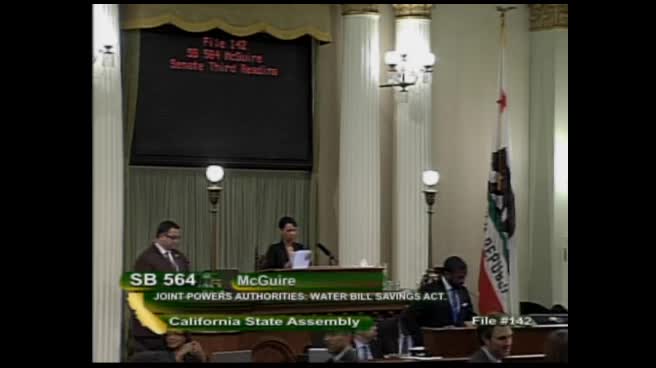 1MIN
Assembly Floor
 1MIN
Assembly Floor
 5MIN
Assembly Standing Committee on Local Government
 2MIN
Senate Floor
 12MIN
Senate Standing Committee on Governance and Finance
Bill Author




