SB 676: Parole: eligibility: violent felonies.
- Session Year: 2017-2018
- House: Senate
- Latest Version Date: 2017-03-28
The California Constitution, as amended by Proposition 57 at the November 8, 2016, statewide general election, makes a person sentenced to state prison for a conviction of a nonviolent felony offense eligible for parole consideration after completing the full term for his or her primary offense, as defined.
This bill would state the intent of the Legislature to enact legislation to define the term violent felony for purposes of determining parole eligibility of prisoners made eligible for parole by the enactment of Proposition 57.This bill would make violent felonies, as specified, serious felonies, as specified, a felony requiring registration as a sex offender, a felony involving domestic violence, a felony involving stalking, and felony human trafficking, violent felonies for purposes of considering parole eligibility.
The California Constitution, as amended by Proposition 57 at the November 8, 2016, statewide general election, makes a person sentenced to state prison for a conviction of a nonviolent felony offense eligible for parole consideration after completing the full term for his or her primary offense, as defined.
This bill would state the intent of the Legislature to enact legislation to define the term violent felony for purposes of determining parole eligibility of prisoners made eligible for parole by the enactment of Proposition 57.
(a)All of the following are violent felonies for purposes of considering parole eligibility:
(1)A felony specified in subdivision (c) of Section 667.5.
(2)A felony specified in subdivision (c) of Section 1192.7.
(3)A felony specified in Section 1192.8.
(4)A felony offense involving domestic violence, as defined in Section 273.5.
(5)A felony offense involving stalking, as defined in Section 646.9.
(6)A felony offense that requires registration pursuant to Section 290.
(7)Human trafficking in violation of Section 236.1, if a felony.
(b)This section does not define the term violent felony for purposes of subdivision (c) of Section 667.5 or for references to that subdivision.
It is the intent of the Legislature to enact legislation to define the term violent felony for purposes of determining parole eligibility of prisoners made eligible for parole by the enactment of Proposition 57, as approved by the voters at the November 8, 2016, statewide general election.
|
Date
|
Status
|
|---|---|
| Feb 1, 2018 | Returned to Secretary of Senate pursuant to Joint Rule 62(a). |
| Apr 26, 2017 | April 25 set for first hearing. Failed passage in committee. (Ayes 2. Noes 2. Page 856.) |
| Apr 7, 2017 | Set for hearing April 25. |
| Apr 5, 2017 | Re-referred to Com. on PUB. S. |
| Mar 28, 2017 | From committee with author's amendments. Read second time and amended. Re-referred to Com. on RLS. |
| Mar 9, 2017 | Referred to Com. on RLS. |
| Feb 21, 2017 | From printer. May be acted upon on or after March 23. |
| Feb 17, 2017 | Introduced. Read first time. To Com. on RLS. for assignment. To print. |
|
Date
|
Description
|
Location
|
Votes
|
|
|---|---|---|---|---|
| Apr 25, 2017 | Do pass, but first be re-referred to the Committee on [Appropriations] | Senate Standing Committee on Public Safety |
Failed |
This list shows positions taken on this bill by organizations on the date displayed, which is linked to the original source.
Positions by individuals are not included.
SENATE COMMITTEE ON PUBLIC SAFETY
Senator Nancy Skinner, Chair
2017 - 2018 Regular
Bill No: SB 676 Hearing Date: April 25, 2017
Author: | Stone | ||
Version: | March 28, 2017 | ||
Urgency: | No | Fiscal: | Yes |
Consultant: | SC | ||
Subject: Parole: Eligibility: Violent Felonies
HISTORY
Source: Author
Prior Legislation: None
Support: San Diego County Office of the District Attorney
Opposition: American Civil Liberties Union; California Attorneys for Criminal Justice; California Public Defenders Association
PURPOSE
The purpose of this bill is to expand the offenses that are to be considered violent felonies for purposes of parole eligibility.
Existing law requires parole supervision or postrelease community supervision (PRCS) to be included in a sentence resulting in imprisonment in state prison. (Pen. Code § 3000, subd. (a).)
Existing law generally provides that inmates may be released on parole supervision for up to three years. (Pen. Code § 3000, subd. (b).)
Existing law provides that the following persons released from state prison are subject to parole supervision by the Department of Corrections and Rehabilitation (CDCR); all other offenders released from prison are subject to county supervision under PRCS:
- A person who committed a serious felony listed in Penal Code Section 1192.7(c);
- A person who committed a violent felony listed in Penal Code Section 667.5(c);
- A person serving a sentence for a third strike;
- A high risk sex offender;
- A mentally disordered offender. (Pen. Code, § 3000.08, subd. (a).)
Existing law provides that the Board of Parole Hearings ("BPH") has the power to establish and enforce parole rules and regulations. (Penal Code § 3052.)
Existing law provides that any person convicted of a nonviolent felony offense and sentenced to state prison shall be eligible for parole consideration after completing the full term for his or her primary offense. (Cal. Const., art. I, § 32; Proposition 57, approved by California voters on November 8, 2016.)
Existing law states that the full term for the primary offense means the longest term of imprisonment imposed by the court for any offense, excluding the imposition of an enhancement, consecutive sentence, or alternative sentence. (Id.)
This bill specifies that the following crimes are violent felonies for purposes of considering parole eligibility:
- A violent felony, as defined in Penal Code section 667.5, subdivision (c).
- A serious felony, as defined in Penal Code section 1192.7, subdivision (c).
- Additional serious felonies defined in Penal Code section 1192.8;
- Felony domestic violence;
- Felony stalking;
- A felony requiring sex offender registration; and
- Felony human trafficking.
This bill specifies that the provisions of this bill do not define “violent felony” for purposes of enhanced sentencing under Penal Code Section 667.5, subdivision (c).
COMMENTS
1. Need for This Bill
In Penal Code section 667.5(c), the term “violent felony” is used to define a violent strike offense and when certain enhancements should be applied or sentences doubled. People convicted of these violent strikes, or who have strike priors, are subject to certain credit restrictions.
Penal Code section 29905 has a different list of “violent offenses” with some overlap of crimes. Penal Code section 23515 lists some crimes that are “violent use of a firearm.”
The purpose of this bill is to define “violent felony” for purposes of parole eligibility as defined in Penal Code section 3000 et seq. There are certain crimes such as “Domestic Violence” which has the term violence in the name, but is not listed as a “violent offense”. Certain classifications of rape would definitely be considered a violent crime, but is not currently considered a “violent crime” when discussing parole eligibility. Crimes committed by gang members are committed by dangerous and violent criminals, but they may or may not be included as violent felonies either.
SB 676 will give the California Department of Corrections and Rehabilitation (CDCR) clarity when determining eligibility for parole, by defining several violent and serious crimes as exactly that in code.
2. Parole Generally
Persons who are sentenced to a term of imprisonment in the state prison either receive a determinate sentence, which is a specified number of years, or an indeterminate sentence, which is a life sentence with a specified minimum number of years, such as 25-years-to-life.
A person serving an indeterminate sentence would have his or her eligibility for parole determined by BPH prior to being released. Generally, a person who is sentenced to a determinate term is released at the end of his or her term without a parole hearing. However, BPH currently conducts parole hearings for certain offenders who have been sentenced to a determinate term.
However, as part of the litigation over California’s overcrowded state prisons, the federal court ordered California to reduce its state prison population. One of the measures that the court ordered California to implement was to allow non-violent second stroke inmates who have reached 50 percent of their total sentence to be referred to BPH for parole consideration. (Opinion Re: Order Granting in Part and Denying in Part Defendants’ Request For Extension of December 31, 2013 Deadline, NO. 2:90-cv-0520 LKK DAD (PC), 3-Judge Court, Coleman v. Brown, Plata v. Brown (2-10-14).) Non-violent second strikers are persons who had their felony sentence doubled due to a prior strike. The doubled sentence is imposed any time a person has a prior strike, regardless of whether the new felony is a “violent” or “serious” felony.
This bill would designate additional crimes to be considered violent felonies for purposes of parole eligibility. This bill would impede existing parole procedures that allow non-violent second strikers to be considered for parole after serving 50 percent of their sentence by expanding the type of offense that is considered violent.
3. Proposition 57
On November 8, 2016, California voters approved Proposition 57. Proposition 57 was known as the "Parole for Non-Violent Criminals and Juvenile Court Trial Requirements Initiative." The purpose of Proposition 57 was to increase rehabilitation services and decrease the prison population. It requires juvenile court judges, rather than district attorneys, to decide whether a juvenile will be prosecuted as adult. The initiative allows parole consideration for non-violent felons after the inmate has served the full base term of his/her primary offense, exclusive of enhancements or alternative sentences. It also authorizes sentence credits for rehabilitation, good behavior, and education. (Official Voter Information Guide, Proposition 57, California General Election, Nov. 8, 2016 < http://voterguide.sos.ca.gov/en/propositions/57/analysis.htm > [as of Mar. 17, 2017].)
Proposition 57 requires the California Department of Corrections and Rehabilitation (CDCR) to draft regulations on how the parole process will be implemented. The initiative specifies that early parole may only be given to persons who have committed non-violent offenses. However, the initiative does not specify what is considered a non-violent felony. Proponents of this legislation want the offenses included in this bill to be considered violent felonies for purposes of Proposition 57 so that inmates who have committed those crimes will not be eligible for early parole.
CDCR has submitted emergency regulations to the Office of Administrative Law on March 24, 2017. In addition to violent felonies, the regulations exclude sex offenders from the parole provisions in Proposition 57. This aligns with the Governor’s 2017-2018 budget proposal to exclude all sex offenders from early parole consideration, regardless of whether their crimes were designated as “violent”. (See Governor’s Budget Summary 2017-2018 at 75 (Jan. 10, 2017) <http://www.ebudget.ca.gov/2017-18/pdf/BudgetSummary/PublicSafety.pdf> [as of Mar. 20, 2017].) The regulations are subject to public hearing and comment which will provide opportunities for stakeholders and the public to provide input. The emergency regulations are expected to go into effect starting July 1, 2017 and will be in place until permanent regulations are implemented.
This bill would prevent earlier parole provided by Proposition 57 for the offenses specified. Considering that the emergency regulations implementing Proposition 57 have just been approved with permanent regulations expected sometime, should the Legislature pass legislation trying to make changes to the Proposition before the regulations are in effect? Any bills that attempt to do so will likely be vetoed.
4. Similar Legislation
There are several other bills that have been introduced this year to designate additional offenses as violent felonies. SB 75 (Bates) would add several specified felony offenses as well as alternate felony-misdemeanor offenses to the violent felonies list. SB 770 (Glazer) would add human trafficking, elder and dependent adult abuse, assault with a deadly weapon, rape under specified circumstances, discharge of a firearm at an occupied building, and specified crimes against peace officers and witnesses, as violent felonies. AB 27 (Melendez) would add specified sexual offenses to the list of "violent felonies.” AB 67 (Rodriguez) and AB 197 (Kiley) would add a number of specified felony offenses to the violent felonies list.
5. Argument in Support
According to the San Diego District Attorney’s Office:
SB 676 would define the specific crimes that are outside the scope of Prop. 57 by defining what would be considered violent for purposes of parole eligibility.
Rather than expanding the “violent felony” list under Penal Code section 667.5(c), or creating an alternative list under Penal Code section 667.5 which would implicate other sentencing consequences and result in confusion, this bill is narrowed to address parole eligibility only. Further, this bill limits the exclusion from Prop. 57, to those crimes which are truly violent; it is limited to crimes enumerated in Penal Code sections 667.5(c), 1192.7(c), and 1192.8, along with felony domestic violence, felony stalking, felony human trafficking, and felony crimes that require sex offender registration.
6. Argument in Opposition
According to the California Public Defenders Association:
This bill would, in effect, overturn much of Proposition 57, the Public Safety and Rehabilitation Act of 2016, passed by a landslide 64.5% of the voters at the November 2016 General Election. SB 676 is also of questionable legality, and is quite unnecessary. One of Proposition 57’s most important provisions was to add to California Constitution Article I a new section 32. Subdivision (a)(10 provides that “Any person convicted of a nonviolent felony offense and sentenced to state prison shall be eligible for parole consideration after completing the full term for his or her primary offense.”
. . . .
CDCR has proposed regulations to implement section 32. The proposed definition of “nonviolent offender” is at proposed new Calif. Code of Regs., tit. 15, section 3490. While that definition does include some of the offenses included in SB 676 (notably offenses already listed as violent in Penal Code section 667.5, and offenses requiring registration under Penal Code section 290), most of the rest of the specific offenses and categories of offenses in SB 676 are not included in the proposed CDCR regulations. SB 676, therefore, proposes by a statute to overcome CDCR’s Constitutional requirement to adopt regulations. . . .
-- END –
Discussed in Hearing
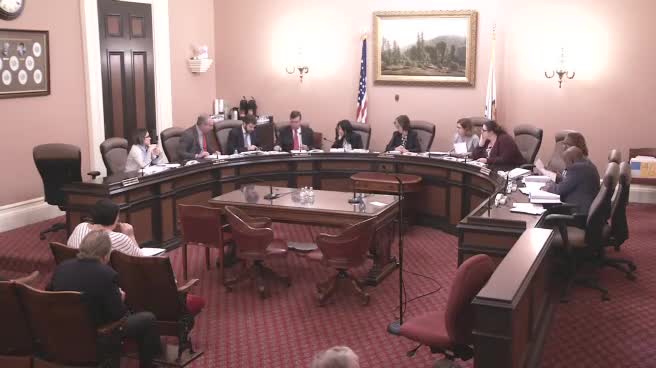 16MIN
Senate Standing Committee on Public Safety
Bill Author

Bill Co-Author(s):