SB 715: Vehicular air pollution: regulations: exemption.
- Session Year: 2017-2018
- House: Senate
- Latest Version Date: 2018-09-07
Existing law imposes various limitations on the emissions of air contaminants for the control of air pollution from vehicular and nonvehicular sources. Pursuant to that authority, the State Air Resources Board has adopted a regulation to reduce oxides of nitrogen, diesel particulate matter, and other criteria air pollutant emissions from in-use, off-road, diesel-fueled vehicles.
This bill would require the state board to exempt, except as specified, a vehicle owned or operated by a state-registered nonprofit apprenticeship training program from any regulation to reduce emissions of diesel particulate matter, oxides of nitrogen, and other criteria air pollutants from in-use, off-road, diesel-fueled vehicles, as specified.
Existing law imposes various limitations on the emissions of air contaminants for the control of air pollution from vehicular and nonvehicular sources. Pursuant to that authority, the State Air Resources Board has adopted a regulation to reduce oxides of nitrogen, diesel particulate matter, and other criteria air pollutant emissions from in-use, off-road, diesel-fueled vehicles.
This bill would require the state board to exempt, except as specified, a vehicle owned or operated by a state-registered nonprofit apprenticeship training program from any regulation to reduce emissions of diesel particulate matter, oxides of nitrogen, and other criteria air pollutants from in-use, off-road, diesel-fueled vehicles. vehicles, as specified.
Existing law imposes various limitations on the emissions of air contaminants for the control of air pollution from vehicular and nonvehicular sources. Pursuant to that authority, the State Air Resources Board has adopted a regulation to reduce oxides of nitrogen, diesel particulate matter, and other criteria air pollutant emissions from in-use, off-road, diesel-fueled vehicles.
This bill would require the state board to exempt, except as specified, a vehicle owned or operated by a state-registered nonprofit apprenticeship training program from any regulation to reduce emissions of diesel particulate matter, oxides of nitrogen, and other criteria air pollutants from in-use, off-road, diesel-fueled vehicles.
Existing law provides for the licensure and regulation of various professions and vocations by boards within the Department of Consumer Affairs. Existing law authorizes the Governor to remove from office any member of any board within the department appointed by him or her, on specific grounds, including continued neglect of duties required by law.This bill would specifically include the failure to attend meetings of the board as one example of continued neglect of duties required by law that the Governor can use as a reason to remove a member from a board.Existing law provides for the licensure and regulation of various professions and vocations by boards within the Department of Consumer Affairs. Existing law authorizes the Governor to remove from office any member of any board within the department appointed by him or her, on specific grounds, including continued neglect of duties required by law.
This bill would specifically include the failure to attend meetings of the board as one example of continued neglect of duties required by law that the Governor can use as a reason to remove a member from a board.
Existing law provides a procedure for the formation of a regional park district, regional park and open-space district, or a regional open-space district.This bill would make nonsubstantive changes to one of those provisions.Existing law provides a procedure for the formation of a regional park district, regional park and open-space district, or a regional open-space district.
This bill would make nonsubstantive changes to one of those provisions.
(a)The Legislature finds and declares all of the following:
(1)Pursuant to authority granted to the state board under this division, the state board has exempted specified limited-use vehicles from certain clean air regulations in programs like the Job Corps.
(2)It is the intent of this section to similarly exempt from those regulations specified vehicles that are operated or run by state-registered apprenticeship programs utilized on training yards throughout the state that train apprentices on how to use heavy equipment and cranes.
(3)These pieces of equipment are treated by the state board as if they operate as typical heavy construction equipment, but, in fact, they are used significantly less than those same vehicles in routine use.
(4)If the owners and operators of these vehicles are required to update their equipment to meet state board regulatory standards, it will harm important apprentice and training programs by diverting moneys needed for training.
(b)The state board shall exempt from any regulation to reduce emissions of diesel particulate matter, oxides of nitrogen, and other criteria air pollutants from in-use, off-road, diesel-fueled vehicles a vehicle owned or operated by a state-registered nonprofit apprenticeship training program, except as follows:
(1)The labeling requirements of Article 4.8 (commencing with Section 2449) of Chapter 9 of Division 3 of Title 13 of the California Code of Regulations.
(2)The reporting requirements of Article 4.8 (commencing with Section 2449) of Chapter 9 of Division 3 of Title 13 of the California Code of Regulations.
(c)If the state board makes a determination at a public hearing that the implementation of subdivision (b) would violate the current state implementation plan, as required by the federal Clean Air Act (42 U.S.C. Sec. 7401, et seq.), the state board shall delay the implementation of subdivision (b) until the state board has submitted an amended state implementation plan to the United States Environmental Protection Agency for approval.
(a)The Legislature finds and declares all of the following:
(1)Pursuant to authority granted to the state board under this division, the state board has exempted specified limited-use vehicles from certain clean air regulations in programs like the Job Corps.
(2)It is the intent of this section to similarly exempt from those regulations specified vehicles that are operated or run by state-registered apprenticeship programs utilized on training yards throughout the state that train apprentices on how to use heavy equipment and cranes.
(3)These pieces of equipment are treated by the state board as if they operate as typical heavy construction equipment, but, in fact, they are used significantly less that than those same vehicles in routine use.
(4)If the owners and operators of these vehicles are required to update their equipment to meet state board regulatory standards, it will harm important apprentice and training programs by diverting moneys needed for training.
(b)The state board shall exempt from any regulation to reduce emissions of diesel particulate matter, oxides of nitrogen, and other criteria air pollutants from in-use, off-road, diesel-fueled vehicles a vehicle owned or operated by a state-registered nonprofit apprenticeship training program, except as follows:
(1)The labeling requirements of Article 4.8 (commencing with Section 2449) of Chapter 9 of Division 3 of Title 13 of the California Code of Regulations.
(2)The reporting requirements of Article 4.8 (commencing with Section 2449) of Chapter 9 of Division 3 of Title 13 of the California Code of Regulations.
(c)If the state board makes a determination at a public hearing that the implementation of subdivision (b) would violate the current state implementation plan, as required by the federal Clean Air Act (42 U.S.C. Sec. 7401, et seq.), the state board shall delay the implementation of subdivision (b) until the state board has submitted an amended state implementation plan to the United States Environmental Protection Agency for approval.
(a)The Legislature finds and declares all of the following:
(1)Pursuant to authority granted to the state board under this division, the state board has exempted specified limited-use vehicles from certain clean air regulations in programs like the Job Corps.
(2)It is the intent of this section to similarly exempt from those regulations specified vehicles that are operated or run by state-registered apprenticeship programs utilized on training yards throughout the state that train apprentices on how to use heavy equipment and cranes.
(3)These pieces of equipment are treated by the state board as if they operate as typical heavy construction equipment, but, in fact, they are used significantly less that those same vehicles in routine use.
(4)If these vehicles are required to update their equipment to meet state board regulatory standards, it will harm important apprentice and training programs by diverting moneys needed for training.
(b)The state board shall exempt from any regulation to reduce emissions of diesel particulate matter, oxides of nitrogen, and other criteria air pollutants from in-use, off-road, diesel-fueled vehicles a vehicle owned or operated by a state-registered nonprofit apprenticeship training program, except as follows:
(1)The labeling requirements of Article 4.8 (commencing with Section 2449) of Chapter 9 of Division 3 of Title 13 of the California Code of Regulations.
(2)The reporting requirements of Article 4.8 (commencing with Section 2449) of Chapter 9 of Division 3 of Title 13 of the California Code of Regulations.
SECTION 1.Section 106 of the Business and Professions Code is amended to read:106.The Governor has power to remove from office at any time, any member of any board appointed by him or her for continued neglect of duties required by law, which may include the failure to attend board meetings, or for incompetence, or unprofessional or dishonorable conduct. Nothing in this section shall be construed as a limitation or restriction on the power of the Governor, conferred on him or her by any other law, to remove any member of any board.The Governor has power to remove from office at any time, any member of any board appointed by him or her for continued neglect of duties required by law, which may include the failure to attend board meetings, or for incompetence, or unprofessional or dishonorable conduct. Nothing in this section shall be construed as a limitation or restriction on the power of the Governor, conferred on him or her by any other provision of law, to remove any member of any board.
SECTION 1.Section 5503 of the Public Resources Code is amended to read:5503.Whenever it is desired to form a district under this article, a petition requesting the creation and maintenance of a district, and describing the exterior boundaries of the proposed district shall be signed by at least 5,000 electors residing within the territory proposed to be included in the district. The petition shall be presented to the board of supervisors of the county containing the largest area within the proposed district.Whenever it is desired to form a district under this article, a petition requesting the creation and maintenance of a district, and describing the exterior boundaries of the proposed district shall be signed by at least 5,000 electors residing within the territory proposed to be included in the district and. The petition shall be presented to the board of supervisors of the county containing the largest area within the proposed district.
|
Date
|
Status
|
|---|---|
| Sep 30, 2018 | In Senate. Consideration of Governor's veto pending. |
| Sep 30, 2018 | Vetoed by the Governor. |
| Sep 12, 2018 | Enrolled and presented to the Governor at 5 p.m. |
| Aug 31, 2018 | Assembly amendments concurred in. (Ayes 28. Noes 2.) Ordered to engrossing and enrolling. |
| Aug 31, 2018 | From committee: That the Assembly amendments be concurred in. (Ayes 11. Noes 1.) |
| Aug 31, 2018 | From committee: Be re-referred to Com. on T. & H. pursuant to Senate Rule 29.10(d). (Ayes 5. Noes 0.) Re-referred to Com. on T. & H. |
| Aug 31, 2018 | Re-referred to Com. on RLS. pursuant to Senate Rule 29.10(d). |
| Aug 31, 2018 | In Senate. Concurrence in Assembly amendments pending. |
| Aug 31, 2018 | Read third time. Passed. Ordered to the Senate. |
| Aug 30, 2018 | Read second time. Ordered to third reading. |
| Aug 29, 2018 | From committee: Do pass. (Ayes 10. Noes 3.) (August 29). |
| Aug 28, 2018 | Joint Rule 62(a) suspended. |
| Aug 27, 2018 | From committee with author's amendments. Read second time and amended. Re-referred to Com. on TRANS. |
| Aug 24, 2018 | Re-referred to Com. on TRANS. pursuant to Assembly Rule 77.2. |
| Aug 24, 2018 | Read third time and amended. |
| Aug 23, 2018 | Assembly Rule 78 suspended. |
| Sep 14, 2017 | Ordered to inactive file on request of Assembly Member Calderon. |
| Sep 14, 2017 | From inactive file. |
| Sep 13, 2017 | Notice of intention to remove from inactive file given by Assembly Member Calderon. |
| Jun 29, 2017 | Ordered to inactive file on request of Assembly Member Bonta. |
| Jun 26, 2017 | Read second time. Ordered to third reading. |
| Jun 22, 2017 | Withdrawn from committee. |
| Jun 20, 2017 | From committee: Do pass and re-refer to Com. on APPR. (Ayes 15. Noes 0.) (June 20). Re-referred to Com. on APPR. |
| May 26, 2017 | Referred to Com. on B. & P. |
| May 4, 2017 | In Assembly. Read first time. Held at Desk. |
| May 4, 2017 | Read third time. Passed. (Ayes 39. Noes 0. Page 955.) Ordered to the Assembly. |
| May 2, 2017 | Read second time. Ordered to third reading. |
| May 1, 2017 | From committee: Do pass. (Ayes 8. Noes 0. Page 914.) (May 1). |
| Apr 27, 2017 | Set for hearing May 1. |
| Apr 26, 2017 | Re-referred to Com. on B., P. & E.D. |
| Apr 25, 2017 | From committee with author's amendments. Read second time and amended. Re-referred to Com. on RLS. |
| Mar 9, 2017 | Referred to Com. on RLS. |
| Feb 21, 2017 | From printer. May be acted upon on or after March 23. |
| Feb 17, 2017 | Introduced. Read first time. To Com. on RLS. for assignment. To print. |
|
Date
|
Description
|
Location
|
Votes
|
|
|---|---|---|---|---|
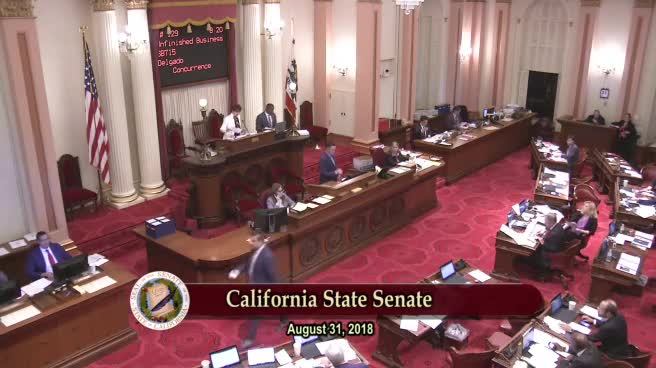
| Aug 31, 2018 | Unfinished Business SB715 Delgado Concurrence | Senate Floor |
Passed |
|
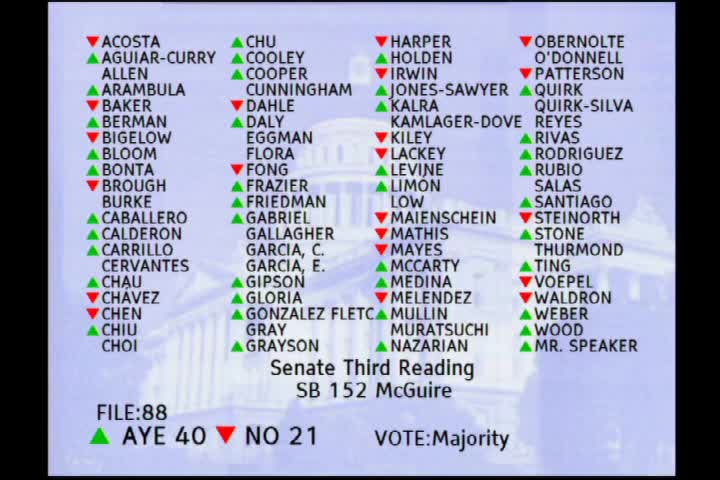
| Aug 31, 2018 | SB 715 Delgado Senate Third Reading By CALDERON | Assembly Floor |
Passed |
|
| Aug 31, 2018 | That the Assembly amendments be concurred in | Senate Standing Committee on Transportation and Housing |
Passed |
|
| Aug 29, 2018 | Do pass. | Assembly Standing Committee on Transportation |
Passed |
|
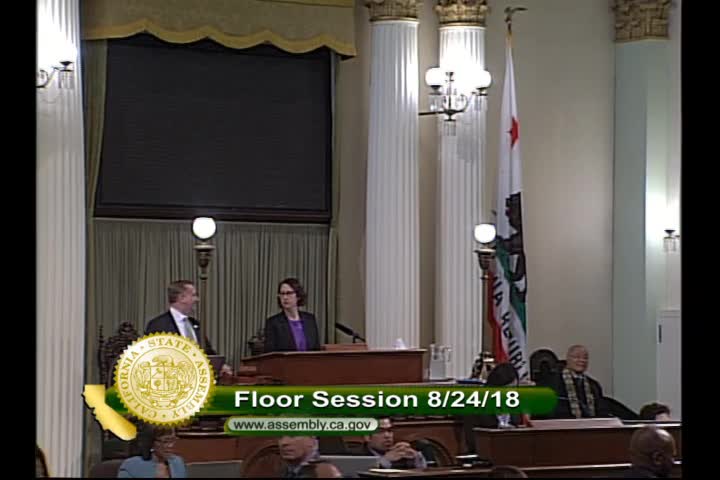
| Aug 24, 2018 | SB 715 Newman Senate Third Reading By CALDERON Amend By CERVANTES Set #1 | Assembly Floor |
Passed |
|
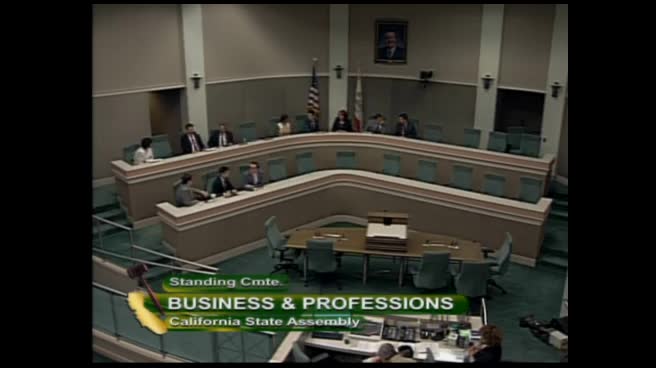
| Jun 20, 2017 | Do pass and be re-referred to the Committee on [Appropriations] | Assembly Standing Committee on Business and Professions |
Passed |
|
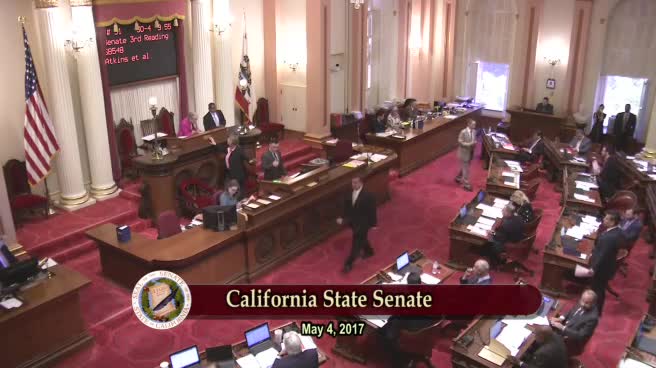
| May 4, 2017 | Senate 3rd Reading SB715 Newman | Senate Floor |
Passed |
|
| May 1, 2017 | Do pass | Senate Standing Committee on Business, Professions and Economic Development |
Passed |
This list shows positions taken on this bill by organizations on the date displayed, which is linked to the original source.
Positions by individuals are not included.
Office of Senate Floor Analyses (916) 651-1520 Fax: (916) 327-4478 | SB |
VETO
Bill No: SB 715
:
PRIOR SENATE VOTES NOT RELEVANT
SENATE TRANS. & HOUSING COMMITTEE: 11-1, 8/31/18
AYES: Beall, Cannella, Dodd, Gaines, Galgiani, McGuire, Morrell, Roth, Skinner, Vidak, Wiener
NOES: Wieckowski
NO VOTE RECORDED: Allen
SENATE FLOOR: 28-2, 8/31/18
AYES: Anderson, Atkins, Beall, Bradford, Cannella, Chang, De León, Delgado, Dodd, Gaines, Galgiani, Hernandez, Hertzberg, Hueso, Lara, Leyva, McGuire, Mitchell, Monning, Moorlach, Morrell, Nielsen, Portantino, Roth, Skinner, Vidak, Wiener, Wilk
NOES: Hill, Wieckowski
NO VOTE RECORDED: Allen, Bates, Berryhill, Fuller, Glazer, Jackson, Nguyen, Pan, Stern, Stone
ASSEMBLY FLOOR: 57-14, 8/31/18 - See last page for vote
DIGEST:
This bill requires the State Air Resources Board (ARB) to exempt specified equipment from any in-use, off-road, diesel-fueled vehicle emission regulation, but provides that if ARB determines the exemption violates federal air quality requirements, it must delay implementation of the exemption.
ANALYSIS: Existing federal law sets, through the Federal Clean Air Act (FCAA) and its implementing regulations, National Ambient Air Quality Standards (NAAQS) for six criteria pollutants, designates air basins that do not achieve NAAQS as nonattainment, and requires states with nonattainment air basins to submit a State Implementation Plan (SIP) that describes how an area will comply with NAAQS.
Existing state law:
- Establishes ARB as the air pollution control agency in California and requires the ARB, among other things, to control emissions from a wide array of mobile sources and implement the FCAA.
- Establishes the in-use off-road diesel-fueled fleets regulation (in-use off-road regulation) to reduce diesel particulate matter (PM) and oxides of nitrogen (NOx) emissions from in-use (existing) off-road heavy-duty diesel vehicles in California.
This bill:
- Requires ARB to exempt, except from labeling and reporting requirements, a vehicle owned or operated by a state-registered nonprofit apprenticeship training program from any regulation to reduce emissions of diesel PM, NOx, and other criteria air pollutants from in-use, off-road, diesel-fueled vehicles.
- Requires ARB, if ARB makes a determination at a public hearing that the implementation of the exemption would violate the state’s SIP, to delay the implementation until ARB has submitted an amended SIP to the United States Environmental Protection Agency (US EPA) for approval.
Background
- Air quality standards. Under the FCAA, the US EPA establishes NAAQS that apply to outdoor air throughout the country. US EPA reviews each NAAQS at five-year intervals to ensure that the standards are based on the most recent scientific information. Regions that do not meet the national standards for any one of the standards are designated “nonattainment areas.” The FCAA sets deadlines for attainment based on the severity of nonattainment and requires states to develop comprehensive plans, known as the SIP, to attain and maintain air-quality standards for each area designated nonattainment for NAAQS.
- SIP. SIPs are comprehensive plans that describe how an area will attain NAAQS. The 1990 amendments to the FCAA set deadlines for attainment based on the severity of an area’s air pollution problem. Many of California’s SIPs rely on the same core set of control strategies, including emission standards for cars and heavy trucks, fuel regulations and limits on emissions from consumer products. State law makes ARB the lead agency for all purposes related to the SIP. Local air districts and other agencies, such as the Bureau of Automotive Repair and the Department of Pesticide Regulation, prepare SIP elements and submit them to ARB for review and approval; ARB then forwards SIP revisions to USEPA for approval.
- In-use off-road regulation. The in-use off-road regulation applies to all self-propelled off-road diesel vehicles 25 horsepower or greater used in California, as well as most two-engine vehicles (except on-road two-engine sweepers). This includes vehicles that are rented or leased. Personal use vehicles, vehicles used solely for agriculture, vehicles that are awaiting sale, and vehicles already covered by the Regulation for Mobile Cargo Handling Equipment at Ports and Intermodal Rail Yards, are exempt from the in-use off-road regulation. Emergency operations vehicles, dedicated snow removal vehicles, low-use vehicles (used under 200 hours per year, as confirmed by a non-resettable hour meter), and vehicles used a majority of the time (but not solely) for agricultural operations, must be reported to ARB and labeled, but are exempt from the performance requirements of the in-use off-road regulation.
Comments
- Purpose. The author states ARB has adopted regulations, in an effort to reduce harmful carbon emissions from in-use, off-road, diesel-fueled vehicles. These regulations provide that certain nonprofit apprenticeship training programs, such as Job Corps, are not required to meet the performance standards specified in the regulations. This bill adds state-registered apprentice programs for heavy equipment and cranes to that same standard, thereby ensuring that construction apprentices who operate heavy equipment and cranes have ample opportunities to learn their trade and further their careers.
- How many vehicles are we talking about? According to the International Union of Operating Engineers, their fleet has 142 machines with about 45 of those machines being low-use. According to the Division of Apprenticeship Standards, there are currently 838 “committee” (non-profit) programs and 309 single employer programs. Given the last-minute nature of this bill, it is not possible to further assess the total number of vehicles this bill could affect. The number could be in the hundreds, or possibly much, much higher, depending on the size of the 1,147 programs identified by the Division of Apprenticeship Standards.
- Low-use exemption. As noted above, the in-use off-road regulation includes an exemption for low-use vehicles, e.g., used under 200 hours per year. The author states that heavy equipment used for training is used significantly less than equipment used on a job site – approximately 200 hours per year for training equipment, as opposed to anywhere between 1,500 to 3,000 hours per year for equipment on a job site. If this is indeed the case, then the training equipment should qualify for exemption. In addition, small fleets (as nonprofit training centers are considered), do not have to begin meeting the fleet average targets until 2019, and do not have to reach full compliance until 2028.
- Process concerns. The author notes that the regulation currently exempts some training programs such as Job Corps. It is the Senate Transportation and Housing Committee’s understanding, however, that this exemption was instituted as an amendment to the regulation through the formal regulatory process, not through legislation introduced late in session. Providing an exemption for one category through legislation could lead to other industries coming to the Legislature in the future to seek further exemptions.
- Late to the party. When this bill was passed by the Senate last year, it was authored by Senator Newman and pertained to regulatory boards under the Department of Consumer Affairs. It was amended on August 24, 2018, to make Senator Delgado the author and to instead pertain to the in-use off-road regulation.
Related/Prior Legislation
AB 2365 (Acosta, 2018) would have exempted a crane owner from complying with any regulation requiring the installation of air pollution control technology, until the crane is sold or transferred. The bill failed in the Assembly Transportation Committee.
AB 345 (Caballero, 2018) would have exempted specified agricultural vehicles from complying with Truck and Bus Regulation that requires lower-emitting NOx engines and diesel PM filters for nearly every heavy-duty vehicle operated in California. The bill failed in the Senate Environmental Quality Committee.
SB 41 (Galgiani, 2017) would have deemed a person to be in compliance with the Truck and Bus Regulation and would have prohibited ARB from 1) requiring the person to spend additional money on compliance or 2) taking enforcement actions against a person if various specified conditions were met. The bill died in the Senate Environmental Quality Committee.
FISCAL EFFECT: Appropriation: No Fiscal Com.: Yes Local: No
Unknown.
California Conference of Carpenters
International Union of Operating Engineers
OPPOSITION: (Verified 8/31/18)
American Lung Association in California
California Air Pollution Control Officers Association
California Environmental Justice Alliance
Central California Asthma Collaborative
Coalition for Clean Air
Regional Asthma Management and Prevention
Sierra Club California
Union of Concerned Scientists
ARGUMENTS IN SUPPORT:
The International Union of Operating Engineers states that while ARB regulations are vitally important to ensuring the state meets its carbon emissions goals, state registered apprenticeship programs for individuals who operate heavy equipment and cranes have had to spend millions of dollars in order to retrofit or replace equipment in order to comply with existing regulations. This is a burden on both the apprenticeship programs and its participating partner contractors. Additionally, the retrofitting or replacement of training equipment has the potential to severely harm apprenticeships programs by diverting money that is needed for training.
ARGUMENTS IN OPPOSITION: Opponents state that this bill undermines decades of air quality policy in California by exempting older diesel equipment from emission control requirements. Exempting older diesel equipment from emissions control standards would increase localized diesel emission hot spots, would threaten the health of local residents and students/workers training on the equipment, and ultimately could shift lost emissions reductions to other sources while delaying overall cleanup, including in regions that fail to achieve health-based federal particle pollution standards.
GOVERNOR'S VETO MESSAGE:
I am returning Senate Bill 715 without my signature.
This bill requires the California Air Resources Board to exempt off-road diesel vehicles owned or operated by state-registered nonprofit apprenticeship training programs from any regulation that reduces emissions of diesel particulate matter, oxides of nitrogen, and other criteria pollutants.
This exemption could cause a shortfall in mandated air pollution emissions reductions, which may require us to revise our State Implementation Plan to remain in Compliance with the federal Clean Air Act. Working with the federal administration to revise our State Implementation Plan in a time of pressing air quality challenges is difficult and unwise. As Such, I direct the Board to work with the author and sponsors of this bill on an administrative solution that minimizes adverse impacts on apprenticeship programs, yet also protects air quality.
ASSEMBLY FLOOR: 57-14, 8/31/18
AYES: Acosta, Aguiar-Curry, Arambula, Berman, Bonta, Brough, Burke, Caballero, Calderon, Carrillo, Cervantes, Chau, Chu, Cooley, Cooper, Cunningham, Dahle, Daly, Eggman, Flora, Fong, Frazier, Friedman, Gabriel, Gallagher, Eduardo Garcia, Gipson, Gray, Grayson, Holden, Irwin, Jones-Sawyer, Kalra, Kamlager-Dove, Levine, Low, Maienschein, Mathis, McCarty, Medina, Mullin, Nazarian, O'Donnell, Patterson, Quirk-Silva, Rivas, Rodriguez, Rubio, Salas, Santiago, Mark Stone, Thurmond, Ting, Waldron, Weber, Wood, Rendon
NOES: Travis Allen, Baker, Bigelow, Chávez, Chen, Choi, Harper, Kiley, Lackey, Mayes, Melendez, Obernolte, Steinorth, Voepel
NO VOTE RECORDED: Bloom, Chiu, Cristina Garcia, Gloria, Gonzalez Fletcher, Limón, Muratsuchi, Quirk, Reyes
10/9/18 10:57:29
**** END ****
SENATE COMMITTEE ON TRANSPORTATION AND HOUSING
Senator Jim Beall, Chair
2017 - 2018 Regular
Bill No: Hearing Date: 8/31/2018
Author: | Delgado | ||
Version: | 8/27/2018 | ||
Urgency: | No | Fiscal: | Yes |
Consultant: | Erin Riches | ||
SUBJECT:
DIGEST: This bill requires the state Air Resources Board (ARB) to exempt specified equipment from any in-use, off-road, diesel-fueled vehicle emission regulation, but provides that if ARB determines the exemption violates federal air quality requirements, it must delay implementation of the exemption.
ANALYSIS:
Existing federal law:
- Sets, through the Federal Clean Air Act (FCAA) and its implementing regulations, National Ambient Air Quality Standards (NAAQS) for six criteria pollutants, designates air basins that do not achieve NAAQS as nonattainment, and requires states with nonattainment air basins to submit a State Implementation Plan (SIP) that describes how an area will comply with NAAQS.
Existing state law:
- Establishes ARB as the air pollution control agency in California and requires the ARB, among other things, to control emissions from a wide array of mobile sources and implement the FCAA.
- Establishes the in-use off-road diesel-fueled fleets regulation (in-use off-road regulation) to reduce diesel particulate matter (PM) and oxides of nitrogen (NOx) emissions from in-use (existing) off-road heavy-duty diesel vehicles in California.
This bill:
- Requires ARB to exempt, except from labeling and reporting requirements, a vehicle owned or operated by a state-registered nonprofit apprenticeship training program from any regulation to reduce emissions of diesel particulate matter, oxides of nitrogen, and other criteria air pollutants from in-use, off-road, diesel-fueled vehicles.
- Requires ARB, if ARB makes a determination at a public hearing that the implementation of the exemption would violate the state’s SIP, to delay the implementation until ARB has submitted an amended SIP to the United States Environmental Protection Agency (US EPA) for approval.
COMMENTS:
- Purpose. The author states ARB has adopted regulations, in an effort to reduce harmful carbon emissions from in-use, off-road, diesel-fueled vehicles. These regulations provide that certain nonprofit apprenticeship training programs, such as Job Corps, are not required to meet the performance standards specified in the regulations. This bill would add state-registered apprentice programs for heavy equipment and cranes to that same standard, thereby ensuring that construction apprentices who operate heavy equipment and cranes have ample opportunities to learn their trade and further their careers.
- Air quality standards. Under the FCAA, the US EPA establishes National Ambient Air Quality Standards (NAAQS) that apply to outdoor air throughout the country. US EPA reviews each NAAQS at five-year intervals to ensure that the standards are based on the most recent scientific information. Regions that do not meet the national standards for any one of the standards are designated “nonattainment areas.” The FCAA sets deadlines for attainment based on the severity of nonattainment and requires states to develop comprehensive plans, known as the state implementation plan (SIP), to attain and maintain air-quality standards for each area designated nonattainment for NAAQS.
- State Implementation Plan (SIP). SIPs are comprehensive plans that describe how an area will attain NAAQS. The 1990 amendments to the FCAA set deadlines for attainment based on the severity of an area’s air pollution problem. Many of California’s SIPs rely on the same core set of control strategies, including emission standards for cars and heavy trucks, fuel regulations and limits on emissions from consumer products. State law makes ARB the lead agency for all purposes related to the SIP. Local air districts and other agencies, such as the Bureau of Automotive Repair and the Department of Pesticide Regulation, prepare SIP elements and submit them to ARB for review and approval; ARB then forwards SIP revisions to USEPA for approval.
- In-use off-road regulation. The in-use off-road regulation applies to all self-propelled off-road diesel vehicles 25 horsepower or greater used in California, as well as most two-engine vehicles (except on-road two-engine sweepers). This includes vehicles that are rented or leased. Personal use vehicles, vehicles used solely for agriculture, vehicles that are awaiting sale, and vehicles already covered by the Regulation for Mobile Cargo Handling Equipment at Ports and Intermodal Rail Yards, are exempt from the in-use off-road regulation. Emergency operations vehicles, dedicated snow removal vehicles, low-use vehicles (used under 200 hours per year, as confirmed by a non-resettable hour meter), and vehicles used a majority of the time (but not solely) for agricultural operations, must be reported to ARB and labeled, but are exempt from the performance requirements of the in-use off-road regulation.
- How many vehicles are we talking about? According to the International Union of Operating Engineers, their fleet has 142 machines with about 45 of those machines being low-use. According to the Division of Apprenticeship Standards, there are currently 838 “committee” (non-profit) programs and 309 single employer programs. Given the last-minute nature of this bill, it is not possible to further assess the total number of vehicles this legislation could affect. The number could be in the hundreds, or possibly much, much higher, depending on the size of the 1,147 programs identified by the Division of Apprenticeship Standards.
- Low-use exemption. As noted above, the in-use off-road regulation includes an exemption for low-use vehicles, e.g., used under 200 hours per year. The author states that heavy equipment used for training is used significantly less than equipment used on a job site – approximately 200 hours per year for training equipment, as opposed to anywhere between 1,500 to 3,000 hours per year for equipment on a job site. If this is indeed the case, then the training equipment should qualify for exemption. In addition, small fleets (as nonprofit training centers are considered), do not have to begin meeting the fleet average targets until 2019, and do not have to reach full compliance until 2028.
- Process concerns. The author notes that the regulation currently exempts some training programs such as Job Corps. It is the committee’s understanding, however, that this exemption was instituted as an amendment to the regulation through the formal regulatory process, not through legislation introduced late in session. Providing an exemption for one category through legislation could lead to other industries coming to the Legislature in the future to seek further exemptions.
- 29.10 referral. When this bill was passed by the Senate last year, it was authored by Senator Newman and pertained to regulatory boards under the Department of Consumer Affairs. It was amended on August 24, 2018 to make Senator Delgado the author and to instead pertain to the in-use off-road regulation. This bill passed off the Assembly Floor on August 31, 2018 on a 42-11 vote. Consistent with Senate Rule 29.10, the Senate Rules Committee referred it to the Transportation and Housing Committee to consider the amendments.
Related Legislation:
AB 2365 (Acosta, 2018) — would have exempted a crane owner from complying with any regulation requiring the installation of air pollution control technology, until the crane is sold or transferred. This bill failed in the Assembly Transportation Committee earlier this year.
SB 41 (Galgiani, 2017) — would have deemed a person to be in compliance with the Truck and Bus Regulation and would have prohibited ARB from (i) requiring the person to spend additional money on compliance or (ii) taking enforcement actions against a person if various specified conditions were met. SB 41 died in the Senate Environmental Quality Committee.
AB 345 (Caballero, 2018) — would have exempted specified agricultural vehicles from complying with Truck and Bus Regulation that requires lower-emitting oxides of nitrogen engines and diesel particulate matter filters for nearly every heavy-duty vehicle operated in California. AB 345 failed in the Senate environmental Quality Committee by a vote of 3-3.
FISCAL EFFECT: Appropriation: No Fiscal Com.: Yes Local: No
POSITIONS: (Communicated to the committee on August 31, 2018.)
SUPPORT:
California Conference of Carpenters
International Union of Operating Engineers
OPPOSITION:
American Lung Association in California
California Air Pollution Control Officers Association
California Environmental Justice Alliance
Central California Asthma Collaborative
Coalition for Clean Air
Regional Asthma Management and Prevention
Sierra Club California
Union of Concerned Scientists
-- END --
Office of Senate Floor Analyses (916) 651-1520 Fax: (916) 327-4478 | SB |
UNFINISHED BUSINESS
Bill No: SB 715
:
PRIOR SENATE VOTES NOT RELEVANT
SENATE TRANS. & HOUSING COMMITTEE: 11-1, 8/31/18 (Pursuant to Senate Rule 29.10)
AYES: Beall, Cannella, Dodd, Gaines, Galgiani, McGuire, Morrell, Roth, Skinner, Vidak, Wiener
NOES: Wieckowski
NO VOTE RECORDED: Allen
ASSEMBLY FLOOR: Not available
DIGEST:
This bill requires the Air Resources Board (ARB) to exempt an off-road, diesel-fueled vehicle owned or operated by a state-registered non-profit apprenticeship training program from any in-use off-road, diesel-fueled vehicle emission regulation, but continues to require these vehicles to be labeled and reported to ARB. Provides that if the ARB determines at a public hearing that this exemption violates the state implementation plan (SIP) as required by the Federal Clean Air Act (FCAA), ARB must delay the implementation of this exemption, until it has submitted an amended SIP to the United States Environmental Protection Agency for approval
Assembly Amendments
strike the contents of the bill and insert policy to require ARB to exempt specified vehicles from specified state regulations, as specified.
ANALYSIS: Existing federal law sets, through the Federal Clean Air Act (FCAA) and its implementing regulations, National Ambient Air Quality Standards (NAAQS) for six criteria pollutants, designates air basins that do not achieve NAAQS as nonattainment, and requires states with nonattainment air basins to submit a State Implementation Plan (SIP) that describes how an area will comply with NAAQS. (42 U.S.C. §7401 et seq.)
Existing state law:
- Establishes the Air Resources Board (ARB) as the air pollution control agency in California and requires the ARB, among other things, to control emissions from a wide array of mobile sources and implement the FCAA. (Health and Safety Code (HSC) §39500 et seq.)
- Establishes, commencing with Section 2449, Chapter 9 of Division 3 of Title 13 of the California Code of Regulations (a.k.a., the in-use off-road diesel-fueled fleets regulation, or the “in-use off-road regulation”) to reduce diesel particulate matter (PM) and oxides of nitrogen (NOx) emissions from in-use (existing) off-road heavy-duty diesel vehicles in California.
This bill:
- Requires ARB to exempt, except from labeling and reporting requirements, a vehicle owned or operated by a state-registered nonprofit apprenticeship training program from any regulation to reduce emissions of diesel particulate matter, oxides of nitrogen, and other criteria air pollutants from in-use, off-road, diesel-fueled vehicles.
- Requires ARB, if ARB makes a determination at a public hearing that the implementation of the exemption would violate the state’s SIP, to delay the implementation until ARB has submitted an amended SIP to the United States Environmental Protection Agency (USEPA) for approval.
Background
- Air quality standards. The Federal Clean Air Act (FCAA) passed in 1963 and has been revised many times thereafter. The FCAA and its implementing regulations are intended to protect public health and environmental quality by limiting and reducing pollution from various sources. Under the FCAA, the United States Environmental Protection Agency (US EPA) establishes National Ambient Air Quality Standards (NAAQS) that apply to outdoor air throughout the country.
In 1969 and 1971, ARB set the first air quality standards for ozone, Particulate Matter (PM), oxides of nitrogen (NOx), oxides of sulfur (SOx), and carbon monoxide due to their negative impacts on public health above specified concentrations.
The federal government followed suit and set NAAQS for six “criteria pollutants.” These included ground-level ozone, PM, NOx, SOx, and carbon monoxide, and added lead. Now, the US EPA reviews each NAAQS at five-year intervals to ensure that the standards are based on the most recent scientific information.
Regions that do not meet the national standards for any one of the standards are designated “nonattainment areas.” The FCAA sets deadlines for attainment based on the severity of nonattainment and requires states to develop comprehensive plans, known as the state implementation plan (SIP), to attain and maintain air-quality standards for each area designated nonattainment for NAAQS. - State Implementation Plan (SIP). As noted above, the FCAA requires areas with unhealthy levels of ozone, carbon monoxide, PM, NOx, and SOx to develop plans, known as State Implementation Plans (SIPs). SIPs are comprehensive plans that describe how an area will attain national ambient air quality standards (NAAQS). The 1990 amendments to the FCAA set deadlines for attainment based on the severity of an area’s air pollution problem.
SIPs are not single documents. They are a compilation of new and previously submitted plans, programs (such as monitoring, modeling, permitting, etc.), district rules, state regulations, and federal controls. Many of California’s SIPs rely on the same core set of control strategies, including emission standards for cars and heavy trucks, fuel regulations and limits on emissions from consumer products. State law makes ARB the lead agency for all purposes related to the SIP. Local air districts and other agencies, such as the Bureau of Automotive Repair and the Department of Pesticide Regulation, prepare SIP elements and submit them to ARB for review and approval.
ARB forwards SIP revisions to the United States Environmental Protection Agency (USEPA) for approval and publication in the Federal Register. The Code of Federal Regulations Title 40, Chapter I, Part 52, Subpart F, Section 52.220 lists all of the items which are included in the California SIP. At any one time, several California submittals may be pending USEPA approval. Once a SIP is approved and published in the Code of Federal Regulations, it is federal law and cannot be changed without federal approval. - Health Effects of Diesel Exhaust. Diesel exhaust is produced when an engine burns diesel fuel. It is a complex mixture of thousands of gases and fine particles (commonly known as soot) that contains more than 40 toxic air contaminants. These include many known or suspected cancer-causing substances, such as benzene, arsenic and formaldehyde. It also contains other harmful pollutants, including NOx (a component of smog).
In 1998, the California Environmental Protection Agency’s (Cal/EPA) Office of Environmental Health Hazard Assessment (OEHHA) completed a comprehensive health assessment of diesel exhaust. This assessment formed the basis for a decision by ARB to formally identify particles in diesel exhaust as a toxic air contaminant that may pose a threat to human health.
Diesel engines are a major source PM. The elderly and people with emphysema, asthma, and chronic heart and lung disease are especially sensitive to PM. Numerous studies have linked elevated particle levels in the air to increased hospital admissions, emergency room visits, asthma attacks and premature deaths among those suffering from respiratory problems. Because children’s lungs and respiratory systems are still developing, they are also more susceptible than healthy adults to fine particles. Exposure to PM is associated with increased frequency of childhood illnesses and can also reduce lung function in children.
Diesel exhaust and many individual substances contained in it have the potential to contribute to mutations in cells that can lead to cancer. In fact, long-term exposure to diesel exhaust particles poses the highest cancer risk of any toxic air contaminant evaluated by OEHHA. - In-use off-road regulation. The in-use off-road regulation applies to all self-propelled off-road diesel vehicles 25 horsepower or greater used in California, as well as most two-engine vehicles (except on-road two-engine sweepers). This includes vehicles that are rented or leased. Personal use vehicles, vehicles used solely for agriculture, vehicles that are awaiting sale, and vehicles already covered by the Regulation for Mobile Cargo Handling Equipment at Ports and Intermodal Rail Yards, are exempt from the in-use off-road regulation. Emergency operations vehicles, dedicated snow removal vehicles, low-use vehicles (used under 200 hours per year, as confirmed by a non-resettable hour meter), and vehicles used a majority of the time (but not solely) for agricultural operations, must be reported to ARB and labeled, but are exempt from the performance requirements of the in-use off-road regulation.
Comments
- Purpose of Bill. According to the author, “SB 715 will ensure that construction apprentices who operate heavy equipment and cranes have ample opportunities to learn their trade and further their careers. Currently, the California State Air Resources Board has adopted regulations in an effort to reduce harmful carbon emissions from in-use, off-road diesel-fueled vehicles. CARB regulations additionally provide that certain nonprofit apprenticeship training programs, such as Job Corps, are not required to meet the performance standards specified in the regulations. This bill would add state-registered apprentice programs for heavy equipment and cranes to that same standard.”
- How many vehicles are we talking about? According to the International Union of Operating Engineers, their fleet has 142 machines with about 45 of those machines being low-use. According to the Division of Apprenticeship Standards, there are currently 838 “committee” (non-profit) programs and 309 single employer programs.
Given the last minute nature of this bill, it is not possible to assess any further how many more vehicles this legislation could affect. The number could be in the hundreds, or possibly much, much higher, depending on the size of the 1,147 programs identified by the Division of Apprenticeship Standards. If each program has only one vehicle, then the number of affected vehicles could be in the low 1000s. If each program is approximately the same size as the fleet identified by the International Union of Operating Engineers, the number of affected vehicles would be over 50,000.
FISCAL EFFECT: Appropriation: Fiscal Com.: Local:
California Conference of Carpenters
International Union of Operating Engineers
OPPOSITION: (Verified 8/31/18)
American Lung Association in California
California Air Pollution Control Officers Association
California Environmental Justice Alliance
Central California Asthma Collaborative
Coalition for Clean Air
Regional Asthma Management and Prevention
Sierra Club California
Union of Concerned Scientists
ARGUMENTS IN SUPPORT:
According to the International Union of Operating Engineers:
SB 715 would ensure that construction apprentices who operate heavy equipment and cranes have ample opportunities to learn their trade and further their careers. Currently, the California State Air resources Board has adopted regulations in an effort to reduce harmful carbon emissions from in-use, off-road diesel-fueled vehicles.
CARB regulations additionally provide that equipment used part time in the agriculture industry and certain nonprofit apprenticeship training programs, such as Job Corps, are not required to the performance standards specified in the regulations. This bill would add state registered apprentice programs for heavy duty equipment and cranes to that same standard.
It is important to note that the equipment used in the training of apprentices who operate heavy equipment and cranes are used significantly less than equipment that is used on a typical job site, and when utilized for training purposes run at minimum exertion levels resulting in significantly less carbon emissions.
While these regulations are vitally important to ensuring the state meets its carbon emissions goals, state registered apprenticeship programs for individuals who operate heavy equipment and cranes have had to spend millions of dollars in order to retrofit or replace equipment in order to comply with existing regulations. This is a burden on both the apprenticeship programs and its participating partner contractors.
Additionally, the retrofitting or replacement of training equipment has the potential to severely harm apprenticeships programs by diverting money that is needed for training.
ARGUMENTS IN OPPOSITION:
According to a coalition opposition letter:
This legislation would undermine decades of air quality policy in California by exempting older diesel equipment from emission control requirements.
California has long worked to control the release of diesel particulate matter on public health grounds, making significant progress in controlling diesel exhaust and a wide range of associated health harms. Diesel exhaust has been declared carcinogenic to humans by the World Health Organization’s International Agency for Research on Cancer. California recognizes diesel particulate matter as a toxic air contaminant. Diesel exhaust can impair lung function, exacerbate asthma and other respiratory and cardiac conditions and lead to increased emergency room visits, hospitalizations and premature deaths. Exemptions for diesel equipment as outlined in this proposed legislation would increase exposures and associated risks to public health.
Senate Bill 715 would exempt in-use, off-road, diesel fueled vehicles used by certain apprenticeship training programs from any regulation to reduce emissions of diesel particulate matter or other harmful pollutants currently subject to state clean air standards. Exempting older diesel equipment from emissions control standards would increase localized diesel emission hot spots, would threaten the health of local residents and students/workers training on the equipment, and ultimately could shift lost emissions reductions to other sources while delaying overall cleanup, including in regions that fail to achieve health-based federal particle pollution standards.
8/31/18 19:32:18
**** END ****
SENATE THIRD READING
STR Bill Id:SB 715
Author:(Delgado)
As Amended Ver:August 27, 2018
Majority vote
SENATE VOTE: vote not relevant
Committee | Votes | Ayes | Noes |
Business & Professions | 15-0 | Low, Brough, Arambula, Baker, Bloom, Chiu, Cunningham, Dahle, Eggman, Gipson, Grayson, Holden, Irwin, Berman, Ting | |
Transportation | 10-3 | Frazier, Aguiar-Curry, Berman, Chu, Daly, Friedman, Gipson, Medina, Nazarian, O'Donnell | Fong, Baker, Harper |
SUMMARY: Requires the Air Resources Board (ARB) to exempt an off-road, diesel-fueled vehicle owned or operated by a state-registered non-profit apprenticeship training program from any in-use off-road, diesel-fueled vehicle emission regulation, but continues to require these vehicles to be labeled and reported to ARB. If the ARB determines at a public hearing that this exemption violates the state implementation plan (SIP) as required by the Federal Clean Air Act (FCAA), ARB must delay the implementation of this exemption, until it has submitted an amended SIP to the United States Environmental Protection Agency for approval.
EXISTING LAW:
- Establishes the Federal Clean Air Act (FCAA), with its implementing regulations: a)setting National Ambient Air Quality Standards (NAAQS) for six criteria pollutants, b) designating air basins that do not achieve NAAQS as non-attainment; and, c) requiring states with non-attainment areas to submit a State Implementation Plan (SIP) detailing how they will achieve compliance with NAAQS.
- Establishes ARB as the air pollution control agency in California and requires ARB, among other things, to achieve the maximum degree of emission reduction possible from vehicular and other mobile sources in order to accomplish the attainment of the state standards at the earliest practicable date.
- Establishes the Global Warming Solutions Act of 2006, (AB 32 (Núñez), Chapter 244, Statutes of 2006), that requires ARB to establish programs to reduce GHG emissions to 1990 levels by 2020 including the use of market-based mechanisms (cap-and-trade) to comply with these regulations.
- Requires ARB to ensure that statewide GHG emissions are reduced to at least 40% below the 1990 level by 2030.
AS PASSED BY THE ASSEMBLY, this bill added failure to attend board meetings to the justification for removal of an appointed board member by the Governor.
FISCAL EFFECT: Unknown
COMMENTS: In order to achieve the health-based air quality standards criteria and other air pollutants under the state and federal Clean Air Acts, reduce public exposure to toxic air contaminants such as diesel particulate matter (PM), and reduce greenhouse gas emissions to 1990 levels by 2020, with further reductions to 40% below 1990 levels by 2030, ARB has established regulations on off-road heavy-duty vehicles and equipment, including cranes.
The overall purpose of the Off-Road regulation is to reduce emissions of oxides of nitrogen (NOx) and PM from off-road diesel vehicles operating within California. The Off-Road regulation applies to self-propelled off-road vehicles (i.e. equipment or machines) with diesel-fueled or alternative diesel fueled (including biodiesel) engines that are 25 horsepower (hp) or greater. The vehicle is considered an off-road vehicle if it cannot be registered and driven safely on-road or was not designed to be driven on-road (this includes vehicles that were designed/manufactured for off-road use, but have since been modified so it can be driven safely on-road). The Off-Road regulation also applies to several types of on-road vehicles (such as, workover rigs) and many two-engine vehicles (such as, two-engine cranes). Such vehicles are typically used in construction, mining, and industrial operations. Examples of vehicles covered by the Off-Road regulation include, but are not limited to, aerial lifts, cargo loaders, excavators, forklifts and trenchers.
Personal use vehicles, vehicles used solely for agriculture, vehicles that are awaiting sale, and vehicles already covered by the Regulation for Mobile Cargo Handling Equipment at Ports and Intermodal Rail Yards (Cargo Handling regulation), are exempt from the Off-Road regulation. Emergency operations vehicles, Job Corps (a non-profit apprenticeship training program) fleets, dedicated snow removal vehicles, low-use vehicles (used under 200 hours per year, as confirmed by a non-resettable hour meter), and vehicles used a majority of the time (but not solely) for agricultural operations, must be reported to ARB and labeled, but are exempt from the performance (i.e. emission) requirements of the Off-Road Regulation.
The Off-Road regulation imposes limits on idling, requires all vehicles to be reported to ARB, restricts the adding of older vehicles into fleets starting January 1, 2014, and requires off-road heavy duty fleets to reduce their emissions by retiring, replacing, or repowering older engines or installing exhaust retrofits. The requirements and compliance dates of the Off-Road Regulation vary by fleet size which is measured by the combined hp under the fleet. By each annual compliance deadline, a fleet must demonstrate that it has either met the fleet average emission target for that year or has completed the Best Available Control Technology (BACT) requirements (i.e. retiring, designating as low-use or retrofitting). Large fleets (more than 5,000 hp) have compliance deadlines each year from 2014 through 2023, medium fleets (2,501-5,000 hp) each year from 2017 through 2023, and small fleets (2,500 hp or less) each year from 2019 through 2028. However, non-profit training centers are considered small fleets, even if their total hp exceeds 2,500 hp. This means that non-profit training centers do not need to begin meeting the fleet average targets or fulfilling the BACT requirements until 2019, and have a smaller compliance burden in comparison to larger fleets with comparable hp. Per the regulation, a non-profit training center is defined as an entity that operates a program for training in the use of off-road vehicles and that a) is a community college program that trains students in the use of off-road vehicles or b) qualifies as a non-profit or not for profit organization under Title 26 of Internal Revenue Code Section 501(a), (c)(3), (c)(5), or (c)(6).
Apprenticeship is a workforce development strategy that trains an individual in a specific occupation using a structured combination of on-the-job training and related instruction. Registered Apprenticeships are apprenticeship programs that have been certified ("registered") by the Department of Industrial Relations (DIR). DIR is responsible for registering programs to meet specified federal and state standards. DIR must also partner with a State Apprenticeship Council (SAC). The SAC must consist of an equal number of representatives of employer and employee organizations. In practice, the occupations with the largest number of apprentices tend to be in the skilled trades and construction. California currently has more than 53,000 apprentices across a variety of occupations.
According to the author, "SB 715 will ensure that construction apprentices who operate heavy equipment and cranes have ample opportunities to learn their trade and further their careers. Currently, ARB has adopted regulations in an effort to reduce harmful carbon emissions from in-use, off-road diesel-fueled vehicles. CARB regulations additionally provide that certain non-profit apprenticeship training programs, such as Job Corps, are not required to meet the performance standards specified in the regulations. This bill would add state-registered apprentice programs for heavy equipment and cranes to that same standard".
In opposition, the American Lung Association in California and several other organizations concerned with air quality write, "Exempting older diesel equipment from emissions control standards would increase localized diesel emission hot spots, would threaten the health of local residents and students/workers training on the equipment and ultimately could shift lost emissions reductions to other sources while delaying overall cleanup, including in regions that fail to achieve health-based federal particle pollution standards".
In support, the International Union of Operating Engineers contend that equipment used to train apprentices are used significantly less and with less exertion than equipment used in a typical job site, resulting in less emissions and nominal impacts, and notes that complying with existing regulations are costly and will divert millions of dollars from important training efforts. Additionally, supporters argue that designating equipment as low-use to comply with regulations will restrict the ability to use these machines for training.
Committee Comments: It is unclear if a state-registered non-profit apprenticeship training program is considered a non-profit training center, however, it is important to note that non-profit training programs already were given a delay in the regulation and this bill could impact the State’s ability to meet our federally mandated clean air goals. Through the FCAA, the federal government requires California to meet certain air quality standards to reach attainment and prepare a SIP. The state and ARB have moved forward with stringent regulations to reduce pollution and comply with FCAA. By exempting one category of vehicle from existing regulations, we may be undermining our state goals and our ability to meet federal attainment goals. If so, ARB will have to determine how this new exemption will affect attainment and potentially require more stringent regulations from other sources/entities.
Additionally, providing an exemption for one category may presumably lead to other industries coming back to the Legislature to seek an exemption. Rather than prohibiting ARB from imposing regulations, the state may wish to focus on incentives and augmenting programs that help non-profits comply with regulations.
Analysis Prepared by: Cynthia Alvarez / TRANS. / (916) 319-2093 FN: 0005132
SENATE THIRD READING
STR Bill Id:SB 715
Author:(Newman)
As Amended Ver:April 25, 2017
Majority vote
SENATE VOTE: 39-0
Committee | Votes | Ayes | Noes |
Business & Professions | 15-0 | Low, Brough, Arambula, Baker, Bloom, Chiu, Cunningham, Dahle, Eggman, Gipson, Grayson, Holden, Irwin, Berman, Ting |
SUMMARY: This bill adds failure to attend board meetings to the justification for removal of an appointed board member by the Governor.
FISCAL EFFECT: None
COMMENTS:
Purpose. This bill is sponsored by the author. According to the author, "Discretion for the removal of board members for instances of absences is a good government approach to ensuring the effectiveness and efficiency of the important regulatory boards within the DCA. Member absences can impact the professions and public alike, as key decisions are made and votes taken at board meetings directly related to oversight of licensees. The Governor should have authority to remove board members from their position when their absences impact their ability to successfully serve."
Background. The DCA includes 26 boards, 10 bureaus, two committees, one program, and one commission (boards). These boards are charged with regulating a large number of professional licensees, businesses, and professions. The boards meet regularly in open session to discuss matters of policy and regulatory structure and occasionally meet in closed session for disciplinary proceedings.
Most board members are appointed by the Governor but the state Assembly and Senate each appoint a smaller number of members to each board. Board members serve in their capacity as volunteers and are given a per diem and reimbursed for travel expenses. DCA boards are subject to the Bagley-Keene Open Meetings Act which requires a quorum for boards to meet and conduct official business or take official action such as voting on agenda items. Since boards meet only a few times a year, attendance and establishing a quorum is essential to conducting the business of the board. Regular absences by board members can cause problems and delays in regulatory and enforcement procedures.
Analysis Prepared by: Jimmy Fremgen / B. & P. / (916) 319-3301 FN: 0001035
Date of Hearing: June 20, 2017
ASSEMBLY COMMITTEE ON BUSINESS AND PROFESSIONS
Evan Low, Chair
SBPCA Bill Id:SB 715
Author:(Newman) – As Amended Ver:April 25, 2017
SENATE VOTE: 39-0
SUBJECT: Department of Consumer Affairs: regulatory boards: removal of board members
SUMMARY: Adds failure to attend board meetings to the reasons that the Governor may choose to remove one of his or her appointed board members from office.
EXISTING LAW:
- Authorizes the Governor to remove any member of any board under the Department of Consumer Affairs (DCA) that the Governor has appointed for continued neglect of duties required by law or for incompetence or unprofessional or dishonorable conduct. Specifies that this authority shall not be construed as a limitation or restriction on the power of the Governor to remove any member of any board. (Business and Professions Code (BPC) Section 106)
- Authorizes the Governor to remove a member of a board or other licensing entity under the DCA if it is shown that the member has knowledge of the specific questions to be asked on the licensing entity’s next examination and directly or indirectly discloses any such question or questions in advance of or during the examination to any applicant. (BPC Section 106.5)
- Requires every newly appointed board member complete a training and orientation program offered by the DCA within one year regarding, among other things, his or her functions, responsibilities, and obligations as a member of a board. (BPC Section 453)
Defines “meeting” for purposes of the Bagley-Keene Open Meeting Act which sets forth requirements for public meetings of all state boards and commissions, as any congregation of a majority of the members of a state body at the same time and place to hear, discuss, or deliberate upon any item that is within the subject matter jurisdiction of the state body to which it pertains. (Government Code Section 11122.5.)
THIS BILL:
- Adds failure to attend board meetings to the justification for removal of an appointed board member by the Governor.
FISCAL EFFECT: None
COMMENTS:
Purpose. This bill is sponsored by the author. According to the author, “Discretion for the removal of board members for instances of absences is a good government approach to ensuring the effectiveness and efficiency of the important regulatory boards within the DCA. Member absences can impact the professions and public alike, as key decisions are made and votes taken at board meetings directly related to oversight of licensees. The Governor should have authority to remove board members from their position when their absences impact their ability to successfully serve.”
Background. The DCA includes 26 boards, ten bureaus, two committees, one program, and one commission (boards). These boards are charged with regulating a large number of professional licensees, businesses, and professions. The boards meet regularly in open session to discuss matters of policy and regulatory structure and occasionally meet in closed session for disciplinary proceedings.
Most board members are appointed by the Governor but the state Assembly and Senate each appoint a smaller number of members to each board. Board members serve in their capacity as volunteers and are given a per diem and reimbursed for travel expenses. DCA boards are subject to the Bagley-Keene Open Meetings Act which requires a quorum for boards to meet and conduct official business or take official action such as voting on agenda items. Since boards meet only a few times a year, attendance and establishing a quorum is essential to conducting the business of the board. Regular absences by board members can cause problems and delays in regulatory and enforcement procedures.
Current Related Legislation. SB 496 (De Leon) was identical to this measure when heard by the Senate Committee on Business and Professions on March 27, 2017. SB 496 was later amended to deal with a different subject entirely.
REGISTERED SUPPORT:
None on file.
REGISTERED OPPOSITION:
None on file.
Analysis Prepared by: Jimmy Fremgen / B. & P. / (916) 319-3301
Office of Senate Floor Analyses (916) 651-1520 Fax: (916) 327-4478 | SB |
THIRD READING
Bill No: SB 715
:
SENATE BUS., PROF. & ECON. DEV. COMMITTEE: 8-0, 5/1/17
AYES: Hill, Fuller, Dodd, Galgiani, Glazer, Newman, Pan, Wilk
NO VOTE RECORDED: Hernandez
DIGEST: This bill adds failure to attend board meetings to the reasons the Governor may remove one of his or her appointed board members from office.
Existing law:
- Authorizes the Governor to remove any member of any board that he or she has appointed for continued neglect of duties required by law or for incompetence or unprofessional or dishonorable conduct. Specifies that this authority shall not be construed as a limitation or restriction on the power of the Governor to remove any member of any board. (Business and Professions Code (BPC) § 106)
- Authorizes the Governor to remove a member of a board or other licensing entity under the Department of Consumer Affairs (DCA) if it is shown that the member has knowledge of the specific questions to be asked on the licensing entity’s next examination and directly or indirectly discloses any such question or questions in advance of or during the examination to any applicant.
(BPC § 106.5) - Requires every newly appointed board member complete a training and orientation program offered by the DCA within one year regarding, among other things, his or her functions, responsibilities, and obligations as a member of a board. (BPC § 453)
- Defines “meeting”, for purposes of the Bagley-Keene Open Meeting Act which sets forth requirements for public meetings of all state boards and commissions, as any congregation of a majority of the members of a state body at the same time and place to hear, discuss, or deliberate upon any item that is within the subject matter jurisdiction of the state body to which it pertains. (Government Code section 11122.5.)
This bill adds the failure to attend board meetings to the reasons the Governor may remove one of his or her appointed board members from office.
Background
Within the DCA there are 40 entities, including 26 boards, 10 bureaus, two committees, one program, and one commission (hereafter “boards” unless otherwise noted). Collectively, these boards regulate more than 100 types of businesses and 200 different industries and professions. As regulators, these boards perform two primary functions: Licensing, which entails ensuring only those who meet minimum standards are issued a license to practice, and Enforcement, which entails investigation of alleged violations of laws and/or regulations and taking disciplinary action, when appropriate.
The regulatory power granted by the professional practice acts is vested in each DCA board. Although given a modest per diem and reimbursed for necessary travel expenses, DCA board members are volunteers, and the majority have full-time jobs in addition to their oversight responsibilities. DCA boards are only required to meet two times in a given year, though most meet at least quarterly. In order to effectively manage California’s substantial regulatory programs, boards are provided the authority in statute to hire an executive officer, who then effectuates the board’s requests or decisions through day-to-day management.
DCA boards are subject to the Bagley-Keene Open Meetings Act which requires a quorum for boards to meet and conduct official business or take official action such as voting on agenda items. While attendance at board meetings by board members is an inherent part of their duties, failure to attend meetings and participate in proceedings can significantly impact a board’s work, as well as impact a board member’s ability to successfully serve.
According to the author, “discretion for the removal of board members for instances of absences is a good government approach to ensuring the effectiveness and efficiency of the important regulatory boards within the DCA. Member absences can impact the professions and public alike, as key decisions are made and votes taken at board meetings directly related to oversight of licensees. The Governor should have authority to remove board members from their position when their absences impact their ability to successfully serve.”
FISCAL EFFECT: Appropriation: Fiscal Com.: Local:
None received
None received
5/3/17 12:24:37
**** END ****
SENATE COMMITTEE ON
BUSINESS, PROFESSIONS AND ECONOMIC DEVELOPMENT
Senator Jerry Hill, Chair
2017 - 2018 Regular
Bill No: Hearing Date: May 1, 2017
Author: | |||
Version: | April 25, 2017 | ||
Urgency: | No | Fiscal: | No |
Consultant: | Sarah Mason | ||
Subject:
SUMMARY:
Adds failure to attend board meetings to the reasons the Governor may remove one of his or her appointed board members from office.
Existing law:
- Authorizes the Governor to remove any member of any board that he or she has appointed for continued neglect of duties required by law or for incompetence or unprofessional or dishonorable conduct. Specifies that this authority shall not be construed as a limitation or restriction on the power of the Governor to remove any member of any board. (Business and Professions Code (BPC) § 106)
- Authorizes the Governor to remove a member of a board or other licensing entity under the Department of Consumer Affairs (DCA) if it is shown that the member has knowledge of the specific questions to be asked on the licensing entity’s next examination and directly or indirectly discloses any such question or questions in advance of or during the examination to any applicant. (BPC § 106.5)
- Requires every newly appointed board member complete a training and orientation program offered by the DCA within one year regarding, among other things, his or her functions, responsibilities, and obligations as a member of a board. (BPC § 453)
- Defines “meeting”, for purposes of the Bagley-Keene Open Meeting Act which sets forth requirements for public meetings of all state boards and commissions, as any congregation of a majority of the members of a state body at the same time and place to hear, discuss, or deliberate upon any item that is within the subject matter jurisdiction of the state body to which it pertains. (Government Code section 11122.5.)
This bill: Adds the failure to attend board meetings to the reasons the Governor may remove one of his or her appointed board members from office.
FISCAL EFFECT:
This bill is not keyed fiscal by Legislative Counsel.
COMMENTS:
- Purpose. The Author is the Sponsor of this measure. According to the Author, “discretion for the removal of board members for instances of absences is a good government approach to ensuring the effectiveness and efficiency of the important regulatory boards within the DCA. Member absences can impact the professions and public alike, as key decisions are made and votes taken at board meetings directly related to oversight of licensees. The Governor should have authority to remove board members from their position when their absences impact their ability to successfully serve.”
- Background. Within the DCA there are 40 entities, including 26 boards, ten bureaus, two committees, one program, and one commission (hereafter “boards” unless otherwise noted). Collectively, these boards regulate more than 100 types of businesses and 200 different industries and professions. As regulators, these boards perform two primary functions:
- Licensing—which entails ensuring only those who meet minimum standards are issued a license to practice, and
- Enforcement—which entails investigation of alleged violations of laws and/or regulations and taking disciplinary action, when appropriate.
The regulatory power granted by the professional practice acts is vested in each DCA board. Although given a modest per diem and reimbursed for necessary travel expenses, DCA board members are volunteers, and the majority have full-time jobs in addition to their oversight responsibilities. DCA boards are only required to meet two times in a given year, though most meet at least quarterly. In order to effectively manage California’s substantial regulatory programs, boards are provided the authority in statute to hire an executive officer (EO), who then effectuates the board’s requests or decisions through day-to-day management.
DCA boards are subject to the Bagley-Keene Open Meetings Act which requires a quorum for boards to meet and conduct official business or take official action such as voting on agenda items. While attendance at board meetings by board members is an inherent part of their duties, failure to attend meetings and participate in proceedings can significantly impact a board’s work, as well as impact a board member’s ability to successfully serve.
- Related Legislation. SB 496 (De Leon) was identical to this measure when this Committee heard that bill on March 27, 2017. SB 496 was amended to deal with a different subject entirely.
SUPPORT AND OPPOSITION:
Support: None on file as of April 26, 2017.
Opposition: None on file as of April 26, 2017.
-- END --
Discussed in Hearing
 3MIN
Senate Floor
 14MIN
Senate Standing Committee on Transportation and Housing
 3MIN
Assembly Floor
 28MIN
Assembly Standing Committee on Transportation
 35MIN
Assembly Floor
 4MIN
Assembly Standing Committee on Business and Professions
 1MIN
Senate Floor
 7MIN
Senate Standing Committee on Business, Professions and Economic Development


Bill Co-Author(s):