SB 759: Elections: vote by mail ballots.
- Session Year: 2017-2018
- House: Senate
- Latest Version Date: 2018-09-17
Existing law requires an elections official, upon receipt of a vote by mail ballot, to compare the signature on the identification envelope with either the signature appearing on the voters affidavit of registration, or the signature appearing on a form issued by an elections official that contains the voters signature and that is part of the voters registration record. Existing law prohibits, if the elections official determines that the signatures do not compare, the elections official from opening the identification envelope and counting the ballot.
This bill would eliminate the prohibition on counting the ballot and would instead require the elections official to follow specified procedures to notify the voter and allow the voter an opportunity to verify his or her signature before certification of the election. The bill would also make technical, nonsubstantive changes to these provisions. By increasing the duties of local election officials, the bill would impose a state-mandated local program.
The California Constitution requires the state to reimburse local agencies and school districts for certain costs mandated by the state. Statutory provisions establish procedures for making that reimbursement.
This bill would provide that, if the Commission on State Mandates determines that the bill contains costs mandated by the state, reimbursement for those costs shall be made pursuant to the statutory provisions noted above.
This bill would declare that it is to take effect immediately as an urgency statute.
Existing law requires an elections official, upon receipt of a vote by mail ballot, to compare the signature on the identification envelope with either the signature appearing on the voters affidavit of registration, or the signature appearing on a form issued by an elections official that contains the voters signature and that is part of the voters registration record. Existing law provides that, if the elections official determines that the signatures do not compare, the identification envelope shall not be opened and the ballot shall not be counted.
This bill would eliminate the prohibition on counting the ballot and would instead require the elections official to follow specified procedures to notify the voter and allow the voter an opportunity to verify his or her signature before certification of the election. The bill would also make technical, nonsubstantive changes to these provisions. By increasing the duties of local election officials, the bill would impose a state-mandated local program.
The California Constitution requires the state to reimburse local agencies and school districts for certain costs mandated by the state. Statutory provisions establish procedures for making that reimbursement.
This bill would provide that, if the Commission on State Mandates determines that the bill contains costs mandated by the state, reimbursement for those costs shall be made pursuant to the statutory provisions noted above.
Existing law requires an elections official, upon receipt of a vote by mail ballot, to compare the signature on the identification envelope with either the signature appearing on the voters affidavit of registration, or the signature appearing on a form issued by an elections official that contains the voters signature and that is part of the voters registration record. Existing law provides that, if the elections official determines that the signatures do not compare, the identification envelope shall not be opened and the ballot shall not be counted.
This bill would eliminate the prohibition on counting the ballot and would instead require the elections official to offer follow specified procedures to notify the voter and allow the voter an opportunity to verify his or her signature before certification of the election. This bill would also require the elections official to appropriately notify the voter of this opportunity. The bill would also make technical, nonsubstantive changes to these provisions. By increasing the duties of local election officials, the bill would impose a state-mandated local program.
The California Constitution requires the state to reimburse local agencies and school districts for certain costs mandated by the state. Statutory provisions establish procedures for making that reimbursement.
This bill would provide that, if the Commission on State Mandates determines that the bill contains costs mandated by the state, reimbursement for those costs shall be made pursuant to the statutory provisions noted above.
Existing law requires an elections official, upon receipt of a vote by mail ballot, to compare the signature on the identification envelope with either the signature appearing on the voters affidavit of registration, or the signature appearing on a form issued by an elections official that contains the voters signature and that is part of the voters registration record. Existing law provides that, if the elections official determines that the signatures do not compare, the identification envelope shall not be opened and the ballot shall not be counted.
This bill would eliminate the prohibition on counting the ballot and would instead require the elections official to offer the voter an opportunity to verify his or her signature. signature before certification of the election. This bill would also require the elections official to appropriately notify the voter of this opportunity. By increasing the duties of local election officials, the bill would impose a state-mandated local program.
The California Constitution requires the state to reimburse local agencies and school districts for certain costs mandated by the state. Statutory provisions establish procedures for making that reimbursement.
This bill would provide that, if the Commission on State Mandates determines that the bill contains costs mandated by the state, reimbursement for those costs shall be made pursuant to the statutory provisions noted above.
Existing law requires an elections official, upon receipt of a vote by mail ballot, to compare the signature on the identification envelope with either the signature appearing on the voters affidavit of registration, or the signature appearing on a form issued by an elections official that contains the voters signature and that is part of the voters registration record. Existing law provides that, if the elections official determines that the signatures do not compare, the identification envelope shall not be opened and the ballot shall not be counted.
This bill would eliminate the prohibition on counting the ballot and would instead require the elections official to offer the voter an opportunity to verify his or her signature. By increasing the duties of local election officials, the bill would impose a state-mandated local program.
The California Constitution requires the state to reimburse local agencies and school districts for certain costs mandated by the state. Statutory provisions establish procedures for making that reimbursement.
This bill would provide that, if the Commission on State Mandates determines that the bill contains costs mandated by the state, reimbursement for those costs shall be made pursuant to the statutory provisions noted above.
Existing law requires a person who acquires the ownership or operation of a well or wells, within 30 days of after acquiring the well or wells, to file with the State Oil and Gas Supervisor an individual indemnity bond in the sum of $25,000 for each well acquired or a blanket indemnity bond of $100,000 for any number of wells acquired.This bill would require that person to file with the supervisor a financial assurance estimate and individual indemnity bond for each well acquired, with supporting data assessing the true cost of total completion and remediation of each well and well site upon cessation of operation or an individual indemnity bond in the sum of $100,000 for each well acquired.Existing law establishes fees for the drilling of certain shallow geothermal wells of $25 per well or $200 per program, whichever is less. Existing law requires that fee to be deposited in the Oil, Gas, and Geothermal Administrative Fund and to be available upon appropriation exclusively for the supervision of geothermal resource wells.This bill would increase those fees to $100 per well or $500 per program, whichever is less. The bill would additionally make the revenue generated by these fees available upon appropriation for the plugging and abandonment of any geothermal well deemed deserted.Existing law requires the owner or operator of any other geothermal well to pay the appropriate fees before commencing the original drilling of a geothermal well or the redrilling of an abandoned well.This bill would delete those fees.Existing law authorizes a person who engages in the drilling, redrilling, deepening, maintaining, or abandoning of a well to file with the supervisor one bond for $100,000 to cover the persons operations in the state in lieu of an individual indemnity bond for each of the persons operations.This bill would increase that bond amount to $1,000,000.This bill would include a change in state statute that would result in a taxpayer paying a higher tax within the meaning of Section 3 of Article XIIIA of the California Constitution, and thus would require for passage the approval of 2/3 of the membership of each house of the Legislature.Existing law requires a person who acquires the ownership or operation of a well or wells, within 30 days of after acquiring the well or wells, to file with the State Oil and Gas Supervisor an individual indemnity bond in the sum of $25,000 for each well acquired or a blanket indemnity bond of $100,000 for any number of wells acquired.
This bill would require that person to file with the supervisor a financial assurance estimate and individual indemnity bond for each well acquired, with supporting data assessing the true cost of total completion and remediation of each well and well site upon cessation of operation or an individual indemnity bond in the sum of $100,000 for each well acquired.
Existing law establishes fees for the drilling of certain shallow geothermal wells of $25 per well or $200 per program, whichever is less. Existing law requires that fee to be deposited in the Oil, Gas, and Geothermal Administrative Fund and to be available upon appropriation exclusively for the supervision of geothermal resource wells.
This bill would increase those fees to $100 per well or $500 per program, whichever is less. The bill would additionally make the revenue generated by these fees available upon appropriation for the plugging and abandonment of any geothermal well deemed deserted.
Existing law requires the owner or operator of any other geothermal well to pay the appropriate fees before commencing the original drilling of a geothermal well or the redrilling of an abandoned well. Existing law establishes the appropriate fees for the drilling of certain shallow geothermal wells.
This bill would delete the above those fees.
Existing law authorizes a person who engages in the drilling, redrilling, deepening, maintaining, or abandoning of a well to file with the supervisor one bond for $100,000 to cover the persons operations in the state in lieu of an individual indemnity bond for each of the persons operations.
This bill would increase that bond amount to $1,000,000.
This bill would include a change in state statute that would result in a taxpayer paying a higher tax within the meaning of Section 3 of Article XIIIA of the California Constitution, and thus would require for passage the approval of 2/3 of the membership of each house of the Legislature.
Existing law requires the owner or operator of any geothermal well to pay the appropriate fees before commencing the original drilling of a geothermal well or the redrilling of an abandoned well. Existing law establishes the appropriate fees for the drilling of certain shallow geothermal wells.
This bill would delete the above fees.
It is the intent of the Legislature that the procedures in Section 3019 of the Elections Code apply only to signatures that do not compare because of a mismatched signature submitted by the voter himself or herself.
SEC. 2.Section 3019 of the Elections Code is amended to read:3019.(a)(1)Upon receiving a vote by mail ballot, the elections official shall compare the signature on the identification envelope with either of the following to determine if the signatures compare:
(A)The signature appearing on the voters affidavit of registration or any previous affidavit of registration of the voter.
(B)The signature appearing on a form issued by an elections official that contains the voters signature and that is part of the voters registration record.
(2)In comparing signatures pursuant to this section, the elections official may use facsimiles of voters signatures, provided that the method of preparing and displaying the facsimiles complies with the law.
(3)In comparing signatures pursuant to this section, an elections official may use signature verification technology. If signature verification technology determines that the signatures do not compare, the elections official shall visually examine the signatures and verify that the signatures do not compare.
(4)The variation of a signature caused by the substitution of initials for the first or middle name, or both, is not grounds for the elections official to determine that the signatures do not compare.
(b)If upon conducting the comparison of signatures pursuant to subdivision (a) the elections official determines that the signatures compare, he or she shall deposit the ballot, still in the identification envelope, in a ballot container in his or her office.
(c)If upon conducting the comparison of signatures pursuant to subdivision (a) the elections official determines that the signatures do not compare, the identification envelope shall not be opened and the ballot shall not be counted. The elections official shall write the cause of the rejection on the face of the identification envelope only after completing the procedures described in subdivision (d).
(d)(1)A minimum of eight days prior to the certification of the election, the elections official shall provide notice to all voters identified pursuant to subdivision (c) of the opportunity to verify their signatures no later than 5 p.m. two days prior to the certification of the election.
(2)The notice and instructions shall be in substantially the following form:
READ THESE INSTRUCTIONS CAREFULLY. FAILURE TO FOLLOW THESE INSTRUCTIONS MAY CAUSE YOUR VOTE BY MAIL BALLOT NOT TO COUNT. | |
1. We have determined that the signature you provided on your vote by mail ballot does not match the signature(s) on file in your voter record. In order to ensure that your vote by mail ballot will be counted, the signature verification statement must be completed and returned as soon as possible. | |
2. The signature verification statement must be received by the elections official of the county where you are registered to vote no later than 5 p.m. two days prior to certification of the election. | |
3. You must sign your name where specified on the signature verification statement (Voters Signature). | |
4. Place the signature verification statement into a mailing envelope addressed to your local elections official. Mail, deliver, or have the completed statement delivered to the elections official. Be sure there is sufficient postage if mailed and that the address of the elections official is correct. | |
5. If you do not wish to send the signature verification statement by mail or have it delivered, you may submit your completed statement by email or facsimile transmission to your local elections official using the information provided. |
(3)The elections official shall not reject a vote by mail ballot identified pursuant to subdivision (c) if each of the following conditions is satisfied:
(A)The voter delivers, in person, by mail, by fax, or by email, a signature verification statement signed by the voter and the elections official receives the statement no later than 5 p.m. two days prior to the certification of the election, or the voter, before the close of the polls on election day, completes and submits a signature verification statement to a polling place within the county or a ballot dropoff box.
(B)Upon receipt of the signature verification statement, the elections official shall compare the signature on the statement with the signature on file in the voters record.
(i)If upon conducting the comparison of signatures the elections official determines that the signatures compare, he or she shall deposit the ballot, still in the identification envelope, in a ballot container in his or her office.
(ii)If upon conducting the comparison of the signatures the elections official determines that the signatures do not compare, the identification envelope shall not be opened and the ballot shall not be counted. The elections official shall write the cause of the rejection on the face of the identification envelope.
(4)The signature verification statement shall be in substantially the following form and may be included on the same page as the notice and instructions specified in paragraph (2):
SIGNATURE VERIFICATION STATEMENT | |
I,, am a registered voter of __________ County, | |
State of California. I declare under penalty of perjury that I requested and returned a vote by mail ballot. I am a resident of the precinct in which I have voted, and I am the person whose name appears on the vote by mail ballot envelope. I understand that if I commit or attempt any fraud in connection with voting, or if I aid or abet fraud or attempt to aid or abet fraud in connection with voting, I may be convicted of a felony punishable by imprisonment for 16 months or two or three years. I understand that my failure to sign this statement means that my vote by mail ballot will be
invalidated. | |
Voters Signature | |
Address |
(5)An elections official shall include the vote by mail ballot signature verification statement and instructions provided in this subdivision on his or her Internet Web site, and shall provide the election officials mailing address, email address, and facsimile transmission number on the Internet Web page containing the statement and instructions.
(6)If the elections official determines that the signatures compare, the official shall use the signature in the signature verification statement, even if returned untimely, to update the voters signature for future elections.
(e)(1)(A)Notwithstanding any other law, if an elections official determines that a voter has failed to sign the identification envelope, the elections official shall not reject the vote by mail ballot if the voter does any of the following:
(i)Signs the identification envelope at the office of the elections official during regular business hours before 5 p.m. on the eighth day after the election.
(ii)Before 5 p.m. on the eighth day after the election, completes and submits an unsigned ballot statement in substantially the following form:
UNSIGNED BALLOT STATEMENT | |
I,, am a registered voter of __________ County, | |
State of California. I declare under penalty of perjury that I requested and returned a vote by mail ballot and that I have not and will not vote more than one ballot in this election. I am a resident of the precinct in which I have voted, and I am the person whose name appears on the vote by mail ballot envelope. I understand that if I commit or attempt
any fraud in connection with voting, or if I aid or abet fraud or attempt to aid or abet fraud in connection with voting, I may be convicted of a felony punishable by imprisonment for 16 months or two or three years. I understand that my failure to sign this statement means that my vote by mail ballot will be invalidated. | |
Voters Signature | |
Address |
(iii)Before the close of the polls on election day, completes and submits an unsigned ballot statement, in the form described in clause (ii), to a polling place within the county or a ballot dropoff box.
(B)If timely submitted, the elections official shall accept any completed unsigned ballot statement. Upon receipt of the unsigned ballot statement, the elections official shall compare the voters signature on the statement in the manner provided by this section.
(i)If the elections official determines that the signatures compare, he or she shall attach the unsigned ballot statement to the identification envelope and deposit the ballot, still in the identification envelope, in a ballot container in his or her office.
(ii)If the elections official determines that the signatures do not compare, the identification envelope shall not be opened and the ballot shall not be counted.
(C)An elections official may use methods other than those described in subparagraph (A) to obtain a voters signature on an unsigned identification envelope.
(2)Instructions shall accompany the unsigned ballot statement in substantially the following form:
READ THESE INSTRUCTIONS CAREFULLY BEFORE COMPLETING THE STATEMENT. FAILURE TO FOLLOW THESE INSTRUCTIONS MAY CAUSE YOUR BALLOT NOT TO COUNT. | |
1. In order to ensure that your vote by mail ballot will be counted, your statement should be completed and returned as soon as possible so that it can reach the elections official of the county in which your precinct is located no later than 5 p.m. on the eighth day after the election. | |
2. You must sign your name on the line above (Voters Signature). | |
3.Place the statement into a mailing envelope addressed to your local elections official. Mail, deliver, or have delivered the completed statement to the elections official. Be sure there is sufficient postage if mailed and that the address of the elections official is correct. | |
4. If you do not wish to send the statement by mail or have it delivered, you may submit your completed statement by facsimile or email transmission to your local elections official, or submit your completed statement to a polling place within the county or a ballot dropoff box before the close of the polls on election day. |
(3)An elections official shall include the unsigned ballot statement and instructions described in this subdivision on his or her Internet Web site, and shall provide the elections officials mailing address, email address, and facsimile transmission number on the Internet Web page containing the statement and instructions.
(f)A ballot shall not be removed from its identification envelope until the time for processing ballots. A ballot shall not be rejected for cause after the identification envelope has been opened.
If the Commission on State Mandates determines that this act contains costs mandated by the state, reimbursement to local agencies and school districts for those costs shall be made pursuant to Part 7 (commencing with Section 17500) of Division 4 of Title 2 of the Government Code.
SEC. 4.This act is an urgency statute necessary for the immediate preservation of the public peace, health, or safety within the meaning of Article IV of the California Constitution and shall go into immediate effect. The facts constituting the necessity are:
To ensure that votes cast in the November 6, 2018, statewide general election are properly counted, it is necessary that this bill take effect immediately.
It is the intent of the Legislature that the procedures in Section 3019 of the Elections Code apply only to signatures that do not compare because of a mismatched signature submitted by the voter himself or herself.
SEC. 2.Section 3019 of the Elections Code is amended to read:3019.(a)(1)Upon receiving a vote by mail ballot, the elections official shall compare the signature on the identification envelope with either of the following to determine if the signatures compare:
(A)The signature appearing on the voters affidavit of registration or any previous affidavit of registration of the voter.
(B)The signature appearing on a form issued by an elections official that contains the voters signature and that is part of the voters registration record.
(2)In comparing signatures pursuant to this section, the elections official may use facsimiles of voters signatures, provided that the method of preparing and displaying the facsimiles complies with the law.
(3)In comparing signatures pursuant to this section, an elections official may use signature verification technology. If signature verification technology determines that the signatures do not compare, the elections official shall visually examine the signatures and verify that the signatures do not compare.
(4)The variation of a signature caused by the substitution of initials for the first or middle name, or both, is not grounds for the elections official to determine that the signatures do not compare.
(b)If upon conducting the comparison of signatures pursuant to subdivision (a) the elections official determines that the signatures compare, he or she shall deposit the ballot, still in the identification envelope, in a ballot container in his or her office.
(c)If upon conducting the comparison of signatures pursuant to subdivision (a) the elections official determines that the signatures do not compare, the identification envelope shall not be opened and the ballot shall not be counted. The elections official shall write the cause of the rejection on the face of the identification envelope only after completing the procedures described in subdivision (d).
(d)(1)A minimum of eight days prior to the certification of the election, the elections official shall provide notice to all voters identified pursuant to subdivision (c) of the opportunity to verify their signatures no later than 5 p.m. two days prior to the certification of the election.
(2)The notice and instructions shall be in substantially the following form:
READ THESE INSTRUCTIONS CAREFULLY. FAILURE TO FOLLOW THESE INSTRUCTIONS MAY CAUSE YOUR VOTE BY MAIL BALLOT NOT TO COUNT. | |
1. We have determined that the signature you provided on your vote by mail ballot does not match the signature(s) on file in your voter record. In order to ensure that your vote by mail ballot will be counted, the signature verification statement must be completed and returned as soon as possible. | |
2. The signature verification statement must be received by the elections official of the county where you are registered to vote no later than 5 p.m. two days prior to certification of the election. | |
3. You must sign your name where specified on the signature verification statement (Voters Signature). | |
4. Place the signature verification statement into a mailing envelope addressed to your local elections official. Mail, deliver, or have the completed statement delivered to the elections official. Be sure there is sufficient postage if mailed and that the address of the elections official is correct. | |
5. If you do not wish to send the signature verification statement by mail or have it delivered, you may submit your completed statement by email or facsimile transmission to your local elections official using the information provided. provided. |
(3)The elections official shall not reject a vote by mail ballot identified pursuant to subdivision (c) if each of the following conditions is satisfied:
(A)The voter delivers, in person, by mail, by fax, or by email, a signature verification statement signed by the voter and the elections official receives the statement no later than 5 p.m. two days prior to the certification of the election, or the voter, before the close of the polls on election day, completes and submits a signature verification statement to a polling place within the county or a ballot dropoff box.
(B)Upon receipt of the signature verification statement, the elections official shall compare the signature on the statement with the signature on file in the voters record.
(i)If upon conducting the comparison of signatures the elections official determines that the signatures compare, he or she shall deposit the ballot, still in the identification envelope, in a ballot container in his or her office.
(ii)If upon conducting the comparison of the signatures the elections official determines that the signatures do not compare, the identification envelope shall not be opened and the ballot shall not be counted. The elections official shall write the cause of the rejection on the face of the identification envelope.
(4)The signature verification statement shall be in substantially the following form and may be included on the same page as the notice and instructions specified in paragraph (2):
SIGNATURE VERIFICATION STATEMENT | |
I,, am a registered voter of __________ County, | |
State of California. I declare under penalty of perjury that I requested and returned a vote by mail ballot. I am a resident of the precinct in which I have voted, and I am the person whose name appears on the vote by mail ballot envelope. I understand that if I commit or attempt any fraud in connection with voting, or if I aid or abet fraud or attempt to aid or abet fraud in connection with voting, I may be
convicted of a felony punishable by imprisonment for 16 months or two or three years. I understand that my failure to sign this statement means that my vote by mail ballot will be invalidated. | |
Voters Signature | |
Address |
(5)An elections official shall include the vote by mail ballot signature verification statement and instructions provided in this subdivision on his or her Internet Web site, and shall provide the election officials mailing address, email address, and facsimile transmission number on the Internet Web page containing the statement and instructions.
(6)If the elections official determines that the signatures compare, the official shall use the signature in the signature verification statement, even if returned untimely, to update the voters signature for future elections.
(e)(1)(A)Notwithstanding any other law, if an elections official determines that a voter has failed to sign the identification envelope, the elections official shall not reject the vote by mail ballot if the voter does any of the following:
(i)Signs the identification envelope at the office of the elections official during regular business hours before 5 p.m. on the eighth day after the election.
(ii)Before 5 p.m. on the eighth day after the election, completes and submits an unsigned ballot statement in substantially the following form:
UNSIGNED BALLOT STATEMENT | |
I,, am a registered voter of __________ County, | |
State of California. I declare under penalty of perjury that I requested and returned a vote by mail ballot and that I have not and will not vote more than one ballot in this election. I am a
resident of the precinct in which I have voted, and I am the person whose name appears on the vote by mail ballot envelope. I understand that if I commit or attempt any fraud in connection with voting, or if I aid or abet fraud or attempt to aid or abet fraud in connection with voting, I may be convicted of a felony punishable by imprisonment for 16 months or two or three years. I understand that my failure to sign this statement means that my vote by mail ballot will be invalidated. | |
Voters Signature | |
Address |
(iii)Before the close of the polls on election day, completes and submits an unsigned ballot statement, in the form described in clause (ii), to a polling place within the county or a ballot dropoff box.
(B)If timely submitted, the elections official shall accept any completed unsigned ballot statement. Upon receipt of the unsigned ballot statement, the elections official shall compare the voters signature on the statement in the manner provided by this section.
(i)If the elections official determines that the signatures compare, he or she shall attach the unsigned ballot statement to the identification envelope and deposit the ballot, still in the identification envelope, in a ballot container in his or her office.
(ii)If the elections official determines that the signatures do not compare, the identification envelope shall not be opened and the ballot shall not be counted.
(C)An elections official may use methods other than those described in subparagraph (A) to obtain a voters signature on an unsigned identification envelope.
(2)Instructions shall accompany the unsigned ballot statement in substantially the following form:
READ THESE INSTRUCTIONS CAREFULLY BEFORE COMPLETING THE STATEMENT. FAILURE TO FOLLOW THESE INSTRUCTIONS MAY CAUSE YOUR BALLOT NOT TO COUNT. | |
1. In order to ensure that your vote by mail ballot will be counted, your statement should be completed and returned as soon as possible so that it can reach the elections official of the county in which your precinct is located no later than 5 p.m. on the eighth day after the election. | |
2. You must sign your name on the line above (Voters Signature). | |
3.Place the statement into a mailing envelope addressed to your local elections official. Mail, deliver, or have delivered the completed statement to the elections official. Be sure there is sufficient postage if mailed and that the address of the elections official is correct. | |
4. If you do not wish to send the statement by mail or have it delivered, you may submit your completed statement by facsimile or email transmission to your local elections official, or submit your completed statement to a polling place within the county or a ballot dropoff box before the close of the polls on election day. day. |
(3)An elections official shall include the unsigned ballot statement and instructions described in this subdivision on his or her Internet Web site, and shall provide the elections officials mailing address, email address, and facsimile transmission number on the Internet Web page containing the statement and instructions.
(f)A ballot shall not be removed from its identification envelope until the time for processing ballots. A ballot shall not be rejected for cause after the identification envelope has been opened.
If the Commission on State Mandates determines that this act contains costs mandated by the state, reimbursement to local agencies and school districts for those costs shall be made pursuant to Part 7 (commencing with Section 17500) of Division 4 of Title 2 of the Government Code.
SEC. 4.This act is an urgency statute necessary for the immediate preservation of the public peace, health, or safety within the meaning of Article IV of the California Constitution and shall go into immediate effect. The facts constituting the necessity are:
To ensure that votes cast in the November 6, 2018, statewide general election are properly counted, it is necessary that this bill take effect immediately.
It is the intent of the Legislature that the procedures in Section 3019 of the Elections Code apply only to signatures that do not compare because of a mismatched signature submitted by the voter himself or herself.
SEC. 2.Section 3019 of the Elections Code is amended to read:3019.(a)(1)Upon receiving a vote by mail ballot, the elections official shall compare the signature on the identification envelope with either of the following to determine if the signatures compare:
(A)The signature appearing on the voters affidavit of registration or any previous affidavit of registration of the voter.
(B)The signature appearing on a form issued by an elections official that contains the voters signature and that is part of the voters registration record.
(2)In comparing signatures pursuant to this section, the elections official may use facsimiles of voters signatures, provided that the method of preparing and displaying the facsimiles complies with the law.
(3)In comparing signatures pursuant to this section, an elections official may use signature verification technology. If signature verification technology determines that the signatures do not compare, the elections official shall visually examine the signatures and verify that the signatures do not compare.
(4)The variation of a signature caused by the substitution of initials for the first or middle name, or both, is not grounds for the elections official to determine that the signatures do not compare.
(b)If upon conducting the comparison of signatures pursuant to subdivision (a) the elections official determines that the signatures compare, he or she shall deposit the ballot, still in the identification envelope, in a ballot container in his or her office.
(c)If upon conducting the comparison of signatures pursuant to subdivision (a) the elections official determines that the signatures do not compare, the identification envelope shall not be opened and the ballot shall not be counted. The elections official shall write the cause of the rejection on the face of the identification envelope only after completing the procedures described in subdivision (d).
(d)(1)A minimum of eight days prior to the certification of the election, the elections official shall provide notice to all voters identified pursuant to subdivision (c) of the opportunity to verify their signatures no later than 5 p.m. two days prior to the certification of the election.
(2)The notice and instructions shall be in substantially the following form:
READ THESE INSTRUCTIONS CAREFULLY. FAILURE TO FOLLOW THESE INSTRUCTIONS MAY CAUSE YOUR VOTE BY MAIL BALLOT NOT TO COUNT. | |
1. We have determined that the signature you provided on your vote by mail ballot does not match the signature(s) on file in your voter record. In order to ensure that your vote by mail ballot will be counted, the signature verification statement must be completed and returned as soon as possible. | |
2. The signature verification statement must be received by the elections official of the county where you are registered to vote no later than 5 p.m. two days prior to certification of the election. | |
3. You must sign your name where specified on the signature verification statement (Voters Signature). | |
4. Place the signature verification statement into a mailing envelope addressed to your local elections official. Mail, deliver, or have the completed statement delivered to the elections official. Be sure there is sufficient postage if mailed and that the address of the elections official is correct. | |
5. If you do not wish to send the signature verification statement by mail or have it delivered, you may submit your completed statement by email or facsimile transmission to your local elections official using the information provided. |
(3)The elections official shall not reject a vote by mail ballot identified pursuant to subdivision (c) if each of the following conditions is satisfied:
(A)The voter delivers, in person, by mail, by fax, or by email, a signature verification statement signed by the voter and the elections official receives the statement no later than 5 p.m. two days prior to the certification of the election, or the voter, before the close of the polls on election day, completes and submits a signature verification statement to a polling place within the county or a ballot dropoff box.
(B)Upon receipt of the signature verification statement, the elections official shall process the ballot in accordance with subdivision (b).
compare the signature on the statement with the signature on file in the voters record. (i)If upon conducting the comparison of signatures the elections official determines that the signatures compare, he or she shall deposit the ballot, still in the identification envelope, in a ballot container in his or her office. (ii)If upon conducting the comparison of the signatures the elections official determines that the signatures do not compare, the identification envelope shall not be opened and the ballot shall not be counted. The elections official shall write the cause of the rejection on the face of the identification envelope.
(4)The signature verification statement shall be in substantially the following form and may be included on the same page as the notice and instructions specified in paragraph (2):
SIGNATURE VERIFICATION STATEMENT | |
I,, am a registered voter of __________ County, | |
State of California. I declare under penalty of perjury that I requested and returned a vote by mail ballot. I am a resident of the precinct in which I have voted, and I am the person whose name appears on the vote by mail ballot envelope. I
understand that if I commit or attempt any fraud in connection with voting, or if I aid or abet fraud or attempt to aid or abet fraud in connection with voting, I may be convicted of a felony punishable by imprisonment for 16 months or two or three years. I understand that my failure to sign this statement means that my vote by mail ballot will be invalidated. | |
Voters Signature | |
Address |
(5)An elections official shall include the vote by mail ballot signature verification statement and instructions provided in this subdivision on his or her Internet Web site, and shall provide the election officials mailing address, email address, and facsimile transmission number on the Internet Web page containing the statement and instructions.
(6)If the elections official determines pursuant to subparagraph (B) of paragraph (3) that the signatures compare, the official shall use the signature in the signature verification statement, even if returned untimely, to update the voters signature for future elections.
(e)(1)(A)Notwithstanding any other law, if an elections official determines that a voter has failed to sign the identification envelope, the elections official shall not reject the vote by mail ballot if the voter does any of the following:
(i)Signs the identification envelope at the office of the elections official during regular business hours before 5 p.m. on the eighth day after the election.
(ii)Before 5 p.m. on the eighth day after the election, completes and submits an unsigned ballot statement in substantially the following form:
UNSIGNED BALLOT STATEMENT | |
I,, am a registered voter of __________ County, | |
State of California. I declare under penalty of perjury that I requested and returned a vote by mail ballot and that I have not and will not vote more than one ballot in this election. I am a resident of the precinct in which I have voted, and I am the person whose name appears on the vote by mail ballot envelope. I understand that if I commit or attempt any fraud in connection with voting, or if I aid or abet fraud or attempt to aid or abet fraud in connection with voting, I may be convicted of a felony punishable by imprisonment for 16 months or two or three years. I understand that my failure to sign this statement means that my vote by mail ballot will be invalidated. | |
Voters Signature | |
Address |
(iii)Before the close of the polls on election day, completes and submits an unsigned ballot statement, in the form described in clause (ii), to a polling place within the county or a ballot dropoff box.
(B)If timely submitted, the elections official shall accept any completed unsigned ballot statement. Upon receipt of the unsigned ballot statement, the elections official shall compare the voters signature on the statement in the manner provided by this section.
(i)If the elections official determines that the signatures compare, he or she shall attach the unsigned ballot statement to the identification envelope and deposit the ballot, still in the identification envelope, in a ballot container in his or her office.
(ii)If the elections official determines that the signatures do not compare, the identification envelope shall not be opened and the ballot shall not be counted.
(C)An elections official may use methods other than those described in subparagraph (A) to obtain a voters signature on an unsigned identification envelope.
(2)Instructions shall accompany the unsigned ballot statement in substantially the following form:
READ THESE INSTRUCTIONS CAREFULLY BEFORE COMPLETING THE STATEMENT. FAILURE TO FOLLOW THESE INSTRUCTIONS MAY CAUSE YOUR BALLOT NOT TO COUNT. | |
1. In order to ensure that your vote by mail ballot will be counted, your statement should be completed and returned as soon as possible so that it can reach the elections official of the county in which your precinct is located no later than 5 p.m. on the eighth day after the election. | |
2. You must sign your name on the line above (Voters Signature). | |
3.Place the statement into a mailing envelope addressed to your local elections official. Mail, deliver, or have delivered the completed statement to the elections official. Be sure there is sufficient postage if mailed and that the address of the elections official is correct. | |
4. If you do not wish to send the statement by mail or have it delivered, you may submit your completed statement by facsimile or email transmission to your local elections official, or submit your completed statement to a polling place within the county or a ballot dropoff box before the close of the polls on election day. |
(3)An elections official shall include the unsigned ballot statement and instructions described in this subdivision on his or her Internet Web site, and shall provide the elections officials mailing address, email address, and facsimile transmission number on the Internet Web page containing the statement and instructions.
(f)A ballot shall not be removed from its identification envelope until the time for processing ballots. A ballot shall not be rejected for cause after the identification envelope has been opened.
If the Commission on State Mandates determines that this act contains costs mandated by the state, reimbursement to local agencies and school districts for those costs shall be made pursuant to Part 7 (commencing with Section 17500) of Division 4 of Title 2 of the Government Code.
REVISIONS: HeadingLine 2.It is the intent of the Legislature that the procedures in Section 3019 of the Elections Code apply only to signatures that do not compare because of a mismatched signature submitted by the voter himself or herself.
SECTION 1.SEC. 2.Section 3019 of the Elections Code is amended to read:3019.(a)(1)Upon receiving a vote by mail ballot, the elections official shall compare the signature on the identification envelope with either of the following to determine if the signatures compare:
(1)(A)The signature appearing on the voters affidavit of registration or any previous affidavit of registration of the voter.
(2)(B)The signature appearing on a form issued by an elections official that contains the voters signature and that is part of the voters registration record.
(b)(2)In comparing signatures pursuant to subdivision (a), this section, the elections official may use facsimiles of voters signatures, provided that the method of preparing and displaying the facsimiles complies with the law.
(3)In comparing signatures pursuant to this section, an elections official may use signature verification technology. If signature verification technology determines that the signatures do not compare, the elections official shall visually examine the signatures and verify that the signatures do not compare.
(4)The variation of a signature caused by the substitution of initials for the first or middle name, or both, is not grounds for the elections official to determine that the signatures do not compare.
(c)(b)(1)If upon conducting the comparison of signatures pursuant to subdivision (a) the elections official determines that the signatures compare, he or she shall deposit the ballot, still in the identification envelope, in a ballot container in his or her office.
(2)(c)(A)If upon conducting the comparison of signatures pursuant to subdivision (a) the elections official determines that the signatures do not compare, the identification envelope shall not be opened and the elections official shall offer the voter an opportunity to verify his or her signature before certification of the election. ballot shall not be counted. The elections official shall write the cause of the rejection on the face of the identification envelope only after completing the procedures described in subdivision (d).
(B)The elections official shall, by mail, email, or telephone, notify the voter of the opportunity described in subparagraph (A).(d)(1)A minimum of eight days prior to the certification of the election, the elections official shall provide notice to all voters identified pursuant to subdivision (c) of the opportunity to verify their signatures no later than 5 p.m. two days prior to the certification of the election.
(2)The notice and instructions shall be in substantially the following form:
READ THESE INSTRUCTIONS CAREFULLY. FAILURE TO FOLLOW THESE INSTRUCTIONS MAY CAUSE YOUR VOTE BY MAIL BALLOT NOT TO COUNT. | |
1. We have determined that the signature you provided on your vote by mail ballot does not match the signature(s) on file in your voter record. In order to ensure that your vote by mail ballot will be counted, the signature verification statement must be completed and returned as soon as possible. | |
2. The signature verification statement must be received by the elections official of the county where you are registered to vote no later than 5 p.m. two days prior to certification of the election. | |
3. You must sign your name where specified on the signature verification statement (Voters Signature). | |
4. Place the signature verification statement into a mailing envelope addressed to your local elections official. Mail, deliver, or have the completed statement delivered to the elections official. Be sure there is sufficient postage if mailed and that the address of the elections official is correct. | |
5. If you do not wish to send the signature verification statement by mail or have it delivered, you may submit your completed statement by email or facsimile transmission to your local elections official using the information provided. |
(3)The elections official shall not reject a vote by mail ballot identified pursuant to subdivision (c) if each of the following conditions is satisfied:
(A)The voter delivers, in person, by mail, or by email, a signature verification statement signed by the voter and the elections official receives the statement no later than 5 p.m. two days prior to the certification of the election, or the voter, before the close of the polls on election day, completes and submits a signature verification statement to a polling place within the county or a ballot dropoff box.
(B)Upon receipt of the signature verification statement, the elections official shall process the ballot in accordance with subdivision (b).
(4)The signature verification statement shall be in substantially the following form and may be included on the same page as the notice and instructions specified in paragraph (2):
SIGNATURE VERIFICATION STATEMENT | |
I,, am a registered voter of __________ County, | |
State of California. I declare under penalty of perjury that I requested and returned a vote by mail ballot. I am a resident of the precinct in which I have voted, and I am the person whose name appears on the vote by mail ballot envelope. I understand that if I commit or attempt any fraud in connection with voting, or if I aid or abet fraud or attempt to aid or abet fraud in connection with voting, I may be convicted of a felony punishable by imprisonment for 16 months or two or three years. I understand that my failure to sign this statement means that my vote by mail ballot will be invalidated. | |
Voters Signature | |
Address |
(5)An elections official shall include the vote by mail ballot signature verification statement and instructions provided in this subdivision on his or her Internet Web site, and shall provide the election officials mailing address, email address, and transmission number on the Internet Web page containing the statement and instructions.
(6)If the elections official determines pursuant to subparagraph (B) of paragraph (3) that the signatures compare, the official shall use the signature in the signature verification statement, even if returned untimely, to update the voters signature for future elections.
(d)The variation of a signature caused by the substitution of initials for the first or middle name, or both, shall not be grounds for the elections official to determine that the signatures do not compare.(e)In comparing signatures pursuant to this section, an elections official may use signature verification technology. If signature verification technology determines the signatures do not compare, the elections official shall not reject the ballot unless he or she visually examines the signatures and verifies that the signatures do not compare.(f)(e)(1)(A)Notwithstanding any other law, if an elections official determines that a voter has failed to sign the identification envelope, the elections official shall not reject the vote by mail ballot if the voter does any of the following:
(i)Signs the identification envelope at the office of the elections official during regular business hours before 5 p.m. on the eighth day after the election.
(ii)Before 5 p.m. on the eighth day after the election, completes and submits an unsigned ballot statement in substantially the following form:
UNSIGNED BALLOT STATEMENT | |
I,, am a registered voter of __________ County, | |
State of California. I declare under
penalty of perjury that I requested and returned a vote by mail ballot and that I have not and will not vote more than one ballot in this election. I am a resident of the precinct in which I have voted, and I am the person whose name appears on the vote by mail ballot envelope. I understand that if I commit or attempt any fraud in connection with voting, or if I aid or abet fraud or attempt to aid or abet fraud in connection with voting, I may be convicted of a felony punishable by imprisonment for 16 months or two or three years. I understand that my failure to sign this statement means that my vote by mail ballot will be invalidated. | |
Voters Signature | |
Address |
(iii)Before the close of the polls on election day, completes and submits an unsigned ballot statement, in the form described in clause (ii), to a polling place within the county or a ballot dropoff box.
(B)If timely submitted, the elections official shall accept any completed unsigned ballot statement. Upon receipt of the unsigned ballot statement, the elections official shall compare the voters signature on the statement in the manner provided by this section.
(i)If the elections official determines that the signatures compare, he or she shall attach the unsigned ballot statement to the identification envelope and deposit the ballot, still in the identification envelope, in a ballot container in his or her office.
(ii)If the elections official determines that the signatures do not compare, the identification envelope shall not be opened and the ballot shall not be counted.
(C)An elections official may use methods other than those described in subparagraph (A) to obtain a voters signature on an unsigned identification envelope.
(2)Instructions shall accompany the unsigned ballot statement in substantially the following form:
READ THESE INSTRUCTIONS CAREFULLY BEFORE COMPLETING THE STATEMENT. FAILURE TO FOLLOW THESE INSTRUCTIONS MAY CAUSE YOUR BALLOT NOT TO COUNT. | |
1. In order to ensure that your vote by mail ballot will be counted, your statement should be completed and returned as soon as possible so that it can reach the elections official of the county in which your precinct is located no later than 5 p.m. on the eighth day after the election. | |
2. You must sign your name on the line above (Voters Signature). | |
3.Place the statement into a mailing envelope addressed to your local elections official. Mail, deliver, or have delivered the completed statement to the elections official. Be sure there is sufficient postage if mailed and that the address of the elections official is correct. | |
4. If you do not wish to send the statement by mail or have it delivered, you may submit your completed statement by facsimile or email transmission to your local elections official, or submit your completed statement to a polling place within the county or a ballot dropoff box before the close of the polls on election day. |
(3)An elections official shall include the unsigned ballot statement and instructions described in this subdivision on his or her Internet Web site, and shall provide the elections officials mailing address, email address, and facsimile transmission number on the Internet Web page containing the statement and instructions.
(g)(f)A ballot shall not be removed from its identification envelope until the time for processing ballots. A ballot shall not be rejected for cause after the identification envelope has been opened.
If the Commission on State Mandates determines that this act contains costs mandated by the state, reimbursement to local agencies and school districts for those costs shall be made pursuant to Part 7 (commencing with Section 17500) of Division 4 of Title 2 of the Government Code.
(a)Upon receiving a vote by mail ballot, the elections official shall compare the signature on the identification envelope with either of the following to determine if the signatures compare:
(1)The signature appearing on the voters affidavit of registration or any previous affidavit of registration of the voter.
(2)The signature appearing on a form issued by an elections official that contains the voters signature and that is part of the voters registration record.
(b)In comparing signatures pursuant to subdivision (a), the elections official may use facsimiles of voters signatures, provided that the method of preparing and displaying the facsimiles complies with the law.
(c)(1)If upon conducting the comparison of signatures pursuant to subdivision (a) the elections official determines that the signatures compare, he or she shall deposit the ballot, still in the identification envelope, in a ballot container in his or her office.
(2)(A)If upon conducting the comparison of signatures pursuant to subdivision (a) the elections official determines that the signatures do not compare, the identification envelope shall not be opened and the ballot shall not be counted. The cause of the rejection shall be written on the face of the identification envelope. elections official shall offer the voter an opportunity to verify his or her signature before certification of the election.
(B)The elections official shall, by mail, email, or telephone, notify the voter of the opportunity described in subparagraph (A).
(d)The variation of a signature caused by the substitution of initials for the first or middle name, or both, shall not be grounds for the elections official to determine that the signatures do not compare.
(e)In comparing signatures pursuant to this section, an elections official may use signature verification technology. If signature verification technology determines the signatures do not compare, the elections official shall not reject the ballot unless he or she visually examines the signatures and verifies that the signatures do not compare.
(f)(1)(A)Notwithstanding any other law, if an elections official determines that a voter has failed to sign the identification envelope, the elections official shall not reject the vote by mail ballot if the voter does any of the following:
(i)Signs the identification envelope at the office of the elections official during regular business hours before 5 p.m. on the eighth day after the election.
(ii)Before 5 p.m. on the eighth day after the election, completes and submits an unsigned ballot statement in substantially the following form:
UNSIGNED BALLOT STATEMENT | |
I,, am a registered voter of __________ County, | |
State of California. I declare under penalty of perjury that I requested and returned a vote by mail ballot and that I have not and will not vote more than one ballot in this election. I am a resident of the precinct in which I have voted, and I am the person whose name appears on the vote by mail ballot envelope. I understand that if I commit or attempt any fraud in connection with voting, or if I aid or abet fraud or attempt to aid or abet fraud in connection
with voting, I may be convicted of a felony punishable by imprisonment for 16 months or two or three years. I understand that my failure to sign this statement means that my vote by mail ballot will be invalidated. | |
Voters Signature | |
Address |
(iii)Before the close of the polls on election day, completes and submits an unsigned ballot statement, in the form described in clause (ii), to a polling place within the county or a ballot dropoff box.
(B)If timely submitted, the elections official shall accept any completed unsigned ballot statement. Upon receipt of the unsigned ballot statement, the elections official shall compare the voters signature on the statement in the manner provided by this section.
(i)If the elections official determines that the signatures compare, he or she shall attach the unsigned ballot statement to the identification envelope and deposit the ballot, still in the identification envelope, in a ballot container in his or her office.
(ii)If the elections official determines that the signatures do not compare, the identification envelope shall not be opened and the ballot shall not be counted.
(C)An elections official may use methods other than those described in subparagraph (A) to obtain a voters signature on an unsigned identification envelope.
(2)Instructions shall accompany the unsigned ballot statement in substantially the following form:
READ THESE INSTRUCTIONS CAREFULLY BEFORE COMPLETING THE STATEMENT. FAILURE TO FOLLOW THESE INSTRUCTIONS MAY CAUSE YOUR BALLOT NOT TO COUNT. | |
1. In order to ensure that your vote by mail ballot will be counted, your statement should be completed and returned as soon as possible so that it can reach the elections official of the county in which your precinct is located no later than 5 p.m. on the eighth day after the election. | |
2. You must sign your name on the line above (Voters Signature). | |
3.Place the statement into a mailing envelope addressed to your local elections official. Mail, deliver, or have delivered the completed statement to the elections official. Be sure there is sufficient postage if mailed and that the address of the elections official is correct. | |
4. If you do not wish to send the statement by mail or have it delivered, you may submit your completed statement by facsimile or email transmission to your local elections official, or submit your completed statement to a polling place within the county or a ballot dropoff box before the close of the polls on election day. |
(3)An elections official shall include the unsigned ballot statement and instructions described in this subdivision on his or her Internet Web site, and shall provide the elections officials mailing address, email address, and facsimile transmission number on the Internet Web page containing the statement and instructions.
(g)A ballot shall not be removed from its identification envelope until the time for processing ballots. A ballot shall not be rejected for cause after the identification envelope has been opened.
If the Commission on State Mandates determines that this act contains costs mandated by the state, reimbursement to local agencies and school districts for those costs shall be made pursuant to Part 7 (commencing with Section 17500) of Division 4 of Title 2 of the Government Code.
(a)Upon receipt of a vote by mail ballot, the elections official shall compare the signature on the identification envelope with either of the following to determine if the signatures compare:
(1)The signature appearing on the voters affidavit of registration or any previous affidavit of registration of the voter.
(2)The signature appearing on a form issued by an elections official that contains the voters signature and that is part of the voters registration record.
(b)In comparing signatures pursuant to subdivision (a), the elections official may use facsimiles of voters signatures, provided that the method of preparing and displaying the facsimiles complies with the law.
(c)(1) If upon conducting the comparison of signatures pursuant to subdivision (a) the elections official determines that the signatures compare, he or she shall deposit the ballot, still in the identification envelope, in a ballot container in his or her office.
(2)If upon conducting the comparison of signatures pursuant to subdivision (a) the elections official determines that the signatures do not compare, the identification envelope shall not be opened and the ballot shall not be counted. The cause of the rejection shall be written on the face of the identification envelope. elections official shall offer the voter an opportunity to verify his or her signature.
(d)The variation of a signature caused by the substitution of initials for the first or middle name, or both, shall not be grounds for the elections official to determine that the signatures do not compare.
(e)In comparing signatures pursuant to this section, an elections official may use signature verification technology. If signature verification technology determines the signatures do not compare, the elections official shall not reject the ballot unless he or she visually examines the signatures and verifies that the signatures do not compare.
(f)(1)(A)Notwithstanding any other law, if an elections official determines that a voter has failed to sign the identification envelope, the elections official shall not reject the vote by mail ballot if the voter does any of the following:
(i)Signs the identification envelope at the office of the elections official during regular business hours before 5 p.m. on the eighth day after the election.
(ii)Before 5 p.m. on the eighth day after the election, completes and submits an unsigned ballot statement in substantially the following form:
UNSIGNED BALLOT STATEMENT | |
I,, am a registered voter of __________ County, | |
State of California. I do solemnly swear (or affirm) that I requested and returned a vote by mail ballot and that I have not and will not vote more than one ballot in this election. I understand that if I commit or attempt any fraud in connection with voting, or if I aid or abet fraud or attempt to aid or abet fraud in connection with voting, I may be convicted of a felony punishable by imprisonment for 16 months or two or three years. I understand that my failure to sign this statement means that my vote by mail ballot will be invalidated. | |
Voters Signature | |
Address |
(iii)Before the close of the polls on election day, completes and submits an unsigned ballot statement, in the form described in clause (ii), to a polling place within the county or a ballot dropoff box.
(B)If timely submitted, the elections official shall accept any completed unsigned ballot statement. Upon receipt of the unsigned ballot statement, the elections official shall compare the voters signature on the statement in the manner provided by this section.
(i)If the elections official determines that the signatures compare, he or she shall attach the unsigned ballot statement to the identification envelope and deposit the ballot, still in the identification envelope, in a ballot container in his or her office.
(ii)If the elections official determines that the signatures do not compare, the identification envelope shall not be opened and the ballot shall not be counted.
(C)An elections official may use methods other than those described in subparagraph (A) to obtain a voters signature on an unsigned identification envelope.
(2)Instructions shall accompany the unsigned ballot statement in substantially the following form:
READ THESE INSTRUCTIONS CAREFULLY BEFORE COMPLETING THE STATEMENT. FAILURE TO FOLLOW THESE INSTRUCTIONS MAY CAUSE YOUR BALLOT NOT TO COUNT. | |
1. In order to ensure that your vote by mail ballot will be counted, your statement should be completed and returned as soon as possible so that it can reach the elections official of the county in which your precinct is located no later than 5 p.m. on the eighth day after the election. | |
2. You must sign your name on the line above (Voters Signature). | |
3.Place the statement into a mailing envelope addressed to your local elections official. Mail, deliver, or have delivered the completed statement to the elections official. Be sure there is sufficient postage if mailed and that the address of the elections official is correct. | |
4. Alternatively, you may submit your completed statement by facsimile transmission to your local elections official, or submit your completed statement to a polling place within the county or a ballot dropoff box before the close of the polls on election day. |
(3)An elections official shall include the unsigned ballot statement and instructions described in this subdivision on his or her Internet Web site, and shall provide the elections officials mailing address and facsimile transmission number on the Internet Web page containing the statement and instructions.
(g)A ballot shall not be removed from its identification envelope until the time for processing ballots. A ballot shall not be rejected for cause after the identification envelope has been opened.
SEC. 2.If the Commission on State Mandates determines that this act contains costs mandated by the state, reimbursement to local agencies and school districts for those costs shall be made pursuant to Part 7 (commencing with Section 17500) of Division 4 of Title 2 of the Government Code.
SECTION 1.Section 3723.5 of the Public Resources Code is amended to read:3723.5.Any person who acquires the ownership or operation of any well or wells, whether by purchase, transfer, assignment, conveyance, exchange, or otherwise, shall, within 30 days after acquiring the well or wells, file with the supervisor a financial assurance estimate and individual indemnity bond for each well acquired, with supporting data assessing the true cost of total completion and remediation of each well and well site upon cessation of operation. In lieu of the financial assurance estimate and individual indemnity bond in accordance with that estimate, an operator may file with the supervisor an individual indemnity bond in the sum of one hundred thousand dollars ($100,000) for each well acquired. The bond shall be stated in substantially the language set forth in Section 3725.SEC. 2.Section 3724 of the Public Resources Code is amended to read:3724.(a)The owner or operator of any well, before commencing the original drilling of a well or the redrilling of an abandoned well, shall file with the supervisor or the district deputy a written notice of intention to commence drilling. Drilling shall not commence until approval is given by the supervisor or the district deputy. If the supervisor or the district deputy fails to give the owner or operator written response to the notice within 10 working days, the failure shall be considered as an approval of the notice and the notice shall, for the purposes and intents of this chapter, be deemed a written report of the supervisor. The notice shall contain the following:(1)The location and elevation of the floor of the proposed derrick.(2)The number or other designation by which the well shall be known. The number or designation shall be subject to the approval of the supervisor.(3)The owners or operators estimate of the depths between which production will be attempted.(4)Other pertinent data as the supervisor may require.(b)After the completion of any well, this section shall also apply, as far as may be, to the deepening or redrilling of the well, or any operation involving the plugging of the well, or any operations permanently altering in any manner the casing of the well. The number or designation by which any well heretofore drilled has been known, and the number or designation specified for any well in a notice filed as required by this section, shall not be changed without first obtaining a written consent of the supervisor.SEC. 3.Section 3724.1 of the Public Resources Code is amended to read:3724.1.(a)An owner or operator may submit to the supervisor for approval a written program to drill a shallow well or wells for temperature-gradient monitoring purposes. In order to qualify under this section, a program shall contain not more than 25 wells and the maximum total depth of each of these wells shall not exceed 250 feet. Each program submitted for approval shall include all of the following:(1)Well numbers.(2)Well locations and elevations.(3)Geologic interpretation of the area under investigation, including any known or inferred temperature data.(4)Any other data as may be required by the supervisor.(b)The fee required to be filed for the drilling of these shallow wells shall be one hundred dollars ($100) per well or five hundred dollars ($500) per program, whichever is less. The fee shall be deposited in the Oil, Gas, and Geothermal Administrative Fund, and shall be available, upon appropriation by the Legislature, exclusively for processing of geothermal program applications, regulatory oversight of these shallow wells, and the plugging and abandonment of any well deemed deserted pursuant to Section 3755.SEC. 4.Section 3724.6 of the Public Resources Code is amended to read:3724.6.The annual well fee established in accordance with Section 3724.5 shall be made payable to the Treasurer. The proceeds from the annual well fees shall be deposited in the Oil, Gas, and Geothermal Administrative Fund, and shall be available for appropriation exclusively for the supervision of geothermal resource wells.SEC. 5.Section 3726 of the Public Resources Code is amended to read:3726.Any person who engages in the drilling, redrilling, deepening, maintaining, or abandoning of one or more wells at any time, may file with the supervisor one bond for one million dollars ($1,000,000) to cover all his or her operations in drilling, redrilling, deepening, maintaining, or abandoning of any of his or her wells in this state in lieu of an individual indemnity bond for each such operation as required by Section 3725 or 3725.5. The bond shall be executed by such person, as principal, and by an authorized surety company, as surety, and shall be in substantially the same language and upon the same conditions as provided in Section 3725, except as to the difference in the amount.Any person who acquires the ownership or operation of any well or wells, whether by purchase, transfer, assignment, conveyance, exchange, or otherwise, shall, within 30 days after acquiring the well or wells, file with the supervisor a financial assurance estimate and individual indemnity bond for each well acquired, with supporting data assessing the true cost of total completion and remediation of each well and well site upon cessation of operation. In lieu of the financial assurance estimate and individual indemnity bond in accordance with that estimate, an operator may file with the supervisor an individual indemnity bond in the sum of twenty-five thousand dollars ($25,000) for each well acquired, or a blanket indemnity bond in the sum of one hundred thousand dollars ($100,000) for any number of wells each well acquired. The bond shall be stated in substantially the language set forth in Section 3725.
SECTION 1.SEC. 2.Section 3724 of the Public Resources Code is amended to read:3724.(a)The owner or operator of any well, before commencing the original drilling of a well or the redrilling of an abandoned well, shall file with the supervisor or the district deputy a written notice of intention to commence drilling. Drilling shall not commence until approval is given by the supervisor or the district deputy. If the supervisor or the district deputy fails to give the owner or operator written response to the notice within 10 working days, the failure shall be considered as an approval of the notice and the notice shall, for the purposes and intents of this chapter, be deemed a written report of the supervisor. The notice shall contain the following:
(1)The location and elevation of the floor of the proposed derrick.
(2)The number or other designation by which the well shall be known. The number or designation shall be subject to the approval of the supervisor.
(3)The owners or operators estimate of the depths between which production will be attempted.
(4)Other pertinent data as the supervisor may require.
(b)After the completion of any well, this section shall also apply, as far as may be, to the deepening or redrilling of the well, or any operation involving the plugging of the well, or any operations permanently altering in any manner the casing of the well. The number or designation by which any well heretofore drilled has been known, and the number or designation specified for any well in a notice filed as required by this section, shall not be changed without first obtaining a written consent of the supervisor.
SEC. 2.SEC. 3.Section 3724.1 of the Public Resources Code is amended to read:3724.1.(a)An owner or operator may submit to the supervisor for approval a written program to drill a shallow well or wells for temperature-gradient monitoring purposes. In order to qualify under this section, a program shall contain not more than 25 wells and the maximum total depth of each of these wells shall not exceed 250 feet. Each program submitted for approval shall include: include all of the following:
(a)(1)Well numbers.
(b)(2)Well locations and elevations.
(c)(3)Geologic interpretation of the area under investigation, including any known or inferred temperature data.
(d)(4)Any other data as may be required by the supervisor.
(b)The fee required to be filed for the drilling of these shallow wells shall be one hundred dollars ($100) per well or five hundred dollars ($500) per program, whichever is less. The fee shall be deposited in the Oil, Gas, and Geothermal Administrative Fund, and shall be available, upon appropriation by the Legislature, exclusively for processing of geothermal program applications, regulatory oversight of these shallow wells, and the plugging and abandonment of any well deemed deserted pursuant to Section 3755.
SEC. 3.SEC. 4.Section 3724.6 of the Public Resources Code is amended to read:3724.6.The annual well fee established in accordance with Section 3724.5 shall be made payable to the Treasurer. The proceeds from the annual well fees shall be deposited in the Oil, Gas, and Geothermal Administrative Fund, and shall be available for appropriation exclusively for the supervision of geothermal resource wells.
SEC. 5.Section 3726 of the Public Resources Code is amended to read:3726.Any person who engages in the drilling, redrilling, deepening, maintaining, or abandoning of one or more wells at any time, may file with the supervisor one bond for one hundred thousand dollars ($100,000) million dollars ($1,000,000) to cover all his or her operations in drilling, redrilling, deepening, maintaining, or abandoning of any of his or her wells in this state in lieu of an individual indemnity bond for each such operation as required by Section 3725 or 3725.5. The bond shall be executed by such person, as principal, and by an authorized surety company, as surety, and shall be in substantially the same language and upon the same conditions as provided in Section 3725, except as to the difference in the amount.
(a)The owner or operator of any well, before commencing the original drilling of a well or the redrilling of an abandoned well, shall file with the supervisor or the district deputy a written notice of intention to commence drilling, accompanied by the prescribed fee. drilling. Drilling shall not commence until approval is given by the supervisor or the district deputy. If the supervisor or the district deputy fails to give the owner or operator written response to the notice within 10 working days, such the failure shall be considered as an approval of the notice and the notice shall, for the purposes and intents of this chapter, be deemed a written report of the supervisor. The notice shall contain the following:
(a)
(1)The location and elevation of the floor of the proposed derrick.
(b)
(2)The number or other designation by which the well shall be known. Such The number or designation shall be subject to the approval of the supervisor.
(c)
(3)The owners or operators estimate of the depths between which production will be attempted.
(d)Such other
(4)Other pertinent data as the supervisor may require.
After(b)After the completion of any well, the provisions of this section, other than the requirement of the payment of the fee, this section shall also apply, as far as may be, to the deepening or redrilling of the well, or any operation involving the plugging of the well, or any operations permanently altering in any manner the casing of the well. The number or designation by which any well heretofore drilled has been known, and the number or designation specified for any well in a notice filed as required by this section, shall not be changed without first obtaining a written consent of the supervisor.
As set forth by regulation, the appropriate fee to be filed for the drilling of a new well or the redrilling of an abandoned well, shall be twenty-five dollars ($25), two hundred dollars ($200), five hundred dollars ($500), or one thousand dollars ($1,000).The fee shall be paid as provided in Section 3724.6.SEC. 2.Section 3724.1 of the Public Resources Code is amended to read:3724.1.An owner or operator may submit to the supervisor for approval a written program to drill a shallow well or wells for temperature-gradient monitoring purposes. In order to qualify under this section, a program shall contain not more than 25 wells and the maximum total depth of each of these wells shall not exceed 250 feet. Each program submitted for approval shall include:
(a)Well numbers.
(b)Well locations and elevations.
(c)Geologic interpretation of the area under investigation, including any known or inferred temperature data.
(d)Such Any other data as may be required by the supervisor.
The fee required to be filed for the drilling of these shallow wells shall be twenty-five dollars ($25) per well or two hundred dollars ($200) per program, whichever is the lesser.The fee shall be paid as provided in Section 3724.6.SEC. 3.Section 3724.6 of the Public Resources Code is amended to read:3724.6.The permit application fees established in Sections 3724 and 3724.1 shall be made payable by the operator to the Department of Conservation, and the annual well fee established in accordance with Section 3724.5 shall be made payable to the Treasurer. The proceeds from the permit applications and the annual well fees shall be deposited in the Oil, Gas, and Geothermal Administrative Fund, and shall be available for appropriation exclusively for the supervision of geothermal resource wells.
|
Date
|
Status
|
|---|---|
| Sep 17, 2018 | Chaptered by Secretary of State. Chapter 446, Statutes of 2018. |
| Sep 17, 2018 | Approved by the Governor. |
| Sep 5, 2018 | Enrolled and presented to the Governor at 3:30 p.m. |
| Aug 28, 2018 | Urgency clause adopted. |
| Aug 28, 2018 | In Senate. Concurrence in Assembly amendments pending. |
| Aug 27, 2018 | Reconsideration granted. |
| Aug 23, 2018 | Read third time. Urgency clause refused adoption. |
| Aug 16, 2018 | Read third time and amended. (Ayes 46. Noes 21.) |
| Aug 9, 2018 | Read second time. Ordered to third reading. |
| Aug 8, 2018 | From committee: Do pass. (Ayes 12. Noes 5.) (August 8). |
| Jul 3, 2018 | Read second time and amended. Re-referred to Com. on APPR. |
| Jul 2, 2018 | From committee: Do pass as amended and re-refer to Com. on APPR. (Ayes 5. Noes 2.) (June 27). |
| Jun 20, 2018 | From committee with author's amendments. Read second time and amended. Re-referred to Com. on E. & R. |
| Jun 13, 2018 | June 13 set for first hearing canceled at the request of author. |
| Apr 19, 2018 | Referred to Com. on E. & R. |
| Jan 30, 2018 | In Assembly. Read first time. Held at Desk. |
| Jan 29, 2018 | Read third time. Passed. (Ayes 27. Noes 12.) Ordered to the Assembly. |
| Jan 22, 2018 | Read second time. Ordered to third reading. |
| Jan 18, 2018 | From committee: Do pass. (Ayes 5. Noes 2.) (January 18). |
| Jan 17, 2018 | Set for hearing January 18. |
| Jan 16, 2018 | January 16 hearing: Placed on APPR. suspense file. |
| Jan 10, 2018 | Set for hearing January 16. |
| Jan 9, 2018 | From committee: Do pass and re-refer to Com. on APPR. (Ayes 4. Noes 1.) (January 9). Re-referred to Com. on APPR. |
| Jan 4, 2018 | Set for hearing January 9. |
| Jan 3, 2018 | Re-referred to Com. on E. & C.A. |
| Jan 3, 2018 | From committee with author's amendments. Read second time and amended. Re-referred to Com. on E. & C.A. |
| Sep 11, 2017 | Withdrawn from committee. |
| Sep 8, 2017 | From committee with author's amendments. Read second time and amended. Re-referred to Com. on N.R. & W. |
| Apr 19, 2017 | From committee with author's amendments. Read second time and amended. Re-referred to Com. on N.R. & W. |
| Apr 18, 2017 | April 25 set for first hearing canceled at the request of author. |
| Mar 14, 2017 | Set for hearing April 25. |
| Mar 9, 2017 | Referred to Com. on N.R. & W. |
| Feb 21, 2017 | From printer. May be acted upon on or after March 23. |
| Feb 17, 2017 | Introduced. Read first time. To Com. on RLS. for assignment. To print. |
|
Date
|
Description
|
Location
|
Votes
|
|
|---|---|---|---|---|
| Aug 28, 2018 | Unfinished Business SB759 McGuire et al. Urgency Clause Concurrence | Senate Floor |
Passed |
|
| Aug 27, 2018 | SB 759 McGuire Third Reading Urgency By MULLIN | Assembly Floor |
Passed |
|
| Aug 23, 2018 | SB 759 McGuire Third Reading Urgency By MULLIN | Assembly Floor |
Passed |
|
| Aug 16, 2018 | SB 759 McGuire Senate Third Reading By MULLIN Amendment Set #1 | Assembly Floor |
Passed |
|
| Aug 8, 2018 | Do pass. | Assembly Standing Committee on Appropriations |
Passed |
|
| Jun 27, 2018 | Do pass as amended and be re-referred to the Committee on [Appropriations] | Assembly Standing Committee on Elections and Redistricting |
Passed |
|
| Jan 29, 2018 | Senate 3rd Reading SB759 McGuire | Senate Floor |
Passed |
|
| Jan 18, 2018 | Do pass | Senate Standing Committee on Appropriations |
Passed |
|
| Jan 16, 2018 | Placed on suspense file | Senate Standing Committee on Appropriations |
Passed |
|
| Jan 9, 2018 | Do pass, but first be re-referred to the Committee on [Appropriations] | Senate Standing Committee on Elections and Constitutional Amendments |
Passed |
This list shows positions taken on this bill by organizations on the date displayed, which is linked to the original source.
Positions by individuals are not included.
Office of Senate Floor Analyses (916) 651-1520 Fax: (916) 327-4478 | SB |
UNFINISHED BUSINESS
Bill No: SB 759
:
SENATE ELECTIONS & C.A. COMMITTEE: 4-1, 1/9/18
AYES: Stern, Allen, Hertzberg, Leyva
NOES: Anderson
SENATE APPROPRIATIONS COMMITTEE: 5-2, 1/18/18
AYES: Lara, Beall, Bradford, Hill, Wiener
NOES: Bates, Nielsen
SENATE FLOOR: 27-12, 1/29/18
AYES: Allen, Atkins, Beall, Bradford, Cannella, De León, Dodd, Galgiani, Glazer, Hernandez, Hertzberg, Hill, Hueso, Jackson, Lara, Leyva, McGuire, Mitchell, Monning, Newman, Pan, Portantino, Roth, Skinner, Stern, Wieckowski, Wiener
NOES: Anderson, Bates, Berryhill, Fuller, Gaines, Moorlach, Morrell, Nguyen, Nielsen, Stone, Vidak, Wilk
NO VOTE RECORDED: Mendoza
ASSEMBLY FLOOR: 53-24, 8/23/18 (FAIL) - See last page for vote
ASSEMBLY FLOOR: 55-25, 8/27/18 - See last page for vote
SOURCE: Secretary of State Alex Padilla
DIGEST:
This bill permits a voter whose signature on his or her vote by mail (VBM) ballot identification envelope does not match the signature on file in the voter's record to return a completed signature verification statement, as specified, in order to have his or her ballot counted.
Assembly Amendments
clarify procedures for verifying rejected signatures and add an urgency clause.
Existing law:
- Provides, pursuant to the California Constitution, that a voter who casts a vote in an election in accordance with the laws of this State shall have that vote counted.
- Requires a county elections official, upon receiving a VBM ballot, to compare the signatures on the envelope with either of the following:
- The signature appearing on any previous affidavit of registration of the voter; or,
- The signature appearing on a form issued by an elections official that contains the voter's signature, that is part of the voter's registration record, and that the elections official has determined compares with the signature on the voter's affidavit of registration or any previous affidavit of registration of the voter.
- Permits an elections official to make the determination of whether a signature on a VBM ballot compares with the signatures on file for that voter by reviewing a series of signatures appearing on official forms in the voter's registration record that have been determined to compare, that demonstrate the progression of the voter's signature, and makes evident that the signature on the identification envelope is that of the voter.
- Permits a county elections official to use the duplicate file of affidavits of registered voters or facsimiles of voters’ signatures when determining from the records of registration if the signature and residence address compare, as specified.
- Provides that if the ballot is rejected because the signatures do not compare, the envelope shall not be opened and the ballot shall not be counted. Requires the cause of the rejection to be written on the face of the identification envelope.
- Authorizes an elections official, in comparing signatures, to use signature verification technology. Prohibits an elections official, if the signature verification technology determines the signatures do not compare, from rejecting the ballot unless he or she visually examines the signatures and verifies that the signatures do not compare.
- Prohibits an elections official from rejecting a VBM ballot on the grounds that the voter failed to sign the ballot identification envelope if the voter signs the identification envelope at the office of the elections official by the eighth day after the election, or submits an unsigned ballot statement under the same timeframe.
- Allows VBM ballots to be counted if they are cast by election day and received by the elections official by mail no later than three days after the election, as specified.
This bill:
- Requires an elections official who determines that the signatures do not compare when comparing the signature on a VBM ballot envelope to the signature on that voter's registration records to write the cause of the rejection of the VBM ballot on the face of the identification envelope only after an elections official has provided the voter with the opportunity to verify his or her signature, as specified.
- Requires an elections official, not less than eight days prior to the certification of the election, to notify each voter identified by the elections official as having a signature on the voter's VBM ballot that did not match the signature on that voter's registration record of the opportunity to verify his or her signature no later than 5 p.m. two days prior to the certification of the election, as specified.
- Prohibits an elections official from rejecting a VBM ballot with a mismatched signature if each of the following conditions are satisfied:
- The voter delivers, in person, by mail, by fax, or by email, a signature verification statement signed by the voter and the elections official receives the statement no later than 5 p.m. two days prior to the certification of the election, or the voter, before the close of the polls on election day, completes and submits a signature verification statement to a polling place within the county or a ballot drop-off box; and,
- The elections official, upon receipt of the signature verification statement, compares the signature on the statement with the signature on file in the voter's record and determines that the signatures compare, as specified.
- Requires an elections official to include the VBM ballot signature verification statement and instructions required by this bill on his or her Internet Web site and provide the elections official's mailing address, email address, and facsimile transmission number on the Internet Web site page containing the statement and instructions.
- Requires a signature on the signature verification statement, even if returned untimely, to update the voter's signature for future elections.
- Provides that it is the intent of the Legislature that the procedures required by this bill apply only to signatures that do not compare because of a mismatched signature submitted by the voter himself or herself.
- Contains an urgency clause, allowing this bill to take effect immediately upon enactment.
Background
Current VBM procedure. Existing law requires a county elections official, upon receiving a VBM ballot, to verify the voter signed the identification envelope and compare the signature on the envelope with either the signature appearing on the voter's affidavit of registration or any previous affidavit of registration of the voter, or the signature appearing on a form issued by an elections official that contains the voter's signature and is part of the voter's registration record.
Existing law also prohibits an elections official from rejecting a VBM ballot on the grounds that the voter failed to sign the ballot identification envelope if the voter signs the identification envelope at the office of the elections official before 5 p.m. on the eighth day after the election, or submits an unsigned ballot statement under the same timeframe. Existing law also allows a voter to return a completed unsigned ballot statement by mail, email, have it delivered, submitted by facsimile transmission, or alternatively returned to a polling place within the county or a ballot drop off box before the polls close on election day.
VBM ballot rejection. The California Civic Engagement Project, housed at the University of California at Davis, conducted a statewide survey of California's 58 county election offices to gain a better understanding of California's use of VBM ballots, including return methods. According to their September 2014 brief, entitled “California's Uncounted VBM Ballots: Identifying Variation in County Processing,” in 2012, for the first time in a statewide general election, over 50 percent of California's voters chose to cast their ballot using a VBM ballot. This totaled 6.6 million ballots. However, approximately one percent of those VBM ballots received by the elections official were rejected during ballot processing. That amounts to approximately 69,000 ballots. According to the survey, late receipt was the most common reason why a VBM ballot was uncounted. Signature issues, such as a missing signature or a mismatching signature, were the other top two reasons for VBM ballot rejection.
ACLU lawsuit. On November 13, 2017, an individual voter and the American Civil Liberties Union of Northern California filed suit in the Superior Court of California, County of San Francisco, against the Secretary of State and the Sonoma County Registrar of Voters challenging Section 3019 of the Elections Code which requires election officials to reject VBM ballots when voters' signatures affixed thereon do not sufficiently compare to their signatures on file, as specified (La Follette & ACLU of No. CA v. Padilla & Rousseau, #CPF-17-515931). The plaintiffs are asking the court to declare said code section unconstitutional and prohibit the defendants from rejecting VBM ballots for mismatched signatures without providing notice and opportunity for those voters to cure.
Other states. Although procedures vary, some other states, including Arizona, Oregon, Washington, Montana, and Massachusetts, provide voters an opportunity to rectify rejected VBM ballot signatures.
Comments
- According to the author, a strong democracy is dependent on voters’ beliefs that their right to vote counts.
In California, tens of thousands of ballots are thrown out annually without any notification to the individual voter. In the November 2016 election, California discarded approximately 45,000 VBM ballots because of a mismatching signature. While mismatching signatures can occur for a number of reasons, there is no law that mandates local election officials notify voters that their ballot will be tossed out – or – provide them with an opportunity to correct the mistake.
There are many reasons a ballot may have a mismatched signature. It could be caused from: signatures being signed in another language due to language barriers, disabilities, inconsistent signatures, and many more factors. To correct this, SB 759 ensures that all valid votes are counted by creating a process for elections officials to notify voters with mismatched signatures, and gives them the opportunity to correct the discrepancy.
When a VBM ballot is received by an elections official, they are required to compare the signature on the received ballot with either the signature on any of the voters’ current or previous voter registration form, a signature that is part of the voter’s registration record, or a facsimile of their signature. However, pursuant to Section 3019 (c)(2) of the Elections Code, if the elections official determines that the signatures do not compare, then the ballot is not counted.
There are a number of reasons why a signature may not match the one on file. For example, signatures may change over time, a person’s ability may change or make it more difficult to match the signature on file, a different member of the household may sign for someone, or the person may be unaware that they have to sign their ballot the same way as it is on file.
As the use of VBM ballots increase in California, this is not an issue to be ignored. In addition to voting in person, any registered voter in California may vote by mail. According to the Secretary of State, VBM ballots constituted about 70% of ballots cast in 2014, and 59% of ballots cast in 2016. That number could increase further with SB 450 (Allen), which allows counties to exchange neighborhood polling places for centers that allow limited in-person voting by 2020.
Since there is not a statewide process in place to notify voters of their mismatched signatures or to give them an opportunity to correct the mistake, at least tens of thousands of Californians’ votes are thrown out annually. According to a lawsuit filed by the American Civil Liberties Union, California invalidated the VBM ballots of 45,000 voters in the November 2016 election. Disproportionately, these invalidated ballots belonged to Asian American and Latino voters.
This bill ensures that VBM voters have the opportunity to correct mismatching signatures on their ballots by creating a process for elections officials to notify voters and give them the opportunity to correct the discrepancy. - More Specificity Needed. The staff of the Senate Elections and Constitutional Amendments Committee suggests that language be added to this bill to clarify the timing of the notifications and other procedures election officials must take in the event that the voter does verify his or her signature as well as when that fails to happen.
Related/Prior Legislation
AB 840 (Quirk, Chapter 820, Statutes of 2017) authorized a voter who did not sign his or her VBM identification envelope to submit his or her completed unsigned ballot statement to the local elections official by email.
AB 477 (Mullin, Chapter 726, Statutes of 2015) (1) allowed a voter who failed to sign his or her VBM identification envelope to complete and sign an unsigned ballot statement up to eight days after the election, as specified, in order to have his or her ballot counted; (2) allowed an unsigned ballot statement to be submitted to a polling place within the county or a ballot drop-off box or alternately, a voter may return an unsigned ballot statement by mail, have it delivered, or submit it by facsimile; (3) authorized a voter to return a completed unsigned ballot statement via email; and (4) required the unsigned ballot statement instructions to include the election official's email address.
SB 29 (Correa, Chapter 618, Statutes of 2014) allowed VBM ballots to be counted if they are cast by election day and received by the elections official by mail no later than three days after the election, as specified.
AB 2530 (Rodriguez, Chapter 906, Statutes of 2014) authorized an elections official to use signature verification technology when comparing the signatures on a VBM ballot identification envelope. If signature verification technology determines the signatures do not compare, the elections official shall not reject the ballot unless he/she visually examines the signatures and verifies that the signatures do not compare.
FISCAL EFFECT: Appropriation: Fiscal Com.: Local:
According to the Assembly Appropriations Committee:
- Minor increased costs to counties, likely of less than $50,000 per statewide election, to provide voters with non-matching signatures an opportunity to verify their signatures and have their votes counted. According to the California Association of Clerks and Elections Officials, counties already send a letter for missing signatures, so any additional costs will be associated with postage and mailing supplies for letters notifying voters with non-matching signatures.
- No additional administrative costs for the SOS.
Secretary of State Alex Padilla (source)
American Civil Liberties Union of California
California Association of Clerks and Election Officials
California Labor Federation
California Voter Foundation
Courage Campaign
Disability Rights California
League of Women Voters of California
NexGen California
OPPOSITION: (Verified 8/27/18)
None received
ASSEMBLY FLOOR: 55-25, 8/27/18
AYES: Aguiar-Curry, Arambula, Berman, Bloom, Bonta, Burke, Caballero, Calderon, Carrillo, Cervantes, Chau, Chiu, Chu, Cooley, Cooper, Daly, Eggman, Frazier, Friedman, Gabriel, Cristina Garcia, Eduardo Garcia, Gipson, Gloria, Gonzalez Fletcher, Gray, Grayson, Holden, Irwin, Jones-Sawyer, Kalra, Kamlager-Dove, Levine, Limón, Low, McCarty, Medina, Mullin, Muratsuchi, Nazarian, O'Donnell, Quirk, Quirk-Silva, Reyes, Rivas, Rodriguez, Rubio, Salas, Santiago, Mark Stone, Thurmond, Ting, Weber, Wood, Rendon
NOES: Acosta, Travis Allen, Baker, Bigelow, Brough, Chávez, Chen, Choi, Cunningham, Dahle, Flora, Fong, Gallagher, Harper, Kiley, Lackey, Maienschein, Mathis, Mayes, Melendez, Obernolte, Patterson, Steinorth, Voepel, Waldron
ASSEMBLY FLOOR: 53-24, 8/23/18 (FAIL)
AYES: Aguiar-Curry, Arambula, Berman, Bloom, Bonta, Burke, Caballero, Calderon, Carrillo, Cervantes, Chau, Chu, Cooley, Cooper, Daly, Eggman, Frazier, Friedman, Gabriel, Cristina Garcia, Eduardo Garcia, Gipson, Gloria, Gonzalez Fletcher, Gray, Grayson, Holden, Irwin, Jones-Sawyer, Kalra, Kamlager-Dove, Levine, Limón, Low, McCarty, Medina, Mullin, Muratsuchi, O'Donnell, Quirk, Quirk-Silva, Reyes, Rivas, Rodriguez, Rubio, Salas, Santiago, Mark Stone, Thurmond, Ting, Weber, Wood, Rendon
NOES: Acosta, Baker, Bigelow, Brough, Chávez, Chen, Choi, Cunningham, Dahle, Flora, Fong, Gallagher, Harper, Kiley, Lackey, Maienschein, Mathis, Mayes, Melendez, Obernolte, Patterson, Steinorth, Voepel, Waldron
NO VOTE RECORDED: Travis Allen, Chiu, Nazarian
8/28/18 12:36:26
**** END ****
SENATE THIRD READING
STR Bill Id:SB 759
Author:(McGuire)
As Amended Ver:August 16, 2018
Majority vote
SENATE VOTE: 27-12
Committee | Votes | Ayes | Noes |
Elections | 5-2 | Berman, Calderon, Low, Mullin, Weber | Harper, Steinorth |
Appropriations | 12-5 | Gonzalez Fletcher, Bloom, Bonta, Calderon, Carrillo, Chau, Eggman, Friedman, Eduardo Garcia, Nazarian, Quirk, Reyes | Bigelow, Brough, Fong, Gallagher, Obernolte |
SUMMARY: Allows a voter whose signature on his or her vote by mail (VBM) ballot identification envelope does not match the signature on file in the voter's record to return a completed signature verification statement, as specified, in order to have his or her ballot counted. Specifically, this bill:
- Requires an elections official who determines that the signatures do not compare when comparing the signature on a VBM ballot envelope to the signature on that voter's registration records to write the cause of the rejection of the VBM ballot on the face of the identification envelope only after an elections official has provided the voter with the opportunity to verify his or her signature, as specified.
- Requires an elections official, not less than eight days prior to the certification of the election, to notify each voter identified by the elections official as having a signature on the voter's VBM ballot that did not match the signature on that voter's registration record of the opportunity to verify his or her signature no later than 5 p.m. two days prior to the certification of the election, as specified.
- Prohibits an elections official from rejecting a VBM ballot with a mismatched signature if each of the following conditions are satisfied:
- The voter delivers, in person, by mail, by fax, or by email, a signature verification statement signed by the voter and the elections official receives the statement no later than 5 p.m. two days prior to the certification of the election, or the voter, before the close of the polls on election day, completes and submits a signature verification statement to a polling place within the county or a ballot drop-off box; and,
- The elections official, upon receipt of the signature verification statement, compares the signature on the statement with the signature on file in the voter's record and determines that the signatures compare, as specified.
- Requires an elections official to include the VBM ballot signature verification statement and instructions required by this bill on his or her Internet Web site and provide the elections official's mailing address, email address, and facsimile transmission number on the Internet Web site page containing the statement and instructions.
- Requires a signature on the signature verification statement, even if returned untimely, to update the voter's signature for future elections.
- Provides that it is the intent of the Legislature that the procedures required by this bill apply only to signatures that do not compare because of a mismatched signature submitted by the voter himself or herself.
- Contains an urgency clause, allowing this bill to take effect immediately upon enactment.
FISCAL EFFECT: According to the Assembly Appropriations Committee:
- Minor increased costs to counties, likely of less than $50,000 per statewide election, to provide voters with non-matching signatures an opportunity to verify their signatures and have their votes counted. According to the California Association of Clerks and Elections Officials, counties already send a letter for missing signatures, so any additional costs will be associated with postage and mailing supplies for letters notifying voters with non-matching signatures.
- No additional administrative costs for the Secretary of State.
COMMENTS: According to the author, "In California, tens of thousands of ballots are thrown out annually without any notification to the individual voter. In the November 2016 election, California discarded approximately 45,000 Vote by Mail ballots because of a mismatching signature. While mismatching signatures can occur for a number of reasons, there is no law that mandates local election officials notify voters that their ballot will be tossed out or provide them with an opportunity to correct the mistake.
"There are many reasons a ballot may have a mismatched signature. It could be caused from: signatures being signed in another language due to language barriers, disabilities, inconsistent signatures and many more factors. To correct this, SB 759 ensures that all valid votes are counted by creating a process for elections officials to notify voters with mismatched signatures, and gives them the opportunity to correct the discrepancy."
Last session the Legislature passed and the Governor signed AB 477 (Mullin), Chapter 726, Statutes of 2015, which allows a voter who failed to sign his or her VBM ballot identification envelope to complete and sign an unsigned ballot statement up to eight days after the election, as specified, in order to have his or her ballot counted. AB 477 requires an elections official, if timely submitted, to accept any completed unsigned ballot statement, and upon receipt of the unsigned ballot statement, to compare the voter’s signature on the statement in the manner provided by current law. Additionally, the Legislature approved and the Governor signed AB 840 (Quirk), Chapter 820, Statutes of 2017, which authorized a voter who did not sign his or her VBM identification envelope to submit his or her completed unsigned ballot statement to the local elections official by email.
Please see the policy committee analysis for a full discussion of this bill.
Analysis Prepared by: Nichole Becker / E. & R. / (916) 319-2094 FN: 0004048
SENATE THIRD READING
STR Bill Id:SB 759
Author:(McGuire)
As Amended Ver:July 3, 2018
Majority vote
SENATE VOTE: 27-12
Committee | Votes | Ayes | Noes |
Elections | 5-2 | Berman, Calderon, Low, Mullin, Weber | Harper, Steinorth |
Appropriations | 12-5 | Gonzalez Fletcher, Bloom, Bonta, Calderon, Carrillo, Chau, Eggman, Friedman, Eduardo Garcia, Nazarian, Quirk, Reyes | Bigelow, Brough, Fong, Gallagher, Obernolte |
SUMMARY: Allows a voter whose signature on his or her vote by mail (VBM) ballot identification envelope does not match the signature on file in the voter's record to return a completed signature verification statement, as specified, in order to have his or her ballot counted. Specifically, this bill:
- Requires an elections official who determines that the signatures do not compare when comparing the signature on a VBM ballot envelope to the signature on that voter's registration records to write the cause of the rejection of the VBM ballot on the face of the identification envelope only after an elections official has provided the voter with the opportunity to verify his or her signature, as specified.
- Requires an elections official, not less than eight days prior to the certification of the election, to notify each voter identified by the elections official as having a signature on the voter's VBM ballot that did not match the signature on that voter's registration record of the opportunity to verify his or her signature no later than 5 p.m. two days prior to the certification of the election, as specified.
- Prohibits an elections official from rejecting a VBM ballot with a mismatched signature if each of the following conditions are satisfied:
- The voter delivers, in person, by mail, by fax, or by email, a signature verification statement signed by the voter and the elections official receives the statement no later than 5 p.m. two days prior to the certification of the election, or the voter, before the close of the polls on election day, completes and submits a signature verification statement to a polling place within the county or a ballot drop-off box; and,
- The elections official, upon receipt of the signature verification statement, compares the signature on the statement with the signature on file in the voter's record and determines that the signatures compare, as specified.
- Requires an elections official to include the VBM ballot signature verification statement and instructions required by this bill on his or her Internet Web site and provide the elections official's mailing address, email address, and facsimile transmission number on the Internet Web site page containing the statement and instructions.
- Requires a signature on the signature verification statement, even if returned untimely, to update the voter's signature for future elections.
- Provides that it is the intent of the Legislature that the procedures required by this bill apply only to signatures that do not compare because of a mismatched signature submitted by the voter himself or herself.
FISCAL EFFECT: According to the Assembly Appropriations Committee:
- Minor increased costs to counties, likely of less than $50,000 per statewide election, to provide voters with non-matching signatures an opportunity to verify their signatures and have their votes counted. According to the California Association of Clerks and Elections Officials, counties already send a letter for missing signatures, so any additional costs will be associated with postage and mailing supplies for letters notifying voters with non-matching signatures.
- No additional administrative costs for the Secretary of State.
COMMENTS: According to the author, "In California, tens of thousands of ballots are thrown out annually without any notification to the individual voter. In the November 2016 election, California discarded approximately 45,000 Vote by Mail ballots because of a mismatching signature. While mismatching signatures can occur for a number of reasons, there is no law that mandates local election officials notify voters that their ballot will be tossed out or provide them with an opportunity to correct the mistake.
"There are many reasons a ballot may have a mismatched signature. It could be caused from: signatures being signed in another language due to language barriers, disabilities, inconsistent signatures and many more factors. To correct this, SB 759 ensures that all valid votes are counted by creating a process for elections officials to notify voters with mismatched signatures, and gives them the opportunity to correct the discrepancy."
Last session the Legislature passed and the Governor signed AB 477 (Mullin), Chapter 726, Statutes of 2015, which allows a voter who failed to sign his or her VBM ballot identification envelope to complete and sign an unsigned ballot statement up to eight days after the election, as specified, in order to have his or her ballot counted. AB 477 requires an elections official, if timely submitted, to accept any completed unsigned ballot statement, and upon receipt of the unsigned ballot statement, to compare the voter’s signature on the statement in the manner provided by current law. Additionally, the Legislature approved and the Governor signed AB 840 (Quirk), Chapter 820, Statutes of 2017, which authorized a voter who did not sign his or her VBM identification envelope to submit his or her completed unsigned ballot statement to the local elections official by email.
Please see the policy committee analysis for a full discussion of this bill.
Analysis Prepared by: Nichole Becker / E. & R. / (916) 319-2094 FN: 0003829
Date of Hearing: August 8, 2018
ASSEMBLY COMMITTEE ON APPROPRIATIONS
Lorena Gonzalez Fletcher, Chair
SBPCA Bill Id:SB 759
Author:(McGuire) – As Amended Ver:July 3, 2018
Policy Committee: | Elections and Redistricting | Vote: | 5 - 2 |
|
| ||
|
|
Urgency: No State Mandated Local Program: Yes Reimbursable: No
SUMMARY:
This bill requires election officials to provide voters with an opportunity to verify their signatures, before the certification of an election, if the signature is rejected on a vote-by-mail (VBM) ballot. Specifically, this bill:
- Allows election officials to use signature verification technology to compare signatures, but requires confirmation by a visual examination of any signatures that did not match when using verification technology.
- Requires election officials to notify all VBM voters with non-matching signatures of the opportunity to verify their signatures. Notification must be given at least eight days prior to the certification of the election and voters must verify their signatures before 5:00 p.m. at least two days prior to certification.
- Requires election officials to write the cause of signature rejection on the face of VBM envelopes.
- Establishes a process and requirement for voters to submit, and election officials to receive and approve or disapprove, VBM signature verification statements and requires election officials to post the statements and instructions on their internet websites.
FISCAL EFFECT:
- Minor increased costs to counties, likely of less than $50,000 per statewide election, to provide voters with non-matching signatures an opportunity to verify their signatures and have their votes counted. According to the California Association of Clerks and Elections Officials, counties already send a letter for missing signatures, so any additional costs will be associated with postage and mailing supplies for letters notifying voters with non-matching signatures.
- No additional administrative costs for the SOS.
COMMENTS:
- Purpose. According to the author, “While mismatching signatures can occur for a number of reasons, there is no law that mandates local election officials notify voters that their ballot will be tossed out or provide them with an opportunity to correct the mistake.”
This bill requires election officials to give voters an opportunity to verify their signatures prior to the certification of an election to ensure their VBM ballots are counted.
- Other Laws for VBM Voters. AB 477 (Mullin), Chapter 726, Statutes of 2015, allows a voter who failed to sign his or her VBM ballot envelope to complete and sign an unsigned ballot statement up to eight days after the election in order to have the ballot counted.
Additionally, AB 840 (Quirk), Chapter 820, Statutes of 2017, authorizes a voter who did not sign his or her VBM identification envelope to submit his or her completed unsigned ballot statement to the local elections official by email.
This bill sets up a similar process for voters whose signatures on VBM ballot identification envelopes do not match the signatures on file in the voters’ records.
- Related Litigation. On November 13, 2017, an individual voter and the American Civil Liberties Union of Northern California filed a lawsuit in the Superior Court of California, County of San Francisco (La Follette v. Padilla), against the SOS and the Sonoma County Registrar of Voters challenging state law that requires elections officials to reject VBM ballots when a voter's signature does not sufficiently compare to the signature on file. The plaintiffs requested the court to declare the law unconstitutional and prohibit defendants from rejecting VBM ballots for mismatched signatures without first providing notice and an opportunity for those voters to correct their ballots prior to certification of the election.
In March of this year, the judge ruled in favor of the plaintiffs stating the law violates due process clauses of both federal and state constitutions. Additionally, the ruling prohibited the rejection of a ballot based on a mismatched signature without providing the voter with notice and an opportunity to cure before the election results are certified. The judge’s order also required the SOS to inform elections officials of this ruling.
The Attorney General’s Office and SOS appealed the decision and asked the judge to put his ruling on hold for the June 5, 2018 primary. The SOS, however, is sponsoring this bill to provide a legislative solution.
- Analysis Prepared by: Jennifer Galehouse / APPR. / (916) 319-2081
Date of Hearing: June 27, 2018
ASSEMBLY COMMITTEE ON ELECTIONS AND REDISTRICTING
Marc Berman, Chair
SBPCA Bill Id:SB 759
Author:(McGuire) – As Amended Ver:June 20, 2018
SENATE VOTE: 27-12
SUBJECT: Elections: vote by mail ballots.
SUMMARY: Allows a voter whose signature on his or her vote by mail (VBM) ballot identification envelope does not match the signature on file in the voter's record to return a completed signature verification statement, as specified, in order to have his or her ballot counted. Specifically, this bill:
- Requires an elections official who determines that the signatures do not compare when comparing the signature on a VBM ballot envelope to the signature on that voter's registration records, to write the cause of the rejection of the VBM ballot on the face of the identification envelope only after an elections official has provided the voter with the opportunity to verify his or her signature, as specified.
- Requires an elections official, not less than eight days prior to the certification of the election, to notify each voter identified by the elections official as having a signature on the voter's VBM ballot that did not match the signature on that voter's registration record of the opportunity to verify his or her signature no later than 5 p.m. two days prior to the certification of the election.
- Requires the notice and instructions sent by the elections official to be in substantially the following form:
READ THESE INSTRUCTIONS CAREFULLY. FAILURE TO FOLLOW THESE INSTRUCTIONS MAY CAUSE YOUR VOTE BY MAIL BALLOT NOT TO COUNT.
1) We have determined that the signature you provided on your vote by mail ballot does not match the signature(s) on file in your voter record. In order to ensure that your vote by mail ballot will be counted, the signature verification statement must be completed and returned as soon as possible.
2) The signature verification statement must be received by the elections official of the county where you are registered to vote no later than 5 p.m. two days prior to certification of the election.
3) You must sign your name where specified on the signature verification statement (Voter's Signature).
4) Place the signature verification statement into a mailing envelope addressed to your local elections official. Mail, deliver, or have the completed statement delivered to the elections official. Be sure there is sufficient postage if mailed and that the address of the elections official is correct.
5) If you do not wish to send the signature verification statement by mail or have it delivered, you may submit your completed statement by email or facsimile transmission to your local elections official using the information provided.
- Prohibits an elections official from rejecting a VBM ballot with a mismatched signature if each of the following conditions are satisfied:
- The voter delivers, in person, by mail, or by email, a signature verification statement signed by the voter and the elections official receives the statement no later than 5 p.m. two days prior to the certification of the election, or the voter, before the close of the polls on election day, completes and submits a signature verification statement to a polling place within the county or a ballot dropoff box; and,
- The elections official, upon receipt of the signature verification statement, shall process the ballot.
- Requires the signature verification statement to be in substantially the following form and permits it to be included on the same page as the notice and instructions required by this bill:
"SIGNATURE VERIFICATION STATEMENT"
I, ______________, am a registered voter of ____________ County, State of California. I declare under penalty of perjury that I requested and returned a vote by mail ballot. I am a resident of the precinct in which I have voted, and I am the person whose name appears on the vote by mail ballot envelope. I understand that if I commit or attempt any fraud in connection with voting, or if I aid or abet fraud or attempt to aid or abet fraud in connection with voting, I may be convicted of a felony punishable by imprisonment for 16 months or two or three years. I understand that my failure to sign this statement means that my vote by mail ballot will be invalidated.
____________________
Voter's Signature
- Requires an elections official to include the VBM ballot signature verification statement and instructions required by this bill on his or her Internet Web site and provide the elections official's mailing address, email address, and facsimile transmission number on the Internet Web site page containing the statement and instructions.
- Requires an elections official, if the official determines that the signatures compare, to use the signature in the signature verification statement, even if returned untimely, to update the voter's signature for future elections.
- Provides that it is the intent of the Legislature that the procedures required by this bill apply only to signatures that do not compare because of a mismatched signature submitted by the voter himself or herself.
EXISTING LAW:
- Requires a county elections official, upon receiving a VBM ballot, to compare the signature
on the VBM ballot identification envelope with either of the following:
a) The signature appearing on the voter's affidavit of registration or any previous affidavit of registration of the voter; or,
b) The signature appearing on a form issued by an elections official that contains the voter's signature and is part of the voter's registration record.
- Provides that if the ballot is rejected because the signatures do not compare, the envelope shall not be opened and the ballot shall not be counted. Requires the cause of the rejection to be written on the face of the identification envelope.
- Prohibits an elections official from rejecting a VBM ballot on the grounds that the voter failed to sign the ballot identification envelope if the voter does any of the following:
- Signs the identification envelope at the office of the elections official during regular business hours before 5 p.m. on the eighth day after the election;
- Before 5 p.m. on the eighth day after the election, completes and submits an unsigned ballot statement, as specified; or,
- Before the close of the polls on election day, completes an unsigned ballot statement, and submits it to a polling place within the county or a ballot dropoff box.
- Signs the identification envelope at the office of the elections official during regular business hours before 5 p.m. on the eighth day after the election;
- Allows a voter to return a completed unsigned ballot statement by mail, have it delivered, submitted by email or facsimile transmission, or alternatively returned to a polling place within the county or a ballot dropoff box before the polls close on election day.
- Requires an elections official to accept any completed unsigned ballot statement that is timely submitted. Requires the elections official, upon receipt of the unsigned ballot statement, to compare the voter's signature on the statement, as specified.
- Requires an elections official, if he or she determines that the signatures compare, to attach the unsigned ballot statement to the identification envelope and deposit the ballot, still in the identification envelope, in a ballot container in his or her office. Prohibits an identification envelope, if the elections official determines that the signatures do not compare, from being opened or counted.
- Authorizes an elections official, in comparing signatures, to use signature verification technology. Prohibits an elections official, if the signature verification technology determines the signatures do not compare, from rejecting the ballot unless he or she visually examines the signatures and verifies that the signatures do not compare.
FISCAL EFFECT: Unknown. State-mandated local program; contains reimbursement direction.
COMMENTS:
- Purpose of the Bill: According to the author:
A strong democracy is dependent on a voter’s belief that their right to vote counts. In California, tens of thousands of ballots are thrown out annually without any notification to the individual voter. In the November 2016 election, California discarded approximately 45,000 Vote by Mail ballots because of a mismatching signature. While mismatching signatures can occur for a number of reasons, there is no law that mandates local election officials notify voters that their ballot will be tossed out or provide them with an opportunity to correct the mistake.
There are many reasons a ballot may have a mismatched signature. It could be caused from: signatures being signed in another language due to language barriers, disabilities, inconsistent signatures and many more factors. To correct this, SB 759 ensures that all valid votes are counted by creating a process for elections officials to notify voters with mismatched signatures, and gives them the opportunity to correct the discrepancy.
- Vote by Mail Ballots and Previous Legislation: Last session the Legislature passed and the Governor signed AB 477 (Mullin), Chapter 726, Statutes of 2015, which allows a voter who failed to sign his or her VBM ballot identification envelope to complete and sign an unsigned ballot statement up to eight days after the election, as specified, in order to have his or her ballot counted. Specifically, AB 477 prohibited an elections official, if he or she determines that a voter has failed to sign the VBM identification envelope, from rejecting the VBM ballot if the voter does any of the following: 1) signs the identification envelope at the office of the elections official during regular business hours before 5 p.m. on the 8th day after the election; 2) before 5 p.m. on the 8th day after the election, completes and submits an unsigned ballot statement, as specified; or, 3) before the polls close on election day, completes and submits an unsigned ballot statement to a polling place within the county or ballot dropoff box. Additionally, AB 477 requires an elections official, if timely submitted, to accept any completed unsigned ballot statement, and upon receipt of the unsigned ballot statement, to compare the voter’s signature on the statement in the manner provided by current law.
Additionally, the Legislature approved and the Governor signed AB 840 (Quirk), Chapter 820, Statutes of 2017, which authorized a voter who did not sign his or her VBM identification envelope to submit his or her completed unsigned ballot statement to the local elections official by email.
This bill sets up a similar cure process for a voter whose signature on his or her VBM ballot identification envelope does not match the signatures on file in the voter's record, as specified. - Processing Signature Verification Statements and Suggested Amendments: As mentioned above, this bill prohibits an elections official from rejecting a VBM ballot with a mismatched signature if the following conditions are satisfied: 1) the voter submits a signature verification statement signed by the voter and the elections official receives the statement no later than 5 p.m. two days prior to the certification of the election, and 2) the elections official, upon receipt of the signature verification statement, processes the ballot. This second condition is ambiguous, and does not specify how an elections official is supposed to process the signature verification statement, or what the elections official is supposed to do if the signatures do not compare. Upon receipt of the signature verification statement, does an elections official compare the signature on the statement with the signature on the VBM ballot identification envelope? Does an elections official reject the VBM ballot if the signatures do not match?
According to the author's office, it is the author's intent to require an elections official, upon receipt of a signature verification statement to compare the signature on the statement with a signature on file in the voter's record. Committee staff recommends the following amendments to clarify the author's intent and to clarify the procedures an elections official must follow upon receipt of a timely-submitted signature verification statement:
On page 4, strike out lines 20 through 22 and insert the following:
Upon receipt of the signature verification statement, the elections official shall compare the signature on the statement with the signature on file in the voter's record.
If upon conducting the comparison of signatures the elections official determines that the signatures compare, he or she shall deposit ballot, still in the identification envelope, in a ballot container in his or her office.
If upon conducting the comparison of the signatures the elections determines that the signatures do not compare, the identification envelope shall not be opened and the ballot shall not be counted. The elections official shall write the cause of the rejection on the face of the identification envelope.
On page 5, starting in line 10, make the following changes:
If the elections official determines pursuant to subparagraph (B) of paragraph (3) that the signatures compare, the official shall use the signature in the signature verification statement, even if returned untimely, to update the voter’s signature for future elections.
- Logistical Issues: As mentioned above, this bill requires an elections official, at a minimum of eight days prior to the certification of the election, to provide a notice to each voter identified by the elections official as having a signature mismatch of the opportunity to verify his or her signature no later than 5 p.m. two days prior to the certification of the election. This bill does not, however, specify how an elections official must notify a voter of the opportunity to cure a mismatching signature. Moreover, the timing requirements in the bill for when an elections official must notify a voter and for when a voter must return a completed signature verification statement are short and may be challenging to a voter to comply with. Theoretically, if an elections official notifies a voter by mail of the opportunity to cure a mismatching signature, it might be challenging for the voter to return the completed signature verification statement on time to the elections official. However, if an elections official notifies a voter by telephone or email, the voter may have a better chance of submitting a completed statement on time.
- Pending Litigation Against the Sonoma County Registrar of Voters: On November 13, 2017, an individual voter and the American Civil Liberties Union of Northern California filed a lawsuit in the Superior Court of California, County of San Francisco, against the Secretary of State (SOS) and the Sonoma County Registrar of Voters challenging Section 3019 of the Elections Code, which requires elections officials to reject VBM ballots when a voter's signature does not sufficiently compare to the signatures on file, as specified. The plaintiffs requested that the court declare Elections Code Section 3019 unconstitutional and prohibit the defendants from rejecting VBM ballots for mismatched signatures without providing notice and an opportunity for those voters to cure.
In March of this year, the judge ruled in favor of the plaintiffs stating that Elections Code Section 3019 violated due process clauses of both the federal and state constitutions. Additionally, the ruling ordered that no ballot may be rejected based on a mismatched signature without providing the voter with notice and an opportunity to cure before the election results are certified and required the SOS to inform elections officials of this ruling.
- Vote by Mail Ballot Rejection: The California Civic Engagement Project, housed at the University of California at Davis, conducted a statewide survey of California's 58 county election offices to gain a better understanding of California's use of VBM ballots, including return methods. According to their September 2014 brief, entitled "California's Uncounted VBM Ballots: Identifying Variation in County Processing," in 2012, for the first time in a statewide general election, over 50 percent of California's voters chose to cast their ballot using a VBM ballot. This totaled 6.6 million ballots. However, approximately one percent of those VBM ballots received by the elections official were rejected during ballot processing. That amounts to approximately 69,000 ballots. According to the survey, late receipt was the most common reason why a VBM ballot was uncounted. Signature issues, such as a missing signature or a mismatching signature, were the other top two reasons for VBM ballot rejection.
- Voter's Choice Act and Previous Legislation: Last session, the Legislature passed and the Governor signed SB 450, Chapter 832, Statutes of 2016, which enacted the California Voter's Choice Act (CVCA). The CVCA permits fourteen specified counties, starting this year, to conduct elections in which all voters are mailed ballots, and voters have the opportunity to vote on those ballots or to vote in person at a vote center for a period of 10 days leading up to election day. Five counties (Sacramento, San Mateo, Napa, Nevada, and Madera) conducted elections under this system in June; the remaining counties may use this system beginning in 2020.
- Technical Amendments: Committee staff recommends the following minor technical amendments:
On page 4, in line 13, after the word "mail," insert "fax,"
On page 5, in line 7, after the word "and" insert "facsimile"
- Arguments in Support: In support, the American Civil Liberties Union of California (ACLU) writes:
State law requires elections officials – who may not be handwriting experts – to reject vote-by-mail ballots if they believe the signature on the ballot envelope does not match the signatures on file for the voter. As a result of perceived signature mismatches, thousands of eligible Californian voters are disenfranchised each election cycle. For example, in the November 2016 general election alone, approximately 33,000 to 45,000 ballots were rejected due to a perceived signature mismatch. Asian-American voters, Latino voters, and voters born outside the United States were disproportionately disenfranchised by perceived signature mismatches.
In January 2018, the ACLU filed a lawsuit challenging the practice on behalf of disenfranchised voters. In March 2018, the court held that the practice violated the state and federal constitutions, and that California elections officials must notify voters before rejecting their mail-in ballots over signature concerns. SB 759 would codify the court's ruling and create a consistent statewide framework for voters and local elections officials to ensure California voters have an opportunity to cure a problem with their ballots before they are rejected.
REGISTERED SUPPORT / OPPOSITION:
Support
Secretary of State Alex Padilla (sponsor)
American Civil Liberties Union of California
California Labor Federation
Courage Campaign
Disability Rights California
League of Women Voters of California
Opposition
None on file.
Analysis Prepared by: Nichole Becker / E. & R. / (916) 319-2094
Office of Senate Floor Analyses (916) 651-1520 Fax: (916) 327-4478 | SB |
THIRD READING
Bill No: SB 759
:
SENATE ELECTIONS & C.A. COMMITTEE: 4-1, 1/9/18
AYES: Stern, Allen, Hertzberg, Leyva
NOES: Anderson
SENATE APPROPRIATIONS COMMITTEE: 5-2, 1/18/18
AYES: Lara, Beall, Bradford, Hill, Wiener
NOES: Bates, Nielsen
SOURCE: Secretary of State Alex Padilla
DIGEST:
This bill requires elections officials to offer a voter an opportunity to verify his or her signature if it is rejected on a vote by mail (VBM) ballot before certification of the election, as specified.
Existing law:
- Provides, pursuant to the California Constitution, that a voter who casts a vote in an election in accordance with the laws of this State shall have that vote counted.
- Requires a county elections official, upon receiving a VBM ballot, to compare the signatures on the envelope with either of the following:
- The signature appearing on any previous affidavit of registration of the voter; or,
- The signature appearing on a form issued by an elections official that contains the voter's signature, that is part of the voter's registration record, and that the elections official has determined compares with the signature on the voter's affidavit of registration or any previous affidavit of registration of the voter.
- Permits an elections official to make the determination of whether a signature on a VBM ballot compares with the signatures on file for that voter by reviewing a series of signatures appearing on official forms in the voter's registration record that have been determined to compare, that demonstrate the progression of the voter's signature, and makes evident that the signature on the identification envelope is that of the voter.
- Permits a county elections official to use the duplicate file of affidavits of registered voters or facsimiles of voters’ signatures when determining from the records of registration if the signature and residence address compare, as specified.
- Provides that if the ballot is rejected because the signatures do not compare, the envelope shall not be opened and the ballot shall not be counted. Requires the cause of the rejection to be written on the face of the identification envelope.
- Authorizes an elections official, in comparing signatures, to use signature verification technology. Prohibits an elections official, if the signature verification technology determines the signatures do not compare, from rejecting the ballot unless he or she visually examines the signatures and verifies that the signatures do not compare.
- Prohibits an elections official from rejecting a VBM ballot on the grounds that the voter failed to sign the ballot identification envelope if the voter signs the identification envelope at the office of the elections official by the eighth day after the election, or submits an unsigned ballot statement under the same timeframe.
- Allows VBM ballots to be counted if they are cast by election day and received by the elections official by mail no later than three days after the election, as specified.
This bill:
- Provides that if upon conducting the comparison of VBM ballot signatures the elections official determines that the signatures do not compare, the identification envelope shall not be opened and instead of rejecting the ballot, the official shall offer the voter an opportunity to verify his or her signature before certification of the election.
- Requires that the elections official shall, by mail, email, or telephone, notify the voter of the opportunity to verify his or her VBM signature.
Background
Current VBM procedure. Existing law requires a county elections official, upon receiving a VBM ballot, to verify the voter signed the identification envelope and compare the signature on the envelope with either the signature appearing on the voter's affidavit of registration or any previous affidavit of registration of the voter, or the signature appearing on a form issued by an elections official that contains the voter's signature and is part of the voter's registration record.
Existing law also prohibits an elections official from rejecting a VBM ballot on the grounds that the voter failed to sign the ballot identification envelope if the voter signs the identification envelope at the office of the elections official before 5 p.m. on the eighth day after the election, or submits an unsigned ballot statement under the same timeframe. Existing law also allows a voter to return a completed unsigned ballot statement by mail, email, have it delivered, submitted by facsimile transmission, or alternatively returned to a polling place within the county or a ballot drop off box before the polls close on election day.
VBM ballot rejection. The California Civic Engagement Project, housed at the University of California at Davis, conducted a statewide survey of California's 58 county election offices to gain a better understanding of California's use of VBM ballots, including return methods. According to their September 2014 brief, entitled “California's Uncounted VBM Ballots: Identifying Variation in County Processing,” in 2012, for the first time in a statewide general election, over 50 percent of California's voters chose to cast their ballot using a VBM ballot. This totaled 6.6 million ballots. However, approximately one percent of those VBM ballots received by the elections official were rejected during ballot processing. That amounts to approximately 69,000 ballots. According to the survey, late receipt was the most common reason why a VBM ballot was uncounted. Signature issues, such as a missing signature or a mismatching signature, were the other top two reasons for VBM ballot rejection.
ACLU lawsuit. On November 13, 2017, an individual voter and the American Civil Liberties Union of Northern California filed suit in the Superior Court of California, County of San Francisco, against the Secretary of State and the Sonoma County Registrar of Voters challenging Section 3019 of the Elections Code which requires election officials to reject VBM ballots when voters' signatures affixed thereon do not sufficiently compare to their signatures on file, as specified (La Follette & ACLU of No. CA v. Padilla & Rousseau, #CPF-17-515931). The plaintiffs are asking the court to declare said code section unconstitutional and prohibit the defendants from rejecting VBM ballots for mismatched signatures without providing notice and opportunity for those voters to cure.
Other states. Although procedures vary, some other states, including Arizona, Oregon, Washington, Montana, and Massachusetts, provide voters an opportunity to rectify rejected VBM ballot signatures.
Comments
- According to the author, a strong democracy is dependent on voters’ beliefs that their right to vote counts.
In California, tens of thousands of ballots are thrown out annually without any notification to the individual voter. In the November 2016 election, California discarded approximately 45,000 VBM ballots because of a mismatching signature. While mismatching signatures can occur for a number of reasons, there is no law that mandates local election officials notify voters that their ballot will be tossed out – or – provide them with an opportunity to correct the mistake.
There are many reasons a ballot may have a mismatched signature. It could be caused from: signatures being signed in another language due to language barriers, disabilities, inconsistent signatures, and many more factors. To correct this, SB 759 ensures that all valid votes are counted by creating a process for elections officials to notify voters with mismatched signatures, and gives them the opportunity to correct the discrepancy.
When a VBM ballot is received by an elections official, they are required to compare the signature on the received ballot with either the signature on any of the voters’ current or previous voter registration form, a signature that is part of the voter’s registration record, or a facsimile of their signature. However, pursuant to Section 3019 (c)(2) of the Elections Code, if the elections official determines that the signatures do not compare, then the ballot is not counted.
There are a number of reasons why a signature may not match the one on file. For example, signatures may change over time, a person’s ability may change or make it more difficult to match the signature on file, a different member of the household may sign for someone, or the person may be unaware that they have to sign their ballot the same way as it is on file.
As the use of VBM ballots increase in California, this is not an issue to be ignored. In addition to voting in person, any registered voter in California may vote by mail. According to the Secretary of State, VBM ballots constituted about 70% of ballots cast in 2014, and 59% of ballots cast in 2016. That number could increase further with SB 450 (Allen), which allows counties to exchange neighborhood polling places for centers that allow limited in-person voting by 2020.
Since there is not a statewide process in place to notify voters of their mismatched signatures or to give them an opportunity to correct the mistake, at least tens of thousands of Californians’ votes are thrown out annually. According to a lawsuit filed by the American Civil Liberties Union, California invalidated the VBM ballots of 45,000 voters in the November 2016 election. Disproportionately, these invalidated ballots belonged to Asian American and Latino voters.
This bill ensures that VBM voters have the opportunity to correct mismatching signatures on their ballots by creating a process for elections officials to notify voters and give them the opportunity to correct the discrepancy. - More Specificity Needed. The staff of the Senate Elections and Constitutional Amendments Committee suggests that language be added to this bill to clarify the timing of the notifications and other procedures election officials must take in the event that the voter does verify his or her signature as well as when that fails to happen.
Related/Prior Legislation
AB 840 (Quirk, Chapter 820, Statutes of 2017) authorized a voter who did not sign his or her VBM identification envelope to submit his or her completed unsigned ballot statement to the local elections official by email.
AB 477 (Mullin, Chapter 726, Statutes of 2015) (1) allowed a voter who failed to sign his or her VBM identification envelope to complete and sign an unsigned ballot statement up to eight days after the election, as specified, in order to have his or her ballot counted; (2) allowed an unsigned ballot statement to be submitted to a polling place within the county or a ballot drop-off box or alternately, a voter may return an unsigned ballot statement by mail, have it delivered, or submit it by facsimile; (3) authorized a voter to return a completed unsigned ballot statement via email; and (4) required the unsigned ballot statement instructions to include the election official's email address.
SB 29 (Correa, Chapter 618, Statutes of 2014) allowed VBM ballots to be counted if they are cast by election day and received by the elections official by mail no later than three days after the election, as specified.
AB 2530 (Rodriguez, Chapter 906, Statutes of 2014) authorized an elections official to use signature verification technology when comparing the signatures on a VBM ballot identification envelope. If signature verification technology determines the signatures do not compare, the elections official shall not reject the ballot unless he/she visually examines the signatures and verifies that the signatures do not compare.
FISCAL EFFECT: Appropriation: Fiscal Com.: Local:
According to the Senate Appropriations Committee, “By requiring elections officials to offer voters an opportunity to verify their signatures if rejected on a VBM ballot, this bill would create a state-mandated local program. To the extent the Commission on State Mandates determines that the provisions of this bill create a new program or impose a higher level of service on local agencies, local agencies could claim reimbursement of those costs (General Fund). The magnitude of those costs is unknown, but could exceed $50,000 in a given year.”
Secretary of State Alex Padilla (source)
Courage Campaign
California Labor Federation
Disability Rights California
League of Women Voters of California
OPPOSITION: (Verified 1/18/18)
None received
1/24/18 15:53:56
**** END ****
SENATE COMMITTEE ON
Senator Ricardo Lara, Chair
2017 - 2018 Regular Session
SB 759 (McGuire) - Elections: vote by mail ballots
Version: | Policy Vote: |
Urgency: | Mandate: |
Hearing Date: | Consultant: |
This bill meets the criteria for referral to the Suspense File.
Bill Summary:
SB 759 would require elections officials to offer a voter an opportunity to verify his or her signature if it is rejected on a vote by mail (VBM) ballot before certification of the election, as specified.
Fiscal Impact:
By requiring elections officials to offer voters an opportunity to verify their signatures if rejected on a VBM ballot, this bill would create a state-mandated local program. To the extent the Commission on State Mandates determines that the provisions of this bill create a new program or impose a higher level of service on local agencies, local agencies could claim reimbursement of those costs (General Fund). The magnitude of those costs is unknown, but could exceed $50,000 in a given year.
Background:
Current law requires county elections officials, upon receiving a VBM ballot, (1) to verify the voter signed the identification envelope, and (2) to compare that signature with either the signature appearing on the voter's affidavit of registration (current or previous), or the signature appearing on a form issued by an elections official that contains the voter's signature and is part of the voter's registration record.
Current law additionally prohibits elections officials from rejecting a VBM ballot because the voter failed to sign the ballot identification envelope, if the voter (1) signs the identification envelope at the office of the elections official before 5 p.m. on the eighth day after the election, or (2) submits an unsigned ballot statement under the same timeframe.
Proposed Law:
This bill would (1) provide that if, upon conducting the comparison of VBM ballot signatures, the elections official determines that the signatures do not compare, the identification envelope shall not be opened and instead of rejecting the ballot, the official shall offer the voter an opportunity to verify his or her signature before certification of the election, and (2) require that the elections official shall, by mail, email, or telephone, notify the voter of the opportunity to verify his or her VBM signature.
Related Legislation:
- AB 840 (Quirk, Chapter 820, Statutes of 2017), authorized a voter who did not sign his or her VBM identification envelope to submit his or her completed unsigned ballot statement to the local elections official by email.
- AB 477 (Mullin, Chapter 726, Statutes of 2015), (1) allowed a voter who failed to sign his or her VBM identification envelope to complete and sign an unsigned ballot statement up to eight days after the election, as specified, in order to have his or her ballot counted; (2) allowed an unsigned ballot statement to be submitted to a polling place within the county or a ballot drop-off box or alternately, a voter may return an unsigned ballot statement by mail, have it delivered, or submit it by facsimile; (3) authorized a voter to return a completed unsigned ballot statement via email; and (4) required the unsigned ballot statement instructions to include the election official's email address.
- SB 29 (Correa, Chapter 618, Statutes of 2014), allowed VBM ballots to be counted if they are cast by election day and received by the elections official by mail no later than three days after the election, as specified.
- AB 2530 (Rodriguez, Chapter 906, Statutes of 2014), authorized an elections official to use signature verification technology when comparing the signatures on a VBM ballot identification envelope. If signature verification technology determines the signatures do not compare, the elections official shall not reject the ballot unless he/she visually examines the signatures and verifies that the signatures do not compare.
Staff Comments:
The Office of the Secretary of State has indicated that this bill would not result in additional administrative costs. However, the bill would require local election officials to give specified voters an opportunity to verify their signatures. Consequently, the bill’s fiscal impact would depend entirely upon (1) the extent to which counties file claims for reimbursement, and (2) whether such claims are approved by the Commission on State Mandates. Neither of these are known; however, resulting costs could potentially exceed $50,000 in a given year.
-- END --
SENATE COMMITTEE ON
ELECTIONS AND CONSTITUTIONAL AMENDMENTS
Senator Henry Stern, Chair
2017 - 2018 Regular
Bill No: SB Hearing Date: 1/9/18
Author: | |||
Version: | 1/3/18 | ||
Urgency: | No | Fiscal: | Yes |
Consultant: | Darren Chesin | ||
Subject: Elections: vote by mail ballots
DIGEST
This bill requires elections officials to offer a voter an opportunity to verify his or her signature if it is rejected on a vote by mail (VBM) ballot before certification of the election, as specified.
ANALYSIS
Existing law:
- Provides, pursuant to the California Constitution, that a voter who casts a vote in an election in accordance with the laws of this State shall have that vote counted.
- Requires a county elections official, upon receiving a VBM ballot, to compare the signatures on the envelope with either of the following:
- The signature appearing on any previous affidavit of registration of the voter; or,
- The signature appearing on a form issued by an elections official that contains the voter's signature, that is part of the voter's registration record, and that the elections official has determined compares with the signature on the voter's affidavit of registration or any previous affidavit of registration of the voter.
- Permits an elections official to make the determination of whether a signature on a VBM ballot compares with the signatures on file for that voter by reviewing a series of signatures appearing on official forms in the voter's registration record that have been determined to compare, that demonstrate the progression of the voter's signature, and makes evident that the signature on the identification envelope is that of the voter.
- Permits a county elections official to use the duplicate file of affidavits of registered voters or facsimiles of voters’ signatures when determining from the records of registration if the signature and residence address compare, as specified.
- Provides that if the ballot is rejected because the signatures do not compare, the envelope shall not be opened and the ballot shall not be counted. Requires the cause of the rejection to be written on the face of the identification envelope.
- Authorizes an elections official, in comparing signatures, to use signature verification technology. Prohibits an elections official, if the signature verification technology determines the signatures do not compare, from rejecting the ballot unless he or she visually examines the signatures and verifies that the signatures do not compare.
- Prohibits an elections official from rejecting a VBM ballot on the grounds that the voter failed to sign the ballot identification envelope if the voter signs the identification envelope at the office of the elections official by the eighth day after the election, or submits an unsigned ballot statement under the same timeframe.
- Allows VBM ballots to be counted if they are cast by election day and received by the elections official by mail no later than three days after the election, as specified.
This bill:
- Provides that if upon conducting the comparison of VBM ballot signatures the elections official determines that the signatures do not compare, the identification envelope shall not be opened and instead of rejecting the ballot, the official shall offer the voter an opportunity to verify his or her signature before certification of the election.
- Requires that the elections official shall, by mail, email, or telephone, notify the voter of the opportunity to verify his or her VBM signature.
BACKGROUND
Current VBM procedure. Existing law requires a county elections official, upon receiving a VBM ballot, to verify the voter signed the identification envelope and compare the signature on the envelope with either the signature appearing on the voter's affidavit of registration or any previous affidavit of registration of the voter, or the signature appearing on a form issued by an elections official that contains the voter's signature and is part of the voter's registration record.
Existing law also prohibits an elections official from rejecting a VBM ballot on the grounds that the voter failed to sign the ballot identification envelope if the voter signs the identification envelope at the office of the elections official before 5 p.m. on the eighth day after the election, or submits an unsigned ballot statement under the same timeframe. Existing law also allows a voter to return a completed unsigned ballot statement by mail, email, have it delivered, submitted by facsimile transmission, or alternatively returned to a polling place within the county or a ballot drop off box before the polls close on Election Day.
VBM ballot rejection. The California Civic Engagement Project, housed at the University of California at Davis, conducted a statewide survey of California's 58 county election offices to gain a better understanding of California's use of VBM ballots, including return methods. According to their September 2014 brief, entitled "California's Uncounted VBM Ballots: Identifying Variation in County Processing," in 2012, for the first time in a statewide general election, over 50 percent of California's voters chose to cast their ballot using a VBM ballot. This totaled 6.6 million ballots. However, approximately one percent of those VBM ballots received by the elections official were rejected during ballot processing. That amounts to approximately 69,000 ballots. According to the survey, late receipt was the most common reason why a VBM ballot was uncounted. Signature issues, such as a missing signature or a mismatching signature, were the other top two reasons for VBM ballot rejection.
ACLU Lawsuit. On November 13, 2017, an individual voter and the American Civil Liberties Union of Northern California filed suit in the Superior Court of California, County of San Francisco, against the Secretary of State and the Sonoma County Registrar of Voters challenging Section 3019 of the Elections Code which requires election officials to reject VBM ballots when voters' signatures affixed thereon do not sufficiently compare to their signatures on file, as specified (La Follette & ACLU of No.CA v. Padilla & Rousseau, #CPF-17-515931). The plaintiffs are asking the court to declare said code section unconstitutional and prohibit the defendants from rejecting VBM ballots for mismatched signatures without providing notice and opportunity for those voters to cure.
Other states. Although procedures vary, some other states, including Arizona, Oregon, Washington, Montana, and Massachusetts, provide voters an opportunity to rectify rejected VBM ballot signatures.
COMMENTS
- According to the author: A strong democracy is dependent on voters’ beliefs that their right to vote counts.
In California, tens of thousands of ballots are thrown out annually without any notification to the individual voter. In the November 2016 election, California discarded approximately 45,000 VBM ballots because of a mismatching signature. While mismatching signatures can occur for a number of reasons, there is no law that mandates local election officials notify voters that their ballot will be tossed out – or – provide them with an opportunity to correct the mistake.
There are many reasons a ballot may have a mismatched signature. It could be caused from: signatures being signed in another language due to language barriers, disabilities, inconsistent signatures, and many more factors. To correct this, SB 759 ensures that all valid votes are counted by creating a process for elections officials to notify voters with mismatched signatures, and gives them the opportunity to correct the discrepancy.
When a VBM ballot is received by an elections official, they are required to compare the signature on the received ballot with either the signature on any of the voters’ current or previous voter registration form, a signature that is part of the voter’s registration record, or a facsimile of their signature. However, pursuant to Section 3019 (c)(2) of the Elections Code, if the elections official determines that the signatures do not compare, then the ballot is not counted.
There are a number of reasons why a signature may not match the one on file. For example, signatures may change over time, a person’s ability may change or make it more difficult to match the signature on file, a different member of the household may sign for someone, or the person may be unaware that they have to sign their ballot the same way as it is on file.
As the use of VBM ballots increase in California, this is not an issue to be ignored. In addition to voting in person, any registered voter in California may vote by mail. According to the Secretary of State, VBM ballots constituted about 70% of ballots cast in 2014, and 59% of ballots cast in 2016. That number could increase further with SB 450 (Allen), which allows counties to exchange neighborhood polling places for centers that allow limited in-person voting by 2020.
Since there is not a statewide process in place to notify voters of their mismatched signatures or to give them an opportunity to correct the mistake, at least tens of thousands of Californians’ votes are thrown out annually. According to a lawsuit filed by the American Civil Liberties Union, California invalidated the VBM ballots of 45,000 voters in the November 2016 election. Disproportionately, these invalidated ballots belonged to Asian American and Latino voters.
This bill ensures that VBM voters have the opportunity to correct mismatching signatures on their ballots by creating a process for elections officials to notify voters and give them the opportunity to correct the discrepancy. - More Specificity Needed. Staff suggests that language be added to this bill to clarify the timing of the notifications and other procedures election officials must take in the event that the voter does verify his or her signature as well as when that fails to happen.
RELATED/PRIOR LEGISLATION
AB 840 (Quirk, Chapter 820, Statutes of 2017), authorized a voter who did not sign his or her VBM identification envelope to submit his or her completed unsigned ballot statement to the local elections official by email.
AB 477 (Mullin, Chapter 726, Statutes of 2015), (1) allowed a voter who failed to sign his or her VBM identification envelope to complete and sign an unsigned ballot statement up to eight days after the election, as specified, in order to have his or her ballot counted; (2) allowed an unsigned ballot statement to be submitted to a polling place within the county or a ballot drop-off box or alternately, a voter may return an unsigned ballot statement by mail, have it delivered, or submit it by facsimile; (3) authorized a voter to return a completed unsigned ballot statement via email; and (4) required the unsigned ballot statement instructions to include the election official's email address.
SB 29 (Correa, Chapter 618, Statutes of 2014), allowed VBM ballots to be counted if they are cast by election day and received by the elections official by mail no later than three days after the election, as specified.
AB 2530 (Rodriguez, Chapter 906, Statutes of 2014), authorized an elections official to use signature verification technology when comparing the signatures on a VBM ballot identification envelope. If signature verification technology determines the signatures do not compare, the elections official shall not reject the ballot unless he/she visually examines the signatures and verifies that the signatures do not compare.
POSITIONS
Sponsor: Secretary of State
Support: California Labor Federation
Oppose: None received
-- END --
Discussed in Hearing
 1MIN
Senate Floor
 6MIN
Assembly Floor
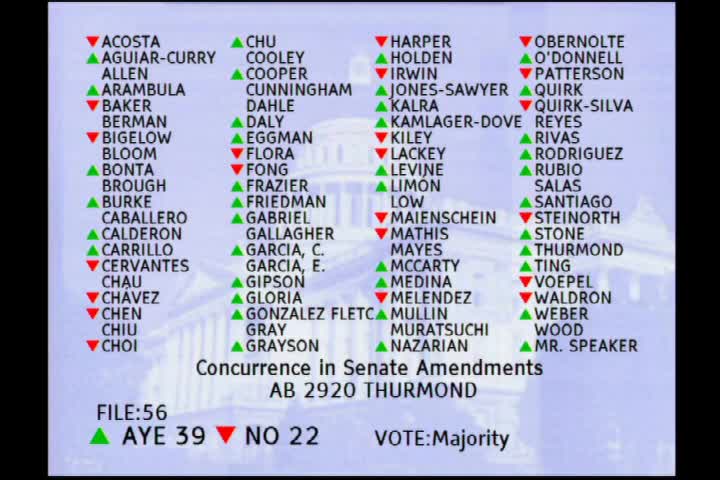 6MIN
Assembly Floor
 1MIN
Assembly Floor
 1MIN
Assembly Standing Committee on Appropriations
 3MIN
Senate Floor
 12MIN
Senate Standing Committee on Appropriations
 16MIN
Senate Standing Committee on Elections and Constitutional Amendments
Bill Author