SB 765: Planning and zoning: housing.
- Session Year: 2017-2018
- House: Senate
- Latest Version Date: 2018-09-27
(1)Existing law, until January 1, 2026, authorizes a development proponent to submit an application for a multifamily housing development that is subject to a streamlined, ministerial approval process, as provided, and not subject to a conditional use permit, if the development satisfies specified objective planning standards. Existing law requires the objective planning standards to include, among others, a requirement that the development certify to the locality that a skilled and trained workforce will be used to complete the development, if the development meets certain standards and depending on when the application is approved, including that the development consists of a specified number of units that are not 100% subsidized affordable housing and is located in a jurisdiction that meets specified requirements.
This bill would modify those provisions by requiring a skilled and trained workforce to be used if the application for the development consists of a specified number of units with a residential component that is not 100% subsidized affordable housing.
(2)Existing law requires the objective planning standards to include, among others, a requirement that a development be subject to a minimum percentage of below market rate housing on the basis that, among other things, the locality failed to submit its latest production report by the applicable time period, or that the report submitted reflected that there were fewer units of housing affordable to households making below 80% of the area median income that were issued building permits than were required for the regional housing needs assessment cycle for that reporting period, and that the project meets specified requirements.
This bill would instead require that the development be subject to the above-described minimum percentage of below market rate housing by reason of the localitys latest production report reflecting that there were fewer units of housing issued building permits that were affordable to either very low income or low-income households by income category than were required for the regional housing needs assessment cycle for that reporting period.
(3)Existing law requires the objective planning standards to include, among others, a requirement that the development proponent has already recorded land use restrictions with specified durations if the development contains units that are subsidized, as specified.
This bill would instead require the development proponent to commit to record, prior to issuance of the first building permit, a land use restriction or covenant providing that any lower income housing units that are required pursuant to the minimum percentage of below market rate housing remain available at affordable housing costs or rent to persons and families of lower income for specified durations.
(4)Existing law requires the objective planning standards include, among others, a requirement that the development not involve a subdivision of a parcel that is, or would otherwise be, subject to the Subdivision Map Act or any other applicable law authorizing the subdivision of land unless the development has received or will receive financing or funding by means of a low-income housing tax credit and is subject to specified requirements relating to prevailing wages, or the development is subject to the requirement that prevailing wages be paid and a skilled and trained workforce be used, as specified.
This bill would instead require that the development not involve a subdivision of a parcel that is, or would otherwise be, subject to the Subdivision Map Act or any other applicable law authorizing the subdivision of land unless the development is consistent with all objective subdivision standards in the local subdivision ordinance and the development either has received or will receive financing or funding by means of a low-income housing tax credit and is subject to specified requirements relating to prevailing wages, or is subject to the requirement that prevailing wages be paid and a skilled and trained workforce be used, as specified.
Existing law additionally authorizes the city, county, or city and county to conduct any design review or public oversight of the development and requires that design review or public oversight to be completed within specified periods of time.
This bill would provide that if the development is subject to the Subdivision Map Act but the development has received or will receive financing or funding by means of a low-income housing tax credit and is subject to specified requirements relating to prevailing wages, or the development is subject to the requirement that prevailing wages be paid and a skilled and trained workforce be used, the application for the subdivision pursuant to the Subdivision Map Act is exempt from the California Environmental Quality Act and would require the application for the subdivision to be considered within the specified time periods.
(5)Existing law requires the objective planning standards to include, among others, a requirement that the development, excluding any additional density or any other concessions, incentives, or waivers of development standards granted pursuant to the Density Bonus Law, is consistent with objective zoning standards and objective design review standards in effect at the time that the development is submitted to the local government.
This bill would also require the development to be consistent with objective subdivision standards. The bill would declare that these provisions are declaratory of existing law.
(6)Existing law provides that the California Environmental Quality Act does not apply to an action taken by a state agency or local government to provide financial assistance to a development that was approved for streamlined approval pursuant to these provisions to be used for housing for persons and families of very low, low, or moderate income.
This bill would additionally provide that the California Environmental Quality Act does not apply to an action taken by a state agency or local government to lease, convey, or encumber land owned by the local government or to facilitate the lease, conveyance, or encumbrance of land owned by the local government to a development that was approved for streamlined approval pursuant to these provisions to be used for housing for persons and families of very low, low, or moderate income.
(7)Existing law prohibits a local government, whether or not it has adopted an ordinance governing parking requirements in multifamily developments, from imposing parking standards for a streamlined development that was approved pursuant to these provisions, as specified.
This bill would specify that a local government is prohibited from imposing automobile parking standards for a streamlined development that was approved pursuant to these provisions, as specified.
(8)Existing law, until January 1, 2021, upon a declaration of a shelter crisis by the City of Berkeley, Emeryville, Los Angeles, Oakland, or San Diego, the County of Santa Clara, or the City and County of San Francisco, authorizes emergency housing to include homeless shelters in the City of Berkeley, Emeryville, Los Angeles, Oakland, or San Diego, the County of Santa Clara, or the City and County of San Francisco, respectively. Existing law, in lieu of compliance with local building approval procedures or state housing, health, habitability, planning and zoning, or safety standards, procedures, and laws, authorizes those jurisdictions to adopt by ordinance reasonable local standards for homeless shelters, as specified.
This bill would provide that the California Environmental Quality Act does not apply to actions taken by a state agency or local government to lease, convey, or encumber land owned by a city, county, or city and county, or to facilitate the lease, conveyance, or encumbrance of land owned by a city, county, or city and county, for, or to provide financial assistance to, a homeless shelter constructed or allowed pursuant to these provisions.
(1)Existing law, until January 1, 2026, authorizes a development proponent to submit an application for a multifamily housing development that is subject to a streamlined, ministerial approval process, as provided, and not subject to a conditional use permit, if the development satisfies specified objective planning standards. Existing law requires the objective planning standards to include, among others, a requirement that the development certify to the locality that a skilled and trained workforce will be used to complete the development, if the development meets certain standards and depending on when the application is approved, including that the development consists of a specified number of units that are not 100% subsidized affordable housing and is located in a jurisdiction that meets specified requirements.
This bill would modify those provisions by requiring a skilled and trained workforce to be used if the application for the development consists of a specified number of units with a residential component that is not 100% subsidized affordable housing.
(2)Existing law requires the objective planning standards to include, among others, a requirement that a development be subject to a minimum percentage of below market rate housing on the basis that, among other things, the locality failed to submit its latest production report by the applicable time period, or that the report submitted reflected that there were fewer units of housing affordable to households making below 80% of the area median income that were issued building permits than were required for the regional housing needs assessment cycle for that reporting period, and that the project meets specified requirements.
This bill would instead require that the development be subject to the above-described minimum percentage of below market rate housing by reason of the localitys latest production report reflecting that there were fewer units of housing issued building permits that were affordable to either very low income or low-income households by income category than were required for the regional housing needs assessment cycle for that reporting period.
(3)Existing law requires the objective planning standards to include, among others, a requirement that the development proponent has already recorded land use restrictions with specified durations if the development contains units that are subsidized, as specified.
This bill would instead require the development proponent to commit to record, prior to issuance of the first building permit, a land use restriction or covenant providing that any lower income housing units that are required pursuant to the minimum percentage of below market rate housing remain available at affordable housing costs or rent to persons and families of lower income for specified durations.
(4)Existing law requires the objective planning standards include, among others, a requirement that the development not involve a subdivision of a parcel that is, or would otherwise be, subject to the Subdivision Map Act or any other applicable law authorizing the subdivision of land unless the development has received or will receive financing or funding by means of a low-income housing tax credit and is subject to specified requirements relating to prevailing wages, or the development is subject to the requirement that prevailing wages be paid and a skilled and trained workforce is be used, as specified. Existing
This bill would instead require that the development not involve a subdivision of a parcel that is, or would otherwise be, subject to the Subdivision Map Act or any other applicable law authorizing the subdivision of land unless the development is consistent with all objective subdivision standards in the local subdivision ordinance and the development either has received or will receive financing or funding by means of a low-income housing tax credit and is subject to specified requirements relating to prevailing wages, or is subject to the requirement that prevailing wages be paid and a skilled and trained workforce be used, as specified.
Existing law additionally authorizes the city, county, or city and county to conduct any design review or public oversight of the development and requires that design review or public oversight to be completed within specified periods of time.
This bill would provide that if the development is subject to the Subdivision Map Act but the development has received or will receive financing or funding by means of a low-income housing tax credit and is subject to specified requirements relating to prevailing wages, or the development is subject to the requirement that prevailing wages be paid and a skilled and trained workforce be used, the application for the subdivision pursuant to the Subdivision Map Act is considered ministerial and is exempt from the California Environmental Quality Act, Act and would require the application for the subdivision to be considered within the specified time periods. The bill would declare that these provisions are declaratory of existing law.
(5)Existing law requires the objective planning standards to include, among others, a requirement that the development, excluding any additional density or any other concessions, incentives, or waivers of development standards granted pursuant to the Density Bonus Law, is consistent with objective zoning standards and objective design review standards in effect at the time that the development is submitted to the local government.
This bill would also require the development to be consistent with objective subdivision standards. The bill would declare that these provisions are declaratory of existing law.
(5)(6)Existing law provides that the California Environmental Quality Act does not apply to an action taken by a state agency or local government to provide financial assistance to a development that was approved for streamlined approval pursuant to these provisions to be used for housing for persons and families of very low, low, or moderate income.
This bill would additionally provide that the California Environmental Quality Act does not apply to an action taken by a state agency or local government to lease, convey, or encumber land owned by the local government or to facilitate the lease, conveyance, or encumbrance of land owned by the local government to a development that was approved for streamlined approval pursuant to these provisions to be used for housing for persons and families of very low, low, or moderate income.
(6)(7)Existing law prohibits a local government, whether or not it has adopted an ordinance governing parking requirements in multifamily developments, from imposing parking standards for a streamlined development that was approved pursuant to these provisions, as specified.
This bill would specify that a local government is prohibited from imposing automobile parking standards for a streamlined development that was approved pursuant to these provisions, as specified.
(7)(8)Existing law, until January 1, 2021, upon a declaration of a shelter crisis by the City of Berkeley, Emeryville, Los Angeles, Oakland, or San Diego, the County of Santa Clara, or the City and County of San Francisco, authorizes emergency housing to include homeless shelters in the City of Berkeley, Emeryville, Los Angeles, Oakland, or San Diego, the County of Santa Clara, or the City and County of San Francisco, respectively. Existing law, in lieu of compliance with local building approval procedures or state housing, health, habitability, planning and zoning, or safety standards, procedures, and laws, authorizes those jurisdictions to adopt by ordinance reasonable local standards for homeless shelters, as specified.
This bill would provide that the California Environmental Quality Act does not apply to actions taken by a state agency or local government to lease, convey, or encumber land owned by a city, county, or city and county, or to facilitate the lease, conveyance, or encumbrance of land owned by a city, county, or city and county, for, or to provide financial assistance to, a homeless shelter constructed or allowed pursuant to these provisions.
(1)Existing law, until January 1, 2026, authorizes a development proponent to submit an application for a multifamily housing development that is subject to a streamlined, ministerial approval process, as provided, and not subject to a conditional use permit, if the development satisfies specified objective planning standards. Existing law requires the objective planning standards to include, among others, a requirement that the development certify to the locality that a skilled and trained workforce will be used to complete the development, if the development meets certain standards and depending on when the application is approved, including that the development consists of a specified number of units that are not 100% subsidized affordable housing and is located in a jurisdiction that meets specified requirements.
The bill would provide that the determination of whether an application for a development is subject to the streamlined ministerial approval process is not a project for purposes of the California Environmental Quality Act.(2)Existing law requires the objective planning standards described above to include that the development certify to the locality that a skilled and trained workforce will be used to complete the development, if the development meets certain standards and depending on when the application is approved, including that the development consists of a specified number of units that are not 100% subsidized affordable housing and is located in a jurisdiction that meets specified requirements.This bill would modify those provisions by requiring a skilled and trained workforce to be used if the application for the development consists of a specified number of units with a residential component that is not 100% subsidized affordable housing.
(2)Existing law requires the objective planning standards to include, among others, a requirement that a development be subject to a minimum percentage of below market rate housing on the basis that, among other things, the locality failed to submit its latest production report by the applicable time period, or that the report submitted reflected that there were fewer units of housing affordable to households making below 80% of the area median income that were issued building permits than were required for the regional housing needs assessment cycle for that reporting period, and that the project meets specified requirements.
This bill would instead require that the development be subject to the above-described minimum percentage of below market rate housing by reason of the localitys latest production report reflecting that there were fewer units of housing issued building permits that were affordable to either very low income or low-income households by income category than were required for the regional housing needs assessment cycle for that reporting period.
(3)Existing law requires the objective planning standards to include, among others, a requirement that the development proponent has already recorded land use restrictions with specified durations if the development contains units that are subsidized, as specified.
This bill would instead require the development proponent to commit to record, prior to issuance of the first building permit, a land use restriction or covenant providing that any lower income housing units that are required pursuant to the minimum percentage of below market rate housing remain available at affordable housing costs or rent to persons and families of lower income for specified durations.
(4)Existing law requires the objective planning standards include, among others, a requirement that the development not involve a subdivision of a parcel that is, or would otherwise be, subject to the Subdivision Map Act or any other applicable law authorizing the subdivision of land unless the development has received or will receive financing or funding by means of a low-income housing tax credit and is subject to specified requirements relating to prevailing wages, or the development is subject to the requirement that prevailing wages be paid and a skilled and trained workforce is used, as specified. Existing law additionally authorizes the city, county, or city and county to conduct any design review or public oversight of the development and requires that design review or public oversight to be completed within specified periods of time.
This bill would provide that if the development is subject to the Subdivision Map Act but the development has received or will receive financing or funding by means of a low-income housing tax credit and is subject to specified requirements relating to prevailing wages, or the development is subject to the requirement that prevailing wages be paid and a skilled and trained workforce be used, the application for the subdivision pursuant to the Subdivision Map Act is considered ministerial and is exempt from the California Environmental Quality Act, and would require the application for the subdivision to be considered within the specified time periods. The bill would declare that these provisions are declaratory of existing law.
(3)(5)Existing law provides that the California Environmental Quality Act does not apply to an action taken by a state agency or local government to provide financial assistance to a development that was approved for streamlined approval pursuant to these provisions to be used for housing for persons and families of very low, low, or moderate income.
This bill would additionally provide that the California Environmental Quality Act does not apply to an action taken by a state agency or local government to lease, convey, or encumber land owned by the local government or to facilitate the lease, conveyance, or encumbrance of land owned by the local government to a development that was approved for streamlined approval pursuant to these provisions to be used for housing for persons and families of very low, low, or moderate income.
(4)(6)Existing law prohibits a local government, whether or not it has adopted an ordinance governing parking requirements in multifamily developments, from imposing parking standards for a streamlined development that was approved pursuant to these provisions, as specified.
This bill would specify that a local government is prohibited from imposing automobile parking standards for a streamlined development that was approved pursuant to these provisions, as specified.
(7)Existing law, until January 1, 2021, upon a declaration of a shelter crisis by the City of Berkeley, Emeryville, Los Angeles, Oakland, or San Diego, the County of Santa Clara, or the City and County of San Francisco, authorizes emergency housing to include homeless shelters in the City of Berkeley, Emeryville, Los Angeles, Oakland, or San Diego, the County of Santa Clara, or the City and County of San Francisco, respectively. Existing law, in lieu of compliance with local building approval procedures or state housing, health, habitability, planning and zoning, or safety standards, procedures, and laws, authorizes those jurisdictions to adopt by ordinance reasonable local standards for homeless shelters, as specified.
This bill would provide that the California Environmental Quality Act does not apply to actions taken by a state agency or local government to lease, convey, or encumber land owned by a city, county, or city and county, or to facilitate the lease, conveyance, or encumbrance of land owned by a city, county, or city and county, for, or to provide financial assistance to, a homeless shelter constructed or allowed pursuant to these provisions.
(1)Existing law, until January 1, 2026, authorizes a development proponent to submit an application for a multifamily housing development, which satisfies specified objective planning standards, development that is subject to a streamlined, ministerial approval process, as provided, and not subject to a conditional use permit. Existing law requires, among other objective planning standards, that the development be subject to a minimum percentage of below market rate housing on the basis that the locality failed to submit its latest production report by the applicable time period, or that if the report was submitted, it reflects either that there were fewer units of above-moderate-income housing approved than were required for the regional housing needs assessment cycle for that reporting period, that there were fewer units of housing affordable to households making below 80% of the area median income that were issued building permits than were required for the regional housing needs assessment cycle for that reporting period and the project seeking approval meets specified requirements, or that there were fewer units of housing affordable to any of the previously described income levels that were issued building permits than were required for the regional housing needs assessment cycle for that reporting period, as specified. permit, if the development satisfies specified objective planning standards.
This bill would revise these provisions to provide that the development is subject to a minimum percentage of below market rate housing on the basis that the localitys latest production report was submitted to the department within the time provided, and reflects either that there were fewer units of housing affordable to households making above 120% of the area median income that were issued building permits than were required for the regional housing needs assessment cycle for that reporting period, that there were fewer units of housing affordable to households making below 80% of the area median income that were issued building permits than were required for the regional housing needs assessment cycle for that reporting period and the project seeking approval meets specified requirements, or there were fewer units of housing affordable to households making between 80% and 120% of the area median income issued building permits than were required for the regional housing needs assessment cycle for that reporting period, and the project seeking approval meets specified requirements. Additionally, the bill would provide that the development is subject to a minimum percentage of below market rate housing on the basis that the locality failed to submit its latest 2 production reports by the applicable time period or either of the 2 latest production reports reflect that there were fewer units of housing affordable to households making above 120% and below 80% of the area median income than were required for the regional housing needs assessment cycle for that reporting period, as specified.(2)Existing law requires the objective planning standards described above to include that the development, excluding any additional density or any other concessions, incentives, or waivers of development standards granted pursuant to the Density Bonus Law, is consistent with objective zoning standards and objective design review standards in effect at the time that the development is submitted to the local government.This bill would specify that the receipt of a density bonus does not constitute a valid basis on which to find a proposed housing development project inconsistent with objective zoning standards or objective design review standards. The bill would also state that it is the policy of the state that these provisions should be interpreted and implemented in a manner to afford the fullest possible weight to the interest of, and the approval and provision of, the highest number of housing units.(3)Existing law requires that the objective planning standards described above include that the development is not located on a site that is within either a flood plain as determined by maps promulgated by the Federal Emergency Management Agency (FEMA) unless the development has been issued a flood plain development permit, or that the site is not located within a floodway as determined by maps promulgated by FEMA unless the development has received a no-rise certification in accordance with specified federal requirements.This bill would modify the above provisions to provide that the development may not be located on a site that is within either a special flood hazard area that is determined by FEMA to be subject to inundation by the 1% annual chance flood unless that site has been subject to a Letter of Map Revision prepared by FEMA and issued to the local government, or the site meets FEMA requirements necessary to meet minimum flood plain management criteria, or be located within a regulatory floodway as determined by FEMA in any official map unless the no-rise certification has been received. The bill would provide that if a development proponent meets all applicable federal qualifying criteria and is otherwise eligible for streamlined approval, then a local government is prohibited from denying an application on the basis that the development proponent did not comply with additional requirements adopted by the local government that are applicable to that site.The bill would provide that the determination of whether an application for a development is subject to the streamlined ministerial approval process is not a project for purposes of the California Environmental Quality Act.
(4)(2)Existing law requires the objective planning standards described above to include that the development certify to the locality that a skilled and trained workforce will be used to complete the development, if the development meets certain standards and depending on when the application is approved, including that if the application for the development is approved between January 1, 2020, and December 31, 2021, and the development consists of more than 50 units a specified number of units that are not 100% subsidized affordable housing and is located in a jurisdiction that meets specified requirements, or if the application for the development is approved between January 1, 2022, and December 31, 2025, and the development consists of more than 25 units and is located in a jurisdiction that meets specified requirements.
This bill would modify those provisions by requiring a skilled and trained workforce to be used if the application for the development is approved between January 1, 2020, and December 31, 2021, and the development consists of more than 50 units that are not 100% subsidized affordable housing, or if the application for the development is approved between January 1, 2022, and December 31, 2025, and the development consists of more than 25 units that are consists of a specified number of units with a residential component that is not 100% subsidized affordable housing.
(3)Existing law provides that the California Environmental Quality Act does not apply to an action taken by a state agency or local government to provide financial assistance to a development that was approved for streamlined approval pursuant to these provisions to be used for housing for persons and families of very low, low, or moderate income.
This bill would additionally provide that the California Environmental Quality Act does not apply to an action taken by a state agency or local government to lease, convey, or encumber land owned by the local government or to facilitate the lease, conveyance, or encumbrance of land owned by the local government to a development that was approved for streamlined approval pursuant to these provisions to be used for housing for persons and families of very low, low, or moderate income.
(4)Existing law prohibits a local government, whether or not it has adopted an ordinance governing parking requirements in multifamily developments, from imposing parking standards for a streamlined development that was approved pursuant to these provisions, as specified.
This bill would specify that a local government is prohibited from imposing automobile parking standards for a streamlined development that was approved pursuant to these provisions, as specified.
(1)Existing law, until January 1, 2026, authorizes a development proponent to submit an application for a multifamily housing development, which satisfies specified objective planning standards, that is subject to a streamlined, ministerial approval process, as provided, and not subject to a conditional use permit. Existing law requires, among other objective planning standards, that the development be subject to a minimum percentage of below market rate housing on the basis that the locality failed to submit its latest production report by the applicable time period, or that if the report was submitted, it reflects either that there were fewer units of above-moderate-income housing approved than were required for the regional housing needs assessment cycle for that reporting period, that there were fewer units of housing affordable to households making below 80% of the area median income that were issued building permits than were required for the regional housing needs assessment cycle for that reporting period and the project seeking approval meets specified requirements, or that there were fewer units of housing affordable to any of the previously described income levels that were issued building permits than were required for the regional housing needs assessment cycle for that reporting period, as specified.
This bill would revise these provisions to provide that the development is subject to a minimum percentage of below market rate housing on the basis that the localitys latest production report was submitted to the department within the time provided, and reflects either that there were fewer units of housing affordable to households making above 120% of the area median income that were issued building permits than were required for the regional housing needs assessment cycle for that reporting period, that there were fewer units of housing affordable to households making below 80% of the area median income that were issued building permits than were required for the regional housing needs assessment cycle for that reporting period and the project seeking approval meets specified requirements, or there were fewer units of housing affordable to households making between 80% and 120% of the area median income issued building permits than were required for the regional housing needs assessment cycle for that reporting period, and the project seeking approval meets specified requirements. Additionally, the bill would provide that the development is subject to a minimum percentage of below market rate housing on the basis that the locality failed to submit its latest 2 production reports by the applicable time period or either of the 2 latest production reports reflect that there were fewer units of housing affordable to households making above 120% and below 80% of the area median income than were required for the regional housing needs assessment cycle for that reporting period, as specified.
(2)Existing law requires the objective planning standards described above to include that the development, excluding any additional density or any other concessions, incentives, or waivers of development standards granted pursuant to the Density Bonus Law, is consistent with objective zoning standards and objective design review standards in effect at the time that the development is submitted to the local government.
This bill would specify that the receipt of a density bonus does not constitute a valid basis on which to find a proposed housing development project inconsistent with objective zoning standards or objective design review standards. The bill would also state that it is the policy of the state that these provisions should be interpreted and implemented in a manner to afford the fullest possible weight to the interest of, and the approval and provision of, the highest number of housing units.
(3)Existing law requires that the objective planning standards described above include that the development is not located on a site that is within either a flood plain as determined by maps promulgated by the Federal Emergency Management Agency (FEMA) unless the development has been issued a flood plain development permit, or that the site is not located within a floodway as determined by maps promulgated by FEMA unless the development has received a no-rise certification in accordance with specified federal requirements.
This bill would modify the above provisions to provide that the development may not be located on a site that is within either a special flood hazard area that is determined by FEMA to be subject to inundation by the 1% annual chance flood unless that site has been subject to a Letter of Map Revision prepared by FEMA and issued to the local government, or the site meets FEMA requirements necessary to meet minimum flood plain management criteria, or be located within a regulatory floodway as determined by FEMA in any official map unless the no-rise certification has been received. The bill would provide that if a development proponent meets all applicable federal qualifying criteria and is otherwise eligible for streamlined approval, then a local government is prohibited from denying an application on the basis that the development proponent did not comply with additional requirements adopted by the local government that are applicable to that site.
(4)Existing law requires the objective planning standards described above to include that the development certify to the locality that a skilled and trained workforce will be used to complete the development, if the development meets certain standards and depending on when the application is approved, including that if the application for the development is approved between January 1, 2020, and December 31, 2021, and the development consists of more than 50 units and is located in a jurisdiction that meets specified requirements, or if the application for the development is approved between January 1, 2022, and December 31, 2025, and the development consists of more than 25 units and is located in a jurisdiction that meets specified requirements.
This bill would modify those provisions by requiring a skilled and trained workforce to be used if the application for the development is approved between January 1, 2020, and December 31, 2021, and the development consists of more than 50 units that are not 100% subsidized affordable housing, or if the application for the development is approved between January 1, 2022, and December 31, 2025, and the development consists of more than 25 units that are not 100% subsidized affordable housing.
Existing law, until January 1, 2026, authorizes a development proponent to submit an application for a multifamily housing development, which satisfies specified objective planning standards, that is subject to a streamlined, ministerial approval process, as provided, and not subject to a conditional use permit. Existing law requires, among other objective planning standards, that the development be subject to a minimum percentage of below market rate housing on the basis that the locality failed to submit its latest production report by the applicable time period, or that if the report was submitted, it reflects either that there were fewer units of above-moderate-income housing approved than were required for the regional housing needs assessment cycle for that reporting period, that there were fewer units of housing affordable to households making below 80% of the area median income that were issued building permits than were required for the regional housing needs assessment cycle for that reporting period and the project seeking approval meets specified requirements, or that there were fewer units of housing affordable to any of the previously described income levels that were issued building permits than were required for the regional housing needs assessment cycle for that reporting period, as specified.
This bill would revise these provisions to provide that the development is subject to a minimum percentage of below market rate housing on the basis that the localitys latest production report was submitted to the department within the time provided, and reflects either that there were fewer units of housing affordable to households making above 120% of the area median income that were issued building permits than were required for the regional housing needs assessment cycle for that reporting period, that there were fewer units of housing affordable to households making below 80% of the area median income that were issued building permits than were required for the regional housing needs assessment cycle for that reporting period and the project seeking approval meets specified requirements, or there were fewer units of housing affordable to households making between 80% and 120% of the area median income issued building permits than were required for the regional housing needs assessment cycle for that reporting period, and the project seeking approval meets specified requirements. Additionally, the bill would provide that the development is subject to a minimum percentage of below market rate housing on the basis that the locality failed to submit its latest 2 production reports by the applicable time period or either of the 2 latest production reports reflect that there were fewer units of housing affordable to households making above 120% and below 80% of the area median income than were required for the regional housing needs assessment cycle for that reporting period, as specified.
(1)Existing law, the Charter Schools Act of 1992, provides for the establishment and operation of charter schools and provides that a charter school may operate as, or be operated by, a nonprofit public benefit corporation. Under existing law, a charter school that is unable to locate within the jurisdiction of the chartering school district may, under specified circumstances, establish a site outside of the boundaries of the school district but within the county in which the school district is located. Existing law law required, until July 1, 2016, the governing board of a school district seeking to sell or lease real property designed to provide direct instruction or instructional support that the governing board deemed to be surplus property to first provide a written offer to sell or lease that property to any charter school that had submitted a written request to the school district to be notified of surplus real property offered by the school district for sale or lease, as specified. That law required a charter school to use the real property sold or leased exclusively to provide direct instruction or instructional support.Existing law, the Teacher Housing Act of 2016, authorizes a school district to establish and implement programs, as provided, that address the housing needs of teachers and school district employees who face challenges in securing affordable housing. This bill would reinstate the requirement that expired on July 1, 2016, to first provide a written offer to the above-specified charter schools but would exempt from the requirement the governing board of a school district seeking to sell or lease real property it deems to be surplus property intended to be used in accordance with the Teacher Housing Act of 2016. The bill would limit the requirement to provide these written offers to only those charter schools that are operating as, or operated by, a nonprofit public benefit corporation and that are not located outside of the boundaries of the chartering school district pursuant to the provision applicable to a charter school unable to locate within the chartering school district. The bill would eliminate the specification that the real property deemed to be surplus real property must be designed to provide direct instruction or instructional support to be subject to the requirement to offer the property to eligible charter schools. The bill would require a charter school to complete school facilities construction, if any, and begin using the real property for direct instruction or instructional support within 5 years of the date the real property is made available to the charter school.Existing law required, until July 1, 2016, that the price at which real property was sold to a charter school not exceed the school districts cost of acquisition, adjusted as specified, and provided that in no event shall the price be less than 25% of the fair market value of the real property or less than the amount necessary to retire the share of local bonded indebtedness plus the amount of the original cost of the approved state aid applications on the property. This bill would reinstate this requirement and would increase the price at which a school district may sell real property to a charter school to no less than 75% of the fair market value of the real property for a school district that has requested an emergency apportionment or submitted a negative certification to the State Department of Education in the past 2 years and to no less than 50% of the fair market value of the real property for a school district that has submitted a qualified certification to the department in the past 2 years.Existing law required, until July 1, 2016, a charter school selling real property obtained pursuant to the these provisions to use the proceeds only for capital outlay, maintenance, and other facility-related costs.This bill would reinstate this requirement, revised to specify that the proceeds shall be used only for capital outlay, maintenance, and other school facility-related costs.(2)Existing law authorizes the proceeds from the sale or lease with option to purchase of surplus real property owned by a school district to be deposited into the general fund of the school district, to be used for one-time expenditures, if the governing board of the school district and the State Allocation Board have determined that the school district has no anticipated need for additional schoolsite or building construction for the 10-year period following the sale or lease with option to purchase, and the school district has no major deferred maintenance requirements. This bill would authorize a school district to deposit the proceeds from the lease or sale of surplus real property, together with any personal property located on the property, leased or purchased by a charter school, into the general fund of the school district. The bill would also authorize the school district to use the proceeds, as defined, for any one-time general fund purpose, as specified. The bill would make these authorizations contingent upon the governing board of the school district and the State Allocation Board having determined that the school district has no anticipated need for schoolsite construction, building construction, or major deferred maintenance projects for a 10-year period following the sale or lease of the surplus real property. The bill would provide that, notwithstanding such a determination by the State Allocation Board, a school district may apply for new construction or modernization funding if specified conditions are satisfied.(3)Existing law authorizes a school district to enter into leases and agreements relating to real property and buildings to be used jointly by the school district and any private person, firm, local governmental agency, or corporation, as specified. Existing law also requires that, before the governing board of a school district enters into a lease or agreement pursuant to this provision, it shall own a site upon which the building to be used by the school district and the private person, firm, local governmental agency, or corporation may be constructed, as specified.This bill would additionally require that, before the governing board of a school district enters into a lease or agreement pursuant to this provision, it shall first offer to lease or sell the real property or buildings to a charter school, as specified, except when the property is intended to be used in accordance with the Teacher Housing Act of 2016. The bill would exempt from this requirement a lease or agreement that would be used solely to provide instructional programs that benefit pupils.(1)Existing law, the Charter Schools Act of 1992, provides for the establishment and operation of charter schools and provides that a charter school may operate as, or be operated by, a nonprofit public benefit corporation. Under existing law, a charter school that is unable to locate within the jurisdiction of the chartering school district may, under specified circumstances, establish a site outside of the boundaries of the school district but within the county in which the school district is located.
(1)Existing
Existing law requires law required, until July 1, 2016, the governing board of a school district seeking to sell or lease real property designed to provide direct instruction or instructional support that the governing board deems deemed to be surplus property to first provide a written offer to sell or lease that property to any charter school that has had submitted a written request to the school district to be notified of surplus real property offered by the school district for sale or lease, as specified. Existing law provides that a school district selling or leasing surplus real property is not required to offer that property to a charter school pursuant to this provision on or after July 1, 2016. That law required a charter school to use the real property sold or leased exclusively to provide direct instruction or instructional support.
Existing law, the Teacher Housing Act of 2016, authorizes a school district to establish and implement programs, as provided, that address the housing needs of teachers and school district employees who face challenges in securing affordable housing.
This bill would exempt from reinstate the requirement that expired on July 1, 2016, to first provide a written offer to the above-specified charter schools but would exempt from the requirement the governing board of a school district seeking to sell or lease real property it deems to be surplus property intended to be used in accordance with the Teacher Housing Act of 2016, and 2016. The bill would limit the requirement to provide these written offers to only those charter schools that are operating as, or operated by, a nonprofit public benefit corporation and that are not located outside of the boundaries of the chartering school district pursuant to the provision applicable to a charter school unable to locate within the chartering school district. The bill would remove from that requirement eliminate the specification that the real property deemed to be surplus real property must be designed to provide direct instruction or instructional support. The bill would also extend the operation of that requirement indefinitely. support to be subject to the requirement to offer the property to eligible charter schools. The bill would require a charter school to complete school facilities construction, if any, and begin using the real property for direct instruction or instructional support within 5 years of the date the real property is made available to the charter school.
Existing law required, until July 1, 2016, that the price at which real property was sold to a charter school not exceed the school districts cost of acquisition, adjusted as specified, and provided that in no event shall the price be less than 25% of the fair market value of the real property or less than the amount necessary to retire the share of local bonded indebtedness plus the amount of the original cost of the approved state aid applications on the property.
This bill would reinstate this requirement and would increase the price at which a school district may sell real property to a charter school to no less than 75% of the fair market value of the real property for a school district that has requested an emergency apportionment or submitted a negative certification to the State Department of Education in the past 2 years and to no less than 50% of the fair market value of the real property for a school district that has submitted a qualified certification to the department in the past 2 years.
Existing law required, until July 1, 2016, a charter school selling real property obtained pursuant to the these provisions to use the proceeds only for capital outlay, maintenance, and other facility-related costs.
This bill would reinstate this requirement, revised to specify that the proceeds shall be used only for capital outlay, maintenance, and other school facility-related costs.
(2)Existing law authorizes the proceeds from the sale or lease with option to purchase of surplus real property owned by a school district to be deposited into the general fund of the school district, to be used for one-time expenditures, if the governing board of the school district and the State Allocation Board have determined that the school district has no anticipated need for additional schoolsite or building construction for the 10-year period following the sale or lease with option to purchase, and the school district has no major deferred maintenance requirements.
This bill would authorize a school district to deposit the proceeds from the lease or sale of surplus real property, together with any personal property located on the property, leased or purchased by a charter school, into the general fund of the school district. The bill would also authorize the school district to use the proceeds, as defined, for any one-time general fund purpose, as specified. The bill would make these authorizations contingent upon the governing board of the school district and the State Allocation Board having determined that the school district has no anticipated need for schoolsite construction, building construction, or major deferred maintenance projects for a 10-year period following the sale or lease of the surplus real property. The bill would provide that, notwithstanding such a determination by the State Allocation Board, a school district may apply for new construction or modernization funding if specified conditions are satisfied.
(3)Existing law authorizes a school district to enter into leases and agreements relating to real property and buildings to be used jointly by the school district and any private person, firm, local governmental agency, or corporation, as specified. Existing law also requires that, before the governing board of a school district enters into a lease or agreement pursuant to this provision, it shall own a site upon which the building to be used by the school district and the private person, firm, local governmental agency, or corporation may be constructed, as specified.
This bill would additionally require that, before the governing board of a school district enters into a lease or agreement pursuant to this provision, it shall first offer to lease or sell the real property or buildings to a charter school, as specified, except when the property is intended to be used in accordance with the Teacher Housing Act of 2016. The bill would exempt from this requirement a lease or agreement that would be used solely to provide instructional programs that benefit pupils.
(1)Existing law requires the governing board of a school district seeking to sell or lease real property designed to provide direct instruction or instructional support that the governing board deems to be surplus property to first provide a written offer to sell or lease that property to any charter school that has submitted a written request to the school district to be notified of surplus real property offered by the school district for sale or lease, as specified. Existing law provides that a school district selling or leasing surplus real property is not required to offer that property to a charter school pursuant to this provision on or after July 1, 2016. Existing law also requires that the construction of a school building, as defined, on property purchased by a charter school pursuant to this provision comply with the design and construction requirements of the Field Act, as specified.
Existing law, the Teacher Housing Act of 2016, authorizes a school district to establish and implement programs, as provided, that address the housing needs of teachers and school district employees who face challenges in securing affordable housing.
This bill would exempt from the requirement to first provide a written offer to the above-specified charter schools the governing board of a school district seeking to sell or lease real property it deems to be surplus property intended to be used in accordance with the Teacher Housing Act of 2016. The bill would delete the language specifying 2016, and would remove from that requirement the specification that the real property deemed to be surplus real property must be designed to provide direct instruction or instructional support. The bill would also delete the language providing that a school district selling or leasing surplus real property is not required to offer that property to a charter school pursuant to this provision on or after July 1, 2016. extend the operation of that requirement indefinitely.
(2)Existing law authorizes the proceeds from the sale or lease with option to purchase of surplus real property owned by a school district to be deposited into the general fund of the school district, to be used for one-time expenditures, if the governing board of the school district and the State Allocation Board have determined that the school district has no anticipated need for additional schoolsite or building construction for the 10-year period following the sale or lease with option to purchase, and the school district has no major deferred maintenance requirements.
This bill would authorize a school district to deposit the proceeds from the lease or sale of surplus real property, together with any personal property located on the property, leased or purchased by a charter school, into the general fund of the school district. The bill would also authorize the school district to use the proceeds, as defined, for any one-time general fund purpose, as specified. The bill would make these authorizations contingent upon the governing board of the school district and the State Allocation Board having determined that the school district has no anticipated need for schoolsite construction, building construction, or major deferred maintenance projects for a 10-year period following the sale or lease of the surplus real property. The bill would provide that, notwithstanding such a determination by the State Allocation Board, a school district may apply for new construction or modernization funding if specified conditions are satisfied.
(2)(3)Existing law authorizes a school district to enter into leases and agreements relating to real property and buildings to be used jointly by the school district and any private person, firm, local governmental agency, or corporation, as specified. Existing law also requires that, before the governing board of a school district enters into a lease or agreement pursuant to this provision, it shall own a site upon which the building to be used by the school district and the private person, firm, local governmental agency, or corporation may be constructed, as specified.
This bill would additionally require that, before the governing board of a school district enters into a lease or agreement pursuant to this provision, it shall first offer to lease or sell the real property or buildings to a charter school, as specified, except when the property is intended to be used in accordance with the Teacher Housing Act of 2016. The bill would exempt from this requirement a lease or agreement that would be used solely to provide instructional programs that benefit pupils.
(1)Existing law requires the governing board of a school district seeking to sell or lease real property designed to provide direct instruction or instructional support that the governing board deems to be surplus property to first provide a written offer to sell or lease that property to any charter school that has submitted a written request to the school district to be notified of surplus real property offered by the school district for sale or lease, as specified. Existing law provides that a school district selling or leasing surplus real property is not required to offer that property to a charter school pursuant to this provision on or after July 1, 2016. Existing law also requires that the construction of a school building, as defined, on property purchased by a charter school pursuant to this provision comply with the design and construction requirements of the Field Act, as specified.
Existing law, the Teacher Housing Act of 2016, authorizes a school district to establish and implement programs, as provided, that address the housing needs of teachers and school district employees who face challenges in securing affordable housing.
This bill would exempt from the requirement to first provide a written offer to the above-specified charter schools the governing board of a school district seeking to sell or lease real property it deems to be surplus property intended to be used in accordance with the Teacher Housing Act of 2016 in a county with a Traditional Housing Affordability Index of 20% or less. 2016. The bill would delete the language specifying that the real property deemed to be surplus real property must be designed to provide direct instruction or instructional support. The bill would also delete the language providing that a school district selling or leasing surplus real property is not required to offer that property to a charter school pursuant to this provision on or after July 1, 2016. The bill would also provide that the construction of a school building on property purchased by a charter school pursuant to this provision could, at the discretion of the charter school, comply with either the design and construction requirements of the Field Act or with specified provisions of the California Building Standards Code, as prescribed.
This bill would authorize a school district to deposit the proceeds from the lease or sale of surplus real property, together with any personal property located on the property, leased or purchased by a charter school, into the general fund of the school district. The bill would also authorize the school district to use the proceeds, as defined, for any one-time general fund purpose, as specified.
(2)Existing law authorizes a school district to enter into leases and agreements relating to real property and buildings to be used jointly by the school district and any private person, firm, local governmental agency, or corporation, as specified. Existing law also requires that, before the governing board of a school district enters into a lease or agreement pursuant to this provision, it shall own a site upon which the building to be used by the school district and the private person, firm, local governmental agency, or corporation may be constructed, as specified.
This bill would instead additionally require that, before the governing board of a school district enters into a lease or agreement pursuant to this provision, it shall first offer to lease or sell the real property or buildings to a charter school, as specified, except when the property is intended to be used in accordance with the Teacher Housing Act of 2016 in a county with a Traditional Housing Affordability Index of 20% or less. 2016. The bill would exempt from this requirement a lease or agreement that would be used solely to provide instructional programs that benefit pupils.
(3)Existing law authorizes the governing board of a school district to exchange any of its real property for the real property of another person or private business firm, as specified.This bill would require the governing board of a school district to first offer to lease or sell the real property it is proposing to exchange to a charter school, as specified, except when the real property is intended to be used in accordance with the Teacher Housing Act of 2016 in a county with a Traditional Housing Affordability Index of 20% or less.(1)Existing law requires the governing board of a school district seeking to sell or lease real property designed to provide direct instruction or instructional support that the governing board deems to be surplus property to first provide a written offer to sell or lease that property to any charter school that has submitted a written request to the school district to be notified of surplus real property offered by the school district for sale or lease, as specified. Existing law provides that a school district selling or leasing surplus real property is not required to offer that property to a charter school pursuant to this provision on or after July 1, 2016. Existing law also requires that the construction of a school building, as defined, on property purchased by a charter school pursuant to this provision comply with the design and construction requirements of the Field Act, as specified.
Existing law, the Teacher Housing Act of 2016, authorizes a school district to establish and implement programs, as provided, that address the housing needs of teachers and school district employees who face challenges in securing affordable housing.
This bill would exempt from the requirement to first provide a written offer to the above-specified charter schools the governing board of a school district seeking to sell or lease surplus property intended to be used in accordance with the Teacher Housing Act of 2016 in a county with a Traditional Housing Affordability Index of 20% or less. The bill would delete the language specifying that the real property deemed to be surplus real property must be designed to provide direct instruction or instructional support. The bill would also delete the language providing that a school district selling or leasing surplus real property is not required to offer that property to a charter school pursuant to this provision on or after July 1, 2016. The bill would also provide that the construction of a school building on property purchased by a charter school pursuant to this provision could, at the discretion of the charter school, comply with either the design and construction requirements of the Field Act or with specified provisions of the California Building Standards Code, as prescribed.
This bill would authorize a school district to deposit the proceeds from the lease or sale of surplus real property, together with any personal property located on the property, leased or purchased by a charter school, into the general fund of the school district. The bill would also authorize the school district to use the proceeds, as defined, for any one-time general fund purpose, as specified.
(2)Existing law authorizes a school district to enter into leases and agreements relating to real property and buildings to be used jointly by the school district and any private person, firm, local governmental agency, or corporation, as specified. Existing law also requires that, before the governing board of a school district enters into a lease or agreement pursuant to this provision, it shall own a site upon which the building to be used by the school district and the private person, firm, local governmental agency, or corporation may be constructed, as specified.
This bill would instead require that, before the governing board of a school district enters into a lease or agreement pursuant to this provision, it shall first offer to lease or sell the real property or buildings to a charter school, as specified, except when the property is intended to be used in accordance with the Teacher Housing Act of 2016 in a county with a Traditional Housing Affordability Index of 20% or less.
(3)Existing law authorizes the governing board of a school district to exchange any of its real property for the real property of another person or private business firm, as specified.
This bill would require the governing board of a school district to first offer to lease or sell the real property it is proposing to exchange to a charter school, as specified, except when the real property is intended to be used in accordance with the Teacher Housing Act of 2016 in a county with a Traditional Housing Affordability Index of 20% or less.
Existing law requires the Superintendent of Public Instruction to perform certain duties, including, among others, the duty of superintending the schools of this state.This bill would make nonsubstantive changes to these provisions.Existing law requires the Superintendent of Public Instruction to perform certain duties, including, among others, the duty of superintending the schools of this state.
This bill would make nonsubstantive changes to these provisions.
(a)Notwithstanding any other provision in this chapter, upon a declaration of a shelter crisis by the City of Berkeley, Emeryville, Los Angeles, Oakland, or San Diego, the County of Santa Clara, or the City and County of San Francisco, the following shall apply to the respective city, county, or city and county during a shelter crisis:
(1)Emergency housing may include homeless shelters for the homeless located or constructed on any land owned or leased by a city, county, or city and county, including land acquired with low- and moderate-income housing funds.
(2)(A)(i)The city, county, or city and county, in lieu of compliance with local building approval procedures or state housing, health, habitability, planning and zoning, or safety standards, procedures, and laws, may adopt by ordinance reasonable local standards and procedures for the design, site development, and operation of homeless shelters and the structures and facilities therein, to the extent that it is determined at the time of adoption that strict compliance with state and local standards or laws in existence at the time of that adoption would in any way prevent, hinder, or delay the mitigation of the effects of the shelter crisis. The Department of Housing and Community Development shall review and approve the citys, countys, or city and countys draft ordinance to ensure it addresses minimum health and safety standards. The department shall, as set forth in Section 9795, provide its findings to the Senate Committee on Transportation and Housing and the Assembly Committee on Housing and Community Development within 30 calendar days of receiving the draft ordinance.
(ii)During the shelter crisis, except as provided in this section, provisions of any housing, health, habitability, planning and zoning, or safety standards, procedures, or laws shall be suspended for homeless shelters, provided that the city, county, or city and county has adopted health and safety standards and procedures for homeless shelters consistent with ensuring minimal public health and safety and those standards are complied with. Landlord tenant laws codified in Sections 1941 to 1942.5, inclusive, of the Civil Code providing a cause of action for habitability or tenantability shall be suspended for homeless shelters, provided that the city, county, or city and county has adopted health and safety standards for homeless shelters and those standards are complied with. During the shelter crisis, the local and state law requirements for homeless shelters to be consistent with the local land use plans, including the general plan, shall be suspended.
(B)This section applies only to a public facility or homeless shelters reserved entirely for the homeless pursuant to this chapter.
(3)Homeless shelters constructed or allowed under this chapter shall not be subject to the Special Occupancy Parks Act (Part 2.3 (commencing with Section 18860) of Division 13 of the Health and Safety Code), the Mobilehome Parks Act (Part 2.1 (commencing with Section 18200) of Division 13 of the Health and Safety Code), or the Mobilehome Residency Law (Chapter 2.5 (commencing with Section 798) of Title 2 of Part 2 of Division 2 of the Civil Code).
(4)The California Environmental Quality Act (Division 13 (commencing with Section 21000) of the Public Resources Code) shall not apply to actions taken by a state agency or a city, county, or city and county, to lease, convey, or encumber land owned by a city, county, or city and county, or to facilitate the lease, conveyance, or encumbrance of land owned by the local government for, or to provide financial assistance to, a homeless shelter constructed or allowed by this section.
(5)On or before July 1, 2019, the city, county, or city and county shall develop a plan to address the shelter crisis, including, but not limited to, the development of homeless shelters and permanent supportive housing, as well as onsite supportive services. The city, county, or city and county shall make the plan publicly available.
(6)On or before January 1, 2019, and annually thereafter until January 1, 2021, if the city, county, or city and county has declared a shelter crisis, the city, county, or city and county shall report all of the following to the Senate Committee on Transportation and Housing and the Assembly Committee on Housing and Community Development:
(A)The total number of residents in homeless shelters within the city, county, or city and county.
(B)The total number of residents who have moved from a homeless shelter into permanent supportive housing within the city, county, or city and county.
(C)The estimated number of permanent supportive housing units.
(D)The number of residents who have exited the system and are no longer in need of a homeless shelter or permanent supportive housing within the city, county, or city and county.
(E)The number of new homeless shelters built pursuant to this section within the city, county, or city and county.
(F)New actions the city, county, or city and county is taking under the declared shelter crisis to better serve the homeless population and to reduce the number of people experiencing homelessness.
(b)For purposes of this section, the following terms have the following meanings:
(1)Homeless shelter means a facility with overnight sleeping accommodations, the primary purpose of which is to provide temporary shelter for the homeless that is not in existence after the declared shelter crisis. A temporary homeless shelter community may include supportive and self-sufficiency development services.
(2)Permanent supportive housing means housing for people who are homeless, with no limit on length of stay, and that is linked to onsite or offsite services that assist the supportive housing resident in retaining the housing, improving his or her health status, and maximizing his or her ability to live and, when possible, work in the community.
(c)This section shall remain in effect only until January 1, 2021, and as of that date is repealed.
SEC. 2.Section 65913.4 of the Government Code is amended to read:65913.4.(a)A development proponent may submit an application for a development that is subject to the streamlined, ministerial approval process provided by subdivision (b) and is not subject to a conditional use permit if the development satisfies all of the following objective planning standards:
(1)The development is a multifamily housing development that contains two or more residential units.
(2)The development is located on a site that satisfies all of the following:
(A)A site that is a legal parcel or parcels located in a city if, and only if, the city boundaries include some portion of either an urbanized area or urban cluster, as designated by the United States Census Bureau, or, for unincorporated areas, a legal parcel or parcels wholly within the boundaries of an urbanized area or urban cluster, as designated by the United States Census Bureau.
(B)A site in which at least 75 percent of the perimeter of the site adjoins parcels that are developed with urban uses. For the purposes of this section, parcels that are only separated by a street or highway shall be considered to be adjoined.
(C)A site that is zoned for residential use or residential mixed-use development, or has a general plan designation that allows residential use or a mix of residential and nonresidential uses, with at least two-thirds of the square footage of the development designated for residential use.
(3)(A)The development proponent has committed to record, prior to the issuance of the first building permit, a land use restriction or covenant providing that any lower income housing units required pursuant to subparagraph (B) of paragraph (4) shall remain available at affordable housing costs or rent to persons and families of lower income for no less than the following periods of time:
(i)Fifty-five years for units that are rented.
(ii)Forty-five years for units that are owned.
(B)The city or county shall require the recording of covenants or restrictions implementing this paragraph for each parcel or unit of real property included in the development.
(4)The development satisfies both of the following:
(A)Is located in a locality that the department has determined is subject to this subparagraph on the basis that the number of units that have been issued building permits is less than the localitys share of the regional housing needs, by income category, for that reporting period. A locality shall remain eligible under this subparagraph until the departments determination for the next reporting period.
(B)The development is subject to a requirement mandating a minimum percentage of below market rate housing based on one of the following:
(i)The locality did not submit its latest production report to the department by the time period required by Section 65400, or that production report reflects that there were fewer units of above moderate-income housing issued building permits than were required for the regional housing needs assessment cycle for that reporting period. In addition, if the project contains more than 10 units of housing, the project seeking approval dedicates a minimum of 10 percent of the total number of units to housing affordable to households making below 80 percent of the area median income. If the locality has adopted a local ordinance that requires that greater than 10 percent of the units be dedicated to housing affordable to households making below 80 percent of the area median income, that local ordinance applies.
(ii)The localitys latest production report reflects that there were fewer units of housing issued building permits affordable to either very low income or low-income households by income category than were required for the regional housing needs assessment cycle for that reporting period, and the project seeking approval dedicates 50 percent of the total number of units to housing affordable to households making below 80 percent of the area median income, unless the locality has adopted a local ordinance that requires that greater than 50 percent of the units be dedicated to housing affordable to households making below 80 percent of the area median income, in which case that local ordinance applies.
(iii)The locality did not submit its latest production report to the department by the time period required by Section 65400, or if the production report reflects that there were fewer units of housing affordable to both income levels described in clauses (i) and (ii) that were issued building permits than were required for the regional housing needs assessment cycle for that reporting period, the project seeking approval may choose between utilizing clause (i) or (ii).
(5)The development, excluding any additional density or any other concessions, incentives, or waivers of development standards granted pursuant to the Density Bonus Law in Section 65915, is consistent with objective zoning standards, objective subdivision standards, and objective design review standards in effect at the time that the development is submitted to the local government pursuant to this section. For purposes of this paragraph, objective zoning standards, objective subdivision standards, and objective design review standards mean standards that involve no personal or subjective judgment by a public official and are uniformly verifiable by reference to an external and uniform benchmark or criterion available and knowable by both the development applicant or proponent and the public official before submittal. These standards may be embodied in alternative objective land use specifications adopted by a city or county, and may include, but are not limited to, housing overlay zones, specific plans, inclusionary zoning ordinances, and density bonus ordinances, subject to the following:
(A)A development shall be deemed consistent with the objective zoning standards related to housing density, as applicable, if the density proposed is compliant with the maximum density allowed within that land use designation, notwithstanding any specified maximum unit allocation that may result in fewer units of housing being permitted.
(B)In the event that objective zoning, general plan, subdivision, or design review standards are mutually inconsistent, a development shall be deemed consistent with the objective zoning and subdivision standards pursuant to this subdivision if the development is consistent with the standards set forth in the general plan.
(C)The amendments to this subdivision made by the act adding this subparagraph do not constitute a change in, but are declaratory of, existing law.
(6)The development is not located on a site that is any of the following:
(A)A coastal zone, as defined in Division 20 (commencing with Section 30000) of the Public Resources Code.
(B)Either prime farmland or farmland of statewide importance, as defined pursuant to United States Department of Agriculture land inventory and monitoring criteria, as modified for California, and designated on the maps prepared by the Farmland Mapping and Monitoring Program of the Department of Conservation, or land zoned or designated for agricultural protection or preservation by a local ballot measure that was approved by the voters of that jurisdiction.
(C)Wetlands, as defined in the United States Fish and Wildlife Service Manual, Part 660 FW 2 (June 21, 1993).
(D)Within a very high fire hazard severity zone, as determined by the Department of Forestry and Fire Protection pursuant to Section 51178, or within a high or very high fire hazard severity zone as indicated on maps adopted by the Department of Forestry and Fire Protection pursuant to Section 4202 of the Public Resources Code. This subparagraph does not apply to sites excluded from the specified hazard zones by a local agency, pursuant to subdivision (b) of Section 51179, or sites that have adopted fire hazard mitigation measures pursuant to existing building standards or state fire mitigation measures applicable to the development.
(E)A hazardous waste site that is listed pursuant to Section 65962.5 or a hazardous waste site designated by the Department of Toxic Substances Control pursuant to Section 25356 of the Health and Safety Code, unless the Department of Toxic Substances Control has cleared the site for residential use or residential mixed uses.
(F)Within a delineated earthquake fault zone as determined by the State Geologist in any official maps published by the State Geologist, unless the development complies with applicable seismic protection building code standards adopted by the California Building Standards Commission under the California Building Standards Law (Part 2.5 (commencing with Section 18901) of Division 13 of the Health and Safety Code), and by any local building department under Chapter 12.2 (commencing with Section 8875) of Division 1 of Title 2.
(G)Within a special flood hazard area subject to inundation by the 1 percent annual chance flood (100-year flood) as determined by the Federal Emergency Management Agency in any official maps published by the Federal Emergency Management Agency. If a development proponent is able to satisfy all applicable federal qualifying criteria in order to provide that the site satisfies this subparagraph and is otherwise eligible for streamlined approval under this section, a local government shall not deny the application on the basis that the development proponent did not comply with any additional permit requirement, standard, or action adopted by that local government that is applicable to that site. A development may be located on a site described in this subparagraph if either of the following are met:
(i)The site has been subject to a Letter of Map Revision prepared by the Federal Emergency Management Agency and issued to the local jurisdiction.
(ii)The site meets Federal Emergency Management Agency requirements necessary to meet minimum flood plain management criteria of the National Flood Insurance Program pursuant to Part 59 (commencing with Section 59.1) and Part 60 (commencing with Section 60.1) of Subchapter B of Chapter I of Title 44 of the Code of Federal Regulations.
(H)Within a regulatory floodway as determined by the Federal Emergency Management Agency in any official maps published by the Federal Emergency Management Agency, unless the development has received a no-rise certification in accordance with Section 60.3(d)(3) of Title 44 of the Code of Federal Regulations. If a development proponent is able to satisfy all applicable federal qualifying criteria in order to provide that the site satisfies this subparagraph and is otherwise eligible for streamlined approval under this section, a local government shall not deny the application on the basis that the development proponent did not comply with any additional permit requirement, standard, or action adopted by that local government that is applicable to that site.
(I)Lands identified for conservation in an adopted natural community conservation plan pursuant to the Natural Community Conservation Planning Act (Chapter 10 (commencing with Section 2800) of Division 3 of the Fish and Game Code), habitat conservation plan pursuant to the federal Endangered Species Act of 1973 (16 U.S.C. Sec. 1531 et seq.), or other adopted natural resource protection plan.
(J)Habitat for protected species identified as candidate, sensitive, or species of special status by state or federal agencies, fully protected species, or species protected by the federal Endangered Species Act of 1973 (16 U.S.C. Sec. 1531 et seq.), the California Endangered Species Act (Chapter 1.5 (commencing with Section 2050) of Division 3 of the Fish and Game Code), or the Native Plant Protection Act (Chapter 10 (commencing with Section 1900) of Division 2 of the Fish and Game Code).
(K)Lands under conservation easement.
(7)The development is not located on a site where any of the following apply:
(A)The development would require the demolition of the following types of housing:
(i)Housing that is subject to a recorded covenant, ordinance, or law that restricts rents to levels affordable to persons and families of moderate, low, or very low income.
(ii)Housing that is subject to any form of rent or price control through a public entitys valid exercise of its police power.
(iii)Housing that has been occupied by tenants within the past 10 years.
(B)The site was previously used for housing that was occupied by tenants that was demolished within 10 years before the development proponent submits an application under this section.
(C)The development would require the demolition of a historic structure that was placed on a national, state, or local historic register.
(D)The property contains housing units that are occupied by tenants, and units at the property are, or were, subsequently offered for sale to the general public by the subdivider or subsequent owner of the property.
(8)The development proponent has done both of the following, as applicable:
(A)Certified to the locality that either of the following is true, as applicable:
(i)The entirety of the development is a public work for purposes of Chapter 1 (commencing with Section 1720) of Part 7 of Division 2 of the Labor Code.
(ii)If the development is not in its entirety a public work, that all construction workers employed in the execution of the development will be paid at least the general prevailing rate of per diem wages for the type of work and geographic area, as determined by the Director of Industrial Relations pursuant to Sections 1773 and 1773.9 of the Labor Code, except that apprentices registered in programs approved by the Chief of the Division of Apprenticeship Standards may be paid at least the applicable apprentice prevailing rate. If the development is subject to this subparagraph, then for those portions of the development that are not a public work all of the following shall apply:
(I)The development proponent shall ensure that the prevailing wage requirement is included in all contracts for the performance of the work.
(II)All contractors and subcontractors shall pay to all construction workers employed in the execution of the work at least the general prevailing rate of per diem wages, except that apprentices registered in programs approved by the Chief of the Division of Apprenticeship Standards may be paid at least the applicable apprentice prevailing rate.
(III)Except as provided in subclause (V), all contractors and subcontractors shall maintain and verify payroll records pursuant to Section 1776 of the Labor Code and make those records available for inspection and copying as provided therein.
(IV)Except as provided in subclause (V), the obligation of the contractors and subcontractors to pay prevailing wages may be enforced by the Labor Commissioner through the issuance of a civil wage and penalty assessment pursuant to Section 1741 of the Labor Code, which may be reviewed pursuant to Section 1742 of the Labor Code, within 18 months after the completion of the development, by an underpaid worker through an administrative complaint or civil action, or by a joint labor-management committee though a civil action under Section 1771.2 of the Labor Code. If a civil wage and penalty assessment is issued, the contractor, subcontractor, and surety on a bond or bonds issued to secure the payment of wages covered by the assessment shall be liable for liquidated damages pursuant to Section 1742.1 of the Labor Code.
(V)Subclauses (III) and (IV) shall not apply if all contractors and subcontractors performing work on the development are subject to a project labor agreement that requires the payment of prevailing wages to all construction workers employed in the execution of the development and provides for enforcement of that obligation through an arbitration procedure. For purposes of this clause, project labor agreement has the same meaning as set forth in paragraph (1) of subdivision (b) of Section 2500 of the Public Contract Code.
(VI)Notwithstanding subdivision (c) of Section 1773.1 of the Labor Code, the requirement that employer payments not reduce the obligation to pay the hourly straight time or overtime wages found to be prevailing shall not apply if otherwise provided in a bona fide collective bargaining agreement covering the worker. The requirement to pay at least the general prevailing rate of per diem wages does not preclude use of an alternative workweek schedule adopted pursuant to Section 511 or 514 of the Labor Code.
(B)(i)For developments for which any of the following conditions apply, certified that a skilled and trained workforce shall be used to complete the development if the application is approved:
(I)On and after January 1, 2018, until December 31, 2021, the development consists of 75 or more units with a residential component that is not 100 percent subsidized affordable housing and will be located within a jurisdiction located in a coastal or bay county with a population of 225,000 or more.
(II)On and after January 1, 2022, until December 31, 2025, the development consists of 50 or more units with a residential component that is not 100 percent subsidized affordable housing and will be located within a jurisdiction located in a coastal or bay county with a population of 225,000 or more.
(III)On and after January 1, 2018, until December 31, 2019, the development consists of 75 or more units with a residential component that is not 100 percent subsidized affordable housing and will be located within a jurisdiction with a population of fewer than 550,000 and that is not located in a coastal or bay county.
(IV)On and after January 1, 2020, until December 31, 2021, the development consists of more than 50 units with a residential component that is not 100 percent subsidized affordable housing and will be located within a jurisdiction with a population of fewer than 550,000 and that is not located in a coastal or bay county.
(V)On and after January 1, 2022, until December 31, 2025, the development consists of more than 25 units with a residential component that is not 100 percent subsidized affordable housing and will be located within a jurisdiction with a population of fewer than 550,000 and that is not located in a coastal or bay county.
(ii)For purposes of this section, skilled and trained workforce has the same meaning as provided in Chapter 2.9 (commencing with Section 2600) of Part 1 of Division 2 of the Public Contract Code.
(iii)If the development proponent has certified that a skilled and trained workforce will be used to complete the development and the application is approved, the following shall apply:
(I)The applicant shall require in all contracts for the performance of work that every contractor and subcontractor at every tier will individually use a skilled and trained workforce to complete the development.
(II)Every contractor and subcontractor shall use a skilled and trained workforce to complete the development.
(III)Except as provided in subclause (IV), the applicant shall provide to the locality, on a monthly basis while the development or contract is being performed, a report demonstrating compliance with Chapter 2.9 (commencing with Section 2600) of Part 1 of Division 2 of the Public Contract Code. A monthly report provided to the locality pursuant to this subclause shall be a public record under the California Public Records Act (Chapter 3.5 (commencing with Section 6250) of Division 7 of Title 1) and shall be open to public inspection. An applicant that fails to provide a monthly report demonstrating compliance with Chapter 2.9 (commencing with Section 2600) of Part 1 of Division 2 of the Public Contract Code shall be subject to a civil penalty of ten thousand dollars ($10,000) per month for each month for which the report has not been provided. Any contractor or subcontractor that fails to use a skilled and trained workforce shall be subject to a civil penalty of two hundred dollars ($200) per day for each worker employed in contravention of the skilled and trained workforce requirement. Penalties may be assessed by the Labor Commissioner within 18 months of completion of the development using the same procedures for issuance of civil wage and penalty assessments pursuant to Section 1741 of the Labor Code, and may be reviewed pursuant to the same procedures in Section 1742 of the Labor Code. Penalties shall be paid to the State Public Works Enforcement Fund.
(IV)Subclause (III) shall not apply if all contractors and subcontractors performing work on the development are subject to a project labor agreement that requires compliance with the skilled and trained workforce requirement and provides for enforcement of that obligation through an arbitration procedure. For purposes of this subparagraph, project labor agreement has the same meaning as set forth in paragraph (1) of subdivision (b) of Section 2500 of the Public Contract Code.
(C)Notwithstanding subparagraphs (A) and (B), a development that is subject to approval pursuant to this section is exempt from any requirement to pay prevailing wages or use a skilled and trained workforce if it meets both of the following:
(i)The project includes 10 or fewer units.
(ii)The project is not a public work for purposes of Chapter 1 (commencing with Section 1720) of Part 7 of Division 2 of the Labor Code.
(9)The development did not or does not involve a subdivision of a parcel that is, or, notwithstanding this section, would otherwise be, subject to the Subdivision Map Act (Division 2 (commencing with Section 66410)) or any other applicable law authorizing the subdivision of land, unless the development is consistent with all objective subdivision standards in the local subdivision ordinance, and either of the following apply:
(A)The development has received or will receive financing or funding by means of a low-income housing tax credit and is subject to the requirement that prevailing wages be paid pursuant to subparagraph (A) of paragraph (8).
(B)The development is subject to the requirement that prevailing wages be paid, and a skilled and trained workforce used, pursuant to paragraph (8).
(10)The development shall not be upon an existing parcel of land or site that is governed under the Mobilehome Residency Law (Chapter 2.5 (commencing with Section 798) of Title 2 of Part 2 of Division 2 of the Civil Code), the Recreational Vehicle Park Occupancy Law (Chapter 2.6 (commencing with Section 799.20) of Title 2 of Part 2 of Division 2 of the Civil Code), the Mobilehome Parks Act (Part 2.1 (commencing with Section 18200) of Division 13 of the Health and Safety Code), or the Special Occupancy Parks Act (Part 2.3 (commencing with Section 18860) of Division 13 of the Health and Safety Code).
(b)(1)If a local government determines that a development submitted pursuant to this section is in conflict with any of the objective planning standards specified in subdivision (a), it shall provide the development proponent written documentation of which standard or standards the development conflicts with, and an explanation for the reason or reasons the development conflicts with that standard or standards, as follows:
(A)Within 60 days of submittal of the development to the local government pursuant to this section if the development contains 150 or fewer housing units.
(B)Within 90 days of submittal of the development to the local government pursuant to this section if the development contains more than 150 housing units.
(2)If the local government fails to provide the required documentation pursuant to paragraph (1), the development shall be deemed to satisfy the objective planning standards specified in subdivision (a).
(c)(1)Any design review or public oversight of the development may be conducted by the local governments planning commission or any equivalent board or commission responsible for review and approval of development projects, or the city council or board of supervisors, as appropriate. That design review or public oversight shall be objective and be strictly focused on assessing compliance with criteria required for streamlined projects, as well as any reasonable objective design standards published and adopted by ordinance or resolution by a local jurisdiction before submission of a development application, and shall be broadly applicable to development within the jurisdiction. That design review or public oversight shall be completed as follows and shall not in any way inhibit, chill, or preclude the ministerial approval provided by this section or its effect, as applicable:
(A)Within 90 days of submittal of the development to the local government pursuant to this section if the development contains 150 or fewer housing units.
(B)Within 180 days of submittal of the development to the local government pursuant to this section if the development contains more than 150 housing units.
(2)If the development is consistent with the requirements of subparagraph (A) or (B) of paragraph (9) of subdivision (a) and is consistent with all objective subdivision standards in the local subdivision ordinance, an application for a subdivision pursuant to the Subdivision Map Act (Division 2 (commencing with Section 66410)) shall be exempt from the requirements of the California Environmental Quality Act (Division 13 (commencing with Section 21000) of the Public Resources Code) and shall be subject to the public oversight timelines set forth in paragraph (1).
(d)(1)Notwithstanding any other law, a local government, whether or not it has adopted an ordinance governing automobile parking requirements in multifamily developments, shall not impose automobile parking standards for a streamlined development that was approved pursuant to this section in any of the following instances:
(A)The development is located within one-half mile of public transit.
(B)The development is located within an architecturally and historically significant historic district.
(C)When on-street parking permits are required but not offered to the occupants of the development.
(D)When there is a car share vehicle located within one block of the development.
(2)If the development does not fall within any of the categories described in paragraph (1), the local government shall not impose automobile parking requirements for streamlined developments approved pursuant to this section that exceed one parking space per unit.
(e)(1)If a local government approves a development pursuant to this section, then, notwithstanding any other law, that approval shall not expire if the project includes public investment in housing affordability, beyond tax credits, where 50 percent of the units are affordable to households making below 80 percent of the area median income.
(2)If a local government approves a development pursuant to this section and the project does not include 50 percent of the units affordable to households making below 80 percent of the area median income, that approval shall automatically expire after three years except that a project may receive a one-time, one-year extension if the project proponent can provide documentation that there has been significant progress toward getting the development construction ready, such as filing a building permit application.
(3)If a local government approves a development pursuant to this section, that approval shall remain valid for three years from the date of the final action establishing that approval and shall remain valid thereafter for a project so long as vertical construction of the development has begun and is in progress. Additionally, the development proponent may request, and the local government shall have discretion to grant, an additional one-year extension to the original three-year period. The local governments action and discretion in determining whether to grant the foregoing extension shall be limited to considerations and process set forth in this section.
(f)A local government shall not adopt any requirement, including, but not limited to, increased fees or inclusionary housing requirements, that applies to a project solely or partially on the basis that the project is eligible to receive ministerial or streamlined approval pursuant to this section.
(g)This section shall not affect a development proponents ability to use any alternative streamlined by right permit processing adopted by a local government, including the provisions of subdivision (i) of Section 65583.2.
(h)The California Environmental Quality Act (Division 13 (commencing with Section 21000) of the Public Resources Code) does not apply to actions taken by a state agency or local government to lease, convey, or encumber land owned by the local government or to facilitate the lease, conveyance, or encumbrance of land owned by the local government, or to provide financial assistance to a development that receives streamlined approval pursuant to this section that is to be used for housing for persons and families of very low, low, or moderate income, as defined in Section 50093 of the Health and Safety Code.
(i)For purposes of this section, the following terms have the following meanings:
(1)Affordable housing cost has the same meaning as set forth in Section 50052.5 of the Health and Safety Code.
(2)Affordable rent has the same meaning as set forth in Section 50053 of the Health and Safety Code.
(3)Department means the Department of Housing and Community Development.
(4)Development proponent means the developer who submits an application for streamlined approval pursuant to this section.
(5)Completed entitlements means a housing development which has received all the required land use approvals or entitlements necessary for the issuance of a building permit.
(6)Locality or local government means a city, including a charter city, a county, including a charter county, or a city and county, including a charter city and county.
(7)Production report means the information reported pursuant to subparagraph (H) of paragraph (2) of subdivision (a) of Section 65400.
(8)State agency includes every state office, officer, department, division, bureau, board, and commission, but does not include the California State University or the University of California.
(9)Subsidized means units that are price or rent restricted such that the units are permanently affordable to households meeting the definitions of very low and lower income, as defined in Sections 50079.5 and 50105 of the Health and Safety Code.
(10)Reporting period means either of the following:
(A)The first half of the regional housing needs assessment cycle.
(B)The last half of the regional housing needs assessment cycle.
(11)Urban uses means any current or former residential, commercial, public institutional, transit or transportation passenger facility, or retail use, or any combination of those uses.
(j)The department may review, adopt, amend, and repeal guidelines to implement uniform standards or criteria that supplement or clarify the terms, references, or standards set forth in this section. Any guidelines or terms adopted pursuant to this subdivision shall not be subject to Chapter 3.5 (commencing with Section 11340) of Part 1 of Division 3 of Title 2 of the Government Code.
(k)The determination of whether an application for a development is subject to the streamlined ministerial approval process provided by subdivision (b) is not a project as defined in Section 21065 of the Public Resources Code.
(l)It is the policy of the state that this section be interpreted and implemented in a manner to afford the fullest possible weight to the interest of, and the approval and provision of, increased housing supply.
(m)This section shall remain in effect only until January 1, 2026, and as of that date is repealed.
(a)Notwithstanding any other provision in this chapter, upon a declaration of a shelter crisis by the City of Berkeley, Emeryville, Los Angeles, Oakland, or San Diego, the County of Santa Clara, or the City and County of San Francisco, the following shall apply to the respective city, county, or city and county during a shelter crisis:
(1)Emergency housing may include homeless shelters for the homeless located or constructed on any land owned or leased by a city, county, or city and county, including land acquired with low- and moderate-income housing funds.
(2)(A)(i)The city, county, or city and county, in lieu of compliance with local building approval procedures or state housing, health, habitability, planning and zoning, or safety standards, procedures, and laws, may adopt by ordinance reasonable local standards and procedures for the design, site development, and operation of homeless shelters and the structures and facilities therein, to the extent that it is determined at the time of adoption that strict compliance with state and local standards or laws in existence at the time of that adoption would in any way prevent, hinder, or delay the mitigation of the effects of the shelter crisis. The Department of Housing and Community Development shall review and approve the citys, countys, or city and countys draft ordinance to ensure it addresses minimum health and safety standards. The department shall, as set forth in Section 9795, provide its findings to the Senate Committee on Transportation and Housing and the Assembly Committee on Housing and Community Development within 30 calendar days of receiving the draft ordinance.
(ii)During the shelter crisis, except as provided in this section, provisions of any housing, health, habitability, planning and zoning, or safety standards, procedures, or laws shall be suspended for homeless shelters, provided that the city, county, or city and county has adopted health and safety standards and procedures for homeless shelters consistent with ensuring minimal public health and safety and those standards are complied with. Landlord tenant laws codified in Sections 1941 to 1942.5, inclusive, of the Civil Code providing a cause of action for habitability or tenantability shall be suspended for homeless shelters, provided that the city, county, or city and county has adopted health and safety standards for homeless shelters and those standards are complied with. During the shelter crisis, the local and state law requirements for homeless shelters to be consistent with the local land use plans, including the general plan, shall be suspended.
(B)This section applies only to a public facility or homeless shelters reserved entirely for the homeless pursuant to this chapter.
(3)Homeless shelters constructed or allowed under this chapter shall not be subject to the Special Occupancy Parks Act (Part 2.3 (commencing with Section 18860) of Division 13 of the Health and Safety Code), the Mobilehome Parks Act (Part 2.1 (commencing with Section 18200) of Division 13 of the Health and Safety Code), or the Mobilehome Residency Law (Chapter 2.5 (commencing with Section 798) of Title 2 of Part 2 of Division 2 of the Civil Code).
(4)The California Environmental Quality Act (Division 13 (commencing with Section 21000) of the Public Resources Code) shall not apply to actions taken by a state agency or a city, county, or city and county, to lease, convey, or encumber land owned by a city, county, or city and county, or to facilitate the lease, conveyance, or encumbrance of land owned by the local government for, or to provide financial assistance to, a homeless shelter constructed or allowed by this section.
(5)On or before July 1, 2019, the city, county, or city and county shall develop a plan to address the shelter crisis, including, but not limited to, the development of homeless shelters and permanent supportive housing, as well as onsite supportive services. The city, county, or city and county shall make the plan publicly available.
(6)On or before January 1, 2019, and annually thereafter until January 1, 2021, if the city, county, or city and county has declared a shelter crisis, the city, county, or city and county shall report all of the following to the Senate Committee on Transportation and Housing and the Assembly Committee on Housing and Community Development:
(A)The total number of residents in homeless shelters within the city, county, or city and county.
(B)The total number of residents who have moved from a homeless shelter into permanent supportive housing within the city, county, or city and county.
(C)The estimated number of permanent supportive housing units.
(D)The number of residents who have exited the system and are no longer in need of a homeless shelter or permanent supportive housing within the city, county, or city and county.
(E)The number of new homeless shelters built pursuant to this section within the city, county, or city and county.
(F)New actions the city, county, or city and county is taking under the declared shelter crisis to better serve the homeless population and to reduce the number of people experiencing homelessness.
(b)For purposes of this section, the following terms have the following meanings:
(1)Homeless shelter means a facility with overnight sleeping accommodations, the primary purpose of which is to provide temporary shelter for the homeless that is not in existence after the declared shelter crisis. A temporary homeless shelter community may include supportive and self-sufficiency development services.
(2)Permanent supportive housing means housing for people who are homeless, with no limit on length of stay, and that is linked to onsite or offsite services that assist the supportive housing resident in retaining the housing, improving his or her health status, and maximizing his or her ability to live and, when possible, work in the community.
(c)This section shall remain in effect only until January 1, 2021, and as of that date is repealed.
SEC. 2.Section 65913.4 of the Government Code is amended to read:65913.4.(a)A development proponent may submit an application for a development that is subject to the streamlined, ministerial approval process provided by subdivision (b) and is not subject to a conditional use permit if the development satisfies all of the following objective planning standards:
(1)The development is a multifamily housing development that contains two or more residential units.
(2)The development is located on a site that satisfies all of the following:
(A)A site that is a legal parcel or parcels located in a city if, and only if, the city boundaries include some portion of either an urbanized area or urban cluster, as designated by the United States Census Bureau, or, for unincorporated areas, a legal parcel or parcels wholly within the boundaries of an urbanized area or urban cluster, as designated by the United States Census Bureau.
(B)A site in which at least 75 percent of the perimeter of the site adjoins parcels that are developed with urban uses. For the purposes of this section, parcels that are only separated by a street or highway shall be considered to be adjoined.
(C)A site that is zoned for residential use or residential mixed-use development, or has a general plan designation that allows residential use or a mix of residential and nonresidential uses, with at least two-thirds of the square footage of the development designated for residential use.
(3)(A)The development proponent has committed to record, prior to the issuance of the first building permit, a land use restriction or covenant providing that any lower income housing units required pursuant to subparagraph (B) of paragraph (4) shall remain available at affordable housing costs or rent to persons and families of lower income for no less than the following periods of time:
(i)Fifty-five years for units that are rented.
(ii)Forty-five years for units that are owned.
(B)The city or county shall require the recording of covenants or restrictions implementing this paragraph for each parcel or unit of real property included in the development.
(4)The development satisfies both of the following:
(A)Is located in a locality that the department has determined is subject to this subparagraph on the basis that the number of units that have been issued building permits is less than the localitys share of the regional housing needs, by income category, for that reporting period. A locality shall remain eligible under this subparagraph until the departments determination for the next reporting period.
(B)The development is subject to a requirement mandating a minimum percentage of below market rate housing based on one of the following:
(i)The locality did not submit its latest production report to the department by the time period required by Section 65400, or that production report reflects that there were fewer units of above moderate-income housing issued building permits than were required for the regional housing needs assessment cycle for that reporting period. In addition, if the project contains more than 10 units of housing, the project seeking approval dedicates a minimum of 10 percent of the total number of units to housing affordable to households making below 80 percent of the area median income. If the locality has adopted a local ordinance that requires that greater than 10 percent of the units be dedicated to housing affordable to households making below 80 percent of the area median income, that zoning local ordinance applies.
(ii)The localitys latest production report reflects that there were fewer units of housing issued building permits affordable to either very low income or low-income households by income category than were required for the regional housing needs assessment cycle for that reporting period, and the project seeking approval dedicates 50 percent of the total number of units to housing affordable to households making below 80 percent of the area median income, unless the locality has adopted a local ordinance that requires that greater than 50 percent of the units be dedicated to housing affordable to households making below 80 percent of the area median income, in which case that local ordinance applies.
(iii)The locality did not submit its latest production report to the department by the time period required by Section 65400, or if the production report reflects that there were fewer units of housing affordable to both income levels described in clauses (i) and (ii) that were issued building permits than were required for the regional housing needs assessment cycle for that reporting period, the project seeking approval may choose between utilizing clause (i) or (ii).
(5)The development, excluding any additional density or any other concessions, incentives, or waivers of development standards granted pursuant to the Density Bonus Law in Section 65915, is consistent with objective zoning standards standards, objective subdivision standards, and objective design review standards in effect at the time that the development is submitted to the local government pursuant to this section. For purposes of this paragraph, objective zoning standards standards, objective subdivision standards, and objective design review standards mean standards that involve no personal or subjective judgment by a public official and are uniformly verifiable by reference to an external and uniform benchmark or criterion available and knowable by both the development applicant or proponent and the public official before submittal. These standards may be embodied in alternative objective land use specifications adopted by a city or county, and may include, but are not limited to, housing overlay zones, specific plans, inclusionary zoning ordinances, and density bonus ordinances, subject to the following:
(A)A development shall be deemed consistent with the objective zoning standards related to housing density, as applicable, if the density proposed is compliant with the maximum density allowed within that land use designation, notwithstanding any specified maximum unit allocation that may result in fewer units of housing being permitted.
(B)In the event that objective zoning, general plan, subdivision, or design review standards are mutually inconsistent, a development shall be deemed consistent with the objective zoning and subdivision standards pursuant to this subdivision if the development is consistent with the standards set forth in the general plan.
(C)The amendments to this subdivision made by the act adding this subparagraph do not constitute a change in, but are declaratory of, existing law.
(6)The development is not located on a site that is any of the following:
(A)A coastal zone, as defined in Division 20 (commencing with Section 30000) of the Public Resources Code.
(B)Either prime farmland or farmland of statewide importance, as defined pursuant to United States Department of Agriculture land inventory and monitoring criteria, as modified for California, and designated on the maps prepared by the Farmland Mapping and Monitoring Program of the Department of Conservation, or land zoned or designated for agricultural protection or preservation by a local ballot measure that was approved by the voters of that jurisdiction.
(C)Wetlands, as defined in the United States Fish and Wildlife Service Manual, Part 660 FW 2 (June 21, 1993).
(D)Within a very high fire hazard severity zone, as determined by the Department of Forestry and Fire Protection pursuant to Section 51178, or within a high or very high fire hazard severity zone as indicated on maps adopted by the Department of Forestry and Fire Protection pursuant to Section 4202 of the Public Resources Code. This subparagraph does not apply to sites excluded from the specified hazard zones by a local agency, pursuant to subdivision (b) of Section 51179, or sites that have adopted fire hazard mitigation measures pursuant to existing building standards or state fire mitigation measures applicable to the development.
(E)A hazardous waste site that is listed pursuant to Section 65962.5 or a hazardous waste site designated by the Department of Toxic Substances Control pursuant to Section 25356 of the Health and Safety Code, unless the Department of Toxic Substances Control has cleared the site for residential use or residential mixed uses.
(F)Within a delineated earthquake fault zone as determined by the State Geologist in any official maps published by the State Geologist, unless the development complies with applicable seismic protection building code standards adopted by the California Building Standards Commission under the California Building Standards Law (Part 2.5 (commencing with Section 18901) of Division 13 of the Health and Safety Code), and by any local building department under Chapter 12.2 (commencing with Section 8875) of Division 1 of Title 2.
(G)Within a special flood hazard area subject to inundation by the 1 percent annual chance flood (100-year flood) as determined by the Federal Emergency Management Agency in any official maps published by the Federal Emergency Management Agency. If a development proponent is able to satisfy all applicable federal qualifying criteria in order to provide that the site satisfies this subparagraph and is otherwise eligible for streamlined approval under this section, a local government shall not deny the application on the basis that the development proponent did not comply with any additional permit requirement, standard, or action adopted by that local government that is applicable to that site. A development may be located on a site described in this subparagraph if either of the following are met:
(i)The site has been subject to a Letter of Map Revision prepared by the Federal Emergency Management Agency and issued to the local jurisdiction.
(ii)The site meets Federal Emergency Management Agency requirements necessary to meet minimum flood plain management criteria of the National Flood Insurance Program pursuant to Part 59 (commencing with Section 59.1) and Part 60 (commencing with Section 60.1) of Subchapter B of Chapter I of Title 44 of the Code of Federal Regulations.
(H)Within a regulatory floodway as determined by the Federal Emergency Management Agency in any official maps published by the Federal Emergency Management Agency, unless the development has received a no-rise certification in accordance with Section 60.3(d)(3) of Title 44 of the Code of Federal Regulations. If a development proponent is able to satisfy all applicable federal qualifying criteria in order to provide that the site satisfies this subparagraph and is otherwise eligible for streamlined approval under this section, a local government shall not deny the application on the basis that the development proponent did not comply with any additional permit requirement, standard, or action adopted by that local government that is applicable to that site.
(I)Lands identified for conservation in an adopted natural community conservation plan pursuant to the Natural Community Conservation Planning Act (Chapter 10 (commencing with Section 2800) of Division 3 of the Fish and Game Code), habitat conservation plan pursuant to the federal Endangered Species Act of 1973 (16 U.S.C. Sec. 1531 et seq.), or other adopted natural resource protection plan.
(J)Habitat for protected species identified as candidate, sensitive, or species of special status by state or federal agencies, fully protected species, or species protected by the federal Endangered Species Act of 1973 (16 U.S.C. Sec. 1531 et seq.), the California Endangered Species Act (Chapter 1.5 (commencing with Section 2050) of Division 3 of the Fish and Game Code), or the Native Plant Protection Act (Chapter 10 (commencing with Section 1900) of Division 2 of the Fish and Game Code).
(K)Lands under conservation easement.
(7)The development is not located on a site where any of the following apply:
(A)The development would require the demolition of the following types of housing:
(i)Housing that is subject to a recorded covenant, ordinance, or law that restricts rents to levels affordable to persons and families of moderate, low, or very low income.
(ii)Housing that is subject to any form of rent or price control through a public entitys valid exercise of its police power.
(iii)Housing that has been occupied by tenants within the past 10 years.
(B)The site was previously used for housing that was occupied by tenants that was demolished within 10 years before the development proponent submits an application under this section.
(C)The development would require the demolition of a historic structure that was placed on a national, state, or local historic register.
(D)The property contains housing units that are occupied by tenants, and units at the property are, or were, subsequently offered for sale to the general public by the subdivider or subsequent owner of the property.
(8)The development proponent has done both of the following, as applicable:
(A)Certified to the locality that either of the following is true, as applicable:
(i)The entirety of the development is a public work for purposes of Chapter 1 (commencing with Section 1720) of Part 7 of Division 2 of the Labor Code.
(ii)If the development is not in its entirety a public work, that all construction workers employed in the execution of the development will be paid at least the general prevailing rate of per diem wages for the type of work and geographic area, as determined by the Director of Industrial Relations pursuant to Sections 1773 and 1773.9 of the Labor Code, except that apprentices registered in programs approved by the Chief of the Division of Apprenticeship Standards may be paid at least the applicable apprentice prevailing rate. If the development is subject to this subparagraph, then for those portions of the development that are not a public work all of the following shall apply:
(I)The development proponent shall ensure that the prevailing wage requirement is included in all contracts for the performance of the work.
(II)All contractors and subcontractors shall pay to all construction workers employed in the execution of the work at least the general prevailing rate of per diem wages, except that apprentices registered in programs approved by the Chief of the Division of Apprenticeship Standards may be paid at least the applicable apprentice prevailing rate.
(III)Except as provided in subclause (V), all contractors and subcontractors shall maintain and verify payroll records pursuant to Section 1776 of the Labor Code and make those records available for inspection and copying as provided therein.
(IV)Except as provided in subclause (V), the obligation of the contractors and subcontractors to pay prevailing wages may be enforced by the Labor Commissioner through the issuance of a civil wage and penalty assessment pursuant to Section 1741 of the Labor Code, which may be reviewed pursuant to Section 1742 of the Labor Code, within 18 months after the completion of the development, by an underpaid worker through an administrative complaint or civil action, or by a joint labor-management committee though a civil action under Section 1771.2 of the Labor Code. If a civil wage and penalty assessment is issued, the contractor, subcontractor, and surety on a bond or bonds issued to secure the payment of wages covered by the assessment shall be liable for liquidated damages pursuant to Section 1742.1 of the Labor Code.
(V)Subclauses (III) and (IV) shall not apply if all contractors and subcontractors performing work on the development are subject to a project labor agreement that requires the payment of prevailing wages to all construction workers employed in the execution of the development and provides for enforcement of that obligation through an arbitration procedure. For purposes of this clause, project labor agreement has the same meaning as set forth in paragraph (1) of subdivision (b) of Section 2500 of the Public Contract Code.
(VI)Notwithstanding subdivision (c) of Section 1773.1 of the Labor Code, the requirement that employer payments not reduce the obligation to pay the hourly straight time or overtime wages found to be prevailing shall not apply if otherwise provided in a bona fide collective bargaining agreement covering the worker. The requirement to pay at least the general prevailing rate of per diem wages does not preclude use of an alternative workweek schedule adopted pursuant to Section 511 or 514 of the Labor Code.
(B)(i)For developments for which any of the following conditions apply, certified that a skilled and trained workforce shall be used to complete the development if the application is approved:
(I)On and after January 1, 2018, until December 31, 2021, the development consists of 75 or more units with a residential component that is not 100 percent subsidized affordable housing and will be located within a jurisdiction located in a coastal or bay county with a population of 225,000 or more.
(II)On and after January 1, 2022, until December 31, 2025, the development consists of 50 or more units with a residential component that is not 100 percent subsidized affordable housing and will be located within a jurisdiction located in a coastal or bay county with a population of 225,000 or more.
(III)On and after January 1, 2018, until December 31, 2019, the development consists of 75 or more units with a residential component that is not 100 percent subsidized affordable housing and will be located within a jurisdiction with a population of fewer than 550,000 and that is not located in a coastal or bay county.
(IV)On and after January 1, 2020, until December 31, 2021, the development consists of more than 50 units with a residential component that is not 100 percent subsidized affordable housing and will be located within a jurisdiction with a population of fewer than 550,000 and that is not located in a coastal or bay county.
(V)On and after January 1, 2022, until December 31, 2025, the development consists of more than 25 units with a residential component that is not 100 percent subsidized affordable housing and will be located within a jurisdiction with a population of fewer than 550,000 and that is not located in a coastal or bay county.
(ii)For purposes of this section, skilled and trained workforce has the same meaning as provided in Chapter 2.9 (commencing with Section 2600) of Part 1 of Division 2 of the Public Contract Code.
(iii)If the development proponent has certified that a skilled and trained workforce will be used to complete the development and the application is approved, the following shall apply:
(I)The applicant shall require in all contracts for the performance of work that every contractor and subcontractor at every tier will individually use a skilled and trained workforce to complete the development.
(II)Every contractor and subcontractor shall use a skilled and trained workforce to complete the development.
(III)Except as provided in subclause (IV), the applicant shall provide to the locality, on a monthly basis while the development or contract is being performed, a report demonstrating compliance with Chapter 2.9 (commencing with Section 2600) of Part 1 of Division 2 of the Public Contract Code. A monthly report provided to the locality pursuant to this subclause shall be a public record under the California Public Records Act (Chapter 3.5 (commencing with Section 6250) of Division 7 of Title 1) and shall be open to public inspection. An applicant that fails to provide a monthly report demonstrating compliance with Chapter 2.9 (commencing with Section 2600) of Part 1 of Division 2 of the Public Contract Code shall be subject to a civil penalty of ten thousand dollars ($10,000) per month for each month for which the report has not been provided. Any contractor or subcontractor that fails to use a skilled and trained workforce shall be subject to a civil penalty of two hundred dollars ($200) per day for each worker employed in contravention of the skilled and trained workforce requirement. Penalties may be assessed by the Labor Commissioner within 18 months of completion of the development using the same procedures for issuance of civil wage and penalty assessments pursuant to Section 1741 of the Labor Code, and may be reviewed pursuant to the same procedures in Section 1742 of the Labor Code. Penalties shall be paid to the State Public Works Enforcement Fund.
(IV)Subclause (III) shall not apply if all contractors and subcontractors performing work on the development are subject to a project labor agreement that requires compliance with the skilled and trained workforce requirement and provides for enforcement of that obligation through an arbitration procedure. For purposes of this subparagraph, project labor agreement has the same meaning as set forth in paragraph (1) of subdivision (b) of Section 2500 of the Public Contract Code.
(C)Notwithstanding subparagraphs (A) and (B), a development that is subject to approval pursuant to this section is exempt from any requirement to pay prevailing wages or use a skilled and trained workforce if it meets both of the following:
(i)The project includes 10 or fewer units.
(ii)The project is not a public work for purposes of Chapter 1 (commencing with Section 1720) of Part 7 of Division 2 of the Labor Code.
(9)The development did not or does not involve a subdivision of a parcel that is, or, notwithstanding this section, would otherwise be, subject to the Subdivision Map Act (Division 2 (commencing with Section 66410)) or any other applicable law authorizing the subdivision of land, unless the development is consistent with all objective subdivision standards in the local subdivision ordinance, and either of the following apply:
(A)The development has received or will receive financing or funding by means of a low-income housing tax credit and is subject to the requirement that prevailing wages be paid pursuant to subparagraph (A) of paragraph (8).
(B)The development is subject to the requirement that prevailing wages be paid, and a skilled and trained workforce used, pursuant to paragraph (8).
(10)The development shall not be upon an existing parcel of land or site that is governed under the Mobilehome Residency Law (Chapter 2.5 (commencing with Section 798) of Title 2 of Part 2 of Division 2 of the Civil Code), the Recreational Vehicle Park Occupancy Law (Chapter 2.6 (commencing with Section 799.20) of Title 2 of Part 2 of Division 2 of the Civil Code), the Mobilehome Parks Act (Part 2.1 (commencing with Section 18200) of Division 13 of the Health and Safety Code), or the Special Occupancy Parks Act (Part 2.3 (commencing with Section 18860) of Division 13 of the Health and Safety Code).
(b)(1)If a local government determines that a development submitted pursuant to this section is in conflict with any of the objective planning standards specified in subdivision (a), it shall provide the development proponent written documentation of which standard or standards the development conflicts with, and an explanation for the reason or reasons the development conflicts with that standard or standards, as follows:
(A)Within 60 days of submittal of the development to the local government pursuant to this section if the development contains 150 or fewer housing units.
(B)Within 90 days of submittal of the development to the local government pursuant to this section if the development contains more than 150 housing units.
(2)If the local government fails to provide the required documentation pursuant to paragraph (1), the development shall be deemed to satisfy the objective planning standards specified in subdivision (a).
(c)(1)Any design review or public oversight of the development, including, but not limited to, any approvals under the Subdivision Map Act (Division 2 (commencing with Section 66410)), development may be conducted by the local governments planning commission or any equivalent board or commission responsible for review and approval of development projects, or the city council or board of supervisors, as appropriate. That design review or public oversight shall be objective and be strictly focused on assessing compliance with criteria required for streamlined projects, as well as any reasonable objective design standards published and adopted by ordinance or resolution by a local jurisdiction before submission of a development application, and shall be broadly applicable to development within the jurisdiction. That design review or public oversight shall be completed as follows and shall not in any way inhibit, chill, or preclude the ministerial approval provided by this section or its effect, as applicable:
(A)Within 90 days of submittal of the development to the local government pursuant to this section if the development contains 150 or fewer housing units.
(B)Within 180 days of submittal of the development to the local government pursuant to this section if the development contains more than 150 housing units.
(2)(A)If the development is consistent with the requirements of subparagraphs subparagraph (A) or (B) of paragraph (9) of subdivision (a), (a) and is consistent with all objective subdivision standards in the local subdivision ordinance, an application for a subdivision pursuant to the Subdivision Map Act (Division 2 (commencing with Section 66410)) shall be considered ministerial, shall be exempt from the requirements of the California Environmental Quality Act (Division 13 (commencing with Section 21000) of the Public Resources Code), Code) and shall be subject to the standards public oversight timelines set forth in paragraph (1).
(B)The amendment of this subdivision made by the act adding this paragraph does not constitute a change in, but is declaratory of, existing law.(d)(1)Notwithstanding any other law, a local government, whether or not it has adopted an ordinance governing automobile parking requirements in multifamily developments, shall not impose automobile parking standards for a streamlined development that was approved pursuant to this section in any of the following instances:
(A)The development is located within one-half mile of public transit.
(B)The development is located within an architecturally and historically significant historic district.
(C)When on-street parking permits are required but not offered to the occupants of the development.
(D)When there is a car share vehicle located within one block of the development.
(2)If the development does not fall within any of the categories described in paragraph (1), the local government shall not impose automobile parking requirements for streamlined developments approved pursuant to this section that exceed one parking space per unit.
(e)(1)If a local government approves a development pursuant to this section, then, notwithstanding any other law, that approval shall not expire if the project includes public investment in housing affordability, beyond tax credits, where 50 percent of the units are affordable to households making below 80 percent of the area median income.
(2)If a local government approves a development pursuant to this section and the project does not include 50 percent of the units affordable to households making below 80 percent of the area median income, that approval shall automatically expire after three years except that a project may receive a one-time, one-year extension if the project proponent can provide documentation that there has been significant progress toward getting the development construction ready, such as filing a building permit application.
(3)If a local government approves a development pursuant to this section, that approval shall remain valid for three years from the date of the final action establishing that approval and shall remain valid thereafter for a project so long as vertical construction of the development has begun and is in progress. Additionally, the development proponent may request, and the local government shall have discretion to grant, an additional one-year extension to the original three-year period. The local governments action and discretion in determining whether to grant the foregoing extension shall be limited to considerations and process set forth in this section.
(f)A local government shall not adopt any requirement, including, but not limited to, increased fees or inclusionary housing requirements, that applies to a project solely or partially on the basis that the project is eligible to receive ministerial or streamlined approval pursuant to this section.
(g)This section shall not affect a development proponents ability to use any alternative streamlined by right permit processing adopted by a local government, including the provisions of subdivision (i) of Section 65583.2.
(h)The California Environmental Quality Act (Division 13 (commencing with Section 21000) of the Public Resources Code) does not apply to actions taken by a state agency or local government to lease, convey, or encumber land owned by the local government or to facilitate the lease, conveyance, or encumbrance of land owned by the local government, or to provide financial assistance to a development that receives streamlined approval pursuant to this section that is to be used for housing for persons and families of very low, low, or moderate income, as defined in Section 50093 of the Health and Safety Code.
(i)For purposes of this section, the following terms have the following meanings:
(1)Affordable housing cost has the same meaning as set forth in Section 50052.5 of the Health and Safety Code.
(2)Affordable rent has the same meaning as set forth in Section 50053 of the Health and Safety Code.
(3)Department means the Department of Housing and Community Development.
(4)Development proponent means the developer who submits an application for streamlined approval pursuant to this section.
(5)Completed entitlements means a housing development which has received all the required land use approvals or entitlements necessary for the issuance of a building permit.
(6)Locality or local government means a city, including a charter city, a county, including a charter county, or a city and county, including a charter city and county.
(7)Production report means the information reported pursuant to subparagraph (H) of paragraph (2) of subdivision (a) of Section 65400.
(8)State agency includes every state office, officer, department, division, bureau, board, and commission, but does not include the California State University or the University of California.
(9)Subsidized means units that are price or rent restricted such that the units are permanently affordable to households meeting the definitions of very low and lower income, as defined in Sections 50079.5 and 50105 of the Health and Safety Code.
(10)Reporting period means either of the following:
(A)The first half of the regional housing needs assessment cycle.
(B)The last half of the regional housing needs assessment cycle.
(11)Urban uses means any current or former residential, commercial, public institutional, transit or transportation passenger facility, or retail use, or any combination of those uses.
(j)The department may review, adopt, amend, and repeal guidelines to implement uniform standards or criteria that supplement or clarify the terms, references, or standards set forth in this section. Any guidelines or terms adopted pursuant to this subdivision shall not be subject to Chapter 3.5 (commencing with Section 11340) of Part 1 of Division 3 of Title 2 of the Government Code.
(k)The determination of whether an application for a development is subject to the streamlined ministerial approval process provided by subdivision (b) is not a project as defined in Section 21065 of the Public Resources Code.
(l)It is the policy of the state that this section be interpreted and implemented in a manner to afford the fullest possible weight to the interest of, and the approval and provision of, increased housing supply.
(m)This section shall remain in effect only until January 1, 2026, and as of that date is repealed.
(a)Notwithstanding any other provision in this chapter, upon a declaration of a shelter crisis by the City of Berkeley, Emeryville, Los Angeles, Oakland, or San Diego, the County of Santa Clara, or the City and County of San Francisco, the following shall apply to the respective city, county, or city and county during a shelter crisis:
(1)Emergency housing may include homeless shelters for the homeless located or constructed on any land owned or leased by a city, county, or city and county, including land acquired with low- and moderate-income housing funds.
(2)(A)(i)The city, county, or city and county, in lieu of compliance with local building approval procedures or state housing, health, habitability, planning and zoning, or safety standards, procedures, and laws, may adopt by ordinance reasonable local standards and procedures for the design, site development, and operation of homeless shelters and the structures and facilities therein, to the extent that it is determined at the time of adoption that strict compliance with state and local standards or laws in existence at the time of that adoption would in any way prevent, hinder, or delay the mitigation of the effects of the shelter crisis. The Department of Housing and Community Development shall review and approve the citys, countys, or city and countys draft ordinance to ensure it addresses minimum health and safety standards. The department shall, as set forth in Section 9795, provide its findings to the Senate Committee on Transportation and Housing and the Assembly Committee on Housing and Community Development within 30 calendar days of receiving the draft ordinance.
(ii)During the shelter crisis, except as provided in this section, provisions of any housing, health, habitability, planning and zoning, or safety standards, procedures, or laws shall be suspended for homeless shelters, provided that the city, county, or city and county has adopted health and safety standards and procedures for homeless shelters consistent with ensuring minimal public health and safety and those standards are complied with. Landlord tenant laws codified in Sections 1941 to 1942.5, inclusive, of the Civil Code providing a cause of action for habitability or tenantability shall be suspended for homeless shelters, provided that the city, county, or city and county has adopted health and safety standards for homeless shelters and those standards are complied with. During the shelter crisis, the local and state law requirements for homeless shelters to be consistent with the local land use plans, including the general plan, shall be suspended.
(B)This section applies only to a public facility or homeless shelters reserved entirely for the homeless pursuant to this chapter.
(3)Homeless shelters constructed or allowed under this chapter shall not be subject to the Special Occupancy Parks Act (Part 2.3 (commencing with Section 18860) of Division 13 of the Health and Safety Code), the Mobilehome Parks Act (Part 2.1 (commencing with Section 18200) of Division 13 of the Health and Safety Code), or the Mobilehome Residency Law (Chapter 2.5 (commencing with Section 798) of Title 2 of Part 2 of Division 2 of the Civil Code).
(4)The California Environmental Quality Act (Division 13 (commencing with Section 21000) of the Public Resources Code) shall not apply to actions taken by a state agency or a city, county, or city and county, to lease, convey, or encumber land owned by a city, county, or city and county, or to facilitate the lease, conveyance, or encumbrance of land owned by the local government for, or to provide financial assistance to, a homeless shelter constructed or allowed by this section.
(4)(5)On or before July 1, 2019, the city, county, or city and county shall develop a plan to address the shelter crisis, including, but not limited to, the development of homeless shelters and permanent supportive housing, as well as onsite supportive services. The city, county, or city and county shall make the plan publicly available.
(5)(6)On or before January 1, 2019, and annually thereafter until January 1, 2021, if the city, county, or city and county has declared a shelter crisis, the city, county, or city and county shall report all of the following to the Senate Committee on Transportation and Housing and the Assembly Committee on Housing and Community Development:
(A)The total number of residents in homeless shelters within the city, county, or city and county.
(B)The total number of residents who have moved from a homeless shelter into permanent supportive housing within the city, county, or city and county.
(C)The estimated number of permanent supportive housing units.
(D)The number of residents who have exited the system and are no longer in need of a homeless shelter or permanent supportive housing within the city, county, or city and county.
(E)The number of new homeless shelters built pursuant to this section within the city, county, or city and county.
(F)New actions the city, county, or city and county is taking under the declared shelter crisis to better serve the homeless population and to reduce the number of people experiencing homelessness.
(b)For purposes of this section, the following terms have the following meanings:
(1)Homeless shelter means a facility with overnight sleeping accommodations, the primary purpose of which is to provide temporary shelter for the homeless that is not in existence after the declared shelter crisis. A temporary homeless shelter community may include supportive and self-sufficiency development services.
(2)Permanent supportive housing means housing for people who are homeless, with no limit on length of stay, and that is linked to onsite or offsite services that assist the supportive housing resident in retaining the housing, improving his or her health status, and maximizing his or her ability to live and, when possible, work in the community.
(c)This section shall remain in effect only until January 1, 2021, and as of that date is repealed.
SECTION 1.SEC. 2.Section 65913.4 of the Government Code is amended to read:65913.4.(a)A development proponent may submit an application for a development that is subject to the streamlined, ministerial approval process provided by subdivision (b) and is not subject to a conditional use permit if the development satisfies all of the following objective planning standards:
(1)The development is a multifamily housing development that contains two or more residential units.
(2)The development is located on a site that satisfies all of the following:
(A)A site that is a legal parcel or parcels located in a city if, and only if, the city boundaries include some portion of either an urbanized area or urban cluster, as designated by the United States Census Bureau, or, for unincorporated areas, a legal parcel or parcels wholly within the boundaries of an urbanized area or urban cluster, as designated by the United States Census Bureau.
(B)A site in which at least 75 percent of the perimeter of the site adjoins parcels that are developed with urban uses. For the purposes of this section, parcels that are only separated by a street or highway shall be considered to be adjoined.
(C)A site that is zoned for residential use or residential mixed-use development, or has a general plan designation that allows residential use or a mix of residential and nonresidential uses, with at least two-thirds of the square footage of the development designated for residential use.
(3)If the development contains units that are subsidized, the (A)The development proponent already has recorded, or is required by law to record, a land use restriction for the following applicable minimum durations: has committed to record, prior to the issuance of the first building permit, a land use restriction or covenant providing that any lower income housing units required pursuant to subparagraph (B) of paragraph (4) shall remain available at affordable housing costs or rent to persons and families of lower income for no less than the following periods of time:
(A)(i)Fifty-five years for units that are rented.
(B)(ii)Forty-five years for units that are owned.
(B)The city or county shall require the recording of covenants or restrictions implementing this paragraph for each parcel or unit of real property included in the development.
(4)The development satisfies both of the following:
(A)Is located in a locality that the department has determined is subject to this subparagraph on the basis that the number of units that have been issued building permits is less than the localitys share of the regional housing needs, by income category, for that reporting period. A locality shall remain eligible under this subparagraph until the departments determination for the next reporting period. A locality shall be subject to this subparagraph if it has not submitted an annual housing element report to the department pursuant to paragraph (2) of subdivision (a) of Section 65400 for at least two consecutive years before the development submitted an application for approval under this section.
(B)The development is subject to a requirement mandating a minimum percentage of below market rate housing based on one of the following:
(i)The locality did not submit its latest production report to the department by the time period required by Section 65400, or that production report reflects that there were fewer units of above moderate-income housing issued building permits than were required for the regional housing needs assessment cycle for that reporting period. In addition, if the project contains more than 10 units of housing, the project seeking approval dedicates a minimum of 10 percent of the total number of units to housing affordable to households making below 80 percent of the area median income. If the locality has adopted a local ordinance that requires that greater than 10 percent of the units be dedicated to housing affordable to households making below 80 percent of the area median income, that zoning ordinance applies.
(ii)The locality did not submit its latest production report to the department by the time period required by Section 65400, or that localitys latest production report reflects that there were fewer units of housing affordable to households making below 80 percent of the area median income that were issued building permits affordable to either very low income or low-income households by income category than were required for the regional housing needs assessment cycle for that reporting period, and the project seeking approval dedicates 50 percent of the total number of units to housing affordable to households making below 80 percent of the area median income, unless the locality has adopted a local ordinance that requires that greater than 50 percent of the units be dedicated to housing affordable to households making below 80 percent of the area median income, in which case that local ordinance applies.
(iii)The locality did not submit its latest production report to the department by the time period required by Section 65400, or if the production report reflects that there were fewer units of housing affordable to both income levels described in clauses (i) and (ii) that were issued building permits than were required for the regional housing needs assessment cycle for that reporting period, the project seeking approval may choose between utilizing clause (i) or (ii).
(5)The development, excluding any additional density or any other concessions, incentives, or waivers of development standards granted pursuant to the Density Bonus Law in Section 65915, is consistent with objective zoning standards and objective design review standards in effect at the time that the development is submitted to the local government pursuant to this section. For purposes of this paragraph, objective zoning standards and objective design review standards mean standards that involve no personal or subjective judgment by a public official and are uniformly verifiable by reference to an external and uniform benchmark or criterion available and knowable by both the development applicant or proponent and the public official before submittal. These standards may be embodied in alternative objective land use specifications adopted by a city or county, and may include, but are not limited to, housing overlay zones, specific plans, inclusionary zoning ordinances, and density bonus ordinances, subject to the following:
(A)A development shall be deemed consistent with the objective zoning standards related to housing density, as applicable, if the density proposed is compliant with the maximum density allowed within that land use designation, notwithstanding any specified maximum unit allocation that may result in fewer units of housing being permitted.
(B)In the event that objective zoning, general plan, or design review standards are mutually inconsistent, a development shall be deemed consistent with the objective zoning standards pursuant to this subdivision if the development is consistent with the standards set forth in the general plan.
(6)The development is not located on a site that is any of the following:
(A)A coastal zone, as defined in Division 20 (commencing with Section 30000) of the Public Resources Code.
(B)Either prime farmland or farmland of statewide importance, as defined pursuant to United States Department of Agriculture land inventory and monitoring criteria, as modified for California, and designated on the maps prepared by the Farmland Mapping and Monitoring Program of the Department of Conservation, or land zoned or designated for agricultural protection or preservation by a local ballot measure that was approved by the voters of that jurisdiction.
(C)Wetlands, as defined in the United States Fish and Wildlife Service Manual, Part 660 FW 2 (June 21, 1993).
(D)Within a very high fire hazard severity zone, as determined by the Department of Forestry and Fire Protection pursuant to Section 51178, or within a high or very high fire hazard severity zone as indicated on maps adopted by the Department of Forestry and Fire Protection pursuant to Section 4202 of the Public Resources Code. This subparagraph does not apply to sites excluded from the specified hazard zones by a local agency, pursuant to subdivision (b) of Section 51179, or sites that have adopted fire hazard mitigation measures pursuant to existing building standards or state fire mitigation measures applicable to the development.
(E)A hazardous waste site that is listed pursuant to Section 65962.5 or a hazardous waste site designated by the Department of Toxic Substances Control pursuant to Section 25356 of the Health and Safety Code, unless the Department of Toxic Substances Control has cleared the site for residential use or residential mixed uses.
(F)Within a delineated earthquake fault zone as determined by the State Geologist in any official maps published by the State Geologist, unless the development complies with applicable seismic protection building code standards adopted by the California Building Standards Commission under the California Building Standards Law (Part 2.5 (commencing with Section 18901) of Division 13 of the Health and Safety Code), and by any local building department under Chapter 12.2 (commencing with Section 8875) of Division 1 of Title 2.
(G)Within a special flood hazard area subject to inundation by the 1 percent annual chance flood (100-year flood) as determined by the Federal Emergency Management Agency in any official maps published by the Federal Emergency Management Agency. If a development proponent is able to satisfy all applicable federal qualifying criteria in order to provide that the site satisfies this subparagraph and is otherwise eligible for streamlined approval under this section, a local government shall not deny the application on the basis that the development proponent did not comply with any additional permit requirement, standard, or action adopted by that local government that is applicable to that site. A development may be located on a site described in this subparagraph if either of the following are met:
(i)The site has been subject to a Letter of Map Revision prepared by the Federal Emergency Management Agency and issued to the local jurisdiction.
(ii)The site meets Federal Emergency Management Agency requirements necessary to meet minimum flood plain management criteria of the National Flood Insurance Program pursuant to Part 59 (commencing with Section 59.1) and Part 60 (commencing with Section 60.1) of Subchapter B of Chapter I of Title 44 of the Code of Federal Regulations.
(H)Within a regulatory floodway as determined by the Federal Emergency Management Agency in any official maps published by the Federal Emergency Management Agency, unless the development has received a no-rise certification in accordance with Section 60.3(d)(3) of Title 44 of the Code of Federal Regulations. If a development proponent is able to satisfy all applicable federal qualifying criteria in order to provide that the site satisfies this subparagraph and is otherwise eligible for streamlined approval under this section, a local government shall not deny the application on the basis that the development proponent did not comply with any additional permit requirement, standard, or action adopted by that local government that is applicable to that site.
(I)Lands identified for conservation in an adopted natural community conservation plan pursuant to the Natural Community Conservation Planning Act (Chapter 10 (commencing with Section 2800) of Division 3 of the Fish and Game Code), habitat conservation plan pursuant to the federal Endangered Species Act of 1973 (16 U.S.C. Sec. 1531 et seq.), or other adopted natural resource protection plan.
(J)Habitat for protected species identified as candidate, sensitive, or species of special status by state or federal agencies, fully protected species, or species protected by the federal Endangered Species Act of 1973 (16 U.S.C. Sec. 1531 et seq.), the California Endangered Species Act (Chapter 1.5 (commencing with Section 2050) of Division 3 of the Fish and Game Code), or the Native Plant Protection Act (Chapter 10 (commencing with Section 1900) of Division 2 of the Fish and Game Code).
(K)Lands under conservation easement.
(7)The development is not located on a site where any of the following apply:
(A)The development would require the demolition of the following types of housing:
(i)Housing that is subject to a recorded covenant, ordinance, or law that restricts rents to levels affordable to persons and families of moderate, low, or very low income.
(ii)Housing that is subject to any form of rent or price control through a public entitys valid exercise of its police power.
(iii)Housing that has been occupied by tenants within the past 10 years.
(B)The site was previously used for housing that was occupied by tenants that was demolished within 10 years before the development proponent submits an application under this section.
(C)The development would require the demolition of a historic structure that was placed on a national, state, or local historic register.
(D)The property contains housing units that are occupied by tenants, and units at the property are, or were, subsequently offered for sale to the general public by the subdivider or subsequent owner of the property.
(8)The development proponent has done both of the following, as applicable:
(A)Certified to the locality that either of the following is true, as applicable:
(i)The entirety of the development is a public work for purposes of Chapter 1 (commencing with Section 1720) of Part 7 of Division 2 of the Labor Code.
(ii)If the development is not in its entirety a public work, that all construction workers employed in the execution of the development will be paid at least the general prevailing rate of per diem wages for the type of work and geographic area, as determined by the Director of Industrial Relations pursuant to Sections 1773 and 1773.9 of the Labor Code, except that apprentices registered in programs approved by the Chief of the Division of Apprenticeship Standards may be paid at least the applicable apprentice prevailing rate. If the development is subject to this subparagraph, then for those portions of the development that are not a public work all of the following shall apply:
(I)The development proponent shall ensure that the prevailing wage requirement is included in all contracts for the performance of the work.
(II)All contractors and subcontractors shall pay to all construction workers employed in the execution of the work at least the general prevailing rate of per diem wages, except that apprentices registered in programs approved by the Chief of the Division of Apprenticeship Standards may be paid at least the applicable apprentice prevailing rate.
(III)Except as provided in subclause (V), all contractors and subcontractors shall maintain and verify payroll records pursuant to Section 1776 of the Labor Code and make those records available for inspection and copying as provided therein.
(IV)Except as provided in subclause (V), the obligation of the contractors and subcontractors to pay prevailing wages may be enforced by the Labor Commissioner through the issuance of a civil wage and penalty assessment pursuant to Section 1741 of the Labor Code, which may be reviewed pursuant to Section 1742 of the Labor Code, within 18 months after the completion of the development, by an underpaid worker through an administrative complaint or civil action, or by a joint labor-management committee though a civil action under Section 1771.2 of the Labor Code. If a civil wage and penalty assessment is issued, the contractor, subcontractor, and surety on a bond or bonds issued to secure the payment of wages covered by the assessment shall be liable for liquidated damages pursuant to Section 1742.1 of the Labor Code.
(V)Subclauses (III) and (IV) shall not apply if all contractors and subcontractors performing work on the development are subject to a project labor agreement that requires the payment of prevailing wages to all construction workers employed in the execution of the development and provides for enforcement of that obligation through an arbitration procedure. For purposes of this clause, project labor agreement has the same meaning as set forth in paragraph (1) of subdivision (b) of Section 2500 of the Public Contract Code.
(VI)Notwithstanding subdivision (c) of Section 1773.1 of the Labor Code, the requirement that employer payments not reduce the obligation to pay the hourly straight time or overtime wages found to be prevailing shall not apply if otherwise provided in a bona fide collective bargaining agreement covering the worker. The requirement to pay at least the general prevailing rate of per diem wages does not preclude use of an alternative workweek schedule adopted pursuant to Section 511 or 514 of the Labor Code.
(B)(i)For developments for which any of the following conditions apply, certified that a skilled and trained workforce shall be used to complete the development if the application is approved:
(I)On and after January 1, 2018, until December 31, 2021, the development consists of 75 or more units with a residential component that is not 100 percent subsidized affordable housing and will be located within a jurisdiction located in a coastal or bay county with a population of 225,000 or more.
(II)On and after January 1, 2022, until December 31, 2025, the development consists of 50 or more units with a residential component that is not 100 percent subsidized affordable housing and will be located within a jurisdiction located in a coastal or bay county with a population of 225,000 or more.
(III)On and after January 1, 2018, until December 31, 2019, the development consists of 75 or more units with a residential component that is not 100 percent subsidized affordable housing and will be located within a jurisdiction with a population of fewer than 550,000 and that is not located in a coastal or bay county.
(IV)On and after January 1, 2020, until December 31, 2021, the development consists of more than 50 units with a residential component that is not 100 percent subsidized affordable housing and will be located within a jurisdiction with a population of fewer than 550,000 and that is not located in a coastal or bay county.
(V)On and after January 1, 2022, until December 31, 2025, the development consists of more than 25 units with a residential component that is not 100 percent subsidized affordable housing and will be located within a jurisdiction with a population of fewer than 550,000 and that is not located in a coastal or bay county.
(ii)For purposes of this section, skilled and trained workforce has the same meaning as provided in Chapter 2.9 (commencing with Section 2600) of Part 1 of Division 2 of the Public Contract Code.
(iii)If the development proponent has certified that a skilled and trained workforce will be used to complete the development and the application is approved, the following shall apply:
(I)The applicant shall require in all contracts for the performance of work that every contractor and subcontractor at every tier will individually use a skilled and trained workforce to complete the development.
(II)Every contractor and subcontractor shall use a skilled and trained workforce to complete the development.
(III)Except as provided in subclause (IV), the applicant shall provide to the locality, on a monthly basis while the development or contract is being performed, a report demonstrating compliance with Chapter 2.9 (commencing with Section 2600) of Part 1 of Division 2 of the Public Contract Code. A monthly report provided to the locality pursuant to this subclause shall be a public record under the California Public Records Act (Chapter 3.5 (commencing with Section 6250) of Division 7 of Title 1) and shall be open to public inspection. An applicant that fails to provide a monthly report demonstrating compliance with Chapter 2.9 (commencing with Section 2600) of Part 1 of Division 2 of the Public Contract Code shall be subject to a civil penalty of ten thousand dollars ($10,000) per month for each month for which the report has not been provided. Any contractor or subcontractor that fails to use a skilled and trained workforce shall be subject to a civil penalty of two hundred dollars ($200) per day for each worker employed in contravention of the skilled and trained workforce requirement. Penalties may be assessed by the Labor Commissioner within 18 months of completion of the development using the same procedures for issuance of civil wage and penalty assessments pursuant to Section 1741 of the Labor Code, and may be reviewed pursuant to the same procedures in Section 1742 of the Labor Code. Penalties shall be paid to the State Public Works Enforcement Fund.
(IV)Subclause (III) shall not apply if all contractors and subcontractors performing work on the development are subject to a project labor agreement that requires compliance with the skilled and trained workforce requirement and provides for enforcement of that obligation through an arbitration procedure. For purposes of this subparagraph, project labor agreement has the same meaning as set forth in paragraph (1) of subdivision (b) of Section 2500 of the Public Contract Code.
(C)Notwithstanding subparagraphs (A) and (B), a development that is subject to approval pursuant to this section is exempt from any requirement to pay prevailing wages or use a skilled and trained workforce if it meets both of the following:
(i)The project includes 10 or fewer units.
(ii)The project is not a public work for purposes of Chapter 1 (commencing with Section 1720) of Part 7 of Division 2 of the Labor Code.
(9)The development did not or does not involve a subdivision of a parcel that is, or, notwithstanding this section, would otherwise be, subject to the Subdivision Map Act (Division 2 (commencing with Section 66410)) or any other applicable law authorizing the subdivision of land, unless either of the following apply:
(A)The development has received or will receive financing or funding by means of a low-income housing tax credit and is subject to the requirement that prevailing wages be paid pursuant to subparagraph (A) of paragraph (8).
(B)The development is subject to the requirement that prevailing wages be paid, and a skilled and trained workforce used, pursuant to paragraph (8).
(10)The development shall not be upon an existing parcel of land or site that is governed under the Mobilehome Residency Law (Chapter 2.5 (commencing with Section 798) of Title 2 of Part 2 of Division 2 of the Civil Code), the Recreational Vehicle Park Occupancy Law (Chapter 2.6 (commencing with Section 799.20) of Title 2 of Part 2 of Division 2 of the Civil Code), the Mobilehome Parks Act (Part 2.1 (commencing with Section 18200) of Division 13 of the Health and Safety Code), or the Special Occupancy Parks Act (Part 2.3 (commencing with Section 18860) of Division 13 of the Health and Safety Code).
(b)(1)If a local government determines that a development submitted pursuant to this section is in conflict with any of the objective planning standards specified in subdivision (a), it shall provide the development proponent written documentation of which standard or standards the development conflicts with, and an explanation for the reason or reasons the development conflicts with that standard or standards, as follows:
(A)Within 60 days of submittal of the development to the local government pursuant to this section if the development contains 150 or fewer housing units.
(B)Within 90 days of submittal of the development to the local government pursuant to this section if the development contains more than 150 housing units.
(2)If the local government fails to provide the required documentation pursuant to paragraph (1), the development shall be deemed to satisfy the objective planning standards specified in subdivision (a).
(c)(1)Any design review or public oversight of the development development, including, but not limited to, any approvals under the Subdivision Map Act (Division 2 (commencing with Section 66410)), may be conducted by the local governments planning commission or any equivalent board or commission responsible for review and approval of development projects, or the city council or board of supervisors, as appropriate. That design review or public oversight shall be objective and be strictly focused on assessing compliance with criteria required for streamlined projects, as well as any reasonable objective design standards published and adopted by ordinance or resolution by a local jurisdiction before submission of a development application, and shall be broadly applicable to development within the jurisdiction. That design review or public oversight shall be completed as follows and shall not in any way inhibit, chill, or preclude the ministerial approval provided by this section or its effect, as applicable:
(1)(A)Within 90 days of submittal of the development to the local government pursuant to this section if the development contains 150 or fewer housing units.
(2)(B)Within 180 days of submittal of the development to the local government pursuant to this section if the development contains more than 150 housing units.
(2)(A)If the development is consistent with the requirements of subparagraphs (A) or (B) of paragraph (9) of subdivision (a), an application for a subdivision pursuant to the Subdivision Map Act (Division 2 (commencing with Section 66410)) shall be considered ministerial, shall be exempt from the requirements of the California Environmental Quality Act (Division 13 (commencing with Section 21000) of the Public Resources Code), and shall be subject to the standards set forth in paragraph (1).
(B)The amendment of this subdivision made by the act adding this paragraph does not constitute a change in, but is declaratory of, existing law.
(d)(1)Notwithstanding any other law, a local government, whether or not it has adopted an ordinance governing automobile parking requirements in multifamily developments, shall not impose automobile parking standards for a streamlined development that was approved pursuant to this section in any of the following instances:
(A)The development is located within one-half mile of public transit.
(B)The development is located within an architecturally and historically significant historic district.
(C)When on-street parking permits are required but not offered to the occupants of the development.
(D)When there is a car share vehicle located within one block of the development.
(2)If the development does not fall within any of the categories described in paragraph (1), the local government shall not impose automobile parking requirements for streamlined developments approved pursuant to this section that exceed one parking space per unit.
(e)(1)If a local government approves a development pursuant to this section, then, notwithstanding any other law, that approval shall not expire if the project includes public investment in housing affordability, beyond tax credits, where 50 percent of the units are affordable to households making below 80 percent of the area median income.
(2)If a local government approves a development pursuant to this section and the project does not include 50 percent of the units affordable to households making below 80 percent of the area median income, that approval shall automatically expire after three years except that a project may receive a one-time, one-year extension if the project proponent can provide documentation that there has been significant progress toward getting the development construction ready, such as filing a building permit application.
(3)If a local government approves a development pursuant to this section, that approval shall remain valid for three years from the date of the final action establishing that approval and shall remain valid thereafter for a project so long as vertical construction of the development has begun and is in progress. Additionally, the development proponent may request, and the local government shall have discretion to grant, an additional one-year extension to the original three-year period. The local governments action and discretion in determining whether to grant the foregoing extension shall be limited to considerations and process set forth in this section.
(f)A local government shall not adopt any requirement, including, but not limited to, increased fees or inclusionary housing requirements, that applies to a project solely or partially on the basis that the project is eligible to receive ministerial or streamlined approval pursuant to this section.
(g)This section shall not affect a development proponents ability to use any alternative streamlined by right permit processing adopted by a local government, including the provisions of subdivision (i) of Section 65583.2.
(h)The California Environmental Quality Act (Division 13 (commencing with Section 21000) of the Public Resources Code) does not apply to actions taken by a state agency or local government to lease, convey, or encumber land owned by the local government or to facilitate the lease, conveyance, or encumbrance of land owned by the local government, or to provide financial assistance to a development that receives streamlined approval pursuant to this section that is to be used for housing for persons and families of very low, low, or moderate income, as defined in Section 50093 of the Health and Safety Code.
(i)For purposes of this section: section, the following terms have the following meanings:
(1)Affordable housing cost has the same meaning as set forth in Section 50052.5 of the Health and Safety Code.
(2)Affordable rent has the same meaning as set forth in Section 50053 of the Health and Safety Code.
(1)(3)Department means the Department of Housing and Community Development.
(2)(4)Development proponent means the developer who submits an application for streamlined approval pursuant to this section.
(3)(5)Completed entitlements means a housing development which has received all the required land use approvals or entitlements necessary for the issuance of a building permit.
(4)(6)Locality or local government means a city, including a charter city, a county, including a charter county, or a city and county, including a charter city and county.
(5)(7)Production report means the information reported pursuant to subparagraph (H) of paragraph (2) of subdivision (a) of Section 65400.
(6)(8)State agency includes every state office, officer, department, division, bureau, board, and commission, but does not include the California State University or the University of California.
(7)(9)Subsidized means units that are price or rent restricted such that the units are permanently affordable to households meeting the definitions of very low and lower income, as defined in Sections 50079.5 and 50105 of the Health and Safety Code.
(8)(10)Reporting period means either of the following:
(A)The first half of the regional housing needs assessment cycle.
(B)The last half of the regional housing needs assessment cycle.
(9)(11)Urban uses means any current or former residential, commercial, public institutional, transit or transportation passenger facility, or retail use, or any combination of those uses.
(j)The department may review, adopt, amend, and repeal guidelines to implement uniform standards or criteria that supplement or clarify the terms, references, or standards set forth in this section. Any guidelines or terms adopted pursuant to this subdivision shall not be subject to Chapter 3.5 (commencing with Section 11340) of Part 1 of Division 3 of Title 2 of the Government Code.
(k)The determination of whether an application for a development is subject to the streamlined ministerial approval process provided by subdivision (b) is not a project as defined in Section 21065 of the Public Resources Code.
(l)It is the policy of the state that this section be interpreted and implemented in a manner to afford the fullest possible weight to the interest of, and the approval and provision of, increased housing supply.
(l)(m)This section shall remain in effect only until January 1, 2026, and as of that date is repealed.
(a)A development proponent may submit an application for a development that is subject to the streamlined, ministerial approval process provided by subdivision (b) and is not subject to a conditional use permit if the development satisfies all of the following objective planning standards:
(1)The development is a multifamily housing development that contains two or more residential units.
(2)The development is located on a site that satisfies all of the following:
(A)A site that is a legal parcel or parcels located in a city if, and only if, the city boundaries include some portion of either an urbanized area or urban cluster, as designated by the United States Census Bureau, or, for unincorporated areas, a legal parcel or parcels wholly within the boundaries of an urbanized area or urban cluster, as designated by the United States Census Bureau.
(B)A site in which at least 75 percent of the perimeter of the site adjoins parcels that are developed with urban uses. For the purposes of this section, parcels that are only separated by a street or highway shall be considered to be adjoined.
(C)A site that is zoned for residential use or residential mixed-use development, or has a general plan designation that allows residential use or a mix of residential and nonresidential uses, with at least two-thirds of the square footage of the development designated for residential use.
(3)If the development contains units that are subsidized, the development proponent already has recorded, or is required by law to record, a land use restriction for the following applicable minimum durations:
(A)Fifty-five years for units that are rented.
(B)Forty-five years for units that are owned.
(4)The development satisfies both of the following:
(A)Is located in a locality that the department has determined is subject to this subparagraph on the basis that the number of units that have been issued building permits is less than the localitys share of the regional housing needs, by income category, for that reporting period. A locality shall remain eligible under this subparagraph until the departments determination for the next reporting period. A locality shall be subject to this subparagraph if it has not submitted an annual housing element report to the department pursuant to paragraph (2) of subdivision (a) of Section 65400 for at least two consecutive years before the development submitted an application for approval under this section.
(B)The development is subject to a requirement mandating a minimum percentage of below market rate housing based on one of the following:
(i)The locality did not submit its latest production report to the department by the time period required by Section 65400, or that production report reflects that there were fewer units of above moderate-income housing issued building permits than were required for the regional housing needs assessment cycle for that reporting period. In addition, if the project contains more than 10 units of housing, the project seeking approval dedicates a minimum of 10 percent of the total number of units to housing affordable to households making below 80 percent of the area median income. If the locality has adopted a local ordinance that requires that greater than 10 percent of the units be dedicated to housing affordable to households making below 80 percent of the area median income, that zoning ordinance applies.
(ii)The locality did not submit its latest production report to the department by the time period required by Section 65400, or that production report reflects that there were fewer units of housing affordable to households making below 80 percent of the area median income that were issued building permits than were required for the regional housing needs assessment cycle for that reporting period, and the project seeking approval dedicates 50 percent of the total number of units to housing affordable to households making below 80 percent of the area median income, unless the locality has adopted a local ordinance that requires that greater than 50 percent of the units be dedicated to housing affordable to households making below 80 percent of the area median income, in which case that ordinance applies.
(iii)The locality did not submit its latest production report to the department by the time period required by Section 65400, or if the production report reflects that there were fewer units of housing affordable to both income levels described in clauses (i) and (ii) that were issued building permits than were required for the regional housing needs assessment cycle for that reporting period, the project seeking approval may choose between utilizing clause (i) or (ii).
(5)The development, excluding any additional density or any other concessions, incentives, or waivers of development standards granted pursuant to the Density Bonus Law in Section 65915, is consistent with objective zoning standards and objective design review standards in effect at the time that the development is submitted to the local government pursuant to this section. For purposes of this paragraph, objective zoning standards and objective design review standards mean standards that involve no personal or subjective judgment by a public official and are uniformly verifiable by reference to an external and uniform benchmark or criterion available and knowable by both the development applicant or proponent and the public official before submittal. These standards may be embodied in alternative objective land use specifications adopted by a city or county, and may include, but are not limited to, housing overlay zones, specific plans, inclusionary zoning ordinances, and density bonus ordinances, subject to the following:
(A)A development shall be deemed consistent with the objective zoning standards related to housing density, as applicable, if the density proposed is compliant with the maximum density allowed within that land use designation, notwithstanding any specified maximum unit allocation that may result in fewer units of housing being permitted.
(B)In the event that objective zoning, general plan, or design review standards are mutually inconsistent, a development shall be deemed consistent with the objective zoning standards pursuant to this subdivision if the development is consistent with the standards set forth in the general plan.
(6)The development is not located on a site that is any of the following:
(A)A coastal zone, as defined in Division 20 (commencing with Section 30000) of the Public Resources Code.
(B)Either prime farmland or farmland of statewide importance, as defined pursuant to United States Department of Agriculture land inventory and monitoring criteria, as modified for California, and designated on the maps prepared by the Farmland Mapping and Monitoring Program of the Department of Conservation, or land zoned or designated for agricultural protection or preservation by a local ballot measure that was approved by the voters of that jurisdiction.
(C)Wetlands, as defined in the United States Fish and Wildlife Service Manual, Part 660 FW 2 (June 21, 1993).
(D)Within a very high fire hazard severity zone, as determined by the Department of Forestry and Fire Protection pursuant to Section 51178, or within a high or very high fire hazard severity zone as indicated on maps adopted by the Department of Forestry and Fire Protection pursuant to Section 4202 of the Public Resources Code. This subparagraph does not apply to sites excluded from the specified hazard zones by a local agency, pursuant to subdivision (b) of Section 51179, or sites that have adopted fire hazard mitigation measures pursuant to existing building standards or state fire mitigation measures applicable to the development.
(E)A hazardous waste site that is listed pursuant to Section 65962.5 or a hazardous waste site designated by the Department of Toxic Substances Control pursuant to Section 25356 of the Health and Safety Code, unless the Department of Toxic Substances Control has cleared the site for residential use or residential mixed uses.
(F)Within a delineated earthquake fault zone as determined by the State Geologist in any official maps published by the State Geologist, unless the development complies with applicable seismic protection building code standards adopted by the California Building Standards Commission under the California Building Standards Law (Part 2.5 (commencing with Section 18901) of Division 13 of the Health and Safety Code), and by any local building department under Chapter 12.2 (commencing with Section 8875) of Division 1 of Title 2.
(G)Within a special flood hazard area subject to inundation by the 1 percent annual chance flood (100-year flood) as determined by the Federal Emergency Management Agency in any official maps published by the Federal Emergency Management Agency. If a development proponent is able to satisfy all applicable federal qualifying criteria in order to provide that the site satisfies this subparagraph and is otherwise eligible for streamlined approval under this section, a local government shall not deny the application on the basis that the development proponent did not comply with any additional permit requirement, standard, or action adopted by that local government that is applicable to that site. A development may be located on a site described in this subparagraph if either of the following are met:
(i)The site has been subject to a Letter of Map Revision prepared by the Federal Emergency Management Agency and issued to the local jurisdiction.
(ii)The site meets Federal Emergency Management Agency requirements necessary to meet minimum flood plain management criteria of the National Flood Insurance Program pursuant to Part 59 (commencing with Section 59.1) and Part 60 (commencing with Section 60.1) of Subchapter B of Chapter I of Title 44 of the Code of Federal Regulations.
(H)Within a regulatory floodway as determined by the Federal Emergency Management Agency in any official maps published by the Federal Emergency Management Agency, unless the development has received a no-rise certification in accordance with Section 60.3(d)(3) of Title 44 of the Code of Federal Regulations. If a development proponent is able to satisfy all applicable federal qualifying criteria in order to provide that the site satisfies this subparagraph and is otherwise eligible for streamlined approval under this section, a local government shall not deny the application on the basis that the development proponent did not comply with any additional permit requirement, standard, or action adopted by that local government that is applicable to that site.
(I)Lands identified for conservation in an adopted natural community conservation plan pursuant to the Natural Community Conservation Planning Act (Chapter 10 (commencing with Section 2800) of Division 3 of the Fish and Game Code), habitat conservation plan pursuant to the federal Endangered Species Act of 1973 (16 U.S.C. Sec. 1531 et seq.), or other adopted natural resource protection plan.
(J)Habitat for protected species identified as candidate, sensitive, or species of special status by state or federal agencies, fully protected species, or species protected by the federal Endangered Species Act of 1973 (16 U.S.C. Sec. 1531 et seq.), the California Endangered Species Act (Chapter 1.5 (commencing with Section 2050) of Division 3 of the Fish and Game Code), or the Native Plant Protection Act (Chapter 10 (commencing with Section 1900) of Division 2 of the Fish and Game Code).
(K)Lands under conservation easement.
(7)The development is not located on a site where any of the following apply:
(A)The development would require the demolition of the following types of housing:
(i)Housing that is subject to a recorded covenant, ordinance, or law that restricts rents to levels affordable to persons and families of moderate, low, or very low income.
(ii) Housing that is subject to any form of rent or price control through a public entitys valid exercise of its police power.
(iii)Housing that has been occupied by tenants within the past 10 years.
(B)The site was previously used for housing that was occupied by tenants that was demolished within 10 years before the development proponent submits an application under this section.
(C)The development would require the demolition of a historic structure that was placed on a national, state, or local historic register.
(D)The property contains housing units that are occupied by tenants, and units at the property are, or were, subsequently offered for sale to the general public by the subdivider or subsequent owner of the property.
(8)The development proponent has done both of the following, as applicable:
(A)Certified to the locality that either of the following is true, as applicable:
(i)The entirety of the development is a public work for purposes of Chapter 1 (commencing with Section 1720) of Part 7 of Division 2 of the Labor Code.
(ii)If the development is not in its entirety a public work, that all construction workers employed in the execution of the development will be paid at least the general prevailing rate of per diem wages for the type of work and geographic area, as determined by the Director of Industrial Relations pursuant to Sections 1773 and 1773.9 of the Labor Code, except that apprentices registered in programs approved by the Chief of the Division of Apprenticeship Standards may be paid at least the applicable apprentice prevailing rate. If the development is subject to this subparagraph, then for those portions of the development that are not a public work all of the following shall apply:
(I)The development proponent shall ensure that the prevailing wage requirement is included in all contracts for the performance of the work.
(II)All contractors and subcontractors shall pay to all construction workers employed in the execution of the work at least the general prevailing rate of per diem wages, except that apprentices registered in programs approved by the Chief of the Division of Apprenticeship Standards may be paid at least the applicable apprentice prevailing rate.
(III)Except as provided in subclause (V), all contractors and subcontractors shall maintain and verify payroll records pursuant to Section 1776 of the Labor Code and make those records available for inspection and copying as provided in therein.
(IV)Except as provided in subclause (V), the obligation of the contractors and subcontractors to pay prevailing wages may be enforced by the Labor Commissioner through the issuance of a civil wage and penalty assessment pursuant to Section 1741 of the Labor Code, which may be reviewed pursuant to Section 1742 of the Labor Code, within 18 months after the completion of the development, by an underpaid worker through an administrative complaint or civil action, or by a joint labor-management committee though a civil action under Section 1771.2 of the Labor Code. If a civil wage and penalty assessment is issued, the contractor, subcontractor, and surety on a bond or bonds issued to secure the payment of wages covered by the assessment shall be liable for liquidated damages pursuant to Section 1742.1 of the Labor Code.
(V)Subclauses (III) and (IV) shall not apply if all contractors and subcontractors performing work on the development are subject to a project labor agreement that requires the payment of prevailing wages to all construction workers employed in the execution of the development and provides for enforcement of that obligation through an arbitration procedure. For purposes of this clause, project labor agreement has the same meaning as set forth in paragraph (1) of subdivision (b) of Section 2500 of the Public Contract Code.
(VI)Notwithstanding subdivision (c) of Section 1773.1 of the Labor Code, the requirement that employer payments not reduce the obligation to pay the hourly straight time or overtime wages found to be prevailing shall not apply if otherwise provided in a bona fide collective bargaining agreement covering the worker. The requirement to pay at least the general prevailing rate of per diem wages does not preclude use of an alternative workweek schedule adopted pursuant to Section 511 or 514 of the Labor Code.
(B)(i)For developments for which any of the following conditions apply, certified that a skilled and trained workforce shall be used to complete the development if the application is approved:
(I)On and after January 1, 2018, until December 31, 2021, the development consists of 75 or more units that are with a residential component that is not 100 percent subsidized affordable housing and will be located within a jurisdiction located in a coastal or bay county with a population of 225,000 or more.
(II)On and after January 1, 2022, until December 31, 2025, the development consists of 50 or more units that are with a residential component that is not 100 percent subsidized affordable housing and will be located within a jurisdiction located in a coastal or bay county with a population of 225,000 or more.
(III)On and after January 1, 2018, until December 31, 2019, the development consists of 75 or more units that are with a residential component that is not 100 percent subsidized affordable housing and will be located within a jurisdiction with a population of fewer than 550,000 and that is not located in a coastal or bay county.
(IV)On and after January 1, 2020, until December 31, 2021, the development consists of more than 50 units that are with a residential component that is not 100 percent subsidized affordable housing and will be located within a jurisdiction with a population of fewer than 550,000 and that is not located in a coastal or bay county.
(V)On and after January 1, 2022, until December 31, 2025, the development consists of more than 25 units that are with a residential component that is not 100 percent subsidized affordable housing and will be located within a jurisdiction with a population of fewer than 550,000 and that is not located in a coastal bay county.
(ii)For purposes of this section, skilled and trained workforce has the same meaning as provided in Chapter 2.9 (commencing with Section 2600) of Part 1 of Division 2 of the Public Contract Code.
(iii)If the development proponent has certified that a skilled and trained workforce will be used to complete the development and the application is approved, the following shall apply:
(I)The applicant shall require in all contracts for the performance of work that every contractor and subcontractor at every tier will individually use a skilled and trained workforce to complete the development.
(II)Every contractor and subcontractor shall use a skilled and trained workforce to complete the development.
(III)Except as provided in subclause (IV), the applicant shall provide to the locality, on a monthly basis while the development or contract is being performed, a report demonstrating compliance with Chapter 2.9 (commencing with Section 2600) of Part 1 of Division 2 of the Public Contract Code. A monthly report provided to the locality pursuant to this subclause shall be a public record under the California Public Records Act (Chapter 3.5 (commencing with Section 6250) of Division 7 of Title 1) and shall be open to public inspection. An applicant that fails to provide a monthly report demonstrating compliance with Chapter 2.9 (commencing with Section 2600) of Part 1 of Division 2 of the Public Contract Code shall be subject to a civil penalty of ten thousand dollars ($10,000) per month for each month for which the report has not been provided. Any contractor or subcontractor that fails to use a skilled and trained workforce shall be subject to a civil penalty of two hundred dollars ($200) per day for each worker employed in contravention of the skilled and trained workforce requirement. Penalties may be assessed by the Labor Commissioner within 18 months of completion of the development using the same procedures for issuance of civil wage and penalty assessments pursuant to Section 1741 of the Labor Code, and may be reviewed pursuant to the same procedures in Section 1742 of the Labor Code. Penalties shall be paid to the State Public Works Enforcement Fund.
(IV)Subclause (III) shall not apply if all contractors and subcontractors performing work on the development are subject to a project labor agreement that requires compliance with the skilled and trained workforce requirement and provides for enforcement of that obligation through an arbitration procedure. For purposes of this subparagraph, project labor agreement has the same meaning as set forth in paragraph (1) of subdivision (b) of Section 2500 of the Public Contract Code.
(C)Notwithstanding subparagraphs (A) and (B), a development that is subject to approval pursuant to this section is exempt from any requirement to pay prevailing wages or use a skilled and trained workforce if it meets both of the following:
(i)The project includes 10 or fewer units.
(ii)The project is not a public work for purposes of Chapter 1 (commencing with Section 1720) of Part 7 of Division 2 of the Labor Code.
(9)The development did not or does not involve a subdivision of a parcel that is, or, notwithstanding this section, would otherwise be, subject to the Subdivision Map Act (Division 2 (commencing with Section 66410)) or any other applicable law authorizing the subdivision of land, unless either of the following apply:
(A)The development has received or will receive financing or funding by means of a low-income housing tax credit and is subject to the requirement that prevailing wages be paid pursuant to subparagraph (A) of paragraph (8).
(B)The development is subject to the requirement that prevailing wages be paid, and a skilled and trained workforce used, pursuant to paragraph (8).
(10)The development shall not be upon an existing parcel of land or site that is governed under the Mobilehome Residency Law (Chapter 2.5 (commencing with Section 798) of Title 2 of Part 2 of Division 2 of the Civil Code), the Recreational Vehicle Park Occupancy Law (Chapter 2.6 (commencing with Section 799.20) of Title 2 of Part 2 of Division 2 of the Civil Code), the Mobilehome Parks Act (Part 2.1 (commencing with Section 18200) of Division 13 of the Health and Safety Code), or the Special Occupancy Parks Act (Part 2.3 (commencing with Section 18860) of Division 13 of the Health and Safety Code).
(b)(1)If a local government determines that a development submitted pursuant to this section is in conflict with any of the objective planning standards specified in subdivision (a), it shall provide the development proponent written documentation of which standard or standards the development conflicts with, and an explanation for the reason or reasons the development conflicts with that standard or standards, as follows:
(A)Within 60 days of submittal of the development to the local government pursuant to this section if the development contains 150 or fewer housing units.
(B)Within 90 days of submittal of the development to the local government pursuant to this section if the development contains more than 150 housing units.
(2)If the local government fails to provide the required documentation pursuant to paragraph (1), the development shall be deemed to satisfy the objective planning standards specified in subdivision (a).
(c)Any design review or public oversight of the development may be conducted by the local governments planning commission or any equivalent board or commission responsible for review and approval of development projects, or the city council or board of supervisors, as appropriate. That design review or public oversight shall be objective and be strictly focused on assessing compliance with criteria required for streamlined projects, as well as any reasonable objective design standards published and adopted by ordinance or resolution by a local jurisdiction before submission of a development application, and shall be broadly applicable to development within the jurisdiction. That design review or public oversight shall be completed as follows and shall not in any way inhibit, chill, or preclude the ministerial approval provided by this section or its effect, as applicable:
(1)Within 90 days of submittal of the development to the local government pursuant to this section if the development contains 150 or fewer housing units.
(2)Within 180 days of submittal of the development to the local government pursuant to this section if the development contains more than 150 housing units.
(d)(1)Notwithstanding any other law, a local government, whether or not it has adopted an ordinance governing automobile parking requirements in multifamily developments, shall not impose automobile parking standards for a streamlined development that was approved pursuant to this section in any of the following instances:
(A)The development is located within one-half mile of public transit.
(B)The development is located within an architecturally and historically significant historic district.
(C)When on-street parking permits are required but not offered to the occupants of the development.
(D)When there is a car share vehicle located within one block of the development.
(2)If the development does not fall within any of the categories described in paragraph (1), the local government shall not impose automobile parking requirements for streamlined developments approved pursuant to this section that exceed one parking space per unit.
(e)(1)If a local government approves a development pursuant to this section, then, notwithstanding any other law, that approval shall not expire if the project includes public investment in housing affordability, beyond tax credits, where 50 percent of the units are affordable to households making below 80 percent of the area median income.
(2)If a local government approves a development pursuant to this section and the project does not include 50 percent of the units affordable to households making below 80 percent of the area median income, that approval shall automatically expire after three years except that a project may receive a one-time, one-year extension if the project proponent can provide documentation that there has been significant progress toward getting the development construction ready, such as filing a building permit application.
(3)If a local government approves a development pursuant to this section, that approval shall remain valid for three years from the date of the final action establishing that approval and shall remain valid thereafter for a project so long as vertical construction of the development has begun and is in progress. Additionally, the development proponent may request, and the local government shall have discretion to grant, an additional one-year extension to the original three-year period. The local governments action and discretion in determining whether to grant the foregoing extension shall be limited to considerations and process set forth in this section.
(f)A local government shall not adopt any requirement, including, but not limited to, increased fees or inclusionary housing requirements, that applies to a project solely or partially on the basis that the project is eligible to receive ministerial or streamlined approval pursuant to this section.
(g)This section shall not affect a development proponents ability to use any alternative streamlined by right permit processing adopted by a local government, including the provisions of subdivision (i) of Section 65583.2.
(h)The California Environmental Quality Act (Division 13 (commencing with Section 21000) of the Public Resources Code) does not apply to actions taken by a state agency or local government to lease, convey, or encumber land owned by the local government or to facilitate the lease, conveyance, or encumbrance of land owned by the local government, or to provide financial assistance to a development that receives streamlined approval pursuant to this section that is to be used for housing for persons and families of very low, low, or moderate income, as defined in Section 50093 of the Health and Safety Code.
(i)For purposes of this section:
(1)Department means the Department of Housing and Community Development.
(2)Development proponent means the developer who submits an application for streamlined approval pursuant to this section.
(3)Completed entitlements means a housing development which has received all the required land use approvals or entitlements necessary for the issuance of a building permit.
(4)Locality or local government means a city, including a charter city, a county, including a charter county, or a city and county, including a charter city and county.
(5)Production report means the information reported pursuant to subparagraph (H) of paragraph (2) of subdivision (a) of Section 65400.
(6)State agency includes every state office, officer, department, division, bureau, board, and commission, but does not include the California State University or the University of California.
(6)(7)Subsidized means units that are price or rent restricted such that the units are permanently affordable to households meeting the definitions of very low and lower income, as defined in Sections 50079.5 and 50105 of the Health and Safety Code.
(7)(8)Reporting period means either of the following:
(A)The first half of the regional housing needs assessment cycle.
(B)The last half of the regional housing needs assessment cycle.
(8)State agency includes every state office, officer, department, division, bureau, board, and commission, but does not include the California State University or the University of California.(9)Urban uses means any current or former residential, commercial, public institutional, transit or transportation passenger facility, or retail use, or any combination of those uses.
(j)The department may review, adopt, amend, and repeal guidelines to implement uniform standards or criteria that supplement or clarify the terms, references, or standards set forth in this section. Any guidelines or terms adopted pursuant to this subdivision shall not be subject to Chapter 3.5 (commencing with Section 11340) of Part 1 of Division 3 of Title 2 of the Government Code.
(k)The determination of whether an application for a development is subject to the streamlined ministerial approval process provided by subdivision (b) is not a project as defined in Section 21065 of the Public Resources Code.
(k)(l)This section shall remain in effect only until January 1, 2026, and as of that date is repealed.
SECTION 1.Section 65913.4 of the Government Code is amended to read:65913.4.(a)A development proponent may submit an application for a development that satisfies all of the objective planning standards set forth in this subdivision. These development projects are not subject to a conditional use permit or any other discretionary approval from the planning commission or any other equivalent board or commission responsible for the review and approval of development projects. These development projects are also subject to the streamlined, ministerial approval process provided by subdivisions (b) and (c). The applicable objective planning standards are as follows:(1)The development is a multifamily housing development that contains two or more residential units.(2)The development is located on a site that satisfies all of the following:(A)A site that is a legal parcel or parcels located in a city if, and only if, the city boundaries include some portion of either an urbanized area or urban cluster, as designated by the United States Census Bureau, or, for unincorporated areas, a legal parcel or parcels wholly within the boundaries of an urbanized area or urban cluster, as designated by the United States Census Bureau.(B)A site in which at least 75 percent of the perimeter of the site adjoins parcels that are developed with urban uses. For the purposes of this section, parcels that are only separated by a street or highway shall be considered to be adjoined.(C)A site that is zoned for residential use or residential mixed-use development, or has a general plan designation that allows residential use or a mix of residential and nonresidential uses, with at least two-thirds of the square footage of the development designated for residential use. Both residential and nonresidential portions of a mixed-use project shall be subject to the streamlined and ministerial approval process, provided that residential uses make up at least two-thirds of the gross square footage of the total development, including any additional residential square footage granted by a density bonus.(3)If the development contains units that are subsidized, the development proponent already has recorded, or is required by law to record, a land use restriction for the following applicable minimum durations:(A)Fifty-five years for units that are rented.(B)Forty-five years for units that are owned.(4)The development is subject to a requirement mandating a minimum percentage of below market rate housing based on one of the following:(A)The localitys production report was submitted to the department by the time period required by Section 65400, and reflects that there were fewer units of housing affordable to households making above 120 percent of the area median income that were issued building permits than were required for the regional housing needs assessment cycle for that reporting period. In addition, if the project contains more than 10 units of housing, the project seeking approval dedicates a minimum of 10 percent of the total number of units to housing affordable to households making below 80 percent of the area median income. If the locality has adopted a local ordinance that requires that greater than 10 percent of the units be dedicated to housing affordable to households making below 80 percent of the area median income, that zoning ordinance applies.(B)The localitys production report was submitted to the department by the time period required by Section 65400, and reflects that there were fewer units of housing affordable to households making below 80 percent of the area median income that were issued building permits than were required for the regional housing needs assessment cycle for that reporting period, and the project seeking approval dedicates 50 percent of the total number of units to housing affordable to households making below 80 percent of the area median income, unless the locality has adopted a local ordinance that requires that greater than 50 percent of the units be dedicated to housing affordable to households making below 80 percent of the area median income, in which case that ordinance applies.(C)The localitys production report was submitted to the department by the time period required by Section 65400 and reflects that there were fewer units of housing affordable to households making between 80 and 120 percent of the area median income issued building permits than were required for the regional housing needs assessment cycle for that reporting period, and the project seeking approval dedicates 50 percent of the total number of units of housing affordable to households making below 120 percent of the area median income.(D)The locality did not submit its two latest production reports to the department by the time period required by Section 65400, or either of the two latest production reports that were submitted reflect that there were fewer units of housing affordable to both income levels described in subparagraphs (A) and (B) than were required for the regional housing needs assessment cycle for that reporting period. In addition, if the project contains more than 10 units of housing, the project seeking approval dedicates a minimum of 10 percent of the total number of units to housing affordable to households making below 80 percent of the area median income. If the locality has adopted a local ordinance that requires that greater than 10 percent of the units be dedicated to housing affordable to households making below 80 percent of the area median income, that ordinance applies.(5)The development, excluding any additional density or any other concessions, incentives, or waivers of development standards granted pursuant to the Density Bonus Law in Section 65915, is consistent with objective zoning standards and objective design review standards in effect at the time that the development is submitted to the local government pursuant to this section. For purposes of this paragraph, the receipt of a density bonus pursuant to Section 65915 shall not constitute a valid basis on which to find a proposed housing development project inconsistent with objective zoning standards or objective design review standards. For purposes of this paragraph, objective zoning standards and objective design review standards mean standards that involve no personal or subjective judgment by a public official and are uniformly verifiable by reference to an external and uniform benchmark or criterion available and knowable by both the development applicant or proponent and the public official prior to submittal. These standards may be embodied in alternative objective land use specifications adopted by a city or county, and may include, but are not limited to, housing overlay zones, specific plans, inclusionary zoning ordinances, and density bonus ordinances, subject to the following:(A)A development shall be deemed consistent with the objective zoning standards related to housing density, as applicable, if the density proposed is compliant with the maximum density allowed within that land use designation, notwithstanding any specified maximum unit allocation that may result in fewer units of housing being permitted.(B)In the event that objective zoning, general plan, or design review standards are mutually inconsistent, a development shall be deemed consistent with the objective zoning standards pursuant to this subdivision if the development is consistent with the standards set forth in the general plan.(C)It is the policy of the state that this paragraph should be interpreted and implemented in a manner to afford the fullest possible weight to the interest of, and the approval and provision of, the highest number of housing units.(6)The development is not located on a site that is any of the following:(A)A coastal zone, as defined in Division 20 (commencing with Section 30000) of the Public Resources Code.(B)Either prime farmland or farmland of statewide importance, as defined pursuant to United States Department of Agriculture land inventory and monitoring criteria, as modified for California, and designated on the maps prepared by the Farmland Mapping and Monitoring Program of the Department of Conservation, or land zoned or designated for agricultural protection or preservation by a local ballot measure that was approved by the voters of that jurisdiction.(C)Wetlands, as defined in the United States Fish and Wildlife Service Manual, Part 660 FW 2 (June 21, 1993).(D)Within a very high fire hazard severity zone, as determined by the Department of Forestry and Fire Protection pursuant to Section 51178, or within a high or very high fire hazard severity zone as indicated on maps adopted by the Department of Forestry and Fire Protection pursuant to Section 4202 of the Public Resources Code. This subparagraph does not apply to sites excluded from the specified hazard zones by a local agency, pursuant to subdivision (b) of Section 51179, or sites that have adopted fire hazard mitigation measures pursuant to existing building standards or state fire mitigation measures applicable to the development.(E)A hazardous waste site that is listed pursuant to Section 65962.5 or a hazardous waste site designated by the Department of Toxic Substances Control pursuant to Section 25356 of the Health and Safety Code, unless the Department of Toxic Substances Control has cleared the site for residential use or residential mixed uses.(F)Within a delineated earthquake fault zone as determined by the State Geologist in any official maps published by the State Geologist, unless the development complies with applicable seismic protection building code standards adopted by the California Building Standards Commission under the California Building Standards Law (Part 2.5 (commencing with Section 18901) of Division 13 of the Health and Safety Code), and by any local building department under Chapter 12.2 (commencing with Section 8875) of Division 1 of Title 2.(G)Within a special flood hazard area subject to inundation by the 1-percent annual chance flood (100-year flood) as determined by the Federal Emergency Management Agency in any official maps published by the Federal Emergency Management Agency. If a development proponent is able to satisfy all applicable federal qualifying criteria in order to provide that the site satisfies this subparagraph and is otherwise eligible for streamlined approval under this section, a local government shall not deny the application on the basis that the development proponent did not comply with any additional permit requirement, standard, or action adopted by that local government that is applicable to that site. A development may be located on a site described in this subparagraph if either of the following are met:(i)The site has been subject to a Letter of Map Revision prepared by the Federal Emergency Management Agency and issued to the local jurisdiction.(ii)The site meets Federal Emergency Management Agency requirements necessary to meet minimum flood plain management criteria of the National Flood Insurance Program pursuant to Part 59 (commencing with Section 59.1) and Part 60 (commencing with Section 60.1) of Subchapter B of Chapter I of Title 44 of the Code of Federal Regulations.(H)Within a regulatory floodway as determined by the Federal Emergency Management Agency in any official maps published by the Federal Emergency Management Agency, unless the development has received a no-rise certification in accordance with Section 60.3(d)(3) of Title 44 of the Code of Federal Regulations. If a development proponent is able to satisfy all applicable federal qualifying criteria in order to provide that the site satisfies this subparagraph and is otherwise eligible for streamlined approval under this section, a local government shall not deny the application on the basis that the development proponent did not comply with any additional permit requirement, standard, or action adopted by that local government that is applicable to that site.(I)Lands identified for conservation in an adopted natural community conservation plan pursuant to the Natural Community Conservation Planning Act (Chapter 10 (commencing with Section 2800) of Division 3 of the Fish and Game Code), habitat conservation plan pursuant to the federal Endangered Species Act of 1973 (16 U.S.C. Sec. 1531 et seq.), or other adopted natural resource protection plan.(J)Habitat for protected species identified as candidate, sensitive, or species of special status by state or federal agencies, fully protected species, or species protected by the federal Endangered Species Act of 1973 (16 U.S.C. Sec. 1531 et seq.), the California Endangered Species Act (Chapter 1.5 (commencing with Section 2050) of Division 3 of the Fish and Game Code), or the Native Plant Protection Act (Chapter 10 (commencing with Section 1900) of Division 2 of the Fish and Game Code).(K)Lands under conservation easement.(7)The development is not located on a site where any of the following apply:(A)The development would require the demolition of the following types of housing:(i)Housing that is subject to a recorded covenant, ordinance, or law that restricts rents to levels affordable to persons and families of moderate, low, or very low income.(ii) Housing that is subject to any form of rent or price control through a public entitys valid exercise of its police power.(iii)Housing that has been occupied by tenants within the past 10 years.(B)The site was previously used for housing that was occupied by tenants that was demolished within 10 years before the development proponent submits an application under this section.(C)The development would require the demolition of a historic structure that was placed on a national, state, or local historic register.(D)The property contains housing units that are occupied by tenants, and units at the property are, or were, subsequently offered for sale to the general public by the subdivider or subsequent owner of the property.(8)The development proponent has done both of the following, as applicable:(A)Certified to the locality that either of the following is true, as applicable:(i)The entirety of the development is a public work for purposes of Chapter 1 (commencing with Section 1720) of Part 7 of Division 2 of the Labor Code.(ii)If the development is not in its entirety a public work, that all construction workers employed in the execution of the development will be paid at least the general prevailing rate of per diem wages for the type of work and geographic area, as determined by the Director of Industrial Relations pursuant to Sections 1773 and 1773.9 of the Labor Code, except that apprentices registered in programs approved by the Chief of the Division of Apprenticeship Standards may be paid at least the applicable apprentice prevailing rate. If the development is subject to this subparagraph, then for those portions of the development that are not a public work all of the following shall apply:(I)The development proponent shall ensure that the prevailing wage requirement is included in all contracts for the performance of the work.(II)All contractors and subcontractors shall pay to all construction workers employed in the execution of the work at least the general prevailing rate of per diem wages, except that apprentices registered in programs approved by the Chief of the Division of Apprenticeship Standards may be paid at least the applicable apprentice prevailing rate.(III)Except as provided in subclause (V), all contractors and subcontractors shall maintain and verify payroll records pursuant to Section 1776 of the Labor Code and make those records available for inspection and copying as provided therein.(IV)Except as provided in subclause (V), the obligation of the contractors and subcontractors to pay prevailing wages may be enforced by the Labor Commissioner through the issuance of a civil wage and penalty assessment pursuant to Section 1741 of the Labor Code, which may be reviewed pursuant to Section 1742 of the Labor Code, within 18 months after the completion of the development, by an underpaid worker through an administrative complaint or civil action, or by a joint labor-management committee though a civil action under Section 1771.2 of the Labor Code. If a civil wage and penalty assessment is issued, the contractor, subcontractor, and surety on a bond or bonds issued to secure the payment of wages covered by the assessment shall be liable for liquidated damages pursuant to Section 1742.1 of the Labor Code.(V)Subclauses (III) and (IV) shall not apply if all contractors and subcontractors performing work on the development are subject to a project labor agreement that requires the payment of prevailing wages to all construction workers employed in the execution of the development and provides for enforcement of that obligation through an arbitration procedure. For purposes of this clause, project labor agreement has the same meaning as set forth in paragraph (1) of subdivision (b) of Section 2500 of the Public Contract Code.(VI)Notwithstanding subdivision (c) of Section 1773.1 of the Labor Code, the requirement that employer payments not reduce the obligation to pay the hourly straight time or overtime wages found to be prevailing shall not apply if otherwise provided in a bona fide collective bargaining agreement covering the worker. The requirement to pay at least the general prevailing rate of per diem wages does not preclude use of an alternative workweek schedule adopted pursuant to Section 511 or 514 of the Labor Code.(B)(i)For developments for which any of the following conditions apply, certified that a skilled and trained workforce shall be used to complete the development if the application is approved:(I)On and after January 1, 2018, until December 31, 2021, the development consists of 75 or more units with a residential component that is not 100 percent subsidized affordable housing and will be located within a jurisdiction located in a coastal or bay county with a population of 225,000 or more.(II)On and after January 1, 2022, until December 31, 2025, the development consists of 50 or more units with a residential component that is not 100 percent subsidized affordable housing and will be located within a jurisdiction located in a coastal or bay county with a population of 225,000 or more.(III)On and after January 1, 2018, until December 31, 2019, the development consists of 75 or more units with a residential component that is not 100 percent subsidized affordable housing and will be located within a jurisdiction with a population of fewer than 550,000 and that is not located in a coastal or bay county.(IV)On and after January 1, 2020, until December 31, 2021, the development consists of more than 50 units with a residential component that is not 100 percent subsidized affordable housing and will be located within a jurisdiction with a population of fewer than 550,000 and that is not located in a coastal or bay county.(V)On and after January 1, 2022, until December 31, 2025, the development consists of more than 25 units with a residential component that is not 100 percent subsidized affordable housing and will be located within a jurisdiction with a population of fewer than 550,000 and that is not located in a coastal bay county.(ii)For purposes of this section, skilled and trained workforce has the same meaning as provided in Chapter 2.9 (commencing with Section 2600) of Part 1 of Division 2 of the Public Contract Code.(iii)If the development proponent has certified that a skilled and trained workforce will be used to complete the development and the application is approved, the following shall apply:(I)The applicant shall require in all contracts for the performance of work that every contractor and subcontractor at every tier will individually use a skilled and trained workforce to complete the development.(II)Every contractor and subcontractor shall use a skilled and trained workforce to complete the development.(III)Except as provided in subclause (IV), the applicant shall provide to the locality, on a monthly basis while the development or contract is being performed, a report demonstrating compliance with Chapter 2.9 (commencing with Section 2600) of Part 1 of Division 2 of the Public Contract Code. A monthly report provided to the locality pursuant to this subclause shall be a public record under the California Public Records Act (Chapter 3.5 (commencing with Section 6250) of Division 7 of Title 1) and shall be open to public inspection. An applicant that fails to provide a monthly report demonstrating compliance with Chapter 2.9 (commencing with Section 2600) of Part 1 of Division 2 of the Public Contract Code shall be subject to a civil penalty of ten thousand dollars ($10,000) per month for each month for which the report has not been provided. Any contractor or subcontractor that fails to use a skilled and trained workforce shall be subject to a civil penalty of two hundred dollars ($200) per day for each worker employed in contravention of the skilled and trained workforce requirement. Penalties may be assessed by the Labor Commissioner within 18 months of completion of the development using the same procedures for issuance of civil wage and penalty assessments pursuant to Section 1741 of the Labor Code, and may be reviewed pursuant to the same procedures in Section 1742 of the Labor Code. Penalties shall be paid to the State Public Works Enforcement Fund.(IV)Subclause (III) shall not apply if all contractors and subcontractors performing work on the development are subject to a project labor agreement that requires compliance with the skilled and trained workforce requirement and provides for enforcement of that obligation through an arbitration procedure. For purposes of this subparagraph, project labor agreement has the same meaning as set forth in paragraph (1) of subdivision (b) of Section 2500 of the Public Contract Code.(C)Notwithstanding subparagraphs (A) and (B), a development that is subject to approval pursuant to this section is exempt from any requirement to pay prevailing wages or use a skilled and trained workforce if it meets both of the following:(i)The project includes 10 or fewer units.(ii)The project is not a public work for purposes of Chapter 1 (commencing with Section 1720) of Part 7 of Division 2 of the Labor Code.(9)The development did not or does not involve a subdivision of a parcel that is, or, notwithstanding this section, would otherwise be, subject to the Subdivision Map Act (Division 2 (commencing with Section 66410)) or any other applicable law authorizing the subdivision of land, unless either of the following apply:(A)The development has received or will receive financing or funding by means of a low-income housing tax credit and is subject to the requirement that prevailing wages be paid pursuant to subparagraph (A) of paragraph (8).(B)The development is subject to the requirement that prevailing wages be paid, and a skilled and trained workforce used, pursuant to paragraph (8).(C)If a development involves a subdivision of a parcel and meets either of the criteria in subparagraph (A) or (B), then that subdivision shall also be subject to the streamlined and ministerial process provided by subdivision (b).(10)The development shall not be upon an existing parcel of land or site that is governed under the Mobilehome Residency Law (Chapter 2.5 (commencing with Section 798) of Title 2 of Part 2 of Division 2 of the Civil Code), the Recreational Vehicle Park Occupancy Law (Chapter 2.6 (commencing with Section 799.20) of Title 2 of Part 2 of Division 2 of the Civil Code), the Mobilehome Parks Act (Part 2.1 (commencing with Section 18200) of Division 13 of the Health and Safety Code), or the Special Occupancy Parks Act (Part 2.3 (commencing with Section 18860) of Division 13 of the Health and Safety Code).(b)(1)If a local government determines that a development submitted pursuant to this section is in conflict with any of the objective planning standards in effect at the time of the original submittal specified in subdivision (a), it shall provide the development proponent written documentation of which standard or standards the development conflicts with, and an explanation for the reason or reasons the development conflicts with that standard or standards, as follows:(A)Within 60 days of the original submittal of the development to the local government pursuant to this section if the development contains 150 or fewer housing units.(B)Within 90 days of the original submittal of the development to the local government pursuant to this section if the development contains more than 150 housing units.(2)If the local government fails to provide the required documentation pursuant to paragraph (1), the development shall be deemed to satisfy the objective planning standards specified in subdivision (a).(3)For purposes of this section, a change to the zoning ordinance or general plan land use designation subsequent to the date the application was originally submitted shall not constitute a valid basis to disapprove the project.(c)Any design review or public oversight of the development may be conducted by the local governments planning commission or any equivalent board or commission responsible for review and approval of development projects, or the city council or board of supervisors, as appropriate. Any applicable design review enforceable through this section shall be interpreted and implemented in a manner to afford the fullest possible weight to the interest of, and the approval and provision of, the highest number of housing units. That design review or public oversight shall be objective and be strictly focused on assessing compliance with criteria required for streamlined projects, as well as any reasonable objective design standards published and adopted by ordinance or resolution by a local jurisdiction before submission of a development application, and shall be broadly applicable to development within the jurisdiction. That design review or public oversight shall be completed as follows and shall not in any way inhibit, chill, or preclude the ministerial approval provided by this section or its effect, as applicable:(1)Within 90 days of submittal of the development to the local government pursuant to this section if the development contains 150 or fewer housing units.(2)Within 180 days of submittal of the development to the local government pursuant to this section if the development contains more than 150 housing units.(d)(1)Notwithstanding any other law, a local government, whether or not it has adopted an ordinance governing automobile parking requirements in multifamily developments, shall not impose automobile parking standards for a streamlined development that was approved pursuant to this section in any of the following instances:(A)The development is located within one-half mile of public transit.(B)The development is located within an architecturally and historically significant historic district.(C)When on-street parking permits are required but not offered to the occupants of the development.(D)When there is a car share vehicle located within one block of the development.(2)If the development does not fall within any of the categories described in paragraph (1), the local government shall not impose automobile parking requirements for streamlined developments approved pursuant to this section that exceed one parking space per unit.(e)(1)If a local government approves a development pursuant to this section, then, notwithstanding any other law, that approval shall not expire if the project includes public investment in housing affordability, beyond tax credits, where 50 percent of the units are affordable to households making below 80 percent of the area median income.(2)If a local government approves a development pursuant to this section and the project does not include 50 percent of the units affordable to households making below 80 percent of the area median income, that approval shall automatically expire after three years except that a project may receive a one-time, one-year extension if the project proponent can provide documentation that there has been significant progress toward getting the development construction ready, such as filing a building permit application.(3)If a local government approves a development pursuant to this section, that approval shall remain valid for three years from the date of the final action establishing that approval and shall remain valid thereafter for a project so long as vertical construction of the development has begun and is in progress. Additionally, the development proponent may request, and the local government shall have discretion to grant, an additional one-year extension to the original three-year period. The local governments action and discretion in determining whether to grant the foregoing extension shall be limited to considerations and process set forth in this section.(f)A local government shall not adopt any requirement, including, but not limited to, increased fees or inclusionary housing requirements, that applies to a project solely or partially on the basis that the project is eligible to receive ministerial or streamlined approval pursuant to this section.(g)This section shall not affect a development proponents ability to use any alternative streamlined by right permit processing adopted by a local government, including the provisions of subdivision (i) of Section 65583.2.(h)The California Environmental Quality Act (Division 13 (commencing with Section 21000) of the Public Resources Code) does not apply to actions taken by a state agency or local government to lease, convey, or encumber land owned by the local government or to facilitate the lease, conveyance, or encumbrance of land owned by the local government, or to provide financial assistance to a development that receives streamlined approval pursuant to this section that is to be used for housing for persons and families of very low, low, or moderate income, as defined in Section 50093 of the Health and Safety Code.(i)For purposes of this section:(1)Department means the Department of Housing and Community Development.(2)Development means a residential or mixed-use project as described in the application submitted by the development proponent, including any additional density or concessions, incentives, or waivers of development standards granted pursuant to the Density Bonus Law in Section 65915.(3)Development proponent means the developer who submits an application for streamlined approval pursuant to this section.(4)Completed entitlements means a housing development which has received all the required land use approvals or entitlements necessary for the issuance of a building permit.(5)Locality or local government means a city, including a charter city, a county, including a charter county, or a city and county, including a charter city and county.(6)Production report means the information reported pursuant to subparagraph (D) of paragraph (2) of subdivision (a) of Section 65400.(7)State agency includes every state office, officer, department, division, bureau, board, and commission, but does not include the California State University or the University of California.(8)Subsidized means units that are price or rent restricted such that the units are permanently affordable to households meeting the definitions of very low and lower income, as defined in Sections 50079.5 and 50105 of the Health and Safety Code.(9)Reporting period means either of the following:(A)The first half of the regional housing needs assessment cycle.(B)The last half of the regional housing needs assessment cycle.(10)Urban uses means any current or former residential, commercial, public institutional, transit or transportation passenger facility, or retail use, or any combination of those uses.(j)The department may review, adopt, amend, and repeal guidelines to implement uniform standards or criteria that supplement or clarify the terms, references, or standards set forth in this section. Any guidelines or terms adopted pursuant to this subdivision shall not be subject to Chapter 3.5 (commencing with Section 11340) of Part 1 of Division 3 of Title 2 of the Government Code.(k)This section shall remain in effect only until January 1, 2026, and as of that date is repealed.(a)A development proponent may submit an application for a development that is subject to the streamlined, ministerial approval process provided by subdivision (b) and not subject to a conditional use permit if the development satisfies all of the following objective planning standards: standards set forth in this subdivision. These development projects are not subject to a conditional use permit or any other discretionary approval from the planning commission or any other equivalent board or commission responsible for the review and approval of development projects. These development projects are also subject to the streamlined, ministerial approval process provided by subdivisions (b) and (c). The applicable objective planning standards are as follows:
(1)The development is a multifamily housing development that contains two or more residential units.
(2)The development is located on a site that satisfies all of the following:
(A)A site that is a legal parcel or parcels located in a city if, and only if, the city boundaries include some portion of either an urbanized area or urban cluster, as designated by the United States Census Bureau, or, for unincorporated areas, a legal parcel or parcels wholly within the boundaries of an urbanized area or urban cluster, as designated by the United States Census Bureau.
(B)A site in which at least 75 percent of the perimeter of the site adjoins parcels that are developed with urban uses. For the purposes of this section, parcels that are only separated by a street or highway shall be considered to be adjoined.
(C)A site that is zoned for residential use or residential mixed-use development, or has a general plan designation that allows residential use or a mix of residential and nonresidential uses, with at least two-thirds of the square footage of the development designated for residential use. Both residential and nonresidential portions of a mixed-use project shall be subject to the streamlined and ministerial approval process, provided that residential uses make up at least two-thirds of the gross square footage of the total development, including any additional residential square footage granted by a density bonus.
(3)If the development contains units that are subsidized, the development proponent already has recorded, or is required by law to record, a land use restriction for the following applicable minimum durations:
(A)Fifty-five years for units that are rented.
(B)Forty-five years for units that are owned.
(4)The development is subject to a requirement mandating a minimum percentage of below market rate housing based on one of the following:
(A)The localitys production report was submitted to the department by the time period required by Section 65400, and reflects that there were fewer units of housing affordable to households making above 120 percent of the area median income that were issued building permits than were required for the regional housing needs assessment cycle for that reporting period. In addition, if the project contains more than 10 units of housing, the project seeking approval dedicates a minimum of 10 percent of the total number of units to housing affordable to households making below 80 percent of the area median income. If the locality has adopted a local ordinance that requires that greater than 10 percent of the units be dedicated to housing affordable to households making below 80 percent of the area median income, that zoning ordinance applies.
(B)The localitys production report was submitted to the department by the time period required by Section 65400, and reflects that there were fewer units of housing affordable to households making below 80 percent of the area median income that were issued building permits than were required for the regional housing needs assessment cycle for that reporting period, and the project seeking approval dedicates 50 percent of the total number of units to housing affordable to households making below 80 percent of the area median income, unless the locality has adopted a local ordinance that requires that greater than 50 percent of the units be dedicated to housing affordable to households making below 80 percent of the area median income, in which case that ordinance applies.
(C)The localitys production report was submitted to the department by the time period required by Section 65400 and reflects that there were fewer units of housing affordable to households making between 80 and 120 percent of the area median income issued building permits than were required for the regional housing needs assessment cycle for that reporting period, and the project seeking approval dedicates 50 percent of the total number of units of housing affordable to households making below 120 percent of the area median income.
(D)The locality did not submit its two latest production reports to the department by the time period required by Section 65400, or either of the two latest production reports that were submitted reflect that there were fewer units of housing affordable to both income levels described in subparagraphs (A) or and (B) than were required for the regional housing needs assessment cycle for that reporting period. In addition, if the project contains more than 10 units of housing, the project seeking approval dedicates a minimum of 10 percent of the total number of units to housing affordable to households making below 80 percent of the area median income. If the locality has adopted a local ordinance that requires that greater than 10 percent of the units be dedicated to housing affordable to households making below 80 percent of the area median income, that ordinance applies.
(5)The development, excluding any additional density or any other concessions, incentives, or waivers of development standards granted pursuant to the Density Bonus Law in Section 65915, is consistent with objective zoning standards and objective design review standards in effect at the time that the development is submitted to the local government pursuant to this section. For purposes of this paragraph, the receipt of a density bonus pursuant to Section 65915 shall not constitute a valid basis on which to find a proposed housing development project inconsistent with objective zoning standards or objective design review standards. For purposes of this paragraph, objective zoning standards and objective design review standards mean standards that involve no personal or subjective judgment by a public official and are uniformly verifiable by reference to an external and uniform benchmark or criterion available and knowable by both the development applicant or proponent and the public official prior to submittal. These standards may be embodied in alternative objective land use specifications adopted by a city or county, and may include, but are not limited to, housing overlay zones, specific plans, inclusionary zoning ordinances, and density bonus ordinances, subject to the following:
(A)A development shall be deemed consistent with the objective zoning standards related to housing density, as applicable, if the density proposed is compliant with the maximum density allowed within that land use designation, notwithstanding any specified maximum unit allocation that may result in fewer units of housing being permitted.
(B)In the event that objective zoning, general plan, or design review standards are mutually inconsistent, a development shall be deemed consistent with the objective zoning standards pursuant to this subdivision if the development is consistent with the standards set forth in the general plan.
(C)It is the policy of the state that this paragraph should be interpreted and implemented in a manner to afford the fullest possible weight to the interest of, and the approval and provision of, the highest number of housing units.
(6)The development is not located on a site that is any of the following:
(A)A coastal zone, as defined in Division 20 (commencing with Section 30000) of the Public Resources Code.
(B)Either prime farmland or farmland of statewide importance, as defined pursuant to United States Department of Agriculture land inventory and monitoring criteria, as modified for California, and designated on the maps prepared by the Farmland Mapping and Monitoring Program of the Department of Conservation, or land zoned or designated for agricultural protection or preservation by a local ballot measure that was approved by the voters of that jurisdiction.
(C)Wetlands, as defined in the United States Fish and Wildlife Service Manual, Part 660 FW 2 (June 21, 1993).
(D)Within a very high fire hazard severity zone, as determined by the Department of Forestry and Fire Protection pursuant to Section 51178, or within a high or very high fire hazard severity zone as indicated on maps adopted by the Department of Forestry and Fire Protection pursuant to Section 4202 of the Public Resources Code. This subparagraph does not apply to sites excluded from the specified hazard zones by a local agency, pursuant to subdivision (b) of Section 51179, or sites that have adopted fire hazard mitigation measures pursuant to existing building standards or state fire mitigation measures applicable to the development.
(E)A hazardous waste site that is listed pursuant to Section 65962.5 or a hazardous waste site designated by the Department of Toxic Substances Control pursuant to Section 25356 of the Health and Safety Code, unless the Department of Toxic Substances Control has cleared the site for residential use or residential mixed uses.
(F)Within a delineated earthquake fault zone as determined by the State Geologist in any official maps published by the State Geologist, unless the development complies with applicable seismic protection building code standards adopted by the California Building Standards Commission under the California Building Standards Law (Part 2.5 (commencing with Section 18901) of Division 13 of the Health and Safety Code), and by any local building department under Chapter 12.2 (commencing with Section 8875) of Division 1 of Title 2.
(G)Within a special flood hazard area subject to inundation by the 1-percent annual chance flood (100-year flood) as determined by the Federal Emergency Management Agency in any official maps published by the Federal Emergency Management Agency. If a development proponent is able to satisfy all applicable federal qualifying criteria in order to provide that the site satisfies this subparagraph and is otherwise eligible for streamlined approval under this section, a local government shall not deny the application on the basis that the development proponent did not comply with any additional permit requirement, standard, or action adopted by that local government that is applicable to that site. A development may be located on a site described in this subparagraph if either of the following are met:
(i)The site has been subject to a Letter of Map Revision prepared by the Federal Emergency Management Agency and issued to the local jurisdiction.
(G)Within a flood plain as determined by maps promulgated by the(ii)The site meets Federal Emergency Management Agency, unless the development has been issued a flood plain development permit Agency requirements necessary to meet minimum flood plain management criteria of the National Flood Insurance Program pursuant to Part 59 (commencing with Section 59.1) and Part 60 (commencing with Section 60.1) of Subchapter B of Chapter I of Title 44 of the Code of Federal Regulations.
(H)Within a regulatory floodway as determined by maps promulgated by the Federal Emergency Management Agency in any official maps published by the Federal Emergency Management Agency, unless the development has received a no-rise certification in accordance with Section 60.3(d)(3) of Title 44 of the Code of Federal Regulations. If a development proponent is able to satisfy all applicable federal qualifying criteria in order to provide that the site satisfies this subparagraph and is otherwise eligible for streamlined approval under this section, a local government shall not deny the application on the basis that the development proponent did not comply with any additional permit requirement, standard, or action adopted by that local government that is applicable to that site.
(I)Lands identified for conservation in an adopted natural community conservation plan pursuant to the Natural Community Conservation Planning Act (Chapter 10 (commencing with Section 2800) of Division 3 of the Fish and Game Code), habitat conservation plan pursuant to the federal Endangered Species Act of 1973 (16 U.S.C. Sec. 1531 et seq.), or other adopted natural resource protection plan.
(J)Habitat for protected species identified as candidate, sensitive, or species of special status by state or federal agencies, fully protected species, or species protected by the federal Endangered Species Act of 1973 (16 U.S.C. Sec. 1531 et seq.), the California Endangered Species Act (Chapter 1.5 (commencing with Section 2050) of Division 3 of the Fish and Game Code), or the Native Plant Protection Act (Chapter 10 (commencing with Section 1900) of Division 2 of the Fish and Game Code).
(K)Lands under conservation easement.
(7)The development is not located on a site where any of the following apply:
(A)The development would require the demolition of the following types of housing:
(i)Housing that is subject to a recorded covenant, ordinance, or law that restricts rents to levels affordable to persons and families of moderate, low, or very low income.
(ii) Housing that is subject to any form of rent or price control through a public entitys valid exercise of its police power.
(iii)Housing that has been occupied by tenants within the past 10 years.
(B)The site was previously used for housing that was occupied by tenants that was demolished within 10 years before the development proponent submits an application under this section.
(C)The development would require the demolition of a historic structure that was placed on a national, state, or local historic register.
(D)The property contains housing units that are occupied by tenants, and units at the property are, or were, subsequently offered for sale to the general public by the subdivider or subsequent owner of the property.
(8)The development proponent has done both of the following, as applicable:
(A)Certified to the locality that either of the following is true, as applicable:
(i)The entirety of the development is a public work for purposes of Chapter 1 (commencing with Section 1720) of Part 7 of Division 2 of the Labor Code.
(ii)If the development is not in its entirety a public work, that all construction workers employed in the execution of the development will be paid at least the general prevailing rate of per diem wages for the type of work and geographic area, as determined by the Director of Industrial Relations pursuant to Sections 1773 and 1773.9 of the Labor Code, except that apprentices registered in programs approved by the Chief of the Division of Apprenticeship Standards may be paid at least the applicable apprentice prevailing rate. If the development is subject to this subparagraph, then for those portions of the development that are not a public work all of the following shall apply:
(I)The development proponent shall ensure that the prevailing wage requirement is included in all contracts for the performance of the work.
(II)All contractors and subcontractors shall pay to all construction workers employed in the execution of the work at least the general prevailing rate of per diem wages, except that apprentices registered in programs approved by the Chief of the Division of Apprenticeship Standards may be paid at least the applicable apprentice prevailing rate.
(III)Except as provided in subclause (V), all contractors and subcontractors shall maintain and verify payroll records pursuant to Section 1776 of the Labor Code and make those records available for inspection and copying as provided in therein.
(IV)Except as provided in subclause (V), the obligation of the contractors and subcontractors to pay prevailing wages may be enforced by the Labor Commissioner through the issuance of a civil wage and penalty assessment pursuant to Section 1741 of the Labor Code, which may be reviewed pursuant to Section 1742 of the Labor Code, within 18 months after the completion of the development, by an underpaid worker through an administrative complaint or civil action, or by a joint labor-management committee though a civil action under Section 1771.2 of the Labor Code. If a civil wage and penalty assessment is issued, the contractor, subcontractor, and surety on a bond or bonds issued to secure the payment of wages covered by the assessment shall be liable for liquidated damages pursuant to Section 1742.1 of the Labor Code.
(V)Subclauses (III) and (IV) shall not apply if all contractors and subcontractors performing work on the development are subject to a project labor agreement that requires the payment of prevailing wages to all construction workers employed in the execution of the development and provides for enforcement of that obligation through an arbitration procedure. For purposes of this clause, project labor agreement has the same meaning as set forth in paragraph (1) of subdivision (b) of Section 2500 of the Public Contract Code.
(VI)Notwithstanding subdivision (c) of Section 1773.1 of the Labor Code, the requirement that employer payments not reduce the obligation to pay the hourly straight time or overtime wages found to be prevailing shall not apply if otherwise provided in a bona fide collective bargaining agreement covering the worker. The requirement to pay at least the general prevailing rate of per diem wages does not preclude use of an alternative workweek schedule adopted pursuant to Section 511 or 514 of the Labor Code.
(B)(i)For developments for which any of the following conditions apply, certified that a skilled and trained workforce shall be used to complete the development if the application is approved:
(I)On and after January 1, 2018, until December 31, 2021, the development consists of 75 or more units that are with a residential component that is not 100 percent subsidized affordable housing and will be located within a jurisdiction located in a coastal or bay county with a population of 225,000 or more.
(II)On and after January 1, 2022, until December 31, 2025, the development consists of 50 or more units that are with a residential component that is not 100 percent subsidized affordable housing and will be located within a jurisdiction located in a coastal or bay county with a population of 225,000 or more.
(III)On and after January 1, 2018, until December 31, 2019, the development consists of 75 or more units that are with a residential component that is not 100 percent subsidized affordable housing and will be located within a jurisdiction with a population of fewer than 550,000 and that is not located in a coastal or bay county.
(IV)On and after January 1, 2020, until December 31, 2021, the development consists of more than 50 units with a residential component that is not 100 percent subsidized affordable housing and will be located within a jurisdiction with a population of fewer than 550,000 and that is not located in a coastal or bay county.
(V)On and after January 1, 2022, until December 31, 2025, the development consists of more than 25 units with a residential component that is not 100 percent subsidized affordable housing and will be located within a jurisdiction with a population of fewer than 550,000 and that is not located in a coastal bay county.
(ii)For purposes of this section, skilled and trained workforce has the same meaning as provided in Chapter 2.9 (commencing with Section 2600) of Part 1 of Division 2 of the Public Contract Code.
(iii)If the development proponent has certified that a skilled and trained workforce will be used to complete the development and the application is approved, the following shall apply:
(I)The applicant shall require in all contracts for the performance of work that every contractor and subcontractor at every tier will individually use a skilled and trained workforce to complete the development.
(II)Every contractor and subcontractor shall use a skilled and trained workforce to complete the development.
(III)Except as provided in subclause (IV), the applicant shall provide to the locality, on a monthly basis while the development or contract is being performed, a report demonstrating compliance with Chapter 2.9 (commencing with Section 2600) of Part 1 of Division 2 of the Public Contract Code. A monthly report provided to the locality pursuant to this subclause shall be a public record under the California Public Records Act (Chapter 3.5 (commencing with Section 6250) of Division 7 of Title 1) and shall be open to public inspection. An applicant that fails to provide a monthly report demonstrating compliance with Chapter 2.9 (commencing with Section 2600) of Part 1 of Division 2 of the Public Contract Code shall be subject to a civil penalty of ten thousand dollars ($10,000) per month for each month for which the report has not been provided. Any contractor or subcontractor that fails to use a skilled and trained workforce shall be subject to a civil penalty of two hundred dollars ($200) per day for each worker employed in contravention of the skilled and trained workforce requirement. Penalties may be assessed by the Labor Commissioner within 18 months of completion of the development using the same procedures for issuance of civil wage and penalty assessments pursuant to Section 1741 of the Labor Code, and may be reviewed pursuant to the same procedures in Section 1742 of the Labor Code. Penalties shall be paid to the State Public Works Enforcement Fund.
(IV)Subclause (III) shall not apply if all contractors and subcontractors performing work on the development are subject to a project labor agreement that requires compliance with the skilled and trained workforce requirement and provides for enforcement of that obligation through an arbitration procedure. For purposes of this subparagraph, project labor agreement has the same meaning as set forth in paragraph (1) of subdivision (b) of Section 2500 of the Public Contract Code.
(C)Notwithstanding subparagraphs (A) and (B), a development that is subject to approval pursuant to this section is exempt from any requirement to pay prevailing wages or use a skilled and trained workforce if it meets both of the following:
(i)The project includes 10 or fewer units.
(ii)The project is not a public work for purposes of Chapter 1 (commencing with Section 1720) of Part 7 of Division 2 of the Labor Code.
(9)The development did not or does not involve a subdivision of a parcel that is, or, notwithstanding this section, would otherwise be, subject to the Subdivision Map Act (Division 2 (commencing with Section 66410)) or any other applicable law authorizing the subdivision of land, unless either of the following apply:
(A)The development has received or will receive financing or funding by means of a low-income housing tax credit and is subject to the requirement that prevailing wages be paid pursuant to subparagraph (A) of paragraph (8).
(B)The development is subject to the requirement that prevailing wages be paid, and a skilled and trained workforce used, pursuant to paragraph (8).
(C)If a development involves a subdivision of a parcel and meets either of the criteria in subparagraph (A) or (B), then that subdivision shall also be subject to the streamlined and ministerial process provided by subdivision (b).
(10)The development shall not be upon an existing parcel of land or site that is governed under the Mobilehome Residency Law (Chapter 2.5 (commencing with Section 798) of Title 2 of Part 2 of Division 2 of the Civil Code), the Recreational Vehicle Park Occupancy Law (Chapter 2.6 (commencing with Section 799.20) of Title 2 of Part 2 of Division 2 of the Civil Code), the Mobilehome Parks Act (Part 2.1 (commencing with Section 18200) of Division 13 of the Health and Safety Code), or the Special Occupancy Parks Act (Part 2.3 (commencing with Section 18860) of Division 13 of the Health and Safety Code).
(b)(1)If a local government determines that a development submitted pursuant to this section is in conflict with any of the objective planning standards in effect at the time of the original submittal specified in subdivision (a), it shall provide the development proponent written documentation of which standard or standards the development conflicts with, and an explanation for the reason or reasons the development conflicts with that standard or standards, as follows:
(A)Within 60 days of the original submittal of the development to the local government pursuant to this section if the development contains 150 or fewer housing units.
(B)Within 90 days of the original submittal of the development to the local government pursuant to this section if the development contains more than 150 housing units.
(2)If the local government fails to provide the required documentation pursuant to paragraph (1), the development shall be deemed to satisfy the objective planning standards specified in subdivision (a).
(3)For purposes of this section, a change to the zoning ordinance or general plan land use designation subsequent to the date the application was originally submitted shall not constitute a valid basis to disapprove the project.
(c)Any design review or public oversight of the development may be conducted by the local governments planning commission or any equivalent board or commission responsible for review and approval of development projects, or the city council or board of supervisors, as appropriate. Any applicable design review enforceable through this section shall be interpreted and implemented in a manner to afford the fullest possible weight to the interest of, and the approval and provision of, the highest number of housing units. That design review or public oversight shall be objective and be strictly focused on assessing compliance with criteria required for streamlined projects, as well as any reasonable objective design standards published and adopted by ordinance or resolution by a local jurisdiction before submission of a development application, and shall be broadly applicable to development within the jurisdiction. That design review or public oversight shall be completed as follows and shall not in any way inhibit, chill, or preclude the ministerial approval provided by this section or its effect, as applicable:
(1)Within 90 days of submittal of the development to the local government pursuant to this section if the development contains 150 or fewer housing units.
(2)Within 180 days of submittal of the development to the local government pursuant to this section if the development contains more than 150 housing units.
(d)(1)Notwithstanding any other law, a local government, whether or not it has adopted an ordinance governing automobile parking requirements in multifamily developments, shall not impose automobile parking standards for a streamlined development that was approved pursuant to this section in any of the following instances:
(A)The development is located within one-half mile of public transit.
(B)The development is located within an architecturally and historically significant historic district.
(C)When on-street parking permits are required but not offered to the occupants of the development.
(D)When there is a car share vehicle located within one block of the development.
(2)If the development does not fall within any of the categories described in paragraph (1), the local government shall not impose automobile parking requirements for streamlined developments approved pursuant to this section that exceed one parking space per unit.
(e)(1)If a local government approves a development pursuant to this section, then, notwithstanding any other law, that approval shall not expire if the project includes public investment in housing affordability, beyond tax credits, where 50 percent of the units are affordable to households making below 80 percent of the area median income.
(2)If a local government approves a development pursuant to this section and the project does not include 50 percent of the units affordable to households making below 80 percent of the area median income, that approval shall automatically expire after three years except that a project may receive a one-time, one-year extension if the project proponent can provide documentation that there has been significant progress toward getting the development construction ready, such as filing a building permit application.
(3)If a local government approves a development pursuant to this section, that approval shall remain valid for three years from the date of the final action establishing that approval and shall remain valid thereafter for a project so long as vertical construction of the development has begun and is in progress. Additionally, the development proponent may request, and the local government shall have discretion to grant, an additional one-year extension to the original three-year period. The local governments action and discretion in determining whether to grant the foregoing extension shall be limited to considerations and process set forth in this section.
(f)A local government shall not adopt any requirement, including, but not limited to, increased fees or inclusionary housing requirements, that applies to a project solely or partially on the basis that the project is eligible to receive ministerial or streamlined approval pursuant to this section.
(g)This section shall not affect a development proponents ability to use any alternative streamlined by right permit processing adopted by a local government, including the provisions of subdivision (i) of Section 65583.2.
(h)The California Environmental Quality Act (Division 13 (commencing with Section 21000) of the Public Resources Code) does not apply to actions taken by a state agency or local government to lease, convey, or encumber land owned by the local government or to facilitate the lease, conveyance, or encumbrance of land owned by the local government, or to provide financial assistance to a development that receives streamlined approval pursuant to this section that is to be used for housing for persons and families of very low, low, or moderate income, as defined in Section 50093 of the Health and Safety Code.
(h)(i)For purposes of this section:
(1)Department means the Department of Housing and Community Development.
(2)Development means a residential or mixed-use project as described in the application submitted by the development proponent, including any additional density or concessions, incentives, or waivers of development standards granted pursuant to the Density Bonus Law in Section 65915.
(2)(3)Development proponent means the developer who submits an application for streamlined approval pursuant to this section.
(3)(4)Completed entitlements means a housing development which has received all the required land use approvals or entitlements necessary for the issuance of a building permit.
(4)(5)Locality or local government means a city, including a charter city, a county, including a charter county, or a city and county, including a charter city and county.
(5)(6)Production report means the information reported pursuant to subparagraph (D) of paragraph (2) of subdivision (a) of Section 65400.
(7)State agency includes every state office, officer, department, division, bureau, board, and commission, but does not include the California State University or the University of California.
(6)(8)Subsidized means units that are price or rent restricted such that the units are permanently affordable to households meeting the definitions of very low and lower income, as defined in Sections 50079.5 and 50105 of the Health and Safety Code.
(7)(9)Reporting period means either of the following:
(A)The first half of the regional housing needs assessment cycle.
(B)The last half of the regional housing needs assessment cycle.
(8)(10)Urban uses means any current or former residential, commercial, public institutional, transit or transportation passenger facility, or retail use, or any combination of those uses.
(i)(j)The department may review, adopt, amend, and repeal guidelines to implement uniform standards or criteria that supplement or clarify the terms, references, or standards set forth in this section. Any guidelines or terms adopted pursuant to this subdivision shall not be subject to Chapter 3.5 (commencing with Section 11340) of Part 1 of Division 3 of Title 2 of the Government Code.
(j)(k)This section shall remain in effect only until January 1, 2026, and as of that date is repealed.
(a)A development proponent may submit an application for a development that is subject to the streamlined, ministerial approval process provided by subdivision (b) and not subject to a conditional use permit if the development satisfies all of the following objective planning standards:
(1)The development is a multifamily housing development that contains two or more residential units.
(2)The development is located on a site that satisfies all of the following:
(A)A site that is a legal parcel or parcels located in a city if, and only if, the city boundaries include some portion of either an urbanized area or urban cluster, as designated by the United States Census Bureau, or, for unincorporated areas, a legal parcel or parcels wholly within the boundaries of an urbanized area or urban cluster, as designated by the United States Census Bureau.
(B)A site in which at least 75 percent of the perimeter of the site adjoins parcels that are developed with urban uses. For the purposes of this section, parcels that are only separated by a street or highway shall be considered to be adjoined.
(C)A site that is zoned for residential use or residential mixed-use development, or has a general plan designation that allows residential use or a mix of residential and nonresidential uses, with at least two-thirds of the square footage of the development designated for residential use.
(3)If the development contains units that are subsidized, the development proponent already has recorded, or is required by law to record, a land use restriction for the following applicable minimum durations:
(A)Fifty-five years for units that are rented.
(B)Forty-five years for units that are owned.
(4)The development satisfies both of the following:(A)Is located in a locality that the department has determined is subject to this subparagraph on the basis that the number of units that have been issued building permits is less than the localitys share of the regional housing needs, by income category, for that reporting period. A locality shall remain eligible under this subparagraph until the departments determination for the next reporting period. A locality shall be subject to this subparagraph if it has not submitted an annual housing element report to the department pursuant to paragraph (2) of subdivision (a) of Section 65400 for at least two consecutive years before the development submitted an application for approval under this section.(B)(4)The development is subject to a requirement mandating a minimum percentage of below market rate housing based on one of the following:
(i)(A)The locality did not submit its latest localitys production report was submitted to the department by the time period required by Section 65400, or that production report and reflects that there were fewer units of above moderate-income housing approved housing affordable to households making above 120 percent of the area median income that were issued building permits than were required for the regional housing needs assessment cycle for that reporting period. In addition, if the project contains more than 10 units of housing, the project seeking approval dedicates a minimum of 10 percent of the total number of units to housing affordable to households making below 80 percent of the area median income. If the locality has adopted a local ordinance that requires that greater than 10 percent of the units be dedicated to housing affordable to households making below 80 percent of the area median income, that zoning ordinance applies.
(ii)(B)The locality did not submit its latest localitys production report was submitted to the department by the time period required by Section 65400, or that production report and reflects that there were fewer units of housing affordable to households making below 80 percent of the area median income that were issued building permits than were required for the regional housing needs assessment cycle for that reporting period, and the project seeking approval dedicates 50 percent of the total number of units to housing affordable to households making below 80 percent of the area median income, unless the locality has adopted a local ordinance that requires that greater than 50 percent of the units be dedicated to housing affordable to households making below 80 percent of the area median income, in which case that ordinance applies.
(C)The localitys production report was submitted to the department by the time period required by Section 65400 and reflects that there were fewer units of housing affordable to households making between 80 and 120 percent of the area median income issued building permits than were required for the regional housing needs assessment cycle for that reporting period, and the project seeking approval dedicates 50 percent of the total number of units of housing affordable to households making below 120 percent of the area median income.
(iii)(D)The locality did not submit its two latest production report reports to the department by the time period required by Section 65400, or if either of the two latest production report reflects reports that were submitted reflect that there were fewer units of housing affordable to any both income level levels described in clause (i) or (ii) that were issued building permits than were required for the regional housing needs assessment cycle for that reporting period, the project seeking approval may choose between utilizing clause (i) or (ii). subparagraphs (A) or (B) than were required for the regional housing needs assessment cycle for that reporting period. In addition, if the project contains more than 10 units of housing, the project seeking approval dedicates a minimum of 10 percent of the total number of units to housing affordable to households making below 80 percent of the area median income. If the locality has adopted a local ordinance that requires that greater than 10 percent of the units be dedicated to housing affordable to households making below 80 percent of the area median income, that ordinance applies.
(5)The development, excluding any additional density or any other concessions, incentives, or waivers of development standards granted pursuant to the Density Bonus Law in Section 65915, is consistent with objective zoning standards and objective design review standards in effect at the time that the development is submitted to the local government pursuant to this section. For purposes of this paragraph, objective zoning standards and objective design review standards mean standards that involve no personal or subjective judgment by a public official and are uniformly verifiable by reference to an external and uniform benchmark or criterion available and knowable by both the development applicant or proponent and the public official prior to submittal. These standards may be embodied in alternative objective land use specifications adopted by a city or county, and may include, but are not limited to, housing overlay zones, specific plans, inclusionary zoning ordinances, and density bonus ordinances, subject to the following:
(A)A development shall be deemed consistent with the objective zoning standards related to housing density, as applicable, if the density proposed is compliant with the maximum density allowed within that land use designation, notwithstanding any specified maximum unit allocation that may result in fewer units of housing being permitted.
(B)In the event that objective zoning, general plan, or design review standards are mutually inconsistent, a development shall be deemed consistent with the objective zoning standards pursuant to this subdivision if the development is consistent with the standards set forth in the general plan.
(6)The development is not located on a site that is any of the following:
(A)A coastal zone, as defined in Division 20 (commencing with Section 30000) of the Public Resources Code.
(B)Either prime farmland or farmland of statewide importance, as defined pursuant to United States Department of Agriculture land inventory and monitoring criteria, as modified for California, and designated on the maps prepared by the Farmland Mapping and Monitoring Program of the Department of Conservation, or land zoned or designated for agricultural protection or preservation by a local ballot measure that was approved by the voters of that jurisdiction.
(C)Wetlands, as defined in the United States Fish and Wildlife Service Manual, Part 660 FW 2 (June 21, 1993).
(D)Within a very high fire hazard severity zone, as determined by the Department of Forestry and Fire Protection pursuant to Section 51178, or within a high or very high fire hazard severity zone as indicated on maps adopted by the Department of Forestry and Fire Protection pursuant to Section 4202 of the Public Resources Code. This subparagraph does not apply to sites excluded from the specified hazard zones by a local agency, pursuant to subdivision (b) of Section 51179, or sites that have adopted fire hazard mitigation measures pursuant to existing building standards or state fire mitigation measures applicable to the development.
(E)A hazardous waste site that is listed pursuant to Section 65962.5 or a hazardous waste site designated by the Department of Toxic Substances Control pursuant to Section 25356 of the Health and Safety Code, unless the Department of Toxic Substances Control has cleared the site for residential use or residential mixed uses.
(F)Within a delineated earthquake fault zone as determined by the State Geologist in any official maps published by the State Geologist, unless the development complies with applicable seismic protection building code standards adopted by the California Building Standards Commission under the California Building Standards Law (Part 2.5 (commencing with Section 18901) of Division 13 of the Health and Safety Code), and by any local building department under Chapter 12.2 (commencing with Section 8875) of Division 1 of Title 2.
(G)Within a flood plain as determined by maps promulgated by the Federal Emergency Management Agency, unless the development has been issued a flood plain development permit pursuant to Part 59 (commencing with Section 59.1) and Part 60 (commencing with Section 60.1) of Subchapter B of Chapter I of Title 44 of the Code of Federal Regulations.
(H)Within a floodway as determined by maps promulgated by the Federal Emergency Management Agency, unless the development has received a no-rise certification in accordance with Section 60.3(d)(3) of Title 44 of the Code of Federal Regulations.
(I)Lands identified for conservation in an adopted natural community conservation plan pursuant to the Natural Community Conservation Planning Act (Chapter 10 (commencing with Section 2800) of Division 3 of the Fish and Game Code), habitat conservation plan pursuant to the federal Endangered Species Act of 1973 (16 U.S.C. Sec. 1531 et seq.), or other adopted natural resource protection plan.
(J)Habitat for protected species identified as candidate, sensitive, or species of special status by state or federal agencies, fully protected species, or species protected by the federal Endangered Species Act of 1973 (16 U.S.C. Sec. 1531 et seq.), the California Endangered Species Act (Chapter 1.5 (commencing with Section 2050) of Division 3 of the Fish and Game Code), or the Native Plant Protection Act (Chapter 10 (commencing with Section 1900) of Division 2 of the Fish and Game Code).
(K)Lands under conservation easement.
(7)The development is not located on a site where any of the following apply:
(A)The development would require the demolition of the following types of housing:
(i)Housing that is subject to a recorded covenant, ordinance, or law that restricts rents to levels affordable to persons and families of moderate, low, or very low income.
(ii) Housing that is subject to any form of rent or price control through a public entitys valid exercise of its police power.
(iii)Housing that has been occupied by tenants within the past 10 years.
(B)The site was previously used for housing that was occupied by tenants that was demolished within 10 years before the development proponent submits an application under this section.
(C)The development would require the demolition of a historic structure that was placed on a national, state, or local historic register.
(D)The property contains housing units that are occupied by tenants, and units at the property are, or were, subsequently offered for sale to the general public by the subdivider or subsequent owner of the property.
(8)The development proponent has done both of the following, as applicable:
(A)Certified to the locality that either of the following is true, as applicable:
(i)The entirety of the development is a public work for purposes of Chapter 1 (commencing with Section 1720) of Part 7 of Division 2 of the Labor Code.
(ii)If the development is not in its entirety a public work, that all construction workers employed in the execution of the development will be paid at least the general prevailing rate of per diem wages for the type of work and geographic area, as determined by the Director of Industrial Relations pursuant to Sections 1773 and 1773.9 of the Labor Code, except that apprentices registered in programs approved by the Chief of the Division of Apprenticeship Standards may be paid at least the applicable apprentice prevailing rate. If the development is subject to this subparagraph, then for those portions of the development that are not a public work all of the following shall apply:
(I)The development proponent shall ensure that the prevailing wage requirement is included in all contracts for the performance of the work.
(II)All contractors and subcontractors shall pay to all construction workers employed in the execution of the work at least the general prevailing rate of per diem wages, except that apprentices registered in programs approved by the Chief of the Division of Apprenticeship Standards may be paid at least the applicable apprentice prevailing rate.
(III)Except as provided in subclause (V), all contractors and subcontractors shall maintain and verify payroll records pursuant to Section 1776 of the Labor Code and make those records available for inspection and copying as provided in therein.
(IV)Except as provided in subclause (V), the obligation of the contractors and subcontractors to pay prevailing wages may be enforced by the Labor Commissioner through the issuance of a civil wage and penalty assessment pursuant to Section 1741 of the Labor Code, which may be reviewed pursuant to Section 1742 of the Labor Code, within 18 months after the completion of the development, by an underpaid worker through an administrative complaint or civil action, or by a joint labor-management committee though a civil action under Section 1771.2 of the Labor Code. If a civil wage and penalty assessment is issued, the contractor, subcontractor, and surety on a bond or bonds issued to secure the payment of wages covered by the assessment shall be liable for liquidated damages pursuant to Section 1742.1 of the Labor Code.
(V)Subclauses (III) and (IV) shall not apply if all contractors and subcontractors performing work on the development are subject to a project labor agreement that requires the payment of prevailing wages to all construction workers employed in the execution of the development and provides for enforcement of that obligation through an arbitration procedure. For purposes of this clause, project labor agreement has the same meaning as set forth in paragraph (1) of subdivision (b) of Section 2500 of the Public Contract Code.
(VI)Notwithstanding subdivision (c) of Section 1773.1 of the Labor Code, the requirement that employer payments not reduce the obligation to pay the hourly straight time or overtime wages found to be prevailing shall not apply if otherwise provided in a bona fide collective bargaining agreement covering the worker. The requirement to pay at least the general prevailing rate of per diem wages does not preclude use of an alternative workweek schedule adopted pursuant to Section 511 or 514 of the Labor Code.
(B)(i)For developments for which any of the following conditions apply, certified that a skilled and trained workforce shall be used to complete the development if the application is approved:
(I)On and after January 1, 2018, until December 31, 2021, the development consists of 75 or more units that are not 100 percent subsidized affordable housing and will be located within a jurisdiction located in a coastal or bay county with a population of 225,000 or more.
(II)On and after January 1, 2022, until December 31, 2025, the development consists of 50 or more units that are not 100 percent subsidized affordable housing and will be located within a jurisdiction located in a coastal or bay county with a population of 225,000 or more.
(III)On and after January 1, 2018, until December 31, 2019, the development consists of 75 or more units that are not 100 percent subsidized affordable housing and will be located within a jurisdiction with a population of fewer than 550,000 and that is not located in a coastal or bay county.
(IV)On and after January 1, 2020, until December 31, 2021, the development consists of more than 50 units and will be located within a jurisdiction with a population of fewer than 550,000 and that is not located in a coastal or bay county.
(V)On and after January 1, 2022, until December 31, 2025, the development consists of more than 25 units and will be located within a jurisdiction with a population of fewer than 550,000 and that is not located in a coastal bay county.
(ii)For purposes of this section, skilled and trained workforce has the same meaning as provided in Chapter 2.9 (commencing with Section 2600) of Part 1 of Division 2 of the Public Contract Code.
(iii)If the development proponent has certified that a skilled and trained workforce will be used to complete the development and the application is approved, the following shall apply:
(I)The applicant shall require in all contracts for the performance of work that every contractor and subcontractor at every tier will individually use a skilled and trained workforce to complete the development.
(II)Every contractor and subcontractor shall use a skilled and trained workforce to complete the development.
(III)Except as provided in subclause (IV), the applicant shall provide to the locality, on a monthly basis while the development or contract is being performed, a report demonstrating compliance with Chapter 2.9 (commencing with Section 2600) of Part 1 of Division 2 of the Public Contract Code. A monthly report provided to the locality pursuant to this subclause shall be a public record under the California Public Records Act (Chapter 3.5 (commencing with Section 6250) of Division 7 of Title 1) and shall be open to public inspection. An applicant that fails to provide a monthly report demonstrating compliance with Chapter 2.9 (commencing with Section 2600) of Part 1 of Division 2 of the Public Contract Code shall be subject to a civil penalty of ten thousand dollars ($10,000) per month for each month for which the report has not been provided. Any contractor or subcontractor that fails to use a skilled and trained workforce shall be subject to a civil penalty of two hundred dollars ($200) per day for each worker employed in contravention of the skilled and trained workforce requirement. Penalties may be assessed by the Labor Commissioner within 18 months of completion of the development using the same procedures for issuance of civil wage and penalty assessments pursuant to Section 1741 of the Labor Code, and may be reviewed pursuant to the same procedures in Section 1742 of the Labor Code. Penalties shall be paid to the State Public Works Enforcement Fund.
(IV)Subclause (III) shall not apply if all contractors and subcontractors performing work on the development are subject to a project labor agreement that requires compliance with the skilled and trained workforce requirement and provides for enforcement of that obligation through an arbitration procedure. For purposes of this subparagraph, project labor agreement has the same meaning as set forth in paragraph (1) of subdivision (b) of Section 2500 of the Public Contract Code.
(C)Notwithstanding subparagraphs (A) and (B), a development that is subject to approval pursuant to this section is exempt from any requirement to pay prevailing wages or use a skilled and trained workforce if it meets both of the following:
(i)The project includes 10 or fewer units.
(ii)The project is not a public work for purposes of Chapter 1 (commencing with Section 1720) of Part 7 of Division 2 of the Labor Code.
(9)The development did not or does not involve a subdivision of a parcel that is, or, notwithstanding this section, would otherwise be, subject to the Subdivision Map Act (Division 2 (commencing with Section 66410)) or any other applicable law authorizing the subdivision of land, unless either of the following apply:
(A)The development has received or will receive financing or funding by means of a low-income housing tax credit and is subject to the requirement that prevailing wages be paid pursuant to subparagraph (A) of paragraph (8).
(B)The development is subject to the requirement that prevailing wages be paid, and a skilled and trained workforce used, pursuant to paragraph (8).
(10)The development shall not be upon an existing parcel of land or site that is governed under the Mobilehome Residency Law (Chapter 2.5 (commencing with Section 798) of Title 2 of Part 2 of Division 2 of the Civil Code), the Recreational Vehicle Park Occupancy Law (Chapter 2.6 (commencing with Section 799.20) of Title 2 of Part 2 of Division 2 of the Civil Code), the Mobilehome Parks Act (Part 2.1 (commencing with Section 18200) of Division 13 of the Health and Safety Code), or the Special Occupancy Parks Act (Part 2.3 (commencing with Section 18860) of Division 13 of the Health and Safety Code).
(b)(1)If a local government determines that a development submitted pursuant to this section is in conflict with any of the objective planning standards specified in subdivision (a), it shall provide the development proponent written documentation of which standard or standards the development conflicts with, and an explanation for the reason or reasons the development conflicts with that standard or standards, as follows:
(A)Within 60 days of submittal of the development to the local government pursuant to this section if the development contains 150 or fewer housing units.
(B)Within 90 days of submittal of the development to the local government pursuant to this section if the development contains more than 150 housing units.
(2)If the local government fails to provide the required documentation pursuant to paragraph (1), the development shall be deemed to satisfy the objective planning standards specified in subdivision (a).
(c)Any design review or public oversight of the development may be conducted by the local governments planning commission or any equivalent board or commission responsible for review and approval of development projects, or the city council or board of supervisors, as appropriate. That design review or public oversight shall be objective and be strictly focused on assessing compliance with criteria required for streamlined projects, as well as any reasonable objective design standards published and adopted by ordinance or resolution by a local jurisdiction before submission of a development application, and shall be broadly applicable to development within the jurisdiction. That design review or public oversight shall be completed as follows and shall not in any way inhibit, chill, or preclude the ministerial approval provided by this section or its effect, as applicable:
(1)Within 90 days of submittal of the development to the local government pursuant to this section if the development contains 150 or fewer housing units.
(2)Within 180 days of submittal of the development to the local government pursuant to this section if the development contains more than 150 housing units.
(d)(1)Notwithstanding any other law, a local government, whether or not it has adopted an ordinance governing parking requirements in multifamily developments, shall not impose parking standards for a streamlined development that was approved pursuant to this section in any of the following instances:
(A)The development is located within one-half mile of public transit.
(B)The development is located within an architecturally and historically significant historic district.
(C)When on-street parking permits are required but not offered to the occupants of the development.
(D)When there is a car share vehicle located within one block of the development.
(2)If the development does not fall within any of the categories described in paragraph (1), the local government shall not impose parking requirements for streamlined developments approved pursuant to this section that exceed one parking space per unit.
(e)(1)If a local government approves a development pursuant to this section, then, notwithstanding any other law, that approval shall not expire if the project includes public investment in housing affordability, beyond tax credits, where 50 percent of the units are affordable to households making below 80 percent of the area median income.
(2)If a local government approves a development pursuant to this section and the project does not include 50 percent of the units affordable to households making below 80 percent of the area median income, that approval shall automatically expire after three years except that a project may receive a one-time, one-year extension if the project proponent can provide documentation that there has been significant progress toward getting the development construction ready, such as filing a building permit application.
(3)If a local government approves a development pursuant to this section, that approval shall remain valid for three years from the date of the final action establishing that approval and shall remain valid thereafter for a project so long as vertical construction of the development has begun and is in progress. Additionally, the development proponent may request, and the local government shall have discretion to grant, an additional one-year extension to the original three-year period. The local governments action and discretion in determining whether to grant the foregoing extension shall be limited to considerations and process set forth in this section.
(f)A local government shall not adopt any requirement, including, but not limited to, increased fees or inclusionary housing requirements, that applies to a project solely or partially on the basis that the project is eligible to receive ministerial or streamlined approval pursuant to this section.
(g)This section shall not affect a development proponents ability to use any alternative streamlined by right permit processing adopted by a local government, including the provisions of subdivision (i) of Section 65583.2.
(h)For purposes of this section:
(1)Department means the Department of Housing and Community Development.
(2)Development proponent means the developer who submits an application for streamlined approval pursuant to this section.
(3)Completed entitlements means a housing development which has received all the required land use approvals or entitlements necessary for the issuance of building permit.
(4)Locality or local government means a city, including a charter city, a county, including a charter county, or a city and county, including a charter city and county.
(5)Production report means the information reported pursuant to subparagraph (D) of paragraph (2) of subdivision (a) of Section 65400.
(6)Subsidized means units that are price or rent restricted such that the units are permanently affordable to households meeting the definitions of very low and lower income, as defined in Sections 50079.5 and 50105 of the Health and Safety Code.
(7)Reporting period means either of the following:
(A)The first half of the regional housing needs assessment cycle.
(B)The last half of the regional housing needs assessment cycle.
(8)Urban uses means any current or former residential, commercial, public institutional, transit or transportation passenger facility, or retail use, or any combination of those uses.
(i)The department may review, adopt, amend, and repeal guidelines to implement uniform standards or criteria that supplement or clarify the terms, references, or standards set forth in this section. Any guidelines or terms adopted pursuant to this subdivision shall not be subject to Chapter 3.5 (commencing with Section 11340) of Part 1 of Division 3 of Title 2 of the Government Code.
(j)This section shall remain in effect only until January 1, 2026, and as of that date is repealed.
SECTION 1.Section 17457.5 of the Education Code is amended to read:17457.5.(a)Notwithstanding Article 8 (commencing with Section 54220) of Chapter 5 of Part 1 of Division 2 of Title 5 of the Government Code, except when the real property is intended to be used in accordance with Part 14 (commencing with Section 53570) of Division 31 of the Health and Safety Code, the governing board of a school district seeking to sell or lease real property it deems to be surplus property shall first offer that property for sale or lease to a charter school operating as, or operated by, a nonprofit public benefit corporation pursuant to subdivision (a) of Section 47604 that, at the time of the offer, has projections of at least 80 units of in-district average daily attendance for the following fiscal year, is not located outside of the boundaries of the chartering school district pursuant to subdivision (d) of Section 47605.1, and has submitted a written request to the school district to be notified of surplus property offered for sale or lease by the school district, pursuant to the following conditions:(1)The real property sold or leased shall be used by the charter school exclusively to provide direct instruction or instructional support. A charter school shall complete school facilities construction, if any, and begin using the real property for direct instruction or instructional support within five years of the date the real property is made available to the charter school pursuant to the sale or lease.(2)If the charter school purchased real property pursuant to this section and fails to comply with paragraph (1), or otherwise desires to dispose of the real property, all of the following shall apply:(A)The charter school shall immediately offer that real property for sale to the school district that previously owned the property. The charter school shall comply, in that regard, with all requirements under this section that would otherwise apply to a school district.(B)If the school district does not desire to purchase that real property from the charter school, the school district shall furnish a list of charter schools that have requested notification of surplus property pursuant to subdivision (a). The charter school that owns the real property shall offer that real property for sale to the charter schools on this list and comply with all requirements under this section that would otherwise apply to a school district. In the event the charter school selling property receives more than one offer, the charter school may determine to which charter school it will sell the property. The charter school purchasing the real property shall comply with all provisions of this section.(C)If that real property remains unsold pursuant to subparagraph (A) or (B), the charter school selling the real property shall offer that property for sale pursuant to Article 5 (commencing with Section 17485). The charter school shall comply with all requirements under that article that would otherwise apply to a school district, except that a sale price computed under subdivision (a) of Section 17491 shall be based upon the cost of acquisition incurred by the school district that sold the property pursuant to this subdivision, rather than that incurred by the charter school.(D)If all or part of the real property remains unsold pursuant to subparagraph (C), the charter school selling that real property shall dispose of the remaining property pursuant to subdivisions (c), (d), (e), and (f) of Section 17464. References in Section 17464 to a school district shall mean the charter school selling the real property.(3)In the event, alternatively, of a lease of real property pursuant to this subdivision, the failure by the charter school to comply with paragraph (1) shall constitute a breach of the lease, entitling the school district to immediate possession of the real property, in addition to any damages to which the school district may be entitled under the lease agreement.(4)The school district, and each of the entities authorized to receive offers of sale pursuant to this article or Article 5 (commencing with Section 17485), has standing to enforce the conditions set forth in this subdivision, and shall be entitled to the payment of reasonable attorneys fees incurred as a prevailing party in any action or proceeding brought to enforce any of those conditions.(b)A school district seeking to sell or lease real property it deems to be surplus property shall provide a written offer to a charter school that has submitted a written request to the school district to be notified of surplus property offered for sale or lease by the school district pursuant to subdivision (a). A charter school desiring to purchase or lease the property shall, within 60 days after a written offer is received, notify the school district of its intent to purchase or lease the property. In the event more than one charter school notifies the school district of its intent to purchase or lease the property, the governing board of the school district may determine to which charter school to sell or lease the property.(c)(1)The price at which property described in this section is sold pursuant to this section shall not exceed the school districts cost of acquisition, adjusted by a factor equivalent to the percentage increase or decrease in the cost of living from the date of purchase to the year in which the offer of sale is made, plus the cost of any school facilities construction undertaken on the property by the school district since its acquisition of the land, adjusted by a factor equivalent to the increase or decrease in the statewide cost index for class B construction, as annually determined by the State Allocation Board pursuant to Section 17072.10, from the year the improvement is completed to the year in which the sale is made. In the event a statewide cost index for class B construction is not available, the school district shall use a factor equal to the average statewide cost index for class B construction for the preceding 10 calendar years. The percentage of annual increase or decrease in the cost of living shall be the amount shown for January 1 of the applicable year by the then current Bureau of Labor Statistics Consumer Price Index for the area in which the schoolsite is located.(2)In no event shall the price at which school district property described in this section is sold pursuant to this section be less than the amount necessary to retire the share of local bonded indebtedness plus the amount of the original cost of the approved state aid applications on the property, or less than any of the following, as applicable:(A)For a school district that has requested an emergency apportionment in the past two years pursuant to Section 41320.2 or has submitted a negative certification to the State Department of Education in the past two years pursuant to Section 42131, less than 75 percent of the fair market value of the real property.(B)For a school district that has submitted a qualified certification to the State Department of Education in the past two years pursuant to Section 42131, less than 50 percent of the fair market value of the real property.(C)For a school district not described in subparagraph (A) or (B), less than 25 percent of the fair market value of the real property.(d)Land that is leased pursuant to this section shall be leased at an annual rate of not more than 5 percent of the maximum sales price determined pursuant to subdivision (c), adjusted annually by a factor equivalent to the percentage increase or decrease in the cost of living for the immediately preceding year. The percentage of annual increase or decrease in the cost of living shall be the amount shown for January 1 of the applicable year by the then current Bureau of Labor Statistics Consumer Price Index for the area in which the schoolsite is located.(e)The sale or lease of the real property of a school district, as authorized under subdivision (a), shall not occur until the school district advisory committee has held hearings pursuant to subdivision (c) of Section 17390.(f)This section shall only apply to real property identified by a school district as surplus property after July 1, 2012.(g)The construction of a school building, as defined in Section 17368, located on real property purchased by a charter school pursuant to this section shall comply with the design and construction requirements pursuant to Article 3 (commencing with Section 17280) and Article 6 (commencing with Section 17365). The reconstruction or alteration of, or an addition to, a school building, as defined in Section 17368, located on real property purchased by a charter school pursuant to this section is required to comply with the design and construction requirements pursuant to Article 3 (commencing with Section 17280) and Article 6 (commencing with Section 17365) only if the building complied with those sections on the date the real property was purchased by the charter school. (h)A charter school selling real property obtained pursuant to this section shall use the proceeds only for capital outlay, maintenance, and other school facility-related costs.SEC. 2.Section 17463.5 is added to the Education Code, to read:17463.5.(a)A school district may deposit the proceeds from the lease or sale of surplus real property, together with any personal property located on the property, leased or purchased by a charter school, into the general fund of the school district, and may use the proceeds for any one-time general fund purpose if the governing board of the school district and the State Allocation Board have determined that the school district has no anticipated need for schoolsite construction, building construction, or major deferred maintenance projects for a 10-year period following the sale or lease of the surplus real property. For purposes of this section, proceeds of the transaction means either of the following, as appropriate:(1)The amount realized from the lease or sale of property, less reasonable expenses related to the lease or sale.(2)For a transaction that does not result in a lump-sum payment of the proceeds of the transaction, the proceeds of the transaction shall be calculated as the net present value of the future cashflow generated by the transaction.(b)Notwithstanding a determination by the State Allocation Board pursuant to subdivision (a) that a school district has no anticipated need for schoolsite construction, building construction, or major deferred maintenance projects for a 10-year period following the sale or lease of surplus real property, the school district may apply for new construction or modernization funding pursuant to this chapter if both of the following conditions are satisfied:(1)Five years have elapsed since the date the sale or lease was executed.(2)The State Allocation Board determines that the school district has demonstrated enrollment growth or a need for additional schoolsite or building construction that the school district could not have easily anticipated at the time the State Allocation Board made its original determination that the school district had no anticipated need for the 10-year period following the sale or lease.SEC. 3.Section 17516 of the Education Code is amended to read:17516.(a)(1)Before the governing board of a school district enters into a lease or agreement pursuant to this article, it shall first offer to lease or sell the real property and buildings to a charter school pursuant to Section 17457.5, except when the property is intended to be used in accordance with Part 14 (commencing with Section 53570) of Division 31 of the Health and Safety Code. This paragraph shall not apply to a lease or agreement entered into pursuant to this article that would be used solely to provide instructional programs that benefit pupils.(2)Before the governing board of a school district enters into a lease or agreement pursuant to this article, the school district shall own a site upon which a building to be used by the school district and private person, firm, local governmental agency, as defined in paragraph (3) of subdivision (f) of Section 4420 of the Government Code, or corporation may be constructed and shall have complied with the provisions of law relating to the selection and approval of sites.(b)This section shall not apply to any building to be acquired by purchase pursuant to Article 2 (commencing with Section 17110) of Chapter 15 of Part 10.(a)Notwithstanding Article 8 (commencing with Section 54220) of Chapter 5 of Part 1 of Division 2 of Title 5 of the Government Code, except when the real property is intended to be used in accordance with Part 14 (commencing with Section 53570) of Division 31 of the Health and Safety Code, the governing board of a school district seeking to sell or lease real property it deems to be surplus property shall first offer that property for sale or lease to any a charter school operating as, or operated by, a nonprofit public benefit corporation pursuant to subdivision (a) of Section 47604 that, at the time of the offer, has projections of at least 80 units of in-district average daily attendance for the following fiscal year, is not located outside of the boundaries of the chartering school district pursuant to subdivision (d) of Section 47605.1, and has submitted a written request to the school district to be notified of surplus property offered for sale or lease by the school district, pursuant to the following conditions:
(1)The real property sold or leased shall be used by the charter school exclusively to provide direct instruction or instructional support. A charter school shall complete school facilities construction, if any, and begin using the real property for direct instruction or instructional support within five years of the date the real property is made available to the charter school pursuant to the sale or lease.
(2)If the charter school purchased real property pursuant to this section and fails to comply with paragraph (1), or otherwise desires to dispose of the real property, all of the following shall apply:
(A)The charter school shall immediately offer that real property for sale to the school district that previously owned the property. The charter school shall comply, in that regard, with all requirements under this section that would otherwise apply to a school district.
(B)If the school district does not desire to purchase that real property from the charter school, the school district shall furnish a list of charter schools that have requested notification of surplus property pursuant to subdivision (a). The charter school that owns the real property shall offer that real property for sale to the charter schools on this list and comply with all requirements under this section that would otherwise apply to a school district. In the event the charter school selling property receives more than one offer, the charter school may determine to which charter school it will sell the property. The charter school purchasing the real property shall comply with all provisions of this section.
(C)If that real property remains unsold pursuant to subparagraph (A) or (B), the charter school selling the real property shall offer that property for sale pursuant to Article 5 (commencing with Section 17485). The charter school shall comply with all requirements under that article that would otherwise apply to a school district, except that a sale price computed under subdivision (a) of Section 17491 shall be based upon the cost of acquisition incurred by the school district that sold the property pursuant to this subdivision, rather than that incurred by the charter school.
(D)If all or part of the real property remains unsold pursuant to subparagraph (C), the charter school selling that real property shall dispose of the remaining property pursuant to subdivisions (c), (d), (e), and (f) of Section 17464. References in Section 17464 to a school district shall mean the charter school selling the real property.
(3)In the event, alternatively, of a lease of real property pursuant to this subdivision, the failure by the charter school to comply with paragraph (1) shall constitute a breach of the lease, entitling the school district to immediate possession of the real property, in addition to any damages to which the school district may be entitled under the lease agreement.
(4)The school district, and each of the entities authorized to receive offers of sale pursuant to this article or Article 5 (commencing with Section 17485), has standing to enforce the conditions set forth in this subdivision, and shall be entitled to the payment of reasonable attorneys fees incurred as a prevailing party in any action or proceeding brought to enforce any of those conditions.
(b)A school district seeking to sell or lease real property it deems to be surplus property shall provide a written offer to any a charter school that, at the time of the offer, has projections of at least 80 units of in-district average daily attendance for the following fiscal year, and that has submitted a written request to the school district to be notified of surplus property offered for sale or lease by the school district. district pursuant to subdivision (a). A charter school desiring to purchase or lease the property shall, within 60 days after a written offer is received, notify the school district of its intent to purchase or lease the property. In the event more than one charter school notifies the school district of their its intent to purchase or lease the property, the governing board of the school district may determine to which charter school to sell or lease the property.
(c)(1)The price at which property described in this section is sold pursuant to this section shall not exceed the school districts cost of acquisition, adjusted by a factor equivalent to the percentage increase or decrease in the cost of living from the date of purchase to the year in which the offer of sale is made, plus the cost of any school facilities construction undertaken on the property by the school district since its acquisition of the land, adjusted by a factor equivalent to the increase or decrease in the statewide cost index for class B construction, as annually determined by the State Allocation Board pursuant to Section 17072.10, from the year the improvement is completed to the year in which the sale is made. In the event a statewide cost index for class B construction is not available, the school district shall use a factor equal to the average statewide cost index for class B construction for the preceding 10 calendar years. In no event shall the price be less than 25 percent of the fair market value of the property described in this section or less than the amount necessary to retire the share of local bonded indebtedness plus the amount of the original cost of the approved state aid applications on the property. The percentage of annual increase or decrease in the cost of living shall be the amount shown for January 1 of the applicable year by the then current Bureau of Labor Statistics Consumer Price Index for the area in which the schoolsite is located.
(2)In no event shall the price at which school district property described in this section is sold pursuant to this section be less than the amount necessary to retire the share of local bonded indebtedness plus the amount of the original cost of the approved state aid applications on the property, or less than any of the following, as applicable:
(A)For a school district that has requested an emergency apportionment in the past two years pursuant to Section 41320.2 or has submitted a negative certification to the State Department of Education in the past two years pursuant to Section 42131, less than 75 percent of the fair market value of the real property.
(B)For a school district that has submitted a qualified certification to the State Department of Education in the past two years pursuant to Section 42131, less than 50 percent of the fair market value of the real property.
(C)For a school district not described in subparagraph (A) or (B), less than 25 percent of the fair market value of the real property.
(d)Land that is leased pursuant to this section shall be leased at an annual rate of not more than 5 percent of the maximum sales price determined pursuant to subdivision (c), adjusted annually by a factor equivalent to the percentage increase or decrease in the cost of living for the immediately preceding year. The percentage of annual increase or decrease in the cost of living shall be the amount shown for January 1 of the applicable year by the then current Bureau of Labor Statistics Consumer Price Index for the area in which the schoolsite is located.
(e)The sale or lease of the real property of a school district, as authorized under subdivision (a), shall not occur until the school district advisory committee has held hearings pursuant to subdivision (c) of Section 17390.
(f)This section shall only apply to real property identified by a school district as surplus property after July 1, 2012.
(g)The construction of a school building, as defined in Section 17368, located on real property purchased by a charter school pursuant to this section shall comply with the design and construction requirements pursuant to Article 3 (commencing with Section 17280) and Article 6 (commencing with Section 17365). The reconstruction or alteration of, or an addition to, a school building, as defined in Section 17368, located on real property purchased by a charter school pursuant to this section is required to comply with the design and construction requirements pursuant to Article 3 (commencing with Section 17280) and Article 6 (commencing with Section 17365) only if the building complied with those sections on the date the real property was purchased by the charter school.
(h)A charter school selling real property obtained pursuant to this section shall use the proceeds only for capital outlay, maintenance, and other school facility-related costs.
SEC. 2.Section 17463.5 is added to the Education Code, to read:17463.5.(a)A school district may deposit the proceeds from the lease or sale of surplus real property, together with any personal property located on the property, leased or purchased by a charter school, into the general fund of the school district, and may use the proceeds for any one-time general fund purpose if the governing board of the school district and the State Allocation Board have determined that the school district has no anticipated need for schoolsite construction, building construction, or major deferred maintenance projects for a 10-year period following the sale or lease of the surplus real property. For purposes of this section, proceeds of the transaction means either of the following, as appropriate:
(1)The amount realized from the lease or sale of property, less reasonable expenses related to the lease or sale.
(2)For a transaction that does not result in a lump-sum payment of the proceeds of the transaction, the proceeds of the transaction shall be calculated as the net present value of the future cashflow generated by the transaction.
(b)Notwithstanding a determination by the State Allocation Board pursuant to subdivision (a) that a school district has no anticipated need for schoolsite construction, building construction, or major deferred maintenance projects for a 10-year period following the sale or lease of surplus real property, the school district may apply for new construction or modernization funding pursuant to this chapter if both of the following conditions are satisfied:
(1)Five years have elapsed since the date the sale or lease was executed.
(2)The State Allocation Board determines that the school district has demonstrated enrollment growth or a need for additional schoolsite or building construction that the school district could not have easily anticipated at the time the State Allocation Board made its original determination that the school district had no anticipated need for the 10-year period following the sale or lease.
SEC. 3.Section 17516 of the Education Code is amended to read:17516.(a)(1)Before the governing board of a school district enters into a lease or agreement pursuant to this article, it shall first offer to lease or sell the real property and buildings to a charter school pursuant to Section 17457.5, except when the property is intended to be used in accordance with Part 14 (commencing with Section 53570) of Division 31 of the Health and Safety Code. This paragraph shall not apply to a lease or agreement entered into pursuant to this article that would be used solely to provide instructional programs that benefit pupils.
(2)Before the governing board of a school district enters into a lease or agreement pursuant to this article, the school district shall own a site upon which a building to be used by the school district and private person, firm, local governmental agency, as defined in paragraph (3) of subdivision (f) of Section 4420 of the Government Code, or corporation may be constructed and shall have complied with the provisions of law relating to the selection and approval of sites.
(b)This section shall not apply to any building to be acquired by purchase pursuant to Article 2 (commencing with Section 17110) of Chapter 15 of Part 10.
(a)Notwithstanding Article 8 (commencing with Section 54220) of Chapter 5 of Part 1 of Division 2 of Title 5 of the Government Code, except when the real property is intended to be used in accordance with Part 14 (commencing with Section 53570) of Division 31 of the Health and Safety Code, the governing board of a school district seeking to sell or lease real property it deems to be surplus property shall first offer that property for sale or lease to any charter school that, at the time of the offer, has projections of at least 80 units of in-district average daily attendance for the following fiscal year, and has submitted a written request to the school district to be notified of surplus property offered for sale or lease by the school district, pursuant to the following conditions:
(1)The real property sold or leased shall be used by the charter school exclusively to provide direct instruction or instructional support.
(2)If the charter school purchased real property pursuant to this section and fails to comply with paragraph (1), or otherwise desires to dispose of the real property, all of the following shall apply:
(A)The charter school shall immediately offer that real property for sale to the school district that previously owned the property. The charter school shall comply, in that regard, with all requirements under this section that would otherwise apply to a school district.
(B)If the school district does not desire to purchase that real property from the charter school, the school district shall furnish a list of charter schools that have requested notification of surplus property pursuant to subdivision (a). The charter school that owns the real property shall offer that real property for sale to the charter schools on this list and comply with all requirements under this section that would otherwise apply to a school district. In the event the charter school selling property receives more than one offer, the charter school may determine to which charter school it will sell the property. The charter school purchasing the real property shall comply with all provisions of this section.
(C)If that real property remains unsold pursuant to subparagraph (A) or (B), the charter school selling the real property shall offer that property for sale pursuant to Article 5 (commencing with Section 17485). The charter school shall comply with all requirements under that article that would otherwise apply to a school district, except that a sale price computed under subdivision (a) of Section 17491 shall be based upon the cost of acquisition incurred by the school district that sold the property pursuant to this subdivision, rather than that incurred by the charter school.
(D)If all or part of the real property remains unsold pursuant to subparagraph (C), the charter school selling that real property shall dispose of the remaining property pursuant to subdivisions (c), (d), (e), and (f) of Section 17464. References in Section 17464 to a school district shall mean the charter school selling the real property.
(3)In the event, alternatively, of a lease of real property pursuant to this subdivision, the failure by the charter school to comply with paragraph (1) shall constitute a breach of the lease, entitling the school district to immediate possession of the real property, in addition to any damages to which the school district may be entitled under the lease agreement.
(4)The school district, and each of the entities authorized to receive offers of sale pursuant to this article or Article 5 (commencing with Section 17485), has standing to enforce the conditions set forth in this subdivision, and shall be entitled to the payment of reasonable attorneys fees incurred as a prevailing party in any action or proceeding brought to enforce any of those conditions.
(b)A school district seeking to sell or lease real property it deems to be surplus property shall provide a written offer to any charter school that, at the time of the offer, has projections of at least 80 units of in-district average daily attendance for the following fiscal year, and has submitted a written request to the school district to be notified of surplus property offered for sale or lease by the school district. A charter school desiring to purchase or lease the property shall, within 60 days after a written offer is received, notify the school district of its intent to purchase or lease the property. In the event more than one charter school notifies the school district of their intent to purchase or lease the property, the governing board of the school district may determine to which charter school to sell or lease the property.
(c)The price at which property described in this section is sold pursuant to this section shall not exceed the school districts cost of acquisition, adjusted by a factor equivalent to the percentage increase or decrease in the cost of living from the date of purchase to the year in which the offer of sale is made, plus the cost of any school facilities construction undertaken on the property by the school district since its acquisition of the land, adjusted by a factor equivalent to the increase or decrease in the statewide cost index for class B construction, as annually determined by the State Allocation Board pursuant to Section 17072.10, from the year the improvement is completed to the year in which the sale is made. In the event a statewide cost index for class B construction is not available, the school district shall use a factor equal to the average statewide cost index for class B construction for the preceding 10 calendar years. In no event shall the price be less than 25 percent of the fair market value of the property described in this section or less than the amount necessary to retire the share of local bonded indebtedness plus the amount of the original cost of the approved state aid applications on the property. The percentage of annual increase or decrease in the cost of living shall be the amount shown for January 1 of the applicable year by the then current Bureau of Labor Statistics Consumer Price Index for the area in which the schoolsite is located.
(d)Land that is leased pursuant to this section shall be leased at an annual rate of not more than 5 percent of the maximum sales price determined pursuant to subdivision (c), adjusted annually by a factor equivalent to the percentage increase or decrease in the cost of living for the immediately preceding year. The percentage of annual increase or decrease in the cost of living shall be the amount shown for January 1 of the applicable year by the then current Bureau of Labor Statistics Consumer Price Index for the area in which the schoolsite is located.
(e)The sale or lease of the real property of a school district, as authorized under subdivision (a), shall not occur until the school district advisory committee has held hearings pursuant to subdivision (c) of Section 17390.
(f)This section shall only apply to real property identified by a school district as surplus property after July 1, 2012.
(g)The construction of a school building, as defined in Section 17368, located on real property purchased by a charter school pursuant to this section shall comply with the design and construction requirements pursuant to Article 3 (commencing with Section 17280) and Article 6 (commencing with Section 17365). The reconstruction or alteration of, or an addition to, a school building, as defined in Section 17368, located on real property purchased by a charter school pursuant to this section is required to comply with the design and construction requirements pursuant to Article 3 (commencing with Section 17280) and Article 6 (commencing with Section 17365) only if the building complied with those sections on the date the real property was purchased by the charter school.
(h)A charter school selling real property obtained pursuant to this section shall use the proceeds only for capital outlay, maintenance, and other facility-related costs.
SEC. 2.Section 17463.5 is added to the Education Code, to read:17463.5.Notwithstanding any other law, a (a)A school district may deposit the proceeds from the lease or sale of surplus real property, together with any personal property located on the property, leased or purchased by a charter school, into the general fund of the school district, and may use the proceeds for any one-time general fund purpose. purpose if the governing board of the school district and the State Allocation Board have determined that the school district has no anticipated need for schoolsite construction, building construction, or major deferred maintenance projects for a 10-year period following the sale or lease of the surplus real property. For purposes of this section, proceeds of the transaction means either of the following, as appropriate:
(a)(1)The amount realized from the lease or sale of property, less reasonable expenses related to the lease or sale.
(b)(2)For a transaction that does not result in a lump-sum payment of the proceeds of the transaction, the proceeds of the transaction shall be calculated as the net present value of the future cashflow generated by the transaction.
(b)Notwithstanding a determination by the State Allocation Board pursuant to subdivision (a) that a school district has no anticipated need for schoolsite construction, building construction, or major deferred maintenance projects for a 10-year period following the sale or lease of surplus real property, the school district may apply for new construction or modernization funding pursuant to this chapter if both of the following conditions are satisfied:
(1)Five years have elapsed since the date the sale or lease was executed.
(2)The State Allocation Board determines that the school district has demonstrated enrollment growth or a need for additional schoolsite or building construction that the school district could not have easily anticipated at the time the State Allocation Board made its original determination that the school district had no anticipated need for the 10-year period following the sale or lease.
SEC. 3.Section 17516 of the Education Code is amended to read:17516.(a)(1)Before the governing board of a school district enters into a lease or agreement pursuant to this article, it shall first offer to lease or sell the real property and buildings to a charter school pursuant to Section 17457.5, except when the property is intended to be used in accordance with Part 14 (commencing with Section 53570) of Division 31 of the Health and Safety Code. This paragraph shall not apply to a lease or agreement entered into pursuant to this article that would be used solely to provide instructional programs that benefit pupils.
(2)Before the governing board of a school district enters into a lease or agreement pursuant to this article, the school district shall own a site upon which a building to be used by the school district and private person, firm, local governmental agency, as defined in paragraph (3) of subdivision (f) of Section 4420 of the Government Code, or corporation may be constructed and shall have complied with the provisions of law relating to the selection and approval of sites.
(b)This section shall not apply to any building to be acquired by purchase pursuant to Article 2 (commencing with Section 17110) of Chapter 15 of Part 10.
(a)Notwithstanding Article 8 (commencing with Section 54220) of Chapter 5 of Part 1 of Division 2 of Title 5 of the Government Code, except when surplus the real property is intended to be used in accordance with Part 14 (commencing with Section 53570) of Division 31 of the Health and Safety Code in a county with a Traditional Housing Affordability Index of 20 percent or less, Code, the governing board of a school district seeking to sell or lease real property it deems to be surplus property shall first offer that property for sale or lease to any charter school that, at the time of the offer, has projections of at least 80 units of in-district average daily attendance for the following fiscal year, and has submitted a written request to the school district to be notified of surplus property offered for sale or lease by the school district, pursuant to the following conditions:
(1)The real property sold or leased shall be used by the charter school exclusively to provide direct instruction or instructional support.
(2)If the charter school purchased real property pursuant to this section and fails to comply with paragraph (1), or otherwise desires to dispose of the real property, all of the following shall apply:
(A)The charter school shall immediately offer that real property for sale to the school district that previously owned the property. The charter school shall comply, in that regard, with all requirements under this section that would otherwise apply to a school district.
(B)If the school district does not desire to purchase that real property from the charter school, the school district shall furnish a list of charter schools that have requested notification of surplus property pursuant to subdivision (a). The charter school that owns the real property shall offer that real property for sale to the charter schools on this list and comply with all requirements under this section that would otherwise apply to a school district. In the event the charter school selling property receives more than one offer, the charter school may determine to which charter school it will sell the property. The charter school purchasing the real property shall comply with all provisions of this section.
(C)If that real property remains unsold pursuant to subparagraph (A) or (B), the charter school selling the real property shall offer that property for sale pursuant to Article 5 (commencing with Section 17485). The charter school shall comply with all requirements under that article that would otherwise apply to a school district, except that a sale price computed under subdivision (a) of Section 17491 shall be based upon the cost of acquisition incurred by the school district that sold the property pursuant to this subdivision, rather than that incurred by the charter school.
(D)If all or part of the real property remains unsold pursuant to subparagraph (C), the charter school selling that real property shall dispose of the remaining property pursuant to subdivisions (c), (d), (e), and (f) of Section 17464. References in Section 17464 to a school district shall mean the charter school selling the real property.
(3)In the event, alternatively, of a lease of real property pursuant to this subdivision, the failure by the charter school to comply with paragraph (1) shall constitute a breach of the lease, entitling the school district to immediate possession of the real property, in addition to any damages to which the school district may be entitled under the lease agreement.
(4)The school district, and each of the entities authorized to receive offers of sale pursuant to this article or Article 5 (commencing with Section 17485), has standing to enforce the conditions set forth in this subdivision, and shall be entitled to the payment of reasonable attorneys fees incurred as a prevailing party in any action or proceeding brought to enforce any of those conditions.
(b)A school district seeking to sell or lease real property it deems to be surplus property shall provide a written offer to any charter school that, at the time of the offer, has projections of at least 80 units of in-district average daily attendance for the following fiscal year, and has submitted a written request to the school district to be notified of surplus property offered for sale or lease by the school district. A charter school desiring to purchase or lease the property shall, within 60 days after a written offer is received, notify the school district of its intent to purchase or lease the property. In the event more than one charter school notifies the school district of their intent to purchase or lease the property, the governing board of the school district may determine to which charter school to sell or lease the property.
(c)The price at which property described in this section is sold pursuant to this section shall not exceed the school districts cost of acquisition, adjusted by a factor equivalent to the percentage increase or decrease in the cost of living from the date of purchase to the year in which the offer of sale is made, plus the cost of any school facilities construction undertaken on the property by the school district since its acquisition of the land, adjusted by a factor equivalent to the increase or decrease in the statewide cost index for class B construction, as annually determined by the State Allocation Board pursuant to Section 17072.10, from the year the improvement is completed to the year in which the sale is made. In the event a statewide cost index for class B construction is not available, the school district shall use a factor equal to the average statewide cost index for class B construction for the preceding 10 calendar years. In no event shall the price be less than 25 percent of the fair market value of the property described in this section or less than the amount necessary to retire the share of local bonded indebtedness plus the amount of the original cost of the approved state aid applications on the property. The percentage of annual increase or decrease in the cost of living shall be the amount shown for January 1 of the applicable year by the then current Bureau of Labor Statistics Consumers Consumer Price Index for the area in which the schoolsite is located.
(d)Land that is leased pursuant to this section shall be leased at an annual rate of not more than 5 percent of the maximum sales price determined pursuant to subdivision (c), adjusted annually by a factor equivalent to the percentage increase or decrease in the cost of living for the immediately preceding year. The percentage of annual increase or decrease in the cost of living shall be the amount shown for January 1 of the applicable year by the then current Bureau of Labor Statistics Consumers Consumer Price Index for the area in which the schoolsite is located.
(e)The sale or lease of the real property of a school district, as authorized under subdivision (a), shall not occur until the school district advisory committee has held hearings pursuant to subdivision (c) of Section 17390.
(f)This section shall only apply to real property identified by a school district as surplus property after July 1, 2012.
(g)(1)The construction of a school building, as defined in Section 17368, located on real property purchased by a charter school pursuant to this section shall comply, at the discretion of the charter school, with either the design and construction requirements pursuant to Article 3 (commencing with Section 17280) and Article 6 (commencing with Section 17365) or the California Building Standards Code (Part 2 (commencing with Section 101) of Title 24 of the California Code of Regulations), as adopted and enforced by the local building enforcement agency with jurisdiction over the area in which the charter school is located.(2)The reconstruction or alteration of, or an addition to, a school building, as defined in Section 17368, located on real property purchased by a charter school pursuant to this section is required to comply, at the discretion of the charter school, with either the design and construction requirements pursuant to Article 3 (commencing with Section 17280) and Article 6 (commencing with Section 17365) only if the building complied with those sections on the date the real property was purchased by the charter school or the California Building Standards Code (Part 2 (commencing with Section 101) of Title 24 of the California Code of Regulations), as adopted and enforced by the local building enforcement agency with jurisdiction over the area in which the charter school is located.(g)The construction of a school building, as defined in Section 17368, located on real property purchased by a charter school pursuant to this section shall comply with the design and construction requirements pursuant to Article 3 (commencing with Section 17280) and Article 6 (commencing with Section 17365). The reconstruction or alteration of, or an addition to, a school building, as defined in Section 17368, located on real property purchased by a charter school pursuant to this section is required to comply with the design and construction requirements pursuant to Article 3 (commencing with Section 17280) and Article 6 (commencing with Section 17365) only if the building complied with those sections on the date the real property was purchased by the charter school.
(h)A charter school selling real property obtained pursuant to this section shall use the proceeds only for capital outlay, maintenance, and other facility-related costs.
SEC. 2.Section 17463.5 is added to the Education Code, to read:17463.5.Notwithstanding any other law, a school district may deposit the proceeds from the lease or sale of surplus real property, together with any personal property located on the property, leased or purchased by a charter school, into the general fund of the school district, and may use the proceeds for any one-time general fund purpose. For purposes of this section, proceeds of the transaction means either of the following, as appropriate:
(a)The amount realized from the lease or sale of property, less reasonable expenses related to the lease or sale.
(b)For a transaction that does not result in a lump-sum payment of the proceeds of the transaction, the proceeds of the transaction shall be calculated as the net present value of the future cashflow generated by the transaction.
SEC. 3.Section 17516 of the Education Code is amended to read:17516.(a)(1)Before the governing board of a school district enters into a lease or agreement pursuant to this article, it shall first offer to lease or sell the real property and buildings to a charter school pursuant to Section 17457.5, except when the property is intended to be used in accordance with Part 14 (commencing with Section 53570) of Division 31 of the Health and Safety Code in a county with a Traditional Housing Affordability Index of 20 percent or less. The Code. This paragraph shall not apply to a lease or agreement entered into pursuant to this article that would be used solely to provide instructional programs that benefit pupils.
(2)Before the governing board of a school district enters into a lease or agreement pursuant to this article, the school district shall own a site upon which a building to be used by the school district and private person, firm, local governmental agency, as defined in paragraph (3) of subdivision (f) of Section 4420 of the Government Code, or corporation may be constructed and shall have complied with the provisions of law relating to the selection and approval of sites.
(b)This section shall not apply to any building to be acquired by purchase pursuant to Article 2 (commencing with Section 17110) of Chapter 15 of Part 10.
SEC. 4.Section 17536 of the Education Code is amended to read:17536.The governing board of a school district may exchange any of its real property for real property of another person or private business firm, but shall first offer to lease or sell the real property to a charter school pursuant to Section 17457.5, except when the real property is intended to be used in accordance with Part 14 (commencing with Section 53570) of Division 31 of the Health and Safety Code in a county with a Traditional Housing Affordability Index of 20 percent or less. Any exchange shall be upon such terms and conditions as the parties thereto may agree and may be entered into without complying with any provisions in this code except as provided in this article.(a)Notwithstanding Article 8 (commencing with Section 54220) of Chapter 5 of Part 1 of Division 2 of Title 5 of the Government Code, except when surplus property is intended to be used in accordance with Part 14 (commencing with Section 53570) of Division 31 of the Health and Safety Code in a county with a Traditional Housing Affordability Index of 20 percent or less, the governing board of a school district seeking to sell or lease real property designed to provide direct instruction or instructional support it deems to be surplus property shall first offer that property for sale or lease to any charter school that, at the time of the offer, has projections of at least 80 units of in-district average daily attendance for the following fiscal year, and has submitted a written request to the school district to be notified of surplus property offered for sale or lease by the school district, pursuant to the following conditions:
(1)The real property sold or leased shall be used by the charter school exclusively to provide direct instruction or instructional support.
(2)If the charter school purchased real property pursuant to this section and fails to comply with paragraph (1), or otherwise desires to dispose of the real property, all of the following shall apply:
(A)The charter school shall immediately offer that real property for sale to the school district that previously owned the property. The charter school shall comply, in that regard, with all requirements under this section that would otherwise apply to a school district.
(B)If the school district does not desire to purchase that real property from the charter school, the school district shall furnish a list of charter schools that have requested notification of surplus property pursuant to subdivision (a). The charter school that owns the real property shall offer that real property for sale to the charter schools on this list and comply with all requirements under this section that would otherwise apply to a school district. In the event the charter school selling property receives more than one offer, the charter school may determine to which charter school it will sell the property. The charter school purchasing the real property shall comply with all provisions of this section.
(C)If that real property remains unsold pursuant to subparagraph (A) or (B), the charter school selling the real property shall offer that property for sale pursuant to Article 5 (commencing with Section 17485). The charter school shall comply with all requirements under that article that would otherwise apply to a school district, except that a sale price computed under subdivision (a) of Section 17491 shall be based upon the cost of acquisition incurred by the school district that sold the property pursuant to this subdivision, rather than that incurred by the charter school.
(D)If all or part of the real property remains unsold pursuant to subparagraph (C), the charter school selling that real property shall dispose of the remaining property pursuant to subdivisions (c), (d), (e), and (f) of Section 17464. References in Section 17464 to a school district shall mean the charter school selling the real property.
(3)In the event, alternatively, of a lease of real property pursuant to this subdivision, the failure by the charter school to comply with paragraph (1) shall constitute a breach of the lease, entitling the school district to immediate possession of the real property, in addition to any damages to which the school district may be entitled under the lease agreement.
(4)The school district, and each of the entities authorized to receive offers of sale pursuant to this article or Article 5 (commencing with Section 17485), has standing to enforce the conditions set forth in this subdivision, and shall be entitled to the payment of reasonable attorneys fees incurred as a prevailing party in any action or proceeding brought to enforce any of those conditions.
(b)A school district seeking to sell or lease real property designed to provide direct instruction or instructional support it deems to be surplus property shall provide a written offer to any charter school that, at the time of the offer, has projections of at least 80 units of in-district average daily attendance for the following fiscal year, and has submitted a written request to the school district to be notified of surplus property offered for sale or lease by the school district. A charter school desiring to purchase or lease the property shall, within 60 days after a written offer is received, notify the school district of its intent to purchase or lease the property. In the event more than one charter school notifies the school district of their intent to purchase or lease the property, the governing board of the school district may determine to which charter school to sell or lease the property.
(c)The price at which property described in this section is sold pursuant to this section shall not exceed the school districts cost of acquisition, adjusted by a factor equivalent to the percentage increase or decrease in the cost of living from the date of purchase to the year in which the offer of sale is made, plus the cost of any school facilities construction undertaken on the property by the school district since its acquisition of the land, adjusted by a factor equivalent to the increase or decrease in the statewide cost index for class B construction, as annually determined by the State Allocation Board pursuant to Section 17072.10, from the year the improvement is completed to the year in which the sale is made. In the event a statewide cost index for class B construction is not available, the school district shall use a factor equal to the average statewide cost index for class B construction for the preceding 10 calendar years. In no event shall the price be less than 25 percent of the fair market value of the property described in this section or less than the amount necessary to retire the share of local bonded indebtedness plus the amount of the original cost of the approved state aid applications on the property. The percentage of annual increase or decrease in the cost of living shall be the amount shown for January 1 of the applicable year by the then current Bureau of Labor Statistics Consumers Price Index for the area in which the schoolsite is located.
(d)Land that is leased pursuant to this section shall be leased at an annual rate of not more than 5 percent of the maximum sales price determined pursuant to subdivision (c), adjusted annually by a factor equivalent to the percentage increase or decrease in the cost of living for the immediately preceding year. The percentage of annual increase or decrease in the cost of living shall be the amount shown for January 1 of the applicable year by the then current Bureau of Labor Statistics Consumers Price Index for the area in which the schoolsite is located.
(e)The sale or lease of the real property of a school district, as authorized under subdivision (a), shall not occur until the school district advisory committee has held hearings pursuant to subdivision (c) of Section 17390.
(f)This section shall only apply to real property identified by a school district as surplus property after July 1, 2012. A school district selling or leasing surplus property is not required to offer that property to a charter school pursuant to this section on or after July 1, 2016.
(g)(1)The construction of a school building, as defined in Section 17368, located on real property purchased by a charter school pursuant to this section shall comply, at the discretion of the charter school, with either the design and construction requirements pursuant to Article 3 (commencing with Section 17280) and Article 6 (commencing with Section 17365) or the California Building Standards Code (Part 2 (commencing with Section 101) of Title 24 of the California Code of Regulations), as adopted and enforced by the local building enforcement agency with jurisdiction over the area in which the charter school is located.
(g)(2)The construction of a school building, as defined in Section 17368, located on real property purchased by a charter school pursuant to this section shall comply with the design and construction requirements pursuant to Article 3 (commencing with Section 17280) and Article 6 (commencing with Section 17365). The reconstruction or alteration of, or an addition to, a school building, as defined in Section 17368, located on real property purchased by a charter school pursuant to this section is required to comply comply, at the discretion of the charter school, with either the design and construction requirements pursuant to Article 3 (commencing with Section 17280) and Article 6 (commencing with Section 17365) only if the building complied with those sections on the date the real property was purchased by the charter school. school or the California Building Standards Code (Part 2 (commencing with Section 101) of Title 24 of the California Code of Regulations), as adopted and enforced by the local building enforcement agency with jurisdiction over the area in which the charter school is located.
(h)A charter school selling real property obtained pursuant to this section shall use the proceeds only for capital outlay, maintenance, and other facility-related costs.
SEC. 2.Section 17463.5 is added to the Education Code, to read:17463.5.Notwithstanding any other law, a school district may deposit the proceeds from the lease or sale of surplus real property, together with any personal property located on the property, leased or purchased by a charter school, into the general fund of the school district, and may use the proceeds for any one-time general fund purpose. For purposes of this section, proceeds of the transaction means either of the following, as appropriate:
(a)The amount realized from the lease or sale of property, less reasonable expenses related to the lease or sale.
(b)For a transaction that does not result in a lump-sum payment of the proceeds of the transaction, the proceeds of the transaction shall be calculated as the net present value of the future cashflow generated by the transaction.
SEC. 3.Section 17516 of the Education Code is amended to read:17516.(a)Before the governing board of a school district enters into a lease or agreement pursuant to this article, it shall first offer to lease or sell the real property and buildings to a charter school pursuant to Section 17457.5, except when the property is intended to be used in accordance with Part 14 (commencing with Section 53570) of Division 31 of the Health and Safety Code in a county with a Traditional Housing Affordability Index of 20 percent or less. The school district shall own a site upon which a building to be used by the school district and private person, firm, local governmental agency, as defined in paragraph (3) of subdivision (f) of Section 4420 of the Government Code, or corporation may be constructed and shall have complied with the provisions of law relating to the selection and approval of sites.
(b)This section shall not apply to any building to be acquired by purchase pursuant to Article 2 (commencing with Section 17110) of Chapter 16 15 of Part 10.
SEC. 4.Section 17536 of the Education Code is amended to read:17536.The governing board of a school district may exchange any of its real property for real property of another person or private business firm. firm, but shall first offer to lease or sell the real property to a charter school pursuant to Section 17457.5, except when the real property is intended to be used in accordance with Part 14 (commencing with Section 53570) of Division 31 of the Health and Safety Code in a county with a Traditional Housing Affordability Index of 20 percent or less. Any exchange shall be upon such terms and conditions as the parties thereto may agree and may be entered into without complying with any provisions in this code except as provided in this article.
SECTION 1.Section 33112 of the Education Code is amended to read:33112.The Superintendent shall:(a)Superintend the schools of this state.(b)Prepare, have printed, and furnish to teachers and to all officers charged with the administration of the laws relating to the public schools the blank forms and books necessary to the discharge of their duties, including blank teachers certificates to be used by county and city and county boards of education.(c)Authenticate with his or her official seal all drafts or orders drawn by him or her, and all papers and writings issued from his or her office.(d)Have bound, at the state bindery, all valuable school reports, journals, and documents in his or her office, or received by him or her.(e)Deliver over, at the expiration of his or her term of office, on demand, to his or her successor, all property, books, documents, maps, records, reports, and other papers belonging to his or her office, or which may have been received by him or her for the use of his or her office.(f)Designate and appoint, or terminate the designation and appointment of, any officer or employee of the department to have the powers and liabilities of a deputy, including designation pursuant to Section 7.9 of the Government Code, which appointment and termination of appointment shall be effective when filed in writing in the office of the Secretary of State.(g)Annually inform the governing boards of school districts, in a manner prescribed by the Superintendent, of the provisions of Section 60510.5.The Superintendent of Public Instruction shall:
(a)Superintend the schools of this state.
(b)Prepare, have printed, and furnish to teachers and to all officers charged with the administration of the laws relating to the public schools the blank forms and books necessary to the discharge of their duties, including blank teachers certificates to be used by county and city and county boards of education.
(c)Authenticate with his or her official seal all drafts or orders drawn by him or her, and all papers and writings issued from his or her office.
(d)Have bound, at the state bindery, all valuable school reports, journals, and documents in his or her office, or received by him or her.
(e)Deliver over, at the expiration of his or her term of office, on demand, to his or her successor, all property, books, documents, maps, records, reports, and other papers belonging to his or her office, or which may have been received by him or her for the use of his or her office.
(f)Designate and appoint, or terminate the designation and appointment of, any officer or employee of the department to have the powers and liabilities of a deputy, including designation pursuant to Section 7.9 of the Government Code, which appointment and termination of appointment shall be effective when filed in writing in the office of the Secretary of State.
(g)Annually inform the governing boards of school districts, in a manner prescribed by the superintendent, Superintendent, of the provisions of Section 60510.5.
|
Date
|
Status
|
|---|---|
| Sep 27, 2018 | Chaptered by Secretary of State. Chapter 840, Statutes of 2018. |
| Sep 27, 2018 | Approved by the Governor. |
| Sep 12, 2018 | Enrolled and presented to the Governor at 5 p.m. |
| Aug 31, 2018 | Assembly amendments concurred in. (Ayes 27. Noes 10.) Ordered to engrossing and enrolling. |
| Aug 31, 2018 | From committee: That the Assembly amendments be concurred in. (Ayes 10. Noes 2.) |
| Aug 31, 2018 | From committee: Be re-referred to Com. on T. & H. pursuant to Senate Rule 29.10(d). (Ayes 4. Noes 0.) Re-referred to Com. on T. & H. |
| Aug 31, 2018 | Re-referred to Com. on RLS. pursuant to Senate Rule 29.10(d). |
| Aug 31, 2018 | In Senate. Concurrence in Assembly amendments pending. |
| Aug 31, 2018 | Read third time. Passed. Ordered to the Senate. |
| Aug 29, 2018 | Read second time. Ordered to third reading. |
| Aug 28, 2018 | From committee with author's amendments. Read second time and amended. Re-referred to Com. on H. & C.D. |
| Aug 27, 2018 | From committee with author's amendments. Read second time and amended. Re-referred to Com. on H. & C.D. |
| Aug 24, 2018 | Re-referred to Com. on H. & C.D. pursuant to Assembly Rule 77.2. |
| Aug 24, 2018 | Read third time and amended. |
| Aug 9, 2018 | Read second time. Ordered to third reading. |
| Aug 8, 2018 | From committee: Do pass. (Ayes 11. Noes 4.) (August 8). |
| Jul 5, 2018 | Read second time and amended. Re-referred to Com. on APPR. |
| Jul 3, 2018 | From committee: Do pass as amended and re-refer to Com. on APPR. (Ayes 6. Noes 0.) (June 27). |
| Jun 27, 2018 | From committee: Do pass and re-refer to Com. on L. GOV. (Ayes 4. Noes 0.) (June 27). Re-referred to Com. on L. GOV. |
| Jun 18, 2018 | From committee with author's amendments. Read second time and amended. Re-referred to Com. on H. & C.D. |
| Jun 18, 2018 | Assembly Rule 56 suspended. |
| Jun 14, 2018 | Re-referred to Com. on RLS. pursuant to Assembly Rule 96. |
| Jun 14, 2018 | From committee with author's amendments. Read second time and amended. Re-referred to Com. on ED. |
| Jul 12, 2017 | July 12 hearing postponed by committee. |
| Jul 3, 2017 | From committee with author's amendments. Read second time and amended. Re-referred to Com. on ED. |
| Jun 15, 2017 | Referred to Com. on ED. |
| Jun 1, 2017 | In Assembly. Read first time. Held at Desk. |
| May 31, 2017 | Read third time. Passed. (Ayes 26. Noes 1. Page 1340.) Ordered to the Assembly. |
| May 26, 2017 | From committee: Do pass as amended. (Ayes 7. Noes 0.) (May 25). |
| May 19, 2017 | Set for hearing May 25. |
| May 15, 2017 | May 15 hearing: Placed on APPR. suspense file. |
| May 5, 2017 | Set for hearing May 15. |
| May 3, 2017 | Read second time and amended. Re-referred to Com. on APPR. |
| May 2, 2017 | From committee: Do pass as amended and re-refer to Com. on APPR. (Ayes 5. Noes 1. Page 849.) (April 26). |
| Apr 7, 2017 | Set for hearing April 26. |
| Apr 5, 2017 | Re-referred to Coms. on ED. and APPR. |
| Mar 29, 2017 | From committee with author's amendments. Read second time and amended. Re-referred to Com. on RLS. |
| Mar 9, 2017 | Referred to Com. on RLS. |
| Feb 21, 2017 | From printer. May be acted upon on or after March 23. |
| Feb 17, 2017 | Introduced. Read first time. To Com. on RLS. for assignment. To print. |
|
Date
|
Description
|
Location
|
Votes
|
|
|---|---|---|---|---|
| Aug 31, 2018 | Unfinished Business SB765 Wiener Concurrence | Senate Floor |
Passed |
|
| Aug 31, 2018 | SB 765 Wiener Senate Third Reading By BLOOM | Assembly Floor |
Passed |
|
| Aug 31, 2018 | That the Assembly amendments be concurred in | Senate Standing Committee on Transportation and Housing |
Passed |
|
| Aug 28, 2018 | Do pass. | Assembly Standing Committee on Housing and Community Development |
Passed |
|
| Aug 8, 2018 | Do pass. | Assembly Standing Committee on Appropriations |
Passed |
|
| Jun 27, 2018 | Do pass as amended and be re-referred to the Committee on [Appropriations] | Assembly Standing Committee on Local Government |
Passed |
|
| Jun 27, 2018 | Do pass and be re-referred to the Committee on [Local Government] | Assembly Standing Committee on Housing and Community Development |
Passed |
|
| Jun 18, 2018 | Be re-referred to the Committees on [Housing and Community Development] and [Local Government] | Assembly Standing Committee on Rules |
Passed |
|
| May 31, 2017 | Senate 3rd Reading SB765 Wiener | Senate Floor |
Passed |
|
| May 31, 2017 | Senate 3rd Reading SB765 Wiener Reconsider | Senate Floor |
Passed |
|
| May 31, 2017 | Senate 3rd Reading SB765 Wiener | Senate Floor |
Passed |
|
| May 25, 2017 | Do pass as amended | Senate Standing Committee on Appropriations |
Passed |
|
| May 15, 2017 | Placed on suspense file | Senate Standing Committee on Appropriations |
Passed |
|
| Apr 26, 2017 | Do pass as amended, but first amend, and re-refer to the Committee on [Appropriations] | Senate Standing Committee on Education |
Passed |
This list shows positions taken on this bill by organizations on the date displayed, which is linked to the original source.
Positions by individuals are not included.
SENATE COMMITTEE ON TRANSPORTATION AND HOUSING
Senator Jim Beall, Chair
2017 - 2018 Regular
Bill No: SB 765 Hearing Date: 8/31/18
Author: | Wiener | ||
Version: | 8/27/2018 | ||
Urgency: | No | Fiscal: | Yes |
Consultant: | Erin Riches | ||
SUBJECT: Planning and zoning: housing
DIGEST: This bill makes various changes to SB 35 (Wiener, Chapter 366, Statutes of 2017), which established a streamlined process for approving local housing developments that meet specified standards, and to AB 932 (Ting, Chapter 786, Statutes of 2017), which amended the Shelter Crisis Act to authorize emergency housing, upon declaration of a shelter crisis by specified cities and counties, to include homeless shelters.
ANALYSIS:
Existing law (SB 35, Wiener, Chapter 366, Statutes of 2017):
- Allows a development proponent to submit an application for a development that is subject to a streamlined, ministerial approval process, and not subject to a conditional use permit, provided that:
- The development contains two or more residential units and satisfies specified objective planning standards, including being located on an urban infill site that is zoned for residential or residential mixed-use, with at least two-thirds of the square footage designated for residential use.
- If the development includes units that are subsidized, the development proponent must record a long-term affordability covenant on the units, as specified.
- The development is located in a jurisdiction that has been determined by the state Department of Housing and Community Development (HCD) to have issued insufficient building permits to meet its share of the regional housing need assessment (RHNA), and the development is subject to a requirement mandating a minimum percentage of below market rate housing, as specified.
- The development proponent has certified to the locality that either the entirety of the development is a public work, or that all construction workers employed by the project will be paid at least prevailing wage, as specified. For specified developments, a skilled and trained workforce must be used.
- Provides that if a local government determines that a development submitted pursuant to SB 35 is in conflict with any of the specified objective planning standards, it shall provide the development proponent written documentation as to the conflicts within a specified time period. If the locality fails to provide such documentation, the project shall be deemed to have satisfied the objective planning standards.
- Provides that any design review or public oversight conducted by the local government’s planning commission must be objective and strictly focused on assessing compliance with the criteria required for streamlined projects, as specified, and must be completed within specified timelines.
- Prohibits a local government from imposing parking standards for a streamlined development that was approved in specified instances, such as when the development is located within one-half mile of transit.
- Provides that these provisions shall sunset on January 1, 2026.
Existing law (AB 932, Ting, Chapter 786, Statutes of 2017):
- Provides that upon declaration of a shelter crisis by the City of Berkeley, Emeryville, Los Angeles, Oakland, or San Diego, the County of Santa Clara, or the City and County of San Francisco, the following shall apply during the shelter crisis:
- Emergency housing may include homeless shelters located or constructed on any land owned or leased by the locality.
- The locality may adopt by ordinance, reasonable local standards and procedures for the design, site development, and operation of shelters to the extent it determines that state and local standards or laws would prevent, hinder, or delay the mitigation of the effects of the shelter crisis.
- HCD must approve the draft ordinance within 30 days to ensure it addresses minimum health and safety standards.
- Requires a locality to annually report specified data to the Legislature.
- Requires the locality to develop a plan to address the shelter crisis, as specified.
This bill:
- Clarifies that a development proponent must record an affordability restriction or covenant on housing units that are required to receive streamlining at affordable housing costs or rents for low-income individuals and families.
- Clarifies that HCD must determine whether a jurisdiction is subject to streamlining based on the last annual progress report submitted by the jurisdiction.
- Clarifies that HCD’s determination of whether a jurisdiction is subject to streamlining is based on its issuance of building permits for either very-low and low-income households by income category.
- Provides that if a development that qualifies for streamlining requires an approval under the Subdivision Map Act, the approval shall be objective and strictly focused on assessing compliance with criteria required for streamlined projects.
- Clarifies that parking standards imposed by local governments on developments that qualify for streamlining, pertain to automobile parking.
- Provides that the California Environmental Quality Act (CEQA) does not apply to actions taken by a state or local government agency to lease, convey, or encumber land owned by the local government, to facilitate the lease conveyance or encumbrance of land owned by the local government for housing for very-low, low-, or moderate income households.
- Provides that an application for a development that is subject to SB 35 is not a “project” as defined in CEQA.
- States legislative intent that it is the policy of the state that SB 35 be interpreted and implemented in a manner to afford the fullest possible weight to the interest of, and approval and provision of, increased housing supply.
- Provides that when the cities of Berkeley, Emeryville, Los Angeles, Oakland, or San Diego, the County of Santa Clara, or the City or County of San Francisco, declares a shelter crisis under the Shelter Crisis Act, CEQA does not apply to actions taken by a state agency or locality to lease, convey, or encumber land owned by the local government for a homeless shelter.
COMMENTS
- Purpose. The author states that the negative impacts of California’s housing shortage threaten our state’s economic growth, environmental well-being, and diversity. But too many communities either ignore their housing goals or set up processes designed to impede housing creation. SB 35 of 2017 created a new, streamlined approval process for qualifying housing developments in communities with an identified housing shortage. The author states that since SB 35 took effect on January 1st, issues have arisen indicating that certain clarifications are needed to ensure that the intent of the bill is fully implemented.
- SB 35 background. Last year, SB 35 established a streamlined approval process for infill projects, with two or more residential units, in localities that have failed to produce sufficient housing to meet their RHNA numbers. This process requires some level of affordable housing to be included in the project. To receive the streamlined process, a developer must demonstrate that the development meets a number of requirements. Localities must provide written documentation to the developer, within a specified timeline, if there is a failure to meet the specifications for a streamlined approval. If the locality does not meet those deadlines, the development shall be deemed to satisfy the requirements for the streamlined approval. Developers have submitted applications for SB 35 streamlining in Cupertino, Berkeley, and San Francisco.
- Amendments to SB 35. This bill includes a number of clarifications and changes to SB 35 statute, including:
- Long-term affordability. SB 35 requires a developer, in order to qualify for SB 35 streamlining, to dedicate a percentage of units for lower-income households, either 10% or 50%. This bill clarifies that a developer is required to record affordability covenants of 55 years for rental units and 45 years for ownership units included in the development.
- HCD determination. SB 35 requires HCD to determine whether a local government is subject to streamlining based on its annual progress report (APR), which details the number of building permits the jurisdiction issued in the past year. However, existing law references the prior two APRs in one section, and the latest APR in another section. This bill clarifies that HCD’s determination shall be based on the jurisdiction’s latest APR.
SB 35 provides that a jurisdiction is subject to streamlining if its APR indicates there were fewer permits issued for units of housing affordable to households below 80% of area median income than were required by the RHNA. This bill clarifies that the determination is based on permits for units affordable to either very-low income, or low-income, households.
- Subdivision Map Act. SB 35 prohibits developments that were or are subject to a subdivision under the Subdivision Map Act (SMA), unless the development is either receiving low-income housing tax credits and pays prevailing wage, or the development is subject to both prevailing wage and skilled and trained workforce is used. This bill provides that where the SMA has objective standards, the local government must apply those objective subdivision standards, and states that this change is declaratory of existing law.
- CEQA streamlining. CEQA requires state and local agencies to identify the significant environmental impacts of their actions and to avoid or mitigate those impacts, if feasible. Most development proposals are subject to CEQA and every development project that requires a discretionary governmental approval requires at least some environmental review pursuant to CEQA, unless an exemption applies. In keeping with the streamlined, ministerial process established under SB 35, this bill exempts from CEQA the lease, conveyance, or encumbrance of land owned by the state or local jurisdiction for housing for very-low, low-, or moderate income households. It also provides that an application for an SB 35 development is not a “project” as defined in CEQA and therefore shall not trigger a CEQA review.
- Amendment to Shelter Crisis Act. The Shelter Crisis Act allows a local jurisdiction to declare a shelter crisis with limited liability in order to provide emergency housing. It also allows the jurisdiction to permit homeless individuals to occupy designated public facilities for the duration of the crisis, and suspends local housing, health, and safety standards for public facilities as specified. AB 932 of 2017 amended the Shelter Crisis Act to authorize emergency housing, upon declaration of a shelter crisis by Berkeley, Emeryville, Los Angeles (city), Oakland, San Diego (city), Santa Clara (county), or San Francisco, to include homeless shelters. This bill provides that when one of these localities declares a shelter crisis, actions taken by a state or local government agency to lease, convey, or encumber land owned by the locality for a homeless shelter are exempt from CEQA. This provision is intended to help these jurisdictions site emergency housing and shelters on city- or county-owned land.
- Late amendments. This bill was subject to extensive negotiations and did not go into print in its final form until this week, so current support and opposition is unknown except as listed.
- Senate Rule 29.10(d) referral. When this bill was passed by the Senate earlier this year, it related to charter school properties. It was subsequently amended to address SB 35 cleanup issues. Because it was substantially amended in the Assembly, the Senate Rules Committee referred the amended bill, pursuant to Senate Rule 29.10(d), to the Transportation and Housing Committee to consider the new amendments.
Related Legislation:
SB 35 (Wiener, Chapter 366, Statutes of 2017) — created a streamlined, ministerial approval process for infill developments in localities that have failed to meet their RHNA numbers.
AB 932 (Ting, Chapter 786, Statutes of 2017) – authorized emergency housing, upon declaration of a shelter crisis by the City of Berkeley, Emeryville, Los Angeles, Oakland, or San Diego, the County of Santa Clara, or the City and County of San Francisco, to include homeless shelters until January 1, 2021.
FISCAL EFFECT: Appropriation: Fiscal Com.: Local:
POSITIONS: (Communicated to the committee before noon on Thursday, August 30th.)
SUPPORT:
Los Angeles Mayor Eric Garcetti
OPPOSITION:
None received.
ARGUMENTS IN SUPPORT: Los Angeles Mayor Eric Garcetti states that this bill will allow the city to more effectively tackle its homelessness crisis.
-- END --
Office of Senate Floor Analyses (916) 651-1520 Fax: (916) 327-4478 | SB |
UNFINISHED BUSINESS
Bill No: SB 765
:
PRIOR SENATE VOTES NOT RELEVANT
SENATE TRANS. & HOUSING COMMITTEE: 10-2, 8/31/18 (Pursuant to Senate Rule 29.10)
AYES: Beall, Cannella, Allen, Dodd, Galgiani, McGuire, Roth, Vidak, Wieckowski, Wiener
NOES: Gaines, Morrell
NO VOTE RECORDED: Skinner
ASSEMBLY FLOOR: Not available
DIGEST:
This bill makes various changes to SB 35 (Wiener, Chapter 366, Statutes of 2017), which established a streamlined process for approving local housing developments that meet specified standards, and to AB 932 (Ting, Chapter 786, Statutes of 2017), which amended the Shelter Crisis Act to authorize emergency housing, upon declaration of a shelter crisis by specified cities and counties, to include homeless shelters.
Assembly Amendments
gut the bill and insert the current language.
Existing law provides for the following, pursuant to:
SB 35 (Wiener, Chapter 366, Statutes of 2017)
- Allows a development proponent to submit an application for a development that is subject to a streamlined, ministerial approval process, and not subject to a conditional use permit, provided that:
- The development contains two or more residential units and satisfies specified objective planning standards, including being located on an urban infill site that is zoned for residential or residential mixed-use, with at least two-thirds of the square footage designated for residential use.
- If the development includes units that are subsidized, the development proponent must record a long-term affordability covenant on the units, as specified.
- The development is located in a jurisdiction that has been determined by the state Department of Housing and Community Development (HCD) to have issued insufficient building permits to meet its share of the regional housing need assessment (RHNA), and the development is subject to a requirement mandating a minimum percentage of below market rate housing, as specified.
- The development proponent has certified to the locality that either the entirety of the development is a public work, or that all construction workers employed by the project will be paid at least prevailing wage, as specified. For specified developments, a skilled and trained workforce must be used.
- Provides that if a local government determines that a development submitted pursuant to SB 35 is in conflict with any of the specified objective planning standards, it shall provide the development proponent written documentation as to the conflicts within a specified time period. If the locality fails to provide such documentation, the project shall be deemed to have satisfied the objective planning standards.
- Provides that any design review or public oversight conducted by the local government’s planning commission must be objective and strictly focused on assessing compliance with the criteria required for streamlined projects, as specified, and must be completed within specified timelines.
- Prohibits a local government from imposing parking standards for a streamlined development that was approved in specified instances, such as when the development is located within one-half mile of transit.
- Provides that these provisions shall sunset on January 1, 2026.
AB 932 (Ting, Chapter 786, Statutes of 2017)
- Provides that upon declaration of a shelter crisis by the cities of Berkeley, Emeryville, Los Angeles, Oakland, or San Diego, the County of Santa Clara, or the City and County of San Francisco, the following shall apply during the shelter crisis:
- Emergency housing may include homeless shelters located or constructed on any land owned or leased by the locality.
- The locality may adopt by ordinance, reasonable local standards and procedures for the design, site development, and operation of shelters to the extent it determines that state and local standards or laws would prevent, hinder, or delay the mitigation of the effects of the shelter crisis.
- HCD must approve the draft ordinance within 30 days to ensure it addresses minimum health and safety standards.
- Requires a locality to annually report specified data to the Legislature.
- Requires the locality to develop a plan to address the shelter crisis, as specified.
This bill:
- Clarifies that a development proponent must record an affordability restriction or covenant on housing units that are required to receive streamlining at affordable housing costs or rents for low-income individuals and families.
- Clarifies that HCD must determine whether a jurisdiction is subject to streamlining based on the last annual progress report submitted by the jurisdiction.
- Clarifies that HCD’s determination of whether a jurisdiction is subject to streamlining is based on its issuance of building permits for either very-low and low-income households by income category.
- Provides that if a development that qualifies for streamlining requires an approval under the Subdivision Map Act, the approval shall be objective and strictly focused on assessing compliance with criteria required for streamlined projects.
- Clarifies that parking standards imposed by local governments on developments that qualify for streamlining, pertain to automobile parking.
- Provides that the California Environmental Quality Act (CEQA) does not apply to actions taken by a state or local government agency to lease, convey, or encumber land owned by the local government, to facilitate the lease conveyance or encumbrance of land owned by the local government for housing for very-low, low-, or moderate income households.
- Provides that an application for a development that is subject to SB 35 is not a “project” as defined in CEQA.
- States legislative intent that it is the policy of the state that SB 35 be interpreted and implemented in a manner to afford the fullest possible weight to the interest of, and approval and provision of, increased housing supply.
- Provides that when the cities of Berkeley, Emeryville, Los Angeles, Oakland, or San Diego, the County of Santa Clara, or the City or County of San Francisco, declares a shelter crisis under the Shelter Crisis Act, CEQA does not apply to actions taken by a state agency or locality to lease, convey, or encumber land owned by the local government for a homeless shelter.
Comments
- Purpose. The author states that the negative impacts of California’s housing shortage threaten our state’s economic growth, environmental well-being, and diversity. But too many communities either ignore their housing goals or set up processes designed to impede housing creation. SB 35 of 2017 created a new, streamlined approval process for qualifying housing developments in communities with an identified housing shortage. The author states that since SB 35 took effect on January 1st, issues have arisen indicating that certain clarifications are needed to ensure that the intent of the bill is fully implemented.
- SB 35 background. Last year, SB 35 established a streamlined approval process for infill projects, with two or more residential units, in localities that have failed to produce sufficient housing to meet their RHNA numbers. This process requires some level of affordable housing to be included in the project. To receive the streamlined process, a developer must demonstrate that the development meets a number of requirements. Localities must provide written documentation to the developer, within a specified timeline, if there is a failure to meet the specifications for a streamlined approval. If the locality does not meet those deadlines, the development shall be deemed to satisfy the requirements for the streamlined approval. Developers have submitted applications for SB 35 streamlining in Cupertino, Berkeley, and San Francisco.
- Amendments to SB 35. This bill includes a number of clarifications and changes to SB 35 statute, including:
- Long-term affordability. SB 35 requires a developer, in order to qualify for SB 35 streamlining, to dedicate a percentage of units for lower-income households, either 10% or 50%. This bill clarifies that a developer is required to record affordability covenants of 55 years for rental units and 45 years for ownership units included in the development.
- HCD determination. SB 35 requires HCD to determine whether a local government is subject to streamlining based on its annual progress report (APR), which details the number of building permits the jurisdiction issued in the past year. However, existing law references the prior two APRs in one section, and the latest APR in another section. This bill clarifies that HCD’s determination shall be based on the jurisdiction’s latest APR.
SB 35 provides that a jurisdiction is subject to streamlining if its APR indicates there were fewer permits issued for units of housing affordable to households below 80% of area median income than were required by the RHNA. This bill clarifies that the determination is based on permits for units affordable to either very-low income, or low-income, households.
- Subdivision Map Act. SB 35 prohibits developments that were or are subject to a subdivision under the Subdivision Map Act (SMA), unless the development is either receiving low-income housing tax credits and pays prevailing wage, or the development is subject to both prevailing wage and skilled and trained workforce is used. This bill provides that where the SMA has objective standards, the local government must apply those objective subdivision standards, and states that this change is declaratory of existing law.
- CEQA streamlining. CEQA requires state and local agencies to identify the significant environmental impacts of their actions and to avoid or mitigate those impacts, if feasible. Most development proposals are subject to CEQA and every development project that requires a discretionary governmental approval requires at least some environmental review pursuant to CEQA, unless an exemption applies. In keeping with the streamlined, ministerial process established under SB 35, this bill exempts from CEQA the lease, conveyance, or encumbrance of land owned by the state or local jurisdiction for housing for very-low, low-, or moderate income households. It also provides that an application for an SB 35 development is not a “project” as defined in CEQA and therefore shall not trigger a CEQA review.
- Amendment to Shelter Crisis Act. The Shelter Crisis Act allows a local jurisdiction to declare a shelter crisis with limited liability in order to provide emergency housing. It also allows the jurisdiction to permit homeless individuals to occupy designated public facilities for the duration of the crisis, and suspends local housing, health, and safety standards for public facilities as specified. AB 932 of 2017 amended the Shelter Crisis Act to authorize emergency housing, upon declaration of a shelter crisis by Berkeley, Emeryville, Los Angeles (city), Oakland, San Diego (city), Santa Clara (county), or San Francisco, to include homeless shelters. This bill provides that when one of these localities declares a shelter crisis, actions taken by a state or local government agency to lease, convey, or encumber land owned by the locality for a homeless shelter are exempt from CEQA. This provision is intended to help these jurisdictions site emergency housing and shelters on city- or county-owned land.
- Late amendments. This bill was subject to extensive negotiations and did not go into print in its final form until this week, so current support and opposition is unknown except as listed.
- Senate Rule 29.10(c) referral. When this bill was passed by the Senate earlier this year, it related to charter school properties. It was subsequently amended to address SB 35 cleanup issues.
FISCAL EFFECT: Appropriation: Fiscal Com.: Local:
According to the Assembly Appropriations Committee, minor and absorbable costs to HCD.
Los Angeles Mayor Eric Garcetti
OPPOSITION: (Verified 8/30/18)
None received
ARGUMENTS IN SUPPORT: Los Angeles Mayor Eric Garcetti states that this bill will allow the city to more effectively tackle its homelessness crisis.
8/31/18 21:27:52
**** END ****
SENATE THIRD READING
STR Bill Id:SB 765
Author:(Wiener)
As Amended Ver:August 27, 2018
Majority vote
SENATE VOTE: Vote not relevant
Committee | Votes | Ayes | Noes |
Local Government | 6-0 | Aguiar-Curry, Bloom, Caballero, Gabriel, Rubio, Rivas | |
Appropriations | 11-4 | Gonzalez Fletcher, Bloom, Bonta, Calderon, Carrillo, Chau, Eggman, Friedman, Eduardo Garcia, Nazarian, Quirk | Bigelow, Brough, Fong, Obernolte |
Housing | 6-0 | Chiu, Maienschein, Chau, Choi, Gloria, Wood | Bigelow, Brough, Fong, Obernolte |
SUMMARY: Makes various changes to SB 35 (Wiener) Chapter 366, Statutes of 2017, which created a streamlined, ministerial approval process for housing developments that meet specified standards and amends the Shelter Crisis Act. Specifically, this bill:
- Provides the California Environmental Quality Act (CEQA) does not apply to actions taken by a state agency or local government to lease, convey, or encumber land owned by the local government or to facilitate the lease conveyance or encumbrance of land owned by the local government, to a development that received streamlined approval that is used for housing for very low, low, or moderate income households.
- Provides that application for a development that is subject to SB 35 is not a "project" as defined in CEQA.
- Clarifies that a development proponent must record an affordability restriction or covenant restricting units that are required to receive streamlining, at affordable housing costs or rents for person and families of lower income.
- Clarifies that the Department of Housing and Community Development (HCD) shall determine if a jurisdiction is subject to streamlining based on the last annual progress report (APR) that the jurisdiction submitted.
- Clarifies that that the determination of whether or not a jurisdiction is subject to streamlining is based on its issuance of building permits for both very-low income and low-income households by income category.
- Provides that if a development qualifies for streamlining a local government may only apply "objective subdivision standards" to the development in place at the time the application is submitted. States that this provision is declaratory of existing law.
- Provides that if a development qualifies for a Subdivision Map Act (SMA) under SB 35 and the development is consistent with all objective subdivision standards in the local subdivision ordinance, then the application for a subdivision is exempt from the requirements of CEQA.
- Includes intent language that states that it is the policy of the state that SB 35 be interpreted and implemented in a manner to afford the fullest possible weight to the interest, approval, and provision of increased housing supply.
- Clarifies that parking standards imposed on developments that qualify for streamlining are for automobiles.
- Provides that for the cities of Berkeley, Emeryville, Los Angeles, Oakland or San Diego, and the County of Santa Clara, or the City and County of San Francisco, when one of those jurisdiction declares a shelter crisis pursuant Government Code Section 68698.4, the CEQA does not apply to actions taken by a state agency, or a city, county to lease, convey, or encumber land owned by the local government or to provide financial assistance to a homeless shelter constructed or allowed under the Shelter Crisis Act.
EXISTING LAW:
- Requires the following additional information to be included in the annual report provided by the planning agency after adoption of the general plan to the legislative body, the Office of Planning and Research (OPR), and the Department of Housing and Community Development (HCD) the number of net new units of housing, including both rental housing and for-sale housing, that have been issued a completed entitlement, a building permit, or a certificate of occupancy, thus far in the housing element cycle, and the income category, by area median income category, that each unit of housing, including both rental housing and housing designated for home ownership, satisfies.
- Allows a development proponent to submit an application for a development that is subject to the streamlined, ministerial approval process pursuant to 4) below, and not subject to a conditional use permit if the development contains two or more residential units and satisfies all of the following objective planning standards:
- The development is located on a site that satisfies all of the following:
- A site that is a legal parcel or parcels located in a city if, and only if, the city boundaries include some portion of either an urbanized area or urban cluster, as designated by the United States Census Bureau, or, for unincorporated areas, a legal parcel of parcels wholly within the boundaries of an urbanized area or urban cluster, as designated by the U.S. Census Bureau;
- A site in which at least 75% of the perimeter of the site adjoins parcels that are developed with urban uses;
- A site that is zoned for residential use or residential mixed-use development, or has a general plan designation that allows residential use or a mix of residential and nonresidential uses, with at least two-thirds of the square footage designated for residential use; and
- If the development contains units that are subsidized, the development proponent already has recorded, or is required by law to record, a land use restriction for 55 years for units that are rented or 45 years for units that are owned.
- The development satisfies both of the following:
- Is located in a locality that HCD has determined, based on the last production report submitted by the locality to HCD, is subject on the basis that the number of units that have been issued building permits is less than the locality's share of the regional housing needs, by income category, for that reporting period. Specifies that a locality shall remain eligible until HCD's determination for the next reporting period. Provides that a locality is subject to this if it has not submitted an annual housing element report to HCD for at least two consecutive years before the development submitted an application for approval; and
- The development is subject to a requirement mandating a minimum percentage of below market rate housing based on either one of the following:
- The locality did not submit its latest production report to HCD by the time period required, or that report reflects that there were fewer units of above moderate-income housing approved than were required for the regional housing needs assessment cycle for that year. Requires, if the project contains more than 10 units of housing, the project seeking approval to dedicate a minimum of 10% of the total number of units to housing affordable to households making below 80% of the area median income, or higher as determined by a local ordinance;
- The locality did not submit its latest production report to HCD by the time period required, or that report reflects that there were fewer units of housing affordable to households making below 80% of the area median income that were issued building permits than were required for the regional housing needs assessment cycle for that year, and the project seeking approval dedicates 50% of the total number of units to housing affordable to households making below 80% of the area median income, or higher as determined by a local ordinance; or,
- The locality did not submit its latest production report to HCD by the time period required, or if the production report reflects that there were fewer units of housing affordable to any income level described in clause (1) or (2) above, that were issued building permits than were required for the regional housing needs assessment cycle for that reporting period, the project seeking approval may choose between utilizing clause (1) or (2), above.
- The development, excluding any additional density or any other concessions, incentives, or waivers of development standards granted pursuant to the Density Bonus Law, is consistent with objective zoning standards and objective design review standards in effect at the time that the development is submitted to the local government.
- The development is not located on a site that is any of the following:
- A coastal zone;
- Either prime farmland or farmland of statewide importance or land zoned or designated for agricultural protection or preservation by a local ballot measure that was approved by the voters of that jurisdiction;
- Wetlands;
- Within a very high fire hazard severity zone or within a high or very high fire hazard severity zone;
- A hazardous waste site, unless otherwise specified;
- Within a delineated earthquake fault zone, unless otherwise specified;
- Within a flood plain, unless otherwise specified;
- Within a floodway, unless otherwise specified;
- Lands identified for conservation in an adopted natural community conservation plan;
- Habitat for protected species identified as candidate, sensitive, or species of special status by state or federal agencies;
- Lands under conservation easement.
- The development proponent has done both of the following, as applicable:
- Certified to the locality that either of the following is true:
- The entirety of the development is a public work or,
- If the development is not in its entirety a public work, that all construction workers employed in the execution of the development will be paid at least the general prevailing rate of per diem wages for the type of work and geographic area, as specified, except that apprentices registered in programs approved by the chief of the division of Apprenticeship Standards may be paid at least the applicable apprentice prevailing rate.
- For specified developments, a skilled and trained workforce shall be used to complete the development.
- Certified to the locality that either of the following is true:
- The development is located on a site that satisfies all of the following:
- Specifies, if a local government determines that a development submitted pursuant to the bill's provisions is in conflict with any of the objective planning standards listed in 2) above, that it shall provide the development proponent written documentation of which standard or standards the development conflicts with, and an explanation for the reason or reasons the development conflicts with that standard or standards, as follows:
- Within 60 days of submittal of the development to the local government if the development contains 150 or fewer housing units; or,
- Within 90 days of submittal of the development to the local government if the development contains more than 150 housing units.
- Provides that the development shall be deemed to satisfy the objective planning standards listed in 3) above, if the local government fails to provide the required documentation pursuant to 3) above.
- Provides that any design review or public oversight of the development may be conducted by the local government's planning commission or any equivalent board or commission responsible for review and approval of development projects, or the city council or board of supervisors, as appropriate. Requires that design review or public oversight to be objective and be strictly focused on assessing compliance with criteria required for streamlined projects, as well as any reasonable objective design standards published and adopted by ordinance or resolution by a local jurisdiction before submission of a development application, and shall be broadly applicable to development within the jurisdiction. Provides that design review or public oversight shall be completed as follows and shall not in any way inhibit, chill, or preclude the ministerial approval provided by this section or its effect, as applicable:
- Within 90 days of submittal of the development to the local government if the development contains 150 or fewer housing units; or,
- Within 180 days of submittal of the development to the local government if the development contains more than 150 housing units.
- Prohibits a local government, whether or not it has adopted an ordinance governing parking requirements in multifamily developments, from imposing parking standards for a streamlined development that was approved in any of the following instances:
- The development is located within one-half mile of public transit;
- The development is located within an architecturally and historically significant historic district;
- When on-street parking permits are required but not offered to the occupants of the development; or,
- When there is a car share vehicle located within one block of the development.
- Specifies that this bill shall remain in effect only until January 1, 2026, and as of that date is repealed.
- Finds and declares that ensuring access to affordable housing is a matter of statewide concern, and not a municipal affair, and therefore is applicable to a charter city, charter county, and a charter city and county.
- Provides that upon a declaration of a shelter crisis by the City of Berkeley, Emeryville, Los Angeles, Oakland, or San Diego, the County of Santa Clara, or the City and County of San Francisco, the following shall apply during the shelter crisis:
- Emergency housing may include homeless shelters for the homeless located or constructed on any land owned or leased by the locality, including land acquired with low- and moderate-income housing funds.
- The locality, in lieu of compliance with local building approval procedures or state housing, health, habitability, planning and zoning, or safety standards, procedures, and laws, may adopt by ordinance reasonable local standards and procedures for the design, site development, and operation of homeless shelters and the structures and facilities therein, to the extent that it is determined at the time of adoption that strict compliance with state and local standards or laws in existence at the time of that adoption would in any way prevent, hinder, or delay the mitigation of the effects of the shelter crisis.
- Requires the Department of Housing and Community Development (HCD) to review and approve the draft ordinance to ensure it addresses minimum health and safety standards. These findings shall be provided to the Senate Transportation and Housing Committee and the Assembly Housing and Community Development Committee within 30 days of receiving the draft ordinance.
- Suspends, during the shelter crisis, any housing, health, habitability, planning and zoning, or safety standards, procedures, or laws for homeless shelters, provided that the locality has adopted health and safety standards and procedures for homeless shelters consistent with ensuring minimal public health and safety and those standards are complied with.
- During the shelter crisis, the local and state law requirements for homeless shelters to be consistent with the local land use plans, including the general plan, shall be suspended.
- Suspends landlord tenant laws providing a cause of action for habitability or tenantability, provided that the locality has adopted health and safety standards for homeless shelters and those standards are complied with.
- Exempts homeless shelters constructed or allowed under this chapter from the Special Occupancy Parks Act, the Mobilehome Parks Act, and the Mobilehome Residency Law.
- Requires a locality, on or before January 1, 2019, and annually thereafter until January 1, 2021, if a shelter crisis has been declared, to report all of the following data to the Senate Committee on Transportation and Housing and the Assembly Committee on Housing and Community Development:
- The total number of residents in homeless shelters within the locality;
- The total number of residents who have moved from a homeless shelter into permanent supportive housing within the locality;
- The estimated number of permanent supportive housing units;
- The number of residents who have exited the system and are no longer in need of a homeless shelter or permanent supportive housing within the locality;
- The number of new homeless shelters built pursuant to this section within the locality; and
- New actions the locality is taking under the declared shelter crisis to better serve the homeless population and to reduce the number of people experiencing homelessness.
- Provides that this section applies only to a public facility or homeless shelters reserved entirely for the homeless.
- Requires, on or before July 1, 2019, the locality to develop a plan to address the shelter crisis, including, but not limited to, the development of homeless shelters and permanent supportive housing, as well as onsite supportive services. The locality shall make the plan publicly available.
- Defines "homeless shelter" as a facility with overnight sleeping accommodations, the primary purpose of which is to provide temporary shelter for the homeless that is not in existence after the declared shelter crisis. A temporary homeless shelter community may include supportive and self-sufficiency development services.
- Defines "permanent supportive housing" as housing for people who are homeless, with no limit on length of stay, and that is linked to onsite or offsite services that assist the supportive housing resident in retaining the housing, improving his or her health status, and maximizing his or her ability to live and, when possible, work in the community.
- Finds and declares that a special statute is necessary and that a general statute cannot be made applicable within the meaning of the California Constitution Article IV, Section 16 because of the unique need to address the problem of homelessness in the Cities of Berkeley, Emeryville, Los Angeles, Oakland, and San Diego, the County of Santa Clara, and the City and County of San Francisco.
FISCAL EFFECT: Unknown.
COMMENTS:
Background: In 2017, SB 35 (Wiener) created a streamlined approval process for infill projects with two or more residential units in localities that have failed to produce sufficient housing to meet their RHNA numbers. The streamlined approval process requires some level of affordable housing to be included in the housing development. To receive the streamlined process for housing developments, the developer must demonstrate that the development meets a number of requirements. Localities must provide written documentation to the developer if there is a failure to meet the specifications for streamlined approval, within specified periods of time. If the locality does not meet those deadlines, the development shall be deemed to satisfy the requirements for streamlined approval.
Existing law requires HCD to determine when a locality is subject to the streamlining and ministerial approval process in SB 35 (Wiener) based on the number of units issued building permits as reported in the annual production report that local governments submit each year as part of housing elements. Streamlining can be turned on at the beginning of the term of housing element (generally eight years but in some cases five) and turned off half way through if a local government is permitting enough units to meet a proportional share of the RNHA at all income levels (low, moderate, and above moderate income). If a local government is not permitting enough units to meet its above moderate and its lower income RHNA than a development must dedicate 10% of the units to lower income in the development to receive streamlined, ministerial approval. If the jurisdiction is permitting its above moderate income and not the lower income RHNA than developments must dedicate 50% of the units for lower income to have access to streamlining. Developers have submitted applicators for SB 35 streamlining in the following cities: Cupertino, Berkeley, and San Francisco
When this bill was heard in this committee, the author agreed to remove several provisions of the bill to allow for additional discussion. After discussion with various stakeholders, the bill has been amended to include the following changes:
- To qualify for SB 35 streamlining, a developer is required to dedicate a percentage of units for lower income households, either 10% or 50%. The amendments clarify that a developer is required to record affordability covenants for 55-years for rental units and 45-years for ownership units included in the development.
- HCD determines whether or not a local government is subject to streamlining based on the annual progress report (APR) which details the number of building permits that a jurisdiction issued in the last year. Existing law is unclear because in one section HCD is required to base its determination on the last two APRs and in another the latest one. In practice, HCD has based the determination off the most recent APR. The amendments clarify that HCD's determination of whether a jurisdiction is subject to streamlining is based on the jurisdictions' latest annual progress report (APR).
- Local jurisdictions are subject to streamlining if they have not issued enough building permits in the last reporting period (every four years) to meet their regional housing needs assessment (RHNA). Local jurisdictions must streamline developments that restrict 50% of the units in a development to lower income (80% of AMI or below) if they don't issue enough building permits for their very-low income and low income RHNA by income category. This bill clarifies those requirements.
- SB 35 prohibits developments that were or are subject to a subdivision under the Subdivision Map Act, unless the development is either receiving low-income housing tax credits and pays prevailing wage or development is subject to both prevailing wage and a skilled and trained workforce is used. A development eligible for streamlining must be approved within 180 days and is only subject to objective design review standards in place at the time the application is submitted. The Subdivision Map Act (SMA) requires applications to be deemed complete 50 days after CEQA is complete. To align the timeline for SB 35 streamlining with the SMA, this bill would exempt a development that is consistent with the objective standards of the SMA from CEQA. In addition the amendments make clear that a development is subject to objective standards in the SMA at the time the application is submitted. Further, the bill states these changes are declaratory of existing law.
Shelter Crisis Act: In addition to changes to SB 35, this bill makes changes to AB 932 (Ting), Chapter 786, Statutes of 2017. The Shelter Crisis law allows a jurisdiction to declare a shelter crisis, and provides that upon such declaration the jurisdiction's liability for the provision of emergency housing is limited. It also provides that the jurisdiction may allow homeless persons to occupy designated public facilities for the duration of the crisis. Further, the Act suspends state and local housing, health, and safety standards for public facilities to the extent full compliance would hamper mitigation of the effects of the shelter crisis. The suspension of state and local standards applies during the shelter crisis.
AB 932 (Ting) allowed the City of Berkeley, Emeryville, Los Angeles, Oakland, or San Diego, the County of Santa Clara, or the City and County of San Francisco, upon the declaration of a shelter crisis to authorize "emergency housing" within those localities to include homeless shelters until January 1, 2021. The bill authorizes localities to adopt by ordinance reasonable local standards for the design, site development, and operation of homeless shelters. HCD must review and approve these ordinances for compliance with health and safety standards, and provide its findings to the Legislature. Localities would each be required to develop a plan to address the shelter crisis and, for every year of the declared shelter crisis, submit a progress report to the Legislature. This authority sunsets after January 1, 2021.
Some jurisdictions are planning to site emergency housing and shelters on city owned land. To do so the jurisdiction may need to lease, convey, or encumber a property. For the seven jurisdictions that declare a shelter crisis pursuant to AB 932, this bill exempts that action from CEQA. This year's budget included $500 million to assist local governments in responding to homelessness through emergency services and housing. To qualify for funding, cities must declare a shelter crisis. Several jurisdictions included in SB 932 plan to use those funds to construct emergency housing, this bill would expedite that process.
Analysis Prepared by: Lisa Engel / H. & C.D. / (916) 319-2085 FN: 0005032
Date of Hearing: August 27, 2018
ASSEMBLY COMMITTEE ON HOUSING AND COMMUNITY DEVELOPMENT
David Chiu, Chair
SBPCA Bill Id:SB 765
Author:(Wiener) – As Amended Ver:August 27, 2018
SENATE VOTE: Not relevant
SUBJECT: Planning and zoning: streamlined approval process
SUMMARY: Makes various changes to SB 35 (Wiener) Chapter 366, Statutes of 2017, which created a streamlined, ministerial approval process for housing developments that meet specified standards and amends the Shelter Crisis Act. Specifically, this bill:
- Provides the California Environmental Quality Act (CEQA) does not apply to actions taken by a state agency or local government to lease, convey, or encumber land owned by the local government or to facilitate the lease conveyance or encumbrance of land owned by the local government, to a development that received streamlined approval that is used for housing for very low, low, or moderate income households.
- Provides that application for a development that is subject to SB 35 is not a “project” as defined in CEQA.
- Clarifies that a development proponent must record an affordability restriction or covenant restricting units that are required to receive streamlining, at affordable housing costs or rents for person and families of lower income.
- Clarifies that the Department of Housing and Community Development (HCD) shall determine if a jurisdiction is subject to streamlining based on the last annual progress report (APR) that the jurisdiction submitted.
- Clarifies that that the determination of whether or not a jurisdiction is subject to streamlining is based on its issuance of building permits for both very-low income and low-income households by income category.
- Provides that if a development qualifies for streamlining a local government may only apply "objective subdivision standards" to the development in place at the time the application is submitted. States that this provision is declaratory of existing law.
- Provides that if a development qualifies for a Subdivision Map Act (SMA) under SB 35 and the development is consistent with all objective subdivision standards in the local subdivision ordinance, then the application for a subdivision is exempt from the requirements of CEQA.
- Includes intent language that states that it is the policy of the state that SB 35 be interpreted and implemented in a manner to afford the fullest possible weight to the interest, approval, and provision of increased housing supply.
- Clarifies that parking standards imposed on developments that qualify for streamlining are for automobiles.
- Provides that for the cities of Berkeley, Emeryville, Los Angeles, Oakland or San Diego, and the County of Santa Clara, or the City and County of San Francisco, when one of those jurisdiction declares a shelter crisis pursuant Government Code Section 68698.4, the CEQA does not apply to actions taken by a state agency, or a city, county to lease, convey, or encumber land owned by the local government or to provide financial assistance to a homeless shelter constructed or allowed under the Shelter Crisis Act.
EXISTING LAW:
- Requires the following additional information to be included in the annual report provided by the planning agency after adoption of the general plan to the legislative body, the Office of Planning and Research (OPR), and the Department of Housing and Community Development (HCD) the number of net new units of housing, including both rental housing and for-sale housing, that have been issued a completed entitlement, a building permit, or a certificate of occupancy, thus far in the housing element cycle, and the income category, by area median income category, that each unit of housing, including both rental housing and housing designated for home ownership, satisfies.
- Allows a development proponent to submit an application for a development that is subject to the streamlined, ministerial approval process pursuant to 4) below, and not subject to a conditional use permit if the development contains two or more residential units and satisfies all of the following objective planning standards:
- The development is located on a site that satisfies all of the following:
- A site that is a legal parcel or parcels located in a city if, and only if, the city boundaries include some portion of either an urbanized area or urban cluster, as designated by the United States Census Bureau, or, for unincorporated areas, a legal parcel of parcels wholly within the boundaries of an urbanized area or urban cluster, as designated by the U.S. Census Bureau;
- A site in which at least 75% of the perimeter of the site adjoins parcels that are developed with urban uses;
- A site that is zoned for residential use or residential mixed-use development, or has a general plan designation that allows residential use or a mix of residential and nonresidential uses, with at least two-thirds of the square footage designated for residential use; and
- If the development contains units that are subsidized, the development proponent already has recorded, or is required by law to record, a land use restriction for 55 years for units that are rented or 45 years for units that are owned.
- The development satisfies both of the following:
- Is located in a locality that HCD has determined, based on the last production report submitted by the locality to HCD, is subject on the basis that the number of units that have been issued building permits is less than the locality’s share of the regional housing needs, by income category, for that reporting period. Specifies that a locality shall remain eligible until HCD’s determination for the next reporting period. Provides that a locality is subject to this if it has not submitted an annual housing element report to HCD for at least two consecutive years before the development submitted an application for approval; and
- The development is subject to a requirement mandating a minimum percentage of below market rate housing based on either one of the following:
- The locality did not submit its latest production report to HCD by the time period required, or that report reflects that there were fewer units of above moderate-income housing approved than were required for the regional housing needs assessment cycle for that year. Requires, if the project contains more than 10 units of housing, the project seeking approval to dedicate a minimum of 10% of the total number of units to housing affordable to households making below 80% of the area median income, or higher as determined by a local ordinance;
- The locality did not submit its latest production report to HCD by the time period required, or that report reflects that there were fewer units of housing affordable to households making below 80% of the area median income that were issued building permits than were required for the regional housing needs assessment cycle for that year, and the project seeking approval dedicates 50% of the total number of units to housing affordable to households making below 80% of the area median income, or higher as determined by a local ordinance; or,
- The locality did not submit its latest production report to HCD by the time period required, or if the production report reflects that there were fewer units of housing affordable to any income level described in clause (1) or (2) above, that were issued building permits than were required for the regional housing needs assessment cycle for that reporting period, the project seeking approval may choose between utilizing clause (1) or (2), above.
- The development, excluding any additional density or any other concessions, incentives, or waivers of development standards granted pursuant to the Density Bonus Law, is consistent with objective zoning standards and objective design review standards in effect at the time that the development is submitted to the local government.
- The development is not located on a site that is any of the following:
- A coastal zone;
- Either prime farmland or farmland of statewide importance or land zoned or designated for agricultural protection or preservation by a local ballot measure that was approved by the voters of that jurisdiction;
- Wetlands;
- Within a very high fire hazard severity zone or within a high or very high fire hazard severity zone;
- A hazardous waste site, unless otherwise specified;
- Within a delineated earthquake fault zone, unless otherwise specified;
- Within a flood plain, unless otherwise specified;
- Within a floodway, unless otherwise specified;
- Lands identified for conservation in an adopted natural community conservation plan;
- Habitat for protected species identified as candidate, sensitive, or species of special status by state or federal agencies;
- Lands under conservation easement.
- The development proponent has done both of the following, as applicable:
- Certified to the locality that either of the following is true:
- The entirety of the development is a public work or,
- If the development is not in its entirety a public work, that all construction workers employed in the execution of the development will be paid at least the general prevailing rate of per diem wages for the type of work and geographic area, as specified, except that apprentices registered in programs approved by the chief of the division of Apprenticeship Standards may be paid at least the applicable apprentice prevailing rate.
- For specified developments, a skilled and trained workforce shall be used to complete the development.
- Certified to the locality that either of the following is true:
- The development is located on a site that satisfies all of the following:
- Specifies, if a local government determines that a development submitted pursuant to the bill’s provisions is in conflict with any of the objective planning standards listed in 2) above, that it shall provide the development proponent written documentation of which standard or standards the development conflicts with, and an explanation for the reason or reasons the development conflicts with that standard or standards, as follows:
- Within 60 days of submittal of the development to the local government if the development contains 150 or fewer housing units; or,
- Within 90 days of submittal of the development to the local government if the development contains more than 150 housing units.
- Provides that the development shall be deemed to satisfy the objective planning standards listed in 3) above, if the local government fails to provide the required documentation pursuant to 3) above.
- Provides that any design review or public oversight of the development may be conducted by the local government’s planning commission or any equivalent board or commission responsible for review and approval of development projects, or the city council or board of supervisors, as appropriate. Requires that design review or public oversight to be objective and be strictly focused on assessing compliance with criteria required for streamlined projects, as well as any reasonable objective design standards published and adopted by ordinance or resolution by a local jurisdiction before submission of a development application, and shall be broadly applicable to development within the jurisdiction. Provides that design review or public oversight shall be completed as follows and shall not in any way inhibit, chill, or preclude the ministerial approval provided by this section or its effect, as applicable:
- Within 90 days of submittal of the development to the local government if the development contains 150 or fewer housing units; or,
- Within 180 days of submittal of the development to the local government if the development contains more than 150 housing units.
- Prohibits a local government, whether or not it has adopted an ordinance governing parking requirements in multifamily developments, from imposing parking standards for a streamlined development that was approved in any of the following instances:
- The development is located within one-half mile of public transit;
- The development is located within an architecturally and historically significant historic district;
- When on-street parking permits are required but not offered to the occupants of the development; or,
- When there is a car share vehicle located within one block of the development.
- Specifies that this bill shall remain in effect only until January 1, 2026, and as of that date is repealed.
- Finds and declares that ensuring access to affordable housing is a matter of statewide concern, and not a municipal affair, and therefore is applicable to a charter city, charter county, and a charter city and county.
- Provides that upon a declaration of a shelter crisis by the City of Berkeley, Emeryville, Los Angeles, Oakland, or San Diego, the County of Santa Clara, or the City and County of San Francisco, the following shall apply during the shelter crisis:
- Emergency housing may include homeless shelters for the homeless located or constructed on any land owned or leased by the locality, including land acquired with low- and moderate-income housing funds.
- The locality, in lieu of compliance with local building approval procedures or state housing, health, habitability, planning and zoning, or safety standards, procedures, and laws, may adopt by ordinance reasonable local standards and procedures for the design, site development, and operation of homeless shelters and the structures and facilities therein, to the extent that it is determined at the time of adoption that strict compliance with state and local standards or laws in existence at the time of that adoption would in any way prevent, hinder, or delay the mitigation of the effects of the shelter crisis.
- Requires the Department of Housing and Community Development (HCD) to review and approve the draft ordinance to ensure it addresses minimum health and safety standards. These findings shall be provided to the Senate Transportation and Housing Committee and the Assembly Housing and Community Development Committee within 30 days of receiving the draft ordinance.
- Suspends, during the shelter crisis, any housing, health, habitability, planning and zoning, or safety standards, procedures, or laws for homeless shelters, provided that the locality has adopted health and safety standards and procedures for homeless shelters consistent with ensuring minimal public health and safety and those standards are complied with.
- During the shelter crisis, the local and state law requirements for homeless shelters to be consistent with the local land use plans, including the general plan, shall be suspended.
- Suspends landlord tenant laws providing a cause of action for habitability or tenantability, provided that the locality has adopted health and safety standards for homeless shelters and those standards are complied with.
- Exempts homeless shelters constructed or allowed under this chapter from the Special Occupancy Parks Act, the Mobilehome Parks Act, and the Mobilehome Residency Law.
- Requires a locality, on or before January 1, 2019, and annually thereafter until January 1, 2021, if a shelter crisis has been declared, to report all of the following data to the Senate Committee on Transportation and Housing and the Assembly Committee on Housing and Community Development:
- The total number of residents in homeless shelters within the locality;
- The total number of residents who have moved from a homeless shelter into permanent supportive housing within the locality;
- The estimated number of permanent supportive housing units;
- The number of residents who have exited the system and are no longer in need of a homeless shelter or permanent supportive housing within the locality;
- The number of new homeless shelters built pursuant to this section within the locality; and
- New actions the locality is taking under the declared shelter crisis to better serve the homeless population and to reduce the number of people experiencing homelessness.
- Provides that this section applies only to a public facility or homeless shelters reserved entirely for the homeless.
- Requires, on or before July 1, 2019, the locality to develop a plan to address the shelter crisis, including, but not limited to, the development of homeless shelters and permanent supportive housing, as well as onsite supportive services. The locality shall make the plan publicly available.
- Defines "homeless shelter" as a facility with overnight sleeping accommodations, the primary purpose of which is to provide temporary shelter for the homeless that is not in existence after the declared shelter crisis. A temporary homeless shelter community may include supportive and self-sufficiency development services.
- Defines "permanent supportive housing" as housing for people who are homeless, with no limit on length of stay, and that is linked to onsite or offsite services that assist the supportive housing resident in retaining the housing, improving his or her health status, and maximizing his or her ability to live and, when possible, work in the community.
- Finds and declares that a special statute is necessary and that a general statute cannot be made applicable within the meaning of the California Constitution Section 16 of Article IV because of the unique need to address the problem of homelessness in the Cities of Berkeley, Emeryville, Los Angeles, Oakland, and San Diego, the County of Santa Clara, and the City and County of San Francisco.
FISCAL EFFECT: Unknown.
COMMENTS:
Background: In 2017, SB 35 (Wiener) created a streamlined approval process for infill projects with two or more residential units in localities that have failed to produce sufficient housing to meet their RHNA numbers. The streamlined approval process requires some level of affordable housing to be included in the housing development. To receive the streamlined process for housing developments, the developer must demonstrate that the development meets a number of requirements. Localities must provide written documentation to the developer if there is a failure to meet the specifications for streamlined approval, within specified periods of time. If the locality does not meet those deadlines, the development shall be deemed to satisfy the requirements for streamlined approval.
Existing law requires HCD to determine when a locality is subject to the streamlining and ministerial approval process in SB 35 (Wiener) based on the number of units issued building permits as reported in the annual production report that local governments submit each year as part of housing elements. Streamlining can be turned on at the beginning of the term of housing element (generally eight years but in some cases five) and turned off half way through if a local government is permitting enough units to meet a proportional share of the RNHA at all income levels (low, moderate, and above moderate income). If a local government is not permitting enough units to meet its above moderate and its lower income RHNA than a development must dedicate 10% of the units to lower income in the development to receive streamlined, ministerial approval. If the jurisdiction is permitting its above moderate income and not the lower income RHNA than developments must dedicate 50% of the units for lower income to have access to streamlining. Developers have submitted applicators for SB 35 streamlining in the following cities: Cupertino, Berkeley, and San Francisco
When this bill was heard in this committee, the author agreed to remove several provisions of the bill to allow for additional discussion. After discussion with various stakeholders, the bill has been amended to include the following changes:
- To qualify for SB 35 streamlining, a developer is required to dedicate a percentage of units for lower income households, either 10% or 50%. The amendments clarify that a developer is required to record affordability covenants for 55-years for rental units and 45-years for ownership units included in the development.
- HCD determines whether or not a local government is subject to streamlining based on the annual progress report (APR) which details the number of building permits that a jurisdiction issued in the last year. Existing law is unclear because in one section HCD is required to base its determination on the last two APRs and in another the latest one. In practice, HCD has based the determination off the most recent APR. The amendments clarify that HCD's determination of whether a jurisdiction is subject to streamlining is based on the jurisdictions' latest annual progress report (APR).
- Local jurisdictions are subject to streamlining if they have not issued enough building permits in the last reporting period (every four years) to meet their regional housing needs assessment (RHNA). Local jurisdictions must streamline developments that restrict 50% of the units in a development to lower income (80% of AMI or below) if they don't issue enough building permits for their very-low income and low income RHNA by income category. This bill clarifies those requirements.
- SB 35 prohibits developments that were or are subject to a subdivision under the Subdivision Map Act, unless the development is either receiving low-income housing tax credits and pays prevailing wage or development is subject to both prevailing wage and a skilled and trained workforce is used. A development eligible for streamlining must be approved within 180 days and is only subject to objective design review standards in place at the time the application is submitted. The Subdivision Map Act (SMA) requires applications to be deemed complete 50 days after CEQA is complete. To align the timeline for SB 35 streamlining with the SMA, this bill would exempt a development that is consistent with the objective standards of the SMA from CEQA. In addition the amendments make clear that a development is subject to objective standards in the SMA at the time the application is submitted. Further, the bill states these changes are declaratory of existing law.
Shelter Crisis Act: In addition to changes to SB 35, this bill makes changes to AB 932 (Ting), Chapter 932, Statutes of 2017. The Shelter Crisis law allows a jurisdiction to declare a shelter crisis, and provides that upon such declaration the jurisdiction's liability for the provision of emergency housing is limited. It also provides that the jurisdiction may allow homeless persons to occupy designated public facilities for the duration of the crisis. Further, the Act suspends state and local housing, health, and safety standards for public facilities to the extent full compliance would hamper mitigation of the effects of the shelter crisis. The suspension of state and local standards applies during the shelter crisis.
AB 932 (Ting) allowed the City of Berkeley, Emeryville, Los Angeles, Oakland, or San Diego, the County of Santa Clara, or the City and County of San Francisco, upon the declaration of a shelter crisis to authorize "emergency housing" within those localities to include homeless shelters until January 1, 2021. The bill authorizes localities to adopt by ordinance reasonable local standards for the design, site development, and operation of homeless shelters. HCD must review and approve these ordinances for compliance with health and safety standards, and provide its findings to the Legislature. Localities would each be required to develop a plan to address the shelter crisis and, for every year of the declared shelter crisis, submit a progress report to the Legislature. This authority sunsets after January 1, 2021.
Some jurisdictions are planning to site emergency housing and shelters on city owned land. To do so the jurisdiction may lease or convey the property to a non-profit to operate. For the seven jurisdictions that declare a shelter crisis pursuant to AB 932, this bill exempts that action from CEQA. This year's budget included $500 million to assist local governments in responding to homelessness through emergency services and housing. To qualify for funding, cities must declare a shelter crisis. Several jurisdictions included in SB 932 plan to use those funds to construct emergency housing, this bill would expedite that process.
REGISTERED SUPPORT / OPPOSITION:
Support
Bridge Housing
Eric Garcetti, Mayor, City of Los Angeles
Opposition
League of California Cities
Public Counsel
Tenants Together
Analysis Prepared by: Lisa Engel / H. & C.D. / (916) 319-2085
SENATE THIRD READING
STR Bill Id:SB 765
Author:(Wiener)
As Amended Ver:July 5, 2018
Majority vote
SENATE VOTE: 33-1
Committee | Votes | Ayes | Noes |
Rules | 7-0 | Cooley, Cunningham, Cervantes, Grayson, Mayes, Salas, Waldron | |
Housing | 4-0 | Chiu, Chau, Gloria, Wood | |
Local Government | 6-0 | Aguiar-Curry, Bloom, Caballero, Gabriel, Rubio, Rivas | |
Appropriations | 11-4 | Gonzalez Fletcher, Bloom, Bonta, Calderon, Carrillo, Chau, Eggman, Friedman, Eduardo Garcia, Nazarian, Quirk | Bigelow, Brough, Fong, Obernolte |
SUMMARY: Makes various changes to SB 35 (Wiener) Chapter 366, Statutes of 2017 which created a streamlined, ministerial approval process for housing developments that meet specified standards. Specifically, this bill:
- Clarifies that parking standards imposed on developments that qualify for streamlining are for automobiles.
- Provides the California Environmental Quality Act (CEQA) does not apply to actions taken by a state agency or local government to lease, convey, or encumber land owned by the local government, to facilitate the lease conveyance or encumbrance of land owned by the local government, to provide financial assistance to the development that received streamlined approval that is used for housing for very low, low, or moderate income households.
- Exempts an application for a development is subject to SB 35 is not a "project" as defined in Section 21065 of the Public Resources Code.
FISCAL EFFECT: According to the Assembly Appropriations Committee, minor and absorbable costs to the Department of Housing and Community Development (HCD).
COMMENTS:
Background: Last year, SB 35 (Wiener) created a streamlined approval process for infill projects with two or more residential units in localities that have failed to produce sufficient housing to meet their Regional Housing Need Allocation (RHNA) numbers. The streamlined approval process requires some level of affordable housing to be included in the housing development. To receive the streamlined process for housing developments, the developer must demonstrate that the development meets a number of requirements. Localities must provide written documentation to the developer if there is a failure to meet the specifications for streamlined approval, within specified periods of time. If the locality does not meet those deadlines, the development shall be deemed to satisfy the requirements for streamlined approval.
SB 35 requires HCD to determine when a locality is subject to the streamlining and ministerial approval process in SB 35 (Wiener) based on the number of units permitted as reported in the annual production report that local governments submit each year as part of housing elements. Streamlining can be turned on at the beginning of the term of housing element (generally eight years but in some cases five) and turned off half way through if a local government is permitting enough units to meet a proportional share of the RNHA at all income levels (low, moderate, and above moderate income). If a local government is not permitting enough units to meet its above moderate and its lower income RHNA than a development must dedicate 10% of the units to lower income in the development to receive streamlined, ministerial approval. If the jurisdiction is permitting its above moderate income and not the lower income RHNA than developments must dedicate 50% of the units for lower income to have access to streamlining.
Analysis Prepared by: Lisa Engel / H. & C.D. / (916) 319-2085 FN: 0003950
Date of Hearing: August 8, 2018
ASSEMBLY COMMITTEE ON APPROPRIATIONS
Lorena Gonzalez Fletcher, Chair
SBPCA Bill Id:SB 765
Author:(Wiener) – As Amended Ver:July 5, 2018
Policy Committee: | Rules | Vote: | 7 - 0 |
Housing and Community Development | 4 - 0 | ||
Local Government | 6 - 0 |
Urgency: No State Mandated Local Program: No Reimbursable: No
SUMMARY:
This bill clarifies, revises, and expands provisions of SB 35 (Wiener), Chapter 366, Statutes of 2017, which created a streamlined, ministerial approval process for housing developments that meet specified standards. Specifically, this bill:
- Clarifies that a development project that meets specified objective planning standards is not subject to a conditional use permit, any other discretionary approval from the planning commission, or any other equivalent board or commission responsible for the review of development projects, and is subject to the ministerial approval process provided for in the bill.
- Clarifies that the determination of whether an application for a development is subject to the streamlined ministerial approval process is not subject to CEQA.
- Makes other technical and clarifying changes.
FISCAL EFFECT:
Minor and absorbable costs to the Department of Housing and Community Development (HCD).
COMMENTS:
- Purpose. This bill intends to clarify provisions of SB 35 (Wiener), but also expands the scope of SB 35, as it was contemplated in 2017 by the Legislature. According to the author:
The Legislature’s 2017 Housing Package, including my streamlining bill, SB 35, was a meaningful down payment on addressing our state’s crippling housing shortage. As SB 35 is being implemented and the Legislature explores new ways to build on the progress from last year, it is incumbent upon authors to fix prior deficiencies or ambiguities in order to shield potential projects from undue interpretation or litigation counter to the spirit of the policy. SB 765 is a clean-up bill to SB 35. It includes a number of provisions that clarify implementation details.
- Background. The 15-bill housing package signed into law by Governor Brown in 2017 included bills that provided critical funding for new affordable homes, accelerated development to increase housing supply, held cities and counties accountable for addressing housing needs in their communities, and created opportunities for new affordable homes and to preserve existing affordable homes.
One of the bills contained in housing package was SB 35, which created a streamlined approval process for infill projects with two or more residential units in cities and counties that have failed to produce sufficient housing to meet their RHNA numbers. The streamlined approval process requires some level of affordable housing to be included in the housing development. To receive the streamlined process for housing developments, the developer must demonstrate that the development meets a number of requirements. Local governments must provide written documentation to the developer if there is a failure to meet the specifications for streamlined approval, within specified periods of time. If the city or county does not meet those deadlines, the development shall be deemed to satisfy the requirements for streamlined approval.
This bill clarifies SB 35 implementation issues as they were intended by the Legislature and governor during last year’s housing package discussions.
Analysis Prepared by: Jennifer Swenson / APPR. / (916) 319-2081
Date of Hearing: June 27, 2018
ASSEMBLY COMMITTEE ON LOCAL GOVERNMENT
Cecilia Aguiar-Curry, Chair
SBPCA Bill Id:SB 765
Author:(Wiener) – As Amended Ver:June 18, 2018
SENATE VOTE: Not relevant
SUBJECT: Planning and zoning: streamlined approval process.
SUMMARY: Clarifies, revises and expands provisions of SB 35 (Wiener), Chapter 366, Statutes of 2017. Specifically, this bill:
- Clarifies that a development project that meets specified objective planning standards is not subject to a conditional use permit, any other discretionary approval from the planning commission or any other equivalent board or commission responsible for the review of development projects, and are subject to the ministerial approval process provided for in the bill.
- Specifies that nonresidential portions of a mixed use project in which two-thirds of the square footage of the development is for residential use is also subject to the streamlined ministerial approval process, including any additional residential square footage granted by a density bonus.
- Deletes the requirement that the Department of Housing and Community Development (HCD) determines if a locality is subject to streamlining based on whether or not the number of building permits is less than the locality's share of the regional housing needs (RHNA) by income category for the reporting period.
- Provides that if a locality issues building permits for fewer units of housing affordable to households making between 80% and 120% of area median income (AMI) than were required for the RHNA cycle for the last four year reporting period, a project that dedicates 50% of the total number of units of housing for households making 120% of AMI or below can access streamlining.
- Provides that the receipt of a density bonus does not constitute a valid basis to find a housing development inconsistent with objective zoning standards or objective design review standards and therefore not eligible for streamlining.
- States the intent of the Legislature that the streamlining authorized by this bill should be interrupted and implemented in a manner to afford the fullest possible weight to the interest of and the approval and provision of the highest number of housing units.
- Clarifies the Federal Emergency Management Agency (FEMA) standards by which a flood plain may or may not be subject to ministerial approval.
- Provides that developments in which 100% of the residential portion of the development is affordable to low-income households that also include other non-residential uses are required to pay prevailing wage but not hire a skilled and trained workforce.
- Restates existing law that a development that receives low-income housing tax credits and is subject to prevailing wage or a development that is subject to prevailing wage and skilled and trained workforce and the development involves a subdivision of a parcel, than it is subject to streamlining and ministerial approval.
- Provides that a local government can only impose objective planning standards that are in effect at the time the original submittal of an application for streamlining.
- Requires local governments to determine the objective planning standards that a development conflicts with based on the "original" submittal of the development application.
- Provides that a change in the zoning ordinance or general land use designation subsequent to the date an application was originally submitted shall not constitute a valid basis to disprove a project.
- Provides that any design review that is enforceable on a development applying for streamlining shall be interpreted and implemented in a manner to afford the fullest possible weight and to provide for the highest number of housing units.
- Clarifies that parking standards provisions contained in SB 35 are applicable to automobiles.
- Provides the California Environmental Quality Act (CEQA) does not apply to actions taken by a state agency or local government to lease, convey, or encumber land owned by the local government, to facilitate the lease conveyance or encumbrance of land owned by the local government, to provide financial assistance to the development that received streamlined approval that is used for housing for very low-, low-, or moderate-income households.
- Defines "development" to mean a residential or mixed-income project as described in the application submitted by the development proponent that includes any density or concessions, incentives or waivers of the development standards pursuant to state Density Bonus Law.
- Defines "state agency" to mean every state office, officer, department, division, bureau, board, and commission but does not include the California State University or the University of California.
EXISTING LAW:
- Requires cities and counties to prepare and adopt a general plan, including a housing element, to guide the future growth of a community. The housing element shall consist of an identification and analysis of existing and projected housing needs and a statement of goals, policy objectives, financial resources, and scheduled programs for the preservation, improvement, and development of housing.
- Requires the housing element to identify adequate sites for housing and to make adequate provision for the existing and projected needs of all economic segments of the community.
- Establishes a streamlined, ministerial review process for certain multifamily affordable housing projects that are proposed in local jurisdictions that have not met regional housing needs, until 2026, pursuant to SB 35 (Wiener).
FISCAL EFFECT: This bill is keyed fiscal.
COMMENTS:
- 2017 Housing Package. The 15-bill housing package signed into law by Governor Brown in 2017, included bills that provided critical funding for new affordable homes, accelerated development to increase housing supply, held cities and counties accountable for addressing housing needs in their communities, and created opportunities for new affordable homes and preserve existing affordable homes. Some of the measures were urgency measures, and took immediate effect, while most took effect on January 1, 2018.
SB 35. One of the bills contained in the housing package was SB 35 (Wiener), Chapter 366, Statutes of 2017. SB 35 established a streamlined approval process for infill projects with two or more residential units in cities and counties that have failed to produce sufficient housing to meet their RHNA numbers. The streamlined approval process requires some level of affordable housing to be included in the housing development. To receive the streamlined process for housing developments, the developer must demonstrate that the development meets a number of requirements. Local governments must provide written documentation to the developer if there is a failure to meet the specifications for streamlined approval, within specified periods of time. If the city or county does not meet those deadlines, the development shall be deemed to satisfy the requirements for streamlined approval.
SB 35 also specifies that a development cannot be on a site or lands that are any of the following: a coastal zone, prime farmland or farmland of statewide importance, wetlands,
a hazardous waste site, a site identified for conservation in an adopted natural community conservation plan, occupied habitat for protected species, land under conservation easement, development in a very high fire hazard severity zone, delineated earthquake fault zone, flood plain or floodway. The bill additionally contained requirements for prevailing wage and skilled and trained workforce, based on certain conditions.
- Bill Summary. This bill contains some provisions that intend to clarify provisions of SB 35 (Wiener), but also contains policy changes that expand the scope of SB 35, as it was contemplated in 2017 by the Legislature. The most significant changes are the following provisions:
- The bill specifies that nonresidential portions of a mixed use project in which two-thirds of the square footage of the development is for residential use, are also subject to the streamlined ministerial approval process, including any additional residential square footage granted by a density bonus;
- This bill deletes the requirement that HCD determine if a locality is subject to streamlining based on whether or not the number of building permits is less than the locality's share of the RHNA by income category for the reporting period; and,
- This bill provides that if a locality issues building permits for fewer units of housing affordable to households making between 80% and 120% of AMI than were required for the RHNA cycle for the last four year reporting period, a project that dedicates 50% of the total number of units of housing for households making 120% of AMI or below can access streamlining, thereby expanding the streamlining to moderate income.
This bill is sponsored by the author.
- Author’s Statement. According to the author, “The Legislature’s 2017 Housing Package, including my streamlining bill, SB 35, was a meaningful down payment on addressing our state’s crippling housing shortage. As SB 35 is being implemented and the Legislature explores new ways to build on the progress from last year, it is incumbent upon authors
to fix prior deficiencies or ambiguities in order to shield potential projects from undue interpretation or litigation counter to the spirit of the policy. SB 765 is a clean-up bill to SB 35. It includes a number of provisions that clarify implementation details, and also allow for middle-income workforce housing to be streamlined in communities where there is a shortage of middle-income workforce housing.” - Policy Considerations. The Committee may wish to consider the following issues:
- SB 35 Moderate-Income Expansion. Existing law requires HCD to determine when a locality is subject to the streamlining and ministerial approval process in SB 35 (Wiener) based on the number of units permitted as reported in the annual production report that local governments submit each year as part of housing elements. Streamlining can be turned on at the beginning of the term of housing element (generally eight years but in some cases five) and turned off half way through if a local government is permitting enough units to meet a proportional share of the RNHA at all income levels (low, moderate, and above moderate income). If a local government is not meeting its above moderate and its lower income, then a development must only dedicate 10% of the units in the development and receive streamlining. If the jurisdiction is meeting its above- moderate income but not its lower income, then developments must dedicate 50% of the units for lower income to have access to streamlining.
Under this bill, if a local government has not issued enough permits to meet its moderate- income RHNA (between 80% and 120% of AMI) for the reporting period and dedicates 50% to moderate income, then the developer could access the streamlining process provided for under SB 35 (Wiener). This proposal raises several policy concerns. Based on housing element production reports, most jurisdictions are not meeting their moderate income. This is likely because most moderate-income units are not deed-restricted, so local governments cannot differentiate them from above-moderate income or market rate units. Under this bill, developers could choose to dedicate 50% of the units in a development to moderate income, rather than low income to access streamlining. In many markets, outside of high cost areas, moderate income is market rate, so in return for the benefits afforded by streamlining, the community would be receiving no lower- income units. This bill does not require that the moderate-income units be deed restricted.
- Mixed-use and Commercial Streamlining. Under the bill, the nonresidential portions of an eligible mixed-use project would also be subject to streamlined ministerial approval. Opponents argue that this is a major change in policy and would be difficult for cities and counties, as commercial development often involves more variables than residential development and is consequently harder to address through a ministerial process.
- SB 850 (Committee on Budget and Fiscal Review). This bill makes several changes that are duplicative or in conflict with SB 850, which passed the Assembly Floor on
June 14, 2018. - More Substantive than Clean-Up. Public Advocates and PolicyLink, in opposition
to the bill, note that “SB 35 was a tightly negotiated bill that balanced input from dozens
of different stakeholders.” Many of the opponents argue that the changes proposed in this bill go well beyond “clean-up” of SB 35, and instead substantively alter the adopted statute. - Process and Timing. Opponents are concerned about the timing and procedural aspects of the bill, noting that it was a gut-and-amend in the Assembly and not in print until
June 15, 2018, with further amendments on June 18th, and will be heard in both the Housing and Community Development Committee and this Committee on the same day. They argue that this artificially compressed schedule leaves almost no time for thoughtful consideration of the bill by the many stakeholders that it would impact. Opponents ask for the Legislature to suspend consideration of SB 765 and instead work with stakeholders on SB 35 clean up through the regular legislative timeline next session.
- Committee Amendments. In order to address some of the policy considerations raised above, the Committee may wish to consider reinstating the role of HCD in determining whether a locality is subject to streamlining (thereby reverting to existing law), and to striking all of the other provisions in the bill, except for the following provisions:
- Clarify that parking standards provisions contained in SB 35 are applicable to automobiles;
- Provide that CEQA does not apply to actions taken by a state agency or local government to lease, convey, or encumber land owned by the local government, to facilitate the lease conveyance or encumbrance of land owned by the local government, to provide financial assistance to the development that received streamlined approval that is used for housing for very low-, low-, or moderate-income households; and,
- Clarify that a development project that meets specified objective planning standards is not subject to a conditional use permit, any other discretionary approval from the planning commission or any other equivalent board or commission responsible for the review of development projects, and are subject to the ministerial approval process provided for in the bill.
The Committee may also wish to consider adding in language that would clarify that ministerial approval, as referenced in SB 35, exempts developments from more than just a conditional use permit, but also other discretionary reviews by local governments.
- Arguments in Support. BRIDGE Housing argues that clarifications will help more projects meet their potential and entice future projects to utilize these effective tools in getting housing built.
- Arguments in Opposition. Opponents argue that this bill contains more than clean-up, and should be vetted through a stakeholder process next year.
- Double-Referral. This bill is scheduled to be heard on June 27, 2018, in the morning by the Housing and Community Development Committee. Should the bill pass, it will be heard in this Committee in the afternoon.
REGISTERED SUPPORT / OPPOSITION:
Support
BRIDGE Housing
Opposition
Alliance for Community Transit-Los Angeles (unless amended)
American Planning Association, California Chapter
California Rural Legal Assistance Foundation (unless amended)
Housing California (unless amended)
Public Advocates
Public Counsel (unless amended)
Public Interest Law Project (unless amended)
PolicyLink
Tenants Together
Western Center on Law & Poverty (unless amended)
Analysis Prepared by: Debbie Michel / L. GOV. / (916) 319-3958
Date of Hearing: June 27, 2018
ASSEMBLY COMMITTEE ON HOUSING AND COMMUNITY DEVELOPMENT
David Chiu, Chair
SBPCA Bill Id:SB 765
Author:(Wiener) – As Amended Ver:June 18, 2018
SENATE VOTE: Not relevant
SUBJECT:
SUMMARY: Makes various changes to SB 35 (Wiener) Chapter 366, Statutes of 2017 which created a streamlined, ministerial approval process for housing developments that meet specified standards. Specifically, this bill:
- Clarifies that a development project that meets satisfies specified objective planning standards is not subject to a conditional use permit, any other discretionary approval from the planning commission or any other equivalent board or commission responsible for the review of development projects, and are subject to the ministerial approval process provided for in the bill.
- Specifies that nonresidential portions of a mixed use project in which 2/3 of the square footage of the development is for residential use is also subject to the streamlined ministerial approval process, including any additional residential square footage granted by a density bonus.
- Deletes the requirement that the Department of Housing and Community Development (HCD) determine if a locality is subject to streamlining based on whether or not the number of building permits is less than the locality's share of the regional housing needs (RHNA) by income category for the reporting period.
- Provides that if a locality issues building permits for fewer units of housing affordable to households making between 80% and 120% of area median income (AMI) than were required for the RHNA cycle for the last four year reporting period, a project that dedicates 50% of the total number of units of housing for households making 120% of AMI or below can access streamlining.
- Restates existing law that the receipt of a density bonus does not constitute a valid basis to find a housing development in consistent with objective zoning standard or object design review standards and therefore not eligible for streamlining.
- States the intent of the Legislature that the streamlining authorized by SB 35 (Wiener) should be interrupted and implemented in a manner to afford the fullest possible weight to the interest of and the approval and provision of the highest number of housing units.
- Clarifies the Federal Emergency Management Agency (FEMA) standards by which a flood plain may or may not be subject to ministerial approval.
- Provides that developments in which100% of the residential portion of the development are affordable to low income households that also include other non-residential uses are required to pay prevailing wage but not hire a skilled and trained workforce.
- Restates existing law, that a development that receives low income housing tax credits and is subject to prevailing way or a development that is subject to prevailing wage and skilled an trained workforce and the development involves a subdivision of a parcel than it is subject to streamlining and ministerial approval.
- Provides that a local government can only impose object planning standards that are in effect at the time the original submittal of an application for streamlining.
- Require local governments to determine the objective planning standards that a development conflicts with based on the "original" submittal of the development application.
- Provides that a change in the zoning ordinance or general land use designation subsequent to the date an application was originally submitted shall not constitute a valid basis to disprove a project.
- Provides that any design review that is enforceable on a development applying for streamlining shall be interpreted and implemented in a manner to afford the fullest possible weight and the provide for the highest number of housing units.
- Clarifies that parking standards imposed on developments that qualify for streamlining are for automobiles.
- Provides the California Environmental Quality Act (CEQA) does not apply to actions taken by a state agency or local government to lease, convey, or encumber land owned by the local government, to facilitate the lease conveyance or encumbrance of land owned by the local government, to provide financial assistance to the development that received streamlined approval that is used for housing for very low, low, or moderate income households.
- Defines "development" to mean a residential or mixed income project as described in the application submitted by the development proponent that includes any density or concessions, incentives or waivers of the development standards pursuant to state Density Bonus Law (Government Code Section 65915).
- Defines "state agency" to mean every state office, officer, department, division, bureau, board, and commission but does not include the California State University or the University of California.
EXISTING LAW:
- Requires the following additional information to be included in the annual report provided by the planning agency after adoption of the general plan to the legislative body, the Office of Planning and Research (OPR), and the Department of Housing and Community Development (HCD) the number of net new units of housing, including both rental housing and for-sale housing, that have been issued a completed entitlement, a building permit, or a certificate of occupancy, thus far in the housing element cycle, and the income category, by area median income category, that each unit of housing, including both rental housing and housing designated for home ownership, satisfies.
- Allows a development proponent to submit an application for a development that is subject to the streamlined, ministerial approval process pursuant to 4) below, and not subject to a conditional use permit if the development contains two or more residential units and satisfies all of the following objective planning standards:
- The development is located on a site that satisfies all of the following:
- A site that is a legal parcel or parcels located in a city if, and only if, the city boundaries include some portion of either an urbanized area or urban cluster, as designated by the United States Census Bureau, or, for unincorporated areas, a legal parcel of parcels wholly within the boundaries of an urbanized area or urban cluster, as designated by the U.S. Census Bureau;
- A site in which at least 75% of the perimeter of the site adjoins parcels that are developed with urban uses;
- A site that is zoned for residential use or residential mixed-use development, or has a general plan designation that allows residential use or a mix of residential and nonresidential uses, with at least two-thirds of the square footage designated for residential use; and
- If the development contains units that are subsidized, the development proponent already has recorded, or is required by law to record, a land use restriction for 55 years for units that are rented or 45 years for units that are owned.
- The development satisfies both of the following:
- Is located in a locality that HCD has determined, based on the last production report submitted by the locality to HCD, is subject on the basis that the number of units that have been issued building permits is less than the locality’s share of the regional housing needs, by income category, for that reporting period. Specifies that a locality shall remain eligible until HCD’s determination for the next reporting period. Provides that a locality is subject to this if it has not submitted an annual housing element report to HCD for at least two consecutive years before the development submitted an application for approval; and
- The development is subject to a requirement mandating a minimum percentage of below market rate housing based on either one of the following:
- The locality did not submit its latest production report to HCD by the time period required, or that report reflects that there were fewer units of above moderate-income housing approved than were required for the regional housing needs assessment cycle for that year. Requires, if the project contains more than 10 units of housing, the project seeking approval to dedicate a minimum of 10% of the total number of units to housing affordable to households making below 80% of the area median income, or higher as determined by a local ordinance;
- The locality did not submit its latest production report to HCD by the time period required, or that report reflects that there were fewer units of housing affordable to households making below 80% of the area median income that were issued building permits than were required for the regional housing needs assessment cycle for that year, and the project seeking approval dedicates 50% of the total number of units to housing affordable to households making below 80% of the area median income, or higher as determined by a local ordinance; or,
- The locality did not submit its latest production report to HCD by the time period required, or if the production report reflects that there were fewer units of housing affordable to any income level described in clause (1) or (2) above, that were issued building permits than were required for the regional housing needs assessment cycle for that reporting period, the project seeking approval may choose between utilizing clause (1) or (2), above.
- The development, excluding any additional density or any other concessions, incentives, or waivers of development standards granted pursuant to the Density Bonus Law, is consistent with objective zoning standards and objective design review standards in effect at the time that the development is submitted to the local government.
- The development is not located on a site that is any of the following:
- A coastal zone;
- Either prime farmland or farmland of statewide importance or land zoned or designated for agricultural protection or preservation by a local ballot measure that was approved by the voters of that jurisdiction;
- Wetlands;
- Within a very high fire hazard severity zone or within a high or very high fire hazard severity zone;
- A hazardous waste site, unless otherwise specified;
- Within a delineated earthquake fault zone, unless otherwise specified;
- Within a flood plain, unless otherwise specified;
- Within a floodway, unless otherwise specified;
- Lands identified for conservation in an adopted natural community conservation plan;
- Habitat for protected species identified as candidate, sensitive, or species of special status by state or federal agencies;
- Lands under conservation easement.
- The development proponent has done both of the following, as applicable:
- Certified to the locality that either of the following is true:
- The entirety of the development is a public work or,
- If the development is not in its entirety a public work, that all construction workers employed in the execution of the development will be paid at least the general prevailing rate of per diem wages for the type of work and geographic area, as specified, except that apprentices registered in programs approved by the chief of the division of Apprenticeship Standards may be paid at least the applicable apprentice prevailing rate.
- For specified developments, a skilled and trained workforce shall be used to complete the development.
- Certified to the locality that either of the following is true:
- The development is located on a site that satisfies all of the following:
- Specifies, if a local government determines that a development submitted pursuant to the bill’s provisions is in conflict with any of the objective planning standards listed in 2) above, that it shall provide the development proponent written documentation of which standard or standards the development conflicts with, and an explanation for the reason or reasons the development conflicts with that standard or standards, as follows:
- Within 60 days of submittal of the development to the local government if the development contains 150 or fewer housing units; or,
- Within 90 days of submittal of the development to the local government if the development contains more than 150 housing units.
- Provides that the development shall be deemed to satisfy the objective planning standards listed in 3) above, if the local government fails to provide the required documentation pursuant to 3) above.
- Provides that any design review or public oversight of the development may be conducted by the local government’s planning commission or any equivalent board or commission responsible for review and approval of development projects, or the city council or board of supervisors, as appropriate. Requires that design review or public oversight to be objective and be strictly focused on assessing compliance with criteria required for streamlined projects, as well as any reasonable objective design standards published and adopted by ordinance or resolution by a local jurisdiction before submission of a development application, and shall be broadly applicable to development within the jurisdiction. Provides that design review or public oversight shall be completed as follows and shall not in any way inhibit, chill, or preclude the ministerial approval provided by this section or its effect, as applicable:
- Within 90 days of submittal of the development to the local government if the development contains 150 or fewer housing units; or,
- Within 180 days of submittal of the development to the local government if the development contains more than 150 housing units.
- Prohibits a local government, whether or not it has adopted an ordinance governing parking requirements in multifamily developments, from imposing parking standards for a streamlined development that was approved in any of the following instances:
- The development is located within one-half mile of public transit;
- The development is located within an architecturally and historically significant historic district;
- When on-street parking permits are required but not offered to the occupants of the development; or,
- When there is a car share vehicle located within one block of the development.
- Specifies that this bill shall remain in effect only until January 1, 2026, and as of that date is repealed.
- Finds and declares that ensuring access to affordable housing is a matter of statewide concern, and not a municipal affair, and therefore is applicable to a charter city, charter county, and a charter city and county.
FISCAL EFFECT: Unknown.
COMMENTS:
Background: Last year, SB 35 (Wiener) created a streamlined approval process for infill projects with two or more residential units in localities that have failed to produce sufficient housing to meet their RHNA numbers. The streamlined approval process requires some level of affordable housing to be included in the housing development. To receive the streamlined process for housing developments, the developer must demonstrate that the development meets a number of requirements. Localities must provide written documentation to the developer if there is a failure to meet the specifications for streamlined approval, within specified periods of time. If the locality does not meet those deadlines, the development shall be deemed to satisfy the requirements for streamlined approval.
Changes to trigger for streamlining: Existing law requires HCD to determine when a locality is subject to the streamlining and ministerial approval process in SB 35 (Wiener) based on the number of units permitted as reported in the annual production report that local governments submit each year as part of housing elements. Streamlining can be turned on at the beginning of the term of housing element (generally eight years but in some cases five) and turned off half way through if a local government is permitting enough units to meet a proportional share of the RNHA at all income levels (low, moderate, and above moderate income). If a local government is not permitting enough units to meet its above moderate and its lower income RHNA than a development must dedicate 10% of the units to lower income in the development to receive streamlined, ministerial approval. If the jurisdiction is permitting its above moderate income and not the lower income RHNA than developments must dedicate 50% of the units for lower income to have access to streamlining. Under this bill, if a local government has not issued enough permits to meet its moderate income RHNA (between 80% and 120% of AMI) for the reporting period and dedicates 50% to moderate income then the developer could access the streamlining process provided for under SB 35 (Wiener). This proposal raises several policy concerns. Based on housing element production reports most jurisdictions are not meeting their moderate income RHNA. This is likely because most moderate income units are not deed-restricted, so local governments cannot differentiate them from above-moderate income or market rate units. Under this bill, developers could choose to dedicate 50% of the units in a development to moderate income, rather than low-income to access streamlining. In many markets, outside of high cost areas, moderate income is market rate, so in return for the benefits afforded by streamlining the community would be receiving no lower income units. This bill does not require that the moderate income units be deed restricted. Ultimately, the impact of this change would likely be communities would see very affordable units through streamlining.
Additional changes:
SB 35 (Wiener) requires local governments to determine the objective planning standards that a development conflicts with 60 days after the development has been submitted for a development that contains 150 or fewer units and within 90 days of submittal for a project containing more than 150 units. This bill would require the local government to base that determination on the "original" submittal of the development. It's not clear in the bill if the application for the development must be complete at the time of the original submittal. This could create confusion for both developers and local governments.
SB 35 (Wiener) states that if a development is consistent with objective zoning and design review standards at the time the development is submitted to the local government for approval than it can access streamlining, provided it meets the other standards in the bill. Density bonuses and concessions and incentives are explicitly excluded from these objective standards, because the process of density bonus for receiving a density bonus and concession and incentives is itself ministerial and not subject to objective standards. This bill seems to restate that in a confusing and duplicative way.
Arguments in opposition: Several organizations have raised concerns with the addition of streamlining for moderate income housing units and the impact it would have on the number of lower income units that would be streamlined. In addition, several organizations have raised concerns regarding elements of the bill that are intended to be clarifying but may be confusing and have unintended consequences including: changes to the definition of mixed use developments that qualify for streamlining, changes to projects that are subdivided and access to streamlining, and changes to how density bonuses would be treated in streamlined projects.
Related legislation:
SB 850 (Committee on Budget and Fiscal Review) – This bill makes several changes that are duplicative or conflict with recently passed budget trailer bill.
Committee Amendments: In order to address some of the policy considerations raised above, the Committee may wish consider reinstating the role of HCD in determining whether a locality is subject to streamlining (thereby reverting to existing law), and to striking all of the other provisions in the bill, except for the following provisions:
- Clarify that parking standards provisions contained in SB 35 are applicable to automobiles.
- Provide that CEQA does not apply to actions taken by a state agency or local government to lease, convey, or encumber land owned by the local government, to facilitate the lease conveyance or encumbrance of land owned by the local government, to provide financial assistance to the development that received streamlined approval that is used for housing for very low, low, or moderate income households.
- Consistent with the Legislature's intent when passing SB 35 (Wiener), clarify that a development project that meets specified objective planning standards is subject to a streamlined, ministerial approval process and is not subject to a conditional use permit, planned unit development permit, or other discretionary local government review or approval that would constitute a project under CEQA.
Double-referred: This bill was gutted and amended on June 14, 2017 and is double-referred to the Committee on Local Government where it will be heard should it pass out of this committee.
REGISTERED SUPPORT / OPPOSITION:
Support
Bridge Housing
Opposition
American Planning Association, California Chapter
California Rural Legal Assistance Foundation (oppose unless amended)
California State Association of Counties
Housing California (oppose unless amended)
League of California Cities
Policy Link (oppose unless amended)
Public Advocates (oppose unless amended)
Public Counsel (oppose unless amended)
Rural County Representatives of California
Tenants Together
Urban Counties of California
Western Center on Law and Poverty (oppose unless amended)
Analysis Prepared by: Lisa Engel / H. & C.D. / (916) 319-2085
Date of Hearing: July 12, 2017
ASSEMBLY COMMITTEE ON EDUCATION
Patrick O'Donnell, Chair
SBPCA Bill Id:SB 765
Author:(Wiener) – As Amended Ver:July 3, 2017
SENATE VOTE: 33-1
SUBJECT: School facilities: surplus real property: charter schools
SUMMARY: Re-establishes provisions requiring the governing board of a school district seeking to sell or lease surplus property to first offer that property to a charter school and authorizes a school district to use the proceeds from the lease or sale of surplus real property for any one-time general fund purpose. Specifically, this bill:
- Requires school districts seeking to sell or lease surplus property to first offer that property to a charter school operating as, or operated by, a nonprofit public benefit corporation and is not located outside of the boundaries of the charter school district, unless the property is intended to be used to provide housing for teachers or school district employees.
- Strikes the provision requiring the property to be offered to a charter school to be property “designed to provide direct instruction or instructional support.”
- Requires the charter school to complete school facilities construction, if any, and begin using the real property for direct instruction or instructional support within five years of the date the real property is made available to the charter school pursuant to the sale or lease.
- Strikes the requirement that in no event shall the price be less than 25 percent of the fair market value of the property and instead specifies that in no event shall the price the property is sold be less than the amount necessary to retire the share of local bonded indebtedness plus the amount of the original cost of the approved state aid applications on the property, or less than any of the following:
- For a school district that has requested an emergency apportionment in the past two years or has submitted a negative certification to the California Department of Education (CDE) in the past two years, less than 75 percent of the fair market value of the real property.
- For a school district that has submitted a qualified certification to the CDE in the past two years, less than 50 percent of the fair market value of the real property.
- For a school district not described in a) or b), less than 25 percent of the fair market value of the real property.
- Strikes the July 1, 2016 sunset date of the provisions requiring school districts to first offer surplus property designed to provide direct instruction or instructional support to a charter school.
- Authorizes a school district to deposit the proceeds from the lease or sale of surplus real property, together with any personal property located on the property, leased or purchased by a charter school, into the general fund of the school district, and use the proceeds for any one-time general fund purpose if the governing board of the school district and the State Allocation Board (SAB) have determined that the school district has no anticipated need for schoolsite construction, building construction, or major deferred maintenance projects for a 10-year period following the sale or lease of the surplus real property.
- Defines “proceeds” as either of the following, as appropriate:
- The amount realized from the lease or sale of property, less reasonable expenses related to the lease or sale.
- For a transaction that does not result in a lump-sum payment of the proceeds of the transaction, the proceeds of the transaction shall be calculated as the net present value of the future cashflow generated by the transaction.
- Authorizes a school district to apply for state bond funds for new construction and modernization projects if both of the following conditions are satisfied:
- Five years have elapsed since the date the sale or lease was executed.
- The SAB determines that the school district has demonstrated enrollment growth or a need for additional schoolsite or building construction that the school district could not have easily anticipated at the time the SAB made its original determination that the school district had no anticipated need for the 10-year period following the sale or lease.
- Requires the governing board of a school district, prior to entering into a joint occupancy lease, to first offer to lease or sell the real property and buildings to a charter school, unless the property is intended to be used to provide housing for teachers or school district employees. Specifies that this provision shall not apply to a lease or agreement that would be used solely to provide instructional programs that benefit pupils.
EXISTING LAW:
- Expresses the intent of the Legislature to have the community involved before decisions are made about school closure or the use of surplus space, thus avoiding community conflict and assuring building use that is compatible with the community’s needs and desires. (Education Code (EC) Section 17387)
- Requires the governing board of a school district to, prior to the sale, lease, or rental of any excess real property, except rentals not exceeding 30 days, appoint a district advisory committee to advise the governing board in the development of districtwide policies and procedures governing the use or disposition of school buildings or space in school buildings which is not needed for school purposes. (EC Section 17388)
- Authorizes the governing board of a school district seeking to sell or lease surplus real property to first offer that property to a contracting agency to be used for child care and development services. (EC Section 17458)
- Requires a school district, prior to selling or leasing a schoolsite containing all or a portion of the schoolsite which is used for school playground, playing field, or other outdoor recreational purposes and open space land, to offer to sell or lease the portion of the schoolsite used for school playground, playing field, or other outdoor recreational purposes to the following entities: 1) any city; 2) any park or recreation district; 3) any regional park authority; and 4) any county within which the land may be situated. (EC Section 17489)
- Requires the sale or lease with an option to purchase of real property by a school district to be offered based on the following priorities:
- Park or recreational purposes.
- At fair market value to the following:
- In writing, to the Director of the Department of General Services, the Regents of the University of California, the Trustees of the California State University, the county and city in which the property is situated, any public housing authority in the county.
- By public notice to any public district, pubic authority, public agency, public corporation, or any other political subdivision in the state, the federal government, and nonprofit charitable corporations. (EC Section 17464)
- Requires funds from the sale of surplus property to be used for capital outlay or for costs of maintenance of school district property that the local governing board determines will not recur within a five-year period. (EC Section 17462)
- Authorizes proceeds from the lease of a school district property with an option to purchase to be deposited into a restricted fund for the routine repair of district facilities for up to five-years. (EC Section 17462)
- Provides that proceeds from the sale or lease with the option to purchase may be deposited in the general fund if the school district governing board and the SAB have determined that the district has no anticipated need for additional sites or building construction for the ten-year period following the sale or lease with option to purchase, and the district has no major deferred maintenance requirements. Authorizes proceeds from the sale or lease with option to purchase of school district property to be used for one-time expenditures, and may not be used for ongoing expenditures including, but not limited to, salaries and other general operating expenses. (EC Section 17462)
- Establishes the Teacher Housing Act of 2016 to facilitate the acquisition, construction, rehabilitation, and preservation of affordable rental housing for teachers and school district employees to allow teachers or school district employees to access and maintain housing stability. (Health and Safety Code Sections 53570-53574)
FISCAL EFFECT: According to the Senate Appropriations Committee, this bill is not expected to result in significant costs to the state.
COMMENTS: Background on surplus property. Under current law, prior to selling surplus property, a school district is required to appoint an advisory committee comprised of community members, school-based representatives, and individuals with expertise in construction, land use, legal contracts or environmental impact in order to garner community input about uses for district owned surplus property. Under current law, property deemed as “surplus” by a school district must be offered to specified entities, including park or recreation districts, local governmental agencies, and to other state or federal agencies or nonprofit organizations at fair market value. In 2012, to assist charter schools in accessing school facilities during the state’s budget crisis, SB 1016 (Budget Committee), Chapter 38, Statutes of 2012, until June 30, 2013, required school districts seeking to sell surplus property used for instructional purposes to first offer the property to a charter school to be used for direct instruction or instructional support. AB 86 (Budget Committee), Chapter 48, Statutes of 2013, extended the sunset to July 1, 2016, specified that the charter must have a projected 80 units of in-district average daily attendance the following year, and established a process for disposal of the property if the charter school does not use the property for instructional purposes or no longer needs the property.
This process requires interested charter schools to notify a school district of their interest to purchase surplus property and requires a school district to first offer the surplus property to charter schools, which are required to use the facilities for instructional purposes. The price sold to a charter school may not exceed the cost paid by the school district adjusted by a cost of living factor and the cost of any construction since the acquisition of the land, and in no event may be less than 25 percent of the fair market value of the property or less than the amount necessary to retire any local bonded indebtedness plus any amount the district may have received from the state for the facility.
This bill removes the July 1, 2016 sunset and makes permanent the requirement to first offer surplus property to a charter school. The bill also makes the following changes:
- Strikes the requirement that the property to be offered to a charter school be property designed to provide direct instruction or instructional support. Under this bill, a school district is required to offer any district owned property determined to be surplus to a charter school, not just property designed to provide direct instruction or instructional support.
- Specifies that the charter school offered the surplus property must be operated by or as a nonprofit public benefit corporation and be located in the chartering school district.
- Allows the sale price to be higher if the school district was in negative certification or had requested an emergency apportionment within the last two years (75 percent of the fair market value) or if the school district reported qualified certification within the last two years (50 percent of the fair market value). Over the last two years, there have been a maximum of three districts in negative certification and a maximum of 40 school districts with qualified certifications out of a 1,000 school districts.
The need. According to the author, “One of the biggest impediments to the deployment of charter schools is the difficulty of acquiring appropriate property without powers of eminent domain, exemptions from zoning laws, or general obligation bonds. While Proposition 39 requires school districts to make facilities available to charter schools in some cases, eligibility is limited and such arrangements are often subject to prolonged litigation and delays. For charter schools lacking the resources to build or purchase an appropriate facility, options are limited and rarely result in a permanent location.”
Report on charter school facilities. An April 2017 report titled “Spending Blind” by In the Public Interest, reports that charter schools in California have received over $2.5 billion in state and federal tax dollars or taxpayer subsidized funds to lease, build or buy school facilities over the last 15 years. The report states that “450 charter schools have opened in places that already had enough classroom space for all students – and this overproduction of schools was made possible by generous public support, including $111 million in rent, lease, or mortgage payments picked up by taxpayers, $135 million in general obligation bonds, and $425 million in private investments subsidized with tax credits or tax exemptions. Moreover, since this data was available for only a portion of the state’s charter schools, the real amounts of funding devoted to schools in communities that had no need for more classrooms is almost twice as great.”
The funds referenced in the report include the Charter School Facility Grant Program (also called the SB 740 program which received $120 million State General Fund in FY 16-17), the Charter School Facilities Program (state bond funds totaling $1.4 billion since 2002), Charter School Revolving Loan Fund ($8 million in FY 16-17), federal Charter School Facilities Incentive Grants, school district local bonds, and conduit bonds issued by state agencies.
Should school districts be required to sell surplus property at below fair market value? When the provisions to require school districts to first offer sale or lease of surplus property to charters were enacted, it was done through the budget process during the years in which the state experienced budget crises. The requirement was put in place to assist charter schools. Simultaneously, school districts were allowed to use the proceeds from the sale of surplus property for one-time general fund purposes while allowed to participate in the state bond program. Both of the provisions have sunset and have not been extended.
Should school districts continue to be required to sell surplus property at below fair market value when the state budget crisis is over? Under the Naylor Act, school districts are required to sell land used for playground, playing field or other outdoor recreational purposes to cities, counties, or other park or recreation districts at no more than 25 percent of the fair market value. This was done to ensure that land used for outdoor activities are continued to be used for outdoor space benefiting the same communities as the school district. The entities required to be offered the land are other public agencies. Nonprofit charter schools are private organizations. Under current law, in EC Section 17464, school districts are required to offer surplus property to nonprofit corporations at fair market value. The Committee may wish to consider whether charter schools should receive a financial benefit at the expense of school districts, which would otherwise use the proceeds from the sale of the property for other school district facility needs, including maintenance or modernization of schools. If the Committee chooses to pass this bill, staff recommends authorizing rather than requiring school districts to sell surplus property to charter schools at below fair market value.
Should school districts be required to provide charter schools first priority for any district property? This bill strikes the requirement that property offered to charter schools be direct instructional or instructional support facilities. Since charter schools are required to use the property for educational purposes, staff recommends restoring this requirement.
Background on use of proceeds from the sale of surplus property. Existing law requires districts to establish routine facilities accounts and deferred maintenance accounts, and requires proceeds from the sale of surplus property to stay in capital facilities or maintenance funds to ensure that districts protect and maintain their facilities. SB 1415 (Scott), Chapter 810, Statutes of 2006, authorizes the proceeds from the sale of surplus property to be deposited into the general fund for one-time expenditures and prohibits the use for ongoing expenditures. As a condition for using funds for one-time general fund purposes, a district must show that it has no need for additional sites or building construction for a ten-year period following the sale of the property and may not apply for state bond funds during the ten-year period. The district may apply for funds after five years if the SAB determines that the district demonstrates enrollment growth or a need for additional sites it could not have anticipated.
The 2009-10 budget established a number of flexibility provisions to provide school districts with tools to balance their budgets during the state’s budget crisis, including the authority to use the funds for 39 categorical program funds for any educational purpose, relaxing the penalties for violating class size reduction student to teacher ratios and the authority to use proceeds from the sale of surplus property for any one-time general fund purposes (AB 2 (Evans), Chapter 2, Statutes of 2009-10 Fourth Extraordinary Session). The authority was initially provided until January 1, 2012. SB 70, Chapter 7, Statutes of 2011, and AB 86, Chapter 48, Statutes of 2013, extended this authority along with other flexibility provisions until January 1, 2014 and January 1, 2016, respectively. This authority does not prohibit school districts from applying for state bond funds.
This bill establishes a new provision that is similar but not identical to provisions in SB 1415. It is not clear why this is necessary and will instead create confusion between the two provisions. Current law already gives districts the authority to use the proceeds from the sale of surplus property for any one-time general fund purposes. If the Committee chooses to pass this bill, staff recommends striking this provision.
Joint occupancy. Under current law, a district may enter into long term leases (up to 66 years) for the use of district-owned real property and buildings by a private person, firm, or local governmental agency. A district may allow a private entity to build on or make alterations of existing property. If the school district will be using the facilities, the buildings must comply with the Field Act (seismic safety). A joint-occupancy agreement must be approved by the State Board of Education.
This bill requires a school district, prior to entering into a joint occupancy lease agreement, to first offer to lease or sell the property to a charter school, unless the property will be used for housing of school or district employees or if the school district intends to enter into a joint occupancy lease that would be solely used to provide instructional programs that benefit pupils.
Joint occupancy is not surplus property; yet this requirement will force a school district to treat a property as surplus while bypassing the process for declaring a district property as surplus. This requirement may also inhibit a school district from entering into partnerships that may not be instructional in nature but that may still benefit students, the school district, or the community. The Compton Unified School District, which opposes the bill, cites that the bill will prohibit the school districts from entering into the following types of partnerships:
- A City or a Library District that plans to build a library, which would also be a resource to District Teachers and Students.
- A University of California, California State University or California Community College that plans to build an extension campus (with the Community College being able to give District students credit for courses pursued there).
- A warehouse site, at which the District could receive discounted space for storage of its equipment and materials.
If the Committee chooses to pass this bill, staff recommends striking this provision.
Prevailing wage. Current law requires public works projects to comply with prevailing wage laws under the Labor Code. Staff recommends clarifying that any construction, alternation, demolition, installation, repair and maintenance work on real property purchased or leased on surplus property be considered public works projects.
Sunset. Staff recommends extending the sunset by five years.
Arguments in support. In addition to the reasons stated by the author, supporters state that school districts have vacant properties that could benefit charter schools. Especially with rising property values and increasing cost of land, this bill provides an affordable option for charter schools. Supporters also state that school districts have used joint occupancy agreements to avoid declaring property as surplus.
Arguments in opposition. Opposition states that the bill takes away local control of school boards’ authority to make land use decisions (joint occupancy) and objects to the requirement to sell property to charter schools at overly generous prices that are at the expense of school districts and the children they serve.
Previous legislation. SB 1016 (Budget Committee), Chapter 38, Statutes of 2012, until June 30, 2013, required school districts seeking to sell surplus property used for instructional purposes to first offer the property to a charter school to be used for direct instruction or instructional support.
AB 86 (Budget Committee), Chapter 48, Statutes of 2013, extended the SB 1016 sunset to July 1, 2016, specified that the charter must have a projected 80 units of in-district average daily attendance the following year, and established a process for disposal of the property if the charter school does not use the property for instructional purposes or no longer needs the property.
AB 2 (Evans), Chapter 2, Statutes of 2009-10 Fourth Extraordinary Session, authorized, until January 1, 2012, school districts to use proceeds from the sale of surplus property for any one-time general fund purposes without prohibiting school districts from applying for state bond funds.
SB 70 (Budget Committee), Chapter 7, Statutes of 2011, extended the AB 2 authority to January 1, 2014.
AB 86 (Budget Committee), Chapter 48, Statutes of 2013, extended the authority to January 1, 2016.
SB 1415 (Scott), Chapter 810, Statutes of 2006, authorizes the proceeds from the sale of surplus property to be deposited into the general fund for one-time expenditures and prohibits the use for ongoing expenditures.
REGISTERED SUPPORT / OPPOSITION:
Support
California Charter Schools Association (sponsor)
EdVoice Board of Directors
A number of individuals
Opposition
Association of California School Administrators
California Association of School Business Officials
California Association of Suburban Schools
California Federation of Teachers
California Labor Federation
California Professional Firefighters
California School Boards Association
California School Employees Association
California State PTA
California Teachers Association
Coalition for Adequate School Housing
Compton Unified School District
San Diego Unified School District
San Francisco Unified School District
Small School Districts’ Association
Analysis Prepared by: Sophia Kwong Kim / ED. / (916) 319-2087
Office of Senate Floor Analyses (916) 651-1520 Fax: (916) 327-4478 | SB |
THIRD READING
Bill No: SB 765
:
SENATE EDUCATION COMMITTEE: 5-1, 4/26/17
AYES: Allen, Wilk, Galgiani, Pan, Vidak
NOES: Leyva
NO VOTE RECORDED: Mendoza
SENATE APPROPRIATIONS COMMITTEE: 7-0, 5/25/17
AYES: Lara, Bates, Beall, Bradford, Hill, Nielsen, Wiener
DIGEST: This bill requires school districts seeking to sell, lease, or jointly occupy property for non-educational purposes to first offer the property to a charter school, except property intended to be used for teacher housing. Further, the bill specifies that proceeds from the sale or lease of surplus property to a charter school may be used by the school district for any one-time general fund purpose.
Existing law:
- Establishes a mandatory process for school districts seeking to sell or lease surplus property. Specifically, school districts must:
- Identify surplus property and convene an advisory committee to develop a district-wide policy and hold hearings on the use of surplus property.
- Declare publically their intent to sell or lease surplus property, with the governing board considering the advisory committee’s recommendation that the property be declared surplus and declaring its intent to dispose of the property in a resolution.
- Until June 30, 2016, offer to sell or lease real property to any charter school that has submitted a written request to the school district to be notified of surplus property offered for sale or lease by the school district and that meets certain other criteria.
- For property subject to the Naylor Act (property that has been used entirely or partially for outdoor recreational or playground purposes), offer the property to various specified entities.
- For sale or lease with option to purchase, offer the property to various specified entities.
- Requires, generally, school district proceeds from the sale of property to be used for capital outlay costs and proceeds from the lease of property with option to purchase to be used for routine restricted maintenance. In addition, proceeds from the sale or lease with option to purchase may be used for one-time general fund purposes if the school district governing board and the State Allocation Board determines that the district has no anticipated need for additional sites or building construction for the next ten years, and the district has no major deferred maintenance.
- Establishes the School Facility Program under which the state provides general obligation bond funding for various school construction projects.
- Authorizes the State Allocation Board to establish a program that requires a local educational agency that sells real property to return any state funds that were provided to purchase or improve the property if the real property was purchased or improved within 10 years before the real property is sold, and if the property is not sold to a charter school, school district, county office of education, or an agency that will use the property exclusively for the delivery of child care and development services.
- Authorized, until January 1, 2016, school districts to deposit the proceeds from the sale of surplus property purchased entirely with local funds into the general fund of the school district and authorized the school district to use the proceeds for any one-time general fund purpose.
This bill:
- Requires school districts seeking to sell or lease surplus property or enter into a lease or agreement to jointly occupy real property, except joint occupancy agreements to provide instructional programs that benefit pupils, to first offer the property to a requesting charter school with at least 80 units of average daily attendance, except if the property is intended to be used for affordable teacher housing under the Teacher Housing Act of 2016.
- Requires a charter school that purchases or leases property under the bill to use the property exclusively to provide direct instruction or instructional support. If the charter school fails to do so, it is required to follow the existing process that applies to school districts seeking to sell or lease property.
- Caps the price at which property can be sold by a school district to a charter school at the district’s cost of acquisition, with cost-of-living adjustments, plus the cost of any construction undertaken, with construction cost adjustments. In no event can the price be less than 25 percent of the property’s fair market value or less than the amount necessary to retire the share of local bonded indebtedness plus the amount of the original cost of the approved state aid applications on the property.
- Caps the annual rate for a school district leasing land to a charter school at five percent of the maximum sales price, with cost-of-living adjustments.
- Specifies that the requirement of school districts to first offer property to charter schools only applies to real property identified by a school district as surplus after July 1, 2012.
- Authorizes a school district to deposit the proceeds from the lease or sale of surplus real property leased or purchased by a charter school into the general fund of the school district, and may use the proceeds for any one-time general fund purpose if the district governing board and the State Allocation Board have determined that the district has no anticipated need for schoolsites or building construction or major deferred maintenance projects for a ten-year period following the sale or lease of surplus real property
- Specifies that a school district may apply for new construction or modernization funding pursuant to this chapter if both of the following conditions are satisfied:
- Five years have elapsed since the date upon which the sale or lease was executed.
- The State Allocation Board determines that the district has demonstrated enrollment growth or a need for additional sites or building construction that the district could not have anticipated at the time the board made its original determination that the district had no need for the ten-year period following the sale or lease.
Comments
- Need for the bill. According to the author, “One of the biggest impediments to the deployment of charter schools is the difficulty of acquiring appropriate property without eminent domain, exemptions from zoning laws, or general obligation bonds. While Proposition 39 requires school districts to make facilities available to charter schools in some cases, eligibility is limited and such arrangements are often subject to prolonged litigation and delays. For charter schools lacking the resources to build or purchase an appropriate facility, options are limited and rarely result in a permanent location.
Two previous budget acts had granted charter schools the right of first refusal in acquiring school districts’ surplus facilities. Without incentives to surplus their unused property, however, school districts generally refused to make facilities available, and the acts were allowed to expire in 2016 due to disuse.
Due to enrollment reductions and the corresponding underutilization of facilities, many school districts across California own surplus property. Some school districts have worked to sell or lease their surplus to for-profit real estate developers before offering it to charter schools for educational purposes. In other cases, often despite mounting financial challenges, school districts simply let property sit empty.
Because school districts are limited in their use of sale or lease proceeds (revenues can only be used for capital outlay or non-recurring maintenance projects), there is frequently little incentive for districts to surplus property at all. As a result, charter schools are often refused use of surplus facilities even when offering market value or above. One recent example of misaligned incentives involved the Ross Valley Charter School in Fairfax, which had to delay opening for a year after the local school district rejected their market-rate offer to lease surplus property despite receiving no other bids. The unused facilities remain empty.”
- Charter school facility funding. The state’s school facility funding system is a partnership, with the state providing school districts with dollar-for-dollar matching funds for school construction and modernization projects through the School Facility Program. Within that system, charter schools can face unique challenges, because: (1) unlike school districts, they cannot independently issue local general obligation bonds to finance their facility needs, (2) many are start-ups lacking access to public school facilities, resulting in the charter school leasing space in office buildings and other commercial sites, and (3) lending institutions tend to view charter schools as high-risk investments, making it difficult to obtain the loans necessary to finance school facilities. A number of statutory measures have aimed to address these challenges. After the passage of Proposition 39 in 2000, it became the legal responsibility of school districts to make all reasonable efforts to house charter school students in facilities equivalent to those used to house district students. The state has also implemented several programs designed to increase funding for charter school facilities, including the Charter School Facilities Program, financed with state bond funds, the Charter School Revolving Loan Fund, the Charter School Facility Grant Program, and the federal Charter School Facilities Incentive Grants Program. Despite these funding mechanisms, charter advocates claim that an inadequate supply of school facilities may be the single largest stumbling block to the growth of charter schools.
- Affordable teacher housing. The Teacher Housing Act of 2016 authorizes school districts to establish and implement programs that address the housing needs of teachers and school district employees who face challenges in securing affordable housing. School districts can utilize these programs as an additional incentive for teachers to enter and stay in their schools.
FISCAL EFFECT: Appropriation: Fiscal Com.: Local:
According to the Senate Appropriations Committee, “This bill is not expected to result in significant costs to the state.”
California Charter School Association
Charter Schools Development Center
EdVoice
OPPOSITION: (Verified 5/25/17)
California School Boards Association
California Teachers Association
6/1/17 11:39:08
**** END ****
SENATE COMMITTEE ON APPROPRIATIONS
Senator Ricardo Lara, Chair
2017 - 2018 Regular Session
SB 765 (Wiener) - School facilities: surplus real property: charter schools
Version: May 3, 2017 | Policy Vote: ED. 5 - 1 |
Urgency: No | Mandate: No |
Hearing Date: May 25, 2017 | Consultant: Lenin Del Castillo |
*********** ANALYSIS ADDENDUM – SUSPENSE FILE ***********
The following information is revised to reflect amendments
adopted by the committee on May 25, 2017
Bill Summary:
This bill requires school districts seeking to sell, lease, exchange, or jointly occupy property to first offer the property to a charter school, except property intended to be used for teacher housing in the least affordable counties of the state, as prescribed. Further, the bill specifies that proceeds from the sale or lease of surplus property to a charter school may be used by the school district for any one-time general fund purpose.
Fiscal Impact:
This bill is not expected to result in significant costs to the state.
Committee Amendments:
Provide that school districts that sell surplus property pursuant to this measure shall get a determination from the State Allocation Board that it has no anticipated construction needs for a ten-year period and that it may not apply for new construction or modernization funding under the School Facilities Program within five years upon which the sale was executed.
-- END --
SENATE COMMITTEE ON
Senator Ricardo Lara, Chair
2017 - 2018 Regular Session
SB 765 (Wiener) - School facilities: surplus real property: charter schools
Version: | Policy Vote: |
Urgency: | Mandate: |
Hearing Date: | Consultant: |
This bill meets the criteria for referral to the Suspense File.
Bill Summary:
This bill requires school districts seeking to sell, lease, exchange, or jointly occupy property to first offer the property to a charter school, except property intended to be used for teacher housing in the least affordable counties of the state, as prescribed. Further, the bill specifies that proceeds from the sale or lease of surplus property to a charter school may be used by the school district for any one-time general fund purpose.
Fiscal Impact:
By allowing a district to sell surplus property to a charter school, deposit the proceeds into its general fund, and retain its eligibility to apply for new construction or modernization funding under the School Facilities Program, this bill could put significant cost pressure, potentially in the millions of dollars, on limited school facility bond funds. These costs could be higher or lower depending on the number of school districts electing to utilize the bill’s authority and then pursue funding for a facilities project through School Facilities Program.
Background:
Existing law establishes a mandatory process for school districts seeking to sell or lease surplus property. Specifically, school districts must:
- Identify surplus property and convene an advisory committee to develop a district-wide policy and hold hearings on the use of surplus property.
- Declare publically their intent to sell or lease surplus property, with the governing board considering the advisory committee’s recommendation that the property be declared surplus and declaring its intent to dispose of the property in a resolution.
- Until June 30, 2016, offer to sell or lease real property to any charter school that has submitted a written request to the school district to be notified of surplus property offered for sale or lease by the school district and that meets certain other criteria.
- For property subject to the Naylor Act (property that has been used entirely or partially for outdoor recreational or playground purposes), offer the property to the following entities in order of priority:
- Until June 30, 2016, a requesting charter school.
- Any city within which the land is located.
- Any park or recreation district within which the land is located.
- Any regional park authority in the area where the land is located.
- Any county within which the land may be situated.
- For sale or lease with option to purchase, offer the property to the following entities in order of priority:
- Until June 30, 2016, a requesting charter school.
- To any park or recreation department of the city or county, any regional park authority having jurisdiction within the area, and to the State Resources Agency or any agency that may succeed to its powers.
- In writing, to the Director of General Services, the Regents of the University of California, the Trustees of the California State University, the county and city in which the property is situated.
- By public notice, to any public housing authority in the county in which the property is situated, and to any public district, public authority, public agency, public corporation, or any other political subdivision in the state, to the federal government, and to nonprofit charitable corporations, as specified.
Existing law also establishes the School Facility Program under which the state provides general obligation bond funding for various school construction projects. It also authorizes the State Allocation Board to establish a program that requires a local educational agency that sells real property to return any state funds that were provided to purchase or improve the property if the real property was purchased or improved within 10 years before the real property is sold, and if the property is not sold to a charter school, school district, county office of education, or an agency that will use the property exclusively for the delivery of child care and development services.
Until January 1, 2016, school districts were authorized school districts to deposit the proceeds from the sale of surplus property purchased entirely with local funds into the general fund of the school district and authorized the school district to use the proceeds for any one-time general fund purpose.
Proposed Law:
This bill requires school districts seeking to sell or lease real property, enter into a lease or agreement to jointly occupy real property, or exchange real property with another person or private business, to first offer the property to a requesting charter school, except if the property is intended to be used for affordable teacher housing.
Further, this bill requires a charter school that purchases or leases property under the bill to use the property exclusively to provide direct instruction or instructional support. If the charter school fails to do so, it is required to follow the existing process that applies to school districts seeking to sell or lease property.
This bill caps the price at which property can be sold by a school district to a charter school at the district’s cost of acquisition, with cost-of-living adjustments, plus the cost of any construction undertaken, with construction cost adjustments. In no event can the price be less than 25 percent of the property’s fair market value or less than the amount necessary to retire the share of local bonded indebtedness plus the amount of the original cost of the approved state aid applications on the property. It also caps the annual rate for a school district leasing land to a charter school at five percent of the maximum sales price, with cost-of-living adjustments.
This bill specifies that the requirement of school districts to first offer property to charter schools only applies to real property identified by a school district as surplus after July 1, 2012.
This bill also specifies that the construction, reconstruction, or alteration of, and addition to, a school building located on real property purchased by a charter school under the bill shall comply, at the discretion of the charter school, with either the Field Act or the California Building Standards Code, except for the reconstruction or alteration of a school building where this provision shall only apply if the building complied on the date the real property was purchased by the charter school.
Finally, this bill authorizes a school district to deposit the proceeds from the lease or sale of surplus real property leased or purchased by a charter school into the general fund of the school district, and may use the proceeds for any one-time general fund purpose.
Staff Comments:
Existing law generally requires school district proceeds from the sale of property to be used for capital outlay costs and proceeds from the lease of property with option to purchase to be used for routine restricted maintenance. In addition, proceeds from the sale or lease with option to purchase may be used for one-time general fund purposes if the school district governing board and the State Allocation Board determines that the district has no anticipated need for additional sites or building construction for the next ten years, and the district has no major deferred maintenance. Further, school districts that sell surplus property may not apply for new construction or modernization funding under the School Facilities Program unless five years have elapsed since the sale was executed and the State Allocation Board determines that the district has demonstrated enrollment growth or a need for additional sites or building construction that the district could not have easily anticipated at the time the board made its original determination that the district had no anticipated need for the ten-year period following the sale.
This bill essentially allows a district to deposit the proceeds from the lease or sale of surplus property by a charter school into its general fund and use the proceeds for any one-time general fund purpose, and retain its eligibility to apply for new construction or modernization funding under the School Facilities Program. This could put significant cost pressure on limited school facility bond funds. The extent of these costs is unknown and would depend on the number of school districts electing to utilize the bill’s authority. If the bill leads to just one or two such circumstances, the cost pressure could be in the millions. This estimate assumes the average cost of a new construction project ($3.4 million) or modernization project ($1.7 million). Staff notes that Proposition 51, a $9 billion state bond measure for community college and K-12 school construction, was approved by voters in November 2016.
-- END --
SENATE COMMITTEE ON EDUCATION
Senator Benjamin Allen, Chair
2017 - 2018 Regular
Bill No: SB 765 Hearing Date: April 26, 2017
Author: | Wiener | ||
Version: | March 29, 2017 | ||
Urgency: | No | Fiscal: | No |
Consultant: | Ian Johnson | ||
Subject: School facilities: surplus real property: charter schools
SUMMARY
This bill requires school districts seeking to sell, lease, exchange, or jointly occupy property to first offer the property to a charter school, except property intended to be used for teacher housing in the least affordable counties of the state, as prescribed. Further, the bill specifies that proceeds from the sale or lease of surplus property to a charter school may be used by the school district for any one-time general fund purpose.
BACKGROUND
Existing law:
- Establishes a mandatory process for school districts seeking to sell or lease surplus property. Specifically, school districts must:
- Identify surplus property and convene an advisory committee to develop a district-wide policy and hold hearings on the use of surplus property. (Education Code § 17387 et seq.)
- Declare publically their intent to sell or lease surplus property, with the governing board considering the advisory committee’s recommendation that the property be declared surplus and declaring its intent to dispose of the property in a resolution. (EC § 17466)
- Until June 30, 2016, offer to sell or lease real property to any charter school that has submitted a written request to the school district to be notified of surplus property offered for sale or lease by the school district and that meets certain other criteria. (EC § 17457.5)
- For property subject to the Naylor Act (property that has been used entirely or partially for outdoor recreational or playground purposes), offer the property to the following entities in order of priority (EC § 17489):
- Until June 30, 2016, a requesting charter school.
- Any city within which the land is located.
- Any park or recreation district within which the land is located.
- Any regional park authority in the area where the land is located.
- Any county within which the land may be situated.
- For sale or lease with option to purchase, offer the property to the following entities in order of priority (EC § 17464):
- Until June 30, 2016, a requesting charter school.
- To any park or recreation department of the city or county, any regional park authority having jurisdiction within the area, and to the State Resources Agency or any agency that may succeed to its powers.
- In writing, to the Director of General Services, the Regents of the University of California, the Trustees of the California State University, the county and city in which the property is situated.
- By public notice, to any public housing authority in the county in which the property is situated, and to any public district, public authority, public agency, public corporation, or any other political subdivision in the state, to the federal government, and to nonprofit charitable corporations, as specified.
- Generally requires school district proceeds from the sale of property to be used for capital outlay costs and proceeds from the lease of property with option to purchase to be used for routine restricted maintenance. In addition, proceeds from the sale or lease with option to purchase may be used for one-time general fund purposes if the school district governing board and the State Allocation Board determines that the district has no anticipated need for additional sites or building construction for the next ten years, and the district has no major deferred maintenance.
- Establishes the School Facility Program under which the state provides general obligation bond funding for various school construction projects.
- Authorizes the State Allocation Board to establish a program that requires a local educational agency that sells real property to return any state funds that were provided to purchase or improve the property if the real property was purchased or improved within 10 years before the real property is sold, and if the property is not sold to a charter school, school district, county office of education, or an agency that will use the property exclusively for the delivery of child care and development services. (EC § 17462.3)
- Until January 1, 2016, authorized school districts to deposit the proceeds from the sale of surplus property purchased entirely with local funds into the general fund of the school district and authorized the school district to use the proceeds for any one-time general fund purpose. (EC § 17463.7 (repealed))
- Establishes the Field Act, requiring the Department of General Services under the police power of the state to supervise the design and construction of any school building or the reconstruction or alteration of, or addition to, any school building. (EC §17280)
- Establishes Title 24 of the California Code of Regulations, the California Building Standards Code, containing general building design and construction requirements relating to fire and life safety, structural safety, and access compliance. These provisions provide minimum standards to safeguard life or limb, health, property, and public welfare by regulating and controlling the design, construction, quality of materials, use and occupancy, location, and maintenance of all buildings and structures and certain equipment.
ANALYSIS
This bill:
- Requires school districts seeking to sell or lease surplus property, enter into a lease or agreement to jointly occupy real property, or exchange real property with another person or private business, to first offer the property to a requesting charter school with at least 80 units of average daily attendance, except if the property is intended to be used for affordable teacher housing under the Teacher Housing Act of 2016 in a county with a Traditional Housing Affordability Index of 20 percent or less.
- Requires a charter school that purchases or leases property under the bill to use the property exclusively to provide direct instruction or instructional support. If the charter school fails to do so, it is required to follow the existing process that applies to school districts seeking to sell or lease property.
- Caps the price at which property can be sold by a school district to a charter school at the district’s cost of acquisition, with cost-of-living adjustments, plus the cost of any construction undertaken, with construction cost adjustments. In no event can the price be less than 25 percent of the property’s fair market value or less than the amount necessary to retire the share of local bonded indebtedness plus the amount of the original cost of the approved state aid applications on the property.
- Caps the annual rate for a school district leasing land to a charter school at five percent of the maximum sales price, with cost-of-living adjustments.
- Specifies that the requirement of school districts to first offer property to charter schools only applies to real property identified by a school district as surplus after July 1, 2012.
- Specifies that the construction, reconstruction, or alteration of, and addition to, a school building located on real property purchased by a charter school under the bill shall comply, at the discretion of the charter school, with either the Field Act or the California Building Standards Code.
- Authorizes a school district to deposit the proceeds from the lease or sale of surplus real property leased or purchased by a charter school into the general fund of the school district, and may use the proceeds for any one-time general fund purpose.
STAFF COMMENTS
- Need for the bill. According to the author, “One of the biggest impediments to the deployment of charter schools is the difficulty of acquiring appropriate property without eminent domain, exemptions from zoning laws, or general obligation bonds. While Proposition 39 requires school districts to make facilities available to charter schools in some cases, eligibility is limited and such arrangements are often subject to prolonged litigation and delays. For charter schools lacking the resources to build or purchase an appropriate facility, options are limited and rarely result in a permanent location.
Two previous budget acts had granted charter schools the right of first refusal in acquiring school districts’ surplus facilities. Without incentives to surplus their unused property, however, school districts generally refused to make facilities available, and the acts were allowed to expire in 2016 due to disuse.
Due to enrollment reductions and the corresponding underutilization of facilities, many school districts across California own surplus property. Some school districts have worked to sell or lease their surplus to for-profit real estate developers before offering it to charter schools for educational purposes. In other cases, often despite mounting financial challenges, school districts simply let property sit empty.
Because school districts are limited in their use of sale or lease proceeds (revenues can only be used for capital outlay or non-recurring maintenance projects), there is frequently little incentive for districts to surplus property at all. As a result, charter schools are often refused use of surplus facilities even when offering market value or above. One recent example of misaligned incentives involved the Ross Valley Charter School in Fairfax, which had to delay opening for a year after the local school district rejected their market-rate offer to lease surplus property despite receiving no other bids. The unused facilities remain empty.”
- Charter school facility funding. The state’s school facility funding system is a partnership, with the state providing school districts with dollar-for-dollar matching funds for school construction and modernization projects through the School Facility Program. Within that system, charter schools can face unique challenges, because: (1) unlike school districts, they cannot independently issue local general obligation bonds to finance their facility needs, (2) many are start-ups lacking access to public school facilities, resulting in the charter school leasing space in office buildings and other commercial sites, and (3) lending institutions tend to view charter schools as high-risk investments, making it difficult to obtain the loans necessary to finance school facilities. A number of statutory measures have aimed to address these challenges. After the passage of Proposition 39 in 2000, it became the legal responsibility of school districts to make all reasonable efforts to house charter school students in facilities equivalent to those used to house district students. The state has also implemented several programs designed to increase funding for charter school facilities, including the Charter School Facilities Program, financed with state bond funds, the Charter School Revolving Loan Fund, the Charter School Facility Grant Program, and the federal Charter School Facilities Incentive Grants Program. Despite these funding mechanisms, charter advocates claim that an inadequate supply of school facilities may be the single largest stumbling block to the growth of charter schools.
- Previous attempts to give charter schools first right of refusal more limited. While the state has previously required school districts to first offer their surplus property to requesting charter schools at a capped price, the requirement was temporary—first established only for the 2012-13 fiscal year, then extended through 2015-16. Supporters of this bill assert that, because the previous requirement was short-term and lacked financial incentive for school districts, the majority of district governing boards suspended all surplus property declarations. Unlike in the past, this bill would make the requirement permanent, and place fewer restrictions on how proceeds from a sale or lease to a charter school can be used. These changes are designed to address what charter school advocates characterize as stall tactics utilized in the past by school districts.
This bill also extends the charter offering requirement to school districts seeking to enter into a lease or agreement to jointly occupy real property, or exchange real property with another person or private business. These provisions could be problematic. Joint occupancy and property exchange agreements are commonly undertaken by school districts to address the unique needs of their local communities. For example, a school district may pursue a joint occupancy agreement to increase access to before or after school programs, library services, preschool programs, child care centers, or other programs that benefit students. Further, instances of school districts bartering real property with other jurisdictions can be beneficial to both parties, and enhance local communities.
If it is the desire of the Committee to pass this measure, staff recommends that the bill be amended to: (1) no longer require school districts seeking to exchange real property to first offer the property to a charter school, and (2) no longer apply the requirements of this bill to joint occupancy agreements, if those agreements are based on an assessment of the school district’s educational programs and designed to increase access to programs that benefit students.
- Are all school buildings covered by the Field Act? The Field Act, setting seismic safety standards for schools, has been a central element of the state’s earthquake preparedness policy for decades. Plans must be prepared by a qualified person, the design must be checked by the Division of the State Architect, construction must be continuously inspected, the responsible architect or engineer must supervise the work and change the plans as necessary to accommodate field conditions, and reports must be submitted under penalty of perjury. Traditional public schools must comply with the Field Act. Charter schools that receive state funds to obtain or build their facilities must also comply with the Field Act. However, charter schools using their own funds to obtain or build their facilities, or using funds from the Charter School Facility Grant Program, are exempt from the Field Act.
This bill would allow charter schools buying or leasing surplus property from a school district to comply, at the discretion of the charter school, with either the Field Act or the California Building Standards Code. However, one of the baseline conditions for charter schools obtaining a facility under this bill is that the charter school will use the property exclusively to provide direct instruction or instructional support, with school districts potentially reclaiming the facility if a charter school fails to comply. Given that facilities currently owned by school districts are already Field Act compliant, and that school districts may be in a position to reclaim a facility sold or leased to a charter school depending on its success, staff recommends that the bill be amended to delete the authority of a charter school to comply with either the Field Act or the California Building Standards Code.
- Affordable teacher housing. The Teacher Housing Act of 2016 authorizes school districts to establish and implement programs that address the housing needs of teachers and school district employees who face challenges in securing affordable housing. School districts can utilize these programs as an additional incentive for teachers to enter and stay in their schools. This bill specifies that school districts intending to use property to address the housing needs of teachers in a county with a Traditional Housing Affordability Index of 20 percent or less are not required to first offer those properties to requesting charter schools. The index referenced in this bill is produced quarterly by the California Association of Realtors, measuring the percentage of households that can afford to purchase a median priced home in the state and in each county. While allowing school districts to utilize their surplus property to address teacher housing may have merit, it is unclear why providing this discretion should be tied to a county-level metric that does not assess teacher availability. If it is the desire of the Committee to pass this measure, staff recommends that the bill be amended to allow school districts throughout the entire state to utilize surplus property for teacher housing before offering the property to a requesting charter school.
SUPPORT
California Charter School Association
Charter Schools Development Center
EdVoice
San Mateo Union High School District
West Contra Costa Unified School District School Board
OPPOSITION
California School Boards Association
California Teachers Association
-- END --
Discussed in Hearing
 1MIN
Senate Floor
 5MIN
Senate Standing Committee on Transportation and Housing
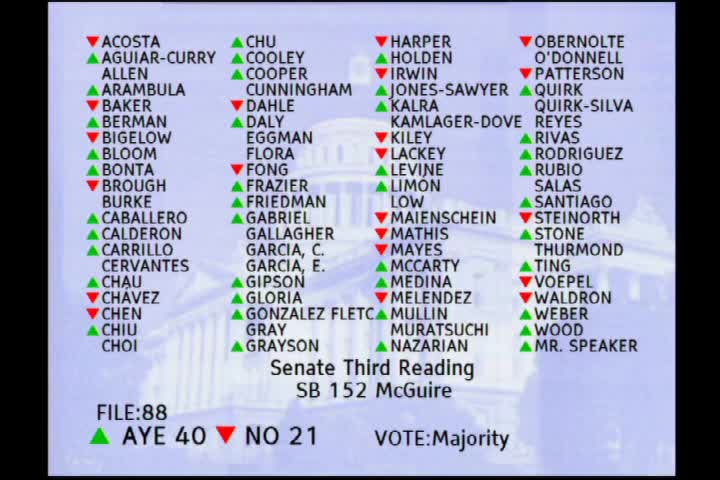 1MIN
Assembly Floor
 10MIN
Assembly Standing Committee on Housing and Community Development
 1MIN
Assembly Standing Committee on Appropriations
 3MIN
Senate Floor
 48MIN
Senate Standing Committee on Appropriations
 31MIN
Senate Standing Committee on Education
Bill Author


