SB 769: Baccalaureate Degree Pilot Program.
- Session Year: 2017-2018
- House: Senate
- Latest Version Date: 2017-07-13
Existing law, until July 1, 2023, authorizes the Board of Governors of the California Community Colleges, in consultation with the California State University and the University of California, to establish a statewide baccalaureate degree pilot program. Existing law requires a district baccalaureate degree pilot program to commence by the beginning of the 201718 academic year and requires a student participating in a baccalaureate degree pilot program to complete his or her degree by the end of the 202223 academic year.
This bill would extend the operation of the statewide baccalaureate degree pilot program until July 1, 2028. 2028, and would extend the time by which a student participating in a baccalaureate degree pilot program is required to complete his or her degree to the end of the 202728 academic year.
Existing law, until July 1, 2023, authorizes the Board of Governors of the California Community Colleges, in consultation with the California State University and the University of California, to establish a statewide baccalaureate degree pilot program. Existing law requires the statewide baccalaureate degree pilot program to consist of a maximum of 15 district baccalaureate degree pilot programs. Existing law requires a district baccalaureate degree pilot program to commence by the beginning of the 201718 academic year and requires a student participating in a baccalaureate degree pilot program to complete his or her degree by the end of the 202223 academic year.
This bill would extend the operation of the statewide baccalaureate degree pilot program until July 1, 2028, and would no longer require a student to complete his or her degree by the end of the 202223 academic year. The bill would increase the maximum number of district baccalaureate degree pilot programs to 25 programs. The bill would require each district seeking approval to offer a new baccalaureate degree pilot program on or after January 1, 2018, to use exclusively its existing financial resources to implement the program by no later than the 202021 academic year, if the district receives approval to offer the program. 2028.
Existing law, until July 1, 2023, authorizes the Board of Governors of the California Community Colleges, in consultation with the California State University and the University of California, to establish a statewide baccalaureate degree pilot program. Existing law requires the statewide baccalaureate degree pilot program to consist of a maximum of 15 district baccalaureate degree pilot programs. Existing law requires a district baccalaureate degree pilot program to commence by the beginning of the 201718 academic year and requires a student participating in a baccalaureate degree pilot program to complete his or her degree by the end of the 202223 academic year. Existing law prohibits a districts baccalaureate degree pilot program from offering a baccalaureate degree program or program curricula already offered by the University of California or the California State University.
This bill would limit that prohibition to a districts baccalaureate degree program or program curricula that is offered within 100 miles of the California State Universitys or the University of Californias baccalaureate degree program or program curricula. The bill would extend the operation of the statewide baccalaureate degree pilot program until July 1, 2028, and would no longer require a student to complete his or her degree by the end of the 202223 academic year. The bill would increase the maximum number of district baccalaureate degree pilot programs to 25 programs. The bill would require each district seeking approval to offer a new baccalaureate degree pilot program on or after January 1, 2018, to use exclusively its existing financial resources to implement the program by no later than the 202021 academic year, if the district receives approval to offer the program.
Existing law, until July 1, 2023, authorizes the Board of Governors of the California Community Colleges, in consultation with the California State University and the University of California, to establish a statewide baccalaureate degree pilot program. Existing law requires the statewide baccalaureate degree pilot program to consist of a maximum of 15 district baccalaureate degree pilot programs. Existing law requires a district baccalaureate degree pilot program to commence by the beginning of the 201718 academic year and requires a student participating in a baccalaureate degree pilot program to complete his or her degree by the end of the 202223 academic year. Existing law prohibits a districts baccalaureate degree pilot program from offering a baccalaureate degree program or program curricula already offered by the University of California or the California State University.
This bill would limit that prohibition to a districts baccalaureate degree program or program curricula that is offered within 100 miles of the California State Universitys or the University of Californias baccalaureate degree program or program curricula. The bill would extend the operation of the statewide baccalaureate degree pilot program until July 1, 2028, and would no longer require a student to complete his or her degree by the end of the 202223 academic year. The bill would increase the maximum number of district baccalaureate degree pilot programs to 25 programs.
Existing law, until July 1, 2023, authorizes the Board of Governors of the California Community Colleges, in consultation with the California State University and the University of California, to establish a statewide baccalaureate degree pilot program. Existing law requires the statewide baccalaureate degree pilot program to consist of a maximum of 15 district baccalaureate degree pilot programs. Existing law requires a district baccalaureate degree pilot program to commence by the beginning of the 201718 academic year and requires a student participating in a baccalaureate degree pilot program to complete his or her degree by the end of the 202223 academic year. Existing law prohibits a districts baccalaureate degree pilot program from offering a baccalaureate degree program or program curricula already offered by the University of California or the California State University.
This bill would limit that prohibition to a districts baccalaureate degree program or program curricula that is offered within 100 miles of the California State Universitys or the University of Californias baccalaureate degree program or program curricula. The bill would extend the operation of the statewide baccalaureate degree pilot program indefinitely until July 1, 2028, and would no longer require a student to complete his or her degree by the end of the 202223 academic year. The bill would increase the maximum number of district baccalaureate degree pilot programs to 30 25 programs.
Existing law, until July 1, 2023, authorizes the Board of Governors of the California Community Colleges, in consultation with the California State University and the University of California, to establish a statewide baccalaureate degree pilot program. Existing law requires the statewide baccalaureate degree pilot program to consist of a maximum of 15 district baccalaureate degree pilot programs. Existing law requires a district baccalaureate degree pilot program to commence by the beginning of the 201718 academic year and requires a student participating in a baccalaureate degree pilot program to complete his or her degree by the end of the 202223 academic year. Existing law prohibits a districts baccalaureate degree pilot program from offering a baccalaureate degree program or program curricula already offered by the University of California or the California State University.
This bill would limit that prohibition to a districts baccalaureate degree program or program curricula that is offered within 100 miles of the California State Universitys or the University of Californias baccalaureate degree program or program curricula. The bill would extend the operation of the statewide baccalaureate degree pilot program indefinitely and would no longer require a student to complete his or her degree by the end of the 202223 academic year. The bill would increase the maximum number of district baccalaureate degree pilot programs to 30 programs.
Notwithstanding Section 66010.4, and commencing January 1, 2015, the Board of Governors of the California Community Colleges, in consultation with the California State University and the University of California, may authorize the establishment of district baccalaureate degree pilot programs that meet all of the eligibility requirements set forth in Section 78042. A district pilot program established pursuant to this article shall commence no later than the 201718 academic year. A student participating in a baccalaureate degree pilot program shall complete his or her degree by the end of the 202223 202728 academic year. For purposes of this section, a pilot program commences when the first class of students begins the program. The statewide baccalaureate degree pilot program shall consist of a maximum of 15 districts, with one baccalaureate degree program each, to be determined by the Chancellor of the California Community Colleges and approved by the Board of Governors of the California Community Colleges.
SEC. 2.Section 78042 of the Education Code is amended to read:78042.(a)A district shall seek approval to offer a baccalaureate degree program through the appropriate accreditation body.
(b)When seeking approval from the Board of Governors of the California Community Colleges, a district shall maintain the primary mission of the California Community Colleges specified in paragraph (3) of subdivision (a) of Section 66010.4. The district, as part of the baccalaureate degree pilot program, shall have the additional mission to provide high-quality undergraduate education at an affordable price for students and the state.
(c)As a condition of eligibility for consideration to participate in the statewide baccalaureate degree pilot program, a district shall have a written policy that requires all potential students who wish to apply for a Board of Governors Fee Waiver pursuant to Section 76300 to complete and submit either a Free Application for Federal Student Aid or a California Dream Act application in lieu of completing the Board of Governors Fee Waiver application.
(d)A district shall not offer more than one baccalaureate degree program, as determined by the governing board of the district and approved by the Board of Governors of the California Community Colleges, and subject to the following limitations:
(1)A district shall identify and document unmet workforce needs in the subject area of the baccalaureate degree to be offered and offer a baccalaureate degree at a campus in a subject area with unmet workforce needs in the local community or region of the district.
(2)A baccalaureate degree pilot program shall not offer a baccalaureate degree program or program curricula already offered by the California State University or the University of California.
(3)A district shall have the expertise, resources, and student interest to offer a quality baccalaureate degree in the chosen field of study.
(4)A district shall not offer more than one baccalaureate degree program within the district, which shall be limited to one campus within the district.
(5)A district shall notify a student who applies to the districts baccalaureate degree pilot program that the student is required to complete his or her baccalaureate degree by the end of the 202223 202728 academic year, as specified in Section 78041.
(e)A district shall maintain separate records for students who are enrolled in courses classified in the upper division and lower division of a baccalaureate program. A student shall be reported as a community college student for enrollment in a lower division course and as a baccalaureate degree program student for enrollment in an upper division course.
(f)A governing board of a district seeking authorization to offer a baccalaureate degree pilot program shall submit all of the following for review by the Chancellor of the California Community Colleges and approval by the Board of Governors of the California Community Colleges:
(1)Documentation of the districts written policy required by subdivision (c).
(2)The administrative plan for the baccalaureate degree pilot program, including, but not limited to, the governing board of the districts funding plan for its specific district.
(3)A description of the baccalaureate degree pilot programs curriculum, faculty, and facilities.
(4)The enrollment projections for the baccalaureate degree pilot program.
(5)Documentation regarding unmet workforce needs specifically related to the proposed baccalaureate degree pilot program, and a written statement supporting the necessity of a four-year degree for that program.
(6)Documentation of consultation with the California State University and the University of California regarding collaborative approaches to meeting regional workforce needs.
(g)(1)On or before March 31, 2015, the Board of Governors of the California Community Colleges shall develop, and adopt by regulation, a funding model for the support of the statewide baccalaureate degree pilot program that is based on a calculation of the number of full-time equivalent students enrolled in all district pilot programs.
(2)Funding for each full-time equivalent student shall be at a marginal cost calculation, as determined by the Board of Governors of the California Community Colleges, that shall not exceed the community college credit instruction marginal cost calculation for a full-time equivalent student, as determined pursuant to paragraph (2) of subdivision (d) of Section 84750.5.
(3)A student in a baccalaureate degree pilot program authorized by this article shall not be charged fees higher than the mandatory systemwide fees charged for baccalaureate degree programs at the California State University.
(4)Fees for coursework in a baccalaureate degree pilot program shall be consistent with Article 1 (commencing with Section 76300) of Chapter 2 of Part 47.
(5)A district shall, in addition to the fees charged pursuant to paragraph (4), charge a fee for upper division coursework in a baccalaureate degree pilot program of eighty-four dollars ($84) per unit.
(h)(1)The Legislative Analysts Office shall conduct both an interim and a final statewide evaluation of the statewide baccalaureate degree pilot program implemented pursuant to this article.
(2)The results of the interim evaluation shall be reported as a progress report, in writing, to the Legislature and the Governor on or before July 1, 2018. The interim evaluation shall include, but is not limited to, all of the following:
(A)How many, and which specific, districts applied for a baccalaureate degree pilot program, and the baccalaureate degree pilot programs they applied for.
(B)Which potential four-year baccalaureate degrees were denied and why they were denied.
(C)Baccalaureate degree pilot program costs and the funding sources that were used to finance these programs.
(D)Current trends in workforce demands that require four-year degrees in the specific degree programs being offered through the statewide baccalaureate degree pilot program.
(E)Current completion rates, if available, for each cohort of students participating in a baccalaureate degree pilot program.
(F)Information on the impact of baccalaureate degree pilot program on underserved and underprepared students.
(3)The results of the final evaluation shall be reported, in writing, to the Legislature and the Governor on or before July 1, 2022. The final evaluation shall include, but is not limited to, all of the following:
(A)The number of new district baccalaureate degree pilot programs implemented, including information identifying the number of new programs, applicants, admissions, enrollments, and degree recipients.
(B)The extent to which the baccalaureate degree pilot programs established under this article fulfill identified workforce needs for new baccalaureate degree programs, including statewide supply and demand data that considers capacity at the California State University, the University of California, and in Californias independent colleges and universities.
(C)Information on the place of employment of students and the subsequent job placement of graduates.
(D)Baccalaureate degree program costs and the funding sources that were used to finance these programs, including a calculation of cost per degree awarded.
(E)The costs of the baccalaureate degree programs to students, the amount of financial aid offered, and student debt levels of graduates of the programs.
(F)Time-to-degree rates and completion rates for the baccalaureate degree pilot programs.
(G)The extent to which the programs established under this article are in compliance with the requirements of this article.
(H)Information on the impact of baccalaureate degree pilot program on underserved and underprepared students.
(I)Recommendations on whether and how the statewide baccalaureate degree pilot program can or should be extended and expanded.
(4)A district shall submit the information necessary to conduct the evaluations required by paragraph (1), as determined by the Legislative Analysts Office, to the Chancellor of the California Community Colleges, who shall provide the information to the Legislative Analysts Office upon request.
(5)A report to be submitted pursuant to paragraph (2) or (3) shall be submitted in compliance with Section 9795 of the Government Code.
SECTION 1.SEC. 3.Section 78043 of the Education Code is amended to read:78043.This article shall become inoperative on July 1, 2028, and as of January 1, 2029, is repealed, unless a later enacted statute that is enacted before January 1, 2029, deletes or extends that date.
This article shall become inoperative on July 1, 2028, and as of January 1, 2029, is repealed, unless a later enacted statute that is enacted before January 1, 2029, deletes or extends that date.
For the purposes of this article, district means any community college district identified by the Chancellor of the California Community Colleges as participating in the statewide baccalaureate degree pilot program. Each participating district may establish a baccalaureate degree pilot program pursuant to Section 78041.
SEC. 2.Section 78041 of the Education Code is amended to read:78041.(a)Notwithstanding Section 66010.4, and commencing January 1, 2015, the Board of Governors of the California Community Colleges, in consultation with the California State University and the University of California, may authorize the establishment of district baccalaureate degree pilot programs that meet all of the eligibility requirements set forth in Section 78042. A Except as provided in subdivision (b), a district baccalaureate degree pilot program established pursuant to this article shall commence no later than the 201718 academic year. For the purposes of this section, a pilot program commences when the first class of students begins the program. The statewide baccalaureate degree pilot program shall consist of a maximum of 25 baccalaureate degree pilot programs to be determined by the Chancellor of the California Community Colleges and approved by the Board of Governors of the California Community Colleges.
(b)Each district seeking approval to offer a new baccalaureate degree pilot program on or after January 1, 2018, shall, if the district receives approval to offer the program, use exclusively its existing financial resources to implement the program by no later than the 202021 academic year.
SEC. 3.Section 78042 of the Education Code is amended to read:78042.(a)A district shall seek approval to offer a baccalaureate degree pilot program through the appropriate accreditation body.
(b)When seeking approval from the Board of Governors of the California Community Colleges, a district shall maintain the primary mission of the California Community Colleges specified in paragraph (3) of subdivision (a) of Section 66010.4. The district, as part of the baccalaureate degree pilot program, shall have the additional mission to provide high-quality undergraduate education at an affordable price for students and the state.
(c)As a condition of eligibility for consideration to participate in the statewide baccalaureate degree pilot program, a district shall have a written policy that requires all potential students who wish to apply for a Board of Governors Fee Waiver pursuant to Section 76300 to complete and submit either a Free Application for Federal Student Aid or a California Dream Act application in lieu of completing the Board of Governors Fee Waiver application.
(d)A districts baccalaureate degree pilot program shall be subject to the following limitations:
(1)A district shall identify and document unmet workforce needs in the subject area of a baccalaureate degree to be offered and offer a baccalaureate degree at a campus in a subject area with unmet workforce needs in the local community or region of the district.
(2)A baccalaureate degree pilot program shall not offer a baccalaureate degree program or program curricula already offered by the California State University or the University of California if that districts program or program curricula is within 100 miles of the California State Universitys or the University of Californias program or program curricula. California.
(3)A district shall have the expertise, resources, and student interest to offer a quality baccalaureate degree in a chosen field of study.
(e)A district shall maintain separate records for students who are enrolled in courses classified in the upper division and lower division of a baccalaureate degree program. A student shall be reported as a community college student for enrollment in a lower division course and as a baccalaureate degree program student for enrollment in an upper division course.
(f)A governing board of a district seeking authorization to offer a baccalaureate degree pilot program shall submit all of the following for review by the Chancellor of the California Community Colleges and approval by the Board of Governors of the California Community Colleges:
(1)Documentation of the districts written policy required by subdivision (c).
(2)The administrative plan for the baccalaureate degree pilot program, including, but not limited to, the governing board of the districts funding plan for its specific district.
(3)A description of the baccalaureate degree pilot programs curriculum, faculty, and facilities.
(4)The enrollment projections for the baccalaureate degree pilot program.
(5)Documentation regarding unmet workforce needs specifically related to the proposed baccalaureate degree pilot program, and a written statement supporting the necessity of a four-year degree for that program.
(6)Documentation of consultation with the California State University and the University of California regarding collaborative approaches to meeting regional workforce needs.
(g)(1)On or before March 31, 2015, the Board of Governors of the California Community Colleges shall develop, and adopt by regulation, a funding model for the support of the statewide baccalaureate degree pilot program that is based on a calculation of the number of full-time equivalent students enrolled in all district baccalaureate degree pilot programs.
(2)Funding for each full-time equivalent student shall be at a marginal cost calculation, as determined by the Board of Governors of the California Community Colleges, that shall not exceed the community college credit instruction marginal cost calculation for a full-time equivalent student, as determined pursuant to paragraph (2) of subdivision (d) of Section 84750.5.
(3)A student in a baccalaureate degree pilot program authorized by this article shall not be charged fees higher than the mandatory systemwide fees charged for baccalaureate degree programs at the California State University.
(4)Fees for coursework in a baccalaureate degree pilot program shall be consistent with Article 1 (commencing with Section 76300) of Chapter 2 of Part 47.
(5)A district shall, in addition to the fees charged pursuant to paragraph (4), charge a fee for upper division coursework in a baccalaureate degree pilot program of eighty-four dollars ($84) per unit.
(h)(1)The Legislative Analysts Office shall conduct both an interim and a final statewide evaluation of the statewide baccalaureate degree pilot program implemented pursuant to this article.
(2)The results of the interim evaluation shall be reported as a progress report, in writing, to the Legislature and the Governor on or before July 1, 2018. The interim evaluation shall include, but is not limited to, all of the following:
(A)How many, and which specific, districts applied for a baccalaureate degree pilot program, and the baccalaureate degree pilot programs they applied for.
(B)Which potential four-year baccalaureate degrees were denied and why they were denied.
(C)Baccalaureate degree pilot program costs and the funding sources that were used to finance these programs.
(D)Current trends in workforce demands that require four-year degrees in the specific degree programs being offered through the statewide baccalaureate degree pilot program.
(E)Current completion rates, if available, for each cohort of students participating in a baccalaureate degree pilot program.
(F)Information on the impact of a baccalaureate degree pilot program on underserved and underprepared students.
(3)The results of the final evaluation shall be reported, in writing, to the Legislature and the Governor on or before July 1, 2022. The final evaluation shall include, but is not limited to, all of the following:
(A)The number of new district baccalaureate degree pilot programs implemented, including information identifying the number of new programs, applicants, admissions, enrollments, and degree recipients.
(B)The extent to which the baccalaureate degree pilot programs established under this article fulfill identified workforce needs for new baccalaureate degree programs, including statewide supply and demand data that considers capacity at the California State University, the University of California, and in Californias independent colleges and universities.
(C)Information on the place of employment of students and the subsequent job placement of graduates.
(D)Baccalaureate degree program costs and the funding sources that were used to finance these programs, including a calculation of cost per degree awarded.
(E)The costs of the baccalaureate degree programs to students, the amount of financial aid offered, and student debt levels of graduates of the programs.
(F)Time-to-degree rates and completion rates for the baccalaureate degree pilot programs.
(G)The extent to which the programs established under this article are in compliance with the requirements of this article.
(H)Information on the impact of the baccalaureate degree pilot programs on underserved and underprepared students.
(I)Recommendations on whether and how the statewide baccalaureate degree pilot program can or should be expanded.
(4)A district shall submit the information necessary to conduct the evaluations required by paragraph (1), as determined by the Legislative Analysts Office, to the Chancellor of the California Community Colleges, who shall provide the information to the Legislative Analysts Office upon request.
(5)A report to be submitted pursuant to paragraph (2) or (3) shall be submitted in compliance with Section 9795 of the Government Code.
SEC. 4.Section 78043 of the Education Code is amended to read:78043.This article shall become inoperative on July 1, 2028, and as of January 1, 2029, is repealed, unless a later enacted statute that is enacted before January 1, 2029, deletes or extends that date.
For the purposes of this article, district means any community college district identified by the Chancellor of the California Community Colleges as participating in the statewide baccalaureate degree pilot program. Each participating district may establish a baccalaureate degree pilot program pursuant to Section 78041.
SEC. 2.Section 78041 of the Education Code is amended to read:78041.Notwithstanding Section 66010.4, and commencing January 1, 2015, the Board of Governors of the California Community Colleges, in consultation with the California State University and the University of California, may authorize the establishment of district baccalaureate degree pilot programs that meet all of the eligibility requirements set forth in Section 78042. A district baccalaureate degree pilot program established pursuant to this article shall commence no later than the 201718 academic year. For the purposes of this section, a pilot program commences when the first class of students begins the program. The statewide baccalaureate degree pilot program shall consist of a maximum of 25 baccalaureate degree pilot programs to be determined by the Chancellor of the California Community Colleges and approved by the Board of Governors of the California Community Colleges.
SEC. 3.Section 78042 of the Education Code is amended to read:78042.(a)A district shall seek approval to offer a baccalaureate degree pilot program through the appropriate accreditation body.
(b)When seeking approval from the Board of Governors of the California Community Colleges, a district shall maintain the primary mission of the California Community Colleges specified in paragraph (3) of subdivision (a) of Section 66010.4. The district, as part of the baccalaureate degree pilot program, shall have the additional mission to provide high-quality undergraduate education at an affordable price for students and the state.
(c)As a condition of eligibility for consideration to participate in the statewide baccalaureate degree pilot program, a district shall have a written policy that requires all potential students who wish to apply for a Board of Governors Fee Waiver pursuant to Section 76300 to complete and submit either a Free Application for Federal Student Aid or a California Dream Act application in lieu of completing the Board of Governors Fee Waiver application.
(d)A districts baccalaureate degree pilot program shall be subject to the following limitations:
(1)A district shall identify and document unmet workforce needs in the subject area of a baccalaureate degree to be offered and offer a baccalaureate degree at a campus in a subject area with unmet workforce needs in the local community or region of the district.
(2)A baccalaureate degree pilot program shall not offer a baccalaureate degree program or program curricula already offered by the California State University or the University of California if that districts program or program curricula is within 100 miles of the California State Universitys or the University of Californias program or program curricula.
(3)A district shall have the expertise, resources, and student interest to offer a quality baccalaureate degree in a chosen field of study.
(e)A district shall maintain separate records for students who are enrolled in courses classified in the upper division and lower division of a baccalaureate degree program. A student shall be reported as a community college student for enrollment in a lower division course and as a baccalaureate degree program student for enrollment in an upper division course.
(f)A governing board of a district seeking authorization to offer a baccalaureate degree pilot program shall submit all of the following for review by the Chancellor of the California Community Colleges and approval by the Board of Governors of the California Community Colleges:
(1)Documentation of the districts written policy required by subdivision (c).
(2)The administrative plan for the baccalaureate degree pilot program, including, but not limited to, the governing board of the districts funding plan for its specific district.
(3)A description of the baccalaureate degree pilot programs curriculum, faculty, and facilities.
(4)The enrollment projections for the baccalaureate degree pilot program.
(5)Documentation regarding unmet workforce needs specifically related to the proposed baccalaureate degree pilot program, and a written statement supporting the necessity of a four-year degree for that program.
(6)Documentation of consultation with the California State University and the University of California regarding collaborative approaches to meeting regional workforce needs.
(g)(1)On or before March 31, 2015, the Board of Governors of the California Community Colleges shall develop, and adopt by regulation, a funding model for the support of the statewide baccalaureate degree pilot program that is based on a calculation of the number of full-time equivalent students enrolled in all district baccalaureate degree pilot programs.
(2)Funding for each full-time equivalent student shall be at a marginal cost calculation, as determined by the Board of Governors of the California Community Colleges, that shall not exceed the community college credit instruction marginal cost calculation for a full-time equivalent student, as determined pursuant to paragraph (2) of subdivision (d) of Section 84750.5.
(3)A student in a baccalaureate degree pilot program authorized by this article shall not be charged fees higher than the mandatory systemwide fees charged for baccalaureate degree programs at the California State University.
(4)Fees for coursework in a baccalaureate degree pilot program shall be consistent with Article 1 (commencing with Section 76300) of Chapter 2 of Part 47.
(5)A district shall, in addition to the fees charged pursuant to paragraph (4), charge a fee for upper division coursework in a baccalaureate degree pilot program of eighty-four dollars ($84) per unit.
(h)(1)The Legislative Analysts Office shall conduct both an interim and a final statewide evaluation of the statewide baccalaureate degree pilot program implemented pursuant to this article.
(2)The results of the interim evaluation shall be reported as a progress report, in writing, to the Legislature and the Governor on or before July 1, 2018. The interim evaluation shall include, but is not limited to, all of the following:
(A)How many, and which specific, districts applied for a baccalaureate degree pilot program, and the baccalaureate degree pilot programs they applied for.
(B)Which potential four-year baccalaureate degrees were denied and why they were denied.
(C)Baccalaureate degree pilot program costs and the funding sources that were used to finance these programs.
(D)Current trends in workforce demands that require four-year degrees in the specific degree programs being offered through the statewide baccalaureate degree pilot program.
(E)Current completion rates, if available, for each cohort of students participating in a baccalaureate degree pilot program.
(F)Information on the impact of baccalaureate degree pilot program on underserved and underprepared students.
(3)The results of the final evaluation shall be reported, in writing, to the Legislature and the Governor on or before July 1, 2022. The final evaluation shall include, but is not limited to, all of the following:
(A)The number of new district baccalaureate degree pilot programs implemented, including information identifying the number of new programs, applicants, admissions, enrollments, and degree recipients.
(B)The extent to which the baccalaureate degree pilot programs established under this article fulfill identified workforce needs for new baccalaureate degree programs, including statewide supply and demand data that considers capacity at the California State University, the University of California, and in Californias independent colleges and universities.
(C)Information on the place of employment of students and the subsequent job placement of graduates.
(D)Baccalaureate degree program costs and the funding sources that were used to finance these programs, including a calculation of cost per degree awarded.
(E)The costs of the baccalaureate degree programs to students, the amount of financial aid offered, and student debt levels of graduates of the programs.
(F)Time-to-degree rates and completion rates for the baccalaureate degree pilot programs.
(G)The extent to which the programs established under this article are in compliance with the requirements of this article.
(H)Information on the impact of the baccalaureate degree pilot programs on underserved and underprepared students.
(I)Recommendations on whether and how the statewide baccalaureate degree pilot program can or should be expanded.
(4)A district shall submit the information necessary to conduct the evaluations required by paragraph (1), as determined by the Legislative Analysts Office, to the Chancellor of the California Community Colleges, who shall provide the information to the Legislative Analysts Office upon request.
(5)A report to be submitted pursuant to paragraph (2) or (3) shall be submitted in compliance with Section 9795 of the Government Code.
SEC. 4.Section 78043 of the Education Code is amended to read:78043.This article shall become inoperative on July 1, 2028, and as of January 1, 2029, is repealed, unless a later enacted statute that is enacted before January 1, 2029, deletes or extends that date.
For the purposes of this article, district means any community college district identified by the Chancellor of the California Community Colleges as participating in the statewide baccalaureate degree pilot program. Each participating district may establish a baccalaureate degree pilot program pursuant to Section 78041.
SEC. 2.Section 78041 of the Education Code is amended to read:78041.Notwithstanding Section 66010.4, and commencing January 1, 2015, the Board of Governors of the California Community Colleges, in consultation with the California State University and the University of California, may authorize the establishment of district baccalaureate degree pilot programs that meet all of the eligibility requirements set forth in Section 78042. A district baccalaureate degree pilot program established pursuant to this article shall commence no later than the 201718 academic year. For purposes of this section, a pilot program commences when the first class of students begins the program. The statewide baccalaureate degree pilot program shall consist of a maximum of 30 25 baccalaureate degree pilot programs to be determined by the Chancellor of the California Community Colleges and approved by the Board of Governors of the California Community Colleges.
SEC. 3.Section 78042 of the Education Code is amended to read:78042.(a)A district shall seek approval to offer a baccalaureate degree pilot program through the appropriate accreditation body.
(b)When seeking approval from the Board of Governors of the California Community Colleges, a district shall maintain the primary mission of the California Community Colleges specified in paragraph (3) of subdivision (a) of Section 66010.4. The district, as part of the baccalaureate degree pilot program, shall have the additional mission to provide high-quality undergraduate education at an affordable price for students and the state.
(c)As a condition of eligibility for consideration to participate in the statewide baccalaureate degree pilot program, a district shall have a written policy that requires all potential students who wish to apply for a Board of Governors Fee Waiver pursuant to Section 76300 to complete and submit either a Free Application for Federal Student Aid or a California Dream Act application in lieu of completing the Board of Governors Fee Waiver application.
(d)A districts baccalaureate degree pilot program shall be subject to the following limitations:
(1)A district shall identify and document unmet workforce needs in the subject area of a baccalaureate degree to be offered and offer a baccalaureate degree at a campus in a subject area with unmet workforce needs in the local community or region of the district.
(2)A baccalaureate degree pilot program shall not offer a baccalaureate degree program or program curricula already offered by the California State University or the University of California if that districts program or program curricula is within 100 miles of the California State Universitys or the University of Californias program or program curricula.
(3)A district shall have the expertise, resources, and student interest to offer a quality baccalaureate degree in a chosen field of study.
(e)A district shall maintain separate records for students who are enrolled in courses classified in the upper division and lower division of a baccalaureate program. A student shall be reported as a community college student for enrollment in a lower division course and as a baccalaureate degree program student for enrollment in an upper division course.
(f)A governing board of a district seeking authorization to offer a baccalaureate degree pilot program shall submit all of the following for review by the Chancellor of the California Community Colleges and approval by the Board of Governors of the California Community Colleges:
(1)Documentation of the districts written policy required by subdivision (c).
(2)The administrative plan for the baccalaureate degree pilot program, including, but not limited to, the governing board of the districts funding plan for its specific district.
(3)A description of the baccalaureate degree pilot programs curriculum, faculty, and facilities.
(4)The enrollment projections for the baccalaureate degree pilot program.
(5)Documentation regarding unmet workforce needs specifically related to the proposed baccalaureate degree pilot program, and a written statement supporting the necessity of a four-year degree for that program.
(6)Documentation of consultation with the California State University and the University of California regarding collaborative approaches to meeting regional workforce needs.
(g)(1)On or before March 31, 2015, the Board of Governors of the California Community Colleges shall develop, and adopt by regulation, a funding model for the support of the statewide baccalaureate degree pilot program that is based on a calculation of the number of full-time equivalent students enrolled in all district pilot programs.
(2)Funding for each full-time equivalent student shall be at a marginal cost calculation, as determined by the Board of Governors of the California Community Colleges, that shall not exceed the community college credit instruction marginal cost calculation for a full-time equivalent student, as determined pursuant to paragraph (2) of subdivision (d) of Section 84750.5.
(3)A student in a baccalaureate degree pilot program authorized by this article shall not be charged fees higher than the mandatory systemwide fees charged for baccalaureate degree programs at the California State University.
(4)Fees for coursework in a baccalaureate degree pilot program shall be consistent with Article 1 (commencing with Section 76300) of Chapter 2 of Part 47.
(5)A district shall, in addition to the fees charged pursuant to paragraph (4), charge a fee for upper division coursework in a baccalaureate degree pilot program of eighty-four dollars ($84) per unit.
(h)(1)The Legislative Analysts Office shall conduct both an interim and a final statewide evaluation of the statewide baccalaureate degree pilot program implemented pursuant to this article.
(2)The results of the interim evaluation shall be reported as a progress report, in writing, to the Legislature and the Governor on or before July 1, 2018. The interim evaluation shall include, but is not limited to, all of the following:
(A)How many, and which specific, districts applied for a baccalaureate degree pilot program, and the baccalaureate degree pilot programs they applied for.
(B)Which potential four-year baccalaureate degrees were denied and why they were denied.
(C)Baccalaureate degree pilot program costs and the funding sources that were used to finance these programs.
(D)Current trends in workforce demands that require four-year degrees in the specific degree programs being offered through the statewide baccalaureate degree pilot program.
(E)Current completion rates, if available, for each cohort of students participating in a baccalaureate degree pilot program.
(F)Information on the impact of baccalaureate degree pilot program on underserved and underprepared students.
(3)The results of the final evaluation shall be reported, in writing, to the Legislature and the Governor on or before July 1, 2022. The final evaluation shall include, but is not limited to, all of the following:
(A)The number of new district baccalaureate degree pilot programs implemented, including information identifying the number of new programs, applicants, admissions, enrollments, and degree recipients.
(B)The extent to which the baccalaureate degree pilot programs established under this article fulfill identified workforce needs for new baccalaureate degree programs, including statewide supply and demand data that considers capacity at the California State University, the University of California, and in Californias independent colleges and universities.
(C)Information on the place of employment of students and the subsequent job placement of graduates.
(D)Baccalaureate degree program costs and the funding sources that were used to finance these programs, including a calculation of cost per degree awarded.
(E)The costs of the baccalaureate degree programs to students, the amount of financial aid offered, and student debt levels of graduates of the programs.
(F)Time-to-degree rates and completion rates for the baccalaureate degree pilot programs.
(G)The extent to which the programs established under this article are in compliance with the requirements of this article.
(H)Information on the impact of the baccalaureate degree pilot programs on underserved and underprepared students.
(I)Recommendations on whether and how the statewide baccalaureate degree pilot program can or should be expanded.
(4)A district shall submit the information necessary to conduct the evaluations required by paragraph (1), as determined by the Legislative Analysts Office, to the Chancellor of the California Community Colleges, who shall provide the information to the Legislative Analysts Office upon request.
(5)A report to be submitted pursuant to paragraph (2) or (3) shall be submitted in compliance with Section 9795 of the Government Code.
SEC. 4.Section 78043 of the Education Code is repealed.SEC. 4.Section 78043 of the Education Code is amended to read:78043.This article shall become inoperative on July 1, 2023, 2028, and as of January 1, 2024, 2029, is repealed, unless a later enacted statute that is enacted before January 1, 2024, 2029, deletes or extends that date.
For the purposes of this article, district means any community college district identified by the Chancellor of the California Community Colleges as participating in the statewide baccalaureate degree pilot program. Each participating district may establish a baccalaureate degree pilot program pursuant to Section 78041.
SEC. 2.Section 78041 of the Education Code is amended to read:78041.Notwithstanding Section 66010.4, and commencing January 1, 2015, the Board of Governors of the California Community Colleges, in consultation with the California State University and the University of California, may authorize the establishment of district baccalaureate degree pilot programs that meet all of the eligibility requirements set forth in Section 78042. A district baccalaureate degree pilot program established pursuant to this article shall commence no later than the 201718 academic year. For purposes of this section, a pilot program commences when the first class of students begins the program. The statewide baccalaureate degree pilot program shall consist of a maximum of 30 baccalaureate degree pilot programs to be determined by the Chancellor of the California Community Colleges and approved by the Board of Governors of the California Community Colleges.
SEC. 3.Section 78042 of the Education Code is amended to read:78042.(a)A district shall seek approval to offer a baccalaureate degree pilot program through the appropriate accreditation body.
(b)When seeking approval from the Board of Governors of the California Community Colleges, a district shall maintain the primary mission of the California Community Colleges specified in paragraph (3) of subdivision (a) of Section 66010.4. The district, as part of the baccalaureate degree pilot program, shall have the additional mission to provide high-quality undergraduate education at an affordable price for students and the state.
(c)As a condition of eligibility for consideration to participate in the statewide baccalaureate degree pilot program, a district shall have a written policy that requires all potential students who wish to apply for a Board of Governors Fee Waiver pursuant to Section 76300 to complete and submit either a Free Application for Federal Student Aid or a California Dream Act application in lieu of completing the Board of Governors Fee Waiver application.
(d)A districts baccalaureate degree pilot program shall be subject to the following limitations:
(1)A district shall identify and document unmet workforce needs in the subject area of a baccalaureate degree to be offered and offer a baccalaureate degree at a campus in a subject area with unmet workforce needs in the local community or region of the district.
(2)A baccalaureate degree pilot program shall not offer a baccalaureate degree program or program curricula already offered by the California State University or the University of California if that districts program or program curricula is within 100 miles of the California State Universitys or the University of Californias program or program curricula.
(3)A district shall have the expertise, resources, and student interest to offer a quality baccalaureate degree in a chosen field of study.
(e)A district shall maintain separate records for students who are enrolled in courses classified in the upper division and lower division of a baccalaureate program. A student shall be reported as a community college student for enrollment in a lower division course and as a baccalaureate degree program student for enrollment in an upper division course.
(f)A governing board of a district seeking authorization to offer a baccalaureate degree pilot program shall submit all of the following for review by the Chancellor of the California Community Colleges and approval by the Board of Governors of the California Community Colleges:
(1)Documentation of the districts written policy required by subdivision (c).
(2)The administrative plan for the baccalaureate degree pilot program, including, but not limited to, the governing board of the districts funding plan for its specific district.
(3)A description of the baccalaureate degree pilot programs curriculum, faculty, and facilities.
(4)The enrollment projections for the baccalaureate degree pilot program.
(5)Documentation regarding unmet workforce needs specifically related to the proposed baccalaureate degree pilot program, and a written statement supporting the necessity of a four-year degree for that program.
(6)Documentation of consultation with the California State University and the University of California regarding collaborative approaches to meeting regional workforce needs.
(g)(1)On or before March 31, 2015, the Board of Governors of the California Community Colleges shall develop, and adopt by regulation, a funding model for the support of the statewide baccalaureate degree pilot program that is based on a calculation of the number of full-time equivalent students enrolled in all district pilot programs.
(2)Funding for each full-time equivalent student shall be at a marginal cost calculation, as determined by the Board of Governors of the California Community Colleges, that shall not exceed the community college credit instruction marginal cost calculation for a full-time equivalent student, as determined pursuant to paragraph (2) of subdivision (d) of Section 84750.5.
(3)A student in a baccalaureate degree pilot program authorized by this article shall not be charged fees higher than the mandatory systemwide fees charged for baccalaureate degree programs at the California State University.
(4)Fees for coursework in a baccalaureate degree pilot program shall be consistent with Article 1 (commencing with Section 76300) of Chapter 2 of Part 47.
(5)A district shall, in addition to the fees charged pursuant to paragraph (4), charge a fee for upper division coursework in a baccalaureate degree pilot program of eighty-four dollars ($84) per unit.
(h)(1)The Legislative Analysts Office shall conduct both an interim and a final statewide evaluation of the statewide baccalaureate degree pilot program implemented pursuant to this article.
(2)The results of the interim evaluation shall be reported as a progress report, in writing, to the Legislature and the Governor on or before July 1, 2018. The interim evaluation shall include, but is not limited to, all of the following:
(A)How many, and which specific, districts applied for a baccalaureate degree pilot program, and the baccalaureate degree pilot programs they applied for.
(B)Which potential four-year baccalaureate degrees were denied and why they were denied.
(C)Baccalaureate degree pilot program costs and the funding sources that were used to finance these programs.
(D)Current trends in workforce demands that require four-year degrees in the specific degree programs being offered through the statewide baccalaureate degree pilot program.
(E)Current completion rates, if available, for each cohort of students participating in a baccalaureate degree pilot program.
(F)Information on the impact of baccalaureate degree pilot program on underserved and underprepared students.
(3)The results of the final evaluation shall be reported, in writing, to the Legislature and the Governor on or before July 1, 2022. The final evaluation shall include, but is not limited to, all of the following:
(A)The number of new district baccalaureate degree pilot programs implemented, including information identifying the number of new programs, applicants, admissions, enrollments, and degree recipients.
(B)The extent to which the baccalaureate degree pilot programs established under this article fulfill identified workforce needs for new baccalaureate degree programs, including statewide supply and demand data that considers capacity at the California State University, the University of California, and in Californias independent colleges and universities.
(C)Information on the place of employment of students and the subsequent job placement of graduates.
(D)Baccalaureate degree program costs and the funding sources that were used to finance these programs, including a calculation of cost per degree awarded.
(E)The costs of the baccalaureate degree programs to students, the amount of financial aid offered, and student debt levels of graduates of the programs.
(F)Time-to-degree rates and completion rates for the baccalaureate degree pilot programs.
(G)The extent to which the programs established under this article are in compliance with the requirements of this article.
(H)Information on the impact of the baccalaureate degree pilot programs on underserved and underprepared students.
(I)Recommendations on whether and how the statewide baccalaureate degree pilot program can or should be expanded.
(4)A district shall submit the information necessary to conduct the evaluations required by paragraph (1), as determined by the Legislative Analysts Office, to the Chancellor of the California Community Colleges, who shall provide the information to the Legislative Analysts Office upon request.
(5)A report to be submitted pursuant to paragraph (2) or (3) shall be submitted in compliance with Section 9795 of the Government Code.
SEC. 4.Section 78043 of the Education Code is repealed.For purposes of this article, district means any community college district identified by the Chancellor of the California Community Colleges as participating in the statewide baccalaureate degree pilot program. Each participating district may establish one a baccalaureate degree pilot program pursuant to Section 78041.
SEC. 2.Section 78041 of the Education Code is amended to read:78041.Notwithstanding Section 66010.4, and commencing January 1, 2015, the Board of Governors of the California Community Colleges, in consultation with the California State University and the University of California, may authorize the establishment of district baccalaureate degree pilot programs that meet all of the eligibility requirements set forth in Section 78042. A district baccalaureate degree pilot program established pursuant to this article shall commence no later than the 201718 academic year. A student participating in a baccalaureate degree pilot program shall complete his or her degree by the end of the 202223 academic year. For purposes of this section, a pilot program commences when the first class of students begins the program. The statewide baccalaureate degree pilot program shall consist of a maximum of 15 districts, with one baccalaureate degree program each, 30 baccalaureate degree pilot programs to be determined by the Chancellor of the California Community Colleges and approved by the Board of Governors of the California Community Colleges.
SEC. 3.Section 78042 of the Education Code is amended to read:78042.(a)A district shall seek approval to offer a baccalaureate degree pilot program through the appropriate accreditation body.
(b)When seeking approval from the Board of Governors of the California Community Colleges, a district shall maintain the primary mission of the California Community Colleges specified in paragraph (3) of subdivision (a) of Section 66010.4. The district, as part of the baccalaureate degree pilot program, shall have the additional mission to provide high-quality undergraduate education at an affordable price for students and the state.
(c)As a condition of eligibility for consideration to participate in the statewide baccalaureate degree pilot program, a district shall have a written policy that requires all potential students who wish to apply for a Board of Governors Fee Waiver pursuant to Section 76300 to complete and submit either a Free Application for Federal Student Aid or a California Dream Act application in lieu of completing the Board of Governors Fee Waiver application.
(d)A district shall not offer more than one baccalaureate degree program, as determined by the governing board of the district and approved by the Board of Governors of the California Community Colleges, and districts baccalaureate degree pilot program shall be subject to the following limitations:
(1)A district shall identify and document unmet workforce needs in the subject area of the a baccalaureate degree to be offered and offer a baccalaureate degree at a campus in a subject area with unmet workforce needs in the local community or region of the district.
(2)A baccalaureate degree pilot program shall not offer a baccalaureate degree program or program curricula already offered by the California State University or the University of California. California if that districts program or program curricula is within 100 miles of the California State Universitys or the University of Californias program or program curricula.
(3)A district shall have the expertise, resources, and student interest to offer a quality baccalaureate degree in the a chosen field of study.
(4)A district shall not offer more than one baccalaureate degree program within the district, which shall be limited to one campus within the district.(5)A district shall notify a student who applies to the districts baccalaureate degree pilot program that the student is required to complete his or her baccalaureate degree by the end of the 202223 academic year, as specified in Section 78041.(e)A district shall maintain separate records for students who are enrolled in courses classified in the upper division and lower division of a baccalaureate program. A student shall be reported as a community college student for enrollment in a lower division course and as a baccalaureate degree program student for enrollment in an upper division course.
(f)A governing board of a district seeking authorization to offer a baccalaureate degree pilot program shall submit all of the following for review by the Chancellor of the California Community Colleges and approval by the Board of Governors of the California Community Colleges:
(1)Documentation of the districts written policy required by subdivision (c).
(2)The administrative plan for the baccalaureate degree pilot program, including, but not limited to, the governing board of the districts funding plan for its specific district.
(3)A description of the baccalaureate degree pilot programs curriculum, faculty, and facilities.
(4)The enrollment projections for the baccalaureate degree pilot program.
(5)Documentation regarding unmet workforce needs specifically related to the proposed baccalaureate degree pilot program, and a written statement supporting the necessity of a four-year degree for that program.
(6)Documentation of consultation with the California State University and the University of California regarding collaborative approaches to meeting regional workforce needs.
(g)(1)On or before March 31, 2015, the Board of Governors of the California Community Colleges shall develop, and adopt by regulation, a funding model for the support of the statewide baccalaureate degree pilot program that is based on a calculation of the number of full-time equivalent students enrolled in all district pilot programs.
(2)Funding for each full-time equivalent student shall be at a marginal cost calculation, as determined by the Board of Governors of the California Community Colleges, that shall not exceed the community college credit instruction marginal cost calculation for a full-time equivalent student, as determined pursuant to paragraph (2) of subdivision (d) of Section 84750.5.
(3)A student in a baccalaureate degree pilot program authorized by this article shall not be charged fees higher than the mandatory systemwide fees charged for baccalaureate degree programs at the California State University.
(4)Fees for coursework in a baccalaureate degree pilot program shall be consistent with Article 1 (commencing with Section 76300) of Chapter 2 of Part 47.
(5)A district shall, in addition to the fees charged pursuant to paragraph (4), charge a fee for upper division coursework in a baccalaureate degree pilot program of eighty-four dollars ($84) per unit.
(h)(1)The Legislative Analysts Office shall conduct both an interim and a final statewide evaluation of the statewide baccalaureate degree pilot program implemented pursuant to this article.
(2)The results of the interim evaluation shall be reported as a progress report, in writing, to the Legislature and the Governor on or before July 1, 2018. The interim evaluation shall include, but is not limited to, all of the following:
(A)How many, and which specific, districts applied for a baccalaureate degree pilot program, and the baccalaureate degree pilot programs they applied for.
(B)Which potential four-year baccalaureate degrees were denied and why they were denied.
(C)Baccalaureate degree pilot program costs and the funding sources that were used to finance these programs.
(D)Current trends in workforce demands that require four-year degrees in the specific degree programs being offered through the statewide baccalaureate degree pilot program.
(E)Current completion rates, if available, for each cohort of students participating in a baccalaureate degree pilot program.
(F)Information on the impact of baccalaureate degree pilot program on underserved and underprepared students.
(3)The results of the final evaluation shall be reported, in writing, to the Legislature and the Governor on or before July 1, 2022. The final evaluation shall include, but is not limited to, all of the following:
(A)The number of new district baccalaureate degree pilot programs implemented, including information identifying the number of new programs, applicants, admissions, enrollments, and degree recipients.
(B)The extent to which the baccalaureate degree pilot programs established under this article fulfill identified workforce needs for new baccalaureate degree programs, including statewide supply and demand data that considers capacity at the California State University, the University of California, and in Californias independent colleges and universities.
(C)Information on the place of employment of students and the subsequent job placement of graduates.
(D)Baccalaureate degree program costs and the funding sources that were used to finance these programs, including a calculation of cost per degree awarded.
(E)The costs of the baccalaureate degree programs to students, the amount of financial aid offered, and student debt levels of graduates of the programs.
(F)Time-to-degree rates and completion rates for the baccalaureate degree pilot programs.
(G)The extent to which the programs established under this article are in compliance with the requirements of this article.
(H)Information on the impact of the baccalaureate degree pilot program programs on underserved and underprepared students.
(I)Recommendations on whether and how the statewide baccalaureate degree pilot program can or should be extended and expanded.
(4)A district shall submit the information necessary to conduct the evaluations required by paragraph (1), as determined by the Legislative Analysts Office, to the Chancellor of the California Community Colleges, who shall provide the information to the Legislative Analysts Office upon request.
(5)A report to be submitted pursuant to paragraph (2) or (3) shall be submitted in compliance with Section 9795 of the Government Code.
SEC. 4.Section 78043 of the Education Code is repealed.78043.This article shall become inoperative on July 1, 2023, and as of January 1, 2024, is repealed, unless a later enacted statute that is enacted before January 1, 2024, deletes or extends that date.|
Date
|
Status
|
|---|---|
| Sep 1, 2017 | September 1 hearing: Held in committee and under submission. |
| Aug 23, 2017 | August 23 set for first hearing. Placed on suspense file. |
| Jul 13, 2017 | Read second time and amended. Re-referred to Com. on APPR. |
| Jul 12, 2017 | From committee: Do pass as amended and re-refer to Com. on APPR. (Ayes 12. Noes 1.) (July 11). |
| Jul 3, 2017 | From committee with author's amendments. Read second time and amended. Re-referred to Com. on HIGHER ED. |
| Jun 15, 2017 | Referred to Com. on HIGHER ED. |
| Jun 1, 2017 | In Assembly. Read first time. Held at Desk. |
| May 31, 2017 | Read third time. Passed. (Ayes 38. Noes 2. Page 1335.) Ordered to the Assembly. |
| May 26, 2017 | Read second time and amended. Ordered to third reading. |
| May 25, 2017 | From committee: Do pass as amended. (Ayes 6. Noes 1. Page 1190.) (May 25). |
| May 19, 2017 | Set for hearing May 25. |
| May 15, 2017 | May 15 hearing: Placed on APPR. suspense file. |
| May 8, 2017 | From committee with author's amendments. Read second time and amended. Re-referred to Com. on APPR. |
| May 4, 2017 | Set for hearing May 15. |
| Apr 26, 2017 | From committee: Do pass and re-refer to Com. on APPR. (Ayes 7. Noes 0. Page 849.) (April 26). Re-referred to Com. on APPR. |
| Apr 17, 2017 | From committee with author's amendments. Read second time and amended. Re-referred to Com. on ED. |
| Apr 13, 2017 | Set for hearing April 26. |
| Apr 4, 2017 | April 5 hearing postponed by committee. |
| Mar 27, 2017 | From committee with author's amendments. Read second time and amended. Re-referred to Com. on ED. |
| Mar 21, 2017 | Set for hearing April 5. |
| Mar 9, 2017 | Referred to Com. on ED. |
| Feb 21, 2017 | From printer. May be acted upon on or after March 23. |
| Feb 17, 2017 | Introduced. Read first time. To Com. on RLS. for assignment. To print. |
|
Date
|
Description
|
Location
|
Votes
|
|
|---|---|---|---|---|
| Jul 11, 2017 | Do pass as amended and be re-referred to the Committee on [Appropriations] | Assembly Standing Committee on Higher Education |
Passed |
|
| May 31, 2017 | Senate 3rd Reading SB769 Hill et al. | Senate Floor |
Passed |
|
| May 25, 2017 | Do pass as amended | Senate Standing Committee on Appropriations |
Passed |
|
| May 15, 2017 | Placed on suspense file | Senate Standing Committee on Appropriations |
Passed |
|
| Apr 26, 2017 | Do pass, but first be re-referred to the Committee on [Appropriations] | Senate Standing Committee on Education |
Passed |
|
| Apr 26, 2017 | Do pass as amended, but first amend, and re-refer to the Committee on [Appropriations] | Senate Standing Committee on Education |
Passed |
This list shows positions taken on this bill by organizations on the date displayed, which is linked to the original source.
Positions by individuals are not included.
Date of Hearing: August 23, 2017
ASSEMBLY COMMITTEE ON APPROPRIATIONS
Lorena Gonzalez Fletcher, Chair
SBPCA Bill Id:SB 769
Author:(Hill) – As Amended Ver:July 13, 2017
Policy Committee: | Higher Education | Vote: | 12 - 1 |
Urgency: No State Mandated Local Program: No Reimbursable: No
SUMMARY:
This bill extends the statewide baccalaureate degree pilot program administered by the California Community Colleges (CCC) Board of Governors by an additional five years.
FISCAL EFFECT:
- Unknown ongoing Proposition 98/GF cost pressures, likely over $5.3 million, to expand the original 15 pilot programs until July 1, 2023. This estimate assumes the same level of support originally given to the pilot programs. Of the 15 approved pilots only 10 have actually opened their doors and enrolled baccalaureate degree students. A true estimate will require all 15 approved pilots to be operational and at least a year’s worth of data to be available for assessment.
- The California Community College Chancellors Office (CCCCO) estimates approximately $1.5 million GF ($308,000 GF annually) for 2 positions to support the extension of the baccalaureate degree program. Original funding for the pilot program did not include state operation costs. As a result, the CCCCO has had to absorb implementation costs by redirecting CCCCO staff and resources from critical assignments, including the Associate Degree for Transfers Program. The two positions at the CCCCO would provide technical assistance to the colleges on a variety of student support and compliance issues; facilitate the annual BA Degree statewide pilot project conference and symposiums; update the BA Degree pilot project web pages; assist with curriculum and professional development activities; conduct ongoing work with the accreditation agency; and assist with evaluation and research activities. The Governor’s 2017-18 did not include funding for the baccalaureate degree pilot program or CCCCO state operations costs.
COMMENTS:
- Background. Existing law differentiates the missions and functions of public and independent institutions of higher education. The mission and function of the CCCs is to offer academic and vocational instruction at the lower division level. The CCCs are authorized to grant the associate in arts and the associate in science degrees.
State law also authorizes the CCC Board of Governors, in consultation with the California State University (CSU) and the University of California (UC), to operate baccalaureate degree pilot programs, at up to 15 community college districts, with one baccalaureate degree program each, as specified, to be determined by the CCCCO as long as it does not duplicate a baccalaureate degree program already offered by the CSU or the UC. The pilot sunsets July 1, 2023. An independent evaluation by the Legislative Analyst’s Office is required by state law to be completed on July 1, 2018. Ten of the 15 pilot programs began operation in the fall of 2016. The final five are expected to begin operation in fall of 2017. The CCCCO reports that for the fall of 2016, 206 students are enrolled in the baccalaureate degree pilot program.
- Purpose. According to the author, “the state faces an urgent need to increase the number of Californian’s with four-year degrees by 2030, as population and education trends suggest that only 33 percent of working-age adults in California will have a BA degree— a shortfall of 1.1 million college graduates.”
- Related Legislation. SB 850 (Block) Chapter 747, Statutes of 2014, authorizes the Board of Governors of the CCC, in consultation with the CSU and the UC, to establish baccalaureate degree pilot programs, at up to 15 community college districts, with one baccalaureate degree program each, to be determined by the Chancellor of the CCC.
- Staff comments: The original 15 pilot programs are offering baccalaureate degrees that do not duplicate a baccalaureate degree program already offered by the CSU or the UC. Programs range from airframe manufacturing technology to respiratory care. Existing pilot programs have expressed recruitment issues for students as a result of the sunset.
Analysis Prepared by: Daisy Gonzales / APPR. / (916) 319-2081
Date of Hearing: July 11, 2017
ASSEMBLY COMMITTEE ON HIGHER EDUCATION
Jose Medina, Chair
SBPCA Bill Id:SB 769
Author:(Hill) – As Amended Ver:July 3, 2017
SENATE VOTE: 38-2
SUBJECT: Baccalaureate Degree Pilot Program
SUMMARY: Extends the operation of the statewide baccalaureate degree pilot program until July 1, 2028.
EXISTING LAW:
- Differentiates the missions and functions of public and independent institutions of higher education. Under these provisions:
- The primary mission of the California State University (CSU) is to offer undergraduate and graduate instruction through the master’s degree. The CSU is authorized to establish two-year programs only when mutually agreed upon by the Trustees and the California Community College (CCC) Board of Governors. The CSU is also authorized to jointly award the doctoral degree with the University of California (UC) and with one or more independent institutions of higher education;
- The UC is authorized to provide undergraduate and graduate instruction and has exclusive jurisdiction in public higher education over graduate instruction in the professions of law, medicine, dentistry, and veterinary medicine. The UC is also the primary state-supported academic agency for research;
- The independent institutions of higher education are required to provide undergraduate and graduate instruction and research in accordance with their respective missions; and,
- The mission and function of the CCC is to offer academic and vocational instruction at the lower division level and the CCC are authorized to grant the associate in arts and the associate in science degree. The community colleges are also required to offer remedial instruction, English as a Second Language instruction, and adult noncredit instruction, and support services which help students succeed at the postsecondary level. (Education Code (EC) Section 66010.4)
- Authorizes the CCC Board of Governors, in consultation with the CSU and the UC, to establish baccalaureate degree pilot programs, at up to 15 community college districts, with one baccalaureate degree program each, as specified, to be determined by the Chancellor of the CCC and as long as it does not duplicate a baccalaureate degree program already offered by the CSU or the UC. Completion of an independent evaluation by the Legislative Analyst’s Office (LAO) is also required and sunsets the program on July 1, 2023. (EC Section 78040 et seq.)
FISCAL EFFECT: Unknown.
COMMENTS: Need for the bill. According to the author, the state faces an urgent need to increase the number of Californian’s with four-year degrees by 2030, as population and education trends suggest that only 33 percent of working-age adults in California will have a BA degree— a shortfall of 1.1 million college graduates. This bill seeks to address the skills gap by expanding the existing authorization to offer baccalaureate degrees at CCC.
Status of existing pilot. SB 850 (Block, Chapter 747, Statutes of 2014) authorized the Board of Governors, in consultation with the CSU and the UC, to establish a baccalaureate degree pilot program. The pilot program allows up to 15 participating community college districts to offer one baccalaureate degree program each to meet local workforce needs as long as it does not duplicate a baccalaureate degree program already offered by the CSU or the UC. The LAO will conduct interim and final evaluations of the pilot program, which are due on July 1, 2018, and July 1, 2022, respectively. SB 850 sunsets on July 1, 2023.
Under SB 850, the four-year degree programs must be up and running by the 2017-18 academic year. Below is the list of colleges that were selected to participate in the pilot:
- Antelope Valley College (airframe manufacturing technology)
- Bakersfield College (industrial automation)
- Cypress College (mortuary science)
- Feather River College (equine industry)
- Foothill College (dental hygiene)
- Mesa College (health information management)
- Mira Costa College (biomanufacturing)
- Modesto Junior College (respiratory care)
- Santa Ana College (occupational studies)
- Shasta College (health information management)
- Skyline College (respiratory care)
- West Los Angeles College (dental hygiene)
- Rio Hondo College (automotive technology)
- Santa Monica College (interaction design)
- Solano Community College (biotechnology)
According to the CCC Chancellor’s Office (CCCCO), 10 of the 15 pilot programs began operation in the fall of 2016, while the final five will begin operation in fall of 2017. The CCCCO reports that for the fall of 2016, 206 students are enrolled in the baccalaureate degree pilot program.
Program funding. The 2015-16 Budget Trailer Bill, SB 81 (Committee on Budget and Fiscal Review, Chapter 81, Statutes of 2015) provided $6 million one-time Proposition 98 General Fund to support the implementation of the SB 850 pilot program. Colleges could use these funds for equipment, space, staff, faculty, professional development, library resources, travel to conferences, and consultants. An additional $750,000 was provided for professional development and to the 15 pilot colleges. The 2016-17 Budget included $2.5 million ongoing Proposition 98 General Fund for outreach aimed at the baccalaureate degree pilot program, among other things.
Significant reductions in CCCCO staffing occurred in the early 2000s and over a multiyear period, resulted in a drop in staff of approximately 235 to 145 employees by the end of 2003. The Governors 2017-18 Budget proposal recognizes the need to develop an organizational framework and increase staffing that will better enable the CCCCO to support colleges and students within the scope of its existing responsibilities.
Master Plan for Higher Education. As outlined in the Master Plan for Higher Education and by state statute, the CCCs are designated to have an open admission policy and bear the most extensive responsibility for lower-division undergraduate instruction. Its three primary areas of mission include education leading to associates degrees and university transfer, career technical education, and basic skills. The primary mission of the CSU is undergraduate and graduate instruction through the master’s degree. The UC was granted the sole authority to offer doctoral degrees.
Notwithstanding the differentiation of mission envisioned by the Master Plan and outlined in statute, the Legislature has authorized the CSU to go beyond its original mission to offer four professional doctoral degrees which include the Doctor of Audiology, Doctor of Education, Doctor of Physical Therapy and Doctor of Nursing. Fees were capped at the rate charged at the UC, no additional funding was provided by the state, and these programs were to be implemented without diminishing or reducing enrollment in undergraduate programs. Additionally, The CSU programs offer applied doctorates and are not duplicative of degrees offered by UC. These authorities were more limited in scope than that proposed by this bill.
Forthcoming LAO study. The LAO will conduct interim and final evaluations on the pilot program, which are due on July 1, 2018, and July 1, 2022, respectively, before the pilot program sunsets on July 1, 2023. The reports will include an evaluation of cost and funding sources that were used to fund programs, current trends in workforce demands that require four-year degrees in the specific programs offered through the pilot, completion rates, the impact of baccalaureate degree pilot program on underserved and underprepared students, information on job placement of graduates and recommendations on whether and how the statewide baccalaureate degree pilot program can or should be extended and expanded.
Committee comments and amendments. As currently drafted, this measure extends the statewide baccalaureate degree pilot program by five years. However, additional technical amendments to the code section are necessary to ensure that students will be able to enroll beyond the 2022-2023 academic year. Committee Staff recommends, and the author has agreed to accept the following amendments:
78041. Notwithstanding Section 66010.4, and commencing January 1, 2015, the Board of Governors of the California Community Colleges, in consultation with the California State University and the University of California, may authorize the establishment of district baccalaureate degree pilot programs that meet all of the eligibility requirements set forth in Section 78042. A district pilot program established pursuant to this article shall commence no later than the 2017–18 academic year. A student participating in a baccalaureate degree pilot program shall complete his or her degree by the end of the 2022–23 2027-28 academic year. For purposes of this section, a pilot program commences when the first class of students begins the program. The statewide baccalaureate degree pilot program shall consist of a maximum of 15 districts, with one baccalaureate degree program each, to be determined by the Chancellor of the California Community Colleges and approved by the Board of Governors of the California Community Colleges.
78042. (5) A district shall notify a student who applies to the district’s baccalaureate degree pilot program that the student is required to complete his or her baccalaureate degree by the end of the 2022–23 2027-28 academic year, as specified in Section 78041.
Related Legislation. SB 577 (Dodd) of 2017, authorizes the Board of Governors of the CCC, in consultation with the CSU and UC, to authorize a community college district to offer a teacher credentialing program meeting specified requirements. SB 577 is pending a hearing in the Assembly Higher Education Committee.
SB 850 (Block, Chapter 747, Statutes of 2014) authorizes the Board of Governors of the CCC, in consultation with the CSU and the UC, to establish baccalaureate degree pilot programs, at up to 15 community college districts, with one baccalaureate degree program each, as specified, to be determined by the Chancellor of the California Community College.
AB 661 (Block, 2011) authorized Grossmont-Cuyamaca and the San Mateo Community College districts to offer one baccalaureate degree pilot program per campus. AB 661 as heard and passed in the Assembly Higher Education Committee by a vote of 6-0 but was moved to the inactive file on the Assembly Floor.
AB 2400 (Block, 2010) authorized the San Diego, Grossmont-Cuyamaca and San Mateo Community College districts to establish baccalaureate degree pilot programs. No vote was taken and AB 2400 was held in the Assembly Higher Education Committee.
REGISTERED SUPPORT / OPPOSITION:
Support
Allen Hancock College
Antelope Valley College
Association of California Community College Administrators
Cabrillo College
California Farm Bureau Federation
Coast Community College District
College of the Canyons
Community College League of California
Feather River College
Foothill-DeAnza Community College District
Kern Community College District
Los Rios Community College District
Los Angeles Community College District
Marin Community College District
MiraCosta Community College District
Mt. San Antonio Community College District
Peralta Community College District
Rancho Santiago Community College District
Redwoods Community College District
Rio Hondo Community College District
San Diego Community College District
San Diego Regional Chamber of Commerce
San Diego Unified School District
San Jose-Evergreen Community College District
San Mateo Community College District
Santa Monica College
Shasta College
South Orange County Community College District
Yuba Community College District
13 Individuals
Opposition
California Faculty Association
California Federation of Teachers
California Teachers Association
Faculty Association of California Community Colleges
Analysis Prepared by: Kevin J. Powers / HIGHER ED. / (916) 319-3960
Office of Senate Floor Analyses (916) 651-1520 Fax: (916) 327-4478 | SB |
THIRD READING
Bill No: SB 769
:
SENATE EDUCATION COMMITTEE: 7-0, 4/26/17
AYES: Allen, Wilk, Galgiani, Leyva, Mendoza, Pan, Vidak
SENATE APPROPRIATIONS COMMITTEE: 6-1, 5/25/17
AYES: Lara, Bates, Beall, Bradford, Hill, Wiener
NOES: Nielsen
DIGEST: This bill authorizes the Community College Chancellor’s Office (CCCCO) in consultation with the California State University (CSU) and University of California (UC) to expand the total number of California Community College (CCC) baccalaureate degree pilot programs from 15 to 25 and extends the January 1, 2024 repeal of the statewide pilot program by five years.
Existing law:
- Differentiates the missions and functions of public and independent institutions of higher education. Under these provisions:
- The primary mission of the CSU is required to offer undergraduate and graduate instruction through the master’s degree. The CSU is authorized to establish two-year programs only when mutually agreed upon by the Trustees and the CCC Board of Governors. The CSU is also authorized to jointly award the doctoral degree with the UC and with one or more independent institutions of higher education.
- The UC is authorized to provide undergraduate and graduate instruction and has exclusive jurisdiction in public higher education over graduate instruction in the professions of law, medicine, dentistry and veterinary medicine. The UC is also the primary state-supported academic agency for research.
- The independent institutions of higher education are required to provide undergraduate and graduate instruction and research in accordance with their respective missions.
- The mission and function of the CCC is the offering of academic and vocational instruction at the lower division level and the CCC are authorized to grant the associate in arts and the associate in science degree. The community colleges are also required to offer remedial instruction, English as a Second Language instruction, and adult noncredit instruction, and support services which help students succeed at the postsecondary level. (Education Code § 66010.4)
- Authorizes the Board of Governors of the CCC, in consultation with the CSU and the UC, to establish baccalaureate degree pilot programs, at up to 15 community college districts, with one baccalaureate degree program each, as specified, to be determined by the Chancellor of the CCC and as long as it does not duplicate a baccalaureate degree program already offered by the CSU or the UC Completion of an independent evaluation by the Legislative Analyst’s Office (LAO) is also required and sunsets the program on July 1, 2023. (EC § 78040 et seq.)
This bill authorizes the CCCCO in consultation with the CSU and UC to expand the total number of CCC baccalaureate degree pilot programs from 15 to 25 and extends the January 1, 2024 repeal of the statewide pilot program by five years. Specifically it,
- Requires that each district receiving approval to offer a new baccalaureate degree pilot program use exclusively its existing resources to implement the program by no later than the 2020-21 academic year.
- Removes all of the following prohibitions and limitations for district baccalaureate pilot programs:
- That a district be limited to only one baccalaureate degree program at one campus within the district, as determined by the local governing board and approved by the Board of Governors.
- That a student completes his or her degree by the end of the 2022-23 academic year.
- Removes the requirement that the LAO in its evaluation of the statewide baccalaureate degree pilot program make a recommendation on whether and how the program should be extended.
- Makes other technical and non-substantive changes.
Comments
- Need for the bill. According to the author, the state faces an urgent need to increase the number of Californian’s with four-year degrees by 2030, as population and education trends suggest that only 33 percent of working-age adults in California will have a BA degree— a shortfall of 1.1 million college graduates. This bill seeks to address the skills gap by expanding the existing authorization to offer baccalaureate degrees at CCC. The author further asserts, that the pilot program needs to be expanded so that the LAO can have a larger sample size to review program success and so more community colleges can have access to baccalaureate programs.
- Status of existing pilot. SB 850 (Block, Chapter 747, Statutes of 2014) authorized the Board of Governors, in consultation with the CSU and the UC, to establish a baccalaureate degree pilot program. The pilot program allows up to 15 participating community college districts to offer one baccalaureate degree program each to meet local workforce needs as long as it does not duplicate a baccalaureate degree program already offered by the CSU or the UC. The LAO will conduct interim and final evaluations of the pilot program, which are due on July 1, 2018, and July 1, 2022, respectively. SB 850 sunsets on July 1, 2023.
Under SB 850, the four-year degree programs must be up and running by the 2017-18 academic year. Below is the list of colleges that were selected to participate in the pilot:
- Antelope Valley College (airframe manufacturing technology)
- Bakersfield College (industrial automation)
- Cypress College (mortuary science)
- Feather River College (equine industry)
- Foothill College (dental hygiene)
- Mesa College (health information management)
- Mira Costa College (biomanufacturing)
- Modesto Junior College (respiratory care)
- Santa Ana College (occupational studies)
- Shasta College (health information management)
- Skyline College (respiratory care)
- West Los Angeles College (dental hygiene)
- Rio Hondo College (automotive technology)
- Santa Monica College (interaction design)
- Solano Community College (biotechnology)
According to the CCCCO, of the 15 colleges, 10 started offering classes for their baccalaureate degree pilot programs in fall 2016: The five remaining colleges will begin offering classes by fall 2017. The CCCCO reports that for the fall 2016, 206 students are enrolled in the baccalaureate degree pilot program.
Additionally, the CCCCO indicates that, it is focused on supporting the existing pilot colleges in establishing successful baccalaureate programs and until the evaluation of the state’s existing pilot program is completed, it is unable to support the expansion of the program.
- Capacity and cost? The 2015-16 Budget Trailer Bill, SB 81 (Committee on Budget and Fiscal Review, Chapter 81, Statutes of 2015) provided $6 million one-time Proposition 98 General Fund to support the implementation of the SB 850 pilot program. Colleges could use these funds for equipment, space, staff, faculty, professional development, library resources, travel to conferences, and consultants. An additional $750,000 was provided for professional development and to the 15 pilot colleges. The 2016-17 Budget included $2.5 million ongoing Proposition 98 General Fund for outreach aimed at the baccalaureate degree pilot program, among other things.
Significant reductions in CCCCO staffing occurred in the early 2000s and over a multiyear period, resulted in a drop in staff of approximately 235 to 145 employees by the end of 2003. The Governors 2017-15 Budget proposal recognizes the need to develop an organizational framework and increase staffing that will better enable the CCCCO to support colleges and students within the scope of its existing responsibilities.
Additionally, under SB 850, student fees for upper division coursework will be equal the CCCCO fee ($46 per unit) plus $84 per unit, for a total estimated cost of about $10,000 to obtain a bachelor’s degree. SB 850 also required an evaluation of program costs and funding sources, including a calculation of cost per degree awarded. Should the pilot program be expanded absent the LAO evaluation of costs/sources of funding to assess whether this is a sustainable fee level?
- Premature expansion. As previously noted, the LAO will conduct interim and final evaluations on the pilot program, which are due on July 1, 2018, and July 1, 2022, respectively, before the pilot program sunsets on July 1, 2023. The reports will include an evaluation of cost and funding sources that were used to fund programs, current trends in workforce demands that require four-year degrees in the specific programs offered through the pilot, completion rates, the impact of baccalaureate degree pilot program on underserved and underprepared students, information on job placement of graduates and recommendations on whether and how the statewide baccalaureate degree pilot program can or should be extended and expanded.
This bill expands the baccalaureate degree pilot program prior to full implementation and prior to the completion of an independent evaluation by the LAO. Is it prudent to make such significant changes to a program prior to receipt of a statutorily mandated evaluation?
- Related study group report. In 2013, prior to the passage of SB 850, the CCC Chancellor appointed a study group to review the various aspects of bachelor degrees at community colleges. The Report from California Community Colleges Baccalaureate Degree Study Group, acknowledges questions and reservations that community college bachelor’s degrees represent a further erosion of the Master Plan, the potential for duplication of programs, and concerns that broadening the CCC mission would diminish attention to transfer, basic skills, and career technical education. The study group recommended that further work proceeds with an ongoing dialog with CSU and UC, and that further study should consider the potential impact on the current mission of the CCC as well as on existing programs at local campuses.
- Master Plan for Higher Education. As outlined in the Master Plan for Higher Education and by state statute, the CCCs are designated to have an open admission policy and bear the most extensive responsibility for lower-division undergraduate instruction. Its three primary areas of mission include education leading to associates degrees and university transfer, career technical education, and basic skills. The primary mission of the CSU is undergraduate and graduate instruction through the master’s degree. The UC was granted the sole authority to offer doctoral degrees.
Notwithstanding the differentiation of mission envisioned by the Master Plan and outlined in statute, the Legislature has authorized the CSU to go beyond its original mission to offer four professional doctoral degrees which include the Doctor of Audiology, Doctor of Education, Doctor of Physical Therapy and Doctor of Nursing. Fees were capped at the rate charged at the UC, no additional funding was provided by the state, and these programs were to be implemented without diminishing or reducing enrollment in undergraduate programs. Additionally, The CSU programs offer applied doctorates and are not duplicative of degrees offered by UC. These authorities were more limited in scope than that proposed by this bill.
- Other options. In recognition of the need to expand access to baccalaureate degree programs, several collaborative efforts to respond to workforce needs have emerged. There are a number of CCCs that have agreements with baccalaureate degree-granting institutions. Canada College, within the San Mateo Community College District, currently partners with San Francisco State University and private postsecondary institutions to offer baccalaureate degrees in psychology, business administration, allied health and nursing on its campus. College of the Canyons partners with CSU Los Angeles, Bakersfield and Northridge, and private institutions to offer bachelor’s degrees in liberal arts, engineering and other majors through its University Center.
Would this bill undermine any incentives for similar collaborations across the public segments to address regional workforce needs? Should a community college be required to demonstrate that existing avenues for partnering with other institutions are not possible or viable before seeking authorization to offer a BA degree?
FISCAL EFFECT: Appropriation: Fiscal Com.: Local:
According to the Senate Appropriations Committee:
- Potential Proposition 98 General Fund cost pressure, likely in the low hundreds of thousands of dollars per year for the ensuing five years after July 1, 2023, due to this bill’s extension of the pilot program.
- General Fund costs in the low hundreds of thousands for the CCCCO to support the expansion of additional baccalaureate degree programs.
Allan Hancock Community College District
Antelope Valley College
Association of California Community College Administrators
California Farm Bureau Federation
Citrus College
City of San Jose Fleet Manager
Coastline Community College
College of the Canyons
Community College League of California
De Anza College Academic Senate
Feather River College
Foothill College Academic Senate
Foothill-De Anza Community College District
Golden West College
Grossmont-Cuyamaca Community College District
John’s Bascom Automotive
Kern Community College District
Los Angeles College District
Los Rios Community College District
Mesa Vista Hospital
Mira Costa Community College District
Monterey Peninsula College
Mt. San Antonio College
North Orange Community College District
Orange Coast College
Peralta Community College District
Rancho Santiago Community College District
Redwoods Community College District
Rio Hondo College
San Diego Community College District
San Diego Continuing Education
San Diego Regional Chamber of Commerce
San Diego Unified School District
San Jose Evergreen Community College District
San Mateo Community College District
Santa Barbara City College
Santa Monica College
South Orange County Community College District
Southwest California Legislative Council
Synergenics
Ventura County Community College District
West Los Angeles College
Yuba Community College Districts
Several individuals
OPPOSITION: (Verified 5/25/17)
Association of Independent Colleges and Universities
California Faculty Association
California Federal of Teachers
California State University
California Teachers Association
University of California
5/27/17 18:23:01
**** END ****
SENATE COMMITTEE ON APPROPRIATIONS
Senator Ricardo Lara, Chair
2017 - 2018 Regular Session
SB 769 (Hill) - Baccalaureate Degree Pilot Program
Version: May 8, 2017 | Policy Vote: ED. 7 - 0 |
Urgency: No | Mandate: No |
Hearing Date: May 25, 2017 | Consultant: Lenin Del Castillo |
*********** ANALYSIS ADDENDUM – SUSPENSE FILE ***********
The following information is revised to reflect amendments
adopted by the committee on May 25, 2017
Bill Summary:
This bill authorizes the Community College Chancellor’s Office to expand the total number of California Community College baccalaureate degree pilot programs from 15 to 25, and extends the July 1, 2023 sunset date of the statewide pilot program by five years.
Fiscal Impact:
- Potential Proposition 98 General Fund cost pressure, likely in the low hundreds of thousands of dollars per year for the ensuing five years after July 1, 2023, due to the bill’s extension of the pilot program.
- General Fund costs in the low hundreds of thousands for the Chancellor’s Office to support the expansion of additional baccalaureate degree programs.
Author Amendments:
Provide that each district seeking to offer a new baccalaureate degree pilot program shall use its existing resources to implement the program. The amendments also remove the provision authorizing a program or program curricula already offered by the California State University or the University of California.
-- END --
SENATE COMMITTEE ON APPROPRIATIONS
Senator Ricardo Lara, Chair
2017 - 2018 Regular Session
SB 769 (Hill) - Baccalaureate Degree Pilot Program
Version: May 8, 2017 | Policy Vote: ED. 7 - 0 |
Urgency: No | Mandate: No |
Hearing Date: May 15, 2017 | Consultant: Lenin Del Castillo |
This bill meets the criteria for referral to the Suspense File.
Bill Summary:
This bill authorizes the Community College Chancellor’s Office to expand the total number of California Community College baccalaureate degree pilot programs from 15 to 25, and extends the July 1, 2023 sunset date of the statewide pilot program by five years.
Fiscal Impact:
- One-time Proposition 98 General Fund cost pressure of $4.5 million to support the expansion of ten additional baccalaureate degree programs.
- Proposition 98 General Fund cost pressure, likely in the hundreds of thousands per year for the ensuing five years after July 1, 2023, due to the bill’s extension of the pilot program’s sunset date.
- The Chancellor’s Office estimates 2.5 positions and approximately $642,000 General Fund to support the ten additional baccalaureate degree programs.
Background:
Existing law authorizes the Board of Governors of the California Community Colleges, in consultation with the California State University (CSU) and the University of California (UC), to establish baccalaureate degree pilot programs at up to 15 community college districts, with one baccalaureate degree program each, to be determined by the Chancellor provided it does not duplicate a baccalaureate degree program already offered by the CSU or the UC. The Legislative Analyst Office is required to conduct interim and final evaluations on the pilot program, which are due July 1, 2018, and July 1, 2022, respectively, before the program sunsets on July 1, 2023.
Proposed Law:
This bill authorizes the Community College Chancellor’s Office, in consultation with the UC and CSU, to expand the number of baccalaureate degree pilot programs from 15 to 25, and extends the January 1, 2024 sunset date of the statewide pilot program by five years. Further, the bill removes the prohibitions that a district be limited to only one baccalaureate degree program at one campus within the district and that a student completes his or her degree by the end of the 2022-23 academic year.
The bill also authorizes the offering of a program or program curricula already offered by the CSU or the UC provided it is not within 100 miles of the CSU or the UC program or program curricula.
Finally, the bill removes the requirement for the Legislative Analyst Office, in its evaluation of the program, to make a recommendation on whether and how the program should be extended.
Related Legislation:
SB 577 (Dodd, 2017) authorizes the Board of Governors of the CCC, in consultation with the CSU and UC, to authorize a community college district to offer a teacher credentialing program meeting specified requirements. SB 577 is on the suspense file in the Senate Appropriations Committee.
SB 850 (Block, Chapter 747, Statutes of 2014) established the baccalaureate degree pilot program and authorized a program to be offered at up to 15 community college districts to be determined by the Chancellor of the California Community Colleges.
Staff Comments:
SB 81 (Committee on Budget and Fiscal Review, Chapter 81, Statutes of 2015), the education trailer bill, provided $6 million in one-time Proposition 98 General Fund to support the implementation of the SB 850 pilot program. These funds can be used for equipment, space, staff, faculty, professional development, library resources, travel to conferences, and consultants. An additional $750,000 was provided for professional development for the 15 programs selected to participate in the pilot. Assuming similar costs for ten additional programs, this bill would create one-time Proposition 98 General Fund cost pressure of $4.5 million. Further, by extending the sunset date for the existing pilot program by five years, this bill would enable the ten existing programs to continue until July 1, 2028. This could create additional Proposition 98 General Fund cost pressure, likely in the hundreds of thousands per year, to support these programs.
-- END --
SENATE COMMITTEE ON EDUCATION
Senator Benjamin Allen, Chair
2017 - 2018 Regular
Bill No: SB 769 Hearing Date: April 26, 2017
Author: | |||
Version: | April 17, 2017 | ||
Urgency: | No | Fiscal: | Yes |
Consultant: | Olgalilia Ramirez | ||
Subject: Baccalaureate Degree Pilot Program
SUMMARY
This bill authorizes the Community College Chancellor’s Office in consultation with the California State University (CSU) and University of California (UC) to expand the total number of California Community College (CCC) baccalaureate degree pilot programs from 15 to 25 and extends the January 1, 2024 repeal of the statewide pilot program by five years.
BACKGROUND
Existing law:
- Differentiates the missions and functions of public and independent institutions of higher education. Under these provisions:
- The primary mission of the CSU is required to offer undergraduate and graduate instruction through the master’s degree. The CSU is authorized to establish two-year programs only when mutually agreed upon by the Trustees and the CCC Board of Governors. The CSU is also authorized to jointly award the doctoral degree with the UC and with one or more independent institutions of higher education.
- The UC is authorized to provide undergraduate and graduate instruction and has exclusive jurisdiction in public higher education over graduate instruction in the professions of law, medicine, dentistry and veterinary medicine. The UC is also the primary state-supported academic agency for research.
- The independent institutions of higher education are required to provide undergraduate and graduate instruction and research in accordance with their respective missions.
- The mission and function of the CCC is the offering of academic and vocational instruction at the lower division level and the CCC are authorized to grant the associate in arts and the associate in science degree. The community colleges are also required to offer remedial instruction, English as a Second Language instruction, and adult noncredit instruction, and support services which help students succeed at the postsecondary level. (Education Code § 66010.4)
- Authorizes the Board of Governors of the California Community Colleges (CCC), in consultation with the California State University (CSU) and the University of California (UC), to establish baccalaureate degree pilot programs, at up to 15 community college districts, with one baccalaureate degree program each, as specified, to be determined by the Chancellor of the CCC and as long as it does not duplicate a baccalaureate degree program already offered by the CSU or the UC Completion of an independent evaluation by the Legislative Analyst’s Office (LAO) is also required and sunsets the program on July 1, 2023. (EC § 78040 et seq.)
ANALYSIS
This bill authorizes the Community College Chancellor’s Office in consultation with the CSU and UC to to expand the total number of California Community College (CCC) baccalaureate degree pilot programs from 15 to 25 and extends the January 1, 2024 repeal of the statewide pilot program by five years. Specifically it,
- Removes all of the following prohibitions and limitations for district baccalaureate pilot programs:
- That a district be limited to only one baccalaureate degree program at one
campus within the district, as determined by the local governing board and
approved by the Board of Governors.
- That a student completes his or her degree by the end of the 2022-23
academic year.
- Authorizes the offering of a baccalaureate degree program or program curricula already offered by the CSU or the UC provided that the CCC district’s program or program curricula is not within 100 miles of the CSU’s or the UC’s program or program curricula.
- Removes the requirement that the LAO in its evaluation of the statewide baccalaureate degree pilot program make a recommendation on whether and how the program should be extended.
- Makes other technical and non-substantive changes.
STAFF COMMENTS
- Need for the bill. According to the author, the state faces an urgent need to increase the number of Californian’s with four-year degrees by 2030, as population and education trends suggest that only 33 percent of working-age adults in California will have a BA degree— a shortfall of 1.1 million college graduates. This bill seeks to address the skills gap by expanding the existing authorization to offer baccalaureate degrees at CCC. The author further asserts, that the pilot program needs to be expanded so that the Legislative Analyst’s Office (LAO) can have a larger sample size to review program success and so more community colleges can have access to baccalaureate programs.
- Status of existing pilot. Senate Bill 850 (Block, Ch. 747, Stats. 2014) authorized the board of governors, in consultation with the California State University (CSU) and the University of California (UC), to establish a baccalaureate degree pilot program. The pilot program allows up to 15 participating community college districts to offer one baccalaureate degree program each to meet local workforce needs as long as it does not duplicate a baccalaureate degree program already offered by the CSU or the UC. The LAO will conduct interim and final evaluations of the pilot program, which are due on July 1, 2018, and July 1, 2022, respectively. SB 850 sunsets on July 1, 2023.
Under SB 850, the four-year degree programs must be up and running by the 2017-18 academic year. Below is the list of colleges that were selected to participate in the pilot:
1. Antelope Valley College (airframe manufacturing technology)
2. Bakersfield College (industrial automation)
3. Cypress College (mortuary science)
4. Feather River College (equine industry)
5. Foothill College (dental hygiene)
6. Mesa College (health information management)
7. Mira Costa College (biomanufacturing)
8. Modesto Junior College (respiratory care)
9. Santa Ana College (occupational studies)
10. Shasta College (health information management)
11. Skyline College (respiratory care)
12. West Los Angeles College (dental hygiene)
13. Rio Hondo College (automotive technology)
14. Santa Monica College (interaction design)
15. Solano Community College (biotechnology)
According to the Community College Chancellor’s Office (Chancellor’s Office), of the 15 colleges, 10 started offering classes for their baccalaureate degree pilot programs in fall 2016: The 5 remaining colleges will begin offering classes by fall 2017. The Chancellor’s Office reports that for the fall 2016, 206 students are enrolled in the baccalaureate degree pilot program.
Additionally, the Chancellor’s Office indicates that, it is focused on supporting the existing pilot colleges in establishing successful baccalaureate programs and until the evaluation of the state’s existing pilot program is completed, it is unable to support the expansion of the program.
- Capacity and cost? The 2015-16 budget trailer bill, SB 81 (Committee on Budget and Fiscal review, Chapter 81, Statutes of 2015) provided $6 million one-time Proposition 98 General Fund to support the implementation of the SB 850 pilot program. Colleges could use these funds for equipment, space, staff, faculty, professional development, library resources, travel to conferences, and consultants. An additional $750,000 was provided for professional development and to the 15 pilot colleges. The 2016-17 budget included $2.5 million ongoing Proposition 98 General Fund for outreach aimed at the baccalaureate degree pilot program, among other things.
Significant reductions in Community College Chancellor’s Office (Chancellor’s Office) staffing occurred in the early 2000s and over a multiyear period, resulted in a drop in staff of approximately 235 to 145 employees by the end of 2003. The Governors 2017-15 budget proposal recognizes the need to develop an organizational framework and increase staffing that will better enable the Chancellor’s Office to support colleges and students within the scope of its existing responsibilities.
The committee may wish to consider:
- Does the Chancellor’s Office currently have the capacity to provide the appropriate level and oversight to even more pilot colleges?
- Given the Chancellor’s Office current struggles with adequate staffing for its core responsibilities, is an expansion of the program as outlined in SB 769 appropriate at this time?
- Under SB 850, student fees for upper division coursework will be equal the Chancellor’s Office fee ($46 per unit) plus $84 per unit, for a total estimated cost of about $10,000 to obtain a bachelor’s degree. SB 850 also required an evaluation of program costs and funding sources, including a calculation of cost per degree awarded. Should the pilot program be expanded absent the Legislative Analyst’s Office (LAO) evaluation of costs/sources of funding to assess whether this is a sustainable fee level?
- Premature expansion. As previously noted, the LAO will conduct interim and final evaluations on the pilot program, which are due on July 1, 2018, and July 1, 2022, respectively, before the pilot program sunsets on July 1, 2023. The reports will include an evaluation of cost and funding sources that were used to fund programs, current trends in workforce demands that require four-year degrees in the specific programs offered through the pilot, completion rates, the impact of baccalaureate degree pilot program on underserved and underprepared students, information on job placement of graduates and recommendations on whether and how the statewide baccalaureate degree pilot program can or should be extended and expanded.
This bill would expand the baccalaureate degree pilot program prior to full implementation and prior to the completion of an independent evaluation by the LAO. Is it prudent to make such significant changes to a program prior to receipt of a statutorily mandated evaluation?
In order to allow for the statutorily prescribed program evaluation, and ensure the success and support of existing pilot colleges prior to expansion, the committee may wish to consider:
- Should the bill be amended to reinstate the existing limit on participation in the program to 15 campuses from 15 different districts, as specified under current law?
- Should the bill be amended to reinstate the requirement that the Legislative Analyst’s Office (LAO) in its evaluation of the statewide pilot program, make a recommendation on whether and how the program should be extended?
- Related study group report. In 2013, prior to the passage of SB 850 (Block, Chapter 747, Statues of 2014), the Community College Chancellor appointed a study group to review the various aspects of bachelor degrees at community colleges. The Report from California Community Colleges Baccalaureate Degree Study Group, acknowledges questions and reservations that community college bachelor’s degrees represent a further erosion of the Master Plan, the potential for duplication of programs, and concerns that broadening the California Community College (CCC) mission would diminish attention to transfer, basic skills, and career technical education. The study group recommended that further work proceeds with ongoing dialog with California State University (CSU) and University of California (UC), and that further study should consider the potential impact on the current mission of the CCC as well as on existing programs at local campuses.
- Master Plan for Higher Education. As outlined in the Master Plan for Higher Education and by state statute, the CCCs are designated to have an open admission policy and bear the most extensive responsibility for lower-division undergraduate instruction. Its three primary areas of mission include education leading to associates degrees and university transfer, career technical education, and basic skills. The primary mission of the CSU is undergraduate and graduate instruction through the master’s degree. The UC was granted the sole authority to offer doctoral degrees.
Notwithstanding the differentiation of mission envisioned by the Master Plan and outlined in statute, the Legislature has authorized the CSU to go beyond its original mission to offer four professional doctoral degrees which include the Doctor of Audiology, Doctor of Education, Doctor of Physical Therapy and Doctor of Nursing. Fees were capped at the rate charged at the UC, no additional funding was provided by the state, and these programs were to be implemented without diminishing or reducing enrollment in undergraduate programs. Additionally, The CSU programs offer applied doctorates and are not duplicative of degrees offered by UC. These authorities were more limited in scope than that proposed by this bill.
- Duplication of programs/other options. Unlike, SB 850, this bill authorizes the offering of baccalaureate degrees currently offered by the UC or CSU, subject to specified conditions. These provisions represent a significant policy shift and broad departure from the California Community College (CCC) mission established by the Master Plan for Higher Education and by state statute.
In recognition of the need to expand access to baccalaureate degree programs, several collaborative efforts to respond to workforce needs have emerged. There are a number of CCCs that have agreements with baccalaureate degree-granting institutions. Canada College, within the San Mateo Community College District, currently partners with San Francisco State University and private postsecondary institutions to offer baccalaureate degrees in psychology, business administration, allied health and nursing on its campus. College of the Canyons partners with California State University (CSU) Los Angeles, Bakersfield and Northridge, and private institutions to offer bachelor’s degrees in liberal arts, engineering and other majors through its University Center.
Would this bill undermine any incentives for similar collaborations across the public segments to address regional workforce needs? To the extent that existing collaborative efforts cannot meet demand or need, the committee may wish to consider:
- Should additional funding be provided to public baccalaureate degree granting institutions to increase the number of degree slots available in high demand areas?
- Can the process for developing collaborative efforts to address workforce needs be modified to facilitate greater proliferation of these programs?
- Should a community college be required to demonstrate that existing avenues for partnering with other institutions are not possible or viable before seeking authorization to offer a BA degree?
- In light of these same concerns, when heard in this committee, SB 850 was amended to prohibit the offering of baccalaureate degrees already offered by UC or CSU. Consistent with prior actions of this committee, and to avoid the duplication of programs by multiple providers of public higher education, should be amended to delete provisions that authorize duplication of certain CSU and UC programs?
- Prior and related legislation.
SB 577 (Dodd, 2017) authorizes the Board of Governors of the CCC, in consultation with the CSU and UC, to authorize a community college district to offer a teacher credentialing program meeting specified requirements. SB 577 was heard by this committee by a vote of five to two and is in Senate Appropriations.
SB 850 (Block, Chapter 747, Statutes of 2014) authorizes the Board of Governors of the CCC, in consultation with the CSU and the UC, to establish baccalaureate degree pilot programs, at up to 15 community college districts, with one baccalaureate degree program each, as specified, to be determined by the Chancellor of the California Community College.
AB 661 (Block, 2011) authorized Grossmont-Cuyamaca and the San Mateo Community College districts to offer one baccalaureate degree pilot program per campus. AB 661 as heard and passed in the Assembly Higher Education Committee by a vote of 6-0 but was moved to the inactive file on the Assembly Floor.
AB 2400 (Block, 2010) authorized the San Diego, Grossmont-Cuyamaca and San Mateo Community College districts to establish baccalaureate degree pilot programs. No vote was taken and AB 2400 was held in the Assembly Higher Education Committee.
SUPPORT
Allan Hancock Community College District
Association of California Community College Administrators
Brad Lewis, Vice President of Systems and Information, Snap-on Inc.
Bruce Alberts, Chancellor’s Leadership Chair in Biochemistry and Biophysics for Science and Education, University of California, San Francisco
California Farm Bureau Federation
Citrus College
College of the Canyons
Community College League of California
Ed Knudson, President of Antelope Valley College
Foothill-De Anza Community College District
Geraldine Perri, Superintendent, Citrus College
Grossmont-Cuyamaca Community College District
Kern Community College District
Los Angeles College District
Los Rios Community College District
Monterey Peninsula College
Mt. San Antonio College
North Orange Community College District
Peralta Community College District
Redwoods Community College District
Rio Hondo College
San Diego Community College District
San Diego Continuing Education
San Jose Evergreen Community College District
Santa Barbara City College
Santa Monica College
Several individuals
Shaun Del Grande, President of Del Grande Dealer Group
South Orange County Community College District
Southwest California Legislative Council
Synergenics
Ventura County Community College District
Yuba Community College Districts
OPPOSITION
Association of Independent Colleges and Universities
California Federal of Teachers (CFT)
California State University
California Teachers Association (CTA)
University of California
California Faculty Association (CFA)
-- END --
Discussed in Hearing
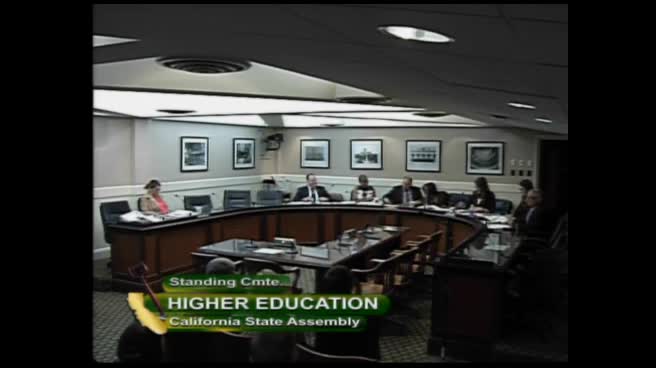 28MIN
Assembly Standing Committee on Higher Education
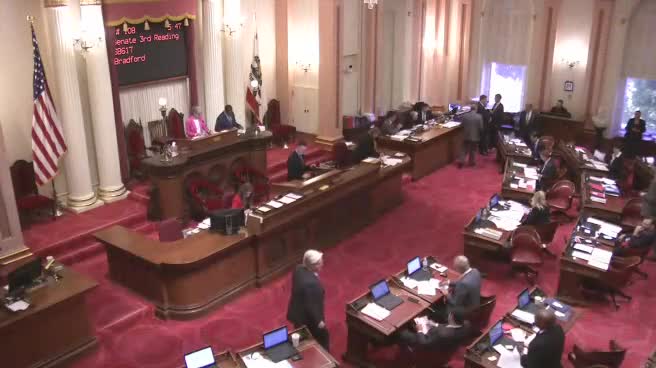 2MIN
Senate Floor
 48MIN
Senate Standing Committee on Appropriations
 35MIN
Senate Standing Committee on Education
Bill Author

Bill Co-Author(s):