AB 195: Unauthorized access to computer systems.
- Session Year: 2015-2016
- House: Assembly
- Latest Version Date: 2015-10-07
Existing law establishes various crimes related to computer services and systems. Existing law makes it a crime to knowingly, and without permission, access, cause to be accessed, or provide or assist in providing a means of accessing, a computer, computer system, computer network, or computer data in violation of prescribed provisions, and defines related terms.
Existing law makes it a crime for a person, with the intent that the crime be committed, to solicit another to commit or join in the commission of prescribed crimes.
This bill would expand these provisions to make it a crime for a person, with the intent that the crime be committed, to solicit another to commit or join in the commission of the access crimes related to computer services and systems. The bill would make it a crime to offer to obtain or procure assistance for another to obtain unauthorized access, or to assist others in locating hacking services, as defined. The bill would make a violation of this provision punishable by imprisonment in a county jail for a term not to exceed 6 months, or imprisonment for a term not to exceed one year for subsequent violations.
By expanding the scope of existing crimes, this bill would impose a state-mandated local program.
The California Constitution requires the state to reimburse local agencies and school districts for certain costs mandated by the state. Statutory provisions establish procedures for making that reimbursement.
This bill would provide that no reimbursement is required by this act for a specified reason.
Existing law establishes various crimes related to computer services and systems. Existing law makes it a crime to knowingly, and without permission, access, cause to be accessed, or provide or assist in providing a means of accessing, a computer, computer system, computer network, or computer data in violation of prescribed provisions, and defines related terms.
Existing law makes it a crime for a person, with the intent that the crime be committed, to solicit another to commit or join in the commission of prescribed crimes.
This bill would expand these provisions to make it a crime for a person, with the intent that the crime be committed, to solicit another to commit or join in the commission of the access crimes related to computer services and systems. The bill would make it a crime to offer to obtain or procure assistance for another to obtain unauthorized access, or to assist others in locating hacking services, as defined. The bill would make a violation of this provision punishable by imprisonment in a county jail for a term not to exceed 6 months, or imprisonment for a term not to exceed one year for subsequent violations.
By expanding the definitions scope of existing crimes, this bill would impose a state-mandated local program.
The California Constitution requires the state to reimburse local agencies and school districts for certain costs mandated by the state. Statutory provisions establish procedures for making that reimbursement.
This bill would provide that no reimbursement is required by this act for a specified reason.
(1)Existing
Existing law establishes various crimes related to computer services and systems. Existing law makes it a crime to knowingly, and without permission, access, cause to be accessed, or provide or assist in providing a means of accessing, a computer, computer system, computer network, or computer data in violation of prescribed provisions, and defines related terms.
This bill would specify that computer network for these purposes includes smartphones, as defined, and would make a conforming change.
(2)Existing
Existing law makes it a crime for a person, with the intent that the crime be committed, to solicit another to commit or join in the commission of prescribed crimes.
This bill would expand these provisions to make it a crime for a person, with the intent that the crime be committed, to solicit another to commit or join in the commission of the access crimes related to computer services and systems. The bill would make it a crime to offer to obtain or procure assistance for another to obtain unauthorized access, or to assist others in locating hacking services, as defined. The bill would make a violation of this provision punishable by imprisonment in a county jail for a term not to exceed 6 months, or imprisonment for a term not to exceed one year for subsequent violations.
(3)By
By expanding the definitions of existing crimes, this bill would impose a state-mandated local program.
The California Constitution requires the state to reimburse local agencies and school districts for certain costs mandated by the state. Statutory provisions establish procedures for making that reimbursement.
This bill would provide that no reimbursement is required by this act for a specified reason.
(1) Existing law establishes various crimes related to computer services and systems. Existing law makes it a crime to knowingly, and without permission, access, cause to be accessed, or provide or assist in providing a means of accessing, a computer, computer system, computer network, or computer data in violation of prescribed provisions, and defines related terms.
This bill would specify that computer network for these purposes includes smartphones, as defined, and would make a conforming change.
(2) Existing law makes it a crime for a person, with the intent that the crime be committed, to solicit another to commit or join in the commission of prescribed crimes.
This bill would expand these provisions to make it a crime for a person, with the intent that the crime be committed, to solicit another to commit or join in the commission of the access crimes related to computer services and systems. The bill would make it a crime to offer to obtain or procure assistance for another to obtain unauthorized access, or to assist others in locating hacking services, as defined. The bill would make a violation of this provision punishable by imprisonment in a county jail for a term not to exceed 6 months, or imprisonment for a term not to exceed one year for subsequent violations.
(3) By expanding the definitions of existing crimes, this bill would impose a state-mandated local program.
The California Constitution requires the state to reimburse local agencies and school districts for certain costs mandated by the state. Statutory provisions establish procedures for making that reimbursement.
This bill would provide that no reimbursement is required by this act for a specified reason.
(a)Every person who, with the intent that the crime be committed, solicits another to offer, accept, or join in the offer or acceptance of a bribe, or to commit or join in the commission of carjacking, robbery, burglary, grand theft, receiving stolen property, extortion, perjury, subornation of perjury, forgery, kidnapping, arson or assault with a deadly weapon or instrument or by means of force likely to produce great bodily injury, or, by the use of force or a threat of force, to prevent or dissuade any person who is or may become a witness from attending upon, or testifying at, any trial, proceeding, or inquiry authorized by law, shall be punished by imprisonment in a county jail for not more than one year or pursuant to subdivision (h) of Section 1170, or by a fine of not more than ten thousand dollars ($10,000), or the amount which could have been assessed for commission of the offense itself, whichever is greater, or by both the fine and imprisonment.
(b)Every person who, with the intent that the crime be committed, solicits another to commit or join in the commission of murder shall be punished by imprisonment in the state prison for three, six, or nine years.
(c)Every person who, with the intent that the crime be committed, solicits another to commit rape by force or violence, sodomy by force or violence, oral copulation by force or violence, or any violation of Section 264.1, 288, or 289, shall be punished by imprisonment in the state prison for two, three, or four years.
(d)(1)Every person who, with the intent that the crime be committed, solicits another to commit an offense specified in Section 11352, 11379, 11379.5, 11379.6, or 11391 of the Health and Safety Code shall be punished by imprisonment in a county jail not exceeding six months. Every person who, having been convicted of soliciting another to commit an offense specified in this subdivision, is subsequently convicted of the proscribed solicitation, shall be punished by imprisonment in a county jail not exceeding one year, or pursuant to subdivision (h) of Section 1170.
(2)This subdivision does not apply where the term of imprisonment imposed under other provisions of law would result in a longer term of imprisonment.
(e)Every person who, with the intent that the crime be committed, solicits another to commit an offense specified in Section 14014 of the Welfare and Institutions Code shall be punished by imprisonment in a county jail for not exceeding six months. Every person who, having been convicted of soliciting another to commit an offense specified in this subdivision, is subsequently convicted of the proscribed solicitation, shall be punished by imprisonment in a county jail not exceeding one year, or pursuant to subdivision (h) of Section 1170.
(f)(1)Every person who, with the intent that the crime be committed, solicits another to commit an offense set forth in Section 502 shall be punished as set forth in paragraph (3).
(2)Every person who, with the intent that the crime be committed, offers to solicit assistance for another to conduct activities in violation of Section 502 shall be punished as set forth in paragraph (3). This includes persons operating Internet Web sites that offer to assist others in locating hacking services. For the purposes of this section hacking services means assistance in the unauthorized access to computers, computer systems, or data in violation of Section 502.
(3)Every person who violates this subdivision shall be punished by imprisonment in a county jail for a period not to exceed six months. Every subsequent violation of this subdivision by that same person shall be punished by imprisonment in a county jail not exceeding one year.
(g)An offense charged in violation of subdivision (a), (b), or (c) shall be proven by the testimony of two witnesses, or of one witness and corroborating circumstances. An offense charged in violation of subdivision (d), (e), or (f) shall be proven by the testimony of one witness and corroborating circumstances.
(h)Nothing in this section precludes prosecution under any other law that provides for a greater punishment.
SEC. 2.No reimbursement is required by this act pursuant to Section 6 of Article XIIIB of the California Constitution because the only costs that may be incurred by a local agency or school district will be incurred because this act creates a new crime or infraction, eliminates a crime or infraction, or changes the penalty for a crime or infraction, within the meaning of Section 17556 of the Government Code, or changes the definition of a crime within the meaning of Section 6 of Article XIIIB of the California Constitution.
(a)It is the intent of the Legislature in enacting this section to expand the degree of protection afforded to individuals, businesses, and governmental agencies from tampering, interference, damage, and unauthorized access to lawfully created computer data and computer systems. The Legislature finds and declares that the proliferation of computer technology has resulted in a concomitant proliferation of computer crime and other forms of unauthorized access to computers, computer systems, and computer data.
The Legislature further finds and declares that protection of the integrity of all types and forms of lawfully created computers, computer systems, and computer data is vital to the protection of the privacy of individuals as well as to the well-being of financial institutions, business concerns, governmental agencies, and others within this state that lawfully utilize those computers, computer systems, and data.
(b)For the purposes of this section, the following terms have the following meanings:
(1)Access means to gain entry to, instruct, cause input to, cause output from, cause data processing with, or communicate with, the logical, arithmetical, or memory function resources of a computer, computer system, or computer network.
(2)Computer network means any system that provides communications between one or more computer systems and input/output devices including, but not limited to, display terminals, remote systems, mobile devices, smartphones, and printers connected by telecommunication facilities.
(3)Computer program or software means a set of instructions or statements, and related data, that when executed in actual or modified form, cause a computer, computer system, or computer network to perform specified functions.
(4)Computer services includes, but is not limited to, computer time, data processing, or storage functions, Internet services, electronic mail services, electronic message services, or other uses of a computer, computer system, or computer network.
(5)Computer system means a device or collection of devices, including support devices and excluding calculators that are not programmable and capable of being used in conjunction with external files, one or more of which contain computer programs, electronic instructions, input data, and output data, that performs functions including, but not limited to, logic, arithmetic, data storage and retrieval, communication, and control.
(6)Government computer system means any computer system, or part thereof, that is owned, operated, or used by any federal, state, or local governmental entity.
(7)Public safety infrastructure computer system means any computer system, or part thereof, that is necessary for the health and safety of the public including computer systems owned, operated, or used by drinking water and wastewater treatment facilities, hospitals, emergency service providers, telecommunication companies, and gas and electric utility companies.
(8)Data means a representation of information, knowledge, facts, concepts, computer software, computer programs or instructions, or smartphone applications. Data may be in any form, in storage media, or as stored in the memory of the computer or in transit or presented on a display device.
(9)Supporting documentation includes, but is not limited to, all information, in any form, pertaining to the design, construction, classification, implementation, use, or modification of a computer, computer system, computer network, computer program, or computer software, which information is not generally available to the public and is necessary for the operation of a computer, computer system, computer network, computer program, or computer software.
(10)Injury means any alteration, deletion, damage, or destruction of a computer system, computer network, computer program, or data caused by the access, or the denial of access to legitimate users of a computer system, network, or program.
(11)Victim expenditure means any expenditure reasonably and necessarily incurred by the owner or lessee to verify that a computer system, computer network, computer program, or data was or was not altered, deleted, damaged, or destroyed by the access.
(12)Computer contaminant means any set of computer instructions that are designed to modify, damage, destroy, record, or transmit information within a computer, computer system, or computer network without the intent or permission of the owner of the information. They include, but are not limited to, a group of computer instructions commonly called viruses or worms, that are self-replicating or self-propagating and are designed to contaminate other computer programs or computer data, consume computer resources, modify, destroy, record, or transmit data, or in some other fashion usurp the normal operation of the computer, computer system, or computer network.
(13)Internet domain name means a globally unique, hierarchical reference to an Internet host or service, assigned through centralized Internet naming authorities, comprising a series of character strings separated by periods, with the rightmost character string specifying the top of the hierarchy.
(14)Electronic mail means an electronic message or computer file that is transmitted between two or more telecommunications devices; computers; computer networks, regardless of whether the network is a local, regional, or global network; or electronic devices capable or receiving electronic messages, regardless of whether the message is converted to hard copy format after receipt, viewed upon transmission, or stored for later retrieval.
(15)Profile means either of the following:
(A)A configuration of user data required by a computer so that the user may access programs or services and have the desired functionality on that computer.
(B)An Internet Web site users personal page or section of a page that is made up of data, in text of graphical form, that displays significant, unique, or identifying information, including, but not limited to, listing acquaintances, interests, associations, activities, or personal statements.
(16)Smartphone means a cellular radio telephone or other mobile communications device that performs many of the functions of a computer, typically having a touchscreen interface, Internet access, and an operating system capable of running downloaded applications.
(c)Except as provided in subdivision (h), any person who commits any of the following acts is guilty of a public offense:
(1)Knowingly accesses and without permission alters, damages, deletes, destroys, or otherwise uses any data, computer, computer system, or computer network in order to either (A) devise or execute any scheme or artifice to defraud, deceive, or extort, or (B) wrongfully control or obtain money, property, or data.
(2)Knowingly accesses and without permission takes, copies, or makes use of any data from a computer, computer system, or computer network, or takes or copies any supporting documentation, whether existing or residing internal or external to a computer, computer system, or computer network.
(3)Knowingly and without permission uses or causes to be used computer services.
(4)Knowingly accesses and without permission adds, alters, damages, deletes, or destroys any data, computer software, or computer programs which reside or exist internal or external to a computer, computer system, or computer network.
(5)Knowingly and without permission disrupts or causes the disruption of computer services or denies or causes the denial of computer services to an authorized user of a computer, computer system, or computer network.
(6)Knowingly and without permission provides or assists in providing a means of accessing a computer, computer system, or computer network in violation of this section.
(7)Knowingly and without permission accesses or causes to be accessed any computer, computer system, or computer network.
(8)Knowingly introduces any computer contaminant into any computer, computer system, or computer network.
(9)Knowingly and without permission uses the Internet domain name or profile of another individual, corporation, or entity in connection with the sending of one or more electronic mail messages or posts and thereby damages or causes damage to a computer, computer data, computer system, or computer network.
(10)Knowingly and without permission disrupts or causes the disruption of government computer services or denies or causes the denial of government computer services to an authorized user of a government computer, computer system, or computer network.
(11)Knowingly accesses and without permission adds, alters, damages, deletes, or destroys any data, computer software, or computer programs which reside or exist internal or external to a public safety infrastructure computer system computer, computer system, or computer network.
(12)Knowingly and without permission disrupts or causes the disruption of public safety infrastructure computer system computer services or denies or causes the denial of computer services to an authorized user of a public safety infrastructure computer system computer, computer system, or computer network.
(13)Knowingly and without permission provides or assists in providing a means of accessing a computer, computer system, or public safety infrastructure computer system computer, computer system, or computer network in violation of this section.
(14)Knowingly introduces any computer contaminant into any public safety infrastructure computer system computer, computer system, or computer network.
(d)(1)Any person who violates any of the provisions of paragraph (1), (2), (4), (5), (10), (11), or (12) of subdivision (c) is punishable by a fine not exceeding ten thousand dollars ($10,000), or by imprisonment pursuant to subdivision (h) of Section 1170 for 16 months, or two or three years, or by both that fine and imprisonment, or by a fine not exceeding five thousand dollars ($5,000), or by imprisonment in a county jail not exceeding one year, or by both that fine and imprisonment.
(2)Any person who violates paragraph (3) of subdivision (c) is punishable as follows:
(A)For the first violation that does not result in injury, and where the value of the computer services used does not exceed nine hundred fifty dollars ($950), by a fine not exceeding five thousand dollars ($5,000), or by imprisonment in a county jail not exceeding one year, or by both that fine and imprisonment.
(B)For any violation that results in a victim expenditure in an amount greater than five thousand dollars ($5,000) or in an injury, or if the value of the computer services used exceeds nine hundred fifty dollars ($950), or for any second or subsequent violation, by a fine not exceeding ten thousand dollars ($10,000), or by imprisonment pursuant to subdivision (h) of Section 1170 for 16 months, or two or three years, or by both that fine and imprisonment, or by a fine not exceeding five thousand dollars ($5,000), or by imprisonment in a county jail not exceeding one year, or by both that fine and imprisonment.
(3)Any person who violates paragraph (6), (7), or (13) of subdivision (c) is punishable as follows:
(A)For a first violation that does not result in injury, an infraction punishable by a fine not exceeding one thousand dollars ($1,000).
(B)For any violation that results in a victim expenditure in an amount not greater than five thousand dollars ($5,000), or for a second or subsequent violation, by a fine not exceeding five thousand dollars ($5,000), or by imprisonment in a county jail not exceeding one year, or by both that fine and imprisonment.
(C)For any violation that results in a victim expenditure in an amount greater than five thousand dollars ($5,000), by a fine not exceeding ten thousand dollars ($10,000), or by imprisonment pursuant to subdivision (h) of Section 1170 for 16 months, or two or three years, or by both that fine and imprisonment, or by a fine not exceeding five thousand dollars ($5,000), or by imprisonment in a county jail not exceeding one year, or by both that fine and imprisonment.
(4)Any person who violates paragraph (8) or (14) of subdivision (c) is punishable as follows:
(A)For a first violation that does not result in injury, a misdemeanor punishable by a fine not exceeding five thousand dollars ($5,000), or by imprisonment in a county jail not exceeding one year, or by both that fine and imprisonment.
(B)For any violation that results in injury, or for a second or subsequent violation, by a fine not exceeding ten thousand dollars ($10,000), or by imprisonment in a county jail not exceeding one year, or by imprisonment pursuant to subdivision (h) of Section 1170, or by both that fine and imprisonment.
(5)Any person who violates paragraph (9) of subdivision (c) is punishable as follows:
(A)For a first violation that does not result in injury, an infraction punishable by a fine not exceeding one thousand dollars ($1,000).
(B)For any violation that results in injury, or for a second or subsequent violation, by a fine not exceeding five thousand dollars ($5,000), or by imprisonment in a county jail not exceeding one year, or by both that fine and imprisonment.
(e)(1)In addition to any other civil remedy available, the owner or lessee of the computer, computer system, computer network, computer program, or data who suffers damage or loss by reason of a violation of any of the provisions of subdivision (c) may bring a civil action against the violator for compensatory damages and injunctive relief or other equitable relief. Compensatory damages shall include any expenditure reasonably and necessarily incurred by the owner or lessee to verify that a computer system, computer network, computer program, or data was or was not altered, damaged, or deleted by the access. For the purposes of actions authorized by this subdivision, the conduct of an unemancipated minor shall be imputed to the parent or legal guardian having control or custody of the minor, pursuant to the provisions of Section 1714.1 of the Civil Code.
(2)In any action brought pursuant to this subdivision the court may award reasonable attorneys fees.
(3)A community college, state university, or academic institution accredited in this state is required to include computer-related crimes as a specific violation of college or university student conduct policies and regulations that may subject a student to disciplinary sanctions up to and including dismissal from the academic institution. This paragraph shall not apply to the University of California unless the Board of Regents adopts a resolution to that effect.
(4)In any action brought pursuant to this subdivision for a willful violation of the provisions of subdivision (c), where it is proved by clear and convincing evidence that a defendant has been guilty of oppression, fraud, or malice as defined in subdivision (c) of Section 3294 of the Civil Code, the court may additionally award punitive or exemplary damages.
(5)No action may be brought pursuant to this subdivision unless it is initiated within three years of the date of the act complained of, or the date of the discovery of the damage, whichever is later.
(f)This section shall not be construed to preclude the applicability of any other provision of the criminal law of this state which applies or may apply to any transaction, nor shall it make illegal any employee labor relations activities that are within the scope and protection of state or federal labor laws.
(g)Any computer, computer system, computer network, or any software or data, owned by the defendant, that is used during the commission of any public offense described in subdivision (c) or any computer, owned by the defendant, which is used as a repository for the storage of software or data illegally obtained in violation of subdivision (c) shall be subject to forfeiture, as specified in Section 502.01.
(h)(1)Subdivision (c) does not apply to punish any acts which are committed by a person within the scope of his or her lawful employment. For purposes of this section, a person acts within the scope of his or her employment when he or she performs acts which are reasonably necessary to the performance of his or her work assignment.
(2)Paragraph (3) of subdivision (c) does not apply to penalize any acts committed by a person acting outside of his or her lawful employment, provided that the employees activities do not cause an injury, to the employer or another, or provided that the value of supplies or computer services which are used does not exceed an accumulated total of two hundred fifty dollars ($250).
(i)No activity exempted from prosecution under paragraph (2) of subdivision (h) which incidentally violates paragraph (2), (4), or (7) of subdivision (c) shall be prosecuted under those paragraphs.
(j)For purposes of bringing a civil or a criminal action under this section, a person who causes, by any means, the access of a computer, computer system, or computer network in one jurisdiction from another jurisdiction is deemed to have personally accessed the computer, computer system, or computer network in each jurisdiction.
(k)In determining the terms and conditions applicable to a person convicted of a violation of this section the court shall consider the following:
(1)The court shall consider prohibitions on access to and use of computers.
(2)Except as otherwise required by law, the court shall consider alternate sentencing, including community service, if the defendant shows remorse and recognition of the wrongdoing, and an inclination not to repeat the offense.
SEC. 2.SECTION 1.Section 653f of the Penal Code is amended to read:653f.(a)Every person who, with the intent that the crime be committed, solicits another to offer, accept, or join in the offer or acceptance of a bribe, or to commit or join in the commission of carjacking, robbery, burglary, grand theft, receiving stolen property, extortion, perjury, subornation of perjury, forgery, kidnapping, arson or assault with a deadly weapon or instrument or by means of force likely to produce great bodily injury, or, by the use of force or a threat of force, to prevent or dissuade any person who is or may become a witness from attending upon, or testifying at, any trial, proceeding, or inquiry authorized by law, shall be punished by imprisonment in a county jail for not more than one year or pursuant to subdivision (h) of Section 1170, or by a fine of not more than ten thousand dollars ($10,000), or the amount which could have been assessed for commission of the offense itself, whichever is greater, or by both the fine and imprisonment.
(b)Every person who, with the intent that the crime be committed, solicits another to commit or join in the commission of murder shall be punished by imprisonment in the state prison for three, six, or nine years.
(c)Every person who, with the intent that the crime be committed, solicits another to commit rape by force or violence, sodomy by force or violence, oral copulation by force or violence, or any violation of Section 264.1, 288, or 289, shall be punished by imprisonment in the state prison for two, three, or four years.
(d)(1)Every person who, with the intent that the crime be committed, solicits another to commit an offense specified in Section 11352, 11379, 11379.5, 11379.6, or 11391 of the Health and Safety Code shall be punished by imprisonment in a county jail not exceeding six months. Every person, person who, having been convicted of soliciting another to commit an offense specified in this subdivision, is subsequently convicted of the proscribed solicitation, shall be punished by imprisonment in a county jail not exceeding one year, or pursuant to subdivision (h) of Section 1170.
(2)This subdivision does not apply where the term of imprisonment imposed under other provisions of law would result in a longer term of imprisonment.
(e)Every person who, with the intent that the crime be committed, solicits another to commit an offense specified in Section 14014 of the Welfare and Institutions Code shall be punished by imprisonment in a county jail for not exceeding six months. Every person who, having been convicted of soliciting another to commit an offense specified in this subdivision, is subsequently convicted of the proscribed solicitation, shall be punished by imprisonment in a county jail not exceeding one year, or pursuant to subdivision (h) of Section 1170.
(f)(1)Every person who, with the intent that the crime be committed, solicits another to commit an offense set forth in Section 502 shall be punished as set forth in paragraph (3).
(2)Every person who, with the intent that the crime be committed, offers to solicit assistance for another to conduct activities in violation of Section 502 shall be punished as set forth in paragraph (3). This includes persons operating Internet Web sites that offer to assist others in locating hacking services. For the purposes of this section hacking services means assistance in the unauthorized access to computers, computer systems, or computer data in violation of Section 502.
(3)Every person who violates this subdivision shall be punished by imprisonment in a county jail for a period not to exceed six months. Every subsequent violation of this subdivision by that same person shall be punished by imprisonment in a county jail not exceeding one year, or pursuant to subdivision (h) of Section 1170. year.
(g)An offense charged in violation of subdivision (a), (b), or (c) shall be proven by the testimony of two witnesses, or of one witness and corroborating circumstances. An offense charged in violation of subdivision (d), (e), or (f) shall be proven by the testimony of one witness and corroborating circumstances.
SEC. 3.SEC. 2.No reimbursement is required by this act pursuant to Section 6 of Article XIIIB of the California Constitution because the only costs that may be incurred by a local agency or school district will be incurred because this act creates a new crime or infraction, eliminates a crime or infraction, or changes the penalty for a crime or infraction, within the meaning of Section 17556 of the Government Code, or changes the definition of a crime within the meaning of Section 6 of Article XIIIB of the California Constitution.
(a)It is the intent of the Legislature in enacting this section to expand the degree of protection afforded to individuals, businesses, and governmental agencies from tampering, interference, damage, and unauthorized access to lawfully created computer data and computer systems. The Legislature finds and declares that the proliferation of computer technology has resulted in a concomitant proliferation of computer crime and other forms of unauthorized access to computers, computer systems, and computer data.
The Legislature further finds and declares that protection of the integrity of all types and forms of lawfully created computers, computer systems, and computer data is vital to the protection of the privacy of individuals as well as to the well-being of financial institutions, business concerns, governmental agencies, and others within this state that lawfully utilize those computers, computer systems, and data.
(b)For the purposes of this section, the following terms have the following meanings:
(1)Access means to gain entry to, instruct, cause input to, cause output from, cause data processing with, or communicate with, the logical, arithmetical, or memory function resources of a computer, computer system, or computer network.
(2)Computer network means any system that provides communications between one or more computer systems and input/output devices including, but not limited to, display terminals, remote systems, mobile devices, smartphones, and printers connected by telecommunication facilities.
(3)Computer program or software means a set of instructions or statements, and related data, that when executed in actual or modified form, cause a computer, computer system, or computer network to perform specified functions.
(4)Computer services includes, but is not limited to, computer time, data processing, or storage functions, Internet services, electronic mail services, electronic message services, or other uses of a computer, computer system, or computer network.
(5)Computer system means a device or collection of devices, including support devices and excluding calculators that are not programmable and capable of being used in conjunction with external files, one or more of which contain computer programs, electronic instructions, input data, and output data, that performs functions including, but not limited to, logic, arithmetic, data storage and retrieval, communication, and control.
(6)Government computer system means any computer system, or part thereof, that is owned, operated, or used by any federal, state, or local governmental entity.
(7)Public safety infrastructure computer system means any computer system, or part thereof, that is necessary for the health and safety of the public including computer systems owned, operated, or used by drinking water and wastewater treatment facilities, hospitals, emergency service providers, telecommunication companies, and gas and electric utility companies.
(8)Data means a representation of information, knowledge, facts, concepts, computer software, computer programs or instructions, or smartphone applications. Data may be in any form, in storage media, or as stored in the memory of the computer or in transit or presented on a display device.
(9)Supporting documentation includes, but is not limited to, all information, in any form, pertaining to the design, construction, classification, implementation, use, or modification of a computer, computer system, computer network, computer program, or computer software, which information is not generally available to the public and is necessary for the operation of a computer, computer system, computer network, computer program, or computer software.
(10)Injury means any alteration, deletion, damage, or destruction of a computer system, computer network, computer program, or data caused by the access, or the denial of access to legitimate users of a computer system, network, or program.
(11)Victim expenditure means any expenditure reasonably and necessarily incurred by the owner or lessee to verify that a computer system, computer network, computer program, or data was or was not altered, deleted, damaged, or destroyed by the access.
(12)Computer contaminant means any set of computer instructions that are designed to modify, damage, destroy, record, or transmit information within a computer, computer system, or computer network without the intent or permission of the owner of the information. They include, but are not limited to, a group of computer instructions commonly called viruses or worms, that are self-replicating or self-propagating and are designed to contaminate other computer programs or computer data, consume computer resources, modify, destroy, record, or transmit data, or in some other fashion usurp the normal operation of the computer, computer system, or computer network.
(13)Internet domain name means a globally unique, hierarchical reference to an Internet host or service, assigned through centralized Internet naming authorities, comprising a series of character strings separated by periods, with the rightmost character string specifying the top of the hierarchy.
(14)Electronic mail means an electronic message or computer file that is transmitted between two or more telecommunications devices; computers; computer networks, regardless of whether the network is a local, regional, or global network; or electronic devices capable or receiving electronic messages, regardless of whether the message is converted to hard copy format after receipt, viewed upon transmission, or stored for later retrieval.
(15)Profile means either of the following:
(A)A configuration of user data required by a computer so that the user may access programs or services and have the desired functionality on that computer.
(B)An Internet Web site users personal page or section of a page that is made up of data, in text of graphical form, that displays significant, unique, or identifying information, including, but not limited to, listing acquaintances, interests, associations, activities, or personal statements.
(16)Smartphone means a cellular radio telephone or other mobile communications device that performs many of the functions of a computer, typically having a touchscreen interface, Internet access, and an operating system capable of running downloaded applications.
(c)Except as provided in subdivision (h), any person who commits any of the following acts is guilty of a public offense:
(1)Knowingly accesses and without permission alters, damages, deletes, destroys, or otherwise uses any data, computer, computer system, or computer network in order to either (A) devise or execute any scheme or artifice to defraud, deceive, or extort, or (B) wrongfully control or obtain money, property, or data.
(2)Knowingly accesses and without permission takes, copies, or makes use of any data from a computer, computer system, or computer network, or takes or copies any supporting documentation, whether existing or residing internal or external to a computer, computer system, or computer network.
(3)Knowingly and without permission uses or causes to be used computer services.
(4)Knowingly accesses and without permission adds, alters, damages, deletes, or destroys any data, computer software, or computer programs which reside or exist internal or external to a computer, computer system, or computer network.
(5)Knowingly and without permission disrupts or causes the disruption of computer services or denies or causes the denial of computer services to an authorized user of a computer, computer system, or computer network.
(6)Knowingly and without permission provides or assists in providing a means of accessing a computer, computer system, or computer network in violation of this section.
(7)Knowingly and without permission accesses or causes to be accessed any computer, computer system, or computer network.
(8)Knowingly introduces any computer contaminant into any computer, computer system, or computer network.
(9)Knowingly and without permission uses the Internet domain name or profile of another individual, corporation, or entity in connection with the sending of one or more electronic mail messages or posts and thereby damages or causes damage to a computer, computer data, computer system, or computer network.
(10)Knowingly and without permission disrupts or causes the disruption of government computer services or denies or causes the denial of government computer services to an authorized user of a government computer, computer system, or computer network.
(11)Knowingly accesses and without permission adds, alters, damages, deletes, or destroys any data, computer software, or computer programs which reside or exist internal or external to a public safety infrastructure computer system computer, computer system, or computer network.
(12)Knowingly and without permission disrupts or causes the disruption of public safety infrastructure computer system computer services or denies or causes the denial of computer services to an authorized user of a public safety infrastructure computer system computer, computer system, or computer network.
(13)Knowingly and without permission provides or assists in providing a means of accessing a computer, computer system, or public safety infrastructure computer system computer, computer system, or computer network in violation of this section.
(14)Knowingly introduces any computer contaminant into any public safety infrastructure computer system computer, computer system, or computer network.
(d)(1)Any person who violates any of the provisions of paragraph (1), (2), (4), (5), (10), (11), or (12) of subdivision (c) is punishable by a fine not exceeding ten thousand dollars ($10,000), or by imprisonment pursuant to subdivision (h) of Section 1170 for 16 months, or two or three years, or by both that fine and imprisonment, or by a fine not exceeding five thousand dollars ($5,000), or by imprisonment in a county jail not exceeding one year, or by both that fine and imprisonment.
(2)Any person who violates paragraph (3) of subdivision (c) is punishable as follows:
(A)For the first violation that does not result in injury, and where the value of the computer services used does not exceed nine hundred fifty dollars ($950), by a fine not exceeding five thousand dollars ($5,000), or by imprisonment in a county jail not exceeding one year, or by both that fine and imprisonment.
(B)For any violation that results in a victim expenditure in an amount greater than five thousand dollars ($5,000) or in an injury, or if the value of the computer services used exceeds nine hundred fifty dollars ($950), or for any second or subsequent violation, by a fine not exceeding ten thousand dollars ($10,000), or by imprisonment pursuant to subdivision (h) of Section 1170 for 16 months, or two or three years, or by both that fine and imprisonment, or by a fine not exceeding five thousand dollars ($5,000), or by imprisonment in a county jail not exceeding one year, or by both that fine and imprisonment.
(3)Any person who violates paragraph (6), (7), or (13) of subdivision (c) is punishable as follows:
(A)For a first violation that does not result in injury, an infraction punishable by a fine not exceeding one thousand dollars ($1,000).
(B)For any violation that results in a victim expenditure in an amount not greater than five thousand dollars ($5,000), or for a second or subsequent violation, by a fine not exceeding five thousand dollars ($5,000), or by imprisonment in a county jail not exceeding one year, or by both that fine and imprisonment.
(C)For any violation that results in a victim expenditure in an amount greater than five thousand dollars ($5,000), by a fine not exceeding ten thousand dollars ($10,000), or by imprisonment pursuant to subdivision (h) of Section 1170 for 16 months, or two or three years, or by both that fine and imprisonment, or by a fine not exceeding five thousand dollars ($5,000), or by imprisonment in a county jail not exceeding one year, or by both that fine and imprisonment.
(4)Any person who violates paragraph (8) or (14) of subdivision (c) is punishable as follows:
(A)For a first violation that does not result in injury, a misdemeanor punishable by a fine not exceeding five thousand dollars ($5,000), or by imprisonment in a county jail not exceeding one year, or by both that fine and imprisonment.
(B)For any violation that results in injury, or for a second or subsequent violation, by a fine not exceeding ten thousand dollars ($10,000), or by imprisonment in a county jail not exceeding one year, or by imprisonment pursuant to subdivision (h) of Section 1170, or by both that fine and imprisonment.
(5)Any person who violates paragraph (9) of subdivision (c) is punishable as follows:
(A)For a first violation that does not result in injury, an infraction punishable by a fine not exceeding one thousand dollars ($1,000).
(B)For any violation that results in injury, or for a second or subsequent violation, by a fine not exceeding five thousand dollars ($5,000), or by imprisonment in a county jail not exceeding one year, or by both that fine and imprisonment.
(e)(1)In addition to any other civil remedy available, the owner or lessee of the computer, computer system, computer network, computer program, or data who suffers damage or loss by reason of a violation of any of the provisions of subdivision (c) may bring a civil action against the violator for compensatory damages and injunctive relief or other equitable relief. Compensatory damages shall include any expenditure reasonably and necessarily incurred by the owner or lessee to verify that a computer system, computer network, computer program, or data was or was not altered, damaged, or deleted by the access. For the purposes of actions authorized by this subdivision, the conduct of an unemancipated minor shall be imputed to the parent or legal guardian having control or custody of the minor, pursuant to the provisions of Section 1714.1 of the Civil Code.
(2)In any action brought pursuant to this subdivision the court may award reasonable attorneys fees.
(3)A community college, state university, or academic institution accredited in this state is required to include computer-related crimes as a specific violation of college or university student conduct policies and regulations that may subject a student to disciplinary sanctions up to and including dismissal from the academic institution. This paragraph shall not apply to the University of California unless the Board of Regents adopts a resolution to that effect.
(4)In any action brought pursuant to this subdivision for a willful violation of the provisions of subdivision (c), where it is proved by clear and convincing evidence that a defendant has been guilty of oppression, fraud, or malice as defined in subdivision (c) of Section 3294 of the Civil Code, the court may additionally award punitive or exemplary damages.
(5)No action may be brought pursuant to this subdivision unless it is initiated within three years of the date of the act complained of, or the date of the discovery of the damage, whichever is later.
(f)This section shall not be construed to preclude the applicability of any other provision of the criminal law of this state which applies or may apply to any transaction, nor shall it make illegal any employee labor relations activities that are within the scope and protection of state or federal labor laws.
(g)Any computer, computer system, computer network, or any software or data, owned by the defendant, that is used during the commission of any public offense described in subdivision (c) or any computer, owned by the defendant, which is used as a repository for the storage of software or data illegally obtained in violation of subdivision (c) shall be subject to forfeiture, as specified in Section 502.01.
(h)(1)Subdivision (c) does not apply to punish any acts which are committed by a person within the scope of his or her lawful employment. For purposes of this section, a person acts within the scope of his or her employment when he or she performs acts which are reasonably necessary to the performance of his or her work assignment.
(2)Paragraph (3) of subdivision (c) does not apply to penalize any acts committed by a person acting outside of his or her lawful employment, provided that the employees activities do not cause an injury, to the employer or another, or provided that the value of supplies or computer services which are used does not exceed an accumulated total of two hundred fifty dollars ($250).
(i)No activity exempted from prosecution under paragraph (2) of subdivision (h) which incidentally violates paragraph (2), (4), or (7) of subdivision (c) shall be prosecuted under those paragraphs.
(j)For purposes of bringing a civil or a criminal action under this section, a person who causes, by any means, the access of a computer, computer system, or computer network in one jurisdiction from another jurisdiction is deemed to have personally accessed the computer, computer system, or computer network in each jurisdiction.
(k)In determining the terms and conditions applicable to a person convicted of a violation of this section the court shall consider the following:
(1)The court shall consider prohibitions on access to and use of computers.
(2)Except as otherwise required by law, the court shall consider alternate sentencing, including community service, if the defendant shows remorse and recognition of the wrongdoing, and an inclination not to repeat the offense.
SEC. 2.Section 653f of the Penal Code is amended to read:653f.(a)Every person who, with the intent that the crime be committed, solicits another to offer, accept, or join in the offer or acceptance of a bribe, or to commit or join in the commission of carjacking, robbery, burglary, grand theft, receiving stolen property, extortion, perjury, subornation of perjury, forgery, kidnapping, arson or assault with a deadly weapon or instrument or by means of force likely to produce great bodily injury, or, by the use of force or a threat of force, to prevent or dissuade any person who is or may become a witness from attending upon, or testifying at, any trial, proceeding, or inquiry authorized by law, shall be punished by imprisonment in a county jail for not more than one year or pursuant to subdivision (h) of Section 1170, or by a fine of not more than ten thousand dollars ($10,000), or the amount which could have been assessed for commission of the offense itself, whichever is greater, or by both the fine and imprisonment.
(b)Every person who, with the intent that the crime be committed, solicits another to commit or join in the commission of murder shall be punished by imprisonment in the state prison for three, six, or nine years.
(c)Every person who, with the intent that the crime be committed, solicits another to commit rape by force or violence, sodomy by force or violence, oral copulation by force or violence, or any violation of Section 264.1, 288, or 289, shall be punished by imprisonment in the state prison for two, three, or four years.
(d)(1)Every person who, with the intent that the crime be committed, solicits another to commit an offense specified in Section 11352, 11379, 11379.5, 11379.6, or 11391 of the Health and Safety Code shall be punished by imprisonment in a county jail not exceeding six months. Every person, who, having been convicted of soliciting another to commit an offense specified in this subdivision, is subsequently convicted of the proscribed solicitation, shall be punished by imprisonment in a county jail not exceeding one year, or pursuant to subdivision (h) of Section 1170.
(2)This subdivision does not apply where the term of imprisonment imposed under other provisions of law would result in a longer term of imprisonment.
(e)Every person who, with the intent that the crime be committed, solicits another to commit an offense specified in Section 14014 of the Welfare and Institutions Code shall be punished by imprisonment in a county jail for not exceeding six months. Every person who, having been convicted of soliciting another to commit an offense specified in this subdivision, is subsequently convicted of the proscribed solicitation, shall be punished by imprisonment in a county jail not exceeding one year, or pursuant to subdivision (h) of Section 1170.
(f)(1)Every person who, with the intent that the crime be committed, solicits another to commit an offense set forth in Section 502 shall be punished as set forth in paragraph (3).
(2)Every person who, with the intent that the crime be committed, offers to solicit assistance for another to conduct activities in violation of Section 502 shall be punished as set forth in paragraph (3). This includes persons operating Internet Web sites that offer to assist others in locating hacking services. For the purposes of this section hacking services means assistance in the unauthorized access to computers, computer systems, or computer data in violation of Section 502.
(3)Every person who violates this subdivision shall be punished by imprisonment in a county jail for a period not to exceed six months. Every subsequent violation of this subdivision by that same person shall be punished by imprisonment in a county jail not exceeding one year, or pursuant to subdivision (h) of Section 1170.
(f)
(g)An offense charged in violation of subdivision (a), (b), or (c) shall be proven by the testimony of two witnesses, or of one witness and corroborating circumstances. An offense charged in violation of subdivision (d) or (e) (d), (e), or (f) shall be proven by the testimony of one witness and corroborating circumstances.
SEC. 3.No reimbursement is required by this act pursuant to Section 6 of Article XIIIB of the California Constitution because the only costs that may be incurred by a local agency or school district will be incurred because this act creates a new crime or infraction, eliminates a crime or infraction, or changes the penalty for a crime or infraction, within the meaning of Section 17556 of the Government Code, or changes the definition of a crime within the meaning of Section 6 of Article XIIIB of the California Constitution.
|
Date
|
Status
|
|---|---|
| Oct 7, 2015 | Chaptered by Secretary of State - Chapter 552, Statutes of 2015. |
| Oct 7, 2015 | Approved by the Governor. |
| Sep 17, 2015 | Enrolled and presented to the Governor at 11:30 a.m. |
| Sep 8, 2015 | Senate amendments concurred in. To Engrossing and Enrolling. (Ayes 79. Noes 0. Page 2946.). |
| Sep 8, 2015 | Senate amendments concurred in. To Engrossing and Enrolling. (Ayes 79. Noes 0.). |
| Sep 8, 2015 | Senate amendments concurred in. To Engrossing and Enrolling. |
| Sep 4, 2015 | Read third time. Passed. Ordered to the Assembly. (Ayes 39. Noes 0. Page 2508.). |
| Sep 4, 2015 | In Assembly. Concurrence in Senate amendments pending. May be considered on or after September 6 pursuant to Assembly Rule 77. |
| Sep 4, 2015 | Read third time. Passed. Ordered to the Assembly. |
| Jun 23, 2015 | Read second time and amended. Ordered to third reading. |
| Jun 22, 2015 | From committee: Be placed on second reading file pursuant to Senate Rule 28.8 and be amended. |
| Jun 9, 2015 | From committee: Do pass and re-refer to Com. on APPR. (Ayes 7. Noes 0.) (June 9). Re-referred to Com. on APPR. |
| May 7, 2015 | Referred to Com. on PUB. S. |
| Apr 23, 2015 | In Senate. Read first time. To Com. on RLS. for assignment. |
| Apr 23, 2015 | Read third time. Passed. Ordered to the Senate. (Ayes 75. Noes 0. Page 1103.) |
| Apr 23, 2015 | Read third time. Passed. Ordered to the Senate. (Ayes 75. Noes 0.) |
| Apr 20, 2015 | Ordered to third reading. |
| Apr 20, 2015 | From Consent Calendar. |
| Apr 16, 2015 | Read second time. Ordered to consent calendar. |
| Apr 15, 2015 | From committee: Do pass. To Consent Calendar. (Ayes 16. Noes 0.) (April 15). |
| Apr 15, 2015 | From committee: Do pass. Ordered to Consent Calendar. (Ayes 16. Noes 0.) (April 15). |
| Apr 8, 2015 | From committee: Do pass and re-refer to Com. on APPR. (Ayes 10. Noes 0.) (April 7). Re-referred to Com. on APPR. |
| Apr 7, 2015 | Re-referred to Com. on P. & C.P. |
| Apr 6, 2015 | From committee chair, with author's amendments: Amend, and re-refer to Com. on P. & C.P. Read second time and amended. |
| Mar 17, 2015 | From committee: Do pass and re-refer to Com. on P. & C.P. (Ayes 6. Noes 0.) (March 17). Re-referred to Com. on P. & C.P. |
| Feb 9, 2015 | Referred to Coms. on PUB. S. and P. & C.P. |
| Jan 29, 2015 | From printer. May be heard in committee February 28. |
| Jan 28, 2015 | Read first time. To print. |
|
Date
|
Description
|
Location
|
Votes
|
|
|---|---|---|---|---|
| Sep 8, 2015 | AB 195 CHAU Concurrence in Senate Amendments | Assembly Floor |
Passed |
|
| Sep 4, 2015 | Assembly 3rd Reading AB195 Chau By Hancock | Senate Floor |
Passed |
|
| Jun 9, 2015 | Do pass, but first be re-referred to the Committee on [Appropriations] | Senate Standing Committee on Public Safety |
Passed |
|
| Apr 23, 2015 | AB 195 CHAU Assembly Third Reading | Assembly Floor |
Passed |
|
| Apr 15, 2015 | Do pass. To Consent Calendar. | Assembly Standing Committee on Appropriations |
Passed |
|
| Apr 7, 2015 | Do pass and be re-referred to the Committee on [Appropriations] | Assembly Standing Committee on Privacy and Consumer Protection |
Passed |
|
| Mar 17, 2015 | Do pass and be re-referred to the Committee on [Privacy and Consumer Protection] | Assembly Standing Committee on Public Safety |
Passed |
This list shows positions taken on this bill by organizations on the date displayed, which is linked to the original source.
Positions by individuals are not included.
AB 195
Page 3
CONCURRENCE IN SENATE AMENDMENTS
AB 195
(Chau)
As Amended June 23, 2015
Majority vote
ASSEMBLY: |
75-0 |
(April 23, 2015) |
SENATE: |
39-0 |
(September 4, 2015) |
Original Committee Reference: PUB. S.
SUMMARY: Makes it a misdemeanor, punishable by up to six months, for any person to solicit another to join in the commission of specified crimes relating to unauthorized access of computer systems.
The Senate amendments specify that nothing in this section precludes prosecution under any other law that provides greater punishment.
EXISTING LAW:
Punishes any person who knowingly and without permission accesses or causes to be accessed any computer, computer system, or computer network as follows:
For a first violation that does not result in injury, an infraction punishable by a fine not exceeding $1,000.
For any violation that results in a victim expenditure in an amount not greater than $5,000, or for a second or subsequent violation, by a fine not exceeding $5,000, or by imprisonment in a county jail not exceeding one year, or by both that fine and imprisonment.
For any violation that results in a victim expenditure in an amount greater than 5,000, by a fine not exceeding $10,000, or by imprisonment pursuant to Penal Code Section 1170 (h) for 16 months, or two or three years, or by both that fine and imprisonment, or by a fine not exceeding $5,000, or by imprisonment in a county jail not exceeding one year, or by both that fine and imprisonment.
Punishes any person who knowingly and without permission provides or assists in providing a means of accessing a computer, computer system, or public safety infrastructure computer system computer, computer system, or computer network as follows:
For a first violation that does not result in injury, an infraction punishable by a fine not exceeding $1,000.
For any violation that results in a victim expenditure in an amount not greater than $5,000, or for a second or subsequent violation, by a fine not exceeding $5,000, or by imprisonment in a county jail not exceeding one year, or by both that fine and imprisonment.
For any violation that results in a victim expenditure in an amount greater than $5,000, by a fine not exceeding $10,000, or by imprisonment pursuant to Penal Code Section 1170 (h) for 16 months, or two or three years, or by both that fine and imprisonment, or by a fine not exceeding $5,000, or by imprisonment in a county jail not exceeding one year, or by both that fine and imprisonment.
Defines the following terms as follows: "Computer network" means any system that provides communications between one or more computer systems and input/output devices including, but not limited to, display terminals, remote systems, mobile devices, and printers connected by telecommunication facilities.
AS PASSED BY THE ASSEMBLY, this bill:
Provided that every person who, with the intent that the crime be committed, solicits another to commit one of a number of specified computer crimes shall be punished by imprisonment in a county jail for a period not to exceed six months. Every subsequent violation of this subdivision by that same person shall be punished by imprisonment in a county jail not exceeding one year.
Provided that every person who, with the intent that the crime be committed, offers to solicit assistance for another to conduct activities in violation of a number of specified computer crimes shall be punished by imprisonment in a county jail for a period not to exceed six months. Every subsequent violation of this subdivision by that same person shall be punished by imprisonment in a county jail not exceeding one year:
Specified that this includes persons operating Web sites that offer to assist others in locating hacking services;
Defined "hacking services" as assistance in the unauthorized access to computers, computer systems, or computer data in violation of specified computer crimes; and
Specified that this offense shall be proven by the testimony of one witness and corroborating circumstances.
FISCAL EFFECT: According to the Senate Appropriations Committee, pursuant to Senate Rule 28.8, negligible state costs.
COMMENTS: According to the author, "Today, we live in a digitally connected world where more of our devices are equipped with sensors and connected to the internet. This includes our phones, cars and household appliances; all of which perform functions that where once exclusive to our computers.
"This new form of digital access has also spawned a new type of criminal, one who can invade our homes and offices not by breaking down doors and windows, but by breaking into our computer networks from the convenience and safety of their own homes. These cybercrimes range from breaking into someone's computer network to steal financial information to other crimes such as corporate espionage, fraud, and extortion.
"Under current law, it is a crime to solicit another to commit certain crimes, such as bribery, kidnapping, and robbery, among others. In addition, it is a crime for someone to knowingly hack into another’s computer network without permission. However, it is not a crime to solicit someone to knowingly and without permission hack into a computer network or smartphone.
"Cybercrimes have greater and longer lasting effects on victims, because the personal information stolen can result in identify theft, fraud, and personal embarrassment, all of which could take years to recover from, if ever. In fact, according to the FBI's Internet Crime Complaint Center, in 2013, it received over 200,000 consumer complaints about online scams, which resulted in a loss of over 781 million dollars; an almost 50% increase from the year before.
"In recent years, we have seen the growth of so called Hacker-for-Hire websites where individuals solicit hackers to perform certain projects. These websites work in different ways. Some work by requiring the person to submit a description of the hacking job along with contact information. The website then sets up a time to connect the person with a hacker over the phone or video-conferencing to complete the process. Others websites work by creating a platform that allows customers to register and post projects on the website for different hackers to bid on. The websites then holds the money in an escrow account until both parties agree that the transaction has been completed. The website then takes a commission from each transaction and releases the money.
"Hacker-for-Hire projects range from recovering lost passwords to tracking stolen devices. But some of these websites also provide a platform for individuals seeking illegal hacking services from less than ethical hackers, such as installing spyware on devices and gaining access to the email and social media accounts of unsuspecting victims.
"AB 195 would make it a crime to solicit someone to knowingly and without permission gain access to a computer network or smartphone. This includes offering to obtain or assist in locating hacking services. The bill would also clarify that a computer network includes smartphones. This bill would make any violation punishable by imprisonment not to exceed six months. Any subsequent violation would be punishable by imprisonment not to exceed one year."
Analysis Prepared by: Gabriel Caswell / PUB. S. / (916) 319-3744 FN: 0001211
AB 195
Page 8
|
Office of Senate Floor Analyses (916) 651-1520 Fax: (916) 327-4478 |
THIRD READING
Bill No: AB 195
Amended: 6/23/15 in Senate
SENATE PUBLIC SAFETY COMMITTEE: 7-0, 6/9/15
AYES: Hancock, Anderson, Glazer, Leno, Liu, Monning, Stone
SENATE APPROPRIATIONS COMMITTEE: Senate Rule 28.8
ASSEMBLY FLOOR: 75-0, 4/23/15 - See last page for vote
SUBJECT: Unauthorized access to computer systems
DIGEST: This bill 1) includes specified computer offenses in the list of target crimes in the offense of solicitation of another person to commit a crime; and 2) defines offering to solicit assistance for a person to violate specified computer crimes as a form of criminal solicitation.
Existing law:
Defines the criminal offense of solicitation of another to commit one of a list of target crimes. (Pen. Code § 653f.) Solicitation involves the following elements, penalties and evidentiary rules:
Solicitation includes the following elements:
The defendant requested or solicited another person to commit the target offense.
The defendant intended that the crime be committed.
The other person received the solicitation actual words or terms used to encourage someone to commit the crime.
Solicitation of any one the following offenses is an alternate felony-misdemeanor, punishable by imprisonment in a county jail for up to one year, a fine of up to $1,000, or both, or, pursuant to Penal Code Section 1170, subdivision (h), or by an executed felony jail term of 16 months, 2 or 3 years and a fine of up to $10,000:
Carjacking
Robbery
Burglary
Grand theft and forgery
Receiving stolen property
Extortion
Perjury and subornation of perjury
Kidnapping
Arson
Assault with a deadly weapon or by means of force likely to produce great bodily injury
Dissuading a witness by the use of force or a threat of force. (Pen. Code § 653f, subd. (a),):
Solicitation of murder is a felony, punishable by a prison term of three, six or nine years and a fine of up to $10,000. (Pen. Code § 653f, subd. (b).)
Solicitation of the commission by force or violence of rape, sodomy, oral copulation, sexual penetration, lewd conduct or a sex crime in concert is a felony, punishable by imprisonment in the state prison for two, three, or four years and a fine of up to $10,000. (Pen. Code § 653f, subd. (c).)
Solicitation of specified crimes involving drug commerce is a misdemeanor, punishable by imprisonment in a county jail for up to six months, a fine of up to $1,000, or both. A subsequent conviction of this offense is an alternate felony-misdemeanor, punishable by imprisonment in a county jail for up to one year, a fine of up to $1,000, or both, or by exceeding six months. (Pen. Code § 653f, subd. (d).)
Solicitation of Medi-Cal or health care eligibility fraud is a misdemeanor, punishable by imprisonment in a county jail for up to six months, a fine of up to $1,000, or both. A subsequent conviction of this offense is an alternate felony-misdemeanor, punishable by imprisonment in a county jail for up to one year, a fine of up to $1,000, or both, or by exceeding six months. (Pen. Code § 653f, subd. (e).)
Proof of solicitation of drug commerce requires the testimony of one witness and corroborating evidence. (Pen. Code § 653f, subd. (f).)
Proof of solicitation of murder, sex crimes, kidnapping, robbery, carjacking, arson, specified financial or theft crimes, assault or dissuading a witness requires the testimony of at least two witnesses and corroborating evidence. (Pen. Code § 653f, subd. (f).)
Defines numerous computer-related offenses and imposes penalties based on the seriousness of the offense or harm caused by the defendant: The penalties range from a fine not exceeding $10,000, by a sentenced felony jail term of 16 months, two years or three years, or both, or as a misdemeanor by a fine not exceeding $5,000, by imprisonment in a county jail not exceeding one year, or both:
Any person who knowingly accesses and without permission alters, damages, deletes, destroys, or otherwise uses any data, computer, computer system, or computer network in order to devise or execute any scheme or artifice to defraud, deceive, or extort, or wrongfully control or obtain money, property or data.
Any person who knowingly accesses and without permission takes, copies or makes use of data from a computer, computer system, or network, or takes or copies any supporting documentation, whether existing or residing internal or external to a computer, computer system, or computer network.
Any person who knowingly accessing and without permission adds, alters, damages, deletes, or destroys any data, computer software, or computer programs which reside or exist internal or external to a computer, computer system, or computer network.
Any person who knowingly and without permission disrupting or causing the disruption of computer services or denies or causes the denial of computer services or denies or causes the denial of computer services to an authorized user of a computer, computer system, or computer network.
Disrupting or improperly accessing a government of public safety computer systems, data or software is separately defined, but subject to the same penalties as other such crimes. (Pen. Code § 502, subds. (c) and (d)(1).)
Provides that any person who knowingly and without permission uses or causes to be used computer services shall be punished as follows:
For the first violation that does not result in injury, and where the value of the computer services used does not exceed $950, by a fine not exceeding $5,000, by imprisonment in a county jail not exceeding one year, or by both that fine and imprisonment; and
For any violation that results in a victim expenditure in an amount more than $5,000 or in an injury, if the value of the computer services used exceeds $950, or for any second or subsequent violation, by a fine not exceeding $10,000, by imprisonment pursuant to realignment for 16 months, or two or three years, or by both that fine and imprisonment, or by a fine not exceeding $5,000, by imprisonment in a county jail not exceeding one year, or by both that fine and imprisonment. (Pen. Code § 502, subds. (c) and (d)(2).)
Punishes any person who knowingly and without permission provides or assists in providing a means of accessing, accesses, or causes to be accessed a computer, computer system, or computer network as follows:
For a first violation that does not result in injury, an infraction punishable by a fine not exceeding $1,000;
For any violation that results in a victim expenditure in an amount not more than $5,000, or for a second or subsequent violation, by a fine not exceeding $5,000, by imprisonment in a county jail not exceeding one year, or by both that fine and imprisonment; and
For any violation that results in a victim expenditure in an amount more than $5,000, by a fine not exceeding ten thousand dollars $10,000, by imprisonment pursuant to realignment for 16 months, or two or three years, or by both that fine and imprisonment, or by a fine not exceeding $5,000, by imprisonment in a county jail not exceeding one year, or by both that fine and imprisonment. (Pen. Code § 502, subds. (c) and (d)(3).)
Punishes any person who knowingly introduces any computer contaminant into any computer, or computer system, or computer network as follows:
For a first violation that does not result in injury, a misdemeanor punishable by a fine not exceeding $5,000, by imprisonment in a county jail not exceeding one year, or by both that fine and imprisonment; and
For any violation that results in injury, or for a second or subsequent violation, by a fine not exceeding $10,000, by imprisonment in a county jail not exceeding one year, or by imprisonment pursuant to realignment, or by both that fine and imprisonment. (Pen. Code § 502 subds. (c) and (d)(4).)
Punishes any person who knowingly and without permission uses the Internet domain name of another individual, corporation, or entity in connection with the sending of one or more electronic mail messages, and thereby damages or causes damage to a computer, computer system, or computer network as follows:
For a first violation that does not result in injury, an infraction punishable by a fine not more than $1,000; and
For any violation that results in injury, or for a second or subsequent violation, by a fine not exceeding five thousand dollars ($5,000), or by imprisonment in a county jail not exceeding one year, or by both that fine and imprisonment. (Pen. Code § 502, subds. (c) and (d)(5).)
This bill:
Provides that every person who, with the intent that the crime be committed, solicits another to commit one of a number of specified computer crimes shall be punished by imprisonment in a county jail for a period not to exceed six months. Every subsequent violation of this subdivision by that same person shall be punished by imprisonment in a county jail not exceeding one year.
Provides that every person who, with the intent that the crime be committed, offers to solicit assistance for another to conduct activities in violation of a number of specified computer crimes shall be punished by imprisonment in a county jail for a period not to exceed six months. Every subsequent violation of this subdivision by that same person shall be punished by imprisonment in a county jail not exceeding one year.
This offense - offering to solicit assistance for the purpose of committing a computer crime - applies to a person who operates the website that offers to assist others in locating hacking services.
For purposes of this crime, "hacking services" means assistance in the unauthorized access to computers, computer systems, or computer data in violation of specified computer crimes.
Provides that solicitation of a computer crime, or offering to assist others in committing a computer crime, shall be proved by the testimony of one witness and corroborating evidence.
Background
An attempt to commit a crime includes the elements of a specific intent to commit a crime and a direct, but unsuccessful step towards commission of the crime. Mere preparation to commit a crime is not an attempt. Solicitation is the requesting of another person to commit a crime, with the intent that the crime be committed. The crime of solicitation has been committed at that point. The crime need not be committed and the person solicited need not prepare to commit the crime or take steps towards its commission.
FISCAL EFFECT: Appropriation: No Fiscal Com.: Yes Local: Yes
Association for Los Angeles Deputy Sheriffs
California College and University Police Chiefs’ Association
California District Attorneys Association
California Public Defenders Association
Los Angeles County Board of Supervisors
Los Angeles County District Attorney’s Office
Los Angeles County Sheriff’s Department
Los Angeles Police Protective League
Riverside Sheriffs Association
OPPOSITION: (Verified 6/22/15)
Electronic Frontier Foundation
Legal Services for Prisoners with Children
ARGUMENTS IN SUPPORT:
According to the County of Los Angeles:
Under current law, it is a crime to knowingly access another’s computer network without permission, but it is not a crime to solicit someone to do so. AB 195 sould prohibit the solicitation of another person to assist in the commission of a variety of crimes related to the unauthorized access off computer systems.
Los Angeles County’s computer networks contain vital information about county finances, employees and residents, and must be protected to prevent unauthorized access, which could lead to identity theft, financial crimes and fraud. AB 195 would give law enforcement officers additional tools to combat unauthorized access to the county’s information technology infrastructure.
ARGUMENTS IN OPPOSITION:
According to the Electronic Frontier Foundation:
Our primary concern with AB 195 is that it would criminalize the offering of technical assistance in accessing computers or data, which the bill deems to be “hacking services.” Such services are often wholly legitimate; as the author himself states, such services include “recovering lost passwords to tracking stolen devices.” As written, however, we believe AB 195 makes it very hard to such legitimate services to be offered.
What the statute fails to recognize is the vast array of “hacking services” that are beneficial and indeed critical to the computer security industry. Take for example, so-called “penetration testing” services, also called pen testing. Penetration testing is a procedure where an information security professional is hired to attempt to hack into a network, using the same tools and techniques as a criminal hacker. The resulting report is used, not for crime, but to secure the network. As written, the bill could criminalize linking to sites that offer such services. Although there is an intent requirement, the statutory language specifically calls out a website that “offer[s] to assist others in locating hacking services,” which undoubtedly includes penetration testing. The intent requirement would not prevent a constitutionally impermissible chilling effect on those seeking to list or compare penetration services.
ASSEMBLY FLOOR: 75-0, 4/23/15
AYES: Achadjian, Alejo, Travis Allen, Baker, Bigelow, Bloom, Bonilla, Bonta, Brough, Brown, Burke, Calderon, Chau, Chávez, Chiu, Chu, Cooley, Cooper, Dababneh, Dahle, Daly, Dodd, Eggman, Frazier, Beth Gaines, Gallagher, Cristina Garcia, Eduardo Garcia, Gatto, Gomez, Gonzalez, Gordon, Gray, Grove, Hadley, Harper, Roger Hernández, Holden, Irwin, Jones-Sawyer, Kim, Lackey, Levine, Linder, Lopez, Low, Maienschein, Mathis, Mayes, McCarty, Medina, Melendez, Mullin, Nazarian, Obernolte, O'Donnell, Olsen, Patterson, Perea, Quirk, Rendon, Ridley-Thomas, Rodriguez, Santiago, Steinorth, Mark Stone, Thurmond, Ting, Wagner, Waldron, Weber, Wilk, Williams, Wood, Atkins
NO VOTE RECORDED: Campos, Chang, Gipson, Jones, Salas
Prepared by: Jerome McGuire / PUB. S. /
6/26/15 15:07:38
**** END ****
AB 195 (Chau ) Page 8 of 8
SENATE COMMITTEE ON PUBLIC SAFETY
Senator Loni Hancock, Chair
2015 - 2016 Regular
Bill No: AB 195 Hearing Date: June 9, 2015
Author: |
Chau |
||
Version: |
April 6, 2015 |
||
Urgency: |
No |
Fiscal: |
Yes |
Consultant: |
JM |
||
Subject: Unauthorized Access to Computer Systems
HISTORY
Source: Author
Prior Legislation: AB 1642 (Waldron), Chapter 379, Statutes of 2014
Support: Association for Los Angeles Deputy Sheriffs; California College and University Police Chiefs’ Association; California District Attorneys Association; California Public Defenders Association; Los Angeles County Board of Supervisors; Los Angeles County District Attorney’s Office; Los Angeles County Sheriff’s Department; Los Angeles Police Protective League; Riverside Sheriffs Association
Opposition: Legal Services for Prisoners with Children; Electronic Frontier Foundation
Assembly Floor Vote: 75 - 0
PURPOSE
The purposes of this bill are to 1) include specified computer offenses in the list of target crimes in the offense of solicitation of another person to commit a crime; 2) define offering to solicit assistance for a person to violate specified computer cries as a form of criminal solicitation.
Existing law:
Defines the criminal offense of solicitation of another to commit one of a list of target crimes. (Pen. Code § 653f.) Solicitation involves the following elements, penalties and evidentiary rules:
Solicitation includes the following elements:
The defendant requested or solicited another person to commit the target offense.
The defendant intended that the crime be committed.
The other person received the solicitation actual words or terms used to encourage someone to commit the crime.
Solicitation of any one the following offenses is an alternate felony-misdemeanor, punishable by imprisonment in a county jail for up to one year, a fine of up to $1,000, or both, or, pursuant to Penal Code Section 1170, subdivision (h), to an executed felony jail term of 16 months, 2 or 3 years and a fine of up to $10,000:
Carjacking
Robbery
Burglary
Grand theft and forgery
Receiving stolen property
Extortion
Perjury and subornation of perjury
Kidnapping
Arson
Assault with a deadly weapon or by means of force likely to produce great bodily injury
Dissuading a witness by the use of force or a threat of force, upon, or testifying at, any trial, proceeding, or inquiry authorized by law, shall be punished by imprisonment in a county jail for not more than one year, or by a fine of not more than ten thousand dollars ($10,000), or the amount which could have been assessed for commission of the offense itself, whichever is greater, or by both the fine and imprisonment. Pen. Code § 653f, subd. (a),):
Solicitation of murder is a felony, punishable by a prison term of three, six or nine years and a fine of up to $10,000. (Pen. Code § 653f, subd. (b).)
Solicitation of the commission by force or violence of rape, sodomy, oral copulation, sexual penetration, lewd conduct or a sex crime in concert is a felony, punishable by imprisonment in the state prison for two, three, or four years and a fine of up to $10,000. (Pen. Code § 653f, subd. (c).)
Solicitation of specified crimes involving drug commerce is a misdemeanor, punishable by imprisonment in a county jail for up to six months, a fine of up to $1,000, or both. A subsequent conviction of this offense is an alternate felony-misdemeanor, punishable by imprisonment in a county jail for up to one year, a fine of up to $1,000, or both, or by exceeding six months. (Pen. Code § 653f, subd. (d).)
Solicitation of Medi-Cal or health care eligibility fraud is a misdemeanor, punishable by imprisonment in a county jail for up to six months, a fine of up to $1,000, or both. A subsequent conviction of this offense is an alternate felony-misdemeanor, punishable by imprisonment in a county jail for up to one year, a fine of up to $1,000, or both, or by exceeding six months. (Pen. Code § 653f, subd. (e).)
Proof of solicitation of drug commerce requires the testimony of one witness and corroborating evidence. (Pen. Code § 653f, subd. (f).)
Proof of solicitation of murder, sex crimes, kidnapping, robbery, carjacking, arson, specified financial or theft crimes, assault or dissuading a witness requires the testimony of at least two witnesses and corroborating evidence. (Pen. Code § 653f, subd. (f).)
Defines numerous computer or electronic data offenses and imposes a wide range of penalties based on the seriousness of the offense or extent of harm caused by the defendant by a fine not exceeding $10,000, by a sentenced felony jail term of 16 months, two years or three years, or both, or as a misdemeanor by a fine not exceeding $5,000, by imprisonment in a county jail not exceeding one year, or both:
Any person who knowingly accesses and without permission alters, damages, deletes, destroys, or otherwise uses any data, computer, computer system, or computer network in order to devise or execute any scheme or artifice to defraud, deceive, or extort, or wrongfully control or obtain money, property or data.
Any person who knowingly accesses and without permission takes, copies or makes use of any data from a computer, computer system, or computer network, or takes or copies any supporting documentation, whether existing or residing internal or external to a computer, computer system, or computer network.
Any person who knowingly accessing and without permission adds, alters, damages, deletes, or destroys any data, computer software, or computer programs which reside or exist internal or external to a computer, computer system, or computer network.
Any person who knowingly and without permission disrupting or causing the disruption of computer services or denies or causes the denial of computer services or denies or causes the denial of computer services to an authorized user of a computer, computer system, or computer network.
Disrupting or improperly accessing a government of public safety computer systems, data or software is separately defined, but subject to the same penalties as other such crimes. (Pen. Code § 502, subds. (c) and (d)(1).)
Provides that any person who knowingly and without permission uses or causes to be used computer services shall be punished as follows:
For the first violation that does not result in injury, and where the value of the computer services used does not exceed $950, by a fine not exceeding $5,000, by imprisonment in a county jail not exceeding one year, or by both that fine and imprisonment; and
For any violation that results in a victim expenditure in an amount more than $5,000 or in an injury, if the value of the computer services used exceeds $950, or for any second or subsequent violation, by a fine not exceeding $10,000, by imprisonment pursuant to realignment for 16 months, or two or three years, or by both that fine and imprisonment, or by a fine not exceeding $5,000, by imprisonment in a county jail not exceeding one year, or by both that fine and imprisonment. (Pen. Code § 502, subds. (c) and (d)(2).)
Punishes any person who knowingly and without permission provides or assists in providing a means of accessing, accesses, or causes to be accessed a computer, computer system, or computer network as follows:
For a first violation that does not result in injury, an infraction punishable by a fine not exceeding $1,000;
For any violation that results in a victim expenditure in an amount not more than $5,000, or for a second or subsequent violation, by a fine not exceeding $5,000, by imprisonment in a county jail not exceeding one year, or by both that fine and imprisonment; and
For any violation that results in a victim expenditure in an amount more than $5,000, by a fine not exceeding ten thousand dollars $10,000, by imprisonment pursuant to realignment for 16 months, or two or three years, or by both that fine and imprisonment, or by a fine not exceeding $5,000, by imprisonment in a county jail not exceeding one year, or by both that fine and imprisonment. (Pen. Code § 502, subds. (c) and (d)(3).)
Punishes any person who knowingly introduces any computer contaminant into any computer, or computer system, or computer network as follows:
For a first violation that does not result in injury, a misdemeanor punishable by a fine not exceeding $5,000, by imprisonment in a county jail not exceeding one year, or by both that fine and imprisonment; and
For any violation that results in injury, or for a second or subsequent violation, by a fine not exceeding $10,000, by imprisonment in a county jail not exceeding one year, or by imprisonment pursuant to realignment, or by both that fine and imprisonment. (Pen. Code § 502 subds. (c) and (d)(4).)
Punishes any person who knowingly and without permission uses the Internet domain name of another individual, corporation, or entity in connection with the sending of one or more electronic mail messages, and thereby damages or causes damage to a computer, computer system, or computer network as follows:
For a first violation that does not result in injury, an infraction punishable by a fine not more than $1,000; and
For any violation that results in injury, or for a second or subsequent violation, by a fine not exceeding five thousand dollars ($5,000), or by imprisonment in a county jail not exceeding one year, or by both that fine and imprisonment. (Pen. Code § 502, subds. (c) and (d)(5).)
This bill:
Provides that every person who, with the intent that the crime be committed, solicits another to commit one of a number of specified computer crimes shall be punished by imprisonment in a county jail for a period not to exceed six months. Every subsequent violation of this subdivision by that same person shall be punished by imprisonment in a county jail not exceeding one year.
Provides that every person who, with the intent that the crime be committed, offers to solicit assistance for another to conduct activities in violation of a number of specified computer crimes shall be punished by imprisonment in a county jail for a period not to exceed six months. Every subsequent violation of this subdivision by that same person shall be punished by imprisonment in a county jail not exceeding one year.
This offense - offering to solicit assistance for the purpose of committing a computer crime - applies to a person who operates the website that offers to assist others in locating hacking services.
For purposes of this crime, "hacking services" means assistance in the unauthorized access to computers, computer systems, or computer data in violation of specified computer crimes.
Provides that solicitation of a computer crime, or offering to assist others in committing a computer crime, shall be proved by the testimony of one witness and corroborating evidence.
RECEIVERSHIP/OVERCROWDING CRISIS AGGRAVATION
For the past eight years, this Committee has scrutinized legislation referred to its jurisdiction for any potential impact on prison overcrowding. Mindful of the United States Supreme Court ruling and federal court orders relating to the state’s ability to provide a constitutional level of health care to its inmate population and the related issue of prison overcrowding, this Committee has applied its “ROCA” policy as a content-neutral, provisional measure necessary to ensure that the Legislature does not erode progress in reducing prison overcrowding.
On February 10, 2014, the federal court ordered California to reduce its in-state adult institution population to 137.5% of design capacity by February 28, 2016, as follows:
143% of design bed capacity by June 30, 2014;
141.5% of design bed capacity by February 28, 2015; and,
137.5% of design bed capacity by February 28, 2016.
In February of this year the administration reported that as “of February 11, 2015, 112,993 inmates were housed in the State’s 34 adult institutions, which amounts to 136.6% of design bed capacity, and 8,828 inmates were housed in out-of-state facilities. This current population is now below the court-ordered reduction to 137.5% of design bed capacity.”( Defendants’ February 2015 Status Report In Response To February 10, 2014 Order, 2:90-cv-00520 KJM DAD PC, 3-Judge Court, Coleman v. Brown, Plata v. Brown (fn. omitted).
While significant gains have been made in reducing the prison population, the state now must stabilize these advances and demonstrate to the federal court that California has in place the “durable solution” to prison overcrowding “consistently demanded” by the court. (Opinion Re: Order Granting in Part and Denying in Part Defendants’ Request For Extension of December 31, 2013 Deadline, NO. 2:90-cv-0520 LKK DAD (PC), 3-Judge Court, Coleman v. Brown, Plata v. Brown (2-10-14). The Committee’s consideration of bills that may impact the prison population therefore will be informed by the following questions:
Whether a proposal erodes a measure which has contributed to reducing the prison population;
Whether a proposal addresses a major area of public safety or criminal activity for which there is no other reasonable, appropriate remedy;
Whether a proposal addresses a crime which is directly dangerous to the physical safety of others for which there is no other reasonably appropriate sanction;
Whether a proposal corrects a constitutional problem or legislative drafting error; and
Whether a proposal proposes penalties which are proportionate, and cannot be achieved through any other reasonably appropriate remedy.
COMMENTS
Need for This Bill
According to the author:
Today, we live in a digitally connected world where our devices are connected to the internet. This includes our phones, cars and appliances; all of which perform functions that were once exclusive to our computers. This new form of digital access has also spawned a new type of criminal, one who can invade our homes by breaking into our computer networks from afar. These cybercrimes range from breaking into someone’s computer network to steal financial information to other crimes such as corporate espionage, fraud, and extortion.
Under current law, it is a crime to solicit another to commit certain crimes, such as bribery, kidnapping, and robbery. In addition, it is a crime for someone to knowingly hack into another’s computer network without permission. However, it is not a crime to solicit someone to knowingly and without permission hack into a computer network or smartphone.
Cybercrimes have greater and longer lasting effects on victims than many other crimes, because the personal information stolen can result in identify theft, fraud, and personal embarrassment, all of which could take years to recover from, if ever. The FBI’s Internet Crime Complaint Center reported that in 2013 it received over 200,000 consumer complaints about online scams, which resulted in a loss of over 781 million dollars; an almost 50% increase from the year before.
We have recently seen the growth of so called Hacker-for-Hire websites. Some of these websites work by requiring a person to submit a description of the hacking job along with contact information. The website then sets up a time to connect the person with a hacker over the phone or video-conferencing. Others websites create a platform for customers to register and post hacker projects for bid. The website then holds the money in an escrow account until the parties agree that the transaction has been completed and takes a commission from each transaction. Hacker-for-Hire projects range from recovering lost passwords to tracking stolen devices. But some of these websites also allow individuals to seek illegal hacking services from less than ethical hackers, such as installing spyware and gaining access to the email and social media accounts of unsuspecting victims.
AB 195 would make it a crime to solicit someone to knowingly and without permission gain access to a computer network or smartphone. This includes offering to obtain or assist in locating hacking services. The bill would also clarify that a computer network includes smartphones. This bill would make any violation punishable by imprisonment not to exceed six months. Any subsequent violation would be punishable by imprisonment not to exceed one year.
Solicitation of a Crime in Contrast with an Attempted Crime
An attempt to commit a crime includes the elements of a specific intent to commit a crime and a direct, but unsuccessful step towards commission of the crime. Mere preparation to commit a crime is not an attempt. Solicitation is the requesting of another person to commit a crime, with the intent that the crime be committed. The crime of solicitation has been committed at that point. The crime need not be committed and the person solicited need not prepare to commit the crime or take steps towards its commission.
Argument in Support
According to the California Public Defenders Association:
Existing law establishes various crimes related to computer services and systems. Existing law makes it a crime to knowingly, and without permission, access, cause to be accessed, or provide or assist in providing, a means of accessing a computer, computer system, computer network, or computer data in violation of prescribed provisions and defines related terms…Computing technology has expanded greatly in the last few years. With the introduction of the smartphone, computer technology advanced with a device that is highly portable, yet gives one computing power that heretofore required large, often cumbersome, equipment. Essentially, it put the power of computers into one's pocket. With the proliferation of smartphones, and their ever-growing capabilities, more private data is carried on the person. Given this incredible increase in technology, it only makes sense to include smartphones as devices that can be the target of illicit hacking and data transmission.
Argument in Opposition
According to the Electronic Frontier Foundation:
Our primary concern with AB 195 is that it would criminalize the offering of technical assistance in accessing computers or data, which the bill deems to be “hacking services.” Such services are often wholly legitimate; as the author himself states, such services include “recovering lost passwords to tracking stolen devices.” As written, however, we believe AB 195 makes it very hard to such legitimate services to be offered.
What the statute fails to recognize is the vast array of “hacking services” that are beneficial and indeed critical to the computer security industry. Take for example, so-called “penetration testing” services, also called pen testing. Penetration testing is a procedure where an information security professional is hired to attempt to hack into a network, using the same tools and techniques as a criminal hacker. The resulting report is used, not for crime, but to secure the network. As written, the bill could criminalize linking to sites that offer such services. Although there is an intent requirement, the statutory language specifically calls out a website that “offer[s] to assist others in locating hacking services,” which undoubtedly includes penetration testing. The intent requirement would not prevent a constitutionally impermissible chilling effect on those seeking to list or compare penetration services.
-- END –
AB 195
Page 3
ASSEMBLY THIRD READING
AB 195
(Chau)
As Amended April 6, 2015
Majority vote
Committee |
Votes |
Ayes |
Noes |
Public Safety |
6-0 |
Quirk, Melendez, Gonzalez, Lackey, Low, Santiago |
|
Privacy |
10-0 |
Gatto, Wilk, Baker, Calderon, Chau, Cooper, Dababneh, Dahle, Gordon, Low |
|
Appropriations |
16-0 |
Gomez, Bigelow, Bonta, Calderon, Chang, Daly, Eggman, Gallagher, Eduardo Garcia, Holden, Jones, Quirk, Rendon, Wagner, Weber, Wood |
|
SUMMARY:
Makes it a misdemeanor, punishable by up to six months, for any person to solicit another to join in the commission of specified crimes relating to unauthorized access of computer systems. Specifically, this bill:
Provides that every person who, with the intent that the crime be committed, solicits another to commit one of a number of specified computer crimes shall be punished by imprisonment in a county jail for a period not to exceed six months. Every subsequent violation of this subdivision by that same person shall be punished by imprisonment in a county jail not exceeding one year.
Provides that every person who, with the intent that the crime be committed, offers to solicit assistance for another to conduct activities in violation of a number of specified computer crimes shall be punished by imprisonment in a county jail for a period not to exceed six months. Every subsequent violation of this subdivision by that same person shall be punished by imprisonment in a county jail not exceeding one year:
Specifies that this includes persons operating websites that offer to assist others in locating hacking services;
Defines "hacking services" as assistance in the unauthorized access to computers, computer systems, or computer data in violation of specified computer crimes; and
Specifies that this offense shall be proven by the testimony of one witness and corroborating circumstances.
EXISTING LAW:
Punishes any person who knowingly and without permission accesses or causes to be accessed any computer, computer system, or computer network as follows:
For a first violation that does not result in injury, an infraction punishable by a fine not exceeding $1,000.
For any violation that results in a victim expenditure in an amount not greater than $5,000, or for a second or subsequent violation, by a fine not exceeding $5,000, or by imprisonment in a county jail not exceeding one year, or by both that fine and imprisonment.
For any violation that results in a victim expenditure in an amount greater than $5,000), by a fine not exceeding $10,000, or by imprisonment pursuant to Penal Code Section 1170 subdivision (h) for 16 months, or two or three years, or by both that fine and imprisonment, or by a fine not exceeding $5,000, or by imprisonment in a county jail not exceeding one year, or by both that fine and imprisonment.
Punishes any person who knowingly and without permission provides or assists in providing a means of accessing a computer, computer system, or public safety infrastructure computer system computer, computer system, or computer network as follows:
For a first violation that does not result in injury, an infraction punishable by a fine not exceeding $1,000.
For any violation that results in a victim expenditure in an amount not greater than $5,000, or for a second or subsequent violation, by a fine not exceeding $5,000, or by imprisonment in a county jail not exceeding one year, or by both that fine and imprisonment.
For any violation that results in a victim expenditure in an amount greater than $5,000, by a fine not exceeding $10,000, or by imprisonment pursuant to Penal Code Section 1170 subdivision (h) for 16 months, or two or three years, or by both that fine and imprisonment, or by a fine not exceeding $5,000, or by imprisonment in a county jail not exceeding one year, or by both that fine and imprisonment.
Defines the following terms as follows: "Computer network" means any system that provides communications between one or more computer systems and input/output devices including, but not limited to, display terminals, remote systems, mobile devices, and printers connected by telecommunication facilities.
FISCAL EFFECT:
According to the Assembly Appropriations Committee, moderate nonreimbursable local costs for incarceration, offset to a degree by fee revenue as this type of crimes will probably be added to another computer crime charge.
COMMENTS:
According to the author, "Today, we live in a digitally connected world where more of our devices are equipped with sensors and connected to the internet. This includes our phones, cars and household appliances; all of which perform functions that where once exclusive to our computers.
"This new form of digital access has also spawned a new type of criminal, one who can invade our homes and offices not by breaking down doors and windows, but by breaking into our computer networks from the convenience and safety of their own homes. These cybercrimes range from breaking into someone's computer network to steal financial information to other crimes such as corporate espionage, fraud, and extortion.
"Under current law, it is a crime to solicit another to commit certain crimes, such as bribery, kidnapping, and robbery, among others. In addition, it is a crime for someone to knowingly hack into another's computer network without permission. However, it is not a crime to solicit someone to knowingly and without permission hack into a computer network or smartphone.
"Cybercrimes have greater and longer lasting effects on victims, because the personal information stolen can result in identify theft, fraud, and personal embarrassment, all of which could take years to recover from, if ever. In fact, according to the FBI’s Internet Crime Complaint Center, in 2013, it received over 200,000 consumer complaints about online scams, which resulted in a loss of over 781 million dollars; an almost 50% increase from the year before.
"In recent years, we have seen the growth of so called Hacker-for-Hire websites where individuals solicit hackers to perform certain projects. These websites work in different ways. Some work by requiring the person to submit a description of the hacking job along with contact information. The website then sets up a time to connect the person with a hacker over the phone or video-conferencing to complete the process. Others websites work by creating a platform that allows customers to register and post projects on the website for different hackers to bid on. The websites then holds the money in an escrow account until both parties agree that the transaction has been completed. The website then takes a commission from each transaction and releases the money.
"Hacker-for-Hire projects range from recovering lost passwords to tracking stolen devices. But some of these websites also provide a platform for individuals seeking illegal hacking services from less than ethical hackers, such as installing spyware on devices and gaining access to the email and social media accounts of unsuspecting victims.
"AB 195 would make it a crime to solicit someone to knowingly and without permission gain access to a computer network or smartphone. This includes offering to obtain or assist in locating hacking services. The bill would also clarify that a computer network includes smartphones. This bill would make any violation punishable by imprisonment not to exceed six months. Any subsequent violation would be punishable by imprisonment not to exceed one year."
Analysis Prepared by: Gabriel Caswell / PUB. S. / (916) 319-3744 FN: 0000176
AB 195
Page 2
Date of Hearing: April 15, 2015
ASSEMBLY COMMITTEE ON APPROPRIATIONS
Jimmy Gomez, Chair
AB 195
(Chau) – As Amended April 6, 2015
Policy Committee: |
Public Safety |
Vote: |
6 - 0 |
|
Privacy and Consumer Protection |
|
10 - 0 |
|
|
|
|
Urgency: No State Mandated Local Program: Yes Reimbursable: No
SUMMARY:
This bill prohibits the solicitation of another person to commit or assist in the commission of a variety of crimes related to the unauthorized access of computer systems. Specifically, this bill:
Provides that every person who intentionally solicits another to commit any of a number of specified computer crimes shall be punished by imprisonment in a county jail for a period not to exceed six months, with every subsequent violation by that same person being punished by imprisonment not to exceed one year.
Provides that every person who intentionally offers to solicit assistance for another to commit any of a number of specified computer crimes, which includes persons operating websites that offer to assist others in locating 'hacking services' (as defined), shall be punished by imprisonment in a county jail for a period not to exceed six months, with every subsequent violation by that same person being punished by imprisonment not to exceed one year.
FISCAL EFFECT:
Moderate nonreimbursable local costs for incarceration, offset to a degree by fee revenue as this type of crimes will probably be added to another computer crime charge.
COMMENTS:
Background. Current law provides general punishments for solicitation of another to commit various crimes, such as murder, carjacking, robbery, burglary, theft, extortion, forgery, kidnapping, arson, etc.
Current law provides punishments for various specific serious computer-related crimes by a fine not exceeding $10,000, by a sentenced felony jail term of 16 months, two years or three years, or both; or as a misdemeanor by a fine not exceeding $5,000, by imprisonment in a county jail not exceeding one year, or both. Current law also provides general punishments for lesser computer crimes.
Purpose. This bill is intended to explicitly prohibit the solicitation of another to commit a variety of computer-related crimes. The impetus for this measure stems from the growth in 'hackers-for-hire' websites where individuals can pay to have hackers gain unauthorized access to computer systems.
Related Legislation. AB 32 (Waldron) adds an additional fine not to exceed $10,000 for each digital image of a person's body parts that were acquired as a result of an unauthorized access to a computer system. This bill is currently pending in the Assembly Public Safety Committee.
SB 30 (Gaines) prohibits the theft of a motor vehicle by commandeering its operating system, with penalties ranging from three years imprisonment to a $1000 fine and six months imprisonment depending on whether or not the vehicle's value exceeds $950. This bill is currently pending in the Senate Public Safety Committee.
Prior Legislation. AB 1642 (Waldron), Chapter 379, Statutes of 2014, specified the penalties for any person who disrupts or causes the disruption of, adds, alters, damages, destroys, provides or assists in providing a means of accessing, or introduces any computer contaminant into a "government computer system" or a "public safety infrastructure computer system," as specified, and changes and adds the definition of specified terms.
Analysis Prepared by: Pedro R. Reyes / APPR. / (916) 319-2081
AB 195
Page 6
Date of Hearing: April 7, 2015
ASSEMBLY COMMITTEE ON PRIVACY AND CONSUMER PROTECTION
Gatto, Chair
AB 195
(Chau) – As Amended April 6, 2015
SUBJECT:
Unauthorized access to computer systems
SUMMARY:
Prohibits the solicitation of another person to commit or assist in the commission of a variety of crimes related to the unauthorized access of computer systems. Specifically, this bill:
Provides that every person who intentionally solicits another to commit any of a number of specified computer crimes shall be punished by imprisonment in a county jail for a period not to exceed six months, with every subsequent violation by that same person being punished by imprisonment not to exceed one year.
Provides that every person who intentionally offers to solicit assistance for another to commit any of a number of specified computer crimes, which includes persons operating websites that offer to assist others in locating 'hacking services', shall be punished by imprisonment in a county jail for a period not to exceed six months, with every subsequent violation by that same person being punished by imprisonment not to exceed one year.
Defines "hacking services" as assistance in the unauthorized access to computers, computer systems, or data in violation of specified computer crimes.
Specifies that these new offenses shall be proven by the testimony of one witness and corroborating circumstances.
Makes other technical or non-substantive amendments.
EXISTING
LAW:
Provides general punishments for solicitation of another to commit crimes, as specified. (Penal Code (PC) Section 653f.)
Punishes the following offenses by a fine not exceeding $10,000, by a sentenced felony jail term of 16 months, two years or three years, or both; or as a misdemeanor by a fine not exceeding $5,000, by imprisonment in a county jail not exceeding one year, or both: (PC 502(d)(1))
Any person who knowingly accesses and without permission alters, damages, deletes, destroys, or otherwise uses any data, computer, computer system, or computer network in order to either devise or execute any scheme or artifice to defraud, deceive, or extort, or wrongfully control or obtain money, property, or data. (PC 502(c)(1))
Any person who knowingly accesses and without permission takes, copies, or makes use of any data from a computer, computer system, or computer network, or takes or copies any supporting documentation, whether existing or residing internal or external to a computer, computer system, or computer network. (PC 502(c)(2))
Any person who knowingly accesses and without permission adds, alters, damages, deletes, or destroys any data, computer software, or computer programs which reside or exist internal or external to a computer, computer system, or computer network. (PC 502(c)(4))
Any person who knowingly and without permission disrupts or causes the disruption of computer services or denies or causes the denial of computer services to an authorized user of a computer, computer system, or computer network. (PC 502(c)(5))
Any person who knowingly and without permission disrupts or causes the disruption of government computer services or denies or causes the denial of government computer services to an authorized user of a government computer, computer system, or computer network. (PC 502(c)(10))
Any person who knowingly accesses and without permission adds, alters, damages, deletes, or destroys any data, computer software, or computer programs which reside or exist internal or external to a public safety infrastructure computer system computer, computer system, or computer network. (PC 502(c)(11))
Any person who knowingly and without permission disrupts or causes the disruption of public safety infrastructure computer system computer services or denies or causes the denial of computer services to an authorized user of a public safety infrastructure computer system computer, computer system, or computer network. (PC 502(c)(12))
Punishes any person who knowingly and without permission uses or causes to be used computer services, as specified. (PC 502(c)(3), (d)(2))
Punishes any person who knowingly and without permission provides or assists in providing a means of accessing a computer, computer system, or computer network, as specified. (PC 502(c)(6), (d)(3))
Punishes any person who knowingly and without permission accesses or causes to be accessed any computer, computer system, or computer network, as specified. (PC 502(c)(7), (d)(3))
Punishes any person who knowingly and without permission provides or assists in providing a means of accessing a computer, computer system, or public safety infrastructure computer, computer system, or computer network, as specified (PC 502(c)(11), (d)(3))
Punishes any person who knowingly introduces any computer contaminant into any computer, computer system, or computer network, as specified. (PC 502(c)(8), (d)(4))
Punishes any person who knowingly introduces any computer contaminant into any public safety infrastructure computer system computer, computer system, or computer network, as specified. (PC 502(c)(14), (d)(4))
Punishes any person who knowingly and without permission uses the Internet domain name or profile of another individual, corporation, or entity in connection with the sending of one or more electronic mail messages or posts and thereby damages or causes damage to a computer, computer data, computer system, or computer network, as specified. (PC 502 (c)(9), (d)(5))
FISCAL EFFECT:
Unknown
COMMENTS:
Purpose of this bill. This bill is intended to explicitly prohibit the solicitation of another to commit a variety of computer-related crimes. The impetus for this measure stems from the growth in 'hackers-for-hire' websites where individuals can pay to have hackers gain unauthorized access to computer systems. This measure is author-sponsored.
Author’s statement. According to the author, “In recent years, we have seen the growth of so called Hacker-for-Hire websites where individuals solicit hackers to perform certain projects. These websites work in different ways. Some work by requiring the person to submit a description of the hacking job along with contact information. The website then sets up a time to connect the person with a hacker over the phone or video-conferencing to complete the process. Other websites work by creating a platform that allows customers to register and post projects on the website for different hackers to bid on. The websites then hold the money in an escrow account until both parties agree that the transaction has been completed. The website then takes a commission from each transaction and releases the money."
"Hacker-for-Hire projects range from recovering lost passwords to tracking stolen devices. But some of these websites also provide a platform for individuals seeking illegal hacking services from less than ethical hackers, such as installing spyware on devices and gaining access to the email and social media accounts of unsuspecting victims. AB 195 protects individual privacy by cracking down on websites that assist in the solicitation of a hacker to illegally access a computer network..."
Cybercrime and hacking-for-hire. It is without question that cybercrime (Internet-related criminal activity) has become a major issue for consumers and law enforcement. The Federal Bureau of Investigation's Internet Crime Complaint Center received over 262,000 complaints in 2013, crimes reflecting an adjusted dollar loss of more than $781 million – losses that were 49% higher than those tallied in 2012 ($581 million). Cybercrime can lead to a wide variety of problems for consumers and businesses, including damage or destruction of property, identity theft, theft of intellectual property, breach notices, bad publicity, and a loss of personal privacy.
On January 15, 2015, the New York Times published an article entitled "Need Some Espionage Done? Hackers Are for Hire Online" that discusses the growing online market for the services of skilled computer programmers, or 'hackers'. For example, the article examines a website called Hacker's List that aims to match hackers with people who need a wide variety of difficult, and sometimes illegal, tasks performed – such as gaining access to email accounts, tracking stolen devices, taking down unflattering photos, installing spyware on another's device, or gaining access to a company database. For example, Hacker's List had an entry from a man in Sweden willing to pay $2000 for someone to break into his landlord's website, and a woman in California offered to pay $500 for someone to hack her boyfriend's email and social media accounts to determine if he was cheating on her. According to the article, in less than three months of operation, over 500 hacking jobs have been put out to bid on the site. Other websites operate in a similar fashion, allowing people to post projects and coordinate with hackers, with payment being held in escrow until the job is completed.
The author points out that under current law it is already a crime to solicit another to commit certain crimes, such as bribery, kidnapping, and robbery, among others. And it is already a crime for someone to knowingly hack into another’s computer network without permission. However, as the statute has not kept pace with technology, it is not explicitly a crime to solicit someone to knowingly and without permission hack into a computer network.
In response, AB 195 would explicitly make it a crime to intentionally solicit someone to knowingly and without permission commit any of 14 enumerated computer crimes. This bill would make any violation punishable by imprisonment not to exceed six months, with subsequent violations punishable by imprisonment not to exceed one year.
Existing law pertaining to cybercrime. The underlying law prohibiting computer-related crimes affected by this bill prohibits an individual from knowingly committing the following acts: (1) accessing and altering, damaging, deleting, destroying, or otherwise using any data, computer, computer system, or computer network in order to execute fraud or obtain money or property; (2) knowingly accessing, copying or using data taken from a computer, computer system, or computer network; (3) using computer services; (4) adding, altering, damaging, deleting, or destroying any data, computer, computer system, or computer network; (5) disrupting or denying computer services to an authorized user of a computer, computer system, or computer network; (6) providing a means of accessing a computer, computer system, or computer network to commit a crime; (7) accessing without permission any computer, computer system, or computer network; (8) introducing any computer contaminant into any computer, computer system, or computer network; (9) using the Internet domain name or profile of another individual, corporation, or entity in connection with the sending of one or more electronic mail messages or posts and thereby damaging a computer, computer data, computer system, or computer network; (10) disrupting or denying government computer services to an authorized user; (11) adding, altering, damaging, deleting, or destroying any data on a public safety infrastructure computer, computer system, or computer network; (12) disrupting public safety infrastructure computer services or denying computer services to an authorized user of a public safety infrastructure computer, computer system, or computer network; (13) providing a means of accessing a computer, computer system, or public safety infrastructure computer system computer, computer system, or computer network without authorization; and, (14) introducing any computer contaminant into any public safety infrastructure computer, computer system, or computer network.
Arguments in support. The Los Angeles County Board of Supervisors states, "AB 195 would…make it a crime to solicit someone to knowingly and without permission gain access to a computer network. The County's computer networks contain vital information about County finances, employees, and residents, and must be protected to prevent unauthorized access, which could lead to identity theft, financial crimes, and fraud. AB 195 would give law enforcement officers additional tools to combat unauthorized access to the County's information technology infrastructure."
Related Legislation: AB 32 (Waldron) adds an additional fine not to exceed $10,000 for each digital image of a person's body parts that were acquired as a result of an unauthorized access to a computer system. This bill is currently pending in the Assembly Public Safety Committee.
SB 30 (Gaines) prohibits the theft of a motor vehicle by commandeering its operating system, with penalties ranging from three years imprisonment to a $1000 fine and six months imprisonment depending on whether or not the vehicle's value exceeds $950. This bill is currently pending in the Senate Public Safety Committee.
Prior Legislation: AB 1642 (Waldron), Chapter 379, Statutes of 2014, specified the penalties for any person who disrupts or causes the disruption of, adds, alters, damages, destroys, provides or assists in providing a means of accessing, or introduces any computer contaminant into a "government computer system" or a "public safety infrastructure computer system," as specified, and changes and adds the definition of specified terms.
Double-referral. This bill was double-referred to the Assembly Public Safety Committee, where it was heard on March 17, 2015 and passed on a 6-0 vote.
REGISTERED SUPPORT / OPPOSITION:
Support
California District Attorneys Association
California Public Defenders Association
Los Angeles County Board of Supervisors
Los Angeles County Sheriff’s Department
Opposition
None received.
Analysis Prepared by:
Hank Dempsey/P. & C.P./(916) 319-2200
AB 195
Page 10
Date of Hearing: March 17, 2015
Counsel: Gabriel Caswell
ASSEMBLY COMMITTEE ON PUBLIC SAFETY
Bill Quirk, Chair
AB 195
(Chau) – As Introduced January 28, 2015
SUMMARY:
Makes it a misdemeanor, punishable by up to six months, for any person to solicit another to join in the commission of specified crimes relating to unauthorized access of computer systems, and expands the definition of a "computer network" to include smartphones. Specifically, this bill:
Expands the definition of "computer network" to include smartphones and defines "smartphone" as a cellular radio telephone or other mobile communications device that performs many of the functions of a computer, typically having a touchscreen interface, internet access, and an operating system capable of running downloaded applications.
Provides that every person who, with the intent that the crime be committed, solicits another to commit one of a number of specified computer crimes shall be punished by imprisonment in a county jail for a period not to exceed six months. Every subsequent violation of this subdivision by that same person shall be punished by imprisonment in a county jail not exceeding one year.
Provides that every person who, with the intent that the crime be committed, offers to solicit assistance for another to conduct activities in violation of a number of specified computer crimes shall be punished by imprisonment in a county jail for a period not to exceed six months. Every subsequent violation of this subdivision by that same person shall be punished by imprisonment in a county jail not exceeding one year:
Specifies that this includes persons operating websites that offer to assist others in locating hacking services;
Defines "hacking services" as assistance in the unauthorized access to computers, computer systems, or computer data in violation of specified computer crimes; and
Specifies that this offense shall be proven by the testimony of one witness and corroborating circumstances.
EXISTING LAW:
Provides general punishments for solicitation of another to commit crimes as follows: (Pen. Code § 653f.)
For every person who, with the intent that the crime be committed, solicits another to offer, accept, or join in the offer or acceptance of a bribe, or to commit or join in the commission of carjacking, robbery, burglary, grand theft, receiving stolen property, extortion, perjury, subornation of perjury, forgery, kidnapping, arson or assault with a deadly weapon or instrument or by means of force likely to produce great bodily injury, or, by the use of force or a threat of force, to prevent or dissuade any person who is or may become a witness from attending upon, or testifying at, any trial, proceeding, or inquiry authorized by law, shall be punished by imprisonment in a county jail for not more than one year, or by a fine of not more than ten thousand dollars ($10,000), or the amount which could have been assessed for commission of the offense itself, whichever is greater, or by both the fine and imprisonment.
Every person who, with the intent that the crime be committed, solicits another to commit or join in the commission of murder shall be punished by imprisonment in the state prison for three, six, or nine years.
Every person who, with the intent that the crime be committed, solicits another to commit rape by force or violence, sodomy by force or violence, oral copulation by force or violence, or other specified sex crime, shall be punished by imprisonment in the state prison for two, three, or four years.
Every person who, with the intent that the crime be committed, solicits another to commit a specified drug sales offense shall be punished by imprisonment in a county jail not exceeding six months. Subsequent convictions shall be punished by imprisonment in a county jail not exceeding one year.
Punishes the following offenses by a fine not exceeding $10,000, by a sentenced felony jail term of 16 months, two years or three years, or both, or as a misdemeanor by a fine not exceeding $5,000, by imprisonment in a county jail not exceeding one year, or both: (Pen. Code, § 502, subd. (d)(1).)
Any person who knowingly accesses and without permission alters, damages, deletes, destroys, or otherwise uses any data, computer, computer system, or computer network in order to either devise or execute any scheme or artifice to defraud, deceive, or extort, or wrongfully control or obtain money, property, or data. (Pen. Code § 502, subd., (c)(1).)
Any person who knowingly accesses and without permission takes, copies, or makes use of any data from a computer, computer system, or computer network, or takes or copies any supporting documentation, whether existing or residing internal or external to a computer, computer system, or computer network. (Pen. Code, § 502, subd. (c)(2).)
Any person who knowingly accesses and without permission adds, alters, damages, deletes, or destroys any data, computer software, or computer programs which reside or exist internal or external to a computer, computer system, or computer network. (Pen. Code, § 502, subd. (c)(4).)
Any person who knowingly and without permission disrupts or causes the disruption of computer services or denies or causes the denial of computer services to an authorized user of a computer, computer system, or computer network. (Pen. Code, § 502, subd. (c)(5).)
Any person who knowingly and without permission disrupts or causes the disruption of government computer services or denies or causes the denial of government computer services to an authorized user of a government computer, computer system, or computer network. (Pen. Code, § 502, subd. (c)(10).)
Any person who knowingly accesses and without permission adds, alters, damages, deletes, or destroys any data, computer software, or computer programs which reside or exist internal or external to a public safety infrastructure computer system computer, computer system, or computer network. (Pen. Code, § 502, subd. (c)(11).)
Any person who knowingly and without permission disrupts or causes the disruption of public safety infrastructure computer system computer services or denies or causes the denial of computer services to an authorized user of a public safety infrastructure computer system computer, computer system, or computer network. (Pen. Code, § 502 subd., (c)(12).)
Punishes any person who knowingly and without permission uses or causes to be used computer services as follows: (Pen Code, § 502, subd. (c)(3).)
For the first violation that does not result in injury, and where the value of the computer services used does not exceed nine hundred fifty dollars ($950), by a fine not exceeding five thousand dollars ($5,000), or by imprisonment in a county jail not exceeding one year, or by both that fine and imprisonment. (Pen. Code, § 502, subd. (d)(2).)
For any violation that results in a victim expenditure in an amount greater than five thousand dollars ($5,000) or in an injury, or if the value of the computer services used exceeds nine hundred fifty dollars ($950), or for any second or subsequent violation, by a fine not exceeding ten thousand dollars ($10,000), or by imprisonment for 16 months, or two or three years, or by both that fine and imprisonment, or by a fine not exceeding five thousand dollars ($5,000), or by imprisonment in a county jail not exceeding one year, or by both that fine and imprisonment. (Pen. Code, § 502, subd. (d)(2).)
Punishes any person who knowingly and without permission provides or assists in providing a means of accessing a computer, computer system, or computer network as follows: (Pen. Code, § 502, subd. (c)(6).)
For a first violation that does not result in injury, an infraction punishable by a fine not exceeding one thousand dollars ($1,000).
For any violation that results in a victim expenditure in an amount not greater than five thousand dollars ($5,000), or for a second or subsequent violation, by a fine not exceeding five thousand dollars ($5,000), or by imprisonment in a county jail not exceeding one year, or by both that fine and imprisonment.
For any violation that results in a victim expenditure in an amount greater than five thousand dollars ($5,000), by a fine not exceeding ten thousand dollars ($10,000), or by imprisonment pursuant to subdivision (h) of Section 1170 for 16 months, or two or three years, or by both that fine and imprisonment, or by a fine not exceeding five thousand dollars ($5,000), or by imprisonment in a county jail not exceeding one year, or by both that fine and imprisonment. (Pen. Code, § 502, subd. (d)(3).)
Punishes any person who knowingly and without permission accesses or causes to be accessed any computer, computer system, or computer network as follows: (Pen. Code, § 502, subd. (c)(7).)
For a first violation that does not result in injury, an infraction punishable by a fine not exceeding one thousand dollars ($1,000).
For any violation that results in a victim expenditure in an amount not greater than five thousand dollars ($5,000), or for a second or subsequent violation, by a fine not exceeding five thousand dollars ($5,000), or by imprisonment in a county jail not exceeding one year, or by both that fine and imprisonment.
For any violation that results in a victim expenditure in an amount greater than five thousand dollars ($5,000), by a fine not exceeding ten thousand dollars ($10,000), or by imprisonment pursuant to subdivision (h) of Section 1170 for 16 months, or two or three years, or by both that fine and imprisonment, or by a fine not exceeding five thousand dollars ($5,000), or by imprisonment in a county jail not exceeding one year, or by both that fine and imprisonment. (Pen. Code § 502 subd. (d)(3).)
Punishes any person who knowingly and without permission provides or assists in providing a means of accessing a computer, computer system, or public safety infrastructure computer system computer, computer system, or computer network as follows: (Pen. Code, § 502, subd. (c)(11).)
For a first violation that does not result in injury, an infraction punishable by a fine not exceeding one thousand dollars ($1,000).
For any violation that results in a victim expenditure in an amount not greater than five thousand dollars ($5,000), or for a second or subsequent violation, by a fine not exceeding five thousand dollars ($5,000), or by imprisonment in a county jail not exceeding one year, or by both that fine and imprisonment.
For any violation that results in a victim expenditure in an amount greater than five thousand dollars ($5,000), by a fine not exceeding ten thousand dollars ($10,000), or by imprisonment pursuant to subdivision (h) of Section 1170 for 16 months, or two or three years, or by both that fine and imprisonment, or by a fine not exceeding five thousand dollars ($5,000), or by imprisonment in a county jail not exceeding one year, or by both that fine and imprisonment. (Pen. Code, § 502, subd. (d)(3).)
Punishes any person who knowingly introduces any computer contaminant into any computer, computer system, or computer network as follows: (Pen. Code, § 502, subd. (c)(8).)
For a first violation that does not result in injury, a misdemeanor punishable by a fine not exceeding five thousand dollars ($5,000), or by imprisonment in a county jail not exceeding one year, or by both that fine and imprisonment.
For any violation that results in injury, or for a second or subsequent violation, by a fine not exceeding ten thousand dollars ($10,000), or by imprisonment in a county jail not exceeding one year, or by imprisonment, or by both that fine and imprisonment. (Pen. Code, § 502, subd. (d)(4).)
Punishes any person who knowingly introduces any computer contaminant into any public safety infrastructure computer system computer, computer system, or computer network as follows: (Pen. Code, § 502, subd. (c)(14).)
For a first violation that does not result in injury, a misdemeanor punishable by a fine not exceeding five thousand dollars ($5,000), or by imprisonment in a county jail not exceeding one year, or by both that fine and imprisonment.
For any violation that results in injury, or for a second or subsequent violation, by a fine not exceeding ten thousand dollars ($10,000), or by imprisonment in a county jail not exceeding one year, or by imprisonment, or by both that fine and imprisonment. (Pen. Code, § 502, subd. (d)(4).)
Punishes any person who knowingly and without permission uses the Internet domain name or profile of another individual, corporation, or entity in connection with the sending of one or more electronic mail messages or posts and thereby damages or causes damage to a computer, computer data, computer system, or computer network. (Pen. Code, § 502, subd. (c)(9).)
For a first violation that does not result in injury, an infraction punishable by a fine not exceeding one thousand dollars ($1,000).
For any violation that results in injury, or for a second or subsequent violation, by a fine not exceeding five thousand dollars ($5,000), or by imprisonment in a county jail not exceeding one year, or by both that fine and imprisonment. (Pen. Code, § 502, subd. (d)(5).)
Defines the following terms as follows:
"Access" means to gain entry to, instruct, cause input to, cause output from, cause data processing with, or communicate with, the logical, arithmetical, or memory function resources of a computer, computer system, or computer network. (Pen. Code, § 502, subd. (b)(1).)
"Computer network" means any system that provides communications between one or more computer systems and input/output devices including, but not limited to, display terminals, remote systems, mobile devices, and printers connected by telecommunication facilities. (Pen. Code, § 502, subd. (b)(2).)
"Computer program or software" means a set of instructions or statements, and related data, that when executed in actual or modified form, cause a computer, computer system, or computer network to perform specified functions. (Pen. Code, § 502, subd. (b)(3).)
"Computer services" includes, but is not limited to, computer time, data processing, or storage functions, Internet services, electronic mail services, electronic message services, or other uses of a computer, computer system, or computer network. (Pen. Code, § 502, subd. (b)(4).)
"Computer system" means a device or collection of devices, including support devices and excluding calculators that are not programmable and capable of being used in conjunction with external files, one or more of which contain computer programs, electronic instructions, input data, and output data, that performs functions including, but not limited to, logic, arithmetic, data storage and retrieval, communication, and control. (Pen. Code, § 502, subd. (b)(5).)
"Government computer system" means any computer system, or part thereof, that is owned, operated, or used by any federal, state, or local governmental entity. (Pen. Code, § 502, subd. (b)(6).)
"Public safety infrastructure computer system" means any computer system, or part thereof, that is necessary for the health and safety of the public including computer systems owned, operated, or used by drinking water and wastewater treatment facilities, hospitals, emergency service providers, telecommunication companies, and gas and electric utility companies. (Pen. Code, § 502, subd. (b)(7).)
"Data" means a representation of information, knowledge, facts, concepts, computer software, computer programs or instructions. Data may be in any form, in storage media, or as stored in the memory of the computer or in transit or presented on a display device. (Pen. Code, § 502, subd. (b)(8).)
"Supporting documentation" includes, but is not limited to, all information, in any form, pertaining to the design, construction, classification, implementation, use, or modification of a computer, computer system, computer network, computer program, or computer software, which information is not generally available to the public and is necessary for the operation of a computer, computer system, computer network, computer program, or computer software. (Pen. Code, § 502, subd. (b)(9).)
"Injury" means any alteration, deletion, damage, or destruction of a computer system, computer network, computer program, or data caused by the access, or the denial of access to legitimate users of a computer system, network, or program. (Pen. Code, § 502, subd. (b)(10).)
"Victim expenditure" means any expenditure reasonably and necessarily incurred by the owner or lessee to verify that a computer system, computer network, computer program, or data was or was not altered, deleted, damaged, or destroyed by the access. (Pen. Code, § 502, subd. (b)(11).)
"Computer contaminant" means any set of computer instructions that are designed to modify, damage, destroy, record, or transmit information within a computer, computer system, or computer network without the intent or permission of the owner of the information. They include, but are not limited to, a group of computer instructions commonly called viruses or worms, that are self-replicating or self-propagating and are designed to contaminate other computer programs or computer data, consume computer resources, modify, destroy, record, or transmit data, or in some other fashion usurp the normal operation of the computer, computer system, or computer network. (Pen. Code, § 502, subd. (b)(12).)
"Internet domain name" means a globally unique, hierarchical reference to an Internet host or service, assigned through centralized Internet naming authorities, comprising a series of character strings separated by periods, with the rightmost character string specifying the top of the hierarchy. (Pen. Code, § 502, subd. (b)(13).)
"Electronic mail" means an electronic message or computer file that is transmitted between two or more telecommunications devices; computers; computer networks, regardless of whether the network is a local, regional, or global network; or electronic devices capable or receiving electronic messages, regardless of whether the message is converted to hard copy format after receipt, viewed upon transmission, or stored for later retrieval. (Pen. Code, § 502, subd. (b)(14).)
"Profile" means either of the following:
A configuration of user data required by a computer so that the user may access programs or services and have the desired functionality on that computer.
An Internet website user's personal page or section of a page that is made up of data, in text of graphical form, that displays significant, unique, or identifying information, including, but not limited to, listing acquaintances, interests, associations, activities, or personal statements. (Pen. Code, § 502, subd. (b)(15).)
FISCAL EFFECT:
Unknown
COMMENTS:
Author's Statement: According to the author, "Today, we live in a digitally connected world where more of our devices are equipped with sensors and connected to the internet. This includes our phones, cars and household appliances; all of which perform functions that where once exclusive to our computers.
"This new form of digital access has also spawned a new type of criminal, one who can invade our homes and offices not by breaking down doors and windows, but by breaking into our computer networks from the convenience and safety of their own homes. These cybercrimes range from breaking into someone’s computer network to steal financial information to other crimes such as corporate espionage, fraud, and extortion.
"Under current law, it is a crime to solicit another to commit certain crimes, such as bribery, kidnapping, and robbery, among others. In addition, it is a crime for someone to knowingly hack into another’s computer network without permission. However, it is not a crime to solicit someone to knowingly and without permission hack into a computer network or smartphone.
"Cybercrimes have greater and longer lasting effects on victims, because the personal information stolen can result in identify theft, fraud, and personal embarrassment, all of which could take years to recover from, if ever. In fact, according to the FBI’s Internet Crime Complaint Center, in 2013, it received over 200,000 consumer complaints about online scams, which resulted in a loss of over 781 million dollars; an almost 50% increase from the year before.
"In recent years, we have seen the growth of so called Hacker-for-Hire websites where individuals solicit hackers to perform certain projects. These websites work in different ways. Some work by requiring the person to submit a description of the hacking job along with contact information. The website then sets up a time to connect the person with a hacker over the phone or video-conferencing to complete the process. Others websites work by creating a platform that allows customers to register and post projects on the website for different hackers to bid on. The websites then holds the money in an escrow account until both parties agree that the transaction has been completed. The website then takes a commission from each transaction and releases the money.
"Hacker-for-Hire projects range from recovering lost passwords to tracking stolen devices. But some of these websites also provide a platform for individuals seeking illegal hacking services from less than ethical hackers, such as installing spyware on devices and gaining access to the email and social media accounts of unsuspecting victims.
"AB 195 would make it a crime to solicit someone to knowingly and without permission gain access to a computer network or smartphone. This includes offering to obtain or assist in locating hacking services. The bill would also clarify that a computer network includes smartphones. This bill would make any violation punishable by imprisonment not to exceed six months. Any subsequent violation would be punishable by imprisonment not to exceed one year."
Solicitation: Solicitation is the crime of recruiting another person to commit a crime. Solicitation of specified offenses is illegal in and of itself. The crime of solicitation is defined under Pen. Code § 653f. The offenses for which a defendant can be charged for solicitation include: bribery, carjacking, robbery, burglary, grand theft, receiving stolen property, extortion, perjury, forgery, kidnapping, arson, assault with a deadly weapon, and intimidating a witness. This bill would add the commission of specified computer crimes to the list, punishable as a misdemeanor with a maximum penalty of six months in the county jail. The commission of subsequent solicitation offenses would be punishable by imprisonment in the county jail for up to one year.
How to Prove Solicitation Offenses: Solicitation requires facilitating, commanding, encouraging, promoting, recruiting, counseling, inducing, or urging another person to commit a crime. The elements of solicitation require: (1) actual words or terms used to encourage someone to commit the crime, (2) intent to complete the crime, and (3) the other person receives the request. A person can be guilty of solicitation even if the crime solicited is not completed. The person being solicited does not have to agree to commit the crime.
Solicitation v. Attempt: "Solicitation" and "attempt" are often thought of as incomplete crimes. Attempt requires a specific intent to commit a crime and more than an initial step or act towards the commission of the crime. The act of an attempt crime must be a "substantial step" toward the commission of the crime. Solicitation does not require the initial step or substantial act toward the completion of the crime. Solicitation is complete when the request to commit the crime is made. Solicitation is a crime of words, as opposed to attempt which is a crime of both words and actions.
Expansion of the Definition of Computer Network: This bill expands the definition of a computer network to include smartphones. Under existing law, computer network includes "any system that provides communications between one or more computer systems and input/output devices including, but not limited to, display terminals, remote systems, mobile devices, and printers connected by telecommunication facilities." Expansion to smartphones is an update of existing law. Existing law does include mobile devices, however the expansion to smartphones appears to be a minor clarification of existing law. Additionally, this bill defines smartphones as follows: "a cellular radio telephone or other mobile communications device that performs many of the functions of a computer, typically having a touchscreen interface, internet access, and an operating system capable of running downloaded applications."
Argument in Support: According to The California Public Defenders Association, "Existing law establishes various crimes related to computer services and systems. Existing law makes it a crime to knowingly, and without permission, access, cause to be accessed, or provide or assist in providing, a means of accessing a computer, computer system, computer network, or computer data in violation of prescribed provisions and defines related terms…Computing technology has expanded greatly in the last few years. With the introduction of the smartphone, computer technology advanced with a device that is highly portable, yet gives one computing power that heretofore required large, often cumbersome, equipment. Essentially, it put the power of computers into one's pocket. With the proliferation of smartphones, and their ever-growing capabilities, more private data is carried on the person. Given this incredible increase in technology, it only makes sense to include smartphones as devices that can be the target of illicit hacking and data transmission."
Argument in Opposition: According to Legal Services for Prisoners with Children (LSPC), "We write to inform you of LSPC's strong opposition to AB 195, a bill that would expand the scope of solicitation crimes to the digital realm. By incarcerating those who merely solicit crimes (rather than those principally liable), this bill will require significant public and human costs. Moreover, is has not been shown that this law would be an effective deterrent, so it may not be worth the price. Given California's strapped budget, this costly measure is therefore unjustified. We at LSPC believe that if the legislature seeks to inhibit behavior, they should first look to solutions outside of the prison system – which is a burden on families and taxpayers."
Related Legislation: AB 32 (Waldron), of this legislative session, adds an additional fine not to exceed $10,000 for each digital image of a person's body parts that were acquired as a result of an unauthorized access to a computer system. AB 32 is set for hearing in the Assembly Public Safety Committee on March 24, 2015.
Prior Legislation: AB 1642 (Waldron), Chapter 379, Statutes of 2014, specified the penalties for any person who disrupts or causes the disruption of, adds, alters, damages, destroys, provides or assists in providing a means of accessing, or introduces any computer contaminant into a "government computer system" or a "public safety infrastructure computer system," as specified, and changes and adds the definition of specified terms.
REGISTERED SUPPORT / OPPOSITION:
Support
California Public Defenders Association
Opposition
Legal Services for Prisoners with Children
Analysis Prepared by:
Gabriel Caswell/PUB. S./(916) 319-3744


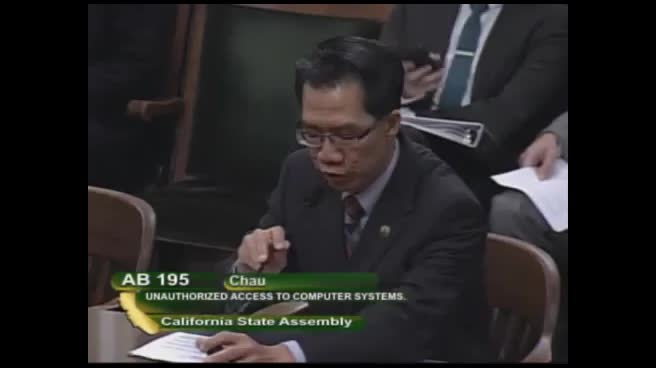
Bill Author

Bill Co-Author(s):