SB 790: Dreissenid mussel infestation prevention: grants.
- Session Year: 2017-2018
- House: Senate
- Latest Version Date: 2018-09-19
Existing law requires any person, or federal, state, or local agency, district, or authority that owns or manages a reservoir, as defined, where recreational, boating, or fishing activities are permitted, except a privately owned reservoir that is not open to the public, to assess the vulnerability of the reservoir for the introduction of nonnative dreissenid mussel species and to develop and implement a program designed to prevent the introduction of that species, as prescribed.
Existing law requires the owner of a vessel, as described, to register the vessel in accordance with prescribed requirements governing the registration and transfer of vessels. Existing law establishes a registration fee for vessels, and imposes an additional fee, known as the quagga and zebra mussel infestation prevention fee, in specified amounts, as determined by the Division of Boating and Waterways in the Department of Parks and Recreation, on a vessel required to pay that fee. Existing law requires that all revenues from the additional prevention fee be deposited into the Harbors and Watercraft Revolving Fund, and, upon appropriation, be expended for certain purposes relating to the prevention, control, and management of dreissenid mussel infestations. Existing law requires that a specified percentage of those revenues deposited into the fund from the prevention fee be made available to entities subject to the above-described requirements for reservoirs to be used for grants for the reasonable regulatory costs incident to the implementation of a dreissenid mussel infestation prevention plan.
This bill would additionally make any person or entity that manages any aspect of the water in a reservoir, as defined, where recreational, boating, or fishing activities are permitted, eligible for a grant to be used for the reasonable regulatory costs of implementation of a dreissenid mussel infestation prevention plan.
Existing law requires any person, or federal, state, or local agency, district, or authority that owns or manages a reservoir, as defined, where recreational, boating, or fishing activities are permitted, except a privately owned reservoir that is not open to the public, to assess the vulnerability of the reservoir for the introduction of nonnative dreissenid mussel species and to develop and implement a program designed to prevent the introduction of that species, as prescribed.
Existing law requires the owner of a vessel, as described, to register the vessel in accordance with prescribed requirements governing the registration and transfer of vessels. Existing law establishes a registration fee for vessels, and imposes an additional fee, known as the quagga and zebra mussel infestation prevention fee, in specified amounts, as determined by the Division of Boating and Waterways in the Department of Parks and Recreation, on a vessel required to pay that fee. Existing law requires that all revenues from the additional prevention fee be deposited into the Harbors and Watercraft Revolving Fund, and, upon appropriation, be expended for certain purposes relating to the prevention, control, and management of dreissenid mussel infestations. Existing law requires that a specified percentage of those revenues deposited into the fund from the prevention fee be made available to entities subject to the above-described requirements for reservoirs to be used for grants for the reasonable regulatory costs incident to the implementation of a dreissenid mussel infestation prevention plan.
This bill would additionally make any person or entity that manages any aspect of the water in a reservoir, as defined, where recreational, boating, or fishing activities are permitted, eligible for a grant to be used for the reasonable regulatory costs of implementation of a dreissenid mussel infestation prevention plan.
Existing law requires any person, or federal, state, or local agency, district, or authority that owns or manages a reservoir, as defined, where recreational, boating, or fishing activities are permitted, except a privately owned reservoir that is not open to the public, to assess the vulnerability of the reservoir for the introduction of nonnative dreissenid mussel species and to develop and implement a program designed to prevent the introduction of that species, as prescribed.
Existing law requires the owner of a vessel, as described, to register the vessel in accordance with prescribed requirements governing the registration and transfer of vessels. Existing law establishes a registration fee for vessels, and imposes an additional fee, known as the quagga and zebra mussel infestation prevention fee, in specified amounts, as determined by the Division of Boating and Waterways in the Department of Parks and Recreation, on a vessel required to pay that fee. Existing law requires that all revenues from the additional prevention fee be deposited into the Harbors and Watercraft Revolving Fund, and, upon appropriation, be expended for certain purposes relating to the prevention, control, and management of dreissenid mussel infestations. Existing law requires that a specified percentage of those revenues deposited into the fund from the prevention fee be made available to entities subject to the above-described requirements for reservoirs to be used for grants for the reasonable regulatory costs incident to the implementation of a dreissenid mussel infestation prevention plan.
This bill would additionally make any person or entity that manages any aspect of the water in a reservoir, as defined, where recreational, boating, or fishing activities are permitted, eligible for a grant to be used for the reasonable regulatory costs of implementation of a dreissenid mussel infestation prevention plan.
The Sherman Food, Drug, and Cosmetic Law, administered by the State Department of Public Health, regulates the packaging, labeling, and advertising of drugs and devices, and requires a manufacturer of any drug or device in the state to be licensed by the department. Existing law imposes various requirements on persons engaged in the provision of health care services in the state.This bill would, on and after January 1, 2019, prohibit a manufacturer of a prescribed product from offering or giving a gift to a health care provider. The bill would further prohibit a manufacturer of a prescribed product or an entity on behalf of a manufacturer of a prescribed product from providing a fee, payment, subsidy, or other economic benefit to a health care provider in connection with the providers participation in research, except as specified. The bill would define terms of its purposes, including, among others, the term gift. The bill would specify circumstances to which these prohibitions do not apply.Existing federal law, the Physician Payments Sunshine Act (Sunshine Act), requires manufacturers of specified drugs, devices, biologicals, or medical supplies to disclose to the federal Centers for Medicare and Medicaid Services payments or other transfers of value made to physicians or teaching hospitals.This bill would state the intent of the Legislature that the prohibitions and requirements described above complement and operate in conjunction with the Sunshine Act. The bill would state the intent of the Legislature to enact legislation similar to the Sunshine Act if the Sunshine Act is repealed or becomes inoperative.The Sherman Food, Drug, and Cosmetic Law, administered by the State Department of Public Health, regulates the packaging, labeling, and advertising of drugs and devices, and requires a manufacturer of any drug or device in the state to be licensed by the department. Existing law imposes various requirements on persons engaged in the provision of health care services in the state.
This bill would, on and after January 1, 2019, prohibit a manufacturer of a prescribed product from offering or giving a gift to a health care provider. The bill would further prohibit a manufacturer of a prescribed product or an entity on behalf of a manufacturer of a prescribed product from providing a fee, payment, subsidy, or other economic benefit to a health care provider in connection with the providers participation in research, except as specified. The bill would define terms of its purposes, including, among others, the term gift. The bill would specify circumstances to which these prohibitions do not apply.
Existing federal law, the Physician Payments Sunshine Act (Sunshine Act), requires manufacturers of specified drugs, devices, biologicals, or medical supplies to disclose to the federal Centers for Medicare and Medicaid Services payments or other transfers of value made to physicians or teaching hospitals.
This bill would state the intent of the Legislature that the prohibitions and requirements described above complement and operate in conjunction with the Sunshine Act. The bill would state the intent of the Legislature to enact legislation similar to the Sunshine Act if the Sunshine Act is repealed or becomes inoperative.
The Sherman Food, Drug, and Cosmetic Law, administered by the State Department of Public Health, regulates the packaging, labeling, and advertising of drugs and devices, and requires a manufacturer of any drug or device in the state to be licensed by the department. Existing law imposes various requirements on persons engaged in the provision of health care services in the state.
This bill would would, on and after January 1, 2019, prohibit a manufacturer of a prescribed product, as defined, product from offering or giving a gift to a health care provider. The bill would define a gift as anything of value provided for free to a health care provider, or a payment, food, entertainment, travel, subscription, advance, service, or anything else of value provided to a health care provider, unless it is a specified allowable expenditure or the health care provider reimburses the cost at fair market value. The bill would further prohibit a manufacturer of a prescribed product or an entity on behalf of a manufacturer of a prescribed product from providing a fee, payment, subsidy, or other economic benefit to a health care provider in connection with the providers participation in research, except as specified. The bill would define terms of its purposes, including, among others, the term gift. The bill would specify circumstances to which these prohibitions do not apply.
Existing federal law, the Physician Payments Sunshine Act (Sunshine Act), requires manufacturers of specified drugs, devices, biologicals, or medical supplies to disclose to the federal Centers for Medicare and Medicaid Services payments or other transfers of value made to physicians or teaching hospitals.
This bill would state the intent of the Legislature that the prohibitions and requirements described above complement and operate in conjunction with the Sunshine Act. The bill would state the intent of the Legislature to enact legislation similar to the Sunshine Act if the Sunshine Act is repealed or becomes inoperative.
The Sherman Food, Drug, and Cosmetic Law, administered by the State Department of Public Health, regulates the packaging, labeling, and advertising of drugs and devices, and requires a manufacturer of any drug or device in the state to be licensed by the department. Existing law imposes various requirements on persons engaged in the provision of health care services in the state.
This bill would prohibit a manufacturer of a prescribed product, as defined, from offering or giving a gift to a health care provider. The bill would define a gift as anything of value provided for free to a health care provider, or a payment, food, entertainment, travel, subscription, advance, service, or anything else of value provided to a health care provider, unless it is a specified allowable expenditure or the health care provider reimburses the cost at fair market value. The bill would prohibit a manufacturer of a prescribed product or an entity on behalf of a manufacturer of a prescribed product from providing a fee, payment, subsidy, or other economic benefit to a health care provider in connection with the providers participation in research. research, except as specified. The bill would specify circumstances to which these prohibitions do not apply. The bill would authorize the Attorney General to bring an action to enforce a violation of these prohibitions and to seek injunctive relief and imposition of a civil penalty for each violation, as specified.
Existing federal law, the Physician Payments Sunshine Act (Sunshine Act), requires manufacturers of specified drugs, devices, biologicals, or medical supplies to disclose to the federal Centers for Medicare and Medicaid Services payments or other transfers of value made to physicians or teaching hospitals.
This bill would state the intent of the Legislature that the prohibitions and requirements described above complement and operate in conjunction with the Sunshine Act. The bill would state the intent of the Legislature to enact legislation similar to the Sunshine Act if the Sunshine Act is repealed or becomes inoperative.
The Sherman Food, Drug, and Cosmetic Law, administered by the State Department of Public Health, regulates the packaging, labeling, and advertising of drugs and devices, and requires a manufacturer of any drug or device in the state to be licensed by the department. Existing law imposes various requirements on persons engaged in the provision of health care services in the state.
This bill would prohibit a manufacturer of a prescribed product or a wholesale distributor of medical devices, product, as defined, from offering or giving a gift to a health care provider. The bill would define a gift as anything of value provided for free to a health care provider, or a payment, food, entertainment, travel, subscription, advance, service, or anything else of value provided to a health care provider, unless it is a specified allowable expenditure or the health care provider reimburses the cost at fair market value. The bill would prohibit a manufacturer of a prescribed product or an entity on behalf of a manufacturer of a prescribed product from providing a fee, payment, subsidy, or other economic benefit to a health care provider in connection with the providers participation in research. The bill would specify circumstances to which these prohibitions do not apply. The bill would authorize the Attorney General to bring an action to enforce a violation of these prohibitions and to seek injunctive relief and imposition of a civil penalty for each violation, as specified.
Existing federal law, the Physician Payments Sunshine Act (Sunshine Act), requires manufacturers of specified drugs, devices, biologicals, or medical supplies to disclose to the federal Centers for Medicare and Medicaid Services payments or other transfers of value made to physicians or teaching hospitals.
This bill would state the intent of the Legislature that the prohibitions and requirements described above complement and operate in conjunction with the Sunshine Act. The bill would state the intent of the Legislature to enact legislation similar to the Sunshine Act if the Sunshine Act is repealed or becomes inoperative.
The Sherman Food, Drug, and Cosmetic Law, administered by the State Department of Public Health, regulates the packaging, labeling, and advertising of drugs and devices, and requires a manufacturer of any drug or device in the state to be licensed by the department. Existing law imposes various requirements on persons engaged in the provision of health care services in the state.
This bill would prohibit a manufacturer of a prescribed product or a wholesale distributor of medical devices, as defined, from offering or giving a gift to a health care provider. The bill would define a gift as anything of value provided for free to a health care provider, or a payment, food, entertainment, travel, subscription, advance, service, or anything else of value provided to a health care provider, unless it is a specified allowable expenditure or the health care provider reimburses the cost at fair market value. The bill would prohibit a manufacturer of a prescribed product or an entity on behalf of a manufacturer of a prescribed product from providing a fee, payment, subsidy, or other economic benefit to a health care provider in connection with the providers participation in research. The bill would specify circumstances to which these prohibitions do not apply. The bill would authorize the Attorney General to bring an action to enforce a violation of these prohibitions and to seek injunctive relief and imposition of a civil penalty for each violation, as specified. The bill would require a health care professional, as defined, who is a member of a committee that sets formularies or develops clinical guidelines and who also serves as a speaker or commercial consultant for a manufacturer of prescribed products to disclose to the committee his or her relationship with the manufacturer, as specified.
Existing federal law, the Physician Payments Sunshine Act (Sunshine Act), requires manufacturers of specified drugs, devices, biologicals, or medical supplies to disclose to the federal Centers for Medicare and Medicaid Services payments or other transfers of value made to physicians or teaching hospitals.
This bill would state the intent of the Legislature that the prohibitions and requirements described above complement and operate in conjunction with the Sunshine Act. The bill would state the intent of the Legislature to enact legislation similar to the Sunshine Act if the Sunshine Act is repealed or becomes inoperative.
The Sherman Food, Drug, and Cosmetic Law, administered by the Department of Public Health, regulates the packaging, labeling, and advertising of drugs and devices, and requires a manufacturer of any drug or device in the state to be licensed by the department. Existing law imposes various requirements on persons engaged in the provision of health care services in the state.
This bill would prohibit a manufacturer of a prescribed product or a wholesale distributor of medical devices, as defined, from offering or giving a gift to a health care provider. The bill would define a gift as anything of value provided for free to a health care provider, or a payment, food, entertainment, travel, subscription, advance, service, or anything else of value provided to a health care provider, unless it is a specified allowable expenditure or the health care provider reimburses the cost at fair market value. The bill would prohibit a manufacturer of a prescribed product or an entity on behalf of a manufacturer of a prescribed product from providing a fee, payment, subsidy, or other economic benefit to a health care provider in connection with the providers participation in research. The bill would specify circumstances to which these prohibitions do not apply. The bill would authorize the Attorney General to bring an action to enforce a violation of these prohibitions and to seek injunctive relief and imposition of a civil penalty for each violation, as specified. The bill would require a health care professional, as defined, who is a member of a committee that sets formularies or develops clinical guidelines and who also serves as a speaker or commercial consultant for a manufacturer of prescribed products to disclose to the committee his or her relationship with the manufacturer, as specified.
The Medical Practice Act provides for the licensure and regulation of physicians and surgeons by the Medical Board of California and requires the board to adopt and administer standards for the continuing education of physicians and surgeons, as specified.This bill would make nonsubstantive changes to that continuing education provision.The Medical Practice Act provides for the licensure and regulation of physicians and surgeons by the Medical Board of California and requires the board to adopt and administer standards for the continuing education of physicians and surgeons, as specified.
This bill would make nonsubstantive changes to that continuing education provision.
Any person or entity that manages any aspect of the water in a reservoir, as defined in Section 6004.5 of the Water Code, where recreational, boating, or fishing activities are permitted, shall be eligible to receive a grant under paragraph (3) of subdivision (a) of Section 676 for the reasonable regulatory costs incident to the implementation of a dreissenid mussel infestation prevention plan.
Any person or entity that manages any aspect of the water in a reservoir, as defined in Section 6004.5 of the Water Code, where recreational, boating, or fishing activities are permitted, shall be eligible to receive a grant under paragraph (3) of subdivision (a) of Section 676 for the reasonable regulatory costs incident to the implementation of a dreissenid mussel infestation prevention plan.
Any person or entity that manages any aspect of the water in a reservoir, as defined in Section 6004.5 of the Water Code, where recreational, boating, or fishing activities are permitted, shall be eligible to receive a grant under paragraph (3) of subdivision (a) of Section 676 for the reasonable regulatory costs incident to the implementation of a dreissenid mussel infestation prevention plan.
SECTION 1.Division 117 (commencing with Section 150300) is added to the Health and Safety Code, to read:117.Expenditures by Manufacturers of Prescribed Products150300.For the purposes of this division, the following definitions shall apply:(a)Allowable expenditure means any of the following:(1)Payment by a manufacturer of a prescribed product to the sponsor of a significant educational, medical, scientific, or policymaking conference or seminar, provided that all of the following conditions are satisfied:(A)The payment is not made directly to a health care professional or pharmacist.(B)Funding is used solely for bona fide educational purposes, except that the sponsor may, in the sponsors discretion, apply some or all of the funding to provide meals and other food for all conference participants.(C)All program content is objective, free from industry control, and does not promote specific products.(2)Honoraria and payment of the expenses of a health care professional who serves on the faculty at a bona fide educational, medical, scientific, or policymaking conference or seminar, only if all of the following conditions are satisfied:(A)The honoraria or payment is governed by an explicit contract with specific deliverables that are restricted to medical issues, not marketing activities.(B)Consistent with federal law, the content of the presentation, including slides and written materials, is determined or at a minimum is reviewed and approved by the health care professional.(3)For a bona fide clinical trial or a research project that constitutes a systematic investigation, is designed to develop or contribute to general knowledge, and reasonably can be considered to be of significant interest or value to scientists or health care professionals working in the particular field of inquiry, all of the following:(A)Compensation for services provided by investigators, health care professionals, or health care providers in connection with the bona fide clinical trial or research project.(B)Expenses paid on behalf of investigators, health care professionals, or health care providers in connection with the bona fide clinical trial or research project.(C)Expenses paid by the investigators, health care professionals, or health care providers in connection with the bona fide clinical trial or research project.(D)Materials and supplies used in connection with the bona fide clinical trial or research project.(4)Payment or reimbursement for reasonable expenses, including travel and lodging-related expenses, necessary for technical training of individual health care professionals on the administration of a prescribed product, if the commitment to provide those expenses and the amounts or categories of reasonable expenses to be paid are described in a written agreement between the health care provider and the manufacturer.(5)Public health initiatives to develop replicable and sustainable model programs that embody best practices in disease screening and linkages to care.(6)Royalties and licensing fees paid to health care providers in return for contractual rights to use or purchase a patented or otherwise legally recognized discovery for which the health care provider holds an ownership right. This also includes royalties, licensing fees, and financial transactions related to joint ventures and partnerships with health care providers.(7)A payment to a health care provider for participation in bona fide marketing research conducted by a third party, only if the payments are made by that third party and the sponsoring manufacturer is not informed of the identity of the participating health care provider.(8)Other reasonable fees, payments, subsidies, or other economic benefits provided by a manufacturer of a prescribed product at fair market value.(9)The payment of reasonable expenses of an individual related to the interview of the individual by a manufacturer of prescribed products in connection with a bona fide employment opportunity or for health care services on behalf of an employee of the manufacturer.(10)Provision of meals for a health care provider that do not exceed two hundred fifty dollars ($250) per person, per year in value in addition to payments otherwise permitted under this subdivision.(b)Bona fide clinical trial means an FDA-reviewed clinical trial that constitutes research as defined in Section 46.102 of Title 45 of the Code of Federal Regulations that can be reasonably considered to be of interest to scientists or health care professionals working in the particular field of inquiry.(c)Bona fide marketing research means the collection and analysis of data regarding opinions, needs, awareness, knowledge, views, experiences, and behaviors of a population, through the development and administration of surveys, interviews, focus groups, polls, observation, or other research methodologies, in which no sales, promotional, or marketing efforts are involved and through which there is no attempt to influence a participants attitudes or behavior.(d)Clinical trial means a study that does either of the following:(1)Assesses the safety, efficacy, or effectiveness of prescribed products administered alone or in combination with other prescribed products or other therapies.(2)Assesses the relative safety or efficacy of prescribed products in comparison with other prescribed products or therapies.(e)Free clinic means a health care facility operated by a nonprofit private entity that satisfies all of the following conditions:(1)In providing health care, the health care facility does not accept reimbursement from any third-party payer, including reimbursement from any insurance policy, health plan, or federal or state health benefits program that is individually determined.(2)In providing health care, the health care facility either does not impose charges on patients to whom service is provided, or imposes charges on patients according to their ability to pay.(3)The health care facility may accept voluntary donations from patients for the provision of health care services.(4)The health care facility is licensed or certified to provide health services under applicable law.(f)Gift means a payment, food, entertainment, travel, subscription, advance, service, or anything else of value provided at no cost or less than full market value to a health care provider. Notwithstanding the foregoing, gift does not include any allowable expenditure as defined in subdivision (a), any payment, food, entertainment, travel, subscription, advance, service, or anything else of value for which the health care provider reimburses the cost at fair market value, or any payment made in compliance with the Political Reform Act of 1974 (Title 9 (commencing with Section 81000) of the Government Code) except a gift made under that act.(g)Health benefit plan administrator means the person or entity who sets formularies on behalf of an employer or health insurer.(h)(1)Health care professional means any of the following:(A)A person who is authorized by law to prescribe or to recommend prescribed products, who regularly practices in the state, and who is either licensed by the state to provide or is otherwise lawfully providing health care in the state.(B)A partnership or corporation made up of the persons described in subparagraph (A).(C)An officer, employee, agent, or contractor of a person described in subparagraph (A). who is acting in the course and scope of employment, of an agency, or of a contract related to or supportive of the provision of health care to individuals.(2)A health care professional shall not be construed to include individuals employed by a manufacturer, working as a full-time contractor for a manufacturer or working as a full-time employee or contractor of a clinical research organization or business services firm, regardless of licensure, provided that the individual does not treat or otherwise render health care services to patients or hold a position to recommend prescribed products for a formulary, organization, or individuals.(i)Health care provider means a health care professional, hospital, nursing home, pharmacist, health benefit plan administrator, hospital foundation that is organized as a nonprofit entity separate from a hospital, or any other person authorized to dispense or purchase for distribution prescribed products in the state. A health care provider is not a veterinarian.(j)Investigator means any individual who is involved in conducting a bona fide clinical trial or research project.(k)Manufacturer means a pharmaceutical manufacturer, biological product manufacturer, or any other person who is engaged in the production, preparation, propagation, compounding, processing, marketing, packaging, repacking, distributing, or labeling of prescribed products. Manufacturer does not include a wholesaler, as defined in Section 4043 of the Business and Professions Code, a pharmacist, as defined in Section 4036 of the Business and Professions Code, or a pharmacy, as defined in Section 4037 of the Business and Professions Code.(l)Marketing means promoting, detailing, or any activity that is intended to be used or is used to influence sales or market share or to evaluate the effectiveness of a professional sales force.(m)Pharmaceutical manufacturer means either of the following:(1)An entity that is engaged in the production, preparation, propagation, compounding, conversion, or processing of prescription drugs, whether directly or indirectly by extraction from substances of natural origin, independently by means of chemical synthesis, or by a combination of extraction and chemical synthesis.(2)An entity engaged in the packaging, repackaging, labeling, relabeling, or distribution of prescription drugs.(n)Prescribed product means a drug as defined in Section 321 of Title 21 of the United States Code, a compounded drug or drugs, a biological product as defined in Section 262 of Title 42 of the United States Code for human use, or a combination product as defined in subdivision (e) of Section 3.2 of Title 21 of the Code of Federal Regulations.(o)Sample means a unit of a prescription drug or biological product that is not intended to be sold and is intended to promote the sale of the drug or product and includes starter packs and coupons or other vouchers that enable an individual to receive a prescribed product free of charge or at a discounted price. Sample does not include prescribed products distributed free of charge or at a discounted price pursuant to a manufacturer-sponsored or manufacturer-funded patient assistance program.(p)Research or research project means a systematic investigation, including research development, testing, and evaluation, designed to develop or contribute to generalized knowledge, whether or not it is conducted or supported under a program that is considered research for other purposes.(q)Significant educational, scientific, or policymaking conference or seminar means a nonmarketing educational, scientific, or policymaking conference or seminar that is national, regional, or within the State of California and that satisfies either of the following:(1)The conference or seminar is accredited by the Accreditation Council for Continuing Medical Education or a comparable organization or is presented by an approved sponsor of continuing education, only if the sole sponsor is not a manufacturer of prescribed products.(2)The conference or seminar offers continuing education credit, features multiple presenters on scientific research, or is authorized by the sponsor to recommend or make policy.150302.A manufacturer of a prescribed product or an agent thereof shall not offer or give a gift to a health care provider.150304.Except as described in paragraph (3) of subdivision (a) of Section 150300, a manufacturer or an entity on behalf of a manufacturer shall not provide a fee, payment, subsidy, or other economic benefit to a health care provider in connection with the providers participation in research.150306.Sections 150302 and 150304 shall not apply to the following:(a)Samples of a prescribed product or reasonable quantities of an over-the-counter drug, an item of medical food as defined in Section 360ee of Title 21 of the United States Code, or infant formula as defined in Section 321 of Title 21 of the United States Code, that are provided to a health care provider for free distribution to patients.(b)The provision, distribution, dissemination, or receipt of peer-reviewed academic, scientific, or clinical articles or journals and other items that serve a genuine educational function provided to a health care provider for the benefit of patients.(c)Scholarship or other support for medical students, residents, and fellows to attend a significant educational, scientific, or policymaking conference or seminar of a national, regional, or specialty medical or other professional association if the recipient of the scholarship or other support is selected by the association.(d)Rebates and discounts for prescribed products provided in the normal course of business.(e)The provision to a free clinic of financial donations or of free prescription drugs, over-the-counter drugs, biological products, combination products, medical food, or infant formula.(f)Prescribed products distributed free of charge or at a discounted price pursuant to a manufacturer-sponsored or manufactured-funded patient assistance program.(g)Fellowship salary support provided to fellows through grants from manufacturers of prescribed products, provided that all of the following conditions are satisfied:(1)The grants are applied for by an academic institution or hospital or clinical research site.(2)The institution, hospital, or clinical research site selects the recipient fellows.(3)The manufacturer imposes no further demands or limits on the institutions, hospitals, clinical research sites, or fellows use of the funds.(4)Fellowships are not named for a manufacturer and no individual recipients fellowship is attributed to a particular manufacturer of prescribed products.(h)The provision of coffee or other snacks or refreshments at a booth at a conference or seminar.150308.It is the intent of the Legislature that the requirements and prohibitions of this division complement and operate in conjunction with the federal Physician Payments Sunshine Act (42 U.S.C. Sec. 1320a-7h). If the Physician Payments Sunshine Act is repealed or becomes inoperative, it is the intent of the Legislature to enact similar legislation requiring manufacturers to disclose payments or other transfers of value made to health care providers in the state.150310.This division shall become operative on January 1, 2019.For the purposes of this division, the following definitions shall apply:
(a)Allowable expenditure means any of the following:
(1)Payment by a manufacturer of a prescribed product to the sponsor of a significant educational, medical, scientific, or policymaking conference or seminar, provided that all of the following conditions are satisfied:
(A)The payment is not made directly to a health care professional or pharmacist.
(B)Funding is used solely for bona fide educational purposes, except that the sponsor may, in the sponsors discretion, apply some or all of the funding to provide meals and other food for all conference participants.
(C)All program content is objective, free from industry control, and does not promote specific products.
(2)Honoraria and payment of the expenses of a health care professional who serves on the faculty at a bona fide educational, medical, scientific, or policymaking conference or seminar, only if all of the following conditions are satisfied:
(A)The honoraria or payment is governed by an explicit contract with specific deliverables that are restricted to medical issues, not marketing activities.
(B)Consistent with federal law, the content of the presentation, including slides and written materials, is determined or at a minimum is reviewed and approved by the health care professional.
(3)For a bona fide clinical trial or a research project that constitutes a systematic investigation, is designed to develop or contribute to general knowledge, and reasonably can be considered to be of significant interest or value to scientists or health care professionals working in the particular field of inquiry, all of the following:
(A)Compensation for services provided by investigators, health care professionals, or health care providers in connection with the bona fide clinical trial or research project.
(B)Expenses paid on behalf of investigators, health care professionals, or health care providers in connection with the bona fide clinical trial or research project.
(C)Expenses paid by the investigators, health care professionals, or health care providers in connection with the bona fide clinical trial or research project.
(D)Materials and supplies used in connection with the bona fide clinical trial or research project.
(4)Payment or reimbursement for reasonable expenses, including travel and lodging-related expenses, necessary for technical training of individual health care professionals on the administration of a prescribed product, if the commitment to provide those expenses and the amounts or categories of reasonable expenses to be paid are described in a written agreement between the health care provider and the manufacturer.
(5)Public health initiatives to develop replicable and sustainable model programs that embody best practices in disease screening and linkages to care.
(6)Royalties and licensing fees paid to health care providers in return for contractual rights to use or purchase a patented or otherwise legally recognized discovery for which the health care provider holds an ownership right. This also includes royalties, licensing fees, and financial transactions related to joint ventures and partnerships with health care providers.
(7)A payment to a health care provider for participation in bona fide marketing research conducted by a third party, only if the payments are made by that third party and the sponsoring manufacturer is not informed of the identity of the participating health care provider.
(8)Other reasonable fees, payments, subsidies, or other economic benefits provided by a manufacturer of a prescribed product at fair market value.
(9)The payment of reasonable expenses of an individual related to the interview of the individual by a manufacturer of prescribed products in connection with a bona fide employment opportunity or for health care services on behalf of an employee of the manufacturer.
(10)Provision of meals for a health care provider that do not exceed two hundred fifty dollars ($250) per person, per year in value in addition to payments otherwise permitted under this subdivision.
(b)Bona fide clinical trial means an FDA-reviewed clinical trial that constitutes research as defined in Section 46.102 of Title 45 of the Code of Federal Regulations that can be reasonably considered to be of interest to scientists or health care professionals working in the particular field of inquiry.
(c)Bona fide marketing research means the collection and analysis of data regarding opinions, needs, awareness, knowledge, views, experiences, and behaviors of a population, through the development and administration of surveys, interviews, focus groups, polls, observation, or other research methodologies, in which no sales, promotional, or marketing efforts are involved and through which there is no attempt to influence a participants attitudes or behavior.
(d)Clinical trial means a study that does either of the following:
(1)Assesses the safety, efficacy, or effectiveness of prescribed products administered alone or in combination with other prescribed products or other therapies.
(2)Assesses the relative safety or efficacy of prescribed products in comparison with other prescribed products or therapies.
(e)Free clinic means a health care facility operated by a nonprofit private entity that satisfies all of the following conditions:
(1)In providing health care, the health care facility does not accept reimbursement from any third-party payer, including reimbursement from any insurance policy, health plan, or federal or state health benefits program that is individually determined.
(2)In providing health care, the health care facility either does not impose charges on patients to whom service is provided, or imposes charges on patients according to their ability to pay.
(3)The health care facility may accept voluntary donations from patients for the provision of health care services.
(4)The health care facility is licensed or certified to provide health services under applicable law.
(f)Gift means a payment, food, entertainment, travel, subscription, advance, service, or anything else of value provided at no cost or less than full market value to a health care provider. Notwithstanding the foregoing, gift does not include any allowable expenditure as defined in subdivision (a), any payment, food, entertainment, travel, subscription, advance, service, or anything else of value for which the health care provider reimburses the cost at fair market value, or any payment made in compliance with the Political Reform Act of 1974 (Title 9 (commencing with Section 81000) of the Government Code) except a gift made under that act.
(g)Health benefit plan administrator means the person or entity who sets formularies on behalf of an employer or health insurer.
(h)(1)Health care professional means any of the following:
(A)A person who is authorized by law to prescribe or to recommend prescribed products, who regularly practices in the state, and who is either licensed by the state to provide or is otherwise lawfully providing health care in the state.
(B)A partnership or corporation made up of the persons described in subparagraph (A).
(C)An officer, employee, agent, or contractor of a person described in subparagraph (A). who is acting in the course and scope of employment, of an agency, or of a contract related to or supportive of the provision of health care to individuals.
(2)A health care professional shall not be construed to include individuals employed by a manufacturer, working as a full-time contractor for a manufacturer or working as a full-time employee or contractor of a clinical research organization or business services firm, regardless of licensure, provided that the individual does not treat or otherwise render health care services to patients or hold a position to recommend prescribed products for a formulary, organization, or individuals.
(i)Health care provider means a health care professional, hospital, nursing home, pharmacist, health benefit plan administrator, hospital foundation that is organized as a nonprofit entity separate from a hospital, or any other person authorized to dispense or purchase for distribution prescribed products in the state. A health care provider is not a veterinarian.
(j)Investigator means any individual who is involved in conducting a bona fide clinical trial or research project.
(k)Manufacturer means a pharmaceutical manufacturer, biological product manufacturer, or any other person who is engaged in the production, preparation, propagation, compounding, processing, marketing, packaging, repacking, distributing, or labeling of prescribed products. Manufacturer does not include a wholesaler, as defined in Section 4043 of the Business and Professions Code, a pharmacist, as defined in Section 4036 of the Business and Professions Code, or a pharmacy, as defined in Section 4037 of the Business and Professions Code.
(l)Marketing means promoting, detailing, or any activity that is intended to be used or is used to influence sales or market share or to evaluate the effectiveness of a professional sales force.
(m)Pharmaceutical manufacturer means either of the following:
(1)An entity that is engaged in the production, preparation, propagation, compounding, conversion, or processing of prescription drugs, whether directly or indirectly by extraction from substances of natural origin, independently by means of chemical synthesis, or by a combination of extraction and chemical synthesis.
(2)An entity engaged in the packaging, repackaging, labeling, relabeling, or distribution of prescription drugs.
(n)Prescribed product means a drug as defined in Section 321 of Title 21 of the United States Code, a compounded drug or drugs, a biological product as defined in Section 262 of Title 42 of the United States Code for human use, or a combination product as defined in subdivision (e) of Section 3.2 of Title 21 of the Code of Federal Regulations.
(o)Sample means a unit of a prescription drug or biological product that is not intended to be sold and is intended to promote the sale of the drug or product and includes starter packs and coupons or other vouchers that enable an individual to receive a prescribed product free of charge or at a discounted price. Sample does not include prescribed products distributed free of charge or at a discounted price pursuant to a manufacturer-sponsored or manufacturer-funded patient assistance program.
(p)Research or research project means a systematic investigation, including research development, testing, and evaluation, designed to develop or contribute to generalized knowledge, whether or not it is conducted or supported under a program that is considered research for other purposes.
(q)Significant educational, scientific, or policymaking conference or seminar means a nonmarketing educational, scientific, or policymaking conference or seminar that is national, regional, or within the State of California and that satisfies either of the following:
(1)The conference or seminar is accredited by the Accreditation Council for Continuing Medical Education or a comparable organization or is presented by an approved sponsor of continuing education, only if the sole sponsor is not a manufacturer of prescribed products.
(2)The conference or seminar offers continuing education credit, features multiple presenters on scientific research, or is authorized by the sponsor to recommend or make policy.
150302.A manufacturer of a prescribed product or an agent thereof shall not offer or give a gift to a health care provider.
150304.Except as described in paragraph (3) of subdivision (a) of Section 150300, a manufacturer or an entity on behalf of a manufacturer shall not provide a fee, payment, subsidy, or other economic benefit to a health care provider in connection with the providers participation in research.
150306.Sections 150302 and 150304 shall not apply to the following:
(a)Samples of a prescribed product or reasonable quantities of an over-the-counter drug, an item of medical food as defined in Section 360ee of Title 21 of the United States Code, or infant formula as defined in Section 321 of Title 21 of the United States Code, that are provided to a health care provider for free distribution to patients.
(b)The provision, distribution, dissemination, or receipt of peer-reviewed academic, scientific, or clinical articles or journals and other items that serve a genuine educational function provided to a health care provider for the benefit of patients.
(c)Scholarship or other support for medical students, residents, and fellows to attend a significant educational, scientific, or policymaking conference or seminar of a national, regional, or specialty medical or other professional association if the recipient of the scholarship or other support is selected by the association.
(d)Rebates and discounts for prescribed products provided in the normal course of business.
(e)The provision to a free clinic of financial donations or of free prescription drugs, over-the-counter drugs, biological products, combination products, medical food, or infant formula.
(f)Prescribed products distributed free of charge or at a discounted price pursuant to a manufacturer-sponsored or manufactured-funded patient assistance program.
(g)Fellowship salary support provided to fellows through grants for from manufacturers of prescribed products, provided that all of the following conditions are satisfied:
(1)The grants are applied for by an academic institution or hospital or clinical research site.
(2)The institution, hospital, or clinical research site selects the recipient fellows.
(3)The manufacturer imposes no further demands or limits on the institutions, hospitals, clinical research sites, or fellows use of the funds.
(4)Fellowships are not named for a manufacturer and no individual recipients fellowship is attributed to a particular manufacturer of prescribed products.
(h)The provision of coffee or other snacks or refreshments at a booth at a conference or seminar.
150308.It is the intent of the Legislature that the requirements and prohibitions of this division complement and operate in conjunction with the federal Physician Payments Sunshine Act (42 U.S.C. Sec. 1320a-7h). If the Physician Payments Sunshine Act is repealed or becomes inoperative, it is the intent of the Legislature to enact similar legislation requiring manufacturers to disclose payments or other transfers of value made to health care providers in the state.
150310.This division shall become operative on January 1, 2019.
For the purposes of this division, the following definitions shall apply:
(a)Allowable expenditure means any of the following:
(1)Payment by a manufacturer of a prescribed product to the sponsor of a significant educational, medical, scientific, or policymaking conference or seminar, provided that all of the following conditions are satisfied:
(A)The payment is not made directly to a health care professional or pharmacist.
(B)Funding is used solely for bona fide educational purposes, except that the sponsor may, in the sponsors discretion, apply some or all of the funding to provide meals and other food for all conference participants.
(C)All program content is objective, free from industry control, and does not promote specific products.
(2)Honoraria and payment of the expenses of a health care professional who serves on the faculty at a bona fide educational, medical, scientific, or policymaking conference or seminar, provided that only if all of the following conditions are satisfied:
(A)The honoraria or payment is governed by an explicit contract with specific deliverables which that are restricted to medical issues, not marketing activities.
(B)Consistent with federal law, the content of the presentation, including slides and written materials, is determined or at a minimum is reviewed and approved by the health care professional.
(3)For a bona fide clinical trial or a research project that constitutes a systematic investigation, is designed to develop or contribute to general knowledge, and reasonably can be considered to be of significant interest or value to scientists or health care professionals working in the particular field of inquiry, all of the following:
(A)Compensation for services provided by investigators, health care professionals, or health care entities providers in connection with the bona fide clinical trial or research project.
(B)Expenses paid on behalf of investigators, health care professionals, or health care entities providers in connection with the bona fide clinical trial or research project.
(C)Expenses paid by the investigators, health care professionals, or health care entities providers in connection with the bona fide clinical trial or research project.
(D)Materials and supplies used in connection with the bona fide clinical trial or research project.
(4)Payment or reimbursement for reasonable expenses, including travel and lodging-related expenses, necessary for technical training of individual health care professionals on the administration of a prescribed product, if the commitment to provide those expenses and the amounts or categories of reasonable expenses to be paid are described in a written agreement between the health care provider and the manufacturer.
(5)Public health initiatives to develop replicable and sustainable model programs that embody best practices in disease screening and linkages to care.
(4)(6)Royalties and licensing fees paid to health care providers in return for contractual rights to use or purchase a patented or otherwise legally recognized discovery for which the health care provider holds an ownership right. This also includes royalties, licensing fees, and financial transactions related to joint ventures and partnerships with health care providers.
(7)A payment to a health care provider for participation in bona fide marketing research conducted by a third party, only if the payments are made by that third party and the sponsoring manufacturer is not informed of the identity of the participating provider.
(8)Other reasonable fees, payments, subsidies, or other economic benefits provided by a manufacturer of a prescribed product at fair market value.
(5)(9)The payment of reasonable expenses of an individual related to the interview of the individual by a manufacturer of prescribed products in connection with a bona fide employment opportunity or for health care services on behalf of an employee of the manufacturer.
(6)(10)Provision of meals for a health care provider that do not exceed two hundred fifty dollars ($250) per person, per year in value. value in addition to payments otherwise permitted under this subdivision.
(b)Bona fide clinical trial means an FDA-reviewed clinical trial that constitutes research as defined in Section 46.102 of Title 45 of the Code of Federal Regulations that can be reasonably considered to be of interest to scientists or health care professionals working in the particular field of inquiry.
(c)Bona fide marketing research means the collection and analysis of data regarding opinions, needs, awareness, knowledge, views, experiences, and behaviors of a population, through the development and administration of surveys, interviews, focus groups, polls, observation, or other research methodologies, in which no sales, promotional, or marketing efforts are involved and through which there is no attempt to influence a participants attitudes or behavior.
(c)(d)Clinical trial means a study that does either of the following:
(1)Assesses the safety or efficacy safety, efficacy, or effectiveness of prescribed products administered alone or in combination with other prescribed products or other therapies.
(2)Assesses the relative safety or efficacy of prescribed products in comparison with other prescribed products or therapies.
(d)(e)Free clinic means a health care facility operated by a nonprofit private entity that satisfies all of the following conditions:
(1)In providing health care, the health care facility does not accept reimbursement from any third-party payer, including reimbursement from any insurance policy, health plan, or federal or state health benefits program that is individually determined.
(2)In providing health care, the health care facility either does not impose charges on patients to whom service is provided, or imposes charges on patients according to their ability to pay.
(3)The health care facility may accept voluntary donations from patients for the provision of health care services.
(4)The health care facility is licensed or certified to provide health services under applicable law.
(e)(f)Gift means either of the following:
(1)Anything of value provided for free to a health care provider.(2)A a payment, food, entertainment, travel, subscription, advance, service, or anything else of value provided at no cost or less than full market value to a health care provider, unless it is an allowable expenditure as defined in subdivision (a) or the health care provider reimburses the cost at fair market value. provider. Notwithstanding the foregoing, gift does not include any allowable expenditure as defined in subdivision (a), any payment, food, entertainment, travel, subscription, advance, service, or anything else of value for which the health care provider reimburses the cost at fair market value, or any payment made in compliance with the Political Reform Act of 1974 (Title 9 (commencing with Section 81000) of the Government Code) except a gift made under that act.
(f)(g)Health benefit plan administrator means the person or entity who sets formularies on behalf of an employer or health insurer.
(g)Health(h)(1)Health care professional means any of the following:
(1)(A)A person who is authorized by law to prescribe or to recommend prescribed products, who regularly practices in the state, and who is either licensed by the state to provide or is otherwise lawfully providing health care in the state.
(2)(B)A partnership or corporation made up of the persons described in paragraph (1). subparagraph (A).
(3)(C)An officer, employee, agent, or contractor of a person described in paragraph (1) subparagraph (A). who is acting in the course and scope of employment, of an agency, or of a contract related to or supportive of the provision of health care to individuals.
(2)A health care professional shall not be construed to include individuals employed by a manufacturer, working as a full-time contractor for a manufacturer or working as a full-time employee or contractor of a clinical research organization or business services firm, regardless of licensure, provided that the individual does not treat or otherwise render health care services to patients or hold a position to recommend prescribed products for a formulary, organization, or individuals.
(h)(i)Health care provider means a health care professional, hospital, nursing home, pharmacist, health benefit plan administrator, hospital foundation that is organized as a nonprofit entity separate from a hospital, or any other person authorized to dispense or purchase for distribution prescribed products in the state. Health care provider does not include a hospital foundation that is organized as a nonprofit entity separate from a hospital. A health care provider is not a veterinarian.
(j)Investigator means any individual who is involved in conducting a bona fide clinical trial or research project.
(i)(k)Manufacturer means a pharmaceutical manufacturer, biological product manufacturer, or any other person who is engaged in the production, preparation, propagation, compounding, processing, marketing, packaging, repacking, distributing, or labeling of prescribed products. Manufacturer does not include a wholesale distributor of biological products, a retailer, or a pharmacist. Manufacturer does not include a wholesaler, as defined in Section 4043 of the Business and Professions Code, a pharmacist, as defined in Section 4036 of the Business and Professions Code, or a pharmacy, as defined in Section 4037 of the Business and Professions Code.
(j)(l)Marketing means promoting, detailing, or any activity that is intended to be used or is used to influence sales or market share or to evaluate the effectiveness of a professional sales force.
(k)(m)Pharmaceutical manufacturer means either of the following:
(1)An entity that is engaged in the production, preparation, propagation, compounding, conversion, or processing of prescription drugs, whether directly or indirectly by extraction from substances of natural origin, independently by means of chemical synthesis, or by a combination of extraction and chemical synthesis.
(2)An entity engaged in the packaging, repackaging, labeling, relabeling, or distribution of prescription drugs.
(l)(n)Prescribed product means a drug as defined in Section 321 of Title 21 of the United States Code, a compounded drug or drugs, a biological product as defined in Section 262 of Title 42 of the United States Code for human use, or a combination product as defined in subdivision (e) of Section 3.2 of Title 21 of the Code of Federal Regulations, but shall not include products that have a medical device as part of the combination. Regulations.
(m)(o)Sample means a unit of a prescription drug or biological product that is not intended to be sold and is intended to promote the sale of the drug or product and includes starter packs and coupons or other vouchers that enable an individual to receive a prescribed product free of charge or at a discounted price. Sample does not include prescribed products distributed free of charge or at a discounted price pursuant to a manufacturer-sponsored or manufacturer-funded patient assistance program.
(n)Significant educational, scientific, or policymaking conference or seminar means an educational, scientific, or policymaking conference or seminar that satisfies both of the following:(1)The conference or seminar is accredited by the Accreditation Council for Continuing Medical Education or a comparable organization or is presented by an approved sponsor of continuing education, provided that the sponsor is not a manufacturer of prescribed products.(2)The conference or seminar offers continuing education credit, features multiple presenters on scientific research, or is authorized by the sponsor to recommend or make policy.(p)Research or research project means a systematic investigation, including research development, testing, and evaluation, designed to develop or contribute to generalized knowledge, whether or not it is conducted or supported under a program that is considered research for other purposes.
(q)Significant educational, scientific, or policymaking conference or seminar means a nonmarketing educational, scientific, or policymaking conference or seminar that is national, regional, or within the State of California and that satisfies either of the following:
(1)The conference or seminar is accredited by the Accreditation Council for Continuing Medical Education or a comparable organization or is presented by an approved sponsor of continuing education, only if the sole sponsor is not a manufacturer of prescribed products.
(2)The conference or seminar offers continuing education credit, features multiple presenters on scientific research, or is authorized by the sponsor to recommend or make policy.
150302.A manufacturer of a prescribed product or an agent thereof, thereof shall not offer or give a gift to a health care provider.
150304.Except as described in paragraph (3) of subdivision (a) of Section 150300, a manufacturer or an entity on behalf of a manufacturer shall not provide a fee, payment, subsidy, or other economic benefit to a health care provider in connection with the providers participation in research.
150306.Sections 150302 and 150304 shall not apply to the following:
(a)Samples of a prescribed product or reasonable quantities of an over-the-counter drug, an item of medical food as defined in Section 360ee of Title 21 of the United States Code, or infant formula as defined in Section 321 of Title 21 of the United States Code, that are provided to a health care provider for free distribution to patients.
(b)The provision, distribution, dissemination, or receipt of peer-reviewed academic, scientific, or clinical articles or journals and other items that serve a genuine educational function provided to a health care provider for the benefit of patients.
(c)Scholarship or other support for medical students, residents, and fellows to attend a significant educational, scientific, or policymaking conference or seminar of a national, regional, or specialty medical or other professional association if the recipient of the scholarship or other support is selected by the association.
(d)Rebates and discounts for prescribed products provided in the normal course of business.
(e)Labels approved by the federal Food and Drug Administration for prescribed products.(f)(e)The provision to a free clinic of financial donations or of free prescription drugs, over-the-counter drugs, biological products, combination products, medical food, or infant formula.
(g)(f)Prescribed products distributed free of charge or at a discounted price pursuant to a manufacturer-sponsored or manufactured-funded patient assistance program.
(h)(g)Fellowship salary support provided to fellows through grants for manufacturers of prescribed products, provided that all of the following conditions are satisfied:
(1)The grants are applied for by an academic institution or hospital. hospital or clinical research site.
(2)The institution or hospital institution, hospital, or clinical research site selects the recipient fellows.
(3)The manufacturer imposes no further demands or limits on the institutions, hospitals, clinical research sites, or fellows use of the funds.
(4)Fellowships are not named for a manufacturer and no individual recipients fellowship is attributed to a particular manufacturer of prescribed products.
(h)The provision of coffee or other snacks or refreshments at a booth at a conference or seminar.
150310.150308.It is the intent of the Legislature that the requirements and prohibitions of this division complement and operate in conjunction with the federal Physician Payments Sunshine Act (42 U.S.C. Sec. 1320a-7h). If the Physician Payments Sunshine Act is repealed or becomes inoperative, it is the intent of the Legislature to enact similar legislation requiring manufacturers to disclose payments or other transfers of value made to health care providers in the state.
150310.This division shall become operative on January 1, 2019.
For the purposes of this division, the following definitions shall apply:
(a)Allowable expenditure means any of the following:
(1)Payment by a manufacturer of a prescribed product to the sponsor of a significant educational, medical, scientific, or policymaking conference or seminar, provided that all of the following conditions are satisfied:
(A)The payment is not made directly to a health care professional or pharmacist.
(B)Funding is used solely for bona fide educational purposes, except that the sponsor may, in the sponsors discretion, apply some or all of the funding to provide meals and other food for all conference participants.
(C)All program content is objective, free from industry control, and does not promote specific products.
(2)Honoraria and payment of the expenses of a health care professional who serves on the faculty at a bona fide educational, medical, scientific, or policymaking conference or seminar, provided that all of the following conditions are satisfied:
(A)The honoraria or payment is governed by an explicit contract with specific deliverables which are restricted to medical issues, not marketing activities.
(B)Consistent with federal law, the content of the presentation, including slides and written materials, is determined by the health care professional.
(3)For a bona fide clinical trial, the annual direct salary support for principal investigators and other health care professionals. (4)(3)For a bona fide clinical trial or a research project that constitutes a systematic investigation, is designed to develop or contribute to general knowledge, and reasonably can be considered to be of significant interest or value to scientists or health care professionals working in the particular field of inquiry, all of the following:
(A)Gross compensation.(B)Direct salary support per health care professional.(A)Compensation for services provided by investigators, health care professionals, or health care entities in connection with the bona fide clinical trial or research project.
(C)(B)Expenses paid on behalf of each health care professional. investigators, health care professionals, or health care entities in connection with the bona fide clinical trial or research project.
(C)Expenses paid by the investigators, health care professionals, or health care entities in connection with the bona fide clinical trial or research project.
(D)Materials and supplies used in connection with the bona fide clinical trial or research project.
(5)(4)Royalties and licensing fees paid to health care providers in return for contractual rights to use or purchase a patented or otherwise legally recognized discovery for which the health care provider holds an ownership right.
(6)(5)The payment of reasonable expenses of an individual related to the interview of the individual by a manufacturer of prescribed products in connection with a bona fide employment opportunity or for health care services on behalf of an employee of the manufacturer.
(7)(6)Provision of meals for a health care provider that do not exceed two hundred fifty dollars ($250) per person, per year in value.
(b)Bona fide clinical trial means an FDA-reviewed clinical trial that constitutes research as defined in Section 46.102 of Title 45 of the Code of Federal Regulations that can be reasonably considered to be of interest to scientists or health care professionals working in the particular field of inquiry.
(c)Clinical trial means a study that does either of the following:
(1)Assesses the safety or efficacy of prescribed products administered alone or in combination with other prescribed products or other therapies.
(2)Assesses the relative safety or efficacy of prescribed products in comparison with other prescribed products or therapies.
(d)Free clinic means a health care facility operated by a nonprofit private entity that satisfies all of the following conditions:
(1)In providing health care, the health care facility does not accept reimbursement from any third-party payer, including reimbursement from any insurance policy, health plan, or federal or state health benefits program that is individually determined.
(2)In providing health care, the health care facility either does not impose charges on patients to whom service is provided, or imposes charges on patients according to their ability to pay.
(3)The health care facility may accept voluntary donations from patients for the provision of health care services.
(4)The health care facility is licensed or certified to provide health services under applicable law.
(e)Gift means either of the following:
(1)Anything of value provided for free to a health care provider.
(2)A payment, food, entertainment, travel, subscription, advance, service, or anything else of value provided to a health care provider, unless it is an allowable expenditure as defined in subdivision (a) or the health care provider reimburses the cost at fair market value.
(f)Health benefit plan administrator means the person or entity who sets formularies on behalf of an employer or health insurer.
(g)Health care professional means any of the following:
(1)A person who is authorized by law to prescribe or to recommend prescribed products, who regularly practices in the state, and who is either licensed by the state to provide or is otherwise lawfully providing health care in the state.
(2)A partnership or corporation made up of the persons described in paragraph (1).
(3)An officer, employee, agent, or contractor of a person described in paragraph (1) who is acting in the course and scope of employment, of an agency, or of a contract related to or supportive of the provision of health care to individuals.
(h)Health care provider means a health care professional, hospital, nursing home, pharmacist, health benefit plan administrator, or any other person authorized to dispense or purchase for distribution prescribed products in the state. Health care provider does not include a hospital foundation that is organized as a nonprofit entity separate from a hospital.
(i)Manufacturer means a pharmaceutical manufacturer, biological product manufacturer, or any other person who is engaged in the production, preparation, propagation, compounding, processing, marketing, packaging, repacking, distributing, or labeling of prescribed products. Manufacturer does not include a wholesale distributor of biological products, a retailer, or a pharmacist.
(j)Marketing means promoting, detailing, or any activity that is intended to be used or is used to influence sales or market share or to evaluate the effectiveness of a professional sales force.
(k)Pharmaceutical manufacturer means either of the following:
(1)An entity that is engaged in the production, preparation, propagation, compounding, conversion, or processing of prescription drugs, whether directly or indirectly by extraction from substances of natural origin, independently by means of chemical synthesis, or by a combination of extraction and chemical synthesis.
(2)An entity engaged in the packaging, repackaging, labeling, relabeling, or distribution of prescription drugs.
(l)Prescribed product means a drug as defined in Section 321 of Title 21 of the United States Code, a compounded drug or drugs, a biological product as defined in Section 262 of Title 42 of the United States Code for human use, or a combination product as defined in subdivision (e) of Section 3.2 of Title 21 of the Code of Federal Regulations, but shall not include products that have a medical device as part of the combination.
(m)Sample means a unit of a prescription drug, drug or biological product that is not intended to be sold and is intended to promote the sale of the drug, drug or product and includes starter packs and coupons or other vouchers that enable an individual to receive a prescribed product free of charge or at a discounted price. Sample does not include prescribed products distributed free of charge or at a discounted price pursuant to a manufacturer-sponsored or manufacturer-funded patient assistance program.
(n)Significant educational, scientific, or policymaking conference or seminar means an educational, scientific, or policymaking conference or seminar that satisfies both of the following:
(1)The conference or seminar is accredited by the Accreditation Council for Continuing Medical Education or a comparable organization or is presented by an approved sponsor of continuing education, provided that the sponsor is not a manufacturer of prescribed products.
(2)The conference or seminar offers continuing education credit, features multiple presenters on scientific research, or is authorized by the sponsor to recommend or make policy.
150302.A manufacturer of a prescribed product or an agent thereof, shall not offer or give a gift to a health care provider.
150304.Except as described in paragraph (3) of subdivision (a) of Section 150300, a manufacturer or an entity on behalf of a manufacturer shall not provide a fee, payment, subsidy, or other economic benefit to a health care provider in connection with the providers participation in research.
150306.Sections 150302 and 150304 shall not apply to the following:
(a)Samples of a prescribed product or reasonable quantities of an over-the-counter drug, an item of medical food as defined in Section 360ee of Title 21 of the United States Code, or infant formula as defined in Section 321 of Title 21 of the United States Code, that are provided to a health care provider for free distribution to patients.
(b)The provision, distribution, dissemination, or receipt of peer-reviewed academic, scientific, or clinical articles or journals and other items that serve a genuine educational function provided to a health care provider for the benefit of patients.
(c)Scholarship or other support for medical students, residents, and fellows to attend a significant educational, scientific, or policymaking conference or seminar of a national, regional, or specialty medical or other professional association if the recipient of the scholarship or other support is selected by the association.
(d)Rebates and discounts for prescribed products provided in the normal course of business.
(e)Labels approved by the federal Food and Drug Administration for prescribed products.
(f)The provision to a free clinic of financial donations or of free prescription drugs, over-the-counter drugs, biological products, combination products, medical food, or infant formula.
(g)Prescribed products distributed free of charge or at a discounted price pursuant to a manufacturer-sponsored or manufactured-funded patient assistance program.
(h)Fellowship salary support provided to fellows through grants for manufacturers of prescribed products, provided that all of the following conditions are satisfied:
(1)The grants are applied for by an academic institution or hospital.
(2)The institution or hospital selects the recipient fellows.
(3)The manufacturer imposes no further demands or limits on the institutions, hospitals, or fellows use of the funds.
(4)Fellowships are not named for a manufacturer and no individual recipients fellowship is attributed to a particular manufacturer of prescribed products.
150308.(a)The Attorney General may bring an action seeking injunctive relief, costs, attorneys fees, and imposition of a civil penalty of up to ten thousand dollars ($10,000) for each violation of Section 150302 or 150304.(b)For purposes of this section, each unlawful gift offered or given in violation of Section 150302, or each fee, subsidy, payment or other economic benefit given in violation of Section 150304 shall constitute a separate violation.(c)In connection with an action brought pursuant to this section, the Attorney General shall, in addition to the powers granted to him or her by law, have the same powers to investigate and obtain remedies as are granted to the Director of Consumer Affairs pursuant to Chapter 4 (commencing with Section 300) of Division 1 of the Business and Professions Code.150310.It is the intent of the Legislature that the requirements and prohibitions of this division complement and operate in conjunction with the federal Physician Payments Sunshine Act (42 U.S.C. Sec. 1320a-7h). If the Physician Payments Sunshine Act is repealed or becomes inoperative, it is the intent of the Legislature to enact similar legislation requiring manufacturers to disclose payments or other transfers of value made to health care providers in the state.
For the purposes of this division, the following definitions shall apply:
(a)Allowable expenditure means any of the following:
(1)Payment by a manufacturer of a prescribed product or a wholesale distributor of medical devices to the sponsor of a significant educational, medical, scientific, or policymaking conference or seminar, provided that all of the following conditions are satisfied:
(A)The payment is not made directly to a health care professional or pharmacist.
(B)Funding is used solely for bona fide educational purposes, except that the sponsor may, in the sponsors discretion, apply some or all of the funding to provide meals and other food for all conference participants.
(C)All program content is objective, free from industry control, and does not promote specific products.
(2)Honoraria and payment of the expenses of a health care professional who serves on the faculty at a bona fide educational, medical, scientific, or policymaking conference or seminar, provided that all of the following conditions are satisfied:
(A)The honoraria or payment is governed by an explicit contract with specific deliverables which are restricted to medical issues, not marketing activities.
(B)Consistent with federal law, the content of the presentation, including slides and written materials, is determined by the health care professional.
(3)For a bona fide clinical trial, the annual direct salary support for principal investigators and other health care professionals.
(4)For a research project that constitutes a systematic investigation, is designed to develop or contribute to general knowledge, and reasonably can be considered to be of significant interest or value to scientists or health care professionals working in the particular field of inquiry, all of the following:
(A)Gross compensation.
(B)Direct salary support per health care professional.
(C)Expenses paid on behalf of each health care professional.
(5)Payment or reimbursement for reasonable expenses, including travel and lodging-related expenses, necessary for technical training of individual health care professionals on the use of a medical device, if the commitment to provide those expenses and the amounts or categories of reasonable expenses to be paid are described in a written agreement between the health care provider and the manufacturer. (6)(5)Royalties and licensing fees paid to health care providers in return for contractual rights to use or purchase a patented or otherwise legally recognized discovery for which the health care provider holds an ownership right.
(7)(6)The payment of reasonable expenses of an individual related to the interview of the individual by a manufacturer of prescribed products in connection with a bona fide employment opportunity or for health care services on behalf of an employee of the manufacturer.
(8)(7)Provision of meals for a health care provider that do not exceed two hundred fifty dollars ($250) per person, per year in value.
(b)Bona fide clinical trial means an FDA-reviewed clinical trial that constitutes research as defined in Section 46.102 of Title 45 of the Code of Federal Regulations that can be reasonably considered to be of interest to scientists or health care professionals working in the particular field of inquiry.
(c)Clinical trial means a study that does either of the following:
(1)Assesses the safety or efficacy of prescribed products administered alone or in combination with other prescribed products or other therapies.
(2)Assesses the relative safety or efficacy of prescribed products in comparison with other prescribed products or therapies.
(d)Free clinic means a health care facility operated by a nonprofit private entity that satisfies all of the following conditions:
(1)In providing health care, the health care facility does not accept reimbursement from any third-party payer, including reimbursement from any insurance policy, health plan, or federal or state health benefits program that is individually determined.
(2)In providing health care, the health care facility either does not impose charges on patients to whom service is provided, or imposes charges on patients according to their ability to pay.
(3)The health care facility may accept voluntary donations from patients for the provision of health care services.
(4)The health care facility is licensed or certified to provide health services under applicable law.
(e)Gift means either of the following:
(1)Anything of value provided for free to a health care provider.
(2)A payment, food, entertainment, travel, subscription, advance, service, or anything else of value provided to a health care provider, unless it is an allowable expenditure as defined in subdivision (a) or the health care provider reimburses the cost at fair market value.
(f)Health benefit plan administrator means the person or entity who sets formularies on behalf of an employer or health insurer.
(g)Health care professional means any of the following:
(1)A person who is authorized by law to prescribe or to recommend prescribed products, who regularly practices in the state, and who is either licensed by the state to provide or is otherwise lawfully providing health care in the state.
(2)A partnership or corporation made up of the persons described in paragraph (1).
(3)An officer, employee, agent, or contractor of a person described in paragraph (1) who is acting in the course and scope of employment, of an agency, or of a contract related to or supportive of the provision of health care to individuals.
(h)Health care provider means a health care professional, hospital, nursing home, pharmacist, health benefit plan administrator, or any other person authorized to dispense or purchase for distribution prescribed products in the state. Health care provider does not include a hospital foundation that is organized as a nonprofit entity separate from a hospital.
(i)Manufacturer means a pharmaceutical manufacturer, biological product manufacturer, or medical device manufacturer or any other person who is engaged in the production, preparation, propagation, compounding, processing, marketing, packaging, repacking, distributing, or labeling of prescribed products. Manufacturer does not include a wholesale distributor of biological products, a retailer, or a pharmacist.
(j)Marketing means promoting, detailing, or any activity that is intended to be used or is used to influence sales or market share or to evaluate the effectiveness of a professional sales force.
(k)Pharmaceutical manufacturer means either of the following:
(1)An entity that is engaged in the production, preparation, propagation, compounding, conversion, or processing of prescription drugs, whether directly or indirectly by extraction from substances of natural origin, independently by means of chemical synthesis, or by a combination of extraction and chemical synthesis.
(2)An entity engaged in the packaging, repackaging, labeling, relabeling, or distribution of prescription drugs.
(l)Prescribed product means a drug or device as defined in Section 321 of Title 21 of the United States Code, a compounded drug or drugs, a biological product as defined in Section 262 of Title 42 of the United States Code for human use, or a combination product as defined in subdivision (e) of Section 3.2 of Title 21 of the Code of Federal Regulations, but shall not include prescription eyeglasses, prescription sunglasses, or other prescription eyewear. products that have a medical device as part of the combination.
(m)Sample means a unit of a prescription drug, biological product, or medical device or biological product that is not intended to be sold and is intended to promote the sale of the drug, product, or device, or product and includes starter packs and coupons or other vouchers that enable an individual to receive a prescribed product free of charge or at a discounted price. Sample does not include prescribed products distributed free of charge or at a discounted price pursuant to a manufacturer-sponsored or manufacturer-funded patient assistance program.
(n)Significant educational, scientific, or policymaking conference or seminar means an educational, scientific, or policymaking conference or seminar that satisfies both of the following:
(1)The conference or seminar is accredited by the Accreditation Council for Continuing Medical Education or a comparable organization or is presented by an approved sponsor of continuing education, provided that the sponsor is not a manufacturer of prescribed products.
(2)The conference or seminar offers continuing education credit, features multiple presenters on scientific research, or is authorized by the sponsor to recommend or make policy.
150302.A manufacturer of a prescribed product or a wholesale distributor of medical devices, or an agent thereof, shall not offer or give a gift to a health care provider.
150304.Except as described in paragraph (3) of subdivision (a) of Section 150300, a manufacturer or an entity on behalf of a manufacturer shall not provide a fee, payment, subsidy, or other economic benefit to a health care provider in connection with the providers participation in research.
150306.Sections 150302 and 150304 shall not apply to the following:
(a)Samples of a prescribed product or reasonable quantities of an over-the-counter drug, a nonprescription medical device, an item of nonprescription durable medical equipment, an item of medical food as defined in Section 360ee of Title 21 of the United States Code, or infant formula as defined in Section 321 of Title 21 of the United States Code, that are provided to a health care provider for free distribution to patients.
(b)The loan of a medical device for a short-term trial period, not to exceed 120 days, to permit evaluation of the device by a health care provider or patient.(c)The provision of reasonable quantities of medical device demonstration or evaluation units to a health care provider to assess the appropriate use and function of the product and determine whether and when to use or recommend the product in the future. (d)(b)The provision, distribution, dissemination, or receipt of peer-reviewed academic, scientific, or clinical articles or journals and other items that serve a genuine educational function provided to a health care provider for the benefit of patients.
(e)(c)Scholarship or other support for medical students, residents, and fellows to attend a significant educational, scientific, or policymaking conference or seminar of a national, regional, or specialty medical or other professional association if the recipient of the scholarship or other support is selected by the association.
(f)(d)Rebates and discounts for prescribed products provided in the normal course of business.
(g)(e)Labels approved by the federal Food and Drug Administration for prescribed products.
(h)(f)The provision to a free clinic of financial donations or of free prescription drugs, over-the-counter drugs, medical devices, biological products, combination products, medical food, infant formula, medical equipment, or medical supplies. or infant formula.
(i)(g)Prescribed products distributed free of charge or at a discounted price pursuant to a manufacturer-sponsored or manufactured-funded patient assistance program.
(j)(h)Fellowship salary support provided to fellows through grants for manufacturers of prescribed products, provided that all of the following conditions are satisfied:
(1)The grants are applied for by an academic institution or hospital.
(2)The institution or hospital selects the recipient fellows.
(3)The manufacturer imposes no further demands or limits on the institutions, hospitals, or fellows use of the funds.
(4)Fellowships are not named for a manufacturer and no individual recipients fellowship is attributed to a particular manufacturer of prescribed products.
150308.(a)The Attorney General may bring an action seeking injunctive relief, costs, attorneys fees, and imposition of a civil penalty of up to ten thousand dollars ($10,000) for each violation of Section 150302 or 150304.
(b)For purposes of this section, each unlawful gift offered or given in violation of Section 150302, or each fee, subsidy, payment or other economic benefit given in violation of Section 150304 shall constitute a separate violation.
(c)In connection with an action brought pursuant to this section, the Attorney General shall, in addition to the powers granted to him or her by law, have the same powers to investigate and obtain remedies as are granted to the Director of Consumer Affairs pursuant to Chapter 4 (commencing with Section 300) of Division 1 of the Business and Professions Code.
150310.It is the intent of the Legislature that the requirements and prohibitions of this division complement and operate in conjunction with the federal Physician Payments Sunshine Act (42 U.S.C. Sec. 1320a-7h). If the Physician Payments Sunshine Act is repealed or becomes inoperative, it is the intent of the Legislature to enact similar legislation requiring manufacturers to disclose payments or other transfers of value made to health care providers in the state.
For the purposes of this division, the following definitions shall apply:
(a)Allowable expenditure means any of the following:
(1)Payment by a manufacturer of a prescribed product or a wholesale distributor of medical devices to the sponsor of a significant educational, medical, scientific, or policymaking conference or seminar, provided that all of the following conditions are satisfied:
(A)The payment is not made directly to a health care professional or pharmacist.
(B)Funding is used solely for bona fide educational purposes, except that the sponsor may, in the sponsors discretion, apply some or all of the funding to provide meals and other food for all conference participants.
(C)All program content is objective, free from industry control, and does not promote specific products.
(2)Honoraria and payment of the expenses of a health care professional who serves on the faculty at a bona fide educational, medical, scientific, or policymaking conference or seminar, provided that all of the following conditions are satisfied:
(A)The honoraria or payment is governed by an explicit contract with specific deliverables which are restricted to medical issues, not marketing activities.
(B)Consistent with federal law, the content of the presentation, including slides and written materials, is determined by the health care professional.
(3)For a bona fide clinical trial, the annual direct salary support for principal investigators and other health care professionals.
(4)For a research project that constitutes a systematic investigation, is designed to develop or contribute to general knowledge, and reasonably can be considered to be of significant interest or value to scientists or health care professionals working in the particular field of inquiry, all of the following:
(A)Gross compensation.
(B)Direct salary support per health care professional.
(C)Expenses paid on behalf of each health care professional.
(5)Payment or reimbursement for reasonable expenses, including travel and lodging-related expenses, necessary for technical training of individual health care professionals on the use of a medical device, if the commitment to provide those expenses and the amounts or categories of reasonable expenses to be paid are described in a written agreement between the health care provider and the manufacturer.
(6)Royalties and licensing fees paid to health care providers in return for contractual rights to use or purchase a patented or otherwise legally recognized discovery for which the health care provider holds an ownership right.
(7)The payment of reasonable expenses of an individual related to the interview of the individual by a manufacturer of prescribed products in connection with a bona fide employment opportunity or for health care services on behalf of an employee of the manufacturer.
(8)Provision of meals for a health care provider that do not exceed two hundred fifty dollars ($250) per person, per year in value.
(b)Bona fide clinical trial means an FDA-reviewed clinical trial that constitutes research as defined in Section 46.102 of Title 45 of the Code of Federal Regulations that can be reasonably considered to be of interest to scientists or health care professionals working in the particular field of inquiry.
(c)Clinical trial means a study that does either of the following:
(1)Assesses the safety or efficacy of prescribed products administered alone or in combination with other prescribed products or other therapies.
(2)Assesses the relative safety or efficacy of prescribed products in comparison with other prescribed products or therapies.
(d)Free clinic means a health care facility operated by a nonprofit private entity that satisfies all of the following conditions:
(1)In providing health care, the health care facility does not accept reimbursement from any third-party payer, including reimbursement from any insurance policy, health plan, or federal or state health benefits program that is individually determined.
(2)In providing health care, the health care facility either does not impose charges on patients to whom service is provided, or imposes charges on patients according to their ability to pay.
(3)The health care facility may accept voluntary donations from patients for the provision of health care services.
(4)The health care facility is licensed or certified to provide health services under applicable law.
(e)Gift means either of the following:
(1)Anything of value provided for free to a health care provider.
(2)A payment, food, entertainment, travel, subscription, advance, service, or anything else of value provided to a health care provider, unless it is an allowable expenditure as defined in subdivision (a) or the health care provider reimburses the cost at fair market value.
(f)Health benefit plan administrator means the person or entity who sets formularies on behalf of an employer or health insurer.
(g)Health care professional means any of the following:
(1)A person who is authorized by law to prescribe or to recommend prescribed products, who regularly practices in the state, and who is either licensed by the state to provide or is otherwise lawfully providing health care in the state.
(2)A partnership or corporation made up of the persons described in paragraph (1).
(3)An officer, employee, agent, or contractor of a person described in paragraph (1) who is acting in the course and scope of employment, of an agency, or of a contract related to or supportive of the provision of health care to individuals.
(h)Health care provider means a health care professional, hospital, nursing home, pharmacist, health benefit plan administrator, or any other person authorized to dispense or purchase for distribution prescribed products in the state. Health care provider does not include a hospital foundation that is organized as a nonprofit entity separate from a hospital.
(i)Manufacturer means a pharmaceutical manufacturer, biological product manufacturer, or medical device manufacturer or any other person who is engaged in the production, preparation, propagation, compounding, processing, marketing, packaging, repacking, distributing, or labeling of prescribed products. Manufacturer does not include a wholesale distributor of biological products, a retailer, or a pharmacist.
(j)Marketing means promoting, detailing, or any activity that is intended to be used or is used to influence sales or market share or to evaluate the effectiveness of a professional sales force.
(k)Pharmaceutical manufacturer means either of the following:
(1)An entity that is engaged in the production, preparation, propagation, compounding, conversion, or processing of prescription drugs, whether directly or indirectly by extraction from substances of natural origin, independently by means of chemical synthesis, or by a combination of extraction and chemical synthesis.
(2)An entity engaged in the packaging, repackaging, labeling, relabeling, or distribution of prescription drugs.
(l)Prescribed product means a drug or device as defined in Section 321 of Title 21 of the United States Code, a compounded drug or drugs, a biological product as defined in Section 262 of Title 42 of the United States Code for human use, or a combination product as defined in subdivision (e) of Section 3.2 of Title 21 of the Code of Federal Regulations, but shall not include prescription eyeglasses, prescription sunglasses, or other prescription eyewear.
(m)Sample means a unit of a prescription drug, biological product, or medical device that is not intended to be sold and is intended to promote the sale of the drug, product, or device, and includes starter packs and coupons or other vouchers that enable an individual to receive a prescribed product free of charge or at a discounted price. Sample does not include prescribed products distributed free of charge or at a discounted price pursuant to a manufacturer-sponsored or manufacturer-funded patient assistance program.
(n)Significant educational, scientific, or policymaking conference or seminar means an educational, scientific, or policymaking conference or seminar that satisfies both of the following:
(1)The conference or seminar is accredited by the Accreditation Council for Continuing Medical Education or a comparable organization or is presented by an approved sponsor of continuing education, provided that the sponsor is not a manufacturer of prescribed products.
(2)The conference or seminar offers continuing education credit, features multiple presenters on scientific research, or is authorized by the sponsor to recommend or make policy.
150302.A manufacturer of a prescribed product or a wholesale distributor of medical devices, or an agent thereof, shall not offer or give a gift to a health care provider.
150304.Except as described in paragraph (3) of subdivision (a) of Section 150300, a manufacturer or an entity on behalf of a manufacturer shall not provide a fee, payment, subsidy, or other economic benefit to a health care provider in connection with the providers participation in research.
150306.Sections 150302 and 150304 shall not apply to the following:
(a)Samples of a prescribed product or reasonable quantities of an over-the-counter drug, a nonprescription medical device, an item of nonprescription durable medical equipment, an item of medical food as defined in Section 360ee of Title 21 of the United States Code, or infant formula as defined in Section 321 of Title 21 of the United States Code, that are provided to a health care provider for free distribution to patients.
(b)The loan of a medical device for a short-term trial period, not to exceed 120 days, to permit evaluation of the device by a health care provider or patient.
(c)The provision of reasonable quantities of medical device demonstration or evaluation units to a health care provider to assess the appropriate use and function of the product and determine whether and when to use or recommend the product in the future.
(d)The provision, distribution, dissemination, or receipt of peer-reviewed academic, scientific, or clinical articles or journals and other items that serve a genuine educational function provided to a health care provider for the benefit of patients.
(e)Scholarship or other support for medical students, residents, and fellows to attend a significant educational, scientific, or policymaking conference or seminar of a national, regional, or specialty medical or other professional association if the recipient of the scholarship or other support is selected by the association.
(f)Rebates and discounts for prescribed products provided in the normal course of business.
(g)Labels approved by the federal Food and Drug Administration for prescribed products.
(h)The provision to a free clinic of financial donations or of free prescription drugs, over-the-counter drugs, medical devices, biological products, combination products, medical food, infant formula, medical equipment, or medical supplies.
(i)Prescribed products distributed free of charge or at a discounted price pursuant to a manufacturer-sponsored or manufactured-funded patient assistance program.
(j)Fellowship salary support provided to fellows through grants for manufacturers of prescribed products, provided that all of the following conditions are satisfied:
(1)The grants are applied for by an academic institution or hospital.
(2)The institution or hospital selects the recipient fellows.
(3)The manufacturer imposes no further demands or limits on the institutions, hospitals, or fellows use of the funds.
(4)Fellowships are not named for a manufacturer and no individual recipients fellowship is attributed to a particular manufacturer of prescribed products.
150308.(a)The Attorney General may bring an action seeking injunctive relief, costs, attorneys fees, and imposition of a civil penalty of up to ten thousand dollars ($10,000) for each violation of Section 150302 or 150304.
(b)For purposes of this section, each unlawful gift offered or given in violation of Section 150302, or each fee, subsidy, payment or other economic benefit given in violation of Section 150304 shall constitute a separate violation.
(c)In connection with an action brought pursuant to this section, the Attorney General shall, in addition to the powers granted to him or her by law, have the same powers to investigate and obtain remedies as are granted to the Director of Consumer Affairs pursuant to Chapter 4 (commencing with Section 300) of Division 1 of the Business and Professions Code.
150310.It is the intent of the Legislature that the requirements and prohibitions of this division complement and operate in conjunction with the federal Physician Payments Sunshine Act (42 U.S.C. Sec. 1320a-7h). If the Physician Payments Sunshine Act is repealed or becomes inoperative, it is the intent of the Legislature to enact similar legislation requiring manufacturers to disclose payments or other transfers of value made to health care providers in the state.
(a)A health care professional, as defined in subdivision (g) of Section 150300 of the Health and Safety Code, who is a member of a committee that sets formularies or develops clinical guidelines and who also serves as a speaker or commercial consultant for a manufacturer, as defined in subdivision (i) of Section 150300, shall disclose to the committee his or her relationship with the manufacturer.
(b)A health care professional shall make the disclosure required by subdivision (a) during and for a period of two years after the termination of his or her relationship with a manufacturer.
SEC. 2.Division 117 (commencing with Section 150300) is added to the Health and Safety Code, to read:117.Expenditures by Manufacturers of Prescribed Products150300.For the purposes of this division, the following definitions shall apply:
(a)Allowable expenditure means any of the following:
(1)Payment by a manufacturer of a prescribed product or a wholesale distributor of medical devices to the sponsor of a significant educational, medical, scientific, or policymaking conference or seminar, provided that all of the following conditions are satisfied:
(A)The payment is not made directly to a health care professional or pharmacist.
(B)Funding is used solely for bona fide educational purposes, except that the sponsor may, in the sponsors discretion, apply some or all of the funding to provide meals and other food for all conference participants.
(C)All program content is objective, free from industry control, and does not promote specific products.
(2)Honoraria and payment of the expenses of a health care professional who serves on the faculty at a bona fide educational, medical, scientific, or policymaking conference or seminar, provided that all of the following conditions are satisfied:
(A)The honoraria or payment is governed by an explicit contract with specific deliverables which are restricted to medical issues, not marketing activities.
(B)Consistent with federal law, the content of the presentation, including slides and written materials, is determined by the health care professional.
(3)For a bona fide clinical trial, the annual direct salary support for principal investigators and other health care professionals.
(4)For a research project that constitutes a systematic investigation, is designed to develop or contribute to general knowledge, and reasonably can be considered to be of significant interest or value to scientists or health care professionals working in the particular field of inquiry, all of the following:
(A)Gross compensation.
(B)Direct salary support per health care professional.
(C)Expenses paid on behalf of each health care professional.
(5)Payment or reimbursement for reasonable expenses, including travel and lodging-related expenses, necessary for technical training of individual health care professionals on the use of a medical device, if the commitment to provide those expenses and the amounts or categories of reasonable expenses to be paid are described in a written agreement between the health care provider and the manufacturer.
(6)Royalties and licensing fees paid to health care providers in return for contractual rights to use or purchase a patented or otherwise legally recognized discovery for which the health care provider holds an ownership right.
(7)The payment of reasonable expenses of an individual related to the interview of the individual by a manufacturer of prescribed products in connection with a bona fide employment opportunity or for health care services on behalf of an employee of the manufacturer.
(8)Provision of meals for a health care provider that do not exceed two hundred fifty dollars ($250) per person, per year in value.
(b)Bona fide clinical trial means an FDA-reviewed clinical trial that constitutes research as defined in Section 46.102 of Title 45 of the Code of Federal Regulations that can be reasonably considered to be of interest to scientists or health care professionals working in the particular field of inquiry.
(c)Clinical trial means a study that does either of the following:
(1)Assesses the safety or efficacy of prescribed products administered alone or in combination with other prescribed products or other therapies.
(2)Assesses the relative safety or efficacy of prescribed products in comparison with other prescribed products or therapies.
(d)Free clinic means a health care facility operated by a nonprofit private entity that satisfies all of the following conditions:
(1)In providing health care, the health care facility does not accept reimbursement from any third-party payer, including reimbursement from any insurance policy, health plan, or federal or state health benefits program that is individually determined.
(2)In providing health care, the health care facility either does not impose charges on patients to whom service is provided, or imposes charges on patients according to their ability to pay.
(3)The health care facility may accept voluntary donations from patients for the provision of health care services.
(4)The health care facility is licensed or certified to provide health services under applicable law.
(e)Gift means either of the following:
(1)Anything of value provided for free to a health care provider.
(2)A payment, food, entertainment, travel, subscription, advance, service, or anything else of value provided to a health care provider, unless it is an allowable expenditure as defined in subdivision (a) or the health care provider reimburses the cost at fair market value.
(f)Health benefit plan administrator means the person or entity who sets formularies on behalf of an employer or health insurer.
(g)Health care professional means any of the following:
(1)A person who is authorized by law to prescribe or to recommend prescribed products, who regularly practices in the state, and who is either licensed by the state to provide or is otherwise lawfully providing health care in the state.
(2)A partnership or corporation made up of the persons described in paragraph (1).
(3)An officer, employee, agent, or contractor of a person described in paragraph (1) who is acting in the course and scope of employment, of an agency, or of a contract related to or supportive of the provision of health care to individuals.
(h)Health care provider means a health care professional, hospital, nursing home, pharmacist, health benefit plan administrator, or any other person authorized to dispense or purchase for distribution prescribed products in the state. Health care provider does not include a hospital foundation that is organized as a nonprofit entity separate from a hospital.
(i)Manufacturer means a pharmaceutical manufacturer, biological product manufacturer, or medical device manufacturer or any other person who is engaged in the production, preparation, propagation, compounding, processing, marketing, packaging, repacking, distributing, or labeling of prescribed products. Manufacturer does not include a wholesale distributor of biological products, a retailer, or a pharmacist.
(j)Marketing means promoting, detailing, or any activity that is intended to be used or is used to influence sales or market share or to evaluate the effectiveness of a professional sales force.
(k)Pharmaceutical manufacturer means either of the following:
(1)An entity that is engaged in the production, preparation, propagation, compounding, conversion, or processing of prescription drugs, whether directly or indirectly by extraction from substances of natural origin, independently by means of chemical synthesis, or by a combination of extraction and chemical synthesis.
(2)An entity engaged in the packaging, repackaging, labeling, relabeling, or distribution of prescription drugs.
(l)Prescribed product means a drug or device as defined in Section 321 of Title 21 of the United States Code, a compounded drug or drugs, a biological product as defined in Section 262 of Title 42 of the United States Code for human use, or a combination product as defined in subdivision (e) of Section 3.2 of Title 21 of the Code of Federal Regulations, but shall not include prescription eyeglasses, prescription sunglasses, or other prescription eyewear.
(m)Sample means a unit of a prescription drug, biological product, or medical device that is not intended to be sold and is intended to promote the sale of the drug, product, or device, and includes starter packs and coupons or other vouchers that enable an individual to receive a prescribed product free of charge or at a discounted price. Sample does not include prescribed products distributed free of charge or at a discounted price pursuant to a manufacturer-sponsored or manufacturer-funded patient assistance program.
(n)Significant educational, scientific, or policymaking conference or seminar means an educational, scientific, or policymaking conference or seminar that satisfies both of the following:
(1)The conference or seminar is accredited by the Accreditation Council for Continuing Medical Education or a comparable organization or is presented by an approved sponsor of continuing education, provided that the sponsor is not a manufacturer of prescribed products.
(2)The conference or seminar offers continuing education credit, features multiple presenters on scientific research, or is authorized by the sponsor to recommend or make policy.
150302.A manufacturer of a prescribed product or a wholesale distributor of medical devices, or an agent thereof, shall not offer or give a gift to a health care provider.
150304.Except as described in paragraph (3) of subdivision (a) of Section 150300, a manufacturer or an entity on behalf of a manufacturer shall not provide a fee, payment, subsidy, or other economic benefit to a health care provider in connection with the providers participation in research.
150306.Sections 150302 and 150304 shall not apply to the following:
(a)Samples of a prescribed product or reasonable quantities of an over-the-counter drug, a nonprescription medical device, an item of nonprescription durable medical equipment, an item of medical food as defined in Section 360ee of Title 21 of the United States Code, or infant formula as defined in Section 321 of Title 21 of the United States Code, that are provided to a health care provider for free distribution to patients.
(b)The loan of a medical device for a short-term trial period, not to exceed 120 days, to permit evaluation of the device by a health care provider or patient.
(c)The provision of reasonable quantities of medical device demonstration or evaluation units to a health care provider to assess the appropriate use and function of the product and determine whether and when to use or recommend the product in the future.
(d)The provision, distribution, dissemination, or receipt of peer-reviewed academic, scientific, or clinical articles or journals and other items that serve a genuine educational function provided to a health care provider for the benefit of patients.
(e)Scholarship or other support for medical students, residents, and fellows to attend a significant educational, scientific, or policymaking conference or seminar of a national, regional, or specialty medical or other professional association if the recipient of the scholarship or other support is selected by the association.
(f)Rebates and discounts for prescribed products provided in the normal course of business.
(g)Labels approved by the federal Food and Drug Administration for prescribed products.
(h)The provision to a free clinic of financial donations or of free prescription drugs, over-the-counter drugs, medical devices, biological products, combination products, medical food, infant formula, medical equipment, or medical supplies.
(i)Prescribed products distributed free of charge or at a discounted price pursuant to a manufacturer-sponsored or manufactured-funded patient assistance program.
(j)Fellowship salary support provided to fellows through grants for manufacturers of prescribed products, provided that all of the following conditions are satisfied:
(1)The grants are applied for by an academic institution or hospital.
(2)The institution or hospital selects the recipient fellows.
(3)The manufacturer imposes no further demands or limits on the institutions, hospitals, or fellows use of the funds.
(4)Fellowships are not named for a manufacturer and no individual recipients fellowship is attributed to a particular manufacturer of prescribed products.
150308.(a)The Attorney General may bring an action seeking injunctive relief, costs, attorneys fees, and imposition of a civil penalty of up to ten thousand dollars ($10,000) for each violation of Section 150302 or 150304.
(b)For purposes of this section, each unlawful gift offered or given in violation of Section 150302, or each fee, subsidy, payment or other economic benefit given in violation of Section 150304 shall constitute a separate violation.
(c)In connection with an action brought pursuant to this section, the Attorney General shall, in addition to the powers granted to him or her by law, have the same powers to investigate and obtain remedies as are granted to the Director of Consumer Affairs pursuant to Chapter 4 (commencing with Section 300) of Division 1 of the Business and Professions Code.
SECTION 1.Section 2190 of the Business and Professions Code is amended to read:2190.To ensure the continuing competence of licensed physicians and surgeons, the board shall adopt and administer standards for the continuing education of licensees. The board may also set content standards for any educational activity concerning a chronic disease that includes appropriate information on prevention of the chronic disease, and on treatment of patients with the chronic disease, by the application of changes in nutrition and lifestyle behavior. The board shall require each licensed physician and surgeon to demonstrate satisfaction of the continuing education requirements at intervals of not less than four nor more than six years.In order to To ensure the continuing competence of licensed physicians and surgeons, the board shall adopt and administer standards for the continuing education of those licensees. The board may also set content standards for any educational activity concerning a chronic disease that includes appropriate information on prevention of the chronic disease, and on treatment of patients with the chronic disease, by the application of changes in nutrition and lifestyle behavior. The board shall require each licensed physician and surgeon to demonstrate satisfaction of the continuing education requirements at intervals of not less than four nor more than six years.
|
Date
|
Status
|
|---|---|
| Sep 19, 2018 | Chaptered by Secretary of State. Chapter 558, Statutes of 2018. |
| Sep 19, 2018 | Approved by the Governor. |
| Sep 12, 2018 | Enrolled and presented to the Governor at 5 p.m. |
| Aug 31, 2018 | Assembly amendments concurred in. (Ayes 39. Noes 0.) Ordered to engrossing and enrolling. |
| Aug 31, 2018 | From committee: That the Assembly amendments be concurred in. (Ayes 8. Noes 0.) |
| Aug 31, 2018 | From committee: Be re-referred to Com. on N.R. & W. pursuant to Senate Rule 29.10(d). (Ayes 4. Noes 0.) Re-referred to Com. on N.R. & W. |
| Aug 31, 2018 | Re-referred to Com. on RLS. pursuant to Senate Rule 29.10(d). |
| Aug 31, 2018 | In Senate. Concurrence in Assembly amendments pending. |
| Aug 31, 2018 | Read third time. Passed. Ordered to the Senate. |
| Aug 29, 2018 | Read second time. Ordered to third reading. |
| Aug 28, 2018 | Coauthors revised. |
| Aug 24, 2018 | Re-referred to Com. on W.,P., & W. pursuant to Assembly Rule 77.2. |
| Aug 24, 2018 | Read third time and amended. |
| Aug 7, 2018 | From inactive file. |
| Aug 6, 2018 | Notice of intention to remove from inactive file given by Assembly Member Calderon. |
| Sep 11, 2017 | Ordered to inactive file on request of Assembly Member Calderon. |
| Jul 10, 2017 | Read second time. Ordered to third reading. |
| Jul 6, 2017 | Read second time and amended. Ordered to second reading. |
| Jul 5, 2017 | From committee: Do pass as amended. (Ayes 8. Noes 3.) (June 27). |
| Jun 22, 2017 | From committee with author's amendments. Read second time and amended. Re-referred to Com. on HEALTH. |
| Jun 13, 2017 | From committee with author's amendments. Read second time and amended. Re-referred to Com. on HEALTH. |
| Jun 5, 2017 | Referred to Com. on HEALTH. |
| May 18, 2017 | In Assembly. Read first time. Held at Desk. |
| May 18, 2017 | Read third time. Passed. (Ayes 23. Noes 13. Page 1107.) Ordered to the Assembly. |
| May 16, 2017 | Read second time. Ordered to third reading. |
| May 15, 2017 | From committee: Be ordered to second reading pursuant to Senate Rule 28.8. |
| May 4, 2017 | Set for hearing May 15. |
| May 2, 2017 | Read second time and amended. Re-referred to Com. on APPR. |
| May 1, 2017 | From committee: Do pass as amended and re-refer to Com. on APPR. (Ayes 7. Noes 2. Page 887.) (April 26). |
| Apr 17, 2017 | From committee with author's amendments. Read second time and amended. Re-referred to Com. on HEALTH. |
| Apr 7, 2017 | Set for hearing April 26. |
| Apr 5, 2017 | Re-referred to Com. on HEALTH. |
| Mar 29, 2017 | From committee with author's amendments. Read second time and amended. Re-referred to Com. on RLS. |
| Mar 9, 2017 | Referred to Com. on RLS. |
| Feb 21, 2017 | From printer. May be acted upon on or after March 23. |
| Feb 17, 2017 | Introduced. Read first time. To Com. on RLS. for assignment. To print. |
|
Date
|
Description
|
Location
|
Votes
|
|
|---|---|---|---|---|
| Aug 31, 2018 | Unfinished Business SB790 McGuire et al. Concurrence | Senate Floor |
Passed |
|
| Aug 31, 2018 | SB 790 McGuire Senate Third Reading By LEVINE | Assembly Floor |
Passed |
|
| Aug 31, 2018 | That the Assembly amendments be concurred in | Senate Standing Committee on Natural Resources and Water |
Passed |
|
| Aug 28, 2018 | Do pass. | Assembly Standing Committee on Water, Parks, and Wildlife |
Passed |
|
| Jun 27, 2017 | Do pass as amended. | Assembly Standing Committee on Health |
Passed |
|
| May 18, 2017 | Senate 3rd Reading SB790 McGuire et al. | Senate Floor |
Passed |
|
| Apr 26, 2017 | Do pass as amended, but first amend, and re-refer to the Committee on [Appropriations] | Senate Standing Committee on Health |
Passed |
This list shows positions taken on this bill by organizations on the date displayed, which is linked to the original source.
Positions by individuals are not included.
SENATE COMMITTEE ON NATURAL RESOURCES AND WATER
Senator Robert Hertzberg, Chair
2017 - 2018 Regular
Bill No: SB 790 Hearing Date: August 31, 2018
Author: | |||
Version: |
| ||
Urgency: | Fiscal: | ||
Consultant: | |||
Subject: Dreissenid mussel infestation prevention: grants
BACKGROUND AND EXISTING LAW
Existing law:
- Until January 1, 2020, generally prohibits a person from possessing, importing, shipping, or transporting in the state, or from placing, planting, or causing to be placed or planted in any water with the state, dreissenid mussels.
- Authorizes the Director (director) of the California Department of Fish and Wildlife (CDFW) to engage in various enforcement activities with regard to dreissenid mussels.
- Among these activities, existing law authorizes the CDFW director to conduct inspections of waters of the state and facilities located within waters of the state that may contain dreissenid musssels, and, if those mussels are detected or may be present, order the closure of the waters or facilities to conveyances (e.g. a boat and related equipment such as a boat trailer) or otherwise restrict access to the waters or facilities, as specified.
- In the event that dreissenid mussels are detected in a water supply system, the public or private agency that operates it, in cooperation with CDFW, shall prepare and implement a plan to control or eradicate dreissenid mussels within the system, as specified.
- These provisions also sunset on January 1, 2020.
- Requires any person, or federal, state, or local agency, district, or authority, that owns or manages a reservoir, as defined, where certain recreational activities are permitted, except a privately owned reservoir that is not open to the public, and where dreissenid mussels have not been detected, to assess the vulnerability of the reservoir to the introduction of dreissenid mussels and to develop and implement a program designed to prevent the introduction of these mussels.
- Requires the owner of a vessel, as described, to register the vessel in accordance with prescribed requirements and establishes a registration fee for vessels, as specified.
- Imposes a quagga and zebra mussel infestation prevention fee on vessels subject to registration for vessels that are not used exclusively in marine waters.
- This fee is collected by the Department of Motor Vehicles, and the amount of the fee (now $8 in odd years and $16 in even years) is determined by the Division of Boating and Waterways (division) in the Department of Parks and Recreation.
- All revenues from this fee are deposited in the Harbors and Watercraft Revolving Fund, and, upon appropriation, are to be expended for certain purposes relating to the prevention, control, and management of dreissenid mussel infestations.
- Existing law requires that a specified percentage of those revenues deposited in the fund from the prevention fee be made available for grants for the reasonable regulatory costs incident to the implementation of a dreissenid mussel infestation prevention plan. Eligibility for this grant program includes those entities that own or manage reservoirs, as specified.
- Imposes a quagga and zebra mussel infestation prevention fee on vessels subject to registration for vessels that are not used exclusively in marine waters.
Dreissenid, including both zebra and quagga, mussels are non-native, hardy, and highly invasive freshwater species that present considerable risk to California’s freshwater bodies, including rivers, streams and engineered water systems. These mussels were first discovered in United States in the Great Lakes in 1987. The likely source of those mussels was the discharge of contaminated ballast water from transoceanic ships.
Dreissenid mussels can attach themselves to exposed surfaces – such as buoys, boat hulls and other hard surfaces – and form colonies with densities exceeding 70,000 mussels per square foot. These colonies clog piping, foul screens and water intakes, adhere to propellers, and impose significant maintenance costs on water treatment and other affected systems. These colonies can also harm the recreational values of a water body, significantly impact the local food web and larger species in the ecosystem, including fish. Since 1987, both mussel species have been found in the lakes and rivers of twenty-seven states and have caused billions of dollars of damage.
The Department of Water Resources sought to prevent dreissenid mussel infestation in the State Water Project starting in 2007 when the mussels were first observed in the state. It is considered likely that these mussels were introduced to freshwaters in the western United States from the hull of a contaminated recreational boat. Boats should be cleaned, drained and dried after every use to prevent spreading invasive species. The late 2016/early 2017 discovery of quagga mussels in the State Water Project could lead to ongoing annual costs in the millions.
Dreissenid mussels have been identified in over 40 bodies of freshwater in California through the end of 2017– most recently in Ventura County (Santa Clara River, and Lower Piru Creek) and Los Angeles County (the Upper San Gabriel River below Morris Dam). Observations of the mussels were associated with immediate control and assessment efforts. According to CDFW, eradication of dreissenid mussels from a water body is possible if efforts start when their density is low. It is not possible using current methods to eradicate an established population of mussels. Therefore, prevention is the preferred option.
In June 2018, CDFW personnel confirmed that quagga mussel larvae had been found on a recreational boat at Lake Mendocino. According to the Sonoma County Water Agency, this discovery shows “just how close the region came to confronting a major issue. Potential infestation could have had profound implications for wildlife and recreation in the lake, as well as water-supply infrastructure serving more than 600,000 residents in Sonoma and Northern Marin Counties. The mussels were detected by trained dogs who do inspections during weekends.”
Lake Mendocino is a reservoir owned and managed by the U.S. Army Corps of Engineers (Corps). The Corps and the Sonoma County Water Agency have a written agreement that details their respective obligations with respect to the reservoir. Sonoma County Water Agency manages the water quality in the reservoir. According to the Sonoma County Water Agency, the Corps applied for and received two grants from the division to implement dreissenid mussel prevention programs. However, those funds – and additional funds it provided to the Corps for similar purposes – remain unspent. The Sonoma County Water Agency has been deemed ineligible for the division’s grant program because it neither owns nor operates Lake Mendocino or Lake Sonoma. According to the author, limited funding available to the Sonoma County Water Agency means that active searching for mussels can only occur on summer weekends at Lake Mendocino.
PROPOSED LAW
This bill would expand those eligible for the existing division grant program to be used for the reasonable regulatory costs of implementation of a dreissenid mussel infestation prevention plan to include any person or entity that manages any aspect of the water in a reservoir that is open to the public for recreational, boating, or fishing activities.
ARGUMENTS IN SUPPORT
According to the Sonoma County Water Agency, “SB 790 seeks to ensure that entities who play a critical role in co-managing reservoirs can qualify for funding associated with mandatory inspection programs, installing decontamination stations, and educational initiatives preventing the spread of invasive mussels.”
ARGUMENTS IN OPPOSITION
None received
COMMENTS
Dreissenid mussel programs. The sunset clause on certain current dreissenid mussel requirements will need to be extended during the next legislative session to avoid an interruption in the law. At that time, it may be useful for the relevant legislative committees to review dreissenid mussel prevention and mitigation programs, including compliance with existing prevention requirements, education and outreach activities, enforcement, funding, and the division’s grant program subject to this bill. Of note, it appears that grant program has been undersubscribed since its apparent inception in fiscal year 2014/2015.
Impact of expanded eligibility. It is unclear how many more entities will be eligible for the division’s grant program. The division has previously awarded grants from the program to eligible federal entities for dreissenid mussel prevention activities. However, there may be additional local entities formally involved with the twenty-two Corps-owned reservoirs in the state, or the twelve owned by either the U.S. Bureau of Reclamation or the U.S. Forest Service.
Recent related legislation
AB 1587 (Levine, 2017) would have expanded eligibility for the same division program and introduced a nonresident vessel fee for dreissenid mussel prevention activities. (This bill was held on the Senate Appropriations Committee suspense file.)
AB 2549 (Committee on Water, Parks and Wildlife, Chapter 201, Statutes of 2016) among other things, extends the sunset date to January 1, 2020 from January 1, 2017, for applicable provisions.
AB 2443 (Williams, Chapter 485, Statutes of 2012) institutes the division grant program and establishes the current vessel fee for dreissenid mussel prevention.
SB 215 (Huff, Chapter 332, Statutes of 2011) extends the sunset of applicable dreissenid mussel provisions from January 1, 2012 to January 1, 2017.
AB 1929 (Hall, Chapter 152, Statutes of 2010) provides that an operator of water delivery and storage facilities who has prepared and is in compliance with an approved plan to control and eradicate dreissenid mussels in accordance with existing law is immune from civil or criminal liability for introduction of mussels as a result of operation of those facilities, and exempts such operators from prohibitions on possession, importation, shipment or transport of mussels and related requirements.
AB 2065 (Hancock, Chapter 667, Statutes of 2008) requires an entity that owns or manages a water reservoir or other waterway open to the public to take certain measures to prevent the introduction and spread of dreissenid mussels in the entity’s water system, and makes violations subject to penalty.
AB 1683 (Wolk, Chapter 419, Statutes of 2007) authorizes the Department of Fish and Game and other state agencies, as specified, to control dreissenid mussels in California, with a January 1, 2012 sunset.
SUPPORT
Sonoma County Water Agency
OPPOSITION
None Received
-- END --
Office of Senate Floor Analyses (916) 651-1520 Fax: (916) 327-4478 | SB |
UNFINISHED BUSINESS
Bill No: SB 790
:
PRIOR SENATE VOTES NOT RELEVANT
SENATE NATURAL RES. & WATER COMMITTEE: 8-0, 8/31/18 (Pursuant to Senate Rule 29.10)
AYES: Hertzberg, Stone, Allen, Hueso, Jackson, McGuire, Monning, Vidak
NO VOTE RECORDED: Stern
ASSEMBLY FLOOR: Not available
DIGEST:
This bill expands those eligible for the existing Division of Boating and Waterway’s grant program to be used for the reasonable regulatory costs of implementation of a dreissenid mussel infestation prevention plan to include any person or entity that manages any aspect of the water in a reservoir that is open to the public for recreational, boating, or fishing activities.
Assembly Amendments
rewrite the bill in its entirety.
Existing law:
- Prohibits, until January 1, 2020, a person from possessing, importing, shipping, or transporting in the state, or from placing, planting, or causing to be placed or planted in any water with the state, dreissenid mussels.
- Authorizes the Director (director) of the California Department of Fish and Wildlife (CDFW) to engage in various enforcement activities with regard to dreissenid mussels.
- Among these activities, existing law authorizes the CDFW director to conduct inspections of waters of the state and facilities located within waters of the state that may contain dreissenid musssels, and, if those mussels are detected or may be present, order the closure of the waters or facilities to conveyances (e.g. a boat and related equipment such as a boat trailer) or otherwise restrict access to the waters or facilities, as specified.
- In the event that dreissenid mussels are detected in a water supply system, the public or private agency that operates it, in cooperation with CDFW, shall prepare and implement a plan to control or eradicate dreissenid mussels within the system, as specified.
- These provisions also sunset on January 1, 2020.
- Requires any person, or federal, state, or local agency, district, or authority, that owns or manages a reservoir, as defined, where certain recreational activities are permitted, except a privately owned reservoir that is not open to the public, and where dreissenid mussels have not been detected, to assess the vulnerability of the reservoir to the introduction of dreissenid mussels and to develop and implement a program designed to prevent the introduction of these mussels.
- Requires the owner of a vessel, as described, to register the vessel in accordance with prescribed requirements and establishes a registration fee for vessels, as specified.
- Imposes a quagga and zebra mussel infestation prevention fee on vessels subject to registration for vessels that are not used exclusively in marine waters.
- This fee is collected by the Department of Motor Vehicles, and the amount of the fee (now $8 in odd years and $16 in even years) is determined by the Division of Boating and Waterways (division) in the Department of Parks and Recreation.
- All revenues from this fee are deposited in the Harbors and Watercraft Revolving Fund, and, upon appropriation, are to be expended for certain purposes relating to the prevention, control, and management of dreissenid mussel infestations.
- Existing law requires that a specified percentage of those revenues deposited in the fund from the prevention fee be made available for grants for the reasonable regulatory costs incident to the implementation of a dreissenid mussel infestation prevention plan. Eligibility for this grant program includes those entities that own or manage reservoirs, as specified.
- Imposes a quagga and zebra mussel infestation prevention fee on vessels subject to registration for vessels that are not used exclusively in marine waters.
This bill expands those eligible for the existing division grant program to be used for the reasonable regulatory costs of implementation of a dreissenid mussel infestation prevention plan to include any person or entity that manages any aspect of the water in a reservoir that is open to the public for recreational, boating, or fishing activities.
Background
Dreissenid, including both zebra and quagga, mussels are non-native, hardy, and highly invasive freshwater species that present considerable risk to California’s freshwater bodies, including rivers, streams and engineered water systems. These mussels were first discovered in United States in the Great Lakes in 1987. The likely source of those mussels was the discharge of contaminated ballast water from transoceanic ships.
Dreissenid mussels can attach themselves to exposed surfaces – such as buoys, boat hulls and other hard surfaces – and form colonies with densities exceeding 70,000 mussels per square foot. These colonies clog piping, foul screens and water intakes, adhere to propellers, and impose significant maintenance costs on water treatment and other affected systems. These colonies can also harm the recreational values of a water body, significantly impact the local food web and larger species in the ecosystem, including fish. Since 1987, both mussel species have been found in the lakes and rivers of twenty-seven states and have caused billions of dollars of damage.
The Department of Water Resources sought to prevent dreissenid mussel infestation in the State Water Project starting in 2007 when the mussels were first observed in the state. It is considered likely that these mussels were introduced to freshwaters in the western United States from the hull of a contaminated recreational boat. Boats should be cleaned, drained and dried after every use to prevent spreading invasive species. The late 2016/early 2017 discovery of quagga mussels in the State Water Project could lead to ongoing annual costs in the millions.
Dreissenid mussels have been identified in over 40 bodies of freshwater in California through the end of 2017– most recently in Ventura County (Santa Clara River, and Lower Piru Creek) and Los Angeles County (the Upper San Gabriel River below Morris Dam). Observations of the mussels were associated with immediate control and assessment efforts.. According to CDFW, eradication of dreissenid mussels from a water body is possible if efforts start when their density is low. It is not possible using current methods to eradicate an established population of mussels. Therefore, prevention is the preferred option.
In June 2018, CDFW personnel confirmed that quagga mussel larvae had been found on a recreational boat at Lake Mendocino. According to the Sonoma County Water Agency, this discovery shows “just how close the region came to confronting a major issue. Potential infestation could have had profound implications for wildlife and recreation in the lake, as well as water-supply infrastructure serving more than 600,000 residents in Sonoma and Northern Marin Counties. The mussels were detected by trained dogs who do inspections during weekends.”
Lake Mendocino is a reservoir owned and managed by the U.S. Army Corps of Engineers (Corps). The Corps and the Sonoma County Water Agency have a written agreement that details their respective obligations with respect to the reservoir. Sonoma County Water Agency manages the water quality in the reservoir. According to the Sonoma County Water Agency, the Corps applied for and received two grants from the division to implement dreissenid mussel prevention programs. However, those funds – and additional funds it provided to the Corps for similar purposes – remain unspent. The Sonoma County Water Agency has been deemed ineligible for the division’s grant program because it neither owns nor operates Lake Mendocino or Lake Sonoma. According to the author, limited funding available to the Sonoma County Water Agency means that active searching for mussels can only occur on summer weekends at Lake Mendocino.
Comments
Dreissenid mussel programs. The sunset clause on certain current dreissenid mussel requirements will need to be extended during the next legislative session to avoid an interruption in the law. At that time, it may be useful for the relevant legislative committees to review dreissenid mussel prevention and mitigation programs, including compliance with existing prevention requirements, education and outreach activities, enforcement, funding, and the division’s grant program subject to this bill. Of note, it appears that grant program has been undersubscribed since its apparent inception in fiscal year 2014/2015.
Impact of expanded eligibility. It is unclear how many more entities will be eligible for the division’s grant program. The division has previously awarded grants from the program to eligible federal entities for dreissenid mussel prevention activities. However, there may be additional local entities formally involved with the twenty-two Corps-owned reservoirs in the state, or the twelve owned by either the U.S. Bureau of Reclamation or the U.S. Forest Service.
Related/Prior Legislation
AB 1587 (Levine, 2017) would have expanded eligibility for the same division program and introduced a nonresident vessel fee for dreissenid mussel prevention activities. The bill was held on the Senate Appropriations Committee suspense file.
AB 2549 (Committee on Water, Parks and Wildlife, Chapter 201, Statutes of 2016), among other things, extended the sunset date to January 1, 2020 from January 1, 2017, for applicable provisions.
AB 2443 (Williams, Chapter 485, Statutes of 2012) instituted the division grant program and establishes the current vessel fee for dreissenid mussel prevention.
SB 215 (Huff, Chapter 332, Statutes of 2011) extended the sunset of applicable dreissenid mussel provisions from January 1, 2012, to January 1, 2017.
AB 1929 (Hall, Chapter 152, Statutes of 2010) provided that an operator of water delivery and storage facilities who has prepared and is in compliance with an approved plan to control and eradicate dreissenid mussels in accordance with existing law is immune from civil or criminal liability for introduction of mussels as a result of operation of those facilities, and exempted such operators from prohibitions on possession, importation, shipment or transport of mussels and related requirements.
AB 2065 (Hancock, Chapter 667, Statutes of 2008) required an entity that owns or manages a water reservoir or other waterway open to the public to take certain measures to prevent the introduction and spread of dreissenid mussels in the entity’s water system, and made violations subject to penalty.
AB 1683 (Wolk, Chapter 419, Statutes of 2007) authorized the Department of Fish and Game and other state agencies, as specified, to control dreissenid mussels in California, with a January 1, 2012 sunset.
FISCAL EFFECT: Appropriation: Fiscal Com.: Local:
Sonoma County Water Agency
OPPOSITION: (Verified 8/29/18)
None received
ARGUMENTS IN SUPPORT: According to the Sonoma County Water Agency, “SB 790 seeks to ensure that entities who play a critical role in co-managing reservoirs can qualify for funding associated with mandatory inspection programs, installing decontamination stations, and educational initiatives preventing the spread of invasive mussels.”
8/31/18 21:18:52
**** END ****
SENATE THIRD READING
STR Bill Id:SB 790
Author:(McGuire)
As Amended Ver:August 24, 2018
Majority vote
SENATE VOTE: 23-13
Committee | Votes | Ayes | Noes |
Health | 8-3 | Wood, Bonta, Kalra, Limón, McCarty, Thurmond, Waldron, Chau | Maienschein, Patterson, Ridley-Thomas |
Water | 14-0 | Eduardo Garcia, Gallagher, Bigelow, Carrillo, Choi, Chu, Friedman, Gloria, Harper, Kalra, Levine, Mathis, Rubio, Salas |
|
SUMMARY: This bill expands the reservoirs eligible to receive grant funding for a vulnerability assessment and prevention program for quagga and zebra mussel to include those who manage any aspect of water in a reservoir.
EXISTING LAW:
- Specifies that a person, or federal, state, or local agency, district, or authority that owns or manages a reservoir where recreational activities are permitted to:
- Assess the vulnerability of the reservoir for the introduction of nonnative dreissenid mussel species.
- Develop and implement a program designed to prevent the introduction of nonnative dreissenid mussel species.
- Imposes a quagga and zebra mussel infestation prevention fee on boats subject to registration (up to a maximum of $10 in odd-numbered years, $20 in even-numbered years and $20 for the biennial fee's renewal) for vessels that are not used exclusively in marine waters. This fee is collected by the Department of Motor Vehicles, and the amount of the fee (now $8 in odd years and $16 in even years) is determined by the Division of Boating and Waterways in the Department of Parks and Recreation.
- Requires all revenues from the prevention fee be deposited in the Harbors and Watercraft Revolving Fund. Requires the Division of Boating and Waterways to award grants from those funds to entities that own or manage reservoirs for the reasonable regulatory costs for the implementation of a dreissenid mussel infestation prevention plan.
FISCAL EFFECT: Unknown.
COMMENTS: Dreissenid Mussel Basics. Two species of dreissenid mussels currently exist in California- zebra mussels and quagga mussels. These species of mussel are native to Eastern Europe and Western Asia, and were first discovered in the Great Lakes in 1987. They were likely introduced from the release of ballast water of transoceanic ships. Since their first introduction, both species have spread to lakes and rivers in 27 states and have caused billions of dollars in damage.
Dreissenid mussels are a highly invasive freshwater species that form dense colonies on exposed surfaces such as buoys, boat hulls, and other hard surfaces. These colonies, which can exceed densities of 70,000 mussels per square foot, can clog piping, foul screens and water intakes, and cause significant maintenance costs for water treatment and other affected systems. Dreissenid mussels pose a threat to the ecological balance of a water body because the mussels feed by filtering large quantities of water, eating significant volumes of the bottom of the food chain. They can alter the food web to such a large extent that they can impact larger species such as fish.
Zebra and quagga mussels are prolific breeders with each mussel capable of producing 5,000 viable offspring annually, can spread rapidly, and can adapt to a wide variety of aquatic environments. The mussels can move downstream with the flow of water, and attach to any hard object. Transport by people is the primary method the mussels are spread to unconnected waters; mussels can attach to recreational equipment such as boats and can survive for a week or longer out of water.
Dreissenid Mussels in California. Currently, dreissenid mussels have been identified in at least 28 bodies of freshwater in California, primarily in Southern California. It is suspected the mussels were brought to the western United States on the hull of a recreational boat. According to the Department of Fish and Wildlife, eradication of dreissenid mussels is possible if they are in low density, but it is very expensive. Eradication of an established population of mussels is not currently possible and controlling an established population is also very expensive. Preventing the further spread of dreissenid mussels in California is much more cost effective than controlling an established population.
In California, the Metropolitan Water District of Southern California has been spending between $3 million and $4 million a year to address quagga mussel infestations in its 242-mile Colorado River aqueduct and reservoirs. The Tahoe Regional Planning Agency estimates a mussel invasion could mean an economic loss of $22 million per year. Dreissenid mussels were discovered in a portion of the State Water Project in late 2017 and early 2018. An established colony of dreissenid mussels in the State Water Project could have a significant cost on the order of tens of millions annually.
Scope of the Bill. Existing law allows for a fee that is currently $8 in odd years and $16 in even years on boats not used exclusively in marine waters. The revenue from those fees may only be expended on quagga and zebra mussel infestation prevention in reservoirs which do not have quagga or zebra mussels. Over the last four budget years the fee has averaged revenue of approximately $5.5 million a year. The Division of Boating and Water Ways awarded approximately $2.25 million in the 2017-2018 budget year.
Existing law specifies that only entities that own or manage a reservoir where recreational boating or fishing activities are permitted and there are no quagga and zebra mussels, are eligible to receive funding.
This bill would expand the number of reservoirs eligible to apply to the Division of Boating and Waterways to receive state funds by including managers of any aspect of water in a reservoir.
It is not known at this time exactly how many new reservoirs the bill would expand eligibility to, but there are at least 29 reservoirs that have a local operator that allow boating and fishing activities that are owned by the United States Army Corp of Engineers (USACOE) , United States Bureau of Reclamation, or the United States Forest Service.
Experience in Sonoma. The stated need for the bill comes from a 2015 rejection of Sonoma County Water Agency's (SCWA) application for mussel prevention funds. The basis for the rejection was a determination by the Division of Boating and Waterways that SCWA is not an owner or manager of a reservoir, which allows recreational activities.
The USACOE owns two dams integral to SCWA operations. The USACOE has been awarded $725,000 in state and local funding for a mussel inspection and prevention program since 2014, but has not used any of those funds. Of the $725,000, $600,000 was awarded by Division of Boating and Waterways from the prevention grant program and $125,000 was given by SCWA. It took two years for the USACOE to accept the SCWA funds. Recently, the USACOE gave SCWA back the $125,000 and SCWA immediately put it to use at both lakes through an expansion of their existing mussel inspection program.
The $600,000 grant from the Division of Boating and Waterways was set to expire in April of this year, but the Division of Boating and Waterway has been working with the USACOE to extend the grant through December 31.
In the first weekend of June this year a boat with quagga mussels was discovered attempting to enter one of the USACOE lakes by an inspection program funded by the SCWA. This prompted local concern over inaction by the USACOE.
The SCWA estimates that mussel prevention infrastructure needs are in the range of $500,000 at the two lakes and there is an on-going annual need in the range of $300,000 for a fully funded inspection program.
Analysis Prepared by: Ryan Ojakian / W., P., & W. / (916) 319-2096 FN: 0004763
Date of Hearing: August 28, 2018
ASSEMBLY COMMITTEE ON WATER, PARKS, AND WILDLIFE
Eduardo Garcia, Chair
SBPCA Bill Id:SB 790
Author:(McGuire) – As Amended Ver:August 24, 2018
SENATE VOTE: 23-13
SUBJECT: Dreissenid mussel infestation prevention: grants
SUMMARY: This bill expands the reservoirs eligible to receive grant funding for a vulnerability assessment and prevention program for quagga and zebra mussel to include those who manage any aspect of water in a reservoir.
EXISTING LAW:
- Specifies that a person, or federal, state, or local agency, district, or authority that owns or manages a reservoir where recreational activities are permitted to:
- Assess the vulnerability of the reservoir for the introduction of nonnative dreissenid mussel species.
- Develop and implement a program designed to prevent the introduction of nonnative dreissenid mussel species.
- Imposes a quagga and zebra mussel infestation prevention fee on boats subject to registration (up to a maximum of $10 in odd-numbered years, $20 in even-numbered years and $20 for the biennial fee’s renewal) for vessels that are not used exclusively in marine waters. This fee is collected by the Department of Motor Vehicles, and the amount of the fee (now $8 in odd years and $16 in even years) is determined by the Division of Boating and Waterways in the Department of Parks and Recreation.
- Requires all revenues from the prevention fee be deposited in the Harbors and Watercraft Revolving Fund. Requires the Division of Boating and Waterways to award grants from those funds to entities that own or manage reservoirs for the reasonable regulatory costs for the implementation of a dreissenid mussel infestation prevention plan.
FISCAL EFFECT: As currently in print the bill is keyed fiscal.
COMMENTS: Expands the reservoirs eligible to receive grant funding for a vulnerability assessment and prevention program for quagga and zebra mussel to include those who manage any aspect of water in a reservoir.
Author’s statement:
Quagga and Zebra mussels are one of the most invasive species on the planet. In the Great Lakes region, for example, nearly 450 trillion quagga mussels have invaded Lake Michigan alone.
Quagga and Zebra mussels have now taken hold in some of California’s most important fresh water lakes and they are heading to some of the largest lakes on the North Coast…Lake Sonoma and Lake Mendocino. These two Lakes are managed by the US Army Corps of Engineers.
These two lakes that provide drinking water to almost 600,000 residents are among the most heavily boat trafficked lakes in Northern California.
In June, Fish and Wildlife personnel avoided a potential massive crisis when a boat with invasive mussels was intercepted at Lake Mendocino utilizing trained mussel-sniffing dogs.
Unfortunately, due to the limited funds personally invested by local agencies such as Sonoma County Water Agency, these efforts can only be implemented at Lakes Sonoma and Mendocino during summer weekends.
This bill would ensure that entities who play a critical role in co-managing reservoirs – and partner with the Army Corps of Engineers – can qualify for funding associated with mandatory inspection programs, installing decontamination stations and educational initiatives preventing the spread of invasive mussels.
The Corps never spent $600k in state grant funds and this bill would allow a partner agency to apply for and obtain equivalent funding in order to implement a permanent mussel prevention program.”
Background: Dreissenid Mussel Basics. Two species of dreissenid mussels currently exist in California- zebra mussels and quagga mussels. These species of mussel are native to Eastern Europe and Western Asia, and were first discovered in the Great Lakes in 1987. They were likely introduced from the release of ballast water of transoceanic ships. Since their first introduction, both species have spread to lakes and rivers in 27 states and have caused billions of dollars in damage.
Dreissenid mussels are a highly invasive freshwater species that form dense colonies on exposed surfaces such as buoys, boat hulls, and other hard surfaces. These colonies, which can exceed densities of 70,000 mussels per square foot, can clog piping, foul screens and water intakes, and cause significant maintenance costs for water treatment and other affected systems. Dreissenid mussels pose a threat to the ecological balance of a water body because the mussels feed by filtering large quantities of water, eating significant volumes of the bottom of the food chain. They can alter the food web to such a large extent that they can impact larger species such as fish.
Zebra and quagga mussels are prolific breeders with each mussel capable of producing 5,000 viable offspring annually, can spread rapidly, and can adapt to a wide variety of aquatic environments. The mussels can move downstream with the flow of water, and attach to any hard object. Transport by people is the primary method the mussels are spread to unconnected waters; mussels can attach to recreational equipment such as boats and can survive for a week or longer out of water.
Dreissenid Mussels in California. Currently, dreissenid mussels have been identified in at least 28 bodies of freshwater in California, primarily in Southern California. It is suspected the mussels were brought to the western United States on the hull of a recreational boat. According to the Department of Fish and Wildlife, eradication of dreissenid mussels is possible if they are in low density, but it is very expensive. Eradication of an established population of mussels is not currently possible and controlling an established population is also very expensive. Preventing the further spread of dreissenid mussels in California is much more cost effective than controlling an established population.
In California, the Metropolitan Water District of Southern California has been spending between $3 million and $4 million a year to address quagga mussel infestations in its 242-mile Colorado River aqueduct and reservoirs. The Tahoe Regional Planning Agency estimates a mussel invasion could mean an economic loss of $22 million per year. Dreissenid mussels were discovered in a portion of the State Water Project in late 2017 and early 2018. An established colony of dreissenid mussels in the State Water Project could have a significant cost on the order of tens of millions annually.
Scope of the Bill. Existing law allows for a fee that is currently $8 in odd years and $16 in even years on boats not used exclusively in marine waters. The revenue from those fees may only be expended on quagga and zebra mussel infestation prevention in reservoirs which do not have quagga or zebra mussels. Over the last four budget years the fee has averaged revenue of approximately $5.5 million a year. The Division of Boating and Water Ways awarded approximately $2.25 million in the 2017-2018 budget year.
Existing law specifies that only entities that own or manage a reservoir where recreational boating or fishing activities are permitted and there are no quagga and zebra mussels, are eligible to receive funding.
This bill would expand the number of reservoirs eligible to apply to the Division of Boating and Waterways to receive state funds by including managers of any aspect of water in a reservoir.
It is not known at this time exactly how many new reservoirs the bill would expand eligibility to, but there are at least 29 reservoirs that have a local operator that allow boating and fishing activities that are owned by the United States Army Corp of Engineers (USACOE), United States Bureau of Reclamation, or the United States Forest Service.
Experience in Sonoma. The stated need for the bill comes from a 2015 rejection of Sonoma County Water Agency’s (SCWA) application for mussel prevention funds. The basis for the rejection was a determination by the Division of Boating and Waterways that SCWA is not an owner or manager of a reservoir, which allows recreational activities.
The USACOE owns two dams integral to SCWA operations. The USACOE has been awarded $725,000 in state and local funding for a mussel inspection and prevention program since 2014, but has not used any of those funds. Of the $725,000, $600,000 was awarded by Division of Boating and Waterways from the prevention grant program and $125,000 was given by SCWA. It took two years for the USACOE to accept the SCWA funds. Recently, the USACOE gave SCWA back the $125,000 and SCWA immediately put it to use at both lakes through an expansion of their existing mussel inspection program.
The $600,000 grant from the Division of Boating and Waterways was set to expire in April of this year, but the Division of Boating and Waterways has been working with the USACOE to extend the grant through December 31.
In the first weekend of June this year, a boat with quagga mussels was discovered attempting to enter one of the USACOE lakes by an inspection program funded by the SCWA. This prompted local concern over inaction by the USACOE.
The SCWA estimates that mussel prevention infrastructure needs are in the range of $500,000 at the two lakes and there is an on-going annual need in the range of $300,000 for a fully funded inspection program.
Prior and Related Legislation:
AB 1587 (Levine), 2017, would have modified the state’s existing dreissenid prevention and infestation control program, including requiring implementation of a dreissenid mussel control program, in a reservoir where dreissenid mussels have been detected. AB 1587 was held on suspense in Senate Appropriations.
AB 2443 (Williams), Chapter 485, Statutes of 2012, imposed a quagga and zebra mussel infestation fee, as determined by the division, among other things.
AB 1929 (Hall), Chapter 152, Statutes of 2010, provides that an operator of water delivery and storage facilities who has prepared and is in compliance with an approved plan to control and eradicate dreissenid mussels in accordance with existing law is immune from civil or criminal liability for introduction of mussels as a result of operation of those facilities, among other things.
Supporting Arguments: This bill will improve California’s ability to control the spread of quagga and zebra mussels. The bill seeks to ensure that entities who play a critical role in co-managing reservoirs can qualify for funding associated with mandatory inspection programs, installing decontamination stations and educational initiatives preventing the spread of invasive mussels. This bill seeks to prevent the spread of dressenid mussels, by expanding the scope of who is eligible to apply for funding, so we can maximize dollars that are otherwise going unspent.
REGISTERED SUPPORT / OPPOSITION:
Support
Sonoma County Water Agency
Opposition
None on File.
Analysis Prepared by: Ryan Ojakian / W., P., & W. / (916) 319-2096
Date of Hearing: June 27, 2017
ASSEMBLY COMMITTEE ON HEALTH
Jim Wood, Chair
SBPCA Bill Id:SB 790
Author:(McGuire) – As Amended Ver:June 22, 2017
SENATE VOTE: 23-13
SUBJECT: Health care providers: gifts and benefits.
SUMMARY: Prohibits or limits the offering or giving of gifts to a health care provider by a drug manufacturer. Permits a drug manufacturer to provide meals for a health care provider that do not exceed $250 per person per year in value. Requires drug company payments to health care providers for research and education to meet certain criteria. Specifically, this bill:
- Prohibits a pharmaceutical manufacturer from offering or giving a gift to a health care provider.
- Defines gift as a payment, food, entertainment, travel, subscription, advance, service, or anything else of value provided at no cost or less than full market value to a health care provider.
- Allows or exempts from the gift ban payments all of the following:
- The payment is made to the sponsor of a significant educational, medical, scientific, or policymaking conference or seminar, as specified, including allowing some or all of the funding at the sponsor’s discretion to provide meals and other food for all conference participants;
- Honoraria and payment of expenses of a health care professional who serves on the faculty of a bona fide educational, medical, scientific, or policymaking conference or seminar, if certain conditions are satisfied, as specified;
- In connection with a bona fide clinical trial or research project that constitutes a systematic investigation, is designed to develop or contribute to general knowledge, and reasonably can be considered to be of significant interest or value to scientists or health care professionals;
- Reasonable expenses, necessary for technical training on the administration of a prescribed product, if outlined in an agreement between provider and manufacturer;
- Public health initiatives, as specified;
- Royalties and licensing fees in return for contractual rights, including joint ventures;
- Bona fide marketing research conducted by a third party, as defined
- Expenses of an individual related to an interview for a bona fide employment opportunity with a manufacturer;
- Meals for a health care provider that do not exceed $250 per person per year in value in addition to any meals provided under a) above;
- Other reasonable fees, payments, subsidies, or other economic benefits at fair market value;
- Samples of a prescribed product;
- The provision of peer-reviewed academic, scientific, or clinical articles or journals and other items that serve a genuine educational function;
- Scholarships for medical students, residents, and fellows to attend significant educational, scientific or policy making conferences of professional associations where the recipient is chosen by the association;
- Rebates and discounts for products provided in the normal course of business;
- Financial donations and free prescription drugs and other products to a free clinic;
- Prescription drugs distributed free or at a discount as part of a patient assistance program;
- Salary support for fellows through grants from manufacturers, under specified conditions;
- Coffee or other snacks or refreshments at a booth at a conference or seminar;
- Anything of value for which the health care provider reimburses the cost at fair market value; and,
- Any payment made in compliance with the Political Reform Act of 1974 except a gift made under that act.
- The payment is made to the sponsor of a significant educational, medical, scientific, or policymaking conference or seminar, as specified, including allowing some or all of the funding at the sponsor’s discretion to provide meals and other food for all conference participants;
- States Legislative intent that the requirements and prohibitions of this bill complement and operate in conjunction with the federal Physician Payments Sunshine Act (Sunshine Act ) and that if the Sunshine Act is repealed or becomes inoperative, it is the intent of the Legislature to enact similar legislation requiring manufacturers to disclose payments or other transfers of value made to health care providers in the state.
- Defines various terms.
- Makes the provisions of this bill operative on January 1, 2019.
EXISTING LAW:
- Requires, under the Sunshine Act, manufacturers of specified drugs, devices, biologicals, or medical supplies to disclose to the federal Centers for Medicare and Medicaid Services (CMS) payments or other transfers of value made to physicians or teaching hospitals.
- Establishes the Sherman Food, Drug, and Cosmetic Law, administered by Department of Public Health, which, among other provisions, regulates the packaging, labeling, and advertising of drugs and medical devices in California.
- Requires drug companies to adopt a Comprehensive Compliance Program (CCP), as specified, and include limits on gifts or incentives provided to medical or health professionals. Requires drug companies to establish explicitly in its CCP a specific annual dollar limit on gifts, promotional materials, or items. Requires drug companies to make CCPs and annual written declarations of compliance with the program available to the public on the company’s Website and to provide a toll-free telephone number where copies may be obtained.
FISCAL EFFECT: According to the Senate Appropriations Committee, pursuant to Senate Rule 28.8, negligible state costs.
COMMENTS:
- PURPOSE OF THIS BILL. According to the author, extensive research and exhaustive studies from some of the world's most renowned universities have shown there is a direct correlation between pharmaceutical industry payments to medical professionals and the price of prescription drugs. These studies have shown that doctors who receive industry payments such as meals, travel, speaking fees, and royalties were two to three times more likely to prescribe brand-name drugs at exceptionally high rates than others in their specialty. The author states that compared to other states, California has fallen behind in protecting patients and taxpayers from overpriced prescriptions. According to the author, each year in the United States $73 billion is spent on brand name drugs for which an equivalent generic available at a significant lower cost, resulting in patients overpaying approximately $24 billion of that amount themselves. Studies have shown that interaction with the pharmaceutical industry is associated with substantially negative consequences that include risks to patient safety associated with unnecessary drug prescriptions, drug cost increases borne by the patient, less availability of generic drugs, and less attention paid to evidence-based prescribing. California’s largest hospitals such as those operated by Kaiser Permanente, the University of California (UC), and Stanford University have implemented policies restricting drug company gifts to doctors. Eight other states and the District of Columbia have also adopted gift bans and restrictions. The author believes that by restricting pharmaceutical gifts to control drug costs and protect patient safety, this bill gives California an opportunity to put patient care and drug affordability before corporate profits.
- BACKGROUND.
- Prescription Drug Costs. According to CMS, although the rate of growth for retail prescription drug spending slowed in 2015, it still increased by 9% to $324.6 billion. Another $128 billion was spent on non-retail drugs, such as cancer treatments that are administered in a physician's office or hospital. Spending growth on prescription drugs outpaced all other services in 2015 and is attributed to increased spending on new medicines, price growth for existing brand name drugs, increased spending on generics, and fewer expensive blockbuster drugs going off-patent. Increased cost of prescription drugs is reflected in consumer behavior. A study published in the Journal of the American Medical Association (JAMA) in August 2016 reported that almost a quarter of 648 respondents to a 2015 poll reported that they or another family member did not fill a prescription in the last year because of cost. The JAMA article reported that although brand-name drugs comprise only 10% of all dispensed prescriptions in the U.S., they account for 72% of drug spending, and noted that high prices have historically been limited to brand-name drugs that treat rare conditions. However, drugs that treat conditions affecting millions of individuals now also have high costs, for example many of the new oncology drugs.
Because of their extremely high costs, specialty drugs account for a disproportionate share of overall drug spending and have a corresponding effect on spending growth. In fact, spending on specialty medicines was responsible for 73% of overall medicine spending growth over the past five years. The prices of specialty drugs are also growing dramatically. For example, the Memorial Sloan Kettering Cancer Center reported that the median launch price of new cancer agents doubled in the last decade, from $4,500 per month to more than $10,000 per month. Similarly, the launch prices of new multiple sclerosis drugs increased from $8,000 to $12,000 per year in the 1990s to between $50,000 and $65,000 per year today. A recent New York Times article discussed a drug to treat the rare disease, Duchenne Muscular Dystrophy, that was approved by the U.S. Food and Drug Administration (FDA) last year and priced at about $300,000 per year, although in fact the actual cost might be even higher. In addition, specialty drugs often experience substantial price growth every year they are on the market. For example, the AARP Public Policy Institute’s “December 2016 Rx Price Watch” report found that the retail prices of specialty drugs widely used by older Americans increased by almost 11% in 2013. Hefty increases are not limited to specialty drugs; prices for drugs that have been on the market for decades have also seen inexplicable increases. For example, over the past 20 years, the price of human insulin produced by two major manufacturers – Eli Lilly and Novo Nordisk – rose 450% after accounting for inflation, according to a 2016 Washington Post analysis of data from Truven Health Analytics. A single 10-milliliter vial of Eli Lilly’s Humalog insulin, which is less than a month’s supply for many adults, was listed at $254.80 last year, compared with $20.82 in 1996. - Pharmaceutical Industry - Physician Relationships. As reported, in a well-documented thesis project for the Health Policy and Management program at the UC Berkeley School of Public Health, the author noted that financial relationships between physicians and pharmaceutical companies are common, and include a wide range of monetary and non-monetary transactions from complimentary pens, to free meals, to research grants. In 2015, more than $7 billion in payments were made to 618,000 U.S. physicians and over 1,000 teaching hospitals. Policy makers, advocacy organizations, and student medical organizations have long been concerned that the investment of billions of dollars for physician payments is strongly motivated by the desire of for-profit pharmaceutical companies to maximize financial returns for their shareholders, through the promotion and higher utilization of their products. While these interactions may facilitate the dissemination of new drugs and medical devices, payment transactions potentially create undue conflicts of interests and higher health care costs.
- Prescription Drug Costs. According to CMS, although the rate of growth for retail prescription drug spending slowed in 2015, it still increased by 9% to $324.6 billion. Another $128 billion was spent on non-retail drugs, such as cancer treatments that are administered in a physician's office or hospital. Spending growth on prescription drugs outpaced all other services in 2015 and is attributed to increased spending on new medicines, price growth for existing brand name drugs, increased spending on generics, and fewer expensive blockbuster drugs going off-patent. Increased cost of prescription drugs is reflected in consumer behavior. A study published in the Journal of the American Medical Association (JAMA) in August 2016 reported that almost a quarter of 648 respondents to a 2015 poll reported that they or another family member did not fill a prescription in the last year because of cost. The JAMA article reported that although brand-name drugs comprise only 10% of all dispensed prescriptions in the U.S., they account for 72% of drug spending, and noted that high prices have historically been limited to brand-name drugs that treat rare conditions. However, drugs that treat conditions affecting millions of individuals now also have high costs, for example many of the new oncology drugs.
As a response to these ethical concerns the Pharmaceutical Research and Manufacturers of America (PhRMA) released a code on interactions with healthcare professionals in 2002, later revised in 2009. The PhRMA code states the importance of these relationships in ensuring that healthcare professionals have the latest and most accurate information available regarding prescription drugs. While pharmaceutical companies certainly provide information to physicians about their products, the pure educational motives of these interactions come to question when the vast majority of informational meetings are associated with gifts and payments to prescribing physicians. Even though many physicians believe that they remain unbiased and uninfluenced by pharmaceutical marketing techniques, multiple research studies have demonstrated the relationship between industry payments and increased prescribing of marketed drugs.
- Relationship Between Industry Payments to Physicians and Prescribing Patterns. As noted in the UC Berkeley thesis project, for the past 20 years, studies have suggested that physician-industry interactions are associated with increased prescribing of marketed brand-name drugs. One early site-specific study showed that attendees at an industry-sponsored presentation were eight times more likely to choose the sponsor’s drug, even when a more preferable less expensive drug was available. A subsequent study demonstrated similar results with a 3-fold increase in the use of a brand-named drug after the prescriber attended grand rounds sponsored by the manufacturer of the prescribed drug.
In 2016, four key research studies explored the association between industry payments and physician-prescribing patterns by cross-linking federal Open Payments data with national Medicare Part D prescribing information. When examining general brand-name prescribing rates, one study found that physicians who received any industry payments had, on average, a brand-name prescribing rate two percentage points higher than physicians who did not receive any payments. A dose-response relationship was examined, meaning that as the payment amount increased, the difference in the brand-name prescribing rates of non-payment recipients and payment recipients increased. Another study analyzing 2013 Open Payments data found that even after adjusting for potential influencing factors, industry payments were associated with greater prescription costs per beneficiary. This was again a dose-response relationship, with greater payments associated with greater prescribing costs per patient. One study published in JAMA Internal Medicine in August 2016 found that receipt of meals costing as little as $20 were associated with higher relative prescribing rates.
- The Sunshine Act. The studies described above were made possible due to data gleaned from the Sunshine Act, which was enacted under the federal Patient Protection and Affordable Care Act. The Sunshine Act requires manufacturers of drugs, devices, biologicals, or medical supplies covered under Medicare, Medicaid, or the Children’s Health Insurance Program to report annually to the federal Health and Human Services Secretary certain payments or other transfers of value to physicians and teaching hospitals. The Sunshine Act also requires applicable manufacturers and applicable group purchasing organizations (GPOs) to report certain information regarding the ownership or investment interests held by physicians or the immediate family members of physicians in such entities. Manufacturers and GPOs are subject to civil monetary penalties for failing to comply with the reporting requirements. The Secretary is required to publish the reported data on a public Website, and must be downloadable, easily searchable, and aggregated. States are generally preempted from enacting laws that require disclosure of the same type of information by manufacturers, but the Sunshine Act explicitly permit states to require the reporting of additional data by drug companies. The passage of the Sunshine Act was intended to increase transparency around the financial relationships between physicians, teaching hospitals and manufacturers of drugs, medical devices, and biologics. CMS fulfills the law’s mandate via the Open Payments Program. In June 2016, CMS published the 2015 Open Payments data of financial transactions between drug and medical device makers and health care providers. The data includes information about 11.9 million financial transactions attributed to over 600,000 physicians and more than 1,100 teaching hospitals nationwide, totaling $7.33 billion.
- Vermont’s gift ban. According to the author, this bill is modeled after a 2009 Vermont law. In Vermont, it is unlawful for any manufacturer of a prescribed product or any wholesale distributor of medical devices to offer or give any gift (including food, entertainment, and travel) to a health care provider. Although Vermont prohibits all payments in the form of meals, it does allow, similarly to this bill, sponsors of educational conferences to use conference funding provided by drug manufacturers for meals and other food for conference participants. Exceptions to Vermont’s gift ban include free samples, payments for clinical trials, scholarships, and donations to free clinics. According to information provided by the author, Vermont’s Attorney General analysis of the data found that payments decreased by 84% from 2009 to 2010 (14,636 to 2,322). In 2008, 78 pharmaceutical companies reported spending approximately $2.9 million on 2280 recipient health care professionals. Nearly $1.77 million was expended on the top 100 individual recipients. While food expenses totaled only 29% ($862,000) of the total amount spent, these payments accounted for 83.7% of the individual payment transactions, meaning that the majority of interactions with pharmaceutical representatives involved a meal. Approximately 40% of all meal recipients had less than $100 worth of meals expended on them throughout the year, while approximately 20% of meal recipients had over $500 worth in meals expended on them.
- Self-imposed gift bans. Examples of self-imposed gift bans or limits in California are those adopted by Kaiser Permanente and the UC. Kaiser Permanente reports that the Permanente Medical Group of Northern California has a complete ban on all gifts, meals, travel, and other items. The Southern CA Permanente Medical Group (SCPMG) does permit its physicians to accept gifts but they must be reported under the federal Sunshine Act and are therefore public. The SCPMG policy is that physicians who accept over $500 a year receive special scrutiny from the medical group leadership and may be disciplined. Also, SCPMG's conflict of interest/principles of responsibility policy sets up a clear ban for physicians who have direct decision making authority over the pharmaceuticals that Kaiser Permanente buys. Those physicians are not allowed to accept anything of value from any pharmaceutical manufacturer or distributor. In 2008, the UC instituted a system wide gift ban. According to UC policy, when health care vendors wish to provide a gift in support of the mission of UC (e.g., food for conferences or payment for educational travel), appropriate alternatives may be available. For example, in lieu of providing free food or payment for educational travel, health care vendors may donate funds to a UC department or division. However, free samples, vouchers, supplies, or equipment designated for an individual health care provider are considered gifts and are prohibited. Vendors may donate their product to a U.C. department or division under very limited circumstances.
- California’s CCP. SB 1765 (Sher), Chapter 927, Statutes of 2004, requires pharmaceutical companies to adopt and update a CCP for interactions with health care professionals and to establish explicitly in their CCPs an annual dollar limit on gifts, promotional materials or other items or activities, with certain exceptions, in accordance with the PhRMA code and with specified federal guidance. The sponsor of that bill, CALPIRG, analyzed compliance of drug companies with SB 1765 (using 2005 reports) and released a report in a March 2008 report entitled “Playing by Their Own Rules: An Analysis of Drug Company Gifts to Doctors.” Among the report's findings were: i) The range of gift limits for reporting companies was $1,000 to $3,500; ii) a number of companies exclude gifts of less than $25 in their cumulative gift limit and others report they occasionally exceed their stated gift limit based on various justifications; iii) the definition of a modest dinner (which is permitted under the law) by at least one company was one that does not exceed $125 per individual; and, iv) a number of companies failed to include their required gift limits or failed to report at all.
- The Sunshine Act. The studies described above were made possible due to data gleaned from the Sunshine Act, which was enacted under the federal Patient Protection and Affordable Care Act. The Sunshine Act requires manufacturers of drugs, devices, biologicals, or medical supplies covered under Medicare, Medicaid, or the Children’s Health Insurance Program to report annually to the federal Health and Human Services Secretary certain payments or other transfers of value to physicians and teaching hospitals. The Sunshine Act also requires applicable manufacturers and applicable group purchasing organizations (GPOs) to report certain information regarding the ownership or investment interests held by physicians or the immediate family members of physicians in such entities. Manufacturers and GPOs are subject to civil monetary penalties for failing to comply with the reporting requirements. The Secretary is required to publish the reported data on a public Website, and must be downloadable, easily searchable, and aggregated. States are generally preempted from enacting laws that require disclosure of the same type of information by manufacturers, but the Sunshine Act explicitly permit states to require the reporting of additional data by drug companies. The passage of the Sunshine Act was intended to increase transparency around the financial relationships between physicians, teaching hospitals and manufacturers of drugs, medical devices, and biologics. CMS fulfills the law’s mandate via the Open Payments Program. In June 2016, CMS published the 2015 Open Payments data of financial transactions between drug and medical device makers and health care providers. The data includes information about 11.9 million financial transactions attributed to over 600,000 physicians and more than 1,100 teaching hospitals nationwide, totaling $7.33 billion.
- SUPPORT. The Medical Board of California (MBC) argues in support that this bill would ensure that physicians are not influenced by gifts or economic benefits when deciding what brand of drug to prescribe while still allowing for some reasonable expenditures, and that this bill furthers MBC’s mission of consumer protection. Health Access California argues that this bill takes a step forward to lessening the likelihood that gifts and other payments influence a provider’s judgment when prescribing medication. CALPIRG reports that prescription drug spending hit $425 billion in 2015. In recent years CALPIRG’s Health Insurance Rate Watch Project reviewed dozens of health insurance company’s rate filings at the California Department of Insurance (CDI), and found prescription drug price increases to be a significant driver of premium price hikes overall. Studies have shown that doctors who receive industry payments such as meals, travel, speaking fees and royalties were two to three times more likely to prescribe brand-name drugs at exceptionally high rates than others in their specialty. Other supporters note that $73 billion is spent on brand name drugs when an equivalent generic is available, that prescription drug costs have been rising rapidly, that this bill will help to control health care costs.
- OPPOSITION. The California Chapter of the American College of Cardiology argues in opposition that educating physicians on new drugs and devices is important to ensuring patients are receiving the best and most effective care. Much of this education does occur at industry sponsored presentations such as dinner programs. The content of these industry sponsored events are heavily regulated by the FDA to be accurate and balanced and carefully reviewed by the sponsor to insure compliance with regulations. These programs provide critical information to physicians and other prescribing professionals on the disease state being treated, how the medication works and the results of pivotal clinical trials showing the risks and benefits associated with these innovations. Without this information, these innovative treatments that in many cases have lifesaving implications are more likely to be used inappropriately or not used at all in the patients for whom they are approved by the FDA. These programs are already regulated through a companies' comprehensive compliance policy, the Sunshine Act, and through self-regulation by the PhRMA code. Other opponents make similar arguments against the limitations this bill would impose on education and research.
- OPPOSE UNLESS AMENDED. A number of organizations have taken an oppose unless amended position to a prior version of this bill. It is unclear if recent amendments will remove their opposition. PhRMA, the California Life Sciences Association, the Biotechnology Innovation Organization, and Biocom have offered amendments to prevent interference with legitimate compensation arrangements, to clarify that prescribers can be compensated at fair market value for consulting and advising, to allow educational seminars outside of the $250 meal limit in the bill, and to make other technical changes. The California Society of Dermatology and Dermatologic Surgery asks for amendments to allow training for use of prescribed products, broaden the definition of research and the scope of educational conferences, allow market research, and exempt non-practicing physicians from the bill. The California Rheumatology Alliance asks for amendments to broaden the exception for educational and clinical events and to change the $250 per year meal allowance. The California Academy of Eye Physicians and Surgeons would amend this bill to direct MBC to promote the availability of information on the Sunshine Act Website.
- RELATED LEGISLATION.
- AB 265 (Wood) prohibits, with some exceptions, prescription drug manufacturers from offering any discount, repayment, product voucher, or other reduction in an individual’s out-of-pocket expenses associated with his or her insurance coverage, including, but not limited to, a copayment or deductible, for any prescription drug if a therapeutically equivalent lower cost generic prescription drug or over-the-counter drug is available. AB 265 passed the Assembly and is currently before the Senate Health Committee.
- AB 587 (Chiu) requires the Department of General Services to convene the California Pharmaceutical Collaborative to address the rising cost of pharmaceutical drugs. AB 587 passed the Assembly and is currently before the Senate Health Committee.
- SB 17 (Hernandez) requires health care service plans (health plans) and health insurers that report rate information through the existing rate review process to also report specified information related to covered prescription drugs to the Department of Managed Health Care (DMHC) and CDI. Requires DMHC and CDI to compile specified reported information into a report that demonstrates the overall impact of drug costs on health care premiums. Requires drug manufacturers to notify specified state purchasers, health plans, and health insurers, in writing at least 90 days prior to the planned effective date, if it is increasing the wholesale acquisition cost of a prescription drug by specified amounts. Requires drug manufacturers to notify the Office of Statewide Health Planning and Development (OSHPD) within three days of commercial availability if it is introducing a new prescription drug to market at a WAC that exceeds the Medicare Part D specialty drug threshold. Requires drug manufacturers to provide specified information to OSHPD related to the drug’s price. SB 17 passed the Senate and is currently before this Committee.
- AB 265 (Wood) prohibits, with some exceptions, prescription drug manufacturers from offering any discount, repayment, product voucher, or other reduction in an individual’s out-of-pocket expenses associated with his or her insurance coverage, including, but not limited to, a copayment or deductible, for any prescription drug if a therapeutically equivalent lower cost generic prescription drug or over-the-counter drug is available. AB 265 passed the Assembly and is currently before the Senate Health Committee.
- PREVIOUS LEGISLATION.
- AB 2821 (Feuer) of 2008 would have established a gift limit of $250 per physician per year for each pharmaceutical company and required both the public disclosure of gifts of $50 or more and the payment of a disclosure fee to the Department of Health Care Services (DHCS). AB 2821 failed passage in the Assembly Health Committee.
- SB 1765 (Sher), Chapter 927, Statutes of 2004, requires pharmaceutical companies to adopt and update CCPs for interactions with health care professionals. Requires pharmaceutical companies to establish explicitly in its CCP an annual dollar limit on gifts, promotional materials or other items or activities, with exceptions, in accordance with existing guidelines, as specified. Requires such companies to annually declare in writing that they are in compliance with their CCPs and with the limits on gifts established by the bill.
- AB 1437 (Koretz), of 2004 would have prohibited inappropriate marketing by pharmaceutical companies by codifying the PhRMA code on Interactions with Healthcare Professionals. AB 1437 failed passage in the Assembly Health Committee.
- AB 103 (Reyes) of 2003 would have required pharmaceutical manufacturers to disclose to the Department of Health Services (now DHCS) information about gifts made to any person authorized to prescribe, dispense, or purchase prescription drugs. AB 103 failed passage on the Assembly Floor.
- AB 2821 (Feuer) of 2008 would have established a gift limit of $250 per physician per year for each pharmaceutical company and required both the public disclosure of gifts of $50 or more and the payment of a disclosure fee to the Department of Health Care Services (DHCS). AB 2821 failed passage in the Assembly Health Committee.
- TECHNICAL AMENDMENT. On page 9, line 29, delete “for” and replace with “from”
REGISTERED SUPPORT / OPPOSITION:
Support
AIDS Healthcare Foundation
California Health+ Advocates
California Labor Federation
California Professional Firefighters
CALPIRG
Consumers Union
Health Access California
Medical Board of California
School Employers Association of California
Small School Districts’ Association
Oppose
American College of Private Physicians
California Access Coalition
California Chapter of the American College of Cardiology
Infectious Disease Association of California
Sanofi
Analysis Prepared by: John Gilman / HEALTH / (916) 319-2097
SENATE THIRD READING
STR Bill Id:
Author:(McGuire)
As Amended Ver:July 6, 2017
Majority vote
SENATE VOTE: 23-13
Committee | Votes | Ayes | Noes |
Health | 8-3 | Wood, Bonta, Kalra, Limón, McCarty, Thurmond, Waldron, Chau | Maienschein, Patterson, Ridley-Thomas |
SUMMARY: Prohibits or limits the offering or giving of gifts to a health care provider by a drug manufacturer. Permits a drug manufacturer to provide meals for a health care provider that do not exceed $250 per person per year in value. Requires drug company payments to health care providers for research and education to meet certain criteria. Specifically, this bill:
- Prohibits a pharmaceutical manufacturer from offering or giving a gift to a health care provider.
- Defines gift as a payment, food, entertainment, travel, subscription, advance, service, or anything else of value provided at no cost or less than full market value to a health care provider.
- Allows or exempts from the gift ban payments all of the following:
- The payment is made to the sponsor of a significant educational, medical, scientific, or policymaking conference or seminar, as specified, including allowing some or all of the funding at the sponsor's discretion to provide meals and other food for all conference participants;
- Honoraria and payment of expenses of a health care professional who serves on the faculty of a bona fide educational, medical, scientific, or policymaking conference or seminar, if certain conditions are satisfied, as specified;
- In connection with a bona fide clinical trial or research project that constitutes a systematic investigation, is designed to develop or contribute to general knowledge, and reasonably can be considered to be of significant interest or value to scientists or health care professionals;
- Reasonable expenses, necessary for technical training on the administration of a prescribed product, if outlined in an agreement between provider and manufacturer;
- Public health initiatives, as specified;
- Royalties and licensing fees in return for contractual rights, including joint ventures;
- Bona fide marketing research conducted by a third party, as defined
- Expenses of an individual related to an interview for a bona fide employment opportunity with a manufacturer;
- Meals for a health care provider that do not exceed $250 per person per year in value in addition to any meals provided under a) above;
- Other reasonable fees, payments, subsidies, or other economic benefits at fair market value;
- Samples of a prescribed product;
- The provision of peer-reviewed academic, scientific, or clinical articles or journals and other items that serve a genuine educational function;
- Scholarships for medical students, residents, and fellows to attend significant educational, scientific or policy making conferences of professional associations where the recipient is chosen by the association;
- Rebates and discounts for products provided in the normal course of business;
- Financial donations and free prescription drugs and other products to a free clinic;
- Prescription drugs distributed free or at a discount as part of a patient assistance program;
- Salary support for fellows through grants from manufacturers, under specified conditions;
- Coffee or other snacks or refreshments at a booth at a conference or seminar;
- Anything of value for which the health care provider reimburses the cost at fair market value; and,
- Any payment made in compliance with the Political Reform Act of 1974 except a gift made under that act.
- States Legislative intent that the requirements and prohibitions of this bill complement and operate in conjunction with the federal Physician Payments Sunshine Act (Sunshine Act ) and that if the Sunshine Act is repealed or becomes inoperative, it is the intent of the Legislature to enact similar legislation requiring manufacturers to disclose payments or other transfers of value made to health care providers in the state.
- Defines various terms.
- Makes the provisions of this bill operative on January 1, 2019.
FISCAL EFFECT: None
COMMENTS: According to the author, extensive research and exhaustive studies from some of the world's most renowned universities have shown there is a direct correlation between pharmaceutical industry payments to medical professionals and the price of prescription drugs. These studies have shown that doctors who receive industry payments such as meals, travel, speaking fees, and royalties were two to three times more likely to prescribe brand-name drugs at exceptionally high rates than others in their specialty. The author states that compared to other states, California has fallen behind in protecting patients and taxpayers from overpriced prescriptions. According to the author, each year in the United States $73 billion is spent on brand name drugs for which an equivalent generic available at a significant lower cost, resulting in patients overpaying approximately $24 billion of that amount themselves. Studies have shown that interaction with the pharmaceutical industry is associated with substantially negative consequences that include risks to patient safety associated with unnecessary drug prescriptions, drug cost increases borne by the patient, less availability of generic drugs, and less attention paid to evidence-based prescribing. California's largest hospitals such as those operated by Kaiser Permanente, the University of California (UC), and Stanford University have implemented policies restricting drug company gifts to doctors. Eight other states and the District of Columbia have also adopted gift bans and restrictions. The author believes that by restricting pharmaceutical gifts to control drug costs and protect patient safety, this bill gives California an opportunity to put patient care and drug affordability before corporate profits.
Pharmaceutical Industry - Physician Relationships. As reported, in a well-documented thesis project for the Health Policy and Management program at the UC Berkeley School of Public Health, the author noted that financial relationships between physicians and pharmaceutical companies are common, and include a wide range of monetary and non-monetary transactions from complimentary pens, to free meals, to research grants. In 2015, more than $7 billion in payments were made to 618,000 United States physicians and over 1,000 teaching hospitals. Policy makers, advocacy organizations, and student medical organizations have long been concerned that the investment of billions of dollars for physician payments is strongly motivated by the desire of for-profit pharmaceutical companies to maximize financial returns for their shareholders, through the promotion and higher utilization of their products. While these interactions may facilitate the dissemination of new drugs and medical devices, payment transactions potentially create undue conflicts of interests and higher health care costs. Even though many physicians believe that they remain unbiased and uninfluenced by pharmaceutical marketing techniques, multiple research studies have demonstrated the relationship between industry payments and increased prescribing of marketed drugs.
Relationship between Industry Payments to Physicians and Prescribing Patterns. As noted in the UC Berkeley thesis project, for the past 20 years, studies have suggested that physician-industry interactions are associated with increased prescribing of marketed brand-name drugs. One early site-specific study showed that attendees at an industry-sponsored presentation were eight times more likely to choose the sponsor's drug, even when a more preferable less expensive drug was available. A subsequent study demonstrated similar results with a three-fold increase in the use of a brand-named drug after the prescriber attended grand rounds sponsored by the manufacturer of the prescribed drug. One study published in JAMA Internal Medicine in August 2016 found that receipt of meals costing as little as $20 were associated with higher relative prescribing rates.
The Sunshine Act. The studies described above were made possible due to data gleaned from the Sunshine Act, which was enacted under the federal Patient Protection and Affordable Care Act. The Sunshine Act requires manufacturers of drugs, devices, biologicals, or medical supplies covered under Medicare, Medicaid, or the Children's Health Insurance Program to report annually to the federal Health and Human Services Secretary certain payments or other transfers of value to physicians and teaching hospitals. In June 2016, Centers for Medicare & Medicaid Services (CMS) published the 2015 Open Payments data of financial transactions between drug and medical device makers and health care providers. The data includes information about 11.9 million financial transactions attributed to over 600,000 physicians and more than 1,100 teaching hospitals nationwide, totaling $7.33 billion.
California's Comprehensive Compliance Program (CCP). SB 1765 (Sher), Chapter 927, Statutes of 2004, requires pharmaceutical companies to adopt and update a CCP for interactions with health care professionals and to establish explicitly in their CCPs an annual dollar limit on gifts, promotional materials or other items or activities, with certain exceptions, in accordance with the PhRMA code and with specified federal guidance. The sponsor of that bill, CALPIRG, analyzed compliance of drug companies with SB 1765 (using 2005 reports) and released a March 2008 report entitled "Playing by Their Own Rules: An Analysis of Drug Company Gifts to Doctors." Among the report's findings were: 1) The range of gift limits for reporting companies was $1,000 to $3,500; 2) a number of companies exclude gifts of less than $25 in their cumulative gift limit and others report they occasionally exceed their stated gift limit based on various justifications; 3) the definition of a modest dinner (which is permitted under the law) by at least one company was one that does not exceed $125 per individual; and, 4) a number of companies failed to include their required gift limits or failed to report at all.
The Medical Board of California (MBC) argues in support that this bill would ensure that physicians are not influenced by gifts or economic benefits when deciding what brand of drug to prescribe while still allowing for some reasonable expenditures, and that this bill furthers MBC's mission of consumer protection. Health Access California argues that this bill takes a step forward to lessening the likelihood that gifts and other payments influence a provider's judgment when prescribing medication. CALPIRG reports that prescription drug spending hit $425 billion in 2015. In recent years CALPIRG's Health Insurance Rate Watch Project reviewed dozens of health insurance company's rate filings at the California Department of Insurance (CDI), and found prescription drug price increases to be a significant driver of premium price hikes overall. Studies have shown that doctors who receive industry payments such as meals, travel, speaking fees and royalties were two to three times more likely to prescribe brand-name drugs at exceptionally high rates than others in their specialty. Other supporters note that $73 billion is spent on brand name drugs when an equivalent generic is available, that prescription drug costs have been rising rapidly, that this bill will help to control health care costs.
The California Chapter of the American College of Cardiology argues in opposition that educating physicians on new drugs and devices is important to ensuring patients are receiving the best and most effective care. Much of this education does occur at industry sponsored presentations such as dinner programs. The content of these industry sponsored events are heavily regulated by the United States Food and Drug Administration (FDA) to be accurate and balanced and carefully reviewed by the sponsor to insure compliance with regulations. These programs provide critical information to physicians and other prescribing professionals on the disease state being treated, how the medication works and the results of pivotal clinical trials showing the risks and benefits associated with these innovations. Without this information, these innovative treatments that in many cases have lifesaving implications are more likely to be used inappropriately or not used at all in the patients for whom they are approved by the FDA. These programs are already regulated through a companies' comprehensive compliance policy, the Sunshine Act, and through self-regulation by the PhRMA code. Other opponents make similar arguments against the limitations this bill would impose on education and research.
A number of organizations have taken an oppose unless amended position to a prior version of this bill. PhRMA, the California Life Sciences Association, the Biotechnology Innovation Organization, and Biocom have offered amendments to prevent interference with legitimate compensation arrangements, to clarify that prescribers can be compensated at fair market value for consulting and advising, to allow educational seminars outside of the $250 meal limit in the bill, and to make other technical changes. The California Society of Dermatology and Dermatologic Surgery asks for amendments to allow training for use of prescribed products, broaden the definition of research and the scope of educational conferences, allow market research, and exempt non-practicing physicians from the bill. The California Rheumatology Alliance asks for amendments to broaden the exception for educational and clinical events and to change the $250 per year meal allowance. The California Academy of Eye Physicians and Surgeons would amend this bill to direct MBC to promote the availability of information on the Sunshine Act Web site.
Analysis Prepared by: John Gilman / HEALTH / (916) 319-2097 FN: 0001107
Office of Senate Floor Analyses (916) 651-1520 Fax: (916) 327-4478 | SB 790 |
THIRD READING
Bill No: SB 790
Amended: 5/2/17
SENATE HEALTH COMMITTEE: 7-2, 4/26/17
AYES: Hernandez, Atkins, Leyva, Mitchell, Monning, Newman, Roth
NOES: Nguyen, Nielsen
SENATE APPROPRIATIONS COMMITTEE: Senate Rule 28.8
SUBJECT: Health care providers: gifts and benefits
- This bill prohibits a drug manufacturer from offering or giving a gift to a health care provider. This bill prohibits a manufacturer or an entity on behalf of a manufacturer from providing a fee, payment, subsidy, or other economic benefit to a health care provider in connection with the provider’s participation in research, except for the annual direct salary support for principal investigators and other health care professionals for the purposes of a bona fide clinical trial.
Existing federal law:
- Requires drug manufacturers to obtain approval of new drugs from the federal Food and Drug Administration (FDA).
- Requires, under the Physician Payments Sunshine Act (Sunshine Act), manufacturers of specified drugs, devices, biologicals, or medical supplies to disclose to the federal Centers for Medicare and Medicaid Services payments or other transfers of value made to physicians or teaching hospitals.
Existing state law:
- Establishes the Sherman Law, administered by Department of Public Health (DPH), which, among other things, regulates the packaging, labeling, and advertising of drugs and medical devices in California.
- Prohibits, in the Sherman Law, the sale, delivery, or giving away of any new drug or new device unless it is either:
- A new drug, and a new drug application has been approved for it by the FDA, pursuant to federal law, or it is a new device for which a premarket approval application has been approved, and that approval has not been withdrawn, terminated, or suspended under the FDA; or
- A new drug or new device for which DPH has approved a new drug or device application, and has not withdrawn, terminated, or suspended that approval.
- Requires drug companies to adopt a Comprehensive Compliance Program (CCP), as specified, and include limits on gifts or incentives provided to medical or health professionals. Requires drug companies to establish explicitly in its CCP a specific annual dollar limit on gifts, promotional materials, or items. Requires drug companies to make CCPs and annual written declarations of compliance with the program available to the public on the company’s Web site and to provide a toll-free telephone number where copies may be obtained.
This bill:
- Prohibits a manufacturer of a prescribed product, or an agent thereof, from offering or giving a gift to a health care provider. Defines “prescribed product” as a prescription drug or device, a compounded drug or drugs, a biological product for human use, or a combination product, as specified. Exempts products that have a medical device as part of the combination.
- Defines “gift” as either anything of value provided for free to a health care provider or a payment, food, entertainment, travel, subscription, advance, service, or anything else of value provided to a health care provider, unless it is an allowable expenditure or the health care provider reimburses the cost at fair market value. Defines “allowable expenditure” as:
- Payment by a manufacturer of a prescribed product or a wholesale distributor of medical devices to the sponsor of a significant educational, medical, scientific, or policymaking conference or seminar, provided that all of the following conditions are satisfied:
- The payment is not made directly to a health care professional or pharmacist;
- Funding is used solely for bona fide educational purposes, except that the sponsor may, in the sponsor’s discretion, apply some or all of the funding to provide meals and other food for all conference participants; and,
- All program content is objective, free from industry control, and does not promote specific products.
- Honoraria and payment of the expenses of a health care professional who serves on the faculty at a bona fide educational, medical, scientific, or policymaking conference or seminar, provided that all of the following conditions are satisfied:
- The honoraria or payment is governed by an explicit contract with specific deliverables which are restricted to medical issues, not marketing activities; and,
- Consistent with federal law, the content of the presentation, including slides and written materials, is determined by the health care professional.
- For a bona fide clinical trial, the annual direct salary support for principal investigators and other health care professionals;
- For a research project that constitutes a systematic investigation, is designed to develop or contribute to general knowledge, and reasonably can be considered to be of significant interest or value to scientists or health care professionals working in the particular field of inquiry, gross compensation, direct salary support per health care professional, and expenses paid on behalf of each health care professional;
- Royalties and licensing fees paid to health care providers in return for contractual rights to use or purchase a patented or otherwise legally recognized discovery for which the health care provider holds an ownership right;
- The payment of reasonable expenses of an individual related to the interview of the individual by a manufacturer of prescribed products in connection with a bona fide employment opportunity or for health care services on behalf of an employee of the manufacturer; and,
- Provision of meals for a health care provider that do not exceed $250 per person, per year in value.
- Payment by a manufacturer of a prescribed product or a wholesale distributor of medical devices to the sponsor of a significant educational, medical, scientific, or policymaking conference or seminar, provided that all of the following conditions are satisfied:
- Prohibits a manufacturer or an entity on behalf of a manufacturer from providing a fee, payment, subsidy, or other economic benefit to a health care provider in connection with the provider’s participation in research. Exempts the annual direct salary support for principal investigators and other health care professionals for the purposes of a bona fide clinical trial from this provision.
- Exempts the following from the gift bans contained in 1) and 3) above:
- Samples of a prescribed product or reasonable quantities of an over-the-counter drug, a nonprescription medical device, an item of nonprescription durable medical equipment, or an item of medical food or infant formula that are provided to a health care provider for free distribution to patients. Defines “sample” as a unit of a prescription drug, biological product, or medical device that is not intended to be sold and is intended to promote the sale of the drug, product, or device, and includes starter packs and coupons or other vouchers that enable an individual to receive a prescribed product free of charge or at a discounted price. Specifies that “sample” does not include prescribed products distributed free of charge or at a discounted price pursuant to a manufacturer-sponsored or manufacturer-funded patient assistance program;
- The provision, distribution, dissemination, or receipt of peer-reviewed academic, scientific, or clinical articles or journals and other items that serve a genuine educational function provided to a health care provider for the benefit of patients;
- Scholarship or other support for medical students, residents, and fellows to attend a significant educational, scientific, or policymaking conference or seminar of a national, regional, or specialty medical or other professional association if the recipient of the scholarship or other support is selected by the association;
- Rebates and discounts for prescribed products provided in the normal course of business;
- Labels approved by the FDA for prescribed products;
- The provision to a free clinic of financial donations or of free prescription drugs, over-the-counter drugs, biological products, combination products, medical food, or infant formula;
- Prescribed products distributed free of charge or at a discounted price pursuant to a manufacturer-sponsored or manufactured-funded patient assistance program; and,
- Fellowship salary support provided to fellows through grants for manufacturers of prescribed products, provided that all of the following conditions are satisfied:
- The grants are applied for by an academic institution or hospital.
- The institution or hospital selects the recipient fellows.
- The manufacturer imposes no further demands or limits on the institution’s, hospital’s, or fellow’s use of the funds.
- Fellowships are not named for a manufacturer and no individual recipient’s fellowship is attributed to a particular manufacturer of prescribed products.
- Defines numerous other terms associated with these provisions, including:
- “Health care professional” means any of the following:
- A person who is authorized by law to prescribe or to recommend prescribed products, who regularly practices in the state, and who is either licensed by the state to provide or is otherwise lawfully providing health care in the state, or a partnership or corporation made up of these persons; or,
- An officer, employee, agent, or contractor of a person who is acting in the course and scope of employment, of an agency, or of a contract related to or supportive of the provision of health care to individuals.
- “Health care provider” means a health care professional, hospital, nursing home, pharmacist, health benefit plan administrator, or any other person authorized to dispense or purchase for distribution prescribed products in the state. “Health care provider” does not include a hospital foundation that is organized as a nonprofit entity separate from a hospital.
- “Health care professional” means any of the following:
- Permits the Attorney General (AG) to bring an action seeking injunctive relief, costs, attorney’s fees, and imposition of a civil penalty of up to $10,000 for each violation of 1) or 3) above. Specifies that each unlawful gift offered or given, or each fee, subsidy, payment or other economic benefit given constitutes a separate violation.
- Requires the AG in connection with an action brought pursuant to this bill, in addition to the powers granted to him or her by law, to have the same powers to investigate and obtain remedies as are granted to the Director of Consumer Affairs.
- States legislative intent that the requirements and prohibitions of this bill complement and operate in conjunction with the Sunshine Act, and that if that law is repealed or becomes inoperative, it is the intent of the Legislature to enact similar legislation requiring manufacturers to disclose payments or other transfers of value made to health care providers.
Comments
Author’s statement. According to the author, extensive research and exhaustive studies from some of the world's most renowned universities have shown there is a direct correlation between pharmaceutical industry payments to medical professionals and the price of prescription drugs. These studies have shown that doctors who receive industry payments such as meals, travel, speaking fees and royalties were two to three times more likely to prescribe brand-name drugs at exceptionally high rates than others in their specialty. Each year in the U.S. $73 billion is spent on brand name drugs for which an equivalent generic available at a significant lower cost, resulting in patients overpaying approximately $24 billion of that amount themselves. Studies have shown that interaction with the pharmaceutical industry is associated with substantially negative consequences that include risks to patient safety associated with unnecessary drug prescriptions, drug cost increases borne by the patient, less availability of generic drugs, and less attention paid to evidence-based prescribing. California’s largest hospitals such as Kaiser, the University of California Medical Centers, and Stanford have implemented policies restricting pharma gifts to doctors. Eight other states and the District of Columbia have also adopted gift bans and restrictions. By restricting pharmaceutical gifts to control drug costs and protect patient safety, this bill gives California an opportunity to put patient care and drug affordability before corporate profits.
NOTE: See the Senate Health Committee analysis of this bill for more detailed background of this bill.
FISCAL EFFECT: Appropriation: No Fiscal Com.: Yes Local: No
California Alliance for Retired Americans
California Labor Federation
CaliforniaHealth+ Advocates
CALPIRG
Consumers Union
Courage Campaign
Families USA
Health Access California
Medical Board of California
National Center for Youth Law
School Employers Association of California
SEIU California
Small School Districts Association
Two individuals
OPPOSITION: (Verified 5/16/17)
Biotechnology Innovation Organization
California Life Sciences Association
California Medical Association
Pharmaceutical Research and Manufacturers of America
ARGUMENTS IN SUPPORT: Health Access California (HAC) writes that while no one who receives a gift thinks it influences their judgment, numerous academic studies have demonstrated that it does—as does the willingness of pharmaceutical manufacturers to fund such gifts and other payments. HAC states that such marketing works: otherwise companies would not pay for it and because of this, federal law and efforts by some health systems have limited these gifts and payments, or required public disclosure of such marketing by pharmaceutical manufacturers to physicians and other prescribers. CALPIRG writes that upon review of drug companies’ CCPs, they determined that drug companies cannot be trusted to actually protect consumers through voluntary restrictions on their direct-to-doctor marketing, and by playing by their own rules, the manufactures have created limits that in many cases fail to constrain actions at all. School Employers Association of California and the Small School Districts Association write that by restricting pharmaceutical gifts to control drug costs and protect patient safety, this bill give California an opportunity to put patient care and drug affordability before corporate profits. Several supporters write to say that studies have shown that there is a direct correlation between pharmaceutical industry payments to medical professionals and the price of prescription drugs, and doctors who receive industry payments such as meals, travel, speaking fees and royalties were two to three times more likely to prescribe brand-name drugs at exceptionally high rates than others in their specialty. Supporters state that data from 2014 shows that California physicians received the highest number of payments from pharmaceutical companies than any state ($1.44B – representing payments received between August 2013 to December 2015) compared to the second and third ranking states, New York ($517M) and Texas ($435M), with Alaska at the bottom, receiving the lowest amount ($1.8M). Supporters further write that each year in the U.S., $73 billion is spent on brand name drugs for which an equivalent generic available at a significant lower cost, resulting in patients overpaying approximately $24 billion of that amount themselves. Supporters contend that interaction with the pharmaceutical industry is associated with substantially negative consequences that include risks to patient safety associated with unnecessary drug prescriptions, drug cost increases borne by the patient, less availability of generic drugs, and less attention paid to evidence-based prescribing.
ARGUMENTS IN OPPOSITION: The California Life Sciences Association states that this bill completely disregards the extensive existing law at the state and federal level already regulating interactions between drug manufacturers and health care providers. The Biotechnology Innovation Organization (BIO) states that their member companies know the importance of basing relationships with health care practitioners on high standards of ethics and professional conduct, which is why they strictly adhere to federal statutes, regulations, and internal policies already in place. BIO is concerned that this bill could encumber important interactions between biopharmaceutical manufacturers and health care practitioners. The Pharmaceutical Research and Manufacturers of America writes that this bill is unnecessary because current law already addresses interactions between health care practitioners and drug manufacturers, public disclosures are already required, and they know of no problem that has surfaced recently which would give rise to more legislation in this area.
Prepared by: Melanie Moreno / HEALTH /
5/17/17 15:50:59
SENATE COMMITTEE ON HEALTH
Senator Ed Hernandez, O.D., Chair
BILL NO: SB 790
AUTHOR: | McGuire | ||
VERSION: | April 17, 2017 | ||
HEARING DATE: | April 26, 2017 | ||
CONSULTANT: | Melanie Moreno | ||
SUBJECT: Health care providers: gifts and benefits
SUMMARY:
- Prohibits a drug manufacturer or a wholesale distributor of medical devices from offering or giving a gift to a health care provider. Prohibits a manufacturer or an entity on behalf of a manufacturer from providing a fee, payment, subsidy, or other economic benefit to a health care provider in connection with the provider’s participation in research, except for the annual direct salary support for principal investigators and other health care professionals for the purposes of a bona fide clinical trial.
Existing federal law:
- Under federal law, requires drug manufacturers to obtain approval of new drugs from the federal Food and Drug Administration (FDA).
- Under the Physician Payments Sunshine Act (Sunshine Act), requires manufacturers of specified drugs, devices, biologicals, or medical supplies to disclose to the federal Centers for Medicare and Medicaid Services (CMS) payments or other transfers of value made to physicians or teaching hospitals.
Existing state law:
- Establishes the Sherman Law, administered by Department of Public Health (DPH), which, among other things, regulates the packaging, labeling, and advertising of drugs and medical devices in California.
- Prohibits, in the Sherman Law, the sale, delivery, or giving away of any new drug or new device unless it is either:
- A new drug, and a new drug application has been approved for it by the FDA, pursuant to federal law, or it is a new device for which a premarket approval application has been approved, and that approval has not been withdrawn, terminated, or suspended under the FDA; or
- A new drug or new device for which DPH has approved a new drug or device application, and has not withdrawn, terminated, or suspended that approval.
- Requires DPH to adopt regulations to establish the application form and set the fee for licensure and renewal of a drug or device license.
- Requires drug companies to adopt a Comprehensive Compliance Program (CCP), as specified, and include limits on gifts or incentives provided to medical or health professionals. Requires drug companies to establish explicitly in its CCP a specific annual dollar limit on gifts, promotional materials, or items.
- Requires drug companies to make CCPs and annual written declarations of compliance with the program available to the public on the company’s Web site and to provide a toll-free telephone number where copies may be obtained.
This bill:
- Prohibits a manufacturer of a prescribed product or a wholesale distributor of medical devices, or an agent thereof, from offering or giving a gift to a health care provider. Defines “prescribed product” as a prescription drug or device, a compounded drug or drugs, a biological product for human use, or a combination product, as specified. Excludes prescription eyeglasses, prescription sunglasses, or other prescription eyewear from this definition.
- Defines “gift” as either anything of value provided for free to a health care provider or a payment, food, entertainment, travel, subscription, advance, service, or anything else of value provided to a health care provider, unless it is an allowable expenditure or the health care provider reimburses the cost at fair market value. Defines “allowable expenditure” as:
- Payment by a manufacturer of a prescribed product or a wholesale distributor of medical devices to the sponsor of a significant educational, medical, scientific, or policymaking conference or seminar, provided that all of the following conditions are satisfied:
- The payment is not made directly to a health care professional or pharmacist;
- Funding is used solely for bona fide educational purposes, except that the sponsor may, in the sponsor’s discretion, apply some or all of the funding to provide meals and other food for all conference participants; and,
- All program content is objective, free from industry control, and does not promote specific products.
- Honoraria and payment of the expenses of a health care professional who serves on the faculty at a bona fide educational, medical, scientific, or policymaking conference or seminar, provided that all of the following conditions are satisfied:
- The honoraria or payment is governed by an explicit contract with specific deliverables which are restricted to medical issues, not marketing activities; and,
- Consistent with federal law, the content of the presentation, including slides and written materials, is determined by the health care professional.
- For a bona fide clinical trial, the annual direct salary support for principal investigators and other health care professionals;
- For a research project that constitutes a systematic investigation, is designed to develop or contribute to general knowledge, and reasonably can be considered to be of significant interest or value to scientists or health care professionals working in the particular field of inquiry, gross compensation, direct salary support per health care professional, and expenses paid on behalf of each health care professional;
- Payment or reimbursement for reasonable expenses, including travel and lodging-related expenses, necessary for technical training of individual health care professionals on the use of a medical device, if the commitment to provide those expenses and the amounts or categories of reasonable expenses to be paid are described in a written agreement between the health care provider and the manufacturer;
- Royalties and licensing fees paid to health care providers in return for contractual rights to use or purchase a patented or otherwise legally recognized discovery for which the health care provider holds an ownership right;
- The payment of reasonable expenses of an individual related to the interview of the individual by a manufacturer of prescribed products in connection with a bona fide employment opportunity or for health care services on behalf of an employee of the manufacturer; and,
- Provision of meals for a health care provider that do not exceed $250 per person, per year in value.
- Payment by a manufacturer of a prescribed product or a wholesale distributor of medical devices to the sponsor of a significant educational, medical, scientific, or policymaking conference or seminar, provided that all of the following conditions are satisfied:
- Prohibits a manufacturer or an entity on behalf of a manufacturer from providing a fee, payment, subsidy, or other economic benefit to a health care provider in connection with the provider’s participation in research. Exempts the annual direct salary support for principal investigators and other health care professionals for the purposes of a bona fide clinical trial from this provision.
- Exempts the following from the gift bans contained in 1) and 3) above:
- Samples of a prescribed product or reasonable quantities of an over-the-counter drug, a nonprescription medical device, an item of nonprescription durable medical equipment, or an item of medical food or infant formula that are provided to a health care provider for free distribution to patients. Defines “sample” as a unit of a prescription drug, biological product, or medical device that is not intended to be sold and is intended to promote the sale of the drug, product, or device, and includes starter packs and coupons or other vouchers that enable an individual to receive a prescribed product free of charge or at a discounted price. Specifies that “sample” does not include prescribed products distributed free of charge or at a discounted price pursuant to a manufacturer-sponsored or manufacturer-funded patient assistance program;
- The loan of a medical device for a short-term trial period, not to exceed 120 days, to permit evaluation of the device by a health care provider or patient;
- The provision of reasonable quantities of medical device demonstration or evaluation units to a health care provider to assess the appropriate use and function of the product and determine whether and when to use or recommend the product in the future;
- The provision, distribution, dissemination, or receipt of peer-reviewed academic, scientific, or clinical articles or journals and other items that serve a genuine educational function provided to a health care provider for the benefit of patients;
- Scholarship or other support for medical students, residents, and fellows to attend a significant educational, scientific, or policymaking conference or seminar of a national, regional, or specialty medical or other professional association if the recipient of the scholarship or other support is selected by the association;
- Rebates and discounts for prescribed products provided in the normal course of business;
- Labels approved by the federal Food and Drug Administration (FDA) for prescribed products;
- The provision to a free clinic of financial donations or of free prescription drugs, over-the-counter drugs, medical devices, biological products, combination products, medical food, infant formula, medical equipment, or medical supplies;
- Prescribed products distributed free of charge or at a discounted price pursuant to a manufacturer-sponsored or manufactured-funded patient assistance program; and,
- Fellowship salary support provided to fellows through grants for manufacturers of prescribed products, provided that all of the following conditions are satisfied:
- The grants are applied for by an academic institution or hospital.
- The institution or hospital selects the recipient fellows.
- The manufacturer imposes no further demands or limits on the institution’s, hospital’s, or fellow’s use of the funds.
- Fellowships are not named for a manufacturer and no individual recipient’s fellowship is attributed to a particular manufacturer of prescribed products.
- Defines numerous other terms associated with these provisions, including:
- “Health care professional” means any of the following:
- A person who is authorized by law to prescribe or to recommend prescribed products, who regularly practices in the state, and who is either licensed by the state to provide or is otherwise lawfully providing health care in the state, or a partnership or corporation made up of these persons; or,
- An officer, employee, agent, or contractor of a person who is acting in the course and scope of employment, of an agency, or of a contract related to or supportive of the provision of health care to individuals.
- “Health care provider” means a health care professional, hospital, nursing home, pharmacist, health benefit plan administrator, or any other person authorized to dispense or purchase for distribution prescribed products in the state. “Health care provider” does not include a hospital foundation that is organized as a nonprofit entity separate from a hospital.
- “Health care professional” means any of the following:
- Permits the Attorney General (AG) to bring an action seeking injunctive relief, costs, attorney’s fees, and imposition of a civil penalty of up to $10,000 for each violation of 1) or 3) above. Specifies that each unlawful gift offered or given, or each fee, subsidy, payment or other economic benefit given constitutes a separate violation.
- Requires the AG in connection with an action brought pursuant to this bill, in addition to the powers granted to him or her by law, to have the same powers to investigate and obtain remedies as are granted to the Director of Consumer Affairs (DCA).
- States legislative intent that the requirements and prohibitions of this bill complement and operate in conjunction with the Sunshine Act, and that if that law is repealed or becomes inoperative, it is the intent of the Legislature to enact similar legislation requiring manufacturers to disclose payments or other transfers of value made to health care providers.
FISCAL EFFECT:
This bill has not been analyzed by a fiscal committee.
COMMENTS:
- Author’s statement. According to the author, extensive research and exhaustive studies from some of the world's most renowned universities have shown there is a direct correlation between pharmaceutical industry payments to medical professionals and the price of prescription drugs. These studies have shown that doctors who receive industry payments such as meals, travel, speaking fees and royalties were two to three times more likely to prescribe brand-name drugs at exceptionally high rates than others in their specialty. Each year in the U.S. $73 billion is spent on brand name drugs for which an equivalent generic available at a significant lower cost, resulting in patients overpaying approximately $24 billion of that amount themselves. Studies have shown that interaction with the pharmaceutical industry is associated with substantially negative consequences that include risks to patient safety associated with unnecessary drug prescriptions, drug cost increases borne by the patient, less availability of generic drugs, and less attention paid to evidence-based prescribing. California’s largest hospitals such as Kaiser, the University of California Medical Centers, and Stanford have implemented policies restricting pharma gifts to doctors. Eight other states and the District of Columbia have also adopted gift bans and restrictions. By restricting pharmaceutical gifts to control drug costs and protect patient safety, this bill gives California an opportunity to put patient care and drug affordability before corporate profits.
- Drug costs. According to CMS, although the rate of growth for retail prescription drug spending slowed in 2015, it still increased by 9% to $324.6 billion. Spending on prescription drugs outpaced all other services in 2015. The growth in spending for prescription drugs is attributed to increased spending on new medicines, price growth for existing brand name drugs, increased spending on generics, and fewer expensive blockbuster drugs going off-patent.
According to a Health Affairs Blog post from May 2016, one of the primary drivers of high drug costs is specialty drugs. Because of their extremely high costs, specialty drugs account for a disproportionate share of overall drug spending and have a corresponding effect on spending growth. In fact, spending on specialty medicines was responsible for 73% of overall medicine spending growth over the past five years. The prices of specialty drugs are also growing dramatically. For example, the Memorial Sloan Kettering Cancer Center reported that the median launch price of new cancer agents doubled in the last decade, from $4,500 per month to more than $10,000 per month. Similarly, the launch prices of new multiple sclerosis drugs increased from $8,000 to $12,000 per year in the 1990s to $50,000 to $65,000 per year today. Specialty drugs also often experience substantial price growth every year they are on the market. For example, the AARP Public Policy Institute’s December 2016 Rx Price Watch report found that the retail prices of specialty drugs widely used by older Americans increased by almost 11% in 2013. Hefty increases are not limited to specialty drugs; prices for drugs that have been on the market for decades have also seen inexplicable increases. For example, over the past 20 years, the price of human insulin produced by two major manufacturers – Eli Lilly and Novo Nordisk – rose 450% after accounting for inflation, according to a 2016 Washington Post analysis of data from Truven Health Analytics. A single 10-milliliter vial of Eli Lilly’s Humalog insulin, which is less than a month’s supply for many adults, was listed at $254.80 last year, compared with $20.82 in 1996.
- Physician relationships with drug companies. According to a 2014 Health Affairs Policy Brief, financial relationships between physicians and medical product manufacturers are common and can include everything from free meals to consulting or speaker fees to direct research funding. These relationships can have many positive outcomes and, particularly in the context of consulting and research funding, are often a key component in the development of new drugs and devices. However, they can also create conflicts of interest and in some cases can blur the line between promotional activities and the conduct of medical research, training, and practice. According to an author of a 2016 study on industry gifts and physician prescribing published in the medical journal (JAMA), doctors are taught how and what to prescribe during medical school, but after becoming a practicing physician, sometimes that kind of knowledge is derived from pharmaceutical salespeople.
- Gifts are associated with prescribing patterns. A ProPublica study that was widely reported on in 2016 found that that the more money physicians receive from the pharmaceutical industry, the more likely they are to prescribe brand-name drugs. The authors were careful to state that there was an “association” rather than a cause-effect relationship found in the data. Two studies were also recently published on this subject in JAMA. In June 2016, a study of prescribing patterns for statins paid for under the Medicare drug benefit in 2011 showed that doctors who receive payments or gifts from drug companies are more likely to prescribe brand name medications. The rate at which doctors prescribed brand name drugs increased with the amount of money or gifts (such as dinners) they received from drug companies. For physicians who took industry payments, the rate of prescribing brand name drugs was 22.8%, compared to a rate of 17.8% for physicians with no industry payments listed. For every $1,000 in total payments received, the brand-name statin prescribing rate increased by 0.1%. Payments for educational training were associated with a 4.8% increase in the rate of brand-name prescribing; other forms of payments were not. The authors concluded that industry payments to physicians are associated with higher rates of prescribing brand-name statins, and stated that as the U.S. seeks to rein in the costs of prescription drugs and make them less expensive for patients, the findings are concerning. Another study published in JAMA in August 2016 found that receipt of additional meals and receipt of meals costing more than $20 were associated with higher relative prescribing rates.
- The Sunshine Act. The studies described above were made possible due to data gleaned from the Sunshine Act, which was enacted under the ACA. The Sunshine Act requires manufacturers of drugs, devices, biologicals, or medical supplies covered under Medicare, Medicaid, or CHIP to report annually to the federal Health and Human Services Secretary certain payments or other transfers of value to physicians and teaching hospitals. The Act also requires applicable manufacturers and applicable group purchasing organizations (GPOs) to report certain information regarding the ownership or investment interests held by physicians or the immediate family members of physicians in such entities. Manufacturers and GPOs are subject to civil monetary penalties for failing to comply with the reporting requirements. The Secretary is required to publish the reported data on a public website, and must be downloadable, easily searchable, and aggregated. States are generally preempted from enacting laws that require disclosure of the same type of information by manufacturers, but the Act explicitly permit states to require the reporting of additional data by drug companies. The passage of the Sunshine Act was intended to increase transparency around the financial relationships between physicians, teaching hospitals and manufacturers of drugs, medical devices and biologics. CMS fulfills the law’s mandate via the Open Payments Program. In June 2016, CMS published the 2015 Open Payments data of financial transactions between drug and medical device makers and health care providers. The data includes information about 11.9 million financial transactions attributed to over 600,000 physicians and more than 1,100 teaching hospitals nationwide, totaling $7.52 billion.
- Vermont’s gift ban. According to the author, this bill is modeled after a 2009 Vermont law. In Vermont, it is unlawful for any manufacturer of a prescribed product or any wholesale distributor of medical devices to offer or give any gift (including food, entertainment, and travel) to a health care provider. Vermont is the only state that prohibits all payments in the form of meals in any setting, even if the meal is associated with an educational purpose. Exemptions to this statute included free samples, payments for clinical trials, scholarships, and payments valued less than $25.00. Public disclosures could also be exempted if they were considered a “trade secret”. According to information provided by the author, Vermont’s AG analysis of the data found that payments decreased by 84% from 2009 to 2010 (14,636 to 2,322). In 2008, 78 pharmaceutical companies reported spending approximately $2.9 million on 2280 recipient health care professionals. Nearly $1.77 million was expended on the top 100 individual recipients. While food expenses totaled only 29% ($862,000) of the total amount spent, these payments accounted for 83.7% of the individual payment transactions, meaning that the majority of interactions with pharmaceutical representatives involved a meal. Approximately 40% of all meal recipients had less than $100 worth of meals expended on them throughout the year, while approximately 20% of meal recipients had over $500 worth in meals expended on them.
- Self-imposed gift bans. While not commonplace, there are some self-imposed gift bans or limits in California today. For example, in 2008 the UC instituted a system-wide gift ban. According to the UC policy, in circumstances where health care vendors wish to provide a gift in support of the mission of UC (e.g., food for conferences or payment for educational travel), appropriate alternatives may be available. However, free samples, vouchers, supplies, or equipment designated for an individual health care provider are considered gifts and are prohibited. Vendors may donate their product to a UC department or division under very limited circumstances. Kaiser Permanente Medical Group has adopted strict conflict of interest rules for their 5,500 participating northern California physicians. The rule bans gifts, such as tickets to entertainment events and meals for physicians and their families from vendors and manufacturers. Additionally, physicians can no longer accept honoraria from vendors for teaching or giving presentations, including payment for time, travel expenses, meals or social activities. All education funding on behalf of companies is directed to the group’s continuing medical education programs. Kaiser’s southern California doctors who accept over $500 in industry gifts receive special scrutiny from the medical group leadership and may be disciplined. Southern California Permanente Medical Group’s conflict of interest/principles of responsibility policy sets up a clear ban for physicians who have direct decision making authority over the pharmaceuticals that Kaiser Permanente buys and are not allowed to accept anything of value from any pharmaceutical manufacturer or distributor.
- California’s Comprehensive Compliance Program. SB 1765 (Sher, Chapter 927, Statutes of 2004) requires pharmaceutical companies to adopt and update a CCP for interactions with health care professionals and to establish explicitly in their CCPs an annual dollar limit on gifts, promotional materials or other items or activities, with certain exceptions, in accordance with the PhRMA Code and with specified federal guidance. The sponsor of that bill, CALPIRG, analyzed compliance of drug companies with SB 1765 (using 2005 reports) and released a report in a March 2008 report entitled “Playing by Their Own Rules: An Analysis of Drug Company Gifts to Doctors.” Among the report's findings were: a) The range of gift limits for reporting companies was $1,000 to $3,500; b) a number of companies exclude gifts of less than $25 in their cumulative gift limit and others report they occasionally exceed their stated gift limit based on various justifications; c) the definition of a modest dinner (which is permitted under the law) by at least one company was one that does not exceed $125 per individual; and, d) a number of companies failed to include their required gift limits or failed to report at all.
- Related legislation. SB 17 (Hernandez) Requires health plans and insurers that report rate information through the existing large and small group rate review process to also report specified information related to prescription drug pricing to Department of Managed Health Care (DMHC) and California Department of Insurance (CDI). Requires DMHC and CDI to compile specified reported information into a consumer-friendly report that demonstrates the overall impact of drug costs on health care premiums. Requires drug manufacturers to notify specified state purchasers, health plans, and health insurers, in writing at least 90 days prior to the planned effective date, if it is increasing the wholesale acquisition cost (WAC) of a prescription drug by specified amounts. Requires drug manufacturers to notify OSHPD within three days of commercial availability if it is introducing a new prescription drug to market at a WAC that exceeds the Medicare Part D specialty drug threshold. Requires drug manufacturers to provide specified information to the Office of Statewide Health Planning and Development related to the drug’s price. SB 17 passed by a vote of 7-2 when it was heard in the Senate Health Committee on April 19, 2017.
AB 265 (Wood) would prohibit, with some exceptions, prescription drug manufacturers from offering any discount, repayment, product voucher, or other reduction in an individual’s out-of-pocket expenses associated with his or her insurance coverage, including, but not limited to, a copayment or deductible, for any prescription drug if a lower cost brand name or non-brand name prescription drug is available that is designated as therapeutically equivalent to, or interchangeable with, the prescription drug. AB 265 passed by a vote of 9-2 when it was heard in the Assembly Health Committee on April 18, 2017.
- Prior legislation. SB 1010 (Hernandez of 2016) was substantially similar to SB 17 described in related legislation above. SB 1010 was placed on the inactive file on the Assembly Floor.
AB 2436 (Roger Hernández of 2016) would have required carriers to provide at the time that a prescription drug is delivered or within 30 days of purchase, specified information related to the cost of the prescription drug. AB 2436 failed passage on the Assembly Floor.
AB 2711 (Chiu of 2016) would have reinstated a previously repealed requirement for the Department of General Services to report to the Legislature on its prescription drug bulk purchasing program. AB 2711 was held on the Assembly Appropriations Committee suspense file.
AB 463 (Chiu of 2015) would have required pharmaceutical companies to file an annual report with OSHPD containing specified information regarding the development and pricing of prescription drugs. AB 463 was not heard in the Assembly Health Committee.
AB 2112 (Monning of 2010) would have prohibited a person or entity from selling or releasing to a third party any physician prescribing data for marketing purposes, as defined, included specified exceptions, and would have required a person or entity that knowingly fails to comply with these provisions be subject to a specified administrative fine. AB 2112 was not heard in the Assembly Health Committee.
AB 2821 (Feuer of 2008) would have established a gift limit of $250 per physician per year for each pharmaceutical company and required both the public disclosure of gifts of $50 or more and the payment of a disclosure fee to the Department of Health Care Services. AB 2821 failed passage in the Assembly Health Committee.
SB 1765 (Sher, Chapter 927, Statutes of 2004) requires pharmaceutical companies to adopt and update CCPs for interactions with health care professionals. Requires pharmaceutical companies to establish explicitly in its CCP an annual dollar limit on gifts, promotional materials or other items or activities, with exceptions, in accordance with existing guidelines, as specified. Requires such companies to annually declare in writing that they are in compliance with their CCPs and with the limits on gifts established by the bill.
AB 262 (Chan, of 2004) would have prohibited pharmacists and other entities that have access to physician prescribing data from selling such data except to a data vendor, required the Medical Board of California to create and administer a “Do Not Use” list for physicians who do not wish their prescribing data to be shared with data vendors, and prohibited data vendors from releasing or selling any prescribing data for physicians included on the list.
AB 1437 (Koretz, of 2004) would have prohibited inappropriate marketing by pharmaceutical companies by codifying the PhRMA Code on Interactions with Healthcare Professionals. AB 1437 failed passage in the Assembly Health Committee.
AB 103 (Reyes of 2003) would have required pharmaceutical manufacturers to disclose to the Department of Health Services (now DHCS) information about gifts made to any person authorized to prescribe, dispense, or purchase prescription drugs. AB 103 failed passage on the Assembly Floor.
- Support. Health Access California (HAC) writes that while no one who receives a gift thinks it influences their judgment, numerous academic studies have demonstrated that it does—as does the willingness of pharmaceutical manufacturers to fund such gifts and other payments. HAC states that such marketing works: otherwise companies would not pay for it and because of this, federal law and efforts by some health systems have limited these gifts and payments, or required public disclosure of such marketing by pharmaceutical manufacturers to physicians and other prescribers. CALPIRG writes that upon review of drug companies’ CCPs, they determined that drug companies cannot be trusted to actually protect consumers through voluntary restrictions on their direct-to-doctor marketing, and by playing by their own rules, the manufactures have created limits that in many cases fail to constrain actions at all. School Employers Association of California and the Small School Districts Association write that by restricting pharmaceutical gifts to control drug costs and protect patient safety, this bill give California an opportunity to put patient care and drug affordability before corporate profits. Several supporters write to say that studies have shown that there is a direct correlation between pharmaceutical industry payments to medical professionals and the price of prescription drugs, and doctors who receive industry payments such as meals, travel, speaking fees and royalties were two to three times more likely to prescribe brand-name drugs at exceptionally high rates than others in their specialty. Supporters state that data from 2014 shows that California physicians received the highest number of payments from pharmaceutical companies than any state ($1.44B – representing payments received between August 2013 to December 2015) compared to the second and third ranking states, New York ($517M) and Texas ($435M), with Alaska at the bottom, receiving the lowest amount ($1.8M). Supporters further write that each year in the U.S., $73 billion is spent on brand name drugs for which an equivalent generic available at a significant lower cost, resulting in patients overpaying approximately $24 billion of that amount themselves. Supporters contend that interaction with the pharmaceutical industry is associated with substantially negative consequences that include risks to patient safety associated with unnecessary drug prescriptions, drug cost increases borne by the patient, less availability of generic drugs, and less attention paid to evidence-based prescribing.
- Opposition. The California Medical Association (CMA) writes that physicians are often reluctant to prescribe a new drug until they have the proper scientific basis they feel is necessary to safely put a patient on that regimen, and it is logical that a physician will be more likely to prescribe a certain drug after they have been educated on the risks and benefits that drug or treatment presents to their patients. CMA further states that physicians do not want to devote practice time to these meetings, so it is often done during lunch or dinner and the presentations are made to the entire health care staff, not just the physicians. The California Life Sciences Association states that this bill completely disregards the extensive existing law at the state and federal level already regulating interactions between drug manufacturers and health care providers. The Biotechnology Innovation Organization (BIO) states that their member companies know the importance of basing relationships with health care practitioners on high standards of ethics and professional conduct, which is why they strictly adhere to federal statutes, regulations, and internal policies already in place. BIO is concerned that this bill could encumber important interactions between biopharmaceutical manufacturers and health care practitioners. The Pharmaceutical Research and Manufacturers of America writes that this bill is unnecessary because current law already addresses interactions between health care practitioners and drug manufacturers, public disclosures are already required, and they know of no problem that has surfaced recently which would give rise to more legislation in this area. ResMed states that the current federal and California framework are substantial and sufficient to ensure that the necessary interactions are ethical, and this bill will hinder the spark of innovation for new medical devices.
- Amendments. The author requests that the Committee approve amendments to delete medical devices from this bill as follows:
- Section 150300(a)(1) delete “or a wholesale distributor of medical devices”
- Delete 150300(a)(5).
- Section 150300(i) delete “or medical device manufacturer”.
- Section 150300(l) after “include” add, “products where a medical device is part of the combination”, and delete “prescription eyeglasses, prescription sunglasses, or other prescription eyewear”
- Section 150300(m) delete “or medical device”, and “or device”
- Section 150302 delete “or a wholesale distributor of medical devices”
- Section 150306(a) delete “nonprescription medical device, an item of nonprescription durable medical equipment”
- Delete Section 150306(b) and (c)
- Section 150306(h) delete “medical devices” and “medical equipment, or medical supplies”
SUPPORT AND OPPOSITION:
Support: California Alliance for Retired Americans
CALPIRG
Courage Campaign
Consumers Union
Families USA
Health Access California
National Center for Youth Law
School Employers Association of California
Small School Districts’ Association
Two individuals
Oppose: Biotechnology Innovation Organization
California Life Sciences Association
California Medical Association
Pharmaceutical Research and Manufacturers of America
ResMed
-- END --
Discussed in Hearing
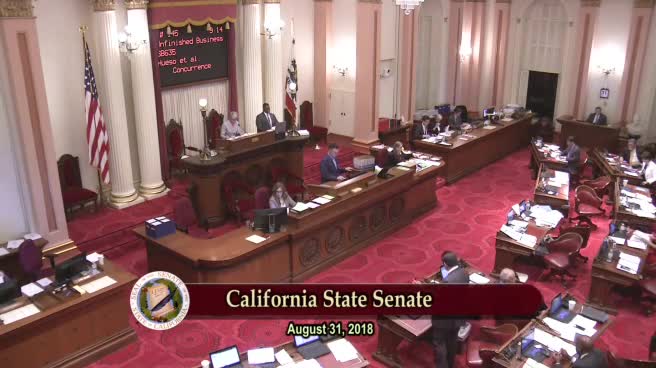 1MIN
Senate Floor
 2MIN
Senate Standing Committee on Natural Resources and Water
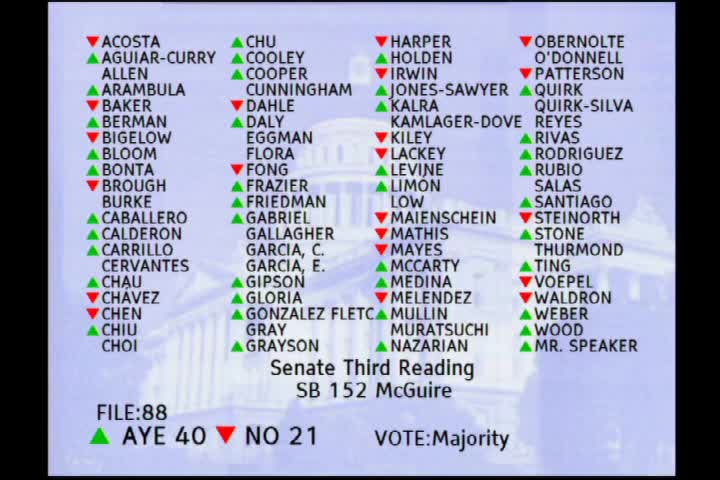 1MIN
Assembly Floor
 7MIN
Assembly Standing Committee on Water, Parks, and Wildlife
 1H
Assembly Standing Committee on Health
 21MIN
Senate Floor
 31MIN
Senate Standing Committee on Health
Bill Author