SB 822: Communications: broadband Internet access service.
- Session Year: 2017-2018
- House: Senate
- Latest Version Date: 2018-09-30
Existing law imposes certain obligations in the context of particular transactions, and provides mechanisms to enforce those obligations.
This bill would enact the California Internet Consumer Protection and Net Neutrality Act of 2018. This act would prohibit fixed and mobile Internet service providers, as defined, that provide broadband Internet access service, as defined, from engaging in specified actions concerning the treatment of Internet traffic. The act would prohibit, among other things, blocking lawful content, applications, services, or nonharmful devices, impairing or degrading lawful Internet traffic on the basis of Internet content, application, or service, or use of a nonharmful device, and specified practices relating to zero-rating, as defined. It would also prohibit fixed and mobile Internet service providers from offering or providing services other than broadband Internet access service that are delivered over the same last-mile connection as the broadband Internet access service, if those services have the purpose or effect of evading the above-described prohibitions or negatively affect the performance of broadband Internet access service.
The bill would make its operation contingent on the enactment of Senate Bill 460 of the 201718 Regular Session.Existing law imposes certain obligations in the context of particular transactions, and provides mechanisms to enforce those obligations.
This bill would enact the California Internet Consumer Protection and Net Neutrality Act of 2018. This act would prohibit fixed and mobile Internet service providers, as defined, that provide broadband Internet access service, as defined, from engaging in specified actions concerning the treatment of Internet traffic. The act would prohibit, among other things, blocking lawful content, applications, services, or nonharmful devices, impairing or degrading lawful Internet traffic on the basis of Internet content, application, or service, or use of a nonharmful device, and specified practices relating to zero-rating, as defined. It would also prohibit fixed and mobile Internet service providers from offering or providing services other than broadband Internet access service that are delivered over the same last-mile connection as the broadband Internet access service, if those services have the purpose or effect of evading the above-described prohibitions or negatively affect the performance of broadband Internet access service.
The bill would make its operation contingent on the enactment of Senate Bill 460 of the 201718 Regular Session.
Existing law imposes certain obligations in the context of particular transactions, and provides mechanisms to enforce those obligations.
This bill would enact the California Internet Consumer Protection and Net Neutrality Act of 2018. This act would prohibit fixed and mobile Internet service providers, as defined, that provide broadband Internet access service, as defined, from engaging in specified actions concerning the treatment of Internet traffic. The act would prohibit, among other things, blocking lawful content, applications, services, or nonharmful devices, impairing or degrading lawful Internet traffic on the basis of Internet content, application, or service, or use of a nonharmful device, and specified practices relating to zero-rating, as defined. It would also prohibit fixed and mobile Internet service providers from offering or providing services other than broadband Internet access service that are delivered over the same last-mile connection as the broadband Internet access service, if those services have the purpose or effect of evading the above-described prohibitions or negatively affect the performance of broadband Internet access service.
The bill would make its operation contingent on the enactment of Senate Bill 460 of the 201718 Regular Session.
(1)Existing law, the Consumers Legal Remedies Act, makes unlawful certain unfair methods of competition and unfair or deceptive acts or practices undertaken by any person in a transaction intended to result or which results in the sale or lease of goods or services to any consumer. Existing law authorizes any consumer who suffers damages as a result of the use or employment by any person of a method, act, or practice declared to be unlawful, as described above, to bring an action against that person to recover or obtain damages, restitution, an order enjoining the methods, acts, or practice, or any other relief the court deems proper.This bill would revise the act to prohibit specified actions by an Internet service provider, as defined, that provides broadband Internet access service, as defined, and make a violation of those prohibitions subject to the remedies available pursuant to the act.(2)Existing law generally governs the state procurement of materials, supplies, equipment, and services, and the acquisition of electronic data-processing and telecommunications goods and services.This bill would prohibit a state agency from contracting with an Internet service provider for the provision of broadband Internet access service unless that provider certifies under penalty of perjury that it is in full compliance with the requirements that this bill adds to the Consumers Legal Remedies Act. Because the bill would expand the crime of perjury, the bill would impose a state-mandated local program.(3)This bill would include legislative findings and declarations and be known as the California Internet Consumer Protection and Net Neutrality Act of 2018.(4)The California Constitution requires the state to reimburse local agencies and school districts for certain costs mandated by the state. Statutory provisions establish procedures for making that reimbursement.This bill would provide that no reimbursement is required by this act for a specified reason.(1)Existing law, the Consumers Legal Remedies Act, makes unlawful certain unfair methods of competition and unfair or deceptive acts or practices undertaken by any person in a transaction intended to result or which results in the sale or lease of goods or services to any consumer. Existing law authorizes any consumer who suffers damages as a result of the use or employment by any person of a method, act, or practice declared to be unlawful, as described above, to bring an action against that person to recover or obtain damages, restitution, an order enjoining the methods, acts, or practice, or any other relief the court deems proper.
This bill would revise the act to prohibit specified actions by an Internet service provider, as defined, that provides broadband Internet access service, as specified. The bill would prohibit an Internet service provider from offering different levels of quality of service to end users as part of broadband Internet access service unless specified conditions are met. The bill would make the consumer remedies and procedures of the act applicable to enforce those prohibitions. This bill would prohibit a public entity, as defined, from purchasing, or providing funding for the purchase of, any fixed or mobile broadband Internet access services that violate these prohibitions. The bill would require an Internet service provider that provides fixed or mobile broadband Internet access service purchased or funded by a public entity to publicly disclose accurate information regarding the network management practices, performance, and commercial terms of its broadband Internet access service that is sufficient to enable end users of those purchased or funded services, including a public entity, to fully and accurately ascertain if the service violates these prohibitions. defined, and make a violation of those prohibitions subject to the remedies available pursuant to the act.
(2)Existing law generally governs the state procurement of materials, supplies, equipment, and services, and the acquisition of electronic data-processing and telecommunications goods and services.
This bill would prohibit a state agency from contracting with an Internet service provider for the provision of broadband Internet access service unless that provider certifies under penalty of perjury that it is in full compliance with the requirements that this bill adds to the Consumers Legal Remedies Act. Because the bill would expand the crime of perjury, the bill would impose a state-mandated local program.
(3)This bill would include legislative findings and declarations and be known as the California Internet Consumer Protection and Net Neutrality Act of 2018.
(4)The California Constitution requires the state to reimburse local agencies and school districts for certain costs mandated by the state. Statutory provisions establish procedures for making that reimbursement.
This bill would provide that no reimbursement is required by this act for a specified reason.
Existing law, the Consumers Legal Remedies Act, makes unlawful certain unfair methods of competition and unfair or deceptive acts or practices undertaken by any person in a transaction intended to result or which results in the sale or lease of goods or services to any consumer. Existing law authorizes any consumer who suffers damages as a result of the use or employment by any person of a method, act, or practice declared to be unlawful, as described above, to bring an action against that person to recover or obtain damages, restitution, an order enjoining the methods, acts, or practice, or any other relief the court deems proper.
This bill would revise the act to prohibit specified actions by an Internet service provider, as defined, that provides broadband Internet access service, as specified. The bill would prohibit an Internet service provider from offering different levels of quality of service to end users as part of broadband Internet access service unless specified conditions are met. The bill would authorize the Attorney General, upon his or her own motion or upon complaint, to investigate and bring an action to enforce those prohibitions and would require that complaints be reviewed by the Attorney General on a case-by-case basis. The bill would additionally make the consumer remedies and procedures of the act applicable to enforce those prohibitions. This bill would prohibit a public entity, as defined, from purchasing, or providing funding for the purchase of, any fixed or mobile broadband Internet access services that violate these prohibitions. The bill would require an Internet service provider that provides fixed or mobile broadband Internet access service purchased or funded by a public entity to publicly disclose accurate information regarding the network management practices, performance, and commercial terms of its broadband Internet access service that is sufficient to enable end users of those purchased or funded services, including a public entity, to fully and accurately ascertain if the service violates these prohibitions.
(1)Existing
Existing law, the Consumers Legal Remedies Act, makes unlawful certain unfair methods of competition and unfair or deceptive acts or practices undertaken by any person in a transaction intended to result or which results in the sale or lease of goods or services to any consumer. Existing law authorizes any consumer who suffers damages as a result of the use or employment by any person of a method, act, or practice declared to be unlawful, as described above, to bring an action against that person to recover or obtain damages, restitution, an order enjoining the methods, acts, or practice, or any other relief the court deems proper.
This bill would revise the act to prohibit specified actions by an Internet service provider, as defined, that provides broadband Internet access service, as defined, and would authorize the Attorney General to enforce those prohibitions pursuant to specified laws. specified. The bill would prohibit an Internet service provider from offering different levels of quality of service to end users as part of broadband Internet access service unless specified conditions are met. The bill would authorize the Attorney General, upon his or her own motion or upon complaint, to investigate and bring an action to enforce those prohibitions and would require that complaints be reviewed by the Attorney General on a case-by-case basis. This bill would prohibit a public entity, as defined, from purchasing, or providing funding for the purchase of, any fixed or mobile broadband Internet access services that violate these prohibitions. The bill would require an Internet service provider that provides fixed or mobile broadband Internet access service purchased or funded by a public entity to publicly disclose accurate information regarding the network management practices, performance, and commercial terms of its broadband Internet access service that is sufficient to enable end users of those purchased or funded services, including a public entity, to fully and accurately ascertain if the service violates these prohibitions.
(2)Under existing law, the Public Utilities Commission (PUC) has regulatory authority over public utilities, including telephone corporations. Pursuant to its existing authority, the PUC supervises administration of the states telecommunications universal service programs.This bill would require that any moneys made available pursuant to the states telecommunications universal service programs for the building of infrastructure for broadband communications be awarded only on the condition that any Internet service provider that provides broadband Internet access service utilizing that infrastructure not engage in any of the actions prohibited by the provisions of this bill. The bill would require that any moneys made available pursuant to the states telecommunications universal service programs for access to the Internet be awarded only on the condition that any Internet service provider that receives those moneys not engage in any of those prohibited actions.(3)Existing law, the Digital Infrastructure and Video Competition Act of 2006, establishes a procedure for the issuance of state franchises for the provision of video service, defined to include cable service and open-video systems, administered by the PUC. Under the act, any person or corporation that seeks to provide video service, as defined, in the state is required to file an application with the PUC for a state franchise. The act prohibits the PUC and any local entity from imposing any requirement on the holder of a state franchise, except as provided in the act. The act prohibits a franchise holder from discriminating against any group or denying access to subscribers because of the income of the residents in the local area in which the group resides and requires a franchise holder to comply with customer service standards pertaining to the provision of video service established by federal law or regulation and to comply with the Cable Television and Video Provider Customer Service and Information Act and the Video Customer Service Act. The Digital Infrastructure and Video Competition Act of 2006 requires that an application for the grant of a franchise or for renewal of a franchise include a sworn affidavit, signed under penalty of perjury, that the applicant or its affiliates agree to comply with all federal and state statutes, rules, and regulations, including the above-described nondiscrimination and customer service requirements.This bill would prohibit a cable operator or video service provider that has been granted a state franchise under the Digital Infrastructure and Video Competition Act of 2006, and any affiliate, that provides broadband Internet access service from taking certain actions regarding the accessing of content on the Internet by customers. The bill would require that the sworn affidavit that is required to be filed with an application for the grant or renewal of a franchise state that the applicant or its affiliates agree to refrain from taking the prohibited actions. Because the affidavit is signed under penalty of perjury, the bill would impose a state-mandated local program by expanding the definition of a crime.(4)Existing law requires the PUC, in consultation with the State Energy Resources Conservation and Development Commission (Energy Commission), the Independent System Operator (ISO), and other stakeholders, to determine the requirements for a smart grid deployment plan consistent with certain policies set forth in state and federal law. Existing law requires that the smart grid improve overall efficiency, reliability, and cost-effectiveness of electrical system operations, planning, and maintenance. Existing law requires each electrical corporation to develop and submit a smart grid deployment plan to the PUC for approval.This bill would require the PUC, in consultation with the Energy Commission, the ISO, and electrical corporations, to evaluate the role broadband Internet access and tools will play in the future operation of the states smart grid.(5)The bill would permit an Internet service provider to offer different types of technical treatment to end users as part of broadband Internet access service if specified conditions are met and would require the PUC to monitor the quality of the basic default service and establish minimum quality requirements if the offering of different types of technical treatment degrades the quality of the basic default service.(6)The California Constitution requires the state to reimburse local agencies and school districts for certain costs mandated by the state. Statutory provisions establish procedures for making that reimbursement.This bill would provide that no reimbursement is required by this act for a specified reason.(1)Existing law, the Consumers Legal Remedies Act, makes unlawful certain unfair methods of competition and unfair or deceptive acts or practices undertaken by any person in a transaction intended to result or which results in the sale or lease of goods or services to any consumer. Existing law authorizes any consumer who suffers damages as a result of the use or employment by any person of a method, act, or practice declared to be unlawful, as described above, to bring an action against that person to recover or obtain damages, restitution, an order enjoining the methods, acts, or practice, or any other relief the court deems proper.
This bill would revise the act to prohibit specified actions by an Internet service provider, as defined, that provides broadband Internet access service, as defined, and would authorize the Attorney General to enforce those prohibitions pursuant to specified laws. This bill would prohibit a public entity, as defined, from purchasing, or providing funding for the purchase of, any fixed or mobile broadband Internet access services that violate these prohibitions. The bill would require an Internet service provider that provides fixed or mobile broadband Internet access service purchased or funded by a public entity to publicly disclose accurate information regarding the network management practices, performance, and commercial terms of its broadband Internet access service that is sufficient to enable end users of those purchased or funded services, including a public entity, to fully and accurately ascertain if the service violates these prohibitions.
Under(2)Under existing law, the Public Utilities Commission (PUC) has regulatory authority over public utilities, including telephone corporations. Pursuant to its existing authority, the commission PUC supervises administration of the states telecommunications universal service programs. The Digital Infrastructure and Video Competition Act of 2006 establishes a procedure for the issuance of state franchises for the provision of video service, defined to include cable service and open-video systems, administered by the commission.
The bill would state the intent of the Legislature to enact legislation to effectuate net neutrality in California utilizing the states regulatory powers and to prevent Internet service providers from engaging in practices inconsistent with net neutrality, including through 4 described means.This bill would require that any moneys made available pursuant to the states telecommunications universal service programs for the building of infrastructure for broadband communications be awarded only on the condition that any Internet service provider that provides broadband Internet access service utilizing that infrastructure not engage in any of the actions prohibited by the provisions of this bill. The bill would require that any moneys made available pursuant to the states telecommunications universal service programs for access to the Internet be awarded only on the condition that any Internet service provider that receives those moneys not engage in any of those prohibited actions.
(3)Existing law, the Digital Infrastructure and Video Competition Act of 2006, establishes a procedure for the issuance of state franchises for the provision of video service, defined to include cable service and open-video systems, administered by the PUC. Under the act, any person or corporation that seeks to provide video service, as defined, in the state is required to file an application with the PUC for a state franchise. The act prohibits the PUC and any local entity from imposing any requirement on the holder of a state franchise, except as provided in the act. The act prohibits a franchise holder from discriminating against any group or denying access to subscribers because of the income of the residents in the local area in which the group resides and requires a franchise holder to comply with customer service standards pertaining to the provision of video service established by federal law or regulation and to comply with the Cable Television and Video Provider Customer Service and Information Act and the Video Customer Service Act. The Digital Infrastructure and Video Competition Act of 2006 requires that an application for the grant of a franchise or for renewal of a franchise include a sworn affidavit, signed under penalty of perjury, that the applicant or its affiliates agree to comply with all federal and state statutes, rules, and regulations, including the above-described nondiscrimination and customer service requirements.
This bill would prohibit a cable operator or video service provider that has been granted a state franchise under the Digital Infrastructure and Video Competition Act of 2006, and any affiliate, that provides broadband Internet access service from taking certain actions regarding the accessing of content on the Internet by customers. The bill would require that the sworn affidavit that is required to be filed with an application for the grant or renewal of a franchise state that the applicant or its affiliates agree to refrain from taking the prohibited actions. Because the affidavit is signed under penalty of perjury, the bill would impose a state-mandated local program by expanding the definition of a crime.
(4)Existing law requires the PUC, in consultation with the State Energy Resources Conservation and Development Commission (Energy Commission), the Independent System Operator (ISO), and other stakeholders, to determine the requirements for a smart grid deployment plan consistent with certain policies set forth in state and federal law. Existing law requires that the smart grid improve overall efficiency, reliability, and cost-effectiveness of electrical system operations, planning, and maintenance. Existing law requires each electrical corporation to develop and submit a smart grid deployment plan to the PUC for approval.
This bill would require the PUC, in consultation with the Energy Commission, the ISO, and electrical corporations, to evaluate the role broadband Internet access and tools will play in the future operation of the states smart grid.
(5)The bill would permit an Internet service provider to offer different types of technical treatment to end users as part of broadband Internet access service if specified conditions are met and would require the PUC to monitor the quality of the basic default service and establish minimum quality requirements if the offering of different types of technical treatment degrades the quality of the basic default service.
(6)The California Constitution requires the state to reimburse local agencies and school districts for certain costs mandated by the state. Statutory provisions establish procedures for making that reimbursement.
This bill would provide that no reimbursement is required by this act for a specified reason.
Under existing law, the Public Utilities Commission has regulatory authority over public utilities, including telephone corporations. Pursuant to its existing authority, the commission supervises administration of the states telecommunications universal service programs. The Digital Infrastructure and Video Competition Act of 2006 establishes a procedure for the issuance of state franchises for the provision of video service, defined to include cable service and open-video systems, administered by the commission.
The bill would state the intent of the Legislature to enact legislation to effectuate net neutrality in California utilizing the states regulatory powers and to prevent Internet service providers from engaging in practices inconsistent with net neutrality, including through 4 described means.
(a)The Legislature finds and declares all of the following:
(1)This act is adopted pursuant to the police power inherent in the State of California to protect and promote the safety, life, public health, public convenience, general prosperity, and well-being of society, and the welfare of the states population and economy, that are increasingly dependent on an open and neutral Internet.
(2)Almost every sector of Californias economy, democracy, and society is dependent on the open and neutral Internet that supports vital functions regulated under the police power of the state, including, but not limited to, each of the following:
(A)Police and emergency services.
(B)Health and safety services and infrastructure.
(C)Utility services and infrastructure.
(D)Transportation infrastructure and services, and the expansion of zero- and low-emission transportation options.
(E)Government services, voting, and democratic decisionmaking processes.
(F)Education.
(G)Business and economic activity.
(H)Environmental monitoring and protection, and achievement of state environmental goals.
(I)Land use regulation.
(b)This act shall be known, and may be cited, as the California Internet Consumer Protection and Net Neutrality Act of 2018.
SEC. 2.Title 15 (commencing with Section 3100) is added to Part 4 of Division 3 of the Civil Code, to read:15.Internet Neutrality3100.For purposes of this title, the following definitions apply:
(a)Application-agnostic means not differentiating on the basis of source, destination, Internet content, application, service, or device, or class of Internet content, application, service, or device.
(b)Broadband Internet access service means a mass-market retail service by wire or radio provided to customers in California that provides the capability to transmit data to, and receive data from, all or substantially all Internet endpoints, including, but not limited to, any capabilities that are incidental to and enable the operation of the communications service, but excluding dial-up Internet access service. Broadband Internet access service also encompasses any service provided to customers in California that provides a functional equivalent of that service or that is used to evade the protections set forth in this title.
(c)Class of Internet content, application, service, or device means Internet content, or a group of Internet applications, services, or devices, sharing a common characteristic, including, but not limited to, sharing the same source or destination, belonging to the same type of content, application, service, or device, using the same application- or transport-layer protocol, or having similar technical characteristics, including, but not limited to, the size, sequencing, or timing of packets, or sensitivity to delay.
(d)Content, applications, or services means all Internet traffic transmitted to or from end users of a broadband Internet access service, including, but not limited to, traffic that may not fit clearly into any of these categories.
(e)Edge provider means any individual or entity that provides any content, application, or service over the Internet, and any individual or entity that provides a device used for accessing any content, application, or service over the Internet.
(f)End user means any individual or entity that uses a broadband Internet access service.
(g)Enterprise service offering means an offering to larger organizations through customized or individually negotiated arrangements or special access services.
(h)Fixed broadband Internet access service means a broadband Internet access service that serves end users primarily at fixed endpoints using stationary equipment. Fixed broadband Internet access service includes, but is not limited to, fixed wireless services including, but not limited to, fixed unlicensed wireless services, and fixed satellite services.
(i)Fixed Internet service provider means a business that provides fixed broadband Internet access service to an individual, corporation, government, or other customer in California.
(j)Impairing or degrading lawful Internet traffic on the basis of Internet content, application, or service, or use of a nonharmful device means impairing or degrading any of the following: (1) particular content, applications, or services; (2) particular classes of content, applications, or services; (3) lawful Internet traffic to particular nonharmful devices; or (4) lawful Internet traffic to particular classes of nonharmful devices. The term includes, without limitation, differentiating, positively or negatively, between any of the following: (1) particular content, applications, or services; (2) particular classes of content, applications, or services; (3) lawful Internet traffic to particular nonharmful devices; or (4) lawful Internet traffic to particular classes of nonharmful devices.
(k)Internet service provider means a business that provides broadband Internet access service to an individual, corporation, government, or other customer in California.
(l)ISP traffic exchange means the exchange of Internet traffic destined for, or originating from, an Internet service providers end users between the Internet service providers network and another individual or entity, including, but not limited to, an edge provider, content delivery network, or other network operator.
(m)ISP traffic exchange agreement means an agreement between an Internet service provider and another individual or entity, including, but not limited to, an edge provider, content delivery network, or other network operator, to exchange Internet traffic destined for, or originating from, an Internet service providers end users between the Internet service providers network and the other individual or entity.
(n)Mass market service means a service marketed and sold on a standardized basis to residential customers, small businesses, and other customers, including, but not limited to, schools, institutions of higher learning, and libraries. Mass market services also include broadband Internet access services purchased with support of the E-rate and Rural Health Care programs and similar programs at the federal and state level, regardless of whether they are customized or individually negotiated, as well as any broadband Internet access service offered using networks supported by the Connect America Fund or similar programs at the federal and state level. Mass market service does not include enterprise service offerings.
(o)Mobile broadband Internet access service means a broadband Internet access service that serves end users primarily using mobile stations. Mobile broadband Internet access service includes, but is not limited to, broadband Internet access services that use smartphones or mobile-network-enabled tablets as the primary endpoints for connection to the Internet, as well as mobile satellite broadband services.
(p)Mobile Internet service provider means a business that provides mobile broadband Internet access service to an individual, corporation, government, or other customer in California.
(q)Mobile station means a radio communication station capable of being moved and which ordinarily does move.
(r)Paid prioritization means the management of an Internet service providers network to directly or indirectly favor some traffic over other traffic, including, but not limited to, through the use of techniques such as traffic shaping, prioritization, resource reservation, or other forms of preferential traffic management, either (1) in exchange for consideration, monetary or otherwise, from a third party, or (2) to benefit an affiliated entity.
(s)Reasonable network management means a network management practice that is reasonable. A network management practice is a practice that has a primarily technical network management justification, but does not include other business practices. A network management practice is reasonable if it is primarily used for, and tailored to, achieving a legitimate network management purpose, taking into account the particular network architecture and technology of the broadband Internet access service, and is as application-agnostic as possible.
(t)Zero-rating means exempting some Internet traffic from a customers data usage allowance.
3101.(a)It shall be unlawful for a fixed Internet service provider, insofar as the provider is engaged in providing fixed broadband Internet access service, to engage in any of the following activities:
(1)Blocking lawful content, applications, services, or nonharmful devices, subject to reasonable network management.
(2)Impairing or degrading lawful Internet traffic on the basis of Internet content, application, or service, or use of a nonharmful device, subject to reasonable network management.
(3)Requiring consideration, monetary or otherwise, from an edge provider, including, but not limited to, in exchange for any of the following:
(A)Delivering Internet traffic to, and carrying Internet traffic from, the Internet service providers end users.
(B)Avoiding having the edge providers content, application, service, or nonharmful device blocked from reaching the Internet service providers end users.
(C)Avoiding having the edge providers content, application, service, or nonharmful device impaired or degraded.
(4)Engaging in paid prioritization.
(5)Engaging in zero-rating in exchange for consideration, monetary or otherwise, from a third party.
(6)Zero-rating some Internet content, applications, services, or devices in a category of Internet content, applications, services, or devices, but not the entire category.
(7)(A)Unreasonably interfering with, or unreasonably disadvantaging, either an end users ability to select, access, and use broadband Internet access service or the lawful Internet content, applications, services, or devices of the end users choice, or an edge providers ability to make lawful content, applications, services, or devices available to end users. Reasonable network management shall not be a violation of this paragraph.
(B)Zero-rating Internet traffic in application-agnostic ways shall not be a violation of subparagraph (A) provided that no consideration, monetary or otherwise, is provided by any third party in exchange for the Internet service providers decision whether to zero-rate traffic.
(8)Failing to publicly disclose accurate information regarding the network management practices, performance, and commercial terms of its broadband Internet access services sufficient for consumers to make informed choices regarding use of those services and for content, application, service, and device providers to develop, market, and maintain Internet offerings.
(9)Engaging in practices, including, but not limited to, agreements, with respect to, related to, or in connection with, ISP traffic exchange that have the purpose or effect of evading the prohibitions contained in this section and Section 3102. Nothing in this paragraph shall be construed to prohibit Internet service providers from entering into ISP traffic exchange agreements that do not evade the prohibitions contained in this section and Section 3102.
(b)It shall be unlawful for a mobile Internet service provider, insofar as the provider is engaged in providing mobile broadband Internet access service, to engage in any of the activities described in paragraphs (1), (2), (3), (4), (5), (6), (7), (8), and (9) of subdivision (a).
3102.(a)It shall be unlawful for a fixed Internet service provider to offer or provide services other than broadband Internet access service that are delivered over the same last-mile connection as the broadband Internet access service, if those services satisfy either of the following conditions:
(1)They have the purpose or effect of evading the prohibitions in Section 3101.
(2)They negatively affect the performance of broadband Internet access service.
(b)It shall be unlawful for a mobile Internet service provider to offer or provide services other than broadband Internet access service that are delivered over the same last-mile connection as the broadband Internet access service, if those services satisfy either of the conditions specified in paragraphs (1) and (2) of subdivision (a).
(c)Nothing in this section shall be construed to prohibit a fixed or mobile Internet service provider from offering or providing services other than broadband Internet access service that are delivered over the same last-mile connection as the broadband Internet access service and do not violate this section.
3103.(a)Nothing in this title supersedes any obligation or authorization a fixed or mobile Internet service provider may have to address the needs of emergency communications or law enforcement, public safety, or national security authorities, consistent with or as permitted by applicable law, or limits the providers ability to do so.
(b)Nothing in this title prohibits reasonable efforts by a fixed or mobile Internet service provider to address copyright infringement or other unlawful activity.
3104.Notwithstanding Section 3268 or any other law, any waiver of the provisions of this title is contrary to public policy and shall be unenforceable and void.
SEC. 3.The provisions of this act are severable. If any provision of this act or its application is held invalid, that invalidity shall not affect other provisions or applications that can be given effect without the invalid provision or application.
SEC. 4.This act shall become operative only if Senate Bill 460 of the 201718 Regular Session is enacted and takes effect on or before January 1, 2019.(a)The Legislature finds and declares all of the following:
(1)This act is adopted pursuant to the police power inherent in the State of California to protect and promote the safety, life, public health, public convenience, general prosperity, and well-being of society, and the welfare of the states population and economy, that are increasingly dependent on an open and neutral Internet.
(2)Almost every sector of Californias economy, democracy, and society is dependent on the open and neutral Internet that supports vital functions regulated under the police power of the state, including, but not limited to, each of the following:
(A)Police and emergency services.
(B)Health and safety services and infrastructure.
(C)Utility services and infrastructure.
(D)Transportation infrastructure and services, and the expansion of zero- and low-emission transportation options.
(E)Government services, voting, and democratic decisionmaking processes.
(F)Education.
(G)Business and economic activity.
(H)Environmental monitoring and protection, and achievement of state environmental goals.
(I)Land use regulation.
(b)This act shall be known, and may be cited, as the California Internet Consumer Protection and Net Neutrality Act of 2018.
SEC. 2.Title 15 (commencing with Section 3100) is added to Part 4 of Division 3 of the Civil Code, to read:15.Internet Neutrality3100.For purposes of this title, the following definitions apply:
(a)Application-agnostic means not differentiating on the basis of source, destination, Internet content, application, service, or device, or class of Internet content, application, service, or device.
(b)Broadband Internet access service means a mass-market retail service by wire or radio provided to customers in California that provides the capability to transmit data to, and receive data from, all or substantially all Internet endpoints, including, but not limited to, any capabilities that are incidental to and enable the operation of the communications service, but excluding dial-up Internet access service. Broadband Internet access service also encompasses any service provided to customers in California that provides a functional equivalent of that service or that is used to evade the protections set forth in this title.
(c)Class of Internet content, application, service, or device means Internet content, or a group of Internet applications, services, or devices, sharing a common characteristic, including, but not limited to, sharing the same source or destination, belonging to the same type of content, application, service, or device, using the same application- or transport-layer protocol, or having similar technical characteristics, including, but not limited to, the size, sequencing, or timing of packets, or sensitivity to delay.
(d)Content, applications, or services means all Internet traffic transmitted to or from end users of a broadband Internet access service, including, but not limited to, traffic that may not fit clearly into any of these categories.
(e)Edge provider means any individual or entity that provides any content, application, or service over the Internet, and any individual or entity that provides a device used for accessing any content, application, or service over the Internet.
(f)End user means any individual or entity that uses a broadband Internet access service.
(g)End-user customer means any individual or entity that is a customer of an Internet service provider.(h)(g)Enterprise service offering means an offering to larger organizations through customized or individually negotiated arrangements or special access services.
(i)(h)Fixed broadband Internet access service means a broadband Internet access service that serves end users primarily at fixed endpoints using stationary equipment. Fixed broadband Internet access service includes, but is not limited to, fixed wireless services including, but not limited to, fixed unlicensed wireless services, and fixed satellite services.
(j)(i)Fixed Internet service provider means a business that provides fixed broadband Internet access service to an individual, corporation, government, or other customer in California.
(k)(j)Impairing or degrading lawful Internet traffic on the basis of Internet content, application, or service, or use of a nonharmful device means impairing or degrading any of the following: (1) particular content, applications, or services, or services; (2) particular classes of content, applications, or services, or impairing or degrading services; (3) lawful Internet traffic to particular nonharmful devices or devices; or (4) lawful Internet traffic to particular classes of nonharmful devices. The term includes, without limitation, differentiating, positively or negatively, between any of the following: (1) particular content, applications, or services, or services; (2) particular classes of content, applications, or services, or differentiating, positively or negatively, between services; (3) lawful Internet traffic to particular nonharmful devices or devices; or (4) lawful Internet traffic to particular classes of nonharmful devices.
(l)(k)Internet service provider means a business that provides broadband Internet access service to an individual, corporation, government, or other customer in California.
(m)(l)ISP traffic exchange means the exchange of Internet traffic destined for, or originating from, an Internet service providers end users between the Internet service providers network and another individual or entity, including, but not limited to, an edge provider, content delivery network, or other network operator.
(n)(m)ISP traffic exchange agreement means an agreement between an Internet service provider and another individual or entity, including, but not limited to, an edge provider, content delivery network, or other network operator, to exchange Internet traffic destined for, or originating from, an Internet service providers end users between the Internet service providers network and the other individual or entity.
(o)(n)Mass market service means a service marketed and sold on a standardized basis to residential customers, small businesses, and other end-user customers, including, but not limited to, schools, institutions of higher learning, and libraries. Mass market services also include broadband Internet access services purchased with support of the E-rate and Rural Health Care programs and similar programs at the federal and state level, regardless of whether they are customized or individually negotiated, as well as any broadband Internet access service offered using networks supported by the Connect America Fund or similar programs at the federal and state level. Mass market service does not include enterprise service offerings.
(p)(o)Mobile broadband Internet access service means a broadband Internet access service that serves end users primarily using mobile stations. Mobile broadband Internet access service includes, but is not limited to, broadband Internet access services that use smartphones or mobile-network-enabled tablets as the primary endpoints for connection to the Internet, as well as mobile satellite broadband services.
(q)(p)Mobile Internet service provider means a business that provides mobile broadband Internet access service to an individual, corporation, government, or other customer in California.
(r)(q)Mobile station means a radio communication station capable of being moved and which ordinarily does move.
(s)(r)Paid prioritization means the management of an Internet service providers network to directly or indirectly favor some traffic over other traffic, including, but not limited to, through the use of techniques such as traffic shaping, prioritization, resource reservation, or other forms of preferential traffic management, either (1) in exchange for consideration, monetary or otherwise, from a third party, or (2) to benefit an affiliated entity.
(t)(s)Reasonable network management means a network management practice that is reasonable. A network management practice is a practice that has a primarily technical network management justification, but does not include other business practices. A network management practice is reasonable if it is primarily used for, and tailored to, achieving a legitimate network management purpose, taking into account the particular network architecture and technology of the broadband Internet access service, and is as application-agnostic as possible.
(u)(t)Zero-rating means exempting some Internet traffic from a customers data limitation. usage allowance.
3101.(a)It shall be unlawful for a fixed Internet service provider, insofar as the provider is engaged in providing fixed broadband Internet access service, to engage in any of the following activities:
(1)Blocking lawful content, applications, services, or nonharmful devices, subject to reasonable network management.
(2)Impairing or degrading lawful Internet traffic on the basis of Internet content, application, or service, or use of a nonharmful device, subject to reasonable network management.
(3)Requiring consideration, monetary or otherwise, from edge providers, an edge provider, including, but not limited to, in exchange for any of the following:
(A)Delivering Internet traffic to, and carrying Internet traffic from, the Internet service providers end users.
(B)Avoiding having the edge providers providers content, application, service, or nonharmful device blocked from reaching the Internet service providers end users.
(C)Avoiding having the edge providers providers content, application, service, or nonharmful device impaired or degraded.
(4)Engaging in paid prioritization.
(5)Engaging in zero-rating in exchange for consideration, monetary or otherwise, by third parties. from a third party.
(6)Zero-rating some Internet content, applications, services, or devices in a category of Internet content, applications, services, or devices, but not the entire category.
(7)(A)Unreasonably interfering with, or unreasonably disadvantaging, either an end users ability to select, access, and use broadband Internet access service or the lawful Internet content, applications, services, or devices of the end users choice, or an edge providers ability to make lawful content, applications, services, or devices available to end users. Reasonable network management shall not be a violation of this paragraph.
(B)Zero-rating Internet traffic in application-agnostic ways shall not be a violation of subparagraph (A) provided that no consideration, monetary or otherwise, is provided by any third party in exchange for the Internet service providers decision whether to zero-rate traffic.
(8)Failing to publicly disclose accurate information regarding the network management practices, performance, and commercial terms of its broadband Internet access services sufficient for consumers to make informed choices regarding use of those services and for content, application, service, and device providers to develop, market, and maintain Internet offerings.
(9)Engaging in practices, including, but not limited to, agreements, with respect to, related to, or in connection with, ISP traffic exchange that have the purpose or effect of evading the prohibitions contained in this section and Section 3102. Nothing in this paragraph shall be construed to prohibit Internet service providers from entering into ISP traffic exchange agreements that do not evade the prohibitions contained in this section and Section 3102.
(b)It shall be unlawful for a mobile Internet service provider, insofar as the provider is engaged in providing mobile broadband Internet access service, to engage in any of the activities described in paragraphs (1), (2), (3), (4), (5), (6), (7), (8), and (9) of subdivision (a).
3102.(a)It shall be unlawful for a fixed Internet service provider to offer or provide services other than broadband Internet access service that are delivered over the same last-mile connection as the broadband Internet access service, if those services satisfy either of the following conditions:
(1)They have the purpose or effect of evading the prohibitions in Section 3101.
(2)They negatively affect the performance of broadband Internet access service.
(b)It shall be unlawful for a mobile Internet service provider to offer or provide services other than broadband Internet access service that are delivered over the same last-mile connection as the broadband Internet access service, if those services satisfy either of the conditions specified in paragraphs (1) and (2) of subdivision (a).
(c)Nothing in this section shall be construed to prohibit a fixed or mobile Internet service provider from offering or providing services other than broadband Internet access service that are delivered over the same last-mile connection as the broadband Internet access service and do not violate this section.
3103.(a)Nothing in this title supersedes any obligation or authorization a fixed or mobile Internet service provider may have to address the needs of emergency communications or law enforcement, public safety, or national security authorities, consistent with or as permitted by applicable law, or limits the providers ability to do so.
(b)Nothing in this title prohibits reasonable efforts by a fixed or mobile Internet service provider to address copyright infringement or other unlawful activity.
3104.Notwithstanding Section 3268 or any other law, any waiver of the provisions of this title is contrary to public policy and shall be unenforceable and void.
SEC. 3.The provisions of this act are severable. If any provision of this act or its application is held invalid, that invalidity shall not affect other provisions or applications that can be given effect without the invalid provision or application.
SEC. 4.This act shall become operative only if Senate Bill 460 of the 201718 Regular Session is enacted and takes effect on or before January 1, 2019.
(a)The Legislature finds and declares all of the following:
(1)This bill act is adopted pursuant to the police power inherent in the State of California to protect and promote the safety, life, public health, public convenience, general prosperity, and well-being of society, and the welfare of the states population and economy, that are increasingly dependent on an open and neutral Internet.
(2)Almost every sector of Californias economy, democracy, and society is dependent on the open and neutral Internet that supports vital functions regulated under the police power of the state, including, but not limited to, each of the following:
(A)Police and emergency services.
(B)Health and safety services and infrastructure.
(C)Utility services and infrastructure.
(D)Transportation infrastructure and services, and the expansion of zero- and low-emission transportation options.
(E)Government services, voting, and democratic decisionmaking processes.
(F)Education.
(G)Business and economic activity.
(H)Environmental monitoring and protection, and achievement of state environmental goals.
(I)Land use regulation.
(3)The Federal Communications Commission has repealed net neutrality rules intended to protect consumers and to ensure fair and reasonable access to the Internet.(b)It is the intent of this act to ensure that corporations do not impede competition or engage in deceptive consumer practices, and that they offer service to residential broadband Internet customers on a nondiscriminatory basis.(c)It is the intent of this act to protect and promote the Internet as an open platform enabling consumers choice, freedom of expression, end-user control, competition, and the freedom to innovate without permission, and thereby to encourage the deployment of advanced telecommunications capability and remove barriers to infrastructure investment.(d)(b)This act shall be known, and may be cited, as the California Internet Consumer Protection and Net Neutrality Act of 2018.
SEC. 2.Chapter 3.5 (commencing with Section 1775) is added to Title 1.5 of Part 4 of Division 3 of the Civil Code, to read:3.5.Internet NeutralitySEC. 2.Title 15 (commencing with Section 3100) is added to Part 4 of Division 3 of the Civil Code, to read:15.Internet Neutrality1775.3100.For purposes of this chapter, title, the following definitions apply:
(a)Application-agnostic means not differentiating on the basis of source, destination, Internet content, application, service, or device, or class of Internet content, application, service, or device.
(a)(b)Broadband Internet access service means a mass-market retail service by wire or radio provided to customers in California that provides the capability to transmit data to, and receive data from, all or substantially all Internet endpoints, including including, but not limited to, any capabilities that are incidental to and enable the operation of the communications service, but excluding dial-up Internet access service. Broadband Internet access service also encompasses any service provided to customers in California that provides a functional equivalent of that service or that is used to evade the protections set forth in this chapter. title.
(c)Class of Internet content, application, service, or device means Internet content, or a group of Internet applications, services, or devices, sharing a common characteristic, including, but not limited to, sharing the same source or destination, belonging to the same type of content, application, service, or device, using the same application- or transport-layer protocol, or having similar technical characteristics, including, but not limited to, the size, sequencing, or timing of packets, or sensitivity to delay.
(d)Content, applications, or services means all Internet traffic transmitted to or from end users of a broadband Internet access service, including, but not limited to, traffic that may not fit clearly into any of these categories.
(b)(e)Edge provider means any individual or entity that provides any content, application, or service over the Internet, and any individual or entity that provides a device used for accessing any content, application, or service over the Internet.
(c)(f)End user means any individual or entity that uses a broadband Internet access service.
(g)End-user customer means any individual or entity that is a customer of an Internet service provider.
(h)Enterprise service offering means an offering to larger organizations through customized or individually negotiated arrangements or special access services.
(i)Fixed broadband Internet access service means a broadband Internet access service that serves end users primarily at fixed endpoints using stationary equipment. Fixed broadband Internet access service includes, but is not limited to, fixed wireless services including, but not limited to, fixed unlicensed wireless services, and fixed satellite services.
(j)Fixed Internet service provider means a business that provides fixed broadband Internet access service to an individual, corporation, government, or other customer in California.
(k)Impairing or degrading lawful Internet traffic on the basis of Internet content, application, or service, or use of a nonharmful device means impairing or degrading particular content, applications, or services, or particular classes of content, applications, or services, or impairing or degrading lawful Internet traffic to particular nonharmful devices or classes of nonharmful devices. The term includes, without limitation, differentiating, positively or negatively, between particular content, applications, or services, or particular classes of content, applications, or services, or differentiating, positively or negatively, between lawful Internet traffic to particular nonharmful devices or classes of nonharmful devices.
(d)(l)Internet service provider means a business that provides broadband Internet access service to an individual, corporation, government, or other customer in California.
(m)ISP traffic exchange means the exchange of Internet traffic destined for, or originating from, an Internet service providers end users between the Internet service providers network and another individual or entity, including, but not limited to, an edge provider, content delivery network, or other network operator.
(n)ISP traffic exchange agreement means an agreement between an Internet service provider and another individual or entity, including, but not limited to, an edge provider, content delivery network, or other network operator, to exchange Internet traffic destined for, or originating from, an Internet service providers end users between the Internet service providers network and the other individual or entity.
(o)Mass market service means a service marketed and sold on a standardized basis to residential customers, small businesses, and other end-user customers, including, but not limited to, schools, institutions of higher learning, and libraries. Mass market services also include broadband Internet access services purchased with support of the E-rate and Rural Health Care programs and similar programs at the federal and state level, regardless of whether they are customized or individually negotiated, as well as any broadband Internet access service offered using networks supported by the Connect America Fund or similar programs at the federal and state level. Mass market service does not include enterprise service offerings.
(p)Mobile broadband Internet access service means a broadband Internet access service that serves end users primarily using mobile stations. Mobile broadband Internet access service includes, but is not limited to, broadband Internet access services that use smartphones or mobile-network-enabled tablets as the primary endpoints for connection to the Internet, as well as mobile satellite broadband services.
(q)Mobile Internet service provider means a business that provides mobile broadband Internet access service to an individual, corporation, government, or other customer in California.
(r)Mobile station means a radio communication station capable of being moved and which ordinarily does move.
(e)(s)Paid prioritization means the management of an Internet service providers network to directly or indirectly favor some traffic over other traffic, including including, but not limited to, through the use of techniques such as traffic shaping, prioritization, resource reservation, or other forms of preferential traffic management, either (1) in exchange for consideration, monetary or otherwise, from a third party, or (2) to benefit an affiliated entity.
(f)(t)Reasonable network management means a network management practice that primarily is reasonable. A network management practice is a practice that has a primarily technical network management justification, but does not include other business practices. A network management practice is reasonable if it is primarily used for, and tailored to, achieving a legitimate network management purpose, taking into account the particular network architecture and technology of the broadband Internet access service. service, and is as application-agnostic as possible.
(u)Zero-rating means exempting some Internet traffic from a customers data limitation.
1776.3101.(a)It shall be unlawful for an a fixed Internet service provider, insofar as the provider is engaged in providing fixed broadband Internet access service, to engage in any of the following activities:
(1)Blocking lawful content, applications, services, or nonharmful devices, subject to reasonable network management practices. management.
(2)Impairing or degrading lawful Internet traffic on the basis of Internet content, application, or service, or use of a nonharmful device, subject to reasonable network management practices. management.
(3)Requiring consideration, monetary or otherwise, from edge providers, including, but not limited to, in exchange for any of the following:
(A)Delivering Internet traffic to, and carrying Internet traffic from, the Internet service providers end users.
(B)Avoiding having the edge providers content, application, service, or nonharmful device blocked from reaching the Internet service providers end users.
(C)Avoiding having the edge providers content, application, service, or nonharmful device impaired or degraded.
(3)(4)Engaging in paid prioritization.
(5)Engaging in zero-rating in exchange for consideration, monetary or otherwise, by third parties.
(6)Zero-rating some Internet content, applications, services, or devices in a category of Internet content, applications, services, or devices, but not the entire category.
(4)(7)(A)Unreasonably interfering with, or unreasonably disadvantaging, either an end users ability to select, access, and use broadband Internet access service or the lawful Internet content, applications, services, or devices of the end users choice, or an edge providers ability to make lawful content, applications, services, or devices available to end users. Reasonable network management shall not be a violation of this paragraph.
(B)Zero-rating Internet traffic in application-agnostic ways shall not be a violation of subparagraph (A) provided that no consideration, monetary or otherwise, is provided by any third party in exchange for the Internet service providers decision whether to zero-rate traffic.
(5)(8)Failing to publicly disclose accurate information regarding the network management practices, performance, and commercial terms of its broadband Internet access services sufficient for consumers to make informed choices regarding use of those services and for content, application, service, and device providers to develop, market, and maintain Internet offerings.
(b)(1)Nothing(9)Engaging in practices, including, but not limited to, agreements, with respect to, related to, or in connection with, ISP traffic exchange that have the purpose or effect of evading the prohibitions contained in this section and Section 3102. Nothing in this paragraph shall be construed to prohibit Internet service providers from entering into ISP traffic exchange agreements that do not evade the prohibitions contained in this section and Section 3102.
(b)It shall be unlawful for a mobile Internet service provider, insofar as the provider is engaged in providing mobile broadband Internet access service, to engage in any of the activities described in paragraphs (1), (2), (3), (4), (5), (6), (7), (8), and (9) of subdivision (a).
3102.(a)It shall be unlawful for a fixed Internet service provider to offer or provide services other than broadband Internet access service that are delivered over the same last-mile connection as the broadband Internet access service, if those services satisfy either of the following conditions:
(1)They have the purpose or effect of evading the prohibitions in Section 3101.
(2)They negatively affect the performance of broadband Internet access service.
(b)It shall be unlawful for a mobile Internet service provider to offer or provide services other than broadband Internet access service that are delivered over the same last-mile connection as the broadband Internet access service, if those services satisfy either of the conditions specified in paragraphs (1) and (2) of subdivision (a).
(c)Nothing in this section shall be construed to prohibit a fixed or mobile Internet service provider from offering or providing services other than broadband Internet access service that are delivered over the same last-mile connection as the broadband Internet access service and do not violate this section.
3103.(a)Nothing in this section title supersedes any obligation or authorization a provider of broadband fixed or mobile Internet Access service provider may have to address the needs of emergency communications or law enforcement, public safety, or national security authorities, consistent with or as permitted by applicable law, or limits the providers ability to do so.
(2)(b)Nothing in this section title prohibits reasonable efforts by an a fixed or mobile Internet service provider of broadband Internet access service to address copyright infringement or other unlawful activity.
1777.A violation of this chapter shall be subject to the remedies and procedures established pursuant to Chapter 4 (commencing with Section 1780).3104.Notwithstanding Section 3268 or any other law, any waiver of the provisions of this title is contrary to public policy and shall be unenforceable and void.
SEC. 3.Article 2 (commencing with Section 3020) is added to Chapter 3 of Part 1 of Division 2 of the Public Contract Code, to read:2.Internet Neutrality3020.For purposes of this article, broadband Internet access service and Internet service provider have the same meanings as defined in Section 1775 of the Civil Code.3021.No state agency may contract with an Internet service provider for the provision of broadband Internet access service unless that provider certifies, under penalty of perjury, that it is in full compliance with Section 1776 of the Civil Code.SEC. 4.SEC. 3.The provisions of this act are severable. If any provision of this act or its application is held invalid, that invalidity shall not affect other provisions or applications that can be given effect without the invalid provision or application.
SEC. 5.No reimbursement is required by this act pursuant to Section 6 of Article XIIIB of the California Constitution because the only costs that may be incurred by a local agency or school district will be incurred because this act creates a new crime or infraction, eliminates a crime or infraction, or changes the penalty for a crime or infraction, within the meaning of Section 17556 of the Government Code, or changes the definition of a crime within the meaning of Section 6 of Article XIIIB of the California Constitution.SEC. 4.This act shall become operative only if Senate Bill 460 of the 201718 Regular Session is enacted and takes effect on or before January 1, 2019.
(a)The Legislature finds and declares all of the following:
(a)(1)This bill is adopted pursuant to the police power inherent in the State of California to protect and promote the safety, life, public health, public convenience, general prosperity, and well-being of society, and the welfare of the states population and economy, that are increasingly dependent on an open and neutral Internet.
(b)(2)Almost every sector of Californias economy, democracy, and society is dependent on the open and neutral Internet that supports vital functions regulated under the police power of the state, including, but not limited to, each of the following:
(1)(A)Police and emergency services.
(2)(B)Health and safety services and infrastructure.
(3)(C)Utility services and infrastructure.
(4)(D)Transportation infrastructure and services, and the expansion of zero- and low-emission transportation options.
(5)(E)Government services, voting, and democratic decisionmaking processes.
(6)(F)Education.
(7)(G)Business and economic activity.
(8)(H)Environmental monitoring and protection, and achievement of state environmental goals.
(9)(I)Land use regulation.
(3)The Federal Communications Commission has repealed net neutrality rules intended to protect consumers and to ensure fair and reasonable access to the Internet.
(b)It is the intent of this act to ensure that corporations do not impede competition or engage in deceptive consumer practices, and that they offer service to residential broadband Internet customers on a nondiscriminatory basis.
(c)It is the intent of this act to protect and promote the Internet as an open platform enabling consumers choice, freedom of expression, end-user control, competition, and the freedom to innovate without permission, and thereby to encourage the deployment of advanced telecommunications capability and remove barriers to infrastructure investment.
(d)This act shall be known, and may be cited, as the California Internet Consumer Protection and Net Neutrality Act of 2018.
SEC. 2.Chapter 3.5 (commencing with Section 1775) is added to Title 1.5 of Part 4 of Division 3 of the Civil Code, to read:3.5.Internet Neutrality1775.For purposes of this chapter, the following definitions apply:
(a)Application-agnostic means not differentiating on the basis of source, destination, Internet content, application, service, or device, or class of Internet content, application, service, or device.(b)Application-specific differential pricing means charging different prices for Internet traffic to customers on the basis of Internet content, application, service, or device, or class of Internet content, application, service, or device, but does not include zero-rating.(c)(a)Broadband Internet access service means a mass-market retail service by wire or radio provided to customers in California that provides the capability to transmit data to, and receive data from, all or substantially all Internet endpoints, including any capabilities that are incidental to and enable the operation of the communications service, but excluding dial-up Internet access service. Broadband Internet access service also encompasses any service provided to customers in California that provides a functional equivalent of that service or that is used to evade the protections set forth in this chapter.
(d)Class of Internet content, application, service, or device means Internet content, or a group of Internet applications, services, or devices, sharing a common characteristic, including, but not limited to, sharing the same source or destination, belonging to the same type of content, application, service, or device, using the same application- or transport-layer protocol, or having similar technical characteristics, including, but not limited to, the size, sequencing, or timing of packets, or sensitivity to delay.(e)Content, applications, or services means all Internet traffic transmitted to or from end users of a broadband Internet access service, including traffic that may not fit clearly into any of these categories.(f)(b)Edge provider means any individual or entity that provides any content, application, or service over the Internet, and any individual or entity that provides a device used for accessing any content, application, or service over the Internet.
(g)(c)End user means any individual or entity that uses a broadband Internet access service.
(h)Enterprise service offering means an offering to larger organizations through customized or individually negotiated arrangements or special access services.(i)(d)Internet service provider means a business that provides broadband Internet access service to an individual, corporation, government, or other customer in California.
(j)ISP traffic exchange means the exchange of Internet traffic destined for, or originating from, an Internet service providers end users between the Internet service providers network and another individual or entity, including, but not limited to, an edge provider, content delivery network, or other network operator.(k)Mass market means a service marketed and sold on a standardized basis to residential customers, small businesses, and other end-user customers, including, but not limited to, schools, institutions of higher learning, and libraries. Mass market also includes broadband Internet access services purchased with support of the E-rate and Rural Health Care programs and similar programs at the federal and state level, regardless of whether they are customized or individually negotiated, as well as any broadband Internet access service offered using networks supported by the Connect America Fund or similar programs at the federal and state level. Mass market does not include enterprise service offerings.(l)Network management practice means a practice that has a primarily technical network management justification, but does not include other business practices.(m)Reasonable network management practice means a network management practice that is primarily used for, and tailored to, achieving a legitimate network management purpose, taking into account the particular network architecture and technology of the broadband Internet access service, and that is as application-agnostic as possible.(n)Third-party paid(e)Paid prioritization means the management of an Internet service providers network to directly or indirectly favor some traffic over other traffic, including through the use of techniques such as traffic shaping, prioritization, resource reservation, or other forms of preferential traffic management, either (1) in exchange for consideration, monetary or otherwise, from a third party, or (2) to benefit an affiliated entity.
(o)Zero-rating means exempting some Internet traffic from a customers data limitation.(f)Reasonable network management means a network management practice that primarily has a technical network management justification, but does not include other business practices. A network management practice is reasonable if it is primarily used for, and tailored to, achieving a legitimate network management purpose, taking into account the particular network architecture and technology of the broadband Internet access service.
1776.(a)It shall be unlawful for an Internet service provider, insofar as the provider is engaged in providing broadband Internet access service, to engage in any of the following activities:
(a)(1)Blocking lawful content, applications, services, or nonharmful devices, subject to reasonable network management practices.
(b)Speeding up, slowing down, altering, restricting, interfering with, or otherwise directly or indirectly favoring, disadvantaging, or discriminating between lawful Internet traffic on the basis of source, destination, Internet content, application, or service, or use of a nonharmful device, or of class of Internet content, application, service, or nonharmful device, subject to reasonable network management practices.(c)Requiring consideration from edge providers, monetary or otherwise, in exchange for access to the Internet service providers end users, including, but not limited to, requiring consideration for either of the following:(1)Transmitting Internet traffic to and from the Internet service providers end users.(2)Refraining from the activities prohibited in subdivisions (a) and (b).(2)Impairing or degrading lawful Internet traffic on the basis of Internet content, application, or service, or use of a nonharmful device, subject to reasonable network management practices.
(d)(3)Engaging in third-party paid prioritization.
(e)Engaging in application-specific differential pricing or zero-rating in exchange for consideration, monetary or otherwise, by third parties.(f)Zero-rating some Internet content, applications, services, or devices in a category of Internet content, applications, services, or devices, but not the entire category.(g)Engaging in application-specific differential pricing.(h)(4)Unreasonably interfering with, or unreasonably disadvantaging, either an end users ability to select, access, and use broadband Internet access service or the lawful Internet content, applications, services, or devices of the end users choice, or an edge providers ability to make lawful content, applications, services, or devices available to an end user, subject to reasonable network management practices. end users. Reasonable network management shall not be a violation of this paragraph.
(i)Engaging in practices with respect to, related to, or in connection with, ISP traffic exchange that have the purpose or effect of circumventing or undermining the effectiveness of this section.(j)Engaging in deceptive or misleading marketing practices that misrepresent the treatment of Internet traffic, content, applications, services, or devices by the Internet service provider, or that misrepresent the performance characteristics or commercial terms of the broadband Internet access service to its customers.(k)Advertising, offering for sale, or selling broadband Internet access service without prominently disclosing with specificity all aspects of the service advertised, offered for sale, or sold.(l)(5)Failing to publicly disclose accurate information regarding the network management practices, performance, and commercial terms of its broadband Internet access services sufficient for consumers to make informed choices regarding use of those services and for content, application, service, and device providers to develop, market, and maintain Internet offerings.
(b)(1)Nothing in this section supersedes any obligation or authorization a provider of broadband Internet Access service may have to address the needs of emergency communications or law enforcement, public safety, or national security authorities, consistent with or as permitted by applicable law, or limits the providers ability to do so.
(2)Nothing in this section prohibits reasonable efforts by an Internet service provider of broadband Internet access service to address copyright infringement or other unlawful activity.
1776.5.It shall be unlawful for an Internet service provider to offer or provide services other than broadband Internet access service that are delivered over the same last-mile connection as the broadband Internet access service, if those services satisfy any of the following conditions:(a)They are marketed, provide, or can be used as a functional equivalent of broadband Internet access service.(b)They have the purpose or effect of circumventing or undermining the effectiveness of Section 1776.(c)They negatively affect the performance of broadband Internet access service.1777.(a)(1)An Internet service provider may offer different levels of quality of service to end users as part of its broadband Internet access service, without violating Section 1776, only if all of the following conditions exist:(A)The different levels of quality of service are equally available to all Internet content, applications, services, and devices, and all classes of Internet content, applications, services, and devices, and the Internet service provider does not discriminate in the provision of the different levels of quality of service on the basis of Internet content, application, service, or device, or class of Internet content, application, service, or device.(B)The Internet service providers end users are able to choose whether, when, and for which Internet content, applications, services, or devices, or classes of Internet content, applications, services, or devices, to use each type of technical treatment.(C)The Internet service provider charges only its own broadband Internet access service customers for the use of the different level of quality of service.(D)The provision of the different levels of quality of service does not degrade the quality of the basic default service that Internet traffic receives if the customer does not choose another level of quality of service.(b)An Internet service provider may zero-rate Internet traffic in application-agnostic ways, without violating Section 1776 or 1776.5, provided that no consideration, monetary or otherwise, is provided by any third party in exchange for the providers decision to zero-rate or to not zero-rate traffic.1778.Nothing in this chapter supersedes or limits any obligation or authorization an Internet service provider may have, or limits the ability of an Internet service provider, to address the needs of emergency communications or law enforcement, public safety, or national security authorities, consistent with or as permitted by applicable law.1779.Violations of Section 1776, 1776.5, or 1777 shall be subject to the remedies and procedures established pursuant to Chapter 4 (commencing with Section 1780).1777.A violation of this chapter shall be subject to the remedies and procedures established pursuant to Chapter 4 (commencing with Section 1780).
SEC. 3.Article 2 (commencing with Section 3020) is added to Chapter 3 of Part 1 of Division 2 of the Public Contract Code, to read:2.Internet Neutrality3020.(a)For purposes of this article, broadband Internet access service, service and Internet service provider, network management practice, and reasonable network management practice provider have the same meanings as defined in Section 1775 of the Civil Code.
(b)For purposes of this article, public entity has the meaning as defined in Section 1100.3021.(a)A public entity shall not purchase any fixed or mobile broadband Internet access services from an Internet service provider that is in violation of Section 1776, 1776.5, or 1777 of the Civil Code.(b)A public entity shall not provide funding for the purchase of any fixed or mobile broadband Internet access services from an Internet service provider that is in violation of Section 1776, 1776.5, or 1777 of the Civil Code.3022.(a)Every contract between a public entity and an Internet service provider for broadband Internet access service shall require that the service be rendered consistent with the requirements of Sections 1776, 1776.5, and 1777 of the Civil Code.(b)If, after execution of a contract for broadband Internet access service, a governmental entity determines that the Internet service provider has violated Section 1776, 1776.5, or 1777 of the Civil Code in providing service to the public entity, the public entity may declare the contract void from the time it was entered into and require repayment of any payments made to the Internet service provider pursuant to the contract. The remedies available pursuant to this section are in addition to any remedy available pursuant to Chapter 5 (commencing with Section 17200) of Part 2 of Division 7 of the Business and Professions Code.3023.It shall not be a violation of this article for a public entity to purchase or fund fixed or mobile broadband Internet access services in a geographical area where Internet access services are only available from a single broadband Internet access service provider.3024.An Internet service provider that provides fixed or mobile broadband Internet access service purchased or funded by a public entity shall publicly disclose accurate information regarding the network management practices, performance, and commercial terms of its broadband Internet access service that is sufficient to enable end users of those purchased or funded services, including a public entity, to fully and accurately ascertain if the service is conducted in a lawful manner pursuant to Sections 1776, 1776.5, and 1777 of the Civil Code.3021.No state agency may contract with an Internet service provider for the provision of broadband Internet access service unless that provider certifies, under penalty of perjury, that it is in full compliance with Section 1776 of the Civil Code.
SEC. 4.The provisions of this act are severable. If any provision of this act or its application is held invalid, that invalidity shall not affect other provisions or applications that can be given effect without the invalid provision or application.
SEC. 5.No reimbursement is required by this act pursuant to Section 6 of Article XIIIB of the California Constitution because the only costs that may be incurred by a local agency or school district will be incurred because this act creates a new crime or infraction, eliminates a crime or infraction, or changes the penalty for a crime or infraction, within the meaning of Section 17556 of the Government Code, or changes the definition of a crime within the meaning of Section 6 of Article XIIIB of the California Constitution.
The Legislature finds and declares all of the following:
(a)This bill is adopted pursuant to the police power inherent in the State of California to protect and promote the safety, life, public health, public convenience, general prosperity, and well-being of society, and the welfare of the states population and economy, that are increasingly dependent on an open and neutral Internet.
(b)Almost every sector of Californias economy, democracy, and society is dependent on the open and neutral Internet that supports vital functions regulated under the police power of the state, including, but not limited to, each of the following:
(1)Police and emergency services.
(2)Health and safety services and infrastructure.
(3)Utility services and infrastructure.
(4)Transportation infrastructure and services, and the expansion of zero- and low-emission transportation options.
(5)Government services, voting, and democratic decisionmaking processes.
(6)Education.
(7)Business and economic activity.
(8)Environmental monitoring and protection, and achievement of state environmental goals.
(9)Land use regulation.
SEC. 2.Chapter 3.5 (commencing with Section 1775) is added to Title 1.5 of Part 4 of Division 3 of the Civil Code, to read:3.5.Internet Neutrality1775.For purposes of this chapter, the following definitions apply:
(a)Application-agnostic means not differentiating on the basis of source, destination, Internet content, application, service, or device, or class of Internet content, application, service, or device.
(b)Application-specific differential pricing means charging different prices for Internet traffic to customers on the basis of Internet content, application, service, or device, or class of Internet content, application, service, or device, but does not include zero-rating.
(c)Broadband Internet access service means a mass-market retail service by wire or radio provided to customers in California that provides the capability to transmit data to, and receive data from, all or substantially all Internet endpoints, including any capabilities that are incidental to and enable the operation of the communications service, but excluding dial-up Internet access service. Broadband Internet access service also encompasses any service provided to customers in California that provides a functional equivalent of that service or that is used to evade the protections set forth in this chapter.
(d)Class of Internet content, application, service, or device means Internet content, or a group of Internet applications, services, or devices, sharing a common characteristic, including, but not limited to, sharing the same source or destination, belonging to the same type of content, application, service, or device, using the same application- or transport-layer protocol, or having similar technical characteristics, including, but not limited to, the size, sequencing, or timing of packets, or sensitivity to delay.
(e)Content, applications, or services means all Internet traffic transmitted to or from end users of a broadband Internet access service, including traffic that may not fit clearly into any of these categories.
(f)Edge provider means any individual or entity that provides any content, application, or service over the Internet, and any individual or entity that provides a device used for accessing any content, application, or service over the Internet.
(g)End user means any individual or entity that uses a broadband Internet access service.
(h)Enterprise service offering means an offering to larger organizations through customized or individually negotiated arrangements or special access services.
(h)(i)Internet service provider means a business that provides broadband Internet access service to an individual, corporation, government, or other customer in California.
(i)(j)ISP traffic exchange means the exchange of Internet traffic destined for, or originating from, an Internet service providers end users between the Internet service providers network and another individual or entity, including, but not limited to, an edge provider, content delivery network, or other network operator.
(j)(k)Mass market means a service marketed and sold on a standardized basis to residential customers, small businesses, and other end-use end-user customers, including, but not limited to, schools, institutions of higher learning, and libraries. The term Mass market also includes broadband Internet access services purchased with support of the E-rate and Rural Health program Care programs and similar programs at the federal and state level, regardless of whether they are customized or individually negotiated, as well as any broadband Internet access service offered using networks supported by the Connect America Fund or similar programs at the federal and state level. Mass market does not include enterprise service offerings.
(k)(l)Network management practice means a practice that has a primarily technical network management justification, but does not include other business practices.
(l)(m)Reasonable network management practice means a network management practice that is primarily used for, and tailored to, achieving a legitimate network management purpose, taking into account the particular network architecture and technology of the broadband Internet access service, and that is as application-agnostic as possible.
(m)(n)Third-party paid prioritization means the management of an Internet service providers network to directly or indirectly favor some traffic over other traffic, including through the use of techniques such as traffic shaping, prioritization, resource reservation, or other forms of preferential traffic management, either (1) in exchange for consideration, monetary or otherwise, from a third party, or (2) to benefit an affiliated entity.
(n)(o)Zero-rating means exempting some Internet traffic from a customers data limitation.
1776.It shall be unlawful for an Internet service provider, insofar as the provider is engaged in providing broadband Internet access service, to engage in any of the following activities:
(a)Blocking lawful content, applications, services, or nonharmful devices, subject to reasonable network management practices.
(b)Speeding up, slowing down, altering, restricting, interfering with, or otherwise directly or indirectly favoring, disadvantaging, or discriminating between lawful Internet traffic on the basis of source, destination, Internet content, application, or service, or use of a nonharmful device, or of class of Internet content, application, service, or nonharmful device, subject to reasonable network management practices.
(c)Requiring consideration from edge providers, monetary or otherwise, in exchange for access to the Internet service providers end users, including, but not limited to, requiring consideration for either of the following:
(1)Transmitting Internet traffic to and from the Internet service providers end users.
(2)Refraining from the activities prohibited in subdivisions (a) and (b).
(d)Engaging in third-party paid prioritization.
(e)Engaging in application-specific differential pricing or zero-rating in exchange for consideration, monetary or otherwise, by third parties.
(f)Zero-rating some Internet content, applications, services, or devices in a category of Internet content, applications, services, or devices, but not the entire category.
(g)Engaging in application-specific differential pricing.
(h)Unreasonably interfering with, or unreasonably disadvantaging, either an end users ability to select, access, and use broadband Internet access service or lawful Internet content, applications, services, or devices of the end users choice, or an edge providers ability to make lawful content, applications, services, or devices available to an end user, subject to reasonable network management practices.
(i)Engaging in practices with respect to, related to, or in connection with, ISP traffic exchange that have the purpose or effect of circumventing or undermining the effectiveness of this section.
(j)Engaging in deceptive or misleading marketing practices that misrepresent the treatment of Internet traffic, content, applications, services, or devices by the Internet service provider, or that misrepresent the performance characteristics or commercial terms of the broadband Internet access service to its customers.
(k)Advertising, offering for sale, or selling broadband Internet access service without prominently disclosing with specificity all aspects of the service advertised, offered for sale, or sold.
(l)Failing to publicly disclose accurate information regarding the network management practices, performance, and commercial terms of its broadband Internet access services sufficient for consumers to make informed choices regarding use of those services and for content, application, service, and device providers to develop, market, and maintain Internet offerings.
(m)Offering or providing services other than broadband Internet access service that are delivered over the same last-mile connection as the broadband Internet access service, if those services satisfy any of the following conditions:(1)They are marketed, provide, or can be used as a functional equivalent of broadband Internet access service.(2)They have the purpose or effect of circumventing or undermining the effectiveness of this section.(3)They negatively affect the performance of broadband Internet access service.1776.5.It shall be unlawful for an Internet service provider to offer or provide services other than broadband Internet access service that are delivered over the same last-mile connection as the broadband Internet access service, if those services satisfy any of the following conditions:
(a)They are marketed, provide, or can be used as a functional equivalent of broadband Internet access service.
(b)They have the purpose or effect of circumventing or undermining the effectiveness of Section 1776.
(c)They negatively affect the performance of broadband Internet access service.
1777.(a)(1)An Internet service provider may offer different levels of quality of service to end users as part of its broadband Internet access service, without violating Section 1776, only if all of the following conditions exist:
(A)The different levels of quality of service are equally available to all Internet content, applications, services, and devices, and all classes of Internet content, applications, services, and devices, and the Internet service provider does not discriminate in the provision of the different levels of quality of service on the basis of Internet content, application, service, or device, or class of Internet content, application, service, or device.
(B)The Internet service providers end users are able to choose whether, when, and for which Internet content, applications, services, or devices, or classes of Internet content, applications, services, or devices, to use each type of technical treatment.
(C)The Internet service provider charges only its own broadband Internet access service customers for the use of the different level of quality of service.
(D)The provision of the different levels of quality of service does not degrade the quality of the basic default service that Internet traffic receives if the customer does not choose another level of quality of service.
(b)An Internet service provider may zero-rate Internet traffic in application-agnostic ways, without violating Section 1776, 1776 or 1776.5, provided that no consideration, monetary or otherwise, is provided by any third party in exchange for the providers decision to zero-rate or to not zero-rate traffic.
1778.Nothing in this chapter supersedes or limits any obligation, authorization, obligation or authorization an Internet service provider may have, or limits the ability of an Internet service provider provider, to address the needs of emergency communications or law enforcement, public safety, or national security authorities. authorities, consistent with or as permitted by applicable law.
1779.(a)The Attorney General may bring an action to enforce Section 1776 or 1777 pursuant to Chapter 5 (commencing with Section 17200) of Part 2, and, where applicable, Article 1 (commencing with Section 17500) of Chapter 1 of Part 3, of Division 7 of the Business and Professions Code.(b)The Attorney General, upon his or her own motion or upon complaint, may investigate and bring an action to enforce Section 1776 or 1777.(c)The Attorney General shall review complaints on a case-by-case basis to determine if the actions of an Internet service provider violate Section 1776 or 1777.(d)Violation1779.Violations of Section 1776 1776, 1776.5, or 1777 shall be subject to the remedies and procedures established pursuant to Chapter 4 (commencing with Section 1780).
SEC. 3.Article 2 (commencing with Section 3020) is added to Chapter 3 of Part 1 of Division 2 of the Public Contract Code, to read:2.Internet Neutrality3020.(a)For purposes of this article, broadband Internet access service, Internet service provider, network management practice, and reasonable network management practice have the same meanings as defined in Section 1775 of the Civil Code.
(b)For purposes of this article, public entity has the meaning as defined in Section 1100.
3021.(a)A public entity shall not purchase any fixed or mobile broadband Internet access services from an Internet service provider that is in violation of Section 1776 1776, 1776.5, or 1777 of the Civil Code.
(b)A public entity shall not provide funding for the purchase of any fixed or mobile broadband Internet access services from an Internet service provider that is in violation of Section 1776 1776, 1776.5, or 1777 of the Civil Code.
3022.(a)Every contract between a public entity and an Internet service provider for broadband Internet access service shall require that the service be rendered consistent with the requirements of Section 1776 Sections 1776, 1776.5, and 1777 of the Civil Code.
(b)If, after execution of a contract for broadband Internet access service, a governmental entity determines that the Internet service provider has violated Section 1776 1776, 1776.5, or 1777 of the Civil Code in providing service to the public entity, the public entity may declare the contract void from the time it was entered into and require repayment of any payments made to the Internet service provider pursuant to the contract. The remedies available pursuant to this section are in addition to any remedy available pursuant to Chapter 5 (commencing with Section 17200) of Part 2 of Division 7 of the Business and Professions Code.
3023.It shall not be a violation of this article for a public entity to purchase or fund fixed or mobile broadband Internet access services in a geographical area where Internet access services are only available from a single broadband Internet access service provider.
3024.An Internet service provider that provides fixed or mobile broadband Internet access service purchased or funded by a public entity shall publicly disclose accurate information regarding the network management practices, performance, and commercial terms of its broadband Internet access service that is sufficient to enable end users of those purchased or funded services, including a public entity, to fully and accurately ascertain if the service is conducted in a lawful manner pursuant to Section 1776 Sections 1776, 1776.5, and 1777 of the Civil Code.
SEC. 4.The provisions of this act are severable. If any provision of this act or its application is held invalid, that invalidity shall not affect other provisions or applications that can be given effect without the invalid provision or application.
The Legislature finds and declares all of the following:
(a)This bill is adopted pursuant to the police power inherent in the State of California to protect and promote the safety, life, public health, public convenience, general prosperity, and well-being of society, and the welfare of the states population and economy, that are increasingly dependent on an open and neutral Internet.
(b)Almost every sector of Californias economy, democracy, and society is dependent on the open and neutral Internet that supports vital functions regulated under the police power of the state, including, but not limited to, each of the following:
(1)Police and emergency services.
(2)Health and safety services and infrastructure.
(3)Utility services and infrastructure.
(4)Transportation infrastructure and services, and the expansion of zero- and low-emission transportation options.
(5)Government services, voting, and democratic decisionmaking processes.
(6)Education.
(7)Business and economic activity.
(8)Environmental monitoring and protection, and achievement of state environmental goals.
(9)Land use regulation.
SEC. 2.Chapter 3.5 (commencing with Section 1775) is added to Title 1.5 of Part 4 of Division 3 of the Civil Code, to read:3.5.Internet Neutrality1775.For purposes of this chapter, the following definitions apply:
(a)Application-agnostic means not differentiating on the basis of source, destination, Internet content, application, service, or device, or class of Internet content, application, service, or device.
(b)Application-specific differential pricing means charging different prices for Internet traffic to customers on the basis of Internet content, application, service, or device, or class of Internet content, application, service, or device, but does not include zero-rating.
(c)Broadband Internet access service means a mass-market retail service by wire or radio provided to customers in California that provides the capability to transmit data to, and receive data from, all or substantially all Internet endpoints, including any capabilities that are incidental to and enable the operation of the communications service, but excluding dial-up Internet access service. Broadband Internet access service also encompasses any service provided to customers in California that provides a functional equivalent of that service or that is used to evade the protections set forth in this chapter.
(d)Class of Internet content, application, service, or device means Internet content, or a group of Internet applications, services, or devices, sharing a common characteristic, including, but not limited to, sharing the same source or destination, belonging to the same type of content, application, service, or device, using the same application- or transport-layer protocol, or having similar technical characteristics, including, but not limited to, the size, sequencing, or timing of packets, or sensitivity to delay.
(e)Content, applications, or services means all Internet traffic transmitted to or from end users of a broadband Internet access service, including traffic that may not fit clearly into any of these categories.
(f)Edge provider means any individual or entity that provides any content, application, or service over the Internet, and any individual or entity that provides a device used for accessing any content, application, or service over the Internet.
(g)End user means any individual or entity that uses a broadband Internet access service.
(h)Internet service provider means a business that provides broadband Internet access service to an individual, corporation, government, or other customer in California.
(i)ISP traffic exchange means the exchange of Internet traffic destined for, or originating from, an Internet service providers end users between the Internet service providers network and another individual or entity, including, but not limited to, an edge provider, content delivery network, or other network operator.
(j)Mass market means a service marketed and sold on a standardized basis to residential customers, small businesses, and other end-use customers, including, but not limited to, schools, institutions of higher learning, and libraries. The term also includes broadband Internet access services purchased with support of the E-rate and Rural Health program and similar programs at the federal and state level, regardless of whether they are customized or individually negotiated, as well as any broadband Internet access service offered using networks supported by the Connect America Fund or similar programs at the federal and state level.
(k)Network management practice means a practice that has a primarily technical network management justification, but does not include other business practices.
(l)Reasonable network management practice means a network management practice that is primarily used for, and tailored to, achieving a legitimate network management purpose, taking into account the particular network architecture and technology of the broadband Internet access service, and that is as application-agnostic as possible.
(m)Third-party paid prioritization means the management of an Internet service providers network to directly or indirectly favor some traffic over other traffic, including through the use of techniques such as traffic shaping, prioritization, resource reservation, or other forms of preferential traffic management, either (1) in exchange for consideration, monetary or otherwise, from a third party, or (2) to benefit an affiliated entity.
(n)Zero-rating means exempting some Internet traffic from a customers data limitation.
1776.It shall be unlawful for an Internet service provider, insofar as the provider is engaged in providing broadband Internet access service, to engage in any of the following activities:
(a)Blocking lawful content, applications, services, or nonharmful devices, subject to reasonable network management practices.
(b)Speeding up, slowing down, altering, restricting, interfering with, or otherwise directly or indirectly favoring, disadvantaging, or discriminating between lawful Internet traffic on the basis of source, destination, Internet content, application, or service, or use of a nonharmful device, or of class of Internet content, application, service, or nonharmful device, subject to reasonable network management practices.
(c)Requiring consideration from edge providers, monetary or otherwise, in exchange for access to the Internet service providers end users, including, but not limited to, requiring consideration for either of the following:
(1)Transmitting Internet traffic to and from the Internet service providers end users.
(2)Refraining from the activities prohibited in subdivisions (a) and (b).
(d)Engaging in third-party paid prioritization.
(e)Engaging in application-specific differential pricing or zero-rating in exchange for consideration, monetary or otherwise, by third parties.
(f)Zero-rating some Internet content, applications, services, or devices in a category of Internet content, applications, services, or devices, but not the entire category.
(g)Engaging in application-specific differential pricing.
(h)Unreasonably interfering with, or unreasonably disadvantaging, either an end users ability to select, access, and use broadband Internet access service or lawful Internet content, applications, services, or devices of the end users choice, or an edge providers ability to make lawful content, applications, services, or devices available to an end user, subject to reasonable network management practices.
(i)Engaging in practices with respect to, related to, or in connection with, ISP traffic exchange that have the purpose or effect of circumventing or undermining the effectiveness of this section.
(j)Engaging in deceptive or misleading marketing practices that misrepresent the treatment of Internet traffic, content, applications, services, or devices by the Internet service provider, or that misrepresent the performance characteristics or commercial terms of the broadband Internet access service to its customers.
(k)Advertising, offering for sale, or selling broadband Internet access service without prominently disclosing with specificity all aspects of the service advertised, offered for sale, or sold.
(l)Failing to publicly disclose accurate information regarding the network management practices, performance, and commercial terms of its broadband Internet access services sufficient for consumers to make informed choices regarding use of those services and for content, application, service, and device providers to develop, market, and maintain Internet offerings.
(m)Offering or providing services other than broadband Internet access service that are delivered over the same last-mile connection as the broadband Internet access service, if those services satisfy any of the following conditions:
(1)They are marketed, provide, or can be used as a functional equivalent of broadband Internet access service.
(2)They have the purpose or effect of circumventing or undermining the effectiveness of this section.
(3)They negatively affect the performance of broadband Internet access service.
1777.(a)(1)An Internet service provider may offer different levels of quality of service to end users as part of its broadband Internet access service, without violating Section 1776, only if all of the following conditions exist:
(A)The different levels of quality of service are equally available to all Internet content, applications, services, and devices, and all classes of Internet content, applications, services, and devices, and the Internet service provider does not discriminate in the provision of the different levels of quality of service on the basis of Internet content, application, service, or device, or class of Internet content, application, service, or device.
(B)The Internet service providers end users are able to choose whether, when, and for which Internet content, applications, services, or devices, or classes of Internet content, applications, services, or devices, to use each type of technical treatment.
(C)The Internet service provider charges only its own broadband Internet access service customers for the use of the different level of quality of service.
(D)The provision of the different levels of quality of service does not degrade the quality of the basic default service that Internet traffic receives if the customer does not choose another level of quality of service.
(b)An Internet service provider may zero-rate Internet traffic in application-agnostic ways, without violating Section 1776, provided that no consideration, monetary or otherwise, is provided by any third party in exchange for the providers decision to zero-rate or to not zero-rate traffic.
1778.Nothing in this chapter supersedes or limits any obligation, authorization, or ability of an Internet service provider to address the needs of emergency communications or law enforcement, public safety, or national security authorities.
1779.(a)The Attorney General may bring an action to enforce Section 1776 or 1777 pursuant to Chapter 5 (commencing with Section 17200) of Part 2, and, where applicable, Article 1 (commencing with Section 17500) of Chapter 1 of Part 3, of Division 7 of the Business and Professions Code.
(b)The Attorney General, upon his or her own motion or upon complaint, may investigate and bring an action to enforce Section 1776 or 1777.
(c)The Attorney General shall review complaints on a case-by-case basis to determine if the actions of an Internet service provider violate Section 1776 or 1777.
(d)Violation of Section 1776 or 1777 shall be subject to the remedies and procedures established pursuant to Chapter 4 (commencing with Section 1780).
SEC. 3.Article 2 (commencing with Section 3020) is added to Chapter 3 of Part 1 of Division 2 of the Public Contract Code, to read:2.Internet Neutrality3020.(a)For purposes of this article, broadband Internet access service, Internet service provider, network management practice, and reasonable network management practice have the same meanings as defined in Section 1775 of the Civil Code.
(b)For purposes of this article, public entity has the meaning as defined in Section 1100.
3021.(a)A public entity shall not purchase any fixed or mobile broadband Internet access services from an Internet service provider that is in violation of Section 1776 of the Civil Code.
(b)A public entity shall not provide funding for the purchase of any fixed or mobile broadband Internet access services from an Internet service provider that is in violation of Section 1776 of the Civil Code.
3022.(a)Every contract between a public entity and an Internet service provider for broadband Internet access service shall require that the service be rendered consistent with the requirements of Section 1776 of the Civil Code.
(b)If, after execution of a contract for broadband Internet access service, a governmental entity determines that the Internet service provider has violated Section 1776 of the Civil Code in providing service to the public entity, the public entity may declare the contract void from the time it was entered into and require repayment of any payments made to the Internet service provider pursuant to the contract. The remedies available pursuant to this section are in addition to any remedy available pursuant to Chapter 5 (commencing with Section 17200) of Part 2 of Division 7 of the Business and Professions Code.
3023.It shall not be a violation of this article for a public entity to purchase or fund fixed or mobile broadband Internet access services in a geographical area where Internet access services are only available from a single broadband Internet access service provider.
3024.An Internet service provider that provides fixed or mobile broadband Internet access service purchased or funded by a public entity shall publicly disclose accurate information regarding the network management practices, performance, and commercial terms of its broadband Internet access service that is sufficient to enable end users of those purchased or funded services, including a public entity, to fully and accurately ascertain if the service is conducted in a lawful manner pursuant to Section 1776 of the Civil Code.
SEC. 4.The provisions of this act are severable. If any provision of this act or its application is held invalid, that invalidity shall not affect other provisions or applications that can be given effect without the invalid provision or application.
The Legislature finds and declares all of the following:
(a)This bill is adopted pursuant to the police power inherent in the State of California to protect and promote the safety, life, public health, public convenience, general prosperity, and well-being of society, and the welfare of the states population and economy, that are increasingly dependent on an open and neutral Internet.
(b)Almost every sector of Californias economy, democracy, and society is dependent on the open and neutral Internet that supports vital functions regulated under the police power of the state, including, but not limited to, each of the following:
(1)Police and emergency services.
(2)Health and safety services and infrastructure.
(3)Utility services and infrastructure.
(4)Transportation infrastructure and services, and the expansion of zero- and low-emission transportation options.
(5)Government services, voting, and democratic decisionmaking processes.
(6)Education.
(7)Business and economic activity.
(8)Environmental monitoring and protection, and achievement of state environmental goals.
(9)Land use regulation.
SEC. 2.Chapter 3.5 (commencing with Section 1775) is added to Title 1.5 of Part 4 of Division 3 of the Civil Code, to read:3.5.Internet Neutrality1775.For purposes of this chapter, the following definitions apply:
(a)Application-agnostic means not differentiating on the basis of source, destination, Internet content, application, service, or device, or class of Internet content, application, service, or device.
(b)Application-specific differential pricing means charging different prices for Internet traffic to customers on the basis of Internet content, application, service, or device, or class of Internet content, application, service, or device, but does not include zero-rating.
(c)Broadband Internet access service means a mass-market retail service by wire or radio provided to customers in California that provides the capability to transmit data to, and receive data from, all or substantially all Internet endpoints, including any capabilities that are incidental to and enable the operation of the communications service, but excluding dial-up Internet access service. Broadband Internet access service also encompasses any service provided to customers in California that provides a functional equivalent of that service or that is used to evade the protections set forth in this chapter.
(d)Class of Internet content, application, service, or device means Internet content, or a group of Internet applications, services, or devices, sharing a common characteristic, including, but not limited to, sharing the same source or destination, belonging to the same type of content, application, service, or device, using the same application- or transport-layer protocol, or having similar technical characteristics, including, but not limited to, the size, sequencing, or timing of packets, or sensitivity to delay.
(e)Content, applications, or services means all Internet traffic transmitted to or from end users of a broadband Internet access service, including traffic that may not fit clearly into any of these categories.
(f)Edge provider means any individual or entity that provides any content, application, or service over the Internet, and any individual or entity that provides a device used for accessing any content, application, or service over the Internet.
(g)End user means any individual or entity that uses a broadband Internet access service.
(h)Internet service provider means a business that provides broadband Internet access service to an individual, corporation, government, or other customer in California.
(i)ISP traffic exchange means the exchange of Internet traffic destined for, or originating from, an Internet service providers end users between the Internet service providers network and another individual or entity, including, but not limited to, an edge provider, content delivery network, or other network operator.
(j)Mass market means a service marketed and sold on a standardized basis to residential customers, small businesses, and other end-use customers, including, but not limited to, schools, institutions of higher learning, and libraries. The term also includes broadband Internet access services purchased with support of the E-rate and Rural Health program and similar programs at the federal and state level, regardless of whether they are customized or individually negotiated, as well as any broadband Internet access service offered using networks supported by the Connect America Fund or similar programs at the federal and state level.
(k)Network management practice means a practice that has a primarily technical network management justification, but does not include other business practices.
(l)Reasonable network management practice means a network management practice that is primarily used for, and tailored to, achieving a legitimate network management purpose, taking into account the particular network architecture and technology of the broadband Internet access service, and that is as application-agnostic as possible.
(m)Third-party paid prioritization means the management of an Internet service providers network to directly or indirectly favor some traffic over other traffic, including through the use of techniques such as traffic shaping, prioritization, resource reservation, or other forms of preferential traffic management, either (1) in exchange for consideration, monetary or otherwise, from a third party, or (2) to benefit an affiliated entity.
(n)Zero-rating means exempting some Internet traffic from a customers data limitation.
1776.It shall be unlawful for an Internet service provider, insofar as the provider is engaged in providing broadband Internet access service, to engage in any of the following activities:
(a)Blocking lawful content, applications, services, or nonharmful devices, subject to reasonable network management practices.
(b)Speeding up, slowing down, altering, restricting, interfering with, or otherwise directly or indirectly favoring, disadvantaging, or discriminating between lawful Internet traffic on the basis of source, destination, Internet content, application, or service, or use of a nonharmful device, or of class of Internet content, application, service, or nonharmful device, subject to reasonable network management practices.
(c)Requiring consideration from edge providers, monetary or otherwise, in exchange for access to the Internet service providers end users, including, but not limited to, requiring consideration for either of the following:
(1)Transmitting Internet traffic to and from the Internet service providers end users.
(2)Refraining from the activities prohibited in subdivisions (a) and (b).
(d)Engaging in third-party paid prioritization.
(e)Engaging in application-specific differential pricing or zero-rating in exchange for consideration, monetary or otherwise, by third parties.
(f)Zero-rating some Internet content, applications, services, or devices in a category of Internet content, applications, services, or devices, but not the entire category.
(g)Engaging in application-specific differential pricing.
(h)Unreasonably interfering with, or unreasonably disadvantaging, either an end users ability to select, access, and use broadband Internet access service or lawful Internet content, applications, services, or devices of the end users choice, or an edge providers ability to make lawful content, applications, services, or devices available to an end user, subject to reasonable network management practices.
(i)Engaging in practices with respect to, related to, or in connection with, ISP traffic exchange that have the purpose or effect of circumventing or undermining the effectiveness of this section.
(j)Engaging in deceptive or misleading marketing practices that misrepresent the treatment of Internet traffic, content, applications, services, or devices by the Internet service provider, or that misrepresent the performance characteristics or commercial terms of the broadband Internet access service to its customers.
(k)Advertising, offering for sale, or selling broadband Internet access service without prominently disclosing with specificity all aspects of the service advertised, offered for sale, or sold.
(l)Failing to publicly disclose accurate information regarding the network management practices, performance, and commercial terms of its broadband Internet access services sufficient for consumers to make informed choices regarding use of those services and for content, application, service, and device providers to develop, market, and maintain Internet offerings.
(m)Offering or providing services other than broadband Internet access service that are delivered over the same last-mile connection as the broadband Internet access service, if those services satisfy any of the following conditions:
(1)They are marketed, provide, or can be used as a functional equivalent of broadband Internet access service.
(2)They have the purpose or effect of circumventing or undermining the effectiveness of this section.
(3)They negatively affect the performance of broadband Internet access service.
1777.(a)(1)An Internet service provider may offer different types of technical treatment levels of quality of service to end users as part of its broadband Internet access service, without violating Section 1776, only if all of the following conditions exist:
(A)The different types of technical treatment levels of quality of service are equally available to all Internet content, applications, services, and devices, and all classes of Internet content, applications, services, and devices, and the Internet service provider does not discriminate in the provision of the different types of technical treatment levels of quality of service on the basis of Internet content, application, service, or device, or class of Internet content, application, service, or device.
(B)The Internet service providers end users are able to choose whether, when, and for which Internet content, applications, services, or devices, or classes of Internet content, applications, services, or devices, to use each type of technical treatment.
(C)The Internet service provider charges only its own broadband Internet access service customers for the use of the different types of technical treatment. level of quality of service.
(2)Any Internet service provider offering different types of technical treatment pursuant to this subdivision shall notify the Public Utilities Commission and provide the commission with a specimen of any service contract that it offers to customers in California.(3)If an Internet service provider offers different types of technical treatment pursuant to this subdivision, the Public Utilities Commission shall monitor the quality of the basic default service and establish minimum quality requirements if the offering of the different types of technical treatment degrades the quality of the basic default service.(D)The provision of the different levels of quality of service does not degrade the quality of the basic default service that Internet traffic receives if the customer does not choose another level of quality of service.
(b)An Internet service provider may zero-rate Internet traffic in application-agnostic ways, without violating Section 1776, provided that no consideration, monetary or otherwise, is provided by any third party in exchange for the providers decision to zero-rate or to not zero-rate traffic.
1778.Nothing in this chapter supersedes or limits any obligation, authorization, or ability of an Internet service provider to address the needs of emergency communications or law enforcement, public safety, or national security authorities.
1779.(a)The Attorney General may bring an action to enforce Section 1776 or 1777 pursuant to Chapter 5 (commencing with Section 17200) of Part 2, and, where applicable, Article 1 (commencing with Section 17500) of Chapter 1 of Part 3, of Division 7 of the Business and Professions Code.
(b)The Attorney General, upon his or her own motion or upon complaint, may investigate and bring an action to enforce Section 1776 or 1777.
(c)The Attorney General shall review complaints on a case-by-case basis to determine if the actions of an Internet service provider violate Section 1776 or 1777.
SEC. 3.Article 2 (commencing with Section 3020) is added to Chapter 3 of Part 1 of Division 2 of the Public Contract Code, to read:2.Internet Neutrality3020.(a)For purposes of this article, broadband Internet access service, Internet service provider, network management practice, and reasonable network management practice have the same meanings as defined in Section 1775 of the Civil Code.
(b)For purposes of this article, public entity has the meaning as defined in Section 1100.
3021.(a)A public entity shall not purchase any fixed or mobile broadband Internet access services from an Internet service provider that is in violation of Section 1776 of the Civil Code.
(b)A public entity shall not provide funding for the purchase of any fixed or mobile broadband Internet access services from an Internet service provider that is in violation of Section 1776 of the Civil Code.
3022.(a)Every contract between a public entity and an Internet service provider for broadband Internet access service shall require that the service be rendered consistent with the requirements of Section 1776 of the Civil Code.
(b)If, after execution of a contract for broadband Internet access service, a governmental entity determines that the Internet service provider has violated Section 1776 of the Civil Code in providing service to the public entity, the public entity may declare the contract void from the time it was entered into and require repayment of any payments made to the Internet service provider pursuant to the contract. The remedies available pursuant to this section are in addition to any remedy available pursuant to Chapter 5 (commencing with Section 17200) of Part 2 of Division 7 of the Business and Professions Code.
3023.It shall not be a violation of this article for a public entity to purchase or fund fixed or mobile broadband Internet access services in a geographical area where Internet access services are only available from a single broadband Internet access service provider.
3024.An Internet service provider that provides fixed or mobile broadband Internet access service purchased or funded by a public entity shall publicly disclose accurate information regarding the network management practices, performance, and commercial terms of its broadband Internet access service that is sufficient to enable end users of those purchased or funded services, including a public entity, to fully and accurately ascertain if the service is conducted in a lawful manner pursuant to Section 1776 of the Civil Code.
SEC. 4.Section 272 is added to the Public Utilities Code, to read:272.(a)An award of moneys pursuant to this chapter for the building of infrastructure for broadband communications shall require the awardee to prevent any Internet service provider that provides broadband Internet access service utilizing that infrastructure from violating Section 1776 of the Civil Code.(b)An award of moneys pursuant to this chapter for access to the Internet shall prohibit any Internet service provider that receives those moneys from violating Section 1776 of the Civil Code.SEC. 5.Chapter 10 (commencing with Section 5600) is added to Division 2 of the Public Utilities Code, to read:10.The Internet5600.(a)The commission shall exercise those functions with respect to Internet service providers that are delegated to it pursuant to paragraphs (2) and (3) of subdivision (a) of Section 1777 of the Civil Code.(b)Nothing in this section or Section 1777 of the Civil Code authorizes the commission to regulate an Internet service provider as a public utility.SEC. 6.Section 5840 of the Public Utilities Code is amended to read:5840.(a)The commission is the sole franchising authority for a state franchise to provide video service under this division. Neither the commission nor any local franchising entity or other local entity of the state may require the holder of a state franchise to obtain a separate franchise or otherwise impose any requirement on any holder of a state franchise except as expressly provided in this division. Sections 53066, 53066.01, 53066.2, and 53066.3 of the Government Code shall not apply to holders of a state franchise.(b)The application process described in this section and the authority granted to the commission under this section shall not exceed the provisions set forth in this section.(c)Any person or corporation who seeks to provide video service in this state for which a franchise has not already been issued, after January 1, 2008, shall file an application for a state franchise with the commission. The commission may impose a fee on the applicant that shall not exceed the actual and reasonable costs of processing the application and shall not be levied for general revenue purposes.(d)No person or corporation shall be eligible for a state-issued franchise, including a franchise obtained from renewal or transfer of an existing franchise, if that person or corporation is in violation of any final nonappealable order relating to either the Cable Television and Video Provider Customer Service and Information Act (Article 3.5 (commencing with Section 53054) of Chapter 1 of Part 1 of Division 2 of Title 5 of the Government Code) or the Video Customer Service Act (Article 4.5 (commencing with Section 53088) of Chapter 1 of Part 1 of Division 2 of Title 5 of the Government Code).(e)The application for a state franchise shall be made on a form prescribed by the commission and shall include all of the following:(1)A sworn affidavit, signed under penalty of perjury by an officer or another person authorized to bind the applicant, that affirms all of the following:(A)That the applicant has filed or will timely file with the Federal Communications Commission all forms required by the Federal Communications Commission before offering cable service or video service in this state.(B)That the applicant or its affiliates agree to comply with all federal and state statutes, rules, and regulations, including, but not limited to, the following:(i)A statement that the applicant will not discriminate in the provision of video or cable services as provided in Section 5890.(ii)A statement that the applicant will abide by all applicable consumer protection laws and rules as provided in Section 5900.(iii)A statement that the applicant will abide by the Internet neutrality requirements of Section 5905.(iv)A statement that the applicant will remit the fee required by subdivision (a) of Section 5860 to the local entity.(v)A statement that the applicant will provide PEG channels and the required funding as required by Section 5870.(C)That the applicant agrees to comply with all lawful city, county, or city and county regulations regarding the time, place, and manner of using the public rights-of-way, including, but not limited to, payment of applicable encroachment, permit, and inspection fees.(D)That the applicant will concurrently deliver a copy of the application to any local entity where the applicant will provide service.(2)The applicants legal name and any name under which the applicant does or will do business in this state.(3)The address and telephone number of the applicants principal place of business, along with contact information for the person responsible for ongoing communications with the commission.(4)The names and titles of the applicants principal officers.(5)The legal name, address, and telephone number of the applicants parent company, if any.(6)A description of the video service area footprint that is proposed to be served, as identified by a collection of United States Census Bureau Block numbers (13 digit) or a geographic information system digital boundary meeting or exceeding national map accuracy standards. This description shall include the socioeconomic status information of all residents within the service area footprint.(7)If the applicant is a telephone corporation or an affiliate of a telephone corporation, as defined in Section 234, a description of the territory in which the company provides telephone service. The description shall include socioeconomic status information of all residents within the telephone corporations service territory.(8)The expected date for the deployment of video service in each of the areas identified in paragraph (6).(9)Adequate assurance that the applicant possesses the financial, legal, and technical qualifications necessary to construct and operate the proposed system and promptly repair any damage to the public right-of-way caused by the applicant. To accomplish these requirements, the commission may require a bond.(f)The commission may require that a corporation with wholly owned subsidiaries or affiliates is eligible only for a single state-issued franchise and prohibit the holding of multiple franchises through separate subsidiaries or affiliates. The commission may establish procedures for a holder of a state-issued franchise to amend its franchise to reflect changes in its service area.(g)The commission shall commence accepting applications for a state franchise no later than April 1, 2007.(h)(1)The commission shall notify an applicant for a state franchise and any affected local entities whether the applicants application is complete or incomplete before the 30th calendar day after the applicant submits the application.(2)If the commission finds the application is complete, it shall issue a state franchise before the 14th calendar day after that finding.(3)If the commission finds that the application is incomplete, it shall specify with particularity the items in the application that are incomplete and permit the applicant to amend the application to cure any deficiency. The commission shall have 30 calendar days from the date the application is amended to determine its completeness.(4)The failure of the commission to notify the applicant of the completeness or incompleteness of the application before the 44th calendar day after receipt of an application shall be deemed to constitute issuance of the certificate applied for without further action on behalf of the applicant.(i)The state franchise issued by the commission shall contain all of the following:(1)A grant of authority to provide video service in the service area footprint as requested in the application.(2)A grant of authority to use the public rights-of-way, in exchange for the franchise fee adopted under subdivision (q), in the delivery of video service, subject to the laws of this state.(3)A statement that the grant of authority is subject to lawful operation of the cable service or video service by the applicant or its successor in interest.(j)The state franchise issued by the commission may be terminated by the video service provider by submitting at least 90 days prior written notice to subscribers, local entities, and the commission.(k)It is unlawful to provide video service without a state or locally issued franchise.(l)Subject to the notice requirements of this division, a state franchise may be transferred to any successor in interest of the holder to which the certificate is originally granted, provided that the transferee first submits all of the information required of the applicant by this section to the commission and is in compliance with Section 5970.(m)In connection with, or as a condition of, receiving a state franchise, the commission shall require a holder to notify the commission and any applicable local entity within 14 business days of any of the following changes involving the holder of the state franchise:(1)Any transaction involving a change in the ownership, operation, control, or corporate organization of the holder, including a merger, an acquisition, or a reorganization.(2)A change in the holders legal name or the adoption of, or change to, an assumed business name. The holder shall submit to the commission a certified copy of either of the following:(A)The proposed amendment to the state franchise.(B)The certificate of assumed business name.(3)A change in the holders principal business address or in the name of the person authorized to receive notice on behalf of the holder.(4)Any transfer of the state franchise to a successor in interest of the holder. The holder shall identify the successor in interest to which the transfer is made.(5)The termination of any state franchise issued under this division. The holder shall identify both of the following:(A)The number of subscribers in the service area covered by the state franchise being terminated.(B)The method by which the holders subscribers were notified of the termination.(6)A change in one or more of the service areas of the holder of a state franchise pursuant to this division that would increase or decrease the territory within the service area. The holder shall describe the new boundaries of the affected service areas after the proposed change is made.(n)Prior to offering video service in a local entitys jurisdiction, the holder of a state franchise shall notify the local entity that the video service provider will provide video service in the local entitys jurisdiction. The notice shall be given at least 10 days, but no more than 60 days, before the video service provider begins to offer service.(o)Any video service provider that currently holds a franchise with a local franchising entity is entitled to seek a state franchise in the area designated in that franchise upon meeting any of the following conditions:(1)The expiration, prior to any renewal or extension, of its local franchise.(2)A mutually agreed upon date set by both the local franchising entity and video service provider to terminate the franchise provided in writing by both parties to the commission.(3)When a video service provider that holds a state franchise provides the notice required pursuant to subdivision (n) to a local jurisdiction that it intends to initiate providing video service in all or part of that jurisdiction, a video service provider operating under a franchise issued by a local franchising entity may elect to obtain a state franchise to replace its locally issued franchise. The franchise issued by the local franchising entity shall terminate and be replaced by a state franchise when the commission issues a state franchise for the video service provider that includes the entire service area served by the video service provider and the video service provider notifies the local entity that it will begin providing video service in that area under a state franchise.(p)Notwithstanding any rights to the contrary, an incumbent cable operator opting into a state franchise under this section shall continue to serve all areas as required by its local franchise agreement existing on January 1, 2007, until that local franchise otherwise would have expired. However, an incumbent cable operator that is also a telephone corporation with less than 1,000,000 telephone customers in California and is providing video service in competition with another incumbent cable operator shall not be required to provide service beyond the area in which it is providing video service as of January 1, 2007.(q)(1)There is hereby adopted a state franchise fee payable as rent or a toll for the use of the public rights-of-way by holders of the state franchise issued pursuant to this division. The amount of the state franchise fee shall be 5 percent of gross revenues, as defined in subdivision (d) of Section 5860, or the percentage applied by the local entity to the gross revenue of the incumbent cable operator, whichever is less. If there is no incumbent cable operator or upon the expiration of the incumbent cable operators franchise, the amount of the state franchise fee shall be 5 percent of gross revenues, as defined in subdivision (d) of Section 5860, unless the local entity adopts an ordinance setting the amount of the franchise fee at less than 5 percent.(2)(A)The state franchise fee shall apply equally to all video service providers in the local entitys jurisdiction.(B)Notwithstanding subparagraph (A), if the video service provider is leasing access to a network owned by a local entity, the local entity may set a franchise fee for access to the network different from the franchise fee charged to a video service provider for access to the rights-of-way to install its own network.SEC. 7.Section 5905 is added to the Public Utilities Code, to read:5905.(a)For purposes of this section, application-agnostic, application-specific differential pricing, broadband Internet access service, class of Internet content, application, service, or device, content, applications, or services, edge provider, end user, Internet service provider, ISP traffic exchange, mass market, network management practice, reasonable network management practice, third-party paid prioritization, and zero-rating have the same meanings as defined in Section 1775 of the Civil Code.(b)A cable operator or video service provider that has been granted a state franchise under this division, and any affiliate, insofar as the provider is engaged in providing broadband Internet access service, shall not engage in any of the following activities:(1)Blocking lawful content, applications, services, or nonharmful devices, subject to reasonable network management practices.(2)Speeding up, slowing down, altering, restricting, interfering with, or otherwise directly or indirectly favoring, disadvantaging, or discriminating between lawful Internet traffic on the basis of source, destination, Internet content, application, or service, or use of a nonharmful device, or of class of Internet content, application, service, or nonharmful device, subject to reasonable network management practices.(3)Requiring consideration from edge providers, monetary or otherwise, in exchange for access to the Internet service providers end users, including, but not limited to, requiring consideration for either of the following:(A)Transmitting Internet traffic to and from the Internet service providers end users.(B)Refraining from the activities prohibited in paragraphs (1) and (2).(4)Engaging in third-party paid prioritization.(5)Engaging in application-specific differential pricing or zero-rating in exchange for consideration, monetary or otherwise, by third parties.(6)Zero-rating some Internet content, applications, services, or devices in a category of Internet content, applications, services, or devices, but not the entire category.(7)Engaging in application-specific differential pricing.(8)Unreasonably interfering with, or unreasonably disadvantaging, either an end users ability to select, access, and use broadband Internet access service or lawful Internet content, applications, services, or devices of the end users choice, or an edge providers ability to make lawful content, applications, services, or devices available to an end user, subject to reasonable network management practices.(9)Engaging in practices with respect to, related to, or in connection with, ISP traffic exchange that have the purpose or effect of circumventing or undermining the effectiveness of this section.(10)Engaging in deceptive or misleading marketing practices that misrepresent the treatment of Internet traffic, content, applications, services, or devices by the Internet service provider, or that misrepresent the performance characteristics or commercial terms of the broadband Internet access service to its customers.(11)Advertising, offering for sale, or selling broadband Internet access service without prominently disclosing with specificity all aspects of the service advertised, offered for sale, or sold.(12)Failing to publicly disclose accurate information regarding the network management practices, performance, and commercial terms of its broadband Internet access services sufficient for consumers to make informed choices regarding use of those services and for content, application, service, and device providers to develop, market, and maintain Internet offerings.(13)Offering or providing services other than broadband Internet access service that are delivered over the same last-mile connection as the broadband Internet access service, if those services satisfy any of the following conditions:(A)They are marketed, provide, or can be used as a functional equivalent of broadband Internet access service.(B)They have the purpose or effect of circumventing or undermining the effectiveness of this section.(C)They negatively affect the performance of broadband Internet access service.(c)(1)An Internet service provider may offer different types of technical treatment to end users as part of its broadband Internet access service if it meets the conditions specified in subdivision (a) of Section 1777 of the Civil Code.(2)An Internet service provider may zero-rate Internet traffic in application-agnostic ways, provided that no consideration, monetary or otherwise, is provided by any third party in exchange for the providers decision to zero-rate or to not zero-rate traffic.(d)In addition to the authority granted the commission pursuant to this division, any violation of this section may be enforced by the Attorney General, a district attorney, or a city attorney pursuant to Chapter 5 (commencing with Section 17200) of Part 2, and, when applicable, Chapter 1 (commencing with Section 17500) of Part 3, of Division 7 of the Business and Professions Code.SEC. 8.Section 8367 is added to the Public Utilities Code, to read:8367.The commission, in consultation with the Energy Commission, the Independent System Operator, and electrical corporations, shall evaluate the role broadband Internet access and tools, especially as they relate to private consumers, will play in the future operation of the states smart grid. The evaluation should consider at least the following:(a)The reliance of the Independent System Operator and electrical corporations on consumer broadband services to manage energy resources.(b)The impact that paid prioritization, throttling, and blocking in consumer broadband Internet service would have on resource management and grid reliability.(c)The future cost to the state and agencies if state agencies need to enter into long-term paid prioritization contracts if net neutrality principles are no longer in place.SEC. 9.SEC. 4.The provisions of this act are severable. If any provision of this act or its application is held invalid, that invalidity shall not affect other provisions or applications that can be given effect without the invalid provision or application.
SEC. 10.No reimbursement is required by this act pursuant to Section 6 of Article XIIIB of the California Constitution because the only costs that may be incurred by a local agency or school district will be incurred because this act creates a new crime or infraction, eliminates a crime or infraction, or changes the penalty for a crime or infraction, within the meaning of Section 17556 of the Government Code, or changes the definition of a crime within the meaning of Section 6 of Article XIIIB of the California Constitution.The Legislature finds and declares all of the following:
(a)This bill is adopted pursuant to the police power inherent in the State of California to protect and promote the safety, life, public health, public convenience, general prosperity, and well-being of society, and the welfare of the states population and economy, that are increasingly dependent on an open and neutral Internet.
(b)Almost every sector of Californias economy, democracy, and society is dependent on the open and neutral Internet that supports vital functions regulated under the police power of the state, including, but not limited to, each of the following:
(1)Police and emergency services.
(2)Health and safety services and infrastructure.
(3)Utility services and infrastructure.
(4)Transportation infrastructure and services, and the expansion of zero- and low-emission transportation options.
(5)Government services, voting, and democratic decisionmaking processes.
(6)Education.
(7)Business and economic activity.
(8)Environmental monitoring and protection, and achievement of state environmental goals.
(9)Land use regulation.
SEC. 2.Chapter 3.5 (commencing with Section 1775) is added to Title 1.5 of Part 4 of Division 3 of the Civil Code, to read:3.5.Internet Neutrality1775.For purposes of this chapter, the following definitions apply:
(a)Application-agnostic means not differentiating on the basis of source, destination, Internet content, application, service, or device, or class of Internet content, application, service, or device.
(b)Application-specific differential pricing means charging different prices for Internet traffic to customers on the basis of Internet content, application, service, or device, or class of Internet content, application, service, or device, but does not include zero-rating.
(c)Broadband Internet access service means a mass-market retail service by wire or radio provided to customers in California that provides the capability to transmit data to, and receive data from, all or substantially all Internet endpoints, including any capabilities that are incidental to and enable the operation of the communications service, but excluding dial-up Internet access service. Broadband Internet access service also encompasses any service provided to customers in California that provides a functional equivalent of that service or that is used to evade the protections set forth in this chapter.
(d)Class of Internet content, application, service, or device means Internet content, or a group of Internet applications, services, or devices, sharing a common characteristic, including, but not limited to, sharing the same source or destination, belonging to the same type of content, application, service, or device, using the same application- or transport-layer protocol, or having similar technical characteristics, including, but not limited to, the size, sequencing, or timing of packets, or sensitivity to delay.
(e)Content, applications, or services means all Internet traffic transmitted to or from end users of a broadband Internet access service, including traffic that may not fit clearly into any of these categories.
(f)Edge provider means any individual or entity that provides any content, application, or service over the Internet, and any individual or entity that provides a device used for accessing any content, application, or service over the Internet.
(g)End user means any individual or entity that uses a broadband Internet access service.
(h)Internet service provider means a business that provides broadband Internet access service to an individual, corporation, government, or other customer in California.
(i)ISP traffic exchange means the exchange of Internet traffic destined for, or originating from, an Internet service providers end users between the Internet service providers network and another individual or entity, including, but not limited to, an edge provider, content delivery network, or other network operator.
(j)Mass market means a service marketed and sold on a standardized basis to residential customers, small businesses, and other end-use customers, including, but not limited to, schools, institutions of higher learning, and libraries. The term also includes broadband Internet access services purchased with support of the E-rate and Rural Health program and similar programs at the federal and state level, regardless of whether they are customized or individually negotiated, as well as any broadband Internet access service offered using networks supported by the Connect America Fund or similar programs at the federal and state level.
(k)Network management practice means a practice that has a primarily technical network management justification, but does not include other business practices.
(l)Reasonable network management practice means a network management practice that is primarily used for, and tailored to, achieving a legitimate network management purpose, taking into account the particular network architecture and technology of the broadband Internet access service, and that is as application-agnostic as possible.
(m)Third-party paid prioritization means the management of an Internet service providers network to directly or indirectly favor some traffic over other traffic, including through the use of techniques such as traffic shaping, prioritization, resource reservation, or other forms of preferential traffic management, either (1) in exchange for consideration, monetary or otherwise, from a third party, or (2) to benefit an affiliated entity.
(n)Zero-rating means exempting some Internet traffic from a customers data limitation.
1776.It shall be unlawful for an Internet service provider, insofar as the provider is engaged in providing broadband Internet access service, to engage in any of the following activities:
(a)Blocking lawful content, applications, services, or nonharmful devices, subject to reasonable network management practices.
(b)Speeding up, slowing down, altering, restricting, interfering with, or otherwise directly or indirectly favoring, disadvantaging, or discriminating between lawful Internet traffic on the basis of source, destination, Internet content, application, or service, or use of a nonharmful device, or of class of Internet content, application, service, or nonharmful device, subject to reasonable network management practices.
(c)Requiring consideration from edge providers, monetary or otherwise, in exchange for access to the Internet service providers end users, including, but not limited to, requiring consideration for either of the following:
(1)Transmitting Internet traffic to and from the Internet service providers end users.
(2)Refraining from the activities prohibited in subdivisions (a) and (b).
(d)Engaging in third-party paid prioritization.
(e)Engaging in application-specific differential pricing or zero-rating in exchange for consideration, monetary or otherwise, by third parties.
(f)Zero-rating some Internet content, applications, services, or devices in a category of Internet content, applications, services, or devices, but not the entire category.
(g)Engaging in application-specific differential pricing.
(h)Unreasonably interfering with, or unreasonably disadvantaging, either an end users ability to select, access, and use broadband Internet access service or lawful Internet content, applications, services, or devices of the end users choice, or an edge providers ability to make lawful content, applications, services, or devices available to an end user, subject to reasonable network management practices.
(i)Engaging in practices with respect to, related to, or in connection with, ISP traffic exchange that have the purpose or effect of circumventing or undermining the effectiveness of this section.
(j)Engaging in deceptive or misleading marketing practices that misrepresent the treatment of Internet traffic, content, applications, services, or devices by the Internet service provider, or that misrepresent the performance characteristics or commercial terms of the broadband Internet access service to its customers.
(k)Advertising, offering for sale, or selling broadband Internet access service without prominently disclosing with specificity all aspects of the service advertised, offered for sale, or sold.
(l)Failing to publicly disclose accurate information regarding the network management practices, performance, and commercial terms of its broadband Internet access services sufficient for consumers to make informed choices regarding use of those services and for content, application, service, and device providers to develop, market, and maintain Internet offerings.
(m)Offering or providing services other than broadband Internet access service that are delivered over the same last-mile connection as the broadband Internet access service, if those services satisfy any of the following conditions:
(1)They are marketed, provide, or can be used as a functional equivalent of broadband Internet access service.
(2)They have the purpose or effect of circumventing or undermining the effectiveness of this section.
(3)They negatively affect the performance of broadband Internet access service.
1777.(a)(1)An Internet service provider may offer different types of technical treatment to end users as part of its broadband Internet access service, without violating Section 1776, if all of the following conditions exist:
(A)The different types of technical treatment are equally available to all Internet content, applications, services, and devices, and all classes of Internet content, applications, services, and devices, and the Internet service provider does not discriminate in the provision of the different types of technical treatment on the basis of Internet content, application, service, or device, or class of Internet content, application, service, or device.
(B)The Internet service providers end users are able to choose whether, when, and for which Internet content, applications, services, or devices, or classes of Internet content, applications, services, or devices, to use each type of technical treatment.
(C)The Internet service provider charges only its own broadband Internet access service customers for the use of the different types of technical treatment.
(2)Any Internet service provider offering different types of technical treatment pursuant to this subdivision shall notify the Public Utilities Commission and provide the commission with a specimen of any service contract that it offers to customers in California.
(3)If an Internet service provider offers different types of technical treatment pursuant to this subdivision, the Public Utilities Commission shall monitor the quality of the basic default service and establish minimum quality requirements if the offering of the different types of technical treatment degrades the quality of the basic default service.
(b)An Internet service provider may zero-rate Internet traffic in application-agnostic ways, without violating Section 1776, provided that no consideration, monetary or otherwise, is provided by any third party in exchange for the providers decision to zero-rate or to not zero-rate traffic.
1778.Nothing in this chapter supersedes or limits any obligation, authorization, or ability of an Internet service provider to address the needs of emergency communications or law enforcement, public safety, or national security authorities.
1779.The Attorney General may bring an action to enforce Section 1776 pursuant to Chapter 5 (commencing with Section 17200) of Part 2, and, where applicable, Article 1 (commencing with Section 17500) of Chapter 1 of Part 3, of Division 7 of the Business and Professions Code.
SEC. 3.Article 2 (commencing with Section 3020) is added to Chapter 3 of Part 1 of Division 2 of the Public Contract Code, to read:2.Internet Neutrality3020.(a)For purposes of this article, broadband Internet access service, Internet service provider, network management practice, and reasonable network management practice have the same meanings as defined in Section 1775 of the Civil Code.
(b)For purposes of this article, public entity has the meaning as defined in Section 1100.
3021.(a)A public entity shall not purchase any fixed or mobile broadband Internet access services from an Internet service provider that is in violation of Section 1776 of the Civil Code.
(b)A public entity shall not provide funding for the purchase of any fixed or mobile broadband Internet access services from an Internet service provider that is in violation of Section 1776 of the Civil Code.
3022.(a)Every contract between a public entity and an Internet service provider for broadband Internet access service shall require that the service be rendered consistent with the requirements of Section 1776 of the Civil Code.
(b)If, after execution of a contract for broadband Internet access service, a governmental entity determines that the Internet service provider has violated Section 1776 of the Civil Code in providing service to the public entity, the public entity may declare the contract void from the time it was entered into and require repayment of any payments made to the Internet service provider pursuant to the contract. The remedies available pursuant to this section are in addition to any remedy available pursuant to Chapter 5 (commencing with Section 17200) of Part 2 of Division 7 of the Business and Professions Code.
3023.It shall not be a violation of this article for a public entity to purchase or fund fixed or mobile broadband Internet access services in a geographical area where Internet access services are only available from a single broadband Internet access service provider.
3024.An Internet service provider that provides fixed or mobile broadband Internet access service purchased or funded by a public entity shall publicly disclose accurate information regarding the network management practices, performance, and commercial terms of its broadband Internet access service that is sufficient to enable end users of those purchased or funded services, including a public entity, to fully and accurately ascertain if the service is conducted in a lawful manner pursuant to Section 1776 of the Civil Code.
SEC. 4.Section 272 is added to the Public Utilities Code, to read:272.(a)An award of moneys pursuant to this chapter for the building of infrastructure for broadband communications shall require the awardee to prevent any Internet service provider that provides broadband Internet access service utilizing that infrastructure from violating Section 1776 of the Civil Code.
(b)An award of moneys pursuant to this chapter for access to the Internet shall prohibit any Internet service provider that receives those moneys from violating Section 1776 of the Civil Code.
SEC. 5.Chapter 10 (commencing with Section 5600) is added to Division 2 of the Public Utilities Code, to read:10.The Internet5600.(a)The commission shall exercise those functions with respect to Internet service providers that are delegated to it pursuant to paragraphs (2) and (3) of subdivision (a) of Section 1777 of the Civil Code.
(b)Nothing in this section or Section 1777 of the Civil Code authorizes the commission to regulate an Internet service provider as a public utility.
SEC. 6.Section 5840 of the Public Utilities Code is amended to read:5840.(a)The commission is the sole franchising authority for a state franchise to provide video service under this division. Neither the commission nor any local franchising entity or other local entity of the state may require the holder of a state franchise to obtain a separate franchise or otherwise impose any requirement on any holder of a state franchise except as expressly provided in this division. Sections 53066, 53066.01, 53066.2, and 53066.3 of the Government Code shall not apply to holders of a state franchise.
(b)The application process described in this section and the authority granted to the commission under this section shall not exceed the provisions set forth in this section.
(c)Any person or corporation who seeks to provide video service in this state for which a franchise has not already been issued, after January 1, 2008, shall file an application for a state franchise with the commission. The commission may impose a fee on the applicant that shall not exceed the actual and reasonable costs of processing the application and shall not be levied for general revenue purposes.
(d)No person or corporation shall be eligible for a state-issued franchise, including a franchise obtained from renewal or transfer of an existing franchise, if that person or corporation is in violation of any final nonappealable order relating to either the Cable Television and Video Provider Customer Service and Information Act (Article 3.5 (commencing with Section 53054) of Chapter 1 of Part 1 of Division 2 of Title 5 of the Government Code) or the Video Customer Service Act (Article 4.5 (commencing with Section 53088) of Chapter 1 of Part 1 of Division 2 of Title 5 of the Government Code).
(e)The application for a state franchise shall be made on a form prescribed by the commission and shall include all of the following:
(1)A sworn affidavit, signed under penalty of perjury by an officer or another person authorized to bind the applicant, that affirms all of the following:
(A)That the applicant has filed or will timely file with the Federal Communications Commission all forms required by the Federal Communications Commission before offering cable service or video service in this state.
(B)That the applicant or its affiliates agrees agree to comply with all federal and state statutes, rules, and regulations, including, but not limited to, the following:
(i)A statement that the applicant will not discriminate in the provision of video or cable services as provided in Section 5890.
(ii)A statement that the applicant will abide by all applicable consumer protection laws and rules as provided in Section 5900.
(iii)A statement that the applicant will abide by the Internet neutrality requirements of Section 5905.
(iii)(iv)A statement that the applicant will remit the fee required by subdivision (a) of Section 5860 to the local entity.
(iv)(v)A statement that the applicant will provide PEG channels and the required funding as required by Section 5870.
(C)That the applicant agrees to comply with all lawful city, county, or city and county regulations regarding the time, place, and manner of using the public rights-of-way, including, but not limited to, payment of applicable encroachment, permit, and inspection fees.
(D)That the applicant will concurrently deliver a copy of the application to any local entity where the applicant will provide service.
(2)The applicants legal name and any name under which the applicant does or will do business in this state.
(3)The address and telephone number of the applicants principal place of business, along with contact information for the person responsible for ongoing communications with the commission.
(4)The names and titles of the applicants principal officers.
(5)The legal name, address, and telephone number of the applicants parent company, if any.
(6)A description of the video service area footprint that is proposed to be served, as identified by a collection of United States Census Bureau Block numbers (13 digit) or a geographic information system digital boundary meeting or exceeding national map accuracy standards. This description shall include the socioeconomic status information of all residents within the service area footprint.
(7)If the applicant is a telephone corporation or an affiliate of a telephone corporation, as defined in Section 234, a description of the territory in which the company provides telephone service. The description shall include socioeconomic status information of all residents within the telephone corporations service territory.
(8)The expected date for the deployment of video service in each of the areas identified in paragraph (6).
(9)Adequate assurance that the applicant possesses the financial, legal, and technical qualifications necessary to construct and operate the proposed system and promptly repair any damage to the public right-of-way caused by the applicant. To accomplish these requirements, the commission may require a bond.
(f)The commission may require that a corporation with wholly owned subsidiaries or affiliates is eligible only for a single state-issued franchise and prohibit the holding of multiple franchises through separate subsidiaries or affiliates. The commission may establish procedures for a holder of a state-issued franchise to amend its franchise to reflect changes in its service area.
(g)The commission shall commence accepting applications for a state franchise no later than April 1, 2007.
(h)(1)The commission shall notify an applicant for a state franchise and any affected local entities whether the applicants application is complete or incomplete before the 30th calendar day after the applicant submits the application.
(2)If the commission finds the application is complete, it shall issue a state franchise before the 14th calendar day after that finding.
(3)If the commission finds that the application is incomplete, it shall specify with particularity the items in the application that are incomplete and permit the applicant to amend the application to cure any deficiency. The commission shall have 30 calendar days from the date the application is amended to determine its completeness.
(4)The failure of the commission to notify the applicant of the completeness or incompleteness of the application before the 44th calendar day after receipt of an application shall be deemed to constitute issuance of the certificate applied for without further action on behalf of the applicant.
(i)The state franchise issued by the commission shall contain all of the following:
(1)A grant of authority to provide video service in the service area footprint as requested in the application.
(2)A grant of authority to use the public rights-of-way, in exchange for the franchise fee adopted under subdivision (q), in the delivery of video service, subject to the laws of this state.
(3)A statement that the grant of authority is subject to lawful operation of the cable service or video service by the applicant or its successor in interest.
(j)The state franchise issued by the commission may be terminated by the video service provider by submitting at least 90 days prior written notice to subscribers, local entities, and the commission.
(k)It is unlawful to provide video service without a state or locally issued franchise.
(l)Subject to the notice requirements of this division, a state franchise may be transferred to any successor in interest of the holder to which the certificate is originally granted, provided that the transferee first submits all of the information required of the applicant by this section to the commission and is in compliance with Section 5970.
(m)In connection with, or as a condition of, receiving a state franchise, the commission shall require a holder to notify the commission and any applicable local entity within 14 business days of any of the following changes involving the holder of the state franchise:
(1)Any transaction involving a change in the ownership, operation, control, or corporate organization of the holder, including a merger, an acquisition, or a reorganization.
(2)A change in the holders legal name or the adoption of, or change to, an assumed business name. The holder shall submit to the commission a certified copy of either of the following:
(A)The proposed amendment to the state franchise.
(B)The certificate of assumed business name.
(3)A change in the holders principal business address or in the name of the person authorized to receive notice on behalf of the holder.
(4)Any transfer of the state franchise to a successor in interest of the holder. The holder shall identify the successor in interest to which the transfer is made.
(5)The termination of any state franchise issued under this division. The holder shall identify both of the following:
(A)The number of subscribers in the service area covered by the state franchise being terminated.
(B)The method by which the holders subscribers were notified of the termination.
(6)A change in one or more of the service areas of the holder of a state franchise pursuant to this division that would increase or decrease the territory within the service area. The holder shall describe the new boundaries of the affected service areas after the proposed change is made.
(n)Prior to offering video service in a local entitys jurisdiction, the holder of a state franchise shall notify the local entity that the video service provider will provide video service in the local entitys jurisdiction. The notice shall be given at least 10 days, but no more than 60 days, before the video service provider begins to offer service.
(o)Any video service provider that currently holds a franchise with a local franchising entity is entitled to seek a state franchise in the area designated in that franchise upon meeting any of the following conditions:
(1)The expiration, prior to any renewal or extension, of its local franchise.
(2)A mutually agreed upon date set by both the local franchising entity and video service provider to terminate the franchise provided in writing by both parties to the commission.
(3)When a video service provider that holds a state franchise provides the notice required pursuant to subdivision (n) to a local jurisdiction that it intends to initiate providing video service in all or part of that jurisdiction, a video service provider operating under a franchise issued by a local franchising entity may elect to obtain a state franchise to replace its locally issued franchise. The franchise issued by the local franchising entity shall terminate and be replaced by a state franchise when the commission issues a state franchise for the video service provider that includes the entire service area served by the video service provider and the video service provider notifies the local entity that it will begin providing video service in that area under a state franchise.
(p)Notwithstanding any rights to the contrary, an incumbent cable operator opting into a state franchise under this section shall continue to serve all areas as required by its local franchise agreement existing on January 1, 2007, until that local franchise otherwise would have expired. However, an incumbent cable operator that is also a telephone corporation with less than 1,000,000 telephone customers in California and is providing video service in competition with another incumbent cable operator shall not be required to provide service beyond the area in which it is providing video service as of January 1, 2007.
(q)(1)There is hereby adopted a state franchise fee payable as rent or a toll for the use of the public rights-of-way by holders of the state franchise issued pursuant to this division. The amount of the state franchise fee shall be 5 percent of gross revenues, as defined in subdivision (d) of Section 5860, or the percentage applied by the local entity to the gross revenue of the incumbent cable operator, whichever is less. If there is no incumbent cable operator or upon the expiration of the incumbent cable operators franchise, the amount of the state franchise fee shall be 5 percent of gross revenues, as defined in subdivision (d) of Section 5860, unless the local entity adopts an ordinance setting the amount of the franchise fee at less than 5 percent.
(2)(A)The state franchise fee shall apply equally to all video service providers in the local entitys jurisdiction.
(B)Notwithstanding subparagraph (A), if the video service provider is leasing access to a network owned by a local entity, the local entity may set a franchise fee for access to the network different from the franchise fee charged to a video service provider for access to the rights-of-way to install its own network.
SEC. 7.Section 5905 is added to the Public Utilities Code, to read:5905.(a)For purposes of this section, application-agnostic, application-specific differential pricing, broadband Internet access service, class of Internet content, application, service, or device, content, applications, or services, edge provider, end user, Internet service provider, ISP traffic exchange, mass market, network management practice, reasonable network management practice, third-party paid prioritization, and zero-rating have the same meanings as defined in Section 1775 of the Civil Code.
(b)A cable operator or video service provider that has been granted a state franchise under this division, and any affiliate, insofar as the provider is engaged in providing broadband Internet access service, shall not engage in any of the following activities:
(1)Blocking lawful content, applications, services, or nonharmful devices, subject to reasonable network management practices.
(2)Speeding up, slowing down, altering, restricting, interfering with, or otherwise directly or indirectly favoring, disadvantaging, or discriminating between lawful Internet traffic on the basis of source, destination, Internet content, application, or service, or use of a nonharmful device, or of class of Internet content, application, service, or nonharmful device, subject to reasonable network management practices.
(3)Requiring consideration from edge providers, monetary or otherwise, in exchange for access to the Internet service providers end users, including, but not limited to, requiring consideration for either of the following:
(A)Transmitting Internet traffic to and from the Internet service providers end users.
(B)Refraining from the activities prohibited in paragraphs (1) and (2).
(4)Engaging in third-party paid prioritization.
(5)Engaging in application-specific differential pricing or zero-rating in exchange for consideration, monetary or otherwise, by third parties.
(6)Zero-rating some Internet content, applications, services, or devices in a category of Internet content, applications, services, or devices, but not the entire category.
(7)Engaging in application-specific differential pricing.
(8)Unreasonably interfering with, or unreasonably disadvantaging, either an end users ability to select, access, and use broadband Internet access service or lawful Internet content, applications, services, or devices of the end users choice, or an edge providers ability to make lawful content, applications, services, or devices available to an end user, subject to reasonable network management practices.
(9)Engaging in practices with respect to, related to, or in connection with, ISP traffic exchange that have the purpose or effect of circumventing or undermining the effectiveness of this section.
(10)Engaging in deceptive or misleading marketing practices that misrepresent the treatment of Internet traffic, content, applications, services, or devices by the Internet service provider, or that misrepresent the performance characteristics or commercial terms of the broadband Internet access service to its customers.
(11)Advertising, offering for sale, or selling broadband Internet access service without prominently disclosing with specificity all aspects of the service advertised, offered for sale, or sold.
(12)Failing to publicly disclose accurate information regarding the network management practices, performance, and commercial terms of its broadband Internet access services sufficient for consumers to make informed choices regarding use of those services and for content, application, service, and device providers to develop, market, and maintain Internet offerings.
(13)Offering or providing services other than broadband Internet access service that are delivered over the same last-mile connection as the broadband Internet access service, if those services satisfy any of the following conditions:
(A)They are marketed, provide, or can be used as a functional equivalent of broadband Internet access service.
(B)They have the purpose or effect of circumventing or undermining the effectiveness of this section.
(C)They negatively affect the performance of broadband Internet access service.
(c)(1)An Internet service provider may offer different types of technical treatment to end users as part of its broadband Internet access service if it meets the conditions specified in subdivision (a) of Section 1777 of the Civil Code.
(2)An Internet service provider may zero-rate Internet traffic in application-agnostic ways, provided that no consideration, monetary or otherwise, is provided by any third party in exchange for the providers decision to zero-rate or to not zero-rate traffic.
(d)In addition to the authority granted the commission pursuant to this division, any violation of this section may be enforced by the Attorney General, a district attorney, or a city attorney pursuant to Chapter 5 (commencing with Section 17200) of Part 2, and, when applicable, Chapter 1 (commencing with Section 17500) of Part 3, of Division 7 of the Business and Professions Code.
SEC. 8.Section 8367 is added to the Public Utilities Code, to read:8367.The commission, in consultation with the Energy Commission, the Independent System Operator, and electrical corporations, shall evaluate the role broadband Internet access and tools, especially as they relate to private consumers, will play in the future operation of the states smart grid. The evaluation should consider at least the following:
(a)The reliance of the Independent System Operator and electrical corporations on consumer broadband services to manage energy resources.
(b)The impact that paid prioritization, throttling, and blocking in consumer broadband Internet service would have on resource management and grid reliability.
(c)The future cost to the state and agencies if state agencies need to enter into long-term paid prioritization contracts if net neutrality principles are no longer in place.
SEC. 9.The provisions of this act are severable. If any provision of this act or its application is held invalid, that invalidity shall not affect other provisions or applications that can be given effect without the invalid provision or application.
SEC. 10.No reimbursement is required by this act pursuant to Section 6 of Article XIIIB of the California Constitution because the only costs that may be incurred by a local agency or school district will be incurred because this act creates a new crime or infraction, eliminates a crime or infraction, or changes the penalty for a crime or infraction, within the meaning of Section 17556 of the Government Code, or changes the definition of a crime within the meaning of Section 6 of Article XIIIB of the California Constitution.
SECTION 1.It is the intent of the Legislature to enact legislation to effectuate net neutrality in California utilizing the states regulatory powers and to prevent Internet service providers from engaging in practices inconsistent with net neutrality, including, without limitation, by means of each of the following:(a)Using the states market influence as a purchaser of Internet and telecommunications services to effectuate net neutrality.(b)Strengthening the states consumer protection and deceptive and unfair business practice laws to effectuate net neutrality.(c)Conditioning issuance or renewal of a state franchise pursuant to the Digital Infrastructure and Video Competition Act of 2006 (Division 2.5 (commencing with Section 5800) of the Public Utilities Code), and use of the public rights-of-way for Internet infrastructure, on adherence to net neutrality, and on promotion of the availability of municipal broadband.(d)Conditioning any state-granted right to attach small cell or other broadband wireless communications devices to utility poles on adherence to net neutrality.It is the intent of the Legislature to enact legislation to effectuate net neutrality in California utilizing the states regulatory powers and to prevent Internet service providers from engaging in practices inconsistent with net neutrality, including, without limitation, by means of each of the following:
(a)Using the states market influence as a purchaser of Internet and telecommunications services to effectuate net neutrality.
(b)Strengthening the states consumer protection and deceptive and unfair business practice laws to effectuate net neutrality.
(c)Conditioning issuance or renewal of a state franchise pursuant to the Digital Infrastructure and Video Competition Act of 2006 (Division 2.5 (commencing with Section 5800) of the Public Utilities Code), and use of the public rights-of-way for Internet infrastructure, on adherence to net neutrality, and on promotion of the availability of municipal broadband.
(d)Conditioning any state-granted right to attach small cell or other broadband wireless communications devices to utility poles on adherence to net neutrality.
|
Date
|
Status
|
|---|---|
| Sep 30, 2018 | Chaptered by Secretary of State. Chapter 976, Statutes of 2018. |
| Sep 30, 2018 | Approved by the Governor. |
| Sep 11, 2018 | Enrolled and presented to the Governor at 4 p.m. |
| Aug 31, 2018 | Assembly amendments concurred in. (Ayes 27. Noes 12.) Ordered to engrossing and enrolling. |
| Aug 30, 2018 | In Senate. Concurrence in Assembly amendments pending. |
| Aug 30, 2018 | Read third time. Passed. Ordered to the Senate. |
| Aug 24, 2018 | Read second time. Ordered to third reading. |
| Aug 23, 2018 | Read second time and amended. Ordered to second reading. |
| Aug 22, 2018 | From committee: Do pass as amended. (Ayes 9. Noes 3.) (August 22). |
| Aug 20, 2018 | From committee with author's amendments. Read second time and amended. Re-referred to Com. on C. & C. |
| Aug 16, 2018 | Joint Rule 61(b)(13,14,15,16) suspended. |
| Aug 9, 2018 | Withdrawn from committee. |
| Aug 7, 2018 | From committee with author's amendments. Read second time and amended. Re-referred to Com. on APPR. |
| Jun 27, 2018 | From committee: Do pass and re-refer to Com. on APPR. (Ayes 8. Noes 2.) (June 26). Re-referred to Com. on APPR. |
| Jun 25, 2018 | Read second time and amended. Re-referred to Com. on P. & C.P. |
| Jun 21, 2018 | From committee: Do pass as amended and re-refer to Com. on P. & C.P. (Ayes 8. Noes 2.) (June 20). |
| Jun 11, 2018 | From committee with author's amendments. Read second time and amended. Re-referred to Com. on C. & C. |
| Jun 7, 2018 | Referred to Coms. on C. & C. and P. & C.P. |
| May 31, 2018 | In Assembly. Read first time. Held at Desk. |
| May 30, 2018 | Read third time. Passed. (Ayes 23. Noes 12.) Ordered to the Assembly. |
| May 25, 2018 | From committee: Do pass. (Ayes 5. Noes 2.) (May 25). |
| May 18, 2018 | Set for hearing May 25. |
| May 14, 2018 | May 14 hearing: Placed on APPR. suspense file. |
| May 4, 2018 | Set for hearing May 14. |
| May 1, 2018 | Read second time and amended. Re-referred to Com. on APPR. |
| Apr 30, 2018 | From committee: Do pass as amended and re-refer to Com. on APPR. (Ayes 5. Noes 2.) (April 24). |
| Apr 19, 2018 | Set for hearing April 24. |
| Apr 19, 2018 | Read second time and amended. Re-referred to Com. on JUD. |
| Apr 18, 2018 | From committee: Do pass as amended and re-refer to Com. on JUD. (Ayes 8. Noes 3.) (April 17). |
| Mar 23, 2018 | Set for hearing April 17. |
| Mar 21, 2018 | Re-referred to Coms. on E., U. & C. and JUD. |
| Mar 13, 2018 | From committee with author's amendments. Read second time and amended. Re-referred to Com. on RLS. |
| Jan 16, 2018 | Referred to Com. on RLS. |
| Jan 4, 2018 | From printer. May be acted upon on or after February 3. |
| Jan 3, 2018 | Introduced. Read first time. To Com. on RLS. for assignment. To print. |
|
Date
|
Description
|
Location
|
Votes
|
|
|---|---|---|---|---|
| Aug 31, 2018 | Unfinished Business SB822 Wiener et al. Concurrence | Senate Floor |
Passed |
|
| Aug 30, 2018 | SB 822 Wiener Senate Third Reading By SANTIAGO | Assembly Floor |
Passed |
|
| Aug 22, 2018 | Do pass as amended. | Assembly Standing Committee on Communications and Conveyance |
Passed |
|
| Jun 26, 2018 | Do pass and be re-referred to the Committee on [Appropriations] | Assembly Standing Committee on Privacy and Consumer Protection |
Passed |
|
| Jun 20, 2018 | Do pass as amended and be re-referred to the Committee on [Privacy and Consumer Protection] | Assembly Standing Committee on Communications and Conveyance |
Passed |
|
| May 30, 2018 | Senate 3rd Reading SB822 Wiener et al. | Senate Floor |
Passed |
|
| May 25, 2018 | Do pass | Senate Standing Committee on Appropriations |
Passed |
|
| May 14, 2018 | Placed on suspense file | Senate Standing Committee on Appropriations |
Passed |
|
| Apr 24, 2018 | Do pass as amended, but first amend, and re-refer to the Committee on [Appropriations] | Senate Standing Committee on Judiciary |
Passed |
|
| Apr 17, 2018 | Do pass as amended, but first amend, and re-refer to the Committee on [Judiciary] | Senate Standing Committee on Energy, Utilities and Communications |
Passed |
This list shows positions taken on this bill by organizations on the date displayed, which is linked to the original source.
Positions by individuals are not included.
Office of Senate Floor Analyses (916) 651-1520 Fax: (916) 327-4478 | SB |
UNFINISHED BUSINESS
Bill No: SB 822
:
SENATE ENERGY, U. & C. COMMITTEE: 8-3, 4/17/18
AYES: Hueso, Bradford, Hertzberg, Hill, McGuire, Skinner, Stern, Wiener
NOES: Morrell, Cannella, Vidak
SENATE JUDICIARY COMMITTEE: 5-2, 4/24/18
AYES: Jackson, Hertzberg, Monning, Stern, Wieckowski
NOES: Moorlach, Anderson
SENATE APPROPRIATIONS COMMITTEE: 5-2, 5/25/18
AYES: Lara, Beall, Bradford, Hill, Wiener
NOES: Bates, Nielsen
SENATE FLOOR: 23-12, 5/30/18
AYES: Allen, Atkins, Beall, Bradford, De León, Dodd, Glazer, Hernandez, Hertzberg, Hill, Hueso, Jackson, Lara, Leyva, McGuire, Mitchell, Monning, Portantino, Roth, Skinner, Stern, Wieckowski, Wiener
NOES: Anderson, Bates, Berryhill, Cannella, Fuller, Gaines, Moorlach, Morrell, Nielsen, Stone, Vidak, Wilk
NO VOTE RECORDED: Galgiani, Newman, Nguyen, Pan
ASSEMBLY FLOOR: 61-18, 8/30/18 - See last page for vote
DIGEST:
This bill establishes net neutrality requirements by prohibiting internet service providers (ISPs) from taking certain actions that interfere with consumers’ ability to lawfully access internet content, including intentionally blocking content, speeding up or slowing down traffic, engaging in paid-prioritization, requiring consideration from edge providers for access to an ISP’s end users, and selectively zero-rating certain content.
Assembly Amendments
modify definitions, remove this bill from the Consumer Legal Remedies Act (CLRA), and delete enforcement duties of the Attorney General, including a requirement that the Attorney General review complaints on a case-by-case basis to determine if an ISP has violated net neutrality requirements. Assembly amendments also modify definitions to clarify that federal and state telecommunications projects receiving federal or state monies must comply with net neutrality requirements. Modifications to the definitions also exempt large organizations’ enterprise service offerings from net neutrality requirements, enabling large businesses to establish customized networking solutions that block or limit certain traffic as part of the terms of the arrangement with an ISP.
Existing law:
- Defines “Information Service” as the offering of a capability for generating, acquiring, storing, transforming, processing, retrieving, utilizing, or making available information through telecommunications. This definition includes electronic publishing; however, it does not include any use of any such capability for the management, control, or operation of a telecommunications system or the management of a telecommunications service. (47 United States Code §153/ Communications Act of 1934, Title I)
- Prohibits unjust or unreasonable charges, practices, classifications, and regulations for or regarding common carrier interstate communications services by wire or radio. The Federal Communications Commission (FCC) is authorized to establish rules and regulations to enforce these requirements. (47 United States Code §201/ Communications Act of 1934, Title II)
- Authorizes the FCC to establish rules and regulations regarding common carrier interstate communications. Prohibits common carriers from making unjust or unreasonable discrimination in charges, practices, classifications, regulations, facilities, or services for or regarding communication services, directly or indirectly, by any means or device. Common carriers may not give any undue or unreasonable preference or advantage to any person, class of persons, or locality. Additionally, they may not subject any particular person, class of persons, or locality to any undue or unreasonable prejudice or disadvantage. (47 United States Code §§201and 202/ Communications Act of 1934, Title II)
- Requires the FCC and state agencies with telecommunications regulatory authority to encourage the deployment of advanced telecommunications capability to all Americans in a reasonable and timely manner. Advanced telecommunications capability is defined as high-speed, switched, broadband telecommunications capability that enables users to originate and receive high-quality voice, data, graphics, and video telecommunications using any technology. (47 United States Code §1302/ Telecommunications Act of 1996 §706)
- Limits the California Public Utilities Commission (CPUC) from applying provisions of the Public Utilities Act to interstate commerce unless permitted by federal law. (Public Utilities Code §202)
- Prohibits certain deceptive and unfair marketing and sales practices and allows consumers to bring a legal action against entities that engage in the deceptive and unfair practices. Remedies for violations include awards of actual damages, awards of punitive damages, an order enjoining the violating practices, restitution of property, and any other form relief a court deems proper. (CLRA/ Civil Code §1750 – 1784)
This bill:
- Prohibits ISPs from engaging in certain activities that impact a consumer’s ability to lawfully access content on the internet, including, but not limited to the following:
- Intentionally blocking lawful content, slowing or speeding traffic, or otherwise interfering with access to lawful content on the basis of source, destination, internet content, application, or service, or use of a non-harmful device.
- Engaging in third-party paid prioritization.
- Selectively zero-rating some internet content, applications, services, or devices or zero-rating in exchange for consideration or payment.
- Engaging in practices that have the purpose of evading net neutrality requirements. This prohibition may not be construed as prohibiting ISP traffic exchange agreements that comply with net neutrality requirements.
- Failing to publicly disclose accurate information about the network management practices, performance, and commercial terms of its broadband internet access services to enable consumers to make informed choices about those services.
- Requiring consideration from edge providers, monetary or otherwise, for access to an ISP’s end users.
- Prohibits mobile and fixed ISPs from offering services other than broadband internet access service over last-mile connection if those other services can be used as an equivalent of broadband internet and do at least one of the following:
- Have the effect of evading net neutrality requirements or
- Negatively impact the performance of broadband access internet services.
- Exempts enterprise service offerings from the definition of Broadband Internet Access Services for the purpose of the bill.
- Specifies that nothing in this bill limits ISPs from meeting the needs of emergency communications, law enforcement, public safety, or national security authorities.
- States that any contractual waiver from net neutrality requirements is contrary to public policy and is unenforceable and void.
- Makes this bill’s provisions severable.
Background
Net neutrality and its benefits. Net neutrality is the principle that ISPs should enable access to all websites and content without intentionally thwarting or favoring certain content or applications. In 2015, the Obama Administration FCC enacted specific net neutrality rules. However, the Trump Administration FCC reversed these rules in December 2017, and the existing net neutrality requirements are expected to become ineffective during the summer of 2018. The continuation of net neutrality requirements could provide consumers with significant benefits. Prohibitions against intentionally blocking content, slowing traffic, and prioritizing content based on payment limit the degree to which ISPs can interfere with consumers’ access to content over the internet. Net neutrality may support greater competition between content providers by limiting the degree to which better resourced companies can pay to ensure their content is prioritized and distributed to consumers at optimal speeds. Competition could reduce costs or contain costs as new services enter the market.
Title I vs. Title II. Existing federal law distinguishes between “information services” and “common carriers.” The FCC’s authority to regulate information services is commonly referred to as Title I authority, and its authority to regulate common carriers is referred to as Title II authority. Generally, Title II provides the FCC with greater regulatory authority over ISPs utilities. While concerns about the internet’s openness have existed since its inception, the FCC has not always regulated ISPs as utilities. Between 2002 and 2005, the FCC classified cable modem internet service, wireline broadband, and wireless broadband as information services, limiting the degree to which ISPs were subject to regulatory action.
Title I and the 2010 Open Internet Order. Between 2005 and 2010, the FCC sought to establish a number of policies supporting net neutrality. However, concerns regarding ISPs’ compliance with these policies persisted. During this period, the FCC examined cases in which ISPs were accused of intentionally slowing or blocking websites for peer-to-peer file sharing and downloads. In 2010, the FCC approved the 2010 Open Internet Order, which established basic net neutrality requirements for ISPs. The FCC relied on its Title I authority to establish the 2010 order. In 2014, the United States Court of Appeals determined that the FCC did not have sufficient authority under Title I to enforce the order’s net neutrality requirements because ISPs were not classified as common carriers.
Title II and the 2015 Open Internet Order. After the 2014 ruling, the Obama FCC adopted the 2015 Open Internet Order and reclassified ISPs as common carriers under Title II. This reclassification gave the FCC more clear authority to conduct oversight and regulate ISPs as utilities. The 2015 Open Internet Order prohibited blocking, throttling and paid-prioritization and also established a “general conduct rule,” which enabled the FCC to use its enhanced Title II regulatory authority to examine consumer complaints on a case-by-case basis. The general conduct rule prohibited ISPs from unreasonably interfering with or disadvantaging an end user’s ability to access the internet or an edge provider’s ability to make its services and content available to consumers. This case-by-case basis approach enabled the FCC to balance its duty to protect consumers with the desire to support innovation. In evaluating specific consumer complaints, the FCC identified various factors it would consider when determining whether an ISP violated the general conduct rule, including, but not limited to impacts on consumer protection, innovation, broadband deployment, and the ability of end users to use internet services for any lawful purpose (application agnostic). In 2017, the Trump FCC reversed the Obama FCC net neutrality requirements. As part of the reversal, the FCC moved to reclassify ISPs as information services under Title I.
Interconnection. The point of interconnection is a gateway between the ISP’s backend services and the “last mile” of service to an end user. The last mile of service is generally where consumer-oriented services are targeted because it is the portion where disruptions are most visible to the consumer. During the FCC’s 2015 Open Internet proceeding, the FCC acknowledged that activities beyond the last mile can impact the consumer’s internet access. Edge providers like Netflix generally rely on ISPs to maintain internet networks. As more devices are connected to the internet and consumers increase data demands, network upgrades are needed. Congestion generally occurs when consumers demand a large quantity of data in a short time frame and can impact a consumer’s access to content. Interconnection agreements enable ISPs to obtain resources from edge providers to address network congestion. According to the 2015 order, disputes between edge providers and ISPs over these agreements led to service disruptions between 2013 and 2014. This bill prohibits ISPs from requiring consideration from edge providers in exchange for enabling edge providers to access consumers.
Zero-rating. Zero-rating allows customers to use an application or access internet content without counting that use towards a data limit. In 2015, the FCC declined to establish specific rules regarding zero-rating and instead intended to evaluate zero-rating practices on a case-by-case basis using the general conduct rule. The 2015 Open Internet Order acknowledged that zero-rating may be beneficial for consumers by enabling ISPs to customize services in a manner that reflects consumer demand. However, the order also discussed zero-rating’s potential to distort the edge provider marketplace by allowing ISPs to selectively support certain applications, including applications owned by the ISP. This bill limits the circumstances under which an ISP can zero-rate applications. This bill would prohibit zero-rating applications in exchange for edge provider payment and selective zero-rating of applications within a class of applications.
Who pays? In the 2015 Open Internet Order, the FCC found that internet traffic challenged traditional arrangements for maintaining networks. The order notes that large consumer demand for video streaming contributes a significant amount of internet traffic. As of 2016, internet video comprised more than half of all internet traffic and its share of traffic is expected to increase. Interconnection and zero-rating agreements between ISPs and edge providers are mechanisms for paying for upgrades to address congestion. Given the growth of streaming video and potential for congestion, it seems unlikely that an ISP would opt to zero-rate all streaming video services. If this bill leads ISPs to cease zero-rating high demand applications like streaming video, it may increase the frequency with which consumers reach their data limits when using these services and incur additional data charges.
Details in the definitions. This bill makes various definitions for the purposes of net neutrality that substantively impact the application of net neutrality requirements. For example, this bill exempts enterprise service offerings, such as enterprise internet filter services, from this bill’s net neutrality requirements by establishing definitions that exempt enterprise service offerings from the definition of broadband internet access. This bill defines broadband internet access service as a mass-market retail service and specifies that enterprise service offerings are not included in the definition of mass market services. This bill defines an enterprise service offering as an arrangement with a larger organization for customized, individually negotiated, or special access services. Exempting these services can benefit large organizations and businesses that establish agreements to obtain customized networking solutions that prevent individuals from using the organization’s internet service to access certain websites, contents, or applications.
State-level enforcement. This bill will likely be the subject of litigation, regardless of its constitutionality. The FCC acknowledged that interconnection disputes can impact consumers; however, it explicitly did not apply its 2015 open internet rules to interconnection. While the FCC felt that it had the experience necessary to establish brightline rules prohibiting certain “last mile” activities, it took a more cautious approach with zero-rating and interconnection. The FCC intended to use its Title II authority to conduct regulatory oversight for interconnection agreements on a case-by-case basis instead of establishing flat prohibitions or prescriptive rules. The FCC described the case-by-case approach as more appropriate for disputes over commercial terms involving very large corporations.
This bill does not regulate the Internet or establish a regulatory framework for internet service provision. In the absence of a state agency equipped to regulate net neutrality and conduct administrative review of disputes, this bill relies on litigation to clarify the degree to which interconnection and zero-rating agreements are permitted. Rather than mirroring the regulatory framework of the 2015 Open Internet Order, this litigation framework more closely matches consumer protection laws regarding unfair competition and deceptive business practices. Enforcing this bill through litigation may be costly for some parties, and enforcement may be limited by federal pre-emption issues, including the degree to which the Federal Arbitration Act and subsequent court opinions pre-empt certain lawsuits. However, a litigation framework reflects the absence of clear regulatory authority over internet services at the state and federal level. Other states, including Washington and Oregon, have passed state-level net neutrality bills; however, if California enacts this bill, it would be the first state to adopt legislation prohibiting selective zero-rating and certain interconnection agreements between ISPs and edge providers.
FISCAL EFFECT: Appropriation: Fiscal Com.: Local:
California Attorney General, Xavier Becerra
California Insurance Commissioner, Dave Jones
18MillionRising.org
Access Humboldt
ADT Security Services
Agribody Technologies, Inc
Aixa Fielder, Inc
Alameda Motor
Alliance of Californians for Community Empowerment
American Civil Liberties Union of California
American Sustainable Business
Analysis of Motion
Asian Americans Advancing Justice – California
Barnes Insurance
Bay Area Student Activists
BentonWebs
Bioeconomy Partners
Brian Boortz Public Relations
Brightline Defense Project
C, Wolfe Software Engineering
Califa
California Alarm Association
California Association of Competitive Telecommunications Companies
California Association of Nonprofits
California Association of Realtors
California Common Cause
California Conference Board of the Amalgamated Transit Union
California Faculty Association
California Freedom Coalition
California Labor Federation
California Low-Income Consumer Coalition
California Professional Firefighters
California Public Interest Research Group
California State Student Association
California Teamsters Public Affairs Council
Cartoonland
CCTV Center for Media & Democracy
Center for Democracy & Technology
Center for Media Justice
Center for Rural Strategies
Cheryl Elkins Jewelry
Chris Garcia Studio
City and County of San Francisco Mayor, Mark E. Farrell
City of El Cerrito Mayor, Gabriel Quinto
City of Emeryville Mayor, John Bauters
City of Los Angeles Mayor, Eric Garcetti
City of Oakland Mayor, Libby Schaaf
City of Sacrament Mayor, Darrell Steinberg
City of San Jose Mayor, Sam Liccardo
Coalition for Humane Immigrant Rights
Cogent Communications
Color Of Change
Common Cause
Computer-Using Educators
Congressmember of the 18th District, Anna G. Eshoo
Constituent Records
Consumer Action
Consumer Attorneys of California
Consumers Union
Corporate Host Services
County of San Mateo
County of Santa Clara
Courage Campaign
CreaTV San Jose
CREDO Action
Daily Kos
David's Amusement Company
Demand Progress Action
Democracy for America
Digital Deployment
Disability Rights Education & Defense Fund
Dragon's Treasure
dsherman design
Electronic Frontier Foundation
Engine
Engineers & Scientists of California, Local 20
Equal Rights Advocates
Equal Rights Advocates
EveryLibrary
Faithful Internet
Federal Communications Commission Commissioners & Chairs (Former): Michael Copps, Gloria Tristani, Tom Wheeler
Fight for the Future
FREE GEEK
Free Press
Friends of the Millbrae Public Library
Gold Business & IP Law
Goodlight Natural Candles
Grass Fed Bakery
Greenpeace USA
Grocery Outlet of Lompoc
Horticultrist
Iam Bloom
iHomefinder, Inc
Indivisible: Beach Cities, Indivisible CA-33, StateStrong, Change Begins With ME, Los Angeles, Normal Heights, North San Diego County, Sacramento, San Francisco, Sausalito, Simi Valley Porter Ranch, and Sonoma County
inNative
International Society for Technology in Educations
Internet Creators Guild
Intex Solutions, Inc
IR Meyers Photography Jockeys’ Guild
Jockeys’ Guild
Johnson Properties
Judith Glickman Zevin, Psy.D.
Kahl Consultants
Langlers WebWorks
Lat13
Latino Coalition for a Healthy California
Leatherback Canvas
Leet Sauce Studios, LLC
Leverata, Inc
Lisa LaPlaca Interior Design
Logical Computer Solutions
Los Angeles County Democratic Party
Magical Moments Event Planning & Coordinating
May First/People Link
Mechanics’ Institute Library
Media Alliance
Media Mobilizing Project
Melbees
Merriman Properties LLC
MGCC
Milked Media
Mixt Media Art
MM Photo
Mobile Citizen
Mogin Associates
NARAL Pro-Choice California
Narrow Bridge Candles
National Consumer Law Center
National Digital Inclusion Alliance
National Hispanic Media Coalition
New American’s Open Technology Institute
New Media Rights
NextGen California
Nobody Cares Media
Nonprofit Technology Network
Oakland Privacy
Obscure Engineering
Office of Ratepayer Advocates
OpenMedia
Oregon Citizens’ Utility Board
Orthogonal, LLC
Pacific Community Solutions, Inc
Paper Pastiche
Patty's Cakes and Desserts
PEN America
People Demanding Action
Personhood Press
PolicyLink
Pony Named Bill Tack
Pretty Me Store
Professional & Technical Engineers, Local 21
Progressive Technology Project
Prosenergy
Public Knowledge
Reid Case Management
RI Lopez Interpreter Services
RootsAction.org
San Bernardino County District Advocates for Better Schools
San Francisco Unified School District
San Mateo County
San Mateo County Superintendent of Schools, Anne E. Campbell
Service Employees International Union California
Silicon Harlem
Silver Lining Unlimited
Small Business Majority
Small School Districts’ Association
SNAP Cats
Sonic.net, LLC
spamedfit.com
Stauter Flight Instruction
Sternidae Industries
SumOfUs
Suzi Squishies
Tarragon Consulting Corporation
Tech Goes Home
The Greenlining Institute
The Radio Doctor
The Utility Reform Network
Thinkshift Communications
Trader Ann's Attic
Tribd Publishing Co.
TWB & Associates
Twilio
UHF
Unite Here International Union
United Auto Workers, Local 5810
United Food & Commercial Workers Western States Council
Utility Workers Union of America, Local 132
UX Consulting
Vic DeAngelo IT Consulting
Voices for Progress
Wallin Mental Medical
Western Center on Law and Poverty
Wonderlandstudios
Words 2 Wow Life Science Marketing
World Wide Web Foundation
Writers Guild of America West
XPromos Marketing Mastery, LLC
A petition with several individuals
OPPOSITION: (Verified 8/29/18)
100 Black Men of Long Beach, Inc.
2-1-1 Humboldt Information and Resource Center
African American Male Education Network and Development
African American Unity Center
Alhambra Police Foundation
Asian Pacific Islander American Public Affairs Association of: Bay Area Region, Central Valley Region, Community Education Foundation, Los Angeles Chapter, Orange County Chapter, San Diego Chapter, San Francisco Chapter, San Gabriel Chapter, Silicon Valley Chapter, Solano County Chapter, Southern California Region, and Tri Valley Chapter
Asian Resources Inc.
AT&T
Athletes and Entertainers For Change
Be MACnificent Academy, Inc.
Benefit Tomorrow Foundation
Black Business Association
Black Chamber of Orange County
Black Women Organized for Political Action
Boys and Girls Club of El Dorado County
Boys and Girls Club of the North Valley
Brotherhood Crusade
California Cable & Telecommunications Association
California Chamber of Commerce
California Communications Association
California Manufacturers & Technology Association
Camp Fire Inland Southern California
CenturyLink
Chamber of Commerce: Alhambra, Antelope Valley African American, Arcadia, Burbank, California Asian Pacific, California Black, California Hispanic, Carlsbad, Carmel Valley, El Dorado County, Escondido, Fresno, Fresno Metro Black, Glendale, Greater Coachella Valley, Greater Los Angeles African American, Greater Riverside, InBiz Latino/North County Hispanic, Korean American Central, La Cañada Flintridge, Long Beach Area, Los Angeles Area, Mariposa County, North Orange County, Oceanside, Orange County Hispanic, Pacific Grove, Pasadena, Redding, Sacramento Asian Pacific Islander, Sacramento Black, Sacramento Hispanic, Sacramento Metropolitan, San Diego County Hispanic, San Diego Regional, San Ysidro, Slavic-American
Claypool Consulting
Coalition for Responsible Community Development
Community Women Vital Voices
Computing Technology Industry Association
Concerned Black Men of Los Angeles
Concerned Citizens Community Involvement
Congress of California Seniors
CONNECT
Consolidated Board of Realtists
Consolidated Communications
CrossingsTV
CTIA
DeBar Consulting
East Bay Leadership Council
Entrepreneurs of Tomorrow Foundation
Eskaton
Fresno Area Hispanic Foundation
Fresno County Economic Development Corporation
Frontier Communications
Frontier Senior Center
Gamma Zeta Boulé Foundation
Guardians of Love
Guide Right Achievement Development Foundation
Hacker Lab
Hispanic 100
Imperial Valley LGBT Resource Center
Inland Empire Economic Partnership
International Leadership Foundation
International Leadership Foundation Orange County Chapter
Kheir Center
KoBE Government Contracting Alliance
Krimson and Kreme
Latin Business Association
Latino Council
Latino Service Providers
LightHouse Counseling & Family Resource Center
LIME Foundation
Los Angeles African American Women’s Public Policy Institute
Mabuhay Foundation
Mandarin Business Association
Merced Lao Family Community, Inc.
Monterey County Business Council
Monterey County Hospitality Association
Museum of African American Art
National Assn for the Advancement of Colored People: California State Conference, Inglewood/South Bay Branch, Los Angeles County, Riverside Branch, Ventura County Branch
North Bay Leadership Council
North Orange County Chamber
Organization of Chinese Americans: East Bay Chapter, National, Sacramento Chapter, San Mateo County, Silicon Valley
Orange County Business Council
Pasadena/Altadena Ivy Foundation
Puertas Abiertas Community Resources Center
PulsePoint
RightWay Foundation
Russian American Media
San Gabriel Valley Economic Partnership
Sierra College Foundation
Society for the Blind
Solano Community College Educational Foundation
Sprint
TechNet
The Fresno Center
TMobile
Tracfone
UFCW Local 648
USTelecom
Valley Industry and Commerce Association
Verizon
Vermont Slauson Economic Development Corporation
YMCA of Metropolitan Los Angeles
Young Visionaries Youth Leadership Academy
ARGUMENTS IN SUPPORT: According to the author:
“SB 822 puts California at the national forefront of ensuring an open internet. It establishes comprehensive and enforceable net neutrality standards to ensure that all California residents have the right to choose whether, when, and for what purpose they use the internet. SB 822 stands for the basic proposition that the role of internet service providers (ISPs) is to provide neutral access to the internet, not to pick winners and losers by deciding (based on financial payments or otherwise) which websites or applications will be easy or hard to access, which will have fast or slow access, and which will be blocked entirely.”
ARGUMENTS IN OPPOSITION: Opponents argue that this bill is more restrictive than the rules adopted in the FCC’s 2015 Open Internet Order, and they oppose establishing state-level net neutrality requirements. The California Cable and Telecommunications Association says, “…state level policies regulating the Internet are pre-empted by federal regulations and are inappropriate for an inherently interstate service. It would most likely result in unnecessary and costly litigation.” Opponents also specifically oppose provisions restricting interconnection and zero-rating agreements. The California State Conference of the National Association for the Advancement of Colored People (NAACP) states, “Ending free Internet data is particularly harmful to younger, low-income, and minority Californians who are more dependent on their mobile devices to access the Internet.”
ASSEMBLY FLOOR: 61-18, 8/30/18
AYES: Acosta, Aguiar-Curry, Arambula, Baker, Berman, Bloom, Bonta, Burke, Caballero, Calderon, Carrillo, Cervantes, Chau, Chiu, Chu, Cooley, Cooper, Cunningham, Daly, Eggman, Frazier, Friedman, Gabriel, Cristina Garcia, Eduardo Garcia, Gipson, Gloria, Gonzalez Fletcher, Gray, Grayson, Holden, Irwin, Jones-Sawyer, Kalra, Kamlager-Dove, Lackey, Levine, Limón, Low, Maienschein, Mayes, McCarty, Medina, Mullin, Muratsuchi, Nazarian, O'Donnell, Quirk, Quirk-Silva, Reyes, Rivas, Rodriguez, Rubio, Salas, Santiago, Mark Stone, Thurmond, Ting, Weber, Wood, Rendon
NOES: Travis Allen, Brough, Chávez, Chen, Choi, Dahle, Flora, Fong, Gallagher, Harper, Kiley, Mathis, Melendez, Obernolte, Patterson, Steinorth, Voepel, Waldron
NO VOTE RECORDED: Bigelow
8/30/18 20:03:28
**** END ****
SENATE THIRD READING
STR Bill Id:SB 822
Author:(Wiener and De León)
As Amended Ver:August 23, 2018
Majority vote
SENATE VOTE: 23-12
Committee | Votes | Ayes | Noes |
Communications | 8-2 | Santiago, Cervantes, Eduardo Garcia, Kamlager-Dove, Low, Maienschein, Quirk-Silva, Rodriguez | Obernolte, Mathis |
Privacy | 8-2 | Chau, Baker, Berman, Calderon, Gabriel, Irwin, Mullin, Reyes | Kiley, Obernolte |
Communications | 9-3 | Santiago, Bonta, Cervantes, Eduardo Garcia, Holden, Kamlager-Dove, Low, Quirk-Silva, Rodriguez | Obernolte, Mathis, Patterson |
SUMMARY: Establishes net neutrality rules by prohibiting Internet Service providers (ISPs) from engaging in activities that interfere with a user's ability to access content on the internet. Specifically, this bill:
- Makes it unlawful for a fixed and mobile ISP, insofar as the provider is engaged in providing broadband Internet access service (BIAS), to engage in any of the following activities:
- Blocking lawful content, applications, services, or nonharmful devices, subject to reasonable network management;
- Impairing or degrading lawful Internet traffic on the basis of Internet content, application, or service, or use of a nonharmful device, subject to reasonable network management;
- Requiring consideration, monetary or otherwise, from an edge provider, as specified.
- Engaging in paid prioritization;
- Engaging in zero-rating in exchange for consideration, monetary or otherwise, from a third party;
- Zero-rating some Internet content, applications, services, or devices in a category of Internet content, applications, services, or devices, but not the entire category;
- Unreasonably interfering with, or unreasonably disadvantaging, either an end user's ability to select, access, and use BIAS or the lawful Internet content, applications, services, or devices of the end user's choice, or an edge provider's ability to make lawful content, applications, services, or devices available to end users. Specifies that reasonable network management is not a violation, as specified;
- Failing to publicly disclose accurate information regarding the network management practices, performance, and commercial terms of its BIAS sufficient for consumers to make informed choices regarding use of those services and for content, application, service, and device providers to develop, market, and maintain Internet offerings; and,
- Engaging in practices, including, but not limited to, agreements, with respect to, related to, or in connection with, ISP traffic exchange that have the purpose or effect of evading specified prohibitions. Specifies that nothing in the specified provision shall be construed to prohibit ISPs from entering into ISP traffic exchange agreements that do not evade specified prohibitions.
- Prohibits a fixed and mobile ISP to offer or provide services other than BIAS that are delivered over the same last-mile connection as the BIAS, if those services satisfy specified conditions, as specified.
- Specifies that nothing in this bill supersedes any obligation or authorization a fixed or mobile ISP may have to address the needs of emergency communications or law enforcement, public safety, or national security authorities, consistent with or as permitted by applicable law, or limits the provider's ability to do so.
- Specifies that nothing in this bill prohibits reasonable efforts by a fixed or mobile ISP to address copyright infringement or other unlawful activity.
- Defines various terms for the purposes of the bill.
- Enacts various findings and declarations.
FISCAL EFFECT: Unknown. This bill is keyed non-fiscal by the Legislative Counsel.
COMMENTS:
- Authors Statement: According to the author, "[SB 822] puts California at the national forefront of ensuring an open internet. It establishes comprehensive and enforceable net neutrality standards to ensure that all California residents have the right to choose whether, when, and for what purpose they use the internet. SB 822 stands for the basic proposition that the role of internet service providers is to provide neutral access to the internet, not to pick winners and losers by deciding (based on financial payments or otherwise) which websites or applications will be easy or hard to access, which will have fast or slow access, and which will be blocked entirely."
- Background: Net neutrality is the principle that ISPs should not discriminate against legal content and applications, by charging edge providers different delivery speeds to deliver their content. Hence, ISPs should not block, throttle, or create special "fast lanes" for certain content. Net neutrality rules serve the purpose of maintaining open access to the internet and promoting greater competition by limiting the degree to which ISPs can interfere with a customer's ability to access legal content on the internet, and the degree in which better resourced companies can pay to have their content prioritized and distributed to consumers at optimal speeds.
- 2015 Open Internet Order & Repeal: In February 2015, the Federal Communications Commission (FCC) adopted the Open Internet Order which established three "bright-line" rules, prohibiting ISPs from blocking, throttling, or engaging in paid prioritization. The Order also included an Internet Conduct Standard which prohibits practices that unreasonably interferes with, or unreasonably disadvantages, an end users ability to access, or an edge provider's ability to deliver, content over the internet.
Following the election of President Trump, in December 2017, the FCC adopted the Restoring Internet Freedom Order which repealed the 2015 Open Internet Order. The new FCC argued that net neutrality rules were unnecessary because ISPs have publicly stated their opposition to violating such principles, and if an ISP were to engage in such activities, consumer expectations, market incentives, and the deterrent threat of enforcement actions by antitrust and consumer protection agencies will constrain such practices ex ante.
- 2015 Open Internet Final Rules vs. Order: Recognizing competing narratives, the FCC in the 2015 Open Internet Order opted to prescribe rules for some issues while taking a case-by-case approach on others. This bill seeks to codify the prescribed rules and establish additional bright-line rules that prohibit preferential treatment to some services but not others, including prohibiting ISPs from charging website fees for access to users and incorporating net-neutrality protections at the point of interconnection.
Interconnection: The connection points between and among the various groups that allows for the flow of information through the internet is known as the point of interconnection. While the FCC opted to adopt a case-by-case approach in dealing with interconnection agreements, this bill prohibits an ISP from engaging in practices that evade net neutrality protections at the point of interconnection.
Zero-Rating: Sponsored data plans, sometimes called zero-rating, allows ISPs to exclude certain edge provider content from end user's data usage allowances. While the FCC also opted to adopt a case-by-case approach to zero-rating, according to the author, the FCC was preparing to enforce anti-competitive zero-rating plans before it reversed course following the 2016 election. This bill prohibits an ISP from engaging in zero-rating in exchange for consideration, monetary or otherwise, from a third party, and prohibits an ISP from zero-rating some internet content, applications, services or devices in a category, but not the entire category.
There are always inherent difficulties when trying to implement a federal regulation into state law. Absent placing the final rules under a comparable state agency that has the expertise to prescribe additional regulations to conform to the 2015 Open Internet Order, the bill seeks to provide elaborations based off the narratives that were debated and the FCC's assertions and expectations. There continues to be substantial disagreements between the proponents and opponents over the interpretation on what was included in the Order.
Analysis Prepared by: Edmond Cheung / C. & C. / (916) 319-2637 FN: 0004899
Date of Hearing: August 22, 2018
ASSEMBLY COMMITTEE ON COMMUNICATIONS AND CONVEYANCE
Miguel Santiago, Chair
SBPCA Bill Id:SB 822
Author:(Wiener) – As Amended Ver:August 20, 2018
SENATE VOTE: 23-12
SUBJECT: Communications: broadband Internet access service
SUMMARY: Establishes net neutrality rules by prohibiting Internet Service providers (ISPs) from engaging in activities that interfere with a user’s ability to access content on the internet. Specifically, this bill:
- Makes it unlawful for a fixed and mobile ISP, insofar as the provider is engaged in providing fixed broadband Internet access service (BIAS), to engage in any of the following activities:
- Blocking lawful content, applications, services, or nonharmful devices, subject to reasonable network management;
- Impairing or degrading lawful Internet traffic on the basis of Internet content, application, or service, or use of a nonharmful device, subject to reasonable network management;
- Requiring consideration, monetary or otherwise, from an edge provider, including, but not limited to, in exchange for any of the following:
- Delivering Internet traffic to, and carrying Internet traffic from, the ISP’s end users;
- Avoiding having the edge provider’s content, application, service, or nonharmful device blocked from reaching the ISP’s end users; or,
- Avoiding having the edge provider’s content, application, service, or nonharmful device impaired or degraded;
- Engaging in paid prioritization;
- Engaging in zero-rating in exchange for consideration, monetary or otherwise, from a third party;
- Zero-rating some Internet content, applications, services, or devices in a category of Internet content, applications, services, or devices, but not the entire category;
- Unreasonably interfering with, or unreasonably disadvantaging, either an end user’s ability to select, access, and use BIAS or the lawful Internet content, applications, services, or devices of the end user’s choice, or an edge provider’s ability to make lawful content, applications, services, or devices available to end users. Specifies that reasonable network management is not a violation, as specified;
- Specifies that zero-rating Internet traffic in application-agnostic ways is not a violation, as specified, provided that no consideration, monetary or otherwise, is provided by any third party in exchange for the ISP’s decision whether to zero-rate traffic;
- Failing to publicly disclose accurate information regarding the network management practices, performance, and commercial terms of its BIAS sufficient for consumers to make informed choices regarding use of those services and for content, application, service, and device providers to develop, market, and maintain Internet offerings; and,
- Engaging in practices, including, but not limited to, agreements, with respect to, related to, or in connection with, ISP traffic exchange that have the purpose or effect of evading specified prohibitions. Specifies that nothing in the specified provision shall be construed to prohibit ISPs from entering into ISP traffic exchange agreements that do not evade specified prohibitions.
- Failing to publicly disclose accurate information regarding the network management practices, performance, and commercial terms of its BIAS sufficient for consumers to make informed choices regarding use of those services and for content, application, service, and device providers to develop, market, and maintain Internet offerings; and,
- Prohibits a fixed and mobile ISP to offer or provide services other than BIAS that are delivered over the same last-mile connection as the BIAS, if those services satisfy either of the following conditions:
- They have the purpose or effect of evading specified prohibitions; or,
- They negatively affect the performance of BIAS.
- Specifies that nothing in the specified provision shall be construed to prohibit a fixed or mobile ISP from offering or providing services other than BIAS that are delivered over the same last-mile connection as the BIAS and do not violate specified provisions.
- Specifies that nothing in this bill supersedes any obligation or authorization a fixed or mobile ISP may have to address the needs of emergency communications or law enforcement, public safety, or national security authorities, consistent with or as permitted by applicable law, or limits the provider’s ability to do so.
- Specifies that nothing in this bill prohibits reasonable efforts by a fixed or mobile ISP to address copyright infringement or other unlawful activity.
- Defines the following terms:
- “Application-agnostic” means not differentiating on the basis of source, destination, Internet content, application, service, or device, or class of Internet content, application, service, or device.
- “Broadband Internet access service” means a mass-market retail service by wire or radio provided to customers in California that provides the capability to transmit data to, and receive data from, all or substantially all Internet endpoints, including, but not limited to, any capabilities that are incidental to and enable the operation of the communications service, but excluding dial-up Internet access service. “Broadband Internet access service” also encompasses any service provided to customers in California that provides a functional equivalent of that service or that is used to evade the protections set forth in this title.
- “Class of Internet content, application, service, or device” means Internet content, or a group of Internet applications, services, or devices, sharing a common characteristic, including, but not limited to, sharing the same source or destination, belonging to the same type of content, application, service, or device, using the same application- or transport-layer protocol, or having similar technical characteristics, including, but not limited to, the size, sequencing, or timing of packets, or sensitivity to delay.
- “Content, applications, or services” means all Internet traffic transmitted to or from end users of a BIAS, including, but not limited to, traffic that may not fit clearly into any of these categories.
- “Edge provider” means any individual or entity that provides any content, application, or service over the Internet, and any individual or entity that provides a device used for accessing any content, application, or service over the Internet.
- “End user” means any individual or entity that uses a BIAS.
- “Enterprise service offering” means an offering to larger organizations through customized or individually negotiated arrangements or special access services.
- “Fixed broadband Internet access service” means a BIAS that serves end users primarily at fixed endpoints using stationary equipment. Fixed BIAS includes, but is not limited to, fixed wireless services including, but not limited to, fixed unlicensed wireless services, and fixed satellite services.
- “Fixed Internet service provider” means a business that provides fixed BIAS to an individual, corporation, government, or other customer in California.
- “Impairing or degrading lawful Internet traffic on the basis of Internet content, application, or service, or use of a nonharmful device” means impairing or degrading any of the following: (1) particular content, applications, or services; (2) particular classes of content, applications, or services; (3) lawful Internet traffic to particular nonharmful devices; or (4) lawful Internet traffic to particular classes of nonharmful devices. The term includes, without limitation, differentiating, positively or negatively, between any of the following: (1) particular content, applications, or services; (2) particular classes of content, applications, or services; (3) lawful Internet traffic to particular nonharmful devices; or (4) lawful Internet traffic to particular classes of nonharmful devices.
- “Internet service provider” means a business that provides BIAS to an individual, corporation, government, or other customer in California.
- “ISP traffic exchange” means the exchange of Internet traffic destined for, or originating from, an ISP’s end users between the ISP’s network and another individual or entity, including, but not limited to, an edge provider, content delivery network, or other network operator.
- “ISP traffic exchange agreement” means an agreement between an ISP and another individual or entity, including, but not limited to, an edge provider, content delivery network, or other network operator, to exchange Internet traffic destined for, or originating from, an ISP’s end users between the ISP’s network and the other individual or entity.
- “Mass market” service means a service marketed and sold on a standardized basis to residential customers, small businesses, and other customers, including, but not limited to, schools, institutions of higher learning, and libraries. “Mass market” services also include BIAS purchased with support of the E-rate and Rural Health Care programs and similar programs at the federal and state level, regardless of whether they are customized or individually negotiated, as well as any BIAS offered using networks supported by the Connect America Fund or similar programs at the federal and state level. “Mass market” service does not include enterprise service offerings.
- “Mobile broadband Internet access service” means a BIAS that serves end users primarily using mobile stations. Mobile BIAS includes, but is not limited to, BIAS that use smartphones or mobile-network-enabled tablets as the primary endpoints for connection to the Internet, as well as mobile satellite broadband services.
- “Mobile Internet service provider” means a business that provides mobile BIAS to an individual, corporation, government, or other customer in California.
- “Mobile station” means a radio communication station capable of being moved and which ordinarily does move.
- “Paid prioritization” means the management of an ISP’s network to directly or indirectly favor some traffic over other traffic, including, but not limited to, through the use of techniques such as traffic shaping, prioritization, resource reservation, or other forms of preferential traffic management, either (1) in exchange for consideration, monetary or otherwise, from a third party, or (2) to benefit an affiliated entity.
- “Reasonable network management” means a network management practice that is reasonable. A network management practice is a practice that has a primarily technical network management justification, but does not include other business practices. A network management practice is reasonable if it is primarily used for, and tailored to, achieving a legitimate network management purpose, taking into account the particular network architecture and technology of the BIAS, and is as application-agnostic as possible.
- “Zero-rating” means exempting some Internet traffic from a customer’s data usage allowance.
- Makes the following findings and declarations:
- This act is adopted pursuant to the police power inherent in the State of California to protect and promote the safety, life, public health, public convenience, general prosperity, and well-being of society, and the welfare of the state’s population and economy, that are increasingly dependent on an open and neutral Internet;
- Almost every sector of California’s economy, democracy, and society is dependent on the open and neutral Internet that supports vital functions regulated under the police power of the state, including, but not limited to, each of the following:
- Police and emergency services;
- Health and safety services and infrastructure;
- Utility services and infrastructure;
- Transportation infrastructure and services, and the expansion of zero- and low-emission transportation options;
- Government services, voting, and democratic decision-making processes;
- Education;
- Business and economic activity;
- Environmental monitoring and protection, and achievement of state environmental goals; and,
- Land use regulation.
- This act shall be known, and may be cited, as the California Internet Consumer Protection and Net Neutrality Act of 2018.
EXISTING LAW:
- Specifies policies for telecommunications in California including; to promote lower prices, broader consumer choice, and avoidance of anticompetitive conduct; to remove the barriers to open and competitive markets and promote fair product and price competition in a way that encourages greater efficiency, lower prices, and more consumer choice; and to encourage fair treatment of consumers through provision of sufficient information for making informed choices, establishment of reasonable service quality standards, and establishment of processes for equitable resolution of billing and service problems. (Public Utilities Code (PUC) Section 709)
- Prohibits the California Public Utilities Commission (CPUC) from exercising regulatory jurisdiction or control over Voice over Internet Protocol and Internet Protocol enabled services except as required or expressly delegated by federal law or expressly directed to do so by statute, as specified. (PUC Section 710)
- Establishes the Digital Infrastructure and Video Compeition Act of 2006 which specifies that the CPUC is the sole franchising authority for a state franchise to provide video service, as specified. (PUC Section 5800 et seq.)
- Defines unfair competition to mean and include any unlawful, unfair or fraudulent business act or practice and unfair, deceptive, untrue or misleading advertising and any act prohibited, as specified. (Business and Professions Code (BPC) Section 17200)
- Specifies that any person who engages, has engaged, or proposes to engage in unfair competition may be enjoined in any court of competent jurisdiction, as specified. (BPC Section 17203)
- Authorizes actions for relief provisions to be prosecuted exclusively in a court of competent jurisdiction by the Attorney General or a district attorney or by a county, as specified, as a result of the unfair completion. (BPC Section 17204)
- Prohibits the use of untrue or misleading advertisements by any person, firm, corporation or association selling a product or service, as specified. (BPC Section 17500)
FISCAL EFFECT: Unknown. This bill is keyed non-fiscal by the Legislative Counsel.
COMMENTS:
- Authors Statement: According to the author, “As of June 11th, 2018 the federal government under Donald Trump’s FCC has abandoned net neutrality protections and abdicated it’s responsibility to protect all Americans. When the federal government decides to walk away from this duty and its authority to regulate this industry, it is up to the states to protect their residents. Senate Bill 822 steps in and puts California at the national forefront of ensuring an open internet. It establishes comprehensive and enforceable net neutrality standards to ensure that all California residents have the right to choose whether, when, and for what purpose they use the internet. SB 822 stands for the basic proposition that the role of internet service providers is to provide neutral access to the internet, not to pick winners and losers by deciding (based on financial payments or otherwise) which websites or applications will be easy or hard to access, which will have fast or slow access, and which will be blocked entirely.”
- Background: There are a number of federal and state agencies that play a role in the regulation and enforcement of communications-related services including the Federal Communications Commission (FCC), the Federal Trade Commission (FTC), and the CPUC. The FCC is an independent federal agency overseen by Congress to regulate interstate and international communications by radio, television, wire, satellite and cable in the United States. The FCC is tasked with promoting the development of competitive networks, as well as ensuring universal service, consumer protection, public safety, and national security.
In addition, the FTC is an independent federal agency tasked with promoting consumer protection and preventing anticompetitive business practices. The FTC enforces antitrust laws, and protects consumers by stopping unfair, deceptive or fraudulent practices in the marketplace. In California, the CPUC regulates the telecommunications industry by developing and implementing policies to ensure fair, affordable universal access to necessary services, developing rules and regulatory tools, removing barriers that prevent a competitive market, and reducing or eliminating burdensome regulations.
- Net Neutrality & the Internet: There are several major players in the operation of the Internet for data to be delivered from one point to another. Edge providers, such as Amazon, Google, and Facebook, develop and provide content, services, and applications over the Internet. End users are internet customers that consume content from edge providers. In order for products to be delivered from an edge provider to an end user, the product travels through backbone networks which are capable of transmitting vast amounts of data. End users and edge providers typically connect to these backbone networks through local ISPs, such as AT&T, Comcast, or Verizon. Such ISPs serve as the gatekeepers and provide the “on-ramp” to the internet.
Net neutrality is the principle that ISPs should not discriminate against legal content and applications, by charging edge providers different delivery speeds to deliver their content. Hence, ISPs cannot block, throttle, or create special “fast lanes” for certain content. Net neutrality rules serve the purpose of maintaining open access to the internet and limited the degree to which ISPs can interfere with a customer’s ability to access legal content on the internet. It can also serve to promote greater competition between content providers by limiting the degree in which better resourced companies can pay to have their content prioritized and distributed to consumers at optimal speeds. Maintaining competition in the internet marketplace provides greater choices and reduced cost to consumers and new services entering the marketplace.
- Bright-line Rules and the 2015 Open Internet Order: After a series of court cases in which the FCC attempted to enforce net neutrality rules were overturned, in May 2014 the FCC began a rulemaking to respond to the lack of conduct-based rules to protect and promote an open internet. In February 2015, the FCC adopted the Open Internet Order which established three “bright-line” rules banning certain practices that the FCC considers to harm open access to the Internet. The bright-line rules include:
- No Blocking: ISPs may not block access to legal content, applications, services, or non-harmful devices;
- No Throttling: ISPs may not impair or degrade lawful Internet traffic on the basis of content, applications, services, or non-harmful devices; and,
- No Paid Prioritization: ISPs may not favor some lawful Internet traffic over other lawful traffic in exchange for consideration of any kind.
In addition, recognizing that there may exist other current or future practices that cause the type of harms the bright-line rules are intended to address, the 2015 Open Internet Order also included a no unreasonable interference or unreasonable disadvantage Standard for Internet Conduct rule. The Internet Conduct Standard servers as a catch-all by prohibiting practices that unreasonably interferes with, or unreasonably disadvantages, an end users ability to access, or an edge providers ability to deliver, content over the internet. Furthermore, the Order also reaffirmed the importance of ensuring transparency and adopted enhanced transparency rules so that consumers would have accurate information sufficient for them to make informed choices of available services.
Within the FCC’s 2015 Open Internet rules included provisions to reclassify ISPs from an “information service” under Title I of the Telecommunications Act of 1996 (the Act), to a “telecommunications service” under Title II of the Act. This would allow the FCC to regulate ISPs similar to traditional public utilities, which may include rate of return regulation. However, when the FCC adopted the 2015 Open Internet rules it specified that certain provisions of Title II would not apply to broadband services. Proponents of net neutrality argue that the FCC needs to reclassify ISPs as common carriers (e.g. a private company that is required to sell their services to everyone under the same terms) under Title II of the Act, in order to prevent anticompetitive behaviors. While opponents argue that the FTC already has the authority to prevent anticompetitive business practices and that Title II is an archaic provision created to regulate telecommunications services long before the Internet existed.
- 2017 Restoring Internet Freedom Order & State Response: In December 2017, following the election of President Trump, the FCC adopted the Restoring Internet Freedom Order which repealed the 2015 Open Internet Order. The new FCC argued that net neutrality rules were unnecessary because ISPs have publicly stated their opposition to violating such principles, and if an ISP were to engage in such activities, consumer expectations, market incentives, and the deterrent threat of enforcement actions by antitrust and consumer protection agencies, such as the FTC, will constrain such practices ex ante. To enact such changes the FCC reclassified ISPs under Title I of the Act and asserted significant preemption over state and local regulations, and laws. In June 2018, the repeal took effect.
In response to the 2017 Restoring Internet Freedom Order, Legislators in 29 states have introduced over 65 bills requiring ISPs to ensure various net neutrality principles. In 13 states and the District of Columbia, 23 resolutions have been introduced expressing opposition to the FCCs repeal of net neutrality rules and urging the U.S. Congress to reinstate and preserve net neutrality. In California, the Legislature passed AJR 7 (Mullin) Chapter 151, Statutes of 2017, which urged the President and Members of Congress to continue to protect net neutrality, open Internet access, the federal Lifeline program, and the E-rate program.
Currently, Governors in six states have signed executive orders and three states have enacted net neutrality legislation, including Oregon, Vermont, and Washington. Legislation introduced typically includes one or more of the following:
- Prohibiting blocking, throttling and paid prioritization of internet traffic, usually by invoking state consumer protection laws;
- Requiring ISPs to be transparent about their network management practices; or,
- Requiring state contractors for ISP service to abide by net neutrality rules.
- 2015 Open Internet Final Rules vs. Order: The 2015 Open Internet Order included with it prescribed final rules, as well as the attached larger report which includes debates on specific issues, guidance and elaborations, and the FCC assertions and expectations. The mere assertion of jurisdiction over such matters was enough to serve as a deterrent for ISPs to avoid violations of the prescribed final rules.
Recognizing competing narratives, the FCC opted to prescribe rules for some issues while taking a case-by-case approach on others. The FCC did however stipulate that it could enforce other violations under one of the bright-line rules or the Internet Conduct Standard if it does have the effect of circumventing the intent of the prescribed rules. However, there are always inherent difficulties when trying to implement a federal regulation into state law. Absent placing the final rules under a comparable state agency that has the expertise to prescribe additional regulations to conform to the Order, significant details may be necessary to ensure that the Attorney General has the additional clarity necessary to enforce such provisions in litigation.
This bill seeks to codify the prescribed rules and provide additional clarity by establishing additional bright-line rules that prohibit preferential treatment to some services but not others, including prohibiting ISPs from charging website fees for access to users and incorporating net-neutrality protections at the point of interconnection. The bill seeks to capture the intent of the Order by prescribing additional provisions based on the narratives that were debated and the FCC’s assertions and expectations.
Interconnection: The connection points between and among the various groups that allows for the flow of information through the internet have many names: peering, transit, proxy services, interconnection, or traffic exchange. On the one hand some edge and transit providers assert that large ISPs are creating artificial congestion by refusing to upgrade interconnection capacity at their network entrance points, thus forcing edge providers to agree to paid peering arrangements. On the other hand, large ISPs assert that edge providers are imposing a cost on ISPs who must constantly upgrade their infrastructure to keep up with the demand, especially as the demand for products that require large quantity of data such as online streaming services continue to increase.
While the FCC opted to adopt a case-by-case approach in dealing with interconnection agreements, this bill prohibits an ISP from engaging in practices that evade net neutrality protections at the point of interconnection. The bill does not prohibit interconnection agreements, but seeks to ensure that net neutrality protections are not circumvented and are applied throughout the Internet highway.
Zero-Rating: Sponsored data plans, sometimes called zero-rating, allows ISPs to exclude certain edge provider content from end user’s data usage allowances. The Order states that on the one hand, evidence in the record suggests that these business models may in some instances provide benefits to consumers, with particular reference to their use in the provision of mobile service. On the other hand, some commenters strongly oppose sponsored data plans, arguing that the power to exempt selective services from data caps seriously distort competition, favors companies with deepest pockets, and prevents consumers from exercising control over what they are able to access on the Internet, again with specific reference to mobile services.
The FCC also opted to adopt a case-by-case approach to zero-rating, but specified that it would assess such practices under the Internet Conduct Standard. According to the author, the FCC was preparing to enforce anti-competitive zero-rating plans before it reversed course following the 2016 election. This bill prohibits an ISP from zero-rating some internet content, applications, services or devices in a category, but not the entire category. The bill allows an ISP to zero-rate in application-agnostic ways, provide that no consideration, monetary or otherwise, is provide by any third party in exchange for the provider’s decision whether to zero-rate traffic.
- Arguments in Support: According to the ACLU of California, “Strong, enforceable net neutrality provisions ensure an open Internet for all Californians, free from interference by ISPs that would otherwise be empowered to hinder competition and limit choices. Net neutrality is the simple principle that ISP customers, not the ISP itself, should choose what apps, services, and websites they want to use. It enables competition by ensuring that small start-ups have a level playing field with incumbent services with deep pockets. It prevents ISPs from choosing winners and losers online based on their own interests. And it allows marginalized voices, who often have the fewest resources to ‘pay to play,’ to leverage the Internet to build communities and create societal change.”
- Arguments in Opposition: According to a coalition of industry groups, “Despite characterizations that SB 822 is intended to align with the FCC’s 2015 Open Internet Order, this legislation still establishes requirements that go well beyond the Order’s net neutrality principles. The amended bill continues to create policies that will have negative impacts on both investment and consumers […] The uncertainty, conflicts, and confusion caused by SB 822 would harm consumers and stifle innovation in California’s broadband infrastructure. In addition, such unpredictability raises the cost of compliance for all ISPs, regardless of size, and will likely have a negative effect on consumers, including public agencies.
- Related Legislation: AB 1999 (Chau) of 2018 establishes net neutrality rules for local agencies that provide broadband services and expands the types of local agencies that may provide broadband infrastructure and/or services. Status: Pending on the Senate Floor.
SB 460 (De Leon) of 2018 prohibits a state agency from contracting with an ISP for the provision of BIAS unless the ISP certifies in writing that it is in full compliance with, and the service provided to the state agency is rendered consistent with, specified net neutrality rules. Status: Pending in the Assembly Communications and Conveyance Committee.
- Previous Legislation: AJR 7 (Mullin) of 2017 urged the President of the United States and Members of the United States Congress to continue to protect net neutrality, open Internet access, the federal Lifeline program, and the E-rate program. Status: Chaptered by the Secretary of State, Resolution Chapter 151, Statutes of 2017.
REGISTERED SUPPORT / OPPOSITION:
Support
Access Humboldt
ACLU of California
ADT Security Services
California Association of Competitive Telecommunications Companies
California Association of Realtors
California Clean Money Campaign
California Common Cause
CallFire
CALPIRG
Center for Media Justice
Color of Change
Communications Workers of America, District 9
Computer-Using Educators
Consumer Federation of California
Consumer Union
Contextly
Electronic Frontier Foundation
Engine
Etsy
Eventbrite
Expa
Fight for the Future
Founder Academy
Foursquare
GitHub
Greenlining Institute
Gusto
Hellosign
Honorable Dave Jones, State Insurance Commissioner
Indivisible CA: StateStrong
Mapbox
Media Alliance
Medium
New America’s Open Technology Institute
NextGen California
Oakland Privacy
Patreon
Placer Independent Resource Services
Public Knowledge
Sonos
The Utility Reform Network
Twilio
Vimeo
Vivid Seats
Voices for Progress
Writers Guild of America West
Numerous Individuals
Opposition
100 Black Men of Long Beach
Actiontec Electronics
Affordable Living for the Aging
African American Male Education Network and Development Organization
Alhambra Chamber of Commerce
American Legion Post 290
Asian Pacific Islander American Public Affairs Association – Greater Sacramento
Asian Pacific Islander American Public Affairs Association – Solano County
Asian Resources Inc.
AT&T
Athletes and Entertainers for Change
Brotherhood Crusade
Burbank Chamber of Commerce
CalCom
California Asian Pacific Chamber of Commerce
California Cable & Telecommunications Association
California Chamber of Commerce
California Hispanic Chamber of Commerce
California League of United Latin American Citizens
California Manufacturers & Technology Association
California State Conference of the NAACP
CenturyLink
Chinese American Association of Solano County
Civil Justice Association of California
Community Women Vital Voices
CompTIA
Concerned Citizens Community Involvement
Congress of California Seniors
CONNECT
Consolidated Communications Inc.
CTIA
East Bay Leadership Council
Frontier Communications
Gamma Zeta Boule Foundation
Greater Coachella Valley Chamber of Commerce
Greater Los Angeles African American Chamber of Commerce
Greater Riverside Chamber of Commerce
Inglewood / South Bay NAACP
Inland Empire Economic Partnership
Janet Goeske Foundation
Korean American Central Chamber of Commerce
Korean American Seniors Association of Orange County
La Canada Flintridge Chamber of Commerce and Community Association
Los Angeles African American Women’s Public Policy Institute
Los Angeles NAACP
Marjaree Mason Center
Mexican American Opportunity Foundation
Monterey County Business Council
Monterey County Hospitality Association
Mother Lode Rehabilitation Enterprises Inc.
Music Changing Lives
NAACP – Venture County
National Asian American Coalition
National Diversity Coalition
Oceanside Chamber of Commerce
Orange County Business Council
Organization of Chinese Americans – Sacramento
Organization of Chinese Americans – San Mateo County
Organization of Chinese Americans – Silicon Valley
Pasadena Chamber of Commerce
PulsePoint Foundation
Sacramento Asian Pacific Chamber of Commerce
Sacramento Black Chamber of Commerce
Sacramento Metro Chamber
San Diego Regional Chamber of Commerce
San Gabriel Valley Economic Partnership
San Marcos Chamber of Commerce
San Ysidro Chamber of Commerce
Solano Community College Educational Foundation
Sprint
T-Mobile
Tracefone
Tulare Kings Hispanic Chamber of Commerce
Valley Industry and Commerce Association
Verizon
Vietnamese American Chamber of Commerce
Analysis Prepared by: Edmond Cheung / C. & C. / (916) 319-2637
Date of Hearing: June 26, 2018
ASSEMBLY COMMITTEE ON PRIVACY AND CONSUMER PROTECTION
Ed Chau, Chair
SBPCA Bill Id:SB 822
Author:(Wiener) – As Amended Ver:June 25, 2018
SENATE VOTE: 23-12
SUBJECT: Communications: broadband Internet access service
SUMMARY: This bill would enact the California Internet Consumer Protection and Net Neutrality Act of 2018, as specified. Specifically, this bill would:
- Make it unlawful for an internet service provider (ISP), insofar as the provider is engaged in providing broadband internet access service (BIAS), to engage in any of the following activities:
- Blocking lawful content, applications, services, or non-harmful devices, subject to reasonable network management practices.
- Impairing or degrading lawful internet traffic on the basis of internet content, application, or service, or use of a non-harmful device, subject to reasonable network management practices.
- Engaging in paid prioritization.
- Unreasonably interfering with, or unreasonably disadvantaging, either an end user’s ability to select, access, and use broadband internet access service or the lawful internet content, applications, services, or devices of their choice, or an edge provider’s ability to make lawful content, applications, services, or devices available to end users. Reasonable network management, as defined, would not be considered a violation of this provision.
- Require an ISP engaged in the provision of BIAS to publicly disclose accurate information regarding the network management practices, performance, and commercial terms of its broadband internet access services sufficient for consumers to make informed choices regarding uses of such services and for content, application, service, and device providers to develop, market, and maintain internet offerings.
- Specify that nothing in the above provision:
- supersedes any obligation or authorization a provider of BIAS may have to address the needs of emergency communications or law enforcement, public safety, or national security authorities, consistent with or as permitted by applicable law, or limits the provider’s ability to do so; or
- prohibits reasonable efforts by an internet service provider of BIAS to address copyright infringement or other unlawful activity.
- Prohibit a state agency from contracting with an ISP for the provision of BIAS unless that provider certifies, under penalty of perjury, that it is in full compliance with this bill.
- Provide that a violation of this bill shall be subject to the remedies and procedures established pursuant to the Consumer Legal Remedies Act (CLRA) under existing law.
- Define various terms for these purposes, including;
- “Broadband internet access service” to mean a mass-market retail service by wire or radio in California that provides the capability to transmit data to, and receive data from, all or substantially all internet endpoints, including any capabilities that are incidental to and enable the operation of the communications service, but excluding dial-up internet access service. BIAS also would be defined to encompass any service in California that provides a functional equivalent of that service or that is used to evade the protections set forth in this bill.
- “Internet service provider” means a business that provides broadband internet access service to an individual, corporation, government, or other customer in California
- “End user” to mean any individual or entity that uses a BIAS.
- “Edge provider” to mean any individual or entity that provides any content, application, or service over the internet, and any individual or entity that provides a device used for accessing any content, application, or service over the internet
- “Paid prioritization” to the management of an ISP’s network to directly or indirectly favor some traffic over other traffic, including through the use of techniques such as traffic shaping, prioritization, resource reservation, or other forms of preferential traffic management, either (1) in exchange for consideration, monetary or otherwise, from a third party, or (2) to benefit an affiliated entity.
- Enact various findings and declarations, including that it is the intent of this act to:
- ensure that corporations do not impede competition or engage in deceptive consumer practices, and that they offer service to residential broadband internet customers on a nondiscriminatory basis; and
- protect and promote the internet as an open platform enabling consumer choice, freedom of expression, end-user control, competition, and the freedom to innovate without permission, and thereby to encourage the deployment of advanced telecommunications capability and remove barriers to infrastructure investment.
EXISTING LAW:
- Establishes, pursuant to the federal Communications Act of 1934 (the 1934 Act), as amended, the Federal Communications Commission (FCC) for the purpose of regulating interstate and foreign communication by various means. (47 U.S.C. Sec. 151 et seq.)
- Generally authorizes the FCC to forbear from applying any regulation or any provision of the 1934 Act to a telecommunications carrier or telecommunications service, or class of telecommunications carriers or telecommunications services, if the FCC makes specified determinations. Requires the FCC, in making such a determination, to consider whether the forbearance from enforcing the provision or regulation will promote competitive market conditions, including the extent to which such forbearance will enhance competition among providers of telecommunications services. States that a state commission may not continue to apply or enforce any provision of this chapter that the FCC has determined to forbear from applying under this section. (47 U.S.C. Sec. 160.)
- States, as a matter of federal law, that it is the United States’ policy to preserve the vibrant and competitive free market that presently exists for the internet and other interactive computer services, unfettered by federal or state regulation, and to encourage the development of technologies which maximize user control over what information is received by individuals, families, and schools who use the internet and other interactive computer services. (47 U.S.C. Sec. 230.)
- Requires, as a matter of federal law, that all charges, practices, classifications, and regulations for and in connection with common carrier interstate communication service by wire or radio be just and reasonable, and any such charge, practice, classification, or regulation that is unjust or unreasonable is declared to be unlawful. Further authorizes the FCC to prescribe such rules and regulations as may be necessary in the public interest to carry out the provisions of the 1934 Act. (47 U.S.C. Sec. 201.)
- Prohibits, as a matter of federal law, any common carrier from making any unjust or unreasonable discrimination in charges, practices, classifications, regulations, facilities, or services for or in connection with like communication service, directly or indirectly, by any means or device, or to make or give any undue or unreasonable preference or advantage to any particular person, class of persons, or locality, or to subject any particular person, class of persons, or locality to any undue or unreasonable prejudice or disadvantage. (47 U.S.C. Sec. 202.)
- Authorizes the Federal Trade Commission (FTC) to prevent persons, partnerships or corporations, except common carriers, among others, from using unfair methods of competition in or affecting commerce and unfair or deceptive acts of practices in or affecting commerce. (15 U.S.C. Sec. 45(a).)
- Defines, as a matter of state law, unfair competition to mean and include any unlawful, unfair or fraudulent business act or practice and unfair, deceptive, untrue, or misleading advertising and any act prohibited, as specified. (Bus. & Prof. Code Sec. 17200.)
- Establishes the CLRA to protect consumers against unfair and deceptive business acts and practices and provides procedures to secure such protections.Provides that the CLRA shall be liberally construed and applied to promote its underlying purposes, which are to protect consumers against unfair and deceptive business practices and to provide efficient and economical procedures to secure such protection. (Civ. Code Sec. 1750 et seq.)
- Declares unlawful, under the CLRA, certain unfair methods of competition and unfair or deceptive acts or practices undertaken by any person in a transaction intended to result or which results in the sale or lease of goods or services to any consumer. Those methods, acts, and practices, include, among other things, representing that goods or services are of a particular standard, quality, or grade, or that goods are of a particular style or model, if they are of another. (Civ. Code Sec. 1770.)
- Provides that any consumer who suffers damage as a result of a practice declared to be unlawful under the CLRA may bring an action against that person to recover the following damages:
- actual damages, but in no case shall the total award of damages in a class action be less than $1,000;
- an order enjoining the methods, acts, or practices;
- restitution of property;
- punitive damages; and/or
- any other relief that the court deems proper. (Civ. Code Sec. 1780(a).)
- Authorizes a consumer entitled to bring a claim under the CLRA to file a class action suit on behalf of a class of similarly situated consumers to recover damages or other relief listed above. (Civ. Code Sec. 1781(a).)
- Provides that any action brought under the specific provisions of the CLRA must be commenced not more than three years from the date of the commission of such method, act, or practice. (Civ. Code Sec. 1783.)
- Requires, as a matter of California’s Public Contract Code, that bidders or persons entering into contracts with the state to sign various statements or certify various matters under penalty of perjury. For example, existing code requires
- a person that submits a bid or proposal to, or otherwise proposes to enter into or renew a contract with, a state agency with respect to any contract in the amount of $100,000 or more to certify, under penalty of perjury, at the time the bid or proposal is submitted or the contract is renewed, all of the following:
- that they are in compliance with the Unruh Civil Rights Act (Unruh);
- that they are in compliance with the California Fair Employment and Housing Act (FEHA); and
- that any policy that they have against any sovereign nation or peoples recognized by the government of the United States, including, but not limited to, the nation and people of Israel, is not used to discriminate in violation of the Unruh or the FEHA, as specified. (Pub. Contract Code Sec. 2010.)
- Requires specified departments under the State Contract Code to require from all prospective bidders the completion, under penalty of perjury, of a standard form of questionnaire inquiring whether such prospective bidder, any officer of such bidder, or any employee of such bidder who has a proprietary interest in such bidder, has ever been disqualified, removed, or otherwise prevented from bidding on, or completing a federal, state, or local government project because of a violation of law or a safety regulation, and if so to explain the circumstances. (Pub. Contract Code Sec. 10162.)
FISCAL EFFECT: According to the Senate Appropriations Committee, the prior version of this bill had: “On[e]-time costs of $1 million (General Fund and Special Fund) and ongoing costs of $1.8 million annually (General Fund and Special Fund) for Department of Justice (DOJ) staff to conduct necessary enforcement, interface with the public, and communicate with the regulated community.”
COMMENTS:
- Purpose of this bill: This bill seeks to enact various net neutrality provisions adopted from FCC regulations that were repealed in 2017. This is an author-sponsored bill.
- Author’s statement: According to the author, “[o]n December 14, 2017, the [FCC] voted to abolish Net Neutrality protections, reversing years of careful, bi-partisan work to keep the internet open for free speech, entrepreneurship and innovation. As of June 11th, 2018, there are no longer net neutrality protections[,] even federally.
Net Neutrality refers to the principle that consumers, not ISPs, get to decide what applications, content and services, we use and access, and that the open internet thrives when consumers, not ISPs, decide what companies are winners and losers online. Under the new FCC order, ISPs are now free to charge ‘access fees’ to sites and services simply to load for users, create fast and slow lanes that advantage deep-pocketed incumbents and ISPs’ own content, and even block legal content that ISPs find[ ] objectionable.
For more than 15 years – dating back to Republican Chair Michael Powell, the FCC has worked to prevent broadband providers from interfering with consumers rights to use the sites, services, applications and devices of their choosing, which led to a series of new applications that drove demand for faster access, giving ISPs the incentive and revenue to build out their networks. But in 2017, the FCC threw out that model, leaving all Americans, including Californians, without the Net Neutrality protections that allowed us to collectively build the most democratic and entrepreneurial communication network in human framework exists within California law.
SB 822 reinstates Net Neutrality protections in California and prevents ISPs from engaging in practices that are inconsistent with a free and fair internet—Net Neutrality. […] [SB] 822 puts California at the national forefront of ensuring an open internet. […]”
- General background on the internet: Of relevance to this discussion on SB 822 and the topic of net neutrality (discussed further below) is a basic understanding of the internet through what are known as backbone networks, ISPs, edge providers, and end users (the customers). Backbone networks, as described a federal court in Verizon v. FCC (D.C. Cir. 2014) 740 F.3d 623 are “interconnected, long-haul fiber-optic links and high-speed routers capable of transmitting vast amounts of data.” End users wishing to access the internet generally connect to backbone networks by way of the ISPs. In that sense, ISPs are said to provide the “on-ramp” to the internet. Stated another way, “users generally connect to these networks—and, ultimately, to one another—through local access providers like petitioner Verizon, who operate the ‘last-mile’ transmission lines.” (Verizon at 628-629.)
Examples of ISPs are AT&T, Verizon, and Comcast. Today, these ISPs provide that on-ramp through a faster, high speed connection known as “broadband internet access services” (BIAS) or “broadband” for short, compared to the prior “dial up” connections used over telephone lines by in prior years. In contrast, “edge providers” are companies such as YouTube, Facebook, and Google, which provide content, services, and applications over the Internet that are consumed by the end users.
- Net neutrality: The term “net neutrality” refers to “internet openness”; the concept that the internet highways should be an open and equally available to all, and that no internet “traffic” should be given preference or prioritized over other traffic. A widely cited example of a violation of net neutrality principles was the ISP Comcast’s throttling (i.e., secret slowing) of uploads from peer-to-peer file sharing applications. (Svensson, MSNBC, Comcast blocks some Internet traffic: Tests confirm data discrimination by number 2 U.S. service provider (Oct. 19, 2007).) Comcast did not stop blocking these protocols, like BitTorrent, until the FCC ordered them to stop, “marking the first time that any U.S. broadband provider has ever been found to violate Net neutrality rules.” (McCullagh, CNET, FCC formally rules Comcast's throttling of BitTorrent was illegal (Aug. 20, 2008).) The FCC’s decision was ultimately appealed by Comcast on the basis that the order fell outside the scope of the of commission’s authority under the Communications Act of 1934 (Comcast Corp. v. FCC (2010) 600 F.3d 642.) The U.S. Court of Appeal for the District of Columbia agreed, vacating the decision.
Of particular relevance to this bill, are several orders issued by the FCC in the last decade relating to such net neutrality-related practices, including the 2015 Open Internet Order, which reclassified internet access as a common carrier telecommunications service (in other words, a public utility), and the partial repeal of that order on December 14, 2017, whereby the FCC, under new leadership, once again reclassified internet access as an information service and under the purview of the FTC, instead.
- FCC’s 2010 conduct rules against blocking and unreasonable discrimination: In 2009, the FCC began “a public process to determine whether and what actions might be necessary to preserve the characteristics that have allowed the Internet to grow into an indispensable platform supporting our nation’s economy and civic life, and to foster continued investment in the physical networks that enable the Internet.” As a result of that process, in 2010, the commission issued a set of regulations to move towards the establishment of the internet neutrality, or net neutrality, concept. Specifically, that 2010 FCC order prohibited blocking and unreasonable discrimination and, in doing so, laid out how broadband providers have acted to limit the openness of the internet:
These dangers to Internet openness are not speculative or merely theoretical. Conduct of this type has already come before the Commission in enforcement proceedings. As early as 2005, a broadband provider that was a subsidiary of a telephone company paid $15,000 to settle a Commission investigation into whether it had blocked Internet ports used for competitive VoIP applications. In 2008, the Commission found that Comcast disrupted certain peer-to-peer (P2P) uploads of its subscribers, without a reasonable network management justification and without disclosing its actions. Comparable practices have been observed in the provision of mobile broadband services. After entering into a contract with a company to handle online payment services, a mobile wireless provider allegedly blocked customers’ attempts to use competing services to make purchases using their mobile phones. A nationwide mobile provider restricted the types of lawful applications that could be accessed over its 3G mobile wireless network. (FCC, Report and Order, Preserving the Open Internet Broadband Industry Practices (Dec. 23, 2010) WC Docket No. 07-52, FCC 10-201, p. 21, internal citations omitted.)
A 2014 federal appeals court ruling, however, ultimately struck down those 2010 rules. (See Verizon, discussed further in Comment 6, below.)
- FCC’s 2015 Open Internet Order, generally: Immediately after the 2010 rules pertaining to net neutrality were struck down, the FCC issued a new order, noting that “[t]hreats to Internet openness remain today. The record reflects that broadband providers hold all the tools necessary to deceive consumers, degrade content, or disfavor the content that they don’t like. The 2010 rules helped to deter such conduct while they were in effect. But, as Verizon frankly told the court at oral argument, but for the 2010 rules, it would be exploring agreements to charge certain content providers for priority service. Indeed, the wireless industry had a well-established record of trying to keep applications within a carrier-controlled “walled garden” in the early days of mobile applications. That specific practice ended when Internet Protocol (IP) created the opportunity to leap the wall. But the [FCC] has continued to hear concerns about other broadband provider practices involving blocking or degrading third-party applications.” (FCC, Report and Order on Remand, Declaratory Ruling, and Order, Protecting and Promoting the Open Internet (Mar. 12, 2015) GN Docket No. 14-28, FCC 15-24, pp. 4-5 <https://docs.fcc.gov/public/attachments/FCC-15-24A1_Rcd.pdf> [as of Jun. 20, 2018], internal citations omitted) (hereinafter “2015 Open Internet Order”).).
Indeed, the March 12, 2015 Open Internet Order, made clear:
The open Internet drives the American economy and serves, every day, as a critical tool for America’s citizens to conduct commerce, communicate, educate, entertain, and engage in the world around them. The benefits of an open Internet are undisputed. But it must remain open: open for commerce, innovation, and speech; open for consumers and for the innovation created by applications developers and content companies; and open for expansion and investment by America’s broadband providers. For over a decade, the Commission has been committed to protecting and promoting an open Internet. […]
…the overwhelming consensus on the record, is that carefully-tailored rules to protect Internet openness will allow investment and innovation to continue to flourish. Consistent with that experience and the record built in this proceeding, today we adopt carefully-tailored rules that would prevent specific practices we know are harmful to Internet openness— blocking, throttling, and paid prioritization—as well as a strong standard of conduct designed to prevent the deployment of new practices that would harm Internet openness. We also enhance our transparency rule to ensure that consumers are fully informed as to whether the services they purchase are delivering what they expect. (Id. at p. 3.) To that end, the FCC issued rules, which included “practices which invariably harm the open Internet—Blocking, Throttling, and Paid Prioritization […].” (Id. at p. 7.)
No blocking is the principle that consumers who subscribe to a retail BIAS must get what they have paid for—access to all (lawful) destinations on the internet. No throttling guards against degradation targeted at specific uses of a customer’s broadband connection based on source, destination, or content. It is necessary both to fulfill the reasonable expectations of a customer who signs up for a broadband service that promises access to all of the lawful Internet, and to avoid gamesmanship designed to avoid the no-blocking rule. No paid prioritization prohibits “fast lanes” on the internet highways whereby a broadband provider accepts payment (monetary or otherwise) to manage its network in a way that benefits particular content, applications, services, or devices. (Id.) These principles are all embodied in the current bill, as is another concept of “unreasonable interference.” This standard, as described by the 2015 order, “protects free expression, thus fulfilling the congressional policy that ‘the Internet offer[s] a forum for a true diversity of political discourse, unique opportunities for cultural development, and myriad avenues for intellectual activity.’” (Id. at 9, internal citation omitted.)
- FCC Restoring Internet Freedom Order 2017: On December 14, 2017, the FCC, under the new leadership of the Trump administration, repealed the Obama-era net neutrality protections in the 2015 Open Internet Order and preempted any conflicting state laws. This put ISPs and technology companies back on the same national regulatory playing field as they were before 2015: the FTC. Effectively, the repeal removed FCC restrictions on blocking, throttling, and prioritization, as long as such practices are publicly disclosed.
As a result, any power to take action has reverted back to the FTC. However, unlike the FCC, the FTC is not able to create hard-and-fast rules that ISPs must follow, though the FTC does have authority to prevent deceptive and unfair practices so that it can force companies to live up to the promises they place in their terms of service. In other words, if an ISP promises a “neutral” network and then fails to deliver, the FTC could presumably take action. Stated another way, the FTC’s actions are more limited to when a broadband provider deceives the public.
- Net neutrality is a consumer protection issue: As stated by the Verizon court, “[p]roponents of net neutrality worry about the relationship between broadband providers and edge providers. They fear that broadband providers might prevent their end-user subscribers from accessing certain edge providers altogether, or might degrade the quality of their end-user subscribers' access to certain edge providers, either as a means of favoring their own competing content or services or to enable them to collect fees from certain edge providers. Thus, for example, a broadband provider like Comcast might limit its end-user subscribers’ ability to access the New York Times website if it wanted to spike traffic to its own news website, or it might degrade the quality of the connection to a search website like Bing if a competitor like Google paid for prioritized access.” (Verizon 740 F.3d at 629.) In that regard, the individuals who suffer from the loss of net neutrality are not limited to the edge providers; it affects the end user customers as well. Indeed, the consequences of creating fast lanes that users can access for a fee is that it will disproportionately impact some people over others, and impact their ability to find jobs, get health care, do well in school, go on to higher education, get better paying jobs, start businesses, and so forth. Rural areas will likely be hit harder than urban areas, but again, even in urban areas, accessibility issues will remain. Poor and working class people, and communities of color reportedly have a far more disproportionate lack of access to the internet than affluent communities.
Arguably, the repeal of net neutrality will aggravate such systematic divides/issues. On the heels of the FCC’s decision to repeal the net neutrality protections in 2017, it was warned that this deregulation could “force working class people to pay for internet access twice: once for basic access, and again for equitable access. That’s a direct challenge to social mobility. Not only would that complicate the process of applying for jobs or for college admission, it would also put an obstacle in the path of people trying to start their own businesses.” (Jones, The New Republic, Who Loses in the War Against Net Neutrality? (Dec. 15, 2017).)
Ultimately, offering different levels of services or different quality of service such as throttling or blocking lawful content, without clearly advertising that the services will come with such speed changes or content regulations, and when promising neutral and open networks, is arguably a form of false and deceptive business practice in violation of the Consumer Legal Remedies Act, as recognized by this bill.
- Prior committee’s amendments removed application to interconnection and zero-rating: This bill was previously heard on June 20, 2018, in the Assembly Committee on Communications and Conveyance where the bill was narrowed by that committee to remove various provisions, including prohibitions against ISPs engaging in the following activities:
- Speeding up, slowing down, altering, restricting, interfering with, or otherwise directly or indirectly favoring, disadvantaging, or discriminating between lawful internet traffic on the basis of source, destination, internet content, application, or service, or use of a nonharmful device, or of class of internet content, application, service, or nonharmful device, subject to reasonable network management practices.
- Requiring consideration from edge providers, monetary or otherwise, in exchange for access to the ISP’s end users, including, but not limited to, requiring consideration for either of the following: (1) transmitting internet traffic to and from the ISP’s end users; or (2) refraining from specified prohibited activities.
- Engaging in third-party paid prioritization.
- Engaging in application-specific differential pricing or zero-rating in exchange for consideration, monetary or otherwise, by third parties.
- Zero-rating[1] some internet content, applications, services, or devices in a category of internet content, applications, services, or devices, but not the entire category.
- Engaging in application-specific differential pricing.
- Engaging in practices with respect to, related to, or in connection with, ISP traffic exchange that have the purpose or effect of circumventing or undermining the effectiveness of this section.
- Engaging in deceptive or misleading marketing practices that misrepresent the treatment of internet traffic, content, applications, services, or devices by the Internet service provider, or that misrepresent the performance characteristics or commercial terms of the BIAS to its customers.
- Advertising, offering for sale, or selling BIAS without prominently disclosing with specificity all aspects of the service advertised, offered for sale, or sold.
- Failing to publicly disclose accurate information regarding the network management practices, performance, and commercial terms of its BIAS sufficient for consumers to make informed choices regarding use of those services and for content, application, service, and device providers to develop, market, and maintain internet offerings.
The prior version of the bill also had significantly more detailed provisions governing contracts between public entities and ISPs for BIAS that sought to ensure that the service be rendered consistent with specified net neutrality requirements. That provision was pared back to the self-certification provision in this bill, which is consistent with many other provisions under existing law, whereby state contracts require some form of self-certification from government vendors that the vendor is in compliance with California law.
Staff notes that the prior committee’s amendments were opposed by the author and most supporters who appeared to testify and primarily argued that they “weakened” if not “eviscerated” the bill by gutting the provisions relating to zero-rating and interconnection. Various opponents who opposed the then-“in print” version of SB 822, based on claims that it went beyond President Obama’s “FCC Order,” continued to oppose the “as-amended” version of the bill because they believed it still “goes beyond the 2015 Obama Order,” arguing that the Obama Order was “similar to but not identical to” the bill as amended that morning. (See Comment 10 for more.)
The California Cable & Telecommunications Association (CCTA) writes in opposition that the newly amended version of “SB 822 is an overly simplistic attempt to codify the basic principles of net neutrality without the benefits of the definitions and guidance provided by the FCC. SB 822 is missing the essential guidance and clarifications from the FCC ‘Restoring Internet Freedom’ Order.”
- Inconsistent interpretations as to what is in the 2015 FCC Order can be easily resolved: Staff notes that while the FCC “final rules” are relatively short and in “black and white,” they began on well over 280 pages into a 300-plus page order which informed the interpretation and operation of those “final rules.” To codify just the technical verbiage of the “final rules” at the end of a 313 page order and present that as the FCC’s net neutrality rules to protect and preserve an open internet for consumers, as the FCC understood those same rules, would at best be misinformed about how FCC rules operate, and disingenuous at worst. While stakeholders on both sides continue to debate individual sentences from the order before various committees, including this one, one thing is clear: as reflected in CCTA’s opposition (see Comment 9 above), the current version of this bill requires companies who wish to comply with the law to fill in the blanks that would have been answered by some of those omitted pages. Inversely, and of particular relevance to this Committee, the current version of this bill leaves consumers with potentially fewer protections than the FCC intended when it fleshed out the final rules in the order. However, the complexities of the debate aside, there appears to be a relatively easy solution to resolve this matter.
Given the intent of the prior committee to better maintain consistency with the FCC rules but not go beyond the actual net neutrality protections put in place by FCC in 2015, and given that the proponents and opponents of this bill and net neutrality, more generally, cannot agree to a consistent interpretation of what was included in the FCC order that was repealed in 2015, the author may wish to consider an amendment that would remove all room for debate in the Legislature by paring the current language down to the following three straightforward and unambiguous elements:
(1) require ISPs providing BIAS in California to comply with the Protecting and Promoting the Open Internet Report and Order on Remand, Declaratory Ruling, and Order, GN Docket No. 14-28, FCC 15-24, released on March 12, 2015 (unambiguously consistent with what the FCC passed);
(2) prohibit any state agency in California from contracting with an ISP for the provision of BIAS unless that provider certifies, under penalty of perjury, that it is in full compliance with that order as it was in place on December 31, 2015 (a modification of the current version of this bill); and
(3) provide that a violation of this bill shall be subject to the remedies and procedures established pursuant to the Consumer Legal Remedies Act under existing law (already in the current version of this bill).
- Procurement provision now the primary basis of claims that bill goes beyond 2015 Open Internet Order: Staff notes that the claims that this bill goes beyond the 2015 Open Internet Order appear to center (at least in part) on the fact that this bill contains a provision that requires vendors that wish to contract with state agencies to self-certify that they are in compliance with the bill’s net neutrality standards. While it is true that the 2015 Open Internet Order did not contain a similar provision on government procurement, that does not mean that this bill cannot justifiably include those additional requirements.
This State has many public policies in place that it simultaneously supports by ensuring that public funds are not spent in a manner that contravenes those exact same public policies. For example, the state prohibits discrimination both in terms of the Unruh Civil Rights Act and the Fair Employment and Housing Act. It also requires vendors who contract with the state to self-certify that they are in compliance with those laws and do not engage in other protected-activities (such as the right to boycott) in a manner that would be discriminatory in violation of those laws. (See AB 2844 (Bloom, Ch. 581, Stats. 2016.) While those “good government” procurement laws often follow years after the underlying public policy is enacted, that is not a requirement. Nor is it a requirement that the procurement provisions be part of the 2015 FCC Order in order to be an appropriate public policy for the State of California, should this Legislature choose to enact the net neutrality regulations of that Order. Indeed, as a matter of public policy, should the Legislature elect to enforce net neutrality rules in California, it arguably should not spend millions of taxpayer dollars in information technology and telecommunications contracts investing in companies that violate those laws.
Notably, this provision, as recently amended, does not place onerous requirements on state agencies to make determinations about the compliance of vendors with the law. As a practical matter, it merely requires vendors to self-certify, under penalty of perjury, on a single document that would be included as part of their bid, that they are in compliance.
- Preemption: The Supremacy Clause of Article VI of the U.S. Constitution establishes that wherever there is a conflict between federal and state law, the U.S. Constitution, federal statutes, and U.S. Treaties are “the supreme law of the land” and therefore take precedence.
The issue of federal preemption under the Supremacy Clause is one of both express preemption (when a federal statute explicitly confirms Congress’s intention to preclude state law) and implied or “field” preemption (which can arise in two ways: (1) where the federal law is so pervasive as to imply that Congress intended to “occupy the field” in that area of law; or (2) where there is a “conflict” between federal and state law such that the two laws cannot logically co-exist or that state law stands as an obstacle to the accomplishment and execution of the full purposes and objectives of Congress).
In opposition to (the prior version of) this bill, the CCTA writes:
SB 822 violates the Interstate Commerce Clause by proposing to impose state specific restrictions on an inherently interstate service. Establishing a California specific Internet neutrality law is bad policy and contrary to federal law. When the FCC adopted the “Restoring Internet Freedom” Order, it included clear federal preemption language to prohibit states from regulating the Internet inconsistent with the federal regulatory objectives. In fact, the provisions the bill proposes was equally preempted by the 2015 Open Internet Order, as it too, recognized that state-level regulation of the Internet is unworkable.
Ultimately, the Restoring Internet Freedom Order appears to be on shaky legal ground, as it currently faces challenge from the Attorneys General of 22 states and the District of Columbia (including the Attorney General of California) and could be overturned by the courts. Specifically, in January, the Attorneys General for California, Connecticut, Delaware, Hawaii, Illinois, Iowa, Kentucky, Maine, Maryland, Massachusetts, Minnesota, Mississippi, New Mexico, New York, North Carolina, Oregon, Pennsylvania, Rhode Island, Vermont, Washington, Virginia, and the District of Columbia filed suit, against the FCC and the Restoring Internet Freedom Order, contending that the FCC’s decision to rescind the 2015 Open Internet Order was unlawful. (See Protective Petition for Review (Jan. 16, 2018) <https://www.oag.ca.gov/system/files/attachments/press_releases/petition_-_filed.pdf> [as of Jun. 20, 2018].)
Their suit alleges that the order was, “arbitrary, capricious and an abuse of discretion within the meaning of the Administrative Procedure Act […], violates federal law, including but not limited to, the Constitution, the Communications Act of 1934, as amended, and FCC regulations promulgated thereunder; conflicts with [specified] notice-and-comment rulemaking requirements […], and is otherwise contrary to law.”
As noted in prior policy committees, the preemption provision is made particularly vulnerable when considering that the FCC’s process in implementing the Restoring Internet Freedom Order make it susceptible to legal challenge and repeal. Indeed, given the compromised public comment and inadequate notice of proposed rulemaking, some, including the Attorney General of New York who is spearheading the lawsuit, have argued that the “move to repeal the rules included an unlawful preemption of state and local regulations.” (Shaban and Fung, Washington Post, More than 20 states are suing the FCC over its net neutrality decision (Jan. 16, 2018) <https://www.washingtonpost.com/news/the-switch/wp/2018/01/16/more-than-20-states-are-suing-the-federal-communications-commission-over-its-net-neutrality-decision/?utm_term=.c833df7d1f2a> [as of Jun. 20, 2018].)
If the 2017 order repealing net neutrality is overturned, and if this bill were to codify the 2015 Open Internet Order in part or in whole (as suggested in Comment 9, above), it would certainly undermine, if not obviate, the preemption arguments against this legislation, given that the federal law would revert back to the 2015 Open Internet Order.
- Arguments in support: In support of the prior version of this bill, the ACLU wrote:
Strong enforceable net neutrality provisions ensure an open Internet for all Californians, free from interference by ISPs that would otherwise be empowered to hinder competition and limit choices. Net neutrality is the simple principle that ISP customers, not the ISP itself, should choose what apps, services, and websites they want to use. It enables competition by ensuring that small start-ups have a level playing field with incumbent services with deep pockets. It prevents ISPs from choosing winners and losers online based on their own interests. And it allows marginalized voices, who often have the fewest resources to ‘play to play,’ to leverage the Internet to build communities and create societal change […]
There is ample evidence that, without net neutrality protections, competition and access to online services will suffer. Prior to the FCC’s Open Internet Order, there were multiple instances of ISPs using their position as the gateway to the Internet to block or otherwise deter access to certain services. AT&T refused to allow Apple iPhone users to use FaceTime, the company’s video call app, unless subscribers paid for a more expensive data plan—while allowing other video calls to proceed unhindered. A North Carolina-based ISP blocked access to Vonage, a popular Voice over IP telephone service, in order to favor its own offering. Comcast slowed traffic from [P2P] file sharing service BitTorrent without notice to its customers. […]
With the federal government abdicating its responsibility, it falls to states like California to take the lead in protecting access to the entirety of the Internet.
- Arguments in opposition: CCTA writes, “[w]hile the members of CCTA are committed to providing an open Internet, CCTA members cannot support this proposal which is inconsistent with the federal regulatory framework governing ISPs, is federally preempted and may harm the customer experience. SB 822 will also likely result in costly, lengthy litigation with zero benefits for broadband customers.” CCTA argues that “[w]ith the potential of a cadre of government attorneys and private parties making their own interpretation of the law subjecting Internet companies to a patchwork of potentially conflicting requirements across all of the different jurisdictions in which it operates, SB 822 would actually harm consumers by stifling innovation and investment. The increased burdens of compliance would inevitably result in increased cost for the delivery of broadband service, making it financially untenable to deploy broadband in rural areas of the State.”
A coalition of opponents including AT&T, Verizon, Frontier Communications, T-Mobile, CTIA, CalChamber, the Civil Justice Association of California, San Gabriel Valley Economic Partnership, CCTA, The Chamber Greater Coachella Valley, Tracfone, CenturyLink, CalCom, California Manufacturers & Technology Association, Sprint, and Consolidated Communications write that “[o]ne of the fallacies at the heart of SB 822 is the false presumption that one side of the net neutrality debate actually opposes an open Internet. The above named organizations want to express our continued support for an open Internet where companies do not block, throttle, or otherwise interfere with customers’ ability to go where they wish on the Internet. But rather than furthering that policy, SB 822 would create regulations that will disrupt the Internet, make network management untenable, and ultimately harm consumers.”
- Removal of support: Due to the shortened timeframe between the last hearing and the hearing before this Committee, this analysis may not reflect all updated positions. That being said, the California Association of Realtors has formally removed their registered support of this bill, due to the recent amendments. The Bay Area Students Activists has taken a “support if amended” asking this Committee to restore the language that was previously contained in the bill as of June 11, 2018. Staff notes that in order to preserve the integrity of the institution and the committee hearing process, it is improper for one committee to wholly undo the exact amendments of the prior committee.
- Double-referral: This bill was heard in the Assembly Communications & Conveyance Committee on June 20, 2018, and passed on a vote of 8-2.
REGISTERED SUPPORT / OPPOSITION:
Support (prior version, unless noted otherwise)
18MillionRising.Org
3scan
8Circuit Studios
Alliance of Californians for Community Empowerment (ACCE) Action
Access Humboldt
American Civil Liberties Union (ACLU) California
Ad Hoc Labs
AdRoll
ADT Security Services
American Federation of Labor and Congress of Industrial Organizations (AFL-CIO)
American Sustainable Business Council
Angel Investment Capital
AppliedVR
Asian Americans Advancing Justice
Bay Area Student Activists (support if amended)
California Association of Competitive Telecommunications Companies (CALTEL)
California Association of Nonprofits
California Clean Money Campaign
California Common Cause
California Conference Board
California Educational Technology Professionals Association (CETPA)
California Faculty Association
California Freedom Coalition
California Labor Federation
California Low-Income Consumer Coalition
California Public Interest Research Group
California State Student Association
California Teamsters Public Affairs Council
California Voices for Progress
CallFire
Canvas
CCTV Center for Media & Democracy
CD 4 Indivisible Network
Center for Democracy & Technology
Center for Media Justice
Center for Media Justice
Center for Rural Strategies
Chute
City and County of San Francisco, Mayor Mark E. Farrell
City of Emeryville, Mayor John Bauters
City of Los Angeles, Mayor Eric Garcetti
City of Oakland, Mayor Libby Schaaf
City of Sacramento, Mayor Darrell Steinberg
City of San Jose, Mayor Sam Liccardo
Climate Solutions Net
Coalition for Human Immigrant Rights (CHIRLA)
Cogent Communications
Color of Change
Common Cause
Common Sense Kids Action
Computer-Using Educators
Community Tech Network
Consumer Attorneys of California
Consumer Union
Contextly
County of San Mateo
County of Santa Clara
Courage Campaign
Creative Action Network
CreaTV San Jose
CREDO Action
Daily Kos
Degreed
Demand Progress Action
Democracy for America
Disability Rights Educations and Defense Fund
DLT Education
DroneTV.Com
Electronic Frontier Foundation (EFF)
Engine
Engineers and Scientists of California (ESC)
Equal Rights Advocates
Etsy
Evensi
EveryLibrary
Expa
Faithful Internet
Fight for the Future
Flip The Fourth
Founder Academy
Foursquare
FREE GEEK
Free Press
Friends of the Millbrae Public Library
Girl Groove
GitHub
GoGo Technologies
Golden
Greenpeace USA
Gusto
Hackers/Founders
Heartwood Studios
HelloSign
High Fidelity
Homebrew
Honorable Anna G. Eshoo, Member of Congress
Honorable Dave Jones, State Insurance Commissioner (current version)
Honorable Nancy Pelosi, Member of Congress
Ifixit
INCOMPAS
Indivisible CA-25 Simi Valley Porter Ranch
Indivisible Beach Cities
Indivisible CA: StateStrong
Indivisible CA-33
Indivisible CA-43
Indivisible Chapter Change Begins With ME
Indivisible North San Diego County
Indivisible Sacramento
Indivisible San Diego Central
Indivisible San Diego Districts 52/53
Indivisible Santa Cruz
Indivisible Sausalito
Indivisible San Francisco
Indivisible Sonoma County
Inflect
International Federation of Professional & Technical Engineers (IFPTE) Local 21 AFL-CIO
Internet Creators Guild
Jockeys Guild
Kaizena
Karma+
Latino Coalition for a Healthy California
Libib, Inc.
Loungebuddy
Mallonee & Associates
Manargy
May First/People Link
Mechanics’ Institute Library
Media Alliance
Media Mobilizing Project
Medium
Milo Magnus
Mindhive
MinOps
Miracle Mile Democratic Club
Mobile Citizen
National Consumer Law Center
National Digital Inclusion Alliance
National Hispanic Media Coalition
New America’s Open Technology Institute
NextGen California
New Media Rights
Nonprofit Technology Network
Normal Heights Indivisible
Oakland Privacy
Office of Ratepayer Advocates – ORA
Onfleet
Oregon Citizens’ Utility Board
OpenMedia
Pacific Community Solutions, Inc.
Pactio
Patreon
PEN America
People Demanding Action
Pilotly
Point.com
Privacy Rights Clearinghouse
Progressive Technology Project
Public Knowledge
REELY
RootsAction.Org
San Bernardino County District Advocates for Better Schools
San Francisco Unified School District
SEIU California
Service Employees International Union California (SEIU)
Shotwell Labs
Silicon Harlem
Small School Districts’ Association
Sonos
Starsky Robotics
SumOfUs
SV Angel
Tech Goes Home
Tersorio
The Butcher Shop
The Greenlining Institute
The Monger
The Run Experience
The Utility Reform Network (TURN)
Tostie Productions
Twilio
UFCW Western State Council
Underdog Media
United Auto Workers, Local 5810
United Food and Commercial Workers International Union (UFCW)
UNITEHERE!
Unwired
Upgraded
Utility Workers Union of America AFL-CIO
Venntive
VividSeats
Western Center on Law and Poverty
Woopie Media
World Wide Web Foundation
Writers Guild of America West
Numerous Individuals
Opposition (prior version, unless noted otherwise)
Advancing The Seed, Inc.
AT&T(current version)
BizFed Los Angeles County
California Asian Pacific Chamber of Commerce
California Cable & Telecommunications Association (current version)
California Chamber of Commerce (current version)
CalCom (current version)
California Hispanic Chamber of Commerce
California Latino Leadership Institute
California Manufacturers & Technology Association (current version)
CenturyLink (current version)
Civil Justice Association of California (current version)
Coachella Valley Economic Partnership
Congress of California Seniors
Consolidated Communications Inc. (current version)
CTIA (current version)
Frontier Communications (current version)
Greater Coachella Valley Chamber of Commerce
Jesse Miranda Center for Hispanic Leadership
Latin Business Association
Latino Coalition for Community Leadership
Los Angeles Area Chamber of Commerce
Macedonia Community Development Corporation
Mexican American Opportunity Foundation
Mexican American Opportunity Foundation
National Asian American Coalition
National Diversity Coalition
NCTA – The Internet & Television Association
North Orange County Chamber
OASIS Center International
Orange County Business Council
Organization for Chinese Americans – East Bay
San Gabriel Valley Economic Partnership (current version)
Small Business Development Corporation of Orange County
Southern Christian Leadership Conference of Southern California
Sprint (current version)
The Chamber Greater Coachella Valley (current version)
The Chamber of Commerce Alliance of Ventura and Santa Barbara Counties
T-Mobile (current version)
TracFone (current version)
USTelecom
Valley Industry and Commerce Association
Verizon (current version)
Two individual
Analysis Prepared by: Ronak Daylami / P. & C.P. / (916) 319-2200
To the extent that various stakeholders have argued that zero rating is beneficial to low income communities and have presented a very recently conducted study to that end, it should be noted that this practice has been highly controversial. As many others have alleged, the practice in fact has “been a great way for companies to give their own services an unfair advantage in the increasingly competitive streaming video market. You might recall that the FCC was just about to declare AT&T’s behavior on this front anti-competitive under its net 2015 neutrality protections when the Trump administration took over the FCC and decided to deep six the rules.” (Bode, Motherboard, AT&T Rewrites History, Claims Killing Net Neutrality Will Provide 'Enormous Benefits' (Dec. 4, 2017).) “In its letter to AT&T, the FCC said it had ‘reached the preliminary conclusion that these practices inhibit competition, harm consumers, and interfere with the 'virtuous cycle' needed to assure the continuing benefits of the Open Internet.’ In its letter to Verizon, the FCC said the company’s FreeBee Data 360 plan “has the potential to hinder competition and harm consumers.’” (Gustin, Motherboard, FCC Hits Verizon, AT&T on Zero-Rating, But It Might Be Too Late: A zero-rating crackdown may quickly be reversed by Trump’s FCC (Dec. 2, 2016).) ↑
Date of Hearing: June 20, 2018
ASSEMBLY COMMITTEE ON COMMUNICATIONS AND CONVEYANCE
Miguel Santiago, Chair
SBPCA Bill Id:SB 822
Author:(Wiener) – As Amended Ver:June 11, 2018
SENATE VOTE: 23-12
SUBJECT: Communications: broadband Internet access service
SUMMARY: Establishes net neutrality rules by prohibiting Internet Service providers (ISPs) from engaging in activities that interfere with a user’s ability to access content on the internet. Specifically, this bill:
- Specifies that it shall be unlawful for an ISP, insofar as the provider is engaged in providing broadband Internet access service (BIAS), to engage in any of the following activities:
- Blocking lawful content, applications, services, or nonharmful devices, subject to reasonable network management practices;
- Speeding up, slowing down, altering, restricting, interfering with, or otherwise directly or indirectly favoring, disadvantaging, or discriminating between lawful Internet traffic on the basis of source, destination, Internet content, application, or service, or use of a nonharmful device, or of class of Internet content, application, service, or nonharmful device, subject to reasonable network management practices;
- Requiring consideration from edge providers, monetary or otherwise, in exchange for access to the ISP’s end users, including, but not limited to, requiring consideration for either of the following:
- Transmitting Internet traffic to and from the ISP’s end users; or,
- Refraining from the activities prohibited, as specified.
- Engaging in third-party paid prioritization;
- Engaging in application-specific differential pricing or zero-rating in exchange for consideration, monetary or otherwise, by third parties;
- Zero-rating some Internet content, applications, services, or devices in a category of Internet content, applications, services, or devices, but not the entire category;
- Engaging in application-specific differential pricing;
- Unreasonably interfering with, or unreasonably disadvantaging, either an end user’s ability to select, access, and use BIAS or lawful Internet content, applications, services, or devices of the end user’s choice, or an edge provider’s ability to make lawful content, applications, services, or devices available to an end user, subject to reasonable network management practices;
- Engaging in practices with respect to, related to, or in connection with, ISP traffic exchange that have the purpose or effect of circumventing or undermining the effectiveness, as specified;
- Engaging in deceptive or misleading marketing practices that misrepresent the treatment of Internet traffic, content, applications, services, or devices by the ISP, or that misrepresent the performance characteristics or commercial terms of the BIAS to its customers;
- Advertising, offering for sale, or selling BIAS without prominently disclosing with specificity all aspects of the service advertised, offered for sale, or sold; and,
- Failing to publicly disclose accurate information regarding the network management practices, performance, and commercial terms of its BIAS sufficient for consumers to make informed choices regarding use of those services and for content, application, service, and device providers to develop, market, and maintain Internet offerings.
- Specifies that it shall be unlawful for an ISP to offer or provide services other than BIAS that are delivered over the same last-mile connection as the BIAS, if those services satisfy any of the following conditions:
- They are marketed, provide, or can be used as a functional equivalent of BIAS;
- They have the purpose or effect of circumventing or undermining the effectiveness of the specified net neutrality requirements; or,
- They negatively affect the performance of BIAS.
- Authorizes an ISP to offer different levels of quality of service to end users as part of its BIAS, without violating specified net neutrality requirements, only if all of the following conditions exist:
- The different levels of quality of service are equally available to all Internet content, applications, services, and devices, and all classes of Internet content, applications, services, and devices, and the ISP does not discriminate in the provision of the different levels of quality of service on the basis of Internet content, application, service, or device, or class of Internet content, application, service, or device;
- The ISP’s end users are able to choose whether, when, and for which Internet content, applications, services, or devices, or classes of Internet content, applications, services, or devices, to use each type of technical treatment;
- The ISP charges only its own BIAS customers for the use of the different level of quality of service; and,
- The provision of the different levels of quality of service does not degrade the quality of the basic default service that Internet traffic receives if the customer does not choose another level of quality of service.
- Authorizes an ISP to zero-rate Internet traffic in application-agnostic ways, without violating specified net neutrality requirements, provided that no consideration, monetary or otherwise, is provided by any third party in exchange for the provider’s decision to zero-rate or to not zero-rate traffic.
- Specifies that a specified violation shall be subject to the remedies and procedures established under the Consumer Legal Remedies Act.
- Prohibits a public entity from purchasing any fixed or mobile BIAS from an ISP that is in violation of specified net neutrality requirements.
- Prohibits a public entity from provide funding for the purchase of any fixed or mobile BIAS from an ISP that is in violation of specified net neutrality requirements.
- Requires every contract between a public entity and an ISP for BIAS to require that the service be rendered consistent with specified net neutrality requirements.
- Specifies that if, after execution of a contract for BIAS, a governmental entity determines that the ISP has violated specified net neutrality requirements in providing service to the public entity, the public entity may declare the contract void from the time it was entered into and require repayment of any payments made to the ISP pursuant to the contract, as specified.
- Specifies that it shall not be a violation for a public entity to purchase or fund fixed or mobile BIAS in a geographical area where Internet access services are only available from a single BIAS provider, as specified.
- Requires an ISP that provides fixed or mobile BIAS purchased or funded by a public entity to publicly disclose accurate information regarding the network management practices, performance, and commercial terms of its BIAS that is sufficient to enable end users of those purchased or funded services, including a public entity, to fully and accurately ascertain if the service is conducted in a lawful manner, as specified.
- Defines “Application-agnostic” to mean not differentiating on the basis of source, destination, Internet content, application, service, or device, or class of Internet content, application, service, or device.
- Defines “Application-specific differential pricing” to mean charging different prices for Internet traffic to customers on the basis of Internet content, application, service, or device, or class of Internet content, application, service, or device, but does not include zero-rating.
- Defines “Broadband Internet access service” to mean a mass-market retail service by wire or radio provided to customers in California that provides the capability to transmit data to, and receive data from, all or substantially all Internet endpoints, including any capabilities that are incidental to and enable the operation of the communications service, but excluding dial-up Internet access service. “Broadband Internet access service” also encompasses any service provided to customers in California that provides a functional equivalent of that service or that is used to evade the protections set forth in this chapter.
- Defines “Class of Internet content, application, service, or device” to mean Internet content, or a group of Internet applications, services, or devices, sharing a common characteristic, including, but not limited to, sharing the same source or destination, belonging to the same type of content, application, service, or device, using the same application- or transport-layer protocol, or having similar technical characteristics, including, but not limited to, the size, sequencing, or timing of packets, or sensitivity to delay.
- Defines “Content, applications, or services” to mean all Internet traffic transmitted to or from end users of a BIAS, including traffic that may not fit clearly into any of these categories.
- Defines “Edge provider” to mean any individual or entity that provides any content, application, or service over the Internet, and any individual or entity that provides a device used for accessing any content, application, or service over the Internet.
- Defines “End user” to mean any individual or entity that uses a BIAS.
- Defines “Enterprise service offering” to mean an offering to larger organizations through customized or individually negotiated arrangements or special access services.
- Defines “Internet service provider” to mean a business that provides BIAS to an individual, corporation, government, or other customer in California.
- Defines “ISP traffic exchange” to mean the exchange of Internet traffic destined for, or originating from, an ISP’s end users between the ISP’s network and another individual or entity, including, but not limited to, an edge provider, content delivery network, or other network operator.
- Defines “Mass market” to means a service marketed and sold on a standardized basis to residential customers, small businesses, and other end-user customers, including, but not limited to, schools, institutions of higher learning, and libraries. “Mass market” also includes BIAS purchased with support of the E-rate and Rural Health Care programs and similar programs at the federal and state level, regardless of whether they are customized or individually negotiated, as well as any BIAS offered using networks supported by the Connect America Fund or similar programs at the federal and state level. “Mass market” does not include enterprise service offerings.
- Defines “Network management practice” to mean a practice that has a primarily technical network management justification, but does not include other business practices.
- Defines “Reasonable network management practice” to mean a network management practice that is primarily used for, and tailored to, achieving a legitimate network management purpose, taking into account the particular network architecture and technology of the BIAS, and that is as application-agnostic as possible.
- Defines “Third-party paid prioritization” to mean the management of an ISP’s network to directly or indirectly favor some traffic over other traffic, including through the use of techniques such as traffic shaping, prioritization, resource reservation, or other forms of preferential traffic management, either (1) in exchange for consideration, monetary or otherwise, from a third party, or (2) to benefit an affiliated entity.
- Defines “Zero-rating” to mean exempting some Internet traffic from a customer’s data limitation.
- Makes the following findings and declarations:
- This bill is adopted pursuant to the police power inherent in the State of California to protect and promote the safety, life, public health, public convenience, general prosperity, and well-being of society, and the welfare of the state’s population and economy, that are increasingly dependent on an open and neutral Internet.
- Almost every sector of California’s economy, democracy, and society is dependent on the open and neutral Internet that supports vital functions regulated under the police power of the state, including, but not limited to, each of the following:
- Police and emergency services.
- Health and safety services and infrastructure.
- Utility services and infrastructure.
- Transportation infrastructure and services, and the expansion of zero- and low-emission transportation options.
- Government services, voting, and democratic decisionmaking processes.
- Education.
- Business and economic activity.
- Environmental monitoring and protection, and achievement of state environmental goals.
- Land use regulation.
EXISTING LAW:
- Specifies policies for telecommunications in California including; to promote lower prices, broader consumer choice, and avoidance of anticompetitive conduct; to remove the barriers to open and competitive markets and promote fair product and price competition in a way that encourages greater efficiency, lower prices, and more consumer choice; and to encourage fair treatment of consumers through provision of sufficient information for making informed choices, establishment of reasonable service quality standards, and establishment of processes for equitable resolution of billing and service problems. (Public Utilities Code (PUC) Section 709)
- Prohibits the California Public Utilities Commission (CPUC) from exercising regulatory jurisdiction or control over Voice over Internet Protocol and Internet Protocol enabled services except as required or expressly delegated by federal law or expressly directed to do so by statute, as specified. (PUC Section 710)
- Establishes the Digital Infrastructure and Video Compeition Act of 2006 which specifies that the CPUC is the sole franchising authority for a state franchise to provide video service, as specified. (PUC Section 5800 et seq.)
- Defines unfair competition to mean and include any unlawful, unfair or fraudulent business act or practice and unfair, deceptive, untrue or misleading advertising and any act prohibited, as specified. (Business and Professions Code (BPC) Section 17200)
- Specifies that any person who engages, has engaged, or proposes to engage in unfair competition may be enjoined in any court of competent jurisdiction, as specified. (BPC Section 17203)
- Authorizes actions for relief provisions to be prosecuted exclusively in a court of competent jurisdiction by the Attorney General or a district attorney or by a county, as specified, as a result of the unfair completion. (BPC Section 17204)
- Prohibits the use of untrue or misleading advertisements by any person, firm, corporation or association selling a product or service, as specified. (BPC Section 17500)
- Establishes the Consumers Legal Remedies Act to protect consumers against unfair and deceptive business paratices and provies procedures to secure such protections. (Civil Code Section 1750 et seq.)
- Requires specified State department to require from all prospective bidders the completion, under penalty of perjury, of a standard form of questionnaire inquiring whether such prospective bidder, any officer of such bidder, or any employee of such bidder who has a proprietary interest in such bidder, has ever been disqualified, removed, or otherwise prevented from bidding on, or completing a federal, state, or local government project because of a violation of law or a safety regulation, and if so to explain the circumstances. (Public Contract Code (PCC) Section 10162)
- Specifies that a specified bid may be rejected on the basis of a bidder, any officer of such bidder, or any employee of such bidder who has a proprietary interest in such bidder, having been disqualified, removed, or otherwise prevented from bidding on, or completing a federal, state, or local project because of a violation of law or a safety regulation. (PCC Section 10162)
FISCAL EFFECT: Unknown. This bill is keyed fiscal by the Legislative Counsel.
COMMENTS:
- Authors Statement: According to the author, “As of June 11th, 2018 the federal government under Donald Trump’s FCC has abandoned net neutrality protections and abdicated it’s responsibility to protect all Americans. When the federal government decides to walk away from this duty and its authority to regulate this industry, it is up to the states to protect their residents. Senate Bill 822 steps in and puts California at the national forefront of ensuring an open internet. It establishes comprehensive and enforceable net neutrality standards to ensure that all California residents have the right to choose whether, when, and for what purpose they use the internet. SB 822 stands for the basic proposition that the role of internet service providers is to provide neutral access to the internet, not to pick winners and losers by deciding (based on financial payments or otherwise) which websites or applications will be easy or hard to access, which will have fast or slow access, and which will be blocked entirely.”
- Background: There are a number of federal and state agencies that play a role in the regulation and enforcement of communications-related services including the FCC, the Federal Trade Commission (FTC), and the CPUC. The FCC is an independent federal agency overseen by Congress to regulate interstate and international communications by radio, television, wire, satellite and cable in the United States. The agency is directed by five commissioners who are appointed by the President of the United States and confirmed by the United State Senate. The FCC is tasked with promoting the development of competitive networks, as well as ensuring universal service, consumer protection, public safety, and national security.
In addition, the FTC is an independent federal agency tasked with promoting consumer protection and preventing anticompetitive business practices. The FTC enforces antitrust laws, and protects consumers by stopping unfair, deceptive or fraudulent practices in the marketplace. In California, the CPUC regulates the telecommunications industry by developing and implementing policies to ensure fair, affordable universal access to necessary services, developing rules and regulatory tools, removing barriers that prevent a competitive market, and reducing or eliminating burdensome regulations. Furthermore, the Attorney General and local district attorneys can take enforcement actions against corporations for deceptive and misleading advertisement and other unfair business competition violations.
- Net Neutrality & the Internet: There are several major players in the operation of the Internet for information and data to be delivered from one point to another. Edge providers, such as Amazon, Google, and Facebook, develop and provide content, services and applications over the Internet. End users are internet customers that consume content from edge providers. In order for products to be delivered from an edge provider to an end user, the product travels through backbone networks which are capable of transmitting vast amounts of data. End users and edge providers typically connect to these backbone networks through local ISPs, such as AT&T, Comcast, or Verizon. Such ISPs serve as the gatekeepers and provide the “on-ramp” to the internet.
Net neutrality is the principle that ISPs should not discriminate against legal content and applications, by charging edge providers different delivery speeds to deliver their content. Hence, ISPs cannot block, throttle, or create special “fast lanes” for certain content. Net neutrality rules serve the purpose of maintaining open access to the internet and limited the degree to which ISPs can interfere with a customer’s ability to access legal content on the internet. It can also serve to promote greater competition between content providers by limiting the degree in which better resourced companies can pay to have their content prioritized and distributed to consumers at optimal speeds. Maintaining competition in the internet marketplace provides greater choices and reduced cost to consumers and new services entering the marketplace.
- Bright-line Rules and the 2015 Open Internet Order: After a series of court cases in which the FCC attempted to enforce net neutrality rules but were overturned, in May 2014 the FCC began a rulemaking to respond to the lack of conduct-based rules to protect and promote an open internet. After receiving over 3 million comments, in February 2015, the FCC adopted the Open Internet Order which established three “bright-line” rules banning certain practices that the FCC considers to harm open access to the Internet. The bright-line rules include:
- No Block: ISPs may not block access to legal content, applications, services, or non-harmful devices;
- No Throttling: ISPs may not impair or degrade lawful Internet traffic on the basis of content, applications, services, or non-harmful devices; and,
- No Paid Prioritization: ISPs may not favor some lawful Internet traffic over other lawful traffic in exchange for consideration of any kind.
In addition, recognizing that there may exist other current or future practices that cause the type of harms the bright-line rules are intended to address, the 2015 Open Internet Order also included a no unreasonable interference or unreasonable disadvantage Standard for Internet Conduct rule. The Internet Conduct Standard servers as a catch-all for consumers and edge providers by prohibiting practices that would unreasonably interfere with or unreasonably disadvantages to access or deliver products over the internet. Furthermore, the Order also reaffirmed the importance of ensuring transparency and adopted enhanced transparency rules so that consumers would have accurate information sufficient for them to make informed choices of available services.
Within the FCC’s 2015 Open Internet rules included provisions to reclassify ISPs from an “information service” under Title I of the Telecommunications Act of 1996 (the Act), to a “telecommunications service” under Title II of the Act. This would allow FCC to regulate ISPs similar to traditional public utilities, which may include rate of return regulation. However, when the FCC adopted the 2015 Open Internet rules it specified that certain provisions of Title II would not apply to broadband services. Proponents of net neutrality argue that FCC needs to reclassify ISPs as common carriers (e.g. a private company that is required to sell their services to everyone under the same terms) under Title II of the Act, in order to prevent anticompetitive behaviors. While opponents argue that the FTC already has the authority to prevent anticompetitive business practices and that Title II is an archaic provision created to regulate telecommunications services long before the Internet existed.
- 2017 Restoring Internet Freedom Order & State Response: In December 2017, following the election of President Trump, the FCC voted to repeal the 2015 Open Internet Order. The new FCC argued that net neutrality rules were unnecessary because ISPs have publicly stated their opposition to violating such principles, and if an ISP were to engage in such activities, consumer expectations, market incentives, and the deterrent threat of enforcement actions by antitrust and consumer protection agencies, such as the FTC, will constrain such practices ex ante. To enact such changes the FCC reclassified ISPs under Title I of the Act and asserted significant preemption over state and local regulations, and laws. In June 2018, the repeal took effect.
In response to the 2017 Restoring Internet Freedom Order, Legislators in 29 states have introduced over 65 bills requiring ISPs to ensure various net neutrality principles. In 13 states and the District of Columbia, 23 resolutions have been introduced expressing opposition to the FCCs repeal of net neutrality rules and urging the U.S. Congress to reinstate and preserve net neutrality. In California, the Legislature passed AJR 7 (Mullin) Chapter 151, Statutes of 2017, which urged the President and Members of Congress to continue to protect net neutrality, open Internet access, the federal Lifeline program, and the E-rate program.
Currently, Governors in six states have signed executive orders and three states have enacted net neutrality legislation, including Oregon, Vermont, and Washington. Legislation introduced typically includes one or more of the following:
- Prohibiting blocking, throttling and paid prioritization of internet traffic, usually by invoking state consumer protection laws;
- Requiring that ISPs are transparent about their network management practices; or,
- Requiring state contractors for ISP service to abide by net neutrality principles.
This bill seeks to follow a similar approach by establishing net neutrality rules prohibiting ISPs from engaging in activities that interfere with a user’s ability to access content on the internet. The bill prohibits a public entity from purchasing any ISP services from a provider that is in violation of the specified net neutrality requirements.
- 2015 Open Internet Final Rules vs. Order: There are always inherent difficulties when trying to implement a federal regulation into state law. The 2015 Open Internet Order included with it prescribed final rules, as well as the attached larger report which includes debates on specific issues, guidance and elaborations, and the FCC assertions and expectations. The mere assertion of jurisdiction over such matters was enough to serve as a deterrent for ISPs to avoid violations of the final prescribed rules.
As such, this bill seeks to include additional prohibitions that were not prescribed in the final rules. Although such issues were debated within the Order, the FCC recognized competing narratives on such issues and decided not to prescribe specific rules. Instead it decided to take a case-by-case approach and stipulated that violations in such areas would fall under one of the prescribed bright-line rules or the Internet Conduct Standard.
Interconnection: The connection points between and among the various groups that allows for the flow of information through the internet have many names: peering, transit, proxy services, interconnection, or traffic exchange. On the one hand some edge and transit providers assert that large ISPs are creating artificial congestion by refusing to upgrade interconnection capacity at their network entrance points, thus forcing edge providers to agree to paid peering arrangements. On the other hand, large ISPs assert that edge providers are imposing a cost on ISPs who must constantly upgrade their infrastructure to keep up with the demand, especially as the demand for products that require large quantity of data such as online streaming services continue to increase. The Order states:
“As discussed, Internet traffic exchange agreements have historically been and will continue to be commercially negotiated. We do not believe that it is appropriate or necessary to subject arrangements for Internet traffic exchange (which are subsumed within broadband Internet access service) to the rules we adopt today. We conclude that it would be premature to adopt prescriptive rules to address any problems that have arisen or may arise. It is also premature to draw policy conclusions concerning new paid Internet traffic exchange arrangements between broadband Internet access service providers and edge providers, CDNs, or backbone services. While the substantial experience the Commission has had over the last decade with “last-mile” conduct gives us the understanding necessary to craft specific rules based on assessments of potential harms, we lack that background in practices addressing Internet traffic exchange. For this reason, we adopt a case-by-case approach, which will provide the Commission with greater experience. Thus, we will continue to monitor traffic exchange and developments in this market.”
This bill prohibits an ISP from engaging in practices with respect to ISP traffic exchange that have the purpose or effect of circumventing or undermining the effectiveness of this bill.
Zero-Rating: Sponsored data plans, sometimes called zero-rating, allows ISPs to exclude certain edge provider content from end user’s data usage allowances. The Order states that on the one hand, evidence in the record suggests that these business models may in some instances provide benefits to consumers, with particular reference to their use in the provision of mobile service. On the other hand, some commenters strongly oppose sponsored data plans, arguing that the power to exempt selective services from data caps seriously distort competition, favors companies with deepest pockets, and prevents consumers from exercising control over what they are able to access on the Internet, again with specific reference to mobile services. The Order states:
“We are mindful of the concerns raised in the record that sponsored data plans have the potential to distort competition by allowing service providers to pick and choose among content and application providers to feature on different service plans. At the same time, new service offerings, depending on how they are structured, could benefit consumers and competition. Accordingly, we will look at and assess such practices under the no-unreasonable interference/disadvantage standard, based on the facts of each individual case, and take action as necessary.”
This bill prohibits an ISP from zero-rating some internet content, applications, services or devices in a category of, but not the entire category. The bill allows an ISP to zero-rate in application-agnostic ways, provide that no consideration, monetary or otherwise, is provide by any third party in exchange for the provider’s decision to zero-rate or to not zero-rate traffic.
In addition, this bill includes additional language that does not mirror the FCC’s final rules. When such language is rewritten to capture the intent of the Order, it is unclear what impact that would have on how stakeholders would interpret such changes as compared to the prescribed rules from the FCC. Such actions may naturally result in the State reopening and debating an issue that has numerous competing narratives and has been vetted by the FCC after years of stakeholder workshops and meetings. It is unclear if this Committee or the Legislature should be the appropriate forum to debate such issues absent guidance and expertise provided by various stakeholders. Absent placing such rules under a comparable state agency that has the expertise to prescribe regulations to conform to the Order, the final prescribed rules serves as the clearest guidance the state has in replicating federal regulations and serves as a foundation for the state to build upon its own net neutrality principles.
The author may wish to consider an amendment to better maintain consistency with the 2015 Open Internet Order’s Final Rules.
- Arguments in Support: According to ACLU California, “Strong enforceable net neutrality provisions ensure an open Internet for all Californians, free from interference by ISPs that would otherwise be empowered to hinder competition and limit choices. Net neutrality is the simple principle that ISP customers, not the ISP itself, should choose what apps, services, and websites they want to use. It enables competition by ensuring that small start-ups have a level playing field with incumbent services with deep pockets. It prevents ISPs from choosing winners and losers online based on their own interests. And it allows marginalized voices, who often have the fewest resources to ‘play to play,’ to leverage the Internet to build communities and create societal change […] With the federal government abdicating its responsibility, it falls to states like California to take the lead in protecting access to the entirety of the Internet.”
- Arguments in Opposition: According to a coalition of industry groups, “SB 822 will result in numerous unintended consequences and establishes requirements that go well beyond those net neutrality principles and the 2015 FCC order to which the bill purports but fails to return. Instead, this bill creates a set of regulations that will have negative impacts on both investment and consumers […] Our commitment to preserve an open Internet has not changed, as it is vital to the success of California’s economy, and to ensuring all consumers can access any legal content they want on whatever device they choose. SB 822 threatens to undermine the many benefits an open Internet provides.”
- Suggested Amendments:
SECTION 1. The Legislature finds and declares all of the following:
(a) This bill is adopted pursuant to the police power inherent in the State of California to protect and promote the safety, life, public health, public convenience, general prosperity, and well-being of society, and the welfare of the state’s population and economy, that are increasingly dependent on an open and neutral Internet.
(b) Almost every sector of California’s economy, democracy, and society is dependent on the open and neutral Internet that supports vital functions regulated under the police power of the state, including, but not limited to, each of the following:
(1) Police and emergency services.
(2) Health and safety services and infrastructure.
(3) Utility services and infrastructure.
(4) Transportation infrastructure and services, and the expansion of zero- and low-emission transportation options.
(5) Government services, voting, and democratic decisionmaking processes.
(6) Education.
(7) Business and economic activity.
(8) Environmental monitoring and protection, and achievement of state environmental goals.
(9) Land use regulation.
(x) The Federal Communications Commission has repealed net neutrality rules intended to protect consumers and to ensure fair and reasonable access to the Internet.
(x) It is the intent of this act to ensure that corporations do not impede competition or engage in deceptive consumer practices, and that they offer service to residential broadband Internet customers on a nondiscriminatory basis.
(x) It is the intent of this act to protect and promote the Internet as an open platform enabling consumer choice, freedom of expression, end-user control, competition, and the freedom to innovate without permission, and thereby to encourage the deployment of advanced telecommunications capability and remove barriers to infrastructure investment.
(x) This act shall be known, and may be cited, as the California Internet Consumer Protection and Net Neutrality Act of 2018.
1775. For purposes of this chapter, the following definitions apply:
(a) “Application-agnostic” means not differentiating on the basis of source, destination, Internet content, application, service, or device, or class of Internet content, application, service, or device.
(b) “Application-specific differential pricing” means charging different prices for Internet traffic to customers on the basis of Internet content, application, service, or device, or class of Internet content, application, service, or device, but does not include zero-rating.
(c) “Broadband Internet access service” means a mass-market retail service by wire or radio provided to customers in California that provides the capability to transmit data to, and receive data from, all or substantially all Internet endpoints, including any capabilities that are incidental to and enable the operation of the communications service, but excluding dial-up Internet access service. “Broadband Internet access service” also encompasses any service provided to customers in California that provides a functional equivalent of that service or that is used to evade the protections set forth in this chapter.
(d) “Class of Internet content, application, service, or device” means Internet content, or a group of Internet applications, services, or devices, sharing a common characteristic, including, but not limited to, sharing the same source or destination, belonging to the same type of content, application, service, or device, using the same application- or transport-layer protocol, or having similar technical characteristics, including, but not limited to, the size, sequencing, or timing of packets, or sensitivity to delay.
(e) “Content, applications, or services” means all Internet traffic transmitted to or from end users of a broadband Internet access service, including traffic that may not fit clearly into any of these categories.
(f) “Edge provider” means any individual or entity that provides any content, application, or service over the Internet, and any individual or entity that provides a device used for accessing any content, application, or service over the Internet.
(g) “End user” means any individual or entity that uses a broadband Internet access service.
(h) “Enterprise service offering” means an offering to larger organizations through customized or individually negotiated arrangements or special access services.
(i) “Internet service provider” means a business that provides broadband Internet access service to an individual, corporation, government, or other customer in California.
(j) “ISP traffic exchange” means the exchange of Internet traffic destined for, or originating from, an Internet service provider’s end users between the Internet service provider’s network and another individual or entity, including, but not limited to, an edge provider, content delivery network, or other network operator.
(k) “Mass market” means a service marketed and sold on a standardized basis to residential customers, small businesses, and other end-user customers, including, but not limited to, schools, institutions of higher learning, and libraries. “Mass market” also includes broadband Internet access services purchased with support of the E-rate and Rural Health Care programs and similar programs at the federal and state level, regardless of whether they are customized or individually negotiated, as well as any broadband Internet access service offered using networks supported by the Connect America Fund or similar programs at the federal and state level. “Mass market” does not include enterprise service offerings.
(l) “Network management practice” means a practice that has a primarily technical network management justification, but does not include other business practices.
(m) “Reasonable network management practice” means a network management practice that is primarily used for, and tailored to, achieving a legitimate network management purpose, taking into account the particular network architecture and technology of the broadband Internet access service, and that is as application-agnostic as possible.
(x) Reasonable network management” means a network management practice is a practice that has a primarily technical network management justification, but does not include other business practices. A network management practice is reasonable if it is primarily used for and tailored to achieving a legitimate network management purpose, taking into account the particular network architecture and technology of the broadband Internet access service.
(n) “Third-party paid prioritization” means the management of an Internet service provider’s network to directly or indirectly favor some traffic over other traffic, including through the use of techniques such as traffic shaping, prioritization, resource reservation, or other forms of preferential traffic management, either (1) in exchange for consideration, monetary or otherwise, from a third party, or (2) to benefit an affiliated entity.
(o) “Zero-rating” means exempting some Internet traffic from a customer’s data limitation.
1776. It shall be unlawful for an Internet service provider, insofar as the provider is engaged in providing broadband Internet access service, to engage in any of the following activities:
- Blocking lawful content, applications, services, or non-harmful devices, subject to reasonable network management practices.
(x) Impairing or degrading lawful Internet traffic on the basis of Internet content, application, or service, or use of a non-harmful device, subject to reasonable network management practices.
(b) Speeding up, slowing down, altering, restricting, interfering with, or otherwise directly or indirectly favoring, disadvantaging, or discriminating between lawful Internet traffic on the basis of source, destination, Internet content, application, or service, or use of a nonharmful device, or of class of Internet content, application, service, or nonharmful device, subject to reasonable network management practices.
(c) Requiring consideration from edge providers, monetary or otherwise, in exchange for access to the Internet service provider’s end users, including, but not limited to, requiring consideration for either of the following:
(1) Transmitting Internet traffic to and from the Internet service provider’s end users.
(2) Refraining from the activities prohibited in subdivisions (a) and (b).
(d) (x) Engaging in third-party paid prioritization.
(e) Engaging in application-specific differential pricing or zero-rating in exchange for consideration, monetary or otherwise, by third parties.
(f) Zero-rating some Internet content, applications, services, or devices in a category of Internet content, applications, services, or devices, but not the entire category.
(g) Engaging in application-specific differential pricing.
(h) (x) Unreasonably interfering with, or unreasonably disadvantaging, either an end user’s ability to select, access, and use broadband Internet access service or the lawful Internet content, applications, services, or devices of the end user’s their choice, or an edge provider’s ability to make lawful content, applications, services, or devices available to an end users, subject to reasonable network management practices. Reasonable network management shall not be considered a violation of this paragraph.
(i) Engaging in practices with respect to, related to, or in connection with, ISP traffic exchange that have the purpose or effect of circumventing or undermining the effectiveness of this section.
(j) Engaging in deceptive or misleading marketing practices that misrepresent the treatment of Internet traffic, content, applications, services, or devices by the Internet service provider, or that misrepresent the performance characteristics or commercial terms of the broadband Internet access service to its customers.
(k) Advertising, offering for sale, or selling broadband Internet access service without prominently disclosing with specificity all aspects of the service advertised, offered for sale, or sold.
(l) Failing to publicly disclose accurate information regarding the network management practices, performance, and commercial terms of its broadband Internet access services sufficient for consumers to make informed choices regarding use of those services and for content, application, service, and device providers to develop, market, and maintain Internet offerings.
(x) A Internet service provider engaged in the provision of broadband Internet access service shall publicly disclose accurate information regarding the network management practices, performance, and commercial terms of its broadband internet access services sufficient for consumers to make informed choices regarding uses of such services and for content, application, service, and device providers to develop, market, and maintain internet offerings.
1776.5. It shall be unlawful for an Internet service provider to offer or provide services other than broadband Internet access service that are delivered over the same last-mile connection as the broadband Internet access service, if those services satisfy any of the following conditions:
(a) They are marketed, provide, or can be used as a functional equivalent of broadband Internet access service.
(b) They have the purpose or effect of circumventing or undermining the effectiveness of Section 1776.
(c) They negatively affect the performance of broadband Internet access service.
1777. (a) (1) An Internet service provider may offer different levels of quality of service to end users as part of its broadband Internet access service, without violating Section 1776, only if all of the following conditions exist:
(A) The different levels of quality of service are equally available to all Internet content, applications, services, and devices, and all classes of Internet content, applications, services, and devices, and the Internet service provider does not discriminate in the provision of the different levels of quality of service on the basis of Internet content, application, service, or device, or class of Internet content, application, service, or device.
(B) The Internet service provider’s end users are able to choose whether, when, and for which Internet content, applications, services, or devices, or classes of Internet content, applications, services, or devices, to use each type of technical treatment.
(C) The Internet service provider charges only its own broadband Internet access service customers for the use of the different level of quality of service.
(D) The provision of the different levels of quality of service does not degrade the quality of the basic default service that Internet traffic receives if the customer does not choose another level of quality of service.
(b) An Internet service provider may zero-rate Internet traffic in application-agnostic ways, without violating Section 1776 or 1776.5, provided that no consideration, monetary or otherwise, is provided by any third party in exchange for the provider’s decision to zero-rate or to not zero-rate traffic.
1778. Nothing in this chapter supersedes or limits any obligation or authorization an Internet service provider may have, or limits the ability of an Internet service provider, to address the needs of emergency communications or law enforcement, public safety, or national security authorities, consistent with or as permitted by applicable law.
(x) Nothing in this Section supersedes any obligation or authorization a provider of broadband Internet access service may have to address the needs of emergency communications or law enforcement, public safety, or national security authorities, consistent with or as permitted by applicable law, or limits the provider’s ability to do so.
(x) Nothing in this Section prohibits reasonable efforts by an Internet service provider of broadband Internet access service to address copyright infringement or other unlawful activity.
1779. Violations of Section 1776, 1776.5, or 1777 shall be subject to the remedies and procedures established pursuant to Chapter 4 (commencing with Section 1780).
1777. A violation of this chapter shall be subject to the remedies and procedures established pursuant to Chapter 4 (commencing with Section 1780).
3020.(a) For purposes of this article, “broadband Internet access service,” “Internet service provider,” “network management practice,” and “reasonable network management practice” have the same meanings as defined in Section 1775 of the Civil Code.
(b) For purposes of this article, “public entity” has the meaning as defined in Section 1100.
3021. (a) A public entity shall not purchase any fixed or mobile broadband Internet access services from an Internet service provider that is in violation of Section 1776, 1776.5, or 1777 of the Civil Code.
(b) A public entity shall not provide funding for the purchase of any fixed or mobile broadband Internet access services from an Internet service provider that is in violation of Section 1776, 1776.5, or 1777 of the Civil Code.
3022.(a) Every contract between a public entity and an Internet service provider for broadband Internet access service shall require that the service be rendered consistent with the requirements of Sections 1776, 1776.5, and 1777 of the Civil Code.
(b) If, after execution of a contract for broadband Internet access service, a governmental entity determines that the Internet service provider has violated Section 1776, 1776.5, or 1777 of the Civil Code in providing service to the public entity, the public entity may declare the contract void from the time it was entered into and require repayment of any payments made to the Internet service provider pursuant to the contract. The remedies available pursuant to this section are in addition to any remedy available pursuant to Chapter 5 (commencing with Section 17200) of Part 2 of Division 7 of the Business and Professions Code.
3023.It shall not be a violation of this article for a public entity to purchase or fund fixed or mobile broadband Internet access services in a geographical area where Internet access services are only available from a single broadband Internet access service provider.
3024.An Internet service provider that provides fixed or mobile broadband Internet access service purchased or funded by a public entity shall publicly disclose accurate information regarding the network management practices, performance, and commercial terms of its broadband Internet access service that is sufficient to enable end users of those purchased or funded services, including a public entity, to fully and accurately ascertain if the service is conducted in a lawful manner pursuant to Sections 1776, 1776.5, and 1777 of the Civil Code.
(x) No state agency may contract with an Internet service provider for the provision of broadband internet access service unless that provider certifies, under penalty of perjury, that it is in full compliance with Civil Code Section 1775 and 1776.
- Related Legislation: AB 1999 (Chau) of 2018 establishes net neutrality rules for local agencies that provide broadband services and expands the types of local agencies that may provide broadband infrastructure and/or services. Status: Pending in the Senate Committee on Governance and Finance.
SB 460 (De Leon) of 2018 establishes net neutrality rules by prohibiting ISPs from engaging in activities that interfere with a user’s ability to access content on the internet. Status: Pending in the Assembly Communications and Conveyance Committee.
- Previous Legislation: AJR 7 (Mullin) of 2017 urged the President of the United States and Members of the United States Congress to continue to protect net neutrality, open Internet access, the federal Lifeline program, and the E-rate program. Status: Chaptered by the Secretary of State, Resolution Chapter 151, Statutes of 2017.
- Double-referral: This bill is double referred, and if passed by this Committee, will be referred to the Assembly Committee on Privacy and Consumer Protection.
REGISTERED SUPPORT / OPPOSITION:
Support
18MillionRising.Org
3scan
8Circuit Studios
ACCE Action
Access Humboldt
ACLU California
Ad Hoc Labs
AdRoll
ADT Security Services
American Federation of Labor and Congress of Industrial Organizations (AFL-CIO)
American Sustainable Business Council
Angel Investment Capital
AppliedVR
Asian Americans Advancing Justice
California Common Cause
California Faculty Association
California Association of Competitive Telecommunications Companies
California Association of Nonprofits
California Association of Realtors
California Clean Money Campaign
California Conference Board
California Educational Technology Professionals Association
California Freedom Coalition
California Labor Federation
California Low-Income Consumer Coalition
California Public Interest Research Group
California State Student Association
California Teamsters
California Voices for Progress
CallFire
Canvas
CCTV Center for Media & Democracy
CD 4 Indivisible Network
Center for Democracy & Technology
Center for Media Justice
Center for Media Justice
Center for Rural Strategies
Chute
City and County of San Francisco
City of Emeryville
City of Los Angeles
City of Oakland
City of Sacramento
City of San Jose
Climate Solutions Net
Coalition for Human Immigrant Rights
Cogent Communications
Color of Change
Common Cause
Common Sense Kids Action
Computer-Using Educators
Consumer Attorneys of California
Consumer Union
Contextly
County of San Mateo
County of Santa Clara
Courage Campaign
Creative Action Network
CreaTV San Jose
CREDO Action
Daily Kos
Degreed
Demand Progress Action
Democracy for America
Disability Rights Educations and Defense Fund
DLT Education
DroneTV.Com
Electronic Frontier Foundation
Engine
Engineers and Scientists of California (ESC)
Equal Rights Advocates
Etsy
Evensi
EveryLibrary
Expa
Faithful Internet
Fight for the Future
Flip The Fourth
Founder Academy
Foursquare
Friends of the Millbrae Public Library
Girl Groove
GitHub
GoGo Technologies
Golden
Greenpeace USA
Gusto
Hackers/Founders
Heartwood Studios
HelloSign
High Fidelity
Homebrew
Honorable Anna G. Eshoo, Member of Congress
Honorable Dave Jones, State Insurance Commissioner
Honorable Nancy Pelosi, Member of Congress
Ifixit
INCOMPAS
Indivisible CA-25 Simi Valley Porter Ranch
Indivisible Beach Cities
Indivisible CA: StateStrong
Indivisible CA-33
Indivisible CA-43
Indivisible Chapter Change Begins With ME
Indivisible North San Diego County
Indivisible Sacramento
Indivisible San Diego Central
Indivisible San Diego Districts 52/53
Indivisible Santa Cruz
Indivisible Sausalito
Indivisible SF
Indivisible Sonoma County
Inflect
International Federation of Professional & Technical Engineers (IFPTE)
Internet Creators Guild
Jockeys Guild
Kaizena
Karma+
Latino Coalition for a Healthy California
Libib, Inc.
Loungebuddy
Mallonee & Associates
Manargy
May First/People Link
Mechanics’ Institute Library
Media Alliance
Media Mobilizing Project
Medium
Milo Magnus
Mindhive
MinOps
Miracle Mile Democratic Club
National Consumer Law Center, on behalf of its low-income clients
National Hispanic Media Coalition
NextGen California
New Media Rights
Normal Heights Indivisible
Oakland Privacy
Office of Ratepayer Advocates – ORA
Onfleet
OpenMedia
Pacific Community Solutions, Inc.
Pactio
Patreon
PEN America
People Demanding Action
Pilotly
Point.com
Privacy Rights Clearinghouse
Progressive Technology Project
Public Knowledge
REELY
RootsAction.Org
San Bernardino County District Advocates for Better Schools
San Francisco Unified School District
SEIU California
Service Employees International Union California (SEIU)
Shotwell Labs
Small School Districts’ Association
Sonos
Starsky Robotics
SumOfUs
SV Angel
Tersorio
The Butcher Shop
The Greenlining Institute
The Monger
The Run Experience
The Utility Reform Network
Tostie Productions
Twilio
UFCW Western State Council
Underdog Media
United Auto Workers
United Food and Commercial Workers International Union (UFCW)
UNITEHERE!
Unwired
Upgraded
Venntive
VividSeats
Western Center on Law and Poverty
Woopie Media
World Wide Web Foundation
Writers Guild of America West
Numerous Individuals
Opposition
Advancing The Seed, Inc.
AT&T
BizFed Los Angeles County
California Asian Pacific Chamber of Commerce
California Cable & Telecommunications Association
California Chamber of Commerce
California Communications Association
California Hispanic Chamber of Commerce
California Latino Leadership Institute
California Manufacturers & Technology Association
CenturyLink
Civil Justice Association of California
Coachella Valley Economic Partnership
Congress of California Seniors
Consolidated Communications Inc.
CTIA
Frontier Communications
Greater Coachella Valley Chamber of Commerce
Jesse Miranda Center for Hispanic Leadership
Latin Business Association
Latino Coalition for Community Leadership
Los Angeles Area Chamber of Commerce
Macedonia Community Development Corporation
Mexican American Opportunity Foundation
Mexican American Opportunity Foundation
National Asian American Coalition
National Diversity Coalition
NCTA – The Internet & Television Association
North Orange County Chamber
OASIS Center International
Orange County Business Council
Organization for Chinese Americans – East Bay
San Gabriel Valley Economic Partnership
Small Business Development Corporation of Orange County
Southern Christian Leadership Conference of Southern California
Sprint
The Chamber of Commerce Alliance of Ventura and Santa Barbara Counties
T-Mobile
TracFone
USTelecom
Valley Industry and Commerce Association
Verizon
Analysis Prepared by: Edmond Cheung / C. & C. / (916) 319-2637
Office of Senate Floor Analyses (916) 651-1520 Fax: (916) 327-4478 | SB |
THIRD READING
Bill No: SB 822
:
SENATE ENERGY, U. & C. COMMITTEE: 8-3, 4/17/18
AYES: Hueso, Bradford, Hertzberg, Hill, McGuire, Skinner, Stern, Wiener
NOES: Morrell, Cannella, Vidak
SENATE JUDICIARY COMMITTEE: 5-2, 4/24/18
AYES: Jackson, Hertzberg, Monning, Stern, Wieckowski
NOES: Moorlach, Anderson
SENATE APPROPRIATIONS COMMITTEE: 5-2, 5/25/18
AYES: Lara, Beall, Bradford, Hill, Wiener
NOES: Bates, Nielsen
SUBJECT: Communications: broadband Internet access service
DIGEST:
This bill establishes net neutrality requirements by prohibiting internet service providers (ISPs) from taking certain actions that interfere with consumers’ ability to lawfully access internet content, including intentionally blocking content, speeding up or slowing down traffic, engaging in paid-prioritization, requiring consideration from edge providers for access to an ISP’s end users, and selectively zero-rating certain content.
Existing law:
- Defines “Information Service” as the offering of a capability for generating, acquiring, storing, transforming, processing, retrieving, utilizing, or making available information through telecommunications. This definition includes electronic publishing; however, it does not include any use of any such capability for the management, control, or operation of a telecommunications system or the management of a telecommunications service. (47 United States Code §153/ Communications Act of 1934, Title I)
- Prohibits unjust or unreasonable charges, practices, classifications, and regulations for or regarding common carrier interstate communications services by wire or radio. The Federal Communications Commission (FCC) is authorized to establish rules and regulations to enforce these requirements. (47 United States Code §201/ Communications Act of 1934, Title II)
- Authorizes the FCC to establish rules and regulations regarding common carrier interstate communications. Prohibits common carriers from making unjust or unreasonable discrimination in charges, practices, classifications, regulations, facilities, or services for or regarding communication services, directly or indirectly, by any means or device. Common carriers may not give any undue or unreasonable preference or advantage to any person, class of persons, or locality. Additionally, they may not subject any particular person, class of persons, or locality to any undue or unreasonable prejudice or disadvantage. (47 United States Code §§201and 202/ Communications Act of 1934, Title II)
- Requires the FCC and state agencies with telecommunications regulatory authority to encourage the deployment of advanced telecommunications capability to all Americans in a reasonable and timely manner. Advanced telecommunications capability is defined as high-speed, switched, broadband telecommunications capability that enables users to originate and receive high-quality voice, data, graphics, and video telecommunications using any technology. (47 United States Code §1302/ Telecommunications Act of 1996 §706)
- Limits the California Public Utilities Commission (CPUC) from applying provisions of the Public Utilities Act to interstate commerce unless permitted by federal law. (Public Utilities Code §202)
- Prohibits certain deceptive and unfair marketing and sales practices and allows consumers to bring a legal action against entities that engage in the deceptive and unfair practices. Remedies for violations include awards of actual damages, awards of punitive damages, an order enjoining the violating practices, restitution of property, and any other form relief a court deems proper. (California Consumers Legal Remedies Act (CLRA)/ Civil Code §1750 – 1784)
This bill:
- Prohibits ISPs from engaging in certain activities that impact a consumer’s ability to lawfully access content on the internet, including, but not limited to the following:
- Intentionally blocking lawful content, slowing or speeding traffic, or otherwise interfering with access to lawful content on the basis of source, destination, internet content, application, or service, or use of a non-harmful device.
- Engaging in third-party paid prioritization.
- Selectively zero-rating some internet content, applications, services, or devices or zero-rating in exchange for consideration or payment.
- Engaging in deceptive or misleading marketing practices that misrepresent the treatment of internet traffic, content, applications, services, or devices.
- Failing to publicly disclose accurate information about the network management practices, performance, and commercial terms of its broadband internet access services to enable consumers to make informed choices about those services.
- Providing services other than broadband internet access service delivered over the same last-mile connection as the broadband internet access service if those other services can be used as an equivalent of broadband internet, circumvent or undermine the other prohibitions for ISPs, or negatively impact the performance of broadband internet services.
- Requiring consideration from edge providers, monetary or otherwise, for access to an ISP’s end users.
- Authorizes an ISP to offer different levels of service without violating this bill’s net neutrality prohibitions if the provision of those different service levels meets certain criteria and does not degrade the quality of the basic internet service offered by the ISP.
- Prohibits public entities from purchasing services from ISPs that engage in prohibited activities. This bill authorizes a public entity that enters into a contract with an ISP later found to be in violation of this bill’s requirements to declare the contract void.
- Specifies that nothing in this bill limits ISPs from meeting the needs of emergency communications, law enforcement, public safety, or national security authorities.
- Allows consumers to use the CLRA to bring a legal action against an ISP that engages in the actions prohibited by this bill.
Comments
Net neutrality and its benefits. Net neutrality is the principle that ISPs should enable access to all websites and content without intentionally thwarting or favoring certain content or applications. In 2015, the Obama Administration FCC enacted specific net neutrality rules. However, the Trump Administration FCC reversed these rules in December 2017, and the existing net neutrality requirements are expected to become ineffective during the summer of 2018. The continuation of net neutrality requirements could provide consumers with significant benefits. Prohibitions against intentionally blocking content, slowing traffic, and prioritizing content based on payment limits the degree to which ISPs can interfere with consumers’ access to content over the internet. Net neutrality may support greater competition between content providers by limiting the degree to which better resourced companies can pay to ensure their content is prioritized and distributed to consumers at optimal speeds. Competition could reduce costs or contain costs as new services enter the market.
Title I vs. Title II. Existing federal law distinguishes between “information services” and “common carriers.” The FCC’s authority to regulate information services is commonly referred to as Title I authority, and its authority to regulate common carriers is referred to as Title II authority. Generally, Title II provides the FCC with greater regulatory authority over ISPs utilities. While concerns about the internet’s openness have existed since its inception, the FCC has not always regulated ISPs as utilities. Between 2002 and 2005, the FCC classified cable modem internet service, wireline broadband, and wireless broadband as information services, limiting the degree to which ISPs were subject to regulatory action.
Title I and the 2010 Open Internet Order. Between 2005 and 2010, the FCC sought to establish a number of policies supporting net neutrality. However, concerns regarding ISPs’ compliance with these policies persisted. During this period, the FCC examined cases in which ISPs were accused of intentionally slowing or blocking websites for peer-to-peer file sharing and downloads. In 2010, the FCC approved the 2010 Open Internet Order, which established basic net neutrality requirements for ISPs. The FCC relied on its Title I authority to establish the 2010 order. In 2014, the United States Court of Appeals determined that the FCC did not have sufficient authority under Title I to enforce the order’s net neutrality requirements because ISPs were not classified as common carriers.
Title II and the 2015 Open Internet Order. After the 2014 ruling, the Obama FCC adopted the 2015 Open Internet Order and reclassified ISPs as common carriers under Title II. This reclassification gave the FCC more clear authority to conduct oversight and regulate ISPs as utilities. The 2015 Open Internet Order prohibited blocking, throttling and paid-prioritization and also established a “general conduct rule,” which enabled the FCC to use its enhanced Title II regulatory authority to examine consumer complaints on a case-by-case basis. The general conduct rule prohibited ISPs from unreasonably interfering with or disadvantaging an end user’s ability to access the internet or an edge provider’s ability to make its services and content available to consumers. This case-by-case basis approach enabled the FCC to balance its duty to protect consumers with the desire to support innovation. In evaluating specific consumer complaints, the FCC identified various factors it would consider when determining whether an ISP violated the general conduct rule, including, but not limited to impacts on consumer protection, innovation, broadband deployment, and the ability of end users to use internet services for any lawful purpose (application agnostic). In 2017, the Trump FCC reversed the Obama FCC net neutrality requirements. As part of the reversal, the FCC moved to reclassify ISPs as information services under Title I.
Interconnection. The point of interconnection is a gateway between the ISP’s backend services and the “last mile” of service to an end user. The last mile of service is generally where consumer-oriented services are targeted because it is the portion where disruptions are most visible to the consumer. During the FCC’s 2015 Open Internet proceeding, the FCC acknowledged that activities beyond the last mile can impact the consumer’s internet access. Edge providers like Netflix generally rely on ISPs to maintain internet networks. As more devices are connected to the internet and consumers increase data demands, network upgrades are needed. Congestion generally occurs when consumers demand a large quantity of data in a short time frame and can impact a consumer’s access to content. Interconnection agreements enable ISPs to obtain resources from edge providers to address network congestion. According to the 2015 order, disputes between edge providers and ISPs over these agreements led to service disruptions between 2013 and 2014. This bill prohibits ISPs from requiring consideration from edge providers in exchange for enabling edge providers to access consumers. While this prohibition would not necessarily ban all interconnection agreements, it would restrict ISPs’ ability to require edge providers to pay for interconnection upgrades.
Zero-Rating. Zero-rating allows customers to use an application or access internet content without counting that use towards a data limit. In 2015, the FCC declined to establish specific rules regarding zero-rating and instead intended to evaluate zero-rating practices on a case-by-case basis using the general conduct rule. The 2015 Open Internet Order acknowledged that zero-rating may be beneficial for consumers by enabling ISPs to customize services in a manner that reflects consumer demand. However, the order also discussed zero-rating’s potential to distort the edge provider marketplace by allowing ISPs to selectively support certain applications, including applications owned by the ISP. This bill limits the circumstances under which an ISP can zero-rate applications. This bill would prohibit zero-rating applications in exchange for edge provider payment and selective zero-rating of applications within a class of applications.
Who pays? In the 2015 Open Internet Order, the FCC found that internet traffic challenged traditional arrangements for maintaining networks. The order notes that large consumer demand for video streaming contributes a significant amount of internet traffic. As of 2016, internet video comprised more than half of all internet traffic and its share of traffic is expected to increase. Interconnection and zero-rating agreements between ISPs and edge providers are mechanisms for paying for upgrades to address congestion. Given the growth of streaming video and potential for congestion, it seems unlikely that an ISP would opt to zero-rate all streaming video services. If this bill leads ISPs to cease zero-rating high demand applications like streaming video, it may increase the frequency with which consumers reach their data limits when using these services and experience additional data charges.
State-level enforcement. This bill does not create a state-level regulatory framework for net neutrality. Instead, it would enable the Attorney General to review consumer complaints regarding ISPs on a case-by-case basis and bring legal action against violating ISPs. This bill will likely be the subject of litigation, regardless of its constitutionality. In the absence of an agency equipped to regulate net neutrality and conduct administrative review of disputes, this bill may also produce litigation to clarify the degree to which interconnection and zero-rating agreements are permitted. This bill also allows consumers to bring legal action against an ISP through the CLRA. While enforcing this bill through litigation may be costly for some parties, this framework would also allow California to enforce provisions regarding interconnection and zero-rating in a case-by-case manner that more closely reflects the approach employed in the 2015 federal order. The FCC acknowledged that interconnection disputes can impact consumers; however, it explicitly did not apply its 2015 open internet rules to interconnection. While the FCC felt that it had the experience necessary to establish brightline rules prohibiting certain “last mile” activities, it took a more cautious approach with zero-rating and interconnection. The FCC intended to use its Title II authority to conduct oversight for interconnection agreements on a case-by-case basis instead of establishing flat prohibitions or prescriptive rules. The FCC described the case-by-case approach as more appropriate for disputes over commercial terms involving very large corporations. Other states, including Washington and Oregon, have passed state-level net neutrality bills; however, if California enacts this bill, it may be the first state to adopt legislation prohibiting certain paid interconnection agreements and selective zero-rating through legislation.
FISCAL EFFECT: Appropriation: Fiscal Com.: Local:
According to the Senate Committee on Appropriations, one-time costs of $1 million (General Fund and Special Fund) and ongoing costs of $1.8 million annually (General Fund and Special Fund) for Department of Justice (DOJ) staff to conduct necessary enforcement, interface with the public, and communicate with the regulated community.
18MillionRising.org
Access Humboldt
ADT Security Services
Agribody Technologies, Inc
Aixa Fielder, Inc
Alameda Motor
American Civil Liberties Union of California
American Sustainable Business
Analysis of Motion
Barnes Insurance
BentonWebs
Bioeconomy Partners
Brian Boortz Public Relations
Brightline Defense Project
C, Wolfe Software Engineering
Califa
California Alarm Association
California Association of Competitive Telecommunications Companies
California Association of Nonprofits
California Association of Realtors
California Attorney General, Xavier Becerra
California Common Cause
California Conference Board of the Amalgamated Transit Union
California Faculty Association
California Freedom Coalition
California Insurance Commissioner, Dave Jones
California Labor Federation
California Public Interest Research Group
California Teamsters Public Affairs Council
Cartoonland
CCTV Center for Media & Democracy
Center for Democracy & Technology
Center for Media Justice
Center for Rural Strategies
Change Begins With ME
Cheryl Elkins Jewelry
Chris Garcia Studio
City and County of San Francisco
City of El Cerrito Mayor, Gabriel Quinto
Cities of Emeryville, Los Angeles, Oakland, Sacramento, and San Jose
Coalition for Humane Immigrant Rights
Cogent Communications
Color Of Change
Common Cause
Computer-Using Educators
Corporate Host Services
Constituent Records
Consumer Action
Consumer Attorneys of California
Consumers Union
County of Santa Clara
Courage Campaign
CREDO Action
CreaTV San Jose
Daily Kos
David's Amusement Company
Demand Progress Action
Democracy for America
Digital Deployment
Disability Rights Education & Defense Fund
Dragon's Treasure
dsherman design
Electronic Frontier Foundation
Engine
Engineers & Scientists of California, Local 20
Equal Rights Advocates
EveryLibrary
Faithful Internet
Federal Communications Commission Commissioners & Chairs (Former): Michael Copps, Gloria Tristani, Tom Wheeler
Fight for the Future
FREE GEEK
Free Press
Friends of the Millbrae Public Library
Gold Business & IP Law
Goodlight Natural Candles
Grass Fed Bakery
Greenpeace USA
Grocery Outlet of Lompoc
Horticultrist
Iam Bloom
iHomefinder, Inc
Indivisible CA: StateStrong
Indivisible Sacramento
Indivisible SF
Indivisible Sonoma County
inNative
Intex Solutions, Inc
IR Meyers Photography Jockeys’ Guild
Johnson Properties
Judith Glickman Zevin, Psy.D.
Kahl Consultants
Langlers WebWorks
Lat13
Latino Coalition for a Healthy California
Leatherback Canvas
Leet Sauce Studios, LLC
Leverata, Inc
Lisa LaPlaca Interior Design
Logical Computer Solutions
Los Angeles County Democratic Party
Magical Moments Event Planning & Coordinating
May First/People Link
Mechanics’ Institute Library
Media Alliance
Media Mobilizing Project
Melbees
Merriman Properties LLC
MGCC
Milked Media
Mixt Media Art
MM Photo
Mobile Citizen
Mogin Associates
NARAL Pro-Choice California
Narrow Bridge Candles
National Consumer Law Center
National Digital Inclusion Alliance
National Hispanic Media Coalition
New American’s Open Technology Institute
New Media Rights
NextGen California
Nobody Cares Media
Nonprofit Technology Network
Oakland Privacy
Obscure Engineering
Office of Ratepayer Advocates
OpenMedia
Oregon Citizens’ Utility Board
Orthogonal, LLC
Pacific Community Solutions, Inc
Paper Pastiche
Patty's Cakes and Desserts
PEN America
People Demanding Action
Personhood Press
PolicyLink
Pony Named Bill Tack
Pretty Me Store
Professional & Technical Engineers, Local 21
Progressive Technology Project
Prosenergy
Public Knowledge
Reid Case Management
RI Lopez Interpreter Services
RootsAction.org
San Mateo County
Service Employees International Union California
Silicon Harlem
Silver Lining Unlimited
Small Business Majority
SNAP Cats
Sonic.net, LLC
spamedfit.com
Stauter Flight Instruction
Sternidae Industries
SumOfUs
Suzi Squishies
Tarragon Consulting Corporation
Tech Goes Home
The Greenlining Institute
The Radio Doctor
The Utility Reform Network
Thinkshift Communications
Trader Ann's Attic
Tribd Publishing Co.
TWB & Associates
Twilio
UHF
Unite Here International Union
United Auto Workers, Local 5810
United Food & Commercial Workers Western States Council
Utility Workers Union of America, Local 132
UX Consulting
Vic DeAngelo IT Consulting
Voices for Progress
Wallin Mental Medical
Western Center on Law and Poverty
Wonderlandstudios
Words 2 Wow Life Science Marketing
World Wide Web Foundation
Writers Guild of America West
XPromos Marketing Mastery, LLC
A petition with several individuals
OPPOSITION: (Verified 5/25/18)
100 Black Men of Long Beach, Inc.
2-1-1 Humboldt Information and Resource Center
African American Male Education Network and Development
African American Unity Center
Alhambra Police Foundation
Asian Pacific Islander American Public Affairs Association of: Bay Area Region, Central Valley Region, Community Education Foundation, Los Angeles Chapter, Orange County Chapter, San Diego Chapter, San Francisco Chapter, San Gabriel Chapter, Silicon Valley Chapter, Solano County Chapter, Southern California Region, and Tri Valley Chapter
Asian Resources Inc.
AT&T
Athletes and Entertainers For Change
Be MACnificent Academy, Inc.
Benefit Tomorrow Foundation
Black Business Association
Black Chamber of Orange County
Black Women Organized for Political Action
Boys and Girls Club of El Dorado County
Boys and Girls Club of the North Valley
Brotherhood Crusade
California Cable & Telecommunications Association
California Chamber of Commerce
California Communications Association
California Manufacturers & Technology Association
Camp Fire Inland Southern California
CenturyLink
Chamber of Commerce: Alhambra, Antelope Valley African American, Arcadia, Burbank, California Asian Pacific, California Black, California Hispanic, Carlsbad, Carmel Valley, El Dorado County, Escondido, Fresno, Fresno Metro Black, Glendale, Greater Coachella Valley, Greater Los Angeles African American, Greater Riverside, InBiz Latino/North County Hispanic, Korean American Central, La Cañada Flintridge, Long Beach Area, Los Angeles Area, Mariposa County, North Orange County, Oceanside, Orange County Hispanic, Pacific Grove, Pasadena, Redding, Sacramento Asian Pacific Islander, Sacramento Black, Sacramento Hispanic, Sacramento Metropolitan, San Diego County Hispanic, San Diego Regional, San Ysidro, Slavic-American
Claypool Consulting
Coalition for Responsible Community Development
Community Women Vital Voices
Computing Technology Industry Association
Concerned Black Men of Los Angeles
Concerned Citizens Community Involvement
Congress of California Seniors
CONNECT
Consolidated Board of Realtists
Consolidated Communications
CrossingsTV
CTIA
DeBar Consulting
East Bay Leadership Council
Entrepreneurs of Tomorrow Foundation
Eskaton
Fresno Area Hispanic Foundation
Fresno County Economic Development Corporation
Frontier Communications
Frontier Senior Center
Gamma Zeta Boulé Foundation
Guardians of Love
Guide Right Achievement Development Foundation
Hacker Lab
Hispanic 100
Imperial Valley LGBT Resource Center
Inland Empire Economic Partnership
International Leadership Foundation
International Leadership Foundation Orange County Chapter
Kheir Center
KoBE Government Contracting Alliance
Krimson and Kreme
Latin Business Association
Latino Council
Latino Service Providers
LightHouse Counseling & Family Resource Center
LIME Foundation
Los Angeles African American Women’s Public Policy Institute
Mabuhay Foundation
Mandarin Business Association
Merced Lao Family Community, Inc.
Monterey County Business Council
Monterey County Hospitality Association
Museum of African American Art
National Assn for the Advancement of Colored People: California State Conference, Inglewood/South Bay Branch, Los Angeles County, Riverside Branch, Ventura County Branch
North Bay Leadership Council
North Orange County Chamber
Organization of Chinese Americans: East Bay Chapter, National, Sacramento Chapter, San Mateo County, Silicon Valley
Orange County Business Council
Pasadena/Altadena Ivy Foundation
Puertas Abiertas Community Resources Center
PulsePoint
RightWay Foundation
Russian American Media
San Gabriel Valley Economic Partnership
Sierra College Foundation
Society for the Blind
Solano Community College Educational Foundation
Sprint
TechNet
The Fresno Center
TMobile
Tracfone
UFCW Local 648
USTelecom
Valley Industry and Commerce Association
Verizon
Vermont Slauson Economic Development Corporation
YMCA of Metropolitan Los Angeles
Young Visionaries Youth Leadership Academy
ARGUMENTS IN SUPPORT: According to the author:
“SB 822 puts California at the national forefront of ensuring an open internet. It establishes comprehensive and enforceable net neutrality standards to ensure that all California residents have the right to choose whether, when, and for what purpose they use the internet. SB 822 stands for the basic proposition that the role of internet service providers (ISPs) is to provide neutral access to the internet, not to pick winners and losers by deciding (based on financial payments or otherwise) which websites or applications will be easy or hard to access, which will have fast or slow access, and which will be blocked entirely.”
ARGUMENTS IN OPPOSITION: Opponents argue that this bill is more restrictive than the rules adopted in the FCC’s 2015 Open Internet Order, and they oppose establishing state-level net neutrality requirements. The California Cable and Telecommunications Association says, “…state level policies regulating the Internet are pre-empted by federal regulations and are inappropriate for an inherently interstate service. It would most likely result in unnecessary and costly litigation.” Opponents also specifically oppose provisions restricting interconnection and zero-rating agreements. The California State Conference of the National Association for the Advancement of Colored People (NAACP) states, “Ending free Internet data is particularly harmful to younger, low-income, and minority Californians who are more dependent on their mobile devices to access the Internet.”
5/26/18 16:51:32
**** END ****
SENATE COMMITTEE ON
Senator Ricardo Lara, Chair
2017 - 2018 Regular Session
SB 822 (Wiener) - Communications: broadband Internet access service
Version: | Policy Vote: |
Urgency: | Mandate: |
Hearing Date: | Consultant: |
This bill meets the criteria for referral to the Suspense File.
Bill Summary:
- SB 822 enacts various provisions implementing net neutrality protections in California.
Fiscal Impact:
- Once-time costs of $1 million (General Fund and Special Fund) and ongoing costs of $1.8 million annually (General Fund and Special Fund) for Department of Justice (DOJ) staff to conduct necessary enforcement, interface with the public, and communicate with the regulated community.
Background:
The internet. There are four relevant participants in the operation of the Internet marketplace: backbone networks, Internet service providers (ISPs), edge providers, and end users--the customers. Backbone networks are interconnected, long-haul fiber-optic links, high-speed routers, and data centers capable of transmitting vast amounts of data. These networks are operated by many independent companies from around the world. Customers wishing to access the Internet generally connect to these networks through local ISPs, such as Verizon or Comcast. ISPs are said to provide the “on-ramp” to the Internet. Edge providers provide content, services, and applications over the Internet that are consumed by the end users. Companies like Amazon, Google, and Facebook are examples of edge providers.
These categories of entities are not necessarily mutually exclusive. For example, end users may often act as edge providers by creating and sharing content that is consumed by other end users, for instance by posting photos on Facebook. Similarly, broadband providers may offer content, applications, and services that compete with those furnished by edge providers.
It should be noted that some edge providers can bypass or take shortcuts along the backbone networks and provide their content more directly to ISPs through “peering connections” and “content delivery networks” (CDNs). Netflix, for example, has built its own CDN to deliver all of its video traffic, including 90 percent of it being delivered through direct connections between its CDN and local ISPs.
Net neutrality is the principle that governments should require ISPs to treat all data on the internet the same—not discriminate or charge differently any lawful user, content, website, platform, application, type of attached equipment, or method of communication. These practices are anathema to net neutrality principles.
Several recent examples highlighted concern, that without rules against it, ISPs will limit, block, or degrade the quality of the content being transmitted to the end user, or create special “fast lanes” for the ISP’s preferred content. Similarly, the practice is known as “third-party paid prioritization,” in which ISPs prioritize Internet traffic for some edge providers for compensation and at the detriment of other edge providers and end users. One major ISP admitted to a federal appellate court that without FCC rules prohibiting accepting fees from edge providers in return for either excluding their competitors or for granting prioritized access to end users, it “would be exploring those commercial arrangements.” There is also extensive evidence that major BIAS providers have intentionally interfered with customers’ access to certain Internet content and have threatened to withhold the free flow of traffic from certain edge providers unless compensated.
The Federal Communications Commission (FCC), under President Obama, implemented robust net neutrality rules in a 2015 Open Internet Order that included prohibitions on blocking access to legal content, applications, and services; impairing or degrading lawful Internet traffic; and favoring some Internet traffic over other traffic in exchange for consideration (paid prioritization). This was reversed, however, earlier this year when the FCC released its order rescinding these rules.
In response, 28 states have introduced their own legislation to protect net neutrality. The governors of Hawaii, New Jersey, New York, Vermont, and Montana have all signed executive orders in response to the FCC’s repeal.
Proposed Law: This bill:
- Requires an ISP that provides fixed or mobile BIAS purchased or funded by a public entity to publicly disclose accurate information regarding the network management practices, performance, and commercial terms of its broadband Internet access service (BIAS) that is sufficient to enable end users of those purchased or funded services, including a public entity, to fully and accurately ascertain if the service is conducted in a lawful manner pursuant to Section 1776.
- Makes clear that nothing therein supersedes or limits any obligation, authorization, or ability of an ISP to address the needs of emergency communications or law enforcement, public safety, or national security authorities.
- Make its provisions severable.
Related Legislation:
SB 460 (De Leon, 2018), currently pending referral in Assembly Rules committee, adopts the main components of the “net neutrality rules” – rules that prohibit Internet service providers (ISPs) from taking actions to interfere with a customer’s ability to access content on the Internet and which were repealed by a vote of the Federal Communications Commission (FCC) in December 2017. This bill provides persons damaged by violations of these rules access to the robust enforcement mechanisms laid out in the Consumer Legal Remedies Act.
Staff Comments: The bill would prohibit ISPs from engaging in certain practices, including, blocking lawful content, applications, services, or non-harmful devices, discriminating between lawful internet traffic on specified bases, engaging in third party paid prioritization, engaging in application specific differential pricing and engaging in deceptive marketing practices. This bill would provide parameters within which ISPs could offer different levels of quality service to end users or to zero rate certain internet traffic. The Attorney General (AG) would be authorized to investigate certain violations and to bring action to enforce those provisions. DOJ estimates costs of approximately $1 million in fiscal year 2018-19 and $1.8 million ongoing for increased enforcement against ISP or public entities that violate the law.
According to the opponents of the bill, who include ISPs and edge providers, among others, this bill could increase the cost for state entities to procure internet services in a variety of ways. Some of the practices believed to be “discriminatory” (like interconnection agreements that allow an edge user to pay for a direct connection to the ISP) are in fact strategic business decisions that benefit all customers. ISPs recover directly from the user, the costs associated with increased bandwidth necessary to accommodate having large edge users like YouTube, or Netflix on their network. Ratepayers are protected from expensive cost-shifts resulting from large edge users, and the ISP recovers some or all of their investment and can maintain low rates. They argue, for instance, if an ISP is prohibited from charging high bandwidth corporate users, like Netflix and YouTube, this cost would be borne by other ratepayers who don’t benefit from the infrastructure for which their rates have increased to pay.
The bill would also prohibit state agencies from purchasing, or providing funding for the purchase of broadband internet access from an ISP in violation of net neutrality provisions. For example, if internet prices increase to offset lost revenue that, absent implementation of the net neutrality policies enacted in this bill, would have been assessed on edge providers (defined below) or another stakeholder group. Also, if the ISP with the lowest rates opts not to comply with net neutrality policies and is therefore ineligible to contract with the States, the state forcing state entities to pay higher rates for internet services in state buildings as well as state-funded program programs that provide internet service.
Attorney General’s fiscal. The Attorney General’s Office anticipates that implementation of this bill will increase staffing needs as follows:
Public Rights Division. The Consumer Law Unit, within PRD, anticipates increased enforcement against ISPs or public entities that are in violation of the law. The Section will need 3.0 Deputy Attorneys General (DAG), 2.0 Associate Governmental Program Analysts (AGPA), 2.0 Staff Service Analysts (SSA) and the legal complement of 2.0 Legal Secretaries. This bill will have an impact on the Unfair Competition Law Fund.
Civil Law Division. The Government Law Section (GLS), within CIVIL, anticipates challenges to the bill from ISPs. GLS’s Deputy Attorney General (DAG) workload is anticipated to increase by an additional 200 hours in FY 2018-19 and 400 hours in FY 2019-20 and ongoing. This bill would have an impact on the General Fund.
-- END --
Senator Hannah-Beth Jackson, Chair
2017-2018 Regular Session
Bill No: SB 822 (Author:Wiener)
Version: April 19, 2018
Hearing Date: April 24, 2018
Fiscal: Yes
Urgency: No
Consultant: CK
SUBJECT
Communications: broadband Internet access service
DESCRIPTION
This bill would codify portions of the recently-rescinded Federal Communications Commission rules protecting “net neutrality.” This bill would prohibit Internet service providers (ISPs) from engaging in certain practices, including blocking lawful content, applications, services, or nonharmful devices, discriminating between lawful Internet traffic on specified bases, engaging in “third-party paid prioritization,” engaging in application-specific differential pricing, and engaging in deceptive or misleading marketing practices. This bill would provide the parameters within which ISPs could offer different levels of quality of service to end users or to “zero-rate” certain Internet traffic.
The Attorney General would be authorized to investigate certain violations on its own motion or in response to complaints and to bring an action to enforce these provisions, pursuant to the Unfair Practices Act and the False Advertising Law. This bill would also prohibit state agencies from purchasing, or providing funding for the purchase of broadband Internet access services from an ISP in violation of these provisions.
BACKGROUND
Overview of the Internet: Understanding the Series of Tubes
There are four major participants in the operation of the Internet marketplace that are relevant herein: backbone networks, Internet service providers (ISPs), edge providers, and end users--the customers. Backbone networks are interconnected, long-haul fiber-optic links, high-speed routers, and data centers capable of transmitting vast amounts of data. These networks are operated by many independent companies from around the world. Customers wishing to access the Internet generally connect to these networks through local ISPs, such as Verizon or Comcast. ISPs are said to provide the “on-ramp” to the Internet. Whereas users previously relied on dial-up connection over telephone lines, most customers now generally access the Internet through much faster “broadband Internet access services,” high-speed communication technologies such as cable modem service. Edge providers provide content, services, and applications over the Internet that are consumed by the end users. Companies like Amazon, Google, and Facebook are examples of edge providers.
One federal court provided a simplified example of how this all works together:
when an edge provider such as YouTube transmits some sort of content—say, a video of a cat—to an end user, that content is broken down into packets of information, which are carried by the edge provider’s local [ISP] to the backbone network, which transmits these packets to the end user’s local [ISP], which, in turn, transmits the information to the end user, who then views and hopefully enjoys the cat.
These categories of entities are not necessarily mutually exclusive. For example, end users may often act as edge providers by creating and sharing content that is consumed by other end users, for instance by posting photos on Facebook. Similarly, broadband providers may offer content, applications, and services that compete with those furnished by edge providers.
(Verizon v. FCC (D.C. Cir. 2014) 740 F.3d at 645-647.)
It should be noted that some edge providers can bypass or take shortcuts along the backbone networks and provide their content more directly to ISPs through “peering connections” and “content delivery networks” (CDNs). For example, Netflix has built its own CDN to deliver all of its video traffic, including 90 percent of it being delivered through direct connections between its CDN and local ISPs. (See Netflix Media Center, How Netflix Works With ISPs Around the Globe to Deliver a Great Viewing Experience (Mar. 17, 2018) <https://media.netflix.com/en/ company-blog/how-netflix-works-with-isps-around-the-globe-to-deliver-a-great viewing-experience> [as of Apr. 17, 2018].)
“Net Neutrality”
Net neutrality is the concept that the Internet should be an open and level playing field. The theory is that ISPs should not discriminate against lawful content, but treat all Internet traffic the same regardless of source and whether the content is in competition with that of the ISP. There is reasonable concern, explained in further detail below, that without rules against it, ISPs will limit, block, or degrade the quality of the content being transmitted to the end user, or create special “fast lanes” for the ISP’s preferred content. Another troubling practice is known as “third-party paid prioritization,” in which ISPs will offer to prioritize Internet traffic for some edge providers for compensation and at the detriment of other edge providers and end users. Under commonly-accepted net neutrality principles, these practices are anathema to an open Internet.
As discussed in more detail below, these are not simply speculative concerns. One major ISP admitted to a federal appellate court that without FCC rules prohibiting accepting fees from edge providers in return for either excluding their competitors or for granting prioritized access to end users, it “would be exploring those commercial arrangements.” (Verizon v. FCC (D.C. Cir. 2014) 740 F.3d 623, 645-646.) There is also extensive evidence that major BIAS providers have intentionally interfered with customers’ access to certain Internet content and have threatened to withhold the free flow of traffic from certain edge providers unless compensated. (See Comcast Corp. v. FCC (D.C. Cir. 2010) 600 F.3d 642; Peter Svensson, Comcast Blocks Some Internet Traffic (Oct. 19, 2007) Washington Post <http://www.washingtonpost.com/wpdyn/content/ article/2007/10/19/AR2007101900842.html> [as of Apr. 17, 2018]; Timothy Lee, Five big US Internet providers are slowing down Internet access until they get more cash (May 5, 2014) Vox <https://www.vox.com/2014/5/5/5683642/five-big-internet-providers-are-slowing-down-internet-access-until> [as of Apr. 17, 2018]; Sam Thielman, Major Internet providers slowing traffic speeds for thousands across US (June 22, 2015) The Guardian <https:// www.theguardian.com/technology/2015/jun/22/major-internet-providers-slowing-traffic-speeds> [as of Apr. 17, 2018]; Timothy Karr, Net Neutrality Violations: A Brief History (Apr. 25, 2017) < https://www.freepress.net/blog/2017/04/25/net-neutrality-violations-brief-history> [as of Apr. 17, 2018].)
The Federal Communications Commission (FCC), under President Obama, implemented robust net neutrality rules in a 2015 Open Internet Order that included prohibitions on blocking access to legal content, applications, and services; impairing or degrading lawful Internet traffic; and favoring some Internet traffic over other traffic in exchange for consideration (paid prioritization). However, earlier this year, the FCC, under the current President, released its order rescinding these rules and again exposing end users and edge providers to these troubling practices.
In response, 28 states have introduced their own legislation to protect net neutrality. (National Conference of State Legislatures, Net Neutrality Legislation in States (Apr. 4, 2018) < http://www.ncsl.org/research/telecommunications-and-information-technology/net-neutrality-legislation-in-states.aspx> [as of Apr. 17, 2018].) The governors of Hawaii, New Jersey, New York, Vermont, and Montana have all signed executive orders in response to the FCC’s repeal. In California, Senator Kevin de León has introduced SB 460 (de León, 2018), which would restore some of the protections of the 2015 Order, prohibit state agencies from contracting with ISPs unless they commit to net neutral practices, and provides enforcement mechanisms to ensure those harmed by violations are able to seek redress. This bill is currently in the Assembly Rules Committee.
The author has introduced this bill in order to recast and implement the “bright line rules” regarding net neutrality established in the 2015 Open Internet Order for ISPs providing broadband Internet access services within California. The bill would prohibit state agencies from purchasing, or providing funding for the purchase of broadband Internet access services from an ISP in violation of these provisions. The Attorney General would be authorized to investigate certain violations on its own motion or in response to complaints and to bring an action to enforce these provisions, pursuant to the Unfair Practices Act and the False Advertising Law.
This bill passed out of the Senate Energy, Utilities, and Communications Committee on an 8-3 vote.
CHANGES TO EXISTING LAW
Existing federal law, the Communications Act of 1934 (the Act), as amended, establishes the Federal Communications Commission (FCC) for the purpose of regulating interstate and foreign communication by various means. (47 U.S.C. Sec. 151 et seq.)
Existing federal law defines “information service” to mean the offering of a capability for generating, acquiring, storing, transforming, processing, retrieving, utilizing, or making available information via telecommunications, and includes electronic publishing, but does not include any use of any such capability for the management, control, or operation of a telecommunications system or the management of a telecommunications service. Federal law defines “telecommunications” to mean the transmission, between or among points specified by the user, of information of the user’s choosing, without change in the form or content of the information as sent and received and defines “telecommunications carrier” to mean any provider of telecommunications services, except that such term does not include aggregators of telecommunications services, as defined. A telecommunications carrier is treated as a common carrier only to the extent that it is engaged in providing telecommunications services, except that the FCC shall determine whether the provision of fixed and mobile satellite service shall be treated as common carriage. (47 U.S.C. Sec. 153.)
Existing federal law states that it is the policy of the United States to preserve the vibrant and competitive free market that presently exists for the Internet and other interactive computer services, unfettered by federal or state regulation, and to encourage the development of technologies which maximize user control over what information is received by individuals, families, and schools who use the Internet and other interactive computer services. (47 U.S.C. Sec. 230.)
Existing federal law authorizes the FCC, with some exceptions, to forbear from applying any regulation or any provision of the Act to a telecommunications carrier or telecommunications service, or class of telecommunications carriers or telecommunications services, if the FCC makes specified determinations. It requires the FCC, in making such a determination, to consider whether the forbearance from enforcing the provision or regulation will promote competitive market conditions, including the extent to which such forbearance will enhance competition among providers of telecommunications services. It also states that a state commission may not continue to apply or enforce any provision of this chapter that the FCC has determined to forbear from applying under this section. (47 U.S.C. Sec. 160.)
Existing federal law requires that all charges, practices, classifications, and regulations for and in connection with common carrier interstate communication service by wire or radio be just and reasonable, and any such charge, practice, classification, or regulation that is unjust or unreasonable is declared to be unlawful. Existing law authorizes the FCC to prescribe such rules and regulations as may be necessary in the public interest to carry out the provisions of the Act. (47 U.S.C. Sec. 201.)
Existing federal law prohibits any common carrier from making any unjust or unreasonable discrimination in charges, practices, classifications, regulations, facilities, or services for or in connection with like communication service, directly or indirectly, by any means or device, or to make or give any undue or unreasonable preference or advantage to any particular person, class of persons, or locality, or to subject any particular person, class of persons, or locality to any undue or unreasonable prejudice or disadvantage. (47 U.S.C. Sec. 202.)
Existing federal law requires every telecommunications carrier to protect the confidentiality of proprietary information of its customers, with some specified exemptions. (47 U.S.C. Sec. 222.)
Existing federal law establishes duties on telecommunications carriers regarding interconnectivity, including an obligation to interconnect directly or indirectly with the facilities and equipment of other telecommunications carriers. (47 U.S.C. Secs. 251, 256.)
Existing federal law establishes procedures for negotiation, arbitration, and approval of interconnection agreements among telecommunications carriers. (47 U.S.C. Sec. 252.)
Existing federal law requires every telecommunications carrier that provides interstate telecommunications services to contribute, on an equitable and nondiscriminatory basis, to the specific, predictable, and sufficient mechanisms established by the FCC to preserve and advance universal service. Existing federal law states that only eligible telecommunications carriers, as provided, shall be eligible to receive specific federal universal service support. Federal law authorizes a state to adopt regulations to provide for additional definitions and standards to preserve and advance universal service within that state. (47 U.S.C. Sec. 254.)
Existing federal law requires the FCC and each state commission with regulatory jurisdiction over telecommunications services to encourage the deployment, on a reasonable and timely basis, of advanced telecommunications capability to all Americans (including, in particular, elementary and secondary schools and classrooms) by utilizing, in a manner consistent with the public interest, convenience, and necessity, price cap regulation, regulatory forbearance, measures that promote competition in the local telecommunications market, or other regulating methods that remove barriers to infrastructure investment. (47 U.S.C. Sec. 1302.)
Existing federal law empowers the Federal Trade Commission (FTC) to prevent persons, partnerships or corporations, except common carriers, and specified others, from using unfair methods of competition in or affecting commerce and unfair or deceptive acts of practices in or affecting commerce. (15 U.S.C. Sec. 45(a).)
Existing California law, the Consumers Legal Remedies Act (CLRA), protects consumers against unfair and deceptive business practices and provides procedures to secure such protection. (Civ. Code Sec. 1750 et seq.)
Existing California law makes unlawful certain unfair methods of competition and unfair or deceptive acts or practices undertaken by any person in a transaction that are intended to result, or that result in, the sale or lease of goods or services to any consumer, including misrepresentations of the person’s products or those of competitors and false or misleading advertising. (Civ. Code Sec. 1770.)
Existing California law provides that any consumer who suffers any damage as a result of the use or employment by any person of a method, act, or practice declared to be unlawful by Section 1770 of the Civil Code may bring an action against that person to recover or obtain any of the following:
- actual damages, but in no case shall the total award of damages in a class action be less than one thousand dollars ($1,000);
- an order enjoining the methods, acts, or practices;
- restitution of property;
- punitive damages; and
- any other relief that the court deems proper. (Civ. Code Sec. 1780(a).)
Existing California law additionally provides that consumers who are senior citizens or disabled persons, as defined, may seek and be awarded, in actions pursuant to Section 1780(a) of the Civil Code (CLRA actions), in addition to the remedies specified therein, up to five thousand dollars ($5,000) where the trier of fact makes certain findings. (Civ. Code Sec. 1780(b).)
Existing California law provides that CLRA actions may be commenced in the county in which the person against whom it is brought resides, has the person’s principal place of business, or is doing business, or in the county where the transaction or any substantial portion thereof occurred. Courts are required to award court costs and attorney’s fees to a prevailing plaintiff in such actions. Reasonable attorney’s fees may be awarded to a prevailing defendant upon a finding by the court that the plaintiff’s prosecution of the action was not in good faith. (Civ. Code Sec. 1780(d)-(e).)
Existing California law provides that any consumer entitled to bring a CLRA action may, if the unlawful method, act, or practice has caused damage to other consumers similarly situated, bring an action on behalf of the consumer and such other similarly situated consumers to recover damages or obtain other relief as provided. (Civ. Code Sec. 1781.)
Existing California law defines “unfair competition” to mean and include any unlawful, unfair or fraudulent business act or practice, any unfair, deceptive, untrue, or misleading advertising, and any act prohibited by Chapter 1 (commencing with Section 17500) of Part 3 of Division 7 of the Business and Professions Code (False Advertising Law). (Bus. & Prof. Code Sec. 17200 (Unfair Competition Law).)
Existing California law, the False Advertising Law, makes it unlawful to engage in false or misleading advertising and requires certain disclosures, including in direct customer solicitations. (Bus. & Prof. Code Sec. 17500 et seq.)
Existing California law, the False Advertising law, makes it unlawful for any person, firm, corporation or association, or any employee thereof with intent directly or indirectly to dispose of real or personal property or to perform services, professional or otherwise, or anything of any nature whatsoever or to induce the public to enter into any obligation relating thereto, to make or disseminate or cause to be made or disseminated before the public in this state, or to make or disseminate or cause to be made or disseminated from this state before the public in any state, in any newspaper or other publication, or any advertising device, or by public outcry or proclamation, or in any other manner or means whatever, including over the Internet, any statement, concerning that real or personal property or those services, professional or otherwise, or concerning any circumstance or matter of fact connected with the proposed performance or disposition thereof, which is untrue or misleading, and which is known, or which by the exercise of reasonable care should be known, to be untrue or misleading, or for any person, firm, or corporation to so make or disseminate or cause to be so made or disseminated any such statement as part of a plan or scheme with the intent not to sell that personal property or those services, professional or otherwise, so advertised at the price stated therein, or as so advertised. Existing law makes any violation of these provisions a misdemeanor punishable by imprisonment in the county jail not exceeding six months, or by a fine not exceeding two thousand five hundred dollars ($2,500), or by both imprisonment and fine. (Bus. & Prof. Code Sec. 17500.)
Existing California law provides that any person who engages, has engaged, or proposes to engage in unfair competition may be enjoined in any court of competent jurisdiction. The court may make such orders or judgments, including the appointment of a receiver, as may be necessary to prevent the use or employment by any person of any practice which constitutes unfair competition or as may be necessary to restore to any person in interest any money or property, real or personal, which may have been acquired by means of such unfair competition. Any person may pursue representative claims or relief on behalf of others only if the claimant meets the standing requirements of Business and Professions Code Section 17204 and complies with Section 382 of the Code of Civil Procedure, but these limitations do not apply to claims brought under this chapter by the Attorney General, or any district attorney, county counsel, city attorney, or city prosecutor in this state. (Bus. & Prof. Code Sec. 17203.)
Existing California law requires actions for relief pursuant to the Unfair Competition Law be prosecuted exclusively in a court of competent jurisdiction and only by the following:
- the Attorney General;
- a district attorney;
- a county counsel authorized by agreement with the district attorney in actions involving violation of a county ordinance;
- a city attorney of a city having a population in excess of 750,000;
- a city attorney in a city and county;
- a city prosecutor in a city having a full-time city prosecutor in the name of the people of the State of California upon their own complaint or upon the complaint of a board, officer, person, corporation, or association with the consent of the district attorney; or
- a person who has suffered injury in fact and has lost money or property as a result of the unfair competition. (Bus. & Prof. Code Sec. 17204.)
Existing California law, the Public Contract Code, requires that bidders or persons entering into contracts with the state to sign various statements or certify various matters under penalty of perjury. For example, the existing code:
- authorizes a state entity to require, in lieu of specified verification of a contractor’s license before entering into a contract for work to be performed by a contractor, that the person seeking the contract provide a signed statement which swears, under penalty of perjury, that the pocket license or certificate of licensure presented is his or hers, is current and valid, and is in a classification appropriate to the work to be undertaken. (Pub. Contract Code Sec. 6100(b).)
- requires specified departments under the State Contract Code to require from all prospective bidders the completion, under penalty of perjury, of a standard form of questionnaire inquiring whether such prospective bidder, any officer of such bidder, or any employee of such bidder who has a proprietary interest in such bidder, has ever been disqualified, removed, or otherwise prevented from bidding on, or completing a federal, state, or local government project because of a violation of law or a safety regulation, and if so to explain the circumstances. (Pub. Contract Code Sec. 10162.)
- requires every bid on every public works contract of a public entity to include a noncollusion declaration under penalty of perjury under the laws of the State of California, as specified. (Pub. Contract Code Sec. 7106.)
- requires every contract entered into by a state agency for the procurement of equipment, materials, supplies, apparel, garments and accessories and the laundering thereof, excluding public works contracts, to require a contractor to certify that no such items provided under the contract are produced by sweatshop labor, forced labor, convict labor, indentured labor under penal sanction, abusive forms of child labor, or exploitation of children in child labor. The law further requires contractors ensure that their subcontractors comply with the Sweat Free Code of Conduct, under penalty of perjury. (Pub. Contract Code Sec. 6108.)
This bill would state that it is adopted pursuant to the police power inherent in the State of California to protect and promote the safety, life, public health, public convenience, general prosperity, and well-being of society, and the welfare of the state’s population and economy, that are increasingly dependent on an open and neutral Internet.
This bill would define “broadband Internet access service” (BIAS) to mean a mass-market retail service by wire or radio provided to customers in California that provides the capability to transmit data to, and receive data from, all or substantially all Internet endpoints, including any capabilities that are incidental to and enable the operation of the communications service, but excluding dial-up Internet access service. BIAS would also encompass any service provided to customers in California that provides a functional equivalent of that service or that is used to evade the protections set forth in this chapter. “Mass market” would be defined to mean a service marketed and sold on a standardized basis to residential customers, small businesses, and other end-use customers, including, but not limited to, schools, institutions of higher learning, and libraries. The term would also include BIAS purchased with support of the E-rate and Rural Health program and similar programs at the federal and state level, regardless of whether they are customized or individually negotiated, as well as any BIAS offered using networks supported by the Connect America Fund or similar programs at the federal and state level.
This bill would provide definitions for the following terms:
- “Internet service provider” would mean a business that provides BIAS to an individual, corporation, government, or other customer in California;
- “end user” would be defined to mean any individual or entity that uses BIAS;
- “edge provider” would be defined to mean any individual or entity that provides any content, application, or service over the Internet, and any individual or entity that provides a device used for accessing any content, application, or service over the Internet;
- “content, applications, or services” would be defined to include all Internet traffic transmitted to or from end users of a broadband Internet access service, including traffic that may not fit clearly into any of these categories;
- “ISP traffic exchange” would mean the exchange of Internet traffic destined for, or originating from, an ISP’s end users between the ISP’s network and another individual or entity, including, but not limited to, an edge provider, content delivery network, or other network operator;
- “application-agnostic” would mean not differentiating on the basis of source, destination, Internet content, application, service, or device, or class of Internet content, application, service, or device;
- “class of Internet content, application, service, or device” would be defined as Internet content, or a group of Internet applications, services, or devices, sharing a common characteristic, including, but not limited to, sharing the same source or destination, belonging to the same type of content, application, service, or device, using the same application- or transport-layer protocol, or having similar technical characteristics, including, but not limited to, the size, sequencing, or timing of packets, or sensitivity to delay;
- “application-specific differential pricing” would mean charging different prices for Internet traffic to customers on the basis of Internet content, application, service, or device, or class of Internet content, application, service, or device, but does not include zero-rating”;
- “zero-rating” would mean exempting some Internet traffic from a customer’s data limitation;
- “third-party paid prioritization” would mean the management of an ISP’s network to directly or indirectly favor some traffic over other traffic, including through the use of techniques such as traffic shaping, prioritization, resource reservation, or other forms of preferential traffic management, either (1) in exchange for consideration, monetary or otherwise, from a third party, or (2) to benefit an affiliated entity; and
- “network management practice” would be defined to mean a practice that has a primarily technical network management justification, but does not include other business practices. A “reasonable network management practice” would mean a network management practice that is primarily used for, and tailored to, achieving a legitimate network management purpose, taking into account the particular network architecture and technology of the BIAS, and that is as application-agnostic as possible.
This bill would add Section 1776 to the Civil Code to make it unlawful for an ISP engaging in the provision of BIAS to engage in any of the following activities:
- blocking lawful content, applications, services, or nonharmful devices, subject to reasonable network management practices;
- speeding up, slowing down, altering, restricting, interfering with, or otherwise directly or indirectly favoring, disadvantaging, or discriminating between lawful Internet traffic on the basis of source, destination, Internet content, application, or service, or use of a nonharmful device, or of class of Internet content, application, service, or nonharmful device, subject to reasonable network management practices;
- requiring consideration from edge providers, monetary or otherwise, in exchange for access to the ISP’s end users, including requiring consideration for transmitting Internet traffic to and from the ISP’s end users or for the ISP to refrain from the prohibited activities above;
- engaging in third-party paid prioritization, application-specific differential pricing, and application-specific differential pricing or zero-rating in exchange for consideration, monetary or otherwise, by third parties;
- zero-rating some Internet content, applications, services, or devices in a category of Internet content, applications, services, or devices, but not the entire category;
- unreasonably interfering with, or unreasonably disadvantaging, either an end user’s ability to select, access, and use broadband Internet access service or lawful Internet content, applications, services, or devices of the end user’s choice, or an edge provider’s ability to make lawful content, applications, services, or devices available to an end user, subject to reasonable network management practices;
- engaging in practices with respect to, related to, or in connection with, ISP traffic exchange that have the purpose or effect of circumventing or undermining the effectiveness of this section;
- engaging in deceptive or misleading marketing practices that misrepresent the treatment of Internet traffic, content, applications, services, or devices by the ISP, or that misrepresent the performance characteristics or commercial terms of the BIAS to its customers;
- advertising, offering for sale, or selling broadband Internet access service without prominently disclosing with specificity all aspects of the service advertised, offered for sale, or sold;
- failing to publicly disclose accurate information regarding the network management practices, performance, and commercial terms of its broadband Internet access services sufficient for consumers to make informed choices regarding use of those services and for content, application, service, and device providers to develop, market, and maintain Internet offerings; and
- offering or providing services other than BIAS that are delivered over the same last-mile connection as the BIAS, if those services are marketed, provide, or can be used as a functional equivalent of BIAS, have the purpose or effect of circumventing the effectiveness of this bill, or negatively affect BIAS performance.
This bill would provide certain exceptions to these prohibitions. It would authorize an ISP to zero-rate Internet traffic in application-agnostic ways, without violating Section 1776, provided that no consideration, monetary or otherwise, is provided by any third party in exchange for the ISP’s decision to zero-rate or to not zero-rate traffic. This bill would also allow an ISP to offer different levels of quality of service to end users as part of its BIAS, without violating Section 1776, where the following conditions exist:
- the different levels of quality of service are equally available to all Internet content, applications, services, and devices, and all classes of Internet content, applications, services, and devices, and the ISP does not discriminate in the provision of the different levels of quality of service on the basis of Internet content, application, service, or device, or class of Internet content, application, service, or device;
- the ISP’s end users are able to choose whether, when, and for which Internet content, applications, services, or devices, or classes of Internet content, applications, services, or devices, to use each level of quality of service;
- the ISP charges only its own BIAS customers for the use of the different level of quality of service; and
- the provision of the different levels of quality of service does not degrade the quality of the basic default service that Internet traffic receives if the customer does not choose another level of quality of service.
This bill would authorize the Attorney General to bring an action to enforce Section 1776, pursuant to the False Advertising Law or the Unfair Competition Law. The Attorney General would be required to review complaints on a case by case basis to determine if an ISP’s actions violate Section 1776 or the provisions regarding the provision of different levels of quality of service. The Attorney General would be authorized to investigate and enforce violations of those sections on its own motion or in response to complaints.
This bill would prohibit a public entity, as defined, from purchasing, or providing funding for the purchase of, any fixed or mobile BIAS from an ISP that is in violation of Section 1776. Every contract between a public entity and an ISP for BIAS would need to include a provision requiring that the service be rendered consistent with the requirements of Section 1776. The public entity would be authorized to declare such a contract void and require repayment if it determines that the ISP has violated Section 1776 in providing service to the public entity. These remedies would be in addition to any remedy available pursuant to the Unfair Competition Law. This bill would provide an exception for a public entity in a geographical area where Internet access services are only available from a single broadband Internet access service provider.
This bill would require an ISP that provides fixed or mobile BIAS purchased or funded by a public entity to publicly disclose accurate information regarding the network management practices, performance, and commercial terms of its BIAS that is sufficient to enable end users of those purchased or funded services, including a public entity, to fully and accurately ascertain if the service is conducted in a lawful manner pursuant to Section 1776.
This bill would make clear that nothing therein supersedes or limits any obligation, authorization, or ability of an ISP to address the needs of emergency communications or law enforcement, public safety, or national security authorities.
This bill would make its provisions severable.
COMMENT
1. Stated need for the bill
According to the author:
Senate Bill 822 puts California at the national forefront of ensuring an open internet. It establishes comprehensive and enforceable net neutrality standards to ensure that all California residents have the right to choose whether, when, and for what purpose they use the internet.
SB 822 stands for the basic proposition that the role of internet service providers (ISPs) is to provide neutral access to the internet, not to pick winners and losers by deciding (based on financial payments or otherwise) which websites or applications will be easy or hard to access, which will have fast or slow access, and which will be blocked entirely.
Under the state’s police power, SB 822 prohibits any practice that hinders or manipulates consumer access to the Internet to favor certain types of content, services, or devices over others. This includes prohibiting all of the following: blocking or speeding up or slowing down of favored data, paid prioritization, charging services (whether businesses, nonprofits, government agencies, advocacy organizations, etc.) access fees to reach certain consumers, and economic discrimination practices that distort consumer choice.
SB 822 also prohibits misleading marketing practices and enacts strong disclosure requirements to better inform consumers. The bill further requires that any ISP that contracts with the State of California, receives public infrastructure grants to build out broadband service, or applies for or holds a state franchise for video service must comply with these standards.
Without net neutrality, ISPs have the power to manipulate which business, media, nonprofit, or political websites are accessible and by whom. SB 822 contains strong, comprehensive, and enforceable policies that will position California as a leader in the fight for net neutrality.
2. Evolution of BIAS oversight
The Federal Communications Commission (FCC) is a federal agency created by the Communications Act of 1934, which was later amended by the Telecommunications Act of 1996. The enabling statute and those providing the FCC’s mission and operation are found in Chapter 5 of Title 47 of the United States Code. The purpose of the FCC is to regulate interstate and international communications by radio, television, wire, satellite and cable in the United States. The agency is directed by five commissioners appointed by the President of the United States and confirmed by the United States Senate, with no more than three commissioners from the same political party. The FCC is tasked with promoting the development of competitive networks, as well as ensuring universal service, consumer protection, public safety, and national security.
The FCC’s authority to regulate Broadband Internet Access services (BIAS) has hinged on the official classification of such services as either “information services” or as “telecommunications services,” as those terms are understood by the Communications Act of 1934, as amended (the Act). The importance of the classification to the role of the FCC is paramount:
The Act, as amended by the Telecommunications Act of 1996, 110 Stat. 56, defines two categories of regulated entities relevant to these cases: telecommunications carriers and information-service providers. The Act regulates telecommunications carriers, but not information-service providers, as common carriers. Telecommunications carriers, for example, must charge just and reasonable, nondiscriminatory rates to their customers, 47 U.S.C. §§ 201-209, design their systems so that other carriers can interconnect with their communications networks, § 251(a)(1), and contribute to the federal “universal service” fund, § 254(d). These provisions are mandatory, but the Commission must forbear from applying them if it determines that the public interest requires it. §§ 160(a), (b). Information-service providers, by contrast, are not subject to mandatory common-carrier regulation under Title II, though the Commission has jurisdiction to impose additional regulatory obligations under its Title I ancillary jurisdiction to regulate interstate and foreign communications, see §§ 151-161.
(Nat’l Cable & Telecomms. Ass’n v. Brand X Internet Servs. (2005) 545 U.S. 967, 975-976.)
Guided by the principles of open access, competition, and consumer choice, the FCC, in 2005, adopted the “Internet Policy Statement.” The Internet Policy Statement detailed four guiding principles designed to carry out the policy of the United States as stated in the Act, namely the preservation of the competitive free market for the Internet and the fostering of widespread deployment of advanced telecommunications capability to all Americans. The adopted principles were:
- to encourage broadband deployment and preserve and promote the open and interconnected nature of the public Internet, consumers are entitled to access the lawful Internet content of their choice;
- to encourage broadband deployment and preserve and promote the open and interconnected nature of the public Internet, consumers are entitled to run applications and use services of their choice, subject to the needs of law enforcement;
- to encourage broadband deployment and preserve and promote the open and interconnected nature of the public Internet, consumers are entitled to connect their choice of legal devices that do not harm the network; and,
- to encourage broadband deployment and preserve and promote the open and interconnected nature of the public Internet, consumers are entitled to competition among network providers, application and service providers, and content providers.
The Internet Policy Statement guided the FCC’s subsequent handling of Broadband Internet Access services (BIAS). In fact, the principles espoused therein were incorporated into several merger orders and licensing agreements. The FCC conditioned its approval of these transactions on compliance with the Internet Policy Statement. However, BIAS was classified as an “information service” at that time, limiting the basis for FCC oversight to its ancillary authority pursuant to Title I of the Act.
In 2010, the FCC, in furtherance of Internet Policy Statement principles, took action against Comcast for interfering with its customers’ use of peer-to-peer networking applications, and Comcast brought suit, contending the FCC acted outside of the authority vested in it by the Act. (See Comcast Corp. v. FCC (D.C. Cir. 2010) 600 F.3d 642.) The FCC argued it had authority to so regulate Comcast, then classified as an information service provider, under its Title I ancillary authority. The D.C. Circuit Court disagreed and found the agency’s actions were outside the parameters of its authority. It found the general statements of policy upon which the FCC relied did not create the “statutorily mandated responsibilities” that would justify the agency’s action against Comcast.
In response, the FCC issued a “Notice of Inquiry,” which, among other things, contemplated the possible reclassification of BIAS. The FCC received written feedback from over 100,000 commenters, held public workshops, and convened a “Technological Advisory Process with experts from industry, academia, and consumer advocacy groups.” As a result of that process, the FCC issued the “2010 Open Internet Order.” In that order, the FCC found that “the Internet has thrived because of its freedom and openness—the absence of any gatekeeper blocking lawful uses of the network or picking winners and losers online.” While the 2010 Open Internet Order maintained BIAS as an information service, it codified the principles laid out in the Internet Policy Statement in order to provide “greater clarity and certainty regarding the continued freedom and openness of the Internet.” The order established three rules:
- Transparency. Fixed and mobile broadband providers must disclose the network management practices, performance characteristics, and terms and conditions of their broadband services;
- No blocking. Fixed broadband providers may not block lawful content, applications, services, or non-harmful devices; mobile broadband providers may not block lawful websites, or block applications that compete with their voice or video telephony services; and
- No unreasonable discrimination. Fixed broadband providers may not unreasonably discriminate in transmitting lawful network traffic.
The 2010 Open Internet Order made the case for these rules by laying out the real and present danger to an open Internet, arguing that “broadband providers endanger the Internet’s openness by blocking or degrading content and applications without disclosing their practices to end users and edge providers, notwithstanding the Commission’s adoption of open Internet principles in 2005.” The FCC pointed to the financial incentives for ISPs to engage in these activities and the limited choices most consumers have for the provision of BIAS.
However, Verizon challenged the 2010 Open Internet Order in the D.C. Circuit Court, again with an argument that the FCC had exceeded its regulatory authority and violated the Act. (See Verizon v. FCC (D.C. Cir. 2014) 740 F.3d 623.) The D.C. Circuit vacated the no-blocking and antidiscrimination rules because it found that they impermissibly regulated broadband providers as common carriers, which conflicted with the FCC’s prior classification of BIAS as an “information service” rather than a telecommunications service, again exceeding their ancillary authority. However, the court upheld the transparency rule as within the FCC’s Title I authority. It also ruled that the FCC reasonably interpreted the Act to empower the FCC “to promulgate rules governing broadband providers’ treatment of Internet traffic.” Particularly relevant here, the D.C. Circuit Court also found the FCC provided ample justification for the rules in the 2010 Open Internet Order and that the need for them was supported by substantial evidence:
Equally important, the Commission has adequately supported and explained its conclusion that, absent rules such as those set forth in the Open Internet Order, broadband providers represent a threat to Internet openness and could act in ways that would ultimately inhibit the speed and extent of future broadband deployment. First, nothing in the record gives us any reason to doubt the Commission’s determination that broadband providers may be motivated to discriminate against and among edge providers. The Commission observed that broadband providers—often the same entities that furnish end users with telephone and television services—”have incentives to interfere with the operation of third-party Internet-based services that compete with the providers’ revenue-generating telephone and/or pay-television services.”. . . Broadband providers also have powerful incentives to accept fees from edge providers, either in return for excluding their competitors or for granting them prioritized access to end users. Indeed, at oral argument Verizon’s counsel announced that “but for [the Open Internet Order] rules we would be exploring those commercial arrangements.” . . . Although Verizon dismisses the Commission’s assertions regarding broadband providers’ incentives as “pure speculation,” . . . those assertions are, at the very least, speculation based firmly in common sense and economic reality.
Moreover, as the Commission found, broadband providers have the technical and economic ability to impose such restrictions. Verizon does not seriously contend otherwise. In fact, there appears little dispute that broadband providers have the technological ability to distinguish between and discriminate against certain types of Internet traffic. . . . The Commission also convincingly detailed how broadband providers’ position in the market gives them the economic power to restrict edge-provider traffic and charge for the services they furnish edge providers. Because all end users generally access the Internet through a single broadband provider, that provider functions as a “‘terminating monopolist’” with power to act as a “gatekeeper” with respect to edge providers that might seek to reach its end-user subscribers. As the Commission reasonably explained, this ability to act as a “gatekeeper” distinguishes broadband providers from other participants in the Internet marketplace—including prominent and potentially powerful edge providers such as Google and Apple—who have no similar “control [over] access to the Internet for their subscribers and for anyone wishing to reach those subscribers.”
To be sure, if end users could immediately respond to any given broadband provider’s attempt to impose restrictions on edge providers by switching broadband providers, this gatekeeper power might well disappear. . . . For example, a broadband provider like Comcast would be unable to threaten Netflix that it would slow Netflix traffic if all Comcast subscribers would then immediately switch to a competing broadband provider. But we see no basis for questioning the Commission’s conclusion that end users are unlikely to react in this fashion. . . . Moreover, the Commission emphasized, many end users may have no option to switch, or at least face very limited options: “[a]s of December 2009, nearly 70 percent of households lived in census tracts where only one or two wireline or fixed wireless firms provided” broadband service.
(Verizon v. FCC, 740 F.3d at 645-647 (internal citations omitted; emphasis added).)
Following this ruling, the FCC issued a Notice of Proposed Rulemaking in May 2014, to respond to the lack of conduct-based rules to protect and promote an open Internet. The FCC took proactive steps to facilitate public engagement in response to the Notice, including the establishment of a dedicated email address to receive comments, a mechanism for submitting large numbers of comments in bulk, and the release of the entire record of comments and reply comments in a machine-readable format, so that researchers, journalists, and other parties could analyze and create visualizations of the record. The FCC also hosted a series of roundtables covering a variety of topics related to the open Internet proceeding, including events focused on different policy approaches to protecting the open Internet, mobile broadband, enforcement issues, technology, broadband economics, and the legal issues surrounding the Commission’s proposals. The result of this process was the “2015 Open Internet Order.”
The FCC hailed the order as putting into place “strong, sustainable rules, grounded in multiple sources of our legal authority, to ensure that Americans reap the economic, social, and civic benefits of an open Internet today and into the future.” As discussed above, these rules made clear that BIAS providers could not block or throttle lawful Internet traffic or engage in paid prioritization.
However, just five months into the Trump Administration, the FCC, led by the newly appointed Commissioner Ajit Pai, issued another notice of proposed rulemaking, starting the process for overturning the carefully crafted provisions of the 2015 Open Internet Order. In December 2017, in a break from the decade of working to ensure an open Internet free from discrimination and interference, the FCC voted to reclassify BIAS back to an information service and roll back the net neutrality protections. The official order, the dubiously entitled “Restoring Internet Freedom Order,” was published on January 4, 2018.
Despite the FCC’s commitment over the last decade and a half to maintaining an open and free Internet, the recent order removes the rules that protect edge providers and end users from discriminatory practices by ISPs. As the D.C. Circuit Court found, without these rules, “broadband providers represent a threat to Internet openness.” This bill would seek to fill the void in order to respond to that threat. This bill would add Section 1776 to the Civil Code to make it unlawful for an ISP engaging in the provision of BIAS to engage in any of the following activities:
- blocking lawful content, applications, services, or nonharmful devices, subject to reasonable network management practices;
- speeding up, slowing down, altering, restricting, interfering with, or otherwise directly or indirectly favoring, disadvantaging, or discriminating between lawful Internet traffic on the basis of source, destination, Internet content, application, or service, or use of a nonharmful device, or of class of Internet content, application, service, or nonharmful device, subject to reasonable network management practices;
- requiring consideration from edge providers, monetary or otherwise, in exchange for access to the ISP’s end users, including requiring consideration for transmitting Internet traffic to and from the ISP’s end users or for the ISP to refrain from the prohibited activities above;
- engaging in third-party paid prioritization, application-specific differential pricing, and application-specific differential pricing or zero-rating in exchange for consideration, monetary or otherwise, by third parties;
- zero-rating some Internet content, applications, services, or devices in a category of Internet content, applications, services, or devices, but not the entire category;
- unreasonably interfering with, or unreasonably disadvantaging, either an end user’s ability to select, access, and use broadband Internet access service or lawful Internet content, applications, services, or devices of the end user’s choice, or an edge provider’s ability to make lawful content, applications, services, or devices available to an end user, subject to reasonable network management practices;
- engaging in practices with respect to, related to, or in connection with, ISP traffic exchange that have the purpose or effect of circumventing or undermining the effectiveness of this section;
- engaging in deceptive or misleading marketing practices that misrepresent the treatment of Internet traffic, content, applications, services, or devices by the ISP, or that misrepresent the performance characteristics or commercial terms of the BIAS to its customers;
- advertising, offering for sale, or selling broadband Internet access service without prominently disclosing with specificity all aspects of the service advertised, offered for sale, or sold;
- failing to publicly disclose accurate information regarding the network management practices, performance, and commercial terms of its broadband Internet access services sufficient for consumers to make informed choices regarding use of those services and for content, application, service, and device providers to develop, market, and maintain Internet offerings; and
- offering or providing services other than BIAS that are delivered over the same last-mile connection as the BIAS, if those services are marketed, provide, or can be used as a functional equivalent of BIAS, have the purpose or effect of circumventing the effectiveness of this bill, or negatively affect BIAS performance.
These protections are central to preserving net neutrality and maintaining an open and free Internet. They ensure that everyone is given the ability to communicate and access information on a level playing field.
Similar to the 2015 Open Internet Order, this bill would still allow for “reasonable network management practices” in several of its provisions, including the prohibitions on blocking or throttling lawful content. However, this bill would also require such practices to be “as application-agnostic as possible.” This would ensure that such practices do not interfere with an end user’s freedom to choose which content, applications, services, or devices to use.
3. Narrow exceptions to the bright line rules
This bill would provide two exceptions to the general prohibitions laid out in Section 1776. The first relates to “zero-rating,” which is the practice of exempting some Internet traffic from a customer’s data limitation. In the 2015 Open Internet Order, the FCC discussed the benefits and drawbacks of allowing such a practice:
Sponsored data plans (sometimes called zero-rating) enable broadband providers to exclude edge provider content from end users’ usage allowances. On the one hand, evidence in the record suggests that these business models may in some instances provide benefits to consumers, with particular reference to their use in the provision of mobile services. Service providers contend that these business models increase choice and lower costs for consumers. Commenters also assert that sophisticated approaches to pricing also benefit edge providers by helping them distinguish themselves in the marketplace and tailor their services to consumer demands. Commenters assert that such sponsored data arrangements also support continued investment in broadband infrastructure and promote the virtuous cycle, and that there exist spillover benefits from sponsored data practices that should be considered. On the other hand, some commenters strongly oppose sponsored data plans, arguing that “the power to exempt selective services from data caps seriously distorts competition, favors companies with the deepest pockets, and prevents consumers from exercising control over what they are able to access on the Internet,” again with specific reference to mobile services. In addition, some commenters argue that sponsored data plans are a harmful form of discrimination. The record also reflects concerns that such arrangements may hamper innovation and monetize artificial scarcity.
Ultimately, the FCC opted not to include an explicit allowance or prohibition on zero-rating, but rather expressed its intent to “look at and assess such practices under the no-unreasonable interference/disadvantage standard, based on the facts of each individual case, and take action as necessary.”
This bill would prohibit zero-rating some Internet content, applications, services, or devices in a category of Internet content, applications, services, or devices, but not the entire category. However, it would allow ISPs to zero-rate Internet traffic in application-agnostic ways, without violating Section 1776, so long as there is no consideration provided by any third party in exchange for the decision to zero-rate or to not zero-rate traffic. By ensuring that such zero-rating does not discriminate based on the basis of source, destination, Internet content, application, service, or device, this bill would enable end users to receive the benefits of the practice, while putting clear limitations on it to prevent abuse.
The other exception would allow an ISP to offer different levels of quality of service to end users as part of its BIAS, without violating Section 1776, where the following conditions exist:
- the different levels of quality of service are equally available to all Internet content, applications, services, and devices, and all classes of Internet content, applications, services, and devices, and the ISP does not discriminate in the provision of the different levels of quality of service on the basis of Internet content, application, service, or device, or class of Internet content, application, service, or device;
- the ISP’s end users are able to choose whether, when, and for which Internet content, applications, services, or devices, or classes of Internet content, applications, services, or devices, to use each level of quality of service;
- the ISP charges only its own BIAS customers for the use of the different level of quality of service; and
- the provision of the different levels of quality of service does not degrade the quality of the basic default service that Internet traffic receives if the customer does not choose another level of quality of service.
By allowing for such tiers of service, there is concern the bill may create two worlds, with those able to afford the higher “quality of service” given easy access to the Internet, and those who cannot are given another barrier to access.
The author asserts that this section “allows Internet service providers to offer a new kind of Internet service product that can be beneficial to consumers – where Internet service customers can choose different levels of service for specific activities, instead of receiving the same kind of service for everything they do online.”
The author states:
This kind of product lets consumers choose whether they want to pay extra to use a different level of service for some of their traffic. Subscribers get to choose which activity gets a different level of service, which could be a game from an indie computer game developer, a streaming video feed of their local school board meeting, or watching the NBA Finals on Hulu.
Under the FCC’s 2015 Open Internet Order, these kinds of products would have been evaluated case-by-case under the general conduct rule. This bill is less restrictive, since it allows ISPs to offer this kind of product as long as it meets four conditions, creating a clear standard for what is legal. The first two conditions ensure that consumers remain in control of their Internet experience and prevent ISPs from using the different levels of service to distort competition and interfere with user choice.
However, the author does acknowledge that “this kind of product creates an inherent incentive for ISPs to degrade the regular level of service in order to encourage consumers to buy the better level of service for more of their Internet traffic.” However, they contend the bill prohibits this from happening.
4. Enforcement mechanisms
Section 1776 would make various practices by ISPs unlawful. This bill would charge the Attorney General with reviewing complaints on a case by case basis to determine if an ISP’s actions violate that section or the sections regarding the provision of different levels of quality of service. The Attorney General would be authorized to investigate and enforce violations on its own motion or in response to complaints. In order to carry out that enforcement function, the bill would authorize the Attorney General to bring an action to enforce Section 1776, pursuant to the False Advertising Law or the Unfair Competition Law.
These laws have a broad scope. The Unfair Competition Law provides remedies against defendants who engage in “unfair competition,” which is broadly defined to mean and include any unlawful, unfair or fraudulent business act or practice and unfair, deceptive, untrue, or misleading advertising. (Bus. & Prof. Code Sec. 17200.) Unfair competition also includes any act prohibited by the False Advertising Law, which makes it unlawful to engage in false or misleading advertising and requires certain disclosures, including in direct customer solicitations. (Bus. & Prof. Code Secs. 17200, 17500 et seq.)
The Unfair Competition Law provides that a court “may make such orders or judgments . . . as may be necessary to restore to any person in interest any money or property, real or personal, which may have been acquired by means of such unfair competition.” (Bus. & Prof. Code Sec. 17203; see also Korea Supply Co. v. Lockheed Martin Corp. (2003) 29 Cal.4th 1134, 1146.) The law also permits courts to award injunctive relief and, in certain cases, to assess civil penalties against a violator. (Bus. & Prof. Code Sec. 17203; 17206.)
However, by making the various practices unlawful, this bill would have automatically provided a right of action under the Unfair Competition Law, and where applicable, the False Advertising Law, without this provision. In fact, the bill would likely be limiting the ability to bring an Unfair Competition Law claim to only the Attorney General, whereas such actions can generally be brought by any of the following:
- the Attorney General;
- a district attorney;
- a county counsel authorized by agreement with the district attorney in actions involving violation of a county ordinance;
- a city attorney of a city having a population in excess of 750,000;
- a city attorney in a city and county;
- a city prosecutor in a city having a full-time city prosecutor in the name of the people of the State of California upon their own complaint or upon the complaint of a board, officer, person, corporation, or association with the consent of the district attorney; or
- a person who has suffered injury in fact and has lost money or property as a result of the unfair competition. (Bus. & Prof. Code Sec. 17204.)
This enforcement mechanism would curtail the ability to enforce the principles of net neutrality codified in this bill. Writing in support, Attorney General Xavier Becerra communicates that preserving net neutrality protections for California’s consumers is a priority for his office. However, he urges the author “to consider adding a provision that would allow consumers who are harmed by a violation of SB 822 to bring an action under the existing provisions of the Consumer Legal Remedies Act to protect their right to an open Internet.”
Such an amendment would greatly increase the likelihood and incidence of violations being checked. The Consumer Legal Remedies Act (CLRA) was enacted “to protect the statute’s beneficiaries from deceptive and unfair business practices,” and to provide aggrieved consumers with “strong remedial provisions for violations of the statute.” (Am. Online, Inc. v. Superior Court (2001) 90 Cal.App.4th 1, 11.) With such an amendment, these “strong remedial provisions” would be extended to end users in California when ISPs fail to follow the bright line rules laid out in Section 1776. Consumers who suffer any damage as a result of the unlawful practices specified in this bill would have a right of action under the CLRA to recover damages and other remedies, including actual damages; an order to enjoin the unlawful practices; restitution; punitive damages; or any other relief that the court deems proper. (Civ. Code Sec. 1780.) Additionally, with such an amendment, mechanisms for securing remedies on a class wide basis would be provided to consumers, and courts would be authorized to award attorney’s fees to prevailing plaintiffs. (Civ. Code Secs. 1780, 1781.) For these reasons, the following Committee amendment is suggested:
Amendment
Insert as Section 1779(b) the following provision: “Violation of Section 1776 or 1777 shall be subject to the remedies and procedures established pursuant to Chapter 4 (commencing with Section 1780).”
With this amendment, this bill would place power in the hands of consumers, and even edge providers, to hold BIAS providers responsible for violations of net neutrality.
5. Preemption
The supremacy clause of the United States Constitution provides:
This Constitution, and the Laws of the United States which shall be made in Pursuance thereof; and all Treaties made, or which shall be made, under the Authority of the United States, shall be the supreme Law of the Land; and the Judges in every State shall be bound thereby, any Thing in the Constitution or Laws of any State to the Contrary notwithstanding.
(U.S. Const., art. VI, cl. 2.) This provision forms the basis of Congress’ authority to preempt state laws. There are several forms such preemption may take.
The simplest form is “express preemption,” which occurs when Congress explicitly preempts state law in its enactment of federal law. Congress can also preempt state law implicitly. Field preemption exists when federal law creates “a scheme of federal regulation ‘so pervasive as to make reasonable the inference that Congress left no room for the States to supplement it.’” (Barnett Bank, N.A. v. Nelson (1996) 517 U.S. 25, 31 (quoting Rice v. Santa Fe Elevator Corp. (1947) 331 U.S. 218, 230).) “Conflict preemption” exists where federal law actually conflicts with state law and compliance with both state and federal law is impossible or where the state law impedes the realization of the full purposes and objectives of Congress. (California v. ARC America Corp. (1989) 490 U. S. 93, 100.)
Federal preemption is not limited to federal statutes, as federal regulations may also supersede state law. (Washington Mutual Bank v. Superior Court (2002) 95 Cal.App.4th 606, 612.) However, an agency may only preempt state law when the relevant regulations are within the scope of the agency’s statutory authority and are not arbitrary. (Id.; see also Smith v. Wells Fargo Bank, N.A. (2005) 135 Cal.App.4th 1463, 1475, fn. 6.)
As part of the Restoring Internet Freedom Order, the FCC included a provision concerning preemption:
[W]e conclude that we should exercise our authority to preempt any state or local requirements that are inconsistent with the federal deregulatory approach we adopt today.
We therefore preempt any state or local measures that would effectively impose rules or requirements that we have repealed or decided to refrain from imposing in this order or that would impose more stringent requirements for any aspect of broadband service that we address in this order. Among other things, we thereby preempt any so-called “economic” or “public utility-type” regulations, including common-carriage requirements akin to those found in Title II of the Act and its implementing rules, as well as other rules or requirements that we repeal or refrain from imposing today because they could pose an obstacle to or place an undue burden on the provision of broadband Internet access service and conflict with the deregulatory approach we adopt today.
Clearly this provision represents an attempt by the FCC to explicitly preempt state attempts to restore net neutrality, such as this bill. Litigation would likely result from any attempt to enforce the provisions of this bill pursuant to the Restoring Internet Freedom Order. However, as indicated above, an agency may only preempt state law when the relevant regulations are within the scope of the agency’s statutory authority and are not arbitrary. (Id.; see also Smith v. Wells Fargo Bank, N.A. (2005) 135 Cal.App.4th 1463, 1475, fn. 6.) Courts are required to hold unlawful and set aside agency action, findings, and conclusions that are “found to be arbitrary, capricious, an abuse of discretion, or otherwise not in accordance with law,” or “contrary to constitutional right, power, privilege, or immunity.” (5 U.S.C. Sec. 706.)[1]
The Ninth Circuit has made clear that although the FCC has “broad discretionary authority to change its regulatory mind,” the FCC cannot expect the courts “simply to rubberstamp its change in policy.” (California v. FCC (9th Cir. 1990) 905 F.2d 1217, 1230.) The Ninth Circuit made clear that a reviewing court cannot accept an agency’s change of course uncritically, but rather it must “set aside agency action if it is arbitrary, capricious, an abuse of discretion, or otherwise not in accordance with law.” (Ibid.)
The policy goals set for the FCC by statute are “to preserve the vibrant and competitive free market that presently exists for the Internet” and “to encourage the development of technologies which maximize user control over what information is received by individuals, families, and schools who use the Internet and other interactive computer services.” (47 U.S.C. Sec. 230.) As seen above, these policy goals have guided the FCC for years. These principles are supported by the 2005 Internet Policy Statement, the 2010 Open Internet Order, and the 2015 Open Internet Order. In contrast, the recent Restoring Internet Freedom Order breaks from these policy goals in clear ways. Rather than maximizing user control over what information is received, the order strips away the protections of an open Internet and allows BIAS providers to be “terminating monopolists” acting as the “gatekeepers” of the Internet without any rules to check their unique power. (Verizon v. FCC, 740 F.3d at 645-647.) As the D.C. Circuit Court of Appeals has indicated, without net neutrality rules, “broadband providers represent a threat to Internet openness.” In addition, the Restoring Internet Freedom Order provides its own demise. By determining that the FCC does not have authority to regulate BIAS, and handing that authority to the Federal Trade Commission, the order has undermined the FCC’s own ability to preempt state-level regulation.
Concerns about these new rules and their legality are shared by many across the country. On January 16, 2018, the Attorneys General for the District of Columbia, the States of California, New York, Connecticut, Delaware, Hawaii, Illinois, Iowa, Maine, Maryland, Minnesota, Mississippi, New Mexico, North Carolina, Oregon, Rhode Island, Vermont, Washington, and the Commonwealths of Kentucky, Massachusetts, Pennsylvania, and Virginia, filed a protective petition for review in the United States Court of Appeals for the District of Columbia Circuit, initiating the states’ legal battle against the FCC and the recent Order. A host of public interest organizations have also filed suits challenging the recent FCC order. Underlying these legal challenges is the contention that the FCC’s decision to rescind the 2015 Open Internet Order was unlawful and must be overturned. Specifically, the States’ Attorneys General allege the order was:
arbitrary, capricious and an abuse of discretion within the meaning of the Administrative Procedure Act, 5 U.S.C. Sec. 701 et seq.; violates federal law, including but not limited to, the Constitution, the Communications Act of 1934, as amended, and FCC regulations promulgated thereunder; conflicts with the notice-and-comment rulemaking requirements of 5 U.S.C. Sec. 553; and is otherwise contrary to law.
Certain issues with the FCC’s process in implementing the Restoring Internet Freedom Order may also make it susceptible to legal challenge and repeal. There have been reports, including statements from FCC commissioners, that the public comment system was compromised. In addition, the preemption provision may be particularly vulnerable because the required notice of proposed rulemaking that the FCC put out did not seek public comment on preemption of state action.
Given these robust legal challenges and the incongruence between the FCC’s recent order and the policies set forth in the Act, there is a reasonable chance the Restoring Internet Freedom Order will be struck down, in whole or in part. Such an outcome will further undercut any challenges to this bill based on federal preemption.
Many stakeholders have weighed in on this issue. The California Cable and Telecommunications Association writes in opposition:
SB 822’s proposal to establish a California specific Internet neutrality law is bad policy and contrary to federal law. When the FCC adopted the “Restoring Internet Freedom” Order, it included clear federal preemption language to prohibit states from regulating the Internet inconsistent with the federal regulatory objectives. In fact, the majority of the provisions the bill proposes would be equally preempted by the 2015 Open Internet Order (until it is superseded by the RIF Order), as it, too, recognized that state-level regulation of the Internet is unworkable.
Allowing state or local regulation of broadband Internet access service could impair the provision of such service by requiring each ISP to comply with a patchwork of potentially conflicting requirements across all of the different jurisdictions in which it operates.
An article from the Stanford Center for Internet and Society analyzes this issue with respect to the bill and comes to the following conclusion:
The bill is on firm legal ground.
While the FCC’s 2017 Order explicitly bans states from adopting their own net neutrality laws, that preemption is invalid. According to case law, an agency that does not have the power to regulate does not have the power to preempt. That means the FCC can only prevent the states from adopting net neutrality protections if the FCC has authority to adopt net neutrality protections itself.
But by re-classifying ISPs as information services under Title I of the Communications Act and re-interpreting Section 706 of the Telecommunications Act as a mission statement rather than an independent grant of authority, the FCC has deliberately removed all of its sources of authority that would allow it to adopt net neutrality protections. The FCC’s Order is explicit on this point.
Since the FCC’s 2017 Order removed the agency’s authority to adopt net neutrality protections, it doesn’t have authority to prevent the states from doing so, either.
(Barbara van Schewick, SB 822 would secure net neutrality for California (March 14, 2018) Stanford Center for Internet and Society Blog <https://cyberlaw.stanford.edu/blog /2018/03/sb-822-would-secure-net-neutrality-california> [as of Apr. 17, 2018].)
6. State contracting with BIAS providers
The Public Contract Code places various requirements on bidders or persons entering into contracts with the state. These usually entail entities signing various statements or certifying various matters under penalty of perjury. For example, the Public Contract Code currently:
- authorizes a state entity to require, in lieu of specified verification of a contractor’s license before entering into a contract for work to be performed by a contractor, that the person seeking the contract provide a signed statement which swears, under penalty of perjury, that the pocket license or certificate of licensure presented is his or hers, is current and valid, and is in a classification appropriate to the work to be undertaken. (Pub. Contract Code Sec. 6100(b).)
- requires specified departments under the State Contract Code to require from all prospective bidders the completion, under penalty of perjury, of a standard form of questionnaire inquiring whether such prospective bidder, any officer of such bidder, or any employee of such bidder who has a proprietary interest in such bidder, has ever been disqualified, removed, or otherwise prevented from bidding on, or completing a federal, state, or local government project because of a violation of law or a safety regulation, and if so to explain the circumstances. (Pub. Contract Code Sec. 10162.)
- requires every bid on every public works contract of a public entity to include a noncollusion declaration under penalty of perjury under the laws of the State of California, as specified. (Pub. Contract Code Sec. 7106.)
- requires every contract entered into by a state agency for the procurement of equipment, materials, supplies, apparel, garments and accessories and the laundering thereof, excluding public works contracts, to require a contractor to certify that no such items provided under the contract are produced by sweatshop labor, forced labor, convict labor, indentured labor under penal sanction, abusive forms of child labor, or exploitation of children in child labor. The law further requires contractors ensure that their subcontractors comply with the Sweat Free Code of Conduct, under penalty of perjury. (Pub. Contract Code Sec. 6108.)
Courts have repeatedly recognized a distinction between states acting as market regulators and states operating as market participants, recognizing the states’ ability to themselves operate freely in the free market. (Dep’t of Revenue v. Davis (2008) 553 U.S. 328, 339.)
This bill would prohibit a public entity, as defined, from purchasing, or providing funding for the purchase of, any fixed or mobile BIAS from an ISP that is in violation of Section 1776. Every contract between a public entity and an ISP for BIAS would need to include a provision requiring that the service be rendered consistent with the requirements of Section 1776. The public entity would be authorized to declare such a contract void and require repayment if it determines that the ISP violated Section 1776 in providing service to the public entity subsequent to the contract’s formation.
The bill would make clear that these remedies are in addition to any remedy available pursuant to the Unfair Competition Law. This enforcement mechanism would not be limited to the Attorney General, as with general enforcement of Section 1776. This bill would provide an exception for a public entity in a geographical area where Internet access services are only available from a single broadband Internet access service provider.
As a further protection for public entities and other end users, this bill would require an ISP that provides fixed or mobile BIAS purchased or funded by a public entity to publicly disclose accurate information regarding the network management practices, performance, and commercial terms of its BIAS that is sufficient to enable end users of those purchased or funded services, including a public entity, to fully and accurately ascertain if the service is conducted in a lawful manner pursuant to Section 1776. This essentially puts knowledge in end users’ hands alerting them to when their rights are being violated. In conjunction with the amendment above regarding the remedies of the CLRA, this provision would further ensure that net neutrality is maintained and all violations thereof appropriately addressed.
These provisions of the bill would harness the state’s power as a market participant to decide the terms upon which it will enter into a contract or expend funds in order to protect the principles of net neutrality.
Many other states are looking to implement net neutrality at the state level, with a number of states, such as New York and Tennessee, including similar rules for state government contracts. In addition, on January 22, 2018, Governor Steve Bullock of Montana signed an executive order declaring that any ISP with a state government contract cannot block or charge more for faster delivery of websites. (Cecilia Kang, Montana Governor Signs Order to Force Net Neutrality (Jan. 22, 2018) New York Times <https://www.nytimes.com/2018 /01/22/technology/montana-net-neutrality.html> [as of Apr. 17, 2018].) In response to concerns about the legality of such an action, a former enforcement chief for the FCC stated: “There is a long history of government using its procurement power to get companies to adopt requirements, and this is no different. This action by Governor Bullock will provide immediate relief.”
While the sections of this bill that make it unlawful for ISPs to engage in certain practices directly conflict with the preemption clause of the Restoring Internet Freedom Order and would therefore be more susceptible to arguments regarding federal preemption, the section governing purchasing or funding the purchase of BIAS would be far more insulated from such challenges. States generally have control over their decisions when contracting for goods and services. Because this bill would make clear that its provisions are severable, even if the former sections are struck down as preempted, California could still protect net neutrality through its role as a market participant.
“In general, Congress intends to preempt only state regulation, and not actions a state takes as a market participant. (Johnson v. Rancho Santiago Cmty. College Dist. (9th Cir. 2010) 623 F.3d 1011, 1022.) Federal law ordinarily preempts only state regulation of a defined field. Not all state law constitutes regulation. There may be no regulation and hence no preemption in circumstances when the state is acting in the marketplace in a proprietary rather than regulatory mode. (Friends of the Eel River v. North Coast Railroad Authority (2017) 3 Cal.5th 677, 705.) These provisions of the bill would specifically target the use of state funds for any fixed or mobile BIAS from an ISP. These provisions would not regulate the industry, but simply place parameters for entities purchasing these services.
7. Arguments for and against net neutrality in California
The California Labor Federation writes in support of the bill, expressing the importance to its members:
Fair and equal access to information is vital to our democracy. It is important to union members and to the millions of workers who do not have unions who may want to learn about their rights at work or how to seek help with labor violations. In this climate, so many Californians turn to the Internet to learn how to get politically active and make a difference.
We use apps to find marches and to meet other activists, to learn about candidates, and to find a movement where we feel represented. All of this depends upon unfiltered access to the information we seek. That is all this bill will provide.
The National Hispanic Media Coalition explains its support for the bill: “These strong Net Neutrality protections are necessary to ensure that every Californian can connect, innovate, and organize online no matter the size of their wallets or the color of their skin.”
A coalition of groups, including New America’s Open Technology Institute and Free Press, write in support of specific provisions of the bill:
Including oversight of ISP traffic exchange in SB 822 is also critical. In recent years, some of the most egregious network discrimination by ISPs occurred at the points where they interconnect with transit providers, content delivery networks, and edge services. Based largely on research from OTI, which documented significant and sustained end-user harms as a result of interconnection disputes from 2013 to 2014, the FCC developed a strong body of evidence to support its conclusions about interconnection in the 2015 Open Internet Order. Interconnection points between ISPs’ access networks and other entities’ transit networks are a vulnerable and manipulable part of the internet’s architecture. The impact interconnection disputes have on internet users is devastating: when interconnection disputes arise, millions of people end up not receiving the broadband service they paid for, in some past disputes experiencing speeds that fell to nearly unusable levels for months on end.
Writing in opposition, the San Gabriel Valley Economic Partnership states: “SB 822 is unlawful, discriminatory and unnecessary. It would increase costs to ISPs and broadband customers and would stifle or delay investments for Internet development and innovation.” The California Communications Association writes in opposition to the bill:
A national regulatory framework and enforcement policy is better suited for a service that crosses state boundaries. The Federal Communications Commission has preserved the core principles of no blocking and no throttling, and the Federal Trade Commission actively investigates and punishes discriminatory and anticompetitive behavior by all actors in the Internet ecosystem, not just ISPs. Both of these federal regulators are in a better position to provide regulatory oversight of interstate broadband service delivery.
In their letter of opposition, Frontier Communications states:
SB 822 would dampen broadband investment in rural California. SB 822 would introduce significant compliance costs for service providers operating in California. Given that providers have finite budgets, and rural areas are generally the most expensive in which to deploy broadband with challenging payback economics, increased regulatory expenditures necessarily drain the capital available for rural broadband deployment.
Support: 3scan; 8 Circuit Studios; 18MillionRising.org; Access Humboldt; AD Hoc Labs; AdRoll; ADT Security Services; Agribody Technologies, Inc.; Aixa Fielder, Inc.; Alameda Motor; American Civil Liberties Union of California; American Sustainable Business; Analysis of Motion; Angel Investment Capital; appliedVR; Barnes Insurance; BentonWebs; Bioeconomy Partners; Brian Boortz Public Relations; Brightline Defense Project; C, Wolfe Software Engineering; Califa; California Alarm Association; California Association of Competitive Telecommunications Companies; California Association of Realtors; California Attorney General Xavier Becerra; California Common Cause; California Freedom Coalition; California Labor Federation; CALPIRG; Cartoonland; CCTV Center for Media & Democracy; Center for Democracy & Technology; Center for Media Justice; Center for Rural Strategies; Change Beings With ME; Cheryl Elkins Jewelry; Chris Garcia Studio; Chute; City and County of San Francisco; City of Emeryville; City of Los Angeles; City of Oakland; City of Sacramento; City of San Jose; Climate Solutions Net; Coalition for Humane Immigrant Rights; Cogent Communications; Color Of Change; Common Cause; Community Tech Network; Computer-Using Educators; Corporate Host Services; Constituent Records; Consumer Action; Consumer Attorneys of California; Consumers Union; Contextly; County of Santa Clara; Courage Campaign; Creative Action Network; CREDO Action; CreaTV San Jose; Cruzio Internet; Daily Kos; David’s Amusement Company; Degreed; Demand Progress Action; Democracy for America; Digital Deployment; Disability Rights Education & Defense Fund; DLT Education; Dragon’s Treasure; DroneTV.com; dsherman design; Electronic Frontier Foundation; Engine; Evensi; EveryLibrary; Equal Rights Advocates; Faithful Internet; Former Federal Communications Commission Commissioners Michael Copps, Gloria Tristani, and Tom Wheeler; Fight for the Future; Founder Academy; FREE GEEK; Free Press; Friends of the Millbrae Public Library; Gabriel Quinto, Mayor, City of El Cerrito; Girl Groove; GitHub; GoGo Technologies; Gold Business & IP Law; Golden; Goodlight Natural Candles; Grass Fed Bakery; Greenpeace USA; Grocery Outlet of Lompoc; Gusto; Hackers/Founders; Heartwood Studios; HelloSign; High Fidelity; Homebrew; Horticultrist; Iam Bloom; iFixit; iHomefinder, Inc.; Indivisible CA: StateStrong; Indivisible Sacramento; Indivisible SF; Indivisible Sonoma County; Inflect; inNative; Intex Solutions, Inc.; IR Meyers Photography; Johnson Properties; Kahl Consultants; Kaizena
Karma+; Langlers WebWorks; Lat13; Leatherback Canvas; Leet Sauce Studios, LLC; Leverata, Inc.; Libib, Inc.; Lisa LaPlaca Interior Design; Logical Computer Solutions; LoungeBuddy; Lyft; Magical Moments Event Planning & Coordinating; Mallonee&Associates; Manargy; May First/People Link; Mechanics’ Institute Library; Media Alliance; Media Mobilizing Project; Medium; Melbees; Merriman Properties LLC; MGCC; Milked Media; Milo Magnus; Mindhive; MinOps; Mixt Media Art; MM Photo; Mobile Citizen; Mogin Associates; NARAL Pro-Choice California; Narrow Bridge Candles; National Consumer Law Center; National Digital Inclusion Alliance; National Hispanic Media Coalition; New American’s Open Technology Institute; New Media Rights; Nobody Cares Media; Nonprofit Technology Network; Oakland Privacy; Obscure Engineering; Office of Ratepayer Advocates; Onfleet; OpenMedia; Oregon Citizens’ Utility Board; Orthogonal, LLC; Pacific Community Solutions, Inc.; Pactio; Paper Pastiche; Patreon; Patty’s Cakes and Desserts; PEN America; People Demanding Action; Personhood Press; Pilotly; Point.com; Pony Named Bill Tack; Pretty Me Store; Progressive Technology Project; Prosenergy; Public Knowledge; Reddit; REELY; Reid Case Management; RI Lopez Interpreter Services; RootsAction.org; Silicon Harlem; Silver Lining Unlimited; SNAP Cats; Sonic.net, LLC; Sonos; spamedfit.com; Spiral; Starsky Robotics; Stauter Flight Instruction; Sternidae Industries; SumOfUs; Suzi Squishies; SV Angel; Tarragon Consulting Corporation; Tech Goes Home; Tesorio; The Butcher Shop; The Greenlining Institute; The Monger; The Radio Doctor; The Run Experience; The Utility Reform Network; Thinkshift Communications; Tostie Productions; Trader Ann’s Attic; Tribd Publishing Co.; TWB & Associates; Twilio; UHF;
Underdog Media; Unwired; Upgraded; UX Consulting; Vic DeAngelo IT Consulting; Venntive; Voices for Progress; Wallin Mental Medical; Western Center on Law & Poverty; Whoopie Media; Wonderlandstudios; Words 2 Wow Life Science Marketing; World Wide Web Foundation; Writers Guild of America West; XPromos Marketing Mastery, LLC; 3 individuals
Opposition: 2-1-1 Humboldt Information and Resource Center; Asian Pacific Islander American Public Affairs Association; AT&T; Athletes and Entertainers For Change; Benefit Tomorrow Foundation; Black Business Association; Black Chamber of Orange County; Black Women Organized for Political Action; Boys and Girls Club of El Dorado County; Brotherhood Crusade; California Cable & Telecommunications Association; California Communications Association; California State Conference of the National Association for the Advancement of Colored People; Camp Fire Inland Southern California; Chambers of Commerce of Alhambra, California Asian Pacific Islander, California Black, California Hispanic, El Dorado County, Escondido, Fresno, Fresno Metro Black, Greater Coachella Valley, Greater Los Angeles African American, InBiz Latino/North County Hispanic, Korean American Central Mariposa County
Oceanside, Orange County Hispanic, Sacramento Asian Pacific Islander, Sacramento Black, Sacramento Hispanic, Sacramento Metropolitan, Slavic American; Coachella Valley Economic Partnership; Community Women Vital Voices; Computing Technology Industry Association; Concerned Black Men of Los Angeles; Concerned Citizens Community Involvement; Congress of California Seniors; CONNECT; Consolidated Board of Realtists; DeBar Consulting; Entrepreneurs of Tomorrow Foundation Eskaton; Fresno Area Hispanic Foundation; Fresno County Economic Development Corp.; Frontier Communications; Guardians of Love; Hacker Lab; Hispanic 100; Inland Empire Economic Partnership; International Leadership Foundation; International Leadership Foundation Orange County Chapter; KoBE Government Contracting Alliance; Krimson and Kreme; Latin Business Association; Latino Service Providers; LightHouse Counseling & Family Resource Center; LIME Foundation; Mandarin Business Association; Merced Lao Family Community, Inc.; National Association for the Advancement of Colored People, Ventura County; North Bay Leadership Council; North Orange County Chamber; OCA East Bay Chapter; OCA Sacramento Chapter; OCA Silicon Valley; OCA National; Orange County Business Council; Puertas Abiertas Community Resources Center; RightWay Foundation; San Gabriel Valley Economic Partnership; Sierra College Foundation; Society for the Blind; TechNet; The Fresno Center; UFCW Local 648; USTelecom; Valley Industry and Commerce Association; Young Visionaries Youth Leadership Academy
HISTORY
Source: Author
Related Pending Legislation: SB 460 (de León, 2017) would codify portions of the recently-rescinded Federal Communications Commission rules protecting “net neutrality.” This bill would prohibit broadband Internet access service providers from engaging in certain practices, including impairing or degrading lawful Internet traffic, engaging in “paid prioritization,” and engaging in deceptive or misleading marketing practices. It would also provide persons damaged by violations of this bill access to the robust enforcement mechanisms laid out in the Consumer Legal Remedies Act. This bill would also prohibit state agencies from contracting with such providers unless they commit to not engage in the prohibited practices. This bill is currently in the Assembly Rules Committee.
Prior Legislation: None Known
Prior Vote: Senate Energy, Utilities, and Communications Committee (Ayes 8, Noes 3)
**************
An example of this is found in a Sixth Circuit case from February 2015 in which the court overturned the FCC’s attempt to preempt state laws restricting the growth of municipal broadband networks as outside of their statutory authority. (Tennessee v. FCC (6th Cir. 2016) 832 F.3d 597.) ↑
SENATE COMMITTEE ON ENERGY, UTILITIES AND COMMUNICATIONS
Senator Ben Hueso, Chair
2017 - 2018 Regular
Bill No: Hearing Date: 4/17/2018
Author: | |||
Version: | As Amended | ||
Urgency: | Fiscal: | ||
Consultant: | |||
SUBJECT:
DIGEST: This bill establishes net neutrality requirements by prohibiting internet service providers (ISPs) and cable franchises that provide broadband internet services from taking certain actions that interfere with consumers’ ability to lawfully access internet content, including intentional content blocking, speeding up or slowing down traffic, and paid-prioritization. This bill prohibits public entities from funding or contracting for services with an ISP that violates this bill’s provisions. This bill also requires ISPs to provide certain consumer disclosures regarding their compliance with net neutrality requirements and authorizes city attorneys, district attorneys, and the Attorney General to bring an action against an ISP that engages in prohibited activities.
ANALYSIS:
Existing law:
- Defines “Information Service” as the offering of a capability for generating, acquiring, storing, transforming, processing, retrieving, utilizing, or making available information through telecommunications. This definition includes electronic publishing; however, it does not include any use of any such capability for the management, control, or operation of a telecommunications system or the management of a telecommunications service. (47 United States Code §153/ Communications Act of 1934, Title I)
- Prohibits unjust or unreasonable charges, practices, classifications, and regulations for or regarding common carrier interstate communications services by wire or radio. The Federal Communications Commission (FCC) is authorized to establish rules and regulations to enforce these requirements. (47 United States Code §201/ Communications Act of 1934, Title II)
- Prohibits common carriers from making unjust or unreasonable discrimination in charges, practices, classifications, regulations, facilities, or services for or regarding communication services, directly or indirectly, by any means or device. Common carriers may not give any undue or unreasonable preference or advantage to any person, class of persons, or locality. Additionally, they may not subject any particular person, class of persons, or locality to any undue or unreasonable prejudice or disadvantage. (47 United States Code §202/ Communications Act of 1934, Title II)
- Requires the FCC and state agencies with telecommunications regulatory authority to encourage the deployment of advanced telecommunications capability to all Americans in a reasonable and timely manner. These agencies must exercise this authority in a manner consistent with the public interest, convenience, necessity, price cap regulation, regulatory forbearance, methods for encouraging local telecommunications market competition, or other regulatory methods for removing barriers to infrastructure investment. Advanced telecommunications capability is defined as high-speed, switched, broadband telecommunications capability that enables users to originate and receive high-quality voice, data, graphics, and video telecommunications using any technology. (47 United States Code §1302/ Telecommunications Act of 1996 §706)
- Authorizes the California Public Utilities Commission (CPUC) to fix rates, establish rules, examine records, issue subpoenas, administer oaths, take testimony, punish for contempt, and prescribe a uniform system of accounts for all public utilities subject to its jurisdiction. (California Constitution, Article XII, §6)
- Gives the CPUC the authority to supervise and regulate every public utility in the state and do all things necessary and convenient in the exercise of such power and jurisdiction. (Public Utilities Code §701)
- Defines the term “public utility” and includes common carriers in the definition of a public utility. (Public Utilities Code §216)
- Limits the CPUC from applying provisions of the Public Utilities Act to interstate commerce unless permitted by federal law. (Public Utilities Code §202)
- States California’s telecommunications policy, including affirming the State’s commitment to universal service by assuring the continued affordability and widespread availability of high-quality telecommunications services to all Californians; encouraging expanded access to state-of-the-art technologies for rural, inner-city, low-income, and disabled Californians; promoting lower prices, broader consumer choice, and avoidance of anticompetitive conduct; and encouraging fair treatment of consumers through the provision of sufficient information for making informed choices, establishment of reasonable service quality standards, and establishment of processes for equitable resolution of billing and service problems. (Public Utilities Code §709)
- Gives the CPUC sole franchising authority for state cable franchises. The CPUC, local franchise entities, and other local entities in California are prohibited from requiring the holder of a state franchise to obtain a separate franchise or otherwise impose any requirement on any holder of a state franchise except as expressly stated in law. (Public Utilities Code §5840)
This bill:
- Prohibits ISPs and cable franchises that provide broadband internet services from engaging in certain activities that impact a consumer’s ability to lawfully access content on the internet, including, but not limited to the following:
- Intentionally blocking lawful content, slowing or speeding traffic, or otherwise interfering with access to lawful content on the basis of source, destination, internet content, application, or service, or use of a non-harmful device.
- Requiring consideration or payment from edge providers in exchange for ensuring their consumers’ access to content, applications, and services at appropriate traffic speeds.
- Engaging in third-party paid prioritization.
- Selectively zero-rating some internet content, applications, services, or devices or zero-rating in exchange for consideration or payment.
- Engaging in deceptive or misleading marketing practices that misrepresent the treatment of internet traffic, content, applications, services, or devices.
- Failing to publicly disclose accurate information about the network management practices, performance, and commercial terms of its broadband internet access services to enable consumers to make informed choices about those services.
- Providing services other than broadband internet access service delivered over the same last-mile connection as the broadband internet access service if those other services can be used as an equivalent of broadband internet, circumvent or undermine the other prohibitions for ISPs, or negatively impact the performance of broadband internet services.
- Establishes the criteria by which an ISP may offer different types of technical treatment to end users as part of its broadband Internet access service, without violating the bill’s provisions. This bill requires the CPUC to monitor the quality of an ISP’s basic service if the ISP offers different technical treatment and the basic service degrades.
- Specifies that nothing in this bill limits any obligation, authorization, or ability of an ISP to address the needs of emergency communications, law enforcement, public safety, or national security authorities.
- Authorizes the Attorney General, district attorneys and city attorneys to bring an action against an ISP engaging in prohibited activities.
- Prohibits public entities from purchasing services from or providing funding to ISPs that engage in prohibited activities. This bill authorizes a public entity that enters into a contract with an ISP later found to be in violation of this bill’s requirements to declare the contract void.
- Requires an ISP with a contract or funding from a public entity to provide sufficient information about its network management practices, performance, and commercial terms of its broadband Internet access service to enable end users and public entities to ensure the ISP’s compliance with this bill’s requirements.
- Requires a cable franchise applicant to submit a statement with the franchise application affirming that the applicant will comply with this bill’s net neutrality requirements.
- Requires the CPUC to work with the California Energy Commission (CEC) and the California Independent System Operator (CAISO) to evaluate the role that broad band internet and tools will play in California’s smart grid. This evaluation must consider the following: the extent to which the CAISO and electrical corporations rely on consumers broadband services to manage energy resources; the impact that intentional slowing, content blocking and paid prioritization of broad band internet would have on grid reliability; and the future cost to state agencies if they must enter into long-term paid prioritization contracts if the net neutrality provisions of the bill are not enacted.
- Defines various terms regarding net neutrality requirements.
Background
Net neutrality is the principle that ISPs should enable access to all websites and content without intentionally thwarting or favoring certain content or applications. In the absence of net neutrality, ISPs may slow down, speed up, block, or require payment to access certain internet websites or content. In 2015, the Obama Administration FCC enacted specific net neutrality rules prohibiting ISPs from engaging in technical discrimination. However, the Trump Administration FCC reversed these rules in December 2017, and the existing net neutrality requirements are expected to become ineffective during the summer of 2018.
Title I or Title II? Existing federal law distinguishes between “information services” and “common carriers.” The FCC’s authority to regulate information services is commonly referred to as Title I authority, and its authority to regulate common carriers is referred to as Title II authority. Generally, Title II provides the FCC with more stringent regulatory authority over telecommunications as utilities. As broadband internet technology and usage has evolved, net neutrality debates at the federal level have focused on the degree to which ISPs should be treated as public utilities.
While concerns about the internet’s openness have existed since its inception, the FCC has not always regulated ISPs as utilities. Between 2002 and 2005, the FCC classified cable modem internet service, wireline broadband, and wireless broadband as information services, limiting the degree to which ISPs were subject to regulatory action. Between 2005 and 2010, the FCC sought to establish a number of policies supporting net neutrality. However, concerns regarding ISPs’ compliance with these policies persisted. In 2010, the FCC approved the Open Internet Order, which established basic net neutrality requirements for ISPs. The FCC relied on its Title I authority to establish the 2010 order. In 2014, the United States Court of Appeals determined that the FCC did not have sufficient authority under Title I to enforce the order’s net neutrality requirements because ISPs were not classified as common carriers. After the court’s ruling, the FCC adopted the 2015 net neutrality requirements and re-classified ISPs as common carriers under Title II. Following the most recent change in the federal administration, the FCC reversed the net neutrality requirements in 2017. As part of the reversal, the FCC moved to reclassify ISPs as information services under Title I.
Potential benefits of net neutrality. The continuation of federal net neutrality requirements could provide consumers with significant benefits. Prohibitions against intentionally blocking content, slowing traffic, and prioritizing content based on payment limits the degree to which ISPs can interfere with consumers’ access to content over the internet. Net neutrality also has the potential to support greater competition between content providers by limiting the degree to which better resourced companies can pay to ensure their content is prioritized and distributed to consumers at optimal speeds. Enhanced competition between content providers could give consumers a greater number of choices for certain high demand online services like streaming video. Competition also has the potential to reduce costs or contain costs as new services enter the market.
Beyond the last mile: interconnection. The point at which end user services intersect with an ISP’s network connection to edge providers like Netflix is generally known as the point of “interconnection.” This point is a gateway between the ISP’s backend services and the “last mile” of service to an end user. The last mile of service is generally where consumer-oriented services are targeted because it is the portion of where disruptions are most visible to the consumer.
During the FCC’s 2015 Open Internet proceeding, the FCC acknowledged that activities beyond the last mile can impact the consumer’s internet access. The order specifically references disputes over “peering agreements” between edge providers and ISPs. Peering agreements are arrangements between edge providers and ISPs in which edge providers usually pay ISPs for costs that ISPs incur to upgrade their networks to prevent congestion problems. Edge providers supply content to consumers over ISP networks. While edge providers supply data accessed by consumers, they do not generally maintain networks. Instead, they rely upon the ISPs to maintain internet networks. These networks require upgrades to support internet traffic. As more devices become connected to the internet and consumers increase their data demands, upgrades will be needed. Congestion can impact a consumer’s access to content and generally occurs when consumers demand a large quantity of data in a short time frame. For example, in the evenings, demand for video streaming content from providers such as Netflix and Hulu significantly increases. According to the FCC’s 2015 order, disputes between edge providers and ISPs over peering agreements led to consumer service disruptions between 2013 and 2014.
Despite acknowledging the potential impact of peering agreement disputes on consumers, the FCC’s 2015 Open Internet order limited its scope and explicitly did not apply open internet rules to interconnection. The FCC’s order stated the following:
“While we have more than a decade’s worth of experience with last-mile practices, we lack a similar depth of background in the Internet traffic exchange context. Thus, we find that the best approach is to watch, learn, and act as required, but not intervene now, especially not with prescriptive rules. This Order – for the first time – provides authority to consider claims involving interconnection, a process that is sure to bring greater understanding to the Commission.”
While the FCC found that peering agreements were within the FCC’s regulatory scope, it also determined that oversight should be administered on a case-by-case basis instead of establishing a flat prohibition or prescriptive rules. The order describes the case-by-case approach as more appropriate for disputes over commercial terms involving very large corporations.
Who pays? In the 2015 Open Internet Order, the FCC found that internet traffic challenged traditional arrangements for maintaining networks. The order notes that large consumer demand for video streaming contributes a significant amount of internet traffic and peering agreements are one mechanism for paying for services that limit congestion. This bill would prohibit peering agreements. In the absence of peering agreements, costs for network upgrades could either be absorbed by ISPs or passed to consumers. In the short-term, consumers may not experience significant cost impacts. However, a long-term absence of other mechanisms to pay for infrastructure upgrades could increase cost pressures for consumers. In the event that consumers are required to pay for network upgrades to prevent congestion, the cost impact is unclear; however, it is likely that cost increases for consumers would disproportionately impact lower-income Californians and increase needs for universal service programs that supply broadband access at affordable rates.
Prohibiting zero-rating may also have the unintended consequence of increasing some consumers’ costs. Zero-rating is the process by which an ISP exempts certain applications, content or traffic from data caps. Currently, ISPs and wireless carriers can offer sponsored data plans that selectively exempt certain applications from a consumer’s data limit. This exemption enables the consumer to use this application without its data use counting towards the consumer’s data limit. Selective zero-rating can also enable ISPs and carriers to favor certain applications and content over others. This favoritism could limit competition within the content provider market. This bill prohibits selective zero-rating but permits zero-rating when it is applied without favoritism. For example, it would enable a carrier or ISP to zero-rate all data during a specific time frame. It would also permit carriers to exempt entire types of applications but not a specific application. For example, a carrier could exempt all video streaming applications from the data limit but not a specific video streaming application. In the 2015 order, the FCC explored the possibility of addressing zero-rating in the proceeding and determined that it would instead continue to address sponsored data plans on a case-by-case basis instead of establishing specific rules. The FCC stated the following about these plans in the order:
“We are mindful of the concerns raised in the record that sponsored data plans have the potential to distort competition by allowing service providers to pick and choose among content and application providers to feature on different service plans. At the same time, new service offerings, depending on how they are structured, could benefit consumers and competition. Accordingly, we will look at and assess such practices under the no-unreasonable interference/disadvantage standard, based on the facts of each individual case, and take action as necessary.”
To the extent that sponsored data plans provide consumers with more access to data at a lower cost, prohibiting beneficial forms of zero-rating could increase consumers’ data costs in the long-term. Low-income Californians who more heavily rely on mobile devices in lieu of fixed services could be disproportionately impacted.
Application to Universal Service Programs. This bill would require telecommunications companies participating in universal service programs to comply with its net neutrality requirements as a pre-requisite for receiving public funding. Applying net neutrality requirements to these companies may support enforcement of net neutrality requirements across the state; however, it may also provide a disincentive to companies that participate in these programs by increasing their administrative burdens. For example, the CPUC administers the California Advanced Services Fund (CASF) to expand broadband deployment in underserved areas that currently lack broadband by providing grants to telephone corporations for projects in specific geographic areas. It is unclear how a company participating in a CASF project would demonstrate compliance with the net neutrality requirements to ensure continued funding for broadband deployment. To the extent that these additional requirements slow the CASF grant process, it may slow broadband deployment in communities that currently lack broadband. Slowing broadband infrastructure deployment could undermine state and federal universal service goals. If this bill’s requirements provide a disincentive to companies participating in other universal service programs like the Lifeline program, it may reduce the number of carriers participating in the program and discourage eligible consumers from enrolling in the service.
CPUC enforcement: This bill establishes multiple mechanisms for enforcement. Under this bill, attorneys at the municipal, county, and state level may bring an action against an ISP that potentially violates this bill’s provisions. This bill also establishes oversight requirements for the CPUC that would require the CPUC to monitor the quality of internet services. Specifically, this bill permits ISPs to offer different classes of service to consumers as long as the ISPs comply with specific criteria. If an ISP offers different classes of service and the quality of the ISP’s basic service declines, this bill requires the CPUC to monitor the quality of the basic service and establish minimum quality standards for basic internet service. While this bill requires the CPUC to create basic quality standards for the internet, it explicitly states that it does not authorize the CPUC to regulate an ISP as a public utility. It is unclear how the CPUC could monitor and enforce internet quality of service without establishing regulations defining quality internet service and regulating an ISP providing access to different classes of service. It is also likely that the CPUC would need significantly greater resources to acquire quality of service monitoring tools and effectively monitor and enforce internet quality of service.
The CPUC’s enforcement duties may also be limited by interstate commerce restrictions. Existing state law prohibits the CPUC from applying powers provided by the Public Utilities Act to interstate commerce unless authorized by federal law. To the extent that internet service is classified as a means of interstate commerce, the CPUC’s ability to regulate internet service may be limited.
Application to video franchises. In addition to requiring compliance with net neutrality as a pre-requisite for public funding and contracting, this bill would also require California video franchise applicants to affirm that they will comply with the net neutrality requirements. Requiring compliance at franchise application may be an additional mechanism to support compliance; however, it is not clear that requiring video franchisees to demonstrate compliance is necessary to ensure that ISPs comply with the provisions regarding broadband. Video franchise applicants that also provide broadband internet access service would be subject to the enforcement and consumer disclosure provisions of this bill applied to all ISPs.
Smart-Grid impacts. This bill requires the CPUC to work with the CEC and the CAISO to determine the extent to which broadband tools will support a smart grid and analyze how net neutrality limitations would impact the management of these resources. It is unclear to which resources this requirement would apply. Currently, the CAISO uses a virtual private network called the Energy Communication Network, which is managed by AT&T. On the distribution side of the electrical system, broadband is a more heavily used resource because both residential and non-residential customers may use broadband to connect smart appliances and other distributed resources. While additional evaluation of interconnected distributed resources could be beneficial, it is not clear that it is needed to effectively implement net neutrality.
Need for amendments. This bill contains a number of provisions that are not necessary for establishing net neutrality requirements, could be challenging for the CPUC to implement, and could impact universal service efforts. The author and committee may wish to consider removing provisions regarding video franchise application requirements, technical treatment, and smart-grid impacts. These amendments would limit the degree to which retaining the public contracting prohibitions would impact universal service programs. This bill also contains provisions that are outside the scope of the FCC’s 2015 Open Internet order. To the degree that the author and committee wish to conform this bill’s scope to that of the FCC’s 2015 Open Internet order, they may wish to consider removing provisions prohibiting zero-rating and peering agreements.
Double referral. Should this bill be approved by this committee, it will be re-referred to the Senate Committees on Judiciary for their consideration.
Prior/Related Legislation
AB 375 (Chau, 2017) would enact the California Broadband Internet Privacy Act in an effort to reinstate the consumer privacy protections afforded by rules finalized by the FCC in October 2016. The bill is currently on the Senate Inactive File.
SB 460 (De León, 2017) would adopt the main components of the federal net neutrality rules prohibiting ISPs from intentionally interfering with consumers’ ability access internet content. The bill would also prohibit state agencies from contracting with providers unless they commit to not engage in practices that violate the net neutrality provisions. The bill is currently in the Assembly, pending referral to a policy committee.
SB 1161 (Padilla, Chapter 733, Statues of 2012) prohibits the CPUC from regulating Voice over Internet Protocol (VoIP) and Internet Protocol enabled service (IP enabled service), except as required or authorized by federal law or expressly specified in statute.
FISCAL EFFECT: Appropriation: Fiscal Com.: Local:
SUPPORT:
18MillionRising.org Access Humboldt Agribody Technologies, Inc Aixa Fielder, Inc Alameda Motor American Civil Liberties Union of California American Sustainable Business Analysis of Motion Barnes Insurance BentonWebs Bioeconomy Partners Brian Boortz Public Relations Brightline Defense Project C, Wolfe Software Engineering Califa California Alarm Association California Association of Competitive Telecommunications Companies California Association of Realtors California Common Cause California Freedom Coalition California Public Interest Research Group Cartoonland CCTV Center for Media & Democracy Center for Democracy & Technology Center for Media Justice Center for Rural Strategies Cheryl Elkins Jewelry Chris Garcia Studio City and County of San Francisco City of Emeryville City of Los Angeles City of Oakland City of Sacramento City of San Jose Cogent Communications Color Of Change Common Cause Computer-Using Educators Corporate Host Services Constituent Records Consumer Action Consumers Union County of Santa Clara Courage Campaign CREDO Action CreaTV San Jose Daily Kos David's Amusement Company Demand Progress Action Democracy for America Digital Deployment Disability Rights Education & Defense Fund Dragon's Treasure dsherman design Electronic Frontier Foundation Engine EveryLibrary Faithful Internet Federal Communications Commission Commissioners & Chairs (Former): Michael Copps, Gloria Tristani, Tom Wheeler Fight for the Future FREE GEEK Free Press Friends of the Millbrae Public Library Gold Business & IP Law Goodlight Natural Candles Grass Fed Bakery Greenpeace USA Grocery Outlet of Lompoc Horticultrist Iam Bloom iHomefinder, Inc Indivisible CA: StateStrong Indivisible Sacramento Indivisible SF Indivisible Sonoma County inNative Intex Solutions, Inc IR Meyers Photography | Johnson Properties Judith Glickman Zevin, Psy.D. Kahl Consultants Langlers WebWorks Lat13 Leatherback Canvas Leet Sauce Studios, LLC Leverata, Inc Lisa LaPlaca Interior Design Logical Computer Solutions Magical Moments Event Planning & Coordinating May First/People Link Mechanics’ Institute Library Media Alliance Media Mobilizing Project Melbees Merriman Properties LLC MGCC Milked Media Mixt Media Art MM Photo Mobile Citizen Mogin Associates Narrow Bridge Candles National Consumer Law Center National Digital Inclusion Alliance National Hispanic Media Coalition New American’s Open Technology Institute New Media Rights Nobody Cares Media Nonprofit Technology Network Oakland Privacy Obscure Engineering Office of Ratepayer Advocates OpenMedia Oregon Citizens’ Utility Board Orthogonal, LLC Pacific Community Solutions, Inc Paper Pastiche Patty's Cakes and Desserts PEN America People Demanding Action Personhood Press Pony Named Bill Tack Pretty Me Store Progressive Technology Project Prosenergy Public Knowledge Reid Case Management RI Lopez Interpreter Services RootsAction.org Silicon Harlem Silver Lining Unlimited SNAP Cats Sonic.net, LLC spamedfit.com Stauter Flight Instruction Sternidae Industries SumOfUs Suzi Squishies Tarragon Consulting Corporation Tech Goes Home The Greenlining Institute The Radio Doctor The Utility Reform Network Thinkshift Communications Trader Ann's Attic Tribd Publishing Co. TWB & Associates Twilio UHF UX Consulting Vic DeAngelo IT Consulting Voices for Progress Wallin Mental Medical Wonderlandstudios Words 2 Wow Life Science Marketing World Wide Web Foundation Writers Guild of America West XPromos Marketing Mastery, LLC A petition with several individuals |
OPPOSITION:
2-1-1 Humboldt Information and Resource Center Asian Pacific Islander American Public Affairs Association of: Bay Area Central Valley Region Community Education Foundation Solano County Southern California Region AT&T Athletes and Entertainers For Change Benefit Tomorrow Foundation Black Business Association Black Chamber of Orange County Black Women Organized for Political Action Boys and Girls Club of El Dorado County Brotherhood Crusade California Cable & Telecommunications Association California Communications Association California State Conference of the National Association for the Advancement of Colored People Camp Fire Inland Southern California Chamber of Commerce: Alhambra California Asian Pacific Islander California Black California Hispanic El Dorado County Escondido Fresno Fresno Metro Black Greater Coachella Valley Greater Los Angeles African American InBiz Latino/North County Hispanic Korean American Central Mariposa County Oceanside Orange County Hispanic Sacramento Asian Pacific Islander Sacramento Black Sacramento Hispanic Sacramento Metropolitan Slavic American Community Women Vital Voices Computing Technology Industry Association Concerned Black Men of Los Angeles | Concerned Citizens Community Involvement Congress of California Seniors CONNECT Consolidated Board of Realtists DeBar Consulting Entrepreneurs of Tomorrow Foundation Eskaton Fresno Area Hispanic Foundation Fresno County Economic Development Corp. Frontier Communications Guardians of Love Hacker Lab Hispanic 100 Inland Empire Economic Partnership International Leadership Foundation International Leadership Foundation Orange County Chapter KoBE Government Contracting Alliance Krimson and Kreme Latin Business Association Latino Service Providers LightHouse Counseling & Family Resource Center LIME Foundation Mandarin Business Association Merced Lao Family Community, Inc. National Association for the Advancement of Colored People, Ventura County North Bay Leadership Council North Orange County Chamber OCA East Bay Chapter OCA Sacramento Chapter OCA Silicon Valley OCA National Orange County Business Council Puertas Abiertas Community Resources Center RightWay Foundation San Gabriel Valley Economic Partnership Sierra College Foundation Society for the Blind TechNet The Fresno Center UFCW Local 648 USTelecom Valley Industry and Commerce Association Young Visionaries Youth Leadership Academy |
ARGUMENTS IN SUPPORT: According to the author:
“Senate Bill 822 puts California at the national forefront of ensuring an open internet. It establishes comprehensive and enforceable net neutrality standards to ensure that all California residents have the right to choose whether, when, and for what purpose they use the internet.
SB 822 stands for the basic proposition that the role of internet service providers (ISPs) is to provide neutral access to the internet, not to pick winners and losers by deciding (based on financial payments or otherwise) which websites or applications will be easy or hard to access, which will have fast or slow access, and which will be blocked entirely.
Under the state’s police power, SB 822 prohibits any practice that hinders or manipulates consumer access to the Internet to favor certain types of content, services, or devices over others. This includes prohibiting all of the following: blocking or speeding up or slowing down of favored data, paid prioritization, charging services (whether businesses, nonprofits, government agencies, advocacy organizations, etc.) access fees to reach certain consumers, and economic discrimination practices that distort consumer choice.
SB 822 also prohibits misleading marketing practices and enacts strong disclosure requirements to better inform consumers. The bill further requires that any ISP that contracts with the State of California, receives public infrastructure grants to build out broadband service, or applies for or holds a state franchise for video service must comply with these standards.
Without net neutrality, ISPs have the power to manipulate which business, media, nonprofit, or political websites are accessible and by whom. SB 822 contains strong, comprehensive, and enforceable policies that will position California as a leader in the fight for net neutrality.
ARGUMENTS IN OPPOSITION: Opponents claim that this bill is more restrictive than the rules adopted in the FCC’s Open Internet order, and they oppose establishing state-level net neutrality requirements. The California Cable and Telecommunications Association says, “…state level policies regulating the Internet are pre-empted by federal regulations and are inappropriate for an inherently interstate service. It would most likely result in unnecessary and costly litigation.” Opponents specifically oppose the provisions of this bill that prohibit peering agreements, sponsored data plans, and those that direct the CPUC to regulate internet quality of service. Opponents also argue that this bill would increase compliance costs to participate in universal service programs and could slow broadband deployment in rural and underserved communities. The California State Conference of the National Association for the Advancement of Colored People (NAACP) opposes the provisions of this bill that prohibit selective zero-rating and state, “Ending free Internet data is particularly harmful to younger, low-income, and minority Californians who are more dependent on their mobile devices to access the Internet.”
-- END --
Discussed in Hearing
 13MIN
Senate Floor
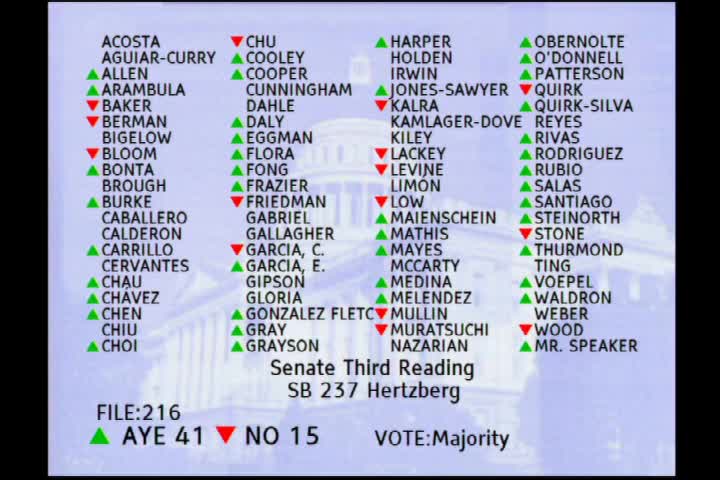 49MIN
Assembly Floor
 1H
Assembly Standing Committee on Communications and Conveyance
 28MIN
Senate Floor
 41MIN
Senate Standing Committee on Appropriations
 46MIN
Senate Standing Committee on Judiciary
 1H