SB 828: Land use: housing element.
- Session Year: 2017-2018
- House: Senate
- Latest Version Date: 2018-09-30
(1)The Planning and Zoning Law requires a city or county to adopt a general plan for its jurisdiction that contains certain mandatory elements, including a housing element. Existing law requires a planning agency to submit a draft of the housing element to the Department of Housing and Community Development for review, as specified.
Existing law requires the department, in consultation with each council of governments, to determine the existing and projected need for housing for each region in accordance with specified requirements. Existing law requires the appropriate council of governments, or the department for a city and county that does not have a council of governments, to adopt a final regional housing need plan that allocates a share of the regional housing need to each city, county, or city and county in accordance with certain requirements and procedures, including that a specified type of ordinance or policy that limits the number of residential building permits issued by a city or county may not be used as a justification for a determination or reduction in a jurisdictions share of the regional housing need.
This bill would prohibit the prior underproduction of housing in a city or county from the previous cycle and stable population numbers in a city or county from the previous cycle from being used as a justification for a determination or a reduction in the jurisdictions share of the regional housing need.
(2)Existing law requires, at least 26 months prior to the scheduled revision of the housing element and developing the existing and projected housing need for a region, the department to meet and consult with the council of governments regarding the assumptions and methodology to be used by the department to determine the regions housing needs. Existing law requires the council of governments to provide data assumptions from the councils projections, including, if available, specified data factors for the region, including, data relating to the percentage of renters households that are overcrowded and vacancy rates for healthy housing market functioning and regional mobility. Existing law requires the department, after consulting with the council of governments, to determine, in writing, the data assumptions for each of the data factors provided, as well as the methodology the department will use.
This bill would additionally require the council of governments to provide data on the overcrowding rate for a comparable housing market, and would define the vacancy rate for a healthy rental housing market for those purposes to be no less than 5%. The bill would also require the council of governments to include data on the percentage of households that are cost burdened, the rate of housing cost for a healthy housing market, and data on the projected household income growth. This bill would provide that statutory changes enacted after the date the department issued a final determination do not provide a basis for a revision of the final determination.
This bill would require the methodology approved by the department to grant allowances to adjust for data factors relating to overcrowding, vacancy rates, and households that are cost burdened, as described above, based on the regions total projected households, which includes existing households as well as future projected households.
(3)Existing law requires the council of governments, or delegate subregion as applicable, to develop a proposed methodology for distributing the existing and projected regional housing need to cities, counties, and cities and counties within the region or subregion, as applicable, that is consistent with specified objectives. Existing law, to the extent that sufficient data is available as provided, requires each council of governments, or delegate subregion as applicable, to include specified factors to develop the methodology that allocates regional housing needs including, among other factors, the opportunities and constraints regarding development of addition housing in each member jurisdiction, such as lands preserved or protected from urban development under existing federal or state programs, or both, designed to protect open space, farmland, environmental habitats, and natural resources on a long-term basis.
This bill would revise this factor to also include lands zoned or designated for agricultural protection or preservation that are subject to a local ballot measure that was approved by the voters of that jurisdiction that prohibits or restricts their conversion to nonagricultural uses.
(4)By expanding the duties of local governments relating to the housing element program and the final regional housing need plan, this bill would impose a state-mandated local program.
(5)This bill would incorporate additional changes to Section 65584 of the Government Code proposed by AB 1771 to be operative only if this bill and AB 1771 are enacted and this bill is enacted last.
This bill would incorporate additional changes to Section 65584.01 of the Government Code proposed by AB 1771 and AB 2238 to be operative only if this bill and either or both AB 1771 and AB 2238 are enacted and this bill is enacted last.
This bill would incorporate additional changes to Section 65584.04 of the Government Code proposed by AB 1771 and AB 2238 to be operative only if this bill and either or both AB 1771 and AB 2238 are enacted and this bill is enacted last.
(6)The California Constitution requires the state to reimburse local agencies and school districts for certain costs mandated by the state. Statutory provisions establish procedures for making that reimbursement.
This bill would provide that no reimbursement is required by this act for a specified reason.
(1)The Planning and Zoning Law requires a city or county to adopt a general plan for its jurisdiction that contains certain mandatory elements, including a housing element. Existing law requires a planning agency to submit a draft of the housing element to the Department of Housing and Community Development for review, as specified.
Existing law requires the department, in consultation with each council of governments, to determine the existing and projected need for housing for each region in accordance with specified requirements. Existing law requires the appropriate council of governments, or the department for a city and county that does not have a council of governments, to adopt a final regional housing need plan that allocates a share of the regional housing need to each city, county, or city and county in accordance with certain requirements and procedures, including that a specified type of ordinance or policy that limits the number of residential building permits issued by a city or county may not be used as a justification for a determination or reduction in a jurisdictions share of the regional housing need.
This bill would prohibit the prior underproduction of housing in a city or county from the previous cycle and stable population numbers in a city or county from the previous cycle from being used as a justification for a determination or a reduction in the jurisdictions share of the regional housing need.
(2)Existing law requires, at least 26 months prior to the scheduled revision of the housing element and developing the existing and projected housing need for a region, the department to meet and consult with the council of governments regarding the assumptions and methodology to be used by the department to determine the regions housing needs. Existing law requires the council of governments to provide data assumptions from the councils projections, including, if available, specified data factors for the region, including, data relating to the percentage of renters households that are overcrowded and vacancy rates for healthy housing market functioning and regional mobility. Existing law requires the department, after consulting with the council of governments, to determine, in writing, the data assumptions for each of the data factors provided, as well as the methodology the department will use.
This bill would additionally require the council of governments to provide data on the overcrowding rate for a comparable housing market, and would define the vacancy rate for a healthy rental housing market for those purposes to be considered between 5% and 8%. no less than 5%. The bill would also require the council of governments to include data on the percentage of households that are cost burdened, the rate of housing cost for a healthy housing market, and data on the projected household income growth. This bill would provide that statutory changes enacted after the date the department issued a final determination do not provide a basis for a revision of the final determination.
This bill would require the methodology approved by the department to grant allowances to adjust for data factors relating to overcrowding, vacancy rates, and households that are cost burdened, as described above, based on the regions total projected households, which includes existing households as well as future projected households.
(3)Existing law requires the council of governments, or delegate subregion as applicable, to develop a proposed methodology for distributing the existing and projected regional housing need to cities, counties, and cities and counties within the region or subregion, as applicable, that is consistent with specified objectives. Existing law, to the extent that sufficient data is available as provided, requires each council of governments, or delegate subregion as applicable, to include specified factors to develop the methodology that allocates regional housing needs including, among other factors, the opportunities and constraints regarding development of addition housing in each member jurisdiction, such as lands preserved or protected from urban development under existing federal or state programs, or both, designed to protect open space, farmland, environmental habitats, and natural resources on a long-term basis.
This bill would revise this factor to also include lands zoned or designated for agricultural protection or preservation that are subject to a local ballot measure that was approved by the voters of that jurisdiction that prohibits or restricts their conversion to non-agricultural uses.
(3)(4)By expanding the duties of local governments relating to the housing element program and the final regional housing need plan, this bill would impose a state-mandated local program.
(5)This bill would incorporate additional changes to Section 65584 of the Government Code proposed by AB 1771 to be operative only if this bill and AB 1771 are enacted and this bill is enacted last.
This bill would incorporate additional changes to Section 65584.01 of the Government Code proposed by AB 1771 and AB 2238 to be operative only if this bill and either or both AB 1771 and AB 2238 are enacted and this bill is enacted last.
This bill would incorporate additional changes to Section 65584.04 of the Government Code proposed by AB 1771 and AB 2238 to be operative only if this bill and either or both AB 1771 and AB 2238 are enacted and this bill is enacted last.
(4)(6)The California Constitution requires the state to reimburse local agencies and school districts for certain costs mandated by the state. Statutory provisions establish procedures for making that reimbursement.
This bill would provide that no reimbursement is required by this act for a specified reason.
(1)The Planning and Zoning Law requires a city or county to adopt a general plan for its jurisdiction that contains certain mandatory elements, including a housing element. Existing law requires a planning agency to submit a draft of the housing element to the Department of Housing and Community Development for review, as specified.
Existing law requires the department, in consultation with each council of governments, to determine the existing and projected need for housing for each region in accordance with specified requirements. Existing law requires the appropriate council of governments, or the department for a city and county that does not have a council of governments, to adopt a final regional housing need plan that allocates a share of the regional housing need to each city, county, or city and county in accordance with certain requirements and procedures, including that a specified type of ordinance or policy that limits the number of residential building permits issued by a city or county may not be used as a justification for a determination or reduction in a jurisdictions share of the regional housing need.
This bill would prohibit the prior underproduction of housing in a city or county from the previous cycle and stable population numbers in a city or county from the previous cycle from being used as a justification for a determination or a reduction in the jurisdictions share of the regional housing need. The bill would also require the final regional housing need plan to demonstrate government efforts to reverse racial and wealth disparities throughout a region by assigning additional weight to local governments that meet specified criteria in the distribution of the regional housing needs allocation for all income categories.
(2)Existing law requires, at least 26 months prior to the scheduled revision of the housing element and developing the existing and projected housing need for a region, the department to meet and consult with the council of governments regarding the assumptions and methodology to be used by the department to determine the regions housing needs. Existing law requires the council of governments to provide data assumptions from the councils projections, including, if available, specified data factors for the region, including, data relating to the percentage of renters households that are overcrowded and vacancy rates for healthy housing market functioning and regional mobility. Existing law requires the department, after consulting with the council of governments, to determine, in writing, the data assumptions for each of the data factors provided, as well as the methodology the department will use.
This bill would additionally require the council of governments to provide data on the overcrowding rate for a comparable housing market, and would define the vacancy rate for a healthy rental housing market for those purposes to be considered between 5% and 8% of both rental and ownership housing. 8%. The bill would also require the council of governments to include data on the percentage of households that are cost burdened, the rate of housing cost for a healthy housing market, and data on the projected household income growth.
This bill would require the methodology approved by the department to grant allowances to adjust for data factors relating to overcrowding, vacancy rates, and households that are cost burdened, as described above, based on the regions total projected households, which includes existing households as well as future projected households.
(3)By expanding the duties of local governments relating to the housing element program and the final regional housing need plan, this bill would impose a state-mandated local program.
(4)The California Constitution requires the state to reimburse local agencies and school districts for certain costs mandated by the state. Statutory provisions establish procedures for making that reimbursement.
This bill would provide that no reimbursement is required by this act for a specified reason.
(1)The Planning and Zoning Law requires a city or county to adopt a general plan for its jurisdiction that contains certain mandatory elements, including a housing element. Existing law requires a planning agency to submit a draft of the housing element to the Department of Housing and Community Development for review, as specified.
Existing law requires the housing element to contain an inventory of land suitable and available for residential development, and to be used to identify sites that can be developed for housing within the planning period and that are sufficient to provide for the jurisdictions share of the regional housing need for all income levels.This bill would, instead, require the inventory of land suitable and available for residential development to identify sites that can be developed for housing within the planning period that are sufficient to provide for 125% of the jurisdictions share of the regional housing need for all income levels.(2)Existing law requires the housing element to contain a program that sets forth a schedule of actions during the planning period that the city or county will undertake to implement policies and to achieve the goals and objectives of the housing element. Existing law requires the program to identify actions that will be taken during the period in order to accommodate that portion of the citys or countys share of the regional housing need for each income level that could not be accommodated on sites identified in the inventory of land, described above, without rezoning on those sites.This bill would require those actions identified in the program be taken to make at least 100% of the citys or countys share, so identified, be available for multifamily housing located within the jurisdictions existing urban service boundary.(3)ExistingExisting law requires the department, in consultation with each council of governments, to determine the existing and projected need for housing for each region in accordance with specified requirements. Existing law requires the appropriate council of governments, or the department for a city and county that does not have a council of governments, to adopt a final regional housing need plan that allocates a share of the regional housing need to each city, county, or city and county in accordance with certain requirements and procedures, including that a specified type of ordinance or policy that limits the number of residential building permits issued by a city or county may not be used as a justification for a determination or reduction in a jurisdictions share of the regional housing need.
This bill would prohibit the prior underproduction of housing in a city or county from the previous cycle and stable population numbers in a city or county from the previous cycle from being used as a justification for a determination or a reduction in the jurisdictions share of the regional housing need. The bill would also require the final regional housing need plan to demonstrate government efforts to reverse racial and wealth disparities throughout a region by assigning additional weight to local governments that meet specified criteria in the distribution of the regional housing needs allocation for all income categories.
(4)(2)Existing law requires, at least 26 months prior to the scheduled revision of the housing element and developing the existing and projected housing need for a region, the department to meet and consult with the council of governments regarding the assumptions and methodology to be used by the department to determine the regions housing needs. Existing law requires the council of governments to provide data assumptions from the councils projections, including, if available, specified data factors for the region, including, data relating to the percentage of renters households that are overcrowded and vacancy rates for healthy housing market functioning and regional mobility. Existing law requires the department, after consulting with the council of governments, to determine, in writing, the data assumptions for each of the data factors provided, as well as the methodology the department will use.
This bill would additionally require the council of governments to provide data on the overcrowding rate for a comparable housing market, and would define the vacancy rate for a healthy housing market for those purposes to be considered between 5% and 8% of both rental and ownership housing. The bill would also require the council of governments to include data on the percentage of households that are cost burdened, the rate of housing cost for a healthy housing market, and data on the projected household income growth.
This bill would require the methodology approved by the department to grant allowances to adjust for data factors relating to overcrowding, vacancy rates, and households that are cost burdened, as described above, based on the regions total projected households, which includes existing households as well as future projected households.
(5)(3)By expanding the duties of local governments relating to the housing element program and the final regional housing need plan, this bill would impose a state-mandated local program.
(6)(4)The California Constitution requires the state to reimburse local agencies and school districts for certain costs mandated by the state. Statutory provisions establish procedures for making that reimbursement.
This bill would provide that no reimbursement is required by this act for a specified reason.
(1)The Planning and Zoning Law requires a city or county to adopt a general plan for its jurisdiction that contains certain mandatory elements, including a housing element. Existing law requires a planning agency to submit a draft of the housing element to the Department of Housing and Community Development for review, as specified.
Existing law requires the housing element to contain an inventory of land suitable and available for residential development, and to be used to identify sites that can be developed for housing within the planning period and that are sufficient to provide for the jurisdictions share of the regional housing need for all income levels.
This bill would, instead, require the inventory of land suitable and available for residential development to identify sites that can be developed for housing within the planning period that are sufficient to provide for 125% of the jurisdictions share of the regional housing need for all income levels.
(2)Existing law requires the housing element to contain a program that sets forth a schedule of actions during the planning period that the city or county will undertake to implement policies and to achieve the goals and objectives of the housing element. Existing law requires the program to identify actions that will be taken during the period in order to accommodate that portion of the citys or countys share of the regional housing need for each income level that could not be accommodated on sites identified in the inventory of land, described above, without rezoning on those sites.
This bill would require those actions identified in the program be taken to make at least 100% of the citys or countys share, so identified, be available for multifamily housing located within the jurisdictions existing urban service boundary.
(3)Existing law requires the department, in consultation with each council of governments, to determine the existing and projected need for housing for each region in accordance with specified requirements. Existing law requires the appropriate council of governments, or the department for a city and county that does not have a council of governments, to adopt a final regional housing need plan that allocates a share of the regional housing need to each city, county, or city and county in accordance with certain requirements and procedures, including that a specified type of ordinance or policy that limits the number of residential building permits issued by a city or county may not be used as a justification for a determination or reduction in a jurisdictions share of the regional housing need.
This bill would prohibit the prior underproduction of housing in a city or county from the previous cycle and stable population numbers in a city or county from the previous cycle from being used as a justification for a determination or a reduction in the jurisdictions share of the regional housing need. The bill would also require the final regional housing need plan to demonstrate government efforts to reverse racial and wealth disparities throughout a region by assigning additional weight to local governments that meet specified criteria in the distribution of the regional housing needs allocation for all income categories.
(4)Existing law requires, at least 26 months prior to the scheduled revision of the housing element and developing the existing and projected housing need for a region, the department to meet and consult with the council of governments regarding the assumptions and methodology to be used by the department to determine the regions housing needs. Existing law requires the council of governments to provide data assumptions from the councils projections, including, if available, specified data factors for the region, including, data relating to the percentage of renters households that are overcrowded and vacancy rates for healthy housing market functioning and regional mobility. Existing law requires the department, after consulting with the council of governments, to determine, in writing, the data assumptions for each of the data factors provided, as well as the methodology the department will use.
This bill would additionally require the council of governments to provide data on the overcrowding rate for a healthy comparable housing market, and would define the vacancy rate for a healthy housing market for those purposes to be considered between 5% and 8% of both rental and ownership housing. The bill would also require the council of governments to include data on the percentage of households that are cost burdened, the rate of housing cost for a healthy housing market, and data on the projected household income growth.
This bill would require the methodology approved by the department to grant allowances to adjust for data factors relating to overcrowding, vacancy rates, and households that are cost burdened, as described above, based on the regions total projected households, which includes existing households as well as future projected households.
(5)By expanding the duties of local governments relating to the housing element program and the final regional housing need plan, this bill would impose a state-mandated local program.
(6)The California Constitution requires the state to reimburse local agencies and school districts for certain costs mandated by the state. Statutory provisions establish procedures for making that reimbursement.
This bill would provide that no reimbursement is required by this act for a specified reason.
(1)The Planning and Zoning Law requires a city or county to adopt a general plan for its jurisdiction that contains certain mandatory elements, including a housing element. Existing law requires a planning agency to submit a draft of the housing element to the Department of Housing and Community Development for review, as specified.
Existing law requires the housing element to contain an inventory of land suitable and available for residential development, and to contain be used to identify sites that can be developed for housing within the planning period and that are sufficient to provide for the jurisdictions share of the regional housing need for all income levels.
This bill would, instead, require the inventory of land suitable and available for residential development to identify sites that can be developed for housing within the planning period that are sufficient to provide for 125% of the jurisdictions share of the regional housing need for all income levels.
(2)Existing law requires the housing element to contain a program that sets forth a schedule of actions during the planning period that the city or county will undertake to implement policies and to achieve the goals and objectives of the housing element. Existing law requires the program to identify actions that will be taken during the period in order to accommodate that portion of the citys or countys share of the regional housing need for each income level that could not be accommodated on sites identified in the inventory of land, described above, without rezoning on those sites.
This bill would, instead, require the program to identify actions that will be taken to accommodate 125% of the citys or countys share of the regional housing need that could not be accommodated on the sites identified in the inventory of land without rezoning of those sites. The bill would also require would require those actions identified in the program be taken to make at least 100% of the citys or countys share share, so identified identified, be available for multifamily housing located within developed areas. the jurisdictions existing urban service boundary.
(2)(3)Existing law requires the department, in consultation with each council of governments, to determine the existing and projected need for housing for each region in accordance with specified requirements. Existing law requires the appropriate council of governments, or the department for a city and county that does not have a council of governments, to adopt a final regional housing need plan that allocates a share of the regional housing need to each city, county, or city and county, as specified. county in accordance with certain requirements and procedures, including that a specified type of ordinance or policy that limits the number of residential building permits issued by a city or county may not be used as a justification for a determination or reduction in a jurisdictions share of the regional housing need.
This bill would prohibit the final allocation plan from considering the prior underproduction of housing from the previous cycle, as calculated, to justify a lower allocation for a particular local government. prior underproduction of housing in a city or county from the previous cycle and stable population numbers in a city or county from the previous cycle from being used as a justification for a determination or a reduction in the jurisdictions share of the regional housing need. The bill would also require the final regional housing need plan to demonstrate government efforts to reverse racial and wealth disparities throughout a region, including by demonstrating a high housing allocation for households located within particular communities, and a high housing allocation for all income categories. region by assigning additional weight to local governments that meet specified criteria in the distribution of the regional housing needs allocation for all income categories.
(3)(4)Existing law requires, at least 26 months prior to the scheduled revision of the housing element and developing the existing and projected housing need for a region, the department to meet and consult with the council of governments regarding the assumptions and methodology to be used by the department to determine the regions housing needs. Existing law requires the council of governments to provide data assumptions from the councils projections, including, if available, specified data factors for the region, including, data relating to the percentage of renters households that are overcrowded and vacancy rates for healthy housing market functioning and regional mobility. Existing law requires the department, after consulting with the council of governments, to determine, in writing, the data assumptions for each of the data factors provided, as well as the methodology the department will use.
This bill would additionally require the council of governments to provide data on the overcrowding rate for a healthy housing market, and would define the vacancy rate for a healthy housing market for those purposes to be considered no less than 6% between 5% and 8% of both rental and ownership housing, as provided. housing. The bill would also require the council of governments to include data on the percentage of households paying more than 30% of their income on housing. that are cost burdened, the rate of housing cost for a healthy housing market, and data on the projected household income growth.
(4)Existing law requires the department, after consultation with the council of governments, to determine a regions existing and projected housing need based upon assumptions and methodology prepared pursuant to a specified process. Existing law authorizes a council of governments to file an objection on the departments determination within 30 days following notice of the departments determination. The department is required to consider that objection within 45 days of receiving it and make a final written determination of the regions existing and projected housing need.The bill would require the department, after making the final written determination described above, to add the difference between the previous cycles housing allocation and the reported housing production based on an annual production report submitted by the local government. The bill would provide any determination of that nature is unappealable.This bill would also require the department, before the next regional housing needs assessment for each region, to address the historic underproduction of housing in California, particularly in coastal and metropolitan communities, by completing a comprehensive audit of unmet housing needs for each region by January 1, 2020, and to add the results of this audit to each regions next regional housing assessment following January 1, 2020.This bill would require the methodology approved by the department to grant allowances to adjust for data factors relating to overcrowding, vacancy rates, and households that are cost burdened, as described above, based on the regions total projected households, which includes existing households as well as future projected households.
(5)By expanding the duties of local governments relating to the housing element program and the final regional housing need plan, this bill would impose a state-mandated local program.
(6)The California Constitution requires the state to reimburse local agencies and school districts for certain costs mandated by the state. Statutory provisions establish procedures for making that reimbursement.
This bill would provide that no reimbursement is required by this act for a specified reason.
(1)The Planning and Zoning Law requires a city or county to adopt a general plan for its jurisdiction that contains certain mandatory elements, including a housing element. Existing law requires a planning agency to submit a draft of the housing element to the Department of Housing and Community Development for review, as specified.
Existing law requires the general plan housing element to contain an inventory of land suitable and available for residential development, and to contain a program that sets forth a schedule of actions during the planning period that the city or county will undertake to implement policies and to achieve the goals and objectives of the housing element. Existing law requires the program to identify actions that will be taken during the period in order to accommodate that portion of the citys or countys share of the regional housing need for each income level that could not be accommodated on sites identified in the inventory of land, described above, without rezoning on those sites.
This bill would, instead, require the program to identify actions that will be taken to accommodate 200% 125% of the citys or countys share of the regional housing need that could not be accommodated on the sites identified in the inventory of land without rezoning of those sites. The bill would also require those actions be taken to make at least 100% of the citys or countys share so identified be available for multifamily housing located within developed areas.
(2)Existing law requires the department, in consultation with each council of governments, to determine the existing and projected need for housing for each region in accordance with specified requirements. Existing law requires the appropriate council of governments, or the department for a city and county that does not have a council of governments, to adopt a final regional housing need plan that allocates a share of the regional housing need to each city, county, or city and county, as specified.
This bill would prohibit the final allocation plan from considering the prior underproduction of housing from the previous cycle, as calculated, to justify a lower allocation for a particular local government. The bill would also require the final regional housing need plan to demonstrate efforts to reverse racial and wealth disparities throughout a region, including by demonstrating a high housing allocation for households located within particular communities, efforts to alleviate a median market rent that exceeds 30%, and a high housing allocation for all income categories.
(3)Existing law requires, at least 26 months prior to the scheduled revision of the housing element and developing the existing and projected housing need for a region, the department to meet and consult with the council of governments regarding the assumptions and methodology to be used by the department to determine the regions housing needs. Existing law requires the council of governments to provide data assumptions from the councils projections, including, if available, specified data for the region, including, data relating to vacancy rates for healthy housing market functioning and regional mobility.
This bill would define the vacancy rate for a healthy housing market for those purposes to be considered no less than 6% of both rental and ownership housing, as provided. The bill would also require the council of governments to include data on the percentage of households paying more than 30% of their income on housing.
(4)Existing law requires the department, after consultation with the council of governments, to determine a regions existing and projected housing need based upon assumptions and methodology prepared pursuant to a specified process. Existing law authorizes a council of governments to file an objection on the departments determination within 30 days following notice of the departments determination. The department is required to consider that objection within 45 days of receiving it and make a final written determination of the regions existing and projected housing need.
The bill would require the department, after making the final written determination described above, to add the difference between the previous cycles housing allocation and the reported housing production based on an annual production report submitted by the local government. The bill would provide any determination of that nature is unappealable.
This bill would also require the department, before the next regional housing needs assessment for each region, to address the historic underproduction of housing in California, particularly in coastal and metropolitan communities, by completing a comprehensive audit of unmet housing needs for each region by January 1, 2020, and to add the results of this audit to each regions next regional housing assessment following January 1, 2020.
(5)By expanding the duties of local governments relating to the housing element program and the final regional housing need plan, this bill would impose a state-mandated local program.
(6)The California Constitution requires the state to reimburse local agencies and school districts for certain costs mandated by the state. Statutory provisions establish procedures for making that reimbursement.
This bill would provide that no reimbursement is required by this act for a specified reason.
(1)The Planning and Zoning Law requires a city or county to adopt a comprehensive, long-term general plan for the physical development of the city or county and of any land outside its boundaries that bears relation to its planning. That law also requires the general plan to include a housing element and general plan for its jurisdiction that contains certain mandatory elements, including a housing element. Existing law requires a planning agency to submit a draft of the housing element to the Department of Housing and Community Development for review, as specified.
Existing law requires the general plan housing element to consist of contain an inventory of land suitable and available for residential development, and to contain a program that sets forth a schedule of actions during the planning period that the local government city or county will undertake to implement policies and to achieve the goals and objectives of the housing element. Existing law requires the program to, among other things, if the inventory of land suitable for residential development included in the housing element does not include adequate sites to accommodate the need for groups of all household income levels, to identify actions that will be taken to make sites available including rezoning of those sites, as specified. Existing law requires the program to accommodate 100% of the need for housing for very low and low-income households, allocated, as specified. to identify actions that will be taken during the period in order to accommodate that portion of the citys or countys share of the regional housing need for each income level that could not be accommodated on sites identified in the inventory of land, described above, without rezoning on those sites.
This bill would increase the percentage of the need for housing for very low and low-income households that the program is required to accommodate to 200%. would, instead, require the program to identify actions that will be taken to accommodate 200% of the citys or countys share of the regional housing need that could not be accommodated on the sites identified in the inventory of land without rezoning of those sites. The bill would also require those actions be taken to make at least 100% of the citys or countys share so identified be available for multifamily housing located within developed areas.
Existing(2)Existing law requires the department, in consultation with each council of governments, to determine each regions existing and projected housing need and for the existing and projected need for housing for each region in accordance with specified requirements. Existing law requires the appropriate council of governments, or for the department, the department for a city and county that does not have a council of governments, to adopt a final regional housing need plan that allocates a share of the regional housing need to each city, county, or city and county, as specified.
This bill would prohibit the final allocation plan from considering the prior underproduction of housing from the previous cycle, as calculated, to justify a lower allocation for a particular local government. The bill would also require the final regional housing need plan to reflect equitable allocations for housing of all income levels, and not demonstrate disparities that promote racial or wealth disparities throughout a region. The bill would also require the plan, in particular communities, to demonstrate a high rate of new housing production for households of all income levels and that median rent or home prices available for rent or sale that exceed levels affordable to median income households shall be alleviated, as specified. demonstrate efforts to reverse racial and wealth disparities throughout a region, including by demonstrating a high housing allocation for households located within particular communities, efforts to alleviate a median market rent that exceeds 30%, and a high housing allocation for all income categories.
Existing(3)Existing law requires, at least 26 months prior to the scheduled revision of the housing element and developing the existing and projected housing need for a region, the department to meet and consult with the council of governments regarding the assumptions and methodology to be used by the department to determine the regions housing needs. Existing law requires the council of governments to provide data assumptions from the councils projections, including, if available, specified data for the region. region, including, data relating to vacancy rates for healthy housing market functioning and regional mobility.
This bill would require that data, if available, to include median rent or home prices that exceed median income and the rate of median income growth or decline. The bill would also prohibit the council of governments from considering prior underproduction of housing, as specified, in order to inform housing allocations or to justify a lower allocation for a local jurisdiction. define the vacancy rate for a healthy housing market for those purposes to be considered no less than 6% of both rental and ownership housing, as provided. The bill would also require the council of governments to include data on the percentage of households paying more than 30% of their income on housing.
(4)Existing law requires the department, after consultation with the council of governments, to determine a regions existing and projected housing need based upon assumptions and methodology prepared pursuant to a specified process. Existing law authorizes a council of governments to file an objection on the departments determination within 30 days following notice of the departments determination. The department is required to consider that objection within 45 days of receiving it and make a final written determination of the regions existing and projected housing need.
The bill would require the department, after making the final written determination described above, to add the difference between the previous cycles housing allocation and the reported housing production based on an annual production report submitted by the local government. The bill would provide any determination of that nature is unappealable.
This bill would also require the department, before the next regional housing needs assessment for each region, to address the historic underproduction of housing in California, particularly in coastal and metropolitan communities, by completing a comprehensive audit of unmet housing needs for each region by January 1, 2020, and to add the results of this audit to the each regions next regional housing allocations after assessment following January 1, 2019. 2020.
Because the bill would create new duties for local governments it(5)By expanding the duties of local governments relating to the housing element program and the final regional housing need plan, this bill would impose a state-mandated local program.
The(6)The California Constitution requires the state to reimburse local agencies and school districts for certain costs mandated by the state. Statutory provisions establish procedures for making that reimbursement.
This bill would provide that no reimbursement is required by this act for a specified reason.
The Planning and Zoning Law requires a city or county to adopt a comprehensive, long-term general plan for the physical development of the city or county and of any land outside its boundaries that bears relation to its planning. That law also requires the general plan to include a housing element and requires a planning agency to submit a draft of the housing element to the Department of Housing and Community Development for review, as specified.
Existing law requires the housing element to consist of a program that sets forth a schedule of actions that the local government will undertake to implement policies and to achieve the goals and objectives of the housing element. Existing law requires the program to, among other things, if the inventory of land suitable for residential development included in the housing element does not include adequate sites to accommodate the need for groups of all household income levels, to identify actions that will be taken to make sites available including rezoning of those sites, as specified. Existing law requires the program to accommodate 100% of the need for housing for very low and low-income households, allocated, as specified.
This bill would increase the percentage of the need for housing for very low and low-income households that the program is required to accommodate to 200%.
Existing law requires the department, in consultation with each council of governments, to determine each regions existing and projected housing need and for the appropriate council of governments, or for the department, to adopt a final regional housing need plan that allocates a share of the regional housing need to each city, county, or city and county, as specified.
This bill would require the final regional housing need plan to reflect equitable allocations for housing of all income levels, and not demonstrate disparities that promote racial or wealth disparities throughout a region. The bill would also require the plan, in particular communities, to demonstrate a high rate of new housing production for households of all income levels and that median rent or home prices available for rent or sale that exceed levels affordable to median income households shall be alleviated, as specified.
Existing law requires, at least 26 months prior to the scheduled revision of the housing element and developing the existing and projected housing need for a region, the department to meet and consult with the council of governments regarding the assumptions and methodology to be used by the department to determine the regions housing needs. Existing law requires the council of governments to provide data assumptions from the councils projections, including, if available, specified data for the region.
This bill would require that data, if available, to include median rent or home prices that exceed median income and the rate of median income growth or decline. The bill would also prohibit the council of governments from considering prior underproduction of housing, as specified, in order to inform housing allocations or to justify a lower allocation for a local jurisdiction.
This bill would also require the department, before the next regional housing needs assessment for each region, to address the historic underproduction of housing in California, particularly in coastal and metropolitan communities, by completing a comprehensive audit of unmet housing needs for each region and to add the results of this audit to the next regional housing allocations after January 1, 2019.
Because the bill would create new duties for local governments it would impose a state-mandated local program.
The California Constitution requires the state to reimburse local agencies and school districts for certain costs mandated by the state. Statutory provisions establish procedures for making that reimbursement.
This bill would provide that no reimbursement is required by this act for a specified reason.
This bill would state the intent of the Legislature to enact legislation that would, among other things, require the department to take certain actions relating to unmet housing needs, including completing a comprehensive assessment on unmet need for each region and including the results of the assessment in regional allocations for the next housing element cycle.The Planning and Zoning Law requires a city or county to adopt a comprehensive, long-term general plan for the physical development of the city or county and of any land outside its boundaries that bears relation to its planning. That law also requires the general plan to include a housing element and requires a planning agency to submit a draft of the housing element to the Department of Housing and Community Development for review, as specified.
This bill would state the intent of the Legislature to enact legislation that would, among other things, require the department to take certain actions relating to unmet housing needs, including completing a comprehensive assessment on unmet need for each region and including the results of the assessment in regional allocations for the next housing element cycle.
(a)(1)For the fourth and subsequent revisions of the housing element pursuant to Section 65588, the department shall determine the existing and projected need for housing for each region pursuant to this article. For purposes of subdivision (a) of Section 65583, the share of a city or county of the regional housing need shall include that share of the housing need of persons at all income levels within the area significantly affected by the general plan of the city or county.
(2)It is the intent of the Legislature that cities, counties, and cities and counties should undertake all necessary actions to encourage, promote, and facilitate the development of housing to accommodate the entire regional housing need, and reasonable actions should be taken by local and regional governments to ensure that future housing production meet, at a minimum, the regional housing need established for planning purposes. These actions shall include applicable reforms and incentives in Section 65582.1.
(3)The Legislature finds and declares that insufficient housing in job centers hinders the states environmental quality and runs counter to the states environmental goals. In particular, when Californians seeking affordable housing are forced to drive longer distances to work, an increased amount of greenhouse gases and other pollutants is released and puts in jeopardy the achievement of the states climate goals, as established pursuant to Section 38566 of the Health and Safety Code, and clean air goals.
(b)The department, in consultation with each council of governments, shall determine each regions existing and projected housing need pursuant to Section 65584.01 at least two years prior to the scheduled revision required pursuant to Section 65588. The appropriate council of governments, or for cities and counties without a council of governments, the department, shall adopt a final regional housing need plan that allocates a share of the regional housing need to each city, county, or city and county at least one year prior to the scheduled revision for the region required by Section 65588. The allocation plan prepared by a council of governments shall be prepared pursuant to Sections 65584.04 and 65584.05 with the advice of the department.
(c)Notwithstanding any other provision of law, the due dates for the determinations of the department or for the council of governments, respectively, regarding the regional housing need may be extended by the department by not more than 60 days if the extension will enable access to more recent critical population or housing data from a pending or recent release of the United States Census Bureau or the Department of Finance. If the due date for the determination of the department or the council of governments is extended for this reason, the department shall extend the corresponding housing element revision deadline pursuant to Section 65588 by not more than 60 days.
(d)The regional housing needs allocation plan shall be consistent with all of the following objectives:
(1)Increasing the housing supply and the mix of housing types, tenure, and affordability in all cities and counties within the region in an equitable manner, which shall result in each jurisdiction receiving an allocation of units for low- and very low income households.
(2)Promoting infill development and socioeconomic equity, the protection of environmental and agricultural resources, and the encouragement of efficient development patterns.
(3)Promoting an improved intraregional relationship between jobs and housing.
(4)Allocating a lower proportion of housing need to an income category when a jurisdiction already has a disproportionately high share of households in that income category, as compared to the countywide distribution of households in that category from the most recent decennial United States census.
(e)For purposes of this section, household income levels are as determined by the department as of the most recent decennial census pursuant to the following code sections:
(1)Very low incomes as defined by Section 50105 of the Health and Safety Code.
(2)Lower incomes, as defined by Section 50079.5 of the Health and Safety Code.
(3)Moderate incomes, as defined by Section 50093 of the Health and Safety Code.
(4)Above moderate incomes are those exceeding the moderate-income level of Section 50093 of the Health and Safety Code.
(f)Notwithstanding any other provision of law, determinations made by the department, a council of governments, or a city or county pursuant to this section or Section 65584.01, 65584.02, 65584.03, 65584.04, 65584.05, 65584.06, 65584.07, or 65584.08 are exempt from the California Environmental Quality Act (Division 13 (commencing with Section 21000) of the Public Resources Code).
SEC. 1.5.Section 65584 of the Government Code is amended to read:65584.(a)(1)For the fourth and subsequent revisions of the housing element pursuant to Section 65588, the department shall determine the existing and projected need for housing for each region pursuant to this article. For purposes of subdivision (a) of Section 65583, the share of a city or county of the regional housing need shall include that share of the housing need of persons at all income levels within the area significantly affected by the general plan of the city or county.
(2)It is the intent of the Legislature that cities, counties, and cities and counties should undertake all necessary actions to encourage, promote, and facilitate the development of housing to accommodate the entire regional housing need, and reasonable actions should be taken by local and regional governments to ensure that future housing production meets, at a minimum, the regional housing need established for planning purposes. These actions shall include applicable reforms and incentives in Section 65582.1.
(3)The Legislature finds and declares that insufficient housing in job centers hinders the states environmental quality and runs counter to the states environmental goals. In particular, when Californians seeking affordable housing are forced to drive longer distances to work, an increased amount of greenhouse gases and other pollutants is released and puts in jeopardy the achievement of the states climate goals, as established pursuant to Section 38566 of the Health and Safety Code, and clean air goals.
(b)The department, in consultation with each council of governments, shall determine each regions existing and projected housing need pursuant to Section 65584.01 at least two years prior to the scheduled revision required pursuant to Section 65588. The appropriate council of governments, or for cities and counties without a council of governments, the department, shall adopt a final regional housing need plan that allocates a share of the regional housing need to each city, county, or city and county at least one year prior to the scheduled revision for the region required by Section 65588. The allocation plan prepared by a council of governments shall be prepared pursuant to Sections 65584.04 and 65584.05.
(c)Notwithstanding any other provision of law, the due dates for the determinations of the department or for the council of governments, respectively, regarding the regional housing need may be extended by the department by not more than 60 days if the extension will enable access to more recent critical population or housing data from a pending or recent release of the United States Census Bureau or the Department of Finance. If the due date for the determination of the department or the council of governments is extended for this reason, the department shall extend the corresponding housing element revision deadline pursuant to Section 65588 by not more than 60 days.
(d)The regional housing needs allocation plan shall further all of the following objectives:
(1)Increasing the housing supply and the mix of housing types, tenure, and affordability in all cities and counties within the region in an equitable manner, which shall result in each jurisdiction receiving an allocation of units for low- and very low income households.
(2)Promoting infill development and socioeconomic equity, the protection of environmental and agricultural resources, the encouragement of efficient development patterns, and the achievement of the regions greenhouse gas reductions targets provided by the State Air Resources Board pursuant to Section 65080.
(3)Promoting an improved intraregional relationship between jobs and housing, including an improved balance between the number of low-wage jobs and the number of housing units affordable to low-wage workers in each jurisdiction.
(4)Allocating a lower proportion of housing need to an income category when a jurisdiction already has a disproportionately high share of households in that income category, as compared to the countywide distribution of households in that category from the most recent American Community Survey.
(5)Affirmatively furthering fair housing.
(e)For purposes of this section, affirmatively furthering fair housing means taking meaningful actions, in addition to combating discrimination, that overcome patterns of segregation and foster inclusive communities free from barriers that restrict access to opportunity based on protected characteristics. Specifically, affirmatively furthering fair housing means taking meaningful actions that, taken together, address significant disparities in housing needs and in access to opportunity, replacing segregated living patterns with truly integrated and balanced living patterns, transforming racially and ethnically concentrated areas of poverty into areas of opportunity, and fostering and maintaining compliance with civil rights and fair housing laws.
(f)For purposes of this section, household income levels are as determined by the department as of the most recent American Community Survey pursuant to the following code sections:
(1)Very low incomes as defined by Section 50105 of the Health and Safety Code.
(2)Lower incomes, as defined by Section 50079.5 of the Health and Safety Code.
(3)Moderate incomes, as defined by Section 50093 of the Health and Safety Code.
(4)Above moderate incomes are those exceeding the moderate-income level of Section 50093 of the Health and Safety Code.
(g)Notwithstanding any other provision of law, determinations made by the department, a council of governments, or a city or county pursuant to this section or Section 65584.01, 65584.02, 65584.03, 65584.04, 65584.05, 65584.06, 65584.07, or 65584.08 are exempt from the California Environmental Quality Act (Division 13 (commencing with Section 21000) of the Public Resources Code).
SEC. 2.Section 65584.01 of the Government Code is amended to read:65584.01.For the fourth and subsequent revision of the housing element pursuant to Section 65588, the department, in consultation with each council of governments, where applicable, shall determine the existing and projected need for housing for each region in the following manner:
(a)The departments determination shall be based upon population projections produced by the Department of Finance and regional population forecasts used in preparing regional transportation plans, in consultation with each council of governments. If the total regional population forecast for the projection year, developed by the council of governments and used for the preparation of the regional transportation plan, is within a range of 1.5 percent of the total regional population forecast for the projection year by the Department of Finance, then the population forecast developed by the council of governments shall be the basis from which the department determines the existing and projected need for housing in the region. If the difference between the total population projected by the council of governments and the total population projected for the region by the Department of Finance is greater than 1.5 percent, then the department and the council of governments shall meet to discuss variances in methodology used for population projections and seek agreement on a population projection for the region to be used as a basis for determining the existing and projected housing need for the region. If no agreement is reached, then the population projection for the region shall be the population projection for the region prepared by the Department of Finance as may be modified by the department as a result of discussions with the council of governments.
(b)(1)At least 26 months prior to the scheduled revision pursuant to Section 65588 and prior to developing the existing and projected housing need for a region, the department shall meet and consult with the council of governments regarding the assumptions and methodology to be used by the department to determine the regions housing needs. The council of governments shall provide data assumptions from the councils projections, including, if available, the following data for the region:
(A)Anticipated household growth associated with projected population increases.
(B)Household size data and trends in household size.
(C)The percentage of households that are overcrowded and the overcrowding rate for a comparable housing market. For purposes of this subparagraph:
(i)The term overcrowded means more than one resident per room in each room in a dwelling.
(ii)The term overcrowded rate for a comparable housing market means that the overcrowding rate is no more than the average overcrowding rate in comparable regions throughout the nation, as determined by the council of governments.
(D)The rate of household formation, or headship rates, based on age, gender, ethnicity, or other established demographic measures.
(E)The vacancy rates in existing housing stock, and the vacancy rates for healthy housing market functioning and regional mobility, as well as housing replacement needs. For purposes of this subparagraph, the vacancy rate for a healthy rental housing market shall be considered no less than 5 percent.
(F)Other characteristics of the composition of the projected population.
(G)The relationship between jobs and housing, including any imbalance between jobs and housing.
(H)The percentage of households that are cost burdened and the rate of housing cost burden for a healthy housing market. For the purposes of this subparagraph:
(i)The term cost burdened means the share of very low-, low-, moderate-, and above moderate-income households that are paying more than 30 percent of household income on housing costs.
(ii)The term rate of housing cost burden for a healthy housing market means that the rate of households that are cost burdened is no more than the average rate of households that are cost burdened in comparable regions throughout the nation, as determined by the council of governments.
(2)The department may accept or reject the information provided by the council of governments or modify its own assumptions or methodology based on this information. After consultation with the council of governments, the department shall make determinations in writing on the assumptions for each of the factors listed in subparagraphs (A) to (H), inclusive, of paragraph (1) and the methodology it shall use and shall provide these determinations to the council of governments. The methodology submitted by the department may make adjustments based on the regions total projected households, which includes existing households as well as projected households.
(c)(1)After consultation with the council of governments, the department shall make a determination of the regions existing and projected housing need based upon the assumptions and methodology determined pursuant to subdivision (b). The regions existing and projected housing need shall reflect the achievement of a feasible balance between jobs and housing within the region using the regional employment projections in the applicable regional transportation plan. Within 30 days following notice of the determination from the department, the council of governments may file an objection to the departments determination of the regions existing and projected housing need with the department.
(2)The objection shall be based on and substantiate either of the following:
(A)The department failed to base its determination on the population projection for the region established pursuant to subdivision (a), and shall identify the population projection which the council of governments believes should instead be used for the determination and explain the basis for its rationale.
(B)The regional housing need determined by the department is not a reasonable application of the methodology and assumptions determined pursuant to subdivision (b). The objection shall include a proposed alternative determination of its regional housing need based upon the determinations made in subdivision (b), including analysis of why the proposed alternative would be a more reasonable application of the methodology and assumptions determined pursuant to subdivision (b).
(3)If a council of governments files an objection pursuant to this subdivision and includes with the objection a proposed alternative determination of its regional housing need, it shall also include documentation of its basis for the alternative determination. Within 45 days of receiving an objection filed pursuant to this section, the department shall consider the objection and make a final written determination of the regions existing and projected housing need that includes an explanation of the information upon which the determination was made.
(d)Statutory changes enacted after the date the department issued a final determination pursuant to this section shall not be a basis for a revision of the final determination.
SEC. 2.3.Section 65584.01 of the Government Code is amended to read:65584.01.For the fourth and subsequent revision of the housing element pursuant to Section 65588, the department, in consultation with each council of governments, where applicable, shall determine the existing and projected need for housing for each region in the following manner:
(a)The departments determination shall be based upon population projections produced by the Department of Finance and regional population forecasts used in preparing regional transportation plans, in consultation with each council of governments. If the total regional population forecast for the projection year, developed by the council of governments and used for the preparation of the regional transportation plan, is within a range of 1.5 percent of the total regional population forecast for the projection year by the Department of Finance, then the population forecast developed by the council of governments shall be the basis from which the department determines the existing and projected need for housing in the region. If the difference between the total population projected by the council of governments and the total population projected for the region by the Department of Finance is greater than 1.5 percent, then the department and the council of governments shall meet to discuss variances in methodology used for population projections and seek agreement on a population projection for the region to be used as a basis for determining the existing and projected housing need for the region. If no agreement is reached, then the population projection for the region shall be the population projection for the region prepared by the Department of Finance as may be modified by the department as a result of discussions with the council of governments.
(b)(1)At least 26 months prior to the scheduled revision pursuant to Section 65588 and prior to developing the existing and projected housing need for a region, the department shall meet and consult with the council of governments regarding the assumptions and methodology to be used by the department to determine the regions housing needs. The council of governments shall provide data assumptions from the councils projections, including, if available, the following data for the region:
(A)Anticipated household growth associated with projected population increases.
(B)Household size data and trends in household size.
(C)The percentage of households that are overcrowded and the overcrowding rate for a comparable housing market. For purposes of this subparagraph:
(i)The term overcrowded means more than one resident per room in each room in a dwelling.
(ii)The term overcrowded rate for a comparable housing market means that the overcrowding rate is no more than the average overcrowding rate in comparable regions throughout the nation, as determined by the council of governments.
(D)The rate of household formation, or headship rates, based on age, gender, ethnicity, or other established demographic measures.
(E)The vacancy rates in existing housing stock, and the vacancy rates for healthy housing market functioning and regional mobility, as well as housing replacement needs. For purposes of this subparagraph, the vacancy rate for a healthy rental housing market shall be considered no less than 5 percent.
(F)Other characteristics of the composition of the projected population.
(G)The relationship between jobs and housing, including any imbalance between jobs and housing.
(H)The percentage of households that are cost burdened and the rate of housing cost burden for a healthy housing market. For the purposes of this subparagraph:
(i)The term cost burdened means the share of very low-, low-, moderate-, and above moderate-income households that are paying more than 30 percent of household income on housing costs.
(ii)The term rate of housing cost burden for a healthy housing market means that the rate of households that are cost burdened is no more than the average rate of households that are cost burdened in comparable regions throughout the nation, as determined by the council of governments.
(I)The loss of units during a state of emergency that was declared by the Governor pursuant to the California Emergency Services Act (Chapter 7 (commencing with Section 8550) of Division 1 of Title 2), during the planning period immediately preceding the relevant revision pursuant to Section 65588 that have yet to be rebuilt or replaced at the time of the data request.
(2)The department may accept or reject the information provided by the council of governments or modify its own assumptions or methodology based on this information. After consultation with the council of governments, the department shall make determinations in writing on the assumptions for each of the factors listed in subparagraphs (A) to (I), inclusive, of paragraph (1) and the methodology it shall use and shall provide these determinations to the council of governments. The methodology submitted by the department may make adjustments based on the regions total projected households, which includes existing households as well as projected households.
(c)(1)After consultation with the council of governments, the department shall make a determination of the regions existing and projected housing need based upon the assumptions and methodology determined pursuant to subdivision (b). The regions existing and projected housing need shall reflect the achievement of a feasible balance between jobs and housing within the region using the regional employment projections in the applicable regional transportation plan. Within 30 days following notice of the determination from the department, the council of governments may file an objection to the departments determination of the regions existing and projected housing need with the department.
(2)The objection shall be based on and substantiate either of the following:
(A)The department failed to base its determination on the population projection for the region established pursuant to subdivision (a), and shall identify the population projection which the council of governments believes should instead be used for the determination and explain the basis for its rationale.
(B)The regional housing need determined by the department is not a reasonable application of the methodology and assumptions determined pursuant to subdivision (b). The objection shall include a proposed alternative determination of its regional housing need based upon the determinations made in subdivision (b), including analysis of why the proposed alternative would be a more reasonable application of the methodology and assumptions determined pursuant to subdivision (b).
(3)If a council of governments files an objection pursuant to this subdivision and includes with the objection a proposed alternative determination of its regional housing need, it shall also include documentation of its basis for the alternative determination. Within 45 days of receiving an objection filed pursuant to this section, the department shall consider the objection and make a final written determination of the regions existing and projected housing need that includes an explanation of the information upon which the determination was made.
(d)Statutory changes enacted after the date the department issued a final determination pursuant to this section shall not be a basis for a revision of the final determination.
SEC. 2.5.Section 65584.01 of the Government Code is amended to read:65584.01.For the fourth and subsequent revision of the housing element pursuant to Section 65588, the department, in consultation with each council of governments, where applicable, shall determine the existing and projected need for housing for each region in the following manner:
(a)The departments determination shall be based upon population projections produced by the Department of Finance and regional population forecasts used in preparing regional transportation plans, in consultation with each council of governments. If the total regional population forecast for the projection year, developed by the council of governments and used for the preparation of the regional transportation plan, is within a range of 1.5 percent of the total regional population forecast for the projection year by the Department of Finance, then the population forecast developed by the council of governments shall be the basis from which the department determines the existing and projected need for housing in the region. If the difference between the total population projected by the council of governments and the total population projected for the region by the Department of Finance is greater than 1.5 percent, then the department and the council of governments shall meet to discuss variances in methodology used for population projections and seek agreement on a population projection for the region to be used as a basis for determining the existing and projected housing need for the region. If no agreement is reached, then the population projection for the region shall be the population projection for the region prepared by the Department of Finance as may be modified by the department as a result of discussions with the council of governments.
(b)(1)At least 26 months prior to the scheduled revision pursuant to Section 65588 and prior to developing the existing and projected housing need for a region, the department shall meet and consult with the council of governments regarding the assumptions and methodology to be used by the department to determine the regions housing needs. The council of governments shall provide data assumptions from the councils projections, including, if available, the following data for the region:
(A)Anticipated household growth associated with projected population increases.
(B)Household size data and trends in household size.
(C)The percentage of households that are overcrowded and the overcrowding rate for a comparable housing market. For purposes of this subparagraph:
(i)The term overcrowded means more than one resident per room in each room in a dwelling.
(ii)The term overcrowded rate for a comparable housing market means that the overcrowding rate is no more than the average overcrowding rate in comparable regions throughout the nation, as determined by the council of governments.
(D)The rate of household formation, or headship rates, based on age, gender, ethnicity, or other established demographic measures.
(E)The vacancy rates in existing housing stock, and the vacancy rates for healthy housing market functioning and regional mobility, as well as housing replacement needs. For purposes of this subparagraph, the vacancy rate for a healthy rental housing market shall be considered no less than 5 percent.
(F)Other characteristics of the composition of the projected population.
(G)The relationship between jobs and housing, including any imbalance between jobs and housing.
(H)The percentage of households that are cost burdened and the rate of housing cost burden for a healthy housing market. For the purposes of this subparagraph:
(i)The term cost burdened means the share of very low-, low-, moderate-, and above moderate-income households that are paying more than 30 percent of household income on housing costs.
(ii)The term rate of housing cost burden for a healthy housing market means that the rate of households that are cost burdened is no more than the average rate of households that are cost burdened in comparable regions throughout the nation, as determined by the council of governments.
(I)The loss of units during a state of emergency that was declared by the Governor pursuant to the California Emergency Services Act (Chapter 7 (commencing with Section 8550) of Division 1 of Title 2), during the planning period immediately preceding the relevant revision pursuant to Section 65588 that have yet to be rebuilt or replaced at the time of the data request.
(2)The department may accept or reject the information provided by the council of governments or modify its own assumptions or methodology based on this information. After consultation with the council of governments, the department shall make determinations in writing on the assumptions for each of the factors listed in subparagraphs (A) to (I), inclusive, of paragraph (1) and the methodology it shall use and shall provide these determinations to the council of governments. The methodology submitted by the department may make adjustments based on the regions total projected households, which includes existing households as well as projected households.
(c)(1)After consultation with the council of governments, the department shall make a determination of the regions existing and projected housing need based upon the assumptions and methodology determined pursuant to subdivision (b). The regions existing and projected housing need shall reflect the achievement of a feasible balance between jobs and housing within the region using the regional employment projections in the applicable regional transportation plan. Within 30 days following notice of the determination from the department, the council of governments may file an objection to the departments determination of the regions existing and projected housing need with the department.
(2)The objection shall be based on and substantiate either of the following:
(A)The department failed to base its determination on the population projection for the region established pursuant to subdivision (a), and shall identify the population projection which the council of governments believes should instead be used for the determination and explain the basis for its rationale.
(B)The regional housing need determined by the department is not a reasonable application of the methodology and assumptions determined pursuant to subdivision (b). The objection shall include a proposed alternative determination of its regional housing need based upon the determinations made in subdivision (b), including analysis of why the proposed alternative would be a more reasonable application of the methodology and assumptions determined pursuant to subdivision (b).
(3)If a council of governments files an objection pursuant to this subdivision and includes with the objection a proposed alternative determination of its regional housing need, it shall also include documentation of its basis for the alternative determination. Within 45 days of receiving an objection filed pursuant to this section, the department shall consider the objection and make a final written determination of the regions existing and projected housing need that includes an explanation of the information upon which the determination was made.
(d)Statutory changes enacted after the date the department issued a final determination pursuant to this section shall not be a basis for a revision of the final determination.
SEC. 2.7.Section 65584.01 of the Government Code is amended to read:65584.01.For the fourth and subsequent revision of the housing element pursuant to Section 65588, the department, in consultation with each council of governments, where applicable, shall determine the existing and projected need for housing for each region in the following manner:
(a)The departments determination shall be based upon population projections produced by the Department of Finance and regional population forecasts used in preparing regional transportation plans, in consultation with each council of governments. If the total regional population forecast for the projection year, developed by the council of governments and used for the preparation of the regional transportation plan, is within a range of 1.5 percent of the total regional population forecast for the projection year by the Department of Finance, then the population forecast developed by the council of governments shall be the basis from which the department determines the existing and projected need for housing in the region. If the difference between the total population projected by the council of governments and the total population projected for the region by the Department of Finance is greater than 1.5 percent, then the department and the council of governments shall meet to discuss variances in methodology used for population projections and seek agreement on a population projection for the region to be used as a basis for determining the existing and projected housing need for the region. If no agreement is reached, then the population projection for the region shall be the population projection for the region prepared by the Department of Finance as may be modified by the department as a result of discussions with the council of governments.
(b)(1)At least 26 months prior to the scheduled revision pursuant to Section 65588 and prior to developing the existing and projected housing need for a region, the department shall meet and consult with the council of governments regarding the assumptions and methodology to be used by the department to determine the regions housing needs. The council of governments shall provide data assumptions from the councils projections, including, if available, the following data for the region:
(A)Anticipated household growth associated with projected population increases.
(B)Household size data and trends in household size.
(C)The percentage of households that are overcrowded and the overcrowding rate for a comparable housing market. For purposes of this subparagraph:
(i)The term overcrowded means more than one resident per room in each room in a dwelling.
(ii)The term overcrowded rate for a comparable housing market means that the overcrowding rate is no more than the average overcrowding rate in comparable regions throughout the nation, as determined by the council of governments.
(D)The rate of household formation, or headship rates, based on age, gender, ethnicity, or other established demographic measures.
(E)The vacancy rates in existing housing stock, and the vacancy rates for healthy housing market functioning and regional mobility, as well as housing replacement needs. For purposes of this subparagraph, the vacancy rate for a healthy rental housing market shall be considered no less than 5 percent.
(F)Other characteristics of the composition of the projected population.
(G)The relationship between jobs and housing, including any imbalance between jobs and housing.
(H)The percentage of households that are cost burdened and the rate of housing cost burden for a healthy housing market. For the purposes of this subparagraph:
(i)The term cost burdened means the share of very low-, low-, moderate-, and above moderate-income households that are paying more than 30 percent of household income on housing costs.
(ii)The term rate of housing cost burden for a healthy housing market means that the rate of households that are cost burdened is no more than the average rate of households that are cost burdened in comparable regions throughout the nation, as determined by the council of governments.
(I)The loss of units during a state of emergency that was declared by the Governor pursuant to the California Emergency Services Act (Chapter 7 (commencing with Section 8550) of Division 1 of Title 2), during the planning period immediately preceding the relevant revision pursuant to Section 65588 that have yet to be rebuilt or replaced at the time of the data request.
(2)The department may accept or reject the information provided by the council of governments or modify its own assumptions or methodology based on this information. After consultation with the council of governments, the department shall make determinations in writing on the assumptions for each of the factors listed in subparagraphs (A) to (I), inclusive, of paragraph (1) and the methodology it shall use and shall provide these determinations to the council of governments. The methodology submitted by the department may make adjustments based on the regions total projected households, which includes existing households as well as projected households.
(c)(1)After consultation with the council of governments, the department shall make a determination of the regions existing and projected housing need based upon the assumptions and methodology determined pursuant to subdivision (b). The regions existing and projected housing need shall reflect the achievement of a feasible balance between jobs and housing within the region using the regional employment projections in the applicable regional transportation plan. Within 30 days following notice of the determination from the department, the council of governments may file an objection to the departments determination of the regions existing and projected housing need with the department.
(2)The objection shall be based on and substantiate either of the following:
(A)The department failed to base its determination on the population projection for the region established pursuant to subdivision (a), and shall identify the population projection which the council of governments believes should instead be used for the determination and explain the basis for its rationale.
(B)The regional housing need determined by the department is not a reasonable application of the methodology and assumptions determined pursuant to subdivision (b). The objection shall include a proposed alternative determination of its regional housing need based upon the determinations made in subdivision (b), including analysis of why the proposed alternative would be a more reasonable application of the methodology and assumptions determined pursuant to subdivision (b).
(3)If a council of governments files an objection pursuant to this subdivision and includes with the objection a proposed alternative determination of its regional housing need, it shall also include documentation of its basis for the alternative determination. Within 45 days of receiving an objection filed pursuant to this section, the department shall consider the objection and make a final written determination of the regions existing and projected housing need that includes an explanation of the information upon which the determination was made.
(d)Statutory changes enacted after the date the department issued a final determination pursuant to this section shall not be a basis for a revision of the final determination.
SEC. 3.Section 65584.04 of the Government Code is amended to read:65584.04.(a)At least two years prior to a scheduled revision required by Section 65588, each council of governments, or delegate subregion as applicable, shall develop a proposed methodology for distributing the existing and projected regional housing need to cities, counties, and cities and counties within the region or within the subregion, where applicable pursuant to this section. The methodology shall be consistent with the objectives listed in subdivision (d) of Section 65584.
(b)(1)No more than six months prior to the development of a proposed methodology for distributing the existing and projected housing need, each council of governments shall survey each of its member jurisdictions to request, at a minimum, information regarding the factors listed in subdivision (d) that will allow the development of a methodology based upon the factors established in subdivision (d).
(2)The council of governments shall seek to obtain the information in a manner and format that is comparable throughout the region and utilize readily available data to the extent possible.
(3)The information provided by a local government pursuant to this section shall be used, to the extent possible, by the council of governments, or delegate subregion as applicable, as source information for the methodology developed pursuant to this section. The survey shall state that none of the information received may be used as a basis for reducing the total housing need established for the region pursuant to Section 65584.01.
(4)If the council of governments fails to conduct a survey pursuant to this subdivision, a city, county, or city and county may submit information related to the items listed in subdivision (d) prior to the public comment period provided for in subdivision (c).
(c)Public participation and access shall be required in the development of the methodology and in the process of drafting and adoption of the allocation of the regional housing needs. Participation by organizations other than local jurisdictions and councils of governments shall be solicited in a diligent effort to achieve public participation of all economic segments of the community. The proposed methodology, along with any relevant underlying data and assumptions, and an explanation of how information about local government conditions gathered pursuant to subdivision (b) has been used to develop the proposed methodology, and how each of the factors listed in subdivision (d) is incorporated into the methodology, shall be distributed to all cities, counties, any subregions, and members of the public who have made a written request for the proposed methodology. The council of governments, or delegate subregion, as applicable, shall conduct at least one public hearing to receive oral and written comments on the proposed methodology.
(d)To the extent that sufficient data is available from local governments pursuant to subdivision (b) or other sources, each council of governments, or delegate subregion as applicable, shall include the following factors to develop the methodology that allocates regional housing needs:
(1)Each member jurisdictions existing and projected jobs and housing relationship.
(2)The opportunities and constraints to development of additional housing in each member jurisdiction, including all of the following:
(A)Lack of capacity for sewer or water service due to federal or state laws, regulations or regulatory actions, or supply and distribution decisions made by a sewer or water service provider other than the local jurisdiction that preclude the jurisdiction from providing necessary infrastructure for additional development during the planning period.
(B)The availability of land suitable for urban development or for conversion to residential use, the availability of underutilized land, and opportunities for infill development and increased residential densities. The council of governments may not limit its consideration of suitable housing sites or land suitable for urban development to existing zoning ordinances and land use restrictions of a locality, but shall consider the potential for increased residential development under alternative zoning ordinances and land use restrictions. The determination of available land suitable for urban development may exclude lands where the Federal Emergency Management Agency (FEMA) or the Department of Water Resources has determined that the flood management infrastructure designed to protect that land is not adequate to avoid the risk of flooding.
(C)Lands preserved or protected from urban development under existing federal or state programs, or both, designed to protect open space, farmland, environmental habitats, and natural resources on a long-term basis, including land zoned or designated for agricultural protection or preservation that is subject to a local ballot measure that was approved by the voters of that jurisdiction that prohibits or restricts conversion to nonagricultural uses.
(D)County policies to preserve prime agricultural land, as defined pursuant to Section 56064, within an unincorporated area.
(3)The distribution of household growth assumed for purposes of a comparable period of regional transportation plans and opportunities to maximize the use of public transportation and existing transportation infrastructure.
(4)The market demand for housing.
(5)Agreements between a county and cities in a county to direct growth toward incorporated areas of the county.
(6)The loss of units contained in assisted housing developments, as defined in paragraph (9) of subdivision (a) of Section 65583, that changed to non-low-income use through mortgage prepayment, subsidy contract expirations, or termination of use restrictions.
(7)High-housing cost burdens.
(8)The housing needs of farmworkers.
(9)The housing needs generated by the presence of a private university or a campus of the California State University or the University of California within any member jurisdiction.
(10)Any other factors adopted by the council of governments.
(e)The council of governments, or delegate subregion, as applicable, shall explain in writing how each of the factors described in subdivision (d) was incorporated into the methodology and how the methodology is consistent with subdivision (d) of Section 65584. The methodology may include numerical weighting.
(f)The following criteria shall not be a justification for a determination or a reduction in a jurisdictions share of the regional housing need:
(1)Any ordinance, policy, voter-approved measure, or standard of a city or county that directly or indirectly limits the number of residential building permits issued by a city or county.
(2)Prior underproduction of housing in a city or county from the previous regional housing need allocation, as determined by each jurisdictions annual production report submitted pursuant to subparagraph (H) of paragraph (2) of subdivision (a) of Section 65400.
(3)Stable population numbers in a city or county from the previous regional housing needs cycle.
(g)In addition to the factors identified pursuant to subdivision (d), the council of governments, or delegate subregion, as applicable, shall identify any existing local, regional, or state incentives, such as a priority for funding or other incentives available to those local governments that are willing to accept a higher share than proposed in the draft allocation to those local governments by the council of governments or delegate subregion pursuant to Section 65584.05.
(h)Following the conclusion of the 60-day public comment period described in subdivision (c) on the proposed allocation methodology, and after making any revisions deemed appropriate by the council of governments, or delegate subregion, as applicable, as a result of comments received during the public comment period, each council of governments, or delegate subregion, as applicable, shall adopt a final regional, or subregional, housing need allocation methodology and provide notice of the adoption of the methodology to the jurisdictions within the region, or delegate subregion as applicable, and to the department.
(i)(1)It is the intent of the Legislature that housing planning be coordinated and integrated with the regional transportation plan. To achieve this goal, the allocation plan shall allocate housing units within the region consistent with the development pattern included in the sustainable communities strategy.
(2)The final allocation plan shall ensure that the total regional housing need, by income category, as determined under Section 65584, is maintained, and that each jurisdiction in the region receive an allocation of units for low- and very low income households.
(3)The resolution approving the final housing need allocation plan shall demonstrate that the plan is consistent with the sustainable communities strategy in the regional transportation plan.
SEC. 3.3.Section 65584.04 of the Government Code is amended to read:65584.04.(a)At least two years prior to a scheduled revision required by Section 65588, each council of governments, or delegate subregion as applicable, shall develop, in consultation with the department, a proposed methodology for distributing the existing and projected regional housing need to cities, counties, and cities and counties within the region or within the subregion, where applicable pursuant to this section. The methodology shall further the objectives listed in subdivision (d) of Section 65584.
(b)(1)No more than six months prior to the development of a proposed methodology for distributing the existing and projected housing need, each council of governments shall survey each of its member jurisdictions to request, at a minimum, information regarding the factors listed in subdivision (e) that will allow the development of a methodology based upon the factors established in subdivision (e).
(2)With respect to the objective in paragraph (5) of subdivision (d) of Section 65584, the survey shall review and compile information that will allow the development of a methodology based upon the issues, strategies, and actions that are included, as available, in an Analysis of Impediments to Fair Housing Choice or an Assessment of Fair Housing completed by any city or county or the department that covers communities within the area served by the council of governments, and in housing elements adopted pursuant to this article by cities and counties within the area served by the council of governments.
(3)The council of governments shall seek to obtain the information in a manner and format that is comparable throughout the region and utilize readily available data to the extent possible.
(4)The information provided by a local government pursuant to this section shall be used, to the extent possible, by the council of governments, or delegate subregion as applicable, as source information for the methodology developed pursuant to this section. The survey shall state that none of the information received may be used as a basis for reducing the total housing need established for the region pursuant to Section 65584.01.
(5)If the council of governments fails to conduct a survey pursuant to this subdivision, a city, county, or city and county may submit information related to the items listed in subdivision (e) prior to the public comment period provided for in subdivision (d).
(c)The council of governments shall electronically report the results of the survey of fair housing issues, strategies, and actions compiled pursuant to paragraph (2) of subdivision (b). The report shall describe common themes and effective strategies employed by cities and counties within the area served by the council of governments, including common themes and effective strategies around avoiding the displacement of lower-income households. The council of governments shall also identify significant barriers to affirmatively furthering fair housing at the regional level and may recommend strategies or actions to overcome those barriers. A council of governments or metropolitan planning organization, as appropriate, may use this information for any other purpose, including publication within a regional transportation plan adopted pursuant to Section 65080 or to inform the land use assumptions that are applied in the development of a regional transportation plan.
(d)Public participation and access shall be required in the development of the methodology and in the process of drafting and adoption of the allocation of the regional housing needs. Participation by organizations other than local jurisdictions and councils of governments shall be solicited in a diligent effort to achieve public participation of all economic segments of the community as well as members of protected classes under Section 12955. The proposed methodology, along with any relevant underlying data and assumptions, an explanation of how information about local government conditions gathered pursuant to subdivision (b) has been used to develop the proposed methodology, how each of the factors listed in subdivision (e) is incorporated into the methodology, and how the proposed methodology furthers the objectives listed in subdivision (e) of Section 65584, shall be distributed to all cities, counties, any subregions, and members of the public who have made a written or electronic request for the proposed methodology and published on the council of governments, or delegate subregions, Internet Web site. The council of governments, or delegate subregion, as applicable, shall conduct at least one public hearing to receive oral and written comments on the proposed methodology.
(e)To the extent that sufficient data is available from local governments pursuant to subdivision (b) or other sources, each council of governments, or delegate subregion as applicable, shall include the following factors to develop the methodology that allocates regional housing needs:
(1)Each member jurisdictions existing and projected jobs and housing relationship. This shall include an estimate based on readily available data of the number of low-wage jobs within the jurisdiction and how many housing units within the jurisdiction are affordable to low-wage workers, as well as an estimate based on readily available data, of projected job growth and projected household growth by income level within each member jurisdiction during the planning period.
(2)The opportunities and constraints to development of additional housing in each member jurisdiction, including all of the following:
(A)Lack of capacity for sewer or water service due to federal or state laws, regulations or regulatory actions, or supply and distribution decisions made by a sewer or water service provider other than the local jurisdiction that preclude the jurisdiction from providing necessary infrastructure for additional development during the planning period.
(B)The availability of land suitable for urban development or for conversion to residential use, the availability of underutilized land, and opportunities for infill development and increased residential densities. The council of governments may not limit its consideration of suitable housing sites or land suitable for urban development to existing zoning ordinances and land use restrictions of a locality, but shall consider the potential for increased residential development under alternative zoning ordinances and land use restrictions. The determination of available land suitable for urban development may exclude lands where the Federal Emergency Management Agency (FEMA) or the Department of Water Resources has determined that the flood management infrastructure designed to protect that land is not adequate to avoid the risk of flooding.
(C)Lands preserved or protected from urban development under existing federal or state programs, or both, designed to protect open space, farmland, environmental habitats, and natural resources on a long-term basis, including land zoned or designated for agricultural protection or preservation that is subject to a local ballot measure that was approved by the voters of that jurisdiction that prohibits or restricts conversion to nonagricultural uses.
(D)County policies to preserve prime agricultural land, as defined pursuant to Section 56064, within an unincorporated and land within an unincorporated area zoned or designated for agricultural protection or preservation that is subject to a local ballot measure that was approved by the voters of that jurisdiction that prohibits or restricts its conversion to nonagricultural uses.
(3)The distribution of household growth assumed for purposes of a comparable period of regional transportation plans and opportunities to maximize the use of public transportation and existing transportation infrastructure.
(4)Agreements between a county and cities in a county to direct growth toward incorporated areas of the county, and land within an unincorporated area zoned or designated for agricultural protection or presentation that is subject to a local ballot measure that was approved by the voters of the jurisdiction that prohibits or restricts conversion to nonagricultural uses.
(5)The loss of units contained in assisted housing developments, as defined in paragraph (9) of subdivision (a) of Section 65583, that changed to non-low-income use through mortgage prepayment, subsidy contract expirations, or termination of use restrictions.
(6)The percentage of existing households at each of the income levels listed in subdivision (e) of Section 65584 that are paying more than 30 percent and more than 50 percent of their income in rent.
(7)The rate of overcrowding.
(8)The housing needs of farmworkers.
(9)The housing needs generated by the presence of a private university or a campus of the California State University or the University of California within any member jurisdiction.
(10)The loss of units during a state of emergency that was declared by the Governor pursuant to the California Emergency Services Act (Chapter 7 (commencing with Section 8550) of Division 1 of Title 2), during the planning period immediately preceding the relevant revision pursuant to Section 65588 that have yet to be rebuilt or replaced at the time of the analysis.
(11)The regions greenhouse gas emissions targets provided by the State Air Resources Board pursuant to Section 65080.
(12)Any other factors adopted by the council of governments, that furthers the objectives listed in subdivision (d) of Section 65584, provided that the council of governments specifies which of the objectives each additional factor is necessary to further. The council of governments may include additional factors unrelated to furthering the objectives listed in subdivision (d) of Section 65584 so long as the additional factors do not undermine the objectives listed in subdivision (d) of Section 65584 and are applied equally across all household income levels as described in subdivision (f) of Section 65584 and the council of governments makes a finding that the factor is necessary to address significant health and safety conditions.
(f)The council of governments, or delegate subregion, as applicable, shall explain in writing how each of the factors described in subdivision (e) was incorporated into the methodology and how the methodology furthers the objectives listed in subdivision (d) of Section 65584. The methodology may include numerical weighting. This information and any other supporting materials used in determining the methodology, shall be posted on the council of governments, or delegate subregions, Internet Web site.
(g)The following criteria shall not be a justification for a determination or a reduction in a jurisdictions share of the regional housing need:
(1)Any ordinance, policy, voter-approved measure, or standard of a city or county that directly or indirectly limits the number of residential building permits issued by a city or county.
(2)Prior underproduction of housing in a city or county from the previous regional housing need allocation, as determined by each jurisdictions annual production report submitted pursuant to subparagraph (H) of paragraph (2) of subdivision (a) of Section 65400.
(3)Stable population numbers in a city or county from the previous regional housing needs cycle.
(h)Following the conclusion of the public comment period described in subdivision (d) on the proposed allocation methodology, and after making any revisions deemed appropriate by the council of governments, or delegate subregion, as applicable, as a result of comments received during the public comment period, and as a result of consultation with the department, each council of governments, or delegate subregion, as applicable, shall publish a draft allocation methodology on its Internet Web site and submit the draft allocation methodology, along with the information required pursuant to subdivision (e), to the department.
(i)Within 60 days, the department shall review the draft allocation methodology and report its written findings to the council of governments, or delegate subregion, as applicable. In its written findings the department shall determine whether the methodology furthers the objectives listed in subdivision (d) of Section 65584. If the department determines that the methodology is not consistent with subdivision (d) of Section 65584, the council of governments, or delegate subregion, as applicable, shall take one of the following actions:
(1)Revise the methodology to further the objectives listed in subdivision (d) of Section 65584 and adopt a final regional, or subregional, housing need allocation methodology.
(2)Adopt the regional, or subregional, housing need allocation methodology without revisions and include within its resolution of adoption findings, supported by substantial evidence, as to why the council of governments, or delegate subregion, believes that the methodology furthers the objectives listed in subdivision (d) of Section 65584 despite the findings of the department.
(3)If the departments findings are not available within the time limits set by subdivision (i), the council of governments, or delegate subregion, may act without them.
(j)Upon either action pursuant to subdivision (i), the council of governments, or delegate subregion, shall provide notice of the adoption of the methodology to the jurisdictions within the region, or delegate subregion, as applicable, and to the department, and shall publish the adopted allocation methodology, along with its resolution and any adopted written findings, on its Internet Web site.
(k)The department may, within 90 days, review the adopted methodology and report its findings to the council of governments, or delegate subregion.
(l)(1)It is the intent of the Legislature that housing planning be coordinated and integrated with the regional transportation plan. To achieve this goal, the allocation plan shall allocate housing units within the region consistent with the development pattern included in the sustainable communities strategy.
(2)The final allocation plan shall ensure that the total regional housing need, by income category, as determined under Section 65584, is maintained, and that each jurisdiction in the region receive an allocation of units for low- and very low income households.
(3)The resolution approving the final housing need allocation plan shall demonstrate that the plan is consistent with the sustainable communities strategy in the regional transportation plan and furthers the objectives listed in subdivision (d) of Section 65584.
SEC. 3.5.Section 65584.04 of the Government Code is amended to read:65584.04.(a)At least two years prior to a scheduled revision required by Section 65588, each council of governments, or delegate subregion as applicable, shall develop a proposed methodology for distributing the existing and projected regional housing need to cities, counties, and cities and counties within the region or within the subregion, where applicable pursuant to this section. The methodology shall be consistent with the objectives listed in subdivision (d) of Section 65584.
(b)(1)No more than six months prior to the development of a proposed methodology for distributing the existing and projected housing need, each council of governments shall survey each of its member jurisdictions to request, at a minimum, information regarding the factors listed in subdivision (d) that will allow the development of a methodology based upon the factors established in subdivision (d).
(2)The council of governments shall seek to obtain the information in a manner and format that is comparable throughout the region and utilize readily available data to the extent possible.
(3)The information provided by a local government pursuant to this section shall be used, to the extent possible, by the council of governments, or delegate subregion as applicable, as source information for the methodology developed pursuant to this section. The survey shall state that none of the information received may be used as a basis for reducing the total housing need established for the region pursuant to Section 65584.01.
(4)If the council of governments fails to conduct a survey pursuant to this subdivision, a city, county, or city and county may submit information related to the items listed in subdivision (d) prior to the public comment period provided for in subdivision (c).
(c)Public participation and access shall be required in the development of the methodology and in the process of drafting and adoption of the allocation of the regional housing needs. Participation by organizations other than local jurisdictions and councils of governments shall be solicited in a diligent effort to achieve public participation of all economic segments of the community. The proposed methodology, along with any relevant underlying data and assumptions, and an explanation of how information about local government conditions gathered pursuant to subdivision (b) has been used to develop the proposed methodology, and how each of the factors listed in subdivision (d) is incorporated into the methodology, shall be distributed to all cities, counties, any subregions, and members of the public who have made a written request for the proposed methodology. The council of governments, or delegate subregion, as applicable, shall conduct at least one public hearing to receive oral and written comments on the proposed methodology.
(d)To the extent that sufficient data is available from local governments pursuant to subdivision (b) or other sources, each council of governments, or delegate subregion as applicable, shall include the following factors to develop the methodology that allocates regional housing needs:
(1)Each member jurisdictions existing and projected jobs and housing relationship.
(2)The opportunities and constraints to development of additional housing in each member jurisdiction, including all of the following:
(A)Lack of capacity for sewer or water service due to federal or state laws, regulations or regulatory actions, or supply and distribution decisions made by a sewer or water service provider other than the local jurisdiction that preclude the jurisdiction from providing necessary infrastructure for additional development during the planning period.
(B)The availability of land suitable for urban development or for conversion to residential use, the availability of underutilized land, and opportunities for infill development and increased residential densities. The council of governments may not limit its consideration of suitable housing sites or land suitable for urban development to existing zoning ordinances and land use restrictions of a locality, but shall consider the potential for increased residential development under alternative zoning ordinances and land use restrictions. The determination of available land suitable for urban development may exclude lands where the Federal Emergency Management Agency (FEMA) or the Department of Water Resources has determined that the flood management infrastructure designed to protect that land is not adequate to avoid the risk of flooding.
(C)Lands preserved or protected from urban development under existing federal or state programs, or both, designed to protect open space, farmland, environmental habitats, and natural resources on a long-term basis.
(D)County policies to preserve prime agricultural land, as defined pursuant to Section 56064, within an unincorporated area.
(3)The distribution of household growth assumed for purposes of a comparable period of regional transportation plans and opportunities to maximize the use of public transportation and existing transportation infrastructure.
(4)The market demand for housing.
(5)Agreements between a county and cities in a county to direct growth toward incorporated areas of the county.
(6)The loss of units contained in assisted housing developments, as defined in paragraph (9) of subdivision (a) of Section 65583, that changed to non-low-income use through mortgage prepayment, subsidy contract expirations, or termination of use restrictions.
(7)High-housing cost burdens.
(8)The housing needs of farmworkers.
(9)The housing needs generated by the presence of a private university or a campus of the California State University or the University of California within any member jurisdiction.
(10)The loss of units during a state of emergency, that was declared by the Governor pursuant to the California Emergency Services Act (Chapter 7 (commencing with Section 8550) of Division 1 of Title 2), during the planning period immediately preceding the relevant revision pursuant to Section 65588 that have yet to be rebuilt or replaced at the time of the analysis.
(11)Any other factors adopted by the council of governments.
(e)The council of governments, or delegate subregion, as applicable, shall explain in writing how each of the factors described in subdivision (d) was incorporated into the methodology and how the methodology is consistent with subdivision (d) of Section 65584. The methodology may include numerical weighting.
(f)The following criteria shall not be a justification for a determination or a reduction in a jurisdictions share of the regional housing need:
(1)Any ordinance, policy, voter-approved measure, or standard of a city or county that directly or indirectly limits the number of residential building permits issued by a city or county.
(2)Prior underproduction of housing in a city or county from the previous regional housing need allocation, as determined by each jurisdictions annual production report submitted pursuant to subparagraph (H) of paragraph (2) of subdivision (a) of Section 65400.
(3)Stable population numbers in a city or county from the previous regional housing needs cycle.
(g)In addition to the factors identified pursuant to subdivision (d), the council of governments, or delegate subregion, as applicable, shall identify any existing local, regional, or state incentives, such as a priority for funding or other incentives available to those local governments that are willing to accept a higher share than proposed in the draft allocation to those local governments by the council of governments or delegate subregion pursuant to Section 65584.05.
(h)Following the conclusion of the 60-day public comment period described in subdivision (c) on the proposed allocation methodology, and after making any revisions deemed appropriate by the council of governments, or delegate subregion, as applicable, as a result of comments received during the public comment period, each council of governments, or delegate subregion, as applicable, shall adopt a final regional, or subregional, housing need allocation methodology and provide notice of the adoption of the methodology to the jurisdictions within the region, or delegate subregion as applicable, and to the department.
(i)(1)It is the intent of the Legislature that housing planning be coordinated and integrated with the regional transportation plan. To achieve this goal, the allocation plan shall allocate housing units within the region consistent with the development pattern included in the sustainable communities strategy.
(2)The final allocation plan shall ensure that the total regional housing need, by income category, as determined under Section 65584, is maintained, and that each jurisdiction in the region receive an allocation of units for low- and very low income households.
(3)The resolution approving the final housing need allocation plan shall demonstrate that the plan is consistent with the sustainable communities strategy in the regional transportation plan.
SEC. 3.7.Section 65584.04 of the Government Code is amended to read:65584.04.(a)At least two years prior to a scheduled revision required by Section 65588, each council of governments, or delegate subregion as applicable, shall develop, in consultation with the department, a proposed methodology for distributing the existing and projected regional housing need to cities, counties, and cities and counties within the region or within the subregion, where applicable pursuant to this section. The methodology shall further the objectives listed in subdivision (d) of Section 65584.
(b)(1)No more than six months prior to the development of a proposed methodology for distributing the existing and projected housing need, each council of governments shall survey each of its member jurisdictions to request, at a minimum, information regarding the factors listed in subdivision (e) that will allow the development of a methodology based upon the factors established in subdivision (e).
(2)With respect to the objective in paragraph (5) of subdivision (d) of Section 65584, the survey shall review and compile information that will allow the development of a methodology based upon the issues, strategies, and actions that are included, as available, in an Analysis of Impediments to Fair Housing Choice or an Assessment of Fair Housing completed by any city or county or the department that covers communities within the area served by the council of governments, and in housing elements adopted pursuant to this article by cities and counties within the area served by the council of governments.
(3)The council of governments shall seek to obtain the information in a manner and format that is comparable throughout the region and utilize readily available data to the extent possible.
(4)The information provided by a local government pursuant to this section shall be used, to the extent possible, by the council of governments, or delegate subregion as applicable, as source information for the methodology developed pursuant to this section. The survey shall state that none of the information received may be used as a basis for reducing the total housing need established for the region pursuant to Section 65584.01.
(5)If the council of governments fails to conduct a survey pursuant to this subdivision, a city, county, or city and county may submit information related to the items listed in subdivision (e) prior to the public comment period provided for in subdivision (d).
(c)The council of governments shall electronically report the results of the survey of fair housing issues, strategies, and actions compiled pursuant to paragraph (2) of subdivision (b). The report shall describe common themes and effective strategies employed by cities and counties within the area served by the council of governments, including common themes and effective strategies around avoiding the displacement of lower-income households. The council of governments shall also identify significant barriers to affirmatively furthering fair housing at the regional level and may recommend strategies or actions to overcome those barriers. A council of governments or metropolitan planning organization, as appropriate, may use this information for any other purpose, including publication within a regional transportation plan adopted pursuant to Section 65080 or to inform the land use assumptions that are applied in the development of a regional transportation plan.
(d)Public participation and access shall be required in the development of the methodology and in the process of drafting and adoption of the allocation of the regional housing needs. Participation by organizations other than local jurisdictions and councils of governments shall be solicited in a diligent effort to achieve public participation of all economic segments of the community as well as members of protected classes under Section 12955. The proposed methodology, along with any relevant underlying data and assumptions, an explanation of how information about local government conditions gathered pursuant to subdivision (b) has been used to develop the proposed methodology, how each of the factors listed in subdivision (e) is incorporated into the methodology, and how the proposed methodology furthers the objectives listed in subdivision (e) of Section 65584, shall be distributed to all cities, counties, any subregions, and members of the public who have made a written or electronic request for the proposed methodology and published on the council of governments, or delegate subregions, Internet Web site. The council of governments, or delegate subregion, as applicable, shall conduct at least one public hearing to receive oral and written comments on the proposed methodology.
(e)To the extent that sufficient data is available from local governments pursuant to subdivision (b) or other sources, each council of governments, or delegate subregion as applicable, shall include the following factors to develop the methodology that allocates regional housing needs:
(1)Each member jurisdictions existing and projected jobs and housing relationship. This shall include an estimate based on readily available data on the number of low-wage jobs within the jurisdiction and how many housing units within the jurisdiction are affordable to low-wage workers as well as an estimate based on readily available data, of projected job growth and projected household growth by income level within each member jurisdiction during the planning period.
(2)The opportunities and constraints to development of additional housing in each member jurisdiction, including all of the following:
(A)Lack of capacity for sewer or water service due to federal or state laws, regulations or regulatory actions, or supply and distribution decisions made by a sewer or water service provider other than the local jurisdiction that preclude the jurisdiction from providing necessary infrastructure for additional development during the planning period.
(B)The availability of land suitable for urban development or for conversion to residential use, the availability of underutilized land, and opportunities for infill development and increased residential densities. The council of governments may not limit its consideration of suitable housing sites or land suitable for urban development to existing zoning ordinances and land use restrictions of a locality, but shall consider the potential for increased residential development under alternative zoning ordinances and land use restrictions. The determination of available land suitable for urban development may exclude lands where the Federal Emergency Management Agency (FEMA) or the Department of Water Resources has determined that the flood management infrastructure designed to protect that land is not adequate to avoid the risk of flooding.
(C)Lands preserved or protected from urban development under existing federal or state programs, or both, designed to protect open space, farmland, environmental habitats, and natural resources on a long-term basis, including land zoned or designated for agricultural protection or preservation that is subject to a local ballot measure that was approved by the voters of that jurisdiction that prohibits or restricts conversion to nonagricultural uses.
(D)County policies to preserve prime agricultural land, as defined pursuant to Section 56064, within an unincorporated and land within an unincorporated area zoned or designated for agricultural protection or preservation that is subject to a local ballot measure that was approved by the voters of that jurisdiction that prohibits or restricts its conversion to nonagricultural uses.
(3)The distribution of household growth assumed for purposes of a comparable period of regional transportation plans and opportunities to maximize the use of public transportation and existing transportation infrastructure.
(4)Agreements between a county and cities in a county to direct growth toward incorporated areas of the county and land within an unincorporated area zoned or designated for agricultural protection or preservation that is subject to a local ballot measure that was approved by the voters of the jurisdiction that prohibits or restricts conversion to non-agricultural uses.
(5)The loss of units contained in assisted housing developments, as defined in paragraph (9) of subdivision (a) of Section 65583, that changed to non-low-income use through mortgage prepayment, subsidy contract expirations, or termination of use restrictions.
(6)The percentage of existing households at each of the income levels listed in subdivision (e) of Section 65584 that are paying more than 30 percent and more than 50 percent of their income in rent.
(7)The rate of overcrowding.
(8)The housing needs of farmworkers.
(9)The housing needs generated by the presence of a private university or a campus of the California State University or the University of California within any member jurisdiction.
(10)The loss of units during a state of emergency that was declared by the Governor pursuant to the California Emergency Services Act (Chapter 7 (commencing with Section 8550) of Division 1 of Title 2), during the planning period immediately preceding the relevant revision pursuant to Section 65588 that have yet to be rebuilt or replaced at the time of the analysis.
(11)The regions greenhouse gas emissions targets provided by the State Air Resources Board pursuant to Section 65080.
(12)Any other factors adopted by the council of governments, that furthers the objectives listed in subdivision (d) of Section 65584, provided that the council of governments specifies which of the objectives each additional factor is necessary to further. The council of governments may include additional factors unrelated to furthering the objectives listed in subdivision (d) of Section 65584 so long as the additional factors do not undermine the objectives listed in subdivision (d) of Section 65584 and are applied equally across all household income levels as described in subdivision (f) of Section 65584 and the council of governments makes a finding that the factor is necessary to address significant health and safety conditions.
(f)The council of governments, or delegate subregion, as applicable, shall explain in writing how each of the factors described in subdivision (e) was incorporated into the methodology and how the methodology furthers the objectives listed in subdivision (d) of Section 65584. The methodology may include numerical weighting. This information and any other supporting materials used in determining the methodology, shall be posted on the council of governments, or delegate subregions, Internet Web site.
(g)The following criteria shall not be a justification for a determination or a reduction in a jurisdictions share of the regional housing need:
(1)Any ordinance, policy, voter-approved measure, or standard of a city or county that directly or indirectly limits the number of residential building permits issued by a city or county.
(2)Prior underproduction of housing in a city or county from the previous regional housing need allocation, as determined by each jurisdictions annual production report submitted pursuant to subparagraph (H) of paragraph (2) of subdivision (a) of Section 65400.
(3)Stable population numbers in a city or county from the previous regional housing needs cycle.
(h)Following the conclusion of the public comment period described in subdivision (d) on the proposed allocation methodology, and after making any revisions deemed appropriate by the council of governments, or delegate subregion, as applicable, as a result of comments received during the public comment period, and as a result of consultation with the department, each council of governments, or delegate subregion, as applicable, shall publish a draft allocation methodology on its Internet Web site and submit the draft allocation methodology, along with the information required pursuant to subdivision (e), to the department.
(i)Within 60 days, the department shall review the draft allocation methodology and report its written findings to the council of governments, or delegate subregion, as applicable. In its written findings the department shall determine whether the methodology furthers the objectives listed in subdivision (d) of Section 65584. If the department determines that the methodology is not consistent with subdivision (d) of Section 65584, the council of governments, or delegate subregion, as applicable, shall take one of the following actions:
(1)Revise the methodology to further the objectives listed in subdivision (d) of Section 65584 and adopt a final regional, or subregional, housing need allocation methodology.
(2)Adopt the regional, or subregional, housing need allocation methodology without revisions and include within its resolution of adoption findings, supported by substantial evidence, as to why the council of governments, or delegate subregion, believes that the methodology furthers the objectives listed in subdivision (d) of Section 65584 despite the findings of the department.
(3)If the departments findings are not available within the time limits set by subdivision (i), the council of governments, or delegate subregion, may act without them.
(j)Upon either action pursuant to subdivision (i), the council of governments, or delegate subregion, shall provide notice of the adoption of the methodology to the jurisdictions within the region, or delegate subregion, as applicable, and to the department, and shall publish the adopted allocation methodology, along with its resolution and any adopted written findings, on its Internet Web site.
(k)The department may, within 90 days, review the adopted methodology and report its findings to the council of governments, or delegate subregion.
(l)(1)It is the intent of the Legislature that housing planning be coordinated and integrated with the regional transportation plan. To achieve this goal, the allocation plan shall allocate housing units within the region consistent with the development pattern included in the sustainable communities strategy.
(2)The final allocation plan shall ensure that the total regional housing need, by income category, as determined under Section 65584, is maintained, and that each jurisdiction in the region receive an allocation of units for low- and very low income households.
(3)The resolution approving the final housing need allocation plan shall demonstrate that the plan is consistent with the sustainable communities strategy in the regional transportation plan and furthers the objectives listed in subdivision (d) of Section 65584.
SEC. 4.(a)Section 1.5 of this bill incorporates amendments to Section 65584 of the Government Code proposed by both this bill and Assembly Bill 1771. That section of this bill shall only become operative if (1) both bills are enacted and become effective on or before January 1, 2019, (2) each bill amends Section 65584 of the Government Code, and (3) this bill is enacted after Assembly Bill 1771, in which case Section 1 of this bill shall not become operative.
(b)(1)Section 2.3 of this bill incorporates amendments to Section 65584.01 of the Government Code proposed by both this bill and Assembly Bill 1771. That section of this bill shall only become operative if (1) both bills are enacted and become effective on or before January 1, 2019, (2) each bill amends Section 65584.01 of the Government Code, and (3) this bill is enacted after Assembly Bill 1771, in which case Sections 2, 2.5, and 2.7 of this bill shall not become operative.
(2)Section 2.5 of this bill incorporates amendments to Section 65584.01 of the Government Code proposed by both this bill and Assembly Bill 2238. That section of this bill shall only become operative if (1) both bills are enacted and become effective on or before January 1, 2019, (2) each bill amends Section 65584.01 of the Government Code, and (3) this bill is enacted after Assembly Bill 2238, in which case Sections 2, 2.3, and 2.7 of this bill shall not become operative.
(3)Section 2.7 of this bill incorporates amendments to Section 65584.01 of the Government Code proposed by this bill, Assembly Bill 1771, and Assembly Bill 2238. That section of this bill shall only become operative if (1) this bill, Assembly Bill 1771, and Assembly Bill 2238 are all enacted and become effective on or before January 1, 2019, (2) each bill amends Section 65584.01 of the Government Code, and (3) this bill is enacted after both Assembly Bill 1771 and Assembly Bill 2238, in which case Sections 2, 2.3, and 2.5 of this bill shall not become operative.
(c)(1)Section 3.3 of this bill incorporates amendments to Section 65584.04 of the Government Code proposed by both this bill and Assembly Bill 1771. That section of this bill shall only become operative if (1) both bills are enacted and become effective on or before January 1, 2019, (2) each bill amends Section 65584.01 of the Government Code, and (3) this bill is enacted after Assembly Bill 1771, in which case Sections 3, 3.5, and 3.7 of this bill shall not become operative.
(2)Section 3.5 of this bill incorporates amendments to Section 65584.04 of the Government Code proposed by both this bill and Assembly Bill 2238. That section of this bill shall only become operative if (1) both bills are enacted and become effective on or before January 1, 2019, (2) each bill amends Section 65584.01 of the Government Code, and (3) this bill is enacted after Assembly Bill 2238, in which case Sections 3, 3,3, and 3.7 of this bill shall not become operative.
(3)Section 3.7 of this bill incorporates amendments to Section 65584.04 of the Government Code proposed by this bill, Assembly Bill 1771, and Assembly Bill 2238. That section of this bill shall only become operative if (1) this bill, Assembly Bill 1771, and Assembly Bill 2238 are all enacted and become effective on or before January 1, 2019, (2) each bill amends Section 65584.01 of the Government Code, and (3) this bill is enacted after both Assembly Bill 1771 and Assembly Bill 2238, in which case Sections 3, 3.3, and 3.5 of this bill shall not become operative.
SEC. 5.No reimbursement is required by this act pursuant to Section 6 of Article XIIIB of the California Constitution because a local agency or school district has the authority to levy service charges, fees, or assessments sufficient to pay for the program or level of service mandated by this act, within the meaning of Section 17556 of the Government Code.
(a)(1)For the fourth and subsequent revisions of the housing element pursuant to Section 65588, the department shall determine the existing and projected need for housing for each region pursuant to this article. For purposes of subdivision (a) of Section 65583, the share of a city or county of the regional housing need shall include that share of the housing need of persons at all income levels within the area significantly affected by the general plan of the city or county.
(2)It is the intent of the Legislature that cities, counties, and cities and counties should undertake all necessary actions to encourage, promote, and facilitate the development of housing to accommodate the entire regional housing need, and reasonable actions should be taken by local and regional governments to ensure that future housing production meet, at a minimum, the regional housing need established for planning purposes. These actions shall include applicable reforms and incentives in Section 65582.1.
(3)The Legislature finds and declares that insufficient housing in job centers hinders the states environmental quality and runs counter to the states environmental goals. In particular, when Californians seeking affordable housing are forced to drive longer distances to work, an increased amount of greenhouse gases and other pollutants is released and puts in jeopardy the achievement of the states climate goals, as established pursuant to Section 38566 of the Health and Safety Code, and clean air goals.
(b)The department, in consultation with each council of governments, shall determine each regions existing and projected housing need pursuant to Section 65584.01 at least two years prior to the scheduled revision required pursuant to Section 65588. The appropriate council of governments, or for cities and counties without a council of governments, the department, shall adopt a final regional housing need plan that allocates a share of the regional housing need to each city, county, or city and county at least one year prior to the scheduled revision for the region required by Section 65588. The allocation plan prepared by a council of governments shall be prepared pursuant to Sections 65584.04 and 65584.05 with the advice of the department.
(c)Notwithstanding any other provision of law, the due dates for the determinations of the department or for the council of governments, respectively, regarding the regional housing need may be extended by the department by not more than 60 days if the extension will enable access to more recent critical population or housing data from a pending or recent release of the United States Census Bureau or the Department of Finance. If the due date for the determination of the department or the council of governments is extended for this reason, the department shall extend the corresponding housing element revision deadline pursuant to Section 65588 by not more than 60 days.
(d)The regional housing needs allocation plan shall be consistent with all of the following objectives:
(1)Increasing the housing supply and the mix of housing types, tenure, and affordability in all cities and counties within the region in an equitable manner, which shall result in each jurisdiction receiving an allocation of units for low- and very low income households.
(2)Promoting infill development and socioeconomic equity, the protection of environmental and agricultural resources, and the encouragement of efficient development patterns.
(3)Promoting an improved intraregional relationship between jobs and housing.
(4)Allocating a lower proportion of housing need to an income category when a jurisdiction already has a disproportionately high share of households in that income category, as compared to the countywide distribution of households in that category from the most recent decennial United States census.
(e)For purposes of this section, household income levels are as determined by the department as of the most recent decennial census pursuant to the following code sections:
(1)Very low incomes as defined by Section 50105 of the Health and Safety Code.
(2)Lower incomes, as defined by Section 50079.5 of the Health and Safety Code.
(3)Moderate incomes, as defined by Section 50093 of the Health and Safety Code.
(4)Above moderate incomes are those exceeding the moderate-income level of Section 50093 of the Health and Safety Code.
(f)Notwithstanding any other provision of law, determinations made by the department, a council of governments, or a city or county pursuant to this section or Section 65584.01, 65584.02, 65584.03, 65584.04, 65584.05, 65584.06, 65584.07, or 65584.08 are exempt from the California Environmental Quality Act (Division 13 (commencing with Section 21000) of the Public Resources Code).
SEC. 1.5.Section 65584 of the Government Code is amended to read:65584.(a)(1)For the fourth and subsequent revisions of the housing element pursuant to Section 65588, the department shall determine the existing and projected need for housing for each region pursuant to this article. For purposes of subdivision (a) of Section 65583, the share of a city or county of the regional housing need shall include that share of the housing need of persons at all income levels within the area significantly affected by the general plan of the city or county.
(2)While it It is the intent of the Legislature that cities, counties, and cities and counties should undertake all necessary actions to encourage, promote, and facilitate the development of housing to accommodate the entire regional housing need, it is recognized, however, and reasonable actions should be taken by local and regional governments to ensure that future housing production may not equal meets, at a minimum, the regional housing need established for planning purposes. These actions shall include applicable reforms and incentives in Section 65582.1.
(3)The Legislature finds and declares that insufficient housing in job centers hinders the states environmental quality and runs counter to the states environmental goals. In particular, when Californians seeking affordable housing are forced to drive longer distances to work, an increased amount of greenhouse gases and other pollutants is released and puts in jeopardy the achievement of the states climate goals, as established pursuant to Section 38566 of the Health and Safety Code, and clean air goals.
(b)The department, in consultation with each council of governments, shall determine each regions existing and projected housing need pursuant to Section 65584.01 at least two years prior to the scheduled revision required pursuant to Section 65588. The appropriate council of governments, or for cities and counties without a council of governments, the department, shall adopt a final regional housing need plan that allocates a share of the regional housing need to each city, county, or city and county at least one year prior to the scheduled revision for the region required by Section 65588. The allocation plan prepared by a council of governments shall be prepared pursuant to Sections 65584.04 and 65584.05 with the advice of the department. 65584.05.
(c)Notwithstanding any other provision of law, the due dates for the determinations of the department or for the council of governments, respectively, regarding the regional housing need may be extended by the department by not more than 60 days if the extension will enable access to more recent critical population or housing data from a pending or recent release of the United States Census Bureau or the Department of Finance. If the due date for the determination of the department or the council of governments is extended for this reason, the department shall extend the corresponding housing element revision deadline pursuant to Section 65588 by not more than 60 days.
(d)The regional housing needs allocation plan shall be consistent with further all of the following objectives:
(1)Increasing the housing supply and the mix of housing types, tenure, and affordability in all cities and counties within the region in an equitable manner, which shall result in each jurisdiction receiving an allocation of units for low- and very low income households.
(2)Promoting infill development and socioeconomic equity, the protection of environmental and agricultural resources, and the encouragement of efficient development patterns. patterns, and the achievement of the regions greenhouse gas reductions targets provided by the State Air Resources Board pursuant to Section 65080.
(3)Promoting an improved intraregional relationship between jobs and housing. housing, including an improved balance between the number of low-wage jobs and the number of housing units affordable to low-wage workers in each jurisdiction.
(4)Allocating a lower proportion of housing need to an income category when a jurisdiction already has a disproportionately high share of households in that income category, as compared to the countywide distribution of households in that category from the most recent decennial United States census. American Community Survey.
(5)Affirmatively furthering fair housing.
(e)For purposes of this section, affirmatively furthering fair housing means taking meaningful actions, in addition to combating discrimination, that overcome patterns of segregation and foster inclusive communities free from barriers that restrict access to opportunity based on protected characteristics. Specifically, affirmatively furthering fair housing means taking meaningful actions that, taken together, address significant disparities in housing needs and in access to opportunity, replacing segregated living patterns with truly integrated and balanced living patterns, transforming racially and ethnically concentrated areas of poverty into areas of opportunity, and fostering and maintaining compliance with civil rights and fair housing laws.
(e)(f)For purposes of this section, household income levels are as determined by the department as of the most recent decennial census American Community Survey pursuant to the following code sections:
(1)Very low incomes as defined by Section 50105 of the Health and Safety Code.
(2)Lower incomes, as defined by Section 50079.5 of the Health and Safety Code.
(3)Moderate incomes, as defined by Section 50093 of the Health and Safety Code.
(4)Above moderate incomes are those exceeding the moderate-income level of Section 50093 of the Health and Safety Code.
(f)(g)Notwithstanding any other provision of law, determinations made by the department, a council of governments, or a city or county pursuant to this section or Section 65584.01, 65584.02, 65584.03, 65584.04, 65584.05, 65584.06, 65584.07, or 65584.08 are exempt from the California Environmental Quality Act (Division 13 (commencing with Section 21000) of the Public Resources Code).
SEC. 2.Section 65584.01 of the Government Code is amended to read:65584.01.For the fourth and subsequent revision of the housing element pursuant to Section 65588, the department, in consultation with each council of governments, where applicable, shall determine the existing and projected need for housing for each region in the following manner:
(a)The departments determination shall be based upon population projections produced by the Department of Finance and regional population forecasts used in preparing regional transportation plans, in consultation with each council of governments. If the total regional population forecast for the projection year, developed by the council of governments and used for the preparation of the regional transportation plan, is within a range of 1.5 percent of the total regional population forecast for the projection year by the Department of Finance, then the population forecast developed by the council of governments shall be the basis from which the department determines the existing and projected need for housing in the region. If the difference between the total population projected by the council of governments and the total population projected for the region by the Department of Finance is greater than 1.5 percent, then the department and the council of governments shall meet to discuss variances in methodology used for population projections and seek agreement on a population projection for the region to be used as a basis for determining the existing and projected housing need for the region. If no agreement is reached, then the population projection for the region shall be the population projection for the region prepared by the Department of Finance as may be modified by the department as a result of discussions with the council of governments.
(b)(1)At least 26 months prior to the scheduled revision pursuant to Section 65588 and prior to developing the existing and projected housing need for a region, the department shall meet and consult with the council of governments regarding the assumptions and methodology to be used by the department to determine the regions housing needs. The council of governments shall provide data assumptions from the councils projections, including, if available, the following data for the region:
(A)Anticipated household growth associated with projected population increases.
(B)Household size data and trends in household size.
(C)The percentage of renters households that are overcrowded and the overcrowding rate for a comparable housing market. For purposes of this subparagraph:
(i)The term overcrowded means more than one resident per room in each room in a dwelling.
(ii)The term overcrowded rate for a comparable housing market means that the overcrowding rate is no more than the average overcrowding rate in comparable regions throughout the nation, as determined by the council of governments.
(D)The rate of household formation, or headship rates, based on age, gender, ethnicity, or other established demographic measures.
(E)The vacancy rates in existing housing stock, and the vacancy rates for healthy housing market functioning and regional mobility, as well as housing replacement needs. For purposes of this subparagraph, the vacancy rate for a healthy rental housing market shall be considered between 5 and 8 no less than 5 percent.
(F)Other characteristics of the composition of the projected population.
(G)The relationship between jobs and housing, including any imbalance between jobs and housing.
(H)The percentage of households that are cost burdened and the rate of housing cost burden for a healthy housing market. For the purposes of this subparagraph:
(i)The term cost burdened means the share of very low-, low-, moderate-, and above moderate-income households that are paying more than 30 percent of household income on housing costs.
(ii)The term rate of housing cost burden for a healthy housing market means that the rate of households that are cost burdened is no more than the average rate of households that are cost burdened in comparable regions throughout the nation, as determined by the council of governments.
(I)Projected household income growth.(2)The department may accept or reject the information provided by the council of governments or modify its own assumptions or methodology based on this information. After consultation with the council of governments, the department shall make determinations in writing on the assumptions for each of the factors listed in subparagraphs (A) to (I), (H), inclusive, of paragraph (1) and the methodology it shall use and shall provide these determinations to the council of governments. The methodology submitted by the department shall grant allowances to adjust for each of the factors listed in subparagraphs (C), (E), and (H) of paragraph (1) may make adjustments based on the regions total projected households, which includes existing households as well as future projected households.
(c)(1)After consultation with the council of governments, the department shall make a determination of the regions existing and projected housing need based upon the assumptions and methodology determined pursuant to subdivision (b). The regions existing and projected housing need shall reflect the achievement of a feasible balance between jobs and housing within the region using the regional employment projections in the applicable regional transportation plan. Within 30 days following notice of the determination from the department, the council of governments may file an objection to the departments determination of the regions existing and projected housing need with the department.
(2)The objection shall be based on and substantiate either of the following:
(A)The department failed to base its determination on the population projection for the region established pursuant to subdivision (a), and shall identify the population projection which the council of governments believes should instead be used for the determination and explain the basis for its rationale.
(B)The regional housing need determined by the department is not a reasonable application of the methodology and assumptions determined pursuant to subdivision (b). The objection shall include a proposed alternative determination of its regional housing need based upon the determinations made in subdivision (b), including analysis of why the proposed alternative would be a more reasonable application of the methodology and assumptions determined pursuant to subdivision (b).
(3)If a council of governments files an objection pursuant to this subdivision and includes with the objection a proposed alternative determination of its regional housing need, it shall also include documentation of its basis for the alternative determination. Within 45 days of receiving an objection filed pursuant to this section, the department shall consider the objection and make a final written determination of the regions existing and projected housing need that includes an explanation of the information upon which the determination was made.
(d)Statutory changes enacted after the date the department issued a final determination pursuant to this section shall not be a basis for a revision of the final determination.
SEC. 2.3.Section 65584.01 of the Government Code is amended to read:65584.01.For the fourth and subsequent revision of the housing element pursuant to Section 65588, the department, in consultation with each council of governments, where applicable, shall determine the existing and projected need for housing for each region in the following manner:
(a)The departments determination shall be based upon population projections produced by the Department of Finance and regional population forecasts used in preparing regional transportation plans, in consultation with each council of governments. If the total regional population forecast for the projection year, developed by the council of governments and used for the preparation of the regional transportation plan, is within a range of 1.5 percent of the total regional population forecast for the projection year by the Department of Finance, then the population forecast developed by the council of governments shall be the basis from which the department determines the existing and projected need for housing in the region. If the difference between the total population projected by the council of governments and the total population projected for the region by the Department of Finance is greater than 1.5 percent, then the department and the council of governments shall meet to discuss variances in methodology used for population projections and seek agreement on a population projection for the region to be used as a basis for determining the existing and projected housing need for the region. If no agreement is reached, then the population projection for the region shall be the population projection for the region prepared by the Department of Finance as may be modified by the department as a result of discussions with the council of governments.
(b)(1)At least 26 months prior to the scheduled revision pursuant to Section 65588 and prior to developing the existing and projected housing need for a region, the department shall meet and consult with the council of governments regarding the assumptions and methodology to be used by the department to determine the regions housing needs. The council of governments shall provide data assumptions from the councils projections, including, if available, the following data for the region:
(A)Anticipated household growth associated with projected population increases.
(B)Household size data and trends in household size.
(C)The percentage of renters households that are overcrowded. For purposes of this subparagraph, the overcrowded and the overcrowding rate for a comparable housing market. For purposes of this subparagraph:
(i)The term overcrowded means more than one resident per room in each room in a dwelling.
(ii)The term overcrowded rate for a comparable housing market means that the overcrowding rate is no more than the average overcrowding rate in comparable regions throughout the nation, as determined by the council of governments.
(D)The rate of household formation, or headship rates, based on age, gender, ethnicity, or other established demographic measures.
(E)The vacancy rates in existing housing stock, and the vacancy rates for healthy housing market functioning and regional mobility, as well as housing replacement needs. For purposes of this subparagraph, the vacancy rate for a healthy rental housing market shall be considered no less than 5 percent.
(F)Other characteristics of the composition of the projected population.
(G)The relationship between jobs and housing, including any imbalance between jobs and housing.
(H)The percentage of households that are cost burdened and the rate of housing cost burden for a healthy housing market. For the purposes of this subparagraph:
(i)The term cost burdened means the share of very low-, low-, moderate-, and above moderate-income households that are paying more than 30 percent of household income on housing costs.
(ii)The term rate of housing cost burden for a healthy housing market means that the rate of households that are cost burdened is no more than the average rate of households that are cost burdened in comparable regions throughout the nation, as determined by the council of governments.
(I)The loss of units during a state of emergency that was declared by the Governor pursuant to the California Emergency Services Act (Chapter 7 (commencing with Section 8550) of Division 1 of Title 2), during the planning period immediately preceding the relevant revision pursuant to Section 65588 that have yet to be rebuilt or replaced at the time of the data request.
(2)The department may accept or reject the information provided by the council of governments or modify its own assumptions or methodology based on this information. After consultation with the council of governments, the department shall make determinations in writing on the assumptions for each of the factors listed in subparagraphs (A) to (G), (I), inclusive, of paragraph (1) and the methodology it shall use and shall provide these determinations to the council of governments. The methodology submitted by the department may make adjustments based on the regions total projected households, which includes existing households as well as projected households.
(c)(1)After consultation with the council of governments, the department shall make a determination of the regions existing and projected housing need based upon the assumptions and methodology determined pursuant to subdivision (b). The regions existing and projected housing need shall reflect the achievement of a feasible balance between jobs and housing within the region using the regional employment projections in the applicable regional transportation plan. Within 30 days following notice of the determination from the department, the council of governments may file an objection to the departments determination of the regions existing and projected housing need with the department.
(2)The objection shall be based on and substantiate either of the following:
(A)The department failed to base its determination on the population projection for the region established pursuant to subdivision (a), and shall identify the population projection which the council of governments believes should instead be used for the determination and explain the basis for its rationale.
(B)The regional housing need determined by the department is not a reasonable application of the methodology and assumptions determined pursuant to subdivision (b). The objection shall include a proposed alternative determination of its regional housing need based upon the determinations made in subdivision (b), including analysis of why the proposed alternative would be a more reasonable application of the methodology and assumptions determined pursuant to subdivision (b).
(3)If a council of governments files an objection pursuant to this subdivision and includes with the objection a proposed alternative determination of its regional housing need, it shall also include documentation of its basis for the alternative determination. Within 45 days of receiving an objection filed pursuant to this section, the department shall consider the objection and make a final written determination of the regions existing and projected housing need that includes an explanation of the information upon which the determination was made.
(d)Statutory changes enacted after the date the department issued a final determination pursuant to this section shall not be a basis for a revision of the final determination.
SEC. 2.5.Section 65584.01 of the Government Code is amended to read:65584.01.For the fourth and subsequent revision of the housing element pursuant to Section 65588, the department, in consultation with each council of governments, where applicable, shall determine the existing and projected need for housing for each region in the following manner:
(a)The departments determination shall be based upon population projections produced by the Department of Finance and regional population forecasts used in preparing regional transportation plans, in consultation with each council of governments. If the total regional population forecast for the projection year, developed by the council of governments and used for the preparation of the regional transportation plan, is within a range of 1.5 percent of the total regional population forecast for the projection year by the Department of Finance, then the population forecast developed by the council of governments shall be the basis from which the department determines the existing and projected need for housing in the region. If the difference between the total population projected by the council of governments and the total population projected for the region by the Department of Finance is greater than 1.5 percent, then the department and the council of governments shall meet to discuss variances in methodology used for population projections and seek agreement on a population projection for the region to be used as a basis for determining the existing and projected housing need for the region. If no agreement is reached, then the population projection for the region shall be the population projection for the region prepared by the Department of Finance as may be modified by the department as a result of discussions with the council of governments.
(b)(1)At least 26 months prior to the scheduled revision pursuant to Section 65588 and prior to developing the existing and projected housing need for a region, the department shall meet and consult with the council of governments regarding the assumptions and methodology to be used by the department to determine the regions housing needs. The council of governments shall provide data assumptions from the councils projections, including, if available, the following data for the region:
(A)Anticipated household growth associated with projected population increases.
(B)Household size data and trends in household size.
(C)The percentage of renters households that are overcrowded. For purposes of this subparagraph, the overcrowded and the overcrowding rate for a comparable housing market. For purposes of this subparagraph:
(i)The term overcrowded means more than one resident per room in each room in a dwelling.
(ii)The term overcrowded rate for a comparable housing market means that the overcrowding rate is no more than the average overcrowding rate in comparable regions throughout the nation, as determined by the council of governments.
(D)The rate of household formation, or headship rates, based on age, gender, ethnicity, or other established demographic measures.
(E)The vacancy rates in existing housing stock, and the vacancy rates for healthy housing market functioning and regional mobility, as well as housing replacement needs. For purposes of this subparagraph, the vacancy rate for a healthy rental housing market shall be considered no less than 5 percent.
(F)Other characteristics of the composition of the projected population.
(G)The relationship between jobs and housing, including any imbalance between jobs and housing.
(H)The percentage of households that are cost burdened and the rate of housing cost burden for a healthy housing market. For the purposes of this subparagraph:
(i)The term cost burdened means the share of very low-, low-, moderate-, and above moderate-income households that are paying more than 30 percent of household income on housing costs.
(ii)The term rate of housing cost burden for a healthy housing market means that the rate of households that are cost burdened is no more than the average rate of households that are cost burdened in comparable regions throughout the nation, as determined by the council of governments.
(I)The loss of units during a state of emergency that was declared by the Governor pursuant to the California Emergency Services Act (Chapter 7 (commencing with Section 8550) of Division 1 of Title 2), during the planning period immediately preceding the relevant revision pursuant to Section 65588 that have yet to be rebuilt or replaced at the time of the data request.
(2)The department may accept or reject the information provided by the council of governments or modify its own assumptions or methodology based on this information. After consultation with the council of governments, the department shall make determinations in writing on the assumptions for each of the factors listed in subparagraphs (A) to (G), (I), inclusive, of paragraph (1) and the methodology it shall use and shall provide these determinations to the council of governments. The methodology submitted by the department may make adjustments based on the regions total projected households, which includes existing households as well as projected households.
(c)(1)After consultation with the council of governments, the department shall make a determination of the regions existing and projected housing need based upon the assumptions and methodology determined pursuant to subdivision (b). The regions existing and projected housing need shall reflect the achievement of a feasible balance between jobs and housing within the region using the regional employment projections in the applicable regional transportation plan. Within 30 days following notice of the determination from the department, the council of governments may file an objection to the departments determination of the regions existing and projected housing need with the department.
(2)The objection shall be based on and substantiate either of the following:
(A)The department failed to base its determination on the population projection for the region established pursuant to subdivision (a), and shall identify the population projection which the council of governments believes should instead be used for the determination and explain the basis for its rationale.
(B)The regional housing need determined by the department is not a reasonable application of the methodology and assumptions determined pursuant to subdivision (b). The objection shall include a proposed alternative determination of its regional housing need based upon the determinations made in subdivision (b), including analysis of why the proposed alternative would be a more reasonable application of the methodology and assumptions determined pursuant to subdivision (b).
(3)If a council of governments files an objection pursuant to this subdivision and includes with the objection a proposed alternative determination of its regional housing need, it shall also include documentation of its basis for the alternative determination. Within 45 days of receiving an objection filed pursuant to this section, the department shall consider the objection and make a final written determination of the regions existing and projected housing need that includes an explanation of the information upon which the determination was made.
(d)Statutory changes enacted after the date the department issued a final determination pursuant to this section shall not be a basis for a revision of the final determination.
SEC. 2.7.Section 65584.01 of the Government Code is amended to read:65584.01.For the fourth and subsequent revision of the housing element pursuant to Section 65588, the department, in consultation with each council of governments, where applicable, shall determine the existing and projected need for housing for each region in the following manner:
(a)The departments determination shall be based upon population projections produced by the Department of Finance and regional population forecasts used in preparing regional transportation plans, in consultation with each council of governments. If the total regional population forecast for the projection year, developed by the council of governments and used for the preparation of the regional transportation plan, is within a range of 1.5 percent of the total regional population forecast for the projection year by the Department of Finance, then the population forecast developed by the council of governments shall be the basis from which the department determines the existing and projected need for housing in the region. If the difference between the total population projected by the council of governments and the total population projected for the region by the Department of Finance is greater than 1.5 percent, then the department and the council of governments shall meet to discuss variances in methodology used for population projections and seek agreement on a population projection for the region to be used as a basis for determining the existing and projected housing need for the region. If no agreement is reached, then the population projection for the region shall be the population projection for the region prepared by the Department of Finance as may be modified by the department as a result of discussions with the council of governments.
(b)(1)At least 26 months prior to the scheduled revision pursuant to Section 65588 and prior to developing the existing and projected housing need for a region, the department shall meet and consult with the council of governments regarding the assumptions and methodology to be used by the department to determine the regions housing needs. The council of governments shall provide data assumptions from the councils projections, including, if available, the following data for the region:
(A)Anticipated household growth associated with projected population increases.
(B)Household size data and trends in household size.
(C)The percentage of renters households that are overcrowded. For purposes of this subparagraph, the overcrowded and the overcrowding rate for a comparable housing market. For purposes of this subparagraph:
(i)The term overcrowded means more than one resident per room in each room in a dwelling.
(ii)The term overcrowded rate for a comparable housing market means that the overcrowding rate is no more than the average overcrowding rate in comparable regions throughout the nation, as determined by the council of governments.
(D)The rate of household formation, or headship rates, based on age, gender, ethnicity, or other established demographic measures.
(E)The vacancy rates in existing housing stock, and the vacancy rates for healthy housing market functioning and regional mobility, as well as housing replacement needs. For purposes of this subparagraph, the vacancy rate for a healthy rental housing market shall be considered no less than 5 percent.
(F)Other characteristics of the composition of the projected population.
(G)The relationship between jobs and housing, including any imbalance between jobs and housing.
(H)The percentage of households that are cost burdened and the rate of housing cost burden for a healthy housing market. For the purposes of this subparagraph:
(i)The term cost burdened means the share of very low-, low-, moderate-, and above moderate-income households that are paying more than 30 percent of household income on housing costs.
(ii)The term rate of housing cost burden for a healthy housing market means that the rate of households that are cost burdened is no more than the average rate of households that are cost burdened in comparable regions throughout the nation, as determined by the council of governments.
(I)The loss of units during a state of emergency that was declared by the Governor pursuant to the California Emergency Services Act (Chapter 7 (commencing with Section 8550) of Division 1 of Title 2), during the planning period immediately preceding the relevant revision pursuant to Section 65588 that have yet to be rebuilt or replaced at the time of the data request.
(2)The department may accept or reject the information provided by the council of governments or modify its own assumptions or methodology based on this information. After consultation with the council of governments, the department shall make determinations in writing on the assumptions for each of the factors listed in subparagraphs (A) to (G), (I), inclusive, of paragraph (1) and the methodology it shall use and shall provide these determinations to the council of governments. The methodology submitted by the department may make adjustments based on the regions total projected households, which includes existing households as well as projected households.
(c)(1)After consultation with the council of governments, the department shall make a determination of the regions existing and projected housing need based upon the assumptions and methodology determined pursuant to subdivision (b). The regions existing and projected housing need shall reflect the achievement of a feasible balance between jobs and housing within the region using the regional employment projections in the applicable regional transportation plan. Within 30 days following notice of the determination from the department, the council of governments may file an objection to the departments determination of the regions existing and projected housing need with the department.
(2)The objection shall be based on and substantiate either of the following:
(A)The department failed to base its determination on the population projection for the region established pursuant to subdivision (a), and shall identify the population projection which the council of governments believes should instead be used for the determination and explain the basis for its rationale.
(B)The regional housing need determined by the department is not a reasonable application of the methodology and assumptions determined pursuant to subdivision (b). The objection shall include a proposed alternative determination of its regional housing need based upon the determinations made in subdivision (b), including analysis of why the proposed alternative would be a more reasonable application of the methodology and assumptions determined pursuant to subdivision (b).
(3)If a council of governments files an objection pursuant to this subdivision and includes with the objection a proposed alternative determination of its regional housing need, it shall also include documentation of its basis for the alternative determination. Within 45 days of receiving an objection filed pursuant to this section, the department shall consider the objection and make a final written determination of the regions existing and projected housing need that includes an explanation of the information upon which the determination was made.
(d)Statutory changes enacted after the date the department issued a final determination pursuant to this section shall not be a basis for a revision of the final determination.
SEC. 3.Section 65584.04 of the Government Code is amended to read:65584.04.(a)At least two years prior to a scheduled revision required by Section 65588, each council of governments, or delegate subregion as applicable, shall develop a proposed methodology for distributing the existing and projected regional housing need to cities, counties, and cities and counties within the region or within the subregion, where applicable pursuant to this section. The methodology shall be consistent with the objectives listed in subdivision (d) of Section 65584.
(b)(1)No more than six months prior to the development of a proposed methodology for distributing the existing and projected housing need, each council of governments shall survey each of its member jurisdictions to request, at a minimum, information regarding the factors listed in subdivision (d) that will allow the development of a methodology based upon the factors established in subdivision (d).
(2)The council of governments shall seek to obtain the information in a manner and format that is comparable throughout the region and utilize readily available data to the extent possible.
(3)The information provided by a local government pursuant to this section shall be used, to the extent possible, by the council of governments, or delegate subregion as applicable, as source information for the methodology developed pursuant to this section. The survey shall state that none of the information received may be used as a basis for reducing the total housing need established for the region pursuant to Section 65584.01.
(4)If the council of governments fails to conduct a survey pursuant to this subdivision, a city, county, or city and county may submit information related to the items listed in subdivision (d) prior to the public comment period provided for in subdivision (c).
(c)Public participation and access shall be required in the development of the methodology and in the process of drafting and adoption of the allocation of the regional housing needs. Participation by organizations other than local jurisdictions and councils of governments shall be solicited in a diligent effort to achieve public participation of all economic segments of the community. The proposed methodology, along with any relevant underlying data and assumptions, and an explanation of how information about local government conditions gathered pursuant to subdivision (b) has been used to develop the proposed methodology, and how each of the factors listed in subdivision (d) is incorporated into the methodology, shall be distributed to all cities, counties, any subregions, and members of the public who have made a written request for the proposed methodology. The council of governments, or delegate subregion, as applicable, shall conduct at least one public hearing to receive oral and written comments on the proposed methodology.
(d)To the extent that sufficient data is available from local governments pursuant to subdivision (b) or other sources, each council of governments, or delegate subregion as applicable, shall include the following factors to develop the methodology that allocates regional housing needs:
(1)Each member jurisdictions existing and projected jobs and housing relationship.
(2)The opportunities and constraints to development of additional housing in each member jurisdiction, including all of the following:
(A)Lack of capacity for sewer or water service due to federal or state laws, regulations or regulatory actions, or supply and distribution decisions made by a sewer or water service provider other than the local jurisdiction that preclude the jurisdiction from providing necessary infrastructure for additional development during the planning period.
(B)The availability of land suitable for urban development or for conversion to residential use, the availability of underutilized land, and opportunities for infill development and increased residential densities. The council of governments may not limit its consideration of suitable housing sites or land suitable for urban development to existing zoning ordinances and land use restrictions of a locality, but shall consider the potential for increased residential development under alternative zoning ordinances and land use restrictions. The determination of available land suitable for urban development may exclude lands where the Federal Emergency Management Agency (FEMA) or the Department of Water Resources has determined that the flood management infrastructure designed to protect that land is not adequate to avoid the risk of flooding.
(C)Lands preserved or protected from urban development under existing federal or state programs, or both, designed to protect open space, farmland, environmental habitats, and natural resources on a long-term basis. basis, including land zoned or designated for agricultural protection or preservation that is subject to a local ballot measure that was approved by the voters of that jurisdiction that prohibits or restricts conversion to non-agricultural uses.
(D)County policies to preserve prime agricultural land, as defined pursuant to Section 56064, within an unincorporated area.
(3)The distribution of household growth assumed for purposes of a comparable period of regional transportation plans and opportunities to maximize the use of public transportation and existing transportation infrastructure.
(4)The market demand for housing.
(5)Agreements between a county and cities in a county to direct growth toward incorporated areas of the county.
(6)The loss of units contained in assisted housing developments, as defined in paragraph (9) of subdivision (a) of Section 65583, that changed to non-low-income use through mortgage prepayment, subsidy contract expirations, or termination of use restrictions.
(7)High-housing cost burdens.
(8)The housing needs of farmworkers.
(9)The housing needs generated by the presence of a private university or a campus of the California State University or the University of California within any member jurisdiction.
(10)Any other factors adopted by the council of governments.
(e)The council of governments, or delegate subregion, as applicable, shall explain in writing how each of the factors described in subdivision (d) was incorporated into the methodology and how the methodology is consistent with subdivision (d) of Section 65584. The methodology may include numerical weighting.
(f)The following criteria shall not be a justification for a determination or a reduction in a jurisdictions share of the regional housing need:
(1)Any ordinance, policy, voter-approved measure, or standard of a city or county that directly or indirectly limits the number of residential building permits issued by a city or county.
(2)Prior underproduction of housing in a city or county from the previous regional housing need allocation, as determined by each jurisdictions annual production report submitted pursuant to subparagraph (H) of paragraph (2) of subdivision (a) of Section 65400.
(3)Stable population numbers in a city or county from the previous regional housing needs cycle.
(g)In addition to the factors identified pursuant to subdivision (d), the council of governments, or delegate subregion, as applicable, shall identify any existing local, regional, or state incentives, such as a priority for funding or other incentives available to those local governments that are willing to accept a higher share than proposed in the draft allocation to those local governments by the council of governments or delegate subregion pursuant to Section 65584.05.
(h)Following the conclusion of the 60-day public comment period described in subdivision (c) on the proposed allocation methodology, and after making any revisions deemed appropriate by the council of governments, or delegate subregion, as applicable, as a result of comments received during the public comment period, each council of governments, or delegate subregion, as applicable, shall adopt a final regional, or subregional, housing need allocation methodology and provide notice of the adoption of the methodology to the jurisdictions within the region, or delegate subregion as applicable, and to the department.
(i)(1)It is the intent of the Legislature that housing planning be coordinated and integrated with the regional transportation plan. To achieve this goal, the allocation plan shall allocate housing units within the region consistent with the development pattern included in the sustainable communities strategy.
(2)The final allocation plan shall ensure that the total regional housing need, by income category, as determined under Section 65584, is maintained, and that each jurisdiction in the region receive an allocation of units for low- and very low income households.
(3)The resolution approving the final housing need allocation plan shall demonstrate that the plan is consistent with the sustainable communities strategy in the regional transportation plan.
SEC. 3.3.Section 65584.04 of the Government Code is amended to read:65584.04.(a)At least two years prior to a scheduled revision required by Section 65588, each council of governments, or delegate subregion as applicable, shall develop develop, in consultation with the department, a proposed methodology for distributing the existing and projected regional housing need to cities, counties, and cities and counties within the region or within the subregion, where applicable pursuant to this section. The methodology shall be consistent with further the objectives listed in subdivision (d) of Section 65584.
(b)(1)No more than six months prior to the development of a proposed methodology for distributing the existing and projected housing need, each council of governments shall survey each of its member jurisdictions to request, at a minimum, information regarding the factors listed in subdivision (d) (e) that will allow the development of a methodology based upon the factors established in subdivision (d). (e).
(2)With respect to the objective in paragraph (5) of subdivision (d) of Section 65584, the survey shall review and compile information that will allow the development of a methodology based upon the issues, strategies, and actions that are included, as available, in an Analysis of Impediments to Fair Housing Choice or an Assessment of Fair Housing completed by any city or county or the department that covers communities within the area served by the council of governments, and in housing elements adopted pursuant to this article by cities and counties within the area served by the council of governments.
(2)(3)The council of governments shall seek to obtain the information in a manner and format that is comparable throughout the region and utilize readily available data to the extent possible.
(3)(4)The information provided by a local government pursuant to this section shall be used, to the extent possible, by the council of governments, or delegate subregion as applicable, as source information for the methodology developed pursuant to this section. The survey shall state that none of the information received may be used as a basis for reducing the total housing need established for the region pursuant to Section 65584.01.
(4)(5)If the council of governments fails to conduct a survey pursuant to this subdivision, a city, county, or city and county may submit information related to the items listed in subdivision (d) (e) prior to the public comment period provided for in subdivision (c). (d).
(c)The council of governments shall electronically report the results of the survey of fair housing issues, strategies, and actions compiled pursuant to paragraph (2) of subdivision (b). The report shall describe common themes and effective strategies employed by cities and counties within the area served by the council of governments, including common themes and effective strategies around avoiding the displacement of lower-income households. The council of governments shall also identify significant barriers to affirmatively furthering fair housing at the regional level and may recommend strategies or actions to overcome those barriers. A council of governments or metropolitan planning organization, as appropriate, may use this information for any other purpose, including publication within a regional transportation plan adopted pursuant to Section 65080 or to inform the land use assumptions that are applied in the development of a regional transportation plan.
(c)(d)Public participation and access shall be required in the development of the methodology and in the process of drafting and adoption of the allocation of the regional housing needs. Participation by organizations other than local jurisdictions and councils of governments shall be solicited in a diligent effort to achieve public participation of all economic segments of the community. community as well as members of protected classes under Section 12955. The proposed methodology, along with any relevant underlying data and assumptions, and an explanation of how information about local government conditions gathered pursuant to subdivision (b) has been used to develop the proposed methodology, and how each of the factors listed in subdivision (d) (e) is incorporated into the methodology, and how the proposed methodology furthers the objectives listed in subdivision (e) of Section 65584, shall be distributed to all cities, counties, any subregions, and members of the public who have made a written or electronic request for the proposed methodology. methodology and published on the council of governments, or delegate subregions, Internet Web site. The council of governments, or delegate subregion, as applicable, shall conduct at least one public hearing to receive oral and written comments on the proposed methodology.
(d)(e)To the extent that sufficient data is available from local governments pursuant to subdivision (b) or other sources, each council of governments, or delegate subregion as applicable, shall include the following factors to develop the methodology that allocates regional housing needs:
(1)Each member jurisdictions existing and projected jobs and housing relationship. This shall include an estimate based on readily available data of the number of low-wage jobs within the jurisdiction and how many housing units within the jurisdiction are affordable to low-wage workers, as well as an estimate based on readily available data, of projected job growth and projected household growth by income level within each member jurisdiction during the planning period.
(2)The opportunities and constraints to development of additional housing in each member jurisdiction, including all of the following:
(A)Lack of capacity for sewer or water service due to federal or state laws, regulations or regulatory actions, or supply and distribution decisions made by a sewer or water service provider other than the local jurisdiction that preclude the jurisdiction from providing necessary infrastructure for additional development during the planning period.
(B)The availability of land suitable for urban development or for conversion to residential use, the availability of underutilized land, and opportunities for infill development and increased residential densities. The council of governments may not limit its consideration of suitable housing sites or land suitable for urban development to existing zoning ordinances and land use restrictions of a locality, but shall consider the potential for increased residential development under alternative zoning ordinances and land use restrictions. The determination of available land suitable for urban development may exclude lands where the Federal Emergency Management Agency (FEMA) or the Department of Water Resources has determined that the flood management infrastructure designed to protect that land is not adequate to avoid the risk of flooding.
(C)Lands preserved or protected from urban development under existing federal or state programs, or both, designed to protect open space, farmland, environmental habitats, and natural resources on a long-term basis. basis, including land zoned or designated for agricultural protection or preservation that is subject to a local ballot measure that was approved by the voters of that jurisdiction that prohibits or restricts conversion to non-agricultural uses.
(D)County policies to preserve prime agricultural land, as defined pursuant to Section 56064, within an unincorporated area. and land within an unincorporated area zoned or designated for agricultural protection or preservation that is subject to a local ballot measure that was approved by the voters of that jurisdiction that prohibits or restricts its conversion to non-agricultural uses.
(3)The distribution of household growth assumed for purposes of a comparable period of regional transportation plans and opportunities to maximize the use of public transportation and existing transportation infrastructure.
(4)The market demand for housing.(5)(4)Agreements between a county and cities in a county to direct growth toward incorporated areas of the county county, and land within an unincorporated area zoned or designated for agricultural protection or presentation that is subject to a local ballot measure that was approved by the voters of the jurisdiction that prohibits or restricts conversion to nonagricultural uses.
(6)(5)The loss of units contained in assisted housing developments, as defined in paragraph (9) of subdivision (a) of Section 65583, that changed to non-low-income use through mortgage prepayment, subsidy contract expirations, or termination of use restrictions.
(7)High-housing cost burdens.(6)The percentage of existing households at each of the income levels listed in subdivision (e) of Section 65584 that are paying more than 30 percent and more than 50 percent of their income in rent.
(7)The rate of overcrowding.
(8)The housing needs of farmworkers.
(9)The housing needs generated by the presence of a private university or a campus of the California State University or the University of California within any member jurisdiction.
(10)The loss of units during a state of emergency that was declared by the Governor pursuant to the California Emergency Services Act (Chapter 7 (commencing with Section 8550) of Division 1 of Title 2), during the planning period immediately preceding the relevant revision pursuant to Section 65588 that have yet to be rebuilt or replaced at the time of the analysis.
(11)The regions greenhouse gas emissions targets provided by the State Air Resources Board pursuant to Section 65080.
(10)(12)Any other factors adopted by the council of governments. governments, that furthers the objectives listed in subdivision (d) of Section 65584, provided that the council of governments specifies which of the objectives each additional factor is necessary to further. The council of governments may include additional factors unrelated to furthering the objectives listed in subdivision (d) of Section 65584 so long as the additional factors do not undermine the objectives listed in subdivision (d) of Section 65584 and are applied equally across all household income levels as described in subdivision (f) of Section 65584 and the council of governments makes a finding that the factor is necessary to address significant health and safety conditions.
(e)(f)The council of governments, or delegate subregion, as applicable, shall explain in writing how each of the factors described in subdivision (d) (e) was incorporated into the methodology and how the methodology is consistent with furthers the objectives listed in subdivision (d) of Section 65584. The methodology may include numerical weighting. This information and any other supporting materials used in determining the methodology, shall be posted on the council of governments, or delegate subregions, Internet Web site.
(g)The following criteria shall not be a justification for a determination or a reduction in a jurisdictions share of the regional housing need:
(f)(1)Any ordinance, policy, voter-approved measure, or standard of a city or county that directly or indirectly limits the number of residential building permits issued by a city or county shall not be a justification for a determination or a reduction in the share of a city or county of the regional housing need. county.
(2)Prior underproduction of housing in a city or county from the previous regional housing need allocation, as determined by each jurisdictions annual production report submitted pursuant to subparagraph (H) of paragraph (2) of subdivision (a) of Section 65400.
(3)Stable population numbers in a city or county from the previous regional housing needs cycle.
(g)In addition to the factors identified pursuant to subdivision (d), the council of governments, or delegate subregion, as applicable, shall identify any existing local, regional, or state incentives, such as a priority for funding or other incentives available to those local governments that are willing to accept a higher share than proposed in the draft allocation to those local governments by the council of governments or delegate subregion pursuant to Section 65584.05.(h)Following the conclusion of the 60-day public comment period described in subdivision (c) (d) on the proposed allocation methodology, and after making any revisions deemed appropriate by the council of governments, or delegate subregion, as applicable, as a result of comments received during the public comment period, and as a result of consultation with the department, each council of governments, or delegate subregion, as applicable, shall adopt a final regional, or subregional, housing need allocation methodology and provide notice of the adoption of the methodology to the jurisdictions within the region, or delegate subregion as applicable, and to the department. publish a draft allocation methodology on its Internet Web site and submit the draft allocation methodology, along with the information required pursuant to subdivision (e), to the department.
(i)Within 60 days, the department shall review the draft allocation methodology and report its written findings to the council of governments, or delegate subregion, as applicable. In its written findings the department shall determine whether the methodology furthers the objectives listed in subdivision (d) of Section 65584. If the department determines that the methodology is not consistent with subdivision (d) of Section 65584, the council of governments, or delegate subregion, as applicable, shall take one of the following actions:
(1)Revise the methodology to further the objectives listed in subdivision (d) of Section 65584 and adopt a final regional, or subregional, housing need allocation methodology.
(2)Adopt the regional, or subregional, housing need allocation methodology without revisions and include within its resolution of adoption findings, supported by substantial evidence, as to why the council of governments, or delegate subregion, believes that the methodology furthers the objectives listed in subdivision (d) of Section 65584 despite the findings of the department.
(3)If the departments findings are not available within the time limits set by subdivision (i), the council of governments, or delegate subregion, may act without them.
(j)Upon either action pursuant to subdivision (i), the council of governments, or delegate subregion, shall provide notice of the adoption of the methodology to the jurisdictions within the region, or delegate subregion, as applicable, and to the department, and shall publish the adopted allocation methodology, along with its resolution and any adopted written findings, on its Internet Web site.
(k)The department may, within 90 days, review the adopted methodology and report its findings to the council of governments, or delegate subregion.
(i)(l)(1)It is the intent of the Legislature that housing planning be coordinated and integrated with the regional transportation plan. To achieve this goal, the allocation plan shall allocate housing units within the region consistent with the development pattern included in the sustainable communities strategy.
(2)The final allocation plan shall ensure that the total regional housing need, by income category, as determined under Section 65584, is maintained, and that each jurisdiction in the region receive an allocation of units for low- and very low income households.
(3)The resolution approving the final housing need allocation plan shall demonstrate that the plan is consistent with the sustainable communities strategy in the regional transportation plan. plan and furthers the objectives listed in subdivision (d) of Section 65584.
SEC. 3.5.Section 65584.04 of the Government Code is amended to read:65584.04.(a)At least two years prior to a scheduled revision required by Section 65588, each council of governments, or delegate subregion as applicable, shall develop a proposed methodology for distributing the existing and projected regional housing need to cities, counties, and cities and counties within the region or within the subregion, where applicable pursuant to this section. The methodology shall be consistent with the objectives listed in subdivision (d) of Section 65584.
(b)(1)No more than six months prior to the development of a proposed methodology for distributing the existing and projected housing need, each council of governments shall survey each of its member jurisdictions to request, at a minimum, information regarding the factors listed in subdivision (d) that will allow the development of a methodology based upon the factors established in subdivision (d).
(2)The council of governments shall seek to obtain the information in a manner and format that is comparable throughout the region and utilize readily available data to the extent possible.
(3)The information provided by a local government pursuant to this section shall be used, to the extent possible, by the council of governments, or delegate subregion as applicable, as source information for the methodology developed pursuant to this section. The survey shall state that none of the information received may be used as a basis for reducing the total housing need established for the region pursuant to Section 65584.01.
(4)If the council of governments fails to conduct a survey pursuant to this subdivision, a city, county, or city and county may submit information related to the items listed in subdivision (d) prior to the public comment period provided for in subdivision (c).
(c)Public participation and access shall be required in the development of the methodology and in the process of drafting and adoption of the allocation of the regional housing needs. Participation by organizations other than local jurisdictions and councils of governments shall be solicited in a diligent effort to achieve public participation of all economic segments of the community. The proposed methodology, along with any relevant underlying data and assumptions, and an explanation of how information about local government conditions gathered pursuant to subdivision (b) has been used to develop the proposed methodology, and how each of the factors listed in subdivision (d) is incorporated into the methodology, shall be distributed to all cities, counties, any subregions, and members of the public who have made a written request for the proposed methodology. The council of governments, or delegate subregion, as applicable, shall conduct at least one public hearing to receive oral and written comments on the proposed methodology.
(d)To the extent that sufficient data is available from local governments pursuant to subdivision (b) or other sources, each council of governments, or delegate subregion as applicable, shall include the following factors to develop the methodology that allocates regional housing needs:
(1)Each member jurisdictions existing and projected jobs and housing relationship.
(2)The opportunities and constraints to development of additional housing in each member jurisdiction, including all of the following:
(A)Lack of capacity for sewer or water service due to federal or state laws, regulations or regulatory actions, or supply and distribution decisions made by a sewer or water service provider other than the local jurisdiction that preclude the jurisdiction from providing necessary infrastructure for additional development during the planning period.
(B)The availability of land suitable for urban development or for conversion to residential use, the availability of underutilized land, and opportunities for infill development and increased residential densities. The council of governments may not limit its consideration of suitable housing sites or land suitable for urban development to existing zoning ordinances and land use restrictions of a locality, but shall consider the potential for increased residential development under alternative zoning ordinances and land use restrictions. The determination of available land suitable for urban development may exclude lands where the Federal Emergency Management Agency (FEMA) or the Department of Water Resources has determined that the flood management infrastructure designed to protect that land is not adequate to avoid the risk of flooding.
(C)Lands preserved or protected from urban development under existing federal or state programs, or both, designed to protect open space, farmland, environmental habitats, and natural resources on a long-term basis.
(D)County policies to preserve prime agricultural land, as defined pursuant to Section 56064, within an unincorporated area.
(3)The distribution of household growth assumed for purposes of a comparable period of regional transportation plans and opportunities to maximize the use of public transportation and existing transportation infrastructure.
(4)The market demand for housing.
(5)Agreements between a county and cities in a county to direct growth toward incorporated areas of the county.
(6)The loss of units contained in assisted housing developments, as defined in paragraph (9) of subdivision (a) of Section 65583, that changed to non-low-income use through mortgage prepayment, subsidy contract expirations, or termination of use restrictions.
(7)High-housing cost burdens.
(8)The housing needs of farmworkers.
(9)The housing needs generated by the presence of a private university or a campus of the California State University or the University of California within any member jurisdiction.
(10)The loss of units during a state of emergency, that was declared by the Governor pursuant to the California Emergency Services Act (Chapter 7 (commencing with Section 8550) of Division 1 of Title 2), during the planning period immediately preceding the relevant revision pursuant to Section 65588 that have yet to be rebuilt or replaced at the time of the analysis.
(10)(11)Any other factors adopted by the council of governments.
(e)The council of governments, or delegate subregion, as applicable, shall explain in writing how each of the factors described in subdivision (d) was incorporated into the methodology and how the methodology is consistent with subdivision (d) of Section 65584. The methodology may include numerical weighting.
(f)The following criteria shall not be a justification for a determination or a reduction in a jurisdictions share of the regional housing need:
(f)(1)Any ordinance, policy, voter-approved measure, or standard of a city or county that directly or indirectly limits the number of residential building permits issued by a city or county shall not be a justification for a determination or a reduction in the share of a city or county of the regional housing need. county.
(2)Prior underproduction of housing in a city or county from the previous regional housing need allocation, as determined by each jurisdictions annual production report submitted pursuant to subparagraph (H) of paragraph (2) of subdivision (a) of Section 65400.
(3)Stable population numbers in a city or county from the previous regional housing needs cycle.
(g)In addition to the factors identified pursuant to subdivision (d), the council of governments, or delegate subregion, as applicable, shall identify any existing local, regional, or state incentives, such as a priority for funding or other incentives available to those local governments that are willing to accept a higher share than proposed in the draft allocation to those local governments by the council of governments or delegate subregion pursuant to Section 65584.05.
(h)Following the conclusion of the 60-day public comment period described in subdivision (c) on the proposed allocation methodology, and after making any revisions deemed appropriate by the council of governments, or delegate subregion, as applicable, as a result of comments received during the public comment period, each council of governments, or delegate subregion, as applicable, shall adopt a final regional, or subregional, housing need allocation methodology and provide notice of the adoption of the methodology to the jurisdictions within the region, or delegate subregion as applicable, and to the department.
(i)(1)It is the intent of the Legislature that housing planning be coordinated and integrated with the regional transportation plan. To achieve this goal, the allocation plan shall allocate housing units within the region consistent with the development pattern included in the sustainable communities strategy.
(2)The final allocation plan shall ensure that the total regional housing need, by income category, as determined under Section 65584, is maintained, and that each jurisdiction in the region receive an allocation of units for low- and very low income households.
(3)The resolution approving the final housing need allocation plan shall demonstrate that the plan is consistent with the sustainable communities strategy in the regional transportation plan.
SEC. 3.7.Section 65584.04 of the Government Code is amended to read:65584.04.(a)At least two years prior to a scheduled revision required by Section 65588, each council of governments, or delegate subregion as applicable, shall develop develop, in consultation with the department, a proposed methodology for distributing the existing and projected regional housing need to cities, counties, and cities and counties within the region or within the subregion, where applicable pursuant to this section. The methodology shall be consistent with further the objectives listed in subdivision (d) of Section 65584.
(b)(1)No more than six months prior to the development of a proposed methodology for distributing the existing and projected housing need, each council of governments shall survey each of its member jurisdictions to request, at a minimum, information regarding the factors listed in subdivision (d) (e) that will allow the development of a methodology based upon the factors established in subdivision (d). (e).
(2)With respect to the objective in paragraph (5) of subdivision (d) of Section 65584, the survey shall review and compile information that will allow the development of a methodology based upon the issues, strategies, and actions that are included, as available, in an Analysis of Impediments to Fair Housing Choice or an Assessment of Fair Housing completed by any city or county or the department that covers communities within the area served by the council of governments, and in housing elements adopted pursuant to this article by cities and counties within the area served by the council of governments.
(2)(3)The council of governments shall seek to obtain the information in a manner and format that is comparable throughout the region and utilize readily available data to the extent possible.
(3)(4)The information provided by a local government pursuant to this section shall be used, to the extent possible, by the council of governments, or delegate subregion as applicable, as source information for the methodology developed pursuant to this section. The survey shall state that none of the information received may be used as a basis for reducing the total housing need established for the region pursuant to Section 65584.01.
(4)(5)If the council of governments fails to conduct a survey pursuant to this subdivision, a city, county, or city and county may submit information related to the items listed in subdivision (d) (e) prior to the public comment period provided for in subdivision (c). (d).
(c)The council of governments shall electronically report the results of the survey of fair housing issues, strategies, and actions compiled pursuant to paragraph (2) of subdivision (b). The report shall describe common themes and effective strategies employed by cities and counties within the area served by the council of governments, including common themes and effective strategies around avoiding the displacement of lower-income households. The council of governments shall also identify significant barriers to affirmatively furthering fair housing at the regional level and may recommend strategies or actions to overcome those barriers. A council of governments or metropolitan planning organization, as appropriate, may use this information for any other purpose, including publication within a regional transportation plan adopted pursuant to Section 65080 or to inform the land use assumptions that are applied in the development of a regional transportation plan.
(c)(d)Public participation and access shall be required in the development of the methodology and in the process of drafting and adoption of the allocation of the regional housing needs. Participation by organizations other than local jurisdictions and councils of governments shall be solicited in a diligent effort to achieve public participation of all economic segments of the community. community as well as members of protected classes under Section 12955. The proposed methodology, along with any relevant underlying data and assumptions, and an explanation of how information about local government conditions gathered pursuant to subdivision (b) has been used to develop the proposed methodology, and how each of the factors listed in subdivision (d) (e) is incorporated into the methodology, and how the proposed methodology furthers the objectives listed in subdivision (e) of Section 65584, shall be distributed to all cities, counties, any subregions, and members of the public who have made a written or electronic request for the proposed methodology. methodology and published on the council of governments, or delegate subregions, Internet Web site. The council of governments, or delegate subregion, as applicable, shall conduct at least one public hearing to receive oral and written comments on the proposed methodology.
(d)(e)To the extent that sufficient data is available from local governments pursuant to subdivision (b) or other sources, each council of governments, or delegate subregion as applicable, shall include the following factors to develop the methodology that allocates regional housing needs:
(1)Each member jurisdictions existing and projected jobs and housing relationship. This shall include an estimate based on readily available data on the number of low-wage jobs within the jurisdiction and how many housing units within the jurisdiction are affordable to low-wage workers as well as an estimate based on readily available data, of projected job growth and projected household growth by income level within each member jurisdiction during the planning period.
(2)The opportunities and constraints to development of additional housing in each member jurisdiction, including all of the following:
(A)Lack of capacity for sewer or water service due to federal or state laws, regulations or regulatory actions, or supply and distribution decisions made by a sewer or water service provider other than the local jurisdiction that preclude the jurisdiction from providing necessary infrastructure for additional development during the planning period.
(B)The availability of land suitable for urban development or for conversion to residential use, the availability of underutilized land, and opportunities for infill development and increased residential densities. The council of governments may not limit its consideration of suitable housing sites or land suitable for urban development to existing zoning ordinances and land use restrictions of a locality, but shall consider the potential for increased residential development under alternative zoning ordinances and land use restrictions. The determination of available land suitable for urban development may exclude lands where the Federal Emergency Management Agency (FEMA) or the Department of Water Resources has determined that the flood management infrastructure designed to protect that land is not adequate to avoid the risk of flooding.
(C)Lands preserved or protected from urban development under existing federal or state programs, or both, designed to protect open space, farmland, environmental habitats, and natural resources on a long-term basis. basis, including land zoned or designated for agricultural protection or preservation that is subject to a local ballot measure that was approved by the voters of that jurisdiction that prohibits or restricts conversion to non-agricultural uses.
(D)County policies to preserve prime agricultural land, as defined pursuant to Section 56064, within an unincorporated area. and land within an unincorporated area zoned or designated for agricultural protection or preservation that is subject to a local ballot measure that was approved by the voters of that jurisdiction that prohibits or restricts its conversion to non-agricultural uses.
(3)The distribution of household growth assumed for purposes of a comparable period of regional transportation plans and opportunities to maximize the use of public transportation and existing transportation infrastructure.
(4)The market demand for housing.(5)(4)Agreements between a county and cities in a county to direct growth toward incorporated areas of the county. county and land within an unincorporated area zoned or designated for agricultural protection or preservation that is subject to a local ballot measure that was approved by the voters of the jurisdiction that prohibits or restricts conversion to non-agricultural uses.
(6)(5)The loss of units contained in assisted housing developments, as defined in paragraph (9) of subdivision (a) of Section 65583, that changed to non-low-income use through mortgage prepayment, subsidy contract expirations, or termination of use restrictions.
(7)High-housing cost burdens.(6)The percentage of existing households at each of the income levels listed in subdivision (e) of Section 65584 that are paying more than 30 percent and more than 50 percent of their income in rent.
(7)The rate of overcrowding.
(8)The housing needs of farmworkers.
(9)The housing needs generated by the presence of a private university or a campus of the California State University or the University of California within any member jurisdiction.
(10)The loss of units during a state of emergency that was declared by the Governor pursuant to the California Emergency Services Act (Chapter 7 (commencing with Section 8550) of Division 1 of Title 2), during the planning period immediately preceding the relevant revision pursuant to Section 65588 that have yet to be rebuilt or replaced at the time of the analysis.
(11)The regions greenhouse gas emissions targets provided by the State Air Resources Board pursuant to Section 65080.
(10)(12)Any other factors adopted by the council of governments. governments, that furthers the objectives listed in subdivision (d) of Section 65584, provided that the council of governments specifies which of the objectives each additional factor is necessary to further. The council of governments may include additional factors unrelated to furthering the objectives listed in subdivision (d) of Section 65584 so long as the additional factors do not undermine the objectives listed in subdivision (d) of Section 65584 and are applied equally across all household income levels as described in subdivision (f) of Section 65584 and the council of governments makes a finding that the factor is necessary to address significant health and safety conditions.
(e)(f)The council of governments, or delegate subregion, as applicable, shall explain in writing how each of the factors described in subdivision (d) (e) was incorporated into the methodology and how the methodology is consistent with furthers the objectives listed in subdivision (d) of Section 65584. The methodology may include numerical weighting. This information and any other supporting materials used in determining the methodology, shall be posted on the council of governments, or delegate subregions, Internet Web site.
(g)The following criteria shall not be a justification for a determination or a reduction in a jurisdictions share of the regional housing need:
(f)(1)Any ordinance, policy, voter-approved measure, or standard of a city or county that directly or indirectly limits the number of residential building permits issued by a city or county shall not be a justification for a determination or a reduction in the share of a city or county of the regional housing need. county.
(2)Prior underproduction of housing in a city or county from the previous regional housing need allocation, as determined by each jurisdictions annual production report submitted pursuant to subparagraph (H) of paragraph (2) of subdivision (a) of Section 65400.
(3)Stable population numbers in a city or county from the previous regional housing needs cycle.
(g)In addition to the factors identified pursuant to subdivision (d), the council of governments, or delegate subregion, as applicable, shall identify any existing local, regional, or state incentives, such as a priority for funding or other incentives available to those local governments that are willing to accept a higher share than proposed in the draft allocation to those local governments by the council of governments or delegate subregion pursuant to Section 65584.05.(h)Following the conclusion of the 60-day public comment period described in subdivision (c) (d) on the proposed allocation methodology, and after making any revisions deemed appropriate by the council of governments, or delegate subregion, as applicable, as a result of comments received during the public comment period, and as a result of consultation with the department, each council of governments, or delegate subregion, as applicable, shall adopt a final regional, or subregional, housing need allocation methodology and provide notice of the adoption of the methodology to the jurisdictions within the region, or delegate subregion as applicable, and to the department. publish a draft allocation methodology on its Internet Web site and submit the draft allocation methodology, along with the information required pursuant to subdivision (e), to the department.
(i)Within 60 days, the department shall review the draft allocation methodology and report its written findings to the council of governments, or delegate subregion, as applicable. In its written findings the department shall determine whether the methodology furthers the objectives listed in subdivision (d) of Section 65584. If the department determines that the methodology is not consistent with subdivision (d) of Section 65584, the council of governments, or delegate subregion, as applicable, shall take one of the following actions:
(1)Revise the methodology to further the objectives listed in subdivision (d) of Section 65584 and adopt a final regional, or subregional, housing need allocation methodology.
(2)Adopt the regional, or subregional, housing need allocation methodology without revisions and include within its resolution of adoption findings, supported by substantial evidence, as to why the council of governments, or delegate subregion, believes that the methodology furthers the objectives listed in subdivision (d) of Section 65584 despite the findings of the department.
(3)If the departments findings are not available within the time limits set by subdivision (i), the council of governments, or delegate subregion, may act without them.
(j)Upon either action pursuant to subdivision (i), the council of governments, or delegate subregion, shall provide notice of the adoption of the methodology to the jurisdictions within the region, or delegate subregion, as applicable, and to the department, and shall publish the adopted allocation methodology, along with its resolution and any adopted written findings, on its Internet Web site.
(k)The department may, within 90 days, review the adopted methodology and report its findings to the council of governments, or delegate subregion.
(i)(l)(1)It is the intent of the Legislature that housing planning be coordinated and integrated with the regional transportation plan. To achieve this goal, the allocation plan shall allocate housing units within the region consistent with the development pattern included in the sustainable communities strategy.
(2)The final allocation plan shall ensure that the total regional housing need, by income category, as determined under Section 65584, is maintained, and that each jurisdiction in the region receive an allocation of units for low- and very low income households.
(3)The resolution approving the final housing need allocation plan shall demonstrate that the plan is consistent with the sustainable communities strategy in the regional transportation plan. plan and furthers the objectives listed in subdivision (d) of Section 65584.
SEC. 4.(a)Section 1.5 of this bill incorporates amendments to Section 65584 of the Government Code proposed by both this bill and Assembly Bill 1771. That section of this bill shall only become operative if (1) both bills are enacted and become effective on or before January 1, 2019, (2) each bill amends Section 65584 of the Government Code, and (3) this bill is enacted after Assembly Bill 1771, in which case Section 1 of this bill shall not become operative.
(b)(1)Section 2.3 of this bill incorporates amendments to Section 65584.01 of the Government Code proposed by both this bill and Assembly Bill 1771. That section of this bill shall only become operative if (1) both bills are enacted and become effective on or before January 1, 2019, (2) each bill amends Section 65584.01 of the Government Code, and (3) this bill is enacted after Assembly Bill 1771, in which case Sections 2, 2.5, and 2.7 of this bill shall not become operative.
(2)Section 2.5 of this bill incorporates amendments to Section 65584.01 of the Government Code proposed by both this bill and Assembly Bill 2238. That section of this bill shall only become operative if (1) both bills are enacted and become effective on or before January 1, 2019, (2) each bill amends Section 65584.01 of the Government Code, and (3) this bill is enacted after Assembly Bill 2238, in which case Sections 2, 2.3, and 2.7 of this bill shall not become operative.
(3)Section 2.7 of this bill incorporates amendments to Section 65584.01 of the Government Code proposed by this bill, Assembly Bill 1771, and Assembly Bill 2238. That section of this bill shall only become operative if (1) this bill, Assembly Bill 1771, and Assembly Bill 2238 are all enacted and become effective on or before January 1, 2019, (2) each bill amends Section 65584.01 of the Government Code, and (3) this bill is enacted after both Assembly Bill 1771 and Assembly Bill 2238, in which case Sections 2, 2.3, and 2.5 of this bill shall not become operative.
(c)(1)Section 3.3 of this bill incorporates amendments to Section 65584.04 of the Government Code proposed by both this bill and Assembly Bill 1771. That section of this bill shall only become operative if (1) both bills are enacted and become effective on or before January 1, 2019, (2) each bill amends Section 65584.01 of the Government Code, and (3) this bill is enacted after Assembly Bill 1771, in which case Sections 3, 3.5, and 3.7 of this bill shall not become operative.
(2)Section 3.5 of this bill incorporates amendments to Section 65584.04 of the Government Code proposed by both this bill and Assembly Bill 2238. That section of this bill shall only become operative if (1) both bills are enacted and become effective on or before January 1, 2019, (2) each bill amends Section 65584.01 of the Government Code, and (3) this bill is enacted after Assembly Bill 2238, in which case Sections 3, 3,3, and 3.7 of this bill shall not become operative.
(3)Section 3.7 of this bill incorporates amendments to Section 65584.04 of the Government Code proposed by this bill, Assembly Bill 1771, and Assembly Bill 2238. That section of this bill shall only become operative if (1) this bill, Assembly Bill 1771, and Assembly Bill 2238 are all enacted and become effective on or before January 1, 2019, (2) each bill amends Section 65584.01 of the Government Code, and (3) this bill is enacted after both Assembly Bill 1771 and Assembly Bill 2238, in which case Sections 3, 3.3, and 3.5 of this bill shall not become operative.
SEC. 4.SEC. 5.No reimbursement is required by this act pursuant to Section 6 of Article XIIIB of the California Constitution because a local agency or school district has the authority to levy service charges, fees, or assessments sufficient to pay for the program or level of service mandated by this act, within the meaning of Section 17556 of the Government Code.
(a)(1)For the fourth and subsequent revisions of the housing element pursuant to Section 65588, the department shall determine the existing and projected need for housing for each region pursuant to this article. For purposes of subdivision (a) of Section 65583, the share of a city or county of the regional housing need shall include that share of the housing need of persons at all income levels within the area significantly affected by the general plan of the city or county.
(2)It is the intent of the Legislature that cities, counties, and cities and counties should undertake all necessary actions to encourage, promote, and facilitate the development of housing to accommodate the entire regional housing need, and reasonable actions should be taken by local and regional governments to ensure that future housing production meet, at a minimum, the regional housing need established for planning purposes. These actions shall include applicable reforms and incentives in Section 65582.1.
(3)The Legislature finds and declares that insufficient housing in job centers hinders the states environmental quality and runs counter to the states environmental goals. In particular, when Californians seeking affordable housing are forced to drive longer distances to work, an increased amount of greenhouse gases and other pollutants is released and puts in jeopardy the achievement of the states climate goals, as established pursuant to Section 38566 of the Health and Safety Code, and clean air goals.
(b)The department, in consultation with each council of governments, shall determine each regions existing and projected housing need pursuant to Section 65584.01 at least two years prior to the scheduled revision required pursuant to Section 65588. The appropriate council of governments, or for cities and counties without a council of governments, the department, shall adopt a final regional housing need plan that allocates a share of the regional housing need to each city, county, or city and county at least one year prior to the scheduled revision for the region required by Section 65588. The allocation plan prepared by a council of governments shall be prepared pursuant to Sections 65584.04 and 65584.05 with the advice of the department.
(c)Notwithstanding any other provision of law, the due dates for the determinations of the department or for the council of governments, respectively, regarding the regional housing need may be extended by the department by not more than 60 days if the extension will enable access to more recent critical population or housing data from a pending or recent release of the United States Census Bureau or the Department of Finance. If the due date for the determination of the department or the council of governments is extended for this reason, the department shall extend the corresponding housing element revision deadline pursuant to Section 65588 by not more than 60 days.
(d)The regional housing needs allocation plan shall be consistent with all of the following objectives:
(1)Increasing the housing supply and the mix of housing types, tenure, and affordability in all cities and counties within the region in an equitable manner, which shall result in each jurisdiction receiving an allocation of units for low- and very low income households.
(2)Promoting infill development and socioeconomic equity, the protection of environmental and agricultural resources, and the encouragement of efficient development patterns.
(3)Promoting an improved intraregional relationship between jobs and housing.
(4)Allocating a lower proportion of housing need to an income category when a jurisdiction already has a disproportionately high share of households in that income category, as compared to the countywide distribution of households in that category from the most recent decennial United States census.
(e)For purposes of this section, household income levels are as determined by the department as of the most recent decennial census pursuant to the following code sections:
(1)Very low incomes as defined by Section 50105 of the Health and Safety Code.
(2)Lower incomes, as defined by Section 50079.5 of the Health and Safety Code.
(3)Moderate incomes, as defined by Section 50093 of the Health and Safety Code.
(4)Above moderate incomes are those exceeding the moderate-income level of Section 50093 of the Health and Safety Code.
(f)Notwithstanding any other provision of law, determinations made by the department, a council of governments, or a city or county pursuant to this section or Section 65584.01, 65584.02, 65584.03, 65584.04, 65584.05, 65584.06, 65584.07, or 65584.08 are exempt from the California Environmental Quality Act (Division 13 (commencing with Section 21000) of the Public Resources Code).
SEC. 2.Section 65584.01 of the Government Code is amended to read:65584.01.For the fourth and subsequent revision of the housing element pursuant to Section 65588, the department, in consultation with each council of governments, where applicable, shall determine the existing and projected need for housing for each region in the following manner:
(a)The departments determination shall be based upon population projections produced by the Department of Finance and regional population forecasts used in preparing regional transportation plans, in consultation with each council of governments. If the total regional population forecast for the projection year, developed by the council of governments and used for the preparation of the regional transportation plan, is within a range of 1.5 percent of the total regional population forecast for the projection year by the Department of Finance, then the population forecast developed by the council of governments shall be the basis from which the department determines the existing and projected need for housing in the region. If the difference between the total population projected by the council of governments and the total population projected for the region by the Department of Finance is greater than 1.5 percent, then the department and the council of governments shall meet to discuss variances in methodology used for population projections and seek agreement on a population projection for the region to be used as a basis for determining the existing and projected housing need for the region. If no agreement is reached, then the population projection for the region shall be the population projection for the region prepared by the Department of Finance as may be modified by the department as a result of discussions with the council of governments.
(b)(1)At least 26 months prior to the scheduled revision pursuant to Section 65588 and prior to developing the existing and projected housing need for a region, the department shall meet and consult with the council of governments regarding the assumptions and methodology to be used by the department to determine the regions housing needs. The council of governments shall provide data assumptions from the councils projections, including, if available, the following data for the region:
(A)Anticipated household growth associated with projected population increases.
(B)Household size data and trends in household size.
(C)The percentage of renters households that are overcrowded and the overcrowding rate for a comparable housing market. For purposes of this subparagraph:
(i)The term overcrowded means more than one resident per room in each room in a dwelling.
(ii)The term overcrowded rate for a comparable housing market means that the overcrowding rate is no more than the average overcrowding rate in comparable regions throughout the nation, as determined by the council of governments.
(D)The rate of household formation, or headship rates, based on age, gender, ethnicity, or other established demographic measures.
(E)The vacancy rates in existing housing stock, and the vacancy rates for healthy housing market functioning and regional mobility, as well as housing replacement needs. For purposes of this subparagraph, the vacancy rate for a healthy rental housing market shall be considered between 5 and 8 percent for both rental and ownership housing. percent.
(F)Other characteristics of the composition of the projected population.
(G)The relationship between jobs and housing, including any imbalance between jobs and housing.
(H)The percentage of households that are cost burdened and the rate of housing cost burden for a healthy housing market. For the purposes of this subparagraph:
(i)The term cost burdened means the share of very low-, low-, moderate-, and above moderate-income households that are paying more than 30 percent of household income on housing costs.
(ii)The term rate of housing cost burden for a healthy housing market means that the rate of households that are cost burdened is no more than the average rate of households that are cost burdened in comparable regions throughout the nation, as determined by the council of governments.
(I)Projected household income growth.
(2)The department may accept or reject the information provided by the council of governments or modify its own assumptions or methodology based on this information. After consultation with the council of governments, the department shall make determinations in writing on the assumptions for each of the factors listed in subparagraphs (A) to (I), inclusive, of paragraph (1) and the methodology it shall use and shall provide these determinations to the council of governments. The methodology submitted by the department shall grant allowances to adjust for each of the factors listed in subparagraphs (C), (E), and (H) of paragraph (1) based on the regions total projected households, which includes existing households as well as future projected households.
(c)(1)After consultation with the council of governments, the department shall make a determination of the regions existing and projected housing need based upon the assumptions and methodology determined pursuant to subdivision (b). The regions existing and projected housing need shall reflect the achievement of a feasible balance between jobs and housing within the region using the regional employment projections in the applicable regional transportation plan. Within 30 days following notice of the determination from the department, the council of governments may file an objection to the departments determination of the regions existing and projected housing need with the department.
(2)The objection shall be based on and substantiate either of the following:
(A)The department failed to base its determination on the population projection for the region established pursuant to subdivision (a), and shall identify the population projection which the council of governments believes should instead be used for the determination and explain the basis for its rationale.
(B)The regional housing need determined by the department is not a reasonable application of the methodology and assumptions determined pursuant to subdivision (b). The objection shall include a proposed alternative determination of its regional housing need based upon the determinations made in subdivision (b), including analysis of why the proposed alternative would be a more reasonable application of the methodology and assumptions determined pursuant to subdivision (b).
(3)If a council of governments files an objection pursuant to this subdivision and includes with the objection a proposed alternative determination of its regional housing need, it shall also include documentation of its basis for the alternative determination. Within 45 days of receiving an objection filed pursuant to this section, the department shall consider the objection and make a final written determination of the regions existing and projected housing need that includes an explanation of the information upon which the determination was made.
SEC. 3.Section 65584.04 of the Government Code is amended to read:65584.04.(a)At least two years prior to a scheduled revision required by Section 65588, each council of governments, or delegate subregion as applicable, shall develop a proposed methodology for distributing the existing and projected regional housing need to cities, counties, and cities and counties within the region or within the subregion, where applicable pursuant to this section. The methodology shall be consistent with the objectives listed in subdivision (d) of Section 65584.
(b)(1)No more than six months prior to the development of a proposed methodology for distributing the existing and projected housing need, each council of governments shall survey each of its member jurisdictions to request, at a minimum, information regarding the factors listed in subdivision (d) that will allow the development of a methodology based upon the factors established in subdivision (d).
(2)The council of governments shall seek to obtain the information in a manner and format that is comparable throughout the region and utilize readily available data to the extent possible.
(3)The information provided by a local government pursuant to this section shall be used, to the extent possible, by the council of governments, or delegate subregion as applicable, as source information for the methodology developed pursuant to this section. The survey shall state that none of the information received may be used as a basis for reducing the total housing need established for the region pursuant to Section 65584.01.
(4)If the council of governments fails to conduct a survey pursuant to this subdivision, a city, county, or city and county may submit information related to the items listed in subdivision (d) prior to the public comment period provided for in subdivision (c).
(c)Public participation and access shall be required in the development of the methodology and in the process of drafting and adoption of the allocation of the regional housing needs. Participation by organizations other than local jurisdictions and councils of governments shall be solicited in a diligent effort to achieve public participation of all economic segments of the community. The proposed methodology, along with any relevant underlying data and assumptions, and an explanation of how information about local government conditions gathered pursuant to subdivision (b) has been used to develop the proposed methodology, and how each of the factors listed in subdivision (d) is incorporated into the methodology, shall be distributed to all cities, counties, any subregions, and members of the public who have made a written request for the proposed methodology. The council of governments, or delegate subregion, as applicable, shall conduct at least one public hearing to receive oral and written comments on the proposed methodology.
(d)To the extent that sufficient data is available from local governments pursuant to subdivision (b) or other sources, each council of governments, or delegate subregion as applicable, shall include the following factors to develop the methodology that allocates regional housing needs:
(1)Each member jurisdictions existing and projected jobs and housing relationship.
(2)The opportunities and constraints to development of additional housing in each member jurisdiction, including all of the following:
(A)Lack of capacity for sewer or water service due to federal or state laws, regulations or regulatory actions, or supply and distribution decisions made by a sewer or water service provider other than the local jurisdiction that preclude the jurisdiction from providing necessary infrastructure for additional development during the planning period.
(B)The availability of land suitable for urban development or for conversion to residential use, the availability of underutilized land, and opportunities for infill development and increased residential densities. The council of governments may not limit its consideration of suitable housing sites or land suitable for urban development to existing zoning ordinances and land use restrictions of a locality, but shall consider the potential for increased residential development under alternative zoning ordinances and land use restrictions. The determination of available land suitable for urban development may exclude lands where the Federal Emergency Management Agency (FEMA) or the Department of Water Resources has determined that the flood management infrastructure designed to protect that land is not adequate to avoid the risk of flooding.
(C)Lands preserved or protected from urban development under existing federal or state programs, or both, designed to protect open space, farmland, environmental habitats, and natural resources on a long-term basis.
(D)County policies to preserve prime agricultural land, as defined pursuant to Section 56064, within an unincorporated area.
(3)The distribution of household growth assumed for purposes of a comparable period of regional transportation plans and opportunities to maximize the use of public transportation and existing transportation infrastructure.
(4)The market demand for housing.
(5)Agreements between a county and cities in a county to direct growth toward incorporated areas of the county.
(6)The loss of units contained in assisted housing developments, as defined in paragraph (9) of subdivision (a) of Section 65583, that changed to non-low-income use through mortgage prepayment, subsidy contract expirations, or termination of use restrictions.
(7)High-housing cost burdens.
(8)The housing needs of farmworkers.
(9)The housing needs generated by the presence of a private university or a campus of the California State University or the University of California within any member jurisdiction.
(10)Any other factors adopted by the council of governments.
(e)The council of governments, or delegate subregion, as applicable, shall explain in writing how each of the factors described in subdivision (d) was incorporated into the methodology and how the methodology is consistent with subdivision (d) of Section 65584. The methodology may include numerical weighting.
(f)The following criteria shall not be a justification for a determination or a reduction in a jurisdictions share of the regional housing need:
(1)Any ordinance, policy, voter-approved measure, or standard of a city or county that directly or indirectly limits the number of residential building permits issued by a city or county.
(2)Prior underproduction of housing in a city or county from the previous regional housing need allocation, as determined by each jurisdictions annual production report submitted pursuant to subparagraph (H) of paragraph (2) of subdivision (a) of Section 65400.
(3)Stable population numbers in a city or county from the previous regional housing needs cycle.
(g)In addition to the factors identified pursuant to subdivision (d), the council of governments, or delegate subregion, as applicable, shall identify any existing local, regional, or state incentives, such as a priority for funding or other incentives available to those local governments that are willing to accept a higher share than proposed in the draft allocation to those local governments by the council of governments or delegate subregion pursuant to Section 65584.05.
(h)Following the conclusion of the 60-day public comment period described in subdivision (c) on the proposed allocation methodology, and after making any revisions deemed appropriate by the council of governments, or delegate subregion, as applicable, as a result of comments received during the public comment period, each council of governments, or delegate subregion, as applicable, shall adopt a final regional, or subregional, housing need allocation methodology and provide notice of the adoption of the methodology to the jurisdictions within the region, or delegate subregion as applicable, and to the department.
(i)(1)It is the intent of the Legislature that housing planning be coordinated and integrated with the regional transportation plan. To achieve this goal, the allocation plan shall allocate housing units within the region consistent with the development pattern included in the sustainable communities strategy.
(2)The final allocation plan shall ensure that the total regional housing need, by income category, as determined under Section 65584, is maintained, and that each jurisdiction in the region receive an allocation of units for low- and very low income households.
(3)The resolution approving the final housing need allocation plan shall demonstrate that the plan is consistent with the sustainable communities strategy in the regional transportation plan.
(j)(1)It is the intent of the Legislature that housing planning reduce racial and wealth disparities throughout a region. To achieve this goal, the allocation plan shall assign additional weight to local governments that meet the following criteria in subparagraphs (A) and (B) in the distribution of the regional housing needs allocation for all income categories, in particular housing needs allocations for low- and very low income households:(A)A local government with median employed household incomes above the 50th percentile for the region.(B)A local government that either contains a major regional job center, as determined by the council of governments, or contains high-quality public transportation for the region, such as a major transit stop or stops along a high-quality transit corridor, as defined in Section 21155 of the Public Resources Code, that connects to a regional job center.(2)The resolution approving the final housing need allocation plan shall demonstrate government efforts to reduce racial and wealth disparities throughout a region by assigning additional weight to local governments that meet the criteria in subparagraphs (A) and (B) of paragraph (1) in the distribution of the regional housing needs allocation for all income categories, in particular housing needs allocations for low- and very low income households.SEC. 4.No reimbursement is required by this act pursuant to Section 6 of Article XIIIB of the California Constitution because a local agency or school district has the authority to levy service charges, fees, or assessments sufficient to pay for the program or level of service mandated by this act, within the meaning of Section 17556 of the Government Code.
(a)(1)For the fourth and subsequent revisions of the housing element pursuant to Section 65588, the department shall determine the existing and projected need for housing for each region pursuant to this article. For purposes of subdivision (a) of Section 65583, the share of a city or county of the regional housing need shall include that share of the housing need of persons at all income levels within the area significantly affected by the general plan of the city or county.
(2)It is the intent of the Legislature that cities, counties, and cities and counties should undertake all necessary actions to encourage, promote, and facilitate the development of housing to accommodate the entire regional housing need, and reasonable actions should be taken by local and regional governments to ensure that future housing production meet, at a minimum, the regional housing need established for planning purposes. These actions shall include applicable reforms and incentives in Section 65582.1.
(3)The Legislature finds and declares that insufficient housing in job centers hinders the states environmental quality and runs counter to the states environmental goals. In particular, when Californians seeking affordable housing are forced to drive longer distances to work, an increased amount of greenhouse gases and other pollutants is released and puts in jeopardy the achievement of the states climate goals, as established pursuant to Section 38566 of the Health and Safety Code, and clean air goals.
(b)The department, in consultation with each council of governments, shall determine each regions existing and projected housing need pursuant to Section 65584.01 at least two years prior to the scheduled revision required pursuant to Section 65588. The appropriate council of governments, or for cities and counties without a council of governments, the department, shall adopt a final regional housing need plan that allocates a share of the regional housing need to each city, county, or city and county at least one year prior to the scheduled revision for the region required by Section 65588. The allocation plan prepared by a council of governments shall be prepared pursuant to Sections 65584.04 and 65584.05 with the advice of the department.
(c)Notwithstanding any other provision of law, the due dates for the determinations of the department or for the council of governments, respectively, regarding the regional housing need may be extended by the department by not more than 60 days if the extension will enable access to more recent critical population or housing data from a pending or recent release of the United States Census Bureau or the Department of Finance. If the due date for the determination of the department or the council of governments is extended for this reason, the department shall extend the corresponding housing element revision deadline pursuant to Section 65588 by not more than 60 days.
(d)The regional housing needs allocation plan shall be consistent with all of the following objectives:
(1)Increasing the housing supply and the mix of housing types, tenure, and affordability in all cities and counties within the region in an equitable manner, which shall result in each jurisdiction receiving an allocation of units for low- and very low income households.
(2)Promoting infill development and socioeconomic equity, the protection of environmental and agricultural resources, and the encouragement of efficient development patterns.
(3)Promoting an improved intraregional relationship between jobs and housing.
(4)Allocating a lower proportion of housing need to an income category when a jurisdiction already has a disproportionately high share of households in that income category, as compared to the countywide distribution of households in that category from the most recent decennial United States census.
(e)For purposes of this section, household income levels are as determined by the department as of the most recent decennial census pursuant to the following code sections:
(1)Very low incomes as defined by Section 50105 of the Health and Safety Code.
(2)Lower incomes, as defined by Section 50079.5 of the Health and Safety Code.
(3)Moderate incomes, as defined by Section 50093 of the Health and Safety Code.
(4)Above moderate incomes are those exceeding the moderate-income level of Section 50093 of the Health and Safety Code.
(f)Notwithstanding any other provision of law, determinations made by the department, a council of governments, or a city or county pursuant to this section or Section 65584.01, 65584.02, 65584.03, 65584.04, 65584.05, 65584.06, 65584.07, or 65584.08 are exempt from the California Environmental Quality Act (Division 13 (commencing with Section 21000) of the Public Resources Code).
SEC. 5.SEC. 2.Section 65584.01 of the Government Code is amended to read:65584.01.For the fourth and subsequent revision of the housing element pursuant to Section 65588, the department, in consultation with each council of governments, where applicable, shall determine the existing and projected need for housing for each region in the following manner:
(a)The departments determination shall be based upon population projections produced by the Department of Finance and regional population forecasts used in preparing regional transportation plans, in consultation with each council of governments. If the total regional population forecast for the projection year, developed by the council of governments and used for the preparation of the regional transportation plan, is within a range of 1.5 percent of the total regional population forecast for the projection year by the Department of Finance, then the population forecast developed by the council of governments shall be the basis from which the department determines the existing and projected need for housing in the region. If the difference between the total population projected by the council of governments and the total population projected for the region by the Department of Finance is greater than 1.5 percent, then the department and the council of governments shall meet to discuss variances in methodology used for population projections and seek agreement on a population projection for the region to be used as a basis for determining the existing and projected housing need for the region. If no agreement is reached, then the population projection for the region shall be the population projection for the region prepared by the Department of Finance as may be modified by the department as a result of discussions with the council of governments.
(b)(1)At least 26 months prior to the scheduled revision pursuant to Section 65588 and prior to developing the existing and projected housing need for a region, the department shall meet and consult with the council of governments regarding the assumptions and methodology to be used by the department to determine the regions housing needs. The council of governments shall provide data assumptions from the councils projections, including, if available, the following data for the region:
(A)Anticipated household growth associated with projected population increases.
(B)Household size data and trends in household size.
(C)The percentage of renters households that are overcrowded and the overcrowding rate for a comparable housing market. For purposes of this subparagraph:
(i)The term overcrowded means more than one resident per room in each room in a dwelling.
(ii)The term overcrowded rate for a comparable housing market means that the overcrowding rate is no more than the average overcrowding rate in comparable regions throughout the nation, as determined by the council of governments.
(D)The rate of household formation, or headship rates, based on age, gender, ethnicity, or other established demographic measures.
(E)The vacancy rates in existing housing stock, and the vacancy rates for healthy housing market functioning and regional mobility, as well as housing replacement needs. For purposes of this subparagraph, the vacancy rate for a healthy housing market shall be considered between 5 and 8 percent for both rental and ownership housing.
(F)Other characteristics of the composition of the projected population.
(G)The relationship between jobs and housing, including any imbalance between jobs and housing.
(H)The percentage of households that are cost burdened and the rate of housing cost burden for a healthy housing market. For the purposes of this subparagraph:
(i)The term cost burdened means the share of very low-, low-, moderate-, and above moderate-income households that are paying more than 30 percent of household income on housing costs.
(ii)The term rate of housing cost burden for a healthy housing market means that the rate of households that are cost burdened is no more than the average rate of households that are cost burdened in comparable regions throughout the nation, as determined by the council of governments.
(I)Projected household income growth.
(2)The department may accept or reject the information provided by the council of governments or modify its own assumptions or methodology based on this information. After consultation with the council of governments, the department shall make determinations in writing on the assumptions for each of the factors listed in subparagraphs (A) to (I), inclusive, of paragraph (1) and the methodology it shall use and shall provide these determinations to the council of governments. The methodology submitted by the department shall grant allowances to adjust for each of the factors listed in subparagraphs (C), (E), and (H) of paragraph (1) based on the regions total projected households, which includes existing households as well as future projected households.
(c)(1)After consultation with the council of governments, the department shall make a determination of the regions existing and projected housing need based upon the assumptions and methodology determined pursuant to subdivision (b). The regions existing and projected housing need shall reflect the achievement of a feasible balance between jobs and housing within the region using the regional employment projections in the applicable regional transportation plan. Within 30 days following notice of the determination from the department, the council of governments may file an objection to the departments determination of the regions existing and projected housing need with the department.
(2)The objection shall be based on and substantiate either of the following:
(A)The department failed to base its determination on the population projection for the region established pursuant to subdivision (a), and shall identify the population projection which the council of governments believes should instead be used for the determination and explain the basis for its rationale.
(B)The regional housing need determined by the department is not a reasonable application of the methodology and assumptions determined pursuant to subdivision (b). The objection shall include a proposed alternative determination of its regional housing need based upon the determinations made in subdivision (b), including analysis of why the proposed alternative would be a more reasonable application of the methodology and assumptions determined pursuant to subdivision (b).
(3)If a council of governments files an objection pursuant to this subdivision and includes with the objection a proposed alternative determination of its regional housing need, it shall also include documentation of its basis for the alternative determination. Within 45 days of receiving an objection filed pursuant to this section, the department shall consider the objection and make a final written determination of the regions existing and projected housing need that includes an explanation of the information upon which the determination was made.
SEC. 6.SEC. 3.Section 65584.04 of the Government Code is amended to read:65584.04.(a)At least two years prior to a scheduled revision required by Section 65588, each council of governments, or delegate subregion as applicable, shall develop a proposed methodology for distributing the existing and projected regional housing need to cities, counties, and cities and counties within the region or within the subregion, where applicable pursuant to this section. The methodology shall be consistent with the objectives listed in subdivision (d) of Section 65584.
(b)(1)No more than six months prior to the development of a proposed methodology for distributing the existing and projected housing need, each council of governments shall survey each of its member jurisdictions to request, at a minimum, information regarding the factors listed in subdivision (d) that will allow the development of a methodology based upon the factors established in subdivision (d).
(2)The council of governments shall seek to obtain the information in a manner and format that is comparable throughout the region and utilize readily available data to the extent possible.
(3)The information provided by a local government pursuant to this section shall be used, to the extent possible, by the council of governments, or delegate subregion as applicable, as source information for the methodology developed pursuant to this section. The survey shall state that none of the information received may be used as a basis for reducing the total housing need established for the region pursuant to Section 65584.01.
(4)If the council of governments fails to conduct a survey pursuant to this subdivision, a city, county, or city and county may submit information related to the items listed in subdivision (d) prior to the public comment period provided for in subdivision (c).
(c)Public participation and access shall be required in the development of the methodology and in the process of drafting and adoption of the allocation of the regional housing needs. Participation by organizations other than local jurisdictions and councils of governments shall be solicited in a diligent effort to achieve public participation of all economic segments of the community. The proposed methodology, along with any relevant underlying data and assumptions, and an explanation of how information about local government conditions gathered pursuant to subdivision (b) has been used to develop the proposed methodology, and how each of the factors listed in subdivision (d) is incorporated into the methodology, shall be distributed to all cities, counties, any subregions, and members of the public who have made a written request for the proposed methodology. The council of governments, or delegate subregion, as applicable, shall conduct at least one public hearing to receive oral and written comments on the proposed methodology.
(d)To the extent that sufficient data is available from local governments pursuant to subdivision (b) or other sources, each council of governments, or delegate subregion as applicable, shall include the following factors to develop the methodology that allocates regional housing needs:
(1)Each member jurisdictions existing and projected jobs and housing relationship.
(2)The opportunities and constraints to development of additional housing in each member jurisdiction, including all of the following:
(A)Lack of capacity for sewer or water service due to federal or state laws, regulations or regulatory actions, or supply and distribution decisions made by a sewer or water service provider other than the local jurisdiction that preclude the jurisdiction from providing necessary infrastructure for additional development during the planning period.
(B)The availability of land suitable for urban development or for conversion to residential use, the availability of underutilized land, and opportunities for infill development and increased residential densities. The council of governments may not limit its consideration of suitable housing sites or land suitable for urban development to existing zoning ordinances and land use restrictions of a locality, but shall consider the potential for increased residential development under alternative zoning ordinances and land use restrictions. The determination of available land suitable for urban development may exclude lands where the Federal Emergency Management Agency (FEMA) or the Department of Water Resources has determined that the flood management infrastructure designed to protect that land is not adequate to avoid the risk of flooding.
(C)Lands preserved or protected from urban development under existing federal or state programs, or both, designed to protect open space, farmland, environmental habitats, and natural resources on a long-term basis.
(D)County policies to preserve prime agricultural land, as defined pursuant to Section 56064, within an unincorporated area.
(3)The distribution of household growth assumed for purposes of a comparable period of regional transportation plans and opportunities to maximize the use of public transportation and existing transportation infrastructure.
(4)The market demand for housing.
(5)Agreements between a county and cities in a county to direct growth toward incorporated areas of the county.
(6)The loss of units contained in assisted housing developments, as defined in paragraph (9) of subdivision (a) of Section 65583, that changed to non-low-income use through mortgage prepayment, subsidy contract expirations, or termination of use restrictions.
(7)High-housing cost burdens.
(8)The housing needs of farmworkers.
(9)The housing needs generated by the presence of a private university or a campus of the California State University or the University of California within any member jurisdiction.
(10)Any other factors adopted by the council of governments.
(e)The council of governments, or delegate subregion, as applicable, shall explain in writing how each of the factors described in subdivision (d) was incorporated into the methodology and how the methodology is consistent with subdivision (d) of Section 65584. The methodology may include numerical weighting.
(f)The following criteria shall not be a justification for a determination or a reduction in a jurisdictions share of the regional housing need:
(1)Any ordinance, policy, voter-approved measure, or standard of a city or county that directly or indirectly limits the number of residential building permits issued by a city or county.
(2)Prior underproduction of housing in a city or county from the previous regional housing need allocation, as determined by each jurisdictions annual production report submitted pursuant to subparagraph (H) of paragraph (2) of subdivision (a) of Section 65400.
(3)Stable population numbers in a city or county from the previous regional housing needs cycle.
(g)In addition to the factors identified pursuant to subdivision (d), the council of governments, or delegate subregion, as applicable, shall identify any existing local, regional, or state incentives, such as a priority for funding or other incentives available to those local governments that are willing to accept a higher share than proposed in the draft allocation to those local governments by the council of governments or delegate subregion pursuant to Section 65584.05.
(h)Following the conclusion of the 60-day public comment period described in subdivision (c) on the proposed allocation methodology, and after making any revisions deemed appropriate by the council of governments, or delegate subregion, as applicable, as a result of comments received during the public comment period, each council of governments, or delegate subregion, as applicable, shall adopt a final regional, or subregional, housing need allocation methodology and provide notice of the adoption of the methodology to the jurisdictions within the region, or delegate subregion as applicable, and to the department.
(i)(1)It is the intent of the Legislature that housing planning be coordinated and integrated with the regional transportation plan. To achieve this goal, the allocation plan shall allocate housing units within the region consistent with the development pattern included in the sustainable communities strategy.
(2)The final allocation plan shall ensure that the total regional housing need, by income category, as determined under Section 65584, is maintained, and that each jurisdiction in the region receive an allocation of units for low- and very low income households.
(3)The resolution approving the final housing need allocation plan shall demonstrate that the plan is consistent with the sustainable communities strategy in the regional transportation plan.
(j)(1)It is the intent of the Legislature that housing planning reduce racial and wealth disparities throughout a region. To achieve this goal, the allocation plan shall assign additional weight to local governments that meet the following criteria in subparagraphs (A) and (B) in the distribution of the regional housing needs allocation for all income categories, in particular housing needs allocations for low- and very low income households:
(A)A local government with median employed household incomes above the 50th percentile for the region.
(B)A local government that either contains a major regional job center, as determined by the council of governments, or contains high-quality public transportation for the region, such as a major transit stop or stops along a high-quality transit corridor, as defined in Section 21155 of the Public Resources Code, that connects to a regional job center.
(2)The resolution approving the final housing need allocation plan shall demonstrate government efforts to reduce racial and wealth disparities throughout a region by assigning additional weight to local governments that meet the criteria in subparagraphs (A) and (B) of paragraph (1) in the distribution of the regional housing needs allocation for all income categories, in particular housing needs allocations for low- and very low income households.
SEC. 7.SEC. 4.No reimbursement is required by this act pursuant to Section 6 of Article XIIIB of the California Constitution because a local agency or school district has the authority to levy service charges, fees, or assessments sufficient to pay for the program or level of service mandated by this act, within the meaning of Section 17556 of the Government Code.
The housing element shall consist of an identification and analysis of existing and projected housing needs and a statement of goals, policies, quantified objectives, financial resources, and scheduled programs for the preservation, improvement, and development of housing. The housing element shall identify adequate sites for housing, including rental housing, factory-built housing, mobilehomes, and emergency shelters, and shall make adequate provision for the existing and projected needs of all economic segments of the community. The element shall contain all of the following:
(a)An assessment of housing needs and an inventory of resources and constraints relevant to the meeting of these needs. The assessment and inventory shall include all of the following:
(1)An analysis of population and employment trends and documentation of projections and a quantification of the localitys existing and projected housing needs for all income levels, including extremely low income households, as defined in subdivision (b) of Section 50105 and Section 50106 of the Health and Safety Code. These existing and projected needs shall include the localitys share of the regional housing need in accordance with Section 65584. Local agencies shall calculate the subset of very low income households allotted under Section 65584 that qualify as extremely low income households. The local agency may either use available census data to calculate the percentage of very low income households that qualify as extremely low income households or presume that 50 percent of the very low income households qualify as extremely low income households. The number of extremely low income households and very low income households shall equal the jurisdictions allocation of very low income households pursuant to Section 65584.
(2)An analysis and documentation of household characteristics, including level of payment compared to ability to pay, housing characteristics, including overcrowding, and housing stock condition.
(3)An inventory of land suitable and available for residential development, including vacant sites and sites having realistic and demonstrated potential for redevelopment during the planning period to meet the localitys housing need for a designated income level, and an analysis of the relationship of zoning and public facilities and services to these sites.
(4)(A)The identification of a zone or zones where emergency shelters are allowed as a permitted use without a conditional use or other discretionary permit. The identified zone or zones shall include sufficient capacity to accommodate the need for emergency shelter identified in paragraph (7), except that each local government shall identify a zone or zones that can accommodate at least one year-round emergency shelter. If the local government cannot identify a zone or zones with sufficient capacity, the local government shall include a program to amend its zoning ordinance to meet the requirements of this paragraph within one year of the adoption of the housing element. The local government may identify additional zones where emergency shelters are permitted with a conditional use permit. The local government shall also demonstrate that existing or proposed permit processing, development, and management standards are objective and encourage and facilitate the development of, or conversion to, emergency shelters. Emergency shelters may only be subject to those development and management standards that apply to residential or commercial development within the same zone except that a local government may apply written, objective standards that include all of the following:
(i)The maximum number of beds or persons permitted to be served nightly by the facility.
(ii)Off-street parking based upon demonstrated need, provided that the standards do not require more parking for emergency shelters than for other residential or commercial uses within the same zone.
(iii)The size and location of exterior and interior onsite waiting and client intake areas.
(iv)The provision of onsite management.
(v)The proximity to other emergency shelters, provided that emergency shelters are not required to be more than 300 feet apart.
(vi)The length of stay.
(vii)Lighting.
(viii)Security during hours that the emergency shelter is in operation.
(B)The permit processing, development, and management standards applied under this paragraph shall not be deemed to be discretionary acts within the meaning of the California Environmental Quality Act (Division 13 (commencing with Section 21000) of the Public Resources Code).
(C)A local government that can demonstrate to the satisfaction of the department the existence of one or more emergency shelters either within its jurisdiction or pursuant to a multijurisdictional agreement that can accommodate that jurisdictions need for emergency shelter identified in paragraph (7) may comply with the zoning requirements of subparagraph (A) by identifying a zone or zones where new emergency shelters are allowed with a conditional use permit.
(D)A local government with an existing ordinance or ordinances that comply with this paragraph shall not be required to take additional action to identify zones for emergency shelters. The housing element must only describe how existing ordinances, policies, and standards are consistent with the requirements of this paragraph.
(5)An analysis of potential and actual governmental constraints upon the maintenance, improvement, or development of housing for all income levels, including the types of housing identified in paragraph (1) of subdivision (c), and for persons with disabilities as identified in the analysis pursuant to paragraph (7), including land use controls, building codes and their enforcement, site improvements, fees and other exactions required of developers, local processing and permit procedures, and any locally adopted ordinances that directly impact the cost and supply of residential development. The analysis shall also demonstrate local efforts to remove governmental constraints that hinder the locality from meeting its share of the regional housing need in accordance with Section 65584 and from meeting the need for housing for persons with disabilities, supportive housing, transitional housing, and emergency shelters identified pursuant to paragraph (7). Transitional housing and supportive housing shall be considered a residential use of property, and shall be subject only to those restrictions that apply to other residential dwellings of the same type in the same zone.
(6)An analysis of potential and actual nongovernmental constraints upon the maintenance, improvement, or development of housing for all income levels, including the availability of financing, the price of land, the cost of construction, the requests to develop housing at densities below those anticipated in the analysis required by subdivision (c) of Section 65583.2, and the length of time between receiving approval for a housing development and submittal of an application for building permits for that housing development that hinder the construction of a localitys share of the regional housing need in accordance with Section 65584. The analysis shall also demonstrate local efforts to remove nongovernmental constraints that create a gap between the localitys planning for the development of housing for all income levels and the construction of that housing.
(7)An analysis of any special housing needs, such as those of the elderly; persons with disabilities, including a developmental disability, as defined in Section 4512 of the Welfare and Institutions Code; large families; farmworkers; families with female heads of households; and families and persons in need of emergency shelter. The need for emergency shelter shall be assessed based on annual and seasonal need. The need for emergency shelter may be reduced by the number of supportive housing units that are identified in an adopted 10-year plan to end chronic homelessness and that are either vacant or for which funding has been identified to allow construction during the planning period. An analysis of special housing needs by a city or county may include an analysis of the need for frequent user coordinated care housing services.
(8)An analysis of opportunities for energy conservation with respect to residential development. Cities and counties are encouraged to include weatherization and energy efficiency improvements as part of publicly subsidized housing rehabilitation projects. This may include energy efficiency measures that encompass the building envelope, its heating and cooling systems, and its electrical system.
(9)An analysis of existing assisted housing developments that are eligible to change from low-income housing uses during the next 10 years due to termination of subsidy contracts, mortgage prepayment, or expiration of restrictions on use. Assisted housing developments, for the purpose of this section, shall mean multifamily rental housing that receives governmental assistance under federal programs listed in subdivision (a) of Section 65863.10, state and local multifamily revenue bond programs, local redevelopment programs, the federal Community Development Block Grant Program, or local in-lieu fees. Assisted housing developments shall also include multifamily rental units that were developed pursuant to a local inclusionary housing program or used to qualify for a density bonus pursuant to Section 65916.
(A)The analysis shall include a listing of each development by project name and address, the type of governmental assistance received, the earliest possible date of change from low-income use, and the total number of elderly and nonelderly units that could be lost from the localitys low-income housing stock in each year during the 10-year period. For purposes of state and federally funded projects, the analysis required by this subparagraph need only contain information available on a statewide basis.
(B)The analysis shall estimate the total cost of producing new rental housing that is comparable in size and rent levels, to replace the units that could change from low-income use, and an estimated cost of preserving the assisted housing developments. This cost analysis for replacement housing may be done aggregately for each five-year period and does not have to contain a project-by-project cost estimate.
(C)The analysis shall identify public and private nonprofit corporations known to the local government which have legal and managerial capacity to acquire and manage these housing developments.
(D)The analysis shall identify and consider the use of all federal, state, and local financing and subsidy programs which can be used to preserve, for lower income households, the assisted housing developments, identified in this paragraph, including, but not limited to, federal Community Development Block Grant Program funds, tax increment funds received by a redevelopment agency of the community, and administrative fees received by a housing authority operating within the community. In considering the use of these financing and subsidy programs, the analysis shall identify the amounts of funds under each available program which have not been legally obligated for other purposes and which could be available for use in preserving assisted housing developments.
(b)(1)A statement of the communitys goals, quantified objectives, and policies relative to the maintenance, preservation, improvement, and development of housing.
(2)It is recognized that the total housing needs identified pursuant to subdivision (a) may exceed available resources and the communitys ability to satisfy this need within the content of the general plan requirements outlined in Article 5 (commencing with Section 65300). Under these circumstances, the quantified objectives need not be identical to the total housing needs. The quantified objectives shall establish the maximum number of housing units by income category, including extremely low income, that can be constructed, rehabilitated, and conserved over a five-year time period.
(c)A program which sets forth a schedule of actions during the planning period, each with a timeline for implementation, which may recognize that certain programs are ongoing, such that there will be beneficial impacts of the programs within the planning period, that the local government is undertaking or intends to undertake to implement the policies and achieve the goals and objectives of the housing element through the administration of land use and development controls, the provision of regulatory concessions and incentives, the utilization of appropriate federal and state financing and subsidy programs when available, and the utilization of moneys in a low- and moderate-income housing fund of an agency if the locality has established a redevelopment project area pursuant to the Community Redevelopment Law (Division 24 (commencing with Section 33000) of the Health and Safety Code). In order to make adequate provision for the housing needs of all economic segments of the community, the program shall do all of the following:
(1)Identify actions that will be taken to make sites available during the planning period with appropriate zoning and development standards and with services and facilities to accommodate that portion of the citys or countys share of the regional housing need for each income level that could not be accommodated on sites identified in the inventory completed pursuant to paragraph (3) of subdivision (a) without rezoning, to comply with the requirements of Section 65584.09, and to make at least 100 percent of the citys or countys share identified above available for multifamily housing located within the jurisdictions existing urban service boundary, as defined in Section 56080. Sites shall be identified as needed to facilitate and encourage the development of a variety of types of housing for all income levels, including multifamily rental housing, factory-built housing, mobilehomes, housing for agricultural employees, supportive housing, single-room occupancy units, emergency shelters, and transitional housing.
(A)Where the inventory of sites, pursuant to paragraph (3) of subdivision (a), does not identify adequate sites to accommodate the need for groups of all household income levels pursuant to Section 65584, rezoning of those sites, including adoption of minimum density and development standards, for jurisdictions with an eight-year housing element planning period pursuant to Section 65588, shall be completed no later than three years after either the date the housing element is adopted pursuant to subdivision (f) of Section 65585 or the date that is 90 days after receipt of comments from the department pursuant to subdivision (b) of Section 65585, whichever is earlier, unless the deadline is extended pursuant to subdivision (f). Notwithstanding the foregoing, for a local government that fails to adopt a housing element within 120 days of the statutory deadline in Section 65588 for adoption of the housing element, rezoning of those sites, including adoption of minimum density and development standards, shall be completed no later than three years and 120 days from the statutory deadline in Section 65588 for adoption of the housing element.
(B)Where the inventory of sites, pursuant to paragraph (3) of subdivision (a), does not identify adequate sites to accommodate the need for groups of all household income levels pursuant to Section 65584, the program shall identify sites that can be developed for housing within the planning period pursuant to subdivision (h) of Section 65583.2. The identification of sites shall include all components specified in Section 65583.2.
(C)Where the inventory of sites pursuant to paragraph (3) of subdivision (a) does not identify adequate sites to accommodate the need for farmworker housing, the program shall provide for sufficient sites to meet the need with zoning that permits farmworker housing use by right, including density and development standards that could accommodate and facilitate the feasibility of the development of farmworker housing for low- and very low income households.
(2)Assist in the development of adequate housing to meet the needs of extremely low, very low, low-, and moderate-income households.
(3)Address and, where appropriate and legally possible, remove governmental and nongovernmental constraints to the maintenance, improvement, and development of housing, including housing for all income levels and housing for persons with disabilities. The program shall remove constraints to, and provide reasonable accommodations for housing designed for, intended for occupancy by, or with supportive services for, persons with disabilities.
(4)Conserve and improve the condition of the existing affordable housing stock, which may include addressing ways to mitigate the loss of dwelling units demolished by public or private action.
(5)Promote housing opportunities for all persons regardless of race, religion, sex, marital status, ancestry, national origin, color, familial status, or disability.
(6)Preserve for lower income households the assisted housing developments identified pursuant to paragraph (9) of subdivision (a). The program for preservation of the assisted housing developments shall utilize, to the extent necessary, all available federal, state, and local financing and subsidy programs identified in paragraph (9) of subdivision (a), except where a community has other urgent needs for which alternative funding sources are not available. The program may include strategies that involve local regulation and technical assistance.
(7)Include an identification of the agencies and officials responsible for the implementation of the various actions and the means by which consistency will be achieved with other general plan elements and community goals.
(8)Include a diligent effort by the local government to achieve public participation of all economic segments of the community in the development of the housing element, and the program shall describe this effort.
(d)(1)A local government may satisfy all or part of its requirement to identify a zone or zones suitable for the development of emergency shelters pursuant to paragraph (4) of subdivision (a) by adopting and implementing a multijurisdictional agreement, with a maximum of two other adjacent communities, that requires the participating jurisdictions to develop at least one year-round emergency shelter within two years of the beginning of the planning period.
(2)The agreement shall allocate a portion of the new shelter capacity to each jurisdiction as credit toward its emergency shelter need, and each jurisdiction shall describe how the capacity was allocated as part of its housing element.
(3)Each member jurisdiction of a multijurisdictional agreement shall describe in its housing element all of the following:
(A)How the joint facility will meet the jurisdictions emergency shelter need.
(B)The jurisdictions contribution to the facility for both the development and ongoing operation and management of the facility.
(C)The amount and source of the funding that the jurisdiction contributes to the facility.
(4)The aggregate capacity claimed by the participating jurisdictions in their housing elements shall not exceed the actual capacity of the shelter.
(e)Except as otherwise provided in this article, amendments to this article that alter the required content of a housing element shall apply to both of the following:
(1)A housing element or housing element amendment prepared pursuant to subdivision (e) of Section 65588 or Section 65584.02, when a city, county, or city and county submits a draft to the department for review pursuant to Section 65585 more than 90 days after the effective date of the amendment to this section.
(2)Any housing element or housing element amendment prepared pursuant to subdivision (e) of Section 65588 or Section 65584.02, when the city, county, or city and county fails to submit the first draft to the department before the due date specified in Section 65588 or 65584.02.
(f)The deadline for completing required rezoning pursuant to subparagraph (A) of paragraph (1) of subdivision (c) shall be extended by one year if the local government has completed the rezoning at densities sufficient to accommodate at least 75 percent of the units for low- and very low income households and if the legislative body at the conclusion of a public hearing determines, based upon substantial evidence, that any of the following circumstances exist:
(1)The local government has been unable to complete the rezoning because of the action or inaction beyond the control of the local government of any other state, federal, or local agency.
(2)The local government is unable to complete the rezoning because of infrastructure deficiencies due to fiscal or regulatory constraints.
(3)The local government must undertake a major revision to its general plan in order to accommodate the housing-related policies of a sustainable communities strategy or an alternative planning strategy adopted pursuant to Section 65080.
The resolution and the findings shall be transmitted to the department together with a detailed budget and schedule for preparation and adoption of the required rezonings, including plans for citizen participation and expected interim action. The schedule shall provide for adoption of the required rezoning within one year of the adoption of the resolution.
(g)(1)If a local government fails to complete the rezoning by the deadline provided in subparagraph (A) of paragraph (1) of subdivision (c), as it may be extended pursuant to subdivision (f), except as provided in paragraph (2), a local government may not disapprove a housing development project, nor require a conditional use permit, planned unit development permit, or other locally imposed discretionary permit, or impose a condition that would render the project infeasible, if the housing development project (A) is proposed to be located on a site required to be rezoned pursuant to the program action required by that subparagraph and (B) complies with applicable, objective general plan and zoning standards and criteria, including design review standards, described in the program action required by that subparagraph. Any subdivision of sites shall be subject to the Subdivision Map Act (Division 2 (commencing with Section 66410)). Design review shall not constitute a project for purposes of Division 13 (commencing with Section 21000) of the Public Resources Code.
(2)A local government may disapprove a housing development described in paragraph (1) if it makes written findings supported by substantial evidence on the record that both of the following conditions exist:
(A)The housing development project would have a specific, adverse impact upon the public health or safety unless the project is disapproved or approved upon the condition that the project be developed at a lower density. As used in this paragraph, a specific, adverse impact means a significant, quantifiable, direct, and unavoidable impact, based on objective, identified written public health or safety standards, policies, or conditions as they existed on the date the application was deemed complete.
(B)There is no feasible method to satisfactorily mitigate or avoid the adverse impact identified pursuant to paragraph (1), other than the disapproval of the housing development project or the approval of the project upon the condition that it be developed at a lower density.
(3)The applicant or any interested person may bring an action to enforce this subdivision. If a court finds that the local agency disapproved a project or conditioned its approval in violation of this subdivision, the court shall issue an order or judgment compelling compliance within 60 days. The court shall retain jurisdiction to ensure that its order or judgment is carried out. If the court determines that its order or judgment has not been carried out within 60 days, the court may issue further orders to ensure that the purposes and policies of this subdivision are fulfilled. In any such action, the city, county, or city and county shall bear the burden of proof.
(4)For purposes of this subdivision, housing development project means a project to construct residential units for which the project developer provides sufficient legal commitments to the appropriate local agency to ensure the continued availability and use of at least 49 percent of the housing units for very low, low-, and moderate-income households with an affordable housing cost or affordable rent, as defined in Section 50052.5 or 50053 of the Health and Safety Code, respectively, for the period required by the applicable financing.
(h)An action to enforce the program actions of the housing element shall be brought pursuant to Section 1085 of the Code of Civil Procedure.
SEC. 2.Section 65583.2 of the Government Code, as amended by Section 3 of Chapter 375 of the Statutes of 2017, is amended to read:65583.2.(a)A citys or countys inventory of land suitable for residential development pursuant to paragraph (3) of subdivision (a) of Section 65583 shall be used to identify sites that can be developed for housing within the planning period and that are sufficient to provide for 125 percent of the jurisdictions share of the regional housing need for all income levels pursuant to Section 65584. As used in this section, land suitable for residential development includes all of the sites that meet the standards set forth in subdivisions (c) and (g):
(1)Vacant sites zoned for residential use.
(2)Vacant sites zoned for nonresidential use that allows residential development.
(3)Residentially zoned sites that are capable of being developed at a higher density, including the airspace above sites owned or leased by a city, county, or city and county.
(4)Sites zoned for nonresidential use that can be redeveloped for residential use, and for which the housing element includes a program to rezone the site, as necessary, rezoned for, to permit residential use, including sites owned or leased by a city, county, or city and county.
(b)The inventory of land shall include all of the following:
(1)A listing of properties by assessor parcel number.
(2)The size of each property listed pursuant to paragraph (1), and the general plan designation and zoning of each property.
(3)For nonvacant sites, a description of the existing use of each property.
(4)A general description of any environmental constraints to the development of housing within the jurisdiction, the documentation for which has been made available to the jurisdiction. This information need not be identified on a site-specific basis.
(5)(A)A description of existing or planned water, sewer, and other dry utilities supply, including the availability and access to distribution facilities.
(B)Parcels included in the inventory must have sufficient water, sewer, and dry utilities supply available and accessible to support housing development or be included in an existing general plan program or other mandatory program or plan, including a program or plan of a public or private entity providing water or sewer service, to secure sufficient water, sewer, and dry utilities supply to support housing development. This paragraph does not impose any additional duty on the city or county to construct, finance, or otherwise provide water, sewer, or dry utilities to parcels included in the inventory.
(6)Sites identified as available for housing for above moderate-income households in areas not served by public sewer systems. This information need not be identified on a site-specific basis.
(7)A map that shows the location of the sites included in the inventory, such as the land use map from the jurisdictions general plan, for reference purposes only.
(c)Based on the information provided in subdivision (b), a city or county shall determine whether each site in the inventory can accommodate the development of some portion of its share of the regional housing need by income level during the planning period, as determined pursuant to Section 65584. The inventory shall specify for each site the number of units that can realistically be accommodated on that site and whether the site is adequate to accommodate lower-income housing, moderate-income housing, or above moderate-income housing. A nonvacant site identified pursuant to paragraph (3) or (4) of subdivision (a) in a prior housing element and a vacant site that has been included in two or more consecutive planning periods that was not approved to develop a portion of the localitys housing need shall not be deemed adequate to accommodate a portion of the housing need for lower income households that must be accommodated in the current housing element planning period unless the site is zoned at residential densities consistent with paragraph (3) of this subdivision and the site is subject to a program in the housing element requiring rezoning within three years of the beginning of the planning period to allow residential use by right for housing developments in which at least 20 percent of the units are affordable to lower income households. A city that is an unincorporated area in a nonmetropolitan county pursuant to clause (ii) of subparagraph (B) of paragraph (3) shall not be subject to the requirements of this subdivision to allow residential use by right. The analysis shall determine whether the inventory can provide for a variety of types of housing, including multifamily rental housing, factory-built housing, mobilehomes, housing for agricultural employees, supportive housing, single room occupancy units, emergency shelters, and transitional housing. The city or county shall determine the number of housing units that can be accommodated on each site as follows:
(1)If local law or regulations require the development of a site at a minimum density, the department shall accept the planning agencys calculation of the total housing unit capacity on that site based on the established minimum density. If the city or county does not adopt a law or regulation requiring the development of a site at a minimum density, then it shall demonstrate how the number of units determined for that site pursuant to this subdivision will be accommodated.
(2)The number of units calculated pursuant to paragraph (1) shall be adjusted as necessary, based on the land use controls and site improvements requirement identified in paragraph (5) of subdivision (a) of Section 65583, the realistic development capacity for the site, typical densities of existing or approved residential developments at a similar affordability level in that jurisdiction, and on the current or planned availability and accessibility of sufficient water, sewer, and dry utilities.
(A)A site smaller than half an acre shall not be deemed adequate to accommodate lower income housing need unless the locality can demonstrate that sites of equivalent size were successfully developed during the prior planning period for an equivalent number of lower income housing units as projected for the site or unless the locality provides other evidence to the department that the site is adequate to accommodate lower income housing.
(B)A site larger than 10 acres shall not be deemed adequate to accommodate lower income housing need unless the locality can demonstrate that sites of equivalent size were successfully developed during the prior planning period for an equivalent number of lower income housing units as projected for the site or unless the locality provides other evidence to the department that the site can be developed as lower income housing. For purposes of this subparagraph, site means that portion of a parcel or parcels designated to accommodate lower income housing needs pursuant to this subdivision.
(C)A site may be presumed to be realistic for development to accommodate lower income housing need if, at the time of the adoption of the housing element, a development affordable to lower income households has been proposed and approved for development on the site.
(3)For the number of units calculated to accommodate its share of the regional housing need for lower income households pursuant to paragraph (2), a city or county shall do either of the following:
(A)Provide an analysis demonstrating how the adopted densities accommodate this need. The analysis shall include, but is not limited to, factors such as market demand, financial feasibility, or information based on development project experience within a zone or zones that provide housing for lower income households.
(B)The following densities shall be deemed appropriate to accommodate housing for lower income households:
(i)For an incorporated city within a nonmetropolitan county and for a nonmetropolitan county that has a micropolitan area: sites allowing at least 15 units per acre.
(ii)For an unincorporated area in a nonmetropolitan county not included in clause (i): sites allowing at least 10 units per acre.
(iii)For a suburban jurisdiction: sites allowing at least 20 units per acre.
(iv)For a jurisdiction in a metropolitan county: sites allowing at least 30 units per acre.
(d)For purposes of this section, a metropolitan county, nonmetropolitan county, and nonmetropolitan county with a micropolitan area shall be as determined by the United States Census Bureau. A nonmetropolitan county with a micropolitan area includes the following counties: Del Norte, Humboldt, Lake, Mendocino, Nevada, Tehama, and Tuolumne and other counties as may be determined by the United States Census Bureau to be nonmetropolitan counties with micropolitan areas in the future.
(e)(1)Except as provided in paragraph (2), a jurisdiction shall be considered suburban if the jurisdiction does not meet the requirements of clauses (i) and (ii) of subparagraph (B) of paragraph (3) of subdivision (c) and is located in a Metropolitan Statistical Area (MSA) of less than 2,000,000 in population, unless that jurisdictions population is greater than 100,000, in which case it shall be considered metropolitan. A county, not including the City and County of San Francisco, shall be considered suburban unless the county is in an MSA of 2,000,000 or greater in population in which case the county shall be considered metropolitan.
(2)(A)(i)Notwithstanding paragraph (1), if a county that is in the San Francisco-Oakland-Fremont California MSA has a population of less than 400,000, that county shall be considered suburban. If this county includes an incorporated city that has a population of less than 100,000, this city shall also be considered suburban. This paragraph shall apply to a housing element revision cycle, as described in subparagraph (A) of paragraph (3) of subdivision (e) of Section 65588, that is in effect from July 1, 2014, to December 31, 2028, inclusive.
(ii)A county subject to this subparagraph shall utilize the sum existing in the countys housing trust fund as of June 30, 2013, for the development and preservation of housing affordable to low- and very low income households.
(B)A jurisdiction that is classified as suburban pursuant to this paragraph shall report to the Assembly Committee on Housing and Community Development, the Senate Committee on Transportation and Housing, and the Department of Housing and Community Development regarding its progress in developing low- and very low income housing consistent with the requirements of Section 65400. The report shall be provided three times: once, on or before December 31, 2019, which report shall address the initial four years of the housing element cycle, a second time, on or before December 31, 2023, which report shall address the subsequent four years of the housing element cycle, and a third time, on or before December 31, 2027, which report shall address the subsequent four years of the housing element cycle and the cycle as a whole. The reports shall be provided consistent with the requirements of Section 9795.
(f)A jurisdiction shall be considered metropolitan if the jurisdiction does not meet the requirements for suburban area above and is located in an MSA of 2,000,000 or greater in population, unless that jurisdictions population is less than 25,000 in which case it shall be considered suburban.
(g)(1)For sites described in paragraph (3) of subdivision (b), the city or county shall specify the additional development potential for each site within the planning period and shall provide an explanation of the methodology used to determine the development potential. The methodology shall consider factors including the extent to which existing uses may constitute an impediment to additional residential development, the citys or countys past experience with converting existing uses to higher density residential development, the current market demand for the existing use, an analysis of any existing leases or other contracts that would perpetuate the existing use or prevent redevelopment of the site for additional residential development, development trends, market conditions, and regulatory or other incentives or standards to encourage additional residential development on these sites.
(2)In addition to the analysis required in paragraph (1), when a city or county is relying on nonvacant sites described in paragraph (3) of subdivision (b) to accommodate 50 percent or more of its housing need for lower income households, the methodology used to determine additional development potential shall demonstrate that the existing use identified pursuant to paragraph (3) of subdivision (b) does not constitute an impediment to additional residential development during the period covered by the housing element. An existing use shall be presumed to impede additional residential development, absent findings based on substantial evidence that the use is likely to be discontinued during the planning period.
(3)Notwithstanding any other law, and in addition to the requirements in paragraphs (1) and (2), sites that currently have residential uses, or within the past five years have had residential uses that have been vacated or demolished, that are or were subject to a recorded covenant, ordinance, or law that restricts rents to levels affordable to persons and families of low or very low income, subject to any other form of rent or price control through a public entitys valid exercise of its police power, or occupied by low or very low income households, shall be subject to a policy requiring the replacement of all those units affordable to the same or lower income level as a condition of any development on the site. Replacement requirements shall be consistent with those set forth in paragraph (3) of subdivision (c) of Section 65915.
(h)The program required by subparagraph (A) of paragraph (1) of subdivision (c) of Section 65583 shall accommodate 100 percent of the need for housing for very low and low-income households allocated pursuant to Section 65584 for which site capacity has not been identified in the inventory of sites pursuant to paragraph (3) of subdivision (a) on sites that shall be zoned to permit owner-occupied and rental multifamily residential use by right for developments in which at least 20 percent of the units are affordable to lower income households during the planning period. These sites shall be zoned with minimum density and development standards that permit at least 16 units per site at a density of at least 16 units per acre in jurisdictions described in clause (i) of subparagraph (B) of paragraph (3) of subdivision (c), shall be at least 20 units per acre in jurisdictions described in clauses (iii) and (iv) of subparagraph (B) of paragraph (3) of subdivision (c) and shall meet the standards set forth in subparagraph (B) of paragraph (5) of subdivision (b). At least 50 percent of the very low and low-income housing need shall be accommodated on sites designated for residential use and for which nonresidential uses or mixed uses are not permitted, except that a city or county may accommodate all of the very low and low-income housing need on sites designated for mixed uses if those sites allow 100 percent residential use and require that residential use occupy 50 percent of the total floor area of a mixed-use project.
(i)For purposes of this section and Section 65583, the phrase use by right shall mean that the local governments review of the owner-occupied or multifamily residential use may not require a conditional use permit, planned unit development permit, or other discretionary local government review or approval that would constitute a project for purposes of Division 13 (commencing with Section 21000) of the Public Resources Code. Any subdivision of the sites shall be subject to all laws, including, but not limited to, the local government ordinance implementing the Subdivision Map Act. A local ordinance may provide that use by right does not exempt the use from design review. However, that design review shall not constitute a project for purposes of Division 13 (commencing with Section 21000) of the Public Resources Code. Use by right for all rental multifamily residential housing shall be provided in accordance with subdivision (f) of Section 65589.5.
(j)Notwithstanding any other provision of this section, within one-half mile of a Sonoma-Marin Area Rail Transit station, housing density requirements in place on June 30, 2014, shall apply.
(k)For purposes of subdivisions (a) and (b), the department shall provide guidance to local governments to properly survey, detail, and account for sites listed pursuant to Section 65585.
(l)This section shall remain in effect only until December 31, 2028, and as of that date is repealed.
SEC. 3.Section 65583.2 of the Government Code, as amended by Section 4 of Chapter 375 of the Statutes of 2017, is amended to read:65583.2.(a)A citys or countys inventory of land suitable for residential development pursuant to paragraph (3) of subdivision (a) of Section 65583 shall be used to identify sites that can be developed for housing within the planning period and that are sufficient to provide for 125 percent of the jurisdictions share of the regional housing need for all income levels pursuant to Section 65584. As used in this section, land suitable for residential development includes all of the sites that meet the standards set forth in subdivisions (c) and (g):
(1)Vacant sites zoned for residential use.
(2)Vacant sites zoned for nonresidential use that allows residential development.
(3)Residentially zoned sites that are capable of being developed at a higher density, sites owned or leased by a city, county, or city and county.
(4)Sites zoned for nonresidential use that can be redeveloped for residential use, and for which the housing element includes a program to rezone the sites, as necessary, to permit residential use, including sites owned or leased by a city, county, or city and county.
(b)The inventory of land shall include all of the following:
(1)A listing of properties by assessor parcel number.
(2)The size of each property listed pursuant to paragraph (1), and the general plan designation and zoning of each property.
(3)For nonvacant sites, a description of the existing use of each property.
(4)A general description of any environmental constraints to the development of housing within the jurisdiction, the documentation for which has been made available to the jurisdiction. This information need not be identified on a site-specific basis.
(5)(A)A description of existing or planned water, sewer, and other dry utilities supply, including the availability and access to distribution facilities.
(B)Parcels included in the inventory must have sufficient water, sewer, and dry utilities supply available and accessible to support housing development or be included in an existing general plan program or other mandatory program or plan, including a program or plan of a public or private entity providing water or sewer service, to secure sufficient water, sewer, and dry utilities supply to support housing development. This paragraph does not impose any additional duty on the city or county to construct, finance, or otherwise provide water, sewer, or dry utilities to parcels included in the inventory.
(6)Sites identified as available for housing for above moderate-income households in areas not served by public sewer systems. This information need not be identified on a site-specific basis.
(7)A map that shows the location of the sites included in the inventory, such as the land use map from the jurisdictions general plan for reference purposes only.
(c)Based on the information provided in subdivision (b), a city or county shall determine whether each site in the inventory can accommodate the development of some portion of its share of the regional housing need by income level during the planning period, as determined pursuant to Section 65584. The inventory shall specify for each site the number of units that can realistically be accommodated on that site and whether the site is adequate to accommodate lower-income housing, moderate-income housing, or above moderate-income housing. A nonvacant site identified pursuant to paragraph (3) or (4) of subdivision (a) in a prior housing element and a vacant site that has been included in two or more consecutive planning periods that was not approved to develop a portion of the localitys housing need shall not be deemed adequate to accommodate a portion of the housing need for lower income households that must be accommodated in the current housing element planning period unless the site is zoned at residential densities consistent with paragraph (3) of this subdivision and the site is subject to a program in the housing element requiring rezoning within three years of the beginning of the planning period to allow residential use by right for housing developments in which at least 20 percent of the units are affordable to lower income households. A city that is an unincorporated area in a nonmetropolitan county pursuant to clause (ii) of subparagraph (B) of paragraph (3) shall not be subject to the requirements of this subdivision to allow residential use by right. The analysis shall determine whether the inventory can provide for a variety of types of housing, including multifamily rental housing, factory-built housing, mobilehomes, housing for agricultural employees, supportive housing, single room occupancy units, emergency shelters, and transitional housing. The city or county shall determine the number of housing units that can be accommodated on each site as follows:
(1)If local law or regulations require the development of a site at a minimum density, the department shall accept the planning agencys calculation of the total housing unit capacity on that site based on the established minimum density. If the city or county does not adopt a law or regulation requiring the development of a site at a minimum density, then it shall demonstrate how the number of units determined for that site pursuant to this subdivision will be accommodated.
(2)The number of units calculated pursuant to paragraph (1) shall be adjusted as necessary, based on the land use controls and site improvements requirement identified in paragraph (5) of subdivision (a) of Section 65583. 65583, the realistic development capacity for the site, typical densities of existing or approved residential developments at a similar affordability level in that jurisdiction, and on the current or planned availability and accessibility of sufficient water, sewer, and dry utilities.
(A)A site smaller than half an acre shall not be deemed adequate to accommodate lower income housing need unless the locality can demonstrate that sites of equivalent size were successfully developed during the prior planning period for an equivalent number of lower income housing units as projected for the site or unless the locality provides other evidence to the department that the site is adequate to accommodate lower income housing.
(B)A site larger than 10 acres shall not be deemed adequate to accommodate lower income housing need unless the locality can demonstrate that sites of equivalent size were successfully developed during the prior planning period for an equivalent number of lower income housing units as projected for the site or unless the locality provides other evidence to the department that the site can be developed as lower income housing. For purposes of this subparagraph, site means that portion of a parcel or parcels designated to accommodate lower income housing needs pursuant to this subdivision.
(C)A site may be presumed to be realistic for development to accommodate lower income housing need if, at the time of the adoption of the housing element, a development affordable to lower income households has been proposed and approved for development on the site.
(3)For the number of units calculated to accommodate its share of the regional housing need for lower income households pursuant to paragraph (2), a city or county shall do either of the following:
(A)Provide an analysis demonstrating how the adopted densities accommodate this need. The analysis shall include, but is not limited to, factors such as market demand, financial feasibility, or information based on development project experience within a zone or zones that provide housing for lower income households.
(B)The following densities shall be deemed appropriate to accommodate housing for lower income households:
(i)For an incorporated city within a nonmetropolitan county and for a nonmetropolitan county that has a micropolitan area: sites allowing at least 15 units per acre.
(ii)For an unincorporated area in a nonmetropolitan county not included in clause (i): sites allowing at least 10 units per acre.
(iii)For a suburban jurisdiction: sites allowing at least 20 units per acre.
(iv)For a jurisdiction in a metropolitan county: sites allowing at least 30 units per acre.
(d)For purposes of this section, a metropolitan county, nonmetropolitan county, and nonmetropolitan county with a micropolitan area shall be as determined by the United States Census Bureau. A nonmetropolitan county with a micropolitan area includes the following counties: Del Norte, Humboldt, Lake, Mendocino, Nevada, Tehama, and Tuolumne and other counties as may be determined by the United States Census Bureau to be nonmetropolitan counties with micropolitan areas in the future.
(e)A jurisdiction shall be considered suburban if the jurisdiction does not meet the requirements of clauses (i) and (ii) of subparagraph (B) of paragraph (3) of subdivision (c) and is located in a Metropolitan Statistical Area (MSA) of less than 2,000,000 in population, unless that jurisdictions population is greater than 100,000, in which case it shall be considered metropolitan. A county, not including the City and County of San Francisco, shall be considered suburban unless the county is in an MSA of 2,000,000 or greater in population in which case the county shall be considered metropolitan.
(f)A jurisdiction shall be considered metropolitan if the jurisdiction does not meet the requirements for suburban area above and is located in an MSA of 2,000,000 or greater in population, unless that jurisdictions population is less than 25,000 in which case it shall be considered suburban.
(g)(1)For sites described in paragraph (3) of subdivision (b), the city or county shall specify the additional development potential for each site within the planning period and shall provide an explanation of the methodology used to determine the development potential. The methodology shall consider factors including the extent to which existing uses may constitute an impediment to additional residential development, the citys or countys past experience with converting existing uses to higher density residential development, the current market demand for the existing use, an analysis of any existing leases or other contracts that would perpetuate the existing use or prevent redevelopment of the site for additional residential development, development trends, market conditions, and regulatory or other incentives or standards to encourage additional residential development on these sites.
(2)In addition to the analysis required in paragraph (1), when a city or county is relying on nonvacant sites described in paragraph (3) of subdivision (b) to accommodate 50 percent or more of its housing need for lower income households, the methodology used to determine additional development potential shall demonstrate that the existing use identified pursuant to paragraph (3) of subdivision (b) does not constitute an impediment to additional residential development during the period covered by the housing element. An existing use shall be presumed to impede additional residential development, absent findings based on substantial evidence that the use is likely to be discontinued during the planning period.
(3)Notwithstanding any other law, and in addition to the requirements in paragraphs (1) and (2), sites that currently have residential uses, or within the past five years have had residential uses that have been vacated or demolished, that are or were subject to a recorded covenant, ordinance, or law that restricts rents to levels affordable to persons and families of low or very low income, subject to any other form of rent or price control through a public entitys valid exercise of its police power, or occupied by low or very low income households, shall be subject to a policy requiring the replacement of all those units affordable to the same or lower income level as a condition of any development on the site. Replacement requirements shall be consistent with those set forth in paragraph (3) of subdivision (c) of Section 65915.
(h)The program required by subparagraph (A) of paragraph (1) of subdivision (c) of Section 65583 shall accommodate 100 percent of the need for housing for very low and low-income households allocated pursuant to Section 65584 for which site capacity has not been identified in the inventory of sites pursuant to paragraph (3) of subdivision (a) on sites that shall be zoned to permit owner-occupied and rental multifamily residential use by right for developments in which at least 20 percent of the units are affordable to lower income households during the planning period. These sites shall be zoned with minimum density and development standards that permit at least 16 units per site at a density of at least 16 units per acre in jurisdictions described in clause (i) of subparagraph (B) of paragraph (3) of subdivision (c), shall be at least 20 units per acre in jurisdictions described in clauses (iii) and (iv) of subparagraph (B) of paragraph (3) of subdivision (c), and shall meet the standards set forth in subparagraph (B) of paragraph (5) of subdivision (b). At least 50 percent of the very low and low-income housing need shall be accommodated on sites designated for residential use and for which nonresidential uses or mixed uses are not permitted, except that a city or county may accommodate all of the very low and low-income housing need on sites designated for mixed uses if those sites allow 100 percent residential use and require that residential use occupy 50 percent of the total floor area of a mixed uses project.
(i)For purposes of this section and Section 65583, the phrase use by right shall mean that the local governments review of the owner-occupied or multifamily residential use may not require a conditional use permit, planned unit development permit, or other discretionary local government review or approval that would constitute a project for purposes of Division 13 (commencing with Section 21000) of the Public Resources Code. Any subdivision of the sites shall be subject to all laws, including, but not limited to, the local government ordinance implementing the Subdivision Map Act. A local ordinance may provide that use by right does not exempt the use from design review. However, that design review shall not constitute a project for purposes of Division 13 (commencing with Section 21000) of the Public Resources Code. Use by right for all rental multifamily residential housing shall be provided in accordance with subdivision (f) of Section 65589.5.
(j)For purposes of subdivisions (a) and (b), the department shall provide guidance to local governments to properly survey, detail, and account for sites listed pursuant to Section 65585.
(k)This section shall become operative on December 31, 2028.
SEC. 4.Section 65584 of the Government Code is amended to read:65584.(a)(1)For the fourth and subsequent revisions of the housing element pursuant to Section 65588, the department shall determine the existing and projected need for housing for each region pursuant to this article. For purposes of subdivision (a) of Section 65583, the share of a city or county of the regional housing need shall include that share of the housing need of persons at all income levels within the area significantly affected by the general plan of the city or county.
(2)It is the intent of the Legislature that cities, counties, and cities and counties should undertake all necessary actions to encourage, promote, and facilitate the development of housing to accommodate the entire regional housing need, and reasonable actions should be taken by local and regional governments to ensure that future housing production meet, at a minimum, the regional housing need established for planning purposes. These actions shall include applicable reforms and incentives in Section 65582.1.
(3)The Legislature finds and declares that insufficient housing in job centers hinders the states environmental quality and runs counter to the states environmental goals. In particular, when Californians seeking affordable housing are forced to drive longer distances to work, an increased amount of greenhouse gases and other pollutants is released and puts in jeopardy the achievement of the states climate goals, as established pursuant to Section 38566 of the Health and Safety Code, and clean air goals.
(b)The department, in consultation with each council of governments, shall determine each regions existing and projected housing need pursuant to Section 65584.01 at least two years prior to the scheduled revision required pursuant to Section 65588. The appropriate council of governments, or for cities and counties without a council of governments, the department, shall adopt a final regional housing need plan that allocates a share of the regional housing need to each city, county, or city and county at least one year prior to the scheduled revision for the region required by Section 65588. The allocation plan prepared by a council of governments shall be prepared pursuant to Sections 65584.04 and 65584.05 with the advice of the department.
(c)Notwithstanding any other provision of law, the due dates for the determinations of the department or for the council of governments, respectively, regarding the regional housing need may be extended by the department by not more than 60 days if the extension will enable access to more recent critical population or housing data from a pending or recent release of the United States Census Bureau or the Department of Finance. If the due date for the determination of the department or the council of governments is extended for this reason, the department shall extend the corresponding housing element revision deadline pursuant to Section 65588 by not more than 60 days.
(d)The regional housing needs allocation plan shall be consistent with all of the following objectives:
(1)Increasing the housing supply and the mix of housing types, tenure, and affordability in all cities and counties within the region in an equitable manner, which shall result in each jurisdiction receiving an allocation of units for low- and very low income households.
(2)Promoting infill development and socioeconomic equity, the protection of environmental and agricultural resources, and the encouragement of efficient development patterns.
(3)Promoting an improved intraregional relationship between jobs and housing.
(4)Allocating a lower proportion of housing need to an income category when a jurisdiction already has a disproportionately high share of households in that income category, as compared to the countywide distribution of households in that category from the most recent decennial United States census.
(e)For purposes of this section, household income levels are as determined by the department as of the most recent decennial census pursuant to the following code sections:
(1)Very low incomes as defined by Section 50105 of the Health and Safety Code.
(2)Lower incomes, as defined by Section 50079.5 of the Health and Safety Code.
(3)Moderate incomes, as defined by Section 50093 of the Health and Safety Code.
(4)Above moderate incomes are those exceeding the moderate-income level of Section 50093 of the Health and Safety Code.
(f)Notwithstanding any other provision of law, determinations made by the department, a council of governments, or a city or county pursuant to this section or Section 65584.01, 65584.02, 65584.03, 65584.04, 65584.05, 65584.06, 65584.07, or 65584.08 are exempt from the California Environmental Quality Act (Division 13 (commencing with Section 21000) of the Public Resources Code).
SEC. 5.Section 65584.01 of the Government Code is amended to read:65584.01.For the fourth and subsequent revision of the housing element pursuant to Section 65588, the department, in consultation with each council of governments, where applicable, shall determine the existing and projected need for housing for each region in the following manner:
(a)The departments determination shall be based upon population projections produced by the Department of Finance and regional population forecasts used in preparing regional transportation plans, in consultation with each council of governments. If the total regional population forecast for the projection year, developed by the council of governments and used for the preparation of the regional transportation plan, is within a range of 1.5 percent of the total regional population forecast for the projection year by the Department of Finance, then the population forecast developed by the council of governments shall be the basis from which the department determines the existing and projected need for housing in the region. If the difference between the total population projected by the council of governments and the total population projected for the region by the Department of Finance is greater than 1.5 percent, then the department and the council of governments shall meet to discuss variances in methodology used for population projections and seek agreement on a population projection for the region to be used as a basis for determining the existing and projected housing need for the region. If no agreement is reached, then the population projection for the region shall be the population projection for the region prepared by the Department of Finance as may be modified by the department as a result of discussions with the council of governments.
(b)(1)At least 26 months prior to the scheduled revision pursuant to Section 65588 and prior to developing the existing and projected housing need for a region, the department shall meet and consult with the council of governments regarding the assumptions and methodology to be used by the department to determine the regions housing needs. The council of governments shall provide data assumptions from the councils projections, including, if available, the following data for the region:
(A)Anticipated household growth associated with projected population increases.
(B)Household size data and trends in household size.
(C)The percentage of renters households that are overcrowded and the overcrowding rate for a healthy comparable housing market. For purposes of this subparagraph:
(i)The term overcrowded means more than one resident per room in each room in a dwelling.
(ii)The term overcrowded rate for a healthy comparable housing market means that the overcrowding rate is no more than the average overcrowding rate in comparable regions throughout the nation, as determined by the council of governments.
(D)The rate of household formation, or headship rates, based on age, gender, ethnicity, or other established demographic measures.
(E)The vacancy rates in existing housing stock, and the vacancy rates for healthy housing market functioning and regional mobility, as well as housing replacement needs. For purposes of this subparagraph, the vacancy rate for a healthy housing market shall be considered between 5 and 8 percent for both rental and ownership housing.
(F)Other characteristics of the composition of the projected population.
(G)The relationship between jobs and housing, including any imbalance between jobs and housing.
(H)The percentage of households that are cost burdened and the rate of housing cost burden for a healthy housing market. For the purposes of this subparagraph:
(i)The term cost burdened means the share of very low-, low-, moderate-, and above moderate-income households that are paying more than 30 percent of household income on housing costs.
(ii)The term rate of housing cost burden for a healthy housing market means that the rate of households that are cost burdened is no more than the average rate of households that are cost burdened in comparable regions throughout the nation, as determined by the council of governments.
(I)Projected household income growth.
(2)The department may accept or reject the information provided by the council of governments or modify its own assumptions or methodology based on this information. After consultation with the council of governments, the department shall make determinations in writing on the assumptions for each of the factors listed in subparagraphs (A) to (I), inclusive, of paragraph (1) and the methodology it shall use and shall provide these determinations to the council of governments. The methodology submitted by the department shall grant allowances to adjust for each of the factors listed in subparagraphs (C), (E), and (H) of paragraph (1) based on the regions total projected households, which includes existing households as well as future projected households.
(c)(1)After consultation with the council of governments, the department shall make a determination of the regions existing and projected housing need based upon the assumptions and methodology determined pursuant to subdivision (b). The regions existing and projected housing need shall reflect the achievement of a feasible balance between jobs and housing within the region using the regional employment projections in the applicable regional transportation plan. Within 30 days following notice of the determination from the department, the council of governments may file an objection to the departments determination of the regions existing and projected housing need with the department.
(2)The objection shall be based on and substantiate either of the following:
(A)The department failed to base its determination on the population projection for the region established pursuant to subdivision (a), and shall identify the population projection which the council of governments believes should instead be used for the determination and explain the basis for its rationale.
(B)The regional housing need determined by the department is not a reasonable application of the methodology and assumptions determined pursuant to subdivision (b). The objection shall include a proposed alternative determination of its regional housing need based upon the determinations made in subdivision (b), including analysis of why the proposed alternative would be a more reasonable application of the methodology and assumptions determined pursuant to subdivision (b).
(3)If a council of governments files an objection pursuant to this subdivision and includes with the objection a proposed alternative determination of its regional housing need, it shall also include documentation of its basis for the alternative determination. Within 45 days of receiving an objection filed pursuant to this section, the department shall consider the objection and make a final written determination of the regions existing and projected housing need that includes an explanation of the information upon which the determination was made.
SEC. 6.Section 65584.04 of the Government Code is amended to read:65584.04.(a)At least two years prior to a scheduled revision required by Section 65588, each council of governments, or delegate subregion as applicable, shall develop a proposed methodology for distributing the existing and projected regional housing need to cities, counties, and cities and counties within the region or within the subregion, where applicable pursuant to this section. The methodology shall be consistent with the objectives listed in subdivision (d) of Section 65584.
(b)(1)No more than six months prior to the development of a proposed methodology for distributing the existing and projected housing need, each council of governments shall survey each of its member jurisdictions to request, at a minimum, information regarding the factors listed in subdivision (d) that will allow the development of a methodology based upon the factors established in subdivision (d).
(2)The council of governments shall seek to obtain the information in a manner and format that is comparable throughout the region and utilize readily available data to the extent possible.
(3)The information provided by a local government pursuant to this section shall be used, to the extent possible, by the council of governments, or delegate subregion as applicable, as source information for the methodology developed pursuant to this section. The survey shall state that none of the information received may be used as a basis for reducing the total housing need established for the region pursuant to Section 65584.01.
(4)If the council of governments fails to conduct a survey pursuant to this subdivision, a city, county, or city and county may submit information related to the items listed in subdivision (d) prior to the public comment period provided for in subdivision (c).
(c)Public participation and access shall be required in the development of the methodology and in the process of drafting and adoption of the allocation of the regional housing needs. Participation by organizations other than local jurisdictions and councils of governments shall be solicited in a diligent effort to achieve public participation of all economic segments of the community. The proposed methodology, along with any relevant underlying data and assumptions, and an explanation of how information about local government conditions gathered pursuant to subdivision (b) has been used to develop the proposed methodology, and how each of the factors listed in subdivision (d) is incorporated into the methodology, shall be distributed to all cities, counties, any subregions, and members of the public who have made a written request for the proposed methodology. The council of governments, or delegate subregion, as applicable, shall conduct at least one public hearing to receive oral and written comments on the proposed methodology.
(d)To the extent that sufficient data is available from local governments pursuant to subdivision (b) or other sources, each council of governments, or delegate subregion as applicable, shall include the following factors to develop the methodology that allocates regional housing needs:
(1)Each member jurisdictions existing and projected jobs and housing relationship.
(2)The opportunities and constraints to development of additional housing in each member jurisdiction, including all of the following:
(A)Lack of capacity for sewer or water service due to federal or state laws, regulations or regulatory actions, or supply and distribution decisions made by a sewer or water service provider other than the local jurisdiction that preclude the jurisdiction from providing necessary infrastructure for additional development during the planning period.
(B)The availability of land suitable for urban development or for conversion to residential use, the availability of underutilized land, and opportunities for infill development and increased residential densities. The council of governments may not limit its consideration of suitable housing sites or land suitable for urban development to existing zoning ordinances and land use restrictions of a locality, but shall consider the potential for increased residential development under alternative zoning ordinances and land use restrictions. The determination of available land suitable for urban development may exclude lands where the Federal Emergency Management Agency (FEMA) or the Department of Water Resources has determined that the flood management infrastructure designed to protect that land is not adequate to avoid the risk of flooding.
(C)Lands preserved or protected from urban development under existing federal or state programs, or both, designed to protect open space, farmland, environmental habitats, and natural resources on a long-term basis.
(D)County policies to preserve prime agricultural land, as defined pursuant to Section 56064, within an unincorporated area.
(3)The distribution of household growth assumed for purposes of a comparable period of regional transportation plans and opportunities to maximize the use of public transportation and existing transportation infrastructure.
(4)The market demand for housing.
(5)Agreements between a county and cities in a county to direct growth toward incorporated areas of the county.
(6)The loss of units contained in assisted housing developments, as defined in paragraph (9) of subdivision (a) of Section 65583, that changed to non-low-income use through mortgage prepayment, subsidy contract expirations, or termination of use restrictions.
(7)High-housing cost burdens.
(8)The housing needs of farmworkers.
(9)The housing needs generated by the presence of a private university or a campus of the California State University or the University of California within any member jurisdiction.
(10)Any other factors adopted by the council of governments.
(e)The council of governments, or delegate subregion, as applicable, shall explain in writing how each of the factors described in subdivision (d) was incorporated into the methodology and how the methodology is consistent with subdivision (d) of Section 65584. The methodology may include numerical weighting.
(f)The following criteria shall not be a justification for a determination or a reduction in a jurisdictions share of the regional housing need:
(1)Any ordinance, policy, voter-approved measure, or standard of a city or county that directly or indirectly limits the number of residential building permits issued by a city or county.
(2)Prior underproduction of housing in a city or county from the previous regional housing need allocation, as determined by each jurisdictions annual production report submitted pursuant to subparagraph (H) of paragraph (2) of subdivision (a) of Section 65400.
(3)Stable population numbers in a city or county from the previous regional housing needs cycle.
(g)In addition to the factors identified pursuant to subdivision (d), the council of governments, or delegate subregion, as applicable, shall identify any existing local, regional, or state incentives, such as a priority for funding or other incentives available to those local governments that are willing to accept a higher share than proposed in the draft allocation to those local governments by the council of governments or delegate subregion pursuant to Section 65584.05.
(h)Following the conclusion of the 60-day public comment period described in subdivision (c) on the proposed allocation methodology, and after making any revisions deemed appropriate by the council of governments, or delegate subregion, as applicable, as a result of comments received during the public comment period, each council of governments, or delegate subregion, as applicable, shall adopt a final regional, or subregional, housing need allocation methodology and provide notice of the adoption of the methodology to the jurisdictions within the region, or delegate subregion as applicable, and to the department.
(i)(1)It is the intent of the Legislature that housing planning be coordinated and integrated with the regional transportation plan. To achieve this goal, the allocation plan shall allocate housing units within the region consistent with the development pattern included in the sustainable communities strategy.
(2)The final allocation plan shall ensure that the total regional housing need, by income category, as determined under Section 65584, is maintained, and that each jurisdiction in the region receive an allocation of units for low- and very low income households.
(3)The resolution approving the final housing need allocation plan shall demonstrate that the plan is consistent with the sustainable communities strategy in the regional transportation plan.
(j)(1)It is the intent of the Legislature that housing planning reduce racial and wealth disparities throughout a region. To achieve this goal, the allocation plan shall assign additional weight to local governments that meet the following criteria in subparagraphs (A) and (B) in the distribution of the regional housing needs allocation for all income categories, in particular housing needs allocations for low- and very low income households:
(A)A local government with median employed household incomes above the 50th percentile for the region.
(B)A local government that either contains a major regional job center, as determined by the council of governments, or contains high-quality public transportation for the region, such as a major transit stop or stops along a high-quality transit corridor, as defined in Section 21155 of the Public Resources Code, that connects to a regional job center.
(2)The resolution approving the final housing need allocation plan shall demonstrate government efforts to reduce racial and wealth disparities throughout a region by assigning additional weight to local governments that meet the criteria in subparagraphs (A) and (B) of paragraph (1) in the distribution of the regional housing needs allocation for all income categories, in particular housing needs allocations for low- and very low income households.
SEC. 7.No reimbursement is required by this act pursuant to Section 6 of Article XIIIB of the California Constitution because a local agency or school district has the authority to levy service charges, fees, or assessments sufficient to pay for the program or level of service mandated by this act, within the meaning of Section 17556 of the Government Code.
The housing element shall consist of an identification and analysis of existing and projected housing needs and a statement of goals, policies, quantified objectives, financial resources, and scheduled programs for the preservation, improvement, and development of housing. The housing element shall identify adequate sites for housing, including rental housing, factory-built housing, mobilehomes, and emergency shelters, and shall make adequate provision for the existing and projected needs of all economic segments of the community. The element shall contain all of the following:
(a)An assessment of housing needs and an inventory of resources and constraints relevant to the meeting of these needs. The assessment and inventory shall include all of the following:
(1)An analysis of population and employment trends and documentation of projections and a quantification of the localitys existing and projected housing needs for all income levels, including extremely low income households, as defined in subdivision (b) of Section 50105 and Section 50106 of the Health and Safety Code. These existing and projected needs shall include the localitys share of the regional housing need in accordance with Section 65584. Local agencies shall calculate the subset of very low income households allotted under Section 65584 that qualify as extremely low income households. The local agency may either use available census data to calculate the percentage of very low income households that qualify as extremely low income households or presume that 50 percent of the very low income households qualify as extremely low income households. The number of extremely low income households and very low income households shall equal the jurisdictions allocation of very low income households pursuant to Section 65584.
(2)An analysis and documentation of household characteristics, including level of payment compared to ability to pay, housing characteristics, including overcrowding, and housing stock condition.
(3)An inventory of land suitable and available for residential development, including vacant sites and sites having realistic and demonstrated potential for redevelopment during the planning period to meet the localitys housing need for a designated income level, and an analysis of the relationship of zoning and public facilities and services to these sites.
(4)(A)The identification of a zone or zones where emergency shelters are allowed as a permitted use without a conditional use or other discretionary permit. The identified zone or zones shall include sufficient capacity to accommodate the need for emergency shelter identified in paragraph (7), except that each local government shall identify a zone or zones that can accommodate at least one year-round emergency shelter. If the local government cannot identify a zone or zones with sufficient capacity, the local government shall include a program to amend its zoning ordinance to meet the requirements of this paragraph within one year of the adoption of the housing element. The local government may identify additional zones where emergency shelters are permitted with a conditional use permit. The local government shall also demonstrate that existing or proposed permit processing, development, and management standards are objective and encourage and facilitate the development of, or conversion to, emergency shelters. Emergency shelters may only be subject to those development and management standards that apply to residential or commercial development within the same zone except that a local government may apply written, objective standards that include all of the following:
(i)The maximum number of beds or persons permitted to be served nightly by the facility.
(ii)Off-street parking based upon demonstrated need, provided that the standards do not require more parking for emergency shelters than for other residential or commercial uses within the same zone.
(iii)The size and location of exterior and interior onsite waiting and client intake areas.
(iv)The provision of onsite management.
(v)The proximity to other emergency shelters, provided that emergency shelters are not required to be more than 300 feet apart.
(vi)The length of stay.
(vii)Lighting.
(viii)Security during hours that the emergency shelter is in operation.
(B)The permit processing, development, and management standards applied under this paragraph shall not be deemed to be discretionary acts within the meaning of the California Environmental Quality Act (Division 13 (commencing with Section 21000) of the Public Resources Code).
(C)A local government that can demonstrate to the satisfaction of the department the existence of one or more emergency shelters either within its jurisdiction or pursuant to a multijurisdictional agreement that can accommodate that jurisdictions need for emergency shelter identified in paragraph (7) may comply with the zoning requirements of subparagraph (A) by identifying a zone or zones where new emergency shelters are allowed with a conditional use permit.
(D)A local government with an existing ordinance or ordinances that comply with this paragraph shall not be required to take additional action to identify zones for emergency shelters. The housing element must only describe how existing ordinances, policies, and standards are consistent with the requirements of this paragraph.
(5)An analysis of potential and actual governmental constraints upon the maintenance, improvement, or development of housing for all income levels, including the types of housing identified in paragraph (1) of subdivision (c), and for persons with disabilities as identified in the analysis pursuant to paragraph (7), including land use controls, building codes and their enforcement, site improvements, fees and other exactions required of developers, local processing and permit procedures, and any locally adopted ordinances that directly impact the cost and supply of residential development. The analysis shall also demonstrate local efforts to remove governmental constraints that hinder the locality from meeting its share of the regional housing need in accordance with Section 65584 and from meeting the need for housing for persons with disabilities, supportive housing, transitional housing, and emergency shelters identified pursuant to paragraph (7). Transitional housing and supportive housing shall be considered a residential use of property, and shall be subject only to those restrictions that apply to other residential dwellings of the same type in the same zone.
(6)An analysis of potential and actual nongovernmental constraints upon the maintenance, improvement, or development of housing for all income levels, including the availability of financing, the price of land, the cost of construction, the requests to develop housing at densities below those anticipated in the analysis required by subdivision (c) of Section 65583.2, and the length of time between receiving approval for a housing development and submittal of an application for building permits for that housing development that hinder the construction of a localitys share of the regional housing need in accordance with Section 65584. The analysis shall also demonstrate local efforts to remove nongovernmental constraints that create a gap between the localitys planning for the development of housing for all income levels and the construction of that housing.
(7)An analysis of any special housing needs, such as those of the elderly; persons with disabilities, including a developmental disability, as defined in Section 4512 of the Welfare and Institutions Code; large families; farmworkers; families with female heads of households; and families and persons in need of emergency shelter. The need for emergency shelter shall be assessed based on annual and seasonal need. The need for emergency shelter may be reduced by the number of supportive housing units that are identified in an adopted 10-year plan to end chronic homelessness and that are either vacant or for which funding has been identified to allow construction during the planning period. An analysis of special housing needs by a city or county may include an analysis of the need for frequent user coordinated care housing services.
(8)An analysis of opportunities for energy conservation with respect to residential development. Cities and counties are encouraged to include weatherization and energy efficiency improvements as part of publicly subsidized housing rehabilitation projects. This may include energy efficiency measures that encompass the building envelope, its heating and cooling systems, and its electrical system.
(9)An analysis of existing assisted housing developments that are eligible to change from low-income housing uses during the next 10 years due to termination of subsidy contracts, mortgage prepayment, or expiration of restrictions on use. Assisted housing developments, for the purpose of this section, shall mean multifamily rental housing that receives governmental assistance under federal programs listed in subdivision (a) of Section 65863.10, state and local multifamily revenue bond programs, local redevelopment programs, the federal Community Development Block Grant Program, or local in-lieu fees. Assisted housing developments shall also include multifamily rental units that were developed pursuant to a local inclusionary housing program or used to qualify for a density bonus pursuant to Section 65916.
(A)The analysis shall include a listing of each development by project name and address, the type of governmental assistance received, the earliest possible date of change from low-income use, and the total number of elderly and nonelderly units that could be lost from the localitys low-income housing stock in each year during the 10-year period. For purposes of state and federally funded projects, the analysis required by this subparagraph need only contain information available on a statewide basis.
(B)The analysis shall estimate the total cost of producing new rental housing that is comparable in size and rent levels, to replace the units that could change from low-income use, and an estimated cost of preserving the assisted housing developments. This cost analysis for replacement housing may be done aggregately for each five-year period and does not have to contain a project-by-project cost estimate.
(C)The analysis shall identify public and private nonprofit corporations known to the local government which have legal and managerial capacity to acquire and manage these housing developments.
(D)The analysis shall identify and consider the use of all federal, state, and local financing and subsidy programs which can be used to preserve, for lower income households, the assisted housing developments, identified in this paragraph, including, but not limited to, federal Community Development Block Grant Program funds, tax increment funds received by a redevelopment agency of the community, and administrative fees received by a housing authority operating within the community. In considering the use of these financing and subsidy programs, the analysis shall identify the amounts of funds under each available program which have not been legally obligated for other purposes and which could be available for use in preserving assisted housing developments.
(b)(1)A statement of the communitys goals, quantified objectives, and policies relative to the maintenance, preservation, improvement, and development of housing.
(2)It is recognized that the total housing needs identified pursuant to subdivision (a) may exceed available resources and the communitys ability to satisfy this need within the content of the general plan requirements outlined in Article 5 (commencing with Section 65300). Under these circumstances, the quantified objectives need not be identical to the total housing needs. The quantified objectives shall establish the maximum number of housing units by income category, including extremely low income, that can be constructed, rehabilitated, and conserved over a five-year time period.
(c)A program which sets forth a schedule of actions during the planning period, each with a timeline for implementation, which may recognize that certain programs are ongoing, such that there will be beneficial impacts of the programs within the planning period, that the local government is undertaking or intends to undertake to implement the policies and achieve the goals and objectives of the housing element through the administration of land use and development controls, the provision of regulatory concessions and incentives, the utilization of appropriate federal and state financing and subsidy programs when available, and the utilization of moneys in a low- and moderate-income housing fund of an agency if the locality has established a redevelopment project area pursuant to the Community Redevelopment Law (Division 24 (commencing with Section 33000) of the Health and Safety Code). In order to make adequate provision for the housing needs of all economic segments of the community, the program shall do all of the following:
(1)Identify actions that will be taken to make sites available during the planning period with appropriate zoning and development standards and with services and facilities to accommodate 125 percent that portion of the citys or countys share of the regional housing need for each income level that could not be accommodated on sites identified in the inventory completed pursuant to paragraph (3) of subdivision (a) without rezoning, to comply with the requirements of Section 65584.09, and to make at least 100 percent of the citys or countys share identified above available for multifamily housing located within developed areas. the jurisdictions existing urban service boundary, as defined in Section 56080.Sites shall be identified as needed to facilitate and encourage the development of a variety of types of housing for all income levels, including multifamily rental housing, factory-built housing, mobilehomes, housing for agricultural employees, supportive housing, single-room occupancy units, emergency shelters, and transitional housing.
(A)Where the inventory of sites, pursuant to paragraph (3) of subdivision (a), does not identify adequate sites to accommodate the need for groups of all household income levels pursuant to Section 65584, rezoning of those sites, including adoption of minimum density and development standards, for jurisdictions with an eight-year housing element planning period pursuant to Section 65588, shall be completed no later than three years after either the date the housing element is adopted pursuant to subdivision (f) of Section 65585 or the date that is 90 days after receipt of comments from the department pursuant to subdivision (b) of Section 65585, whichever is earlier, unless the deadline is extended pursuant to subdivision (f). Notwithstanding the foregoing, for a local government that fails to adopt a housing element within 120 days of the statutory deadline in Section 65588 for adoption of the housing element, rezoning of those sites, including adoption of minimum density and development standards, shall be completed no later than three years and 120 days from the statutory deadline in Section 65588 for adoption of the housing element.
(B)Where the inventory of sites, pursuant to paragraph (3) of subdivision (a), does not identify adequate sites to accommodate the need for groups of all household income levels pursuant to Section 65584, the program shall identify sites that can be developed for housing within the planning period pursuant to subdivision (h) of Section 65583.2. The identification of sites shall include all components specified in Section 65583.2.
(C)Where the inventory of sites pursuant to paragraph (3) of subdivision (a) does not identify adequate sites to accommodate the need for farmworker housing, the program shall provide for sufficient sites to meet the need with zoning that permits farmworker housing use by right, including density and development standards that could accommodate and facilitate the feasibility of the development of farmworker housing for low- and very low income households.
(2)Assist in the development of adequate housing to meet the needs of extremely low, very low, low-, and moderate-income households.
(3)Address and, where appropriate and legally possible, remove governmental and nongovernmental constraints to the maintenance, improvement, and development of housing, including housing for all income levels and housing for persons with disabilities. The program shall remove constraints to, and provide reasonable accommodations for housing designed for, intended for occupancy by, or with supportive services for, persons with disabilities.
(4)Conserve and improve the condition of the existing affordable housing stock, which may include addressing ways to mitigate the loss of dwelling units demolished by public or private action.
(5)Promote housing opportunities for all persons regardless of race, religion, sex, marital status, ancestry, national origin, color, familial status, or disability.
(6)Preserve for lower income households the assisted housing developments identified pursuant to paragraph (9) of subdivision (a). The program for preservation of the assisted housing developments shall utilize, to the extent necessary, all available federal, state, and local financing and subsidy programs identified in paragraph (9) of subdivision (a), except where a community has other urgent needs for which alternative funding sources are not available. The program may include strategies that involve local regulation and technical assistance.
(7)Include an identification of the agencies and officials responsible for the implementation of the various actions and the means by which consistency will be achieved with other general plan elements and community goals.
(8)Include a diligent effort by the local government to achieve public participation of all economic segments of the community in the development of the housing element, and the program shall describe this effort.
(d)(1)A local government may satisfy all or part of its requirement to identify a zone or zones suitable for the development of emergency shelters pursuant to paragraph (4) of subdivision (a) by adopting and implementing a multijurisdictional agreement, with a maximum of two other adjacent communities, that requires the participating jurisdictions to develop at least one year-round emergency shelter within two years of the beginning of the planning period.
(2)The agreement shall allocate a portion of the new shelter capacity to each jurisdiction as credit toward its emergency shelter need, and each jurisdiction shall describe how the capacity was allocated as part of its housing element.
(3)Each member jurisdiction of a multijurisdictional agreement shall describe in its housing element all of the following:
(A)How the joint facility will meet the jurisdictions emergency shelter need.
(B)The jurisdictions contribution to the facility for both the development and ongoing operation and management of the facility.
(C)The amount and source of the funding that the jurisdiction contributes to the facility.
(4)The aggregate capacity claimed by the participating jurisdictions in their housing elements shall not exceed the actual capacity of the shelter.
(e)Except as otherwise provided in this article, amendments to this article that alter the required content of a housing element shall apply to both of the following:
(1)A housing element or housing element amendment prepared pursuant to subdivision (e) of Section 65588 or Section 65584.02, when a city, county, or city and county submits a draft to the department for review pursuant to Section 65585 more than 90 days after the effective date of the amendment to this section.
(2)Any housing element or housing element amendment prepared pursuant to subdivision (e) of Section 65588 or Section 65584.02, when the city, county, or city and county fails to submit the first draft to the department before the due date specified in Section 65588 or 65584.02.
(f)The deadline for completing required rezoning pursuant to subparagraph (A) of paragraph (1) of subdivision (c) shall be extended by one year if the local government has completed the rezoning at densities sufficient to accommodate at least 75 percent of the units for low- and very low income households and if the legislative body at the conclusion of a public hearing determines, based upon substantial evidence, that any of the following circumstances exist:
(1)The local government has been unable to complete the rezoning because of the action or inaction beyond the control of the local government of any other state, federal, or local agency.
(2)The local government is unable to complete the rezoning because of infrastructure deficiencies due to fiscal or regulatory constraints.
(3)The local government must undertake a major revision to its general plan in order to accommodate the housing-related policies of a sustainable communities strategy or an alternative planning strategy adopted pursuant to Section 65080.
The resolution and the findings shall be transmitted to the department together with a detailed budget and schedule for preparation and adoption of the required rezonings, including plans for citizen participation and expected interim action. The schedule shall provide for adoption of the required rezoning within one year of the adoption of the resolution.
(g)(1)If a local government fails to complete the rezoning by the deadline provided in subparagraph (A) of paragraph (1) of subdivision (c), as it may be extended pursuant to subdivision (f), except as provided in paragraph (2), a local government may not disapprove a housing development project, nor require a conditional use permit, planned unit development permit, or other locally imposed discretionary permit, or impose a condition that would render the project infeasible, if the housing development project (A) is proposed to be located on a site required to be rezoned pursuant to the program action required by that subparagraph and (B) complies with applicable, objective general plan and zoning standards and criteria, including design review standards, described in the program action required by that subparagraph. Any subdivision of sites shall be subject to the Subdivision Map Act (Division 2 (commencing with Section 66410)). Design review shall not constitute a project for purposes of Division 13 (commencing with Section 21000) of the Public Resources Code.
(2)A local government may disapprove a housing development described in paragraph (1) if it makes written findings supported by substantial evidence on the record that both of the following conditions exist:
(A)The housing development project would have a specific, adverse impact upon the public health or safety unless the project is disapproved or approved upon the condition that the project be developed at a lower density. As used in this paragraph, a specific, adverse impact means a significant, quantifiable, direct, and unavoidable impact, based on objective, identified written public health or safety standards, policies, or conditions as they existed on the date the application was deemed complete.
(B)There is no feasible method to satisfactorily mitigate or avoid the adverse impact identified pursuant to paragraph (1), other than the disapproval of the housing development project or the approval of the project upon the condition that it be developed at a lower density.
(3)The applicant or any interested person may bring an action to enforce this subdivision. If a court finds that the local agency disapproved a project or conditioned its approval in violation of this subdivision, the court shall issue an order or judgment compelling compliance within 60 days. The court shall retain jurisdiction to ensure that its order or judgment is carried out. If the court determines that its order or judgment has not been carried out within 60 days, the court may issue further orders to ensure that the purposes and policies of this subdivision are fulfilled. In any such action, the city, county, or city and county shall bear the burden of proof.
(4)For purposes of this subdivision, housing development project means a project to construct residential units for which the project developer provides sufficient legal commitments to the appropriate local agency to ensure the continued availability and use of at least 49 percent of the housing units for very low, low-, and moderate-income households with an affordable housing cost or affordable rent, as defined in Section 50052.5 or 50053 of the Health and Safety Code, respectively, for the period required by the applicable financing.
(h)An action to enforce the program actions of the housing element shall be brought pursuant to Section 1085 of the Code of Civil Procedure.
SEC. 2.Section 65583.2 of the Government Code, as amended by Section 3 of Chapter 375 of the Statutes of 2017, is amended to read:65583.2.(a)A citys or countys inventory of land suitable for residential development pursuant to paragraph (3) of subdivision (a) of Section 65583 shall be used to identify sites that can be developed for housing within the planning period and that are sufficient to provide for 125 percent of the jurisdictions share of the regional housing need for all income levels pursuant to Section 65584. As used in this section, land suitable for residential development includes all of the sites that meet the standards set forth in subdivisions (c) and (g):
(1)Vacant sites zoned for residential use.
(2)Vacant sites zoned for nonresidential use that allows residential development.
(3)Residentially zoned sites that are capable of being developed at a higher density, including the airspace above sites owned or leased by a city, county, or city and county.
(4)Sites zoned for nonresidential use that can be redeveloped for residential use, and for which the housing element includes a program to rezone the site, as necessary, rezoned for, to permit residential use, including sites owned or leased by a city, county, or city and county.
(b)The inventory of land shall include all of the following:
(1)A listing of properties by assessor parcel number.
(2)The size of each property listed pursuant to paragraph (1), and the general plan designation and zoning of each property.
(3)For nonvacant sites, a description of the existing use of each property.
(4)A general description of any environmental constraints to the development of housing within the jurisdiction, the documentation for which has been made available to the jurisdiction. This information need not be identified on a site-specific basis.
(5)(A)A description of existing or planned water, sewer, and other dry utilities supply, including the availability and access to distribution facilities.
(B)Parcels included in the inventory must have sufficient water, sewer, and dry utilities supply available and accessible to support housing development or be included in an existing general plan program or other mandatory program or plan, including a program or plan of a public or private entity providing water or sewer service, to secure sufficient water, sewer, and dry utilities supply to support housing development. This paragraph does not impose any additional duty on the city or county to construct, finance, or otherwise provide water, sewer, or dry utilities to parcels included in the inventory.
(6)Sites identified as available for housing for above moderate-income households in areas not served by public sewer systems. This information need not be identified on a site-specific basis.
(7)A map that shows the location of the sites included in the inventory, such as the land use map from the jurisdictions general plan, for reference purposes only.
(c)Based on the information provided in subdivision (b), a city or county shall determine whether each site in the inventory can accommodate the development of some portion of its share of the regional housing need by income level during the planning period, as determined pursuant to Section 65584. The inventory shall specify for each site the number of units that can realistically be accommodated on that site and whether the site is adequate to accommodate lower-income housing, moderate-income housing, or above moderate-income housing. A nonvacant site identified pursuant to paragraph (3) or (4) of subdivision (a) in a prior housing element and a vacant site that has been included in two or more consecutive planning periods that was not approved to develop a portion of the localitys housing need shall not be deemed adequate to accommodate a portion of the housing need for lower income households that must be accommodated in the current housing element planning period unless the site is zoned at residential densities consistent with paragraph (3) of this subdivision and the site is subject to a program in the housing element requiring rezoning within three years of the beginning of the planning period to allow residential use by right for housing developments in which at least 20 percent of the units are affordable to lower income households. A city that is an unincorporated area in a nonmetropolitan county pursuant to clause (ii) of subparagraph (B) of paragraph (3) shall not be subject to the requirements of this subdivision to allow residential use by right. analysis shall determine whether the inventory can provide for a variety of types of housing, including multifamily rental housing, factory-built housing, mobilehomes, housing for agricultural employees, supportive housing, single room occupancy units, emergency shelters, and transitional housing. The city or county shall determine the number of housing units that can be accommodated on each site as follows:
(1)If local law or regulations require the development of a site at a minimum density, the department shall accept the planning agencys calculation of the total housing unit capacity on that site based on the established minimum density. If the city or county does not adopt a law or regulation requiring the development of a site at a minimum density, then it shall demonstrate how the number of units determined for that site pursuant to this subdivision will be accommodated.
(2)The number of units calculated pursuant to paragraph (1) shall be adjusted as necessary, based on the land use controls and site improvements requirement identified in paragraph (5) of subdivision (a) of Section 65583, the realistic development capacity for the site, typical densities of existing or approved residential developments at a similar affordability level in that jurisdiction, and on the current or planned availability and accessibility of sufficient water, sewer, and dry utilities.
(A)A site smaller than half an acre shall not be deemed adequate to accommodate lower income housing need unless the locality can demonstrate that sites of equivalent size were successfully developed during the prior planning period for an equivalent number of lower income housing units as projected for the site or unless the locality provides other evidence to the department that the site is adequate to accommodate lower income housing.
(B)A site larger than 10 acres shall not be deemed adequate to accommodate lower income housing need unless the locality can demonstrate that sites of equivalent size were successfully developed during the prior planning period for an equivalent number of lower income housing units as projected for the site or unless the locality provides other evidence to the department that the site can be developed as lower income housing. For purposes of this subparagraph, site means that portion of a parcel or parcels designated to accommodate lower income housing needs pursuant to this subdivision.
(C)A site may be presumed to be realistic for development to accommodate lower income housing need if, at the time of the adoption of the housing element, a development affordable to lower income households has been proposed and approved for development on the site.
(3)For the number of units calculated to accommodate its share of the regional housing need for lower income households pursuant to paragraph (2), a city or county shall do either of the following:
(A)Provide an analysis demonstrating how the adopted densities accommodate this need. The analysis shall include, but is not limited to, factors such as market demand, financial feasibility, or information based on development project experience within a zone or zones that provide housing for lower income households.
(B)The following densities shall be deemed appropriate to accommodate housing for lower income households:
(i)For an incorporated city within a nonmetropolitan county and for a nonmetropolitan county that has a micropolitan area: sites allowing at least 15 units per acre.
(ii)For an unincorporated area in a nonmetropolitan county not included in clause (i): sites allowing at least 10 units per acre.
(iii)For a suburban jurisdiction: sites allowing at least 20 units per acre.
(iv)For a jurisdiction in a metropolitan county: sites allowing at least 30 units per acre.
(d)For purposes of this section, a metropolitan county, nonmetropolitan county, and nonmetropolitan county with a micropolitan area shall be as determined by the United States Census Bureau. A nonmetropolitan county with a micropolitan area includes the following counties: Del Norte, Humboldt, Lake, Mendocino, Nevada, Tehama, and Tuolumne and other counties as may be determined by the United States Census Bureau to be nonmetropolitan counties with micropolitan areas in the future.
(e)(1)Except as provided in paragraph (2), a jurisdiction shall be considered suburban if the jurisdiction does not meet the requirements of clauses (i) and (ii) of subparagraph (B) of paragraph (3) of subdivision (c) and is located in a Metropolitan Statistical Area (MSA) of less than 2,000,000 in population, unless that jurisdictions population is greater than 100,000, in which case it shall be considered metropolitan. A county, not including the City and County of San Francisco, shall be considered suburban unless the county is in an MSA of 2,000,000 or greater in population in which case the county shall be considered metropolitan.
(2)(A)(i)Notwithstanding paragraph (1), if a county that is in the San Francisco-Oakland-Fremont California MSA has a population of less than 400,000, that county shall be considered suburban. If this county includes an incorporated city that has a population of less than 100,000, this city shall also be considered suburban. This paragraph shall apply to a housing element revision cycle, as described in subparagraph (A) of paragraph (3) of subdivision (e) of Section 65588, that is in effect from July 1, 2014, to December 31, 2028, inclusive.
(ii)A county subject to this subparagraph shall utilize the sum existing in the countys housing trust fund as of June 30, 2013, for the development and preservation of housing affordable to low- and very low income households.
(B)A jurisdiction that is classified as suburban pursuant to this paragraph shall report to the Assembly Committee on Housing and Community Development, the Senate Committee on Transportation and Housing, and the Department of Housing and Community Development regarding its progress in developing low- and very low income housing consistent with the requirements of Section 65400. The report shall be provided three times: once, on or before December 31, 2019, which report shall address the initial four years of the housing element cycle, a second time, on or before December 31, 2023, which report shall address the subsequent four years of the housing element cycle, and a third time, on or before December 31, 2027, which report shall address the subsequent four years of the housing element cycle and the cycle as a whole. The reports shall be provided consistent with the requirements of Section 9795.
(f)A jurisdiction shall be considered metropolitan if the jurisdiction does not meet the requirements for suburban area above and is located in an MSA of 2,000,000 or greater in population, unless that jurisdictions population is less than 25,000 in which case it shall be considered suburban.
(g)(1)For sites described in paragraph (3) of subdivision (b), the city or county shall specify the additional development potential for each site within the planning period and shall provide an explanation of the methodology used to determine the development potential. The methodology shall consider factors including the extent to which existing uses may constitute an impediment to additional residential development, the citys or countys past experience with converting existing uses to higher density residential development, the current market demand for the existing use, an analysis of any existing leases or other contracts that would perpetuate the existing use or prevent redevelopment of the site for additional residential development, development trends, market conditions, and regulatory or other incentives or standards to encourage additional residential development on these sites.
(2)In addition to the analysis required in paragraph (1), when a city or county is relying on nonvacant sites described in paragraph (3) of subdivision (b) to accommodate 50 percent or more of its housing need for lower income households, the methodology used to determine additional development potential shall demonstrate that the existing use identified pursuant to paragraph (3) of subdivision (b) does not constitute an impediment to additional residential development during the period covered by the housing element. An existing use shall be presumed to impede additional residential development, absent findings based on substantial evidence that the use is likely to be discontinued during the planning period.
(3)Notwithstanding any other law, and in addition to the requirements in paragraphs (1) and (2), sites that currently have residential uses, or within the past five years have had residential uses that have been vacated or demolished, that are or were subject to a recorded covenant, ordinance, or law that restricts rents to levels affordable to persons and families of low or very low income, subject to any other form of rent or price control through a public entitys valid exercise of its police power, or occupied by low or very low income households, shall be subject to a policy requiring the replacement of all those units affordable to the same or lower income level as a condition of any development on the site. Replacement requirements shall be consistent with those set forth in paragraph (3) of subdivision (c) of Section 65915.
(h)The program required by subparagraph (A) of paragraph (1) of subdivision (c) of Section 65583 shall accommodate 100 percent of the need for housing for very low and low-income households allocated pursuant to Section 65584 for which site capacity has not been identified in the inventory of sites pursuant to paragraph (3) of subdivision (a) on sites that shall be zoned to permit owner-occupied and rental multifamily residential use by right for developments in which at least 20 percent of the units are affordable to lower income households during the planning period. These sites shall be zoned with minimum density and development standards that permit at least 16 units per site at a density of at least 16 units per acre in jurisdictions described in clause (i) of subparagraph (B) of paragraph (3) of subdivision (c), shall be at least 20 units per acre in jurisdictions described in clauses (iii) and (iv) of subparagraph (B) of paragraph (3) of subdivision (c) and shall meet the standards set forth in subparagraph (B) of paragraph (5) of subdivision (b). At least 50 percent of the very low and low-income housing need shall be accommodated on sites designated for residential use and for which nonresidential uses or mixed uses are not permitted, except that a city or county may accommodate all of the very low and low-income housing need on sites designated for mixed uses if those sites allow 100 percent residential use and require that residential use occupy 50 percent of the total floor area of a mixed-use project.
(i)For purposes of this section and Section 65583, the phrase use by right shall mean that the local governments review of the owner-occupied or multifamily residential use may not require a conditional use permit, planned unit development permit, or other discretionary local government review or approval that would constitute a project for purposes of Division 13 (commencing with Section 21000) of the Public Resources Code. Any subdivision of the sites shall be subject to all laws, including, but not limited to, the local government ordinance implementing the Subdivision Map Act. A local ordinance may provide that use by right does not exempt the use from design review. However, that design review shall not constitute a project for purposes of Division 13 (commencing with Section 21000) of the Public Resources Code. Use by right for all rental multifamily residential housing shall be provided in accordance with subdivision (f) of Section 65589.5.
(j)Notwithstanding any other provision of this section, within one-half mile of a Sonoma-Marin Area Rail Transit station, housing density requirements in place on June 30, 2014, shall apply.
(k)For purposes of subdivisions (a) and (b), the department shall provide guidance to local governments to properly survey, detail, and account for sites listed pursuant to Section 65585.
(l)This section shall remain in effect only until December 31, 2028, and as of that date is repealed.
SEC. 3.Section 65583.2 of the Government Code, as amended by Section 4 of Chapter 375 of the Statutes of 2017, is amended to read:65583.2.(a)A citys or countys inventory of land suitable for residential development pursuant to paragraph (3) of subdivision (a) of Section 65583 shall be used to identify sites that can be developed for housing within the planning period and that are sufficient to provide for 125 percent of the jurisdictions share of the regional housing need for all income levels pursuant to Section 65584. As used in this section, land suitable for residential development includes all of the sites that meet the standards set forth in subdivisions (c) and (g):
(1)Vacant sites zoned for residential use.
(2)Vacant sites zoned for nonresidential use that allows residential development.
(3)Residentially zoned sites that are capable of being developed at a higher density, sites owned or leased by a city, county, or city and county.
(4)Sites zoned for nonresidential use that can be redeveloped for residential use, and for which the housing element includes a program to rezone the sites, as necessary, to permit residential use, including sites owned or leased by a city, county, or city and county.
(b)The inventory of land shall include all of the following:
(1)A listing of properties by assessor parcel number.
(2)The size of each property listed pursuant to paragraph (1), and the general plan designation and zoning of each property.
(3)For nonvacant sites, a description of the existing use of each property.
(4)A general description of any environmental constraints to the development of housing within the jurisdiction, the documentation for which has been made available to the jurisdiction. This information need not be identified on a site-specific basis.
(5)(A)A description of existing or planned water, sewer, and other dry utilities supply, including the availability and access to distribution facilities.
(B)Parcels included in the inventory must have sufficient water, sewer, and dry utilities supply available and accessible to support housing development or be included in an existing general plan program or other mandatory program or plan, including a program or plan of a public or private entity providing water or sewer service, to secure sufficient water, sewer, and dry utilities supply to support housing development. This paragraph does not impose any additional duty on the city or county to construct, finance, or otherwise provide water, sewer, or dry utilities to parcels included in the inventory.
(6)Sites identified as available for housing for above moderate-income households in areas not served by public sewer systems. This information need not be identified on a site-specific basis.
(7)A map that shows the location of the sites included in the inventory, such as the land use map from the jurisdictions general plan for reference purposes only.
(c)Based on the information provided in subdivision (b), a city or county shall determine whether each site in the inventory can accommodate the development of some portion of its share of the regional housing need by income level during the planning period, as determined pursuant to Section 65584. The inventory shall specify for each site the number of units that can realistically be accommodated on that site and whether the site is adequate to accommodate lower-income housing, moderate-income housing, or above moderate-income housing. A nonvacant site identified pursuant to paragraph (3) or (4) of subdivision (a) in a prior housing element and a vacant site that has been included in two or more consecutive planning periods that was not approved to develop a portion of the localitys housing need shall not be deemed adequate to accommodate a portion of the housing need for lower income households that must be accommodated in the current housing element planning period unless the site is zoned at residential densities consistent with paragraph (3) of this subdivision and the site is subject to a program in the housing element requiring rezoning within three years of the beginning of the planning period to allow residential use by right for housing developments in which at least 20 percent of the units are affordable to lower income households. A city that is an unincorporated area in a nonmetropolitan county pursuant to clause (ii) of subparagraph (B) of paragraph (3) shall not be subject to the requirements of this subdivision to allow residential use by right. The analysis shall determine whether the inventory can provide for a variety of types of housing, including multifamily rental housing, factory-built housing, mobilehomes, housing for agricultural employees, supportive housing, single room occupancy units, emergency shelters, and transitional housing. The city or county shall determine the number of housing units that can be accommodated on each site as follows:
(1)If local law or regulations require the development of a site at a minimum density, the department shall accept the planning agencys calculation of the total housing unit capacity on that site based on the established minimum density. If the city or county does not adopt a law or regulation requiring the development of a site at a minimum density, then it shall demonstrate how the number of units determined for that site pursuant to this subdivision will be accommodated.
(2)The number of units calculated pursuant to paragraph (1) shall be adjusted as necessary, based on the land use controls and site improvements requirement identified in paragraph (5) of subdivision (a) of Section 65583. 65583, the realistic development capacity for the site, typical densities of existing or approved residential developments at a similar affordability level in that jurisdiction, and on the current or planned availability and accessibility of sufficient water, sewer, and dry utilities.
(A)A site smaller than half an acre shall not be deemed adequate to accommodate lower income housing need unless the locality can demonstrate that sites of equivalent size were successfully developed during the prior planning period for an equivalent number of lower income housing units as projected for the site or unless the locality provides other evidence to the department that the site is adequate to accommodate lower income housing.
(B)A site larger than 10 acres shall not be deemed adequate to accommodate lower income housing need unless the locality can demonstrate that sites of equivalent size were successfully developed during the prior planning period for an equivalent number of lower income housing units as projected for the site or unless the locality provides other evidence to the department that the site can be developed as lower income housing. For purposes of this subparagraph, site means that portion of a parcel or parcels designated to accommodate lower income housing needs pursuant to this subdivision.
(C)A site may be presumed to be realistic for development to accommodate lower income housing need if, at the time of the adoption of the housing element, a development affordable to lower income households has been proposed and approved for development on the site.
(3)For the number of units calculated to accommodate its share of the regional housing need for lower income households pursuant to paragraph (2), a city or county shall do either of the following:
(A)Provide an analysis demonstrating how the adopted densities accommodate this need. The analysis shall include, but is not limited to, factors such as market demand, financial feasibility, or information based on development project experience within a zone or zones that provide housing for lower income households.
(B)The following densities shall be deemed appropriate to accommodate housing for lower income households:
(i)For an incorporated city within a nonmetropolitan county and for a nonmetropolitan county that has a micropolitan area: sites allowing at least 15 units per acre.
(ii)For an unincorporated area in a nonmetropolitan county not included in clause (i): sites allowing at least 10 units per acre.
(iii)For a suburban jurisdiction: sites allowing at least 20 units per acre.
(iv)For a jurisdiction in a metropolitan county: sites allowing at least 30 units per acre.
(d)For purposes of this section, a metropolitan county, nonmetropolitan county, and nonmetropolitan county with a micropolitan area shall be as determined by the United States Census Bureau. A nonmetropolitan county with a micropolitan area includes the following counties: Del Norte, Humboldt, Lake, Mendocino, Nevada, Tehama, and Tuolumne and other counties as may be determined by the United States Census Bureau to be nonmetropolitan counties with micropolitan areas in the future.
(e)A jurisdiction shall be considered suburban if the jurisdiction does not meet the requirements of clauses (i) and (ii) of subparagraph (B) of paragraph (3) of subdivision (c) and is located in a Metropolitan Statistical Area (MSA) of less than 2,000,000 in population, unless that jurisdictions population is greater than 100,000, in which case it shall be considered metropolitan. A county, not including the City and County of San Francisco, shall be considered suburban unless the county is in an MSA of 2,000,000 or greater in population in which case the county shall be considered metropolitan.
(f)A jurisdiction shall be considered metropolitan if the jurisdiction does not meet the requirements for suburban area above and is located in an MSA of 2,000,000 or greater in population, unless that jurisdictions population is less than 25,000 in which case it shall be considered suburban.
(g)(1)For sites described in paragraph (3) of subdivision (b), the city or county shall specify the additional development potential for each site within the planning period and shall provide an explanation of the methodology used to determine the development potential. The methodology shall consider factors including the extent to which existing uses may constitute an impediment to additional residential development, the citys or countys past experience with converting existing uses to higher density residential development, the current market demand for the existing use, an analysis of any existing leases or other contracts that would perpetuate the existing use or prevent redevelopment of the site for additional residential development, development trends, market conditions, and regulatory or other incentives or standards to encourage additional residential development on these sites.
(2)In addition to the analysis required in paragraph (1), when a city or county is relying on nonvacant sites described in paragraph (3) of subdivision (b) to accommodate 50 percent or more of its housing need for lower income households, the methodology used to determine additional development potential shall demonstrate that the existing use identified pursuant to paragraph (3) of subdivision (b) does not constitute an impediment to additional residential development during the period covered by the housing element. An existing use shall be presumed to impede additional residential development, absent findings based on substantial evidence that the use is likely to be discontinued during the planning period.
(3)Notwithstanding any other law, and in addition to the requirements in paragraphs (1) and (2), sites that currently have residential uses, or within the past five years have had residential uses that have been vacated or demolished, that are or were subject to a recorded covenant, ordinance, or law that restricts rents to levels affordable to persons and families of low or very low income, subject to any other form of rent or price control through a public entitys valid exercise of its police power, or occupied by low or very low income households, shall be subject to a policy requiring the replacement of all those units affordable to the same or lower income level as a condition of any development on the site. Replacement requirements shall be consistent with those set forth in paragraph (3) of subdivision (c) of Section 65915.
(h)The program required by subparagraph (A) of paragraph (1) of subdivision (c) of Section 65583 shall accommodate 100 percent of the need for housing for very low and low-income households allocated pursuant to Section 65584 for which site capacity has not been identified in the inventory of sites pursuant to paragraph (3) of subdivision (a) on sites that shall be zoned to permit owner-occupied and rental multifamily residential use by right for developments in which at least 20 percent of the units are affordable to lower income households during the planning period. These sites shall be zoned with minimum density and development standards that permit at least 16 units per site at a density of at least 16 units per acre in jurisdictions described in clause (i) of subparagraph (B) of paragraph (3) of subdivision (c), shall be at least 20 units per acre in jurisdictions described in clauses (iii) and (iv) of subparagraph (B) of paragraph (3) of subdivision (c), and shall meet the standards set forth in subparagraph (B) of paragraph (5) of subdivision (b). At least 50 percent of the very low and low-income housing need shall be accommodated on sites designated for residential use and for which nonresidential uses or mixed uses are not permitted, except that a city or county may accommodate all of the very low and low-income housing need on sites designated for mixed uses if those sites allow 100 percent residential use and require that residential use occupy 50 percent of the total floor area of a mixed uses project.
(i)For purposes of this section and Section 65583, the phrase use by right shall mean that the local governments review of the owner-occupied or multifamily residential use may not require a conditional use permit, planned unit development permit, or other discretionary local government review or approval that would constitute a project for purposes of Division 13 (commencing with Section 21000) of the Public Resources Code. Any subdivision of the sites shall be subject to all laws, including, but not limited to, the local government ordinance implementing the Subdivision Map Act. A local ordinance may provide that use by right does not exempt the use from design review. However, that design review shall not constitute a project for purposes of Division 13 (commencing with Section 21000) of the Public Resources Code. Use by right for all rental multifamily residential housing shall be provided in accordance with subdivision (f) of Section 65589.5.
(j)For purposes of subdivisions (a) and (b), the department shall provide guidance to local governments to properly survey, detail, and account for sites listed pursuant to Section 65585.
(k)This section shall become operative on December 31, 2028.
SEC. 2.SEC. 4.Section 65584 of the Government Code is amended to read:65584.(a)(1)For the fourth and subsequent revisions of the housing element pursuant to Section 65588, the department shall determine the existing and projected need for housing for each region pursuant to this article. For purposes of subdivision (a) of Section 65583, the share of a city or county of the regional housing need shall include that share of the housing need of persons at all income levels within the area significantly affected by the general plan of the city or county.
(2)It is the intent of the Legislature that cities, counties, and cities and counties should undertake all necessary actions to encourage, promote, and facilitate the development of housing to accommodate the entire regional housing need, and reasonable actions should be taken by local and regional governments to ensure that future housing production meet, at a minimum, the regional housing need established for planning purposes. These actions shall include applicable reforms and incentives in Section 65582.1.
(3)The Legislature finds and declares that insufficient housing in job centers hinders the states environmental quality and runs counter to the states environmental goals. In particular, when Californians seeking affordable housing are forced to drive longer distances to work, an increased amount of greenhouse gases and other pollutants is released and puts in jeopardy the achievement of the states climate goals, as established pursuant to Section 38566 of the Health and Safety Code, and clean air goals.
(b)The department, in consultation with each council of governments, shall determine each regions existing and projected housing need pursuant to Section 65584.01 at least two years prior to the scheduled revision required pursuant to Section 65588. The appropriate council of governments, or for cities and counties without a council of governments, the department, shall adopt a final regional housing need plan that allocates a share of the regional housing need to each city, county, or city and county at least one year prior to the scheduled revision for the region required by Section 65588. The allocation plan prepared by a council of governments shall be prepared pursuant to Sections 65584.04 and 65584.05 with the advice of the department.
(c)Notwithstanding any other provision of law, the due dates for the determinations of the department or for the council of governments, respectively, regarding the regional housing need may be extended by the department by not more than 60 days if the extension will enable access to more recent critical population or housing data from a pending or recent release of the United States Census Bureau or the Department of Finance. If the due date for the determination of the department or the council of governments is extended for this reason, the department shall extend the corresponding housing element revision deadline pursuant to Section 65588 by not more than 60 days.
(d)The regional housing needs allocation plan shall be consistent with all of the following objectives:
(1)Increasing the housing supply and the mix of housing types, tenure, and affordability in all cities and counties within the region in an equitable manner, which shall result in each jurisdiction receiving an allocation of units for low- and very low income households.
(2)Promoting infill development and socioeconomic equity, the protection of environmental and agricultural resources, and the encouragement of efficient development patterns.
(3)Promoting an improved intraregional relationship between jobs and housing.
(4)Allocating a lower proportion of housing need to an income category when a jurisdiction already has a disproportionately high share of households in that income category, as compared to the countywide distribution of households in that category from the most recent decennial United States census.
(e)For purposes of this section, household income levels are as determined by the department as of the most recent decennial census pursuant to the following code sections:
(1)Very low incomes as defined by Section 50105 of the Health and Safety Code.
(2)Lower incomes, as defined by Section 50079.5 of the Health and Safety Code.
(3)Moderate incomes, as defined by Section 50093 of the Health and Safety Code.
(4)Above moderate incomes are those exceeding the moderate-income level of Section 50093 of the Health and Safety Code.
(f)Notwithstanding any other provision of law, determinations made by the department, a council of governments, or a city or county pursuant to this section or Section 65584.01, 65584.02, 65584.03, 65584.04, 65584.05, 65584.06, 65584.07, or 65584.08 are exempt from the California Environmental Quality Act (Division 13 (commencing with Section 21000) of the Public Resources Code).
SEC. 3.SEC. 5.Section 65584.01 of the Government Code is amended to read:65584.01.For the fourth and subsequent revision of the housing element pursuant to Section 65588, the department, in consultation with each council of governments, where applicable, shall determine the existing and projected need for housing for each region in the following manner:
(a)The departments determination shall be based upon population projections produced by the Department of Finance and regional population forecasts used in preparing regional transportation plans, in consultation with each council of governments. If the total regional population forecast for the projection year, developed by the council of governments and used for the preparation of the regional transportation plan, is within a range of 1.5 percent of the total regional population forecast for the projection year by the Department of Finance, then the population forecast developed by the council of governments shall be the basis from which the department determines the existing and projected need for housing in the region. If the difference between the total population projected by the council of governments and the total population projected for the region by the Department of Finance is greater than 1.5 percent, then the department and the council of governments shall meet to discuss variances in methodology used for population projections and seek agreement on a population projection for the region to be used as a basis for determining the existing and projected housing need for the region. If no agreement is reached, then the population projection for the region shall be the population projection for the region prepared by the Department of Finance as may be modified by the department as a result of discussions with the council of governments.
(b)(1)At least 26 months prior to the scheduled revision pursuant to Section 65588 and prior to developing the existing and projected housing need for a region, the department shall meet and consult with the council of governments regarding the assumptions and methodology to be used by the department to determine the regions housing needs. The council of governments shall provide data assumptions from the councils projections, including, if available, the following data for the region:
(A)Anticipated household growth associated with projected population increases.
(B)Household size data and trends in household size.
(C)The percentage of renters households that are overcrowded. For purposes of this subparagraph, the overcrowded and the overcrowding rate for a healthy housing market. For purposes of this subparagraph:
(i)The term overcrowded means more than one resident per room in each room in a dwelling.
(ii)The term overcrowded rate for a healthy housing market means that the overcrowding rate is no more than the average overcrowding rate in comparable regions throughout the nation, as determined by the council of governments.
(D)The rate of household formation, or headship rates, based on age, gender, ethnicity, or other established demographic measures.
(E)The vacancy rates in existing housing stock, and the vacancy rates for healthy housing market functioning and regional mobility, as well as housing replacement needs. For purposes of this subparagraph, the vacancy rate for a healthy housing market shall be considered no less than 6 between 5 and 8 percent for both rental and ownership housing, and may be considered higher based on local or regional market conditions. housing.
(F)Other characteristics of the composition of the projected population.
(G)The relationship between jobs and housing, including any imbalance between jobs and housing.
(H)The percentage of households paying more than 30 percent of their income on housing costs. that are cost burdened and the rate of housing cost burden for a healthy housing market. For the purposes of this subparagraph:
(i)The term cost burdened means the share of very low-, low-, moderate-, and above moderate-income households that are paying more than 30 percent of household income on housing costs.
(ii)The term rate of housing cost burden for a healthy housing market means that the rate of households that are cost burdened is no more than the average rate of households that are cost burdened in comparable regions throughout the nation, as determined by the council of governments.
(I)Projected household income growth.
(2)The department may accept or reject the information provided by the council of governments or modify its own assumptions or methodology based on this information. After consultation with the council of governments, the department shall make determinations in writing on the assumptions for each of the factors listed in subparagraphs (A) to (G), (I), inclusive, of paragraph (1) and the methodology it shall use and shall provide these determinations to the council of governments. The methodology submitted by the department shall grant allowances to adjust for each of the factors listed in subparagraphs (C), (E), and (H) of paragraph (1) based on the regions total projected households, which includes existing households as well as future projected households.
(c)(1)After consultation with the council of governments, the department shall make a determination of the regions existing and projected housing need based upon the assumptions and methodology determined pursuant to subdivision (b). The regions existing and projected housing need shall reflect the achievement of a feasible balance between jobs and housing within the region using the regional employment projections in the applicable regional transportation plan. Within 30 days following notice of the determination from the department, the council of governments may file an objection to the departments determination of the regions existing and projected housing need with the department.
(2)The objection shall be based on and substantiate either of the following:
(A)The department failed to base its determination on the population projection for the region established pursuant to subdivision (a), and shall identify the population projection which the council of governments believes should instead be used for the determination and explain the basis for its rationale.
(B)The regional housing need determined by the department is not a reasonable application of the methodology and assumptions determined pursuant to subdivision (b). The objection shall include a proposed alternative determination of its regional housing need based upon the determinations made in subdivision (b), including analysis of why the proposed alternative would be a more reasonable application of the methodology and assumptions determined pursuant to subdivision (b).
(3)If a council of governments files an objection pursuant to this subdivision and includes with the objection a proposed alternative determination of its regional housing need, it shall also include documentation of its basis for the alternative determination. Within 45 days of receiving an objection filed pursuant to this section, the department shall consider the objection and make a final written determination of the regions existing and projected housing need that includes an explanation of the information upon which the determination was made.
(4)After the final written determination is made pursuant to paragraph (3), the department shall add to each income category in each local jurisdiction the difference between the local jurisdictions allocation from the previous cycle and the reported housing production based on the annual production report submitted pursuant to Section 65400. This shall be considered an unappealable obligation for the local government.SEC. 4.Section 65584.01.1 is added to the Government Code, to read:65584.01.1.The Department of Housing and Community Development, before the next regional housing needs assessment for each region, shall address the historic underproduction of housing in California, particularly in coastal and metropolitan communities, by completing a comprehensive audit of unmet housing need for each region by January 1, 2020. The results of this audit shall be added to each regions next regional housing assessment following January 1, 2020.SEC. 5.SEC. 6.Section 65584.04 of the Government Code is amended to read:65584.04.(a)At least two years prior to a scheduled revision required by Section 65588, each council of governments, or delegate subregion as applicable, shall develop a proposed methodology for distributing the existing and projected regional housing need to cities, counties, and cities and counties within the region or within the subregion, where applicable pursuant to this section. The methodology shall be consistent with the objectives listed in subdivision (d) of Section 65584.
(b)(1)No more than six months prior to the development of a proposed methodology for distributing the existing and projected housing need, each council of governments shall survey each of its member jurisdictions to request, at a minimum, information regarding the factors listed in subdivision (d) that will allow the development of a methodology based upon the factors established in subdivision (d).
(2)The council of governments shall seek to obtain the information in a manner and format that is comparable throughout the region and utilize readily available data to the extent possible.
(3)The information provided by a local government pursuant to this section shall be used, to the extent possible, by the council of governments, or delegate subregion as applicable, as source information for the methodology developed pursuant to this section. The survey shall state that none of the information received may be used as a basis for reducing the total housing need established for the region pursuant to Section 65584.01.
(4)If the council of governments fails to conduct a survey pursuant to this subdivision, a city, county, or city and county may submit information related to the items listed in subdivision (d) prior to the public comment period provided for in subdivision (c).
(c)Public participation and access shall be required in the development of the methodology and in the process of drafting and adoption of the allocation of the regional housing needs. Participation by organizations other than local jurisdictions and councils of governments shall be solicited in a diligent effort to achieve public participation of all economic segments of the community. The proposed methodology, along with any relevant underlying data and assumptions, and an explanation of how information about local government conditions gathered pursuant to subdivision (b) has been used to develop the proposed methodology, and how each of the factors listed in subdivision (d) is incorporated into the methodology, shall be distributed to all cities, counties, any subregions, and members of the public who have made a written request for the proposed methodology. The council of governments, or delegate subregion, as applicable, shall conduct at least one public hearing to receive oral and written comments on the proposed methodology.
(d)To the extent that sufficient data is available from local governments pursuant to subdivision (b) or other sources, each council of governments, or delegate subregion as applicable, shall include the following factors to develop the methodology that allocates regional housing needs:
(1)Each member jurisdictions existing and projected jobs and housing relationship.
(2)The opportunities and constraints to development of additional housing in each member jurisdiction, including all of the following:
(A)Lack of capacity for sewer or water service due to federal or state laws, regulations or regulatory actions, or supply and distribution decisions made by a sewer or water service provider other than the local jurisdiction that preclude the jurisdiction from providing necessary infrastructure for additional development during the planning period.
(B)The availability of land suitable for urban development or for conversion to residential use, the availability of underutilized land, and opportunities for infill development and increased residential densities. The council of governments may not limit its consideration of suitable housing sites or land suitable for urban development to existing zoning ordinances and land use restrictions of a locality, but shall consider the potential for increased residential development under alternative zoning ordinances and land use restrictions. The determination of available land suitable for urban development may exclude lands where the Federal Emergency Management Agency (FEMA) or the Department of Water Resources has determined that the flood management infrastructure designed to protect that land is not adequate to avoid the risk of flooding.
(C)Lands preserved or protected from urban development under existing federal or state programs, or both, designed to protect open space, farmland, environmental habitats, and natural resources on a long-term basis.
(D)County policies to preserve prime agricultural land, as defined pursuant to Section 56064, within an unincorporated area.
(3)The distribution of household growth assumed for purposes of a comparable period of regional transportation plans and opportunities to maximize the use of public transportation and existing transportation infrastructure.
(4)The market demand for housing.
(5)Agreements between a county and cities in a county to direct growth toward incorporated areas of the county.
(6)The loss of units contained in assisted housing developments, as defined in paragraph (9) of subdivision (a) of Section 65583, that changed to non-low-income use through mortgage prepayment, subsidy contract expirations, or termination of use restrictions.
(7)High-housing cost burdens.
(8)The housing needs of farmworkers.
(9)The housing needs generated by the presence of a private university or a campus of the California State University or the University of California within any member jurisdiction.
(10)Any other factors adopted by the council of governments.
(e)The council of governments, or delegate subregion, as applicable, shall explain in writing how each of the factors described in subdivision (d) was incorporated into the methodology and how the methodology is consistent with subdivision (d) of Section 65584. The methodology may include numerical weighting.
(f)The following criteria shall not be a justification for a determination or a reduction in a jurisdictions share of the regional housing need:
(f)(1)Any ordinance, policy, voter-approved measure, or standard of a city or county that directly or indirectly limits the number of residential building permits issued by a city or county shall not be a justification for a determination or a reduction in the share of a city or county of the regional housing need. county.
(2)Prior underproduction of housing in a city or county from the previous regional housing need allocation, as determined by each jurisdictions annual production report submitted pursuant to subparagraph (H) of paragraph (2) of subdivision (a) of Section 65400.
(3)Stable population numbers in a city or county from the previous regional housing needs cycle.
(g)In addition to the factors identified pursuant to subdivision (d), the council of governments, or delegate subregion, as applicable, shall identify any existing local, regional, or state incentives, such as a priority for funding or other incentives available to those local governments that are willing to accept a higher share than proposed in the draft allocation to those local governments by the council of governments or delegate subregion pursuant to Section 65584.05.
(h)Following the conclusion of the 60-day public comment period described in subdivision (c) on the proposed allocation methodology, and after making any revisions deemed appropriate by the council of governments, or delegate subregion, as applicable, as a result of comments received during the public comment period, each council of governments, or delegate subregion, as applicable, shall adopt a final regional, or subregional, housing need allocation methodology and provide notice of the adoption of the methodology to the jurisdictions within the region, or delegate subregion as applicable, and to the department.
(i)(1)It is the intent of the Legislature that housing planning be coordinated and integrated with the regional transportation plan. To achieve this goal, the allocation plan shall allocate housing units within the region consistent with the development pattern included in the sustainable communities strategy.
(2)The final allocation plan shall ensure that the total regional housing need, by income category, as determined under Section 65584, is maintained, and that each jurisdiction in the region receive an allocation of units for low- and very low income households.
(3)The resolution approving the final housing need allocation plan shall demonstrate that the plan is consistent with the sustainable communities strategy in the regional transportation plan.
(4)The final allocation plan shall not consider prior underproduction of housing from the previous cycle, as outlined in paragraph (4) of subdivision (c) of Section 65584.01, in order to justify a lower allocation for a local government.(5)The final allocation plan shall demonstrate government efforts to reverse racial and wealth disparities throughout a region. In particular, each final regional housing need plan shall demonstrate both of the following:(A)A high housing allocation for households of all income levels, in particular low-income and very low-income households, located within communities with high rates of projected income growth to ensure equity and to stabilize home prices and communities.(B)High housing allocations for all income categories, but particularly low and very low-income households, and in particular the allocation shall be weighted heavily toward local governments that meet both of the following criteria:(i)Are in the top quartile for median income for the region.(ii)Contain regional job centers with connectivity to existing or planned high-quality public transportation, such as fixed rail systems, ferry terminals serviced by bus or rail, bus rapid transit, or extensive bus networks with frequent all-day bus service.(j)(1)It is the intent of the Legislature that housing planning reduce racial and wealth disparities throughout a region. To achieve this goal, the allocation plan shall assign additional weight to local governments that meet the following criteria in subparagraphs (A) and (B) in the distribution of the regional housing needs allocation for all income categories, in particular housing needs allocations for low- and very low income households:
(A)A local government with median employed household incomes above the 50th percentile for the region.
(B)A local government that either contains a major regional job center, as determined by the council of governments, or contains high-quality public transportation for the region, such as a major transit stop or stops along a high-quality transit corridor, as defined in Section 21155 of the Public Resources Code, that connects to a regional job center.
(2)The resolution approving the final housing need allocation plan shall demonstrate government efforts to reduce racial and wealth disparities throughout a region by assigning additional weight to local governments that meet the criteria in subparagraphs (A) and (B) of paragraph (1) in the distribution of the regional housing needs allocation for all income categories, in particular housing needs allocations for low- and very low income households.
SEC. 6.SEC. 7.No reimbursement is required by this act pursuant to Section 6 of Article XIIIB of the California Constitution because a local agency or school district has the authority to levy service charges, fees, or assessments sufficient to pay for the program or level of service mandated by this act, within the meaning of Section 17556 of the Government Code.
The housing element shall consist of an identification and analysis of existing and projected housing needs and a statement of goals, policies, quantified objectives, financial resources, and scheduled programs for the preservation, improvement, and development of housing. The housing element shall identify adequate sites for housing, including rental housing, factory-built housing, mobilehomes, and emergency shelters, and shall make adequate provision for the existing and projected needs of all economic segments of the community. The element shall contain all of the following:
(a)An assessment of housing needs and an inventory of resources and constraints relevant to the meeting of these needs. The assessment and inventory shall include all of the following:
(1)An analysis of population and employment trends and documentation of projections and a quantification of the localitys existing and projected housing needs for all income levels, including extremely low income households, as defined in subdivision (b) of Section 50105 and Section 50106 of the Health and Safety Code. These existing and projected needs shall include the localitys share of the regional housing need in accordance with Section 65584. Local agencies shall calculate the subset of very low income households allotted under Section 65584 that qualify as extremely low income households. The local agency may either use available census data to calculate the percentage of very low income households that qualify as extremely low income households or presume that 50 percent of the very low income households qualify as extremely low income households. The number of extremely low income households and very low income households shall equal the jurisdictions allocation of very low income households pursuant to Section 65584.
(2)An analysis and documentation of household characteristics, including level of payment compared to ability to pay, housing characteristics, including overcrowding, and housing stock condition.
(3)An inventory of land suitable and available for residential development, including vacant sites and sites having realistic and demonstrated potential for redevelopment during the planning period to meet the localitys housing need for a designated income level, and an analysis of the relationship of zoning and public facilities and services to these sites.
(4)(A)The identification of a zone or zones where emergency shelters are allowed as a permitted use without a conditional use or other discretionary permit. The identified zone or zones shall include sufficient capacity to accommodate the need for emergency shelter identified in paragraph (7), except that each local government shall identify a zone or zones that can accommodate at least one year-round emergency shelter. If the local government cannot identify a zone or zones with sufficient capacity, the local government shall include a program to amend its zoning ordinance to meet the requirements of this paragraph within one year of the adoption of the housing element. The local government may identify additional zones where emergency shelters are permitted with a conditional use permit. The local government shall also demonstrate that existing or proposed permit processing, development, and management standards are objective and encourage and facilitate the development of, or conversion to, emergency shelters. Emergency shelters may only be subject to those development and management standards that apply to residential or commercial development within the same zone except that a local government may apply written, objective standards that include all of the following:
(i)The maximum number of beds or persons permitted to be served nightly by the facility.
(ii)Off-street parking based upon demonstrated need, provided that the standards do not require more parking for emergency shelters than for other residential or commercial uses within the same zone.
(iii)The size and location of exterior and interior onsite waiting and client intake areas.
(iv)The provision of onsite management.
(v)The proximity to other emergency shelters, provided that emergency shelters are not required to be more than 300 feet apart.
(vi)The length of stay.
(vii)Lighting.
(viii)Security during hours that the emergency shelter is in operation.
(B)The permit processing, development, and management standards applied under this paragraph shall not be deemed to be discretionary acts within the meaning of the California Environmental Quality Act (Division 13 (commencing with Section 21000) of the Public Resources Code).
(C)A local government that can demonstrate to the satisfaction of the department the existence of one or more emergency shelters either within its jurisdiction or pursuant to a multijurisdictional agreement that can accommodate that jurisdictions need for emergency shelter identified in paragraph (7) may comply with the zoning requirements of subparagraph (A) by identifying a zone or zones where new emergency shelters are allowed with a conditional use permit.
(D)A local government with an existing ordinance or ordinances that comply with this paragraph shall not be required to take additional action to identify zones for emergency shelters. The housing element must only describe how existing ordinances, policies, and standards are consistent with the requirements of this paragraph.
(5)An analysis of potential and actual governmental constraints upon the maintenance, improvement, or development of housing for all income levels, including the types of housing identified in paragraph (1) of subdivision (c), and for persons with disabilities as identified in the analysis pursuant to paragraph (7), including land use controls, building codes and their enforcement, site improvements, fees and other exactions required of developers, local processing and permit procedures, and any locally adopted ordinances that directly impact the cost and supply of residential development. The analysis shall also demonstrate local efforts to remove governmental constraints that hinder the locality from meeting its share of the regional housing need in accordance with Section 65584 and from meeting the need for housing for persons with disabilities, supportive housing, transitional housing, and emergency shelters identified pursuant to paragraph (7). Transitional housing and supportive housing shall be considered a residential use of property, and shall be subject only to those restrictions that apply to other residential dwellings of the same type in the same zone.
(6)An analysis of potential and actual nongovernmental constraints upon the maintenance, improvement, or development of housing for all income levels, including the availability of financing, the price of land, the cost of construction, the requests to develop housing at densities below those anticipated in the analysis required by subdivision (c) of Section 65583.2, and the length of time between receiving approval for a housing development and submittal of an application for building permits for that housing development that hinder the construction of a localitys share of the regional housing need in accordance with Section 65584. The analysis shall also demonstrate local efforts to remove nongovernmental constraints that create a gap between the localitys planning for the development of housing for all income levels and the construction of that housing.
(7)An analysis of any special housing needs, such as those of the elderly; persons with disabilities, including a developmental disability, as defined in Section 4512 of the Welfare and Institutions Code; large families; farmworkers; families with female heads of households; and families and persons in need of emergency shelter. The need for emergency shelter shall be assessed based on annual and seasonal need. The need for emergency shelter may be reduced by the number of supportive housing units that are identified in an adopted 10-year plan to end chronic homelessness and that are either vacant or for which funding has been identified to allow construction during the planning period. An analysis of special housing needs by a city or county may include an analysis of the need for frequent user coordinated care housing services.
(8)An analysis of opportunities for energy conservation with respect to residential development. Cities and counties are encouraged to include weatherization and energy efficiency improvements as part of publicly subsidized housing rehabilitation projects. This may include energy efficiency measures that encompass the building envelope, its heating and cooling systems, and its electrical system.
(9)An analysis of existing assisted housing developments that are eligible to change from low-income housing uses during the next 10 years due to termination of subsidy contracts, mortgage prepayment, or expiration of restrictions on use. Assisted housing developments, for the purpose of this section, shall mean multifamily rental housing that receives governmental assistance under federal programs listed in subdivision (a) of Section 65863.10, state and local multifamily revenue bond programs, local redevelopment programs, the federal Community Development Block Grant Program, or local in-lieu fees. Assisted housing developments shall also include multifamily rental units that were developed pursuant to a local inclusionary housing program or used to qualify for a density bonus pursuant to Section 65916.
(A)The analysis shall include a listing of each development by project name and address, the type of governmental assistance received, the earliest possible date of change from low-income use, and the total number of elderly and nonelderly units that could be lost from the localitys low-income housing stock in each year during the 10-year period. For purposes of state and federally funded projects, the analysis required by this subparagraph need only contain information available on a statewide basis.
(B)The analysis shall estimate the total cost of producing new rental housing that is comparable in size and rent levels, to replace the units that could change from low-income use, and an estimated cost of preserving the assisted housing developments. This cost analysis for replacement housing may be done aggregately for each five-year period and does not have to contain a project-by-project cost estimate.
(C)The analysis shall identify public and private nonprofit corporations known to the local government which have legal and managerial capacity to acquire and manage these housing developments.
(D)The analysis shall identify and consider the use of all federal, state, and local financing and subsidy programs which can be used to preserve, for lower income households, the assisted housing developments, identified in this paragraph, including, but not limited to, federal Community Development Block Grant Program funds, tax increment funds received by a redevelopment agency of the community, and administrative fees received by a housing authority operating within the community. In considering the use of these financing and subsidy programs, the analysis shall identify the amounts of funds under each available program which have not been legally obligated for other purposes and which could be available for use in preserving assisted housing developments.
(b)(1)A statement of the communitys goals, quantified objectives, and policies relative to the maintenance, preservation, improvement, and development of housing.
(2)It is recognized that the total housing needs identified pursuant to subdivision (a) may exceed available resources and the communitys ability to satisfy this need within the content of the general plan requirements outlined in Article 5 (commencing with Section 65300). Under these circumstances, the quantified objectives need not be identical to the total housing needs. The quantified objectives shall establish the maximum number of housing units by income category, including extremely low income, that can be constructed, rehabilitated, and conserved over a five-year time period.
(c)A program which sets forth a schedule of actions during the planning period, each with a timeline for implementation, which may recognize that certain programs are ongoing, such that there will be beneficial impacts of the programs within the planning period, that the local government is undertaking or intends to undertake to implement the policies and achieve the goals and objectives of the housing element through the administration of land use and development controls, the provision of regulatory concessions and incentives, the utilization of appropriate federal and state financing and subsidy programs when available, and the utilization of moneys in a low- and moderate-income housing fund of an agency if the locality has established a redevelopment project area pursuant to the Community Redevelopment Law (Division 24 (commencing with Section 33000) of the Health and Safety Code). In order to make adequate provision for the housing needs of all economic segments of the community, the program shall do all of the following:
(1)Identify actions that will be taken to make sites available during the planning period with appropriate zoning and development standards and with services and facilities to accommodate 200 125 percent of the citys or countys share of the regional housing need for each income level that could not be accommodated on sites identified in the inventory completed pursuant to paragraph (3) of subdivision (a) without rezoning, to comply with the requirements of Section 65584.09, and make at least 100 percent of the citys or countys share identified above available for multifamily housing located within developed areas. Sites shall be identified as needed to facilitate and encourage the development of a variety of types of housing for all income levels, including multifamily rental housing, factory-built housing, mobilehomes, housing for agricultural employees, supportive housing, single-room occupancy units, emergency shelters, and transitional housing.
(A)Where the inventory of sites, pursuant to paragraph (3) of subdivision (a), does not identify adequate sites to accommodate the need for groups of all household income levels pursuant to Section 65584, rezoning of those sites, including adoption of minimum density and development standards, for jurisdictions with an eight-year housing element planning period pursuant to Section 65588, shall be completed no later than three years after either the date the housing element is adopted pursuant to subdivision (f) of Section 65585 or the date that is 90 days after receipt of comments from the department pursuant to subdivision (b) of Section 65585, whichever is earlier, unless the deadline is extended pursuant to subdivision (f). Notwithstanding the foregoing, for a local government that fails to adopt a housing element within 120 days of the statutory deadline in Section 65588 for adoption of the housing element, rezoning of those sites, including adoption of minimum density and development standards, shall be completed no later than three years and 120 days from the statutory deadline in Section 65588 for adoption of the housing element.
(B)Where the inventory of sites, pursuant to paragraph (3) of subdivision (a), does not identify adequate sites to accommodate the need for groups of all household income levels pursuant to Section 65584, the program shall identify sites that can be developed for housing within the planning period pursuant to subdivision (h) of Section 65583.2. The identification of sites shall include all components specified in Section 65583.2.
(C)Where the inventory of sites pursuant to paragraph (3) of subdivision (a) does not identify adequate sites to accommodate the need for farmworker housing, the program shall provide for sufficient sites to meet the need with zoning that permits farmworker housing use by right, including density and development standards that could accommodate and facilitate the feasibility of the development of farmworker housing for low- and very low income households.
(2)Assist in the development of adequate housing to meet the needs of extremely low, very low, low-, and moderate-income households.
(3)Address and, where appropriate and legally possible, remove governmental and nongovernmental constraints to the maintenance, improvement, and development of housing, including housing for all income levels and housing for persons with disabilities. The program shall remove constraints to, and provide reasonable accommodations for housing designed for, intended for occupancy by, or with supportive services for, persons with disabilities.
(4)Conserve and improve the condition of the existing affordable housing stock, which may include addressing ways to mitigate the loss of dwelling units demolished by public or private action.
(5)Promote housing opportunities for all persons regardless of race, religion, sex, marital status, ancestry, national origin, color, familial status, or disability.
(6)Preserve for lower income households the assisted housing developments identified pursuant to paragraph (9) of subdivision (a). The program for preservation of the assisted housing developments shall utilize, to the extent necessary, all available federal, state, and local financing and subsidy programs identified in paragraph (9) of subdivision (a), except where a community has other urgent needs for which alternative funding sources are not available. The program may include strategies that involve local regulation and technical assistance.
(7)Include an identification of the agencies and officials responsible for the implementation of the various actions and the means by which consistency will be achieved with other general plan elements and community goals.
(8)Include a diligent effort by the local government to achieve public participation of all economic segments of the community in the development of the housing element, and the program shall describe this effort.
(d)(1)A local government may satisfy all or part of its requirement to identify a zone or zones suitable for the development of emergency shelters pursuant to paragraph (4) of subdivision (a) by adopting and implementing a multijurisdictional agreement, with a maximum of two other adjacent communities, that requires the participating jurisdictions to develop at least one year-round emergency shelter within two years of the beginning of the planning period.
(2)The agreement shall allocate a portion of the new shelter capacity to each jurisdiction as credit toward its emergency shelter need, and each jurisdiction shall describe how the capacity was allocated as part of its housing element.
(3)Each member jurisdiction of a multijurisdictional agreement shall describe in its housing element all of the following:
(A)How the joint facility will meet the jurisdictions emergency shelter need.
(B)The jurisdictions contribution to the facility for both the development and ongoing operation and management of the facility.
(C)The amount and source of the funding that the jurisdiction contributes to the facility.
(4)The aggregate capacity claimed by the participating jurisdictions in their housing elements shall not exceed the actual capacity of the shelter.
(e)Except as otherwise provided in this article, amendments to this article that alter the required content of a housing element shall apply to both of the following:
(1)A housing element or housing element amendment prepared pursuant to subdivision (e) of Section 65588 or Section 65584.02, when a city, county, or city and county submits a draft to the department for review pursuant to Section 65585 more than 90 days after the effective date of the amendment to this section.
(2)Any housing element or housing element amendment prepared pursuant to subdivision (e) of Section 65588 or Section 65584.02, when the city, county, or city and county fails to submit the first draft to the department before the due date specified in Section 65588 or 65584.02.
(f)The deadline for completing required rezoning pursuant to subparagraph (A) of paragraph (1) of subdivision (c) shall be extended by one year if the local government has completed the rezoning at densities sufficient to accommodate at least 75 percent of the units for low- and very low income households and if the legislative body at the conclusion of a public hearing determines, based upon substantial evidence, that any of the following circumstances exist:
(1)The local government has been unable to complete the rezoning because of the action or inaction beyond the control of the local government of any other state, federal, or local agency.
(2)The local government is unable to complete the rezoning because of infrastructure deficiencies due to fiscal or regulatory constraints.
(3)The local government must undertake a major revision to its general plan in order to accommodate the housing-related policies of a sustainable communities strategy or an alternative planning strategy adopted pursuant to Section 65080.
The resolution and the findings shall be transmitted to the department together with a detailed budget and schedule for preparation and adoption of the required rezonings, including plans for citizen participation and expected interim action. The schedule shall provide for adoption of the required rezoning within one year of the adoption of the resolution.
(g)(1)If a local government fails to complete the rezoning by the deadline provided in subparagraph (A) of paragraph (1) of subdivision (c), as it may be extended pursuant to subdivision (f), except as provided in paragraph (2), a local government may not disapprove a housing development project, nor require a conditional use permit, planned unit development permit, or other locally imposed discretionary permit, or impose a condition that would render the project infeasible, if the housing development project (A) is proposed to be located on a site required to be rezoned pursuant to the program action required by that subparagraph and (B) complies with applicable, objective general plan and zoning standards and criteria, including design review standards, described in the program action required by that subparagraph. Any subdivision of sites shall be subject to the Subdivision Map Act (Division 2 (commencing with Section 66410)). Design review shall not constitute a project for purposes of Division 13 (commencing with Section 21000) of the Public Resources Code.
(2)A local government may disapprove a housing development described in paragraph (1) if it makes written findings supported by substantial evidence on the record that both of the following conditions exist:
(A)The housing development project would have a specific, adverse impact upon the public health or safety unless the project is disapproved or approved upon the condition that the project be developed at a lower density. As used in this paragraph, a specific, adverse impact means a significant, quantifiable, direct, and unavoidable impact, based on objective, identified written public health or safety standards, policies, or conditions as they existed on the date the application was deemed complete.
(B)There is no feasible method to satisfactorily mitigate or avoid the adverse impact identified pursuant to paragraph (1), other than the disapproval of the housing development project or the approval of the project upon the condition that it be developed at a lower density.
(3)The applicant or any interested person may bring an action to enforce this subdivision. If a court finds that the local agency disapproved a project or conditioned its approval in violation of this subdivision, the court shall issue an order or judgment compelling compliance within 60 days. The court shall retain jurisdiction to ensure that its order or judgment is carried out. If the court determines that its order or judgment has not been carried out within 60 days, the court may issue further orders to ensure that the purposes and policies of this subdivision are fulfilled. In any such action, the city, county, or city and county shall bear the burden of proof.
(4)For purposes of this subdivision, housing development project means a project to construct residential units for which the project developer provides sufficient legal commitments to the appropriate local agency to ensure the continued availability and use of at least 49 percent of the housing units for very low, low-, and moderate-income households with an affordable housing cost or affordable rent, as defined in Section 50052.5 or 50053 of the Health and Safety Code, respectively, for the period required by the applicable financing.
(h)An action to enforce the program actions of the housing element shall be brought pursuant to Section 1085 of the Code of Civil Procedure.
SEC. 2.Section 65584 of the Government Code is amended to read:65584.(a)(1)For the fourth and subsequent revisions of the housing element pursuant to Section 65588, the department shall determine the existing and projected need for housing for each region pursuant to this article. For purposes of subdivision (a) of Section 65583, the share of a city or county of the regional housing need shall include that share of the housing need of persons at all income levels within the area significantly affected by the general plan of the city or county.
(2)It is the intent of the Legislature that cities, counties, and cities and counties should undertake all necessary actions to encourage, promote, and facilitate the development of housing to accommodate the entire regional housing need, and reasonable actions shall should be taken by local and regional governments to ensure that future housing production meet, at a minimum, the regional housing need. need established for planning purposes. These actions shall include applicable reforms and incentives in Section 65582.1.
(3)The Legislature finds and declares that insufficient housing in job centers hinders the states environmental quality and runs counter to the states environmental goals. In particular, when Californians seeking affordable housing are forced to drive longer distances to work, an increased amount of greenhouse gases and other pollutants is released and puts in jeopardy the achievement of the states climate goals, as established pursuant to Section 38566 of the Health and Safety Code, and clean air goals.
(b)The department, in consultation with each council of governments, shall determine each regions existing and projected housing need pursuant to Section 65584.01 at least two years prior to the scheduled revision required pursuant to Section 65588. The appropriate council of governments, or for cities and counties without a council of governments, the department, shall adopt a final regional housing need plan that allocates a share of the regional housing need to each city, county, or city and county at least one year prior to the scheduled revision for the region required by Section 65588. The allocation plan prepared by a council of governments shall be prepared pursuant to Sections 65584.04 and 65584.05 with the advice of the department.
(c)Notwithstanding any other provision of law, the due dates for the determinations of the department or for the council of governments, respectively, regarding the regional housing need may be extended by the department by not more than 60 days if the extension will enable access to more recent critical population or housing data from a pending or recent release of the United States Census Bureau or the Department of Finance. If the due date for the determination of the department or the council of governments is extended for this reason, the department shall extend the corresponding housing element revision deadline pursuant to Section 65588 by not more than 60 days.
(d)The regional housing needs allocation plan shall be consistent with all of the following objectives:
(1)Increasing the housing supply and the mix of housing types, tenure, and affordability in all cities and counties within the region in an equitable manner, which shall result in each jurisdiction receiving an allocation of units for low- and very low income households.
(2)Promoting infill development and socioeconomic equity, the protection of environmental and agricultural resources, and the encouragement of efficient development patterns.
(3)Promoting an improved intraregional relationship between jobs and housing.
(4)Allocating a lower proportion of housing need to an income category when a jurisdiction already has a disproportionately high share of households in that income category, as compared to the countywide distribution of households in that category from the most recent decennial United States census.
(e)For purposes of this section, household income levels are as determined by the department as of the most recent decennial census pursuant to the following code sections:
(1)Very low incomes as defined by Section 50105 of the Health and Safety Code.
(2)Lower incomes, as defined by Section 50079.5 of the Health and Safety Code.
(3)Moderate incomes, as defined by Section 50093 of the Health and Safety Code.
(4)Above moderate incomes are those exceeding the moderate-income level of Section 50093 of the Health and Safety Code.
(f)Notwithstanding any other provision of law, determinations made by the department, a council of governments, or a city or county pursuant to this section or Section 65584.01, 65584.02, 65584.03, 65584.04, 65584.05, 65584.06, 65584.07, or 65584.08 are exempt from the California Environmental Quality Act (Division 13 (commencing with Section 21000) of the Public Resources Code).
SEC. 3.Section 65584.01 of the Government Code is amended to read:65584.01.For the fourth and subsequent revision of the housing element pursuant to Section 65588, the department, in consultation with each council of governments, where applicable, shall determine the existing and projected need for housing for each region in the following manner:
(a)The departments determination shall be based upon population projections produced by the Department of Finance and regional population forecasts used in preparing regional transportation plans, in consultation with each council of governments. If the total regional population forecast for the projection year, developed by the council of governments and used for the preparation of the regional transportation plan, is within a range of 1.5 percent of the total regional population forecast for the projection year by the Department of Finance, then the population forecast developed by the council of governments shall be the basis from which the department determines the existing and projected need for housing in the region. If the difference between the total population projected by the council of governments and the total population projected for the region by the Department of Finance is greater than 1.5 percent, then the department and the council of governments shall meet to discuss variances in methodology used for population projections and seek agreement on a population projection for the region to be used as a basis for determining the existing and projected housing need for the region. If no agreement is reached, then the population projection for the region shall be the population projection for the region prepared by the Department of Finance as may be modified by the department as a result of discussions with the council of governments.
(b)(1)At least 26 months prior to the scheduled revision pursuant to Section 65588 and prior to developing the existing and projected housing need for a region, the department shall meet and consult with the council of governments regarding the assumptions and methodology to be used by the department to determine the regions housing needs. The council of governments shall provide data assumptions from the councils projections, including, if available, the following data for the region:
(A)Anticipated household growth associated with projected population increases.
(B)Household size data and trends in household size.
(C)The percentage of renters households that are overcrowded. For purposes of this subparagraph, the term overcrowded means more than one resident per room in each room in a dwelling.
(D)The rate of household formation, or headship rates, based on age, gender, ethnicity, or other established demographic measures.
(E)The vacancy rates in existing housing stock, and the vacancy rates for healthy housing market functioning and regional mobility, as well as housing replacement needs. For purposes of this subparagraph, the vacancy rate for a healthy housing market shall be considered no less than 6 percent for both rental and ownership housing, and may be considered higher based on local or regional market conditions.
(F)Other characteristics of the composition of the projected population.
(G)The relationship between jobs and housing, including any imbalance between jobs and housing.
(H)The percentage of households paying more than 30 percent of their income on housing costs.
(2)The department may accept or reject the information provided by the council of governments or modify its own assumptions or methodology based on this information. After consultation with the council of governments, the department shall make determinations in writing on the assumptions for each of the factors listed in subparagraphs (A) to (G), inclusive, of paragraph (1) and the methodology it shall use and shall provide these determinations to the council of governments.
(c)(1)After consultation with the council of governments, the department shall make a determination of the regions existing and projected housing need based upon the assumptions and methodology determined pursuant to subdivision (b). The regions existing and projected housing need shall reflect the achievement of a feasible balance between jobs and housing within the region using the regional employment projections in the applicable regional transportation plan. Within 30 days following notice of the determination from the department, the council of governments may file an objection to the departments determination of the regions existing and projected housing need with the department.
(2)The objection shall be based on and substantiate either of the following:
(A)The department failed to base its determination on the population projection for the region established pursuant to subdivision (a), and shall identify the population projection which the council of governments believes should instead be used for the determination and explain the basis for its rationale.
(B)The regional housing need determined by the department is not a reasonable application of the methodology and assumptions determined pursuant to subdivision (b). The objection shall include a proposed alternative determination of its regional housing need based upon the determinations made in subdivision (b), including analysis of why the proposed alternative would be a more reasonable application of the methodology and assumptions determined pursuant to subdivision (b).
(3)If a council of governments files an objection pursuant to this subdivision and includes with the objection a proposed alternative determination of its regional housing need, it shall also include documentation of its basis for the alternative determination. Within 45 days of receiving an objection filed pursuant to this section, the department shall consider the objection and make a final written determination of the regions existing and projected housing need that includes an explanation of the information upon which the determination was made.
(4)After the final written determination is made pursuant to paragraph (3), the department shall add to each income category in each local jurisdiction the difference between the local jurisdictions allocation from the previous cycle and the reported housing production based on the annual production report submitted pursuant to Section 65400. This shall be considered an unappealable obligation for the local government.
SEC. 4.Section 65584.01.1 is added to the Government Code, to read:65584.01.1.The Department of Housing and Community Development, before the next regional housing needs assessment for each region, shall address the historic underproduction of housing in California, particularly in coastal and metropolitan communities, by completing a comprehensive audit of unmet housing need for each region by January 1, 2020. The results of this audit shall be added to each regions next regional housing assessment following January 1, 2020.
SEC. 5.Section 65584.04 of the Government Code is amended to read:65584.04.(a)At least two years prior to a scheduled revision required by Section 65588, each council of governments, or delegate subregion as applicable, shall develop a proposed methodology for distributing the existing and projected regional housing need to cities, counties, and cities and counties within the region or within the subregion, where applicable pursuant to this section. The methodology shall be consistent with the objectives listed in subdivision (d) of Section 65584.
(b)(1)No more than six months prior to the development of a proposed methodology for distributing the existing and projected housing need, each council of governments shall survey each of its member jurisdictions to request, at a minimum, information regarding the factors listed in subdivision (d) that will allow the development of a methodology based upon the factors established in subdivision (d).
(2)The council of governments shall seek to obtain the information in a manner and format that is comparable throughout the region and utilize readily available data to the extent possible.
(3)The information provided by a local government pursuant to this section shall be used, to the extent possible, by the council of governments, or delegate subregion as applicable, as source information for the methodology developed pursuant to this section. The survey shall state that none of the information received may be used as a basis for reducing the total housing need established for the region pursuant to Section 65584.01.
(4)If the council of governments fails to conduct a survey pursuant to this subdivision, a city, county, or city and county may submit information related to the items listed in subdivision (d) prior to the public comment period provided for in subdivision (c).
(c)Public participation and access shall be required in the development of the methodology and in the process of drafting and adoption of the allocation of the regional housing needs. Participation by organizations other than local jurisdictions and councils of governments shall be solicited in a diligent effort to achieve public participation of all economic segments of the community. The proposed methodology, along with any relevant underlying data and assumptions, and an explanation of how information about local government conditions gathered pursuant to subdivision (b) has been used to develop the proposed methodology, and how each of the factors listed in subdivision (d) is incorporated into the methodology, shall be distributed to all cities, counties, any subregions, and members of the public who have made a written request for the proposed methodology. The council of governments, or delegate subregion, as applicable, shall conduct at least one public hearing to receive oral and written comments on the proposed methodology.
(d)To the extent that sufficient data is available from local governments pursuant to subdivision (b) or other sources, each council of governments, or delegate subregion as applicable, shall include the following factors to develop the methodology that allocates regional housing needs:
(1)Each member jurisdictions existing and projected jobs and housing relationship.
(2)The opportunities and constraints to development of additional housing in each member jurisdiction, including all of the following:
(A)Lack of capacity for sewer or water service due to federal or state laws, regulations or regulatory actions, or supply and distribution decisions made by a sewer or water service provider other than the local jurisdiction that preclude the jurisdiction from providing necessary infrastructure for additional development during the planning period.
(B)The availability of land suitable for urban development or for conversion to residential use, the availability of underutilized land, and opportunities for infill development and increased residential densities. The council of governments may not limit its consideration of suitable housing sites or land suitable for urban development to existing zoning ordinances and land use restrictions of a locality, but shall consider the potential for increased residential development under alternative zoning ordinances and land use restrictions. The determination of available land suitable for urban development may exclude lands where the Federal Emergency Management Agency (FEMA) or the Department of Water Resources has determined that the flood management infrastructure designed to protect that land is not adequate to avoid the risk of flooding.
(C)Lands preserved or protected from urban development under existing federal or state programs, or both, designed to protect open space, farmland, environmental habitats, and natural resources on a long-term basis.
(D)County policies to preserve prime agricultural land, as defined pursuant to Section 56064, within an unincorporated area.
(3)The distribution of household growth assumed for purposes of a comparable period of regional transportation plans and opportunities to maximize the use of public transportation and existing transportation infrastructure.
(4)The market demand for housing.
(5)Agreements between a county and cities in a county to direct growth toward incorporated areas of the county.
(6)The loss of units contained in assisted housing developments, as defined in paragraph (9) of subdivision (a) of Section 65583, that changed to non-low-income use through mortgage prepayment, subsidy contract expirations, or termination of use restrictions.
(7)High-housing cost burdens.
(8)The housing needs of farmworkers.
(9)The housing needs generated by the presence of a private university or a campus of the California State University or the University of California within any member jurisdiction.
(10)Any other factors adopted by the council of governments.
(e)The council of governments, or delegate subregion, as applicable, shall explain in writing how each of the factors described in subdivision (d) was incorporated into the methodology and how the methodology is consistent with subdivision (d) of Section 65584. The methodology may include numerical weighting.
(f)Any ordinance, policy, voter-approved measure, or standard of a city or county that directly or indirectly limits the number of residential building permits issued by a city or county shall not be a justification for a determination or a reduction in the share of a city or county of the regional housing need.
(g)In addition to the factors identified pursuant to subdivision (d), the council of governments, or delegate subregion, as applicable, shall identify any existing local, regional, or state incentives, such as a priority for funding or other incentives available to those local governments that are willing to accept a higher share than proposed in the draft allocation to those local governments by the council of governments or delegate subregion pursuant to Section 65584.05.
(h)Following the conclusion of the 60-day public comment period described in subdivision (c) on the proposed allocation methodology, and after making any revisions deemed appropriate by the council of governments, or delegate subregion, as applicable, as a result of comments received during the public comment period, each council of governments, or delegate subregion, as applicable, shall adopt a final regional, or subregional, housing need allocation methodology and provide notice of the adoption of the methodology to the jurisdictions within the region, or delegate subregion as applicable, and to the department.
(i)(1)It is the intent of the Legislature that housing planning be coordinated and integrated with the regional transportation plan. To achieve this goal, the allocation plan shall allocate housing units within the region consistent with the development pattern included in the sustainable communities strategy.
(2)The final allocation plan shall ensure that the total regional housing need, by income category, as determined under Section 65584, is maintained, and that each jurisdiction in the region receive an allocation of units for low- and very low income households.
(3)The resolution approving the final housing need allocation plan shall demonstrate that the plan is consistent with the sustainable communities strategy in the regional transportation plan.
(4)The final allocation plan shall not consider prior underproduction of housing from the previous cycle, as outlined in paragraph (4) of subdivision (c) of Section 65584.01, in order to justify a lower allocation for a local government.
(5)The final allocation plan shall demonstrate government efforts to reverse racial and wealth disparities throughout a region. In particular, each final regional housing need plan shall demonstrate both of the following:
(A)A high housing allocation for households of all income levels, in particular low-income and very low-income households, located within communities with high rates of projected income growth to ensure equity and to stabilize home prices and communities.
(B)An alleviation of median market rent that exceeds 30 percent of household median income by rapidly increasing housing supply, particularly housing supply for moderate and above-moderate income households.(C)(B)High housing allocations for all income categories, but particularly low and very low-income households, and in particular the allocation shall be weighted heavily toward local governments that meet both of the following criteria:
(i)Are in the top quartile for median income for the region.
(ii)Contain regional job centers with connectivity to existing or planned high-quality public transportation, such as fixed rail systems, ferry terminals serviced by bus or rail, bus rapid transit, or extensive bus networks with frequent all-day bus service.
SEC. 6.No reimbursement is required by this act pursuant to Section 6 of Article XIIIB of the California Constitution because a local agency or school district has the authority to levy service charges, fees, or assessments sufficient to pay for the program or level of service mandated by this act, within the meaning of Section 17556 of the Government Code.
The housing element shall consist of an identification and analysis of existing and projected housing needs and a statement of goals, policies, quantified objectives, financial resources, and scheduled programs for the preservation, improvement, and development of housing. The housing element shall identify adequate sites for housing, including rental housing, factory-built housing, mobilehomes, and emergency shelters, and shall make adequate provision for the existing and projected needs of all economic segments of the community. The element shall contain all of the following:
(a)An assessment of housing needs and an inventory of resources and constraints relevant to the meeting of these needs. The assessment and inventory shall include all of the following:
(1)An analysis of population and employment trends and documentation of projections and a quantification of the localitys existing and projected housing needs for all income levels, including extremely low income households, as defined in subdivision (b) of Section 50105 and Section 50106 of the Health and Safety Code. These existing and projected needs shall include the localitys share of the regional housing need in accordance with Section 65584. Local agencies shall calculate the subset of very low income households allotted under Section 65584 that qualify as extremely low income households. The local agency may either use available census data to calculate the percentage of very low income households that qualify as extremely low income households or presume that 50 percent of the very low income households qualify as extremely low income households. The number of extremely low income households and very low income households shall equal the jurisdictions allocation of very low income households pursuant to Section 65584.
(2)An analysis and documentation of household characteristics, including level of payment compared to ability to pay, housing characteristics, including overcrowding, and housing stock condition.
(3)An inventory of land suitable and available for residential development, including vacant sites and sites having realistic and demonstrated potential for redevelopment during the planning period to meet the localitys housing need for a designated income level, and an analysis of the relationship of zoning and public facilities and services to these sites.
(4)(A)The identification of a zone or zones where emergency shelters are allowed as a permitted use without a conditional use or other discretionary permit. The identified zone or zones shall include sufficient capacity to accommodate the need for emergency shelter identified in paragraph (7), except that each local government shall identify a zone or zones that can accommodate at least one year-round emergency shelter. If the local government cannot identify a zone or zones with sufficient capacity, the local government shall include a program to amend its zoning ordinance to meet the requirements of this paragraph within one year of the adoption of the housing element. The local government may identify additional zones where emergency shelters are permitted with a conditional use permit. The local government shall also demonstrate that existing or proposed permit processing, development, and management standards are objective and encourage and facilitate the development of, or conversion to, emergency shelters. Emergency shelters may only be subject to those development and management standards that apply to residential or commercial development within the same zone except that a local government may apply written, objective standards that include all of the following:
(i)The maximum number of beds or persons permitted to be served nightly by the facility.
(ii)Off-street parking based upon demonstrated need, provided that the standards do not require more parking for emergency shelters than for other residential or commercial uses within the same zone.
(iii)The size and location of exterior and interior onsite waiting and client intake areas.
(iv)The provision of onsite management.
(v)The proximity to other emergency shelters, provided that emergency shelters are not required to be more than 300 feet apart.
(vi)The length of stay.
(vii)Lighting.
(viii)Security during hours that the emergency shelter is in operation.
(B)The permit processing, development, and management standards applied under this paragraph shall not be deemed to be discretionary acts within the meaning of the California Environmental Quality Act (Division 13 (commencing with Section 21000) of the Public Resources Code).
(C)A local government that can demonstrate to the satisfaction of the department the existence of one or more emergency shelters either within its jurisdiction or pursuant to a multijurisdictional agreement that can accommodate that jurisdictions need for emergency shelter identified in paragraph (7) may comply with the zoning requirements of subparagraph (A) by identifying a zone or zones where new emergency shelters are allowed with a conditional use permit.
(D)A local government with an existing ordinance or ordinances that comply with this paragraph shall not be required to take additional action to identify zones for emergency shelters. The housing element must only describe how existing ordinances, policies, and standards are consistent with the requirements of this paragraph.
(5)An analysis of potential and actual governmental constraints upon the maintenance, improvement, or development of housing for all income levels, including the types of housing identified in paragraph (1) of subdivision (c), and for persons with disabilities as identified in the analysis pursuant to paragraph (7), including land use controls, building codes and their enforcement, site improvements, fees and other exactions required of developers, local processing and permit procedures, and any locally adopted ordinances that directly impact the cost and supply of residential development. The analysis shall also demonstrate local efforts to remove governmental constraints that hinder the locality from meeting its share of the regional housing need in accordance with Section 65584 and from meeting the need for housing for persons with disabilities, supportive housing, transitional housing, and emergency shelters identified pursuant to paragraph (7). Transitional housing and supportive housing shall be considered a residential use of property, and shall be subject only to those restrictions that apply to other residential dwellings of the same type in the same zone.
(6)An analysis of potential and actual nongovernmental constraints upon the maintenance, improvement, or development of housing for all income levels, including the availability of financing, the price of land, the cost of construction, the requests to develop housing at densities below those anticipated in the analysis required by subdivision (c) of Section 65583.2, and the length of time between receiving approval for a housing development and submittal of an application for building permits for that housing development that hinder the construction of a localitys share of the regional housing need in accordance with Section 65584. The analysis shall also demonstrate local efforts to remove nongovernmental constraints that create a gap between the localitys planning for the development of housing for all income levels and the construction of that housing.
(7)An analysis of any special housing needs, such as those of the elderly; persons with disabilities, including a developmental disability, as defined in Section 4512 of the Welfare and Institutions Code; large families; farmworkers; families with female heads of households; and families and persons in need of emergency shelter. The need for emergency shelter shall be assessed based on annual and seasonal need. The need for emergency shelter may be reduced by the number of supportive housing units that are identified in an adopted 10-year plan to end chronic homelessness and that are either vacant or for which funding has been identified to allow construction during the planning period. An analysis of special housing needs by a city or county may include an analysis of the need for frequent user coordinated care housing services.
(8)An analysis of opportunities for energy conservation with respect to residential development. Cities and counties are encouraged to include weatherization and energy efficiency improvements as part of publicly subsidized housing rehabilitation projects. This may include energy efficiency measures that encompass the building envelope, its heating and cooling systems, and its electrical system.
(9)An analysis of existing assisted housing developments that are eligible to change from low-income housing uses during the next 10 years due to termination of subsidy contracts, mortgage prepayment, or expiration of restrictions on use. Assisted housing developments, for the purpose of this section, shall mean multifamily rental housing that receives governmental assistance under federal programs listed in subdivision (a) of Section 65863.10, state and local multifamily revenue bond programs, local redevelopment programs, the federal Community Development Block Grant Program, or local in-lieu fees. Assisted housing developments shall also include multifamily rental units that were developed pursuant to a local inclusionary housing program or used to qualify for a density bonus pursuant to Section 65916.
(A)The analysis shall include a listing of each development by project name and address, the type of governmental assistance received, the earliest possible date of change from low-income use, and the total number of elderly and nonelderly units that could be lost from the localitys low-income housing stock in each year during the 10-year period. For purposes of state and federally funded projects, the analysis required by this subparagraph need only contain information available on a statewide basis.
(B)The analysis shall estimate the total cost of producing new rental housing that is comparable in size and rent levels, to replace the units that could change from low-income use, and an estimated cost of preserving the assisted housing developments. This cost analysis for replacement housing may be done aggregately for each five-year period and does not have to contain a project-by-project cost estimate.
(C)The analysis shall identify public and private nonprofit corporations known to the local government which have legal and managerial capacity to acquire and manage these housing developments.
(D)The analysis shall identify and consider the use of all federal, state, and local financing and subsidy programs which can be used to preserve, for lower income households, the assisted housing developments, identified in this paragraph, including, but not limited to, federal Community Development Block Grant Program funds, tax increment funds received by a redevelopment agency of the community, and administrative fees received by a housing authority operating within the community. In considering the use of these financing and subsidy programs, the analysis shall identify the amounts of funds under each available program which have not been legally obligated for other purposes and which could be available for use in preserving assisted housing developments.
(b)(1)A statement of the communitys goals, quantified objectives, and policies relative to the maintenance, preservation, improvement, and development of housing.
(2)It is recognized that the total housing needs identified pursuant to subdivision (a) may exceed available resources and the communitys ability to satisfy this need within the content of the general plan requirements outlined in Article 5 (commencing with Section 65300). Under these circumstances, the quantified objectives need not be identical to the total housing needs. The quantified objectives shall establish the maximum number of housing units by income category, including extremely low income, that can be constructed, rehabilitated, and conserved over a five-year time period.
(c)A program which sets forth a schedule of actions during the planning period, each with a timeline for implementation, which may recognize that certain programs are ongoing, such that there will be beneficial impacts of the programs within the planning period, that the local government is undertaking or intends to undertake to implement the policies and achieve the goals and objectives of the housing element through the administration of land use and development controls, the provision of regulatory concessions and incentives, the utilization of appropriate federal and state financing and subsidy programs when available, and the utilization of moneys in a low- and moderate-income housing fund of an agency if the locality has established a redevelopment project area pursuant to the Community Redevelopment Law (Division 24 (commencing with Section 33000) of the Health and Safety Code). In order to make adequate provision for the housing needs of all economic segments of the community, the program shall do all of the following:
(1)Identify actions that will be taken to make sites available during the planning period with appropriate zoning and development standards and with services and facilities to accommodate that portion 200 percent of the citys or countys share of the regional housing need for each income level that could not be accommodated on sites identified in the inventory completed pursuant to paragraph (3) of subdivision (a) without rezoning, and to comply with the requirements of Section 65584.09. 65584.09, and make at least 100 percent of the citys or countys share identified above available for multifamily housing located within developed areas. Sites shall be identified as needed to facilitate and encourage the development of a variety of types of housing for all income levels, including multifamily rental housing, factory-built housing, mobilehomes, housing for agricultural employees, supportive housing, single-room occupancy units, emergency shelters, and transitional housing.
(A)Where the inventory of sites, pursuant to paragraph (3) of subdivision (a), does not identify adequate sites to accommodate the need for groups of all household income levels pursuant to Section 65584, rezoning of those sites, including adoption of minimum density and development standards, for jurisdictions with an eight-year housing element planning period pursuant to Section 65588, shall be completed no later than three years after either the date the housing element is adopted pursuant to subdivision (f) of Section 65585 or the date that is 90 days after receipt of comments from the department pursuant to subdivision (b) of Section 65585, whichever is earlier, unless the deadline is extended pursuant to subdivision (f). Notwithstanding the foregoing, for a local government that fails to adopt a housing element within 120 days of the statutory deadline in Section 65588 for adoption of the housing element, rezoning of those sites, including adoption of minimum density and development standards, shall be completed no later than three years and 120 days from the statutory deadline in Section 65588 for adoption of the housing element.
(B)Where the inventory of sites, pursuant to paragraph (3) of subdivision (a), does not identify adequate sites to accommodate the need for groups of all household income levels pursuant to Section 65584, the program shall identify sites that can be developed for housing within the planning period pursuant to subdivision (h) of Section 65583.2. The identification of sites shall include all components specified in Section 65583.2.
(C)Where the inventory of sites pursuant to paragraph (3) of subdivision (a) does not identify adequate sites to accommodate the need for farmworker housing, the program shall provide for sufficient sites to meet the need with zoning that permits farmworker housing use by right, including density and development standards that could accommodate and facilitate the feasibility of the development of farmworker housing for low- and very low income households.
(2)Assist in the development of adequate housing to meet the needs of extremely low, very low, low-, and moderate-income households.
(3)Address and, where appropriate and legally possible, remove governmental and nongovernmental constraints to the maintenance, improvement, and development of housing, including housing for all income levels and housing for persons with disabilities. The program shall remove constraints to, and provide reasonable accommodations for housing designed for, intended for occupancy by, or with supportive services for, persons with disabilities.
(4)Conserve and improve the condition of the existing affordable housing stock, which may include addressing ways to mitigate the loss of dwelling units demolished by public or private action.
(5)Promote housing opportunities for all persons regardless of race, religion, sex, marital status, ancestry, national origin, color, familial status, or disability.
(6)Preserve for lower income households the assisted housing developments identified pursuant to paragraph (9) of subdivision (a). The program for preservation of the assisted housing developments shall utilize, to the extent necessary, all available federal, state, and local financing and subsidy programs identified in paragraph (9) of subdivision (a), except where a community has other urgent needs for which alternative funding sources are not available. The program may include strategies that involve local regulation and technical assistance.
(7)Include an identification of the agencies and officials responsible for the implementation of the various actions and the means by which consistency will be achieved with other general plan elements and community goals.
(8)Include a diligent effort by the local government to achieve public participation of all economic segments of the community in the development of the housing element, and the program shall describe this effort.
(d)(1)A local government may satisfy all or part of its requirement to identify a zone or zones suitable for the development of emergency shelters pursuant to paragraph (4) of subdivision (a) by adopting and implementing a multijurisdictional agreement, with a maximum of two other adjacent communities, that requires the participating jurisdictions to develop at least one year-round emergency shelter within two years of the beginning of the planning period.
(2)The agreement shall allocate a portion of the new shelter capacity to each jurisdiction as credit toward its emergency shelter need, and each jurisdiction shall describe how the capacity was allocated as part of its housing element.
(3)Each member jurisdiction of a multijurisdictional agreement shall describe in its housing element all of the following:
(A)How the joint facility will meet the jurisdictions emergency shelter need.
(B)The jurisdictions contribution to the facility for both the development and ongoing operation and management of the facility.
(C)The amount and source of the funding that the jurisdiction contributes to the facility.
(4)The aggregate capacity claimed by the participating jurisdictions in their housing elements shall not exceed the actual capacity of the shelter.
(e)Except as otherwise provided in this article, amendments to this article that alter the required content of a housing element shall apply to both of the following:
(1)A housing element or housing element amendment prepared pursuant to subdivision (e) of Section 65588 or Section 65584.02, when a city, county, or city and county submits a draft to the department for review pursuant to Section 65585 more than 90 days after the effective date of the amendment to this section.
(2)Any housing element or housing element amendment prepared pursuant to subdivision (e) of Section 65588 or Section 65584.02, when the city, county, or city and county fails to submit the first draft to the department before the due date specified in Section 65588 or 65584.02.
(f)The deadline for completing required rezoning pursuant to subparagraph (A) of paragraph (1) of subdivision (c) shall be extended by one year if the local government has completed the rezoning at densities sufficient to accommodate at least 75 percent of the units for low- and very low income households and if the legislative body at the conclusion of a public hearing determines, based upon substantial evidence, that any of the following circumstances exist:
(1)The local government has been unable to complete the rezoning because of the action or inaction beyond the control of the local government of any other state, federal, or local agency.
(2)The local government is unable to complete the rezoning because of infrastructure deficiencies due to fiscal or regulatory constraints.
(3)The local government must undertake a major revision to its general plan in order to accommodate the housing-related policies of a sustainable communities strategy or an alternative planning strategy adopted pursuant to Section 65080.
The resolution and the findings shall be transmitted to the department together with a detailed budget and schedule for preparation and adoption of the required rezonings, including plans for citizen participation and expected interim action. The schedule shall provide for adoption of the required rezoning within one year of the adoption of the resolution.
(g)(1)If a local government fails to complete the rezoning by the deadline provided in subparagraph (A) of paragraph (1) of subdivision (c), as it may be extended pursuant to subdivision (f), except as provided in paragraph (2), a local government may not disapprove a housing development project, nor require a conditional use permit, planned unit development permit, or other locally imposed discretionary permit, or impose a condition that would render the project infeasible, if the housing development project (A) is proposed to be located on a site required to be rezoned pursuant to the program action required by that subparagraph and (B) complies with applicable, objective general plan and zoning standards and criteria, including design review standards, described in the program action required by that subparagraph. Any subdivision of sites shall be subject to the Subdivision Map Act (Division 2 (commencing with Section 66410)). Design review shall not constitute a project for purposes of Division 13 (commencing with Section 21000) of the Public Resources Code.
(2)A local government may disapprove a housing development described in paragraph (1) if it makes written findings supported by substantial evidence on the record that both of the following conditions exist:
(A)The housing development project would have a specific, adverse impact upon the public health or safety unless the project is disapproved or approved upon the condition that the project be developed at a lower density. As used in this paragraph, a specific, adverse impact means a significant, quantifiable, direct, and unavoidable impact, based on objective, identified written public health or safety standards, policies, or conditions as they existed on the date the application was deemed complete.
(B)There is no feasible method to satisfactorily mitigate or avoid the adverse impact identified pursuant to paragraph (1), other than the disapproval of the housing development project or the approval of the project upon the condition that it be developed at a lower density.
(3)The applicant or any interested person may bring an action to enforce this subdivision. If a court finds that the local agency disapproved a project or conditioned its approval in violation of this subdivision, the court shall issue an order or judgment compelling compliance within 60 days. The court shall retain jurisdiction to ensure that its order or judgment is carried out. If the court determines that its order or judgment has not been carried out within 60 days, the court may issue further orders to ensure that the purposes and policies of this subdivision are fulfilled. In any such action, the city, county, or city and county shall bear the burden of proof.
(4)For purposes of this subdivision, housing development project means a project to construct residential units for which the project developer provides sufficient legal commitments to the appropriate local agency to ensure the continued availability and use of at least 49 percent of the housing units for very low, low-, and moderate-income households with an affordable housing cost or affordable rent, as defined in Section 50052.5 or 50053 of the Health and Safety Code, respectively, for the period required by the applicable financing.
(h)An action to enforce the program actions of the housing element shall be brought pursuant to Section 1085 of the Code of Civil Procedure.
SEC. 3.SEC. 2.Section 65584 of the Government Code is amended to read:65584.(a)(1)For the fourth and subsequent revisions of the housing element pursuant to Section 65588, the department shall determine the existing and projected need for housing for each region pursuant to this article. For purposes of subdivision (a) of Section 65583, the share of a city or county of the regional housing need shall include that share of the housing need of persons at all income levels within the area significantly affected by the general plan of the city or county.
(2)It is the intent of the Legislature that cities, counties, and cities and counties should undertake all necessary actions to encourage, promote, and facilitate the development of housing to accommodate the entire regional housing need, and all possible reasonable actions shall be taken by local and regional governments to ensure that future housing production meet, at a minimum, the regional housing need established for planning purposes, including embracing and promoting all need. These actions shall include applicable reforms and incentives in Section 65582.165582.1.
(3)The Legislature finds and declares that insufficient housing in job centers hinders the states environmental quality and runs counter to the states environmental goals. In particular, when Californians seeking affordable housing are forced to drive longer distances to work, an increased amount of greenhouse gases and other pollutants is released and puts in jeopardy the achievement of the states climate goals, as established pursuant to Section 38566 of the Health and Safety Code, and clean air goals.
(b)(1)The department, in consultation with each council of governments, shall determine each regions existing and projected housing need pursuant to Section 65584.01 at least two years prior to the scheduled revision required pursuant to Section 65588. The appropriate council of governments, or for cities and counties without a council of governments, the department, shall adopt a final regional housing need plan that allocates a share of the regional housing need to each city, county, or city and county at least one year prior to the scheduled revision for the region required by Section 65588. The allocation plan prepared by a council of governments shall be prepared pursuant to Sections 65584.04 and 65584.05 with the advice of the department.
(2)The final regional housing need plan shall reflect equitable allocations for housing of all income levels, and not demonstrate disparities that promote racial or wealth disparities throughout a region. In particular this final regional housing need plan shall demonstrate the following:(A)Communities with high rates of income growth shall also have a high rate of new housing production for households of all income levels, in particular low-income and very low-income households, to ensure equity and to stabilize home prices and communities.(B)Median rent or home prices available for rent or sale that exceed levels affordable to median income households shall be alleviated by rapidly increasing housing supply, particularly housing supply for moderate and above-moderate income households.(c)Notwithstanding any other provision of law, the due dates for the determinations of the department or for the council of governments, respectively, regarding the regional housing need may be extended by the department by not more than 60 days if the extension will enable access to more recent critical population or housing data from a pending or recent release of the United States Census Bureau or the Department of Finance. If the due date for the determination of the department or the council of governments is extended for this reason, the department shall extend the corresponding housing element revision deadline pursuant to Section 65588 by not more than 60 days.
(d)The regional housing needs allocation plan shall be consistent with all of the following objectives:
(1)Increasing the housing supply and the mix of housing types, tenure, and affordability in all cities and counties within the region in an equitable manner, which shall result in each jurisdiction receiving an allocation of units for low- and very low income households.
(2)Promoting infill development and socioeconomic equity, the protection of environmental and agricultural resources, and the encouragement of efficient development patterns.
(3)Promoting an improved intraregional relationship between jobs and housing.
(4)Allocating a lower proportion of housing need to an income category when a jurisdiction already has a disproportionately high share of households in that income category, as compared to the countywide distribution of households in that category from the most recent decennial United States census.
(e)For purposes of this section, household income levels are as determined by the department as of the most recent decennial census pursuant to the following code sections:
(1)Very low incomes as defined by Section 50105 of the Health and Safety Code.
(2)Lower incomes, as defined by Section 50079.5 of the Health and Safety Code.
(3)Moderate incomes, as defined by Section 50093 of the Health and Safety Code.
(4)Above moderate incomes are those exceeding the moderate-income level of Section 50093 of the Health and Safety Code.
(f)Notwithstanding any other provision of law, determinations made by the department, a council of governments, or a city or county pursuant to this section or Section 65584.01, 65584.02, 65584.03, 65584.04, 65584.05, 65584.06, 65584.07, or 65584.08 are exempt from the California Environmental Quality Act (Division 13 (commencing with Section 21000) of the Public Resources Code).
SEC. 4.SEC. 3.Section 65584.01 of the Government Code is amended to read:65584.01.For the fourth and subsequent revision of the housing element pursuant to Section 65588, the department, in consultation with each council of governments, where applicable, shall determine the existing and projected need for housing for each region in the following manner:
(a)The departments determination shall be based upon population projections produced by the Department of Finance and regional population forecasts used in preparing regional transportation plans, in consultation with each council of governments. If the total regional population forecast for the projection year, developed by the council of governments and used for the preparation of the regional transportation plan, is within a range of 1.5 percent of the total regional population forecast for the projection year by the Department of Finance, then the population forecast developed by the council of governments shall be the basis from which the department determines the existing and projected need for housing in the region. If the difference between the total population projected by the council of governments and the total population projected for the region by the Department of Finance is greater than 1.5 percent, then the department and the council of governments shall meet to discuss variances in methodology used for population projections and seek agreement on a population projection for the region to be used as a basis for determining the existing and projected housing need for the region. If no agreement is reached, then the population projection for the region shall be the population projection for the region prepared by the Department of Finance as may be modified by the department as a result of discussions with the council of governments.
(b)(1)At least 26 months prior to the scheduled revision pursuant to Section 65588 and prior to developing the existing and projected housing need for a region, the department shall meet and consult with the council of governments regarding the assumptions and methodology to be used by the department to determine the regions housing needs. The council of governments shall provide data assumptions from the councils projections, including, if available, the following data for the region:
(A)Anticipated household growth associated with projected population increases.
(B)Household size data and trends in household size.
(C)The percentage of renters households that are overcrowded. For purposes of this subparagraph, the term overcrowded means more than one resident per room in each room in a dwelling.
(D)The rate of household formation, or headship rates, based on age, gender, ethnicity, or other established demographic measures.
(E)The vacancy rates in existing housing stock, and the vacancy rates for healthy housing market functioning and regional mobility, as well as housing replacement needs. For purposes of this subparagraph, the vacancy rate for a healthy housing market shall be considered no less than 5 percent, 6 percent for both rental and ownership housing, and may be considered higher based on local or regional market conditions.
(F)Other characteristics of the composition of the projected population.
(G)The relationship between jobs and housing, including any imbalance between jobs and housing.
(H)Median rent or home prices that exceed median income.(I)Rate of median income growth or decline.(H)The percentage of households paying more than 30 percent of their income on housing costs.
(2)The department may accept or reject the information provided by the council of governments or modify its own assumptions or methodology based on this information. After consultation with the council of governments, the department shall make determinations in writing on the assumptions for each of the factors listed in subparagraphs (A) to (G), inclusive, of paragraph (1) and the methodology it shall use and shall provide these determinations to the council of governments.
(3)The council of governments shall not consider prior underproduction of housing, as outlined in subparagraph (D) of paragraph (2) of subdivision (c), in order to inform housing allocations or to justify a lower allocation for a local jurisdiction.(c)(1)After consultation with the council of governments, the department shall make a determination of the regions existing and projected housing need based upon the assumptions and methodology determined pursuant to subdivision (b). The regions existing and projected housing need shall reflect the achievement of a feasible balance between jobs and housing within the region using the regional employment projections in the applicable regional transportation plan. Within 30 days following notice of the determination from the department, the council of governments may file an objection to the departments determination of the regions existing and projected housing need with the department.
(2)The objection shall be based on and substantiate either of the following:
(A)The department failed to base its determination on the population projection for the region established pursuant to subdivision (a), and shall identify the population projection which the council of governments believes should instead be used for the determination and explain the basis for its rationale.
(B)The regional housing need determined by the department is not a reasonable application of the methodology and assumptions determined pursuant to subdivision (b). The objection shall include a proposed alternative determination of its regional housing need based upon the determinations made in subdivision (b), including analysis of why the proposed alternative would be a more reasonable application of the methodology and assumptions determined pursuant to subdivision (b).
(C) If no agreement is reached, then the methodology for the region shall be a methodology prepared by the Department of Housing and Community Development and may be modified by the department as a result of discussions with the council of governments.(D) After the methodology has been approved by the Department of Housing and Community Development, the department shall add, for each income category in each jurisdiction, the difference between the previous cycles housing allocation and the reported housing production based on the annual production report submitted pursuant to Section 65400. This housing deficit shall be considered a binding and nonnegotiable obligation, and this assignment shall be considered an administrative action by the department.(3)If a council of governments files an objection pursuant to this subdivision and includes with the objection a proposed alternative determination of its regional housing need, it shall also include documentation of its basis for the alternative determination. Within 45 days of receiving an objection filed pursuant to this section, the department shall consider the objection and make a final written determination of the regions existing and projected housing need that includes an explanation of the information upon which the determination was made.
(4)After the final written determination is made pursuant to paragraph (3), the department shall add to each income category in each local jurisdiction the difference between the local jurisdictions allocation from the previous cycle and the reported housing production based on the annual production report submitted pursuant to Section 65400. This shall be considered an unappealable obligation for the local government.
SEC. 5.SEC. 4.Section 65584.01.1 is added to the Government Code, to read:65584.01.1.The Department of Housing and Community Development, before the next regional housing needs assessment for each region, shall address the historic underproduction of housing in California, particularly in coastal and metropolitan communities, by completing a comprehensive audit of unmet housing need for each region. region by January 1, 2020. The results of this audit shall be added to the each regions next regional housing allocations after assessment following January 1, 2019. 2020.
SEC. 5.Section 65584.04 of the Government Code is amended to read:65584.04.(a)At least two years prior to a scheduled revision required by Section 65588, each council of governments, or delegate subregion as applicable, shall develop a proposed methodology for distributing the existing and projected regional housing need to cities, counties, and cities and counties within the region or within the subregion, where applicable pursuant to this section. The methodology shall be consistent with the objectives listed in subdivision (d) of Section 65584.
(b)(1)No more than six months prior to the development of a proposed methodology for distributing the existing and projected housing need, each council of governments shall survey each of its member jurisdictions to request, at a minimum, information regarding the factors listed in subdivision (d) that will allow the development of a methodology based upon the factors established in subdivision (d).
(2)The council of governments shall seek to obtain the information in a manner and format that is comparable throughout the region and utilize readily available data to the extent possible.
(3)The information provided by a local government pursuant to this section shall be used, to the extent possible, by the council of governments, or delegate subregion as applicable, as source information for the methodology developed pursuant to this section. The survey shall state that none of the information received may be used as a basis for reducing the total housing need established for the region pursuant to Section 65584.01.
(4)If the council of governments fails to conduct a survey pursuant to this subdivision, a city, county, or city and county may submit information related to the items listed in subdivision (d) prior to the public comment period provided for in subdivision (c).
(c)Public participation and access shall be required in the development of the methodology and in the process of drafting and adoption of the allocation of the regional housing needs. Participation by organizations other than local jurisdictions and councils of governments shall be solicited in a diligent effort to achieve public participation of all economic segments of the community. The proposed methodology, along with any relevant underlying data and assumptions, and an explanation of how information about local government conditions gathered pursuant to subdivision (b) has been used to develop the proposed methodology, and how each of the factors listed in subdivision (d) is incorporated into the methodology, shall be distributed to all cities, counties, any subregions, and members of the public who have made a written request for the proposed methodology. The council of governments, or delegate subregion, as applicable, shall conduct at least one public hearing to receive oral and written comments on the proposed methodology.
(d)To the extent that sufficient data is available from local governments pursuant to subdivision (b) or other sources, each council of governments, or delegate subregion as applicable, shall include the following factors to develop the methodology that allocates regional housing needs:
(1)Each member jurisdictions existing and projected jobs and housing relationship.
(2)The opportunities and constraints to development of additional housing in each member jurisdiction, including all of the following:
(A)Lack of capacity for sewer or water service due to federal or state laws, regulations or regulatory actions, or supply and distribution decisions made by a sewer or water service provider other than the local jurisdiction that preclude the jurisdiction from providing necessary infrastructure for additional development during the planning period.
(B)The availability of land suitable for urban development or for conversion to residential use, the availability of underutilized land, and opportunities for infill development and increased residential densities. The council of governments may not limit its consideration of suitable housing sites or land suitable for urban development to existing zoning ordinances and land use restrictions of a locality, but shall consider the potential for increased residential development under alternative zoning ordinances and land use restrictions. The determination of available land suitable for urban development may exclude lands where the Federal Emergency Management Agency (FEMA) or the Department of Water Resources has determined that the flood management infrastructure designed to protect that land is not adequate to avoid the risk of flooding.
(C)Lands preserved or protected from urban development under existing federal or state programs, or both, designed to protect open space, farmland, environmental habitats, and natural resources on a long-term basis.
(D)County policies to preserve prime agricultural land, as defined pursuant to Section 56064, within an unincorporated area.
(3)The distribution of household growth assumed for purposes of a comparable period of regional transportation plans and opportunities to maximize the use of public transportation and existing transportation infrastructure.
(4)The market demand for housing.
(5)Agreements between a county and cities in a county to direct growth toward incorporated areas of the county.
(6)The loss of units contained in assisted housing developments, as defined in paragraph (9) of subdivision (a) of Section 65583, that changed to non-low-income use through mortgage prepayment, subsidy contract expirations, or termination of use restrictions.
(7)High-housing cost burdens.
(8)The housing needs of farmworkers.
(9)The housing needs generated by the presence of a private university or a campus of the California State University or the University of California within any member jurisdiction.
(10)Any other factors adopted by the council of governments.
(e)The council of governments, or delegate subregion, as applicable, shall explain in writing how each of the factors described in subdivision (d) was incorporated into the methodology and how the methodology is consistent with subdivision (d) of Section 65584. The methodology may include numerical weighting.
(f)Any ordinance, policy, voter-approved measure, or standard of a city or county that directly or indirectly limits the number of residential building permits issued by a city or county shall not be a justification for a determination or a reduction in the share of a city or county of the regional housing need.
(g)In addition to the factors identified pursuant to subdivision (d), the council of governments, or delegate subregion, as applicable, shall identify any existing local, regional, or state incentives, such as a priority for funding or other incentives available to those local governments that are willing to accept a higher share than proposed in the draft allocation to those local governments by the council of governments or delegate subregion pursuant to Section 65584.05.
(h)Following the conclusion of the 60-day public comment period described in subdivision (c) on the proposed allocation methodology, and after making any revisions deemed appropriate by the council of governments, or delegate subregion, as applicable, as a result of comments received during the public comment period, each council of governments, or delegate subregion, as applicable, shall adopt a final regional, or subregional, housing need allocation methodology and provide notice of the adoption of the methodology to the jurisdictions within the region, or delegate subregion as applicable, and to the department.
(i)(1)It is the intent of the Legislature that housing planning be coordinated and integrated with the regional transportation plan. To achieve this goal, the allocation plan shall allocate housing units within the region consistent with the development pattern included in the sustainable communities strategy.
(2)The final allocation plan shall ensure that the total regional housing need, by income category, as determined under Section 65584, is maintained, and that each jurisdiction in the region receive an allocation of units for low- and very low income households.
(3)The resolution approving the final housing need allocation plan shall demonstrate that the plan is consistent with the sustainable communities strategy in the regional transportation plan.
(4)The final allocation plan shall not consider prior underproduction of housing from the previous cycle, as outlined in paragraph (4) of subdivision (c) of Section 65584.01, in order to justify a lower allocation for a local government.
(5)The final allocation plan shall demonstrate government efforts to reverse racial and wealth disparities throughout a region. In particular, each final regional housing need plan shall demonstrate the following:
(A)A high housing allocation for households of all income levels, in particular low-income and very low-income households, located within communities with high rates of projected income growth to ensure equity and to stabilize home prices and communities.
(B)An alleviation of median market rent that exceeds 30 percent of household median income by rapidly increasing housing supply, particularly housing supply for moderate and above-moderate income households.
(C)High housing allocations for all income categories, but particularly low and very low-income households, and in particular the allocation shall be weighted heavily toward local governments that meet both of the following criteria:
(i)Are in the top quartile for median income for the region.
(ii)Contain regional job centers with connectivity to existing or planned high-quality public transportation, such as fixed rail systems, ferry terminals serviced by bus or rail, bus rapid transit, or extensive bus networks with frequent all-day bus service.
SEC. 6.No reimbursement is required by this act pursuant to Section 6 of Article XIIIB of the California Constitution because a local agency or school district has the authority to levy service charges, fees, or assessments sufficient to pay for the program or level of service mandated by this act, within the meaning of Section 17556 of the Government Code.
(a)A citys or countys inventory of land suitable for residential development pursuant to paragraph (3) of subdivision (a) of Section 65583 shall be used to identify sites that can be developed for housing within the planning period and that are sufficient to provide for the jurisdictions share of the regional housing need for all income levels pursuant to Section 65584. As used in this section, land suitable for residential development includes all of the sites that meet the standards set forth in subdivisions (c) and (g):
(1)Vacant sites zoned for residential use.
(2)Vacant sites zoned for nonresidential use that allows residential development.
(3)Residentially zoned sites that are capable of being developed at a higher density, including the airspace above sites owned or leased by a city, county, or city and county.
(4)Sites zoned for nonresidential use that can be redeveloped for residential use, and for which the housing element includes a program to rezone the site, as necessary, rezoned for, to permit residential use, including sites owned or leased by a city, county, or city and county.
(b)The inventory of land shall include all of the following:
(1)A listing of properties by assessor parcel number.
(2)The size of each property listed pursuant to paragraph (1), and the general plan designation and zoning of each property.
(3)For nonvacant sites, a description of the existing use of each property.
(4)A general description of any environmental constraints to the development of housing within the jurisdiction, the documentation for which has been made available to the jurisdiction. This information need not be identified on a site-specific basis.
(5)(A)A description of existing or planned water, sewer, and other dry utilities supply, including the availability and access to distribution facilities.
(B)Parcels included in the inventory must have sufficient water, sewer, and dry utilities supply available and accessible to support housing development or be included in an existing general plan program or other mandatory program or plan, including a program or plan of a public or private entity providing water or sewer service, to secure sufficient water, sewer, and dry utilities supply to support housing development. This paragraph does not impose any additional duty on the city or county to construct, finance, or otherwise provide water, sewer, or dry utilities to parcels included in the inventory.
(6)Sites identified as available for housing for above moderate-income households in areas not served by public sewer systems. This information need not be identified on a site-specific basis.
(7)A map that shows the location of the sites included in the inventory, such as the land use map from the jurisdictions general plan, for reference purposes only.
(c)Based on the information provided in subdivision (b), a city or county shall determine whether each site in the inventory can accommodate the development of some portion of its share of the regional housing need by income level during the planning period, as determined pursuant to Section 65584. The inventory shall specify for each site the number of units that can realistically be accommodated on that site and whether the site is adequate to accommodate lower-income housing, moderate-income housing, or above moderate-income housing. A nonvacant site identified pursuant to paragraph (3) or (4) of subdivision (a) in a prior housing element and a vacant site that has been included in two or more consecutive planning periods that was not approved to develop a portion of the localitys housing need shall not be deemed adequate to accommodate a portion of the housing need for lower income households that must be accommodated in the current housing element planning period unless the site is zoned at residential densities consistent with paragraph (3) of this subdivision and the site is subject to a program in the housing element requiring rezoning within three years of the beginning of the planning period to allow residential use by right for housing developments in which at least 20 percent of the units are affordable to lower income households. A city that is an unincorporated area in a nonmetropolitan county pursuant to clause (ii) of subparagraph (B) of paragraph (3) shall not be subject to the requirements of this subdivision to allow residential use by right. analysis shall determine whether the inventory can provide for a variety of types of housing, including multifamily rental housing, factory-built housing, mobilehomes, housing for agricultural employees, supportive housing, single room occupancy units, emergency shelters, and transitional housing. The city or county shall determine the number of housing units that can be accommodated on each site as follows:
(1)If local law or regulations require the development of a site at a minimum density, the department shall accept the planning agencys calculation of the total housing unit capacity on that site based on the established minimum density. If the city or county does not adopt a law or regulation requiring the development of a site at a minimum density, then it shall demonstrate how the number of units determined for that site pursuant to this subdivision will be accommodated.
(2)The number of units calculated pursuant to paragraph (1) shall be adjusted as necessary, based on the land use controls and site improvements requirement identified in paragraph (5) of subdivision (a) of Section 65583, the realistic development capacity for the site, typical densities of existing or approved residential developments at a similar affordability level in that jurisdiction, and on the current or planned availability and accessibility of sufficient water, sewer, and dry utilities.
(A)A site smaller than half an acre shall not be deemed adequate to accommodate lower income housing need unless the locality can demonstrate that sites of equivalent size were successfully developed during the prior planning period for an equivalent number of lower income housing units as projected for the site or unless the locality provides other evidence to the department that the site is adequate to accommodate lower income housing.
(B)A site larger than 10 acres shall not be deemed adequate to accommodate lower income housing need unless the locality can demonstrate that sites of equivalent size were successfully developed during the prior planning period for an equivalent number of lower income housing units as projected for the site or unless the locality provides other evidence to the department that the site can be developed as lower income housing. For purposes of this subparagraph, site means that portion of a parcel or parcels designated to accommodate lower income housing needs pursuant to this subdivision.
(C)A site may be presumed to be realistic for development to accommodate lower income housing need if, at the time of the adoption of the housing element, a development affordable to lower income households has been proposed and approved for development on the site.
(3)For the number of units calculated to accommodate its share of the regional housing need for lower income households pursuant to paragraph (2), a city or county shall do either of the following:
(A)Provide an analysis demonstrating how the adopted densities accommodate this need. The analysis shall include, but is not limited to, factors such as market demand, financial feasibility, or information based on development project experience within a zone or zones that provide housing for lower income households.
(B)The following densities shall be deemed appropriate to accommodate housing for lower income households:
(i)For an incorporated city within a nonmetropolitan county and for a nonmetropolitan county that has a micropolitan area: sites allowing at least 15 units per acre.
(ii)For an unincorporated area in a nonmetropolitan county not included in clause (i): sites allowing at least 10 units per acre.
(iii)For a suburban jurisdiction: sites allowing at least 20 units per acre.
(iv)For a jurisdiction in a metropolitan county: sites allowing at least 30 units per acre.
(d)For purposes of this section, a metropolitan county, nonmetropolitan county, and nonmetropolitan county with a micropolitan area shall be as determined by the United States Census Bureau. A nonmetropolitan county with a micropolitan area includes the following counties: Del Norte, Humboldt, Lake, Mendocino, Nevada, Tehama, and Tuolumne and other counties as may be determined by the United States Census Bureau to be nonmetropolitan counties with micropolitan areas in the future.
(e)(1)Except as provided in paragraph (2), a jurisdiction shall be considered suburban if the jurisdiction does not meet the requirements of clauses (i) and (ii) of subparagraph (B) of paragraph (3) of subdivision (c) and is located in a Metropolitan Statistical Area (MSA) of less than 2,000,000 in population, unless that jurisdictions population is greater than 100,000, in which case it shall be considered metropolitan. A county, not including the City and County of San Francisco, shall be considered suburban unless the county is in an MSA of 2,000,000 or greater in population in which case the county shall be considered metropolitan.
(2)(A)(i)Notwithstanding paragraph (1), if a county that is in the San Francisco-Oakland-Fremont California MSA has a population of less than 400,000, that county shall be considered suburban. If this county includes an incorporated city that has a population of less than 100,000, this city shall also be considered suburban. This paragraph shall apply to a housing element revision cycle, as described in subparagraph (A) of paragraph (3) of subdivision (e) of Section 65588, that is in effect from July 1, 2014, to December 31, 2028, inclusive.
(ii)A county subject to this subparagraph shall utilize the sum existing in the countys housing trust fund as of June 30, 2013, for the development and preservation of housing affordable to low- and very low income households.
(B)A jurisdiction that is classified as suburban pursuant to this paragraph shall report to the Assembly Committee on Housing and Community Development, the Senate Committee on Transportation and Housing, and the Department of Housing and Community Development regarding its progress in developing low- and very low income housing consistent with the requirements of Section 65400. The report shall be provided three times: once, on or before December 31, 2019, which report shall address the initial four years of the housing element cycle, a second time, on or before December 31, 2023, which report shall address the subsequent four years of the housing element cycle, and a third time, on or before December 31, 2027, which report shall address the subsequent four years of the housing element cycle and the cycle as a whole. The reports shall be provided consistent with the requirements of Section 9795.
(f)A jurisdiction shall be considered metropolitan if the jurisdiction does not meet the requirements for suburban area above and is located in an MSA of 2,000,000 or greater in population, unless that jurisdictions population is less than 25,000 in which case it shall be considered suburban.
(g)(1)For sites described in paragraph (3) of subdivision (b), the city or county shall specify the additional development potential for each site within the planning period and shall provide an explanation of the methodology used to determine the development potential. The methodology shall consider factors including the extent to which existing uses may constitute an impediment to additional residential development, the citys or countys past experience with converting existing uses to higher density residential development, the current market demand for the existing use, an analysis of any existing leases or other contracts that would perpetuate the existing use or prevent redevelopment of the site for additional residential development, development trends, market conditions, and regulatory or other incentives or standards to encourage additional residential development on these sites.
(2)In addition to the analysis required in paragraph (1), when a city or county is relying on nonvacant sites described in paragraph (3) of subdivision (b) to accommodate 50 percent or more of its housing need for lower income households, the methodology used to determine additional development potential shall demonstrate that the existing use identified pursuant to paragraph (3) of subdivision (b) does not constitute an impediment to additional residential development during the period covered by the housing element. An existing use shall be presumed to impede additional residential development, absent findings based on substantial evidence that the use is likely to be discontinued during the planning period.
(3)Notwithstanding any other law, and in addition to the requirements in paragraphs (1) and (2), sites that currently have residential uses, or within the past five years have had residential uses that have been vacated or demolished, that are or were subject to a recorded covenant, ordinance, or law that restricts rents to levels affordable to persons and families of low or very low income, subject to any other form of rent or price control through a public entitys valid exercise of its police power, or occupied by low or very low income households, shall be subject to a policy requiring the replacement of all those units affordable to the same or lower income level as a condition of any development on the site. Replacement requirements shall be consistent with those set forth in paragraph (3) of subdivision (c) of Section 65915.
(h)The program required by subparagraph (A) of paragraph (1) of subdivision (c) of Section 65583 shall accommodate 100 200 percent of the need for housing for very low and low-income households allocated pursuant to Section 65584 for which site capacity has not been identified in the inventory of sites pursuant to paragraph (3) of subdivision (a) on sites that shall be zoned to permit owner-occupied and rental multifamily residential use by right for developments in which at least 20 percent of the units are affordable to lower income households during the planning period. These sites shall be zoned with minimum density and development standards that permit at least 16 units per site at a density of at least 16 units per acre in jurisdictions described in clause (i) of subparagraph (B) of paragraph (3) of subdivision (c), shall be at least 20 units per acre in jurisdictions described in clauses (iii) and (iv) of subparagraph (B) of paragraph (3) of subdivision (c) and shall meet the standards set forth in subparagraph (B) of paragraph (5) of subdivision (b). At least 50 percent of the zoning for very low and low-income housing need shall be accommodated on sites designated for residential use and for which nonresidential uses or mixed uses are not permitted, except that a city or county may accommodate all of the very low and low-income housing need on sites designated for mixed uses if those sites allow 100 percent residential use and require that residential use occupy 50 percent of the total floor area of a mixed-use project.
(i)For purposes of this section and Section 65583, the phrase use by right shall mean that the local governments review of the owner-occupied or multifamily residential use may not require a conditional use permit, planned unit development permit, or other discretionary local government review or approval that would constitute a project for purposes of Division 13 (commencing with Section 21000) of the Public Resources Code. Any subdivision of the sites shall be subject to all laws, including, but not limited to, the local government ordinance implementing the Subdivision Map Act. A local ordinance may provide that use by right does not exempt the use from design review. However, that design review shall not constitute a project for purposes of Division 13 (commencing with Section 21000) of the Public Resources Code. Use by right for all rental multifamily residential housing shall be provided in accordance with subdivision (f) of Section 65589.5.
(j)Notwithstanding any other provision of this section, within one-half mile of a Sonoma-Marin Area Rail Transit station, housing density requirements in place on June 30, 2014, shall apply.
(k)For purposes of subdivisions (a) and (b), the department shall provide guidance to local governments to properly survey, detail, and account for sites listed pursuant to Section 65585.
(l)This section shall remain in effect only until December 31, 2028, and as of that date is repealed.
SEC. 2.Section 65583.2 of the Government Code, as amended by Section 4 of Chapter 375 of the Statutes of 2017, is amended to read:65583.2.(a)A citys or countys inventory of land suitable for residential development pursuant to paragraph (3) of subdivision (a) of Section 65583 shall be used to identify sites that can be developed for housing within the planning period and that are sufficient to provide for the jurisdictions share of the regional housing need for all income levels pursuant to Section 65584. As used in this section, land suitable for residential development includes all of the sites that meet the standards set forth in subdivisions (c) and (g):
(1)Vacant sites zoned for residential use.
(2)Vacant sites zoned for nonresidential use that allows residential development.
(3)Residentially zoned sites that are capable of being developed at a higher density, sites owned or leased by a city, county, or city and county.
(4)Sites zoned for nonresidential use that can be redeveloped for residential use, and for which the housing element includes a program to rezone the sites, as necessary, to permit residential use, including sites owned or leased by a city, county, or city and county.
(b)The inventory of land shall include all of the following:
(1)A listing of properties by assessor parcel number.
(2)The size of each property listed pursuant to paragraph (1), and the general plan designation and zoning of each property.
(3)For nonvacant sites, a description of the existing use of each property.
(4)A general description of any environmental constraints to the development of housing within the jurisdiction, the documentation for which has been made available to the jurisdiction. This information need not be identified on a site-specific basis.
(5)(A)A description of existing or planned water, sewer, and other dry utilities supply, including the availability and access to distribution facilities.
(B)Parcels included in the inventory must have sufficient water, sewer, and dry utilities supply available and accessible to support housing development or be included in an existing general plan program or other mandatory program or plan, including a program or plan of a public or private entity providing water or sewer service, to secure sufficient water, sewer, and dry utilities supply to support housing development. This paragraph does not impose any additional duty on the city or county to construct, finance, or otherwise provide water, sewer, or dry utilities to parcels included in the inventory.
(6)Sites identified as available for housing for above moderate-income households in areas not served by public sewer systems. This information need not be identified on a site-specific basis.
(7)A map that shows the location of the sites included in the inventory, such as the land use map from the jurisdictions general plan for reference purposes only.
(c)Based on the information provided in subdivision (b), a city or county shall determine whether each site in the inventory can accommodate the development of some portion of its share of the regional housing need by income level during the planning period, as determined pursuant to Section 65584. The inventory shall specify for each site the number of units that can realistically be accommodated on that site and whether the site is adequate to accommodate lower-income housing, moderate-income housing, or above moderate-income housing. A nonvacant site identified pursuant to paragraph (3) or (4) of subdivision (a) in a prior housing element and a vacant site that has been included in two or more consecutive planning periods that was not approved to develop a portion of the localitys housing need shall not be deemed adequate to accommodate a portion of the housing need for lower income households that must be accommodated in the current housing element planning period unless the site is zoned at residential densities consistent with paragraph (3) of this subdivision and the site is subject to a program in the housing element requiring rezoning within three years of the beginning of the planning period to allow residential use by right for housing developments in which at least 20 percent of the units are affordable to lower income households. A city that is an unincorporated area in a nonmetropolitan county pursuant to clause (ii) of subparagraph (B) of paragraph (3) shall not be subject to the requirements of this subdivision to allow residential use by right. The analysis shall determine whether the inventory can provide for a variety of types of housing, including multifamily rental housing, factory-built housing, mobilehomes, housing for agricultural employees, supportive housing, single room occupancy units, emergency shelters, and transitional housing. The city or county shall determine the number of housing units that can be accommodated on each site as follows:
(1)If local law or regulations require the development of a site at a minimum density, the department shall accept the planning agencys calculation of the total housing unit capacity on that site based on the established minimum density. If the city or county does not adopt a law or regulation requiring the development of a site at a minimum density, then it shall demonstrate how the number of units determined for that site pursuant to this subdivision will be accommodated.
(2)The number of units calculated pursuant to paragraph (1) shall be adjusted as necessary, based on the land use controls and site improvements requirement identified in paragraph (5) of subdivision (a) of Section 65583. 65583, the realistic development capacity for the site, typical densities of existing or approved residential developments at a similar affordability level in that jurisdiction, and on the current or planned availability and accessibility of sufficient water, sewer, and dry utilities.
(A)A site smaller than half an acre shall not be deemed adequate to accommodate lower income housing need unless the locality can demonstrate that sites of equivalent size were successfully developed during the prior planning period for an equivalent number of lower income housing units as projected for the site or unless the locality provides other evidence to the department that the site is adequate to accommodate lower income housing.
(B)A site larger than 10 acres shall not be deemed adequate to accommodate lower income housing need unless the locality can demonstrate that sites of equivalent size were successfully developed during the prior planning period for an equivalent number of lower income housing units as projected for the site or unless the locality provides other evidence to the department that the site can be developed as lower income housing. For purposes of this subparagraph, site means that portion of a parcel or parcels designated to accommodate lower income housing needs pursuant to this subdivision.
(C)A site may be presumed to be realistic for development to accommodate lower income housing need if, at the time of the adoption of the housing element, a development affordable to lower income households has been proposed and approved for development on the site.
(3)For the number of units calculated to accommodate its share of the regional housing need for lower income households pursuant to paragraph (2), a city or county shall do either of the following:
(A)Provide an analysis demonstrating how the adopted densities accommodate this need. The analysis shall include, but is not limited to, factors such as market demand, financial feasibility, or information based on development project experience within a zone or zones that provide housing for lower income households.
(B)The following densities shall be deemed appropriate to accommodate housing for lower income households:
(i)For an incorporated city within a nonmetropolitan county and for a nonmetropolitan county that has a micropolitan area: sites allowing at least 15 units per acre.
(ii)For an unincorporated area in a nonmetropolitan county not included in clause (i): sites allowing at least 10 units per acre.
(iii)For a suburban jurisdiction: sites allowing at least 20 units per acre.
(iv)For a jurisdiction in a metropolitan county: sites allowing at least 30 units per acre.
(d)For purposes of this section, a metropolitan county, nonmetropolitan county, and nonmetropolitan county with a micropolitan area shall be as determined by the United States Census Bureau. A nonmetropolitan county with a micropolitan area includes the following counties: Del Norte, Humboldt, Lake, Mendocino, Nevada, Tehama, and Tuolumne and other counties as may be determined by the United States Census Bureau to be nonmetropolitan counties with micropolitan areas in the future.
(e)A jurisdiction shall be considered suburban if the jurisdiction does not meet the requirements of clauses (i) and (ii) of subparagraph (B) of paragraph (3) of subdivision (c) and is located in a Metropolitan Statistical Area (MSA) of less than 2,000,000 in population, unless that jurisdictions population is greater than 100,000, in which case it shall be considered metropolitan. A county, not including the City and County of San Francisco, shall be considered suburban unless the county is in an MSA of 2,000,000 or greater in population in which case the county shall be considered metropolitan.
(f)A jurisdiction shall be considered metropolitan if the jurisdiction does not meet the requirements for suburban area above and is located in an MSA of 2,000,000 or greater in population, unless that jurisdictions population is less than 25,000 in which case it shall be considered suburban.
(g)(1)For sites described in paragraph (3) of subdivision (b), the city or county shall specify the additional development potential for each site within the planning period and shall provide an explanation of the methodology used to determine the development potential. The methodology shall consider factors including the extent to which existing uses may constitute an impediment to additional residential development, the citys or countys past experience with converting existing uses to higher density residential development, the current market demand for the existing use, an analysis of any existing leases or other contracts that would perpetuate the existing use or prevent redevelopment of the site for additional residential development, development trends, market conditions, and regulatory or other incentives or standards to encourage additional residential development on these sites.
(2)In addition to the analysis required in paragraph (1), when a city or county is relying on nonvacant sites described in paragraph (3) of subdivision (b) to accommodate 50 percent or more of its housing need for lower income households, the methodology used to determine additional development potential shall demonstrate that the existing use identified pursuant to paragraph (3) of subdivision (b) does not constitute an impediment to additional residential development during the period covered by the housing element. An existing use shall be presumed to impede additional residential development, absent findings based on substantial evidence that the use is likely to be discontinued during the planning period.
(3)Notwithstanding any other law, and in addition to the requirements in paragraphs (1) and (2), sites that currently have residential uses, or within the past five years have had residential uses that have been vacated or demolished, that are or were subject to a recorded covenant, ordinance, or law that restricts rents to levels affordable to persons and families of low or very low income, subject to any other form of rent or price control through a public entitys valid exercise of its police power, or occupied by low or very low income households, shall be subject to a policy requiring the replacement of all those units affordable to the same or lower income level as a condition of any development on the site. Replacement requirements shall be consistent with those set forth in paragraph (3) of subdivision (c) of Section 65915.
(h)The program required by subparagraph (A) of paragraph (1) of subdivision (c) of Section 65583 shall accommodate 100 200 percent of the need for housing for very low and low-income households allocated pursuant to Section 65584 for which site capacity has not been identified in the inventory of sites pursuant to paragraph (3) of subdivision (a) on sites that shall be zoned to permit owner-occupied and rental multifamily residential use by right for developments in which at least 20 percent of the units are affordable to lower income households during the planning period. These sites shall be zoned with minimum density and development standards that permit at least 16 units per site at a density of at least 16 units per acre in jurisdictions described in clause (i) of subparagraph (B) of paragraph (3) of subdivision (c), shall be at least 20 units per acre in jurisdictions described in clauses (iii) and (iv) of subparagraph (B) of paragraph (3) of subdivision (c), and shall meet the standards set forth in subparagraph (B) of paragraph (5) of subdivision (b). At least 50 percent of the zoning for very low and low-income housing need shall be accommodated on sites designated for residential use and for which nonresidential uses or mixed uses are not permitted, except that a city or county may accommodate all of the very low and low-income housing need on sites designated for mixed uses if those sites allow 100 percent residential use and require that residential use occupy 50 percent of the total floor area of a mixed uses project.
(i)For purposes of this section and Section 65583, the phrase use by right shall mean that the local governments review of the owner-occupied or multifamily residential use may not require a conditional use permit, planned unit development permit, or other discretionary local government review or approval that would constitute a project for purposes of Division 13 (commencing with Section 21000) of the Public Resources Code. Any subdivision of the sites shall be subject to all laws, including, but not limited to, the local government ordinance implementing the Subdivision Map Act. A local ordinance may provide that use by right does not exempt the use from design review. However, that design review shall not constitute a project for purposes of Division 13 (commencing with Section 21000) of the Public Resources Code. Use by right for all rental multifamily residential housing shall be provided in accordance with subdivision (f) of Section 65589.5.
(j)For purposes of subdivisions (a) and (b), the department shall provide guidance to local governments to properly survey, detail, and account for sites listed pursuant to Section 65585.
(k)This section shall become operative on December 31, 2028.
SEC. 3.Section 65584 of the Government Code is amended to read:65584.(a)(1)For the fourth and subsequent revisions of the housing element pursuant to Section 65588, the department shall determine the existing and projected need for housing for each region pursuant to this article. For purposes of subdivision (a) of Section 65583, the share of a city or county of the regional housing need shall include that share of the housing need of persons at all income levels within the area significantly affected by the general plan of the city or county.
(2)While it It is the intent of the Legislature that cities, counties, and cities and counties should undertake all necessary actions to encourage, promote, and facilitate the development of housing to accommodate the entire regional housing need, it is recognized, however, and all possible actions shall be taken by local and regional governments to ensure that future housing production may not equal meet, at a minimum, the regional housing need established for planning purposes. purposes, including embracing and promoting all applicable reforms and incentives in Section 65582.1
(3)The Legislature finds and declares that insufficient housing in job centers hinders the states environmental quality and runs counter to the states environmental goals. In particular, when Californians seeking affordable housing are forced to drive longer distances to work, an increased amount of greenhouse gases and other pollutants is released and puts in jeopardy the achievement of the states climate goals, as established pursuant to Section 38566 of the Health and Safety Code, and clean air goals.
(b)(1)The department, in consultation with each council of governments, shall determine each regions existing and projected housing need pursuant to Section 65584.01 at least two years prior to the scheduled revision required pursuant to Section 65588. The appropriate council of governments, or for cities and counties without a council of governments, the department, shall adopt a final regional housing need plan that allocates a share of the regional housing need to each city, county, or city and county at least one year prior to the scheduled revision for the region required by Section 65588. The allocation plan prepared by a council of governments shall be prepared pursuant to Sections 65584.04 and 65584.05 with the advice of the department.
(2)The final regional housing need plan shall reflect equitable allocations for housing of all income levels, and not demonstrate disparities that promote racial or wealth disparities throughout a region. In particular this final regional housing need plan shall demonstrate the following:
(A)Communities with high rates of income growth shall also have a high rate of new housing production for households of all income levels, in particular low-income and very low-income households, to ensure equity and to stabilize home prices and communities.
(B)Median rent or home prices available for rent or sale that exceed levels affordable to median income households shall be alleviated by rapidly increasing housing supply, particularly housing supply for moderate and above-moderate income households.
(c)Notwithstanding any other provision of law, the due dates for the determinations of the department or for the council of governments, respectively, regarding the regional housing need may be extended by the department by not more than 60 days if the extension will enable access to more recent critical population or housing data from a pending or recent release of the United States Census Bureau or the Department of Finance. If the due date for the determination of the department or the council of governments is extended for this reason, the department shall extend the corresponding housing element revision deadline pursuant to Section 65588 by not more than 60 days.
(d)The regional housing needs allocation plan shall be consistent with all of the following objectives:
(1)Increasing the housing supply and the mix of housing types, tenure, and affordability in all cities and counties within the region in an equitable manner, which shall result in each jurisdiction receiving an allocation of units for low- and very low income households.
(2)Promoting infill development and socioeconomic equity, the protection of environmental and agricultural resources, and the encouragement of efficient development patterns.
(3)Promoting an improved intraregional relationship between jobs and housing.
(4)Allocating a lower proportion of housing need to an income category when a jurisdiction already has a disproportionately high share of households in that income category, as compared to the countywide distribution of households in that category from the most recent decennial United States census.
(e)For purposes of this section, household income levels are as determined by the department as of the most recent decennial census pursuant to the following code sections:
(1)Very low incomes as defined by Section 50105 of the Health and Safety Code.
(2)Lower incomes, as defined by Section 50079.5 of the Health and Safety Code.
(3)Moderate incomes, as defined by Section 50093 of the Health and Safety Code.
(4)Above moderate incomes are those exceeding the moderate-income level of Section 50093 of the Health and Safety Code.
(f)Notwithstanding any other provision of law, determinations made by the department, a council of governments, or a city or county pursuant to this section or Section 65584.01, 65584.02, 65584.03, 65584.04, 65584.05, 65584.06, 65584.07, or 65584.08 are exempt from the California Environmental Quality Act (Division 13 (commencing with Section 21000) of the Public Resources Code).
SEC. 4.Section 65584.01 of the Government Code is amended to read:65584.01.For the fourth and subsequent revision of the housing element pursuant to Section 65588, the department, in consultation with each council of governments, where applicable, shall determine the existing and projected need for housing for each region in the following manner:
(a)The departments determination shall be based upon population projections produced by the Department of Finance and regional population forecasts used in preparing regional transportation plans, in consultation with each council of governments. If the total regional population forecast for the projection year, developed by the council of governments and used for the preparation of the regional transportation plan, is within a range of 1.5 percent of the total regional population forecast for the projection year by the Department of Finance, then the population forecast developed by the council of governments shall be the basis from which the department determines the existing and projected need for housing in the region. If the difference between the total population projected by the council of governments and the total population projected for the region by the Department of Finance is greater than 1.5 percent, then the department and the council of governments shall meet to discuss variances in methodology used for population projections and seek agreement on a population projection for the region to be used as a basis for determining the existing and projected housing need for the region. If no agreement is reached, then the population projection for the region shall be the population projection for the region prepared by the Department of Finance as may be modified by the department as a result of discussions with the council of governments.
(b)(1)At least 26 months prior to the scheduled revision pursuant to Section 65588 and prior to developing the existing and projected housing need for a region, the department shall meet and consult with the council of governments regarding the assumptions and methodology to be used by the department to determine the regions housing needs. The council of governments shall provide data assumptions from the councils projections, including, if available, the following data for the region:
(A)Anticipated household growth associated with projected population increases.
(B)Household size data and trends in household size.
(C)The percentage of renters households that are overcrowded. For purposes of this subparagraph, the term overcrowded means more than one resident per room in each room in a dwelling.
(D)The rate of household formation, or headship rates, based on age, gender, ethnicity, or other established demographic measures.
(E)The vacancy rates in existing housing stock, and the vacancy rates for healthy housing market functioning and regional mobility, as well as housing replacement needs. For purposes of this subparagraph, the vacancy rate for a healthy housing market shall be considered no less than 5 percent, and may be considered higher based on local or regional market conditions.
(F)Other characteristics of the composition of the projected population.
(G)The relationship between jobs and housing, including any imbalance between jobs and housing.
(H)Median rent or home prices that exceed median income.
(I)Rate of median income growth or decline.
(2)The department may accept or reject the information provided by the council of governments or modify its own assumptions or methodology based on this information. After consultation with the council of governments, the department shall make determinations in writing on the assumptions for each of the factors listed in subparagraphs (A) to (G), inclusive, of paragraph (1) and the methodology it shall use and shall provide these determinations to the council of governments.
(3)The council of governments shall not consider prior underproduction of housing, as outlined in subparagraph (D) of paragraph (2) of subdivision (c), in order to inform housing allocations or to justify a lower allocation for a local jurisdiction.
(c)(1)After consultation with the council of governments, the department shall make a determination of the regions existing and projected housing need based upon the assumptions and methodology determined pursuant to subdivision (b). The regions existing and projected housing need shall reflect the achievement of a feasible balance between jobs and housing within the region using the regional employment projections in the applicable regional transportation plan. Within 30 days following notice of the determination from the department, the council of governments may file an objection to the departments determination of the regions existing and projected housing need with the department.
(2)The objection shall be based on and substantiate either of the following:
(A)The department failed to base its determination on the population projection for the region established pursuant to subdivision (a), and shall identify the population projection which the council of governments believes should instead be used for the determination and explain the basis for its rationale.
(B)The regional housing need determined by the department is not a reasonable application of the methodology and assumptions determined pursuant to subdivision (b). The objection shall include a proposed alternative determination of its regional housing need based upon the determinations made in subdivision (b), including analysis of why the proposed alternative would be a more reasonable application of the methodology and assumptions determined pursuant to subdivision (b).
(C)If no agreement is reached, then the methodology for the region shall be a methodology prepared by the Department of Housing and Community Development and may be modified by the department as a result of discussions with the council of governments.
(D)After the methodology has been approved by the Department of Housing and Community Development, the department shall add, for each income category in each jurisdiction, the difference between the previous cycles housing allocation and the reported housing production based on the annual production report submitted pursuant to Section 65400. This housing deficit shall be considered a binding and nonnegotiable obligation, and this assignment shall be considered an administrative action by the department.
(3)If a council of governments files an objection pursuant to this subdivision and includes with the objection a proposed alternative determination of its regional housing need, it shall also include documentation of its basis for the alternative determination. Within 45 days of receiving an objection filed pursuant to this section, the department shall consider the objection and make a final written determination of the regions existing and projected housing need that includes an explanation of the information upon which the determination was made.
SEC. 5.Section 65584.01.1 is added to the Government Code, to read:65584.01.1.The Department of Housing and Community Development, before the next regional housing needs assessment for each region, shall address the historic underproduction of housing in California, particularly in coastal and metropolitan communities, by completing a comprehensive audit of unmet housing need for each region. The results of this audit shall be added to the next regional housing allocations after January 1, 2019.
SEC. 6.No reimbursement is required by this act pursuant to Section 6 of Article XIIIB of the California Constitution because a local agency or school district has the authority to levy service charges, fees, or assessments sufficient to pay for the program or level of service mandated by this act, within the meaning of Section 17556 of the Government Code.
SECTION 1.It is the intent of the Legislature to enact legislation that would do all of the following:(a)Require the Department of Housing and Community Development to address the historic underproduction of housing by completing a comprehensive assessment on unmet need for each region and including the results of the assessment in regional allocations for the next housing element cycle.(b)Establish a methodology for the comprehensive assessment on unmet need that acknowledges the following:(1)Median rent or home prices that exceed median income will be alleviated by rapidly increasing housing supply, particularly housing supply for moderate and above-moderate income households.(2)Communities with high rates of income growth must also have a high rate of new housing production for households of all income levels to ensure equity and stabilize home prices and communities.(c)Authorize the department to challenge the methodology for local allocations made by a council of government or regional planning agency.(d)Require the department, after a council of government has submitted its allocation plan and methodology for approval, to rollover any housing allocation that was not met from the previous housing element cycle based on the annual production report submitted pursuant to Section 65400 of the Government Code and to add these numbers to local allocations.(e)Prohibit a council of government from underestimating allocations for local jurisdictions based on predicted additional unmet need allocations.(f)Require a local jurisdiction to plan and accommodate for 200 percent of the local housing allocation for every income category in its housing element.It is the intent of the Legislature to enact legislation that would do all of the following:
(a)Require the Department of Housing and Community Development to address the historic underproduction of housing by completing a comprehensive assessment on unmet need for each region and including the results of the assessment in regional allocations for the next housing element cycle.
(b)Establish a methodology for the comprehensive assessment on unmet need that acknowledges the following:
(1)Median rent or home prices that exceed median income will be alleviated by rapidly increasing housing supply, particularly housing supply for moderate and above-moderate income households.
(2)Communities with high rates of income growth must also have a high rate of new housing production for households of all income levels to ensure equity and stabilize home prices and communities.
(c)Authorize the department to challenge the methodology for local allocations made by a council of government or regional planning agency.
(d)Require the department, after a council of government has submitted its allocation plan and methodology for approval, to rollover any housing allocation that was not met from the previous housing element cycle based on the annual production report submitted pursuant to Section 65400 of the Government Code and to add these numbers to local allocations.
(e)Prohibit a council of government from underestimating allocations for local jurisdictions based on predicted additional unmet need allocations.
(f)Require a local jurisdiction to plan and accommodate for 200 percent of the local housing allocation for every income category in its housing element.
|
Date
|
Status
|
|---|---|
| Sep 30, 2018 | Chaptered by Secretary of State. Chapter 974, Statutes of 2018. |
| Sep 30, 2018 | Approved by the Governor. |
| Sep 10, 2018 | Enrolled and presented to the Governor at 4 p.m. |
| Aug 30, 2018 | Assembly amendments concurred in. (Ayes 21. Noes 13.) Ordered to engrossing and enrolling. |
| Aug 29, 2018 | In Senate. Concurrence in Assembly amendments pending. |
| Aug 29, 2018 | Read third time. Passed. Ordered to the Senate. |
| Aug 24, 2018 | Ordered to third reading. |
| Aug 24, 2018 | Assembly Rule 69 suspended. |
| Aug 21, 2018 | Read second time. Ordered to third reading. |
| Aug 20, 2018 | Read second time and amended. Ordered to second reading. |
| Aug 16, 2018 | From committee: Do pass as amended. (Ayes 12. Noes 5.) (August 16). |
| Aug 8, 2018 | August 8 set for first hearing. Placed on suspense file. |
| Jul 2, 2018 | Read second time and amended. Re-referred to Com. on APPR. |
| Jun 28, 2018 | From committee: Do pass as amended and re-refer to Com. on APPR. (Ayes 6. Noes 2.) (June 27). |
| Jun 21, 2018 | From committee with author's amendments. Read second time and amended. Re-referred to Com. on L. GOV. |
| Jun 20, 2018 | From committee: Do pass and re-refer to Com. on L. GOV. (Ayes 4. Noes 2.) (June 20). Re-referred to Com. on L. GOV. |
| Jun 18, 2018 | Assembly Rule 56 suspended. |
| Jun 11, 2018 | Referred to Coms. on H. & C.D. and L. GOV. |
| May 31, 2018 | In Assembly. Read first time. Held at Desk. |
| May 30, 2018 | Read third time. Passed. (Ayes 23. Noes 10.) Ordered to the Assembly. |
| May 29, 2018 | Read second time. Ordered to third reading. |
| May 25, 2018 | From committee: Do pass as amended. (Ayes 5. Noes 0.) (May 25). |
| May 18, 2018 | Set for hearing May 25. |
| May 14, 2018 | May 14 hearing: Placed on APPR. suspense file. |
| May 4, 2018 | Set for hearing May 14. |
| Apr 26, 2018 | Read second time and amended. Re-referred to Com. on APPR. |
| Apr 25, 2018 | From committee: Do pass as amended and re-refer to Com. on APPR. (Ayes 10. Noes 0.) (April 24). |
| Apr 16, 2018 | From committee with author's amendments. Read second time and amended. Re-referred to Com. on T. & H. |
| Apr 11, 2018 | Set for hearing April 24. |
| Mar 21, 2018 | Re-referred to Com. on T. & H. |
| Mar 14, 2018 | From committee with author's amendments. Read second time and amended. Re-referred to Com. on RLS. |
| Jan 16, 2018 | Referred to Com. on RLS. |
| Jan 4, 2018 | From printer. May be acted upon on or after February 3. |
| Jan 3, 2018 | Introduced. Read first time. To Com. on RLS. for assignment. To print. |
|
Date
|
Description
|
Location
|
Votes
|
|
|---|---|---|---|---|
| Aug 30, 2018 | Unfinished Business SB828 Wiener Concurrence | Senate Floor |
Passed |
|
| Aug 29, 2018 | SB 828 Wiener Senate Third Reading By BLOOM | Assembly Floor |
Passed |
|
| Aug 24, 2018 | SB 828 Wiener Senate Third Reading Amend By BLOOM Set #1 | Assembly Floor |
Passed |
|
| Aug 16, 2018 | Do pass as amended. | Assembly Standing Committee on Appropriations |
Passed |
|
| Jun 27, 2018 | Do pass as amended and be re-referred to the Committee on [Appropriations] | Assembly Standing Committee on Local Government |
Passed |
|
| Jun 20, 2018 | Do pass and be re-referred to the Committee on [Local Government] | Assembly Standing Committee on Housing and Community Development |
Passed |
|
| May 30, 2018 | Senate 3rd Reading SB828 Wiener | Senate Floor |
Passed |
|
| May 25, 2018 | Do pass as amended | Senate Standing Committee on Appropriations |
Passed |
|
| May 14, 2018 | Placed on suspense file | Senate Standing Committee on Appropriations |
Passed |
|
| Apr 24, 2018 | Do pass as amended, but first amend, and re-refer to the Committee on [Appropriations] | Senate Standing Committee on Transportation and Housing |
Passed |
This list shows positions taken on this bill by organizations on the date displayed, which is linked to the original source.
Positions by individuals are not included.
Office of Senate Floor Analyses (916) 651-1520 Fax: (916) 327-4478 | SB |
UNFINISHED BUSINESS
Bill No: SB 828
: 8/24/18
SENATE TRANS. & HOUSING COMMITTEE: 10-0, 4/24/18
AYES: Beall, Cannella, Dodd, Gaines, Galgiani, McGuire, Roth, Skinner, Vidak, Wiener
NO VOTE RECORDED: Allen, Morrell, Wieckowski
SENATE APPROPRIATIONS COMMITTEE: 5-0, 5/25/18
AYES: Lara, Beall, Bradford, Hill, Wiener
NO VOTE RECORDED: Bates, Nielsen
SENATE FLOOR: 23-10, 5/30/18
AYES: Atkins, Beall, Cannella, Dodd, Gaines, Galgiani, Hernandez, Hertzberg, Hill, Hueso, Leyva, McGuire, Mitchell, Monning, Moorlach, Pan, Portantino, Roth, Skinner, Stone, Vidak, Wieckowski, Wiener
NOES: Anderson, Bates, Berryhill, Fuller, Glazer, Lara, Morrell, Nguyen, Nielsen, Wilk
NO VOTE RECORDED: Allen, Bradford, De León, Jackson, Newman, Stern
ASSEMBLY FLOOR: Not available
SUBJECT: Land use: housing element
Silicon Valley Leadership Group
DIGEST:
This bill makes a number of changes to the regional housing needs allocation (RHNA) process.
Assembly Amendments delete the requirement for a city’s or county’s inventory of land suitable for residential development to meet 125% of its RHNA requirement; delete the requirement for a city or county, if its inventory is not sufficient to meet 125% of its RHNA requirement, to identify zoning and other actions it will take to accommodate the unmet portion; add to the data a council of governments (COG) must provide to the state Department of Housing and Community Development (HCD); authorize, rather than require, HCD, in determining the RHNA, to grant allowances to adjust for specified factors; delete a requirement for the final allocation plan to assign additional weight to jurisdictions that meet specified criteria related to job centers and transit availability; and address a number of chaptering issues with other bills.
Existing law:
- Requires every city and county to prepare and adopt a general plan, including a housing element, to guide the future growth of a community. The housing element must identify and analyze existing and projected housing needs, identify adequate sites with appropriate zoning to meet the housing needs of all income segments of the community, and ensure that regulatory systems provide opportunities for, and do not unduly constrain, housing development.
- Requires local governments located within the territory of a metropolitan planning organization (MPO) to revise their housing elements every eight years, following the adoption of every other regional transportation plan. Local governments in rural non-MPO regions must revise their housing elements every five years.
- Provides that each community’s fair share of housing to be determined through the RHNA process, which is composed of three main stages: (a) the Department of Finance and HCD develop regional housing needs estimates; (b) COGs allocate housing within each region based on these estimates (where a COG does not exist, HCD makes the determinations); and (c) cities and counties incorporate their allocations into their housing elements.
- Requires COGs to provide specified data assumptions to HCD from each COG’s projections.
- Requires the housing element to contain an assessment of housing needs and an inventory of resources and constraints relevant to meeting those needs.
- Requires a locality’s inventory of land suitable for residential development to be used to identify sites that can be developed for housing within the planning period and that are sufficient to provide for the locality’s share of the regional housing need for all income levels.
- Requires, where the inventory of sites does not identify adequate sites to accommodate the need for groups of all household income levels, rezoning of those sites to be completed in a specified time period. Requires this rezoning to accommodate 100% of the need for housing for very low and low-income households for which site capacity has not been identified in the inventory of sites on sites that shall be zoned to permit rental multifamily residential housing by right during the planning period.
- Prohibits a local jurisdiction from reducing or permitting the reduction of the residential density, or from allowing development at a lower residential density for any parcel, unless the jurisdiction makes specified written findings.
This bill:
- Revises the data COGs must provide to HCD as follows:
- Adds, to the existing requirement to provide overcrowding rates, the overcrowding rate for a comparable housing market, as defined.
- Adds, to the existing requirement to provide vacancy rates for the existing housing stock and for a healthy housing market, a definition of a healthy housing market vacancy rate as no less than 5%.
- Adds a requirement to provide data on the percentage of cost burdened households and the rate of housing cost burden for a healthy housing market, as specified.
- Authorizes HCD, in determining the RHNA methodology, to make adjustments based on the region’s total projected households, which includes existing households.
- Provides that statutory changes enacted after the date HCD issues a final determination shall not be a basis for a revision of the final determination.
- Adds, to the list of opportunities and constraints to development of additional housing, to add land within an unincorporated area zoned or designated for agricultural protection or preservation that is subject to a local voter-approved ballot measure prohibiting or restricting its conversion to non-agricultural uses.
- Prohibits COGs from using prior underproduction of housing, or stable population numbers, in a city or county as justification for a determination or reduction in a city’s or county’s share of the RHNA.
- Includes a number of provisions to address chaptering out issues with other bills.
Comments
- Purpose. The author states that there are several key issues with RHNA. First, the state’s population forecasts do not take into account historic underproduction of housing; there is also no rollover mechanism to ensure that communities who underperform in producing housing in one cycle are held accountable in the next cycle. Second, each COG establishes its own unique methodology for allocating housing obligations to local jurisdictions; the state has very little oversight authority in this process, and there are no transparency requirements. Finally, after localities are assigned their housing obligation, they are expected to zone for precisely 100% of that obligation, a requirement that sets up communities for failure since not every newly zoned parcel will have development approved and project constructed to full capacity within that period. The author intends for this bill to strengthen RHNA law.
- Consequences of a non-compliant housing element. Until now, communities without an approved housing element have faced limited ramifications. Last year, however, the Legislature passed a comprehensive package of housing bills, which was signed into law by Governor Brown on September 29, 2017. This package included a number of bills aimed at strengthening housing element law.
- Breaking it down. This bill includes several provisions intended to further address housing element reform, as follows.
- Vacancy rates. Existing law requires a COG to provide certain data to HCD, including, among other things, the vacancy rates in the jurisdiction’s existing housing stock versus the vacancy rates for a healthy housing market. This bill establishes the vacancy rate for a healthy housing market at a minimum of 5%. Vacancy rates can be an indicator of the balance between housing supply and demand. A high vacancy rate may indicate an excess supply of units, resulting in lower prices; a low vacancy rate may indicate a shortage of units, driving housing prices upward. A high vacancy rate in combination with a growing population may be an indicator of more people moving in together, e.g., overcrowding. By setting the bar at 5%, this bill aims to drive housing production up to the point that vacancy rates fall within that range, which could conceivably help stabilize or drive down prices in high-cost areas.
- Refining HCD methodology. This bill allows HCD, in determining the RHNA, to make adjustments based on the region’s existing and projected households. The author states that in the past, HCD has applied such calculations only to projected households, rather than to existing and projected. The author intends this provision to codify a more sound methodology for calculating existing need.
- Prior underproduction. This bill prohibits COGs from using prior underproduction of housing, or stable population numbers, as justification for a determination or reduction in a city’s or county’s share of the RHNA. The author states that HCD has very little oversight authority regarding COGs’ methodology for allocating housing obligations to local jurisdictions. The author notes that more often than not, this results in heavily politicized housing allocations, in particular for affordable housing, divorced from the data about true housing demand and fair share principles. For example, in the last RHNA cycle, Redondo Beach was allocated 1,397 units of housing for an eight-year period, while Hermosa Beach and Manhattan Beach – adjacent and demographically similar coastal communities – were allocated 2 and 37 units, respectively. This bill aims to help address such inequities.
- Assembly amendments. Existing law requires a city’s or county’s inventory of land suitable for residential development to be used to identify sites that can be developed for housing within the planning period and that are sufficient to provide for the locality’s share of the regional housing need for all income levels. Existing law requires the city or county, if its inventory is not sufficient to meet its RHNA, to identify zoning and other actions it will take to accommodate that need (e.g., 100% of that need). When this bill was passed by the Senate earlier this year, it increased the rezoning requirement to 125% and required at least 100% of the locality’s share of regional housing need to be available for multifamily housing within the locality’s urban service boundary. To address opposition concerns, this bill was amended in the Assembly to remove these provisions. Recent amendments likely remove some opposition.
Related/Prior Legislation
AB 1771 (Bloom, 2018) makes changes to the RHNA plan objectives, methodology, and distribution process. The bill is on the Senate Floor.
FISCAL EFFECT: Appropriation: Fiscal Com.: Local:
According to the Assembly Appropriations Committee:
- HCD estimates ongoing administrative costs of $358,000 (General Fund) annually for additional workload associated with housing element reviews, including confirmation of amended site inventories and technical assistance and consultation with local jurisdictions.
- State mandated local costs are not state-reimbursable because local agencies have the authority to levy fees to offset costs associated with local planning requirements. Furthermore, new requirements placed on regional COGs are not state-reimbursable.
Bay Area Council (co-source)
Silicon Valley Leadership Group (co-source)
Association of Bay Area Governments
Bridge Housing
California Alliance for Retired Americans
California Apartment Association
California Asian Pacific Islander Chamber of Commerce
California Association of Realtors
California Building Industry Association
California Business Properties Association
California Chamber of Commerce
California Community Builders
California Housing Partnership Corporation
California YIMBY
Circulate San Diego
City of Oakland
Fiona Ma, Board of Equalization District 2
Half Moon Bay Brewing Company
Heller Manus Architects
HKS Architects
Inn at Mavericks
Mavericks Event Center
McKinsey & Company
Metropolitan Transportation Commission
Non Profit Housing Association of Northern California
North Bay Leadership Council
Pacific Standard
Postmates
San Francisco Bay Area Planning and Urban Research Association
San Francisco Housing Action Coalition
San Mateo County Economic Development Association
Sand Hill Property Company
Silicon Valley Community Foundation
Sustainable Silicon Valley
SV Angel
The Two Hundred
TMG Partners
OPPOSITION: (Verified 8/29/18)
American Planning Association, California Chapter
California Association of Councils of Governments
Citizen Marin
Cities of Long Beach, Mill Valley, Redondo Beach, San Bernardino, San Marcos, and San Rafael
Coalition for San Francisco Neighborhoods
Coalition to Preserve L.A.
Coalition to Save Ocean Beach/Friends of Sutro Heights Park
Cow Hollow Association
Dolores Heights Improvement Club
Haight Ashbury Neighborhood Council
Livable California
Lone Mountain Civic Association
Marin County Council of Mayors and Councilmembers
Marina Community Association
Mission Economic Development Company
Preserve L.A.
SF Ocean Edge
Spaulding Square Neighborhood Association Historic Preservation Overlay Zone
Stand Up for San Francisco
Sunset Residents for Sensible Planning
Sustainable Tamalmonte
Town of Corte Madera
United Neighborhoods for Los Angeles
36 individuals
ARGUMENTS IN SUPPORT: The sponsors argue that this bill will help increase housing supply and ensure that our local communities are doing their necessary fair share of building new housing.
ARGUMENTS IN OPPOSITION: Opponents argue that decisions about future housing developments should be made by local jurisdictions after a careful analysis of needs and public input.
8/30/18 0:06:02
**** END ****
SENATE THIRD READING
STR Bill Id:SB 828
Author:(Wiener)
As Amended Ver:August 24, 2018
Majority vote
SENATE VOTE: 23-10
Committee | Votes | Ayes | Noes |
Housing | 4-2 | Chiu, Chau, Gloria, Wood | Maienschein, Choi |
Local Government | 6-2 | Aguiar-Curry, Bloom, Caballero, Gabriel, Rubio, Rivas | Waldron, Gallagher |
Appropriations | 12-5 | Gonzalez Fletcher, Bloom, Bonta, Calderon, Carrillo, Chau, Eggman, Friedman, Eduardo Garcia, Nazarian, Quirk, Reyes | Bigelow, Brough, Fong, Gallagher, Obernolte |
SUMMARY: Makes changes to the regional housing needs allocation (RHNA) process. Specifically, this bill:
- Revises the data that council of governments (COGs) must provide to the Department of Housing and Community Development (HCD) to inform the methodology for determining the RHNA allocation:
- The overcrowding rate for a healthy housing market; and
- The percentage of households that are cost burdened and the rate of housing cost burden for healthy housing market.
- Defines "cost burdened" to mean the share of very low-, low-, moderate- and above moderate-income households that are paying more than 30% of household income on housing costs.
- Defines the term "rate of housing cost burden for a healthy rental housing market" to mean the rate of households that are cost burdened is no more than the average rate of households that are cost burdened in comparable regions throughout the nation, as determined by the COG.
- Defines "healthy rental housing market" as no less than 5% vacancy rate for rental housing.
- Defines "overcrowding rate" to mean that the overcrowding rate is no more than the average overcrowding rate in comparable regions throughout the nation as determined by the COG.
- Revises existing intent language that previously recognized that although cities and counties should undertake all necessary actions to encourage, promote, and facilitate housing to accommodate the entire RHNA, the Legislature recognizes that future housing production may not equal the RHNA established in the planning process to state that cities and counties should take reasonable actions to ensure that future housing production meet at a minimum the RHNA for planning purposes.
- Provides that any statutory changes made to how the HCD determines the Regional Housing Needs Assessment (RHNA) made by the bill shall not be the basis for a revision of the final determination of a RNHA that has already been issued.
- Require Council of Governments (COGs) when determining the methodology for distributing the RHNA to take into consideration lands zoned or designed for agricultural protection or preservation that are subject to a local ballot measure approved by the voters, that prohibits or restricts their conversion to non-agricultural uses.
- Add chaptering language to avoid conflicts with various bills.
FISCAL EFFECT: According to the Assembly Appropriations Committee:
- HCD estimates ongoing administrative costs of $358,000 (General Fund) annually for additional workload associated with housing element reviews, including confirmation of amended site inventories and technical assistance and consultation with local jurisdictions.
- State mandated local costs are not state-reimbursable because local agencies have the authority to levy fees to offset costs associated with local planning requirements. Furthermore, new requirements placed on regional COGs are not state-reimbursable.
COMMENTS:
Background: Housing element law requires local governments to adequately plan to meet their existing and projected housing needs including their share of RHNA. The housing element update process addresses the statewide concern of providing "decent housing and a suitable living environment for every California family," in part by facilitating increases in housing supply to accommodate the needs of the state's population and its growth. The law recognizes the most critical decisions regarding housing development occur at the local level within the context of the general plan. In order for the private sector to adequately address housing needs and demand, local governments must regularly update their general plans, zoning, and development standards to provide opportunities for, and not unduly constrain, housing development for all income groups.
RHNA for each city and county constitute a fundamental basis for housing element updates. The state projects new RHNA numbers every eight years, or in some rural areas every five years. RHNA for each city and county is a projection of additional housing units needed to accommodate existing households and projected household growth of all income levels by the end of the housing element planning period.
RHNAs are assigned by four income categories as guideposts for each community to develop a mix of housing types for all economic segments of the population. The process is also known as "fair share" planning, as shares of the regional housing need are determined for constituent cities and counties of the affected region of the housing element update cycle. Regions are represented by COGs or counties, which are charged with preparing RHNA allocations.
In consultation with each COG, HCD determines the housing needs for each region using a demographic method based on Department of Financing (DOF) population projections. While HCD forwards projections for the region, the distribution of the need within the region to individual cities and counties is subject to determination by the COG. Two years prior to a housing element revision, the COG develops a methodology for distributing the RHNA to jurisdictions within the region. The methodology must consider certain factors spelled out in statute. Local jurisdictions provide data to the COG that is used in the methodology to determine the distribution of housing need within the region. COGs allocate the RHNA to their city and county members in a draft allocation plan and each city and county has an opportunity to request revision of their needs allocation by the COG. The COG may revise the initial allocations, subject to maintaining the total regional need.
The methodology is required to consider the existing and projected jobs housing relationship; the opportunities and constraints to building housing in a jurisdiction; a comparison between household growth and regional transportation plans; market demand for housing; agreements to direct growth to unincorporated areas; the loss of assisted housing units due to expiring covenants or contracts; the housing needs of farmworkers; and housing generated by universities. In addition, the COG can consider any other factors it chooses.
The RHNA process has been criticized as being a political rather than a data driven process. COGs distribute the allocation by both the supporting data but also in some cases based on which jurisdictions are willing accept housing units. A component of the methodology used to determine the allocation of RHNA is a jurisdiction's willingness to accept a higher share of the proposed share of the RHNA. The Haas Institute at UC Berkeley published a study, "Unfair Share" Racial Disparities and Regional Housing Needs Allocation in the Bay Area," which found a relationship between the number of units allocated, adjusted for population size, and the racial composition of the city. Local governments with higher percentages of white residents were more likely to have received lower allocations of moderate and lower income housing.
Changes to RHNA Process: Existing law requires a COG to provide certain data to HCD, including, among other things, the vacancy rates in the jurisdiction's existing housing stock versus the vacancy rates for a healthy housing market. This bill establishes the vacancy rate for a healthy housing market between 5-8% for rental housing. Vacancy rates can be an indicator of the balance between housing supply and demand. A high vacancy rate may indicate an excess supply of units, resulting in lower prices; a low vacancy rate may indicate a shortage of units, driving housing prices upward. A high vacancy rate in combination with a growing population may be an indicator of more people moving in together, e.g., overcrowding. By setting the bar at 5-8%, this bill aims to drive housing production up to the point that vacancy rates fall within that range, which could conceivably help stabilize or drive down prices in high-cost areas.
This bill requires HCD, in determining the RHNA, to grant allowances to adjust for overcrowding, vacancy rates, and housing cost burden based on the region's existing and projected households. The author states that in the past, HCD has applied such calculations only to projected households, rather than to existing and projected. The author states that this provision will codify a more sound methodology for calculating existing need.
This bill prohibits COGs from using prior underproduction of housing, or stable population numbers, as justification for a determination or reduction in a city's or county's share of the RHNA. The author states that HCD has very little oversight authority regarding COGs' methodology for allocating housing obligations to local jurisdictions. The author notes that more often than not, this results in heavily politicized housing allocations, in particular for affordable housing, divorced from the data about true housing demand and fair share principles. For example, in the last RHNA cycle, Redondo Beach was allocated 1,397 units of housing for an eight-year period, while Hermosa Beach and Manhattan Beach – adjacent and demographically similar coastal communities – were allocated two and 37 units, respectively. This bill aims to help address such inequities.
Analysis Prepared by: Lisa Engel / H. & C.D. / (916) 319-2085 FN: 0004894
SENATE THIRD READING
STR Bill Id:SB 828
Author:(Wiener)
As Amended Ver:August 20, 2018
Majority vote
SENATE VOTE: 23-10
Committee | Votes | Ayes | Noes |
Housing | 4-2 | Chiu, Chau, Gloria, Wood | Maienschein, Choi |
Local Government | 6-2 | Aguiar-Curry, Bloom, Caballero, Gabriel, Rubio, Rivas | Waldron, Gallagher |
Appropriations | 12-5 | Gonzalez Fletcher, Bloom, Bonta, Calderon, Carrillo, Chau, Eggman, Friedman, Eduardo Garcia, Nazarian, Quirk, Reyes | Bigelow, Brough, Fong, Gallagher, Obernolte |
SUMMARY: Makes changes to the regional housing needs allocation (RHNA) process. Specifically, this bill:
- Revises the data that council of governments (COGs) must provide to the Department of Housing and Community Development (HCD) to inform the methodology for determining the RHNA allocation:
- The overcrowding rate for a healthy housing market; and
- The percentage of households that are cost burdened and the rate of housing cost burden for healthy housing market.
- Defines "cost burdened" to mean the share of very low-, low-, moderate- and above moderate-income households that are paying more than 30% of household income on housing costs.
- Defines the term "rate of housing cost burden for a healthy rental housing market" to mean the rate of households that are cost burdened is no more than the average rate of households that are cost burdened in comparable regions throughout the nation, as determined by the COG.
- Defines "healthy rental housing market" to be between 5% and 8% for rental housing.
- Defines "overcrowding rate" to mean that the overcrowding rate is no more than the average overcrowding rate in comparable regions throughout the nation as determined by the COG.
- Revises existing intent language that previously recognized that although cities and counties should undertake all necessary actions to encourage, promote, and facilitate housing to accommodate the entire RHNA, the Legislature recognizes that future housing production may not equal the RHNA established in the planning process to state that cities and counties should take reasonable actions to ensure that future housing production meet at a minimum the RHNA for planning purposes
FISCAL EFFECT: According to the Assembly Appropriations Committee:
- HCD estimates ongoing administrative costs of $358,000 (GF) annually for additional workload associated with housing element reviews, including confirmation of amended site inventories and technical assistance and consultation with local jurisdictions.
- State mandated local costs are not state-reimbursable because local agencies have the authority to levy fees to offset costs associated with local planning requirements. Furthermore, new requirements placed on regional COGs are not state-reimbursable.
COMMENTS:
Background: Housing element law requires local governments to adequately plan to meet their existing and projected housing needs including their share of RHNA. The housing element update process addresses the statewide concern of providing "decent housing and a suitable living environment for every California family," in part by facilitating increases in housing supply to accommodate the needs of the state's population and its growth. The law recognizes the most critical decisions regarding housing development occur at the local level within the context of the general plan. In order for the private sector to adequately address housing needs and demand, local governments must regularly update their general plans, zoning, and development standards to provide opportunities for, and not unduly constrain, housing development for all income groups.
RHNA for each city and county constitute a fundamental basis for housing element updates. The state projects new RHNA numbers every eight years, or in some rural areas every five years. RHNA for each city and county is a projection of additional housing units needed to accommodate existing households and projected household growth of all income levels by the end of the housing element planning period.
RHNAs are assigned by four income categories as guideposts for each community to develop a mix of housing types for all economic segments of the population. The process is also known as "fair share" planning, as shares of the regional housing need are determined for constituent cities and counties of the affected region of the housing element update cycle. Regions are represented by COGs or counties, which are charged with preparing RHNA allocations.
In consultation with each COG, HCD determines the housing needs for each region using a demographic method based on Department of Financing (DOF) population projections. While HCD forwards projections for the region, the distribution of the need within the region to individual cities and counties is subject to determination by the COG. Two years prior to a housing element revision, the COG develops a methodology for distributing the RHNA to jurisdictions within the region. The methodology must consider certain factors spelled out in statute. Local jurisdictions provide data to the COG that is used in the methodology to determine the distribution of housing need within the region. COGs allocate the RHNA to their city and county members in a draft allocation plan and each city and county has an opportunity to request revision of their needs allocation by the COG. The COG may revise the initial allocations, subject to maintaining the total regional need.
The methodology is required to consider the existing and projected jobs housing relationship; the opportunities and constraints to building housing in a jurisdiction; a comparison between household growth and regional transportation plans; market demand for housing; agreements to direct growth to unincorporated areas; the loss of assisted housing units due to expiring covenants or contracts; the housing needs of farmworkers; and housing generated by universities. In addition, the COG can consider any other factors it chooses.
The RHNA process has been criticized as being a political rather than a data driven process. COGs distribute the allocation by both the supporting data but also in some cases based on which jurisdictions are willing accept housing units. A component of the methodology used to determine the allocation of RHNA is a jurisdiction's willingness to accept a higher share of the proposed share of the RHNA. The Haas Institute at UC Berkeley published a study, "Unfair Share" Racial Disparities and Regional Housing Needs Allocation in the Bay Area," which found a relationship between the number of units allocated, adjusted for population size, and the racial composition of the city. Local governments with higher percentages of white residents were more likely to have received lower allocations of moderate and lower income housing.
Changes to RHNA Process: Existing law requires a COG to provide certain data to HCD, including, among other things, the vacancy rates in the jurisdiction's existing housing stock versus the vacancy rates for a healthy housing market. This bill establishes the vacancy rate for a healthy housing market between 5-8% for rental housing. Vacancy rates can be an indicator of the balance between housing supply and demand. A high vacancy rate may indicate an excess supply of units, resulting in lower prices; a low vacancy rate may indicate a shortage of units, driving housing prices upward. A high vacancy rate in combination with a growing population may be an indicator of more people moving in together, e.g., overcrowding. By setting the bar at 5-8%, this bill aims to drive housing production up to the point that vacancy rates fall within that range, which could conceivably help stabilize or drive down prices in high-cost areas.
This bill requires HCD, in determining the RHNA, to grant allowances to adjust for overcrowding, vacancy rates, and housing cost burden based on the region's existing and projected households. The author states that in the past, HCD has applied such calculations only to projected households, rather than to existing and projected. The author states that this provision will codify a more sound methodology for calculating existing need.
This bill prohibits COGs from using prior underproduction of housing, or stable population numbers, as justification for a determination or reduction in a city's or county's share of the RHNA. The author states that HCD has very little oversight authority regarding COGs' methodology for allocating housing obligations to local jurisdictions. The author notes that more often than not, this results in heavily politicized housing allocations, in particular for affordable housing, divorced from the data about true housing demand and fair share principles. For example, in the last RHNA cycle, Redondo Beach was allocated 1,397 units of housing for an eight-year period, while Hermosa Beach and Manhattan Beach – adjacent and demographically similar coastal communities – were allocated two and 37 units, respectively. This bill aims to help address such inequities.
Analysis Prepared by: Lisa Engel / H. & C.D. / (916) 319-2085 FN: 0004419
Date of Hearing: August 8, 2018
ASSEMBLY COMMITTEE ON APPROPRIATIONS
Lorena Gonzalez Fletcher, Chair
SBPCA Bill Id:SB 828
Author:(Wiener) – As Amended Ver:July 2, 2018
Policy Committee: | Housing and Community Development | Vote: | 4 - 2 |
Local Government | 6 - 2 | ||
|
|
Urgency: No State Mandated Local Program: Yes Reimbursable: No
SUMMARY:
This bill makes a number of changes to the regional housing needs assessment (RHNA) methodology and process used to distribute existing and projected regional housing needs to cities and counties within each council of government (COG), as specified. Among the most significant changes, this bill:
- Revises the data COGs must provide to Department of Housing and Community Development (HCD) to inform the methodology for determining the RHNA allocation, to include both the overcrowding rate and the percentage of households that are cost burdened and the rate of housing cost burdened for a comparable housing market.
- Requires HCD, in determining RHNA, to grant allowances to adjust for the rate of overcrowding, if the vacancy rate is between 5% and 8% indicating a healthy housing market.
- Provides that neither prior underproduction of housing in a city or county from the previous RHNA report nor a stable population number in a city or county from the previous RHNA cycle may be a justification for a determination or a reduction in a jurisdiction’s share of the RHNA.
- Provides that the RHNA allocation plan assigns additional weight to local governments that meet certain criteria in the distribution of RHNA for all income categories and in particular housing needs for low- and very low-income households.
- Provides that the resolution approving the final housing need allocation plan demonstrate government efforts to reduce racial and wealth disparities throughout a region by assigning additional weight to local governments that meet specified criteria.
FISCAL EFFECT:
- HCD estimates ongoing administrative costs of $358,000 (GF) annually for additional workload associated with housing element reviews, including confirmation of amended site inventories and technical assistance and consultation with local jurisdictions.
- State mandated local costs are not state-reimbursable because local agencies have the authority to levy fees to offset costs associated with local planning requirements. Furthermore, new requirements placed on regional COGs are not state-reimbursable.
COMMENTS:
- Purpose. This bill seeks to improve the RHNA allocation process. According to the author:
There are several key issues with RHNA: First, the state’s population forecasts do not take into account historic underproduction of housing, which has been particularly stark over the past several decades. Second, each regional government establishes its own unique methodology for allocating housing obligations to local jurisdictions. The state has very little oversight authority over this process, and there are no requirements for transparency in the regional government releasing their methodology to the public or HCD. More often than not, this results in heavily politicized housing allocations, in particular for affordable housing, divorced from the data about true housing demand and fair share principles.
- Background. Existing law requires cities and counties to prepare a general plan comprised of seven mandatory elements, including a housing element that includes an identification of existing and projected housing needs. The housing element must identify an inventory of adequate sites zoned for housing at all income levels and accommodate a jurisdiction’s share of the RHNA over the planning period. The RHNA process is composed of three main stages: (a) development of regional housing need estimates by HCD and the Department of Finance; (b) allocation of housing within each region by COGs (or HCD in an area not within a COG); and (c) incorporation of RHNA allocations into city and county housing elements.
Existing law requires cities and counties to inventory land suitable for residential development, which is used to identify sites that can be developed for housing within the planning period that is sufficient to meet the regional housing needs for all income levels. If the city or county does not have enough sites within its existing inventory of residentially zoned land to accommodate its entire RHNA, it must adopt a program to rezone land within the first three years of the planning period.
Existing law authorizes HCD to adopt and revise guidelines for the preparation of a housing element. Housing elements must be updated every eight years in urban areas, and every five years in more rural areas. The planning agency of a city or county submits a draft housing element or an amendment to a housing element to HCD for review prior to adoption. HCD is required to review the housing element or amendment and make written findings as to whether the draft element or amendment substantially complies with state law. If HCD finds a housing element or amendment is not in substantial compliance, the local entity can either make revisions to bring it into compliance or adopt it without any changes along with a resolution detailing why the local government believes that it is in compliance. Ultimately, the city or county submits its final housing element to HCD, and the department is required to review it and report its findings to the local planning agency within 120 days.
- Conflicting Related Legislation. AB 1771 (Bloom), of this legislative session, also makes changes to the COG methodology for assigning RHNA. AB 1771 passed out of this committee earlier this year and is pending in the Senate Appropriations Committee. This committee may wish to ask the author of SB 828 about plans to reconcile differences between it and AB 1771.
Analysis Prepared by: Jennifer Swenson / APPR. / (916) 319-2081
Date of Hearing: June 27, 2018
ASSEMBLY COMMITTEE ON LOCAL GOVERNMENT
Cecilia Aguiar-Curry, Chair
SBPCA Bill Id:SB 828
Author:(Wiener) – As Amended Ver:June 21, 2018
SENATE VOTE: 23-10
SUBJECT: Land use: housing element.
SUMMARY: Requires a city or county’s inventory of land suitable for residential development to meet 125% of its regional housing need allocation for all income levels, and makes a number of changes to the regional housing needs assessment (RHNA) methodology and process. Specifically, this bill:
- Requires a city's or county's inventory of land suitable for residential development to meet 125% of its RHNA requirement for all income levels.
- Requires a city or county, if its inventory is not sufficient to meet its RHNA to identify zoning and other actions it will take to accommodate 100% of the unmet portion of its RHNA at all income levels, which must be made available for multifamily housing within the jurisdiction’s existing urban services boundary.
- Revises the data that councils of governments (COGs) must provide to the Department of Housing and Community Development (HCD) to inform the methodology for determining the RHNA allocation, to include the following:
- The overcrowding rate for a comparable housing market; and,
- The percentage of households that are cost burdened and the rate of housing cost burdened for comparable housing market.
- Defines “cost burdened” to mean the share of very low-, low-, moderate- and above moderate-income households that are paying more than 30% of household income on housing costs.
- Defines the term “rate of housing cost burden for a comparable housing market” to mean the rate of households that are cost burdened is no more than the average rate of households that are cost burdened in comparable regions throughout the nation, as determined by the COG.
- Defines “healthy housing market” to be between 5% and 8% for both rental and ownership housing.
- Defines "overcrowding rate" to mean that the overcrowding rate is no more than the average overcrowding rate for a comparable housing market throughout the nation, as determined by the COG.
- Requires HCD, in determining RHNA, to grant allowances to adjust for the rate of overcrowding, if the vacancy rate is between 5% and 8% indicating a healthy housing market, and the percentage of households that are cost burdened in comparable regions throughout the state, based on the region's total projected household growth, which includes existing households as well as future projected households.
- Provides that the following shall not be a justification for a determination or a reduction in a jurisdiction’s share of the RHNA:
- Prior underproduction of housing in a city or county from the previous RHNA based
on a jurisdiction’s annual housing element production report; and, - A stable population number in a city or county from the previous RHNA cycle.
- Prior underproduction of housing in a city or county from the previous RHNA based
- States the intent of the Legislature that housing planning reduce racial and wealth disparities throughout the region.
- Provides that the RHNA allocation plan shall assign additional weight to local governments that meet the following criteria in the distribution of RHNA for all income categories and in particular housing needs for low- and very low-income households:
- A local government with median employed household income above the 50th percentile for the region; and,
- A local government that either contains a major regional job center, as determined by the COG, or contains high-quality public transportation for the region, such as a major transit stop or stops along a high-quality transit corridor that connects to a regional job center.
- Provides that the resolution approving the final housing need allocation plan shall demonstrate government efforts to reduce racial and wealth disparities throughout a region by assigning additional weight to local governments that meet the criteria in 11a) and 11b), above, in the distribution of the RHNA for all income categories and in particular for low- and very low-income households.
- Revises existing intent language that previously recognized that although cities and counties should undertake all necessary actions to encourage, promote, and facilitate housing to accommodate the entire RHNA, the Legislature recognizes that future housing production may not equal the RHNA established in the planning process to state that cities and counties should take reasonable actions to ensure that future housing production meet at a minimum the RHNA for planning purposes.
EXISTING LAW:
- Requires each of California’s 18 metropolitan planning organizations (MPOs) and 26 regional transportation planning agencies to prepare a long-range regional transportation plan (RTP). The RTP identifies the region’s vision and goals and how they will be implemented, as well as supporting the state’s goals for transportation, environmental quality, economic growth, and social equity. An RTP must be adopted every four years (every five years in air quality attainment areas).
- Requires, pursuant to SB 375 (Steinberg), Chapter 728, Statutes of 2008), for each MPO to prepare a sustainable communities strategy (SCS) as part of its RTP. The SCS demonstrates how the region will meet its greenhouse gas (GHG) emissions reduction targets through land use, housing, and transportation strategies. The California Air Resources Board must review the adopted SCS to confirm that it will indeed meet the regional GHG targets.
- Requires every city and county to prepare and adopt a general plan, including a housing element, to guide the future growth of a community. The housing element must identify and analyze existing and projected housing needs, identify adequate sites with appropriate zoning to meet the housing needs of all income segments of the community, and ensure that regulatory systems provide opportunities for, and do not unduly constrain, housing development.
- Requires local governments located within the territory of an MPO to revise their housing elements every eight years, following the adoption of every other RTP. Local governments in rural non-MPO regions must revise their housing elements every five years.
- Provides that each community’s fair share of housing to be determined through the RHNA process, which is composed of three main stages: a) the Department of Finance and the HCD develop regional housing needs estimates; b) COGs allocate housing within each region based on these estimates (where a COG does not exist, HCD makes the determinations); and, c) cities and counties incorporate their allocations into their housing elements.
- Requires COGs to provide specified data assumptions to HCD from each COG’s projections.
- Requires the housing element to contain an assessment of housing needs and an inventory
of resources and constraints relevant to meeting those needs. - Requires a locality’s inventory of land suitable for residential development to be used to identify sites that can be developed for housing within the planning period and that are sufficient to provide for the locality’s share of the regional housing need for all income levels. Requires the inventory to provide certain information on each site, such as the general plan designation and zoning of each site and available infrastructure.
- Requires the inventory of land to specify the additional development potential for each non-vacant site within the planning period and an explanation of the methodology used to determine the development potential.
- Requires, where the inventory of sites does not identify adequate sites to accommodate the need for groups of all household income levels, rezoning of those sites to be completed in a specified time period. Requires this rezoning to accommodate 100% of the need for housing for very low- and low-income households for which site capacity has not been identified in the inventory of sites on sites that shall be zoned to permit rental multifamily residential housing by right during the planning period.
- Prohibits a local jurisdiction from reducing or permitting the reduction of the residential density, or from allowing development at a lower residential density for any parcel, unless the jurisdiction makes specified written findings.
FISCAL EFFECT: According to the Senate Appropriations Committee, this bill contains:
- HCD estimates ongoing administrative costs of up to $741,000 annually for additional workload associated with housing element reviews, including confirmation of amended site inventories and technical assistance and consultation with local jurisdictions. (General Fund)
- Unknown significant local costs for cities and counties to identify actions necessary to accommodate 125% of RHNA shares, including identification of additional sites suitable
for housing development and any necessary rezoning activities. These costs are not state-reimbursable because local agencies have the authority to levy fees and charges to offset costs associated with local planning requirements. Furthermore, new requirements placed on COGs are not state-reimbursable.
COMMENTS:
- Bill Summary. This bill contains two distinct sections: a) Modifications to the RHNA process, described in more detail below; and, b) Additional requirements in housing element law on cities and counties to include 125% of their RHNA for all income levels in their inventories of land suitable for residential development, as well as requirements contained in their rezoning program.
For the RHNA methodology provisions contained in the bill, the biggest changes to existing law include the following:
- The bill revises the data COGs must provide to HCD to inform the methodology for determining the RHNA allocation, to include both the overcrowding rate for a comparable housing market, and the percentage of households that are cost burdened and the rate of housing cost burdened for a comparable housing market. The bill also defines a number of new terms;
- The bill requires HCD, in determining RHNA, to grant allowances to adjust for the rate of overcrowding, if the vacancy rate is between 5% and 8% indicating a healthy housing market, and the percentage of households that are cost burdened in comparable regions throughout the state, based on the region's total projected household growth, which includes existing households, as well as future projected households;
- The bill provides that the following shall not be a justification for a determination or a reduction in a jurisdictions share of the RHNA:
- Prior underproduction of housing in a city or county from the previous RHNA based on a jurisdiction’s annual housing element production report; and,
- A stable population number in a city or county from the previous RHNA cycle;
- The bill states the intent of the Legislature that housing planning reduce racial and wealth disparities throughout the region;
- The bill provides that the RHNA allocation plan shall assign additional weight to local governments that meet the following criteria in the distribution of RHNA for all income categories and in particular housing needs for low- and very low-income households:
- A local government with median employed household income above the 50th percentile for the region; and,
- A local government that either contains a major regional job center, as determined by the COG, or contains high-quality public transportation for the region, such as a major transit stop or stops along a high-quality transit corridor that connects to a regional job center;
- The bill provides that the resolution approving the final housing need allocation plan shall demonstrate government efforts to reduce racial and wealth disparities throughout a region by assigning additional weight to local governments that meet specified criteria, in the distribution of the RHNA for all income categories and in particular for low- and very low-income households.
The bill is sponsored by the Bay Area Council and the Silicon Valley Leadership Group.
- Author’s Statement. According to the author, “There are several key issues with RHNA: First, the state’s population forecasts do not take into account historic underproduction of housing, which has been particularly stark over the past several decades. As communities stifle housing construction locally, their population is limited by how many new homes are built, creating the illusion that population growth is slowing or stagnant. This illusion is prevalent even in areas that have thriving job markets and skyrocketing housing demand and prices. There is also no mechanism to ensure that communities who underperform in housing production in one cycle are held accountable to obligations when the next cycle starts. This creates a perverse incentive for cities to routinely underperform on RHNA. Over time, their population growth will slow, their previous obligations will be forgiven, and their allocations will be reduced.
“Second, each regional government establishes its own unique methodology for allocating housing obligations to local jurisdictions. The state has very little oversight authority over this process, and there are no requirements for transparency in the regional government releasing their methodology to the public or HCD. More often than not, this results in heavily politicized housing allocations, in particular for affordable housing, divorced from the data about true housing demand and fair share principles. For example, in the last RHNA cycle, Redondo Beach was allocated 1,397 units of housing for an eight-year period, while Hermosa Beach and Manhattan Beach – adjacent and demographically similar coastal communities – were allocated 2 and 37 total units, respectively.
“Lastly, after local governments are assigned their housing obligation, they are expected
to zone for precisely 100% of that obligation. This underwhelming requirement sets communities up for failure, as not every newly zoned parcel will have development approved and project constructed to full capacity within several years.”
- Policy Considerations. The Committee may wish to consider the following:
- 2017 Housing Package. This bill requires cities and counties to zone to accommodate 125% of their allocations of the housing need for each income level (Sections 2 and 3). Opponents, including the California State Association of Counties, Rural County Representatives of California and Urban Counties of California, note that the several bills in last year’s Housing Package were intended to ensure that adequate zoned capacity is maintained throughout the planning period and will already promote the same outcome that the corresponding provision of SB 828 seems designed to achieve. Opponents argue that it is premature to add further restrictions contained in this bill before giving the following bills a chance to be implemented:
- AB 1397 (Low), Chapter 375, Statutes of 2017. Made a number of changes to housing element law by revising what may be included in a locality's inventory of land suitable for residential development. This bill tightened site selection criteria by adding additional considerations for parcel size, whether a parcel is vacant or has existing uses, the potential for redevelopment, and availability of infrastructure. These new limitations will apply to the sixth cycle of housing elements.
- SB 166 (Skinner), Chapter 367, Statutes of 2017. This bill requires that a local jurisdiction accommodate its remaining unmet need at all times throughout the housing element planning period. The bill additionally requires that if a locality permits a development with fewer units by income category that identified in the locality’s housing element, the locality shall make written findings supported by substantial evidence as to whether or not remaining sites identified in the housing element are adequate to meet the requirements Housing Element Law.
- Reference to County Urban Services Boundary (Section 1). This bill requires a county to accommodate 100% of the unmet portion of its RHNA through multifamily housing within the jurisdiction’s urban service boundary, as defined. County advocates note that this limitation is unworkable for counties, which do not have urban services boundaries, as defined in the bill.
- Language to Reduce Racial and Wealth Disparities and Required Weighting.
The California Rural Legal Assistance Foundation and the Western Center on Law
and Poverty have expressed concerns about language contained in subdivision (j) of Government Code Section 65584.04, that specifies the intent of the Legislature that housing planning reduce racial and wealth disparities throughout the reason, and then describes how the allocation plan must assign additional weight to local governments that meet criteria added by the bill. They write that “this language sets up presumption that in following the prescribed RHNA allocation weighting system, a region will reduce patterns of racial and economic segregation, regardless of whether the data supports that…there is no reason a COG couldn’t employ a weighting system such as the one described as part of its allocation methodology, so long as the system is supported by the data and consistent with the overall objectives of the statute….however, a COG should not be required to do so.” - Related Legislation. AB 1771 (Bloom) also makes changes to the COG methodology for assigning RHNA and provides for a process for HCD to appeal and allocation. The bill passed this Committee on a 6-2 vote, and is currently pending in the Senate. The Committee may wish to ask the author how he plans to reconcile differences with
AB 1771.
- 2017 Housing Package. This bill requires cities and counties to zone to accommodate 125% of their allocations of the housing need for each income level (Sections 2 and 3). Opponents, including the California State Association of Counties, Rural County Representatives of California and Urban Counties of California, note that the several bills in last year’s Housing Package were intended to ensure that adequate zoned capacity is maintained throughout the planning period and will already promote the same outcome that the corresponding provision of SB 828 seems designed to achieve. Opponents argue that it is premature to add further restrictions contained in this bill before giving the following bills a chance to be implemented:
- Committee Amendments. In order to address some of the issues raised above, the Committee may wish to consider striking Sections 1, 2 and 3 from the bill.
- Arguments in Support. Supporters argue that the approach in the bill with more focus on data, will require methodologies to be established to better ascertain housing need, and will strengthen the RHNA process to make local jurisdictions more accountable to its mandate.
- Arguments in Opposition. Opponents representing cities and counties oppose the requirement in this bill to zone 25% more sites than current law, citing the need to let last year’s AB 1397 and SB 166 be given time to work.
- Double-Referral. This bill was heard in the Housing and Community Development Committee on June 20, 2018, and passed on a 4-2 vote.
REGISTERED SUPPORT / OPPOSITION:
Support
Bay Area Council [SPONSOR]
Silicon Valley Leadership Group [SPONSOR]
Association of Bay Area Governments
California Association of Realtors
California Building Industry Association
California Business Properties Association
California Chamber of Commerce
Non-Profit Housing Association of Northern California
Silicon Valley Community Foundation
Concerns
California Rural Legal Assistance Foundation
Western Center on Law & Poverty
Opposition
American Planning Association, California Chapter (unless amended)
California Association of Councils of Governments (unless amended)
California State Association of Counties (unless amended)
Cities of Beverly Hills, Long Beach, and Vista
Rural County Representatives of California (unless amended)
Urban Counties of California (unless amended)
Analysis Prepared by: Debbie Michel / L. GOV. / (916) 319-3958
Date of Hearing: June 20, 2018
ASSEMBLY COMMITTEE ON HOUSING AND COMMUNITY DEVELOPMENT
David Chiu, Chair
SBPCA Bill Id:SB 828
Author:(Wiener) – As Amended Ver:May 25, 2018
SENATE VOTE: 23-10
SUBJECT: Land use: housing element
SUMMARY: Makes a number of changes to housing element law and to the regional housing needs allocation (RHNA) process. Specifically, this bill:
- Requires a city's or county's inventory of land suitable for residential development to meet 125% of its RHNA requirement for all income levels.
- Requires a city or county, if its inventory is not sufficient to meet its RHNA to identify zoning and other actions it will take to accommodate 100% of the unmet portion of its RHNA at all income levels, which must be made available for multifamily housing within the jurisdiction’s existing urban service boundary.
- Revises the data that council of governments (COGs) must provide to the Department of Housing and Community Development (HCD) to inform the methodology for determining the RHNA allocation:
- The overcrowding rate for a healthy housing market; and
- The percentage of households that are cost burdened and the rate of housing cost burden for healthy housing market.
- Defines “cost burdened” to mean the share of very low-, low-, moderate- and above moderate-income households that are paying more than 30% of household income on housing costs.
- Defines the term “rate of housing cost burden for a healthy housing market” to mean the rate of households that are cost burdened is no more than the average rate of households that are cost burdened in comparable regions throughout the nation, as determined by the COG.
- Defines “healthy housing market” to be between 5% and 8% for both rental and ownership housing.
- Defines "overcrowding rate" to mean that the overcrowding rate is no more than the average overcrowding rate in comparable regions throughout the nation as determined by the COG.
- Requires HCD, in determining RHNA, to grant allowances to adjust for the rate of overcrowding, if the vacancy rate is between 5% and 8% indicating a healthy housing market, and the percentage of households that are cost burdened in comparable regions throughout the state, based on the region's total projected household growth, which includes existing households as well as future projected households.
- Provides that the following shall not be a justification for a determination or a reduction in a jurisdictions share of the RHNA:
- Prior underproduction of housing in a city or county from the previous RHNA based on a jurisdiction’s annual housing element production report; and
- A stable population number in a city or county from the previous RHNA cycle.
- States the intent of the Legislature that housing planning reduce racial and wealth disparities throughout the region.
- Provides that the RHNA allocation plan shall assign additional weight to local governments that meet the following criteria in the distribution of RHNA for all income categories and in particular housing needs for low-and very low income households:
- A local government with median employed household income above the 50th percentile for the region; and
- A local government that either contains a major regional job center, as determined by the COG, or contains high-quality public transportation for the region, such as a major transit stop or stops along a high-quality transit corridor that connects to a regional job center.
- Provides that the resolution approving the final housing need allocation plan shall demonstrate government efforts to reduce racial and wealth disparities throughout a region by assigning additional weight to local governments that meet the criteria in 11, a) and b), above in the distribution of the RHNA for all income categories and in particular for low- and very low-income households.
- Revises existing intent language that previously recognized that although cities and counties should undertake all necessary actions to encourage, promote, and facilitate housing to accommodate the entire RHNA the Legislature recognizes that future housing production many not equal the RHNA established in the planning process to state that cities and counties should take reasonable actions to ensure that future housing production meet at a minimum the RHNA for planning purposes
EXISTING LAW:
- Requires each of California’s 18 metropolitan planning organizations (MPOs) and 26 regional transportation planning agencies to prepare a long-range regional transportation plan (RTP). The RTP identifies the region’s vision and goals and how they will be implemented, as well as supporting the state’s goals for transportation, environmental quality, economic growth, and social equity. An RTP must be adopted every four years (every five years in air quality attainment areas).
- Requires, pursuant to SB 375 (Steinberg, Chapter 728, Statutes of 2008), for each MPO to prepare a sustainable communities strategy (SCS) as part of its RTP. The SCS demonstrates how the region will meet its greenhouse gas (GHG) emissions reduction targets through land use, housing, and transportation strategies. The state Air Resources Board must review the adopted SCS to confirm that it will indeed meet the regional GHG targets.
- Requires every city and county to prepare and adopt a general plan, including a housing element, to guide the future growth of a community. The housing element must identify and analyze existing and projected housing needs, identify adequate sites with appropriate zoning to meet the housing needs of all income segments of the community, and ensure that regulatory systems provide opportunities for, and do not unduly constrain, housing development.
- Requires local governments located within the territory of an MPO to revise their housing elements every eight years, following the adoption of every other RTP. Local governments in rural non-MPO regions must revise their housing elements every five years.
- Provides that each community’s fair share of housing to be determined through the regional housing needs allocation (RHNA) process, which is composed of three main stages: (a) the Department of Finance and the Department of Housing and Community Development (HCD) develop regional housing needs estimates; (b) councils of government (COGs) allocate housing within each region based on these estimates (where a COG does not exist, HCD makes the determinations); and (c) cities and counties incorporate their allocations into their housing elements.
- Requires COGs to provide specified data assumptions to HCD from each COG’s projections.
- Requires the housing element to contain an assessment of housing needs and an inventory of resources and constraints relevant to meeting those needs.
- Requires a locality’s inventory of land suitable for residential development to be used to identify sites that can be developed for housing within the planning period and that are sufficient to provide for the locality’s share of the regional housing need for all income levels. Requires the inventory to provide certain information on each site, such as the general plan designation and zoning of each site and available infrastructure.
- Requires the inventory of land to specify the additional development potential for each non-vacant site within the planning period and an explanation of the methodology used to determine the development potential.
- Requires, where the inventory of sites does not identify adequate sites to accommodate the need for groups of all household income levels, rezoning of those sites to be completed in a specified time period. Requires this rezoning to accommodate 100% of the need for housing for very low and low-income households for which site capacity has not been identified in the inventory of sites on sites that shall be zoned to permit rental multifamily residential housing by right during the planning period.
- Prohibits a local jurisdiction from reducing or permitting the reduction of the residential density, or from allowing development at a lower residential density for any parcel, unless the jurisdiction makes specified written findings.
FISCAL EFFECT: Unknown.
COMMENTS:
Background: Housing element law requires local governments to adequately plan to meet their existing and projected housing needs including their share of RHNA. The housing element update process addresses the statewide concern of providing "decent housing and a suitable living environment for every California family," in part by facilitating increases in housing supply to accommodate the needs of the state's population and its growth. The law recognizes the most critical decisions regarding housing development occur at the local level within the context of the general plan. In order for the private sector to adequately address housing needs and demand, local governments must regularly update their general plans, zoning, and development standards to provide opportunities for, and not unduly constrain, housing development for all income groups.
RHNA for each city and county constitute a fundamental basis for housing element updates. The state projects new RHNA numbers every eight years, or in some rural areas every five years. RHNA for each city and county is a projection of additional housing units needed to accommodate existing households and projected household growth of all income levels by the end of the housing element planning period.
RHNAs are assigned by four income categories as guideposts for each community to develop a mix of housing types for all economic segments of the population. The process is also known as "fair share" planning, as shares of the regional housing need are determined for constituent cities and counties of the affected region of the housing element update cycle. Regions are represented by COGs or counties, which are charged with preparing RHNA allocations.
In consultation with each COG, HCD determines the housing needs for each region using a demographic method based on Department of Financing (DOF) population projections. While HCD forwards projections for the region, the distribution of the need within the region to individual cities and counties is subject to determination by the COG. Two years prior to a housing element revision, the COG develops a methodology for distributing the RHNA to jurisdictions within the region. The methodology must consider certain factors spelled out in statute. Local jurisdictions provide data to the COG that is used in the methodology to determine the distribution of housing need within the region. COGs allocate the RHNA to their city and county members in a draft allocation plan and each city and county has an opportunity to request revision of their needs allocation by the COG. The COG may revise the initial allocations, subject to maintaining the total regional need.
The methodology is required to consider the existing and projected jobs housing relationship; the opportunities and constraints to building housing in a jurisdiction; a comparison between household growth and regional transportation plans; market demand for housing; agreements to direct growth to unincorporated areas; the loss of assisted housing units due to expiring covenants or contracts; the housing needs of farmworkers; and housing generated by universities. In addition, the COG can consider any other factors it chooses.
The RHNA process has been criticized as being a political rather than a data driven process. COGs distribute the allocation by both the supporting data but also in some cases based on which jurisdictions are willing accept housing units. A component of the methodology used to determine the allocation of RHNA is a jurisdiction's willingness to accept a higher share of the proposed share of the RHNA. The Haas Institute at UC Berkeley published a study, "Unfair Share" Racial Disparities and Regional Housing Needs Allocation in the Bay Area," which found a relationship between the number of units allocated, adjusted for population size, and the racial composition of the city. Local governments with higher percentages of white residents were more likely to have received lower allocations of moderate and lower income housing.
Recent housing element changes: Last year’s housing package included several bills that strengthened housing element law. AB 1397 (Low), Chapter 375 further tightens the site selection criteria in housing elements by raising the standards for sites that can be included in a city's or county's housing element. AB 1397 addressed concerns that the law permitted local governments to designate very small sites that cannot realistically be developed for their intended use, or designate non-vacant sites with an ongoing commercial or residential use, even though the current use is expected to continue indefinitely. Under AB 1397, identified sites must have a sufficient available water, sewer, and dry utilities supply and must be available and accessible to support housing development or be included in an existing general plan program or other mandatory program or plan. These changes should ensure that the sites identified in a city's or county's housing element are suitable for development and result in more housing at all income levels.
SB 166 (Skinner) Chapter 367 strengthened housing element law to require local governments maintain adequate housing sites at all times throughout the planning period for all levels of income. If a high-density market rate housing development is approved on a site that is identified as available for low- or very-low income housing and other sites in the housing element cannot make up for the lost capacity then additional land must be rezoned.
AB 72 (Santiago) Chapter 370, authorized HCD to find a locality’s housing element out of substantial compliance if it determines that the locality has acted, or failed to act, in compliance with its housing element and HCD had previously found the housing element in substantial compliance. Additionally, it permits HCD to refer violations of housing element law to the state Office of Attorney General (AG). The primary mechanism to enforce state housing law is through the judicial system. It takes a great deal of resources to pursue judicial remedies; moreover, developers are hesitant to antagonize localities where they intend to have future development. AB 72 instead places this judicial enforcement burden on the state. Local governments without a certified housing element cannot access state funding for affordable housing construction.
Increasing the number of adequate sites: Existing law requires local governments to identify enough sites in their housing element inventory to accommodate 100% of their assigned RHNA. SB 828 would require local governments to identify sites available to meet 125% of their RHNA allocation for all income levels. According to the author, requiring local governments to zone for only 100% of the RHNA sets local governments up for failure as not every newly zoned parcel will have the development approved and the project constructed within several years. Because of the requirement to have enough sites zoned to accommodate the RHNA throughout the entire cycle imposed by SB 166 (Skinner) it is possible that local governments may zone more sites than required to meet their RHNA to avoid having to rezone mid-cycle. But it is not clear if that cushion should be twenty-five percent. Local governments have expressed concern that they will find it hard to identify enough sites to meet 100% of their RHNA in light of the changes made through last year's bills. The Committee may wish to consider if the state policy should be prioritizing quality sites that have a real chance of being developed or quantitatively more sites.
Rezoning sites: Existing law requires that if a jurisdiction’s inventory is insufficient to meet its RHNA it must rezone sufficiently to meet its RHNA obligation within three years. Currently approximately 10% of cities and counties are subject to the rezoning requirement. If a local government cannot accommodate their RHNA on existing sites, this bill would require them to rezone 100% of the sites within the city's or county's existing urban service boundary and make those sites available for multifamily housing. It is unclear in the bill if the city and county is required to rezone to accommodate 125% of the RHNA. The purpose of this requirement appears to be to encourage multifamily housing near existing development and to avoid sprawl, however it is important to note that counties do not have urban service boundaries only cities do so it's unclear how this will be implemented.
In addition, this bill amends the section that establishes the general requirements related to rezone programs, Government Code Section 65583(c) (1), rather than the section that sets specific requirements for rezoning Government Code Section 65583.2 (h). To clarify the intent of the bill and to be consistent with statutory construction, this should be corrected.
Changes to RHNA Process: Existing law requires a COG to provide certain data to HCD, including, among other things, the vacancy rates in the jurisdiction’s existing housing stock versus the vacancy rates for a healthy housing market. This bill establishes the vacancy rate for a healthy housing market between 5-8% for both rental and ownership housing. Vacancy rates can be an indicator of the balance between housing supply and demand. A high vacancy rate may indicate an excess supply of units, resulting in lower prices; a low vacancy rate may indicate a shortage of units, driving housing prices upward. A high vacancy rate in combination with a growing population may be an indicator of more people moving in together, e.g., overcrowding. By setting the bar at 5-8%, this bill aims to drive housing production up to the point that vacancy rates fall within that range, which could conceivably help stabilize or drive down prices in high-cost areas.
This bill requires HCD, in determining the RHNA, to grant allowances to adjust for overcrowding, vacancy rates, and housing cost burden based on the region’s existing and projected households. The author states that in the past, HCD has applied such calculations only to projected households, rather than to existing and projected. The author states that this provision will codify a more sound methodology for calculating existing need.
This bill prohibits COGs from using prior underproduction of housing, or stable population numbers, as justification for a determination or reduction in a city’s or county’s share of the RHNA. The author states that HCD has very little oversight authority regarding COGs’ methodology for allocating housing obligations to local jurisdictions. The author notes that more often than not, this results in heavily politicized housing allocations, in particular for affordable housing, divorced from the data about true housing demand and fair share principles. For example, in the last RHNA cycle, Redondo Beach was allocated 1,397 units of housing for an eight-year period, while Hermosa Beach and Manhattan Beach – adjacent and demographically similar coastal communities – were allocated 2 and 37 units, respectively. This bill aims to help address such inequities.
This bill requires the final allocation plan to assign additional weight, particularly for low- and very low-income categories, to jurisdictions that meet specified criteria relating to job centers and transit availability. The author states that this provision is intended to provide parity between the equity goals of the RHNA, and sustainable communities strategies’ goals to concentrate housing in high-opportunity and high-transit areas.
Arguments in support: Supporters argue that the requirement to identify 125% of RHNA will create a built in cushion to ensure enough developable sites. In addition, they argue that RHNA does not take into consideration historic underproduction of housing and this bill would revise the methodology for determining RHNA to take that into consideration.
Arguments in opposition: Opponents representing cities and counties oppose the requirement in this bill to zone 25% more sites than current law when SB 166 Chapter 367, Statues of 2017 already requires each jurisdiction to identify enough sites to accommodate, its remaining unmet share of the RHNA, at all times during the planning period. They argue that bill as well as AB 1397 (Low) Chapter 375, Statues of 2017 will result in more adequately zoned capacity is maintained throughout the planning period and that only those sites readily developable can be included in the inventory of land suitable for develop of lower-income housing.
Staff comments: This bill requires HCD to consider the "overcrowding rate in a healthy housing market" when determining the RHNA numbers for a region. The overcrowding rate for a healthy housing market means that the overcrowding rate is no more than the average overcrowding rate in comparable regions throughout the nation. The committee may wish to consider if overcrowding should be a sign of a healthy housing market. The intent of RHNA is to reduce overcrowding through adequately addressing the supply of housing, it is unclear why state policy should support or assume a level of overcrowding is in fact acceptable.
Committee amendments:
- Replace the term "overcrowding rate in a healthy housing market" with "overcrowding rate in a comparable housing market" when determining RHNA allocation.
Related legislation: AB 1771 (Bloom) also makes change to the COGs methodology for assigning RHNA and provides for a process for HCD to appeal and allocation. That bill passed out of this committee 6-1 and is currently pending hearing in the Senate Transportation and Housing Committee.
Double-referred: This bill was also referred to the Committee on Local Government where it will be heard should it pass out of this committee.
REGISTERED SUPPORT / OPPOSITION:
Support
California Building Industry Association
California Business Properties Association
California Chamber of Commerce
Non-profit Housing Association of Northern California
Silicon Valley Community Foundation
Opposition
California State Association of Counties
City of Beverly Hills
City of Long Beach
City of San Marcos
Marin County Council of Mayors and Councilmembers
Rural County Representatives of California
Santa Barbara County Board of Supervisors
Urban Counties of California
Individuals (2)
Analysis Prepared by: Lisa Engel / H. & C.D. / (916) 319-2085
SENATE COMMITTEE ON
Senator Ricardo Lara, Chair
2017 - 2018 Regular Session
SB 828 (Wiener) - Land use: housing element
Version: | Policy Vote: |
Urgency: | Mandate: |
Hearing Date: | Consultant: |
Bill Summary:
SB 828 would make a number of changes to the regional housing needs allocation (RHNA) process. Among other things, this bill would:
- Require the Department of Housing and Community Development (HCD) to conduct a comprehensive audit of unmet housing needs for each region by January 1, 2020, and add the results of the audit to each region’s RHNA after that date.
- Require each city and county housing element to identify actions necessary to accommodate 125% of the jurisdictions share of RHNA for each income level.
- Make a number of changes to the methodology that regional councils of government (COGs) use to distribute existing and projected regional housing needs to cities and counties within each COG, as specified.
- Require HCD, after approving a COGs methodology for determining its existing and projected RHNA, to add the difference between the previous cycle’s allocation and the reported housing production based on each local government’s annual report.
*********** ANALYSIS ADDENDUM – SUSPENSE FILE ***********
The following information is revised to reflect amendments
adopted by the committee on May 25, 2018
Fiscal Impact:
- HCD estimates ongoing administrative costs of up to $741,000 annually for additional workload associated with housing element reviews, including confirmation of amended site inventories and technical assistance and consultation with local jurisdictions. (General Fund)
- Unknown significant local costs for cities and counties to identify actions necessary to accommodate 125% of RHNA shares, including identification of additional sites suitable for housing development and any necessary rezoning activities. These costs are not state-reimbursable because local agencies have the authority to levy fees and charges to offset costs associated with local planning requirements. Furthermore, new requirements placed on regional councils of government (COGs) are not state-reimbursable.
Author Amendments:
- Delete the requirement for HCD to conduct a comprehensive audit of unmet housing needs for each region by January 1, 2020, and to add those unmet needs to each region’s RHNA after that date.
- Clarify that any city or county rezoning to accommodate at least 100% of its share of multifamily housing must occur within the jurisdiction’s urban service boundary.
- Require COGs to provide information to HCD on the overcrowding rate for a healthy housing market for each region, as specified.
- Specify that the vacancy rate for a healthy housing market is between 5 and 8 percent for rental and ownership housing, rather than “no less than 6 percent,” and delete that authority to consider higher percentages based on market conditions.
- Require COGs to provide data to HCD on “cost burdened households” and the “rate of housing cost burden for a healthy housing market,” as specified, as well as projected household income growth.
- Require HCD to grant allowances for overcrowding, vacancy rates, and housing cost burden based on a region’s existing and projected households, when determining RHNA.
- Prohibit previous underproduction from being used as a justification for a determination or a reduction in a jurisdiction’s share of RHNA.
- Require allocation plans to assign additional weight, particularly for allocations for low- and very-low-income households, to local governments that meet specified criteria related to job centers and transit availability.
- Make other clarifying changes.
Committee Amendments:
Delete the “housing deficit rollover” provision that would have required a jurisdiction’s prior unmet need for each income category to be added to the subsequent RHNA.
-- END --
Office of Senate Floor Analyses (916) 651-1520 Fax: (916) 327-4478 | SB |
THIRD READING
Bill No: SB 828
:
SENATE TRANS. & HOUSING COMMITTEE: 10-0, 4/24/18
AYES: Beall, Cannella, Dodd, Gaines, Galgiani, McGuire, Roth, Skinner, Vidak, Wiener
NO VOTE RECORDED: Allen, Morrell, Wieckowski
SENATE APPROPRIATIONS COMMITTEE: 5-0, 5/25/18
AYES: Lara, Beall, Bradford, Hill, Wiener
NO VOTE RECORDED: Bates, Nielsen
Silicon Valley Leadership Group
DIGEST:
This bill makes a number of changes to the regional housing needs allocation (RHNA) process.
Existing law:
- Requires each of California’s 18 metropolitan planning organizations (MPOs) and 26 regional transportation planning agencies to prepare a long-range regional transportation plan (RTP). The RTP identifies the region’s vision and goals and how they will be implemented, as well as supporting the state’s goals for transportation, environmental quality, economic growth, and social equity. An RTP must be adopted every four years (every five years in air quality attainment areas).
- Requires, pursuant to SB 375 (Steinberg, Chapter 728, Statutes of 2008), for each MPO to prepare a sustainable communities strategy (SCS) as part of its RTP. The SCS demonstrates how the region will meet its greenhouse gas (GHG) emissions reduction targets through land use, housing, and transportation strategies. The state Air Resources Board must review the adopted SCS to confirm that it will indeed meet the regional GHG targets.
- Requires every city and county to prepare and adopt a general plan, including a housing element, to guide the future growth of a community. The housing element must identify and analyze existing and projected housing needs, identify adequate sites with appropriate zoning to meet the housing needs of all income segments of the community, and ensure that regulatory systems provide opportunities for, and do not unduly constrain, housing development.
- Requires local governments located within the territory of an MPO to revise their housing elements every eight years, following the adoption of every other RTP. Local governments in rural non-MPO regions must revise their housing elements every five years.
- Provides that each community’s fair share of housing to be determined through the regional housing needs allocation (RHNA) process, which is composed of three main stages: (a) the Department of Finance and the Department of Housing and Community Development (HCD) develop regional housing needs estimates; (b) councils of government (COGs) allocate housing within each region based on these estimates (where a COG does not exist, HCD makes the determinations); and (c) cities and counties incorporate their allocations into their housing elements.
- Requires COGs to provide specified data assumptions to HCD from each COG’s projections.
- Requires the housing element to contain an assessment of housing needs and an inventory of resources and constraints relevant to meeting those needs.
- Requires a locality’s inventory of land suitable for residential development to be used to identify sites that can be developed for housing within the planning period and that are sufficient to provide for the locality’s share of the regional housing need for all income levels. Requires the inventory to provide certain information on each site, such as the general plan designation and zoning of each site and available infrastructure.
- Requires the inventory of land to specify the additional development potential for each non-vacant site within the planning period and an explanation of the methodology used to determine the development potential.
- Requires, where the inventory of sites does not identify adequate sites to accommodate the need for groups of all household income levels, rezoning of those sites to be completed in a specified time period. Requires this rezoning to accommodate 100% of the need for housing for very low and low-income households for which site capacity has not been identified in the inventory of sites on sites that shall be zoned to permit rental multifamily residential housing by right during the planning period.
- Prohibits a local jurisdiction from reducing or permitting the reduction of the residential density, or from allowing development at a lower residential density for any parcel, unless the jurisdiction makes specified written findings.
This bill:
- Requires a city’s or county’s inventory of land suitable for residential development to meet 125% of its RHNA requirement.
- Requires a city or county, if its inventory is not sufficient to meet 125% of its RHNA requirement, to identify zoning and other actions it will take to accommodate the unmet portion, which must be made available for multifamily housing within the jurisdiction’s existing urban service boundary.
- Revises the data COGs must provide to HCD as follows:
- Specifies that the vacancy rate for a healthy housing market shall be between 5-8% for both rental and owner housing.
- Adds a requirement to provide data on cost burdened households, as specified, as well as on household income growth.
- Requires HCD, in determining the RHNA, to grant allowances to adjust for overcrowding, vacancy rates, and housing cost burden based on the region’s existing and projected households.
- Prohibits COGs from using prior underproduction of housing, or stable population numbers, in a city or county as justification for a determination or reduction in a city’s or county’s share of the RHNA.
- Requires the final allocation plan to assign additional weight, particularly for low- and very low-income categories, to jurisdictions that meet specified criteria relating to job centers and transit availability.
Comments
- Purpose. The author states that there are several key issues with RHNA. First, the state’s population forecasts do not take into account historic underproduction of housing; there is also no rollover mechanism to ensure that communities who underperform in producing housing in one cycle are held accountable in the next cycle. Second, each COG establishes its own unique methodology for allocating housing obligations to local jurisdictions; the state has very little oversight authority in this process, and there are no transparency requirements. Finally, after localities are assigned their housing obligation, they are expected to zone for precisely 100% of that obligation, a requirement that sets up communities for failure since not every newly zoned parcel will have development approved and project constructed to full capacity within that period. The author intends for this bill to strengthen RHNA law.
- Consequences of a non-compliant housing element. Until now, communities without an approved housing element have faced limited ramifications. Last year, however, the Legislature passed a comprehensive package of housing bills, which was signed into law by Governor Brown on September 29, 2017. This package included a number of bills aimed at strengthening housing element law. Specific efforts to increase compliance include:
- SB 35 (Wiener, Chapter 366, Statutes of 2017) effectively required, in a jurisdiction that has not met its RHNA allocation, that the locality approve a development proposal that meets specified requirements, such as including some level of affordable housing. In other words, if a jurisdiction has not met its RHNA allocation, it has very little power to reject a housing project.
- SB 166 (Skinner, Chapter 367, Statutes of 2017) modified the No Net Loss Zoning Law to require local governments to maintain adequate housing sites at all times throughout the planning period for all levels of income. This is intended to help ensure that a locality continues to maintain a supply of available land to accommodate the remaining unmet housing need throughout the eight-year life of the housing element. For example, as development occurs, local governments need to assess their ability to accommodate new housing on the remaining sites in their inventory and make adjustments to zoning if needed.
- AB 72 (Chiu, Chapter 370, Statutes of 2017) authorized HCD to find a locality’s housing element out of substantial compliance if it determines that the locality has acted, or failed to act, in compliance with its housing element and HCD had previously found the housing element in substantial compliance. Additionally, it permits HCD to refer violations of housing element law to the state Attorney General. The primary mechanism to enforce state housing law is through the judicial system. It takes a great deal of resources to pursue judicial remedies; moreover, developers are hesitant to antagonize localities where they intend to have future development. AB 72 instead places this judicial enforcement burden on the state.
- Identifying realistic housing sites. In addition to the above cited measures, AB 1397 (Low, Chapter 375, Statutes of 2017) aimed to strengthen housing element law by restricting the types of sites that a local government may identify as suitable for residential development. AB 1397 addressed concerns that the law permitted local governments to designate very small sites that cannot realistically be developed for their intended use, or designate non-vacant sites with an ongoing commercial or residential use, even though the current use is expected to continue indefinitely. Under AB 1397, identified sites must have a sufficient available water, sewer, and dry utilities supply and must be available and accessible to support housing development or be included in an existing general plan program or other mandatory program or plan.
- Breaking it down. This bill includes numerous provisions intended to further address housing element reform, as follows.
- Increasing the RHNA requirement (“This bill: 1) and 2)”). Existing law requires that if a jurisdiction’s inventory is insufficient to meet its RHNA, it must rezone sufficiently to meet it. This bill requires the initial inventory to meet 125% of its RHNA. If not, the jurisdiction must rezone to accommodate the unmet portion, which under this bill must all be made available for multifamily housing within the jurisdiction’s existing urban service boundary. The author states that existing law, which requires localities to zone for 100% of their housing obligation, “sets up communities for failure” since not every newly zoned parcel will have development approved and project constructed to full capacity within that period.
It arguably makes sense to set the target higher than 100%, because some parcels may fall through or take longer to develop than planned. However, setting the number above 100% may also “set up communities for failure” – failure to actually meet their obligation. The American Planning Association, California Chapter notes that AB 1397 of 2017 makes it much more difficult to identify sites; in fact, some localities are concerned that they will not even be able to meet the 100% target in existing law, much less exceed 100%.
The urban services boundary provision is intended to address sprawl concerns. However, since only cities have urban services boundaries, it is unclear how this would work for counties. In addition, restricting eligible sites to those within urban services boundaries, on top of the AB 1397 restrictions, could make it quite difficult for localities to identify sites.
- Vacancy rates (“This bill: 3)”). Existing law requires a COG to provide certain data to HCD, including, among other things, the vacancy rates in the jurisdiction’s existing housing stock versus the vacancy rates for a healthy housing market. This bill establishes the vacancy rate for a healthy housing market between 5-8% for both rental and ownership housing. Vacancy rates can be an indicator of the balance between housing supply and demand. A high vacancy rate may indicate an excess supply of units, resulting in lower prices; a low vacancy rate may indicate a shortage of units, driving housing prices upward. A high vacancy rate in combination with a growing population may be an indicator of more people moving in together, e.g., overcrowding. By setting the bar at 5-8%, this bill aims to drive housing production up to the point that vacancy rates fall within that range, which could conceivably help stabilize or drive down prices in high-cost areas.
- Refining HCD methodology (“This bill: 4)”). This bill requires HCD, in determining the RHNA, to grant allowances to adjust for overcrowding, vacancy rates, and housing cost burden based on the region’s existing and projected households. The author states that in the past, HCD has applied such calculations only to projected households, rather than to existing and projected. The author states that this provision will codify a more sound methodology for calculating existing need.
- Prior underproduction (“This bill: 5)”). This bill prohibits COGs from using prior underproduction of housing, or stable population numbers, as justification for a determination or reduction in a city’s or county’s share of the RHNA. The author states that HCD has very little oversight authority regarding COGs’ methodology for allocating housing obligations to local jurisdictions. The author notes that more often than not, this results in heavily politicized housing allocations, in particular for affordable housing, divorced from the data about true housing demand and fair share principles. For example, in the last RHNA cycle, Redondo Beach was allocated 1,397 units of housing for an eight-year period, while Hermosa Beach and Manhattan Beach – adjacent and demographically similar coastal communities – were allocated 2 and 37 units, respectively. This bill aims to help address such inequities.
- Focusing housing near jobs and transit (“This bill: 6)”). This bill requires the final allocation plan to assign additional weight, particularly for low- and very low-income categories, to jurisdictions that meet specified criteria relating to job centers and transit availability. The author states that this provision is intended to provide parity between the equity goals of the RHNA, and sustainable communities strategies’ goals to concentrate housing in high-opportunity and high-transit areas.
- Amendments. The Senate Transportation and Housing Committee raised a number of concerns with this bill in its April 24th hearing. The author accepted several amendments to address Committee concerns and committed in the hearing to work with the committee to address additional concerns prior to the bill reaching the Senate Floor. These concerns, and amendments to address them, are outlined below:
- Define “developed areas.” As heard by the Senate Transportation and Housing Committee, this bill required any rezoning to address unmet need to be made available for multifamily housing “in developed areas” (undefined). The author amended this bill in the Senate Appropriations Committee to change “developed areas” to “within the jurisdiction’s existing urban services boundary” (as defined in existing law). The author intends for this provision to limit sprawl. (See 6a) above for further discussion.)
- Clarify the relationship between the 125% requirement and the housing deficit rollover. This bill required prior unmet need (e.g., the housing deficit) to be stacked on top of a jurisdiction’s RHNA obligation. Since existing law requires the RHNA to include existing and projected need, stacking unmet prior need on top of the RHNA would force double-counting of past unmet need. In addition, it was unclear whether it would also be stacked on top of the 125% requirement. This bill was amended by the Senate Appropriations Committee to remove the deficit rollover.
- Clarify the HCD audit provision. This bill required HCD to complete a comprehensive RHNA audit, but it was unclear what this audit would accomplish. To address this concern, the author amended this bill in the Senate Appropriations Committee to remove the audit.
- Clarify the references to “high housing allocation” in the COG methodology provisions. The requirements on COG methodology included references to “high housing allocation,” which were not defined. To address this concern, the author amended this bill in the Senate Appropriations Committee to remove these references.
- Additional amendments. The author made a number of additional amendments in the Senate Appropriations Committee that:
- Require a jurisdiction’s initial inventory to meet 125% of its RHNA.
- Expand the data COGs must provide to HCD to include “the overcrowding rate for a healthy housing market,” as specified.
- Specify that the vacancy rate for a healthy housing market is between 5-8% for both renter and owner housing.
- Require COGs to provide to HCD data on cost burdened households, as specified, as well as on “household income growth.”
- Add a requirement for HCD, in determining the RHNA, to grant allowances to adjust for overcrowding, vacancy rates, and housing cost burden based on the region’s existing and projected households.
- Add a requirement prohibiting a jurisdiction from using stable population numbers to justify a lower RHNA allocation.
- Add a requirement for RHNA plans to assign additional weight, particularly for low- and very low-income categories, to jurisdictions that meet specified criteria relating to job centers and transit availability.
Related/Prior Legislation
AB 1771 (Bloom, 2018) makes changes to the RHNA plan objectives, methodology, and distribution process. The bill is on the Assembly Floor.
FISCAL EFFECT: Appropriation: Fiscal Com.: Local:
According to the Senate Appropriations Committee:
- HCD estimates ongoing administrative costs of up to $741,000 annually for additional workload associated with housing element reviews, including confirmation of amended site inventories and technical assistance and consultation with local jurisdictions. (General Fund)
- Unknown significant local costs for cities and counties to identify actions necessary to accommodate 125% of RHNA shares, including identification of additional sites suitable for housing development and any necessary rezoning activities. These costs are not state-reimbursable because local agencies have the authority to levy fees and charges to offset costs associated with local planning requirements. Furthermore, new requirements placed on regional COGs are not state-reimbursable.
Bay Area Council (co-source)
Silicon Valley Leadership Group (co-source)
Bridge Housing
California Alliance for Retired Americans
California Apartment Association
California Asian Pacific Islander Chamber of Commerce
California Building Industry Association
California Business Properties Association
California Chamber of Commerce
California Community Builders
California YIMBY
City of Oakland
Fiona Ma, Board of Equalization District 2
Half Moon Bay Brewing Company
Heller Manus Architects
HKS Architects
Inn at Mavericks
Mavericks Event Center
McKinsey & Company
Non Profit Housing Association of Northern California
North Bay Leadership Council
Pacific Standard
Postmates
San Francisco Bay Area Planning and Urban Research Association
San Francisco Housing Action Coalition
San Mateo County Economic Development Association
Sand Hill Property Company
Silicon Valley Community Foundation
Sustainable Silicon Valley
SV Angel
The Two Hundred
TMG Partners
OPPOSITION: (Verified 5/25/18)
American Planning Association, California Chapter
California Association of Councils of Governments
Citizen Marin
Cities of Long Beach, Mill Valley, Redondo Beach, San Bernardino, San Marcos, and San Rafael
Coalition for San Francisco Neighborhoods
Coalition to Preserve L.A.
Coalition to Save Ocean Beach/Friends of Sutro Heights Park
Cow Hollow Association
Dolores Heights Improvement Club
Haight Ashbury Neighborhood Council
Livable California
Lone Mountain Civic Association
Marin County Council of Mayors and Councilmembers
Marina Community Association
Mission Economic Development Company
Preserve L.A.
SF Ocean Edge
Spaulding Square Neighborhood Association Historic Preservation Overlay Zone
Stand Up for San Francisco
Sunset Residents for Sensible Planning
Sustainable Tamalmonte
Town of Corte Madera
United Neighborhoods for Los Angeles
36 individuals
ARGUMENTS IN SUPPORT: The sponsors argue that this bill will help increase housing supply and ensure that our local communities are doing their necessary fair share of building new housing.
ARGUMENTS IN OPPOSITION: Opponents argue that while California needs to address its housing crisis, this bill is not the answer. Decisions about future housing developments should be made by local jurisdictions after a careful analysis of needs and public input.
5/29/18 10:54:26
**** END ****
SENATE COMMITTEE ON
Senator Ricardo Lara, Chair
2017 - 2018 Regular Session
SB 828 (Wiener) - Land use: housing element
Version: | Policy Vote: |
Urgency: | Mandate: |
Hearing Date: | Consultant: |
This bill meets the criteria for referral to the Suspense File.
Bill Summary:
SB 828 would make a number of changes to the regional housing needs allocation (RHNA) process. Among other things, this bill would:
- Require the Department of Housing and Community Development (HCD) to conduct a comprehensive audit of unmet housing needs for each region by January 1, 2020, and add the results of the audit to each region’s RHNA after that date.
- Require each city and county housing element to identify actions necessary to accommodate 125% of the jurisdictions share of RHNA for each income level.
- Make a number of changes to the methodology that regional councils of government (COGs) use to distribute existing and projected regional housing needs to cities and counties within each COG, as specified.
- Require HCD, after approving a COGs methodology for determining its existing and projected RHNA, to add the difference between the previous cycle’s allocation and the reported housing production based on each local government’s annual report.
Fiscal Impact:
- HCD estimates additional staffing costs of $640,000 in 2018-19 (1/2 year), $1.72 million in 2019-20, and $741,000 ongoing, related to the requirements to conduct a comprehensive audit of each regions unmet housing needs by 2020, as well as additional duties ongoing to confirm each jurisdictions site inventories to ensure sites are available for 125% of RHNA, and to calculate additional RHNA by accounting for previous underproduction. (General Fund)
- Unknown significant local costs for cities and counties to identify actions necessary to accommodate 125% of RHNA shares, including identification of additional sites suitable for housing development and any necessary rezoning activities. These costs are not state-reimbursable because local agencies have the authority to levy fees and charges to offset costs associated with local planning requirements. Furthermore, new requirements placed on regional councils of government (COGs) are not state-reimbursable. (See Staff Comments)
Background:
Existing law requires cities and counties to prepare a general plan comprised of seven mandatory elements, including a housing element that includes an identification of existing and projected housing needs. The housing element must identify an inventory of adequate sites zoned for housing at all income levels and to accommodate a jurisdiction’s share of the RHNA over the planning period. The RHNA process is composed of three main stages: (1) development of regional housing need estimates by HCD and the Department of Finance; (2) allocation of housing within each region by COGs (or HCD in an area not within a COG); and (3) incorporation of RHNA allocations into city and county housing elements.
Existing law requires cities and counties to inventory land suitable for residential development, which is used to identify sites that can be developed for housing within the planning period that is sufficient to meet the regional housing needs for all income levels. If the city or county does not have enough sites within its existing inventory of residentially zoned land to accommodate its entire RHNA, it must adopt a program to rezone land within the first three years of the planning period. Rezoning must accommodate 100% of the need for housing for very low and low-income households for which site capacity has not been identified in the inventory of sites on sites that shall be zoned to permit rental multifamily residential housing by right during the planning period.
Existing law authorizes HCD to adopt and revise guidelines for the preparation of a housing element. Housing elements must be updated every eight years in urban areas, and every five years in more rural areas. The planning agency of a city or county submits a draft housing element or an amendment to a housing element to HCD for review prior to adoption. HCD is required to review the housing element or amendment and make written findings as to whether or not the draft element or amendment substantially complies with state law. If HCD finds a housing element or amendment is not in substantial compliance, the local entity can either make revisions to bring it into compliance or adopt it without any changes along with a resolution detailing why the local government believes that it is in compliance. Ultimately, the city or county submits its final housing element to HCD, and the department is required to review it and report its findings to the local planning agency within 120 days.
Proposed Law:
SB 828 would make a number of changes to the RHNA process. Specifically, this bill would:
- Require HCD to conduct a comprehensive audit of unmet housing needs for each region by January 1, 2020, and add the results of the audit to each region’s RHNA after that date.
- Require each city and county housing element to identify actions necessary to accommodate 125% of the jurisdictions share of RHNA for each income level.
- Require that at least 100% of the city’s or county’s RHNA share is made available for multifamily housing in developed areas.
- Require that the data assumptions COGs use to make RHNA determinations include the percentage of households paying more than 30% of their income on housing costs, and specify that the vacancy rate for a healthy housing market be no less than 6% for both rental and ownership housing, as specified.
- Require HCD, after approving a COGs methodology for determining its existing and projected RHNA, to add the difference between the previous cycle’s allocation and the reported housing production based on each local government’s annual report. This would be an un-appealable obligation for the local government.
- Prohibit a COG’s final allocation plan from considering prior underproduction of housing from the previous RHNA cycle in order to justify a lower allocation for a local jurisdiction.
- Require a COG’s final allocation plan to demonstrate government efforts to reverse racial and wealth disparities throughout a region, as specified.
Related Legislation:
AB 1397 Low), Chap. 375/2017, revised city and county housing element requirements regarding the identification of an inventory of land suitable for residential development to ensure that specific sites have a realistic and demonstrated potential to support housing development, as specified.
SB 35 (Wiener), Chap. 366/2017, established a streamlined, ministerial review process for certain multifamily affordable housing projects that are proposed in local jurisdictions that have not met regional housing needs, as specified.
Staff Comments:
HCD estimates the need for an additional 7 PY of staff in 2018-19, 9 PY of staff in 2019-20, and 3 PY ongoing thereafter, at a cost of approximately $640,000 (1/2 year), $1.72 million, and $741,000, respectively. Costs in the first two years are primarily related to conducting the audit of unmet housing needs for each region, as specified, while ongoing costs would be incurred for additional workload associated with housing element reviews and calculating additional RHNA for each jurisdiction.
The bill’s mandated local costs would not be subject to state reimbursement because local agencies have the authority to charge and adjust planning and permitting fees as necessary to cover administrative costs. Existing law authorizes planning and zoning fees to “include the costs reasonably necessary to prepare and revise the plans and policies that a local agency is required to adopt before it can make any necessary findings and determinations.” Case law and previous decisions by the Commission on State Mandates support the position that local governments’ planning costs are not reimbursable when the state imposes new planning mandates.
-- END --
SENATE COMMITTEE ON TRANSPORTATION AND HOUSING
Senator Jim Beall, Chair
2017 - 2018 Regular
Bill No: SB 828 Hearing Date: 4/24/2018
Author: | Wiener | ||
Version: | 4/16/2018 Amended | ||
Urgency: | No | Fiscal: | Yes |
Consultant: | Erin Riches | ||
SUBJECT: Land use: housing element
DIGEST: This bill makes a number of changes to the regional housing needs allocation (RHNA) process.
ANALYSIS:
Existing law:
Regional transportation plans (RTPs)
- Requires each of California’s 18 metropolitan planning organizations (MPOs) and 26 regional transportation planning agencies (RTPAs) to prepare a long-range (20-year) plan. This plan, known as the RTP, identifies the region’s vision and goals and how to implement them. The RTP also supports the state’s goals for transportation, environmental quality, economic growth, and social equity. An RTP must be adopted every four years (every five years in air quality attainment areas).
Sustainable communities strategies (SCSs)
- Aims, pursuant to SB 375 (Steinberg, Chapter 728, Statutes of 2008), to coordinate transportation and land use planning to help achieve the state’s climate goals. SB 375 requires the state Air Resources Board (ARB) to set regional targets for greenhouse gas (GHG) emission reductions from passenger vehicle use. In 2010, ARB established targets for 2020 and 2035 for each region at a percent reduction of passenger vehicle GHG emissions per person, from 2005 levels. ARB is currently updating the SCS guidelines.
- Requires, also pursuant to SB 375, each MPO to prepare an SCS as part of its RTP. The SCS demonstrates how the region will meet its GHG emissions reduction targets through land use, housing, and transportation strategies. ARB must review the adopted SCS to confirm that it will indeed meet the regional GHG reduction targets. If not, the MPO must prepare an alternative planning strategy, separate from the RTP.
Housing elements and regional housing needs allocations (RHNAs)
- Requires every city and county to prepare and adopt a general plan, including a housing element, to guide the future growth of a community. The housing element must identify and analyze existing and projected housing needs, identify adequate sites with appropriate zoning to meet the housing needs of all income segments of the community, and ensure that regulatory systems provide opportunities for, and do not unduly constrain, housing development.
- Requires local governments located within the territory of a metropolitan planning organization (MPO) to revise their housing elements every eight years following the adoption of every other RTP. Local governments in rural non-MPO regions must revise their housing elements every five years.
- Provides that each community’s fair share of housing to be determined through the RHNA process, which is composed of three main stages:
- The Department of Finance and the Department of Housing and Community Development (HCD) develop regional housing needs estimates;
- Councils of government (COGs) allocate housing within each region based on these estimates (where a COG does not exist, HCD makes the determinations); and
- Cities and counties incorporate their allocations into their housing elements.
- Requires COGs to provide specified data assumptions to HCD from each COG’s projections, including, among other things, the vacancy rates in existing housing stock and the vacancy rates for healthy housing market functioning and regional mobility, as well as housing replacement needs.
- Requires the housing element to contain an assessment of housing needs and an inventory of resources and constraints relevant to meeting those needs.
- Requires a locality’s inventory of land suitable for residential development, as specified, to be used to identify sites that can be developed for housing within the planning period and that are sufficient to provide for the locality’s share of the regional housing need for all income levels. Requires the inventory to provide certain information on each site, such as the general plan designation and zoning of each site and available infrastructure.
- Requires the inventory of land to specify the additional development potential for each non-vacant site within the planning period and an explanation of the methodology used to determine the development potential.
- Requires, where the inventory of sites does not identify adequate sites to accommodate the need for groups of all household income levels, rezoning of those sites to be completed in a specified time period. Requires this rezoning to accommodate 100% of the need for housing for very low and low-income households for which site capacity has not been identified in the inventory of sites on sites that shall be zoned to permit rental multifamily residential housing by right during the planning period.
- Prohibits a local jurisdiction from reducing or permitting the reduction of the residential density, or from allowing development at a lower residential density for any parcel, unless the jurisdiction makes specified written findings.
This bill:
- Requires a city or county, if its inventory of sites suitable and available for residential development is not sufficient to meet its RHNA, to identify zoning and other actions it will take to accommodate 200% of its share of the RHNA for each income level. Requires at least 100% of the city’s or county’s share of the RHNA to be made available for multifamily housing in developed areas.
- States legislative intent that local and regional governments shall take all reasonable actions to ensure that future housing production meet, at minimum, the regional housing need. Provides that these actions shall include applicable reforms and incentives as specified (density bonuses, accessory dwelling units, etc.)
- Revises the data that COGs must provide to HCD as follows:
- Specifies that the vacancy rate for a healthy housing market shall be considered no less than 6% for both rental and ownership and may be considered higher based on local or regional market conditions.
- Adds the percentage of households paying more than 30% of their income in housing costs.
- Provides that after HCD approves a COG’s methodology, HCD shall add, for each income category in each jurisdiction, the difference between the previous cycle’s housing allocation and the reported housing production based on the jurisdiction’s annual report. Provides that this housing deficit shall be considered an unappealable obligation.
- Requires HCD, prior to the next RHNA for each region, to complete a comprehensive audit of unmet housing need for each region by January 1, 2020. Requires the results of this audit to be added to the next RHNAs after January 1, 2020.
- Makes a number of revisions to the methodology COGs shall use to distribute the existing and projected regional housing need to cities and counties within each COG, as follows:
- Prohibits COGs from considering prior underproduction of housing in order to inform housing allocations or to justify a lower allocation for a local jurisdiction.
- Requires the final regional housing need plan to reflect equitable allocations for housing of all income levels, and not demonstrate or promote racial or wealth disparities. Requires the final plan to demonstrate efforts to reverse racial and wealth disparities throughout a region, as follows:
- A high housing allocation for households of all income levels, in particular low-income and very low-income households located within communities with high rates of projected income growth to ensure equity and to stabilize home prices and communities.
- An alleviation of median market rent that exceeds 30% of household median income by rapidly increasing housing supply, particularly housing supply for moderate and above-moderate income households.
- High housing allocations for all income categories, but particularly low and very-low income households, and in particular the allocation shall be weighted heavily toward local governments that meet both of the following criteria:
- Are in the top quartile for median income for the region.
- Contain regional job centers with connectivity to existing or planned high-quality public transportation, such as fixed rail systems, ferry terminals serviced by bus or rail, bus rapid transit, or extensive bus networks with frequent all-day bus service.
COMMENTS
- Purpose. The author states that there are several key issues with RHNA. First, the state’s population forecasts do not take into account historic underproduction of housing; there is also no rollover mechanism to ensure that communities who underperform in producing housing in one cycle, are held accountable in the next cycle. Second, each COG establishes its own unique methodology for allocating housing obligations to local jurisdictions; the state has very little oversight authority in this process, and there are no transparency requirements. Finally, after localities are assigned their housing obligation, they are expected to zone for precisely 100% of that obligation, an underwhelming requirement that sets up communities for failure since not every newly zoned parcel will have development approved and project constructed to full capacity within that period. This bill tackles these issues with various provisions to strengthen RHNA.
- Housing elements. The housing element demonstrates how the community plans to accommodate its “fair share” of its region’s existing and projected housing need. HCD estimates the RHNA for each region, distributes these assessments to the COGs, and then the COG determines how to distribute the RHNA among its cities and counties. Existing law requires a COG to consider a number of factors in compiling the RHNA distribution, such as housing opportunities and constraints, high housing cost burdens, market demand for housing, and more. Existing law establishes four overarching objectives for RHNA:
- Increase both the housing supply and the mix of housing types, tenure, and affordability.
- Promote infill development and socioeconomic equity, protect environmental and agricultural resources, and encourage efficient development patterns.
- Promote improved intraregional jobs-housing relationships.
- Balance disproportionate household income distributions.
In order to determine how to meet its fair share of the RHNA, each community establishes an inventory of sites designated for new housing. Communities also identify regulatory barriers to housing development and propose strategies to address those barriers. State law requires cities and counties to update their housing elements every eight years.
Cities and counties enact zoning ordinances to implement their general plans; the zoning determines the type of housing that can be built. Cities and counties do not actually build housing. Instead, they help ensure that sufficient sites are available on which to build enough housing to meet their fair share of the region’s existing and projected need.
- Housing element compliance. According to HCD, as of April 2, 2018, 468 of the 540 total jurisdictions in California have adopted housing elements that HCD has deemed in compliance with state housing element law — a compliance rate of 87%. Leaving out the elements currently under review, only 21 jurisdictions — 4% — have either adopted a noncompliant housing element or have not yet submitted an adopted housing element to HCD pursuant to the statutory schedule. However, overall compliance may mask more specific noncompliance issues. For example, even if the total RHNA is met, it may not be equitably distributed among the localities within a region. In addition, even though a housing element may plan for the appropriate number of units to meet the need, the units do not always get built.
- Consequences of a non-compliant housing element. Until now, communities without an approved housing element have faced limited ramifications. Last year, however, the Legislature passed a comprehensive package of housing bills, which was signed into law by Governor Brown on September 29, 2017. This package included a number of bills aimed at strengthening housing element law (see “Related Legislation” below). Specific efforts to increase compliance include:
- SB 35 (Wiener) effectively requires, in a jurisdiction that has not met its RHNA allocation, that the locality approve a development proposal that meets specified requirements, such as including some level of affordable housing. In other words, if a jurisdiction has not met its RHNA allocation, it has very little power to reject a housing project.
- SB 166 (Skinner) modifies the No Net Loss Zoning Law to require local governments to maintain adequate housing sites at all times throughout the planning period for all levels of income. This is intended to help ensure that a locality continues to maintain a supply of available land to accommodate the remaining unmet housing need throughout the 8-year life of the housing element. For example, as development occurs, local governments need to assess their ability to accommodate new housing on the remaining sites in their inventory and make adjustments to zoning if needed.
- AB 72 (Chiu) authorizes HCD to find a locality’s housing element out of substantial compliance if it determines that the locality has acted, or failed to act, in compliance with its housing element and HCD had previously found the housing element in substantial compliance. Additionally, it permits HCD to refer violations of housing element law to the state Attorney General. According to a recent HCD report, California’s Housing Future: Challenges and Opportunities, the primary mechanism to enforce state housing law is through the judicial system. It takes a great deal of resources to pursue judicial remedies; moreover, developers are hesitant to antagonize localities where they intend to have future development. AB 72 instead places this judicial enforcement burden on the state.
- Identifying realistic housing sites. In addition to the above cited measures, AB 1397 (Low) of 2017 aimed to strengthen housing element law by restricting the types of sites that a local government may identify as suitable for residential development. AB 1397 addressed concerns that the law permitted local governments to designate very small sites that cannot realistically be developed for their intended use, or designate non-vacant sites with an ongoing commercial or residential use, even though the current use is expected to continue indefinitely. Under AB 1397, identified sites must have a sufficient available water, sewer, and dry utilities supply and must be available and accessible to support housing development or be included in an existing general plan program or other mandatory program or plan.
- Breaking it down. This bill includes numerous provisions intended to further address housing element reform, as follows.
- Doubling accommodation of need (“This bill,” #1). Existing law requires, where the inventory of sites does not identify adequate sites to accommodate the need for groups of all household income levels, that the locality take actions such as rezoning to accommodate that need (e.g., 100% of that need). This bill would increase that requirement to 200% and require at least 100% of the locality’s share of regional housing need to be available for multifamily housing in developed areas. In other words, a jurisdiction would need to rezone to meet twice the housing need. The author states that by requiring localities to zone for 100% of their housing obligation, existing housing element law “sets up communities for failure” since not every newly zoned parcel will have development approved and project constructed to full capacity within that period.
It arguably makes sense to set the target higher than 100%, because some parcels may fall through or take longer to develop than planned. However, requiring a number as high as 200% may also “set up communities for failure” – failure to actually meet their obligation. The American Planning Association, California Chapter (APA), writing in opposition, notes that AB 1397 of 2017 makes it much more difficult to identify sites; in fact, some localities are concerned that they will not even be able to meet the 100% target in existing law, much less the 200% target in this bill. APA notes that under AB 1397, owners of non-vacant, or even vacant, sites can simply say they have no interest in developing multifamily housing within the planning period – thereby disqualifying those sites from the 100% multifamily requirement in this bill. Alternatively, the locality may end up having to rezone sites for housing over the objections of landowners. The committee may wish to consider lowering the target to 125%.
The author amended the “100% in developed areas” piece into this bill on April 16th to address concerns that it might foster sprawl. However, it is unclear exactly what this term means. Moving forward, the author may wish to consider defining “developed areas.”
- RHNA policy (“This bill,” #2). Existing law states legislative intent that cities and counties “should undertake all necessary actions” to facilitate the development of housing to accommodate “the regional housing need established for planning purposes.” This bill states that local and regional governments “shall take all reasonable actions” to ensure that future housing production meets, at minimum, the regional housing need, “including embracing and promoting all applicable reforms and incentives” in existing law. It also strikes the “established for planning purposes” language.
This provision raises several questions. Who determines whether a jurisdiction has taken all reasonable actions? What is the consequence if a jurisdiction does not take those actions?
In addition, by removing the “for planning purposes” language, this bill appears to challenge the basic premise of what a housing element is, e.g., a planning document.
It is also important to note that although this language is included in a legislative intent section, it states that local and regional governments “shall” take these actions; this language appears to change the legislative intent to a mandate and potentially opens up localities to legal challenges.
The committee may wish to consider amending this section (Page 29, lines 6-10) as follows:
It is the intent of the Legislature that cities, counties, and cities and counties should undertake all necessary actions to encourage, promote, and facilitate the development of housing to accommodate the entire regional housing need, and reasonable actions shall should be taken by local and regional governments to ensure that future housing production meet, at a minimum, the regional housing need established for planning purposes. These actions shall include applicable reforms and incentives in Section 65582.1.
- Vacancy rates (“This bill,” #3a). Existing law requires a COG to provide certain data to HCD, including, among other things, the vacancy rates in the jurisdiction’s existing housing stock versus the vacancy rates for a healthy housing market. This bill establishes the vacancy rate for a healthy housing market at no less than 6% for both rental and ownership housing and specifies that it may be considered higher based on local market conditions.
Vacancy rates can be an indicator of the balance between housing supply and demand. A high vacancy rate may indicate an excess supply of units, resulting in lower prices; a low vacancy rate may indicate a shortage of units, driving housing prices upward. A high vacancy rate in combination with a growing population may be an indicator of more people moving in together, e.g., overcrowding. By setting the bar at 6%, this bill aims to drive housing production up to the point that vacancy rates are at least 6%, which could help stabilize or drive down prices in high-cost areas.
- Housing deficit rollover (“This bill, #4). This bill also provides that after HCD approves the methodology, HCD shall add, for each income category in each jurisdiction, the difference between the previous cycle’s housing allocation and the reported housing production (e.g., the deficit in housing production). This shall be considered an unappealable obligation. (The original version of this bill established the HCD determination of the deficit rollover as a “binding and nonnegotiable obligation;” the author softened the language in the April 16th amendments to help address opposition concerns.)
The author states that as communities stifle housing construction, their population is limited by how many new homes are built, creating the illusion that population growth is slowing or stagnant. The author notes that this creates a perverse incentive for cities to underperform on RHNA; over time, their population growth will slow, their previous obligations will be forgiven, and their allocations will be reduced.
Existing law requires HCD to determine the existing and projected housing need for each region. Therefore, in theory at least, HCD accounts for any past unmet need in the allocation it gives to each RHNA. This raises the question of whether this bill intends for the housing deficit rollover number to be added on top of what HCD has already determined to be the RHNA, which would effectively double-count the unmet need.
Existing law also requires a COG to determine its existing and projected housing need. Again, at least in theory, this should make a rollover requirement moot, as past unmet need should be incorporated into existing need.
It is also unclear whether this rollover provision would be stacked on top of the 200% obligation discussed in (a) above.
Moving forward, the author may wish to consider clarifying the relationship between the deficit rollover and the 200% requirement.
- HCD audit (“This bill,” #5). This bill requires HCD to complete a comprehensive audit of unmet housing need for each region by January 1, 2020, with the results to be added to subsequent RHNAs after that date. The author states that this is intended to act as a “re-set” for every part of California to get back on track after decades of underproduction.
The original version of this bill designated January 1, 2019 as the date; the author changed it to 2020 in the April 16th amendments to address concerns about HCD workload. Additionally, the author notes that since not every region has to update its housing element every year, this provision should not place too much of a burden on HCD. It is unclear, however, what this audit would contain. Moving forward, the author may wish to consider removing this provision.
- Prior underproduction (“This bill,” #6a). This bill makes a number of changes in the methodology COGs use to distribute the allocation across its jurisdiction. One provision prohibits COGs from considering prior underproduction of housing in order to inform housing allocations or to justify a lower allocation for a local jurisdiction.
The author states that HCD has very little oversight authority regarding COGs’ methodology for allocating housing obligations to local jurisdictions. The author notes that more often than not, this results in heavily politicized housing allocations, in particular for affordable housing, divorced from the data about true housing demand and fair share principles. For example, in the last RNNA cycle, Redondo Beach was allocated 1,397 units of housing for an eight-year period, while Hermosa Beach and Manhattan Beach – adjacent and demographically similar coastal communities – were allocated 2 and 37 units, respectively. This bill aims to address such inequities.
- Equitable allocation (“This bill,” #6b). This bill requires the final plan to reflect equitable allocations for housing of all income levels, and to demonstrate efforts to reverse racial and wealth disparities throughout a region, as specified. These provisions are intended, at least in part, to help ensure that a COG’s RHNA is allocated equitably across the COG’s entire jurisdiction, rather than some localities carrying much heavier burdens than others.
One provision requires the final allocation plan to demonstrate “an alleviation of median market rent that exceeds 30 percent of household median income by rapidly increasing housing supply, particularly housing supply for moderate and above-moderate income households.” This appears to make a definitive policy statement that filtering, colloquially known as “trickle down housing,” will lower median market rents, an assertion that is not widely agreed upon. Specifically, some argue that if a substantial number of housing units are built for relatively high income groups, they will gradually become available to lower income groups as they depreciate in quality and price. According to HCD’s February 2018 report, California’s Housing Future: Challenges and Opportunities: Final Statewide Housing Assessment 2025, the state faces a shortfall of 61,000 units at the moderate income level, compared to a 1.5 million unit shortfall at the very low income level. The committee may wish to consider removing this provision (Page 29, lines 6-10) from this bill.
Other provisions in this section are not entirely clear; for example, two provisions require “high housing allocations,” which is not defined. Moving forward, the author may wish to consider clarifying this term.
- Bottom line. This bill raises a few key questions the committee may wish to consider.
- Will this bill result in more housing? APA, writing in opposition, states that the 200% zoning requirement, in combination with escalating RHNA numbers based on unmet units, will leave cities and counties unable to fully comply and possibly leave them open to legal challenge. In addition, localities cannot control many factors related to increasing the housing supply, such as the price of land, legal challenges brought under the California Environmental Quality Act, labor shortages in the construction industry, etc. Finally, APA argues that the dearth of government subsidies for lower- and especially moderate-income housing make it impossible to achieve the ambitious goals of this bill.
- Is the housing element a planning strategy or a mandate? This bill revises the existing law policy statement about the legislative intent of RHNA; specifically, it removes “for planning purposes” from the intent statement. This change can arguably be read as an attempt to transform RHNA from a planning tool – specifically, a strategy to help ensure sufficient housing gets built – into a quota requiring a certain amount of housing to be built. In addition, this bill revises the statement from “should” to “shall,” which appears to make it a mandate rather than a policy statement. Since local governments do not actually build housing, it seems inappropriate to make the housing allocation a mandate.
- Will this bill encourage sprawl? As noted above, AB 1397 of 2017 imposed stricter requirements on what parcels may be considered reasonable options for housing construction. Opponents state that as a result, this bill could end up pushing development out to suburban areas where it is easier to find eligible parcels, or even to rezone agricultural or open space areas. Building in outer areas could result in increased vehicle miles traveled as more people commute to downtowns, which in turn could hurt greenhouse gas reduction efforts. To try to address these concerns, the author amended this bill on April 16th to require 100% of need to be addressed through multifamily housing in developed areas, though, as noted above, this is not defined in the bill. It is unclear, however, how cities with built-out central areas will respond to the 100% requirement.
- Will this bill hurt GHG reduction efforts? CalCOG, writing in opposition, notes that the RHNA distribution is a consideration in localities’ sustainable communities strategies. It is conceivable that the most equitable distribution of housing could clash with a region’s ability to achieve maximum reductions in greenhouse gas emissions, leaving COGs caught between HCD and ARB, e.g., between housing goals and air quality goals.
- Does this bill penalize the right parties? This bill aims to discourage housing deficits by forcing jurisdictions to roll over past housing production shortfalls into the next cycle. Opponents point out that RHNAs are often allocated very unevenly across a COG’s jurisdiction, which can strongly impact whether a locality is successful in meeting its allocation. For example, Town 1 receives an allocation of 10,000 housing units, while Town 2 receives an allocation of 1,000 units. Town 1 falls short, while Town 2 meets its allocation. Is it fair to then penalize Town 1 for failing to meet its obligation? This bill requires HCD to make the housing deficit determination “in each local jurisdiction,” which in theory at least should help address this issue.
- What about the 2017 housing package? Last year’s housing package included bills that made a number of changes to housing element law, which localities are still in the process of understanding and implementing. This package provided funding to help build housing, as well as funding for local governments to update planning documents and zoning ordinances in order to streamline housing production. It may be prudent to allow more time for implementation of last year’s legislation to take place before imposing new requirements on localities.
Related Legislation:
AB 1771 (Bloom, 2018) — makes changes to regional housing needs allocation plan objectives, methodology, and distribution process. This bill is pending hearing in the Assembly Local Government Committee.
SB 35 (Wiener, Chapter 366, Statutes of 2017) — creates a streamlined, ministerial approval process for infill developments in localities that have failed to meet their RHNA numbers.
SB 166 (Skinner, Chapter 367, Statutes of 2017) — requires that a local jurisdiction accommodate its remaining unmet need at all times throughout the housing element planning period.
AB 72 (Chiu, Chapter 370, Statutes of 2017) — requires HCD to review any action or inaction by a locality that it determines is inconsistent with an adopted housing element, permits HCD to find a locality’s housing element out of substantial compliance, and permits HCD to notify the Attorney General of violations of the law.
AB 1397 (Low, Chapter 375, Statues of 2017) — makes several changes to state housing element law by revising what may be included in a locality’s inventory of land suitable for residential development.
FISCAL EFFECT: Appropriation: Fiscal Com.: Local:
POSITIONS: (Communicated to the committee before noon on Wednesday,
April 18, 2018.)
SUPPORT:
Bay Area Council (co-sponsor)
Silicon Valley Leadership Group (co-sponsor)
Bridge Housing
California Alliance for Retired Americans
California Apartment Association
California Asian Pacific Islander Chamber of Commerce
California Building Industry Association
California Business Properties Association
California Chamber of Commerce
California Community Builders
California YIMBY
City of Oakland
Fiona Ma, Board of Equalization District 2
Half Moon Bay Brewing Company
Heller Manus Architects
HKS Architects
Inn at Mavericks
Mavericks Event Center
McKinsey & Company
Non Profit Housing Association of Northern California
North Bay Leadership Council
Pacific Standard
Postmates
San Francisco Bay Area Planning and Urban Research Association (SPUR)
San Francisco Housing Action Coalition
San Mateo County Economic Development Association
Sand Hill Property Company
Silicon Valley Community Foundation
Sustainable Silicon Valley
SV Angel
The Two Hundred
TMG Partners
OPPOSITION:
American Planning Association, California Chapter
California Association of Councils of Governments
Citizen Marin
City of San Bernardino
City of Mill Valley
City of Redondo Beach
City of San Marcos
City of San Rafael
Coalition to Preserve L.A.
Cow Hollow Association
Haight Ashbury Neighborhood Council
Livable California
Marin Community Association
Marin County Council of Mayors and Councilmembers
Mission Economic Development Company
SF Ocean Edge
Spaulding Square Neighborhood Association Historic Preservation Overlay Zone
Stand Up for San Francisco
Sunset Residents for Sensible Planning
8 individuals
-- END --
Discussed in Hearing
 3MIN
Senate Floor
 2MIN
Assembly Floor
 5MIN
Assembly Floor
 1H
Assembly Standing Committee on Appropriations
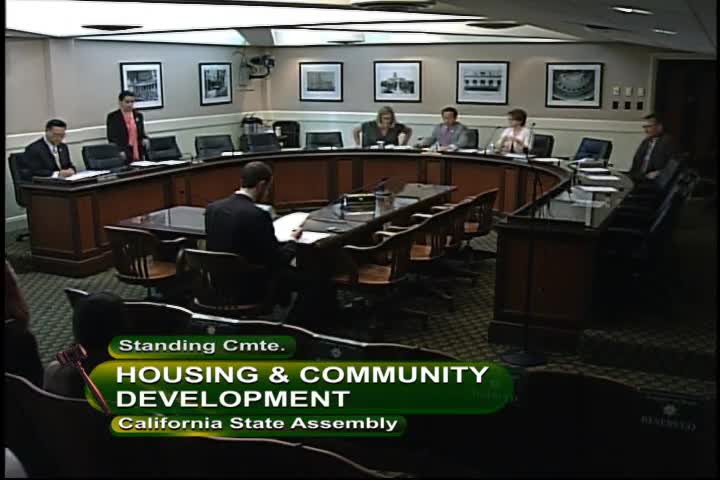 18MIN
Assembly Standing Committee on Housing and Community Development
 4MIN
Senate Floor
 54MIN
Senate Standing Committee on Transportation and Housing
Bill Author

Bill Co-Author(s):