SB 903: Transportation Development Act: County of Stanislaus.
- Session Year: 2017-2018
- House: Senate
- Latest Version Date: 2018-07-16
(1)Existing law authorizes transportation planning agencies to administer transit funding made available under the Transportation Development Act. Existing law imposes certain financial requirements on transit operators making claims for transit funds, including requirements that fare revenue collected by the operator cover a specified percentage of operating costs. In certain cases, transit operators are required to meet a higher percentage if they met that standard in the 197879 fiscal year.
This bill would authorize the Stanislaus Council of Governments, a transportation planning agency, when determining if specified operators have met the requirements for claims for transit funds for the 201819 and the 201920 fiscal years, to reduce the applicable ratio of fare revenues to operating cost for specified operators by up to 5 percentage points from the ratio that was effective during the 201516 fiscal year. If the Stanislaus Council of Governments acts pursuant to this authorization, the bill would require it, before January 1, 2020, to submit a report to the transportation policy committee of each house of the Legislature and to the Department of Transportation analyzing the options for organizing and supporting transit service in the county, as specified.
(2)This bill would make legislative findings and declarations as to the necessity of a special statute for the County of Stanislaus.
(3)This bill would declare that it is to take effect immediately as an urgency statute.
(4)This bill would make these provisions inoperative on July 1, 2020, and would repeal them as of January 1, 2021.
(1)Existing law authorizes transportation planning agencies to administer transit funding made available under the Transportation Development Act. Existing law imposes certain financial requirements on transit operators making claims for transit funds, including requirements that fare revenue collected by the operator cover a specified percentage of operating costs. In certain cases, transit operators are required to meet a higher percentage if they met that standard in the 197879 fiscal year.
This bill would authorize the Stanislaus Council of Governments, a transportation planning agency, to consider population density when determining if specified operators have met the requirements for claims for transit funds, and funds for the 201819 and the 201920 fiscal years, to reduce the applicable ratio of fare revenues to operating cost for specified operators by up to 5 percentage points from the ratio that was effective during the 201617 201516 fiscal year if the population density of the County of Stanislaus is less than, or equal to, 1000 persons per square mile. year. If the Stanislaus Council of Governments acts pursuant to this authorization, the bill would require it, before January 1, 2020, to submit a report to the transportation policy committee of each house of the Legislature and to the Department of Transportation analyzing the options for organizing and supporting transit service in the county, as specified.
(2)This bill would make legislative findings and declarations as to the necessity of a special statute for the County of Stanislaus.
(3)This bill would declare that it is to take effect immediately as an urgency statute.
(4)This bill would make these provisions inoperative on July 1, 2020, and would repeal them as of January 1, 2021.
(1)Existing law authorizes transportation planning agencies to administer transit funding made available under the Transportation Development Act. Existing law imposes certain financial requirements on transit operators making claims for transit funds, including requirements that fare revenue collected by the operator cover a specified percentage of operating costs. In certain cases, transit operators are required to meet a higher percentage if they met that standard in the 197879 fiscal year.
This bill would authorize the Stanislaus Council of Governments, a transportation planning agency, to consider population density when determining if specified operators have met the requirements for claims for transit funds, and to reduce the applicable ratio of fare revenues to operating cost for specified operators by up to 5 percentage points from the ratio that was effective during the 201617 fiscal year if the population density of the County of Stanislaus is less than, or equal to, 1000 persons per square mile.
(2)This bill would make legislative findings and declarations as to the necessity of a special statute for the County of Stanislaus.
(3)This bill would declare that it is to take effect immediately as an urgency statute.
(a)This section shall only apply to an individual operator that both has its primary service area in the Stanislaus Council of Governments jurisdiction and files claims with the Stanislaus Council of Governments pursuant to Section 99260.
(b)(1)Notwithstanding any other provision of this article, in determining if an individual operator complies with Section 99268.1, 99268.2, 99268.3, 99268.4, 99268.5, or 99268.9, the Stanislaus Council of Governments may reduce the applicable ratio of fare revenues to operating cost for an individual operator by up to five percentage points from the ratio that was effective during the 201516 fiscal year.
(2)The Stanislaus Council of Governments may use the calculation method described in this section for calculations beginning with the 201819 fiscal year.
(c)(1)If the Stanislaus Council of Governments reduces an individual operators ratio pursuant to this section, the Stanislaus Council of Governments, before January 1, 2020, shall submit a report to the transportation policy committee of each house of the Legislature and to the department analyzing the options for organizing and supporting transit service in the county.
(2)The report shall include, but not be limited to, all of the following:
(A)A description of the transit routes operating within the county.
(B)The service levels on those transit routes, including any planned expansions or consolidations.
(C)The ridership numbers for those transit routes.
(D)The annual budget numbers for the transit services provided by each individual operator in the county, including its ratio of fare revenues to operating cost and any salary increases since the enactment of this section.
(3)A report to be submitted pursuant to this subdivision shall be submitted in compliance with Section 9795 of the Government Code.
(d)This section shall become inoperative on July 1, 2020, and, as of January 1, 2021, is repealed.
SEC. 2.The Legislature finds and declares that a special statute is necessary and that a general statute cannot be made applicable within the meaning of Section 16 of Article IV of the California Constitution because of the unique transit circumstances in the County of Stanislaus.
SEC. 3.This act is an urgency statute necessary for the immediate preservation of the public peace, health, or safety within the meaning of Article IV of the California Constitution and shall go into immediate effect. The facts constituting the necessity are:
In order to ensure that the transit needs of individuals in the County of Stanislaus continue to be met and to preserve the transit system in that county, it is necessary for this act to take effect immediately.
(a)This section shall only apply to an individual operator that both has its primary service area in the Stanislaus Council of Governments jurisdiction and files claims with the Stanislaus Council of Governments pursuant to Section 99260.
(b)For purposes of this section, population density shall be determined using the most recent population estimates prepared by the Demographic Research Unit of the Department of Finance.(c)The Stanislaus Council of Governments may consider population density when determining if an individual operator complies with Section 99268.1, 99268.2, 99268.3, 99268.4, 99268.5, or 99268.9.(d)(b)(1)Notwithstanding any other provision of this article, if the population density of the County of Stanislaus is less than, or equal to, 1000 persons per square mile, in determining if an individual operator complies with Section 99268.1, 99268.2, 99268.3, 99268.4, 99268.5, or 99268.9, the Stanislaus Council of Governments may reduce the applicable ratio of fare revenues to operating cost for an individual operator by up to five percentage points from the ratio that was effective during the 201617 201516 fiscal year.
(2)The Stanislaus Council of Governments may use the calculation method described in this section for calculations beginning with the 201819 fiscal year.
(c)(1)If the Stanislaus Council of Governments reduces an individual operators ratio pursuant to this section, the Stanislaus Council of Governments, before January 1, 2020, shall submit a report to the transportation policy committee of each house of the Legislature and to the department analyzing the options for organizing and supporting transit service in the county.
(2)The report shall include, but not be limited to, all of the following:
(A)A description of the transit routes operating within the county.
(B)The service levels on those transit routes, including any planned expansions or consolidations.
(C)The ridership numbers for those transit routes.
(D)The annual budget numbers for the transit services provided by each individual operator in the county, including its ratio of fare revenues to operating cost and any salary increases since the enactment of this section.
(3)A report to be submitted pursuant to this subdivision shall be submitted in compliance with Section 9795 of the Government Code.
(d)This section shall become inoperative on July 1, 2020, and, as of January 1, 2021, is repealed.
SEC. 2.The Legislature finds and declares that a special statute is necessary and that a general statute cannot be made applicable within the meaning of Section 16 of Article IV of the California Constitution because of the unique transit circumstances in the County of Stanislaus.
SEC. 3.This act is an urgency statute necessary for the immediate preservation of the public peace, health, or safety within the meaning of Article IV of the California Constitution and shall go into immediate effect. The facts constituting the necessity are:
In order to ensure that the transit needs of individuals in the County of Stanislaus continue to be met and to preserve the transit system in that county, it is necessary for this act to take effect immediately.
(a)This section shall only apply to an individual operator that both has its primary service area in the Stanislaus Council of Governments jurisdiction and files claims with the Stanislaus Council of Governments pursuant to Section 99260.
(b)For purposes of this section, population density shall be determined using the most recent population estimates prepared by the Demographic Research Unit of the Department of Finance.
(c)The Stanislaus Council of Governments may consider population density when determining if an individual operator complies with Section 99268.1, 99268.2, 99268.3, 99268.4, 99268.5, or 99268.9.
(d)Notwithstanding any other provision of this article, if the population density of the County of Stanislaus is less than, or equal to, 1000 persons per square mile, the Stanislaus Council of Governments may reduce the applicable ratio of fare revenues to operating cost for an individual operator by up to five percentage points from the ratio that was effective during the 201617 fiscal year.
SEC. 2.The Legislature finds and declares that a special statute is necessary and that a general statute cannot be made applicable within the meaning of Section 16 of Article IV of the California Constitution because of the unique transit circumstances in the County of Stanislaus.
SEC. 3.This act is an urgency statute necessary for the immediate preservation of the public peace, health, or safety within the meaning of Article IV of the California Constitution and shall go into immediate effect. The facts constituting the necessity are:
In order to ensure that the transit needs of individuals in the County of Stanislaus continue to be met and to preserve the transit system in that county, it is necessary for this act to take effect immediately.
|
Date
|
Status
|
|---|---|
| Jul 16, 2018 | Chaptered by Secretary of State. Chapter 107, Statutes of 2018. |
| Jul 16, 2018 | Approved by the Governor. |
| Jul 5, 2018 | Enrolled and presented to the Governor at 3:30 p.m. |
| Jun 28, 2018 | Assembly amendments concurred in. (Ayes 37. Noes 0.) Ordered to engrossing and enrolling. |
| Jun 18, 2018 | In Senate. Concurrence in Assembly amendments pending. |
| Jun 14, 2018 | Read third time. Urgency clause adopted. Passed. Ordered to the Senate. |
| Jun 12, 2018 | Read second time. Ordered to consent calendar. |
| Jun 11, 2018 | From committee: Do pass. Ordered to consent calendar. (Ayes 14. Noes 0.) (June 11). |
| May 31, 2018 | From committee with author's amendments. Read second time and amended. Re-referred to Com. on TRANS. |
| Apr 19, 2018 | Referred to Com. on TRANS. |
| Apr 9, 2018 | In Assembly. Read first time. Held at Desk. |
| Apr 9, 2018 | Read third time. Urgency clause adopted. Passed. (Ayes 39. Noes 0.) Ordered to the Senate. |
| Apr 4, 2018 | Read second time. Ordered to consent calendar. |
| Apr 3, 2018 | From committee: Do pass. Ordered to consent calendar. (Ayes 13. Noes 0.) (April 3). |
| Mar 29, 2018 | Set for hearing April 3. |
| Jan 24, 2018 | Referred to Com. on T. & H. |
| Jan 17, 2018 | From printer. May be acted upon on or after February 16. |
| Jan 16, 2018 | Introduced. Read first time. To Com. on RLS. for assignment. To print. |
|
Date
|
Description
|
Location
|
Votes
|
|
|---|---|---|---|---|
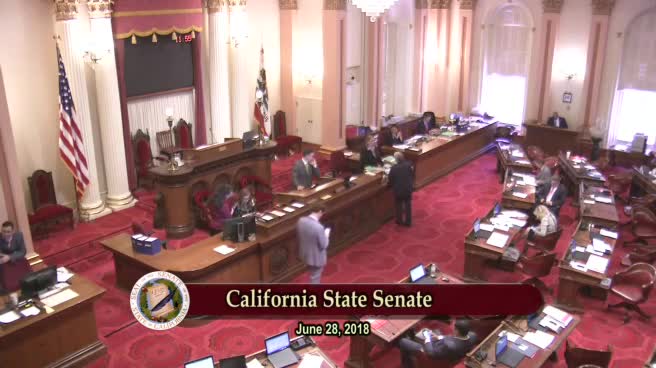
| Jun 28, 2018 | Unfinished Business SB903 Cannella et al. Urgency Clause Concurrence | Senate Floor |
Passed |
|
| Jun 14, 2018 | SB 903 Cannella Consent Calendar Second Day Regular Session | Assembly Floor |
Passed |
|
| Jun 11, 2018 | Do pass. To Consent Calendar. | Assembly Standing Committee on Transportation |
Passed |
|
| Apr 9, 2018 | Consent Calendar SB903 Cannella et al. Urgency Clause | Senate Floor |
Passed |
|
| Apr 3, 2018 | Do pass and be ordered to the Consent Calendar | Senate Standing Committee on Transportation and Housing |
Passed |
This list shows positions taken on this bill by organizations on the date displayed, which is linked to the original source.
Positions by individuals are not included.
Office of Senate Floor Analyses (916) 651-1520 Fax: (916) 327-4478 | SB |
UNFINISHED BUSINESS
Bill No: SB 903
:
SENATE TRANS. & HOUSING COMMITTEE: 13-0, 4/3/18
AYES: Beall, Cannella, Allen, Dodd, Gaines, Galgiani, McGuire, Morrell, Roth, Skinner, Vidak, Wieckowski, Wiener
SENATE FLOOR: 39-0, 4/9/18 (Consent)
AYES: Allen, Anderson, Atkins, Bates, Beall, Berryhill, Bradford, Cannella, De León, Dodd, Fuller, Gaines, Galgiani, Glazer, Hernandez, Hertzberg, Hill, Hueso, Jackson, Lara, Leyva, McGuire, Mitchell, Monning, Moorlach, Morrell, Newman, Nguyen, Nielsen, Pan, Portantino, Roth, Skinner, Stern, Stone, Vidak, Wieckowski, Wiener, Wilk
ASSEMBLY FLOOR: 78-0, 6/14/18 (Consent) - See last page for vote
SOURCE: Stanislaus Council of Governments
DIGEST:
This bill authorizes the Stanislaus Council of Governments (StanCOG), for two fiscal years, to reduce the required farebox recovery ratio (FRR) for its transit operators up to 5% below the required ratio effective for the 2015-16 fiscal year.
Assembly Amendments (1) remove the provisions that allow StanCOG to consider population density when calculating FRRs for local transit operators, as specified; and (2) further authorize StanCOG, for two fiscal years, to reduce the required FRR for its transit operators up to 5% below the required ratio effective for the 2015-16 fiscal year.
ANALYSIS:
Existing law:
- Provides, under the Transportation Development Act (TDA) of 1971, funding for transit and non-transit related purposes that comply with regional transportation plans. It serves to improve existing public transportation services and encourage regional transportation coordination.
- Provides, under the TDA, funding for public transit from two funding sources:
- Local Transportation Fund (LTF), which is derived from a 1/4 cent of the general sales tax collected statewide.
- State Transit Assistance fund (STA), which is derived from the statewide sales tax on diesel fuel.
- Authorizes Regional Transportation Planning Agencies (RTPAs) to administer transit funding made available under the TDA. Imposes certain financial requirements on transit operators making claims for transit funds, including requirements that fares collected by the operator cover a specified percentage of operating costs, and that an operator’s total operating cost per revenue vehicle hour not exceed operating revenues and the percentage change in the Consumer Price Index. Establishes different farebox recovery requirements depending upon population.
- Defines “operating costs” for purposes of calculating a transit agency’s FRR.
- Requires a transit operator in an urbanized area to maintain a 20% FRR in order to be eligible for LTF TDA funds.
- Requires a transit operator in a non-urbanized area to maintain a 10% FRR in order to be eligible for LTF TDA funds.
- Allows a one year “grace year” for transit operators who fail to meet their FRR, for which they do not lose LTF funds.
- Provides that state regulations create a three-year penalty cycle for transit operators who do not meet their FRRs in which a penalty, or loss of some LTF funds, does not occur until the end of the third fiscal year after non-compliance. Allows operators to retain full receipt of LTF funds if they achieve the required FRR within the penalty cycle.
- Authorizes the Metropolitan Transportation Commission, for transit operators serving the San Francisco Bay Area Rapid Transit District area, excluding the City and County of San Francisco, to make a determination as to whether transit operators have met the requirements for claims for transit funds by evaluating the operators as a group rather than individually if their services are coordinated.
- Authorizes the San Diego Metropolitan Transit System, for transit operators providing service within the area under their jurisdiction, to make a determination as to whether transit operators have met the requirements for claims for transit funds by evaluating them as a single operator.
- Authorizes the Sacramento Area Council of Governments, for transit operators serving the area of Sacramento County and the cities within the County, to make a determination as to whether transit operators have met the requirements for claims for transit funds by evaluating some or all of the operators as a group rather than individually if their services are coordinated.
This bill:
- Authorizes StanCOG to reduce the required ratio of fare revenues to operating costs (FRR) for transit operators with primary service area in the county by up to 5% from the required ratio effective in the 2015-16 fiscal year.
- Authorizes StanCOG to use this calculating method for the 2018-19 and 2019-20 fiscal years.
- Provides that if StanCOG uses this calculating method, they must submit a report to the transportation policy committees of the Legislature by January 1, 2020, analyzing the options for organizing and supporting transit service in the county. The report must include, but not be limited to:
- A description of the transit routes operating within the county;
- The service levels on those transit routes, including any planned expansions or consolidations;
- The ridership numbers for those transit routes; and,
- The annual budget numbers for the transit services provided by each individual operator in the county, including its ratio of fare revenues to operating cost and any salary increases since the enactment of this bill.
- Requires this bill become inoperative on July 1, 2020, and is repealed on January 1, 2021.
- Contains an urgency clause.
Comments
- Purpose. According to the author, “the purpose of the bill is to ensure that transit service providers within Stanislaus County are able to retain critical operations funding to maintain existing service. Without special legislation, state funding is in jeopardy as soon as July 1, 2018.”
- TDA. In 1971, the Legislature enacted the Mills-Alquist-Deddeh Act, otherwise known as the TDA, which dedicated a statewide 1/4 cent sales tax to local transportation. That 1/4 cent sales tax, now known as the Local Transportation Fund (LTF), generates over $1.5 billion annually primarily for public transit. Later, the Legislature created a second state funding source for public transit under the TDA called the State Transit Assistance (STA). The STA, which generates more than $400 million annually, is derived from the sales tax on diesel fuel and is distributed to local agencies based on population and transit operator revenues.
With respect to the LTF, the California Department of Tax and Fee Administration, based on sales tax collected in each county, returns the general sales tax revenues to each county’s LTF. For the STA, funds are appropriated by the Legislature to the State Controller’s Office (SCO). The SCO then allocates the tax revenue, by formula, to RTPAs and other selected transportation agencies. Current law requires that 50% of STA funds be allocated according to population and 50% be allocated according to operator revenues.
To be eligible to receive its full share of LTF, existing law requires a transit operator to meet a specified ratio of fare revenues to operating cost, called the FRR. Generally, existing law defines the minimum ratio necessary to receive all LTF funding as either 20% for urban operators, or 10% for operators in a non-urbanized area. If a transit operator fails to meet its specified FRR, existing law requires the RTPA to withhold a percentage of the LTF equal to the percentage by which the operator missed its expected ratio.
- Stanislaus County. The transit operators in Stanislaus County have been struggling since the 2010 census. In the 2010 census, the population of the county exceeded the 500,000-population threshold in TDA law, thus requiring transit operators serving the County to increase their FRRs by 10% (from 10% to 20%). The author states that due to the residential and commercial development practices of local agencies, and in order for transit to continue operating at its current level, some reprieve in the FRR is needed.
Specifically, during StanCOG’s review of transit claims in the 2016-17 fiscal year, it was determined that the City of Ceres was non-compliant with the required FRRs in the 2014-15 fiscal year, which initiated the penalty cycle required by TDA. In the 2017-18 fiscal year, the City of Ceres was found to be non-compliant with the required FRRs in the 2015-16 year. Following the TDA penalty cycle the 2014-15 fiscal year was determined by StanCOG to be a grace year, with fiscal year 2015-16 being identified as a non-complaint year subject to penalty. As a result, the City of Ceres’ transit claim for fiscal year 2017-18 was reduced by $22,710. This shortfall was recouped from local general funds. According to StanCOG, the sponsors of this bill, the City of Ceres has made it clear that without some sort of relief from the required FRR, they will be forced to eliminate transit service to avoid having to pay additional penalties with general funds that are typically utilized to provide other essential services, such as police and fire.
Additionally, based on the estimated FRR for the 2017-18 fiscal year, the City of Ceres will again be at risk of incurring a penalty. The Cities of Modesto and Turlock, and Stanislaus County, the other transit operators in the County, are all projected to fall below their required FRRs for the 2017-18 fiscal year and are thus at risk of entering into the penalty phase.
This bill allows StanCOG to reduce the FRR for its transit operators up to 5% below the required ratio for two years. During that time, StanCOG is required to develop a transit report analyzing the options for organizing and supporting transit service in the county.
FISCAL EFFECT: Appropriation: Fiscal Com.: Local:
Stanislaus Council of Governments (source)
California Teamsters Public Affairs Council
City of Ceres
City of Modesto
City of Turlock
Stanislaus County
OPPOSITION: (Verified 6/19/18)
None received
ASSEMBLY FLOOR: 78-0, 6/14/18
AYES: Acosta, Aguiar-Curry, Travis Allen, Arambula, Baker, Berman, Bigelow, Bloom, Bonta, Brough, Burke, Caballero, Calderon, Carrillo, Cervantes, Chau, Chávez, Chiu, Choi, Cooley, Cooper, Cunningham, Dahle, Daly, Eggman, Flora, Fong, Frazier, Friedman, Gabriel, Gallagher, Cristina Garcia, Eduardo Garcia, Gipson, Gloria, Gonzalez Fletcher, Gray, Grayson, Harper, Holden, Irwin, Jones-Sawyer, Kalra, Kamlager-Dove, Kiley, Lackey, Levine, Limón, Low, Maienschein, Mathis, Mayes, McCarty, Medina, Melendez, Mullin, Muratsuchi, Nazarian, Obernolte, O'Donnell, Patterson, Quirk, Quirk-Silva, Reyes, Rivas, Rodriguez, Rubio, Salas, Santiago, Steinorth, Mark Stone, Thurmond, Ting, Voepel, Waldron, Weber, Wood, Rendon
NO VOTE RECORDED: Chen, Chu
6/20/18 15:14:38
**** END ****
Date of Hearing: June 11, 2018
ASSEMBLY COMMITTEE ON TRANSPORTATION
Jim Frazier, Chair
SBPCA Bill Id:SB 903
Author:(Cannella) – As Amended Ver:May 31, 2018
SENATE VOTE: 39-0
SUBJECT: Transportation Development Act: County of Stanislaus
SUMMARY: Authorizes the Stanislaus Council of Governments (StanCOG), for two fiscal years, to reduce the required farebox recovery ratio for its transit operators up to 5% below the required ratio effective for the 2015-16 fiscal year. Specifically, this bill:
- Authorizes StanCOG to reduce the required ratio of fare revenues to operating costs (farebox recovery ratio) for transit operators with primary service area in the county by up to 5% from the required ratio effective in the 2015-16 fiscal year.
- Authorizes StanCOG to use this calculating method for the 2018-19 and 2019-20 fiscal years.
- If StanCOG uses this calculating method, they must submit a report to the transportation policy committees of the Legislature, by January 1, 2020, analyzing the options for organizing and supporting transit service in the county. The report must include, but not be limited to:
- A description of the transit routes operating within the county;
- The service levels on those transit routes, including any planned expansions or consolidations;
- The ridership numbers for those transit routes; and,
- The annual budget numbers for the transit services provided by each individual operator in the county, including its ratio of fare revenues to operating cost and any salary increases since the enactment of this section.
- Requires the section become inoperative on July 1, 2020, and is repealed on January 1, 2021.
- Contains an urgency clause.
EXISTING LAW:
- The Transportation Development Act (TDA) of 1971, provides funding for transit and non-transit related purposes that comply with regional transportation plans. It serves to improve existing public transportation services and encourage regional transportation coordination.
- TDA provides funding for public transit from two funding sources:
- Local Transportation Fund (LTF), which is derived from a 1/4 cent of the general sales tax collected statewide.
- State Transit Assistance fund (STA), which is derived from the statewide sales tax on diesel fuel.
- Authorizes Regional Transportation Planning Agencies (RTPAs) to administer transit funding made available under the TDA. Imposes certain financial requirements on transit operators making claims for transit funds, including requirements that fares collected by the operator cover a specified percentage of operating costs, and that an operator’s total operating cost per revenue vehicle hour not exceed operating revenues and the percentage change in the Consumer Price Index (CPI). Establishes different farebox recovery requirements depending upon population.
- Defines “operating costs” for purposes of calculating a transit agency’s farebox recovery ratio.
- Requires a transit operator in an urbanized area to maintain a 20% farebox recovery ratio in order to be eligible for LTF TDA funds.
- Requires a transit operator in a non-urbanized area to maintain a 10% farebox recovery ratio in order to be eligible for LTF TDA funds.
- Allows a one year “grace year” for transit operators who fail to meet their farebox recovery ratio, for which they do not lose LTF funds.
- State regulations create a 3-year penalty cycle for transit operators who do not meet their farebox recovery ratios in which a penalty, or loss of some LTF funds, does not occur until the end of the third fiscal year after non-compliance. Allows operators to retain full receipt of LTF funds if they achieve the required farebox recovery ratio within the penalty cycle.
- Authorizes the Metropolitan Transportation Commission (MTC), for transit operators serving the San Francisco Bay Area Rapid Transit District area, excluding the City and County of San Francisco, to make a determination as to whether transit operators have met the requirements for claims for transit funds by evaluating the operators as a group rather than individually if their services are coordinated.
- Authorizes the San Diego Metropolitan Transit System (MTS), for transit operators providing service within the area under their jurisdiction, to make a determination as to whether transit operators have met the requirements for claims for transit funds by evaluating them as a single operator.
- Authorizes the Sacramento Area Council of Governments (SACOG), for transit operators serving the area of Sacramento County and the cities within the county, to make a determination as to whether transit operators have met the requirements for claims for transit funds by evaluating some or all of the operators as a group rather than individually if their services are coordinated.
FISCAL EFFECT: None, this bill is keyed non-fiscal by the Office of Legislative Counsel.
COMMENTS: In 1971, the Legislature enacted the Mills-Alquist-Deddeh Act, otherwise known as the TDA, which dedicated a statewide 1/4 cent sales tax to local transportation. That 1/4 cent sales tax, now known as the Local Transportation Fund (LTF), generates over $1.5 billion annually primarily for public transit. Later, the Legislature created a second state funding source for public transit under the TDA called the State Transit Assistance (STA). The STA, which generates more than $400 million annually, is derived from the sales tax on diesel fuel and is distributed to local agencies based on population and transit operator revenues.
With respect to the LTF, the California Department of Tax and Fee Administration, based on sales tax collected in each county, returns the general sales tax revenues to each county’s LTF. For the STA, funds are appropriated by the Legislature to the State Controller’s Office (SCO). The SCO then allocates the tax revenue, by formula, to RTPAs and other selected transportation agencies. Current law requires that 50% of STA funds be allocated according to population and 50% be allocated according to operator revenues.
To be eligible to receive its full share of LTF, existing law requires a transit operator to meet a specified ratio of fare revenues to operating cost, called the farebox recovery ratio. Generally, existing law defines the minimum ratio necessary to receive all LTF funding as either 20% for urban operators, or 10% for operators in a non-urbanized area. If a transit operator fails to meet its specified farebox recovery ratio, existing law requires the RTPA to withhold a percentage of the LTF equal to the percentage by which the operator missed its expected ratio.
SB 508 (Beall), Chapter 716, Statutes of 2015, updated numerous provisions of TDA law, including farebox recovery ratio requirements. Specifically, SB 508 updated what counts toward the operating costs to help accommodate unpredictable variables such as the cost of fuel. Additionally, if an operator receives funds from local revenue sources, such as a local sales tax measure, it can help to meet its farebox recovery ratio by combining fare revenues with that local support.
Per state regulations, transit operators are given one grace year to make their farebox recovery ratio. If they do not meet their ratio for the second year, or non-compliance year, the transit operator loses a portion of their LTF funds based on the percentage by which they missed their actual farebox recovery ratio. Again, state regulations outline a 3-year penalty cycle for non-compliance with farebox ratio requirements. Transit operators do not see the actual penalty, or loss of LTF funds, until the beginning of the fourth fiscal year. For example, a transit operator has operating costs of $100,000 and a required farebox recovery ratio of 20%. The operator did not meet their ratios for two consecutive years. In the second, or non-compliance year, the operator’s actual fares were $18,000. The transit operator would lose $2,000 of LTF funds in the penalty year (beginning of fourth fiscal year).
Current law requires RTPAs to oversee all of the farebox recovery requirements for the transit operators in their district. To some extent RTPAs have some flexibility with the ratio if the operators provide service to both urban and rural areas, such as adjusting their ratio to 15%. Transit operators are required to complete both annual audits and a triennial performance audit required by the Federal Transit Administration. Audits are reported to both the RTPAs and the SCO who publishes the data for each operator, including their farebox recovery ratios. Additionally, the California Department of Transportation (Caltrans) oversees transit operators’ use of federal funds and has the responsibility of developing regulations to implement TDA law. However, there is no state entity that provides direct oversight of TDA expenditures or provides oversight or assistance for RTPAs or transit operators who may be having trouble with TDA compliance.
To assist rural and smaller providers in a region, some RTPAs have been authorized to combine some or all of their transit operators together when calculating farebox recovery ratios. This was most recently done in the Sacramento area with the passage of AB 432 (Dickinson), Chapter 229, Statutes of 2012.
According to the author, “The purpose of the bill is to ensure that transit service providers within Stanislaus County are able to retain critical operations funding to maintain existing service. Without special legislation, state funding is in jeopardy as soon as July 1, 2018.”
The transit operators in Stanislaus County have been struggling since the 2010 census. In the 2010 census, the population of the county exceeded the 500,000-population threshold in TDA law, thus requiring transit operators serving the county to increase their farebox recovery ratios by 10% (from 10% to 20%). The author states that due to the residential and commercial development practices of local agencies, and in order for transit to continue operating at its current level, some reprieve in the farebox recovery ratio is needed.
Specifically, during StanCOG’s review of transit claims in the 2016-17 fiscal year, it was determined that the City of Ceres was non-compliant with the required farebox recovery ratios in the 2014-15 fiscal year, which initiated the penalty cycle required by TDA. In the 2017-18 fiscal year, the City of Ceres was found to be non-compliant with the required fare recovery ratios in the 2015-16 year. Following the TDA penalty cycle the 2014-15 fiscal year was determined by StanCOG to be a grace year, with fiscal year 2015-16 being identified as a non-complaint year subject to penalty. As a result, the City of Ceres’ transit claim for fiscal year 2017-18 was reduced by $22,710. This shortfall was recouped from local general funds. According to StanCOG, the sponsors of this bill, the City of Ceres has made it clear that without some sort of relief from the required fare recovery ratio, they will be forced to eliminate transit service to avoid having to pay additional penalties with general funds that are typically utilized to provide other essential services, such as police and fire.
Additionally, based on the estimated farebox recovery ratio for the 2017-18 fiscal year, the City of Ceres will again be at risk of incurring a penalty. The cities of Modesto and Turlock, and Stanislaus County, the other transit operators in the county, are all projected to fall below their required fare recovery ratios for the 2017-18 fiscal year and are thus at risk of entering into the penalty phase.
This bill would allow StanCOG to reduce the farebox recovery ratio for its transit operators up to 5% below the required ratio from the 2015-16 fiscal year. StanCOG would be able to make this change for only two fiscal years, with the bill becoming inoperative on July 1, 2020. Essentially, the bill allows StanCOG to take a “pause” for two years for the farebox recovery ratios for providers in the county. During that time, StanCOG is required to develop a transit report analyzing the options for organizing and supporting transit service in the county. This coordinated look at their current and future service, coupled with discussions at the state level about overall transit performance measures, could help the county develop a path to compliance.
Writing in support of the bill, the City of Modesto states that it, “is the largest city in Stanislaus County. In recent years, Modesto has experienced extensive growth of both residential and commercial areas, following a statewide boom in housing demand and construction. In fact, Stanislaus County’s population recently exceeded 500,000, which resulted in a classification change to an urban county. The purpose of this bill is to allow StanCOG to make adjustments for rural and smaller operators that are within larger urbanized Stanislaus County.” The City of Ceres adds that, “The transit dependent populations of Ceres – especially seniors and people with disabilities – will experience great transportation challenges and a reduced quality of life if the city cannot continue its public transit services.”
Also writing in support, the California Teamsters note that, “Despite local transit operators cutting low performing routes, enacting fare increases, as well as the passage of a local transportation sales tax measure partially for transit funding, service is now at-risk for dial-a-ride services for the elderly and disabled. This adversely impacts these communities, as well as our membership who depend on these jobs.”
Committee Comments: At the time of the passage of SB 508, it was noted that the performance measures for transit operators have been diluted over time; however, they remain the closet thing the state has to holding transit operators accountable for effectively spending state dollars. The need for updated transit performance measures continues to be an issue. Farebox recovery ratios may not be the best measure of a transit operator’s performance or how they are serving their communities. The Legislature, Administration, and the state’s transit operators and local governments must come together and look at different options for measuring performance of transit systems in California.
Some of the issues raised by this bill should be discussed as part of a broader look at TDA law, including whether urban and rural areas of the state have similar needs or issues with providing public transit. How should the state measure performance for San Francisco versus Modesto? What role do Self-Help County measures play in overall transit operations and capital improvements? How do regional planning and local land use decisions about development impact transit operators and their ability to provide service?
With the passage of SB 1 (Beall), Chapter 5, Statutes of 2017, the STA portion of funding for transit operators more than doubled. The state continues to be a major funding partner in the state’s transit systems and therefore must be more involved in its oversight. As previously mentioned, the only state entities that participate in the TDA process are the SCO and Caltrans. Their role is limited to reporting and providing guidance on relevant laws, but not active oversight. That role is retained by the RTPAs.
The previous version of this bill would have allowed StanCOG to determine their transit operators’ farebox recovery ratios utilizing population density as a factor. This factor is not currently used as a measure in TDA law. It remains unclear what type of impact this new factor may have or whether it is an appropriate consideration in measuring transit performance. In place of creating a unique TDA formula for one county, this bill allows StanCOG to develop a countywide transit strategy, and be part of a larger conversation of TDA.
It is clear that TDA law, and specifically the performance measures for public transit, needs to be examined and overhauled. Creating more exceptions to current law will just continue to degrade the only performance measure the state has but not deal with the overarching issues.
Related Legislation: AB 1969 (Salas) of 2017, would have authorized RTPAs to grant a transit operator an exemption, for up to five years, from meeting farebox recovery ratio requirements after considering certain factors. AB 1969 was set to be heard by this committee but was cancelled at the request of the author.
Previous Legislation: SB 508 (Beall), Chapter 716, Statutes of 2015, redefines and recasts numerous provisions of TDA and STA law, including redefining what is counted a “operating costs” for the calculation of farebox recovery ratios.
AB 432 (Dickinson), Chapter 229, Statutes of 2012, authorized SACOG, for transit operators serving the area of Sacramento County and the cities within the county, to make a determination as to whether transit operators have met the requirements for claims for transit funds by evaluating some or all of the operators as a group rather than individually if their services are coordinated.
REGISTERED SUPPORT / OPPOSITION:
Support
Stanislaus Council of Governments (Sponsor)
California Teamsters Public Affairs Council
City of Ceres
City of Modesto
City of Turlock
Stanislaus County
Opposition
None on file
Analysis Prepared by: Melissa White / TRANS. / (916) 319-2093
Office of Senate Floor Analyses (916) 651-1520 Fax: (916) 327-4478 | SB |
CONSENT
Bill No: SB 903
:
SENATE TRANS. & HOUSING COMMITTEE: 13-0, 4/3/18
AYES: Beall, Cannella, Allen, Dodd, Gaines, Galgiani, McGuire, Morrell, Roth, Skinner, Vidak, Wieckowski, Wiener
SOURCE: Stanislaus Council of Governments
DIGEST:
This bill makes various changes to Transportation Development Act eligibility requirements in Stanislaus County.
Existing law:
- Provides, under the Transportation Development Act of 1971 (TDA), funding for transit and non-transit related purposes that comply with regional transportation plans. It serves to improve existing public transportation services and encourage regional transportation coordination.
- Authorizes transportation planning agencies to administer transit funding made available under the TDA. It imposes certain financial requirements on transit operators making claims for transit funds, including requirements that fares collected by the operator cover a specified percentage of operating costs. It also establishes different farebox requirements depending upon population.
- Defines “operating costs” for purposes of calculating a transit agency’s farebox recovery ratio (FRR).
- Requires a transit operator in an urbanized area (county over 500,000 in population) to maintain a 20% FRR in order to be eligible for Local Transportation Fund (LTF) TDA funds.
- Requires a transit operator in a non-urbanized area to maintain a 10% FRR in order to be eligible for LTF TDA funds.
- Authorizes the San Francisco Bay Area Metropolitan Transportation Commission (for transit operations serving the San Francisco Bay Area Rapid Transit District area) and the San Diego Metropolitan Transit System to make a determination as to whether transit operators for specified service areas have met the requirements for claims for transit funds by evaluating the operators as a group rather than individually.
- Authorizes the Sacramento Area Council of Governments (SACOG) to create a combined FRR for the Sacramento County transit operators – Sacramento Regional Transit, Folsom transit, Elk Grove transit, and Sacramento County transit services in order to be eligible to receive TDA funds.
This bill:
- Authorizes the Stanislaus Council of Governments (SCOG) to consider population density when determining if local transit operators have met TDA eligibility requirements.
- Authorizes SCOG to reduce an operator’s FRR up to 5% to remain eligible for TDA funds if specified density provisions are met.
Comments
- Purpose. According to the author, “In the 2010 decennial census, the population of Stanislaus County exceeded the 500,000-population threshold, thus requiring transit operators serving the County to increase their farebox recovery ratios (FRRs) by 10 percent (from 10% to 20%). Transit service providers such as Ceres Area Transit (CAT) and Stanislaus Regional Transit (StaRT) have been unable to meet their FRRs as required under the Transportation Development Act (TDA) due to factors such as operating expenses increasing beyond the Consumer Price Index and the restriction of fare increases when using Federal Transportation Administration funds. Despite cutting low performing routes, fare increases, and the passage of a local transportation sales tax measure that includes transit funding, service is at-risk for dial-a-ride services, which serves the elderly and disabled. CAT and StaRT provided over 515,000 trips in FY 15-16, the last year for which data is available. SB 903 ensures that transit service providers within Stanislaus County are able to retain critical operations funding to maintain existing service by making an accommodation for transit service based on population density of the service area, rather than countywide population.”
- What is FRR? The FRR (also called fare recovery ratio or fare recovery rate) of a public transit system is the fraction of operating expenses which are met by the fares paid by passengers. The FRR is computed by dividing the system's total fare revenue by its total operating expenses. According to the Federal Transit Administration, the FRR “ratio varies by mode and each transit operator. It is typical, for example, to see low recovery ratios on demand response services that often serve the needs of customers who cannot use conventional modes of transportation and frequently have no alternate means of transportation.” Bus transit operates with one driver and travels on a fixed route or specified destination. The combination of more efficient scheduling, larger buses, and a greater capacity for passengers results in the potential for a higher fare box recovery ratio.
- SCOG transit operators. Currently four transit agencies operate in Stanislaus County. These agencies include: Stanislaus County/StaRT, Modesto Area Express, Turlock Transit, and Ceres Area Transit. While Modesto, Turlock, and Ceres transit agencies are hovering right at the 20% FRR requirement, Stanislaus/StaRT, which provides services to smaller cities (some which have less than 10,000 residents) and unincorporated areas of the county is at 15%. By allowing SCOG to use population density as part of their TDA eligibility, this reasonable adjustment will provide Stanislaus County transit agencies with the opportunity to continue to receive TDA funds and operating imperative transit services throughout the county.
- Previous authorizations. Presently a number of Regional Transportation Planning Agencies (RTPAs) have the authority to adjust specific eligibility requirements for local transit operators within their jurisdiction. RTPAs in the San Francisco Bay and San Diego area have had the authority for several decades while the SACOG was provided authority in 2012. While the authorizations provided to the abovementioned entities defer from the eligibility adjustments provided in this bill for Stanislaus County, the intent to provide reasonable FRR eligibility requirements for local transit operators remains the same.
FISCAL EFFECT: Appropriation: Fiscal Com.: Local:
Stanislaus Council of Governments (source)
California Teamsters
City of Turlock
Stanislaus County
None received
4/4/18 14:19:30
**** END ****
SENATE COMMITTEE ON TRANSPORTATION AND HOUSING
Senator Jim Beall, Chair
2017 - 2018 Regular
Bill No: Hearing Date: 4/3/2018
Author: | Cannella | ||
Version: | 1/16/2018 | ||
Urgency: | Yes | Fiscal: | No |
Consultant: | Manny Leon | ||
SUBJECT:
DIGEST: This urgency bill makes various changes to Transportation Development Act eligibility requirements in Stanislaus County.
ANALYSIS:
The Mills-Alquist-Deddeh Act, otherwise known as the as the Transportation Development Act (TDA) of 1971, was enacted to improve existing public transportation services and encourage regional transportation coordination. The TDA allocates funding for transit and transit-related purposes that comply with regional transportation plans. Specifically, TDA is derived from two funding sources:
- Local Transportation Fund (LTF), which is derived from a ¼ cent of the general sales tax collected statewide.
- State Transit Assistance fund (STA), which is derived from the statewide sales tax on diesel fuel.
With respects to the LTF, the State Board of Equalization, based on sales tax collected in each county, returns the general sales tax revenues to each county’s LTF. For the STA, funds are appropriated by the Legislature to the State Controller’s Office (SCO). The SCO then allocates the tax revenue, by formula, to Regional Transportation Planning Agencies (RTPAs) and other selected transportation agencies. Current law requires that 50% of STA funds be allocated according to population and 50% be allocated according to operator revenues, as specified.
Overall, TDA provides funding for a wide variety of transportation programs, including planning and program activities, pedestrian and bicycle facilities, community transit services, public transportation, and bus and rail projects. Additionally, provided that certain transit conditions are met, counties with a population under 500,000 (according to the 1970 federal census) may also use the LTF for local streets and roads, construction and maintenance. On the other hand, STA funding can only be used for transportation planning and mass transportation purposes.
Existing law:
- Known as the Transportation Development Act of 1971 (TDA), provides funding for transit and non-transit related purposes that comply with regional transportation plans. It serves to improve existing public transportation services and encourage regional transportation coordination.
- Authorizes transportation planning agencies to administer transit funding made available under the TDA. It imposes certain financial requirements on transit operators making claims for transit funds, including requirements that fares collected by the operator cover a specified percentage of operating costs. It also establishes different farebox requirements depending upon population.
- Defines “operating costs” for purposes of calculating a transit agency’s farebox recovery ratio (FRR).
- Requires a transit operator in an urbanized area (county over 500,000 in population) to maintain a 20% FRR in order to be eligible for LTF TDA funds.
- Requires a transit operator in a non-urbanized area to maintain a 10% FRR in order to be eligible for LTF TDA funds.
- Authorizes the San Francisco Bay Area Metropolitan Transportation Commission (for transit operations serving the San Francisco Bay Area Rapid Transit District area) and the San Diego Metropolitan Transit System to make a determination as to whether transit operators for specified service areas have met the requirements for claims for transit funds by evaluating the operators as a group rather than individually.
- Authorizes the Sacramento Area Council of Governments (SACOG) to create a combined FRR for the Sacramento County transit operators – Sacramento Regional Transit, Folsom transit, Elk Grove transit, and Sacramento County transit services in order to be eligible to receive TDA funds.
This urgency bill:
- Authorizes the Stanislaus Council of Governments (SCOG) to consider population density when determining if local transit operators have met TDA eligibility requirements.
- Authorizes SCOG to reduce an operator’s FRR up to 5% to remain eligible for TDA funds if specified density provisions are met.
COMMENTS
- Purpose. According to the author, “In the 2010 decennial census, the population of Stanislaus County exceeded the 500,000-population threshold, thus requiring transit operators serving the County to increase their farebox recovery ratios (FRRs) by 10 percent (from 10% to 20%). Transit service providers such as Ceres Area Transit (CAT) and Stanislaus Regional Transit (StaRT) have been unable to meet their FRRs as required under the Transportation Development Act (TDA) due to factors such as operating expenses increasing beyond the Consumer Price Index and the restriction of fare increases when using Federal Transportation Administration funds. Despite cutting low performing routes, fare increases, and the passage of a local transportation sales tax measure that includes transit funding, service is at-risk for dial-a-ride services, which serves the elderly and disabled. CAT and StaRT provided over 515,000 trips in FY 15-16, the last year for which data is available. SB 903 ensures that transit service providers within Stanislaus County are able to retain critical operations funding to maintain existing service by making an accommodation for transit service based on population density of the service area, rather than countywide population.”
- What is FRR? The FRR (also called fare recovery ratio or fare recovery rate) of a public transit system is the fraction of operating expenses which are met by the fares paid by passengers. The FRR is computed by dividing the system's total fare revenue by its total operating expenses. According to the Federal Transit Administration, the FRR “ratio varies by mode and each transit operator. It is typical, for example, to see low recovery ratios on demand response services that often serve the needs of customers who cannot use conventional modes of transportation and frequently have no alternate means of transportation.” Bus transit operates with one driver and travels on a fixed route or specified destination. The combination of more efficient scheduling, larger buses, and a greater capacity for passengers results in the potential for a higher fare box recovery ratio.
- SCOG Transit Operators. Currently four transit agencies operate in Stanislaus County. These agencies include: Stanislaus County/STaRT, Modesto Area Express, Turlock Transit, and Ceres Area Transit. While Modesto, Turlock, and Ceres transit agencies are hovering right at the 20% FRR requirement, Stanislaus/STaRT, which provides services to smaller cities (some which have less than 10,000 residents) and unincorporated areas of the county is at 15%. By allowing SCOG to use population density as part of their TDA eligibility, this reasonable adjustment will provide Stanislaus County transit agencies with the opportunity to continue to receive TDA funds and operating imperative transit services throughout the county.
- Previous Authorizations. Presently a number of RTPAs have the authority to adjust specific eligibility requirements for local transit operators within their jurisdiction. RTPAs in the San Francisco Bay and San Diego area have had the authority for several decades while the Sacramento Area Council of Governments was provided authority in 2012. While the authorizations provided to the abovementioned entities defer from the eligibility adjustments provided in this bill for Stanislaus County, the intent to provide reasonable FRR eligibility requirements for local transit operators remains the same.
- Urgency. This bill includes an urgency measure which will require a two-thirds vote on the Senate Floor.
FISCAL EFFECT: Appropriation: No Fiscal Com.: No Local: No
POSITIONS: (Communicated to the committee before noon on Wednesday,
March 28, 2018.)
SUPPORT:
Stanislaus Council of Governments (sponsor)
City of Turlock
OPPOSITION:
None received.
-- END --
Bill Author