SB 905: Alcoholic beverages: hours of sale.
- Session Year: 2017-2018
- House: Senate
- Latest Version Date: 2018-09-05
The Alcoholic Beverage Control Act provides that any on- or off-sale licensee, or agent or employee of the licensee, who sells, gives, or delivers to any person any alcoholic beverage between the hours of 2 a.m. and 6 a.m. of the same day, and any person who knowingly purchases any alcoholic beverages between those hours, is guilty of a misdemeanor. Existing law provides for moneys collected as fees pursuant to the act to be deposited in the Alcohol Beverage Control Fund, with those moneys generally allocated to the Department of Alcoholic Beverage Control upon appropriation by the Legislature.
This bill, beginning January 1, 2021, and before January 2, 2026, would require the Department of Alcoholic Beverage Control to conduct a pilot program that would authorize the department to issue an additional hours license to an on-sale licensee located in a qualified city which would authorize, with or without conditions, the selling, giving, or purchasing of alcoholic beverages at the licensed premises between the hours of 2 a.m. and 4 a.m., upon completion of specified requirements by the qualified city in which the licensee is located. The bill would impose specified fees related to the license to be deposited in the Alcohol Beverage Control Fund. The bill would require the applicant to notify specified persons of the application for an additional hours license and would provide a procedure for protest and hearing regarding the application. The bill would require the Department of the California Highway Patrol and each qualified city that has elected to participate in the program to submit reports to the Legislature and specified committees regarding the regional impact of the additional hours licenses, as specified. The bill would provide that any person under 21 years of age who enters and remains in the licensed public premises during the additional serving hours without lawful business therein is guilty of a misdemeanor, as provided. The pilot program would apply to Cathedral City, Coachella, Long Beach, Los Angeles, Oakland, Palm Springs, Sacramento, San Francisco, and West Hollywood.
This bill would impose a state-mandated local program by creating new crimes.
The California Constitution requires the state to reimburse local agencies and school districts for certain costs mandated by the state. Statutory provisions establish procedures for making that reimbursement.
This bill would provide that no reimbursement is required by this act for a specified reason.
This bill would make legislative findings and declarations as to the necessity of a special statute for the qualified cities.
The Alcoholic Beverage Control Act provides that any on- or off-sale licensee, or agent or employee of the licensee, who sells, gives, or delivers to any person any alcoholic beverage between the hours of 2 a.m. and 6 a.m. of the same day, and any person who knowingly purchases any alcoholic beverages between those hours, is guilty of a misdemeanor. Existing law provides for moneys collected as fees pursuant to the act to be deposited in the Alcohol Beverage Control Fund, with those moneys generally allocated to the Department of Alcoholic Beverage Control upon appropriation by the Legislature.
This bill, beginning January 1, 2021, and before January 2, 2026, would require the Department of Alcoholic Beverage Control to conduct a pilot program that would authorize the department to issue an additional hours license to an on-sale licensee located in a qualified city which would authorize, with or without conditions, the selling, giving, or purchasing of alcoholic beverages at the licensed premises between the hours of 2 a.m. and 4 a.m., upon completion of specified requirements by the qualified city in which the licensee is located. The bill would impose specified fees related to the license to be deposited in the Alcohol Beverage Control Fund. The bill would require the applicant to notify specified persons of the application for an additional hours license and would provide a procedure for protest and hearing regarding the application. The bill would require the Department of the California Highway Patrol and the each qualified city that has elected to participate in the program to submit reports to the Legislature and specified committees regarding the regional impact of the additional service hours areas. hours licenses, as specified. The bill would provide that any person under 21 years of age who enters and remains in the licensed public premises during the additional serving hours without lawful business therein is guilty of a misdemeanor, as provided. The pilot program would apply to Cathedral City, Coachella, Long Beach, Los Angeles, Oakland, Palm Springs, Sacramento, San Francisco, and West Hollywood.
This bill would impose a state-mandated local program by creating new crimes.
The California Constitution requires the state to reimburse local agencies and school districts for certain costs mandated by the state. Statutory provisions establish procedures for making that reimbursement.
This bill would provide that no reimbursement is required by this act for a specified reason.
This bill would make legislative findings and declarations as to the necessity of a special statute for the qualified cities.
The Alcoholic Beverage Control Act provides that any on- or off-sale licensee, or agent or employee of the licensee, who sells, gives, or delivers to any person any alcoholic beverage between the hours of 2 a.m. and 6 a.m. of the same day, and any person who knowingly purchases any alcoholic beverages between those hours, is guilty of a misdemeanor. Existing law provides for moneys collected as fees pursuant to the act to be deposited in the Alcohol Beverage Control Fund, with those moneys generally allocated to the Department of Alcoholic Beverage Control upon appropriation by the Legislature.
This bill, beginning January 1, 2021, and before January 2, 2026, would require the Department of Alcoholic Beverage Control to conduct a pilot program that would authorize the department to issue an additional hours license to an on-sale licensee located in a qualified city which would authorize, with or without conditions, the selling, giving, or purchasing of alcoholic beverages at the licensed premises between the hours of 2 a.m. and 4 a.m., upon completion of specified requirements by the qualified city in which the licensee is located. The bill would impose specified fees related to the license to be deposited in the Alcohol Beverage Control Fund. The bill would require the applicant to notify specified persons of the application for an additional hours license and would provide a procedure for protest and hearing regarding the application. The bill would require the Department of the California Highway Patrol and the qualified city to submit reports to the Legislature and specified committees regarding the regional impact of the additional service hours areas. The bill would provide that any person under 21 years of age who enters and remains in the licensed public premises during the additional serving hours without lawful business therein is guilty of a misdemeanor, as provided. The pilot program would apply to Cathedral City, Coachella, Long Beach, Los Angeles, Oakland, Palm Springs, Sacramento, San Francisco, and West Hollywood.
This bill would impose a state-mandated local program by creating new crimes.
The California Constitution requires the state to reimburse local agencies and school districts for certain costs mandated by the state. Statutory provisions establish procedures for making that reimbursement.
This bill would provide that no reimbursement is required by this act for a specified reason.
This bill would make legislative findings and declarations as to the necessity of a special statute for the qualified cities.
The Alcoholic Beverage Control Act provides that any on- or off-sale licensee, or agent or employee of the licensee, who sells, gives, or delivers to any person any alcoholic beverage between the hours of 2 a.m. and 6 a.m. of the same day, and any person who knowingly purchases any alcoholic beverages between those hours, is guilty of a misdemeanor. Existing law provides for moneys collected as fees pursuant to the act to be deposited in the Alcohol Beverage Control Fund, with those moneys generally allocated to the Department of Alcoholic Beverage Control upon appropriation by the Legislature.
This bill, beginning January 1, 2021, and before January 2, 2026, would require the Department of Alcoholic Beverage Control to conduct a pilot program that would authorize the department to issue an additional hours license to an on-sale licensee located in a qualified city which would authorize, with or without conditions, the selling, giving, or purchasing of alcoholic beverages at the licensed premises between the hours of 2 a.m. and 4 a.m., upon completion of specified requirements by the qualified city in which the licensee is located. The bill would impose specified fees related to the license to be deposited in the Alcohol Beverage Control Fund. The bill would require the applicant to notify specified persons of the application for an additional hours license and would provide a procedure for protest and hearing regarding the application. The bill would require the Department of the California Highway Patrol and the qualified city to submit reports to the Legislature and specified committees regarding the regional impact of the additional service hours areas. The bill would provide that any person under 21 years of age who enters and remains in the licensed public premises during the additional serving hours without lawful business therein is guilty of a misdemeanor, as provided. The pilot program would apply to Long Beach, Los Angeles, Oakland, Palm Springs, Sacramento, San Francisco, and West Hollywood.
This bill would impose a state-mandated local program by creating new crimes.
The California Constitution requires the state to reimburse local agencies and school districts for certain costs mandated by the state. Statutory provisions establish procedures for making that reimbursement.
This bill would provide that no reimbursement is required by this act for a specified reason.
This bill would make legislative findings and declarations as to the necessity of a special statute for the qualified cities.
The Alcoholic Beverage Control Act provides that any on- or off-sale licensee, or agent or employee of the licensee, who sells, gives, or delivers to any person any alcoholic beverage between the hours of 2 a.m. and 6 a.m. of the same day, and any person who knowingly purchases any alcoholic beverages between those hours, is guilty of a misdemeanor. Existing law provides for moneys collected as fees pursuant to the act to be deposited in the Alcohol Beverage Control Fund, with those moneys generally allocated to the Department of Alcoholic Beverage Control upon appropriation by the Legislature.
This bill, beginning January 1, 2020, 2021, and before January 1, 2025, 2, 2026, would require the Department of Alcoholic Beverage Control to conduct a pilot program that would authorize the department to issue an additional hours license to an on-sale licensee located in a qualified city which would authorize, with or without conditions, the selling, giving, or purchasing of alcoholic beverages at the licensed premises between the hours of 2 a.m. and 4 a.m., upon completion of specified requirements by the qualified city in which the licensee is located. The bill would impose specified fees related to the license to be deposited in the Alcohol Beverage Control Fund. The bill would require the applicant to notify specified persons of the application for an additional hours license and would provide a procedure for protest and hearing regarding the application. The bill would require the Department of the California Highway Patrol and the qualified city to submit reports to the Legislature regarding the regional impact of the additional service hours areas. The bill would provide that any person under 21 years of age who enters and remains in the licensed public premises during the additional serving hours without lawful business therein is guilty of a misdemeanor, as provided. The pilot program would apply to Long Beach, Los Angeles, Oakland, Palm Springs, Sacramento, San Francisco, and West Hollywood.
This bill would impose a state-mandated local program by creating new crimes.
The California Constitution requires the state to reimburse local agencies and school districts for certain costs mandated by the state. Statutory provisions establish procedures for making that reimbursement.
This bill would provide that no reimbursement is required by this act for a specified reason.
This bill would make legislative findings and declarations as to the necessity of a special statute for the qualified cities.
The Alcoholic Beverage Control Act provides that any on- or off-sale licensee, or agent or employee of the licensee, who sells, gives, or delivers to any person any alcoholic beverage between the hours of 2 a.m. and 6 a.m. of the same day, and any person who knowingly purchases any alcoholic beverages between those hours, is guilty of a misdemeanor. Existing law provides for moneys collected as fees pursuant to the act to be deposited in the Alcohol Beverage Control Fund, with those moneys generally allocated to the Department of Alcoholic Beverage Control upon appropriation by the Legislature.
This bill, beginning January 1, 2020, and before January 1, 2025, would require the Department of Alcoholic Beverage Control to conduct a pilot program that would authorize the department to issue an additional hours license to an on-sale licensee located in a qualified city which would authorize, with or without conditions, the selling, giving, or purchasing of alcoholic beverages at the licensed premises between the hours of 2 a.m. and 4 a.m., upon completion of specified requirements by the qualified city in which the licensee is located. The bill would impose specified fees related to the license to be deposited in the Alcohol Beverage Control Fund. The bill would require the applicant to notify specified persons of the application for an additional hours license and would provide a procedure for protest and hearing regarding the application. The bill would require the Department of the California Highway Patrol and the qualified city to submit reports to the Legislature regarding the regional impact of the additional service hours areas. The bill would provide that any person under 21 years of age who enters and remains in the licensed public premises during the additional serving hours without lawful business therein is guilty of a misdemeanor, as provided.
This bill would impose a state-mandated local program by creating new crimes.
The California Constitution requires the state to reimburse local agencies and school districts for certain costs mandated by the state. Statutory provisions establish procedures for making that reimbursement.
This bill would provide that no reimbursement is required by this act for a specified reason.
This bill would make legislative findings and declarations as to the necessity of a special statute for the qualified cities.
The Legislature finds and declares all of the following:
(a)It is the policy of the state to promote the responsible consumption of alcoholic beverages through making multiple planning options available to local communities and entertainment areas of the state, including the option of extended services hours up to a limit of 4 a.m. in communities and areas of the state where those extended hours are found by the governing body of the responsible community to be proper and appropriate.
(b)At least 15 states across the country delegate complete or partial authority for setting service hours to local jurisdictions or allow local jurisdictions to extend the hours of service, subject to state approval.
(c)The Legislature supports a well-planned and managed nightlife that can have a profound positive impact on a local economy, generating direct tax revenues, and growing public funds through revitalized business districts, and increased tourism.
(d)The Legislature supports the world-renowned California licensed restaurant, venue, and entertainment industry, which generates more than $50 billion every year in consumer spending in California communities on jobs, goods and services, and related industries, and that attracts world-class acts as well as tourists to visit and enjoy California.
(e)The Legislature has determined that it is in the best interest of the State of California for extended hours of operation policies to be administered by the Department of Alcoholic Beverage Control in connection with applications for additional hour privileges, with the fees for those applications to be determined and assessed by the department at a rate that will fully reimburse the department for administrative expenses.
SEC. 2.Section 25631 of the Business and Professions Code is amended to read:25631.(a)(1)Except as provided in subdivision (b), any on- or off-sale licensee, or agent or employee of that licensee, who sells, gives, or delivers to any persons any alcoholic beverage or any person who knowingly purchases any alcoholic beverage between the hours of 2 a.m. and 6 a.m. of the same day, is guilty of a misdemeanor.
(2)For the purposes of this subdivision, on the day that a time change occurs from Pacific standard time to Pacific daylight saving time, or back again to Pacific standard time, 2 a.m. means two hours after midnight of the day preceding the day such change occurs.
(b)(1)Beginning January 1, 2021, and before January 2, 2026, in a city that has additional serving hours pursuant to Section 25634, any on-sale licensee, or agent or employee of the licensee, who sells or gives to any person any alcoholic beverage or any person who knowingly purchases any alcoholic beverage between the hours of 4 a.m. and 6 a.m. of the same day, is guilty of a misdemeanor.
(2)For the purposes of this subdivision, on the day that a time change occurs from Pacific standard time to Pacific daylight saving time, or back again to Pacific standard time, 4 a.m. means four hours after 12 midnight of the day preceding the day the change occurs.
(c)This section shall remain in effect only until January 2, 2026, and as of that date is repealed, unless a later enacted statute that is enacted before January 2, 2026, deletes or extends that date.
SEC. 3.Section 25631 is added to the Business and Professions Code, to read:25631.(a)(1)Any on- or off-sale licensee, or agent or employee of that licensee, who sells, gives, or delivers to any persons any alcoholic beverage or any person who knowingly purchases any alcoholic beverage between the hours of 2 a.m. and 6 a.m. of the same day, is guilty of a misdemeanor.
(2)For the purposes of this section, on the day that a time change occurs from Pacific standard time to Pacific daylight saving time, or back again to Pacific standard time, 2 a.m. means two hours after midnight of the day preceding the day such change occurs.
(b)This section shall be operative January 2, 2026.
SEC. 4.Section 25634 is added to the Business and Professions Code, to read:25634.(a)Beginning January 1, 2021, notwithstanding Section 25631, the department shall conduct a pilot program and, pursuant to that pilot program, may issue an additional hours license that would authorize, with or without conditions, the selling, giving, or purchasing of alcoholic beverages at an individual on-sale licensed premises between the hours of 2 a.m. and 4 a.m. within a qualified city if the local governing body of that qualified city does the following:
(1)Designates a task force comprised of members, including at least one member of law enforcement and one additional member of the Department of the California Highway Patrol, to develop a recommended local plan that meets all of the following requirements:
(A)Shows that the public convenience or necessity will be served by the additional hours.
(B)Identifies the service area in which an on-sale licensed premises would be eligible for an additional hours license and further identifies the area that will be affected by the additional hours and demonstrates how that area will benefit from the additional hours.
(C)Shows significant support by residents and businesses within the additional hours service area for the additional hours, pursuant to a determination by the local governing body.
(D)Includes an assessment by the local governing body, prepared in consultation with local law enforcement, regarding the potential impact of an additional hours service area and the public safety plan, created by local law enforcement, for managing those impacts that has been approved by the local governing body. The assessment shall include crime statistics, data derived from police reports, emergency medical response data, sanitation reports, and public health reports related to the additional hours service area.
(E)Shows that transportation services are readily accessible in the additional hours service area during the additional service hours.
(F)Includes programs to increase public awareness of the transportation services available and unavailable in the additional hours service area and the impacts of alcohol consumption.
(G)Includes an assessment of the potential impact of an additional hours service area on adjacent cities, counties, and cities and counties, including, but not limited to, nearby law enforcement agencies.
(H)Indicates that the qualified city chooses to participate in the pilot program.
(2)Based upon its independent assessment, adopts an ordinance that satisfies the elements of the local plan, including the requirements of subparagraphs (A) to (H), inclusive, of paragraph (1), and submits the ordinance to the department.
(3)For purposes of this section:
(A)Local governing body means the city council or the board of supervisors, as may be applicable, of a qualified city.
(B)Qualified city means the Cities of Cathedral City, Coachella, Long Beach, Los Angeles, Oakland, Palm Springs, Sacramento, San Francisco, and West Hollywood.
(4)A local governing body may comply with this section and approve a local plan and submit an ordinance to the department beginning January 1, 2019.
(b)(1)Upon receipt of an ordinance adopted pursuant to paragraph (2) of subdivision (a), including documentation regarding protests to the ordinance, the department shall review the ordinance to ensure that the ordinance contains the information required by paragraph (1) of subdivision (a). The department shall not issue an additional hours license to an applicant if the ordinance from the qualified city does not meet the requirements of paragraph (2) of subdivision (a).
(2)The department shall review ordinances beginning January 1, 2019.
(c)(1)(A)An on-sale licensee shall not apply for an additional hours license pursuant to this section until the department has received the ordinance adopted pursuant to paragraph (2) of subdivision (a).
(B)Subject to subparagraph (A), an on-sale licensee may apply for an additional hours license beginning January 1, 2019. The department may issue additional hours licenses pursuant to this section beginning January 1, 2019. An additional hours license issued on or after January 1, 2019, and before January 1, 2021, shall become effective on January 1, 2021. An additional hours license issued on or after January 1, 2021, shall become effective on its effective date.
(2)An on-sale licensee that has conditions on the license that restrict the hours of sale, service, or consumption of alcohol to a time earlier than 2 a.m. shall not be eligible for an additional hours license authorizing the sale, service, or consumption of alcoholic beverages after 2 a.m. for any day or days of the week during which a restriction exists.
(3)An on-sale licensee issued an additional hours license pursuant to this section shall require that all persons engaged in the sale or service of alcohol during the additional hours period complete a responsible beverage training course.
(4)Notwithstanding Section 23401, off-sale privileges shall not be exercised during the additional hours period allowed pursuant to the additional hours license.
(5)An additional hours license is not transferable between on-sale licensed premises.
(6)All new, existing, and previously legally nonconforming on-sale licensees, including previous person-to-person transferee licensees, will be subject to the local governing bodys requirements for an additional hours license. The local governing body may charge an additional hours licensee a fee to fund local law enforcement.
(7)The determination of the necessity for, and types of, local licensing and local permitting shall be made by the local governing body.
(d)(1)Upon receipt of an application by an on-sale licensee for an additional hours license pursuant to this section, the department shall make a thorough investigation, including whether the additional hours license sought by the applicant would unreasonably interfere with the quiet enjoyment of their property by the residents of the city, county, or city and county in which the applicants licensed premises are located, and may deny an application in the same manner as provided in Section 23958.
(2)The applicant shall notify the law enforcement agencies of the city, the residents of the city located within 500 feet of the premises for which an additional hours license is sought, and any other interested parties, as determined by the local governing body, of the application by an on-sale licensee for an additional hours license pursuant to this section within 30 consecutive days of the filing of the application, in a manner determined by the local governing body.
(3)Protests may be filed at any office of the department within 30 days from the first date of notice of the filing of an application by an on-sale licensee for an additional hours license. The time within which a local law enforcement agency may file a protest shall be extended by the period prescribed in Section 23987.
(4)The department may reject protests, except protests made by a public agency or public official, if it determines the protests are false, vexatious, frivolous, or without reasonable or probable cause at any time before hearing thereon, notwithstanding Section 24300. If, after investigation, the department recommends that an additional hours license be issued notwithstanding a protest by a public agency or a public official, the department shall notify the agency or official in writing of its determination and the reasons therefor, in conjunction with the notice of hearing provided to the protestant pursuant to Section 11509 of the Government Code. If the department rejects a protest as provided in this section, a protestant whose protest has been rejected may, within 10 days, file an accusation with the department alleging the grounds of protest as a cause for revocation of the additional hours license and the department shall hold a hearing as provided in Chapter 5 (commencing with Section 11500) of Part 1 of Division 3 of Title 2 of the Government Code.
(5)This section shall not be construed as prohibiting or restricting any right that the individual making the protest might have to a judicial proceeding.
(e)(1)If, after investigation, the department recommends that an additional hours license be issued, with or without conditions, notwithstanding that one or more protests have been accepted by the department, the department shall notify the local governing body and all protesting parties whose protests have been accepted in writing of its determination.
(2)Any person who has filed a verified protest in a timely fashion pursuant to subdivision (d) that has been accepted pursuant to this section may request that the department conduct a hearing on the issue or issues raised in the protest. The request shall be in writing and shall be filed with the department within 15 business days of the date the department notifies the protesting party of its determination as required under paragraph (1).
(3)At any time prior to the issuance of the additional hours license, the department may, in its discretion, accept a late request for a hearing upon a showing of good cause. Any determination of the department pursuant to this subdivision shall not be an issue at the hearing nor grounds for appeal or review.
(4)If a request for a hearing is filed with the department pursuant to paragraph (2), the department shall schedule a hearing on the protest. The issues to be determined at the hearing shall be limited to those issues raised in the protest or protests of the person or persons requesting the hearing.
(5)Notwithstanding that a hearing is held pursuant to paragraph (4), the protest or protests of any person or persons who did not request a hearing as authorized in this section shall be deemed withdrawn.
(6)If a request for a hearing is not filed with the department pursuant to this section, any protest or protests shall be deemed withdrawn and the department may approve the on-sale licensees application for an additional hours license without any further proceeding.
(7)If the person filing the request for a hearing fails to appear at the hearing, the protest shall be deemed withdrawn.
(f)(1)The department shall notify the applicant of the outcome of the application for an additional hours license. Any conditions placed on the on-sale license shall apply to the additional hours license. Any additional conditions placed upon the additional hours license pursuant to this section shall be subject to Article 1.5 (commencing with Section 23800).
(2)The premises for which an additional hours license is issued shall be restricted to patrons 21 years of age or older during the additional hours period. Any person under 21 years of age who enters and remains in the licensed premises during the additional hours period without lawful business therein is guilty of a misdemeanor and shall be punished by a fine of not less than two hundred dollars ($200), no part of which shall be suspended. This provision does not prohibit the presence on the licensed premises of a person under 21 years of age that is otherwise authorized by law.
(3)Section 24203 applies to an additional hours license issued pursuant to this section. An additional hours license may be suspended or revoked separately from the on-sale license.
(g)(1)The applicant shall, at the time of application for an additional hours license pursuant to this section, accompany the application with a nonrefundable fee of two thousand five hundred dollars ($2,500). Fees collected pursuant to this section shall be deposited in the Alcohol Beverage Control Fund.
(2)An original and annual fee for an additional hours license issued pursuant to this section shall be two thousand five hundred dollars ($2,500).
(h)The department shall adopt rules and regulations to enforce the provisions of this section.
(i)(1)On or before January 1, 2025, the Department of the California Highway Patrol shall provide the Legislature and the Senate and Assembly Committees on Governmental Organization with a report on the regional impact of the additional hours service areas, which shall include information on any additional costs incurred by adjacent cities, counties, and cities and counties and law enforcement as a result of an additional service area, including the impact an additional hours service area had on arrests for driving under the influence in adjacent cities, counties, and cities and counties. The report to be submitted pursuant to this section shall be submitted in compliance with Section 9795 of the Government Code.
(2)Each qualified city that chooses to participate in the pilot program shall provide the Legislature and the Senate and Assembly Committees on Governmental Organization with a report on the regional impact of the additional hours licenses within one year of the first additional hours license being issued in that city, and then once each year thereafter. The report shall include information on any impact the additional service hours had on crime rates in the city, including arrests for driving under the influence and domestic violence. The report shall also include a detailed description of the number of licensees that applied for additional hours licenses, the number of additional hours licenses issued, and conditions placed on those licenses, if any, by the department. The report to be submitted pursuant to this section shall be submitted in compliance with Section 9795 of the Government Code.
(j)This section shall remain in effect only until January 2, 2026, and as of that date is repealed.
SEC. 5.The Legislature finds and declares that a special statute is necessary and that a general statute cannot be made applicable within the meaning of Section 16 of Article IV of the California Constitution because of the unique abilities of the Cities of Cathedral City, Coachella, Long Beach, Los Angeles, Oakland, Palm Springs, Sacramento, San Francisco, and West Hollywood to provide the infrastructure needed to implement an additional service hours pilot program and the interest of those cities in this type of pilot program.
SEC. 6.No reimbursement is required by this act pursuant to Section 6 of Article XIIIB of the California Constitution because the only costs that may be incurred by a local agency or school district will be incurred because this act creates a new crime or infraction, eliminates a crime or infraction, or changes the penalty for a crime or infraction, within the meaning of Section 17556 of the Government Code, or changes the definition of a crime within the meaning of Section 6 of Article XIIIB of the California Constitution.
The Legislature finds and declares all of the following:
(a)It is the policy of the state to promote the responsible consumption of alcoholic beverages through making multiple planning options available to local communities and entertainment areas of the state, including the option of extended services hours up to a limit of 4 a.m. in communities and areas of the state where those extended hours are found by the governing body of the responsible community to be proper and appropriate.
(b)At least 15 states across the country delegate complete or partial authority for setting service hours to local jurisdictions or allow local jurisdictions to extend the hours of service, subject to state approval.
(c)The Legislature supports a well-planned and managed nightlife that can have a profound positive impact on a local economy, generating direct tax revenues, and growing public funds through revitalized business districts, and increased tourism.
(d)The Legislature supports the world-renowned California licensed restaurant, venue, and entertainment industry, which generates more than $50 billion every year in consumer spending in California communities on jobs, goods and services, and related industries, and that attracts world-class acts as well as tourists to visit and enjoy California.
(e)The Legislature has determined that it is in the best interest of the State of California for extended hours of operation policies to be administered by the Department of Alcoholic Beverage Control in connection with applications for additional hour privileges, with the fees for those applications to be determined and assessed by the department at a rate that will fully reimburse the department for administrative expenses.
SEC. 2.Section 25631 of the Business and Professions Code is amended to read:25631.(a)(1)Except as provided in subdivision (b), any on- or off-sale licensee, or agent or employee of that licensee, who sells, gives, or delivers to any persons any alcoholic beverage or any person who knowingly purchases any alcoholic beverage between the hours of 2 a.m. and 6 a.m. of the same day, is guilty of a misdemeanor.
(2)For the purposes of this subdivision, on the day that a time change occurs from Pacific standard time to Pacific daylight saving time, or back again to Pacific standard time, 2 a.m. means two hours after midnight of the day preceding the day such change occurs.
(b)(1)Beginning January 1, 2021, and before January 2, 2026, in a city that has additional serving hours pursuant to Section 25634, any on-sale licensee, or agent or employee of the licensee, who sells or gives to any person any alcoholic beverage or any person who knowingly purchases any alcoholic beverage between the hours of 4 a.m. and 6 a.m. of the same day, is guilty of a misdemeanor.
(2)For the purposes of this subdivision, on the day that a time change occurs from Pacific standard time to Pacific daylight saving time, or back again to Pacific standard time, 4 a.m. means four hours after 12 midnight of the day preceding the day the change occurs.
(c)This section shall remain in effect only until January 2, 2026, and as of that date is repealed, unless a later enacted statute that is enacted before January 2, 2026, deletes or extends that date.
SEC. 3.Section 25631 is added to the Business and Professions Code, to read:25631.(a)(1)Any on- or off-sale licensee, or agent or employee of that licensee, who sells, gives, or delivers to any persons any alcoholic beverage or any person who knowingly purchases any alcoholic beverage between the hours of 2 a.m. and 6 a.m. of the same day, is guilty of a misdemeanor.
(2)For the purposes of this section, on the day that a time change occurs from Pacific standard time to Pacific daylight saving time, or back again to Pacific standard time, 2 a.m. means two hours after midnight of the day preceding the day such change occurs.
(b)This section shall be operative January 2, 2026.
SEC. 4.Section 25634 is added to the Business and Professions Code, to read:25634.(a)Beginning January 1, 2021, notwithstanding Section 25631, the department shall conduct a pilot program and, pursuant to that pilot program, may issue an additional hours license that would authorize, with or without conditions, the selling, giving, or purchasing of alcoholic beverages at an individual on-sale licensed premises between the hours of 2 a.m. and 4 a.m. within a qualified city if the local governing body of that qualified city does the following:
(1)Designates a task force comprised of members, including at least one member of law enforcement and one additional member of the Department of the California Highway Patrol, to develop a recommended local plan that meets all of the following requirements:
(A)Shows that the public convenience or necessity will be served by the additional hours.
(B)Identifies the service area in which an on-sale licensed premises would be eligible for an additional hours license and further identifies the area that will be affected by the additional hours and demonstrates how that area will benefit from the additional hours.
(C)Shows significant support by residents and businesses within the additional hours service area for the additional hours, pursuant to a determination by the local governing body.
(D)Includes an assessment by the local governing body, prepared in consultation with local law enforcement, regarding the potential impact of an additional hours service area and the public safety plan, created by local law enforcement, for managing those impacts that has been approved by the local governing body. The assessment shall include crime statistics, data derived from police reports, emergency medical response data, sanitation reports, and public health reports related to the additional hours service area.
(E)Shows that transportation services are readily accessible in the additional hours service area during the additional service hours.
(F)Includes programs to increase public awareness of the transportation services available and unavailable in the additional hours service area and the impacts of alcohol consumption.
(G)Includes an assessment of the potential impact of an additional hours service area on adjacent cities, counties, and cities and counties, including, but not limited to, nearby law enforcement agencies.
(H)Indicates that the qualified city chooses to participate in the pilot program.
(2)Based upon its independent assessment, adopts an ordinance that satisfies the elements of the local plan, including the requirements of subparagraphs (A) to (H), inclusive, of paragraph (1), and submits the ordinance to the department.
(3)For purposes of this section:
(A)Local governing body means the city council or the board of supervisors, as may be applicable, of a qualified city.
(B)Qualified city means the Cities of Cathedral City, Coachella, Long Beach, Los Angeles, Oakland, Palm Springs, Sacramento, San Francisco, and West Hollywood.
(4)A local governing body may comply with this section and approve a local plan and submit an ordinance to the department beginning January 1, 2019.
(b)(1)Upon receipt of an ordinance adopted pursuant to paragraph (2) of subdivision (a), including documentation regarding protests to the ordinance, the department shall review the ordinance to ensure compliance with paragraph (1) of subdivision (a) and other applicable law. that the ordinance contains the information required by paragraph (1) of subdivision (a). The department shall not issue an additional hours license to an applicant if the ordinance from the qualified city does not meet the requirements of paragraph (2) of subdivision (a).
(2)The department shall review ordinances beginning January 1, 2019.
(c)(1)(A)An on-sale licensee shall not apply for an additional hours license pursuant to this section until the department has received the ordinance adopted pursuant to paragraph (2) of subdivision (a).
(B)Subject to subparagraph (A), an on-sale licensee may apply for an additional hours license beginning January 1, 2019. The department may issue additional hours licenses pursuant to this section beginning January 1, 2019. An additional hours license issued on or after January 1, 2019, and before January 1, 2021, shall become effective on January 1, 2021. An additional hours license issued on or after January 1, 2021, shall become effective on its effective date.
(2)An on-sale licensee that has conditions on the license that restrict the hours of sale, service, or consumption of alcohol to a time earlier than 2 a.m. shall not be eligible for an additional hours license authorizing the sale, service, or consumption of alcoholic beverages after 2 a.m. for any day or days of the week during which a restriction exists.
(3)An on-sale licensee issued an additional hours license pursuant to this section shall require that all persons engaged in the sale or service of alcohol during the additional hours period complete a responsible beverage training course.
(4)Notwithstanding Section 23401, off-sale privileges shall not be exercised during the additional hours period allowed pursuant to the additional hours license.
(5)An additional hours license is not transferable between on-sale licensed premises.
(6)All new, existing, and previously legally nonconforming on-sale licensees, including previous person-to-person transferee licensees, will be subject to the local governing bodys requirements for an additional hours license. The local governing body may charge an additional hours licensee a fee to fund local law enforcement.
(7)The determination of the necessity for, and types of, local licensing and local permitting shall be made by the local governing body.
(d)(1)Upon receipt of an application by an on-sale licensee for an additional hours license pursuant to this section, the department shall make a thorough investigation, including whether the additional hours license sought by the applicant would unreasonably interfere with the quiet enjoyment of their property by the residents of the city, county, or city and county in which the applicants licensed premises are located, and may deny an application in the same manner as provided in Section 23958.
(2)The applicant shall notify the law enforcement agencies of the city, the residents of the city located within 500 feet of the premises for which an additional hours license is sought, and any other interested parties, as determined by the local governing body, of the application by an on-sale licensee for an additional hours license pursuant to this section within 30 consecutive days of the filing of the application, in a manner determined by the local governing body.
(3)Protests may be filed at any office of the department within 30 days from the first date of notice of the filing of an application by an on-sale licensee for an additional hours license. The time within which a local law enforcement agency may file a protest shall be extended by the period prescribed in Section 23987.
(4)The department may reject protests, except protests made by a public agency or public official, if it determines the protests are false, vexatious, frivolous, or without reasonable or probable cause at any time before hearing thereon, notwithstanding Section 24300. If, after investigation, the department recommends that an additional hours license be issued notwithstanding a protest by a public agency or a public official, the department shall notify the agency or official in writing of its determination and the reasons therefor, in conjunction with the notice of hearing provided to the protestant pursuant to Section 11509 of the Government Code. If the department rejects a protest as provided in this section, a protestant whose protest has been rejected may, within 10 days, file an accusation with the department alleging the grounds of protest as a cause for revocation of the additional hours license and the department shall hold a hearing as provided in Chapter 5 (commencing with Section 11500) of Part 1 of Division 3 of Title 2 of the Government Code.
(5)This section shall not be construed as prohibiting or restricting any right that the individual making the protest might have to a judicial proceeding.
(e)(1)If, after investigation, the department recommends that an additional hours license be issued, with or without conditions, notwithstanding that one or more protests have been accepted by the department, the department shall notify the local governing body and all protesting parties whose protests have been accepted in writing of its determination.
(2)Any person who has filed a verified protest in a timely fashion pursuant to subdivision (d) that has been accepted pursuant to this section may request that the department conduct a hearing on the issue or issues raised in the protest. The request shall be in writing and shall be filed with the department within 15 business days of the date the department notifies the protesting party of its determination as required under paragraph (1).
(3)At any time prior to the issuance of the additional hours license, the department may, in its discretion, accept a late request for a hearing upon a showing of good cause. Any determination of the department pursuant to this subdivision shall not be an issue at the hearing nor grounds for appeal or review.
(4)If a request for a hearing is filed with the department pursuant to paragraph (2), the department shall schedule a hearing on the protest. The issues to be determined at the hearing shall be limited to those issues raised in the protest or protests of the person or persons requesting the hearing.
(5)Notwithstanding that a hearing is held pursuant to paragraph (4), the protest or protests of any person or persons who did not request a hearing as authorized in this section shall be deemed withdrawn.
(6)If a request for a hearing is not filed with the department pursuant to this section, any protest or protests shall be deemed withdrawn and the department may approve the on-sale licensees application for an additional hours license without any further proceeding.
(7)If the person filing the request for a hearing fails to appear at the hearing, the protest shall be deemed withdrawn.
(f)(1)The department shall notify the applicant of the outcome of the application for an additional hours license. Any conditions placed on the on-sale license shall apply to the additional hours license. Any additional conditions placed upon the additional hours license pursuant to this section shall be subject to Article 1.5 (commencing with Section 23800).
(2)The premises for which an additional hours license is issued shall be restricted to patrons 21 years of age or older during the additional hours period. Any person under 21 years of age who enters and remains in the licensed premises during the additional hours period without lawful business therein is guilty of a misdemeanor and shall be punished by a fine of not less than two hundred dollars ($200), no part of which shall be suspended. This provision does not prohibit the presence on the licensed premises of a person under 21 years of age that is otherwise authorized by law.
(3)Section 24203 applies to an additional hours license issued pursuant to this section. An additional hours license may be suspended or revoked separately from the on-sale license.
(g)(1)The applicant shall, at the time of application for an additional hours license pursuant to this section, accompany the application with a nonrefundable fee of two thousand five hundred dollars ($2,500). Fees collected pursuant to this section shall be deposited in the Alcohol Beverage Control Fund.
(2)An original and annual fee for an additional hours license issued pursuant to this section shall be two thousand five hundred dollars ($2,500).
(h)The department shall adopt rules and regulations to enforce the provisions of this section.
(i)(1)On or before January 1, 2025, the Department of the California Highway Patrol shall provide the Legislature and the Senate and Assembly Committees on Governmental Organization with a report on the regional impact of the additional hours service areas, which shall include information on any additional costs incurred by adjacent cities, counties, and cities and counties and law enforcement as a result of an additional service area, including the impact an additional hours service area had on arrests for driving under the influence in adjacent cities, counties, and cities and counties. The report to be submitted pursuant to this section shall be submitted in compliance with Section 9795 of the Government Code.
(2)Each qualified city that chooses to participate in the pilot program shall provide the Legislature and the Senate and Assembly Committees on Governmental Organization with a report on the regional impact of the additional hours licenses within one year of the first additional hours license being issued in that city, and then once each year thereafter. The report shall include information on any impact the additional service hours had on crime rates in the city, including arrests for driving under the influence and domestic violence. The report shall also include a detailed description of the number of licensees that applied for additional hours licenses, the number of additional hours licenses issued, and conditions placed on those licenses, if any, by the department. The report to be submitted pursuant to this section shall be submitted in compliance with Section 9795 of the Government Code.
(j)This section shall remain in effect only until January 2, 2026, and as of that date is repealed.
SEC. 5.The Legislature finds and declares that a special statute is necessary and that a general statute cannot be made applicable within the meaning of Section 16 of Article IV of the California Constitution because of the unique abilities of the Cities of Cathedral City, Coachella, Long Beach, Los Angeles, Oakland, Palm Springs, Sacramento, San Francisco, and West Hollywood to provide the infrastructure needed to implement an additional service hours pilot program and the interest of those cities in this type of pilot program.
SEC. 6.No reimbursement is required by this act pursuant to Section 6 of Article XIIIB of the California Constitution because the only costs that may be incurred by a local agency or school district will be incurred because this act creates a new crime or infraction, eliminates a crime or infraction, or changes the penalty for a crime or infraction, within the meaning of Section 17556 of the Government Code, or changes the definition of a crime within the meaning of Section 6 of Article XIIIB of the California Constitution.
The Legislature finds and declares all of the following:
(a)It is the policy of the state to promote the responsible consumption of alcoholic beverages through making multiple planning options available to local communities and entertainment areas of the state, including the option of extended services hours up to a limit of 4 a.m. in communities and areas of the state where those extended hours are found by the governing body of the responsible community to be proper and appropriate.
(b)At least 15 states across the country delegate complete or partial authority for setting service hours to local jurisdictions or allow local jurisdictions to extend the hours of service, subject to state approval.
(c)The Legislature supports a well-planned and managed nightlife that can have a profound positive impact on a local economy, generating direct tax revenues, and growing public funds through revitalized business districts, and increased tourism.
(d)The Legislature supports the world-renowned California licensed restaurant, venue, and entertainment industry, which generates more than $50 billion every year in consumer spending in California communities on jobs, goods and services, and related industries, and that attracts world-class acts as well as tourists to visit and enjoy California.
(e)The Legislature has determined that it is in the best interest of the State of California for extended hours of operation policies to be administered by the Department of Alcoholic Beverage Control in connection with applications for additional hour privileges, with the fees for those applications to be determined and assessed by the department at a rate that will fully reimburse the department for administrative expenses.
SEC. 2.Section 25631 of the Business and Professions Code is amended to read:25631.(a)(1)Except as provided in subdivision (b), any on- or off-sale licensee, or agent or employee of that licensee, who sells, gives, or delivers to any persons any alcoholic beverage or any person who knowingly purchases any alcoholic beverage between the hours of 2 a.m. and 6 a.m. of the same day, is guilty of a misdemeanor.
(2)For the purposes of this subdivision, on the day that a time change occurs from Pacific standard time to Pacific daylight saving time, or back again to Pacific standard time, 2 a.m. means two hours after midnight of the day preceding the day such change occurs.
(b)(1)Beginning January 1, 2021, and before January 2, 2026, in a city that has additional serving hours pursuant to Section 25634, any on-sale licensee, or agent or employee of the licensee, who sells or gives to any person any alcoholic beverage or any person who knowingly purchases any alcoholic beverage between the hours of 4 a.m. and 6 a.m. of the same day, is guilty of a misdemeanor.
(2)For the purposes of this subdivision, on the day that a time change occurs from Pacific standard time to Pacific daylight saving time, or back again to Pacific standard time, 4 a.m. means four hours after 12 midnight of the day preceding the day the change occurs.
(c)This section shall remain in effect only until January 2, 2026, and as of that date is repealed, unless a later enacted statute that is enacted before January 2, 2026, deletes or extends that date.
SEC. 3.Section 25631 is added to the Business and Professions Code, to read:25631.(a)(1)Any on- or off-sale licensee, or agent or employee of that licensee, who sells, gives, or delivers to any persons any alcoholic beverage or any person who knowingly purchases any alcoholic beverage between the hours of 2 a.m. and 6 a.m. of the same day, is guilty of a misdemeanor.
(2)For the purposes of this section, on the day that a time change occurs from Pacific standard time to Pacific daylight saving time, or back again to Pacific standard time, 2 a.m. means two hours after midnight of the day preceding the day such change occurs.
(b)This section shall be operative January 2, 2026.
SEC. 4.Section 25634 is added to the Business and Professions Code, to read:25634.(a)Beginning January 1, 2021, notwithstanding Section 25631, the department shall conduct a pilot program and, pursuant to that pilot program, may issue an additional hours license that would authorize, with or without conditions, the selling, giving, or purchasing of alcoholic beverages at an individual on-sale licensed premises between the hours of 2 a.m. and 4 a.m. within a qualified city if the local governing body of that qualified city does the following:
(1)Designates a task force comprised of members, including at least one member of law enforcement and one additional member of the Department of the California Highway Patrol, to develop a recommended local plan that meets all of the following requirements:
(A)Shows that the public convenience or necessity will be served by the additional hours.
(B)Identifies the service area in which an on-sale licensed premises would be eligible for an additional hours license and further identifies the area that will be affected by the additional hours and demonstrates how that area will benefit from the additional hours.
(C)Shows significant support by residents and businesses within the additional hours service area for the additional hours, pursuant to a determination by the local governing body.
(D)Includes an assessment by the local governing body, prepared in consultation with local law enforcement, regarding the potential impact of an additional hours service area and the public safety plan, created by local law enforcement, for managing those impacts that has been approved by the local governing body. The assessment shall include crime statistics, data derived from police reports, emergency medical response data, sanitation reports, and public health reports related to the additional hours service area.
(E)Shows that transportation services are readily accessible in the additional hours service area during the additional service hours.
(F)Includes programs to increase public awareness of the transportation services available and unavailable in the additional hours service area and the impacts of alcohol consumption.
(G)Includes an assessment of the potential impact of an additional hours service area on adjacent cities, counties, and cities and counties, including, but not limited to, nearby law enforcement agencies.
(H)Indicates that the qualified city chooses to participate in the pilot program.
(2)Based upon its independent assessment, adopts an ordinance that satisfies the elements of the local plan, including the requirements of subparagraphs (A) to (H), inclusive, of paragraph (1), and submits the ordinance to the department.
(3)For purposes of this section:
(A)Local governing body means the city council or the board of supervisors, as may be applicable, of a qualified city.
(B)Qualified city means the Cities of Cathedral City, Coachella, Long Beach, Los Angeles, Oakland, Palm Springs, Sacramento, San Francisco, and West Hollywood.
(b)Upon receipt of an ordinance adopted pursuant to paragraph (2) of subdivision (a), including documentation regarding protests to the ordinance, the department shall review the ordinance to ensure compliance with paragraph (1) of subdivision (a) and other applicable law.
(c)(1)An on-sale licensee shall not apply for an additional hours license pursuant to this section until the department has received the ordinance adopted pursuant to paragraph (2) of subdivision (a).
(2)An on-sale licensee that has conditions on the license that restrict the hours of sale, service, or consumption of alcohol to a time earlier than 2 a.m. shall not be eligible for an additional hours license authorizing the sale, service, or consumption of alcoholic beverages after 2 a.m. for any day or days of the week during which a restriction exists.
(3)An on-sale licensee issued an additional hours license pursuant to this section shall require that all persons engaged in the sale or service of alcohol during the additional hours period complete a responsible beverage training course.
(4)Notwithstanding Section 23401, off-sale privileges shall not be exercised during the additional hours period allowed pursuant to the additional hours license.
(5)An additional hours license is not transferable between on-sale licensed premises.
(6)All new, existing, and previously legally nonconforming on-sale licensees, including previous person-to-person transferee licensees, will be subject to the local governing bodys requirements for an additional hours license. The local governing body may charge an additional hours licensee a fee to fund local law enforcement.
(7)The determination of the necessity for, and types of, local licensing and local permitting shall be made by the local governing body.
(d)(1)Upon receipt of an application by an on-sale licensee for an additional hours license pursuant to this section, the department shall make a thorough investigation, including whether the additional hours license sought by the applicant would unreasonably interfere with the quiet enjoyment of their property by the residents of the city, county, or city and county in which the applicants licensed premises are located, and may deny an application in the same manner as provided in Section 23958.
(2)The applicant shall notify the law enforcement agencies of the city, the residents of the city located within 500 feet of the premises for which an additional hours license is sought, and any other interested parties, as determined by the local governing body, of the application by an on-sale licensee for an additional hours license pursuant to this section within 30 consecutive days of the filing of the application, in a manner determined by the local governing body.
(3)Protests may be filed at any office of the department within 30 days from the first date of notice of the filing of an application by an on-sale licensee for an additional hours license. The time within which a local law enforcement agency may file a protest shall be extended by the period prescribed in Section 23987.
(4)The department may reject protests, except protests made by a public agency or public official, if it determines the protests are false, vexatious, frivolous, or without reasonable or probable cause at any time before hearing thereon, notwithstanding Section 24300. If, after investigation, the department recommends that an additional hours license be issued notwithstanding a protest by a public agency or a public official, the department shall notify the agency or official in writing of its determination and the reasons therefor, in conjunction with the notice of hearing provided to the protestant pursuant to Section 11509 of the Government Code. If the department rejects a protest as provided in this section, a protestant whose protest has been rejected may, within 10 days, file an accusation with the department alleging the grounds of protest as a cause for revocation of the additional hours license and the department shall hold a hearing as provided in Chapter 5 (commencing with Section 11500) of Part 1 of Division 3 of Title 2 of the Government Code.
(5)This section shall not be construed as prohibiting or restricting any right that the individual making the protest might have to a judicial proceeding.
(e)(1)If, after investigation, the department recommends that an additional hours license be issued, with or without conditions, notwithstanding that one or more protests have been accepted by the department, the department shall notify the local governing body and all protesting parties whose protests have been accepted in writing of its determination.
(2)Any person who has filed a verified protest in a timely fashion pursuant to subdivision (d) that has been accepted pursuant to this section may request that the department conduct a hearing on the issue or issues raised in the protest. The request shall be in writing and shall be filed with the department within 15 business days of the date the department notifies the protesting party of its determination as required under paragraph (1).
(3)At any time prior to the issuance of the additional hours license, the department may, in its discretion, accept a late request for a hearing upon a showing of good cause. Any determination of the department pursuant to this subdivision shall not be an issue at the hearing nor grounds for appeal or review.
(4)If a request for a hearing is filed with the department pursuant to paragraph (2), the department shall schedule a hearing on the protest. The issues to be determined at the hearing shall be limited to those issues raised in the protest or protests of the person or persons requesting the hearing.
(5)Notwithstanding that a hearing is held pursuant to paragraph (4), the protest or protests of any person or persons who did not request a hearing as authorized in this section shall be deemed withdrawn.
(6)If a request for a hearing is not filed with the department pursuant to this section, any protest or protests shall be deemed withdrawn and the department may approve the on-sale licensees application for an additional hours license without any further proceeding.
(7)If the person filing the request for a hearing fails to appear at the hearing, the protest shall be deemed withdrawn.
(f)(1)The department shall notify the applicant of the outcome of the application for an additional hours license. Any conditions placed on the on-sale license shall apply to the additional hours license. Any additional conditions placed upon the additional hours license pursuant to this section shall be subject to Article 1.5 (commencing with Section 23800).
(2)The premises for which an additional hours license is issued shall be restricted to patrons 21 years of age or older during the additional hours period. Any person under 21 years of age who enters and remains in the licensed premises during the additional hours period without lawful business therein is guilty of a misdemeanor and shall be punished by a fine of not less than two hundred dollars ($200), no part of which shall be suspended. This provision does not prohibit the presence on the licensed premises of a person under 21 years of age that is otherwise authorized by law.
(3)Section 24203 applies to an additional hours license issued pursuant to this section. An additional hours license may be suspended or revoked separately from the on-sale license.
(g)(1)The applicant shall, at the time of application for an additional hours license pursuant to this section, accompany the application with a nonrefundable fee of two thousand five hundred dollars ($2,500). Fees collected pursuant to this section shall be deposited in the Alcohol Beverage Control Fund.
(2)An original and annual fee for an additional hours license issued pursuant to this section shall be two thousand five hundred dollars ($2,500).
(h)The department shall adopt rules and regulations to enforce the provisions of this section.
(i)(1)On or before January 1, 2025, the Department of the California Highway Patrol shall provide the Legislature and the Senate and Assembly Committees on Governmental Organization with a report on the regional impact of the additional hours service areas, which shall include information on any additional costs incurred by adjacent cities, counties, and cities and counties and law enforcement as a result of an additional service area, including the impact an additional hours service area had on arrests for driving under the influence in adjacent cities, counties, and cities and counties. The report to be submitted pursuant to this section shall be submitted in compliance with Section 9795 of the Government Code.
(2)On or before January 1, 2025, a Each qualified city that chose chooses to participate in the pilot program shall provide the Legislature and the Senate and Assembly Committees on Governmental Organization with a report on the regional impact of the additional hours licenses, which shall include information on the overall costs of providing policing during the additional service hours and any impact the additional service hours had on crime rates in the city, including arrests for driving under the influence. licenses within one year of the first additional hours license being issued in that city, and then once each year thereafter. The report shall include information on any impact the additional service hours had on crime rates in the city, including arrests for driving under the influence and domestic violence. The report shall also include a detailed description of the number of licensees that applied for additional hours licenses, the number of additional hours licenses issued, and conditions placed on those licenses, if any, by the department. The report to be submitted pursuant to this section shall be submitted in compliance with Section 9795 of the Government Code.
(j)This section shall remain in effect only until January 2, 2026, and as of that date is repealed.
SEC. 5.It is the intent of the Legislature to provide moneys to law enforcement in areas in which additional hours licenses are issued to contribute to reducing the costs of additional law enforcement activities related to those licenses.SEC. 6.SEC. 5.The Legislature finds and declares that a special statute is necessary and that a general statute cannot be made applicable within the meaning of Section 16 of Article IV of the California Constitution because of the unique abilities of the Cities of Cathedral City, Coachella, Long Beach, Los Angeles, Oakland, Palm Springs, Sacramento, San Francisco, and West Hollywood to provide the infrastructure needed to implement an additional service hours pilot program and the interest of those cities in this type of pilot program.
SEC. 7.SEC. 6.No reimbursement is required by this act pursuant to Section 6 of Article XIIIB of the California Constitution because the only costs that may be incurred by a local agency or school district will be incurred because this act creates a new crime or infraction, eliminates a crime or infraction, or changes the penalty for a crime or infraction, within the meaning of Section 17556 of the Government Code, or changes the definition of a crime within the meaning of Section 6 of Article XIIIB of the California Constitution.
The Legislature finds and declares all of the following:
(a)It is the policy of the state to promote the responsible consumption of alcoholic beverages through making multiple planning options available to local communities and entertainment areas of the state, including the option of extended services hours up to a limit of 4 a.m. in communities and areas of the state where those extended hours are found by the governing body of the responsible community to be proper and appropriate.
(b)At least 15 states across the country delegate complete or partial authority for setting service hours to local jurisdictions or allow local jurisdictions to extend the hours of service, subject to state approval.
(c)The Legislature supports a well-planned and managed nightlife that can have a profound positive impact on a local economy, generating direct tax revenues, and growing public funds through revitalized business districts, and increased tourism.
(d)The Legislature supports the world-renowned California licensed restaurant, venue, and entertainment industry, which generates more than $50 billion every year in consumer spending in California communities on jobs, goods and services, and related industries, and that attracts world-class acts as well as tourists to visit and enjoy California.
(e)The Legislature has determined that it is in the best interest of the State of California for extended hours of operation policies to be administered by the Department of Alcoholic Beverage Control in connection with applications for additional hour privileges, with the fees for those applications to be determined and assessed by the department at a rate that will fully reimburse the department for administrative expenses.
SEC. 2.Section 25631 of the Business and Professions Code is amended to read:25631.(a)(1)Except as provided in subdivision (b), any on- or off-sale licensee, or agent or employee of that licensee, who sells, gives, or delivers to any persons any alcoholic beverage or any person who knowingly purchases any alcoholic beverage between the hours of 2 a.m. and 6 a.m. of the same day, is guilty of a misdemeanor.
(2)For the purposes of this subdivision, on the day that a time change occurs from Pacific standard time to Pacific daylight saving time, or back again to Pacific standard time, 2 a.m. means two hours after midnight of the day preceding the day such change occurs.
(b)(1)Beginning January 1, 2021, and before January 2, 2026, in a city that has additional serving hours pursuant to Section 25634, any on-sale licensee, or agent or employee of the licensee, who sells or gives to any person any alcoholic beverage or any person who knowingly purchases any alcoholic beverage between the hours of 4 a.m. and 6 a.m. of the same day, is guilty of a misdemeanor.
(2)For the purposes of this subdivision, on the day that a time change occurs from Pacific standard time to Pacific daylight saving time, or back again to Pacific standard time, 4 a.m. means four hours after 12 midnight of the day preceding the day the change occurs.
(c)This section shall remain in effect only until January 2, 2026, and as of that date is repealed, unless a later enacted statute that is enacted before January 2, 2026, deletes or extends that date.
SEC. 3.Section 25631 is added to the Business and Professions Code, to read:25631.(a)(1)Any on- or off-sale licensee, or agent or employee of that licensee, who sells, gives, or delivers to any persons any alcoholic beverage or any person who knowingly purchases any alcoholic beverage between the hours of 2 a.m. and 6 a.m. of the same day, is guilty of a misdemeanor.
(2)For the purposes of this section, on the day that a time change occurs from Pacific standard time to Pacific daylight saving time, or back again to Pacific standard time, 2 a.m. means two hours after midnight of the day preceding the day such change occurs.
(b)This section shall be operative January 2, 2026.
SEC. 4.Section 25634 is added to the Business and Professions Code, to read:25634.(a)Beginning January 1, 2021, notwithstanding Section 25631, the department shall conduct a pilot program and, pursuant to that pilot program, may issue an additional hours license that would authorize, with or without conditions, the selling, giving, or purchasing of alcoholic beverages at an individual on-sale licensed premises between the hours of 2 a.m. and 4 a.m. within a qualified city if the local governing body of that qualified city does the following:
(1)Designates a task force comprised of members, including at least one member of law enforcement and one additional member of the California Highway Patrol, to develop a recommended local plan that meets all of the following requirements:
(A)Shows that the public convenience or necessity will be served by the additional hours.
(B)Identifies the service area in which an on-sale licensed premises would be eligible for an additional hours license and further identifies the area that will be affected by the additional hours and demonstrates how that area will benefit from the additional hours.
(C)Shows significant support by residents and businesses within the additional hours service area for the additional hours, pursuant to a determination by the local governing body.
(D)Includes an assessment by the local governing body, prepared in consultation with local law enforcement enforcement, regarding the potential impact of an additional hours service area and the public safety plan, created by local law enforcement, for managing those impacts that has been approved by the local governing body. The assessment shall include crime statistics, data derived from police reports, emergency medical response data, sanitation reports, and public health reports related to the additional hours service area.
(E)Shows that transportation services are readily accessible in the additional hours service area during the additional service hours.
(F)Includes programs to increase public awareness of the transportation services available and unavailable in the additional hours service area and the impacts of alcohol consumption.
(G)Includes an assessment of the potential impact of an additional hours service area on adjacent cities, counties, and cities and counties, including, but not limited to, nearby law enforcement agencies.
(H)Indicates that the qualified city chooses to participate in the pilot program.
(2)Based upon its independent assessment, adopts an ordinance that satisfies the elements of the local plan, including the requirements of subparagraphs (A) to (H), inclusive, of paragraph (1), and submits the ordinance to the department.
(3)For purposes of this section:
(A)Local governing body means the city council or the board of supervisors, as may be applicable, of a qualified city.
(B)Qualified city means the Cities of Cathedral City, Coachella, Long Beach, Los Angeles, Oakland, Palm Springs, Sacramento, San Francisco, and West Hollywood.
(b)Upon receipt of an ordinance adopted pursuant to paragraph (2) of subdivision (a), including documentation regarding protests to the ordinance, the department shall review the ordinance to ensure compliance with paragraph (1) of subdivision (a) and other applicable law.
(c)(1)An on-sale licensee shall not apply for an additional hours license pursuant to this section until the department has received the ordinance adopted pursuant to paragraph (2) of subdivision (a).
(2)An on-sale licensee that has conditions on the license that restrict the hours of sale, service, or consumption of alcohol to a time earlier than 2 a.m. shall not be eligible for an additional hours license authorizing the sale, service, or consumption of alcoholic beverages after 2 a.m. for any day or days of the week during which a restriction exists.
(3)An on-sale licensee issued an additional hours license pursuant to this section shall require that all persons engaged in the sale or service of alcohol during the additional hours period complete a responsible beverage training course.
(4)Notwithstanding Section 23401, off-sale privileges shall not be exercised during the additional hours period allowed pursuant to the additional hours license.
(5)An additional hours license is not transferable between on-sale licensed premises.
(6)All new, existing, and previously legally nonconforming on-sale licensees, including previous person-to-person transferee licensees, will be subject to the local governing bodys requirements for an additional hours license. The local governing body may charge an additional hours licensee a fee to fund local law enforcement.
(7)The determination of the necessity for, and types of, local licensing and local permitting shall be made by the local governing body.
(d)(1)Upon receipt of an application by an on-sale licensee for an additional hours license pursuant to this section, the department shall make a thorough investigation, including whether the additional hours license sought by the applicant would unreasonably interfere with the quiet enjoyment of their property by the residents of the city, county, or city and county in which the applicants licensed premises are located, and may deny an application in the same manner as provided in Section 23958.
(2)The applicant shall notify the law enforcement agencies of the city, the residents of the city located within 500 feet of the premises for which an additional hours license is sought, and any other interested parties, as determined by the local governing body, of the application by an on-sale licensee for an additional hours license pursuant to this section within 30 consecutive days of the filing of the application, in a manner determined by the local governing body.
(3)Protests may be filed at any office of the department within 30 days from the first date of notice of the filing of an application by an on-sale licensee for an additional hours license. The time within which a local law enforcement agency may file a protest shall be extended by the period prescribed in Section 23987.
(4)The department may reject protests, except protests made by a public agency or public official, if it determines the protests are false, vexatious, frivolous, or without reasonable or probable cause at any time before hearing thereon, notwithstanding Section 24300. If, after investigation, the department recommends that an additional hours license be issued notwithstanding a protest by a public agency or a public official, the department shall notify the agency or official in writing of its determination and the reasons therefor, in conjunction with the notice of hearing provided to the protestant pursuant to Section 11509 of the Government Code. If the department rejects a protest as provided in this section, a protestant whose protest has been rejected may, within 10 business days, file an accusation with the department alleging the grounds of protest as a cause for revocation of the additional hours license and the department shall hold a hearing as provided in Chapter 5 (commencing with Section 11500) of Part 1 of Division 3 of Title 2 of the Government Code.
(5)This section shall not be construed as prohibiting or restricting any right that the individual making the protest might have to a judicial proceeding.
(e)(1)If, after investigation, the department recommends that an additional hours license be issued, with or without conditions, notwithstanding that one or more protests have been accepted by the department, the department shall notify the local governing body and all protesting parties whose protests have been accepted in writing of its determination.
(2)Any person who has filed a verified protest in a timely fashion pursuant to subdivision (d) that has been accepted pursuant to this section may request that the department conduct a hearing on the issue or issues raised in the protest. The request shall be in writing and shall be filed with the department within 15 business days of the date the department notifies the protesting party of its determination as required under paragraph (1).
(3)At any time prior to the issuance of the additional hours license, the department may, in its discretion, accept a late request for a hearing upon a showing of good cause. Any determination of the department pursuant to this subdivision shall not be an issue at the hearing nor grounds for appeal or review.
(4)If a request for a hearing is filed with the department pursuant to paragraph (2), the department shall schedule a hearing on the protest. The issues to be determined at the hearing shall be limited to those issues raised in the protest or protests of the person or persons requesting the hearing.
(5)Notwithstanding that a hearing is held pursuant to paragraph (4), the protest or protests of any person or persons who did not request a hearing as authorized in this section shall be deemed withdrawn.
(6)If a request for a hearing is not filed with the department pursuant to this section, any protest or protests shall be deemed withdrawn and the department may approve the on-sale licensees application for an additional hours license without any further proceeding.
(7)If the person filing the request for a hearing fails to appear at the hearing, the protest shall be deemed withdrawn.
(f)(1)The department shall notify the applicant of the outcome of the application for an additional hours license. Any conditions placed on the on-sale license shall apply to the additional hours license. Any additional conditions placed upon the additional hours license pursuant to this section shall be subject to Article 1.5 (commencing with Section 23800).
(2)The premises for which an additional hours license is issued shall be restricted to patrons 21 years of age or older during the additional hours period. Any person under 21 years of age who enters and remains in the licensed premises during the additional hours period without lawful business therein is guilty of a misdemeanor and shall be punished by a fine of not less than two hundred dollars ($200), no part of which shall be suspended. This provision does not prohibit the presence on the licensed premises of a person under 21 years of age that is otherwise authorized by law.
(3)Section 24203 applies to an additional hours license issued pursuant to this section. An additional hours license may be suspended or revoked separately from the on-sale license.
(g)(1)The applicant shall, at the time of application for an additional hours license pursuant to this section, accompany the application with a nonrefundable fee of two thousand five hundred dollars ($2,500). Fees collected pursuant to this section shall be deposited in the Alcohol Beverage Control Fund.
(2)An original and annual fee for an additional hours license issued pursuant to this section shall be two thousand five hundred dollars ($2,500).
(h)The department shall adopt rules and regulations to enforce the provisions of this section.
(i)(1)On or before January 1, 2025, the Department of the California Highway Patrol shall provide the Legislature and the Senate and Assembly Committees on Governmental Organization with a report on the regional impact of the additional hours service areas, which shall include information on any additional costs incurred by adjacent cities, counties, and cities and counties and law enforcement as a result of an additional service area, including the impact an additional hours service area had on arrests for driving under the influence in adjacent cities, counties, and cities and counties. The report to be submitted pursuant to this section shall be submitted in compliance with Section 9795 of the Government Code.
(2)On or before January 1, 2025, a qualified city that chose to participate in the pilot program shall provide the Legislature and the Senate and Assembly Committees on Governmental Organization with a report on the regional impact of the additional hours licenses, which shall include information on the overall costs of providing policing during the additional service hours and any impact the additional service hours had on crime rates in the city, including arrests for driving under the influence. The report shall also include a detailed description of the number of licensees that applied for additional hours licenses, the number of additional hours licenses issued, and conditions placed on those licenses, if any, by the department. The report to be submitted pursuant to this section shall be submitted in compliance with Section 9795 of the Government Code.
(j)This section shall remain in effect only until January 2, 2026, and as of that date is repealed.
SEC. 5.It is the intent of the Legislature to provide moneys to law enforcement in areas in which additional hours licenses are issued to contribute to reducing the costs of additional law enforcement activities related to those licenses.
SEC. 6.The Legislature finds and declares that a special statute is necessary and that a general statute cannot be made applicable within the meaning of Section 16 of Article IV of the California Constitution because of the unique abilities of the Cities of Cathedral City, Coachella, Long Beach, Los Angeles, Oakland, Palm Springs, Sacramento, San Francisco, and West Hollywood to provide the infrastructure needed to implement an additional service hours pilot program and the interest of those cities in this type of pilot program.
SEC. 7.No reimbursement is required by this act pursuant to Section 6 of Article XIIIB of the California Constitution because the only costs that may be incurred by a local agency or school district will be incurred because this act creates a new crime or infraction, eliminates a crime or infraction, or changes the penalty for a crime or infraction, within the meaning of Section 17556 of the Government Code, or changes the definition of a crime within the meaning of Section 6 of Article XIIIB of the California Constitution.
The Legislature finds and declares all of the following:
(a)It is the policy of the state to promote the responsible consumption of alcoholic beverages through making multiple planning options available to local communities and entertainment areas of the state, including the option of extended services hours up to a limit of 4 a.m. in communities and areas of the state where those extended hours are found by the governing body of the responsible community to be proper and appropriate.
(b)At least 15 states across the country delegate complete or partial authority for setting service hours to local jurisdictions or allow local jurisdictions to extend the hours of service, subject to state approval.
(c)The Legislature supports a well-planned and managed nightlife that can have a profound positive impact on a local economy, generating direct tax revenues, and growing public funds through revitalized business districts, and increased tourism.
(d)The Legislature supports the world-renowned California licensed restaurant, venue, and entertainment industry, which generates more than $50 billion every year in consumer spending in California communities on jobs, goods and services, and related industries, and that attracts world-class acts as well as tourists to visit and enjoy California.
(e)The Legislature has determined that it is in the best interest of the State of California for extended hours of operation policies to be administered by the Department of Alcoholic Beverage Control in connection with applications for additional hour privileges, with the fees for those applications to be determined and assessed by the department at a rate that will fully reimburse the department for administrative expenses.
SEC. 2.Section 25631 of the Business and Professions Code is amended to read:25631.(a)(1)Except as provided in subdivision (b), any on- or off-sale licensee, or agent or employee of that licensee, who sells, gives, or delivers to any persons any alcoholic beverage or any person who knowingly purchases any alcoholic beverage between the hours of 2 a.m. and 6 a.m. of the same day, is guilty of a misdemeanor.
(2)For the purposes of this subdivision, on the day that a time change occurs from Pacific standard time to Pacific daylight saving time, or back again to Pacific standard time, 2 a.m. means two hours after midnight of the day preceding the day such change occurs.
(b)(1)Beginning January 1, 2021, and before January 2, 2026, in a city that has additional serving hours pursuant to Section 25634, any on-sale licensee, or agent or employee of the licensee, who sells or gives to any person any alcoholic beverage or any person who knowingly purchases any alcoholic beverage between the hours of 4 a.m. and 6 a.m. of the same day, is guilty of a misdemeanor.
(2)For the purposes of this subdivision, on the day that a time change occurs from Pacific standard time to Pacific daylight saving time, or back again to Pacific standard time, 4 a.m. means four hours after 12 midnight of the day preceding the day the change occurs.
(c)This section shall remain in effect only until January 2, 2026, and as of that date is repealed, unless a later enacted statute that is enacted before January 2, 2026, deletes or extends that date.
SEC. 3.Section 25631 is added to the Business and Professions Code, to read:25631.(a)(1)Any on- or off-sale licensee, or agent or employee of that licensee, who sells, gives, or delivers to any persons any alcoholic beverage or any person who knowingly purchases any alcoholic beverage between the hours of 2 a.m. and 6 a.m. of the same day, is guilty of a misdemeanor.
(2)For the purposes of this section, on the day that a time change occurs from Pacific standard time to Pacific daylight saving time, or back again to Pacific standard time, 2 a.m. means two hours after midnight of the day preceding the day such change occurs.
(b)This section shall be operative January 2, 2026.
SEC. 4.Section 25634 is added to the Business and Professions Code, to read:25634.(a)Beginning January 1, 2021, notwithstanding Section 25631, the department shall conduct a pilot program and, pursuant to that pilot program, may issue an additional hours license that would authorize, with or without conditions, the selling, giving, or purchasing of alcoholic beverages at an individual on-sale licensed premises between the hours of 2 a.m. and 4 a.m. within a qualified city if the local governing body of that qualified city does the following:
(1)Designates a task force comprised of members, including at least one member of law enforcement and one additional member of the California Highway Patrol, to develop a recommended local plan that meets all of the following requirements:
(A)Shows that the public convenience or necessity will be served by the additional hours.
(B)Identifies the area that will be affected by the additional hours and demonstrates how that area will benefit from the additional hours.
(C)Shows significant support by residents and businesses within the additional hours service area for the additional hours, pursuant to a determination by the local governing body.
(D)Includes an assessment by local law enforcement regarding the potential impact of an additional hours service area and the public safety plan, created by local law enforcement, for managing those impacts that has been approved by the local governing body. The assessment shall include crime statistics, data derived from police reports, emergency medical response data, sanitation reports, and public health reports related to the additional hours service area.
(E)Shows that transportation services are readily accessible in the additional hours service area during the additional service hours.
(F)Includes programs to increase public awareness of the transportation services available and unavailable in the additional hours service area and the impacts of alcohol consumption.
(G)Includes an assessment of the potential impact of an additional hours service area on adjacent cities, counties, and cities and counties, including, but not limited to, nearby law enforcement agencies.
(H)Indicates that the qualified city chooses to participate in the pilot program.
(2)Based upon its independent assessment, adopts an ordinance that satisfies the elements of the local plan, including the requirements of subparagraphs (A) to (F), (H), inclusive, of paragraph (1), and submits the ordinance to the department.
(3)For purposes of this section:
(A)Local governing body means the city council or the board of supervisors, as may be applicable, of a qualified city.
(B)Qualified city means the Cities of Long Beach, Los Angeles, Oakland, Palm Springs, Sacramento, San Francisco, and West Hollywood.
(b)Upon receipt of an ordinance adopted pursuant to paragraph (2) of subdivision (a), including documentation regarding protests to the ordinance, the department shall review the ordinance to ensure compliance with paragraph (1) of subdivision (a) and other applicable law.
(c)(1)An on-sale licensee shall not apply for an additional hours license pursuant to this section until the department has received the ordinance adopted pursuant to paragraph (2) of subdivision (a).
(2)An on-sale licensee that has conditions on the license that restrict the hours of sale, service, or consumption of alcohol to a time earlier than 2 a.m. shall not be eligible for an additional hours license authorizing the sale, service, or consumption of alcoholic beverages after 2 a.m. for any day or days of the week during which a restriction exists.
(3)An on-sale licensee issued an additional hours license pursuant to this section shall require that all persons engaged in the sale or service of alcohol during the additional hours period complete a responsible beverage training course.
(4)Notwithstanding Section 23401, off-sale privileges shall not be exercised during the additional hours period allowed pursuant to the additional hours license.
(5)An additional hours license is not transferable between on-sale licensed premises.
(6)All new, existing, and previously legally nonconforming on-sale licensees, including previous person-to-person transferee licensees, will be subject to the local governing bodys requirements for an additional hours license. The local governing body may charge an additional hours licensee a fee to fund local law enforcement.
(d)(1)Upon receipt of an application by an on-sale licensee for an additional hours license pursuant to this section, the department shall make a thorough investigation, including whether the additional hours license sought by the applicant would unreasonably interfere with the quiet enjoyment of their property by the residents of the city, county, or city and county in which the applicants licensed premises are located, and may deny an application in the same manner as provided in Section 23958.
(2)The applicant shall notify the law enforcement agencies of the city, the residents of the city located within 500 feet of the premises for which an additional hours license is sought, and any other interested parties, as determined by the local governing body, of the application by an on-sale licensee for an additional hours license pursuant to this section within 30 consecutive days of the filing of the application, in a manner determined by the local governing body.
(3)Protests may be filed at any office of the department within 30 days from the first date of notice of the filing of an application by an on-sale licensee for an additional hours license. The time within which a local law enforcement agency may file a protest shall be extended by the period prescribed in Section 23987.
(4)The department may reject protests, except protests made by a public agency or public official, if it determines the protests are false, vexatious, frivolous, or without reasonable or probable cause at any time before hearing thereon, notwithstanding Section 24300. If, after investigation, the department recommends that an additional hours license be issued notwithstanding a protest by a public agency or a public official, the department shall notify the agency or official in writing of its determination and the reasons therefor, in conjunction with the notice of hearing provided to the protestant pursuant to Section 11509 of the Government Code. If the department rejects a protest as provided in this section, a protestant whose protest has been rejected may, within 10 business days, file an accusation with the department alleging the grounds of protest as a cause for revocation of the additional hours license and the department shall hold a hearing as provided in Chapter 5 (commencing with Section 11500) of Part 1 of Division 3 of Title 2 of the Government Code.
(5)This section shall not be construed as prohibiting or restricting any right that the individual making the protest might have to a judicial proceeding.
(e)(1)If, after investigation, the department recommends that an additional hours license be issued, with or without conditions, notwithstanding that one or more protests have been accepted by the department, the department shall notify the local governing body and all protesting parties whose protests have been accepted in writing of its determination.
(2)Any person who has filed a verified protest in a timely fashion pursuant to subdivision (d) that has been accepted pursuant to this section may request that the department conduct a hearing on the issue or issues raised in the protest. The request shall be in writing and shall be filed with the department within 15 business days of the date the department notifies the protesting party of its determination as required under paragraph (1).
(3)At any time prior to the issuance of the additional hours license, the department may, in its discretion, accept a late request for a hearing upon a showing of good cause. Any determination of the department pursuant to this subdivision shall not be an issue at the hearing nor grounds for appeal or review.
(4)If a request for a hearing is filed with the department pursuant to paragraph (2), the department shall schedule a hearing on the protest. The issues to be determined at the hearing shall be limited to those issues raised in the protest or protests of the person or persons requesting the hearing.
(5)Notwithstanding that a hearing is held pursuant to paragraph (4), the protest or protests of any person or persons who did not request a hearing as authorized in this section shall be deemed withdrawn.
(6)If a request for a hearing is not filed with the department pursuant to this section, any protest or protests shall be deemed withdrawn and the department may approve the on-sale licensees application for an additional hours license without any further proceeding.
(7)If the person filing the request for a hearing fails to appear at the hearing, the protest shall be deemed withdrawn.
(f)(1)The department shall notify the applicant of the outcome of the application for an additional hours license. Any conditions placed on the on-sale license shall apply to the additional hours license. Any additional conditions placed upon the additional hours license pursuant to this section shall be subject to Article 1.5 (commencing with Section 23800).
(2)The premises for which an additional hours license is issued shall be restricted to patrons 21 years of age or older during the additional hours period. Any person under 21 years of age who enters and remains in the licensed premises during the additional hours period without lawful business therein is guilty of a misdemeanor and shall be punished by a fine of not less than two hundred dollars ($200), no part of which shall be suspended. This provision does not prohibit the presence on the licensed premises of a person under 21 years of age that is otherwise authorized by law.
(3)Section 24203 applies to an additional hours license issued pursuant to this section. An additional hours license may be suspended or revoked separately from the on-sale license.
(g)(1)The applicant shall, at the time of application for an additional hours license pursuant to this section, accompany the application with a nonrefundable fee of two thousand five hundred dollars ($2,500). Fees collected pursuant to this section shall be deposited in the Alcohol Beverage Control Fund.
(2)An original and annual fee for an additional hours license issued pursuant to this section shall be two thousand five hundred dollars ($2,500).
(3)If the department approves a local plan that allows for 40 or fewer hours of additional service hours per calendar year, the department may prorate the annual license fee to an amount that reflects the reasonable regulatory costs of regulating additional service hours licensees in those areas.(h)The department shall adopt rules and regulations to enforce the provisions of this section.
(i)(1)On or before January 1, 2025, the Department of the California Highway Patrol shall provide the Legislature and the Senate and Assembly Committees on Governmental Organization with a report on the regional impact of the additional hours service areas, which shall include information on any additional costs incurred by adjacent cities, counties, and cities and counties and law enforcement as a result of an additional service area, including the impact an additional hours service area had on arrests for driving under the influence in adjacent cities, counties, and cities and counties. The report to be submitted pursuant to this section shall be submitted in compliance with Section 9795 of the Government Code.
(2)On or before January 1, 2025, a qualified city that chose to participate in the pilot program shall provide the Legislature and the Senate and Assembly Committees on Governmental Organization with a report on the regional impact of the additional hours licenses, which shall include information on the overall costs of providing policing during the additional service hours and any impact the additional service hours had on crime rates in the city, including arrests for driving under the influence. The report shall also include a detailed description of the number of licensees that applied for additional hours licenses, the number of additional hours licenses issued, and conditions placed on those licenses, if any, by the department. The report to be submitted pursuant to this section shall be submitted in compliance with Section 9795 of the Government Code.
(j)This section shall remain in effect only until January 2, 2026. 2026, and as of that date is repealed.
SEC. 5.It is the intent of the Legislature to provide moneys to law enforcement in areas in which additional hours licenses are issued to contribute to reducing the costs of additional law enforcement activities related to those licenses.
SEC. 6.The Legislature finds and declares that a special statute is necessary and that a general statute cannot be made applicable within the meaning of Section 16 of Article IV of the California Constitution because of the unique abilities of the Cities of Long Beach, Los Angeles, Oakland, Palm Springs, Sacramento, San Francisco, and West Hollywood to provide the infrastructure needed to implement an additional service hours pilot program and the interest of those cities in this type of pilot program.
SEC. 7.No reimbursement is required by this act pursuant to Section 6 of Article XIIIB of the California Constitution because the only costs that may be incurred by a local agency or school district will be incurred because this act creates a new crime or infraction, eliminates a crime or infraction, or changes the penalty for a crime or infraction, within the meaning of Section 17556 of the Government Code, or changes the definition of a crime within the meaning of Section 6 of Article XIIIB of the California Constitution.
The Legislature finds and declares all of the following:
(a)It is the policy of the state to promote the responsible consumption of alcoholic beverages through making multiple planning options available to local communities and entertainment areas of the state, including the option of extended services hours up to a limit of 4 a.m. in communities and areas of the state where those extended hours are found by the governing body of the responsible community to be proper and appropriate.
(b)At least 15 states across the country delegate complete or partial authority for setting service hours to local jurisdictions or allow local jurisdictions to extend the hours of service, subject to state approval.
(c)The Legislature supports a well-planned and managed nightlife that can have a profound positive impact on a local economy, generating direct tax revenues, and growing public funds through revitalized business districts, and increased tourism.
(d)The Legislature supports the world-renowned California licensed restaurant, venue, and entertainment industry, which generates more than $50 billion every year in consumer spending in California communities on jobs, goods and services, and related industries, and that attracts world-class acts as well as tourists to visit and enjoy California.
(e)The Legislature has determined that it is in the best interest of the State of California for extended hours of operation policies to be administered by the Department of Alcoholic Beverage Control in connection with applications for additional hour privileges, with the fees for those applications to be determined and assessed by the department at a rate that will fully reimburse the department for administrative expenses.
SEC. 2.Section 25631 of the Business and Professions Code is amended to read:25631.(a)(1)Except as provided in subdivision (b), any on- or off-sale licensee, or agent or employee of that licensee, who sells, gives, or delivers to any persons any alcoholic beverage or any person who knowingly purchases any alcoholic beverage between the hours of 2 a.m. and 6 a.m. of the same day, is guilty of a misdemeanor.
(2)For the purposes of this subdivision, on the day that a time change occurs from Pacific standard time to Pacific daylight saving time, or back again to Pacific standard time, 2 a.m. means two hours after midnight of the day preceding the day such change occurs.
(b)(1)Beginning January 1, 2020, 2021, and before January 1, 2025, 2, 2026, in a city that has additional serving hours pursuant to Section 25634, any on-sale licensee, or agent or employee of the licensee, who sells or gives to any person any alcoholic beverage or any person who knowingly purchases any alcoholic beverage between the hours of 4 a.m. and 6 a.m. of the same day, is guilty of a misdemeanor.
(2)For the purposes of this subdivision, on the day that a time change occurs from Pacific standard time to Pacific daylight saving time, or back again to Pacific standard time, 4 a.m. means four hours after 12 midnight of the day preceding the day the change occurs.
(c)This section shall remain in effect only until December 31, 2024, January 2, 2026, and as of that date is repealed, unless a later enacted statute that is enacted before December 31, 2024, January 2, 2026, deletes or extends that date.
SEC. 3.Section 25631 is added to the Business and Professions Code, to read:25631.(a)(1)Any on- or off-sale licensee, or agent or employee of that licensee, who sells, gives, or delivers to any persons any alcoholic beverage or any person who knowingly purchases any alcoholic beverage between the hours of 2 a.m. and 6 a.m. of the same day, is guilty of a misdemeanor.
(2)For the purposes of this section, on the day that a time change occurs from Pacific standard time to Pacific daylight saving time, or back again to Pacific standard time, 2 a.m. means two hours after midnight of the day preceding the day such change occurs.
(b)This section shall be operative January 1, 2025. 2, 2026.
SEC. 4.Section 25634 is added to the Business and Professions Code, to read:25634.(a)Beginning January 1, 2020, 2021, notwithstanding Section 25631, the department shall conduct a pilot program and, pursuant to that pilot program, may issue an additional hours license that would authorize, with or without conditions, the selling, giving, or purchasing of alcoholic beverages at an individual on-sale licensed premises between the hours of 2 a.m. and 4 a.m. within a qualified city if the local governing body of that qualified city does the following:
(1)Designates a task force comprised of members, including at least one member of law enforcement and one additional member of the California Highway Patrol, to develop a recommended local plan that meets all of the following requirements:
(A)Shows that the public convenience or necessity will be served by the additional hours.
(B)Identifies the area that will be affected by the additional hours and demonstrates how that area will benefit from the additional hours.
(C)Shows significant support by residents and businesses within the additional hours service area for the additional hours, pursuant to a determination by the local governing body.
(D)Includes an assessment by local law enforcement regarding the potential impact of an additional hours service area and the public safety plan, created by local law enforcement, for managing those impacts that has been approved by the local governing body. The assessment shall include crime statistics, data derived from police reports, emergency medical response data, sanitation reports, and public health reports related to the additional hours service area.
(E)Shows that transportation services are readily accessible in the additional hours service area during the additional service hours.
(F)Includes programs to increase public awareness of the transportation services available and unavailable in the additional hours service area and the impacts of alcohol consumption.
(G)Includes an assessment of the potential impact of an additional hours service area on adjacent cities, counties, and cities and counties, including, but not limited to, nearby law enforcement agencies.
(H)Indicates that the qualified city chooses to participate in the pilot program.
(2)Based upon its independent assessment, adopts an ordinance that satisfies the elements of the local plan, including the requirements of subparagraphs (A) to (F), inclusive, of paragraph (1), and submits the ordinance to the department.
(3)For purposes of this section, a qualified section:
(A)Local governing body means the city council or the board of supervisors, as may applicable, of a qualified city.
(B)Qualified city means the Cities of Sacramento, Oakland, San Francisco, Los Angeles, West Hollywood, and Long Beach. Long Beach, Los Angeles, Oakland, Palm Springs, Sacramento, San Francisco, and West Hollywood.
(b)Upon receipt of an ordinance adopted pursuant to paragraph (2) of subdivision (a), including documentation regarding protests to the ordinance, the department shall review the ordinance to ensure compliance with paragraph (1) of subdivision (a) and existing other applicable law.
(c)(1)An on-sale licensee shall not apply for an additional hours license pursuant to this section until the department has received the ordinance adopted pursuant to paragraph (2) of subdivision (a).
(2)An on-sale licensee that has conditions on the license that restrict the hours of sale, service, or consumption of alcohol to a time earlier than 2 a.m. shall not be eligible for an additional hours license authorizing the sale, service, or consumption of alcoholic beverages after 2 a.m. for any day or days of the week during which a restriction exists.
(3)An on-sale licensee issued an additional hours permit license pursuant to this section shall require that all persons engaged in the sale or service of alcohol during the additional hours period complete a responsible beverage training course.
(4)Notwithstanding Section 23401, off-sale privileges shall not be exercised during the additional hours period allowed pursuant to the additional hours license.
(5)An additional hours license is not transferable between on-sale licensed premises.
(6)All new, existing, and previously legally nonconforming on-sale licensees, including previous person-to-person transferee licensees, will be subject to the local governing bodys requirements for an additional hours license. The local governing body may charge an additional hours licensee a fee to fund local law enforcement.
(d)(1)Upon receipt of an application by an on-sale licensee for an additional hours license pursuant to this section, the department shall make a thorough investigation, including whether the additional hours license sought by the applicant would unreasonably interfere with the quiet enjoyment of their property by the residents of the city, county, or city and county in which the applicants licensed premises are located, and may deny an application in the same manner as provided in Section 23958.
(2)The applicant shall notify the law enforcement agencies of the city, the residents of the city located within 500 feet of the premises for which an additional hours license is sought, and any other interested parties, as determined by the local governing body, of the application by an on-sale licensee for an additional hours license pursuant to this section within 30 consecutive days of the filing of the application, in a manner determined by the local governing body.
(3)Protests may be filed at any office of the department within 30 days from the first date of notice of the filing of an application by an on-sale licensee for an additional hours license. The time within which a local law enforcement agency may file a protest shall be extended by the period prescribed in Section 23987.
(4)The department may reject protests, except protests made by a public agency or public official, if it determines the protests are false, vexatious, frivolous, or without reasonable or probable cause at any time before hearing thereon, notwithstanding Section 24300. If, after investigation, the department recommends that an additional hours license be issued notwithstanding a protest by a public agency or a public official, the department shall notify the agency or official in writing of its determination and the reasons therefor, in conjunction with the notice of hearing provided to the protestant pursuant to Section 11509 of the Government Code. If the department rejects a protest as provided in this section, a protestant whose protest has been rejected may, within 10 days, file an accusation with the department alleging the grounds of protest as a cause for revocation of the additional hours license and the department shall hold a hearing as provided in Chapter 5 (commencing with Section 11500) of Part 1 of Division 3 of Title 2 of the Government Code.
(5)This section shall not be construed as prohibiting or restricting any right that the individual making the protest might have to a judicial proceeding.
(e)(1)If, after investigation, the department recommends that an additional hours license be issued, with or without conditions, notwithstanding that one or more protests have been accepted by the department, the department shall notify the local governing body and all protesting parties whose protests have been accepted in writing of its determination.
(2)Any person who has filed a verified protest in a timely fashion pursuant to subdivision (d) that has been accepted pursuant to this section may request that the department conduct a hearing on the issue or issues raised in the protest. The request shall be in writing and shall be filed with the department within 15 business days of the date the department notifies the protesting party of its determination as required under paragraph (1).
(3)At any time prior to the issuance of the additional hours license, the department may, in its discretion, accept a late request for a hearing upon a showing of good cause. Any determination of the department pursuant to this subdivision shall not be an issue at the hearing nor grounds for appeal or review.
(4)If a request for a hearing is filed with the department pursuant to paragraph (2), the department shall schedule a hearing on the protest. The issues to be determined at the hearing shall be limited to those issues raised in the protest or protests of the person or persons requesting the hearing.
(5)Notwithstanding that a hearing is held pursuant to paragraph (4), the protest or protests of any person or persons who did not request a hearing as authorized in this section shall be deemed withdrawn.
(6)If a request for a hearing is not filed with the department pursuant to this section, any protest or protests shall be deemed withdrawn and the department may approve the on-sale licensees application for an additional hours license without any further proceeding.
(7)If the person filing the request for a hearing fails to appear at the hearing, the protest shall be deemed withdrawn.
(f)(1)The department shall notify the applicant of the outcome of the application for an additional hours license. Any conditions placed on the on-sale license shall apply to the additional hours license. Any additional conditions placed upon the additional hours license pursuant to this section shall be subject to Article 1.5 (commencing with Section 23800).
(2)The premises for which an additional hours license is issued shall be restricted to patrons 21 years of age or older during the additional hours period. Any person under 21 years of age who enters and remains in the licensed premises during the additional hours period without lawful business therein is guilty of a misdemeanor and shall be punished by a fine of not less than two hundred dollars ($200), no part of which shall be suspended. This provision does not prohibit the presence on the licensed premises of a person under 21 years of age that is otherwise authorized by law.
(3)Section 24203 applies to an additional hours license issued pursuant to this section. An additional hours license may be suspended or revoked separately from the on-sale license.
(g)(1)The applicant shall, at the time of application for an additional hours license pursuant to this section, accompany the application with a nonrefundable fee of two thousand five hundred dollars ($2,500). Fees collected pursuant to this section shall be deposited in the Alcohol Beverage Control Fund.
(2)An original and annual fee for an additional hours license issued pursuant to this section shall be two thousand five hundred dollars ($2,500).
(3)If the department approves a local plan that allows for 40 or fewer hours of additional service hours per calendar year, the department may prorate the annual license fee to an amount that reflects the reasonable regulatory costs of regulating additional service hours licensees in those areas.
(h)The department shall adopt rules and regulations to enforce the provisions of this section.
(i)(1)On or before January 1, 2024, 2025, the Department of the California Highway Patrol shall provide the Legislature with a report on the regional impact of the additional hours service areas, which shall include information on any additional costs incurred by adjacent cities, counties, and cities and counties and law enforcement as a result of an additional service area, including the impact an additional hours service area had on arrests for driving under the influence in adjacent cities, counties, and cities and counties. The report to be submitted pursuant to this section shall be submitted in compliance with Section 9795 of the Government Code.
(2)On or before January 1, 2024, 2025, a qualified city that chose to participate in the pilot program shall provide the Legislature with a report on the regional impact of the additional hours licenses, which shall include information on the overall costs of providing policing during the additional service hours and any impact the additional service hours had on crime rates in the city, including arrests for driving under the influence. The report shall also include a detailed description of the number of licensees that applied for additional hours licenses, the number of additional hours licenses issued, and conditions placed on those licenses, if any, by the department. The report to be submitted pursuant to this section shall be submitted in compliance with Section 9795 of the Government Code.
(j)This section shall remain in effect only until January 1, 2025, 2, 2026. and as of that date is repealed.
SEC. 5.It is the intent of the Legislature to provide moneys to law enforcement in areas in which additional hours licenses are issued to contribute to reducing the costs of additional law enforcement activities related to those licenses.
SEC. 6.The Legislature finds and declares that a special statute is necessary and that a general statute cannot be made applicable within the meaning of Section 16 of Article IV of the California Constitution because of the unique abilities of the Cities of Sacramento, Oakland, San Francisco, Los Angeles, West Hollywood, and Long Beach Long Beach, Los Angeles, Oakland, Palm Springs, Sacramento, San Francisco, and West Hollywood to provide the infrastructure needed to implement an additional service hours pilot program and the interest of those cities in this type of pilot program.
SEC. 7.No reimbursement is required by this act pursuant to Section 6 of Article XIIIB of the California Constitution because the only costs that may be incurred by a local agency or school district will be incurred because this act creates a new crime or infraction, eliminates a crime or infraction, or changes the penalty for a crime or infraction, within the meaning of Section 17556 of the Government Code, or changes the definition of a crime within the meaning of Section 6 of Article XIIIB of the California Constitution.
The Legislature finds and declares all of the following:
(a)It is the policy of the state to promote the responsible consumption of alcoholic beverages through making multiple planning options available to local communities and entertainment areas of the state, including the option of extended services hours up to a limit of 4 a.m. in communities and areas of the state where those extended hours are found by the governing body of the responsible community to be proper and appropriate.
(b)At least 15 states across the country delegate complete or partial authority for setting service hours to local jurisdictions or allow local jurisdictions to extend the hours of service, subject to state approval.
(c)The Legislature supports a well-planned and managed nightlife that can have a profound positive impact on a local economy, generating direct tax revenues, and growing public funds through revitalized business districts, and increased tourism.
(d)The Legislature supports the world-renowned California licensed restaurant, venue, and entertainment industry, which generates more than $50 billion every year in consumer spending in California communities on jobs, goods and services, and related industries, and that attracts world-class acts as well as tourists to visit and enjoy California.
(e)The Legislature has determined that it is in the best interest of the State of California for extended hours of operation policies to be administered by the Department of Alcoholic Beverage Control in connection with applications for additional hour privileges, with the fees for those applications to be determined and assessed by the department at a rate that will fully reimburse the department for administrative expenses.
SEC. 2.Section 25631 of the Business and Professions Code is amended to read:25631.(a)(1)Except as provided in subdivision (b), any on- or off-sale licensee, or agent or employee of that licensee, who sells, gives, or delivers to any persons any alcoholic beverage or any person who knowingly purchases any alcoholic beverage between the hours of 2 a.m. and 6 a.m. of the same day, is guilty of a misdemeanor.
(2)For the purposes of this subdivision, on the day that a time change occurs from Pacific standard time to Pacific daylight saving time, or back again to Pacific standard time, 2 a.m. means two hours after midnight of the day preceding the day such change occurs.
(b)(1)Beginning January 1, 2020, and before January 1, 2025, in a city that has additional serving hours pursuant to Section 25634, any on-sale licensee, or agent or employee of the licensee, who sells or gives to any person any alcoholic beverage or any person who knowingly purchases any alcoholic beverage between the hours of 4 a.m. and 6 a.m. of the same day, is guilty of a misdemeanor.
(2)For the purposes of this subdivision, on the day that a time change occurs from Pacific standard time to Pacific daylight saving time, or back again to Pacific standard time, 4 a.m. means four hours after 12 midnight of the day preceding the day the change occurs.
(c)This section shall remain in effect only until December 31, 2024, and as of that date is repealed, unless a later enacted statute that is enacted before December 31, 2024, deletes or extends that date.
SEC. 3.Section 25631 is added to the Business and Professions Code, to read:25631.(a)(1)Any on- or off-sale licensee, or agent or employee of that licensee, who sells, gives, or delivers to any persons any alcoholic beverage or any person who knowingly purchases any alcoholic beverage between the hours of 2 a.m. and 6 a.m. of the same day, is guilty of a misdemeanor.
(2)For the purposes of this section, on the day that a time change occurs from Pacific standard time to Pacific daylight saving time, or back again to Pacific standard time, 2 a.m. means two hours after midnight of the day preceding the day such change occurs.
(b)This section shall be operative January 1, 2025.
SEC. 4.Section 25634 is added to the Business and Professions Code, to read:25634.(a)Beginning January 1, 2020, notwithstanding Section 25631, the department shall conduct a pilot program and, pursuant to that pilot program, may issue an additional hours license that would authorize, with or without conditions, the selling, giving, or purchasing of alcoholic beverages at an individual on-sale licensed premises between the hours of 2 a.m. and 4 a.m. within a qualified city if the local governing body of that qualified city does the following:
(1)Designates a task force comprised of members, including at least one member of law enforcement and one additional member of the California Highway Patrol, to develop a recommended local plan that meets all of the following requirements:
(A)Shows that the public convenience or necessity will be served by the additional hours.
(B)Identifies the area that will be affected by the additional hours and demonstrates how that area will benefit from the additional hours.
(C)Shows significant support by residents and businesses within the additional hours service area for the additional hours, pursuant to a determination by the local governing body.
(D)Includes an assessment by local law enforcement regarding the potential impact of an additional hours service area and the public safety plan, created by local law enforcement, for managing those impacts that has been approved by the local governing body. The assessment shall include crime statistics, data derived from police reports, emergency medical response data, sanitation reports, and public health reports related to the additional hours service area.
(E)Shows that transportation services are readily accessible in the additional hours service area during the additional service hours.
(F)Includes programs to increase public awareness of the transportation services available and unavailable in the additional hours service area and the impacts of alcohol consumption.
(G)Includes an assessment of the potential impact of an additional hours service area on adjacent cities, counties, and cities and counties, including, but not limited to, nearby law enforcement agencies.
(H)Indicates that the qualified city chooses to participate in the pilot program.
(2)Based upon its independent assessment, adopts an ordinance that satisfies the elements of the local plan, including the requirements of subparagraphs (A) to (F), inclusive, of paragraph (1), and submits the ordinance to the department.
(3)For purposes of this section, a qualified city means the Cities of Sacramento, Oakland, San Francisco, Los Angeles, West Hollywood, and Long Beach.
(b)Upon receipt of an ordinance adopted pursuant to paragraph (2) of subdivision (a), including documentation regarding protests to the ordinance, the department shall review the ordinance to ensure compliance with paragraph (1) of subdivision (a) and existing law.
(c)(1)An on-sale licensee shall not apply for an additional hours license pursuant to this section until the department has received the ordinance adopted pursuant to paragraph (2) of subdivision (a).
(2)An on-sale licensee that has conditions on the license that restrict the hours of sale, service, or consumption of alcohol to a time earlier than 2 a.m. shall not be eligible for an additional hours license authorizing the sale, service, or consumption of alcoholic beverages after 2 a.m. for any day or days of the week during which a restriction exists.
(3)An on-sale licensee issued an additional hours permit pursuant to this section shall require that all persons engaged in the sale or service of alcohol during the additional hours period complete a responsible beverage training course.
(4)Notwithstanding Section 23401, off-sale privileges shall not be exercised during the additional hours period allowed pursuant to the additional hours license.
(5)An additional hours license is not transferable between on-sale licensed premises.
(6)All new, existing, and previously legally nonconforming on-sale licensees, including previous person-to-person transferee licensees, will be subject to the local governing bodys requirements for an additional hours license.
(d)(1)Upon receipt of an application by an on-sale licensee for an additional hours license pursuant to this section, the department shall make a thorough investigation, including whether the additional hours license sought by the applicant would unreasonably interfere with the quiet enjoyment of their property by the residents of the city, county, or city and county in which the applicants licensed premises are located, and may deny an application in the same manner as provided in Section 23958.
(2)The applicant shall notify the law enforcement agencies of the city, the residents of the city located within 500 feet of the premises for which an additional hours license is sought, and any other interested parties, as determined by the local governing body, of the application by an on-sale licensee for an additional hours license pursuant to this section within 30 consecutive days of the filing of the application, in a manner determined by the local governing body.
(3)Protests may be filed at any office of the department within 30 days from the first date of notice of the filing of an application by an on-sale licensee for an additional hours license. The time within which a local law enforcement agency may file a protest shall be extended by the period prescribed in Section 23987.
(4)The department may reject protests, except protests made by a public agency or public official, if it determines the protests are false, vexatious, frivolous, or without reasonable or probable cause at any time before hearing thereon, notwithstanding Section 24300. If, after investigation, the department recommends that an additional hours license be issued notwithstanding a protest by a public agency or a public official, the department shall notify the agency or official in writing of its determination and the reasons therefor, in conjunction with the notice of hearing provided to the protestant pursuant to Section 11509 of the Government Code. If the department rejects a protest as provided in this section, a protestant whose protest has been rejected may, within 10 days, file an accusation with the department alleging the grounds of protest as a cause for revocation of the additional hours license and the department shall hold a hearing as provided in Chapter 5 (commencing with Section 11500) of Part 1 of Division 3 of Title 2 of the Government Code.
(5)This section shall not be construed as prohibiting or restricting any right that the individual making the protest might have to a judicial proceeding.
(e)(1)If, after investigation, the department recommends that an additional hours license be issued, with or without conditions, notwithstanding that one or more protests have been accepted by the department, the department shall notify the local governing body and all protesting parties whose protests have been accepted in writing of its determination.
(2)Any person who has filed a verified protest in a timely fashion pursuant to subdivision (d) that has been accepted pursuant to this section may request that the department conduct a hearing on the issue or issues raised in the protest. The request shall be in writing and shall be filed with the department within 15 business days of the date the department notifies the protesting party of its determination as required under paragraph (1).
(3)At any time prior to the issuance of the additional hours license, the department may, in its discretion, accept a late request for a hearing upon a showing of good cause. Any determination of the department pursuant to this subdivision shall not be an issue at the hearing nor grounds for appeal or review.
(4)If a request for a hearing is filed with the department pursuant to paragraph (2), the department shall schedule a hearing on the protest. The issues to be determined at the hearing shall be limited to those issues raised in the protest or protests of the person or persons requesting the hearing.
(5)Notwithstanding that a hearing is held pursuant to paragraph (4), the protest or protests of any person or persons who did not request a hearing as authorized in this section shall be deemed withdrawn.
(6)If a request for a hearing is not filed with the department pursuant to this section, any protest or protests shall be deemed withdrawn and the department may approve the on-sale licensees application for an additional hours license without any further proceeding.
(7)If the person filing the request for a hearing fails to appear at the hearing, the protest shall be deemed withdrawn.
(f)(1)The department shall notify the applicant of the outcome of the application for an additional hours license. Any conditions placed on the on-sale license shall apply to the additional hours license. Any additional conditions placed upon the additional hours license pursuant to this section shall be subject to Article 1.5 (commencing with Section 23800).
(2)The premises for which an additional hours license is issued shall be restricted to patrons 21 years of age or older during the additional hours period. Any person under 21 years of age who enters and remains in the licensed premises during the additional hours period without lawful business therein is guilty of a misdemeanor and shall be punished by a fine of not less than two hundred dollars ($200), no part of which shall be suspended. This provision does not prohibit the presence on the licensed premises of a person under 21 years of age that is otherwise authorized by law.
(3)Section 24203 applies to an additional hours license issued pursuant to this section. An additional hours license may be suspended or revoked separately from the on-sale license.
(g)(1)The applicant shall, at the time of application for an additional hours license pursuant to this section, accompany the application with a nonrefundable fee of two thousand five hundred dollars ($2,500). Fees collected pursuant to this section shall be deposited in the Alcohol Beverage Control Fund.
(2)An original and annual fee for an additional hours license issued pursuant to this section shall be two thousand five hundred dollars ($2,500).
(3)If the department approves a local plan that allows for 40 or fewer hours of additional service hours per calendar year, the department may prorate the annual license fee to an amount that reflects the reasonable regulatory costs of regulating additional service hours licensees in those areas.
(h)The department shall adopt rules and regulations to enforce the provisions of this section.
(i)(1)On or before January 1, 2024, the Department of the California Highway Patrol shall provide the Legislature with a report on the regional impact of the additional hours service areas, which shall include information on any additional costs incurred by adjacent cities, counties, and cities and counties and law enforcement as a result of an additional service area. area, including the impact an additional hours service area had on arrests for driving under the influence in adjacent cities, counties, and cities and counties. The report to be submitted pursuant to this section shall be submitted in compliance with Section 9795 of the Government Code.
(2)On or before January 1, 2025, 2024, a qualified city that chose to participate in the pilot program shall provide the Legislature with a report on the regional impact of the additional hours licenses, which shall include information on the overall costs of providing policing during the additional service hours and any impact the additional service hours had on crime rates in the city, including arrests for driving under the influence. The report shall also include a detailed description of the number of licensees that applied for additional hours licenses, the number of additional hours licenses issued, and conditions placed on those licenses, if any, by the department. The report to be submitted pursuant to this section shall be submitted in compliance with Section 9795 of the Government Code.
(j)This section shall remain in effect only until January 1, 2025, and as of that date is repealed.
SEC. 5.It is the intent of the Legislature to provide moneys to law enforcement in areas in which additional hours licenses are issued to contribute to reducing the costs of additional law enforcement activities related to those licenses.
SEC. 6.The Legislature finds and declares that a special statute is necessary and that a general statute cannot be made applicable within the meaning of Section 16 of Article IV of the California Constitution because of the unique abilities of the Cities of Sacramento, Oakland, San Francisco, Los Angeles, West Hollywood, and Long Beach to provide the infrastructure needed to implement an additional service hours pilot program and the interest of those cities in this type of pilot program.
SEC. 7.No reimbursement is required by this act pursuant to Section 6 of Article XIIIB of the California Constitution because the only costs that may be incurred by a local agency or school district will be incurred because this act creates a new crime or infraction, eliminates a crime or infraction, or changes the penalty for a crime or infraction, within the meaning of Section 17556 of the Government Code, or changes the definition of a crime within the meaning of Section 6 of Article XIIIB of the California Constitution.
The Legislature finds and declares all of the following:
(a)It is the policy of the state to promote the responsible consumption of alcoholic beverages through making multiple planning options available to local communities and entertainment areas of the state, including the option of extended services hours up to a limit of 4 a.m. in communities and areas of the state where those extended hours are found by the governing body of the responsible community to be proper and appropriate.
(b)At least 15 states across the country delegate complete or partial authority for setting service hours to local jurisdictions or allow local jurisdictions to extend the hours of service, subject to state approval.
(c)The Legislature supports a well-planned and managed nightlife that can have a profound positive impact on a local economy, generating direct tax revenues, and growing public funds through revitalized business districts, and increased tourism.
(d)The Legislature supports the world-renowned California licensed restaurant, venue, and entertainment industry, which generates more than $50 billion every year in consumer spending in California communities on jobs, goods and services, and related industries, and that attracts world-class acts as well as tourists to visit and enjoy California.
(e)The Legislature has determined that it is in the best interest of the State of California for extended hours of operation policies to be administered by the Department of Alcoholic Beverage Control in connection with applications for additional hour privileges, with the fees for those applications to be determined and assessed by the department at a rate that will fully reimburse the department for administrative expenses.
SEC. 2.Section 25631 of the Business and Professions Code is amended to read:25631.Any (a)(1)Except as provided in subdivision (b), any on- or off-sale licensee, or agent or employee of that licensee, who sells, gives, or delivers to any persons any alcoholic beverage or any person who knowingly purchases any alcoholic beverage between the hours of 2 oclock a.m. and 6 oclock a.m. of the same day, is guilty of a misdemeanor.
For
(2)For the purposes of this section, subdivision, on the day that a time change occurs from Pacific standard time to Pacific daylight saving time, or back again to Pacific standard time, 2 oclock a.m. means two hours after midnight of the day preceding the day such change occurs.
(b)(1)Beginning January 1, 2020, and before January 1, 2025, in a city that has additional serving hours pursuant to Section 25634, any on-sale licensee, or agent or employee of the licensee, who sells or gives to any person any alcoholic beverage or any person who knowingly purchases any alcoholic beverage between the hours of 4 a.m. and 6 a.m. of the same day, is guilty of a misdemeanor.
(2)For the purposes of this subdivision, on the day that a time change occurs from Pacific standard time to Pacific daylight saving time, or back again to Pacific standard time, 4 a.m. means four hours after 12 midnight of the day preceding the day the change occurs.
(c)This section shall remain in effect only until December 31, 2024, and as of that date is repealed, unless a later enacted statute that is enacted before December 31, 2024, deletes or extends that date.
SEC. 3.Section 25631 is added to the Business and Professions Code, to read:25631.(a)(1)Any on- or off-sale licensee, or agent or employee of that licensee, who sells, gives, or delivers to any persons any alcoholic beverage or any person who knowingly purchases any alcoholic beverage between the hours of 2 a.m. and 6 a.m. of the same day, is guilty of a misdemeanor.
(2)For the purposes of this section, on the day that a time change occurs from Pacific standard time to Pacific daylight saving time, or back again to Pacific standard time, 2 a.m. means two hours after midnight of the day preceding the day such change occurs.
(b)This section shall be operative January 1, 2025.
SEC. 4.Section 25634 is added to the Business and Professions Code, to read:25634.(a)Beginning January 1, 2020, notwithstanding Section 25631, the department shall conduct a pilot program and, pursuant to that pilot program, may issue an additional hours license that would authorize, with or without conditions, the selling, giving, or purchasing of alcoholic beverages at an individual on-sale licensed premises between the hours of 2 a.m. and 4 a.m. within a qualified city if the local governing body of that qualified city does the following:
(1)Designates a task force comprised of members, including at least one member of law enforcement and one additional member of the California Highway Patrol, to develop a recommended local plan that meets all of the following requirements:
(A)Shows that the public convenience or necessity will be served by the additional hours.
(B)Identifies the area that will be affected by the additional hours and demonstrates how that area will benefit from the additional hours.
(C)Shows significant support by residents and businesses within the additional hours service area for the additional hours, pursuant to a determination by the local governing body.
(D)Includes an assessment by local law enforcement regarding the potential impact of an additional hours service area and the public safety plan, created by local law enforcement, for managing those impacts that has been approved by the local governing body. The assessment shall include crime statistics, data derived from police reports, emergency medical response data, sanitation reports, and public health reports related to the additional hours service area.
(E)Shows that transportation services are readily accessible in the additional hours service area during the additional service hours.
(F)Includes programs to increase public awareness of the transportation services available and unavailable in the additional hours service area and the impacts of alcohol consumption.
(G)Includes an assessment of the potential impact of an additional hours service area on adjacent cities, counties, and cities and counties, including, but not limited to, nearby law enforcement agencies.
(H)Indicates that the qualified city chooses to participate in the pilot program.
(2)Based upon its independent assessment, adopts an ordinance that satisfies the elements of the local plan, including the requirements of subparagraphs (A) to (F), inclusive, of paragraph (1), and submits the ordinance to the department.
(3)For purposes of this section, a qualified city means the Cities of Sacramento, Oakland, San Francisco, Los Angeles, West Hollywood, and Long Beach.
(b)Upon receipt of an ordinance adopted pursuant to paragraph (2) of subdivision (a), including documentation regarding protests to the ordinance, the department shall review the ordinance to ensure compliance with paragraph (1) of subdivision (a) and existing law.
(c)(1)An on-sale licensee shall not apply for an additional hours license pursuant to this section until the department has received the ordinance adopted pursuant to paragraph (2) of subdivision (a).
(2)An on-sale licensee that has conditions on the license that restrict the hours of sale, service, or consumption of alcohol to a time earlier than 2 a.m. shall not be eligible for an additional hours license authorizing the sale, service, or consumption of alcoholic beverages after 2 a.m. for any day or days of the week during which a restriction exists.
(3)An on-sale licensee issued an additional hours permit pursuant to this section shall require that all persons engaged in the sale or service of alcohol during the additional hours period complete a responsible beverage training course.
(4)Notwithstanding Section 23401, off-sale privileges shall not be exercised during the additional hours period allowed pursuant to the additional hours license.
(5)An additional hours license is not transferable between on-sale licensed premises.
(6)All new, existing, and previously legally nonconforming on-sale licensees, including previous person-to-person transferee licensees, will be subject to the local governing bodys requirements for an additional hours license.
(d)(1)Upon receipt of an application by an on-sale licensee for an additional hours license pursuant to this section, the department shall make a thorough investigation, including whether the additional hours license sought by the applicant would unreasonably interfere with the quiet enjoyment of their property by the residents of the city, county, or city and county in which the applicants licensed premises are located, and may deny an application in the same manner as provided in Section 23958.
(2)The applicant shall notify the law enforcement agencies of the city, the residents of the city located within 500 feet of the premises for which an additional hours license is sought, and any other interested parties, as determined by the local governing body, of the application by an on-sale licensee for an additional hours license pursuant to this section within 30 consecutive days of the filing of the application, in a manner determined by the local governing body.
(3)Protests may be filed at any office of the department within 30 days from the first date of notice of the filing of an application by an on-sale licensee for an additional hours license. The time within which a local law enforcement agency may file a protest shall be extended by the period prescribed in Section 23987.
(4)The department may reject protests, except protests made by a public agency or public official, if it determines the protests are false, vexatious, frivolous, or without reasonable or probable cause at any time before hearing thereon, notwithstanding Section 24300. If, after investigation, the department recommends that an additional hours license be issued notwithstanding a protest by a public agency or a public official, the department shall notify the agency or official in writing of its determination and the reasons therefor, in conjunction with the notice of hearing provided to the protestant pursuant to Section 11509 of the Government Code. If the department rejects a protest as provided in this section, a protestant whose protest has been rejected may, within 10 days, file an accusation with the department alleging the grounds of protest as a cause for revocation of the additional hours license and the department shall hold a hearing as provided in Chapter 5 (commencing with Section 11500) of Part 1 of Division 3 of Title 2 of the Government Code.
(5)This section shall not be construed as prohibiting or restricting any right that the individual making the protest might have to a judicial proceeding.
(e)(1)If, after investigation, the department recommends that an additional hours license be issued, with or without conditions, notwithstanding that one or more protests have been accepted by the department, the department shall notify the local governing body and all protesting parties whose protests have been accepted in writing of its determination.
(2)Any person who has filed a verified protest in a timely fashion pursuant to subdivision (d) that has been accepted pursuant to this section may request that the department conduct a hearing on the issue or issues raised in the protest. The request shall be in writing and shall be filed with the department within 15 business days of the date the department notifies the protesting party of its determination as required under paragraph (1).
(3)At any time prior to the issuance of the additional hours license, the department may, in its discretion, accept a late request for a hearing upon a showing of good cause. Any determination of the department pursuant to this subdivision shall not be an issue at the hearing nor grounds for appeal or review.
(4)If a request for a hearing is filed with the department pursuant to paragraph (2), the department shall schedule a hearing on the protest. The issues to be determined at the hearing shall be limited to those issues raised in the protest or protests of the person or persons requesting the hearing.
(5)Notwithstanding that a hearing is held pursuant to paragraph (4), the protest or protests of any person or persons who did not request a hearing as authorized in this section shall be deemed withdrawn.
(6)If a request for a hearing is not filed with the department pursuant to this section, any protest or protests shall be deemed withdrawn and the department may approve the on-sale licensees application for an additional hours license without any further proceeding.
(7)If the person filing the request for a hearing fails to appear at the hearing, the protest shall be deemed withdrawn.
(f)(1)The department shall notify the applicant of the outcome of the application for an additional hours license. Any conditions placed on the on-sale license shall apply to the additional hours license. Any additional conditions placed upon the additional hours license pursuant to this section shall be subject to Article 1.5 (commencing with Section 23800).
(2)The premises for which an additional hours license is issued shall be restricted to patrons 21 years of age or older during the additional hours period. Any person under 21 years of age who enters and remains in the licensed premises during the additional hours period without lawful business therein is guilty of a misdemeanor and shall be punished by a fine of not less than two hundred dollars ($200), no part of which shall be suspended. This provision does not prohibit the presence on the licensed premises of a person under 21 years of age that is otherwise authorized by law.
(3)Section 24203 applies to an additional hours license issued pursuant to this section. An additional hours license may be suspended or revoked separately from the on-sale license.
(g)(1)The applicant shall, at the time of application for an additional hours license pursuant to this section, accompany the application with a nonrefundable fee of two thousand five hundred dollars ($2,500). Fees collected pursuant to this section shall be deposited in the Alcohol Beverage Control Fund.
(2)An original and annual fee for an additional hours license issued pursuant to this section shall be two thousand five hundred dollars ($2,500).
(3)If the department approves a local plan that allows for 40 or fewer hours of additional service hours per calendar year, the department may prorate the annual license fee to an amount that reflects the reasonable regulatory costs of regulating additional service hours licensees in those areas.
(h)The department shall adopt rules and regulations to enforce the provisions of this section.
(i)(1)On or before January 1, 2024, the Department of the California Highway Patrol shall provide the Legislature with a report on the regional impact of the additional hours service areas, which shall include information on any additional costs incurred by adjacent cities, counties, and cities and counties and law enforcement as a result of an additional service area. The report to be submitted pursuant to this section shall be submitted in compliance with Section 9795 of the Government Code.
(2)On or before January 1, 2025, a qualified city that chose to participate in the pilot program shall provide the Legislature with a report on the regional impact of the additional hours licenses, which shall include information on the overall costs of providing policing during the additional service hours and any impact the additional service hours had on crime rates in the city, including arrests for driving under the influence. The report to be submitted pursuant to this section shall be submitted in compliance with Section 9795 of the Government Code.
(j)This section shall remain in effect only until January 1, 2025, and as of that date is repealed.
SEC. 5.It is the intent of the Legislature to provide moneys to law enforcement in areas in which additional hours licenses are issued to contribute to reducing the costs of additional law enforcement activities related to those licenses.
SEC. 6.The Legislature finds and declares that a special statute is necessary and that a general statute cannot be made applicable within the meaning of Section 16 of Article IV of the California Constitution because of the unique abilities of the Cities of Sacramento, Oakland, San Francisco, Los Angeles, West Hollywood, and Long Beach to provide the infrastructure needed to implement an additional service hours pilot program and the interest of those cities in this type of pilot program.
SEC. 7.No reimbursement is required by this act pursuant to Section 6 of Article XIIIB of the California Constitution because the only costs that may be incurred by a local agency or school district will be incurred because this act creates a new crime or infraction, eliminates a crime or infraction, or changes the penalty for a crime or infraction, within the meaning of Section 17556 of the Government Code, or changes the definition of a crime within the meaning of Section 6 of Article XIIIB of the California Constitution.
|
Date
|
Status
|
|---|---|
| Sep 28, 2018 | In Senate. Consideration of Governor's veto pending. |
| Sep 28, 2018 | Vetoed by the Governor. |
| Sep 10, 2018 | Enrolled and presented to the Governor at 4 p.m. |
| Aug 30, 2018 | Assembly amendments concurred in. (Ayes 28. Noes 8.) Ordered to engrossing and enrolling. |
| Aug 29, 2018 | In Senate. Concurrence in Assembly amendments pending. |
| Aug 29, 2018 | Read third time. Passed. Ordered to the Senate. |
| Aug 23, 2018 | Read third time and amended. |
| Aug 21, 2018 | Read second time. Ordered to third reading. |
| Aug 20, 2018 | Read second time and amended. Ordered to second reading. |
| Aug 16, 2018 | From committee: Do pass as amended. (Ayes 12. Noes 0.) (August 16). |
| Aug 8, 2018 | August 8 set for first hearing. Placed on suspense file. |
| Aug 6, 2018 | From committee with author's amendments. Read second time and amended. Re-referred to Com. on APPR. |
| Jul 3, 2018 | Read second time and amended. Re-referred to Com. on APPR. |
| Jul 2, 2018 | From committee: Do pass as amended and re-refer to Com. on APPR. (Ayes 11. Noes 6.) (June 28). |
| Jun 20, 2018 | June 20 set for first hearing canceled at the request of author. |
| Jun 7, 2018 | Referred to Com. on G.O. |
| May 31, 2018 | In Assembly. Read first time. Held at Desk. |
| May 30, 2018 | Read third time. Passed. (Ayes 24. Noes 9.) Ordered to the Assembly. |
| May 29, 2018 | Read second time. Ordered to third reading. |
| May 25, 2018 | From committee: Do pass as amended. (Ayes 5. Noes 2.) (May 25). |
| May 18, 2018 | Set for hearing May 25. |
| Apr 16, 2018 | April 16 hearing: Placed on APPR. suspense file. |
| Apr 9, 2018 | Set for hearing April 16. |
| Mar 19, 2018 | Read second time and amended. Re-referred to Com. on APPR. |
| Mar 15, 2018 | From committee: Do pass as amended and re-refer to Com. on APPR. (Ayes 8. Noes 2.) (March 13). |
| Mar 5, 2018 | Set for hearing March 13. |
| Jan 24, 2018 | Referred to Com. on G.O. |
| Jan 18, 2018 | From printer. May be acted upon on or after February 17. |
| Jan 17, 2018 | Introduced. Read first time. To Com. on RLS. for assignment. To print. |
|
Date
|
Description
|
Location
|
Votes
|
|
|---|---|---|---|---|
| Aug 30, 2018 | Unfinished Business SB905 Wiener et al. Concurrence | Senate Floor |
Passed |
|
| Aug 29, 2018 | SB 905 Wiener Senate Third Reading By SANTIAGO | Assembly Floor |
Passed |
|
| Aug 16, 2018 | Do pass as amended. | Assembly Standing Committee on Appropriations |
Passed |
|
| Jun 28, 2018 | Do pass as amended and be re-referred to the Committee on [Appropriations] | Assembly Standing Committee on Governmental Organization |
Passed |
|
| May 30, 2018 | Senate 3rd Reading SB905 Wiener et al. | Senate Floor |
Passed |
|
| May 25, 2018 | Do pass as amended | Senate Standing Committee on Appropriations |
Passed |
|
| Apr 16, 2018 | Placed on suspense file | Senate Standing Committee on Appropriations |
Passed |
|
| Mar 13, 2018 | Do pass as amended, but first amend, and re-refer to the Committee on [Appropriations] | Senate Standing Committee on Governmental Organization |
Passed |
This list shows positions taken on this bill by organizations on the date displayed, which is linked to the original source.
Positions by individuals are not included.
Office of Senate Floor Analyses (916) 651-1520 Fax: (916) 327-4478 | SB |
VETO
Bill No: SB 905
:
SENATE GOVERNMENTAL ORG. COMMITTEE: 8-2, 3/13/18
AYES: Dodd, Bradford, Cannella, Galgiani, Glazer, Hill, Lara, Portantino
NOES: Gaines, Vidak
NO VOTE RECORDED: Berryhill, Hueso
SENATE APPROPRIATIONS COMMITTEE: 5-2, 5/25/18
AYES: Lara, Beall, Bradford, Hill, Wiener
NOES: Bates, Nielsen
SENATE FLOOR: 27-9, 5/30/18
AYES: Allen, Anderson, Atkins, Beall, Berryhill, Bradford, Cannella, Dodd, Galgiani, Glazer, Hernandez, Hertzberg, Hill, Lara, Leyva, McGuire, Mitchell, Monning, Moorlach, Newman, Pan, Portantino, Roth, Skinner, Stone, Wieckowski, Wiener
NOES: Bates, Fuller, Gaines, Hueso, Morrell, Nguyen, Nielsen, Vidak, Wilk
NO VOTE RECORDED: De León, Jackson, Stern
SENATE FLOOR: 28-8, 8/30/18
AYES: Allen, Anderson, Atkins, Beall, Cannella, De León, Delgado, Dodd, Galgiani, Glazer, Hernandez, Hertzberg, Hill, Hueso, Lara, Leyva, McGuire, Mitchell, Monning, Moorlach, Morrell, Pan, Portantino, Roth, Skinner, Stone, Wieckowski, Wiener
NOES: Bates, Chang, Fuller, Gaines, Nguyen, Nielsen, Vidak, Wilk
NO VOTE RECORDED: Berryhill, Bradford, Jackson, Stern
ASSEMBLY FLOOR: 51-22, 8/29/18 - See last page for vote
DIGEST:
This bill authorizes the Department of Alcoholic Beverage Control (ABC), beginning January 1, 2021, to issue an additional hours license to an on-sale licensee in a qualified city that would allow the selling, giving, or purchasing of alcoholic beverages at the licensed premises between the hours of 2 a.m. and 4 a.m., upon completion of specified requirements.
ANALYSIS:
Existing law:
- Establishes the Department of ABC and grants it exclusive authority to administer the provisions of the ABC Act in accordance with laws enacted by the Legislature. This involves licensing individuals and businesses associated with the manufacture, importation, and sale of alcoholic beverages in this state and the collection of license fees.
- Provides that any on-sale or off-sale licensee, or agent or employee of the licensee, who sells, gives or delivers to any person any alcoholic beverage between the hours of 2 a.m. and 6 a.m. of the same day, and any person who knowingly purchases any alcoholic beverages between those hours, is guilty of a misdemeanor.
- Caps the number of new on and off-sale general licenses issued by ABC at one for every 2,500 inhabitants of the county where the establishment is located for off-sale licenses, and 2,000:1 for on-sale licenses. If no licenses are available from the state due to the population restrictions, those people interested in obtaining a liquor license may purchase one from an existing licensee, for whatever price the market bears.
This bill:
- Requires the Department of ABC, beginning on January 1, 2021, to conduct a pilot program, and pursuant to that pilot program, may issue an additional hours license that would authorize, with our without conditions, the selling, giving, or purchasing of alcoholic beverages at an individual on-sale licensed premises between the hours of 2 a.m. and 4 a.m. within a qualified city.
- Defines a “qualified city” to mean the Cities of Cathedral City, Coachella, Long Beach, Los Angeles, Oakland, Palm Springs, Sacramento, San Francisco, and West Hollywood.
- Requires the local governing body, as defined, of a qualified city to designate a task force that includes at least one member of law enforcement and one additional member of the California Highway Patrol (CHP), to develop a recommended local plan that meets various specified requirements.
- Requires the local governing body, upon its independent assessment, to adopt an ordinance that satisfies the elements of the local plan and to submit the ordinance to the Department of ABC for review. This bill allows a local governing body to comply with this provision by January 1, 2019.
- Authorizes a local governing body to charge an additional hours licensee a fee to fund local law enforcement.
- Specifies that an on-sale licensee that has conditions on the license that restrict the hours of sale, service, or consumption of alcohol, to a time earlier than 2 a.m. shall not be eligible for an additional hours license.
- Requires that all persons engaged in the sale or service of alcohol during the additional hours period complete a responsible beverage training course.
- Prohibits the additional hours license to be transferred between on-sale licensed premises.
- Requires the Department of ABC, upon receipt of an application, to make a thorough investigation, including whether the additional hours would unreasonably interfere with the quiet enjoyment of their property by the residents of the local community.
- Authorizes the Department of ABC to deny an application if the issuance of that license would tend to create a law enforcement problem or if issuance would result in or add to an undue concentration of licenses.
- Requires the applicant to notify the law enforcement agencies of the city, the residents of the city located within 500 feet of the premises for which an additional hours license is sought, and any other interested parties, as determined by the local governing body, within 30 consecutive days of the filing of the application.
- Requires the Department of ABC to notify the local governing body and all protesting parties who protests have been accepted of its determination to grant the additional hours license.
- Restricts access to premises with an additional hours license to patrons 21 years of age or older during the additional hours period. If the person under 21 years of age enters and remains in the licensed premises during the additional hours period, he/she is guilty of a misdemeanor and shall be punished by a fine of no less than $200.
- Requires the applicant to pay a nonrefundable fee of $2,500 at the time of applying for an additional hours license.
- Requires, on or before January 1, 2025, the CHP to provide the Legislature, as specified, with a report on the regional impact of the additional hours service areas, which shall include information on any additional costs incurred by adjacent cities, counties, and cities and counties and law enforcement as a result of an additional service area, including the impact an additional hours service area had on arrests for driving under the influence in adjacent cities, counties, and cities and counties.
- Requires a qualified city that chooses to participate in the pilot program to provide the Legislature, as specified, with a report on the regional impact of the additional hours licenses within one year of the first additional hours license being issued in that city, and then once each year thereafter. The report is required to include information on any impact the additional service hours had on crime rates in the city, including arrests for driving under the influence and domestic violence. The report shall also include detailed description of the number of licensees that applied for additional hours licenses, the number of additional hours licenses issued, and conditions placed on those licenses, if any.
- Includes a sunset date of January 2, 2026.
- Makes various legislative findings.
Comments
Purpose of the bill. The author notes that, “social and nightlife venues are an economic driver in many communities, and the State’s food service and entertainment industries generate billions of dollars in consumer spending and employ well over a million Californians. This optional tool for local control over nightlife will increase tax revenue and tourism as well as revitalize business districts. No city would be required to allow alcohol service past 2 a.m. Rather, the bill allows these six cities to opt in: pure local control.”
Further, the author states that, “currently our California destination cities are at a disadvantage when competing with cities both nationally and internationally for tourists, conventions, and conferences. In addition, the current uniform closing hour of 2 a.m. creates stress on public services, transportation, and local law enforcement when patrons are simultaneously pushed out onto the street at that hour.”
Currently, numerous cities and towns throughout the country have late-night service hours, including Chicago, Washington, D.C., New York City, Buffalo, Las Vegas, Louisville, Atlanta, Indianapolis, Miami Beach, New Orleans and Albany. In addition, many cities across the globe have extended or established flexible service times, including Barcelona, Tokyo, Berlin, Rio de Janeiro, and Sydney.
The author’s office points out that SB 905 aligns California with a number of states and international cities where local jurisdictions have the authority to decide alcoholic beverage service hours.
State v. local control of alcohol policy. The Department of ABC is vested with the exclusive authority to license and regulate the manufacture, distribution, and sale of alcoholic beverages within California. Currently, the Department of ABC must notify specified local officials of an application for the issuance or transfer of a liquor license and existing law prohibits the Department of ABC from issuing or transferring a license until at least 30 days after these notices are provided. Local officials are also allowed to file a protest against the issuing of the license.
Under this bill, the local governing body of that qualified city must establish a taskforce that will be responsible for developing a recommended local plan. The local plan must, among other things, show significant support by residents and businesses within the additional hours services area, include an assessment by local law enforcement regarding the potential impact of the additional hours service area, and a public safety plan created by local law enforcement. Based on that assessment, the local governing body must adopt an ordinance that satisfies the local plan and submit that ordinance to the Department of ABC. The on-sale licensee, wishing to obtain an additional hours license, must submit an application for the additional hours privilege, as well as a nonrefundable application fee of $2,500.
Last call in other states. The last call in other states can vary dramatically from state to state. The State of Utah for example has its last call at 12 a.m., while the State of Nevada allows for the sale of alcohol 24 hours a day. Other states, including the State of Alabama, allow every single one of their cities and towns to establish their own closing times. Other states, such as the State of Wisconsin, allow for additional hours during the weekend compared to their weekday closing times. Additionally, other states, including the State of New York, allow bars/clubs in the City of New York to remain open until 4 a.m., while their counterparts in smaller cities must close at 3 a.m.
Related/Prior Legislation
SB 384 (Weiner, 2017) would have established a process whereby an on-sale licensee would have been able to apply to the Department of ABC for the privilege of extending hours of alcohol sales from 2 a.m. to 4 a.m., in any city where the local government approved and certified a local plan, and submitted the plan to the Department of ABC. (Gutted and amended to an unrelated issue)
FISCAL EFFECT: Appropriation: Fiscal Com.: Local:
According to the Assembly Appropriations Committee, one-time costs of $300,000 in 2018-19 for ABC to develop the pilot program, including the adoption of regulations, and ongoing annual costs in excess of $2 million beginning in 2019-20 for continued program development, licensing, and enforcement. Direct costs will likely be covered by the application fee and annual licensing fee. (Alcohol Beverage Control Fund)
Also, ongoing costs to the Department of Justice of about $9,000 starting in 2019-20 for enforcement. (Legal Services Revolving Fund, General Fund.)
Additionally, significant one-time costs, likely in the hundreds of thousands of dollars, for CHP to participate in local task forces and to complete the required report. (Motor Vehicles Account.)
Finally, unknown cost pressures to reimburse local law enforcement agencies. SB 905 states that it is the intent for the Legislature to provide money to local law enforcement, but this bill also authorizes local cities to establish fees to help reimburse local law enforcement costs.
213 Hospitality
California Chamber of Commerce
California Hotel & Lodging Association
California Music & Culture Association
California Restaurant Association
California Small Business Association
California Teamsters Public Affairs Council
California Travel Association
Cathedral City
Central City Association
City of Coachella
City of Oakland
City of Palm Springs
City of West Hollywood
Darrell Steinberg, Mayor of Sacramento
Downtown Long Beach Alliance
Eric Garcetti, Mayor of Los Angeles
Greater Los Angeles Hospitality Association
Hotel Council of San Francisco
John Duran, Mayor of West Hollywood
Libby Schaaf, Mayor of Oakland
London Breed, Mayor of San Francisco
Long Beach Area Chamber of Commerce
Los Angeles Area Chamber of Commerce
Lyft
Robert Garcia, Mayor of Long Beach
San Francisco Bar Owner Alliance
San Francisco Chamber of Commerce
San Francisco Taxi Workers Alliance
San Francisco Travel Association
State Coalition of Probation Organization
UBER
UNITE HERE, AFL-CIO
Valley Industry and Commerce Association
West Hollywood Chamber of Commerce
OPPOSITION: (Verified 10/3/18)
Alcohol & Drug Abuse Prevention Team
Alcohol Justice
Alcohol Policy Panel of San Diego County
Asian American Drug Abuse Program, Inc.
Barbary Coast Neighborhood Association
California Alcohol Policy Alliance
California Council on Alcohol Problems
Cambodian Association of America
Center for Open Recovery
Coalition for Drug Free Escondido
Community Action Service Advocacy
East Palo Alto Substance Abuse Prevention Coalition
FASD Network of Southern California
Golden Gateway Tenants Association
Health Officers Association of California
Los Angeles Drug & Alcohol Policy Alliance
Mountain Communities Coalition Against Substance Abuse
National Council on Alcoholism and Drug Dependence - Orange County
North Coastal Prevention Coalition
One East Palo Alto
Partnership for a Positive Pomona
Prevention Alcohol Related Trauma in Salinas
Pueblo Y Salud, Inc.
Reach Out Against Drugs
San Marcos Prevention Coalition
Sonoma County Board of Supervisors
South Orange County Coalition
Tarzana Treatment Center, Inc.
The Walls Las Memorias Project
United Coalition East Prevention Project
Wellness & Prevention Coalition
West County Alcohol Marijuana and Prescription Drug Coalition
Westside Impact Project
Several individuals
ARGUMENTS IN SUPPORT: The California Music & Culture Association argues that, “the current California one-size-fits-all model for late night closing times does not take into account diverse communities and varying needs. Our local communities should be allowed to develop transparent local plans that bring the public, local government, and transportation all to the table. SB 905 is a well-balanced solution that provides local control over night-life while helping to grow our travel and tourism industry.”
ARGUMENTS IN OPPOSITION: According to the Alcohol Policy Panel of San Diego County, if this bill passes, “76% of the state’s population will be affected. They will experience increases in alcohol consumption and related problems including violence, emergency room admission, injuries, alcohol-impaired driving, and motor vehicle crashes. Furthermore, it will have regional consequences, especially for municipalities within driving distance of cities who adopt a later closing time forcing neighboring cities to absorb increased financial and societal burden related to DUI.”
GOVERNOR'S VETO MESSAGE:
I am returning Senate Bill 905 without my signature.
This bill would authorize nine California cities to extend the hours businesses can serve alcohol from 2 a.m. to 4 a.m.
Without question, these two extra hours will result in more drinking. The businesses and cities in support of this bill see that as a good source of revenue. The California Highway Patrol, however, strongly believes that this increased drinking will lead to more drunk driving.
California's laws regulating late night drinking have been on the books since 1913. I believe we have enough mischief from midnight to 2 without adding two more hours of mayhem.
ASSEMBLY FLOOR: 51-22, 8/29/18
AYES: Aguiar-Curry, Berman, Bigelow, Bloom, Bonta, Brough, Burke, Caballero, Calderon, Carrillo, Chau, Chávez, Chen, Chiu, Chu, Cunningham, Daly, Eggman, Fong, Friedman, Cristina Garcia, Eduardo Garcia, Gipson, Gloria, Gray, Grayson, Harper, Holden, Jones-Sawyer, Kalra, Kamlager-Dove, Kiley, Low, Mathis, Mayes, Medina, Mullin, Obernolte, Quirk, Reyes, Rivas, Rubio, Santiago, Steinorth, Mark Stone, Thurmond, Ting, Voepel, Weber, Wood, Rendon
NOES: Acosta, Arambula, Baker, Cervantes, Choi, Cooley, Dahle, Frazier, Gallagher, Gonzalez Fletcher, Irwin, Lackey, Levine, Maienschein, McCarty, Melendez, Muratsuchi, Nazarian, O'Donnell, Quirk-Silva, Salas, Waldron
NO VOTE RECORDED: Travis Allen, Cooper, Flora, Gabriel, Limón, Patterson, Rodriguez
10/9/18 10:57:34
**** END ****
Office of Senate Floor Analyses (916) 651-1520 Fax: (916) 327-4478 | SB |
UNFINISHED BUSINESS
Bill No: SB 905
:
SENATE GOVERNMENTAL ORG. COMMITTEE: 8-2, 3/13/18
AYES: Dodd, Bradford, Cannella, Galgiani, Glazer, Hill, Lara, Portantino
NOES: Gaines, Vidak
NO VOTE RECORDED: Berryhill, Hueso
SENATE APPROPRIATIONS COMMITTEE: 5-2, 5/25/18
AYES: Lara, Beall, Bradford, Hill, Wiener
NOES: Bates, Nielsen
SENATE FLOOR: 27-9, 5/30/18
AYES: Allen, Anderson, Atkins, Beall, Berryhill, Bradford, Cannella, Dodd, Galgiani, Glazer, Hernandez, Hertzberg, Hill, Lara, Leyva, McGuire, Mitchell, Monning, Moorlach, Newman, Pan, Portantino, Roth, Skinner, Stone, Wieckowski, Wiener
NOES: Bates, Fuller, Gaines, Hueso, Morrell, Nguyen, Nielsen, Vidak, Wilk
NO VOTE RECORDED: De León, Jackson, Stern
ASSEMBLY FLOOR: Not available
DIGEST:
This bill authorizes the Department of Alcoholic Beverage Control (ABC), beginning January 1, 2021, to issue an additional hours license to an on-sale licensee in a qualified city that would allow the selling, giving, or purchasing of alcoholic beverages at the licensed premises between the hours of 2 a.m. and 4 a.m., upon completion of specified requirements.
Assembly Amendments
(1) add Cathedral City and Coachella to the list of qualified cities; (2) allow for a local governing body to comply with specified requirements in the bill beginning on January 1, 2019; and (3) include technical and clarifying amendments.
ANALYSIS:
Existing law:
- Establishes the Department of ABC and grants it exclusive authority to administer the provisions of the ABC Act in accordance with laws enacted by the Legislature. This involves licensing individuals and businesses associated with the manufacture, importation, and sale of alcoholic beverages in this state and the collection of license fees.
- Provides that any on-sale or off-sale licensee, or agent or employee of the licensee, who sells, gives or delivers to any person any alcoholic beverage between the hours of 2 a.m. and 6 a.m. of the same day, and any person who knowingly purchases any alcoholic beverages between those hours, is guilty of a misdemeanor.
- Caps the number of new on and off-sale general licenses issued by ABC at one for every 2,500 inhabitants of the county where the establishment is located for off-sale licenses, and 2,000:1 for on-sale licenses. If no licenses are available from the state due to the population restrictions, those people interested in obtaining a liquor license may purchase one from an existing licensee, for whatever price the market bears.
This bill:
- Requires the Department of ABC, beginning on January 1, 2021, to conduct a pilot program, and pursuant to that pilot program, may issue an additional hours license that would authorize, with our without conditions, the selling, giving, or purchasing of alcoholic beverages at an individual on-sale licensed premises between the hours of 2 a.m. and 4 a.m. within a qualified city.
- Defines a “qualified city” to mean the Cities of Cathedral City, Coachella, Long Beach, Los Angeles, Oakland, Palm Springs, Sacramento, San Francisco, and West Hollywood.
- Requires the local governing body, as defined, of a qualified city to designate a task force that includes at least one member of law enforcement and one additional member of the California Highway Patrol (CHP), to develop a recommended local plan that meets various specified requirements.
- Requires the local governing body, upon its independent assessment, to adopt an ordinance that satisfies the elements of the local plan and to submit the ordinance to the Department of ABC for review. This bill allows a local governing body to comply with this provision aby January 1, 2019.
- Authorizes a local governing body to charge an additional hours licensee a fee to fund local law enforcement.
- Specifies that an on-sale licensee that has conditions on the license that restrict the hours of sale, service, or consumption of alcohol, to a time earlier than 2 a.m. shall not be eligible for an additional hours license.
- Requires that all persons engaged in the sale or service of alcohol during the additional hours period complete a responsible beverage training course.
- Prohibits the additional hours license to be transferred between on-sale licensed premises.
- Requires the Department of ABC, upon receipt of an application, to make a thorough investigation, including whether the additional hours would unreasonably interfere with the quiet enjoyment of their property by the residents of the local community.
- Authorizes the Department of ABC to deny an application if the issuance of that license would tend to create a law enforcement problem or if issuance would result in or add to an undue concentration of licenses.
- Requires the applicant to notify the law enforcement agencies of the city, the residents of the city located within 500 feet of the premises for which an additional hours license is sought, and any other interested parties, as determined by the local governing body, within 30 consecutive days of the filing of the application.
- Requires the Department of ABC to notify the local governing body and all protesting parties who protests have been accepted of its determination to grant the additional hours license.
- Restricts access to premises with an additional hours license to patrons 21 years of age or older during the additional hours period. If the person under 21 years of age enters and remains in the licensed premises during the additional hours period, he/she is guilty of a misdemeanor and shall be punished by a fine of no less than $200 dollars.
- Requires the applicant to pay a nonrefundable fee of $2,500 at the time of applying for an additional hours license.
- Requires, on or before January 1, 2025, the CHP to provide the Legislature, as specified, with a report on the regional impact of the additional hours service areas, which shall include information on any additional costs incurred by adjacent cities, counties, and cities and counties and law enforcement as a result of an additional service area, including the impact an additional hours service area had on arrests for driving under the influence in adjacent cities, counties, and cities and counties.
- Requires a qualified city that chooses to participate in the pilot program to provide the Legislature, as specified, with a report on the regional impact of the additional hours licenses within one year of the first additional hours license being issued in that city, and then once each year thereafter. The report is required to include information on any impact the additional service hours had on crime rates in the city, including arrests for driving under the influence and domestic violence. The report shall also include detailed description of the number of licensees that applied for additional hours licenses, the number of additional hours licenses issued, and conditions placed on those licenses, if any.
- Includes a sunset date of January 2, 2026.
- Makes various legislative findings.
Comments
Purpose of the bill. The author notes that, “social and nightlife venues are an economic driver in many communities, and the State’s food service and entertainment industries generate billions of dollars in consumer spending and employ well over a million Californians. This optional tool for local control over nightlife will increase tax revenue and tourism as well as revitalize business districts. No city would be required to allow alcohol service past 2 a.m. Rather, the bill allows these six cities to opt in: pure local control.”
Further, the author states that, “currently our California destination cities are at a disadvantage when competing with cities both nationally and internationally for tourists, conventions, and conferences. In addition, the current uniform closing hour of 2 a.m. creates stress on public services, transportation, and local law enforcement when patrons are simultaneously pushed out onto the street at that hour.”
Currently, numerous cities and towns throughout the country have late-night service hours, including Chicago, Washington, D.C., New York City, Buffalo, Las Vegas, Louisville, Atlanta, Indianapolis, Miami Beach, New Orleans and Albany. In addition, many cities across the globe have extended or established flexible service times, including Barcelona, Tokyo, Berlin, Rio de Janeiro, and Sydney.
The author’s office points out that SB 905 aligns California with a number of states and international cities where local jurisdictions have the authority to decide alcoholic beverage service hours.
State v. local control of alcohol policy. The Department of ABC is vested with the exclusive authority to license and regulate the manufacture, distribution, and sale of alcoholic beverages within California. Currently, the Department of ABC must notify specified local officials of an application for the issuance or transfer of a liquor license and existing law prohibits the Department of ABC from issuing or transferring a license until at least 30 days after these notices are provided. Local officials are also allowed to file a protest against the issuing of the license.
Under this bill, the local governing body of that qualified city must establish a taskforce that will be responsible for developing a recommended local plan. The local plan must, among other things, show significant support by residents and businesses within the additional hours services area, include an assessment by local law enforcement regarding the potential impact of the additional hours service area, and a public safety plan created by local law enforcement. Based on that assessment, the local governing body must adopt an ordinance that satisfies the local plan and submit that ordinance to the Department of ABC. The on-sale licensee, wishing to obtain an additional hours license, must submit an application for the additional hours privilege, as well as a nonrefundable application fee of $2,500.
Last call in other states. The last call in other states can vary dramatically from state to state. The State of Utah for example has its last call at 12 a.m., while the State of Nevada allows for the sale of alcohol 24 hours a day. Other states, including the State of Alabama, allow every single one of their cities and towns to establish their own closing times. Other states, such as the State of Wisconsin, allow for additional hours during the weekend compared to their weekday closing times. Additionally, other states, including the State of New York, allow bars/clubs in the City of New York to remain open until 4 a.m., while their counterparts in smaller cities must close at 3 a.m.
Related/Prior Legislation
SB 384 (Weiner, 2017) would have established a process whereby an on-sale licensee would have been able to apply to the Department of ABC for the privilege of extending hours of alcohol sales from 2 a.m. to 4 a.m., in any city where the local government approved and certified a local plan, and submitted the plan to the Department of ABC. (Gutted and amended to an unrelated issue)
FISCAL EFFECT: Appropriation: Fiscal Com.: Local:
According to the Assembly Appropriations Committee, one-time costs of $300,000 in 2018-19 for ABC to develop the pilot program, including the adoption of regulations, and ongoing annual costs in excess of $2 million beginning in 2019-20 for continued program development, licensing, and enforcement. Direct costs will likely be covered by the application fee and annual licensing fee. (Alcohol Beverage Control Fund)
Also, ongoing costs to the Department of Justice of about $9,000 starting in 2019-20 for enforcement. (Legal Services Revolving Fund, General Fund.)
Additionally, significant one-time costs, likely in the hundreds of thousands of dollars, for CHP to participate in local task forces and to complete the required report. (Motor Vehicles Account.)
Finally, unknown cost pressures to reimburse local law enforcement agencies. SB 905 states that it is the intent for the Legislature to provide money to local law enforcement, but this bill also authorizes local cities to establish fees to help reimburse local law enforcement costs.
213 Hospitality
California Chamber of Commerce
California Hotel & Lodging Association
California Music & Culture Association
California Restaurant Association
California Small Business Association
California Teamsters Public Affairs Council
California Travel Association
Cathedral City
Central City Association
City of Coachella
City of Oakland
City of Palm Springs
City of West Hollywood
Darrell Steinberg, Mayor of Sacramento
Downtown Long Beach Alliance
Eric Garcetti, Mayor of Los Angeles
Greater Los Angeles Hospitality Association
Hotel Council of San Francisco
John Duran, Mayor of West Hollywood
Libby Schaaf, Mayor of Oakland
London Breed, Mayor of San Francisco
Long Beach Area Chamber of Commerce
Los Angeles Area Chamber of Commerce
Lyft
Robert Garcia, Mayor of Long Beach
San Francisco Bar Owner Alliance
San Francisco Chamber of Commerce
San Francisco Taxi Workers Alliance
San Francisco Travel Association
State Coalition of Probation Organization
UBER
UNITE HERE, AFL-CIO
Valley Industry and Commerce Association
West Hollywood Chamber of Commerce
OPPOSITION: (Verified 8/28/18)
Alcohol & Drug Abuse Prevention Team
Alcohol Justice
Alcohol Policy Panel of San Diego County
Asian American Drug Abuse Program, Inc.
Barbary Coast Neighborhood Association
California Alcohol Policy Alliance
California Council on Alcohol Problems
Cambodian Association of America
Center for Open Recovery
Coalition for Drug Free Escondido
Community Action Service Advocacy
East Palo Alto Substance Abuse Prevention Coalition
FASD Network of Southern California
Golden Gateway Tenants Association
Health Officers Association of California
Los Angeles Drug & Alcohol Policy Alliance
Mountain Communities Coalition Against Substance Abuse
National Council on Alcoholism and Drug Dependence- Orange County
North Coastal Prevention Coalition
One East Palo Alto
Partnership for a Positive Pomona
Prevention Alcohol Related Trauma in Salinas
Pueblo Y Salud, Inc.
Reach Out Against Drugs
San Marcos Prevention Coalition
Sonoma County Board of Supervisors
South Orange County Coalition
Tarzana Treatment Center, Inc.
The Walls Las Memorias Project
United Coalition East Prevention Project
Wellness & Prevention Coalition
West County Alcohol Marijuana and Prescription Drug Coalition
Westside Impact Project
Several individuals
ARGUMENTS IN SUPPORT: The California Music & Culture Association argues that, “the current California one-size-fits-all model for late night closing times does not take into account diverse communities and varying needs. Our local communities should be allowed to develop transparent local plans that bring the public, local government, and transportation all to the table. SB 905 is a well-balanced solution that provides local control over night-life while helping to grow our travel and tourism industry.”
ARGUMENTS IN OPPOSITION: According to the Alcohol Policy Panel of San Diego County, if this bill passes, “76% of the state’s population will be affected. They will experience increases in alcohol consumption and related problems including violence, emergency room admission, injuries, alcohol-impaired driving, and motor vehicle crashes. Furthermore, it will have regional consequences, especially for municipalities within driving distance of cities who adopt a later closing time forcing neighboring cities to absorb increased financial and societal burden related to DUI.”
8/30/18 0:10:13
SENATE THIRD READING
STR Bill Id:SB 905
Author:(Wiener)
As Amended Ver:August 23, 2018
Majority vote
SENATE VOTE: 27-9
Committee | Votes | Ayes | Noes |
Governmental Organization | 11-6 | Gray, Aguiar-Curry, Berman, Bonta, Eduardo Garcia, Gipson, Gloria, Jones-Sawyer, Kiley, Low, Rubio | Bigelow, Acosta, Cooley, Gallagher, Lackey, Levine |
Appropriations | 12-0 | Gonzalez Fletcher, Bloom, Bonta, Brough, Calderon, Carrillo, Chau, Eggman, Friedman, Eduardo Garcia, Quirk, Reyes |
SUMMARY: Would authorize the Department of Alcoholic Beverage Control (ABC), beginning January 1, 2021, to issue an additional hours license to an on-sale licensee in a qualified city (Cathedral City, Coachella, Long Beach, Los Angeles, Oakland, Palm Springs, Sacramento, San Francisco, and West Hollywood) that would allow the selling, giving, or purchasing of alcoholic beverages at the licensed premises between the hours of 2 a.m. and 4 a.m., upon completion of specified requirements. Specifically, this bill:
- Authorizes ABC, beginning on January 1, 2021, to conduct a pilot program, and pursuant to that pilot program, may issue an additional hours license that would authorize, with our without conditions, the selling, giving, or purchasing of alcoholic beverages at an individual on-sale licensed premises between the hours of 2 a.m. and 4 a.m. within a qualified city.
- Defines a "qualified city" to mean means the Cities of Cathedral City, Coachella, Long Beach, Los Angeles, Oakland, Palm Springs, Sacramento, San Francisco, and West Hollywood.
- Requires the local governing body, as defined, of a qualified city to designate a task force that includes at least one member of law enforcement and one additional member of the Department of the California Highway Patrol (CHP), to develop a recommended local plan that meets all of the following requirements:
- Shows that the public convenience or necessity will be served by the additional hours and identify the area affected by additional hours and the area affected by these additional hours.
- Shows significant support by residents and businesses within the additional hours service area for the additional hours, pursuant to a determination by the local governing body.
- Includes an assessment by the local governing body, prepared in consultation with local law enforcement, regarding the potential impact of an additional hours service area and the public safety plan, created by local law enforcement, for managing those impacts that has been approved by the local governing body. The assessment shall include crime statistics, data derived from police reports, emergency medical response data, sanitation reports, and public health reports related to the additional hours service area.
- Demonstrates that transportation services are readily accessible in the additional hours service area and assess and include programs to increase public awareness of those transportation services.
- Includes programs to increase public awareness of the impacts of alcohol consumption.
- Includes an assessment of the potential impact of an additional hours service area on adjacent cities, counties, and cities and counties, including, but not limited to, nearby law enforcement agencies.
- Indicates that the qualified city chooses to participate in the pilot program.
- Requires the local governing body, upon its independent assessment, to adopt an ordinance that satisfies the elements of the local plan.
- Upon receipt of an adopted ordinance, as specified, including documentation regarding protests to the ordinance, ABC shall review the ordinance to ensure that the ordinance contains the required information, as specified. ABC shall not issue an additional hours license to an applicant if the ordinance from the qualified city does not meet the requirements, as specified. ABC shall review ordinances beginning January 1, 2019.
- Provides a local governing body may approve a local plan and submit an ordinance to ABC beginning on January 1, 2019.
- Provide that an on-sale licensee may apply for an additional hours license beginning January 1, 2019 but that an additional hours license issued on or after January 1, 2019, and beginning January 1, 20121, shall become effective on January 1, 2021. An additional hours license issued on or after January 1, 2021, shall become effective on its effective date.
- Authorizes a local governing body to charge an additional hours licensee a fee to fund local law enforcement.
- Specifies that an on-sale licensee that has conditions on the license that restrict the hours of sale, service, or consumption of alcohol, to a time earlier than 2 a.m. shall not be eligible for an additional hours license.
- Requires that all persons engaged in the sale or service of alcohol during the additional hours period complete a responsible beverage-training course.
- Prohibits the additional hours license to be transferred between on-sale licensed premises.
- States the determination of the necessity for, and types of, local licensing and local permitting shall be made by the local governing body.
- Requires ABC, upon receipt of an application, to make a thorough investigation, including whether the additional hours would unreasonably interfere with the quiet enjoyment of their property by the residents of the local community.
- Authorizes ABC to deny an application if the issuance of that license would tend to create a law enforcement problem or if issuance would result in or add to an undue concentration of licenses.
- Requires the applicant to notify the law enforcement agencies of the city, the residents of the city located within 500 feet of the premises for which an additional hours license is sought, and any other interested parties, as determined by the local governing body, within 30 consecutive days of the filing of the application.
- Requires ABC to notify the local governing body and all protesting parties who protests have been accepted of its determination to grant the additional hours license.
- Authorizes any person who has filed a verified protest in a timely fashion that has been accepted to request ABC to conduct a hearing on the issue raised in the protest. The request shall be in writing and filed within 15 business days of the date ABC notifies the protesting party of its determination.
- Restricts access to premises with an additional hours license to patrons 21 years of age or older during the additional hours period. If the person under 21 years of age enters and remains in the licensed premises during the additional hours period, he/she is guilty of a misdemeanor and shall be punished by a fine of no less than $200 dollars. This provision does not prohibit the presence on the licensed premises of a person under 21 years of age, which is otherwise authorized by law.
- Requires the applicant to pay a nonrefundable fee of $2,500 at the time of applying for an additional hours license. An original and annual fee for an additional hours license shall be $2,500. Fees collected shall be deposited into the Alcohol Beverage Control Fund.
- On or before January 1, 2025, the Department of the California Highway Patrol shall provide the Legislature and the Senate and Assembly Committees on Governmental Organization with a report on the regional impact of the additional hours service areas, which shall include information on any additional costs incurred by adjacent cities, counties, and cities and counties and law enforcement as a result of an additional service area, including the impact an additional hours service area had on arrests for driving under the influence in adjacent cities, counties, and cities and counties.
- Each qualified city that chooses to participate in the pilot program shall provide the Legislature and the Senate and Assembly Committees on Governmental Organization with a report on the regional impact of the additional hours licenses within one year of the first additional hours license being issued in that city, and then once each year thereafter. The report shall include information on any impact the additional service hours had on crime rates in the city, including arrests for driving under the influence and domestic violence. The report shall also include a detailed description of the number of licensees that applied for additional hours licenses, the number of additional hours licenses issued, and conditions placed on those licenses, if any, by ABC.
- Includes a sunset date of January 2, 2026.
- Makes various legislative findings.
EXISTING LAW:
- The enactment of the 21st Amendment to the United States (U.S.) Constitution in 1933 repealed the 18th Amendment and ended the era of Prohibition. Accordingly, states were granted the authority to establish alcoholic beverage laws and administrative structures to regulate the sale and distribution of alcoholic beverages.
- Establishes ABC and grants it exclusive authority to administer the provisions of the ABC Act (Act) in accordance with laws enacted by the Legislature. This involves licensing individuals and businesses associated with the manufacture, importation, and sale of alcoholic beverages in this state and the collection of license fees.
- Provides that the ABC Act is intended to protect the safety, welfare and morals of the residents of this state, eliminate the unlawful selling and disposing of alcoholic beverages, and to promote temperance in the use and consumption of alcoholic beverages.
- Provides that any on-sale or off-sale licensee, or agent or employee of the licensee, who sells, gives or delivers to any person any alcoholic beverage between the hours of 2 a.m. and 6 a.m. of the same day, and any person who knowingly purchases any alcoholic beverages between those hours, is guilty of a misdemeanor. (Business and Professions Code Section 25632)
- Provides ABC must deny an application for a license if issuance would create a law enforcement problem, or if issuance would result in, or add to, an undue concentration of licenses in the area where the license is desired. For liquor stores and other specified retail licenses, however, the ABC is authorized to issue a license if the respective local government determines that public convenience or necessity would be served by granting the license.
- Caps the number of new on and off-sale general licenses issued by ABC at one for every 2,500 inhabitants of the county where the establishment is located (2,000:1 for on-sale licenses). If no licenses are available from the state due to the population restrictions, those people interested in obtaining a liquor license may purchase one from an existing licensee, for whatever price the market bears. In 1994, the Legislature approved a three-year moratorium on the issuance of new off-sale beer and wine licenses, which at the time was not bound by any population to license restriction. In 1997, this moratorium was made permanent.
- Defines an "on-sale" license as authorizing the sale of all types of alcoholic beverages: namely, beer, wine and distilled spirits, for consumption on the premises (such as at a restaurant or bar):
- On-Sale General: Authorizes the sale of all types of alcoholic beverages: namely, beer, wine and distilled spirits, for consumption on the premises, and the sale of beer and wine for consumption off the premises.
- On-Sale Beer and Wine: Authorizes the sale of all types of wine and malt beverages (e.g., beer, porter, ale, stout and malt liquor) for consumption on and off the premises.
- On-Sale Beer: Authorizes the sale of malt beverages for consumption on and off the premises. (Business and Professions Code Sections 23393, 23394, 23396, and 23399)
- Defines "bona fide public eating place" as a licensed premises that are maintained in good faith and used for the regular service of meals to patrons. The premises must have suitable kitchen facilities and supply an assortment of foods commonly ordered at various hours of the day. There are no restrictions regarding minors entering or remaining on premises licensed and maintained and operated as a bona fide public eating-place.
- States an "off-sale" license authorizes the sale of all types of alcoholic beverages for consumption off the premises in original, sealed containers.
FISCAL EFFECT: According to the Assembly Appropriations Committee:
- One-time costs of $300,000 in 2018-19 for ABC to develop the pilot program, including the adoption of regulations, and ongoing annual costs in excess of $2 million beginning in 2019-20 for continued program development, licensing, and enforcement. Direct costs will likely be covered by the application fee and annual licensing fee. (Alcohol Beverage Control Fund)
- Ongoing costs to the Department of Justice (DOJ) of about $9,000 starting in 2019-20 for enforcement. (Legal Services Revolving Fund, General Fund.)
- Significant one-time costs, likely in the hundreds of thousands of dollars, for CHP to participate in local task forces and to complete the required report. (Motor Vehicles Account.)
- Unknown cost pressures to reimburse local law enforcement agencies. This bill states that it is the intent for the Legislature to provide money to local law enforcement, but the bill also authorizes local cities to establish fees to help reimburse local law enforcement costs.
COMMENTS:
Purpose of the bill. The author states, "social and nightlife venues are an economic driver in many communities, and the State's food service and entertainment industries generate billions of dollars in consumer spending and employ well over a million Californians. This optional tool for local control over nightlife will increase tax revenue and tourism as well as revitalize business districts. No city would be required to allow alcohol service past 2 a.m. Rather, the bill allows these six cities to opt in: pure local control."
Further, the author states that, "currently our California destination cities are at a disadvantage when competing with cities both nationally and internationally for tourists, conventions, and conferences. In addition, the current uniform closing hour of 2 a.m. creates stress on public services, transportation, and local law enforcement when patrons are simultaneously pushed out onto the street at that hour."
Currently, numerous cities and towns throughout the country have late-night service hours, including Chicago, Washington, D.C., New York City, Buffalo, Las Vegas, Louisville, Atlanta, Indianapolis, Miami Beach, New Orleans and Albany. In addition, many cities across the globe have extended or established flexible service times, including Barcelona, Tokyo, Berlin, Rio de Janeiro, and Sydney.
The author's office points out that this bill aligns California with a number of states and international cities where local jurisdictions have the authority to decide alcoholic beverage service hours.
Background: The enactment of the 21st Amendment to the U.S. Constitution in 1933 repealed the 18th Amendment and ended the era of Prohibition. Accordingly, states were granted the authority to establish alcoholic beverage laws and administrative structures to regulate the sale and distribution of alcoholic beverages. In California, this responsibility was originally entrusted to the State Board of Equalization. In 1955, however, the State Constitution was amended to shift this responsibility to the newly established ABC. The intent in establishing the ABC was to create a governmental organization, which would ensure strict, honest, impartial, and uniform administration and enforcement of the state's liquor laws. The ABC is vested with the exclusive authority to license and regulate the manufacture, distribution and sale of alcoholic beverages within California. ABC is a special fund department that receives funding from fees imposed upon alcoholic beverage licensees.
There are more than 87,000 ABC licenses throughout the state – this includes both on-sale and off-sale establishments that sell beer and wine, and on-sale and off-sale general licensees that are authorized to sell distilled spirits, including beer and wine. More than 40,000 ABC on-sale licenses (Types 40, 41, 42, 47, and 48) could be impacted by the authorization of this bill. Since 1935, California alcohol licensed businesses have been prohibited from selling, serving and allowing open containers of beverage alcohol to remain in the public portion of the business from 2 a.m. to 6 a.m. All ABC licenses are renewed on a 12-month basis.
The ABC is required to investigate both the applicant and the premises for which a license is applied to determine if the public would be adversely affected by the license issuance. These investigations include an evaluation of the moral character of the applicant and the suitability of the proposed premises. The ABC must deny an application for a license if issuance would create a law enforcement problem or if issuance would result in, or add to, an undue concentration of licenses in the area where the license is desired. For liquor stores and other specified retail licenses, however, the ABC is authorized to issue a license if the respective local government determines that public convenience or necessity would be served by granting the license.
Under the ABC Act, ABC has the authority to suspend, revoke or deny a license if it determines that granting or continuance of the license would be contrary to public welfare or morals. ABC has a clearly delineated disciplinary process for its licensees. The process usually begins with a reported violation then proceeds through an investigation after which an accusation can be filed. ABC conducts administrative hearings with decisions generally proposed by administrative law judges. The process can also include appeals to the ABC Appeals Board and, if necessary and requested, an appeal directly to the California Appellate Courts. However, there is wide variance in the period from the discovery of a violation to a final order of suspension or revocation.
State v. Local Control of Alcohol Policy: Much to local government's frustration, both the state Constitution and the ABC Act generally prohibit local governments from regulating the sale of alcoholic beverages within their jurisdictions. Exacerbating this sentiment is the perception that ABC is under-funded and understaffed with less than 200 enforcement agents available to police the almost 87,000 retail licenses in the state.
Over the years, local governments have often petitioned the Legislature for greater authority to directly regulate establishments that sell alcohol (e.g., restricting the hours of operation of problem premises, or limiting the sale of certain products such as fortified wines or high alcohol content malt beverages). Much of this activity has been centered on local government's use of zoning laws and conditional use permits that place operating conditions on new businesses that sell alcohol. While current law prohibits the ABC from issuing a new license in an area not locally zoned for that type of business activity, those establishments in existence prior to any local zoning action are "grandfathered" and therefore beyond the reach of the local government – a source of contention for local governments.
In 1995, the ABC Act was amended to allow a local government to comment on a pending alcohol license application. This raised the standard for an on-sale or off-sale licensee in an area of high crime or an over-concentrated census tract to get their license application approved. ABC license applicants need to have the local government indicate that the pending license is a "public convenience or necessity" (PCN). Before a license can be issued, ABC requires an applicant to obtain any zoning permits that may be required by a local municipality. These zoning permits are most often called "conditional use permits" (CUP) and, the CUP process may occur concurrently with the state process.
Historically, the alcohol industry and retailers have opposed ceding to local government any measure of the state's exclusive authority to regulate alcohol. The industry has advocated that matters relating to the regulation of alcohol should be determined at the state level, as opposed to an assortment of local regulations, which may vary from local jurisdiction to local jurisdiction.
Under this bill, the local governing body of a qualified city (Cathedral City, Coachella, Long Beach, Los Angeles, Oakland, Palm Springs, Sacramento, San Francisco, and West Hollywood) must establish a taskforce that will be responsible for developing a recommended local plan. The local plan must, among other things, show significant support by residents and businesses within the additional hours services area, include an assessment by local law enforcement regarding the potential impact of the additional hours service area, and a public safety plan created by local law enforcement. Based on that assessment, the local governing body must adopt an ordinance that satisfies the local plan and submit that ordinance to ABC. The local governing body may charge an additional hours licensee a fee to fund local law enforcement. The on-sale licensee, wishing to obtain an additional hours license, must submit an application for the additional hours privilege, as well as a nonrefundable application fee of $2,500.
In support. San Francisco Mayor Mark Farrell writes, "SB 905 provides local communities with the opportunity to determine for themselves when, how and if they would like to extend hours of service. This bill in no way circumvents a full public approvals process for such determination. Should this legislation become law, San Francisco would need to begin an exhaustive process to collect input from bar owners, public safety officials, neighborhood leaders, and many others who might be interested in whether or not the City should offer extended service hours permits, including instituting a review by local enforcement for every permit the City would potentially issue. An extension of beverage service hours provides local economies with the opportunity to expand tourism offerings, increase tax revenue, and foster an active, vibrant nightlife.
The California Travel Association states, "SB 905 is a well-balanced solution that provides cities the ability to participate in a pilot program that will give them control over night-life, while helping to grow the travel and tourism industry. Currently California destination cities are at a disadvantage when competing with cities both nationally and internationally for tourists, conventions, and conferences. California must compete with Chicago, Washington D.C., New York City, Las Vegas, Atlanta, Miami Beach, and New Orleans, all of whom have late-night service hours beyond 2 a.m. This bill will align California with at least 15 other states where local jurisdictions have the authority to decide alcoholic beverage service hours. This bill provides an optional tool for local control over nightlife that will increase tax revenue and tourism as well as revitalize business districts."
The California Music & Culture Association argues that, "the current California one-size-fits-all model for late night closing times does not take into account diverse communities and varying needs. Our local communities should be allowed to develop transparent local plans that bring the public, local government and transportation all to the table. SB 905 is a well-balanced solution that provides local control over night-life while helping to grow our travel and tourism industry."
The Valley Industry and Commerce Association states, "cities rely on a vibrant nightlife to attract visitors and investment. Creating a pathway to extend hours will benefit the community as a whole by creating jobs, increasing tax revenue, and promoting nightlife within specific communities. Other cities around the U.S. have successful, later opening hours. It is appropriate and beneficial for certain localities within California to extend their nightlife hours."
UNITE-HERE, AFL-CIO and the California Teamsters Public Affairs Council note that, "Social and nightlife venues are an economic driver in communities throughout California, and the state's food service and entertainment industries generate billions of dollars in consumer spending and employs well over a million people. We believe that extending sale hours with appropriate safeguards is a matter of good public policy."
In opposition. Opponents outline numerous health and safety concerns and state this bill will lead to quality of life deterioration, drinkers driving from areas where bars close earlier to bars with later last calls, late night drinkers sharing the road with early morning commuters, and increased alcohol-related harm, including driving under the influence (DUI) accidents and fatalities. They further note the lack of resources and enforcement capacity to deal effectively with the extra service hours and mitigate the additional harms of late night drinking. Law enforcement is already over extended trying to cover existing closing times. Extending the hours to 4:00 a.m. creates the opportunity for customers to become more intoxicated and more fatigued. Public transportation options are already limited at 2 a.m. and will be even more at 4 a.m. Furthermore, it will have regional consequences, especially for municipalities within driving distance of cities who adopt a later closing time forcing neighboring cities to absorb increased financial and societal burden related to DUI.
Alcohol Justices states, this bill "will not only strip away standard uniform protections of a normal 2 a.m. closing time, but it will do so as an ill-conceived, dangerous , seven-city five year experiment. This so-called "pilot" will turn most of California's population into unwitting lab animals. While the seven experimental cities include 17% of California's' population, the "splash zone" of drinkers in the metropolitan districts in and around those potential-late night party zones includes a whopping 76% of the state's population."
Several of the groups and organizations in opposition also cite that, "In 2010 the U.S. Community Prevention Services Task Force conducted a review of available studies and recommended against extending hours of alcohol sales/service. The Task Force repeated peer-reviewed evidence showing that increasing hours of sale by two or more hours found increases in vehicle crash injuries, emergency room admissions, and alcohol-related assault and injury."
The Sonoma County Board of Supervisors states, "In Sonoma County, approximately 41% of people arrested for driving under the influence reported having their last drink at a bar or restaurant. In addition, approximately 60% were arrested between the hours of 1:00 p.m. and 2:00 a.m. Limiting the hours of sales is an evidence-based strategy shown to reduce excessive alcohol use. This limitation helps communities create social and physical environments that maintain quality of life by discouraging excessive alcohol consumption, including reducing alcohol-related fatalities, costs, and other harms."
Opponents also note that this bill lacks any evidence to support the bill author's claim that extending hours of sale would not increase alcohol-related harm. Forty years of peer-reviewed, public health research finds that two or more hours of increased alcohol sales will produce increases in alcohol consumption and related problems including violence, emergency room admissions, injuries, alcohol-impaired driving, and motor vehicle crashes.
The Barbary Coast Neighborhood Association, based in San Francisco writes, "This bill will simply extend the noise and negative impacts on surrounding residents for two more hours. There are a number of areas throughout the state where entertainment activities are adjacent to residential neighborhoods. Our organization represents a neighborhood directly affected by the traffic, noise and unruly behavior caused by nightlife on the Broadway corridor. We experience a great deal of noise generated by loud intoxicated crowds, car horns, and music from open club doors. On many nights, patrons of Broadway businesses have spilled into surrounding residential areas with behavior that makes some residents apprehensive and uncomfortable. Two more hours of alcohol sales will not lessen those impacts. The argument that extending hours of operation to 4:00 AM will somehow reduce the negative impacts on cities and neighborhoods is simply unfounded. It merely extends the time for disruptive behavior."
Closing times in various states: Alcohol last call laws for on-sale consumption vary widely from state to state:
Midnight: Mississippi*
10 a.m. – 1:30 a.m. - Delaware, Idaho*, Maine, Massachusetts (until 2 a.m. in Boston), Missouri*, Nebraska*, New Hampshire, Rhode Island, and Utah.
2 a.m. – 2:30 a.m. - Alabama, Arizona, Arkansas, California, Colorado, Connecticut
D.C., Florida* (cities have passed exemptions to the law which vary from 3 a.m. to 5 a.m.) Georgia*, Hawaii*, Iowa, Kansas, Kentucky (4 a.m. in Louisville), Maryland*, Massachusetts, Michigan, Minnesota, Montana, New Mexico, North Carolina, North Dakota, Ohio, Oklahoma, Oregon, Pennsylvania, South Carolina, South Dakota, Texas, Vermont, Virginia, Washington*, Wisconsin (no closing time on New Year's Day), and Wyoming.
3 a.m. – 3:30 a.m. – District of Columbia*, Indiana, and Tennessee, West Virginia.
4 a.m. – 5 a.m. - Alaska, Illinois* (closing hours are up to the decision of counties or towns), New York*.
24 hours – Louisiana * (2 a.m. in some municipalities), Nevada, and New Jersey*
*Varies by state law or local ordinance - Counties and local municipalities may set/restrict opening and closing times for establishments that sell alcoholic beverages. (See sample of states below)
Prior Legislation. SB 384 (Weiner), Chapter 541, Statutes of 2017, would have established a process whereby an on-sale licensee would have been able to apply to the ABC for the privilege of extending hours of alcohol sales from 2 a.m. to 4 a.m., in any city where the local government approved and certified a local plan, and submitted the plan to ABC. (In the Assembly Appropriations Committee, the bill was gut and amended to require ABC, on or before April 1, 2018, to convene and appoint members to an Extended Hours for Alcohol Sales Task Force that would be required to provide a report to the Legislature regarding the potential community, fiscal, health or safety impact of extending the hours of alcohol sales to 4 a.m.)
SB 635 (Leno) of 2013. Would have allowed an on-sale alcohol licensee to apply to ABC to authorize, with or without conditions, the selling, giving, delivering, or purchasing of alcoholic beverages at the licensed premises between the hours of 2 a.m. and 4 a.m., upon completion of specified requirements by the local jurisdiction in which the licensee is located. (Held in Senate Governmental Organization Committee)
AB 1739 (Governmental Organization Committee), Chapter 744, Statutes of 2007. Among other thing, modified an existing provision of the ABC Act relative to hours of sale and delivery of alcoholic beverages to clarify that, during a change from Pacific Standard Time to Pacific daylight time, or back again to Pacific Standard Time, 2 a.m. means two hours after "midnight."
AB 2433 (Leno) of 2004. Would have extended the hours of alcohol sales for on-sale licensees in the City and County of San Francisco from 2 a.m. to 4 a.m. (Held in Assembly Governmental Organization Committee)
AB 701 (Horton), Chapter 40, Statutes of 2003. Would have provided that an on-sale license that is open for business and sells or offers for sale alcoholic beverages past 1 a.m. may not sell or serve more than one alcoholic beverage to a person less than 15 minutes prior to closing time. (Amended to address a horse racing issue)
AB 1885 (Lipscomb), Chapter 152, Statutes of 1953. Codified SB 919, (Pierovich), Chapter 330, Statutes of 1935, of the Act. In part, prohibited the sale of alcoholic beverages by an on-sale licensee between the hours of 2 a.m. and 6 a.m.
Analysis Prepared by: Eric Johnson / G.O. / (916) 319-2531 FN: 0004744
SENATE THIRD READING
STR Bill Id:SB 905
Author:(Wiener)
As Amended Ver:August 20, 2018
Majority vote
SENATE VOTE: 27-9
Committee | Votes | Ayes | Noes |
Governmental Organization | 11-6 | Gray, Aguiar-Curry, Berman, Bonta, Eduardo Garcia, Gipson, Gloria, Jones-Sawyer, Kiley, Low, Rubio | Bigelow, Acosta, Cooley, Gallagher, Lackey, Levine |
Appropriations | 12-0 | Gonzalez Fletcher, Bloom, Bonta, Brough, Calderon, Carrillo, Chau, Eggman, Friedman, Eduardo Garcia, Quirk, Reyes |
SUMMARY: Would authorize the Department of Alcoholic Beverage Control (ABC), beginning January 1, 2021, to issue an additional hours license to an on-sale licensee in a qualified city that would allow the selling, giving, or purchasing of alcoholic beverages at the licensed premises between the hours of 2 a.m. and 4 a.m., upon completion of specified requirements. Specifically, this bill:
- Authorizes ABC, beginning on January 1, 2021, to conduct a pilot program, and pursuant to that pilot program, may issue an additional hours license that would authorize, with our without conditions, the selling, giving, or purchasing of alcoholic beverages at an individual on-sale licensed premises between the hours of 2 a.m. and 4 a.m. within a qualified city.
- Defines a "qualified city" to mean means the Cities of Cathedral City, Coachella, Long Beach, Los Angeles, Oakland, Palm Springs, Sacramento, San Francisco, and West Hollywood.
- Requires the local governing body, as defined, of a qualified city to designate a task force that includes at least one member of law enforcement and one additional member of the Department of the California Highway Patrol (CHP), to develop a recommended local plan that meets all of the following requirements:
- Shows that the public convenience or necessity will be served by the additional hours and identify the area affected by additional hours and the area affected by these additional hours.
- Shows significant support by residents and businesses within the additional hours service area for the additional hours, pursuant to a determination by the local governing body.
- Includes an assessment by the local governing body, prepared in consultation with local law enforcement, regarding the potential impact of an additional hours service area and the public safety plan, created by local law enforcement, for managing those impacts that has been approved by the local governing body. The assessment shall include crime statistics, data derived from police reports, emergency medical response data, sanitation reports, and public health reports related to the additional hours service area.
- Demonstrates that transportation services are readily accessible in the additional hours service area and assess and include programs to increase public awareness of those transportation services.
- Includes programs to increase public awareness of the impacts of alcohol consumption.
- Includes an assessment of the potential impact of an additional hours service area on adjacent cities, counties, and cities and counties, including, but not limited to, nearby law enforcement agencies.
- Indicates that the qualified city chooses to participate in the pilot program.
- Requires the local governing body, upon its independent assessment, to adopt an ordinance that satisfies the elements of the local plan and to submit the ordinance to ABC for review.
- Authorizes a local governing body to charge an additional hours licensee a fee to fund local law enforcement.
- Specifies that an on-sale licensee that has conditions on the license that restrict the hours of sale, service, or consumption of alcohol, to a time earlier than 2 a.m. shall not be eligible for an additional hours license.
- Requires that all persons engaged in the sale or service of alcohol during the additional hours period complete a responsible beverage-training course.
- Prohibits the additional hours license to be transferred between on-sale licensed premises.
- States the determination of the necessity for, and types of, local licensing and local permitting shall be made by the local governing body.
- Requires ABC, upon receipt of an application, to make a thorough investigation, including whether the additional hours would unreasonably interfere with the quiet enjoyment of their property by the residents of the local community.
- Authorizes ABC to deny an application if the issuance of that license would tend to create a law enforcement problem or if issuance would result in or add to an undue concentration of licenses.
- Requires the applicant to notify the law enforcement agencies of the city, the residents of the city located within 500 feet of the premises for which an additional hours license is sought, and any other interested parties, as determined by the local governing body, within 30 consecutive days of the filing of the application.
- Requires ABC to notify the local governing body and all protesting parties who protests have been accepted of its determination to grant the additional hours license.
- Authorizes any person who has filed a verified protest in a timely fashion that has been accepted to request ABC to conduct a hearing on the issue raised in the protest. The request shall be in writing and filed within 15 business days of the date ABC notifies the protesting party of its determination.
- Restricts access to premises with an additional hours license to patrons 21 years of age or older during the additional hours period. If the person under 21 years of age enters and remains in the licensed premises during the additional hours period, he/she is guilty of a misdemeanor and shall be punished by a fine of no less than $200 dollars. This provision does not prohibit the presence on the licensed premises of a person under 21 years of age, which is otherwise authorized by law.
- Requires the applicant to pay a nonrefundable fee of $2,500 at the time of applying for an additional hours license. An original and annual fee for an additional hours license shall be $2,500. Fees collected shall be deposited into the Alcohol Beverage Control Fund.
- On or before January 1, 2025, the Department of the California Highway Patrol shall provide the Legislature and the Senate and Assembly Committees on Governmental Organization with a report on the regional impact of the additional hours service areas, which shall include information on any additional costs incurred by adjacent cities, counties, and cities and counties and law enforcement as a result of an additional service area, including the impact an additional hours service area had on arrests for driving under the influence in adjacent cities, counties, and cities and counties.
- Each qualified city that chooses to participate in the pilot program shall provide the Legislature and the Senate and Assembly Committees on Governmental Organization with a report on the regional impact of the additional hours licenses within one year of the first additional hours license being issued in that city, and then once each year thereafter. The report shall include information on any impact the additional service hours had on crime rates in the city, including arrests for driving under the influence and domestic violence. The report shall also include a detailed description of the number of licensees that applied for additional hours licenses, the number of additional hours licenses issued, and conditions placed on those licenses, if any, by ABC.
- Includes a sunset date of January 2, 2026.
- Makes various legislative findings.
EXISTING LAW:
- The enactment of the 21st Amendment to the United States (U.S.) Constitution in 1933 repealed the 18th Amendment and ended the era of Prohibition. Accordingly, states were granted the authority to establish alcoholic beverage laws and administrative structures to regulate the sale and distribution of alcoholic beverages.
- Establishes ABC and grants it exclusive authority to administer the provisions of the ABC Act (Act) in accordance with laws enacted by the Legislature. This involves licensing individuals and businesses associated with the manufacture, importation, and sale of alcoholic beverages in this state and the collection of license fees.
- Provides that the ABC Act is intended to protect the safety, welfare and morals of the residents of this state, eliminate the unlawful selling and disposing of alcoholic beverages, and to promote temperance in the use and consumption of alcoholic beverages.
- Provides that any on-sale or off-sale licensee, or agent or employee of the licensee, who sells, gives or delivers to any person any alcoholic beverage between the hours of 2 a.m. and 6 a.m. of the same day, and any person who knowingly purchases any alcoholic beverages between those hours, is guilty of a misdemeanor. (Business and Professions Code Section 25632)
- Provides ABC must deny an application for a license if issuance would create a law enforcement problem, or if issuance would result in, or add to, an undue concentration of licenses in the area where the license is desired. For liquor stores and other specified retail licenses, however, the ABC is authorized to issue a license if the respective local government determines that public convenience or necessity would be served by granting the license.
- Caps the number of new on and off-sale general licenses issued by ABC at one for every 2,500 inhabitants of the county where the establishment is located (2,000:1 for on-sale licenses). If no licenses are available from the state due to the population restrictions, those people interested in obtaining a liquor license may purchase one from an existing licensee, for whatever price the market bears. In 1994, the Legislature approved a three-year moratorium on the issuance of new off-sale beer and wine licenses, which at the time was not bound by any population to license restriction. In 1997, this moratorium was made permanent.
- Defines an "on-sale" license as authorizing the sale of all types of alcoholic beverages: namely, beer, wine and distilled spirits, for consumption on the premises (such as at a restaurant or bar):
- On-Sale General: Authorizes the sale of all types of alcoholic beverages: namely, beer, wine and distilled spirits, for consumption on the premises, and the sale of beer and wine for consumption off the premises.
- On-Sale Beer and Wine: Authorizes the sale of all types of wine and malt beverages (e.g., beer, porter, ale, stout and malt liquor) for consumption on and off the premises.
- On-Sale Beer: Authorizes the sale of malt beverages for consumption on and off the premises. (Business and Professions Code Sections 23393, 23394, 23396 and 23399)
- Defines "bona fide public eating place" as a licensed premises that are maintained in good faith and used for the regular service of meals to patrons. The premises must have suitable kitchen facilities and supply an assortment of foods commonly ordered at various hours of the day. There are no restrictions regarding minors entering or remaining on premises licensed and maintained and operated as a bona fide public eating-place.
- States an "off-sale" license authorizes the sale of all types of alcoholic beverages for consumption off the premises in original, sealed containers.
FISCAL EFFECT: According to the Assembly Appropriations Committee:
- One-time costs of $300,000 in 2018-19 for ABC to develop the pilot program, including the adoption of regulations, and ongoing annual costs in excess of $2 million beginning in 2019-20 for continued program development, licensing, and enforcement. Direct costs will likely be covered by the application fee and annual licensing fee. (Alcohol Beverage Control Fund)
- Ongoing costs to the Department of Justice (DOJ) of about $9,000 starting in 2019-20 for enforcement. (Legal Services Revolving Fund, General Fund.)
- Significant one-time costs, likely in the hundreds of thousands of dollars, for CHP to participate in local task forces and to complete the required report. (Motor Vehicles Account.)
- Unknown cost pressures to reimburse local law enforcement agencies. This bill states that it is the intent for the Legislature to provide money to local law enforcement, but the bill also authorizes local cities to establish fees to help reimburse local law enforcement costs.
COMMENTS:
Purpose of the bill. The author states, "social and nightlife venues are an economic driver in many communities, and the State's food service and entertainment industries generate billions of dollars in consumer spending and employ well over a million Californians. This optional tool for local control over nightlife will increase tax revenue and tourism as well as revitalize business districts. No city would be required to allow alcohol service past 2 a.m. Rather, the bill allows these six cities to opt in: pure local control."
Further, the author states that, "currently our California destination cities are at a disadvantage when competing with cities both nationally and internationally for tourists, conventions, and conferences. In addition, the current uniform closing hour of 2 a.m. creates stress on public services, transportation, and local law enforcement when patrons are simultaneously pushed out onto the street at that hour."
Currently, numerous cities and towns throughout the country have late-night service hours, including Chicago, Washington, D.C., New York City, Buffalo, Las Vegas, Louisville, Atlanta, Indianapolis, Miami Beach, New Orleans and Albany. In addition, many cities across the globe have extended or established flexible service times, including Barcelona, Tokyo, Berlin, Rio de Janeiro, and Sydney.
The author's office points out that SB 905 aligns California with a number of states and international cities where local jurisdictions have the authority to decide alcoholic beverage service hours.
Background: The enactment of the 21st Amendment to the U.S. Constitution in 1933 repealed the 18th Amendment and ended the era of Prohibition. Accordingly, states were granted the authority to establish alcoholic beverage laws and administrative structures to regulate the sale and distribution of alcoholic beverages. In California, this responsibility was originally entrusted to the State Board of Equalization. In 1955, however, the State Constitution was amended to shift this responsibility to the newly established ABC. The intent in establishing the ABC was to create a governmental organization, which would ensure strict, honest, impartial, and uniform administration and enforcement of the state's liquor laws. The ABC is vested with the exclusive authority to license and regulate the manufacture, distribution and sale of alcoholic beverages within California. ABC is a special fund department that receives funding from fees imposed upon alcoholic beverage licensees.
There are more than 87,000 ABC licenses throughout the state – this includes both on-sale and off-sale establishments that sell beer and wine, and on-sale and off-sale general licensees that are authorized to sell distilled spirits, including beer and wine. More than 40,000 ABC on-sale licenses (Types 40, 41, 42, 47, and 48) could be impacted by the authorization of this bill. Since 1935, California alcohol licensed businesses have been prohibited from selling, serving and allowing open containers of beverage alcohol to remain in the public portion of the business from 2 a.m. to 6 a.m. All ABC licenses are renewed on a 12-month basis.
The ABC is required to investigate both the applicant and the premises for which a license is applied to determine if the public would be adversely affected by the license issuance. These investigations include an evaluation of the moral character of the applicant and the suitability of the proposed premises. The ABC must deny an application for a license if issuance would create a law enforcement problem or if issuance would result in, or add to, an undue concentration of licenses in the area where the license is desired. For liquor stores and other specified retail licenses, however, the ABC is authorized to issue a license if the respective local government determines that public convenience or necessity would be served by granting the license.
Under the ABC Act, ABC has the authority to suspend, revoke or deny a license if it determines that granting or continuance of the license would be contrary to public welfare or morals. ABC has a clearly delineated disciplinary process for its licensees. The process usually begins with a reported violation then proceeds through an investigation after which an accusation can be filed. ABC conducts administrative hearings with decisions generally proposed by administrative law judges. The process can also include appeals to the ABC Appeals Board and, if necessary and requested, an appeal directly to the California Appellate Courts. However, there is wide variance in the period from the discovery of a violation to a final order of suspension or revocation.
State v. Local Control of Alcohol Policy: Much to local government's frustration, both the state Constitution and the ABC Act generally prohibit local governments from regulating the sale of alcoholic beverages within their jurisdictions. Exacerbating this sentiment is the perception that ABC is under-funded and understaffed with less than 200 enforcement agents available to police the almost 87,000 retail licenses in the state.
Over the years, local governments have often petitioned the Legislature for greater authority to directly regulate establishments that sell alcohol (e.g., restricting the hours of operation of problem premises, or limiting the sale of certain products such as fortified wines or high alcohol content malt beverages). Much of this activity has been centered on local government's use of zoning laws and conditional use permits that place operating conditions on new businesses that sell alcohol. While current law prohibits the ABC from issuing a new license in an area not locally zoned for that type of business activity, those establishments in existence prior to any local zoning action are "grandfathered" and therefore beyond the reach of the local government – a source of contention for local governments.
In 1995, the ABC Act was amended to allow a local government to comment on a pending alcohol license application. This raised the standard for an on-sale or off-sale licensee in an area of high crime or an over-concentrated census tract to get their license application approved. ABC license applicants need to have the local government indicate that the pending license is a "public convenience or necessity" (PCN). Before a license can be issued, ABC requires an applicant to obtain any zoning permits that may be required by a local municipality. These zoning permits are most often called "conditional use permits" (CUP) and, the CUP process may occur concurrently with the state process.
Historically, the alcohol industry and retailers have opposed ceding to local government any measure of the state's exclusive authority to regulate alcohol. The industry has advocated that matters relating to the regulation of alcohol should be determined at the state level, as opposed to an assortment of local regulations, which may vary from local jurisdiction to local jurisdiction.
Under this bill, the local governing body of a qualified city (Cathedral City, Coachella, Long Beach, Los Angeles, Oakland, Palm Springs, Sacramento, San Francisco, and West Hollywood) must establish a taskforce that will be responsible for developing a recommended local plan. The local plan must, among other things, show significant support by residents and businesses within the additional hours services area, include an assessment by local law enforcement regarding the potential impact of the additional hours service area, and a public safety plan created by local law enforcement. Based on that assessment, the local governing body must adopt an ordinance that satisfies the local plan and submit that ordinance to ABC. The local governing body may charge an additional hours licensee a fee to fund local law enforcement. The on-sale licensee, wishing to obtain an additional hours license, must submit an application for the additional hours privilege, as well as a nonrefundable application fee of $2,500.
In support. San Francisco Mayor Mark Farrell writes, "SB 905 provides local communities with the opportunity to determine for themselves when, how and if they would like to extend hours of service. This bill in no way circumvents a full public approvals process for such determination. Should this legislation become law, San Francisco would need to begin an exhaustive process to collect input from bar owners, public safety officials, neighborhood leaders, and many others who might be interested in whether or not the City should offer extended service hours permits, including instituting a review by local enforcement for every permit the City would potentially issue. An extension of beverage service hours provides local economies with the opportunity to expand tourism offerings, increase tax revenue, and foster an active, vibrant nightlife.
The California Travel Association states, "SB 905 is a well-balanced solution that provides cities the ability to participate in a pilot program that will give them control over night-life, while helping to grow the travel and tourism industry. Currently California destination cities are at a disadvantage when competing with cities both nationally and internationally for tourists, conventions, and conferences. California must compete with Chicago, Washington D.C., New York City, Las Vegas, Atlanta, Miami Beach, and New Orleans, all of whom have late-night service hours beyond 2 a.m. This bill will align California with at least 15 other states where local jurisdictions have the authority to decide alcoholic beverage service hours. This bill provides an optional tool for local control over nightlife that will increase tax revenue and tourism as well as revitalize business districts."
The California Music & Culture Association argues that, "the current California one-size-fits-all model for late night closing times does not take into account diverse communities and varying needs. Our local communities should be allowed to develop transparent local plans that bring the public, local government and transportation all to the table. SB 905 is a well-balanced solution that provides local control over night-life while helping to grow our travel and tourism industry."
The Valley Industry and Commerce Association states, "cities rely on a vibrant nightlife to attract visitors and investment. Creating a pathway to extend hours will benefit the community as a whole by creating jobs, increasing tax revenue, and promoting nightlife within specific communities. Other cities around the U.S. have successful, later opening hours. It is appropriate and beneficial for certain localities within California to extend their nightlife hours."
UNITE-HERE, AFL-CIO and the California Teamsters Public Affairs Council note that, "Social and nightlife venues are an economic driver in communities throughout California, and the state's food service and entertainment industries generate billions of dollars in consumer spending and employs well over a million people. We believe that extending sale hours with appropriate safeguards is a matter of good public policy."
In opposition. Opponents outline numerous health and safety concerns and state SB 905 will lead to quality of life deterioration, drinkers driving from areas where bars close earlier to bars with later last calls, late night drinkers sharing the road with early morning commuters, and increased alcohol-related harm, including driving under the influence (DUI) accidents and fatalities. They further note the lack of resources and enforcement capacity to deal effectively with the extra service hours and mitigate the additional harms of late night drinking. Law enforcement is already over extended trying to cover existing closing times. Extending the hours to 4:00 a.m. creates the opportunity for customers to become more intoxicated and more fatigued. Public transportation options are already limited at 2 a.m. and will be even more at 4 a.m. Furthermore, it will have regional consequences, especially for municipalities within driving distance of cities who adopt a later closing time forcing neighboring cities to absorb increased financial and societal burden related to DUI.
Alcohol Justices states, this bill "will not only strip away standard uniform protections of a normal 2 a.m. closing time, but it will do so as an ill-conceived, dangerous , seven-city five year experiment. This so-called "pilot" will turn most of California's population into unwitting lab animals. While the seven experimental cities include 17% of California's' population, the "splash zone" of drinkers in the metropolitan districts in and around those potential-late night party zones includes a whopping 76% of the state's population."
Several of the groups and organizations in opposition also cite that, "In 2010 the U.S. Community Prevention Services Task Force conducted a review of available studies and recommended against extending hours of alcohol sales/service. The Task Force repeated peer-reviewed evidence showing that increasing hours of sale by two or more hours found increases in vehicle crash injuries, emergency room admissions, and alcohol-related assault and injury."
The Sonoma County Board of Supervisors states, "In Sonoma County, approximately 41% of people arrested for driving under the influence reported having their last drink at a bar or restaurant. In addition, approximately 60% were arrested between the hours of 1:00 p.m. and 2:00 a.m. Limiting the hours of sales is an evidence-based strategy shown to reduce excessive alcohol use. This limitation helps communities create social and physical environments that maintain quality of life by discouraging excessive alcohol consumption, including reducing alcohol-related fatalities, costs, and other harms."
Opponents also note that SB 905 lacks any evidence to support the bill author's claim that extending hours of sale would not increase alcohol-related harm. Forty years of peer-reviewed, public health research finds that two or more hours of increased alcohol sales will produce increases in alcohol consumption and related problems including violence, emergency room admissions, injuries, alcohol-impaired driving, and motor vehicle crashes.
The Barbary Coast Neighborhood Association, based in San Francisco writes, "This bill will simply extend the noise and negative impacts on surrounding residents for two more hours. There are a number of areas throughout the state where entertainment activities are adjacent to residential neighborhoods. Our organization represents a neighborhood directly affected by the traffic, noise and unruly behavior caused by nightlife on the Broadway corridor. We experience a great deal of noise generated by loud intoxicated crowds, car horns, and music from open club doors. On many nights, patrons of Broadway businesses have spilled into surrounding residential areas with behavior that makes some residents apprehensive and uncomfortable. Two more hours of alcohol sales will not lessen those impacts. The argument that extending hours of operation to 4:00 AM will somehow reduce the negative impacts on cities and neighborhoods is simply unfounded. It merely extends the time for disruptive behavior."
Closing times in various states: Alcohol last call laws for on-sale consumption vary widely from state to state:
Midnight: Mississippi*
10 a.m. – 1:30 a.m. - Delaware, Idaho*, Maine, Massachusetts (until 2 a.m. in Boston), Missouri*, Nebraska*, New Hampshire, Rhode Island, and Utah.
2 a.m. – 2:30 a.m. - Alabama, Arizona, Arkansas, California, Colorado, Connecticut
D.C., Florida* (cities have passed exemptions to the law which vary from 3 a.m. to 5 a.m.) Georgia*, Hawaii*, Iowa, Kansas, Kentucky (4 a.m. in Louisville), Maryland*, Massachusetts, Michigan, Minnesota, Montana, New Mexico, North Carolina, North Dakota, Ohio, Oklahoma, Oregon, Pennsylvania, South Carolina, South Dakota, Texas, Vermont, Virginia, Washington*, Wisconsin (no closing time on New Year's Day), and Wyoming.
3 a.m. – 3:30 a.m. – District of Columbia*, Indiana, and Tennessee, West Virginia.
4 a.m. – 5 a.m. - Alaska, Illinois* (closing hours are up to the decision of counties or towns), New York*.
24 hours – Louisiana * (2 a.m. in some municipalities), Nevada, and New Jersey*
*Varies by state law or local ordinance - Counties and local municipalities may set/restrict opening and closing times for establishments that sell alcoholic beverages. (See sample of states below)
Prior Legislation. SB 384 (Weiner), Chapter 541, Statutes of 2017, would have established a process whereby an on-sale licensee would have been able to apply to the ABC for the privilege of extending hours of alcohol sales from 2 a.m. to 4 a.m., in any city where the local government approved and certified a local plan, and submitted the plan to ABC. (In the Assembly Appropriations Committee, the bill was gut and amended to require ABC, on or before April 1, 2018, to convene and appoint members to an Extended Hours for Alcohol Sales Task Force that would be required to provide a report to the Legislature regarding the potential community, fiscal, health or safety impact of extending the hours of alcohol sales to 4 a.m.)
SB 635 (Leno) of 2013. Would have allowed an on-sale alcohol licensee to apply to ABC to authorize, with or without conditions, the selling, giving, delivering, or purchasing of alcoholic beverages at the licensed premises between the hours of 2 a.m. and 4 a.m., upon completion of specified requirements by the local jurisdiction in which the licensee is located. (Held in Senate Governmental Organization Committee)
AB 1739 (Governmental Organization Committee), Chapter 744, Statutes of 2007. Among other thing, modified an existing provision of the ABC Act relative to hours of sale and delivery of alcoholic beverages to clarify that, during a change from Pacific Standard Time to Pacific daylight time, or back again to Pacific Standard Time, 2 a.m. means two hours after "midnight."
AB 2433 (Leno) of 2004. Would have extended the hours of alcohol sales for on-sale licensees in the City and County of San Francisco from 2 a.m. to 4 a.m. (Held in Assembly Governmental Organization Committee)
AB 701 (Horton), Chapter 40, Statutes of 2003. Would have provided that an on-sale license that is open for business and sells or offers for sale alcoholic beverages past 1 a.m. may not sell or serve more than one alcoholic beverage to a person less than 15 minutes prior to closing time. (Amended to address a horse racing issue)
AB 1885 (Lipscomb), Chapter 152, Statutes of 1953. Codified SB 919, (Pierovich), Chapter 330, Statutes of 1935, of the Act. In part, prohibited the sale of alcoholic beverages by an on-sale licensee between the hours of 2 a.m. and 6 a.m.
Analysis Prepared by: Eric Johnson / G.O. / (916) 319-2531 FN: 0004462
Date of Hearing: August 8, 2018
ASSEMBLY COMMITTEE ON APPROPRIATIONS
Lorena Gonzalez Fletcher, Chair
SBPCA Bill Id:SB 905
Author:(Wiener) – As Amended Ver:August 6, 2018
Policy Committee: | Governmental Organization | Vote: | 11 - 6 |
|
| ||
|
|
Urgency: No State Mandated Local Program: Yes Reimbursable: No
SUMMARY:
This bill allows, between January 1, 2021, and January 2, 2026, certain on-sale licensees in qualifying cities to sell, give, or purchase alcoholic beverages on licensed premises between the hours of 2 a.m. and 4.a.m, if certain conditions occur. In summary, this bill:
- Allows the Department of Alcoholic Beverage Control (ABC) to issue a non-transferable “additional hours license” for an individual on-sale licensed premise as part of a pilot program available to Cathedral City, Coachella, Long Beach, Los Angeles, Oakland, Palm Springs, Sacramento, San Francisco, and West Hollywood.
- Allows for additional hours licenses in qualifying cities only after: a) the participating city’s local governing board designates a task force that develops a local plan with required elements, b) the local governing board adopts an ordinance that satisfies the elements of the local plan, and c) ABC reviews the ordinance to ensure it meets specified requirements.
- Authorizes ABC to collect a $2,500 application fee and a $2,500 annual license fee for the additional hours license and authorizes a local governing body to collect additional fees from licensees to fund local law enforcement.
- Requires, by January 1, 2025, the California Highway Patrol (CHP) and participating cities to each provide the Legislature with a report with specified information on the regional impact of the additional hours service areas,
- States that it is the intent of the Legislature to provide money to law enforcement in additional hours service areas to help reduce the costs of additional law enforcement activities related to those licenses.
FISCAL EFFECT:
- One-time costs of $300,000 in 2018-19 for ABC to develop the pilot program, including the adoption of regulations, and ongoing annual costs in excess of $2 million beginning in 2019-20 for continued program development, licensing, and enforcement. Direct costs will likely be covered by the application fee and annual licensing fee. (Alcohol Beverage Control Fund)
- Ongoing costs to the Department of Justice (DOJ) of about $9,000 starting in 2019-20 for enforcement. (Legal Services Revolving Fund, General Fund.)
- Significant one-time costs, likely in the hundreds of thousands of dollars, for CHP to participate in local task forces and to complete the required report. (Motor Vehicles Account.)
- Unknown cost pressures to reimburse local law enforcement agencies. SB 905 states that it is the intent for the Legislature to provide money to local law enforcement, but the bill also authorizes local cities to establish fees to help reimburse local law enforcement costs.
COMMENTS:
- Background. California ABC has the exclusive authority to license and regulate the manufacturing, distribution, and sale of alcoholic beverages within the state. Currently, approximately 50,000 on-sale licensees exist in the state. Over the years, local governments have requested to have increased authority to directly regulate establishments that sell alcohol in respective communities, especially concerning zoning laws and conditional use permits. Since 1935, California alcohol licensed businesses have been prohibited from selling, serving, and allowing open containers of beverage alcohol to remain in the public portion of the business from 2 a.m. to 6 a.m.
- Purpose. According to the author, SB 905 aligns California with other states and international cities where local jurisdictions have the authority to decide alcoholic beverage service hours. The author notes that social and nightlife venues are an economic driver in many communities, and SB 905’s proposed pilot program provides participating cities an optional tool for local control over nightlife.
- Recent amendments. Recent author amendments to SB 905 expand the pilot program and clarify the role of the local plan. First, these amendments expand the list of qualified cities to include Cathedral City and Coachella. Second, these amendments clarify that the local plan must identify the service area in which licensed premises will be eligible for an additional hours license as well as identify the areas that will be affected by these additional hours. Moreover, these amendments clarify that the assessment of potential impacts of additional hours must be conducted by the local governing body in consultation with local law enforcement.
- The local plan. SB 905 allows extended hours only after the participating city approves a local ordinance that satisfies the required elements of the convened task force’s local plan. The local plan must:
- Show that the public convenience or necessity will be served by the additional hours and identify the area affected by additional hours and the area affected by these additional hours.
- Show support by residents and businesses within the affected area and indicate that he city officially chooses to participate in the pilot program.
- Include an assessment prepared in consultation with local law enforcement of the potential impact of an additional hours and a public safety plan for managing those impacts. The plan must also include an assessment of the potential impact on adjacent cities and counties, including on nearby law enforcement agencies.
- Demonstrate that transportation services are readily accessible in the additional hours service area and assess and include programs to increase public awareness of those transportation services.
- Includes programs to increase public awareness of the impacts of alcohol consumption.
Analysis Prepared by: Luke Reidenbach / APPR. / (916) 319-2081
Date of Hearing: June 28, 2018
ASSEMBLY COMMITTEE ON GOVERNMENTAL ORGANIZATION
Adam Gray, Chair
SBPCA Bill Id:SB 905
Author:(Wiener) – As Amended Ver:May 25, 2018
SENATE VOTE: 27-9
SUBJECT: Alcoholic beverages: hours of sale
SUMMARY: Would authorize the Department of Alcoholic Beverage Control (ABC), beginning January 1, 2021, to issue an additional hours license to an on-sale licensee in a qualified city that would allow the selling, giving, or purchasing of alcoholic beverages at the licensed premises between the hours of 2 a.m. and 4 a.m., upon completion of specified requirements. Specifically, this bill:
- Authorizes ABC, beginning on January 1, 2021, to conduct a pilot program, and pursuant to that pilot program, may issue an additional hours license that would authorize, with our without conditions, the selling, giving, or purchasing of alcoholic beverages at an individual on-sale licensed premises between the hours of 2 a.m. and 4 a.m. within a qualified city.
- Defines a “qualified city” to mean the Cities of Long Beach, Los Angeles, Oakland, Palm Springs, Sacramento, San Francisco, and West Hollywood.
- Requires the local governing body, as defined, of a qualified city to designate a task force that includes at least one member of law enforcement and one additional member of the California Highway Patrol (CHP), to develop a recommended local plan that meets various specified requirements.
- Requires the local governing body, upon its independent assessment, to adopt an ordinance that satisfies the elements of the local plan and to submit the ordinance to ABC for review.
- Authorizes a local governing body to charge an additional hours licensee a fee to fund local law enforcement.
- Specifies that an on-sale licensee that has conditions on the license that restrict the hours of sale, service, or consumption of alcohol, to a time earlier than 2 a.m. shall not be eligible for an additional hours license.
- Requires that all persons engaged in the sale or service of alcohol during the additional hours period complete a responsible beverage-training course.
- Prohibits the additional hours license to be transferred between on-sale licensed premises.
- Requires ABC, upon receipt of an application, to make a thorough investigation, including whether the additional hours would unreasonably interfere with the quiet enjoyment of their property by the residents of the local community.
- Authorizes ABC to deny an application if the issuance of that license would tend to create a law enforcement problem or if issuance would result in or add to an undue concentration of licenses.
- Requires the applicant to notify the law enforcement agencies of the city, the residents of the city located within 500 feet of the premises for which an additional hours license is sought, and any other interested parties, as determined by the local governing body, within 30 consecutive days of the filing of the application.
- Requires ABC to notify the local governing body and all protesting parties who protests have been accepted of its determination to grant the additional hours license.
- Authorizes any person who has filed a verified protest in a timely fashion that has been accepted to request ABC to conduct a hearing on the issue raised in the protest. The request shall be in writing and filed within 15 business days of the date ABC notifies the protesting party of its determination.
- Restricts access to premises with an additional hours license to patrons 21 years of age or older during the additional hours period. If the person under 21 years of age enters and remains in the licensed premises during the additional hours period, he/she is guilty of a misdemeanor and shall be punished by a fine of no less than $200 dollars. This provision does not prohibit the presence on the licensed premises of a person under 21 years of age, which is otherwise authorized by law.
- Requires the applicant to pay a nonrefundable fee of $2,500 at the time of applying for an additional hours license. An original and annual fee for an additional hours license shall be $2,500. Fees collected shall be deposited into the Alcohol Beverage Control Fund.
- Requires, on or before January 1, 2025, the CHP to provide the Legislature with a report on the regional impact of the additional hours service areas, which shall include information on any additional costs incurred by adjacent cities, counties, and cities and counties and law enforcement as a result of an additional service area, including the impact an additional hours service area had on arrests for driving under the influence in adjacent cities, counties, and cities and counties.
- Requires, on or before January 1, 2025, a qualified city that chose to participate in the pilot program to provide the Legislature with a report on the regional impact of the additional hours license, which shall include information on the overall costs of providing policing during the additional service hours and any impact the additional hours had on crime rates in the city, including arrests for driving under the influence.
- Includes a sunset date of January 2, 2026.
- Makes various legislative findings.
EXISTING LAW:
1) The enactment of the 21st Amendment to the U.S. Constitution in 1933 repealed the 18th Amendment and ended the era of Prohibition. Accordingly, states were granted the authority to establish alcoholic beverage laws and administrative structures to regulate the sale and distribution of alcoholic beverages.
2) Establishes ABC and grants it exclusive authority to administer the provisions of the ABC Act in accordance with laws enacted by the Legislature. This involves licensing individuals and businesses associated with the manufacture, importation, and sale of alcoholic beverages in this state and the collection of license fees.
3) Provides that the ABC Act is intended to protect the safety, welfare and morals of the residents of this state, eliminate the unlawful selling and disposing of alcoholic beverages, and to promote temperance in the use and consumption of alcoholic beverages.
4) Provides that any on-sale or off-sale licensee, or agent or employee of the licensee, who sells, gives or delivers to any person any alcoholic beverage between the hours of 2 a.m. and 6 a.m. of the same day, and any person who knowingly purchases any alcoholic beverages between those hours, is guilty of a misdemeanor. (Business and Professions Code Section 25632)
5) Provides ABC must deny an application for a license if issuance would create a law enforcement problem, or if issuance would result in, or add to, an undue concentration of licenses in the area where the license is desired. For liquor stores and other specified retail licenses, however, the ABC is authorized to issue a license if the respective local government determines that public convenience or necessity would be served by granting the license.
6) Caps the number of new on and off-sale general licenses issued by ABC at one for every 2,500 inhabitants of the county where the establishment is located (2,000:1 for on-sale licenses). If no licenses are available from the state due to the population restrictions, those people interested in obtaining a liquor license may purchase one from an existing licensee, for whatever price the market bears. In 1994, the Legislature approved a three-year moratorium on the issuance of new off-sale beer and wine licenses, which at the time was not bound by any population to license restriction. In 1997, this moratorium was made permanent.
7) Defines an “on-sale” license as authorizing the sale of all types of alcoholic beverages: namely, beer, wine and distilled spirits, for consumption on the premises (such as at a restaurant or bar):
• On-Sale General: Authorizes the sale of all types of alcoholic beverages: namely, beer, wine and distilled spirits, for consumption on the premises, and the sale of beer and wine for consumption off the premises.
• On-Sale Beer and Wine: Authorizes the sale of all types of wine and malt beverages (e.g., beer, porter, ale, stout and malt liquor) for consumption on and off the premises.
• On-Sale Beer: Authorizes the sale of malt beverages for consumption on and off the premises. (B & P Sections 23393, 23394, 23396 and 23399)
8) Defines “bona fide public eating place” as a licensed premises that are maintained in good faith and used for the regular service of meals to patrons. The premises must have suitable kitchen facilities and supply an assortment of foods commonly ordered at various hours of the day. There are no restrictions regarding minors entering or remaining on premises licensed and maintained and operated as a bona fide public eating-place.
9) States an “off-sale” license authorizes the sale of all types of alcoholic beverages for consumption off the premises in original, sealed containers.
FISCAL EFFECT: Unknown
COMMENTS:
Purpose of the bill. The author states, “social and nightlife venues are an economic driver in many communities, and the State’s food service and entertainment industries generate billions of dollars in consumer spending and employ well over a million Californians. This optional tool for local control over nightlife will increase tax revenue and tourism as well as revitalize business districts. No city would be required to allow alcohol service past 2 a.m. Rather, the bill allows these six cities to opt in: pure local control.”
Further, the author states that, “currently our California destination cities are at a disadvantage when competing with cities both nationally and internationally for tourists, conventions, and conferences. In addition, the current uniform closing hour of 2 a.m. creates stress on public services, transportation, and local law enforcement when patrons are simultaneously pushed out onto the street at that hour.”
Currently, numerous cities and towns throughout the country have late-night service hours, including Chicago, Washington, D.C., New York City, Buffalo, Las Vegas, Louisville, Atlanta, Indianapolis, Miami Beach, New Orleans and Albany. In addition, many cities across the globe have extended or established flexible service times, including Barcelona, Tokyo, Berlin, Rio de Janeiro, and Sydney.
The author’s office points out that SB 905 aligns California with a number of states and international cities where local jurisdictions have the authority to decide alcoholic beverage service hours.
Background: The enactment of the 21st Amendment to the U.S. Constitution in 1933 repealed the 18th Amendment and ended the era of Prohibition. Accordingly, states were granted the authority to establish alcoholic beverage laws and administrative structures to regulate the sale and distribution of alcoholic beverages. In California, this responsibility was originally entrusted to the State Board of Equalization. In 1955, however, the State Constitution was amended to shift this responsibility to the newly established ABC. The intent in establishing the ABC was to create a governmental organization, which would ensure strict, honest, impartial, and uniform administration and enforcement of the state’s liquor laws. The ABC is vested with the exclusive authority to license and regulate the manufacture, distribution and sale of alcoholic beverages within California. ABC is a special fund department that receives funding from fees imposed upon alcoholic beverage licensees.
There are more than 87,000 ABC licenses throughout the state – this includes both on-sale and off-sale establishments that sell beer and wine, and on-sale and off-sale general licensees that are authorized to sell distilled spirits, including beer and wine. More than 40,000 ABC on-sale licenses (Types 40, 41, 42, 47, and 48) could be impacted by the authorization of this bill. Since 1935, California alcohol licensed businesses have been prohibited from selling, serving and allowing open containers of beverage alcohol to remain in the public portion of the business from 2 a.m. to 6 a.m. All ABC licenses are renewed on a 12-month basis.
The ABC is required to investigate both the applicant and the premises for which a license is applied to determine if the public would be adversely affected by the license issuance. These investigations include an evaluation of the moral character of the applicant and the suitability of the proposed premises. The ABC must deny an application for a license if issuance would create a law enforcement problem or if issuance would result in, or add to, an undue concentration of licenses in the area where the license is desired. For liquor stores and other specified retail licenses, however, the ABC is authorized to issue a license if the respective local government determines that public convenience or necessity would be served by granting the license.
Under the ABC Act, ABC has the authority to suspend, revoke or deny a license if it determines that granting or continuance of the license would be contrary to public welfare or morals. ABC has a clearly delineated disciplinary process for its licensees. The process usually begins with a reported violation then proceeds through an investigation after which an accusation can be filed. ABC conducts administrative hearings with decisions generally proposed by administrative law judges. The process can also include appeals to the ABC Appeals Board and, if necessary and requested, an appeal directly to the California Appellate Courts. However, there is wide variance in the period from the discovery of a violation to a final order of suspension or revocation.
State v. Local Control of Alcohol Policy: Much to local government's frustration, both the state Constitution and the ABC Act generally prohibit local governments from regulating the sale of alcoholic beverages within their jurisdictions. Exacerbating this sentiment is the perception that ABC is under-funded and understaffed with less than 200 enforcement agents available to police the almost 87,000 retail licenses in the state.
Over the years, local governments have often petitioned the Legislature for greater authority to directly regulate establishments that sell alcohol (e.g., restricting the hours of operation of problem premises, or limiting the sale of certain products such as fortified wines or high alcohol content malt beverages). Much of this activity has been centered on local government's use of zoning laws and conditional use permits that place operating conditions on new businesses that sell alcohol. While current law prohibits the ABC from issuing a new license in an area not locally zoned for that type of business activity, those establishments in existence prior to any local zoning action are "grandfathered" and therefore beyond the reach of the local government – a source of contention for local governments.
In 1995, the ABC Act was amended to allow a local government to comment on a pending alcohol license application. This raised the standard for an on-sale or off-sale licensee in an area of high crime or an over-concentrated census tract to get their license application approved. ABC license applicants need to have the local government indicate that the pending license is a “public convenience or necessity” (PCN). Before a license can be issued, ABC requires an applicant to obtain any zoning permits that may be required by a local municipality. These zoning permits are most often called “conditional use permits” (CUP) and, the CUP process may occur concurrently with the state process.
Historically, the alcohol industry and retailers have opposed ceding to local government any measure of the state's exclusive authority to regulate alcohol. The industry has advocated that matters relating to the regulation of alcohol should be determined at the state level, as opposed to an assortment of local regulations, which may vary from local jurisdiction to local jurisdiction.
Under this bill, the local governing body of that qualified city (Long Beach, Los Angeles, Oakland, Palm Springs, Sacramento, San Francisco, and West Hollywood) must establish a taskforce that will be responsible for developing a recommended local plan. The local plan must, among other things, show significant support by residents and businesses within the additional hours services area, include an assessment by local law enforcement regarding the potential impact of the additional hours service area, and a public safety plan created by local law enforcement. Based on that assessment, the local governing body must adopt an ordinance that satisfies the local plan and submit that ordinance to ABC. The local governing body may charge an additional hours licensee a fee to fund local law enforcement. The on-sale licensee, wishing to obtain an additional hours license, must submit an application for the additional hours privilege, as well as a nonrefundable application fee of $2,500.
In support. San Francisco Mayor Mark Farrell writes, “SB 905 provides local communities with the opportunity to determine for themselves when, how and if they would like to extend hours of service. This bill in no way circumvents a full public approvals process for such determination. Should this legislation become law, San Francisco would need to begin an exhaustive process to collect input from bar owners, public safety officials, neighborhood leaders, and many others who might be interested in whether or not the City should offer extended service hours permits, including instituting a review by local enforcement for every permit the City would potentially issue. An extension of beverage service hours provides local economies with the opportunity to expand tourism offerings, increase tax revenue, and foster an active, vibrant nightlife.
The California Travel Association states, "SB 905 is a well-balanced solution that provides cities the ability to participate in a pilot program that will give them control over night-life, while helping to grow the travel and tourism industry. Currently California destination cities are at a disadvantage when competing with cities both nationally and internationally for tourists, conventions, and conferences. California must compete with Chicago, Washington D.C., New York City, Las Vegas, Atlanta, Miami Beach, and New Orleans, all of whom have late-night service hours beyond 2 a.m. This bill will align California with at least 15 other states where local jurisdictions have the authority to decide alcoholic beverage service hours. This bill provides an optional tool for local control over nightlife that will increase tax revenue and tourism as well as revitalize business districts."
The California Music & Culture Association argues that, “the current California one-size-fits-all model for late night closing times does not take into account diverse communities and varying needs. Our local communities should be allowed to develop transparent local plans that bring the public, local government and transportation all to the table. SB 905 is a well-balanced solution that provides local control over night-life while helping to grow our travel and tourism industry.”
The Valley Industry and Commerce Association states, “cities rely on a vibrant nightlife to attract visitors and investment. Creating a pathway to extend hours will benefit the community as a whole by creating jobs, increasing tax revenue, and promoting nightlife within specific communities. Other cities around the U.S. have successful, later opening hours. It is appropriate and beneficial for certain localities within California to extend their nightlife hours.”
UNITE-HERE, AFL-CIO and the California Teamsters Public Affairs Council note that, “Social and nightlife venues are an economic driver in communities throughout California, and the state's food service and entertainment industries generate billions of dollars in consumer spending and employs well over a million people. We believe that extending sale hours with appropriate safeguards is a matter of good public policy."
In opposition. Opponents outline numerous health and safety concerns and state SB 905 will lead to quality of life deterioration, drinkers driving from areas where bars close earlier to bars with later last calls, late night drinkers sharing the road with early morning commuters, and increased alcohol-related harm, including DUI accidents and fatalities. They further note the lack of resources and enforcement capacity to deal effectively with the extra service hours and mitigate the additional harms of late night drinking. Law enforcement is already over extended trying to cover existing closing times. Extending the hours to 4:00 a.m. creates the opportunity for customers to become more intoxicated and more fatigued. Public transportation options are already limited at 2:00 a.m. and will be even more at 4:00 a.m. Furthermore, it will have regional consequences, especially for municipalities within driving distance of cities who adopt a later closing time forcing neighboring cities to absorb increased financial and societal burden related to DUI.
Alcohol Justices states, this bill "will not only strip away standard uniform protections of a normal 2 a.m. closing time, but it will do so as an ill-conceived, dangerous , seven-city five year experiment. This so-called "pilot" will turn most of California's population into unwitting lab animals. While the seven experimental cities include 17% of California's' population, the "splash zone" of drinkers in the metropolitan districts in and around those potential-late night party zones includes a whopping 76% of the state's population."
Several of the groups and organizations in opposition also cite that, “In 2010 the U.S. Community Prevention Services Task Force conducted a review of available studies and recommended against extending hours of alcohol sales/service. The Task Force repeated peer-reviewed evidence showing that increasing hours of sale by two or more hours found increases in vehicle crash injuries, emergency room admissions, and alcohol-related assault and injury.”
The Sonoma County Board of Supervisors states, "In Sonoma County, approximately 41 percent of people arrested for driving under the influence reported having their last drink at a bar or restaurant. In addition, approximately 60 percent were arrested between the hours of 1:00 p.m. and 2:00 a.m. Limiting the hours of sales is an evidence-based strategy shown to reduce excessive alcohol use. This limitation helps communities create social and physical environments that maintain quality of life by discouraging excessive alcohol consumption, including reducing alcohol-related fatalities, costs, and other harms."
Opponents also note that SB 905 lacks any evidence to support the bill author’s claim that extending hours of sale would not increase alcohol-related harm. Forty years of peer-reviewed, public health research finds that two or more hours of increased alcohol sales will produce increases in alcohol consumption and related problems including violence, emergency room admissions, injuries, alcohol-impaired driving, and motor vehicle crashes.
The Barbary Coast Neighborhood Association, based in San Francisco writes, “This bill will simply extend the noise and negative impacts on surrounding residents for two more hours. There are a number of areas throughout the state where entertainment activities are adjacent to residential neighborhoods. Our organization represents a neighborhood directly affected by the traffic, noise and unruly behavior caused by nightlife on the Broadway corridor. We experience a great deal of noise generated by loud intoxicated crowds, car horns, and music from open club doors. On many nights, patrons of Broadway businesses have spilled into surrounding residential areas with behavior that makes some residents apprehensive and uncomfortable. Two more hours of alcohol sales will not lessen those impacts. The argument that extending hours of operation to 4:00 AM will somehow reduce the negative impacts on cities and neighborhoods is simply unfounded. It merely extends the time for disruptive behavior.”
Closing times in various states: Alcohol last call laws for on-sale consumption vary widely from state to state:
Midnight: Mississippi*
1:00AM-1:30 a.m. - Delaware, Idaho*, Maine, Massachusetts (until 2a.m. in Boston), Missouri*, Nebraska*, New Hampshire, Rhode Island, and Utah.
2:00-2:30 a.m. - Alabama, Arizona, Arkansas, California, Colorado, Connecticut
D.C., Florida* (cities have passed exemptions to the law which vary from 3:00 a.m. to 5:00 a.m.) Georgia*, Hawaii*, Iowa, Kansas, Kentucky (4 a.m. in Louisville), Maryland*, Massachusetts, Michigan, Minnesota, Montana, New Mexico, North Carolina, North Dakota, Ohio, Oklahoma, Oregon, Pennsylvania, South Carolina, South Dakota, Texas, Vermont, Virginia, Washington*, Wisconsin (no closing time on New Year's Day), and Wyoming.
3:00-3:30 a.m. – District of Columbia*, Indiana, and Tennessee, West Virginia.
4:00-5:00 a.m. - Alaska, Illinois* (closing hours are up to the decision of counties or towns), New York*.
24 hours – Louisiana * (2 a.m. in some municipalities), Nevada, and New Jersey*
* Varies by state law or local ordinance - Counties and local municipalities may set/restrict opening and closing times for establishments that sell alcoholic beverages. (See sample of states below)
Alabama: Alcohol can be served 24-hrs unless restricted by local ordinances, 26 of Alabama’s 67 counties allow no alcohol to be sold, though possession and consumption remains legal. On and off-premise liquor sales are limited to 2 A.M on Sundays.
District of Columbia: The day before a federal or district holiday, on-premises retailers may sell until 3 a.m. On New Year’s Eve, on-premises retailers may sell until 4 a.m. on January 1.
Florida: The county or municipality in which the business is located regulates the operating hours. Most cities stop serving alcohol at 2:00 a.m. However, some cities have passed exemptions to the law, notably Tampa, St. Petersburg, Tallahassee, and Pinellas County (3 a.m.), Broward County (4 a.m.), Key West (4 a.m.), and Miami-Dade County (5:00 a.m.).
Georgia: Hours of sale determined by local jurisdiction. In Atlanta, most bars are allowed to close at 2:30 a.m.
Hawaii: In Honolulu County only, bars stop serving alcohol at 2 a.m., unless they have a "cabaret license", which gives them until 4 a.m.
Idaho: A county or city may, however, by ordinance, allow the sale of alcohol by the drink on a Sunday, Memorial Day and Thanksgiving, and may also extend until 2 o'clock a.m. the hours of the sale of alcoholic beverages by the drink.
Illinois: Closing times depend on municipality. Businesses may not serve alcoholic beverages later than 2:00 a.m., Sunday through Friday, or later than 3:00 a.m. on Saturday without first obtaining an extended hour's permit from the city. In Chicago, a late hour license allows the sale of alcohol until 4 a.m. Monday-Saturday and until 5 a.m. on Sunday.
Louisiana: No state imposed restrictions on on-premises hours. "24 hour" bars are common in New Orleans and in Jefferson Parish. Some municipalities and parishes (including Baton Rouge and East Baton Rouge Parish) require on-premises service to stop at 2:00 a.m.
Mississippi: Last call statewide is midnight, but municipal or county governments may, by ordinance, extend those hours. In certain specified areas, the hours for sale are extended or restricted. Most cities and counties close between Midnight and 2:00 a.m. but some are open until 3:00 a.m. On New Year's Eve, all on-premises permittees may remain open until 1:00 a.m. Most casinos do not have a last call. Currently, 34 (of 82 total) counties in Mississippi do not sell distilled spirits to customers.
Missouri: Special licenses available for bars and nightclubs that allow selling alcohol until 3 a.m. in Kansas City, Jackson County, North Kansas City, St. Louis, and St. Louis County.
Nebraska: State law sets the standard closing time at 1 a.m. but allows local governments to reduce or extend their hours as late as 2 a.m. with a super-majority vote of the city council, village board or county board. Lincoln and Omaha both adopted 2 a.m. closing times in 2010, the first year it was allowed by the Legislature.
New Jersey: Each municipality can control hours by local ordinance. Most municipalities have a last call of 2 or 3 a.m. Atlantic City, Brigantine, Absecon, Elwood, Pomona, Smithville, Galloway, and Mullica (all in Atlantic County) serve 24 hours.
New York: Under state law, establishments must stop serving alcohol by 4 a.m., however the actual closing time is left up to each of New York's 62 counties. The 4 a.m. time applies in New York City, Saratoga Springs, Buffalo, and Albany. Binghamton is 3 a.m. Syracuse and Rochester are at 2 a.m. Elmira, Geneva, and Ithaca have a time of 1 a.m.
South Carolina: Has no statewide restriction on beer and wine sales past 2 a.m., but does not allow sales of distilled spirits after 2 a.m.
Washington: A local government subdivision may fix later opening hours or earlier closing hours than those specified, so long as the hours apply to all licensed premises in the local government subdivision's jurisdiction.
Suggested amendments. The author may wish to consider the following amendments:
1. On page 5, line 26, should read: (A) to (H).
2. On page 7, line 19, should read: 10 "business" days.
3. On page 9, strike out lines 9-13, that allows the ABC to prorate the annual license fee, if the licensee operates 40 or fewer hours per calendar year, as specified.
Prior Legislation. SB 384 (Weiner, 2017) would have established a process whereby an on-sale licensee would have been able to apply to the ABC for the privilege of extending hours of alcohol sales from 2 a.m. to 4 a.m., in any city where the local government approved and certified a local plan, and submitted the plan to ABC. (In the Assembly Appropriations Committee, the bill was gut and amended to require ABC, on or before April 1, 2018, to convene and appoint members to an Extended Hours for Alcohol Sales Task Force that would be required to provide a report to the Legislature regarding the potential community, fiscal, health or safety impact of extending the hours of alcohol sales to 4 a.m.)
SB 635 (Leno of 2013). Would have allowed an on-sale alcohol licensee to apply to ABC to authorize, with or without conditions, the selling, giving, delivering, or purchasing of alcoholic beverages at the licensed premises between the hours of 2 a.m. and 4 a.m., upon completion of specified requirements by the local jurisdiction in which the licensee is located. (Held in Senate Governmental Organization Committee)
AB 1739 (Committee on Governmental Organization, Chapter 744, Statutes of 2007). Among other thing, modified an existing provision of the ABC Act relative to hours of sale and delivery of alcoholic beverages to clarify that, during a change from Pacific Standard Time to Pacific daylight time, or back again to Pacific Standard Time, 2 a.m. means two hours after “midnight.”
AB 2433 (Leno of 2004). Would have extended the hours of alcohol sales for on-sale licensees in the City and County of San Francisco from 2 a.m. to 4 a.m. (Held in Assembly Governmental Organization Committee)
AB 701 (Horton of 2003) Would have provided that an on-sale license that is open for business and sells or offers for sale alcoholic beverages past 1 a.m. may not sell or serve more than one alcoholic beverage to a person less than 15 minutes prior to closing time. (Amended to address a horse racing issue)
Chapter 152 of 1953. Codified Chapter 330 of the Statutes of 1935, of the Act. In part, prohibited the sale of alcoholic beverages by an on-sale licensee between the hours of 2:00 a.m. and 6:00 a.m.
REGISTERED SUPPORT / OPPOSITION:
Support
California Music & Culture Association
California Teamsters
California Travel Association
City of Sacramento
San Francisco Mayor Mark Farrell
UNITE HERE
Valley Industry and Commerce Association
Opposition
Alameda County Board of Supervisors
Alcohol & Drug Abuse Prevention Team San Ramon Valley
Alcohol Justice
Asian American Drug Abuse Program
Barbary Coast Neighborhood Association
California Alcohol Policy Alliance
California Council on Alcohol Problems
California Youth Council
Californians for Drug Free Youth
Center for Human Development
Center for Open Recovery
Cesar E. Chavez Commemorative Committee of the San Fernando Valley
Coalition to Prevent Alcohol Related Harms LA Metro
Coastal Communities Drug-Free Coalition
Council on Alcoholism and Drug Abuse
County Behavioral Health Directors Association
Day One
Fetal Alcohol Spectrum Disorders Network of Southern California
Friday Night Live Program
Health Officers Association of California
Institute for Public Strategies
Los Angeles Drug & Alcohol Policy Alliance
Los Angeles Police Protective League
Lutheran Office of Public Policy - California
Mission Neighborhood Centers, Inc.
Mothers Against Drunk Driving
Mountain Communities Coalition Against Substance Abuse
Mountain Communities Family Resource Center
National Asian Pacific American Families Against Substance Abuse, Inc.
National Coalition Against Prescription Drug Abuse
National Council on Alcoholism and Drug Dependence - Orange County
Pacoima Urban Village
Project Safer
Pueblo Y Salud, Inc.
San Diegans for Safe Communities
San Marcos Prevention Coalition
Sonoma County Board of Supervisors
South Orange County Coalition
Sun Street Centers
Tarzana Treatment Centers
Teen Esteem
The Wall-Las Memorias Project
Wellness & Prevention Center
West County Alcohol Marijuana & Prescription Drug Coalition
West Hollywood Project
Westside Impact Project
Youth Leadership Institute
Analysis Prepared by: Eric Johnson / G.O. / (916) 319-2531
Office of Senate Floor Analyses (916) 651-1520 Fax: (916) 327-4478 | SB |
THIRD READING
Bill No: SB 905
:
SENATE GOVERNMENTAL ORG. COMMITTEE: 8-2, 3/13/18
AYES: Dodd, Bradford, Cannella, Galgiani, Glazer, Hill, Lara, Portantino
NOES: Gaines, Vidak
NO VOTE RECORDED: Berryhill, Hueso
SENATE APPROPRIATIONS COMMITTEE: 5-2, 5/25/18
AYES: Lara, Beall, Bradford, Hill, Wiener
NOES: Bates, Nielsen
DIGEST: This bill authorizes the Department of Alcoholic Beverage Control (ABC), beginning January 1, 2021, to issue an additional hours license to an on-sale licensee in a qualified city that would allow the selling, giving, or purchasing of alcoholic beverages at the licensed premises between the hours of 2 a.m. and 4 a.m., upon completion of specified requirements.
ANALYSIS:
Existing law:
- Establishes the Department of ABC and grants it exclusive authority to administer the provisions of the ABC Act in accordance with laws enacted by the Legislature. This involves licensing individuals and businesses associated with the manufacture, importation, and sale of alcoholic beverages in this state and the collection of license fees.
- Provides that any on-sale or off-sale licensee, or agent or employee of the licensee, who sells, gives or delivers to any person any alcoholic beverage between the hours of 2 a.m. and 6 a.m. of the same day, and any person who knowingly purchases any alcoholic beverages between those hours, is guilty of a misdemeanor.
- Caps the number of new on and off-sale general licenses issued by ABC at one for every 2,500 inhabitants of the county where the establishment is located for off-sale licenses, and 2,000:1 for on-sale licenses. If no licenses are available from the state due to the population restrictions, those people interested in obtaining a liquor license may purchase one from an existing licensee, for whatever price the market bears.
This bill:
- Requires the Department of ABC, beginning on January 1, 2021, to conduct a pilot program, and pursuant to that pilot program, may issue an additional hours license that would authorize, with our without conditions, the selling, giving, or purchasing of alcoholic beverages at an individual on-sale licensed premises between the hours of 2 a.m. and 4 a.m. within a qualified city.
- Defines a “qualified city” to mean the Cities of Long Beach, Los Angeles, Oakland, Palm Springs, Sacramento, San Francisco, and West Hollywood.
- Requires the local governing body, as defined, of a qualified city to designate a task force that includes at least one member of law enforcement and one additional member of the California Highway Patrol (CHP), to develop a recommended local plan that meets various specified requirements.
- Requires the local governing body, upon its independent assessment, to adopt an ordinance that satisfies the elements of the local plan and to submit the ordinance to the Department of ABC for review.
- Authorizes a local governing body to charge an additional hours licensee a fee to fund local law enforcement.
- Specifies that an on-sale licensee that has conditions on the license that restrict the hours of sale, service, or consumption of alcohol, to a time earlier than 2 a.m. shall not be eligible for an additional hours license.
- Requires that all persons engaged in the sale or service of alcohol during the additional hours period complete a responsible beverage training course.
- Prohibits the additional hours license to be transferred between on-sale licensed premises.
- Requires the Department of ABC, upon receipt of an application, to make a thorough investigation, including whether the additional hours would unreasonably interfere with the quiet enjoyment of their property by the residents of the local community.
- Authorizes the Department of ABC to deny an application if the issuance of that license would tend to create a law enforcement problem or if issuance would result in or add to an undue concentration of licenses.
- Requires the applicant to notify the law enforcement agencies of the city, the residents of the city located within 500 feet of the premises for which an additional hours license is sought, and any other interested parties, as determined by the local governing body, within 30 consecutive days of the filing of the application.
- Requires the Department of ABC to notify the local governing body and all protesting parties who protests have been accepted of its determination to grant the additional hours license.
- Authorizes any person who has filed a verified protest in a timely fashion that has been accepted to request that the Department of ABC conduct a hearing on the issue raised in the protest. The request shall be in writing and filed within 15 business days of the date the Department of ABC notifies the protesting party of its determination.
- Restricts access to premises with an additional hours license to patrons 21 years of age or older during the additional hours period. If the person under 21 years of age enters and remains in the licensed premises during the additional hours period, he/she is guilty of a misdemeanor and shall be punished by a fine of no less than $200 dollars. This provision does not prohibit the presence on the licensed premises of a person under 21 years of age that is otherwise authorized by law.
- Requires the applicant to pay a nonrefundable fee of $2,500 at the time of applying for an additional hours license. An original and annual fee for an additional hours license shall be $2,500. Fees collected shall be deposited into the Alcohol Beverage Control Fund.
- Requires, on or before January 1, 2025, the CHP to provide the Legislature with a report on the regional impact of the additional hours service areas, which shall include information on any additional costs incurred by adjacent cities, counties, and cities and counties and law enforcement as a result of an additional service area, including the impact an additional hours service area had on arrests for driving under the influence in adjacent cities, counties, and cities and counties.
- Requires, on or before January 1, 2025, a qualified city that chose to participate in the pilot program to provide the Legislature with a report on the regional impact of the additional hours license, which shall include information on the overall costs of providing policing during the additional service hours and any impact the additional hours had on crime rates in the city, including arrests for driving under the influence.
- Includes a sunset date of January 2, 2026.
- Makes various legislative findings.
Comments
Purpose of the bill. The author notes that, “social and nightlife venues are an economic driver in many communities, and the State’s food service and entertainment industries generate billions of dollars in consumer spending and employ well over a million Californians. This optional tool for local control over nightlife will increase tax revenue and tourism as well as revitalize business districts. No city would be required to allow alcohol service past 2 a.m. Rather, the bill allows these six cities to opt in: pure local control.”
Further, the author states that, “currently our California destination cities are at a disadvantage when competing with cities both nationally and internationally for tourists, conventions, and conferences. In addition, the current uniform closing hour of 2 a.m. creates stress on public services, transportation, and local law enforcement when patrons are simultaneously pushed out onto the street at that hour.”
Currently, numerous cities and towns throughout the country have late-night service hours, including Chicago, Washington, D.C., New York City, Buffalo, Las Vegas, Louisville, Atlanta, Indianapolis, Miami Beach, New Orleans and Albany. In addition, many cities across the globe have extended or established flexible service times, including Barcelona, Tokyo, Berlin, Rio de Janeiro, and Sydney.
The author’s office points out that SB 905 aligns California with a number of states and international cities where local jurisdictions have the authority to decide alcoholic beverage service hours.
State v. local control of alcohol policy. The Department of ABC is vested with the exclusive authority to license and regulate the manufacture, distribution, and sale of alcoholic beverages within California. Currently, the Department of ABC must notify specified local officials of an application for the issuance or transfer of a liquor license and existing law prohibits the Department of ABC from issuing or transferring a license until at least 30 days after these notices are provided. Local officials are also allowed to file a protest against the issuing of the license.
Under this bill, the local governing body of that qualified city must establish a taskforce that will be responsible for developing a recommended local plan. The local plan must, among other things, show significant support by residents and businesses within the additional hours services area, include an assessment by local law enforcement regarding the potential impact of the additional hours service area, and a public safety plan created by local law enforcement. Based on that assessment, the local governing body must adopt an ordinance that satisfies the local plan and submit that ordinance to the Department of ABC. The on-sale licensee, wishing to obtain an additional hours license, must submit an application for the additional hours privilege, as well as a nonrefundable application fee of $2,500.
Last call in other states. The last call in other states can vary dramatically from state to state. The State of Utah for example has its last call at 12 a.m., while the State of Nevada allows for the sale of alcohol 24 hours a day. Other states, including the State of Alabama, allow every single one of their cities and towns to establish their own closing times. Other states, such as the State of Wisconsin, allow for additional hours during the weekend compared to their weekday closing times. Additionally, other states, including the State of New York, allow bars/clubs in the City of New York to remain open until 4 a.m., while their counterparts in smaller cities must close at 3 a.m.
Related/Prior Legislation
SB 384 (Weiner, 2017) would have established a process whereby an on-sale licensee would have been able to apply to the Department of ABC for the privilege of extending hours of alcohol sales from 2 a.m. to 4 a.m., in any city where the local government approved and certified a local plan, and submitted the plan to the Department of ABC. (Gutted and amended to an unrelated issue)
SB 635 (Leno, 2013) would have allowed an on-sale alcohol licensee to apply to the Department of ABC to authorize, with or without conditions, the selling, giving, delivering, or purchasing of alcoholic beverages at the licensed premises between the hours of 2 a.m. and 4 a.m., upon completion of specified requirements by the local jurisdiction in which the licensee is located. (Held in the Senate Governmental Organization Committee)
AB 2433 (Leno, 2004) would have extended the hours of alcohol sales for on-sale licensees in the City and County of San Francisco from 2 a.m. to 4 a.m. (Held in the Assembly Governmental Organization Committee)
FISCAL EFFECT: Appropriation: Fiscal Com.: Local:
According to the Senate Appropriations Committee, estimated costs of approximately $2 million to ABC for FY 2019-20 and ongoing costs up to $2.5 million annually thereafter for developing the program, processing licenses, and enforcement.
Additionally, a one-time significant cost up to $300,000 to CHP for involvement in task forces. This assumes all six cities will choose to create a task force and subsequently require a member of law enforcement to participate. As well, as a one-time costs of approximately $45,000 to CHP for increased workload to complete the required report to the Legislature.
Furthermore, estimated costs to the Department of Justice of about $30,000 in FY 2019-20 and ongoing costs of $60,000 per year thereafter for enforcement
Finally, ongoing revenue, ranging from approximately $1.5 million (in FY 2019-20) to over $3 million in subsequent years, from fees generated from the additional hours licenses. The amount of revenue depends on the volume of license applications and renewals in subsequent years. Revenue can potentially offset the cost of administering the program.
213 Hospitality
California Hotel & Lodging Association
California Music & Culture Association
California Restaurant Association
California Small Business Association
California Teamsters Public Affairs Council
California Travel Association
Central City Association
City of Oakland
City of Palm Springs
City of West Hollywood
Darrell Steinberg, Mayor of Sacramento
Downtown Long Beach Alliance
Greater Los Angeles Hospitality Association
Hotel Council of San Francisco
Long Beach Area Chamber of Commerce
Los Angeles Area Chamber of Commerce
Lyft
Mark E. Farrell, Mayor of San Francisco
Robert Garcia, Mayor of Long Beach
San Francisco Bar Owner Alliance
San Francisco Chamber of Commerce
San Francisco Taxi Workers Alliance
San Francisco Travel Association
State Coalition of Probation Organization
UBER
UNITE HERE, AFL-CIO
Valley Industry and Commerce Association
West Hollywood Chamber of Commerce
OPPOSITION: (Verified 5/25/18)
Alcohol & Drug Abuse Prevention Team
Alcohol Justice
Alcohol Policy Panel of San Diego County
Asian American Drug Abuse Program, Inc.
Barbary Coast Neighborhood Association
California Alcohol Policy Alliance
California Council on Alcohol Problems
Cambodian Association of America
Center for Open Recovery
Coalition for Drug Free Escondido
Community Action Service Advocacy
East Palo Alto Substance Abuse Prevention Coalition
FASD Network of Southern California
Golden Gateway Tenants Association
Health Officers Association of California
Los Angeles Drug & Alcohol Policy Alliance
Mountain Communities Coalition Against Substance Abuse
National Council on Alcoholism and Drug Dependence- Orange County
North Coastal Prevention Coalition
One East Palo Alto
Partnership for a Positive Pomona
Prevention Alcohol Related Trauma in Salinas
Pueblo Y Salud, Inc.
Reach Out Against Drugs
San Marcos Prevention Coalition
Sonoma County Board of Supervisors
South Orange County Coalition
Tarzana Treatment Center, Inc.
The Walls Las Memorias Project
United Coalition East Prevention Project
Wellness & Prevention Coalition
West County Alcohol Marijuana and Prescription Drug Coalition
Westside Impact Project
Several individuals
ARGUMENTS IN SUPPORT: The California Music & Culture Association argues that, “the current California one-size-fits-all model for late night closing times does not take into account diverse communities and varying needs. Our local communities should be allowed to develop transparent local plans that bring the public, local government, and transportation all to the table. SB 905 is a well-balanced solution that provides local control over night-life while helping to grow our travel and tourism industry.”
ARGUMENTS IN OPPOSITION: According to the Alcohol Policy Panel of San Diego County, if this bill passes, “76% of the state’s population will be affected. They will experience increases in alcohol consumption and related problems including violence, emergency room admission, injuries, alcohol-impaired driving, and motor vehicle crashes. Furthermore, it will have regional consequences, especially for municipalities within driving distance of cities who adopt a later closing time forcing neighboring cities to absorb increased financial and societal burden related to DUI.”
5/29/18 8:45:44
**** END ****
SENATE COMMITTEE ON
Senator Ricardo Lara, Chair
2017 - 2018 Regular Session
SB 905 (Wiener) - Alcoholic beverages: hours of sale
Version: | Policy Vote: |
Urgency: | Mandate: |
Hearing Date: | Consultant: |
Bill Summary:
SB 905 would allow an on-sale licensee in a qualified city to apply to the Department of Alcoholic Beverage Control (ABC) for authorization to sell, give, or purchase alcoholic beverages at licensed premises between the hours of 2 a.m. to 4 a.m.
*********** ANALYSIS ADDENDUM – SUSPENSE FILE ***********
The following information is revised to reflect amendments
adopted by the committee on May 25, 2018
Fiscal Impact:
- Estimated costs of approximately $2 million to ABC for FY 2020-21 and ongoing costs up to $2.5 million annually thereafter for developing the program, processing licenses, and enforcement. This includes staffing and resources necessary for:
- Legal, licensing, and enforcement resources to develop the program
- Data entry and processing of new license applications
- Investigating new licenses
- Reviewing and processing protests in response to license applications
- Administering approved protest hearings
- Enforcement coverage during additional hours
- One-time, significant costs up to $300,000 to the California Highway Patrol (CHP) for involvement in task forces. This assumes all seven cities will choose to create a task force and subsequently require a member of law enforcement to participate. (MVA)
- One-time costs of approximately $45,000 to CHP for increased workload to complete the required report to the Legislature. (MVA)
- Estimated costs to the Department of Justice (DOJ) of about $30,000 in FY 2020-21 and ongoing costs of $60,000 per year thereafter for enforcement (Legal Services Revolving Fund, General Fund)
- Ongoing revenue, ranging from approximately $1.5 million (in FY 2020-21) to over $3 million in subsequent years, from fees generated from the additional hours licenses. The amount of revenue depends on the volume of license applications and renewals in subsequent years. Revenue can potentially offset the cost of administering the program. (ABCF)
Author Amendments:
Delay implementation by one year. Add the City of Palm Springs as a qualified city. Authorize the local governing body to charge additional permitting fees. Make technical and clarifying changes.
-- END --
SENATE COMMITTEE ON
Senator Ricardo Lara, Chair
2017 - 2018 Regular Session
SB 905 (Wiener) - Alcoholic beverages: hours of sale
Version: | Policy Vote: |
Urgency: | Mandate: |
Hearing Date: | Consultant: |
This bill meets the criteria for referral to the Suspense File.
Bill Summary:
SB 905 would allow an on-sale licensee in a qualified city to apply to the Department of Alcoholic Beverage Control (ABC) for authorization to sell, give, or purchase alcoholic beverages at licensed premises between the hours of 2 a.m. to 4 a.m.
Fiscal Impact:
- Estimated costs of approximately $2 million to ABC for FY 2019-20 and ongoing costs up to $2.5 million annually thereafter for developing the program, processing licenses, and enforcement. This includes staffing and resources necessary for:
- Legal, licensing, and enforcement resources to develop the program
- Data entry and processing of new license applications
- Investigating new licenses
- Reviewing and processing protests in response to license applications
- Administering approved protest hearings
- Enforcement coverage during additional hours
- One-time, significant costs up to $300,000 to the California Highway Patrol (CHP) for involvement in task forces. This assumes all six cities will choose to create a task force and subsequently require a member of law enforcement to participate. (MVA)
- One-time costs of approximately $45,000 to CHP for increased workload to complete the required report to the Legislature. (MVA)
- Estimated costs to the Department of Justice (DOJ) of about $30,000 in FY 2019-20 and ongoing costs of $60,000 per year thereafter for enforcement (Legal Services Revolving Fund, General Fund)
- Ongoing revenue, ranging from approximately $1.5 million (in FY 2019-20) to over $3 million in subsequent years, from fees generated from the additional hours licenses. The amount of revenue depends on the volume of license applications and renewals in subsequent years. Revenue can potentially offset the cost of administering the program. (ABCF)
Background:
California ABC has the exclusive authority to license and regulate the manufacturing, distribution, and sale of alcoholic beverages within the state. Currently, approximately 50,000 on-sale licensees exist in the state. Over the years, local governments have requested to have increased authority to directly regulate establishments that sell alcohol in respective communities, especially concerning zoning laws and conditional use permits.
The service times for on-sale licensees to sell, give, deliver, or purchase alcoholic beverages vary across the nation. At least 15 states across the country delegate complete or partial authority for setting or extending service hours to the local jurisdictions, subject to state approval. A number of U.S. cities and towns have late-night services hours including Chicago, Washington, D.C., New York City, Buffalo, Las Vegas, Louisville, Atlanta, Indianapolis, Miami Beach, New Orleans, and Albany, N.Y.
Proposed Law:
This bill would:
- Make various findings and declarations related to allowing local jurisdictions to extend the hours of alcoholic beverage service in their respective communities, subject to state approval;
- Require ABC, beginning January 1, 2020, to conduct a pilot program that may issue an additional hours license that would authorize the selling, giving, or purchasing of alcoholic beverages at an individual on-sale licensed premise between the hours of 2 a.m. and 4 a.m. within a qualified city (defined as the Cities of Sacramento, Oakland, San Francisco, Los Angeles, West Hollywood, and Long Beach) if the local governing body of that qualified city designates a task force composed of at least one member of law enforcement and one additional member of the California Highway Patrol, to develop a recommended local plan, as defined and adopts an ordinance that satisfies the elements of the local plan;
- Require ABC, upon receipt of an adopted local ordinance, to review the ordinance to ensure compliance with the local plan and existing law;
- Prohibit an on-sale licensee from applying for an additional hours license until ABC has received the adopted ordinance;
- Prohibit an on-sale licensee that has conditions on the license that restrict the hours of sale, service, or consumption of alcohol to a time earlier than 2 a.m. from applying for an additional hours license for any day or days of the week during which a restriction exists;
- Require that an on-sale licensee that is issued an additional hours permit requires all persons engaged in the sale or service of alcohol during the additional hours period complete a responsible beverage training course;
- Prohibit off-sale privileges during the additional hours period;
- Require ABC, upon receipt of an application by an on-sale licensee for an additional hours license, to make a thorough investigation to determine whether the applicant and premises are qualified for the license and whether the provisions have been complied with and permit ABC to deny an application;
- Require the applicant to notify the law enforcement agencies of the city, the residents of the city located within 500 feet of the premises for which an additional hours license is sought, and any other interested parties, as determined by the local governing body, of the application for an additional hours license;
- Permit protests to be filed at any office of ABC within 30 days from the first date of notice of the filing of an application by an on-sale licensee for an additional hours license;
- Permit ABC to reject protests if it determines the protests are false, vexatious, frivolous, or without reasonable or probable cause at any time before hearing. If ABC rejects a protest, a protestant whose protest has been rejected may, within 10 days, file an accusation with ABC alleging the grounds of protest as a cause for revocation of the additional hours license and the department shall hold a hearing. If, after investigation, ABC recommends that an additional hours license be issued notwithstanding a protest by a public agency or a public official, ABC shall notify the agency, official local governing body and/or all protesting parties in writing of its determination and the related reasons;
- Require ABC to schedule a hearing on the protest if a request for a hearing is filed with the department;
- Require ABC to notify the applicant of the outcome of the application for an additional hours license;
- Require the premises for an additional hours license to be restricted to patrons 21 years of age or older during the additional hours period. Any person under 21 years of age who enters and remains in the licensed premises during the additional hours period without lawful business therein is guilty of a misdemeanor and shall be punished by a fine of not less than $200, no part of which shall be suspended;
- Require the applicant to pay a nonrefundable $2,500 fee (to be deposited in the Alcohol Beverage Control Fund) at the time of application for an additional hours license;
- Require an original and annual $2,500 fee for an additional hours license;
- Permit ABC to prorate the annual license fee if ABC approves a local plan that allows for 40 or fewer hours of additional service hours per calendar year;
- Require ABC to adopt rules and regulations to enforce these provisions;
- Require the Department of the California Highway Patrol by January 1, 2024, to provide the Legislature with a report on the regional impact of the additional hours service areas, which shall include information on any additional costs incurred by adjacent cities, counties, and cities and counties and law enforcement as a result of an additional service area, including the impact an additional hours service area had on arrests for driving under the influence in adjacent cities, counties, and cities and counties;
- Require a qualified city that chooses to participate in the pilot program, by January 1, 2020, to provide the Legislature with a report on the regional impact of the additional hours licenses, which shall include information on the overall costs of providing policing during the additional service hours and any impact the additional service hours had on crime rates in the city, including arrests for driving under the influence, a detailed description of the number of licensees that applied for additional hours licenses, the number of additional hours licenses issued, and any conditions placed on those licenses;
- Sunset on January 1, 2025;
- Declare the intent of the Legislature to provide moneys to law enforcement in areas in which additional hours licenses are issued to contribute to reducing the costs of additional law enforcement activities related to those licenses.
Related Legislation:
SB 384 (Wiener, 2017) would have allowed an on-sale alcohol licensee to apply to ABC to authorize the selling, giving, delivering, or purchasing of alcoholic beverages between the hours of 2 a.m. to 4 a.m. in any city where the local government approved and certified a local plan and submitted the plan to ABC. This bill was gutted and amended to an unrelated issue.
SB 635 (Leno, 2013) similar SB 384, would have allowed an on-sale alcohol licensee to apply to ABC to authorize, with or without condition, the selling, giving, delivering, or purchasing of alcoholic beverages at the licensed premises between the hours of 2 a.m. and 4 a.m., upon completion of specified requirements by the local jurisdiction in which the licensee is located. This bill was held in the Senate Governmental Organization Committee.
AB 1739 (Committee of Governmental Organization, Chapter 744, Statutes of 2007) among other things, clarifies that during a change from Pacific Standard Time to Pacific Daylight Time or back again, 2 a.m. means two hours after midnight of the day preceding the day such change occurs.
AB 2433 (Leno, 2004) would have extended the hours of alcohol sales for on-sale licensee in the City and County of San Francisco from 2 a.m. to 4 a.m. This bill was held in the Assembly Governmental Organization Committee.
AB 701 (Horton, 2003) would have prohibited an on-sale licensee that sells alcoholic beverages past 1 a.m. from serving more than one alcoholic beverage to a person during the last 15 minutes prior to closing time. This bill was amended to address a horse racing issue.
Staff Comments:
DOJ would need extra staffing to advise ABC when action is taken against a licensee and to process additional criminal arrest prints received as a result from the expansion of existing crimes. Though these costs would initially come from the Legal Services Revolving Fund and the General Fund, ABC would be required to reimburse DOJ for any costs.
There are over 5,100 on-sale licenses across the six qualified cities included in the bill. It is unlikely that all current licensees will apply for an additional hours license. ABC expects an estimated 300 new licenses in FY 2019-20, 400 in FY 2020-21, and 300 in FY 2021-22. With these assumptions, application and original fees in the initial year would create approximately $1.5 million in revenue, and new application and original fees plus renewal fees would create approximately $3.25 million in revenue by FY 2021-22. This estimated revenue does not account for the ability for ABC to prorate the annual license fee. Staff notes that any proration of fees will result in decreased revenue.
-- END --
SENATE COMMITTEE ON GOVERNMENTAL ORGANIZATION
Senator Bill Dodd
Chair
2017 - 2018 Regular
Bill No: SB Hearing Date: 3/13/18
Author: | Wiener, et al. | ||
Version: | Introduced | ||
Urgency: | Fiscal: | ||
Consultant: | , Brian Duke | ||
SUBJECT:
DIGEST: This bill authorizes the Department of Alcoholic Beverage Control (ABC), beginning January 1, 2020, to issue an additional hours license to an on-sale licensee in a qualified city that would allow the selling, giving, or purchasing of alcoholic beverages at the licensed premises between the hours of 2 a.m. and 4 a.m., upon completion of specified requirements.
ANALYSIS:
Existing law:
- Establishes the Department of ABC and grants it exclusive authority to administer the provisions of the ABC Act in accordance with laws enacted by the Legislature. This involves licensing individuals and businesses associated with the manufacture, importation, and sale of alcoholic beverages in this state and the collection of license fees.
- Provides that any on-sale or off-sale licensee, or agent or employee of the licensee, who sells, gives or delivers to any person any alcoholic beverage between the hours of 2 a.m. and 6 a.m. of the same day, and any person who knowingly purchases any alcoholic beverages between those hours, is guilty of a misdemeanor.
- Existing law defines an “on-sale” license as authorizing the sale of all types of alcoholic beverages: namely, beer, wine, and distilled spirits, for consumption on the premises (such as at a restaurant or bar). An “off-sale” license authorizes the sale of all types of alcoholic beverages for consumption off the premises in original, sealed containers.
- Caps the number of new on and off-sale general licenses issued by ABC at one for every 2,500 inhabitants of the county where the establishment is located for off-sale licenses, and 2,000:1 for on-sale licenses. If no licenses are available from the state due to the population restrictions, those people interested in obtaining a liquor license may purchase one from an existing licensee, for whatever price the market bears.
This bill:
- Requires the Department of ABC, beginning on January 1, 2020, to conduct a pilot program, and pursuant to that pilot program, may issue an additional hours license that would authorize, with our without conditions, the selling, giving, or purchasing of alcoholic beverages at an individual on-sale licensed premises between the hours of 2 a.m. and 4 a.m. within a qualified city.
- Defines a “qualified city” to mean the Cities of Sacramento, Oakland, San Francisco, Los Angeles, West Hollywood, and Long Beach.
- Requires the local governing body of a qualified city to designate a task force that includes at least one member of law enforcement and one additional member of the California Highway Patrol (CHP), to develop a recommended local plan that meets all of the following requirements:
- Shows that the public convenience or necessity will be served by the additional hours.
- Identifies the area that will be affected by the additional hours and demonstrates how that area will benefit from the additional hours.
- Shows significant support by residents and businesses within the additional hours service areas, pursuant to a determination by the local governing body.
- Includes an assessment by local law enforcement regarding the potential impact of an additional hours service area and the public safety plan, for managing those impacts that has been approved by the local governing body. The assessment shall include crime statistics, data derived from police reports, emergency medical response data, sanitation reports, and public health reports related to the additional hours service area.
- Shows that transportation services are readily accessible in the additional hours service area during the additional service hours.
- Includes a program to increase awareness of the transportation services available and unavailable in the additional hours service area and the impacts of alcohol consumption.
- Includes an assessment of the potential impact of an additional hours service area on adjacent cities, counties, and cities and counties, including, but not limited to, nearby law enforcement agencies.
- Indicates that the qualified city chooses to participate in the pilot program.
- Requires the local governing body, upon its independent assessment, to adopt an ordinance that satisfies the elements of the local plan and to submit the ordinance to the Department of ABC.
- Requires the Department of ABC, upon receipt of an ordinance, including, documentation regarding protests to the ordinance, to review the ordinance for compliance with the provisions of this bill and existing law.
- Prohibits an on-sale licensee from applying for an additional hours license until the Department of ABC has received the local ordinance.
- Specifies that an on-sale licensee that has conditions on the license that restrict the hours of sale, service, or consumption of alcohol, to a time earlier than 2 a.m. shall not be eligible for an additional hours license authorizing the sale, service, or consumption of alcoholic beverages after 2 a.m. for any day or days of the week during which a restriction exists.
- Requires that all persons engaged in the sale or service of alcohol during the additional hours period complete a responsible beverage training course.
- Prohibits the additional hours license to be transferred between on-sale licensed premises.
- Requires the Department of ABC, upon receipt of an application, to make a thorough investigation, including whether the additional hours would unreasonably interfere with the quiet enjoyment of their property by the residents of the local community.
- Authorizes the Department of ABC to deny an application if the issuance of that license would tend to create a law enforcement problem or if issuance would result in or add to an undue concentration of licenses.
- Requires the applicant to notify the law enforcement agencies of the city, the residents of the city located within 500 feet of the premises for which an additional hours license is sought, and any other interested parties, as determined by the local governing body, within 30 consecutive days of the filing of the application.
- Specifies that protests may be filed at any office of the Department of ABC within 30 days from the first date of notice of the filing of an application. The time within which a local law enforcement agency may file a protest shall be extended by a period not too exceed 20 days.
- Authorizes the Department of ABC to reject protests, except protests made by a public agency or public official, if it determines the protests are false, vexatious, frivolous, or without reasonable or probable cause at any time before the hearing.
- Requires the Department of ABC to notify the public agency or public official who submitted a protest, if the Department of ABC recommends that an additional hours license be issued in writing of its determination and the reasons for such a determination.
- Authorizes an individual whose protest has been rejected to, within 10 days, file an accusation with the Department of ABC alleging the grounds of protest as a cause for revocation of the additional hours license and the Department of ABC shall hold a hearing, as specified.
- Requires the Department of ABC to notify the local governing body and all protesting parties who protests have been accepted of its determination to grant the additional hours license.
- Authorizes any person who has filed a verified protest in a timely fashion that has been accepted to request that the Department of ABC conduct a hearing on the issue raised in the protest. The request shall be in writing and filed within 15 business days of the date the Department of ABC notifies the protesting party of its determination.
- Requires the Department of ABC to schedule a hearing on the protest if a request for a hearing is filed. The issues to be determined at the hearing shall be limited to those issues raised in the protest. If the request for the hearing is not filed as specified or if the person filing the request for a hearing fails to appear at the hearing, the protest shall be withdrawn.
- Restricts access to premises with an additional hours license to patrons 21 years of age or older during the additional hours period. If the person under 21 years of age enters and remains in the licensed premises during the additional hours period, he/she is guilty of a misdemeanor and shall be punished by a fine of no less than $200 dollars. This provision does not prohibit the presence on the licensed premises of a person under 21 years of age that is otherwise authorized by law.
- Specifies that accusations may be field with the Department of ABC by the legislative body, or chief of police, of any city in which the premises in questions are located, or if the premises are in unincorporated territory, then by the board of supervisors, or the sheriff of the county, requesting the suspension or revocation of any retail license.
- Specifies that an additional hours license may be suspended or revoked separately from the on-sale license.
- Requires the applicant to pay a nonrefundable fee of $2,500 at the time of applying for an additional hours license. An original and annual fee for an additional hours license shall be $2,500. Fees collected shall be deposited into the Alcohol Beverage Control Fund.
- Specifies that if the Department of ABC approves a local plan that allows for 40 or fewer hours of additional service hours per calendar year, the Department of ABC may prorate the annual license fee to an amount that reflects the reasonable regulatory costs of regulating additional service hours licensees in those areas.
- Requires the Department of ABC to adopt rules and regulations to enforce the provisions of this bill.
- Requires, on or before January 1, 2024, the CHP to provide the Legislature with a report on the regional impact of the additional hours service areas, which shall include information on any additional costs incurred by adjacent cities, counties, and cities and counties and law enforcement as a result of an additional service area.
- Requires, on or before January 1, 2025, a qualified city that chose to participate in the pilot program to provide the Legislature with a report on the regional impact of the additional hours license, which shall include information on the overall costs of providing policing during the additional service hours and any impact the additional hours had on crime rates in the city, including arrests for driving under the influence.
- Includes a sunset date of January 1, 2025.
- Makes various legislative findings.
Background
Purpose of the bill. The author notes that, “social and nightlife venues are an economic driver in many communities, and the State’s food service and entertainment industries generate billions of dollars in consumer spending and employ well over a million Californians. This optional tool for local control over nightlife will increase tax revenue and tourism as well as revitalize business districts. No city would be required to allow alcohol service past 2 a.m. Rather, the bill allows these six cities to opt in: pure local control.”
Further, the author states that, “currently our California destination cities are at a disadvantage when competing with cities both nationally and internationally for tourists, conventions, and conferences. In addition, the current uniform closing hour of 2 a.m. creates stress on public services, transportation, and local law enforcement when patrons are simultaneously pushed out onto the street at that hour.”
Currently, numerous cities and towns throughout the country have late-night service hours, including Chicago, Washington, D.C., New York City, Buffalo, Las Vegas, Louisville, Atlanta, Indianapolis, Miami Beach, New Orleans and Albany. In addition, many cities across the globe have extended or established flexible service times, including Barcelona, Tokyo, Berlin, Rio de Janeiro, and Sydney. The author’s office points out that SB 905 would align California with a number of states and international cities where local jurisdictions have the authority to decide alcoholic beverage service hours.
State v. local control of alcohol policy. The Department of ABC is vested with the exclusive authority to license and regulate the manufacture, distribution, and sale of alcoholic beverages within California. Currently, the Department of ABC must notify specified local officials of an application for the issuance or transfer of a liquor license and existing law prohibits the Department of ABC from issuing or transferring a license until at least 30 days after these notices are provided. Local officials are also allowed to file a protest against the issuing of the license.
Over the years, local governments have often petitioned the Legislature for greater authority to directly regulate establishments that sell alcohol in respective communities. Much of this activity has been centered on local government’s use of zoning laws and conditional use permits that place operating conditions on new businesses that sell alcohol.
Under this bill, the local governing body of that qualified city must establish a taskforce that will be responsible for developing a recommended local plan. The local plan must, among other things, show significant support by residents and businesses within the additional hours services area, include an assessment by local law enforcement regarding the potential impact of the additional hours service area, and a public safety plan created by local law enforcement. Based on that assessment, the local governing body must adopt an ordinance that satisfies the local plan and submit that ordinance to the Department of ABC. The on-sale licensee, wishing to obtain an additional hours license, must submit an application for the additional hours privilege, as well as a nonrefundable application fee of $2,500.
Upon receipt of the ordinance, the Department of ABC is required to review the ordinance to ensure compliance with the provisions of this bill. The Department of ABC can deny the application if the issuance of that license would tend to create a law enforcement problem or if issuance would result in or add to an undue concentration of licenses. It should also be noted that the Department of ABC is authorized to add conditions to the additional hours license, independent of the original on-sale license.
Last call in other states. The last call in other states can vary dramatically from state to state. The State of Utah for example has its last call at 12 a.m., while the State of Nevada allows for the sale of alcohol 24 hours a day. Other states, including the state of Alabama, allow every single one of their cities and towns to establish their own closing times. Other states, such as the state of Wisconsin, allow for additional hours during the weekend compared to their weekday closing times. Additionally, other states, including the state of New York, allow bars/clubs in the City of New York to remain open until 4 a.m., while their counterparts in smaller cities must close at 3 a.m.
Suggested amendments. The author may wish to consider the following amendments:
- The bill currently requires a qualified city that chooses to participate in the pilot program to provide the Legislature with a report describing the regional impact of the additional hours service area on or before January 1, 2025, the same date that the bill is set to sunset, and likely a year after the Legislature is likely to consider a bill to extend or eliminate the sunset. Therefore the author may wish to amend the bill to require that the report be submitted by January 1, 2024. The earlier submission will allow future legislators the opportunity to review the impact of this bill, before considering a possible future bill on this issue.
- Similarly, the author may wish to amend the bill to require the report to include a detailed description on the number of licensees that applied for the additional hours license, the number of additional hours licenses that were granted, and any conditions that were placed on each license, if any, by the Department of ABC.
- The bill currently requires the CHP to provide the Legislature with a report on the regional impact of the additional hours service area. However, the bill does not require that report to include information on the impact the additional hours had on arrests for driving under the influence on adjacent cities, counties, and cities and counties. Therefore, the author may wish to amend the bill to require the report to include that information.
Prior/Related Legislation
SB 384 (Weiner, 2017) would have established a process whereby an on-sale licensee would have been able to apply to the Department of ABC for the privilege of extending hours of alcohol sales from 2 a.m. to 4 a.m., in any city where the local government approved and certified a local plan, and submitted the plan to the Department of ABC. (Gutted and amended to an unrelated issue)
SB 635 (Leno, 2013) would have allowed an on-sale alcohol licensee to apply to the Department of ABC to authorize, with or without conditions, the selling, giving, delivering, or purchasing of alcoholic beverages at the licensed premises between the hours of 2 a.m. and 4 a.m., upon completion of specified requirements by the local jurisdiction in which the licensee is located. (Held in Senate Governmental Organization Committee)
AB 1739 (Committee on Governmental Organization, Chapter 744, Statutes of 2007) among other thing, modified an existing provision of the ABC Act relative to hours of sale and delivery of alcoholic beverages to clarify that, during a change from Pacific Standard Time to Pacific Daylight Time, or back again to Pacific Standard Time, 2 a.m. means two hours after “midnight.”
AB 2433 (Leno, 2004) would have extended the hours of alcohol sales for on-sale licensees in the City and County of San Francisco from 2 a.m. to 4 a.m. (Held in Assembly Governmental Organization Committee)
AB 701 (Horton, 2003) would have provided that an on-sale license that is open for business and sells or offers for sale alcoholic beverages past 1 a.m. may not sell or serve more than one alcoholic beverage to a person less than 15 minutes prior to closing time. (Amended to address a horse racing issue)
FISCAL EFFECT: Appropriation: No Fiscal Com.: Yes Local: Yes
SUPPORT:
213 Hospitality
California Hotel & Lodging Association
California Music & Culture Association
California Restaurant Association
California Small Business Association
California Teamsters Public Affairs Council
California Travel Association
Central City Association
City of Oakland
City of West Hollywood
Darrell Steinberg, Mayor of Sacramento
Greater Los Angeles Hospitality Association
Hotel Council of San Francisco
Long Beach Area Chamber of Commerce
Los Angeles Area Chamber of Commerce
Lyft
Mark E. Farrell, Mayor of San Francisco
Robert Garcia, Mayor of Long Beach
San Francisco Bar Owner Alliance
San Francisco Chamber of Commerce
San Francisco Travel Association
San Francisco Taxi Workers Alliance
State Coalition of Probation Organization
UBER
UNITE HERE, AFL-CIO
Valley Industry and Commerce Association
West Hollywood Chamber of Commerce
OPPOSITION:
Alcohol Justice
Alcohol Policy Panel of San Diego County
Alcohol & Drug Abuse Prevention Team
Asian American Drug Abuse Program, Inc.
Barbary Coast Neighborhood Association
California Alcohol Policy Alliance
California Council on Alcohol Problems
Cambodian Association of America
Center for Open Recovery
Coalition for Drug Free Escondido
Community Action Service Advocacy
East Palo Alto Substance Abuse Prevention Coalition
FASD Network of Southern California
Golden Gateway Tenants Association
Health Officers Association of California
Los Angeles Drug & Alcohol Policy Alliance
Mountain Communities Coalition Against Substance Abuse
National Council on Alcoholism and Drug Dependence- Orange County
North Coastal Prevention Coalition
One East Palo Alto
Partnership for A Positive Pomona
Prevention Alcohol Related Trauma in Salinas
Pueblo Y Salud, Inc.
Reach Out Against Drugs
San Marcos Prevention Coalition
Sonoma County Board of Supervisors
South Orange County Coalition
Tarzana Treatment Center, Inc.
The Walls Las Memorias Project
United Coalition East Prevention Project
Wellness & Prevention Coalition
Westside Impact Project
West County Alcohol Marijuana and Prescription Drug Coalition
Several individuals
ARGUMENTS IN SUPPORT: The California Music & Culture Association argues that, “the current California one-size-fits-all model for late night closing times does not take into account diverse communities and varying needs. Our local communities should be allowed to develop transparent local plans that bring the public, local government, and transportation all to the table. SB 905 is a well-balanced solution that provides local control over night-life while helping to grow our travel and tourism industry.”
The Valley Industry and Commerce Association states that, “cities rely on a vibrant nightlife to attract visitors and investment. Creating a pathway to extend hours will benefit the community as a whole by creating jobs, increasing tax revenue, and promoting nightlife within specific communities. Other cities around the U.S. have successful, later opening hours. It is appropriate and beneficial for certain localities within California to extend their nightlife hours.”
ARGUMENTS IN OPPOSITION: According to the Alcohol Panel of San Diego County, if this bill passes, “76% of the state’s population will be affected. They will experience increases in alcohol consumption and related problems including violence, emergency room admission, injuries, alcohol-impaired driving, and motor vehicle crashes. Furthermore, it will have regional consequences, especially for municipalities within driving distance of cities who adopt a later closing time forcing neighboring cities to absorb increased financial and societal burden related to DUI.”
Alcohol Justice argues that this bill, “will not only strip away standard protections of a normal 2 a.m. closing time, but it will do so as an ill-conceived, dangerous, six-city, five-year experiment, turning most of California’s population into unwitting lab animals. While the six experimental cities include 17% of California’s population, the splash zone of drinkers in the metropolitan districts in an around those potential late-night party zones includes a whopping 76% of the state’s population.”
Discussed in Hearing
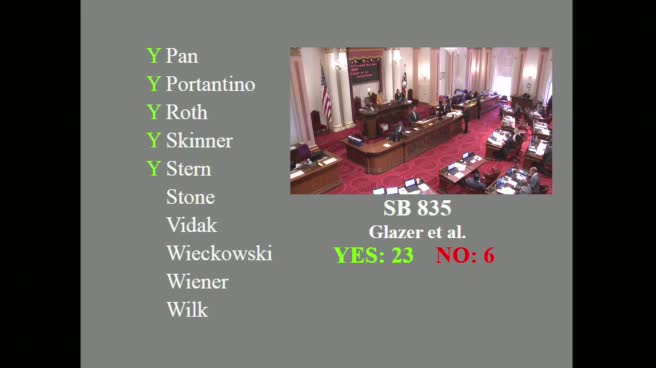 2MIN
Senate Floor
 6MIN
Assembly Floor
 1H
Assembly Standing Committee on Appropriations
 5MIN
Senate Floor
 42MIN
Senate Standing Committee on Governmental Organization
 56SEC
Senate Standing Committee on Governmental Organization
Bill Author







