AB 1985: Advanced Placement credit.
- Session Year: 2015-2016
- House: Assembly
- Latest Version Date: 2016-09-23
Existing law requires the Board of Governors of the California Community Colleges, the Regents of the University of California, and the Trustees of the California State University, with appropriate consultation with the Academic Senates of the respective segments, to jointly develop, maintain, and disseminate a shared core curriculum in general education courses for the purposes of transfer.
This bill would, commencing January 1, 2017, require the office of the Chancellor of the California Community Colleges to begin development of, and would subsequently require each community college district to begin adoption and implementation of, a uniform policy to award a pupil who passes an Advanced Placement examination course credit for certain requirements in a course with subject matter similar to that of the Advanced Placement examination. The bill would require each community college campus to post the most recent policy on its Internet Web site. If a policy is not implemented for the entering class in the fall 2017 academic term, the bill would require the California Community Colleges to adopt and implement, commencing with the 201718 academic year, the Advanced Placement policy adopted by the California State University.
To the extent that this bill would impose new duties on community college districts, it would constitute a state-mandated local program.
The California Constitution requires the state to reimburse local agencies and school districts for certain costs mandated by the state. Statutory provisions establish procedures for making that reimbursement.
This bill would provide that, if the Commission on State Mandates determines that the bill contains costs mandated by the state, reimbursement for those costs shall be made pursuant to these statutory provisions.
Existing law requires the Board of Governors of the California Community Colleges, the Regents of the University of California, and the Trustees of the California State University, with appropriate consultation with the Academic Senates of the respective segments, to jointly develop, maintain, and disseminate a shared core curriculum in general education courses for the purposes of transfer.
This bill would would, commencing January 1, 2017, require the office of the Chancellor of the California Community Colleges to develop, begin development of, and would require each community college district subsequently to adopt, begin adoption and implementation of, a uniform policy to award a pupil who passes an Advanced Placement examination course credit for certain requirements in a course with subject matter similar to that of the Advanced Placement examination. The bill would require each community college campus to post the most recent policy on its Internet Web site. If a policy is not implemented for the entering class in the fall 2017 academic term, the bill would require the California Community Colleges to adopt and implement, commencing with the 201718 academic year, the Advanced Placement policy adopted by the California State University.
To the extent that this bill would impose new duties on community college districts, it would constitute a state-mandated local program.
The California Constitution requires the state to reimburse local agencies and school districts for certain costs mandated by the state. Statutory provisions establish procedures for making that reimbursement.
This bill would provide that, if the Commission on State Mandates determines that the bill contains costs mandated by the state, reimbursement for those costs shall be made pursuant to these statutory provisions.
Existing law requires the Board of Governors of the California Community Colleges, the Regents of the University of California, and the Trustees of the California State University, with appropriate consultation with the Academic Senates of the respective segments, to jointly develop, maintain, and disseminate a shared core curriculum in general education courses for the purposes of transfer.
This bill would require the office of the Chancellor of the California Community Colleges to develop, and each community college district to adopt, a uniform policy to award a pupil who passes an Advanced Placement exam with a minimum score of 3 examination course credit for certain requirements in a course, course with subject matter similar to that of the Advanced Placement exam. examination. The bill would require each community college campus to post the most recent policy on its Internet Web site. If a policy is not implemented for the entering class in the fall 2017 academic term, the bill would require the California Community Colleges to adopt and implement, commencing with the 201718 academic year, the Advanced Placement policy adopted by the California State University.
To the extent that this bill would impose new duties on community college districts, it would constitute a state-mandated local program.
The California Constitution requires the state to reimburse local agencies and school districts for certain costs mandated by the state. Statutory provisions establish procedures for making that reimbursement.
This bill would provide that, if the Commission on State Mandates determines that the bill contains costs mandated by the state, reimbursement for those costs shall be made pursuant to these statutory provisions.
Existing law requires the Board of Governors of the California Community Colleges, the Regents of the University of California, and the Trustees of the California State University, with appropriate consultation with the Academic Senates of the respective segments, to jointly develop, maintain, and disseminate a shared core curriculum in general education courses for the purposes of transfer.
This bill would require the office of the Chancellor of the California Community Colleges to develop, and each community college district to adopt, a uniform policy to award a pupil who passes an Advanced Placement exam with a minimum score of 3 or higher course credit for a course within this curriculum certain requirements in a course, with subject matter similar to that of the Advanced Placement exam.
To the extent that this bill would impose new duties on community college districts, it would constitute a state-mandated local program.
The California Constitution requires the state to reimburse local agencies and school districts for certain costs mandated by the state. Statutory provisions establish procedures for making that reimbursement.
This bill would provide that, if the Commission on State Mandates determines that the bill contains costs mandated by the state, reimbursement for those costs shall be made pursuant to these statutory provisions.
Existing law requires the Board of Governors of the California Community Colleges, the Regents of the University of California, and the Trustees of the California State University, with appropriate consultation with the Academic Senates of the respective segments, to jointly develop, maintain, and disseminate a shared core curriculum in general education courses for the purposes of transfer.
This bill would require the California Community Colleges to develop, and each community college district to adopt, a uniform policy to award a pupil who passes an Advanced Placement exam with a score of 3 or higher credit for a course within this curriculum with subject matter similar to that of the Advanced Placement exam.
To the extent that this bill would impose new duties on community college districts, it would constitute a state-mandated local program.
The California Constitution requires the state to reimburse local agencies and school districts for certain costs mandated by the state. Statutory provisions establish procedures for making that reimbursement.
This bill would provide that, if the Commission on State Mandates determines that the bill contains costs mandated by the state, reimbursement for those costs shall be made pursuant to these statutory provisions.
The Legislature finds and declares all of the following:
(a)It is the intent of the Legislature to establish a uniform Advanced Placement (AP) credit policy for general education within the California Community Colleges. It is the intent of the Legislature that the Chancellor of the California Community Colleges, in collaboration with the Academic Senate for the California Community Colleges, consider, when adopting the uniform policy, granting course credit to a pupil who passes an Advanced Placement examination with a minimum score of three.
(b)Studies consistently find that pupils who earn AP exam scores of three and higher are likely to demonstrate multiple measures of college success.
(c)The lack of a uniform AP credit policy often serves as an academic and financial barrier for students enrolling in California Community Colleges and is a transfer obstacle for many pupils.
SEC. 2.Article 9 (commencing with Section 79500) is added to Chapter 9 of Part 48 of Division 7 of Title 3 of the Education Code, to read:9.Advanced Placement Credit79500.(a)The office of the Chancellor of the California Community Colleges shall, in collaboration with the Academic Senate for California Community Colleges, do both of the following:
(1)Commencing January 1, 2017, begin development of, and each community college district subsequently shall begin adoption and implementation of, a uniform policy to award a pupil who passes an Advanced Placement examination course credit for California Intersegmental General Education Transfer Curriculum, California State University General Education Breadth, or local community college general education requirements, as appropriate for the pupils needs, in a course with subject matter similar to that of the Advanced Placement examination.
(2)Periodically review and adjust the policy adopted pursuant to subdivision (a) to align it with policies of other public postsecondary educational institutions.
(b)If the policy to be adopted pursuant to subdivision (a) is not implemented for the entering class in the fall 2017 academic term, the California Community Colleges shall adopt and implement, commencing with the 201718 academic year, the Advanced Placement policy adopted by the California State University.
(c)Each community college campus shall post on its Internet Web site the most recent policy adopted pursuant to this section.
SEC. 3.If the Commission on State Mandates determines that this act contains costs mandated by the state, reimbursement to local agencies and school districts for those costs shall be made pursuant to Part 7 (commencing with Section 17500) of Division 4 of Title 2 of the Government Code.
The Legislature finds and declares all of the following:
(a)It is the intent of the Legislature to establish a uniform Advanced Placement (AP) credit policy for general education within the California Community Colleges. It is the intent of the Legislature that the Chancellor of the California Community Colleges, in collaboration with the Academic Senate for the California Community Colleges, consider, when adopting the uniform policy, granting course credit to a pupil who passes an Advanced Placement examination with a minimum score of three.
(b)Studies consistently find that pupils who earn AP exam scores of three and higher are likely to demonstrate multiple measures of college success.
(c)The lack of a uniform AP credit policy often serves as an academic and financial barrier for students enrolling in California Community Colleges and is a transfer obstacle for many pupils.
SEC. 2.Article 9 (commencing with Section 79500) is added to Chapter 9 of Part 48 of Division 7 of Title 3 of the Education Code, to read:9.Advanced Placement Credit79500.(a)The office of the Chancellor of the California Community Colleges shall, in collaboration with the Academic Senate for California Community Colleges, do both of the following:
(1)Develop, and each community college district shall adopt and implement, commencing with the entering class in the fall 2016 academic term, Commencing January 1, 2017, begin development of, and each community college district subsequently shall begin adoption and implementation of, a uniform policy to award a pupil who passes an Advanced Placement examination course credit for California Intersegmental General Education Transfer Curriculum, California State University General Education Breadth, or local community college general education requirements, as appropriate for the pupils needs, in a course with subject matter similar to that of the Advanced Placement examination.
(2)Periodically review and adjust the policy adopted pursuant to subdivision (a) to align it with policies of other public postsecondary educational institutions.
(b)If the policy to be adopted pursuant to subdivision (a) is not implemented for the entering class in the fall 2017 academic term, the California Community Colleges shall adopt and implement, commencing with the 201718 academic year, the Advanced Placement policy adopted by the California State University.
(c)Each community college campus shall post on it its Internet Web site the most recent policy adopted pursuant to this section.
SEC. 3.If the Commission on State Mandates determines that this act contains costs mandated by the state, reimbursement to local agencies and school districts for those costs shall be made pursuant to Part 7 (commencing with Section 17500) of Division 4 of Title 2 of the Government Code.
The Legislature finds and declares each all of the following:
(a)It is the intent of the Legislature to establish a uniform Advanced Placement (AP) credit policy for general education within the California Community Colleges. It is the intent of the Legislature that the Chancellor of the California Community Colleges, in collaboration with the Academic Senate for the California Community Colleges, consider, when adopting the uniform policy, granting course credit to a pupil who passes an Advanced Placement examination with a minimum score of three.
(b)Studies consistently find that pupils who earn AP exam scores of three and higher are likely to demonstrate multiple measures of college success.
(c)The lack of a uniform AP credit policy often serves as an academic and financial barrier for students enrolling in California Community Colleges and is a transfer obstacle for many pupils.
SEC. 2.Article 9 (commencing with Section 79500) is added to Chapter 9 of Part 48 of Division 7 of Title 3 of the Education Code, to read:9.Advanced Placement Credit79500.(a)The office of the Chancellor of the California Community Colleges shall, in collaboration with the Academic Senate for California Community Colleges, develop, do both of the following:
(1)Develop, and each community college district shall adopt, adopt and implement, commencing with the entering class in the fall 2016 academic term, a uniform policy to award a pupil who passes an Advanced Placement exam with a minimum score of three examination course credit for California Intersegmental General Education Transfer Curriculum, California State University General Education Breadth, or local community college general education requirements, as appropriate for the pupils needs, in a course with subject matter similar to that of the Advanced Placement exam. examination.
(2)Periodically review and adjust the policy adopted pursuant to subdivision (a) to align it with policies of other public postsecondary educational institutions.
(b)If the policy to be adopted pursuant to subdivision (a) is not implemented for the entering class in the fall 2017 academic term, the California Community Colleges shall adopt and implement, commencing with the 201718 academic year, the Advanced Placement policy adopted by the California State University.
(c)Each community college campus shall post on it Internet Web site the most recent policy adopted pursuant to this section.
SEC. 3.If the Commission on State Mandates determines that this act contains costs mandated by the state, reimbursement to local agencies and school districts for those costs shall be made pursuant to Part 7 (commencing with Section 17500) of Division 4 of Title 2 of the Government Code.
The Legislature finds and declares each of the following:
(a)It is the intent of the Legislature to establish a uniform Advanced Placement (AP) credit policy for general education within the California Community Colleges.
(b)Studies consistently find that pupils who earn AP exam scores of three and higher are likely to demonstrate multiple measures of college success.
(c)The lack of a uniform AP credit policy often serves as an academic and financial barrier for students enrolling in California Community Colleges and is a transfer obstacle for many pupils.
SECTION 1.SEC. 2.Article 9 (commencing with Section 79500) is added to Chapter 9 of Part 48 of Division 7 of Title 3 of the Education Code, to read:9.Advanced Placement Credit79500.(a)It is the intent of the Legislature to establish a uniform Advanced Placement (AP) credit policy within the California Community Colleges.
(b)Studies consistently find that pupils who earn AP Exam scores of three and higher are likely to demonstrate multiple measures of college success.
(c)The lack of a uniform AP credit policy often serves as an academic and financial barrier for students enrolling in California Community Colleges and is a transfer obstacle for many pupils.
79501.79500.The office of the Chancellor of the California Community Colleges shall shall, in collaboration with the Academic Senate for California Community Colleges, develop, and each community college district shall adopt, a uniform policy to award a pupil who passes an Advanced Placement exam with a minimum score of three or higher course credit for a California Intersegmental General Education Transfer Curriculum Curriculum, California State University General Education Breadth, or local community college general education requirements, as appropriate for the pupils needs, in a course with subject matter similar to that of the Advanced Placement exam.
SEC. 2.SEC. 3.If the Commission on State Mandates determines that this act contains costs mandated by the state, reimbursement to local agencies and school districts for those costs shall be made pursuant to Part 7 (commencing with Section 17500) of Division 4 of Title 2 of the Government Code.
(a)It is the intent of the Legislature to establish a uniform Advanced Placement (AP) credit policy within the California Community Colleges.
(b)Studies consistently find that pupils who earn AP Exam scores of three and higher are likely to demonstrate multiple measures of college success.
(c)The lack of a uniform AP credit policy often serves as an academic and financial barrier for students enrolling in California Community Colleges and is a transfer obstacle for many pupils.
79501.The California Community Colleges shall develop, and each community college district shall adopt, a uniform policy to award a pupil who passes an Advanced Placement exam with a score of three or higher credit for a California Intersegmental General Education Transfer Curriculum course with subject matter similar to that of the Advanced Placement exam.
SEC. 2.If the Commission on State Mandates determines that this act contains costs mandated by the state, reimbursement to local agencies and school districts for those costs shall be made pursuant to Part 7 (commencing with Section 17500) of Division 4 of Title 2 of the Government Code.
|
Date
|
Status
|
|---|---|
| Aug 30, 2016 | Enrolled and presented to the Governor at 4 p.m. |
| Aug 23, 2016 | Senate amendments concurred in. To Engrossing and Enrolling. (Ayes 75. Noes 4. Page 6111.). |
| Aug 23, 2016 | Senate amendments concurred in. To Engrossing and Enrolling. |
| Aug 16, 2016 | Read third time. Passed. Ordered to the Assembly. (Ayes 38. Noes 0. Page 5024.). |
| Aug 16, 2016 | Read third time. Passed. Ordered to the Assembly. (Ayes 38. Noes 0.). |
| Aug 16, 2016 | In Assembly. Concurrence in Senate amendments pending. May be considered on or after August 18 pursuant to Assembly Rule 77. |
| Aug 16, 2016 | Read third time. Passed. Ordered to the Assembly. |
| Aug 15, 2016 | Read second time. Ordered to third reading. |
| Aug 11, 2016 | From committee: Do pass. (Ayes 7. Noes 0.) (August 11). |
| Aug 1, 2016 | In committee: Referred to APPR. suspense file. |
| Aug 1, 2016 | From committee chair, with author's amendments: Amend, and re-refer to committee. Read second time, amended, and re-referred to Com. on APPR. |
| Jun 22, 2016 | Read second time and amended. Re-referred to Com. on APPR. |
| Jun 21, 2016 | From committee: Amend, and do pass as amended and re-refer to Com. on APPR. (Ayes 9. Noes 0.) (June 15). |
| Jun 9, 2016 | Referred to Com. on ED. |
| May 23, 2016 | Read third time. Passed. Ordered to the Senate. (Ayes 73. Noes 2. Page 4895.) |
| May 23, 2016 | Read third time. Passed. Ordered to the Senate. (Ayes 73. Noes 2.) |
| May 23, 2016 | In Senate. Read first time. To Com. on RLS. for assignment. |
| May 23, 2016 | Read third time. Passed. Ordered to the Senate. |
| May 12, 2016 | Read second time. Ordered to third reading. |
| May 11, 2016 | From committee: Do pass. (Ayes 19. Noes 1.) (May 11). |
| Apr 25, 2016 | Re-referred to Com. on APPR. |
| Apr 21, 2016 | Read second time and amended. |
| Apr 20, 2016 | From committee: Amend, and do pass as amended and re-refer to Com. on APPR. (Ayes 13. Noes 0.) (April 19). |
| Feb 25, 2016 | Referred to Com. on HIGHER ED. |
| Feb 17, 2016 | From printer. May be heard in committee March 18. |
| Feb 16, 2016 | Read first time. To print. |
|
Date
|
Description
|
Location
|
Votes
|
|
|---|---|---|---|---|
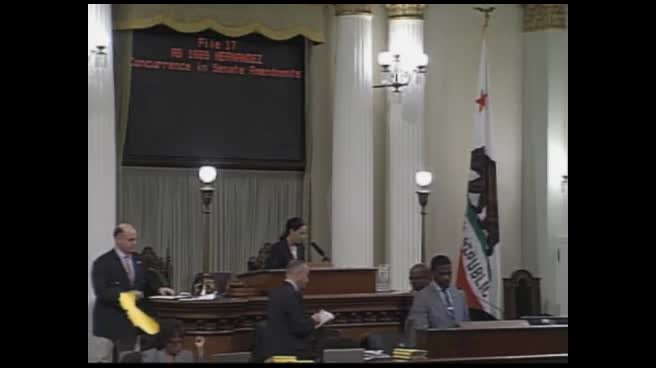
| Aug 23, 2016 | AB 1985 WILLIAMS Concurrence in Senate Amendments | Assembly Floor |
Passed |
|
| Aug 16, 2016 | Assembly 3rd Reading AB1985 Williams By Block | Senate Floor |
Passed |
|
| Aug 11, 2016 | Do pass | Senate Standing Committee on Appropriations |
Passed |
|
| Aug 1, 2016 | Placed on suspense file | Senate Standing Committee on Appropriations |
Passed |
|
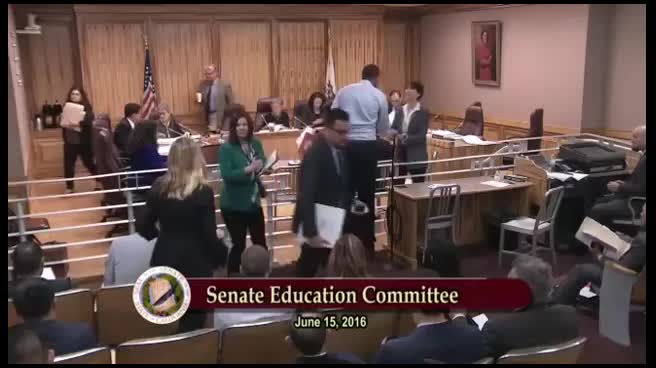
| Jun 15, 2016 | Do pass as amended, but first amend, and re-refer to the Committee on [Appropriations] | Senate Standing Committee on Education |
Passed |
|
| May 23, 2016 | AB 1985 WILLIAMS Assembly Third Reading | Assembly Floor |
Passed |
|
| May 11, 2016 | Do pass. | Assembly Standing Committee on Appropriations |
Passed |
|
| Apr 19, 2016 | Do pass as amended and be re-referred to the Committee on [Appropriations] | Assembly Standing Committee on Higher Education |
Passed |
This list shows positions taken on this bill by organizations on the date displayed, which is linked to the original source.
Positions by individuals are not included.
CONCURRENCE IN SENATE AMENDMENTS
CSA1 Bill Id:AB 1985
Author:(Williams)
As Amended Ver:August 1, 2016
Majority vote
ASSEMBLY: | 73-2 | (May 23, 2016) | SENATE: | 38-0 | (August 16, 2016) |
Original Committee Reference: HIGHER ED.
SUMMARY: Requires the California Community Colleges (CCC) Chancellor, in collaboration with the Academic Senate, to develop a uniform policy regarding credit awarded for Advance Placement (AP) examinations.
The Senate amendments:
- Remove the requirement that the uniform policy ensure that students who pass an AP exam with a minimum score of three receive credit, and instead require the adoption and implementation of a uniform policy, commencing with the entering class in the Fall 2016 academic term, regarding AP examination credit at CCC.
- Require that the CCC Chancellor, in collaboration with the Academic Senate, periodically review and adjust the policy to align it with policies of other public postsecondary educational institutions. If the policy is not implemented for the entering class in the fall 2017 academic term, the CCC are required to adopt and implement, commencing with the 2017–18 academic year, the AP policy adopted by the California State University (CSU).
- Require each CCC campus to post on it Internet Web site the most recent policy adopted pursuant to this requirement.
EXISTING LAW:
- Establishes the Board of Governors (BOG) and the Chancellor of the CCC to provide leadership and direction to the CCC while maintaining and continuing, to the maximum degree permissible, local authority and control in the administration of the districts (CCD). The BOG and Chancellor are responsible for a variety of functions, including establishing minimum standards, providing various reports, and various annual budgeting functions. In performing functions, BOG is required to carry out a process of consultation with institutional representatives, college organizations and interested individuals and parties. (Education Code Section 70901).
- Pursuant to BOG regulations, the governing board of a CCD may adopt policies to grant credit for satisfactory completion of AP exams. The faculty in the appropriate discipline must approve AP examinations, scores deemed to constitute satisfactory performance, courses offered by the college for which credit will be granted, and requirements that may be met by such examinations in accordance with policies and procedures approved by the curriculum committee. The student's academic record must be clearly annotated to reflect that credit was earned through an AP exam. (5 California Code of Regulations Section 55052).
FISCAL EFFECT: According to the Senate Appropriations Committee:
- Mandate: One-time costs ranging in the low tens of thousands to low hundreds of thousands for campuses to either create or adapt their AP policies to a uniform policy adopted by the CCC Chancellor's Office. These costs would likely be determined to be a reimbursable state mandate by the Commission on State Mandates. See staff comments. (Proposition 98 of 1988)
- CCC Chancellor's Office: Costs of up to about $20,000 General Fund to hold two full day meetings with the CCC Academic Senate to develop the uniform policy. If additional or less time is needed to develop the policy, the costs would change accordingly.
COMMENTS: Purpose of this bill. AP courses are designed to provide rigorous academic coursework opportunities for high school students. Upon successful completion of AP courses, students are provided the opportunity to take an AP exam, conducted by the College Board, for which scores range from 1-5. According to College Board, scores of 3-5 correlate to college course grades of C to A. According to the author, AP credit policies vary across the 113 community colleges. According to a College Board report entitled AP Credit Policies at California Community Colleges, 10 colleges do not grant credit or have unknown credit policies for all available AP exams, 24 colleges require a score of 4 to award credit, and 6 colleges require a score on some AP exams of 5. According to the author, the lack of a systemwide credit policy for the CCC creates an unnecessary barrier for students in receiving and transferring credits. In 2014, 16,178 AP test takers reported 47,180 AP exam scores to CCC.
CSU policy on AP exam credit. CSU Executive Order No. 1036, issued on July 14, 2008, provides that CSU campuses shall award baccalaureate credit toward degree and/or admissions eligibility to students who pass standardized external examinations (such as AP, International Baccalaureate, and College Level Entrance Program examinations). The Chancellor, in consultation with the General Education Advisory Committee is required to maintain a list of external examinations and passing scores, minimum credits toward admissions eligibility, minimum credits toward the baccalaureate degree, and, placement in GE Breadth area for transfer students seeking general education certification. According to the most recently available list, all AP exams require a minimum passing score of three.
UC policy on AP exam credit. According to the University of California (UC), systemwide UC grants credit for AP exams on which a student scores a three or higher. Elective units awarded may be applied to UC graduation requirements for specific subjects and/or for general education/breadth requirements, as determined by each campus. For transfer students, AP exams can also be used to meet the minimum transfer admission subject requirements in English, math and 4 other courses chosen from the humanities, behavioral/social sciences, and biological/physical sciences.
Analysis Prepared by: Laura Metune / HIGHER ED. / (916) 319-3960 FN: 0004174
Office of Senate Floor Analyses (916) 651-1520 Fax: (916) 327-4478 | AB |
THIRD READING
Bill No: AB 1985
:
SENATE EDUCATION COMMITTEE: 9-0, 6/15/16
AYES: Liu, Block, Hancock, Huff, Leyva, Mendoza, Monning, Pan, Vidak
SENATE APPROPRIATIONS COMMITTEE: 7-0, 8/11/16
AYES: Lara, Bates, Beall, Hill, McGuire, Mendoza, Nielsen
ASSEMBLY FLOOR: 73-2, 5/23/16 - See last page for vote
DIGEST: This bill requires the Chancellor’s Office of the California Community Colleges (CCC), in collaboration with the Academic Senate of the CCC, to develop a uniform policy to award credit, as specified, to a student with a minimum advanced placement (AP) test score of 3, and requires each CCC district to adopt the policy.
Existing law:
- Establishes the Board of Governors (BOG) and the Chancellor of the CCC to provide leadership and direction to the CCC while maintaining and continuing, to the maximum degree permissible, local authority and control in the administration of the districts. The BOG and Chancellor are responsible for a variety of functions, including establishing minimum standards, providing various reports, and various annual budgeting functions. In performing functions, BOG is required to carry out a process of consultation with institutional representatives, college organizations and interested individuals and parties. (Education Code § 70901)
- Authorizes the governing board of a community college district to adopt policies to grant credit for satisfactory completion of AP exams. The faculty in the appropriate discipline must approve AP examinations, scores deemed to constitute satisfactory performance, courses offered by the college for which credit will be granted, and requirements that may be met by such examinations in accordance with policies and procedures approved by the curriculum committee. The student's academic record must be clearly annotated to reflect that credit was earned through an AP exam. (Title 5, California Code of Regulations § 55052)
This bill:
- Requires the Chancellor’s Office of the CCC, in collaboration with the Academic Senate of the CCC, to do both of the following:
- Beginning January 1, 2017, begin development of, and each community college district subsequently must begin adoption and implementation of, a uniform policy to award a student who passes an AP examination course credit in a similar course for the California Intersegmental General Education Transfer Curriculum, California State University (CSU) general education requirements, or local community college general education requirements. Each community college campus is required to post the policy on its Web site.
- Periodically review and adjust the policy to align it with other public postsecondary institutions.
- Requires that if the policy is not implemented for in the fall 2017 academic term, the CCC is required to implement the AP policy adopted by the CSU. At the CSU, all AP exams require a minimum passing score of 3 to obtain credit.
Comments
Need for the bill. According to the author, AP credit policies vary across each of the 113 CCCs. While the overwhelming majority of CCC transfer students attend the CSU system, which has an established and clear policy for awarding AP exam credit, students who first attend a community college runs the risk of losing the college credit they earned through their AP scores. Students are forced to retake introductory courses although they have already demonstrated proficiency as evidenced through their scores. According to the author, the lack of a systemwide credit policy for the CCC creates an unnecessary barrier for students in receiving and transferring credits.
AP courses. According to the College Board, the provider of AP exams, these courses are designed to provide rigorous academic coursework opportunities for high school students. Upon successful completion of an AP course, students are provided the opportunity to take an AP exam, conducted by the College Board, for which scores can range from 1-5. According to a College Board report entitled AP Credit Policies at California Community Colleges, 10 colleges do not grant credit or have unknown credit policies for all available AP exams, 24 colleges require a score of 4 to award credit, and 6 colleges require a score on some AP exams of 5. In 2014, 16,178 AP test takers reported 47,180 AP exam scores to CCC.
Other public institutions? It appears that the other public postsecondary educational institutions have adopted and made available their AP exam/credit policies:
- California State University. CSU Executive Order No. 1036, issued on July 14, 2008, provides that CSU campuses shall award baccalaureate credit toward degree and/or admissions eligibility to students who pass standardized external examinations (such as AP, International Baccalaureate, and College Level Entrance Program examinations). The Chancellor, in consultation with the General Education (GE) Advisory Committee is required to maintain a list of external examinations and passing scores, minimum credits toward admissions eligibility, minimum credits toward the baccalaureate degree, and, placement in GE Breadth area for transfer students seeking GE certification. According to the most recently available list, all AP exams require a minimum passing score of three.
- University of California (UC). According to UC, systemwide UC grants credit for AP exams on which a student scores a 3 or higher. Elective units awarded may be applied to UC graduation requirements for specific subjects and/or for general education/breadth requirements, as determined by each campus. For transfer students, AP exams can also be used to meet the minimum transfer admission subject requirements in English, math and four other courses chosen from the humanities, behavioral/social sciences, and biological/physical sciences.
FISCAL EFFECT: Appropriation: Fiscal Com.: Local:
According to the Senate Appropriations Committee:
- Mandate: One-time costs ranging in the low tens of thousands to low hundreds of thousands for campuses to either create or adapt their AP policies to a uniform policy adopted by the CCC Chancellor’s Office. These costs would likely be determined to be a reimbursable state mandate by the Commission on State Mandates. (Proposition 98)
- Chancellor’s Office: Costs of up to about $20,000 General Fund to hold two full day meetings with the CCC Academic Senate to develop the uniform policy. If additional or less time is needed to develop the policy, the costs would change accordingly.
Association of California School Administrators
College Board
Education Trust West
Los Angeles Unified School District
OPPOSITION: (Verified 8/16/16)
ASSEMBLY FLOOR: 73-2, 5/23/16
AYES: Achadjian, Alejo, Travis Allen, Atkins, Baker, Bigelow, Bloom, Bonilla, Bonta, Brown, Burke, Calderon, Campos, Chang, Chau, Chávez, Chiu, Chu, Cooley, Cooper, Dababneh, Dahle, Daly, Dodd, Frazier, Beth Gaines, Gallagher, Cristina Garcia, Eduardo Garcia, Gatto, Gipson, Gomez, Gonzalez, Gordon, Gray, Grove, Hadley, Roger Hernández, Holden, Irwin, Jones-Sawyer, Kim, Lackey, Levine, Linder, Lopez, Low, Maienschein, Mathis, Mayes, McCarty, Medina, Melendez, Mullin, Nazarian, Obernolte, O'Donnell, Olsen, Quirk, Ridley-Thomas, Rodriguez, Salas, Santiago, Steinorth, Mark Stone, Thurmond, Ting, Waldron, Weber, Wilk, Williams, Wood, Rendon
NOES: Harper, Wagner
NO VOTE RECORDED: Arambula, Brough, Eggman, Jones, Patterson
8/16/16 10:22:26
Office of Senate Floor Analyses (916) 651-1520 Fax: (916) 327-4478 | AB |
THIRD READING
Bill No: AB 1985
:
SENATE EDUCATION COMMITTEE: 9-0, 6/15/16
AYES: Liu, Block, Hancock, Huff, Leyva, Mendoza, Monning, Pan, Vidak
SENATE APPROPRIATIONS COMMITTEE: 7-0, 8/11/16
AYES: Lara, Bates, Beall, Hill, McGuire, Mendoza, Nielsen
ASSEMBLY FLOOR: 73-2, 5/23/16 - See last page for vote
DIGEST: This bill requires the Chancellor’s Office of the California Community Colleges (CCC), in collaboration with the Academic Senate of the CCC, to develop a uniform policy to award credit, as specified, to a student with a minimum advanced placement (AP) test score of 3, and requires each CCC district to adopt the policy.
Existing law:
- Establishes the Board of Governors (BOG) and the Chancellor of the CCC to provide leadership and direction to the CCC while maintaining and continuing, to the maximum degree permissible, local authority and control in the administration of the districts. The BOG and Chancellor are responsible for a variety of functions, including establishing minimum standards, providing various reports, and various annual budgeting functions. In performing functions, BOG is required to carry out a process of consultation with institutional representatives, college organizations and interested individuals and parties. (Education Code § 70901)
- Authorizes the governing board of a community college district to adopt policies to grant credit for satisfactory completion of AP exams. The faculty in the appropriate discipline must approve AP examinations, scores deemed to constitute satisfactory performance, courses offered by the college for which credit will be granted, and requirements that may be met by such examinations in accordance with policies and procedures approved by the curriculum committee. The student's academic record must be clearly annotated to reflect that credit was earned through an AP exam. (Title 5, California Code of Regulations § 55052)
This bill:
- Requires the Chancellor’s Office of the CCC, in collaboration with the Academic Senate of the CCC, to do both of the following:
- Beginning January 1, 2017, begin development of, and each community college district subsequently must begin adoption and implementation of, a uniform policy to award a student who passes an AP examination course credit in a similar course for the California Intersegmental General Education Transfer Curriculum, California State University (CSU) general education requirements, or local community college general education requirements. Each community college campus is required to post the policy on its Web site.
- Periodically review and adjust the policy to align it with other public postsecondary institutions.
- Requires that if the policy is not implemented for in the fall 2017 academic term, the CCC is required to implement the AP policy adopted by the CSU. At the CSU, all AP exams require a minimum passing score of 3 to obtain credit.
Comments
Need for the bill. According to the author, AP credit policies vary across each of the 113 CCCs. While the overwhelming majority of CCC transfer students attend the CSU system, which has an established and clear policy for awarding AP exam credit, students who first attend a community college runs the risk of losing the college credit they earned through their AP scores. Students are forced to retake introductory courses although they have already demonstrated proficiency as evidenced through their scores. According to the author, the lack of a systemwide credit policy for the CCC creates an unnecessary barrier for students in receiving and transferring credits.
AP courses. According to the College Board, the provider of AP exams, these courses are designed to provide rigorous academic coursework opportunities for high school students. Upon successful completion of an AP course, students are provided the opportunity to take an AP exam, conducted by the College Board, for which scores can range from 1-5. According to a College Board report entitled AP Credit Policies at California Community Colleges, 10 colleges do not grant credit or have unknown credit policies for all available AP exams, 24 colleges require a score of 4 to award credit, and 6 colleges require a score on some AP exams of 5. In 2014, 16,178 AP test takers reported 47,180 AP exam scores to CCC.
Other public institutions? It appears that the other public postsecondary educational institutions have adopted and made available their AP exam/credit policies:
- California State University. CSU Executive Order No. 1036, issued on July 14, 2008, provides that CSU campuses shall award baccalaureate credit toward degree and/or admissions eligibility to students who pass standardized external examinations (such as AP, International Baccalaureate, and College Level Entrance Program examinations). The Chancellor, in consultation with the General Education (GE) Advisory Committee is required to maintain a list of external examinations and passing scores, minimum credits toward admissions eligibility, minimum credits toward the baccalaureate degree, and, placement in GE Breadth area for transfer students seeking GE certification. According to the most recently available list, all AP exams require a minimum passing score of three.
- University of California (UC). According to UC, systemwide UC grants credit for AP exams on which a student scores a 3 or higher. Elective units awarded may be applied to UC graduation requirements for specific subjects and/or for general education/breadth requirements, as determined by each campus. For transfer students, AP exams can also be used to meet the minimum transfer admission subject requirements in English, math and four other courses chosen from the humanities, behavioral/social sciences, and biological/physical sciences.
FISCAL EFFECT: Appropriation: Fiscal Com.: Local:
According to the Senate Appropriations Committee:
- Mandate: One-time costs ranging in the low tens of thousands to low hundreds of thousands for campuses to either create or adapt their AP policies to a uniform policy adopted by the CCC Chancellor’s Office. These costs would likely be determined to be a reimbursable state mandate by the Commission on State Mandates. (Proposition 98)
- Chancellor’s Office: Costs of up to about $20,000 General Fund to hold two full day meetings with the CCC Academic Senate to develop the uniform policy. If additional or less time is needed to develop the policy, the costs would change accordingly.
Association of California School Administrators
College Board
Education Trust West
Los Angeles Unified School district
North Orange County Community College district
OPPOSITION: (Verified 8/12/16)
Academic Senate for California Community Colleges
Faculty Association of California Community Colleges
ASSEMBLY FLOOR: 73-2, 5/23/16
AYES: Achadjian, Alejo, Travis Allen, Atkins, Baker, Bigelow, Bloom, Bonilla, Bonta, Brown, Burke, Calderon, Campos, Chang, Chau, Chávez, Chiu, Chu, Cooley, Cooper, Dababneh, Dahle, Daly, Dodd, Frazier, Beth Gaines, Gallagher, Cristina Garcia, Eduardo Garcia, Gatto, Gipson, Gomez, Gonzalez, Gordon, Gray, Grove, Hadley, Roger Hernández, Holden, Irwin, Jones-Sawyer, Kim, Lackey, Levine, Linder, Lopez, Low, Maienschein, Mathis, Mayes, McCarty, Medina, Melendez, Mullin, Nazarian, Obernolte, O'Donnell, Olsen, Quirk, Ridley-Thomas, Rodriguez, Salas, Santiago, Steinorth, Mark Stone, Thurmond, Ting, Waldron, Weber, Wilk, Williams, Wood, Rendon
NOES: Harper, Wagner
NO VOTE RECORDED: Arambula, Brough, Eggman, Jones, Patterson
8/15/16 20:27:01
SENATE COMMITTEE ON
Senator Ricardo Lara, Chair
2015 - 2016 Regular Session
AB 1985 (Williams) - Advanced Placement credit
Version: | Policy Vote: |
Urgency: | Mandate: |
Hearing Date: | Consultant: |
This bill meets the criteria for referral to the Suspense File.
Bill Summary:
This bill requires the Chancellor’s Office of the California Community Colleges (CCC), in collaboration with the Academic Senate of the CCC, to develop a uniform policy to award course credit, as specified, to a student who passes an Advanced Placement (AP) examination and requires each CCC district to implement the policy.
Fiscal Impact:
- Mandate: One-time costs ranging in the low tens of thousands to low hundreds of thousands for campuses to either create or adapt their AP policies to a uniform policy adopted by the CCC Chancellor’s Office. These costs would likely be determined to be a reimbursable state mandate by the Commission on State Mandates. See staff comments. (Proposition 98)
- Chancellor’s Office: Costs of up to about $20,000 General Fund to hold two full day meetings with the CCC Academic Senate to develop the uniform policy. If additional or less time is needed to develop the policy, the costs would change accordingly.
Background:
According to the College Board, the provider of AP exams, these courses are designed to provide rigorous academic coursework opportunities for high school students. Upon successful completion of an AP course, students are provided the opportunity to take an AP exam. Depending on how the student scores on the exam and policies for taking AP credit at the postsecondary education institutions, the student may earn college-level course credit in the subject area of the exam.
Existing law authorizes the governing board of a community college district to adopt policies to grant credit for satisfactory completion of AP exams. The faculty in the appropriate discipline must approve AP examinations, scores that constitute satisfactory performance, courses offered by the college for which credit will be granted, and requirements that may be met by such examinations in accordance with policies and procedures approved by the curriculum committee. The student's academic record must be clearly annotated to reflect that credit was earned through an AP exam. (Title 5, California Code of Regulations § 55052)
Existing law establishes the Board of Governors and the Chancellor of the CCC to provide leadership and direction to the CCC while maintaining and continuing, to the maximum degree permissible, local authority and control in the administration of the districts. (Education Code § 70901)
According to the CCC, most colleges take some AP credit. It is estimated that 10 out of the 113 campuses do not have an official AP policy. There is no consistent systemwide policy regarding what score is accepted for certain classes, and therefore the policies vary by campus. According to the author, the lack of a systemwide credit policy for the CCC creates an unnecessary barrier for students in receiving and transferring credits.
The California Intersegmental General Education Transfer Curriculum is a series of courses that CCC students can complete to satisfy general education requirements before transferring to most colleges and majors at University of California campuses.
Proposed Law:
This bill requires the CCC Chancellor, in collaboration with the Academic Senate for CCC, to do both of the following:
- Beginning January 1, 2017 begin development of, and each community college district subsequently must begin adoption and implementation of, a uniform policy to award a student who passes an AP examination course credit in a similar course for the California Intersegmental General Education Transfer Curriculum, California State University (CSU) general education requirements, or local community college general education requirements. Each community college campus is required to post the policy on its website.
- Periodically review and adjust the policy to align it with other public postsecondary institutions.
This bill requires that if the policy is not implemented for in the fall 2017 academic term, the CCC is required to implement the AP policy adopted by the CSU. At the CSU, all AP exams require a minimum passing score of three to obtain credit.
Staff Comments:
The level of workload driven by the enactment of this bill will depend upon the uniform policy to be adopted by the Chancellor’s Office to which the campuses will have to align. Workload will also vary by campus as most have policies in place, which would require less work than those estimated 10 campuses that have no policy in place.
Campuses with existing policies will likely need to spend staff time aligning courses to a systemwide uniform policy which the local governing board would likely have to adopt. Costs for these campuses could range from minor and absorbable to about $2,000.
Workload for the campuses without an official AP policy would be more significant, and would vary by campus as well. These campuses would need to identify where AP courses substitute for general education area credit, update course catalogs for a process that enables students to petition for AP exam credit, provide staff with the information necessary to ensure credit is appropriately awarded, and prepare materials for the local board adoption. Depending upon the campus, costs could range up to $7,500 per campus.
-- END --
SENATE COMMITTEE ON EDUCATION
Senator Carol Liu, Chair
2015 - 2016 Regular
Bill No:
Author: | Williams | ||
Version: | Hearing Date: June 15, 2016 | ||
Urgency: | Fiscal: | ||
Consultant: | |||
Subject:
SUMMARY
This bill requires the Chancellor’s Office of the California Community Colleges (CCC), in collaboration with the Academic Senate of the CCC, to develop a uniform policy to award credit, as specified, to a student with a minimum Advanced Placement test score of 3, and requires each CCC District to adopt the policy.
BACKGROUND
Existing law establishes the Board of Governors (BOG) and the Chancellor of the CCC to provide leadership and direction to the CCC while maintaining and continuing, to the maximum degree permissible, local authority and control in the administration of the districts (CCD). The BOG and Chancellor are responsible for a variety of functions, including establishing minimum standards, providing various reports, and various annual budgeting functions. In performing functions, BOG is required to carry out a process of consultation with institutional representatives, college organizations and interested individuals and parties. (Education Code § 70901)
Existing law authorizes the governing board of a community college district to adopt policies to grant credit for satisfactory completion of advanced placement (AP) exams. The faculty in the appropriate discipline must approve AP examinations, scores deemed to constitute satisfactory performance, courses offered by the college for which credit will be granted, and requirements that may be met by such examinations in accordance with policies and procedures approved by the curriculum committee. The student's academic record must be clearly annotated to reflect that credit was earned through an AP exam. (Title 5, California Code of Regulations § 55052)
ANALYSIS
This bill:
- Requires the Chancellor’s Office of the CCC, in collaboration with the Academic Senate of the CCC, to develop a uniform policy to award course credit to a student with a minimum score of 3 on an Advanced Placement exam. It requires that course credit be provided, as appropriate, for:
- A California Intersegmental General Education Transfer curriculum requirement.
- A California State University (CSU) General Education Breadth requirement.
- A local community college general education requirement.
- Identifies potentially reimbursable state mandated costs.
STAFF COMMENTS
- Need for the bill. According to the author, advanced placement (AP) credit policies vary across each of the 113 California Community Colleges (CCC). While the overwhelming majority of CCC transfer students attend the CSU system, which has an established and clear policy for awarding AP exam credit, students who first attend a community college runs the risk of losing the college credit they earned through their AP scores. Students are forced to retake introductory courses although they have already demonstrated proficiency as evidenced through their scores. According to the author, the lack of a systemwide credit policy for the CCC creates an unnecessary barrier for students in receiving and transferring credits.
- Advanced Placement (AP) Courses. According to the College Board, the provider of AP exams, these courses are designed to provide rigorous academic coursework opportunities for high school students. Upon successful completion of an AP course, students are provided the opportunity to take an AP exam, conducted by the College Board, for which scores can range from 1-5. According to a College Board report entitled AP Credit Policies at California Community Colleges, 10 colleges do not grant credit or have unknown credit policies for all available AP exams, 24 colleges require a score of 4 to award credit, and 6 colleges require a score on some AP exams of 5. In 2014, 16,178 AP test takers reported 47,180 AP exam scores to CCC.
- Other public institutions? It appears that the other public postsecondary educational institutions have adopted and made available their AP exam/credit policies:
- California State University (CSU). CSU Executive Order No. 1036, issued on July 14, 2008, provides that CSU campuses shall award baccalaureate credit toward degree and/or admissions eligibility to students who pass standardized external examinations (such as AP, International Baccalaureate, and College Level Entrance Program examinations). The Chancellor, in consultation with the General Education (GE) Advisory Committee is required to maintain a list of external examinations and passing scores, minimum credits toward admissions eligibility, minimum credits toward the baccalaureate degree, and, placement in GE Breadth area for transfer students seeking general education certification. According to the most recently available list, all AP exams require a minimum passing score of three.
- University of California (UC). According to UC, systemwide UC grants credit for AP exams on which a student scores a 3 or higher. Elective units awarded may be applied to UC graduation requirements for specific subjects and/or for general education/breadth requirements, as determined by each campus. For transfer students, AP exams can also be used to meet the minimum transfer admission subject requirements in English, math and 4 other courses chosen from the humanities, behavioral/social sciences, and biological/physical sciences.
- Appropriate control over granting of academic credit? As currently drafted, this bill would statutorily dictate a score on an exam for the purpose of granting academic credit. Control over the content of the exam, and determination of the score on the exam would be under the control of the test provider. In essence, the granting of academic credit would be delegated to a non-governmental, non-academic entity that has a financial interest in the success of the AP exam program, with no ability for the California Community College to modify the policy if the exam or its content change.
At the same time, shouldn’t a public postsecondary education system have a clear and consistent policy regarding the extension of credit for Advanced Placement examinations?
- Staff recommends the bill be amended to eliminate the minimum standard of a score of three on page 3 of the bill and instead, add to the findings and declarations on page 2 lines 3-5, indicate that the policy consider the granting of credit for a minimum score of three.
- Staff also recommends that the bill be amended to require that the policy be adopted and applicable to the enter class for fall 2016-17 and to authorize the periodic review and adjustment of the policy to align with other public higher education institutions.
- Staff further recommends that each campus be required to post the adopted policy on its Web site.
SUPPORT
Association of California School Administrators
College Board
Education Trust West
Los Angeles Unified School district
North Orange County Community College district
OPPOSITION
Academic Senate for California Community Colleges
Faculty Association of California Community Colleges
-- END --
ASSEMBLY THIRD READING
ATR Bill Id:AB 1985
Author:(Williams)
As Amended Ver:April 21, 2016
Majority vote
Committee | Votes | Ayes | Noes |
Higher Education | 13-0 | Medina, Baker, Bloom, Chávez, Irwin, Jones-Sawyer, Levine, Linder, Low, Olsen, Santiago, Weber, Williams | |
Appropriations | 19-1 | Gonzalez, Bigelow, Bloom, Bonilla, Bonta, Calderon, Chang, McCarty, Eggman, Gallagher, Eduardo Garcia, Chau, Holden, Jones, Obernolte, Quirk, Santiago, Weber, Wood | Wagner |
SUMMARY: Requires the California Community Colleges (CCC) to develop a uniform policy regarding credit awarded for Advance Placement (AP) examinations. Specifically, this bill:
- Establishes Legislative intent to create a uniform AP credit policy within the CCC.
- Finds that studies consistently find that pupils who earn AP Exam scores of three and higher are likely to demonstrate multiple measures of college success.
- Finds that the lack of a uniform AP credit policy often serves as an academic and financial barrier for students enrolling in CCC and is a transfer obstacle for many pupils.
- Requires the CCC Chancellor, in collaboration with the Academic Senate, to develop, and requires each CCC district to adopt, a uniform policy to award a pupil who passes an AP exam with a score of three or higher credit for a California Intersegmental General Education (GE) Transfer Curriculum (IGETC), California State University General Education Breadth, or local community college general education requirements, as appropriate for the pupil's needs, in a course with subject matter similar to that of the AP exam.
- Provides for reimbursement to local agencies and school districts if the Commission on State Mandates determines that this bill contains mandated state costs.
EXISTING LAW:
- Establishes the Board of Governors (BOG) and the Chancellor of the CCC to provide leadership and direction to the CCC while maintaining and continuing, to the maximum degree permissible, local authority and control in the administration of the districts (CCD). The BOG and Chancellor are responsible for a variety of functions, including establishing minimum standards, providing various reports, and various annual budgeting functions. In performing functions, BOG is required to carry out a process of consultation with institutional representatives, college organizations and interested individuals and parties. (Education Code Section 70901).
- Pursuant to BOG regulations, the governing board of a CCD may adopt policies to grant credit for satisfactory completion of AP exams. The faculty in the appropriate discipline must approve AP examinations, scores deemed to constitute satisfactory performance, courses offered by the college for which credit will be granted, and requirements that may be met by such examinations in accordance with policies and procedures approved by the curriculum committee. The student's academic record must be clearly annotated to reflect that credit was earned through an AP exam. (5 California Code of Regulations Section 55052).
FISCAL EFFECT: Unknown. This bill is keyed non-fiscal by the Legislative Counsel.
COMMENTS: Purpose of this bill. AP courses are designed to provide rigorous academic coursework opportunities for high school students. Upon successful completion of AP courses, students are provided the opportunity to take an AP exam, conducted by the College Board, for which scores range from 1-5. According to College Board, scores of 3-5 correlate to college course grades of C to A. According to the author, AP credit policies vary across the 113 community colleges. According to a College Board report entitled AP Credit Policies at California Community Colleges, 10 colleges do not grant credit or have unknown credit policies for all available AP exams, 24 colleges require a score of four to award credit, and six colleges require a score on some AP exams of five. According to the author, the lack of a system-wide credit policy for the CCC creates an unnecessary barrier for students in receiving and transferring credits. In 2014, 16,178 AP test takers reported 47,180 AP exam scores to CCC.
California State University (CSU) policy on AP exam credit. CSU Executive Order No. 1036, issued on July 14, 2008, provides that CSU campuses shall award baccalaureate credit toward degree and/or admissions eligibility to students who pass standardized external examinations (such as AP, International Baccalaureate, and College Level Entrance Program examinations). The Chancellor, in consultation with the General Education Advisory Committee is required to maintain a list of external examinations and passing scores, minimum credits toward admissions eligibility, minimum credits toward the baccalaureate degree, and, placement in GE Breadth area for transfer students seeking general education certification. According to the most recently available list, all AP exams require a minimum passing score of three.
University of California (UC) policy on AP exam credit. According to UC, system-wide UC grants credit for AP exams on which a student scores a 3 or higher. Elective units awarded may be applied to UC graduation requirements for specific subjects and/or for general education/breadth requirements, as determined by each campus. For transfer students, AP exams can also be used to meet the minimum transfer admission subject requirements in English, math and 4 other courses chosen from the humanities, behavioral/social sciences, and biological/physical sciences.
Analysis Prepared by: Laura Metune / HIGHER ED. / (916) 319-3960 FN: 0002953
Date of Hearing: May 11, 2016
ASSEMBLY COMMITTEE ON APPROPRIATIONS
Lorena Gonzalez, Chair
ABPCA Bill Id:AB 1985
Author:(Williams) – As Amended Ver:April 21, 2016
Policy Committee: | Higher Education | Vote: | 13 - 0 |
|
| ||
|
|
Urgency: No State Mandated Local Program: Yes Reimbursable: No
SUMMARY:
This bill requires the California Community Colleges Chancellor's Office (CCCCO), in collaboration with the Academic Senate for California Community Colleges, to develop, and each community college district to adopt, a uniform policy to award a pupil course credit for passing an Advanced Placement (AP) exam with a minimum score of three, for a California Intersegmental General Education Transfer Curriculum, California State University General Education Breadth, or local community college general education requirements, as appropriate for the pupil’s needs, for a course with subject matter similar to that of the Advanced Placement exam.
FISCAL EFFECT:
One-time costs to the CCC would total up to about $120,000—around $20,000 General Fund for the CCCCO and Academic Senate to develop the statewide policy and $100,000 (GF-Prop 98) in state reimbursable costs for districts and campuses to implement compliance with the policy.
The mandated local cost assumes about $5,000 per campus for the 10 campuses with no AP policy. This work involves coordination among faculty and staff to establish and implement the policy, including identifying where AP courses will substitute for general education course credit, as specified in the bill, and updating course catalogs for a process enabling students to petition for exam credit. As discussed below, those campuses that currently have an AP credit policy are, by and large, already in conformance with the bill. About 35 campuses would have to take steps to conform to the uniform policy for more than a handful of courses. Average costs are assumed to be about $1,500 per campus. At the remaining 68 campuses, costs are assumed to be minor and absorbable.
COMMENTS:
- Background. Upon successful completion of AP courses, students are provided the opportunity to take an AP exam, conducted by the College Board, for which scores range from 1-5. According to College Board, scores of 3-5 correlate to college course grades of C to A. At to the California State University (CSU), all AP exams require a minimum passing score of three in order to receive college credit. The University of California (UC) also grants credit for AP exams on which a student scores a 3 or higher.
- Purpose. According to a College Board report entitled AP Credit Policies at California Community Colleges, 10 colleges do not grant credit or have unknown credit policies for all available AP exams, 24 colleges require a score of 4 to award credit, and 6 colleges require a score on some AP exams of 5. According to the author, the lack of a systemwide credit policy for the CCC creates an unnecessary barrier for students in receiving and transferring credits. This bill requires adoption of a systemwide policy at the CCC consistent with that at CSU and UC.
- Comment. Further examination of the College Board report cited above shows that, aside from the 10 colleges that do not grant AP credit, the vast majority of districts for the vast majority of AP exams award college credit for a score of 3 or higher, and thus are already consistent with the requirements of this bill. Of the 24 campuses that require an AP exam score of 4 or above, 11 colleges apply this requirement just one course and only 8 campuses apply this policy to five or more AP courses.
Analysis Prepared by: Chuck Nicol / APPR. / (916) 319-2081
Date of Hearing: April 19, 2016
ASSEMBLY COMMITTEE ON HIGHER EDUCATION
Jose Medina, Chair
ABPCA Bill Id:AB 1985 (
Author:Williams) – As Introduced Ver:February 16, 2016
SUBJECT: Postsecondary education
SUMMARY: Requires the California Community Colleges (CCC) to develop a uniform policy regarding credit awarded for Advance Placement (AP) examinations. Specifically, this bill:
- Establishes Legislative intent to create a uniform AP credit policy within the CCC.
- Finds that studies consistently find that pupils who earn AP Exam scores of three and higher are likely to demonstrate multiple measures of college success.
- Finds that the lack of a uniform AP credit policy often serves as an academic and financial barrier for students enrolling in CCC and is a transfer obstacle for many pupils.
- Requires the CCC to develop, and requires each CCC district to adopt, a uniform policy to award a pupil who passes an AP exam with a score of three or higher credit for a California Intersegmental General Education Transfer Curriculum (IGETC) course with subject matter similar to that of the AP exam.
- Provides for reimbursement to local agencies and school districts if the Commission on State Mandates determines that this bill contains mandated state costs.
EXISTING LAW:
- Establishes the Board of Governors (BOG) and the Chancellor of the CCC to provide leadership and direction to the CCC while maintaining and continuing, to the maximum degree permissible, local authority and control in the administration of the districts (CCD). The BOG and Chancellor are responsible for a variety of functions, including establishing minimum standards, providing various reports, and various annual budgeting functions. In performing functions, BOG is required to carry out a process of consultation with institutional representatives, college organizations and interested individuals and parties. (Education Code Section 70901).
- Pursuant to BOG regulations, the governing board of a CCD may adopt policies to grant credit for satisfactory completion of AP exams. The faculty in the appropriate discipline must approve AP examinations, scores deemed to constitute satisfactory performance, courses offered by the college for which credit will be granted, and requirements that may be met by such examinations in accordance with policies and procedures approved by the curriculum committee. The student's academic record must be clearly annotated to reflect that credit was earned through an AP exam. (5 CCR Sec. 55052).
FISCAL EFFECT: Unknown.
COMMENTS: Purpose of this bill. AP courses are designed to provide rigorous academic coursework opportunities for high school students. Upon successful completion of AP courses, students are provided the opportunity to take an AP exam, conducted by the College Board, for which scores range from 1-5. According to College Board, scores of 3-5 correlate to college course grades of C to A. According to the author, AP credit policies vary across the 113 community colleges. According to a College Board report entitled AP Credit Policies at California Community Colleges, 10 colleges do not grant credit or have unknown credit policies for all available AP exams, 24 colleges require a score of 4 to award credit, and 6 colleges require a score on some AP exams of 5. According to the author, the lack of a systemwide credit policy for the CCC creates an unnecessary barrier for students in receiving and transferring credits. In 2014, 16,178 AP test takers reported 47,180 AP exam scores to CCC.
CSU policy on AP exam credit. CSU Executive Order No. 1036, issued on July 14, 2008, provides that CSU campuses shall award baccalaureate credit toward degree and/or admissions eligibility to students who pass standardized external examinations (such as AP, International Baccalaureate, and College Level Entrance Program examinations). The Chancellor, in consultation with the General Education Advisory Committee is required to maintain a list of external examinations and passing scores, minimum credits toward admissions eligibility, minimum credits toward the baccalaureate degree, and, placement in GE Breadth area for transfer students seeking general education certification. According to the most recently available list, all AP exams require a minimum passing score of three.
UC policy on AP exam credit. According to UC, systemwide UC grants credit for AP exams on which a student scores a 3 or higher. Elective units awarded may be applied to UC graduation requirements for specific subjects and/or for general education/breadth requirements, as determined by each campus. For transfer students, AP exams can also be used to meet the minimum transfer admission subject requirements in English, math and 4 other courses chosen from the humanities, behavioral/social sciences, and biological/physical sciences.
Support if amended. The Community College League of California (League) is requesting amendments to strike the contents of the bill and instead require CCCCO to recommend, and each CCC district to adopt, a policy regarding the awarding of AP credits. The amendments would also require the Academic Senate of the CCC to develop a policy for reviewing the policies and procedures of awarding AP credit. Finally, the amendments would require that CCC districts complete periodic reviews of the AP policy. The League believes that local CCC districts should retain flexibility to adapt to transferability requirements.
Suggested amendments. Committee staff recommends amendments to (1) make the findings and declarations uncodified contained in the bill; (2) include the Academic Senate of the CCC in the development of the policy; (3) clarify that the CCC Chancellor's Office is responsible for developing the policy (in collaboration with the Academic Senate); and, (4) clarify that the policy should be applicable to IGETC, the CSU GE Breadth, and CCC GE transfer.
REGISTERED SUPPORT / OPPOSITION:
Support
Association of California School Administrators
College Board
North Orange County Community College District
Santa Rosa Junior College
School of Natural Sciences, Mathematics, and Engineering, California State University, Bakersfield
Opposition
None on File
Analysis Prepared by: Laura Metune / HIGHER ED. / (916) 319-3960

Bill Author




