AB 2017: College Mental Health Services Program.
- Session Year: 2015-2016
- House: Assembly
- Latest Version Date: 2016-08-31
Existing law, the Mental Health Services Act, an initiative measure enacted by the voters as Proposition 63 at the November 2, 2004, statewide general election, funds a system of county mental health plans for the provision of mental health services, as specified. Existing law provides for the operation and administration of various mental health programs at a statewide and county level, as specified.
This bill, until January 1, 2022, would require the Mental Health Services Oversight and Accountability Commission, subject to appropriation by the Legislature, to create a grant program for public community colleges, colleges, and universities for purposes of improving access to mental health services on those campuses, as specified. The bill would require campuses that have been awarded grants under these provisions to report annually on the use of those grant funds and to post that information on their Internet Web sites. The bill would also require the commission to submit a report to the Legislature evaluating the impact of the program, as specified. The bill would require that evaluation to be conducted by a public or private research university or institute in this state and would require the Department of Finance to assist the commission in issuing a request for proposal for that contract.
Existing law, the Mental Health Services Act, an initiative measure enacted by the voters as Proposition 63 at the November 2, 2004, statewide general election, funds a system of county mental health plans for the provision of mental health services, as specified. Existing law provides for the operation and administration of various mental health programs at a statewide and county level, as specified.
This bill, until January 1, 2022, would establish the College Mental Health Services Trust Account. The bill would make moneys in the account available to the State Department of Health Care Services, require the Mental Health Services Oversight and Accountability Commission, subject to appropriation by the Legislature, for purposes of creating to create a grant program for public community colleges, colleges, and universities to improve for purposes of improving access to mental health services on those campuses, as specified. The bill would require campuses that have been awarded grants under these provisions to report annually on the use of those grant funds and to post that information on their Internet Web sites. The bill would also require the department commission to submit a report to the Legislature evaluating the impact of the program, as specified. The bill would require that evaluation to be conducted by a public or private research university or institute in this state, and would require the Department of Finance to assist the commission in issuing a request for proposal for that contract.
Existing law, the Mental Health Services Act, an initiative measure enacted by the voters as Proposition 63 at the November 2, 2004, statewide general election, funds a system of county mental health plans for the provision of mental health services, as specified. The act provides that it may be amended by the Legislature by a 2/3 vote of each house as long as the amendment is consistent with and furthers the intent of the act. Existing law provides for the operation and administration of various mental health programs at a statewide and county level, as specified.
The act establishes the Mental Health Services Fund, continuously appropriated to and administered by the State Department of Health Care Services, to fund specified county mental health programs, including prevention and early intervention programs and programs implemented under the Adult and Older Adult Mental Health System of Care Act. The act authorizes the payment of administrative costs of the state from the fund in an amount not greater than 5% of the annual total deposited in the fund and otherwise specifies the distribution of moneys in the fund.
This bill, until January 1, 2022, would establish the College Mental Health Services Trust Account, would, beginning July 1, 2017, transfer $40,000,000 annually to that account from funding that would otherwise be allocated to Mental Health Services Act Prevention and Early Intervention Programs, and would continuously appropriate those funds to the department to create Account. The bill would make moneys in the account available to the State Department of Health Care Services, subject to appropriation by the Legislature, for purposes of creating a grant program for public community colleges, colleges, and universities to improve access to mental health services on campus, those campuses, as specified. The bill would require campuses that have been awarded grants under these provisions to report annually on the use of those grant funds and to post that information on their Internet Web sites. The bill would also require the department to submit a report to the Legislature evaluating the impact of the program, as specified.
By changing the funding structure approved by the voters, this bill would amend the Mental Health Services Act. The bill would state the finding of the Legislature that the measure is consistent with and furthers the purposes of the Mental Health Services Act. The bill would make other finding and declarations.
Existing law, the Mental Health Services Act, an initiative measure enacted by the voters as Proposition 63 at the November 2, 2004, statewide general election, funds a system of county mental health plans for the provision of mental health services, as specified. The act provides that it may be amended by the Legislature by a 2/3 vote of each house as long as the amendment is consistent with and furthers the intent of the act.
The act establishes the Mental Health Services Fund, continuously appropriated to and administered by the State Department of Health Care Services, to fund specified county mental health programs, including prevention and early intervention programs and programs implemented under the Adult and Older Adult Mental Health System of Care Act. The act authorizes the payment of administrative costs of the state from the fund in an amount not greater than 5% of the annual total deposited in the fund and otherwise specifies the distribution of moneys in the fund.
This bill, until January 1, 2022, would establish the College Mental Health Services Trust Account, would, beginning July 1, 2017, transfer $40,000,000 annually to that account from funding that would otherwise be allocated to Mental Health Services Act Prevention and Early Intervention Programs, and would continuously appropriate those funds to the department to create a grant program for public community colleges, colleges, and universities to improve access to mental health services on campus, as specified. The bill would require campuses that have been awarded grants annually to report annually on the use of grant funds. funds and to post that information on their Internet Web sites. The bill would also require the department to submit a report to the Legislature evaluating the impact of the program, as specified.
By changing the funding structure approved by the voters, this bill would amend the Mental Health Services Act. The bill would state the finding of the Legislature that the measure is consistent with and furthers the purposes of the Mental Health Services Act. The bill would make other finding and declarations.
Existing law, the Mental Health Services Act, an initiative measure enacted by the voters as Proposition 63 at the November 2, 2004, statewide general election, funds a system of county mental health plans for the provision of mental health services, as specified. The act provides that it may be amended by the Legislature by a 2/3 vote of each house as long as the amendment is consistent with and furthers the intent of the act.
The act establishes the Mental Health Services Fund, continuously appropriated to and administered by the State Department of Health Care Services, to fund specified county mental health programs, including prevention and early intervention programs and programs implemented under the Adult and Older Adult Mental Health System of Care Act. The act authorizes the payment of administrative costs of the state from the fund in an amount not greater than 5% of the annual total deposited in the fund and otherwise specifies the distribution of moneys in the fund.
This bill, until January 1, 2022, would establish the College Mental Health Services Trust Account, would would, beginning July 1, 2017, transfer $40,000,000 annually to that account from the Mental Health Services Fund, funding that would otherwise be allocated to Mental Health Services Act Prevention and Early Intervention Programs, and would continuously appropriate those funds to the department to create a grant program for public community colleges, colleges, and universities to improve access to mental health services on campus, as specified. The bill would require campuses that have been awarded grants annually to report on the use of grant funds. The bill would also require the department to submit a report to the Legislature evaluating the impact of the program, as specified.
By changing the funding structure approved by the voters, this bill would amend the Mental Health Services Act. The bill would state the finding of the Legislature that the measure is consistent with and furthers the purposes of the Mental Health Services Act. The bill would make other finding and declarations.
Existing law, the Mental Health Services Act, an initiative measure enacted by the voters as Proposition 63 at the November 2, 2004, statewide general election, funds a system of county mental health plans for the provision of mental health services, as specified. The act provides that it may be amended by the Legislature by a 2/3 vote of each house as long as the amendment is consistent with and furthers the intent of the act.
The act establishes the Mental Health Services Fund, continuously appropriated to and administered by the State Department of Health Care Services, to fund specified county mental health programs, including prevention and early intervention programs and programs implemented under the Adult and Older Adult Mental Health System of Care Act. The act authorizes the payment of administrative costs of the state from the fund in an amount not greater than 5% of the annual total deposited in the fund and otherwise specifies the distribution of moneys in the fund.
This bill bill, until January 1, 2022, would establish the College Mental Health Services Trust Account, would transfer an unspecified amount $40,000,000 annually to that account from the Mental Health Services Fund, and would appropriate those funds to the department to create a grant program for public community colleges, colleges, and universities to improve access to mental health services on campus, as specified. The bill would require campuses that have been awarded grants annually to report on the use of grant funds.
By changing the funding structure approved by the voters, this bill would amend the Mental Health Services Act. The bill would state the finding of the Legislature that the measure is consistent with and furthers the purposes of the Mental Health Services Act. The bill would make other finding and declarations.
Existing law, the Mental Health Services Act, an initiative measure enacted by the voters as Proposition 63 at the November 2, 2004, statewide general election, funds a system of county mental health plans for the provision of mental health services, as specified. The act provides that it may be amended by the Legislature by a 2/3 vote of each house as long as the amendment is consistent with and furthers the intent of the act.
The act establishes the Mental Health Services Fund, continuously appropriated to and administered by the State Department of Health Care Services, to fund specified county mental health programs, including prevention and early intervention programs and programs implemented under the Adult and Older Adult Mental Health System of Care Act. The act authorizes the payment of administrative costs of the state from the fund in an amount not greater than 5% of the annual total deposited in the fund and otherwise specifies the distribution of moneys in the fund.
This bill would establish the College Mental Health Services Trust Account and Account, would appropriate transfer an unspecified amount annually to that account from the Mental Health Services Fund, and would appropriate those funds to be used by the department to create a grant program for public community colleges, colleges, and universities to improve access to mental health services on campus, as specified. The bill would require campuses that have been awarded grants annually to report on the use of grant funds.
By changing the funding structure approved by the voters, this bill would amend the Mental Health Services Act. The bill would state the finding of the Legislature that the measure is consistent with and furthers the purposes of the Mental Health Services Act. The bill would make other finding and declarations.
Existing law, the Mental Health Services Act, an initiative measure enacted by the voters as Proposition 63 at the November 2, 2004, statewide general election, funds a system of county mental health plans for the provision of mental health services, as specified. The act provides that it may be amended by the Legislature by a 2/3 vote of each house as long as the amendment is consistent with and furthers the intent of the act.
The act establishes the Mental Health Services Fund, continuously appropriated to and administered by the State Department of Health Care Services, to fund specified county mental health programs, including prevention and early intervention programs and programs implemented under the Adult and Older Adult Mental Health System of Care Act. The act authorizes the payment of administrative costs of the state from the fund in an amount not greater than 5% of the annual total deposited in the fund and otherwise specifies the distribution of moneys in the fund.
This bill would establish the College Mental Health Services Trust Account and would appropriate an unspecified amount annually to that account from the Mental Health Services Fund, to be used by the department to create a grant program for public community colleges, colleges, and universities to improve access to mental health services on campus, as specified. The bill would require campuses that have been awarded grants annually to report on the use of grant funds.
By changing the funding structure approved by the voters, this bill would amend the Mental Health Services Act. The bill would state the finding of the Legislature that the measure is consistent with and furthers the purposes of the Mental Health Services Act.
The Legislature finds and declares all of the following:
(a)Students, faculty, health practitioners, and college administrators are reporting increased rates of mental health needs by students attending public colleges in California.
(b)One in four students has a diagnosable mental illness and 40 percent of students do not seek mental health services when they need it.
(c)Eight out of 10 people who experience psychosis have their first episode between 15 and 30 years of age.
(d)The demand for mental health services by public college students far outpaces the ability of colleges to provide them. California public college campuses and higher education systems do not meet national staffing standards for psychiatric services and other mental health professionals.
(e)The lack of services directly impacts college students success and academic performance as well as their ability to develop socially as productive members of society.
(f)The effects of untreated mental health needs are long lasting and can include college students dropping out of school, experiencing homelessness, and dying of suicide.
(g)One in 10 college students has considered suicide and suicide is the second leading cause of death among college students, claiming more than 1,100 lives every year nationally.
(h)Research shows that for each dollar invested in student prevention and early intervention mental health services, California will see a return of at least $6 and up to $11 as a result of more students graduating.
(i)Under the Prevention and Early Intervention component of the Mental Health Services Act, subdivision (b) of Section 3706 of Title 9 of the California Code of Regulations states that at least 51 percent of the Prevention and Early Intervention Fund shall be used to serve individuals who are 25 years old or younger.
(j)Since the approval of the Mental Health Services Act in 2004, there has been limited interaction between college campuses and county mental health departments. It is the purpose of this act to foster partnerships between counties and college campuses to better address the mental health needs of their students.
SEC. 2.Part 3.3 (commencing with Section 5832) is added to Division 5 of the Welfare and Institutions Code, to read:3.3.College Mental Health Services Program5832.This part shall be known, and may be cited, as the College Mental Health Services Program Act.
5832.1.Moneys shall be available, upon appropriation by the Legislature, to the Mental Health Services Oversight and Accountability Commission to fund the grant program established pursuant to this part.
5832.2.(a)The commission shall create a grant program for public community colleges, colleges, and universities, in collaboration with county behavioral health departments, to improve access to mental health services and early identification or intervention programs. The commission shall establish grant program guidelines and shall develop a request for application (RFA). The RFA shall include, but not be limited to, all of the following:
(1)Eligibility standards of applicants in order to qualify to be considered for a grant award.
(2)Required program components to be included in the grant application, which may include, but are not limited to:
(A)The ability of the program to meet the needs of students that cannot be met through existing funds.
(B)The ability of the program to fund the matching component required by subdivision (f).
(C)The ability of the campus, in partnership with the local county, to establish direct linkages for students to community-based mental health services.
(D)The ability of the campus to address direct services including, but not limited to, increasing staff to student ratios and decreasing wait times.
(E)The ability to participate in evidence-based and community-defined best practice programs for mental health services improvements.
(3)Preferred program components to be included in the grant application, which may include, but are not limited to:
(A)The ability of the campus to serve underserved and vulnerable populations.
(B)The ability of the campus, in partnership with the local county, to establish direct linkages for students to community-based mental health services for which reimbursement is available through the students health coverage.
(C)The ability of the campus to reduce racial disparities in access to mental health services.
(D)The ability of the campus to fund mental health stigma reduction activities.
(E)The ability of the campus to provide employees and students with education and training on early identification, intervention, and referral of students with mental health needs.
(F)The ability of the campus to screen students receiving other health care services and provide linkages to services from the appropriate mental health provider based on the health insurance status of that student, for those students who are shown to have a need for services.
(G)Evidence of an existing or planned partnership between the campus and the county behavioral health department to address complex mental health needs of students based on their health insurance status and based on the extent to which there are students whose needs cannot be met through their health plan, health insurance, or Medi-Cal.
(H)Evidence of an existing or planned partnership between the campus and local safety net providers to ensure linkages to primary care and community-based mental health care, regardless of the health insurance status of the student.
(4)Articulation of grant program goals and expected outcomes.
(5)Required reporting and evaluation standards to be met by applicants that are selected for a grant award.
(6)Timelines and deadlines for grant applications and anticipated funding award determinations.
(b)Colleges, in collaboration with their local county behavioral health department, shall submit their grant application to the commission according to the guidelines adopted pursuant to subdivision (a).
(c)To the extent that an application follows the guidelines adopted pursuant to subdivision (a) and specifically states what activities shall be undertaken in accordance with those guidelines, the commission shall have the authority to approve grant programs and shall award funding.
(d)Grants may be awarded to a community college district in the California Community College system, a campus within the California State University system, or a campus within the University of California system, or a grouping of campuses within the segments.
(e)Total available grant funding to colleges by segment shall be proportional to the number of students served by that segment but, in no case shall the commission award more than five million dollars ($5,000,000) per campus, per application.
(f)Grants shall only be awarded to a campus or campuses that can show a dollar-for-dollar match of funds or another match to be determined by the commission, in consultation with the applicant, based on resources and existing mental health needs of students from the campus or campuses. Matching funds can include in-kind funds, student health fee funds after notification to the student association, and other appropriate funds as determined by the commission and pursuant to the guidelines adopted pursuant to subdivision (a).
(g)Grants shall be awarded to applicants on a competitive basis based on their ability to meet the application standards and prioritization of these standards as determined by the commission through the development of the RFA guidelines adopted pursuant to subdivision (a).
(h)Individual grant award allocations shall be expended over at least one year but not to exceed three years, as determined by the commission through the grant award process.
(i)Administrative costs associated with administering an approved program shall be limited to 5 percent of the total grant amount for any grantee. Administrative costs incurred by the commission to administer this program shall not exceed 5 percent of the total funds annually.
(j)The funding provided pursuant to this part shall not be used to supplant existing campus, state, or county funds utilized to provide mental health services.
(k)The commission shall provide technical assistance to smaller colleges and county behavioral health departments upon request during the application process to ensure equitable distribution of the grant award.
5832.3.(a)Community colleges, campuses in the California State University, and campuses in the University of California system that have been awarded grants pursuant to this part shall report annually on the use of grant funds to the commission and post the annual report on the use of the funds on their Internet Web sites. This report shall include, but not be limited to, all of the following:
(1)How grant funds and matching funds are being used.
(2)Available evaluation data, including outcomes of the campus mental health programs funded pursuant to the grant program.
(3)Program information regarding services being offered and the number of individuals being served.
(4)Plans for sustainability of mental health programming beyond the funding from this part.
(b)The campuses shall electronically submit the reports required pursuant to subdivision (a), annually, to the appropriate Chancellors offices and the University of California Office of the President.
5832.4.(a) Upon an appropriation of funds for the purposes of this section, the commission shall contract with a public or private research university or institute in this state to evaluate the program. The commission shall develop the research design and issue a request for proposal for a contract for the evaluation, with the assistance of the Department of Finance. The commission shall develop an evaluation plan to assess the impact of the program.
(b)The commission shall submit the final research design and request for proposal required by subdivision (a) to the chairperson of the Joint Legislative Budget Committee no more 30 days prior to executing a contract for the evaluation.
(c)The commission, in compliance with Section 9795 of the Government Code, shall submit the evaluation established in subdivision (a) to the Legislature by February 1, 2019, and annually thereafter by no later than February 1 of each year, evaluating the impact of the program and providing recommendations for further implementation. The commission shall make the report available to the public and shall post the report on its Internet Web site. The report shall include, but not be limited to, the following:
(1)A financial accounting of all funds awarded, disbursed to grant recipients, and remaining to be allocated.
(2)Available evaluation data, including outcomes of the mental health programs funded pursuant to the grant program.
(3)Program information regarding services being offered and the number of individuals being served.
(4)Plans for sustainability of mental health programming beyond the funding from the grant program.
(5)A financial accounting of all administrative expenditures by the commission.
5832.5.This part shall remain in effect only until January 1, 2022, and as of that date is repealed, unless a later enacted statute, that is enacted before January 1, 2022, deletes or extends that date.
The Legislature finds and declares all of the following:
(a)Students, faculty, health practitioners, and college administrators are reporting increased rates of mental health needs by students attending public colleges in California.
(b)One in four students has a diagnosable mental illness and 40 percent of students do not seek mental health services when they need it.
(c)Eight out of 10 people who experience psychosis have their first episode between 15 and 30 years of age.
(d)The demand for mental health services by public college students far outpaces the ability of colleges to provide them. California public college campuses and higher education systems do not meet national staffing standards for psychiatric services and other mental health professionals.
(e)The lack of services directly impacts college students success and academic performance as well as their ability to develop socially as productive members of society.
(f)The effects of untreated mental health needs are long lasting and can include college students dropping out of school, experiencing homelessness, and dying of suicide.
(g)One in 10 college students has considered suicide and suicide is the second leading cause of death among college students, claiming more than 1,100 lives every year nationally.
(h)Research shows that for each dollar invested in student prevention and early intervention mental health services, California will see a return of at least $6 and up to $11 as a result of more students graduating.
(i)Under the Prevention and Early Intervention component of the Mental Health Services Act, subdivision (b) of Section 3706 of Title 9 of the California Code of Regulations states that at least 51 percent of the Prevention and Early Intervention Fund shall be used to serve individuals who are 25 years old or younger.
(j)Since the approval of the Mental Health Services Act in 2004, there has been limited interaction between college campuses and county mental health departments. It is the purpose of this act to foster partnerships between counties and college campuses to better address the mental health needs of their students.
SEC. 2.Part 3.3 (commencing with Section 5832) is added to Division 5 of the Welfare and Institutions Code, to read:3.3.College Mental Health Services Program5832.This part shall be known, and may be cited, as the College Mental Health Services Program Act.
5832.1.There is hereby established in the State Treasury the College Mental Health Services Trust Account. Moneys in the account shall be available, upon appropriation by the Legislature, to the State Department of Health Care Services Moneys shall be available, upon appropriation by the Legislature, to the Mental Health Services Oversight and Accountability Commission to fund the grant program established pursuant to this part.
5832.2.(a)The department commission shall create a grant program for public community colleges, colleges, and universities, in collaboration with county behavioral health departments, to improve access to mental health services and early identification or intervention programs. The department commission shall establish grant program guidelines and shall develop a request for application (RFA). The RFA shall include, but not be limited to, all of the following:
(1)Eligibility standards of applicants in order to qualify to be considered for a grant award.
(2)Required program components to be included in the grant application, which may include, but are not limited to:
(A)The ability of the program to meet the needs of students that cannot be met through existing funds.
(B)The ability of the program to fund the matching component required by subdivision (f).
(C)The ability of the campus, in partnership with the local county, to establish direct linkages for students to community-based mental health services.
(D)The ability of the campus to address direct services including, but not limited to, increasing staff to student ratios and decreasing wait times.
(E)The ability to participate in evidence-based and community-defined best practice programs for mental health services improvements.
(3)Preferred program components to be included in the grant application, which may include, but are not limited to:
(A)The ability of the campus to serve underserved and vulnerable populations.
(B)The ability of the campus, in partnership with the local county, to establish direct linkages for students to community-based mental health services for which reimbursement is available through the students health coverage.
(C)The ability of the campus to reduce racial disparities in access to mental health services.
(D)The ability of the campus to fund mental health stigma reduction activities.
(E)The ability of the campus to provide employees and students with education and training on early identification, intervention, and referral of students with mental health needs.
(F)The ability of the campus to screen students receiving other health care services and provide linkages to services from the appropriate mental health provider based on the health insurance status of that student, for those students who are shown to have a need for services.
(G)Evidence of an existing or planned partnership between the campus and the county behavioral health department to address complex mental health needs of students based on their health insurance status and based on the extent to which there are students whose needs cannot be met through their health plan, health insurance, or Medi-Cal.
(H)Evidence of an existing or planned partnership between the campus and local safety net providers to ensure linkages to primary care and community-based mental health care, regardless of the health insurance status of the student.
(4)Articulation of grant program goals and expected outcomes.
(5)Required reporting and evaluation standards to be met by applicants that are selected for a grant award.
(6)Timelines and deadlines for grant applications and anticipated funding award determinations.
(b)Colleges, in collaboration with their local county behavioral health department, shall submit their grant application to the department commission according to the guidelines adopted pursuant to subdivision (a).
(c)To the extent that an application follows the guidelines adopted pursuant to subdivision (a) and specifically states what activities shall be undertaken in accordance with those guidelines, the department commission shall have the authority to approve grant programs and shall award funding.
(d)Grants may be awarded to a community college district in the California Community College system, a campus within the California State University system, or a campus within the University of California system, or a grouping of campuses within the segments.
(e)Total available grant funding to colleges by segment shall be proportional to the number of students served by that segment but, in no case shall the department commission award more than five million dollars ($5,000,000) per campus, per application.
(f)Grants shall only be awarded to a campus or campuses that can show a dollar-for-dollar match of funds or another match to be determined by the department, commission, in consultation with the applicant, based on resources and existing mental health needs of students from the campus. campus or campuses. Matching funds can include in-kind funds, student health fee funds after notification to the student association, and other appropriate funds as determined by the department commission and pursuant to the guidelines adopted pursuant to subdivision (a).
(g)Grants shall be awarded to applicants on a competitive basis based on their ability to meet the application standards and prioritization of these standards as determined by the department commission through the development of the RFA guidelines adopted pursuant to subdivision (a).
(h)Individual grant award allocations shall be expended over at least one year but not to exceed three years, as determined by the department commission through the grant award process.
(i)Administrative costs associated with administering an approved program shall be limited to 5 percent of the total grant amount for any grantee. Administrative costs incurred by the department commission to administer this program shall be reimbursed from the College Mental Health Services Trust Account, and shall not exceed 5 percent of the total funds expended annually from the account. annually.
(j)The funding provided pursuant to this part shall not be used to supplant existing campus, state, or county funds utilized to provide mental health services.
(k)The department commission shall provide technical assistance to smaller colleges and county behavioral health departments upon request during the application process to ensure equitable distribution of the grant award.
5832.3.(a)Community colleges, campuses in the California State University, and campuses in the University of California system that have been awarded grants pursuant to this part shall report annually on the use of grant funds to the department commission and post the annual report on the use of the funds on their Internet Web sites. This report shall include, but not be limited to, all of the following:
(1)How grant funds and matching funds are being used.
(2)Available evaluation data, including outcomes of the campus mental health programs funded pursuant to the grant program.
(3)Program information regarding services being offered and the number of individuals being served.
(4)Plans for sustainability of mental health programming beyond the funding from the College Mental Health Services Trust Account. this part.
(b)The campuses shall electronically submit the reports required pursuant to subdivision (a), annually, to the appropriate Chancellors offices and the University of California Office of the President.
5832.4.(a)The department shall develop an evaluation plan to assess the impact of the program. Upon an appropriation of funds for the purposes of this section, the commission shall contract with a public or private research university or institute in this state to evaluate the program. The commission shall develop the research design and issue a request for proposal for a contract for the evaluation, with the assistance of the Department of Finance. The commission shall develop an evaluation plan to assess the impact of the program.
(b)The commission shall submit the final research design and request for proposal required by subdivision (a) to the chairperson of the Joint Legislative Budget Committee no more 30 days prior to executing a contract for the evaluation.
(b)
(c)The department, commission, in compliance with Section 9795 of the Government Code, shall submit a report the evaluation established in subdivision (a) to the Legislature by February 1, 2021, 2019, and annually thereafter by no later than February 1 of each year, evaluating the impact of the program and providing recommendations for further implementation. The department commission shall make the report available to the public and shall post the report on its Internet Web site. The report shall include, but not be limited to, the following:
(1)A financial accounting of all funds awarded, disbursed to grant recipients, and remaining to be allocated.
(2)Available evaluation data, including outcomes of the mental health programs funded pursuant to the grant program.
(3)Program information regarding services being offered and the number of individuals being served.
(4)Plans for sustainability of mental health programming beyond the funding from the grant program.
(5)A financial accounting of all administrative expenditures by the commission.
5832.5.This part shall remain in effect only until January 1, 2022, and as of that date is repealed, unless a later enacted statute, that is enacted before January 1, 2022, deletes or extends that date.
The Legislature finds and declares all of the following:
(a)That this measure is consistent with and furthers the purposes of the Mental Health Services Act within the meaning of Section 18 of that act.
(b)
(a)Students, faculty, health practitioners, and college administrators are reporting increased rates of mental health needs by students attending public colleges in California.
(c)
(b)One in four students has a diagnosable mental illness and 40 percent of students do not seek mental health services when they need it.
(d)
(c)Eight out of 10 people who experience psychosis have their first episode between 15 and 30 years of age.
(e)
(d)The demand for mental health services by public college students far outpaces the ability of colleges to provide them. California public college campuses and higher education systems do not meet national staffing standards for psychiatric services and other mental health professionals.
(f)
(e)The lack of services directly impacts college students success and academic performance as well as their ability to develop socially as productive members of society.
(g)
(f)The effects of untreated mental health needs are long lasting and can include college students dropping out of school, experiencing homelessness, and dying of suicide.
(h)
(g)One in 10 college students has considered suicide and suicide is the second leading cause of death among college students, claiming more than 1,100 lives every year nationally.
(i)
(h)Research shows that for each dollar invested in student prevention and early intervention mental health services, California will see a return of at least six dollars ($6) $6 and up to eleven dollars ($11) $11 as a result of more students graduating.
SEC. 2.Part 3.3 (commencing with Section 5832) is added to Division 5 of the Welfare and Institutions Code, to read:3.3.College Mental Health Services Program5832.This part shall be known, and may be cited, as the College Mental Health Services Program Act.
5832.1.(a)There is hereby established in the State Treasury the College Mental Health Services Trust Account. Notwithstanding Section 13340 of the Government Code, moneys in the account are hereby continuously appropriated Moneys in the account shall be available, upon appropriation by the Legislature, to the State Department of Health Care Services to fund the grant program established pursuant to this part.
(b)Notwithstanding Section 5892 or any other law, beginning July 1, 2017, and annually thereafter, forty million dollars ($40,000,000) shall be transferred from funding that would otherwise be allocated to Mental Health Services Act Prevention and Early Intervention Programs into the College Mental Health Services Trust Account annually.
5832.2.(a)The department, in collaboration with the California Mental Health Services Authority (CalMHSA), department shall create a grant program for public community colleges, colleges, and universities, in collaboration with county behavioral health departments, to improve access to mental health services and early identification or intervention programs. CalMHSA The department shall establish grant program guidelines and shall develop a request for application (RFA). The RFA shall include, but not be limited to, all of the following:
(1)Eligibility standards of applicants in order to qualify to be considered for a grant award.
(2)Required program components to be included in the grant application, which may include, but are not limited to:
(A)The ability of the program to meet the needs of students that cannot be met through existing funds.
(B)The ability of the program to fund the matching component required by subdivision (f).
(C)The ability of the campus, in partnership with the local county, to establish direct linkages for students to community-based mental health services.
(D)The ability of the campus to address direct services including, but not limited to, increasing staff to student ratios and decreasing wait times.
(E)The ability to participate in evidence-based and community-defined best practice programs for mental health services improvements.
(3)Preferred program components to be included in the grant application, which may include, but are not limited to:
(A)The ability of the campus to serve underserved and vulnerable populations.
(B)The ability of the campus, in partnership with the local county, to establish direct linkages for students to community-based mental health services for which reimbursement is available through the students health coverage.
(C)The ability of the campus to reduce racial disparities in access to mental health services.
(D)The ability of the campus to fund mental health stigma reduction activities.
(E)The ability of the campus to provide employees and students with education and training on early identification, intervention, and referral of students with mental health needs.
(F)The ability of the campus to screen students receiving other health care services and provide linkages to services from the appropriate mental health provider based on the health insurance status of that student, for those students who are shown to have a need for services.
(G)Evidence of an existing or planned partnership between the campus and the county behavioral health department to address complex mental health needs of students based on their health insurance status and based on the extent to which there are students whose needs cannot be met through their health plan, health insurance, or Medi-Cal.
(H)Evidence of an existing or planned partnership between the campus and local safety net providers to ensure linkages to primary care and community-based mental health care, regardless of the health insurance status of the student.
(4)Articulation of grant program goals and expected outcomes.
(5)Required reporting and evaluation standards to be met by applicants that are selected for a grant award.
(6)Timelines and deadlines for grant applications and anticipated funding award determinations.
(b)Colleges, in collaboration with their local county behavioral health department, shall submit their grant application electronically to CalMHSA to the department according to the guidelines adopted pursuant to subdivision (a).
(c)To the extent that an application follows the guidelines adopted pursuant to subdivision (a) and specifically states what activities shall be undertaken in accordance with those guidelines, CalMHSA the department shall have the authority to approve grant programs and the department shall award funding in accordance with CalMHSA determinations. shall award funding.
(d)Grants may be awarded to a community college district in the California Community College system, a campus within the California State University system, or a campus within the University of California system, or a grouping of campuses within the segments.
(e)Total available grant funding to colleges by segment shall be proportional to the number of students served by that segment but, in no case shall the department award more than five million dollars ($5,000,000) per campus, per application.
(f)Grants shall only be awarded to a campus that can show a dollar-for-dollar match of funds or another match to be determined by CalMHSA, the department, in consultation with the applicant, based on resources and existing mental health needs of students from the campus. Matching funds can include in-kind funds, student health fee funds after notification to the student association, and other appropriate funds as determined by the department in collaboration with CalMHSA and pursuant to the guidelines adopted pursuant to subdivision (a).
(g)Grants shall be awarded to applicants on a competitive basis based on their ability to meet the application standards and prioritization of these standards as determined by CalMHSA the department through the development of the RFA guidelines adopted pursuant to subdivision (a).
(h)Individual grant award allocations shall be expended over at least one year but not to exceed three years, as determined by CalMHSA the department through the grant award process.
(i)Administrative costs associated with administering an approved program shall be limited to 5 percent of the total grant amount for any grantee. Administrative costs incurred by the department to administer this program shall be reimbursed from the College Mental Health Services Trust Account, and shall not exceed 5 percent of the total funds expended annually from the account.
(j)The funding provided pursuant to this part shall not be used to supplant existing campus, state, or county funds utilized to provide mental health services.
(k)The department and CalMHSA shall provide technical assistance to smaller colleges and county behavioral health departments upon request during the application process to ensure equitable distribution of the grant award.
5832.3.(a)Community colleges, campuses in the California State University, and campuses in the University of California system that have been awarded grants pursuant to this part shall report annually on the use of grant funds to the department and post the annual report on the use of the funds on their Internet Web sites. This report shall include, but not be limited to, all of the following:
(1)How grant funds and matching funds are being used.
(2)Available evaluation data, including outcomes of the campus mental health programs funded pursuant to the grant program.
(3)Program information regarding services being offered and the number of individuals being served.
(4)Plans for sustainability of mental health programming beyond the funding from the College Mental Health Services Trust Account.
(b)The campuses shall electronically submit the reports required pursuant to subdivision (a), annually, to the appropriate Chancellors offices and the University of California Office of the President.
5832.4.(a)The department shall develop an evaluation plan to assess the impact of the program.
(b)The department, in compliance with Section 9795 of the Government Code, shall submit a report to the Legislature by February 1, 2021, evaluating the impact of the program and providing recommendations for further implementation. The department shall make the report available to the public and shall post the report on its Internet Web site.
5832.5.This part shall remain in effect only until January 1, 2022, and as of that date is repealed, unless a later enacted statute, that is enacted before January 1, 2022, deletes or extends that date.
(a)The Legislature finds and declares that this all of the following:
(a)That this measure is consistent with and furthers the purposes of the Mental Health Services Act within the meaning of Section 18 of that act.
(b)Students, faculty, health practitioners, and college administrators are reporting increased rates of mental health needs by students attending public colleges in California.
(c)One in four students have has a diagnosable mental illness and 40 percent of students do not seek mental health when they need it.
(d)Eight out of 10 people who experience psychosis have their first episode between 15 and 30 years of age.
(e)The demand for mental health services by public college students far outpaces the ability of colleges to provide them. California public college campuses and higher education systems do not meet national staffing standards for psychiatric services and other mental health professionals.
(f)The lack of services directly impacts college students success and academic performance as well as their ability to develop socially as productive members of society.
(g)The effects of untreated mental health needs are long lasting and can include college students dropping out of school, experiencing homelessness, and dying of suicide.
(h)One in 10 college students has considered suicide and suicide is the second leading cause of death among college students, claiming more than 1,100 lives every year nationally.
(i)Research shows that for each dollar invested in student prevention and early intervention mental health services, California will see a return of at least six dollars ($6) and up to eleven dollars ($11) as a result of more students graduating.
SEC. 2.Part 3.3 (commencing with Section 5832) is added to Division 5 of the Welfare and Institutions Code, to read:3.3.College Mental Health Services Program5832.This part shall be known, and may be cited, as the College Mental Health Services Program Act.
5832.1.(a)There is hereby established in the State Treasury the College Mental Health Services Trust Account. Notwithstanding Section 13340 of the Government Code, moneys in the account are hereby continuously appropriated to the State Department of Health Care Services to fund the grant program established pursuant to this part.
(b)Notwithstanding Section 5892 or any other law, beginning July 1, 2017, and annually thereafter, forty million dollars ($40,000,000) shall be transferred from funding that would otherwise be allocated to Mental Health Services Act Prevention and Early Intervention Programs into the College Mental Health Services Trust Account annually.
5832.2.(a)The department, in collaboration with the California Mental Health Services Authority (CalMHSA), shall create a grant program for public community colleges, colleges, and universities, in collaboration with county behavioral health departments, to improve access to mental health services and early identification or intervention programs. CalMHSA shall establish grant program guidelines and shall develop a request for application (RFA). The RFA shall include, but not be limited to, all of the following:
(1)Eligibility standards of applicants in order to qualify to be considered for a grant award.
(2)Required program components to be included in the grant application, which may include, but are not limited to:
(A)The ability of the program to meet the needs of students that cannot be met through existing funds.
(B)The ability of the program to fund the matching component required by subdivision (f).
(C)The ability of the campus, in partnership with the local county, to establish direct linkages for students to community-based mental health services.
(D)The ability of the campus to address direct services including, but not limited to, increasing staff to student ratios and decreasing wait times.
(E)The ability to participate in evidence-based and community defined community-defined best practice programs for mental health services improvements.
(3)Preferred program components to be included in the grant application, which may include, but are not limited to:
(A)The ability of the campus to serve underserved and vulnerable populations.
(B)The ability of the campus, in partnership with the local county, to establish direct linkages for students to community-based mental health services for which reimbursement is available through the students health coverage.
(C)The ability of the campus to reduce racial disparities in access to mental health services.
(D)The ability of the campus to fund mental health stigma reduction activities.
(E)The ability of the campus to provide employees and students with education and training on early identification, intervention, and referral of students with mental health needs.
(F)The ability of the campus to screen students receiving other health care services and provide linkages to services from the appropriate mental health provider based on the health insurance status of that student, for those students who are shown to have a need for services.
(G)Evidence of an existing or planned partnership between the campus and the county behavioral health department to address complex mental health needs of students based on their health insurance status and based on the extent to which there are students whose needs cannot be met through their health plan or health insurance plan, health insurance, or Medi-Cal.
(H)Evidence of an existing or planned partnership between the campus and local safety net providers to ensure linkages to primary care and community-based mental health care, regardless of the health insurance status of the student.
(4)Articulation of grant program goals and expected outcomes.
(5)Required reporting and evaluation standards to be met by applicants that are selected for a grant award.
(6)Timelines and deadlines for grant applications and anticipated funding award determinations.
(b)Colleges, in collaboration with their local county behavioral health department, shall submit their grant application electronically to CalMHSA according to the guidelines adopted pursuant to subdivision (a).
(c)To the extent that an application follows the guidelines adopted pursuant to subdivision (a) and specifically states what activities shall be undertaken in accordance with those guidelines, CalMHSA shall have the authority to approve grant programs and the department shall award funding in accordance with CalMHSA determinations.
(d)Grants may be awarded to a community college district in the California Community College system, a campus within the California State University system, or a campus within the University of California system, or a grouping of campuses within the segments.
(e)Total available grant funding to colleges by segment shall be proportional to the number of students served by that segment but, in no case shall the department award more than five million dollars ($5,000,000) per campus, per application.
(f)Grants shall only be awarded to a campus that can show a dollar-for-dollar match of funds or another match to be determined by CalMHSA, in consultation with the applicant, based on resources and existing mental health needs of students from the campus. Matching funds can include in-kind funds, student health fee funds, funds after notification to the student association, and other appropriate funds as determined by the department in collaboration with CalMHSA and pursuant to the guidelines adopted pursuant to subdivision (a).
(g)Grants shall be awarded to applicants on a competitive basis based on their ability to meet the application standards and prioritization of these standards as determined by CalMHSA through the development of the RFA guidelines adopted pursuant to subdivision (a).
(h)Individual grant award allocations shall be expended over at least one year but not to exceed three years, as determined by CalMHSA through the grant award process.
(i)Administrative costs associated with administering an approved program shall be limited to 5 percent of the total grant amount for any grantee. Administrative costs incurred by the department to administer this program shall be reimbursed from the College Mental Health Services Trust Account, and shall not exceed 5 percent of the total funds expended annually from the account.
(j)The funding provided pursuant to this part shall not be used to supplant existing campus, state, or county funds utilized to provide mental health services.
(k)The department and CalMHSA shall provide technical assistance to smaller colleges and county behavioral health departments upon request during the application process to ensure equitable distribution of the grant award.
5832.3.(a)Community colleges, campuses in the California State University, and campuses in the University of California system that have been awarded grants pursuant to this part shall report annually on the use of grant funds to the department. department and post the annual report on the use of the funds on their Internet Web sites. This report shall include, but not be limited to, all of the following:
(1)How grant funds and matching funds are being used.
(2)Available evaluation data, including outcomes of the campus mental health programs funded pursuant to the grant program.
(3)Program information regarding services being offered and the number of individuals being served.
(4)Plans for sustainability of mental health programming beyond the funding from the College Mental Health Services Trust Account.
(b)The campuses shall electronically submit the reports required pursuant to subdivision (a), annually, to the appropriate Chancellors offices and the University of California Office of the President.
5832.4.(a)The department shall develop an evaluation plan to assess the impact of the program.
(b)The department, in compliance with Section 9795 of the Government Code, shall submit a report to the Legislature by February 1, 2021, evaluating the impact of the program and providing recommendations for further implementation. The department shall make the report available to the public and shall post the report on its Internet Web site.
5832.5.This part shall remain in effect only until January 1, 2022, and as of that date is repealed, unless a later enacted statute, that is enacted before January 1, 2022, deletes or extends that date.
(a)The Legislature finds and declares that this measure is consistent with and furthers the purposes of the Mental Health Services Act within the meaning of Section 18 of that act.
(b)Students, faculty, health practitioners, and college administrators are reporting increased rates of mental health needs by students attending public colleges in California.
(c)One in four students have a diagnosable mental illness and 40 percent of students do not seek mental health when they need it.
(d)Eight out of 10 people who experience psychosis have their first episode between 15 and 30 years of age.
(e)The demand for mental health services by public college students far outpaces the ability of colleges to provide them. California public college campuses and higher education systems do not meet national staffing standards for psychiatric services and other mental health professionals.
(f)The lack of services directly impacts college students success and academic performance as well as their ability to develop socially as productive members of society.
(g)The effects of untreated mental health needs are long lasting and can include college students dropping out of school, experiencing homelessness, and dying of suicide.
(h)One in 10 college students has considered suicide and suicide is the second leading cause of death among college students, claiming more than 1,100 lives every year nationally.
(i)Research shows that for each dollar invested in student prevention and early intervention mental health services, California will see a return of at least six dollars ($6) and up to eleven dollars ($11) as a result of more students graduating.
SEC. 2.Part 3.3 (commencing with Section 5832) is added to Division 5 of the Welfare and Institutions Code, to read:3.3.College Mental Health Services Program5832.This part shall be known, and may be cited, as the College Mental Health Services Program Act.
5832.1.(a)There is hereby established in the State Treasury the College Mental Health Services Trust Account. Notwithstanding Section 13340 of the Government Code, moneys in the account are hereby continuously appropriated to the State Department of Health Care Services to fund the grant program established pursuant to this part.
(b)Notwithstanding Section 5892 or any other law, beginning July 1, 2017, and annually thereafter, forty million dollars ($40,000,000) shall be transferred from the Mental Health Services Fund funding that would otherwise be allocated to Mental Health Services Act Prevention and Early Intervention Programs into the College Mental Health Services Trust Account annually.
5832.2.(a)The department, in consultation collaboration with the California Mental Health Services Authority (CalMHSA), shall create a grant program for public community colleges, colleges, and universities universities, in collaboration with county behavioral health departments, to improve access to mental health services and early identification or intervention programs. The department and CalMHSA shall establish guidelines for grant funding that grant program guidelines and shall develop a request for application (RFA). The RFA shall include, but not be limited to, all of the following:
(1)Eligibility standards of applicants in order to qualify to be considered for a grant award.
(2)Required program components to be included in the grant application, which may include, but are not limited to:
(A)The ability of the program to meet the needs of students that cannot be met through existing funds.
(1)
(B)The ability of the program to fund the matching component required by subdivision (c). (f).
(2)
(C)The ability of the campus, in partnership with the local county, to establish direct linkages for students to community-based mental health services for which the students health coverage makes them eligible, ensuring provider reimbursement. services.
(D)The ability of the campus to address direct services including, but not limited to, increasing staff to student ratios and decreasing wait times.
(3)
(E)The ability to participate in evidence-based and community defined best practice programs for mental health services improvements.
(3)Preferred program components to be included in the grant application, which may include, but are not limited to:
(4)
(A)The ability of the campus to serve underserved and vulnerable populations, including, but not limited to, lesbian, gay, bisexual, transgender, questioning, and allied (LGBTQA) persons, victims of domestic violence and sexual abuse, and veterans. populations.
(B)The ability of the campus, in partnership with the local county, to establish direct linkages for students to community-based mental health services for which reimbursement is available through the students health coverage.
(5)
(C)The ability of the campus to reduce racial disparities in access to mental health services.
(6)
(D)The ability of the campus to fund mental health stigma reduction activities.
(7)
(E)The ability of the campus to provide employees and students with education and training on early identification, intervention, and referral of students with mental health needs.
(F)The ability of the campus to screen students receiving other health care services and provide linkages to services from the appropriate mental health provider based on the insurance status of that student, for those students who are shown to have a need for services.
(G)Evidence of an existing or planned partnership between the campus and the county behavioral health department to address complex mental health needs of students based on their health insurance status and based on the extent to which there are students whose needs cannot be met through their health plan or health insurance or Medi-Cal.
(4)Articulation of grant program goals and expected outcomes.
(5)Required reporting and evaluation standards to be met by applicants that are selected for a grant award.
(6)Timelines and deadlines for grant applications and anticipated funding award determinations.
(b)Colleges, in collaboration with their local county behavioral health department, shall submit their grant application electronically to CalMHSA according to the guidelines adopted pursuant to subdivision (a).
(c)To the extent that an application follows the guidelines adopted pursuant to subdivision (a) and specifically states what activities shall be undertaken in accordance with those guidelines, CalMHSA shall have the authority to approve grant programs and the department shall award funding in accordance with CalMHSA determinations.
(b)
(d)Grants may be awarded to a community college district in the California Community College system, a campus within the California State University system, or a campus within the University of California system. The scale of the program shall determine the amount awarded, but in system, or a grouping of campuses within the segments.
(e)Total available grant funding to colleges by segment shall be proportional to the number of students served by that segment but, in no case shall the department award more than five million dollars ($5,000,000) per campus, per application.
(c)
(f)Grants shall only be awarded to a campus that can show a dollar-for-dollar match of funds from the campus. or another match to be determined by CalMHSA, in consultation with the applicant, based on resources and existing mental health needs of students from the campus. Matching funds can include in-kind funds, student health fee funds, and other appropriate funds as determined by the department in collaboration with CalMHSA and pursuant to the guidelines adopted pursuant to subdivision (a).
(g)Grants shall be awarded to applicants on a competitive basis based on their ability to meet the application standards and prioritization of these standards as determined by CalMHSA through the development of the RFA guidelines adopted pursuant to subdivision (a).
(h)Individual grant award allocations shall be expended over at least one year but not to exceed three years, as determined by CalMHSA through the grant award process.
(d)
(i)Administrative costs associated with administering an approved program shall be limited to 5 percent for any grantee. of the total grant amount for any grantee. Administrative costs incurred by the department to administer this program shall be reimbursed from the College Mental Health Services Trust Account, and shall not exceed 5 percent of the total funds expended annually from the account.
(e)
(j)The funding provided pursuant to this part shall not be used to supplant existing state campus, state, or county funds utilized to provide mental health services.
(f)
(k)The department and CalMHSA may shall provide technical assistance to smaller colleges and counties in county behavioral health departments upon request during the application process to ensure equitable distribution of the grant award.
5832.3.(a)Community colleges and colleges, campuses in the California State University University, and campuses in the University of California system that have been awarded grants pursuant to this part shall report annually to the respective Chancellors Office and campuses in the University of California system shall report annually to the University of California Office of the President on the use of grant funds. funds to the department. This report shall include, but not be limited to, all of the following:
(1)How grant funds and matching funds are being used.
(2)Available evaluation data, including outcomes of the campus mental health programs funded pursuant to the grant program.
(3)Program information regarding services being offered and the number of individuals being served.
(4)Plans for sustainability of mental health programming beyond the funding from the College Mental Health Services Trust Account.
(b)The Chancellors offices and the University of California Office of the President campuses shall electronically submit the reports of the campuses required pursuant to subdivision (a), at one time annually, to the department, CalMHSA, and the Legislature for evaluation of the grant program. annually, to the appropriate Chancellors offices and the University of California Office of the President.
5832.4.(a)The department shall develop an evaluation plan to assess the impact of the program.
(b)The department, in compliance with Section 9795 of the Government Code, shall submit a report to the Legislature by February 1, 2021, evaluating the impact of the program and providing recommendations for further implementation. The department shall make the report available to the public and shall post the report on its Internet Web site.
5832.4. 5832.5.This part shall remain in effect only until January 1, 2022, and as of that date is repealed, unless a later enacted statute, that is enacted before January 1, 2022, deletes or extends that date.
(a)The Legislature finds and declares that this measure is consistent with and furthers the purposes of the Mental Health Services Act within the meaning of Section 18 of that act.
(b)Students, faculty, health practitioners, and college administrators are reporting increased rates of mental health needs by students attending public colleges in California.
(c)One in four students have a diagnosable mental illness and 40 percent of students do not seek mental health when they need it.
(d)Eight out of 10 people who experience psychosis have their first episode between 15 and 30 years of age.
(e)The demand for mental health services by public college students far outpaces the ability of colleges to provide them. California public college campuses and higher education systems do not meet national staffing standards for psychiatric services and other mental health professionals.
(f)The lack of services directly impacts college students success and academic performance as well as their ability to develop socially as productive members of society.
(g)The effects of untreated mental health needs are long lasting and can include college students dropping out of school, experiencing homelessness, and dying of suicide.
(h)One in 10 college students has considered suicide and suicide is the second leading cause of death among college students, claiming more than 1,100 lives every year nationally.
(i)Research shows that for each dollar invested in student prevention and early intervention mental health services, California will see a return of at least six dollars ($6) and up to eleven dollars ($11) as a result of more students graduating.
SEC. 2.Part 3.3 (commencing with Section 5832) is added to Division 5 of the Welfare and Institutions Code, to read:3.3.College Mental Health Services Program5832.This part shall be known, and may be cited, as the College Mental Health Services Program Act.
5832.1.(a)There is hereby established in the State Treasury the College Mental Health Services Trust Account. Notwithstanding Section 13340 of the Government Code, moneys in the account are hereby continuously appropriated to the State Department of Health Care Services to fund the grant program established pursuant to this part.
(b)Notwithstanding Section 5892 or any other law, ____ dollars ($____) forty million dollars ($40,000,000) shall be transferred from the Mental Health Services Fund into the College Mental Health Services Trust Account annually.
5832.2.(a)The department, in consultation with the California Mental Health Services Authority (CalMHSA), shall create a grant program for public community colleges, colleges, and universities to improve access to mental health services and early identification or intervention programs. The department and CalMHSA shall establish guidelines for grant funding that shall include, but not be limited to, all of the following:
(1)The ability of the program to fund the matching component required by subdivision (c).
(2)The ability of the campus, in partnership with the local county, to establish direct linkages for students to community-based mental health services for which the students health coverage makes them eligible, ensuring provider reimbursement.
(3)The ability to participate in evidence-based and community defined best practice programs for mental health services improvements.
(4)The ability of the campus to serve underserved and vulnerable populations, including, but not limited to, lesbian, gay, bisexual, transgender, questioning, and allied (LGBTQA) persons, victims of domestic violence and sexual abuse, and veterans.
(5)The ability of the campus to reduce racial disparities in access to mental health services.
(6)The ability of the campus to fund mental health stigma reduction activities.
(7)The ability of the campus to provide employees and students with education and training on early identification, intervention, and referral of students with mental health needs.
(b)Grants may be awarded to a community college district in the California Community College system, the California State University system, or the University of California system. The scale of the program shall determine the amount awarded, but in no case shall the department award more than five million dollars ($5,000,000) per campus, per application.
(c)Grants shall only be awarded to a campus that can show a dollar-for-dollar match of funds from the campus.
(d)Administrative costs associated with administering an approved program shall be limited to 5 percent for any grantee.
(e)The funding provided pursuant to this part shall not be used to supplant existing state or county funds utilized to provide mental health services.
(d)
(f)The department and CalMHSA may provide technical assistance to smaller colleges and counties in the application process to ensure equitable distribution of the grant award.
5832.3.(a)Community colleges and campuses in the California State University system that have been awarded grants pursuant to this part shall report annually to the respective Chancellors Office and campuses in the University of California system shall report annually to the University of California Office of the President on the use of grant funds. This report shall include, but not be limited to, all of the following:
(1)How grant funds and matching funds are being used.
(2)Available evaluation data, including outcomes of the campus mental health programs funded pursuant to the grant program.
(3)Program information regarding services being offered and the number of individuals being served.
(b)The Chancellors offices and the University of California Office of the President shall forward electronically submit the reports of the campuses required pursuant to subdivision (a), at one time annually, to the department, CalMHSA, and the Legislature for evaluation of the grant program.
5832.4.This part shall remain in effect only until January 1, 2022, and as of that date is repealed, unless a later enacted statute, that is enacted before January 1, 2022, deletes or extends that date.
(a)The Legislature finds and declares that this measure is consistent with and furthers the purposes of the Mental Health Services Act within the meaning of Section 18 of that act.
(b)Students, faculty, health practitioners, and college administrators are reporting increased rates of mental health needs by students attending public colleges in California.
(c)One in four students have a diagnosable mental illness and 40 percent of students do not seek mental health when they need it.
(d)Eight out of 10 people who experience psychosis have their first episode between 15 and 30 years of age.
(e)The demand for mental health services by public college students far outpaces the ability of colleges to provide them. California public college campuses and higher education systems do not meet national staffing standards for psychiatric services and other mental health professionals.
(f)The lack of services directly impacts college students success and academic performance as well as their ability to develop socially as productive members of society.
(g)The effects of untreated mental health needs are long lasting and can include college students dropping out of school, experiencing homelessness, and dying of suicide.
(h)One in 10 college students has considered suicide and suicide is the second leading cause of death among college students, claiming more than 1,100 lives every year nationally.
(i)Research shows that for each dollar invested in student prevention and early intervention mental health services, California will see a return of at least six dollars ($6) and up to eleven dollars ($11) as a result of more students graduating.
SEC. 2.Part 3.3 (commencing with Section 5832) is added to Division 5 of the Welfare and Institutions Code, to read:3.3.College Mental Health Services Program5832.This part shall be known, and may be cited, as the College Mental Health Services Program Act.
5832. 5832.1.(a)There is hereby established in the State Treasury the College Mental Health Services Trust Account to be used by Account. Notwithstanding Section 13340 of the Government Code, moneys in the account are hereby continuously appropriated to the State Department of Health Care Services to fund the grant program established pursuant to this part.
(b)Notwithstanding Section 5892 or any other law, ____ dollars ($____) shall be transferred from the Mental Health Services Fund into the College Mental Health Services Trust Account annually.
5832.1. 5832.2.(a)The department, in consultation with the California Mental Health Services Authority (CalMHSA), shall create a grant program for public community colleges, colleges, and universities to improve access to mental health services on campus. and early identification or intervention programs. The department and CalMHSA shall establish guidelines for grant funding that shall include, but not be limited to, all of the following:
(1)The ability of the program to fund the matching component required by subdivision (c).
(2)The ability of the campus, in partnership with the local county, to establish direct linkages for students to community-based mental health services for which the students health coverage makes them eligible, ensuring provider reimbursement.
(3)The ability to participate in evidence-based and community defined best practice programs for mental health services improvements.
(4)The ability of the campus to serve underserved and vulnerable populations, including, but not limited to, lesbian, gay, bisexual, transgender, questioning, and allied (LGBTQA) persons, victims of domestic violence and sexual abuse, and veterans.
(5)The ability of the campus to reduce racial disparities in access to mental health services.
(6)The ability of the campus to fund mental health stigma reduction activities.
(7)The ability of the campus to provide employees and students with education and training on early identification, intervention, and referral of students with mental health needs.
(b)Grants may be awarded to a campus community college district in the California Community College system, the California State University system, or the University of California system. The scale of the program shall determine the amount awarded, but in no case shall the department award more than five million dollars ($5,000,000) per campus, per application.
(c)Grants shall only be awarded to a campus that can show a dollar-for-dollar match of funds from the campus.
(d)The department and CalMHSA may provide technical assistance to smaller colleges and counties in the application process to ensure equitable distribution of the grant award.
5832.2. 5832.3.(a)Community colleges and campuses in the California State University system that have been awarded grants pursuant to this part shall report annually to the respective Chancellors Office and campuses in the University of California system shall report annually to the University of California Office of the President on the use of grant funds. This report shall include, but not be limited to, all of the following:
(1)How grant funds and matching revenues funds are being used.
(2)Available evaluation data, including outcomes of the campus mental health programs funded pursuant to the grant program.
(3)Program information regarding services being offered and the number of individuals being served.
(b)The Chancellors Office offices and the University of California Office of the President shall forward the reports of the campuses required pursuant to subdivision (a), at one time annually, to the department, CalMHSA, and the Legislature for evaluation of the grant program.
The Legislature finds and declares that this measure is consistent with and furthers the purposes of the Mental Health Services Act within the meaning of Section 18 of that act.
SEC. 2.Part 3.3 (commencing with Section 5832) is added to Division 5 of the Welfare and Institutions Code, to read:3.3.College Mental Health Services Program5832.(a)There is hereby established in the State Treasury the College Mental Health Services Trust Account to be used by the State Department of Health Care Services to fund the grant program established pursuant to this part.
(b)Notwithstanding Section 5892 or any other law, ____ dollars ($____) shall be transferred from the Mental Health Services Fund into the College Mental Health Services Trust Account annually.
5832.1.(a)The department, in consultation with the California Mental Health Services Authority (CalMHSA), shall create a grant program for public community colleges, colleges, and universities to improve access to mental health services on campus. The department and CalMHSA shall establish guidelines for grant funding that shall include, but not be limited to, all of the following:
(1)The ability of the program to fund the matching component required by subdivision (c).
(2)The ability of the campus, in partnership with the local county, to establish direct linkages for students to community-based mental health services for which the students health coverage makes them eligible, ensuring provider reimbursement.
(3)The ability to participate in evidence-based best practice programs for mental health services improvements.
(4)The ability of the campus to serve underserved and vulnerable populations, including, but not limited to, lesbian, gay, bisexual, transgender, questioning, and allied (LGBTQA) persons, victims of domestic violence and sexual abuse, and veterans.
(5)The ability of the campus to reduce racial disparities in access to mental health services.
(b)Grants may be awarded to a campus in the California Community College system, the California State University system, or the University of California system. The scale of the program shall determine the amount awarded, but in no case shall the department award more than five million dollars ($5,000,000) per campus, per application.
(c)Grants shall only be awarded to a campus that can show a dollar-for-dollar match of funds from the campus.
(d)The department and CalMHSA may provide technical assistance to smaller colleges and counties in the application process to ensure equitable distribution of the grant award.
5832.2.(a)Community colleges and campuses in the California State University system that have been awarded grants pursuant to this part shall report annually to the Chancellors Office and campuses in the University of California system shall report annually to the University of California Office of the President on the use of grant funds. This report shall include, but not be limited to, all of the following:
(1)How grant funds and matching revenues are being used.
(2)Available evaluation data, including outcomes of the campus mental health programs funded pursuant to the grant program.
(3)Program information regarding services being offered and the number of individuals being served.
(b)The Chancellors Office and the University of California Office of the President shall forward the reports of the campuses required pursuant to subdivision (a), at one time annually, to the department, CalMHSA, and the Legislature for evaluation of the grant program.
|
Date
|
Status
|
|---|---|
| Sep 7, 2016 | Enrolled and presented to the Governor at 12 p.m. |
| Aug 29, 2016 | Senate amendments concurred in. To Engrossing and Enrolling. (Ayes 80. Noes 0. Page 6343.). |
| Aug 29, 2016 | Senate amendments concurred in. To Engrossing and Enrolling. |
| Aug 24, 2016 | In Assembly. Concurrence in Senate amendments pending. May be considered on or after August 26 pursuant to Assembly Rule 77. |
| Aug 23, 2016 | Read third time. Passed. Ordered to the Assembly. (Ayes 39. Noes 0. Page 5287.). |
| Aug 23, 2016 | Read third time. Passed. Ordered to the Assembly. |
| Aug 22, 2016 | Read second time. Ordered to third reading. |
| Aug 19, 2016 | Read third time and amended. Ordered to second reading. |
| Aug 16, 2016 | Read second time and amended. Ordered to third reading. |
| Aug 15, 2016 | From committee: Amend, and do pass as amended. (Ayes 5. Noes 0.) (August 11). |
| Aug 8, 2016 | Referred to APPR. suspense file. |
| Aug 2, 2016 | Read second time and amended. Re-referred to Com. on APPR. |
| Aug 1, 2016 | From committee: Amend, and do pass as amended and re-refer to Com. on APPR. (Ayes 9. Noes 0.) (June 29). |
| Jun 23, 2016 | From committee: Do pass and re-refer to Com. on ED. (Ayes 8. Noes 0.) (June 22). Re-referred to Com. on ED. |
| Jun 9, 2016 | Referred to Coms. on HEALTH and ED. |
| Jun 6, 2016 | In Senate. Read first time. To Com. on RLS. for assignment. |
| Jun 2, 2016 | Read third time. Passed. Ordered to the Senate. (Ayes 77. Noes 0. Page 5231.) |
| Jun 2, 2016 | Read third time. Passed. Ordered to the Senate. (Ayes 77. Noes 0.) |
| Jun 2, 2016 | Read third time. Passed. Ordered to the Senate. |
| May 31, 2016 | Read second time. Ordered to third reading. |
| May 27, 2016 | From committee: Amend, and do pass as amended. (Ayes 19. Noes 0.) (May 27). |
| May 27, 2016 | Read second time and amended. Ordered returned to second reading. |
| May 4, 2016 | In committee: Set, first hearing. Referred to APPR. suspense file. |
| Apr 20, 2016 | From committee: Do pass and re-refer to Com. on APPR. (Ayes 13. Noes 0.) (April 19). Re-referred to Com. on APPR. |
| Apr 11, 2016 | Re-referred to Com. on HIGHER ED. |
| Apr 7, 2016 | Read second time and amended. |
| Apr 6, 2016 | From committee: Amend, and do pass as amended and re-refer to Com. on HIGHER ED. (Ayes 16. Noes 0.) (April 5). |
| Mar 31, 2016 | Re-referred to Com. on HEALTH. |
| Mar 30, 2016 | From committee chair, with author's amendments: Amend, and re-refer to Com. on HEALTH. Read second time and amended. |
| Feb 29, 2016 | Referred to Coms. on HEALTH and HIGHER ED. |
| Feb 17, 2016 | From printer. May be heard in committee March 18. |
| Feb 16, 2016 | Read first time. To print. |
|
Date
|
Description
|
Location
|
Votes
|
|
|---|---|---|---|---|
| Aug 29, 2016 | AB 2017 MCCARTY Concurrence in Senate Amendments | Assembly Floor |
Passed |
|
| Aug 23, 2016 | Assembly 3rd Reading AB2017 McCarty By Hancock | Senate Floor |
Passed |
|
| Aug 11, 2016 | Do pass as amended | Senate Standing Committee on Appropriations |
Passed |
|
| Aug 8, 2016 | Placed on suspense file | Senate Standing Committee on Appropriations |
Passed |
|
| Jun 29, 2016 | Do pass as amended, but first amend, and re-refer to the Committee on [Appropriations] | Senate Standing Committee on Education |
Passed |
|
| Jun 22, 2016 | Do pass, but first be re-referred to the Committee on [Education] | Senate Standing Committee on Health |
Passed |
|
| Jun 2, 2016 | AB 2017 MCCARTY Assembly Third Reading | Assembly Floor |
Passed |
|
| May 27, 2016 | Do pass as amended. | Assembly Standing Committee on Appropriations |
Passed |
|
| Apr 19, 2016 | Do pass and be re-referred to the Committee on [Appropriations] | Assembly Standing Committee on Higher Education |
Passed |
|
| Apr 5, 2016 | Do pass as amended and be re-referred to the Committee on [Higher Education] | Assembly Standing Committee on Health |
Passed |
This list shows positions taken on this bill by organizations on the date displayed, which is linked to the original source.
Positions by individuals are not included.
GOVERNOR'S VETO
GV Bill Id:AB 2017
Author:(McCarty)
As Enrolled Ver:September 7, 2016
2/3 vote
ASSEMBLY: | 77-0 | (June 2, 2016) | SENATE: | 39-0 | (August 23, 2016) |
ASSEMBLY: | 80-0 | (August 29, 2016) |
Original Committee Reference: HEALTH
SUMMARY: Establishes the College Mental Health Services Program (CMHS Program) Act, which creates a grant program (CMHS Program Grant) for public community colleges, colleges, and universities to improve access to mental health services and early identification or intervention programs. Specifically, this bill:
- Establishes, upon appropriation by the Legislature to the Mental Health Services Oversight and Accountability Commission (MHSOAC), the CMHS Program Grant.
- Requires the MHSOAC to create a grant program for public community colleges, colleges, and universities, in collaboration with county behavioral health departments, to improve access to mental health services and early identification or intervention programs.
- Requires the MHSOAC to establish guidelines for grant funding and a request for application (RFA). Establishes RFA guidelines, as specified.
- Permits CMHS Program Grants to be awarded to a Community College District in the California Community College system, a campus within the California State University system, or a campus within the University of California system.
- Requires CMHS Program Grants to be proportional to the number of students served, and cannot exceed more than $5 million per campus, per application.
- Requires CMHS Program Grants to be awarded on competitive bases, only to a campus that can show dollar-for dollar match of funds from the campus.
- Requires the MHSOAC to provide technical assistance to smaller colleges and counties, and county behavioral health departments upon request, in the application process to ensure equitable distribution of CMHS Program Grant awards.
- Requires CMHS Program Grant recipients to report annually to the executive office of their respective systems. Requires the report to include the following information: a) grant funds and matching revenue expenditures; b) available evaluation data, including outcomes of the campus mental health programs funded; c) program information regarding services being offered and the number of individuals being served; and, d) plans for sustainability of mental health programming beyond the funding from the CMHS Program Grant.
- Requires the MHSOAC, upon an appropriation of funds, to contract with a public or private research university or institute in this state to evaluate the CMHS Program. Requires the MHSOAC to develop the research design and issue a request for proposal for a contract for the evaluation, with the assistance of the Department of Finance and requires the MHSOAC to develop an evaluation plan to assess the impact of the program.
- Requires the MHSOAC to submit the evaluation established in 9) above, to the Legislature by February 1, 2019, and annually thereafter by no later than February 1 of each year, and requires that the report be made available to the public and on the MHSOAC Internet Web site.
- Establishes legislative findings and declarations related to college mental health services.
- Establishes a January 1, 2022, sunset of the CMHS Program.
FISCAL EFFECT: According to the Senate Appropriations Committee, unknown ongoing costs to provide grant funds to public college campuses (General Fund or other fund source), one-time costs of $240,000 and ongoing costs of $365,000 per year for DHCS to provide technical assistance to grantees and to oversee the operation of the program (General Fund), ongoing costs likely between $1 million and $2 million per year CalMHSA to develop grant guidelines, review grant applications, and provide technical assistance to college campuses (General Fund) and unknown costs to public college campuses to put up matching funds to receive grants under the bill (General Fund or special funds).
COMMENTS: According to the author, there are tremendous mental health needs that Californians face related to access, care, and homelessness. However, an often forgotten part of this discussion is our college-age students. Unfortunately, many of our public colleges do not have mental health services for their students on campus, particularly community colleges. Due to a lack of access to care, college-aged students often do not seek mental health services when they need them. The stigma around mental health is something that can be improved if we increase access to mental health services for students. The author argues that if students have the resources they need, which is the intent of this bill, the more likely they will seek help.
Proposition 63 was passed by voters in November 2004. The MHSA imposes a 1% income tax on personal income in excess of $1 million and creates the 16 member Commission charged with overseeing the implementation of MHSA. The fiscal year (FY) 2015-16 Governor's Budget projected that $1.776 billion would be deposited into the MHSF in FY 2015-16. The MHSA addresses a broad continuum of prevention, early intervention, and service needs, as well as provided funding for infrastructure, technology, and training needs for the community mental health system. In addition to local programs, the MHSA authorizes up to 5% of revenues for state administration. These include administrative functions performed by a variety of state entities such as the DHCS and the Office of Statewide Health Planning and Development (OSHPD). It also funds evaluation of the MHSA by the Commission, which was established by the MHSA.
MHSA requires each county mental health department to prepare and submit a three-year plan to DHCS that must be updated each year and approved by DHCS after review and comment by the Commission. In their three-year plans, counties are required to include a list of all programs for which MHSA funding is being requested, that identify how the funds will be spent, and which populations will be served. Counties must submit their plans for approval to the Commission before the counties may spend certain categories of funding.
According to national data compiled by the Center for Collegiate Mental Health over six academic years (2009-15) from over 93 institutions, on average, the growth in the number of students seeking services at counseling centers (+29.6%) was more than five times the rate of institutional enrollment (+5.6%). Further, the growth in counseling center appointments (+38.4) is more than seven times the rate of institutional enrollment. The lifetime prevalence rate for serious suicidal ideation among college students (i.e., "I have seriously considered suicide") has increased substantially over the last five years from 23.8% to more than 32.9%, a considerable change, especially in the context of other indices that are decreasing, at, or increasing only slightly.
According to data compiled by the California Electronic Violent Death Reporting System (CalEVDRS), a total of 6,471 individuals from 20 to 24 years of age were treated for a suicide attempt in 2014. This represents a 17% increase (5,553 to 6,471) from 2000 to 2014 in individuals who attempted suicide who received professional treatment by either being hospitalized or treated in an emergency department. CalEVDRS provides detailed information from participating counties on violent deaths, including homicides and suicides by linking data from vital statistics death files, supplementary homicide reports from the California Department of Justice, and coroners' investigations.
I am returning Assembly Bill 2017 without my signature.
This bill requires the Mental Health Services Oversight and Accountability Commission to establish a grant program for mental health services at public colleges and universities, subject to a future appropriation.
While well-intentioned, the bill is premature as it commits to a particular program structure without specifying the amount or source of funding. Without this pertinent information, I cannot give this matter full consideration, given the complexities of mental health funding.
Analysis Prepared by: Paula Villescaz / HEALTH / (916) 319-2097 FN: 0005068
CONCURRENCE IN SENATE AMENDMENTS
CSA1 Bill Id:AB 2017
Author:(McCarty)
As Amended Ver:August 19, 2016
Majority vote
ASSEMBLY: | 77-0 | (June 2, 2016) | SENATE: | 39-0 | (August 23, 2016) |
Original Committee Reference: HEALTH
SUMMARY: Establishes the College Mental Health Services Program (CMHS Program) Act, which creates a grant program (CMHS Program Grant) for public community colleges, colleges, and universities to improve access to mental health services and early identification or intervention programs. Specifically, this bill:
- Establishes, upon appropriation by the Legislature to the Mental Health Services Oversight and Accountability Commission (MHSOAC), the CMHS Program Grant.
- Requires the MHSOAC to create a grant program for public community colleges, colleges, and universities, in collaboration with county behavioral health departments, to improve access to mental health services and early identification or intervention programs.
- Requires the MHSOAC to establish guidelines for grant funding and a request for application (RFA). Establishes RFA guidelines, as specified.
- Permits CMHS Program Grants to be awarded to a Community College District in the California Community College system, a campus within the California State University system, or a campus within the University of California system.
- Requires CMHS Program Grants to be proportional to the number of students served, and cannot exceed more than $5 million per campus, per application.
- Requires CMHS Program Grants to be awarded on competitive bases, only to a campus that can show dollar-for dollar match of funds from the campus.
- Requires the MHSOAC to provide technical assistance to smaller colleges and counties, and county behavioral health departments upon request, in the application process to ensure equitable distribution of CMHS Program Grant awards.
- Requires CMHS Program Grant recipients to report annually to the executive office of their respective systems. Requires the report to include the following information: a) grant funds and matching revenue expenditures; b) available evaluation data, including outcomes of the campus mental health programs funded; c) program information regarding services being offered and the number of individuals being served; and, d) plans for sustainability of mental health programming beyond the funding from the CMHS Program Grant.
- Requires the MHSOAC, upon an appropriation of funds, to contract with a public or private research university or institute in this state to evaluate the CMHS Program. Requires the MHSOAC to develop the research design and issue a request for proposal for a contract for the evaluation, with the assistance of the Department of Finance and requires the MHSOAC to develop an evaluation plan to assess the impact of the program.
- Requires the MHSOAC to submit the evaluation established in 9) above, to the Legislature by February 1, 2019, and annually thereafter by no later than February 1 of each year, and requires that the report be made available to the public and on the MHSOAC Internet Web site.
- Establishes legislative findings and declarations related to college mental health services.
- Establishes a January 1, 2022, sunset of the CMHS Program.
The Senate amendments delete the $40 million appropriation to the College Mental Health Services Trust Account and delete the requirement that CalMHSA establish CMHS Program Grant guidelines and instead require DHCS to be the sole administrator of the CMHS Program Grant.
FISCAL EFFECT: According to the Senate Appropriations Committee:
- Unknown ongoing costs to provide grant funds to public college campuses (General Fund or other fund source).
- One-time costs of $240,000 and ongoing costs of $365,000 per year for DHCS to provide technical assistance to grantees and to oversee the operation of the program (General Fund).
- Ongoing costs likely between $1 million and $2 million per year CalMHSA to develop grant guidelines, review grant applications, and provide technical assistance to college campuses (General Fund).
- Unknown costs to public college campuses to put up matching funds to receive grants under the bill (General Fund or special funds). The bill would require public college campuses that apply for funding to agree to provide a dollar-for-dollar match or another match. Depending on the match requirement, and the extent to which colleges could count existing program funds for the match requirement, the bill could impose additional costs on public college campuses.
COMMENTS: According to the author, there are tremendous mental health needs that Californians face related to access, care, and homelessness. However, an often forgotten part of this discussion is our college-age students. Unfortunately, many of our public colleges do not have mental health services for their students on campus, particularly community colleges. Due to a lack of access to care, college-aged students often do not seek mental health services when they need them. The stigma around mental health is something that can be improved if we increase access to mental health services for students. The author argues that if students have the resources they need, which is the intent of this bill, the more likely they will seek help.
Proposition 63 was passed by voters in November 2004. The MHSA imposes a 1% income tax on personal income in excess of $1 million and creates the 16 member Commission charged with overseeing the implementation of MHSA. The fiscal year (FY) 2015-16 Governor's Budget projected that $1.776 billion would be deposited into the MHSF in FY 2015-16. The MHSA addresses a broad continuum of prevention, early intervention, and service needs, as well as provided funding for infrastructure, technology, and training needs for the community mental health system. In addition to local programs, the MHSA authorizes up to 5% of revenues for state administration. These include administrative functions performed by a variety of state entities such as the DHCS and the Office of Statewide Health Planning and Development (OSHPD). It also funds evaluation of the MHSA by the Commission, which was established by the MHSA.
FY | Revenue Generated | Estimated Revenue Expended |
2012-13 | $1.478 billion | $1.632 billion |
2013-14 | $1.376 billion | $1.484 billion |
2014-15 | $1.588 billion | $1.443 billion |
2015-16 | $1.776 billion (projected) | TBD |
MHSA requires each county mental health department to prepare and submit a three-year plan to DHCS that must be updated each year and approved by DHCS after review and comment by the Commission. In their three-year plans, counties are required to include a list of all programs for which MHSA funding is being requested, that identify how the funds will be spent, and which populations will be served. Counties must submit their plans for approval to the Commission before the counties may spend certain categories of funding.
According to national data compiled by the Center for Collegiate Mental Health over six academic years (2009-15) from over 93 institutions, on average, the growth in the number of students seeking services at counseling centers (+29.6%) was more than five times the rate of institutional enrollment (+5.6%). Further, the growth in counseling center appointments (+38.4) is more than seven times the rate of institutional enrollment. The lifetime prevalence rate for serious suicidal ideation among college students (i.e., "I have seriously considered suicide") has increased substantially over the last five years from 23.8% to more than 32.9%, a considerable change, especially in the context of other indices that are decreasing, at, or increasing only slightly.
According to data compiled by the California Electronic Violent Death Reporting System (CalEVDRS), a total of 6,471 individuals from 20 to 24 years of age were treated for a suicide attempt in 2014. This represents a 17% increase (5,553 to 6,471) from 2000 to 2014 in individuals who attempted suicide who received professional treatment by either being hospitalized or treated in an emergency department. CalEVDRS provides detailed information from participating counties on violent deaths, including homicides and suicides by linking data from vital statistics death files, supplementary homicide reports from the California Department of Justice, and coroners' investigations.
Analysis Prepared by: Paula Villescaz / HEALTH / (916) 319-2097 FN: 0004768
Office of Senate Floor Analyses (916) 651-1520 Fax: (916) 327-4478 | AB |
THIRD READING
Bill No: AB 2017
:
SENATE HEALTH COMMITTEE: 8-0, 6/22/16
AYES: Hernandez, Nguyen, Hall, Mitchell, Monning, Nielsen, Pan, Roth
NO VOTE RECORDED: Wolk
SENATE EDUCATION COMMITTEE: 9-0, 6/29/16
AYES: Liu, Block, Hancock, Huff, Leyva, Mendoza, Monning, Pan, Vidak
SENATE APPROPRIATIONS COMMITTEE: 5-0, 8/11/16
AYES: Lara, Beall, Hill, McGuire, Mendoza
NO VOTE RECORDED: Bates, Nielsen
ASSEMBLY FLOOR: 77-0, 6/2/16 - See last page for vote
SOURCE: Academic Senate for California Community Colleges
California State Student Association
Faculty Association of California Community Colleges
Steinberg Institute
University of California Student Association
DIGEST: This bill establishes the College Mental Health Services Program Act, as specified, until January 1, 2022. Requires the Mental Health Services Oversight and Accountability Commission to create a grant program for specified colleges to provide required services to college students related to improved access to mental health services and early identification and intervention programs, and requires grant awardees to report to specified entities on the use of funds for programs.
Senate Floor Amendments of 8/19/16 delete reference to the College Mental Health Services Trust Account (CMHSTA), within the State Treasury, and instead require any moneys for the College Mental Health Services Program (CMHSP) appropriated by the Legislature to be made available to the Mental Health Services Oversight and Accountability Commission (the Commission); and delete the Department of Health Care Services (DHCS) from the provisions in this bill and instead require the Commission to administer the CMHSP.
ANALYSIS: Existing law establishes the Commission to oversee the implementation of the Mental Health Services Act, enacted by voters in 2004 as Proposition 63, which provides funds to counties to expand services, and develop innovative programs and integrated service plans, for mentally ill children, adults, and seniors through a one percent income tax on personal income above $1 million.
This bill:
- Requires the Commission to create a grant program for public community colleges, colleges, and universities, in collaboration with county behavioral health departments, to improve access to mental health services and early identification or intervention programs. Establishes the CMHSP Act.
- Requires the Commission to establish grant guidelines and develop a request for application for the grants to include, but not be limited to:
- Eligibility standards of applicants in order to qualify to be considered for a grant;
- Required program components to be included in the application, including the ability of the program to meet the needs of students that cannot be met though existing funds; the ability of the program to fund the matching component, as specified; the ability of the campus to address direct services like increasing staff-to-student rations and decreasing wait times; and the ability to participate in evidence-based and community defined best practice programs for service improvements;
- Preferred program components to be included in the application, which may include the ability of the campus to serve underserved and vulnerable populations, establish direct linkages to community-based mental health services, reduce racial disparities in access to mental health services, fund mental health stigma reduction activities, have an existing or planned partnership between the campus and the county behavioral health department to address complex mental health needs of students, as specified, and have evidence of an existing or planned partnership between the campus and local safety net providers to ensure linkages to primary care and community-based mental health care, regardless of the health insurance status of the student; and
- Required reporting and evaluation standards to be met by applicants that are selected for a grant.
- Requires colleges, in collaboration with their local county behavioral health department, to submit the grant application to the Commission, as specified.
- Gives the Commission the authority to approve grant programs and to award funding. Allows grants to be awarded to a community college district in the California Community College system, a campus within the California State University system, or a campus within the University of California system, or a grouping of campuses within the segments.
- Requires total available grant funding to colleges by segment to be proportional to the number of students served by that segment. Prohibits the Commission from awarding more than $5 million per campus, per application.
- Requires grants to be awarded only to a campus that can show a dollar-for-dollar match of funds or another match to be determined by the Commission, as specified. Requires individual grant award allocations to be expended over at least one year but not to exceed three years, as determined by the Commission. Prohibits grant awards from being used to supplant existing campus, state, or county funds utilized to provide mental health services.
- Requires the Commission to provide technical assistance to smaller colleges and county behavioral health departments upon request to ensure equitable distribution of the grant awards.
- Requires all entities that have been awarded grants to report annually on the use of grant funds to Commission, and annually post the reports on their Internet Web sites, to include, but not limited to, how the grant funds and matching funds are being used; available evaluation data, including grant program outcomes; information regarding services being offered and the number of individuals served; and plans for sustainability of mental health programs beyond the funding provided by this bill. Requires the reports to be electronically submitted annually to the appropriate Chancellor’s offices and the University of California Office of the President.
- Requires the Commission to develop an evaluation plan to assess the impact of the CMHSP, and to submit the evaluation to the Legislature by February 1, 2019, and annually thereafter by no later than February 1 of each year, evaluating the impact and providing recommendations to further the CMHSP implementation. Requires the Commission to make the report available to the public and to post it on its Internet Web site that includes specified information.
- Specifies that the CMHSP remains in effect only until January 1, 2022, unless a later enacted statute deletes or extends that date.
- Author’s statement. According to the author, Californians face a tremendous mental health need, often related to access, care, and homelessness. However, an often forgotten part of this discussion is college-age students. Unfortunately, many of our public colleges do not have adequate mental health services for their students on campus, particularly community colleges. In many cases, college aged students do not ask for help when they need it. The stigma around seeking mental health treatment is still prevalent in our society, but we can help change it if we increase access to mental health services for students. Once students have the resources they need, the more likely they will seek help, and this can positively impact all our students’ success.
- Student mental health data. According to national data compiled by the Center for Collegiate Mental Health at Penn State over six academic years (2009-15) from over 93 participating institutions, on average, the growth in the number of students seeking services at campus counseling centers (+29.6%) was more than five times the rate of institutional enrollment (+5.6%). Further, the growth in counseling center appointments (+38.4) is more than seven times the rate of institutional enrollment. The lifetime prevalence rate for serious suicidal ideation among college students (i.e., “I have seriously considered suicide”) has increased substantially over the last five years from 23.8% to more than 32.9%. According to data compiled by the California Electronic Violent Death Reporting System (CalEVDRS), a total of 6,471 individuals from 20 to 24 years of age were treated for a suicide attempt in 2014. This represents a 17% increase (5,553 to 6,471) from 2000 to 2014 in individuals who attempted suicide who received professional treatment by either being hospitalized or treated in an emergency department. CalEVDRS provides detailed information from participating counties on violent deaths, including homicides and suicides by linking data from vital statistics death files, supplementary homicide reports from the California Department of Justice, and coroners’ investigations.
Related Legislation
AB 1644 (Bonta), renames the 1991 School-Based Early Mental Health Intervention and Prevention Services for Children Act the Healing from Early Adversity to Level the Impact of Trauma in Schools Act, to provide outreach, free regional training, and technical assistance for local educational agencies in providing mental health services at school sites. AB 1644 was held under submission in the Senate Appropriations Committee.
FISCAL EFFECT: Appropriation: No Fiscal Com.: Local:
According to the Senate Committee on Appropriations:
- Unknown ongoing costs to provide grant funds to public college campuses (General Fund or other fund source).
- One-time costs of $240,000 and ongoing costs of $365,000 per year for the DHCS to provide technical assistance to grantees and to oversee the operation of the program (General Fund).
- Ongoing costs likely between $1 million and $2 million per year for the California Mental Health Services Authority to develop grant guidelines, review grant applications, and provide technical assistance to college campuses (General Fund).
- Unknown costs to public college campuses to put up matching funds to receive grants under the bill (General Fund or special funds). The bill would require public college campuses that apply for funding to agree to provide a dollar-for-dollar match or another match. Depending on the match requirement, and the extent to which colleges could count existing program funds for the match requirement, the bill could impose additional costs on public college campuses.
Academic Senate for California Community Colleges (co-source)
California State Student Association (co-source)
Faculty Association of California Community Colleges (co-source)
Steinberg Institute (co-source)
University of California Student Association (co-source)
American Association for Marriage and Family Therapy, California Division
Association of California Community College Administrators
Board of Governors of the California Community Colleges/Chancellor's Office
California Association for Postsecondary Education and Disability
California Association of Marriage and Family Therapists
California Black Health Network
California Board of Psychology
California Civil Liberties Advocacy
California Council of Community Behavioral Health Agencies
California Faculty Association
California Federation of Teachers
California Pan-Ethnic Health Network
California State University
California Youth Empowerment Network
Community College League of California
Kern Community College District
Los Angeles Community College District
Los Rios Community College District
National Association of Social Workers, California Chapter
North Orange County Community College District
San Bernardino Community College District
San Jose/Evergreen Community College District
Student Senate for California Community Colleges
West Kern Community College District
OPPOSITION: (Verified 8/15/16)
None received
ARGUMENTS IN SUPPORT: Supporters argue that the state’s public colleges serve nearly three million students, and studies show that mental health needs of this population are great, with as many as one in four students having a diagnosable mental illness and only 40% of them seeking help when they need it. Supporters argue that colleges lack the level of needed mental health professionals and resources to help college students, who often suffer from depression, anxiety, psychosis, or other mental health conditions due to social and emotional stress, academic expectations, increasing debt, and other major life transitions..
ASSEMBLY FLOOR: 77-0, 6/2/16
AYES: Achadjian, Alejo, Travis Allen, Arambula, Atkins, Baker, Bloom, Bonilla, Bonta, Brough, Brown, Burke, Calderon, Campos, Chang, Chau, Chávez, Chiu, Chu, Cooley, Cooper, Dababneh, Dahle, Daly, Dodd, Eggman, Frazier, Cristina Garcia, Eduardo Garcia, Gatto, Gipson, Gomez, Gonzalez, Gordon, Gray, Grove, Hadley, Harper, Roger Hernández, Holden, Irwin, Jones, Jones-Sawyer, Kim, Lackey, Levine, Linder, Lopez, Low, Maienschein, Mathis, Mayes, McCarty, Medina, Melendez, Mullin, Nazarian, Obernolte, O'Donnell, Olsen, Patterson, Quirk, Ridley-Thomas, Rodriguez, Salas, Santiago, Steinorth, Mark Stone, Thurmond, Ting, Wagner, Waldron, Weber, Wilk, Williams, Wood, Rendon
NO VOTE RECORDED: Bigelow, Beth Gaines, Gallagher
8/22/16 20:37:47
**** END ****
Office of Senate Floor Analyses (916) 651-1520 Fax: (916) 327-4478 | AB |
THIRD READING
Bill No: AB 2017
:
SENATE HEALTH COMMITTEE: 8-0, 6/22/16
AYES: Hernandez, Nguyen, Hall, Mitchell, Monning, Nielsen, Pan, Roth
NO VOTE RECORDED: Wolk
SENATE EDUCATION COMMITTEE: 9-0, 6/29/16
AYES: Liu, Block, Hancock, Huff, Leyva, Mendoza, Monning, Pan, Vidak
SENATE APPROPRIATIONS COMMITTEE: 5-0, 8/11/16
AYES: Lara, Beall, Hill, McGuire, Mendoza
NO VOTE RECORDED: Bates, Nielsen
ASSEMBLY FLOOR: 77-0, 6/2/16 - See last page for vote
SOURCE: Academic Senate for California Community Colleges
California State Student Association
Faculty Association of California Community Colleges
Steinberg Institute
University of California Student Association
DIGEST: This bill establishes the College Mental Health Services Program Act, as specified, until January 1, 2022. Requires the Department of Health Care Services to create a grant program for specified colleges to provide required services to college students related to improved access to mental health services and early identification and intervention programs, and requires grant awardees to report to specified entities on the use of funds for programs.
ANALYSIS: Existing law establishes the Department of Health Care Services (DHCS) to administer the Medi-Cal program, under which eligible low-income individuals receive health care and mental health services.
This bill:
- Requires DHCS to create a grant program for public community colleges, colleges, and universities, in collaboration with county behavioral health departments, to improve access to mental health services and early identification or intervention programs. Establishes the College Mental Health Services Program (CMHSP) Act and the College Mental Health Services Trust Account in the State Treasury.
- Requires DHCS to establish grant guidelines and develop a request for application for the grants to include, but not be limited to:
- Eligibility standards of applicants in order to qualify to be considered for a grant;
- Required program components to be included in the application, including the ability of the program to meet the needs of students that cannot be met though existing funds; the ability of the program to fund the matching component, as specified; the ability of the campus to address direct services like increasing staff-to-student rations and decreasing wait times; and the ability to participate in evidence-based and community defined best practice programs for service improvements;
- Preferred program components to be included in the application, which may include the ability of the campus to serve underserved and vulnerable populations, establish direct linkages to community-based mental health services, reduce racial disparities in access to mental health services, fund mental health stigma reduction activities, have an existing or planned partnership between the campus and the county behavioral health department to address complex mental health needs of students, as specified, and have evidence of an existing or planned partnership between the campus and local safety net providers to ensure linkages to primary care and community-based mental health care, regardless of the health insurance status of the student; and
- Required reporting and evaluation standards to be met by applicants that are selected for a grant.
- Requires colleges, in collaboration with their local county behavioral health department, to submit the grant application to DHCS, as specified.
- Gives DHCS the authority to approve grant programs and to award funding. Allows grants to be awarded to a community college district in the California Community College system, a campus within the California State University system, or a campus within the University of California system, or a grouping of campuses within the segments.
- Requires total available grant funding to colleges by segment to be proportional to the number of students served by that segment. Prohibits the department from awarding more than $5 million per campus, per application.
- Requires grants to be awarded only to a campus that can show a dollar-for-dollar match of funds or another match to be determined by DHCS, as specified. Requires individual grant award allocations to be expended over at least one year but not to exceed three years, as determined by DHCS. Prohibits grant awards from being used to supplant existing campus, state, or county funds utilized to provide mental health services.
- Requires DHCS to provide technical assistance to smaller colleges and county behavioral health departments upon request to ensure equitable distribution of the grant awards.
- Requires all entities that have been awarded grants to report annually on the use of grant funds to DHCS, and annually post the reports on their Internet Web sites, to include, but not limited to, how the grant funds and matching funds are being used; available evaluation data, including grant program outcomes; information regarding services being offered and the number of individuals served; and plans for sustainability of mental health programs beyond the funding provided by this bill. Requires the reports to be electronically submitted annually to the appropriate Chancellor’s offices and the University of California Office of the President.
- Requires DHCS to develop an evaluation plan to assess the impact of the CMHSP, and to submit a report to the Legislature by February 1, 2021, evaluating the impact and providing recommendations to further the CMHSP implementation. Requires DHCS to make the report available to the public and to post it on its Internet Web site.
- Specifies that the CMHSP remains in effect only until January 1, 2022, unless a later enacted statute deletes or extends that date.
- Author’s statement. According to the author, Californians face a tremendous mental health need, often related to access, care, and homelessness. However, an often forgotten part of this discussion is college-age students. Unfortunately, many of our public colleges do not have adequate mental health services for their students on campus, particularly community colleges. In many cases, college aged students do not ask for help when they need it. The stigma around seeking mental health treatment is still prevalent in our society, but we can help change it if we increase access to mental health services for students. Once students have the resources they need, the more likely they will seek help, and this can positively impact all our students’ success.
- Student mental health data. According to national data compiled by the Center for Collegiate Mental Health at Penn State over six academic years (2009-15) from over 93 participating institutions, on average, the growth in the number of students seeking services at campus counseling centers (+29.6%) was more than five times the rate of institutional enrollment (+5.6%). Further, the growth in counseling center appointments (+38.4) is more than seven times the rate of institutional enrollment. The lifetime prevalence rate for serious suicidal ideation among college students (i.e., “I have seriously considered suicide”) has increased substantially over the last five years from 23.8% to more than 32.9%. According to data compiled by the California Electronic Violent Death Reporting System (CalEVDRS), a total of 6,471 individuals from 20 to 24 years of age were treated for a suicide attempt in 2014. This represents a 17% increase (5,553 to 6,471) from 2000 to 2014 in individuals who attempted suicide who received professional treatment by either being hospitalized or treated in an emergency department. CalEVDRS provides detailed information from participating counties on violent deaths, including homicides and suicides by linking data from vital statistics death files, supplementary homicide reports from the California Department of Justice, and coroners’ investigations.
Related Legislation
AB 1644 (Bonta), renames the 1991 School-Based Early Mental Health Intervention and Prevention Services for Children Act the Healing from Early Adversity to Level the Impact of Trauma in Schools Act, to provide outreach, free regional training, and technical assistance for local educational agencies in providing mental health services at school sites. AB 1644 was held under submission in the Senate Appropriations Committee.
FISCAL EFFECT: Appropriation: No Fiscal Com.: Local:
According to the Senate Committee on Appropriations:
- Unknown ongoing costs to provide grant funds to public college campuses (General Fund or other fund source).
- One-time costs of $240,000 and ongoing costs of $365,000 per year for the DHCS to provide technical assistance to grantees and to oversee the operation of the program (General Fund).
- Ongoing costs likely between $1 million and $2 million per year for the California Mental Health Services Authority to develop grant guidelines, review grant applications, and provide technical assistance to college campuses (General Fund).
- Unknown costs to public college campuses to put up matching funds to receive grants under the bill (General Fund or special funds). The bill would require public college campuses that apply for funding to agree to provide a dollar-for-dollar match or another match. Depending on the match requirement, and the extent to which colleges could count existing program funds for the match requirement, the bill could impose additional costs on public college campuses.
Academic Senate for California Community Colleges (co-source)
California State Student Association (co-source)
Faculty Association of California Community Colleges (co-source)
Steinberg Institute (co-source)
University of California Student Association (co-source)
American Association for Marriage and Family Therapy, California Division
Association of California Community College Administrators
Board of Governors of the California Community Colleges/Chancellor's Office
California Association for Postsecondary Education and Disability
California Association of Marriage and Family Therapists
California Black Health Network
California Board of Psychology
California Civil Liberties Advocacy
California Council of Community Behavioral Health Agencies
California Faculty Association
California Federation of Teachers
California Pan-Ethnic Health Network
California State University
California Youth Empowerment Network
Community College League of California
Kern Community College District
Los Angeles Community College District
Los Rios Community College District
National Association of Social Workers, California Chapter
North Orange County Community College District
San Bernardino Community College District
San Jose/Evergreen Community College District
Student Senate for California Community Colleges
West Kern Community College District
OPPOSITION: (Verified 8/15/16)
None received
ARGUMENTS IN SUPPORT: Supporters argue that the state’s public colleges serve nearly three million students, and studies show that mental health needs of this population are great, with as many as one in four students having a diagnosable mental illness and only 40% of them seeking help when they need it. Supporters argue that colleges lack the level of needed mental health professionals and resources to help college students, who often suffer from depression, anxiety, psychosis, or other mental health conditions due to social and emotional stress, academic expectations, increasing debt, and other major life transitions..
ASSEMBLY FLOOR: 77-0, 6/2/16
AYES: Achadjian, Alejo, Travis Allen, Arambula, Atkins, Baker, Bloom, Bonilla, Bonta, Brough, Brown, Burke, Calderon, Campos, Chang, Chau, Chávez, Chiu, Chu, Cooley, Cooper, Dababneh, Dahle, Daly, Dodd, Eggman, Frazier, Cristina Garcia, Eduardo Garcia, Gatto, Gipson, Gomez, Gonzalez, Gordon, Gray, Grove, Hadley, Harper, Roger Hernández, Holden, Irwin, Jones, Jones-Sawyer, Kim, Lackey, Levine, Linder, Lopez, Low, Maienschein, Mathis, Mayes, McCarty, Medina, Melendez, Mullin, Nazarian, Obernolte, O'Donnell, Olsen, Patterson, Quirk, Ridley-Thomas, Rodriguez, Salas, Santiago, Steinorth, Mark Stone, Thurmond, Ting, Wagner, Waldron, Weber, Wilk, Williams, Wood, Rendon
NO VOTE RECORDED: Bigelow, Beth Gaines, Gallagher
8/17/16 9:13:35
**** END ****
SENATE COMMITTEE ON
Senator Ricardo Lara, Chair
2015 - 2016 Regular Session
AB 2017 (McCarty) - College Mental Health Services Program
Version: | Policy Vote: |
Urgency: | Mandate: |
Hearing Date: | Consultant: |
*********** ANALYSIS ADDENDUM – SUSPENSE FILE ***********
The following information is revised to reflect amendments
adopted by the committee on August 11, 2016
Bill Summary:
AB 2017 would establish a program to provide grant funds to public postsecondary schools for mental health services.
Fiscal Impact:
- Unknown ongoing costs to provide grant funds to public college campuses (General Fund or other fund source).
- One-time costs of $240,000 and ongoing costs of $365,000 per year for the Department of Health Care Services to provide technical assistance to grantees and to oversee the operation of the program (General Fund).
- Ongoing costs likely between $1 million and $2 million per year for the California Mental Health Services Authority to develop grant guidelines, review grant applications, and provide technical assistance to college campuses (General Fund).
- Unknown costs to public college campuses to put up matching funds to receive grants under the bill (General Fund or special funds). The bill would require public college campuses that apply for funding to agree to provide a dollar-for-dollar match or another match. Depending on the match requirement, and the extent to which colleges could count existing program funds for the match requirement, the bill could impose additional costs on public college campuses.
Committee Amendments:
Delete the appropriation and require the Department of Health Care Services to implement all the grant making requirements.
-- END --
SENATE COMMITTEE ON APPROPRIATIONS
Senator Ricardo Lara, Chair
2015 - 2016 Regular Session
AB 2017 (McCarty) - College Mental Health Services Program
Version: May 27, 2016 | Policy Vote: HEALTH 8 - 0, ED. 9 - 0 |
Urgency: No | Mandate: No |
Hearing Date: August 8, 2016 | Consultant: Brendan McCarthy |
This bill meets the criteria for referral to the Suspense File.
Bill Summary:
AB 2017 would appropriate $40 million per year from the Mental Health Services Act Fund to provide grant funds to public postsecondary schools for mental health services.
Fiscal Impact:
- Ongoing costs of $40 million per year to provide grant funds to public college campuses (Mental Health Services Act Fund).
- One-time costs of $240,000 and ongoing costs of $365,000 per year for the Department of Health Care Services to provide technical assistance to grantees and to oversee the operation of the program (Mental Health Services Act Fund).
- Ongoing costs likely between $1 million and $2 million per year for the California Mental Health Services Authority to develop grant guidelines, review grant applications, and provide technical assistance to college campuses (Mental Health Service Act Fund).
- Unknown costs to public college campuses to put up matching funds to receive grants under the bill (General Fund or special funds). The bill would require public college campuses that apply for funding to agree to provide a dollar-for-dollar match or another match determined by the California Mental Health Services Authority. Depending on the match requirement required by the Authority, and the extent to which colleges could count existing program funds for the match requirement, the bill could impose additional costs on public college campuses.
Background:
The Mental Health Services Act (Proposition 63 of 2004) imposes an additional 1% personal income tax on incomes over $1 million. Most of the funding from the Mental Health Services Act is transferred to counties to provide support for mental health services. The Mental Health Services Act limits state administrative spending to 5% of revenues. Counties are required to prepare three-year program and expenditure plans (with annual updates) and to submit those plans to the state. In addition, under direction from the Department of Health Care Services, counties are required to develop annual revenue and expenditure reports. In 2015-16, projected Mental Health Services Act revenues are $1.8 billion.
In 2007, the Mental Health Services Act Oversight and Accountability Commission approved $60 million in statewide initiative funds for the Student Mental Health Initiative for prevention and early invention programs at K-12 schools and colleges.
The California Mental Health Services Authority is a county-created joint powers authority created to fund mental health programs, including implementation the Student Mental Health Initiative.
Proposed Law:
AB 2017 would appropriate $40 million per year from the Mental Health Services Act Fund in order to provide grant funds to public postsecondary schools for mental health services.
Specific provisions of the bill would:
- Make a legislative finding that the bill is consistent with the Mental Health Services Act, amongst other findings;
- Establish the College Mental Health Services Trust Account and continuously appropriate funds in that account for the purposes of the bill;
- Beginning on July 1, 2017, require that $40 million be transferred from the Mental Health Services Act fund to the new special fund each year;
- Require the Department of Health Care Services and the California Mental Health Services Authority to create a grant program for public colleges and universities to improve mental health programs;
- Require the California Mental Health Services Authority to create grant guidelines for the program, with specified requirements;
- Require applying colleges to submit grant applications to the California Mental Health Services Authority;
- Give the California Mental Health Services Authority the authority to approve grant applications and require the Department to provide grant funding in accordance with the Authority’s determinations;
- Require grant funding to be proportional to student populations in each segment and limit total grant amounts for any campus to $5 million;
- Require campuses to provide dollar-for-dollar matching funds or a matching requirement approved by the California Mental Health Services Authority;
- Limit administrative costs to 5% of a grant amount and limit Department of Health Care Services administrative costs to 5% of total program funds;
- Prohibit grant funds from being used to supplant existing funds for mental health services;
- Require grantees to provide specified reports;
- Require the Department to develop an evaluation plan and submit a report to the Legislature by February 1, 2021;
- Sunset the bill on January 1, 2022.
Related Legislation:
- AB (Cooley) 2279 would require the Department of Health Care Services to collect and publicly report specified information regarding Mental Health Services Act revenues and expenditures made by counties. That bill will be heard in this committee.
- AB 1618 (Committee on Budget, Statutes of 2016) establishes a program for the Department of Housing and Community Development to distribute $2 billion in funding for permanent supportive housing for individuals eligible for services under the Mental Health Services Act (Proposition 63). Funding for this program will come from a securitization of future Mental Health Services Act tax revenues.
Staff Comments:
Under current law, almost all Mental Health Services Act funding is distributed directly to counties for expenditure on mental health programs. Although there is a level of oversight performed by the Mental Health Services Oversight and Accountability Commission and the Department of Health Care Services, primary responsibility for determining how Mental Health Services Act funds are spent is a county responsibility. This bill would take $40 million per year away from those county operated programs and instead require a county-created joint powers authority to determine how to allocate those funds amongst public colleges. There does not seem to be anything in current law that would prevent counties from allocating Mental Health Services Act funds to college campuses for mental health services.
The bill appears to limit administrative expenses of grantees to 5% of grant awards and administrative expenses of the Department of Health Care Services to 5% of total program funds. It is not clear whether either of those limitations apply to the administrative expenses incurred by the California Mental Health Services Authority.
-- END --
SENATE COMMITTEE ON EDUCATION
Senator Carol Liu, Chair
2015 - 2016 Regular
Bill No:
Author: | McCarty | ||
Version: | Hearing Date: June 29, 2016 | ||
Urgency: | Fiscal: | ||
Consultant: | |||
Subject:
SUMMARY
This bill requires the Department of Health Care Services to create a grant program for public postsecondary education institutions to access mental health services, and appropriates $40 million for this purpose.
BACKGROUND
Existing law:
- Establishes the Mental Health Services Act (MHSA), enacted by voters in 2004 as Proposition 63, to provide funds to counties to expand services, develop innovative programs, and integrated service plans for mentally ill children, adults, and seniors through a 1% income tax on personal income above $1 million. The MHSA provides funding for programs within five components: Community Services and Supports, Prevention and Early Intervention, Innovation, Capital Facilities and Technological Needs, Workforce Education and Training.
- Requires the Department of Health Care Services, in coordination with counties, to establish a program designed to prevent mental illnesses from becoming severe and disabling. Existing law requires prevention and early intervention programs to include specified components. (Welfare & Institutions Code § 5840)
ANALYSIS
This bill requires the Department of Health Care Services (DHCS) to create a grant program for public postsecondary education institutions to access mental health services, and appropriates $40 million for this purpose. Specifically, this bill:
- Requires DHCS, in collaboration with the California Mental Health Services Authority (CalMHSA), to create a grant program for public community colleges, colleges and universities, in collaboration with county behavioral health departments, to improve access to mental health services and early identification or intervention programs.
Grant application
- Requires CalMHSA to establish grant program guidelines and develop a request for proposal, which is to include but not be limited to all of the following:
- Eligibility standards of applicants in order to qualify to be considered for a grant award.
- Required program components to be included in the grant program.
- Preferred program components to be included in the grant application.
- Articulation of grant program goals and expected outcomes.
- Required reporting and evaluation standards to be met by applicants that are selected for a grant award.
- Timelines and deadlines for grant applications and anticipated funding award determinations.
- Eligibility standards of applicants in order to qualify to be considered for a grant award.
- Requires postsecondary education institutions, in collaboration with their local county behavioral health department, to submit their grant application electronically to California Mental Health Services Authority (CalMHSA) according to the guidelines in the request for application.
Grant awards
- Requires total available grant funding to colleges by segment to be proportional to the number of students served by that segment, and prohibits Department of Health Care Services (DHCS) in any case from awarding more than $5 million per campus, per application.
- Requires that grant funds only be awarded to a campus that can show a dollar-for-dollar match of funds or another level of match to be determined by CalMHSA, in consultation with the applicant, based on resources and existing mental health needs of students from the campus. This bill authorizes matching funds to include in-kind funds, student health fee funds, and other appropriate funds as determined by DHCS in collaboration with CalMHSA and pursuant to the guidelines developed by CalMHSA.
- Requires grants to be awarded to applicants on a competitive basis based on their ability to meet the application standards (the guidelines developed by CalMHSA) and prioritization of these standards as determined by CalMHSA through the development of the request for proposal guidelines.
- Requires individual grant award allocations to be expended over at least one year but not more than three years, as determined by CalMHSA through the grant award process.
- Authorizes grants to be awarded to a community college district in the California Community College system, a campus within the California State University system, a campus within the University of California system, or a grouping of campuses within the segments.
- Provides that California Mental Health Services Authority (CalMHSA) has the authority to approve grant programs and requires DHCS to award funding in accordance with CalMHSA’s determinations, to the extent that an application follows the guidelines and specifically states what activities are to be undertaken in accordance with guidelines in the request for proposal.
Required program components
- Authorizes the required program components to include but not be limited to, for purposes of the request for proposal, the following:
- The ability of the program to meet the needs of students that cannot be met through existing funds.
- The ability of the program to provide the matching funds (see #5).
- The ability of the campus, in partnership with the local county, to establish direct linkages for students to community-based mental health services.
- The ability of the campus to address direct services including but not limited to increasing staff to student ratios and decreasing wait times.
- The ability to participate in evidence-based and community defined best practice programs for mental health services improvements.
- The ability of the program to meet the needs of students that cannot be met through existing funds.
Preferred program components
- Authorizes the preferred program components to include but not be limited to, for purposes of the request for proposal, the following:
- The ability of the campus to serve underserved and vulnerable populations.
- The ability of the campus, in partnership with the local county, to establish direct linkages for students to community-based mental health services for which reimbursement is available through the student’s health coverage.
- The ability of the campus to reduce racial disparities in access to mental health services.
- The ability of the campus to fund mental health stigma reduction activities.
- The ability of the campus to provide employees and students with education and training on early identification, intervention, and referral of students with mental health needs.
- The ability of the campus to screen students receiving other health care services and provide linkages to services from the appropriate mental
- The ability of the campus to serve underserved and vulnerable populations.
health provider based on the insurance status of that student, for those students who are shown to have a need for services.
- Evidence of an existing or planned partnership between the campus and the county behavioral health department to address complex mental health needs of students based on their health insurance status and based on the extent to which there are students whose needs cannot be met through their health plan, health insurance, or Medi-Cal.
- Evidence of an existing or planned partnership between the campus and the county behavioral health department to address complex mental health needs of students based on their health insurance status and based on the extent to which there are students whose needs cannot be met through their health plan, health insurance, or Medi-Cal.
Appropriation
- Establishes the College Mental health Services Trust Account, and provides the moneys are to be continuously appropriated to the Department of Health Care Services (DHCS) to fund the grant program established by this bill.
- Requires, beginning July 1, 2017, and annually thereafter, $40 million to be transferred from funding that would otherwise be allocated to Mental Health Services Act (MHSA) Prevention and Early Intervention Programs into the College Mental Health Services Trust Account annually.
Report and evaluation
- Requires campuses of the California Community Colleges, California State University and University of California that have been awarded grants to report annually on the use of grant funds to DHCS. This bill requires the report to include but not be limited to, all of the following:
- How grant funds and matching funds are being used.
- Available evaluation data, including outcomes of the campus mental health programs funded pursuant to the grant program.
- Program information regarding services being offered and the number of individuals being served.
- Plans for sustainability of mental health programming beyond the funding from the College Mental Health Services Trust Account.
- How grant funds and matching funds are being used.
- Requires the campuses to electronically submit the reports, annually, to the California Community College Chancellor’s Office, the California State University Chancellor’s Office, and the University of California Office of the President.
- Requires DHCS to develop an evaluation plan to assess the impact of the grant program, requires DHCS to submit a report to the Legislature by February 1, 2021, evaluating the grant program and providing recommendations for further implementation, and make the report available to the public and post it on its Web site.
Miscellaneous
- Requires Department of Health Care Services (DHCS) and California Mental Health Services Authority (CalMHSA) to provide technical assistance to smaller colleges and county behavioral health departments upon request during the application process to ensure equitable distribution of the grant award.
- Limits administrative costs associated with administering an approved program at 5% of the total grant amount for any grantee. This bill requires administrative costs incurred by DHCS to be reimbursed from the College Mental Health Services Trust Account, and limits the reimbursement to up to 5% of the total funds expended annually from the account.
- Prohibits the funding from being used to supplant existing campus, state, or county funds use to provide mental health services.
- States legislative findings and declarations relative to students’ needs for mental health services.
- Sunsets the provisions of this bill on January 1, 2022.
STAFF COMMENTS
- Need for the bill. According to the author, “Access to mental health services on public college campuses varies by systems, with some offering direct access to services and others with no mental health professional on campus. Considering the growing number of students seeking counseling, there is an even greater need to support effective services, such as peer-to-peer programs, and community and intra-campus engagement. Currently, California college campuses and higher education systems do not meet national staffing standards for psychiatric services and other mental health professionals. Recent data and reports have shown college students are experiencing increased rates of mental health issues and demand for treatment services. By investing in prevention and early intervention activities for mental health services, the state can have positive outcomes that improve student success and have a significant return on investment.”
- Mental Health Services Act funding for schools and colleges. In June 2007, the Mental Health Services Oversight and Accountability Commission voted to approve $60 million in statewide initiative funds in response to the mass shooting that occurred on the campus of Virginia Polytechnic Institute. This Student Mental Health Initiative (SMHI) allocated $34 million from MHSA Prevention and Early Intervention funds to higher education institutions and $26 million for K-12 programs for a period of four years. The higher education programs focused on three key strategic directions: training; peer support activities; and, suicide prevention. Any college, district, multi-campus collaborative, or system within one of the three California public higher education systems was eligible and program applications were based on demonstrated need that emphasized culturally relevant and appropriate approaches.
Under the Student Mental Health Initiative (SMHI), the systemwide offices of the California State University and University of California were each awarded approximately $7 million for a 3-year grant (which ended in December 2015) to primarily provide outreach and education activities. In October 2011, the California Community Colleges Chancellor’s Office (CCCCO) was awarded $7 million by California Mental Health Services Authority (CalMHSA) to establish a partnership between the CCCCO and the Foundation for Community Colleges. In June of 2015, the program was awarded $1.4 million ($700,000 per year) to support phase 2 of the program; implementation began on October 1, 2015 and will conclude on June 30, 2017.
The Mental Health Services Act (MHSA) Prevention and Early Intervention funding for SMHI has been primarily used to support outreach and education activities within the higher education segments. This bill provides for funding to be used to support both direct services as well as education and outreach. This bill appropriates $40 million from MHSA Prevention and Early Intervention funds, which are currently used for a variety of programs (not only at postsecondary education institutions). - Student health fee. This bill authorizes matching funds to include in-kind funds, student health fee funds, among other sources. The student health fee is voted upon by students. The author wishes to amend this provision to require notification of the student association before using a student health fee. Staff recommends this amendment be adopted.
- Author’s amendments. The author wishes to amend this bill to:
- Add as a preferred program component, evidence of an existing or planned partnership between the campus and local safety net providers to ensure linkages to primary care and community-based mental health care, regardless of the health insurance status of the student.
- Add a requirement that the participating campuses post the annual report on the use of the funds on the campus’ Web site.
- Add as a preferred program component, evidence of an existing or planned partnership between the campus and local safety net providers to ensure linkages to primary care and community-based mental health care, regardless of the health insurance status of the student.
- Heard by the Senate Health Committee. This bill was heard by the Senate Health Committee on June 22, where it passed on an 8-0 vote.
- Fiscal impact. This bill makes a continuous appropriation of $40 million. The Assembly version of the 2016 Budget included this appropriation for the purposes of this bill, but no funding was included in the final conference committee report.
According to the Assembly Appropriations Committee, this bill imposes the following costs:
- Appropriates $40 million annually from the Mental Health Services Account to fund the grant program.
- Staff costs to the Department of Health Care Services of $240,000 for fiscal year 2016-17, and $364,000 ongoing for the length of the program (Mental Health Services Account).
- The public systems of postsecondary education note potential difficulty in generating matching funds.
- Appropriates $40 million annually from the Mental Health Services Account to fund the grant program.
- Related legislation. AB 1644 (Bonta) requires the Department of Public Health (DPH) to establish a four-year program to support local decisions to provide funding for early mental health support services, requires DPH to provide technical assistance to local educational agencies, and requires DPH to select and support schoolsites to participate in the program. AB 1644 is scheduled to be heard by this Committee on June 29.
SB 1113 (Beall) authorizes local educational agencies to enter into partnerships, as specified, with county mental health plans for the provision of Early and Periodic Screening, Diagnosis, and Treatment mental health services, and to expand the allowable uses of specified mental health funds. SB 1113 is pending in the Senate Appropriations Committee. - Prior legislation. AB 1133 (Achadjian, 2015) established a four-year pilot program, the School-Based Early Mental Health Intervention and Prevention Services Support Program (EMHI Support Program), to provide outreach, free regional training, and technical assistance for local educational agencies in providing mental health services at school sites. AB 1133 was held in the Assembly Appropriations Committee.
AB 1025 (Thurmond, 2015) required California Department of Education (CDE) to establish a three-year pilot program in school districts to encourage inclusive practices that integrate mental health, special education, and school climate interventions following a multi-tiered framework. AB 1025 was held in the Senate Appropriations Committee.
AB 1018 (Cooper, 2015) required the Department of Health Care Services and CDE to convene a joint taskforce to examine the delivery of mental health services to children. AB 1018 was held in the Senate Appropriations Committee.
AB 580 (O’Donnell, 2015) required the CDE to develop model referral protocols for voluntary use by schools to address the appropriate and timely referral by school staff of students with mental health concerns. AB 580 was vetoed by the Governor, whose veto message read:
California does not currently have specific model referral protocols for addressing student mental health as outlined by this bill. However, the California Department of Education recently received a grant from the federal Department of Health and Human Services, Substance Abuse and Mental Health Services Administration to identify and address critical student and family mental health needs.
It's premature to impose an additional and overly prescriptive requirement until the current efforts are completed and we can strategically target resources to best address student mental health.
SUPPORT
Faculty Association of California Community Colleges
Kern Community College District
Los Angeles Community College District
Los Rios Community College District
San Bernardino Community College District
South Orange County Community College District
West Kern Community College District
OPPOSITION
None received.
-- END --
SENATE COMMITTEE ON HEALTH
Senator Ed Hernandez, O.D., Chair
BILL NO: AB 2017
AUTHOR: | McCarty | ||
VERSION: | May 27, 2016 | ||
HEARING DATE: | June 22, 2016 | ||
CONSULTANT: | Reyes Diaz | ||
SUBJECT: College Mental Health Services Program
SUMMARY:
Establishes the College Mental Health Services Program Act, as specified, until January 1, 2022, with specified dedicated funding. Requires the Department of Health Care Services to create a grant program for specified colleges to provide required services to college students related to improved access to mental health services and early identification and intervention programs, and requires grant awardees to report to specified entities on the use of funds for programs.
Existing law:
- Establishes the Mental Health Services Act (MHSA), enacted by voters in 2004 as Proposition 63, which provides funds to counties to expand services and develop innovative programs and integrated service plans for mentally ill children, adults, and seniors through a one percent income tax on personal income above $1 million to be deposited to the Mental Health Services Fund (MHSF).
- Specifies that the MHSA can only be amended by a two-thirds vote of both houses of the Legislature and only as long as the amendment is consistent with and furthers the intent of the MHSA. Permits provisions clarifying the procedures and terms of the MHSA to be added by majority vote.
- Establishes the Mental Health Services Oversight and Accountability Commission (OAC) to oversee the implementation of the MHSA.
- Requires each county mental health program to prepare and submit a three-year program and expenditure plan, with annual updates, adopted by the county board of supervisors, to the OAC within 30 days after adoption. Requires the plan to include, among other things, programs for services to adults and seniors.
This bill:
- Establishes the College Mental Health Services Program (CMHSP) Act and the College Mental Health Services Trust Account in the State Treasury. Requires, beginning July 1, 2017, and annually thereafter, $40 million to be transferred from funding that would otherwise be allocated to MHSA Prevention and Early Intervention (PEI) programs into the trust account created by this bill.
- Requires the Department of Health Care Services (DHCS), in collaboration with the California Mental Health Services Authority (CalMHSA), to create a grant program for public community colleges, colleges, and universities, in collaboration with county behavioral health departments, to improve access to mental health services and early identification or intervention programs. Requires CalMHSA to establish grant guidelines and develop a request for application for the grants to include, but not be limited to:
- Eligibility standards of applicants in order to qualify to be considered for a grant;
- Required program components to be included in the application, including the ability of the program to meet the needs of students that cannot be met though existing funds; the ability of the program to fund the matching component, as specified; the ability of the campus to address direct services like increasing staff-to-student rations and decreasing wait times; and the ability to participate in evidence-based and community defined best practice programs for service improvements;
- Preferred program components to be included in the application, which may include the ability of the campus to serve underserved and vulnerable populations, establish direct linkages to community-based mental health services, reduce racial disparities in access to mental health services, fund mental health stigma reduction activities, and have an existing or planned partnership between the campus and the county behavioral health department to address complex mental health needs of students, as specified; and
- Required reporting and evaluation standards to be met by applicants that are selected for a grant.
- Requires colleges, in collaboration with their local county behavioral health department, to submit the grant application electronically to CalMHSA, as specified.
- Gives CalMHSA the authority to approve grant programs, as specified. Requires DHCS to award funding in accordance with CalMHSA determinations. Allows grants to be awarded to a community college district in the California Community College system, a campus within the California State University system, or a campus within the University of California system, or a grouping of campuses within the segments.
- Requires total available grant funding to colleges by segment to be proportional to the number of students served by that segment. Prohibits the department from awarding more than $5 million per campus, per application.
- Requires grants to be awarded only to a campus that can show a dollar-for-dollar match of funds or another match to be determined by CalMHSA, as specified. Requires individual grant award allocations to be expended over at least one year but not to exceed three years, as determined by CalMHSA. Prohibits grant awards from being used to supplant existing campus, state, or county funds utilized to provide mental health services.
- Requires DHCS and CalMHSA to provide technical assistance to smaller colleges and county behavioral health departments upon request to ensure equitable distribution of the grant awards.
- Requires all entities that have been awarded grants to report annually on the use of grant funds to DHCS to include, but not limited to, how the grant funds and matching funds are being used; available evaluation data, including grant program outcomes; information regarding services being offered and the number of individuals served; and plans for sustainability of mental health programs beyond the funding provided by this bill. Requires the reports to be electronically submitted annually to the appropriate Chancellor’s offices and the University of California Office of the President.
- Requires DHCS to develop an evaluation plan to assess the impact of the CMHSP, and to submit a report to the Legislature by February 1, 2021, evaluating the impact and providing recommendations to further the CMHSP implementation. Requires DHCS to make the report available to the public and to post it on its Internet Web site.
- Specifies that the CMHSP remains in effect only until January 1, 2022, unless a later enacted statute deletes or extends that date.
FISCAL EFFECT: According to the Assembly Appropriations Committee:
- Appropriates $40 million annually from the Mental Health Services Account to fund the grant program.
- Staff costs to DHCS of $240,000 for fiscal year 2016-17, and $364,000 ongoing for the length of the program (Mental Health Services Account).
- Systems note potential difficulty in generating matching funds.
PRIOR VOTES:
Assembly Floor: | 77 - 0 |
Assembly Appropriations Committee: Assembly Higher Education Committee: | 19 - 0 13 - 0 |
Assembly Health Committee: | 16 - 0 |
COMMENTS:
- Author’s statement. According to the author, Californians face a tremendous mental health need, often related to access, care, and homelessness. However, an often forgotten part of this discussion is college-age students. Unfortunately, many of our public colleges do not have adequate mental health services for their students on campus, particularly community colleges. In many cases, college aged students do not ask for help when they need it. The stigma around seeking mental health treatment is still prevalent in our society, but we can help change it if we increase access to mental health services for students. Once students have the resources they need, the more likely they will seek help, and this can positively impact all our students’ success.
- MHSA. The MHSA provides funding for programs within five components:
- Community Services and Supports (CSS): provides direct mental health services to the severely and seriously mentally ill, such as mental health treatment, cost of health care treatment, and housing supports. CSS requires counties to direct the majority of its funds to full-service partnerships, which are county-coordinated plans, in collaboration with the client and the family to provide the full spectrum of community services and utilize a “whatever it takes” approach to providing services. Such services include peer support and crisis intervention services, and non-mental health services and supports, such as food, clothing, housing, and the cost of medical treatment;
- PEI: provides services to mental health clients in order to help prevent mental illness from becoming severe and disabling, emphasizing improving timely access to services for underserved populations. PEI programs are also required to emphasize strategies to reduce negative outcomes resulting from untreated mental illness, including suicide, school failure or dropout, incarcerations, and unemployment;
- Innovation: provides services and approaches that are creative in an effort to address mental health clients’ persistent issues, such as improving services for underserved or unserved populations within the community. Innovation is funded by 5% from CSS and 5% from PEI funds;
- Capital Facilities and Technological Needs: creates additional county infrastructure, such as additional clinics and facilities, and/or development of a technological infrastructure for the mental health system, such as electronic health records for mental health services; and,
- Workforce Education and Training: provides training for existing county mental health employees, outreach and recruitment to increase employment in the mental health system, and financial incentives to recruit or retain employees within the public mental health system.
- PEI. The 2015-16 fiscal year (FY) Governor’s Budget projected that $1.776 billion would be deposited into the MHSF, with $320.5 million dedicated to the PEI component. The MHSA requires each county mental health department to prepare and submit a three-year plan to DHCS that must be updated each year and approved by DHCS after review and comment by the OAC. In their three-year plans, counties are required to include a list of all programs for which MHSA funding is being requested, that identify how the funds will be spent and which populations will be served. Counties must submit their plans for approval to the OAC before the counties may spend certain categories of funding.
According to its Web site, the OAC controls funding approval for PEI. The goal of PEI is to help counties implement services that promote wellness, foster health, and prevent the suffering that can result from untreated mental illness. The PEI component requires collaboration with consumers and family members in the development of PEI projects and programs. In October 2015, the OAC finalized regulations for the PEI component, which among other things, requires the Program and Evaluation Report to describe the evaluation of each PEI component program and two strategies: access and linkage to treatment, and improving timely access to services for underserved populations.
In its FY 2014-15 MHSA Expenditure Report, DHCS noted that CalMHSA, operating under a joint powers authority, is responsible for three PEI statewide programs—Suicide Prevention, Student Mental Health, and Stigma and Discrimination Reduction—for which a total of $146.8 million of PEI funds was dedicated. Some highlights noted were:
- Nearly 1,500 Californians certified in suicide crisis intervention;
- 126,925 hotline calls served;
- 279,533 Web site views, and 104,557 mobile device views;
- 153 educators certified to identify symptoms of mental illness;
- 8,700 participants in regional mental health demonstration programs;
- Establishment of a mental health clearinghouse (http://www.regionalk12smhi.org/); and,
- 76 of the 112 colleges (68%) participated in one or more available trainings provided by CalMHSA.
- Student mental health data. According to national data compiled by the Center for Collegiate Mental Health at Penn State over six academic years (2009-15) from over 93 participating institutions, on average, the growth in the number of students seeking services at campus counseling centers (+29.6%) was more than five times the rate of institutional enrollment (+5.6%). Further, the growth in counseling center appointments (+38.4) is more than seven times the rate of institutional enrollment. The lifetime prevalence rate for serious suicidal ideation among college students (i.e., “I have seriously considered suicide”) has increased substantially over the last five years from 23.8% to more than 32.9%. According to data compiled by the California Electronic Violent Death Reporting System (CalEVDRS), a total of 6,471 individuals from 20 to 24 years of age were treated for a suicide attempt in 2014. This represents a 17% increase (5,553 to 6,471) from 2000 to 2014 in individuals who attempted suicide who received professional treatment by either being hospitalized or treated in an emergency department. CalEVDRS provides detailed information from participating counties on violent deaths, including homicides and suicides by linking data from vital statistics death files, supplementary homicide reports from the California Department of Justice, and coroners’ investigations.
- Double referral. If this bill passes out of this committee, it will be referred to the Senate Education Committee.
- Related legislation. AB 1644 (Bonta), renames the 1991 School-Based Early Mental Health Intervention and Prevention Services for Children Act the Healing from Early Adversity to Level the Impact of Trauma in Schools Act, to provide outreach, free regional training, and technical assistance for local educational agencies in providing mental health services at school sites. AB 1644 passed out of the Senate Health Committee on a 9 to 0 vote on June 15, 2016, and was referred to the Senate Education Committee.
AB 2279 (Cooley), requires DHCS to annually compile county revenue and expenditure information related to the MHSA based on the existing Annual Mental Health Services Act Revenue and Expenditure Report. AB 2279 is pending in the Senate Health Committee.
SB 1273 (Moorlach), clarifies that counties may use MHSF moneys for services when co-located with involuntary services. SB 1273 is pending in the Assembly Health Committee.
- Prior legislation. SB 585 (Steinberg, Chapter 288, Statutes of 2013), allows counties, when included in their plans, to use Mental Health Services Fund monies for Assisted Outpatient Treatment, known as “Laura’s Law,” if a county elects to participate in and implement Laura’s Law.
- Support. Supporters argue that the state’s public colleges serve nearly three million students, and studies show that mental health needs of this population are great, with as many as one in four students having a diagnosable mental illness and only 40% of them seeking help when they need it. Supporters argue that colleges lack the level of needed mental health professionals and resources to help college students, who often suffer from depression, anxiety, psychosis, or other mental health conditions due to social and emotional stress, academic expectations, increasing debt, and other major life transitions. Supporters further argue that using a portion of the MHSA will expand mental health services for students, and research shows that investing in student mental health improves their wellness, increases graduations rates, and has a return of investment of between $6-11 for every $1 committed. The Steinberg Institute states that MHSA revenue has grown an average of 8% annually over the past 11 years and is expected to continue to grow. The Steinberg Institute argues that earmarking a small percentage of the MHSA, and requiring a match from colleges and a plan for program sustainability beyond the life of the grant program, is a good way to incentivize programs that have been proven to work.
- Support in concept. NAMI California writes in support of the concept of this bill but has concerns about the funding mechanism identified. NAMI California believes that the state’s public colleges must provide adequate mental health services, as a 2011 survey by NAMI found that, of 765 individuals diagnosed with a mental health condition that were either enrolled in college or had been within the last five years, stigma associated with mental illness was the top barrier identified to seeking help. NAMI California also argues that the funding approach in this bill is inconsistent with the requirements in the MHSA, which are to cover only portions of mental health services that cannot be paid for with other funds, including mental health funds, public and private insurance, and other local, state, and federal funds. NAMI California further argues that both the California Community Colleges and the University of California receive a portion of the 5% administrative cost component of the MHSA for the development of policies and practices that support student mental health; CalMHSA is funded through county MHSA money for stigma reduction programs in high schools and college campuses; the 2015-16 Budget included significant investments for mental health services on college campuses; and NAMI California provides programs on campuses for all students, whether they live with a mental health condition, have family and friends with mental health conditions, or have an interest in mental illness.
- Policy comment. While the Steinberg Institute notes that the MHSA has projected growth, and the requirement for the transfer of funds that otherwise would have been dedicated to the PEI component of the MHSA takes into consideration the projected growth, the author may wish to consider whether this bill creates an unintended consequence of diverting funds from prevention and early intervention programs currently funded by the MHSA, which are meant to prevent mental illness from becoming severe and disabling, thus requiring more costly care.
SUPPORT AND OPPOSITION:
Support: California State Student Association (cosponsor)
Faculty Association of California Community Colleges (cosponsor)
Steinberg Institute (cosponsor)
University of California Student Association (cosponsor)
Academic Senate for California Community Colleges
American Association for Marriage and Family Therapy, California Division
Association of California Community College Administrators
Board of Governors of the California Community Colleges/Chancellor's Office
California Association for Postsecondary Education and Disability
California Association of Marriage and Family Therapists
California Black Health Network
California Board of Psychology
California Civil Liberties Advocacy
California Council of Community Behavioral Health Agencies
California Faculty Association
California Federation of Teachers
California Pan-Ethnic Health Network
California Youth Empowerment Network
Community College League of California
Kern Community College District
Los Angeles Community College District
Los Rios Community College District
National Association of Social Workers, California Chapter
North Orange County Community College District
San Bernardino Community College District
San Jose/Evergreen Community College District
Student Senate for California Community Colleges
West Kern Community College District
Oppose: None received
-- END --
ASSEMBLY THIRD READING
ATR Bill Id:
Author:(McCarty)
As Amended Ver:May 27, 2016
2/3 vote
Committee | Votes | Ayes | Noes |
Health | 16-0 | Wood, Maienschein, Bonilla, Burke, Chiu, Dababneh, Gomez, Roger Hernández, Lackey, Nazarian, Olsen, Ridley-Thomas, Rodriguez, Santiago, Thurmond, Waldron | |
Higher Education | 13-0 | Medina, Baker, Bloom, Chávez, Irwin, Jones-Sawyer, Levine, Linder, Low, Olsen, Santiago, Weber, Williams |
|
Appropriations | 19-0 | Gonzalez, Bigelow, Bloom, Bonilla, Bonta, Calderon, Chang, Daly, Eggman, Eduardo Garcia, Roger Hernández, Holden, Jones, Obernolte, Quirk, Santiago, Wagner, Weber, Wood |
|
SUMMARY: Establishes the College Mental Health Services Program (CMHS Program) Act, which creates a grant program (CMHS Program Grant) for public community colleges, colleges, and universities to improve access to mental health services and early identification or intervention programs. Specifically, this bill:
- Establishes the CMSH Trust Account to be used by the Department of Health Care Services (DHCS) to fund the CMHS Program Grant.
- Annually appropriates $40 million dollars that would otherwise be allocated to the Mental Health Services Act (MHSA) Prevention and Early Intervention Program fund into the CMHS Trust Account beginning July 1, 2017.
- Requires DHCS, in collaboration with the California Mental Health Services Authority (CalMHSA), to create a grant program for higher education campuses to improve access to mental health services and early identification or intervention programs.
- Requires CalMHSA to establish guidelines for grant funding and a request for application (RFA). The RFA must include, but not be limited to:
- Eligibility standards of applicants in order to qualify to be considered for a grant award;
- Required program components to be included in the grant application, which may include, but are not limited to:
- Meeting the needs of students that cannot be met through existing funds;
- Availability of matching funds;
- The ability of the campus, in partnership with the local county, to establish direct linkages for students to community-based mental health services;
- The ability of the campus to address direct services including, but not limited to, increasing staff to student ratios and decreasing wait times;
- The ability to participate in evidence-based and community defined best practice programs for mental health services improvements.
- Preferred program components to be included in the grant application, which may include, but are not limited to demonstrating the ability to:
- Serve underserved and vulnerable populations;
- Establish direct linkages for students to community-based mental health services for which reimbursement is available through the students' health coverage;
- Reduce racial disparities in access to mental health services;
- Fund mental health stigma reduction activities;
- Provide employees and students with education and training on early identification, intervention, and referral of students with mental health needs;
- Screen students receiving other health care services and provide linkages to services from the appropriate mental health provider based on the insurance status of that student, for those students who are shown to have need for services; and,
- Demonstrate evidence of an existing or planned partnership between the campus and the county behavioral health department to address complex mental health needs of students based on their health insurance status and based on the extent to which there are students whose needs cannot be met through their health plan or health insurance or Medi-Cal.
- The articulation of grant program goals and expected outcomes and various reporting and evaluation requirements as specified.
- Permits grants to be awarded to a Community College District in the California Community College system, a campus within the California State University system, or a campus within the University of California system.
- Requires grants to be proportional to the number of students served, and cannot exceed more than $5 million per campus, per application.
- Requires grants to be awarded on competitive bases, only to a campus that can show dollar-for dollar match of funds from the campus.
- Requires DHCS and CalMHSA to provide technical assistance to smaller colleges and counties, and county behavioral health departments upon request, in the application process to ensure equitable distribution of grant awards.
- Requires grant recipients to report annually to the executive office of their respective systems. Requires the report to include the following information: a) grant funds and matching revenue expenditures; b) available evaluation data, including outcomes of the campus mental health programs funded; c) program information regarding services being offered and the number of individuals being served; and, d) plans for sustainability of mental health programming beyond the funding from CMHS Trust Account.
- Requires DHCS to develop an evaluation plan to assess the impact of the program.
- Requires the higher education executive offices that receive the reports to annually forward the reports to DHCS, CalMHSA, and the Legislature for evaluation of the grant program.
- Finds and declares that this measure is consistent and furthers the purposes of the MHSA.
- Establishes a January 1, 2022 sunset of the CMHS Program.
FISCAL EFFECT: According to the Assembly Appropriations Committee:
- Appropriates $40 million annually from the Mental Health Services Account to fund the grant program.
- Staff costs to DHCS of $240,000 for fiscal year 2016-17, and $364,000 ongoing for the length of the program (Mental Health Services Account).
- Systems note potential difficulty in generating matching funds.
COMMENTS: According to the author, there are tremendous mental health needs that Californians face related to access, care, and homelessness. However, an often forgotten part of this discussion is our college-age students. Unfortunately, many of our public colleges do not have mental health services for their students on campus, particularly community colleges. Due to a lack of access to care, college-aged students often do not seek mental health services when they need them. The stigma around mental health is something that can be improved if we increase access to mental health services for students. The author argues that if students have the resources they need, which is the intent of this bill, the more likely they will seek help.
Proposition 63 was passed by voters in November 2004. The MHSA imposes a one percent income tax on personal income in excess of $1 million and creates the 16 member Commission charged with overseeing the implementation of MHSA. The fiscal year (FY) 2015-16 Governor's Budget projected that $1.776 billion would be deposited into the MHSF in FY 2015-16. The MHSA addresses a broad continuum of prevention, early intervention, and service needs, as well as provided funding for infrastructure, technology, and training needs for the community mental health system. In addition to local programs, the MHSA authorizes up to 5% of revenues for state administration. These include administrative functions performed by a variety of state entities such as the DHCS and the Office of Statewide Health Planning and Development (OSHPD). It also funds evaluation of the MHSA by the Commission, which was established by the MHSA.
FY | Revenue Generated | Estimated Revenue Expended |
2012-13 | $1.478 billion | $1.632 billion |
2013-14 | $1.376 billion | $1.484 billion |
2014-15 | $1.588 billion | $1.443 billion |
2015-16 | $1.776 billion (projected) | TBD |
MHSA requires each county mental health department to prepare and submit a three-year plan to DHCS that must be updated each year and approved by DHCS after review and comment by the Commission. In their three-year plans, counties are required to include a list of all programs for which MHSA funding is being requested, that identify how the funds will be spent, and which populations will be served. Counties must submit their plans for approval to the Commission before the counties may spend certain categories of funding.
According to national data compiled by the Center for Collegiate Mental Health over six academic years (2009-15) from over 93 institutions, on average, the growth in the number of students seeking services at counseling centers (+29.6%) was more than five times the rate of institutional enrollment (+5.6%). Further, the growth in counseling center appointments (+38.4) is more than seven times the rate of institutional enrollment. The lifetime prevalence rate for serious suicidal ideation among college students (i.e., "I have seriously considered suicide") has increased substantially over the last five years from 23.8% to more than 32.9%, a considerable change, especially in the context of other indices that are decreasing, at, or increasing only slightly.
According to data compiled by the California Electronic Violent Death Reporting System (CalEVDRS), a total of 6,471 individuals from 20 to 24 years of age were treated for a suicide attempt in 2014. This represents a 17% increase (5,553 to 6,471) from 2000 to 2014 in individuals who attempted suicide who received professional treatment by either being hospitalized or treated in an emergency department. CalEVDRS provides detailed information from participating counties on violent deaths, including homicides and suicides by linking data from vital statistics death files, supplementary homicide reports from the California Department of Justice, and coroners’ investigations.
Analysis Prepared by: Paula Villescaz / HEALTH / (916) 319-2097 FN: 0003283
Date of Hearing: May 4, 2016
ASSEMBLY COMMITTEE ON APPROPRIATIONS
Lorena Gonzalez, Chair
ABPCA Bill Id:AB 2017
Author:(McCarty) – As Amended Ver:April 7, 2016
Policy Committee: | Health | Vote: | 16 - 0 |
Higher Education | 13 - 0 | ||
|
|
Urgency: No State Mandated Local Program: No Reimbursable: No
SUMMARY:
This bill creates the College Mental Health Services Program, a matching grant program to enhance the provision of mental health services on state college campuses. Specifically, this bill:
- Transfers $40 million annually from the Mental Health Services Fund to the College Mental Health Services Trust Account, which it establishes in the state Treasury as a continuously appropriated fund for purposes of the grant program.
- Requires the Department of Health Care Services (DHCS) to, in consultation with the California Mental Health Services Authority (CalMHSA), create a grant program for public community colleges, colleges, and universities to improve access to mental health services and early identification or intervention programs.
- Authorizes grants to be awarded to a community college district in the California Community College (CCC) system, the California State University (CSU) system, or the University of California (UC) system, and limits amounts to no more than five million dollars ($5,000,000) per campus, per application.
- Requires a dollar-for-dollar match of funds from the campus, limits administrative costs to 5 percent for any grantee, and prohibits the funding from being used to supplant existing state or county funds utilized to provide mental health services.
- Requires CSU and CCC campuses to report to their respective Chancellor's offices, and UC campuses to report to the Office of the President on the use of grant funds, and requires reports be submitted to DHCS.
- Sunsets the program on January 1, 2022.
FISCAL EFFECT:
- $40 million annually from the Mental Health Services Account to fund the grant program.
- Staff costs to DHCS of $240,000 for fiscal year 2016-17, and $364,000 ongoing for the length of the program (Mental Health Services Account).
- Systems note potential difficulty in generating matching funds. The UC notes in the last grant request for proposal from CalMHSA for an similar program, upon which this one appears to be modeled, CalMHSA insisted on a cash match, requiring UC to put up “new dollars” as a match to receive funding. Furthermore, the match was specific to prevention dollars, which prevented UC from matching with funds being used for staffing direct services. They note the majority of UC’s mental health budget is allocated to staffing direct services, with only about 10% going to prevention, given the immense demand for services. Thus, UC appears limited if a cash match of new funds was required. However, if the guidelines were more flexible, allowing for student fee revenue or in-kind contributions to meet the matching requirement, campuses could access the grant program.
The CCC notes note community colleges have limited ability to meet the matching funds requirement due to statutory restrictions on allocations of general fund expenditures. They also most districts charge a health fee, which could be used to provide a match if that is allowable source.
COMMENTS:
- Purpose. The author cites significant unmet need for mental health services, and indicates college-aged students often do not seek mental health services when they need them. Ensuring access to mental health in our colleges will reduce stigma and student success.
- Background. Existing law establishes the Mental Health Services Act (MHSA), enacted by voters in 2004 through Proposition 63, to provide funds to counties to expand services, develop innovative programs, and integrated service plans for mentally ill children, adults, and seniors through a 1% income tax on personal income above $1 million. MHSA addresses prevention, early intervention, and service needs, as well as provided funding for infrastructure, technology, and training needs for the community mental health system. MHSA requires each county mental health department to prepare and submit a three-year plan to DHCS that must be updated each year, and approved by DHCS after review and comment by the Commission. In their three-year plans, counties are required to include a list of programs, identify how the funds will be spent, and identify which populations will be served.
- MHSA funding for education programs. In June 2007, the Commission voted to approve the $60 million Student Mental Health Initiative (SMHI), which allocated $34 million to higher education institutions and $26 million for K-12 programs for a period of four years. The higher education programs focused on three key strategic directions: training, peer support activities, and suicide prevention. Any college, district, multi-campus collaborative, or system within one of the three California public higher education systems was eligible and program applications were based on demonstrated need that emphasized culturally relevant and appropriate approaches. The SMHI was evaluated by RAND and demonstrated a positive return on investment through greater student achievement.
- CalMHSA. The CalMHSA was established by California counties in June 2009 as a Joint Powers Authority responsible for funding and implementing mental health services programs and projects. CalMHSA is headed by a separate Board of Member Counties and an Executive Committee comprised of officers and statewide regional representatives. Among other responsibilities, CalMHSA is responsible for implementation and oversight of the SMHI.
- Support. This bill is co-sponsored by the Steinberg Institute and Faculty Association of California Community Colleges (FACCC), and it is supported by a number of other groups. Supporters note the mental health needs of college students are great. Studies show one in four individuals lives with a mental illness, meaning at any given moment a minimum of 750,000 students are suffering from depression, anxiety, psychosis, or some other mental health condition. The Steinberg Institute argues that establishing this program would dramatically change the lives of these students by providing funding to target improved linkages and increased services for students.
- Staff Comments. This bill would benefit from clarification on a number of issues:
- The MHSA has a variety of existing allocations. Where within the MHSA structure does the $40 million come from?
- This bill does not specify whether the continuously appropriated fund it creates can fund the DHCS administrative costs.
- It is unclear what activities can be supported by the grant funds. This should be specified.
- One provision of the bill notes "smaller colleges and counties” can receive technical assistance. However, counties are not specified as potential grant recipients.
- It is unclear whether grants are for multiple years or are annual awards.
- The bill specifies grants funding guidelines that shall include the "ability" of campuses to do a number of things. It is unclear whether this list comprises the activities the grant will fund, prerequisites the campus must meet, or a scheme for prioritizing grants by need. Spelling each of these aspects out more clearly, as appropriate, is advisable.
- This bill states that the scale of the program shall determine the amount awarded but does not define scale. It is unclear if campuses are competing based on their full-time student population, total student population, or some other measure.
- This bill states that grants can only be awarded to recipients who have demonstrated dollar-for-dollar matching of funds from the campus. Allowable matching funds and the availability of in-kind donations, if applicable, should be specified.
- It should be specified whether grants are made to each campus or to the system-wide offices. This bill requires the system-wide offices to do the reporting, but implies campuses are the grant recipients. This should be clarified and the entity receiving the grant should submit the report.
- This bill has a sunset date but no evaluation. Should it be evaluated before the sunset?
- Is there a justification for a continuous appropriation for this program?
Analysis Prepared by: Lisa Murawski / APPR. / (916) 319-2081
Date of Hearing: April 19, 2016
ASSEMBLY COMMITTEE ON HIGHER EDUCATION
Jose Medina, Chair
ABPCA Bill Id:AB 2017 (
Author:McCarty) – As Amended Ver:April 7, 2016
[Note: This bill was heard in the Assembly Health Committee on April 5, 2016, and approved by a vote of 16–0.]
SUBJECT: College Mental Health Services Program
SUMMARY: Establishes the College Mental Health Services Program (CMHS Program) Act, which creates a grant program (CMHS Program Grant) for California Community Colleges (CCC), the California State University (CSU) and the University of California (UC) to improve access to mental health services and early identification or intervention programs. Specifically, this bill:
- Finds and declares all of the following:
- The provisions of this bill are consistent with and further the purposes of the Mental Health Services Act (MHSA);
- Students, faculty, health practitioners, and college administrators are reporting increased rates of mental health needs by students attending public colleges in California;
- One in four students has a diagnosable mental illness and 40 percent of students do not seek mental health when they need it;
- Eight out of 10 people who experience psychosis have their first episode between 15 and 30 years of age;
- The demand for mental health services by public college students far outpaces the ability of colleges to provide them. California public college campuses and higher education systems do not meet national staffing standards for psychiatric services and other mental health professionals;
- The lack of services directly impacts college students’ success and academic performance as well as their ability to develop socially as productive members of society;
- The effects of untreated mental health needs are long lasting and can include college students dropping out of school, experiencing homelessness, and dying of suicide;
- One in 10 college students has considered suicide and suicide is the second leading cause of death among college students, claiming more than 1,100 lives every year nationally; and,
- Research shows that for each dollar invested in student prevention and early intervention mental health services, California will see a return of at least $6 and up to $11 as a result of more students graduating.
- Establishes in the State Treasury the CMHS Trust Account with moneys continuously appropriated to the State Department of Health Care Services to fund the CMHS Grant Program and transfers $40,000,000 from the MHSF into the CMHS Trust Account annually.
- Requires the Department of Health Care Services (DHCS), in consultation with the California Mental Health Services Authority (CalMHSA), to create a grant program for CCC, CSU and UC to improve access to mental health services and early identification or intervention programs. DHCS and CalMHSA are required to establish guidelines for grant funding that include:
- The ability of the program to fund the matching component, as required;
- The ability of the campus, in partnership with the local county, to establish direct linkages for students to community-based mental health services for which the students’ health coverage makes them eligible, ensuring provider reimbursement;
- The ability to participate in evidence-based and community defined best practice programs for mental health services improvements;
- The ability of the campus to serve underserved and vulnerable populations, including, but not limited to, lesbian, gay, bisexual, transgender, questioning, and allied persons, victims of domestic violence and sexual abuse, and veterans;
- The ability of the campus to reduce racial disparities in access to mental health services;
- The ability of the campus to fund mental health stigma reduction activities; and,
- The ability of the campus to provide employees and students with education and training on early identification, intervention, and referral of students with mental health needs.
- Provides that grants may be awarded to a CCC district, the CSU or the UC and that the scale of the program shall determine the amount awarded, but in no case shall the department award more than $5,000,000 per campus, per application.
- Provides that grants shall only be awarded to a campus that can show a dollar-for-dollar match of funds from the campus.
- Provides that administrative costs for any program shall be limited to 5%.
- Prohibits funds from supplanting existing state or county funds utilized to provide mental health services.
- Allows DHCS and CalMHSA to provide technical assistance to smaller colleges and counties in the application process to ensure equitable distribution of the grant award.
- Requires CCC, CSU and UC campuses that have been awarded grant funds to report annually to their respective CCC Chancellor, CSU Chancellor, and UC Office of the President on the uses of grant funds, as specified. Requires reports to be submitted to DHCS and CalMHSA and the Legislature.
- Sunsets the provisions of this bill on January 1, 2022.
EXISTING LAW:
- Establishes the MHSA, enacted by voters in 2004 by Proposition 63, to provide funds to counties to expand services, develop innovative programs, and integrated service plans for mentally ill children, adults, and seniors through a 1% income tax on personal income above $1 million.
- Establishes the Mental Health Oversight and Accountability Commission (Commission) to oversee the implementation of MHSA, made up of 16 members appointed by the Governor, unless otherwise specified.
- Specifies that the MHSA can only be amended by a two-thirds vote of both houses of the Legislature and only as long as the amendment is consistent with and furthers the intent of the MHSA. Permits provisions clarifying the procedures and terms of the MHSA to be added by majority vote.
- Requires DHCS to develop and implement mental health plans for Medi-Cal beneficiaries.
- Requires mental health plans, whether administered by public or private entities, to be governed by specified guidelines, including the provision of culturally competent and age-appropriate services, to the extent feasible.
- Requires a mental health plan to assess the cultural competency needs of the program and to include a process to accommodate the significant needs with reasonable timeliness.
FISCAL EFFECT: Unknown.
COMMENTS: Purpose of this bill. According to the author, there are tremendous mental health needs that Californians face related to access, care, and homelessness. However, an often forgotten part of this discussion is our college-age students. Unfortunately, many of our public colleges do not have mental health services for their students on campus, particularly community colleges. Due to a lack of access to care, college-aged students often do not seek mental health services when they need them. The stigma around mental health is something that can be improved if we increase access to mental health services for students. The author argues that if students have the resources they need the more likely they will seek help.
MHSA. Proposition 63 was passed by voters in November 2004 and created the MHSA, which imposes a one percent income tax on personal income in excess of $1 million and creates the 16 member Commission charged with overseeing the implementation. MHSA addresses prevention, early intervention, and service needs, as well as provided funding for infrastructure, technology, and training needs for the community mental health system. MHSA requires each county mental health department to prepare and submit a three-year plan to DHCS that must be updated each year and approved by DHCS after review and comment by the Commission. In their three-year plans, counties are required to include a list of all programs for which MHSA funding is being requested, that identify how the funds will be spent, and which populations will be served. Counties must submit their plans for approval to the Commission before the counties may spend certain categories of funding.
MHSA funding for education programs. In June 2007, the Commission voted to approve $60 million in statewide initiative funds in response to the mass shooting that occurred on the campus of Virginia Polytechnic Institute. This Student Mental Health Initiative (SMHI) allocated $34 million to higher education institutions and $26 million for K-12 programs for a period of four years. The higher education programs focused on three key strategic directions: training; peer support activities; and, suicide prevention. Any college, district, multi-campus collaborative, or system within one of the three California public higher education systems was eligible and program applications were based on demonstrated need that emphasized culturally relevant and appropriate approaches.
CalMHSA. The CalMHSA was established by California counties in June 2009 as a Joint Powers Authority responsible for funding and implementing mental health services programs and projects. CalMHSA is headed by a separate Board of Member Counties and an Executive Committee comprised of officers and Statewide Regional Representatives. Among other responsibilities, CalMHSA is responsible for implementation and oversight of the SMHI.
CSU, UC and CCC SMHI projects. Under the SMHI, the systemwide offices of the CSU and UC were each awarded approximately $7 million by CalMHSA for a 3-year grant (which ended in December 2015) to provide, primarily, outreach and education activities. In October 2011, the CCC Chancellor’s Office (CCCCO) was awarded $7 million by CalMHSA to establish the CCC SMHI, a partnership between the CCCCO and the Foundation for Community Colleges. In June of 2015, the program was awarded $1.4 million ($700,000 per year) to support phase 2 of the program; implementation began on October 1, 2015 and will conclude on June 30, 2017.
Suggested amendments and clarifications.
- Clarification is needed to specify that applications are submitted by and grant funds are provided to the campus of the CSU and/or UC (rather than to the system office). Additionally, the author and committee may wish to consider whether the bill should authorize multiple campuses (and districts and segments) located in the same region to collaborate on an application and grant program.
- As previously noted, prior MHSA funding was primarily used to support outreach and education activities within the higher education segments. Committee staff understands that that the author intends for funding provided pursuant to this bill to be used to support both direct services (decreasing wait times and increasing provider-to-student ratios, etc.) as well as additional outreach, as needed. This intent could be further clarified in the bill.
- As currently drafted, grant recipients must provide matching funds for the program. Committee staff understands the author's intent is to allow the matching component to include public or private funding, or in kind donations such as facilities or staffing resources.
REGISTERED SUPPORT / OPPOSITION:
Support
California Federation of Teachers
California State Student Association
Faculty Association of California Community Colleges
National Association of Social Workers
North Orange County Community College District
University of California Student Association
Opposition
None on File
Analysis Prepared by: Laura Metune / HIGHER ED. / (916) 319-3960
Date of Hearing: April 5, 2016
ASSEMBLY COMMITTEE ON HEALTH
Jim Wood, Chair
ABPCA Bill Id:AB 2017
Author:(McCarty) – As Amended Ver:March 30, 2016
SUBJECT: College Mental Health Services Program.
SUMMARY: Establishes the College Mental Health Services Program (CMHS Program) Act, which creates a grant program (CMHS Program Grant) for public community colleges, colleges, and universities to improve access to mental health services and early identification or intervention programs. Specifically, this bill:
- Establishes the CMSH Trust Account to be used by the Department of Health Care Services (DHCS) to fund the CMHS Program Grant.
- Annually appropriates an unspecified dollar amount from the Mental Health Services Fund (MHSF) into the CMHS Trust Account.
- Requires DHCS, in consultation with the California Mental Health Services Authority (CalMHSA), to create a grant program for higher education campuses to improve access to mental health services and early identification or intervention programs, and to establish guidelines for grant funding, including but not limited to the ability of the campus to:
- Match grant funding;
- In partnership with the local county, establish direct linkages for students to community-based mental health services for which the students' health coverage makes them eligible, ensuring provider reimbursement;
- Participate in evidence-based best practice programs for mental health services improvements;
- Serve underserved and vulnerable populations, including, but not limited to, lesbian, gay, bisexual, transgender, questioning, and allied persons, victims of domestic violence and sexual abuse, and veterans;
- Reduce racial disparities in access to mental health services;
- Fund mental health stigma reduction activated; and,
- Provide employees and students with educational training on early identification, intervention, and referral of students with mental health needs.
- Permits grants to be awarded to a Community College District in the California Community College (CCC) system, the California State University (CSU) system, or the University of California (UC) system. Prohibits grants from exceeding more than $5 million per campus, per application.
- Requires grants to be awarded only to a campus that can show dollar-for dollar match of funds from the campus.
- Permits DHCS and CalMHSA to provide technical assistance to smaller colleges and counties in the application process to ensure equitable distribution of grant awards.
- Requires grant recipients to report annually to the executive office of their respective systems. Requires the report to include the following information: a) grant funds and matching revenue expenditures; b) available evaluation data, including outcomes of the campus mental health programs funded; and, c) program information regarding services being offered and the number of individuals being served.
- Requires the higher education executive offices that receive the reports to annually forward the reports to DHCS, CalMHSA, and the Legislature for evaluation of the grant program.
- Finds and declares that this measure is consistent and furthers the purposes of the Mental Health Services Act (MHSA).
EXISTING LAW:
- Establishes the MHSA, enacted by voters in 2004 by Proposition 63, to provide funds to counties to expand services, develop innovative programs, and integrated service plans for mentally ill children, adults, and seniors through a 1% income tax on personal income above $1 million.
- Establishes the Mental Health Oversight and Accountability Commission (Commission) to oversee the implementation of MHSA, made up of 16 members appointed by the Governor, unless otherwise specified.
- Specifies that the MHSA can only be amended by a two-thirds vote of both houses of the Legislature and only as long as the amendment is consistent with and furthers the intent of the MHSA. Permits provisions clarifying the procedures and terms of the MHSA to be added by majority vote.
- Requires DHCS to develop and implement mental health plans for Medi-Cal beneficiaries.
- Requires mental health plans, whether administered by public or private entities, to be governed by specified guidelines, including the provision of culturally competent and age-appropriate services, to the extent feasible.
- Requires a mental health plan to assess the cultural competency needs of the program and to include a process to accommodate the significant needs with reasonable timeliness.
FISCAL EFFECT: This bill has not yet been analyzed by a fiscal committee.
COMMENTS:
- PURPOSE OF THIS BILL. According to the author, there are tremendous mental health needs that Californians face related to access, care, and homelessness. However, an often forgotten part of this discussion is our college-age students. Unfortunately, many of our public colleges do not have mental health services for their students on campus, particularly community colleges. Due to a lack of access to care, college-aged students often do not seek mental health services when they need them. The stigma around mental health is something that can be improved if we increase access to mental health services for students. The author argues that if students have the resources they need, which is the intent of this bill, the more likely they will seek help.
- BACKGROUND.
- Proposition 63. Proposition 63 was passed by voters in November 2004. The MHSA imposes a one percent income tax on personal income in excess of $1 million and creates the 16 member Commission charged with overseeing the implementation of MHSA. The fiscal year (FY) 2015-16 Governor’s Budget projected that $1.776 billion would be deposited into the MHSF in FY 2015-16. The MHSA addresses a broad continuum of prevention, early intervention, and service needs, as well as provided funding for infrastructure, technology, and training needs for the community mental health system. In addition to local programs, the MHSA authorizes up to 5% of revenues for state administration. These include administrative functions performed by a variety of state entities such as the DHCS and the Office of Statewide Health Planning and Development (OSHPD). It also funds evaluation of the MHSA by the Commission, which was established by the MHSA.
- Proposition 63. Proposition 63 was passed by voters in November 2004. The MHSA imposes a one percent income tax on personal income in excess of $1 million and creates the 16 member Commission charged with overseeing the implementation of MHSA. The fiscal year (FY) 2015-16 Governor’s Budget projected that $1.776 billion would be deposited into the MHSF in FY 2015-16. The MHSA addresses a broad continuum of prevention, early intervention, and service needs, as well as provided funding for infrastructure, technology, and training needs for the community mental health system. In addition to local programs, the MHSA authorizes up to 5% of revenues for state administration. These include administrative functions performed by a variety of state entities such as the DHCS and the Office of Statewide Health Planning and Development (OSHPD). It also funds evaluation of the MHSA by the Commission, which was established by the MHSA.
FY | Revenue Generated | Estimated Revenue Expended |
2012-13 | $1.478 billion | $1.632 billion |
2013-14 | $1.376 billion | $1.484 billion |
2014-15 | $1.588 billion | $1.443 billion |
2015-16 | $1.776 billion (projected) | TBD |
- Commission. MHSA requires each county mental health department to prepare and submit a three-year plan to DHCS that must be updated each year and approved by DHCS after review and comment by the Commission. In their three-year plans, counties are required to include a list of all programs for which MHSA funding is being requested, that identify how the funds will be spent, and which populations will be served. Counties must submit their plans for approval to the Commission before the counties may spend certain categories of funding.
- Collegiate Mental Health. According to national data compiled by the Center for Collegiate Mental Health over six academic years (2009-15) from over 93 institutions, on average, the growth in the number of students seeking services at counseling centers (+29.6%) was more than five times the rate of institutional enrollment (+5.6%). Further, the growth in counseling center appointments (+38.4) is more than seven times the rate of institutional enrollment. The lifetime prevalence rate for serious suicidal ideation among college students (i.e., “I have seriously considered suicide”) has increased substantially over the last five years from 23.8% to more than 32.9%, a considerable change, especially in the context of other indices that are decreasing, at, or increasing only slightly.
According to data compiled by the California Electronic Violent Death Reporting System (CalEVDRS), a total of 6,471 individuals from 20 to 24 years of age were treated for a suicide attempt in 2014. This represents a 17% increase (5,553 to 6,471) from 2000 to 2014 in individuals who attempted suicide who received professional treatment by either being hospitalized or treated in an emergency department. CalEVDRS provides detailed information from participating counties on violent deaths, including homicides and suicides by linking data from vital statistics death files, supplementary homicide reports from the California Department of Justice, and coroners’ investigations.
- Student Mental Health Initiative (SMHI). In June 2007, the Commission voted to approve $60 million in statewide initiative funds for a SMHI in response to the mass shooting that occurred on the campus of Virginia Polytechnic Institute and State University where 32 people were killed and 17 people were wounded. The proposal allocated $34 million to higher education institutions and $26 million for K-12 programs for a period of four years. The higher education programs focused on three key strategic directions: training; peer support activities; and, suicide prevention. Any college, district, multi-campus collaborative, or system within one of the three California public higher education systems was eligible and program applications were based on demonstrated need that emphasized culturally relevant and appropriate approaches. According to the California Community College Student Mental Health Program (CCC SMHP) 2012-2015 Program Report, approximately 167,000 community college students, faculty, staff, and community members have been reached through prevention and early intervention trainings, presentations, events, and workshops. More than 38,000 students, faculty and staff have completed training to address chronic disease, Post-Traumatic Stress Disorder, behavioral health, suicide prevention, substance abuse, screening and brief intervention, and social change.
- CCC SMHP. In October 2011, as part of Phase I of the SMHI, the California Community Colleges Chancellor’s Office (Chancellor) was awarded $7 million by CalMHSA to establish the CCC SMHP. The CCC SMHP is a partnership between the Chancellor and the Foundation for Community Colleges. The goals of the CCC SMHP are the development and implementation of prevention and early intervention strategies which address the mental health needs of students, and advance the collaboration between educational settings, county services, and the community at large. In June of 2015, CCC SMHP was awarded $1.4 million ($700,000 per year) to support the CCC SMHP Phase II. Program implementation began on October 1, 2015 and will conclude on June 30, 2017.
- 2016 "No Place Like Home" Initiative. On January 4, 2016 the California State Senate announced a proposed legislative package intended to re-purposes $2 billion of Proposition 63 bond funds and leverage additional dollars from other local, state, and federal funding for purposes of providing housing for chronically homeless persons with mental illness. The initiative includes proposals to construct permanent supportive housing for chronically homeless persons with mental illness, provide $200 million over four years in shorter-term, rent subsidies while the permanent housing is constructed or rehabilitated and support for special housing programs that will assist families that are part of the child welfare system or are enrolled in California Work Opportunity and Responsibility to Kids Housing Support Program.
- SUPPORT. The Faculty Association of California Community Colleges (FACCC), a cosponsor of the bill, writes i that this bill would improve the capacity of individual campuses to identify, support, and intervene with at-risk students. The increase in available services along with support from fellow students, faculty, and staff would also greatly reduce stigma around mental health. FACCC states that students should be able to access mental health services as part of their overall health care. Social adjustment, family dysfunction, substance abuse, anger management, and suicide prevention all require the services of trained mental health professionals.
The Student Senate for California Community Colleges indicates the availability of student mental health has been long overlooked as a statewide priority and that mental illness, family violence, and suicide prevention are but three areas in which mental health professionals can make a significant difference in the lives of students.
The Steinberg Institute, also a cosponsor of the bill, and the California Federation of Teachers state in support that California is home to 113 CCC campuses, 23 California State Universities, and 10 UC campuses that, in total, serve nearly 3 million public college students. Supporters note that studies show the mental health needs of this population are great and that one out of four individuals live with a mental illness, meaning at any given moment a minimum of 750,000 students are suffering from depression, anxiety, psychosis, or some other mental health condition. The Steinberg Institute argues that establishing a CMHS Trust Account would dramatically change the lives of these students by providing funding to target improved linkages and increased services for students.
The California Civil Liberties Advocacy (CCLA) asserts that many individuals with adverse mental health conditions do not receive treatment until much later in life and that it is important to identify mental illness as early as possible in order to prevent a lifetime of disability. CCLA notes that making mental health services more accessible to community college students will augment the goal of identifying and treating mental illnesses earlier, thereby contributing to the overall well-being of the community.
- SUPPORT IN CONCEPT. The National Alliance on Mental Illness, California (NAMI) writes that they support the intentions and concept of this bill to provide adequate mental health services to California’s college students. However, they have concerns about the funding mechanism currently identified in this bill.
- RELATED LEGISLATION.
- AB 847 (Mullin) requires DHCS to develop a proposal to participate in demonstration programs administered by the federal Secretary of Health and Human Services (HHS Secretary) to improve mental health services furnished by certified community behavioral health clinics to Medi-Cal beneficiaries and would appropriate $1 million from the MHSF for the purpose of developing a competitive proposal. AB 847 is pending action on the Governor's desk.
- AB 1576 (Eggman) establishes a Mental Health Delivery Demonstration Project (Demonstration Project) and authorizes health care service plans that offer health care services within the greater Sacramento area to require enrollees seeking services for a mental health condition to participate in the Demonstration Project as specified. AB 1576 is pending in the Assembly Health Committee.
- AB 1644 (Bonta) reestablishes the 1991 School-Based Early Mental Health Intervention and Prevention Services for Children Act, rename it the Healing from Early Adversity to Level the Impact of Trauma in Schools Act, to provide outreach, free regional training, and technical assistance for local educational agencies in providing mental health services at school sites. AB 1644 is pending in the Assembly Education Committee.
- AB 2279 (Cooley) requires DHCS to annually compile county revenue and expenditure information related to the MHSA based on the existing Annual Mental Health Services Act Revenue and Expenditure Report. AB 2279 is pending in the Assembly Appropriations Committee.
- SB 1273 (Moorlach) clarifies that the counties may use MHSF moneys to provide crisis stabilization services, including temporary commitment. SB 1273 is pending in the Senate Health Committee.
- SB 1466 (Mitchell) requires screening services provided by Early and Periodic Screening, Diagnosis, and Treatment Program to include screening for trauma and would require any victim of child abuse and neglect or a child removed from a parent or legal guardian by a child welfare agency to be screened for trauma. SB 1644 is pending in the Senate Health Committee.
- DOUBLE REFERRAL. This bill is double referred and upon passage of this Committee it will be referred to the Assembly Committee on Higher Education.
- POLICY COMMENTS.
- Funding Amount. Since its inception, the MHSA has generated over $1 billion annually and most of the funds are expended annually for various mental health purposes. Currently, there are various initiatives pending to re-appropriate Proposition 63 funds (see background above and related legislation below). Without a specific appropriation amount, it is difficult to anticipate the impact of this bill other programs funded by the MHSA. The Committee may wish to recommend to the author to appropriate a specific amount for the purposes of this measure.
- Sunset. This bill requires grant recipients to annually report on the use of grant funds and such reports must be submitted to the Legislature for evaluation of the grant program. In order to give the Legislature oversight of the program and program outcomes, the Committee may wish to include a sunset date for this measure.
- Ensuring Equal Distribution. California's Community College system serves approximately 2.3 million students, the UC system serves approximately 250,000 students and the CSU system serves approximately 500,000 students. This bill does not proportionately allocate the funds based on the number of students served within each system/campus, and this could result in a campus serving 100,000 students to be subject to the same funding limit as a campus that serves 10,000. To ensure proportionate allocation, the Committee may wish to consider recommending a tiered grant system where the award is based on the number of students served.
- SUGGESTED AMENDMENTS.
- Technical amendments. The Committee recommends the following technical amendment:
5832.2 (b) The Chancellor’s Office and the University of California Office of the President shall forward electronically submit the reports of the campuses required pursuant to subdivision (a), at one time annually, to the department, CalMHSA, and the Legislature for evaluation of the grant program.
- Consistency with Proposition 63 requirements.
- Cap on Program Administration. Proposition 63 requires that up to 5% of revenues under Proposition 63 could be used for administrative purposes. The author may wish to include a similar cap in this measure.
- Non-supplantation. Proposition 63 requires that funds cannot be used to supplant existing state or county funds for mental health services. To be consistent with this requirement, the author may wish to amend this bill to adopt a similar provision.
- Consistency with Proposition 63 requirements.
REGISTERED SUPPORT / OPPOSITION:
Support
Faculty Association of California Community Colleges (cosponsor)
The Steinberg Institute (cosponsor)
American Association for Marriage and Family Therapy
California Civil Liberties Advocacy
California Federation of Teachers
Community College League of California
California Black Health Network
National Association of Social Workers – California Chapter
North Orange County Community College District
Student Senate for California Community Colleges
Opposition
None on file.
Analysis Prepared by: Paula Villescaz / HEALTH / (916) 319-2097
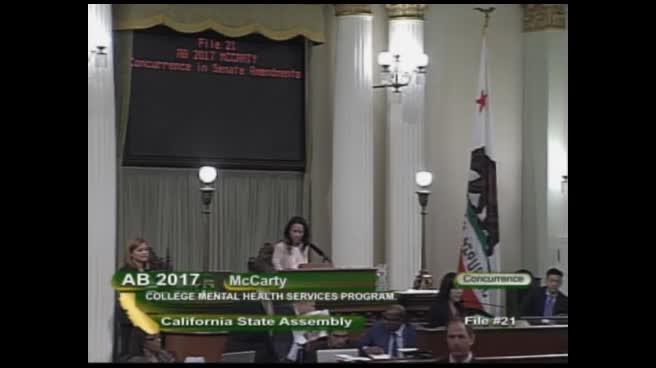
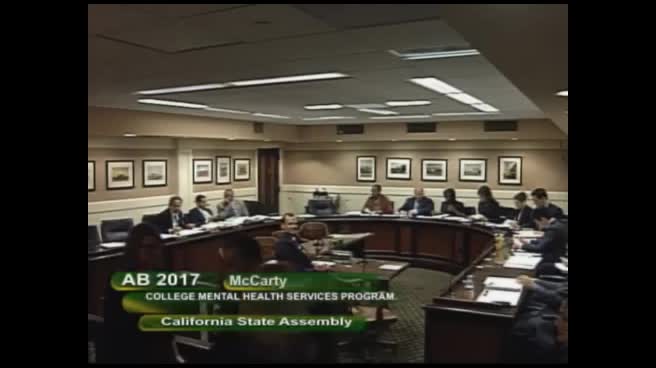
Bill Author

Bill Co-Author(s):






