AB 2253: Specialized license plates.
- Session Year: 2015-2016
- House: Assembly
- Latest Version Date: 2016-04-25
Existing law authorizes a state agency to apply to the Department of Motor Vehicles (DMV) to sponsor a specialized license plate program and requires the DMV to issue those license plates if the sponsoring state agency meets certain requirements. Existing law requires the DMV to charge specified fees related to the issuance of those plates and to deposit the fees, less the DMVs costs, in the Specialized License Plate Fund. Existing law requires that moneys in the fund be allocated, upon appropriation by the Legislature, to the sponsoring agency in proportion to the amount that is attributable to the agencys specialized license plate program. Existing law authorizes the sponsoring agency to use these moneys to fund projects and programs that promote the state agencys official policy, mission, or work.
This bill would require the Department of Veterans Affairs Affairs, in consultation with the State Treasurer, to apply to the DMV to sponsor an In God We Trust specified historic state and federal motto license plate program programs and would require the DMV to issue those specialized license plates for that program those programs if the Department of Veterans Affairs satisfies certain requirements. Notwithstanding the above-described provisions regarding fees for specialized license plates, the bill would require the additional fees for the issuance, renewal, or transfer of these specialized license plates to be deposited, after the DMV deducts its administrative costs, in a newly created fund, to be available upon appropriation by the Legislature for the purpose of funding specified veterans programs. programs and services.
Existing law authorizes a state agency to apply to the Department of Motor Vehicles (DMV) to sponsor a specialized license plate program and requires the DMV to issue those license plates if the sponsoring state agency meets certain requirements. Existing law requires the DMV to charge specified fees related to the issuance of those plates and to deposit the fees, less the DMVs costs, in the Specialized License Plate Fund. Existing law requires that moneys in the fund be allocated, upon appropriation by the Legislature, to the sponsoring agency in proportion to the amount that is attributable to the agencys specialized license plate program. Existing law authorizes the sponsoring agency to use these moneys to fund projects and programs that promote the state agencys official policy, mission, or work.
This bill would require the Department of Veterans Affairs to apply to the DMV to sponsor an In God We Trust license plate program and would require the DMV to issue those specialized license plates for that program if the Department of Veterans Affairs satisfies certain requirements. Notwithstanding the above-described provisions regarding fees for specialized plates, the bill would require the additional fees for the issuance, renewal, or transfer of these specialized license plates to be deposited, after the DMV deducts its administrative costs, in a newly created fund, to be available upon appropriation by the Legislature for the purpose of funding specified veterans programs.
Under existing law, an organization may apply to the Department of Motor Vehicles for participation in a special interest license plate program, and the department is required to issue special interest license plates for that program if the issuance of those plates is required under these provisions and the sponsoring organization meets certain requirements, including, among others, collecting and submitting to the department at least 7,500 applications for the plates, as specified. Beginning January 1, 2007, existing law prohibits the department from accepting an application for participation in a special interest license plate program, and from issuing special interest license plates for a new program, under this procedure.
This bill would state legislative findings and declarations relating to specialty license plate designs as government speech. This bill would require the department, notwithstanding the above provision that prohibits the department from accepting an application from an organization and from issuing special interest license plates for a new program, to design and make available for issuance special interest license plates, in consultation with In God We Trust America, Inc. This bill would require the payment of certain fees for the issuance, renewal, or transfer of the special interest license plates authorized pursuant to this provision, in addition to the regular fees for an original registration or renewal of registration.
Existing law authorizes the Department of Motor Vehicles to issue special identification plates to the owner of a vehicle that meets specified criteria and is operated or moved over the highway primarily for the purpose of historical exhibition or other similar purpose, subject to a specified fee.
This bill would make technical, nonsubstantive changes to that provision.
(a)The Department of Veterans Affairs Affairs, in consultation with the State Treasurer, shall apply to the Department of Motor Vehicles, pursuant to Section 5156, to sponsor an In God We Trust license plate program. The Department of Motor Vehicles shall issue specialized license plates for that program if the Department of Veterans Affairs complies with the requirements of this article. the following historic state and federal motto license plate programs:
(1)E Pluribus Unum.
(2)Liberty.
(3)In God We Trust.
(4)We the People.
(5)Eureka! I have found it!
(b)The Department of Motor Vehicles shall issue specialized license plates for each program provided in subdivision (a) if the Department of Veterans Affairs complies with the requirements of this article.
(b)
(c)Notwithstanding subdivision (c) of Section 5157, the additional fees prescribed by Section 5157 for the issuance, renewal, or transfer of the specialized license plates shall be deposited, after the Department of Motor Vehicles deducts its administrative costs, in the Veterans Housing and Homelessness Prevention Fund, which is hereby established in the State Treasury. The funds in the account shall be used, upon appropriation by the Legislature to the Department of Veterans Affairs, to support the Veterans Housing and Homelessness Prevention Program and the development of affordable supportive services for veterans. veterans living in those units funded by the Veterans Housing and Homelessness Prevention Program.
(a)The Department of Veterans Affairs shall apply to the Department of Motor Vehicles, pursuant to Section 5156, to sponsor an In God We Trust license plate program. The Department of Motor Vehicles shall issue specialized license plates for that program if the Department of Veterans Affairs complies with the requirements of this article.
(b)Notwithstanding subdivision (c) of Section 5157, the additional fees prescribed by Section 5157 for the issuance, renewal, or transfer of the specialized license plates shall be deposited, after the Department of Motor Vehicles deducts its administrative costs, in the Veterans Housing and Homelessness Prevention Fund, which is hereby established in the State Treasury. The funds in the account shall be used, upon appropriation by the Legislature to the Department of Veterans Affairs, to support the Veterans Housing and Homelessness Prevention Program and the development of affordable services for veterans.
SECTION 1.The Legislature finds and declares that a specialty license plate design constitutes government speech, pursuant to the United States Supreme Courts decision in Walker v. Texas Div., Sons of Confederate Veterans, Inc. (2015) 135 S.Ct. 2239, and the Legislatures consideration of this act does not implicate the free speech rights of private persons.
SEC. 2.Section 5076 is added to the Vehicle Code, to read:5076.(a)Notwithstanding Section 5060.1, the department, in consultation with In God We Trust America, Inc., shall design and make available for issuance, pursuant to this article, special interest license plates.
(b)In addition to the regular fees for an original registration or renewal of registration, the following additional fees shall be paid for the issuance, renewal, or transfer of the special interest license plates authorized pursuant to this section:
(1)For the original issuance of the plates, fifty dollars ($50).
(2)For a renewal of registration with the plates, forty dollars ($40).
(3)For transfer of the plates to another vehicle, fifteen dollars ($15).
(4)For each substitute replacement plate, thirty-five dollars ($35).
(5)In addition, for the issuance of environmental license plates, as defined in Section 5103, the additional fees prescribed in Sections 5106 and 5108. The additional fees prescribed in Sections 5106 and 5108 shall be deposited in the California Environmental License Plate Fund.
The Legislature finds and declares that a specialty license plate design constitutes government speech, pursuant to the United States Supreme Courts decision in Walker v. Texas Div., Sons of Confederate Veterans, Inc. (2015) 135 S.Ct. 2239, and the Legislatures consideration of this act does not implicate the free speech rights of private persons.
SEC. 2.Section 5076 is added to the Vehicle Code, to read:5076.(a)Notwithstanding Section 5060.1, the department, in consultation with In God We Trust America, Inc., shall design and make available for issuance, pursuant to this article, special interest license plates.
(b)In addition to the regular fees for an original registration or renewal of registration, the following additional fees shall be paid for the issuance, renewal, or transfer of the special interest license plates authorized pursuant to this section:
(1)For the original issuance of the plates, fifty dollars ($50).
(2)For a renewal of registration with the plates, forty dollars ($40).
(3)For transfer of the plates to another vehicle, fifteen dollars ($15).
(4)For each substitute replacement plate, thirty-five dollars ($35).
(5)In addition, for the issuance of environmental license plates, as defined in Section 5103, the additional fees prescribed in Sections 5106 and 5108. The additional fees prescribed in Sections 5106 and 5108 shall be deposited in the California Environmental License Plate Fund.
SECTION 1.Section 5004 of the Vehicle Code is amended to read:5004.(a)Notwithstanding any other provision of this code, any owner of a vehicle described in paragraph (1), (2), or (3) that is operated or moved over the highway primarily for the purpose of historical exhibition or other similar purpose shall, upon application in the manner and at the time prescribed by the department, be issued special identification plates for the vehicle:
(1)A motor vehicle with an engine of 16 or more cylinders manufactured prior to the year 1965.
(2)A motor vehicle manufactured in the year 1922 or prior to the year 1922.
(3)A vehicle that was manufactured after the year 1922, is at least 25 years old, and is of historic interest.
(b)The special identification plates assigned to motor vehicles with an engine of 16 or more cylinders manufactured prior to the year 1965 and to any motor vehicle manufactured in the year 1922 and prior thereto shall run in a separate numerical series, commencing with Horseless Carriage No. 1.
The special identification plates assigned to vehicles specified in paragraph (3) of subdivision (a) shall run in a separate numerical series, commencing with Historical Vehicle No. 1.
Each series of plates shall have different and distinguishing colors.
(c)A fee of twenty-five dollars ($25) shall be charged for the initial issuance of the special identification plates. These plates shall be permanent and shall not be required to be replaced. If any special identification plate becomes damaged or unserviceable in any manner, replacement for the plate may be obtained from the department upon proper application and upon payment of the fee that is provided for in Section 9265.
(d)All funds received by the department in payment for such identification plates or the replacement thereof shall be deposited in the California Environmental License Plate Fund.
(e)These vehicles shall not be exempt from the equipment provisions of Sections 26709, 27150, and 27600.
(f)As used in this section, a vehicle is of historic interest if it is collected, restored, maintained, and operated by a collector or hobbyist principally for purposes of exhibition and historic vehicle club activities.
(a)Notwithstanding any other provision of this code, any owner of a vehicle described in paragraph (1), (2), or (3) which that is operated or moved over the highway primarily for the purpose of historical exhibition or other similar purpose shall, upon application in the manner and at the time prescribed by the department, be issued special identification plates for the vehicle:
(1)A motor vehicle with an engine of 16 or more cylinders manufactured prior to the year 1965.
(2)A motor vehicle manufactured in the year 1922 or prior thereto. to the year 1922.
(3)A vehicle which that was manufactured after the year 1922, is at least 25 years old, and is of historic interest.
(b)The special identification plates assigned to motor vehicles with an engine of 16 or more cylinders manufactured prior to the year 1965 and to any motor vehicle manufactured in the year 1922 and prior thereto shall run in a separate numerical series, commencing with Horseless Carriage No. 1.
The special identification plates assigned to vehicles specified in paragraph (3) of subdivision (a) shall run in a separate numerical series, commencing with Historical Vehicle No. 1.
Each series of plates shall have different and distinguishing colors.
(c)A fee of twenty-five dollars ($25) shall be charged for the initial issuance of the special identification plates. Such These plates shall be permanent and shall not be required to be replaced. If such any special identification plates become plate becomes damaged or unserviceable in any manner, replacement for the plates plate may be obtained from the department upon proper application and upon payment of such fee as the fee that is provided for in Section 9265.
(d)All funds received by the department in payment for such identification plates or the replacement thereof shall be deposited in the California Environmental License Plate Fund.
(e)These vehicles shall not be exempt from the equipment provisions of Sections 26709, 27150, and 27600.
(f)As used in this section, a vehicle is of historic interest if it is collected, restored, maintained, and operated by a collector or hobbyist principally for purposes of exhibition and historic vehicle club activities.
|
Date
|
Status
|
|---|---|
| May 27, 2016 | In committee: Held under submission. |
| May 4, 2016 | In committee: Set, first hearing. Referred to APPR. suspense file. |
| Apr 26, 2016 | Re-referred to Com. on APPR. |
| Apr 25, 2016 | Read second time and amended. |
| Apr 21, 2016 | From committee: Amend, and do pass as amended and re-refer to Com. on APPR. with recommendation: To Consent Calendar. (Ayes 10. Noes 0.) (April 21). |
| Apr 19, 2016 | From committee: Do pass and re-refer to Com. on JUD. (Ayes 15. Noes 0.) (April 18). Re-referred to Com. on JUD. |
| Apr 18, 2016 | Joint Rule 62(a), file notice suspended. (Page 4389.) |
| Apr 18, 2016 | Assembly Rule 56 suspended. (Page 4389.) |
| Apr 18, 2016 | (pending re-refer to Com. on JUD.) |
| Apr 18, 2016 | Joint Rule 62(a), file notice suspended. |
| Apr 18, 2016 | Assembly Rule 56 suspended. |
| Apr 14, 2016 | Re-referred to Com. on TRANS. |
| Apr 13, 2016 | From committee chair, with author's amendments: Amend, and re-refer to Com. on TRANS. Read second time and amended. |
| Apr 12, 2016 | In committee: Set, first hearing. Failed passage. Reconsideration granted. |
| Mar 28, 2016 | Re-referred to Com. on TRANS. |
| Mar 18, 2016 | From committee chair, with author's amendments: Amend, and re-refer to Com. on TRANS. Read second time and amended. |
| Mar 17, 2016 | Referred to Coms. on TRANS. and JUD. |
| Feb 19, 2016 | From printer. May be heard in committee March 20. |
| Feb 18, 2016 | Read first time. To print. |
|
Date
|
Description
|
Location
|
Votes
|
|
|---|---|---|---|---|
| Apr 21, 2016 | Do pass as amended, and be re-referred to the Committee on [Appropriations] with recommendation: To Consent Calendar | Assembly Standing Committee on Judiciary |
Passed |
|
| Apr 18, 2016 | Do pass and be re-referred to the Committee on [Judiciary] | Assembly Standing Committee on Transportation |
Passed |
|
| Apr 11, 2016 | Reconsideration. | Assembly Standing Committee on Transportation |
Passed |
|
| Apr 11, 2016 | Do pass and be re-referred to the Committee on [Judiciary] | Assembly Standing Committee on Transportation |
Failed |
This list shows positions taken on this bill by organizations on the date displayed, which is linked to the original source.
Positions by individuals are not included.
Date of Hearing: May 4, 2016
ASSEMBLY COMMITTEE ON APPROPRIATIONS
Lorena Gonzalez, Chair
ABPCA Bill Id:AB 2253
Author:(Grove) – As Amended Ver:April 25, 2016
Policy Committee: | Transportation | Vote: | 15 - 0 |
Judiciary | 10 - 0 |
Urgency: No State Mandated Local Program: No Reimbursable: No
SUMMARY:
This bill requires the Department of Veterans Affairs (CalVet) to apply to the DMV to sponsor a the following historic state and federal motto license plate programs to support the Veterans Housing and Homelessness Prevention Program (VHHP), and the development of supportive services for veterans living in units funded by that program:
- E Pluribus Unum
- Liberty
- In God We Trust
- We the People
- Eureka! I have found it!
FISCAL EFFECT:
- Potential one-time special fund costs of approximately $440,000 to DMV to establish the specialized license plate program, including computer programming changes and updating forms. Pursuant to current law, DMV will make computer programming and form changes only after program applications meet a 7,500-application threshold. Therefore, the DMV will incur these costs only if it receives enough applications to require the DHCS to implement the program. The DMV will incur minor ongoing costs to continue issuing specialty license plates and renewals under the program. All of the DMV's initial and ongoing costs will be covered by a portion of the additional $50 fee paid for original specialized license plates and the additional $40 fee to renew such plates.
- Minor costs to CalVet to submit the program application and license prototype to DMV, design and print the license plate application, and collect and hold applications and fees until 7,500 applications are received. The bill specifies that the license, to the extent feasible, should be identical to the license plate design used by DMV between 1982 and 1987, as described.
- Potential ongoing revenue to the VHHP, subject to appropriation by the Legislature.
- Current law requires that specified additional funds related to personalizing a specialized license plate must be deposited into the Environmental License Plate Fund. This bill instead directs all revenues to the VHHP, after deducting administrative costs. This would result in the diversion of any revenues associated with personalization from the Environmental License Plate Fund to the new account.
COMMENTS:
- Specialized License Plates. Prior to 2007, any new special interest license plate required specific legislative authorization. This practice was held to be unconstitutional in that the Legislature approved some of the plates, and rejected others, using no standardized or objective criteria for those decisions. Pursuant to AB 84 (Leslie)/Statutes of 2006, the DMV will issue specialized license plates when sponsored by a state agency, the plate's message and resulting revenues support that agency's program, and at least 7,500 paid license applications have been received. The 7,500-application threshold attempts to assure that DMV's startup costs are fully covered, by the portion of the registration fee surcharge directed to the department, and to avoid a proliferation of different types of plates, which can be troublesome from a law enforcement perspective.
- VHHP. In June of 2014 voters approved Proposition 41, which provides $600 million to fund the VHHP, for the development of new affordable housing for veterans and their families. The VHHP requires an emphasis on developing housing for veterans who are homeless or have extremely low income.
- Related Legislation. Currently there are six other bills in the legislative process that would direct a state agency to sponsor a specialized license plate for a specific cause. Three bills were all held on Suspense last year in Senate Appropriations: AB 63 (Bonilla) to raise money for school safety, AB 270 (Nazarian) to raise money for diabetes awareness, and AB 932 (Daly) to raise money for local parks and recreation grant programs. AB 1884 (Harper) to raise money for mental health awareness was passed by this Committee on March 14, 2016, with a 16-0 vote, and is currently awaiting a hearing in the Assembly Appropriations Committee. AB 2131 (Maienschein) on today's committee agenda, would raise money for local food banks. AB 2303 (Holden), also on today's committee agenda, would raise money to assist food banks.
- Prior Legislation. Since 2011, 12 bills have been introduced establishing specialized license plate program, of which four have been chaptered: Salton Sea restoration [AB 1096 (Nestande), Chapter 353, Statutes of 2014], kidney disease research [AB 2450 (Logue), Chapter 359, Statutes of 2014], breast cancer awareness [AB 49 (Buchanan), Chapter 351, Statutes of 2014], and domestic violence prevention [AB 2321 (Gomez), Chapter 358, Statutes of 2014].
Analysis Prepared by: Chuck Nicol / APPR. / (916) 319-2081
Date of Hearing: April 21, 2016
ASSEMBLY COMMITTEE ON JUDICIARY
Mark Stone, Chair
ABPCA Bill Id:AB 2253
Author:(Grove) – As Amended Ver:April 13, 2016
PROPOSED CONSENT (As Proposed to be Amended)
SUBJECT: SPECIALIZED LICENSE PLATES
KEY ISSUE: SHOULD CALVETS APPLY TO THE DMV TO SPONSOR SEVERAL SPECIALTY LICENSE PLATES THAT INCLUDE A SERIES OF HISTORICAL STATE AND FEDERAL MOTTOS?
SYNOPSIS
This bill, as proposed to be amended, requires the Department of Veteran Affairs (CalVet), in consultation with the State Treasurer, to apply to the Department of Motor Vehicles (DMV) to sponsor the following historical state and federal motto license plate programs: (1) E Pluribus Unum; (2) Liberty; (3) In God We Trust; (4) We the People; and (5) Eureka! I have found it! After CalVets has complied with the statutory requirements (e.g. obtaining 7,500 applications), it may collect fees from the applicants of that program which shall be deposited into a new fund, the Veterans Housing and Homelessness Prevention Fund. Proceeds from that fund would be distributed to the Veterans Housing and Homelessness Prevention Program, an existing state program, and used to pay for the development of supportive services for veterans living in those units that are funded by the Veterans Housing and Homelessness Prevention Program.
Originally, this bill would have required CalVet to apply only for an In God We Trust specialty license plate. And before that version, this bill required the DMV to consult with In God We Trust – America, Inc., to develop an In God We Trust license plate. These prior versions were vulnerable to a number of significant legal concerns, including whether they violated the First Amendment of the United States Constitution – specifically, the Establishment Clause and the Free Speech Clause. Given that the author has taken several amendments to include other specialty license plate programs and promote a secular purpose, many of those legal concerns have been addressed. This bill previously passed out of the Assembly Committee on Transportation with a 15-0 vote. The bill is author-sponsored, and has no opposition on file.
SUMMARY: Requires the California Department of Veterans Affairs (CalVet) to apply to the Department of Motor Vehicles (DMV) to sponsor several specialized license plate programs, including: E Pluribus Unum; Liberty; In God We Trust; We the People; and Eureka! I have found it! Specifically, this bill:
- Requires the Department of Veterans Affairs (CalVet) to apply to the Department of Motor Vehicles (DMV) to sponsor a specialized license plate program for the following programs:
- E Pluribus Unum
- Liberty
- In God We Trust
- We the People; and
- Eureka! I have found it!
- Establishes the Veterans Housing and Homeless Prevention Fund, and provides that fees for these specialized license plates shall be deposited into that fund.
- Provides that funds, upon appropriation by the Legislature to the Department of Veteran Affairs, are to support the Veterans Housing and Homeless Prevention Program and the development of supportive services for veterans living in those units funded by the Veterans Housing and Homelessness Prevention Program.
EXISTING LAW:
- Under the United States Constitution, provides that Congress shall make no law respecting an establishment of religion, or prohibiting the free exercise thereof; or abridging the freedom of speech, or of the press; or the right of the people peaceably to assemble, and to petition the government for a redress of grievances. (U.S. Const., 1st Amend.)
- Provides that a specialized license plate shall have a design or contain a message that publicizes or promotes a state agency, or the official policy, mission, or work of a state agency. (Vehicle Code Section 5154. Unless otherwise stated, all further statutory references are to the Vehicle Code.)
- Requires funds accruing to a sponsoring state agency from the sale of specialized license plates to be expended exclusively for projects and programs that promote that agency’s official policy, mission, or work. (Section 5157.)
- Allows a state agency to sponsor a specialized license plate program if the agency complies with specified requirements. (Section 5156.)
- Prohibits DMV from establishing a specialized license plate program for any agency until it has received no less than 7,500 paid applications for that agency’s specialized license plate. (Section 5156.)
- Requires a state agency authorized to offer specialized license plates to prepare and submit an annual accounting report to the DMV by June 30. The report shall include an accounting of all revenues and expenditures associated with the specialized license plate program. (Section 5160.)
- Establishes the Veterans Housing and Homeless Prevention Bond Act of 2014. (Military and Veterans Code Sections 998.540 et seq.)
FISCAL EFFECT: As currently in print this bill is keyed fiscal.
COMMENTS: In support of the bill, the author writes:
AB 2253 seeks to create an additional specialty license plate option that includes our nation’s motto, “In God We Trust. There are currently 16 states that offer “In God We Trust” license plates to their residents and this legislation will add California to the list. “In God We Trust” became the United States national motto on July 30, 1956, shortly after our nation led the world through the trauma of World War II. These same words have been used on U.S. currency since 1864. In light of these facts, I think it is completely appropriate for Californians to have the option to have our national motto displayed on their license plates if they so choose.
Given that some of the policy issues regarding license plate programs were discussed in the previous committee in Assembly Transportation Committee, this Committee’s primary focus is on the constitutional and legal issues confronting this bill.
As a starting point, the bill, as proposed to be amended, requires the Department of Veteran Affairs (CalVet), in consultation with the State Treasurer, to apply to the Department of Motor Vehicles (DMV) to sponsor the following historical state and federal motto license plate programs: (1) E Pluribus Unum; (2) Liberty; (3) In God We Trust; (4) We the People; and (5) Eureka! I have found it! After CalVets has complied with the statutory requirements (e.g. obtaining 7,500 applications), it may collect fees from the applicants of the program which shall be deposited into a new fund, the Veterans Housing and Homelessness Prevention Fund. Proceeds from that fund are distributed to the Veterans Housing and Homelessness Prevention Program, an existing state program, and will be used to pay for the development of supportive services for veterans living in those units funded by the Veterans Housing and Homelessness Prevention Program.
The bill, prior to the amendments, was vulnerable to a number of legal concerns, including whether it violated the First Amendment of the United States Constitution – specifically, the Establishment Clause and the Free Speech Clause. Although the bill, as proposed to be amended, takes significant steps to address those concerns, this Committee reviews those constitutional questions in turn.
The Establishment Clause. The first issue is whether an “In God We Trust” specialty license plate would survive Establishment Clause scrutiny. The Establishment Clause and the Free Exercise Clause of the First Amendment provides that the government “shall make no law respecting an establishment of religion, or prohibiting the free exercise thereof.” (U.S. Const., 1st Amend.) The Supreme Court’s treatment of the religion clauses has been “Januslike . . . [where one] face looks toward the strong role played by religion and religious traditions throughout our Nation’s history . . . [and] the other [face] looks to the present in demanding a separation between church and state.” (Van Orden v. Perry (2005) 545 U.S. 667, 683.) Ultimately, the Supreme Court has held that in order to reconcile these two faces, it must “neither abdicate [its] responsibility to maintain a division between church and state nor evince hostility to religion.” (Id. at 683-84.) Thus, a court will uphold government conduct that is situated in-between religion and nonreligion. In order words, the ultimate touchstone of the religion clauses is neutrality. (See McCreary County, Kentucky v. American Civil Liberties Union of Kentucky (2005) 545 U.S. 844, 860; County of Allegheny v. American Civil Liberties Union Pittsburgh Chapter (1989) 492 U.S. 573, 593; Epperson v. Arkansas (1968) 393 U.S. 97, 103-04.)
The Three-Prong Lemon Test. While the Supreme Court has used a variety of tests to determine whether government conduct amounts to an establishment of religion, the prevailing analytical tool is the Lemon test. (Lemon v. Kurtzman (1971) 403 U.S. 602, 612-13.) Under a Lemon analysis, the court asks the following questions about government conduct: (1) Does the government have a secular legislative purpose for its conduct? (2) Does the government conduct have no principal or primary effect of advancing or inhibiting religion; and (3) Does the government’s conduct foster “an excessive entanglement with religion.” (Id. at 612-13; see Van Orden, supra, at 685; McCreary County, supra, at 859.)
First Prong: Secular Purpose. To determine whether there is a secular legislative purpose for the government’s conduct, the question is whether the government has abandoned neutrality and is “acting with the intent of promoting a particular point of view in religion matters.” (Corporation of Presiding Bishop of Church of Jesus Christ of Latter-day Saints v. Amos (1987) 483 U.S. 327, 335.) In order to examine the legislative purpose, “one takes account of the traditional external signs that show up in the text, legislative history, and implementation of the statute.” (McCreary County, supra, at 862 (citing Santa Fe Independent School District v. Doe (2000) 530 U.S. 290, 308).) That is, one looks at the “plain meaning of the statute's words, enlightened by their context and the contemporaneous legislative history [and] the historical context of the statute, … and the specific sequence of events leading to [its] passage.” (Edwards v. Aquillard (1986) 482 U.S. 578, 594.) For example, the court has “inferred [secular legislative] purpose from a change of wording from an earlier statute to a later one” and “the detailed public comments of its sponsor.” (McCreary County, supra, 862-863.) Additionally, the secular purpose “has to be genuine, not a sham, and not merely secondary to a religious objective.” (Id. at 864.)
Although earlier versions of this bill do not appear to survive the first prong, the proposed amendments appear to promote a secular legislative purpose. In earlier versions, the bill required the DMV to consult with In God We Trust – America, Inc., to design and make available special interest license plates. According to the In God We Trust – America, Inc. website, the organization’s mission is to promote patriotism by encouraging elected officials to support the legal display “In God We Trust” in every city, county chamber, and state capitol in America. (http://www.ingodwetrust-america.org/). Additionally, the website states that “[t]he goal of this mission is to keep God’s name in America, and acknowledge and affirm the role that faith in God plays in the public lives of the citizens in this country, and in the core values of our nation.” (Ibid.)
It seems safe to say that the earlier version of this bill raised significant constitutional concerns under the Establishment Clause. In the Assembly Transportation Committee, the author amended the bill to remove In God We Trust – America, Inc., and added amendments to require CalVets to sponsor an “In God We Trust” license plate program, similar to the statutory framework established for other specialty license plate programs. Although the earlier constitutionally-questionable version was amended out of the bill, it was unclear to this Committee whether the new version of the bill (i.e. CalVets as the sponsor of “In God We Trust” specialty license plate) was in fact advancing a secondary secular legislative purpose that was subject to a primary religious purpose. To address this Committee’s constitutional questions, and to ensure that the author’s purpose is secular and not religious, the author has agreed to take amendments aimed at advancing the secular purpose of promoting historical phrases and governmental mottos. As proposed to be amended, this bill would allow the following specialty license plate programs: E Pluribus Unum; Liberty; In God We Trust; We the People; and Eureka! I have found it! Accordingly, it appears that these amendments satisfy the first prong of the Lemon test.
Second Prong: Principal or Primary Effect of Advancing or Inhibiting Religion. Under the second prong of the Lemon test, the analysis depends on whether, from the eyes of a reasonable objective observer who is informed and familiar with the history of the government practice, the government action has a primary effect of advancing or disapproving of religion; that is, is the government action likely to be perceived by adherents of the controlling denominations as an endorsement of religion, and by nonadherents as a disapproval of their individual religious choices? (Vasquez v. Los Angeles County (9th Cir. 2007) 487 F.3d 1246, 1256.)
Although earlier versions of this bill do not appear to survive the second prong, the proposed amendments appear to not have the primary effect of advancing or inhibiting religion. Similar to discussion above, it was unclear to this Committee whether a reasonable observer would take into account the prior versions of this bill to view the current bill as a disapproval of a nonadherent’s religious choices. As previously stated, the ultimate touchstone of the analysis is neutrality. The author contends that the only reason she is promoting the “In God We Trust” specialty plate is to promote the national motto. The author believes that because this phrase is printed on our currency, and was later adopted as the national motto by Congress in 1956, there is no constitutional question. Although the Supreme Court has never definitively held that the phrase “In God We Trust” survives constitutional muster, a bill that only promotes an “In God We Trust” specialty license plate, particularly in light of this bill’s previous versions, potentially sends a signal to nonadherents that it disapproves of their religious choices (as previously discussed). To address these concerns (consistent with the ultimate touchstone of neutrality), the author has agreed to take amendments that also promote the following historical phrases and mottos, including: E Pluribus Unum; Liberty; We the People; and Eureka! I have found it! Accordingly, it appears that these amendments satisfy the first prong of the Lemon test.
Third and Final Prong: Excessive Government Entanglement with Religion. The last Lemon prong may be violated when the government excessively entangles with a religious institution in such a way that it: (1) interferes with the independence of the government, (2) gives the religious institution access to government or governmental powers not fully shared by nonadherents of the religion, and (3) fosters the creation of political constituencies defined along religious lines. (Lynch v. Donnelly (1983) 465 U.S. 668, 688 (conc. opn. of O’Conner, J.).)
Although the earlier version of this bill would have raised excessive entanglement concerns, the current version of the bill and the bill as proposed to be amended do not appear to violate the third prong of the Lemon test. As previously mentioned, the prior version of the bill did raise the issue of excessive entanglement. However, the bill, as proposed to be amended, is unlikely to trigger this issue because CalVets—not In God We Trust – America, Inc.—is tasked with the sole responsibility of sponsoring the specialty license plate.
The legal doctrine on the Establishment Clause may not be completely settled. It should be noted that although the Lemon test has been the primary tool to analyze claims under the Establishment Clause, the Court’s jurisprudence on the Establishment Clause appears to be changing. Indeed, the Court in recent years has invoked a variety of tests, depending on the factual situation. In certain times, the Court focuses on whether the government conduct discriminates or accommodates religion, while at other times, the Court looks at whether the government’s conduct is sufficiently secular, or historically important. (Van Orden, supra, at 685-87; County of Allegheny, supra, at 657-60 (conc. & dis. opn. of Kennedy, J.); Lynch, supra, at 679.) However, neutrality still appears to be the touchstone principle – a main feature behind the Lemon test.
Free Speech Clause: The Free Speech Clause of the First Amendment provides that the government “shall make no law…abridging the freedom of speech, or of the press; or the right of the people peaceably to assemble, and to petition the government for a redress of grievances.” (U.S. Const., 1st Amend.) Accordingly, the second issue that this Committee analyzes is whether the Legislature’s denial of certain specialty license plates would infringe the speech of those seeking the plate.
Free Speech Clause: Government Speech. It is well-established that the Free Speech Clause of the First Amendment restricts government’s regulation of private speech, and does not regulate government speech. (Pleasant Grove City v. Summum (2009) 555 U.S. 460, 467.) Indeed, a government entity has “the right to speak for itself…and to select the views that it wants to express.” (Ibid.) Last year, the Supreme Court extended the government speech doctrine to specialty license plates designs. (Walker v. Texas Division, Sons of Confederate Veterans, Inc. (2015) 576 U.S. ___.) There, the Supreme Court held that “[with] respect to specialty license plate designs, [a state] is not simply managing government property, but instead is engaging in expressive conduct [in part, because] specialty license plate designs are meant to convey and have the effect of conveying a government message.” (Ibid.)
In light of the recent Supreme Court decision, it appears that that the Legislature could determine which specialty license plates to authorize without violating the First Amendment. In other words, the Legislature could deny an “In God We Trust” license plate (and grant other plates) without violating the First Amendment.
Free Speech Clause: Compelled Speech. The third issue is whether this bill amounts to compelled speech. Our courts have long held that “the First Amendment stringently limits a State’s authority to compel a private party to express a view with which the private party disagrees.” (Ibid.) In certain instances, compelled speech may be upheld, depending on the nature of the speech and the state’s interest in that speech. (See Riley v. National Federation of Blind (1988) 487 U.S. 781, 796.) Given that this bill does not compel drivers to carry a specialty license plate, or compel drivers to associate with a message that the driver does not agree with, compelled speech is not at issue. (Walker, supra, at ___; see also Wooley v. Maynard (1977) 430 U.S. 705, 717.)
Final note: As a final note, the Legislature should consider whether this bill—even as proposed to be amended—might still signal a preference toward a religion or faith, even if that expression has been used historically in this country. Supreme Court Justice Elena Kagan has expressed the rationale for this fundamental concept and limitation on government conduct, as follows:
For centuries now, people have come to this country from every corner of the world to share in the blessing of religious freedom. Our Constitution promises that they may worship in their own way, without fear of penalty or danger, and that in itself is a momentous offering. Yet our Constitution makes a commitment still more remarkable—that however those individuals worship, they will count as full and equal American citizens. A Christian, a Jew, a Muslim (and so forth)—each stands in the same relationship with her country, with her state and local communities, and with every level and body of government. So that when each person performs the duties or seeks the benefits of citizenship, she does so not as an adherent to one or another religion, but simply as an American.” (See Town of Greece v. Galloway (2014) 572 U.S. ___ (dis. opn. of Kagan, J.) (emphasis added).
REGISTERED SUPPORT / OPPOSITION:
Support
None on file
Opposition
None on file
Analysis Prepared by: Eric Dang / JUD. / (916) 319-2334
Date of Hearing: April 18, 2016
ASSEMBLY COMMITTEE ON TRANSPORTATION
Jim Frazier, Chair
ABPCA Bill Id:AB 2253 (
Author:Grove) – As Amended Ver:April 13, 2016
SUBJECT: Specialized license plates: In God We Trust
SUMMARY: Requires the California Department of Veterans Affairs (CalVet) to apply to the Department of Motor Vehicles (DMV) to sponsor an “In God We Trust” specialized license plate program. Establishes the Veterans Housing and Homeless Prevention Fund and specifies that revenues from the fund will be used by CalVet to fund the Veterans Housing and Homeless Prevention Program and the development of affordable services for veterans.
EXISTING LAW:
- Allows any state agency to apply to DMV to sponsor a specialized license plate program.
- Requires DMV to issue specialized license plates for that program if the agency complies with all statutory requirements.
- Prohibits DMV from establishing a specialized license plate program for an agency until it has received not less than 7,500 paid applications for that agency's specialized license plates.
- Requires the agency to collect and hold applications for the plates. Once the agency has received at least 7,500 applications, it must submit the applications, along with the necessary fees, to DMV.
- Prohibits advance payment to DMV of its estimated or actual administrative costs associated with the issuance of a particular specialized license plate from constituting compliance with the 7,500 application threshold requirement.
- Requires funds accruing to a sponsoring state agency from the sale of specialized license plates to be expended exclusively for projects and programs that promote that agency's official policy, mission, or work.
- Allows specialized license plates to feature a distinctive design, decal, or distinctive message in a two-inch by three-inch space to the left of the plate's numerical sequence and a space not larger than 5/8-inch in height below the numerical series.
FISCAL EFFECT: Unknown
COMMENTS: Prior to 2007, any new specialty license plate required specific legislative authorization. That practice was held to be unconstitutional by the federal courts, as the Legislature approved some plates and rejected others, without using any standardized or objective criteria for those decisions. In response to the court decision, AB 84 (Leslie),
Chapter 454, Statutes of 2006, established the current specialized license plate program to provide a forum for government speech that promotes California's state policies. AB 84 excludes private organizations from seeking specialized license plates as a forum for private speech, and thus addresses the court's objection. The current specialized license plate program permits a state agency to initiate the development and sponsorship of a specialized plate, thus no additional legislation is required to authorize the creation of a new plate.
Plates created under the current program and the revenue they generate must publicize or promote a state agency, or the official policy, mission, or work of a state agency. Furthermore, the process requires that at least 7,500 paid applications must be received by the state agency prior to notifying DMV. This 7,500-application threshold was previously put into statute in an attempt to ensure that DMV's startup costs would be fully covered by the portion of the registration fee surcharge that is directed to DMV and to avoid a proliferation of different types of plates, which can be troublesome from a law enforcement perspective.
In regards to AB 2253, the author intends to include license plates bearing “In God We Trust,” the national motto since the 1950s, among the possible plates a vehicle owner can choose to display. Sixteen other states have similar license plates. According to the author, “it is completely appropriate for Californians to have the option to have our national motto displayed on their license plates if they so choose.” Funds generated by this specialized license plate program would be used by CalVet to fund homeless veterans prevention programs, and the development of affordable services for veterans.
Reconsideration: This bill failed passage in this committee on April 11, 2016, and was granted reconsideration.
Double referral: This bill will be referred to the Assembly Judiciary Committee should it pass out of this committee.
Related legislation: Currently there are six other bills in the legislative process that would direct a state agency to sponsor a specialized license plate for a specific cause. Three bills, AB 63 (Bonilla) to raise money for school safety, AB 270 (Nazarian) to raise money for diabetes awareness, and AB 932 (Daly) to raise money for local parks and recreation grant programs passed out of this Committee with no ‘No’ votes and are currently in the Senate Appropriations Committee. AB 1884 (Harper) to raise money for mental health awareness was approved by this Committee on March 14, 2016, AB 2131 (Maienschein) would raise money for local food banks, and AB 2303 (Holden) would raise money for the Active Transportation Program, both passed out of this committee on April 11, 2016. These three bills are currently awaiting a hearing in the Assembly Appropriations Committee.
Previous legislation: Since 2011, 12 bills have been introduced directing a state agency to sponsor a specialized license plate for a variety of causes. Since 2014, four were passed by the Legislature and signed by the Governor. These bills would raise funds for Salton Sea restoration [AB 1096 (Nestande), Chapter 353, Statutes of 2014], kidney disease research [AB 2450 (Logue), Chapter 359, Statutes of 2014], breast cancer awareness [AB 49 (Buchanan), Chapter 351, Statutes of 2014], and domestic violence prevention [AB 2321 (Gomez), Chapter 358, Statutes of 2014].
REGISTERED SUPPORT / OPPOSITION:
Support
Honorable Josh Bryant, Councilmember, City of Taft
Honorable Roger Gitlin, Del Norte County Board of Supervisors, First District
Honorable Mick Gleason, Kern County Board of Supervisors, First District
Honorable Mike Maggard, Kern County Board of Supervisors, Third District
Honorable James C. Predmore, Mayor, City of Holtville
Honorable Zac Scrivner, Kern County Board of Supervisors, Second District
Honorable Michael Van Winkle, Mayor of Waterford
Honorable Acquanetta Warren, Mayor, City of Fontana
Sheriff Donny Youngblood, Kern County Sheriff
4 private citizens
Opposition
1 private citizen
Analysis Prepared by: Justin Behrens / TRANS. / (916) 319-2093
Date of Hearing: April 11, 2016
ASSEMBLY COMMITTEE ON TRANSPORTATION
Jim Frazier, Chair
ABPCA Bill Id:AB 2253 (
Author:Grove) – As Amended Ver:March 18, 2016
SUBJECT: Special interest license plates: In God We Trust — America, Inc.
SUMMARY: Requires the Department of Motor Vehicles (DMV) to design and make available for issuance special interest license plates, in consultation with In God We Trust – America, Inc.
EXISTING LAW:
- Prohibits DMV from accepting an application for participation in a special interest license plate program and from issuing special interest license plates for a new program.
- Establishes requirements for specialized license plates issued by DMV, including that a specialized license plate must have a state agency sponsor and a design or message that publicizes or promotes a state agency, or the official policy, mission, or work of a state agency.
FISCAL EFFECT: Unknown
COMMENTS: In 2004, the United States District Court for the Eastern District of California ruled that the process to create new special interest license plate programs was unconstitutional, as the Legislature approved some plate designs sponsored by private non-profit entities and rejected others, without using any standardized or objective criteria for those decisions. In response to the court decision, AB 84 (Leslie), Chapter 454, Statutes of 2006, established the current specialized license plate program to provide a forum for government speech that promotes California’s state policies. AB 84 prohibited DMV from accepting an application for participation in a special interest license plate program and from issuing special interest license plates for a new program. This excluded private organizations from seeking special interest license plates as a forum for private speech, and thus addressed the court’s objection. The current specialized license plate program permits a state agency to initiate the development and sponsorship of a specialized plate, and the revenue the plate generates must publicize or promote a state agency, or the official policy, mission, or work of a state agency.
In 2015, the United States Supreme Court ruled that a state’s specialty license plate designs constitute government speech and that the state is entitled to freely choose a plate’s design and, in doing so, does not implicate the free speech rights of private persons.
This bill would revive the special interest plate program by requiring DMV to design and issue special interest plates in consultation with a specific non-profit organization.
Committee concerns: Despite the Supreme Court ruling, DMV is still federally enjoined from approving any new special interest license plate under the process for creating special interest license plates set out in California law. Although that process remains in existing statute, existing law also prohibits DMV from accepting an application for participation in a special interest license plate program and from issuing special interest license plates for a new program. This bill would require DMV to create a new special interest plate notwithstanding that statutory prohibition. However this bill cannot override a federal injunction. If DMV were to create the plate required by this bill, it would be in violation of that injunction.
Furthermore, by reviving the defunct special interest license plate program, this bill could once again put the Legislature in the position of picking and choosing between messages promoted by various non-profit organizations. While the Legislature currently picks and chooses between messages promoted by state agencies through the specialized license plate program, all the messages it picks are already endorsed as government speech by virtue of being related to the official policy, mission, or work of existing government entities. This bill could set a precedent for endorsing certain private speech as government speech by identifying messages that would only be considered government speech because they appear on license plates, and not because they reflect any official activity of an existing government agency.
Double referral: This bill will be referred to the Assembly Judiciary Committee should it pass out of this committee.
Previous legislation: AB 84 (Leslie), Chapter 454, Statutes of 2006, prohibited DMV from creating any new plates under the special interest license plate program and established the current specialized license plate program with specific requirements.
REGISTERED SUPPORT / OPPOSITION:
Support
None on file
Opposition
Planned Parenthood Affiliates of California
Analysis Prepared by: Justin Behrens / TRANS. / (916) 319-2093
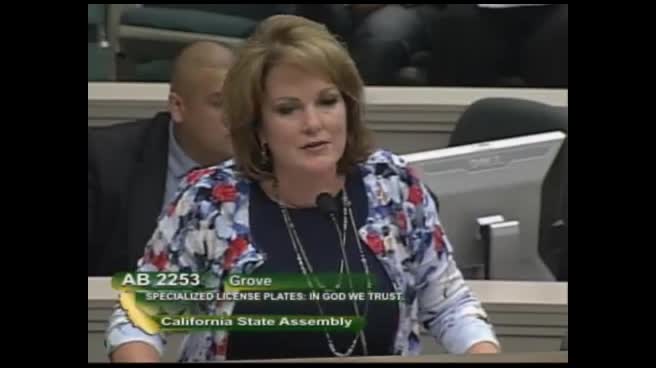
Discussed in Hearing
 8MIN
Assembly Standing Committee on Transportation
 30MIN
Senate Standing Committee on Transportation and Housing
Bill Author