AB 2492: Community revitalization.
- Session Year: 2015-2016
- House: Assembly
- Latest Version Date: 2016-09-23
The Community Redevelopment Law authorizes the establishment of redevelopment agencies in communities to address the effects of blight, as defined, by means of redevelopment projects financed by the issuance of bonds serviced by tax increment revenues derived from the project area. Existing law dissolved redevelopment agencies and community development agencies, as of February 1, 2012, and provides for the designation of successor agencies to wind down the affairs of the dissolved agencies and to fulfill the enforceable obligations of those agencies. Existing law also provides for various economic development programs that foster community sustainability and community and economic development initiatives throughout the state.
Existing law authorizes certain local agencies to form a community revitalization and investment authority (authority) within a community revitalization and investment area, as defined, to carry out provisions of the Community Redevelopment Law in that area for purposes related to, among other things, infrastructure, affordable housing, and economic revitalization. Existing law requires not less than 80% of the land calculated by census tracts or census block groups, as defined by the United States Census Bureau, within the area to be characterized by several conditions, including a condition that the land has an annual median household income of less than 80% of the statewide annual median income.
This bill would authorize the calculation to be made with a combination of census tracts and census block groups. The bill would also revise the conditions to require, among other things, an annual median household income that is less than 80% of the statewide, countywide, or citywide annual median household income. The bill would also authorize an authority to carry out a community revitalization plan if the census tract or census block groups within the community revitalization and investment area are within a disadvantage community, as prescribed.
Existing law authorizes certain entities that receive ad valorem property taxes to adopt a resolution in a specified manner to allocate their share of tax increment funds within the area covered by a community revitalization plan to the authority.
Existing law authorizes an authority to borrow money, receive grants, or accept financial or other assistance or investment from the state or any other public agency for any project within its area of operation.
This bill would authorize an authority to also receive funds allocated to it pursuant to a resolution adopted by a city, county, or special district to transfer these funds from certain tax and assessment revenues, subject to specified requirements as to the use of those funds.
The Community Redevelopment Law authorizes the establishment of redevelopment agencies in communities to address the effects of blight, as defined, by means of redevelopment projects financed by the issuance of bonds serviced by tax increment revenues derived from the project area. Existing law dissolved redevelopment agencies and community development agencies, as of February 1, 2012, and provides for the designation of successor agencies to wind down the affairs of the dissolved agencies and to fulfill the enforceable obligations of those agencies. Existing law also provides for various economic development programs that foster community sustainability and community and economic development initiatives throughout the state.
Existing law authorizes certain local agencies to form a community revitalization and investment authority (authority) within a community revitalization and investment area, as defined, to carry out provisions of the Community Redevelopment Law in that area for purposes related to, among other things, infrastructure, affordable housing, and economic revitalization. Existing law requires not less than 80% of the land calculated by census tracts or census block groups, as defined by the United States Census Bureau, within the area to be characterized by several conditions, including a condition that the land has an annual median household income of less than 80% of the statewide annual median income. The bill would also authorize an authority to carry out a community revitalization plan if the census tract or census block groups within the community revitalization and investment area are within a disadvantage community, as prescribed.
This bill would authorize the calculation to be made with a combination of census tracts and census block groups. The bill would also revise the conditions to require, among other things, an annual median household income that is less than 80% of the statewide, countywide, or citywide annual median household income.
Existing law authorizes certain entities that receive ad valorem property taxes to adopt a resolution in a specified manner to allocate their share of tax increment funds within the area covered by a community revitalization plan to the authority.
Existing law authorizes an authority to borrow money, receive grants, or accept financial or other assistance or investment from the state or any other public agency for any project within its area of operation.
This bill would authorize an authority to also receive funds allocated to it pursuant to a resolution adopted by a city, county, or special district to transfer these funds from certain tax and assessment revenues, subject to specified requirements as to the use of those funds.
The Community Redevelopment Law authorizes the establishment of redevelopment agencies in communities to address the effects of blight, as defined, by means of redevelopment projects financed by the issuance of bonds serviced by tax increment revenues derived from the project area. Existing law dissolved redevelopment agencies and community development agencies, as of February 1, 2012, and provides for the designation of successor agencies to wind down the affairs of the dissolved agencies and to fulfill the enforceable obligations of those agencies. Existing law also provides for various economic development programs that foster community sustainability and community and economic development initiatives throughout the state.
Existing law authorizes certain local agencies to form a community revitalization and investment authority (authority) within a community revitalization and investment area, as defined, to carry out provisions of the Community Redevelopment Law in that area for purposes related to, among other things, infrastructure, affordable housing, and economic revitalization. Existing law requires not less than 80% of the land calculated by census tracts or census block groups, as defined by the United States Census Bureau, within the area to be characterized by several conditions, including a condition that the land has an annual median household income of less than 80% of the statewide annual median income.
This bill would authorize the calculation to be made with a combination of census tracts and census block groups. The bill would also revise the conditions to require, among other things, an annual median household income that is less than 80% of the statewide, countywide, or citywide annual median household income.
Existing law authorizes certain entities that receive ad valorem property taxes to adopt a resolution in a specified manner to allocate their share of tax increment funds within the area covered by a community revitalization plan to the authority.
Existing law authorizes an authority to borrow money, receive grants, or accept financial or other assistance or investment from the state or any other public agency for any project within its area of operation.
This bill would authorize an authority to also receive funds allocated to it pursuant to a resolution adopted by a city, county, or special district to transfer these funds from certain tax and assessment revenues, subject to specified requirements as to the use of those funds.
(a)A community revitalization and investment authority is a public body, corporate and politic, with jurisdiction to carry out a community revitalization plan within a community revitalization and investment area. The authority shall be deemed to be the agency described in subdivision (b) of Section 16 of Article XVI of the California Constitution for purposes of receiving tax increment revenues. The authority shall have only those powers and duties specifically set forth in Section 62002.
(b)(1)An authority may be created in any one of the following ways:
(A)A city, county, or city and county may adopt a resolution creating an authority. The composition of the governing board shall be comprised as set forth in subdivision (c).
(B)A city, county, city and county, and special district, as special district is defined in subdivision (m) of Section 95 of the Revenue and Taxation Code, or any combination thereof, may create an authority by entering into a joint powers agreement pursuant to Chapter 5 (commencing with Section 6500) of Division 7 of Title 1.
(2)(A)A school entity, as defined in subdivision (f) of Section 95 of the Revenue and Taxation Code, may not participate in an authority created pursuant to this part.
(B)A successor agency, as defined in subdivision (j) of Section 34171 of the Health and Safety Code, may not participate in an authority created pursuant to this part, and an entity created pursuant to this part shall not receive any portion of the property tax revenues or other moneys distributed pursuant to Section 34188 of the Health and Safety Code.
(3)An authority formed by a city or county that created a redevelopment agency that was dissolved pursuant to Part 1.85 (commencing with Section 34170) of Division 24 of the Health and Safety Code shall not become effective until the successor agency or designated local authority for the former redevelopment agency has adopted findings of fact stating all of the following:
(A)The agency has received a finding of completion from the Department of Finance pursuant to Section 34179.7 of the Health and Safety Code.
(B)Former redevelopment agency assets which are the subject of litigation against the state, where the city or county or its successor agency or designated local authority are a named plaintiff, have not been or will not be used to benefit any efforts of an authority formed under this part unless the litigation has been resolved by entry of a final judgment by any court of competent jurisdiction and any appeals have been exhausted.
(C)The agency has complied with all orders of the Controller pursuant to Section 34167.5 of the Health and Safety Code.
(c)(1)The governing board of an authority created pursuant to subparagraph (A) of paragraph (1) of subdivision (b) shall be appointed by the legislative body of the city, county, or city and county that created the authority and shall include three members of the legislative body of the city, county, or city and county that created the authority and two public members. The appointment of the two public members shall be subject to Section 54974. The two public members shall live or work within the community revitalization and investment area.
(2)The governing body of the authority created pursuant to subparagraph (B) of paragraph (1) of subdivision (b) shall be comprised of a majority of members from the legislative bodies of the public agencies that created the authority and a minimum of two public members who live or work within the community revitalization and investment area. The majority of the board shall appoint the public members to the governing body. The appointment of the public members shall be subject to Section 54974.
(d)An authority may carry out a community revitalization plan within a community revitalization and investment area. Not less than 80 percent of the land calculated by census tracts, census block groups, as defined by the United States Census Bureau, or any combination of both within the area shall be characterized by both of the following conditions:
(1)An annual median household income that is less than, at the option of the authority, 80 percent of the statewide, countywide, or citywide annual median income.
(2)Three of the following four conditions:
(A)An unemployment rate that is at least 3 percentage points higher than the statewide average annual unemployment rate, as defined by the report on labor market information published by the Employment Development Department in March of the year in which the community revitalization plan is prepared. In determining the unemployment rate within the community revitalization and investment area, an authority may use unemployment data from the periodic American Community Survey published by the United States Census Bureau.
(B)Crime rates, as documented by records maintained by the law enforcement agency that has jurisdiction in the proposed plan area for violent or property crime offenses, that are at least 5 percent higher than the statewide average crime rate for violent or property crime offenses, as defined by the most recent annual report of the Criminal Justice Statistics Center within the Department of Justice, when data is available on the Attorney Generals Internet Web site. The crime rate shall be calculated by taking the local crime incidents for violent or property crimes, or any offense within those categories, for the most recent calendar year for which the Department of Justice maintains data, divided by the total population of the proposed plan area, multiplied by 100,000. If the local crime rate for the proposed plan area exceeds the statewide average rate for either violent or property crime, or any offense within these categories, by more than 5 percent, then the condition described in this subparagraph shall be met.
(C)Deteriorated or inadequate infrastructure, including streets, sidewalks, water supply, sewer treatment or processing, and parks.
(D)Deteriorated commercial or residential structures.
(e)As an alternative to subdivision (d), an authority may also carry out a community revitalization plan within a community revitalization and investment area if it meets either of the following conditions:
(1)The area is established within a former military base that is principally characterized by deteriorated or inadequate infrastructure and structures. Notwithstanding subdivision (c), the governing board of an authority established within a former military base shall include a member of the military base closure commission as a public member.
(2)The census tracts or census block groups, as defined by the United States Census Bureau, within the area are situated within a disadvantaged community as described in Section 39711 of the Health and Safety Code.
(f)An authority created pursuant to this part shall be a local public agency subject to the Ralph M. Brown Act (Chapter 9 (commencing with Section 54950) of Part 1 of Division 2 of Title 5), the California Public Records Act (Chapter 3.5 (commencing with Section 6250) of Division 7 of Title 1), and the Political Reform Act of 1974 (Title 9 (commencing with Section 81000)).
(g)(1)At any time after the authority is authorized to transact business and exercise its powers, the legislative body or bodies of the local government or governments that created the authority may appropriate the amounts the legislative body or bodies deem necessary for the administrative expenses and overhead of the authority.
(2)The money appropriated may be paid to the authority as a grant to defray the expenses and overhead, or as a loan to be repaid upon the terms and conditions as the legislative body may provide. If appropriated as a loan, the property owners and residents within the plan area shall be made third-party beneficiaries of the repayment of the loan. In addition to the common understanding and usual interpretation of the term, administrative expense includes, but is not limited to, expenses of planning and dissemination of information.
SEC. 2.Section 62002 of the Government Code is amended to read:62002.An authority may do all of the following:
(a)Provide funding to rehabilitate, repair, upgrade, or construct infrastructure.
(b)Provide for low- and moderate-income housing in accordance with Part 2 (commencing with Section 62100).
(c)Remedy or remove a release of hazardous substances pursuant to the Polanco Redevelopment Act (Article 12.5 (commencing with Section 33459) of Chapter 4 of Part 1 of Division 24) or Chapter 6.10 (commencing with Section 25403) of Division 20 of the Health and Safety Code.
(d)Provide for seismic retrofits of existing buildings in accordance with all applicable laws and regulations.
(e)Acquire and transfer real property in accordance with Part 3 (commencing with Section 62200). The authority shall retain controls and establish restrictions or covenants running with the land sold or leased for private use for the periods of time and under the conditions as are provided in the plan. The establishment of these controls is a public purpose under this part.
(f)Issue bonds in conformity with Article 4.5 (commencing with Section 53506) and Article 5 (commencing with Section 53510) of Chapter 3 of Part 1 of Division 2 of Title 5.
(g)(1)Borrow money, receive grants, or accept financial or other assistance or investment from the state or the federal government or any other public agency or private lending institution for any project within its area of operation, and may comply with any conditions of the loan or grant. An authority may qualify for funding as a disadvantaged community pursuant to Section 79505.5 of the Water Code or as defined by Section 56033.5. An authority may also enter into an agreement with a qualified community development entity, as defined by Section 45D(c) of the Internal Revenue Code, to coordinate investments of funds derived from the New Markets Tax Credit with those of the authority in instances where coordination offers opportunities for greater efficiency of investments to improve conditions described in subdivisions (d) and (e) within the territorial jurisdiction of the authority.
(2)Receive funds allocated to it pursuant to a resolution adopted by a city, county, or special district to transfer these funds from a source described in subdivision (d), (e), or (f) of Section 53398.75, subject to any requirements upon, or imposed by, the city, county, or special district as to the use of these funds.
(h)Adopt a community revitalization and investment plan pursuant to Sections 62003 and 62004.
(i)Make loans or grants for owners or tenants to improve, rehabilitate, or retrofit buildings or structures within the plan area.
(j)Construct foundations, platforms, and other like structural forms necessary for the provision or utilization of air rights sites for buildings to be used for residential, commercial industrial, or other uses contemplated by the revitalization plan.
(k)Provide direct assistance to businesses within the plan area in connection with new or existing facilities for industrial or manufacturing uses, except as specified in this division.
SEC. 3.Section 62004 of the Government Code is amended to read:62004.(a)The authority shall consider adoption of the plan at three public hearings that shall take place at least 30 days apart. At the first public hearing, the authority shall hear all written and oral comments but take no action. At the second public hearing, the authority shall consider any additional written and oral comments and take action to modify or reject the plan. If the plan is not rejected at the second public hearing, then the authority shall conduct a protest proceeding at the third public hearing to consider whether the property owners and residents within the plan area wish to present oral or written protests against the adoption of the plan.
(b)The draft plan shall be made available to the public and to each property owner within the area at a meeting held at least 30 days prior to the notice given for the first public hearing. The purposes of the meeting shall be to allow the staff of the authority to present the draft plan, answer questions about the plan, and consider comments about the plan.
(c)(1)Notice of the meeting required by subdivision (b) and the public hearings required by this subdivision shall be given in accordance with subdivision (j). The notice shall do all of the following, as applicable:
(A)Describe specifically the boundaries of the proposed area.
(B)Describe the purpose of the plan.
(C)State the day, hour, and place when and where any and all persons having any comments on the proposed plan may appear to provide written or oral comments to the authority.
(D)Notice of second public hearing shall include a summary of the changes made to the plan as a result of the oral and written testimony received at or before the public hearing and shall identify a location accessible to the public where the plan proposed to be presented and adopted at the second public hearing can be reviewed.
(E)Notice of the third public hearing to consider any written or oral protests shall contain a copy of the final plan adopted pursuant to subdivision (a), and shall inform the property owner and resident of his or her right to submit an oral or written protest before the close of the public hearing. The protest may state that the property owner or resident objects to the authority taking action to implement the plan.
(2)At the third public hearing, the authority shall consider all written and oral protests received prior to the close of the public hearing and shall terminate the proceedings or adopt the plan subject to confirmation by the voters at an election called for that purpose. The authority shall terminate the proceedings if there is a majority protest. A majority protest exists if protests have been filed representing over 50 percent of the combined number of property owners and residents in the area who are at least 18 years of age. An election shall be called if between 25 percent and 50 percent of the combined number of property owners and residents in the area who are at least 18 years of age file a protest.
(d)An election required pursuant to paragraph (2) of subdivision (c) shall be held within 90 days of the public hearing and may be held by mail-in ballot. The authority shall adopt, at a duly noticed public hearing, procedures for this election.
(e)If a majority of the property owners and residents vote against the plan, then the authority shall not take any further action to implement the proposed plan. The authority shall not propose a new or revised plan to the affected property owners and residents for at least one year following the date of an election in which the plan was rejected.
(f)At the hour set in the notice required by subdivision (a), the authority shall consider all written and oral comments.
(g)If less than 25 percent of the combined number of property owners and residents in the area who are at least 18 years of age file a protest, the authority may adopt the plan at the conclusion of the third public hearing by ordinance. The ordinance adopting the plan shall be subject to referendum as prescribed by law.
(h)For the purposes of Section 62005, the plan shall be the plan adopted pursuant to this section.
(i)The authority shall consider and adopt an amendment or amendments to a plan in accordance with the provisions of this section.
(j)The authority shall post notice of each meeting or public hearing required by this section in an easily identifiable and accessible location on the authoritys Internet Web site and shall mail a written notice of the meeting or public hearing to each owner of land and each resident at least 10 days prior to the meeting or public hearing.
(1)Notice of the first public hearing shall also be published not less than once a week for four successive weeks prior to the first public hearing in a newspaper of general circulation published in the county in which the area lies.
(2)Notice of the second public hearing shall also be published not less than 10 days prior to the second public hearing in a newspaper of general circulation in the county in which the area lies.
(3)Notice of the third public hearing shall also be published not less than 10 days prior to the third public hearing in a newspaper of general circulation in the county in which the area lies.
(a)A community revitalization and investment authority is a public body, corporate and politic, with jurisdiction to carry out a community revitalization plan within a community revitalization and investment area. The authority shall be deemed to be the agency described in subdivision (b) of Section 16 of Article XVI of the California Constitution for purposes of receiving tax increment revenues. The authority shall have only those powers and duties specifically set forth in Section 62002.
(b)(1)An authority may be created in any one of the following ways:
(A)A city, county, or city and county may adopt a resolution creating an authority. The composition of the governing board shall be comprised as set forth in subdivision (c).
(B)A city, county, city and county, and special district, as special district is defined in subdivision (m) of Section 95 of the Revenue and Taxation Code, or any combination thereof, may create an authority by entering into a joint powers agreement pursuant to Chapter 5 (commencing with Section 6500) of Division 7 of Title 1.
(2)(A)A school entity, as defined in subdivision (f) of Section 95 of the Revenue and Taxation Code, may not participate in an authority created pursuant to this part.
(B)A successor agency, as defined in subdivision (j) of Section 34171 of the Health and Safety Code, may not participate in an authority created pursuant to this part, and an entity created pursuant to this part shall not receive any portion of the property tax revenues or other moneys distributed pursuant to Section 34188 of the Health and Safety Code.
(3)An authority formed by a city or county that created a redevelopment agency that was dissolved pursuant to Part 1.85 (commencing with Section 34170) of Division 24 of the Health and Safety Code shall not become effective until the successor agency or designated local authority for the former redevelopment agency has adopted findings of fact stating all of the following:
(A)The agency has received a finding of completion from the Department of Finance pursuant to Section 34179.7 of the Health and Safety Code.
(B)Former redevelopment agency assets which are the subject of litigation against the state, where the city or county or its successor agency or designated local authority are a named plaintiff, have not been or will not be used to benefit any efforts of an authority formed under this part unless the litigation has been resolved by entry of a final judgment by any court of competent jurisdiction and any appeals have been exhausted.
(C)The agency has complied with all orders of the Controller pursuant to Section 34167.5 of the Health and Safety Code.
(c)(1)The governing board of an authority created pursuant to subparagraph (A) of paragraph (1) of subdivision (b) shall be appointed by the legislative body of the city, county, or city and county that created the authority and shall include three members of the legislative body of the city, county, or city and county that created the authority and two public members. The appointment of the two public members shall be subject to Section 54974. The two public members shall live or work within the community revitalization and investment area.
(2)The governing body of the authority created pursuant to subparagraph (B) of paragraph (1) of subdivision (b) shall be comprised of a majority of members from the legislative bodies of the public agencies that created the authority and a minimum of two public members who live or work within the community revitalization and investment area. The majority of the board shall appoint the public members to the governing body. The appointment of the public members shall be subject to Section 54974.
(d)An authority may carry out a community revitalization plan within a community revitalization and investment area. Not less than 80 percent of the land calculated by census tracts, census block groups, as defined by the United States Census Bureau, or any combination of both within the area shall be characterized by both of the following conditions:
(1)An annual median household income that is less than, at the option of the authority, 80 percent of the statewide, countywide, or citywide annual median income.
(2)Three of the following four conditions:
(A)An unemployment rate that is at least 3 percentage points higher than the statewide average annual unemployment rate, as defined by the report on labor market information published by the Employment Development Department in March of the year in which the community revitalization plan is prepared. In determining the unemployment rate within the community revitalization and investment area, an authority may use unemployment data from the periodic American Community Survey published by the United States Census Bureau.
(B)Crime rates, as documented by records maintained by the law enforcement agency that has jurisdiction in the proposed plan area for violent or property crime offenses, that are at least 5 percent higher than the statewide average crime rate for violent or property crime offenses, as defined by the most recent annual report of the Criminal Justice Statistics Center within the Department of Justice, when data is available on the Attorney Generals Internet Web site. The crime rate shall be calculated by taking the local crime incidents for violent or property crimes, or any offense within those categories, for the most recent calendar year for which the Department of Justice maintains data, divided by the total population of the proposed plan area, multiplied by 100,000. If the local crime rate for the proposed plan area exceeds the statewide average rate for either violent or property crime, or any offense within these categories, by more than 5 percent, then the condition described in this subparagraph shall be met.
(C)Deteriorated or inadequate infrastructure, including streets, sidewalks, water supply, sewer treatment or processing, and parks.
(D)Deteriorated commercial or residential structures.
(e)As an alternative to subdivision (d), an authority may also carry out a community revitalization plan within a community revitalization and investment area established if it meets either of the following conditions:
(1)The area is established within a former military base that is principally characterized by deteriorated or inadequate infrastructure and structures. Notwithstanding subdivision (c), the governing board of an authority established within a former military base shall include a member of the military base closure commission as a public member.
(2)The census tracts or census block groups, as defined by the United States Census Bureau, within the area are situated within a disadvantaged community as described in Section 39711 of the Health and Safety Code.
(f)An authority created pursuant to this part shall be a local public agency subject to the Ralph M. Brown Act (Chapter 9 (commencing with Section 54950) of Part 1 of Division 2 of Title 5), the California Public Records Act (Chapter 3.5 (commencing with Section 6250) of Division 7 of Title 1), and the Political Reform Act of 1974 (Title 9 (commencing with Section 81000)).
(g)(1)At any time after the authority is authorized to transact business and exercise its powers, the legislative body or bodies of the local government or governments that created the authority may appropriate the amounts the legislative body or bodies deem necessary for the administrative expenses and overhead of the authority.
(2)The money appropriated may be paid to the authority as a grant to defray the expenses and overhead, or as a loan to be repaid upon the terms and conditions as the legislative body may provide. If appropriated as a loan, the property owners and residents within the plan area shall be made third-party beneficiaries of the repayment of the loan. In addition to the common understanding and usual interpretation of the term, administrative expense includes, but is not limited to, expenses of planning and dissemination of information.
SEC. 2.Section 62002 of the Government Code is amended to read:62002.An authority may do all of the following:
(a)Provide funding to rehabilitate, repair, upgrade, or construct infrastructure.
(b)Provide for low- and moderate-income housing in accordance with Part 2 (commencing with Section 62100).
(c)Remedy or remove a release of hazardous substances pursuant to the Polanco Redevelopment Act (Article 12.5 (commencing with Section 33459) of Part 1 of Chapter 4 of Part 1 of Division 24) or Chapter 6.10 (commencing with Section 25403) of Division 20 of the Health and Safety Code.
(d)Provide for seismic retrofits of existing buildings in accordance with all applicable laws and regulations.
(e)Acquire and transfer real property in accordance with Part 3 (commencing with Section 62200). The authority shall retain controls and establish restrictions or covenants running with the land sold or leased for private use for the periods of time and under the conditions as are provided in the plan. The establishment of these controls is a public purpose under this part.
(f)Issue bonds in conformity with Article 4.5 (commencing with Section 53506) and Article 5 (commencing with Section 53510) of Chapter 3 of Part 1 of Division 2 of Title 5.
(g)(1)Borrow money, receive grants, or accept financial or other assistance or investment from the state or the federal government or any other public agency or private lending institution for any project within its area of operation, and may comply with any conditions of the loan or grant. An authority may qualify for funding as a disadvantaged community pursuant to Section 79505.5 of the Water Code or as defined by Section 56033.5. An authority may also enter into an agreement with a qualified community development entity, as defined by Section 45D(c) of the Internal Revenue Code, to coordinate investments of funds derived from the New Markets Tax Credit with those of the authority in instances where coordination offers opportunities for greater efficiency of investments to improve conditions described in subdivisions (d) and (e) within the territorial jurisdiction of the authority.
(2)Receive funds allocated to it pursuant to a resolution adopted by a city, county, or special district to transfer these funds from a source described in subdivision (d), (e), or (f) of Section 53398.75, subject to any requirements upon, or imposed by, the city, county, or special district as to the use of these funds.
(h)Adopt a community revitalization and investment plan pursuant to Sections 62003 and 62004.
(i)Make loans or grants for owners or tenants to improve, rehabilitate, or retrofit buildings or structures within the plan area.
(j)Construct foundations, platforms, and other like structural forms necessary for the provision or utilization of air rights sites for buildings to be used for residential, commercial industrial, or other uses contemplated by the revitalization plan.
(k)Provide direct assistance to businesses within the plan area in connection with new or existing facilities for industrial or manufacturing uses, except as specified in this division.
SEC. 3.Section 62004 of the Government Code is amended to read:62004.(a)The authority shall consider adoption of the plan at three public hearings that shall take place at least 30 days apart. At the first public hearing, the authority shall hear all written and oral comments but take no action. At the second public hearing, the authority shall consider any additional written and oral comments and take action to modify or reject the plan. If the plan is not rejected at the second public hearing, then the authority shall conduct a protest proceeding at the third public hearing to consider whether the property owners and residents within the plan area wish to present oral or written protests against the adoption of the plan.
(b)The draft plan shall be made available to the public and to each property owner within the area at a meeting held at least 30 days prior to the notice given for the first public hearing. The purposes of the meeting shall be to allow the staff of the authority to present the draft plan, answer questions about the plan, and consider comments about the plan.
(c)(1)Notice of the meeting required by subdivision (b) and the public hearings required by this subdivision shall be given in accordance with subdivision (j). The notice shall do all of the following, as applicable:
(A)Describe specifically the boundaries of the proposed area.
(B)Describe the purpose of the plan.
(C)State the day, hour, and place when and where any and all persons having any comments on the proposed plan may appear to provide written or oral comments to the authority.
(D)Notice of second public hearing shall include a summary of the changes made to the plan as a result of the oral and written testimony received at or before the public hearing and shall identify a location accessible to the public where the plan proposed to be presented and adopted at the second public hearing can be reviewed.
(E)Notice of the third public hearing to consider any written or oral protests shall contain a copy of the final plan adopted pursuant to subdivision (a), and shall inform the property owner and resident of his or her right to submit an oral or written protest before the close of the public hearing. The protest may state that the property owner or resident objects to the authority taking action to implement the plan.
(2)At the third public hearing, the authority shall consider all written and oral protests received prior to the close of the public hearing and shall terminate the proceedings or adopt the plan subject to confirmation by the voters at an election called for that purpose. The authority shall terminate the proceedings if there is a majority protest. A majority protest exists if protests have been filed representing over 50 percent of the combined number of property owners and residents in the area who are at least 18 years of age. An election shall be called if between 25 percent and 50 percent of the combined number of property owners and residents in the area who are at least 18 years of age file a protest.
(d)An election required pursuant to paragraph (2) of subdivision (c) shall be held within 90 days of the public hearing and may be held by mail-in ballot. The authority shall adopt, at a duly noticed public hearing, procedures for this election.
(e)If a majority of the property owners and residents vote against the plan, then the authority shall not take any further action to implement the proposed plan. The authority shall not propose a new or revised plan to the affected property owners and residents for at least one year following the date of an election in which the plan was rejected.
(f)At the hour set in the notice required by subdivision (a), the authority shall consider all written and oral comments.
(g)If less than 25 percent of the combined number of property owners and residents in the area who are at least 18 years of age file a protest, the authority may adopt the plan at the conclusion of the third public hearing by ordinance. The ordinance adopting the plan shall be subject to referendum as prescribed by law.
(h)For the purposes of Section 62005, the plan shall be the plan adopted pursuant to this section.
(i)The authority shall consider and adopt an amendment or amendments to a plan in accordance with the provisions of this section.
(j)The authority shall post notice of each meeting or public hearing required by this section in an easily identifiable and accessible location on the authoritys Internet Web site and shall mail a written notice of the meeting or public hearing to each owner of land and each resident at least 10 days prior to the meeting or public hearing.
(1)Notice of the first public hearing shall also be published not less than once a week for four successive weeks prior to the first public hearing in a newspaper of general circulation published in the county in which the area lies.
(2)Notice of the second public hearing shall also be published not less than 10 days prior to the second public hearing in a newspaper of general circulation in the county in which the area lies.
(3)Notice of the third public hearing shall also be published not less than 10 days prior to the third public hearing in a newspaper of general circulation in the county in which the area lies.
(a)A community revitalization and investment authority is a public body, corporate and politic, with jurisdiction to carry out a community revitalization plan within a community revitalization and investment area. The authority shall be deemed to be the agency described in subdivision (b) of Section 16 of Article XVI of the California Constitution for purposes of receiving tax increment revenues. The authority shall have only those powers and duties specifically set forth in Section 62002.
(b)(1)An authority may be created in any one of the following ways:
(A)A city, county, or city and county may adopt a resolution creating an authority. The composition of the governing board shall be comprised as set forth in subdivision (c).
(B)A city, county, city and county, and special district, as special district is defined in subdivision (m) of Section 95 of the Revenue and Taxation Code, or any combination thereof, may create an authority by entering into a joint powers agreement pursuant to Chapter 5 (commencing with Section 6500) of Division 7 of Title 1.
(2)(A)A school entity, as defined in subdivision (f) of Section 95 of the Revenue and Taxation Code, may not participate in an authority created pursuant to this part.
(B)A successor agency, as defined in subdivision (j) of Section 34171 of the Health and Safety Code, may not participate in an authority created pursuant to this part, and an entity created pursuant to this part shall not receive any portion of the property tax revenues or other moneys distributed pursuant to Section 34188 of the Health and Safety Code.
(3)An authority formed by a city or county that created a redevelopment agency that was dissolved pursuant to Part 1.85 (commencing with Section 34170) of Division 24 of the Health and Safety Code shall not become effective until the successor agency or designated local authority for the former redevelopment agency has adopted findings of fact stating all of the following:
(A)The agency has received a finding of completion from the Department of Finance pursuant to Section 34179.7 of the Health and Safety Code.
(B)No former Former redevelopment agency assets which are the subject of litigation against the state, where the city or county or its successor agency or designated local authority are a named plaintiff, have not been or will not be used to benefit any efforts of an authority formed under this part unless the litigation, litigation has been resolved by entry of a final judgment by any court of competent jurisdiction and any appeals have been exhausted.
(C)The agency has complied with all orders of the Controller pursuant to Section 34167.5 of the Health and Safety Code.
(c)(1)The governing board of an authority created pursuant to subparagraph (A) of paragraph (1) of subdivision (b) shall be appointed by the legislative body of the city, county, or city and county that created the authority and shall include three members of the legislative body of the city, county, or city and county that created the authority and two public members. The appointment of the two public members shall be subject to Section 54974. The two public members shall live or work within the community revitalization and investment area.
(2)The governing body of the authority created pursuant to subparagraph (B) of paragraph (1) of subdivision (b) shall be comprised of a majority of members from the legislative bodies of the public agencies that created the authority and a minimum of two public members who live or work within the community revitalization and investment area. The majority of the board shall appoint the public members to the governing body. The appointment of the public members shall be subject to Section 54974.
(d)An authority may carry out a community revitalization plan within a community revitalization and investment area. Not less than 80 percent of the land calculated by census tracts, census block groups, as defined by the United States Census Bureau, or any combination of both within the area shall be characterized by both of the following conditions:
(1)An annual median household income that is less than, at the option of the authority, 80 percent of the statewide, countywide, or citywide annual median income.
(2)Three of the following four conditions:
(A)An unemployment rate that is at least 3 percentage points higher than the statewide average annual unemployment rate, as defined by the report on labor market information published by the Employment Development Department in March of the year in which the community revitalization plan is prepared. In determining the unemployment rate within the community revitalization and investment area, an authority may use unemployment data from the periodic American Community Survey published by the United States Census Bureau.
(B)Crime rates, as documented by records maintained by the law enforcement agency that has jurisdiction in the proposed plan area for violent or property crime offenses, that are at least 5 percent higher than the statewide average crime rate for violent or property crime offenses, as defined by the most recent annual report of the Criminal Justice Statistics Center within the Department of Justice, when data is available on the California Attorney Generals Internet Web site. The crime rate shall be calculated by taking the local crime incidents for violent or property crimes, or any offense within those categories, for the most recent calendar year for which the Department of Justice maintains data, divided by the total population of the proposed plan area, multiplied by 100,000. If the local crime rate for the proposed plan area exceeds the statewide average rate for either violent or property crime, or any offense within these categories, by more than 5 percent, then the condition described in this subparagraph shall be met.
(C)Deteriorated or inadequate infrastructure, including streets, sidewalks, water supply, sewer treatment or processing, and parks.
(D)Deteriorated commercial or residential structures.
(e)As an alternative to subdivision (d), an authority may also carry out a community revitalization plan within a community revitalization and investment area established within a former military base that is principally characterized by deteriorated or inadequate infrastructure and structures. Notwithstanding subdivision (c), the governing board of an authority established within a former military base shall include a member of the military base closure commission as a public member.
(f)An authority created pursuant to this part shall be a local public agency subject to the Ralph M. Brown Act (Chapter 9 (commencing with Section 54950) of Part 1 of Division 2 of Title 5), the California Public Records Act (Chapter 3.5 (commencing with Section 6250) of Division 7 of Title 1), and the Political Reform Act of 1974 (Title 9 (commencing with Section 81000)).
(g)(1)At any time after the authority is authorized to transact business and exercise its powers, the legislative body or bodies of the local government or governments that created the authority may appropriate the amounts the legislative body or bodies deem necessary for the administrative expenses and overhead of the authority.
(2)The money appropriated may be paid to the authority as a grant to defray the expenses and overhead, or as a loan to be repaid upon the terms and conditions as the legislative body may provide. If appropriated as a loan, the property owners and residents within the plan area shall be made third-party beneficiaries of the repayment of the loan. In addition to the common understanding and usual interpretation of the term, administrative expense includes, but is not limited to, expenses of planning and dissemination of information.
SEC. 2.Section 62002 of the Government Code is amended to read:62002.An authority may do all of the following:
(a)Provide funding to rehabilitate, repair, upgrade, or construct infrastructure.
(b)Provide for low- and moderate-income housing in accordance with Part 2 (commencing with Section 62100).
(c)Remedy or remove a release of hazardous substances pursuant to the Polanco Redevelopment Act (Article 12.5 (commencing with Section 33459) of Part 1 of Chapter 4 of Division 24) or Chapter 6.10 (commencing with Section 25403) of Division 20 of the Health and Safety Code.
(d)Provide for seismic retrofits of existing buildings in accordance with all applicable laws and regulations.
(e)Acquire and transfer real property in accordance with Part 3 (commencing with Section 62200). The authority shall retain controls and establish restrictions or covenants running with the land sold or leased for private use for the periods of time and under the conditions as are provided in the plan. The establishment of these controls is a public purpose under this part.
(f)Issue bonds in conformity with Article 4.5 (commencing with Section 53506) and Article 5 (commencing with Section 53510) of Chapter 3 of Part 1 of Division 2 of Title 5.
(g)(1)Borrow money, receive grants, or accept financial or other assistance or investment from the state or the federal government or any other public agency or private lending institution for any project within its area of operation, and may comply with any conditions of the loan or grant. An authority may qualify for funding as a disadvantaged community pursuant to Section 79505.5 of the Water Code or as defined by Section 56033.5. An authority may also enter into an agreement with a qualified community development entity, as defined by Section 45D(c) of the Internal Revenue Code, to coordinate investments of funds derived from the New Markets Tax Credit with those of the authority in instances where coordination offers opportunities for greater efficiency of investments to improve conditions described in subdivisions (d) and (e) within the territorial jurisdiction of the authority.
(2)Receive funds allocated to it pursuant to a resolution adopted by a city, county, or special district to transfer these funds from a source described in subdivision (d), (e), or (f) of Section 53398.75, subject to any requirements upon, or imposed by, the city, county, or special district as to the use of these funds.
(h)Adopt a community revitalization and investment plan pursuant to Sections 62003 and 62004.
(i)Make loans or grants for owners or tenants to improve, rehabilitate, or retrofit buildings or structures within the plan area.
(j)Construct foundations, platforms, and other like structural forms necessary for the provision or utilization of air rights sites for buildings to be used for residential, commercial industrial, or other uses contemplated by the revitalization plan.
(k)Provide direct assistance to businesses within the plan area in connection with new or existing facilities for industrial or manufacturing uses, except as specified in this division.
SEC. 3.Section 62004 of the Government Code is amended to read:62004.(a)The authority shall consider adoption of the plan at three public hearings that shall take place at least 30 days apart. At the first public hearing, the authority shall hear all written and oral comments but take no action. At the second public hearing, the authority shall consider any additional written and oral comments and take action to modify or reject the plan. If the plan is not rejected at the second public hearing, then the authority shall conduct a protest proceeding at the third public hearing to consider whether the property owners and residents within the plan area wish to present oral or written protests against the adoption of the plan.
(b)The draft plan shall be made available to the public and to each property owner within the area at a meeting held at least 30 days prior to the notice given for the first public hearing. The purposes of the meeting shall be to allow the staff of the authority to present the draft plan, answer questions about the plan, and consider comments about the plan.
(c)(1)Notice of the meeting required by subdivision (b) and the public hearings required by this subdivision shall be given in accordance with subdivision (j). The notice shall do all of the following, as applicable:
(A)Describe specifically the boundaries of the proposed area.
(B)Describe the purpose of the plan.
(C)State the day, hour, and place when and where any and all persons having any comments on the proposed plan may appear to provide written or oral comments to the authority.
(D)Notice of second public hearing shall include a summary of the changes made to the plan as a result of the oral and written testimony received at or before the public hearing and shall identify a location accessible to the public where the plan proposed to be presented and adopted at the second public hearing can be reviewed.
(E)Notice of the third public hearing to consider any written or oral protests shall contain a copy of the final plan adopted pursuant to subdivision (a), and shall inform the property owner and resident of his or her right to submit an oral or written protest before the close of the public hearing. The protest may state that the property owner or resident objects to the authority taking action to implement the plan.
(2)At the third public hearing, the authority shall consider all written and oral protests received prior to the close of the public hearing and shall terminate the proceedings or adopt the plan subject to confirmation by the voters at an election called for that purpose. The authority shall terminate the proceedings if there is a majority protest. A majority protest exists if protests have been filed representing over 50 percent of the combined number of property owners and residents in the area who are at least 18 years of age. An election shall be called if between 25 percent and 50 percent of the combined number of property owners and residents in the area who are at least 18 years of age file a protest.
(d)An election required pursuant to paragraph (2) of subdivision (c) shall be held within 90 days of the public hearing and may be held by mail-in ballot. The authority shall adopt, at a duly noticed public hearing, procedures for this election.
(e)If a majority of the property owners and residents vote against the plan, then the authority shall not take any further action to implement the proposed plan. The authority shall not propose a new or revised plan to the affected property owners and residents for at least one year following the date of an election in which the plan was rejected.
(f)At the hour set in the notice required by subdivision (a), the authority shall consider all written and oral comments.
(g)If less than 25 percent of the combined number of property owners and residents in the area who are at least 18 years of age file a protest, the authority may adopt the plan at the conclusion of the third public hearing by ordinance. The ordinance adopting the plan shall be subject to referendum as prescribed by law.
(h)For the purposes of Section 62005, the plan shall be the plan adopted pursuant to this section.
(i)The authority shall consider and adopt an amendment or amendments to a plan in accordance with the provisions of this section.
(j)The authority shall post notice of each meeting or public hearing required by this section in an easily identifiable and accessible location on the authoritys Internet Web site and shall mail a written notice of the meeting or public hearing to each owner of land and each resident at least 10 days prior to the meeting or public hearing.
(1)Notice of the first public hearing shall also be published not less than once a week for four successive weeks prior to the first public hearing in a newspaper of general circulation published in the county in which the area lies.
(2)Notice of the second public hearing shall also be published not less than 10 days prior to the second public hearing in a newspaper of general circulation in the county in which the area lies.
(3)Notice of the third public hearing shall also be published not less than 10 days prior to the third public hearing in a newspaper of general circulation in the county in which the area lies.
(a)A community revitalization and investment authority is a public body, corporate and politic, with jurisdiction to carry out a community revitalization plan within a community revitalization and investment area. The authority shall be deemed to be the agency described in subdivision (b) of Section 16 of Article XVI of the California Constitution for purposes of receiving tax increment revenues. The authority shall have only those powers and duties specifically set forth in Section 62002.
(b)(1)An authority may be created in any one of the following ways:
(A)A city, county, or city and county may adopt a resolution creating an authority. The composition of the governing board shall be comprised as set forth in subdivision (c).
(B)A city, county, city and county, and special district, as special district is defined in subdivision (m) of Section 95 of the Revenue and Taxation Code, or any combination thereof, may create an authority by entering into a joint powers agreement pursuant to Chapter 5 (commencing with Section 6500) of Division 7 of Title 1.
(2)(A)A school entity, as defined in subdivision (f) of Section 95 of the Revenue and Taxation Code, may not participate in an authority created pursuant to this part.
(B)A successor agency, as defined in subdivision (j) of Section 34171 of the Health and Safety Code, may not participate in an authority created pursuant to this part, and an entity created pursuant to this part shall not receive any portion of the property tax revenues or other moneys distributed pursuant to Section 34188 of the Health and Safety Code.
(3)An authority formed by a city or county that created a redevelopment agency that was dissolved pursuant to Part 1.85 (commencing with Section 34170) of Division 24 of the Health and Safety Code shall not become effective until the successor agency or designated local authority for the former redevelopment agency has adopted findings of fact stating all of the following:
(A)The agency has received a finding of completion from the Department of Finance pursuant to Section 34179.7 of the Health and Safety Code.
(B)No former redevelopment agency assets which are the subject of litigation against the state, where the city or county or its successor agency or designated local authority are a named plaintiff, have been or will be used to benefit any efforts of an authority formed under this part unless the litigation, has been resolved by entry of a final judgment by any court of competent jurisdiction and any appeals have been exhausted.
(C)The agency has complied with all orders of the Controller pursuant to Section 34167.5 of the Health and Safety Code.
(c)(1)The governing board of an authority created pursuant to subparagraph (A) of paragraph (1) of subdivision (b) shall be appointed by the legislative body of the city, county, or city and county that created the authority and shall include three members of the legislative body of the city, county, or city and county that created the authority and two public members. The appointment of the two public members shall be subject to the provisions of Section 54974. The two public members shall live or work within the community revitalization and investment area.
(2)The governing body of the authority created pursuant to subparagraph (B) of paragraph (1) of subdivision (b) shall be comprised of a majority of members from the legislative bodies of the public agencies that created the authority and a minimum of two public members who live or work within the community revitalization and investment area. The majority of the board shall appoint the public members to the governing body. The appointment of the public members shall be subject to the provisions of Section 54974.
(d)An authority may carry out a community revitalization plan within a community revitalization and investment area. Not less than 80 percent of the land calculated by census tracts, or census block groups, as defined by the United States Census Bureau, or any combination of both within the area shall be characterized by both of the following conditions:
(1)An annual median household income that is less than than, at the option of the authority, 80 percent of the statewide statewide, countywide, or citywide annual median income.
(2)Three of the following four conditions:
(A)Nonseasonal unemployment An unemployment rate that is at least 3 percent percentage points higher than the statewide median unemployment, average annual unemployment rate, as defined by the report on labor market information published by the Employment Development Department in January March of the year in which the community revitalization plan is prepared.
(B)Crime rates rates, as documented by records maintained by the law enforcement agency that has jurisdiction in the proposed plan area for violent or property crime offenses, that are at least 5 percent higher than the statewide median average crime rate, rate for violent or property crime offenses, as defined by the most recent annual report of the Criminal Justice Statistics Center within the Department of Justice, when data is available on the California Attorney Generals Internet Web site. The crime rate shall be calculated by taking the local crime incidents for violent or property crimes, or any offense within those categories, for the most recent calendar year for which the Department of Justice maintains data, divided by the total population of the proposed plan area, multiplied by 100,000. If the local crime rate for the proposed plan area exceeds the statewide average rate for either violent or property crime, or any offense within these categories, by more than 5 percent, then the condition described in this subparagraph shall be met.
(C)Deteriorated or inadequate infrastructure such as infrastructure, including streets, sidewalks, water supply, sewer treatment or processing, and parks.
(D)Deteriorated commercial or residential structures.
(e)As an alternative to subdivision (d), an authority may also carry out a community revitalization plan within a community revitalization and investment area established within a former military base that is principally characterized by deteriorated or inadequate infrastructure and structures. Notwithstanding subdivision (c), the governing board of an authority established within a former military base shall include a member of the military base closure commission as a public member.
(f)An authority created pursuant to this part shall be a local public agency subject to the Ralph M. Brown Act (Chapter 9 (commencing with Section 54950) of Part 1 of Division 2 of Title 5), the California Public Records Act (Chapter 3.5 (commencing with Section 6250) of Division 7 of Title 1), and the Political Reform Act of 1974 (Title 9 (commencing with Section 81000)).
(g)(1)At any time after the authority is authorized to transact business and exercise its powers, the legislative body or bodies of the local government or governments that created the authority may appropriate the amounts the legislative body or bodies deem necessary for the administrative expenses and overhead of the authority.
(2)The money appropriated may be paid to the authority as a grant to defray the expenses and overhead, or as a loan to be repaid upon the terms and conditions as the legislative body may provide. If appropriated as a loan, the property owners and residents within the plan area shall be made third-party beneficiaries of the repayment of the loan. In addition to the common understanding and usual interpretation of the term, administrative expense includes, but is not limited to, expenses of planning and dissemination of information.
SEC. 2.Section 62002 of the Government Code is amended to read:62002.An authority may do all of the following:
(a)Provide funding to rehabilitate, repair, upgrade, or construct infrastructure.
(b)Provide for low- and moderate-income housing in accordance with Part 2 (commencing with Section 62100).
(c)Remedy or remove a release of hazardous substances pursuant to the Polanco Redevelopment Act (Article 12.5 (commencing with Section 33459) of Part 1 of Chapter 4 of Division 24) or Chapter 6.10 (commencing with Section 25403) of Division 20 of the Health and Safety Code.
(d)Provide for seismic retrofits of existing buildings in accordance with all applicable laws and regulations.
(e)Acquire and transfer real property in accordance with Part 3 (commencing with Section 62200). The authority shall retain controls and establish restrictions or covenants running with the land sold or leased for private use for such the periods of time and under such the conditions as are provided in the plan. The establishment of such these controls is a public purpose under the provisions of this part.
(f)Issue bonds in conformity with Article 4.5 (commencing with Section 53506) and Article 5 (commencing with Section 53510) of Chapter 3 of Part 1 of Division 2 of Title 5.
(g)(1)Borrow money, receive grants, or accept financial or other assistance or investment from the state or the federal government or any other public agency or private lending institution for any project or within its area of operation, and may comply with any conditions of the loan or grant. An authority may qualify for funding as a disadvantaged community pursuant to Section 79505.5 of the Water Code or as defined by Section 56033.5. An authority may also enter into an agreement with a qualified community development entity, as defined by Section 45D(c) of the Internal Revenue Code, to coordinate investments of funds derived from the New Markets Tax Credit with those of the authority in instances where coordination offers opportunities for greater efficiency of investments to improve conditions described in subdivisions (d) and (e) within the territorial jurisdiction of the authority.
(2)Receive funds allocated to it pursuant to a resolution adopted by a city, county, or special district to transfer these funds from a source described in subdivision (d), (e), or (f) of Section 53398.75, subject to any requirements upon, or imposed by, the city, county, or special district as to the use of these funds.
(h)Adopt a community revitalization and investment plan pursuant to Sections 62003 and 62004.
(i)Make loans or grants for owners or tenants to improve, rehabilitate, or retrofit buildings or structures within the plan area.
(j)Construct foundations, platforms, and other like structural forms necessary for the provision or utilization of air rights sites for buildings to be used for residential, commercial industrial, or other uses contemplated by the revitalization plan.
(k)Provide direct assistance to businesses within the plan area in connection with new or existing facilities for industrial or manufacturing uses, except as specified in this division.
SEC. 3.Section 62004 of the Government Code is amended to read:62004.(a)The authority shall consider adoption of the plan at three public hearings that shall take place at least 30 days apart. At the first public hearing, the authority shall hear all written and oral comments but take no action. At the second public hearing, the authority shall consider any additional written and oral comments and take action to modify or reject the plan. If the plan is not rejected at the second public hearing, then the authority shall conduct a protest proceeding at the third public hearing to consider whether the property owners and residents within the plan area wish to present oral or written protests against the adoption of the plan.
(b)The draft plan shall be made available to the public and to each property owner within the area at a meeting held at least 30 days prior to the notice given for the first public hearing. The purposes of the meeting shall be to allow the staff of the authority to present the draft plan, answer questions about the plan, and consider comments about the plan.
(c)(1)Notice of the meeting required by subdivision (b) and the public hearings required by this subdivision shall be given in accordance with subdivision (k). (j). The notice shall do all of the following, as applicable:
(A)Describe specifically the boundaries of the proposed area.
(B)Describe the purpose of the plan.
(C)State the day, hour, and place when and where any and all persons having any comments on the proposed plan may appear to provide written or oral comments to the authority.
(D)Notice of second public hearing shall include a summary of the changes made to the plan as a result of the oral and written testimony received at or before the public hearing and shall identify a location accessible to the public where the plan proposed to be presented and adopted at the second public hearing can be reviewed.
(E)Notice of the third public hearing to consider any written or oral protests shall contain a copy of the final plan adopted pursuant to subdivision (a), and shall inform the property owner and resident of his or her right to submit an oral or written protest before the close of the public hearing. The protest may state that the property owner or resident objects to the authority taking action to implement the plan.
(2)At the third public hearing, the authority shall consider all written and oral protests received prior to the close of the public hearing and shall terminate the proceedings or adopt the plan subject to confirmation by the voters at an election called for that purpose. The authority shall terminate the proceedings if there is a majority protest. A majority protest exists if protests have been filed representing over 50 percent of the combined number of property owners and residents in the area who are at least 18 years of age. An election shall be called if between 25 percent and 50 percent of the combined number of property owners and residents in the area who are at least 18 years of age file a protest.
(d)An election required pursuant to paragraph (2) of subdivision (c) shall be held within 90 days of the public hearing and may be held by mail-in ballot. The authority shall adopt, at a duly noticed public hearing, procedures for this election.
(e)If a majority of the property owners and residents vote against the plan, then the authority shall not take any further action to implement the proposed plan. The authority shall not propose a new or revised plan to the affected property owners and residents for at least one year following the date of an election in which the plan was rejected.
(f)At the hour set in the notice required by subdivision (a), the authority shall consider all written and oral comments.
(g)If less than 25 percent of the combined number of property owners and residents in the area who are at least 18 years of age file a protest, the authority may adopt the plan at the conclusion of the third public hearing by ordinance. The ordinance adopting the plan shall be subject to referendum as prescribed by law.
(h)For the purposes of Section 62005, the plan shall be the plan adopted pursuant to this section.
(i)The authority shall consider and adopt an amendment or amendments to a plan in accordance with the provisions of this section.
(j)The authority shall post notice of each meeting or public hearing required by this section in an easily identifiable and accessible location on the authoritys Internet Web site and shall mail a written notice of the meeting or public hearing to each owner of land and each resident at least 10 days prior to the meeting or public hearing.
(1)Notice of the first public hearing shall also be published not less than once a week for four successive weeks prior to the first public hearing in a newspaper of general circulation published in the county in which the area lies.
(2)Notice of the second public hearing shall also be published not less than 10 days prior to the second public hearing in a newspaper of general circulation in the county in which the area lies.
(3)Notice of the third public hearing shall also be published not less than 10 days prior to the third public hearing in a newspaper of general circulation in the county in which the area lies.
|
Date
|
Status
|
|---|---|
| Aug 29, 2016 | Enrolled and presented to the Governor at 4 p.m. |
| Aug 22, 2016 | Senate amendments concurred in. To Engrossing and Enrolling. (Ayes 55. Noes 22. Page 6045.). |
| Aug 22, 2016 | Senate amendments concurred in. To Engrossing and Enrolling. |
| Aug 16, 2016 | In Assembly. Concurrence in Senate amendments pending. May be considered on or after August 18 pursuant to Assembly Rule 77. |
| Aug 15, 2016 | Read third time. Passed. Ordered to the Assembly. (Ayes 28. Noes 10. Page 4986.). |
| Aug 15, 2016 | Read third time. Passed. Ordered to the Assembly. (Ayes 28. Noes 10.). |
| Aug 15, 2016 | Read third time. Passed. Ordered to the Assembly. |
| Jun 30, 2016 | Read second time and amended. Ordered to third reading. |
| Jun 29, 2016 | From committee: Amend, and do pass as amended. (Ayes 9. Noes 2.) (June 28). |
| Jun 15, 2016 | From committee: Do pass and re-refer to Com. on T. & H. (Ayes 5. Noes 2.) (June 15). Re-referred to Com. on T. & H. |
| Jun 9, 2016 | Referred to Coms. on GOV. & F. and T. & H. |
| Jun 1, 2016 | In Senate. Read first time. To Com. on RLS. for assignment. |
| May 31, 2016 | Read third time. Passed. Ordered to the Senate. (Ayes 51. Noes 29. Page 5010.) |
| May 31, 2016 | Read third time. Passed. Ordered to the Senate. (Ayes 51. Noes 29.) |
| May 31, 2016 | Read third time. Passed. Ordered to the Senate. |
| May 12, 2016 | Read third time and amended. Ordered to third reading. (Page 4779.) |
| May 12, 2016 | Read third time and amended. Ordered to third reading. |
| May 9, 2016 | Read second time. Ordered to third reading. |
| May 5, 2016 | From committee: Do pass. (Ayes 6. Noes 2.) (May 4). |
| Apr 27, 2016 | From committee: Do pass and re-refer to Com. on L. GOV. (Ayes 5. Noes 2.) (April 27). Re-referred to Com. on L. GOV. |
| Apr 21, 2016 | Assembly Rule 56 suspended. (Page 4448.) |
| Apr 21, 2016 | (pending re-refer to Com. on L. GOV.) |
| Apr 21, 2016 | Assembly Rule 56 suspended. |
| Apr 18, 2016 | Re-referred to Com. on H. & C.D. |
| Apr 14, 2016 | From committee chair, with author's amendments: Amend, and re-refer to Com. on H. & C.D. Read second time and amended. |
| Mar 8, 2016 | Referred to Coms. on H. & C.D. and L. GOV. |
| Feb 22, 2016 | Read first time. |
| Feb 21, 2016 | From printer. May be heard in committee March 22. |
| Feb 19, 2016 | Introduced. To print. |
|
Date
|
Description
|
Location
|
Votes
|
|
|---|---|---|---|---|
| Aug 22, 2016 | AB 2492 ALEJO Concurrence in Senate Amendments | Assembly Floor |
Passed |
|
| Aug 15, 2016 | Assembly 3rd Reading AB2492 Alejo By Lara | Senate Floor |
Passed |
|
| Jun 28, 2016 | Do pass as amended | Senate Standing Committee on Transportation and Housing |
Passed |
|
| Jun 15, 2016 | Do pass, but first be re-referred to the Committee on [Transportation and Housing] | Senate Standing Committee on Governance and Finance |
Passed |
|
| May 31, 2016 | AB 2492 ALEJO Assembly Third Reading | Assembly Floor |
Passed |
|
| May 4, 2016 | Do pass. | Assembly Standing Committee on Local Government |
Passed |
|
| Apr 27, 2016 | Do pass and be re-referred to the Committee on [Local Government] | Assembly Standing Committee on Housing and Community Development |
Passed |
This list shows positions taken on this bill by organizations on the date displayed, which is linked to the original source.
Positions by individuals are not included.
CONCURRENCE IN SENATE AMENDMENTS
CSA1 Bill Id:AB 2492
Author:(Alejo and Eduardo Garcia)
As Amended Ver:June 30, 2016
Majority vote
ASSEMBLY: | 51-29 | (May 31, 2016) | SENATE: | 28-10 | (August 15, 2016) |
Original Committee Reference: H. & C.D.
SUMMARY: Makes changes to allow greater flexibility for the creation community revitalization and investment authorities (CRIA) and allows a CRIA to receive funding from the same sources as an enhanced infrastructure financing district (EIFD).
The Senate amendments allow a CRIA to be established within a "disadvantaged community" as described in Health and Safety Code Section 39711.
FISCAL EFFECT: None
COMMENTS: Last year, AB 2 (Alejo), Chapter 319, Statues of 2015, authorized cities and counties to created CRIAs to use tax increment revenue to improve the infrastructure, assist businesses, and support affordable housing in disadvantaged communities. A CRIA can freeze the property taxes at the time the plan for revitalizing the area is approved, collect all the tax increment or the increase in property taxes that is generated after that point and use it on specified activities. Unlike redevelopment agencies, the taxing entities in the area including the county, city, special districts, or a military base must agree to divert tax increment to the CRIA. Local government entities that initially participate can opt out by giving the auditor-controller 60 days' notice; however, the auditor controller will continue to collect the local government entities' portions of tax increment until any debts issued up until then have been repaid. No portion of the local schools' share of tax increment may go to the authority. CRIA's must set-aside 25% of revenues for affordable housing and must replace any existing affordable housing units that are removed as a result of their activities.
A CRIA may only be created in areas which are predominately low-income and have a high unemployment and crime rate. At least 80% of a CRIA project area, based on United States (U.S.) Census data must have an annual median household income that is less than 80% of the statewide annual median income. In addition, a CRIA must meet three of the four following conditions:
- The nonseasonal unemployment must be at least 3% higher than the statewide median, as defined by a specified labor market report;
- The crime rate must be 5% higher than the statewide median crime rate, as defined by a specified Department of Justice report;
- There must be deteriorated or inadequate infrastructure such as streets, sidewalks, water supply, sewer treatment or processing, and parks; and
- There must be deteriorated commercial or residential structures.
According to the sponsor, the League of California Cities, this bill is intended to clarify where CRIAs can be formed. The sponsor worked with the Employment Development Department (EDD) to update the mechanism for determining the unemployment rate and the Department of Justice (DOJ) to revise the means of determining the crime rate necessary to meet the standard to qualify an area as a CRIA.
To establish a CRIA a city or county must determine that at least 80% of the project area has an annual median income that is less than 80% of the statewide average as determined by the U.S. Census. This bill would give a city or county the option of using the statewide average or the citywide or countywide average. This change provides a more precise standard and could have the effect of expanding the area that could be included in a CRIA. To establish a CRIA a city or county must also establish that 80% of the project area meets three of four conditions: high unemployment, high crime rate, deteriorated infrastructure, or deteriorated commercial or residential structures.
In calculating the unemployment rate, in addition to using the EDD's annual update, the city or county can rely upon the U.S. Census Data's American Community Survey. The American Community Survey is a survey conducted by the U.S. Census Bureau. Unlike the every-10-year census, this survey continues all year, every year. The Survey is conducted by randomly sampling addresses in every state, the District of Columbia, and Puerto Rico. Answers are collected to form up-to-date statistics used by many federal, state, tribal, and local leaders. To determine the crime rate for a CRIA project area, existing law require a city or county to use the statewide median crime rate as determined by the Criminal Justice Statistics Center within DOJ, when data is available on the California Attorney General's Internet Web site. This bill would require a city or county to compare the local data for violent or property crime offenses and compare that against the statewide average.
Access to additional resources: SB 628 (Beall), Chapter, 785, Statutes of 2014, allowed a city or county to create an EIFD, in order to finance specified facilities and infrastructure projects, using tax increment. SB 628 expanded, as compared to existing EIFD law, the public capital facilities or other projects of communitywide significance that could be financed by an EIFD, to include brownfield restoration and other environmental mitigation, the development of projects on a former military base, transit priority projects, and projects that implement a sustainable communities strategy, among other infrastructure projects.
The city or county that creates an EIFD can choose to transfer its portion of increased property tax revenues as a result of redevelopment dissolution, property taxes received by the city or county in lieu of former vehicle license fee funds, and funds from various assessments that a special district imposes. This bill allows a CRIA to also receive funds from these sources if a city, county, or special district chooses to transfer them.
Prior Legislation:
AB 2 (Alejo) Chapter 319, Statues of 2015, authorized local governments to create CRIA to use tax increment revenue to improve the infrastructure, assist businesses, and support affordable housing in disadvantaged communities.
SB 628 (Beall), Chapter 785, Statutes of 2014, allowed local agencies to create EIFDs to finance specified infrastructure projects and facilities.
Analysis Prepared by: Lisa Engel / H. & C.D. / (961) 319-2085 FN: 0003660
Office of Senate Floor Analyses (916) 651-1520 Fax: (916) 327-4478 | AB |
THIRD READING
Bill No: AB 2492
:
SENATE GOVERNANCE & FIN. COMMITTEE: 5-2, 6/15/16
AYES: Hertzberg, Beall, Hernandez, Lara, Pavley
NOES: Nguyen, Moorlach
SENATE TRANS. & HOUSING COMMITTEE: 9-2, 6/28/16
AYES: Beall, Cannella, Allen, Galgiani, Leyva, McGuire, Mendoza, Roth, Wieckowski
NOES: Bates, Gaines
ASSEMBLY FLOOR: 51-29, 5/31/16 - See last page for vote
DIGEST: This bill makes several changes to the statutes that allow a local government to form and administer a Community Revitalization and Reinvestment Authority (CRIA) to finance local economic development.
Existing law:
- Allows a CRIA to carry out a community revitalization plan within a community revitalization and investment area within which at least 80% of the land calculated by census tracts or census block groups must be characterized by specified conditions, including:
- 80% of the area in a community revitalization and investment area is characterized by an annual median household income that is less than 80% of the annual median income.
- Nonseasonal unemployment in a community revitalization and investment area that is at least 3% higher than statewide median unemployment, as defined by a specified report on labor market information.
- Crime rates in a community revitalization and investment area that are 5% higher than the statewide median crime rate, as defined by a specified annual report on criminal justice statistics.
- Requires the California Environmental Protection Agency to identify disadvantaged communities for specified purposes. These communities must be identified based on geographic, socioeconomic, public health, and environmental hazard criteria, and may include either of the following:
- Areas disproportionately affected by environmental pollution and other hazards that can lead to negative public health effects, exposure, or environmental degradation.
- Areas with concentrations of people that are of low income, high unemployment, low levels of homeownership, high rent burden, sensitive populations, or low levels of educational attainment.
- Allows an enhanced infrastructure financing district (EIFD) to receive, in addition to tax increment revenues, other sources of revenues that can be used to finance economic development, including:
- A specified share of property tax revenues, defined in state law as “net available revenue,” that a city, county, or special district receives pursuant to the statutes governing the dissolution of redevelopment agencies (RDAs);
- Property taxes received by a city or county in lieu of former vehicle license fee funds; or
- Revenues that local governments receive pursuant to specified statutes authorizing local governments to impose assessments, parcel taxes, and other charges for specified purposes.
This bill:
- Allows the use of a combination of census tracts and census block groups to calculate whether 80% of the area within a revitalization and investment area is characterized by specified conditions.
- Specifies that CRIA officials can make the annual median household income calculation using statewide, countywide, or citywide annual median income.
- Specifies that the unemployment condition for forming a revitalization and investment area requires an unemployment rate that is at least three percentage points higher than the statewide average annual unemployment rate.
- Allows a CRIA to use unemployment data from the periodic American Community Survey published by the United States Census Bureau in determining the unemployment rate within the community revitalization and investment area.
- Specifies that the crime rate condition for forming a revitalization and investment area requires crime rates, as documented by records maintained by the law enforcement agency that has jurisdiction in the proposed plan area for violent or property crime offenses, that are at least 5% higher than the statewide average crime rate for violent or property crime offenses.
- Specifies the manner in which the crime rate must be calculated and allows a community revitalization and investment area to meet this condition if the local crime rate for the proposed plan area exceeds the statewide average rate for either violent or property crime, or any offense within these categories, by more than 5%.
- Allows a community revitalization and investment area to be formed if the census tracts or census block groups, as defined by the United States Census Bureau, within the area are situated within a disadvantaged community as described in state law.
- Gives CRIAs the same authority that state law grants to EIFDs to use specified additional revenue sources.
- Makes several other clarifying and conforming changes to state law.
Background
From the early 1950s until they were dissolved in 2011, California RDAs used property tax revenues generated by growth in the assessed value of properties in a project area – commonly known as tax increment revenues – to finance their redevelopment activities. RDAs’ dissolution deprived many local governments of the primary tool they used to eliminate physical and economic blight, finance new construction, improve public infrastructure, rehabilitate existing buildings, and increase the supply of affordable housing.
In response to RDAs’ dissolution, the Legislature authorized local governments to form new types of tax increment financing districts to finance local economic development activities:
- State law allows local government officials to create an EIFD, which is governed by a public finance authority, and use property tax increment revenues to finance public capital facilities or other specified projects of communitywide significance that provide significant benefits to the district or the surrounding community (SB 628, Beall, Chapter 785, Statutes of 2014).
- State law allows local government officials to establish a CRIA and use property tax increment revenues to finance the implementation of a community revitalization plan within a community revitalization and investment area (AB 2, Alejo, Chapter 319, Statutes of 2015).
Local officials who are beginning to implement the statutes governing CRIAs want the Legislature to clarify some provisions in those statutes and allow CRIAs to use some additional financing powers that state law already grants to EIFDs.
Comments
Purpose of the bill. This bill will help local officials’ efforts to implement the provisions of law enacted by last year’s AB 2 (Alejo). As communities begin to form CRIAs, they are seeking some clarifications of ambiguous language in last year’s bill. In particular, AB 2 left some unanswered questions about the data sources that can be used to determine some criteria that must be fulfilled to form a community revitalization and investment area. Clarifying these statutory provisions will benefit California residents by helping local officials use CRIAs to build more affordable housing, eliminate blight, foster business activity, clean up contaminated brownfields, and create jobs.
Eminent domain. One tool that state law grants to CRIAs that is not available through an EIFD is the power to take private property through the power of eminent domain and to pay for it using tax increment revenues. Some property owners object to the way in which former RDAs used their eminent domain authority, arguing that RDAs’ use of eminent domain hurt businesses and depressed property values in some communities. They oppose this bill due to concern that the bill will expand the types of communities and neighborhoods in which local governments can exercise the power of eminent domain for economic development purposes by forming a CRIA.
FISCAL EFFECT: Appropriation: Fiscal Com.: Local:
California Association for Local Economic Development
California Business Properties Association
City of Cudahy
City of Fountain Valley
City of Hollister
City of San Diego
City of Thousand Oaks
Hollister Downtown Association
League of California Cities
California Alliance to Protect Property Rights
Fieldstead and Company
Howard Jarvis Taxpayers Association
ARGUMENTS IN SUPPORT: Supporters argue that this bill will help local officials use CRIAs to build more affordable housing, eliminate blight, foster business activity, clean up contaminated brownfields, and create jobs.
ARGUMENTS IN OPPOSITION: Opponents argue that this bill will expand the types of communities and neighborhoods in which local governments can exercise the power of eminent domain for economic development purposes by forming a CRIA.
ASSEMBLY FLOOR: 51-29, 5/31/16
AYES: Alejo, Arambula, Atkins, Bloom, Bonilla, Bonta, Brown, Burke, Calderon, Campos, Chau, Chiu, Chu, Cooley, Cooper, Dababneh, Daly, Dodd, Eggman, Frazier, Cristina Garcia, Eduardo Garcia, Gatto, Gipson, Gomez, Gonzalez, Gordon, Roger Hernández, Holden, Irwin, Jones-Sawyer, Levine, Lopez, Low, McCarty, Medina, Mullin, Nazarian, O'Donnell, Quirk, Ridley-Thomas, Rodriguez, Salas, Santiago, Mark Stone, Thurmond, Ting, Weber, Williams, Wood, Rendon
NOES: Achadjian, Travis Allen, Baker, Bigelow, Brough, Chang, Chávez, Dahle, Beth Gaines, Gallagher, Gray, Grove, Hadley, Harper, Jones, Kim, Lackey, Linder, Maienschein, Mathis, Mayes, Melendez, Obernolte, Olsen, Patterson, Steinorth, Wagner, Waldron, Wilk
7/29/16 10:43:31
**** END ****
SENATE COMMITTEE ON TRANSPORTATION AND HOUSING
Senator Jim Beall, Chair
2015 - 2016 Regular
Bill No: Hearing Date: 6/28/2014
Author: | Alejo | ||
Version: | 5/12/2016 | ||
Urgency: | No | Fiscal: | No |
Consultant: | Alison Dinmore | ||
SUBJECT:
DIGEST: This bill makes several changes to the statutes that allow local governments to form and administer Community Revitalization and Reinvestment Authorities (CRIAs) to finance local economic development.
ANALYSIS:
Existing law:
- Authorizes local governments to create CRIAs to use tax increment revenue to improve infrastructure, assist businesses, and support affordable housing in disadvantaged communities.
- Allows an authority to carry out a community revitalization and investment plan within a CRIA. It also requires that at least 80% of the land calculated by census tracts or census block groups within the area must be characterized by both of the following conditions:
- An annual median household income that is less than 80% of the statewide annual median income.
- Three of the following four conditions:
- Non-seasonal unemployment that is at least 3% higher than the statewide median, as specified
- Crime rates that are 5% higher than the statewide median crime rate, as specified
- Deteriorated or inadequate infrastructure such as streets, sidewalks, water supply, sewer treatment or processing, and parks
- Deteriorated commercial or residential structures
- Provides that the CRIA may, among other things, do the following:
- Provide funding to rehabilitate, repair, upgrade, or construct infrastructure.
- Provide for seismic retrofits of existing buildings in accordance with all applicable laws and regulations.
- Acquire and transfer real property including through the use of eminent domain. A CRIA must retain controls and establish restrictions or covenants (such as affordability requirements) running with the land sold or leased for private use for such periods of time and under such conditions as are provided in the community revitalization and investment plan.
- Issue bonds.
- Borrow money, receive grants or accept financial or other assistance or investment from the state or the federal government or any other public agency or private lending institution for any project within its area of operation, and may comply with any conditions of the loan or grant. A CRIA may qualify for funding as a disadvantaged community.
- Adopt a community revitalization and investment plan.
- Make loans or grants to owners or tenants to improve, rehabilitate, or retrofit buildings or structures within the plan area.
4) Requires that at least 25% of all tax revenues that are allocated to the CRIA shall be deposited into a separate Housing Fund and used for the purposes of increasing, improving, and preserving the community’s supply of low- and moderate-income housing available at an affordable cost.
This bill:
1) Allows a CRIA to use a combination of both the U.S. Census Bureau census track and census block groups’ data to identify a project area.
- Allows a CRIA to use, at its discretion, statewide, countywide, or citywide annual median income to identify a project area.
3) Allows a CRIA to use unemployment data from the periodic American Community Survey published by the U.S. Census Bureau, in addition to the labor market information published by the Employment Development Department (EDD) in March of the year the CRIA plan is prepared.
4) Provides that crime rates are documented by records maintained by the law enforcement agency that has jurisdiction in the proposed plan area for violent or property crime offenses, that are at least 5% higher than the statewide average crime rate for violent or property crime offenses, as defined by a specified Department of Justice report. The crime rate shall be calculated by taking the local crime incidents for violent or property crimes, or any offense within those categories, for the most recent calendar year for which the Department of Justice maintains data, divided by the total population of the proposed plan area, multiplied by 100,000. If the local crime rate for the proposed plan area exceeds the statewide average rate for either violent or property crime, or any offense within these categories, by more than 5%, then the condition shall be met.
5) Gives CRIAs the same authority as an Enhanced Infrastructure Financing District (EIFD), to receive funds allocated to it pursuant a resolution adopted by a city, county, or special district to transfer these funds from:
- The increased property tax revenues that the city, county, or special district receives from the dissolution of redevelopment agencies (RDAs).
- Property taxes received by a city or county in lieu of former vehicle license fee funds, or
- Funds derived from various assessments that may be imposed by special districts.
COMMENTS:
- Purpose of the bill. According to the author, after the passage of AB 2 (Alejo, Chapter 2, Statutes of 2015) (see Comment No.2 below), several localities had particular concerns about implementation and definitions in that bill that would affect their ability to create an authority. This bill is an attempt to address those concerns, provide technical changes, and clarify several provisions, including:
- Which level of government can be used as a reference point for annual median household income
- Unemployment rates should be measured using average annual unemployment rates
- Crime rate as defined as violent or property crime that is 5% above the statewide average rate, and how to calculate it
- Stating that a CRIA has the ability to receive transferred funds received through resolutions passed by cities, counties, or special districts
- Background on CRIAs. Last year, the Legislature passed and the Governor signed AB 2, which authorized cities and counties to create CRIAs to use tax increment financing to improve infrastructure, assist businesses, and support affordable housing in disadvantaged communities. A CRIA can freeze property taxes at the time the plan for revitalizing the area is approved, collect all the tax increment or the increase in property taxes that is generated after that point, and use it on specified activities. No portion of the local schools’ share of tax increment may go to the authority. CRIAs must set-aside 25% of revenues for affordable housing and must replace any existing affordable housing units that are removed as a result of their activities.
CRIAs may only be created in areas which are predominantly low-income and have a high unemployment and crime rate. At least 80% of a CRIA project area, based on U.S. Census data, must have an annual median household income that is less than 80% of the statewide annual median income. In addition, a CRIA must meet three of the four following conditions:
- Non-seasonal unemployment is at least 3% higher than statewide median unemployment.
- Crime rates are 5% higher than statewide median crime rates.
- Deteriorated or inadequate infrastructure, such as streets, sidewalks, water supply, sewer treatment or processing, and parks.
- Deteriorated commercial or residential structures.
3) Greater flexibility for the creation of a CRIA. According to the sponsor, the League of California Cities, this bill is intended to clarify where CRIAs can be created. The sponsor worked with the Department of Justice to revise the means of determining the crime rate necessary to meet the standard to qualify an area as a CRIA and the EDD to update the mechanism for determining the unemployment rate. Further, the bill ensures that a CRIA may also receive funds derived from other city, county, or special district sources, subject to any conditions those entities may impose on the use of these funds. These options are already included in EIFD law, so this change offers identical flexibility for a CRIA to also be eligible to receive funds from these sources.
4) Disadvantaged communities. The committee received feedback from the City of Cudahy, stating that it did not qualify under the current requirements to establish a CRIA and requested this bill be amended to clarify the appropriate data sets and definitions to include disadvantaged communities. This change would permit the City of Cudahy, which suffers from high levels of poverty and socioeconomic disadvantages, and is arguably an intended beneficiary of a CRIA, to qualify. The author will accept an amendment providing that a CRIA may also carry out a community revitalization plan within a community revitalization and investment area if the census tracts or census blocks, or both, in the area are identified as a disadvantaged community as described in Health and Safety Code 39711.
5) Opposition. One tool that state law grants to CRIAs, that is not available through an EIFD, is the power to take private property through the power of eminent domain and to pay for it using tax increment revenues. Some property owners object to the way in which former RDAs used their eminent domain authority, arguing that RDAs’ use of eminent domain hurt businesses and depressed property values in some communities. Others oppose this bill due to a concern that changes in this bill will expand the types of communities and neighborhoods in which local governments can exercise the power of eminent domain for economic development purposes by forming a CRIA.
5) Double-referral. This bill was heard in the Senate Governance and Finance Committee on June 15 and passed out on a 5-2 vote.
Related Legislation:
AB 2 (Alejo, Chapter 2, Statutes of 2015) — authorized local governments to create CRIA to use tax increment revenue to improve the infrastructure, asset businesses, and support affordable housing in disadvantaged communities.
SB 628 (Beall, Chapter 785, Statutes of 2014) — allowed local agencies to create EIFDs to finance specified infrastructure projects and facilities.
Assembly Votes:
Floor: 51-29
L.Gov: 6-2
H&CD: 5-2
FISCAL EFFECT: Appropriation: No Fiscal Com.: No Local: No
POSITIONS: (Communicated to the committee before noon on Wednesday,
June 22, 2016.)
SUPPORT:
League of California Cities (sponsor)
City of Thousand Oaks
OPPOSITION:
California Alliance to Protect Property Rights
Howard Jarvis Taxpayers Association
Fieldstead and Company
-- END --
SENATE COMMITTEE ON GOVERNANCE AND FINANCE
Senator Robert M. Hertzberg, Chair
2015 - 2016 Regular
Bill No: | AB 2492 | Hearing Date: | 6/15/16 |
Author: | Alejo | Tax Levy: | No |
Version: | 5/12/16 | Fiscal: | No |
Consultant: | Weinberger | ||
Community revitalization
Makes several changes to the statutes that allow local governments to form and administer Community Revitalization and Reinvestment Authorities to finance local economic development.
Background
From the early 1950s until they were dissolved in 2011, California redevelopment agencies (RDAs) used property tax revenues generated by growth in the assessed value of properties in a project area – commonly known as tax increment revenues – to finance their redevelopment activities. RDAs’ dissolution deprived many local governments of the primary tool they used to eliminate physical and economic blight, finance new construction, improve public infrastructure, rehabilitate existing buildings, and increase the supply of affordable housing.
In response to RDA’s dissolution, the Legislature authorized local governments to form new types of tax increment financing districts to finance local economic development activities:
- State law allows local government officials to create an Enhanced Infrastructure Financing Districts (EIFD), which is governed by a public finance authority, and use property tax increment revenues to finance public capital facilities or other specified projects of communitywide significance that provide significant benefits to the district or the surrounding community (SB 628, Beall, 2014).
- State law allows local government officials to establish a Community Revitalization and Investment Authority (CRIA) and use property tax increment revenues to finance the implementation of a community revitalization plan within a community revitalization and investment area (AB 2, Alejo, 2015).
Local officials who are beginning to implement the statutes governing CRIAs want the Legislature to clarify some provisions in those statutes and allow CRIAs to use some additional financing powers that state law already grants to EIFDs.
Proposed Law
State law allows a CRIA to carry out a community revitalization plan within a community revitalization and investment area within which at least 80% of the land calculated by census tracts or census block groups must be characterized by specified conditions. Assembly Bill 2492 allows the use of a combination of census tracts and census block groups to calculate whether 80% of the area within a revitalization and investment area is characterized by specified conditions.
One condition that state law requires a community revitalization and investment area to meet is that 80% of its area must be characterized by an annual median household income that is less than 80% of the annual median income. Assembly Bill 2492 specifies that CRIA officials can make this calculation using statewide, countywide, or citywide annual median income.
Another condition specified in state law for the formation of a community revitalization and investment area is nonseasonal unemployment that is at least 3% higher than statewide median unemployment, as defined by a specified report on labor market information. Assembly Bill 2492 amends this language by specifying that this condition requires an unemployment rate that is at least three percentage points higher than the statewide average annual unemployment rate. Assembly Bill 2492 allows a CRIA to use unemployment data from the periodic American Community Survey published by the United States Census Bureau in determining the unemployment rate within the community revitalization and investment area.
Another condition specified in state law for the formation of a community revitalization and investment area is crime rates that are 5% higher than the statewide median crime rate, as defined by a specified annual report on criminal justice statistics. Assembly Bill 2492 amends this language by specifying that this condition requires crime rates, as documented by records maintained by the law enforcement agency that has jurisdiction in the proposed plan area for violent or property crime offenses, that are at least 5% higher than the statewide average crime rate for violent or property crime offenses. Assembly Bill 2492 specifies the manner in which the crime rate must be calculated and allows a community revitalization and investment area to meet this condition if the local crime rate for the proposed plan area exceeds the statewide average rate for either violent or property crime, or any offense within these categories, by more than 5%.
State law allows an EIFD to receive, in addition to tax increment revenues, other sources of revenues that can be used to finance economic development, including:
- A specified share of property tax revenues, defined in state law as “net available revenue,” that a city, county, or special district receives pursuant to the statutes governing the dissolution of redevelopment agencies;
- Property taxes received by a city or county in lieu of former vehicle license fee funds; or
- Revenues that local governments receive pursuant to specified statutes authorizing local governments to impose assessments, parcel taxes, and other charges for specified purposes.
Assembly Bill 2492 gives CRIAs the same authority that state law grants to EIFDs to use these additional revenue sources.
Assembly Bill 2492 makes several other clarifying and conforming changes to state law.
State Revenue Impact
No estimate.
Comments
1. Purpose of the bill. AB 2492 will help local officials’ efforts to implement the provisions of law enacted by last year’s AB 2 (Alejo). As communities begin to form CRIAs they are seeking some clarifications of ambiguous language in last year’s bill. In particular, AB 2 left some unanswered questions about the data sources that can be used to determine some criteria that must be fulfilled to form a community revitalization and investment area. Clarifying these statutory provisions will benefit California residents by helping local officials use CRIAs to build more affordable housing, eliminate blight, foster business activity, clean up contaminated brownfields, and create jobs.
2. Eminent domain. One tool that state law grants to CRIAs that is not available through an EIFD is the power to take private property through the power of eminent domain and to pay for it using tax increment revenues. Some property owners object to the way in which former RDAs used their eminent domain authority, arguing that RDAs’ use of eminent domain hurt businesses and depressed property values in some communities. They oppose AB 2492 due to concern that the bill will expand the types of communities and neighborhoods in which local governments can exercise the power of eminent domain for economic development purposes by forming a CRIA.
3. Double referred. The Senate Rules Committee has ordered a double referral of AB 2492, first to the Senate Governance & Finance Committee, which has jurisdiction over the statutes governing local governments’ finances, and then to the Senate Transportation & Housing Committee, which has jurisdiction over CRIAs’ use of tax increment financing for housing.
Assembly Actions
Assembly Housing and Community Development Committee: 5-2
Assembly Local Government Committee: 6-2
Assembly Floor: 51-29
Support and Opposition
(6/9/16)
Support: League of California Cities; California Association for Local Economic Development; California Business Properties Association; Cities of Hollister, Thousand Oaks; Hollister Downtown Association.
Opposition: California Alliance to Protect Private Property Rights; Fieldstead and Company; Howard Jarvis Taxpayers Association.
-- END --
ASSEMBLY THIRD READING
ATR Bill Id:AB 2492
Author:(Alejo)
As Amended Ver:May 12, 2016
Majority vote
Committee | Votes | Ayes | Noes |
Housing | 5-2 | Chiu, Burke, Chau, Lopez, Mullin | Steinorth, Beth Gaines |
Local Government | 6-2 | Eggman, Mullin, Bonilla, Chiu, Cooley, Gordon | Waldron, Linder |
SUMMARY: Makes changes to allow greater flexibility for the creation community revitalization and investment authorities (CRIA) and allows a CRIA to receive funding from the same sources as an enhanced infrastructure financing district (EIFD). Specifically, this bill:
- Allows a CRIA to use a combination of both the United States (US) Census Bureau census track and census block groups data to identify a project area.
- Allows a CRIA to use, at their discretion, statewide, countrywide, or citywide levels of area median income to identify a project area.
- Clarifies the source of unemployment data required to identify a CRIA project area.
- Allows a CRIA to use the unemployment data from the periodic American Community Survey published by the US Census Bureau in addition to the labor market information published by the Employment Development Department (EDD) in March of the year the CRIA plan is prepared.
- Provides that in determining the crime rate of a proposed CRIA project area the crime rate is based on the area's average crime rate for violent or property crimes offenses as documented by the records maintained by the law enforcement agency in the jurisdiction.
- Requires the crime rate to be calculated by taking the local incidents of violent and property crimes or any offences within those categories for the most recent calendar year for which the Department of Justice maintains data and dividing it by the total population of the proposed plan area and multiplying that amount by 100,000.
- Provides that if the local crime rate for the proposed plan area exceeds the statewide average rate for either violent or property crime, or any offense within these categories by more than 5% then crime rate necessary to qualify as a CRIA project area is considered met.
- Gives a CRIA the same authority as an EIFD, to receive funds allocated to it pursuant to a resolution adopted by a city, county, or special district from:
- The increased property tax revenues that the city, county, or special district receives from the dissolution of redevelopment agencies;
- Property taxes received by a city or county in lieu of former vehicle license fee funds; or
- Funds derived from various assessments that may be imposed by special districts.
- Makes other technical changes.
FISCAL EFFECT: None
COMMENTS:
Last year, AB 2 (Alejo) Chapter 319, Statues of 2015 authorized cities and counties to created CRIAs to use tax increment revenue to improve the infrastructure, assist businesses, and support affordable housing in disadvantaged communities. A CRIA can freeze the property taxes at the time the plan for revitalizing the area is approved, collect all the tax increment or the increase in property taxes that is generated after that point and use it on specified activities. Unlike redevelopment agencies, the taxing entities in the area including the county, city, special districts, or a military base must agree to divert tax increment to the CRIA. Local government entities that initially participate can opt out by giving the auditor-controller sixty days' notice; however, the auditor controller will continue to collect the local government entities' portions of tax increment until any debts issued up until then have been repaid. No portion of the local schools' share of tax increment may go to the authority. CRIA's must set-aside 25% of revenues for affordable housing and must replace any existing affordable housing units that are removed as a result of their activities.
A CRIA may only be created in areas which are predominately low-income and have a high unemployment and crime rate. At least 80% of a CRIA project area, based on US Census data must have an annual median household income that is less than 80% of the statewide annual median income. In addition, a CRIA must meet three of the four following conditions:
- The nonseasonal unemployment must be at least 3% higher than the statewide median, as defined by a specified labor market report;
- The crime rate must be 5% higher than the statewide median crime rate, as defined by a specified Department of Justice report;
- There must be deteriorated or inadequate infrastructure such as streets, sidewalks, water supply, sewer treatment or processing, and parks; and
- There must be deteriorated commercial or residential structures.
According to the sponsor, the League of California Cities, this bill is intended to clarify where CRIAs can be formed. The sponsor worked with the EDD to update the mechanism for determining the unemployment rate and the Department of Justice (DOJ) to revise the means of determining the crime rate necessary to meet the standard to qualify an area as a CRIA.
To establish a CRIA a city or county must determine that at least 80% of the project area has an annual median income that is less than 80% of the statewide average as determined by the US Census. This bill would give a city or county the option of using the statewide average or the citywide or countywide average. This change provides a more precise standard and could have the effect of expanding the area that could be included in a CRIA. To establish a CRIA a city or county must also establish that 80% of the project area meets three of four conditions: high unemployment, high crime rate, deteriorated infrastructure, or deteriorated commercial or residential structures.
In calculating the unemployment rate, in addition to using the EDD's annual update, the city or county can rely upon the US Census Data's American Community Survey. The American Community Survey is a survey conducted by the U.S. Census Bureau. Unlike the every-10-year census, this survey continues all year, every year. The Survey is conducted by randomly sampling addresses in every state, the District of Columbia, and Puerto Rico. Answers are collected to form up-to-date statistics used by many federal, state, tribal, and local leaders. To determine the crime rate for a CRIA project area, existing law require a city or county to use the statewide median crime rate as determined by the Criminal Justice Statistics Center within DOJ, when data is available on the California Attorney General's Internet Web site. This bill would require a city or county to compare the local data for violent or property crime offenses and compare that against the statewide average.
Access to additional resources: SB 628 (Beall), Chapter, 785, Statutes of 2014, allowed a city or county to create an EIFD, in order to finance specified facilities and infrastructure projects, using tax increment. SB 628 expanded, as compared to existing EIFD law, the public capital facilities or other projects of communitywide significance that could be financed by an EIFD, to include brownfield restoration and other environmental mitigation, the development of projects on a former military base, transit priority projects, and projects that implement a sustainable communities strategy, among other infrastructure projects.
The city or county that creates an EIFD can choose to transfer its portion of increased property tax revenues as a result of redevelopment dissolution, property taxes received by the city or county in lieu of former vehicle license fee funds, and funds from various assessments that a special district imposes. This bill allows a CRIA to also receive funds from these sources if a city, county, or special district chooses to transfer them.
Prior Legislation:
AB 2 (Alejo) Chapter 319, Statues of 2015, authorized local governments to create CRIA to use tax increment revenue to improve the infrastructure, assist businesses, and support affordable housing in disadvantaged communities.
SB 628 (Beall), Chapter 785, Statutes of 2014, allowed local agencies to create EIFDs to finance specified infrastructure projects and facilities
Analysis Prepared by: Lisa Engel / H. & C.D. / (916) 319-2085 FN: 0002948
ASSEMBLY THIRD READING
ATR Bill Id:AB 2492
Author:(Alejo)
As Amended Ver:April 14, 2016
Majority vote
Committee | Votes | Ayes | Noes |
Housing | 5-2 | Chiu, Burke, Chau, Lopez, Mullin | Steinorth, Beth Gaines |
Local Government | 6-2 | Eggman, Mullin, Bonilla, Chiu, Cooley, Gordon | Waldron, Linder |
SUMMARY: Makes changes to allow greater flexibility for the creation community revitalization and investment authorities (CRIA) and allows a CRIA to receive funding from the same sources as an enhanced infrastructure financing district (EIFD). Specifically, this bill:
- Allows a CRIA to use a combination of both the United States (US) Census Bureau census track and census block groups data to identify a project area.
- Allows a CRIA to use, at their discretion, statewide, countrywide, or citywide levels of area median income to identify a project area.
- Clarifies the source of unemployment data required to identify a CRIA project area.
- Allows a CRIA to use the unemployment data from the periodic American Community Survey published by the US Census Bureau in addition to the labor market information published by the Employment Development Department (EDD) in March of the year the CRIA plan is prepared.
- Provides that in determining the crime rate of a proposed CRIA project area the crime rate is based on the area's average crime rate for violent or property crimes offenses as documented by the records maintained by the law enforcement agency in the jurisdiction.
- Requires the crime rate to be calculated by taking the local incidents of violent and property crimes or any offences within those categories for the most recent calendar year for which the Department of Justice maintains data and dividing it by the total population of the proposed plan area and multiplying that amount by 100,000.
- Provides that if the local crime rate for the proposed plan area exceeds the statewide average rate for either violent or property crime, or any offense within these categories by more than 5% then crime rate necessary to qualify as a CRIA project area is considered met.
- Gives a CRIA the same authority as an EIFD, to receive funds allocated to it pursuant to a resolution adopted by a city, county, or special district from:
- The increased property tax revenues that the city, county, or special district receives from the dissolution of redevelopment agencies;
- Property taxes received by a city or county in lieu of former vehicle license fee funds; or
- Funds derived from various assessments that may be imposed by special districts.
- Makes other technical changes.
FISCAL EFFECT: None
COMMENTS:
Last year, AB 2 (Alejo) Chapter 319, Statues of 2015 authorized cities and counties to create CRIAs to use tax increment revenue to improve the infrastructure, assist businesses, and support affordable housing in disadvantaged communities. A CRIA can freeze the property taxes at the time the plan for revitalizing the area is approved, collect all the tax increment or the increase in property taxes that is generated after that point and use it on specified activities. Unlike redevelopment agencies, the taxing entities in the area including the county, city, special districts, or a military base must agree to divert tax increment to the CRIA. Local government entities that initially participate can opt out by giving the auditor-controller sixty days' notice; however, the auditor controller will continue to collect the local government entities' portions of tax increment until any debts issued up until then have been repaid. No portion of the local schools' share of tax increment may go to the authority. CRIA's must set-aside 25% of revenues for affordable housing and must replace any existing affordable housing units that are removed as a result of their activities.
A CRIA may only be created in areas which are predominately low-income and have a high unemployment and crime rate. At least 80% of a CRIA project area, based on US Census data must have an annual median household income that is less than 80% of the statewide annual median income. In addition, a CRIA must meet three of the four following conditions:
- The nonseasonal unemployment must be at least 3% higher than the statewide median, as defined by a specified labor market report;
- The crime rate must be 5% higher than the statewide median crime rate, as defined by a specified Department of Justice report;
- There must be deteriorated or inadequate infrastructure such as streets, sidewalks, water supply, sewer treatment or processing, and parks; and
- There must be deteriorated commercial or residential structures.
According to the sponsor, the League of California Cities, this bill is intended to clarify where CRIAs can be formed. The sponsor worked with the EDD to update the mechanism for determining the unemployment rate and the Department of Justice (DOJ) to revise the means of determining the crime rate necessary to meet the standard to qualify an area as a CRIA.
To establish a CRIA a city or county must determine that at least 80% of the project area has an annual median income that is less than 80% of the statewide average as determined by the US Census. This bill would give a city or county the option of using the statewide average or the citywide or countywide average. This change provides a more precise standard and could have the effect of expanding the area that could be included in a CRIA. To establish a CRIA a city or county must also establish that 80% of the project area meets three of four conditions: high unemployment, high crime rate, deteriorated infrastructure, or deteriorated commercial or residential structures.
In calculating the unemployment rate, in addition to using the EDD's annual update, the city or county can rely upon the US Census Data's American Community Survey (Survey). The American Community Survey is a survey conducted by the US Census Bureau. Unlike the every-10-year census, this survey continues all year, every year. The Survey is conducted by randomly sampling addresses in every state, the District of Columbia, and Puerto Rico. Answers are collected to form up-to-date statistics used by many federal, state, tribal, and local leaders. To determine the crime rate for a CRIA project area, existing law require a city or county to use the statewide median crime rate as determined by the Criminal Justice Statistics Center within DOJ, when data is available on the California Attorney General's Internet Web site. This bill would require a city or county to compare the local data for violent or property crime offenses and compare that against the statewide average.
Access to additional resources: SB 628 (Beall), Chapter, 785, Statutes of 2014, allowed a city or county to create an EIFD, in order to finance specified facilities and infrastructure projects, using tax increment. SB 628 expanded, as compared to existing EIFD law, the public capital facilities or other projects of communitywide significance that could be financed by an EIFD, to include brownfield restoration and other environmental mitigation, the development of projects on a former military base, transit priority projects, and projects that implement a sustainable communities strategy, among other infrastructure projects.
The city or county that creates an EIFD can choose to transfer its portion of increased property tax revenues as a result of redevelopment dissolution, property taxes received by the city or county in lieu of former vehicle license fee funds, and funds from various assessments that a special district imposes. This bill allows a CRIA to also receive funds from these sources if a city, county, or special district chooses to transfer them.
Prior Legislation:
AB 2 (Alejo) Chapter 319, Statues of 2015 authorized local governments to create CRIA to use tax increment revenue to improve the infrastructure, assist businesses, and support affordable housing in disadvantaged communities.
SB 628 (Beall), Chapter 785, Statutes of 2014 allowed local agencies to create EIFDs to finance specified infrastructure projects and facilities
Analysis Prepared by: Lisa Engel / H. & C.D. / (916) 319-2085 FN: 0002943
Date of Hearing: May 4, 2016
ASSEMBLY COMMITTEE ON LOCAL GOVERNMENT
Susan Talamantes Eggman, Chair
ABPCA Bill Id:AB 2492 (
Author:Alejo) – As Amended Ver:April 14, 2016
SUBJECT: Community revitalization.
SUMMARY: Makes a number of changes to the Community Revitalization and Investment Authority program. Specifically, this bill:
- Makes a number of changes to the Community Revitalization and Investment Authority (CRIA) program, including the following:
- Allows a CRIA to use a combination of both the United States (US) Census Bureau census track and census block groups data to identify a project area.
- Allows a CRIA to use, at their discretion, statewide, countywide, or citywide levels of area median income to identify a project area.
- Clarifies the source of unemployment data required to identify a CRIA project area and allows a CRIA to use the unemployment data from the periodic American Community Survey published by the US Census Bureau in addition to the labor market information published by the Employment Development Department (EDD) in March of the year the CRIA plan is prepared.
- Provides that in determining the crime rate of a proposed CRIA project area, that the crime rate is based on the area's average crime rate for violent or property crimes offenses as documented by the records maintained by the law enforcement agency in the jurisdiction, and requires the crime rate to be calculated by taking the local incidents of violent and property crimes or any offences within those categories for the most recent calendar year for which the Department of Justice maintains data and dividing it by the total population of the proposed plan area and multiplying that amount by 100,000. Provides that if the local crime rate for the proposed plan area exceeds the statewide average rate for either violent or property crime, or any offense within these categories by more than 5%, then the crime rate necessary to qualify as a CRIA project area is considered met.
- Gives a CRIA the same authority as an Enhanced Infrastructure Financing District (EIFD), to receive funds allocated to it, pursuant to a resolution adopted by a city, county, or special district from:
- The increased property tax revenues that the city, county, or special district receives from the dissolution of redevelopment agencies;
- Property taxes received by a city or county in lieu of former vehicle license fee funds; or,
- Funds derived from various assessments that may be imposed by special districts.
- Makes other technical changes.
EXISTING LAW:
- Dissolves redevelopment agencies as of February 1, 2012.
- Allows local governments to form a CRIA in two ways:
- A city, county, or city and county can adopt a resolution creating an authority governed by a five-member board that is appointed by the city, county, or city and county's legislative body. Three-board members must be members of the city, county, or city and county's legislative body and two must be public members who live or work within the community revitalization and investment area; or,
- A city, county, city and county, and special district, in any combination, may create an authority by entering into a joint powers agreement. The authority's governing body must be comprised of a majority of members from the legislative bodies of the public agencies that created the authority. The governing body must include at least two public members who are appointed by a majority of the authority's board and must live or work within the community revitalization and investment area.
- Prohibits school entities and redevelopment successor agencies from participating in a CRIA. Prohibits a city or county that created a former redevelopment agency from forming an authority, unless the former agency’s successor agency has received a finding of completion from the Department of Finance (DOF), and complies with other specified conditions.
- Allows a CRIA to carry out a community revitalization and investment plan (plan) within a community revitalization and investment area. Requires that at least 80% of the land calculated by census tracts or census block groups within the area must be characterized by both of the following conditions:
- An annual median household income that is less than 80% of the statewide annual median income; and,
- Three of the following four conditions:
- Nonseasonal unemployment that is at least 3% higher than the statewide median, as defined by a specified labor market report;
- Crime rates that are 5% higher than the statewide median crime rate, as defined by a specified Department of Justice report;
- Deteriorated or inadequate infrastructure, such as streets, sidewalks, water supply, sewer treatment or processing, and parks; or,
- Deteriorated commercial or residential structures.
- Allows a CRIA to carry out a plan within a community revitalization and investment area established within a former military base that is principally characterized by deteriorated or inadequate infrastructure and structures.
- Allows the legislative body or bodies of the local government or governments that created the CRIA to appropriate any amount the legislative body or bodies deem necessary for the administrative expenses and overhead of the CRIA. The money appropriated may be paid to the CRIA as a grant to defray the expenses and overhead, or as a loan to be repaid upon the terms and conditions that the legislative body may provide. If appropriated as a loan, the property owners and residents within the plan area must be made third-party beneficiaries of the repayment of the loan.
- Enumerates a CRIA’s powers and allows a CRIA to dedicate funding to specified infrastructure, low- and moderate-income housing, brownfield cleanup, seismic retrofits, property acquisition, construction of specified structures for provision of air rights, and direct assistance to businesses for industrial and manufacturing uses.
- Deems a CRIA to be a local public agency subject to the Ralph M. Brown Act, the Public Records Act, and the Political Reform Act.
- Requires a CRIA to adopt a plan that may include a provision for the receipt of tax increment funds generated within the area, provided the plan includes eight specified elements.
- Specifies the manner in which a CRIA must consider adoption of the plan, including requiring a public hearing, a protest process and, in some cases, voter approval of the plan through a specified election process.
- Directs a CRIA to consider and adopt a plan amendment in accordance with the procedures that applied to the consideration and adoption of the original plan.
- Allows any city, county, or special district that receives ad valorem property taxes from property located within an area to adopt a resolution directing the county auditor-controller to allocate some or all of its share of tax increment funds within the area covered by the plan to the CRIA. A resolution may be repealed by giving the county auditor-controller 60 days' notice. However, the county auditor-controller must continue to allocate the taxing entity's taxes that have been pledged to repay debt issued by the authority until the debt has been fully repaid.
- Requires a CRIA to annually review the plan, prepare an independent financial audit, and adopt an annual report in a public hearing.
- Provides that if a CRIA fails to provide the annual report, the authority shall not spend any funds received pursuant to a resolution, as specified, until the authority has provided the report, except for funds necessary to carry out its specified obligations regarding housing for persons of low- and moderate-income.
- Requires a CRIA to conduct a protest proceeding every 10 years. If between 25% and 50% of residents and property owners file protest, the authority must not initiate any new projects, until an election of property owners and residents is held. If a majority of the electorate votes against the authority, it must not take any further action to implement the plan.
- Requires a CRIA to contract every five years for an independent audit to determine compliance with affordable housing maintenance and replacement requirements, which must be conducted according to guidelines established by the Controller. A CRIA must provide a copy of the completed audit to the Controller.
FISCAL EFFECT: None
COMMENTS:
- Bill Summary. This bill makes several changes to AB 2 (Alejo), Chapter 319, Statutes of 2015, which authorizes local governments to create CRIAs to use tax increment revenue to improve the infrastructure, assist businesses, and support affordable housing in disadvantaged communities. The main provisions of the bill: a) Allow a CRIA to use a combination of both the US Census Bureau census track and census block groups data to identify a project area; b) Allow a CRIA to use, at their discretion, statewide, countywide, or citywide levels of area median income to identify a project area; c) Clarify the source of unemployment data required to identify a CRIA project area; d) Clarify the determination of the crime rate or a proposed CRIA project area; and, e) Give a CRIA the same authority as an EIFD, to receive funds allocated to it, pursuant to a resolution adopted by a city, county, or special district, as specified.
This bill is sponsored by the League of California Cities.
- Author’s Statement. According to the author, “The passage of AB 2 (Alejo) last year has provided local governments with the critical tools they need to revitalize their communities, combat blight, and reinvest in their citizens in a post-realignment world. AB 2492 will clarify existing issues that have been found in the implementation of that landmark measure.”
- Background and Previous Legislation. Multiple legislative measures were introduced after the dissolution of redevelopment agencies in an effort to provide local governments options for sustainable community economic development, including the following:
SB 628 (Beall), Chapter 785, Statutes of 2014. Provides local governments with new tax increment financing tools to pay for local economic development by forming an EIFD.
AB 2 (Alejo), Chapter 319, Statutes of 2015. Authorizes local governments to create Community Revitalization and Investment Authorities (authorities) to use tax increment revenue to improve the infrastructure, assist businesses, and support affordable housing in disadvantaged communities.
AB 2280 (Alejo) of 2014. Would have established an authority and given it the same rights, responsibilities and powers as redevelopment agencies. This bill was vetoed by the Governor.
AB 1080 (Alejo) of 2013. Would have established an authority and given it the same rights, responsibilities and powers as redevelopment agencies. This bill was held on suspense in the Senate Appropriations Committee.
SB 1 (Steinberg) of 2013. Would have allowed local governments to establish a Sustainable Communities Investment Authority to finance specified activities within a sustainable communities investment area using tax increment financing. This bill died on the Inactive File on the Senate Floor.
SB 1156 (Steinberg) of 2012). Would have allowed local governments to establish a Sustainable Communities Investment Authority after July 1, 2012, to finance specified activities within a sustainable communities investment area using tax increment financing. This bill was vetoed by the Governor.
- Arguments in Support. Supporters argue that these minor changes will help with implementation of the law and will clean up provisions contained in AB 2 (Alejo).
- Arguments in Opposition. Opponents argue that the consequence of this legislation is that it will expand the number of communities and neighborhoods in which the government can exercise its power to forcibly seize private property from unwilling sellers.
- Double-Referral. This bill was heard by the Housing and Community Development Committee on April 27, 2016, where it passed with a 5-2 vote.
REGISTERED SUPPORT / OPPOSITION:
Support
League of California Cities [SPONSOR]
California Association for Local Economic Development
California Business Properties Association
Cities of Hollister, Thousand Oaks
Hollister Downtown Association
Opposition
California Alliance to Protect Private Property Rights
Howard Jarvis Taxpayers Association
Analysis Prepared by: Debbie Michel / L. GOV. / (916) 319-3958
Date of Hearing: April 27, 2016
ASSEMBLY COMMITTEE ON HOUSING AND COMMUNITY DEVELOPMENT
David Chiu, Chair
ABPCA Bill Id:AB 2492 (
Author:Alejo) –Amended Ver:April 14, 2016
SUBJECT: Community revitalization
SUMMARY: Makes changes to allow greater flexibility for the creation community revitalization and investment authorities (CRIA) and allows a CRIA to receive funding from the same sources as an enhanced infrastructure financing district (EIFD). Specifically, this bill:
- Allows a CRIA to use a combination of both the United States (US) Census Bureau census track and census block groups data to identify a project area.
- Allows a CRIA to use, at their discretion, statewide, countrywide, or citywide levels of area median income to identify a project area.
- Clarifies the source of unemployment data required to identify a CRIA project area.
- Allows a CRIA to use the unemployment data from the periodic American Community Survey published by the US Census Bureau in addition to the labor market information published by the Employment Development Department (EDD) in March of the year the CRIA plan is prepared.
- Provides that in determining the crime rate of a proposed CRIA project area the crime rate is based on the area's average crime rate for violent or property crimes offenses as documented by the records maintained by the law enforcement agency in the jurisdiction.
- Requires the crime rate to be calculated by taking the local incidents of violent and property crimes or any offences within those categories for the most recent calendar year for which the Department of Justice maintains data and dividing it by the total population of the proposed plan area and multiplying that amount by 100,000.
- Provides that if the local crime rate for the proposed plan area exceeds the statewide average rate for either violent or property crime, or any offense within these categories by more than 5% then crime rate necessary to qualify as a CRIA project area is considered met.
- Gives a CRIA the same authority as an EIFD, to receive funds allocated to it pursuant to a resolution adopted by a city, county, or special district from:
- the increased property tax revenues that the city, county, or special district receives from the dissolution of redevelopment agencies;
- property taxes received by a city or county in lieu of former vehicle license fee funds; or
- funds derived from various assessments that may be imposed by special districts.
- Makes other technical changes.
EXISTING LAW:
- Authorizes local governments to create CRIA to use tax increment revenue to improve the infrastructure, assist businesses, and support affordable housing in disadvantaged communities.
- Allows local governments to form an authority in two ways
- A city, county, or city and county can adopt a resolution creating an authority governed by a five-member board that is appointed by the city, county, or city and county's legislative body. Three-board members must be members of the city, county, or city and county's legislative body and two must be public members who live or work within the community revitalization and investment area.
- A city, county, city and county, and special district, in any combination, may create an authority by entering into a joint powers agreement. The authority's governing body must be comprised of a majority of members from the legislative bodies of the public agencies that created the authority. The governing body must include at least two public members who are appointed by a majority of the authority's board and must live or work within the community revitalization and investment area.
- Allows an authority to carry out a community revitalization and investment plan (plan) within a community revitalization and investment area. This bill requires that at least 80% of the land calculated by census tracts or census block groups within the area must be characterized by both of the following conditions:
- An annual median household income that is less than 80% of the statewide annual median income.
- Three of the following four conditions:
- Nonseasonal unemployment that is at least 3% higher than the statewide median, as defined by a specified labor market report.
- Crime rates that are 5% higher than the statewide median crime rate, as defined by a specified Department of Justice report.
- Deteriorated or inadequate infrastructure such as streets, sidewalks, water supply, sewer treatment or processing, and parks.
- Deteriorated commercial or residential structures.
- Deems an authority to be a local public agency subject to the Ralph M. Brown Act, the Public Records Act, and the Political Reform Act.
- Requires an authority to adopt a plan that may include a provision for the receipt of tax increment funds generated within the area, provided the plan includes eight specified elements.
- Specifies the manner in which an authority must consider adoption of the plan, including requiring public hearing, a protest process and, in some cases, voter approval of the plan through a specified election process.
- Directs an authority to consider and adopt a plan amendment in accordance with the procedures that applied to the consideration and adoption of the original plan.
- Deems an authority to be the "agency" described in California Constitution Article XVI, Section 16, for purposes of receiving tax increment revenues.
- Requires that at least 25% of all tax increment revenues that are allocated to the authority from any participating entity must be deposited into a separate Low- and Moderate-Income Housing Fund and used by the authority for the purposes of increasing, improving, and preserving the community's supply of low- and moderate-income housing available at affordable housing cost, as defined in state law.
- Allows an authority to exercise any or all of its powers for the construction, rehabilitation, or preservation of affordable housing for extremely low, very low, low- and moderate-income persons or families.
- Enumerates detailed requirements governing the manner in which an authority may manage and expend tax increment revenues deposited into a Low- and Moderate-Income Housing Fund.
- Requires every plan to contain a provision that whenever dwelling units housing persons and families of low- or moderate-income are destroyed or removed from the low- and moderate-income housing market as part of a revitalization project the authority must, within two years of such destruction or removal, rehabilitate, develop, or construct, or cause to be rehabilitated, developed, or constructed, for rental or sale to persons and families of low- or moderate-income an equal number of replacement dwelling units at affordable housing costs, as defined by state law, within the territorial jurisdiction of the authority.
- Requires an authority to prepare a feasible method or plan for relocating:
- Families and persons to be temporarily or permanently displaced from housing facilities in the plan area; and
- Nonprofit local community institutions to be temporarily or permanently displaced from facilities used for institutional purposes in the project area.
- Requires the relocation plan to comply with the relocation plan and assistance requirements of state law.
- Requires an authority to annually review the plan, prepare an independent financial audit, and adopt an annual report in a public hearing.
- Provides that if an authority fails to provide the annual report, the authority shall not spend any funds received pursuant to a resolution, as specified, until the authority has provided the report, except for funds necessary to carry out its specified obligations regarding housing for persons of low- and moderate-income.
FISCAL EFFECT: None.
COMMENTS:
Last year, AB 2 (Alejo) Chapter 2, Statues of 2015 authorized cities and counties to created CRIAs to use tax increment revenue to improve the infrastructure, assist businesses, and support affordable housing in disadvantaged communities. A CRIA can freeze the property taxes at the time the plan for revitalizing the area is approved, collect all the tax increment or the increase in property taxes that is generated after that point and use it on specified activities. Unlike redevelopment agencies, the taxing entities in the area including the county, city, special districts, or a military base must agree to divert tax increment to the CRIA. Local government entities that initially participate can opt out by giving the auditor-controller sixty days' notice; however, the auditor controller will continue to collect the local government entities' portions of tax increment until any debts issued up until then have been repaid. No portion of the local schools' share of tax increment may go to the authority. CRIA's must set-aside 25% of revenues for affordable housing and must replace any existing affordable housing units that are removed as a result of their activities.
A CRIA may only be created in areas which are predominately low-income and have a high unemployment and crime rate. At least 80% of a CRIA project area, based on US Census data must have an annual median household income that is less than 80% of the statewide annual median income. In addition, a CRIA must meet three of the four following conditions:
- the nonseasonal unemployment must be at least 3% higher than the statewide median, as defined by a specified labor market report;
- the crime rate must be 5% higher than the statewide median crime rate, as defined by a specified Department of Justice report;
- there must be deteriorated or inadequate infrastructure such as streets, sidewalks, water supply, sewer treatment or processing, and parks; and
- there must be deteriorated commercial or residential structures.
According to the sponsor, the League of California Cities, this bill is intended to clarify where CRIAs can be formed. The sponsor worked with the EDD to update the mechanism for determining the unemployment rate and the Department of Justice (DOJ) to revise the means of determining the crime rate necessary to meet the standard to qualify an area as a CRIA.
To establish a CRIA a city or county must determine that at least 80% of the project area has an annual median income that is less than 80% of the statewide average as determined by the US Census. This bill would give a city or county the option of using the statewide average or the citywide or countywide average. This change provides a more precise standard and could have the effect of expanding the area that could be included in a CRIA. To establish a CRIA a city or county must also establish that 80% of the project area meets three of four conditions: high unemployment, high crime rate, deteriorated infrastructure, or deteriorated commercial or residential structures.
In calculating the unemployment rate, in addition to using the EDD's annual update, the city or county can rely upon the US Census Data's American Community Survey. The American Community Survey is a survey conducted by the U.S. Census Bureau. Unlike the every-10-year census, this survey continues all year, every year. The Survey is conducted by randomly sampling addresses in every state, the District of Columbia, and Puerto Rico. Answers are collected to form up-to-date statistics used by many federal, state, tribal, and local leaders. To determine the crime rate for a CRIA project area, existing law require a city or county to use the statewide median crime rate as determined by the Criminal Justice Statistics Center within DOJ, when data is available on the California Attorney General’s Internet Web site. This bill would require a city or county to compare the local data for violent or property crime offenses and compare that against the statewide average.
Access to additional resources: SB 628 (Beall), Chapter, 785, Statutes of 2014, allowed a city or county to create an EIFD, in order to finance specified facilities and infrastructure projects, using tax increment. SB 628 expanded, as compared to existing IFD law, the public capital facilities or other projects of communitywide significance that could be financed by an EIFD, to include brownfield restoration and other environmental mitigation, the development of projects on a former military base, transit priority projects, and projects that implement a sustainable communities strategy, among other infrastructure projects.
The city or county that creates an EIFD can choose to transfer its portion of increased property tax revenues as a result of redevelopment dissolution, property taxes received by the city or county in lieu of former vehicle license fee funds, and funds from various assessments that a special district imposes. AB 2492 allows a CRIA to also receive funds from these sources if a city, county, or special district chooses to transfer them.
Prior Legislation:
AB 2 (Alejo) Chapter 2, Statues of 2015 authorized local governments to create CRIA to use tax increment revenue to improve the infrastructure, assist businesses, and support affordable housing in disadvantaged communities.
SB 628 (Beall), Chapter 785, Statutes of 2014 allowed local agencies to create EIDS to finance specified infrastructure projects and facilities.
Double referred: If AB 2492 passes this committee, the bill will be referred to the Committee on Local Government.
REGISTERED SUPPORT / OPPOSITION:
Support
California Association for Local Economic Development
California Business Properties Association
League of California Cities
Opposition
California Alliance to Protect Private Property Rights
Howard Jarvis Taxpayers Association
Analysis Prepared by: Lisa Engel / H. & C.D. / (916) 319-2085
Date of Hearing: April 27, 2016
ASSEMBLY COMMITTEE ON HOUSING AND COMMUNITY DEVELOPMENT
David Chiu, Chair
ABPCA Bill Id:AB 2492 (
Author:Alejo) –Amended Ver:April 14, 2016
SUBJECT: Community revitalization
SUMMARY: Makes changes to allow greater flexibility for the creation community revitalization and investment authorities (CRIA) and allows a CRIA to receive funding from the same sources as an enhanced infrastructure financing district (EIFD). Specifically, this bill:
- Allows a CRIA to use a combination of both the United States (US) Census Bureau census track and census block groups data to identify a project area.
- Allows a CRIA to use, at their discretion, statewide, countrywide, or citywide levels of area median income to identify a project area.
- Clarifies the source of unemployment data required to identify a CRIA project area.
- Allows a CRIA to use the unemployment data from the periodic American Community Survey published by the US Census Bureau in addition to the labor market information published by the Employment Development Department (EDD) in March of the year the CRIA plan is prepared.
- Provides that in determining the crime rate of a proposed CRIA project area the crime rate is based on the area's average crime rate for violent or property crimes offenses as documented by the records maintained by the law enforcement agency in the jurisdiction.
- Requires the crime rate to be calculated by taking the local incidents of violent and property crimes or any offences within those categories for the most recent calendar year for which the Department of Justice maintains data and dividing it by the total population of the proposed plan area and multiplying that amount by 100,000.
- Provides that if the local crime rate for the proposed plan area exceeds the statewide average rate for either violent or property crime, or any offense within these categories by more than 5% then crime rate necessary to qualify as a CRIA project area is considered met.
- Gives a CRIA the same authority as an EIFD, to receive funds allocated to it pursuant to a resolution adopted by a city, county, or special district from:
- the increased property tax revenues that the city, county, or special district receives from the dissolution of redevelopment agencies;
- property taxes received by a city or county in lieu of former vehicle license fee funds; or
- funds derived from various assessments that may be imposed by special districts.
- Makes other technical changes.
EXISTING LAW:
- Authorizes local governments to create CRIA to use tax increment revenue to improve the infrastructure, assist businesses, and support affordable housing in disadvantaged communities.
- Allows local governments to form an authority in two ways
- A city, county, or city and county can adopt a resolution creating an authority governed by a five-member board that is appointed by the city, county, or city and county's legislative body. Three-board members must be members of the city, county, or city and county's legislative body and two must be public members who live or work within the community revitalization and investment area.
- A city, county, city and county, and special district, in any combination, may create an authority by entering into a joint powers agreement. The authority's governing body must be comprised of a majority of members from the legislative bodies of the public agencies that created the authority. The governing body must include at least two public members who are appointed by a majority of the authority's board and must live or work within the community revitalization and investment area.
- Allows an authority to carry out a community revitalization and investment plan (plan) within a community revitalization and investment area. This bill requires that at least 80% of the land calculated by census tracts or census block groups within the area must be characterized by both of the following conditions:
- An annual median household income that is less than 80% of the statewide annual median income.
- Three of the following four conditions:
- Nonseasonal unemployment that is at least 3% higher than the statewide median, as defined by a specified labor market report.
- Crime rates that are 5% higher than the statewide median crime rate, as defined by a specified Department of Justice report.
- Deteriorated or inadequate infrastructure such as streets, sidewalks, water supply, sewer treatment or processing, and parks.
- Deteriorated commercial or residential structures.
- Deems an authority to be a local public agency subject to the Ralph M. Brown Act, the Public Records Act, and the Political Reform Act.
- Requires an authority to adopt a plan that may include a provision for the receipt of tax increment funds generated within the area, provided the plan includes eight specified elements.
- Specifies the manner in which an authority must consider adoption of the plan, including requiring public hearing, a protest process and, in some cases, voter approval of the plan through a specified election process.
- Directs an authority to consider and adopt a plan amendment in accordance with the procedures that applied to the consideration and adoption of the original plan.
- Deems an authority to be the "agency" described in California Constitution Article XVI, Section 16, for purposes of receiving tax increment revenues.
- Requires that at least 25% of all tax increment revenues that are allocated to the authority from any participating entity must be deposited into a separate Low- and Moderate-Income Housing Fund and used by the authority for the purposes of increasing, improving, and preserving the community's supply of low- and moderate-income housing available at affordable housing cost, as defined in state law.
- Allows an authority to exercise any or all of its powers for the construction, rehabilitation, or preservation of affordable housing for extremely low, very low, low- and moderate-income persons or families.
- Enumerates detailed requirements governing the manner in which an authority may manage and expend tax increment revenues deposited into a Low- and Moderate-Income Housing Fund.
- Requires every plan to contain a provision that whenever dwelling units housing persons and families of low- or moderate-income are destroyed or removed from the low- and moderate-income housing market as part of a revitalization project the authority must, within two years of such destruction or removal, rehabilitate, develop, or construct, or cause to be rehabilitated, developed, or constructed, for rental or sale to persons and families of low- or moderate-income an equal number of replacement dwelling units at affordable housing costs, as defined by state law, within the territorial jurisdiction of the authority.
- Requires an authority to prepare a feasible method or plan for relocating:
- Families and persons to be temporarily or permanently displaced from housing facilities in the plan area; and
- Nonprofit local community institutions to be temporarily or permanently displaced from facilities used for institutional purposes in the project area.
- Requires the relocation plan to comply with the relocation plan and assistance requirements of state law.
- Requires an authority to annually review the plan, prepare an independent financial audit, and adopt an annual report in a public hearing.
- Provides that if an authority fails to provide the annual report, the authority shall not spend any funds received pursuant to a resolution, as specified, until the authority has provided the report, except for funds necessary to carry out its specified obligations regarding housing for persons of low- and moderate-income.
FISCAL EFFECT: None.
COMMENTS:
Last year, AB 2 (Alejo) Chapter 2, Statues of 2015 authorized cities and counties to created CRIAs to use tax increment revenue to improve the infrastructure, assist businesses, and support affordable housing in disadvantaged communities. A CRIA can freeze the property taxes at the time the plan for revitalizing the area is approved, collect all the tax increment or the increase in property taxes that is generated after that point and use it on specified activities. Unlike redevelopment agencies, the taxing entities in the area including the county, city, special districts, or a military base must agree to divert tax increment to the CRIA. Local government entities that initially participate can opt out by giving the auditor-controller sixty days' notice; however, the auditor controller will continue to collect the local government entities' portions of tax increment until any debts issued up until then have been repaid. No portion of the local schools' share of tax increment may go to the authority. CRIA's must set-aside 25% of revenues for affordable housing and must replace any existing affordable housing units that are removed as a result of their activities.
A CRIA may only be created in areas which are predominately low-income and have a high unemployment and crime rate. At least 80% of a CRIA project area, based on US Census data must have an annual median household income that is less than 80% of the statewide annual median income. In addition, a CRIA must meet three of the four following conditions:
- the nonseasonal unemployment must be at least 3% higher than the statewide median, as defined by a specified labor market report;
- the crime rate must be 5% higher than the statewide median crime rate, as defined by a specified Department of Justice report;
- there must be deteriorated or inadequate infrastructure such as streets, sidewalks, water supply, sewer treatment or processing, and parks; and
- there must be deteriorated commercial or residential structures.
According to the sponsor, the League of California Cities, this bill is intended to clarify where CRIAs can be formed. The sponsor worked with the EDD to update the mechanism for determining the unemployment rate and the Department of Justice (DOJ) to revise the means of determining the crime rate necessary to meet the standard to qualify an area as a CRIA.
To establish a CRIA a city or county must determine that at least 80% of the project area has an annual median income that is less than 80% of the statewide average as determined by the US Census. This bill would give a city or county the option of using the statewide average or the citywide or countywide average. This change provides a more precise standard and could have the effect of expanding the area that could be included in a CRIA. To establish a CRIA a city or county must also establish that 80% of the project area meets three of four conditions: high unemployment, high crime rate, deteriorated infrastructure, or deteriorated commercial or residential structures.
In calculating the unemployment rate, in addition to using the EDD's annual update, the city or county can rely upon the US Census Data's American Community Survey. The American Community Survey is a survey conducted by the U.S. Census Bureau. Unlike the every-10-year census, this survey continues all year, every year. The Survey is conducted by randomly sampling addresses in every state, the District of Columbia, and Puerto Rico. Answers are collected to form up-to-date statistics used by many federal, state, tribal, and local leaders. To determine the crime rate for a CRIA project area, existing law require a city or county to use the statewide median crime rate as determined by the Criminal Justice Statistics Center within DOJ, when data is available on the California Attorney General’s Internet Web site. This bill would require a city or county to compare the local data for violent or property crime offenses and compare that against the statewide average.
Access to additional resources: SB 628 (Beall), Chapter, 785, Statutes of 2014, allowed a city or county to create an EIFD, in order to finance specified facilities and infrastructure projects, using tax increment. SB 628 expanded, as compared to existing IFD law, the public capital facilities or other projects of communitywide significance that could be financed by an EIFD, to include brownfield restoration and other environmental mitigation, the development of projects on a former military base, transit priority projects, and projects that implement a sustainable communities strategy, among other infrastructure projects.
The city or county that creates an EIFD can choose to transfer its portion of increased property tax revenues as a result of redevelopment dissolution, property taxes received by the city or county in lieu of former vehicle license fee funds, and funds from various assessments that a special district imposes. AB 2492 allows a CRIA to also receive funds from these sources if a city, county, or special district chooses to transfer them.
Prior Legislation:
AB 2 (Alejo) Chapter 2, Statues of 2015 authorized local governments to create CRIA to use tax increment revenue to improve the infrastructure, assist businesses, and support affordable housing in disadvantaged communities.
SB 628 (Beall), Chapter 785, Statutes of 2014 allowed local agencies to create EIDS to finance specified infrastructure projects and facilities.
Double referred: If AB 2492 passes this committee, the bill will be referred to the Committee on Local Government.
REGISTERED SUPPORT / OPPOSITION:
Support
California Association for Local Economic Development
California Business Properties Association
League of California Cities
Opposition
Howard Jarvis Taxpayers Association
Analysis Prepared by: Lisa Engel / H. & C.D. / (916) 319-2085
Discussed in Hearing
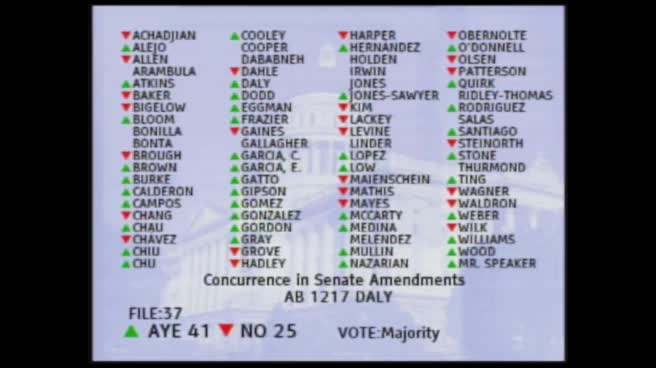 1MIN
Assembly Floor
 8MIN
Senate Floor
 13MIN
Senate Standing Committee on Transportation and Housing
 2MIN
Assembly Floor
 1MIN
Assembly Floor
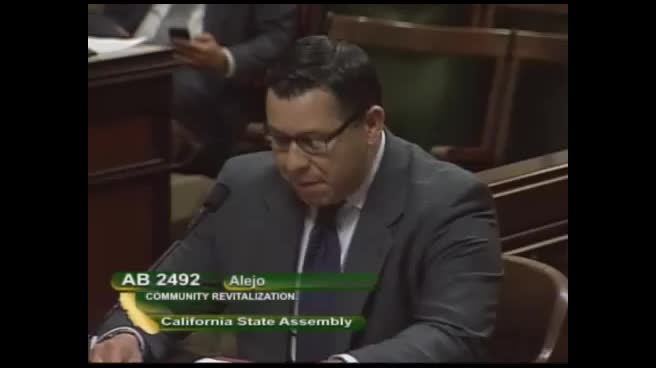 13MIN
Assembly Standing Committee on Local Government


Bill Co-Author(s):