AB 2576: Recycling: glass container manufacturers: market development payments.
- Session Year: 2015-2016
- House: Assembly
- Latest Version Date: 2016-04-11
Existing law establishes the Greenhouse Gas Reduction Fund as a special fund in the State Treasury, and requires that all moneys moneys, except for fines and penalties, collected by the State Air Resources Board from the auction or sale of specified greenhouse gas allowances as part of a market-based compliance mechanism to be deposited in the fund and available for appropriation by the Legislature. upon appropriation for purposes relating to the reduction of greenhouse gas emissions.
This bill would appropriate $20,000,000 annually provide that up to $20,000,000 shall be available, upon appropriation by the Legislature, from the Greenhouse Gas Reduction Fund to the Department of Resources Recycling and Recovery for market development payments to glass container manufacturers in an unspecified amount of $50 per ton of state-generated cullet, as defined, utilized for manufacturing in the state. state to achieve greenhouse gas emissions reductions not otherwise required by statute or regulation.
Existing law establishes the Greenhouse Gas Reduction Fund as a special fund in the State Treasury, and requires that all moneys collected by the State Air Resources Board from the auction or sale of specified greenhouse gas allowances be deposited in the fund and available for appropriation by the Legislature.
This bill would appropriate $20,000,000 annually from the Greenhouse Gas Reduction Fund to the Department of Resources Recycling and Recovery for market development payments to glass container manufacturers in an unspecified amount per ton of state-generated cullet, as defined, utilized for manufacturing in the state.
The Legislature finds and declares all of the following:
(a)The California Global Warming Solutions Act of 2006 requires the State Air Resources Board, pursuant to regulation, to reduce California greenhouse gas (GHG) emissions and to minimize the leakage of GHG emissions from California to areas outside of the state. Regulations adopted by the board classify glass container manufacturing as an energy intensive and trade exposed industry with a high risk of leakage.
(b)Glass container manufacturers currently use approximately 563,000 tons of recycled glass per year. With increased quality supply, glass manufacturers have the potential to use 755,000 tons per year.
(c)Furnace-ready recycled glass, referred to as cullet, is expensive and hard to acquire. Single-stream recycling systems result in low-quality glass that cannot be used in a furnace. Often, this glass is disposed of in landfills rather than recycled. Glass market development payments will improve the market for recycled glass and increase the availability of furnace-ready cullet in California.
(d)For every six tons of recycled glass used in the manufacturing process, there is a one ton reduction in GHG emissions. GHG emissions reductions could reach 34,000 tons per year.
(e)Glass container manufacturing fits the categories for funding identified in the California Global Warming Solutions Act of 2006, SB 535 (Chapter 830 of the Statutes of 2012), and the boards scoping plan for expenditures.
(f)Glass container manufacturing plants are located in areas of the state designated by the California Communities Environmental Health Screening, also known as CalEnviroScreen, as priority locations for cap and trade investment.
SEC. 2.Section 39719.5 40512 is added to the Health and Safety Public Resources Code, to read:39719.5.40512.Twenty Up to twenty million dollars ($20,000,000) is hereby appropriated annually shall be available, upon appropriation by the Legislature, from the Greenhouse Gas Reduction Fund, established pursuant to Section 16428.8 of the Government Code, to the Department of Resources Recycling and Recovery department for market development payments to glass container manufacturers in an amount up to __ fifty dollars ($__) ($50) per ton of state-generated cullet, as defined in Section 14509.3 of the Public Resources Code, 14509.3, utilized for manufacturing in the state. state to achieve greenhouse gas emissions reductions not otherwise required by statute or regulation.
The Legislature finds and declares all of the following:
(a)The California Global Warming Solutions Act of 2006 requires the State Air Resources Board, pursuant to regulation, to reduce California greenhouse gas (GHG) emissions and to minimize the leakage of GHG emissions from California to areas outside of the state. Regulations adopted by the board classify glass container manufacturing as an energy intensive and trade exposed industry with a high risk of leakage.
(b)Glass container manufacturers currently use approximately 563,000 tons of recycled glass per year. With increased quality supply, glass manufacturers have the potential to use 755,000 tons per year.
(c)Furnace-ready recycled glass, referred to as cullet, is expensive and hard to acquire. Single-stream recycling systems result in low-quality glass that cannot be used in a furnace. Often, this glass is disposed of in landfills rather than recycled. Glass market development payments will improve the market for recycled glass and increase the availability of furnace-ready cullet in California.
(d)For every six tons of recycled glass used in the manufacturing process, there is a one ton reduction in GHG emissions. GHG emissions reductions could reach 34,000 tons per year.
(e)Glass container manufacturing fits the categories for funding identified in the California Global Warming Solutions Act of 2006, SB 535 (Chapter 830 of the Statutes of 2012), and the boards scoping plan for expenditures.
(f)Glass container manufacturing plants are located in areas of the state designated by the California Communities Environmental Health Screening, also known as CalEnviroScreen, as priority locations for cap and trade investment.
SEC. 2.Section 39719.5 is added to the Health and Safety Code, to read:39719.5.Twenty million dollars ($20,000,000) is hereby appropriated annually from the Greenhouse Gas Reduction Fund, established pursuant to Section 16428.8 of the Government Code, to the Department of Resources Recycling and Recovery for market development payments to glass container manufacturers in an amount up to __ dollars ($__) per ton of state-generated cullet, as defined in Section 14509.3 of the Public Resources Code, utilized for manufacturing in the state.
|
Date
|
Status
|
|---|---|
| May 27, 2016 | In committee: Held under submission. |
| May 11, 2016 | In committee: Set, first hearing. Referred to APPR. suspense file. |
| Apr 12, 2016 | Re-referred to Com. on APPR. |
| Apr 11, 2016 | Read second time and amended. |
| Apr 7, 2016 | From committee: Amend, and do pass as amended and re-refer to Com. on APPR. (Ayes 7. Noes 2.) (April 4). |
| Mar 8, 2016 | Referred to Com. on NAT. RES. |
| Feb 22, 2016 | Read first time. |
| Feb 21, 2016 | From printer. May be heard in committee March 22. |
| Feb 19, 2016 | Introduced. To print. |
|
Date
|
Description
|
Location
|
Votes
|
|
|---|---|---|---|---|
| Apr 4, 2016 | Do pass as amended and be re-referred to the Committee on [Appropriations] | Assembly Standing Committee on Natural Resources |
Passed |
This list shows positions taken on this bill by organizations on the date displayed, which is linked to the original source.
Positions by individuals are not included.
Date of Hearing: May 11, 2016
ASSEMBLY COMMITTEE ON APPROPRIATIONS
Lorena Gonzalez, Chair
ABPCA Bill Id:AB 2576
Author:(Gray) – As Amended Ver:April 11, 2016
Policy Committee: | Natural Resources | Vote: | 7 - 2 |
Urgency: No State Mandated Local Program: No Reimbursable: No
SUMMARY:
This bill allocates up to $20 million from AB 32 cap-and-trade revenues (Greenhouse Gas Reduction Fund) to CalRecycle, upon appropriation, for market development payments of $50 per ton of state-generated cullet used for glass manufacturing in the state. This bill requires market development payments to achieve greenhouse gas (GHG) emissions reductions not otherwise required by law.
FISCAL EFFECT:
- Cost pressures of up to $20 million (Greenhouse Gas Reduction Fund) for the market development program at CalRecyle.
- Increased ongoing annual costs of approximately $235,000 (Greenhouse Gas Reduction Fund) for the California Air Resources Board (ARB) to revise funding guidelines, develop quantification methods and consult with CalRecycle.
- Increased ongoing annual costs of between $250,000 and $400,000 (Greenhouse Gas Reduction Funds) for CalRecyle to administer a $20 million program.
COMMENTS:
- Purpose. According to the author, furnace-ready recycled glass (cullet) is expensive and hard to acquire. Single-stream recycling systems result in low-quality glass that cannot be used in a furnace. Often, this glass is disposed of in landfills rather than recycled. This bill is intended to provide an incentive to glass manufacturers to fund the use of recycled cullet, thereby reducing GHG emissions and their costs.
- Background. The California Global Warming Solutions Act of 2006 (AB 32) requires ARB to adopt a statewide GHG emissions limit equivalent to 1990 levels by 2020 and adopt regulations, including market-based compliance mechanisms, to achieve maximum technologically feasible and cost-effective GHG emission reductions.
As part of the implementation of AB 32 market-based compliance measures, ARB adopted a cap-and-trade program that caps the allowable statewide emissions and provides for the auctioning of emission credits, the proceeds of which are quarterly deposited into the GGRF available for appropriation by the Legislature.
The 2014-15 Budget Act allocated cap-and-trade revenues for the 2014-15 fiscal year and established a long-term plan for the allocation of cap-and-trade revenues beginning in fiscal year 2015-16.
The Budget continuously appropriates 35% of cap-and-trade funds for investments in transit, affordable housing, and sustainable communities. Twenty-five percent of the revenues are continuously appropriated to continue the construction of high-speed rail. The remaining 40% are to be appropriated annually by the Legislature for investments in programs that include low-carbon transportation, energy efficiency and renewable energy, and natural resources and waste diversion.
An expenditure plan for the 40% was not included in the 2015-16 Budget Act, with the exception of $227 million appropriated to continue funding for specified existing programs. The remaining 2015-16 revenues, along with 2016-17 revenues totaling $3.1 billion, are available for appropriation this year.
- Glass recycling in California. California is home to four glass manufacturers: Owens Illinois has facilities in Vernon and Tracy; Ardagh Glass has a facility in Madera; and, Gallo Glass has a facility in Modesto. Until last fall, Owens Illinois also operated a plant in Oakland.
The California Beverage Container Recycling and Litter Reduction Act (Bottle Bill):
requires glass beverage containers to contain 35% recycled content. In addition to the benefits of recycling (e.g., reductions in virgin material use, reduced landfilling, energy savings, and providing markets for recycled materials), recycled cullet produces significantly fewer GHG emissions than virgin glass production. According to the Glass Packaging Institute, every six tons of recycled cullet used in glass manufacturing reduces GHG emissions by one ton.
The Bottle Bill allocates $10 million annually for quality incentive payments of up to $60 per ton of color sorted (green, brown, or clear) recycled glass cullet to glass recyclers. Recyclers sell the recycled cullet to glass manufacturers based on market pricing.
- Leaky emissions. Leakage refers to GHG emissions reductions in state that are replaced by increased GHG emissions out of state. AB 32 requires ARB to design measures to minimize leakage. Industries for which production is highly emissions intensive, which results in high compliance costs, and industries facing strong competition from out-of-state producers are generally at highest risk of leakage. Glass manufacturing is classified by ARB as a high risk industry and glass manufacturers receive a base amount of free allowances.
Analysis Prepared by: Jennifer Galehouse / APPR. / (916) 319-2081
Date of Hearing: April 4, 2016
ASSEMBLY COMMITTEE ON NATURAL RESOURCES
Das Williams, Chair
ABPCA Bill Id:AB 2576 (
Author:Gray) – As Introduced Ver:February 19, 2016
SUBJECT: Recycling: glass container manufacturers: market development payments
SUMMARY: Annually appropriates $20 million from the Greenhouse Gas Reduction Fund (GGRF) to the Department of Resources Recycling and Recovery (CalRecycle) for market development payments to glass container manufacturers of an unspecified amount per ton of state-generated cullet that is used for glass manufacturing in the state.
EXISTING LAW:
- Requires the Air Resources Board (ARB), pursuant to California Global Warming Solutions Act of 2006 [AB 32 (Nunez), Chapter 488, Statutes of 2006], to adopt a statewide greenhouse gas (GHG) emissions limit equivalent to 1990 levels by 2020 and adopt regulations to achieve maximum technologically feasible and cost-effective GHG emission reductions. AB 32 authorizes ARB to permit the use of market-based compliance mechanisms to comply with GHG reduction regulations, once specified conditions are met.
- Establishes the GGRF and requires all moneys, except for fines and penalties, collected by ARB from the auction or sale of allowances pursuant to a market-based compliance mechanism (i.e., the cap-and-trade program adopted by ARB under AB 32) to be deposited in the GGRF and available for appropriation by the Legislature.
- Continuously appropriates:
- 10% of the GGRF for the Transit and Intercity Rail Capital Program;
- 5% for the Low Carbon Transit Operations Program;
- 20% for the Affordable Housing and Sustainable Communities Program; and,
- 25% for high speed rail.
- 10% of the GGRF for the Transit and Intercity Rail Capital Program;
- Establishes the GGRF Investment Plan and Communities Revitalization Act to set procedures for the investment of GHG allowance auction revenues. Authorizes a range of GHG reduction investments and establishes several policy objectives, including:
- Maximize economic, environmental, and public health benefits;
- Foster job creation;
- Complement efforts to improve air quality;
- Direct investment toward the most disadvantaged communities and households in the state;
- Provide opportunities for businesses, public agencies, nonprofits, and other community institutions to participate in and benefit from statewide efforts to reduce GHG emissions; and,
- Lessen the impacts and effects of climate change on the state's communities, economy, and environment.
- Maximize economic, environmental, and public health benefits;
- Requires the investment plan to allocate (1) a minimum of 25% of the available moneys in the GGRF to projects that provide benefits to identified disadvantaged communities, and (2) a minimum of 10% of the available moneys in the GGRF to projects located within identified disadvantaged communities.
- Pursuant to the California Beverage Container Recycling and Litter Reduction Act (Bottle Bill):
- Requires beverage containers sold in this state to have a California refund value (CRV) of 5 cents for containers that hold fewer than 24 ounces and 10 cents for containers that hold 24 ounces or more and requires a distributor to pay a redemption payment to CalRecycle. Continuously appropriates these funds to CalRecycle for the payment of refund values and processing fees;
- Requires that each new glass container manufactured in the state contain a minimum of 35% postfilled (recycled food container cullet) glass. Requires every glass food, drink, or beverage container manufacturer in the state to report the amount of tons of new glass and the tons of postfilled glass used in the manufacturing of those containers to CalRecycle every month; and
- Among other payments, annually allocates $10 million for quality incentive payments (QIP) of up to $60 per ton of recycled glass cullet to glass recyclers.
FISCAL EFFECT: Unknown
COMMENTS:
- Existing GGRF funding and programs. The 2014-15 Budget Act allocated GGRF revenues for the 2014-15 fiscal year and established a long-term plan for the allocation of GGRF revenues beginning in fiscal year 2015-16. Thirty-five percent of GGRF is continuously appropriated for investments in transit, affordable housing, and sustainable communities. Twenty-five percent is continuously appropriated to continue the construction of the high-speed rail project. The remaining 40% is subject to annual appropriation by the Legislature for investments in programs that include low-carbon transportation, energy efficiency and renewable energy, and natural resources and waste diversion. An expenditure plan for the 40% was not included in the 2015-16 Budget Act, with the exception of $227 million appropriated to continue funding for specified existing programs. The remaining 2015-16 revenues, along with 2016-17 revenues, are available for appropriation this year.
The 2016 Annual Report of Cap and Trade Auction Proceeds includes an analysis of funds spent within and benefiting disadvantaged communities, excluding high speed rail spending. According to the report, 39% of expenditures were for projects located within disadvantaged communities and 51% of the overall funding benefited disadvantaged communities.
Listed below are the major GGRF program areas, administering agency, and funding to date:
- Transportation and Sustainable Communities
- High Speed Rail, High Speed Rail Authority (Authority), $750 million
- Transit and Intercity Rail Capital Program, Transportation Agency, $225 million
- Low Carbon Transit Operations Program, Department of Transportation (Caltrans), $125 million
- Affordable Housing and Sustainable Communities Program, Strategic Growth Council (SGC), $530 million
- Low Carbon Transportation, ARB, $325 million
- Clean Energy and Energy Efficiency
- Low-Income Weatherization Program, Community Services and Development (CSD), $154 million
- Energy Efficiency in Public Buildings, California Energy Commission (CEC), $20 million
- Agricultural Energy and Operational Efficiency, Department of Food and Agriculture (CDFA), $75 million
- Water-Energy Efficiency, Department of Water Resources (DWR), $75 million
- Natural Resources and Waste Diversion
- Wetlands and Watershed Restoration, Department of Fish and Wildlife (DFW), $27 million
- Urban Forestry, Forest Health Restoration, and Reforestation, Department of Forestry and Fire Protection (CAL FIRE), $42 million
- Waste Diversion, CalRecycle, $31 million
- Transportation and Sustainable Communities
The Governor's 2016-17 Budget proposes just under $3.1 billion in expenditures:
- Continuous Appropriations
- High Speed Rail, Authority, $500 million
- Low Carbon Transit Operations, State Transit Assistance, $100 million
- Transit and Intercity Rail Capital Program, Transportation Agency, $200 million
- Affordable Housing and Sustainable Communities Program, SGC, $400 million
- Fifty Percent Reduction in Petroleum Use
- Transit and Intercity Rail Capital Program, Transportation Agency, $400 million
- Low Carbon Road Program, Caltrans, $100 million
- Low Carbon Transportation and Fuels, ARB, $500 million
- Biofuel Facility Investments, CEC, $25 million
- Local Climate Action
- Transformative Climate Communities, SGC, $100 million
- Short-Lived Climate Pollutants
- Black Carbon Woodsmoke and Refrigerants, ARB, $60 million
- Waste Diversion, CalRecycle, $100 million
- Climate Smart Agriculture – Healthy Soils and Dairy Digesters, CDFA, $55 million
- Safeguarding California/Water Action Plan
- Water and Energy Efficiency, CDFA and DWR, $30 million
- Drought Executive Order, CEC, $60 million
- Wetlands and Watershed Restoration/CalEcoRestore, DFW, $60 million
- Safeguarding California/Carbon Sequestration
- Healthy Forests and Urban Forestry, CAL FIRE, $180 million
- Urban Greening, Natural Resources Agency, $20 million
- Energy Efficiency/Renewable Energy
- Energy Efficiency for Public Buildings, Department of General Services, $30 million
- California Lending for Energy and Environmental Needs Center, I Bank, $20 million
- Energy Corps, Conservation Corps, $15 million
- Energy Efficiency Upgrades/Weatherization, Department of Community Services and Development, $75 million
- Renewable Energy and Energy Efficiency Projects, University of California, California State University, $60 million
- Continuous Appropriations
- Author's statement:
Furnace-ready recycled glass (cullet) is expensive and hard to acquire. Single-stream recycling systems result in low-quality glass that cannot be used in a furnace. Often, this glass is disposed of in landfills rather than recycled… Glass container manufacturing uniquely fits the [requirements] for [GGRF] expenditures by reducing emissions in disadvantaged communities.
Glass market development payments… will improve the market for recycled glass, incentivize the use of more recycled glass, and increase the availability of furnace-ready cullet in California. AB 2576 will require that cap and trade funds are used to minimize leakage and protect high wage manufacturing jobs in disadvantaged communities.
- Leaky emissions. Leakage refers to GHG emissions reductions in state that are replaced by increased GHG emissions out of state. AB 32 requires ARB to design measures to minimize leakage. Industries for which production is highly emissions intensive, which results in high compliance costs, and industries facing strong competition from out-of-state producers are generally at highest risk of leakage. In order to minimize leakage risk, ARB provides free allocations to at-risk industries (identified by the North American Industry Classification System codes) into high, medium, or low risk for leakage. Over time, ARB will reduce the percentage of free allocations for medium and low risk industry sectors. Glass manufacturing is classified by ARB as a high risk industry, so glass manufacturers receive a base amount of free allowances.
Supporters of this bill argue that because the quantity of free allocations will reduce over time (as the GHG emissions cap is reduced), "thus, in the coming years, glass manufacturers will not be able to meet their compliance obligation with their free allocation alone, and will be forced to either reduce emissions, or purchase more allowances." The bill's supporters state that this will result in California glass manufacturers becoming less cost competitive relative to out-of-state manufacturers.
This bill is intended to provide an incentive to glass manufacturers to fund the use of recycled cullet, thereby reducing GHG emissions and their costs. - GGRF under the cap? Approximately 85% of the state's GHG emissions are generated by industries that are regulated under the cap and trade program (i.e., "under the cap"). According to the LAO's Cap-and-Trade Revenues: Strategies to Promote Legislative Priorities, using GGRF proceeds to fund activities from sources that are under the cap will likely have no net effect on overall emissions, because the cap is limiting overall GHG emissions from these sources. The committee, and more broadly the Legislature, may wish to consider whether or not it wishes to prioritize funding for GHG emissions reductions outside the cap. If the committee moves this bill forward, the committee may wish to amend the bill to require that CalRecycle to award funds that will result in GHG emissions reductions that exceed the reductions already required by state law and regulation.
- Glass recycling in California. California is home to four glass manufacturers: Owens Illinois has facilities in Vernon and Tracy; Ardagh Glass has a facility in Madera; and, Gallo Glass has a facility in Modesto. Until last fall, Owens Illinois also operated a plant in Oakland.
Under the Bottle Bill, glass beverage containers are required to contain 35% recycled content. In addition to the benefits of recycling (e.g., reductions in virgin material use, reduced landfilling, energy savings, and providing markets for recycled materials), recycled cullet produces significantly fewer GHG emissions than virgin glass production. According to the Glass Packaging Institute, every six tons of recycled cullet used in glass manufacturing reduces GHG emissions by one ton.
The Bottle Bill allocates $10 million annually for quality incentive payments of up to $60 per ton of color sorted (green, brown, or clear) recycled glass cullet to glass recyclers. Recyclers sell the recycled cullet to glass manufacturers based on market pricing; glass container manufacturers argue that they are unable to compete with non-container manufacturers (e.g., fiberglass) for this material and need the additional assistance provided by this bill. QIP are awarded for color sorted glass only, which is more expensive than mixed cullet. While fiberglass manufacturers may opt to purchase color-sorted glass, it makes little financial sense for them to do so, as they are able to use less expensive mixed cullet.
- Additional amendments:
- In order to preserve the integrity of the Budget process and ensure adequate legislative oversight of GGRF expenditures, the committee may wish to amend the bill to specify that an amount up to $20 million is available, upon appropriation, for the glass market development payments.
- This bill does not specify the amount of the incentive payment. According to the author, the intent is to provide $50 per ton. The committee may wish to amend the bill to specify this amount.
REGISTERED SUPPORT / OPPOSITION:
Support
California Manufacturers and Technology Association
West Coast Protective League
Wine Institute
Opposition
CalChamber
CalTax
Analysis Prepared by: Elizabeth MacMillan / NAT. RES. / (916) 319-2092
Discussed in Hearing
 3MIN
Senate Standing Committee on Business, Professions and Economic Development
 4MIN
Senate Standing Committee on Health
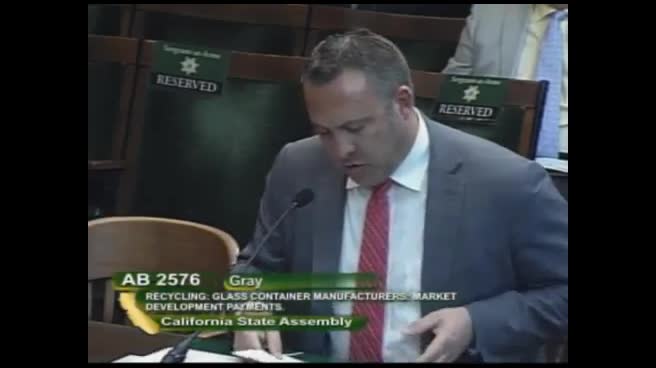 16MIN
Assembly Standing Committee on Natural Resources
Bill Author



