AB 2586: Parking.
- Session Year: 2015-2016
- House: Assembly
- Latest Version Date: 2016-09-01
Existing law authorizes a local authority to prohibit or restrict the parking or standing of vehicles on designated streets or highways, or portions thereof, for the purposes of street sweeping, as specified. Existing law states the intent of the legislature that if a local authority prohibits or restricts the parking or standing of vehicles for that purpose that the local authority shall ensure that the designated street, highway, or portion thereof is promptly made available to motorists as soon as the street sweeping has concluded.
This bill would also permit a local authority to prohibit or restrict the parking or standing of vehicles as described above for other maintenance activities. The bill would instead, by January 1, 2020, require a local authority that prohibits or restricts the parking or standing of vehicles for the purposes of street sweeping or other maintenance activities to ensure that the street, highway, or portion thereof that is restricted is made available to motorists as soon as the street sweeping or other maintenance activities have concluded.
Existing law authorizes parking, for up to the posted time limit, in any parking space that is regulated by an inoperable parking meter or an inoperable parking payment center, as defined. Existing law prohibits, until January 1, 2017, a local authority from enacting an ordinance or resolution prohibiting or restricting the parking of vehicles under the above circumstances.
This bill would instead authorize parking for up to two hours under the circumstances described above. The bill would provide that a violation of that conduct is subject to civil penalties and is neither an infraction nor a public offense. The bill would delete the January 1, 2017, date of repeal for the above provisions, and thus extend those provisions indefinitely.
This bill would prohibit a local authority that contracts with a private entity to enforce parking regulations from providing any monetary or other incentive in connection with the issuance of violation notices.
Existing law authorizes parking, a local authority to prohibit or restrict the parking or standing of vehicles on designated streets or highways, or portions thereof, for the purposes of street sweeping, as specified. Existing law states the intent of the legislature that if a local authority prohibits or restricts the parking or standing of vehicles for that purpose that the local authority shall ensure that the designated street, highway, or portion thereof is promptly made available to motorists as soon as the street sweeping has concluded.
This bill would also permit a local authority to prohibit or restrict the parking or standing of vehicles as described above for other maintenance activities. The bill would instead, by January 1, 2020, require a local authority that prohibits or restricts the parking or standing of vehicles for the purposes of street sweeping or other maintenance activities to ensure that the street, highway, or portion thereof that is restricted is made available to the motorists as soon as the street sweeping or other maintenance activities have concluded.
Existing law authorizes parking, for up to the posted time limit, in any parking space that is regulated by an inoperable parking meter or an inoperable parking payment center, as defined, until January 1, 2017. defined. Existing law prohibits, until January 1, 2017, a local authority from enacting an ordinance or resolution prohibiting or restricting the parking of vehicles under the above circumstances.
This bill would instead authorize parking for up to two hours under the circumstances described above. The bill would provide that a violation of that conduct is subject to civil penalties and is neither an infraction nor a public offense. The bill would delete the January 1, 2017, date of repeal for the above provisions, and thus extend those provisions indefinitely.
This bill would prohibit a local authority that contracts with a private entity to enforce parking regulations from promoting designated incentives providing any monetary or other incentive in connection with the issuance of violation notices.
Existing law authorizes parking, for up to the posted time limit, in any parking space that is regulated by an inoperable parking meter or an inoperable parking payment center, as defined, until January 1, 2017. Existing law prohibits, until January 1, 2017, a local authority from enacting an ordinance or resolution prohibiting or restricting the parking of vehicles under the above circumstances.
This bill would delete the January 1, 2017, date of repeal for the above provisions, and thus extend those provisions indefinitely.
This bill would prohibit a person providing valet parking services in a business district from prohibiting a vehicle from parking in any otherwise available parking space regulated by a parking meter, or from stopping or standing for the purpose of loading or unloading passengers in any space or area that has been designated for that purpose.
This bill would prohibit a local authority that contracts with a private entity to enforce parking regulations from promoting designated incentives in connection with the issuance of violation notices.
Because a violation of provisions relating to vehicles, with certain exceptions, is an infraction, the bill would impose a state-mandated local program by creating a new infraction applicable to providers of valet parking services.
The California Constitution requires the state to reimburse local agencies and school districts for certain costs mandated by the state. Statutory provisions establish procedures for making that reimbursement.
This bill would provide that no reimbursement is required by this act for a specified reason.
Existing law authorizes parking, for up to the posted time limit, in any parking space that is regulated by an inoperable parking meter or an inoperable parking payment center, as defined, until January 1, 2017. Existing law prohibits, until January 1, 2017, a local authority from enacting an ordinance or resolution prohibiting or restricting the parking of vehicles under the above circumstances.
This bill would delete the January 1, 2017, date of repeal for the above provisions, and thus extend those provisions indefinitely.
This bill would prohibit a person providing valet parking services in a business district from prohibiting a vehicle from parking in any otherwise available parking space regulated by a parking meter, or from stopping or standing for the purpose of loading or unloading passengers in any space or area that has been designated for that purpose.
This bill would prohibit a local authority that contracts with a private entity to enforce parking regulations from promoting designated incentives in connection with the issuance of violation notices.
This bill would require a local authority to consider the feasibility of installing a technology capable of demand-based pricing when considering the installation of new parking technology within its jurisdiction, thereby imposing a state-mandated local program.
Because a violation of provisions relating to vehicles, with certain exceptions, is an infraction, the bill would impose a state-mandated local program by creating a new infraction applicable to providers of valet parking services.
The California Constitution requires the state to reimburse local agencies and school districts for certain costs mandated by the state. Statutory provisions establish procedures for making that reimbursement.
This bill would provide that, with regard to certain mandates, no reimbursement is required by this act for a specified reason.
With regard to any other mandates, this bill would provide that, if the Commission on State Mandates determines that the bill contains costs so mandated by the state, reimbursement for those costs shall be made pursuant to the statutory provisions noted above.
The California Constitution requires the state to reimburse local agencies and school districts for certain costs mandated by the state. Statutory provisions establish procedures for making that reimbursement.
This bill would provide that no reimbursement is required by this act for a specified reason.
Existing law authorizes parking, for up to the posted time limit, in any parking space that is regulated by an inoperable parking meter or an inoperable parking payment center, as defined, until January 1, 2017. Existing law prohibits, until January 1, 2017, a local authority from enacting an ordinance or resolution prohibiting or restricting the parking of vehicles under the above circumstances.
This bill would delete the January 1, 2017 2017, date of repeal for the above provisions, and thus extend those provisions indefinitely.
This bill would prohibit a person providing valet parking services in a business district from prohibiting a vehicle from parking in any otherwise available parking space regulated by a parking meter, or from stopping or standing for the purpose of loading or unloading passengers in any space or area that has been designated for that purpose.
This bill would prohibit a local authority that contracts with a private entity to enforce parking regulations from promoting designated incentives in connection with the issuance of violation notices. The bill also would exempt the owner of a motor vehicle from paying any fine or charge, including towing and impounding fees, whether public or private, resulting from the illegal parking of the vehicle if the illegal parking was the result of third party criminal activity.
This bill would require a local authority to consider the feasibility of installing a technology capable of demand-based pricing when considering the installation of new parking technology within its jurisdiction, thereby imposing a state-mandated local program.
Because a violation of provisions relating to vehicles, with certain exceptions, is an infraction, the bill would impose a state-mandated local program by creating a new infractions infraction applicable to providers of valet parking and towing and impounding services.
The California Constitution requires the state to reimburse local agencies and school districts for certain costs mandated by the state. Statutory provisions establish procedures for making that reimbursement.
This bill would provide that, with regard to certain mandates, no reimbursement is required by this act for a specified reason.
With regard to any other mandates, this bill would provide that, if the Commission on State Mandates determines that the bill contains costs so mandated by the state, reimbursement for those costs shall be made pursuant to the statutory provisions noted above.
Existing law authorizes parking, for up to the posted time limit, in any parking space that is regulated by an inoperable parking meter or an inoperable parking payment center, as defined, until January 1, 2017. Existing law prohibits, until January 1, 2017, a local authority from enacting an ordinance or resolution prohibiting or restricting the parking of vehicles under the above circumstances.
This bill would delete the January 1, 2017 date of repeal for the above provisions, and thus extend those provisions indefinitely.
This bill would prohibit a person providing valet parking services in a business district from prohibiting a vehicle from parking in any otherwise available parking space regulated by a parking meter, or from stopping or standing for the purpose of loading or unloading passengers in any space or area that has been designated for that purpose.
This bill would prohibit a local authority that contracts with a private entity to enforce parking regulations from promoting designated incentives in connection with the issuance of violation notices. The bill also would exempt the owner of a motor vehicle from paying any fine or charge, including towing and impounding fees, whether public or private, resulting from the illegal parking of the vehicle if the illegal parking was the result of third party criminal activity.
This bill would require a local authority to consider the feasibility of installing a technology capable of demand-based pricing when considering the installation of new parking technology within its jurisdiction, thereby imposing a state-mandated local program.
Because a violation of provisions relating to vehicles, with certain exceptions, is an infraction, the bill would impose a state-mandated local program by creating new infractions applicable to providers of valet parking and towing and impounding services.
The California Constitution requires the state to reimburse local agencies and school districts for certain costs mandated by the state. Statutory provisions establish procedures for making that reimbursement.
This bill would provide that, with regard to certain mandates, no reimbursement is required by this act for a specified reason.
With regard to any other mandates, this bill would provide that, if the Commission on State Mandates determines that the bill contains costs so mandated by the state, reimbursement for those costs shall be made pursuant to the statutory provisions noted above.
(a)Local authorities may, by ordinance or resolution, prohibit or restrict the parking or standing of vehicles on designated streets or highways, or portions thereof, for the purpose of street sweeping or other maintenance activities. An ordinance or resolution relating to the parking or standing of commercial vehicles in a residential district shall not be effective with respect to any commercial vehicle making pickups or deliveries of goods, wares, or merchandise from or to any building or structure located on the restricted street or highway, or for the purpose of delivering materials to be used in the repair, alteration, remodeling, or reconstruction of any building or structure for which a building permit has previously been obtained. The ordinance or resolution shall not be effective until the street or highway, or portion thereof, has been sign-posted in accordance with the uniform standards and specifications of the Department of Transportation, or local authorities have caused to be posted in a conspicuous place at each entrance to the street a notice not less than 17 inches by 22 inches in size, with lettering not less than one inch in height, setting forth the day or days and hours parking is prohibited. As used in this section, entrance means the intersection of any street or streets comprising an area of restricted parking for street-sweeping or other maintenance purposes on the same day or days and hours with another street or highway not subject to that parking restriction, or subject to parking restrictions on different days and hours.
(b)Notwithstanding subdivision (a), by January 1, 2020, if a local authority prohibits or restricts the parking or standing of vehicles on designated streets or highways, or portions thereof, for the purpose of street sweeping or other maintenance activities, the local authority, as soon as the street sweeping or other maintenance activities have concluded, shall ensure that the designated streets, highways, or portions thereof are promptly made available to motorists, regardless of the posted hours.
SEC. 2.Section 22508.5 of the Vehicle Code, as amended by Section 1 of Chapter 71 of the Statutes of 2013, is repealed.SEC. 3.Section 22508.5 of the Vehicle Code, as added by Section 2 of Chapter 71 of the Statutes of 2013, is amended to read:22508.5.(a)A vehicle may park, for up to two hours, in any parking space that is regulated by an inoperable parking meter or an inoperable parking payment center.
(b)A local authority shall not, by ordinance or resolution, prohibit or restrict the parking of vehicles in a space that is regulated by an inoperable parking meter or inoperable parking payment center.
(c)For purposes of this section:
(1)Inoperable parking meter means a meter located next to and designated for an individual parking space, which has become inoperable and cannot accept payment in any form or cannot register that a payment in any form has been made.
(2)Inoperable parking payment center means an electronic parking meter or pay station serving one or more parking spaces that is closest to the space where a person has parked and that cannot accept payment in any form, cannot register that a payment in any form has been made, or cannot issue a receipt that is required to be displayed in a conspicuous location on or in the vehicle.
(d)A violation of subdivision (a) is subject to civil penalties and is neither an infraction nor a public offense.
SEC. 4.Section 22508.7 is added to the Vehicle Code, to read:22508.7.A local authority, when contracting with a private entity to enforce parking regulations, shall not provide any monetary or other incentive, such as the promise of a future contract for the issuance of a specified or higher number of violation notices, in connection with the issuance of violation notices.
(a)Local authorities may, by ordinance or resolution, prohibit or restrict the parking or standing of vehicles on designated streets or highways, or portions thereof, for the purpose of street sweeping. sweeping or other maintenance activities. An ordinance or resolution relating to the parking or standing of commercial vehicles in a residential district shall not be effective with respect to any commercial vehicle making pickups or deliveries of goods, wares, or merchandise from or to any building or structure located on the restricted street or highway, or for the purpose of delivering materials to be used in the repair, alteration, remodeling, or reconstruction of any building or structure for which a building permit has previously been obtained. The ordinance or resolution shall not be effective until the street or highway, or portion thereof, has been sign-posted in accordance with the uniform standards and specifications of the Department of Transportation, or local authorities have caused to be posted in a conspicuous place at each entrance to the street a notice not less than 17 inches by 22 inches in size, with lettering not less than one inch in height, setting forth the day or days and hours parking is prohibited. As used in this section, entrance means the intersection of any street or streets comprising an area of restricted parking for street-sweeping or other maintenance purposes on the same day or days and hours with another street or highway not subject to that parking restriction, or subject to parking restrictions on different days and hours.
(b)Notwithstanding subdivision (a), it is the intent of the Legislature that by January 1, 2020, if a local authority prohibits or restricts the parking or standing of vehicles on designated streets or highways, or portions thereof, for the purpose of street sweeping, sweeping or other maintenance activities, the local authority, as soon as the street sweeping has or other maintenance activities have concluded, shall ensure that the designated streets, highways, or portions thereof are promptly made available to motorists, regardless of the posted hours.
SEC. 2.Section 22508.5 of the Vehicle Code, as amended by Section 1 of Chapter 71 of the Statutes of 2013, is repealed.SEC. 3.Section 22508.5 of the Vehicle Code, as added by Section 2 of Chapter 71 of the Statutes of 2013, is amended to read:22508.5.(a)A vehicle may park, for up to the posted time limit, two hours, in any parking space that is regulated by an inoperable parking meter or an inoperable parking payment center.
(b)A local authority shall not, by ordinance or resolution, prohibit or restrict the parking of vehicles in a space that is regulated by an inoperable parking meter or inoperable parking payment center.
(c)For purposes of this section:
(1)Inoperable parking meter means a meter located next to and designated for an individual parking space, which has become inoperable and cannot accept payment in any form or cannot register that a payment in any form has been made.
(2)Inoperable parking payment center means an electronic parking meter or pay station serving one or more parking spaces that is closest to the space where a person has parked and that cannot accept payment in any form, cannot register that a payment in any form has been made, or cannot issue a receipt that is required to be displayed in a conspicuous location on or in the vehicle.
(d)A violation of subdivision (a) is subject to civil penalties and is neither an infraction nor a public offense.
SEC. 4.Section 22508.7 is added to the Vehicle Code, to read:22508.7.A local authority, when contracting with a private entity to enforce parking regulations, shall not promote any of the following activities provide any monetary or other incentive, such as the promise of a future contract for the issuance of a specified or higher number of violation notices, in connection with the issuance of violation notices: notices.
(a)Provide any monetary or other incentive, such as the promise of a future contract for the issuance of a specified or higher number of violation notices.
(b)Increase any violation fine in order to cover the cost of the contracted enforcement service.
(a)Local authorities may, by ordinance or resolution, prohibit or restrict the parking or standing of vehicles on designated streets or highways, or portions thereof, for the purpose of street sweeping. An ordinance or resolution relating to the parking or standing of commercial vehicles in a residential district shall not be effective with respect to any commercial vehicle making pickups or deliveries of goods, wares, or merchandise from or to any building or structure located on the restricted street or highway, or for the purpose of delivering materials to be used in the repair, alteration, remodeling, or reconstruction of any building or structure for which a building permit has previously been obtained. The ordinance or resolution shall not be effective until the street or highway, or portion thereof, has been sign-posted in accordance with the uniform standards and specifications of the Department of Transportation, or local authorities have caused to be posted in a conspicuous place at each entrance to the street a notice not less than 17 inches by 22 inches in size, with lettering not less than one inch in height, setting forth the day or days and hours parking is prohibited. As used in this section, entrance means the intersection of any street or streets comprising an area of restricted parking for street-sweeping purposes on the same day or days and hours with another street or highway not subject to that parking restriction, or subject to parking restrictions on different days and hours.
(b)Notwithstanding subdivision (a), it is the intent of the Legislature that if a local authority prohibits or restricts the parking or standing of vehicles on designated streets or highways, or portions thereof, for the purpose of street sweeping, the local authority, as soon as the street sweeping has concluded, shall ensure that the designated streets, highways, or portions thereof are promptly made available to motorists, regardless of the posted hours.
SEC. 2.Section 22508.5 of the Vehicle Code, as amended by Section 1 of Chapter 71 of the Statutes of 2013, is repealed.SEC. 3.Section 22508.5 of the Vehicle Code, as added by Section 2 of Chapter 71 of the Statutes of 2013, is amended to read:22508.5.(a)A vehicle may park, for up to the posted time limit, in any parking space that is regulated by an inoperable parking meter or an inoperable parking payment center.
(b)A local authority shall not, by ordinance or resolution, prohibit or restrict the parking of vehicles in a space that is regulated by an inoperable parking meter or inoperable parking payment center.
(c)For purposes of this section:
(1)Inoperable parking meter means a meter located next to and designated for an individual parking space, which has become inoperable and cannot accept payment in any form or cannot register that a payment in any form has been made.
(2)Inoperable parking payment center means an electronic parking meter or pay station serving one or more parking spaces that is closest to the space where a person has parked and that cannot accept payment in any form, cannot register that a payment in any form has been made, or cannot issue a receipt that is required to be displayed in a conspicuous location on or in the vehicle.
SEC. 4.Section 22508.6 is added to the Vehicle Code, to read:22508.6.A person providing valet parking services in a business district is prohibited from doing either of the following:
(a)Prohibiting a vehicle from parking in an otherwise available parking space regulated by a parking meter.
(b)Prohibiting a vehicle from stopping or standing for the purpose of loading or unloading passengers in any space or area that has been designated for that purpose.
SEC. 5.SEC. 4.Section 22508.7 is added to the Vehicle Code, to read:22508.7.A local authority, when contracting with a private entity to enforce parking regulations, shall not promote any of the following activities in connection with the issuance of violation notices:
(a)Provide any monetary or other incentive, such as the promise of a future contract for the issuance of a specified or higher number of violation notices.
(b)Increase any violation fine in order to cover the cost of the contracted enforcement service.
SEC. 6.No reimbursement is required by this act pursuant to Section 6 of Article XIIIB of the California Constitution because the only costs that may be incurred by a local agency or school district will be incurred because this act creates a new crime or infraction, eliminates a crime or infraction, or changes the penalty for a crime or infraction, within the meaning of Section 17556 of the Government Code, or changes the definition of a crime within the meaning of Section 6 of Article XIIIB of the California Constitution.
(a)Local authorities may, by ordinance or resolution, prohibit or restrict the parking or standing of vehicles on designated streets or highways, or portions thereof, for the purpose of street sweeping. An ordinance or resolution relating to the parking or standing of commercial vehicles in a residential district shall not be effective with respect to any commercial vehicle making pickups or deliveries of goods, wares, or merchandise from or to any building or structure located on the restricted street or highway, or for the purpose of delivering materials to be used in the repair, alteration, remodeling, or reconstruction of any building or structure for which a building permit has previously been obtained. The ordinance or resolution shall not be effective until the street or highway, or portion thereof, has been sign-posted in accordance with the uniform standards and specifications of the Department of Transportation, or local authorities have caused to be posted in a conspicuous place at each entrance to the street a notice not less than 17 inches by 22 inches in size, with lettering not less than one inch in height, setting forth the day or days and hours parking is prohibited. As used in this section, entrance means the intersection of any street or streets comprising an area of restricted parking for street-sweeping purposes on the same day or days and hours with another street or highway not subject to that parking restriction, or subject to parking restrictions on different days and hours.
(b)Notwithstanding subdivision (a), it is the intent of the Legislature that if a local authority prohibits or restricts the parking or standing of vehicles on designated streets or highways, or portions thereof, for the purpose of street sweeping, the local authority, as soon as the street sweeping has concluded, shall ensure that the designated streets, highways, or portions thereof are promptly made available to motorists, regardless of the posted hours.
SEC. 2.Section 22508.5 of the Vehicle Code, as amended by Section 1 of Chapter 71 of the Statutes of 2013, is repealed.SEC. 3.Section 22508.5 of the Vehicle Code, as added by Section 2 of Chapter 71 of the Statutes of 2013, is amended to read:22508.5.(a)A vehicle may park, for up to the posted time limit, in any parking space that is regulated by an inoperable parking meter or an inoperable parking payment center.
(b)A local authority shall not, by ordinance or resolution, prohibit or restrict the parking of vehicles in a space that is regulated by an inoperable parking meter or inoperable parking payment center.
(c)For purposes of this section:
(1)Inoperable parking meter means a meter located next to and designated for an individual parking space, which has become inoperable and cannot accept payment in any form or cannot register that a payment in any form has been made.
(2)Inoperable parking payment center means an electronic parking meter or pay station serving one or more parking spaces that is closest to the space where a person has parked and that cannot accept payment in any form, cannot register that a payment in any form has been made, or cannot issue a receipt that is required to be displayed in a conspicuous location on or in the vehicle.
SEC. 4.Section 22508.6 is added to the Vehicle Code, to read:22508.6.A person providing valet parking services in a business district is prohibited from doing either of the following:
(a)Prohibiting a vehicle from parking in an otherwise available parking space regulated by a parking meter.
(b)Prohibiting a vehicle from stopping or standing for the purpose of loading or unloading passengers in any space or area that has been designated for that purpose.
SEC. 5.Section 22508.7 is added to the Vehicle Code, to read:22508.7.A local authority, when contracting with a private entity to enforce parking regulations, shall not promote any of the following activities in connection with the issuance of violation notices:
(a)Provide any monetary or other incentive, such as the promise of a future contract for the issuance of a specified or higher number of violation notices.
(b)Increase any violation fine in order to cover the cost of the contracted enforcement service.
SEC. 6.No reimbursement is required by this act pursuant to Section 6 of Article XIIIB of the California Constitution because the only costs that may be incurred by a local agency or school district will be incurred because this act creates a new crime or infraction, eliminates a crime or infraction, or changes the penalty for a crime or infraction, within the meaning of Section 17556 of the Government Code, or changes the definition of a crime within the meaning of Section 6 of Article XIIIB of the California Constitution.
SEC. 6.Section 22527 is added to the Vehicle Code, to read:22527.(a)When considering the installation within its jurisdiction of new parking technology, a local authority shall consider the feasibility of technology that is capable of demand-based pricing, and shall identify appropriate locations within the local authoritys jurisdiction for technology with that capability.
(b)The local authority shall include a written finding regarding subdivision (a) before installing any new parking technology within its jurisdiction and shall retain a copy of that finding and post the finding on the local authoritys Internet Web site, if any.
SEC. 7.No reimbursement is required by this act pursuant to Section 6 of Article XIIIB of the California Constitution for certain costs that may be incurred by a local agency or school district because, in that regard, this act creates a new crime or infraction, eliminates a crime or infraction, or changes the penalty for a crime or infraction, within the meaning of Section 17556 of the Government Code, or changes the definition of a crime within the meaning of Section 6 of Article XIIIB of the California Constitution.
However, if the Commission on State Mandates determines that this act contains other costs mandated by the state, reimbursement to local agencies and school districts for those costs shall be made pursuant to Part 7 (commencing with Section 17500) of Division 4 of Title 2 of the Government Code.
(a)Local authorities may, by ordinance or resolution, prohibit or restrict the parking or standing of vehicles on designated streets or highways, or portions thereof, for the purpose of street sweeping. An ordinance or resolution relating to the parking or standing of commercial vehicles in a residential district shall not be effective with respect to any commercial vehicle making pickups or deliveries of goods, wares, or merchandise from or to any building or structure located on the restricted street or highway, or for the purpose of delivering materials to be used in the repair, alteration, remodeling, or reconstruction of any building or structure for which a building permit has previously been obtained. The ordinance or resolution shall not be effective until the street or highway, or portion thereof, has been sign-posted in accordance with the uniform standards and specifications of the Department of Transportation, or local authorities have caused to be posted in a conspicuous place at each entrance to the street a notice not less than 17 inches by 22 inches in size, with lettering not less than one inch in height, setting forth the day or days and hours parking is prohibited. As used in this section, entrance means the intersection of any street or streets comprising an area of restricted parking for street-sweeping purposes on the same day or days and hours with another street or highway not subject to that parking restriction, or subject to parking restrictions on different days and hours.
(b)Notwithstanding subdivision (a), it is the intent of the Legislature that if a local authority prohibits or restricts the parking or standing of vehicles on designated streets or highways, or portions thereof, for the purpose of street sweeping, the local authority, as soon as the street sweeping has concluded, shall ensure that the designated streets, highways, or portions thereof are promptly made available to motorists, regardless of the posted hours.
SEC. 2.Section 22508.5 of the Vehicle Code, as amended by Section 1 of Chapter 71 of the Statutes of 2013, is repealed.SEC. 3.Section 22508.5 of the Vehicle Code, as added by Section 2 of Chapter 71 of the Statutes of 2013, is amended to read:22508.5.(a)A vehicle may park, for up to the posted time limit, in any parking space that is regulated by an inoperable parking meter or an inoperable parking payment center.
(b)A local authority shall not, by ordinance or resolution, prohibit or restrict the parking of vehicles in a space that is regulated by an inoperable parking meter or inoperable parking payment center.
(c)For purposes of this section:
(1)Inoperable parking meter means a meter located next to and designated for an individual parking space, which has become inoperable and cannot accept payment in any form or cannot register that a payment in any form has been made.
(2)Inoperable parking payment center means an electronic parking meter or pay station serving one or more parking spaces that is closest to the space where a person has parked and that cannot accept payment in any form, cannot register that a payment in any form has been made, or cannot issue a receipt that is required to be displayed in a conspicuous location on or in the vehicle.
SEC. 4.Section 22508.6 is added to the Vehicle Code, to read:22508.6.A person providing valet parking services in a business district is prohibited from doing either of the following:
(a)Prohibiting a vehicle from parking in an otherwise available parking space regulated by a parking meter.
(b)Prohibiting a vehicle from stopping or standing for the purpose of loading or unloading passengers in any space or area that has been designated for that purpose.
SEC. 5.Section 22508.7 is added to the Vehicle Code, to read:22508.7.A local authority, when contracting with a private entity to enforce parking regulations, shall not promote any of the following activities in connection with the issuance of violation notices:
(a)Provide any monetary or other incentive, such as the promise of a future contract for the issuance of a specified or higher number of violation notices.
(b)Increase any violation fine in order to cover the cost of the contracted enforcement service.
SEC. 6.Section 22527 is added to the Vehicle Code, to read:22527.(a)When considering the installation within its jurisdiction of new parking technology, a local authority shall consider the feasibility of technology that is capable of demand-based pricing, and shall identify appropriate locations within the local authoritys jurisdiction for technology with that capability.
(b)The local authority shall include a written finding regarding subdivision (a) before installing any new parking technology within its jurisdiction and shall retain a copy of that finding and post the finding on the local authoritys Internet Web site, if any.
SEC. 7.Section 22528 is added to the Vehicle Code, to read:22528.The owner of a motor vehicle is not required to pay any fine or charge, including towing and impounding fees, whether public or private, resulting from the illegal parking of the vehicle if the illegal parking was the result of third party criminal activity and no fault of the owner of the vehicle.
SEC. 8.SEC. 7.No reimbursement is required by this act pursuant to Section 6 of Article XIIIB of the California Constitution for certain costs that may be incurred by a local agency or school district because, in that regard, this act creates a new crime or infraction, eliminates a crime or infraction, or changes the penalty for a crime or infraction, within the meaning of Section 17556 of the Government Code, or changes the definition of a crime within the meaning of Section 6 of Article XIIIB of the California Constitution.
However, if the Commission on State Mandates determines that this act contains other costs mandated by the state, reimbursement to local agencies and school districts for those costs shall be made pursuant to Part 7 (commencing with Section 17500) of Division 4 of Title 2 of the Government Code.
(a)Local authorities may, by ordinance or resolution, prohibit or restrict the parking or standing of vehicles on designated streets or highways, or portions thereof, for the purpose of street sweeping. No An ordinance or resolution relating to the parking or standing of commercial vehicles in a residential district shall not be effective with respect to any commercial vehicle making pickups or deliveries of goods, wares, or merchandise from or to any building or structure located on the restricted street or highway, or for the purpose of delivering materials to be used in the repair, alteration, remodeling, or reconstruction of any building or structure for which a building permit has previously been obtained. No such The ordinance or resolution shall not be effective until the street or highway, or portion thereof, has been sign-posted in accordance with the uniform standards and specifications of the Department of Transportation, or local authorities have caused to be posted in a conspicuous place at each entrance to the street a notice not less than 17 inches by 22 inches in size, with lettering not less than one inch in height, setting forth the day or days and hours parking is prohibited. As used in this section, entrance means the intersection of any street or streets comprising an area of restricted parking for street-sweeping purposes on the same day or days and hours with another street or highway not subject to such a that parking restriction, or subject to parking restrictions on different days and hours.
(b)Notwithstanding subdivision (a), it is the intent of the Legislature that if a local authority prohibits or restricts the parking or standing of vehicles on designated streets or highways, or portions thereof, for the purpose of street sweeping, the local authority, as soon as the street sweeping has concluded, shall ensure that the designated streets, highways, or portions thereof are promptly made available to motorists, regardless of the posted hours.
SEC. 2.Section 22508.5 of the Vehicle Code, as amended by Section 1 of Chapter 71 of the Statutes of 2013, is repealed.22508.5.(a)Except as provided in subdivision (b), a vehicle may park, for up to the posted time limit, in any parking space that is regulated by an inoperable parking meter or an inoperable parking payment center.
(b)A local authority may, by ordinance or resolution, prohibit or restrict the parking of vehicles in a parking space regulated by an inoperable parking meter or inoperable parking payment center. An ordinance or resolution adopted by a local authority pursuant to this section shall not become effective until signs or markings giving adequate notice of the restriction or prohibition on parking have been placed at parking locations, parking meters, or parking payment centers.
(c)For purposes of this section:
(1)Inoperable parking meter means a meter located next to and designated for an individual parking space, which has become inoperable and cannot accept payment in any form or cannot register that a payment in any form has been made.
(2)Inoperable parking payment center means an electronic parking meter or pay station serving one or more parking spaces that is closest to the space where a person has parked and that cannot accept payment in any form, cannot register that a payment in any form has been made, or cannot issue a receipt that is required to be displayed in a conspicuous location on or in the vehicle.
(d)This section shall become inoperative on January 1, 2014, and shall remain inoperative until January 1, 2017.
SEC. 3.Section 22508.5 of the Vehicle Code, as added by Section 2 of Chapter 71 of the Statutes of 2013, is amended to read:22508.5.(a)A vehicle may park, for up to the posted time limit, in any parking space that is regulated by an inoperable parking meter or an inoperable parking payment center.
(b)A local authority shall not, by ordinance or resolution, prohibit or restrict the parking of vehicles in a space that is regulated by an inoperable parking meter or inoperable parking payment center.
(c)For purposes of this section:
(1)Inoperable parking meter means a meter located next to and designated for an individual parking space, which has become inoperable and cannot accept payment in any form or cannot register that a payment in any form has been made.
(2)Inoperable parking payment center means an electronic parking meter or pay station serving one or more parking spaces that is closest to the space where a person has parked and that cannot accept payment in any form, cannot register that a payment in any form has been made, or cannot issue a receipt that is required to be displayed in a conspicuous location on or in the vehicle.
(d)This section shall remain in effect only until January 1, 2017, and as of that date is repealed, unless a later enacted statute, that is enacted before January 1, 2017, deletes or extends that date.
SEC. 4.Section 22508.6 is added to the Vehicle Code, to read:22508.6.A person providing valet parking services in a business district is prohibited from doing either of the following:
(a)Prohibiting a vehicle from parking in an otherwise available parking space regulated by a parking meter.
(b)Prohibiting a vehicle from stopping or standing for the purpose of loading or unloading passengers in any space or area that has been designated for that purpose.
SEC. 5.Section 22508.7 is added to the Vehicle Code, to read:22508.7.A local authority, when contracting with a private entity to enforce parking regulations, shall not promote any of the following activities in connection with the issuance of violation notices:
(a)Provide any monetary or other incentive, such as the promise of a future contract for the issuance of a specified or higher number of violation notices.
(b)Increase any violation fine in order to cover the cost of the contracted enforcement service.
SEC. 6.Section 22527 is added to the Vehicle Code, to read:22527.(a)When considering the installation within its jurisdiction of new parking technology, a local authority shall consider the feasability of technology that is capable of demand-based pricing, and shall identify appropriate locations within the local authoritys jurisdiction for technology with that capability.
(b)The local authority shall include a written finding regarding subdivision (a) before installing any new parking technology within its jurisdiction and shall retain a copy of that finding and post the finding on the local authoritys Internet Web site, if any.
SEC. 7.Section 22528 is added to the Vehicle Code, to read:22528.The owner of a motor vehicle is not required to pay any fine or charge, including towing and impounding fees, whether public or private, resulting from the illegal parking of the vehicle if the illegal parking was the result of third party criminal activity and no fault of the owner of the vehicle.
SEC. 8.No reimbursement is required by this act pursuant to Section 6 of Article XIIIB of the California Constitution for certain costs that may be incurred by a local agency or school district because, in that regard, this act creates a new crime or infraction, eliminates a crime or infraction, or changes the penalty for a crime or infraction, within the meaning of Section 17556 of the Government Code, or changes the definition of a crime within the meaning of Section 6 of Article XIIIB of the California Constitution.
However, if the Commission on State Mandates determines that this act contains other costs mandated by the state, reimbursement to local agencies and school districts for those costs shall be made pursuant to Part 7 (commencing with Section 17500) of Division 4 of Title 2 of the Government Code.
|
Date
|
Status
|
|---|---|
| Sep 9, 2016 | Enrolled and presented to the Governor at 2:30 p.m. |
| Aug 30, 2016 | Senate amendments concurred in. To Engrossing and Enrolling. (Ayes 67. Noes 7. Page 6488.). |
| Aug 30, 2016 | Assembly Rule 63 suspended. (Page 6474.) |
| Aug 30, 2016 | Senate amendments concurred in. To Engrossing and Enrolling. |
| Aug 30, 2016 | Assembly Rule 63 suspended. |
| Aug 30, 2016 | In Assembly. Concurrence in Senate amendments pending. |
| Aug 25, 2016 | Read third time. Passed. Ordered to the Assembly. (Ayes 23. Noes 11. Page 5417.). |
| Aug 25, 2016 | Read third time. Passed. Ordered to the Assembly. |
| Aug 22, 2016 | Read second time. Ordered to third reading. |
| Aug 19, 2016 | Read third time and amended. Ordered to second reading. |
| Aug 2, 2016 | Read second time. Ordered to third reading. |
| Aug 1, 2016 | Ordered to second reading. |
| Aug 1, 2016 | Withdrawn from committee. |
| Jun 30, 2016 | Read second time and amended. Re-referred to Com. on APPR. |
| Jun 29, 2016 | From committee: Amend, and do pass as amended and re-refer to Com. on APPR. (Ayes 9. Noes 1.) (June 28). |
| Jun 9, 2016 | Referred to Com. on T. & H. |
| Jun 6, 2016 | In Senate. Read first time. To Com. on RLS. for assignment. |
| Jun 2, 2016 | Read third time. Passed. Ordered to the Senate. (Ayes 66. Noes 11. Page 5198.) |
| Jun 2, 2016 | Read third time. Passed. Ordered to the Senate. (Ayes 66. Noes 11.) |
| Jun 2, 2016 | Read third time. Passed. Ordered to the Senate. |
| Jun 1, 2016 | Read second time. Ordered to third reading. |
| May 31, 2016 | Read second time and amended. Ordered returned to second reading. |
| May 27, 2016 | From committee: Amend, and do pass as amended. (Ayes 19. Noes 1.) (May 27). |
| May 11, 2016 | In committee: Set, first hearing. Referred to APPR. suspense file. |
| Apr 21, 2016 | From committee: Do pass and re-refer to Com. on APPR. (Ayes 6. Noes 3.) (April 20). Re-referred to Com. on APPR. |
| Apr 7, 2016 | Re-referred to Com. on L. GOV. |
| Apr 6, 2016 | Read second time and amended. |
| Apr 5, 2016 | From committee: Amend, and do pass as amended and re-refer to Com. on L. GOV. (Ayes 16. Noes 0.) (April 4). |
| Mar 10, 2016 | Referred to Coms. on TRANS. and L. GOV. |
| Feb 22, 2016 | Read first time. |
| Feb 21, 2016 | From printer. May be heard in committee March 22. |
| Feb 19, 2016 | Introduced. To print. |
|
Date
|
Description
|
Location
|
Votes
|
|
|---|---|---|---|---|
| Aug 30, 2016 | AB 2586 GATTO Concurrence in Senate Amendments | Assembly Floor |
Passed |
|
| Aug 25, 2016 | Assembly 3rd Reading AB2586 Gatto By Hill | Senate Floor |
Passed |
|
| Jun 28, 2016 | Do pass as amended, but first amend, and re-refer to the Committee on [Appropriations] | Senate Standing Committee on Transportation and Housing |
Passed |
|
| Jun 2, 2016 | AB 2586 GATTO Assembly Third Reading | Assembly Floor |
Passed |
|
| May 27, 2016 | Do pass as amended. | Assembly Standing Committee on Appropriations |
Passed |
|
| Apr 20, 2016 | Do pass and be re-referred to the Committee on [Appropriations] | Assembly Standing Committee on Local Government |
Passed |
|
| Apr 4, 2016 | Do pass as amended and be re-referred to the Committee on [Local Government] | Assembly Standing Committee on Transportation |
Passed |
This list shows positions taken on this bill by organizations on the date displayed, which is linked to the original source.
Positions by individuals are not included.
GOVERNOR'S VETO
GV Bill Id:AB 2586
Author:(Gatto)
As Enrolled Ver:September 9, 2016
2/3 vote
ASSEMBLY: | 66-11 | (June 2, 2016) | SENATE: | 23-11 | (August 25, 2016) |
ASSEMBLY: | 67-7 | (August 30, 2016) |
Original Committee Reference: TRANS.
SUMMARY: Makes changes to a variety of parking provisions.
The Senate amendments:
- Delete provisions prohibiting valet parking services in business districts from restricting motorists' ability to park in available metered parking spaces and from prohibiting motorists from using designated passenger loading areas.
- Delay implementation, until January 1, 2020, of the requirement that local authorities who prohibit or restrict parking or stopping of vehicles for street sweeping or other maintenance activities, must make the street available to motorists as soon as the activities are concluded, regardless of the posted hours.
- Provide that a vehicle may park for up to two hours, rather than up to the posted time limit, at inoperable parking meters or inoperable payment centers.
- Clarify that a violation for exceeding the two hour "grace period" at an inoperable meter is subject to civil penalties and is neither an infraction nor public offense.
- Make related, clarifying amendments.
AS PASSED BY THE ASSEMBLY, this bill:
- Declared the intent of the Legislature that if a local authority prohibits or restricts parking or standing of vehicles for the purposes of street sweeping, the local authority shall ensure that parking is made available as soon as the street sweeping is completed.
- Deleted the sunset on provisions authorizing parking, up to the posted time limit, at inoperable parking meters or in operable parking payment centers (with kiosks), thereby extending these provisions indefinitely.
- Prohibited valet parking services in business districts from restricting motorists' ability to park in available metered parking spaces and from prohibiting motorists from using designated passenger loading areas.
- Prohibited a local authority, when using contracted private parking enforcement services, from promoting incentives (monetary or otherwise) for issuing higher numbers of violations or increasing fines to cover the costs of the contracted enforcement services.
FISCAL EFFECT: None. This bill is keyed non-fiscal by the Legislative Counsel.
COMMENTS: According to the author, every year cities issue thousands of parking tickets to motorists for every imaginable violation. He notes that in many cases these excessive citations are driven by budget deficits that forced many local governments to run their parking enforcement programs as revenue-generation mechanisms rather than as a mechanism to enforce sensible parking restrictions. He points out that these excessive citations add up and that in 2014 alone, the City of Los Angeles generated $165 million in citations and, similarly, the City of San Francisco generated $130 million. The author has introduced this bill, which he describes as a "Parking Bill of Rights," to address a variety of parking offenses that he believes are being excessively cited by local jurisdictions and are overly punitive.
Broken Parking Meters: In 2012, SB 1388 (DeSaulnier), Chapter 70, Statutes of 2012 established a general rule that a vehicle owner may park, up to the posted time limit, without penalty, in any parking space where the parking meter or parking payment center is inoperable. SB 1388 contained a provision that allowed local jurisdictions to adopt different rules, provided that adequate notice of the rule was provided at the parking location. As a result, some local jurisdictions began banning parking at inoperable meters using posted signs to notify motorists, in compliance with SB 1388.
To address this loophole, Assembly Member Gatto introduced AB 61, Chapter 71, Statutes of 2013, to prohibit local jurisdictions from ticketing at inoperable meters. AB 61 included a sunset provision making it inoperable after January 1, 2017. The author contends that the intent of AB 61, to make as many parking spaces available to motorists as possible, has been achieved and it also created an incentive for local jurisdictions to promptly repair or replace broken meters. Local jurisdictions, on the other hand, contend, that AB 61, while well intended, encouraged increased parking meter vandalism which, when successful, allows motorists to park for free. Given data that shows that parking meter vandalism is more frequent at meters that offer longer term parking (such as 10-hour meters) and the fact that the majority of parking meters are set at two hour increments, the author has amended this bill such that a vehicle may only park for a maximum of two hours at an inoperable parking meter. This amendment would allow the parking spaces with inoperable meters to be utilized but would discourage parking meter vandalism.
Private Parking Enforcement: The author points out that in the face of limited manpower, many local governments have turned to the privatization of parking enforcement operations. While the author does not take issue with this method of performing this much needed enforcement, he notes that some parking enforcement contracts contain provisions that incentivize enforcement contractors to issue citations. The author feels that these practices results in overly harsh or unfair enforcement. While it could be argued that these parties are simply enforcing existing law, as the author points out, creating financial incentives for these companies or other incentives, such as improved prospects for renewed contracts, can lead to overzealous enforcement resulting in costly fines to motorists for what can be perceived as relatively minor offenses.
I am returning Assembly Bill 2586 without my signature.
This bill requires local authorities to make parking spaces available to motorists as soon as street sweeping or other maintenance activities are completed.
During posted street sweeping hours, local agencies may provide several types of services such as tree trimming, leaf removal and utility maintenance. The current policy, which establishes a clear restriction on parking during regular road maintenance, leaves no gray area as to when motorists can park and provides agencies time to complete their work. If enacted, this bill would add more confusion for motorists who occupy spaces in the belief that they are available when maintenance crews may still need to provide services in the area. It would also hinder localities' ability to provide important services to their residents.
Analysis Prepared by: Victoria Alvarez / TRANS. / (916) 319-2093 FN: 0005130
(Without Reference to File)
CONCURRENCE IN SENATE AMENDMENTS
CSA1 Bill Id:AB 2586
Author:(Gatto)
As Amended Ver:August 19, 2016
Majority vote
ASSEMBLY: | 66-11 | (June 2, 2016) | SENATE: | 23-11 | (August 25, 2016) |
Original Committee Reference: TRANS.
SUMMARY: Makes changes to a variety of parking provisions.
The Senate amendments:
- Delete provisions prohibiting valet parking services in business districts from restricting motorists' ability to park in available metered parking spaces and from prohibiting motorists from using designated passenger loading areas.
- Delay implementation, until January 1, 2020, of the requirement that local authorities who prohibit or restrict parking or stopping of vehicles for street sweeping or other maintenance activities, must make the street available to motorists as soon as the activities are concluded, regardless of the posted hours.
- Provide that a vehicle may park for up to two hours, rather than up to the posted time limit, at inoperable parking meters or inoperable payment centers.
- Clarify that a violation for exceeding the two hour "grace period" at an inoperable meter is subject to civil penalties and is neither an infraction nor public offense.
- Make related, clarifying amendments.
AS PASSED BY THE ASSEMBLY, this bill:
- Declared the intent of the Legislature that if a local authority prohibits or restricts parking or standing of vehicles for the purposes of street sweeping, the local authority shall ensure that parking is made available as soon as the street sweeping is completed.
- Deleted the sunset on provisions authorizing parking, up to the posted time limit, at inoperable parking meters or in operable parking payment centers (with kiosks), thereby extending these provisions indefinitely.
- Prohibited valet parking services in business districts from restricting motorists' ability to park in available metered parking spaces and from prohibiting motorists from using designated passenger loading areas.
- Prohibited a local authority, when using contracted private parking enforcement services, from promoting incentives (monetary or otherwise) for issuing higher numbers of violations or increasing fines to cover the costs of the contracted enforcement services.
FISCAL EFFECT: None. This bill is keyed non-fiscal by the Legislative Counsel.
COMMENTS: According to the author, every year cities issue thousands of parking tickets to motorists for every imaginable violation. He notes that in many cases these excessive citations are driven by budget deficits that forced many local governments to run their parking enforcement programs as revenue-generation mechanisms rather than as a mechanism to enforce sensible parking restrictions. He points out that these excessive citations add up and that in 2014 alone, the City of Los Angeles generated $165 million in citations and, similarly, the City of San Francisco generated $130 million. The author has introduced this bill, which he describes as a "Parking Bill of Rights," to address a variety of parking offenses that he believes are being excessively cited by local jurisdictions and are overly punitive.
Broken Parking Meters: In 2012, SB 1388 (DeSaulnier), Chapter 70, established a general rule that a vehicle owner may park, up to the posted time limit, without penalty, in any parking space where the parking meter or parking payment center is inoperable. SB 1388 contained a provision that allowed local jurisdictions to adopt different rules, provided that adequate notice of the rule was provided at the parking location. As a result, some local jurisdictions began banning parking at inoperable meters using posted signs to notify motorists, in compliance with SB 1388.
To address this loophole, Assembly Member Gatto introduced AB 61, Chapter 71, Statutes of 2013 to prohibit local jurisdictions from ticketing at inoperable meters. AB 61 included a sunset provision making it inoperable after January 1, 2017. The author contends that the intent of AB 61, to make as many parking spaces available to motorists as possible, has been achieved and it also created an incentive for local jurisdictions to promptly repair or replace broken meters. Local jurisdictions, on the other hand, contend, that AB 61, while well intended, encouraged increased parking meter vandalism which, when successful, allows motorists to park for free. Given data that shows that parking meter vandalism is more frequent at meters that offer longer term parking (such as 10-hour meters) and the fact that the majority of parking meters are set at two hour increments, the author has amended this bill such that a vehicle may only park for a maximum of two hours at an inoperable parking meter. This amendment would allow the parking spaces with inoperable meters to be utilized but would discourage parking meter vandalism.
Private Parking Enforcement: The author points out that in the face of limited manpower, many local governments have turned to the privatization of parking enforcement operations. While the author does not take issue with this method of performing this much needed enforcement, he notes that some parking enforcement contracts contain provisions that incentivize enforcement contractors to issue citations. The author feels that these practices results in overly harsh or unfair enforcement. While it could be argued that these parties are simply enforcing existing law, as the author points out, creating financial incentives for these companies or other incentives, such as improved prospects for renewed contracts, can lead to overzealous enforcement resulting in costly fines to motorists for what can be perceived as relatively minor offenses.
Please see the policy committee analysis for full discussion of this bill.
Analysis Prepared by: Victoria Alvarez / TRANS. / (916) 319-2093 FN: 0004816
Office of Senate Floor Analyses (916) 651-1520 Fax: (916) 327-4478 | AB |
THIRD READING
Bill No: AB 2586
:
SENATE TRANS. & HOUSING COMMITTEE: 9-1, 6/28/16
AYES: Beall, Cannella, Bates, Gaines, Galgiani, Leyva, Mendoza, Roth, Wieckowski
NOES: McGuire
NO VOTE RECORDED: Allen
ASSEMBLY FLOOR: 66-11, 6/2/16 - See last page for vote
DIGEST: This bill makes changes to several existing law provisions relating to parking restrictions.
Senate Floor Amendments of 8/19/16 provide that local authorities have until January 1, 2020, to ensure that parking is opened back up upon conclusion of street-sweeping; add “and other maintenance activities” to the references to parking restrictions related to street-sweeping; limit parking at inoperable meters to two hours and provide that a violation of this provision is subject to civil penalties; and delete the provision prohibiting a local authority, when contracting with a private entity to enforce parking regulations, to increase any violation fines in order to cover the cost of the contracted activity.
Existing law:
- Allows local authorities, by ordinance or resolution, to prohibit or restrict parking vehicles on designated streets or highways, or portions thereof, for the purpose of street sweeping. The days and hours of the restrictions must be clearly posted, as specified.
- Allows a vehicle to park, for up to the posted time limit, in any parking space that is regulated by an inoperable parking meter or parking payment center. Prohibits a local authority from prohibiting or restricting parking in spaces regulated by inoperable parking meters or payment centers. This provision sunsets on January 1, 2017.
This bill:
- Requires, by January 1, 2020, that if a local authority prohibits or restricts parking in designated areas for the purpose of street sweeping and other maintenance activites, it must ensure that the designated areas are promptly made available for parking, regardless of posted hours, as soon as street sweeping has concluded.
- Repeals the 2017 sunset on the provision prohibiting local authorities from prohibiting or restricting parking in spaces regulated by inoperable meters, making this provision permanent. Provides that a driver may park at an inoperable meter for up to two hours, and provides that a violation is subject to civil penalties and is neither an infraction nor a public offense.
- Prohibits a local authority, when contracting with a private entity to enforce parking regulations, from providing any monetary or other incentive, such as the promise of a future contract, for the issuance of a specified or higher number of violation notices.
Comments
- Purpose. The author states that unfortunately, budget deficits have led many local governments to run their public parking enforcement programs as an additional source of revenue rather than as a mechanism for enforcing sensible parking restrictions. In 2014, parking tickets were responsible for approximately $165 million of Los Angeles’ city budget and almost $130 million of San Francisco’s city budget. According to the author, this profit-driven enforcement system has a disproportionate impact on low- to moderate-income residents who live in densely populated areas. The author states that this bill will address some troubling local parking policies, such as restricting parking long after street sweeping is complete and incentivizing private parties who contract with cities to enforce parking restrictions more harshly than originally intended.
- Street sweeping. This bill requires local authorities to allow parking to resume on a street as soon as street sweeping or other maintenance activities are completed, in an effort to free up available parking spaces that would otherwise be unusable for blocks of time regardless of whether or not street sweeping or other maintenance activities have concluded. It might be difficult, however, for a driver to know exactly when that has occurred.
- Broken parking meters. SB 1388 (DeSaulnier, Chapter 70, Statutes of 2012) established a general rule that a vehicle may park at a broken parking meter up to the posted time limit, without penalty. SB 1388 included a provision allowing local jurisdictions to adopt different rules; as a result, some began banning parking at inoperable meters using posted signs to notify motorists, as required by SB 1388. To address this loophole, AB 61 (Gatto, Chapter 71, Statutes of 2013) prohibited local jurisdictions from ticketing at broken meters. This bill removes the sunset on that provision.
- Private parking enforcement. In the face of limited manpower, many local jurisdictions have turned to privatization of parking enforcement operations. This bill prohibits a local authority from providing certain incentives when contracting out for parking enforcement. The author states that these practices incentivize companies to practice overly harsh or unfair enforcement, resulting in costly fines for what could be perceived as relatively minor offenses.
- Opposition concerns. Writing in opposition to this bill, the League of California Cities states that it is currently surveying its members about implementation of AB 61, which allowed parking at broken parking meters. The League states that initial responses indicate a significant increase in meter vandalism in the two years since the bill’s implementation. Also writing in opposition to this bill, the California Public Parking Association states that issues such as parking during posted street sweeping hours and contracting with private parking enforcement are issues that should be gauged at the local level by local governing bodies.
FISCAL EFFECT: Appropriation: Fiscal Com.: Local:
Howard Jarvis Taxpayers Association
OPPOSITION: (Verified 8/21/16)
California Public Parking Association
City of Agoura Hills
City of Culver City
City of Downey
City of Highland
City of La Mirada
City of Lake Forest
City of Lakewood
City of Livermore
City of Norwalk
City of Ontario
City of Sacramento
City of San Carlos
City of West Covina
City of West Hollywood
Culver City Chamber of Commerce
League of California Cities
Marin County Council of Mayors and Councilmembers
San Francisco Municipal Transportation Agency
Town of Danville
Town of Tiburon
West Hollywood Chamber of Commerce
Westside Council of Chambers of Commerce
ASSEMBLY FLOOR: 66-11, 6/2/16
AYES: Achadjian, Alejo, Travis Allen, Arambula, Bigelow, Bonta, Brough, Brown, Burke, Calderon, Campos, Chang, Chau, Chávez, Chiu, Chu, Dababneh, Dahle, Daly, Dodd, Eggman, Frazier, Beth Gaines, Gallagher, Cristina Garcia, Eduardo Garcia, Gatto, Gipson, Gomez, Gonzalez, Gray, Grove, Hadley, Harper, Roger Hernández, Holden, Jones, Jones-Sawyer, Kim, Lackey, Linder, Low, Maienschein, Mathis, Mayes, McCarty, Medina, Melendez, Obernolte, O'Donnell, Olsen, Patterson, Ridley-Thomas, Rodriguez, Santiago, Steinorth, Mark Stone, Thurmond, Ting, Wagner, Waldron, Weber, Wilk, Williams, Wood, Rendon
NOES: Baker, Bonilla, Cooley, Cooper, Gordon, Irwin, Levine, Lopez, Mullin, Quirk, Salas
NO VOTE RECORDED: Atkins, Bloom, Nazarian
8/22/16 23:05:47
**** END ****
Office of Senate Floor Analyses (916) 651-1520 Fax: (916) 327-4478 | AB |
THIRD READING
Bill No: AB 2586
:
SENATE TRANS. & HOUSING COMMITTEE: 9-1, 6/28/16
AYES: Beall, Cannella, Bates, Gaines, Galgiani, Leyva, Mendoza, Roth, Wieckowski
NOES: McGuire
NO VOTE RECORDED: Allen
ASSEMBLY FLOOR: 66-11, 6/2/16 - See last page for vote
DIGEST: This bill makes changes to several existing law provisions relating to parking restrictions.
Existing law:
- Allows local authorities, by ordinance or resolution, to prohibit or restrict parking vehicles on designated streets or highways, or portions thereof, for the purpose of street sweeping. The days and hours of the restrictions must be clearly posted, as specified.
- Allows a vehicle to park, for up to the posted time limit, in any parking space that is regulated by an inoperable parking meter or parking payment center. Prohibits a local authority from prohibiting or restricting parking in spaces regulated by inoperable parking meters or payment centers. This provision sunsets on January 1, 2017.
This bill:
- States legislative intent that if a local authority prohibits or restricts parking in designated areas for the purpose of street sweeping, the local authority, as soon as street sweeping has concluded, shall ensure that the designated areas are promptly made available for parking, regardless of posted hours.
- Repeals the 2017 sunset on the provision prohibiting local authorities from prohibiting or restricting parking in spaces regulated by inoperable meters, making this provision permanent.
- Prohibits a local authority, when contracting with a private entity to enforce parking regulations, from promoting the following activities in connection with issuing violation notices:
- Provide any monetary or other incentive, such as the promise of a future contract, for the issuance of a specified or higher number of violation notices.
- Increase any violation fine in order to cover the cost of the contracted enforcement service.
Comments
- Purpose. The author states that unfortunately, budget deficits have led many local governments to run their public parking enforcement programs as an additional source of revenue rather than as a mechanism for enforcing sensible parking restrictions. In 2014, parking tickets were responsible for approximately $165 million of Los Angeles’ city budget and almost $130 million of San Francisco’s city budget. According to the author, this profit-driven enforcement system has a disproportionate impact on low- to moderate-income residents who live in densely populated areas. The author states that this bill will address some troubling local parking policies, such as restricting parking long after street sweeping is complete and incentivizing private parties who contract with cities to enforce parking restrictions more harshly than originally intended.
- Street sweeping. This bill declares legislative intent that parking should resume on a street as soon as street sweeping is completed, in an effort to free up available parking spaces that would otherwise be unusable for blocks of time regardless of whether or not street sweeping has concluded. It might be difficult, however, for a driver to know exactly when that has occurred.
- Broken parking meters. SB 1388 (DeSaulnier, Chapter 70, Statutes of 2012) established a general rule that a vehicle may park at a broken parking meter up to the posted time limit, without penalty. SB 1388 included a provision allowing local jurisdictions to adopt different rules; as a result, some began banning parking at inoperable meters using posted signs to notify motorists, as required by SB 1388. To address this loophole, AB 61 (Gatto, Chapter 71, Statutes of 2013) prohibited local jurisdictions from ticketing at broken meters. This bill removes the sunset on that provision.
- Private parking enforcement. In the face of limited manpower, many local jurisdictions have turned to privatization of parking enforcement operations. This bill prohibits a local authority from providing certain incentives when contracting out for parking enforcement. The author states that these practices incentivize companies to practice overly harsh or unfair enforcement, resulting in costly fines for what could be perceived as relatively minor offenses.
- Opposition concerns. Writing in opposition to this bill, the League of California Cities states that it is currently surveying its members about implementation of AB 61, which allowed parking at broken parking meters. The League states that initial responses indicate a significant increase in meter vandalism in the two years since the bill’s implementation. Also writing in opposition to this bill, the California Public Parking Association states that issues such as parking during posted street sweeping hours, contracting with private parking enforcement, and restrictions on valet services are issues that should be gauged at the local level by local governing bodies.
FISCAL EFFECT: Appropriation: Fiscal Com.: Local:
Howard Jarvis Taxpayers Association
California Public Parking Association
City of Agoura Hills
City of Culver City
City of Downey
City of Highland
City of La Mirada
City of Lake Forest
City of Lakewood
City of Livermore
City of Norwalk
City of Ontario
City of Sacramento
City of San Carlos
City of West Covina
City of West Hollywood
Culver City Chamber of Commerce
League of California Cities
Marin County Council of Mayors and Councilmembers
San Francisco Municipal Transportation Agency
Town of Danville
Town of Tiburon
West Hollywood Chamber of Commerce
Westside Council Chambers of Commerce
ASSEMBLY FLOOR: 66-11, 6/2/16
AYES: Achadjian, Alejo, Travis Allen, Arambula, Bigelow, Bonta, Brough, Brown, Burke, Calderon, Campos, Chang, Chau, Chávez, Chiu, Chu, Dababneh, Dahle, Daly, Dodd, Eggman, Frazier, Beth Gaines, Gallagher, Cristina Garcia, Eduardo Garcia, Gatto, Gipson, Gomez, Gonzalez, Gray, Grove, Hadley, Harper, Roger Hernández, Holden, Jones, Jones-Sawyer, Kim, Lackey, Linder, Low, Maienschein, Mathis, Mayes, McCarty, Medina, Melendez, Obernolte, O'Donnell, Olsen, Patterson, Ridley-Thomas, Rodriguez, Santiago, Steinorth, Mark Stone, Thurmond, Ting, Wagner, Waldron, Weber, Wilk, Williams, Wood, Rendon
NOES: Baker, Bonilla, Cooley, Cooper, Gordon, Irwin, Levine, Lopez, Mullin, Quirk, Salas
NO VOTE RECORDED: Atkins, Bloom, Nazarian
8/4/16 16:46:04
**** END ****
SENATE COMMITTEE ON TRANSPORTATION AND HOUSING
Senator Jim Beall, Chair
2015 - 2016 Regular
Bill No: Hearing Date: 6/28/2016
Author: | Gatto | ||
Version: | 5/31/2016 | ||
Urgency: | No | Fiscal: | Yes |
Consultant: | Erin Riches | ||
SUBJECT:
DIGEST: This bill makes changes to several existing law provisions relating to parking restrictions.
ANALYSIS:
Existing law:
- Allows local authorities, by ordinance or resolution, to prohibit or restrict parking vehicles on designated streets or highways, or portions thereof, for the purpose of street sweeping. The days and hours of the restrictions must be clearly posted, as specified.
- Allows a vehicle to park, for up to the posted time limit, in any parking space that is regulated by an inoperable parking meter or parking payment center. Prohibits a local authority from prohibiting or restricting parking in spaces regulated by inoperable parking meters or payment centers. This provision sunsets on January 1, 2017.
This bill:
- States legislative intent that if a local authority prohibits or restricts parking in designated areas for the purpose of street sweeping, the local authority, as soon as street sweeping has concluded, shall ensure that the designated areas are promptly made available for parking, regardless of posted hours.
- Repeals the 2017 sunset on the provision prohibiting local authorities from prohibiting or restricting parking in spaces regulated by inoperable meters, making this provision permanent.
- Prohibits a person providing valet services in a business district from:
- Prohibiting a vehicle from parking in an otherwise available parking space regulated by a parking meter
- Prohibiting a vehicle from stopping or standing for the purpose of loading or unloading passengers in any space or area that has been designated for that purpose
- Prohibits a local authority, when contracting with a private entity to enforce parking regulations, to promote the following activities in connection with issuing violation notices:
- Provide any monetary or other incentive, such as the promise of a future contract, for the issuance of a specified or higher number of violation notices
- Increase any violation fine in order to cover the cost of the contracted enforcement service
COMMENTS:
- Purpose. The author states that unfortunately, budget deficits have led many local governments to run their public parking enforcement programs as an additional source of revenue rather than as a mechanism for enforcing sensible parking restrictions. In 2014, parking tickets were responsible for approximately $165 million of Los Angeles’ city budget and almost $130 million of San Francisco’s city budget. According to the author, this profit-driven enforcement system has a disproportionate impact on low- to moderate-income residents who live in densely populated areas. The author states that this bill will address some troubling local parking policies, such as restricting parking long after street sweeping is complete and incentivizing private parties who contract with cities to enforce parking restrictions more harshly than originally intended.
- Street sweeping. This bill declares legislative intent that parking should resume on a street as soon as street sweeping is completed, in an effort to free up available parking spaces that would otherwise be unusable for blocks of time regardless of whether or not street sweeping has concluded. It might be difficult, however, for a driver to know exactly when that has occurred.
- Broken parking meters. SB 1388 (DeSaulnier) of 2012 established a general rule that a vehicle may park at a broken parking meter up to the posted time limit, without penalty. SB 1388 included a provision allowing local jurisdictions to adopt different rules; as a result, some began banning parking at inoperable meters using posted signs to notify motorists, as required by SB 1388. To address this loophole, AB 61 (Gatto) of 2013 prohibited local jurisdictions from ticketing at broken meters. This bill removes the sunset on that provision.
- Private parking enforcement. In the face of limited manpower, many local jurisdictions have turned to privatization of parking enforcement operations. This bill prohibits a local authority from providing certain incentives when contracting out for parking enforcement. The author states that these practices incentivize companies to practice overly harsh or unfair enforcement, resulting in costly fines for what could be perceived as relatively minor offenses.
- Opposition concerns. Writing in opposition to this bill, the League of California Cities states that it is currently surveying its members about implementation of AB 61 of 2013 (see “Related Legislation below), which allowed parking at broken parking meters. The League states that initial responses indicate a significant increase in meter vandalism in the two years since the bill’s implementation. Also writing in opposition to this bill, the California Public Parking Association states that issues such as parking during posted street sweeping hours, contracting with private parking enforcement, and restrictions on valet services are issues that should be gauged at the local level by local governing bodies.
- Amendments. The author will accept amendments in committee to remove the provisions relating to valet services. The committee understands that removing these provisions will remove some of the opposition to this bill.
Related Legislation:
AB 61 (Gatto, Chapter 71, Statutes of 2013) — prohibits, until January 1, 2017, a city or county from citing vehicles for parking at an inoperable parking meter or parking payment center for up to the posted time limit.
SB 1388 (DeSaulnier, Chapter 70, Statutes of 2012) — established a general rule that a vehicle may park without penalty in any parking space for up to the posted time limit if the parking meter or parking payment center is inoperable, but allows a city or county to adopt a different rule if it provides adequate notice of the rule at parking locations, parking meters, or parking payment centers.
Assembly Votes:
Floor: 66-11
Appr: 19-1
L.Gov: 6-3
Trans: 16-0
FISCAL EFFECT: Appropriation: No Fiscal Com.: Yes Local: Yes
POSITIONS: (Communicated to the committee before noon on Wednesday,
June 22, 2016.)
SUPPORT:
Howard Jarvis Taxpayers Association
OPPOSITION:
California Public Parking Association
City of Culver City
City of Downey
City of Highland
City of Lake Forest
City of Lakewood
City of Livermore
City of Ontario
City of Sacramento
City of San Carlos
City of West Covina
City of West Hollywood
Culver City Chamber of Commerce
League of California Cities
Marin County Council of Mayors and Councilmembers
Town of Danville
Town of Tiburon
West Hollywood Chamber of Commerce
Westside Council Chambers of Commerce
-- END --
ASSEMBLY THIRD READING
ATR Bill Id:AB 2586
Author:(Gatto)
As Amended Ver:May 31, 2016
Majority vote
Committee | Votes | Ayes | Noes |
Transportation | 16-0 | Frazier, Linder, Baker, Bloom, Brown, Chu, Daly, Dodd, Eduardo Garcia, Gomez, Kim, Mathis, Medina, Melendez, Nazarian, O'Donnell | |
Local Government | 6-3 | Eggman, Waldron, Alejo, Chiu, Beth Gaines, Linder | Bonilla, Cooley, Gordon |
Appropriations | 19-1 | Gonzalez, Bigelow, Bloom, Bonta, Calderon, Chang, Daly, Eggman, Gallagher, Eduardo Garcia, Roger Hernández, Holden, Jones, Obernolte, Quirk, Santiago, Wagner, Weber, Wood | Bonilla |
SUMMARY: Makes changes to a variety of parking provisions. Specifically, this bill:
- Declares the intent of the Legislature that if a local authority prohibits or restricts parking or standing of vehicles for the purposes of street sweeping, the local authority shall ensure that parking is made available as soon as the street sweeping is completed.
- Deletes the sunset on provisions authorizing parking, up to the posted time limit, at inoperable parking meters or in operable parking payment centers (with kiosks), thereby extending these provisions indefinitely.
- Prohibits valet parking services in business districts from restricting motorists' ability to park in available metered parking spaces and from prohibiting motorists from using designated passenger loading areas.
- Prohibits a local authority, when using contracted private parking enforcement services, from promoting incentives (monetary or otherwise) for issuing higher numbers of violations or increasing fines to cover the costs of the contracted enforcement services.
FISCAL EFFECT: According to the Assembly Appropriations Committee, increased non-reimbursable costs to local governments for enforcement, offset to some extent by fine revenues.
COMMENTS: According to the author, every year cities issue thousands of parking tickets to motorists for every imaginable violation. He notes that in many cases these excessive citations are driven by budget deficits that forced many local governments to run their parking enforcement programs as revenue-generation mechanisms rather than as a mechanism to enforce sensible parking restrictions. He points out that these excessive citations add up and that in 2014 alone, the City of Los Angeles generated $165 million in citations and, similarly, the City of San Francisco generated $130 million. The author has introduced this bill, which he describes as a "Parking Bill of Rights," to address a variety of parking offenses that he believes are being excessively cited by local jurisdictions and are overly punitive.
Street Sweeping: Specifically, this bill declares the intent of the Legislature that parking should resume on a street as soon as street sweeping is performed in an effort to free up available parking spaces that would otherwise unusable for "blocks of time" regardless of whether or not street sweeping activities have concluded. The author notes not allowing drivers to resume parking immediately after street sweeping is concluded, unnecessarily blocks access to parking but also causes motorists to drive around searching for parking spaces adding to congestion and air pollution problems.
Broken Parking Meters: In 2012, SB 1388 (DeSaulnier), Chapter 70, Statutes of 2012, established a general rule that a vehicle owner may park, up to the posted time limit, without penalty, in any parking space where the parking meter or parking payment center is inoperable. SB 1388 contained a provision that allowed local jurisdictions to adopt different rules, provided that adequate notice of the rule was provided at the parking location. As a result, some local jurisdictions began banning parking at inoperable meters using posted signs to notify motorists, in compliance with SB 1388.
To address this loophole, Assemblymember Gatto introduced AB 61 (Gatto), Chapter 71, Statutes of 2013 to prohibit local jurisdictions from ticketing at inoperable meters. AB 61 included a sunset provision making it inoperable after January 1, 2017. The author contends that the intent of AB 61, to make as many parking spaces available to motorists as possible, has been achieved and it also created an incentive for local jurisdictions to promptly repair or replace broken meters. Local jurisdictions, on the other hand, contend, that AB 61, while well intended, encouraged increased parking meter vandalism which, when successful, allows motorists to park for free. This bill would remove the sunset on provisions set forth in AB 61.
Valet Parking: The author has also included in the bill a prohibition regarding valet parking services on city streets. Specifically, this bill would prohibit valet parking operators from blocking metered spaces and loading zones from public use. The author notes that while these valet operators provide a useful service to restaurants and other small businesses, he feels that, increasingly, valet operators keep lawful motorists from utilizing available metered spaces thereby limiting parking options for those that do not use valet services. The author notes that this provision addresses numerous complaints from motorists in the Los Angeles area that valet parking services are unfairly utilizing public parking stalls to benefit only a small handful of businesses and individuals.
Private Parking Enforcement: The author points out that in the face of limited manpower, many local governments have turned to the privatization of parking enforcement operations. While the author does not take issue with this method of performing this much needed enforcement, he notes that some parking enforcement contracts contain provisions that incentivize enforcement contractors to issue citations. The author feels that these practices results in overly harsh or unfair enforcement. While it could be argued that these parties are simply enforcing existing law, as the author points out, creating financial incentives for these companies or other incentives, such as improved prospects for renewed contracts, can lead to overzealous enforcement resulting in costly fines to motorists for what can be perceived as relatively minor offenses.
Please see the policy committee analysis for full discussion of this bill.
Analysis Prepared by: Victoria Alvarez / TRANS. / (916) 319-2093 FN: 0003180
Date of Hearing: May 11, 2016
ASSEMBLY COMMITTEE ON APPROPRIATIONS
Lorena Gonzalez, Chair
ABPCA Bill Id:AB 2586
Author:(Gatto) – As Amended Ver:April 6, 2016
Policy Committee: | Transportation | Vote: | 16 - 0 |
Local Government | 6 - 3 |
Urgency: No State Mandated Local Program: Yes Reimbursable: Yes
SUMMARY:
This bill makes several changes to the state's parking laws. Specifically, this bill:
- Deletes the January 1, 2017, sunset on provisions authorizing parking, up to the posted time limit, at inoperable parking meters or inoperable parking payment centers (kiosks).
- Prohibits valet parking services in business districts from restricting motorists' ability to park in available metered parking spaces and from prohibiting motorists from using designated passenger loading areas.
- Prohibits a local authority, when using contracted private parking enforcement services, from promoting incentives (monetary or otherwise) for issuing higher numbers of violations, or increasing fines to cover the costs of the contracted enforcement services.
- Requires a local jurisdiction, when installing new parking technology, to consider the feasibility of demand-based pricing technology and to identify appropriate locations where it can be utilized.
- Requires the local jurisdiction to include a written finding regarding the consideration in (4) before installing new parking technology and to retain a copy of the finding and post it on their website.
FISCAL EFFECT:
Potential significant reimbursable costs to the extent local agencies must undertake feasibility studies to consider demand-based pricing technology prior to upgrading their parking meters. While local jurisdictions might undertake such analyses regardless of this bill, this mandate will require state reimbursement for this activity. These costs are unknown, but for example, the City of Sacramento indicates that, in 2013, it spent about $400,000 for studies in advance of upgrading its parking meter technology.
COMMENTS:
- Purpose. According to the author, every year cities issue thousands of parking tickets to motorists for every imaginable violation ranging from parking at inoperable meters, obstructing driveways, parking too close to fire hydrants and stop signs, and abandoning vehicles. He asserts that, in part, these actions are driven by budget deficits that forced many local governments to run their parking enforcement programs as revenue-generation mechanisms rather than as a mechanism to enforce sensible parking restrictions. He points out that these excessive citations add up. In 2014 alone, the City of Los Angeles generated $165 million in citations and, similarly, the City of San Francisco generated $130 million. The author has introduced this bill, which he describes as a "Parking Bill of Rights," to address a variety of parking offenses that he believes are being excessively cited by local jurisdictions and are overly punitive.
- Broken Parking Meters. This bill removes the sunset on provisions set forth in AB 61 (Gatto), Chapter 71, Statutes of 2013, which until 2017 prohibit local governments from ticketing cars parked at broken meters until 2017. The author contends that allowing this prohibition to expire will allow local jurisdictions to simply resume ticketing after the sunset date.
The author contends that the intent of AB 61, to make as many parking spaces available to motorists as possible, has been achieved. He contends that AB 61 has also created an incentive for local jurisdictions to promptly repair or replace broken meters. Local jurisdictions, on the other hand, contend, that AB 61, while well intended, encouraged increased parking meter vandalism which, when successful, allows motorists to park for free.
- Valet Parking. The bill also prohibits valet parking operators from blocking metered spaces and loading zones from public use. The author notes that this provision addresses numerous complaints from motorists in the Los Angeles area that valet parking services are unfairly utilizing public parking stalls to benefit only a small handful of businesses and individuals.
- Demand-Based Parking. The author notes that demand-based pricing, which allows prices to fluctuate based on demand, can serve as a mechanism to increase "turnover" of parking spaces, making more parking stalls available throughout the day. He notes that while some cities have successfully implemented this system, many cities fail to consider it, and he feels that this bill would encourage local jurisdictions to look at and potentially implement these parking alternatives.
The San Francisco Metropolitan Transportation Authority (SFMTA), recently upgraded all of that city's 29,000 parking meters to demand-based "smart meters," contends these meters improve parking availability without increasing double parking, congestion, or parking citations. Additionally, SFMTA noted that "cruising" for parking spaces decreased by 30% and meter-related parking tickets decreased 23% after the "smart meters" were installed.
- Opposition. The League of California Cities generally opposes each aspect of the bill as an unnecessary restriction on local governments' authority to regulate parking.
Analysis Prepared by: Chuck Nicol / APPR. / (916) 319-2081
Date of Hearing: April 4, 2016
ASSEMBLY COMMITTEE ON TRANSPORTATION
Jim Frazier, Chair
ABPCA Bill Id:AB 2586 (
Author:Gatto) – As Amended Ver:April 6, 2016
SUBJECT: Parking
SUMMARY: Makes changes to a variety of parking provisions. Specifically, this bill:
- Declares the intent of the Legislature that if a local authority prohibits or restricts parking or standing of vehicles for the purposes of street sweeping, the local authority shall ensure that parking is made available as soon as the street sweeping is completed.
- Deletes the sunset on provisions authorizing parking, up to the posted time limit, at inoperable parking meters or in operable parking payment centers (with kiosks), thereby extending these provisions indefinitely.
- Prohibits valet parking services in business districts from restricting motorists' ability to park in available metered parking spaces and from prohibiting motorists from using designated passenger loading areas.
- Prohibits a local authority, when using contracted private parking enforcement services, from promoting incentives (monetary or otherwise) for issuing higher numbers of violations or increasing fines to cover the costs of the contracted enforcement services.
- Requires local jurisdictions to consider the feasibility of using demand-based pricing technology and to identify appropriate locations where it can be utilized, when installing new parking technology within its jurisdiction.
- Requires the local jurisdiction to include a written finding when considering the use of demand-based pricing technology for parking and to retain a copy of the finding and post it on their Internet Web site.
- Makes related, clarifying amendments.
EXISTING LAW:
- Defines parking as the standing of a vehicles, whether occupied or not, otherwise than temporarily for purpose of and while actually engaged in loading and unloading of merchandise or passengers.
- Allows local authorities to establish certain parking requirements by ordinance.
- Authorizes parking, for up to the posted time limit, in any parking space that is regulated by an inoperable parking meter or an inoperable parking payment center, as defined, until January 1, 2017.
- Authorizes local jurisdictions to issue parking citations, which includes the use of automated enforcement, to allow for street sweeping.
FISCAL EFFECT: Unknown
COMMENTS: According to the author, every year cities issue thousands of parking tickets to motorists for every imaginable violation ranging from parking at inoperable meters, obstructing driveways, parking too close to fire hydrants and stop signs, and abandoning vehicles. He notes that, in part, these actions are driven by budget deficits that forced many local governments to run their parking enforcement programs as revenue-generation mechanisms rather than as a mechanism to enforce sensible parking restrictions. He points out that these excessive citations add up. In 2014 alone, the City of Los Angeles generated $165 million in citations and, similarly, the City of San Francisco generated $130 million. The author has introduced this bill, which he describes as a "Parking Bill of Rights," to address a variety of parking offenses that he believes are being excessively cited by local jurisdictions and are overly punitive.
Street Sweeping: Specifically, this bill declares the intent of the Legislature that parking should resume on a street as soon as street sweeping is performed in an effort to free up available parking spaces that would otherwise unusable for "blocks of time" regardless of whether or not street sweeping activities have concluded. The author notes not allowing drivers to resume parking immediately after street sweeping is concluded, unnecessarily blocks access to parking but also causes motorists to drive around searching for parking spaces adding to congestion and air pollution problems.
The Legislature has declared the importance of street sweeping, particularly in more urbanized areas with higher levels of paving, as a way to capture pollutants before they become soluble and increase the need for costly stormwater treatment practices. Local jurisdictions use street sweeping equipment on a rotating basis on city streets and prohibit parking on certain blocks (typically in four hour increments) to allow street sweeping equipment unfettered access to curb areas where debris and pollutants tend to collect.
It is true that limiting parking access in large time blocks increases the demand for parking, it could be argued that these large blocks of time allow personnel the time they need to complete the work. Conversely, it could be argued that closing the street to parking to simply to provide workers with more "wiggle room" creates excessive parking difficulties for the general public. While it makes sense that the street should be available for parking after street sweeping is complete, it could be difficult for motorist to know exactly when street sweeping efforts are completed.
Broken Parking Meters: This bill removes the sunset on provisions set forth in AB 61 (Gatto), Chapter 71, Statutes of 2013, that prohibits local governments from ticketing cars parked at broken meters until 2017. The author notes that leaving the sunset in place will allow local jurisdictions to simply begin ticketing again after the sunset date.
In 2012, SB 1388 (DeSaulnier), Chapter 70, Statutes of 2012, established a general rule that a vehicle owner may park, up to the posted time limit, without penalty, in any parking space where the parking meter or parking payment center is inoperable. SB 1388 contained a provision that allowed local jurisdictions to adopt different rules, provided that adequate notice of the rule was provided at the parking location. As a result, some local jurisdictions began banning parking at inoperable meters using posted signs to notify motorists, in compliance with SB 1388.
To address this loophole, Assemblymember Gatto introduced AB 61 to prohibit local jurisdictions from ticketing at inoperable meters. AB 61 included a sunset provision making it inoperable after January 1, 2017. The author contends that the intent of AB 61, to make as many parking spaces available to motorists as possible, has been achieved. He contends that AB 61 has also created an incentive for local jurisdictions to promptly repair or replace broken meters. Local jurisdictions, on the other hand, contend, that AB 61, while well intended, encouraged increased parking meter vandalism which, when successful, allows motorists to park for free. Writing in opposition to AB 2586, the League reports that initial surveys of its member cities indicates that there has been a significant increase in parking meter vandalism in the two years since AB 61 went into effect. They also note that broken parking meters represent only a fraction of available parking meters.
Valet Parking: The author has also included in the bill a prohibition regarding valet parking services on city streets. Specifically, AB 2586 would prohibit valet parking operators from blocking metered spaces and loading zones from public use. The author notes that while these valet operators provide a useful service to restaurants and other small businesses, he feels that, increasingly, valet operators keep lawful motorists from utilizing available metered spaces thereby limiting parking options for those that do not use valet services. The author notes that this provision addresses numerous complaints from motorists in the Los Angeles area that valet parking services are unfairly utilizing public parking stalls to benefit only a small handful of businesses and individuals.
Local rules governing valet parking operators in Los Angeles generally provide that valet parking operators must obtain operator permits that allow operation during approved hours and that public parking spaces may only be used with prior writing approval. This rule presumably allows local jurisdictions to regulate the number of metered spaces and loading zones that are used. The issue of valet services on city streets has become hotly contested in the Los Angeles area where some contend valet operators are "hijacking" public spaces and others feel that they provide a valuable service that attracts customers to business districts.
Private Parking Enforcement: The author points out that in the face of limited manpower, many local governments have turned to the privatization of parking enforcement operations. While the author does not take issue with this method of performing this much needed enforcement, he notes that some parking enforcement contracts contain provisions that incentivize enforcement contractors to issue citations. The author feels that these practices results in overly harsh or unfair enforcement. While it could be argued that these parties are simply enforcing existing law, as the author points out, creating financial incentives for these companies or other incentives, such as improved prospects for renewed contracts, can lead to overzealous enforcement resulting in costly fines to motorists for what can be perceived as relatively minor offenses.
Demand-Based Parking Systems: The author has included in this bill provisions that require local authorities to consider the feasibility of using demand-based pricing when they are considering installing new parking technology. The bill also requires local jurisdictions to prepare a written finding before installing demand-based pricing systems, to retain that finding, and post it on their Internet Web site.
The author notes that demand-based pricing, which allows prices to fluctuate based on demand, can serve as a mechanism to increase "turnover" of parking spaces, making more parking stalls available throughout the day. He notes that while some cities have successfully implemented this system, many cities fail to consider it. He feels that this bill would encourage local jurisdictions to look at and potentially implement these parking alternatives. He point to successful demand-based parking programs implemented by the San Francisco Metropolitan Transportation Authority (SFMTA) who recently upgraded all of San Francisco's 29,000 parking meters to "smart meters." These "smart meters" allow for demand-based price changes throughout the day. SFMTA contends that the "smart meters" improved parking availability without increasing double parking, congestion, or parking citations. Additionally, SFMTA noted that "cruising" for parking spaces decreased by 30% and meter-related parking tickets decreased 23% after the "smart meters" were installed.
Writing in support of this bill, the Howard Jarvis Taxpayers Association contends that AB 2586 contains a number of common-sense provisions that will ensure that taxpayers do not spend their hard-earned money dealing with either government incompetence or criminal activity far outside of their control.
Double referral: This bill will be referred to the Assembly Local Government Committee should it pass out of this committee.
Previous legislation: AB 61 (Gatto), Chapter 71, Statutes of 2013, prohibited, until January 1, 2017, a city or county from citing vehicles or parking at in inoperable parking meter or parking payment center for up to the posted time limit.
SB 1388 (DeSaulnier), Chapter 70, Statutes of 2012, established a general rule that a vehicle owner may park without penalty in any parking space for up to the posted time limit if the parking meter or parking payment center is inoperable, but allows a city or county to adopt a different rule if it provides adequate notice of the rule at parking locations, parking meters, or parking payment centers.
REGISTERED SUPPORT/OPPOSITION:
Support
Howard Jarvis Taxpayers Association
Opposition
League of California Cities
California Tow Truck Association
United Coalition for Motor Club Safety
Analysis Prepared by: Victoria Alvarez / TRANS. / (916) 319-2093
Date of Hearing: April 20, 2016
ASSEMBLY COMMITTEE ON LOCAL GOVERNMENT
Susan Talamantes Eggman, Chair
ABPCA Bill Id:AB 2586 (
Author:Gatto) – As Amended Ver:April 6, 2016
SUBJECT: Parking.
SUMMARY: Imposes a number of restrictions and requirements on local authorities' ability to regulate parking in their jurisdictions. Specifically, this bill:
- Declares the intent of the Legislature that if a local authority prohibits or restricts the parking or standing of vehicles for the purposes of street sweeping, the local authority shall ensure that parking is made available as soon as the street sweeping is completed, regardless of the posted hours of street sweeping.
- Deletes the sunset date on provisions that prohibit local authorities from prohibiting or restricting parking of vehicles in a space regulated by an inoperable parking meter or an inoperable parking payment center, thereby extending these provisions indefinitely.
- Prohibits valet parking services in business districts from restricting motorists' ability to park in available metered parking spaces and from prohibiting motorists from using designated passenger loading areas.
- Prohibits a local authority, when using contracted private parking enforcement services, from promoting incentives (monetary or otherwise) for issuing higher numbers of violations or increasing fines to cover the costs of the contracted enforcement services.
- Requires local jurisdictions to consider the feasibility of using demand-based pricing technology and to identify appropriate locations where it can be utilized, when installing new parking technology within their jurisdictions.
- Requires local jurisdictions to include a written finding when considering the use of demand-based pricing technology for parking and to retain a copy of the finding and post it on their Internet Web site (website), if they have one.
- Provides that no reimbursement is required by this bill, pursuant to Section 6 of Article XIII B of the California Constitution, for certain costs that may be incurred by a local agency because, in that regard, this bill creates a new crime or infraction, eliminates a crime or infraction, or changes the penalty for a crime or infraction, or changes the definition of a crime within the meaning of Section 6 of Article XIII B of the California Constitution. However, if the Commission on State Mandates determines that this bill contains other costs mandated by the state, reimbursement to local agencies for those costs shall be made, pursuant to current law governing state-mandated local costs.
EXISTING LAW:
- Defines parking as the standing of vehicles, whether occupied or not, otherwise than temporarily for the purpose of and while actually engaged in loading and unloading of merchandise or passengers.
- Allows local authorities to establish parking meter zones and fix the parking fee for such zones by ordinance.
- Authorizes local jurisdictions to issue parking citations to allow for street sweeping.
- Prohibits, until January 1, 2017, a local authority, by ordinance or resolution, from prohibiting or restricting the parking of vehicles in a space that is regulated by an inoperable parking meter or inoperable parking payment center.
FISCAL EFFECT: This bill is keyed fiscal.
COMMENTS:
- Bill Summary. This bill makes a number of changes to law governing local jurisdictions' authority to regulate parking, as follows:
- Declares the intent of the Legislature that if a local authority prohibits or restricts the parking or standing of vehicles for the purposes of street sweeping, the local authority must ensure that parking is made available as soon as the street sweeping is completed, regardless of the posted hours of street sweeping;
- Deletes the January 1, 2017, sunset on provisions that prohibit local authorities from prohibiting or restricting parking of vehicles in a space regulated by an inoperable parking meter or an inoperable parking payment center, thereby extending these provisions indefinitely;
- Prohibits valet parking services in business districts from restricting motorists' ability to park in available metered parking spaces and from prohibiting motorists from using designated passenger loading areas;
- Prohibits a local authority, when using contracted private parking enforcement services, from promoting incentives (monetary or otherwise) for issuing higher numbers of violations or increasing fines to cover the costs of the contracted enforcement services; and,
- Requires local jurisdictions to consider the feasibility of using demand-based pricing technology and to identify appropriate locations where it can be utilized, when installing new parking technology within their jurisdictions. When considering the use of demand-based pricing technology, local jurisdictions must include a written finding, retain a copy of the finding, and post it on their website, if they have one.
This bill is sponsored by the author.
- Author's Statement. According to the author, "Every year, cities issue thousands of parking tickets to motorists for every imaginable violation, ranging from expired meters to driveway obstruction, proximity to fire hydrants and stop signs to abandonment of a vehicle. Unfortunately, budget deficits have led many local governments to run their public parking enforcement programs as additional sources of revenue, rather than as mechanisms for enforcing sensible parking restrictions. These tickets add up, and in 2014, were responsible for approximately $165 million of Los Angeles’s city budget and almost $130 million of San Francisco’s city budget. This profit-driven parking enforcement system has a disproportionate impact on low-to-moderate income residents who live in densely populated urban areas. As Los Angeles Mayor Eric Garcetti recently stated, 'It’s a ‘got-ya’ culture…It doesn’t work for the businesses, it doesn’t work for the drivers.'"
- Background. SB 1388 (DeSaulnier), Chapter 70, Statutes of 2012, established a general rule that a vehicle owner may park, up to the posted time limit, without penalty, in any parking space where the parking meter or parking payment center is inoperable. SB 1388 contained a provision that allowed local jurisdictions to adopt different rules, provided that adequate notice of the rule was provided at the parking location. As a result, some local jurisdictions began banning parking at inoperable meters using posted signs to notify motorists. To address this loophole, AB 61 (Gatto), Chapter 71, Statutes of 2013, prohibited local jurisdictions from ticketing at inoperable meters. These provisions sunset January 1, 2017.
According to a July 5, 2012, article in the Los Angeles Times, the City of Los Angeles issues 2.5 million parking citations every year. In 2011, the city increased fines for the sixth time in seven years, which was expected to generate an extra $8.4 million for the city's general fund.
An editorial published on February 15, 2013, in the Los Angeles Times urged local action on the issue, noting the adverse impact of the fines on low-income individuals and those who live in neighborhoods with scant street or garage parking. The editorial reported that parking tickets generate $150 million in annual revenues for the city. The editorial also noted irregularities with the private company, Xerox State and Local Solutions, that operates the city's Parking Violations Bureau, stating,
"Since Xerox took over, a group of people in the city says the company has been trying to keep more parking revenue by stonewalling attempts to fight tickets…(one individual) filed a class-action lawsuit in January, claiming Xerox doesn't really consider their cases but just sends form letters stating that their appeals have been rejected. Then, when motorists try to appeal to the Department of Transportation, Xerox slaps them with late payment fees and penalties…The city's data on tickets seem to back up (the class-action litigant's) claim that Xerox is rejecting too many appeals. Last year, the city dismissed thousands of tickets after Xerox had rejected the drivers' appeal – vindicating the small percentage of intrepid souls who managed to bring their case to City Hall."
However, a Los Angeles Times editorial published on January 21 of this year in response to this bill states,
"…these rules and regulations of street parking are not issues for the state legislature. They're classic local issues which different cities might want to handle differently. And if problems arise, they're best fixed by local governments…Interestingly, L.A. had been ticketing at broken meters, on the dubious argument that not doing so created an incentive for motorists to break them. But the council changed that unpopular (and unreasonable) policy after (AB 61) passed…
"In the last few years in Los Angeles there has been such an outcry over confusing parking regulations and increases in parking fines that Mayor Eric Garcetti created what he calls the Parking Reform Working Group, which delivered a report last year on how to reform the system. Councilman Mike Bonin incorporated a number of its suggestions into several motions that are now winding their way through council committees. But the city needs to get moving on this. The working group was formed in June 2014 and reported back last February, yet none of its changes have been implemented to date…Nevertheless, the fact remains that City Hall is the place to enact any parking reforms for city streets."
- Previous Legislation. AB 61 (Gatto), Chapter 71, Statutes of 2013, prohibited, until
January 1, 2017, a city or county from citing vehicles or parking at an inoperable parking meter or parking payment center for up to the posted time limit.
SB 1388 (DeSaulnier), Chapter 70, Statutes of 2012, established a general rule that a vehicle owner may park without penalty in any parking space for up to the posted time limit if the parking meter or parking payment center is inoperable, but allowed a city or county to adopt a different rule if it provided adequate notice of the rule.
- State Mandate. This bill is keyed a state mandate, which means the state could be required to reimburse local agencies for implementing the bill's provisions if the Commission on State Mandates determines that the bill contains costs mandated by the state.
- Arguments in Support. The Howard Jarvis Taxpayers Association, in support, writes, "This bill includes a number of common-sense provisions to ensure that taxpayers don’t spend their hard-earned money to deal with either government incompetence or criminal activity far outside their control."
- Arguments in Opposition. The League of California Cities, in opposition, states, "This bill unnecessarily upends local authority to regulate parking, an authority that cities have had since at least 1959. In 2013, the state enacted AB 61 (Gatto), Chapter 71, Statutes of 2013,
a bill narrowly targeted at broken parking meters. The League is currently in the process of surveying its members, but initial responses indicate that there has been a significant increase in meter vandalism in just the two years since this bill’s implementation. Furthermore, broken meters represent only a fraction of working parking meters, making this an unusual candidate for statewide policy. Any attempt to make this recent change in law permanent is premature, at best.
"Unlike AB 61, AB 2586 goes well beyond the limitations imposed on local government authority to regulate its own parking needs…No entity is better equipped than local government to regulate its own parking needs. In fact, many small cities throughout the state do not have any parking meters and many of the larger cities are moving towards some of the technology called for in this bill. Cities continue to demonstrate their willingness to adapt to their residents’ parking needs and there is no demonstrated need for the state to insert itself into this core local issue."
- Double-Referral. This bill was heard by the Transportation Committee on April 4, 2016, where it passed with a 16-0 vote.
REGISTERED SUPPORT / OPPOSITION:
Support
Howard Jarvis Taxpayers Association
Opposition
California Public Parking Association
City of Sacramento
City of San Carlos
Culver City Chamber of Commerce
League of California Cities
Analysis Prepared by: Angela Mapp / L. GOV. / (916) 319-3958
Date of Hearing: April 4, 2016
ASSEMBLY COMMITTEE ON TRANSPORTATION
Jim Frazier, Chair
ABPCA Bill Id:AB 2586 (
Author:Gatto) – As Introduced Ver:February 19, 2016
SUBJECT: Parking
SUMMARY: Makes changes to a variety of parking provisions. Specifically, this bill:
- Declares the intent of the Legislature that if a local authority prohibits or restricts parking or standing of vehicles for the purposes of street sweeping, the local authority shall ensure that parking is made available as soon as the street sweeping is completed.
- Deletes the sunset on provisions authorizing parking, up to the posted time limit, at inoperable parking meters or in operable parking payment centers (with kiosks), thereby extending these provisions indefinitely.
- Prohibits valet parking services in business districts from restricting motorists' ability to park in available metered parking spaces and from prohibiting motorists from using designated passenger loading areas.
- Prohibits a local authority, when using contracted private parking enforcement services, from promoting incentives (monetary or otherwise) for issuing higher numbers of violations or increasing fines to cover the costs of the contracted enforcement services.
- Requires local jurisdictions to consider the feasibility of using demand-based pricing technology and to identify appropriate locations where it can be utilized, when installing new parking technology within its jurisdiction.
- Requires the local jurisdiction to include a written finding when considering the use of demand-based pricing technology for parking and to retain a copy of the finding and post it on their Internet Web site.
- Exempts the owner of a vehicle from paying a parking fine or charges, including towing and impoundment fees, resulting from illegal parking of a vehicle if the illegal parking is the result of a third party criminal activity.
- Makes related, clarifying amendments.
EXISTING LAW:
- Defines parking as the standing of a vehicles, whether occupied or not, otherwise than temporarily for purpose of and while actually engaged in loading and unloading of merchandise or passengers.
- Allows local authorities to establish certain parking requirements by ordinance.
- Authorizes parking, for up to the posted time limit, in any parking space that is regulated by an inoperable parking meter or an inoperable parking payment center, as defined, until January 1, 2017.
- Authorizes local jurisdictions to issue parking citations, which includes the use of automated enforcement, to allow for street sweeping.
FISCAL EFFECT: Unknown
COMMENTS: According to the author, every year cities issue thousands of parking tickets to motorists for every imaginable violation ranging from parking at inoperable meters, obstructing driveways, parking too close to fire hydrants and stop signs, and abandoning vehicles. He notes that, in part, these actions are driven by budget deficits that forced many local governments to run their parking enforcement programs as revenue-generation mechanisms rather than as a mechanism to enforce sensible parking restrictions. He points out that these excessive citations add up. In 2014 alone, the City of Los Angeles generated $165 million in citations and, similarly, the City of San Francisco generated $130 million. The author has introduced this bill, which he describes as a "Parking Bill of Rights," to address a variety of parking offenses that he believes are being excessively cited by local jurisdictions and are overly punitive.
Street Sweeping: Specifically, this bill declares the intent of the Legislature that parking should resume on a street as soon as street sweeping is performed in an effort to free up available parking spaces that would otherwise unusable for "blocks of time" regardless of whether or not street sweeping activities have concluded. The author notes not allowing drivers to resume parking immediately after street sweeping is concluded, unnecessarily blocks access to parking but also causes motorists to drive around searching for parking spaces adding to congestion and air pollution problems.
The Legislature has declared the importance of street sweeping, particularly in more urbanized areas with higher levels of paving, as a way to capture pollutants before they become soluble and increase the need for costly stormwater treatment practices. Local jurisdictions use street sweeping equipment on a rotating basis on city streets and prohibit parking on certain blocks (typically in four hour increments) to allow street sweeping equipment unfettered access to curb areas where debris and pollutants tend to collect.
It is true that limiting parking access in large time blocks increases the demand for parking, it could be argued that these large blocks of time allow personnel the time they need to complete the work. Conversely, it could be argued that closing the street to parking to simply to provide workers with more "wiggle room" creates excessive parking difficulties for the general public. While it makes sense that the street should be available for parking after street sweeping is complete, it could be difficult for motorist to know exactly when street sweeping efforts are completed.
Broken Parking Meters: This bill removes the sunset on provisions set forth in AB 61 (Gatto), Chapter 71, Statutes of 2013, that prohibits local governments from ticketing cars parked at broken meters until 2017. The author notes that leaving the sunset in place will allow local jurisdictions to simply begin ticketing again after the sunset date.
In 2012, SB 1388 (DeSaulnier), Chapter 70, Statutes of 2012, established a general rule that a vehicle owner may park, up to the posted time limit, without penalty, in any parking space where the parking meter or parking payment center is inoperable. SB 1388 contained a provision that allowed local jurisdictions to adopt different rules, provided that adequate notice of the rule was provided at the parking location. As a result, some local jurisdictions began banning parking at inoperable meters using posted signs to notify motorists, in compliance with SB 1388.
To address this loophole, Assemblymember Gatto introduced AB 61 to prohibit local jurisdictions from ticketing at inoperable meters. AB 61 included a sunset provision making it inoperable after January 1, 2017. The author contends that the intent of AB 61, to make as many parking spaces available to motorists as possible, has been achieved. He contends that AB 61 has also created an incentive for local jurisdictions to promptly repair or replace broken meters. Local jurisdictions, on the other hand, contend, that AB 61, while well intended, encouraged increased parking meter vandalism which, when successful, allows motorists to park for free. Writing in opposition to AB 2586, the League reports that initial surveys of its member cities indicates that there has been a significant increase in parking meter vandalism in the two years since AB 61 went into effect. They also note that broken parking meters represent only a fraction of available parking meters.
Valet Parking: The author has also included in the bill a prohibition regarding valet parking services on city streets. Specifically, AB 2586 would prohibit valet parking operators from blocking metered spaces and loading zones from public use. The author notes that while these valet operators provide a useful service to restaurants and other small businesses, he feels that, increasingly, valet operators keep lawful motorists from utilizing available metered spaces thereby limiting parking options for those that do not use valet services. The author notes that this provision addresses numerous complaints from motorists in the Los Angeles area that valet parking services are unfairly utilizing public parking stalls to benefit only a small handful of businesses and individuals.
Local rules governing valet parking operators in Los Angeles generally provide that valet parking operators must obtain operator permits that allow operation during approved hours and that public parking spaces may only be used with prior writing approval. This rule presumably allows local jurisdictions to regulate the number of metered spaces and loading zones that are used. The issue of valet services on city streets has become hotly contested in the Los Angeles area where some contend valet operators are "hijacking" public spaces and others feel that they provide a valuable service that attracts customers to business districts.
Private Parking Enforcement: The author points out that in the face of limited manpower, many local governments have turned to the privatization of parking enforcement operations. While the author does not take issue with this method of performing this much needed enforcement, he notes that some parking enforcement contracts contain provisions that incentivize enforcement contractors to issue citations. The author feels that these practices results in overly harsh or unfair enforcement. While it could be argued that these parties are simply enforcing existing law, as the author points out, creating financial incentives for these companies or other incentives, such as improved prospects for renewed contracts, can lead to overzealous enforcement resulting in costly fines to motorists for what can be perceived as relatively minor offenses.
Demand-Based Parking Systems: The author has included in this bill provisions that require local authorities to consider the feasibility of using demand-based pricing when they are considering installing new parking technology. The bill also requires local jurisdictions to prepare a written finding before installing demand-based pricing systems, to retain that finding, and post it on their Internet Web site.
The author notes that demand-based pricing, which allows prices to fluctuate based on demand, can serve as a mechanism to increase "turnover" of parking spaces, making more parking stalls available throughout the day. He notes that while some cities have successfully implemented this system, many cities fail to consider it. He feels that this bill would encourage local jurisdictions to look at and potentially implement these parking alternatives. He point to successful demand-based parking programs implemented by the San Francisco Metropolitan Transportation Authority (SFMTA) who recently upgraded all of San Francisco's 29,000 parking meters to "smart meters." These "smart meters" allow for demand-based price changes throughout the day. SFMTA contends that the "smart meters" improved parking availability without increasing double parking, congestion, or parking citations. Additionally, SFMTA noted that "cruising" for parking spaces decreased by 30% and meter-related parking tickets decreased 23% after the "smart meters" were installed.
Vehicle Theft and Towing: Lastly, the author has included a provision that would exempt vehicle owners, whose cars were stolen or otherwise affected by criminal activity that result in a parking citation or towing or impoundment, from being responsible for these charges. The intent of this provision is to protect victims of vehicle theft from the cost of citations, towing, and impoundment charges that are incurred through no fault of their own. While this provision would absolve the vehicle owner of these expenses, it instead requires others, namely towing companies who are summoned by local jurisdictions to remove vehicles, to absorb these costs.
The California Tow Truck Association and the United Coalition for Motor Club Safety, who both oppose this bill as a result of this provision, point out that vehicle owners are in the best position to readily protect themselves from the risks of incurring costs associated with vehicle theft by obtaining a suitable auto insurance policy. They go on to express that this provision sets an unfair precedent of requiring towing companies to provide free towing services to local jurisdictions.
Writing in support of this bill, the Howard Jarvis Taxpayers Association contends that AB 2586 contains a number of common-sense provisions that will ensure that taxpayers do not spend their hard-earned money dealing with either government incompetence or criminal activity far outside of their control.
Suggested amendments: The majority of the provisions included in this bill would encourage local governments to fully address parking issues in their jurisdictions. Of the provisions in this bill, the provision relating to stolen vehicles would place an unfair burden on tow operators who would be required to "absorb" these costs despite the fact that their services are requested by the local jurisdiction. The author has agreed to accept the Committees suggested amendment that this provision be removed.
Double referral: This bill will be referred to the Assembly Local Government Committee should it pass out of this committee.
Previous legislation: AB 61 (Gatto), Chapter 71, Statutes of 2013, prohibited, until January 1, 2017, a city or county from citing vehicles or parking at in inoperable parking meter or parking payment center for up to the posted time limit.
SB 1388 (DeSaulnier), Chapter 70, Statutes of 2012, established a general rule that a vehicle owner may park without penalty in any parking space for up to the posted time limit if the parking meter or parking payment center is inoperable, but allows a city or county to adopt a different rule if it provides adequate notice of the rule at parking locations, parking meters, or parking payment centers.
REGISTERED SUPPORT/OPPOSITION:
Support
Howard Jarvis Taxpayers Association
Opposition
League of California Cities
California Tow Truck Association
United Coalition for Motor Club Safety
Analysis Prepared by: Victoria Alvarez / TRANS. / (916) 319-2093
Discussed in Hearing
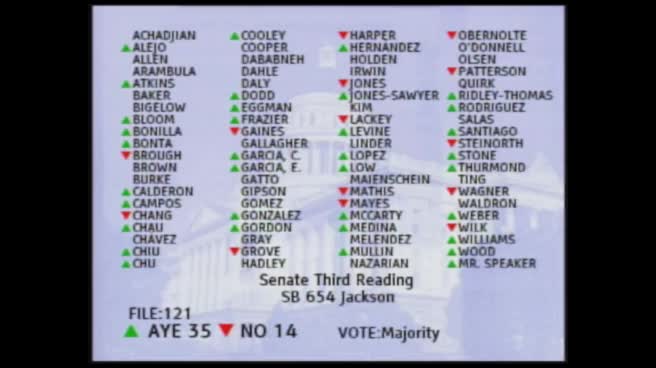 1MIN
Assembly Floor
 3MIN
Senate Floor
 7MIN
Senate Standing Committee on Transportation and Housing
 1MIN
Assembly Floor
 15MIN
Assembly Standing Committee on Local Government
 13MIN
Assembly Standing Committee on Transportation
Bill Author

Bill Co-Author(s):